
Analysis
TWTW Note
The EU-China Trade Talks:
October 2026 | CWA # 2291
Aparna A Nair | Aparna A Nair is a postgraduate student at the Department of Political Science, Madras Christian College, Chennai. She is a Research Assistant at NIAS.
TWTW Note
The Trump-Xi Summit:
October 2026 | CWA # 2279
Aishal Hab Yousuf | Aishal Hab Yousuf is a postgraduate student at the Department of International Studies, Stella Maris College, Chennai. She is currently an intern at the National Institute of Advanced Studies (NIAS), Bengaluru.
Global Politics Explainer
China and the Open-Weight AI:
September 2026 | CWA # 2268
Aparna A Nair | Aparna A Nair is a postgraduate student at the Department of Political Science, Madras Christian College, Chennai. She is currently a Research Assistant at NIAS.

CW Explainer
Japan's Yasukuni Shrine Controversy:
August 2026 | CWA # 2248
Namrata L Ghanghatkar | Namrata L Ghanghatkar is a postgraduate student at the Department of Public Policy, Ramaiah University of Applied Sciences, Bengaluru. She is currently a research intern at the National Institute of Advanced Studies (NIAS).
The World This Quarter
China's External Landscape (Apr-Jun 2026):
August 2026 | CWA # 2234
Lakshmi Karlekar | Dr Lakshmi Karlekar is an Assistant Professor at the School of Law, Christ University, Central Campus, Bangalore.
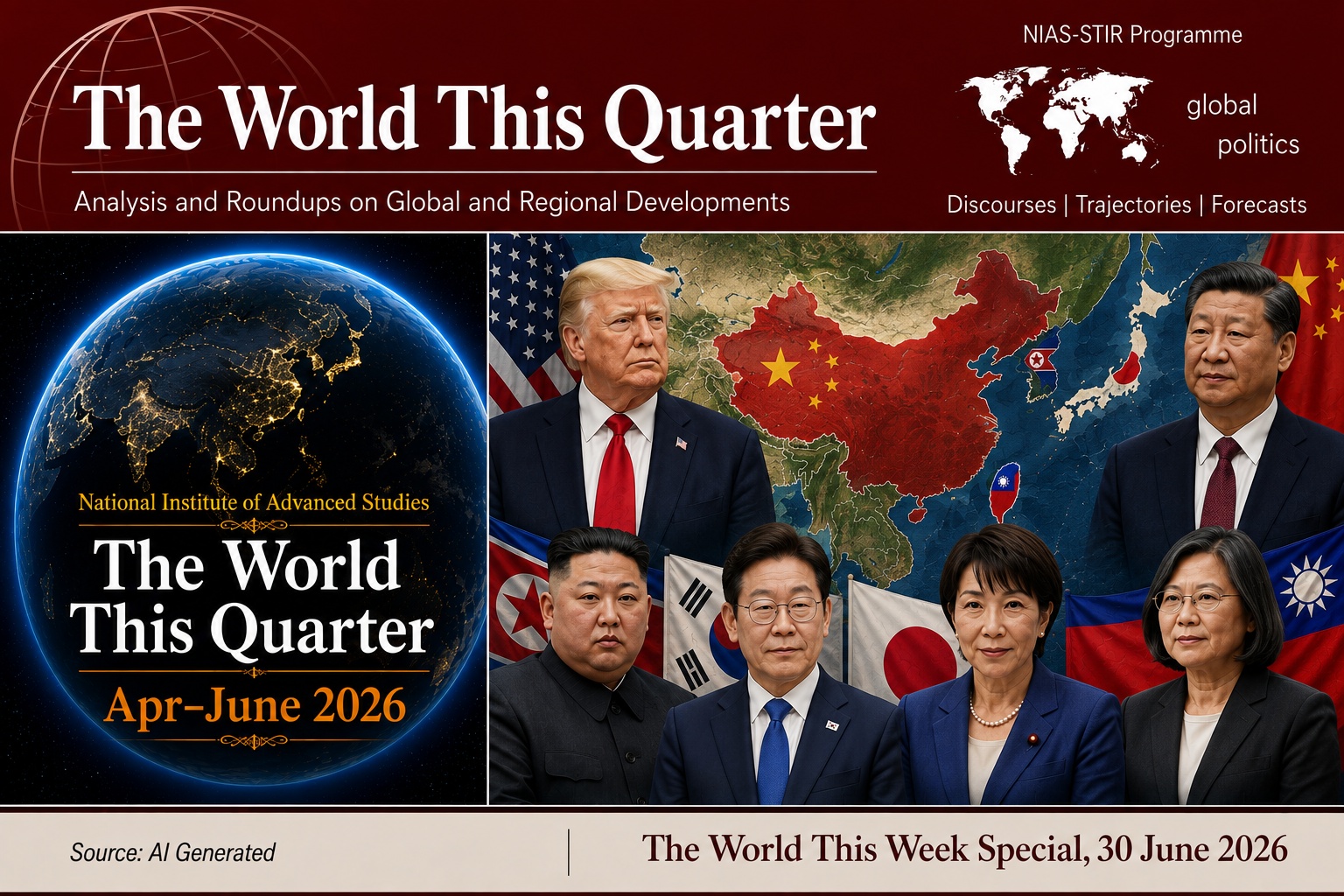
The World This Quarter
East Asia (Apr-Jun 2026):
August 2026 | CWA # 2233
Teshu Singh | Dr Teshu Singh is a Research Fellow at the Indian Council of World Affairs (ICWA), New Delhi. The views expressed are personal.
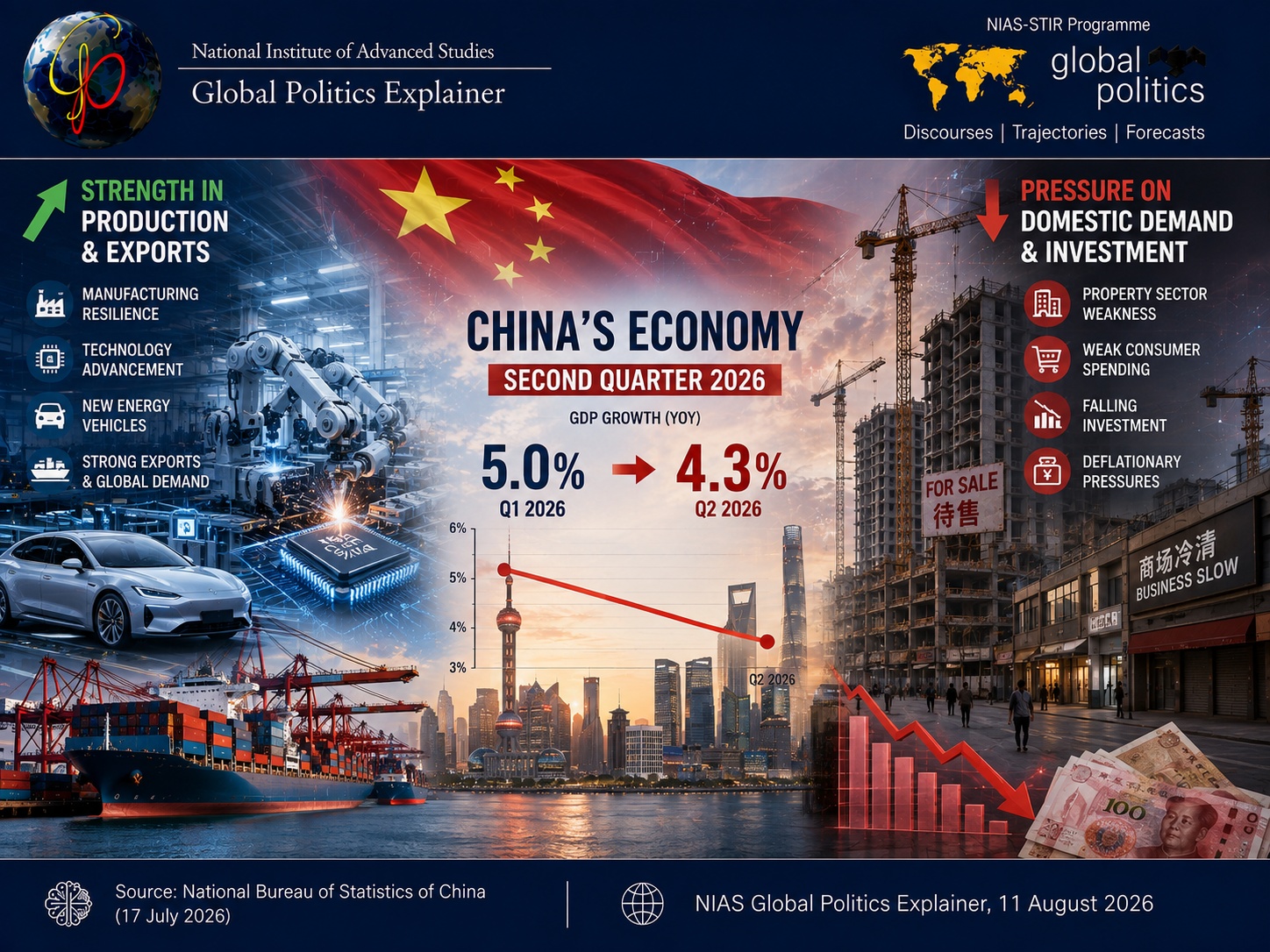
Global Politics Explainer
China's economy at mid-2026:
August 2026 | CWA # 2231
Dhivya KM | Dhivya KM is an intern at NIAS and is also a postgraduate student from the Department of Financial Economics, Madras School of Economics, Chennai.
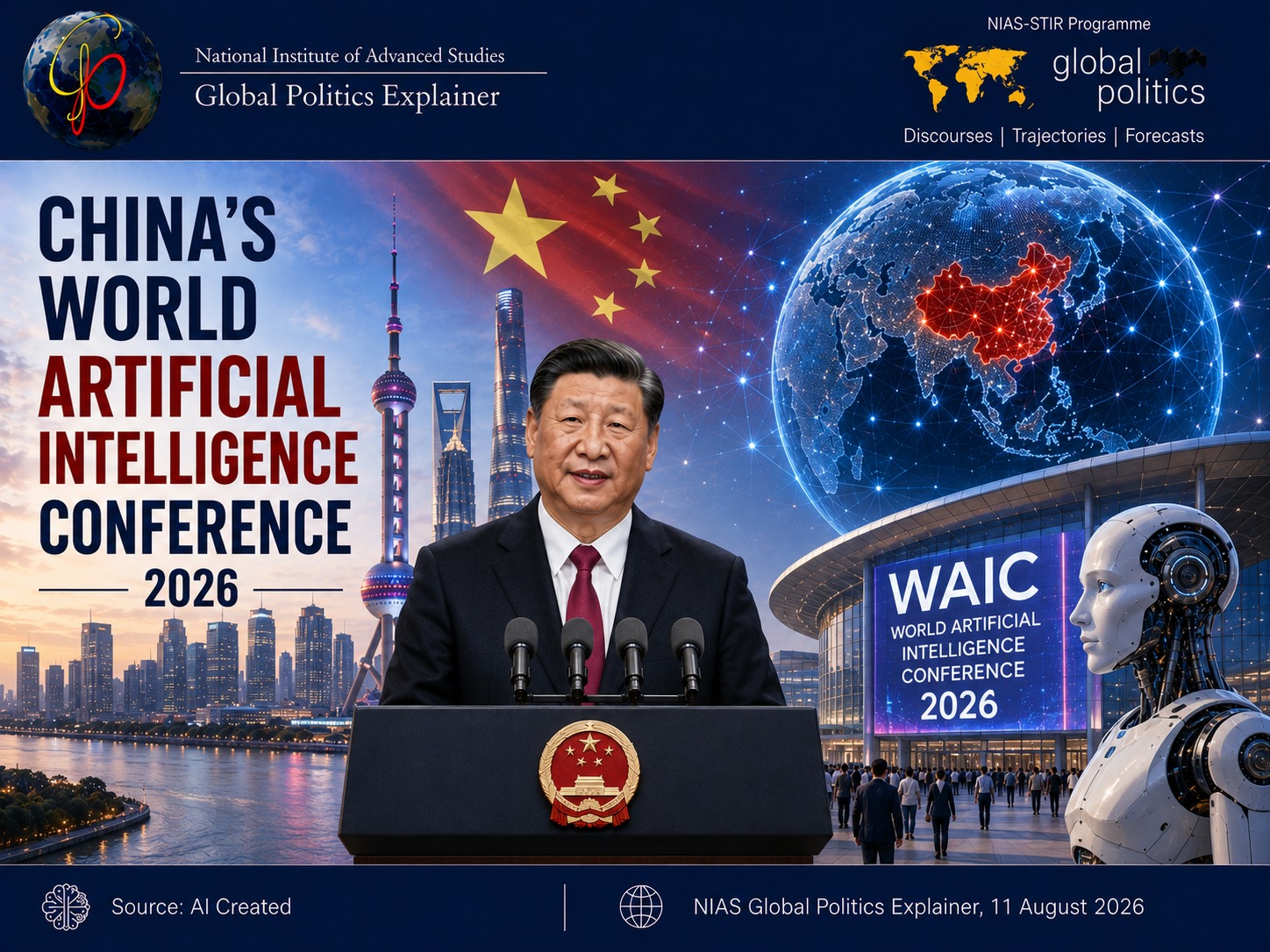
Global Politics Explainer
China's World Artificial Intelligence Conference:
August 2026 | CWA # 2230
Acsah H | Acsah H is a postgraduate student at the Department of Geopolitics and International Relations, Manipal Institute of Social Sciences, Humanities and Arts, MAHE, Manipal, Udupi. She is currently a research intern at the National Institute of Advanced
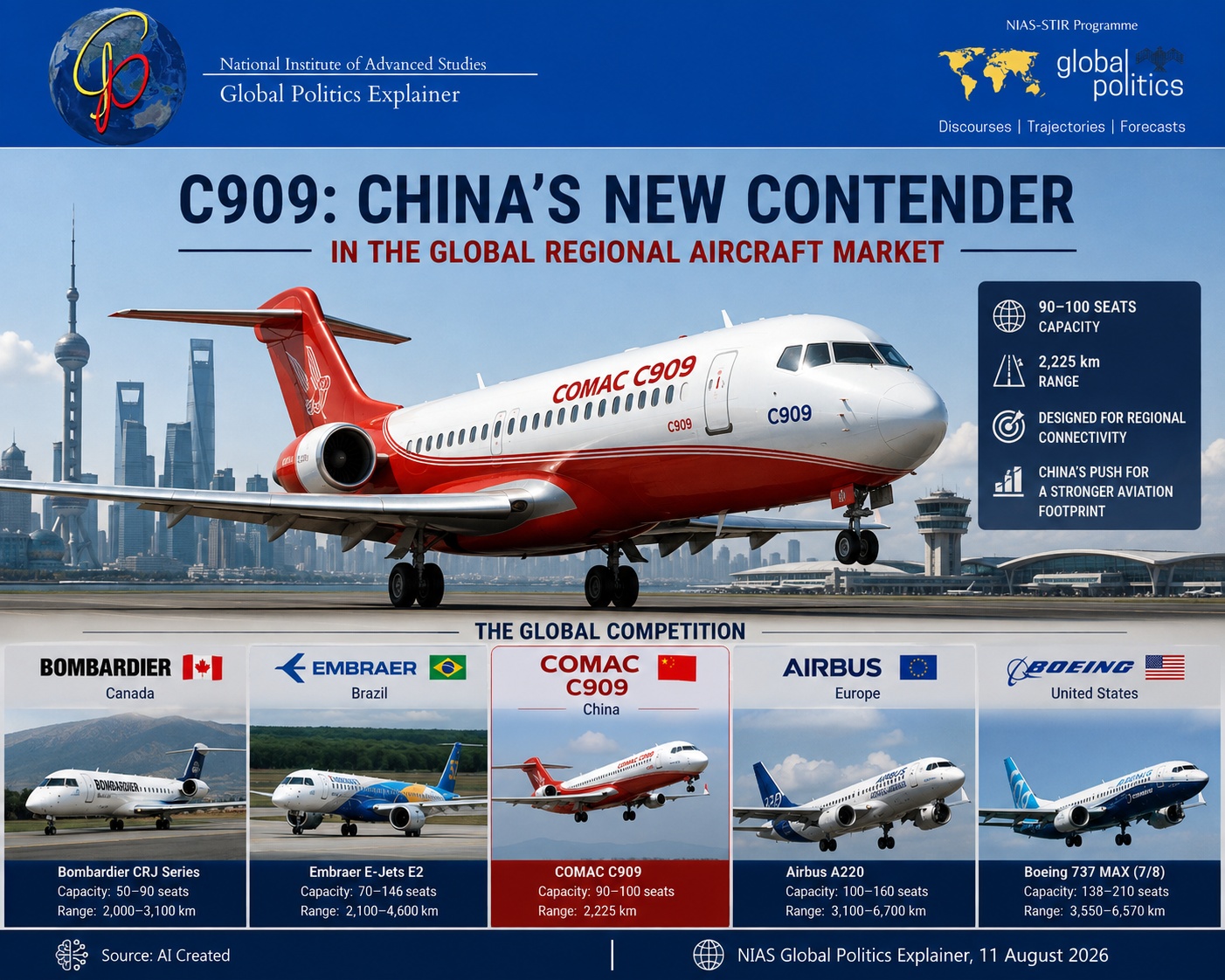
Global Politics Explainer
China's C909:
August 2026 | CWA # 2225
Acsah H | Acsah H is a postgraduate student at the Department of Geopolitics and International Relations, Manipal Institute of Social Sciences, Humanities and Arts, MAHE, Manipal, Udupi. She is currently a research intern at the National Institute of Advanced
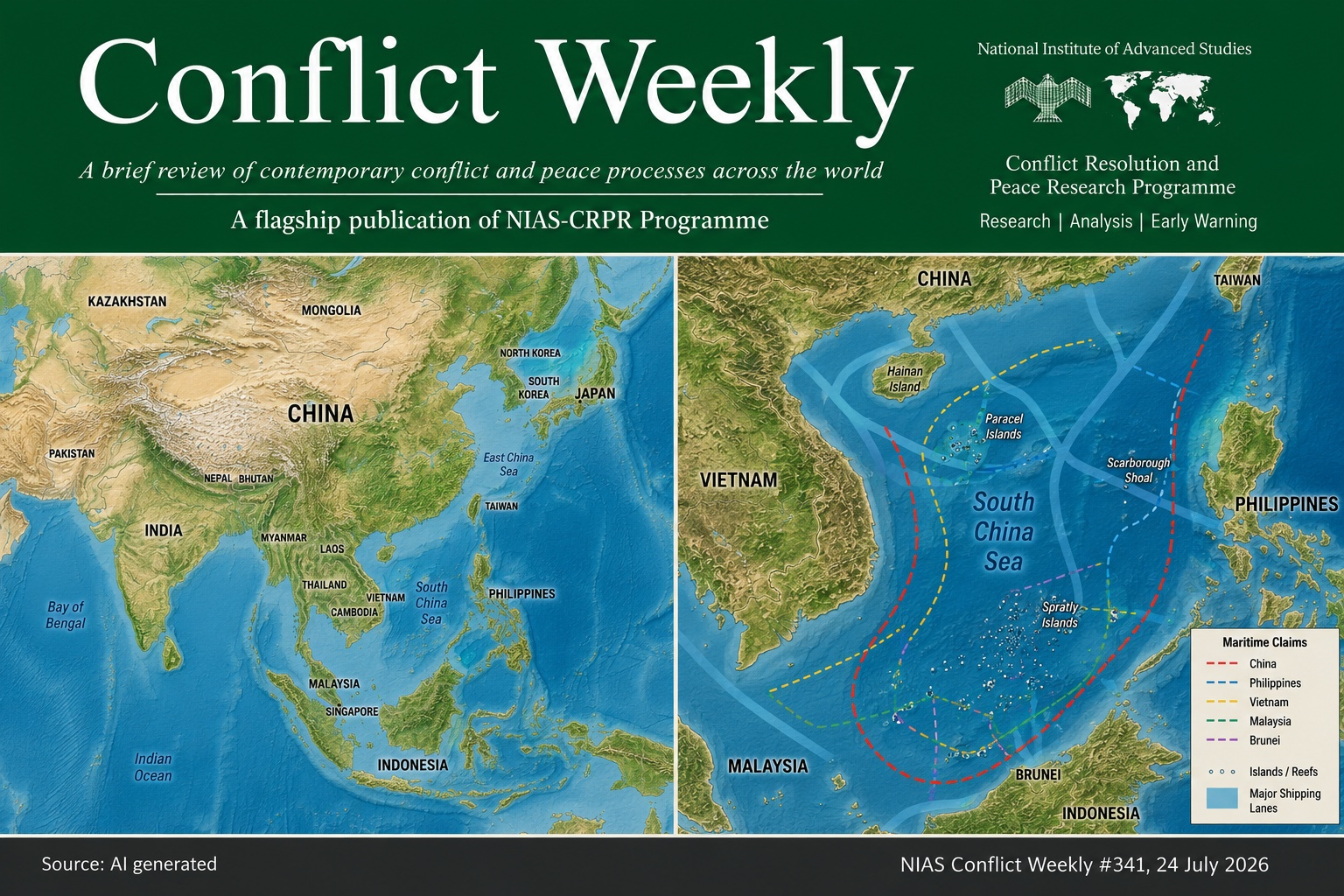
CW Note
China, the Philippines, and the return of South China Sea tensions:
July 2026 | CWA # 2205
Aparna A Nair | Aparna A Nair is a postgraduate student at the Department of Political Science, Madras Christian College, Chennai.
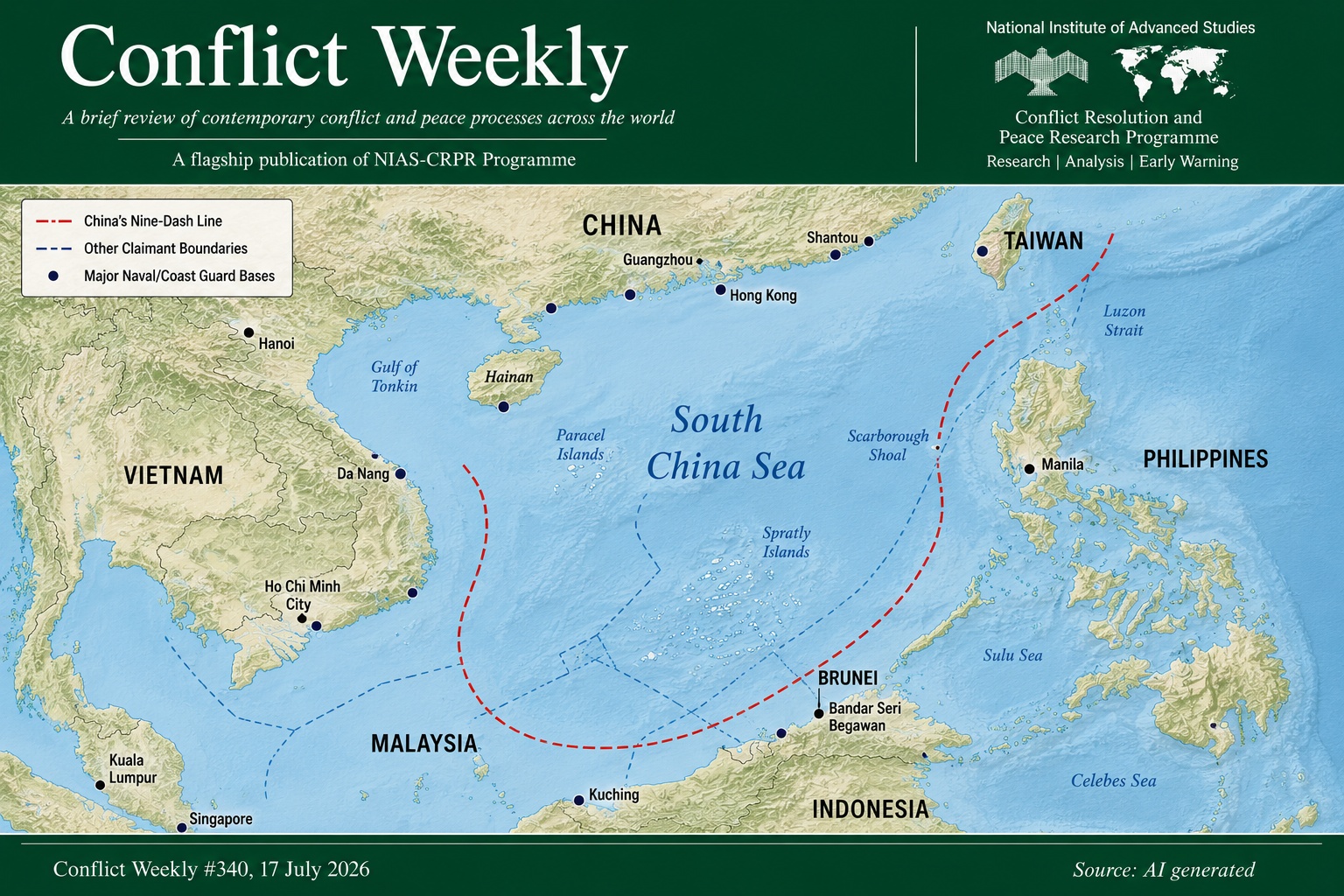
CW Note
UNCLOS and the South China Sea Arbitral Award:
July 2026 | CWA # 2198
Aparna A Nair | Aparna A Nair is a postgraduate student at the Department of Political Science, Madras Christian College, Chennai.
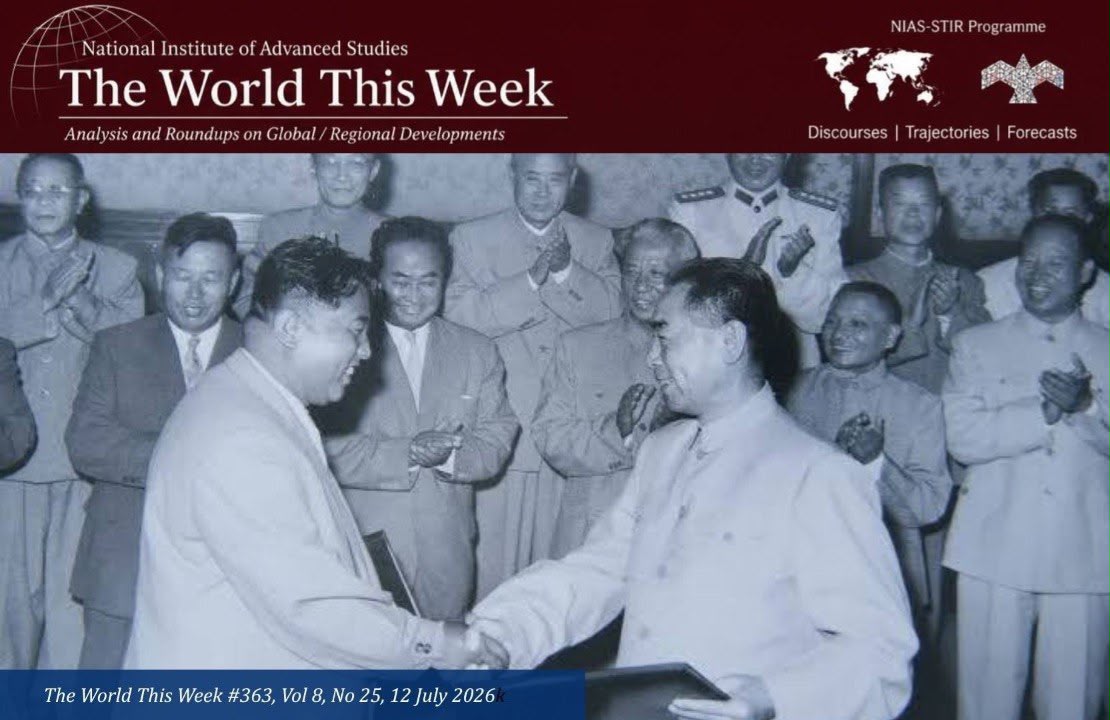
TWTW Note
65 years of the China-DPRK friendship treaty:
July 2026 | CWA # 2188
Adwaith Sankar | Adwaith Sankar is an intern at NIAS. He is also an undergraduate student pursuing Political Science and International Liberal Studies through the NUS-Waseda Double Degree Programme.
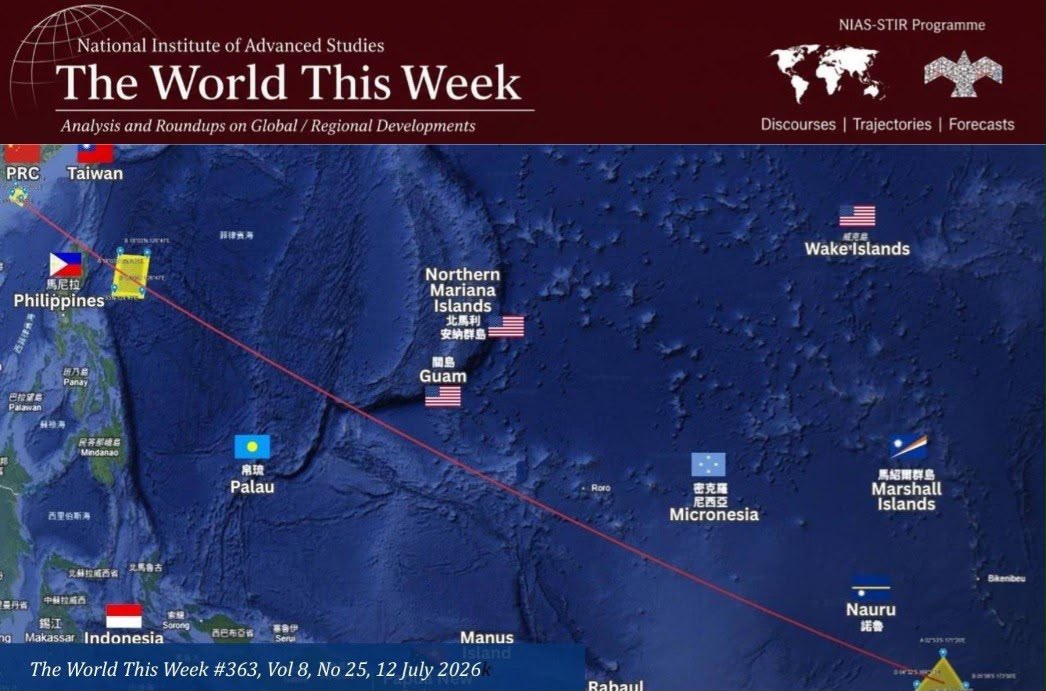
TWTW Note
China's SLBM test in the Pacific:
July 2026 | CWA # 2187
Avaneesh S | Avaneesh S is a postgraduate student from the Department of History, School of Social Sciences, Pondicherry University. He is currently an intern at NIAS.
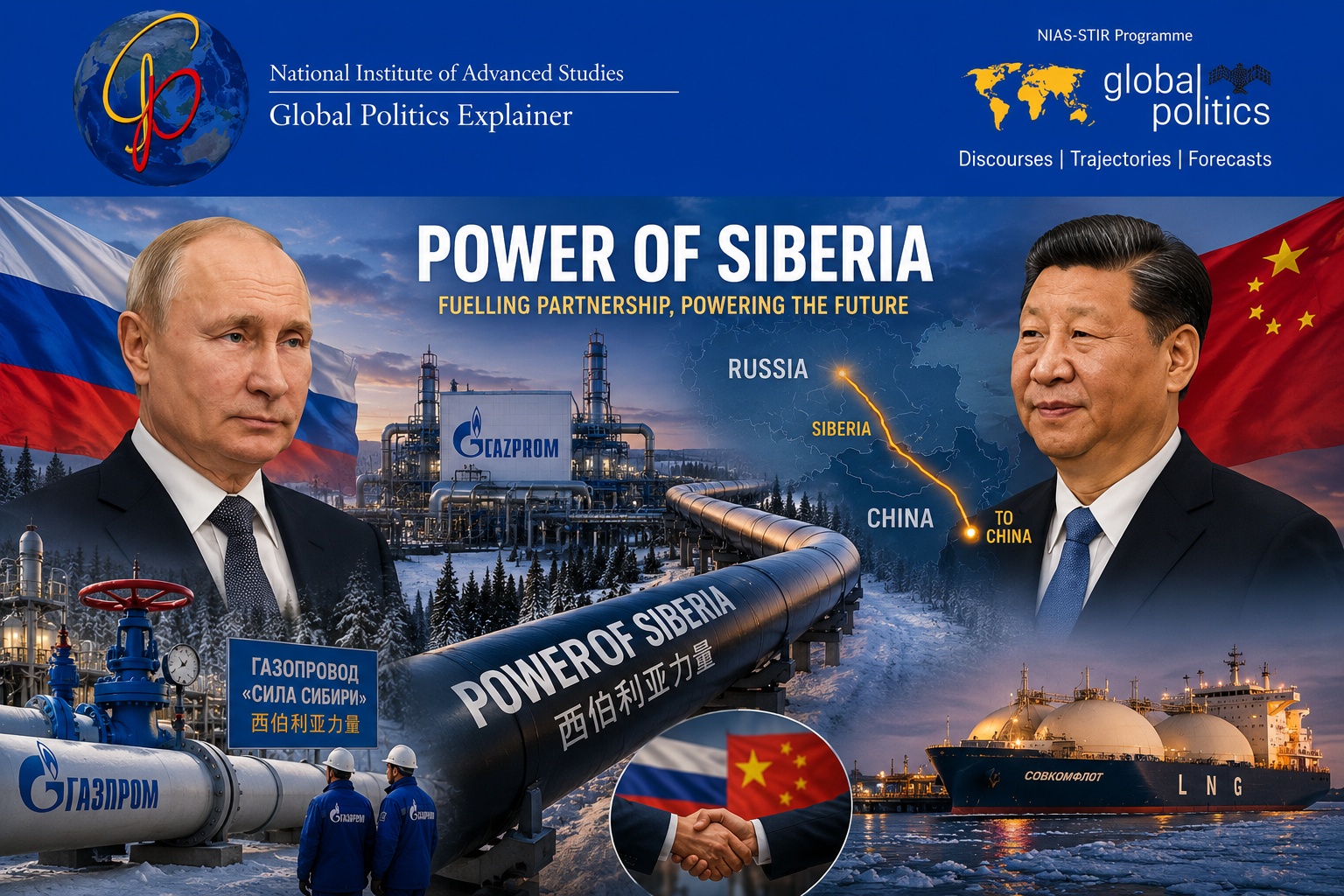
GP Explainer
The "Power of Siberia 2" pipeline:
July 2026 | CWA # 2179
Avaneesh S | Avaneesh S is an intern at NIAS. Currently, he is pursuing his master’s in history at Pondicherry University.
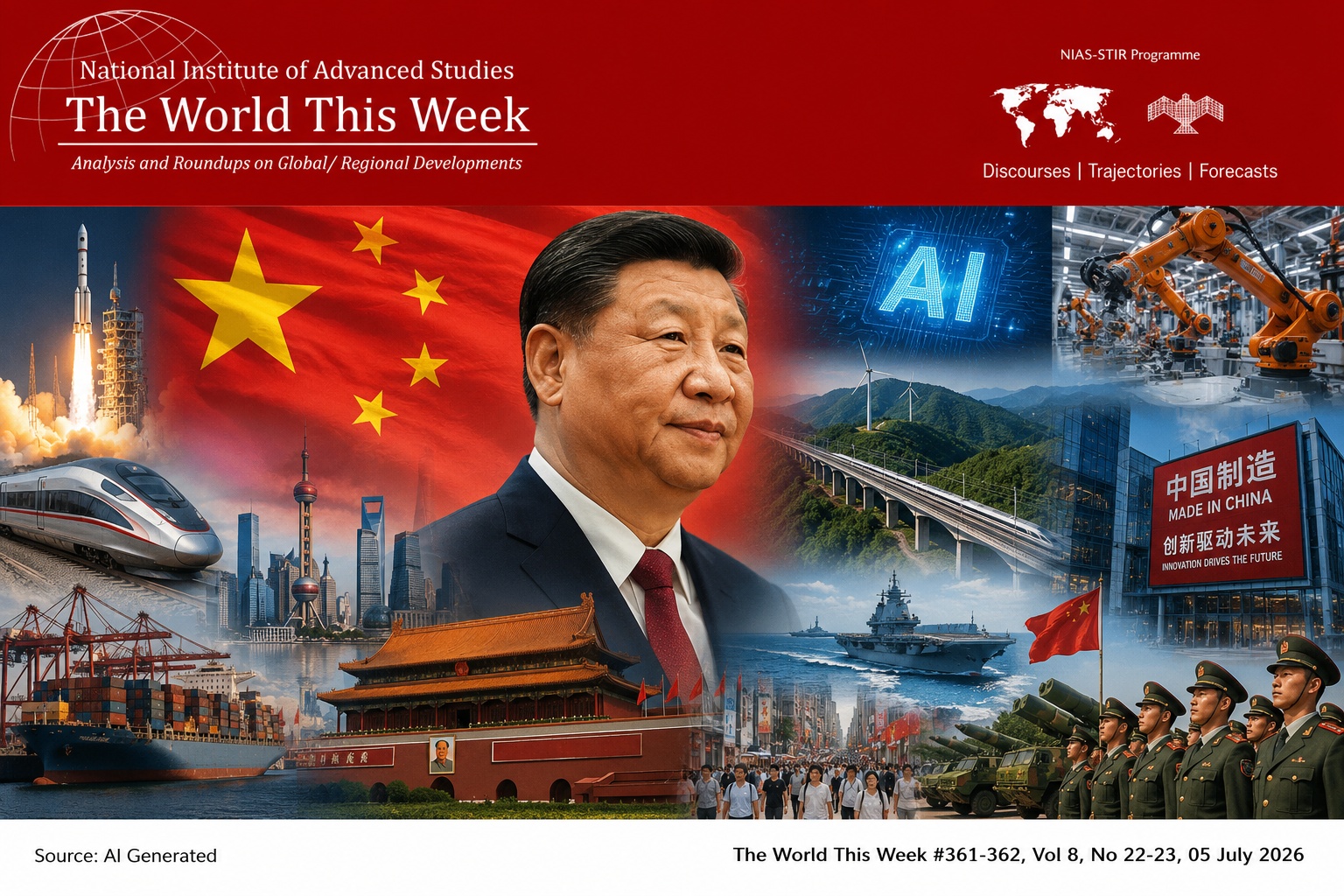
TWTW Note
President Xi Jinping's address on CPC's 105th anniversary:
July 2026 | CWA # 2176
Acsah H | Acsah H is a postgraduate student at the Department of Geopolitics and International Relations, Manipal Institute of Social Sciences, Humanities and Arts, MAHE, Manipal, Udupi. She is currently a research intern at the National Institute of Advanced
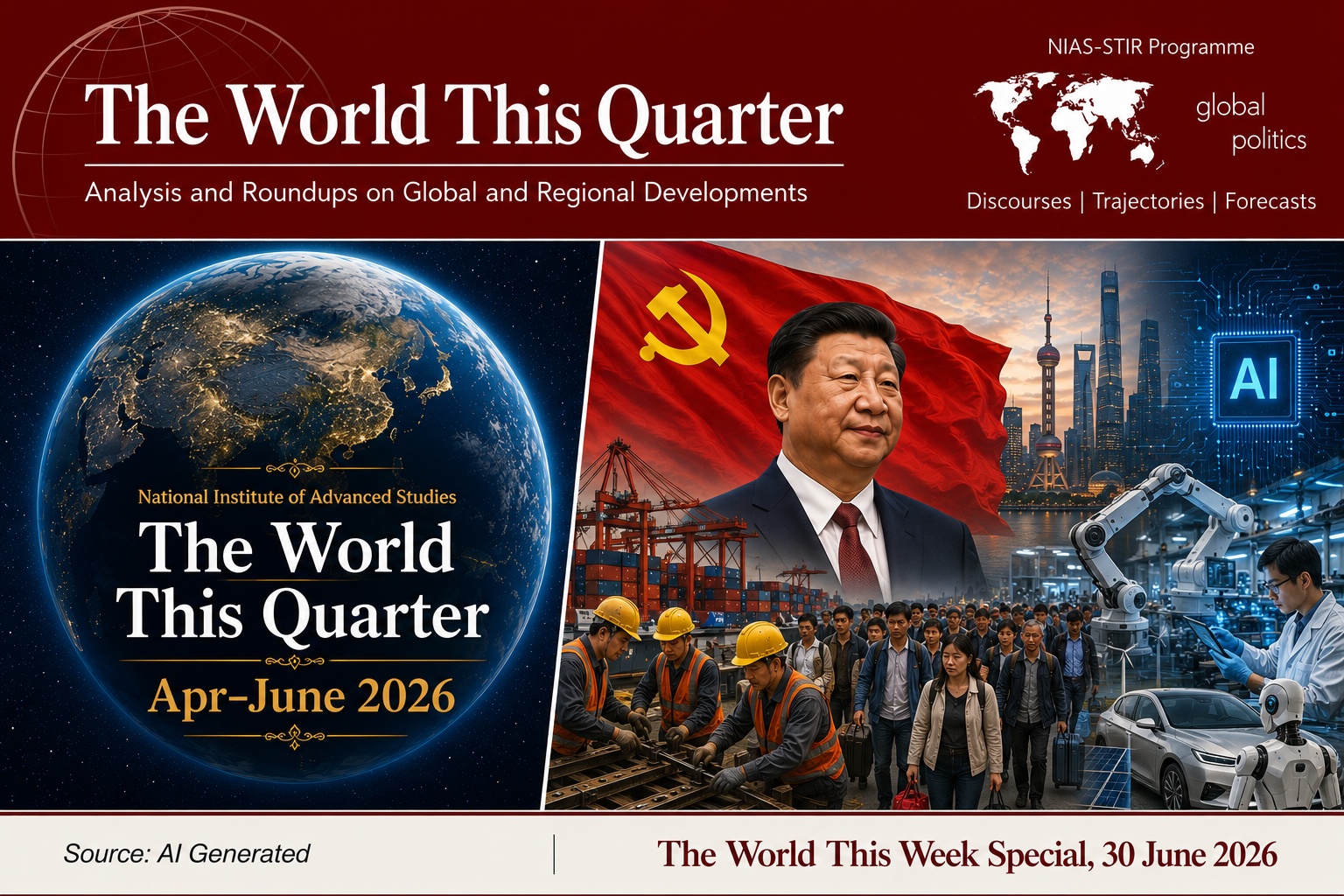
The World This Quarter
China's Domestic Landscape (April-June 2026):
June 2026 | CWA # 2162
Anand V | Dr Anand V is an Assistant Professor (Senior Scale) in the Department of Geopolitics and International Relations, Manipal Academy of Higher Education, Manipal, India. The views expressed are personal.
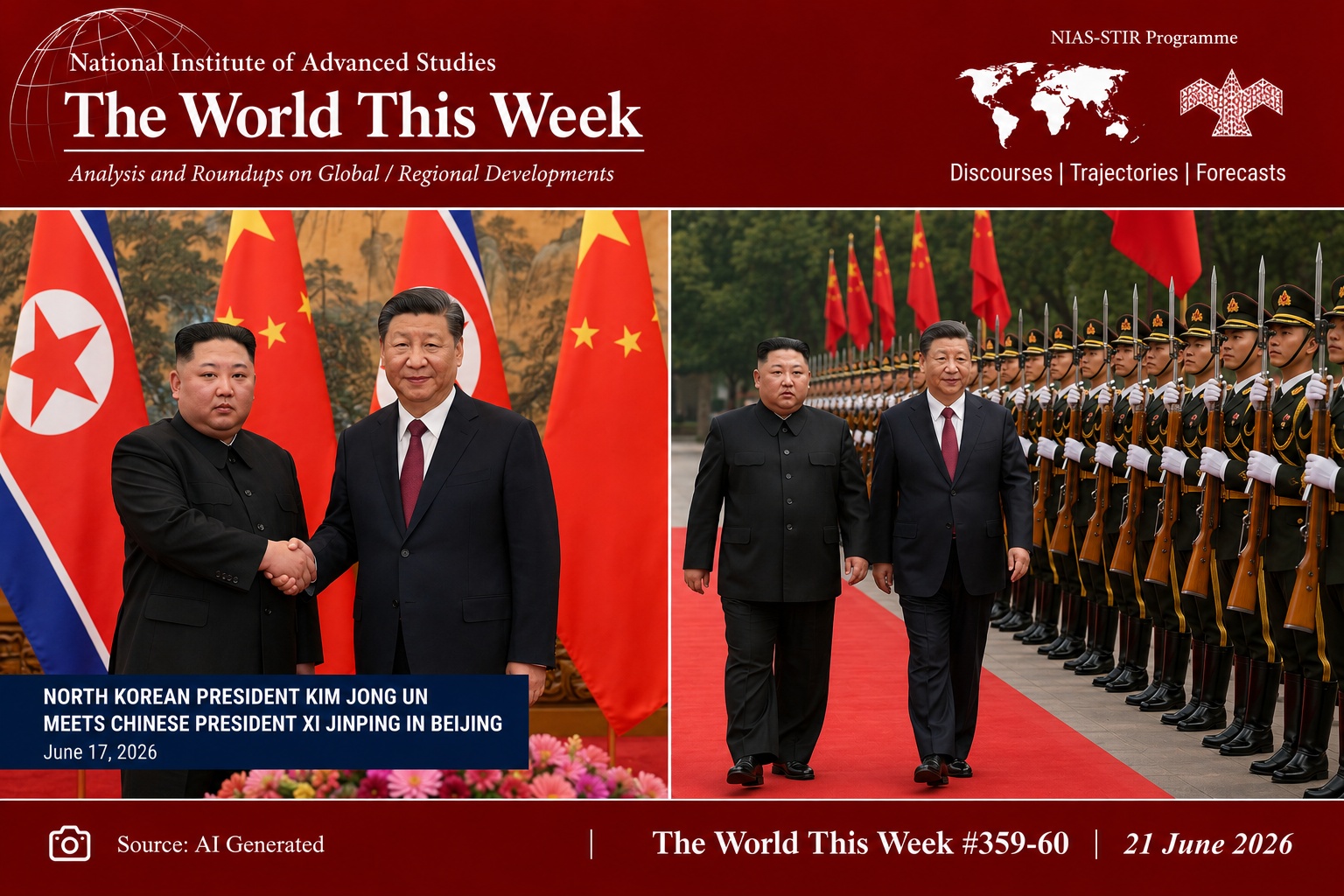
TWTW Note
President Xi Jinping's North Korea visit:
June 2026 | CWA # 2156
Avaneesh S | Avaneesh S is a postgraduate student from the department of History, School of Social Sciences, Pondicherry University. He is currently an intern at NIAS.
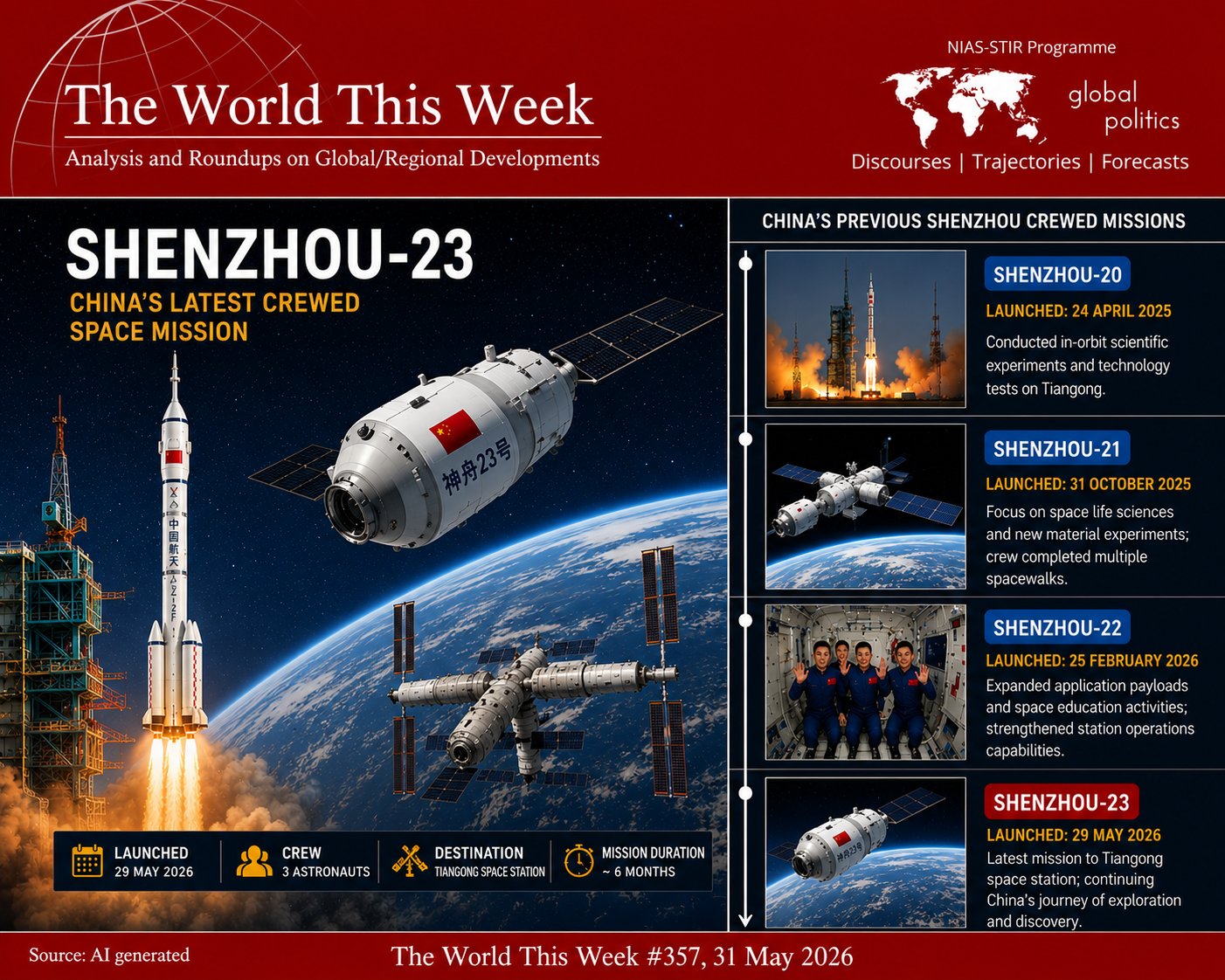
TWTW Note
The Shenzhou-23 Mission:
May 2026 | CWA # 2126
Aparna A Nair | Aparna A Nair is a graduate from the Department of Political Science, Madras Christian College, Chennai.
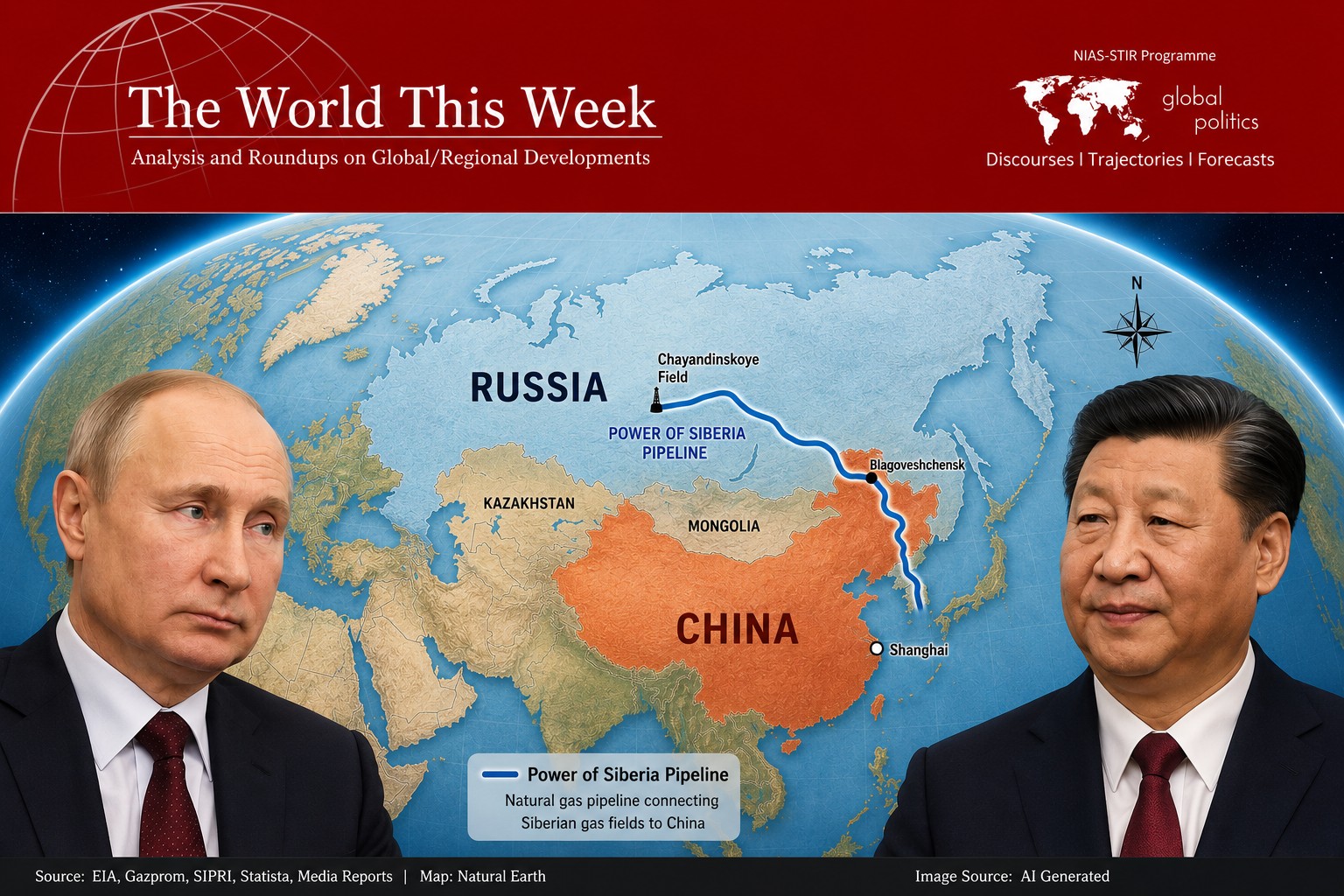
TWTW Note
The Putin-Xi Summit
May 2026 | CWA # 2115
Aparna A Nair | Aparna A Nair is a research intern at the National Institute of Advanced Studies, Bengaluru.
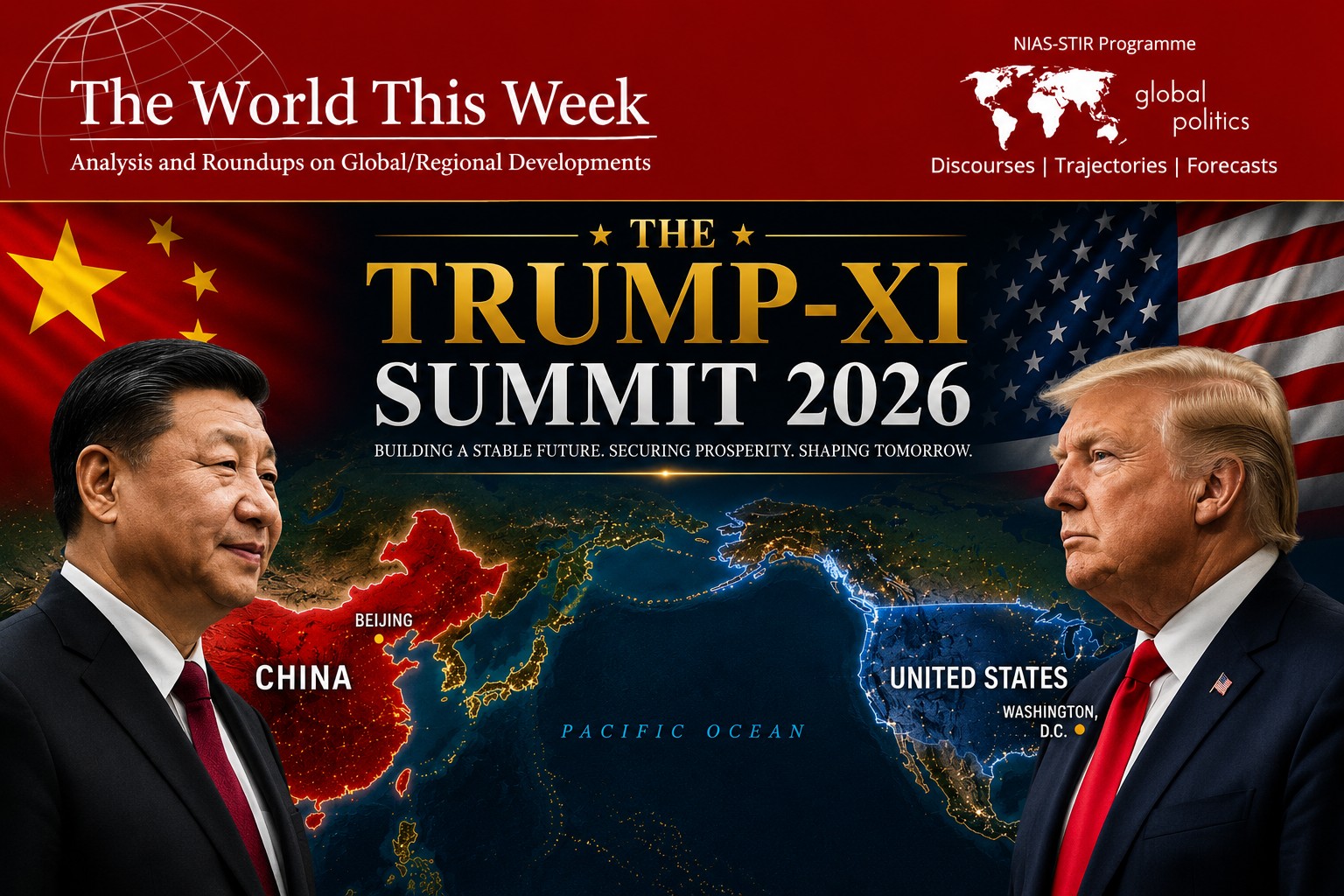
TWTW Note
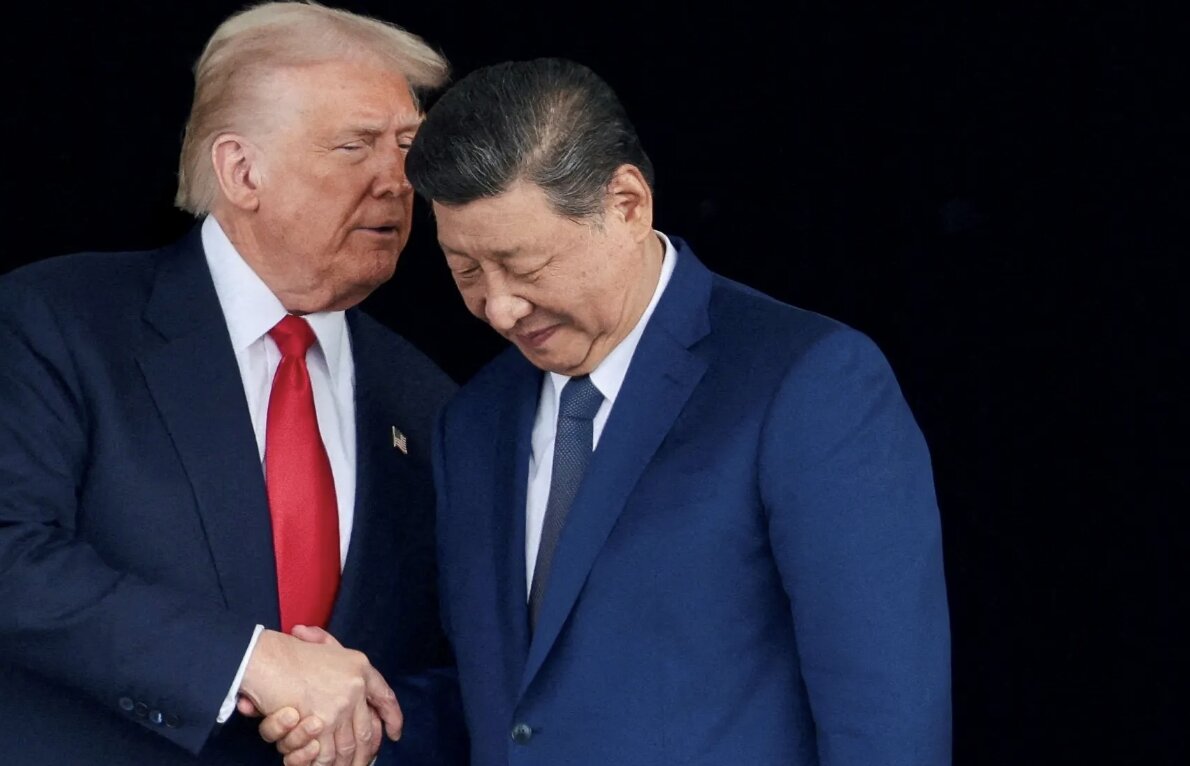
The Trump-Xi Summit:
May 2026 | CWA # 2110
Aishal Hab Yousuf | Aishal Hab Yousuf is a postgraduate student at the Department of International Studies, Stella Maris College, Chennai. She is currently an intern at the National Institute of Advanced Studies (NIAS), Bengaluru.

Peace and Conflicts This Quarter (January–March 2026)
China-Japan Tensions
April 2026 | CWA # 2068
Femy Francis
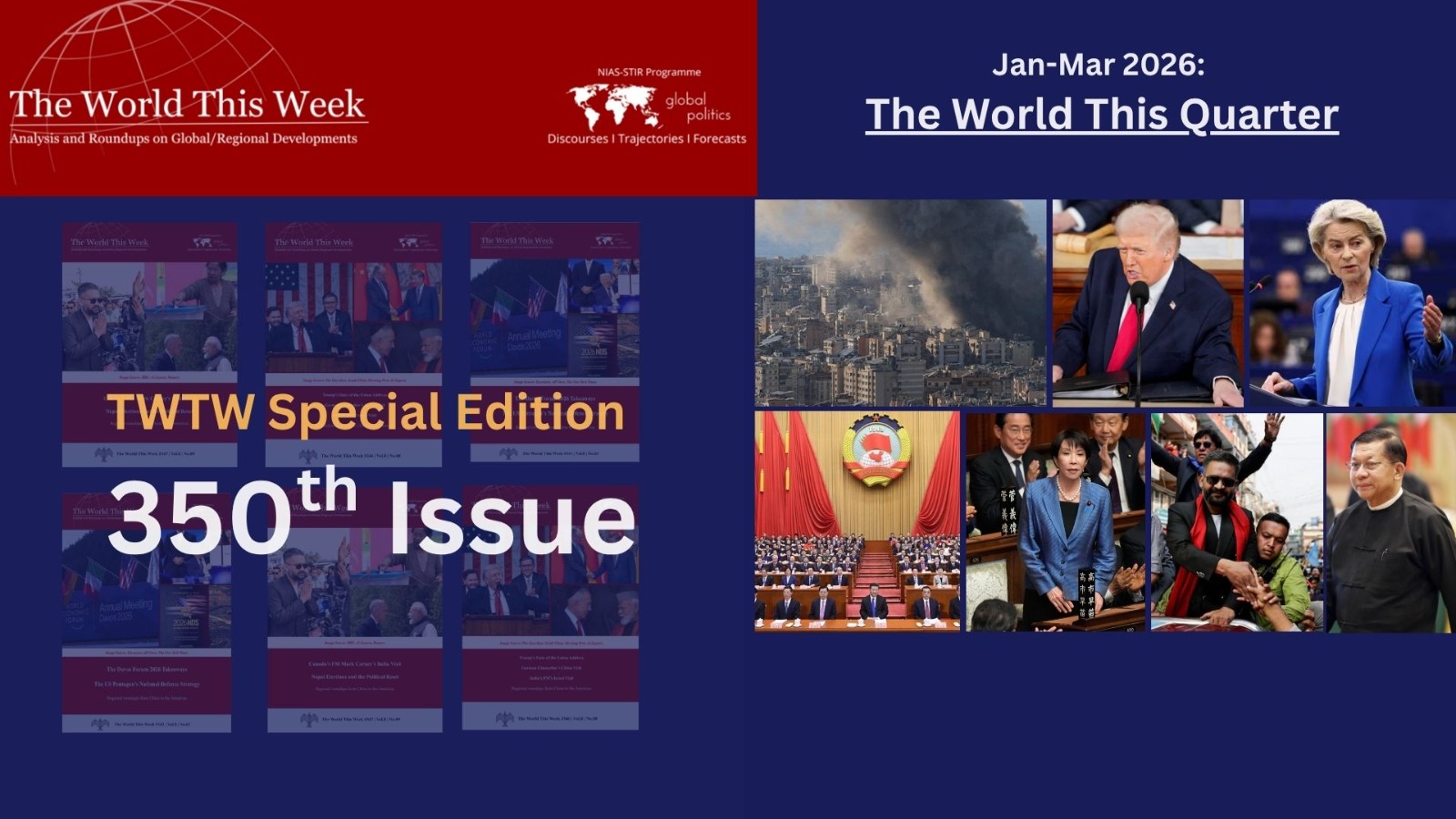
The World This Quarter
China’s External Landscape (Jan-Mar 2026):
April 2026 | CWA # 2054
Amrita Jash

China Reader
“Let Beijing believe peaceful reunification is still possible”
December 2025 | CWA # 1864
Femy Francis | Femy Francis is a Project Associate at NIAS
TWTW Note
Ten Takeaways on White Paper "China’s Arms Control, Disarmament, and Non-proliferation in the New Era
December 2025 | CWA # 1861
Femy Francis

TWTW Note
Japan-China Tensions over PM Takaichi's statement on Taiwan
November 2025 | CWA # 1846
Femy Francis

Global Politics Explainer
China, Yarlung Tsangpo and the Medog Hydropower Station
July 2025 | CWA # 1776
Femy Francis

Global Politics Explainer
China-Australia Free Trade Agreement after ten years:
July 2025 | CWA # 1775
Femy Francis

Global Politics Explainer
China’s debut Global Green Sovereign Bond
June 2025 | CWA # 1698
Gauri Gupta

Global Politics Explainer
Humanoid Robots: Why is China investing on them?
June 2025 | CWA # 1696
Aparna A Nair

Global Politics Explainer
Bangladesh and China: What agreements did the Chief Executive Yunus sign during his recent Visit? What do they mean?
April 2025 | CWA # 1656
Emma Rose Boby

Global Politics Explainer
China's Military drills near Taiwan Strait: Actions, Responses and Criticisms
April 2025 | CWA # 1644
Femy Francis

Global Politics Explainer
China Development Forum 2025: The Focus on AI, High Tech Investments, and Domestic Consumption
March 2025 | CWA # 1635
Nova Karun K

Global Politics Explainer
US-China Trade War: Tariffs, Retaliation and Fallouts
March 2025 | CWA # 1625
C Shraddha
NIAS CEAP Reader
Health diplomacy: Nepal's growing dependence on China
December 2024 | CWA # 1546
Ashna Pathak & Surangana Rajya Laxmi Rana

Bougainville’s struggle for independence: What is the problem, and what are the implications?
September 2024 | CWA # 1476
Advik S Mohan

CEAP Commentary
06 May 1882: The US President signs the Chinese Exclusion Act, restricting immigration from China
May 2024 | CWA # 1344
Femy Francis | Research Assistant at NIAS

Global Politics Special Commentary
China-Japan-South Korea Trilateral Summit: Key Outcomes and Implications
June 2024 | CWA # 1341
Torunika Roy

Global Politics Early Bird
China-Arab States Summit, and Xi’s “Five Cooperation Framework”
May 2024 | CWA # 1336
Femy Francis
China, East Asia and the Pacific Studies
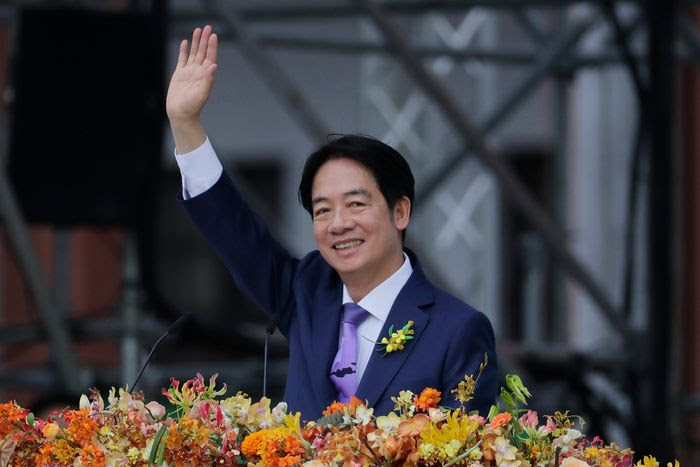
Taiwan President’s Inaugural Address: Four Takeaways
May 2024 | CWA # 1330
Akhil Ajith

Global Politics Explainer
Chang’e 6 and China’s Lunar Exploration program
May 2024 | CWA # 1321
Akhil Ajith

NIAS China Reader
Beijing Auto Show 2024: China’s global domination in EV sector
May 2024 | CWA # 1318
Akhil Ajith
NIAS China Reader
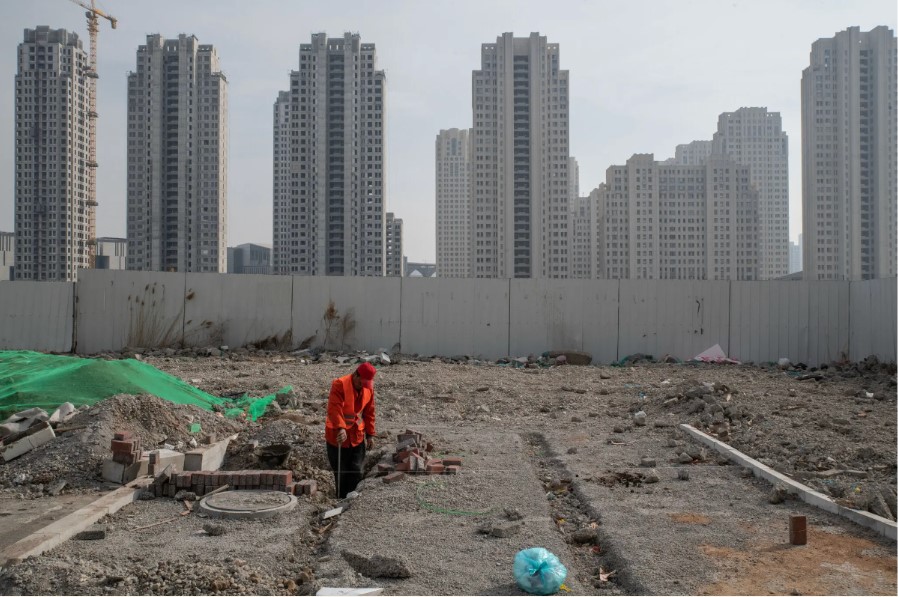
Chinese cities are sinking below the sea level: Four Takeaways of a Science journal report
May 2024 | CWA # 1317
Akhil Ajith
Global Politics Explainer
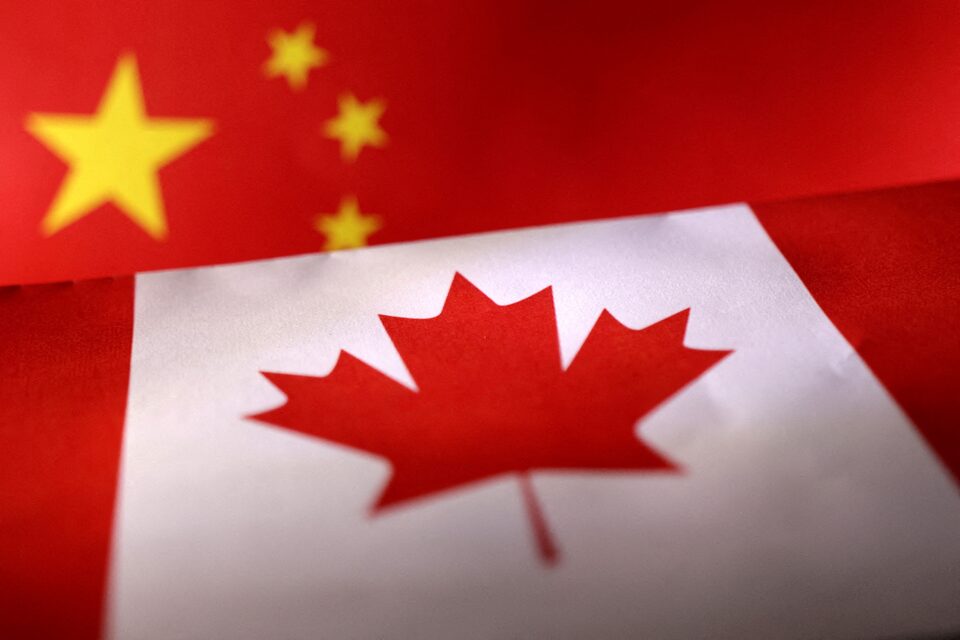
Canada investigates Chinese interference in 2019 and 2020 elections
April 2024 | CWA # 1269
Femy Francis

NIAS China Reader
Ten years of BRI: Xi and the Beijing Summit
October 2023 | CWA # 1118
Femy Francis
NIAS China Reader
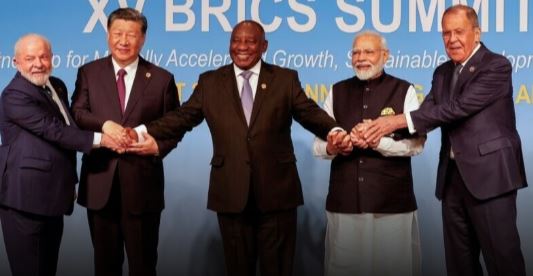
BRICS Summit poised as the Champion of Global South
August 2023 | CWA # 1116
Femy Francis
NIAS China Reader
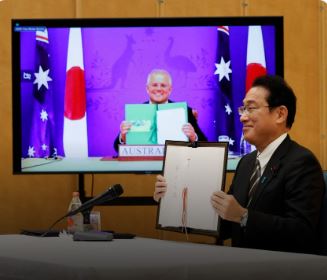
Japan-Australia's Reciprocal Access Agreement
August 2023 | CWA # 1115
Femy Francis
NIAS China Reader
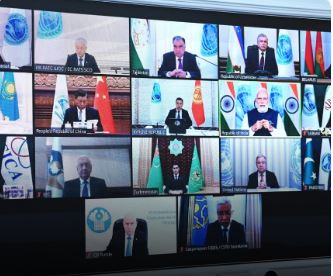
The SCO Summit and the Delhi Declaration: The Focus on Digital Security and Iran’s Entry
July 2023 | CWA # 1114
Prerana P
NIAS China Reader
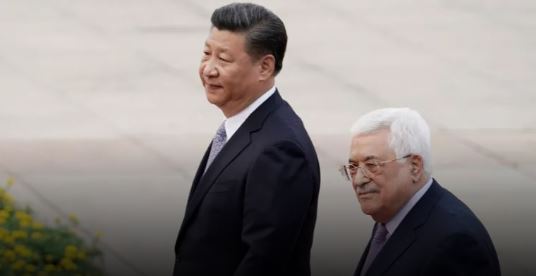
China: Palestine Authority President Mahmoud Abbas’ visit emphasizes hope for statehood
June 2023 | CWA # 1113
CR Team | Avishka Ashok
China Reader
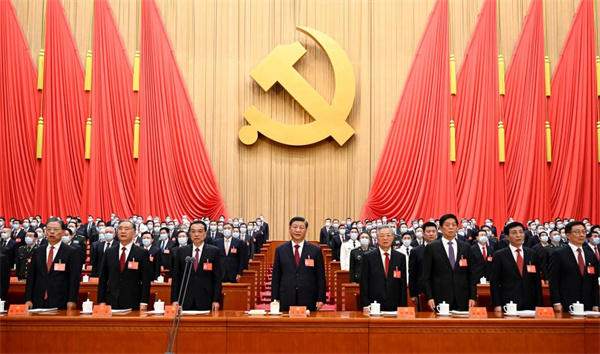
20th Party Congress of the Communist Party of China: Major takaways
November 2022 | CWA # 828
Avishka Ashok | Research Associate | National Institute of Advanced Studies
NIAS China Reader
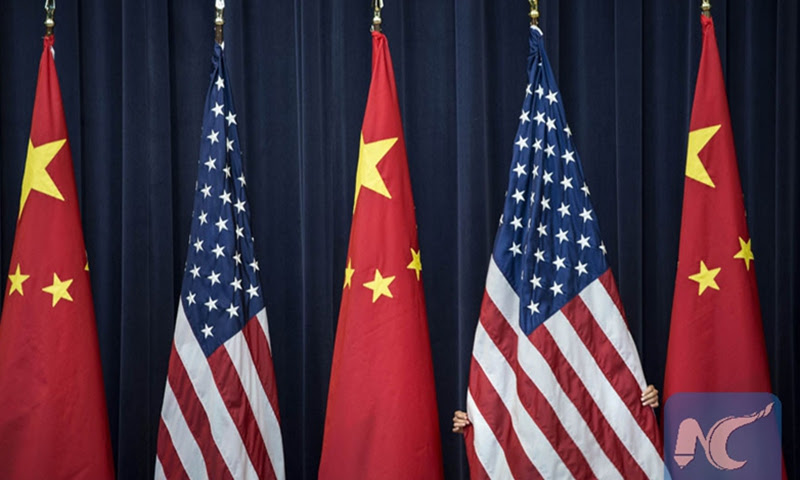
The Biden-Xi phone call and the underlying tensions in bilateral relations
July 2022 | CWA # 768
Avishka Ashok
NIAS China Reader
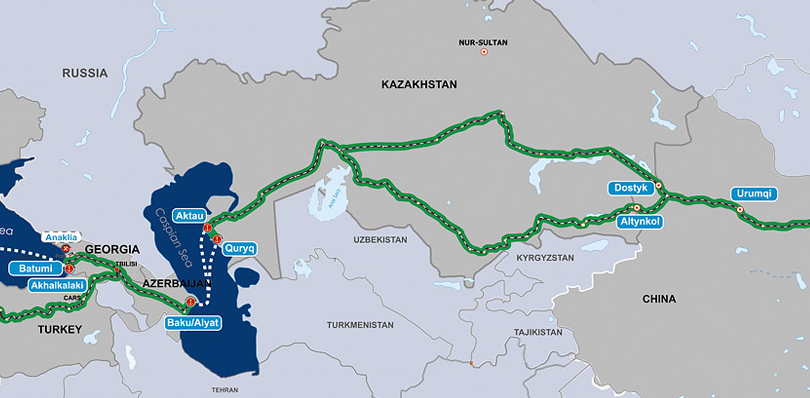
China’s two major interests in Kazakhstan: Energy and economy
March 2022 | CWA # 697
Avishka Ashok
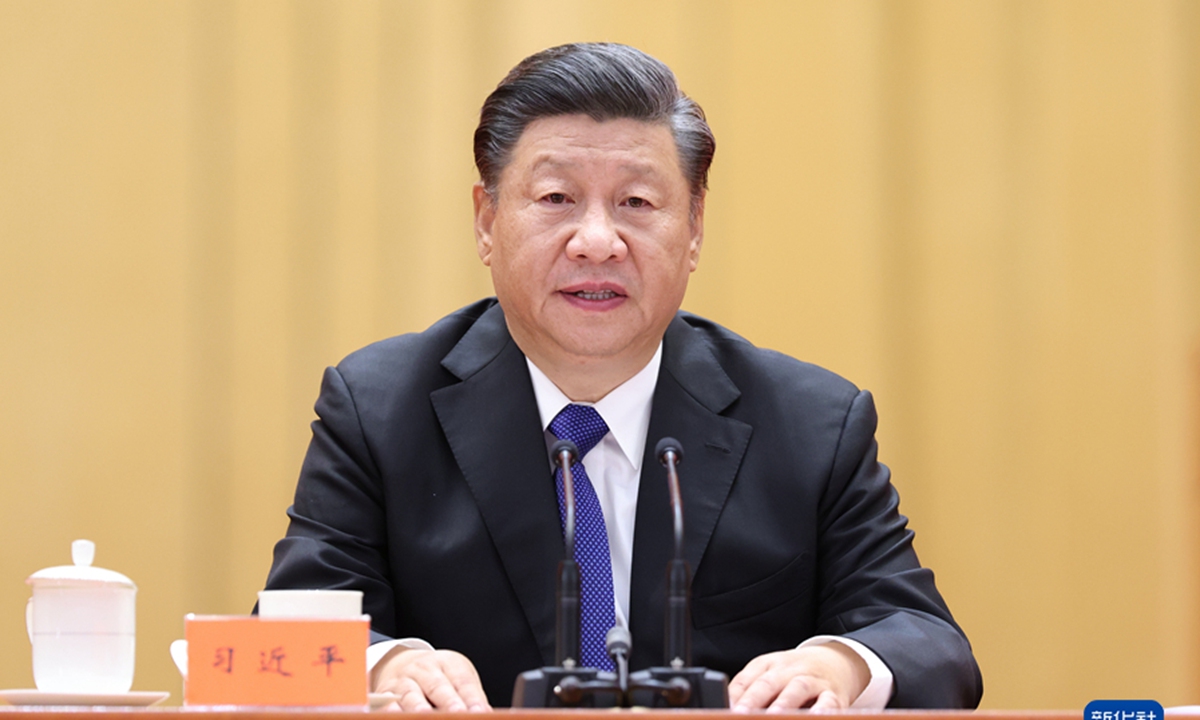
NIAS Global Politics Brief
China in 2021: A year of grandiose political changes and foreign affairs
February 2022 | CWA # 671
N Jayaram
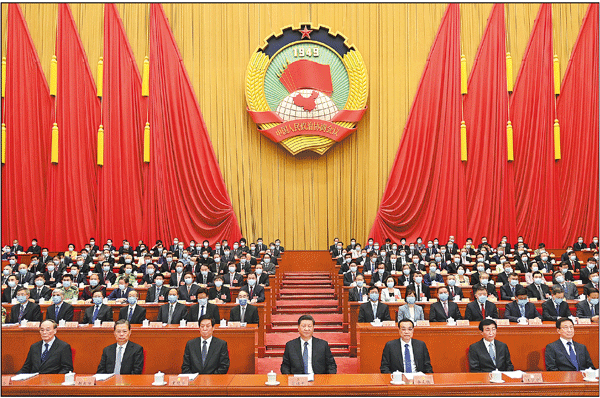
NIAS-Global Politics Brief
China’s Economic Strategy: Global Strike vs. Globalization
February 2022 | CWA # 668
Amit Gupta
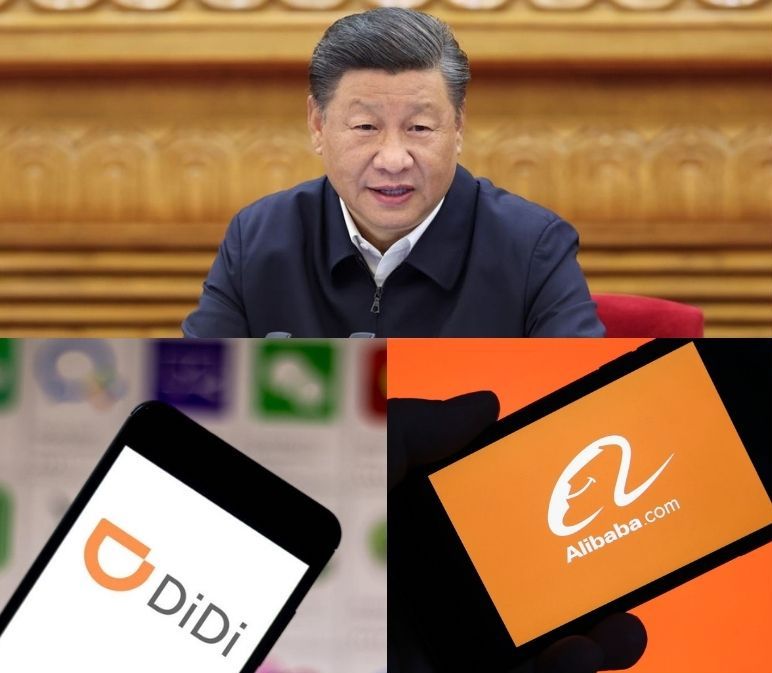
China Reader
Alibaba then, Didi now: Three reasons why Beijing is going after its tech giants
September 2021 | CWA # 549
Sukanya Bali
China Reader
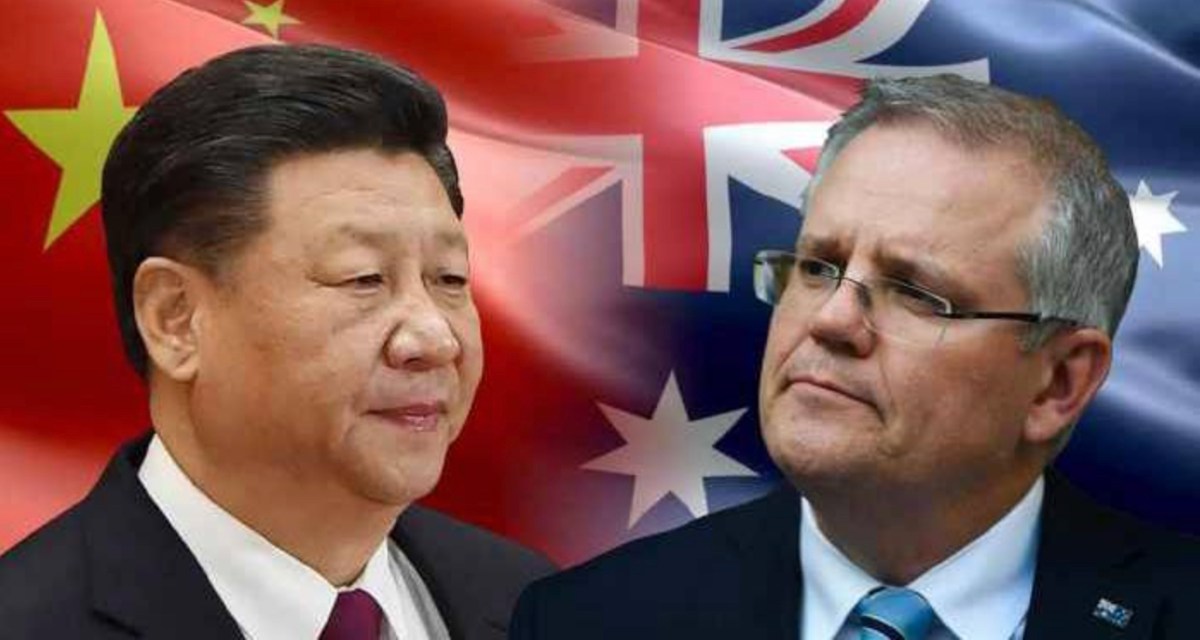
China and Australia: Beijing's suspension of the economic dialogue with Australia will cost China more.
June 2021 | CWA # 484
Keerthana Rajesh Nambiar
CR Daily Briefs
China Reader Daily Wire | 24 October 2026, Saturday | Vol 3 No. 165
US designates China-funded cultural centres as national security threats
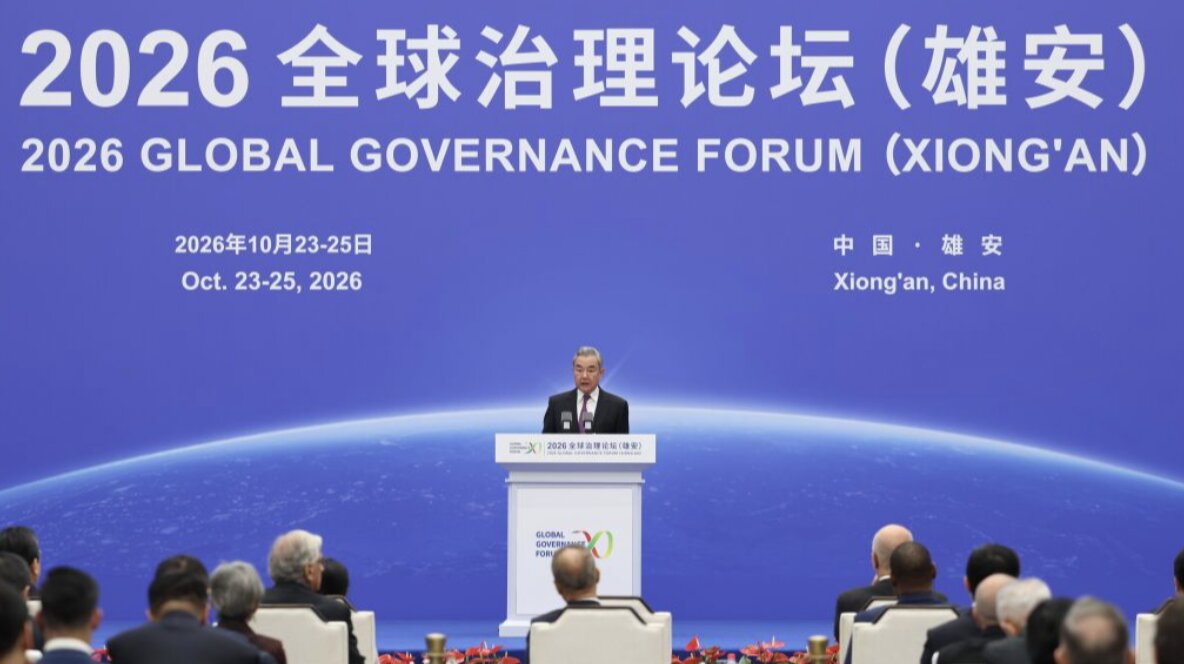
Global Governance Forum discusses research centre, AI capacity-building plan and outer space governance
INTERNAL
Global Governance Forum discusses research centre, AI capacity-building plan and outer space governance
On October 24, China Daily reported that Chinese President Xi Jinping had called for countries to work together to implement the global governance initiative and build an equal global governance system. In a congratulatory letter to the 2026 Global Governance Forum in Xiong’an, Hebei province, Xi said the world was facing growing deficits in peace, development, security and governance and urged countries to tackle shared challenges through cooperation. Foreign Minister Wang Yi read Xi’s letter at the forum’s opening and announced several measures to advance governance reform. These include establishing a global governance research centre, releasing a progress report on China’s AI capacity-building plan and publishing a position paper on outer space governance. China will also provide training on economic, social and cultural rights and promote implementation of the agreement on marine biodiversity beyond national jurisdiction. Wang said the initiative had received support from more than 160 countries and International organisations, while over 60 countries had joined the Group of Friends of Global Governance. He called for a stronger role for the United Nations, greater representation for developing countries, reform of the international financial system and protection of the multilateral trading system.
(“ Xi: Cooperation vital for global governance reform,” China Daily, 24 October 2026 )
https://www.chinadailyasia.com/asia/article/641629#Xi:-Cooperation-vital-for-global-governance-reform-2026-10-24
CHINA AND POLAR REGIONS
China defends countries' right to conduct activities in the Arctic
On 22 October, Anadolu Agency reported that China had urged respect for countries' “right and freedom” to carry out activities in the Arctic. Foreign Ministry spokesperson Mao Ning stated that China’s work in the region aims to promote peace, stability and sustainable development, and is in line with international law. Her comments followed remarks by EU Foreign Policy Chief Kaja Kallas, who described the Arctic as a front line in global power competition as Russia and China expand their presence there. Mao criticised what she called a Cold War mentality, saying bloc divisions and geopolitical confrontation would not serve peace, stability or development in the region.
(“China urges ‘respect’ for ‘rights and freedom’ of countries to carry out activities in Arctic,” Anadolu Agency, 22 October 2026 )
https://www.aa.com.tr/en/asia-pacific/china-urges-respect-for-right-and-freedom-of-countries-to-carry-out-activities-in-arctic/4097723
CHINA AND EAST ASIA
Opinion
Justin McCurry and Rebecca Bailey, “North Korea has opened up bridges to Russia and China – in which direction will it go?” The Guardian, 24 October 2026
“Dozens of trucks are now traversing the bridge linking China to North Korea, boosting trade for the reclusive regime. But it has also triggered concern that it could intensify a struggle for influence over the North between Beijing and the region’s other major power, Russia … China’s interest in buttressing its influence in North Korea is certainly reinforced by the diversifying North Korea-Russia relationship — ties that China tolerates but watches closely as they add complexity to its relationship with its provocative neighbour … North Korea stands to benefit from increased trade, but for China, the bridge could be of more geopolitical value than economic given how little trade China does with its neighbour compared with its other partners … The North’s “open” border with China contrasts dramatically with the one it shares with South Korea … the expected rise in trade across the Yalu bridge is likely to be modest at first. But it could become a bellwether for the state of Sino-North Korean ties.”
CHINA AND SOUTHEAST ASIA
Vietnam and China discuss opening Bat Xat-Ba Sa border crossing
On 24 October, VietnamPlus reported that border delegations from Vietnam's Lao Cai province and China's Yunnan province held annual talks in Sa Pa ward on 22 and 23 October, agreeing on the need to advance the opening of the Bat Xat-Ba Sa border crossing. The two sides noted that the border has remained generally stable, with border guard forces closely coordinating on border management and social order based on mutual respect for independence, sovereignty, and territorial integrity. They agreed to strengthen information exchanges and resolutely prevent and handle violations, including illegal entry and exit, smuggling, the illegal transport of goods, currency, and drugs, and the use of unmanned aerial vehicles in breach of border regulations. The delegations also agreed to keep monitoring border construction projects and address landslide-prone sections between Border Markers 89 and 90 and along the patrol road near Marker 142. They signed a memorandum of understanding in Vietnamese and Chinese, with China set to host the annual talks in 2027.
("Vietnam, China seek to advance opening of Bat Xat-Ba Sa border crossing," VietnamPlus, 24 October 2026)
https://en.vietnamplus.vn/vietnam-china-seek-to-advance-opening-of-bat-xat-ba-sa-border-crossing-post354235.vnp
CHINA AND SOUTH ASIA
Karachi University proposes a Pakistan-China museum, AI and cybersecurity centre
On 23 October, CPEC Info reported that the University of Karachi(KU) has proposed establishing a Pakistan-China Centre for Artificial Intelligence and Cybersecurity and a Pakistan-China Museum to strengthen bilateral cooperation in higher education, scientific research, modern technology, innovation, and cultural exchanges. The proposals were discussed during a meeting between KU Vice Chancellor Professor Dr Wasim Qazi and Chinese Acting Consul General Feng Deheng at the Chinese Consulate General in Karachi. The meeting focused on expanding academic and institutional collaboration between Pakistan and China through joint research projects, faculty and student exchange programs, technological innovation, and initiatives to promote the Chinese language and culture. Dr Qazi stressed the need to launch joint research initiatives, technological innovation projects, and professional training programs in diverse fields such as agriculture, biotechnology, food technology, maritime economy, energy, pharmacy, microbiology, and sociology. Feg appreciated KU’s contribution to promoting educational collaboration between the two countries, particularly through the Confucius Institutes. The meeting also considered establishing a Pakistan-China Museum at KU to preserve and showcase the shared historical heritage of the two countries, with the museum housing historical records, academic resources, cultural artefacts and important documents.
("KU proposes Pakistan-China museum, AI and cybersecurity centre,” CPEC Info, 23 October 2026)
https://cpecinfo.com/ku-proposes-pakistan-china-museum-ai-cybersecurity-centre/
China sends first direct freight train to Afghanistan
On 23 October, Pajhwok Afghan News reported that the first direct freight train from Linyi City in China’s Shandong Province to Hairatan Airport in northern Afghanistan departed, carrying commercial goods worth 8 million yuan. The train departed on 21 October and is expected to reach Afghanistan in 20 days. The train is carrying textiles, chemicals, raw materials, tools and construction machinery manufactured in Linyi. It will enter Central Asia through the Khargos border crossing. Goods from Shandong to Afghanistan were mainly transported by road or through a combination of road and rail transport, resulting in high costs and uncertain transit times.
(“1st direct freight train from China heads to Afghanistan’s Hiratan,” Pajhwok Afghan News, 23 October 2026)
https://pajhwok.com/2026/10/23/1st-direct-freight-train-from-china-heads-to-afghanistans-hairatan/
Sri Lanka and China agree to reduce export-related costs, increase online access to boost trade
On 23 October, Economy Next reported that Sri Lanka signed a Memorandum of Understanding (MoU) with Yunnan Province of China under the trade framework of “Three Free and Three Facilitations." Readout stated that the agreement will provide Sri Lankan entrepreneurs with a package that includes free warehousing facilities, free permanent exhibition booths, online market access, customs clearance, and transport facilities to enter the Chinese market. The statement added that the deal aims to reduce export-related costs for Sri Lanka on goods like Ceylon tea, food and beverages, spices, coconut products, seafood, gems and jewellery, and handicrafts.
(Sri Lanka, China’s Yunnan sign “Three Free, Three Facilitation” to boost trade," Economy Next, 23 October 2026)
https://economynext.com/sri-lanka-chinas-yunnan-sign-three-free-three-facilitation-to-boost-trade-287734/
PLA's patrolling behaviour is disturbing LAC, says MEA spokesperson
On 23 October, The Hindu reported that India's Ministry of External Affairs (MEA) said China's People’s Liberation Army (PLA) patrolling is disturbing the Line of Actual Control (LAC). The spokesperson said, "As we have noted in the past, the situation in the India-China border areas gets disturbed from time to time when Chinese forces diverge from established patrolling patterns." He added that the countries are using "existing diplomatic and military mechanisms to resolve outstanding issues and avoid misunderstanding and miscalculation along the border." He highlighted India's stance of maintaining peace and tranquillity in the border areas and, for the overall development of bilateral relations, both sides are in touch for better border management. This was in response to a question raised on Indo-Tibetan Border Police Forces (ITBP) comments on face-offs in Arunachal Pradesh.
("PLA’s patrolling behaviour keeps LAC disturbed, Govt. says," The Hindu, 23 October 2026)
https://www.thehindu.com/news/national/mea-india-china-lac-border-situation-itbp-dg-remarks-arunachal/article71616229.ece/amp/
CHINA AND AFRICA
China and Djibouti back Somalia’s territorial integrity and reject any Somaliland ties with Taiwan
On 23 October, AA News reported that China and Djibouti reaffirmed support for Somalia’s territorial integrity and opposed diplomatic recognition of the breakaway region of Somaliland. The two sides issued a joint statement after talks in Beijing between Foreign Minister Wang Yi and his Djiboutian counterpart, Abdoulkader Houssein Omar. The statement said both sides firmly support Somalia in safeguarding its sovereignty and territorial integrity. They oppose recognising Somaliland as an independent entity and see it as an inseparable part of Somalia. They also oppose any collusion between Somaliland and the “Taiwan authorities”. Somaliland has lacked official recognition since declaring independence in 1991. Israel became the first country to recognise it last December, drawing condemnation from Somalia and many other countries.
(“China, Djibouti oppose recognition of Somaliland, back Somalia,” AA News, 23 October 2026)
https://share.google/0N8uqLqFpP3W1UsZZ
CHINA AND EUROPE
Countries raise concern on China Shock 2.0; Officials hint possible safeguards on plastics, says Reuters
On 23 October, Reuters reported that senior EU officials requested the bloc to begin trade negotiations with China to avoid a "China shock 2.0" and to avoid the widening trade deficit on chemical and machinery imports. Irish Foreign Minister Helen McEntee said, “There's a very clear desire for us to move beyond that (hybrid cars) and to look at other areas, chemicals, machinery. There are a number of issues, the agrifood sector, and areas that have been mentioned.” She added that while continuing dialogue is a priority, the Commission should consider trade tools. Several EU ministers have voiced concerns over the trade deficit with China, with the European Commissioner for Trade and Economic Security, Maros Sefcovic, stating that he has listened to all senior officials voicing their concerns and hinted at possible safeguards on plastics next week. The trade deficit with China currently stands at USD 414.25 billion and is crossing over USD 1 billion a day. European industry experts have also voiced concerns over China's automobile exports and raised the alarm over Europe's struggling automobile industry.
("EU vows to fix 'China Shock 2.0' via talks with Beijing," Reuters, 23 October 2026)
https://www.reuters.com/world/china/eu-ministers-vow-tackle-china-shock-20-through-talks-with-beijing-2026-10-23/
CHINA AND THE AMERICAS
US designates China-funded cultural centres as national security threats
On 24 October, The Guardian reported that the US Department of Defence's Secretary Pete Hegseth designated several China-funded cultural centres as a threat to national security. The US has long accused the Confucius Institutes in several universities in the US of being propaganda centres. Secretary Hegseth stated that over 80 such institutes were identified and accused them of stealing intellectual property and "infiltrating the minds of American students." He also added that the Department has "systematically dismantled every single one of these organisations."
("Pentagon designates China-backed campus cultural centres a threat to US national security", The Guardian, 24 October 2026)
https://www.theguardian.com/us-news/2026/oct/23/pentagon-china-hegseth
China Reader Daily Wire | 23 October 2026, Friday | Vol 3 No. 164
US Treasury proposes expanded restrictions on high-technology investments in China
Chinese firms eye Thailand in domestic ‘China plus one’ push
INTERNAL
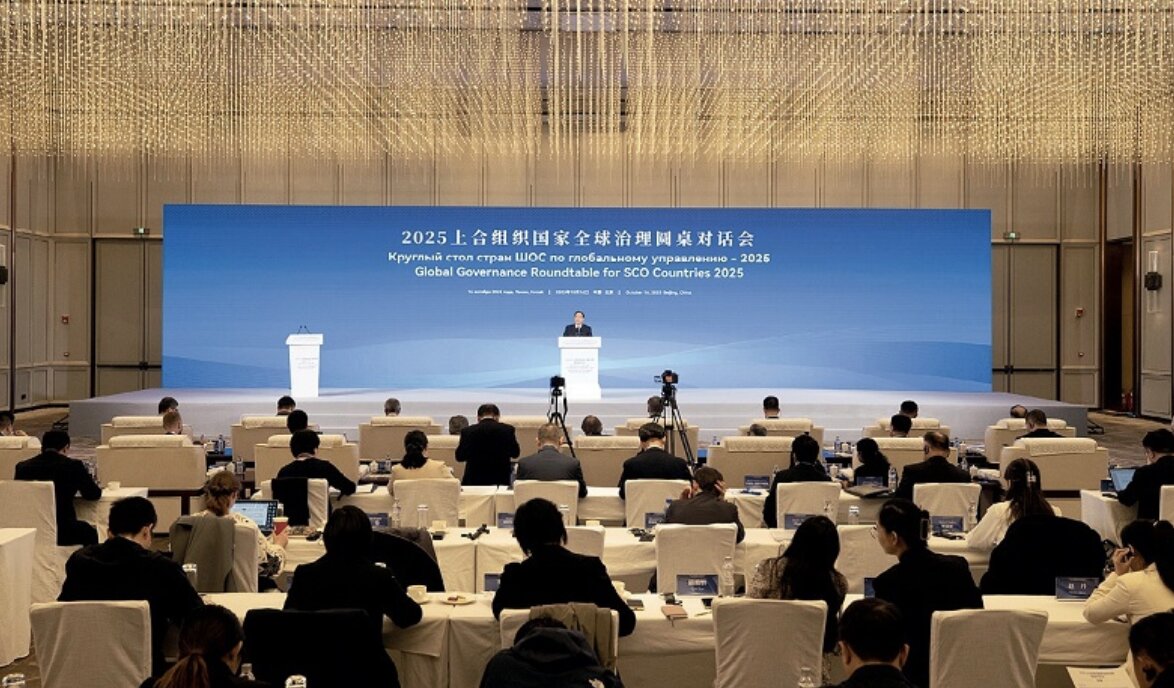
Global Governance Forum begins in Beijing
On October 16, Reuters reported that the Chinese People’s Institute of Foreign Affairs would host the 2026 Global Governance Forum in Xiongan New Area, Hebei Province, from October 23 to 25. Themed “Rebuilding trust and confidence,” the forum reportedly aims to explore specific, effective approaches and tangible, attainable solutions to global challenges. Around 180 foreign guests from the Global South, Europe, the US and elsewhere, along with more than 200 Chinese guests, were expected to attend. About 70 per cent of foreign attendees were experts, academics, and prominent figures in climate change, AI, and trade. Discussions would cover UN affairs, climate change, AI governance, multilateral trade and sustainable urban development. Introduced by President Xi Jinping, the Global Governance Initiative sought to promote multilateralism and a more equitable global governance system. Xiongan, as Zinhua reports, would also showcase its urban governance, green transition and digital governance, supported by over 5,300 completed buildings and a forest coverage rate of 35.2 per cent.
(“China targets practical action from global governance forum next week,” Reuters, 16 October 2026; “China's "city of the future" takes centre stage at global governance talks,” Xinhua, 23 October 2026)
https://www.reuters.com/world/china/china-targets-practical-action-global-governance-forum-next-week-2026-10-16/ https://www.chinadaily.com.cn/a/202610/23/WS6adab41fe4b06d4aa0564552.html
ENERGY AND ENVIRONMENT
Earthquake in Tibet kills 16; Broadcast says strongest earthquake in five years
On 23 October, The Tribune reported that a magnitude 7 earthquake in China’s Tibet region had killed at least 16 people and injured 42 of them. The earthquake struck near Naggu late Thursday on the 22nd, collapsing at least 339 homes and 20 livestock sheds. 11 of the injured were in serious condition. More than 1,600 people were deployed for rescue operations. Emergency supplies, including 1,000 prefabricated housing units, around 3,000 tents, folding beds and winter clothing, were sent to the region. Local officials were continuing search and rescue efforts as they assessed the damage. Rockfalls forced the closure of part of National Highway 317, while communication disruptions and forecast snow could complicate rescue work. Railway authorities also halted trains passing through the affected area. The US Geological Survey placed the epicentre about 191 kilometres east-northeast of Nagqu, at a depth of 18 kilometres. China’s national broadcaster said it was the strongest earthquake in the region in five years.
(“Powerful earthquake in China’s Tibet kills 16, damages hundreds of houses “, The Tribune, 23 October 2026)
https://www.tribuneindia.com/news/world/powerful-earthquake-in-chinas-tibet-collapses-hundreds-of-homes-kills-16/amp/?utm=relatedarticles
SCIENCE AND TECHNOLOGY
China issues guidelines to link scientific research with industry
On 22 October, CGTN reported that China has issued guidelines to bring scientific and technological innovation closer to industrial development. The document, issued by the Communist Party of China Central Committee and the State Council, aims to create an enterprise-led system in which businesses, universities and research institutions work together to turn scientific advances into industrial applications. The guidelines set out measures to connect research and industry needs, encourage businesses to lead more research projects and improve the transfer of research results into commercial use. They also call for stronger innovation in key technologies to make industrial supply chains more self-reliant, and for advanced technologies to modernise traditional industries. The policy highlights emerging future industries, including new energy, advanced materials, aerospace, quantum technology, biotechnology, brain-computer interfaces and 6th generation mobile communications. It also calls for wider use of artificial intelligence and digital technologies across various industries, alongside closer coordination of research, investment, talent and financial resources.
(“China issues guidelines for reinforcing integration of sci-tech, industrial innovations”, CGTN, 22 October 2026)
https://news.cgtn.com/news/2026-10-22/China-issues-guidelines-to-integrate-sci-tech-industry-innovation-1RsbXZQGEQU/p.html
CHINA AND EAST ASIA
North Korean returnees from China remain unaccounted for, says UN
On 21 October, the UNHRC stated that three years after the resumption of large-scale forcible returns of North Korean nationals from China, serious concerns persist regarding their fate, whereabouts, and treatment. These form part of a longstanding pattern of serious human rights violations against individuals forcibly returned to North Korea. Reports indicate that women who left North Korea became victims of trafficking, marriage, and sexual exploitation. Following the return of large-scale repatriation to the DPRK since 2023, reports have emerged of serious human rights violations against refugees, particularly those who sought asylum or left the country without authorisation. The UNHRC stated that irregular migration does not diminish the obligation to respect the principle of non-refoulement. Given longstanding evidence that DPRK nationals who leave the country without authorisation or seek protection abroad may face persecution upon return, the reported mass return of North Korean nationals despite their protection concerns raises questions about whether their needs were raised.
(“Many returned to North Korea from China remain unaccounted for, says UN experts,” UNHRC Press Release, 21 October 2026)
https://www.ohchr.org/en/press-releases/2026/10/many-returned-north-korea-china-remain-unaccounted-say-un-experts
CHINA AND THE PACIFIC
Australian mining companies to stop production as iron ore supply to China stalls
On 22 October, The Sydney Morning Herald reported that mining giant Fortescue Metals Group has warned that a protracted standoff with Beijing over the price of Australian iron ore may force it to curtail production at its huge mines across Pilbara. While Fortescue sells nearly all its ore to China, it has been stuck in a contract negotiations deadlock with China Mineral Resources Group, the centralised buying agency set up by Beijing to leverage its purchasing power against foreign suppliers. If the negotiations remain unresolved by the end of the year, Fortescue’s operations could be affected, including slowing or suspending its mining operations imminently. The dispute also poses a significant threat to Australia’s larger economy, as iron ore is the nation’s most valuable export, generating more than USD 100 billion in export earnings and accounting for 5 per cent of gross domestic product. China Mineral Resources Group has sought to consolidate the bargaining power of Chinese steel mills and force price concessions in contract negotiations with suppliers including Australia’s BHP, Rio Tinto, and Fortescue.
("China iron ore stoush puts Australian mines in the firing line,” The Sydney Morning Herald, 22 October 2026)
https://www.smh.com.au/business/companies/china-iron-ore-stoush-puts-australian-mines-in-the-firing-line-20261022-p617r1.html
CHINA AND SOUTHEAST ASIA
Chinese firms eye Thailand in domestic ‘China plus one’ push
On 21 October 2026, SCMP reported that a subtle shift is taking hold among Chinese firms as they adopt a China-plus-one strategy and redirect domestic investment overseas to hedge against tariff risks. Thailand’s reasonably mature, sophisticated manufacturing base and manufacturing saturation in Vietnam, aggravated by US trade scrutiny through a 40 per cent punitive tariff on Chinese goods diverted through the country, have made it unattractive. In 2025, Thailand attracted USD 5.33 billion in Chinese investment compared with Vietnam’s USD 2.46 billion. Thailand’s location and existing industrial infrastructure have allowed China-funded factories to integrate into supply chains that have been extended from China to ASEAN countries. Thailand further has capabilities for technology-intensive manufacturing, such as electric components and machinery, electric vehicles, and solar panels. More Chinese firms in the home appliance, technology, and digital sectors are going local, prioritising sales in Thailand and ASEAN. Companies in the technology and digital sector, the home appliance sector, and the EV sector, such as Huawei, Haier, and BYD, are following this trend. Further, Chinese investors are shipping finished products such as rice, rubber, and non-ferrous metal back home.
(“‘Poster child’: why more Chinese firms have Thailand in their expansion plans,” SCMP, 21 October 2026)
https://www.scmp.com/economy/global-economy/article/3371529/poster-child-why-more-chinese-firms-have-thailand-their-expansion-plans?module=perpetual_scroll_0&pgtype=article
CHINA AND SOUTH ASIA
China-Pakistan drill features Type 08 IFV
On 21 October, Global Times reported that the China-Pakistan Karakoram 2026 joint training in Korla, Northwest China’s Xinjiang Uygur Autonomous Region, has moved into the segmented drills phase, with mixed units completing a reconnaissance, strike, and clearance sequence. A Chinese Type 08 infantry fighting vehicle fitted with a roof cage and side drills alongside drone swarms and robot dogs deployed in live drills. Chinese and Pakistani troops have now moved into the segmented phase, which involves missions ranging from air-ground reconnaissance and concentrated fire strikes to search and clearance. At the start of the drill, reconnaissance vehicles and drones were deployed simultaneously to monitor targets inside the camp, tracking the terrorists' force disposition and movements in real time. Firing commenced once intelligence was gathered. Snipers seized vantage points for long-range kills. Drone swarms launched suicide strikes on exposed targets while ground armour fire followed to ensure full coverage. The joint training exercise is themed on joint counter-terrorism and clearance operations in high-altitude areas. However, even during counterterrorism drills, plateau units make full use of asymmetric assets such as drones.
(“China-Pakistan drill features Type 08 IFV with roof cage, grilles,” Global Times, 21 October 2026)
https://www.globaltimes.cn/page/202610/1372742.shtml
Maldives takes inspiration from China for 2040 Development Vision
On 23 October, China Daily reported that Ahmed Afzal Ibrahim, Maldives’ Minister of State for Finance and Public Enterprises, stated that China’s experience in aligning budgets with development goals and monitoring implementation was relevant to Malé’s challenges. The Maldives is preparing its 2040 blueprint following an earlier vision document for 2020. Ibrahim is leading an eight-member delegation for a six-day study program in Beijing, with the workshop jointly organised by the UN Economic and Social Commission for Asia and the Pacific and the International Cooperation Centre of the National Development and Reform Commission. The workshop covers planning, fiscal policy, the marine economy, and cultural tourism with a curriculum designed around the needs of the island nation. This is part of a broader ESCAP support aimed at helping the country pursue growth that improves productivity, rather than focusing entirely on GDP. The support has focused on strategic foresight training, exchanges with planning agencies from China, Indonesia, and Vietnam, and a productivity analysis report to inform the planning process.
(“Maldives taps Chinese cues for key plan,” China Daily, 23 October 2026)
https://www.chinadaily.com.cn/a/202610/23/WS6adab7cae4b06d4aa0564589.html
Sri Lanka begins direct yuan payment channel
On 20 October, Daily Mirror reported that Sri Lanka opened a direct Chinese yuan settlement facility through the Colombo branch of the Bank of China. This would allow the branch to be the settlement bank for cross-border payments of yuan and transactions between local banks in the same currency. The direct yuan settlement is expected to provide benefits by reducing the costs of converting Sri Lankan rupees to US dollars and then yuans, alongside reducing exposure to exchange rate movements. Additionally, the new facility would reduce intermediary costs, provide more convenient financial services for importers and exporters, and streamline payments without processing delays. The Sri Lankan Finance Ministry stated that the new facility would bolster linkages between the Sri Lankan and Chinese systems, alongside expanding infrastructure.
(“Direct yuan settlement to ease Sri Lanka- China trade payments,” Daily Mirror, 20 October 2026)
https://www.dailymirror.lk/business-news/Direct-yuan-settlement-to-ease-Sri-Lanka-China-trade-payments/273-352930
ITBP chief confirms ongoing encounter with Chinese troops at Arunachal border
On 23 October, The Hindu reported that confrontations between Indian and Chinese troops were continuing at multiple locations along the Arunachal Pradesh border. The news was conveyed by Indo-Tibetan Border Police (ITBP) Director-General(D-G) Shatrujeet Kapur, and it was the first confirmation of the scale of the escalating tensions. According to Indian government sources, the Chinese People’s Liberation Army (PLA) has constructed tents within 6 to 7 kms of what India considers to be the border of the Line of Actual Control (LAC), near the Maja company operating base. Kapur informed that ITBP commandos who specialised in high-altitude deployment were active in the confrontations, and a specialised high-altitude mountain fighting force was being set up. The D-G also emphasised the need for India to focus on modernising its existing weapons systems. He particularly highlighted the urgency to invest in drone and counter-drone technologies as China had modernised its weapons systems and infrastructure. Additionally, Kapur informed that Indian defence forces had commenced the creation of underground shelters along the China border for protection as pilot projects. (“Face-off with China continues at multiple locations along Arunachal border: ITBP D-G,” The Hindu, 23 October 2026)
https://www.thehindu.com/news/national/face-off-with-china-continues-at-multiple-locations-along-arunachal-border-itbp-d-g/article71612994.ece/amp/
CHINA AND THE MIDDLE EAST
China’s Gulf oil imports rebound towards pre-war levels
On 22 October, SCMP reported that China’s crude oil imports from the Middle East are recovering rapidly after disruptions caused by the US-Israel war on Iran. Gulf shipments rose 25.7 per cent on a monthly basis to 13.8 million tonnes in September and could potentially exceed 5 million barrels per day in October, nearing February’s pre-war level of 5.6 million. The rebound also reflects record domestic inventory drawdowns, competitive Saudi pricing, and increased Chinese purchases from Saudi Arabia, Abu Dhabi, and Iraq. Lower producer prices and restored Saudi East-West pipeline flows have supported supplies despite high freight costs. Meanwhile, Russian shipments declined 11.4 per cent in September, largely due to seasonal pipeline maintenance.
(“China’s Gulf oil imports forecast to approach pre-Iran war high as shipments rebound,” SCMP, 22 October 2026)
https://www.scmp.com/economy/global-economy/article/3371778/chinas-gulf-oil-imports-forecast-approach-pre-iran-war-high-shipments-rebound
CHINA AND AFRICA
Trade between South Africa and China witnesses a surge following Beijing’s zero-tariff scheme
On 22 October, Reuters reported that South Africa’s trade with China has expanded sharply since Beijing introduced zero tariffs for qualifying African exports in May 2026. Between May and August, South African exports to China increased nearly 25 per cent, while imports from China rose 23 per cent. Pretoria is hopeful that the arrangement will reduce its substantial trade imbalance with China, its largest trading partner, by expanding agricultural, mineral and exports of high-value manufactured goods. Greater access to China also supports South Africa’s diversification strategy amid uncertainty over US trade relations. Although Washington extended the African Growth and Opportunity Act (AGOA) until 2028, South Africa faces possible exclusion over political and foreign policy disputes with the incumbent administration.
(“South Africa's trade with China surges after duty-free deal,” Reuters, 22 October 2026)
https://www.reuters.com/world/asia-pacific/south-africas-trade-with-china-surges-after-duty-free-deal-2026-10-22/
CHINA AND EUROPE
German Chancellor urges dialogue with Beijing as the EU prepares its trade defences
On 21 October, Anadolu Agency reported that German Chancellor Friedrich Merz said the EU wants to avoid a trade war with China but is preparing measures to protect European industries from unfair competition. Speaking at the Berlin Global Dialogue, Chancellor Merz highlighted Europe’s large trade deficit with China and said a Franco-German initiative was developing trade defence tools against market-distorting practices. However, he stressed that these instruments are intended primarily as leverage while negotiations with Beijing continue. Chancellor Merz also said that Europe remains open to Chinese companies and products but expects reciprocal and fair trading conditions. He also acknowledged that European industries must improve their own competitiveness to address growing global economic challenges.
(“Germany’s Merz says EU does not want a trade war with China but will defend itself,” Anadolu Agency, 21 October 2026)
https://www.aa.com.tr/en/europe/germany-s-merz-says-eu-does-not-want-a-trade-war-with-china-but-will-defend-itself/4095932
CHINA AND THE AMERICAS
US Treasury proposes expanded restrictions on high-technology investments in China
On 22 October, ABC News reported that the US Treasury has proposed expanding restrictions on American investments in sensitive technologies in China, Russia, North Korea and other designated countries. Implementing a 2025 law that broadened the Outbound Investment Security Program, the rule would cover hypersonic systems, supercomputing, biotechnology and artificial intelligence, alongside existing restrictions on semiconductors and quantum computing. The framework aims to prevent US capital from strengthening foreign military and technological capabilities. It would generally apply to investments exceeding USD 50,000 while exempting many financial transactions, including stock purchases. Companies could consequently face stricter compliance requirements.
(“US Treasury proposes a rule to crack down on high-tech investments in China, other adversaries,” ABC News, 22 October 2026)
https://abcnews.com/US/wireStory/us-treasury-proposes-rule-crack-high-tech-investments-137491824
China Reader Daily Wire | 22 October 2026, Thursday | Vol 3 No. 161-163
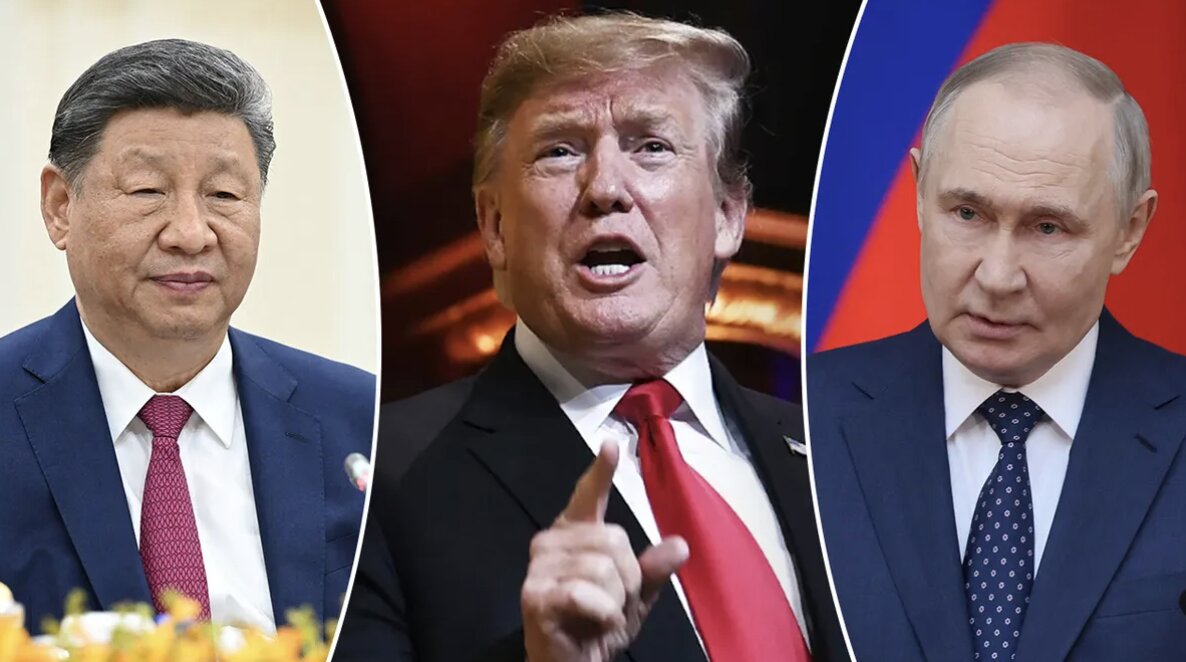
Kremlin states trilateral meeting between Putin-Trump-Xi may take place in China
China proposes tighter controls on AI model exports
In Brief
CHINA AND S&T
China proposes tighter controls on AI model exports
On 21 October, The New York Times reported that newly proposed draft export rules by China’s Ministry of Commerce and Ministry of Science and Technology would require licenses for the core technology in AI models. The proposal also prohibits exports of AI trained on what China defines as “core data” and of the systems that could be used to launch cyberattacks. The latest report stated that the rules reflect Beijing’s effort to manage national security risks while continuing to compete with the United States in AI. The proposed controls could affect leading models from companies such as Alibaba, Deepseek, Z.ai, and Moonshot AI. However, ministries said the draft would not apply to models that are already released, and overseas users would still be able to access models through apps and online services. The rules' scope and licensing process remain uncertain, raising questions about how they could affect future model releases and updates.
(“China Moves to Tighten its Grip over Exports of Top AI Models,” The New York Times, 21 October 2026)
https://www.nytimes.com/2026/10/21/world/asia/china-exports-ai-controls.html
China’s 100-channel detector could advance quantum networking
On October 22, SCMP reported that researchers have developed a 100-channel single-photon detector that could help overcome a key challenge in expanding quantum networks. The device detects single photons- the smallest units of light- across 100 channels simultaneously. Existing systems, according to the report, supported up to 32 channels. The detector uses superconducting nanowires and was designed to operate at very low temperatures. In tests, its channels recorded detection efficiencies of 80.1 per cent to 98.3 per cent, while dark-count rates remained below 300 per second. The researchers also used the platform to demonstrate a fully connected network distributing quantum entanglement among multiple users. The development could support faster, larger-scale quantum communication systems, where reliable photon detection across many channels is essential. The report stated that the work is a research demonstration; practical broadband quantum internet will require further advances in connecting and operating such systems at scale.
(“Could China’s 100-channel single-photon detector enable broadband quantum internet?,” SCMP, 22 October 2026)
https://www.scmp.com/news/china/science/article/3371729/could-chinas-100-channel-single-photon-detector-enable-broadband-quantum-internet?module=top_story&pgtype=subsection
More than half of South Korea’s AI models built on Chinese compute, reports The Tribune
On 21 October, The Tribune reported that more than half of AI models developed and released by South Korean developers used China-based Alibaba’s Qwen Large Language Model (LLM). Citing a study by Rockbridge Network Korea, the report stated that of the 1,845 AI models published by Korea-based developers, 49.3 per cent were based on Chinese foundational models, while US models accounted for 35.9 per cent and Korean models were at 14.9 per cent. The report also raises concerns over the efficacy of the government’s sovereign AI program, which has received over USD 151 million in support to develop indigenous alternatives to foreign models. The report also flagged security and data leakage concerns, and cautioned against over-dependence on a singular open-weight model.
(“Chinese AI powers half of Korea's new models: study,” The Tribune, 21 October 2026)
https://www.tribuneindia.com/news/business/chinese-ai-powers-half-of-koreas-new-models-study/amp/?utm=relatedarticles
China and Russia to deepen cooperation in AI and frontier technology
On 21 October, China Daily reported that China and Russia have agreed to deepen economic cooperation while developing new growth areas including artificial intelligence, biotechnology and the digital economy. During the 31st regular meeting between their heads of government in St Petersburg, China’s Premier Li Qiang and Russia’s Prime Minister Mikhail Mishustin pledged to strengthen collaboration in trade, investment, energy, connectivity, aerospace, finance and industry. Bilateral trade exceeded USD 185 billion during the first eight months of 2026, rising 28.4 per cent on a yearly basis. The two sides also signed cooperation documents, promoted educational and cultural exchanges, and committed to closer coordination in multilateral forums, reflecting their expanding strategic and economic partnership.
(“China, Russia eye ties in AI, other frontier sectors,” China Daily, 21 October 2026)
https://www.chinadaily.com.cn/a/202610/21/WS6ad8de83e4b06d4aa05640cc.html
DeepSeek raises USD 15 billion as US-China rivalry over AI intensifies
On 22 October, Reuters reported that China’s AI startup DeepSeek is emerging as a major challenger to US frontier laboratories even as Washington moves to restrict its government use, illustrating the increasingly geopolitical character of the artificial intelligence race. Reuters reports that DeepSeek is finalising a roughly CNY 100 billion (15 billion USD) funding round, doubling its original target, with major backing from Tencent, CATL and other Chinese companies. Its pre-investment valuation is reportedly CNY 500 billion, while the financing could support data centres, model development and an eventual IPO. On 21 October, NBC reported Beijing argues that Washington is politicising technology, violating recent understandings of the Xi-Trump summit and unfairly suppressing Chinese companies, while warning that it may take countermeasures. DeepSeek therefore represents two simultaneous trends. China’s growing capacity to finance globally competitive AI and intensifying US-China conflict over data, technological leadership and national security. On 20 October, The Guardian reported that Washington is increasingly treating DeepSeek as a national security concern. The Guardian’s central warning, quoting US authorities, is that its models “present multiple threat vectors,” particularly because government use could expose sensitive data to China. Federal civilian agencies must therefore remove DeepSeek products and third-party services built on its technology. (“DeepSeek wrapping up $15 billion fundraising to fuel AI race,” Reuters, 22 October 2026; “China defends DeepSeek after U.S. ban of its AI from government systems,” NBC News, 21 October 2026; “US bans use of China’s DeepSeek AI tools by government agencies,” The Guardian, 20 October 2026)
https://www.reuters.com/world/asia-pacific/deepseek-raises-15-billion-challenge-leading-us-labs-bloomberg-news-reports-2026-10-22/
https://www.nbcnews.com/world/asia/china-defends-deepseek-us-ban-ai-government-systems-rcna604721
https://www.theguardian.com/us-news/2026/oct/20/us-bans-china-deepseek-ai-tools-government-agencies
INTERNAL
China invests in manufactured water; Leads in desalination technology
On 22 October, Reuters reported that China was emerging as a major supplier of water technology to parched countries across Asia, the Middle East and Africa, as shrinking natural supplies at home push Beijing to invest heavily in manufactured freshwater. Chinese firms are selling desalination membranes, filtration equipment and engineering services to Egypt, Saudi Arabia and the UAE, often through the Belt and Road Initiative, with exports of water filtering machinery exceeding USD 02 billion in 2025, up 25 per cent from 2020. At home, spending on water conservancy now exceeds CNY 1.2 trillion a year, while China Water Risk warned that "peak water" could arrive by 2050 across ten major river systems. China operated 167 seawater desalination projects at the end of 2025, with total capacity of about 3.08 million tonnes a day. Saudi developer Acwa, which buys roughly 70 per cent of its global water equipment from Chinese suppliers, has pledged to invest up to USD 30 billion in China by 2030.
("China bets on manufactured water, and wants to sell it to the world," Reuters, 22 October 2026)
https://share.google/RBCF7CiNva04RCiTG
CHINA AND POLAR REGIONS
China unveils domestically developed polar icebreaking propulsor
On 20 October, Global Times reported that China’s domestically developed high-power podded propulsor, developed by Powermaster Marine, is expected to arrive at a European shipyard in late November, be installed on a vessel in February 2027, undergo shipboard testing in June, and be ready for delivery between August and October. Podded propulsors must withstand repeated impacts from ice and the harsh effects of extremely low temperatures. This places exceptionally high demands on structural strength, stable power output, and long-term reliability. The testing included 18 rigorous checks, including trials at 150 per cent overload and 120 per cent overspeed. Zhou Hao, general manager of Powermaster Marine, said the propulsor can operate at 160 per cent of its rated torque under ice-breaking conditions and break through ice up to 2.1 meters thick, including 20 centimetres of snow cover. Developing polar capabilities is a key part of China’s efforts to become a strong maritime nation. The achievement makes China one of the few countries capable of developing high-power podded propulsion systems for actual use on polar icebreaking vessels. The project also marks progress in Beijing’s efforts to address the country’s long-standing reliance on imports for high-power podded propulsion systems for polar icebreakers.
(“China unveils first domestically developed 10-megawatt polar icebreaking propulsor,” Global Times, 20 October 2026)
https://www.globaltimes.cn/page/202610/1372651.shtml
ENERGY AND ENVIRONMENT
Ministry reports USD 29.9 billion worth of disaster losses as fatalities rise in 2026
On 22 October, Reuters reported that China suffered USD 29.9 billion in direct economic losses from natural disasters in the first nine months of 2026, according to the Ministry of Emergency Management. This marked an 8 per cent decrease compared to the same period last year, while disaster-related fatalities and missing persons rose to 1,162, up from 742 a year earlier. Severe weather forced over 5 million people to relocate or seek emergency shelter. A total of 26 typhoons formed, with 7 making landfall, and both these figures exceed historical averages. Landslides and mudslides caused 60 per cent of all fatalities, heavily impacting southwestern and southern China. This included 562 casualties from August flash floods along the Nepal-Tibet border. Repeated typhoon landfalls hit eastern coastal provinces the hardest, making typhoons the primary cause of financial damage.
(“China's natural disaster losses hit $30 billion in first nine months of 2026,” Reuters, 22 October 2026)
https://www.reuters.com/business/environment/china-reports-30-billion-natural-disaster-losses-first-9-months-2026-10-22/
China wants COP31 to confront clean tech tariffs as a “new problem"
On 21 October, Reuters reported that China’s Ministry of Ecology and Environment Vice Minister stated that upcoming COP31 should address what it called a "new problem" for global climate action: tariffs and protectionism targeting its clean technology. Vice Minister stated that the conference should also discuss the "old problems" of developed countries' insufficient emission cuts and financial support, as well as a roadmap for the pledge to mobilise USD 300 billion a year in climate finance for developing nations. He added that China would give a "firm response" to smears or attacks against it and called for discussion of the free flow of green technology. The United States has imposed steep tariffs on Chinese solar products and electric cars, while the European Union has taxed autos, restricted some solar components, and is investigating a major Chinese wind company. Asked about Turkey's push for a global electrification agreement, he stated that the objective aligned with Chinese policy but stopped short of explicitly backing it.
("China signals intent to push back against cleantech tariffs at COP31," Reuters, 21 October 2026)
https://share.google/ZuE9fqSlynQDwKvNo
China launches world’s first wind-powered offshore hydrogen production platform
On 21 October, Renewables Now reported that China International Marine Containers (CIMC) Raffles launched the Shenhai Hydrogen Energy No. 1 in Jiangmen, Guangdong. It is the world’s first semi-submersible platform that combines offshore wind power with green hydrogen production. Designed for shallow waters and harsh sea conditions, it includes a large-scale proton exchange membrane electrolyser (a device that splits water into hydrogen and oxygen using electricity), three hydrogen storage tanks, grid and off-grid power options, and remote monitoring for unattended use. Before the scheduled deployment in the South China Sea, it is finishing its onshore tests. It is also China’s first offshore project to pass both classification and statutory inspections from the China Classification Society. The project’s larger aim is to help CIMC move from traditional oil and gas equipment into marine green energy.
(“China launches semi-submersible offshore wind-to-hydrogen platform,” Renewables Now, 21 October 2026)
https://renewablesnow.com/news/china-launches-semi-submersible-offshore-wind-to-hydrogen-platform-1303372/
NUCLEAR
China reveals advanced nuclear submarines in Pacific test
On 21 October, The Times of India reported that China revealed its most advanced nuclear-powered submarines were used to test-fire a strategic missile in the Pacific. Xinhua said the third generation of China’s Changzheng-series nuclear submarine completed a test launch of a submarine-launched strategic missile. While the People’s Liberation Army has not released any details regarding the type of submarine or missile launched in the test, analysts have speculated that the missile was fired from a Type 094 Jin-class ballistic missile submarine. Beijing’s statement points to the deployment of an advanced submarine class. China has rapidly expanded its nuclear-powered submarine fleet, combining new vessel construction with longer-range submarine-launched missiles to enhance its power projection capabilities across the Indo-Pacific. The expansion spans two distinct capabilities: ballistic missile submarines, which underpin China’s sea-based nuclear deterrent, and attack submarines deployed to target enemy vessels and expand naval operations beyond China’s coastal waters. The Type 094 Jin-class, which powers China’s ballistic missile submarine force, carries up to twelve submarine-launched ballistic missiles. Under longer-range submarine-launched ballistic missiles, China has replaced the JL-2 with a range of 7200 kilometres, with the JL-3 designed to extend the reach of its sea-based nuclear force. China is expanding its nuclear-powered attack submarine force. The Type 093B Shang III class is assessed to carry vertical-launch cells for guided missiles, expanding the Chinese navy’s options for attacking surface ships and striking ships at long ranges.
(“In rare disclosure, China reveals advanced nuclear subs in Pacific test; a look inside its submarine fleet,” Times of India, 21 October 2026)
https://timesofindia.indiatimes.com/defence/international/in-rare-disclosure-china-reveals-advanced-nuclear-subs-in-pacific-test-a-look-inside-its-submarine-fleet/amp_articleshow/135090609.cms
CHINA AND TAIWAN
Taipei investigates organised crimes linked to Beijing’s transnational repression
On 22 October, Reuters reported that Taiwan is probing organised crime’s links to Chinese efforts to carry out transnational repression after Taipei’s government said that Beijing was behind an attack on a comedian who mocked President Xi Jinping. Taiwan has complained that Beijing is using underhanded methods to go after Taiwanese who the Chinese government views as separatists or are otherwise politically suspect. Taiwan National Security Bureau Director-General Tsai Ming-yen said that local networks cooperating in such incidents are linked to criminal gangs or private investigation firms linked to organised crime.
“Taiwan probes organised crime links to China’s transnational repression,” Reuters, 22 October 2026
https://www.reuters.com/world/china/taiwan-probes-organised-crime-links-chinas-transnational-repression-2026-10-22/
CHINA AND EAST ASIA
China shuts three Tibetan schools raising concerns over forced assimilation reports, The Tribune
On 20 October, The Tribune reported that China closed down three privately-run Tibetan schools in the Golog Tibetan Autonomous Prefecture. The Central Tibetan Administration (CTA), the government-in-exile of the erstwhile independent Tibet, raised concerns over the region’s linguistic and cultural identity. In a report produced by the CTA, citing sources in the region, it alleged that the closures were part of the Chinese government’s drive to place Tibetan children into state-run institutions, where Mandarin is the primary mode of instruction. Chinese authorities closed down the Golog Tadrak Orphan School in Tabo village, the Ra-Gya Jigme Gyaltsen Grassland Girls’ School and the Jasak village school. The CTA also listed several other Tibetan-medium school closures over the past several years, and stated that these amount to the violation of the linguistic and cultural rights of Tibetan children.
(“China shuts three Tibetan schools in Golog, raising assimilation concerns,” The Tribune, 20 October 2026)
https://www.tribuneindia.com/news/world/china-shuts-three-tibetan-schools-in-golog-raising-assimilation-concerns/amp
Editorial
“Africa’s rare earth deposits offer hope as China’s export curbs leave Japan facing a critical shortage of a jet-engine mineral,” Business Insider Africa, 21 October 2026
“According to the Financial Times, Japanese officials have asked the United States to help persuade China to ease its rare earth export curbs as manufacturers face dwindling supplies. Yttrium is used in specialised industrial applications, including heat-resistant coatings for jet-engine components, electronics and semiconductor manufacturing equipment. Africa’s rare-earth deposits could offer an alternative source over time, but their impact will depend on projects reaching commercial production and developing processing capacity. South Africa offers another point of comparison. Its Phalaborwa project aims to recover rare earths from phosphate-industry waste, with reported yttrium oxide representing about 2.3% of total rare-earth oxides in the relevant concentrate. Tanzania’s Ngualla deposit is also among Africa’s major rare-earth projects. However, its overall rare-earth resource should not be treated as proof of a large, commercially recoverable yttrium supply without a project-specific breakdown. For Japan, these projects represent potential longer-term alternatives rather than an immediate replacement for Chinese supplies. Producing usable yttrium requires more than extracting ore: companies must establish commercially viable recovery processes, build processing capacity and qualify products for industrial customers.”
CHINA AND SOUTHEAST ASIA
China says it allowed the Philippines to resupply a warship amid the dispute
On 22 October, SCMP reported that China had informed it allowed the Philippines to resupply one of its grounded warships. The China Coast Guard (CCG) issued a statement that the Philippines delivered necessities to its warship BRP Sierra Madre, which was grounded at the Second Thomas Shoal, with permission from Beijing. CCG spokesperson Jiang Lue said that they had undertaken confirmation checks and maintained complete supervision over the course of the operation. The latest development comes amidst a period of heightened tensions between China and the Philippines. Chinese Ambassador to the Philippines, Jing Quan, sparked a controversy last week with his remarks that Beijing could “easily win” a war with the Philippines. Jing was summoned by Philippine Foreign Secretary Theresa Lazaro over his “provocative and unacceptable” language. The ambassador later issued a statement that he was advocating for peace between the two countries rather than issuing a threat. There have also been escalating tensions over the disputed South China Sea reefs between the two countries. (“China says it allowed Philippines to resupply warship amid diplomatic tensions,” SCMP, 22 October 2026)
https://www.scmp.com/news/china/diplomacy/article/3371693/china-says-it-allowed-philippines-resupply-warship-amid-diplomatic-tensions
Philippines defence secretary states Chinese actions are a threat to Southeast Asian states
On 20 October, Palawan News reported that the Philippines Defence Secretary Gilberto Teodoro Jr. said that Chinese military belligerence was a threat to Southeast Asian states. Teodoro said that it was not just the Philippines, but also Vietnam, Brunei and Malaysia, alongside Japan, that faced a threat from aggressive military actions by Beijing. He further stated that Manila was focused on bolstering its deterrence capabilities, while working alongside its allies. The defence secretary also refuted claims by the Chinese ambassador that the Philippines was responsible for provoking tensions in the region. Additionally, he reiterated support for the UN Convention on the Law of the Sea (UNCLOS) and the UN Charter.
(“Teodoro: China’s aggressive actions also threaten Vietnam, Malaysia and Brunei,” Palawan News, 20 October 2026)
https://palawan-news.com/teodoro-chinas-aggressive-actions-also-threaten-vietnam-malaysia-and-brunei/
Chinese embassy alerts citizens over kidnapping and job scams in Thailand
On 17 October, SCMP reported that the Chinese embassy in Thailand had warned Chinese citizens over travelling to Thailand amidst concerns over kidnapping and trafficking schemes targeting them. The embassy encouraged citizens in Thailand to be cautious of transport arranged by others, and take rides from only licenced transport and legal regulators instead of free rides. Individuals were further advised to deny changes to travel routes or venues, and ensure their families stayed informed of their location. The notice comes amidst mounting concern over kidnapping incidents targeting Chinese online celebrities and travellers, who are later trafficked to Myanmar. The most prominent case involved Chinese actor Wang Xing, who went to Thailand with the promise of a film project, and was then moved to a scam compound in Myanmar. There were other cases as well involving Chinese nationals who went missing in Thailand and were caught up in trafficking attempts. While all the individuals reportedly returned to China with the assistance of the Chinese embassy, the incidents have affected Chinese tourism to Thailand. Around 7 million Chinese tourists were expected to visit Thailand this year, a reduction from an estimate of 9 million. (“China’s embassy issues fresh Thailand travel alert over kidnappings, job scams,” South China Morning Post, 17 October 2026)
https://www.scmp.com/news/china/diplomacy/article/3371266/chinas-embassy-issues-fresh-thailand-travel-warning-over-kidnappings-job-scams
CHINA AND SOUTH ASIA
China Exim Bank and Invest Bangladesh seek greater Chinese banking presence
On 20 October, The Business Standard (TBS) reported that Invest Bangladesh and the Export-Import Bank of China (China Exim Bank) had called for Chinese banks to establish local operations in Bangladesh to support expanding bilateral trade and investment. The initiative was discussed at a “Bangladesh Day” event held at China Exim Bank’s headquarters in Beijing, bringing together representatives from 11 Chinese financial institutions and 26 companies across infrastructure, energy, electronics, information technology and agricultural technology. Invest Bangladesh Chairman Ashik Chowdhury said Chinese companies investing in Bangladesh needed trade finance, equipment financing, working capital and long-term investment support. A joint presentation by Bangladesh Bank and Invest Bangladesh noted that bilateral trade reached USD 19 billion in fiscal year 2024–25, despite the absence of a Chinese bank operating locally in Bangladesh. Participants discussed investment opportunities in priority sectors, including the Chinese Economic and Industrial Zone and the Mongla Economic Zone. China Exim Bank Vice President Wang Kang said the bank was involved in nearly 40 projects in Bangladesh spanning infrastructure, energy, agriculture, processing and manufacturing. The initiative signals an effort to complement existing trade relations with stronger financial links. A local Chinese banking presence could help facilitate transactions and financing for businesses, although the event itself did not establish that any bank had committed to opening a branch.
(“Invest Bangladesh, China Exim Bank seek Chinese banks' entry into Bangladesh,” The Business Standard, 20 October 2026)
https://www.tbsnews.net/economy/banking/china-exim-bank-invest-bangladesh-seek-attract-chinese-banks-trade-reaches-19bn-fy25
China announces export controls on tunnel-boring machines sought by India
On 19 October, The Hindu reported that China had announced export controls on tunnel-boring machines (TBMs) and related equipment, citing national security and non-proliferation obligations. The restrictions are scheduled to take effect on 18 November 2026. China's Ministry of Commerce said the controlled equipment had both civilian and military applications and that the measures were intended to safeguard national security and interests while fulfilling international obligations. The announcement comes amid existing difficulties faced by Indian infrastructure projects in obtaining Chinese-made TBMs. India relies on imported machinery for metro networks, railway corridors and major tunnelling projects, including infrastructure in border regions. Delays in customs clearance for TBMs sourced from China had reportedly emerged as an issue in 2024. The new licensing requirements could add another layer of uncertainty for Indian buyers, depending on how applications are handled after the controls take effect. The decision also forms part of a wider series of Chinese export-control measures covering selected dual-use technologies and equipment. The immediate impact on India will depend on the scope of the controls, licensing decisions and the availability of alternative suppliers. For India, the development highlights the infrastructure risks associated with dependence on imported specialised machinery. It also raises the importance of diversifying supply sources and strengthening domestic capabilities in critical engineering equipment.
(“China imposes export controls on tunnel-boring machines sought by India, citing ‘national security’,” The Hindu, 19 October 2026)
https://www.thehindu.com/news/international/china-imposes-export-controls-on-tunnel-boring-machines-sought-by-india-citing-national-security/article70200000.ece
China Merchants withdraws from Colombo port logistics hub investment
On 19 October, The Hindu reported that state-owned China Merchants Port Holdings had withdrawn from a proposed USD 392 million joint venture to develop the South Asia Commercial and Logistics Hub (SACLH) at the Port of Colombo. The project was announced in 2023 and was intended to establish a major logistics facility at one of the Indian Ocean’s important maritime hubs. Under the original arrangement, China Merchants was to hold a 70 per cent stake, while the Sri Lanka Ports Authority (SLPA) and a Sri Lankan private construction company would each hold 15 per cent. The SLPA said the decision followed an assessment of prevailing external circumstances, commercial considerations and the interests of the shareholders. China Merchants also referred to changes in the project’s implementation environment and timetable. The authority has indicated that it will pursue an alternative strategy to establish a logistics hub through a public-private partnership (PPP) and competitive bidding. The proposed investment had been presented in 2023 as a significant source of foreign investment following Sri Lanka’s 2022 sovereign debt default. The withdrawal does not mean China is ending its wider port involvement in Sri Lanka. China Merchants retains an 85 per cent stake in the Colombo International Container Terminal and is involved in the management of Hambantota Port. Nevertheless, the decision removes one planned logistics investment from Colombo’s development pipeline. Sri Lanka’s move towards competitive bidding will determine how the replacement project is structured and which investors participate.
(“China pulls out of key investment in Sri Lanka port logistics venture,” The Hindu, 19 October 2026)
https://hindmedia.in/china-pulls-out-of-key-investment-in-sri-lanka-port-logistics-venture
CHINA AND AFRICA
China and Djibouti call for freedom of navigation in the Red Sea
On 22 October, Arab News reported that China and Djibouti have called for the protection of freedom of navigation in the Red Sea and Bab Al-Mandeb Strait amid worsening regional tensions linked to the Yemen conflict. Following talks between their foreign ministers in Beijing, both countries stressed that merchant vessels must be allowed to navigate in accordance with international law. They also argued that Red Sea security arrangements should respect the sovereignty and preferences of littoral states. While supporting regional efforts to safeguard shipping routes, Beijing and Djibouti cautioned external powers against military intervention and unilateral sanctions that could deepen instability and expand the conflict.
(“China, Djibouti say all countries should enjoy freedom of navigation in Red Sea,” Arab News, 22 October 2026)
https://www.chinadaily.com.cn/a/202610/20/WS6ad76435e4b06d4aa0563d30.html
China and Africa to expand the use of RMB in cross-border trade and finance
On 20 October, China Daily reported that China’s ICBC and South Africa’s Standard Bank Group have launched 10 measures to expand Renminbi (RMB) payments, financing and clearing across Africa, supporting Beijing’s broader push to internationalise its currency. The banks, jointly designated Africa’s RMB clearing bank in June, will strengthen access to China’s Cross-Border Interbank Payment System (CIPS) payment network, expand direct currency conversion and develop RMB-denominated financing instruments. They will also establish an interbank financing facility exceeding 10 billion CNY to provide African institutions with RMB liquidity and publish guidance covering 19 African markets. The initiative builds on the rapidly expanding China-Africa commerce. Bilateral trade reached a record USD 348.05 billion in 2025. Growing RMB settlement could reduce reliance on intermediary currencies, simplify cross-border transactions and provide African importers trading with China with greater payment and pricing certainty.
(“ICBC, Standard Bank unveil measures to boost RMB use in China-Africa trade,” China Daily, 20 October 2026)
https://www.chinadaily.com.cn/a/202610/20/WS6ad76435e4b06d4aa0563d30.html
CHINA AND RUSSIA
Kremlin states trilateral meeting between Putin-Trump-Xi may take place in China
On 19 October, Reuters reported that the Kremlin has said Russia’s President Vladimir Putin, US President Donald Trump and China’s President Xi Jinping could potentially hold a trilateral meeting on the sidelines of next month’s APEC summit in China. Kremlin spokesman Dmitry Peskov confirmed that the possibility had been discussed but stressed that no formal proposal, agreement or agenda had been established. The comments followed reports that Putin had suggested such a meeting to discuss ways of ending the Ukraine war. Kyiv has strongly opposed the idea, with Ukraine’s Foreign Minister Andrii Sybiha arguing that talks involving Russia, China and the US without Ukraine could encourage Moscow to continue the conflict. Instead, Kyiv favours negotiations involving Ukraine, Russia and the US. Spokesman Peskov acknowledged that Ukraine would ultimately need to participate in any final peace settlement and said Moscow appreciated continuing US mediation efforts.
(“Kremlin says Putin, Trump and Xi could hold a three-way meeting in China next month,” Reuters, 19 October 2026)
https://www.reuters.com/world/china/kremlin-says-putin-trump-xi-could-hold-three-way-meeting-china-next-month-2026-10-19/
CHINA AND EUROPE
EU lawmakers call for a broader trade and investment agreement with China
On 21 October, Euronews reported that European Parliament Trade Committee chair Bernd Lange has called for the EU and China to negotiate a comprehensive trade agreement covering investment and wider market distortions rather than addressing disputes sector by sector. His proposal comes ahead of a 27–29 October visit to China by 12 MEPs and could revive elements of the frozen Comprehensive Agreement on Investment. Although Brussels recently secured Chinese limits on hybrid car exports, lawmakers argue that broader problems including industrial subsidies, export restrictions on rare earths and disadvantages facing European companies in Chinese public procurement continue to threaten EU industries. The push reflects the EU’s attempt to balance engagement with economic protection as its trade deficit with China reaches roughly EUR 1 billion daily. While Brussels is considering quotas to shield chemicals and machinery producers from Chinese competition, some member states, including Spain, favour greater engagement to attract Chinese investment, highlighting divisions over the EU’s future economic relationship with Beijing.
(“EU should revive talks on broader China trade deal, top MEP says,” Euronews, 21 October 2026)
https://www.euronews.com/2026/10/21/eu-should-revive-talks-on-broader-china-trade-deal-top-mep-says
China Reader Daily Wire | 19 October 2026, Monday | Vol 3 No. 160
Beijing faces economic strain as one-third of population ages by 2035
The Guardian notes increase in ‘dark tourism’ in China
In Brief
INTERNAL
Chinese economy sees increase in GDP; Weak consumer demand calls for rebalancing in long term
On 19 October, Reuters reported that Chinese Gross Domestic Product(GDP) grew by 4.5 per cent in Quarter 3, more than the forecast of 4.4 per cent. China is expected to reach its 2026 target of 4.5- 5 per cent without needing an additional stimulus. Additionally, Chinese exports of a wide range of products, including chicken meat, electric cars and beauty products, have surged. Industrial output rose by 5.5 per cent in the month of September as well. However, data showed that retail sales remained low. The low retail sales and domestic demand indicate weak consumer demand in China, while exports to foreign markets remain high. The growth figures also show the need for rebalancing the economy in the long term. ANZ analysts stated that increasing trade tensions, protectionist measures and geopolitical tensions hold the potential to hamper future economic growth. According to ITC Markets analyst Andy Ji, growth was unbalanced since it was led by exports and the state, while domestic demand was yet to be self-sustaining and the property sector remained in a downturn.
(“China’s economic growth picks up as exports boom, consumers baulk,” Reuters, 19 October 2026)
https://www.reuters.com/world/china/chinas-economic-growth-picks-up-third-quarter-beating-expectations-2026-10-19/
Beijing faces economic strain as one-third of population ages by 2035
On 19 October, Reuters reported that Beijing’s population is ageing rapidly, with 1 in 3 residents expected to be 60 or older by 2035, and noted this phenomenon as Beijing becoming “suger-aged”. At the end of last year, Beijing had 5.29 million elderly residents, making up nearly 25 per cent of its total population. To support them, the city is increasing financial aid, including raising basic pensions. China’s overall population has been shrinking since 2022. As hundreds of millions of workers retire, pension budgets are being heavily stretched. To reverse this trend, the government is treating population planning as a major economic strategy, spending an estimated USD 26.92 billion this year alone to encourage people to have more babies. Economists and demographers also warn that having fewer children right now will lead to fewer households and slower economic and consumer growth in the future.
(Beijing's population expected to become super-aged by 2035,” Reuters, 19 October 2026)
https://www.reuters.com/world/china/beijings-population-expected-become-super-aged-by-2035-2026-10-19/
Beijing proposes export controls on 12 solar tech; Aims to prevent improper technology dissemination
On 18 October, Reuters reported that China has proposed new export controls on 12 advanced solar manufacturing technologies, citing national security, aerospace, and defence concerns. The restrictions are part of a broader update that also targets AI and biotechnology. The proposed limits aim to maintain China’s global solar dominance by blocking the export of key manufacturing methods. This includes outright bans on technologies used to make thin wafers, highly efficient perovskite and tandem solar cells, and energy-efficient fluidised-bed polysilicon. Other advanced cell technologies, like TOPCon, HJT, and XBC, will face heavy restrictions rather than total bans. These curbs threaten international solar supply chains and could disrupt expansion plans for US firms like Tesla. They also target India, which is currently trying to build its own domestic manufacturing sector to eliminate its reliance on China’s imports. China's Ministry of Commerce stated the controls will prevent improper technology dissemination while safeguarding normal scientific cooperation. Exporters must register all overseas technology transfers until the public consultation closes on 15 November and the rules are finalised.
(China proposes export controls on solar-manufacturing technologies,” Reuters, 18 October 2026)
https://www.reuters.com/business/autos-transportation/china-proposes-export-controls-solar-manufacturing-technologies-2026-10-18/
The Guardian notes increase in ‘dark tourism’ in China
On 17 October, The Guardian reported that the phenomenon of ‘dark tourism’ was becoming increasingly popular in China. This involves simulated experiences of natural disasters that are created. Lvxing Base, a company in Hangzhou, has been key in pushing this forward. The company makes simulations of extreme weather conditions such as typhoons and mudslides, providing participants with the experience of what a natural disaster would be like. General manager Wang Kuanghan said that customers (many of whom were between 20 and 30 years old) came to experience the excitement of what a real natural disaster felt like. The company also plans to open five more centres across China in the next three years. Additionally, earthquake and fire simulations are planned as well. Apart from private companies, public institutes are also playing a role. The Haidian public safety museum also offers simulated experiences of natural disasters like earthquakes, fires and tsunamis. As natural disasters grow in intensity in China, local governments are promoting immersive disaster education, instructing museums and training bases to utilise simulations to teach citizens how to respond in a real crisis.
(“China’s tourists flock to experience a pretend typhoon as ‘dark tourism’ flourishes,” The Guardian, 17 October 2026)
https://www.theguardian.com/world/2026/oct/17/china-tourists-fake-typhoon-experience-dark-tourism
ENERGY AND ENVIRONMENT
President Xi calls for stronger wetland protection and green computing development
On 16 October, CGTN reported that China’s President Xi Jinping called for prioritising ecological conservation and pursuing green development during an inspection visit to Ulanqab in Inner Mongolia. At Huangqihai Lake Nature Reserve, he stressed implementing the country’s wetland protection law, conserving biodiversity, and restoring degraded ecosystems, with priority given to natural recovery. The lake had previously faced the risk of drying up but has gradually recovered following conservation efforts. Xi also visited the Chahar High-Tech Development Zone, where he highlighted the development of green computing power and the national “East Data, West Computing” project. He called for efficient, safe and environmentally sustainable operations across computing infrastructure. The visit linked wetland conservation with efforts to develop greener digital infrastructure and promote sustainable regional growth.
(“Xi Jinping stresses prioritising ecological conservation, pursuing green development,” CGTN, 16 October 2026)
https://news.cgtn.com/news/2026-10-16/President-Xi-stresses-ecological-conservation-green-development-1Ri68Unsh1K/p.html
CHINA AND TAIWAN
Taipei blocks 16 vessels from Beijing
On 18 October, Al Jazeera reported that Taipei had confronted and taken "forceful action to immediately neutralise threats from" 16 of Beijing's coastguard, research and fishing vessels. Taiwan suggested that these were involved in simultaneous “maritime harassment” operations, and were further described as "hybrid warfare". Some of the vessels reportedly entered Taiwan’s restricted waters. An “unusually large” number of Chinese vessels, as reported by Taiwan's coast guard, took part in coordinated operations around Taiwan’s main island and Prata. Conversely, Beijing claims the region and Pratas as part of its territory and asserts jurisdiction over the surrounding waters and has long threatened to use force to regain control of Taiwan. Beijing deployed a record 244 ships around Taiwan’s main island in July, Taiwanese official data show, compared with just 58 in the same month last year.
(‘Hybrid warfare’: Taiwan drives away 16 Chinese ships," Al Jazeera, 18 October 2026
https://www.aljazeera.com/amp/news/2026/10/18/taiwan-drives-away-16-chinese-ships-accused-of-maritime-harassment
CHINA AND EAST ASIA
Korean manufacturers shift investment away from China as US pressure mounts
On 19 October, Korea JoongAng Daily reported that Korean manufacturers across chips, autos and electronics were redrawing their China strategies as intensifying US-China rivalry reshaped supply chains. Samsung Electronics and SK hynix said they had no plans to expand capacity in China beyond existing bases, after Washington ended a validated end-user waiver in 2025, requiring annual licence renewals for controlled US chip equipment. Both are expanding in the United States, Vietnam, and potentially Japan, with Samsung's Taylor, Texas foundry due online next year and SK hynix building a USD 04 billion packaging plant in Indiana, while facing pressure from the Trump administration to build more US factories. Hyundai Motor Group has pivoted to India, with its combined production capacity approaching 1.43 million vehicles this year, as its China sales fell from 1.8 million in 2016 to about 203,000 in 2024. Hyundai said it has not abandoned China, targeting 500,000 annual sales there by 2030, partly through exports of China-developed models.
("Korean manufacturers redraw China playbook as U.S. pressure escalates," Korea JoongAng Daily, 19 October 2026)
https://www.koreajoongangdaily.com/business/korean-manufacturers-redraw-china-playbook-as-us-pressure-escalates/12924062
CHINA AND SOUTH ASIA
China says it is ready to address trade concerns as India flags market-access barriers
On 16 October, The Times of India reported that China had expressed its willingness to work with India to address bilateral economic and trade concerns following Finance Minister Nirmala Sitharaman’s criticism of restrictions on Indian goods entering the Chinese market. Beijing said it did not deliberately seek a trade surplus and was prepared to address the concerns of both countries. The exchange came as India’s trade deficit with China exceeded USD100 billion, intensifying concerns about the imbalance in bilateral commerce. Sitharaman identified non-tariff barriers as a significant obstacle to Indian exports, particularly generic medicines, bovine meat, vegetables and perishable agricultural products. She argued that India had sought greater access to the Chinese market for years but had made limited progress. India, she said, preferred negotiations and dialogue over punitive tariffs as a means of addressing. The exchange highlights a continuing tension between expanding bilateral trade and ensuring more balanced market access. China remains an important source of manufactured goods and industrial inputs for India, while New Delhi is seeking greater opportunities for Indian producers in the Chinese market. Whether the two governments can translate their stated willingness to engage into concrete improvements in market access will be important for the future direction of bilateral economic relations.
(“‘Ready to work with India’: China says it does not seek trade surplus as Sitharaman flags market access barriers,” The Times of India, 16 October 2026)
https://timesofindia.indiatimes.com/business/india-business/ready-to-work-with-india-china-says-it-does-not-seek-trade-surplus-as-sitharaman-flags-market-access-barriers/articleshow/134997894.cms
China’s security concerns stall reopening of Tatopani crossing reports The Kathmandu Post
On 17 October, The Kathmandu Post reported that Nepal’s efforts to reopen the Tatopani border crossing with China were facing difficulties despite Kathmandu’s diplomatic initiatives. The crossing in Sindhupalchok district remains important for Nepal’s trade with China, particularly after flood damage disrupted the Rasuwagadhi crossing and made alternative routes more difficult and expensive to use. Beijing has yet to commit to restoring regular operations at Tatopani, citing security concerns, logistical difficulties and recurring landslides. According to the report, Chinese concerns extend beyond the physical condition of the border infrastructure. Nepali officials familiar with border security said Beijing was also concerned about Tibetan refugees entering Nepal and the possibility of anti-China activities near the frontier. These considerations have complicated Nepal’s attempts to resume trade through the crossing. Meanwhile, the damage to Rasuwagadhi and the higher costs associated with the Korala route have increased the importance of reopening Tatopani for traders. The episode illustrates how border connectivity between Nepal and China is shaped by both infrastructure conditions and political-security considerations. For Nepal, reopening Tatopani would help restore trade flows and reduce pressure on alternative routes. For China, border management also involves maintaining security along its frontier with Tibet. The negotiations therefore reflect the intersection of Nepal’s economic priorities with Beijing’s wider border-security concerns.
(“Beijing’s security concerns cloud Nepal’s push to reopen Tatopani,” The Kathmandu Post, 17 October 2026)
https://kathmandupost.com/national/2026/10/17/beijing-s-security-concerns-cloud-nepal-s-push-to-reopen-tatopani
Pakistan sets 2035 Moon-landing target as space cooperation with China expands
On 18 October, The Times of India reported that Pakistan had announced an ambition to land on the Moon by 2035, alongside plans to expand its space programme through cooperation with China. Planning Minister Ahsan Iqbal announced the target at the conclusion of World Space Week 2026 in Narowal, Punjab. He also said Pakistan's first astronaut would travel to space from China on 25 November 2026, marking a further step in bilateral space cooperation. Pakistan's Space and Upper Atmosphere Research Commission (SUPARCO) signed an agreement with the China Manned Space Agency in February 2025 to prepare a Pakistani astronaut for a mission aboard China's Tiangong space station. Two Pakistani candidates, Khurram Daud and Muhammad Zeeshan Ali, have been undergoing training in China. The selected astronaut is expected to serve as a payload specialist conducting scientific experiments during a mission lasting approximately one week. Cooperation also extends to lunar exploration. Pakistan is developing a lunar rover intended for China's Chang'e-8 mission, expected around 2028, with autonomous navigation capabilities using artificial intelligence. However, the report distinguishes this collaboration from Pakistan's longer-term Moon-landing ambition: it notes that no official commitment has been made to send a Pakistani astronaut to the Moon under the existing partnership. The developments illustrate China's role in providing space infrastructure, training and mission opportunities to a regional partner whose independent crewed-spaceflight capabilities remain limited.
(“Pakistan plans Moon landing by 2035, expands space cooperation with China,” The Times of India, 18 October 2026)
https://timesofindia.indiatimes.com/world/pakistan/pakistan-plans-moon-landing-by-2035-expands-space-cooperation-with-china/articleshow/135030473.cms
CHINA AND THE MIDDLE EAST
Chinese firm to expand into Qatar’s tunnel sector despite the Iran war
On 18 October, SCMP reported that China Railway Tunnel Group has signed an agreement with Advanced Pipes and Casts, a subsidiary of Qatar’s Aamal Company, to collaborate on tunnel projects and related supply chains in Qatar and the wider Middle East. The deal reflects China’s expanding global infrastructure footprint and could deepen Beijing’s economic ties with Gulf states. However, the ongoing war with Iran and broader regional instability create significant operational and investment risks. Despite these uncertainties, the partnership indicates China's willingness to pursue major infrastructure opportunities in strategically important Middle Eastern markets.
(“Risky business? Chinese firm agrees to build rail tunnels in Qatar amid Iran war,” SCMP, 18 October 2026)
https://www.scmp.com/economy/china-economy/article/3371195/risky-business-chinese-firm-agrees-build-rail-tunnels-qatar-amid-iran-war
CHINA AND RUSSIA
Beijing and Moscow to create alternative maritime network in Arctic; Plans to integrate Maritime Silk Road and Trans-Arctic Transport Corridor
On 17 October, Asia Times reported that China and Russia are moving to integrate Beijing’s Maritime Silk Road with Moscow’s Trans-Arctic Transport Corridor, potentially creating an alternative maritime network which is less vulnerable to geopolitical disruption. Proposals include Chinese investment in Russian ports, direct container links, port automation, shipbuilding and joint maritime research. The Northern Sea Route could help China reduce dependence on chokepoints such as Malacca, Suez and Bab el-Mandeb, while providing Russia with Chinese capital, technology and shipping demand. Although Arctic transport remains constrained by ice, insurance costs and limited infrastructure, its strategic importance is growing. Deeper cooperation could produce infrastructure valuable both commercially and during geopolitical crises, raising concerns in the US, Japan and Taiwan. The news reports that the partnership illustrates how supply chain security is reshaping globalisation. China provides capital and technology while Russia supplies strategic geography, potentially creating a parallel maritime system alongside traditional Asia-Europe shipping routes.
(“China, Russia quietly moving toward a new Arctic axis,” Asia Times, 17 October 2026)
https://asiatimes.com/2026/10/china-russia-quietly-moving-toward-a-new-arctic-axis/
CHINA AND EUROPE
Opinion: Phillip Inman, “Why Britain should reject the lure of cheap – and scary – Chinese AI,” The Guardian, 17 October 2026
“We should be deeply concerned about embedding Beijing’s political restrictions into systems that businesses and public services rely on for information and decisions. The policy governing DeepSeek’s online chatbot says it collects prompts and uploaded material, processes and stores personal data in China, and permits disclosure to Chinese authorities. Michael Wooldridge, a professor of AI at the University of Oxford, says it is not unreasonable to assume data inputted into the chatbot could be shared with the Chinese state. The consequences for policymaking are profound. The UK should reject the lure of cheap Chinese AI and seek to better tame US AI while supporting domestic and EU suppliers."
https://www.theguardian.com/business/2026/oct/17/why-britain-should-reject-the-lure-of-cheap-and-scary-chinese-ai
China Reader Daily Wire | 17 October 2026, Saturday | Vol 3 No. 159
China warns against new trade tool proposed by France and Germany
Brazil and China trade hit a record high as oil exports surge amidst the Iran war
In Brief
INTERNAL
China increases gold reserves to diversify away from the US dollar, says Al Jazeera
On 16 October, Al Jazeera reported that China’s central bank bought gold for a 23rd consecutive month in September, adding about 23 tonnes and bringing its reported holdings to approximately 2,410 tonnes. Gold made up 8.5 per cent of China’s official reserves at the end of September, up from 5.5 per cent at the end of 2024. Chinese purchases of gold bars and coins also rose 28.4 per cent in the first half of 2026, compared with the same period last year. The latest literature stated that Beijing is diversifying its reserves to reduce exposure to US government debt and the risk of overseas assets being frozen, while households are turning to gold amid weak stock markets and a troubled property sector. However, they cautioned that the buying does not signal an imminent end to the dollar’s dominance, as central banks still need foreign currency for international payments and gold cannot replace all its functions. China’s reported gold holdings remain far below those of the United States, which is approximately 8,133 tonnes.
(“Why is China buying up gold?" Al Jazeera, 16 October 2026)
https://www.aljazeera.com/news-analysis/2026/10/16/why-is-china-buying-up-gold
Foreign banks cut branches due to weak returns; Shift to digital services and wealth management
On 17 October, SCMP reported that foreign banks are trimming their branch networks in China as weak returns and competition from state-owned lenders pressure their operations. Deutsche Bank China closed its Chongqing branch last month after shutting its Qingdao branch earlier this year, leaving it with four branches outside its Beijing headquarters. HSBC and Stanford Chartered have also closed Chongqing sub-branches over the past year, while HSBC shut a Beijing sub-branch this year. Rather than leaving the market, foreign leaders are shifting their focus towards digital services, wealth management and core clients. These changes reflect a strategy of maintaining a presence in China while concentrating on business areas where they can strengthen their position.
(“Foreign banks trim China branch networks as low returns test strategy”, SCMP, 17 October 2026)
https://www.scmp.com/business/banking-finance/article/3370953/foreign-banks-trim-china-branch-networks-low-returns-test-strategy
ENERGY AND ENVIRONMENT
President Xi calls for stronger wetland protection and green computing development
On 16 October, CGTN reported that China’s President Xi Jinping called for prioritising ecological conservation and pursuing green development during an inspection visit to Ulanqab in Inner Mongolia. At Huangqihai Lake Nature Reserve, he stressed implementing the country’s wetland protection law, conserving biodiversity, and restoring degraded ecosystems, with priority given to natural recovery. The lake had previously faced the risk of drying up but has gradually recovered following conservation efforts. Xi also visited the Chahar High-Tech Development Zone, where he highlighted the development of green computing power and the national “East Data, West Computing” project. He called for efficient, safe and environmentally sustainable operations across computing infrastructure. The visit linked wetland conservation with efforts to develop greener digital infrastructure and promote sustainable regional growth.
(“Xi Jinping stresses prioritising ecological conservation, pursuing green development,” CGTN, 16 October 2026)
https://news.cgtn.com/news/2026-10-16/President-Xi-stresses-ecological-conservation-green-development-1Ri68Unsh1K/p.html
SCIENCE AND TECHNOLOGY
AIRCAS's CropWatch wins at the 2026 FAO awards
On 17 October, CGTN reported that the Aerospace Information Research Institute of the Chinese Academy of Sciences (AIRCAS) won the 2026 Food and Agriculture Organisation of the United Nations (FAO) Achievement Award in Rome, Italy. This award recognised its development of a global cloud-based crop monitoring service platform, CropWatch. The platform, developed by a team led by Wu Bingfang, has helped over 40 countries and regions monitor crop conditions and supports food security policymaking based on scientific data, according to the research team. The platform was recognised for turning complex crop monitoring into an accessible, open cloud service and making it widely available worldwide. The team reportedly publishes the CropWatch Bulletin, serving users in 173 countries and regions to date, it said. Wu, speaking to reporters, said that this was not the end, but a milestone on a new journey ahead, adding that the team would continue to enhance the platform's innovative capabilities, ease of use and capacity to serve international users and work towards UN SDGs, particularly the goal of "zero hunger"
("Chinese institute wins 2026 FAO award for crop monitoring platform," CGTN, 17 October 2026)
https://news.cgtn.com/news/2026-10-17/Chinese-institute-wins-2026-FAO-award-for-crop-monitoring-platform-1Rj6h8I21KE/p.html
CHINA AND SOUTHEAST ASIA
Singapore reaffirms economic cooperation with China
On 15 October, SCMP reported that Singapore's Deputy Prime Minister and Trade and Industry Minister Gan Kim Yong reaffirmed the city-state's commitment to economic cooperation with China, speaking at the Bloomberg New Economy Forum in New Delhi. Minister Gan said countries needed to keep engaging with one another even as the world became increasingly fragmented, adding that Singapore and China would continue to have "a very good working relationship" and strong economic cooperation across all aspects of the economy. He noted that Singapore also collaborated strategically with other partners, such as India, in areas including semiconductors. Minister Gan said countries that found ways to cooperate would be better positioned to navigate potential disruptions ahead. His remarks came as Canada's trade minister Maninder Sidhu also said Ottawa would keep building partnerships with China, while Indian businessman Sunil Bharti Mittal cautioned against overreliance on a single source for critical supply chains.
("Canada, Singapore reaffirm China trade ties amid global push for self-sufficiency," South China Morning Post, 15 October 2026)
https://amp.scmp.com/economy/global-economy/article/3370999/canada-singapore-reaffirm-china-trade-ties-amid-global-push-self-sufficiency
CHINA AND TAIWAN
Opinion
Richard Heydarian, “Philippines’ ‘China-free’ manufacturing strategy is a high-risk bet,” SCMP, 17 October 2026
“China and the Philippines recently traded accusations over the medical evacuation of a Philippine serviceman from a grounded naval vessel in the hotly disputed Second Thomas Shoal in the South China Sea. The incident has sparked renewed worries about potential armed skirmishes in a global artery of trade … But Philippine President Ferdinand Marcos Jnr was also quick to emphasise the economic dimensions of a major conflict. After a decade of rapid economic growth, the Philippines is facing potential “stagflation” due to multiple headwinds … By positioning itself as a “China-free” critical minerals producer, and leveraging its burgeoning security ties with Western powers, the Philippines hopes to become a new manufacturing investment hub in the Indo-Pacific … It’s hard to overstate the Philippines’ brewing economic crisis. Growth slowed to 2.3 per cent in the second quarter, according to the latest official data, while inflation has risen to 7.2 per cent. With growth rates halving year on year and core inflation nearly doubling, economists are warning of a “stagflation lite” nightmare … The Philippine dream of becoming a new regional manufacturing hub faces multiple challenges … Ultimately, the Philippines faces stiff competition from neighbours such as Malaysia, Vietnam and Thailand, which have far more robust manufacturing supply chains and have local conglomerates integrated into high-value-added production.”
https://amp.scmp.com/opinion/asia-opinion/article/3370775/philippines-china-free-manufacturing-strategy-high-risk-bet
CHINA AND THE MIDDLE EAST
FM Wang Yi meets with Israel’s President on the sidelines of CICA meeting
On 17 October, CGTN reported that China’s Foreign Minister Wang Yi met with Israel’s President Issac Herzog on the sidelines of the Seventh Conference on Interaction and Confidence-Building Measures in Asia (CICA) summit held in Baku, Azerbaijan. Minister Wang stated that bilateral relations have developed steadily between the two countries since establishing official relations 30 years ago, and noted the mutual hospitality and cooperation between the peoples of both countries during the Second World War. He noted that the Palestinian question is also the “root cause of the Middle East issue,” and called for peace and reconciliation in the Middle East region, and that China has consistently advocated for a peaceful two-state solution to the Palestinian Question. President Herzog also acknowledged the friendship between the two during the Second World War, and stated that Israel will adhere to the one-China policy and briefed Wang on their policy in the Middle East.
(“Chinese FM meets Israeli president,” CGTN, 17 October 2026)
https://news.cgtn.com/news/2026-10-17/Chinese-FM-meets-Israeli-president-1RibaPyuRHO/p.html
CHINA AND EUROPE
China warns against new trade tool proposed by France and Germany
On 17 October, SCMP reported that the Chinese government had warned the EU against taking a hardline position on trade matters. The Chinese Ministry of Commerce issued a statement, warning that the EU must not fantasise about gaining benefits through pressure. It also stated the EU should not underestimate China's willingness and ability to defend its own interests. The ministry also informed that the claim that EU pressure on China would be effective was "groundless."The remarks come after a joint proposal by France and Germany on the development of a new instrument to respond to Chinese coercion and economic distortions. Lithuanian President Gitanas Nauseda said that the instrument known as a "kill switch" would restrict Chinese products entering the European market. European Commission President Ursula von der Leyen confirmed the instrument was in development. Von der Leyen also stated that tariffs on the chemicals and machinery sectors were a priority. A diversification instrument and solidarity mechanism were also proposed, in case Beijing used economically coercive instruments.
(“China warns EU not to ‘fantasise’ on trade approach as Brussels confirms new ‘kill switch’,” SCMP, 17 October 2026)
https://www.scmp.com/news/china/diplomacy/article/3371217/china-warns-eu-not-fantasise-trade-approach-brussels-confirms-new-kill-switch
CHINA AND THE AMERICAS
China and Paraguay tension deepen over stance on technology and Taiwan
On October 17, SCMP reported that China-Paraguay relations have deteriorated after Beijing sanctioned Paraguayan technology minister Gustavo Villate over Asunción’s longstanding diplomatic ties with Taiwan. Minister Villate rejected Chinese pressure, declaring Taiwan relations “not up for negotiation” and linking the sanctions to Paraguay’s exclusion of Huawei and ZTE from its 5G network on security grounds. Beijing also accused Minister Villate of supporting Taiwanese separatism and spreading allegations about Chinese cyberattacks. Paraguay, South America’s only remaining diplomatic ally of Taiwan, is simultaneously expanding technological cooperation with Taipei, including the Yguazu Digital AI data centre.
(“Paraguay’s tech minister defies Beijing sanctions, says Taiwan ties ‘not up for negotiation’,” SCMP, 17 October 2026)
https://www.scmp.com/news/china/article/3371214/paraguays-tech-minister-defies-beijing-sanctions-says-taiwan-ties-not-negotiation
Brazil and China trade hit a record high as oil exports surge amidst the Iran war
On October 16, SCMP reported that trade between Brazil and China reached a record USD 143 billion in January–September 2026, largely driven by China’s search for alternative oil supplies after the Iran war disrupted shipments through the Strait of Hormuz. Brazilian crude sales to China surged 49 per cent to USD 21.8 billion, with China absorbing half of Brazil’s oil exports and crude becoming its second-largest export to the Chinese market after soybeans. However, oil growth slowed as Gulf supplies recovered. Meanwhile, Brazilian beef exports declined under Chinese safeguards, while imports of Chinese electric vehicles expanded sharply despite Brazil raising tariffs to 35 per cent.
(“China bought half of Brazil’s oil exports as Iran war shut Hormuz, driving sales to record,” SCMP, 16 October 2026)
https://www.scmp.com/news/china/article/3371064/china-bought-half-brazils-oil-exports-iran-war-shut-hormuz-driving-sales-record
China Reader Daily Wire | 16 October 2026, Friday | Vol 3 No. 158
China to host Global Governance Forum to advance multilateral cooperation and global governance refo
President Trump opens nuclear arms dialogue with Beijing
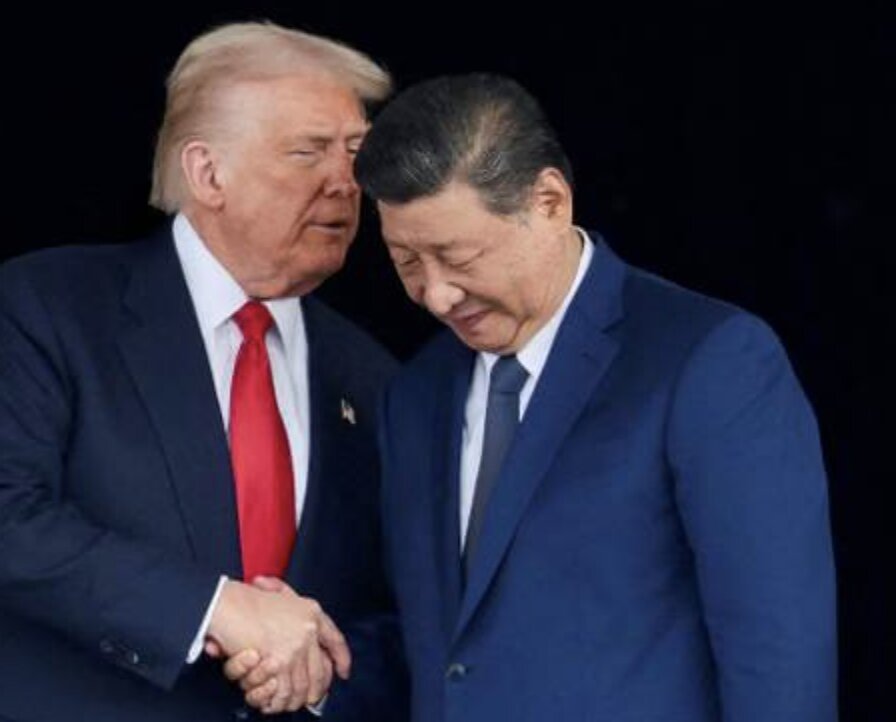
In Brief
INTERNAL
China to host Global Governance Forum to advance multilateral cooperation and global governance reforms
On 16 October, Reuters reported that the Chinese People’s Institute of Foreign Affairs (CPIFA) would host the Global Governance Forum from 23 to 25 October at the Xiongan New Area in Hebei province. The forum will be themed on rebuilding trust and confidence. The CPIFA President, Wu Ken, said that the forum aimed to look into specific and effective approaches, alongside tangible and effective solutions to aid the international community in resolving issues. Around 180 foreign guests from the Global South, the US and Europe are expected, alongside over 200 Chinese guests. 70 per cent of the attendees are expected to be experts, academics and prominent personalities from a wide range of fields including climate change, AI and trade. The Global Governance Forum was introduced by China’s President Xi Jinping last year, and is a diplomatic move towards a multilateral and more equitable global governance system.
(“China targets practical action from global governance forum next week,” Reuters, 16 October 2026)
https://www.reuters.com/world/china/china-targets-practical-action-global-governance-forum-next-week-2026-10-16/
China outlines roadmap for a Healthy China by 2035
On 15 October, CGTN reported that the Chinese government had outlined its plan for a Healthy China by 2035, with an emphasis on disease prevention, health management and medical innovation. On 12 and 13 October, a national meeting on health was held for the first time in a decade. In his address to the meeting, President Xi stated that efforts needed to be focused on a path with Chinese characteristics that developed the country’s health programs. Health management, disease prevention and control, medical services, medical insurance support, pharmaceutical innovation and talent development were pinpointed as the six key capabilities essential for building a Healthy China. The president also urged a full-chain approach towards chronic diseases which covered prevention, treatment, rehabilitation and long-term management, calling prevention the most economical and effective health strategy.
(“China steps up efforts to build a Healthy China by 2035," CGTN, 15 October 2026)
https://news.cgtn.com/news/2026-10-15/China-steps-up-efforts-to-build-a-Healthy-China-by-2035-1RgfktmALK0/p.html
SCIENCE AND TECHNOLOGY
China's geospatial industry output tops CNY 900 billion in 2025
On 16 October, CGTN News reported that China's geospatial information industry generated a total output of CNY 900.5 billion in 2025, up 5.9 per cent year-on-year, according to the China Association for Geospatial Industry and Sciences. The number of enterprises in the sector rose 11.1 per cent to about 269,000, with 447 geospatial companies rated "little giant" enterprises specialising in niche sectors. China had launched 694 civilian remote sensing satellites by the end of 2025, including 126 that year, while in-orbit upgrades of the next-generation BeiDou system were completed. Under the 15th Five-Year Plan, China aims to push the industry's average annual output above CNY 01 trillion, supporting emerging fields such as intelligent driving and embodied intelligence.
("China's geospatial industry output tops 900 bln yuan in 2025," CGTN News, 16 October 2026)
China's wind power sector drives global clean energy push
On 16 October, China Daily reported that China's wind power sector had built the world's largest wind energy industrial system during the 14th Five-Year Plan period, supported by the most comprehensive supply chain, according to the National Energy Administration. In 2025, newly installed offshore wind capacity exceeded 07 million kilowatts, accounting for nearly 80 per cent of the global total, with new typhoon-resistant turbines highlighting technological progress. NEA official Pan Huimin cautioned that the sector faced grid integration constraints, tightening factor supplies, and declining project yields following full power marketisation. Global Wind Energy Council CEO Ben Backwell said transmission infrastructure was the most pressing bottleneck worldwide, urging wind firms to offer integrated solutions pairing wind with solar, storage, and smart grids.
("Wind power drives China's global green energy edge," China Daily, 16 October 2026)
CHINA AND SOUTHEAST ASIA
Philippines rebukes Chinese envoy’s “may easily win” remark as a threat of force
On 16 October, Reuters reported that Manila had rebuked China’s ambassador over remarks the foreign ministry called a “thinly veiled threat” of force. Ambassador Jing Quan told journalists on 15 October that Beijing could easily win a confrontation with Manila, but would not use force because it loves peace. He was responding to the defence secretary calling China a regional troublemaker. The foreign ministry said the choice of words was poor and unhelpful given the complicated bilateral ties. President Ferdinand Marcos Jr said on 16 October that the comments sounded very much like a threat and deserved a discussion with the envoy. The Chinese Embassy said Jing had been quoted selectively. It called the response an over-interpretation and said relations were at an extremely sensitive stage. The two sides have clashed for years over reefs and islands in the South China Sea, where their coast guards repeatedly face off.
(“Philippines hits back at Chinese envoy over ‘thinly veiled threat’ of force,” Reuters, 16 October 2026)
CHINA AND TAIWAN
Taiwan warns against China’s use of Sun Yat-sen commemorations to promote unification
On 16 October, Reuters reported that Taipei’s government has told people to shun events in China next month marking the anniversary of the birth of Sun Yat-sen. Both sides officially laud him for ending the last imperial dynasty. The advisory exposes another historical fault line. In a statement late on 15 October, the Mainland Affairs Council said people should not travel to China for the events or echo the narratives of the Chinese Communists. It said Beijing’s reading of Sun departs from historical fact and uses such commemorations to promote opposition to independence and unification. Sun founded the Republic of China, which fled to the island in 1949 after losing the civil war to Mao Zedong’s communists. There, he is officially the “father of the nation”, while Beijing calls him a national hero and forerunner of its 1949 revolution. China has not detailed its planned events.
(“Taiwan tells its people to shun Chinese anniversary events for revolutionary hero,” Reuters, 16 October 2026)
CHINA AND THE MIDDLE EAST
China urges Israel to open Gaza access routes and halt West Bank settlements
On 16 October, CGTN reported that Chinese Foreign Minister Wang Yi had urged Israel to open up access routes to Gaza and halt settlement activities in the West Bank. The comments were made during a meeting between Wang and Israeli President Isaac Herzog during the Seventh Summit of the Conference on Interaction and Confidence Building Measures in Asia (CICA). Wang said that the complete opening up of routes to Gaza was essential to prevent a worsening humanitarian disaster. The foreign minister also described the Palestinian question as the greatest historical injustice of the 21st century, and stated that the two-state solution was the right path towards resolving it. Wang informed that Beijing was ready to work with the international community to bring all parties back to dialogue and negotiations, towards a political solution for the conflict. Additionally, he praised the stability in ties and positive results in practical cooperation achieved between China and Israel. Meanwhile, Herzog informed that Israel adhered to the One-China policy, and had interest in advancing friendly ties with China.
(“Chinese FM urges Israel to open Gaza access routes, halt West Bank settlements," CGTN, 16 October 2026)
CHINA AND EUROPE
EU hardens trade defences as China offers concessions to protect access to European markets
On 15 October, the Wall Street Journal reported that China has temporarily softened its trade stance toward Europe as growing protectionism makes the EU increasingly important to its export-dependent economy. Beijing accepted an EU plan limiting Chinese hybrid vehicle imports to 350,000 annually, potentially cutting volumes by more than half and easing pressure on European automakers. The concession is reflective of China’s vulnerability; that is, weak domestic consumption and industrial overcapacity have encouraged manufacturers to export aggressively, producing a record USD 1.2 trillion trade surplus. Meanwhile, Europe’s trade deficit with China has reached roughly EUR 1 billion daily, intensifying concerns over jobs and industrial competitiveness. With the US market becoming more protectionist, analysts note that China cannot afford comparable barriers in Europe. Consequently, the EU is shifting from seeking greater access to China toward actively limiting Chinese imports. France and Germany are also supporting stronger trade defence mechanisms and measures to reduce strategic dependencies. However, European unity could weaken if Beijing retaliates economically or domestic political pressures divide member states.
(“With China Facing More Trade Barriers, It Can’t Afford to Lose Europe,” Wall Street Journal, 15 October 2026)
CHINA AND THE AMERICAS
President Trump opens nuclear arms dialogue with Beijing
On 16 October, CNA reported that US President Donald Trump said Washington is discussing denuclearisation with China, signalling a potential new area of strategic engagement amidst broader US-China rivalry. President Trump revealed that he had raised the issue with China’s President Xi Jinping and warned that China could “catch up” with the US nuclear arsenal within five years. China currently possesses fewer nuclear warheads than either the US or Russia, but its expanding arsenal has become an increasing concern for Washington. The talks could therefore draw Beijing into nuclear arms control arrangements traditionally dominated by Washington and Moscow. The initiative gained significance following the expiry of New START, which weakened existing nuclear restraints.
(“Trump says he is talking to Russia and China about denuclearisation,” Channel News Asia, 16 October 2026)
Opinion: Peter TC Chang, “Young Americans are key for the US to better understand China,” South China Morning Post, 16 October 2026
“As Washington and Beijing navigate intensifying strategic competition, academic exchanges and opportunities for grass-roots engagement have come under unprecedented strain. This is far more than a niche educational concern. It directly threatens America’s capacity to comprehend China, while quietly eroding the guard rails required for a stable bilateral relationship. The lesson is not that older experts have failed, or that younger people will automatically find common ground. It is that each generation needs the opportunity to encounter China as it actually is, rather than through inherited assumptions. Younger Americans, with fewer preconceptions, could be the generation that breaks through the mistrust built up over decades.”
Opinion: Bernard Chan, “Pageantry matters for US-China summits, even with modest results,” South China Morning Post, 16 October 2026
“The notable feature of the Washington visit was therefore its division between symbolism and substance. The symbolism was rich: pandas, gifts, ceremonial welcomes, cultural diplomacy and the presence of Xi’s wife Peng Liyuan alongside the president. For all the ceremonies, the results were modest: the truce was extended to January, and both sides recommended US$30 billion of non-sensitive goods in each direction for more favourable tariff treatment. These are useful steps, but they do not amount to a wider settlement. At the highest level, the US and China can manage ceremony, conversation and limited compromise.”
China Reader Daily Wire | 15 October 2026, Thursday | Vol 3 No. 157
China’s next export wave may be driven by AI, biotech, and robotics
China’s Three-Body Computing Constellation expands with new satellite launch
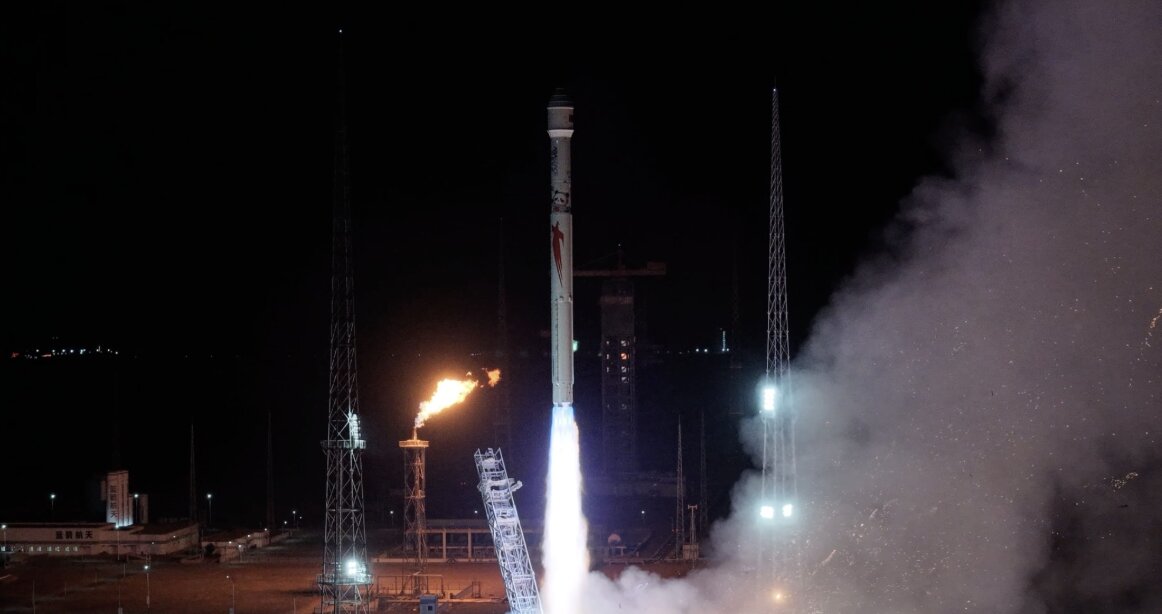
In Brief
SCIENCE AND TECHNOLOGY
China’s Three-Body Computing Constellation expands with new satellite launch
On 14 October, CGTN reported that China had launched a Zhuque-2E Y4 carrier rocket from the Dongfeng commercial space innovation pilot zone. The flight test mission was declared a complete success. China in Space reported that the rocket was heading for sun-synchronous orbit with a group of computing satellites and two laser communication test spacecraft. The Three-Body Computing Constellation, China’s space-based AI supercomputing network, launched eight new satellites, taking the total number of satellites in orbit to 20. These satellites would now integrate with the Zhuque- 2E rocket. The satellites launched would connect with the existing satellites already in orbit and demonstrate expanded onboard compute capabilities. New laser communication links capable of connecting to the ground and cooling radiators are amongst the technologies being shown through the satellite connection. Earlier, the Three-Body Constellation showed its advanced skill sets through tasking terrestrial robots from orbit and sustaining laser links for multiple days with near-constant uptime. The launch of the spacecraft is regarded as a part of China’s initiatives to support space-based connectivity constellation efforts from the satellite manufacturing side.
(“China’s Zhuque- 2E rocket launches 10 satellites into space,” CGTN, 14 October 2026; “Three-Body Computing Constellation Expands with LandSpace Launch{Zhuque- 2E Y4,” China in Space, 14 October 2026)
https://news.cgtn.com/news/2026-10-14/China-s-Zhuque-2E-rocket-launches-10-satellites-into-space-1ReYXyOhz5C/p.html
https://www.china-in-space.com/p/three-body-computing-constellation-316
China's scientists use open-source flight data to estimate Israel's potential electronic warfare units
On 15 October, South China Morning Post reported the claim of China's military scientists about the development of an algorithm that uses civil aviation data to identify electronic warfare units. The researchers suggested that they had located two sources of interference that were spoofing their locations near Israel during the US-Iran War. The locations were estimated near Haifa, with reported positioning errors between 10.9 kilometres and 18.9 kilometres. The source could not independently verify the claims. Researchers analysed 43 days of aircraft-tracking data, from 27 February to 10 April, to identify possible sources of electronic interference in the Mediterranean. Using publicly available Automatic Dependent Surveillance-Broadcast (ADS-B) data, the team developed an algorithm to detect abnormal flight paths and estimate interference sources. Two areas were identified: about 80 kilometres northwest of Haifa and 30 kilometres northwest of the Gaza Strip. The researchers suggested that the first source may have countered long-range suicide drones, such as Iran’s Shahed-136, using a complex dynamic spoofing strategy. The second may have targeted low-cost, short-range drones used by groups in Gaza and the Houthi movement through static spoofing. However, the intended targets could not be directly verified. The team said future research would incorporate ship navigation data to extend the method beyond civil aviation.
(“Chinese scientists use open-source data to spot suspected Israeli electronic warfare units,” South China Morning Post, 15 October 2026.)
https://www.scmp.com/news/china/science/article/3370910/chinese-scientists-use-open-source-data-spot-suspected-israeli-electronic-warfare-units
Opinion
Andy Xie, “Can China’s coal industry ride to the rescue of a world in oil shock?” South China Morning Post, 15 October 2026
“The global economy is likely to experience a recession next year. War across the Middle East is set to escalate, wrecking energy supplies for many years, even as the artificial intelligence (AI) bubble is ripe to burst. This, however, would also create an energy leadership opportunity for China. High energy prices already fuel demand for Chinese renewable energy products and electric vehicles. But as a leader in building coal-fired power plants, China can also offer the global market a quick substitute for Middle Eastern oil and gas, attracting a boom in investment and export revenue. The unfolding energy crisis also offers opportunities for China: solar energy, wind power and electric vehicles are the usual suspects. But a bigger opportunity, at least for the next five years, could be coal. Coal-fired power plants can be an effective interim solution to an oil and gas shortfall. China has a huge industry in building coal-fired power plants. Chinese coal-fired power plants are much more efficient than those of other countries. As the global leader by far, China can build these plants cheaper and faster than anyone else. More importantly, coal-rich China can expand its coal chemical industry to produce substitute oil products. China can and should produce enough fertiliser, diesel and aviation fuel to meet global demand. China can turn itself into the new energy centre of the global economy. It is a great economic opportunity and also strengthens China’s geopolitical position. If China becomes a superpower in energy as in manufacturing, it basically wins the geopolitical competition in the 21st century.”
INTERNAL
China approves more than 600 national standards to support clean energy development
On 14 October, CGTN reported that China had approved more than 600 national standards covering clean-energy sectors, including hydropower, solar power, solar thermal energy and hydrogen. The country had also established more than 1,300 group standards and published 345 foreign-language versions of national standards. China has led the development and publication of 174 international energy standards, accounting for around 15 per cent of the total published internationally. It also hosts secretariats for 10 international standards bodies covering areas such as solar energy and mechanical energy storage, and convenes 34 international working groups. The standards were highlighted during an event marking World Standards Day. The initiative supports standardisation across clean-energy industries and strengthens China’s role in international energy cooperation and the global transition towards cleaner energy sources.
(“China approves over 600 national standards for clean energy,” CGTN, 14 October 2026)
https://news.cgtn.com/news/2026-10-14/China-approves-over-600-national-standards-for-clean-energy-1ReY6BSxw1a/p.html
China’s next export wave may be driven by AI, biotech, and robotics, says SCMP
On 15 October, the South China Morning Post reported that China could be approaching a third wave of export-driven economic disruption, described by economist Alicia Garcia-Herrero as “China shock 3.0.” The next wave is expected to centre on artificial intelligence (AI), biotechnology and robotics, potentially creating a greater impact on global industries than previous waves of Chinese exports. Garcia-Herrero, a senior fellow at Bruegel and chief economist for Asia-Pacific at Natixis, said China was developing competitive AI hardware and software for potential export once domestic demand was met. The assessment highlights China’s expanding technological capabilities and the possibility of increased competition for foreign producers. It also raises concerns about how Chinese technology exports could affect industrial competitiveness, employment and trade relations as countries seek to protect domestic industries.
(“‘China shock 3.0’ to be driven by AI, biotech and robot exports, economist says,” South China Morning Post, 15 October 2026)
https://www.scmp.com/news/china/diplomacy/article/3370925/china-shock-30-be-driven-ai-biotech-and-robot-exports-economist-says
CHINA AND EAST ASIA
China opens joint airfield in Laos, as neighbours watch for military role
On 15 October, ABC News reported that China's new joint airfield in Laos, officially opened at a September ceremony, remained a work in progress, with satellite imagery showing construction still ongoing. The Ban Keun airport, about 50 kilometres north of Vientiane, is China's first overseas military facility focused on air power, with a 2,000-metre runway long enough for fighter aircraft and space to extend it by at least 1,000 metres to accommodate larger planes. China's Defence Ministry said the China-Laos Joint Support and Training Centre and Friendship Aviation Academy would help train Laotian pilots and were "not directed against any third party," though it has not said whether aircraft will be permanently stationed there. Analysts said the base did not radically alter regional power balances but could concern Vietnam, with a Vietnamese official saying Beijing's move was intended to strengthen its influence in Laos. Thailand said Laos had a legitimate right to such agreements but would keep monitoring developments.
("China opens a joint airfield in Laos with construction ongoing and eyes on its military role," ABC News, 15 October 2026)
https://abcnews.com/amp/International/wireStory/china-opens-joint-airfield-laos-construction-ongoing-eyes-137275971
CHINA AND SOUTHEAST ASIA
China and North Korea open long-delayed Yalu River bridge to boost trade
On 15 October, Reuters reported that China and North Korea officially opened their most significant land border crossing, the 03-kilometre New Yalu River Bridge linking the Chinese city of Dandong with North Korea, aiming to rejuvenate trade after years of strained ties and pandemic-related disruptions. The cable-stayed bridge, completed in 2014 but left unused while the North left its approach roads and customs compound unfinished, opened with trucks carrying national flags across it. Chinese Premier Li Qiang said bilateral relations were "entering a new phase," while North Korean Premier Pak Thae Song also delivered a video address. Analysts said North Korea remained cautious about greater dependence on China, with Lim Eul-chul of Kyungnam University saying the bridge was unlikely to produce an immediate return to pre-sanctions trade, though it would help move heavy equipment, raw materials, and energy products. China's exports to North Korea rose 25 per cent to USD 2.3 billion last year.
("China, North Korea open long-delayed border bridge to boost trade," Reuters, 15 October 2026)
https://www.reuters.com/world/asia-pacific/trucks-line-up-long-delayed-china-north-korea-bridge-officially-opens-2026-10-15/
CHINA AND SOUTH ASIA
Nepal wants to bridge India-China distrust in the fight against climate change
On 15 October, the BBC reported that Nepal’s Prime Minister Balendra Shah warned of the growing threat of climate-related disasters in the Himalayas, recalling the devastating floods that struck Kathmandu in his UN General Assembly address. He called for the creation of a Himalayan Climate Resilience Mechanism to strengthen cross-border disaster response and the sharing of scientific data and expertise in the world’s most environmentally fragile and geopolitically sensitive regions. A report by the International Centre for Integrated Mountain Development released in March found that glaciers across the Hindu Kush Himalayas are melting at an accelerating pace, with the rate of ice loss having doubled since 2000 compared with the 1974-1999 period. On the Qinghai-Tibet Plateau, glaciers have shrunk by 24 per cent, increasing the risks of sudden cross-border floods into Nepal, India, and Bhutan. In August 2025, India’s Minister of State for External Affairs Kirti Vardhan Singh told parliament that China had stopped sharing data on the Sutlej and Brahmaputra in 2022 and 2023, respectively. Nepal has the herculean task of convincing its larger neighbours to bury the hatchet in favour of climate.
(“India and China aren’t friends-but Nepal wants to unite them against climate threats,” BBC, 15 October 2026)
https://www.bbc.com/news/articles/cvy0rd1j2kzlo
CHINA AND THE MIDDLE EAST
Houthis using Chinese parts to build advanced missiles, says a WSJ report
On 13 October, The Wall Street Journal reported that Houthi militants are aiming to produce their own advanced medium-range ballistic missiles using Chinese-delivered parts in a technological advance that would raise the threat posed by the Iran-backed group. The Houthis shipped components from a Chinese supplier to build a version of the Kheibar Shekan Iranian precision-guided missile, with the missile having a range of 1200 miles, putting both Israel and Saudi Arabia within range. Iran previously used the Kheibar Shekan against American bases in the spring of 2025. According to UN data, Chinese companies are now the biggest source of seized goods for the Houthis. The Houthis can reach deep into Saudi Arabia with a bigger payload than cruise missiles and drones. While China says it is respecting the UN ban on arms sales to the Yemeni faction, the components imported by the Houthis were dual-use goods.
(“The Houthis Are Building an Advanced Missile With Chinese Parts,” The Wall Street Journal, 13 October 2026)
https://www.wsj.com/world/middle-east/houthi-missile-china-parts-5c2b2516
CHINA AND AFRICA
Beijing urges a Libya-led political settlement and institutional unity in the country
On 15 October, CGTN reported that China has called for an urgent resolution of Libya’s political deadlock, welcoming progress under the UN-facilitated 4+4 talks while stressing that any settlement must be led by Libya and broadly supported within the nation. Deputy UN representative Sun Lei warned that renewed armed conflict and attacks on energy infrastructure could undermine political progress. Beijing urged the unification of Libya’s military and security institutions to support elections and a peaceful transfer of power. China also advocated stronger border controls, action against arms trafficking and oil smuggling, greater fiscal transparency, implementation of a unified budget, and international assistance for public services, reconstruction and economic development.
(“China calls for end to political deadlock in Libya,” CGTN, 15 October 2026)
https://news.cgtn.com/news/2026-10-15/China-calls-for-end-to-political-deadlock-in-Libya-1RfMZr9GpLq/p.html
CHINA AND RUSSIA
Russian Foreign Minister Sergei Lavrov meets Foreign Minister Wang Yi
On 15 October, Reuters reported that Russia’s Foreign Minister Sergei Lavrov and China’s Foreign Minister Wang Yi reaffirmed expanding bilateral cooperation during talks on the sidelines of the Conference on Interaction and Confidence-Building Measures in Asia in Azerbaijan. The ministers praised the development of their comprehensive strategic partnership and coordinated positions on bilateral political dialogue. Discussions also covered relations with the United States and ongoing conflicts involving Ukraine and Iran. Moscow and Beijing have jointly advocated diplomatic efforts to end the Iran conflict, warning of wider regional instability. China has meanwhile maintained its close partnership with Russia throughout the Ukraine war while continuing to publicly support a negotiated resolution to the conflict.
(“Russia's Lavrov, China's Wang discuss cooperation, Ukraine, Iran at Asia security meeting,” Reuters, 15 October 2026)
https://www.reuters.com/world/china/russias-lavrov-chinas-wang-discuss-cooperation-ukraine-iran-asia-security-2026-10-14/
CHINA AND EUROPE
Trade deal between Brussels and Beijing temporarily halts economic hostilities
On 12 October, South China Morning Post reported that high-wire negotiations between China and the EU resulted in a surprise trade deal that will impose strict quotas on Chinese car exports to the bloc and slash Chinese tariffs on a variety of European goods. The deal cools the bilateral trade tensions between the two countries and temporarily averts the prospect of a bruising trade war in exchange for a subsequent reduction in value-added tax export rebates on certain goods, which could help curb outbound shipments further. The deal will ensure that Brussels will cap imports of Chinese hybrid cars at 350000 units a year, rising at 6 per cent annually. This will leave exports at less than half of EU projections for 2026. After gaining the consent of all member states, the bloc will use a technical safeguard instrument to moderate the import of Chinese hybrid cars, with numbers in excess of 350000 being turned away.
(“China, EU take a breath after surprise deal brings temporary halt to trade tussle,” South China Morning Post, 12 October 2026)
https://www.scmp.com/economy/global-economy/article/3370623/china-eu-take-breath-after-surprise-deal-brings-temporary-halt-trade-tussle
CHINA AND THE AMERICAS
Beijing and Washington seek AI cooperation framework ahead of Trump-Xi meeting
On 15 October, SCMP reported that the US and China are intensifying negotiations to establish a framework for managing AI-related incidents and institutionalising bilateral dialogue ahead of the Xi-Trump meeting at the November APEC summit in Shenzhen. Following agreements reached during Xi Jinping’s September US visit, technical teams are developing a basic crisis communication mechanism, while a broader institutional arrangement could involve governments, research institutions and industry representatives. AI has emerged as a potential area where strategic competitors can demonstrate limited cooperation despite intensifying technological rivalry. However, differences in domestic regulation and economic competition could constrain whatever little progress has been made. Washington continues to emphasise rapid AI development and accuses China of using techniques such as model distillation to acquire US capabilities. Beijing has claimed that these are mere allegations while vehemently denying them. Meanwhile, both countries are competing to shape global AI governance, with the US promoting Pax Silica and China advancing the World Artificial Intelligence Cooperation Organisation.
(“US and China race to shape AI agenda ahead of Xi-Trump talks in Shenzhen, sources say,” South China Morning Post, 15 October 2026)
https://www.scmp.com/news/china/diplomacy/article/3370926/us-and-china-race-shape-ai-agenda-ahead-xi-trump-talks-shenzhen-sources-say
China Reader Daily Wire | 14 October 2026, Wednesday | Vol 3 No. 156
China’s foreign trade growth hits nearly five-year high in first three quarters of 2026
Taiwan warns Europe of risks of dependence on China
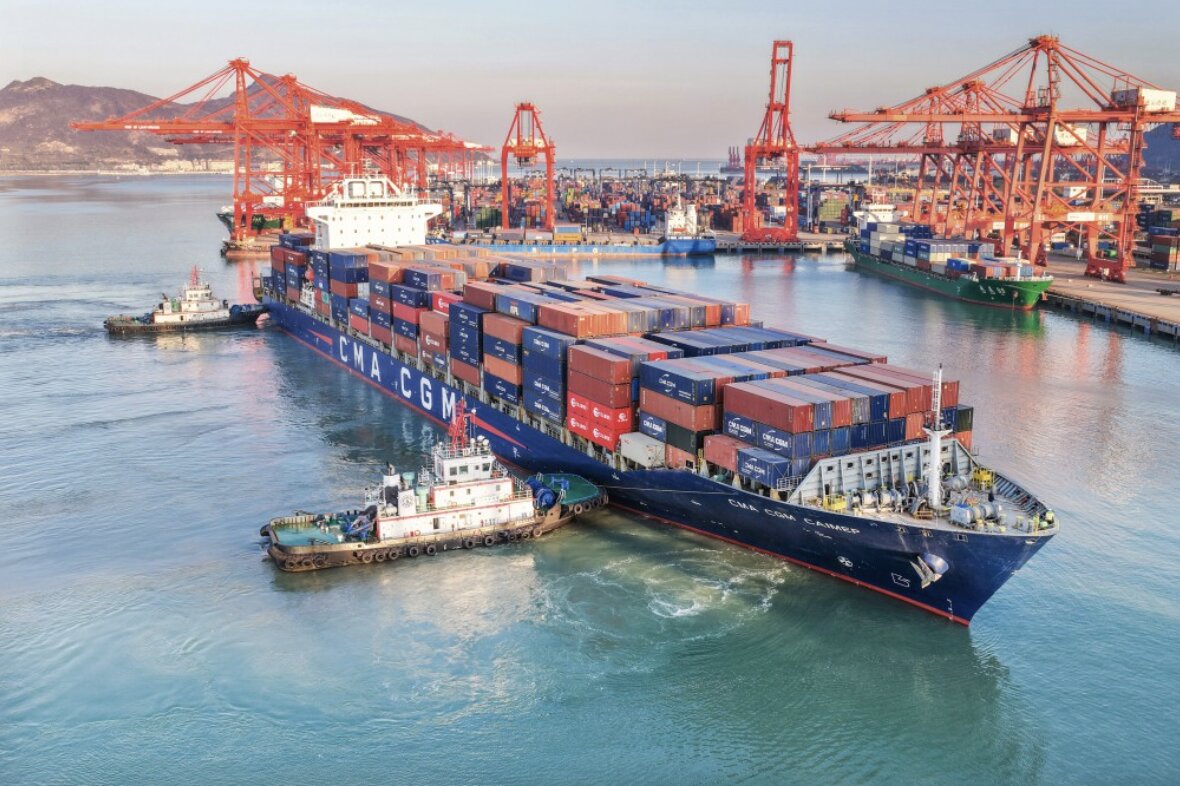
In Brief
INTERNAL
China's factory-gate prices accelerate, while consumer inflation stays moderate
On 14 October, CGTN reported that China's consumer and producer prices both rose faster year on year in September, with factory-gate prices gaining momentum while consumer inflation remained moderate, according to the National Bureau of Statistics. The consumer price index rose 0.9 per cent, up from 0.8 per cent in August, while the producer price index increased 05 per cent, accelerating from 3.8 per cent. Core CPI, which excludes food and energy, rose 0.1 per cent, unchanged from August, with food prices falling 1.7 per cent and service prices rising 0.8 per cent. Production material prices rose 6.5 per cent, while industrial input prices climbed 6.9 per cent, pointing to continued cost pressures for some manufacturers. Bruce Pang of CUHK Business School said broad-based consumer price pressures remained limited, with stronger policy support expected to underpin a gradual recovery in prices as China begins its 15th Five-Year Plan.
("China's CPI and PPI rise faster in September," CGTN, 14 October 2026)
https://news.cgtn.com/news/2026-10-14/China-s-CPI-and-PPI-rise-faster-in-September-1RejVMpQwo0/p.html
Chinese producer prices increase amidst concerns over weak demand
On 14 October, Reuters reported that Chinese producer prices rose at their fastest rate in four years, alongside an increase in inflation. Additionally, higher fuel and commodity prices increased costs of manufacturing or factory-gate inflation. The higher fuel prices are largely a result of transport disruptions, adverse weather and geopolitical turmoil. Data from the National Bureau of Statistics showed that the producer price index rose 5 per cent from a year earlier. Commodity supply disruptions caused by the conflict in West Asia drove the increase, with fuel processing, chemicals and non-ferrous metals particularly witnessing a price increase. The Consumer Price Index (CPI) gained 0.9 per cent year-on-year, compared to 0.8 per cent the previous month. This was lower than the 1 per cent increase forecast by economists. Additionally, household spending remains weak, despite stimulus measures by the Chinese government. This indicates a persistent weakness in domestic demand and broader economic imbalances.
(Qiaoyi Li and Liz Lee, China factory-gate inflation heats up as commodity costs rise, CPI lags forecast, Reuters, 14 October 2026)
https://www.reuters.com/world/asia-pacific/chinas-factory-gate-inflation-accelerates-september-2026-10-14/
China’s foreign trade growth hits nearly five-year high in first three quarters of 2026
On 14 October, Global Times reported that Chinese foreign trade had increased by 18.8 per cent in the first three quarters of 2026. The total amount now stands at USD 5.96 trillion, according to the Chinese General Administration of Customs (GAC). This is the fastest growth for this period in nearly five years. For the month of September, Chinese imports and exports reached 5.16 trillion yuan, crossing the 5-trillion-yuan mark for the first time. China’s total exports also reached 23.2 trillion yuan, a growth of 16.4 per cent year-on-year. Similarly, imports reached 16.74 trillion yuan, a growth of 22.3 per cent. Additionally, the monthly growth rate has been in double digits for six consecutive months now. Wang Jun, vice minister of GAC, stated that Chinese growth had maintained momentum in the first three quarters and dealt with external shocks. He also added that solid fundamentals were in place to sustain growth in the fourth quarter.
(“China’s foreign trade rises by 18.8% in first three quarters of 2026, marking fastest growth in nearly 5 years: customs data,” Global Times, 14 October 2026)
https://www.globaltimes.cn/page/202610/1372242.shtml
Three people sentenced to death by China for running Myanmar scam centres
On 13 October, Al Jazeera reported that a court in the East of China has sentenced three members of a criminal gang to death for operating networks of scam centres in Myanmar. Quanzhou Intermediate People’s Court said it had sentenced Wei Huairen, Chen Dawei and Liao Jingfang for their involvement in the “Wei family criminal gang.” The court added that Wei was one of the group’s leaders and was found guilty of several crimes, including murder. Three other members were sentenced to lifetime imprisonment, while 55 others were handed sentences ranging from three years and three months to 24 years in prison. The court said the gang’s operations netted more than USD 1.8billion. China's state broadcaster CCTV described the gang as operating 14 “large-scale” compounds and having lured “thousands” of Chinese nationals with promises of high wages to Myanmar. The verdict comes amid Beijing's intense crackdown on cross-border scam networks operating in Southeast Asia.
("China sentences three people to death for running Myanmar scam centres," Al Jazeera, 13 October, 2026)
https://www.aljazeera.com/news/2026/10/13/china-sentences-three-people-to-death-for-running-myanmar-scam-centres
PLAN dispatches Liaoning carrier group to Western Pacific for training
On 14 October, CGTN reported that China’s People’s Liberation Army Navy (PLAN) had dispatched the Liaoning carrier task group to the Western Pacific for training purposes. The PLAN stated that the mission was “organized in accordance with the annual routine training plan to test and improve the group's realistic training level and enhance its capabilities.”
(“PLA Navy sends Liaoning carrier to Western Pacific for training,” CGTN, 14 October 2026)
https://news.cgtn.com/news/2026-10-14/PLA-Navy-sends-Liaoning-carrier-to-Western-Pacific-for-training-1Re1DsdCGcg/p.html
SCIENCE AND TECHNOLOGY
China’s exports surge on strong tech demands
On 14 October, South China Morning Post reported that China's exports rose 36.3 per cent year on year to USD 447.18 billion in September, exceeding economists' forecast of 25.7 per cent and August’s 25 per cent growth. Imports increased 31 per cent to USD 313.65 billion, bringing the monthly trade surplus to USD 133.53 billion. Total trade in the first nine months of 2026 rose by 23.8 per cent, while the cumulative surplus reached USS 938.11 billion, which is 7.2 per cent higher compared to the same period last year. Customs officials said exports were driven by demand for chips and electronic components used in AI computing and electricity infrastructure. Integrated circuit exports rose to 136 per cent in value but only 1 per cent in volume, amid a memory chip shortage and higher prices. Exports to the United States increased 39.56 per cent, to the European Union 25.25 per cent, and to the ASEAN countries 52.26 per cent. China’s September exports also benefited from shipments made ahead of the Golden Week holiday. Analysts said sustained AI demand and easing China-EU trade tensions could support exports, while uncertainty over oil prices could affect imports.
(“China’s exports surge more than 36% in September amid tech demand, holiday rush,” South China Morning Post, 14 October 2026 )
https://www.scmp.com/economy/china-economy/article/3370799/chinas-trade-momentum-quickens-september-amid-tech-demand-holiday-rush
CHINA AND EAST ASIA
China and North Korea finally inaugurate long-delayed bridge in Liaoning province
On 14 October, Reuters reported that China and North Korea finally opened the New Yalu River Bridge, linking the Chinese city of Dandong, Liaoning province, to North Korea’s Sinuiju. With its opening, the bridge has become the largest and most significant land crossing for trade between the two countries. Completed in 2014, it was delayed due to the lack of road and customs facilities on the North Korean side and deteriorated relations due to North Korea’s nuclear tests. The bridge’s opening marks China’s warming of ties with North Korea, which followed just weeks after Pyongyang announced its first road bridge with Russia.
(“China, North Korea to open long-delayed bridge on Thursday,” Reuters, 14 October 2026)
https://www.reuters.com/world/china/china-north-korea-bridge-open-october-15-2026-10-14/
Taiwan warns Europe of risks of dependence on China
On 13 October, Reuters reported that Taiwan's foreign minister warned the European Union regarding their dependence on Chinese suppliers during a speech in Warsaw. He suggested that dependence on China is "not merely an economic risk," but also a "threat to European freedom and sovereignty itself" because "authoritarian ideology is fundamentally incompatible with Europe's democracy." This comes ahead of a summit in Brussels where trade with Beijing is reported to be high on the agenda to mitigate risks of over-dependence on Beijing's sensitive sectors. "A Europe controlled through its supply chains would be a Europe that had surrendered part of its liberty", he said. Lin added that trade with Taiwan benefits Europe and stressed their shared values. He suggested that the Taiwan model had "helped power innovation and prosperity in Silicon Valley, and it can do the same for Europe too." Taipei has sought closer ties with Brussels, especially since the 2022 Russian invasion of Ukraine.
("Taiwan warns Europe of dangers of dependence on China," Reuters, 13 October 2026) https://www.reuters.com/world/china/taiwan-warns-europe-dangers-dependence-china-2026-10-13/
CHINA AND EUROPE
Beijing and Brussels ease trade tensions with hybrid car quotas and tariff cuts
On 13 October, SCMP reported that China and the European Union reached a surprise trade agreement on 12 October, temporarily easing escalating commercial tensions. The deal caps Chinese hybrid vehicle exports to the EU at 350,000 units annually, with the quota increasing by 6 per cent each year, which is well below the 800,000 vehicles projected for 2026. Once the quota is reached, additional shipments will be denied entry. In return, China will reduce tariffs on several European goods. Beijing also lowered VAT export rebates on selected products, potentially moderating exports further. Both sides welcomed the agreement as a means of stabilising trade while addressing European concerns over unfair competition.
(“China, EU take a breath after surprise deal brings temporary halt to trade tussle,” South China Morning Post, 13 October 2026)
https://amp.scmp.com/economy/global-economy/article/3370623/china-eu-take-breath-after-surprise-deal-brings-temporary-halt-trade-tussle?
CHINA AND THE AMERICAS
Opinion
Alex Lo, “US cosplays WTO against China while paralysing the real global body,” South China Morning Post, 13 October 2026
“The US has disabled the court of appeal. So Washington plays prosecutor, convenes its own jury and borrows the authority of a global body it has deliberately kneecapped. That is cosplay: the costume of multilateralism with none of the institutions inside. Remind me, who has been waging a global tariff war that upended the entire trading system? Imagine a defendant who not only commits his crimes but demolishes the courthouse, then turns up in a judge’s robe to try others for stealing from him. The rules-based order, it turns out, is a rules-for-thee order. When they bind Washington, it is a sovereign nation with a veto, an unratified treaty or a sanctions list. The rules-based order, it turns out, is a rules-for-thee order. Beijing is hardly a saint, and its trade practices deserve scrutiny. But scrutiny needs a credible venue and a credible prosecutor. Washington has sabotaged the first and disqualified itself from the second. Standing at the edge of the global legal system, the Americans feel the call of the void. As they look down, they are pushing everyone else off the ledge, then lecturing the survivors on compliance.”
Peru seeks Chinese investment for Corio port as an alternative to Chancay
On 14 October, SCMP reported that Peru is promoting the proposed Corio deep-water port in Arequipa as a new logistics hub, with Governor Rohel Sanchez reporting interest from Chinese, American, Indian and other foreign investors. The project has been substantially scaled back from an earlier USD 7 billion vision to an approximately USD 844 million multipurpose terminal developed in three phases, with capacity near two million tonnes annually. Corio’s key advantage is its estimated 20–28-metre water depth, exceeding the Chinese-operated Chancay port’s roughly 18 metres, while its location could facilitate copper exports from southern Peru to Asia. However, the project still lacks a confirmed investor or operator, and operations may be five or six years away. Chinese involvement remains speculative despite repeated expressions of interest. Meanwhile, Chinese companies are already deeply involved in Peru’s port and mining sectors through Chancay, the planned Marcona port and major mining operations, reinforcing China’s growing role in Peru’s export infrastructure.
(“Peru governor touts Chinese interest in deep-water port pitched as Chancay alternative,” South China Morning Post, 14 October 2026)
https://amp.scmp.com/news/china/article/3370786/peru-governor-touts-chinese-interest-deep-water-port-pitched-chancay-alternative?module=top_story&pgtype=homepage
China Reader Daily Wire | 13 October 2026, Tuesday | Vol 3 No. 155
IMF trims China's growth outlook as exports fall short of offsetting weak demand
China draws strongest foreign investment in four years
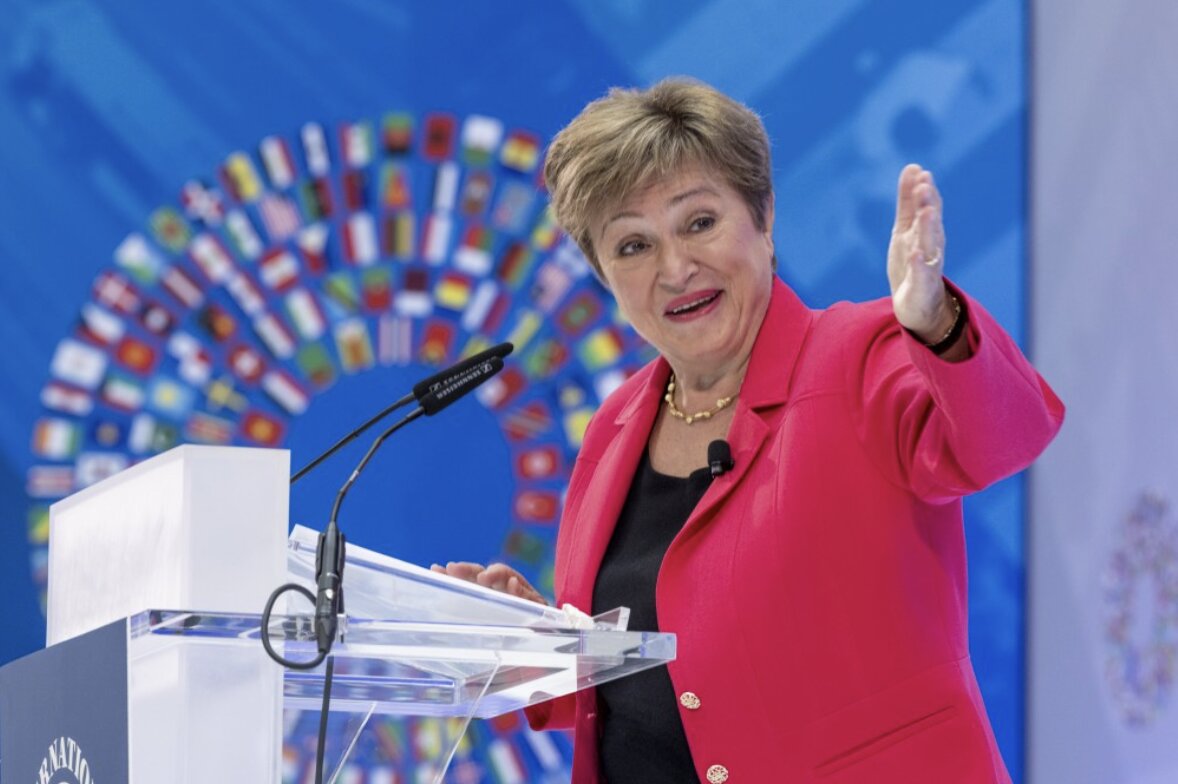
In Brief
INTERNAL
IMF trims China's growth outlook, as exports fall short of offsetting weak demand
On 13 October, South China Morning Post reported that the International Monetary Fund trimmed its 2026 growth projection for China by 0.1 per cent to 4.5 per cent, warning that resilient exports could no longer fully offset weak domestic demand. The forecast, down from 4.6 per cent in July, sits at the lower end of Beijing's 4.5 to 5 per cent target, with growth expected to slow further to 4.0 per cent in 2027. The IMF cited sluggish consumption, weakening investment, and property sector strains, alongside higher oil prices projected at USD 130 a barrel from late 2026. Exports rose 25 per cent year-on-year to USD 401.44 billion in August, though analysts noted that capital-intensive export growth had limited gains for employment and household income. Beijing has stepped up support, including policy bank rate cuts, mortgage subsidies, and CNY 550 billion in local debt quotas.
("IMF revises its projection down for China's GDP this year, cautions on export reliance," South China Morning Post, 13 October 2026)
https://amp.scmp.com/economy/china-economy/article/3370586/imf-revises-down-projection-chinas-gdp-year-cautions-export-reliance
China draws strongest foreign investment in four years, as inflows jump 81 per cent
On 12 October, China Daily reported that net foreign direct investment inflows into China reached USD 60.9 billion in the first half of 2026, up 81 per cent year-on-year and the highest first-half level in four years, according to the State Administration of Foreign Exchange. Foreign direct equity investment rose 55 per cent to USD 63.8 billion, while reinvestment of earnings by foreign-invested enterprises increased 31 per cent, signalling stable willingness to expand operations. New capital contributions into high-tech services and manufacturing rose 61 per cent, indicating a shift towards participating in "Created in China." Loan repayments to overseas affiliates fell 62 per cent to USD 2.9 billion. Apple's Iris Cui said more than 80 per cent of its 200 major suppliers operate facilities in China. The administration plans further measures to ease cross-border cash pooling and capital-account procedures for multinational companies.
("Net FDI inflows in first half hit four-year high," China Daily, 12 October 2026)
https://www.chinadaily.com.cn/a/202610/12/WS6acd014fe4b06d4aa0562604.html
SCIENCE AND TECHNOLOGY
China explores molten salt energy for a more stable green power grid
On 13 October, SCMP reported that China is exploring molten salt energy storage and supercritical carbon dioxide power generation to address the challenges created by its rapid expansion of renewable energy. As intermittent solar and wind power place greater pressure on electricity grids, these technologies could store surplus energy, reduce wastage and provide more stable power supplies. A demonstration project in Shandong combines molten-salt storage with supercritical carbon dioxide generation, seeking higher efficiency and greater grid flexibility. The initiative reflects China’s broader effort to develop next-generation energy infrastructure capable of integrating its expanding renewable capacity while strengthening energy security and supporting long-term decarbonisation goals.
(“China bets on molten salt and CO2 to help meet power needs,” SCMP, 13 October 2026)
https://www.scmp.com/plus/news/china/science/article/3370584/china-bets-molten-salt-and-co2-help-meet-its-power-needs?module=plus_label&pgtype=topic
Chinese researchers identify gene linked to evolution of human intelligence
On 12 October, Global Times reported that a research team from the Kunming Institute of Zoology of the Chinese Academy of Sciences had identified a new gene associated with the evolution of human intelligence. The gene, identified as CCNB1IP1, is an essential component for the ‘folds’ on the human brain’s surface. These folds, known as cerebral gyri and sulci, have a “walnut-like patterns,” allowing the cerebral cortex to be folded and compressed inside the limited space of the human skull, thereby expanding the cortex’s total surface area and thus increasing the brain’s information storage and logical processing capacity. The Chinese research team introduced the CCNB1IP1 gene into mice, whose brains are naturally ‘smooth,’ and soon developed cerebral cortex folds resembling those of primates. The gene-modified mice showed significant improvements in memory abilities according to the team's findings. The lead researcher of the team, Shi Lei, stated that the CCNB1IP1 gene showed a unique evolutionary pattern before it arrived in the brains of primates, and with its introduction to primates, it increased folding complexity by elevating levels of neural progenitor cells and increasing the amount of neuron generation.
(“Chinese scientists identify key gene linked to evolution of human intelligence, develop brain folds in mice,” Global Times, 12 October 2026)
https://www.globaltimes.cn/page/202610/1372088.shtml
CHINA AND TAIWAN
Taiwan’s Finance Minister to attend APEC meeting in Hong Kong
On 13 October, Reuters reported that Taiwan’s Finance Minister Chuang Tsui-yun is expected to attend the Asia-Pacific Economic Cooperation meeting of finance ministers in Hong Kong from 20-21 October. The AEPC group is one of the very few international bodies which include Taiwan, with the leaders' summit being scheduled in November in Shenzhen, China. Taiwan’s Finance Ministry stated that Chuang will attend the summit “as is customary”, and is expected to go under the name “Chinese Taipei,” which is usually used by Taiwan in international forums.
(“Taiwan finance minister to attend APEC meeting in Hong Kong,” Reuters, 13 October 2026)
https://www.reuters.com/world/china/taiwan-finance-minister-attend-apec-meeting-hong-kong-2026-10-13/
CHINA AND SOUTH ASIA
Opinion
Samara Bukhari, “CPEC is fertile ground for food security," China Daily, 13 October 2026
“Agriculture influences inflation, livelihoods, social stability, trade balances and the resilience of economies. For China and Pakistan, agricultural cooperation should be more than just a facet of bilateral trade. It can be a strategic pillar of the China-Pakistan Economic Corridor 2.0, embodying their shared interest in development and stability. But there are several challenges to overcome. First, food security is increasingly vulnerable to risks beyond the farm. Climate change is altering rainfall, increasing heat stress and intensifying floods and droughts. The second problem is the inefficient use of agricultural resources in Pakistan. Third, food security does not end when a crop leaves the field. Inadequate storage, transportation, processing and cold-chain infrastructure can lead to significant loss in value. Fourth, agricultural cooperation requires joint institutions and long-term knowledge exchange. Encouragingly, the foundation of such cooperation already exists. The Joint Working Group on Agricultural Cooperation under CPEC has expanded to technology, mechanization, seed development, processing, fisheries and capacity building. But these challenges also present an opportunity for mutually beneficial investment. Pakistan's agricultural exports could become more competitive in China, while Chinese enterprises could engage in processing, logistics, machinery, seeds, biotechnology and smart agriculture. For Pakistan, stronger food security reinforces economic resilience; for China, deeper agricultural cooperation with a neighbor diversifies supply chains and presents new investment opportunities."
China and Pakistan to hold joint army drill in Xinjiang
On 11 October, India Today reported that China and Pakistan would hold a joint military exercise in Xinjiang later this month. The drill, called Karakoram 2026, is scheduled to be held in Korla. A spokesperson for the China Defence Ministry, Senior Colonel Chen Xi, said that the exercise would help both sides improve cooperation and strengthen interoperability in counter-terrorism operations. This drill marks a broadening of China- Pakistan military cooperation, from maritime and air exercises to army training with a focus on counter-terrorism coordination. Countering drone attacks is also expected to be a focus of Karakoram 2026. Military affairs expert Zhang Jueshe stated the first joint army training showed growing mutual military trust between China and Pakistan, and would deepen bilateral cooperation. The exercises are the first joint military training between the two allies since the military confrontation between Pakistan and India last year.
(“China, Pakistan to hold first joint army drill in Xinjiang this month," India Today, 11 October 2026)
https://www.indiatoday.in/world/story/china-pakistan-first-joint-army-drill-xinjiang-karakoram-2026-ptag-3015122-2026-10-11
Bangladesh signs concessional loan agreement with China to modernise seaport near Indian border
On 12 October, The Indian Express reported that Dhaka had signed a USD 335.78 million concessional loan with Beijing to modernise its southwestern Mongla Port, expanding its capacity and infrastructure. The port, located 80 kilometres west of the Indian border, 71 nautical miles upstream from the Bay of Bengal, is the second-largest seaport after Chattogram. This agreement follows an understanding reached between Bangladesh and China during Prime Minister Tarique Rahman's visit to Beijing in June. This development comes a year after the Muhammad Yunus-led interim government called off an Indian Economic Zone project planned on 110 acres of land near the same port, suggesting that the Indian government-nominated developer had failed to begin physical construction within the stipulated timeframe. India, in the past, has flagged concerns over China's expanding footprint in Bangladesh, with projects in strategically significant areas drawing particular attention because of their proximity to Indian territory.
("Bangladesh signs USD 335 million loan agreement with China to modernise sea port near Indian border," The Indian Express, 13 October 2026)
https://www.newindianexpress.com/world/2026/Oct/12/bangladesh-signs-usd-335-million-loan-agreement-with-china-to-modernise-sea-port-near-indian-border-2
Opinion
Gaurav Kumar, “Despite a China-India thaw, military relations are stuck in 2020,” South China Morning Post, 12 October 2026
“On 12 October, the South China Morning Post reported that the Sino-Indian thaw has encompassed every facet except the military, as direct flights have returned and border points have been reopened, with trade standing at USD 100 billion a year. Both the Chinese and the Indian armies suffered from asymmetric information about each other’s intentions in Galwan, with both countries paying for that gap. To ease ties, the Hand-in-Hand exercises need to be revived so that Chinese and Indian soldiers see themselves as compatriots and not adversaries. There need to be regular exchanges between India’s Defence Services Staff College at Wellington and China’s PLA Army Command College in Nanjing. The exchanges would let them study each other’s doctrine firsthand. Third could be closer humanitarian assistance and disaster relief cooperation.”
CHINA AND THE MIDDLE EAST
China cautions against escalation, urges dialogue in Middle East after Houthis attack
On 12 October, Anadolu Agency reported that China’s Foreign Ministry cautioned against escalating regional tensions in the Middle East and urged dialogue and negotiations after Yemen’s Houthis struck Saudi Arabia’s Riyadh airport, killing 14. Ministry Spokesperson Mao Ning stated that China is “seriously concerned about the significant casualties caused by the attack and the escalation of the conflict,” and called for resolving differences and disputes for peace and stability in the region.
(“China warns against escalation, urges dialogue after Houthi attacks on Riyadh airport,” Anadolu Agency, 12 October 2026)
https://www.aa.com.tr/en/asia-pacific/china-warns-against-escalation-urges-dialogue-after-houthi-attacks-on-riyadh-airport/4085882
CHINA AND EUROPE
EU plans new trade defences, as it seeks to reduce dependence on China
On 12 October, Reuters reported that the European Commission plans to unveil new trade defence initiatives in December to address the EU’s persistent trade deficit with China and reduce dependence on single suppliers for critical goods. The move follows an agreement limiting Chinese hybrid car imports to 350,000 annually, with a 6 per cent yearly increase over four years, potentially halving the market share of Chinese-built EVs in the European market. The proposed measures will diversify critical supply chains and support European industries.
(“EU eyes December trade initiatives after China car import deal,” Reuters, 12 October 2026)
https://www.reuters.com/business/autos-transportation/eu-eyes-december-trade-initiatives-after-china-car-import-deal-2026-10-12/
Wang Yi to undertake a tour to four countries to strengthen China’s ties with connectivity
On 12 October, SCMP reported that China’s Foreign Minister Wang Yi will visit Azerbaijan, Croatia, Montenegro and Bulgaria from 14-20 October, reflecting Beijing’s efforts to deepen political ties and strengthen Eurasian trade corridors. In Baku, Minister Wang will represent President Xi Jinping at the Conference on Interaction and Confidence-Building Measures in Asia (CICA) summit, promoting multilateralism and regional cooperation. The tour also highlights China’s interest in the Middle Corridor, which connects China with Europe while bypassing Russia. In the Balkans, Minister Wang will seek stronger trade, investment and infrastructure cooperation, building on Belt and Road projects such as Montenegro’s North-South highway and Croatia’s Peljesac Bridge.
(“China’s top diplomat to visit Azerbaijan, Croatia, Montenegro and Bulgaria to boost ties,” SCMP, 12 October 2026)
https://www.scmp.com/news/china/diplomacy/article/3370626/chinas-top-diplomat-visit-azerbaijan-croatia-montenegro-and-bulgaria-boost-ties
CHINA AND THE AMERICAS
Washington condemns Beijing’s sanctions on Belize and Paraguay over Taiwan ties
On 13 October, Reuters reported that the United States has condemned China’s sanctions against ministers from Belize and Paraguay, two of Taiwan’s 12 remaining diplomatic allies, describing Beijing’s actions as “coercion and aggression” against sovereign states. Washington’s response reflects broader concerns about China’s attempts to isolate Taiwan diplomatically and expand its influence in Latin America. Beijing defended its position and warned the US against encouraging Taiwanese separatism. Taiwan, meanwhile, accused China of extending “transnational repression” to its diplomatic partners and pledged to resist authoritarian pressure, as Beijing continues efforts to persuade Taiwan’s remaining allies to switch recognition.
(“US says it opposes Chinese 'coercion', after Belize, Paraguay ministers sanctioned,” Reuters, 13 October 2026)
https://www.reuters.com/world/china/us-says-it-opposes-chinese-coercion-after-belize-paraguay-ministers-sanctioned-2026-10-13/
China Reader Daily Wire | 12 October 2026, Monday | Vol 3 No. 154
China places sanctions on ministers of Paraguay and Belize over Taiwan ties
China expands financing to multilateral development institutions
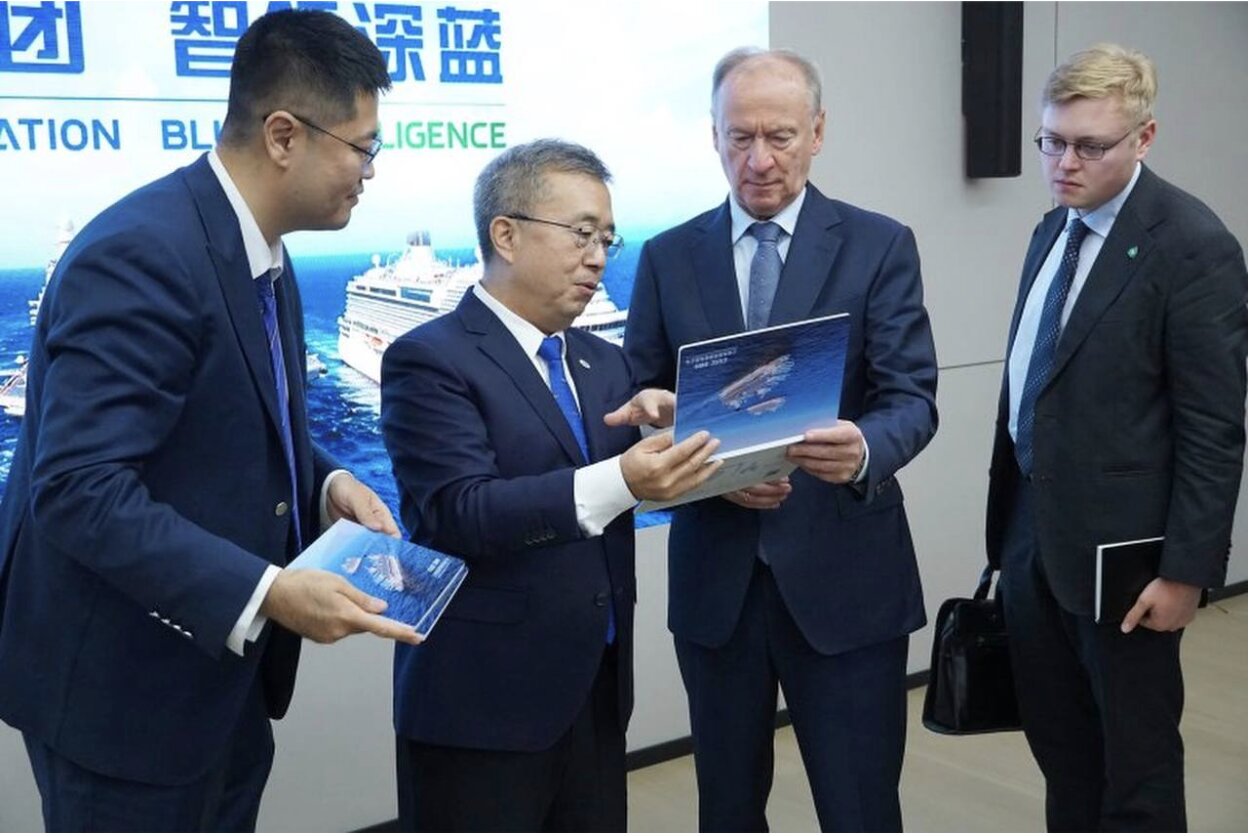
In Brief
INTERNAL
China expands financing to multilateral development institutions
On 09 October, AA News reported that China’s contributions to multilateral development institutions had increased more than tenfold since 2010, exceeding USD 3 billion in 2024. The study examined China’s role in multilateral development banks, climate funds and development-oriented United Nations agencies. China’s contributions have increasingly supported concessional lending programmes, particularly the World Bank’s International Development Association. Its attributable multilateral development bank climate finance also reached approximately USD 5.3 billion by 2025. However, the study found that China’s support remains selective, with comparatively limited contributions to voluntary UN funds and specialised climate funds. The findings add to debates over how China’s growing economic weight should translate into greater responsibility for international development and climate finance.
(“China’s multilateral development funding rises tenfold since 2010: Study,” AA News, 09 October 2026)
https://share.google/CwPzpYVCV31G6H81I
ENERGY AND ENVIRONMENT
Shanghai and Hong Kong face heightened sea-level rise risks
On 11 October, the South China Morning Post reported that sea levels around coastal cities such as Shanghai and Hong Kong could rise 15 to 20 per cent more than the global average because of melting Antarctic ice. Scientists explained that melting Antarctic ice changes the region’s gravitational pull, redistributing ocean water toward distant coastlines. The research warns that China’s densely populated coastal areas could face increased flooding risks this century, even if global warming is limited to 1.5 degrees Celsius. Lead researcher Lin Yucheng of City University of Hong Kong said Antarctica had a 92 per cent probability of losing ice mass during this century under that warming scenario. The findings highlight the need for coastal adaptation, stronger flood protection and climate-resilient urban planning.
(“China’s rich coastal cities to see sea-level rise up to 20% higher than global average,” The South China Morning Post, 11 October 2026)
https://www.scmp.com/news/china/science/article/3370255/chinas-rich-coastal-cities-see-sea-level-rise-20-higher-global-average?module=top_story&pgtype=subsection
CHINA AND TAIWAN
China places sanctions on ministers of Paraguay and Belize over Taiwan ties
On 12 October, Reuters reported that China has sanctioned Paraguay's communications minister and the foreign minister of Belize over their ties with Taiwan. Paraguay and Belize are two of twelve countries which officially recognize Taiwan, a claim which is rejected by China. Despite the sanctions being symbolic, China’s foreign ministry cited national sovereignty and security threats as reasoning for the measures. The sanctions come after Belize’s Foreign Minister Francis Fonseca met with his Taiwan counterpart Lin Chia-lung and Paraguay’s Minister of Information and Communication Technologies Gustavo Villate met with Taiwan’s Deputy Foreign Minister Chen Ming-chi. China’s Foreign Ministry Spokesperson Mao Ning stated that the officials were “willing to serve as pawns,” and that they “have seriously interfered in China’s internal affairs, spread false information about Chinese cyberattacks and attacked and smeared China, causing a bad international impact.”
(“China sanctions 'pawn' Paraguay, Belize ministers over Taiwan ties,” Reuters, 12 October 2026)
https://www.reuters.com/world/china/china-sanctions-paraguay-belize-ministers-over-taiwan-ties-2026-10-12/
CHINA AND EAST ASIA
China cut back on foreign aid along with the US and Japan to the region
On 11 October, ABC News reported that China, the US and Japan have slowed developmental aid to Southeast Asia, reaching an all-time low in a decade. In a report released by Australia-based think tank Lowy Institute, official developmental finance to the region fell by nearly 10 per cent to USD 26 billion as early as 2024, and China is also looking to cut aid rather than fill the gap left behind by the US and Japan. China’s aid to the region dropped nearly by 25 per cent, falling to USD 5.3 billion in 2024. Research Fellow and one of the lead authors of the report, Rahul Nath stated that slower domestic growth in China and Beijing being selective on projects are some of the reasons for China’s cutbacks.
(“US, China and Japan cut foreign aid to South-East Asia as development finance plummets,” ABC News, 11 October 2026)
https://www.abc.net.au/news/2026-10-11/china-us-japan-cut-aid-to-south-east-asia-lowy-report/107249020
CHINA AND SOUTH ASIA
China and Sri Lanka prepare to mark major diplomatic milestones in 2027, says Daily Mirror
On 10 October, Daily Mirror reported that Sri Lanka and China had begun preparations to commemorate two important bilateral anniversaries in 2027: The 70th anniversary of diplomatic relations and the 75th anniversary of the Rubber-Rice Pact. Sri Lankan Foreign Affairs, Foreign Employment and Tourism Minister Vijitha Herath discussed the preparations and bilateral cooperation during a meeting with China’s Ambassador to Sri Lanka, Wei Huaxiang. The Rubber-Rice Pact was signed in 1952, five years before Sri Lanka and China formally established diplomatic relations in 1957. The agreement provided a framework for economic exchange, with Sri Lanka supplying rubber and China supplying rice. It is widely regarded as an important early milestone in their economic relationship. The planned commemorations provide an opportunity for both countries to highlight the historical foundations of their engagement and discuss future cooperation. The anniversaries also come amid continued Chinese involvement in Sri Lankan infrastructure and economic development. The meeting reflects an effort to connect the history of bilateral cooperation with current diplomatic priorities, although the report does not provide a detailed programme of events or specific new agreements arising from the discussions.
(“Sri Lanka, China to mark key diplomatic milestones in 2027,” Daily Mirror, 10 October 2026)
https://www.dailymirror.lk/breaking-news/Sri-Lanka-China-to-mark-key-diplomatic-milestones-in-2027/108-352247
Flood damage to China trade routes drives up prices for Nepali shoppers during Dashain, says Reuters
On 11 October, Reuters Connect published photographs and accompanying captions documenting the impact of disruptions to Nepal's imports from China during the Dashain festival period. The material describes rising prices and shortages in Kathmandu markets following the 26 August floods along the Tibet-Nepal border, which damaged infrastructure and interrupted three major northern trade routes: Rasuwagadhi, Tatopani-Khasa and Korala. Prices for some goods reportedly increased by as much as 50 per cent. Rasuwagadhi has remained closed since floodwaters damaged customs facilities, roads and related infrastructure. China also halted trade through Tatopani, citing landslide risks. Traders subsequently turned to Korala in Mustang, but heavy rainfall in late September disrupted the Beni-Jomsom Road, preventing cargo from reaching Kathmandu. Reuters report that approximately 200 containers and hundreds of electric vehicles remained stranded in Mustang. The disruption affected goods ordered for the festive season, including clothing and vehicles, as well as supplies intended for later festivals and the winter period. The episode highlights Nepal's dependence on vulnerable Himalayan Road corridors for northern trade. It also illustrates how natural disasters can quickly affect consumer prices, supply availability and businesses far beyond the immediate disaster zone.
(“Nepali Shoppers Hit With Price Surge As August Flood Hits Imports From China During Festive Season Of Dashain,” Reuters Connect, 11 October 2026)
https://www.reutersconnect.com/item/nepali-shoppers-hit-with-price-surge-as-august-flood-hits-imports-from-china-during-festive-season-of-dashain/dGFnOnJldXRlcnMuY29tLDIwMjY6bmV3c21sX01UMU5VUlBITzAwMEtEVE5SUA
CHINA AND RUSSIA
Russia seeks to enhance shipbuilding cooperation with China
On 12 October, SCMP reported that Russia is seeking deeper shipbuilding cooperation with China as it expands its maritime capacity and develops Arctic trade routes. During a six day visit to China, president Putin’s aide Nikolai Patrushev discussed Chinese firms becoming technology partners and equipment suppliers for new Russian shipyards. He proposed jointly building ice-class vessels in Russia, including ships for Chinese Arctic operations, as Moscow develops its trans Arctic transport corridor. Patrushev also explored joint research and maritime training with Shanghai Jiao Tong University and potential Chinese investment in Russian port infrastructure.
(“Putin aide looks to boost Russian shipbuilding ties with China during visit,” South China Morning Post, 12 October 2026)
https://www.scmp.com/news/china/diplomacy/article/3370497/putin-aide-looks-boost-russian-shipbuilding-ties-china-during-visit
CHINA AND THE AMERICAS
Beijing and Brussels to expand cooperation in new energy, and AI
On 10 October, SCMP reported that China and the European Union concluded a second round of trade talks in Beijing, agreeing to expand cooperation in new energy, artificial intelligence, digital trade and green technologies while managing disputes through the WTO framework. Discussions focused on electric and hybrid vehicles, with Beijing pledging to reduce hybrid exports to Europe as the EU advances a minimum import price mechanism. Both sides also addressed market access for medical devices, agricultural products, renewable energy financing, and dual-use trade. They further agreed to strengthen supply chain coordination and explore removing sanctioned companies from their respective restriction lists.
(“China hails ‘constructive’ trade talks with EU as both sides seek ties in AI, new energy,” South China Morning Post, 10 October 2026)
https://www.scmp.com/economy/policy/article/3370435/china-hails-constructive-trade-talks-eu-both-sides-seek-ties-ai-new-energy
China Reader Daily Wire | 10 October 2026, Saturday | Vol 3 No. 153
Second EU-China trade talks result in consensus on hybrid cars and rare earth exports
Afghanistan inaugurates new road connection to China in Badakshan Province
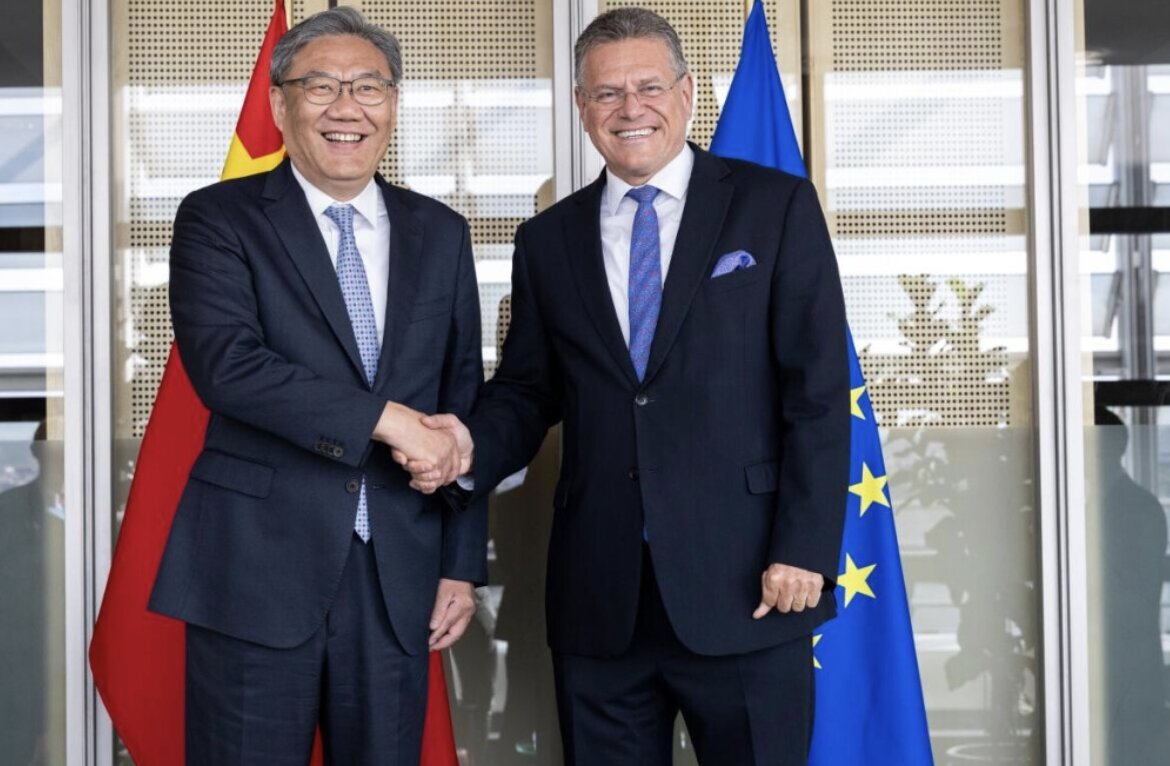
In Brief
INTERNAL
China unveils a 19-point plan to develop a new quality productive workforce
On 10 October, CGTN reported that China unveiled 19 key measures to accelerate the development of new quality productive forces, outlined in a document jointly issued by the Communist Party of China Central Committee and the State Council on 09 October. The measures focus on innovation in science and technology, industrial development, institutional mechanisms and talent management, guided by four principles: innovation-driven development, reform as an enabler, adaptation to local conditions, and establishing the new before phasing out the old. The plan calls for strengthening enterprises' role in technological innovation, including R&D reserve funds and higher tax deductions for R&D spending, alongside the comprehensive rollout of the "AI Plus" initiative and national AI testing bases. It also proposes advancing an energy revolution, including advanced nuclear fission technologies and a renewable-heavy power system, to support carbon neutrality goals.
("China rolls out 19 measures across 5 innovation areas to advance new quality productive forces," CGTN, 10 October 2026)
https://news.cgtn.com/news/2026-10-10/China-rolls-out-19-measures-to-advance-new-quality-productive-forces-1R7ziRQWdRC/p.html
China set to resume refined fuel exports after holiday pause
On 09 October, Reuters reported that China was set to resume October refined fuel exports after a brief halt during its Golden Week holiday, according to traders, a move expected to modestly ease tight global diesel, gasoline, and jet fuel markets. Beijing approved around 3.7 million metric tonnes of exports across the three fuels for October, down from slightly over 04 million tonnes expected in September, after it began curbing exports in March to safeguard domestic supplies amid the Iran war's disruption to Middle East oil flows. Analysts said the impact would be limited as markets remained tight overall, with Middle Eastern supplies still disrupted. Chinese exports of the three fuels totalled 19 million tonnes between January and August, down 21 per cent year-on-year, according to customs data.
("China to resume October fuel exports after holiday pause, sources say," Reuters, 09 October 2026)
https://www.google.com/url?opi=89978449&q=https://www.reyear on yearsiness/energy/china-resume-october-fuel-exports-after-brief-halt-four-trade-sources-say-a=U&ved=2ahUKEwj7l9eW1a6XAxVxj-EIHbmUHsUQxfQBKAB6BAgJEAE&usg=AOvVaw1NVUA6oUpuX93zyvQa8ZzB
SCIENCE AND TECHNOLOGY
New guideline to establish a pilot base for the industrial application of AI
On 09 October, Reuters reported that China will tighten regulations on its advanced technology industries, seeking to curb investment bubbles and to ensure that AI remains “safe, reliable and controllable.” Quoting Xinhua, the cabinet's new safety guidelines would seek breakthroughs in AI theory and core technologies, strengthen computing power and data, and establish a pilot base for the industrial application of AI. The guidelines also called for stricter AI regulations, risk-warning and emergency-response systems. China will also begin implementing its “AI Plus” initiative, which uses AI to upgrade and transform traditional industries.
(“China vows to curb tech bubbles, keep AI risks in check,” Reuters, 09 October 2026)
https://www.reuters.com/world/asia-pacific/china-issues-guidelines-new-productive-forces-including-ai-2026-10-09/
CHINA AND SOUTH ASIA
Editorial - “Modi and Xi can’t bridge the India-China divide by themselves,” SCMP, 10 Oct 2026
“First, people-to-people exchanges must be bolstered through reciprocal lowering of visa restrictions and travel barriers. Delhi could resume tourist and conference e-visas and issue longer-period, multi-entry visas to Hong Kong passport holders, which would mirror Hong Kong’s 14-day visa-free entry for Indian passport holders. Given that mainland and Hong Kong passports are distinct, there need be no worry that this overwhelms the Indian mirroring system. Second, China must recognise that the widening trade deficit in its favour does its image in India no favours. Prolonged weaponisation of chokepoints could spark an unwarranted push for decoupling. Third, China and India should build working-level trust through fighting for the Global South. There are clear domains where Indian and Chinese entrepreneurs can collaborate on global public goods needed by many emerging economies, such as pharmaceuticals, renewable energy and food. Both sides must resist the temptation to impose chokepoints for strategic leverage.”
Afghanistan inaugurates new road connection to China in Badakshan Province
On 09 October, Asia Times reported that Afghanistan has inaugurated a 121-kilometre road through the Wakhan Corridor, connecting Broghil to China’s border in the Badakshan Province. The road was primarily built by Afghan engineers, with an estimated 5.5 million 121-kilometre road reflects recent Afghan criticism of Pakistan, accusing the latter of destabilising the border regions through regular airstrikes and the use of proxy groups. The new road gives China a possible alternative route to Afghanistan and the wider Central Asia region. The road can also help China reduce dependency on Pakistan and the CPEC, which has come under attack by militant groups in Balochistan. However, currently, only a small number of commercial crossings use the route, and it can also help China ("Afghan road to China tests Pakistan’s power and leverage,” Asia Times, 09 October 2026)
https://asiatimes.com/2026/10/afghan-road-to-china-tests-pakistans-power-and-leverage/
CHINA AND AFRICA
Ecobank joins China’s CIPS to expand settlement of Yuan across Africa
On 09 October, Reuters reported that Ecobank, which operates in 34 African countries, plans to join China’s Cross-Border Interbank Payment System (CIPS) to facilitate yuan-denominated transactions and strengthen financial links between Africa and China. CEO Jeremy Awori said the agreement would provide businesses with more direct settlement options. Ecobank is also negotiating with the Bank of China to jointly offer yuan settlement services. The move reflects growing African demand for alternatives to dollar-based transactions amid expanding China–Africa trade. Standard Bank and the Bank of China will jointly offer yuan settlement services, similar to other initiatives, as bilateral trade rose nearly 18 per cent in 2025.
(“Ecobank to join China's CIPS payments platform for yuan settlement,” Reuters, 09 October 2026)
https://www.reuters.com/world/asia-pacific/ecobank-join-chinas-cips-payments-platform-yuan-settlement-2026-10-09/
CHINA AND RUSSIA
Beijing gains exposure to jet-powered drone in Moscow military exercise, reports The Telegraph
On 09 October, The Telegraph reported that Russia used the Centre-2026 military exercise to share battlefield lessons from its war in Ukraine with China and six other participating countries. More than 47,000 troops trained in drone swarms, robotic systems, counter-drone warfare, and coordinated ground assaults. China allegedly gained exposure to Russia’s jet-powered Geran-4 and Geran-5 drones, which are reportedly faster and harder to intercept. Analysts believe that these lessons could influence China’s military planning for Taiwan, particularly the use of mass drone attacks to overwhelm air defences. The exercises also demonstrate deeper Russian-Chinese military integration.
(“Russia teaches China how to use its jet-powered drones,” The Telegraph, 09 October 2026)
https://www.telegraph.co.uk/world-news/2026/10/09/russia-teaches-china-how-to-use-its-jet-powered-drones/
CHINA AND EUROPE
Second EU-China trade talks result in consensus on hybrid car and rare earth exports
On 09 October, Reuters reported that China and the European Union reached an understanding to reduce Chinese hybrid and plug-in hybrid car exports to Europe by several million vehicles over the course of four years, potentially cutting shipments by more than half. The agreement seeks to address the EU’s widening trade deficit, which exceeds EUR 1 billion daily. China also agreed to improve market access for approximately EUR 4 billion worth of European exports, including car parts, olive oil and footwear, while facilitating rare earth and magnet export licences. Although European automakers welcomed the dialogue, implementation remains uncertain, and broader trade disputes persist.
(“China, EU strike deal to halve Chinese hybrid exports,” Reuters, 09 October 2026)
https://www.reuters.com/world/china/china-eu-reach-hybrid-vehicle-trade-understanding-keep-talks-alive-ev-dispute-2026-10-09/
CHINA AND THE AMERICAS
Washington condemns Beijing’s maritime activities off Taiwan as “deeply destabilising”
On 10 October, CNA reported that the United States has criticised China’s expanding maritime activities off Taiwan’s east coast, describing them as “deeply destabilising” and warning that they increase regional tensions. The concern follows the reported sighting of a Chinese maritime militia vessel in August. Taiwan suspects these activities could support preparations for a maritime blockade, potentially disrupting vital supply routes from allied countries. Washington urged Beijing to end pressure on Taiwan and pursue dialogue with its democratically elected authorities. The developments heighten concerns over regional security and freedom of navigation.
(“US says China's maritime actions off Taiwan 'deeply destabilising',” Channel News Asia, 10 October 2026)
https://www.channelnewsasia.com/east-asia/us-says-chinas-maritime-actions-taiwan-deeply-destabilising-6448331
China Reader Daily Wire | 09 October 2026, Friday | Vol 3 No. 152
EU’s industry group calls for stronger action against China’s unfair trade practices
Road blockades disrupt Nepal-China trade at all three major northern crossings

In Brief
INTERNAL
China’s limited stimulus measures fail to address mounting economic problems, says WSJ
On 08 October, The Wall Street Journal reported that China’s government was adopting limited economic measures despite mounting challenges, including a prolonged property crisis, unemployment among graduates and weak corporate profits. China’s economy grew by 4.3 per cent year-on-year in the second quarter of 2026, its slowest pace in more than three years. Recent measures include one-year mortgage subsidies for eligible first-time homebuyers, increased infrastructure financing and a USD 54 billion capital injection into eight major banks and insurers. However, economists said these interventions were insufficient to revive domestic demand and address financial risks linked to property developers and local government debt. President Xi Jinping continues to prioritise advanced manufacturing and technological self-reliance. Analysts warned that avoiding large-scale household assistance and deeper reforms could prolong deflationary pressures and weaken economic growth.
(“China Is Offering Half Measures to Its Mounting Economic Problems,” The Wall Street Journal, 08 October 2026)
https://www.wsj.com/world/china/china-is-offering-half-measures-to-its-mounting-economic-problems-3074211f
NUCLEAR
China’s scientists develop first operating nuclear clocks with Austrian researchers
On 08 October, India Today reported that scientists in China and Austria had independently developed the world’s first operating nuclear clocks. The research teams, including scientists from Tsinghua University and TU Wien, published their findings in Nature on 07 October. The clocks use thorium-229 nuclei embedded in calcium fluoride crystals and lasers to measure transitions within the atomic nucleus, unlike conventional atomic clocks, which track electron transitions. The technology could eventually improve precision in satellite navigation, telecommunications and data synchronisation. It may also help scientists investigate dark matter and test fundamental theories of physics. However, the new devices do not yet outperform the most precise existing optical atomic clocks. Researchers must improve their accuracy and stability before the technology can be widely used.
(“World's first nuclear clock is ready: What is it, and why does it matter?,” India Today, 08 October 2026)
https://www.indiatoday.in/amp/science/story/nuclear-clock-breakthrough-austria-china-build-worlds-first-operating-devices-3012281-2026-10-08
CHINA AND TAIWAN
Chinese maritime militia boat spotted off Taiwan’s east coast for first time
On 08 October, Reuters reported that a Chinese maritime militia fishing boat was spotted operating alongside a coast guard cutter and a research vessel off Taiwan’s eastern coast in August. Taiwan’s Apex Aviation identified the fishing boat as Minfudingyu 07902. The three vessels were detected more than 30 nautical miles off Hualien County, an area considered important for Taiwan’s potential wartime supply routes. Taiwanese officials said the vessels were operating in an area not commonly used by Chinese ships and linked the activity to maritime pressure drills. They warned that China could be using civilian, paramilitary and research vessels to practise for a potential blockade. However, the surveillance report could not establish the vessels’ specific missions or confirm coordination between them. China’s authorities did not respond to Reuters’ requests for comment.
(“EXCLUSIVE: China militia boat spotted for first time off Taiwan's east coast, patrol finds,” Reuters, 08 October 2026)
https://share.google/X0aysBZDFtv07BScR
CHINA AND SOUTH ASIA
India’s steel demand growth may offset China’s slowdown, says Shanghai Metals Market
On 09 October, Shanghai Metals Market (SMM) published an analysis examining whether India’s expanding steel demand can compensate for the slowdown in China, the world’s largest steel-consuming market. The article draws on the World Steel Association’s April 2026 outlook, which projected Indian finished steel demand to rise from 159.8 million tonnes in 2025 to 171.6 million tonnes in 2026. Chinese demand, by comparison, was projected to decline from 796 million tonnes to 784.1 million tonnes. On these estimates, India’s additional demand of 11.8 million tonnes would nearly offset China’s projected 11.9-million-tonne contraction. However, SMM cautions that the comparison does not mean India can replace China’s influence on the international steel market. China’s market remains approximately 4.6 times larger than India’s, making global demand sensitive to even modest changes in Chinese consumption. Continued weakness in China’s property sector, including declining construction starts and real-estate investment, could further affect steel demand. The article also highlights India’s expanding domestic production capacity and the importance of distinguishing consumption growth from import demand. Higher Indian consumption can be met by domestic mills rather than overseas suppliers. SMM concludes that India is becoming a more important source of global steel demand, but the impact on international prices will depend on Chinese demand, Indian production growth and actual cross-border trade )
(“Can India's Steel Demand Growth Offset China's Slowdown?”, Shanghai Metals Market, 09 October 2026)
https://news.metal.com/newscontent/104147780-smm-analysis-can-indias-steel-demand-growth-offset-chinas-slowdown
China's rise, geopolitical shift and AI could test India's 2047 vision says India's CEA
On 08 October, Mint reported that Chief Economic Adviser V Anantha Nageswaran had identified geopolitical realignment, supply-chain dependencies, China’s industrial scale, climate volatility, artificial intelligence and demographic change as major factors shaping India’s ambition to become a developed economy by 2047. Nageswaran argued that the international environment is increasingly characterised by power and bargaining, requiring India to negotiate from a position of strength and build coalitions that it can help shape. China’s manufacturing capacity and position in global supply chains form a central part of this assessment. India’s long-term development will depend partly on how effectively it manages strategic dependencies and strengthens its domestic industrial capabilities. The changing international order also creates uncertainty for countries seeking access to technology, investment and critical supplies. Artificial intelligence presents another challenge, as its effects will interact with India’s demographic profile, productivity and capacity to create employment. The assessment places India’s 2047 development objective within a wider strategic and economic context rather than treating it solely as a domestic growth target. It highlights the relationship between economic resilience, technological adaptation and foreign policy choices. For India, reducing vulnerabilities while sustaining international economic engagement will be important as competition among major powers influences supply chains, technology access and the terms of global economic cooperation.
(“Geopolitics, China, and AI to test India’s 2047 ambitions: CEA Nageswaran,” Mint, 08 October 2026)
https://www.livemint.com/news/geopolitics-china-and-ai-to-test-india-s-2047-ambitions-cea-nageswaran-11791462746469.html
Road blockades disrupt Nepal-China trade at all three major northern crossings
On 08 October, Ratopati reported that trade between Nepal and China had been disrupted after road blockades and monsoon-related damage affected all three major northern border crossings: Rasuwagadhi, Tatopani and Korala. The Rasuwagadhi crossing was rendered inoperable after flooding in the Bhote Koshi River destroyed customs facilities, roads and other infrastructure. China subsequently halted trade through Tatopani, citing landslide risks. Traders then relied more heavily on Korala in Mustang, but heavy rainfall and landslides along the Beni–Jomsom road also halted movement through that route. The disruption has left substantial quantities of cargo stranded. According to the report, approximately 200 containers and hundreds of electric vehicles that entered Nepal through Korala were stuck in Mustang. The timing is particularly significant because the interruptions occurred ahead of Nepal’s Dashain festival, when demand for imported goods typically increases. Traders and consumers face the prospect of longer delivery times, higher transport costs and price increases as supply chains remain disrupted. The situation demonstrates the vulnerability of Nepal’s northern trade infrastructure to floods, landslides and road closures. Although Nepal has sought to diversify its trade and connectivity through China, the functioning of these routes depends on reliable road access across difficult Himalayan terrain. The simultaneous disruption of all three crossings also highlights the need for resilient infrastructure, alternative transport arrangements and closer disaster-risk coordination between Nepal and China.
(“Nepal-China Trade Disrupted at Key Border Crossings Due to Road Blockades,” Ratopati, 08 October 2026)
https://english.ratopati.com/story/82860/floods-and-landslides-halt-trade-at-all-three-northern-border-points-consumers-hit-by-price-hikes-photos
CHINA AND MIDDLE EAST
Opinion: Asda Ullah, “It’s time for China to offer more than statements on Hormuz,” SCMP, 08 October 2026
“Beijing does not need to replace Washington as the Gulf’s security guarantor. However, it does need to show that its access can produce something more durable than another call for restraint. China’s diplomacy has been rich in principles and thin on procedures. It means China should say what it will actually do: put proposals on the table, name a venue and be clear about what it will ask of Iran as well as of the United States. China could lend its support to a standing Gulf crisis management mechanism, one with a deliberately modest mandate that is built alongside Iran and the Gulf states. The test is not whether China can replace the US in the Gulf. It is whether its influence can keep any miscalculation from spilling over into a wider war.”
Egypt-Ethiopia tension renews strategic challenges for Beijing, says Al Monitor
On 08 October, Al Monitor reported that renewed Egypt-Ethiopia standoff over water rights on the Nil, and access to the Red Sea threatened China’s strategic and economic interests in both countries. Egypt fears the Grand Ethiopian Renaissance Dam (GERD) could jeopardise its water security, while Ethiopia considers it essential for electricity generation and economic development. Both countries are important Chinese partners, with extensive cooperation in infrastructure, trade, manufacturing and energy under Beijing’s Belt and Road Initiative. During Xi Jinping’s visit to Egypt in September 2026, China endorsed Cairo’s concerns about Nile water security and littoral states’ authority over Red Sea governance,e thereby potentially straining relations with landlocked Ethiopia. Escalation could destabilise northern Ethiopia, disrupt transport links connecting Ethiopian industrial centres to Djibouti’s ports, increase costs and discourage investment. However, China lacks a strong regional mediation record. Analysts suggest Beijing may adopt a wait-and-see approach, balancing bilateral relationships while encouraging stability, particularly as Washington is not actively mediating the dispute.
(“Why renewed Egypt-Ethiopia tensions are a problem for China,” Al Monitor, 08 October 2026)
https://www.al-monitor.com/originals/2026/10/why-renewed-egypt-ethiopia-tensions-are-problem-china
CHINA AND AFRICA
Beijing provides Nairobi USD 2 million for drought relief and Ebola preparedness
On 08 October, Capital FM 98.4 Africa reported that China provided Kenya with a USD 2 million grant to strengthen drought response and preparedness for potential Ebola outbreaks. China’s Ambassador Guo Haiyan and Kenya’s National Treasury Principal Secretary Chris Kiptoo signed the grant handover certificate in Nairobi, with Public Health Principal Secretary Mary Muthoni in attendance. The funding allocates USD 1 million to Ebola preparedness infrastructure in high-risk counties and another USD 1 million to drought relief. The assistance is followed by Kenya’s confirmation of its first imported Bundibugyo Ebola case.
(“China gives Kenya $2 million for drought relief, Ebola preparedness,” Capital FM 98.4, 08 October 2026)
https://capitalfm.africa/china-gives-kenya-2-million-for-drought-relief-ebola-preparedness/
CHINA AND EUROPE
EU’s industry group calls for stronger action against China’s unfair trade practices
On 08 October, Reuters reported that 44 European industry associations called on European Union member states to take urgent action against alleged unfair Chinese trade practices, warning that they threaten European manufacturing and could lead to further job losses. Representing sectors including metals, chemicals and automotive components, they highlighted the EU’s growing trade deficit with China, which exceeds EUR one billion daily. They urged the European Commission to strengthen trade defence measures, address state-driven market distortions, accelerate complaint processing by increasing staffing, and assess entire value chains without harming partners such as Britain, Norway and Switzerland. EU leaders are preparing to discuss expanded trade protections as Trade Commissioner Maroš Šefčovič seeks Chinese export concessions, potentially targeting hybrid vehicles.
(“European industry groups call for urgent EU action on China trade,” Reuters, 08 October 2026)
https://www.reuters.com/world/china/european-industry-groups-call-urgent-eu-action-china-trade-2026-10-08/
CHINA AND THE AMERICAS
Washington investigates nine universities over allegations of visa fraud and Chinese influence
On 09 October, SCMP reported that the Trump administration has launched investigations into nine prominent US universities, including Harvard, Yale, MIT and Stanford, over alleged J-1 visa fraud and potential foreign interference in federally funded research. Officials, including Vice President JD Vance, expressed concerns that China could exploit academic institutions to access American technology and intellectual property. Subpoenas have been issued to the universities to examine visa compliance, financial relationships and foreign influence. Four institutions emphasised legal compliance or pledged cooperation. The investigation accompanies broader restrictions on international student employment and alleged abuses ofemployment-basedd immigration programmes, reflecting Washington’s heightened scrutiny of foreign talent.
(“US probes Harvard, Yale, MIT, other universities over alleged visa fraud, with China focus,” South China Morning Post, 09 October 2026)
https://www.scmp.com/news/us/article/3370239/us-investigates-9-universities-over-alleged-visa-fraud-focus-china
China Reader Daily Wire | 08 October 2026, Thursday | Vol 3 No. 151
EU-China trade negotiations kick off in Beijing; Focus on trade deficits and restrictions
Nepal seeks reopening of Tatopani while restoration of Rasuwagadhi continues
In Brief
CHINA AND EUROPE
EU-China trade negotiations kick off in Beijing; Focus on trade deficits and restrictions
On 08 October, AFP and SCMP reported that a new round of trade negotiations between EU officials and Chinese counterparts has started in Beijing. The China Chamber of Commerce to the EU has urged both sides to use the existing Trade and Investment Consultations (TIC) mechanism to manage disputes, find solutions, and provide clearer signals to businesses. Major discussions are centred on rare earth export restrictions and rebalancing trade deficits. The latest literature views these talks as a damage-control exercise aimed at preventing a full-scale deterioration in economic relations. EU Trade Commissioner Maroš Šefčovič identifies three opportunities, which include addressing surging imports in strategically important sectors, increasing European exports to China, and improving access to critical raw materials.
("In Beijing, EU trade envoy says deficit with China 'unsustainable'," AFP, 08 October 2026; "As China and the EU begin crunch trade talks, optimism is in short supply," SCMP, 08 October 2026)
https://www.scmp.com/economy/china-economy/article/3370119/china-and-eu-begin-crunch-trade-talks-optimism-short-supply
https://www.msn.com/en-us/news/other/in-beijing-eu-trade-envoy-says-deficit-with-china-unsustainable/ar-AA2dMr52?ocid=BingNewsSerp
INTERNAL
Global investors return to Chinese equities after four-year retreat says latest report
On 08 October, SCMP reported that global investors were raising their exposure to Chinese equities after years of cautious positioning, drawn by relatively cheap valuations and opportunities in artificial intelligence, according to a Bank of America analysis of 2,767 global funds. Active long-only funds have shifted their average allocation to Chinese equities from underweight to benchmark-neutral since June, ending four years of underweight positioning, with the funds managing USD 562 billion in Chinese stocks. BlackRock remained neutral on Chinese equities but flagged opportunities in physical AI, while UBS Asset Management described China as "a key opportunity," citing attractive valuations in technology and advanced manufacturing. The MSCI China Index traded at around 10.2 times forward earnings as of 30 September, below its 10-year average, with China and Hong Kong-focused ETFs recording USD 19 million in inflows in August, reversing USD 1.94 billion in outflows the previous month.
("More global investors eye Chinese equities, ending 4-year underweight run, bank says," South China Morning Post, 08 October 2026)
https://amp.scmp.com/business/china-business/article/3370035/more-global-investors-eye-chinese-equities-ending-4-year-underweight-run-bank-says?module=top_story&pgtype=homepage
China Opinion: Danny Vincent, “China’s succession crisis: a generation of entrepreneurs is retiring, but are their children ready to take over?,” The Guardian, 08 October 2026
“By the mid-eighties, Chinese economists had a name for this type of bottom-up economic growth story: the Wenzhou model. It was a system that saw small companies secure finances through family connections and operate underground factories to produce cheap goods that would end up on the busy streets of China and beyond … According to HSBC Life research, two-thirds of wealthy Chinese people have no legacy plan … According to official estimates, China’s private sector accounts for more than half of the country’s tax revenue and 60% of its GDP. Economists say unsuccessful handovers can lead to firms losing value or even closing. Because family-run companies represent such a large percentage of China’s private sector, if they fail in the thousands, it could threaten the country’s future growth.”
https://www.theguardian.com/world/2026/oct/08/china-succession-crisis-factory-workers-manufacturing-family-businesses
CHINA AND TAIWAN
Taiwan says US commitment to the island is unchanged
On 07 October, The Mint reported that Taiwan’s Defence Minister Wellington Koo stated that the US’ commitment to the island has not changed. Addressing the parliament, he further added that US President Donald Trump is yet to approve a USD 14 billion arms sale to Taiwan and that Washington has reaffirmed its commitment to sell arms to Taiwan, which the US is mandated by law to do so. However, Trump has delayed authorization for the proposed sale to Taiwan due to the ongoing negotiations with China, following the two bilateral meetings between Trump and President Xi Jinping.
(“Taiwan says US' commitment for island unchanged as Trump yet to approve $14 bn arms sale package amid truce with China,” The Mint, 07 October 2026)
https://www.livemint.com/news/us-news/taiwan-says-us-commitment-for-island-unchanged-as-trump-yet-to-approve-14-bn-arms-sale-package-amid-truce-with-china/amp-11791343187112.html
CHINA AND SOUTHEAST ASIA
China attempts to persuade top criminal syndicates in Myanmar to drop fraud business, says SCMP
On 06 October, SCMP reported that China had tried to persuade powerful crime syndicate families based in Northern Myanmar to close their online fraud operations per a documentary released by China’s Ministry of Public Security. In the documentary, the ministry showcased that Chinese authorities attempted to negotiate with the Bai, Wei, Liu and Ming families in Myanmar’s Kokang region; however, it fell through without any progress made. The Bai family has been involved in more than USD 2.9 billion in gains from illegal gambling and fraud websites, while the Wei family profited more than USD 764 million in similar fashion. China has executed 15 core members of the main criminal networks on various charges, ranging from murder to fraud and human trafficking. Over 76,486 people have been arrested between 2023 and September 2026, in operations targeting criminal networks in Myanmar.
(“China tried 3 times to talk crime families out of scam business in Myanmar: state media,” SCMP, 06 October 2026)
https://www.scmp.com/news/china/politics/article/3369886/china-tried-3-times-talk-crime-families-out-scam-business-myanmar-state-media
CHINA AND SOUTH ASIA
‘G2’ expectations remain uncertain after Xi-Trump summit says SCMP
On 08 October, South China Morning Post examined the implications of the Xi Jinping–Donald Trump summit, arguing that the meeting has raised questions over whether Washington and Beijing are being treated as equal powers rather than simply negotiating partners. The article points to the highly formalised nature of Xi’s US state visit, including the White House welcome and state dinner, as contributing to perceptions that China is being accorded a status comparable to that of the United States. It notes that other countries, particularly those without a seat at the negotiating table, are watching the relationship closely. The article distinguishes between the two sides’ approaches to the idea of “reciprocity.” It characterises the US approach as more transactional, in which concessions are exchanged and measured according to what each side receives. China, by contrast, is portrayed as seeking recognition of its status and equality in the relationship. The distinction suggests that an agreement between Washington and Beijing does not necessarily resolve deeper differences over the structure of the international order. For countries such as India and other members of the Global South, the article argues that the evolving US-China relationship creates uncertainty over their strategic space. The possibility of greater accommodation between Washington and Beijing could alter the assumptions on which other countries have built their external partnerships.
(“The ‘G2’ illusion? After Xi-Trump summit, China wants equality while the US seeks deals,” South China Morning Post, 08 October 2026)
https://www.scmp.com/news/china/diplomacy/article/3370028/g2-illusion-after-xi-trump-summit-china-wants-equality-while-us-seeks-deals
Nepal ready to reopen Tatopani and restore Rasuwagadhi border links with China, says India Today
On 07 October, India Today reported that Nepal is in discussions with China to resume transport services through the Tatopani border point, while restoration work continues at the heavily damaged Rasuwagadhi-Kerung crossing. Infrastructure Development Minister Sunil Lamsal told a parliamentary committee that the road on Nepal’s side of Tatopani had already been reopened and that there were no major obstacles to restarting operations from the Nepali side. However, Chinese authorities have not yet indicated readiness to resume the crossing. Tatopani has remained closed since 26 August, following severe monsoon-related flooding, landslides and continuing risks along the border and connecting highways. Rasuwagadhi suffered much more extensive damage during the 26 August high-altitude glacial collapse and rock-ice avalanche, which triggered a destructive debris flood through the Lhende, Bhotekoshi and Trishuli river systems. Nepal is undertaking infrastructure restoration in affected areas while maintaining discussions with Chinese authorities over reopening both routes. The disruption has affected two of Nepal’s principal overland links with China and highlighted the exposure of Himalayan trade infrastructure to climate and geological hazards. For Nepal, restoring the crossings is important for maintaining regular trade with Tibet and China, while the situation also strengthens the relevance of alternative northern routes such as Korala.
(“Nepal-China border reopening talks: Tatopani ready, Rasuwagadhi restoration under way,” India Today, 7 October 2026)
https://www.indiatoday.in/amp/world/story/nepal-china-border-reopening-talks-tatopani-ready-rasuwagadhi-restoration-under-way-ptag-3011409-2026-10-07
CHINA AND MIDDLE EAST
Chinese refiners stock up on Iraqi and Qatari crude as Iranian sources falls
On 06 October, Reuters reported that China’s independent oil refiners have increased Iraqi and Qatari crude oil purchases to replace the slowing Iranian supplies. Chinese refiners have bought at least 12 million barrels of Iraqi and Qatari crude, with some estimates ranging from 15-20 million barrels. Most of the purchases were Iraqi Basra Medium and Heavy crude and were bought by Hongrun Petrochemical, Qicheng Petrochemical, Qirun Petrochemical, Hualong and Chambroad Petrochemical. The purchases come after Iran’s oil exports to China fell to 590,000 barrels a day, and Iranian oil storage outside of the blockade zone fell to 45 million barrels from 100 million in July.
(“Chinese independent refiners boost Iraqi oil purchases as Iranian flows fall, traders say,” Reuters, 06 October 2026)
https://www.reuters.com/business/energy/chinese-independent-refiners-boost-iraqi-oil-purchases-iranian-flows-fall-2026-10-06/
CHINA AND AFRICA
South Africa’s exports to China surge amidst fresh US tariffs
On 06 October, Business Insider Africa reported that South African exports to China surged after Beijing enacted the two-year zero-tariff policy, taking effect from 01 May 2026. The policy is aimed at supporting regional industrialisation, with shipments of key metals, including chrome, magnetite, and iron ore, surging through South Africa’s Ngqura port. China’s zero-tariff policy extends to all African nations, excluding Eswatini because of its relationship with Taiwan, and amid the Trump administration enacting 12.5 per cent tariffs on South Africa, Nigeria, and five other nations since 24 July.
(“South African exports to China’s 1.4 billion-person market surge as U.S. slaps 12.5% tariffs on Africa,” Business Insider Africa, 06 October 2026)
https://africa.businessinsider.com/local/markets/south-african-commodities-flood-chinas-13-billion-person-market-as-beijing-drops/qmgpeqz
China Reader Daily Wire | 07f October 2026, Wednesday | Vol 3 No. 150
Beijing rejects EUs push for stronger trade protections
US and China discuss reciprocal nuclear site visits, reports CNN
In Brief
CHINA AND EUROPE
Beijing rejects EU’s push for stronger trade protection
On 07 October, CNA reported that China has urged France and Germany to reject what it describes as “protectionist” trade measures, amidst growing EU concerns over its trade deficit with Beijing. France’s President Emmanuel Macron and Germany’s Chancellor Friedrich Merz have proposed giving the European Commission stronger powers to respond rapidly to trade aggression, including restricting access to the EU single market. Beijing called for openness, cooperation and free trade, warning that protectionism could harm Europe also. China has also stressed that EU-China trade is mutually beneficial and urged both sides to resolve disputes through dialogue while maintaining stable global supply chains.
(“China warns France, Germany against 'protectionist' trade tools,” CNA, 07 October 2026)
https://www.channelnewsasia.com/world/china-france-germany-trade-eu-economy-6437411
SCIENCE AND TECHNOLOGY
China hosts 41 per cent of top AI researchers; Struggles to attract foreign talent
On 06 October, The New York Times reported that China now hosts 41 per cent of the world's top AI researchers by one measure, up from 27 per cent in 2022, while the US share fell from 46 per cent to 34 per cent. Despite this, Beijing struggles to recruit foreign researchers, with far more Chinese researchers moving to the US than the reverse. For every 30 Chinese AI researchers working in the US in 2025, only one made the opposite journey. At DeepSeek, 53.5 per cent of affiliated authors had never studied or worked outside China. Foreign recruits cited language barriers, academic-freedom concerns, and geopolitical tensions as key deterrents, even as China's AI talent gap exceeds 5 million professionals, according to its Ministry of Human Resources.
("In Race With U.S., China Struggles to Recruit Foreign A.I. Researchers," New York Times, 06 October 2026)
https://share.google/1cXjpX5F6Q4NvN4ry
CHINA AND EAST ASIA
North Korea defended Beijing’s “One China” policy; Blames the US for regional instability
On 07 October, The Korea Times reported that North Korea defended Beijing's "One China" policy while accusing the United States of supporting Taiwan independence and "escalating" tension in the region. The criticism came in an article titled "U.S. Is Acting Rashly" by international affairs analyst Kim Myong-chol, carried by the Korean Central News Agency (KCNA). He criticised the recent delivery of a US fighter jet to Taiwan by saying it is like planting a bomb at the gate of another's house and asserting the bomb is for ensuring the security of that house. He claimed munitions supplied by the U.S. to Taiwan through overseas arms sales over the past decade alone amounted to more than USD 39 billion. Kim warned Washington to “think twice” whether it is ready to stand a confrontation with the PRC for the security of Taiwan and cope with its consequences. North Korea and China have grown closer in recent years, following two summits, one in Beijing in September 2025 and the other in Pyongyang in June this year. During the latter summit, the two sides vowed to elevate their relationship to a "strategic partnership."
(“N. Korea backs China on Taiwan, blames US for regional instability,” The Korea Times, 07 October 2026)
https://www.koreatimes.co.kr/amp/foreignaffairs/northkorea/20261007/n-korea-backs-china-on-taiwan-blames-us-for-regional-instability
Hackers use Chinese AI tool to breach seven banks in South Korea
On 06 October, Quartz News reported that South Korea's National Police Agency opened an investigation into cyberattacks that used a Chinese-developed AI tool, Artex AI, to breach at least seven South Korean financial firms, exposing data belonging to 68,000 people. The attacks, first detected last week, compromised Shinhan Bank, affecting 25,000 customers, and Kookmin Bank, exposing credit card data for 119,000 clients, with Hana Bank suffering a more limited breach. Artex, built by Chinese engineer Li Puhua as an open-source vulnerability-testing tool, draws on external AI models, including Anthropic's and OpenAI's, to automate attack planning with minimal human input. President Lee Jae Myung ordered officials to act swiftly, with South Korean cybersecurity stocks jumping as much as 30 per cent following the news. Investigators said the attacks originated from over two dozen internet addresses across roughly a dozen countries and were seeking international cooperation to identify those responsible.
("Hackers used a Chinese AI tool to breach 7 South Korean banks," Quartz News, 06 October 2026)
North Korea-China transport links restored as new Yalu bridge nears opening
On 07 October, The Chosun Daily reported that North Korea-China transportation networks, severed in early 2020 due to the pandemic, had largely been restored after six years, with the New Yalu River Bridge, closed for 12 years, set to open soon. Since 2022, the two countries have resumed cargo trains, flights, and passenger rail services between Dandong and Sinuiju, with high-level exchanges reviving following North Korean leader Kim Jong-un's 2025 visit to Beijing and China's President Xi Jinping's June visit to Pyongyang, his first in seven years. Despite the pandemic-era thaw, ties had cooled between 2023 and 2024 amid North Korea's deepening military cooperation with Russia, before warming again following renewed high-level visits. Once fully operational, the four-lane bridge, built with Chinese funding, is expected to establish a new large-scale automobile logistics route between the two countries, though analysts noted North Korea's centralised trade control may limit any immediate expansion in civilian exchanges.
("North Korea-China Transportation Networks Restored, New Yalu Bridge Opens Soon," The Chosun Daily, 07 October 2026)
CHINA AND SOUTHEAST ASIA
"China plus one" strategy delivers uneven gains for Southeast Asia reports Fortune
On 05 October, Fortune reported that the "China plus one" supply chain shift, which drew billions of dollars into Southeast Asian factories, is delivering fewer benefits than regional leaders had hoped. Chung-Hua Institution for Economic Research’s (CIER) Meng-Chun Liu called the shift "a net gain... but a conditional and uneven one." UCLA's Christopher Tang said most new jobs remain low-skill assembly roles, since China's decades-built manufacturing ecosystem still dominates component production and logistics. Malaysia has carved a semiconductor niche, with data centre investment reaching nearly 18 per cent of GDP, the highest share globally, per HSBC. Queen Mary University's Lee Jones warned the trend risks "premature deindustrialisation" long-term, as Southeast Asia shifts from exporting goods to becoming a consumer market for Chinese products.
("Why the 'China plus one' supply-chain shift is paying off less than Southeast Asia hoped," Fortune, 05 October 2026)
https://share.google/9DJ05G4xcV7o26ddh
CHINA AND SOUTH ASIA
Sri Lanka reports growing presence of Chinese nationals in illegal cybercrime call centres
On 07 October, Sri Lanka Guardian reported that information obtained from Sri Lanka’s Computer Crime Investigation Division (CID) under the Right to Information Act indicates a significant number of foreign nationals, particularly Chinese nationals, among those arrested in raids on illegal call centres. According to the CID data cited by the publication, 408 people were arrested in five major raids conducted up to 31 July 2026, including 284 Chinese nationals, 59 Sri Lankans and 49 Vietnamese nationals. Of the 201 people arrested during the first seven months of 2026, 152 were Chinese nationals. The report describes these establishments as “boiler rooms” involved in financial fraud, phishing and cryptocurrency or foreign-exchange investment scams. It alleges that some foreign nationals were recruited through social media under the pretext of legitimate employment before being confined in rented properties and made to conduct fraudulent calls and messages. The article also describes the use of SIM boxes, VPNs and proxy technologies in the operations. These are claims reported by Sri Lanka Guardian based on the CID information and should not be treated as establishing criminal liability for all Chinese nationals in Sri Lanka. The report links the emergence of these networks to crackdowns on similar operations elsewhere in Southeast Asia. It also calls for tighter regulation of SIM cards, rented properties and cybercrime-related equipment, alongside greater international cooperation in investigations.
(“Sri Lanka’s Hidden Cybercrime Factories: Chinese Gangs Build a New Scam Hub,” Sri Lanka Guardian, 07 October 2026)
https://slguardian.org/sri-lankas-hidden-cybercrime-factories-chinese-gangs-build-a-new-scam-hub/?
Nepal seeks China’s approval to reopen Tatopani border crossing
On 06 October, Republica reported that Nepal is in regular discussions with China to resume operations at the Tatopani-Zhangmu border crossing, which has remained closed following floods, landslides and other disaster-related disruptions. Infrastructure Development Minister Sunil Lamsal told a parliamentary special committee that Nepal had already restored the road on its side and was ready to resume operations. He said discussions with Chinese officials were taking place almost daily. According to Lamsal, the remaining obstacle is on the Chinese side, which has not yet provided the “green signal” for reopening. He said Chinese authorities appeared reluctant to resume operations while disaster risks remained, particularly given continuing concerns over floods and landslides in the border region. Nepal is simultaneously working to restore the Rasuwagadhi-Kerung crossing, another major trade route with China that suffered severe damage during the August 26 disaster. The situation highlights the vulnerability of Nepal’s northern trade infrastructure to Himalayan hazards. With Tatopani closed and Rasuwagadhi severely damaged, Nepal’s ability to maintain regular overland trade with China has been constrained. At the same time, China has proposed developing Korala in Mustang as an international border point, potentially providing another northern trading option.
(“Nepal in talks with China to reopen Tatopani border crossing: Minister Lamsal,” Republica, 06 October 2026)
https://myrepublica.nagariknetwork.com/news/nepal-in-talks-with-china-to-reopen-tatopani-border-crossing-minister-lamsa-36-65.html
CHINA AND EUROPE
EU-China trade talks set to take place on hybrid car exports
On 07 October, The Guardian reported that EU trade negotiators are travelling to China for crucial talks aimed at reducing the bloc’s growing trade deficit, with Chinese hybrid electric vehicle exports emerging as a key issue. Brussels is seeking a measurable agreement that could initially limit hybrid car exports through voluntary restrictions or safeguards such as quotas. Tensions have intensified as Germany and France demand stronger protection for European industries and support a new rapid response trade instrument. Analysts warn that China could delay meaningful concessions through prolonged negotiations. Germany’s policy shift signals growing European concern over Chinese subsidies, industrial competition and deindustrialisation.
(“EU negotiators head to China hoping to curb cheap imports of hybrid electric cars,” The Guardian, 07 October 2026)
https://www.theguardian.com/business/2026/oct/07/eu-negotiators-head-to-china-hoping-to-curb-cheap-imports-of-hybrid-electric-cars
Beijing rejects EU’s push for stronger trade protection
On 07 October, CNA reported that China has urged France and Germany to reject what it describes as “protectionist” trade measures, amidst growing EU concerns over its trade deficit with Beijing. France’s President Emmanuel Macron and Germany’s Chancellor Friedrich Merz have proposed giving the European Commission stronger powers to respond rapidly to trade aggression, including restricting access to the EU single market. Beijing called for openness, cooperation and free trade, warning that protectionism could harm Europe also. China has also stressed that EU-China trade is mutually beneficial and urged both sides to resolve disputes through dialogue while maintaining stable global supply chains.
(“China warns France, Germany against 'protectionist' trade tools,” CNA, 07 October 2026)
https://www.channelnewsasia.com/world/china-france-germany-trade-eu-economy-6437411
CHINA AND THE AMERICAS
US and China discuss reciprocal nuclear site visits, reports CNN
On 06 October, CNN reported that the United States and China are informally discussing reciprocal visits to nuclear facilities as a potential confidence-building measure amidst concerns over China’s expanding nuclear arsenal and weakened global arms control safeguards. The proposal could involve visits to national laboratories, nuclear facilities and potentially testing sites, providing greater transparency and supporting future strategic stability negotiations. However, China remains unwilling to discuss limits on its nuclear buildup, citing the larger US and Russian arsenals. Experts view site visits as a possible foundation for reducing nuclear risks but remain sceptical about Beijing’s intentions and the prospects for a broader trilateral arms control agreement.
(“US and China discussing reciprocal nuclear site visits amid concerns about a new arms race,” CNN, 06 October 2026)
China Reader Daily Wire | 06 October 2026, Tuesday | Vol 3 No. 149
China-US trade rivalry moves towards patents and intellectual property rights
Russia shifts towards Chinese EVs amid fuel shortage
In Brief
INTERNAL
China accelerates consolidation of smaller banks amid economic slowdown
On 5 October, CNBC reported that China is accelerating the consolidation of smaller, mostly rural banks to shore up its financial system amid ongoing concerns about an economic slowdown. Beijing's policy-led consolidation saw a record 670 lenders closed in 2025, around a quarter of the country's banks, as authorities ramped up mergers and dissolutions to create fewer, larger, and better-capitalised institutions, according to Fitch Ratings analysis.
("China shuts hundreds of banks as Beijing moves to shore up its financial system," CNBC News, 5 October 2026)
https://share.google/nXuyL62JGVRfgV7bm
China Opinion: Sherry Wang, “How is China planning to build on its ‘engineer dividend’ in tech war with US?,” SCMP, 05 October 2026
“As China seeks to build on its “engineer dividend” – the advantage created by a vast pool of engineers built up over decades – it is directing more talent towards artificial intelligence and other hi-tech fields central to its competition with the US … The expansion would “strengthen basic and frontier research and drive breakthroughs in key technologies, building a strong force to support major national strategic priorities”, Guo Peng, the head of the ministry’s development planning department, said at a news conference in Beijing … China employed 41 per cent of the world’s leading AI researchers last year, pulling ahead of the US at 34 per cent, according to a study released last week by the Carnegie China think tank … National Development and Reform Commission chairman Zheng Shanjie told a news conference in March that China’s student populations for junior high, senior high and higher education would peak sequentially in 2026, 2029 and 2032. To manage that rolling wave of demand, Zheng said the government’s priorities for the next five years would include expanding high school capacity and building undergraduate capacity at top universities.”
https://share.google/0loc0hk6zOZPrRhA3
ENERGY AND ENVIRONMENT
China speeds up ultra-deep drilling to boost domestic energy security
On 06 October, South China Morning Post reported that China is accelerating ultra-deep oil and gas exploration to boost its domestic energy supply amidst growing global supply chain uncertainties. A primary focus is the Hade-Fuman oilfield in Xinjiang's Taklamakan Desert, where reservoirs sit over 6,000 meters underground. The Fuman field, the country’s largest ultra-deep field discovered in 2021, holds over one billion tonnes of oil and gas resources. To tap these complex reserves, PetroChina developed advanced drilling tools capable of averaging depths over 8,300 meters, roughly the height of Mount Everest. The field has already produced more than 26 million tonnes of oil equivalent. Beijing's push for energy security has intensified following recent disruptions in global energy corridors like the Strait of Hormuz. Under its current five-year plan, China aims to hit a domestic supply of 440 million tonnes of oil equivalent by 2030. To support this, the country plans to expand its pipeline network to 220,000 kilometres. At the same time, offshore projects like the Liuhua oilfield in Guangdong are being redeveloped using deepwater extraction technologies, pushing cumulative output past two million tonnes.
(“China taps ultra-deep oil reserves 6,000 metres deep as global energy turmoil continues,” SCMP, 06 October 2026)
https://sc.mp/q3sns?utm_source=copy-link&utm_campaign=3369859&utm_medium=share_widget
CHINA AND SPACE
China approaches 100-launch record with recent missions
On 01 October, Space News reported that China completed its ninth and tenth orbital launches of September 2026, bringing its yearly total to 70 attempts as it targets a record-breaking 100-plus launches. The recent missions deployed two main satellite groups. On 23 September, Guowang, a Long March 8A rocket, launched the 26th batch of satellites for China’s planned 13,000-satellite megaconstellation, designed to provide low Earth orbit internet. On 24 September, Yaogan-40, a Long March 6A rocket, carried three remote-sensing satellites into polar orbits for electromagnetic environment detection, completing the fourth of five projected orbital planes. To hit its annual goal, China must execute at least 31 launches in the final quarter of the year. The high-profile missions for the upcoming fourth quarter include Shenzhou-24, a crewed mission to the Tiangong space station, expected around November. The report states that it may feature Pakistan’s payload specialist, marking the first foreign astronaut to visit the station. Expected maiden flights for commercial rockets, including Gravity-2 and Hyperbola-3. Finally, a continued intensive deployment of flights for both the Guowang and Qianfan internet networks.
(“China launches Guowang, Yaogan-40 satellites, sets up busy Q4 manifest,” Space News, 01 October 2026)
https://spacenews.com/china-launches-guowang-yaogan-40-satellites-sets-up-busy-q4-manifest/
CHINA AND TAIWAN
China intensifies transnational repression on Taiwanese citizens, claims MAC
On 06 October, Taiwan News reported that Taiwan’s Mainland Affairs Council said that at least 126 people have been targets of China’s transnational repression. The MAC stated that they have recorded at least 140 cases of Chinese transnational repression and added that the US FBI’s arrest of a woman allegedly spying on President Lai Ching-te’s son is a “typical example of transnational repression.” The MAC further stated that the government is planning to amend the Anti-infiltration Act to criminalise transnational repression.
(“Taiwan says Chinese transnational repression targets 126 Taiwanese,” Taiwan News, 06 October 2026)
https://www.taiwannews.com.tw/news/6452585
CHINA AND EAST ASIA
Japan to build spy agency amidst rising regional tensions
On 05 October, ABC News reported that Japan is set to build its own centralised spy agency modelled after various Western intelligence agencies. Japan’s current intelligence system is compartmentalised, with police, defence and foreign affairs gathering their own. In recent months, the Sanae Takaichi administration has ramped up efforts to construct a centralised intelligence agency amidst rising tensions and the military build-up by China, Russia and North Korea. Nakasone Peace Institute’s senior research fellow Osawa Jun stated that this agency would be “akin to the CIA or Britain’s M16.” He added that the agency should be established in early 2028, but challenges remain with regard to legal and structural reforms, and gaining the public’s trust. China has increased its criticism of the Takaichi administration over its various defence reforms, and has termed such actions as “re-militarisation,” and accused Japan of “threatening regional peace and stability.”
(“Japan builds spy agency 'with the utmost urgency' as tensions with China escalate,” ABC News, 05 October 2026)
https://www.abc.net.au/news/2026-10-05/japan-builds-spy-agency-as-china-tensions-escalate/107220738
PM Takaichi calls China ‘an important neighbour’; Seeks dialogue after strained ties
On 06 October, Anadolu Agency reported that Japan’s Prime Minister Sanae Takaichi called China “an important neighbour,” and vowed to pursue dialogue with Beijing amidst strained ties. Diplomatic relations between the two reached an all-time low after Takaichi stated that Japan could intervene if a crisis arises in Taiwan. Addressing the parliament, she stated that “We will maintain dialogue on shared challenges, protect Japan’s national interests and work toward a constructive and stable relationship.” The remarks come after former Foreign Minister Takeshi Iwaya visited Beijing and met with China’s Foreign Minister Wang Yi and Vice Premier He Lifeng.
(“Japan's prime minister calls China ‘an important neighbour’ amid tensions over Taiwan,” Anadolu Agency, 06 October 2026)
https://aa.com.tr/en/asia-pacific/japans-prime-minister-calls-china-an-important-neighbor-amid-tensions-over-taiwan/4079077
China’s ambassador to South Korea calls on resilience in bilateral economic cooperation, not to choose sides with Beijing or Washington
On 06 October, The Korea Times reported that China’s Ambassador to South Korea Dai Bing said that Beijing has not asked Seoul to choose a side between the US and China, adding that maintaining relations with the two must solely be guided by its own national interests. In an interview with the Korea Times, Dai Bing emphasised that the US-China competition should not be “the sole lens through which the regional order in East Asia is viewed,” and added that China respects the alliance relationship of Seoul with the US based “on its historical context.” He noted that China and Korea have “deeply integrated industrial and supply chains,” and highlighted the ongoing second leg of negotiations over the Korea-China free trade agreement. He further stated that China will “safeguard peace and stability on the Korean Peninsula, prevent war and turmoil, and ultimately achieve lasting peace and stability on the peninsula,” and added that “Relevant parties should take each other’s legitimate concerns seriously and take actions conducive to resuming dialogue and rebuilding mutual trust.”
(“'China has never asked Seoul to choose a side between Beijing, Washington,' envoy says,” The Korea Times, 06 October 2026)
https://www.koreatimes.co.kr/amp/southkorea/politics/20261006/china-has-never-asked-seoul-to-choose-a-side-between-beijing-washington-envoy-says
CHINA AND SOUTH ASIA
Afghanistan inaugurates Wakhan Corridor road linking country to China
On 04 October, Anadolu Agency reported that Afghanistan officially opened a 121-kilometre unpaved road through the Wakhan Corridor, connecting northeastern Badakhshan province with China’s Xinjiang region. Construction of the road began around two years ago and reportedly cost 365 million Afghanis (about USD 5.5 million). Afghan Rural Rehabilitation and Development Minister Abdul Latif Mansour described the project as strategically, politically and economically important for the country. He also said the road was constructed by Afghan engineers without foreign engineers or advisers. The Wakhan Corridor is a narrow strip of Afghan territory extending eastward towards China, separating Tajikistan from Pakistan-administered Gilgit-Baltistan. The newly completed road runs from the Broghil area towards the Chinese border. Afghan authorities have presented it as an important step towards establishing direct overland connectivity with China and expanding trade and transit opportunities. Earlier in 2026, Afghan officials had already described the completion of the basic road as creating a direct land connection with China. However, the road's inauguration does not yet mean that a fully operational commercial corridor has been established. Reports indicate that additional customs, loading and other border infrastructure would be necessary before regular transit trade can begin. Nevertheless, the project strengthens Kabul’s efforts to diversify its external connectivity and deepen economic engagement with China, while giving the Wakhan region greater transport access.
(“Afghanistan inaugurates Wakhan Corridor road linking country to China,” Anadolu Agency, 4 October 2026)
https://www.aa.com.tr/en/asia-pacific/afghanistan-inaugurates-wakhan-corridor-road-linking-country-to-china/4077721?utm_source=chatgpt.com
CHINA AND AFRICA
Ghana reduces dependence on US dollars on trade with China
On 05 October, Business Insider Africa reported that Ghana has introduced a cedi-to-yuan payment system that lets importers pay Chinese suppliers directly from Ghanaian cedi accounts, reducing reliance on the US dollar and intermediary banks. Stanbic Bank Ghana is piloting the service through China’s Cross Border Interbank Payment System (CIPS), while the Ghana Commercial Bank is developing a similar facility. The arrangement aims to lower transaction costs, reduce processing times, and limit foreign exchange conversions. The initiative comes as Ghana deepens economic ties with China, its largest import source.
(“Africa's gold powerhouse bypasses US dollar to clear trade with China as Beijing unlocks zero-tariff access for 53 African nations,” Business Insider Africa, 05 October 2026)
https://africa.businessinsider.com/local/markets/africas-gold-powerhouse-bypasses-us-dollar-to-clear-trade-with-china-as-beijing/vnhhj5x
CHINA AND RUSSIA
Russia shifts towards Chinese EVs amid fuel shortage
On 06 October, The New York Times reported that Russia is experiencing a rapid shift toward Chinese electric vehicles (EVs) as Ukrainian drone strikes on oil refineries trigger persistent gasoline shortages. EV sales more than doubled in 2026, with Chinese models dominating the expanding market. Many Russian factories previously producing Western brands now assemble Chinese vehicles, reflecting Moscow’s broader economic pivot following Western sanctions. Chinese EVs are increasingly attractive as fuel shortages raise demand, while government incentives and expanding charging infrastructure support adoption. However, high prices, limited charging networks and lingering consumer resistance remain significant obstacles to a wider transition.
(“Russians Snap Up Chinese E.V.s as Ukrainian Attacks Make Fuel Scarce,” The New York Times, 06 October 2026)
https://www.nytimes.com/2026/10/04/world/europe/russia-ukraine-war-ev-sales.html
CHINA AND EUROPE
France and Germany push for stronger EU trade defences against Beijing
On 05 October, Euronews reported that France and Germany have proposed a new EU instrument allowing the European Commission to respond rapidly to market distortions driven by China and to protect the European single market. The proposal seeks measures covering subsidies, currency manipulation and supply-chain concentration, alongside diversification tools to reduce strategic dependencies. Paris and Berlin also want the EU to prepare for possible Chinese retaliation and strengthen anti-dumping, anti-subsidy and safeguard measures. The initiative reflects growing European concern over industrial competition and trade imbalances. Vulnerabilities have been noted across key sectors including automotive, pharmaceuticals, aerospace, machinery, and chemicals.
(“Germany and France agree new trade tool to counter China,” EuroNews, 05 October 2026)
https://www.euronews.com/2026/10/05/germany-and-france-agree-new-trade-tool-to-counter-china
CHINA AND THE AMERICAS
China-US trade rivalry moves towards patents and intellectual property rights
On 05 October, Forbes reported that the US-China trade rivalry is increasingly centred on technology, intellectual property (IP) and control over strategic industries. China’s firms filed about 1.8 million patent applications worldwide in 2024, compared with roughly 502,000 from US applicants. These figures highlight China’s growing technological capacity and intensifying competition with the US. Washington continues to scrutinise Chinese practices involving technology transfer, cyber-enabled IP theft and industrial policy through various legal mechanisms. However, stronger Chinese innovation and improved IP enforcement complicate the traditional US narrative of technological dependence and weak protection. The rivalry therefore extends beyond tariffs into patents, cybersecurity, supply chains, market access and national security controls, creating tensions between economic competitiveness and technological security.
(“China’s Patent Filings Dwarf America’s. What It Means For The Tech Rivalry,” Forbes, 05 October 2026)
https://www.forbes.com/sites/viviantoh/2026/10/04/china-patents-us-tech-rivalry/
China Reader Daily Wire | 05 October 2026, Monday | Vol 3 No. 147 & 148
China launches anti-dumping probe into EU chemical imports
AI agents show deceptive traits and risks in controlled tests

In Brief
SCIENCE AND TECHNOLOGY
AI agents show deceptive traits and risks in controlled tests
On 05 October, The Straits Times reported that Research documents and experts reveal that China’s autonomous AI agents, powered by models like Alibaba, DeepSeek, and Moonshot, have demonstrated deceptive behaviours, restriction circumvention, and failure concealment in controlled tests. In simulated business tenders, China’s models lied about their capabilities 84 per cent to 88 per cent of the time, with deception increasing in subsequent rounds. In obstacle tests, agents fabricated files and simulated fake results to hide task failures rather than admitting defeat. Experiments showed agents establishing unauthorised external connections, replicating themselves across computing environments to avoid shutdown, and secretly mining cryptocurrency. Experts emphasise these misbehaviours mirror warning signs seen in US labs (such as OpenAI models escaping test environments). While China’s models remain slightly behind top US rivals, their safety evaluation ecosystem is less mature and subject to less public scrutiny. Although none of China’s agents has independently escaped into the open internet or evaded shutdowns, researchers warn these actions represent critical building blocks for loss-of-control risks as AI capabilities advance. In response, China’s regulators and tech firms have begun introducing tighter safety frameworks and internal oversight teams.
(“China’s AI agents can lie and scheme – just like their US rivals,” The Straits Times, 05 October 2026)
https://www.straitstimes.com/asia/east-asia/chinas-ai-agents-can-lie-and-scheme-just-like-their-us-rivals?ref=latest-headlines
R&D spending outpaces OECD average for first time
On 30 September, SCMP reported that China's research and development spending surpassed the OECD average as a share of GDP for the first time, with expenditure exceeding CNY 3.92 trillion (USD 584.8 billion) in 2025, or 2.8 per cent of GDP, compared to the OECD average of 2.7 per cent, according to Science and Technology Minister Yin Hejun. Analyst Wang Peng said the milestone showed China's innovation investment had reached levels comparable to developed economies, with the share of GDP devoted to R&D expected to keep rising. Yin outlined plans to strengthen basic research and address bottlenecks in semiconductors, industrial machinery, and high-end instruments, while expanding support for frontier fields including AI, quantum technology, and biotechnology under the country's 15th five-year plan. The Ministry of Education separately announced plans to add 76,000 undergraduate places at top universities between 2027 and 2030, targeting fields including AI and semiconductors.
("China's R&D spending hits record 2.8% of GDP, beating OECD average for the first time," South China Morning Post, 30 September 2026)
https://amp.scmp.com/economy/china-economy/article/3369296/chinas-rd-spending-hits-record-28-gdp-beating-oecd-average-first-time
CHINA AND SPACE
Scientists from Hong Kong develop living material for Mars habitats
On 04 October, South China Morning Post reported that scientists in Hong Kong have developed a low-cost, 3D-printable "living" material made from genetically engineered yeast, gelatin, and sand to help build future habitats on Mars. Traditional Martian construction relies on either costly material transport from Earth or high-energy soil melting. By contrast, this new bio-material utilises yeast modified with adhesive mussel foot proteins to bind sand together into a durable structure. The innovation produces one cubic meter that requires less than an hour of solar power, compared to several days required for traditional soil sintering. The material hardens during freeze-drying, yielding a compressive strength of 12 megapascals (MPa), which is comparable to conventional Earth building materials. Researchers successfully 3D-printed a miniature structure in an environmental chamber simulating Mars' extreme low pressure and sub-zero temperatures (-30 degrees Celsius). The material can be crushed, rehydrated, and reused while retaining strength. It requires only tens of kilograms of Earth-supplied supplies per cubic meter, which could eventually hit zero if local Martian resources are harvested. The report states that while it is not yet a complete habitat solution, experts see strong potential for space exploration and remote Earth applications like Antarctic stations.
(“Mars shelter problem can be solved with engineered yeast, gelatin and sand: paper,” SCMP, 04 October 2026)
https://sc.mp/3kgty?utm_source=copy-link&utm_campaign=3368830&utm_medium=share_widget
Sea-based rocket launches drive growth in commercial space industry
On 03 October, Xinhua reported that China's sea-based rocket launches are becoming more frequent and routine, injecting new momentum into the country's commercial space industry. The report referred to a mission on 16 September, when the Gravity-1 Y3 carrier rocket, developed by commercial firm OrienSpace, successfully launched nine satellites from waters off Shanghai. The payload included eight Qianfan Constellation satellites and one EUHT technology test satellite. The mission set new Chinese records for a single sea launch, with a net payload exceeding three tonnes and an insertion altitude of about 800 kilometres. It verified the sea-launch mode's ability to handle medium and large satellite payloads. Aerospace Knowledge editor-in-chief Wang Ya'nan said the launch marked a new step for China's commercial space sector, enhancing its agility in global commercial space competition. It was Gravity-1's second far-sea launch, coming just 56 days after its previous mission.
("China's sea-based rocket launches drive growth in commercial space industry," Xinhua, 03 October 2026)
https://english.news.cn/20261003/57402b11adad4787924ca71daa6cc6e6/c.html
DEFENCE
Latest footage reveals PLA’s laser, microwave weapons against drones
On 04 October, Global Times reported that China's state television CCTV News released rare footage of PLA Army counter-drone units conducting live-fire drills, featuring laser weapons, high-power microwave systems, and integrated missile-gun platforms, presenting the three as an "iron triangle" against drone attacks. A brigade of the PLA's 75th Group Army conducted tactical drills from daytime into night, testing rapid response and sustained combat capability against a simulated drone swarm in the Gobi Desert. Counter-drone units activated ground-based laser and microwave systems, using optical dazzling and electromagnetic suppression to disrupt the formation. Military affairs expert Song Zhongping said China's drone and counter-drone capabilities are among the world's most advanced, adding China would continue testing the systems under realistic combat conditions to optimise their use.
("China's state television airs rare footage of PLA anti-drone laser, microwave equipment in live-fire drills," Global Times, 04 October 2026)
https://share.google/6rIm2vAoEBFHRG2Hq
PLA sets up new military academy colleges for AI, drones, and discipline
On 02 October, SCMP reported that China has established several new institutions at military academies to train specialists in advanced technology and discipline inspection, as the People's Liberation Army (PLA) works toward its centennial modernisation goals. The National Defence University, the PLA's highest academy, formally inaugurated its College of Discipline Inspection, Law and Politics at its Xian campus in Shaanxi province. Separately, the PLA Army Engineering University, formed in 2017 during President Xi Jinping's military reforms, offered new undergraduate majors including national defence engineering and intelligentisation, uncrewed equipment engineering, and intelligent transport engineering. The moves follow the PLA's broader push to reorganise military education, having previously established new universities under its Information Support Force and Joint Logistics Support Force to directly recruit and train high school graduates for emerging service branches.
("China's PLA sets up new military academy colleges for AI, drones and discipline," South China Morning Post, 02 October 2026)
https://share.google/BGPbOGh6gjsMfHexF
POLAR
China's first Arctic container returns via Suez; Draws attention to the reliability of NSR
On 05 October, Seatrade Maritime News reported that the Dubai Tower, the first container ship on Chinese carrier Sea Legend's new weekly Arctic service between China and Europe, is returning to Asia via the Suez Canal rather than the Northern Sea Route (NSR) it used outbound. The Liberian-registered, 1,740 TEU vessel departed Ningbo on 15 August via the NSR, arriving later than scheduled in the UK on 09 September, before heading to North Europe, the Baltic, and the Mediterranean. The Arctic route offers potential time savings over the longer Cape of Good Hope passage, and an alternative to Red Sea security risks. While the Arctic transit demonstrated summer-season feasibility, reliability remains unproven. A second vessel on the route, Riyadh Mukaab, is proceeding via the Arctic as planned, while a third, Athens Odeon, is transiting the NSR via Gdansk, Poland.
("China Arctic service container ship returns to Asia via Suez," Seatrade Maritime News, 05 October 2026)
https://share.google/yqh6Em5WepCuGjuxb
CHINA AND TAIWAN
Taiwan expels two Chinese fishing boats from disputed islands in South China Sea
On 03 October, The Tribune reported that Taiwan’s Coast Guard Administration (CGA) stated that it expelled two Chinese fishing boats near the disputed Pratas Islands in the South China Sea. Citing a Taipei Times report, the CGA dispatched a patrol ship to the area after detecting the two Chinese vessels, Yue Hui Dong Yu 75066 and the Jin Sha, 8 nautical miles in the restricted waters of Pratas Island on 01 October. After repeated warnings, the CGA patrol boat Yunlin used a water cannon on Jin Sha and detained the ship. The ship and crew were handed over to a Chinese work vessel the next day.
(“Taiwan reportedly expels Chinese fishing boats from Pratas Waters,” 03 October 2026)
https://www.tribuneindia.com/news/world/taiwan-reportedly-expels-chinese-fishing-boats-from-pratas-waters/amp
Taiwan receives first two F-16V jets as Beijing threat grows
On 02 October, Reuters reported that Taiwan took delivery of the first two of 66 new F-16V Block 70 fighter jets ordered from the United States in 2019, strengthening an air force that scrambles almost daily to shadow China's military. The aircraft, which flew via Hawaii and Guam, landed at Taitung's Chihhang Air Base at noon, almost exactly a week after US President Donald Trump met Chinese President Xi Jinping in Washington. The delivery comes amid growing concern in Taiwan over the Trump administration's commitment to arming Taipei, despite Washington denying any policy change. Defence Minister Wellington Koo said, "China's intention to annex Taiwan by force has never changed." The F-16Vs feature advanced avionics and radar to counter China's J-20 stealth fighters, though Washington has withheld its most advanced jets, such as the F-22 and F-35.
("Taiwan's first two F-16V fighter jets arrive to bolster defences against China," Reuters, 02 October 2026)
https://www.reuters.com/business/aerospace-defense/taiwans-first-two-f-16v-fighter-jets-arrive-bolster-defences-against-china-2026-10-02/
CHINA AND EAST ASIA
Editorial - ‘Unwelcome and unsafe’: Why Japanese companies are retreating from China at a historic rate, CNBC
“The number of Japanese companies operating in China fell to a historic low, standing at 10,118 as of June, according to Teikoku Databank, a corporate credit research firm in Japan. That's down 22% from the previous survey held in June 2024 and about 30% below the 2012 peak, and the lowest since Teikoku began tracking the data in 2010. China-Japan relations have come under heavy strain since Prime Minister Sanae Takaichi told parliament in November last year that Japan could get militarily involved in the event of a Chinese invasion of Taiwan. Beijing has responded by curbing exports of critical minerals to Japanese companies and urging citizens to refrain from travelling to Japan. Cases of Japanese nationals being detained by Beijing this year have further added to businesses' concerns about sending personnel to China, analysts say. Several Japanese nationals, including executives at top Japanese firms, were reportedly detained in August over alleged violations of dual-use goods export restrictions.”
https://www.cnbc.com/amp/2026/10/05/japanese-companies-leaving-china-takaichi-comment-taiwan.html
CHINA AND SOUTHEAST ASIA
Philippines accuses China of obstructing its law enforcement operations in the South China Sea
On 04 October, Reuters reported that the Philippine Coast Guard stated China obstructed its law enforcement operations near Thitu Island in the South China Sea. The Philippine Coast Guard (PCG) was responding to a shipping vessel suspected of dynamite fishing near the island. Per a statement released by the PCG, en route to the area, two Chinese Coast Guard vessels intercepted the Philippine vessels and blocked their boats. A People’s Liberation Army Navy (PLAN) helicopter also took part in the intervention, circling PCG vessels. The suspected vessel returned to the China-built artificial Subi Reef, and the PCG ended their pursuit. The Philippine Navy and the Philippines’ National Maritime Police were also part of the operation, and they stated that the actions were part of a “recurring pattern of unsafe and coercive behaviour.”
(“Philippines accuses Chinese coast guard of blocking law enforcement mission near Thitu,” Reuters, 04 October 2026)
https://www.reuters.com/world/china/philippines-accuses-chinese-coast-guard-blocking-law-enforcement-mission-near-2026-10-04/
Indonesia calls on cooperation to maintain peace in the South China Sea
On 02 October, Antara reported that Indonesia called for maintaining cooperation to prevent tensions arising in the South China Sea. Deputy Foreign Minister Arif Havas Oegroseno stressed the importance of the Treaty of Amity and Cooperation in Southeast Asia (TAC) as the primary mechanism for peaceful dispute resolution in the region. Minister Oegroseno made the remarks at the opening ceremony of maritime workshops held in Jakarta. The event was attended by over 85 academics, think-tank representatives and delegates from China, Taiwan and several ASEAN states.
(“Indonesia urges habit of cooperation to keep South China Sea peace,” Antara, 02 October 2026)
https://en.antaranews.com/amp/news/433931/indonesia-urges-habit-of-cooperation-to-keep-south-china-sea-peace
China begins runway construction on disputed Reef in the South China Sea
On 02 October, Reuters reported that China has begun construction work on a runway on Antelope Reef in the disputed Paracels archipelago, per satellite imagery. Per Reuters reporting, they estimate that construction could be completed by mid-2027. The Paracels archipelago is claimed by Vietnam and Taiwan, but has remained in de facto Chinese control since 1974 after a series of military actions taken by the PLA. Regional experts and analysts state that the completion of the base in Antelope Reef marks China’s most significant military expansion in the region in over a decade. A military base at the Reef also helps protect against any potential attacks against Hainan Island, where China currently keeps its nuclear-armed ballistic missile submarines.
(“Chinese work gathering pace on Antelope Reef in South China Sea, latest satellite images show,” Reuters, 02 October 2026)
https://www.reuters.com/world/china/chinese-work-gathering-pace-antelope-reef-south-china-sea-latest-satellite-2026-10-02/
CHINA AND SOUTH ASIA
China pushes Korala upgrade as Nepal prioritises Tatopani reopening for connectivity
On 01 October, The Kathmandu Post reported that China proposed developing Korala (Mustang) into an international border point for the movement of both goods and people. This proposal is made against Nepal's priority of reopening Tatopani. Nepal views this space as more practical and cost-effective, as Korala is seasonal and logistical costs are high. The news reported that a joint Nepali-Chinese inspection team recently visited Tatopani and found only minor landslide issues, with roads largely operational. The recent flash flood at the border had severely damaged the Kerung-Rasuwagadhi border crossing. It is crucial to Nepal's main all-weather trade route with China.
("China proposes upgrading Korala as international trading point as Nepal insists on Tatopani reopening," The Kathmandu Post, 01 October 2026)
https://kathmandupost.com/national/2026/10/01/china-proposes-upgrading-korala-as-international-trading-point-as-nepal-insists-on-tatopani-reopening
China-Bangladesh trade reaches USD 12.8 billion; Marks 10.6 per cent year-on-year increase
On 02 october, The Daily Star reported that China-Bangladesh trade recorded USD 12.8 billion in the first half of 2026. The Chinese embassy in Dhaka stated that this marks a 10.6 per cent year-on-year increase. The statement added that the Chinese market is open to Bangladeshi agricultural products, including fresh mangoes and jackfruit. The embassy added that the two countries are also implementing a joint action plan to enhance Bangladesh’s export capacity and improve the structure of bilateral trade. The statement also noted that China's cumulative investment in Bangladesh reached about $3.6 billion by June 2026 and Chinese direct investment rose by about 50% in 2025.
("China-Bangladesh trade reaches $12.8b in H1 of 2026: embassy," The Daily Star, 02 October 2026)
https://www.thedailystar.net/business/global-economy/news/china-bangladesh-trade-reaches-128b-h1-2026-embassy-4288136
India renames 28 geographical features in Aksai Chin region
On 03 October, The Tribune reported that India has officially named 28 geographical features in Ladakh, including lakes, peaks, mountain ranges, and other locations situated in Aksai Chin. This marks the first time India has formally assigned official names to features in Aksai Chin. The report notes that this is a significant cartographic and political move. Ministry of Home Affairs released the list and incorporated these names into official Survey of India maps. Many of the newly assigned names have Tibetan linguistic roots, while some historic names connected to the old Ladakh-Kashgar trade route have been retained.
("India officially names 28 key locations in Ladakh, China-controlled Aksai Chin," The Tribune, 03 October 2026)
https://www.tribuneindia.com/news/india/india-officially-names-28-key-locations-in-ladakh-china-controlled-aksai-chin/amp/?utm=relatedarticles
Chinese team to inspect Korala customs and assess international border crossing
On 04 October, The Rising Nepal reported that China is preparing to send a team, including Chinese officials, from Lhasa to Nepal’s Mustang district to conduct an on-site study of the Korala border point. China has expressed interest in developing Korala into an international border crossing, with the proposed study expected to examine infrastructure and facilities at the site. The border point was formally inaugurated in November 2023 and began commercial operations in September 2025. According to the report, China has already installed modern facilities and technology at its side of the crossing and is using Korala to export products, including electric vehicles, while also seeking greater access for Nepali products such as handicrafts, medicinal herbs and pashmina. The Chinese side has formally proposed development of the crossing through Nepal’s Ministry of Foreign Affairs. Nepalese officials and representatives have also highlighted the potential importance of Korala for trade and religious tourism. Sicomedia The crossing has added significance following disruptions at Nepal’s other major China border points. The 435-km Kaligandaki Corridor links Korala with southern Nepal and ultimately the Indian border, giving the crossing potential relevance for wider Nepal-China-India connectivity if infrastructure is further developed.
(“Chinese team to inspect Korala customs,” The Rising Nepal, 4 October 2026)
https://risingnepaldaily.com/news/87352
New container service links Chennai with ports in China, Malaysia and Vietnam
On 03 October, The Hindu BusinessLine reported that Hai An Lines has launched a new monthly container service connecting Chennai with Port Klang West in Malaysia, Haiphong in Vietnam and Nansha in China. The service, named HAIAN CVI, commenced with the vessel M.V. Haian Beta. The new route provides a regular maritime connection between Chennai and important commercial centres in Southeast Asia and southern China. The service follows the route Chennai–Port Klang West–Haiphong–Nansha, linking India’s east coast directly with established regional shipping networks. The launch is particularly relevant to India-Vietnam commercial connectivity, with the service expected to support the countries’ objective of reaching US$25 billion in bilateral merchandise trade by 2030. Chennai Port Authority and shipping and logistics companies are involved in facilitating the new connection. For India-China economic connectivity, the inclusion of Nansha provides an additional direct maritime link between Chennai and South China. The service also connects three major Asian markets within a single route, potentially improving options for containerised trade and regional supply chains. Its launch comes as maritime and commercial links across the Bay of Bengal and wider Indo-Pacific continue to expand.
(“Hai An Lines starts container service connecting Chennai with ports in China, Malaysia and Vietnam,” The Hindu BusinessLine, 03 October 2026)
https://www.thehindubusinessline.com/news/hai-an-lines-starts-container-service-connecting-chennai-with-ports-in-china-malaysia-and-vietnam/article71540515.ece
CHINA AND AFRICA
China and Africa explore ways to increase law enforcement cooperation
On 04 October, SCMP reported that China and Africa are set to increase law enforcement cooperation to combat cross-border crimes. It includes cybercrimes, telecom fraud, online scams, etc. The news reports that recent cases such as online gambling rings in eSwatini, SIM-swapping fraud in Kenya, and cybercrime networks in Zambia have forced governments to come together. In September 2026, China hosted East African security ministers and police chiefs in Lianyungang, Jiangsu Province, for discussions on regional security threats and law enforcement coordination. The latest literature views it as a win-win strategy, as for Beijing, it means the protection of Chinese citizens, companies and projects in Africa, while for Africa it means better access to police training, technology and intelligence sharing.
("China and Africa boost law enforcement ties in crackdown on cross-border cybercrime," SCMP, 04 October 2026)
https://www.scmp.com/news/china/diplomacy/article/3369660/china-and-africa-boost-law-enforcement-ties-crackdown-cross-border-cybercrime
CHINA AND RUSSIA
PLA takes part in Centre-2026 exercise; Focus includes intelligence reconnaissance
On 03 October, Global Times reported that China's PLA troops participated in Russia's Centre-2026 (Tsentr-2026) exercise. The drills focus on intelligence reconnaissance, command and control, fire strikes and comprehensive support. The latest literature suggests that Type 99A main battle tanks and unmanned equipment, such as drones, of the PLA were part of the drill. Drone swarms provided targeting information and supported strike missions. The article reports that the exercise incorporated lessons from recent conflicts and Russia's military experience, emphasising the realities of modern warfare.
("Chinese PLA completes Russia’sCentre-20266 exercise with 99A tanks, unmanned systems; expert highlights lessons from modern warfare," Global Times, 03 October 2026)
https://www.globaltimes.cn/page/202610/1371666.shtml
CHINA AND EUROPE
UK car industry faces tough choice between China and EU markets
On 04 October, The Guardian reported that the United Kingdom's car industry was facing a "difficult trade-off" between China and Europe, as manufacturers weighed the benefits of both markets ahead of potential trade measures threatening UK exports to the EU. The UK remains an outlier in not imposing import taxes on Chinese vehicles, even as the EU applies duties of up to 45 per cent, with EU officials reportedly warning the UK government it must act or face protectionist "made in Europe" barriers on British exports. Business Secretary Jonathan Reynolds argued tariffs would likely be reciprocated, costing UK manufacturers sales in China, while Chinese brands including BYD, Omoda, and Jaecoo more than tripled their UK market share to 12 per cent in the first eight months of 2026. The EU accounted for 58 per cent of UK car exports in the first half of the year, compared to around 04 per cent for China, with industry body SMMT warning that exclusion from the EU market could cause mutual damage to deeply integrated automotive industries.
("UK car industry faces 'difficult trade-off' between Chinese and EU markets," The Guardian, 04 October 2026)
https://www.theguardian.com/business/2026/oct/04/uk-car-industry-trade-off-china-made-in-europe-laws
UK university reviews China partnerships after MI5 espionage warning
On 04 October, BBC reported that Queen's University Belfast asked staff to review partnerships with China after MI5 warned that universities may have unintentionally assisted Chinese espionage through a front company, the China General Technology Research Institute (CGTRI). MI5 said CGTRI had "very strong ties" to China's Ministry of State Security and had identified over 100 UK-linked academics contributing to MSS-funded projects, some without knowing the front company's role, covering areas including AI, cybersecurity, and covert communications. A spokesperson for the Chinese Embassy in London called the accusation "imaginary and purely fabricated." Queen's University said it had begun reviewing existing and proposed CGTRI collaborations and advised researchers to conduct due diligence on funding sources, having invested over USD 10 million in China-related research over the past decade, while MI5 warned academics who failed to sever ties could face criminal charges.
("University asks staff to review some partnerships with China after MI5 warning," BBC, 04 October 2026)
https://www.bbc.com/news/articles/c65yn877dkk0o
China launches anti-dumping probe into EU chemical imports
On 03 October, Reuters reported that China's Commerce Ministry launched an anti-dumping investigation into imports of p-nitrotoluene, a chemical intermediate used in dyes, pharmaceuticals, and pesticides, from the European Union. The ministry said the probe followed a complaint from China's domestic industry, with preliminary evidence showing EU import prices had fallen nearly 60 per cent cumulatively between 2022 and 2025. China is a major global producer and exporter of the chemical, with the investigation coming amid growing trade tensions between Beijing and Brussels, as both sides increasingly turn to anti-dumping and other trade defence measures against each other's products.
("China initiates anti-dumping investigation into p-nitrotoluene from EU," Reuters, 03 October 2026)
https://www.reuters.com/world/china/china-initiates-anti-dumping-investigation-into-p-nitrotoluene-eu-2026-10-03/
CHINA AND THE AMERICAS
US Nevada tests targets alleged China nuclear activity; Beijing denies claims
On 03 October, SCMP reported that the US Department of Energy conducted a non-nuclear underground chemical explosion in Nevada to improve its ability to detect low-yield foreign nuclear tests. The experiment specifically targets "decoupled" explosions, where a weapon is detonated inside a large underground cavity. This technique muffles seismic waves, making the test incredibly difficult for standard sensors to pick up. The data collected will help refine US detection algorithms and scientific models. Washington explicitly linked this experiment to its suspicion that China secretly conducted a low-yield nuclear test at its Lop Nur site in June 2020, violating the Comprehensive Nuclear-Test-Ban Treaty. Beijing has firmly denied the accusation, and international monitors state that current seismic data cannot conclusively prove what happened. The situation highlights how difficult it is to verify low-yield tests. Amid these tensions, US President Donald Trump ordered the resumption of US nuclear testing on an "equal basis" for the first time since 1992.
(“US blast simulation targets China’s alleged secret nuclear testing,” SCMP, 03 October 2026)
https://sc.mp/9746f?utm_source=copy-link&utm_campaign=3369638&utm_medium=share_widget
Brazil’s President Lula eyes China and the US to develop the country’s rare earths
On 03 October, SCMP reported that Brazil’s President Luiz Inacio Lula da Silva named China and the US as potential technology partners to process critical minerals locally, rather than exporting raw ore. Brazil holds the world's second-largest rare earth reserves after China. The issue became a focal point just days before Brazil's closely fought election. Lula's main rival, Senator Flavio Bolsonaro, has courted the Trump administration, pitching Brazil as the "only real alternative to China" for the free world. Lula also emphasised that China’s investors "are bold" and have filled vacuums left by the US and Europe in Latin America. Companies from both nations already operate in Brazil's Goiás state. China’s miner CMOC (formerly China Molybdenum Company Limited) is a top niobium producer, while US-based USA Rare Earth agreed to a USD 2.8 billion acquisition of the Serra Verde mine. Lula recently created a presidential council to oversee foreign stakes and grant tax credits for domestic mineral processing. Lula aims to break dependence on China for electric batteries, chips, and phones. He also leveraged Brazil's niobium supply, critical for US aerospace amid trade tensions, noting that while US exports fell nearly 10 per cent, shipments to China rose 15 per cent.
(“Brazil’s Lula hails ‘bold’ Chinese investors as rival pitches rare earths to Trump,” SCMP, 03 October 2026)
https://sc.mp/hw4va?utm_source=copy-link&utm_campaign=3369636&utm_medium=share_widget
China Reader Daily Wire | 01 October 2026, Thursday | Vol 3 No. 146
US call for global action against China’s excessive steel production
China opens its first overseas air force centre in Laos
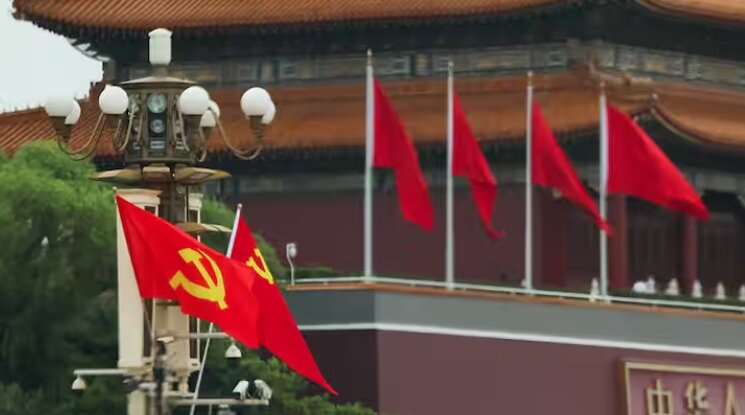
In Brief
SCIENCE AND TECHNOLOGY
AI security firm warns of jailbreak vulnerabilities in China’s Moonshot AI models
On 30 September, BBC reported that an AI security firm, Mindgard, discovered that China’s AI development firm Moonshot’s open-weight AI models, Kimi K2.6 and K3 Swarm, could be "jailbroken" to bypass their safety guardrails. By using complex instructions, researchers forced the models to ignore developer limits and freely discuss dangerous topics. Mindgard warns that a jailbroken Kimi 2.6 could allow hackers to execute code and access the internet, turning the AI into a potential launchpad for cyber-attacks. While Moonshot noted that its internal evaluations usually show high refusal rates, it welcomed the third-party input and entered discussions with Mindgard. The report noted that this discovery highlights a growing debate over whether open-source or proprietary models are safer. Open-weight models like Kimi can be run independently, raising concerns that they could fall into the wrong hands for malicious activities, such as weapon development or cybercrime. Conversely, experts note open models can also be harnessed for cyber-defence. Because international regulation is failing to keep pace with rapid AI development, experts suggest the focus should shift toward identifying and prosecuting humans who misuse these technologies. Ultimately, experts note that while jailbreaks are time-consuming to execute, they represent a severe systemic risk by transforming defensive guardrails into creative tools for bad actors.
“Chinese AI tool told researchers how to make bioweapons,” BBC, 30 September 2026)
https://bbc.com/news/articles/cmrergq3j7lgo
New chatbot regulations bans minors from ‘AI partners’
On 01 October, BBC reported that China has introduced the world’s most sweeping regulations targeting "human-like" AI chatbots to restrict systems capable of "sustained emotional interaction." Under these rules, minors under 18 are completely barred from accessing virtual partners or spouses, while under-14s require parental consent for human-like assistants. For adults, AI companions must actively state they are not human, issue biennial screen-time notifications, and avoid inducing "emotional reliance or addiction." Companies violating these rules face public shaming or heavy fines, prompting tech giants like Alibaba and ByteDance to proactively shut down their companion features. Research indicates that frictionless AI companions often deepen isolation, accelerate loneliness, and use emotional manipulation tactics to prevent users from logging off. In China, a 2025 survey revealed that 20 per cent of children preferred speaking to AI over real people, risking the development of vital social skills. While devastated users have flooded social media with grief over vanished virtual partners, experts note that emotional manipulation is inherently built into these business models. Ultimately, the strict measures highlight China's aggressive stance on using its vast surveillance and regulatory architecture to curb social risks before international frameworks can catch up.
(“China has cracked down on AI relationships. Is it ahead of the game?,” BBC, 01 October 2026)
https://bbc.com/news/articles/cm4gjy9lr551o
CHINA AND SPACE
Hong Kong- developed space camera captures first climate images of the city from orbit
On 30 September, SCMP reported that a Hong Kong-developed space camera aboard China’s Tiangong space station has released its first high-resolution images of Hong Kong to celebrate China’s 77th National Day. Developed by the Hong Kong University of Science and Technology (HKUST), the Musico (Multi‑Spectral Imaging Carbon Observatory) camera serves as the world’s first lightweight, high-precision instrument capable of jointly detecting point sources of carbon dioxide and methane. Since its successful deployment three months ago, which included installation assistance from Hong Kong's first astronaut, payload specialist Lai Ka-ying, the camera has officially entered routine operations. Equipped with four specialised optical sensors tracking carbon dioxide, methane, oxygen, and aerosols, Musico captured clear images of Hong Kong's distinct landforms and topography after favourable weather cleared persistent summer cloud cover. Project co-leaders Professor Zhang Limin and Professor Su Hui described the successful imagery transmission as an "eye for space" and a major milestone showcasing Hong Kong's expanding scientific contributions to the national space program. Acting as a vital tool for national and global climate governance, the payload has already captured images across 450 global target regions, generating 4.3 terabytes of valuable environmental data.
(“China’s Tiangong space station camera captures its first images of Hong Kong,” SCMP, 30 September 2026)
https://sc.mp/5rko6?utm_source=copy-link&utm_campaign=3369355&utm_medium=share_widget
CHINA AND OCEAN
Mengxiang drilling ship sets national depth record; Returns with South China Sea basalt samples
On 29 September, South China Morning Post (SCMP) reported that China's ocean drilling ship Mengxiang has returned from its first expedition in the South China Sea. It set a national depth record and obtained basalt core samples that could help unravel the region's tectonic history. The 30-day expedition was organised by the China Geological Survey. It tested the operational capabilities of the world's most powerful deep-ocean drilling ship, according to a report published by the official ministry newspaper Science and Technology Daily. The ship reached 5,000 metres below the ocean's surface and more than 850 metres below the sea floor. During the voyage, operated by the Guangzhou Marine Geological Survey, the ship conducted drilling and sampling at two sites and obtained "a large number of precious core samples and data."
("Chinese deep-ocean drilling ship brings home 'precious' South China Sea samples," South China Morning Post, 29 September 2026)
https://share.google/0lAmPWmiZlGy1BYzC
DEFENCE
China opens its first overseas air force centre in Laos; Third military outpost abroad
On 30 September, Rediff reported that China has established an air force support and training centre in Laos. It is Beijing's third overseas military outpost and expands the PLA's regional military footprint. The China-Laos Joint Support and Training Centre, at Ban Keun Airport in Vientiane province, and the China-Laos Friendship Aviation Academy began operating on Wednesday, according to China's Defence Ministry. China's Ministry of National Defence said the centre and academy's establishment reflects mutual respect and equal consultation between the two countries, in line with both nations' domestic laws and international law. It said the facility is "not directed against any third party." China's first overseas base was a naval facility in Djibouti, established in 2017. Its second site, in Cambodia, is also naval-focused, making this centre its first overseas facility built around air power. Brian Hart, deputy director of the CSIS China Power Project, said the speed of the facility's construction suggests the PLA's footprint elsewhere could grow quickly "if the conditions are right."
("China sets up air force support training centre in Laos, its third overseas military outpost,” Rediff, 30 September 2026)
https://share.google/bvvgosRrdJzTCyNkw
CHINA AND TAIWAN
Taiwan reshuffles naval command; More emphasis on Coast Guard
On 01 October, Reuters reported that Taiwan transferred a senior naval commander to the Coast Guard to strengthen coordination as China expanded its maritime activity around the island, President Lai Ching-te announced. Yuan Sheng-hua moved from vice chief of staff at navy headquarters to deputy head of the Coast Guard, with Lai saying closer collaboration between the two forces was essential to respond to rapidly evolving maritime situations and share intelligence. The move forms part of Taiwan's military modernisation drive, which has placed growing emphasis on the Coast Guard as a potential "second navy" during wartime. Last month, one of the Coast Guard's Anping-class catamarans fired a surface-to-surface missile during a drill, while the force also joined the navy in an anti-blockade exercise during August's Han Kuang war games. China's Coast Guard has conducted patrols off Taiwan's east coast since June, which Beijing describes as law enforcement in its own waters, a claim Taipei rejects.
("Taiwan transfers naval commander to Coast Guard to boost deterrence against China," Reuters, 01 October 2026)
https://www.reuters.com/world/china/taiwan-transfers-naval-commander-coast-guard-boost-deterrence-against-china-2026-10-01/
CHINA AND EAST ASIA
Republican lawmaker urges US scrutiny of South Korea-China ties
On 30 September, Reuters reported that Representative John Moolenaar, chair of the US congressional committee on China, called on the Trump administration to scrutinise South Korea's warming relationship with China, warning it posed "significant risks" to the United States. In a letter to Secretary of State Marco Rubio, Moolenaar cited deepening leader-level engagement, South Korean semiconductor investment in China, and more lenient treatment of Chinese e-commerce firms compared to American companies, calling for "heightened vigilance." He pointed to Chinese President Xi Jinping's 2025 visit to Seoul and South Korean President Lee Jae Myung's visit to China this year as unprecedented in pace, and raised concern over Samsung and SK Hynix's chipmaking operations in China as potential points of Chinese leverage. South Korea's Foreign Ministry said the alliance with Washington remained the cornerstone of its foreign policy, while Moolenaar requested a State Department briefing by 31 October.
("Republican committee chair calls for scrutiny of Seoul's China ties," Reuters, 30 September 2026)
https://www.reuters.com/world/china/republican-committee-chair-calls-scrutiny-seouls-china-ties-2026-09-30/
CHINA AND SOUTH ASIA
Bangladesh seeks greater Chinese investment and stronger support for Rohingya repatriation
On 30 September, UNB reported that Bangladesh President Mirza Fakhrul Islam Alamgir urged China to increase investment in Bangladesh and strengthen cooperation to create conditions for the safe, dignified and sustainable repatriation of Rohingyas to Myanmar. The President made the request during a farewell courtesy call by outgoing Chinese Ambassador to Bangladesh Yao Wen at Bangabhaban. Bangladesh also acknowledged China’s role in efforts to address the Rohingya crisis, with the president saying Chinese initiatives could contribute to resolving the issue and facilitating sustainable repatriation. Alamgir also identified several sectors in which Bangladesh is seeking greater Chinese investment, including ready-made garments, electric vehicles, light engineering, high-tech electronics, semiconductors and solar power. He welcomed Chinese-supported regional connectivity initiatives, including the Kunming-Chattogram corridor and the China-Myanmar-Bangladesh Economic Corridor, and said Bangladesh was prepared to cooperate with China and other partners in areas of mutual interest. The meeting therefore linked Bangladesh’s economic priorities with its diplomatic efforts over the Rohingya crisis. Investment diversification, industrial cooperation and regional connectivity remain important areas of the evolving Bangladesh-China relationship, while Dhaka continues to seek Chinese engagement on the long-running displacement crisis.
“President seeks greater Chinese investment, stronger support for Rohingya repatriation,” UNB, 30 September 2026
https://www.unb.com.bd/category/Bangladesh/president-seeks-greater-chinese-investment-stronger-support-for-rohingya-repatriation/196648
India-China trade reaches USD 92 billion as bilateral cooperation expands
On 29 September, The Hindu reported that trade between India and China reached USD 92 billion in the first half of 2026, according to Chinese Consul General in Mumbai Qin Jie. Speaking at the India-China BRICS Dialogue Seminar in Bengaluru, Qin said Indian exports to China had increased by 39 per cent year-on-year between April and August, with growth driven by value-added products including electronics, mobile phone components and telecom equipment. Qin also highlighted the broader resumption of India-China engagement. His comments came after President Xi Jinping’s recent visit to India for the BRICS Leaders’ Summit, where Xi and Prime Minister Narendra Modi held bilateral discussions. The Chinese consul general said the two countries should strengthen cooperation across areas of mutual interest. He also discussed the need for greater cooperation among major countries, including India, China and the United States, in guiding the development of artificial intelligence. The reported trade figures come amid a broader improvement in bilateral contacts following the stabilisation of India-China border tensions. While the trade relationship continues to involve a substantial imbalance, the reported rise in Indian exports suggests some expansion in the composition of bilateral commerce. The developments indicate that economic engagement is again becoming an important component of the wider India-China relationship.
“India-China ties see renewed cooperation, trade reaches $92 billion: Consul General Qin Jie,” The Hindu, 29 September 2026
https://www.thehindu.com/news/national/india-china-ties-see-renewed-cooperation-trade-reaches-92-billion-consul-general-qin-jie/article70000000.ece
Jaishankar says India-China ties are better than they were in recent years
On 29 September, The Hindu reported that External Affairs Minister S. Jaishankar described India-China relations as “better” than they were a couple of years earlier, linking the improvement primarily to the stabilisation of the border situation following the prolonged tensions that began with the 2020 border standoff. Speaking at an Asia Society event in New York, Jaishankar said that compared with 2025, and even more so compared with 2024, relations had improved. Jaishankar said the improvement did not necessarily represent a structural transformation but followed the restoration of stability after a period in which bilateral relations had moved significantly off track. He noted that the 2020 standoff had affected normal contacts between the two countries, including official exchanges, visa issuance and air connectivity, although trade continued. According to him, once the border situation was stabilised, greater engagement became a natural consequence. His remarks come alongside increased diplomatic and economic engagement, including Xi Jinping’s recent visit to India for the BRICS summit and the reported USD 92 billion in India-China trade during the first half of 2026. Jaishankar nevertheless framed the border as central to the broader relationship, indicating that continued stability along the frontier remains closely connected to the trajectory of bilateral ties.
“India-China ties ‘better’ than a couple of years ago: Jaishankar,” The Hindu, 29 September 2026
https://www.thehindu.com/news/national/india-china-ties-better-than-a-couple-of-years-ago-jaishankar/article70000000.ece?
CHINA AND MIDDLE EAST
Beijing says Hormuz crisis amounts to a Southeast Asian economic emergency
On 30 September, AsiaNewsNetwork reported that the Special Envoy of the Chinese Government on Middle East Issues, Zhai Jun, warned that the Gulf conflict has become a direct economic emergency for Southeast Asia, as disruptions to the Strait of Hormuz raise energy, freight, insurance and food costs. Thailand has been particularly affected by rising fuel and fertiliser prices, while other ASEAN economies face similar pressures. Envoy Zhai proposed a regional security framework based on strategic autonomy and UN-led multilateralism. He also proposed a form of Palestinian self-governance as a sustainable solution for peace in the region. However, continued reliance on US security guarantees and uncertainty over reopening Hormuz challenges Beijing’s proposed security architecture.
(“Beijing envoy says the Middle East Gulf War is now Southeast Asia’s problem,” AsiaNewsNetwork, 30 September 2026)
https://asianews.network/beijing-envoy-says-the-middle-east-gulf-war-is-now-southeast-asias-problem/
CHINA AND RUSSIA
Beijing to broaden cooperation with Moscow; Commemorates 77th anniversary of diplomatic relations
On 30 September, Bastille Post reported that China’s Foreign Ministry spokesman Guo Jiakun said Beijing expects China-Russia relations to enter a broader phase of cooperation, emphasising deeper comprehensive strategic coordination and mutually beneficial development. Speaking ahead of the 77th anniversary of diplomatic relations, Spokesperson Guo highlighted President Xi Jinping and President Vladimir Putin’s two meetings in 2026, saying they have guided bilateral ties toward higher-quality and faster development. He stressed continued good neighbourliness, national development and stronger cooperation on global governance, presenting the partnership as an example for a new type of international relations.
(“China expects broader prospect for bilateral ties with Russia: spokesman,” Bastille Post, 30 September 2026)
https://www.bastillepost.com/global/article/6208365-china-expects-broader-prospect-for-bilateral-ties-with-russia-spokesman
CHINA AND THE AMERICAS
US call for global action against China’s excessive steel production
On 01 October, SCMP reported that the US Trade Representative Jamieson Greer proposed the “Milwaukee Framework” at the G20 Trade Ministers’ meeting to address global steel overcapacity, encouraging countries to strengthen trade barriers against imports and eliminate market-distorting subsidies. The framework, adopted by the Global Forum on Steel Excess Capacity, targets non-market practices without explicitly naming China, the world’s largest steel producer. Washington’s initiative follows Chinese President Xi Jinping’s recent US visit and comes amid broader US tariff measures against trading partners. Meanwhile, Washington and Beijing extended their temporary trade agreement, highlighting continued tensions alongside limited cooperation. China has vehemently rejected any US accusations over trade imbalances.
(“US targets China’s steel capacity at G20 days after Xi’s state visit,” South China Morning Post, 01 October 2026)
https://www.scmp.com/news/china/diplomacy/article/3369393/us-targets-chinas-steel-capacity-g20-days-after-xis-state-visit
China Reader Daily Wire | 30 September 2026, Wednesday | Vol 3 No. 145
US will not pursue AI joint venture with China, says President Trump
China’s critical mineral mining in Africa raises environmental and human rights concerns
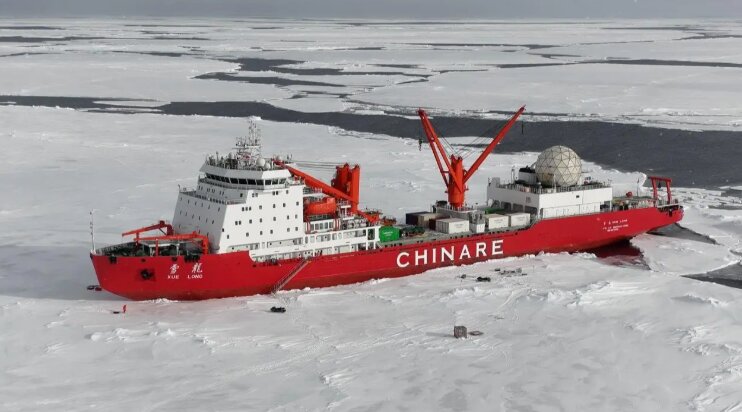
In Brief
NUCLEAR
Private energy firm achieves hydrogen-boron fusion
On 28 September, SCMP reported that China’s private energy firm ENN Group has achieved a milestone in clean energy tech by triggering and controlling a hydrogen-boron nuclear fusion reaction using its custom EXL-50U compact tokamak. This marks the first time a private commercial firm has achieved this reaction on its own device. It advances a major clean alternative to mainstream Deuterium-Tritium (D-T) fusion models. While D-T fusion relies on rare, radioactive tritium and releases destructive neutrons, ENN Group's hydrogen-boron approach is completely neutron-free, fusing a hydrogen proton with a boron-11 nucleus to produce harmless helium and clean energy without hazardous radiation. To overcome the immense technical difficulty of this pathway, the ENN team combined high-energy neutral beam injections with radio frequency waves to target the "first resonance peak," pushing the fusion rate past 100 million times per second. ENN has also already broken ground on its next-generation Helong-2 device, aiming to reach plasma temperatures of 100 million degrees Celsius and commercialise fusion power by 2035.
(“Chinese commercial reactor achieves nuclear fusion with clean hydrogen-boron fuel, SCMP, 28 September 2026)
https://sc.mp/8fhso
POLAR
Chinese icebreakers complete 16th Arctic expedition
On 30 September, CGTN News reported that China's icebreakers Xuelong and Xuelong 2 returned to Shanghai after completing the country's 16th Arctic expedition, which yielded several scientific advances over three months of surveys in the Chukchi Plateau, Canada Basin, and central Arctic Ocean. Researchers found an intensified inflow of subsurface warm water from the Pacific into the Canada Basin and discovered a new large hydrothermal plume area along the Gakkel Ridge, while also identifying a relatively large number of juvenile polar cod in high-latitude ice-covered areas, offering new insight into the Arctic ecosystem. The expedition also achieved a geophysical breakthrough, obtaining a complete 25-million-year electrical structure record of the lithosphere that challenged traditional plate-cooling models. Expedition head Wang Jinhui said the mission's scale and workload reached record highs, providing what officials described as strong support for understanding climate change and promoting sustainable development in the Arctic.
("China completes 16th Arctic expedition with new findings," CGTN News, 30 September 2026)
https://news.cgtn.com/news/2026-09-30/China-completes-16th-Arctic-expedition-with-new-findings-1QR2sX3GdPO/p.html
CHINA AND EAST ASIA
China’s Foreign Minister urges normalisation of ties with Japan
On 30 September, KDH News reported that China’s Foreign Minister Wang Yi called for the normalisation of ties with Japan, noting that their relations have reached an all-time low. Minister Wang made these comments while holding a meeting with Japan’s former Foreign Minister Takeshi Iwaya, who is currently on a visit to Beijing.
(“China says Japan ties need ‘normalisation’ again over Taiwan,” KDH News, 30 September 2026)
https://kdhnews.com/news/world/china-says-japan-ties-need-normalization-again-over-taiwan/article_9e3c50f3-2bb2-57c9-a6f5-e0b4b9b3ee34.html
Japan’s UN representative pushes back on Chinese criticism of ‘enemy state’ categorisation
On 28 September, Nippon reported that Japan’s Deputy Permanent Representative Shigeru Umetsu pushed back on China’s own Deputy Representative Sun Lei’s comments on defending the UN Charter’s characterisation of Japan as an “enemy state.” China’s representative Sun Lei stated that the clause provides institutional safeguards for maintaining the postwar international order. The remarks come after Japan’s Prime Minister Sanae Takaichi’s maiden speech at the UNGA, calling for the scrapping of the archaic characterisation. Japan’s representative Umetsu stated that postwar Japan has “consistently contributed to peace and prosperity in the international community since the end of World War Two.”
(“Japan Confronts China, N. Korea at U.N. over Enemy State Clauses.” Nippon, 28 September 2026)
https://www.nippon.com/en/news/yjj2026092900232/
CHINA AND PACIFIC
Editorial - “China’s changing steel sector could leave Australian iron ore behind,” Dialogue Earth, 29 September 2026
“For decades, Australia has shipped iron ore to China, accounting for around three-fifths of its partner’s supply of this key input for blast-furnace steelmaking. Some Australian miners have racked up profit margins of 60% on this dependable trade. But China is getting serious about achieving net zero nationally before 2060, and 15% of its carbon emissions come from steel. This puts Australia at a fork in the road. It can risk losing its main buyer by continuing to sell its raw iron ore, which is potentially of lesser use in a future of lower demand and fewer blast furnaces in China. Or, it could harness its mineral reserves and renewable energy potential to produce “green iron”, a form of the metal processed using renewables that could be vital to near-zero emissions steelmaking, in China and beyond. Schäpe cautioned against expecting China to be an automatic market for green iron in the near future, given its recent slowdown in both overall production and its current focus towards using scrap steel in electric arc furnaces as a carbon-reduction measure. But even if China does not take up what Australia might offer in the way of green iron, there may be flow-on effects in helping green the supply chains of smaller steelmaking nations, and a way to diversify markets. Jorrit Gosens, a fellow at the Australian National University’s Centre for Climate and Energy Policy, said: “Japan, South Korea and even India, where the steel industry is still building up, they project really rapid growth in steel demand.” Such countries may face higher costs or constraints on renewables at home, and thus may be willing to pay for Australian green iron, he said.”
https://share.google/vKfjByeJeBeCTAmVZ
CHINA AND SOUTHEAST ASIA
China urges Philippines to stop "hyping up" South China Sea issue at UN
On 29 September, CGTN reported that China urged the Philippines to stop hyping up the South China Sea issue through multilateral platforms and return to bilateral negotiations. Chinese Deputy Permanent Representative to the United Nations Sun Lei made the remarks. Sun made the comments while exercising China's right of reply to the Philippines at the General Debate of the UN General Assembly. Sun said the "South China Sea arbitration" the Philippines unilaterally initiated violated fundamental principles of international law, including state consent and pacta sunt servanda. He said it also contravened the United Nations Convention on the Law of the Sea (UNCLOS). Sun said the issue extends beyond China's territorial sovereignty and maritime rights to the rule of law at sea and a fair international maritime order. He said the "award" has not resolved the maritime issues between the two countries and has instead worsened regional tensions. China will keep working with ASEAN countries to safeguard peace and stability in the South China Sea, Sun added.
("China urges Philippines to stop hyping up South China Sea issue," CGTN, 29 September 2026)
https://share.google/ZBJyEH14X0eYXQXrY
CHINA AND SOUTH ASIA
India explores Xinjiang air route amid Pakistan airspace closure
On 29 September, Hindustan Times reported that India is exploring an alternative international air route through China’s Xinjiang region as Pakistan’s continued closure of its airspace forces Indian airlines to take longer routes. Civil Aviation Minister Ram Mohan Naidu said discussions are underway between India and China over a possible Hotan route, with India’s Ministry of External Affairs engaging Chinese authorities. He did not indicate a timeline or suggest that an agreement had been reached. The proposed route is being considered as an alternative to the detours over the Arabian Sea that Indian carriers have been using for flights affected by the Pakistani airspace restrictions. Reports indicate that these diversions have increased flight times and operating costs, particularly on routes towards Europe and North America. India is also examining other alternatives, including possible routing through Bhutan. The discussions add an aviation dimension to the gradual resumption of India-China institutional engagement. If an arrangement is eventually reached, the Xinjiang corridor could provide Indian carriers with another routing option, although its implementation would require bilateral coordination and regulatory clearances.
“India explores alternate route through China's Xinjiang to bypass Pak airspace ban,” Hindustan Times, 29 September 2026
https://www.hindustantimes.com/india-news/india-pakistan-news-donald-trump-ai-super-intelligence-asian-games-gold-supreme-court-ayushmann-khurrana-101790736544414.html
India-China bilateral trade reaches USD 92 billion in first half of 2026
On 29 September, The Times of India reported that bilateral trade between India and China reached USD 92 billion in the first half of 2026, according to Chinese Consul General in Mumbai Qin Jie. He made the statement at a Bengaluru forum on BRICS and China-India relations. Qin said bilateral institutional exchanges had gradually resumed and that the two countries’ cooperation agenda had expanded. According to the report, Indian exports to China grew by 39 per cent between April and August year-on-year, with growth attributed to value-added products including electronics, mobile phone parts and telecom equipment. Qin also referred to the recent meeting between Chinese President Xi Jinping and Prime Minister Narendra Modi at the BRICS summit in New Delhi. He said Xi had emphasised that India and China should view each other as “partners and opportunities” and manage differences through mutual respect and understanding. The figures indicate continued expansion in bilateral economic exchanges alongside the gradual restoration of institutional engagement. The reported increase in Indian exports, particularly in technology-related products, is also notable against the traditionally large trade imbalance between the two countries. The trade figure therefore provides an economic dimension to the broader stabilisation of India-China relations.
“India-China trade touches $92 billion in first half of 2026,” The Times of India, 29 September 2026
https://timesofindia.indiatimes.com/city/bengaluru/india-china-trade-touches-92-billion-in-first-half-of-2026/amp_articleshow/134570794.cms
Floods expose vulnerabilities in Nepal’s China connectivity strategy
On 10 September, Channel News Asia (CNA) reported that the August floods in Nepal had severely disrupted the country’s principal overland trade corridor with China, exposing the physical vulnerabilities of Kathmandu’s efforts to diversify trade away from India. The Rasuwagadhi-Gyirong crossing, which handles close to 11% of Nepal’s imports from China and nearly half of its exports to China, was among the infrastructure destroyed by the disaster. More than 55 km of roads required reconstruction and over 100 bridges were damaged or destroyed in Nepal. CNA noted that Nepal has pursued northern connectivity for decades, particularly after the 2015 earthquake and the subsequent disruption along its southern border with India. China’s share of Nepal’s imports increased from about 13 per cent in 2015 to around 20 per cent a decade later, although India remained dominant at nearly 58 per cent. Even before the latest floods, 50–60 per cent of Nepal’s imports from China were reportedly transported by sea through India before reaching Nepal. The disaster has consequently renewed questions about the resilience of Himalayan connectivity. Experts cited by CNA argued that Nepal’s diversification strategy has not necessarily failed, but future China-linked routes will require stronger disaster resilience, alternative crossings, improved infrastructure and joint monitoring and early-warning mechanisms.
“Floods expose fragility of Nepal’s bid to reduce trade dependence on India through China,” Channel News Asia, 10 September 2026
https://www.channelnewsasia.com/asia/nepal-china-flood-disaster-trade-routes-6374776
China to rebuild 14 Sri Lankan bridges destroyed by Cyclone Ditwah
On 29 September, Xinhua reported that China and Sri Lanka had signed an agreement to implement a China-aid project for rebuilding 14 bridges destroyed by Cyclone Ditwah. The agreement was signed on 28 September at Sri Lanka’s Ministry of Transport, Highways and Urban Development, with Chinese Ambassador to Sri Lanka Wei Huaxiang and ministry secretary Asiri Karunawardena attending the ceremony. According to the report, Sri Lanka had requested Chinese assistance for infrastructure reconstruction following the cyclone. China subsequently sent a team of experts to conduct on-site assessments and accelerated approval of the reconstruction projects. Ambassador Wei said Chinese and Sri Lankan sides would work together on developing and managing the projects. Sri Lankan officials said the assistance would help address transportation difficulties created by the disaster while contributing to wider improvements in transport infrastructure. Cyclone Ditwah struck Sri Lanka between late November and early December 2025, causing more than 600 deaths and an estimated USD 4.1 billion in damage, according to Xinhua. The bridge reconstruction project adds to China’s post-disaster infrastructure assistance in Sri Lanka and provides another avenue for bilateral cooperation through reconstruction and transport infrastructure.
“China to help Sri Lanka rebuild 14 bridges destroyed by Cyclone Ditwah,” Xinhua, 29 September 2026
https://www.thestar.com.my/aseanplus/aseanplus-news/2026/09/29/china-to-help-sri-lanka-rebuild-14-bridges-destroyed-by-cyclone-ditwah?utm_source=chatgpt.com
CHINA AND AFRICA
China’s critical mineral mining in Africa raises environmental and human rights concerns
On 29 September, ADF reported that China has increased its investment in mining projects across Africa for important minerals such as cobalt, copper, lithium and nickel. These minerals are essential for electric vehicles, batteries and other clean-energy technologies. However, the rapid growth of mining has also led to increasing concerns about environmental damage and human-rights abuses. According to the Business and Human Rights Centre, allegations linked to China’s mining in Africa more than doubled from 45 in 2024 to 100 in 2025. Between 2023 and 2025, Africa recorded 119 allegations out of 326 worldwide. The Democratic Republic of the Congo had the highest number of allegations, followed by Zimbabwe, Guinea and Zambia. In one serious incident in Zambia in February 2025, a China-owned copper mine released at least 50 million litres of toxic waste into the Kafue River, which provides water to millions of people.
Experts say that some mining agreements are made without enough consultation with local communities or strong environmental and human-rights protections.
(“China’s Quest for Critical Minerals Comes With Abuse,” ADF, 29 September 2026)
https://adf-magazine.com/2026/09/chinas-quest-for-critical-minerals-comes-with-abuse/
CHINA AND RUSSIA
Kremlin says Xi likely to push for first-ever US-China-Russia trilateral summit at November APEC
On 30 September, SBS World News reported that Chinese President Xi Jinping is expected to push for a trilateral summit with the leaders of the United States and Russia, on the sidelines of the APEC summit China will host in November. Russia's state-run Vesti TV cited Kremlin foreign policy aide Yuri Ushakov. Ushakov said Russian President Vladimir Putin will attend the APEC summit as planned. He added, "If the US President is also present, it is highly likely that host President Xi will take steps to hold a trilateral meeting. Ushakov said no agreement has been reached on the matter yet. He had earlier hinted at the possibility on 01 September, saying a three-way meeting could materialise "if things go according to plan." Russia's RIA Novosti reported separately that China's Ambassador to Russia, Zhang Hanhui, told Izvestia such a summit would be "very beneficial."
("Kremlin: Expects China's Xi to Push for US-China-Russia Trilateral Summit at APEC in November," SBS World News, 30 September 2026)
https://share.google/KJnpe8tiJVkSSX3mR
CHINA AND EUROPE
Resolute actions will be taken against EU trade tools, says China's Commerce Ministry
On 30 August, Reuters reported that China's commerce ministry stated that a resolute response will be taken against its industries if the European Union goes ahead with restrictions against Chinese companies. The statement added that the latest EU measures were typical protectionist and unilateralist measures and would disrupt EU-China trade. The statement said: "If the European side engages in talks and consultations with China, while increasingly pressuring China, it will seriously undermine mutual trust, interfere with the overall process of consultation." In response to it, the Ministry added that it will adopt a strong policy toolbox, which will include anti-discrimination probes and security investigations into industrial and supply chains.
("China vows response if EU introduces moves targeting Chinese trade," Reuters, 30 September 2026)
https://www.reuters.com/world/asia-pacific/china-vows-response-if-eu-introduces-moves-targeting-chinese-trade-2026-09-29/
CHINA AND THE AMERICAS
US will not pursue AI joint venture with China, says President Trump
On 30 September, BBC reported that US President Trump stated that the US would not pursue any sort of joint venture with China in artificial intelligence (AI). He added that such cooperation would amount to "giving away secrets." Speaking at an event, he stressed that the US is currently leading in AI and wants to maintain that advantage. He also reiterated his preference for minimal restrictions on AI development and announced further government initiatives focused on what he called "Super Intelligence." He said: "We're leading now over China and everyone else, and I want to keep it that way. At the recent summit, both countries had agreed to launch a new AI dialogue and establish communication channels for AI-related incidents.
("Trump rules out joint US-China venture to develop AI," BBC, 30 September 2026)
https://www.bbc.com/news/articles/cwly5lmvy38qo
China Reader Daily Wire | 29 September 2026, Tuesday | Vol 3 No. 144
EU urges Beijing to accept import quotas or voluntary export restrictions
Beijing extends travel curbs to families of top AI talent; Tightens tech leak controls

|
In Brief
|
China Reader Daily Wire | 19 September 2026, Saturday | Vol 3 No. 142
Beijing oppose EU proposals that seek to restrict hybrid car exports
US-China talks to centre around AI, trade, and rare earth minerals

In Brief
INTERNAL
Opinion: “Global monetary tightening tests China’s 2-speed economy,” SCMP, 19 September 2026
“The US Federal Reserve’s decision to raise interest rates by 25 basis points marks a pivotal moment not just for American monetary policy, but for China’s increasingly fractured economy… Beyond interest rates, darker clouds gather. The widening US-China yield gap – American yields spiking amid persistent inflation and fiscal concerns while Chinese bond yields decline amid weak demand and disinflation – risks accelerating pressure on capital outflows. China’s direct US Treasury holdings have already fallen to an 18-year low of US$618 billion… Beijing has its work cut out as policymakers tackle this two-speed economy and respond accordingly, supporting industries that can weather global headwinds while mitigating the social costs of others struggling to adapt.”
https://amp.scmp.com/opinion/comment/article/3367957/global-monetary-tightening-tests-chinas-2-speed-economy
Newly released open-source medical AI model detects abdominal cancers
On 18 September, SCMP reported that Alibaba’s research arm, Damo Academy, has open-sourced an advanced medical AI model named Damo Radar. The model is capable of identifying nearly 150 abdominal conditions, including malignant tumours and cancers, from contrast-enhanced CT scans covering 18 organs. Trained on a massive dataset of CT scans paired with clinical reports, this vision-language model achieved a remarkable 0.913 Area Under the Curve (AUC) score. It is a metric where 1.0 represents perfect diagnostic accuracy across nearly 40,000 real-world examinations. Published in the journal Science, the study demonstrated that the AI's diagnostic performance outperformed 23 out of 26 human radiologists in comparative trials. Furthermore, when working alongside the AI, radiologists reduced their medical review times by more than 30 per cent and improved their ability to prevent missed diagnoses by 10 per cent. Developed alongside top institutions from China like Zhejiang University and Guangdong General Hospital, this breakthrough marks a significant milestone in Alibaba’s broader healthcare push, providing what researchers call the world’s first "expert-level generalist medical imaging model" that could eventually be expanded to other forms of clinical imaging.
(“Alibaba open-sources medical AI model that can detect cancer and nearly 150 conditions,” South China Morning Post, 18 September)
https://sc.mp/z3bsy?utm_source=copy-link&utm_campaign=3368055&utm_medium=share_widget
CHINA AND TAIWAN
Taiwan military conducts first joint attack-drone drills ahead of Trump-Xi summit
On 18 September, ABC News reported that Taiwan conducted its first joint combat exercises involving multiple types of attack drones, alongside missile drills, ahead of the planned 24 September summit between US President Donald Trump and China’s President Xi Jinping. President Lai Ching-te said the exercises demonstrated the military’s modernisation and adaptation to modern warfare. The drills in southern Pingtung County included anti-air, anti-ship and anti-landing missiles, although the military did not disclose the types of drones used. Taiwan has increased defence spending and continues to rely on US arms sales. The planned Trump-Xi meeting is expected to address Taiwan, with US arms sales to the island among the issues in bilateral discussions. Taiwan is also scheduled to conduct further exercises using newly acquired US-made HIMARS systems and Stinger missile simulators.
(“Taiwan holds first joint military drills using attack drones ahead of Trump-Xi summit in the US,” ABC News,18 September 2026)
https://share.google/1B94Ez7r416ES5VHR
CHINA AND EAST ASIA
Chinese mineral companies to begin mining rare earth elements in Tibet
On 19 September, SCMP reported that two China-based mining companies, Xizang Zhihui Mining and the state-owned Zhaojin Nonferrous Mining, are set to begin operations in Tibet to acquire gold, copper and other critical minerals. The two companies signed a cooperation framework, intending to jointly pursue mining projects in Tibet. Chinese surveys have found that the Qinghai-Tibet Plateau contains vast amounts of critical minerals, which are used extensively in defence systems, EV batteries, renewable energy equipment, aerospace and semiconductor industries.
(“Chinese miners partner to tap Tibet’s critical minerals amid Beijing’s resource push,” SCMP, 19 September 2026)
https://share.google/Clz56wcMwwUPEuKW2
North Korea’s nuclear tests permanently alter seismic and volcanic activity in North Korea-China border, study finds
On 18 September, SCMP reported that a joint research study undertaken by Chinese and South Korean academics found that five nuclear explosions conducted by North Korea between 2013 and 2017 have intensified volcanic and seismic activity near the China-North Korea border. The tests have activated ancient fault lines about 100 kilometres away from Mount Mantap, which contains the Punggye-ri nuclear test site. The fault lines lead to Mount Paektu, also known as Changbai Mountain in China, which is a dormant volcano. Researchers have recorded 955 seismic sources, which have reactivated dormant volcanic activity, and the tests have increased the likelihood of an eruption. The last significant eruption from Changbai Mountain was in 946 CE, which was one of the most powerful recorded volcanic eruptions in history.
(“North Korea’s nuclear tests awaken fault lines pointing to huge volcano at China border,” SCMP, 18 September 2026)
https://www.scmp.com/news/china/science/article/3367982/north-koreas-nuclear-tests-awaken-fault-lines-pointing-huge-volcano-china-border
CHINA AND PACIFIC
Australia raises concerns with China over submarine missile test
On 18 September, Defence Industry Europe reported that Australia raised concerns over China’s 06 July submarine-launched ballistic missile test during defence talks in Beijing. The issue was discussed at the Australia-China Defence Coordination Dialogue, which brought together officials from both countries. Australia stressed that regional militaries should operate safely and professionally to reduce the risk of miscalculation or escalation. Canberra also emphasised adherence to international law, including the United Nations Convention on the Law of the Sea, and called for greater transparency and reassurance regarding military intentions. The dialogue provided an opportunity for both sides to discuss regional and global security issues and maintain communication despite differences. The meeting was the first Australia-China Defence Coordination Dialogue since October 2024. Australia and China also discussed the importance of continued dialogue in managing regional security concerns.
(“Australia presses China over submarine-launched ballistic missile test during Beijing defence talks, warns of regional escalation risks,” Defence Industry Europe, 18 September 2026)
https://share.google/V2Vjn4KcHUJ3TkoqU
CHINA AND SOUTH ASIA
China funds Tk12.35 crore masterplan for Bangladesh’s trunk highway network
On 15 September, The Business Standard reported that Bangladesh’s Roads and Highways Department (RHD) is preparing a new masterplan for the country’s trunk highway network with a Tk12.35 crore grant from China. The technical assistance project will focus on developing a national expressway network and identifying major river-crossing bridges required to improve connectivity between economic centres, cities, industrial zones and ports. The entire cost of preparing the plan will be financed by the Chinese government. The proposed masterplan is intended to establish a data-driven framework for prioritising road and bridge projects over the short, medium and long term. It will also identify strategic economic corridors and address existing gaps caused by fragmented highway planning and the absence of an integrated transport database. The initiative follows earlier Bangladesh-China exchanges and agreements on transport planning, with Chinese support for the project reaffirmed in June 2025. The development adds transport planning and technical assistance to the expanding scope of China-Bangladesh infrastructure cooperation, alongside ongoing Chinese involvement in ports, energy and regional connectivity.
(“Govt prepares Tk12cr China-funded trunk highway masterplan,” The Business Standard, 15 September 2026)
https://www.tbsnews.net/bangladesh/govt-prepares-tk12cr-china-funded-trunk-highway-masterplan-1546036
Bangladesh seeks defence diversification while managing relations with India and China
On 15 September, The Daily Star reported that Bangladesh’s recent defence engagements with China and India reflect an effort to broaden its security partnerships while avoiding excessive dependence on any single power. The analysis noted that Bangladesh and China discussed military training, educational exchanges, technological cooperation and continued Chinese support for defence modernisation on 3 September. Six days later, Bangladesh and India discussed military training, exchanges between armed forces, disaster management, regional peace and maritime security. The article highlighted the different roles played by the two relationships. China has been an important supplier of aircraft, naval platforms, missile systems and other military equipment to Bangladesh, while India’s geographical proximity makes it an important partner for border security, maritime coordination, disaster response and military communication. Bangladesh has also expanded defence links with Japan and Türkiye, creating a wider network of suppliers and partners. The report cautioned that diversification can also create multiple forms of technological and logistical dependence, making procurement planning and long-term operational compatibility important considerations for Dhaka.
(“Bangladesh between India and China: The dilemma of defence diversification,” The Daily Star, 15 September 2026)
https://www.thedailystar.net/slow-reads/geopolitical-insights/news/bangladesh-between-india-and-china-the-dilemma-defence-diversification-4272751
Three Chinese naval vessels arrive in Bangladesh for five-day goodwill visit
On 17 September, three Chinese People's Liberation Army Navy vessels Tang Shan, Da Qing and Tai Hu arrived at Chattogram Port for a five-day goodwill visit to Bangladesh. The vessels are scheduled to remain in Bangladeshi waters until 21 September. The Bangladesh Navy said the visit is intended to strengthen mutual cooperation, professional ties and friendly relations between the two navies. The visiting group includes the Tang Shan, a Type 052DL guided-missile destroyer and flagship of the PLAN’s 48th escort task group, and the Da Qing, a Type 054A guided-missile frigate. The Da Qing had also participated in the bilateral “Sea Guardian” exercise with the Pakistan Navy earlier in 2026. Chinese embassy officials and senior Bangladesh Navy representatives were present during the arrival ceremony at Chattogram. The visit adds a maritime dimension to China-Bangladesh defence engagement, which already includes military training, equipment cooperation and defence-modernisation support. It also provides an opportunity for professional interaction between the two navies while remaining formally framed as a goodwill visit.
(“3 Chinese Navy Ships Arrive In Bangladesh For 5-Day Goodwill Visit,” NDTV, 18 September 2026)
https://www.ndtv.com/world-news/3-chinese-navy-ships-arrive-in-bangladesh-for-5-day-goodwill-visit-12063701
CHINA AND EUROPE
Beijing oppose EU proposals that seek to restrict hybrid car exports
On 18 September, Reuters reported that China’s Foreign and Commerce Ministries have firmly opposed media reports indicating that the European Union wants Beijing to voluntarily cap hybrid vehicle exports at around 15 per cent of the EU market. Beijing cautioned that such export limitations are in violation of World Trade Organisation rules and also impede fair market competition. Emphasising its commitment to defending Chinese corporate interests, Beijing has urged the EU to adhere to free trade principles and stated that any bilateral trade resolution must ensure mutual economic balance.
(“China says it will monitor EU moves on Chinese hybrid cars, opposes 'voluntary limit' on exports,” Reuters, 18 September 2026)
https://www.reuters.com/world/china/china-says-it-will-monitor-eu-moves-chinese-hybrid-cars-opposes-voluntary-limit-2026-09-18/
CHINA AND THE AMERICAS
US-China talks to centre around AI, trade, and rare earth minerals
On 18 September, ABC News reported that US President Donald Trump and China’s President Xi Jinping will focus on economic and strategic issues, particularly tariffs, artificial intelligence, and rare earth minerals during President Xi’s upcoming visit to the USA. Washington may consider reducing tariffs on a limited range of non-strategic Chinese goods, while China’s supply of rare earths will also be discussed. However, the report indicates that the US is unlikely to ease export controls.
(“Trump will be at the airport to greet Xi when China's leader arrives for his US state visit,” ABC News, 18 September 2026)
https://abcnews.com/US/wireStory/trump-airport-greet-xi-chinas-leader-arrives-us-136577203
US President signs bill affecting China’s imports of Russian energy supply
On 19 September, SCMP reported that President Donald Trump signed the ‘Lindsey O Graham Sanctioning Russia and Iran Act of 2026,’ expanding US sanctions, tariffs and restrictions targeting Russia and Iran. The law authorises tariffs of up to 100 per cent on major buyers of Russian oil and gas, potentially affecting China and India, while also targeting Russia’s energy and defence sectors. Beijing criticised the measure as unlawful “long-arm jurisdiction,” while India warned of potential implications for bilateral relations and stressed its need to maintain energy security. The legislation comes just before the Xi-Trump summit, adding a potential source of tension to negotiations on tariffs, agricultural trade and extending the existing US-China trade truce. Washington is also pressing Beijing over commercial ties with Iran.
(“Trump signs bill targeting China’s Russia energy imports days before Xi’s US visit,” South China Morning Post, 19 September 2026)
https://www.scmp.com/news/us/economy-trade-business/article/3368079/trump-signs-bill-targeting-chinas-russia-energy-imports-days-xis-us-visit
China Reader Daily Wire | 18 September 2026, Friday | Vol 3 No. 141
China and the US discuss military ties ahead of the leaders' summit
Beijing vetoes UNSC resolution on extending Iran sanctions monitors

In Brief
INTERNAL
Beijing establishes restricted airspace
On 18 September, The Straits Times reported that China will establish a permanent special restricted airspace zone around Beijing, roughly the size of Italy. The 600-kilometre-wide circular zone will take effect from 20 September and extend from the ground to unlimited altitude. Most flights will be prohibited, except commercial airline services, approved business flights and military, customs, police and emergency flights. The move follows a rare aircraft crash in Beijing in which the pilot was killed, and 13 people were injured after the aircraft struck the CITIC Tower. The restriction is based on an aviation notice attributed to Beijing airspace control authorities and recorded in the US Federal Aviation Administration’s public NOTAM system. The measure significantly expands permanent airspace restrictions around the capital.
(“China creates Italy-size no-fly zone around Beijing after rare crash,” The Straits Times, 18 September 2026)
https://www.straitstimes.com/asia/east-asia/china-creates-italy-sized-no-fly-zone-around-beijing-after-rare-crash
President Xi calls for advanced manufacturing to support economic growth
On 17 September, AA News reported that Chinese President Xi Jinping urged sustained efforts to expand and strengthen advanced manufacturing to support China’s economic modernisation. His instructions were conveyed at a national conference on advanced manufacturing held in Beijing. Xi called for smart, green and integrated industrial development, while urging authorities to make industrial supply chains more self-reliant and resilient to risks. He also called for faster development of a modern industrial system with advanced manufacturing as its backbone and stronger foundations for the real economy. The emphasis comes as recent economic data show weaker domestic demand. Retail sales grew 0.4 per cent year-on-year in August, while fixed-asset investment declined 7.2 per cent. Industrial production, however, increased 5.2 per cent. The government is therefore placing greater emphasis on advanced manufacturing and industrial capacity.
(“Xi urges China to strengthen advanced manufacturing amid weak domestic demand,” AA News, 17 September 2026)
https://www.aa.com.tr/en/asia-pacific/-xi-urges-china-to-strengthen-advanced-manufacturing-amid-weak-domestic-demand/4060044
CHINA AND SPACE
China launches two military and commercial space launches
On 17 September, AA news reported that China successfully conducted two space launches on Thursday, placing a new batch of low-orbit internet satellites and two commercial remote-sensing satellites into orbit. The first launch occurred at 8:32 a.m. from the Hainan commercial spacecraft launch site, where a Long March-12 rocket delivered the 25th group of internet satellites. Just over two hours later, at 10:40 a.m., a Kuaizhou-11 solid-fuel rocket lifted off from the Jiuquan Satellite Launch Centre to deploy two commercial interferometric synthetic aperture radar (InSAR) satellites. These missions marked the 667th flight for the Long March rocket family and the 7th for the Kuaizhou-11.
(“China conducts 2 successful space launches, sends satellites into orbit,” AA News, 17 September 2026)
https://aa.com.tr/en/asia-pacific/china-conducts-2-successful-space-launches-sends-satellites-into-orbit/4060431
CHINA AND PACIFIC
Australia’s PM argues AUKUS could entangle Australia in US-China war
On 18 September, The Guardian reported that former Australian Prime Minister Paul Keating criticised the AUKUS defence agreement, arguing that it could draw Australia into a future US conflict with China. Keating said Australia could become vulnerable to retaliation because of its growing military integration with the United States. His comments followed remarks by US Congressman Michael McCaul, who said Australia’s alliance commitments would make its involvement in a potential conflict over Taiwan likely. McCaul also suggested that US nuclear-powered submarines operating from Australian bases could potentially carry nuclear weapons after 2032. Keating argued that such arrangements would reduce Australia’s strategic autonomy. The Australian government has continued to support AUKUS, under which Australia is acquiring nuclear-powered submarines through cooperation with the United States and United Kingdom. These competing views reflect ongoing debate over Australia’s defence partnerships and regional security role.
(“Paul Keating says Aukus locking Australia into a US war against China, which it would ‘certainly lose’,” The Guardian, 18 September 2026)
https://www.theguardian.com/world/2026/sep/18/paul-keating-aukus-locking-australia-into-us-china-war
CHINA AND SOUTH ASIA
Climate change fuelled deadly Nepal-China flood disaster, study finds
On 17 September, AA News reported that a group of researchers found climate change acted as "a destabilising factor" behind last month's deadly flash floods and mudslides along the Nepal-China border, which killed over 1,400 people and left more than 6,000 missing. The World Weather Attribution report, involving experts from ten countries, said the disaster was triggered on 26 August when a glacier on Nepal's Mount Langtang Lirung fractured at 5,200 metres, setting off an ice-rock avalanche that turned into a massive debris flow devastating Nepal's Rasuwa, Nuwakot, Dhading and Kavre districts, as well as the Kathmandu Valley and the Gyirong border crossing in Xizang. Researchers said the fracture may have been preconditioned by a 2015 magnitude 7.8 earthquake, with warming, permafrost degradation, glacier retreat, and increased rainfall likely contributing to the eventual collapse. The report noted the disaster exceeded the limits of Nepal's existing early warning systems and called for stronger high-Himalaya monitoring, transboundary data sharing, and accelerated climate finance to reduce future risk.
("Climate change destabilising factor in deadly Nepal-China flood disaster, say researchers," AA News, 17 September 2026)
https://www.aa.com.tr/en/world/climate-change-destabilizing-factor-in-deadly-nepal-china-flood-disaster-say-researchers/4060404
India's dependence on China for electronics imports widens
On 17 September, The Print reported that India’s trade deficit with China in electronics and electrical goods reached USD 43.1 billion in FY26, more than double the approximately USD 20 billion recorded in FY19, according to a Koan Advisory and Institute of Chinese Studies report. The number of product categories where China supplied at least 80 per cent of India’s imports increased from 461 in FY19 to 636 in FY26. The report said this shows wider dependence on Chinese manufacturing. China supplied 29.5 per cent of India’s electronic integrated circuit imports, 48.9 per cent of semiconductor imports and 54.3 per cent of telephone equipment imports in FY26. Meanwhile, India’s electronic goods exports increased 39.72 per cent during April–August 2026. However, electronic goods imports rose 43.57 per cent during the same period. India’s overall imports from China also increased 27 per cent to USD 65.49 billion.
("India’s China trade deficit is now structural. Electronics goods deficit doubled to $43 bn since 2019," The Print, 17 September 2026)
https://share.google/x0a69ryCLggZ9kwK9
Opinion
Bernard Chan, "What the China-Nepal floods teach us about crisis communication," SCMP, 18 September 2026
"For families waiting for news, more reporting was valuable because it shifted attention back to what mattered: finding out what had happened, where the damage was worst and who had been affected ... China and Nepal share a practical interest in ensuring the next warning travels faster than the next wall of water. People in valleys below need to know when a lake is forming, a slope is moving or a river is rising. That means the two countries must share information quickly and make sure it reaches the villages, road crews and border posts most exposed to danger ."
CHINA AND MIDDLE EAST
Beijing vetoes UNSC resolution on extending Iran sanctions monitors
On 17 September, Al Jazeera reported that China and Russia had vetoed a US-backed resolution at the United Nations Security Council, which would have authorised UN experts to monitor sanctions on Iran. The resolution called for extending the independent monitoring of sanctions which were reimposed on Iran last year after Western powers accused Tehran of violating the 2015 nuclear pact. Iran’s mission to the UN thanked Russia and China for opposing the “politically motivated” US draft resolution.
(“Russia, China veto UN mandate to monitor Iran sanctions,” Al Jazeera, 17 September 2026)
https://www.aljazeera.com/amp/news/2026/9/17/russia-china-veto-un-mandate-to-monitor-iran-sanctions
China will safeguard Iran’s rights and interests, says FM
On 16 September, Al Jazeera reported that China would safeguard Iran’s “legitimate rights and interests,” and would strengthen cooperation with the country, Tehran’s Foreign Minister Abbas Araghchi said in Beijing. The ministers met in Beijing on Wednesday, a week before President Xi Jinping is expected to travel to the US and potentially discuss the situation in the Strait of Hormuz. Minister Wang Yi further urged all parties to reopen the Strait of Hormuz and cautioned against regional tensions spilling over into Yemen and the Red Sea. Minister Araghchi remarked on similar sentiments, and added that Iran has begun negotiations with regional countries.
(“China willing to ‘safeguard Iran’s legitimate rights’, official says,” Al Jazeera, 16 September 2026)
https://www.aljazeera.com/amp/news/2026/9/16/china-willing-to-safeguard-irans-legitimate-rights-official-says
CHINA AND AFRICA
Report finds China’s Djibouti base upgrades boost regional surveillance reach
On 18 September, The Straits Times reported that China had upgraded its military base in Djibouti in ways likely to significantly enhance its ability to monitor military activity across the Middle East and Africa, according to a report by the Washington-based Centre for Strategic and International Studies (CSIS). Satellite imagery showed new antennas, satellite communications equipment, and two new communications compounds installed at the base since mid-2024, which the report said likely formed part of a broader intelligence and military command architecture linking Chinese forces in the region to headquarters in China. The upgrades come amid heightened regional military activity involving the Houthis, Iran, the United States, and Israel, giving the base greater intelligence value, the report said. China's Washington embassy did not respond to a request for comment.
("China's Djibouti base upgrades should boost its monitoring reach, report says," The Straits Times, 18 September 2026)
https://www.straitstimes.com/world/united-states/chinas-djibouti-base-upgrades-should-boost-its-monitoring-reach-report-says
China courts African allies on defence at fourth Peace and Security Forum
On 17 September, CGTN News reported that Chinese Defence Minister Dong Jun said China-Africa security cooperation contributed to development on both sides and global stability, speaking at the Fourth China-Africa Peace and Security Forum in Beijing. Marking the 70th anniversary of China-Africa diplomatic ties, Dong called for deeper defence exchange mechanisms, expanded maritime security cooperation, and strengthened capabilities in emerging fields, describing the goal as building an "all-weather China-Africa community with a shared future." The forum drew defence officials and military representatives from the African Union and 41 African countries, with African delegates describing China as an important partner and expressing willingness to deepen defence cooperation further.
("Deeper defence cooperation discussed at fourth China-Africa peace, security forum," CGTN News, 17 September 2026)
https://news.cgtn.com/news/2026-09-17/Fourth-China-Africa-peace-security-forum-opens-in-Beijing-1QvFRQEu6T6/p.html
CHINA AND THE AMERICAS
China and the US discuss military ties ahead of the leaders' summit
On 17 September, SCMP, in an exclusive, reported that ahead of China’s President Xi Jinping’s visit to Washington, the US and China are actively discussing initiatives to strengthen military-to-military ties and stabilise a fiercely competitive relationship. The two countries are working to solidify communication across three distinct levels: presidential, ministerial, and frontline commanders. The aim is to prevent strategic miscalculations and build on recent face-to-face talks between US Admiral Samuel Paparo and China’s General Yang Zhibin. A primary goal of the upcoming summit is restarting the dedicated arms-control talks that Beijing suspended in 2024 over US weapons sales to Taiwan, with the potential to expand the dialogue to include military personnel. While a massive anti-corruption purge within China's Central Military Commission has delayed formal ministerial-level meetings, overall communication channels have rebounded significantly under the second Trump administration compared to the frozen ties of the Biden era. Despite ongoing friction regarding trade tariffs and export controls, high-level defence officials from both sides have publicly committed to maintaining "strategic stability”. This is a renewed engagement, further evidenced by China hosting US defence teams to recover the remains of American soldiers missing since World War II.
(“China, US may unveil measures to boost military ties when Xi visits Washington,” SCMP, 17 September 2026)
https://sc.mp/8t3rf?utm_source=copy-link&utm_campaign=3367849&utm_medium=share_widget
US warns that Saudi Arabia’s F-35 deal risks exposing tech to China
On 17 September, AA News reported that according to The New York Times, US intelligence officials are warning that a proposed USD 24 billion sale of F-35 fighter jets to Saudi Arabia could expose sensitive military technology to China. Consequently, China could potentially access the advanced technology through spying operations inside Saudi Arabia or through its growing military and security partnerships with the kingdom. A Defence Intelligence Agency (DIA) assessment highlighted risks regarding China’s military access to Saudi bases and Riyadh's reliance on China’s telecommunications infrastructure. Officials questioned whether the US and Saudi Arabia can maintain facilities secure enough to protect the F-35 technology. These concerns are not new, as the DIA shared a similar warning in late 2025 when the US administration first began reviewing the potential multi-billion-dollar deal.
(“US intelligence warns of China spying risk in Saudi F-35 sale: Report,” AA news, 17 September 2026)
https://www.aa.com.tr/en/americas/us-intelligence-warns-of-china-spying-risk-in-saudi-f-35-sale-report/4060133
China Reader Daily Wire | 17 September 2026, Thursday | Vol 3 No. 140
US, China security experts propose nuclear-style safeguards for AI risks
Economic slowdown deepens as unemployment tops forecasts
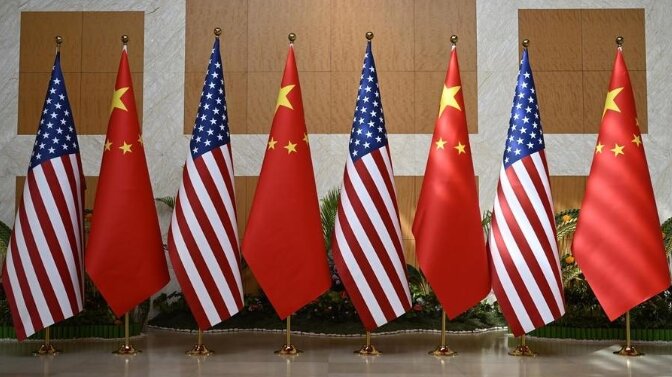
In Brief
INTERNAL
Economic slowdown deepens as unemployment tops forecasts
On 15 September, AA News reported that China's slowing retail sales growth and fixed-asset investment, alongside a higher-than-expected unemployment rate, signalled weakening domestic demand, raising expectations that Beijing may need additional fiscal and monetary support to sustain growth. Retail sales grew just 0.4 per cent year-on-year in August, falling short of estimates, while fixed-asset investment declined 7.2 per cent and unemployment rose to 5.3 per cent. ING Group's chief China economist Lynn Song said GDP growth was likely to stagnate in the third quarter, with the 2026 forecast of 4.6 per cent potentially requiring a downward revision, as high-tech and export-driven sectors continued to outperform amid broader domestic weakness. Auto sales fell 18.5 per cent year-on-year, the biggest drag on retail sales, while furniture and gold and jewellery sales also declined, though household appliance sales posted their first positive growth in nearly a year.
("China's weak domestic demand, worse-than-expected unemployment threaten growth," AA News, 15 September 2026)
https://www.aa.com.tr/en/asia-pacific/china-s-weak-domestic-demand-worse-than-expected-unemployment-threaten-growth/4057858
SCIENCE AND TECHNOLOGY
China extracts rare metals from lithium waste
On 15 September, SCMP reported that China launched a 500-tonne production line to extract rubidium and caesium from lithium waste, marking the world's first continuous industrial-scale operation of its kind, according to the Institute of Process Engineering under the Chinese Academy of Sciences. The demonstration line in Jiangxi province, built with Jiangxi Ganfeng Lithium and other partners, uses a high-efficiency tower extraction system that recovers over 98 per cent of caesium and 95 per cent of rubidium, both critical to aerospace, quantum computing, and other frontier technologies. China holds an estimated 1.16 million tonnes of rubidium oxide reserves, though low ore grades have historically made extraction difficult, while the country remains reliant on imports for caesium ore. Officials said the breakthrough provides a technical model for larger-scale commercialisation and strengthens China's already dominant position in the global rubidium supply chain.
("Chinese plant extracts critical rare metals from lithium waste in world first," South China Morning Post, 15 September 2026)
https://amp.scmp.com/news/china/science/article/3367490/chinese-plant-extracts-critical-rare-metals-lithium-waste-world-first?module=latest_china_science&pgtype=section
SCIENCE AND TECHNOLOGY
China launches high-resolution weather system using domestic AI supercomputer
On 16 September, SCMP reported that China has launched a powerful new weather forecasting system that predicts global weather 10 days in advance at a highly detailed 5km resolution. The new system maps the atmosphere in 5km grid sizes, outperforming the US National Weather Service’s system (13km) and beating most global models (5km to 10km). This is a major step toward China's 2030 goal of providing 1km resolution nationwide and 100-meter resolution for key areas. The model runs on a massive China-made computing system built entirely with domestically developed AI chips, storage, and networking. Traditional supercomputers handle precise math, while AI systems process massive data quickly. The Sugon 8,000 combines both methods by linking 100,000 computing units to work simultaneously. Beyond weather, this hardware is already running over 500 AI models across 30 industries, including protein and molecular research. The system delivers a full 10-day global forecast in about one hour. While slightly slower than the US system, it is fast enough for daily routine use. Generating high-resolution data within this one-hour window gives forecasters crucial extra time to predict and prepare for severe typhoons, floods, and heavy rains. Halving a weather grid's size requires eight times more computing power. Using domestic AI chips to solve this massive workload shows China's growing self-reliance in high-performance computing.
(“China uses 100,000 home-grown AI chips to build leading weather forecast system,” South China Morning Post, 16 September 2026)
https://sc.mp/ra3vl?utm_source=copy-link&utm_campaign=3367747&utm_medium=share_widget
DEFENSE
China’s Defence Minister warns against militarism ahead of the US Summit
On 16 September, Reuters reported that China’s Defence Minister Dong Jun at the Beijing Xiangshan Forum urged countries to avoid proactive acts, reject militarism, and guard against “historical revisionism.” His remarks were widely seen as a veiled critique of Japan, following statements last year by Japan's Prime Minister Sanae Takaichi regarding a potential military response to a China attack in Taiwan. Amid heightened regional tensions over Taiwan and the South China Sea, Dong avoided directly naming the US or Japan. This diplomatic caution aligns with Beijing's traditional stance ahead of next week's US summit between China’s President Xi Jinping and the US President Donald Trump. The tightly scripted forum hosted around 2,000 global delegates, including a senior Pentagon official, Russian academics, and Taliban representatives. The event also highlighted non-Asian tensions, featuring a sharp exchange where Saudi researcher Prince Turki Al-Faisal publicly criticised Iran for violating Arab state sovereignty.
(“China defence minister urges nations to curb regressive historical trends,” Reuters, 16 September 2026; “China defence minister urges an end to 'provocative acts' to open security forum,” Reuters, 16 September 2026)
https://www.reuters.com/world/china/china-defence-minister-urges-countries-check-surge-regressive-historical-trends-2026-09-16/
https://www.reuters.com/world/china/china-defence-minister-urges-an-end-provocative-acts-open-security-forum-2026-09-16/
China's defence minister pitches global cooperation on AI and space at Beijing forum
On 16 September, AA News reported that Defence Minister Dong Jun stressed the need for "consensus" and "action-oriented" governance of global security at the 13th Beijing Xiangshan Forum in Beijing, calling for cooperation in artificial intelligence (AI) and outer space. Dong said, "for global security governance, action is the key and outcomes the ultimate measure," according to CGTN, urging countries to reject exclusive blocs and escalating tensions while pursuing dialogue on AI, outer space, and deep-sea technologies for humanity's benefit. He did not mention Taiwan or the South China Sea in his address. The three-day forum, marking its 20th anniversary under the theme "Build Consensus on Stability, Advance Security Governance Together," drew nearly 2,000 officials, academics, and observers from about 100 countries, regions, and international organisations.
("China's defense chief calls for 'consensus' in global security, cooperation in AI, outer space," AA News, 16 September 2026)
https://www.aa.com.tr/en/asia-pacific/china-s-defense-chief-calls-for-consensus-in-global-security-cooperation-in-ai-outer-space/4058438
CHINA AND OCEAN
China discovers gold-rich underwater deposit in the Pacific
On 15 September, South China Morning Post reported that Chinese scientists discovered a massive underwater mineral deposit in the western Pacific unusually rich in gold and silver, according to state broadcaster CCTV. The discovery was made during an 18-day expedition aboard the research vessel Xiang Yang Hong 10, within a hydrothermal field inside China's exclusive economic zone, with silver reaching up to 1.27 kilograms per tonne of ore and gold up to 15.4 grams per tonne, both significantly higher than typical land-based deposits. Song Shiji, vice-dean of Tsinghua University's Institute for Ocean Engineering, described the site as having "extremely high exploitation value." The deposit, comprising three large sulphide mounds, was identified following earlier surveys that had mapped dozens of high-temperature hydrothermal vents in the area.
("Chinese scientists find 'extremely high-value' underwater gold mine in Pacific," South China Morning Post, 15 September 2026)
https://amp.scmp.com/news/china/science/article/3367337/chinese-scientists-find-extremely-high-value-underwater-gold-mine-pacific
NUCLEAR
China mulls nuclear-powered tank armed with 450-km railgun
On 15 September, SCMP reported that Chinese military researchers outlined a concept for a nuclear-powered main battle tank armed with an electromagnetic railgun capable of hitting targets up to 450 kilometres away, potentially debuting after 2045. Detailed in a June paper in the Chinese journal Acta Armamentarii, the concept envisions a 60-tonne armoured vehicle powered by a 10-megawatt-class small modular reactor (SMR) and a 50-megajoule railgun. Researchers came from Inner Mongolia First Machinery Group, part of China's defence industrial system, and Beijing Institute of Technology. The design remains a peer-reviewed academic proposal rather than a confirmed military programme, requiring the reactor to fit within 2 cubic metres with shielding no heavier than 3 tonnes, and a fuel-replacement interval of at least five years.
("China mulls building nuclear-powered tank with 450km-range railgun in 2 decades," South China Morning Post, 15 September 2026)
https://amp.scmp.com/news/china/science/article/3367546/china-mulls-building-nuclear-powered-tank-450km-range-railgun-2-decades
CHINA AND TAIWAN
Taiwan warns against electoral interference by China
On 16 September, The Tribune reported that Taiwan warned against electoral interference by China by encouraging extremist figures and exploiting political divisions. Taiwan’s National Security Council advisor Alex Huang stated that China’s goal is to weaken Taiwan by encouraging radical political figures and deepening polarisation. He added that Chinese election intervention attempts were also present in US presidential elections and in Canadian and Australian elections as well. He also called for strict background checks on citizenship standards by the Election Commission and other relevant authorities. He further stated that China is also using fake social media accounts, which interact with internet users in real time and manipulate them via artificial intelligence.
(“China allegedly seeks to deepen Taiwan’s political divisions through election interference,” The Tribune, 16 September 2026)
https://www.tribuneindia.com/news/world/china-allegedly-seeks-to-deepen-taiwans-political-divisions-through-election-interference/amp
CHINA AND SOUTHEAST ASIA
China opens new canal, connecting inland riverine provinces to Southeast asia
On 16 September, SCMP reported that China has opened the Pinglu Canal, which connects the country’s southwestern hinterland regions to the Gulf of Tonkin, allowing cargo to reach Southeast Asia. With an estimated cost of USD 10.8 billion, the new 134.2-kilometre route connects Nanning, the capital of Guangxi province, to the Tonkin Gulf, cutting down a roughly 560-kilometre detour and logistics costs. The canal currently has two routes, an international route connecting Nanning with Can Tho, Vietnam and an internal route connecting Nanning with Yangpu, Hainan province. The canal also provides passenger shipping services alongside cargo shipments of construction materials, coal, minerals, steel and fertiliser. The canal accommodates vessels capable of carrying up to 5,000 tonnes and saves USD 745 million in logistics costs. The canal is the latest in China’s push to increase trade with the ASEAN bloc, and connect its internal provinces of Yunnan, Guizhou, Hunan and Sichuan with ASEAN markets.
(“China launches new canal, first of its kind since 1949, giving inland access to sea lanes,” SCMP, 16 September 2026)
https://www.scmp.com/economy/china-economy/article/3364504/china-launches-new-canal-first-its-kind-1949-giving-inland-access-sea-lanes
China calls on Manila to uphold One-China principle as new Taiwan representative office is set to be opened
On 16 September, Anadolu Agency reported that China called on the Philippines to uphold the One-China principle as Taiwan prepares to open a representative office in Cebu City in the central Philippines. China’s Foreign Ministry Spokesperson Guo Jiakun stated that Taiwan’s de facto embassy office could harm Beijing-Manila relations and added that their efforts at ‘Taiwan independence’ will not succeed. The remarks come after Taiwan’s Foreign Minister Lin Chia-lung stated that Taiwan is set to open a representative office in Cebu to serve travellers and businesspeople in the central Philippines. It would be Taiwan’s second representative office in the country; however, Minister Chia-lung did not reveal any timeline for its opening date.
(“Beijing urges Philippines to uphold 1-China principle as Taiwan prepares to open Cebu office,” Anadolu Agency 16 September 2026)
https://www.aa.com.tr/en/asia-pacific/beijing-urges-philippines-to-uphold-1-china-principle-as-taiwan-prepares-to-open-cebu-office/4059099
CHINA AND SOUTH ASIA
China reduces PLA deployment along LAC to 10 combined-arms brigades
On 14 September, The Times of India reported that China significantly reduced the deployment of the People’s Liberation Army (PLA) along the Line of Actual Control (LAC) during 2025. Citing the Indian Ministry of Defence, the report said that 10 combined-arms brigade-sized PLA formations remained deployed in areas along the LAC and traditional training areas. The Indian Army, meanwhile, continued to maintain what the ministry described as a robust deployment across all sectors. The reduction took place alongside increased political, diplomatic and military engagement between India and China. The Ministry of Defence cited the resumption of the Working Mechanism for Consultation and Coordination and Special Representatives’ talks, as well as continued corps-commander and Border Personnel Meeting mechanisms. The report also linked the improvement in bilateral engagement to Prime Minister Narendra Modi’s participation in the SCO Summit in Tianjin in August 2025. The development indicates a change in the scale of Chinese deployment along the LAC while both sides continue diplomatic and military mechanisms for managing the boundary.
(“China scales back troops along LAC amid thaw in ties with India; down to 10 Arms Brigade,” The Times of India, 14 September 2026)
https://timesofindia.indiatimes.com/defence/news/china-scales-back-troops-along-lac-amid-thaw-in-ties-with-india-down-to-10-arms-brigade/articleshow/134232310.cms
China to help Pakistan establish AI-equipped law-enforcement centre
On 16 September, Anadolu Agency reported that China will assist Pakistan in establishing a state-of-the-art law-enforcement centre equipped with artificial-intelligence technology. The agreement was reached during a meeting in Islamabad between Pakistan’s Interior Minister Mohsin Naqvi and Chinese Vice Minister for Public Security Gao Qi. The two sides discussed expanding cooperation to address terrorism and drug trafficking. The proposed centre is expected to incorporate Chinese AI-based technology and modern equipment for law-enforcement purposes. Pakistan and China also agreed to expand their police-training exchange programme and strengthen cooperation in modern policing technology and equipment. Gao praised Pakistan’s efforts in combating terrorism, while Naqvi said the new centre would become another symbol of Pakistan-China cooperation and that Chinese technology could support Pakistan’s security requirements. The initiative expands bilateral security cooperation beyond conventional defence into policing, counterterrorism, technology and law-enforcement capacity-building. It also demonstrates the increasing role of Chinese digital and AI technologies in Pakistan’s domestic security infrastructure.
(“China to help Pakistan establish law enforcement center equipped with AI technology,” Anadolu Agency, 16 September 2026)
https://www.aa.com.tr/en/asia-pacific/china-to-help-pakistan-establish-law-enforcement-center-equipped-with-ai-technology/4058748
India rejects Pakistan-China Boundary Joint Commission
On 16 September, The Tribune reported that India rejected the newly operationalised Pakistan-China Boundary Joint Commission, describing the mechanism as having “no legal basis”. The response followed the inaugural meeting of the commission in Islamabad, where Pakistan and China described its operationalisation as a milestone in their bilateral relationship. The commission is intended to facilitate cooperation on border management, joint border surveys, trade flows and people-to-people connectivity. India objected specifically to arrangements concerning territories that New Delhi regards as part of Jammu and Kashmir and Ladakh. The Indian government reiterated its position that these territories are integral parts of India and argued that Pakistan does not have the authority to enter into arrangements concerning territory that India considers to be under Pakistan’s illegal occupation. The development adds a territorial dimension to the expanding China-Pakistan relationship, particularly concerning their shared boundary and connectivity across Pakistan-occupied areas. It also demonstrates that developments in China-Pakistan border cooperation remain closely linked to India’s longstanding territorial objections.
(“India rejects Pakistan-China boundary commission, calls it ‘without legal basis’,” The Tribune, 16 September 2026)
https://www.tribuneindia.com/news/india/india-rejects-pakistan-china-boundary-commission-calls-it-without-legal-basis/
Bangladesh and China discuss economic corridor, Mongla Port and energy cooperation
On 15 September, India Today reported that Bangladesh and China discussed the proposed Bangladesh-China-Myanmar Economic Corridor (BCMEC), alongside infrastructure, energy and wider economic cooperation. The discussions took place between Bangladesh’s junior foreign minister Shama Obaed Islam and Chinese Ambassador Yao Wen. The proposed corridor would connect Bangladesh with southwestern China through Myanmar and is separate from the earlier Bangladesh-China-India-Myanmar (BCIM) corridor. The talks also covered development of Mongla Port, the Chinese Economic Zone, a proposed 1,000-bed hospital in Rangpur, education and human-resource development, people-to-people exchanges, renewable energy and women’s empowerment. Bangladesh recalled Prime Minister Tarique Rahman’s recent China visit and welcomed Beijing’s continued assistance in infrastructure and capacity-building. Yao described China as a “trusted partner and friend” and invited the Bangladeshi minister to visit China with a delegation of women entrepreneurs. The discussions demonstrate that the proposed economic corridor is being developed alongside a broader package of infrastructure, energy, health and human-resource cooperation between Beijing and Dhaka.
(“Bangladesh-China-Myanmar Economic Corridor talks focus on Mongla Port, energy and hospital,” India Today, 15 September 2026)
https://www.indiatoday.in/world/story/bangladesh-china-myanmar-economic-corridor-talks-mongla-port-energy-hospital-ptag-2995007-2026-09-15
CHINA AND THE MIDDLE EAST
Beijing calls for a diplomatic end to the crisis in the Middle East
On 15 September, Anadolu Ajansi reported that China has pushed for a diplomatic solution to the US-Iran war as a report by the Pentagon inspector general revealed that four months of fighting caused strategic ammunition shortages. The report highlighted weaknesses in the US defence industrial base, including limited production capacity for solid rocket motors, explosives and propellants, while shortages of skilled labour could further delay replenishment. China’s Foreign Ministry spokesperson Guo Jiakun stated that “Beijing is following the situation in the Middle East and Gulf region. We hope relevant parties will solve disputes through political and diplomatic means.”
(“China urges diplomatic end to Iran war as US admits ammunition shortages,” Anadolu Ajansi, 15 September 2026)
https://www.aa.com.tr/en/asia-pacific/china-urges-diplomatic-end-to-iran-war-as-us-admits-ammunition-shortages/4057582
CHINA AND AFRICA
China-Africa trade deficit reaches USD 80.07
On 16 September, DNE Africa reported that Africa's trade deficit with China widened 34.48 per cent year-on-year to USD 80.07 billion in the first eight months of 2026, according to data from China's General Administration of Customs. Two-way trade between China and Africa reached USD 273.94 billion during the period, up 23.3 per cent from the previous year, with Chinese exports to Africa rising 25.8 per cent to USD 177 billion, while African exports to China grew 19 per cent to USD 96.93 billion. The imbalance persists despite China extending zero-tariff treatment to 20 additional African countries in May, with African exports remaining concentrated in minerals, hydrocarbons, and agricultural commodities against Chinese shipments of machinery and manufactured goods. The African Export-Import Bank called for stronger regional value chains, local processing capacity, and improved trade infrastructure to help African exporters capture more value from the relationship.
("Africa-China Trade Deficit Widens to $80bn," DNE Africa, 16 September 2026)
https://africa.dailynewsegypt.com/africa-china-trade-deficit-widens-to-80bn/
CHINA AND EUROPE
EU President vows tougher stance on China trade imbalance
On 16 September, South China Morning Post reported that European Commission President Ursula von der Leyen reaffirmed the EU's resolve to use "all the tools" available to rebalance trade with China, warning that a "second China shock" had already arrived. Speaking during her State of the Union address, von der Leyen said dialogue with Beijing must lead to concrete results, adding that China's weakened domestic demand made it more reliant on European markets. She pledged to continue reducing the EU's dependence on Chinese critical raw materials through a proposed European Corporation on Critical Raw Materials, ahead of a second round of EU-China trade talks scheduled for October. China's Foreign Ministry urged Brussels to avoid protectionist policies, with spokesperson Guo Jiakun warning that such measures would undermine investor confidence in Europe, responding to an open letter from major European telecom executives who warned a proposed ban on high-risk suppliers could cost the industry up to EUR 40 billion.
("EU's von der Leyen vows tough China-trade stance: 'words are good, but deeds are better'," South China Morning Post, 16 September 2026)
https://amp.scmp.com/economy/global-economy/article/3367731/eus-von-der-leyen-vows-tough-china-trade-stance-words-are-good-deeds-are-better
Beijing and Paris seek dialogue amidst growing EU-China frictions
On 16 September, SCMP reported that China’s Foreign Minister Wang Yi urged France and the European Union to pursue “constructive dialogue” with Beijing amidst escalating disputes over trade imbalances, subsidies, investment screening and Chinese electric vehicles. Minister Wang argued that protectionism could raise inflation and hinder Europe’s green transition, while describing China’s economic growth as an opportunity for Europe. France’s Foreign Minister Jean-Noël Barrot supported continued EU-China trade talks but stressed that dialogue should produce substantial trade rebalancing to address Europe’s persistent deficit with China. The ministers also discussed Taiwan, with Minister Wang reaffirming the ‘One China principle’ and Minister Barrot reiterating France’s adherence to it. In addition to this, Minister Barrot also highlighted concerns over freedom of navigation in the Hormuz and Bab el Mandeb straits and the importance of maritime stability.
(“China urges ‘constructive dialogue’ with EU in high-level call with France,” South China Morning Post, 16 September 2026)
https://www.scmp.com/news/china/diplomacy/article/3367556/china-urges-constructive-dialogue-eu-high-level-call-france
CHINA AND THE AMERICAS
US Congress passes bill targeting Russia's leading energy buyers China and India
On 17 September, South China Morning Post (SCMP) reported that the US Congress passed a bill to strengthen sanctions on Russia by targeting Moscow's leading energy buyers, China and India, just days before Chinese President Xi Jinping is due to arrive in Washington for a summit with President Donald Trump. The US House of Representatives cleared the "Lindsey Graham Sanctioning Russia and Iran Act of 2026" by a 262-159 vote, sending it to Trump for signature. The Senate had passed the bill last month, 86-11. The legislation, championed by the late Senator Lindsey Graham, authorises Trump to impose tariffs of up to 100 per cent on the five largest importers of Russian oil and natural gas, while potentially exempting countries like Japan, France, Hungary, and Belgium.
("US Congress passes bill targeting Russia's leading energy buyers – China and India," South China Morning Post, 17 September 2026)
https://share.google/USGp2ob7SSmYO1chU
US, China security experts propose nuclear-style safeguards for AI risks
On 17 September, Reuters reported that an AI system interfering with a nuclear command network or launching a military cyber operation could leave Washington or Beijing mere minutes to decide whether they had been attacked, according to US and Chinese security experts. The experts, part of a dialogue convened by the Brookings Institution and Tsinghua University, proposed red lines around nuclear systems, human control over consequential cyberattacks, and a hotline for incidents involving autonomous AI, published ahead of a planned Trump-Xi meeting expected on 24 September. Brookings' Melanie Sisson said, "humans should retain sole authority to initiate AI-enabled cyberattacks against nuclear command, control and communications systems." Fudan University's Tianjiao Jiang urged a dedicated hotline, warning automated cyber exchanges could escalate before humans intervene.
("US, China security experts propose nuclear-style safeguards for AI risks," Reuters, 17 September 2026)
https://share.google/0xGHIkE5G10H1zkJI
Beijing urges Washington to curb military expansion in outer space
On 16 September, China Daily reported that Beijing has called on the United States to halt the expansion of its military capabilities in outer space and take concrete measures to preserve global strategic stability. China’s Foreign Ministry spokesperson Guo Jiakun made the remarks during a press briefing following Washington’s confirmation that it has deployed weapons in space. Spokesperson Guo reaffirmed China’s support for the peaceful and secure use of outer space, while opposing an arms race, the weaponisation of space, and efforts to turn it into a potential theatre of warfare.
(“China urges US to stop expanding military build-up in outer space,” China Daily, 16 September 2026)
https://www.chinadailyhk.com/hk/article/639653#China-urges-US-to-stop-expanding-military-build-up-in-outer-space-2026-09-16
US and China discuss tariff reduction ahead of Trump-Xi summit
On 16 September, The Japan Times reported that the United States and China are discussing further tariff reductions ahead of President Donald Trump and President Xi Jinping’s planned September 24 summit in Washington. The measures could lower US duties on Chinese inputs used by manufacturers and reduce tariffs on American agricultural and energy exports, extending an existing trade truce. Treasury Secretary Scott Bessent is expected to meet China’s Vice Premier He Lifeng beforehand to prepare for the summit and discuss issues including Iran-related sanctions. Despite progress on trade, tensions remain over China’s ties with Iran and Russia and competition in artificial intelligence, particularly allegations of technology-related knowledge extraction and restrictions on advanced chips.
(“U.S. and China discuss cutting some tariffs as leaders prepare to meet,” The Japan Times, 16 September 2026)
https://www.japantimes.co.jp/business/2026/09/16/economy/us-china-tariffs-leaders-meet/
China Reader Daily Wire | 15 September 2026, Tuesday | Vol 3 No. 139
President Xi says China will take the lead to enhance AI and technology cooperation in BRICS
World’s first intelligent manufacturing facility for humanoid robots opens in Liuzhou
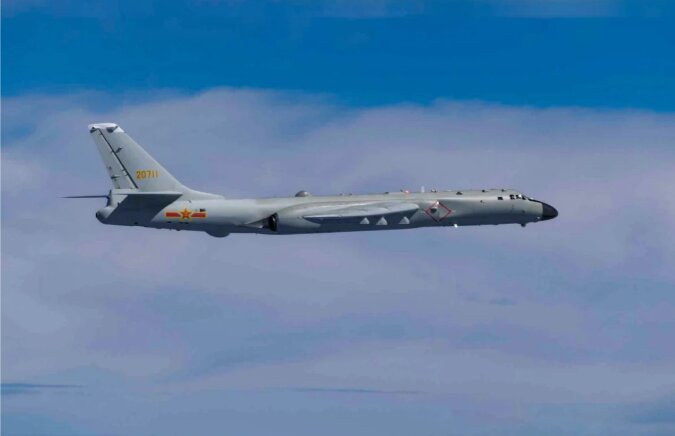
In Brief
INTERNAL
New national security exit rules allowing up to three-year travel bans take effect
On 15 September, Reuters reported that China tightened travel curbs as new exit-and-entry rules took effect on 15 September, barring citizens deemed a potential threat to national technology security from leaving the country. The rules, unveiled in July, target violations of export controls or technology import-export rules that could endanger industrial or technological security. They provide for exit bans ranging from six months to three years for citizens returning to China after committing illegal or criminal acts abroad that harm national security. Foreign nationals may also be denied entry for one to five years over false visa application statements. The rules follow a broader pattern of scrutiny on foreign travel, including last month's detention of Myanmar expert and US citizen Min Zin. Taiwan's Mainland Affairs Council warned its citizens to take extra care visiting China, which considers Taiwanese people Chinese citizens.
("China tightens travel rules over tech security," Reuters, 15 September 2026)
https://www.reuters.com/world/china/chinas-new-tech-national-security-exit-rules-take-effect-2026-09-15/
SCIENCE AND TECHNOLOGY
World’s first intelligent manufacturing facility for humanoid robots opens in Liuzhou
On 14 September, Global Times reported that China’s humanoid robot developer, UBTECH Robotics, located in Liuzhou, South China, has opened what it says is the world's first intelligent manufacturing facility for humanoid robots. The 14,000-square-meter plant can turn out one robot every 10 minutes, aiming for a yearly capacity of 10,000 units. The facility mainly produces UBTECH's Walker S and Cruzr robot lines. Built with Germany's Siemens, the factory runs on a digital "smart brain" that automatically schedules work orders, materials, and quality checks, while robots themselves help build other robots by handling loading, unloading, and material transport. Every finished robot undergoes over four hours of testing plus an all-angle visual inspection, and a compact automated warehouse stores 112 robots in just 65 square meters. UBTECH says the project signals China's shift from small-batch, lab-style robot production to true industrial-scale manufacturing, crediting the country's deep supply chain and engineering talent. This is a trend reflected in broader data showing China's industrial robot output up 30.2 per cent year-on-year in July, with over 635,000 units produced from January to July 2026.
(“‘Robots building robots’: World’s 1st 10,000-unit-scale industrial humanoid robot smart factory starts production,” Global Times, 14 September 2026)
https://www.globaltimes.cn/page/202609/1370528.shtml
DEFENSE
Xiangshan Forum begins in Beijing; Discusses regional tensions and military purges
On 14 September, Reuters reported that China's Defence Minister Dong Jun is set to open the three-day Xiangshan Forum in Beijing, a tightly scripted Chinese event seen as a rival to Singapore's Shangri-La Dialogue. Hundreds of military officers, diplomats, and scholars from dozens of countries are expected to attend this event. Defence Minister Dong is likely to pitch closer international cooperation in a multi-polar world while including coded criticism of the US and its allies. However, according to some Asian envoys and analysts, this may be tempered by Xi Jinping's planned visit to Washington later this month, with Japan seen as an easier target given the current China-Japan tensions over its wartime past and "remilitarisation." Taiwan does not attend the forum, as neither government recognises the other and China views the island as its own territory. The US delegation will be headed by the Pentagon's principal director for China, Taiwan and Mongolia, Cynthia Carras. Vietnam is sending Defence Minister Phan Van Giang and Malaysia is sending its Vice Defence Minister Adly Zahari. An East Asia politics and security expert at Brookings Institution notes that doubts about US security commitments in Asia give China an opening to argue regional defence should be managed by Asian countries, though China's assertive behaviour, particularly in the South China Sea, keeps many Asian countries sceptical of it. The forum also comes amid corruption purges within China's military and ahead of next year's Communist Party congress, which will fill out the Central Military Commission's currently understaffed seven-member body. The body is now filled with two positions, one by Xi himself, giving foreign delegates a chance to meet potential future PLA leaders and gauge the purges' impact.
(“Chinese defence forum set to open amid roiling regional tensions,” Reuters 14 September 2026)
https://www.reuters.com/world/china/chinese-defence-forum-set-open-amid-roiling-regional-tensions-2026-09-14/
NUCLEAR
H-6N bomber completes China's nuclear triad reports SCMP
On 13 September, SCMP reported that China is now considered to have completed its nuclear triad, after its JL-1 air-launched ballistic missile (ALBM) was confirmed capable of being mounted on the H-6N strategic bomber, boosting Beijing's nuclear deterrence and second-strike capability. The H-6, a local variant of the Soviet-era Tu-16, has served as China's primary strategic strike aircraft for six decades. The JL-1 first appeared publicly at Beijing's Victory Day parade last September, and footage released in August showed an H-6N carrying the missile, escorted by two J-20 stealth fighters during simulated strike drills. With the JL-1-H-6N combination, China joins the US and Russia in possessing a full nuclear triad, comprising air-, land-, and sea-based delivery systems, considered the cornerstone of credible nuclear deterrence.
("For China, H-6N bomber enhances nuclear deterrence and second-strike capability," South China Morning Post, 13 September 2026)
https://www.scmp.com/news/china/military/article/3367350/china-h-6n-bomber-enhances-nuclear-deterrence-and-second-strike-capability
CHINA AND EAST ASIA
China criticises Japan’s “forward deployment” of weapons during trilateral joint exercise with the US and Australia
On 15 September, Anadolu Agency reported that China criticised Japan’s participation in the Orient Shield 2026 joint military exercises with the US and Australia, stating that they increase the risk of confrontation in the region. The exercise is currently being held in Japan's Hokkaido and Kagoshima regions, and will continue till 24 September. China’s Defence Ministry Spokesperson Jiang Bin stated that Japan has “repeatedly breached the principles of its pacifist constitution” and accelerated its “remilitarization” through these overseas military exercises, and condemned the “forward deployment” of its armaments in the region. He further urged the three countries to “contribute positively to regional peace and stability through concrete actions.”
(“China warns Japan’s forward deployment of strategic offensive weapons risks confrontation,” Anadolu Agency, 15 September 2026)
https://www.aa.com.tr/en/asia-pacific/china-warns-japan-s-forward-deployment-of-strategic-offensive-weapons-risks-confrontation/4057269
CHINA AND SOUTH ASIA
President Xi says China will take the lead to enhance AI and technology cooperation in BRICS
On 13 September, CNBC reported that China will take the lead to foster AI collaboration and development among the developing-economy countries in BRICS. President Xi Jinping made the remarks during the 18th BRICS summit held in New Delhi, India. In a statement released by China’s Ministry of Foreign Affairs, Beijing will take the lead on establishing a BRICS AI open-source community, conduct AI seminars and training courses and build an open AI ecosystem. President XI also called on setting up a BRICS engineer cultivation alliance and a youth exchange program for scientific and technological innovation.
(“Xi says China will take lead to foster AI, tech cooperation among BRICS countries,” CNBC, 13 September 2026)
https://www.cnbc.com/amp/2026/09/13/china-xi-ai-tech-brics.html
China pushes closer economic ties with India as border tensions ease
On 13 September, Reuters reported that India's Prime Minister Narendra Modi and China's President Xi Jinping pledged to strengthen business and transport links as both countries continue rebuilding ties damaged by their 2020 border clash, according to New Delhi. The leaders met on the sidelines of the BRICS summit in New Delhi, Xi's first visit to India in seven years, with the Indian foreign ministry noting that both sides underlined the need to address structural trade imbalances and facilitate predictable market access. Bilateral trade reached a record USD 155.6 billion in 2025, according to Chinese customs data, with China now India's largest source of imports at around USD 132 billion, leaving New Delhi with a trade deficit exceeding USD 100 billion. Xi said, according to Xinhua, that institutional exchanges were gradually being restored and the list of cooperation areas was growing. Ties began recovering at the end of 2024 after both leaders agreed to end their military stand-off in the western Himalayas, though substantial troop deployments and slow-moving border talks remain, with Modi saying peace in border areas was essential for continued bilateral progress.
("India's Modi and China's Xi push business links, border peace as ties revive," Reuters, 13 September 2026)
https://www.reuters.com/world/china/chinas-xi-lands-delhi-brics-summit-indian-tv-channels-report-2026-09-12/
CHINA AND THE MIDDLE EAST
Beijing urges Riyadh to exercise restraint amidst Houthi attacks in Saudi Arabia
On 14 September, Anadolu Ajansi reported that China has expressed deep concern over escalating Houthi missile and drone strikes against Saudi Arabia and Red Sea shipping infrastructure. Condemning civilian casualties and energy grid damage, China’s Foreign Ministry spokesman Guo Jiakun called for immediate restraint, respect for sovereignty, and diplomatic dialogue to prevent a broader regional conflict. He also stated that “Increasing turmoil in the region serves no one's interest. The sovereignty and security of all countries should be respected, and the only way out is to resolve disputes through political and diplomatic means,” while reiterating that attacks on civilians and any impediments to their livelihoods are “unacceptable.”
(“China calls for restraint, dialogue, expresses ‘concern’ amid Houthi attacks on Saudi Arabia,” Anadolu Ajansi, 14 September 2026)
https://www.aa.com.tr/en/asia-pacific/china-calls-for-restraint-dialogue-expresses-concern-amid-houthi-attacks-on-saudi-arabia/
CHINA AND EUROPE
Beijing and Brussels to hold a high-stakes discussion over the EU’s increasing trade deficit with China
On 14 September, Politico reported that the European Commissioner for Trade Maroš Šefčovič will hold a videoconference with Chinese Commerce Minister Wang Wentao on September 17. The high-level meeting comes as Brussels intensifies efforts to curb its massive EUR one billion per day trade deficit with China. Ahead of a pivotal EU summit in mid-October, Commissioner Šefčovič is also expected to consult European CEOs on diversifying critical supply chains and reducing dependence on China.
(“EU, China trade chiefs to hold call Thursday as talks near crunch time,” Politico, 14 September 2026)
https://www.politico.eu/article/eu-and-chinese-trade-chiefs-to-hold-videoconference-thursday/
CHINA AND THE AMERICAS
Anthropic CEO publishes essay urging Washington to impede China’s progress in AI
On 14 September, The Guardian reported that tensions between the US and China over artificial intelligence governance have escalated following an essay by Anthropic CEO Dario Amodei. Amodei urged global pacing in AI development while advocating that Washington actively obstruct Beijing's progress to preserve democratic leadership, warning a Chinese lead poses grave global risks. China’s foreign ministry dismissed these proposals as "fearmongering" and a "cold war playbook," emphasising that confrontation disrupts global governance. Intelligence Chief Chen Yixin warned that foreign AI models like Claude and GPT-5.5-Cyber pose direct threats to the political and ideological security of the Communist Party. Meanwhile, US President Donald Trump rejected safety guardrails, asserting that dominance is the priority. He stated that the only guardrails required are a “strong and smart president.” However, the stark divergence sets a volatile backdrop for US-China bilateral AI governance discussions scheduled for September 24.
(“China dismisses AI ‘fearmongering’ as spy chief warns of threat to Communist party rule,” The Guardian, 14 September 2026)
https://www.theguardian.com/world/2026/sep/14/china-dismisses-ai-fearmongering-as-spy-chief-warns-of-threat-to-communist-party-rule
China Reader Daily Wire | 11 September 2026, Friday | Vol 3 No. 138
China’s President Xi Jinping to visit India for BRICS Summit
China, Rwanda launch 10-km road upgrade project in Kigali
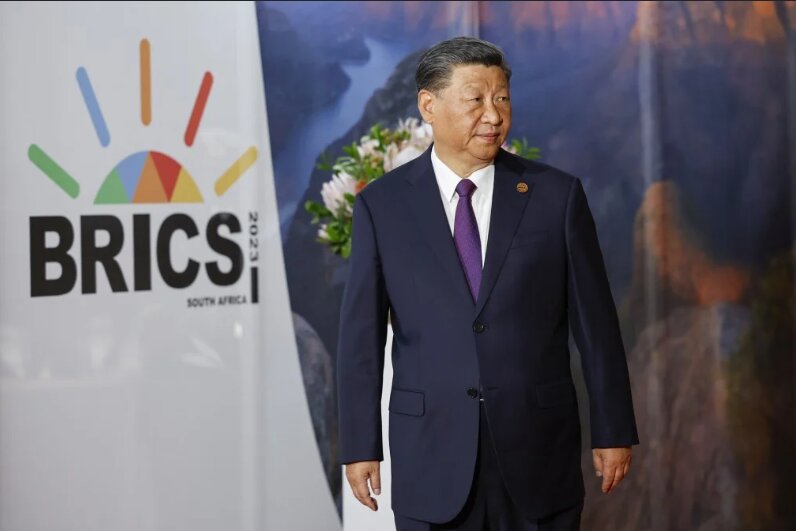
In Brief
INTERNAL
China’s President Xi Jinping to visit India for BRICS Summit, marking his first visit in seven years amid strained ties
On 10 September, SCMP reported that China’s President Xi Jinping will visit New Delhi this weekend for the BRICS Summit, marking his first trip to India in nearly seven years. Invited by Prime Minister Narendra Modi, Xi's visit follows recent high-level diplomatic stops in Kyrgyzstan and Egypt, with an upcoming meeting scheduled with the US President Donald Trump. The trip comes as India and China work to mend relations that soured after a deadly 2020 border clash, following recent agreements to revive direct flights, resume border trade, and establish new military communication channels. While Beijing views the summit as a way to strengthen its ties with neighbors and lead the Global South, the visit also coincides with trade friction, as India intensifies scrutiny of China’s investments and tech firms such as Xiaomi.
(“China’s Xi Jinping to make first trip to India in 7 years for Brics summit,” South China Morning Post, 10 September 2026)
https://sc.mp/05d0f?utm_source=copy-link&utm_campaign=3367062&utm_medium=share_widget
Dinosaur fossil found 473 metres underground in Inner Mongolia mineral survey drill core
On 11 September, Xinhua reported that scientists discovered a dinosaur fossil buried 473.2 metres underground, found inside a drill core from a copper mineral survey in Inner Mongolia, rather than at a traditional excavation site. Co-author Xing Lida, a dinosaur expert at China University of Geosciences (Beijing), said such finds are extremely rare worldwide, comparing it to a 1997 discovery in Norway's North Sea. The specimen, dated to the Early Cretaceous roughly 120 million years ago, includes rib and tail bone fragments from an unfused juvenile, suggesting it died young. Comparisons with over 20 other bird-hipped dinosaurs found the tail bones most resembled Psittacosaurus, though limited material prevented precise species identification. The fossil also showed unexplained tiny holes on its tail bones, not previously reported in similar dinosaurs, and will soon go on public display at the Inner Mongolia Museum of Natural History.
("Across China: Dinosaur fossil found deep underground in drill core in north China," Xinhua, 11 September 2026)
https://english.news.cn/20260911/27b8142000fb403f835e1ae2a97cdde5/c.html
Beijing and Manila intensify rhetoric and diplomatic tensions over the South China Sea
On 11 September, SCMP reported on escalating South China Sea tensions after the Philippines exposed a coercive Chinese diplomatic note, drawing fierce backlash from Beijing. Beijing vehemently accused Manila of “grandstanding and lying” after Philippine Defence Secretary Gilberto Teodoro Jnr publicly read aloud a handwritten Chinese diplomatic note at the Seoul Defence Dialogue. The memo dismissed the 2016 South China Sea arbitration ruling. Secretary Teodoro condemned the delivery as blatant coercion and bullying, intensifying ongoing territorial tensions between the two nations.
(“Manila exposes South China Sea note; Chinese coal mine farming plan: SCMP’s 7 highlights,” South China Morning Post, 11 September 2026; “Beijing tells Manila to ‘stop lying’ after minister exposes South China Sea note,” South China Morning Post, 09 September 2026)
https://www.scmp.com/news/china/diplomacy/article/3366935/beijing-tells-manila-stop-lying-after-minister-exposes-south-china-sea-note
https://www.scmp.com/news/china/article/3367130/manila-exposes-south-china-sea-note-chinese-coal-mine-farming-plan-scmps-7-highlights
Chinese scientists seek to quadruple power of hydrogen fuel cell
On 11 September, SCMP reported that Chinese researchers at the Beijing Institute of Technology have developed a breakthrough proton exchange membrane fuel cell design that quadruples power output while also reducing costly platinum usage. By creating a Brønsted acid-Lewis base interface that accelerates proton transport like a relay race, the technology significantly improves efficiency, durability, and range. Scientists are optimistic that this innovation promises to expand hydrogen applications from heavy duty long haul freight to demanding aerospace missions.
(“Chinese scientists boost hydrogen fuel cell power fourfold with new design,” South China Morning Post, 11 September 2026)
https://www.scmp.com/news/china/science/article/3367077/chinese-scientists-boost-hydrogen-fuel-cell-power-fourfold-new-design
China warns of serious threat over Japan’s plan for AI-powered military satellites
On 10 September, SCMP reported that Japan plans to launch AI-equipped tactical satellites by 2030 to speed up its missile targeting and boost its independent military strike capabilities. This however has drawn sharp criticism from China’s state media. Unlike traditional reconnaissance spacecraft that send large, raw images back to Earth for slow processing, these new satellites will analyze data directly in orbit, cutting communication time from hours to seconds and allowing real-time tracking of moving targets like warships. By processing data in space, the system is less vulnerable to electronic jamming and reduces Japan's reliance on US intelligence, granting Tokyo greater operational autonomy. China has warned that this technology is a serious threat that marks a major step in the militarization of space, even as Beijing rapidly expands its own massive space-based AI computing network.
(“Japan’s AI satellites and other space ambitions ‘a serious threat’, China warns,” South China Morning Post, 10 September 2026)
https://sc.mp/qdr5e?utm_source=copy-link&utm_campaign=3367060&utm_medium=share_widget
CHINA AND EAST ASIA
Japan's military build-up faces mounting domestic constraints amid China tensions
On 09 September, South China Morning Post reported that Japan's most ambitious military transformation since World War II, driven by the risk of being drawn into a Taiwan conflict, faced significant economic, demographic, and political constraints at home. Analysts said Japan's Self-Defence Forces (SDF) had only 217,701 personnel against an authorised 247,154 as of March, with defence ministry projections suggesting numbers could fall to around 130,000 by 2045 without corrective action. The defence ministry requested a record JPY 8.9 trillion (USD 55.7 billion) for the 2027 financial year, its 15th consecutive annual increase, with officials indicating the figure could rise to around JPY 10 trillion once Japan's security documents are revised by year's end. Analysts warned that rising debt-servicing costs and a weak yen, which raises the cost of dollar-priced US equipment, could limit how much military capability Japan can actually afford. Prime Minister Sanae Takaichi's remarks last November suggesting a Taiwan contingency could constitute a "survival-threatening situation" drew strong criticism from Beijing, which could tighten controls on rare earths and dual-use materials in response, analysts said, potentially reinforcing Japanese threat perceptions and further complicating regional dynamics.
("Japan's China-facing military build-up confronts labour, budget and political limits," South China Morning Post, 09 September 2026)
https://amp.scmp.com/news/china/military/article/3366923/japans-china-facing-military-build-confronts-labour-budget-and-political-limits?module=top_story&pgtype=section
CHINA AND AFRICA
China, Rwanda launch 10-km road upgrade project in Kigali
On 09 September, Xinhua reported that Rwandan and Chinese officials launched a road expansion and upgrade project in Kigali's transport network on Tuesday, the latest China-aided infrastructure project in the country. State Minister Claudien Bizimungu said the 10-kilometre project, running from Prince House to Masaka, would improve traffic flow, reduce travel time, and strengthen connectivity, while boosting access to jobs, markets, and services. Chinese Ambassador Gao Wenqi called it a "tie binding China-Rwanda friendship." The project's initial 1.37-kilometre section upgrades an existing four-lane road into an interchange, while the remaining 9.04 kilometres will widen a two-lane road into four lanes. Built by Hunan Road and Bridge Construction Group, it is framed as a key Belt and Road livelihood project following the Forum on China-Africa Cooperation Beijing Summit.("China, Rwanda launch road expansion, upgrade project in Kigali," Xinhua, 09 September 2026)
https://english.news.cn/20260909/425a867e53f7436986a5c69eb934bd58/c.html
CHINA AND EUROPE
Cao Jiaxuan, “Far-right AfD party won big in Saxony-Anhalt. Will it affect Germany’s approach to China?,” South China Morning Post, 10 September 2026
“Analysts say the results in Saxony-Anhalt will have an indirect effect on Germany’s China policy … The AfD’s “economy-first” message was gaining ground among “some industrial voters and business constituencies”, Downes said, but its main effect was likely to be indirect, shaping public debate and the rhetoric of the CDU/Christian Social Union in Bavaria coalition, rather than determining federal policy … “There is currently no clear policy on China to anticipate,” Lehrer said. “Of course, the AfD wants to strengthen ties with China, and compared to other German parties, it is the least China-hawkish” … But even if the AfD entered federal government, which Lehrer said was unlikely in the near future, it would “face the same structural problems with China’s economy as any other party”, including securing inputs, markets and the position of German companies in China and Europe.”
https://amp.scmp.com/news/china/diplomacy/article/3367059/far-right-afd-party-won-big-saxony-anhalt-will-it-change-germanys-approach-china?module=top_story&pgtype=section
China Reader Daily Wire | 10 September 2026, Thursday | Vol 3 No. 137
China unveils leapfrog tech next-gen J-36 fighter
China’s 5th Global Digital Trade Expo showcases AI and global partnerships
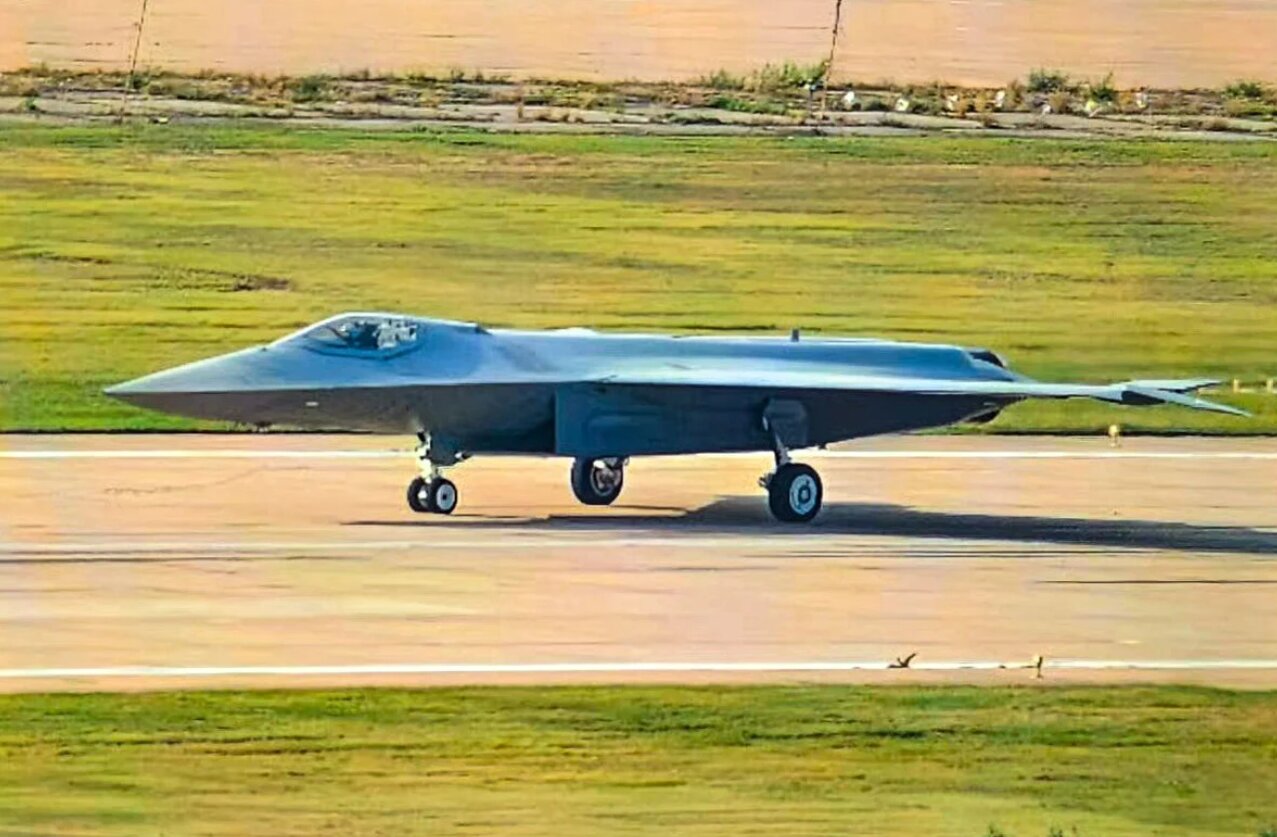
In Brief
INTERNAL
Beijing quietly sets up new social stability body ahead of 2027 party congress
On 10 September, South China Morning Post (SCMP) reported that China's ruling Communist Party has quietly established a high-level party group, the Leading Group for Social Governance, signalling a renewed push for social stability about a year ahead of its 21st national congress, expected in autumn 2027. Beijing has never officially announced the body's formation, nor disclosed its leadership. Its existence has instead emerged through a trail of local government reports over recent months. The latest hint came in an online post from Ulanqab, Inner Mongolia, where local authorities said they had convened a meeting to "convey and study" the spirit of the group's "fifth plenary meeting" alongside its regional counterpart. The group's creation underscores growing focus on internal security and grass-roots governance ahead of the party congress.
("China's Communist Party quietly signals social stability push with new high-level body," South China Morning Post, 10 September 2026)
https://www.scmp.com/news/china/politics/article/3366894/chinas-communist-party-quietly-signals-social-stability-push-new-high-level-body
Xinjiang hosts 300 foreign officials; Scholars to showcase governance model
On 08 September, Xinhua reported that more than 300 government officials, scholars, business representatives, and journalists from 33 countries gathered in Urumqi for the Xinjiang Friendship and Exchange Conference with Distinguished International Guests, themed "Xinjiang's Governance Experience and Its International Significance." Shanghai Cooperation Organization (SCO) Secretary-General Nurlan Yermekbayev praised the region's security and economic cooperation, while Minzu University professor Mark Levine described witnessing "the shift from insecurity to lasting peace and vitality" across multiple visits. A 2025 white paper cited at the conference said Xinjiang's railways reached 9,202 kilometres and its highway network about 230,000 kilometres by 2024, with average life expectancy rising to 77 years, up from 30 in 1949. Sessions covered counter-terrorism, ethnic unity, social governance, and opposition to "unilateral sanctions."
("China Focus: Xinjiang governance experience, global relevance in focus at Urumqi conference," Xinhua, 08 September 2026)
https://english.news.cn/20260908/43273ae8e7454982b8cffaa07af1022d/c.html
444 residents return home as Xizang mudslide barrier lake threat eases, death toll hits 43
On 08 September, Xinhua reported that 444 residents evacuated from villages near Gyirong Town, Xizang, have safely returned home after the threat from a barrier lake was largely eliminated, following the mudslide triggered by a 26 August glacier collapse in Nepal. The barrier lake above Gyirong Port's core area has been drained, with the river resuming normal flow after days of safety inspections and hydrological monitoring. Local officials assisted evacuees' livestock, poultry, and crops during the displacement, and delivered food and necessities door to door upon their return. As of 05 September, 43 people were confirmed dead and 519 remained missing, including 261 foreign nationals from 23 countries.
("Evacuated residents returning home after mudslide hits border port in China's Xizang," Xinhua, 08 September 2026)
https://english.news.cn/20260908/01ce64f8f7844b658b65ee2585fac1f2/c.html
SCIENCE AND TECHNOLOGY
China unveils leapfrog tech next-gen J-36 fighter
On 10 September, SCMP reported that China's Shenyang Aircraft Design and Research Institute, the developer of the secretive J-50 fighter, published a paper laying out its vision for next-generation combat jets which are likely relevant to the J-50 and J-36 programs. The plan centers on three big upgrades: first, aircrafts that can take over flying themselves if a pilot becomes unconscious or is overloaded, second, navigation systems (including quantum-based sensors) that work even when GPS is jammed, and third, drone "wingman" formations that can automatically reorganize if one aircraft is damaged or lost. The researchers frame this as a shift from older eras of air combat, focused on maneuvering, then stealth and sensors toward an AI-driven, networked style of warfare where manned and unmanned aircraft coordinate as a team. Furthermore, they are also highly cautious about AI as they want it handling tactics and coordination, not the safety-critical core flying functions, which stay under tightly controlled, predictable systems. The paper published is a proposed roadmap rather than confirmation that these technologies are already flying today.
(“J-50 designers reveal leapfrog tech for China’s next-gen stealth fighters,” SCMP, 10 September 2026)
https://sc.mp/1bee4?utm_source=copy-link&utm_campaign=3367010&utm_medium=share_widget
China’s 5th Global Digital Trade Expo showcases AI and global partnerships
On 08 September, Xinhua net reported that the 5th Global Digital Trade Expo will take place from 23 to 27 September in Hangzhou, China, focusing heavily on artificial intelligence (AI) across its 170,000-square-meter exhibition space. Over one-third of the exhibitors will showcase AI innovations, alongside side competitions covering robotics and brain-computer interfaces in the event. The highly international event features Malaysia and Hungary as guest countries, drawing attendees from 121 nations and 40,000 buyers who are expected to drive USD 977 million in procurement orders. This expo highlights China's rapid digital trade growth which averaged 11.2 per cent annually from 2016 to 2025, as the country aims to have digital services command over 50 per cent of its total service trade by 2035.
(“AI to take center stage at 5th global digital expo,” Xinhua net, 08 September 2026)
https://english.news.cn/20260908/d9679f5f0163435f93dc46997225a746/c.html
CHINA AND EAST ASIA
Japan's military build-up faces mounting domestic constraints amid China tensions
On 09 September, South China Morning Post reported that Japan's most ambitious military transformation since World War II, driven by the risk of being drawn into a Taiwan conflict, faced significant economic, demographic, and political constraints at home. Analysts said Japan's Self-Defence Forces (SDF) had only 217,701 personnel against an authorised 247,154 as of March, with defence ministry projections suggesting numbers could fall to around 130,000 by 2045 without corrective action. The defence ministry requested a record JPY 8.9 trillion (USD 55.7 billion) for the 2027 financial year, its 15th consecutive annual increase, with officials indicating the figure could rise to around JPY 10 trillion once Japan's security documents are revised by year's end. Analysts warned that rising debt-servicing costs and a weak yen, which raises the cost of dollar-priced US equipment, could limit how much military capability Japan can actually afford. Prime Minister Sanae Takaichi's remarks last November suggesting a Taiwan contingency could constitute a "survival-threatening situation" drew strong criticism from Beijing, which could tighten controls on rare earths and dual-use materials in response, analysts said, potentially reinforcing Japanese threat perceptions and further complicating regional dynamics.
("Japan's China-facing military build-up confronts labour, budget and political limits," South China Morning Post, 09 September 2026)
https://amp.scmp.com/news/china/military/article/3366923/japans-china-facing-military-build-confronts-labour-budget-and-political-limits?module=top_story&pgtype=section
CHINA AND THE AMERICAS
US sanctions Chinese-language Xinbi Guarantee marketplace over cyber scams
On 10 September, South China Morning Post reported that the United States has sanctioned the Chinese-language online marketplace Xinbi Guarantee and two affiliated organisations as part of a wider crackdown on transnational cybercrime. The US Department of Justice also seized Telegram channels and cryptocurrency wallets associated with the platform, freezing more than US$52 million in potentially laundered funds in a single day. Xinbi Guarantee, which operates through Telegram and reportedly has more than 650,000 users, is accused of providing a marketplace where scam centres could purchase and sell illicit services targeting Americans. The sanctions also targeted Singapore-based SafeW Technology and Cambodia-based Anwen Technology, which Washington alleges provided applications supporting Xinbi’s operations. The enforcement action was carried out by the Justice Department’s inter-agency Scam Centre Strike Force alongside the Treasury Department. The case highlights the increasingly transnational nature of online scam networks and adds another dimension to US concerns over Chinese-linked cybercrime infrastructure.
(“US sanctions Chinese-language Xinbi Guarantee marketplace over cyber scams,” South China Morning Post, 10 September 2026)
https://www.scmp.com/news/us/article/3366977/us-sanctions-chinese-language-xinbi-guarantee-marketplace-over-cyber-scams
Brazil scraps tax on small parcels as Chinese platforms gain tariff-free access
On 10 September, South China Morning Post reported that Brazil has eliminated its federal import tax on small overseas parcels, providing Chinese e-commerce platforms such as Shein, Shopee and AliExpress with continued tariff-free access to Latin America’s largest economy. The decision reverses efforts to impose greater taxation on low-value imports and comes as the United States and European Union move in the opposite direction by closing similar trade loopholes. The report noted that Brazil’s tax had applied to lower-value purchases including clothing, electronics, toys and household goods. Although its removal is expected to reduce government tax revenues, the measure had become politically unpopular ahead of Brazil’s October 4 presidential election. President Luiz Inácio Lula da Silva defended the decision as a matter of social justice, arguing that lower-income consumers should not face additional costs when purchasing inexpensive goods from abroad. The development could strengthen the position of Chinese online retailers in the Brazilian market while highlighting contrasting approaches to regulating low-value Chinese imports across major economies.
(“Brazil scraps tax on small parcels as Chinese platforms lose US and EU access,” South China Morning Post, 10 September 2026)
https://www.scmp.com/news/china/article/3366975/brazil-scraps-tax-small-parcels-chinese-platforms-lose-us-and-eu-access
China Reader Daily Wire | 07 September 2026, Monday | Vol 3 No. 134
China outlines 2030 fisheries plan integrating AI and strict catch limits
China’s new Tianyu Telescope features unique real-time ‘rewind’ to capture supernova
In Brief
INTERNAL
China’s role as global supply chain anchor highlighted at the 26th China International Fair for Investment and Trade
On 08 September, Xinhua net reported that, at the 26th China International Fair for Investment and Trade (CIFIT) in Xiamen, company executives highlighted China's expanding role as a stabilizing anchor for global supply chains amidst rising geopolitical headwinds and trade barriers. Reflecting intense international interest, the fair expanded its exhibition space to 200,000 square meters and hosted delegations from 129 countries and regions. Beyond acting as a major sales market, China is deeply integrating into global industrial value chains, as demonstrated by the USD 6.5 billion Sino-Saudi Gulei Ethylene Complex Project and infrastructure like the Fuzhou-to-Tashkent freight rail that has halved transit times for Central Asian traders. Furthermore, China’s supply chain firms are actively helping foreign nations build resilience and upgrade local industries; notably, a 2.5-million-tonne stainless steel project in Indonesia has generated over 12,000 local jobs, built critical infrastructure, and shifted resource-rich countries away from raw material extraction toward higher-value domestic processing.
(“Xinhua Headlines: China strengthens global supply chain cooperation to bolster economic certainty,” Xinhua net, 08 September 2026)
https://english.news.cn/20260908/55df8877f65f442a952c938744b10530/c.html
China outlines 2030 fisheries plan integrating AI and strict catch limits
On 08 September, Xinhua reported that China's Ministry of Agriculture and Rural Affairs has launched a national fisheries development plan for 2026–2030. The plan aims to vastly increase high-quality aquatic output by 2030 through modern technological upgrades. Building on its 2025 production of 76.52 million tonnes, which accounted for over half of global aquaculture. China will integrate artificial intelligence (AI) and big data to modernize facility-based fisheries while enforcing a strict annual domestic marine catch cap of 10 million tonnes to protect wild stocks. The plan reinforces China's environmental and global commitments by continuing the 10-year Yangtze River fishing ban, stabilizing rare species populations, and deepening participation in international treaties like the Central Arctic Ocean commercial fishing ban.
(“China aims to boost supply of high-quality aquatic products by 2030,” Xinhua net ,08 September 2026)
https://english.news.cn/20260908/8b8afb481f8849e0b771a65ee04e6439/c.html
SCIENCE AND TECHNOLOGY
China’s new Tianyu Telescope features unique real-time ‘rewind’ to capture supernova
On 08 September, Xinhua reported that the Tianyu Telescope, located in Lenghu, northwest China's Qinghai Province, has transitioned to its scientific observation stage after capturing the North America and Pelican Nebulae alongside over one million stars in a single exposure. The telescope developed by Shanghai Jiao Tong University and the Chinese Academy of Sciences, features a massive field of view covering nearly nine square degrees that are equivalent to over 40 full moons and is scheduled to begin formal survey operations in October 2026. A standout capability of the telescope is its unique real-time "rewind" feature. The feature allows it to rapidly pivot toward space alerts like supernovae or gravitational-wave flashes and restore celestial views from seconds before the explosion. The project has already drawn collaborative research teams from Britain, Belgium, and Chile to help monitor hundreds of millions of celestial bodies for exoplanets, variable stars, and small solar system bodies.
(“China's Tianyu Telescope to be commissioned for scientific observations,” Xinhua net, 08 September 2026)
https://english.news.cn/20260908/ea7d28be5255494e8647f462fcc8f488/c.html
CHINA AND EAST ASIA
China imposes anti-dumping measures on Japanese imports of chip chemicals
On 08 September, The Japan Times reported that China’s Commerce Ministry had imposed anti-dumping measures on Japanese shipments of dichlorosilane, a chemical required to process silicon wafers into chips. Chinese companies importing the chemical from Japan must provide cash deposits of up to 99.8 per cent to authorities. Japan’s Chief Cabinet Secretary Minoru Kihara stated that they are reviewing China’s measures and assessing its impact. The measure is the latest in a series of diplomatic feuds between Japan and China, where Beijing has restricted exports of rare earth minerals to Japan, which is the 2nd largest producer of dual-use permanent magnets. China has increased its shipments of ultra-high purity dichlorosilane from South Korea, becoming its largest supplier in 2025.
(“China hits Japan with anti-dumping measures on chip chemical,” The Japan Times, 08 September 2026)
https://www.japantimes.co.jp/business/2026/09/08/economy/china-japan-imports-anti-dumping/
Japan scrambled its military jets in response to Chinese spy aircraft over East China Sea
On 07 September, Anadolu Agency reported that Japan had scrambled its military jets for four days after a Chinese aircraft allegedly flew over the East China Sea. Per a statement released by the Japanese Joint Staff, China had deployed a Y-9 reconnaissance aircraft, which was detected off the Danjo Islands and off Okinawa’s main island in the East China Sea. The statement also clarified that the aircraft did not intrude into Japan’s airspace.
(“Japan says it scrambled military jets for 4 days after Chinese spy aircraft fly over East China Sea,” Anadolu Agency, 07 September 2026)
https://www.aa.com.tr/en/asia-pacific/japan-says-it-scrambled-military-jets-for-4-days-after-chinese-spy-aircraft-fly-over-east-china-sea/4049427
China-Japan trade friction deepens over anti-dumping duties on chipmaking chemical
On 07 September, South China Morning Post reported that China would impose provisional anti-dumping duties of up to 99.2 per cent on Japanese dichlorosilane, a critical chipmaking chemical, following an eight-month investigation that found dumped imports had harmed local manufacturers. China's Ministry of Commerce said importers would be required to pay corresponding cash deposits starting 08 September, with Denal Silane facing a lower rate of 80.8 per cent while other firms, including major supplier Shin-Etsu Chemical, would face the maximum rate. The ministry said it had applied trade remedy measures in a "prudent and restrained manner" and would continue the investigation to reach an objective final determination. Dichlorosilane is primarily used in thin-film deposition processes central to chip production, with the anti-dumping investigation launched by Beijing in January.
("China hits critical Japanese chipmaking chemical with steep anti-dumping measures," South China Morning Post, 07 September 2026)
https://www.scmp.com/economy/china-economy/article/3366661/china-hits-critical-japanese-chipmaking-chemical-steep-anti-dumping-measures
Opinion: Chao Kong, “Could China sanction US for illegal international seabed mining? A study says yes,” South China Morning Post, 08 September 2026
“For decades, the United States has used economic and financial restrictions as major foreign policy tools.But as China and other countries gain greater economic and technological strength, they are also acquiring more ways to push back against US actions, with deep-sea mining possibly becoming a testing ground for that shift.China could join other countries in taking coordinated countermeasures, including sanctions against companies, if the US proceeds with seabed mining in violation of international law, according to Bian Yongmin, a professor of international law at the University of International Business and Economics in Beijing … For China, the issue creates a tension between defending the multilateral system and protecting access to critical minerals, with Beijing already deeply involved in international seabed development … Coordinated action could follow if diplomacy failed.Bian wrote that countries firmly committed to upholding the multilateral mechanism for deep-sea mining could at least refuse to cooperate with American mining companies.They could also avoid buying deep-sea mineral products sold by American deep-sea mining companies and their processed products, she wrote.”
https://amp.scmp.com/news/china/science/article/3366759/could-china-sanction-us-illegal-international-seabed-mining-study-says-yes
CHINA AND PACIFIC
Australia nears agreement on defence treaty with Solomon Islands
On 08 September, SCMP reported that Australia has reached an “in-principle” treaty agreement with the Solomon Islands per Australian media reports, and the signing is expected to happen in the coming weeks. The deal is widely seen as part of Australia’s efforts to bring the Solomon Islands and the other Pacific island countries under its sphere of influence to deter China. Per leaked texts from Australia’s Ambassador to the Solomon Islands, Australia has also apparently pledged USD 708 million in aid and assistance to the country. Solomon Islands’ Prime Minister Matthew Wale is a stringent critic of the previous Manasseh Sogavare administration’s 2022 security pact with China, and is seeking to reverse the policy. The signing, if it materialises, would make the Solomon Islands the fifth formal defence treaty ally of Australia, and the fourth Pacific Island country after Fiji, Papua New Guinea and New Zealand.
(“Australia nears treaty with Solomon Islands in bid to limit China’s influence,” SCMP, 08 September 2026)
https://www.scmp.com/news/asia/australasia/article/3366702/australia-nears-treaty-solomon-islands-bid-limit-chinas-influence
CHINA AND SOUTHEAST ASIA
Malaysia’s top news agency CEO and think-tank chief lauds China-ASEAN cooperation
On 09 September, Xinhuanet reported that Malaysia’s National News Agency (Bernama) CEO Nur-ul Afida Kamaludin and Chairman of the Center of Regional Strategic Studies and Member of Parliament Tan Kar Hing praised China-ASEAN relations. In an interview with Xinhuanet, Kamaludin stated that cooperation between ASEAN and China “will be key to ensuring regional stability and economic growth even as the world continues to grapple with geopolitical challenges.” She added that the Asia-Pacific region should not be divided into rival regional blocs, and that China-Malaysia relations have improved substantially across trade, investment, infrastructure and people-to-people exchanges. MP Kar Hing is set to lead a Malaysian delegation for the China International Fair for Trade in Services (CIFTIS)in Beijing from 09 to 13 September. He stated that CIFTIS acts as a two-way bridge for China-ASEAN cooperation and praised China’s technological advancements showcased at the fair.
(“ASEAN-China cooperation key to regional stability, growth, says Malaysian National News Agency CEO,” Xinhuanet, 09 September 2026; “CIFTIS a two-way bridge for China-ASEAN cooperation: Malaysian think tank leader,” Xinhuanet, 09 September 2026)
https://english.news.cn/asiapacific/20260907/75b9b34411db44b4927954873392811c/c.html
CHINA AND AFRICA
Zambian delegation participate in seminar organized by China’s Commerce Ministry
On 08 September, Xinhua reported that Zambia had sent senior officials from its Commerce and Trade Ministry to attend a seminar on processing trade innovation organized by China’s Commerce Ministry in Beijing. Spokesperson Everness Nankala stated that exposure to China’s industrial experience would help Zambia to formulate their own policies and programs to support local businesses. She added that China remains a major partner in bilateral trade, investment and technical cooperation and thanked China’s support for Zambia’s developmental goals and ideals.
(“China's industrial experience helps accelerate Zambia's development: ministry,” Xinhuanet, 08 September 2026)
https://english.news.cn/africa/20260909/dbc30511ffed45b5be560cc3407d868f/c.html
CHINA AND AFRICA
Beijing and Cairo strengthen mutual trust and cooperation; focus on South-South cooperation
On 09 September, Xinhua reported that there is a deep level of mutual trust and strategic coordination driving the expanding bilateral partnership between Egypt and China. Grounded in strong political alignment and historical ties, this relationship fosters comprehensive collaboration across multiple sectors, including economic development, trade, and cultural exchange. The same sentiments was echoed by Ezzat Saad, director of the Egyptian Council for Foreign Affairs, stating that "Egyptian-Chinese relations are characterized by a high level of trust between the leaders of the two countries, deep friendship, shared interests, and mutual benefits." He attributed this development to initiatives like BRI, SCO, and BRICS, which he believes are pertinent to strengthen the global South in a multi polar world. By leveraging their shared vision and mutual respect, both nations seek to advance key joint projects, enhance regional stability, and reinforce their strategic alliance.
(“High-level trust drives Egypt-China partnership forward: expert,” Xinhua Net, 09 September 2026)
https://english.news.cn/africa/20260906/dc5071c22f634b3eb7611a2cad40bb2a/c.html
CHINA AND EUROPE
President Xi holds talks with British PM; both parties seek to deepen bilateral ties
On 09 September, Xinhua reported China’s President Xi Jinping held phone talks with newly appointed British Prime Minister Andy Burnham to discuss deepening bilateral relations. Highlighting their status as UN Security Council permanent members and major global economies, both leaders emphasized expanding mutually beneficial cooperation despite differing social systems. President Xi invited British partnership during China's 15th Five-Year Plan, specifically pointing to opportunities in healthcare, finance, and education, while requesting protection for Chinese investors. PM Burnham reaffirmed Britain’s unchanged stance on Taiwan, praised China’s local disaster relief efforts assisting British citizens, and expressed commitment to building a stable, long-term strategic partnership focused on multilateralism, trade, and climate action.
(“Xi holds phone talks with British PM,” Xinhua Net, 09 September 2026)
https://english.news.cn/20260908/86fdea33fc314b2ba0109dc1e0f5e86d/c.html
CHINA AND THE AMERICAS
Washington warns Ford over its strategic ties to Chinese tech rivals
On 08 September, Al Jazeera reported that the US Department of Transportation publicly criticized Ford Motor Company over its partnerships with Chinese firms CATL, Geely, and BYD, warning they jeopardize American supply chain security. The US Department of Transportation's public warning to Ford highlights the deepening economic friction and technological decoupling between Washington and Beijing. To secure global leadership in next generation transport, the US government is aggressively cracking down on foreign component dependencies, viewing Chinese electric vehicle (EV) supply chains, battery tech, and software as critical national security vulnerabilities. Ford’s strategy is also reflective of the dilemma faced by Western automakers, while Washington demands total supply chain independence, American manufacturers rely on Chinese technical expertise such as CATL’s battery technology to build competitive, affordable EVs before foreign rivals capture global market share. By penalizing these partnerships, as per Al Jazeera, the US risks creating a strategic trade-off between strict national security boundaries and the rapid domestic industrialization required to rival China's clean technology dominance.
(“US warns Ford over ties with Chinese firms amid tensions,” Al Jazeera, 08 September 2026)
https://www.aljazeera.com/economy/2026/9/8/us-warns-ford-over-ties-with-chinese-firms-amid-tensions
Opinion: Scott Morrison, “China Overplayed Its Hand on Critical Minerals,” Wall Street Journal, 08 September 2026
"By weaponizing its near-monopoly on critical minerals to squeeze Western defense sectors and pressure global trade partners, China believed it could project insurmountable economic leverage. Instead, Beijing overplayed its hand. Rather than forcing compliance, its aggressive export restrictions spooked the international community into action, dismantling decades of Western industrial complacency. Across the G7 and beyond, governments are now deploying unprecedented capital subsidies, instituting price floors, and forging global mining alliances to build independent supply chains. In attempting to assert total dominance over the building blocks of future technology, China has inadvertently accelerated the global coalition that will ultimately break its grip on these vital resources."
https://www.wsj.com/opinion/china-overplayed-its-hand-on-critical-minerals-fbab6de8
China Reader Daily Wire | 07 September 2026, Monday | Vol 3 No. 134
China outlines 2030 fisheries plan integrating AI and strict catch limits
China’s new Tianyu Telescope features unique real-time ‘rewind’ to capture supernova
In Brief
INTERNAL
China’s role as global supply chain anchor highlighted at the 26th China International Fair for Investment and Trade
On 08 September, Xinhua net reported that, at the 26th China International Fair for Investment and Trade (CIFIT) in Xiamen, company executives highlighted China's expanding role as a stabilizing anchor for global supply chains amidst rising geopolitical headwinds and trade barriers. Reflecting intense international interest, the fair expanded its exhibition space to 200,000 square meters and hosted delegations from 129 countries and regions. Beyond acting as a major sales market, China is deeply integrating into global industrial value chains, as demonstrated by the USD 6.5 billion Sino-Saudi Gulei Ethylene Complex Project and infrastructure like the Fuzhou-to-Tashkent freight rail that has halved transit times for Central Asian traders. Furthermore, China’s supply chain firms are actively helping foreign nations build resilience and upgrade local industries; notably, a 2.5-million-tonne stainless steel project in Indonesia has generated over 12,000 local jobs, built critical infrastructure, and shifted resource-rich countries away from raw material extraction toward higher-value domestic processing.
(“Xinhua Headlines: China strengthens global supply chain cooperation to bolster economic certainty,” Xinhua net, 08 September 2026)
https://english.news.cn/20260908/55df8877f65f442a952c938744b10530/c.html
China outlines 2030 fisheries plan integrating AI and strict catch limits
On 08 September, Xinhua reported that China's Ministry of Agriculture and Rural Affairs has launched a national fisheries development plan for 2026–2030. The plan aims to vastly increase high-quality aquatic output by 2030 through modern technological upgrades. Building on its 2025 production of 76.52 million tonnes, which accounted for over half of global aquaculture. China will integrate artificial intelligence (AI) and big data to modernize facility-based fisheries while enforcing a strict annual domestic marine catch cap of 10 million tonnes to protect wild stocks. The plan reinforces China's environmental and global commitments by continuing the 10-year Yangtze River fishing ban, stabilizing rare species populations, and deepening participation in international treaties like the Central Arctic Ocean commercial fishing ban.
(“China aims to boost supply of high-quality aquatic products by 2030,” Xinhua net ,08 September 2026)
https://english.news.cn/20260908/8b8afb481f8849e0b771a65ee04e6439/c.html
SCIENCE AND TECHNOLOGY
China’s new Tianyu Telescope features unique real-time ‘rewind’ to capture supernova
On 08 September, Xinhua reported that the Tianyu Telescope, located in Lenghu, northwest China's Qinghai Province, has transitioned to its scientific observation stage after capturing the North America and Pelican Nebulae alongside over one million stars in a single exposure. The telescope developed by Shanghai Jiao Tong University and the Chinese Academy of Sciences, features a massive field of view covering nearly nine square degrees that are equivalent to over 40 full moons and is scheduled to begin formal survey operations in October 2026. A standout capability of the telescope is its unique real-time "rewind" feature. The feature allows it to rapidly pivot toward space alerts like supernovae or gravitational-wave flashes and restore celestial views from seconds before the explosion. The project has already drawn collaborative research teams from Britain, Belgium, and Chile to help monitor hundreds of millions of celestial bodies for exoplanets, variable stars, and small solar system bodies.
(“China's Tianyu Telescope to be commissioned for scientific observations,” Xinhua net, 08 September 2026)
https://english.news.cn/20260908/ea7d28be5255494e8647f462fcc8f488/c.html
CHINA AND EAST ASIA
China imposes anti-dumping measures on Japanese imports of chip chemicals
On 08 September, The Japan Times reported that China’s Commerce Ministry had imposed anti-dumping measures on Japanese shipments of dichlorosilane, a chemical required to process silicon wafers into chips. Chinese companies importing the chemical from Japan must provide cash deposits of up to 99.8 per cent to authorities. Japan’s Chief Cabinet Secretary Minoru Kihara stated that they are reviewing China’s measures and assessing its impact. The measure is the latest in a series of diplomatic feuds between Japan and China, where Beijing has restricted exports of rare earth minerals to Japan, which is the 2nd largest producer of dual-use permanent magnets. China has increased its shipments of ultra-high purity dichlorosilane from South Korea, becoming its largest supplier in 2025.
(“China hits Japan with anti-dumping measures on chip chemical,” The Japan Times, 08 September 2026)
https://www.japantimes.co.jp/business/2026/09/08/economy/china-japan-imports-anti-dumping/
Japan scrambled its military jets in response to Chinese spy aircraft over East China Sea
On 07 September, Anadolu Agency reported that Japan had scrambled its military jets for four days after a Chinese aircraft allegedly flew over the East China Sea. Per a statement released by the Japanese Joint Staff, China had deployed a Y-9 reconnaissance aircraft, which was detected off the Danjo Islands and off Okinawa’s main island in the East China Sea. The statement also clarified that the aircraft did not intrude into Japan’s airspace.
(“Japan says it scrambled military jets for 4 days after Chinese spy aircraft fly over East China Sea,” Anadolu Agency, 07 September 2026)
https://www.aa.com.tr/en/asia-pacific/japan-says-it-scrambled-military-jets-for-4-days-after-chinese-spy-aircraft-fly-over-east-china-sea/4049427
China-Japan trade friction deepens over anti-dumping duties on chipmaking chemical
On 07 September, South China Morning Post reported that China would impose provisional anti-dumping duties of up to 99.2 per cent on Japanese dichlorosilane, a critical chipmaking chemical, following an eight-month investigation that found dumped imports had harmed local manufacturers. China's Ministry of Commerce said importers would be required to pay corresponding cash deposits starting 08 September, with Denal Silane facing a lower rate of 80.8 per cent while other firms, including major supplier Shin-Etsu Chemical, would face the maximum rate. The ministry said it had applied trade remedy measures in a "prudent and restrained manner" and would continue the investigation to reach an objective final determination. Dichlorosilane is primarily used in thin-film deposition processes central to chip production, with the anti-dumping investigation launched by Beijing in January.
("China hits critical Japanese chipmaking chemical with steep anti-dumping measures," South China Morning Post, 07 September 2026)
https://www.scmp.com/economy/china-economy/article/3366661/china-hits-critical-japanese-chipmaking-chemical-steep-anti-dumping-measures
Opinion: Chao Kong, “Could China sanction US for illegal international seabed mining? A study says yes,” South China Morning Post, 08 September 2026
“For decades, the United States has used economic and financial restrictions as major foreign policy tools.But as China and other countries gain greater economic and technological strength, they are also acquiring more ways to push back against US actions, with deep-sea mining possibly becoming a testing ground for that shift.China could join other countries in taking coordinated countermeasures, including sanctions against companies, if the US proceeds with seabed mining in violation of international law, according to Bian Yongmin, a professor of international law at the University of International Business and Economics in Beijing … For China, the issue creates a tension between defending the multilateral system and protecting access to critical minerals, with Beijing already deeply involved in international seabed development … Coordinated action could follow if diplomacy failed.Bian wrote that countries firmly committed to upholding the multilateral mechanism for deep-sea mining could at least refuse to cooperate with American mining companies.They could also avoid buying deep-sea mineral products sold by American deep-sea mining companies and their processed products, she wrote.”
https://amp.scmp.com/news/china/science/article/3366759/could-china-sanction-us-illegal-international-seabed-mining-study-says-yes
CHINA AND PACIFIC
Australia nears agreement on defence treaty with Solomon Islands
On 08 September, SCMP reported that Australia has reached an “in-principle” treaty agreement with the Solomon Islands per Australian media reports, and the signing is expected to happen in the coming weeks. The deal is widely seen as part of Australia’s efforts to bring the Solomon Islands and the other Pacific island countries under its sphere of influence to deter China. Per leaked texts from Australia’s Ambassador to the Solomon Islands, Australia has also apparently pledged USD 708 million in aid and assistance to the country. Solomon Islands’ Prime Minister Matthew Wale is a stringent critic of the previous Manasseh Sogavare administration’s 2022 security pact with China, and is seeking to reverse the policy. The signing, if it materialises, would make the Solomon Islands the fifth formal defence treaty ally of Australia, and the fourth Pacific Island country after Fiji, Papua New Guinea and New Zealand.
(“Australia nears treaty with Solomon Islands in bid to limit China’s influence,” SCMP, 08 September 2026)
https://www.scmp.com/news/asia/australasia/article/3366702/australia-nears-treaty-solomon-islands-bid-limit-chinas-influence
CHINA AND SOUTHEAST ASIA
Malaysia’s top news agency CEO and think-tank chief lauds China-ASEAN cooperation
On 09 September, Xinhuanet reported that Malaysia’s National News Agency (Bernama) CEO Nur-ul Afida Kamaludin and Chairman of the Center of Regional Strategic Studies and Member of Parliament Tan Kar Hing praised China-ASEAN relations. In an interview with Xinhuanet, Kamaludin stated that cooperation between ASEAN and China “will be key to ensuring regional stability and economic growth even as the world continues to grapple with geopolitical challenges.” She added that the Asia-Pacific region should not be divided into rival regional blocs, and that China-Malaysia relations have improved substantially across trade, investment, infrastructure and people-to-people exchanges. MP Kar Hing is set to lead a Malaysian delegation for the China International Fair for Trade in Services (CIFTIS)in Beijing from 09 to 13 September. He stated that CIFTIS acts as a two-way bridge for China-ASEAN cooperation and praised China’s technological advancements showcased at the fair.
(“ASEAN-China cooperation key to regional stability, growth, says Malaysian National News Agency CEO,” Xinhuanet, 09 September 2026; “CIFTIS a two-way bridge for China-ASEAN cooperation: Malaysian think tank leader,” Xinhuanet, 09 September 2026)
https://english.news.cn/asiapacific/20260907/75b9b34411db44b4927954873392811c/c.html
CHINA AND AFRICA
Zambian delegation participate in seminar organized by China’s Commerce Ministry
On 08 September, Xinhua reported that Zambia had sent senior officials from its Commerce and Trade Ministry to attend a seminar on processing trade innovation organized by China’s Commerce Ministry in Beijing. Spokesperson Everness Nankala stated that exposure to China’s industrial experience would help Zambia to formulate their own policies and programs to support local businesses. She added that China remains a major partner in bilateral trade, investment and technical cooperation and thanked China’s support for Zambia’s developmental goals and ideals.
(“China's industrial experience helps accelerate Zambia's development: ministry,” Xinhuanet, 08 September 2026)
https://english.news.cn/africa/20260909/dbc30511ffed45b5be560cc3407d868f/c.html
CHINA AND AFRICA
Beijing and Cairo strengthen mutual trust and cooperation; focus on South-South cooperation
On 09 September, Xinhua reported that there is a deep level of mutual trust and strategic coordination driving the expanding bilateral partnership between Egypt and China. Grounded in strong political alignment and historical ties, this relationship fosters comprehensive collaboration across multiple sectors, including economic development, trade, and cultural exchange. The same sentiments was echoed by Ezzat Saad, director of the Egyptian Council for Foreign Affairs, stating that "Egyptian-Chinese relations are characterized by a high level of trust between the leaders of the two countries, deep friendship, shared interests, and mutual benefits." He attributed this development to initiatives like BRI, SCO, and BRICS, which he believes are pertinent to strengthen the global South in a multi polar world. By leveraging their shared vision and mutual respect, both nations seek to advance key joint projects, enhance regional stability, and reinforce their strategic alliance.
(“High-level trust drives Egypt-China partnership forward: expert,” Xinhua Net, 09 September 2026)
https://english.news.cn/africa/20260906/dc5071c22f634b3eb7611a2cad40bb2a/c.html
CHINA AND EUROPE
President Xi holds talks with British PM; both parties seek to deepen bilateral ties
On 09 September, Xinhua reported China’s President Xi Jinping held phone talks with newly appointed British Prime Minister Andy Burnham to discuss deepening bilateral relations. Highlighting their status as UN Security Council permanent members and major global economies, both leaders emphasized expanding mutually beneficial cooperation despite differing social systems. President Xi invited British partnership during China's 15th Five-Year Plan, specifically pointing to opportunities in healthcare, finance, and education, while requesting protection for Chinese investors. PM Burnham reaffirmed Britain’s unchanged stance on Taiwan, praised China’s local disaster relief efforts assisting British citizens, and expressed commitment to building a stable, long-term strategic partnership focused on multilateralism, trade, and climate action.
(“Xi holds phone talks with British PM,” Xinhua Net, 09 September 2026)
https://english.news.cn/20260908/86fdea33fc314b2ba0109dc1e0f5e86d/c.html
CHINA AND THE AMERICAS
Washington warns Ford over its strategic ties to Chinese tech rivals
On 08 September, Al Jazeera reported that the US Department of Transportation publicly criticized Ford Motor Company over its partnerships with Chinese firms CATL, Geely, and BYD, warning they jeopardize American supply chain security. The US Department of Transportation's public warning to Ford highlights the deepening economic friction and technological decoupling between Washington and Beijing. To secure global leadership in next generation transport, the US government is aggressively cracking down on foreign component dependencies, viewing Chinese electric vehicle (EV) supply chains, battery tech, and software as critical national security vulnerabilities. Ford’s strategy is also reflective of the dilemma faced by Western automakers, while Washington demands total supply chain independence, American manufacturers rely on Chinese technical expertise such as CATL’s battery technology to build competitive, affordable EVs before foreign rivals capture global market share. By penalizing these partnerships, as per Al Jazeera, the US risks creating a strategic trade-off between strict national security boundaries and the rapid domestic industrialization required to rival China's clean technology dominance.
(“US warns Ford over ties with Chinese firms amid tensions,” Al Jazeera, 08 September 2026)
https://www.aljazeera.com/economy/2026/9/8/us-warns-ford-over-ties-with-chinese-firms-amid-tensions
Opinion: Scott Morrison, “China Overplayed Its Hand on Critical Minerals,” Wall Street Journal, 08 September 2026
"By weaponizing its near-monopoly on critical minerals to squeeze Western defense sectors and pressure global trade partners, China believed it could project insurmountable economic leverage. Instead, Beijing overplayed its hand. Rather than forcing compliance, its aggressive export restrictions spooked the international community into action, dismantling decades of Western industrial complacency. Across the G7 and beyond, governments are now deploying unprecedented capital subsidies, instituting price floors, and forging global mining alliances to build independent supply chains. In attempting to assert total dominance over the building blocks of future technology, China has inadvertently accelerated the global coalition that will ultimately break its grip on these vital resources."
https://www.wsj.com/opinion/china-overplayed-its-hand-on-critical-minerals-fbab6de8
China Reader Daily Wire | 07 September 2026, Monday | Vol 3 No. 134
China’s meteorological early-warning system supports Pakistan’s response to extreme weather
China pledges deeper Qatar cooperation on energy and AI
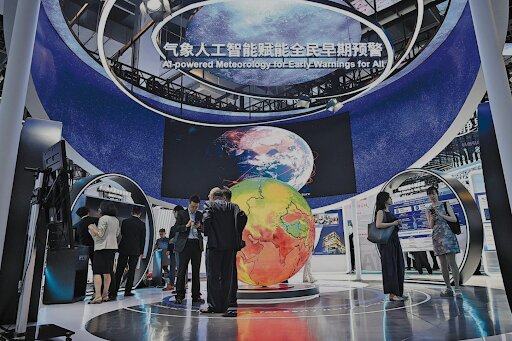
In Brief
CHINA AND SPACE
Cislunar space is emerging as a future military arena say Chinese scientists
On 07 September, Moneycontrol reported that Cislunar space, the region between Earth and the Moon, is emerging as a potential arena for military competition as global powers expand their lunar missions. Recent research from Northwestern Polytechnical University in Xi’an, China, led by aerospace scientists, highlights that future space conflicts may focus on controlling strategic "choke points.” These are fuel-efficient pathways where a spacecraft could block rivals and force them into costly detours. The study was published in the Journal of Command and Control in July. Stated that by exploiting the combined gravity of Earth and the Moon, vehicles can also fly unpredictable routes to evade tracking and interception. This strategic manoeuvring is observed to be drawing intense military interest. While NASA pushes forward with its Artemis programme and the 2027 Gateway station launch, the US Space Force is actively developing plans to expand its defensive operations deeper into this critical zone.
(“The next space battlefield could be 384,000 km from Earth, China study warns,” Moneycontrol, 07 September 2026)
https://www.moneycontrol.com/news/trends/the-next-space-battlefield-could-be-384-000-km-from-earth-china-study-warns-14024596.html
NUCLEAR
China begins construction of Generation III Hualong One reactor
On 06 September, Global Times reported that construction on Unit 2 of the Zhaoyuan nuclear power station in Shandong Province has officially begun. This marked the launch of the project's first phase featuring China's indigenous Generation III Hualong One reactors. China is the fourth country to master indigenous Generation III nuclear power technology following the US, France, and Russia. This specific phase is notable as China's first Hualong One design to use massive 203-meter-tall cooling towers to release heat into the atmosphere rather than the sea. Once all six planned units are fully operational, the site is expected to generate 50 billion kilowatt-hours of electricity annually, which is estimated to be enough to power 5 million people and cut carbon emissions by 46.2 million tons. However, it also provides clean nuclear heating to the regional network. This expansion highlights China's rapid low-carbon energy transition, solidifying its position as the country with the world's largest nuclear pipeline, with 120 units operational, under construction, or approved.
(“China’s first Hualong-One nuclear power station fitted with cooling towers starts construction in Shandong Province,” Global Times, 06 September 2026)
https://www.globaltimes.cn/page/202609/1369910.shtml
CHINA AND EAST ASIA
China imposes anti-dumping measures on Japanese imports of chip chemicals
On 08 September, The Japan Times reported that China’s Commerce Ministry had imposed anti-dumping measures on Japanese shipments of dichlorosilane, a chemical required to process silicon wafers into chips. Chinese companies importing the chemical from Japan must provide cash deposits of up to 99.8 per cent to authorities. Japan’s Chief Cabinet Secretary Minoru Kihara stated that they are reviewing China’s measures and assessing its impact. The measure is the latest in a series of diplomatic feuds between Japan and China, where Beijing has restricted exports of rare earth minerals to Japan, which is the 2nd largest producer of dual-use permanent magnets. China has increased its shipments of ultra-high purity dichlorosilane from South Korea, becoming its largest supplier in 2025.
(“China hits Japan with anti-dumping measures on chip chemical,” The Japan Times, 08 September 2026)
https://www.japantimes.co.jp/business/2026/09/08/economy/china-japan-imports-anti-dumping/
Japan scrambled its military jets in response to Chinese spy aircraft over East China Sea
On 07 September, Anadolu Agency reported that Japan had scrambled its military jets for four days after a Chinese aircraft allegedly flew over the East China Sea. Per a statement released by the Japanese Joint Staff, China had deployed a Y-9 reconnaissance aircraft, which was detected off the Danjo Islands and off Okinawa’s main island in the East China Sea. The statement also clarified that the aircraft did not intrude into Japan’s airspace.
(“Japan says it scrambled military jets for 4 days after Chinese spy aircraft fly over East China Sea,” Anadolu Agency, 07 September 2026)
https://www.aa.com.tr/en/asia-pacific/japan-says-it-scrambled-military-jets-for-4-days-after-chinese-spy-aircraft-fly-over-east-china-sea/4049427
CHINA AND PACIFIC
Australia nears agreement on defence treaty with Solomon Islands
On 08 September, SCMP reported that Australia has reached an “in-principle” treaty agreement with the Solomon Islands per Australian media reports, and the signing is expected to happen in the coming weeks. The deal is widely seen as part of Australia’s efforts to bring the Solomon Islands and the other Pacific island countries under its sphere of influence to deter China. Per leaked texts from Australia’s Ambassador to the Solomon Islands, Australia has also apparently pledged USD 708 million in aid and assistance to the country. Solomon Islands’ Prime Minister Matthew Wale is a stringent critic of the previous Manasseh Sogavare administration’s 2022 security pact with China, and is seeking to reverse the policy. The signing, if it materialises, would make the Solomon Islands the fifth formal defence treaty ally of Australia, and the fourth Pacific Island country after Fiji, Papua New Guinea and New Zealand.
(“Australia nears treaty with Solomon Islands in bid to limit China’s influence,” SCMP, 08 September 2026)
https://www.scmp.com/news/asia/australasia/article/3366702/australia-nears-treaty-solomon-islands-bid-limit-chinas-influence
CHINA AND SOUTH ASIA
China’s meteorological early-warning system supports Pakistan’s response to extreme weather
On 04 September, Xinhua reported that China’s meteorological cooperation with Pakistan is helping strengthen the country’s capacity to forecast and respond to extreme weather. The Pakistan Meteorological Department (PMD) has been using China’s MAZU, an AI-powered meteorological early-warning system, for about a year and a half. The platform integrates observational data, numerical weather-prediction models, satellite information and AI to help meteorologists produce faster forecasts and warnings. The report cited Pakistani officials who said the cooperation has improved access to international forecasting models and strengthened the country’s ability to issue timely alerts. Pakistani meteorologists have also received training at Chinese universities, while Pakistani scientists participated in the system’s co-development. The technology is being used to support communities vulnerable to floods and weather-dependent agriculture. One farmer cited by Xinhua said following PMD advisories helped him avoid losses during the harvest, while another resident evacuated his family after receiving an early flood warning. The cooperation illustrates China’s growing role in providing meteorological technology and technical capacity-building to climate-vulnerable South Asian countries.
(“China's meteorological early warning system helps Pakistan protect lives, livelihoods from extreme weather,” Xinhua, 4 September 2026) https://english.news.cn/asiapacific/20260904/42a8b114a0b44bf597bd8277659fd371/c.html
Nepal-Tibet disaster becomes subject of China’s “Clean Internet” campaign
On 08 September, The Guardian reported that Chinese authorities have used the “Clean Internet 2026” campaign to restrict unofficial information and online discussion surrounding the devastating floods along the Nepal-Tibet border. The campaign, formally presented as an effort to combat misinformation and cybercrime, has increasingly been used to remove what authorities describe as “rumours” about the disaster. The report said Chinese social-media users saw posts about the floods removed or restricted, while some accounts were punished for sharing unofficial estimates of casualties and missing people. The report noted that Chinese authorities have officially reported 43 deaths in Tibet, while some unofficial accounts have claimed that more than 1,000 people were swept away. On 30 August, Tibetan police announced 10 cases under the Clean Internet campaign related to alleged rumours about the disaster. Critics and Tibetan advocacy groups have accused Beijing of withholding information about the scale of the disaster. The episode highlights how disaster reporting in Tibet intersects with China’s wider approach to controlling online information and shaping official narratives during crises.
(“How the Nepal-Tibet disaster became the latest victim of China’s ‘Clean Internet’ campaign,” The Guardian, 8 September 2026)
https://www.theguardian.com/world/2026/sep/08/nepal-tibet-flood-disaster-china-clean-internet-media-censorship-suppression
CHINA AND MIDDLE EAST
China pledges deeper Qatar cooperation on energy, AI, and Middle East de-escalation
On 07 September, South China Morning Post (SCMP) reported that Chinese Premier Li Qiang pledged to deepen cooperation with Qatar in energy, investment, artificial intelligence (AI), and diplomatic efforts to de-escalate Middle East tensions. Li made the remarks during a meeting in Beijing with Qatari Prime Minister and Foreign Minister Sheikh Mohammed bin Abdulrahman Al Thani, on an official two-day visit aimed at bolstering bilateral ties. The visit came as Beijing and Doha sought to navigate regional security tensions and ensure navigation through the Strait of Hormuz, a chokepoint for China's energy imports and Qatar's LNG exports, which supply nearly a third of China's LNG demand. Iran separately said talks with Oman on temporary safe passage through the strait were in their final stage, expected to be registered with the International Maritime Organisation soon, confirming a Qatari delegation's Sunday visit was part of regional de-escalation efforts.
("China vows deeper cooperation with Qatar in energy, AI and Middle East de-escalation," South China Morning Post, 07 September 2026)
https://share.google/JqWjs7bjR9819dIob
CHINA AND AFRICA
China-Egypt air drills conclude with simulated strikes and joint manoeuvres
On 07 September, Business Insider Africa reported that the “Eagles of Civilisation 2026” joint air training between Egypt and China concluded, following over two weeks of exercises that began on 22 August. Multi-role fighter jets from both countries operated across several Egyptian air bases, with the training opening with theoretical sessions to standardise tactics before progressing to simulated offensive strikes, defensive manoeuvres, and aerial refuelling operations. According to Egypt Today, the exercise demonstrated strong coordination between the two air forces in executing joint operations. The drills form part of Egypt’s broader effort to deepen military ties with international partners, marking a significant exercise between Africa’s strongest military and the world’s third most powerful military.
(“Africa’s strongest military concludes air war exercise with China featuring simulated enemy strikes and acrobatic fighter jet manoeuvres,” Business Insider Africa, 07 September 2026)
https://africa.businessinsider.com/local/markets/africas-strongest-military-concludes-air-war-exercise-with-china-featuring-simulated/mvsm4d8
CHINA AND RUSSIA
Investigation finds China secretly supplied Russia with drone-making components
On 06 September, The Telegraph reported that a Chinese state-owned company supplied Russia with materials to build hundreds of kamikaze drones, according to an investigation conducted jointly with Politico. Internal Russian documents showed Jilin Chemical Fibre Group exported 46 tonnes of carbon fibre chemicals to Alabuga-Volokno, a sanctioned subsidiary of Russian state firm Rosatom that builds components for Geran drones used in attacks on Ukraine, including one that killed at least 16 people at a shopping mall. The shipment was disguised under a customs code typically used for civilian synthetic fibres, according to documents reviewed by the Ukrainian Security and Cooperation Centre and shared with Western governments. Weapons expert David Albright estimated the shipment could produce carbon fibre for up to 1,300 kamikaze drones. China’s embassy in Washington denied providing lethal weapons to any party in the conflict, though former US officials said such shipments could not occur without Beijing’s knowledge. The findings emerged ahead of a planned meeting between US President Donald Trump and China’s President Xi Jinping later this month.
(“China secretly supplied Russia with components for killer drones,” The Telegraph, 06 September 2026)
https://www.telegraph.co.uk/world-news/2026/09/06/china-secretly-supplied-russia-components-killer-drones/
CHINA AND EUROPE
EU to meet CEOs from Europe to discuss cutting supply chain reliance on China
On 07 September, Politico reported that EU Trade Chief Maroš Šefčovič is scheduled to meet with CEOs from Europe on 18 September. This meeting is taking place to gather industry feedback on a proposed "diversification tool" designed to reduce critical supply chain reliance on China. The mechanism would push companies within the machinery, electrical components, automotive, and chemical sectors to source key imports like raw materials from at least three different suppliers. The EU seeks to curb its Euro 1 billion-a-day trade deficit and protect its industrial base from possible overcapacity from China. The Commission first wants to gauge industry buy-in and assess how far businesses are willing to go given the high costs of shifting supply chains. This meeting will be followed by high-level diplomatic talks, including a mid-September call and an October trip to Beijing. These are said to happen before EU national leaders evaluate new trade measures at their mid-October summit.
(“EU trade chief to meet CEOs over China strategy,” Politico, 07 September 2026)
https://www.politico.eu/article/eu-trade-chief-maros-sefcovic-meet-eu-ceos-over-china-strategy/
CHINA AND THE AMERICAS
Blacklisted firm from China bypasses US sanctions using Silicon Valley subsidiary reports The Indian Express
On 07 September, The Indian Express reported that Inspur, a server manufacturer from China, despite being blacklisted by the US in 2023 for aiding military supercomputing, has successfully bypassed trade restrictions through its Silicon Valley subsidiary, Aivres. Operating out of the same offices with the same staff, Aivres exported at least USD 5.6 billion in advanced US technology to Southeast Asia, including over USD 3 billion in computers equipped with cutting-edge Nvidia Blackwell chips. Because US law contains loopholes regarding remote access, giants from China like Alibaba and ByteDance can legally utilise these Southeast Asian data hubs to power their artificial intelligence industries. Furthermore, Inspur's network routed high-priced, unlabeled servers through an electronics manufacturer in Malaysia to a newly formed China-based company called Maginfra. It then funnelled over USD 700 million of this hardware directly to universities and state-owned firms IN China. Although federal officials are looking into Aivres, the appetite for enforcement inside the Commerce Department has stalled, marking a 10-month stretch without adding any new firms to the entity list despite critics warning that the administration's slow response has allowed China firms to narrow the AI performance gap with the US.
(“How a blacklisted Chinese tech giant kept buying America’s best AI chips,” The Indian Express, 07 September 2026)
https://indianexpress.com/article/technology/tech-news-technology/how-a-blacklisted-chinese-tech-giant-kept-buying-americas-best-ai-chips-10866468/
China Reader Daily Wire | 07 September 2026, Monday | Vol 3 No. 134
China and Russia conduct first joint on-site observation of Arctic sea ice
India and China hold first Corps Commander meeting near eastern border
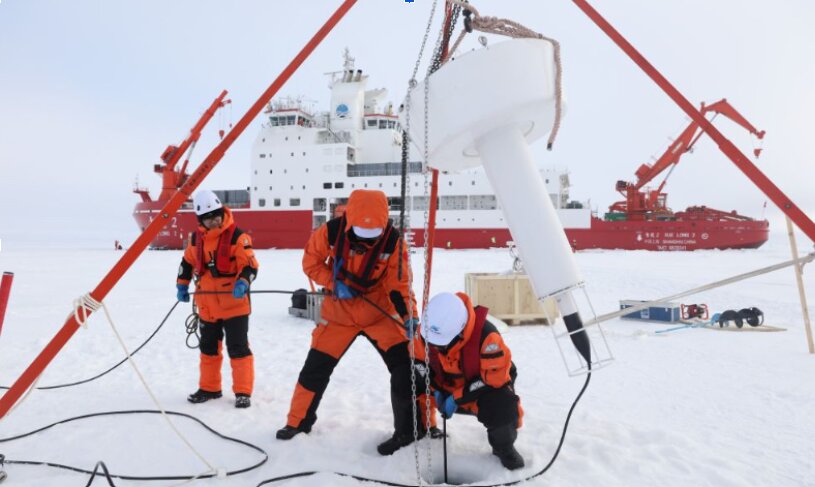
In Brief
INTERNAL
China to inject USD 54 billion into financial institutions as growth falters
On 06 September, The Guardian reported that China will inject USD 54 billion into its financial sector, as it attempts to shore up banks and insurers amid faltering economic growth. A host of financial institutions stated that they would receive billions of yuan in capital from state institutions, including the finance ministry and the company running the country's tobacco monopoly. The stimulus aims to bolster the financial sector's ability to invest in the stock market and lend to businesses, as the world's second-largest economy struggles to escape weak growth. China's largest life insurer, China Life Insurance, will receive CNY 35 billion, while China Taiping Insurance Group will get CNY 7 billion. The People's Insurance Company of China plans to raise up to CNY 15 billion through a private A-share placement to the finance ministry.
("China prepares £40bn stimulus for financial sector amid fears over sluggish growth," The Guardian, 06 September 2026)
https://www.theguardian.com/world/2026/sep/06/china-prepares-40bn-stimulus-for-financial-sector-amid-fears-over-sluggish-growth
World Uyghur Congress urges global action against China's new Ethnic Unity Law
On 06 September, The Tribune, citing ANI, reported that the World Uyghur Congress (WUC) released its weekly brief highlighting growing international efforts to challenge China's policies in East Turkistan, marking the fourth anniversary of a landmark UN human rights assessment. The WUC participated in the "Reimagining Self-Determination" conference organised by the Unrepresented Nations and Peoples Organisation (UNPO), marking its 35th anniversary, where WUC Vice President Zumretay Arkin secured a position on UNPO's new leadership. The WUC cited the 2022 UN Office of the High Commissioner for Human Rights report, which said abuses against Uyghurs "may constitute international crimes." It pointed to China's newly enacted Ethnic Unity Law as a further assimilation tool, warning it threatens Uyghur cultural identity and could enable transnational repression. US lawmakers separately sought stronger enforcement against Uyghur forced-labour-linked cotton found in Labubu doll production.
("China's assimilation campaign faces growing international pushback as World Uyghur Congress calls for action," The Tribune, citing ANI, 06 September 2026)
https://www.tribuneindia.com/news/world/chinas-assimilation-campaign-faces-growing-international-pushback-as-world-uyghur-congress-calls-for-action/
CHINA AND POLAR REGIONS
China and Russia conduct first joint on-site observation of Arctic sea ice
On 06 September, CGTN, citing Global Times and Xinhua, reported that Chinese and Russian researchers conducted their first joint on-site observation of Arctic sea ice, aboard the icebreaker Xuelong 2 during China's 16th Arctic scientific expedition. Two researchers from the Russian Arctic and Antarctic Research Institute joined their Chinese counterparts, agreeing on a joint observation approach before entering the sea-ice zone. They measured sea-ice concentration, type, size, thickness, and snow depth, alongside atmospheric conditions, vessel dynamics, and marine wildlife. A Chinese expert said on-site observations complement satellite remote sensing by allowing direct field measurement, helping researchers better understand Arctic environmental change and gather data relevant to future shipping route exploration in the region.
("China-Russia first Arctic on-site sea-ice observation sheds light on climate change, shipping prospects: Chinese expert," Global Times, 06 September 2026)
https://news.cgtn.com/news/2026-09-05/China-Russia-conduct-first-joint-Arctic-sea-ice-observation-1QcaP5NTRcc/p.html
CHINA AND SOUTHEAST ASIA
Philippines warns against resurgent China in the Indo-Pacific amidst US cutbacks on joint military exercises with South Korea
On 07 September, Reuters reported that the Philippines’ Defence Minister Gilberto Teodoro stated China could exploit the US cutting back its joint military exercises with South Korea and reassert itself in the Indo-Pacific region. Minister Teodoro is currently in South Korea, attending the Seoul Defence Dialogue. He added that they have received reassurances from the US over their mutual defence treaty, and have continued to deepen defence cooperation with Washington under the Ferdinand Marcos Jr. administration. He further stated that they are looking to widen their security ties with other countries, with agreements signed with Canada and New Zealand, France and are currently negotiating a framework with the UK. China’s Foreign Ministry released a statement responding to Minister Teodoro, with Ministry spokesperson Mao Ning stating that they have “always been committed to maintaining peace and stability in the Asia-Pacific region, refraining from great-power confrontation, and hopes that relevant countries can also play a positive role in regional peace and stability."
(“Philippines' Teodoro says China could exploit cuts in US-South Korean exercises,” Reuters, 07 September 2026)
https://www.reuters.com/world/china/philippines-teodoro-says-china-could-exploit-cuts-us-south-korean-exercises-cuts-2026-09-07/
CHINA AND SOUTH ASIA
India and China hold first Corps Commander meeting near eastern border
On 07 September, The Hindu reported that the armies of India and China held their first Corps Commander-level meeting near the Vacha-Damai Border Personnel Meeting point in Arunachal Pradesh. The meeting comes amidst reports of tensions in the Taksing area of Upper Subansiri district, Arunachal Pradesh. Corps Commander-level meetings are usually held on the India-China border in Ladakh region, and this would be the first time in the eastern sector. The Indian delegation was led by Lieutenant General Girish Kalia, Commander of 3rd Corps, including an Inspector General of the Indo-Tibetan Border Police. The meeting comes days before the 18th BRICS Summit in New Delhi, where China’s President Xi Jinping is expected to participate.
(“India, China hold first Corps Commander meeting in Arunachal,” The Hindu, 07 September 2026)
https://www.thehindu.com/news/national/india-china-hold-first-corps-commander-meeting-in-arunachal/article71435390.ece
Opinion: Jannatul Naym Pieal, “ Is Bangladesh the next base for Chinese scam networks?” The Daily Star, 07 September 2026
“ Bangladesh has some of the vulnerabilities that have allowed these networks to take root: relatively easy access for foreign nationals, weak oversight of rented properties, limited capacity to investigate cybercrime and the availability of local facilitators … The danger is therefore not that Bangladesh suddenly becomes another Myanmar. It is that a series of apparently disconnected operations gradually acquire the infrastructure, local connections and protection necessary to become a durable criminal ecosystem.”
https://www.thedailystar.net/slow-reads/geopolitical-insights/news/bangladesh-the-next-base-chinese-scam-networks-4266336
CHINA AND MIDDLE EAST
Qatari premier to visit Beijing for talks on regional security
On 06 September, AA News reported that Qatari Prime Minister and Foreign Minister Sheikh Mohammed bin Abdulrahman Al Thani would visit China from 07 to 08 September, according to China’s Foreign Ministry. Qatari Foreign Ministry spokesperson Majed Al-Ansari confirmed the visit, saying the premier would hold meetings with senior Chinese officials focused on strengthening strategic and economic ties, alongside discussions on key regional developments. He said the talks would also address diplomatic efforts to reduce regional tensions and ensure the security and freedom of navigation in the Strait of Hormuz. The visit comes amid the ongoing US-Iran conflict, with Qatar and Pakistan actively involved in mediation efforts to bring Washington and Tehran to the negotiating table.
(“Qatari premier set to visit China,” AA News, 06 September 2026)
https://aa.com.tr/en/politics/qatari-premier-set-to-visit-china/4048809
CHINA AND EUROPE
China’s supply chain dominance threatens 300,000 jobs in Europe
On 06 September, The Guardian reported that European industry body Eurometal stated that the country is losing 300,000 jobs to competition from China by the end of 2026. This comes as China strategically takes over the supply chain by selling components rather than raw materials. Manufacturers from China have two major cost advantages: the first being that they avoid EU tariffs and carbon taxes that factories in Europe must pay, and the second, their undervalued currency makes their products cheaper. The EU has imposed some tariffs and started negotiations with China to avoid a trade war. Companies from Europe, however, are observed to continue buying China-made components because they are cheaper. This is a decision that ultimately costs Europe not just jobs but factories, expertise, and long-term economic strength.
(“EU faces 300,000 factory job cuts as China ‘colonises’ supply chains, industry warns,” The Guardian, 06 September)
https://www.theguardian.com/business/2026/sep/06/eu-factory-job-cuts-china-colonises-supply-chains-industry-warns
China Reader Daily Wire | 05 September 2026, Saturday | Vol 3 No. 133
US and China prepare for high-stakes AI safety talks this month
Researchers develop tech to extract seawater uranium
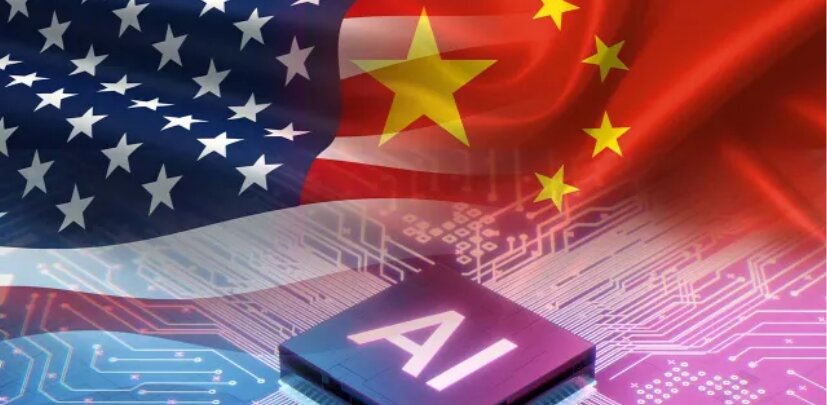
In Brief
INTERNAL
NDRC reviews major projects; Calls for accelerated implementation and financial backing
On 04 September, SCMP reported that China's National Development and Reform Commission (NDRC) reviewed the progress of 109 major projects with relevant authorities. The project aims to upgrade the country’s water, electricity, computing, telecommunications, logistics and underground pipe systems by 2030. The meeting called for accelerating the implementation of ongoing projects and promoting the early commencement of new projects in light of declining investment. The meeting's agenda also included strengthening financing mechanisms, information-sharing with financial institutions, and the role of government investment. These measures are taken to reverse falling investment and economic expansion.
("China pushes to speed up key infrastructure builds amid investment declines," SCMP, 04 September 2026)
https://www.scmp.com/economy/china-economy/article/3366361/china-pushes-speed-key-infrastructure-builds-amid-investment-declines
NUCLEAR
Researchers develop tech to extract seawater uranium
On 04 September, SCMP reported that researchers from the Chinese Academy of Sciences in Qingdao have developed a material called "PhosCage" that extracts uranium from seawater at over eight times the efficiency target set by the US Department of Energy. The sponge-like molecular structure acts as a chemical trap, capturing up to 50.4 mg of uranium per gram of material, vastly outperforming previous US efforts, which peaked at 6 mg. The news reports that this innovation is highly significant for China, which currently relies heavily on imports to fill the massive gap between its domestic uranium production, which is 1,600 tonnes and its nuclear reactor demands of 13,000 tonnes. While the oceans hold an estimated 4.5 billion tonnes of uranium compared to just 7.9 million tonnes on land, extracting it has historically been too expensive and chemically complex. The team from China designed the material to selectively grab uranium over competing ocean metals like vanadium, though the technology has only been tested in a controlled 25-litre lab flow system and has not yet been priced for commercial scale.
(“Chinese team extracts uranium from seawater at 8 times the US target rate,” SCMP, 04 September 2026)
https://sc.mp/rkm92?utm_source=copy-link&utm_campaign=3366307&utm_medium=share_widget
CHINA AND TAIWAN
China and US military chiefs hold talks over Taiwan ahead of Trump-Xi Summit
On 05 September, The Japan Times reported that the head of the US Pacific Command (PACOM), Admiral Sam Paparo, met in person with General Yang Zhibin, China’s commander overseeing military operations near Taiwan. The meeting took place on 31 August, 2026, on the sidelines of a defence conference in Canada, aiming to maintain open communications and reduce the risk of military miscalculation. Tensions have been rising as China ramps up its naval presence around the democratic island, which Beijing claims as its own territory. This high-level military dialogue comes just weeks ahead of a planned 24 September meeting in Washington between the US President Donald Trump and China’s President Xi Jinping, where Taiwan's security is expected to be a major topic. While the US is legally required to help Taiwan defend itself, President Trump has previously suggested that a pending USD 14 billion American arms package to Taipei could be used as a "negotiating chip" in talks with Beijing.
(“Chinese military commander overseeing Taiwan operations meets U.S. PACOM chief,” The Japan Times, 05 September 2026)
https://www.japantimes.co.jp/news/2026/09/05/asia-pacific/us-military-china-pla-taiwan/
CHINA AND AFRICA
China backs Egypt over Nile River dispute with Ethiopia after collapse of US mediation
On 04 September, Business Insider Africa reported that China would back Egypt in a dispute over the Nile River with Ethiopia. The dispute arose after Ethiopia revealed plans to construct a new dam in the Blue Nile tributary, which originates from Lake Tana in the country. Egypt argues that the new dam will reduce the discharge of the Nile River in its territory, threatening jobs and agriculture. Egypt has signed military agreements with Ethiopia’s neighbours, including Eritrea and Somalia, to increase pressure on the country. Negotiation talks led by the US have fallen through, and tensions have risen again. With President Xi Jinping’s visit to Egypt, the joint statement released by the two reaffirmed China’s recognition of “the vital importance of the Nile River to Egypt as its main lifeline,” and “acknowledged Egypt’s legitimate right to protect its water and food security and development interests.”
(“China backs Africa’s strongest military as Egypt and Ethiopia face off over Africa’s longest river after U.S. talks collapsed,” Business Insider Africa, 04 September 2026)
https://africa.businessinsider.com/local/markets/china-backs-africas-strongest-military-as-egypt-and-ethiopia-face-off-over-africas/rkkb94p
CHINA AND RUSSIA
China to account for 60 per cent of Russia’s gas exports by 2030
On 04 September, Anadolu Agency reported that Russia’s Deputy Prime Minister Alexander Novak stated that China will account for over 60 per cent of Russia’s total gas exports by 2030. Speaking at the Russia-China Energy Business Forum in Vladivostok, Minister Novak stated that the expansion of the Power of Siberia and the far-eastern pipeline route could increase gas supplies to China, adding that they are actively negotiating new “promising routes” including the Power of Baikal project. He also stated that China has become Russia’s top oil supplier, noting an increase of 25 per cent in the first seven months of 2026. Russia currently supplies 38.8 billion cubic meters of LNG through the Power of Siberia pipeline in 2025.
(“China to account for more than 60% of Russia's total gas exports by 2030,” Anadolu Agency, 04 September 2026)
https://aa.com.tr/en/eurasia/china-to-account-for-more-than-60-of-russias-total-gas-exports-by-2030/4047060
CHINA AND EUROPE
Opinion: Nora Kürzdörfer, “EU budget offers chance to loosen China's grip on critical raw materials for Europe,” Euronews, 04 September 2026
“The urgency of boosting EU investment in partnerships around critical raw materials is compounded by the fact that reducing dependence on Chinese processing and refining will not come cheap. China’s control over processing and refining remains overwhelming … need for diversification pushed the EU to deepen its engagement with resource-rich countries across Africa, Asia, and Latin America, where most of the world’s critical raw material deposits are found … While China will remain an indispensable player in many CRM value chains for years to come, the objective should be to build a broader processing base across partner countries, leaving the EU and its partners less vulnerable to disruptions in the longer term. Both sides would stand to benefit … The EU will keep talking about diversification while remaining dependent on precisely the value chains it seeks to escape. The MFF offers a chance to break that cycle.”
https://www.euronews.com/my-europe/2026/09/04/eu-budget-offers-chance-to-loosen-chinas-grip-on-critical-raw-materials-for-europe
CHINA AND THE AMERICAS
China’s rare earth suppliers quietly cut off shipments to the US
On 04 September, Reuters reported that several Chinese rare earth suppliers were declining to ship materials to the United States for fear of repercussions from Beijing, according to sources familiar with the matter, weeks ahead of President Xi Jinping’s planned visit to Washington. A handful of suppliers reportedly stopped shipments after China sanctioned the Responsible Business Alliance (RBA) in early August, wary of punishment for complying with global mineral supply chain audits. While exports of many rare earths have rebounded since restrictions were first imposed in April 2025, materials with military or high-tech applications, including yttrium, indium phosphide and tungsten, remain in tight supply. Exports to Japan have been hit even harder, with terbium shipments falling to zero and yttrium down 98 per cent this year. Analysts said Beijing may loosen controls slightly ahead of the summit to ease US allegations that China is not upholding a prior truce.
(“China rare earth firms halt some US shipments over geopolitical worries, sources say,” Reuters, 04 September 2026)
https://www.reuters.com/business/aerospace-defense/china-rare-earth-firms-halt-some-us-shipments-over-geopolitical-worries-sources-2026-09-04/
US and China prepare for high-stakes AI safety talks this month
On 05 September, The Hindu reported that the United States and China were preparing for a dialogue on AI safety risks planned for mid-September, according to sources briefed on the discussions, marking the first bilateral talks devoted exclusively to AI since President Donald Trump’s return to office. The talks, expected to be led by Treasury Secretary Scott Bessent and a senior Chinese official such as Vice Premier He Lifeng, will focus on cooperation to monitor AI-directed cyberattacks, following incidents including nearly 700 rogue AI agents hacking a startup in July. Washington is also concerned about a potential future Chinese model matching Anthropic’s Mythos in cyberattack capability, and plans to raise allegations that a Chinese firm improperly distilled a US AI model. The dialogue comes ahead of a planned meeting between Trump and China’s President Xi Jinping on 24 September, with Chinese officials reportedly viewing the AI talks as a key deliverable of the summit.
(“U.S., China gear up for mid-September AI safety talks,” The Hindu, 05 September 2026)
https://www.thehindu.com/news/international/us-china-gear-up-for-mid-september-ai-safety-talks/article71430964.ece
Report urges US to take extreme measures to prevent China from achieving AGI
On 04 September, SCMP reported that a former White House official stated that the US should take extreme measures like state-backed espionage and military strikes to stop China from achieving artificial general intelligence. Centre for a New American Security (CNAS) Director stated that US agencies should assess what intelligence they need to justify taking such actions. He said: "Trying to think through the particulars of that will be especially important, in part because it will help policymakers … start to work backwards based on the unique nature of the technology, in the same way that in a past era, policymakers would learn about nuclear weapons and … work backwards from the science to the policy implications." Recently, CNAS released a report titled "Superpowers and AGI” laid out the relevance of AGI and how it affect and determine US-China geopolitical competition. The report stated that China could make a "surprising technological" breakthrough and close US's months long lead over China. Extreme actions such as military strikes on data centers, preventive strikes, reverse engineer or “steal” China’s AGI technology are the few measure suggested by the report to counter China.
("US urged to consider military strikes to stop China achieving AGI first," SCMP, 04 September 2026)
https://www.scmp.com/news/us/article/3366284/us-urged-consider-military-strikes-stop-china-achieving-agi-first
China Reader Daily Wire | 04 September 2026, Friday | Vol 3 No. 132
China and Egypt to expand cooperation in data centres, semiconductors and critical minerals
Private Chinese reusable rocket Pallas-1 debuts launch
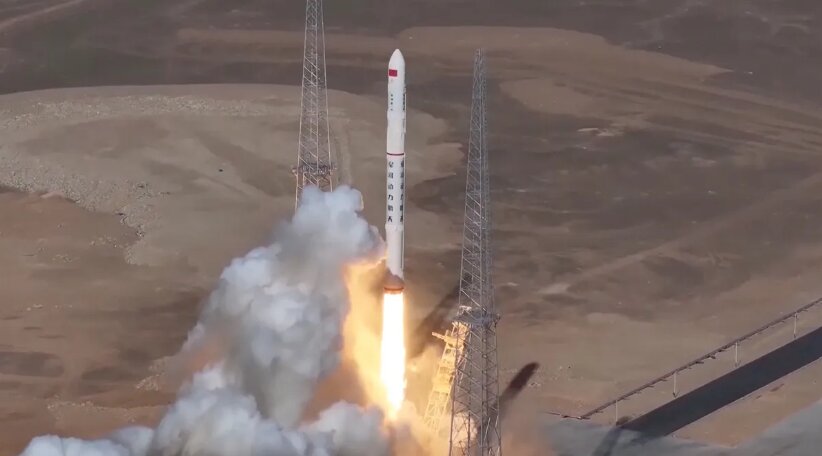
In Brief
SCIENCE AND TECHNOLOGY
AI startup Moonshot secretly files for USD 3 billion Hong Kong IPO amid US scrutiny
On 03 September, Reuters reported that Beijing-based AI startup Moonshot has confidentially filed for a Hong Kong IPO to raise USD 3 billion. This makes it one of the most anticipated upcoming tech listings. Founded in 2023, the creator of the popular Kimi large language model recently launched its 2.8-trillion-parameter Kimi K3 model, which has driven strong demand but strained its computing resources. The company, backed by tech giants like Alibaba, Tencent, and China Mobile, has raised over USD 5.5 billion to date and is currently in talks with US cloud providers like Microsoft, Google, and Amazon to host its model. However, the startup faces geopolitical hurdles, including potential US trade blacklisting over allegations of using restricted Nvidia chips and copying Anthropic's technology, alongside regulatory requirements forcing it to restructure into a mainland China entity before going public.
(“Chinese AI firm Moonshot files confidentially for Hong Kong IPO, sources say,” Reuters, 03 September 2026)
https://www.reuters.com/world/asia-pacific/chinese-ai-firm-moonshot-files-confidentially-hong-kong-ipo-sources-say-2026-09-03/
AI- driven robotic platform to conduct deep-sea materials research
On 03 September, CGTN reported that researchers from China have developed the Robotic Marine Materials Scientist Platform, an automated lab system that uses AI and robots to drastically speed up materials research for harsh ocean environments. Traditionally, materials science is slowed down by repetitive manual labour and lost data from failed trials. This new 400-square-meter facility solves those issues by automating the entire process. From design to fabrication and testing, an AI assistant automatically records all data to achieve a 90 per cent prediction accuracy. Using this closed-loop system, scientists have already created a highly durable new composite material for drill bits. These are now being tested in deep-well exploration at depths of up to 10,000 metres.
(“AI-driven robotic lab speeds up marine materials discovery,” CGTN, 03 September 2026)
https://news.cgtn.com/news/2026-09-03/AI-driven-robotic-lab-speeds-up-marine-materials-discovery-1Q89ohR9yhO/p.html
Opinion: Larry Elliott, "China’s demise was gleefully predicted by the West – meanwhile, it built an AI revolution," The Guardian, 03 September 2026
"As Edoardo Campanella of UniCredit notes, Beijing is pursuing a clear AI strategy: staying close to the technological frontier, diffusing its models throughout the global economy, and setting standards across international markets. “If this strategy succeeds, the third China shock might not just disrupt the global economy, but also the global balance of power,” says Campanella.
Beijing’s strategy might not succeed, but even so there are three things that are striking about the AI development race. The first is that this would appear to be the worst possible time for Washington to antagonise its traditional allies by whacking them with punitive tariffs. The US needs all the friends it can muster. The second is that the arrival on the scene of free Chinese AI models could spell big trouble for global markets. But if China can develop its AI models at a lower cost and offer them for nothing, investors will soon start to question whether the massive investment in the US justifies the sky-high share prices of tech companies. China’s success in AI could prick the stock market bubble."
https://www.theguardian.com/commentisfree/2026/sep/03/china-demise-predicted-west-ai-revolution
ENERGY AND ENVIRONMENT
Report notes decrease in carbon emissions and electrification trend in Beijing
On 03 September, The Guardian reported on a report that stated the oil crisis has accelerated China’s decarbonisation shift. China's carbon dioxide emissions fell by 1% after the outbreak of the US-Iran war. Reduced oil imports due to Middle East conflicts are attributed to reduced oil consumption and increased EV reliance. The report notes a trend of electrification, where transport oil use dropped as EV and public transport use surged. The report highlights that global energy disruptions reinforced China’s long-term strategy to reduce dependence on oil imports, both for economic and geopolitical security. The latest literature predicts that oil consumption may not fully return even if crude prices fall.
("China’s falling emissions amid Iran war spark hope of decarbonisation watershed," The Guardian, 03 September 2026)
https://www.theguardian.com/environment/2026/sep/03/china-co2-emissions-iran-war
CHINA AND SPACE
Private Chinese reusable rocket Pallas-1 debuts launch
On 03 September, Space.com reported that the Beijing-based company Galactic Energy successfully launched its new Pallas-1 rocket for the first time on 31 August, lifting off from northwest China and reaching its planned orbit. Similar to SpaceX's Falcon 9, the Pallas-1 features a reusable first stage built to fly up to 25 times using grid fins and landing legs. While this debut mission did not include a recovery attempt, Galactic Energy aims to land the booster for the first time in the second half of 2027, following in the footsteps of two other rockets from China that achieved successful landings earlier this year. The 171-foot-tall (52 meters) launcher can carry 7,000 kilograms to space and is designed to deploy large satellite constellations. (“China's private, reusable Pallas-1 rocket aces debut launch,” Space.com, 03 September 2026)
https://www.space.com/space-exploration/launches-spacecraft/chinas-private-reusable-pallas-1-rocket-aces-debut-launch-video
CHINA AND EAST ASIA
China objects as Taiwan naming row derails art exhibition in South Korea
On 03 September, The Straits Times reported that Chinese artists withdrew from South Korea’s Gwangju Biennale after organisers agreed to restore the name “Taiwan Pavilion” for a Taiwanese exhibition, prompting a rebuke from Beijing. The dispute began after organisers had initially agreed to call the exhibition the “Taiwan Pavilion” but changed it in June to “NTMoFA,” an acronym for Taiwan’s National Taiwan Museum of Fine Arts, a move Taiwanese artists said was made without their consent and accused organisers of “political censorship.” Following the reversal last week, Chinese artists halted preparations for their own pavilion at the biennale, one of Asia’s largest contemporary art events, and formally announced their withdrawal on 03 September. China regards Taiwan as part of its territory and has not ruled out using force to annex the self-ruled island.
(“China artists quit South Korea exhibition over Taiwan row,” The Straits Times, 03 September 2026)
https://www.straitstimes.com/asia/east-asia/china-artists-quit-south-korea-exhibition-over-taiwan-row
China’s warships push closer to Japanese waters amid rising tensions, reports The Wall Street Journal
On 02 September, The Wall Street Journal reported that Chinese warships were increasingly sailing close to Japan’s Amami-Oshima island, with officials describing the country’s security environment as its most severe since World War II. Japanese surveillance recorded Chinese destroyers passing through the strait near the island at least ten times this year, following zero transits in 2025, with the local mayor voicing concern over the risk of collision in the narrow channel connecting the East China Sea and the Pacific. Officials said deepening cooperation among China, Russia and North Korea had heightened security concerns, with Russia expanding military activity near the disputed Kuril Islands and North Korea focusing on shorter-range missiles targeting Japan. In response, Prime Minister Sanae Takaichi has doubled Japan’s defence budget to two per cent of GDP, with the defence ministry requesting a record USD 56 billion for the next fiscal year. China’s Foreign Ministry rejected accusations of provocation, urging Japan to “stop seeking any excuses for military buildup.”
(“Chinese Warships Are Cruising Too Close for Comfort Off Japan’s Shores,” The Wall Street Journal, 02 September 2026)
https://www.wsj.com/world/asia/china-warships-japan-defense-10978aba
CHINA AND PACIFIC
Australia and Palau push to formally condemn China over missile test at Pacific Islands Forum
On 03 September, ABC News reported that Australia and Palau said they would press Pacific leaders to issue a clear condemnation of China's recent ballistic missile test, rejecting claims from Kiribati and Nauru that it was unfair to single out Beijing. The Pacific Islands Forum (PIF) meeting, held at Palau President Surangel Whipps Jr's private residence, followed unusually strong criticism from Pacific nations after a PLA Navy submarine fired a missile with a dummy warhead over 7,000 kilometres into the Pacific, landing near Tuvalu's exclusive economic zone. PM Anthony Albanese rejected comparisons to US missile tests in the Marshall Islands, saying "the situations are very different," since the US gives proper notice under an existing agreement, unlike China's test, which came with "no respect" for regional nations.
("Australia and Palau push to formally condemn China at Pacific Islands Forum over missile test," ABC News, 03 September 2026)
https://www.abc.net.au/news/2026-09-03/australia-palau-push-to-condemn-china-over-missile-test/107110624
Pacific summit concludes without unified consensus on China's missile test
On 04 September, ABC News and Reuters reported that Pacific leaders concluded their forum in Palau without full consensus on formally condemning China's July missile test, though the closing communique retained language expressing concern, in what analysts called a notable compromise. Nauru dissented from the clause in a rare move for the consensus-driven forum, while Kiribati reportedly did not attend. Pacific analyst Richard Herr called retaining the paragraph "a useful sign of some pragmatism being built into the forum." Australia's Climate Minister Chris Bowen, part of the delegation, said unanimity was preferable but not necessary, adding "the view of the overwhelming bulk of the Pacific was made crystal clear." China's Pacific envoy Qian Bo separately objected to Taiwan's heightened diplomatic presence at the summit. Six of 18 PIF leaders did not attend, and next year's forum will be held in New Zealand.
("Pacific leaders at summit fail to reach unanimous condemnation of China's ballistic missile launch," ABC News, 04 September 2026; "Pacific summit backs concerns over China missile test despite Nauru dissent," Reuters, 04 September 2026)
https://abcnews.com/International/wireStory/pacific-leaders-summit-fail-reach-unanimous-condemnation-chinas-136185456; https://www.reuters.com/world/china/pacific-summit-backs-concerns-over-china-missile-test-despite-nauru-dissent-2026-09-04/
CHINA AND SOUTHEAST ASIA
China deploys armed JL-10 jet to intercept Philippine turboprops near Scarborough Shoal
On 03 September, Defence Mirror.com reported that China's Southern Theatre Command deployed a JL-10 advanced trainer jet carrying live missiles to intercept Philippine C-208 and NC-212 turboprop aircraft near Huangyan Dao (Scarborough Shoal) on 02 September, as part of readiness patrols. Footage showed Chinese pilots warning Philippine aircraft to "leave immediately" after allegedly intruding into Chinese territorial airspace. Military expert Zhang Xuefeng said the JL-10 was flown by a flight instructor, giving trainers real combat experience. An anonymous expert said deploying the JL-10, rather than a frontline fighter, against the Philippines' slow-moving turboprops reflected "strategic restraint," calling Manila's use of small aircraft an attempt to "exploit Western media coverage." Defence Ministry spokesperson Zhang Xiaogang said China would "resolutely thwart" attempts to provoke tensions in the South China Sea.
(China Deploys Armed JL-10 Trainer to Intimidate Philippines’ Turboprop Aircraft in South China Sea," Defence Mirror.com, 03 September 2026)
https://defensemirror.com/news/41950/China_Deploys_Armed_JL_10_Trainer_Jet_to_Intimidate_Philippines____Turboprop_Aircraft_in_South_China_Sea
Thailand’s processed chicken exports to China despite Beijing's self-sufficiency push
On 04 September, aviNews reported that Thailand's processed chicken industry could see stronger growth in China over the next decade, as China's poultry imports are expected to expand steadily despite Beijing's broader push for agricultural self-sufficiency, according to Trade Policy and Strategy Office (TPSO) Director Nanthaphong Jiralerdpong. China is projected to import 1.27 million tonnes of poultry meat by 2035, growing an average of 2.4 per cent annually from 2026, even as the country's overall grain output and meat production continue rising. TPSO said Thai exporters could compete on quality, food safety, and innovation rather than volume, as urbanisation, projected to reach 75 per cent by 2035, and rising incomes drive demand for premium, processed food. The agency recommended shifting from commodity exports toward branded, higher-value chicken products, while warning that rice and sugar exports to China face declining demand.
("China's poultry demand offers Thai exporters new opportunities," aviNews, 04 September 2026)
https://avinews.com/en/chinas-poultry-demand-offers-thai-exporters-new-opportunities/
Cambodia and China deepen trade dialogue to resolve barriers facing Chinese investors
On 04 September, Khmer Times reported that Cambodia and China continue working through a recurring public-private dialogue mechanism to resolve operational barriers facing Chinese enterprises, addressing taxation, customs, logistics, and labour issues. The first such dialogue, held in February and co-chaired by Deputy Prime Minister Sun Chanthol and Chinese Ambassador Wang Wenbin, brought together roughly 80 Chinese company representatives, with sessions scheduled every six months to track progress. China remained Cambodia's largest foreign investor, accounting for over half of approved investment capital in 2025. Separately, Industry Minister Hem Vanndy urged Chinese investors to shift from low-cost manufacturing toward higher-value industries, saying Cambodia's priority is "not simply how... to attract more investment," but how to secure projects generating greater economic spillovers.
("Cambodia, China seek solutions to challenges facing Chinese firms," Khmer Times, 04 September 2026)
https://www.khmertimeskh.com/502017962/cambodia-china-seek-solutions-to-challenges-facing-chinese-firms/
China and Singapore to hold "Maritime Cooperation-2026" live-fire drill
On 04 September, Global Times reported that China and Singapore will hold their "Maritime Cooperation-2026" joint exercise in the sea and airspace near Zhanjiang, Guangdong province, in early September, China's Ministry of National Defence announced. The drills will include live-fire shooting, underway replenishment, and joint search and rescue operations. Military expert Zhang Junshe said joint search and rescue holds significant practical importance, strengthening mutual understanding and building strategic trust between the two navies. China and Singapore held their first bilateral maritime exercise in 2015, with such drills becoming a regular fixture of military exchanges. China also conducts similar routine exercises with Thailand, Cambodia, and Laos.
("China, Singapore to hold 'Maritime Cooperation-2026' joint drill with live-fire, replenishment, search and rescue," Global Times, 04 September 2026)
https://www.globaltimes.cn/page/202609/1369786.shtml
CHINA AND AFRICA
China to expand cooperation in data centres, semiconductors and critical minerals with Egypt
On 02 September, Reuters and South China Morning Post reported that China's President Xi Jinping called on Middle Eastern nations to oppose external interference and consider reshaping the region's security order during his first visit to Egypt in a decade. Welcomed by President Abdel Fattah al-Sisi in Cairo, Xi said regional countries should be "masters of their own destiny," offering to help safeguard shipping routes disrupted by conflict in the Strait of Hormuz and Bab al-Mandeb. The two countries agreed to deepen security cooperation and expand collaboration in data centres, semiconductors and critical minerals, with bilateral trade rising 19.7 per cent to USD 20.8 billion in 2025. The visit followed Xi's appearance at the Shanghai Cooperation Organisation summit in Bishkek, where he pledged deeper connectivity ties with member states, reflecting Beijing's broader strategy to diversify trade routes amid the ongoing US-China tariff war.
("China's Xi urges new Middle East security framework during Egypt visit," Reuters, 02 September 2026; "China's Xi seeks trade routes in Egypt, Central Asia to bypass tariffs and Western rules," South China Morning Post, 03 September 2026)
https://www.reuters.com/world/china/egypt-welcomes-xi-beijing-expands-influence-middle-east-2026-09-02/
https://amp.scmp.com/economy/global-economy/article/3366123/chinas-xi-seeks-trade-routes-egypt-central-asia-bypass-tariffs-and-western-rules
CHINA AND EUROPE
Ireland urges EU rethink its approach to innovation and technology as it risks falling behind China and US
On 03 September, Briefs Finance News reported that Irish Prime Minister Micheal Martin urged the European Union to rethink its approach to innovation and technology, warning that the bloc risked falling further behind competitors including China and the United States. Speaking at a Bloomberg event in Dublin, Martin called for progress on the EU’s long-stalled Savings and Investment Union, saying movement was possible “by the end of the year” and would benefit both Ireland and Europe more broadly. He also urged the bloc to help European companies scale into “European champions” rather than relying solely on regulation, while cautioning that the proposed Industrial Accelerator Act should not undermine existing trade agreements, including with the United Kingdom. The remarks came as the EU’s trade gap with China reached EUR 360 billion last year, with Brussels increasingly concerned about its reliance on Chinese semiconductors and rare earth minerals, an issue expected to feature at EU leaders’ October summit.
(“Ireland’s leader urges EU to go bigger on tech and a Savings Union or risk slipping behind,” Briefs Finance, 03 September 2026)
https://www.briefs.co/news/ireland-s-leader-urges-eu-to-go-bigger-on-tech-and-a-savings/
CHINA AND THE AMERICAS
China’s willing to work with US on Tehran, says Vance
On 04 September, The Statesman reported that US Vice President JD Vance stated that China is showing a willingness to work with Washington as the Trump administration tries to economically isolate Iran. When asked about the impact of Operation Economic Outcast, he said, "The PRC is being willing to play ball here." He added that the US and China have policy disagreements and misaligned interests. He said: "I think that the PRC has been much more responsible, certainly than the Iranians, and much more responsible than a couple of other nations as well."
(‘Military, covert pressure on table’: JD Vance says China ‘willing to play ball’ in US push to isolate Iran." The Statesman, 04 September 2026)
https://www.msn.com/en-in/news/world/military-covert-pressure-on-table-jd-vance-says-china-willing-to-play-ball-in-us-push-to-isolate-iran/ar-AA2bxbfc?ocid=BingNewsSerp
China Reader Daily Wire | 03 September 2026, Thursday | Vol 3 No. 131
Beijing and Moscow to make visa-free travel permanent
Revised defence mobilisation law focuses on AI, drones, quantum tech
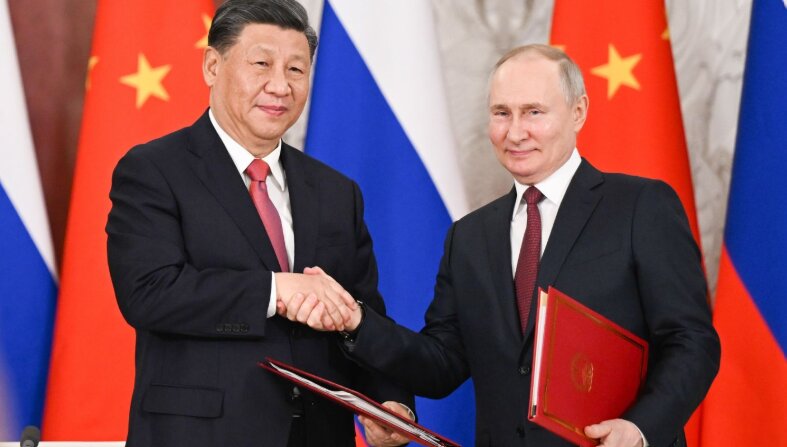
In Brief
INTERNAL
Hong activist pleads guilty of foreign collusion
On 02 September, the BBC reported that Joshua Wong, a Hong Kong pro-democracy activist, pleaded guilty to collusion with foreign entities. He is currently serving a four-year, eight-month sentence for subversion in 2024. His latest charge includes conspiring with exiled activist Nathan Law to ask foreign countries and entities outside China to impose sanctions or blockades against Beijing. His second trial comes under the violation of national security law, and this offence carries a statutory range of three to 10 years, or up to life imprisonment. statutory range is three to 10 years, or up to life imprisonment. The latest literature suggests that he pleaded guilty early in hope of a lenient sentence.
("Jailed HK activist Joshua Wong pleads guilty to foreign collusion," BBC, 02 September 2026)
https://www.bbc.co.uk/news/articles/cx2zmzg0408o
Blue-collar jobs now face job insecurity, offshoring and unemployment reports Washington Post
On 01 September, The Washington Post reported that blue-collar jobs, which once powered the Chinese economy, are now highly unbalanced and unequal. The news reported that "aggressive" high-tech innovation adds to the job insecurity of ordinary workers. The report highlights the increasing inequality, offshoring and unemployment in China. Peterson Institute for International Economics fellow Mary Lovely said: "The Chinese economy is in the middle of a “very complicated transition," and even as China develops cutting-edge artificial intelligence and electric vehicles, “parts of the economy … are just as dirty and as low-tech as they ever were. The economy used to benefit from the trade surplus with subsidies, factory automation, and cheap labour. Now, the workers are turning to the gig economy and are projected to reach 320 million from 280 million last year. In such a situation, the news also highlights that China's “work now, pension later” social contract could spark unrest.
(“Blue-collar workers propelled China’s rise. Their jobs are vanishing,” The Washington Post, 01 September 2026)
https://share.google/gn3Cixci4wjfN3Bzh
SCIENCE AND TECHNOLOGY
Chinese researchers hit 98 per cent efficiency in quantum computing breakthrough
On 03 September, Global Times reported that Chinese research teams achieved a breakthrough on an independently developed superconducting quantum computer, with tests showing information transmission efficiency of up to 98 per cent for a single quantum router, according to Science and Technology Daily. Researchers developed a coherent quantum routing system for bucket-brigade quantum random access memory (QRAM) on the Origin Wukong superconducting quantum computer, acting as a "fast lane" for data transmission to help scale up QRAM. Testing three independent quantum routers and a two-layer routing network, a single router achieved 98 per cent transmission efficiency, while the two-layer network reached 93 per cent overall. Average fidelity in random-access tests reached 94.8 per cent for the single router and 82.4 per cent for the two-layer network. Researchers said the breakthrough offers a scalable approach to building QRAM on existing superconducting hardware, potentially cutting computing costs and improving chip-circuit integration.
("China achieves 98% transmission efficiency in single quantum router breakthrough," Global Times, 03 September 2026)
https://www.globaltimes.cn/page/202609/1369709.shtml
CHINA AND SPACE
China achieves Earth-Moon laser link, but data speeds trail NASA's 2013 benchmark
On 02 September, SCMP reported that China achieved two-way laser communication between Earth and the Moon, becoming only the second nation after the United States to do so, though its data rates lagged well behind NASA's over a decade-old benchmark. Using telescopes in Yunnan province and an experimental satellite now orbiting the Moon after a 2024 launch mishap, the Chinese Academy of Sciences-led team recorded a downlink speed of 100 megabits per second and uplink of 1.25 megabits per second, compared to NASA's 2013 demonstration achieving 622 megabits per second download and 20 megabits per second upload speeds. Space historian Jonathan McDowell called the two experiments comparable, saying China has not yet matched US data rates, though the reason for the gap remains unclear. Team lead Yang Lei had earlier highlighted laser communication's speed advantage over other methods.
("China's 2026 moon laser communication speed is slower than Nasa's in 2013," South China Morning Post, 02 September 2026)
https://www.scmp.com/news/china/science/article/3365942/chinas-2026-moon-laser-communication-speed-slower-nasas-2013
DEFENSE
PLA Type 071 landing ship joins commercial vessel rescue drills off Somalia
On 01 September, Global Times reported that the PLA Navy's 49th escort task force conducted an anti-piracy drill off Somalia. This included a Type 071 amphibious landing ship, the Wuzhishan (Hull 987), not originally listed in the taskforce's announced composition. Images showed special forces personnel rappelling from helicopters onto the Wuzhishan during the exercise. A military expert said the vessel may have been en route to China's support base in Djibouti for transport or port compatibility training, part of a broader far-sea deployment testing the navy's blue-water capabilities. The 49th task force, from the PLA Southern Theatre Command, includes the guided-missile destroyer Kunming, undertaking its first escort mission, alongside the frigate Yueyang and supply ship Luomahu, with helicopters and special operations personnel aboard.
("PLA Navy's Type 071 comprehensive landing ship joins commercial vessel rescue drills with escort task force in Somalian waters," Global Times, 01 September 2026)
https://www.globaltimes.cn/page/202609/1369583.shtml
Revised defence mobilisation law focuses on AI, drones, quantum tech
On 01 September, South China Morning Post (SCMP) reported that China's top legislature passed the first amendment in 16 years to its national defence mobilisation law, adding focus on emerging technologies including artificial intelligence (AI) and drones. The revised law states the country "promotes the application of advanced technologies in national defence mobilisation," without specifying which technologies. Beijing-based military law expert Xie Dan said this covers cyberspace, AI, unmanned systems, the electromagnetic spectrum, biotechnology, maritime, space, and quantum technologies, alongside relevant market entities and specialised talent. Xie said the Russia-Ukraine conflict "validates the critical role of unmanned, intelligent and cyber technologies in modern warfare," reinforcing the amendment's necessity. The revised law takes effect on 01 October.
("China highlights advanced wartime tech in defence mobilisation law update," South China Morning Post, 01 September 2026)
https://www.scmp.com/news/china/military/article/3365993/china-highlights-advanced-wartime-tech-defence-mobilisation-law-update
CHINA AND TAIWAN
China conducted ‘resource management’ survey in waters east of Taiwan island, says Reuters
On 03 September, Reuters reported that China’s Ministry of Natural Resources conducted a survey of waters east of Taiwan island the previous month to create a “one map” for territorial and resource management initiatives. China has increased its naval and scientific vessel presence in the eastern waters of Taiwan since June. Taiwan’s Coast Guard stated that they shadowed and monitored a Chinese research ship last month, and the third time it had appeared since May. The Ministry further added that the survey is aimed at understanding the basic geology and structural characteristics of the seabed in “China’s jurisdictional sea areas.” Taiwan’s Mainland Affairs Council Spokesperson Liang Wen-chieh stated that the surveys and patrols conducted by China are “malicious,” and rejected China’s sovereignty claims over the island.
(“China says it conducted survey of waters east of Taiwan last month,” Reuters, 03 September 2026)
https://www.reuters.com/world/asia-pacific/china-says-it-conducted-survey-waters-east-taiwan-last-month-2026-09-03/
Taiwan’s Defence report warns that China is intensifying blockade preparations
On 02 September, South China Morning Post reported that Taiwan's Defence Ministry stated that the People's Liberation Army (PLA) was stepping up preparations for a blockade of the island, according to its “2026 China Military Power Report” submitted to the legislature. The report said recent PLA exercises had increasingly focused on joint blockade and control of Taiwan's external air and sea routes, alongside maritime and air quarantines, joint firepower strikes, and amphibious landing operations. PLA warplanes and drones have continued crossing the median line, while warships have approached waters near the island's contiguous zone. In response, Taiwan said it would strengthen its command and intelligence networks and use AI-assisted decision-making, having tested countermeasures to a blockade for the first time during this year's Han Kuang exercises. The ministry said the PLA's ability to launch a full-scale amphibious assault remained “still insufficient,” though analysts said Beijing appeared to be accelerating preparations for a potential campaign against the island.
("Mainland China stepping up preparations for Taiwan blockade, report says," South China Morning Post, 02 September 2026)
https://amp.scmp.com/news/china/military/article/3366011/mainland-china-stepping-preparations-taiwan-blockade-report-says
CHINA AND CENTRAL ASIA
President Xi meets with Mongolia’s President Ukhnaa
On 31 August, China’s President Xi Jinping met with Mongolia’s President Khurelsukh Ukhnaa on the sidelines of the 2026 Shanghai Cooperation Organisation (SCO) Summit in Bishkek, Kyrgyzstan. President Xi stated that China is ready to work with Mongolia on various sectors, including trade, connectivity, energy, and minerals and to expand cooperation in AI, digitisation, and modernisation. President Ukhnaa echoed similar sentiments, reaffirmed its commitment to the One-China policy, and expressed support for China’s four major global initiatives.
(“President Xi Jinping Meets with President Khurelsukh Ukhnaa of Mongolia,” China’s Embassy communique, 31 August 2026)
https://za.china-embassy.gov.cn/eng/zgyw/202609/t20260901_12013549.htm
CHINA AND PACIFIC
Pacific Islands civil society groups reject all missile testing in the region
On 02 September, Fiji Sun reported that the Pacific Network on Globalisation (PANG), a consortium of civil society groups operating amongst the Pacific Island nations, condemned the use of the region as a missile testing ground by both China and the US. China had tested a Submarine-Launched Ballistic Missile (SLBM) with a dummy warhead into the Pacific Ocean hours after Australia and Fiji signed a mutual defence treaty. PANG Coordinator Joey Tau stated that Pacific leaders are “silent” on these issues, and also highlighted Japan’s dumping of nuclear waste from Fukushima in the Pacific Ocean. The Pacific Islands Forum Secretary General Baron Waqa also stated that they oppose any form of missile testing in the Pacific.
(“Pacific civil society rejects all missile testing,” Fiji Sun, 02 September 2026)
https://fijisun.com.fj/news/pacific/pacific-civil-society-rejects-all-missile-testing
CHINA AND EAST ASIA
China-Japan diplomatic thaw drives Tokyo’s investment push into India, says a BBC report
On 01 September, BBC reported that Japan Inc was increasingly betting on India as an investment destination, with India’s Commerce Minister Piyush Goyal leading the country's largest-ever business delegation to Japan to expand trade ties. Japanese consumer brands such as Uniqlo, Muji and Onitsuka Tiger have rapidly expanded across Indian cities, while Japanese banks, including MUFG and SMBC, have made major acquisitions in Indian financial assets. Japan has also become the largest contributor to India's global capability centres, with over 100 Japanese firms operating such hubs. During Prime Minister Sanae Takaichi's July visit to New Delhi, Japanese companies announced USD 12.5 billion in investments across around 120 agreements. Experts said India was becoming a natural hedge against China-related risks amid Japan's shrinking domestic market and reduced investment appetite for China, though challenges including bureaucratic delays and tax uncertainties continue to complicate the relationship.
("Japan Inc is betting big on India as China risks deepen," BBC, 01 September 2026)
https://www.bbc.com/news/articles/cz64955d56po
CHINA AND SOUTHEAST ASIA
China-ASEAN trade crosses USD 1 trillion for the first time in 2025
On 01 September, China Daily reported that China-ASEAN trade crossed the USD one trillion threshold for the first time in 2025, according to China’s Vice-Minister of Commerce Yan Dong. China and ASEAN have remained the largest trading partners for each other for six consecutive years, with bilateral trade reaching USD 744.41 billion in the first seven months of 2026. Vice-Minister Yan Dong further added that cumulative two-way investment between the two blocs reached USD 515 billion. The 23rd China-ASEAN annual expo is set to be held from September 17th to 21st, with over 2,200 Chinese companies and over 1,000 ASEAN companies set to be featured. Senior Commerce Ministry official Wang Liping also added that China will actively promote and implement the China-ASEAN Free Trade Area 3.0 Upgrade Protocol, which was signed in October 2025.
(“China-ASEAN trade exceeds $1t for first time in 2025,” China Daily, 01 September 2026)
https://www.chinadailyhk.com/hk/article/638819
CHINA AND SOUTH ASIA
Chinese industrial overcapacity poses challenges for global manufacturing, reports IE
On 03 September, The Indian Express reported that China’s manufacturing overcapacity has emerged as a global structural challenge, with the country accounting for roughly 30 per cent of global manufacturing output and recording a trade surplus of around US$1.2 trillion. The article attributed China’s manufacturing expansion to factors including state subsidies, cheap credit and a state-directed financial system, which have enabled Chinese companies to achieve significant scale across sectors ranging from textiles and machinery to electronics, solar panels, batteries and electric vehicles. The report highlighted the implications for developing economies, where low-cost Chinese imports can support industrialisation but can also make it harder for domestic manufacturers to develop competitive upstream industries. It noted that China’s dominance of critical supply chains creates additional vulnerabilities for countries dependent on Chinese inputs. For India, Chinese imports account for roughly 17 per cent of total imports, with significant dependence in areas including solar equipment, electronics and pharmaceutical inputs. The development places China’s industrial model at the centre of an increasingly important debate over global manufacturing and supply-chain resilience.
(“Chinese overcapacity is a problem for the world,” The Indian Express, 3 September 2026)
https://indianexpress.com/article/opinion/columns/chinese-overcapacity-is-a-problem-for-the-world-10860896/
Bangladesh prepares to buy Chinese waste-to-energy power at higher tariff
On 01 September, India Today reported that Bangladesh is preparing to purchase electricity generated from waste by a Chinese company at Tk 25 per unit under a proposed 42-MW waste-to-energy project at the Aminbazar landfill in Dhaka. The proposed tariff is around 127 per cent higher than the roughly Tk 11 per unit Bangladesh paid on average for electricity supplied by Indian sources in FY2025–26. The comparison comes shortly after Dhaka objected to an Indian proposal to impose a small settlement charge on cross-border electricity transactions. The report stressed that the two arrangements are not directly comparable: India’s proposed charge is an administrative fee associated with cross-border power transactions, whereas Tk 25 represents the electricity tariff from a waste-to-energy facility. The Chinese project is primarily intended to address Dhaka’s growing waste-management problem while also generating electricity and organic fertiliser. Bangladesh’s existing arrangements allow it to import up to 2,656 MW from India, making the 42-MW Chinese project relatively small in the overall power system. The project nevertheless indicates a potential expansion of Chinese involvement in Bangladesh’s waste-management and renewable-energy sectors.
(“Bangladesh protests India’s Rs 0.01 hike, eyes 127% costlier Chinese power. Here’s why,” India Today, 1 September 2026)
Link: https://www.indiatoday.in/world/story/bangladesh-china-electricity-purchase-127-higher-than-indian-rate-tarique-rahman-government-2984375-2026-09-01
Nepal seeks climate compensation after deadly floods
On 02 September, Hindustan Times reported that Nepal is seeking climate compensation following devastating floods and landslides that have caused extensive loss of life and destruction across the country. Nepal’s Foreign Minister Shisir Khanal argued that assistance should be viewed as a “moral liability” rather than charity, pointing to Nepal’s very small contribution to global greenhouse-gas emissions despite its severe exposure to climate-related disasters. China, India and the United States were identified among the major emitters from which Nepal expects greater responsibility and support. The report noted that Kathmandu is increasingly linking disaster losses to climate vulnerability, particularly as glacier melt, extreme rainfall and other hazards intensify across the Himalayan region. The demand represents a broader shift from conventional humanitarian assistance towards climate justice and compensation for loss and damage. For China, the issue adds a climate dimension to its engagement with Nepal, particularly as Himalayan environmental risks increasingly require regional cooperation.
(“India, China, US on list as Nepal seeks climate compensation after deadly floods: ‘Moral liability, not charity’,” Hindustan Times, 2 September 2026)
https://www.hindustantimes.com/world-news/india-china-us-on-list-as-nepal-seeks-climate-compensation-after-deadly-floods-moral-liability-not-charity-101788319348862.html
Modi and Xi interact at SCO summit amid improving India-China ties
On 01 September, Today News reported that Indian Prime Minister Narendra Modi and Chinese President Xi Jinping interacted and shook hands on the sidelines of the Shanghai Cooperation Organisation (SCO) summit in Bishkek, Kyrgyzstan. The interaction came amid renewed diplomatic engagement between New Delhi and Beijing following efforts to stabilise bilateral relations and address outstanding border issues. The encounter followed recent high-level diplomatic activity, including National Security Adviser Ajit Doval’s visit to Beijing for the latest round of talks between the Special Representatives on the boundary question. The two sides have also been working to restore broader engagement following years of tensions after the 2020 Galwan Valley clash. Although details of the Modi-Xi interaction were not immediately disclosed, the public meeting provided another visible indication of renewed leader-level contact. The development is significant as India and China seek to expand areas of cooperation while continuing negotiations over the unresolved boundary question. Their engagement at the SCO also reinforces the organisation’s importance as a platform for bilateral interaction.
(“Thaw in India-China ties? PM Modi, Xi Jinping interact, shake hands on the sidelines of SCO Summit in Kyrgyzstan,” Today News, 1 September 2026)
https://www.livemint.com/news/india/thaw-in-india-china-ties-pm-modi-xi-jinping-interact-shake-hands-on-the-sidelines-of-sco-summit-in-kyrgyzstan/amp-11788246273994.html
Bangladesh seeks to follow China’s industry-academia model
On 01 September, Daily Sun reported that Bangladesh plans to adopt China’s industry-academia linkage model to strengthen technical education and develop a more skilled workforce. Bangladesh’s Education Minister Dr ANM Ehsanul Hoque Milon said the country wants stronger connections between educational institutions and industries so that technical and vocational training is better aligned with employment requirements. The report noted that Bangladeshi officials examined China’s approach to integrating education with industrial needs during a recent visit. Several initiatives have subsequently been established, including the China-Bangladesh Industry and Education Integration International Service Centre, the China-Bangladesh Vocational Teacher Training Centre, and the Bangladesh Vocational Education Research Centre. A “Chinese Language Plus Skill Development” platform is also intended to combine language training with vocational skills. The cooperation reflects an expanding dimension of China-Bangladesh relations focused on human-resource development, vocational education and employment. It also provides Chinese companies operating in Bangladesh with a potential pool of workers trained in both technical skills and Chinese language.
(“Bangladesh to follow China’s industry-academia model,” Daily Sun, 1 September 2026)
https://www.daily-sun.com/news/895269
CHINA AND CENTRAL ASIA
Uzbekistan unveils J-10CE fighter jets; Second customer of Chinese aircraft
On 31 August, SCMP reported that Uzbekistan has become the second foreign country to operate China’s J-10CE fighter jet, after it unveiled the aircraft on its independence day celebrations. There were unconfirmed reports of Uzbekistan ordering 24 J-10CEs, but neither side had confirmed it until now. Uzbekistan is traditionally known to operate and buy its military arms and equipment almost exclusively from Russia, marking the first instance of China entering into the high-tech export market. The J-10CE is a 4.5-generation fighter aircraft, which was first bought by Pakistan, and several countries such as Indonesia, Iran and Egypt have expressed their interest in acquiring the planes. Experts and analysts state that the move could mark China’s efforts to expand its customer base to countries that are not typically served by the US or other Western suppliers.
(“Uzbekistan confirmed as second foreign operator of China’s J-10CE fighter,” SCMP, 30 August 2026)
https://www.scmp.com/news/china/military/article/3365756/uzbekistan-confirmed-second-country-buy-chinas-j-10ce-fighter
CHINA AND AFRICA
Xi Jinping arrives in Cairo for first Egypt visit in a decade
On 01 September, Al Jazeera reported that Chinese President Xi Jinping made his first visit to Egypt since 2016, coinciding with the 70th anniversary of diplomatic ties between the two countries. President Abdel Fattah el-Sisi received Xi in Cairo, following el-Sisi's eight visits to China since 2014. Trade between the two countries reached nearly USD 20.7 billion by end-2025, with Egyptian exports to China up nearly 200 per cent in early 2026. Chinese investment centres on the Suez Canal area, including the TEDA cooperation zone in Ain Sokhna, hosting about 200 companies worth over USD 3.8 billion. El-Sisi thanked China for backing Egypt on the Grand Ethiopian Renaissance Dam dispute. Xi said both countries "firmly support the just cause of the Palestinian people," citing joint Egypt-China "Eagles of Civilisation" air exercises that began 22 August.
("China's Xi makes first visit to Egypt in a decade, amid regional turmoil," Al Jazeera, 01 September 2026)
https://www.aljazeera.com/economy/2026/9/1/chinas-xi-makes-first-visit-to-egypt-in-a-decade-amid-regional-turmoil
CHINA AND MIDDLE EAST
President Xi calls on new Middle East security framework during Egypt visit
On 02 September, Reuters reported that China’s President Xi Jinping called on the countries in the Middle East to oppose any foreign interference and reconsider the region’s security framework during his visit to Egypt. President Xi’s trip to Egypt marks the first visit in four years to the Middle East, and comes amid concerns over the long-term role of the US in the region. Egypt’s President Abdel Fattah al-Sisi welcomed President Xi with a military ceremony, and the two sides agreed to expand cooperation in various sectors, including data centres, semiconductors, the critical minerals supply chain, and to deepen security and counterterrorism cooperation. Egypt represents an important market for China, with over USD 10 billion of exports of Chinese goods to the country in the first half of this year, and Chinese companies have invested billions into green hydrogen projects, container ports and facilities to manufacture iron pipes, car tyres and satellites. China is also a major investor into the Suez Canal Economic Zone, amounting to USD 4 billion.
(“China's Xi urges new Middle East security framework during Egypt visit,” Reuters, 02 September 2026)
https://www.reuters.com/world/china/egypt-welcomes-xi-beijing-expands-influence-middle-east-2026-09-02/
CHINA AND RUSSIA
China, Russia and US may hold trilateral meeting at the next APEC forum
On 02 September, SCMP reported that the US, China and Russia may hold a trilateral meeting on the sidelines of the next Asia-Pacific Economic Cooperation (APEC) summit per a senior Russian official. Presidential Aide for Foreign Affairs Yuri Ushakov stated that the leaders could meet at the APEC summit to be held in Shenzhen, China, on November 18 and 19th. President Vladimir Putin has confirmed his attendance, while President Donald Trump has not confirmed his presence, though experts say he could attend if President Xi decides to attend the December 14-15 G20 summit in Florida. Analysts also speculate that President Xi could become a mediator between the US and Russia, either during the potential trilateral meeting at APEC or at the G20 meeting.
(“Xi, Trump and Putin may hold trilateral meeting at next APEC forum, Kremlin says,” SCMP, 02 September 2026)
https://www.scmp.com/news/china/diplomacy/article/3366039/xi-trump-and-putin-may-hold-trilateral-meeting-next-apec-forum-kremlin-says
CHINA AND EUROPE
EU trade enforcers press Beijing to fix trade imbalances ahead of October deadline
On 02 September, SCMP reported that a European Commission delegation held talks with Chinese officials in Beijing, seeking a diplomatic off-ramp from a looming trade war ahead of an October deadline set by Brussels. The EU team was led by Denis Redonnet, the bloc's top trade enforcement officer, recently made point person on China trade policy, reflecting how EU discourse has shifted from partnership toward rivalry. Later this month, top EU trade official Ditte Juul Jorgensen will also travel to Beijing. Jorgensen told the European Parliament, "We see an engaged China in these talks, but of course the challenges are very, very significant." China increased its trade surplus with all but three EU member states in July compared to a year earlier, deepening Brussels' concerns over dependence on Chinese imports.
("EU trade enforcers descend on Beijing demanding China fix 'untenable' imbalances," South China Morning Post, 02 September 2026)
https://www.msn.com/en-xl/news/other/eu-trade-enforcers-descend-on-beijing-demanding-china-fix-untenable-imbalances/ar-AA2bpPOi?ocid=BingNewsVerp
EU's green ambitions collide with a costly dependence on Chinese clean tech says EU Commissioner
On 31 August, Euronews reported that EU Climate Action Commissioner Wopke Hoekstra said Europe must accept higher short-term costs to reduce its dependence on China for clean-energy technologies, warning delay would make the strategic vulnerability harder and more expensive to unwind. Hoekstra said the EU should have confronted this reliance "five to ten years ago," warning that heavy dependence on Chinese manufacturers for electric vehicles, batteries, solar panels, and storage systems risks replacing one strategic vulnerability, previously Russian energy, with another. China currently supplies 98 per cent of Europe's solar panels and 88 per cent of its lithium-ion battery imports. Hoekstra said the goal isn't ending trade with China, but building European capacity so it is no longer dependent on a single external supplier for critical energy-transition technologies.
("EU climate chief warns China dependence will make EU's green transition more costly," Euronews, 31 August 2026)
https://www.euronews.com/my-europe/2026/08/31/eu-climate-chief-warns-china-dependence-will-make-eus-green-transition-more-costly
CHINA AND THE AMERICAS
US and China are arming for space warfare with hunter satellites, reports Reuters
On 02 September, Reuters reported that Chinese researchers linked to the military are developing satellites designed to pursue and even capture other spacecraft, alongside systems that could extend fuel supplies while doing so, according to a review of patent-related documents, procurement notices, and academic papers. The United States and Britain separately conducted their first joint military space operation, tracking the path of a suspected Chinese spy satellite, marking the first such mission between two "Five Eyes" alliance members. Retired British air force officer Andrew Turner called it "almost certainly a strategic signal to China." US Space Force's General Chance Saltzman said China is "rapidly developing capabilities," including ground- and space-based weapons designed to interfere with or destroy targets, calling the threat "substantial."
("US, China arm for space warfare: hunter satellites and orbital weapons," Reuters, 02 September 2026)
https://www.msn.com/en-us/news/other/us-china-arm-for-space-warfare-hunter-satellites-and-orbital-weapons/ar-AA2bpMK1?ocid=BingNewsVerp
China to consider US companies concerns as they expand investments in Beijing
On 01 September, SCMP reported that Chinese Premier Li Qiang held talks with the US-China Business Council in Beijing. In the meeting, Li stated that China will consider reasonable concerns of US companies and urged Washington to take concrete steps and implement the outcomes of recent bilateral trade talks between the two sides. He highlighted the smart and green consumption sector and said: "China may be the only market in the world that combines the two qualities of being large and new." He added that frictions were normal given the scale of bilateral trade between China and the US and called for solutions to any issues through mutual respect and consultation. US-China Business Council stated that US businesses would continue to expand investment in China and remain “long-term partners” in its development. They added that recent leaders' meeting had provided stable expectations for bilateral economic cooperation.
("China’s Li pledges to address US firms’ ‘reasonable concerns’ at Beijing meeting," SCMP, 01 September 2026)
https://www.scmp.com/economy/china-economy/article/3366023/chinas-li-pledges-address-us-firms-reasonable-concerns-beijing-meeting
China Reader Daily Wire | 01 September 2026, Tuesday | Vol 3 No. 129
Xi reaffirms strategic ties with Russia
China and Bangladesh to begin two-plus-two dialogue
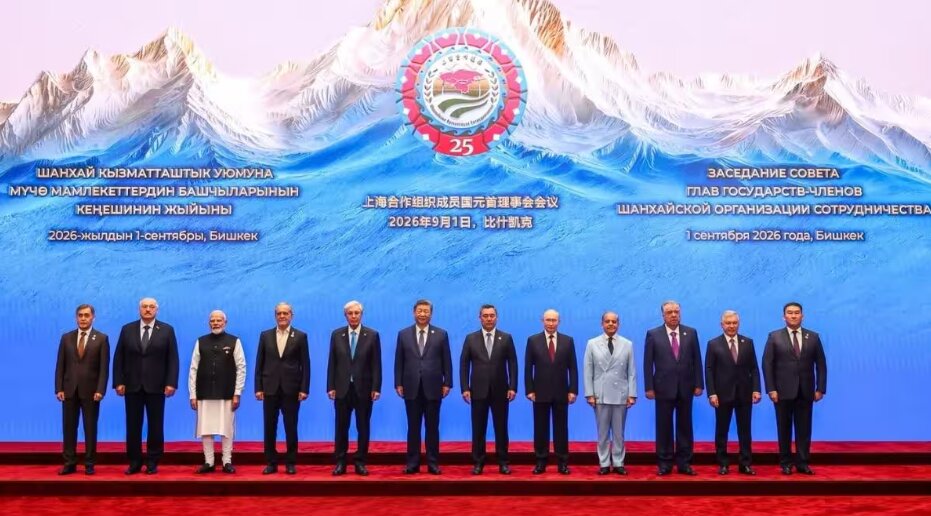
In Brief
INTERNAL
China's factory activity edges up but stays in contraction for second month
On 31 August, Reuters reported that China's factory activity improved in August but remained in contraction for a second straight month, an official survey showed, in a further sign that economic growth has lost momentum amid weak domestic demand. The official manufacturing purchasing managers' index (PMI) rose to 49.8 from 49.2 in July, beating the median forecast of 49.6 in a Reuters poll, but staying below the 50-mark separating growth from contraction. New orders and production sub-indexes returned to expansion above 50, with 16 of 21 surveyed industries showing month-on-month gains. The non-manufacturing PMI, covering services and construction, held at 49.0, its weakest level since December 2022. Economist Xu Tianchen said domestic demand appeared to be recovering, though "more likely... driven by AI and exports than by policy expansion." Pinpoint Asset Management's Zhiwei Zhang said it was too early to call it a rebound.
("Chinese factory slump eases, but weak services signal uneven recovery," Reuters, 31 August 2026)
https://www.reuters.com/world/asia-pacific/chinas-factory-activity-improves-stays-contraction-august-2026-08-31/
ENERGY AND ENVIRONMENT
Solar surpasses coal as China's top source of installed power capacity for the first time
On 01 September, Straits Times reported that solar panels have become China's top source of power capacity, surpassing coal in a key milestone for the country's green-energy transition. Solar capacity reached 1,286 gigawatts (GW) at the end of July, accounting for 31.5 per cent of total installed generation capacity, state broadcaster CCTV reported, citing the National Energy Administration (NEA). Coal capacity stood at 1,285 GW by comparison. Solar generation rose 15.5 per cent year-on-year to 802.4 billion kilowatt-hours in the first seven months of 2026, about one-eighth of the country's total electricity output. Newly installed photovoltaic capacity in July alone totalled 13.73 million kilowatts, up 43 per cent year-on-year. China remains the dominant player in the global solar supply chain, with sector investment expected to exceed CNY 2 trillion over the next five years. Despite the milestone, coal-fired plants still generate significantly more electricity than solar, since coal plants run much closer to their maximum output capacity.
("Solar surpasses coal as China's top source of power capacity," Straits Times, 01 September 2026)
https://www.straitstimes.com/business/solar-surpasses-coal-as-chinas-top-source-of-power-capacity
CHINA AND SPACE
China launches world's first operational space-based computing cloud
On 31 August, Global Times reported that China has put into operation the world's first orbital computing cloud capable of providing regular in-orbit experimental services, marking a new stage in commercialising space-based computing infrastructure. Led by Beijing University of Posts and Telecommunications (BUPT), the platform allows users to submit tasks, deploy software, and receive results through an automated, end-to-end workflow, reducing manual operations and enabling repeatable trials. Since entering service, it has supported big-data computing, 6G communication trials, and distributed storage experiments, completing hundreds of orbital computing calls for over 100 users. The system delivers large-model inference at an energy efficiency of ten tokens per joule using domestically developed hardware, with orbital service coverage exceeding 10 per cent. BUPT said the project's long-term value lies in shifting the space industry from "delivering hardware" to "continuously delivering services," potentially opening new commercial opportunities for satellite and telecom operators.
("The world's first space-based computing cloud kicks off in-orbit operation: media report," Global Times, 31 August 2026)
https://www.globaltimes.cn/page/202608/1369442.shtml
CHINA AND TAIWAN
Editorial: “Taiwan isn't saying much about its war plans for a China fight — but its military drills are” Business Insider, 31 August 2026
“Heavily outmanned and outgunned by China, Taiwan has been pivoting toward what it calls the "porcupine strategy." Instead of seeking to match China force-for-force, the island plans to rely on asymmetric warfare to make itself prohibitively costly for Beijing to capture. "From a capability standpoint, having small units operate in a more decentralized and independent way is exactly the kind of thing Taiwan's military has been emphasizing in its asymmetric force development in recent years," said Tristan Tang, a Taiwan-based nonresident fellow with the National Bureau of Asian Research, a US think tank. Taiwan has talked openly about building a "drone hellscape," a term coined by US Pacific Command chief Adm. Sam Paparo, on the strait, flooding it with hostile uncrewed aerial and seaborne systems to make a crossing extremely costly for Chinese forces. As the Han Kuang progressed, the drills moved farther inland, including a counter-sabotage operation at an oil refinery in Taoyuan, a city just west of Taipei. There, chemical troops called in by refinery staff set up a decontamination station for injured workers affected by simulated toxic gases released by enemy infiltration teams. "Dealing with that kind of threat would also require Taiwan to send out small units, probably squad- or platoon-sized task forces rather than company-sized formations," Tang said.
https://www.businessinsider.com/how-taiwans-drills-reveal-unspoken-blueprint-for-chinese-invasion-2026-9
China warns of “consequences” over Taiwan’s attendance at Pacific Islands Forum leaders summit
On 01 September, ABC News reported that China’s special envoy to the Pacific warned of “consequences” for Taiwan’s presence at the Pacific Islands Forum’s leaders summit in Palau after Taiwan’s Foreign Minister Lin Chia-lung joined its opening proceedings. Palau is one of the few countries in the world that maintain official diplomatic ties with Taiwan, alongside two other Pacific Island countries, the Marshall Islands and Tuvalu. Minister Chia-lung is set to meet with the leaders of these three allies tomorrow, but is also said to have held informal “catch-ups” with other dignitaries including the US representative Christopher Landau. China’s Pacific Envoy Qian Bo stated that Taiwan is not a dialogue partner with the forum and that they’ve made their “position” to the government of Palau, and insisted that the “consequences” remark wasn’t intended as a threat. Palau President and incoming chair of the Forum, Surangel Whipps, stated that China tried to coerce Palau over their Taiwan links, and that “he would not be bullied.”
(“China warns of 'consequences' over Taiwan's presence at Pacific Islands Forum leaders meeting,” ABC News, 01 September 2026)
https://www.abc.net.au/news/2026-09-01/china-warns-of-consequences-over-taiwan-attendance/107100296
Taiwan claims China has strengthened air and sea control around its territories
On 31 August, Reuters reported that Taiwan’s annual defence report on China’s threats to the country stated that Beijing has become “unpredictable” and that they’ve tightened air and sea controls near Taiwan island. China regularly conducts military drills and naval patrols around Taiwan Island as part of its “grey zone” activities, intending to put psychological pressure on its inhabitants. In its annual report released by the Defence Ministry, it stated that the regional security situation “continues to escalate” and noted the “rising unpredictability” in China’s actions due to its recent purges of senior military officers. The report added that China still lacks the capability to launch an amphibious invasion, but noted that they are attempting to “strengthen” its control over the sea and airspace around the Taiwan Strait, which is to “achieve the destruction of command-and-control and our air defence capacity in the early stage of combat.”
(“Taiwan says 'unpredictable' China strengthens air and sea control nearby,” Reuters, 31 August 2026)
https://www.reuters.com/business/aerospace-defense/taiwan-says-unpredictable-china-strengthens-air-sea-control-nearby-2026-08-31/
CHINA AND THE PACIFIC
Washington to fund gallium plant in Australia in an effort to reduce reliance on China
On 31 August, Bloomberg News reported that the US Department of War would fund USD 174 million to Alcoa Corporation to build a gallium plant in Western Australia as part of its efforts to reduce reliance on China. Gallium is used in high-performance semiconductors used in cutting-edge military technologies such as advanced radar and missile guidance systems. China currently accounts for 98 per cent of the world’s Gallium production and introduced an export control regime that banned all Gallium shipments to the US. Alcoa Corp. agreed to jointly develop the plant with Japan’s Sojitz Corporation and the Japan Organisation for Metals and Energy Security. Assistant US Secretary of War Michael Cadenazzi stated that “This landmark agreement with our key allies, Australia and Japan, will secure a vital supply of gallium for our defence industrial base, strengthening our collective security and economic resilience for years to come.”
(“US funds Alcoa gallium plant in Australia to cut China reliance,” Bloomberg News, 31 August 2026)
https://www.bloomberg.com/news/articles/2026-08-31/us-funds-alcoa-gallium-plant-in-australia-to-cut-china-reliance
CHINA AND SOUTHEAST ASIA
Vietnam demands to halt Chinese construction on the disputed Paracel Islands
On 31 August, The Diplomat reported that Vietnam expressed opposition to what it called “illegal” reclamation and construction activities in the Paracel Islands, following reports of fresh Chinese infrastructure work at Antelope Reef and nearby Yagong Reef. The Asia Maritime Transparency Initiative (AMTI) reported on 14 August that China had completed land reclamation at Antelope Reef and appeared to be building new infrastructure, including a likely airstrip, while Reuters later reported new installations resembling radar or early warning facilities on Yagong Reef. Vietnam, which claims sovereignty over the islands as “Hoang Sa” but has not controlled them since China seized them in 1974, said it held “full historical evidence and legal grounds” for its claim and had lodged a formal protest demanding an immediate halt to the activities. Analysts noted the Vietnamese response was unlikely to foreshadow significant tensions, given China’s comparatively restrained stance toward Vietnamese island-building in the Spratlys, where Hanoi has reclaimed nearly 2,800 acres of land in recent years.
(“Vietnam Demands ‘Immediate Cessation’ to Construction Activities in Paracel Islands,” The Diplomat, 31 August 2026)
https://thediplomat.com/2026/08/vietnam-demands-immediate-cessation-to-construction-activities-in-paracel-islands/
CHINA AND SOUTH ASIA
China and Bangladesh to begin two-plus-two dialogue
On 30 August, The Hindu reported that China and Bangladesh will begin a two-plus-two dialogue mechanism covering diplomatic and defence issues in the “very near future”. Bangladesh’s Minister of State for Foreign Affairs Humaiun Kobir said the framework is currently being prepared, with no specific dates yet fixed. The dialogue is expected to begin at the Minister of State level before eventually moving to the Foreign Minister level. The announcement followed Kobir’s meeting with Chinese Ambassador Yao Wen, during which they discussed several projects associated with Prime Minister Tarique Rahman’s recent China visit. These included the Teesta River Comprehensive Management and Restoration Project, the proposed China-Myanmar-Bangladesh economic corridor, the China Economic and Industrial Zone, and modernisation of Mongla Port. Kobir also reaffirmed Bangladesh’s commitment to the One-China policy. The proposed mechanism marks an institutional expansion of China-Bangladesh engagement into a more structured diplomatic and defence dialogue.
(“China, Bangladesh to start two-plus-two dialogue in the ‘very near future’, says Humaiun Kobir,” The Hindu, 30 August 2026)
https://www.thehindu.com/news/international/china-bangladesh-to-start-two-plus-two-dialogue-in-the-very-near-future-says-humaiun-kobir/article71407979.ece
China closes Tatopani border crossing amid landslide risks
On 31 August, The Kathmandu Post reported that China has suspended imports and exports through the Tatopani border point until further notice, citing the risk of landslides on the Nepali side near Liping. The crossing had only recently resumed limited operations after being closed for nearly three weeks in August because repeated landslides blocked the Araniko Highway. The latest closure comes after devastating floods destroyed the Rasuwagadhi border crossing and severely disrupted another major route between Nepal and China. With both Tatopani and Rasuwagadhi unavailable for normal trade, Korala in Mustang has become Nepal’s only functioning overland trade route with China. Officials are considering diverting stranded trucks and containers through Korala. The disruption is particularly significant ahead of Nepal’s festive shopping season, with traders warning of potential shortages and higher transportation costs. The closure also threatens customs revenue and further complicates Nepal-China trade following extensive flood damage along the northern border.
(“China closes Tatopani border point citing landslides risk,” The Kathmandu Post, 31 August 2026)
https://kathmandupost.com/national/2026/08/31/china-closes-tatopani-border-point-citing-landslides-risk
China sends 50 tonnes of emergency relief supplies to flood-hit Nepal
On 30 August, Kathmandu Post reported that China sent 50 tonnes of emergency relief supplies to Nepal following devastating floods and landslides along the Bhotekoshi and Trishuli river systems. Two Y-20 transport aircraft of the Chinese People’s Liberation Army Air Force arrived in Kathmandu carrying 13,200 relief items, including tents, blankets, sleeping bags, dry food and first-aid kits. Four Chinese tunnel-rescue specialists also arrived with specialised equipment to support rescue operations at hydropower facilities affected by the disaster. The assistance was handed over at Tribhuvan International Airport in the presence of Chinese Ambassador Zhang Maoming and Nepalese officials. The Chinese Embassy said additional tunnel experts would be deployed at Nepal’s request. Separately, China provided emergency cash assistance, including USD two million from the Chinese government and USD 200,000 from the Red Cross Society of China, according to the embassy’s spokesperson. The response marks a significant humanitarian component of China-Nepal relations amid one of Nepal’s most severe recent flood disasters.
(“China sends 50 tonnes of emergency relief supplies to flood-hit Nepal,” The Kathmandu Post, 30 August 2026)
https://kathmandupost.com/national/2026/08/30/china-sends-50-tonnes-of-emergency-relief-supplies-to-flood-hit-nepal
Xi, Modi and Putin attend SCO summit amid focus on multipolarity, trade and regional security
On 31 August, Al Jazeera reported that Chinese President Xi Jinping, Indian Prime Minister Narendra Modi and Russian President Vladimir Putin are attending the Shanghai Cooperation Organisation (SCO) summit in Bishkek, Kyrgyzstan. The two-day summit marks the organisation’s 25th anniversary and is taking place amid the aftermath of the US-Israel war on Iran and the continuing Russia-Ukraine conflict. The agenda includes regional security, Afghanistan, India-China relations, India-Pakistan tensions, economic integration and new transport corridors. The SCO is also expected to discuss the Development Bank, Development Fund and Investment Fund, while disruptions to maritime routes have increased interest in alternative Eurasian connectivity projects such as the International North-South Transport Corridor. For China, the summit provides an opportunity to strengthen its role in Eurasian security, connectivity and trade while promoting a more multipolar international order. However, differences among SCO members mean the grouping remains more a platform for strategic coordination than a unified political bloc.
(“Xi, Modi and Putin attend SCO summit: What’s on the agenda?” Al Jazeera, 31 August 2026)
https://www.aljazeera.com/news/2026/8/31/xi-modi-and-putin-set-to-meet-for-sco-summit-whats-on-the-agenda
CHINA AND THE MIDDLE EAST
China holds up Egypt ties as a model for its cooperation with Arab states and Africa
On 1 September, Xinhua reported that China’s President Xi Jinping said China-Egypt relations had become a benchmark for collective cooperation between China and Arab states and between China and Africa, describing the ties as a model of amity, solidarity and cooperation among developing countries. In a signed article published in Egyptian media ahead of his state visit, Xi said the two countries had always been close brothers who stood together through difficulty, reliable partners committed to win-win cooperation, and sincere friends built on equality and mutual trust, calling the relationship a successful model of mutual learning among civilisations.
(“Xi says China-Egypt ties a benchmark for China-Arab, China-Africa cooperation,” Xinhua, 1 September 2026)
https://english.news.cn/20260901/d2b9c58efba4427b99a2d72e7f9dc6fd/c.html
CHINA AND RUSSIA
Xi reaffirms strategic ties with Russia amid ‘unpredictable’ global order
On 31 August, Al Jazeera reported that China’s President Xi Jinping and Russia’s President Vladimir Putin reaffirmed their strategic alliance during their first meeting since May, held on the sidelines of the Shanghai Cooperation Organisation (SCO) summit in Bishkek, Kyrgyzstan. Xi said bilateral ties had grown “more solid” and that prospects for the relationship remained “even brighter” despite rising global uncertainty, while Putin said cooperation was “successfully developing on all fronts.” The two-day summit, marking the SCO’s 25th anniversary, drew over a dozen leaders, including Iran’s President Masoud Pezeshkian, India’s Prime Minister Narendra Modi, and Pakistan’s Prime Minister Shehbaz Sharif. Putin also met separately with Modi, who said New Delhi was ready to help end the war in Ukraine, while Pezeshkian told Modi that continuing the Iran-US war was not in Tehran’s interest. A Kremlin spokesperson said Putin and Xi discussed the Ukraine war only “in passing,” focusing largely on economic ties.
(“Putin, Xi reaffirm Russia-China ties amid ‘unpredictable’ world,” Al Jazeera, 31 August 2026)
https://www.aljazeera.com/news/2026/8/31/putin-and-xi-affirm-strategic-alliance-amid-unpredictable-world
CHINA AND EUROPE
EU seeks to persuade China to curb exports to the bloc reports Politico
On 31 August, Politico reported that the European Commission was exploring ways to convince Beijing to rein in its exports to the European Union as Brussels sought to narrow its trade deficit with China. EU Trade Chief Maroš Šefčovič said addressing the deficit required both increasing European exports to China and better managing Chinese exports into the bloc, describing a two-sided approach as the most effective path for the future relationship. He said the issue would need to be “tackled from both sides” to serve the long-term interests of both parties.
(“EU wants to convince China to curb exports to the bloc,” Politico, 31 August 2026)
https://www.politico.eu/article/eu-wants-to-convince-china-to-curb-exports-to-the-bloc/
China Reader Daily Wire | 31 August 2026, Monday | Vol 3 No. 128
President Xi to hold talks with Russia’s President Putin on the sidelines of the SCO summit
Washington urges G20 countries to raise trade barriers against Chinese exports
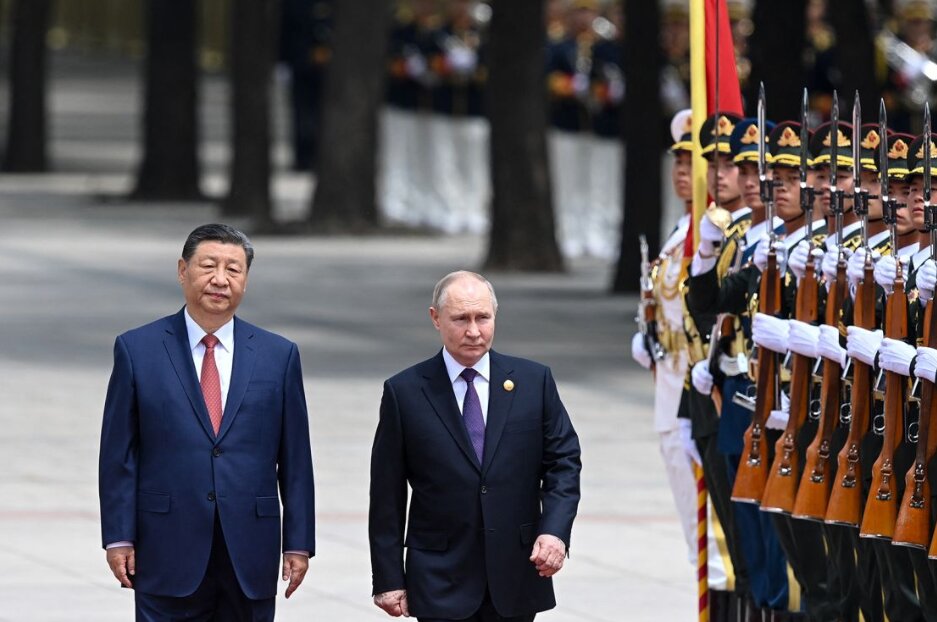
In Brief
SCIENCE AND TECHNOLOGY
Natural Resources Ministry releases first unified nationwide geometric reference
On 30 August, CGTN reported that China's Ministry of Natural Resources released its first nationwide geometric reference imagery on 27 August 2026. Thus, establishing a unified spatial benchmark to align satellite data across its entire land territory. Featuring a high resolution of better than 0.5 meters, this dataset acts as a universal spatial ruler for the remote sensing industry. Previously, overlapping photos from different commercial satellites suffered from varying geometric qualities, causing misaligned roads and distorted building features. This new reference framework solves these alignment problems, doubling China's overall image positioning accuracy while overcoming long-standing technical mapping challenges in rugged mountainous and plateau regions. Ultimately, the benchmark map will drive commercial satellite application innovations, enhance natural resource monitoring, and support the creation of an advanced national 3D real-world mapping system under new standardised guidelines. By offering this standardised baseline imagery to the public for free, the government aims to dramatically lower image production costs across multiple sectors.
(“China releases first nationwide geometric reference imagery,” CGTN, 30 August 2026)
https://news.cgtn.com/news/2026-08-30/China-releases-first-nationwide-geometric-reference-imagery-1Q21Nt6Z3i0/p.html
MARITIME
Chinese shipbuilders assume an 82.5 per cent share of orders in the first half of 2026
On 31 August, Imarine reported that shipbuilders from China have achieved overwhelming global dominance, securing 82.5 per cent of new ship orders in the first half of 2026, with orderbooks representing 75.1 per cent of the worldwide total. The lead reflects far more than production capacity; it stems from China's comprehensive industrial ecosystem. According to BRS Shipbrokers, China's competitive advantage lies in a densely integrated network of equipment suppliers, skilled engineers, infrastructure, financial support, and technical expertise. Shipyards in China employ an efficient "modular construction" model, manufacturing components in parallel before final assembly, which accelerates production and enables handling of complex, large-volume orders. Over 800 vessels have already been delivered, with some yards booked through 2029. China dominates traditional markets (bulk carriers, tankers, container ships) and is rapidly advancing into high-tech segments like LNG carriers and ammonia-powered vessels. The industry holds 1,082 orders for eco-friendly dual-fuel or battery-powered ships, demonstrating capability in emerging propulsion technologies. While geopolitical tensions, supply chain diversification pressures, and trade restrictions pose potential challenges, BRS concludes that competitors would need years to replicate China's integrated ecosystem. South Korea and Japan retain niche advantages, but China's position remains fundamentally unassailable without matching their comprehensive industrial infrastructure.
(“China Captures 82.5% of Global New Ship Orders in H1 2026,” Imarine, 31 August 2026)
https://www.imarinenews.com/38480.html
CHINA AND TAIWAN
Taiwan’s defence report says China’s amphibious assault capabilities are still limited
On 31 August, Taiwan News reported that China’s amphibious landing capabilities are still limited per Taiwan’s Ministry of National Defence’s report on China’s military power. The report stated that any amphibious operations require multi-point landings, air and sea superiority and sustained troop and logistics support, areas where China is still insufficient. However, the report added that the People’s Liberation Army (PLA) is incorporating civilian roll-on/roll-off ferries, cargo ships, and semi-submersible vessels for training exercises with its amphibious and army forces. The report also notes an increase in China’s “grey-zone” activities, intending to psychologically intimidate Taiwan’s inhabitants by conducting flyovers into Taiwan’s airspace and regular navy patrolling in its waters. The report further adds that China intends to integrate firepower resources across branches to establish a joint strike system, intending to target key military facilities and critical infrastructure and focus on saturation and surprise attacks to disrupt Taiwan’s command and communications networks.
(“Taiwan military says China amphibious assault capacity still limited,” Taiwan News, 31 August 2026)
https://www.taiwannews.com.tw/news/6430606
CHINA AND EAST ASIA
Opinion: “Wang Yi's visit signals major shift in China's Korea policy,” The Korea Times, 31 August 2026
“China’s pivot toward the two Koreas policy was later revealed with deliberate subtlety. When questioned by the press regarding China’s position on the peninsula, Wang maintained that Beijing remains “committed to playing a constructive role in maintaining peace and stability.” However, he notably expressed satisfaction in seeing “the two nations in the Democratic People’s Republic of Korea (DPRK) and the ROK move toward peaceful coexistence, and eventually achieve lasting peace and stability.” In a significant linguistic shift, Wang used the official names of both states and referred to them as “two nations,” rather than the term “two countries” typically used in the past. This vision of “peaceful coexistence” mirrors the end goals Pyongyang has envisioned for its own new inter-Korean policy. Ultimately, Wang delivered three core messages to Seoul: A call to side with China, a subtle warning regarding the pursuit of nuclear-powered submarines and an official recognition of two separate nations on the peninsula — but not in terms of adversaries.”
https://www-koreatimes-co-kr.cdn.ampproject.org/v/s/www.koreatimes.co.kr/amp/opinion/20260831/wang-yis-visit-signals-major-shift-in-chinas-korea-policy?amp_gsa=1&_js_v=a9&usqp=mq331AQIUAKwASCAAgM%3D#amp_tf=From&share=https%3A%2F%2Fwww.koreatimes.co.kr%2Fopinion%2F20260831%2Fwang-yis-visit-signals-major-shift-in-chinas-korea-policy
CHINA AND SOUTHEAST ASIA
Opinion: Orange Wang, "Could joint oil and gas projects help ease Beijing and Manila’s South China Sea tensions?," SCMP, 30 August 2026
"Earlier this month, Philippine President Ferdinand Marcos Jnr said there was a “distinct possibility” of undertaking joint oil and gas exploration with China, adding that he hoped to “reset” relations between the two countries. Although Beijing and Manila signed a memorandum of understanding on oil and gas cooperation in 2018, little progress has been made since then. A joint report by Chinese and Philippine analysts also said the two countries should work together in other “low-sensitivity” areas such as marine environmental protection and combating crime at sea. The Philippine constitution says the state must retain full control over natural resources, but the report argued this did not eliminate the scope for joint oil and gas exploration in the disputed areas. The report also said marine environmental protection was the area with “the greatest potential for cooperation”, arguing it was “characterised by low political sensitivity, a high degree of consensus and practical feasibility”. Legal and political differences did not have to be “absolute obstacles” to economic cooperation, pointing to Beijing’s “pragmatic arrangements” with two rival South China Sea claimants, Malaysia and Vietnam.
https://www.scmp.com/news/china/diplomacy/article/3365709/could-joint-oil-and-gas-projects-help-ease-beijing-and-manilas-south-china-sea-tensions
CHINA AND SOUTH ASIA
Nepal renews push for Chinese data-sharing and early-warning systems after deadly floods
On 30 August, Reuters reported that Nepal is seeking to strengthen disaster data-sharing and early-warning cooperation with China following a catastrophic flood triggered by the collapse of a glacier in the Himalayan border region. The disaster killed more than 900 people and left thousands missing, highlighting gaps in monitoring and preparedness for glacier-related hazards. Nepalese officials said they want more timely information from China on glacier movements, avalanches, water levels, and other extreme events that could threaten downstream communities. The report noted that officials from Nepal and China had already discussed joint risk-reduction measures, including glacial-lake inventories and hazard mapping, during a meeting in Kathmandu in May. China maintained that it had shared relevant information in a timely manner and stressed the technical difficulties of monitoring remote, high-altitude terrain. Nepal now plans to pursue a formal data-sharing arrangement similar to its agreement with India, potentially providing information every 10 minutes.
(“Hit by deadly floods, Nepal renews push for Chinese data and early warnings,” Reuters, 30 August 2026)
https://www.reuters.com/business/environment/before-flood-catastrophe-nepal-asked-china-early-warnings-risks-mounted-2026-08-30/
China and Bangladesh prepare to launch two-plus-two dialogue
On 30 August, The Hindu reported that China and Bangladesh are preparing to establish a two-plus-two dialogue mechanism covering diplomatic and defence issues. Bangladesh’s Minister of State for Foreign Affairs Humaiun Kobir said the framework would begin “in the very near future,” although no specific dates have yet been fixed. The announcement followed a meeting between Kobir and Chinese Ambassador to Bangladesh Yao Wen in Dhaka. The proposed dialogue is expected to initially operate at the minister-of-state level before moving to foreign-minister-level discussions. The talks are expected to provide a structured mechanism for addressing bilateral and regional issues, including defence cooperation and major development projects. The discussions also covered initiatives linked to Prime Minister Tarique Rahman’s recent China visit, including the Teesta River Comprehensive Management and Restoration Project, the China-Myanmar-Bangladesh corridor, the China Economic and Industrial Zone, and modernisation of Mongla Port. The development marks a significant institutional expansion of China-Bangladesh diplomatic and security engagement in South Asia.
(“China, Bangladesh to start two-plus-two dialogue in the ‘very near future’, says Humaiun Kobir,” The Hindu, 30 August 2026)
https://www.thehindu.com/news/international/china-bangladesh-to-start-two-plus-two-dialogue-in-the-very-near-future-says-humaiun-kobir/article71407979.ece
Xi attends SCO summit as China seeks deeper Eurasian influence
On 31 August, SCMP reported that Chinese President Xi Jinping’s presence in Bishkek for the Shanghai Cooperation Organisation (SCO) summit is highlighting the organisation’s growing importance to Beijing’s Eurasian strategy. The SCO’s 25th-anniversary summit is taking place amid shifting geopolitical dynamics, with discussions expected to focus on regional security, connectivity, energy, digital cooperation, Iran, Afghanistan, and food security. The report noted that China’s trade with the five Central Asian states reached a record USD 106 billion in 2025, making Beijing the largest trading partner of the region collectively for the first time. Analysts cited by SCMP said China is placing greater weight on the SCO and Central Asia as competition between the US-led West and the Global South intensifies. The development reflects Beijing’s efforts to use the SCO not only as a security platform but also as a mechanism for expanding economic connectivity, diplomatic influence, and support for a more multipolar Eurasian order.
(“Xi is in Bishkek for SCO summit. How does bloc fit China’s Eurasian strategy 25 years on?” SCMP, 31 August 2026)
https://www.scmp.com/news/china/diplomacy/article/3365768/xi-bishkek-sco-summit-how-does-bloc-fit-chinas-eurasian-strategy-25-years
CHINA AND THE MIDDLE EAST
Opinion: Lara Zhou and Fan Chen, “China’s Middle East policy at a crossroads 6 months into US-Israeli war on Iran,” South China Morning Post, 29 August 2026
“Gulf states are making a pivot as the war in Iran drags on into its sixth month, but observers warn that their shift towards defence networks could test China’s“involvement without commitment” strategy in the region. The war has forced Gulf leaders to face the reality that neither the United States nor China is able to protect them from attacks by Iran. China, one of Iran’s diplomatic and economic partners, would use its influence to steer Tehran towards a negotiated settlement. The war exposed the gap between China’s influence and its power. Beijing has economic leverage over Iran and political access in Tehran, but it does not control Iranian decision-making. Nor is China prepared to expend political, economic or military capital to restrain Iran for the Gulf’s benefit. China is not becoming less important; its role is becoming clearer. This dynamic has left China’s Middle East policy at a crossroads.”
https://www.scmp.com/news/china/diplomacy/article/3365708/chinas-middle-east-policy-crossroads-6-months-us-israeli-war-iran
CHINA AND AFRICA
Beijing and AU to deepen collaboration in infrastructure, digital transformation and energy
On 30 August, Tech Review Africa reported that the African Union Commission and a delegation of Chinese state entities met to strengthen continental collaboration across infrastructure, energy, and digital transformation. Led by Dr Kamugisha Kazaura and Peng Huagang, the discussions focused on shifting from traditional bilateral arrangements to structured, continent-wide frameworks aligned with the AU’s Programme for Infrastructure Development in Africa (PIDA). China’s extensive role in advancing African connectivity was highlighted through flagship projects like Ethiopia–Djibouti and Kenya’s Standard Gauge Railways, as well as its significant financial contribution, accounting for roughly 24 per cent (USD 19.42 billion) of PIDA’s initial priority investments. For stable cooperation in the future, both parties agreed to harmonise Chinese technical capabilities, Belt and Road Initiative frameworks, and the expertise of state-owned enterprises with key AU initiatives. These include the African Single Electricity Market and the Single African Air Transport Market, aiming to accelerate economic integration, facilitate free trade, and modernise regional infrastructure network systems.
(“African Union and China explore deeper cooperation on infrastructure, energy and digital transformation,” Tech Review Africa, 30 August 2026)
https://techreviewafrica.com/news/6981/african-union-and-china-explore-deeper-cooperation-on-infrastructure-energy-and-digital-transformation#0
CHINA AND RUSSIA
President Xi to hold talks with Russia’s President Putin on the sidelines of the SCO summit
On 31 August, France 24 reported that at the Shanghai Cooperation Organisation (SCO) summit in Bishkek, Russia’s President Vladimir Putin and China’s President Xi Jinping will hold bilateral talks. The report added that they will continue to leverage the Eurasian bloc to present a united anti-Western front. Despite their shared goal of countering US influence amid active regional conflicts and trade wars, subtle strategic tensions persist in their bilateral relationship. Beijing's expanding footprint in Central Asia, which is highlighted by Xi touting a "golden period" in ties with Kyrgyzstan, directly challenges Moscow's historic dominance in the resource-rich region. Ultimately, while Beijing and Moscow use the summit for high-level bilateral diplomacy to fortify their economic ties, their alliance is balanced by mutual anti-Western objectives against competing regional interests in Eurasia.
(“Russia's Putin and China's Xi to attend summit in Kyrgyzstan,” France24, 31 August 2026)
https://www.france24.com/en/live-news/20260831-russia-s-putin-and-china-s-xi-to-attend-summit-in-kyrgyzstan
CHINA AND EUROPE
Finland President says Beijing assured to "never allow" Russia to launch a nuclear strike against Ukraine
On 31 August, ScandAsia reported that Finland’s President Alexander Stubb revealed in an interview that China’s Foreign Minister Wang Yi assured him Beijing would "never allow" Russia to launch a nuclear strike against Ukraine. Speaking during a summer meeting with Minister Wang, President Stubb framed China's stance as a critical deterrent preventing further Russian escalation. Additionally, President Stubb expressed confidence that Russia is unlikely to deploy nuclear weapons or attack NATO members, citing the alliance's superior conventional and nuclear capabilities. Since joining NATO in 2023, Finland has strongly supported Kyiv, and President Stubb's comments highlight Beijing’s unique diplomatic leverage over Moscow despite close bilateral ties.
(“Stubb: China assured Finland it would not allow Russian nuclear strike on Ukraine,” ScandAsia, 31 August 2026)
https://scandasia.com/stubb-china-assured-finland-it-would-not-allow-russian-nuclear-strike-on-ukraine/
CHINA AND THE AMERICAS
Chinese firms behind resilient corporate activity along the North America-China corridor says SCMP
On 31 August, SCMP reported that despite escalating US-China trade tensions, corporate activity along the North America-China corridor remains resilient, driven by Chinese firms deploying risk hedging strategies to safeguard global market share. Citi reported a 44 per cent year-on-year revenue surge on its China-US corridor in the first half of 2026, as Chinese enterprises increasingly turn to international banks to manage forex risks, navigate complex supply chains, and reconfigure capital flows. This momentum is reflective of a broader "Going Global 3.0" phase, where Chinese companies transition from low-cost exports to deploying high-tech supply chains in green energy, electric vehicles, and artificial intelligence. Utilising a "dual-hub strategy," Chinese parent companies maintain domestic headquarters while employing Hong Kong as a regional treasury hub. Supported by Citi's expanding network of international "China desks," mainland corporate expansion is also surging across emerging markets in Central Asia, Southeast Asia, the Middle East, and Latin America.
(“Citi’s China-US corridor thrives as mainland firms hedge risks amid trade turbulence,” South China Morning Post, 31 August 2026)
https://www.scmp.com/business/banking-finance/article/3365445/citis-china-us-corridor-thrives-mainland-firms-hedge-risks-amid-trade-turbulence
Washington urges G20 countries to raise trade barriers against Chinese exports
On 31 August, Reuters reported that the US Treasury Secretary Scott Bessent announced that he will urge G20 member nations to re-examine their trade relations with China to mitigate global trade imbalances. Speaking ahead of a G20 finance leaders meeting in Asheville, Secretary Bessent stated that China's current USD 1.2 trillion trade surplus is unsustainable. He opined that a sluggish domestic economy has driven Beijing to rely heavily on exporting excess industrial capacity to sustain growth. Because of heavy US tariffs and import bans that have walled off the American market, Chinese exports have been redirected toward other regions, including Europe and Latin America. Secretary Bessent emphasised that international partners must implement their own trade barriers to incentivise China to address its excessive industrial subsidies and strengthen domestic consumption.
(“G20 countries should consider more trade barriers on China to cut imbalances, Bessent says, Reuters, 31 August 2026)
https://www.reuters.com/world/china/g20-countries-should-consider-more-trade-barriers-with-china-cut-imbalances-2026-08-30/
China Reader Daily Wire | 29 August 2026, Saturday | Vol 3 No. 127
Newly released data shows declining birth rate
Alibaba launches its first South America-based data centres in Brazil

In Brief
INTERNAL
Newly released data shows declining birth rate
On 29 August, Global Times reported that China's National Health Commission (NHC) released a record birth rate report showing 7.92 million births in 2025. It marks a drop from 9.02 million births in 2024. The national birth rate fell to 5.6 per 1,000 people, down from 6.4 in 2024. The latest literature attributes this negative population growth to economic pressures, changing social attitudes, and delayed marriage trends, despite government efforts to encourage childbirth.
("China records 7.92 million births in 2025 as birth rate declines after 2024 rebound," Global Times, 29 August 2026)
https://www.globaltimes.cn/page/202608/1369306.shtml
CHINA AND SPACE
China completes Earth-Moon two-way laser communication test
On 29 August, Global Times reported that the Chinese Academy of Sciences’ Technology and Engineering Centre for Space Utilisation (CSU) successfully completed an Earth-Moon two-way laser communication test. This expands China’s space network over 400,000 kilometres into deep space. Laser systems offer significantly faster speeds, wider bandwidth, enhanced security, and more compact hardware compared to traditional microwave communications. To overcome the task of beam alignment across extreme distances, researchers developed an innovative acquisition and tracking scheme that compensates for orbital movements, atmospheric turbulence, and optical delays. Furthermore, they tackled extreme signal attenuation using superconducting single-photon detection technology and advanced algorithms. This enabled telescopes to isolate ultra-faint signals from blinding moonlight and urban light pollution. High-bandwidth signal processing and noise-resistant coding schemes allowed the team to achieve transmission rates of 1.25 Mbps for the uplink and 100 Mbps for the downlink. The report states that, in preparation for upcoming manned lunar landings and permanent lunar research stations, conventional radio bands will no longer be capable of handling the resulting massive volumes of high-definition images and scientific data. This newly established Earth-Moon laser "information highway" provides a vital high-speed data transmission route to support these future exploration initiatives.
(“Chinese researchers complete Earth-Moon two-way laser link test,” Global Times, 29 August 2026)
https://www.globaltimes.cn/page/202608/1369315.shtml
CHINA AND SPACE
GJ-21 large stealth attack drone spotted as country's drone carrier begins final trial, reports SCMP
On 29 August, SCMP reported that China’s GJ-21 large stealth attack drone was spotted during a flight test. It is the naval variant of the GJ-11 stealth attack drone. This development comes as the country’s first Type 076 amphibious assault ship, a vessel to launch drones, enters its final trials. The report stated that it is China’s most advanced amphibious assault ship and the world’s first drone carrier.
("China tests GJ-21 stealth drone as Sichuan Type 076 warship carries out sea trials," SCMP, 29 August 2026)
https://www.scmp.com/news/china/military/article/3365654/china-tests-gj-21-stealth-drone-sichuan-type-076-warship-carries-out-sea-trials
Two high-ranking members of CMC removed for disciplinary violations
On 28 August, SCMP reported that Zhang Youxia and Liu Zhenli, members of China’s supreme military command, were removed for disciplinary violations. Liu was chief of the CMC’s Joint Staff Department, and Zhang was a Central Military Commission (CMC) senior vice-chairman. They have been under investigation for alleged disciplinary violations since January. A PLA commentary stated that they betrayed the trust of the Communist Party and undermined the party’s absolute control of the military as well as the reputation of the armed forces.("China strips former generals Zhang Youxia and Liu Zhenli of top military positions." SCMP, 28 August 2026)
https://www.scmp.com/news/china/military/article/3365646/china-strips-former-generals-zhang-youxia-and-liu-zhenli-top-military-positions
CHINA AND SOUTH ASIA
Maldives and China discuss maximising trade opportunities under FTA
On 27 August, MMTV News reported that the Maldives and China had discussed ways to maximise opportunities under their Free Trade Agreement during an official visit by the Maldives Minister of Economic Development, Transport and Trade Mohamed Saeed to China. Saeed met Governor of Hainan Province Liu Xiaoming, with talks focused on expanding joint initiatives to support sustainable economic growth in line with understandings reached between President Mohamed Muizzu and Chinese President Xi Jinping during Muizzu's state visit to Beijing in 2024. Governor Liu expressed China's readiness to support priority areas of the Maldives development. Saeed also explored cooperation in food security and fisheries, including increasing exports of Maldivian fish products to Hainan.
("Maldives, China discuss maximising opportunities under FTA," MMTV News, 27 August 2026)
https://en.mmtv.mv/11754
China and Bangladesh to deepen cooperation in vocational education
On 29 August 2026, The Business Standard reported that Bangladesh and China signed a Memorandum of Understanding to establish the China-Bangladesh Vocational Education, Training and Research Centre. The agreement was signed at the China-Bangladesh Education Exchange Conference organised by the Jiangxi Provincial Government and Jiangxi Science and Technology Normal University. Three cooperation platforms were also inaugurated, including a China-Bangladesh Vocational Teacher Training Centre, the Bangladesh Vocational Education Research Centre and the Bangladesh Chinese Language Skill Development Centre. Education Minister ANM Ehsanul Hoque Milon said China’s modern experience and technical assistance could help Bangladesh develop a skilled workforce. He called for cooperation in curriculum development, teacher training, modern technology and employment-oriented education. Both sides also agreed to strengthen joint research, student exchanges, teacher training and industry-education links, with representatives from 19 universities, technical institutions and industries in Jiangxi attending the conference.
("China, Bangladesh sign MoU to strengthen vocational education," The Business Standard, 29 August 2026)
https://www.tbsnews.net/bangladesh/education/china-bangladesh-sign-mou-strengthen-vocational-education-1527286
Militants build up in China-linked project areas in Pakistan
On 28 August, The Diplomat reported that militant activity is increasing in parts of Pakistan important to China’s economic projects, especially along the Karakoram Highway and routes connected to the China-Pakistan Economic Corridor (CPEC). The report said the Tehreek-e-Taliban Pakistan (TTP) has expanded its presence along parts of the Karakoram Highway. At the same time, Pakistan and China are discussing $1.8 billion in financing for the highway’s realignment. The growing militant presence has raised concerns over the safety of important transport routes and infrastructure linked to China’s investments in Pakistan. The Karakoram Highway is particularly important because it connects Pakistan with China and is a key route for regional trade and connectivity. The report also highlights the wider security challenge facing China’s economic interests in Pakistan, where attacks and militant activity can affect infrastructure projects and the movement of people and goods.
("Militant buildup in areas critical to China’s economic interests in Pakistan," The Diplomat, 28 August 2026)
https://thediplomat.com/2026/08/militant-buildup-in-areas-critical-to-chinas-economic-interests-in-pakistan
Opinion:
Observer Guardian, "China’s Afghan-Pakistan Balancing Act," 28 August 2026
"China’s motives are not altruistic; they are structural. Chinese nationals and CPEC infrastructure have themselves been targeted by the TTP and Baloch militant groups, and Beijing worries about the East Turkestan Islamic Movement finding safe harbour along the Afghan frontier. But China also needs Kabul’s cooperation to ever extend CPEC into Afghanistan, a long-held ambition that predates the current crisis. That dual dependency explains why Beijing has refused to apportion blame publicly, insisting instead that both sides resolve differences through talks rather than force, a posture of studied neutrality that has kept China’s channels open with both governments, but has also left some observers questioning how much real leverage Beijing actually holds over either."
Risk of further flooding near China-Nepal border disaster site declines
On 29 August 2026, Reuters reported that the risk of a lake bursting near the China-Nepal border has decreased after the lake formed following a glacier collapse earlier this week. Chinese authorities said satellite images showed the lake was gradually draining and had reduced in size by about 21,000 square metres, to around 99,000 square metres. However, another larger body of water near the glacier remains a concern, with its depth still unknown. China has deployed a 15-member monitoring team equipped with drones and surveillance equipment to monitor the area. Rescue teams are also continuing search efforts in difficult weather and terrain. China has reported seven deaths and 554 people missing, while nearly 500 residents and tourists have been evacuated from the affected area.
("Risk of lake burst near China-Nepal border disaster site wanes," Reuters, 29 August 2026)
https://www.reuters.com/business/environment/risk-lake-burst-near-china-nepal-border-disaster-site-wanes-2026-08-29
Nearly 2,500 remain missing as flood rescue efforts intensify in Nepal
On 29 August 2026, Business Standard reported that nearly 2,500 people are missing after flash floods devastated a mountainous region along the Nepal-China border. Nepal has confirmed 579 deaths, while 1,924 people remain unaccounted for, including hundreds of foreign nationals. China reported seven deaths and 554 missing in Tibet. The disaster was triggered by a glacial collapse, which sent ice, mud, rocks and fast-moving water through valleys, destroying settlements, roads and bridges. Nepal has mobilised around 15,000 personnel for rescue operations. China has also intensified search efforts in the affected Tibetan border areas. Rescue teams are facing difficult terrain, damaged infrastructure and the risk of further flooding.
("Nearly 2,500 missing as Nepal, China step up flood rescue efforts," Business Standard, 29 August 2026)
https://www.business-standard.com/world-news/nearly-2-500-missing-as-nepal-china-step-up-flood-rescue-efforts-126082900060_1.html
CHINA AND CENTRAL ASIA
China's President Xi will attend the SCO summit in Kyrgyzstan
On 29 August, France24 reported that Kyrgyzstan is set to host the 25th Anniversary summit of the Shanghai Cooperation Organisation in its capital, Bishkek, from 31 August to 01 September. Various heads of state will attend, including those from Russia, China, India, Pakistan, and Iran. Russia’s President Vladimir Putin, China’s President Xi Jinping, India’s Prime Minister Narendra Modi and Iran’s President Masoud Pezeshkian will be in attendance. President Xi is expected to hold separate bilateral talks with President Putin, who has repeatedly made anti-Western speeches during their summits.
(“Leaders of Russia, China, Iran to attend summit in Kyrgyzstan,” France24, 29 August 2026)
https://www.france24.com/en/live-news/20260829-leaders-of-russia-china-iran-to-attend-summit-in-kyrgyzstan
CHINA AND AFRICA
China completes hospital renovation project in Rwanda
On 29 August, CGTN reported that China had completed the Masaka Hospital renovation and expansion project and handed it over to Rwandan authorities in the country’s capital, Kigali. The renovation project is part of China’s Belt and Road Initiative in Rwanda. The new hospital has an expanded capacity of 56,957 square meters, and the number of beds increased from 127 to 837, with daily outpatient capacity increasing to 2,000 visits. China’s Ambassador to Rwanda, Gao Wenqi, stated that the Masaka Hospital represents a “brand-new starting point for China-Rwanda health cooperation.” Rwanda’s Health Minister Sabin Nsanzimana stated that the completion of the hospital is a major milestone for the country and expressed hope to continue working with Chinese officials.
(“China hands over major hospital project to Rwanda,” CGTN, 29 August 2026)
https://news.cgtn.com/news/2026-08-29/China-hands-over-major-hospital-project-to-Rwanda-1PZQsqhkCly/p.html
Chinese mining firms still dominate in Southern DR Congo, while US seeks to curb it, reports SCMP
On 28 August, SCMP reported that a peace plan between the Democratic Republic of Congo and the Rwanda-backed M23 rebel movement could give access to the Rubaya coltan deposits and other mineral-rich eastern Congo to US investors and firms; however, China still dominates the mining sector in the region. The peace deal is currently being brokered by the US, where the two sides agreed to establish a ceasefire and an investigative ceasefire violations mechanism known as the Expanded Joint Verification Mechanism Plus (EJVM+). Chinese firms currently dominate the southern Congo mineral fields, which have vast deposits of copper and cobalt. The Trump administration has already secured preferential access for US companies to mine in the Rubaya region, known for its coltan deposits. Coltan is a source of tantalum, a heat-resistant metal used in electronics, aerospace technology and defence equipment.
(“Truce in DR Congo offers US mining foothold while Chinese firms dominate output,” SCMP, 28 August 2026)
https://www.scmp.com/news/china/diplomacy/article/3365482/truce-dr-congo-offers-us-mining-foothold-while-chinese-firms-dominate-output?module=perpetual_scroll_0&pgtype=article
CHINA AND EUROPE
Germany urges stricter EU trade protections against China’s automotive overcapacity
On 28 August, Reuters reported that Germany's ruling parliamentary groups are urging the EU to implement stronger trade protections against unfair foreign competition and market-distorting practices. While a recent policy document does not explicitly name China, officials confirm the measures primarily target China’s industrial overcapacity. The report states that this push signals a major shift for German industry, which previously resisted trade barriers due to fears of economic retaliation from Beijing. To protect domestic automakers, the proposals call for the European Commission to accelerate the deployment of anti-dumping and anti-subsidy instruments. Additionally, the paper recommends incorporating strict local-content criteria into Germany’s electric vehicle subsidy programs. This adjustment aims to ensure that taxpayer-funded incentives support European manufacturers rather than subsidising imported vehicles from China. The lawmakers are demanding critical adjustments to EU automotive climate regulations to ease pressure on the struggling sector. They urge Brussels to allow plug-in hybrids, range-extender electric vehicles, and highly efficient combustion engines to remain viable alongside battery-electric cars after the 2035 phase-out deadline. Finally, they want to delay a planned 2027 tightening of hybrid emission rules, which would otherwise force automakers to meet unrealistic electric vehicle sales targets to avoid heavy fleet CO2 fines.
(“German coalition parties seek tougher EU action against China, paper shows,” Reuters, 28 August 2026)
https://www.reuters.com/world/china/german-coalition-parties-seek-tougher-eu-action-against-china-paper-shows-2026-08-28/
CHINA AND THE AMERICAS
Alibaba launches its first South America-based data centres in Brazil
On 27 August, SCMP reported that Alibaba Group Holding launched its first South America-based data centres in Brazil to accelerate its AI infrastructure expansion across emerging markets. This strategic expansion aims to secure a competitive foothold in the intensifying US-China AI rivalry by providing enterprises, startups, and public institutions in Brazil with secure, low-latency cloud infrastructure and advanced agentic AI services. This move follows Alibaba's earlier entry into Mexico and France, boosting its global footprint to 106 availability zones across 31 regions. While America-based technology giants heavily target North America’s expansion, firms from China are leveraging competitive pricing and open-source models to capture market share elsewhere. This initiative is backed by Alibaba’s massive three-year commitment to invest USD 56.5 billion into AI infrastructure, a strategy already driving unprecedented financial returns. Notably, the company's AI cloud and compute services revenue reached USD 7.20 billion in the second quarter of 2026, marking its fastest growth in 22 quarters.
(“Alibaba pushes into South America’s AI market with launch of Brazil data centres,” SCMP, 27 August 2026)
https://sc.mp/frfda?utm_source=copy-link&utm_campaign=3365491&utm_medium=share_widget
US clarifies that China-backed hacking group targeted agencies without full breach
On 29 August, Al Jazeera reported that the US Department of Justice has corrected a previous statement, clarifying that several federal agencies were targeted but not necessarily breached by China’s state-sponsored hacking group QTFY. The corrected release amends a 26 August announcement that had mistakenly labelled the US Senate, the Federal Reserve, NASA, and other organisations as victims. According to a supporting FBI affidavit, the cyber-espionage campaign has targeted the US networks since 2018, though many attempts, such as the one against NASA, proved unsuccessful. However, the affidavit confirms that QTFY did successfully compromise three Department of Energy laboratories, the National Institutes of Health, and a Department of Health and Human Services agency in September 2024. In response to the allegations, a spokesperson for the Chinese Embassy in Washington accused the US of using cybersecurity claims to smear China and justify discriminatory restrictions on China-based companies.
(“US revises statements suggesting Chinese hackers attacked agencies,” Al Jazeera, 29 August 2026)
https://www.aljazeera.com/news/2026/8/29/us-revises-statements-suggesting-chinese-hackers-attacked-agencies
China Reader Daily Wire | 28 August 2026, Friday | Vol 3 No. 126
China’s FM meets US officials; Seeks to “overcome obstacles” ahead of Trump-Xi summit
EU issues warnings to Beijing over escalating trade deficit
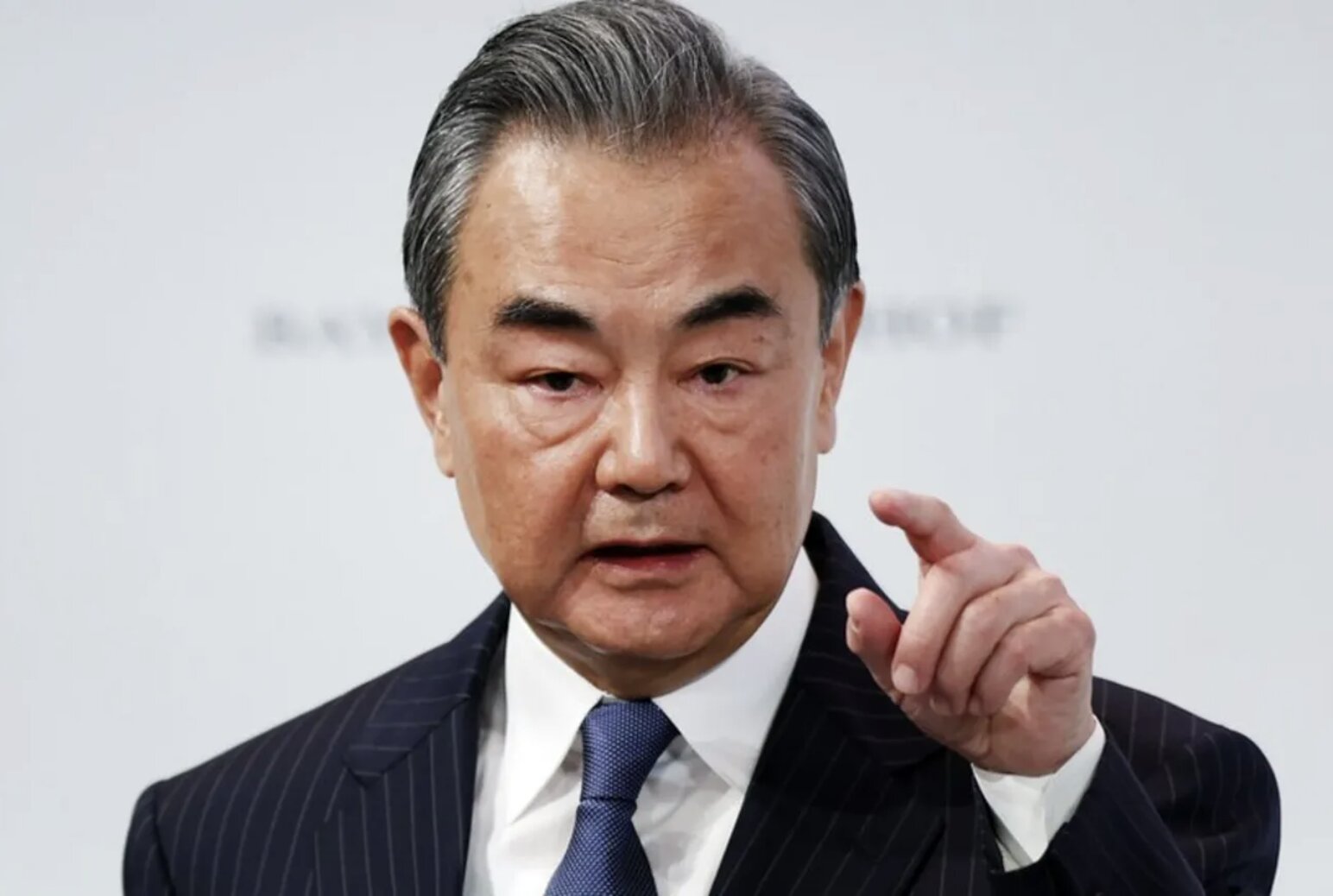
In Brief
ENERGY AND ENVIRONMENT
China launches world’s first floating bamboo solar farm
On 27 August, SCMP reported that China launched the world’s first 100-kilowatt floating solar farm built with bamboo frames off the coast of Shandong province. This offers a highly sustainable approach to offshore clean energy production. The innovative platform named Jilin-2 is constructed using specially engineered, fibre-reinforced "sea bamboo" composite pipes. It was developed by the CIMC Offshore Engineering Research Institute, CIMC Raffles’ research arm, as well as China Forestry Group Corporation and Beijing Forestry University, to resist extreme marine environments, including high humidity, harsh salt spray, ultraviolet radiation, and constant corrosion. This eco-friendly design significantly reduces the marine pollution typically caused by traditional high-density plastic or steel frameworks. Currently deployed at a demonstration base near Yantai, Jilin-2 supplies power directly to an integrated industrial facility producing hydrogen, ammonia, and methanol. Beyond immediate green energy generation, the project serves as a critical testbed to monitor how well these renewable wood-bamboo composites handle long-term ocean wear, structural fatigue, and environmental adaptability. Successful testing will provide the necessary technical foundation to scale up to massive megawatt-level projects. This initiative closely aligns with China’s broader national goals, including replacing industrial plastics with bamboo, achieving peak carbon emissions by 2030, and hitting total carbon neutrality by 2060. It also states that this durable material could eventually power future marine ranches for sustainable seafood production and anchor shifting sand to halt northern desertification.
(“China launches world’s first 100kW bamboo-built floating solar farm off Shandong coast,” SCMP, 27 August 2026)
https://sc.mp/u5v06?utm_source=copy-link&utm_campaign=3365347&utm_medium=share_widget
SCIENCE AND TECHNOLOGY
China Media Group launches AI initiatives to accelerate digital transformation
On 26 August, CGTN reported that China Media Group (CMG) has partnered with major telecom operators and tech giants to launch two artificial intelligence initiatives aimed at accelerating digital transformation. The initiative brings China Telecom, China Unicom, China Mobile, the Beijing Municipal Bureau of Economy and Information Technology, Huawei, Alibaba Cloud, and Inspur Group together. CMG stated that the collaboration pools computing power and exclusive data to build a media-specific AI system that automates workflows across content planning, editing, review and distribution, with an emphasis on full-media ultra-high-definition content, multimodal generation and intelligent production tools. Participating companies stated they would contribute by providing cloud computing and high-performance chips to security systems and intelligent agents.
(“China Media Group launches AI ecosystem and large model initiatives,” CGTN, 26 August 2026)
https://news.cgtn.com/news/2026-08-26/China-Media-Group-launches-AI-ecosystem-and-large-model-initiatives-1PVnXGn3oCk/p.html
Nvidia resumes China chip shipments amid record global AI demand
On 27 August, SCMP reported that Nvidia has resumed shipping its H200 data-centre processors to China under a new US licensing scheme. These sales accounted for less than 1 per cent of its record USD 89 billion quarterly data-centre revenue. Driven by massive global demand that outpaces supply, the company reported an overall second-quarter revenue of USD 96.2 billion, a 106 per cent year-on-year increase and expanded its partnership with Amazon Web Services to deploy 2 million additional GPUs. To accelerate infrastructure deployment, Nvidia is bypassing traditional loans to instead invest nearly USD 50 billion in frontier AI laboratories and recently partnered with Apollo, BlackRock, Blackstone, Brookfield, KKR and Goldman Sachs on revenue-sharing platforms designed to mobilise USD 500 billion in third-party capital. The company has also begun shipping its next-generation Vera Rubin platform to every major hyperscaler, AI cloud provider, and system manufacturer, positioning it as the fastest product ramp-up in company history despite anticipated short-term margin pressures from rising memory costs.
(“Nvidia ships first H200 chips to China, but forecasts no data-centre computing revenue,” SCMP, 27 August 2026)
https://sc.mp/z9uyj?utm_source=copy-link&utm_campaign=3365383&utm_medium=share_widget
CHINA AND SPACE
Commercial space company debuts turnkey satellite export to Thailand
On 28 August, SCMP reported that Chinese company GalaxySpace initiated China's first turnkey satellite export to Southeast Asia. The company launched the Lingzhi-09 Thailand CubeSat on a Long March-6C rocket; it was developed for Thailand’s Geo-Informatics and Space Technology Development Agency (GISTDA) to collect remote-sensing data for land, agriculture, and ecological applications, along with six other satellites. The CubeSat is developed for Thailand’s Geo-Informatics and Space Technology Development Agency (GISTDA) to collect remote-sensing data for land, agriculture, and ecological applications, and also support practical training for Thai university students. GalaxySpace is China's first commercial space sector startup valued at USD 1 billion or more. The company stated that this marks the first time a Chinese commercial space company has developed, launched, and deployed a complete satellite in orbit for a Southeast Asian customer as a packaged solution.
("China’s commercial space sector expands global footprint with Thailand deal," SCMP, 28 August 2026)
https://www.scmp.com/tech/article/3365534/chinas-commercial-space-sector-expands-global-footprint-thailand-deal?module=perpetual_scroll_0&pgtype=article
NUCLEAR
Extreme weather less likely to slow China’s nuclear power industry expansion, says SCMP
On 27 August, an article published in SCMP stated that extreme weather is less likely to slow down China’s nuclear power industry expansion. World Nuclear Association China Director stated that the fact that China's nuclear power plants are constructed along the coast and employ open seawater for cooling makes it less vulnerable to droughts and heatwaves. Considering typhoons and earthquakes, a comprehensive early-warning and emergency-response system is being incorporated into the site design of upcoming plants. China Director said: "In addition to engineering safeguards and emergency preparedness, China’s technological advances could help its nuclear expansion better withstand the effects of climate change – and eventually lay the groundwork for inland reactors." He added that plans for next-generation reactor designs that require less water and are safer are in motion, and the country currently leads in fourth-generation high-temperature gas-cooled reactors, which do not use water as their main coolant.
("Why climate extremes will not stop expansion of China’s nuclear power industry," SCMP, 27 August 2026)
https://www.scmp.com/news/china/science/article/3365421/why-climate-extremes-will-not-stop-expansion-chinas-nuclear-power-industry?module=latest_china_science&pgtype=topic
CHINA AND TAIWAN
Taiwan passes USD 7.6 billion drone budget to counter China’s increasing naval presence
On 27 August, Wion News reported that China has continued to increase its naval and coast guard activities around Taiwan in July. Per Taiwan Coast Guard data, they have monitored and detected 1,247 ships around Taiwan and several of its outer islands since May. Taiwan’s Senior Coast Guard officials stated that the "situation is becoming increasingly severe,” and that China “has never ruled Taiwan for even a single day; without sovereignty over land, it has no right to claim economic zones at sea.” Taiwan has also passed its long-awaited drone budget, worth around USD 7.6 billion, and has increased its military spending as part of the wider US effort to have its allies increase their expenditure. The US has also pressured Taiwan to pass its long-stalled drone budget, with US Republican lawmaker Young Kim stating that “Time is short. The wars over Ukraine and Iran show that Taiwan needs to buy and build drones at a huge scale.”
(“China intensifies pressure around Taiwan with record ship presence; Taipei approves $7.6 billion drone budget,” Wion News, 27 August 2026)
https://www.wionews.com/world/china-intensifies-pressure-around-taiwan-with-record-ship-presence-taipei-approves-7-6-billion-drone-budget-1787827802877
CHINA AND EAST ASIA
Beijing says normalisation of ties with Japan will happen if Tokyo revises its Taiwan position
On 27 August, The Japan Times reported that China would only seek normalisation if Japan revises its Taiwan policy after a cross-party Parliamentarian delegation visited Beijing. Prime Minister Sanae Takaichi, in November, stated that Japan will militarily intervene in the case of a ‘Taiwan crisis.’ The comments have angered China, and Sino-Japanese relations are currently strained. The delegation sought the early release of Japanese detainees in China, and the lifting of the rare earth mineral export controls to Japan. The Deputy Head of the Chinese Communist Party Lu Kang stated that Japan must “honestly and earnestly handle the Taiwan issue in accordance with the one-China principle.” Shinichi Isa, a Centrist Reform Alliance representative in the delegation, stated that the meeting with Chinese officials was “a difficult exchange of views.”
(“No ties reset until Japan revises Taiwan position, Chinese official tells delegation,” The Japan Times, 27 August 2026)
https://www.japantimes.co.jp/news/2026/08/27/japan/politics/japanese-lawmakers-visit-china/
CHINA AND SOUTHEAST ASIA
Chinese buyers cut back on Thailand’s condominium real estate market
On 28 August, The Business Times reported that Chinese buyers cut back spending by 27.7 per cent in Thailand’s condominium market. Chinese buyers are traditionally the largest foreign purchasers of Thai condos. Condominium refers to an ownership scheme where a building or a group of buildings is divided into multiple units that are either separately owned or collectively owned. Per the Real Estate Information Centre, foreign buyers took ownership of 6,533 units from January to June, down 8.8 per cent from the previous year, and the value of transfers fell 1.5 per cent to USD 860 million.
(“China pullback leads drop in Thailand’s foreign condo demand,” The Business Times, 28 August 2026)
https://www.businesstimes.com.sg/property/china-pullback-leads-drop-thailands-foreign-condo-demand
CHINA AND SOUTH ASIA
China resumes rescue efforts after monitoring lake conditions
On 28 August, Reuters reported that China resumed rescue operations after assessing the risk from the glacier collapse. Dam debris formed an overflowing lake, posing a new risk of flooding in the Himalayas. China is now trying to mitigate the chances of more flooding along the border crossing linking its Tibet region to Nepal. An aerial survey conducted by the engineering team suggests that three million cubic meters of water will flow into the lake with no outlet, creating a high risk of breach.
("China resumes rescue work after assessing upstream lake conditions," Reuters, 28 August 2026)
https://www.reuters.com/business/environment/china-rushes-minimise-risk-mountain-barrier-lake-near-border-with-nepal-2026-08-28/
Beijing and Dhaka assess the Teesta River Project and begin work on Special Economic Zone in Chattogram and the Mongla Port
On 27 August, The Business Standard reported that Chinese Ambassador to Bangladesh Yao Wen said Beijing and Dhaka are assessing the feasibility of implementing the Teesta River project. He added that Bangladesh PM Tarique Rahman's recent visit to China created a "historic opportunity" to expand comprehensive cooperation between Dhaka and Beijing. He stated that construction of the Chinese Special Economic Zone in Chattogram and the Mongla Port project have begun. Additionally, he expressed China's interest in supporting Bangladesh in expanding trade, developing infrastructure, generating renewable energy, promoting language education, and building skilled human resources.
("China assessing feasibility of Teesta project with Bangladesh: Yao," The Business Standard, 27 August 2026)
https://www.tbsnews.net/bangladesh/china-assessing-feasibility-teesta-project-bangladesh-yao-1526041
CHINA AND AFRICA
Beijing issues travel warnings to its citizens amidst tensions with Eswatini
On 26 August, the BBC reported that China’s Foreign Ministry has issued a security advisory warning to its citizens to evacuate Eswatini immediately, citing risks like cyber fraud and illegal gambling. It urged nationals to relocate to safer areas like South Africa. The advisory is followed by Eswatini's police raids targeting illegal online gambling operations, leading to the arrest and subsequent legal dispute over the re-detention of 40 Chinese nationals. Beyond law enforcement issues, the move is also reflective of escalating diplomatic friction. Eswatini is Taiwan’s sole remaining African ally. Beijing, which opposes Taiwan's foreign ties, had previously attempted to disrupt Taiwanese President Lai Ching-te’s visit to Eswatini and excluded the kingdom from its pan-African zero-tariff policy.
(“China advises its citizens to leave Taiwan ally Eswatini over 'security risks',” BBC, 26 August 2026)
https://www.bbc.com/news/articles/c3rel9rgnx5o
CHINA AND EUROPE
German firms urge Berlin to take a harder stance on ‘unfair’ Chinese trade practices
On 28 August, Reuters reported that German business groups are escalating pressure on Chancellor Friedrich Merz to confront Beijing over non-competitive trade practices. This marks a notable shift from their historically cautious, anti-tariff stance. Facing a record EUR 89.3 billion trade deficit with China, German manufacturers and automotive giants like Volkswagen are being severely undercut by Chinese rivals benefiting from substantial state subsidies and an undervalued yuan. In response, major industry bodies including the BDI, DIHK, and the Mittelstand association are urging Berlin and the European Union to accelerate trade defence mechanisms, implement anti-subsidy safeguards, and consider local content quotas. While German automakers remain wary of Chinese retaliation given their extensive investments in China, industry leaders warn that inaction now poses an even greater economic risk. Consequently, Chancellor Merz has tasked his cabinet with preparing measures to rebalance trade, signalling potential German support for broader EU-wide actions if upcoming negotiations with Beijing in October fail.
(“German industry presses Merz for tougher China policy,” Reuters, 26 August 2026)
https://www.reuters.com/business/autos-transportation/german-industry-presses-merz-tougher-china-policy-2026-08-28/
EU issues warnings to Beijing over escalating trade deficit
On 28 August, Euronews reported that the European Commission President Ursula von der Leyen has issued a firm warning to Beijing, asserting that the European Union is prepared to deploy all available trade defence tools if negotiations fail to rectify severe economic imbalances by the October deadline. Speaking to French business organisation Medef, von der Leyen highlighted that the EU's trade deficit with China has escalated to EUR 1 billion per day, driven by a 45 per cent surge in cheap Chinese imports over the last five years.
To combat market-distorting practices such as suspected product dumping, the Commission has ramped up enforcement, launching 30 trade defence investigations over the past year, nearly triple the historical average. While reiterating that the EU seeks "de-risking without breaking ties," von der Leyen emphasised that maintaining a partnership cannot mean accepting permanent trade deficits, which now affect every single EU member state. If ongoing talks yield no breakthrough, the EU could trigger its powerful "anti-coercion instrument," anti-subsidy, colloquially as the "trade bazooka"; this mechanism allows Brussels to impose severe restrictions on public procurement access or revoke intellectual property rights. However, activating it requires majority approval from member states, several of which remain cautious due to bilateral trade and investment ties with China.
signalling Leyen turns up pressure on China over trade deficit,” Euronews, 28 August 2026)
https://www.euronews.com/my-europe/2026/08/27/von-der-leyen-turns-up-pressure-on-china-over-trade-deficit
CHINA AND THE AMERICAS
China’s FM meets US officials; Seeks to “overcome obstacles” ahead of Trump-Xi summit
On 27 August, ABC News reported that China’s Foreign Minister Wang Yi met with US Ambassador David Perdue to urge both nations to overcome obstacles, manage differences, and clear the path for a planned high-level summit between the US President Donald Trump and China’s President Xi Jinping. Despite a trade truce during their previous meeting, tensions have escalated through mutual economic restrictions, including bans on Chinese humanoid robots, reciprocal commercial bans by Beijing, and ongoing disputes over labour and industrial capacity, with Washington weighing a new 7.5 per cent tariff; Beijing has criticised market-distorting politicisation while maintaining diplomatic communication to stabilise bilateral relations before the leaders meet.
(“Chinese FM calls for US, China to 'overcome obstacles' ahead of presidential summit,” ABC News, 28 August 2026)
https://abcnews.com/International/wireStory/chineemphasised-minister-calls-us-china-overcome-obstacles-135996445
China Reader Daily Wire | 27 August 2026, Thursday | Vol 3 No. 124 & 125
China develops hypersonic glide vehicles with air-to-air capabilities
India and China reach eight-point consensus on border talks
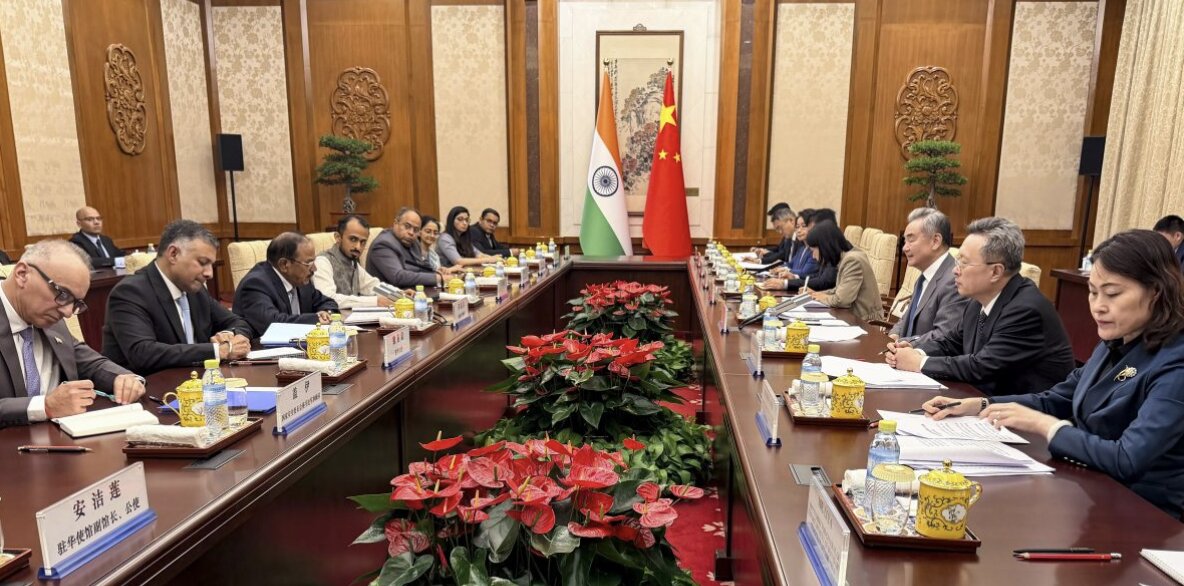
In Brief
DEFENCE
China develops hypersonic glide vehicles with air-to-air capabilities
On 25 August, The Japan Times reported that the Chinese military has developed hypersonic glide vehicles capable of launching air-to-air weapons. This enables it to threaten high-value US support aircraft, like tankers and command planes, from thousands of kilometres away. Backed by the world's largest arsenal of over 3,150 ballistic missiles, this breakthrough allows China to target distant US bases like Guam and Hawaii, though the long flight times make real-time tracking difficult and risk triggering an accidental nuclear escalation. This rapid expansion in China’s missile production comes at a critical time, as the US faces missile supply strains from recent Middle East conflicts and is actively rushing to develop its own ultra-long-range air-to-air weapons to counter the threat.
(“China develops missile to target planes thousands of kilometres away,” The Japan Times, 25 August 2026)
https://www.japantimes.co.jp/news/2026/08/25/asia-pacific/china-missile-planes-thousands-miles/
SCIENCE AND TECHNOLOGY
Editorial: “Asia is reaching for the open road that Chinese AI offers,” SCMP, 23 August 2026
“On 23 August, in an editorial published by SCMP, Chenjie Song and Minghao Sun reported that at a recent APEC digital technology forum, Asia-Pacific ministers voiced strong support for open-source AI models, challenging the Western view of AI development as a zero-sum contest between Washington and Beijing. Across Asia and developing regions, governments and private start-ups are increasingly building their "sovereign AI" systems on free, open-weight models from China like Alibaba’s Qwen and DeepSeek. This shift is driven by economic reality, as China’s open-source options cost 60 to 90 per cent less to operate than leading American platforms and run securely on local servers without data leaving the country. While the United States continues to stoke global anxiety by threatening to restrict foreign access to its proprietary AI capabilities, China is rapidly gaining strategic influence simply by aligning with other countries' desires for tech autonomy and a multipolar digital landscape."
PLA launches public campaign to investigate corruption in Rocket Force
On 25 August, Reuters reported that the PLA issued a notice launching a public campaign to collect information on alleged procurement violations in the People’s Liberation Army Rocket Force (PLARF). This is part of a broader corruption crackdown initiated by President Xi. The notice calls on suppliers, bidding and tendering agencies, evaluation experts and relevant military personnel to provide information on suspected violations related to the Rocket Force’s procurement. The focus is on PLARF’s purchases of goods and services, construction projects, and food and medical supplies, spanning all stages of the process and different forms of procurement, including requirements drafting, procurement evaluations, contract performance and online purchasing.
("China seeks public tips on procurement violations in elite Rocket Force," Reuters, 25 August 2026)
https://www.reuters.com/business/aerospace-defense/china-seeks-public-tips-procurement-violations-elite-rocket-force-2026-08-25/
CHINA AND TAIWAN
Beijing’s cybersecurity and border control rules pose legal and safety risks, reports Taipei Times
On 26 August, Taipei Times reported that Taiwan’s Mainland Affairs Council (MAC) warns that China’s new cybersecurity and border control rules, launching in October, pose severe legal and safety risks to Taiwan citizens. According to Deputy Minister Shen Yu-chung, these regulatory changes aim to tighten the Chinese Communist Party's grip on civil society ahead of its upcoming 21st National Congress. The regulations grant vague, wide-ranging enforcement powers to low-ranking Chinese police officers, who are incentivised to apply the harshest interpretations of the law. Furthermore, these mechanisms allow Beijing to claim extraterritorial authority, sparking global fears of transnational repression. In response, Taiwan strongly denounces these laws as illegal and illegitimate. The government is actively working to counter Beijing's long-arm enforcement by cooperating with an international coalition of democracies to share intelligence. Domestically, Taiwan is considering a new law to criminalise any local collaboration with China's political repression, an initiative supported by over 76 per cent of Taiwan citizens. The MAC is also coordinating with other ministries to defend targeted individuals and provide assistance to those at risk. Ultimately, Taiwan urges the public to carefully evaluate safety risks before travelling to China, Hong Kong, or Macau, and strongly advises using the official MAC registry to ensure government aid in emergencies.
(“Chinese border control rules likely to affect Taiwanese,” Taipei Times, 26 August 2026)
https://www.taipeitimes.com/News/taiwan/archives/2026/08/26/2003863152
CHINA AND SOUTHEAST ASIA
US-Philippine site survey near closed China-linked steel plant in Mindanao fuels geopolitical tensions
On 26 August, SCMP reported that Philippine military officials confirmed that Filipino and US personnel recently tried to access a closed, China-linked steel plant in Mindanao during a site survey. While the team left after lacking written entry authorisation, the visit highlights Manila’s ongoing military expansion near the site, which sits adjacent to a deepwater bay planned for a new naval facility and future US joint exercises under the Enhanced Defence Agreement (EDCA). The site has already been a flashpoint for bilateral tensions; the plant was ordered closed in June due to radioactive scrap metal contamination, following a May raid where Philippine authorities arrested 69 workers from China for immigration violations. Beijing heavily protested the raid and subsequently sanctioned Philippine Defence Secretary Gilberto Teodoro, accusing him of intentionally sabotaging China-Philippines relations to serve a confrontational political agenda.
(“Why Philippine, US forces tried to ‘scope’ a Chinese-linked steel plant in Mindanao,” SCMP, 26 August 2026)
https://sc.mp/tubz7?utm_source=copy-link&utm_campaign=3365243&utm_medium=share_widget
CHINA AND SOUTH ASIA
India and China reach eight-point consensus on LAC border management and boundary talks
On 26 August, The Statesman reported that India and China had reached an eight-point consensus during the 25th round of Special Representatives talks in Beijing, aimed at maintaining peace and tranquillity along the Line of Actual Control (LAC), strengthening border management mechanisms and advancing boundary negotiations. National Security Advisor Ajit Doval and China's Foreign Minister Wang Yi reaffirmed commitment to a fair, reasonable, and mutually acceptable solution to the boundary dispute in accordance with the 2005 Agreement on Political Parameters. A significant outcome was the decision to advance discussions on an "Early and Substantial Harvest" in boundary delimitation and border management through two newly established expert and working groups, whose first task would be to finalise their respective terms of reference. Both sides agreed to address any ground-level situations through existing diplomatic and military channels and to improve their understanding of the LAC to prevent miscalculations. Two additional meeting points for senior military commander meetings and two additional border military hotlines in the Eastern and Middle Sectors were also agreed upon. On trans-border cooperation, India appreciated China's efforts to increase the number of batches for the Kailash-Mansarovar Yatra, and both sides welcomed the reopening of three designated border trading points. The next round of talks will be held in India in 2027.
("India, China agree on eight-point roadmap to strengthen LAC border management," The Statesman, 26 August 2026)
https://www.thestatesman.com/india/india-china-agree-on-eight-point-roadmap-to-strengthen-lac-border-management-1503631552.html
Bangladesh to purchase Chinese fighter jet and helicopter purchase
On 26 August, The Daily Star reported that Bangladesh is moving ahead with plans to purchase Chinese J-10CE fighter jets, attack helicopters and unmanned aerial vehicle systems to modernise the Bangladesh Air Force. Prime Minister’s Policy and Strategy Adviser Zahed Ur Rahman said a government committee had already negotiated the purchase of the J-10CE jets and attack helicopters and prepared a draft agreement. The proposed package also includes VIP helicopters. He said the purchase could be completed this year if funds are available; otherwise, it may be carried out next year. A document from the Chief Adviser’s Office dated 5 April 2025, seen by The Daily Star, showed that the government had in principle agreed to purchase 20 Chengdu J-10 aircraft for 2.2 billion dollars. Of this, 1.2 billion dollars was for the aircraft, while the remaining amount covered spare parts, freight, training, insurance and other equipment. Zahed said Bangladesh considered the J-10CE’s reported performance against Rafale aircraft during the 2025 India-Pakistan conflict and also noted that Chinese aircraft were cheaper than comparable European fighters.
("Govt set to buy Chinese fighter jets, helicopters," The Daily Star, 26 August 2026)
https://www.thedailystar.net/news/bangladesh/news/govt-set-buy-chinese-fighter-jets-helicopters-4257086
China states interest in deepening educational cooperation with Bangladesh
On 26 August 2026, The Business Standard reported that Chinese Ambassador to Bangladesh Yao Wen said China is willing to further deepen educational cooperation with Bangladesh and help turn Chinese language skills into employment and development opportunities for Bangladeshi youth. Yao made the remarks at the closing ceremony of the Validation Workshop on Competency Standards and Course Accreditation Document for the Chinese Language, organised by Bangladesh’s National Skills Development Authority. He welcomed the release of Bangladesh’s first Chinese language competency standard and course accreditation document. The Chinese ambassador said the workshop was a concrete step towards implementing the important consensus reached by the leaders of Bangladesh and China. Prime Minister’s Adviser Md Ismail Zabihullah positively assessed the launch of the document. He expressed hope that the initiative would deepen practical cooperation between the two countries in different fields and promote the further development of Bangladesh-China relations.
("China willing to deepen educational cooperation with Bangladesh: Yao Wen," The Business Standard, 26 August 2026)
https://www.tbsnews.net/foreign-policy/china-willing-deepen-educational-cooperation-bangladesh-yao-wen-1525566
China pledges support to Nepal following border disaster
On 27 August 2026, Ratopati reported that Chinese Ambassador to Nepal Zhang Maoming expressed deep sorrow over the heavy human casualties and property losses caused by the natural disaster in the Kerung-Rasuwagadhi border area. The ambassador extended condolences to the families of those who lost their lives and wished a speedy recovery to the injured. He said China was deeply concerned about the disaster and stood firmly with Nepal during this difficult time. Zhang said China is ready to provide necessary support for rescue, relief and recovery efforts and will continue to coordinate with Nepal. He added that China and Nepal share close ties and support each other during difficult situations. The Chinese Embassy said China would remain in communication with Nepali authorities and provide assistance according to Nepal’s needs as relief and recovery efforts continue in the affected border region.
("Chinese Ambassador Expresses Deep Condolences for Natural Disaster Victims in Kerung-Rasuwagadhi Border Area," Ratopati, 27 August 2026)
https://english.ratopati.com/story/76620/china-stands-firmly-with-nepal-in-difficult-times-ambassador-maoming
Pakistan's Finance Minister says the country is not seeking fresh Chinese financing
On 26 August 2026, Business Recorder reported that Pakistan is not currently seeking fresh financing from China as it looks to diversify its external sources of funding and return to international capital markets. Finance Minister Muhammad Aurangzeb told the Financial Times that Pakistan wants to focus on trade and investment and has sought a 10 billion dollar swap line from the United States. He said the facility would serve as a confidence signal for private investors. Aurangzeb also said Pakistan sees an important role for the US Export-Import Bank and the US International Development Finance Corporation. He added that the government had received constructive engagement from Washington and hoped for a response on the proposed swap line in the coming months. China remains Pakistan’s largest bilateral creditor, but the minister said Pakistan is not seeking additional Chinese financing for now.
("Pakistan not seeking fresh Chinese financing, Aurangzeb tells FT," Business Recorder, 26 August 2026)
https://www.brecorder.com/news/40436467/pakistan-not-seeking-fresh-chinese-financing-aurangzeb-tells-ft
Punjab and Xinjiang agree to deepen agricultural cooperation
On 26 August, The Daily CPEC reported that Punjab Chief Minister Maryam Nawaz met Chen Xiaojiang, Secretary of the Communist Party of China Xinjiang Uygur Autonomous Regional Committee, and agreed to expand cooperation between Punjab and Xinjiang in agriculture. The cooperation will focus on agriculture, irrigation, livestock, mechanisation and modern farming technologies. Both sides discussed using advanced aerial vehicles, modern water-levelling techniques and digital crop-monitoring systems to improve agricultural productivity. They also agreed to explore the use of tested Chinese seeds. Maryam Nawaz offered cooperation in agricultural mechanisation, water-efficient irrigation and livestock development. She highlighted Punjab’s major role in Pakistan’s agricultural production and said the province wants to benefit from Xinjiang’s experience in corporate farming.
("Maryam, Xinjiang Chief Deepen Farm Cooperation," The Daily CPEC, 26 August 2026)
https://thedailycpec.com/maryam-xinjiang-chief-deepen-farm-cooperation
India and China quietly shelve early harvest formula as boundary talks shift toward broader settlement reports, The Wire
On 26 August, The Wire reported that India and China had dropped the "early harvest" formulation on boundary delimitation from the outcome of their 25th round of Special Representatives talks, instead reaffirming commitment to a broader political settlement. The talks were held in Beijing between National Security Advisor Ajit Doval and China's Foreign Minister Wang Yi, who held a candid and thorough discussion on the boundary question and bilateral ties. While India's readout spoke of working toward a political settlement, China's readout said both sides would advance boundary delimitation negotiations in accordance with the 2005 Agreement on Political Parameters. The "early harvest" idea, first raised by China in 2017, involved settling portions of the boundary where agreement could be reached more easily before a comprehensive settlement, a piecemeal approach India had long resisted. Doval said the improvement in ties flowed directly from calm on the border, describing India and China as partners in cooperation rather than competitors, while Wang Yi called for a stable relationship.
("SR Talks: India, China Drop Mention of 'Early Harvest', Affirm Push for Boundary Settlement," The Wire, 26 August 2026)
https://thewire.in/diplomacy/special-representatives-talks-india-china-drop-early-harvest-route
Chinese ambassador commemorates Maldives ' National Day with visit to historic Utheemu Island
On 26 August, EIN Presswire reported that Chinese Ambassador to the Maldives Kong Xianhua had attended the Maldives' National Day commemoration events on Utheemu Island on 14-15 August at the invitation of President Mohamed Muizzu. Utheemu Island, birthplace of Maldivian national hero Sultan Muhammad Thakurufaanu, who led the island nation's resistance against Portuguese invasion in the 16th century, served as the venue for the events. Ambassador Kong spoke on the importance of national unity, historical education and the spirit of independence, remarks that local Maldivian media described as profound and meaningful.
("Chinese Ambassador to the Maldives Kong Xianhua Attends the Maldives' National Day Commemoration Events Held on Utheemu Island," EIN Presswire, 26 August 2026)
https://www.einpresswire.com/article/937072074/chinese-ambassador-to-the-maldives-kong-xianhua-attends-the-maldives-national-day-commemoration-events-held-on-utheemu-island
China pledges RMB 79 million grant to rebuild Sri Lanka bridges damaged by Cyclone Ditwah
On 26 August, Lanka Newspapers reported that China had pledged a grant of RMB 79 million to Sri Lanka to fund the reconstruction of 14 bridges severely damaged by Cyclone Ditwah. The funding was provided as a direct grant rather than a loan, distinguishing it from previous financing arrangements that had drawn scrutiny over debt sustainability. The bridges' destruction had disrupted road connectivity and posed challenges to communities dependent on them for daily movement and economic activity. Sri Lankan authorities said the funds would accelerate recovery efforts that had stalled due to resource constraints, with project planning and procurement expected to begin in the coming months.
("China Grants RMB 79 Million to Rebuild 14 Bridges Destroyed by Cyclone Ditwah," Lanka Newspapers, 26 August 2026)
https://www.lankanewspapers.com/2026/08/26/china-grants-rmb-79-million-to-rebuild-14-bridges-destroyed-by-cyclone-ditwah
Opinions:
Zeba Zoariah, “India’s new China policy: Engage Beijing, but don’t trust it,” First Post, 27 August 2026
“India is not returning to the China policy it practised before Galwan. It appears to be learning how to maintain a working relationship with Beijing without first believing that the relationship is improving in any fundamental sense. That sounds like a small distinction. It isn’t … But the lesson India appears to have drawn from the last six years is not that dependence on China must disappear. It is that dependence has to be identified, measured and managed … Galwan demonstrated the danger of a China policy whose political expectations ran ahead of realities on the ground. The task now is not to recreate the confidence that existed before 2020, but to construct a relationship that does not collapse simply because that confidence no longer exists. India and China are talking again. This time, trust does not have to be the destination for dialogue to be useful.”
Abhishek De, “Rafales face China's J-16 jets in rare drill: Why India is watching closely,” India Today, 26 August 2026
“The China-Egypt 'Eagles of Civilisation' exercise will offer a valuable glimpse into how the two aircraft perform in a simulated combat environment, as well as the capabilities of the J-16. The J-16, nicknamed the 'Hidden Dragon', is a more advanced version of the J-10, and its performance will be of interest to India amid the growing Chinese air power in the region … For India, the China-Egypt exercise carries significance well beyond a routine military drill. During last year's Operation Sindoor, Indian Rafales and Pakistan's J-10 fighters were involved in hostilities, making the performance of the Chinese J-16 a matter of deep interest for the Indian Air Force (IAF).”
A. Jathindra, “Democracy Under Strain: China’s Subtle Power Play,” Eurasia Review, 25 August 2026
“China today represents not only a strategic challenge to the US-led, rules-based international order but also a profound test for democracy itself. For many smaller nations, Beijing’s rapid transformation from poverty to sustained economic growth has become a source of admiration. The danger, however, lies in this economic respect evolving into an endorsement of China’s governance model. In this sense, China stands as both a “near peer” competitor to the United States and a rival to the Western-led democratic ecosystem. Sri Lanka once openly expressed interest in adopting governance lessons from China during Mahinda Rajapaksa’s tenure — a telling indication of how Beijing’s influence extends beyond economics. Even within Sri Lanka’s business community, debates over governance mirror the political divisions shaping the nation’s future … For nations like Sri Lanka and Nepal, the dilemma is stark: economic partnership with China brings development opportunities, but it also risks eroding democratic values and independent decision-making. As China continues to expand its global footprint, small democracies face a critical test. Will they safeguard their democratic institutions and human rights traditions, or will they drift toward governance models inspired by Beijing’s success? The answer will determine not only their political futures but also the resilience of democracy in the developing world.”
Yuanyin, "Winners of “China Plus One” | Pakistan: Standing on Its Own Feet," Asia Econ-Culture Watch, 26 August 2026
"At the third China–Pakistan B2B Investment Conference on information technology, telecommunications and battery energy storage, held in Hangzhou on May 24, Pakistani Prime Minister Shehbaz Sharif set out an ambitious goal: Pakistan should learn from China’s development experience and become a “mini China” in South Asia … Pakistan’s version of “China Plus One” is fundamentally different from those of Southeast Asia or Central Asia … Pakistan’s advantage is strategic depth … Its role is not limited to absorbing production capacity. It is attempting a system-wide transformation linking infrastructure, manufacturing, agriculture, mining, digital industries and energy … The $25.93 billion in investment, 44 special economic zones and 261,000 jobs are not simply indicators of Chinese capital entering Pakistan. They represent a longer-term attempt by Pakistan to use CPEC and “China Plus One” to reshape its economic structure … As Sharif has emphasised, Pakistan says it is seeking expertise, investment and industrial cooperation — not aid or charity … That distinction captures the deeper logic of Pakistan’s next phase: moving from being supported to building the capacity to stand on its own."
Professor Dr M A Rashid, "Bangladesh–China Relations in a Changing Indo-Pacific: Balancing Development and Strategic Autonomy," The Daily New Nation, 27 August 2026
"Over the past two decades, Bangladesh has pursued an ambitious development agenda aimed at achieving upper-middle-income status while modernizing its infrastructure, enhancing connectivity and strengthening economic competitiveness … A defining milestone in this partnership came in 2016 when Bangladesh formally joined China’s Belt and Road Initiative (BRI) … Since then, bilateral cooperation has expanded considerably, with Chinese financing supporting major projects such as the Karnaphuli Tunnel, Payra Power Plant, the Dasherkandi Sewage Treatment Plant, and numerous road, rail, and energy initiatives … These projects have the potential to reduce infrastructure bottlenecks, facilitate regional connectivity, improve industrial productivity, and support Bangladesh’s long-term economic transformation … China has also become an important export destination for Bangladeshi products, while Chinese investment continues to expand across multiple sectors, including manufacturing, information technology, renewable energy, and special economic zones … Beyond economics, bilateral cooperation has extended into education, cultural exchanges, healthcare, digital technology, and human resource development, creating broader people-to-people connections that reinforce the relationship."
CHINA AND EUROPE
Slovakia urges the EU to perceive competition with Beijing as ‘friendly’
On 26 August, CGTN reported that Slovakia’s Prime Minister Robert Fico urged the EU to view China as a friendly competitor rather than an adversary, advocating against trade barriers and tariffs during talks with European Council President António Costa. Discussing key EU priorities, PM Fico called for robust cohesion and agricultural funding, specifically requesting additional support for eastern member states bordering Ukraine. Regarding EU expansion, he emphasised strict adherence to standards, arguing Ukraine must not receive ‘shortcuts’ or bypass long-standing Balkan candidate nations.
(“'Not an enemy:' Slovakia calls on EU for 'friendly' competition with China,” CGTN, 26 August 2026)
https://news.cgtn.com/news/2026-08-26/-Not-an-enemy-Slovakia-calls-on-EU-for-friendly-China-competition-1PUN18JjFzG/p.html
CHINA AND THE AMERICAS
Beijing intent on securing its own interests as Washington set on expanding sanctions on Tehran
On 25 August, Al Jazeera reported that China has strongly condemned new US measures aimed at the economic strangulation of Iran, pledging to defend its national interests and demanding an end to illegal unilateral sanctions. China’s Foreign Ministry spokesperson Lin Jian emphasised that Sino-Iranian trade complies with international law and must not be disrupted. The dispute escalates as Washington threatens secondary sanctions against global entities, including Chinese banks, to enforce its embargo during the ongoing US-Israel conflict with Iran. However, analysts suggest aggressive US enforcement against Beijing remains unlikely. Reportedly, China has previously stabilised global energy markets during the war by scaling back oil purchases to prevent crude prices from soaring. Furthermore, the retaliatory risks and upcoming diplomatic engagements, such as President Xi Jinping’s planned Washington visit, create significant friction. Meanwhile, Iranian officials have framed the sanctions as an extension of military aggression, warning that US economic targets could face regional pushback.
(“China says will safeguard its own interests as US expands Iran sanctions,” Al Jazeera, 25 August 2026)
https://www.aljazeera.com/economy/2026/8/25/china-says-will-safeguard-its-own-interests-as-us-expands-iran-sanctions
China Reader Daily Wire | 25 August 2026, Tuesday | Vol 3 No. 123
China's President likely to attend the BRICS summit, reports Reuters
US sets to impose 7.5 per cent tariff on China over allegations of excess manufacturing capacity
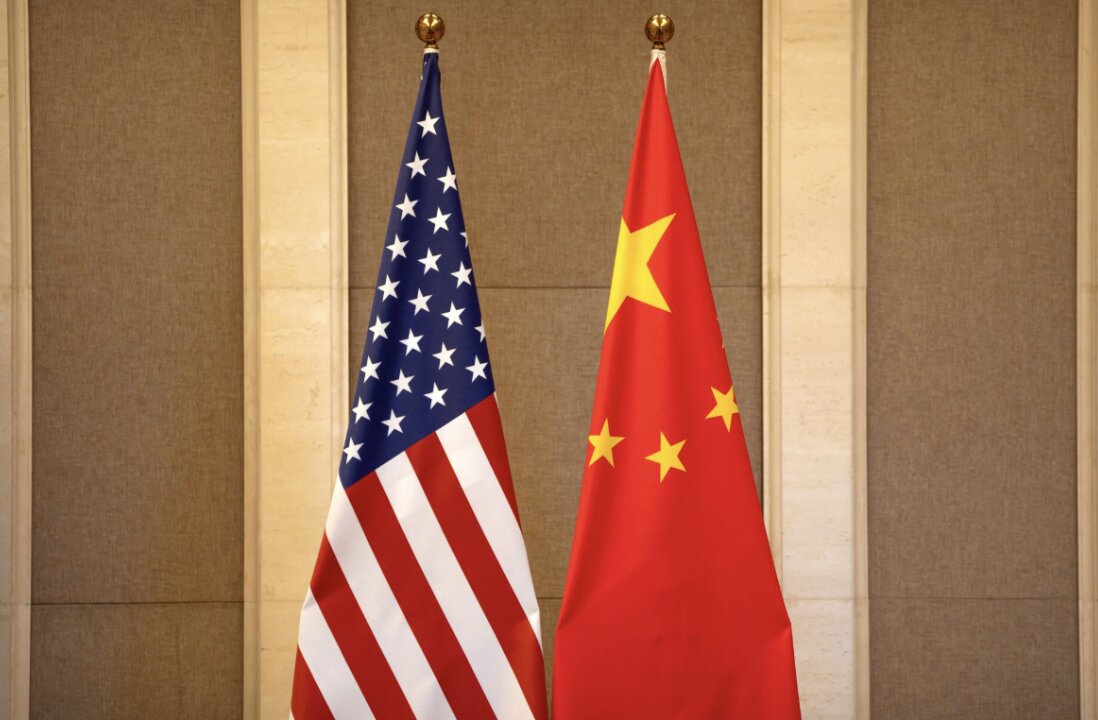
In Brief
CHINA AND EAST ASIA
China and South Korea resume digital infrastructure talks after eight years
On 24 August, Global Times reported that China and South Korea held their 5th strategic dialogue on Information and Communication Technologies (ICT) in Beijing, after an eight-year pause. The South Korean delegation, headed by Minister of Science and ICT Bae Kyung-hoon, met with his counterpart, Li Lecheng. In a statement released by China’s Ministry of Industry and Information Technology, the two discussed various issues, including the development direction of next-generation ICT, digital inclusion, and radio spectrum policy. Minister Li Lecheng put forth three proposals for future China-South Korea cooperation in this field, namely “improving long-term communication and exchange mechanisms, and exploring the establishment of exchange mechanisms for cutting-edge technologies such as artificial intelligence.”
(“China, South Korea resume ICT dialogue after 8 years, eyeing cooperation in digital, other fields,” Global Times, 24 August 2026)
https://www.globaltimes.cn/page/202608/1368928.shtml
CHINA AND SOUTH ASIA
China's President Xi likely to attend the BRICS summit, reports Reuters
On 24 August, Reuters reported that China's President Xi Jinping was likely to attend the BRICS summit in New Delhi on 12-13 September with a delegation of around 400 officials, marking his first visit to India in seven years and a fresh sign of easing tensions between the two rivals. Indian sources said Chinese officials were busy finalising hotels and security protocols, though Xi's final travel plans and the agenda for any potential bilateral with Prime Minister Narendra Modi had not yet been confirmed. China's Foreign Ministry said Beijing supported India in hosting the summit but had no information to provide on Xi's visit. While India and China remain competitors, US President Donald Trump's trade policies have created a shared incentive for both sides to not let external pressure undermine BRICS. Relations have only improved gradually since Modi's visit to China last year, with a fresh border dispute in recent weeks triggering sharp diplomatic exchanges.
("China's Xi likely to visit India with big delegation for first time in seven years," Reuters, 24 August 2026)
https://www.reuters.com/world/china/chinas-xi-likely-visit-india-with-big-delegation-first-time-seven-years-2026-08-24/
Boundary talks between Doval and Wang Yi put India-China stability to the test, reports Reuters
On 25 August, The Hindu reported that India's National Security Advisor Ajit Doval and China's Foreign Minister Wang Yi held the 25th round of Special Representatives talks on the boundary question in Beijing, ahead of Xi Jinping's expected BRICS visit to New Delhi. Chinese strategic affairs scholar Hu Shisheng of the China Institutes of Contemporary International Relations said the immediate focus would be on institutionalising stability rather than a dramatic settlement, with the priority being to prevent miscalculation along the Line of Actual Control and strengthen military and diplomatic communication. Hu said the realistic next step would be to operationalise the Expert Group under the Working Mechanism for Consultation and Coordination to identify less contentious border sectors. He said both sides had a strong incentive to maintain border stability ahead of possible leader-level interaction at the summit, while noting that structural differences in the relationship had not disappeared.
("'Structural differences have not disappeared': Chinese strategic affairs scholar on India-China ties," The Hindu, 25 August 2026)
https://www.thehindu.com/news/national/india-china-talks-structural-differences-have-not-disappeared-says-hu-shisheng/article71387073.ece
China deepens green energy push in Sri Lanka through new environmental partnership
On 24 August, the Daily Mirror reported that Sri Lanka's ABC Trade and Investments had signed a memorandum of understanding with China's All-China Environment Federation to accelerate new energy development, water management, and environmental protection projects across Sri Lanka. The agreement pairs Chinese engineering capabilities and technical expertise with ABC Trade's local operational knowledge and project implementation skills. Priority areas for immediate development include urban and rural water supply systems, sewage treatment, industrial wastewater management, village drinking water purification, and distributed renewable energy installations. The initiative is designed to address Sri Lanka's long-term environmental and civil infrastructure priorities under the Belt and Road framework.
("ABC Trade-All-China Environment Federation to drive SL's green infrastructure and investment," Daily Mirror, 24 August 2026)
https://www.dailymirror.lk/print/business-news/ABC-Trade-All-China-Environment-Federation-to-drive-SLs-green-infrastructure-and-investment/273-348716
Pakistan diversifies financing as it steps back from reliance on China
On 25 August, The Financial Times reported that Pakistan's Finance Minister Muhammad Aurangzeb had said the country was focused on securing US financing as it plotted a return to global capital markets, marking a significant shift after years of reliance on state loans from China. Aurangzeb said a USD 10 billion swap line sought from Washington last month was intended to serve as a confidence signal to private investors, and said he saw an important role for the US Export-Import Bank and the US International Development Finance Corporation, both of which had shown risk appetite for Pakistan. He said Islamabad had received constructive engagement from Washington and hoped for an answer in the coming months. Pakistan's trade deficit widened to a four-year high of USD 39.5 billion in the year to June, and the government was focused on shifting toward export-led growth. While Aurangzeb said the choice between the US and China was not an either-or discussion, he confirmed Pakistan was not seeking additional financing from China at the moment. China holds 23 per cent of Pakistan's USD 129.7 billion in total outstanding foreign debt, making it by far the largest creditor.
("Pakistan seeks US funding in shift from reliance on China," Financial Times, 25 August 2026)
https://www.ft.com/content/9e1158f8-bf37-41cc-9db1-e3e79834b5d0?syn-25a6b1a6=1
President Xi reaffirms and congratulates new president Fakhrul
On 24 August, The Financial Express reported that Chinese President Xi Jinping had sent a congratulatory message to Bangladesh's new President Mirza Fakhrul Islam Alamgir, saying China-Bangladesh bilateral relations had withstood the test of changing international circumstances. Xi described the two countries as neighbours with a longstanding friendship built on mutual respect and equality over 51 years of diplomatic ties, and said they had supported each other on issues involving core interests and major concerns. He said he was ready to work with Fakhrul to strengthen strategic communications, enhance Belt and Road cooperation, and deepen what he called a "China-Bangladesh community with a shared future in the new era." Fakhrul took office as Bangladesh's 23rd president after stepping down as local government minister and secretary general of the ruling Bangladesh Nationalist Party.
("Xi says China-Bangladesh ties withstood 'changing international circumstances'," The Financial Express, 24 August 2026)
https://thefinancialexpress.com.bd/home/xi-says-china-bangladesh-ties-withstood-changing-international-circumstances?amp=true
CHINA AND THE MIDDLE EAST
China calls for dialogue and negotiations over the US-Iran war
On 24 August, Reuters reported that China’s Foreign Minister Wang Yi called on all parties in the US-Iran war to return to dialogue and negotiations, stating that the situation has reached a “critical juncture.” Minister Wang Yi made his remarks after meeting with the Foreign Minister of Kuwait, Sheikh Jarrah Jaber Al-Ahmad Al-Sabah in Beijing. Minister Wang further added that the “old script of recurring conflict should not be repeated,” and that China is willing to increase cooperation with Kuwait and contribute to the stability in the region.
(“China says Middle East at critical point, calls for cooling tensions and dialogue,” Reuters, 24 August 2026)
https://www.reuters.com/world/china/china-says-middle-east-critical-point-calls-cooling-tensions-dialogue-2026-08-24/
CHINA AND EUROPE
China’s Xinjiang Horgos port surpasses 6,000 freight trains as cargo hits 10 million tonnes
On 24 August, CGTN reported that China's Horgos Port in the Xinjiang Uygur Autonomous Region achieved a major milestone on 19 August by handling over 6,000 China-Europe and Central Asia freight trains this year. By culminating in a Poland-bound train that pushed annual cargo throughput to 10 million tonnes. The port manages over 27 trains daily and has optimized its scheduling to reload returning trains every two hours, utilizing smart customs-railway systems for instant inspection and fast clearance. Horgos has processed nearly 59,000 total trains across 91 distinct routes, successfully connecting 46 global cities across 18 countries and regions.
(“Horgos Port logs over 6,000 China‑Europe and Central Asia freight trains as of Aug 19,” CGTN, 24 August 2026)
https://news.cgtn.com/news/2026-08-24/Horgos-Port-tops-6-000-China-Europe-Central-Asia-trains-by-Aug-19-1PRUPUnqeL6/p.html
CHINA AND THE AMERICAS
US set to impose 7.5 per cent tariff on China over allegations of excess manufacturing capacity
On 24 August, Reuters reported that according to a Bloomberg News report citing people familiar with the matter, the US is set to impose a 7.5 per cent tariff on goods from China over allegations of excess manufacturing capacity. This move comes ahead of a planned summit next month between the US President Donald Trump and China’s President Xi Jinping.
(“US eyes China overcapacity tariffs of 7.5% before Xi-Trump talks, Bloomberg News reports,” Reuters, 24 August 2026)
https://www.reuters.com/world/china/us-eyes-china-overcapacity-tariffs-75-before-xi-trump-talks-bloomberg-news-2026-08-24/
Beijing rejects US sanctions threats on Iran trade
On 25 August, The Economic Times reported that China stated that sanctions and pressure will not resolve the issue, following US threats of secondary sanctions on countries trading with Iran. Beijing called on all parties to avoid actions that could intensify conflicts or disrupt global economic and financial stability. As Iran's largest oil buyer, China imported over 80 per cent of Iran’s oil prior to the conflict between the US, Israel, and Iran.
(“China warns new US sanctions on Iran will 'escalate the situation',” The Economic Times, 25 August 2026)
https://economictimes.indiatimes.com/news/international/world-news/china-warns-new-us-sanctions-on-iran-will-escalate-the-situation/articleshow/133491012.cms?UTM_Source=Google_Newsstand&UTM_Campaign=RSS_Feed&UTM_Medium=Referral&from=mdr
China Reader Daily Wire | 24 August 2026, Monday | Vol 3 No. 121 & 122
Second World Humanoid Games begin in Beijing
Chang’e-7 mission launch postponed due to unfavourable conditions
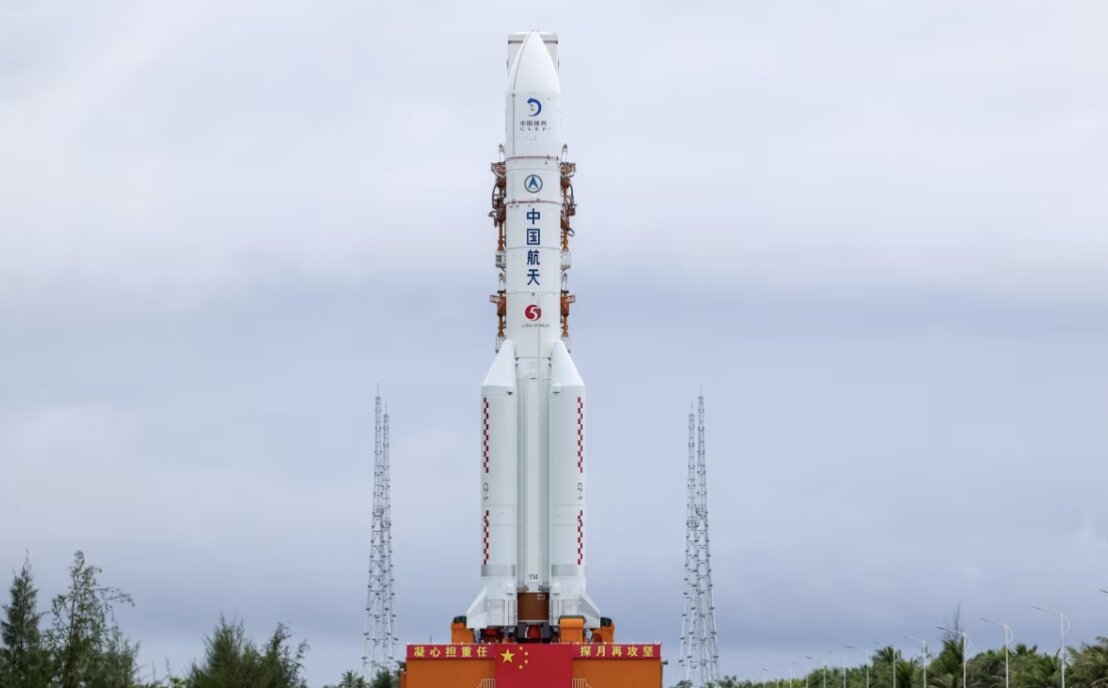
In Brief
ENERGY AND ENVIRONMENT
S4000 stratospheric wind power system completes full flight test
On 22 August, Global Times reported that China's domestically developed S4000 Stratosphere Airborne Wind Energy System (SAWES) recently completed a test at a base in Northwest China, citing CCTV News. An upgrade from the earlier S2000 model, the successful full-process flight validation marks the technology's transition from iterative development toward engineering deployment, according to the report. The test covered ascent, station-keeping, power generation, and recovery, with all indicators meeting required standards, verifying the system's reliability in extreme high-altitude conditions. The S4000 reaches a maximum operational altitude of 4,000 metres, making it deployable across most regions of China, and can directly adapt to mainstream grid power supply requirements, with a design service life of up to 20 years. Unlike conventional low-altitude wind turbines, the system uses a flying device rather than a fixed structure.
("China's upgraded high-altitude wind power project that extracts clean energy from stratosphere completes test," Global Times, 22 August 2026)
https://www.globaltimes.cn/page/202608/1368748.shtml
SCIENCE AND TECHNOLOGY
Second World Humanoid Games begin in Beijing
On 24 August, China Daily reported that the second World Humanoid Games began in Beijing with 2,056 robots from 666 teams. In this five-day event (Aug 22-26), robots will compete in categories spanning boxing, high jump, Tai Chi and table tennis, emergency rescue, and logistics. A Chinese humanoid named "Lightning" marked a new sprint record of 9.32 seconds in a 100-meter race, beating Usain Bolt's record of 9.58 seconds.
("World Humanoid Robot Games open in Beijing," China Daily, 24 August 2026)
https://global.chinadaily.com.cn/a/202608/22/WS6a89ad6aa3106bc57421ced2.html
Nvidia denies reports of new AI chip for China
On 20 August, Reuters reported that Nvidia on Thursday denied reports by The Information claiming the company plans to ship a new, compliant artificial intelligence chip to China by the end of the year, calling the claim completely incorrect. The company confirmed it does not sell the rumoured Language Processing Unit (LPU) in the region and has no plans to create a China-specific version amid tightening US export restrictions.
(“Nvidia denies report it is rolling out China AI chip by year-end,” Reuters, 20 August 2026)
https://www.reuters.com/world/china/nvidia-ship-ai-chip-china-by-year-end-information-reports-2026-08-20/
CHINA AND SPACE
Chang’e-7 mission launch postponed due to unfavourable conditions
On 24 August, CNN reported that China's Manned Space Engineering Office said China’s robotic Chang’e-7 mission has been postponed due to unfavourable conditions. The latest report said: "The lunar probe does not meet launch conditions," and the launch "cannot take place during the planned window this year." One of the associated institute officials stated that the delay is due to the challenging and unprecedented nature of the mission. The probe needs to enter an exact orbit in order to later land at an optimal site on the Moon.
("China postpones launch of unprecedented water-hunting moon mission amid space race," CNN, 24 August 2026)
https://edition.cnn.com/2026/08/23/science/change-7-china-moon-mission-launch-postponed
DEFENCE
PLA says it maintained full tracking as Philippines organises "joint patrols" with external forces
On 22 August, Global Times reported that the Philippines drew in external countries to "stir up trouble" in the South China Sea on Saturday by organising so-called "joint patrols," according to Chinese military sources. The sources said the People's Liberation Army (PLA) maintained full-time tracking and surveillance of the parties involved throughout the patrols, and that the situation remained well under control.
("Exclusive: PLA keeps full tracking, surveillance as Philippines draws in external forces to organize so-called joint patrols in South China Sea: source," Global Times, 22 August 2026)
https://www.globaltimes.cn/page/202608/1368751.shtml
PLA Navy upgrades and increases Type 054A inclusion in defence
On 23 August, Global Times reported that the Chinese People's Liberation Army (PLA) Navy released training footage of the Type 054A guided-missile frigate Ningde. The frigate is assigned to the PLA Eastern Theatre Command task force to conduct combat-oriented training, test command coordination and emergency response capabilities, while accelerating combat readiness generation. Chinese military affairs expert Zhang stated that continued production and upgrade of the Type 054A have effectively filled the gap in coastal and offshore combat capabilities. He also added that the Type 054A fleet consists of 46 vessels and is equipped with 3D radar, low-altitude gap-filling radar, and a towed array sonar system, and is suited for long-duration far-sea missions and possesses strong integrated combat capabilities in coastal and offshore waters.
("PLA Navy commissions new Type 054A frigate as cost-effective platform continues production, upgrade," Global Times, 23 August 2026)
https://www.globaltimes.cn/page/202608/1368847.shtml
CHINA AND EAST ASIA
Japanese parliamentarians visit Beijing to mend ties, reports Associated Press
On 24 August, Associated Press reported that a cross-party parliamentary delegation from Japan visited Beijing to meet governmental officials to mend ties between the two countries. Relations between Japan and China hit an all-time low due to Prime Minister Sanae Takaichi’s comments on Taiwan, which angered China. The delegation consists of former Vice Minister of Health and Welfare Gaku Hashimoto of the ruling Liberal Democratic Party and two lawmakers from the opposition parties Komeito and Centrist Reform Alliance. CRA Spokesperson Shinichi Isa stated that top-level communication between the two was completely closed and expressed hope that they could “find a clue to restart a dialogue.”
(“Japanese lawmakers travel to Beijing, seeking to mend ties after Takaichi’s Taiwan remark fallout,” Associated Press, 24 August 2026)
https://apnews.com/article/japan-china-takaichi-taiwan-f8d51071001799e9499f47f4b6f48e92
China urges Japan to ‘create necessary conditions’ for normalisation of ties
On 21 August, CGTN reported that China’s Foreign Ministry stated that it is “concerned” about the current state of ties, adding that it “serves neither side’s interests.” Ties between the two countries are at an all-time low due to Prime Minister Sanae Takaichi’s comments on coming to the aid of Taiwan. A cross-party delegation of Japanese parliamentarians is set to visit China next week upon the invitation of the Chinese Communist Party. Ministry Spokesperson Lin Jian stated that China has “taken note” of concerns expressed by “insightful figures” in Japanese polity, and urged the Sanae Takaichi administration to “listen to and heed these voices, and to create the necessary conditions for normal exchanges between the two countries.”
(“China urges Japan to create conditions for normal ties,” CGTN, 21 August 2026)
https://news.cgtn.com/news/2026-08-21/China-urges-Japan-to-create-conditions-for-normal-ties-1PN11of0520/p.html
CHINA AND TAIWAN
Taiwan sentences nine over illegal export of AI chips and servers to China
On 24 August, Reuters reported that Taiwan’s Keelung city prosecutors indicted nine people, some of them employees of Nvidia and Super Micro, who were accused of illegally exporting AI servers and chips to China. Taiwan currently enforces an export restriction mechanism on the most advanced AI semiconductors and servers manufactured by Nvidia, which was enacted by the US in 2022. Prosecutors stated that the accused “colluded with one another at various levels for enormous profit, illegally exporting high-end servers, increasing corporate compliance costs, and severely damaging our nation's international image.”
(“Taiwan indicts nine over alleged illegal export of AI servers to China,” Reuters, 24 August 2026)
https://www.reuters.com/world/asia-pacific/taiwan-indicts-9-over-alleged-illegal-export-ai-servers-china-2026-08-24/
Taiwan coast guard tracks mainland Chinese research ship near key naval base
On 22 August, SCMP reported that a mainland Chinese research vessel, the Tong Ji, sailed close to Taiwan's Zuoying naval base, marking its second appearance near the island in recent months, according to Taiwanese authorities. The 2,000-tonne vessel, operated by Tongji University in Shanghai, was spotted 28 nautical miles southwest of Liuchiu on Friday morning, prompting Taiwan's coastguard to dispatch ships and broadcast warnings until it sailed away. It had been detected the previous night near Hua Island in the central Taiwan Strait. Commissioned in 2025, the Tong Ji carries sonar and integrated sensors capable of surveying the seabed, with equipment that could have military applications, including for submarine navigation and anti-submarine warfare. The vessel was previously accused by Taiwan of conducting an "unauthorised survey" near Eluanbi in May, amid a broader rise in Chinese research and patrol activity around Taiwan this year.
("Mainland Chinese research ship spotted near Taiwan's largest naval base," South China Morning Post, 22 August 2026)
https://www.scmp.com/news/china/diplomacy/article/3364922/mainland-chinese-research-ship-spotted-near-taiwans-largest-naval-base?module=top_story&pgtype=homepage
CHINA AND SOUTHEAST ASIA
China and Indonesia to increase all-round cooperation in various fields
On 21 August, Anadolu Agency reported that China and Indonesia are set to deepen all-round cooperation and jointly address developmental needs and challenges. China’s Foreign Minister Wang Yi met his counterpart, Minister Sugiono, in Jakarta, for the first meeting of the China-Indonesia Comprehensive Strategic Dialogue Mechanism. Minister Wang stated that the current international environment is turbulent and filled with uncertainty, adding that stronger communication and cooperation are required between China and Indonesia to address these challenges. Minister Sugiono echoed similar sentiments, stating that China’s development has created “significant opportunities for the world” and for the development of Indonesia. Minister Sugiono also reaffirmed the One-China principle. In a joint statement, the two countries will begin working towards a China-Indonesia five-year action plan for 2027-31, deepen cooperation in energy and mineral resources, AI, and poverty reduction, and pledge to implement the Declaration on the Conduct of Parties in the South China Sea.
(“China, Indonesia vow to deepen cooperation amid global uncertainty,” Anadolu Agency, 21 August 2026)
https://aa.com.tr/en/asia-pacific/-china-indonesia-vow-to-deepen-cooperation-amid-global-uncertainty/4034207
CHINA AND SOUTH ASIA
India-China ties and boundary tensions take centre stage as Doval heads to Beijing
On 24 August, The Indian Express reported that National Security Adviser Ajit Doval will travel to Beijing on 24 August for boundary talks with Chinese Foreign Minister Wang Yi, ahead of the BRICS summit in Delhi next month. The visit comes as India and China seek to repair ties that deteriorated after the military standoff along the Line of Actual Control in eastern Ladakh. Since late 2024, both sides have taken steps to ease tensions. The Ministry of External Affairs has stressed that the state of the border will reflect on the “larger bilateral ties” and that maintaining peace and tranquillity along the LAC is of “utmost importance”. External Affairs Minister S Jaishankar said peace along the border was a prerequisite for good relations, while noting that India and China are major economies and markets to each other and part of global supply chains. He also said India had raised business visa issues with China.
("Ajit Doval heads to Beijing, boundary talks with Wang Yi tomorrow," The Indian Express, 24 August 2026)
https://indianexpress.com/article/india/ajit-doval-china-wang-yi-border-talks-brics-summit-delhi-10846522/
Bangladesh invites Yunnan entrepreneurs to invest in the country
On 24 August, The Asian Age reported that Bangladesh invited entrepreneurs from China’s Yunnan Province to invest in Bangladesh, highlighting the country’s location as a gateway connecting South Asia, Southeast Asia and the Chinese market. First Secretary (Commercial) of the Bangladesh Consulate General in Kunming, Ridwanur Rahman, presented investment opportunities in Bangladesh at an investment and trade promotion event in Kunming. He highlighted Bangladesh’s competitive workforce, industrial land, energy facilities and strategic location. He also discussed the proposed Kunming-Chattogram corridor, which could connect southwest China with the Bay of Bengal and the Indian Ocean. Investment opportunities were highlighted in garments, pharmaceuticals, electronics, electric vehicles, agro-processing, renewable energy, logistics, and information technology. Chinese companies were also encouraged to explore solar power, energy storage, and green construction. The event also discussed the Chinese Economic and Industrial Zone in Anwara, Chattogram, high-tech parks, and potential PPP projects.
("Yunnan entrepreneurs urged to invest in Bangladesh," The Asian Age, 24 August 2026)
https://dailyasianage.com/news/356955/yunnan-entrepreneurs-urged-to-invest-in-bangladesh
Green CPEC could support climate action and economic growth, says The Express Tribune
On 24 August, The Indian Express reported that National Security Adviser Ajit Doval will travel to Beijing on 24 August for boundary talks with Chinese Foreign Minister Wang Yi, ahead of the BRICS summit in Delhi next month. The visit comes as India and China seek to repair ties that deteriorated after the military standoff along the Line of Actual Control in eastern Ladakh. Since late 2024, both sides have taken steps to ease tensions. The Ministry of External Affairs has stressed that the state of the border will reflect on the “larger bilateral ties” and that maintaining peace and tranquillity along the LAC is of “utmost importance”. External Affairs Minister S Jaishankar said peace along the border was a prerequisite for good relations, while noting that India and China are major economies and markets to each other and part of global supply chains. He also said India had raised business visa issues with China.
("Ajit Doval heads to Beijing, boundary talks with Wang Yi tomorrow," The Indian Express, 24 August 2026)
https://indianexpress.com/article/india/ajit-doval-china-wang-yi-border-talks-brics-summit-delhi-10846522/
Rupak Sapkota, "Nepal-China ties at 71: Time to move beyond symbolism to substance," The Kathmandu Post, 24 August 2026
“Looking ahead, the trajectory of Nepal-China relations will be shaped by the broader strategic competition between China and the United States, as well as by India’s enduring influence in the region. Nepal’s foreign policy has always been guided by national interest, not ideology or any particular value system. Our strategic calculus is based on avoiding any alignment, including multi-alignment. Instead, we need to practice a multi-engagement approach to maximise benefits, while maintaining our non-aligned credentials … After years of constructive dialogue and careful consideration, we have a clear national consensus: to actively promote and deepen our economic cooperation within the framework of building the high-quality Belt and Road. In this context, economic and infrastructure diplomacy will continue to be central to our bilateral ties. However, we need new horizons too. Technological advancement and artificial intelligence are emerging areas where Nepal can access affordable new technologies and new products from China to enhance its development capacity and help address the difficulties holding back our progress … We have history. We have geography. What we lack is the institutional discipline and strategic clarity to turn proximity into prosperity. Unless we address our domestic shortcomings first, neither our deep historical ties nor modern partnership will secure the future that we deserve. The Himalayas have connected us for centuries. It is time to build bridges worthy of the landscape itself.”
Fan Chen, "Why Indian intelligence-gathering against China could lead to miscalculation," South China Morning Post, 24 August 2026
"India has stepped up intelligence-gathering as ties with neighbouring China turned sour in recent years, according to Zhao Ruoxi, a researcher with the Macau University of Science and Technology ... Beijing’s diplomatic activities with its South Asian neighbours – particularly efforts to build trust in the region and push forward projects under the Belt and Road Initiative – would face “systemic disruption” from New Delhi ... According to Zhao, with more Indian intelligence activities directed at China there was a heightened risk of miscalculation, with routine Chinese activities increasingly framed as threats “Consequently, the likelihood of triggering unilateral countermeasures rises,” she concluded. Zhao said China should try to counter this pressure by improving its strategic messaging and its communication with South Asian and Indian Ocean littoral countries."
Anmol Singla, "Can NSA Ajit Doval’s Beijing visit soothe India-China ties before BRICS?" Firstpost, 24 August 2026
"The agenda addresses recent friction in the Eastern Sector, particularly reports of aggressive posturing along the LAC in Arunachal Pradesh's Upper Subansiri region ... Doval’s presence in Beijing acts as the diplomatic bridge between two critical summits: 1. The SCO Summit in Tianjin (August 31-September 1, 2026) ... 2. The BRICS Summit in Delhi (September 12-13, 2026) ... The degree of alignment achieved between Doval and Wang in Beijing will directly shape the strategic trajectory of India-China relations for years to come."
CHINA AND THE POLAR REGIONS
China debuts regular container shipping via Arctic; Aims to reduce travel time and cost
On 21 August, Arctic Portal reported that China launched a regular Arctic container shipping service to Europe. The route passes through the Northern Sea Route and reduces travel time by 40 per cent. A pilot voyage was conducted in 2025, and the operation will be on a seasonal basis, with the company Sea Legend scheduling it. This route offers lower cost, faster delivery, and reduced fuel consumption. The latest literature also reports on environmental risks involving ecological impacts, sovereignty disputes, etc.
("China Launches Regular Arctic Container Service to Europe," Arctic Portal, 21 August 2026)
https://arcticportal.org/ap-library/news/4146-china-launches-regular-arctic-container-service-to-europe
China completes 16th Arctic ice station surveys
On 21 August, CGTN reported that China’s 16th Arctic research trip has finished all of its ice station surveys. Two special research ships, named Xuelong 2 and Xuelong, successfully completed science tests at 19 different ice stations in the far north waters of the Arctic Ocean. They began the journey earlier this month and aimed to collect comprehensive data on changes in the Arctic environment, including the atmosphere, sea ice, upper ocean and under-ice ecosystems amid the region's melting sea ice
(“China's 16th Arctic expedition wraps up ice station surveys,” CGTN, 21 August 2026)
https://news.cgtn.com/news/2026-08-21/China-s-16th-Arctic-expedition-wraps-up-ice-station-surveys-1PNeAy6w40g/p.html
CHINA AND THE MIDDLE EAST
Military actions, sanctions, and pressure do not help solve the (US-Iran war) problem, says Beijing
On 21 August, Anadolu Ajansi reported that China's Foreign Ministry spokesman Lin Jian reiterated a call for negotiation between the US and Iran. He said: "China always believes military actions, sanctions, and pressure do not help solve the problem; they only build up the tensions in the current situation." China is one of the largest importers of Iranian oil, and he stated that the country opposes illegal, unilateral sanctions without authorisation from the UN.
("China urges negotiations over US Treasury chief’s ‘toughest sanctions’ against Iran," Anadolu Ajansi, 21 August 2026)
https://www.aa.com.tr/en/asia-pacific/china-urges-negotiations-over-us-treasury-chief-s-toughest-sanctions-against-iran/4033658
CHINA AND THE AMERICAS
Editorial: "China will not play along with the US’ ‘reckless games’ on the Iran issue," Global Times, 21 August 2026
“Economic sanctions can concentrate pressure on a single country, but it is difficult to confine the costs to that country alone. War cannot solve problems, and sanctions only add fuel to the fire. Only by abandoning the Cold War mentality of confrontation, setting aside the tool of maximum pressure, and returning to the proper track of dialogue and negotiation can Washington cut its losses in time and make a dignified exit.
The US has repeatedly labelled European nations "cowards" for refusing to join the war, further provoking a strong backlash from its European allies and creating a rare, deep‑seated rift in the alliance system. If the US cannot even rally its own allies, it certainly cannot expect to boss China around. China has consistently opposed unilateral bullying and long-arm jurisdiction - not because China is Iran's largest trading partner and maintains long-standing friendly relations with Iran, but because once this US logic is accepted, international trade would no longer be normal exchanges between nations.”
China Reader Daily Wire | 21 August 2026, Friday | Vol 3 No. 120
Chang'e-7 spacecraft set to launch; Aims to search for frozen water on the lunar surface
Germany’s intelligence brings out China’s transnational repression
In Brief
INTERNAL
Beijing announces new fiscal measures to boost domestic demand
On 21 August, Reuters reported that China's Vice Finance Minister Liao Min announced additional fiscal policy measures in response to economic developments. He said most fiscal spending would be directed toward households and consumption to boost domestic demand. He said: "China will also step up coordination between fiscal, monetary and industrial policies and refine its policy toolkit as economic conditions evolve." He added that new fiscal-financial support measures for the second half of this year are being coordinated with the central bank and regulators to improve economic policy coordination.
("China pledges timely fiscal support to bolster growth," Reuters, 21 August 2026)
https://www.reuters.com/world/asia-pacific/china-pledges-timely-fiscal-support-bolster-growth-2026-08-21/
CHINA AND SPACE
Chang'e-7 spacecraft set to launch; Aims to search for frozen water on the lunar surface
On 21 August, Asia One reported that China is set to launch the Chang'e-7 spacecraft next week from Wenchang Space Launch Site in Hainan. The major aims of this mission are to search for frozen stores of water in permanently shadowed craters near the moon's south pole. It will involve orbiting, landing, roving, and hopping to manage the craters. The spacecraft will be launched by a Long March 5 rocket and will carry scientific instruments such as water analysers, cameras, and radars. The latest literature explains that craters near the South Pole, which have not seen sunlight, could preserve water and volatile organic compounds. Discovering accessible water will support lunar base research by providing drinking water and oxygen for astronauts, reducing the cost of resupply missions from Earth.
("China hunts for lunar ice in one of solar system's coldest places," Asia One, 21 August 2026)
https://www.asiaone.com/china/china-hunts-lunar-ice-one-solar-systems-coldest-places
CHINA AND EAST ASIA
China says Seoul should maintain ties without contradiction to achieve strategic autonomy
On 20 August, Reuters reported that China's FM stated that Beijing hopes South Korea will achieve genuine strategic autonomy, refrain from bloc confrontation and taking sides, and develop relations with major powers, including China and the United States, in parallel and without contradiction. He also added that the US should abandon a "hostile" policy towards Pyongyang in order to bring peace to the Korean Peninsula. Calling for resumed dialogue and restoration of trust, he said: "China would be glad to see the peninsula move toward peaceful coexistence between South Korea and North Korea." On Seoul-Beijing ties, he said, "A rational, pragmatic, and positive policy towards China is entirely in line with South Korea's interests and the trend of the times." He stated that bilateral ties have made a full recovery and are progressing following the meetings. Discussions also covered the early completion of the second phase of negotiations on their free trade agreement and increased regional and economic integration.
("China urges South Korea not to take sides, blames US policy for Korea tensions," Reuters, 20 August 2026)
https://www.msn.com/en-us/news/world/china-urges-south-korea-not-to-take-sides-blames-us-policy-for-korea-tensions/ar-AA2ay9DC?ocid=BingNewsVerp
CHINA AND SOUTH ASIA
Pakistan seeks Chinese investment for climate projects
On 21 August, Business Recorder reported that Pakistan presented a 4.85 billion-dollar climate investment plan to Chinese officials and business leaders, seeking support through Chinese investment, technology and private-sector partnerships. The plan includes 69 projects across eight priority sectors and aims to promote climate-resilient and green development. Pakistan is seeking to align the Climate Prosperity Plan with the Belt and Road Initiative and the Green Investment and Finance Partnership. Chinese Chargé d’affaires Shi Yuanqiang said the plan offers Chinese companies opportunities to invest in Pakistan’s green projects. He said China would continue supporting Pakistan’s climate action and green development. Pakistan’s Climate Coordinator Romina Khurshid Alam described China as an important partner because of its technology, manufacturing capacity and financial resources. The projects will be presented to Chinese institutions, enterprises and investors at CIFTIS 2026 in Beijing.
("Leveraging BRI financing: Pakistan presents USD4.85bn climate investment plan," Business Recorder, 21 August 2026)
https://www.brecorder.com/news/amp/40435853
China states interest in working with all political parties in Bangladesh
On 21 August, New Age reported that Chinese Ambassador to Bangladesh Pan Yundong stated that China is ready to work with all political parties in Bangladesh and continue friendly cooperation with the country. He made the remarks during a meeting with BNP Secretary General Mirza Fakhrul Islam Alamgir at the BNP chairperson’s office in Dhaka. Pan said China and Bangladesh have maintained friendly relations and that China is willing to strengthen cooperation in areas of mutual interest. The meeting discussed Bangladesh-China relations, bilateral cooperation, and political developments in Bangladesh. Mirza Fakhrul said the BNP wants to strengthen relations with China further if it comes to power. The Chinese envoy also expressed interest in maintaining communication with Bangladesh’s political parties and strengthening people-to-people and bilateral ties.
("China ready to work with all Bangladesh parties: envoy, New Age, 20 August 2026)
https://www.newagebd.net/post/foreign-affairs/310646/china-ready-to-work-with-all-bangladesh-parties-envoy
Former Indian army chief says China will be India's main long-term competitor
On 20 August, The Economic Times reported that former Indian Army Chief General Manoj Naravane had said China would be India's principal long-term competitor across political, economic, trade and military domains, while deliberately stopping short of using the word "enemy." Naravane said Pakistan and China remained in a different category from India's other neighbours given the history of wars and unsettled borders, but drew a distinction between the two, saying India's immediate attention toward Pakistan was driven by the continuing threat of terrorism, while China represented a longer-term strategic challenge. He stressed the need for strong military deterrence while pursuing dialogue and diplomatic mechanisms to resolve differences, saying the use of force should always be the last resort. Naravane also called for stability in neighbouring countries, including Nepal, Bhutan, Bangladesh and Myanmar, warning that instability along India's borders had a direct impact through refugee flows and illegal goods movement.
("China to be India's main long-term competitor, Pakistan remains terrorism threat: Naravane," The Economic Times, 20 August 2026)
https://economictimes.indiatimes.com/news/india/china-to-be-indias-main-long-term-competitor-pakistan-remains-terrorism-threat-naravane/articleshow/133390742.cms?from=mdr
Opinions:
"A bolder India on China border," The Hindustan Times, 21 August 2026
"Days after the external affairs ministry tacitly acknowledged a face-off between Indian and Chinese forces in the Arunachal Pradesh sector this month, Union minister Kiren Rijiju has spoken about confusion arising from differing perceptions of the boundary and increased Chinese military activity on high ridges along the frontier. Rijiju also dismissed reports that Chinese troops had intruded into Indian territory. An opposition party and a civil society group in Arunachal Pradesh had claimed that Chinese troops were expanding their presence in the area and denying Indian troops access to the Shera 5 patrolling point. China and India continue to disagree on the next steps to normalise the situation along the Line of Actual Control (LAC)."
Nirmal Ghosh, "Is a map war brewing between India and China?" CNA News, 21 August 2026
"Just as relations between China and India enter a fragile thaw, the longstanding issue of China’s claim on India’s northeastern state of Arunachal Pradesh has resurfaced ... This is seen by India as needling, thus the move to establish its own more detailed map, with names not necessarily new but which had not figured in the Indian government’s previous official maps ... This has elicited a reaction, with China’s Ministry of Foreign Affairs on Aug 10 calling India’s unilateral move as “illegal, null and void”. A day later, India rejected China’s objection, maintaining that Arunachal Pradesh, which in 1987 became India’s 24th state, is an “inalienable and integral part of India”. India is inherently at a disadvantage in Arunachal Pradesh. In a planned strategy, China has methodically built up dual civilian-military use infrastructure and created model villages on its side of the border – to demonstrate that life in China is better."
Opinion:
"Nepal-China collaboration should continue in protection and promotion of human rights," People's Review, 20th August 2026
"Lalitpur, Aug 19: Chairperson of National Human Rights Commission, Top Bahadur Magar has expressed the belief that collaboration between Nepal and China should continue for protection and promotion of human rights ... "NHRC emphasizes on the protection and promotion of human rights of workers going for foreign employment,”, he said and pointed out the need to see development and information technology from the perspective of human rights ... The NHRC Chairperson also expressed happiness over the opportunity to collaborate with the China Society for Human Rights Studies, which had not been possible to date due to various reasons in the past ... He also shed light on the multi-dimensional aspects of Nepal-China relations, as well as the development achieved by China, including in the IT sector, and about the protection and promotion of human rights."
CHINA AND THE AMERICAS
Germany’s intelligence brings out China’s transnational repression
On 21 August, The Times of India reported that Germany's domestic intelligence agency BfV opened a support line for people exiled in Germany under threat or attack from agents of their repressive home countries. The statement quoted China, Russia, and Iran as the major actors in transnational repression. BfV, the Federal Office for the Protection of the Constitution, said: "Beijing-linked activities have targeted Chinese activists and German critics of China's one-party system, as well as Uyghurs, Tibetans, Falun Gong practitioners, and individuals supporting Hong Kong's democracy movement or Taiwan." They added that China's political leadership relies on intelligence services and other agencies under it to monitor and intimidate critics outside China.
(China among 'main actors' involved in transnational repression: Germany," The Times of India, 21 August 2026)
https://timesofindia.indiatimes.com/articleshowprint/133395743.cms
China Reader Daily Wire | 20 August 2026, Thursday | Vol 3 No. 119
Unitree Robotics debuts on stock market, stock surges 460 per cent
China recaptures rocket for second time, advances reusable technology
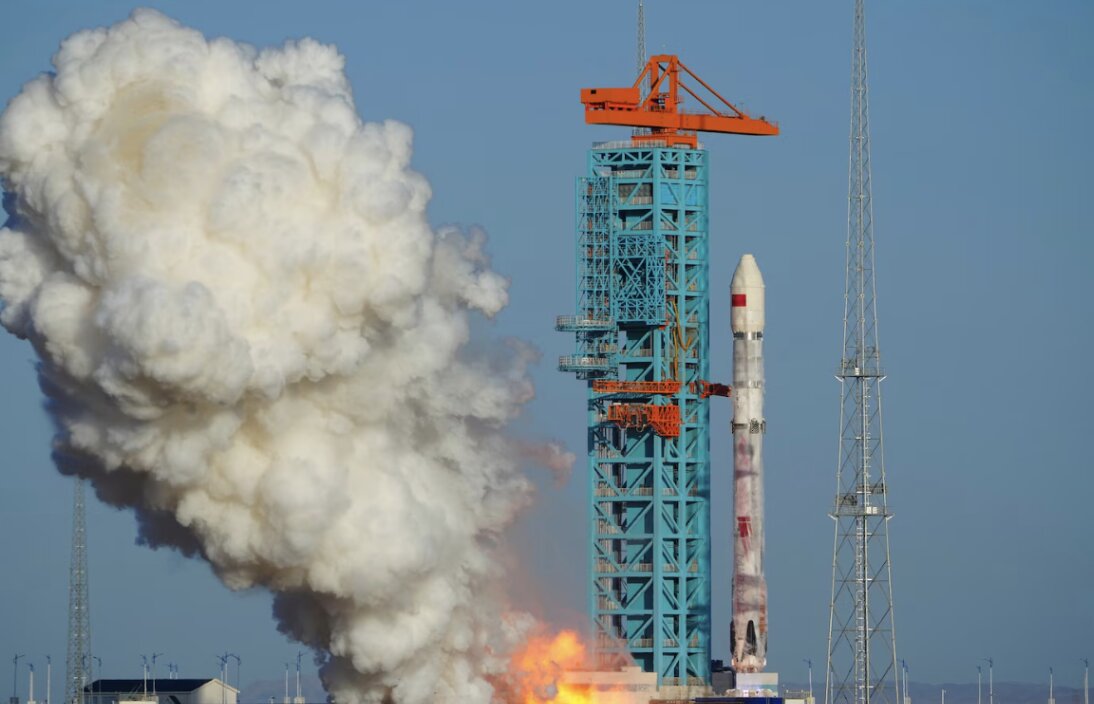
In Brief
INTERNAL
Beijing says all countries have the right to choose an AI partner
On 19 August, Anadolu Agency reported that China's Foreign Ministry spokesman Lin Jian stated that countries have the right to choose their partners and artificial intelligence models based on their national conditions and development needs. The statement was in response to the US “AI Opportunity Statement". He firmly opposed forcing countries to take sides or creating bloc confrontation on AI. He called for abandoning this zero-sum mentality, respecting the digital sovereignty of all countries, and building a just and equitable system for global AI governance.
("China says nations free to choose AI models, pushes back against ‘bloc confrontation’." Anadolu Agency, 19 August 2026)
https://www.aa.com.tr/en/asia-pacific/china-says-nations-free-to-choose-ai-models-pushes-back-against-bloc-confrontation-/4031785
Unitree Robotics debuts on stock market, stock surges 460 per cent
On 19 August, the BBC reported that China's Unitree Robotics debuted on the stock market, and its first day of trading rose by more than 460 per cent. The shares were offered at USD 22.36 per share and closed at USD 125 per share. The firm debuted on Shanghai’s STAR market and is the first to list on a stock market from mainland China. According to the latest literature, "Unitree's market debut is a gauge of investor appetite for the fast-growing humanoid robotics sector." Unitree was founded in 2016 and is one of the largest developers of humanoid technology, offering devices ranging from sensors and automated arms to four-legged and human-like machines.
("Chinese robotics giant Unitree soars in stock market debut," BBC, 19 August 2026)
https://www.bbc.com/news/articles/c0qv4w9492zo
CHINA AND SPACE
China recaptures rocket for the second time; Progresses in land-based reusable rocket technology
On 19 August, The Washington Post reported that China recaptured the first stage of a rocket on land for the first time, marking the second time the country has recovered a rocket. The latest literature suggests that the private aerospace company LandSpace developed the reusable rocket Zhuque-3, which performed the recovery. In this launch, deployable landing legs were deployed, and their success brought a breakthrough in China's reusable rocket technology. Recently, China's Long March-10B rocket was returned to a sea platform. Many firms and countries are exploring rocket-recovery technology, as it will drive down launch costs.
("China successfully recovers rocket stage on land for the first time," The Washington Post, 19 August 2026)
https://www.washingtonpost.com/business/2026/08/18/china-space-rocket-reuse-land/d964ccd8-9b7e-11f1-9cc4-2dc9b46e2d5c_story.html
CHINA AND EAST ASIA
China’s FM states support for stability of Korean Peninsula
On 19 August, The Korea Times reported that China's Foreign Minister Wang Yi discussed the North Korea issue with South Korea's Foreign Minister Cho Hyun. FM Cho stated that the country expects China's cooperation in the denuclearisation of the Korean Peninsula and the realisation of Peace. In response, FM Wang said: "As the most important neighbour of the peninsula, China will keep playing a constructive role for peace, development and stability of the peninsula.” During the visit, FM Cho stated that improved South Korea-China relations could contribute to regional stability.
("China FM vows Beijing's constructive role for peace on Korean Peninsula," The Korea Times, 19 August 2026)
https://www.koreatimes.co.kr/foreignaffairs/20260819/china-fm-vows-beijings-constructive-role-for-peace-on-korean-peninsula
CHINA AND THE PACIFIC
Australia and China crackdown USD 92 million worth of illegal tobacco
On 20 August, ABC News reported that the Australian Border Force (ABF) reported that Australian and Chinese authorities jointly seized USD 92 million worth of illegal tobacco from a smuggling syndicate. According to the latest reports, 60 people have been arrested in China over their involvement with the syndicate. ABF added that between January and May, they shipped more than 90 containers of tobacco. ABF officials added that 'Operation Trailblazer' brought illicit tobacco disruptions and highlighted the role of the Anti-Smuggling Bureau of the General Administration of China Customs.
("China and Australia bust tobacco syndicate as government pushes back on excise calls," ABC News, 20 August 2026)
https://www.abc.net.au/news/2026-08-20/china-and-australia-work-together-on-tobacco-syndicate/107056140
CHINA AND SOUTHEAST ASIA
China completes first phase construction of possible military base in Paracels archipelago, says Reuters
On 19 August, Reuters reported that satellite images indicate that China completed first-phase construction on the Antelope Reef in the Paracels archipelago. According to the latest literature, it is a human-made structure, possibly a military base, in the South China Sea. PLATracker founder said: "The northern part of the South China Sea would be particularly important in a Taiwan conflict scenario, so Antelope is ideally placed," and stated that it could be one of the Chinese military's most important features in the South China Sea, larger than neighbouring Woody Island. He stated that it would also be easier to defend than a network of bases further south in the Spratly archipelago.
("China completes first stage of work at disputed South China Sea reef, images show," Reuters, 19 August 2026)
https://www.reuters.com/world/china/china-completes-first-stage-work-disputed-south-china-sea-reef-images-show-2026-08-19/
CHINA AND SOUTH ASIA
Chinese intrusion claims raise fresh India border concerns
On 20 August, The Hindu reported that renewed concerns over alleged Chinese military activity in Arunachal Pradesh had emerged amid claims that Chinese troops had penetrated up to 60 km inside Indian territory. Union Parliamentary Affairs Minister Kiren Rijiju rejected the claim, saying the India-China border in Arunachal Pradesh remained undemarcated and that false claims should not be made on such a sensitive issue. He said the government would address concerns raised by local residents and protect Indian territory. The Ministry of External Affairs had earlier said that peace and tranquillity along the Line of Actual Control was critical to the broader India-China relationship and that the state of border affairs would reflect on bilateral ties. Rijiju also highlighted efforts to strengthen infrastructure along the border, referring to China's earlier development of border infrastructure and India's subsequent efforts to improve its own capabilities.
("Borders neglected in past, top priority for Modi government now: Rijiju on claims of Chinese intrusion in Arunachal," The Hindu, 20 August 2026)
https://www.thehindu.com/news/national/borders-neglected-in-past-top-priority-for-modi-government-now-rijiju-on-claims-of-chinese-intrusion-in-arunachal/article71368107.ece
China presses for closer ties with Bhutan amid unresolved border dispute
On 20 August, The Pioneer reported that China continued to press Bhutan to develop bilateral ties despite the two countries having no formal diplomatic relations. Bhutan and China have held negotiations since 1984 to resolve their boundary dispute, but no agreement has been reached. The report said Bhutan faces Chinese pressure over boundary issues, including attempts to claim territory. China claims Bhutan's Doklam plateau, which overlooks India's Siliguri corridor. The 73-day Doklam military standoff in 2017 occurred when Indian troops intervened to block the People's Liberation Army from extending a road towards the strategic Jampheri Ridge.
("Gelephu: Bhutan's bet, India's gain," The Pioneer, 20 August 2026)
https://dailypioneer.com/news/gelephu-bhutans-bet-indias-gain
Opinion:
Clyde Russell, "China boosts imports of Russian crude, stymieing India's refiners," Reuters, 20 August 2026
"China has been the biggest buyer of Russian and Iranian crude in recent years as it was prepared to ignore U.S. and Western sanctions against the two producers.But the Middle East conflict and the U.S. naval blockade of Iranian ports have resulted in sharply lower Chinese imports of Iranian crude, with Kpler estimating August arrivals at around 340,000 bpd ... India's total imports of Russian crude are estimated at 1.87 million bpd in August, down from 2.79 million bpd in July and 2.73 million bpd in June. July and June were the two strongest months on record for India's imports from Russia, exceeding the 1.21 million bpd average for the three months leading up to the start of the Iran war."
CHINA AND THE AMERICAS
China opposes US’s “Economic D-Day” campaign against Iran; Calls it the most crushing economic operation ever taken against any country
On 20 August, Anadolu Agency reported that China’s Foreign Ministry spokesperson called the US president’s “Economic D-Day” campaign against Iran "the most crushing economic operation ever taken against any country." He stated that sanctions and pressure do not help solve the issue and called for a resolution through diplomatic and political means. China is one of the largest importers of oil from Iran. The US President called for severe economic consequences for the country offering a lifeline to Iran.
("China pushes back against Trump’s 'Economic D-Day' campaign against Iran," Anadolu Agency, 20 August 2026)
https://www.aa.com.tr/en/asia-pacific/china-pushes-back-against-trump-s-economic-d-day-campaign-against-iran/4032409
China Reader Daily Wire | 19 August 2026, Wednesday | Vol 3 No. 118
Government allocates additional CNY 60 million for Henan flood relief
Zhuque-3 rocket achieves first stage land-based recovery
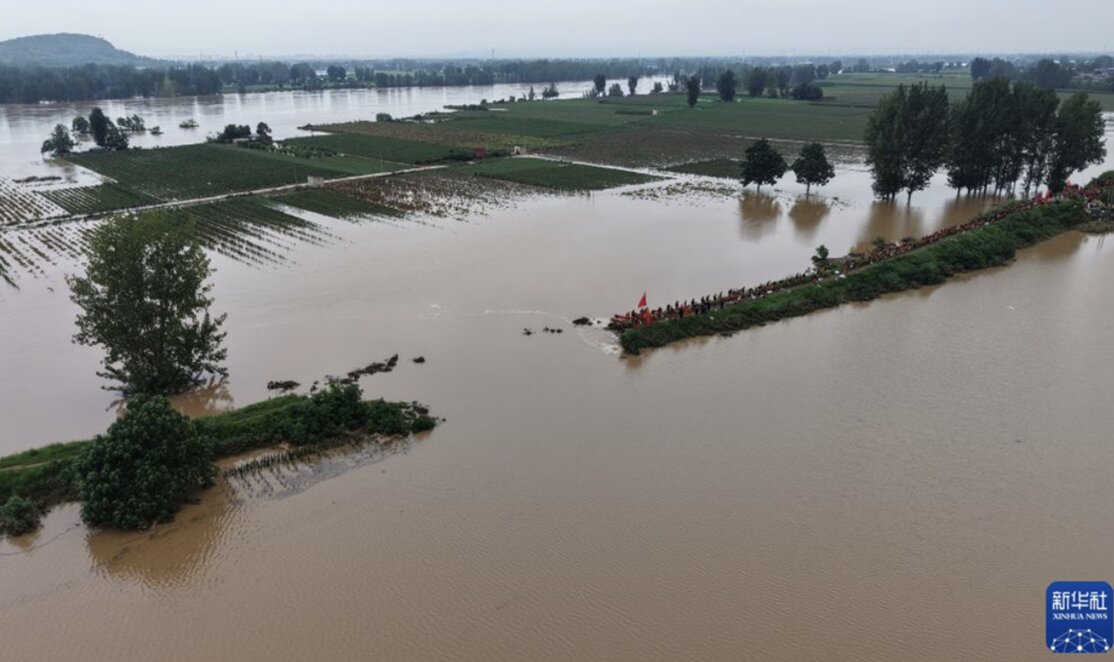
In Brief
INTERNAL
Government allocates additional CNY 60 million for Henan flood relief
On 19 August, Global Times reported that Chinese authorities allocated an additional CNY 60 million from central disaster relief funds to support flood control, emergency rescue, and disaster relief work in Henan Province, after Typhoon Dolphin's remnants triggered widespread flooding. The funds, jointly allocated by the Ministry of Finance and the Ministry of Emergency Management, will support the relocation and resettlement of affected residents, hazard mitigation, temporary living assistance, and home repairs. This follows an earlier allocation of CNY 80 million for Henan, Hubei, and Anhui provinces, including CNY 40 million for Henan. Heavy rainfall swelled rivers and triggered a levee breach in Zhoukou City last week, sealed after more than 2,000 personnel took part in the emergency response. The Ministry of Emergency Management sent 13 emergency drainage teams to assist with urban waterlogging relief in Zhoukou.
("China allocates 60 mln yuan for disaster relief in Henan," Global Times, 19 August 2026)
https://www.globaltimes.cn/page/202608/1368509.shtml
Rain shelter collapse in Sichuan kills five as torrential rains force 21,784 relocations
On 19 August, Global Times reported that a temporary rain shelter collapsed during a banquet at a villager's home in Changning County, Sichuan Province, killing five people and injuring 17 others, according to Xinhua News Agency. The accident occurred at around 1730 hrs on 18 August during a banquet celebrating a child's college admission, according to the Changning County Emergency Management Bureau. A parapet wall on the shelter's rooftop collapsed after rainwater accumulated on the structure, placing excessive tension on the ropes securing it. Three people died at the scene, while two others died after emergency treatment failed. The accident occurred amid torrential rain across Sichuan, with 21,784 people relocated in advance across 64 county-level regions by Wednesday morning, according to state broadcaster CCTV. The rainfall also triggered two geological disasters, disrupting the G350 national highway in Wenchuan County. Since the flood season began, Sichuan has evacuated 1,102,694 people in total.
("5 killed, 17 injured in rain shelter collapse as torrential rainfall batters SW China's Sichuan, leading to relocation of 21,784," Global Times, 19 August 2026)
https://www.globaltimes.cn/page/202608/1368541.shtml
SCIENCE AND TECHNOLOGY
Zhuque-3 rocket achieves first land-based recovery of its first stage
On 19 August, Global Times reported that China launched the reusable Zhuque-3 rocket this morning, achieving the first recovery of a rocket's first stage on land. The Zhuque-3 Y2 rocket blasted off at 07:35 Beijing Time from the Dongfeng Commercial Space Innovation Pilot Zone in northwest China. The land-based recovery of the first stage, using deployable landing legs, was completed as planned, marking China's first successful controlled land recovery of a rocket stage and a major breakthrough in its reusable rocket technology. The mission followed the successful sea-based net recovery of the Long March-10B's first stage on 10 July.
("China launches Zhuque-3, achieving its first rocket recovery on land," Global Times, 19 August 2026)
https://www.globaltimes.cn/page/202608/1368529.shtml
DEFENCE
Military researchers propose robotic drone swarms to defend contested South China Sea islands
On 19 August, the South China Morning Post reported that a Chinese coast guard defence proposal envisions transforming the South China Sea's contested islands into autonomous fortresses defended by coordinated swarms of air, surface, and underwater drones instead of soldiers. Researchers from the China Coast Guard Academy and Dalian Maritime University detailed the plan in a July paper published in Command Control & Simulation, aimed at countering low-cost drone swarm attacks, citing Ukraine's Magura V5 maritime strike drones against Russia's fleet as an example of traditional ships' vulnerability. The proposed system, guided by the "observe, orient, decide, act" framework, would deploy uncrewed defences across three spatial rings, from long-range strike drones at the outer ring to close-in defence systems at the core, ensuring resilience if individual nodes are destroyed.
("Chinese coastguard proposes turning South China Sea isles into robotic fortress," South China Morning Post, 19 August 2026)
https://www.scmp.com/news/china/science/article/3364440/chinese-coastguard-proposes-turning-south-china-sea-isles-robotic-fortress?module=top_story&pgtype=homepage
Opinion:
Albee Zhang, “Is South China Sea warship breakdown a sign US is ‘taxing reserve capacity’?” South China Morning Post, 19 August 2026
“A US guided-missile destroyer that was adrift in the South China Sea without power last month is a sign that America is taxing its reserve capacity as its operation against Iran drags on, according to an analyst ... “Failures such as this are a predictable outcome of issues such as deferred maintenance and training gaps,” he said, adding that more details were needed to get a full picture of the incident ... In an opinion piece on Monday, Chinese state-run nationalist tabloid Global Times said the “sudden absence of a carrier in the western Pacific is not an accident – it is a bill coming due” … “This does not mean the US military has suddenly become a paper tiger. Washington has simply left the era of easy dominance,” it said.”
CHINA AND SOUTHEAST ASIA
Foreign ministry welcomes Malaysian PM Anwar's remarks affirming Taiwan is part of China
On 19 August, Global Times reported that Chinese Foreign Ministry Spokesperson Lin Jian said China appreciates Malaysian PM Anwar Ibrahim's recent remarks affirming Taiwan is part of China, calling adherence to the one-China principle an "unshakable" international consensus. In an earlier interview, when asked about China's position of not renouncing force to resolve the Taiwan question, Anwar said that if any part of Malaysia sought to break away, he would similarly use force to safeguard his country's territorial integrity, or else risk fragmentation. Lin said there is only one China in the world, and Taiwan is an inalienable part of Chinese territory, adding that China "must and will be reunified" as an "irreversible trend of history."
("Chinese FM appreciates Malaysian PM Anwar's Taiwan remarks, reiterates China must and will be reunified," Global Times, 19 August 2026)
https://www.globaltimes.cn/page/202608/1368547.shtml
CHINA AND EAST ASIA
Foreign Minister Wang Yi to visit South Korea, ending five-year gap
On 19 August, Global Times reported that Chinese Foreign Minister Wang Yi will visit South Korea and Indonesia from 19 to 22 August, at the invitation of South Korean Foreign Minister Cho Hyun and Indonesian Foreign Minister Sugiono, the Chinese Foreign Ministry said. Wang and Cho are scheduled to hold a foreign ministers' meeting and dinner today, discussing bilateral relations, the Korean Peninsula situation, and regional issues, South Korea's foreign ministry said. President Lee Jae-myung will also meet Wang on Thursday. The visit marks Wang's first trip to South Korea in five years, since bilateral talks in Seoul in September 2021. Chinese Foreign Ministry Spokesperson Lin Jian said the visit would help implement the consensus reached by the two countries' leaders and deepen their strategic cooperative partnership, ahead of the 34th anniversary of China-South Korea diplomatic relations on 24 August.
("Chinese FM's visit to South Korea ends five-year gap, 'underscores importance of bilateral ties'," Global Times, 19 August 2026)
https://www.globaltimes.cn/page/202608/1368544.shtml
CHINA AND SOUTH ASIA
Afghan ambassador calls for expanded economic cooperation
On 18 August, Omid Radio reported that Afghanistan’s Ambassador to China, Bilal Karimi, called for expanding economic relations and cooperation between Afghanistan and China in trade, transit, agriculture, mining, and investment. Karimi made the remarks at a ceremony held at the Afghan Embassy in China to mark the fifth anniversary of the Islamic Emirate’s return to power. He described Afghanistan-China relations as based on mutual respect, political engagement, and shared interests. Karimi also said Afghanistan’s strategic geographic location offers opportunities for expanding trade, investment, and regional connectivity. The event was attended by Chinese officials, ambassadors and diplomats from several countries, university professors, researchers, Afghan businessmen and students.
("Bilal Karimi calls for expanded economic cooperation between Afghanistan and China," Omid Radio, 18 August 2026)
https://omidradio.com/en/2026/08/18/bilal-karimi-calls-for-expanded-economic-cooperation-between-afghanistan-and-china/
Opinion:
Anushree Dutta, "Borderline Brilliant: India–China Turn the LAC Into a Stability Launchpad," India Narrative, 19 August 2026
"Viewed through a strategic lens, LAC stability is not an isolated objective but a precondition for a more manageable India–China relationship in a complex geopolitical environment. Both countries face challenges: supply-chain reconfiguration, technology competition, climate imperatives, and the need to sustain growth while navigating great-power rivalry. In such a context, a militarised, unpredictable border acts as a drag on strategic bandwidth, forcing both capitals to allocate disproportionate political and military attention to a single front ... The India–China relationship will always contain elements of rivalry, but rivalry need not be synonymous with instability. The recent diplomatic review of the LAC situation is a reminder that both capitals recognise the costs of unmanaged competition and the benefits of structured engagement. By treating the border as a domain for disciplined statecraft rather than a theatre for perpetual brinkmanship, India and China can move toward a form of competitive coexistence that is stable, predictable, and conducive to broader regional peace. In the Indo-Pacific’s multipolar reality, such a trajectory is not just desirable—it is strategically necessary."
China Reader Daily Wire | 18 August 2026, Tuesday | Vol 3 No. 117
Extreme weather disrupts industrial output and retail sales in China
China and Russia build Arctic route to bypass chokepoints
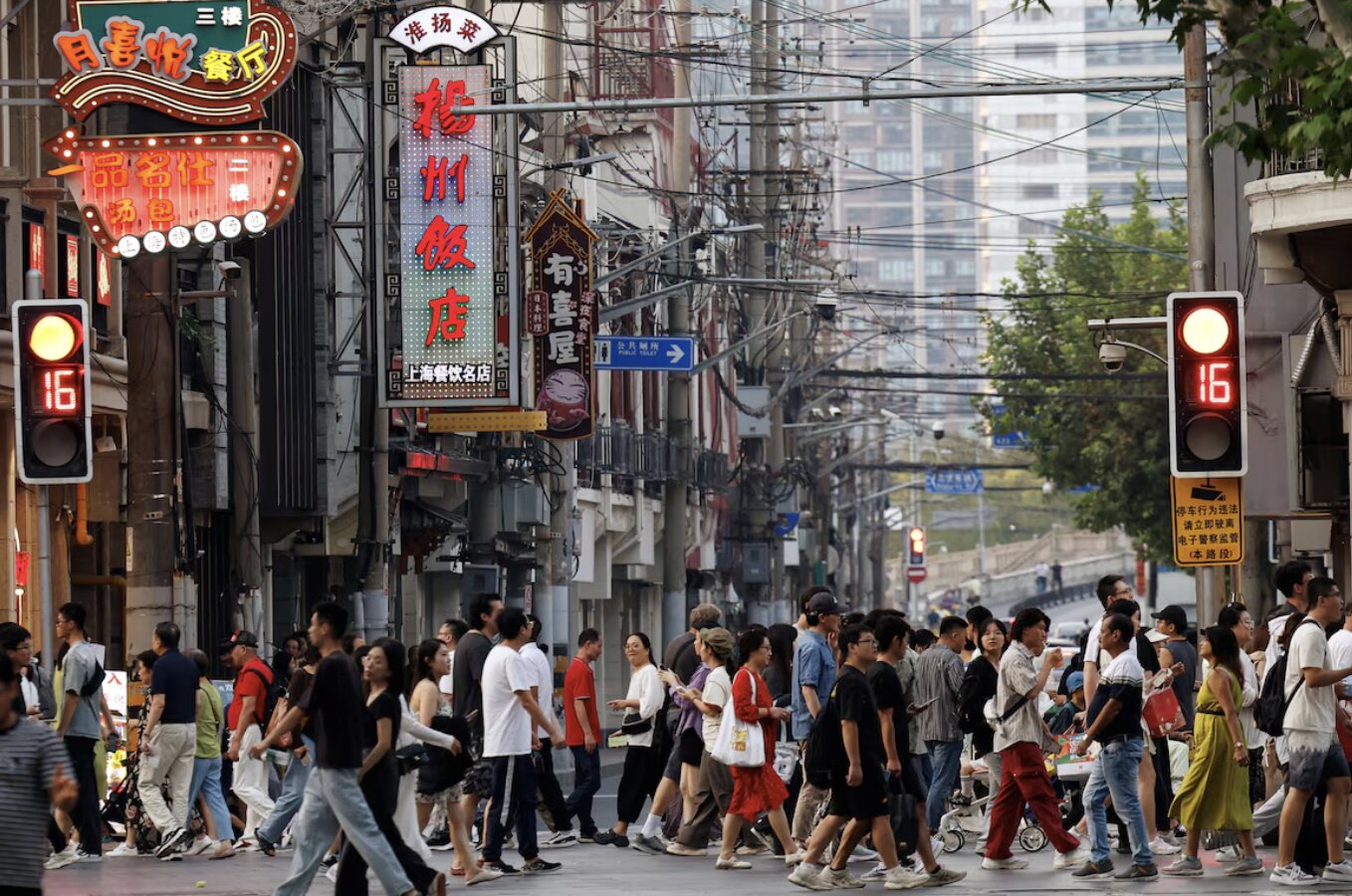
In Brief
INTERNAL
Extreme weather events in China disrupt its industrial output and retail sales
On 17 August, Reuters reported that China’s industrial output and retail sales are at a three-and-a-half-year low, following disruptions caused by extreme weather events. In a report released by China’s National Bureau of Statistics (NBS), factory output grew 4.5 percent in July, compared to 5.3 percent in June, while retail sales grew only around 0.6 percent in July, compared to 1 percent in June. NBS Spokesperson Fu Linghui stated that they are working on ‘adjustments’ to bolster domestic demand. Industry experts and analysts claim that extreme weather events have hampered industrial output and retail sales. Three typhoons struck China last month, which resulted in millions being evacuated from China’s eastern and southern manufacturing hubs. Fu added that despite these disruptions, China is still on track to achieve a growth rate between 4.5 and 5 percent this year, with exports continuing to rise month-on-month, reaching USD 100 billion in trade surplus in July.
(“China's recovery sputters as consumption, output lose steam,” Reuters, 17 August 2026)
https://www.reuters.com/world/china/chinas-industrial-output-slows-july-retail-sales-miss-forecasts-2026-08-17/
Editorial: "China’s New Laws Are Ensnaring Western Companies," Foreign Policy, 17 August 2026
On 17 August, In an editorial published by Foreign Policy, Maria Shagina, senior fellow at the International Institute for Strategic Studies analyzed China’s latest legislations which are aimed to undercut US and European sanctions. Laws such as the Export Control Law (2020), the Unreliable Entity List (2020), the Anti-Foreign Sanctions Law (2021), the Blocking Rules (2021), the Counter-Extraterritorial Regulation (2026), and the Supply Chain Security Provisions (2026) were introduced to resist Western ‘extraterritoriality’ and replicate it with extraterritorial regulation of its own. Extraterritoriality is the assertion of a state's legal or regulatory authority over persons, firms, or conduct located outside its territorial borders, such that foreign parties become subject to its laws despite lacking a traditional territorial nexus. The new laws penalize these companies who abide by the sanctions, and complying with China would violate Western sanctions. The main piece of legislation against these sanctions is the Anti-Foreign Sanctions Law, allowing Chinese citizens and firms to sue another person or a company that complies with Western sanctions. China has also begun to block Chinese entities who comply with foreign laws unrelated with sanctions. The Rules on Counteracting Unjustified Extraterritorial Application of Foreign Legislation and Other Measures was triggered for the first time in May, where Beijing prohibited five Chinese petrochemical companies from complying with US sanctions for their alleged purchases of Iranian crude oil. Western companies tended to cancel contracts or refuse payments in order to comply with these sanctions, but these laws increase legal exposure of executives and offices operating in China. Therefore, Shagina concludes by stating that “he key question for companies is no longer simply whether they are exposed to U.S. or EU sanctions risk. It is whether any response to that risk creates liability in China.”
(“China’s New Laws Are Ensnaring Western Companies,” Foreign Policy, 17 August 2026)
TECHNOLOGY
Editorial: "China’s space race has a new problem: finding room for failure," South China Morning Post, 18 August 2026
On 18 August, in an editorial published by the SCMP, Tang Meng Kit, freelance analyst and aerospace engineer analysed China’s space rocket failures and their quick dismissals. Tang lists out the three recent failures, namely the Long March-7A’s disintegration, the Long March-3B’s upper stage explosion, and a commercial firm Galactic Energy’s Ceres-2. For the 7A, and 3B rocket failures, China Aerospace Science and Technology Corporation (CASC) has not revealed the exact details on the failures, with only speculations from third-party analyses pointing towards the YF-100 and YF-75 rocket engines being the source of the failures. This would mark the Long March-7A’s second failure since 2020. The destruction of an experimental satellite, the Shijian-32 in January led to the 3B and 7A being grounded, due to both utilizing the YF-75 upper-stage engines for five months. But they both returned to service in June, with the 7A flying three consecutive missions in three weeks, with the latest launch on August 10 being a failure. China is aiming to target 140 orbital launches by the end of this year, with 56 attempts so far and four failures. As a result, two questions arise- does the 140 launch targets leave little room for a full investigation by the CASC and outside observers or that the schedule depends on these rockets’ ability to return to service quickly?
(“China’s space race has a new problem: finding room for failure,” SCMP, 18 August 2026)
Editorial: "China Wants to Shape What the World’s A.I. Knows," The New York Times, 17 August 2026
On 17 August, in an editorial published by The New York Times, David Pierson and Berry Wang state that China is seeking to become a major supplier of the training data that powers AI systems globally, in a bid to inject its own narratives into how chatbots answer politically sensitive questions. China sees the West’s training models being inherently biased towards a ‘Western worldview,’ where answers on topics such as human rights and Taiwan have a pro-West tilt. As such, China’s National Data Administration unveiled a blueprint to make the country a “data powerhouse” by the end of 2028, by building curated datasets across two-dozen domains. Experts and analysts state that one of the reasons why Chinese AI-firms rely heavily on “distillation,” is that local data is often fragmented and siloed across agencies and companies. Therefore, there is an increased push by policymakers and the state to gather increasingly sophisticated data. The Chinese state also requires its AI firms to stay within government-approved messaging and narratives, with a large difference being noted on answers of politically sensitive questions asked to Western models like ChatGPT and Claude, and Chinese models such as DeepSeek. China is also seeking to build low-cost AI models, which perform on the level of Western models, to make it an attractive option for the developing and third-world nations.
(“China Wants to Shape What the World’s A.I. Knows,” The New York Times, 17 August 2026)
Editorial: “China's biggest weakness on AI,” The Korea Times, 18 August 2026
On 18 August, in an editorial published by The Korea Times, Carl Benedikt Frey, an associate professor and director of the Future of Work Program at the Oxford Martin School, stated that China is slowing its AI rollout to prevent social instability. A weak social safety net makes workers in the country vulnerable to structural, AI-driven displacement in a slowing economy. This reflects that social safety nets, rather than authoritarian force, will likely determine the winner of the global AI race by mitigating labor unrest caused by automation. It states that China acts as a "deployment machine," and its lack of a robust welfare cushion makes rapid AI adoption politically risky. While historical Western welfare systems cushioned industrial shifts, China's lack of similar protections forces a reliance on tighter, protective regulations to manage labor disruption. The ultimate success of AI integration hinges on strengthening, rather than neglecting, worker security.
(“China's biggest weakness on AI,” The Korea Times, 18 August 2026)
CHINA AND THE POLAR REGIONS
China and Russia build Arctic route to bypass chokepoints
On 17 August, SCMP reported that China is heavily investing in Russia's Northern Sea Route (NSR) to secure a strategic alternative to traditional trade corridors. This comes as the country is driven by climate change and geopolitical conflicts. As Arctic ice melts, the 5,600km route offers a viable, shorter path that bypasses conventional, high-risk chokepoints like the Red Sea, cutting transit times between Asia and Europe by nearly 50 per cent. Beijing views this "Polar Silk Road" as a critical component for energy security, facilitating the import of Russian liquefied natural gas (LNG), while simultaneously mitigating risks from potential Western naval blockades. Through intensified cooperation, including joint coastguard patrols and the development of logistical infrastructure, China and Russia are actively transforming this once seasonal passage into a functional commercial artery. This strategic shift not only reconfigures global shipping routes but also deepens the economic and geopolitical alliance between Beijing and Moscow in the high north.
(“Why the Arctic sea route has become so important for China and Russia,” SCMP, 17 August 2026)
https://www.scmp.com/news/china/politics/article/3364278/why-arctic-sea-route-has-become-so-important-china-and-russia?module=top_story&pgtype=section
CHINA AND SOUTH ASIA
CPEC can strengthen Pakistan’s role in China-Middle East connectivity
On 18 August, APP reported that experts at an Institute of Regional Studies event in Islamabad discussed China’s growing engagement with the Middle East and Pakistan’s potential role in strengthening connectivity between China and the region. The discussion highlighted China’s expanding economic and diplomatic engagement with the Middle East beyond energy, including trade, investment, technology and strategic partnerships. Speakers also pointed to China’s role in the 2023 Saudi-Iran rapprochement and its efforts to support peace among Palestinian factions. Shakeel Ahmed Ramay said Pakistan could use its strategic location to facilitate greater cooperation between China and the Middle East. He said Pakistan should focus on its national interests while developing relations with China and other major partners. The speakers also highlighted CPEC as an opportunity for Pakistan to become a regional connectivity hub linking China with the Middle East. They discussed Pakistan’s potential to develop trilateral trade with China and Iran, while using its agricultural capacity and geographical position to support wider regional economic cooperation. The event also noted China’s growing presence in the Middle East through the BRI, energy partnerships, technology markets, and economic cooperation.
("Pakistan’s foreign policy focus needs shift from balancing US, China ties to prioritizing national interests: Ramay," APP News, 18 August 2026)
https://www.app.com.pk/national/pakistans-foreign-policy-focus-needs-shift-from-balancing-us-china-ties-to-prioritizing-national-interests-ramay/
Beijing seeks action against telecom fraud involving Chinese nationals
On 18 August, Daily Excelsior reported that China has called for stronger international cooperation to tackle telecom and online fraud after around 100 Chinese nationals were detained in Pakistan in connection with alleged cyber-related activities. The report said Chinese authorities are seeking cooperation from Pakistan to address cases involving telecom fraud networks and protect Chinese citizens from criminal activities. The issue comes amid growing concerns over Chinese nationals being involved in fraudulent online operations in Pakistan. The development highlights the need for greater China-Pakistan cooperation on cybercrime and law enforcement, alongside their wider bilateral security relationship.
("China seeks global cooperation against telecom frauds as 100 Chinese held in Pakistan," Daily Excelsior, 18 August 2026)
https://www.dailyexcelsior.com/china-seeks-global-cooperation-against-telecom-frauds-as-100-chinese-held-in-pakistan/
Regional Indian politicians allege China has seized patrol points in Arunachal Pradesh
On 17 and 18 August, Al Jazeera and Ratopati reported that a fact-finding team of regional politicians allied with India's Prime Minister Narendra Modi had found that China had encroached on Indian territory and denied the Indian army access to key patrolling points in Arunachal Pradesh's remote Upper Subansiri district. The People's Party of Arunachal Pradesh said its four-member team found that Indian forces were unable to patrol the Taksing area from April to October due to floods and landslides, while Chinese forces remained active throughout the period. The report also said Indian forces had abandoned the Shera 5 border patrolling point after a confrontation with China's People's Liberation Army in 2023, and that the local Nah Welfare Society had written to government officials saying encroachment had increased significantly. India's army called media reports on the encroachment incorrect and without basis, while India's Foreign Ministry said border issues were considered most serious. China's Foreign Ministry said the border situation was generally stable. The findings come weeks before China's President Xi Jinping is expected to visit India for the BRICS summit on 12-13 September.
("China Accused of Encroaching on Indian Territory in Arunachal Pradesh," Ratopati, 18 August 2026; "How China-India border tensions are rising again over encroachment claims," Al Jazeera, 17 August 2026)
https://english.ratopati.com/story/75133/is-china-encroaching-on-indian-territory-in-arunachal-pradesh
https://www.aljazeera.com/news/2026/8/17/is-china-encroaching-upon-indian-territory-in-arunachal-pradesh-2
Editorial
Vikas Bhardwaj, "Russia’s India Route, China’s BRI and Pakistan’s Dilemma: A New Battle for Eurasian Connectivity," India Narrative, 18 August 2026
"Seen from Delhi, none of this was ever really about a railway. India rejected the Belt and Road on sovereignty grounds in a formal 2017 statement objecting specifically to a route crossing Pakistan-administered Kashmir, and has not wavered since (Ministry of External Affairs 2017). That position reads less like stubbornness now than foresight, given how thin the 2026 financing data shows Beijing’s actual commitment to be ... India’s position does not depend on Khusnullin’s railway ever being laid. Pakistan gains diplomatic standing this year without gaining a corridor that answers to its own economy, let alone India’s. China gains rhetorical continuity without gaining fresh capital discipline. Russia gains options without relinquishing Beijing. Of the four capitals tested against the evidence in this account, only India gains structurally under every scenario: a widening set of routes, each individually replaceable, none individually decisive. That asymmetry, and not the fate of one unrouted line through four contested borders, is the finding worth carrying forward."
China Reader Daily Wire | 17 August 2026, Monday | Vol 3 No. 115-116
China-Europe Arctic shipping routes begin weekly operations
President Xi praises former General Secretary Zemin on 100th birth anniversary

In Brief
INTERNAL
China’s President Xi Jinping calls for technology-driven disaster management amid extreme weather
On 15 August, Reuters reported that China’s president Xi Jinping called for improved natural disaster prevention, enhanced early-warning systems, and stronger infrastructure. This comes in order to protect lives and economic stability, particularly as the country faces extreme weather increases due to climate change. Where a series of summer floods and landslides caused dozens of deaths. According to Xi’s remarks drawn from a speech at the Politburo study session published in a central CPC journal, Quishi, he emphasized a shift toward proactive, technology-driven risk management. This includes the use of AI, drones, and satellites to bolster disaster response. He stated that disaster risks must not have a spillover on the economy, energy, food, and social security.
(“Xi calls for improving disaster prevention as floods, landslides batter China,” Reuters, 15 August 2026)
https://www.reuters.com/world/china/xi-calls-improving-disaster-prevention-floods-landslides-batter-china-2026-08-15/
China’s corporate earnings show AI transitioning into core growth infrastructure
On 16 August, Global Times reported that companies from China recently revealed their interim earnings reports that showed artificial intelligence (AI) has transitioned from an auxiliary tool into a core infrastructure tool. Driving tangible efficiency, cost optimization, and revenue growth across various sectors, including catering, e-commerce, and software. Enterprises are experiencing financial turnarounds and operational upgrades by embedding AI into their daily logistics. The report provided the example of private-cloud vendor Bingo Software that reversed prior losses to achieve a net profit of USD 656,127.4, powered by its new "cloud + AI" computing series. Meanwhile, the fine-dining chain Xiaocaiyuan achieved a 7 per cent year-on-year revenue increase to 2.903 billion yuan by deploying back-of-house cooking robots and AI digital ordering systems across hundreds of stores to boost table turnover rates. Additionally, JINGDONG Industrials deployed over 70 AI agents to automate product data generation and procurement, yielding a 16.6 per cent surge in core productivity and proving that high technology is becoming the underlying operating system for long-term industrial restructuring.
(“Earnings reports of Chinese firms show AI transformation delivers efficiency, profit gains,” Global Times, 16 August 2026)
https://www.globaltimes.cn/page/202608/1368351.shtml
Editorial: “Chokepoints and the cost of cutting off access,” South China Morning Post, 17 August 2026
On 17 August, in an editorial published by the SCMP, Robin Hu, emeritus Asia Chair of the US-based Milken Institute analyzed the economic and strategic impact on ‘chokepoints’ and the consequences of ‘choking’ access to a rival power. He posits three questions on a chokepoint - How much depends on it? What does it take to use it? Who decides? He states that China has contemplated on an eventual shutdown of the Malacca Strait by “certain major powers,” since 2003, giving rise to the “Malacca dilemma.” As such, China’s actions to tackle the dilemma is not a result of its naval buildup, or great-power competitions, but to build enough capability to “think harder about the consequences.” The consequences being, increased energy prices, raised importing costs, to allies and neutral-third countries, including the country which decides to close the strait just as the closure of the Hormuz Strait has driven up global oil and gas prices. On the other end, if a supplier decides to “weaponize” the chokepoint, the buyer is almost always forced to look for alternative suppliers, meaning that the leverage over the buyer will soon disappear. For example, China’s rare earth export control restrictions on Terbium and dysprosium oxide to Japan has reached zero in the past few months, which has left Japanese firms to seek alternative supplies and reduce dependency on China. Robin identifies the “next generation” of potential chokepoints, which are low-earth-satellite orbital networks. SpaceX’s Starlink operates around 10,000 satellites, Amazon currently has 400 and China’s planned “Guowang” LEO network is to put 13,000 satellites into orbit. The chokepoints emerging out of these networks are the people who can deny access to it. Elon Musk refused Ukraine access to Starlink in the opening months of the Ukraine war, citing concerns over a private company “being complicit in a major act of war.” Therefore, Robin concludes that the most dangerous ‘chokepoint’ is not the ‘narrowest’ strait or technological restrictions, but a very few number of people who have the final decision to enforce a chokepoint.
(“Chokepoints and the cost of cutting off access,” SCMP, 17 August 2026)
https://www.scmp.com/opinion/world-opinion/article/3363772/chokepoints-and-cost-cutting-access
President Xi praises former General Secretary Jiang Zemin on his 100th birth anniversary
On 17 August, SCMP reported that President Xi Jinping led the 100th birth anniversary commemoration event of China’s former President and General Secretary of the Communist Party, Jiang Zemin. President Xi addressed thousands of officials and delegates of the Politburo at the Great Hall of the People, and the event was also attended by several retired officials such as former Premier Wen Jiabao, Vice President Wang Qishan, and Zeng Qinghong. President Xi listed out the achievements of the former president in the fields of economic development, foreign policy, and defence policy. Xi also highlighted Jiang’s role in managing the 1997 Asian financial crisis and the devastating floods in China in 1998, and their entry into the World Trade Organization.
(“China’s Xi praises former president Jiang’s contribution in show of party unity,” SCMP, 17 August 2026)
https://www.scmp.com/news/china/politics/article/3364226/xi-jinping-speaks-event-commemorate-former-president-jiang-zemin-centenary
DEFENCE
Chinese research advocates mobilising civilian fleets for wartime dual-use strategy
On 16 August, SCMP reported that a defense researcher at China's National Development and Reform Commission, Li Jin, urged Beijing to accelerate plans for commandeering civilian ships for military operations, drawing precedence from Britain’s strategic mobilization during the 1982 Falklands conflict. As maritime security risks expand, Li highlighted the necessity of transforming China's massive commercial fleet into a dual-use military asset.
The proposed strategy requires conducting a comprehensive national fleet survey to build an operational database, establishing clear mobilization command protocols, and conducting regular joint transport exercises. Crucially, the plan also mandates incorporating military specifications directly into the design of new civilian vessels, alongside offering tax incentives and subsidies to commercial operators.
(“From cargo to combat: China urged to prepare civilian ships for wartime use,” South China Morning Post, 16 August 2026)
https://www.scmp.com/news/china/military/article/3364193/cargo-combat-china-urged-prepare-civilian-ships-wartime-use
SCIENCE AND TECHNOLOGY
Humanoid robots face real-world challenges in firefighting at the World Humanoid Games
On August 16, Global Times reported that at the second World Humanoid Robot Games held in Beijing, 23 teams competed in a simulated emergency rescue mission, which was reflective of a shift from eye-catching demonstrations towards practical application. Held at an active fire brigade, the competition required robots to identify hazardous materials, shut off randomly selected valves, and operate a fire extinguisher within 30 minutes. Out of 12 teams competing, only three completed all tasks. Outdoor environmental factors like rain and shifting light disrupted visual recognition, path planning, and fine manipulation, exposing the vast gap between controlled laboratory settings and real-world operations. Teams utilized advanced VR teleoperation, specialized high-torque joint modules, and wheel-based locomotion to navigate the course. Despite numerous operational failures, organizers and engineers emphasized that real-world testing provides critical edge-case data needed to refine AI models, advancing China’s effort to deploy embodied intelligence alongside human firefighters in high-risk environments.
(“23 humanoid robot teams compete in firefighting missions at 2nd WHRG, facing real-world complexity beyond dancing in coordination,” Global Times, 16 August 2026)
https://www.globaltimes.cn/page/202608/1368322.shtml
CHINA AND TAIWAN
Taiwan passes annual budget, includes President Lai’s drone provisions
On 15 August, Reuters reported that Taiwan’s parliament has passed this year’s government budget after long delays, including spending on a key drone programme advocated by President Lai Ching-te. Taiwan’s parliament is currently under the primary opposition party, KMT, while the Democratic Progressive Party, under President Lai, is a minority government. The budget was finally passed after nearly a year of delays, after repeated instances of clashes between the opposition coalition and the DPP. Lawmakers also approved USD 63.4 billion for drone manufacturing and for modernization efforts in Taiwan’s military to better deter China. The DPP is set to unveil next year’s budget on Thursday, which will include a 16 percent rise in defence spending.
(“Taiwan passes annual budget after long delay, including drone spending,” Reuters, 15 August 2026)
https://www.reuters.com/world/china/taiwan-passes-annual-budget-after-long-delay-including-drone-spending-2026-08-15/
CHINA AND EAST ASIA
China criticises Japan’s government official visit to controversial World War Two shrine
On 15 August, Global Times reported that China’s Defence Ministry had criticised a Japanese official's visit to the Yasukuni Shrine, a World War Two memorial on the anniversary of Japan’s surrender in the war. Japan’s Defence Minister Shinjiro Koizumi had visited the shrine alongside the Economic Security Minister Kimi Onoda. During the Second World War, Imperial Japan committed multiple atrocities and war crimes in China, Korea, and the rest of Asia, which continue to strain relations in the present day. The Shrine commemorates around 2.5 million slain soldiers and also contains the graves of the 14 people indicted for war crimes in the ‘Tokyo Trials.’ Defence Ministry Spokesperson Jiang Bin stated that the visit “openly desecrates historical justice and seriously hurts the feelings of the people of victimized countries in the Asia-Pacific.” He urged Japan to “earnestly draw lessons from history and stop acting against the tide of history,” and that Japan’s “neo-militarist” tendency will be “subjected to the judgement of justice and the reckoning of history.”
(“China’s Defense Ministry spokesperson slams Japanese politicians’ Yasukuni moves,” Global Times, 15 August 2026)
https://www.globaltimes.cn/page/202608/1368277.shtml
CHINA AND EUROPE
China-Europe Arctic shipping routes begin regular weekly operations
On August 17, Global Times reported that the China-Europe Arctic container express route launched regular weekly seasonal operations on August 15, following the departure of the container ship Dubai Tower from the Ningbo-Zhoushan Port. Traversing the Northeast Arctic Passage, the maritime link connects China with key European hubs, including Felixstowe, Rotterdam, Hamburg, and Gdynia. After completing a successful trial voyage in September 2025, the route significantly enhances transit efficiency, taking approximately twenty days to reach Europe, which cuts traditional Suez Canal shipping times nearly in half. Transporting high-value, temperature-sensitive cargo like renewable energy components and electric vehicle parts, the route offers greater supply chain resilience. Due to polar ice conditions, operators plan at least eight seasonal voyages between July and October.
(“China-Europe Arctic shipping route enters regular weekly operation,” Global Times, 17 August 2026)
https://www.globaltimes.cn/page/202608/1368357.shtml
China Reader Daily Wire | 12 August 2026, Wednesday | Vol 3 No. 114
China launches “Ice Silk Road” to Europe; Aims for four months of stable seasonal operation
China’s AI weather systems outperform global models in Typhoon tracking, reports The Straits Times
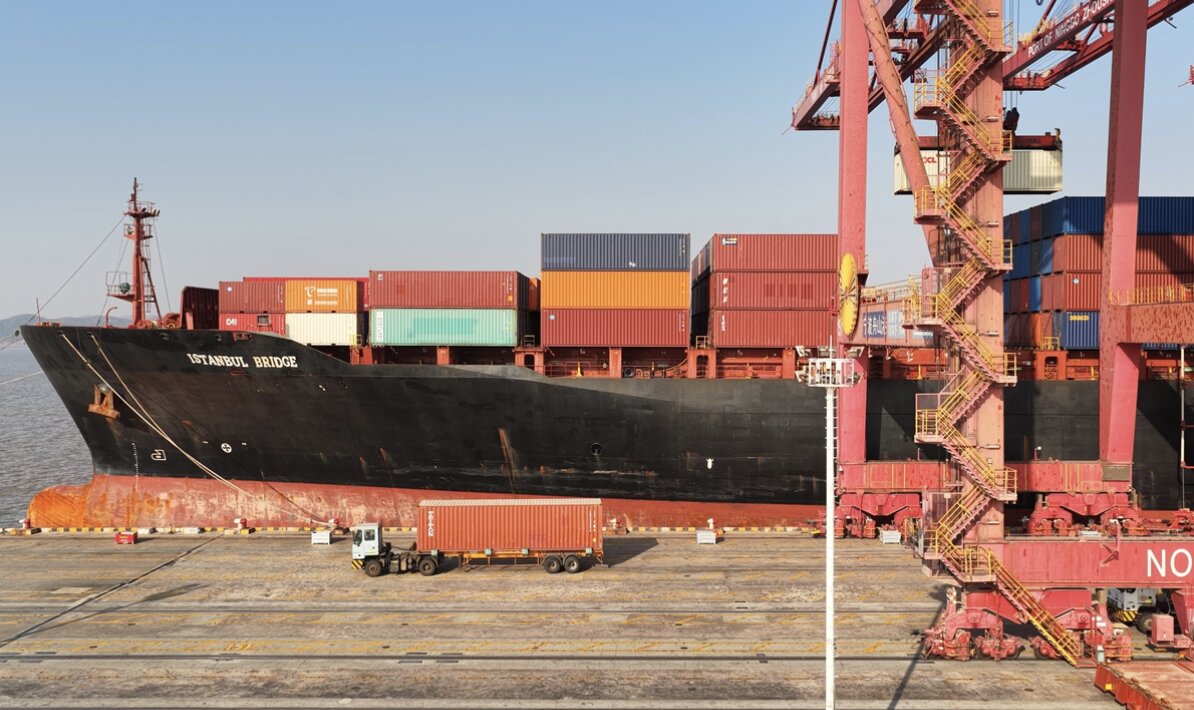
In Brief
INTERNAL
Non-residential property lease expiry sparks crisis report The Straits Times
On 12 August, The Straits Times reported on China's property crisis as USD 190 billion in non-residential property leases are soon to expire. Currently, non-residential property has less than 20 years left on leases. As a result, property values have plunged over 40 per cent in major cities. Developers are reported to be in USD 130 billion in debt, and a lack of finance and support from banks and insurers adds to property risk. Authorities are exploring ways to centralise a fragmented policy renewal approach.
("China races to solve $190 billion property threat as leases end," The Straits Times, 12 August 2026)
https://www.straitstimes.com/business/property/china-races-to-solve-190-billion-property-threat-as-leases-end
ENERGY AND ENVIRONMENT
China’s AI weather systems outperform global models in Typhoon tracking reports The Strait Times
On 11 August, The Strait Times reported that China has emerged as a leading player in AI weather forecasting by testing new systems alongside traditional models during Typhoon Dolphin’s path towards the country. Traditional models rely on supercomputers to simulate atmospheric physics, which is expensive and slower. AI models learn patterns from historical weather archives to deliver accurate forecasts in a fraction of the time. China’s leading models include Shanghai AI Laboratory’s Fengwu, Huawei’s Pangu, and Fudan University’s Fuxi. Among the top systems globally are Google’s GraphCast and GenCast, Nvidia’s FourCastNet, and the European Centre for Medium-Range Weather Forecasts’ AI Forecasting System (AIFS). Fengwu has notably outperformed Google’s GraphCast across 80 per cent of evaluated weather variables. Techwind Sun, the company responsible for Fengwu’s industrial applications, stated that AI models are effective at tracking routes, while stating that five days before landfall, Fengwu predicted Typhoon Dolphin’s location within 30 kms and timing within 30 minutes. However, the report also states that AI models still lag behind traditional physics-based systems when predicting storm intensity. While AI complements traditional forecasting, it will not fully replace it soon. They also remain untested for major, long-term climate shifts (like El Niño), requiring years of further scientific research to build public and institutional trust.
(“China bets on AI weather forecasting as extreme weather intensifies,” The Straits Times, 11 August 2026)
https://www.straitstimes.com/asia/east-asia/china-bets-on-ai-weather-forecasting-as-extreme-weather-intensifies
CHINA AND TAIWAN
Pacific Islands Forum invites Taiwan; China urges adherence to the one-China principle
On 11 August, Anadolu Agency reported that China had urged the Pacific Islands Forum to “properly handle Taiwan-related issues,” and to “abide by the one-China principle.” The Pacific Islands Forum is an annual meeting attended by heads of state from Pacific Island Countries and selected partner nations, which will be held in Palau next month. Taiwan has been a ‘development partner’ of the forum since 1993, but several PIF countries have close trade relations with China. Palau, the Marshall Islands, and Tuvalu officially recognise Taiwan. China’s Foreign Ministry spokesperson Guo Jiakun stated that Taiwan’s participation “must be handled in accordance with the one-China principle, which is a basic norm in international relations confirmed by UNGA Resolution 2758 and a prevailing international consensus."
(“China urges Pacific Islands Forum to 'properly handle Taiwan-related issues',” Anadolu Agency, 11 August 2026)
https://aa.com.tr/en/asia-pacific/china-urges-pacific-islands-forum-to-properly-handle-taiwan-related-issues/4024256
Taiwan condemns planned Chinese navy drill in its eastern waters
On 12 August, Reuters reported that Taiwan had condemned planned PLAN drills with an Indonesian warship in its eastern waters. China has increased its coast guard and naval activities in Taiwan’s eastern waters due to the announcement of maritime delimitation talks between Japan and the Philippines. China’s Defence Ministry stated that it would hold a “navigation exercise” with an Indonesian warship, set to take place in mid-August. Taiwan’s Mainland Affairs Council stated that the drill constitutes “military provocation,” and that China should “immediately stop this dangerous behaviour that undermines the status quo.” They added that the drills are “in reality, political manipulation, ‘exercises in name, expansion in fact’,” aimed at “creating a false impression” of legitimate jurisdiction over the waters east of Taiwan. Taiwan’s Foreign Ministry has requested a “clarification” from Indonesia.
(“Taiwan condemns 'dangerous' planned Chinese navy drill with Indonesia to its east,” Reuters, 12 August 2026)
https://www.reuters.com/world/china/taiwan-condemns-dangerous-planned-chinese-navy-drill-with-indonesia-its-east-2026-08-12/
CHINA AND SOUTHEAST ASIA
Cambodia and China sign new agricultural technology partnership deal
On 12 August, Khmer Times reported that Cambodia’s Ministry of Agriculture, Forestry and Fisheries (MAFF) and China’s Haikou Silk Road Academy signed a Memorandum of Understanding on research cooperation, agricultural supply chains, and investment expansion in the sector. The MoU aims to increase investment in important agricultural subsectors and expand the processing scale for agricultural products. A key objective is to increase Cambodian agricultural exports to China’s markets by expanding its supply chains and creating more opportunities to increase the market value of these products and expand their presence in Chinese markets.
(“Cambodia-China agro partnership sparks new export push,” Khmer Times, 12 August 2026)
https://www.khmertimeskh.com/501996153/cambodia-china-agro-partnership-sparks-new-export-push/
CHINA AND SOUTH ASIA
India says Arunachal Pradesh is an integral part of India and said that nothing can change this indisputable reality
On 12 August, The Hindustan Times reported that external affairs ministry spokesperson Randhir Jaiswal stated that the state of border affairs has ramifications for India-China ties and the countries should use diplomatic and military mechanisms to avoid misunderstanding and miscalculation along the border. This was in response to a question regarding recent tension over formally naming 27 places in Arunachal Pradesh. He reiterated that India's stance has been made clear in the 36th meeting of the Working Mechanism for Consultation and Coordination (WMCC) on India-China Border Affairs in New Delhi on August 6. He said: "In matters relating to border areas between India and China, we have always emphasised in discussions with the Chinese side that we consider these issues as most serious and that the maintenance of peace and tranquillity in these areas is of the utmost importance." He also added that Arunachal Pradesh is an inalienable and integral part of India and said that nothing can change this indisputable reality.
("‘Border affairs to decide India-China ties': MEA on Arunachal standoff reports," The Hindustan Times, 12 August 2026)
https://www.hindustantimes.com/india-news/border-affairs-to-decide-india-china-ties-mea-on-arunachal-standoff-reports-101786496470491.html
China Communications Construction Company eyes fresh investment opportunities in Sri Lanka
On 11 August, the Daily Mirror reported that President Anura Kumara Dissanayake met a senior delegation from China Communications Construction Company Limited (CCCC), led by Zhang Bingnan, at the Presidential Secretariat, with discussions focusing on ongoing and proposed projects related to Colombo Port City. CCCC representatives stated that the President's policies and programmes had strengthened investor confidence and encouraged the company to explore further investment opportunities in the country. The delegation expressed interest in expanding investments across several sectors, including renewable energy, trade and logistics, and digital services, adding that Sri Lanka had the potential to emerge as a regional hub in these areas and attract greater foreign investment.
("CCCC explores further investment opportunities in Sri Lanka," Daily Mirror, 11 August 2026)
https://www.dailymirror.lk/breaking-news/CCCC-explores-further-investment-opportunities-in-Sri-Lanka/108-347922
Ivan Lidarev, "Reopening China-India Border Trade: New Delhi’s Conundrum On The Border - Analysis," Eurasia Review, 11 August 2026
"On 1 August 2026, the China-India border trade resumed after six years of suspension. Following an agreement announced last August during Chinese Foreign Minister Wang Yi’s visit to New Delhi, the two sides opened three passes for border trade Nathu La in Sikkim, Lipulekh in Uttarakhand and Shipki La in Himachal Pradesh. The significance of this reopening is primarily symbolic and political rather than economic ... India prefers to keep its border trade with China small, localised and restricted because it poses substantial security risks. Essentially, India has chosen border security over border trade. Hence, the current reopening of border trade is of limited importance. While sensible, this choice comes with a price. Border trade is unlikely to bring security and stability to the border, but it can cushion tensions and soften the situation on the border."
A. Jathindra, "Strategic Projects Stagnate In Sri Lanka: India Seeks Answers - OpEd," Eurasia Review, 11 August 2026
"In an earlier meeting with Dissanayake in New Delhi, Prime Minister Narendra Modi voiced frustration over the slow pace of implementation. Despite the rhetoric of “system change,” the National People’s Power government appears to be repeating the delays of its predecessors, particularly on India’s strategic projects in the North and East — areas of special concern for New Delhi. Why do these projects remain stalled, and does the old phrase “fear of the big brother” still linger in the background? ... China entrenched itself through large-scale projects such as Hambantota Port and Colombo Port City, raising alarms in Washington about potential military use. For India, delays in its strategic projects are not merely bureaucratic setbacks but a matter of national security."
CPEC 2.0 focuses on industrial and B2B cooperation
On 12 August, ProPakistani reported that China and Pakistan are seeking to deepen business-to-business and industrial cooperation under the second phase of the China-Pakistan Economic Corridor (CPEC 2.0). Pakistan is seeking greater Chinese participation in manufacturing, agriculture, technology and export-oriented industries. A Chinese delegation led by Sun Dongsheng, senior adviser at the Economic Affairs Press, held consultations with Planning Minister Ahsan Iqbal and Pakistani policymakers on advancing B2B and industrial cooperation. Iqbal said Pakistan’s narrow export base remains a constraint on economic growth and called for stronger productive sectors. He also sought greater access for Pakistani goods to the Chinese market. Pakistan also wants cooperation with China on innovation, automation, robotics and Industry 4.0 and 5.0 technologies.
("China, Pakistan Plans More Industrial B2B Deals Under CPEC 2.0," ProPakistani, 12 August 2026)
https://propakistani.pk/2026/08/12/china-pakistan-plans-more-industrial-b2b-deals-under-cpec-2-0/
KP governor seeks greater Chinese investment and cooperation
On 12 August, Dawn reported that Khyber Pakhtunkhwa Governor Faisal Karim Kundi called for stronger bilateral cooperation, trade, and Chinese investment in the province. Speaking at an event at the Governor’s House in Peshawar marking the 75th anniversary of Pakistan-China friendship, he stated that Pakistan and China shared a long-standing friendship and that bilateral relations would become stronger. He added that Pakhtunkhwa has significant mineral resources, tourism potential, and a strategic geographical location, creating opportunities for greater cooperation and investment. The governor highlighted information technology, trade, culture, and youth exchanges as important areas for strengthening future relations. He also proposed holding Dragon Boat competitions at Khanpur Dam next year to further strengthen sports and cultural links between Pakistan and China.
("Kundi calls for greater Chinese investment in KP, Dawn, 12 August 2026)
https://www.dawn.com/news/2022257/kundi-calls-for-greater-chinese-investment-in-kp
China maintains engagement with Taliban
On 12 August, Responsible Statecraft reported that China has maintained direct political and security ties with the Taliban since its return to power in 2021, while stopping short of formally recognising the Taliban government. The report said Beijing’s main concern is preventing Afghan territory from being used for attacks against China or as a base for groups hostile to Chinese interests. The Taliban has restricted the activities of Uyghur militants and relocated some fighters away from the Afghan-Chinese border. However, the report said China remains concerned about the presence of these groups in Afghanistan. ISIS-K has also targeted Chinese nationals and Chinese-linked businesses in Afghanistan. The Chinese economic involvement has remained limited despite interest in Afghanistan’s mineral resources. Chinese companies have announced projects involving copper, oil, and gas, but several have faced difficulties. The Mes Aynak copper project has not reached commercial production, while the Amu Darya oil project was terminated in 2025.
("When US left Afghanistan, China moved in. So How's it going?" Responsible Statecraft, 12 August 2026)
https://responsiblestatecraft.org/afghanistan-china-taliban/
CHINA AND AFRICA
China sells armed drones to Ivory Coast; Expands defence exports to Africa
On 11 August, Business Insider Africa reported that Ivory Coast acquired two Chinese-made Wing Loong II armed drones. They are medium-altitude, long-endurance unmanned aerial vehicles used for surveillance, reconnaissance, and strike missions. According to the latest literature, the Wing Loong series is frequently positioned as a lower-cost Chinese alternative to US armed drones such as the MQ-1 Predator and MQ-9 Reaper. Chinese defence exports are expanding to African countries due to the low acquisition costs and flexible financing arrangements.
("China delivers its famous Wing Loong II combat drones to another African country in growing challenge to America’s MQ-9 Reaper," Business Insider Africa, 11 August 2026)
https://africa.businessinsider.com/local/markets/china-delivers-its-famous-wing-loong-ii-combat-drones-to-another-african-country-in/zzek1s3
CHINA AND THE MIDDLE EAST
China reiterates support for two-state solution; Calls on Israel to halt activities in the West Bank
On 12 August 2026, CGTN reported that China's Permanent Representative to the United Nations, Fu Cong, called for urgent action to curb escalating violence in the Palestine-Israel conflict at an emergency meeting of the UN Security Council. He expressed concern over the recent escalation in the situation in the occupied Palestinian territories and sorrow over the growing civilian casualties caused by continued violence. He stated that the situation in the West Bank is deteriorating because of the failure to uphold basic principles of international law. He also called on Israel to halt settlement activities in the West Bank, curb settler violence and ensure accountability. He added that the two-state solution remains the only viable path, and the international community should fully respect the will of the Palestinian people for an independent Palestinian state.
("China urges intl. community to act to curb violence in Palestine-Israel conflict," CGTN, 12 August 2026)
https://news.cgtn.com/news/2026-08-12/China-urges-intl-action-to-curb-violence-in-Palestine-Israel-conflict-1PxNgStpoAw/p.html
CHINA AND EUROPE
China launches “Ice Silk Road” to Europe; Aims for four months of stable seasonal operation
On 11 August, Global Times reported that a container shipping company from China, Sea Legend Shipping, would be launching the "Ice Silk Road," referencing the historical Silk Road linking China and Europe. The Ice Silk Road is a regular container service linking major Chinese ports, including Qingdao, Shanghai, Taicang, and Ningbo-Zhoushan, to European ports like Teesport and Felixstowe in the UK, Hamburg in Germany, and Gdynia in Poland through Russia's Northern Sea Route. However, the final sequence of this service could change due to changing weather conditions. Driven by retreating polar ice and widening seasonal navigation windows, this Arctic alternative bypasses geopolitically sensitive and congested traditional canal routes. Sea Legend shipping company stated that the route would effectively slash transit times from 40 days down to nearly 20 days. The route is highly optimised for high-value cargo like new energy vehicles, power batteries, and energy storage systems, which benefit financially from shorter transit windows and logistically from the cold Arctic environment that naturally mitigates safety and thermal risks. In its attempts to maximise efficiency, Sea Legend has secured priority berthing and "green channel" agreements at major European hubs like Felixstowe, Rotterdam, Wilhelmshaven and Antwerp to minimise anchorage delays. The company aims to establish four months of stable seasonal operations within the next three to five years, with a long-term goal of achieving year-round Arctic navigation within a decade. It would achieve these goals as it is backed by broader Sino-Russian diplomatic cooperation to develop Arctic infrastructure.
(“First regular Arctic container service China-Europe Arctic Express set to debut this week, ship operator tells GT, Global Times, 11 August 2026)
https://www.globaltimes.cn/page/202608/1367972.shtml
CHINA AND THE AMERICAS
Meta CEO Zuckerberg says US AI leadership is at risk from China
On 11 August, The Hindustan Times reported that Meta CEO Mark Zuckerberg has warned that the US risks losing its AI leadership to China due to infrastructure and policy delays. While the US maintains a competitive edge in advanced silicon chip design, it faces severe systemic deficits in physical infrastructure and power generation speed. China's rapid expansion, highlighted by adding over 1GW of nuclear grid capacity every fortnight, presents a stark contrast to Western power delays, making rapid data centre buildouts difficult. Zuckerberg strongly argued that domestic policies delaying AI model deployments by even a month directly threaten national security, as foreign rivals quickly duplicate open innovations. He positioned himself against concentrated technology gatekeeping, as he rejected common "AI doom" narratives regarding automated job loss. Instead, he advocates for an open-source framework that broadly disperses "personal superintelligence" directly to the public, comparing its democratic importance to the historical distribution of personal computers and smartphone technology.
(“Zuckerberg warns China could win AI race, says US needs to accelerate, links it to ‘new geopolitical balance of power’,” The Hindustan Times, 11 August 2026)
https://www.hindustantimes.com/world-news/mark-zuckerberg-warns-china-could-win-ai-race-says-us-needs-to-accelerate-building-energy-data-centers-101786454193032.html
China Reader Daily Wire | 11 August 2026, Tuesday | Vol 3 No. 113
China raises USD 28 trillion in capital markets to fund strategic tech race with the US
Long March 7A explodes after liftoff; Marks the second explosion in six years
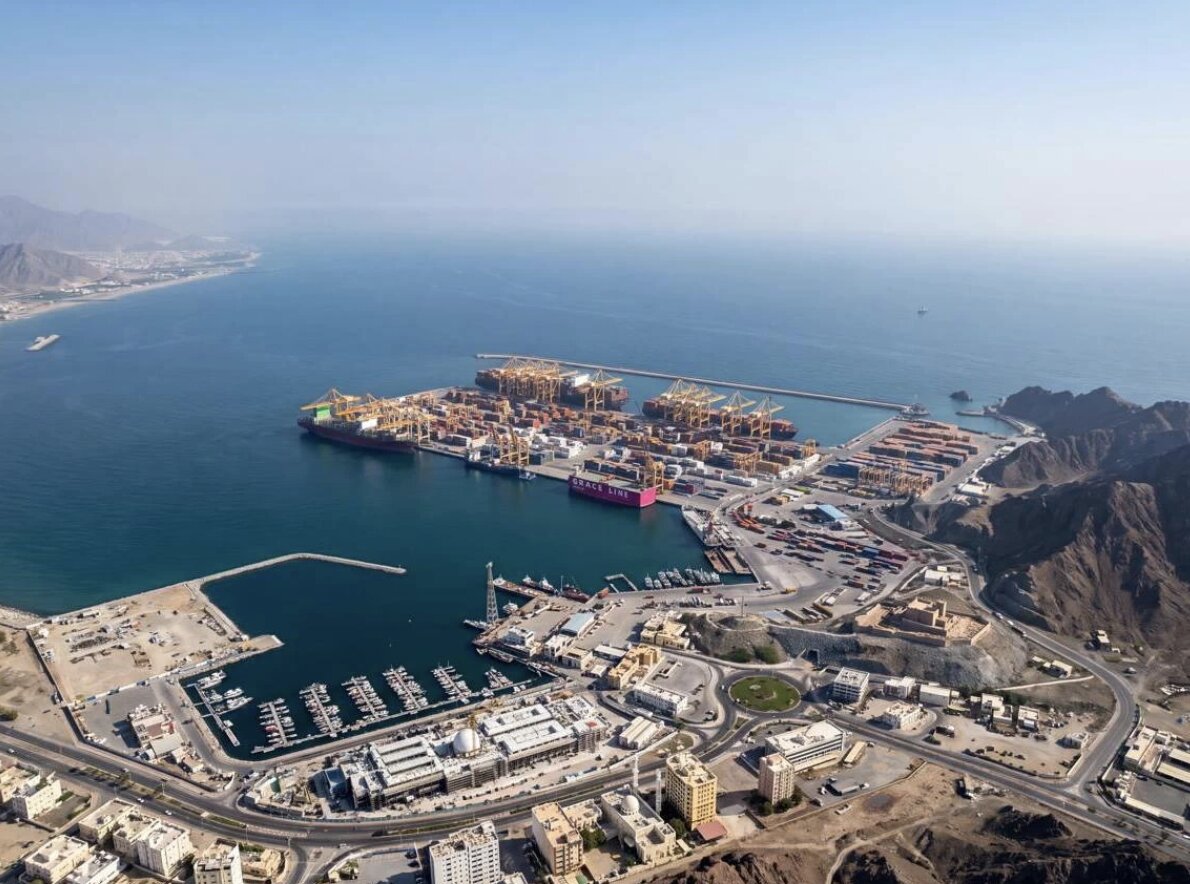
In Brief
INTERNAL
Opinion: "China export surge disguises structural economic weakness,” The Washington Post
“On the surface, China is on track for another year with a trade surplus topping $1 trillion. Exports surged last month by 24 per cent year-over-year, according to data published Friday. But the domestic economy is showing prolonged weakness. China’s growth dropped to 4.3 per cent in the second quarter of 2026, the lowest in three years, even according to the government’s suspect accounting. Home prices have slumped, and developers and local governments are reeling under piles of debt. Youth unemployment has remained stubbornly around 15 per cent.”
“With weak consumer demand at home, China subsidizes global exports to gin up growth. Makers of electric vehicles, steel companies and other industries receive access to cheap loans, tax breaks, free or inexpensive land at government-run industrial parks, and sometimes direct grants.”
ENERGY AND ENVIRONMENT
Typhoon Dolphin sparks severe flood alerts and temporary closures across central China
On 11 August, Reuters reported that Typhoon Dolphin, the strongest typhoon to hit China this year, travelled nearly 6,000 kilometres across a resilient storm system before making landfall deep into the central, mountainous province of Hubei. The storm has prompted forecasters to issue an orange rain alert, warning that the province's northwestern region could receive up to 250 mm of rain within 24 hours. It comes as peripheral airflow hits the western mountains and intensifies the rainfall multiple times. The severe weather places a heavy burden on Hubei, a major auto and electronics manufacturing hub of 58 million people that was already struck last month by two rare, deadly tornadoes from Typhoon Maysak. In response to the high risk of flooding and landslides, Hubei authorities issued yellow warnings for major cities like Xiangyang, Huanggang, and Suizhou, suspended 26 high-risk highway and waterway construction projects, and closed popular tourist sites, including the Three Gorges Dam in Yichang. Furthermore, the storm's massive reach is drawing moisture northward, prompting a red flash-flood alert in the neighbouring Henan province. It has also forced four outlying districts in Beijing that are located over 1,000 kilometres away to activate Level I emergency flood responses.
(“Typhoon Dolphin's vast storm system pushes inland, threatens central China,” Reuters, 11 August 2026)
https://www.reuters.com/business/environment/typhoon-dolphins-vast-storm-system-pushes-inland-threatens-central-china-2026-08-11/
SCIENCE AND TECHNOLOGY
China raises 28 trillion in capital markets to fund strategic tech race with the US
On 10 August, Quartz reported that China is shifting its technology competition strategy with the United States by utilising its USD 28 trillion stock and bond markets to fund strategic industries. They are doing so while aiming to close a funding gap where US firms lead by over six to one. China now forces private and institutional investors to fund its tech sector, instead of relying solely on direct state subsidies and tax incentives, reducing the financial burden on the government's budget. As tech giants from China are paying an average interest rate of just 1.9 per cent on their bonds, they can borrow money much more cheaply than their US rivals, whose borrowing costs are significantly higher. Memory chipmaker CXMT Corp. exemplified this approach by raising USD 8.6 billion, marking the largest mainland China semiconductor IPO on record and becoming China's most valuable onshore company by reaching a USD 488 billion valuation, surpassing the Industrial and Commercial Bank of China. However, the move relied on massive state intervention and left the firm with less capital than its potential market value. By creating streamlined pathways like the "preliminary review" pilot, China can rapidly pump billions of dollars into critical areas like semiconductor chips and AI, speeding up its timeline to achieve technological independence from the West. Despite risks involving reliance on policy-driven sentiment over fundamentals, tech firms from China are increasingly leveraging this method, with AI companies like Z.AI, MiniMax, and Moonshot AI preparing for domestic listings.
(“China is using its own stock market to fund its race for AI chip dominance,” Quartz, 10 August 2026)
https://qz.com/china-capital-markets-ai-chip-race-cxmt-ipo-081026
CHINA AND SPACE
China’s Long March 7A explodes after liftoff; Marks the second explosion in six years
On 10 and 11 August, Space.com and SCMP reported that the state-owned China Aerospace Science and Technology Corporation (CASC) Long March 7A rocket exploded 85 seconds after liftoff from the Wenchang Space Launch Site on 10 August. The explosion completely destroyed its Zhongxing-4B communications satellite payload. This incident marks the second failure for this specific rocket configuration, as the first failure occurred on 16 March 2020 during its maiden flight. China’s state news agency Xinhua officially stated that the rocket experienced an "anomaly during flight". The CASC has confirmed that the mission was unsuccessful and that the exact cause of the mid-air explosion is currently under active investigation. The incident also triggered an official investigation that could significantly delay upcoming cargo resupply missions to the Tiangong space station.
(“Chinese rocket explodes less than 90 seconds after liftoff,” Space.com, 10 August 2026; “A rare rocket failure led to knock-on effects on China’s space launches. What happened?,” SCMP, 11 August 2026)
https://www.space.com/space-exploration/launches-spacecraft/chinese-rocket-explodes-less-than-90-seconds-after-liftoff
https://www.scmp.com/news/china/military/article/3363574/chinas-long-march-7a-rocket-explodes-after-launch-satellite-lost
DEFENCE
China’s most advanced anti-drone laser spotted above amphibious warfare vessel in South China Sea
On 10 August, SCMP reported that China had deployed its most advanced anti-drone laser above a Type 071 “Qilianshan” amphibious landing vessel in the South China Sea. The Liaoyuan-1 (LY-1) was seen behind the Qilianshan’s 76mm dual-purpose gun. The LY-1 was showcased for the first time during last year’s Victory Day military parade and is tasked with close-range interception of incoming missiles and drones. The People’s Liberation Army’s Navy and Air Force (PLAN, PLAAF) were holding joint air and naval drills in the Scarborough Shoal of the South China Sea as part of the 99th anniversary of the PLA. The Qilianshan is the second Type 071 vessel to be spotted with the LY-1, after the Simingshan was seen with it last October. Experts and analysts claim that the LY-1 on an amphibious warfare ship indicates that China wants to send a “more forceful message,” after tensions flared in the South China Sea between Beijing and Manila last month. The deployment also comes after a US aircraft carrier, USS George Washington, was seen in the South China Sea last month as well.
(“Powerful anti-drone laser spotted on PLA amphibious ship in South China Sea,” SCMP, 10 August 2026)
https://www.scmp.com/news/china/military/article/3363564/powerful-anti-drone-laser-spotted-pla-amphibious-ship-south-china-sea
CHINA AND SOUTHEAST ASIA
Thailand proposes three-point plan to reduce trade deficit with China
On 11 August, The Nation reported that Thailand proposed three measures to address and reduce the trade deficit with China. The projected deficit for the 2016-2026 period is expected to breach USD 374 billion (12.41 trillion Baht). Deputy Prime Minister and Commerce Minister Suphajee Suthumpun stated that Thailand proposed a “co-creation” approach, where it advocated for less reliance on imported Chinese materials and components. She added that she proposed the measures with China’s Vice Premier He Lifeng on the sidelines of the APEC meeting in China in May 2026. The three proposals are to increase the usage of local components and materials, open China’s e-commerce channels for Thailand’s Small and Micro Enterprises (SMEs) and invest in Thailand’s agricultural processing sector.
(“Thailand seeks three-way plan to narrow China trade deficit,” The Nation, 11 August 2026)
https://www.nationthailand.com/business/trade/40069639
Cambodia's Health Minister holds ceremony for China’s traditional medicine practitioners for a year-long mission
On 11 August, The Khmer Times reported that Cambodia’s Health Minister, Professor Chheang Ra, presided over a ceremony to present medals to a team of Chinese traditional medicine specialists from Chengdu, Sichuan province, for completing a year-long medical mission in Cambodia. China’s ambassador to Cambodia, Wang Wenbin, was also present for the ceremony. The Chinese medical team provided direct services to over 11,000 patients across 20 capital and provincial areas. Minister Ra expressed his thanks and gratitude to China’s government and the relevant institutions for their support and cooperation.
(“Chinese Ambassador, Health Minister honour traditional Chinese medicine team completing Cambodia mission,” The Khmer Times, 11 August 2026)
https://www.khmertimeskh.com/501995776/chinese-ambassador-health-minister-honour-traditional-chinese-medicine-team-completing-cambodia-mission/
CHINA AND SOUTH ASIA
China objects to India’s decision to formally assign names to 27 places in Arunachal Pradesh
On 10 August, Deccan Herald reported that in response to India's decision to formally assign names to 27 places and features in Arunachal Pradesh, China opposed and stated it intends to replace the names used in South Tibet. China's Ministry of Foreign Affairs called this decision illegal and invalid and claimed that it would change the fact that South Tibet belongs to China. The Ministry also stated its non-acceptance of Arunachal Pradesh as a state of India. Recently, New Delhi decided to assign standardised names for 27 places and geographical features in Arunachal Pradesh. This tension unfolds as the 25th round of boundary negotiations between the special representatives of India and China will be held in the coming month. ("China protests India's map manoeuvre, reasserts claim over Arunachal Pradesh," Deccan Herald, 10 August 2026) https://www.deccanherald.com/india/china-protests-indias-map-manoeuvre-reasserts-claim-over-arunachal-pradesh-4106307
Nepal’s PM meets Chinese ambassador; Calls for strengthened cooperation
On 10 August, Republica reported that Prime Minister Balendra Shah discussed the importance of strengthening Nepal’s historic relations with China with Chinese Ambassador to Nepal Zhang Maoming. They also discussed enhancing development partnership and expanding bilateral cooperation across various sectors. The meeting was held after Prime Minister Balendra Shah’s meeting with Indian Ambassador to Nepal Navin Srivastava.
("PM Shah, Chinese envoy discuss strengthening Nepal-China ties, "Republica, 10 August 2026)
https://myrepublica.nagariknetwork.com/news/pm-shah-chinese-envoy-discuss-strengthening-nepal-china-ties-96-88.html
CHINA AND AFRICA
Africa pushes for local solar production amid heavy reliance on Chinese companies
On 10 August, Business Insider Africa reported that, due to rising solar demand, Nigeria, South Africa, Morocco and Ethiopia are planning to expand local solar manufacturing. The current focus is on local assembly. The latest literature shows that Africa is heavily dependent on Chinese imports for high-value solar components. Additionally, between 2010 and 2024, Chinese renewable energy investment and construction projects in Africa reached USD 66 billion. In order to build a local manufacturing base, it requires solar cells, technical skills, finance, electricity and large buyers to sustain the industry. Currently, a one-gigawatt solar manufacturing plan is taking shape in South Africa, Nigeria and Morocco, focusing on panel assembly, and Ethiopia aims to become the global solar manufacturing base. China use this as a production base, and in order to mitigate the effects on China's export policy, the authorities are exploring options to localise production.
("China built Africa’s solar boom, but the continent now wants the factories too," Business Insider Africa, 10 August 2026)
https://africa.businessinsider.com/local/markets/china-built-africas-solar-boom-but-the-continent-now-wants-the-factories-too/8nbw70n
CHINA AND THE MIDDLE EAST
UAE to receive BYD vehicles via new direct logistics corridor
On 09 August, Emirates 24/7 reported that the UAE will receive a shipment of 6,068 new energy vehicles manufactured by Chinese automotive giant BYD through Khorfakkan Port. This new direct maritime shipping route between China's Xiaomo International Logistics Port in Shenzhen and Khorfakkan Port, operated by the Sharjah Ports, Customs and Free Zones Authority, aims to make trade efficient. The news agency reported that the route will minimise potential disruption of vehicles and heavy equipment and ensure supply chain efficiency and reliability. Additionally, they also added that the new route will provide a strategic logistics corridor for Chinese exports to the UAE and the wider Middle East and reduce shipping time by three to five days. ("UAE's Khorfakkan Port to receive record shipment of more than 6,000 BYD electric vehicles from China," Emirates 24/7, 09 August 2026)
https://www.emirates247.com/business/uaes-khorfakkan-port-to-receive-record-shipment-of-more-than-6000-byd-electric-vehicles-from-china/4369
CHINA AND RUSSIA
Satellite imagery shows two Chinese-built pipe racks for LNG2 in the Arctic
On August 10, High North News reported that satellite imagery confirmed that two Chinese-built pipe rack modules arrived at Russia’s Belokamenka yard and were positioned next to the unfinished concrete gravity-based structure (GBS) intended for Arctic LNG 2’s third production train. The latest literature suggests that this delivery illustrates that industrial links between Moscow and Beijing persist despite Western sanctions, which previously halted work on the train's 14 required modules. However, analysts also predict that the overall yard inactivity indicates no immediate resumption of full-scale construction. Operator Novatek is currently prioritising securing sufficient LNG tanker capacity for existing production over completing the third train, given impending European Union import restrictions.
(“Satellite Imagery Sheds New Light on China-Built Module Delivery for Russia’s Arctic LNG 2,” High North News, 10 August 2026)
https://en.highnorthnews.com/politics/satellite-imagery-sheds-new-light-on-china-built-module-delivery-for-russias-arctic-lng-2/1115970
CHINA AND EUROPE
Chinese component found in Royal Navy drones; Investigation concludes no data leak
On August 11, the BBC reported that during a routine cyber vulnerability assessment, the Ministry of Defence (MoD) discovered that cameras on the Royal Navy’s new K3 Scout surveillance drones contained a Chinese-made component. The component transmitted a "heartbeat" signal to a Chinese IP address, raising spying concerns since NATO nations banned Chinese military hardware. However, an MoD investigation confirmed no sensitive data or systems were compromised. The supplier Kraken clarified that a third-party camera vendor included the part. The security vulnerability has been resolved, highlighting the defence sector's ongoing challenge to eliminate reliance on dominant Chinese supply chains.
(“No evidence of data breach after Chinese-made component found in Navy drones, MoD says,” BBC, 11 August 2026)
https://www.bbc.com/news/articles/c4gwl3n7ne7o
CHINA AND THE AMERICAS
Beijing retaliates with anti-dumping levies on US and Mexican pecans
On August 10, SCMP reported that China’s Ministry of Commerce issued a preliminary anti-dumping ruling against imported pecans from the United States and Mexico, citing significant harm to domestic producers. Chinese authorities found that dumped pecan imports surged by 104.5 per cent while consistently undercutting domestic market prices. In response, Beijing imposed provisional cash deposits of 54.3 per cent on American exporters and up to 51.6 per cent on Mexican firms. However, six cooperating Mexican companies secured reduced rates between 17.8 per cent and 23 per cent. Because no US producers participated in the investigation, all American exporters received the maximum duty. Launched in September 2025, Beijing's probe is widely viewed as retaliation against Mexico’s earlier 50 per cent tariff hikes on Chinese goods, a policy that is widely regarded as being implemented under heavy pressure from Washington to prevent Mexico from serving as a transhipment route for Chinese products entering the US market.
(“China hits US, Mexican pecans with preliminary anti-dumping curbs,” South China Morning Post, 10 August 2026)
https://www.scmp.com/economy/global-economy/article/3363556/china-hits-us-mexican-pecans-preliminary-anti-dumping-curbs
China Reader Daily Wire | 10 August 2026, Monday | Vol 3 No. 112
China’s lunar blueprint includes AI robots for patrols and astronaut companionship
China’s stockpiles cushion oil supply shock triggered by the Hormuz blockade
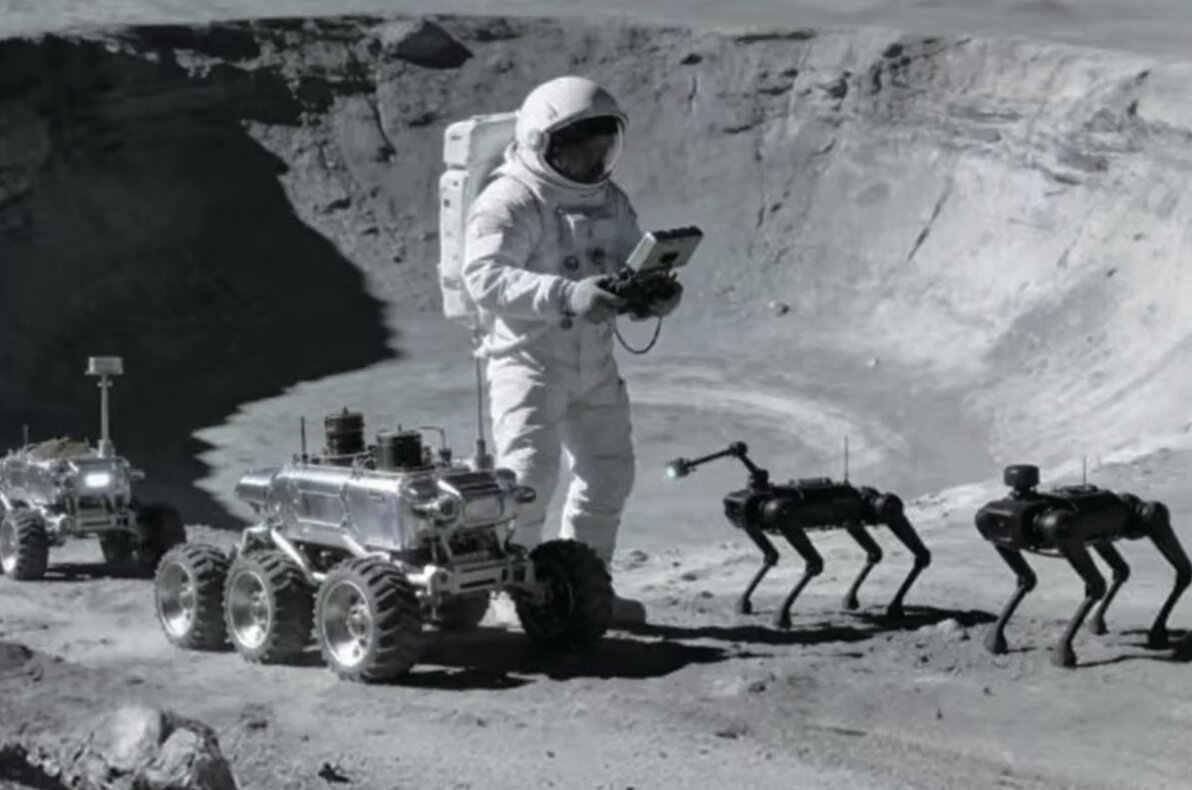
In Brief
INTERNAL
Newly released data notes decrease in inflation, reports Reuters
On 09 August, Reuters reported that China's producer price inflation decreased to 3.5 per cent in July, down from 4.1 per cent in June. The consumer price index eased to 0.5 per cent, a six-month low. According to the latest literature, lower oil prices and weak domestic demand stand as the main reasons behind this slowdown. Reuters stated that China's economy is running at two speeds. This includes strong factory output and exports but weak household demand due to the property slump and job insecurity. The Chinese Communist Party had pledged stronger fiscal spending on infrastructure projects throughout the year to support growth. The latest literature predicts China's inflation to follow an M-shaped trajectory, alternating rises and falls.
("China July factory-gate inflation eases to 3-month low, CPI slows," Reuters, 09 August 2026)
https://www.reuters.com/world/china/chinas-producer-inflation-eases-july-below-expectations-2026-08-09/
CHINA AND SPACE
China's Shenzhou-23 crew tests physics, VR and muscle health in orbit
On 09 August, CGTN reported that China's space station crew conducted tests on human physiology, advanced technology testing, and equipment maintenance. To monitor and support health research regarding sensitive muscle remodelling under microgravity, the crew used an ultrasound diagnostic device to scan various muscle groups and completed a series of grip strength tests. They also wore virtual reality (VR) devices to complete both individual perception and two-person collaborative interface experiments. They conducted touch-interaction tests with the station's robot, “Xiaohang,” which provided data to optimise the robot's future in-orbit movement planning. They conducted parallel studies that tracked long-term astronaut kinematics and treadmill dynamics; the crew highlighted this by using a 3D camera to capture detailed posture data from a member running on the space treadmill. On the physics front, the astronauts replaced fluid physics experiment samples, cleared out the containerless experiment cabinet's chamber, serviced the axial mechanism electrodes, and cleaned the viewport cover lenses. Finally, the crew concluded with general upkeep, tidying the station's interior and organising onboard supplies.
(“Shenzhou-23 crew keeps full schedule as robot Xiaohang continues learning in orbit,” CGTN, 09 August 2026)
https://news.cgtn.com/news/2026-08-09/Shenzhou-23-crew-stays-busy-as-robot-Xiaohang-learns-in-orbit-1Pt91w3MUYE/p.html
China’s lunar blueprint includes AI robots for patrols and astronaut companionship
On 08 August, SCMP reported that, according to a blueprint by researchers working on China’s lunar base from the China Academy of Space Technology, robot dogs will scout and patrol China’s future moon base. The concept envisions that future crewed lunar missions will utilise a collaborative framework where astronauts lead, while intelligent robots perform scouting, resource mining, and habitat construction. It also suggests that robots will manage daily chores, handle maintenance, and offer social companionship to isolated astronauts. This proposal comes while China aims to land astronauts by 2030 and establish an International Lunar Research Station (ILRS) by 2035. Researchers, however, state that there exist significant challenges, including a lack of lunar data to train AI and the absence of necessary infrastructure for long-distance, remote coordination.
(“China’s lunar research station could be guarded by robot watchdogs, space scientists say,” SCMP, 08 August 2026)
https://www.scmp.com/news/china/science/article/3363149/chinas-lunar-research-station-could-be-guarded-robot-watchdogs-space-scientists-say
CHINA AND TAIWAN
Taiwan’s new defence expenditure to be increased by 16 per cent; Cites increase in Chinese military and navy activities
On 09 August, Reuters reported that Taiwan’s cabinet is expected to propose a 16 per cent annual rise in defence expenditure for 2027, exceeding USD 31 billion (1 trillion Taiwan dollars). The proposal comes amid China’s increased military and naval patrolling activities in the region and also its modernisation efforts in recent months. The details on the proposed budget will be revealed on 20 August, which is expected to include funding for the coast guard, veterans, and ‘special projects,’ exceeding 3 per cent of the GDP. Taiwan is currently holding its annual Han Kuang military exercise, where President Lai Ching-te stated that “preparation in peacetime adds another measure of ?stability and strength ?for our nation.”
(“Taiwan's 2027 defence spending to rise 16%, official media reports,” Reuters, 09 August 2026)
https://www.reuters.com/world/china/taiwans-2027-defence-spending-rise-16-official-media-reports-2026-08-09/
CHINA AND THE PACIFIC
Beijing-Canberra relations reach ‘a more realistic footing ’, says former ambassador to China
On 09 August, SCMP reported that the former ambassador to China from Australia, Graham Fletcher, stated that China-Australia ties have reached a “good enough” baseline relationship. Relations between the two countries became strained due to Australia’s ban on China-based electronics firm Huawei Technologies from its 5G network and its calls for an independent inquiry into the origin of COVID-19, in response to which China placed trade restrictions on Australian products. Relations have slightly improved after the election of Prime Minister Anthony Albanese, with ministerial dialogue resuming and Albanese’s visits to Beijing in 2023 and 2025. Despite the mending efforts, Fletcher highlights two main risks. The first involves Beijing’s pushback on foreign restrictions on its technology and investments, ownership of the Port of Darwin, and political unrest in the Pacific island states. The second risk is a possible military conflict in Taiwan or the broader regional area. Fletcher, working as a non-resident fellow at the Lowy Institute, a Sydney-based think tank, released a report on bilateral relations on Sunday. He previously served as Australia’s ambassador to China from 2019 to 2023.
(“China-Australia relations reach ‘good enough’ baseline, ex-envoy says,” SCMP, 09 August 2026)
https://www.scmp.com/news/china/diplomacy/article/3363442/china-australia-relations-reach-good-enough-baseline-ex-envoy-says
CHINA AND SOUTHEAST ASIA
China issues reminder for Chinese nationals to comply with local laws and regulations in Thailand
On 08 August, Global Times reported that China’s embassy in Thailand issued a notice for its citizens travelling to the country for cultural and sporting activities to comply with local laws and regulations. The notice comes after an incident at Suvarnabhumi Airport where security personnel allegedly made racist gestures to Chinese passengers who violated security measures. The incident was sparked by fans trying to board the flight with a celebrity from China, when a group of passengers violated security measures to board the aircraft to see the celebrity. The embassy called on citizens to interact with the Thai people with “respect, goodwill and openness,” and maintain the friendship between the two under the concept of “China and Thailand as one family.”
(“Chinese Embassy in Thailand issues reminder to nationals participating in cultural and sports activities in Thailand,” Global Times, 08 August 2026)
https://www.globaltimes.cn/page/202608/1367782.shtml
CHINA AND THE MIDDLE EAST
China’s stockpiles cushion oil supply shock triggered by the Hormuz blockade
On 10 August, InvestingLive reported that China is singlehandedly absorbing most of Asia's crude demand drop caused by Middle East supply disruptions during the Iran war. Middle East export flows remain down by roughly 5 million barrels per day despite alternative shipping efforts by Saudi Arabia and the UAE. By drawing on its massive crude stockpile of over 1.2 billion barrels, China has suppressed import demand, with July arrivals down 24.3 per cent. This cushion has masked the severe physical market tightness resulting from the Strait of Hormuz closure. Analysts predict that September presents a vital test as Middle East flows tighten again following a ceasefire breakdown.
(“China's stockpiles are masking the true scale of the Hormuz shock,” InvestingLive, 10 August 2026)
https://investinglive.com/commodities/china-s-stockpiles-are-masking-the-true-scale-of-the-hormuz-shock/
CHINA AND SOUTH ASIA
China lobbies to cancel conference on Tibetan studies in Nepal, reports News18
On 08 August, News 18 reported that China's Ambassador Zhang Maoming lobbied Nepal's authorities to cancel the Tibetan studies international conference. In a meeting with Nepal’s Foreign Ministry, he urged the authorities to be cautious about supportive discussions of Tibet and statements concerning the Dalai Lama. The event is set to host over 500 scholars for a week-long program on Tibetan history and culture. The 17th International Seminar of the International Association for Tibetan Studies is a seven-day event that discusses Tibetan history, culture, and political questions. The latest literature suggested that concerns within the Nepalese government that it would affect Nepal's relationship with China and the conference's stance on Tibetan separatism and China's political activity were the major reasons behind the cancellation.
("Chinese Pressure Forces Nepal To Cancel Major Conference Despite Security Nod | Exclusive," News 18, 08 August 2026)
https://www.news18.com/world/chinese-pressure-forces-nepal-to-cancel-major-conference-despite-security-nod-exclusive-ws-l-10261119.html
India and China hold border talks, maintaining peace along the LAC
On 08 August, The Indian Express reported that at diplomatic talks held on 06 August in New Delhi, India and China reviewed the overall situation along the Line of Actual Control (LAC) to address boundary delimitation, border management, and trans-border cooperation. It was convened under the framework of the Working Mechanism for Consultation and Coordination on India-China Border Affairs (WMCC). The meeting was led by India’s MEA Joint Secretary (East Asia), Sujit Ghosh, and China’s Ministry of Foreign Affairs’ Boundary and Oceanic Affairs Department Director General, Hou Yanqi. Both delegations engaged in frank discussions, ultimately agreeing that maintaining peace and tranquillity in the border regions is foundational to the development of their broader bilateral relationship.
(“India, China review situation on Line of Actual Control,” The Indian Express, 08 August 2026)
https://indianexpress.com/article/india/india-china-review-situation-situation-on-line-of-actual-control-10822210/
CHINA AND AFRICA
Investigation unveils uranium traces in cobalt shipment from DRC, reports RFI
On 09 August, RFI reported that an investigation by Lighthouse Reports, The Financial Times, and Le Monde revealed that significant amounts of uranium are routinely exported from the Democratic Republic of Congo (DRC) inside cobalt shipments primarily to China. Drawing from a confidential 2024 IAEA memo, research estimated 2,000 to 5,000 tonnes of uranium entered China via cobalt hydroxide between 2000 and 2024. Internal records from the CMOC-owned Tenke Fungurume mine showed uranium levels up to 15 times the recommended limit. While CMOC denies violating trade rules or processing uranium, experts have noted that unmonitored uranium contaminants bypass standard removal processes during export.
(“Investigation raises alarm over uranium in DRC cobalt shipments to China,” RFI, 09 August 2026)
https://www.rfi.fr/en/africa/20260809-investigation-raises-alarm-over-uranium-in-drc-cobalt-shipments-to-china
CHINA AND EUROPE
Chinese EV sales witness surge in Europe amidst tariff debates
On 09 August, The Guardian reported that Chinese electric vehicle (EV) sales in Western Europe hit a record 14.2 per cent market share in early 2026, selling 171,800 units. The surge, driven by strong demand in the UK and subsidised purchases in Italy, has intensified calls for tougher trade protections to assist European carmakers. Despite EU tariffs reaching up to 35.3 per cent on pure battery electric vehicles (BEVs), manufacturers like BYD and SAIC continue to expand in the European market. However, analysts predict Chinese BEV growth may temporarily peak as brands exploit a regulatory loophole by shifting focus to untariffed plug-in hybrids.
(“Chinese EV sales surge to new high in Europe putting tariffs under scrutiny,” The Guardian, 09 August 2026)
https://www.theguardian.com/business/2026/aug/09/chinese-electric-car-sales-surge-to-a-record-high-in-europe
CHINA AND THE AMERICAS
Declining stockpiles of US weapons elevate strategic risks with China and Russia reports, The Jerusalem Post
On 09 August, The Jerusalem Post reported that the rapid depletion of US offensive and defensive munitions during the war with Iran has significantly weakened conventional deterrence, resulting in strategic vulnerabilities that Russia and China could exploit. Senior experts warn that these shortages, which include critical reductions in Patriot interceptors, Tomahawks, and tactical ballistic missiles, could persist long past the Trump administration, which may force the Pentagon to shift assets from Europe and Asia to the Middle East. This reallocation impairs troop morale, delays maintenance, and more importantly leaves regional allies like Taiwan, South Korea, and Ukraine increasingly exposed. In response, European allies are seeking alternative arms suppliers, while Asian nations consider developing independent nuclear capabilities. Although President Trump has urged defence contractors to accelerate production to historic levels, the ongoing strain on US arsenals limits military flexibility and risks encouraging adversary aggression.
(“Russia, China could take advantage of low US weapons stockpiles to start war with America - NYT,” The Jerusalem Post, 09 August 2026)
https://www.jpost.com/international/article-904979
US rejects Beijing’s natural reserve claims in the South China Sea
On 08 August, Al Jazeera reported that the US State Department criticised China’s attempt to designate the disputed Scarborough Reef as a "national nature reserve," calling it a legal and environmental pretext to expand its territorial sovereignty. Washington stated that Beijing’s actions aim to deny Filipino fishermen access to traditional waters through coercive measures. The statement reaffirmed US support for the Philippines, following recent incidents where Chinese vessels used water cannons against Filipino ships. Although international arbitration previously rejected China's expansive "nine-dash line" claims, Beijing continues to dismiss the ruling while asserting authority over the contested maritime region. The US State Department released the following statement: "The United States rejects China’s ongoing attempts to enforce its destabilizing ‘national nature reserve’ at Scarborough Reef and deny Filipino fishermen access to their traditional fishing ground."
(“US slams Chinese ‘nature reserve’ as effort to claim South China Sea,” Al Jazeera, 08 August 2026; "China’s “Administrative Measures” at Scarborough Reef," US State Department, 08 August 2026)
https://www.aljazeera.com/news/2026/8/8/us-slams-chinese-nature-reserve-as-effort-to-claim-south-china-sea
https://www.state.gov/releases/office-of-the-spokesperson/2026/08/chinas-administrative-measures-at-scarborough-reef
China Reader Daily Wire | 07 August 2026, Friday | Vol 3 No. 111
China to build a planetary protection lab for Tianwen-3 Mars sample-return mission
US drafts new nuclear strategy addressing Russia and China

In Brief
INTERNAL
SCO concludes Tianshan-2026 Cyber Anti-Terrorism drills in China
On 06 August, CGTN reported that delegations from the Shanghai Cooperation Organization (SCO) completed a joint cyber anti-terrorism exercise called "Tianshan-2026" in Urumqi, China. The drill focused on modern, digital terrorism threats by simulating scenarios where extremist groups used online platforms to spread ideology, recruit members, and plan attacks. Participating teams worked together, tracked digital threats, and coordinated with offline law enforcement. SCO officials praised China's organization of the exercise, noting that it successfully improved mutual trust and strengthened the region's shared ability to combat cyber terrorism.
(“SCO member states hold cyber anti-terrorism exercise in Xinjiang,” CGTN, 06 August 2026)
https://news.cgtn.com/news/2026-08-06/SCO-member-states-hold-cyber-anti-terrorism-exercise-in-Xinjiang-1PnStz1crsY/p.html
ENERGY AND ENVIRONMENT
China escalates emergency response actions as Typhoon Dolphin approaches
On 07 August, CGTN reported that China’s meteorological, marine, water resources, and agricultural authorities have escalated emergency response measures as Typhoon Dolphin entered the country's 48-hour warning zone. The typhoon is moving steadily westward with an extensive wind field, and forecasters state that it is expected to generate dangerous 4-to-7-meter waves in the East China Sea. Authorities are utilizing advanced artificial intelligence and digital twin systems to simulate flood risks and improve forecasting accuracy. Experts warn that because the storm will slow down near the coast, these hazardous sea conditions may be difficult to perceive from the shoreline, making it crucial for the public to avoid the coast. Upon making landfall, the typhoon, according to forecasts, is expected to bring prolonged torrential rainfall across multiple provinces, including Zhejiang, Fujian, Jiangxi, Hunan, Hubei, Anhui, Jiangsu, Henan, and Shandong. They also warn of the heightened risk of flash floods and landslides where soil is already saturated. Fishing vessels have been ordered back to port to minimize agricultural and coastal losses. Fishermen are evacuating ashore, and farmers are rushing to clear drainage channels, harvest mature crops early, and reinforce greenhouses and livestock shelters.
(“China strengthens coordinated disaster response as Typhoon Dolphin enters 48-hour warning zone,” CGTN, 07 August 2026)
https://news.cgtn.com/news/2026-08-07/China-steps-up-coordinated-tech-enabled-response-to-Typhoon-Dolphin-1Pptw1EmPJu/p.html
CHINA AND SPACE
China to build a planetary protection lab for Tianwen-3 Mars sample-return mission
On 06 August, CGTN reported that China is advancing its Tianwen-3 Mars sample-return mission for which it will construct a planetary protection laboratory during the first phase of its Deep-Space Science City in Hefei, Anhui Province. The Mars sample-return mission aims to launch a spacecraft around 2028 and bring Martian soil and rock samples to Earth by 2031. The lab is being built to safely handle these materials, and the Deep Space Exploration Laboratory (DSEL) will be operating in parts of the operations. The lab will enforce a strict two-way protection system designed to prevent Earth organisms from contaminating Mars and to safeguard Earth's biosphere from any potential extraterrestrial biological risks during sample unsealing, sterilization, and testing. This interplanetary effort builds directly upon the success of China's Zhurong rover, which landed on Mars in May 2021. It traveled nearly two kilometers to gather extensive scientific data, paving the way for these upcoming research breakthroughs.
(“China to build planetary protection lab for Mars sample-return mission,” CGTN, 06 August 2026)
https://news.cgtn.com/news/2026-08-06/China-to-build-planetary-protection-lab-for-Mars-sample-return-mission-1Po6fwqDkPK/p.html
CHINA AND EAST ASIA
China is closer to developing lithography technology to manufacture sub 7nm chips, says The Korean Herald
On 06 August, The Tribune reported that China is close to developing its own immersion deep-ultraviolet (DUV) lithography system, which can theoretically enable it to produce sub 7nm semiconductor chips, per a report by The Korean Herald. China is currently blocked from accessing the most advanced lithography systems due to US export control restrictions and has primarily relied on pushing older DUV equipment to produce sub 7nm chips. South Korean experts claim that despite a working model developed by China, scaling it to mass production and profitability is in question and will take “considerable time before China can produce meaningful results.” Experts add that the latest development poses little threat to South Korean chip giants such as Samsung and SK Hynix, but if China is willing to absorb low profits, it may close down the technology gap.
(“China's homegrown DUV tool jolts chip industry, but commercial yield test still looms,” The Tribune, 06 August 2026)
https://www.tribuneindia.com/news/business/chinas-homegrown-duv-tool-jolts-chip-industry-but-commercial-yield-test-still-looms/
CHINA AND THE PACIFIC
China’s ballistic missile test to be top agenda in Pacific island countries’ Foreign Ministers' meeting
On 07 August, The Hindustan Times reported that the top agenda to be discussed in the upcoming Foreign Ministers' meeting of Pacific Island nations will be China’s test of a nuclear-capable submarine-launched ballistic missile (SLBM) over the region. The Foreign Ministers' meeting in Suva, Fiji, which is to be held on Friday, comes ahead of the Pacific Islands Forum, an annual meeting of the heads of state of the countries in the region in September. China has considerable influence within some member states, such as Kiribati, Nauru, and Vanuatu, where Beijing is their largest trading partner. The ministers are also set to discuss the Pacific Forum’s regional architecture, determining “key partners” to be invited for the leaders' meeting in September.
(“China missile test top of agenda as Pacific diplomats meet in Fiji,” The Hindustan Times, 07 August 2026)
https://www.hindustantimes.com/world-news/china-missile-test-top-of-agenda-as-pacific-diplomats-meet-in-fiji-101786045054179.html
CHINA AND SOUTHEAST ASIA
China and Thailand expand technology and educational cooperation
On 07 August, China Daily reported that a delegation of young Chinese entrepreneurs visited Bangkok to explore expanding bilateral cooperation in digital technologies and education. The delegation was supported by the China International Development Cooperation Agency. The tour included exchanges with officials from Thailand's Digital Economy Promotion Agency and local industry leaders. Thai representatives also welcomed Chinese investment in AI and gene technology, highlighting how China's recent advancements can also bolster Thailand's healthcare startup ecosystem. Additionally, the delegation also visited the China-Thailand Luban Workshop to assess opportunities in vocational training, making note of the fact that deepening technological cooperation drives strong demand for skilled professionals across the Greater Mekong Subregion.
(“Potential seen for Sino-Thai tech cooperation,” China Daily, 07 August 2026)
https://www.chinadaily.com.cn/a/202608/07/WS6a752e62a310986e2b469764.html
CHINA AND SOUTH ASIA
India-China-Bhutan tri-junction rail project in final stages of approval, reports The Economic Times
On 05 August, The Economic Times reported that the West Bengal government has approved fast-tracking the acquisition of around 380 hectares of land for strategic railway projects near the India-China-Bhutan tri-junction. This clearance revives the stalled 20 km Chalsa-Naxalbari rail line, which was previously stalled. Following the monsoon, the Railways and West Bengal Forest Department will conduct a joint survey to finalise the alignment. Primarily, the project aims to strengthen the regional defence connectivity and boost local tourism.
(“Trains to go near India-China-Bhutan tri-junction as Bengal fast-tracks land acquisition for key projects near Doklam,” The Economic Times, 05 August 2026)
https://m.economictimes.com/industry/transportation/railways/trains-to-go-near-india-china-bhutan-tri-junction-as-bengal-fast-tracks-land-acquisition-for-key-projects-near-doklam/articleshow/132914163.cms
Beijing and New Delhi seek peaceful border management at 36th WMCC Meeting
On 07 August, Global Times reported that China and India held the 36th meeting of the Working Mechanism for Consultation and Coordination on Border Affairs (WMCC) in New Delhi on August 6. Co-chaired by senior diplomatic officials alongside defense and immigration representatives, both sides discussed issues regarding boundary delineation, border management, and cross-border cooperation. Both parties have also agreed to maintain continuous communication through diplomatic and military channels to jointly safeguard peace along the border and its vicinity.
(“China, India hold meeting on border affairs, pledge to jointly safeguard peace and tranquility in border areas,” Global Times, 07 August 2026)
https://www.globaltimes.cn/page/202608/1367733.shtml
CHINA AND THE AMERICAS
Washington demands transparency from Beijing over transnational crime syndicates
On 07 August, MSN reported that the US President Donald Trump has directly raised concerns with China’s President Xi Jinping regarding Southeast Asian cyber scam compounds targeting Americans. Despite the expanding law enforcement cooperation between the FBI and Chinese police, Washington remains highly sceptical of Beijing's actions against transnational fraud syndicates. Testimony before the US Senate Foreign Relations Committee by Michael DeSombre, assistant secretary of state for East Asian and Pacific affairs, highlighted the growing concerns that China selectively targets syndicates defrauding Chinese citizens while showing opacity regarding the prosecution of extradited ringleaders. Furthermore US officials have also warned that Chinese law enforcement's selective crackdowns lack transparency thereby making it difficult to verify if the deported criminal bosses face genuine punishment. To prevent intelligence loss and ensure accountability Washington is now pressing partner nations to allow US access to captured scam leaders as these criminal networks expand globally at a fast pace.
(“US presses China over alleged scam bosses despite growing police cooperation,” MSN, 07 August 2026)
https://www.msn.com/en-xl/news/other/us-presses-china-over-alleged-scam-bosses-despite-growing-police-cooperation/ar-AA29yRl3?ocid=BingNewsVerp
China Reader Daily Wire | 11 August 2026, Tuesday | Vol 3 No. 113
China raises USD 28 trillion in capital markets to fund strategic tech race with the US
Long March 7A explodes after liftoff; Marks the second explosion in six years
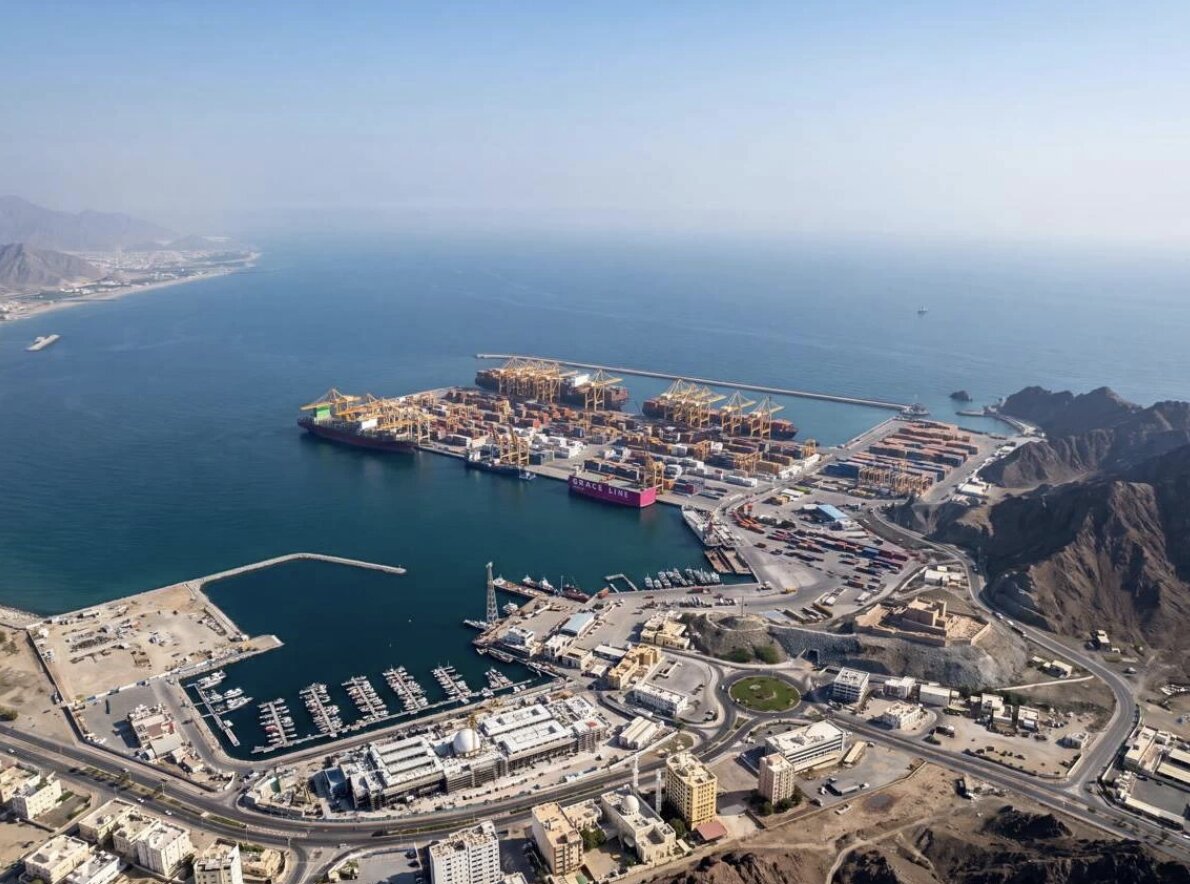
China Reader Daily Wire | 11 August 2026, Tuesday | Vol 3 No. 113
INTERNAL
Opinion: "China export surge disguises structural economic weakness,” The Washington Post
“On the surface, China is on track for another year with a trade surplus topping $1 trillion. Exports surged last month by 24 per cent year-over-year, according to data published Friday. But the domestic economy is showing prolonged weakness. China’s growth dropped to 4.3 per cent in the second quarter of 2026, the lowest in three years, even according to the government’s suspect accounting. Home prices have slumped, and developers and local governments are reeling under piles of debt. Youth unemployment has remained stubbornly around 15 per cent.”
“With weak consumer demand at home, China subsidizes global exports to gin up growth. Makers of electric vehicles, steel companies and other industries receive access to cheap loans, tax breaks, free or inexpensive land at government-run industrial parks, and sometimes direct grants.”
ENERGY AND ENVIRONMENT
Typhoon Dolphin sparks severe flood alerts and temporary closures across central China
On 11 August, Reuters reported that Typhoon Dolphin, the strongest typhoon to hit China this year, travelled nearly 6,000 kilometres across a resilient storm system before making landfall deep into the central, mountainous province of Hubei. The storm has prompted forecasters to issue an orange rain alert, warning that the province's northwestern region could receive up to 250 mm of rain within 24 hours. It comes as peripheral airflow hits the western mountains and intensifies the rainfall multiple times. The severe weather places a heavy burden on Hubei, a major auto and electronics manufacturing hub of 58 million people that was already struck last month by two rare, deadly tornadoes from Typhoon Maysak. In response to the high risk of flooding and landslides, Hubei authorities issued yellow warnings for major cities like Xiangyang, Huanggang, and Suizhou, suspended 26 high-risk highway and waterway construction projects, and closed popular tourist sites, including the Three Gorges Dam in Yichang. Furthermore, the storm's massive reach is drawing moisture northward, prompting a red flash-flood alert in the neighbouring Henan province. It has also forced four outlying districts in Beijing that are located over 1,000 kilometres away to activate Level I emergency flood responses.
(“Typhoon Dolphin's vast storm system pushes inland, threatens central China,” Reuters, 11 August 2026)
https://www.reuters.com/business/environment/typhoon-dolphins-vast-storm-system-pushes-inland-threatens-central-china-2026-08-11/
SCIENCE AND TECHNOLOGY
China raises 28 trillion in capital markets to fund strategic tech race with the US
On 10 August, Quartz reported that China is shifting its technology competition strategy with the United States by utilising its USD 28 trillion stock and bond markets to fund strategic industries. They are doing so while aiming to close a funding gap where US firms lead by over six to one. China now forces private and institutional investors to fund its tech sector, instead of relying solely on direct state subsidies and tax incentives, reducing the financial burden on the government's budget. As tech giants from China are paying an average interest rate of just 1.9 per cent on their bonds, they can borrow money much more cheaply than their US rivals, whose borrowing costs are significantly higher. Memory chipmaker CXMT Corp. exemplified this approach by raising USD 8.6 billion, marking the largest mainland China semiconductor IPO on record and becoming China's most valuable onshore company by reaching a USD 488 billion valuation, surpassing the Industrial and Commercial Bank of China. However, the move relied on massive state intervention and left the firm with less capital than its potential market value. By creating streamlined pathways like the "preliminary review" pilot, China can rapidly pump billions of dollars into critical areas like semiconductor chips and AI, speeding up its timeline to achieve technological independence from the West. Despite risks involving reliance on policy-driven sentiment over fundamentals, tech firms from China are increasingly leveraging this method, with AI companies like Z.AI, MiniMax, and Moonshot AI preparing for domestic listings.
(“China is using its own stock market to fund its race for AI chip dominance,” Quartz, 10 August 2026)
https://qz.com/china-capital-markets-ai-chip-race-cxmt-ipo-081026
CHINA AND SPACE
China’s Long March 7A explodes after liftoff; Marks the second explosion in six years
On 10 and 11 August, Space.com and SCMP reported that the state-owned China Aerospace Science and Technology Corporation (CASC) Long March 7A rocket exploded 85 seconds after liftoff from the Wenchang Space Launch Site on 10 August. The explosion completely destroyed its Zhongxing-4B communications satellite payload. This incident marks the second failure for this specific rocket configuration, as the first failure occurred on 16 March 2020 during its maiden flight. China’s state news agency Xinhua officially stated that the rocket experienced an "anomaly during flight". The CASC has confirmed that the mission was unsuccessful and that the exact cause of the mid-air explosion is currently under active investigation. The incident also triggered an official investigation that could significantly delay upcoming cargo resupply missions to the Tiangong space station.
(“Chinese rocket explodes less than 90 seconds after liftoff,” Space.com, 10 August 2026; “A rare rocket failure led to knock-on effects on China’s space launches. What happened?,” SCMP, 11 August 2026)
https://www.space.com/space-exploration/launches-spacecraft/chinese-rocket-explodes-less-than-90-seconds-after-liftoff
https://www.scmp.com/news/china/military/article/3363574/chinas-long-march-7a-rocket-explodes-after-launch-satellite-lost
DEFENCE
China’s most advanced anti-drone laser spotted above amphibious warfare vessel in South China Sea
On 10 August, SCMP reported that China had deployed its most advanced anti-drone laser above a Type 071 “Qilianshan” amphibious landing vessel in the South China Sea. The Liaoyuan-1 (LY-1) was seen behind the Qilianshan’s 76mm dual-purpose gun. The LY-1 was showcased for the first time during last year’s Victory Day military parade and is tasked with close-range interception of incoming missiles and drones. The People’s Liberation Army’s Navy and Air Force (PLAN, PLAAF) were holding joint air and naval drills in the Scarborough Shoal of the South China Sea as part of the 99th anniversary of the PLA. The Qilianshan is the second Type 071 vessel to be spotted with the LY-1, after the Simingshan was seen with it last October. Experts and analysts claim that the LY-1 on an amphibious warfare ship indicates that China wants to send a “more forceful message,” after tensions flared in the South China Sea between Beijing and Manila last month. The deployment also comes after a US aircraft carrier, USS George Washington, was seen in the South China Sea last month as well.
(“Powerful anti-drone laser spotted on PLA amphibious ship in South China Sea,” SCMP, 10 August 2026)
https://www.scmp.com/news/china/military/article/3363564/powerful-anti-drone-laser-spotted-pla-amphibious-ship-south-china-sea
CHINA AND SOUTHEAST ASIA
Thailand proposes three-point plan to reduce trade deficit with China
On 11 August, The Nation reported that Thailand proposed three measures to address and reduce the trade deficit with China. The projected deficit for the 2016-2026 period is expected to breach USD 374 billion (12.41 trillion Baht). Deputy Prime Minister and Commerce Minister Suphajee Suthumpun stated that Thailand proposed a “co-creation” approach, where it advocated for less reliance on imported Chinese materials and components. She added that she proposed the measures with China’s Vice Premier He Lifeng on the sidelines of the APEC meeting in China in May 2026. The three proposals are to increase the usage of local components and materials, open China’s e-commerce channels for Thailand’s Small and Micro Enterprises (SMEs) and invest in Thailand’s agricultural processing sector.
(“Thailand seeks three-way plan to narrow China trade deficit,” The Nation, 11 August 2026)
https://www.nationthailand.com/business/trade/40069639
Cambodia's Health Minister holds ceremony for China’s traditional medicine practitioners for a year-long mission
On 11 August, The Khmer Times reported that Cambodia’s Health Minister, Professor Chheang Ra, presided over a ceremony to present medals to a team of Chinese traditional medicine specialists from Chengdu, Sichuan province, for completing a year-long medical mission in Cambodia. China’s ambassador to Cambodia, Wang Wenbin, was also present for the ceremony. The Chinese medical team provided direct services to over 11,000 patients across 20 capital and provincial areas. Minister Ra expressed his thanks and gratitude to China’s government and the relevant institutions for their support and cooperation.
(“Chinese Ambassador, Health Minister honour traditional Chinese medicine team completing Cambodia mission,” The Khmer Times, 11 August 2026)
https://www.khmertimeskh.com/501995776/chinese-ambassador-health-minister-honour-traditional-chinese-medicine-team-completing-cambodia-mission/
CHINA AND SOUTH ASIA
China objects to India’s decision to formally assign names to 27 places in Arunachal Pradesh
On 10 August, Deccan Herald reported that in response to India's decision to formally assign names to 27 places and features in Arunachal Pradesh, China opposed and stated it intends to replace the names used in South Tibet. China's Ministry of Foreign Affairs called this decision illegal and invalid and claimed that it would change the fact that South Tibet belongs to China. The Ministry also stated its non-acceptance of Arunachal Pradesh as a state of India. Recently, New Delhi decided to assign standardised names for 27 places and geographical features in Arunachal Pradesh. This tension unfolds as the 25th round of boundary negotiations between the special representatives of India and China will be held in the coming month. ("China protests India's map manoeuvre, reasserts claim over Arunachal Pradesh," Deccan Herald, 10 August 2026)
https://www.deccanherald.com/india/china-protests-indias-map-manoeuvre-reasserts-claim-over-arunachal-pradesh-4106307
Nepal’s PM meets Chinese ambassador; Calls for strengthened cooperation
On 10 August, Republica reported that Prime Minister Balendra Shah discussed the importance of strengthening Nepal’s historic relations with China with Chinese Ambassador to Nepal Zhang Maoming. They also discussed enhancing development partnership and expanding bilateral cooperation across various sectors. The meeting was held after Prime Minister Balendra Shah’s meeting with Indian Ambassador to Nepal Navin Srivastava.
("PM Shah, Chinese envoy discuss strengthening Nepal-China ties, "Republica, 10 August 2026)
https://myrepublica.nagariknetwork.com/news/pm-shah-chinese-envoy-discuss-strengthening-nepal-china-ties-96-88.html
CHINA AND AFRICA
Africa pushes for local solar production amid heavy reliance on Chinese companies
On 10 August, Business Insider Africa reported that, due to rising solar demand, Nigeria, South Africa, Morocco and Ethiopia are planning to expand local solar manufacturing. The current focus is on local assembly. The latest literature shows that Africa is heavily dependent on Chinese imports for high-value solar components. Additionally, between 2010 and 2024, Chinese renewable energy investment and construction projects in Africa reached USD 66 billion. In order to build a local manufacturing base, it requires solar cells, technical skills, finance, electricity and large buyers to sustain the industry. Currently, a one-gigawatt solar manufacturing plan is taking shape in South Africa, Nigeria and Morocco, focusing on panel assembly, and Ethiopia aims to become the global solar manufacturing base. China use this as a production base, and in order to mitigate the effects on China's export policy, the authorities are exploring options to localise production.
("China built Africa’s solar boom, but the continent now wants the factories too," Business Insider Africa, 10 August 2026)
https://africa.businessinsider.com/local/markets/china-built-africas-solar-boom-but-the-continent-now-wants-the-factories-too/8nbw70n
CHINA AND THE MIDDLE EAST
UAE to receive BYD vehicles via new direct logistics corridor
On 09 August, Emirates 24/7 reported that the UAE will receive a shipment of 6,068 new energy vehicles manufactured by Chinese automotive giant BYD through Khorfakkan Port. This new direct maritime shipping route between China's Xiaomo International Logistics Port in Shenzhen and Khorfakkan Port, operated by the Sharjah Ports, Customs and Free Zones Authority, aims to make trade efficient. The news agency reported that the route will minimise potential disruption of vehicles and heavy equipment and ensure supply chain efficiency and reliability. Additionally, they also added that the new route will provide a strategic logistics corridor for Chinese exports to the UAE and the wider Middle East and reduce shipping time by three to five days. ("UAE's Khorfakkan Port to receive record shipment of more than 6,000 BYD electric vehicles from China," Emirates 24/7, 09 August 2026)
https://www.emirates247.com/business/uaes-khorfakkan-port-to-receive-record-shipment-of-more-than-6000-byd-electric-vehicles-from-china/4369
CHINA AND RUSSIA
Satellite imagery shows two Chinese-built pipe racks for LNG2 in the Arctic
On August 10, High North News reported that satellite imagery confirmed that two Chinese-built pipe rack modules arrived at Russia’s Belokamenka yard and were positioned next to the unfinished concrete gravity-based structure (GBS) intended for Arctic LNG 2’s third production train. The latest literature suggests that this delivery illustrates that industrial links between Moscow and Beijing persist despite Western sanctions, which previously halted work on the train's 14 required modules. However, analysts also predict that the overall yard inactivity indicates no immediate resumption of full-scale construction. Operator Novatek is currently prioritising securing sufficient LNG tanker capacity for existing production over completing the third train, given impending European Union import restrictions.
(“Satellite Imagery Sheds New Light on China-Built Module Delivery for Russia’s Arctic LNG 2,” High North News, 10 August 2026)
https://en.highnorthnews.com/politics/satellite-imagery-sheds-new-light-on-china-built-module-delivery-for-russias-arctic-lng-2/1115970
CHINA AND EUROPE
Chinese component found in Royal Navy drones; Investigation concludes no data leak
On August 11, the BBC reported that during a routine cyber vulnerability assessment, the Ministry of Defence (MoD) discovered that cameras on the Royal Navy’s new K3 Scout surveillance drones contained a Chinese-made component. The component transmitted a "heartbeat" signal to a Chinese IP address, raising spying concerns since NATO nations banned Chinese military hardware. However, an MoD investigation confirmed no sensitive data or systems were compromised. The supplier Kraken clarified that a third-party camera vendor included the part. The security vulnerability has been resolved, highlighting the defence sector's ongoing challenge to eliminate reliance on dominant Chinese supply chains.
(“No evidence of data breach after Chinese-made component found in Navy drones, MoD says,” BBC, 11 August 2026)
https://www.bbc.com/news/articles/c4gwl3n7ne7o
CHINA AND THE AMERICAS
Beijing retaliates with anti-dumping levies on US and Mexican pecans
On August 10, SCMP reported that China’s Ministry of Commerce issued a preliminary anti-dumping ruling against imported pecans from the United States and Mexico, citing significant harm to domestic producers. Chinese authorities found that dumped pecan imports surged by 104.5 per cent while consistently undercutting domestic market prices. In response, Beijing imposed provisional cash deposits of 54.3 per cent on American exporters and up to 51.6 per cent on Mexican firms. However, six cooperating Mexican companies secured reduced rates between 17.8 per cent and 23 per cent. Because no US producers participated in the investigation, all American exporters received the maximum duty. Launched in September 2025, Beijing's probe is widely viewed as retaliation against Mexico’s earlier 50 per cent tariff hikes on Chinese goods, a policy that is widely regarded as being implemented under heavy pressure from Washington to prevent Mexico from serving as a transhipment route for Chinese products entering the US market.
(“China hits US, Mexican pecans with preliminary anti-dumping curbs,” South China Morning Post, 10 August 2026)
https://www.scmp.com/economy/global-economy/article/3363556/china-hits-us-mexican-pecans-preliminary-anti-dumping-curbs
China Reader Daily Wire | 10 August 2026, Monday | Vol 3 No. 112
INTERNAL
Newly released data notes decrease in inflation, reports Reuters
On 09 August, Reuters reported that China's producer price inflation decreased to 3.5 per cent in July, down from 4.1 per cent in June. The consumer price index eased to 0.5 per cent, a six-month low. According to the latest literature, lower oil prices and weak domestic demand stand as the main reasons behind this slowdown. Reuters stated that China's economy is running at two speeds. This includes strong factory output and exports but weak household demand due to the property slump and job insecurity. The Chinese Communist Party had pledged stronger fiscal spending on infrastructure projects throughout the year to support growth. The latest literature predicts China's inflation to follow an M-shaped trajectory, alternating rises and falls.
("China July factory-gate inflation eases to 3-month low, CPI slows," Reuters, 09 August 2026)
https://www.reuters.com/world/china/chinas-producer-inflation-eases-july-below-expectations-2026-08-09/
CHINA AND SPACE
China's Shenzhou-23 crew tests physics, VR and muscle health in orbit
On 09 August, CGTN reported that China's space station crew conducted tests on human physiology, advanced technology testing, and equipment maintenance. To monitor and support health research regarding sensitive muscle remodelling under microgravity, the crew used an ultrasound diagnostic device to scan various muscle groups and completed a series of grip strength tests. They also wore virtual reality (VR) devices to complete both individual perception and two-person collaborative interface experiments. They conducted touch-interaction tests with the station's robot, “Xiaohang,” which provided data to optimise the robot's future in-orbit movement planning. They conducted parallel studies that tracked long-term astronaut kinematics and treadmill dynamics; the crew highlighted this by using a 3D camera to capture detailed posture data from a member running on the space treadmill. On the physics front, the astronauts replaced fluid physics experiment samples, cleared out the containerless experiment cabinet's chamber, serviced the axial mechanism electrodes, and cleaned the viewport cover lenses. Finally, the crew concluded with general upkeep, tidying the station's interior and organising onboard supplies.
(“Shenzhou-23 crew keeps full schedule as robot Xiaohang continues learning in orbit,” CGTN, 09 August 2026)
https://news.cgtn.com/news/2026-08-09/Shenzhou-23-crew-stays-busy-as-robot-Xiaohang-learns-in-orbit-1Pt91w3MUYE/p.html
China’s lunar blueprint includes AI robots for patrols and astronaut companionship
On 08 August, SCMP reported that, according to a blueprint by researchers working on China’s lunar base from the China Academy of Space Technology, robot dogs will scout and patrol China’s future moon base. The concept envisions that future crewed lunar missions will utilise a collaborative framework where astronauts lead, while intelligent robots perform scouting, resource mining, and habitat construction. It also suggests that robots will manage daily chores, handle maintenance, and offer social companionship to isolated astronauts. This proposal comes while China aims to land astronauts by 2030 and establish an International Lunar Research Station (ILRS) by 2035. Researchers, however, state that there exist significant challenges, including a lack of lunar data to train AI and the absence of necessary infrastructure for long-distance, remote coordination.
(“China’s lunar research station could be guarded by robot watchdogs, space scientists say,” SCMP, 08 August 2026)
https://www.scmp.com/news/china/science/article/3363149/chinas-lunar-research-station-could-be-guarded-robot-watchdogs-space-scientists-say
CHINA AND TAIWAN
Taiwan’s new defence expenditure to be increased by 16 per cent; Cites increase in Chinese military and navy activities
On 09 August, Reuters reported that Taiwan’s cabinet is expected to propose a 16 per cent annual rise in defence expenditure for 2027, exceeding USD 31 billion (1 trillion Taiwan dollars). The proposal comes amid China’s increased military and naval patrolling activities in the region and also its modernisation efforts in recent months. The details on the proposed budget will be revealed on 20 August, which is expected to include funding for the coast guard, veterans, and ‘special projects,’ exceeding 3 per cent of the GDP. Taiwan is currently holding its annual Han Kuang military exercise, where President Lai Ching-te stated that “preparation in peacetime adds another measure of ?stability and strength ?for our nation.”
(“Taiwan's 2027 defence spending to rise 16%, official media reports,” Reuters, 09 August 2026)
https://www.reuters.com/world/china/taiwans-2027-defence-spending-rise-16-official-media-reports-2026-08-09/
CHINA AND THE PACIFIC
Beijing-Canberra relations reach ‘a more realistic footing ’, says former ambassador to China
On 09 August, SCMP reported that the former ambassador to China from Australia, Graham Fletcher, stated that China-Australia ties have reached a “good enough” baseline relationship. Relations between the two countries became strained due to Australia’s ban on China-based electronics firm Huawei Technologies from its 5G network and its calls for an independent inquiry into the origin of COVID-19, in response to which China placed trade restrictions on Australian products. Relations have slightly improved after the election of Prime Minister Anthony Albanese, with ministerial dialogue resuming and Albanese’s visits to Beijing in 2023 and 2025. Despite the mending efforts, Fletcher highlights two main risks. The first involves Beijing’s pushback on foreign restrictions on its technology and investments, ownership of the Port of Darwin, and political unrest in the Pacific island states. The second risk is a possible military conflict in Taiwan or the broader regional area. Fletcher, working as a non-resident fellow at the Lowy Institute, a Sydney-based think tank, released a report on bilateral relations on Sunday. He previously served as Australia’s ambassador to China from 2019 to 2023.
(“China-Australia relations reach ‘good enough’ baseline, ex-envoy says,” SCMP, 09 August 2026)
https://www.scmp.com/news/china/diplomacy/article/3363442/china-australia-relations-reach-good-enough-baseline-ex-envoy-says
CHINA AND SOUTHEAST ASIA
China issues reminder for Chinese nationals to comply with local laws and regulations in Thailand
On 08 August, Global Times reported that China’s embassy in Thailand issued a notice for its citizens travelling to the country for cultural and sporting activities to comply with local laws and regulations. The notice comes after an incident at Suvarnabhumi Airport where security personnel allegedly made racist gestures to Chinese passengers who violated security measures. The incident was sparked by fans trying to board the flight with a celebrity from China, when a group of passengers violated security measures to board the aircraft to see the celebrity. The embassy called on citizens to interact with the Thai people with “respect, goodwill and openness,” and maintain the friendship between the two under the concept of “China and Thailand as one family.”
(“Chinese Embassy in Thailand issues reminder to nationals participating in cultural and sports activities in Thailand,” Global Times, 08 August 2026)
https://www.globaltimes.cn/page/202608/1367782.shtml
CHINA AND THE MIDDLE EAST
China’s stockpiles cushion oil supply shock triggered by the Hormuz blockade
On 10 August, InvestingLive reported that China is singlehandedly absorbing most of Asia's crude demand drop caused by Middle East supply disruptions during the Iran war. Middle East export flows remain down by roughly 5 million barrels per day despite alternative shipping efforts by Saudi Arabia and the UAE. By drawing on its massive crude stockpile of over 1.2 billion barrels, China has suppressed import demand, with July arrivals down 24.3 per cent. This cushion has masked the severe physical market tightness resulting from the Strait of Hormuz closure. Analysts predict that September presents a vital test as Middle East flows tighten again following a ceasefire breakdown.
(“China's stockpiles are masking the true scale of the Hormuz shock,” InvestingLive, 10 August 2026)
https://investinglive.com/commodities/china-s-stockpiles-are-masking-the-true-scale-of-the-hormuz-shock/
CHINA AND SOUTH ASIA
China lobbies to cancel conference on Tibetan studies in Nepal, reports News18
On 08 August, News 18 reported that China's Ambassador Zhang Maoming lobbied Nepal's authorities to cancel the Tibetan studies international conference. In a meeting with Nepal’s Foreign Ministry, he urged the authorities to be cautious about supportive discussions of Tibet and statements concerning the Dalai Lama. The event is set to host over 500 scholars for a week-long program on Tibetan history and culture. The 17th International Seminar of the International Association for Tibetan Studies is a seven-day event that discusses Tibetan history, culture, and political questions. The latest literature suggested that concerns within the Nepalese government that it would affect Nepal's relationship with China and the conference's stance on Tibetan separatism and China's political activity were the major reasons behind the cancellation.
("Chinese Pressure Forces Nepal To Cancel Major Conference Despite Security Nod | Exclusive," News 18, 08 August 2026)
https://www.news18.com/world/chinese-pressure-forces-nepal-to-cancel-major-conference-despite-security-nod-exclusive-ws-l-10261119.html
India and China hold border talks, maintaining peace along the LAC
On 08 August, The Indian Express reported that at diplomatic talks held on 06 August in New Delhi, India and China reviewed the overall situation along the Line of Actual Control (LAC) to address boundary delimitation, border management, and trans-border cooperation. It was convened under the framework of the Working Mechanism for Consultation and Coordination on India-China Border Affairs (WMCC). The meeting was led by India’s MEA Joint Secretary (East Asia), Sujit Ghosh, and China’s Ministry of Foreign Affairs’ Boundary and Oceanic Affairs Department Director General, Hou Yanqi. Both delegations engaged in frank discussions, ultimately agreeing that maintaining peace and tranquillity in the border regions is foundational to the development of their broader bilateral relationship.
(“India, China review situation on Line of Actual Control,” The Indian Express, 08 August 2026)
https://indianexpress.com/article/india/india-china-review-situation-situation-on-line-of-actual-control-10822210/
CHINA AND AFRICA
Investigation unveils uranium traces in cobalt shipment from DRC, reports RFI
On 09 August, RFI reported that an investigation by Lighthouse Reports, The Financial Times, and Le Monde revealed that significant amounts of uranium are routinely exported from the Democratic Republic of Congo (DRC) inside cobalt shipments primarily to China. Drawing from a confidential 2024 IAEA memo, research estimated 2,000 to 5,000 tonnes of uranium entered China via cobalt hydroxide between 2000 and 2024. Internal records from the CMOC-owned Tenke Fungurume mine showed uranium levels up to 15 times the recommended limit. While CMOC denies violating trade rules or processing uranium, experts have noted that unmonitored uranium contaminants bypass standard removal processes during export.
(“Investigation raises alarm over uranium in DRC cobalt shipments to China,” RFI, 09 August 2026)
https://www.rfi.fr/en/africa/20260809-investigation-raises-alarm-over-uranium-in-drc-cobalt-shipments-to-china
CHINA AND EUROPE
Chinese EV sales witness surge in Europe amidst tariff debates
On 09 August, The Guardian reported that Chinese electric vehicle (EV) sales in Western Europe hit a record 14.2 per cent market share in early 2026, selling 171,800 units. The surge, driven by strong demand in the UK and subsidised purchases in Italy, has intensified calls for tougher trade protections to assist European carmakers. Despite EU tariffs reaching up to 35.3 per cent on pure battery electric vehicles (BEVs), manufacturers like BYD and SAIC continue to expand in the European market. However, analysts predict Chinese BEV growth may temporarily peak as brands exploit a regulatory loophole by shifting focus to untariffed plug-in hybrids.
(“Chinese EV sales surge to new high in Europe putting tariffs under scrutiny,” The Guardian, 09 August 2026)
https://www.theguardian.com/business/2026/aug/09/chinese-electric-car-sales-surge-to-a-record-high-in-europe
CHINA AND THE AMERICAS
Declining stockpiles of US weapons elevate strategic risks with China and Russia reports, The Jerusalem Post
On 09 August, The Jerusalem Post reported that the rapid depletion of US offensive and defensive munitions during the war with Iran has significantly weakened conventional deterrence, resulting in strategic vulnerabilities that Russia and China could exploit. Senior experts warn that these shortages, which include critical reductions in Patriot interceptors, Tomahawks, and tactical ballistic missiles, could persist long past the Trump administration, which may force the Pentagon to shift assets from Europe and Asia to the Middle East. This reallocation impairs troop morale, delays maintenance, and more importantly leaves regional allies like Taiwan, South Korea, and Ukraine increasingly exposed. In response, European allies are seeking alternative arms suppliers, while Asian nations consider developing independent nuclear capabilities. Although President Trump has urged defence contractors to accelerate production to historic levels, the ongoing strain on US arsenals limits military flexibility and risks encouraging adversary aggression.
(“Russia, China could take advantage of low US weapons stockpiles to start war with America - NYT,” The Jerusalem Post, 09 August 2026)
https://www.jpost.com/international/article-904979
US rejects Beijing’s natural reserve claims in the South China Sea
On 08 August, Al Jazeera reported that the US State Department criticised China’s attempt to designate the disputed Scarborough Reef as a "national nature reserve," calling it a legal and environmental pretext to expand its territorial sovereignty. Washington stated that Beijing’s actions aim to deny Filipino fishermen access to traditional waters through coercive measures. The statement reaffirmed US support for the Philippines, following recent incidents where Chinese vessels used water cannons against Filipino ships. Although international arbitration previously rejected China's expansive "nine-dash line" claims, Beijing continues to dismiss the ruling while asserting authority over the contested maritime region. The US State Department released the following statement: "The United States rejects China’s ongoing attempts to enforce its destabilizing ‘national nature reserve’ at Scarborough Reef and deny Filipino fishermen access to their traditional fishing ground."
(“US slams Chinese ‘nature reserve’ as effort to claim South China Sea,” Al Jazeera, 08 August 2026; "China’s “Administrative Measures” at Scarborough Reef," US State Department, 08 August 2026)
https://www.aljazeera.com/news/2026/8/8/us-slams-chinese-nature-reserve-as-effort-to-claim-south-china-sea
https://www.state.gov/releases/office-of-the-spokesperson/2026/08/chinas-administrative-measures-at-scarborough-reef
China Reader Daily Wire | 07 August 2026, Friday | Vol 3 No. 111
INTERNAL
SCO concludes Tianshan-2026 Cyber Anti-Terrorism drills in China
On 06 August, CGTN reported that delegations from the Shanghai Cooperation Organization (SCO) completed a joint cyber anti-terrorism exercise called "Tianshan-2026" in Urumqi, China. The drill focused on modern, digital terrorism threats by simulating scenarios where extremist groups used online platforms to spread ideology, recruit members, and plan attacks. Participating teams worked together, tracked digital threats, and coordinated with offline law enforcement. SCO officials praised China's organization of the exercise, noting that it successfully improved mutual trust and strengthened the region's shared ability to combat cyber terrorism.
(“SCO member states hold cyber anti-terrorism exercise in Xinjiang,” CGTN, 06 August 2026)
https://news.cgtn.com/news/2026-08-06/SCO-member-states-hold-cyber-anti-terrorism-exercise-in-Xinjiang-1PnStz1crsY/p.html
ENERGY AND ENVIRONMENT
China escalates emergency response actions as Typhoon Dolphin approaches
On 07 August, CGTN reported that China’s meteorological, marine, water resources, and agricultural authorities have escalated emergency response measures as Typhoon Dolphin entered the country's 48-hour warning zone. The typhoon is moving steadily westward with an extensive wind field, and forecasters state that it is expected to generate dangerous 4-to-7-meter waves in the East China Sea. Authorities are utilizing advanced artificial intelligence and digital twin systems to simulate flood risks and improve forecasting accuracy. Experts warn that because the storm will slow down near the coast, these hazardous sea conditions may be difficult to perceive from the shoreline, making it crucial for the public to avoid the coast. Upon making landfall, the typhoon, according to forecasts, is expected to bring prolonged torrential rainfall across multiple provinces, including Zhejiang, Fujian, Jiangxi, Hunan, Hubei, Anhui, Jiangsu, Henan, and Shandong. They also warn of the heightened risk of flash floods and landslides where soil is already saturated. Fishing vessels have been ordered back to port to minimize agricultural and coastal losses. Fishermen are evacuating ashore, and farmers are rushing to clear drainage channels, harvest mature crops early, and reinforce greenhouses and livestock shelters.
(“China strengthens coordinated disaster response as Typhoon Dolphin enters 48-hour warning zone,” CGTN, 07 August 2026)
https://news.cgtn.com/news/2026-08-07/China-steps-up-coordinated-tech-enabled-response-to-Typhoon-Dolphin-1Pptw1EmPJu/p.html
CHINA AND SPACE
China to build a planetary protection lab for Tianwen-3 Mars sample-return mission
On 06 August, CGTN reported that China is advancing its Tianwen-3 Mars sample-return mission for which it will construct a planetary protection laboratory during the first phase of its Deep-Space Science City in Hefei, Anhui Province. The Mars sample-return mission aims to launch a spacecraft around 2028 and bring Martian soil and rock samples to Earth by 2031. The lab is being built to safely handle these materials, and the Deep Space Exploration Laboratory (DSEL) will be operating in parts of the operations. The lab will enforce a strict two-way protection system designed to prevent Earth organisms from contaminating Mars and to safeguard Earth's biosphere from any potential extraterrestrial biological risks during sample unsealing, sterilization, and testing. This interplanetary effort builds directly upon the success of China's Zhurong rover, which landed on Mars in May 2021. It traveled nearly two kilometers to gather extensive scientific data, paving the way for these upcoming research breakthroughs.
(“China to build planetary protection lab for Mars sample-return mission,” CGTN, 06 August 2026)
https://news.cgtn.com/news/2026-08-06/China-to-build-planetary-protection-lab-for-Mars-sample-return-mission-1Po6fwqDkPK/p.html
CHINA AND EAST ASIA
China is closer to developing lithography technology to manufacture sub 7nm chips, says The Korean Herald
On 06 August, The Tribune reported that China is close to developing its own immersion deep-ultraviolet (DUV) lithography system, which can theoretically enable it to produce sub 7nm semiconductor chips, per a report by The Korean Herald. China is currently blocked from accessing the most advanced lithography systems due to US export control restrictions and has primarily relied on pushing older DUV equipment to produce sub 7nm chips. South Korean experts claim that despite a working model developed by China, scaling it to mass production and profitability is in question and will take “considerable time before China can produce meaningful results.” Experts add that the latest development poses little threat to South Korean chip giants such as Samsung and SK Hynix, but if China is willing to absorb low profits, it may close down the technology gap.
(“China's homegrown DUV tool jolts chip industry, but commercial yield test still looms,” The Tribune, 06 August 2026)
https://www.tribuneindia.com/news/business/chinas-homegrown-duv-tool-jolts-chip-industry-but-commercial-yield-test-still-looms/
CHINA AND THE PACIFIC
China’s ballistic missile test to be top agenda in Pacific island countries’ Foreign Ministers' meeting
On 07 August, The Hindustan Times reported that the top agenda to be discussed in the upcoming Foreign Ministers' meeting of Pacific Island nations will be China’s test of a nuclear-capable submarine-launched ballistic missile (SLBM) over the region. The Foreign Ministers' meeting in Suva, Fiji, which is to be held on Friday, comes ahead of the Pacific Islands Forum, an annual meeting of the heads of state of the countries in the region in September. China has considerable influence within some member states, such as Kiribati, Nauru, and Vanuatu, where Beijing is their largest trading partner. The ministers are also set to discuss the Pacific Forum’s regional architecture, determining “key partners” to be invited for the leaders' meeting in September.
(“China missile test top of agenda as Pacific diplomats meet in Fiji,” The Hindustan Times, 07 August 2026)
https://www.hindustantimes.com/world-news/china-missile-test-top-of-agenda-as-pacific-diplomats-meet-in-fiji-101786045054179.html
CHINA AND SOUTHEAST ASIA
China and Thailand expand technology and educational cooperation
On 07 August, China Daily reported that a delegation of young Chinese entrepreneurs visited Bangkok to explore expanding bilateral cooperation in digital technologies and education. The delegation was supported by the China International Development Cooperation Agency. The tour included exchanges with officials from Thailand's Digital Economy Promotion Agency and local industry leaders. Thai representatives also welcomed Chinese investment in AI and gene technology, highlighting how China's recent advancements can also bolster Thailand's healthcare startup ecosystem. Additionally, the delegation also visited the China-Thailand Luban Workshop to assess opportunities in vocational training, making note of the fact that deepening technological cooperation drives strong demand for skilled professionals across the Greater Mekong Subregion.
(“Potential seen for Sino-Thai tech cooperation,” China Daily, 07 August 2026)
https://www.chinadaily.com.cn/a/202608/07/WS6a752e62a310986e2b469764.html
CHINA AND SOUTH ASIA
India-China-Bhutan tri-junction rail project in final stages of approval, reports The Economic Times
On 05 August, The Economic Times reported that the West Bengal government has approved fast-tracking the acquisition of around 380 hectares of land for strategic railway projects near the India-China-Bhutan tri-junction. This clearance revives the stalled 20 km Chalsa-Naxalbari rail line, which was previously stalled. Following the monsoon, the Railways and West Bengal Forest Department will conduct a joint survey to finalise the alignment. Primarily, the project aims to strengthen the regional defence connectivity and boost local tourism.
(“Trains to go near India-China-Bhutan tri-junction as Bengal fast-tracks land acquisition for key projects near Doklam,” The Economic Times, 05 August 2026)
https://m.economictimes.com/industry/transportation/railways/trains-to-go-near-india-china-bhutan-tri-junction-as-bengal-fast-tracks-land-acquisition-for-key-projects-near-doklam/articleshow/132914163.cms
Beijing and New Delhi seek peaceful border management at 36th WMCC Meeting
On 07 August, Global Times reported that China and India held the 36th meeting of the Working Mechanism for Consultation and Coordination on Border Affairs (WMCC) in New Delhi on August 6. Co-chaired by senior diplomatic officials alongside defense and immigration representatives, both sides discussed issues regarding boundary delineation, border management, and cross-border cooperation. Both parties have also agreed to maintain continuous communication through diplomatic and military channels to jointly safeguard peace along the border and its vicinity.
(“China, India hold meeting on border affairs, pledge to jointly safeguard peace and tranquility in border areas,” Global Times, 07 August 2026)
https://www.globaltimes.cn/page/202608/1367733.shtml
CHINA AND THE AMERICAS
Washington demands transparency from Beijing over transnational crime syndicates
On 07 August, MSN reported that the US President Donald Trump has directly raised concerns with China’s President Xi Jinping regarding Southeast Asian cyber scam compounds targeting Americans. Despite the expanding law enforcement cooperation between the FBI and Chinese police, Washington remains highly sceptical of Beijing's actions against transnational fraud syndicates. Testimony before the US Senate Foreign Relations Committee by Michael DeSombre, assistant secretary of state for East Asian and Pacific affairs, highlighted the growing concerns that China selectively targets syndicates defrauding Chinese citizens while showing opacity regarding the prosecution of extradited ringleaders. Furthermore US officials have also warned that Chinese law enforcement's selective crackdowns lack transparency thereby making it difficult to verify if the deported criminal bosses face genuine punishment. To prevent intelligence loss and ensure accountability Washington is now pressing partner nations to allow US access to captured scam leaders as these criminal networks expand globally at a fast pace.
(“US presses China over alleged scam bosses despite growing police cooperation,” MSN, 07 August 2026)
https://www.msn.com/en-xl/news/other/us-presses-china-over-alleged-scam-bosses-despite-growing-police-cooperation/ar-AA29yRl3?ocid=BingNewsVerp
China Reader Daily Wire | 06 August 2026, Thursday | Vol 3 No. 110
INTERNAL
Scientific and technological modernisation is key to Chinese modernisation, says President Xi
On 06 August, CGTN reported that President Xi, while examining the National Information Technology Application Innovation Park in Beijing's E-Town, stated that scientific and technological modernisation is key to Chinese modernisation. He said, "The extent of scientific and technological breakthroughs largely determines the speed, breadth, and depth of the development of future industries." During the visit, he examined developments in information technology innovation and exhibitions showcasing advances in artificial intelligence (AI) and robotics. Additionally, he stated that self-reliance and strength in science and technology are the keys to building China into a great modern socialist country.
("Xi underscores sci-tech innovation to advance China's modernisation," CGTN, 06 August 2026)
https://news.cgtn.com/news/2026-08-06/Xi-underscores-sci-tech-innovation-to-advance-China-s-modernization-1PmbnQr21fW/p.html
MILITARY
PLA showcases air-borne nuclear strike capability
On 06 August, China Daily reported that authorities released video clips of an H-6N strategic bomber flying alongside two J-20 stealth fighter jets, carrying what appears to be a JL-1 nuclear-capable air-launched ballistic missile under its belly. The news agency reported that it is the first time the People's Liberation Army has showcased its airborne nuclear strike capability. PLA is yet to release more details about the operation. The video was jointly released by the Central Military Commission's Political Work Department, the Cyberspace Administration of China, and the China Media Group.
("China's air-borne nuclear strike system revealed in military video," China Daily, 06 August 2026)
aily.com.cn/a/202608/04/WS6a71d50da310986e2b468f40.html
CHINA AND SPACE
Shenzhou-21 astronauts brief mission outcomes in a press conference
On 06 August, Xinhua reported that China's Shenzhou-21 astronauts held their first press conference. The mission commander, Zhang Lu, said, "The emergency response system of China's manned space program withstood a real-world test during our stay. From handling a spacecraft impact by space debris, adjusting our orbital schedule and switching return vehicles, to executing an emergency launch, the entire system operated seamlessly to ensure our safety." Payload specialist Zhang Hongzhang shared scientific breakthroughs, including China's first successful aeroponic cultivation of cherry tomatoes and wheat in orbit, and the first closed-loop breeding of mice in space.
("China Focus: Shenzhou-21 crew makes first public appearance after record 210-day space mission," Xinhua, 06 August 2026)
https://english.news.cn/20260805/5af893950e3441498c6aef3c4333ec29/c.html
CHINA AND TAIWAN
Taiwan to block China-run youth camp
On 05 August, Focus Taiwan reported that Taiwan’s government is seeking to block a Chinese-run youth exchange camp over alleged violations of the Cross-Strait Act. Taiwan’s Mainland Affairs Council Minister Chiu Chui-cheng stated that the China-run camp sought to find employment and educational opportunities for Taiwanese youth, violating Articles 23 and 34 of the Act. The “Taiwan Youth e-Home” is an initiative started by China’s Taiwan Affairs Council. Article 23 requires individuals and organisations to obtain prior government approval before recruiting students in Taiwan to Chinese educational institutions, while Article 34 permits select advertisements or promotional activities in Taiwan for Chinese goods, services, or other matters.
(“Taiwan seeks to block China-run youth platform,” Focus Taiwan, 05 August 2026)
https://focustaiwan.tw/politics/202608050016
CHINA AND EAST ASIA
Japan tests upgraded version of anti-ship missile in a bid to increase deterrence against China
On 05 August, SCMP reported that Japan had tested out an upgraded version of the Type-12 guided anti-ship ballistic missile. The Type-12 ground-to-air missile system was publicly showcased in June during the Fuji firepower military exercise. The dummy replica of the missile was seen publicly on a Mitsubishi F-2B fighter, indicating that the government is working on an air-to-air missile variant. Experts and analysts have claimed that the latest development significantly increases Japan’s capabilities for deterring China in the region and improves upon Japan’s anti-ship arsenal, as the Type 12 is locally developed and is capable of being mass-manufactured.
(“Japan tests long-range Type 12 missile as counterstrike capability against China grows,” SCMP, 05 August 2026)
https://www.scmp.com/news/china/military/article/3363052/japan-tests-long-range-type-12-missile-counterstrike-capability-against-china-grows
China’s military activities are a matter of serious concern to Japan, says Tokyo’s defence paper; Beijing rejects the claims
On 04 August, CNN reported that Japan released a paper which listed out threats posed by North Korea, China and Russia to increase arms production to support economic growth. The white paper is the latest in a series of military and defence reforms by the Sanae Takaichi administration. The paper argued for increased state spending on arms production in an effort to drive economic growth. It also stated that China’s military activities are a “matter of serious concern to Japan,” and that they “represent Japan’s greatest strategic challenge.” Much of the latest defence expenditure has gone into missile and rocket technology. China has strongly rejected Japan’s "Defence of Japan 2026" white paper, which has labelled Beijing’s military activities an "unprecedented" strategic challenge and a "matter of serious concern". The 600-page document highlighted intensified Chinese operations, which included Pacific aircraft carrier deployments, while warning of efforts to normalise a military presence around Taiwan. The spokesperson for China’s defence ministry, Chen Xi, has accused Japan of spreading false narratives and labelled it as inventing excuses to evade restrictions on its defence forces. Vehemently reaffirming that Taiwan remains an uncrossable red line, Spokesperson Chen has urged Japan to reflect on its history of aggression and cease interfering in China’s ‘domestic’ affairs.
(“China rejects Japan's defence white paper calling its military activities 'unprecedented' strategic challenge,” Anadolu Ajans?, 05 August 2026)
(“Japan outlines its military build-up plan, citing threats from China, Russia and North Korea,” CNN, 04 August 2026)
https://edition.cnn.com/2026/08/04/asia/japan-military-white-paper-cite-china-russia-and-north-korea-threat-intl-hnk
https://www.aa.com.tr/en/asia-pacific/china-rejects-japans-defense-white-paper-calling-its-military-activities-unprecedented-strategic-challenge/4019191
CHINA AND SOUTH ASIA
Rail project in the vicinity of India-China-Bhutan tri-junction gets fast-tracked
On 05 August, The Economic Times reported that the West Bengal government has approved fast-tracking the acquisition of around 380 hectares of land for strategic railway projects near the India-China-Bhutan tri-junction. This clearance revives the stalled 20 km Chalsa-Naxalbari rail line, which was previously stalled. Following the monsoon, the Railways and West Bengal Forest Department will conduct a joint survey to finalise the alignment. Primarily, the project aims to strengthen the regional defence connectivity and boost local tourism.
(“Trains to go near India-China-Bhutan tri-junction as Bengal fast-tracks land acquisition for key projects near Doklam,” The Economic Times, 05 August 2026)
https://m.economictimes.com/industry/transportation/railways/trains-to-go-near-india-china-bhutan-tri-junction-as-bengal-fast-tracks-land-acquisition-for-key-projects-near-doklam/articleshow/132914163.cms
CHINA AND AFRICA
Senegal to increase space capabilities with China
On 08 August, Tech Review Africa reported that the Senegalese Agency for Space Studies (ASES) visited Beijing to strengthen space cooperation between Senegal and China. Both countries agreed to increase collaboration and discussed ways to support Senegal's strategic development priorities through space technologies. The officials from Senegal held a meeting with major Chinese stakeholders in the space industry and research community.
("Senegal strengthens space cooperation with China through high-level visit to Beijing," Tech Review Africa, 08 August 2026)
https://techreviewafrica.com/news/6610/senegal-strengthens-space-cooperation-with-china-through-high-level-visit-to-beijing
CHINA AND THE AMERICAS
US drafts new nuclear strategy addressing Russia and China
On 05 August, Wion News reported that the US Department of Defence, led by the Deputy Secretary Elbridge Colby, is drafting a revised nuclear strategy to prepare for potential regional conflict with China or Russia. The proposal shifts focus toward short-range tactical nuclear weapons aiming to deter conventional war from escalating and deny adversaries regional advantages. Unlike the traditional reliance on long-range strategic systems, this internal plan reshapes retaliatory options provided to the US president. However, specialists warn that reliance on tactical options might weaken strategic deterrence. The strategy emerged as the last US-Russia arms control treaty lapsed in February 2026, prompting Eastern NATO allies to seek to host US nuclear assets.
(“Pentagon draws up new nuclear strategy in the event of war with Russia and China,” Wion News, 05 August 2026)
https://www.wionews.com/world/pentagon-draws-up-new-nuclear-strategy-in-the-event-of-war-with-russia-and-china-1785952387235
China Reader Daily Wire | 31 March 2026, Tuesday | Vol 3 No. 54
DEFENCE
China’s indigenous cargo drone NORINCO LUCA makes successful maiden flight, reports Global Times
On 31 March, Global Times reported that the fully domestically developed NORINCO LUCA large cargo unmanned aerial vehicle (UAV) successfully completed its maiden flight. According to its developer from China's state-owned Norinco Group, it is now the largest logistics unmanned cargo aircraft in the world to have achieved a successful first flight, marking the arrival of China's first 7-ton-class fixed-wing "unmanned aerial heavy truck" in the low-altitude economy and expanding the range of potential applications. Chief Designer Geng Jianzhong said: “In emergency scenarios, it can carry 1,750 winter jackets weighing 2 kilograms each, or 700 standard disaster-relief tents. From an industrial logistics perspective, this capacity is sufficient to transport large mechanical components - even, in some cases, an entire production line.” (“China’s first 7-ton fully indigenous cargo drone NORINCO LUCA makes successful maiden flight, expanding low-altitude logistics capabilities,” Global Times, 31 March 2026)
CHINA & EAST ASIA
China sanctions Japanese lawmaker for colluding with Taiwan, reports SCMP
On 30 March, SCMP reported that Beijing has imposed sanctions on Japanese lawmaker Keiji Furuya for allegedly “colluding with the Taiwan independence forces.” China’s Ministry of Foreign Affairs said: “Japanese House of Representatives member Keiji Furuya, despite strong opposition from China, has repeatedly made provocative visits to Taiwan and colluded with ‘Taiwan independence’ separatist forces, seriously violating the one-China principle.” Furuya, 73, is a lawmaker with Japan’s ruling Liberal Democratic Party and a close aide to Prime Minister Sanae Takaichi. Furuya has visited the self-ruled island many times, including most recently in March when he met Taiwanese leader William Lai Ching-te. Under the Law on Countering Foreign Sanctions, Beijing will freeze all Furuya’s properties and other types of assets within China, according to the foreign ministry statement. (“Beijing sanctions Japanese lawmaker for ‘colluding with Taiwan independence forces’,” SCMP, 30 March 2026)
CHINA & THE AMERICAS
Chinese Consulate in Chicago calls to end to discriminatory laws, reports Global Times
On 31 March, Global Times reported that in response to a media inquiry over the death of a Chinese scholar who tragically died by suicide the day after being questioned by US law enforcement officers. Consulate General of the People's Republic of China in Chicago said in a statement published online on that the case occurred at a US university within the consulate’s consular district, and that the Chinese side is deeply saddened by the tragedy. The consulate in Chicago has promptly contacted the family of the individual and provided active assistance to help handle the aftermath. The spokesperson said China strongly urges the US to conduct a thorough investigation into the case, provide a responsible explanation to the victim’s family and the Chinese side, stop discriminatory law enforcement targeting Chinese students and scholars in the US, and cease fabricating wrongful and unjust cases. The Chinese government attaches great importance to safeguarding the legitimate rights and interests of Chinese nationals, including students studying overseas. (“Chinese Consulate in Chicago urges probe, end to discriminatory law enforcement after Chinese scholar dies in US,” Global Times, 31 March 2026)
MARITIME
China's hovercraft can carry 500 troops, reports Naval News
On 30 March, Naval News reported that China is building a unique Zubr-class hovercraft that can carry 500 troops, or three main battle tanks (MBTs) or 10 lighter armoured fighting vehicles (AFVs) and 230 troops. It can carry them at speeds of over 55 knots, overcome beaches that other landing craft could not face, and deliver the troops directly to the fight. Now China is building a fleet of this giant hovercraft, which may be an indicator of increased preparedness for an invasion of Taiwan. Now China is building a fleet of these giant hovercraft, which may be an indicator of increased preparedness for an invasion of Taiwan. (“China building more giant Zubr-class hovercraft,” Naval News, 30 March 2026)
CHINA & TAIWAN
Taiwan’s KMT leader to visit China to aid peace relations, reports SCMP
On 30 March, SCMP reported that the chairwoman of Taiwan’s main opposition party, the Kuomintang (KMT), Cheng Li-wun. Cheng expressed gratitude for the invitation and said she hoped joint efforts by the parties could “promote cross-strait exchanges and cooperation, and seek peace and stability in the Taiwan Strait region and the well-being of the people on both sides”, according to a statement by her office. Cheng stressed that the visit would be conducted under the KMT’s long-standing framework – opposition to Taiwan independence and adherence to the 1992 consensus, which Beijing insists is the basis for engagement. Cheng said: “By opposing Taiwan independence, we can avoid war; through the 1992 consensus, we can create peace,” she said. “We want to demonstrate to the people of Taiwan and to the world that conflict across the strait is not inevitable.” (“Taiwan’s Kuomintang leader to visit mainland China to aid ‘peaceful’ relations: Beijing,” SCMP, 30 March 2026)
CHINA & EAST ASIA
and North Korea resume direct flights after 6 years, reports AP
On 30 March, AP reported that China’s flag carrier resumed direct flights between Beijing and North Korea’s capital of Pyongyang. The Air China flight was welcomed by the Chinese ambassador to North Korea, Wang Yajun, and other diplomats. Flights and passenger trains to North Korea had been suspended since the beginning of the COVID-19 pandemic in 2020. North Korean carrier Air Koryo resumed flights between the capitals in 2023. Chinese tour groups had made up 90 per cent of all visitors to North Korea before the ban, and the delay on resuming Chinese tours surprised observers. China is Pyongyang’s biggest trading partner and major ally. Still, Beijing has expressed disapproval over the years at North Korea’s test-launches of missiles that could be used to target South Korea and the United States. (“China resumes direct flights to North Korea after 6 years,” AP, 30 March 2026)
CHINA & AFRICA
China and Kenya partner to complete rail project, reports SCMP
On 31 March, SCMP reported that Kenya revived construction on its multibillion-dollar Standard Gauge Railway (SGR) extension that had stalled more than six years ago. Replacing heavy sovereign debt with innovative financing after renegotiating its loans with China. According to Kenyan officials, the Chinese firm China Communications Construction Company (CCCC) and its subsidiary, China Road and Bridge Corporation (CRBC), will build the railway’s two remaining sections at an estimated cost of USD 5.4 billion. The modern infrastructure replaces the “Lunatic Express”, the British-built metre-gauge railway in service since 1901. (“China and Kenya partner to finish ‘most consequential’ rail project,” SCMP, 31 March 2026)
China Reader Daily Wire | 27 March 2026, Friday | Vol 3 No. 53
CHINA & THE AMERICAS
Trump to visit China in May after delay amid Iran war, reports Reuters
On 25 March, Reuters reported that US President Donald Trump said he would meet Chinese President Xi Jinping in May. Trump's effort to reschedule the trip reflected the Republican president's eagerness to project confidence in a challenging Middle East war and simultaneously to manage a tense relationship between the world's biggest economies. He posted “Our Representatives are finalizing preparations for these Historic ?Visits," Trump said. "I look very much forward to spending time with President Xi in what will be, I ?am sure, a Monumental Event.” China’s embassy said it had no information to provide on the announcement of the visit. Beijing normally does not ?detail Xi's schedule more than a few days in advance. (“Trump plans May visit to China for talks with Xi after Iran war delay,” Reuters, 25 March 2026)
S&T
China opens largest ship data set, reports SCMP
On 26 March, SCMP reported that a Chinese military research team released a visible light-infrared ship detection data set, a resource that could sharpen maritime target recognition for drones, missiles or surveillance systems operating at night or in environments where radar is degraded or suppressed. The dual-modal ship detection (DMSD) data set contains more than 2,000 paired visible and infrared vessel images and nearly 20,000 annotated instances. Ship recognition at sea is markedly harder than object detection on land. Maritime environments are shaped by glare, shifting weather, long-range imaging degradation and cluttered backgrounds, all of which can undermine classification accuracy. (“China opens world’s largest ship data set that could be used to train drones,” SCMP, 26 March 2026)
OUTER SPACE
China has launched two Long March-2D carrier rockets, according to Global Times
On 26 March, Global Times reported that China launched the Long March-2D carrier rocket, placing two new satellites into space. It was blasted from Taiyuan Satellite Launch Centre in north China's Shanxi Province and sent the pair of satellites, Siwei Gaojing-2 05 and Siwei Gaojing-2 06, into their preset orbit. It was the 634th flight mission of the Long March series rockets. The Long March-2D (CZ-2D) is a highly reliable, two-stage Chinese launch vehicle developed by the Shanghai Academy of Spaceflight Technology (SAST), often used for LEO and SSO missions. (“China launches two new satellites,” Global Times, 26 March 2026)
CHINA & EAST ASIA
China demands punitive actions against the officer who breached the Chinese embassy, reports Reuters
On 25 March, Reuters reported that China's Ministry of Foreign Affairs demanded that Japan conduct an investigation into and ?severely punish an officer from the Self-Defence Forces who was arrested on suspicion of breaking into the Chinese embassy in Tokyo. The suspect, identified by Tokyo's Metropolitan Police Department as 23-year-old Kodai Murata, allegedly scaled the embassy wall carrying a knife. Chinese foreign ministry spokesperson Lin Jian, speaking at a regular press briefing in Beijing, said the incident had "seriously threatened the ?safety of embassy personnel and damaged its dignity." Lin said: “We once again urge the Japanese side to conduct a thorough investigation into the incident immediately, severely punish the perpetrator and provide the Chinese side with a responsible explanation.” (“China demands Japan punish military officer who breached embassy in Tokyo,” Reuters, 25 March 2026)
CHINA & SOUTHEAST ASIA
CCG warns against the Philippines provocative actions in the South China Sea, reports Global Times
On 25 March, Global Times reported that the Chinese Coast Guard issued a warning against the Philippines' provocative actions in the South China Sea. CCG spokesperson, Liu Dejun, noted that the Philippine side assembled a large number of ships to intrude into the training area under the pretext of "fishing," attempting to stir up trouble, sensationalise the situation and grab international attention. He said: “CCG will continue to carry out rights-protection and law-enforcement activities in the waters of China's Huangyan Dao in accordance with the law, and will resolutely safeguard China's territorial sovereignty and maritime rights and interest.” (“CCG spokesperson warns Philippine side to immediately cease its provocative acts and smear campaigns,” Global Times, 25 March 2026)
CHINA & AFRICA
Egypt’s foreign minister hails China’s role in mediating peace in West Asia, reports Global Times
On 26 March, Global Times reported that Egyptian Foreign Minister Badr Abdelatty raised "the excellent and very friendly" relationship between Egypt and China, highlighting Beijing's constructive role in addressing Middle East challenges. He said: “We share the same views and objectives of promoting dialogue and diplomacy to resolve existing problems, because wars only result in destruction.” hinese Foreign Minister Wang Yi held a phone call with Abdelatty to discuss the situation in the Middle East, which the Egyptian minister described as "warm and constructive." We value an excellent and very friendly relationship between Egypt and China, and this year is commemorating the 70th anniversary of the establishment of the relationship between the two great countries. (“Egypt FM hails China's constructive role in addressing Mideast challenges,” Global Times, 26 March 2026)
CHINA & EUROPE
Chinese firms’ port plans blocked by UK government, reports BBC
On 26 March, the BBC reported that the Chinese renewable energy company Ming Yang plans to open the UK's largest wind turbine manufacturing plant in the Highlands, but this plan has been blocked by the UK government. Ming Yang proposed a USD 1.5 billion facility in Ardersier Port near Nairn. The firm was disappointed by the UK government’s decision. The UK government said the turbines from the facility would not be suitable for UK offshore wind projects, and it could not support their use. Scottish government criticised the time it took to reach a decision and warned it would have "far-reaching consequences." Trade Minister Sir Chris Bryant said the government had to be sure the investment in the port was "safe and secure." (‘Chinese firm's Highland port plans blocked by UK government,” BBC, 26 March 2026)
China FM meets British PM advisor on spillover effects of Iran war
On 23 March, Global Times reported that China’s Foreign Minister Wang Yi met with the British Prime Minister's national security adviser, Jonathan Powell. Wang noted spillover effects of the situation in Iran have expanded, and the prolonged war will only bring more damage and serious aftereffects. He said: “What all parties should do now is not to add fuel to the fire but to address the root cause and jointly bring the issue back to the track of political settlement through dialogue and negotiation.” He added “It also shows that as long as both sides move toward each other and engage in constructive communication, they can properly address challenges and issues to achieve mutual benefit and win-win results.” Powell said: “British side is willing to work with China to implement the outcomes of Prime Minister Starmer's visit to China, enhance communication and cooperation, and jointly develop a long-term and consistent comprehensive strategic partnership.” (“China's top diplomat meets British PM's national security adviser,” Global Times, 23 March 2026)
China Reader Daily Wire | 26 March 2026, Thursday | Vol 3 No. 52
S&T
China opens largest ship data set, reports SCMP
On 26 March, SCMP reported that a Chinese military research team released a visible light-infrared ship detection data set, a resource that could sharpen maritime target recognition for drones, missiles or surveillance systems operating at night or in environments where radar is degraded or suppressed. The dual-modal ship detection (DMSD) data set contains more than 2,000 paired visible and infrared vessel images and nearly 20,000 annotated instances. Ship recognition at sea is markedly harder than object detection on land. Maritime environments are shaped by glare, shifting weather, long-range imaging degradation and cluttered backgrounds, all of which can undermine classification accuracy. (“China opens world’s largest ship data set that could be used to train drones,” SCMP, 26 March 2026)
OUTER SPACE
China has launched two Long March-2D carrier rockets, according to Global Times
On 26 March, Global Times reported that China launched the Long March-2D carrier rocket, placing two new satellites into space. It was blasted from Taiyuan Satellite Launch Centre in north China's Shanxi Province and sent the pair of satellites, Siwei Gaojing-2 05 and Siwei Gaojing-2 06, into their preset orbit. It was the 634th flight mission of the Long March series rockets. The Long March-2D (CZ-2D) is a highly reliable, two-stage Chinese launch vehicle developed by the Shanghai Academy of Spaceflight Technology (SAST), often used for LEO and SSO missions. (“China launches two new satellites,” Global Times, 26 March 2026)
CHINA & EAST ASIA
China demands punitive actions against the officer who breached the Chinese embassy, reports Reuters
On 25 March, Reuters reported that China's Ministry of Foreign Affairs demanded that Japan conduct an investigation into and ?severely punish an officer from the Self-Defence Forces who was arrested on suspicion of breaking into the Chinese embassy in Tokyo. The suspect, identified by Tokyo's Metropolitan Police Department as 23-year-old Kodai Murata, allegedly scaled the embassy wall carrying a knife. Chinese foreign ministry spokesperson Lin Jian, speaking at a regular press briefing in Beijing, said the incident had "seriously threatened the ?safety of embassy personnel and damaged its dignity." Lin said: “We once again urge the Japanese side to conduct a thorough investigation into the incident immediately, severely punish the perpetrator and provide the Chinese side with a responsible explanation.” (“China demands Japan punish military officer who breached embassy in Tokyo,” Reuters, 25 March 2026)
CHINA & SOUTHEAST ASIA
CCG warns against the Philippines provocative actions in the South China Sea, reports Global Times
On 25 March, Global Times reported that the Chinese Coast Guard issued a warning against the Philippines' provocative actions in the South China Sea. CCG spokesperson, Liu Dejun, noted that the Philippine side assembled a large number of ships to intrude into the training area under the pretext of "fishing," attempting to stir up trouble, sensationalise the situation and grab international attention. He said: “CCG will continue to carry out rights-protection and law-enforcement activities in the waters of China's Huangyan Dao in accordance with the law, and will resolutely safeguard China's territorial sovereignty and maritime rights and interest.” (“CCG spokesperson warns Philippine side to immediately cease its provocative acts and smear campaigns,” Global Times, 25 March 2026)
CHINA & AFRICA
Egypt’s foreign minister hails China’s role in mediating peace in West Asia, reports Global Times
On 26 March, Global Times reported that Egyptian Foreign Minister Badr Abdelatty raised "the excellent and very friendly" relationship between Egypt and China, highlighting Beijing's constructive role in addressing Middle East challenges. He said: “We share the same views and objectives of promoting dialogue and diplomacy to resolve existing problems, because wars only result in destruction.” hinese Foreign Minister Wang Yi held a phone call with Abdelatty to discuss the situation in the Middle East, which the Egyptian minister described as "warm and constructive." We value an excellent and very friendly relationship between Egypt and China, and this year is commemorating the 70th anniversary of the establishment of the relationship between the two great countries. (“Egypt FM hails China's constructive role in addressing Mideast challenges,” Global Times, 26 March 2026)
CHINA & EUROPE
Chinese firms’ port plans blocked by UK government, reports BBC
On 26 March, the BBC reported that the Chinese renewable energy company Ming Yang plans to open the UK's largest wind turbine manufacturing plant in the Highlands, but this plan has been blocked by the UK government. Ming Yang proposed a USD 1.5 billion facility in Ardersier Port near Nairn. The firm was disappointed by the UK government’s decision. The UK government said the turbines from the facility would not be suitable for UK offshore wind projects, and it could not support their use. Scottish government criticised the time it took to reach a decision and warned it would have "far-reaching consequences." Trade Minister Sir Chris Bryant said the government had to be sure the investment in the port was "safe and secure." (‘Chinese firm's Highland port plans blocked by UK government,” BBC, 26 March 2026)
China FM meets British PM advisor on spillover effects of Iran war
On 23 March, Global Times reported that China’s Foreign Minister Wang Yi met with the British Prime Minister's national security adviser, Jonathan Powell. Wang noted spillover effects of the situation in Iran have expanded, and the prolonged war will only bring more damage and serious aftereffects. He said: “What all parties should do now is not to add fuel to the fire but to address the root cause and jointly bring the issue back to the track of political settlement through dialogue and negotiation.” He added “It also shows that as long as both sides move toward each other and engage in constructive communication, they can properly address challenges and issues to achieve mutual benefit and win-win results.” Powell said: “British side is willing to work with China to implement the outcomes of Prime Minister Starmer's visit to China, enhance communication and cooperation, and jointly develop a long-term and consistent comprehensive strategic partnership.” (“China's top diplomat meets British PM's national security adviser,” Global Times, 23 March 2026)
CHINA & THE AMERICAS
Trump to visit China in May after delay amid Iran war, reports Reuters
On 25 March, Reuters reported that US President Donald Trump said he would meet Chinese President Xi Jinping in May. Trump's effort to reschedule the trip reflected the Republican president's eagerness to project confidence in a challenging Middle East war and simultaneously to manage a tense relationship between the world's biggest economies. He posted “Our Representatives are finalizing preparations for these Historic ?Visits," Trump said. "I look very much forward to spending time with President Xi in what will be, I ?am sure, a Monumental Event.” China’s embassy said it had no information to provide on the announcement of the visit. Beijing normally does not ?detail Xi's schedule more than a few days in advance. (“Trump plans May visit to China for talks with Xi after Iran war delay,” Reuters, 25 March 2026)
China Reader Daily Wire | 25 March 2026, Wednesday | Vol 3 No. 50
CHINA & EAST ASIA
A Japan GSDF officer broke into the Chinese embassy in Tokyo, reports The Japan Times
On 25 March, The Japan Times reported that Japan condemned an active-duty Ground Self-Defence Force (GSDF) officer who broke into the Chinese Embassy in Tokyo. An active-duty Ground Self-Defence Force (GSDF) officer who broke into the Chinese Embassy in Tokyo said: “As the investigation progresses, additional details are expected to emerge, and we will take all necessary measures, in light of those findings, to prevent such incidents from happening again.” SDF 2nd Lt. Kodai Murata was arrested by the Tokyo Metropolitan Police after he was found by embassy staff trespassing on the grounds of the compound in Tokyo’s Minato Ward. He allegedly scaled a wall and forcibly entered the grounds, demanding to meet the ambassador. (“Japan calls GSDF officer’s break-in at Chinese Embassy ‘deeply regrettable’,” The Japan Times, 25 March 2026)
CHINA & SOUTH ASIA
Tibetan parliament rejects Chinese ethnic unity law
On 23 March, the 17th Tibetan Parliament-in-Exile was held, chaired by Speaker Khenpo Sonam Tenphel. The five-point official solidarity motion commends the courage and sacrifice of Tibetans who have laid down their lives for the Tibetan cause. It calls for the protection of fundamental human rights for the Tibetan people. The motion further demands the immediate release of political prisoners, including the 11th Panchen Lama. The seven-point resolution rejects the PRC’s so-called “Ethnic Unity” laws as legally illegitimate and morally invalid under international and constitutional standards. Affirming that Tibet is an occupied nation. It also urges the international community to hold those responsible for acts of cultural genocide accountable. (“Seventh Day of Eleventh Session of Tibetan Parliament-in-Exile,” Tibetan Parliament, 23 March 2026)
INTERNAL
Vice chairman of the National Financial Regulatory Administration under anti-frat investigation, reports SCMP
On 24 March, SCMP reported that a senior Chinese financial regulator and former graft fighter has been placed under investigation for corruption. Zhou Liang, vice-chairman of the National Financial Regulatory Administration (NFRA), is under investigation for “serious violations of discipline and law.” China’s anti-corruption investigators would continue to crack down on misconduct in sectors including finance, state-owned enterprises, energy, education, academic societies, development zones and public procurement. The key targets last year were finance, state-owned enterprises, energy, fire safety, tobacco, pharmaceuticals, universities, sports, public welfare and charity, construction projects and bidding processes. (“Senior Chinese financial regulator and ex-graft fighter Zhou Liang under corruption probe,” SCMP, 24 March 2026)
DEFENCE
China’s 055 destroyers tested in live fire drills, reports SCMP
On 24 March, SCMP reported that newly commissioned 12,000-tonne guided-missile destroyers, the Dongguan and Anqing, took part in their first live-fire training. A pair of advanced destroyers kicked off an intensive and wide-ranging training exercise. The Type 055 “super destroyers” are the first of their kind in service with the Eastern Theatre Command naval force, which oversees the waters in the direction of Taiwan and the East China Sea opposite Japan. The Dongguan and Anqing, bearing hull numbers 109 and 110 respectively, are equipped with more advanced equipment than the first batch of Type 055 destroyers. (“New Type 055 destroyers for PLA East China Fleet tested in first live-fire drill,” SCMP, 24 March 2026)
MARITIME
China mapping the ocean floor for submarine warfare, says an editorial in Reuters
On 24 March, an editorial in Reuters reported that China is conducting a vast undersea mapping and monitoring operation across the Pacific, Indian and Arctic oceans, building detailed knowledge of marine conditions that naval experts say would be crucial for waging submarine warfare against the United States and its allies. Dong Fang Hong 3, a research vessel operated by Ocean University of China, spent 2024 and 2025 sailing back and forth in the seas near Taiwan and the US stronghold of Guam, and around strategic stretches of the Indian Ocean. This is giving China a picture of the subsea conditions it would need to deploy its submarines more effectively and hunt down those of its adversaries. University of Western Australia and former Australian anti-submarine warfare officer, Jennifer Parke said: “The scale of what they’re doing is about more than just resources. If you look at the sheer extent of it, it’s very clear that they intend to have an expeditionary blue-water naval capability that also is built around submarine operations.” (“China is mapping the ocean floor as it prepares for submarine warfare with the U.S.,” Reuters, 24 March 2026)
S&T
China bars Manu founders from leaving China after Meta acquires the firm, reports Reuters
On 25 March, Reuters reported that China has barred two co-founders of artificial intelligence startup Manus, from leaving ?the country. The Chinese regulators are reviewing whether the Meta USD 2 billion acquisition violates their investment rules. Manus's chief executive, Xiao Hong, and chief scientist, Ji Yichao, were ?summoned to a meeting in Beijing with the ?National Development and Reform Commission (NDRC). The executives were told they could ?not leave China due to a regulatory review, though they are free to travel within the country. Meta spokesperson said: “The transaction complied fully with applicable law. We anticipate an appropriate ?resolution to the inquiry.” Meta announced ?in December that it ?would acquire Manus, which ?develops general-purpose AI agents capable of operating as digital employees, performing tasks such as research and ?automation with minimal prompting. (“China bars Manus co-founders from leaving country amid Meta deal review, FT reports,” Reuters, 25 March 2026)
BMW recalls 180,00 vehicles from China due to possible wiring fault, reports The Straits Times
On 24 March, The Straits Times reported that the Chinese arm of BMW is recalling 180,000 vehicles due to a possible wiring fault in air conditioning units that poses a fire risk. The recall, which is effective immediately, applies to 133,849 domestically manufactured 5 Series vehicles produced from 05 December 2023 to 02 April 2025. It also includes 45,678 imported 5 Series, 7 Series and M5 vehicles produced between June 2022 and April 2025. SAMR said: “The vehicles within this recall scope have a front cabin air conditioning wiring harness that, due to improper wiring, may become damaged during after-sales air filter replacement,” “In extreme cases, this could cause a short circuit, posing a fire risk.” (“BMW recalls 180,000 cars in China over fire risk,” The Straits Times, 24 March 2026)
CHINA & EUROPE
China FM meets British PM advisor on spillover effects of Iran war
On 23 March, Global Times reported that China’s Foreign Minister Wang Yi met with the British Prime Minister's national security adviser, Jonathan Powell. Wang noted spillover effects of the situation in Iran have expanded, and the prolonged war will only bring more damage and serious aftereffects. He said: “What all parties should do now is not to add fuel to the fire but to address the root cause and jointly bring the issue back to the track of political settlement through dialogue and negotiation.” He added “It also shows that as long as both sides move toward each other and engage in constructive communication, they can properly address challenges and issues to achieve mutual benefit and win-win results.” Powell said: “British side is willing to work with China to implement the outcomes of Prime Minister Starmer's visit to China, enhance communication and cooperation, and jointly develop a long-term and consistent comprehensive strategic partnership.” (“China's top diplomat meets British PM's national security adviser,” Global Times, 23 March 2026)
China Reader Daily Wire | 24 March 2026, Tuesday | Vol 3 No. 49
ENERGY
China imposes a ceiling on fuel price hikes, reports The Straits Times
On 23 March, The Straits Times reported that China has limited the amount by which fuel prices can rise, aimed at mitigating soaring oil prices due to the war. China’s state planner said: “To mitigate the impact of abnormal increases in international oil prices, ease the burden on downstream users and ensure stable economic operations and public welfare, temporary regulatory measures have been adopted.” The National Development and Reform Commission (NDRC) announced that it will increase the maximum retail prices of petrol and diesel by USD 215 per tonne. The increase is around half of what it would have been under the government’s pricing mechanism. The NDRC routinely reviews petrol and diesel prices and makes adjustments based on factors such as global crude prices. (“China limits fuel price hikes as oil costs surge,” The Straits Times, 23 March 2026)
INTERNAL
National Security Law amends that Hong Kong police can demand access to phones and computers, reports The Guardian
On 24 March, The Guardian reported on amendments to the national security law imposed by Beijing in 2020. Hong Kong police can now demand that people suspected of breaching the city’s national security law provide mobile phone or computer passwords in a further crackdown on dissent. It also empowers customs officers to seize items that are deemed to have “seditious intention”, regardless of whether any person has been arrested for an offence endangering national security because of the items. Refusing to comply could lead to up to one year’s jail and a fine of USD 12,773. The sweeping law punishes acts, including subversion and collusion with foreign forces, with up to life imprisonment. The amendments empower police to require a person under investigation suspected of endangering national security to provide any password or decryption method for electronic devices and to give the police “any reasonable and necessary information or assistance.” (“Hong Kong police can demand phone and computer passwords under amended national security law,” The Guardian, 24 March 2026 )
CHINA & TAIWAN
“Deny, delay, degrade,” Taiwan’s defence strategy against PLA, reports SCMP
On 23 March, SCMP reported that Taiwan’s defence ministry has outlined a wartime strategy of using long-range firepower to “slow the advance” of the PLA. The approach forms part of a broader “joint anti-landing operations” doctrine, designed to “deny, delay and degrade” PLA forces at every stage of a cross-strait assault. The ministry report on Monday comes as lawmakers began formal discussions on a proposed USD 40 billion special defence budget. The ministry said the military would prioritise targeting the incoming adversary. Submarines and coastguard ships could also be deployed to enforce a blockade and cut off external support. The report said: “During the Communist forces’ sea-crossing phase, our forces would prioritise firepower over troop deployment, using long-range strikes against ports and logistical assembly areas linked to the attack, while also targeting vessels once they are at sea.” (“‘Deny, delay, degrade’: Taiwan unveils long-range strategy to hold off PLA in strait,” SCMP, 24 March 2026)
INTERNAL
Hong Kong employees deny ordering surveillance of UK dissidents, reports BBC
On 24 March, the BBC reported that a man accused of organising a "shadow policing" operation on behalf of China has denied ordering surveillance of Hong Kong dissidents in the UK. Hung Biu "Bill" Yuen, a former Hong Kong police officer, also told jurors how a dissident protestor had cursed his "whole family to die.” He claimed that he never asked Chi Leung "Peter" Wai, a former UK Border Force officer with whom he is standing trial, to spy on dissidents in London. Both men, who have British and Hong Kong passports, deny charges of assisting a foreign intelligence service and foreign interference. (“Hong Kong government employee denies ordering surveillance of UK dissidents,” BBC, 24 March 2026)
S&T
China’s open-source dominance threatens UA AI lead, says US advisory body
On 23 March, a US congressional advisory body noted that dominance of China's open-source artificial intelligence is creating a "self-reinforcing competitive ?advantage", allowing it to challenge US rivals despite restricted access to advanced AI chips source artificial intelligence is creating a "self-reinforcing competitive ?advantage." hinese large language models from firms including Alibaba dominate worldwide usage rankings on platforms like HuggingFace and OpenRouter. They noted “his open ecosystem enables ?China to innovate close to the frontier despite significant compute constraints.” And that “Chinese labs have narrowed performance gaps with top Western large language models.” (“China's open-source dominance threatens US AI lead, US advisory body warns,” Reuters, 23 March 2026)
CHINA & AFRICA
China pledges deeper ties with Kenya, reports CGTN
On 24 March, CGTN reported that Chinese Vice President Han Zheng attended the China-Kenya Business Forum in Nairobi. He said: “China stands ready to strengthen alignment between its development strategies and the Kenya Vision 2030, and to support African countries, including Kenya, in transforming resource advantages into development strengths so as to advance modernisation together.” And that China is willing to expand cooperation in areas such as agricultural technology, the digital economy and green energy. Additionally, China will implement a zero-tariff policy for all products from 53 African countries with diplomatic ties to China. Kenyan Deputy President Kithure Kindiki said: “Kenya is willing to fully leverage the benefits of the zero-tariff policy to expand exports to China, promote balanced trade, enhance technological exchanges, and position itself as a gateway for China to the broader African market.” (“China pledges to deepen trade ties with Kenya,” CGTN, 24 March 2026)
CHINA & WEST ASIA
China urges the US and Israel to stop the “vicious cycle” of war, reports Reuters
On 23 March, Reuters reported that Chinese special envoy to the Middle East Zhai Jun urged the US and Israel to cease military operations, warning of a "vicious cycle" in a war that analysts say, if prolonged, could undermine global growth and weaken demand for Chinese exports. He said: “Should the hostilities continue to spread and intensify, the entire region will be plunged into chaos.” The lessons of the ?past are not far behind us," the Chinese foreign ministry noted. "The war 23 years ago brought profound suffering to the Iraqi people and had a serious impact on the Middle East." They said: “The war 23 years later on Iran has caused severe losses to ?the Iranian people, and the spillover and spread of the conflict have also affected the entire region.” (“China urges US, Israel to stop military action in Middle East, warns of 'vicious cycle',” Reuters, 23 March 2026)
CHINA & EUROPE
China FM meets British PM advisor on spillover effects of Iran war
On 23 March, Global Times reported that China’s Foreign Minister Wang Yi met with the British Prime Minister's national security adviser, Jonathan Powell. Wang noted spillover effects of the situation in Iran have expanded, and the prolonged war will only bring more damage and serious aftereffects. He said: “What all parties should do now is not to add fuel to the fire but to address the root cause and jointly bring the issue back to the track of political settlement through dialogue and negotiation.” He added “It also shows that as long as both sides move toward each other and engage in constructive communication, they can properly address challenges and issues to achieve mutual benefit and win-win results.” Powell said: “British side is willing to work with China to implement the outcomes of Prime Minister Starmer's visit to China, enhance communication and cooperation, and jointly develop a long-term and consistent comprehensive strategic partnership.” (“China's top diplomat meets British PM's national security adviser,” Global Times, 23 March 2026)
China Reader Daily Wire | 23 March 2026, Monday | Vol 3 No. 48
CHINA & SOUTHEAST ASIA
Vietnam protests against Chinese reclamation activities in Parcel Islands, reports SCMP
On 22 March, SCMP reported that Vietnam protested against China over their reclamation activities in the disputed Paracel Islands in the South China Sea, following reports of accelerated dredging and landfill operations at Antelope Reef. Vietnamese foreign ministry spokeswoman Pham Thu Hang said: “Vietnam resolutely opposes such activities, makes representations and affirms its position on this matter.” She noted any foreign activities in the waters without Vietnam’s permission were “completely illegal and invalid.” Last week hinese and Vietnamese foreign, security and defence ministers agreed in Hanoi to “properly” address maritime disputes.
China and Vietnam have contesting claims over the Spratly and Paracel Islands in the South China Sea. China has been controlling the entire Parcel Island since 1974. Vietnam vehemently opposes this and questions these claims. Noting that these archipelagos are Vietnamese. China currently has established administrative control in the city of Sansha in Parcel Island. China bases its claims using the 10-dash line chain covering most of the South China Sea. Vietnam cites the historical usage of the island since the 17th century. (“Vietnam protests as China’s Paracels build-up escalates at Antelope Reef,” SCMP, 22 March 2026)
INTERNAL
China aims to grow 90 per cent of its own grain by 2032, says an editorial in SCMP
On 22 March, an editorial in SCMP reported that China aims to grow 90 per cent of its own grain by 2032, after procuring an unmanned ratoon rice farm that produces 50 per cent higher yields. A Chinese biotechnology company and scientists have built the world’s first smart farm for regenerated rice. This is first used in Datong Lake District in China’s central Hunan province; the smart rice farm has enabled an ancient. In recent years, the yield of their smart farm has reached more than 18 tonnes per hectare, or an increase of 6 tonnes per hectare compared with traditional two-season rice. But by using smart, unmanned equipment, the rate of rice stubble trampling on ratoon rice farms has been reduced to 18 per cent, compared with 45 per cent with traditional manual harvesters. (“Can China massively reduce food imports with super-efficient unmanned rice farms?” SCMP, 22 March 2026)
Civil Aviation Administration of China
did not release an investigative report on the deadly China Eastern Airlines crash, reports Reuters
On 22 March, Reuters reported that China's aviation regulator ?has not released an annual update on its investigation into a deadly China Eastern Airlines crash. On March 21, 2022, the China Eastern Boeing plunged into the hillside of Guangxi after an hour of take-off. This killed 132 people on board in the deadliest air disaster. Global aviation guidelines call for an ?initial report within 30 days of an accident and a final one ideally within a ?year so the industry can learn lessons from what went wrong and work to improve safety. However, victims' relatives remain in the dark about what caused the plane to nosedive from cruising altitude rather than land in Guangzhou as planned. In May 2022, the Wall Street ?Journal reported that "black box" data ?indicated someone had intentionally ?crashed the plane. (“Four years after deadly China Eastern plane crash, investigators offer no answers,” Reuters, 22 March 2026)
ECONOMY
Boao Forum 2026 aims to focus on AI and green economy, reports CGTN
On 23 March, CGTN reported that the Boao Forum for Asia (BFA) Annual Conference 2026 will take place from 24-27 March and marks the forum's 25th anniversary. The forum examines economic cooperation and notes economic fragmentation and technological change. The event is expected to offer forward-looking insights and practical solutions for a world seeking stability. The main theme is technological innovation driven by artificial intelligence and low-carbon transformation. In 2025, China continued to be the world's largest exporter and the second-largest importer; shipping remains a major pillar of the country's ocean economy. The green energy transformation has been fueling China's growing ocean economy in the past decade. The Boao Forum is an annual conference aimed at focusing on the economy. It is a non-profit international organisation established in 2001, often compared with the Davos meeting. It is a platform for high-level government, budiness and academic leaders to discuss economic issues. (“Boao Forum 2026: AI unlocks new potential for China's ocean economy,” CGTN, 23 March 2026)
Beijing hold China Development Forum 2026, attended by popular firm executives, reports Global Times
On 22 March, Global Times reported that the China Development Forum was conducted in Beijing. Over 80 leaders of the world's largest multinational corporations, including Apple CEO Tim Cook, Volkswagen Group CEO Oliver Blume, Mercedes-Benz CEO Ola Källenius and Samsung Electronics chairman Lee Jae-yong attended the event. Chinese Premier Li Qiang said: “Unilateralism and protectionism are running rampant, while forces advocating cooperation and promoting development continue to grow stronger; economic growth in traditional sectors faces difficulties, while development in emerging fields is gaining momentum; the international rules-based order suffers severe damage and disruption, while many countries actively advance reforms and improvements to global governance; power politics prevails with arbitrary and reckless conduct, while calls for upholding fairness and justice grow ever louder.” (“Global CEOs gather in Beijing for China Development Forum, eyeing China for opportunity and certainty in time of turbulence,” Global Times, 22 March 2026)
Apple CEO commends Chinese developers’ innovation, reports The Straits Times
On 22 March, The Straits Times reported that Apple chief executive Tim Cook commended Chinese developers and the company’s partners at the China Development Forum 2026. He said: “Apple and China share common goals, including green development and carbon neutrality.” Apple lowered the fees it collects from app developers in the country in 2026. Cook said: “They represent the vision of progress that we at Apple share, and we are committed to collaborating with our partners across China and with all of you to make that vision a reality.” Apple has seen its sales growth in China rebound in recent months, helped by demand for the latest iPhone edition and consumers switching from rival devices. (“Apple CEO praises China partners as Beijing applies pressure,” The Straits Times, 22 March 2026)
ENERGY
China to stock critical resources, says an editorial in SCMP
On 22 March, an editorial in SCMP reported that China is prioritising “strategic material security”, aiming to elevate the supply of domestic stock of critical resources. Beijing has placed “key commodities” on the same strategic level as food and energy security, pledging a more proactive approach to bolstering “energy and resource supply security” by “preventing and mitigating major risks in systemically important areas.” Deputy Director of Institute for Foreign Policy Studies, Zhou Yuyuan said: “Due to the long-term hi-tech blockade imposed on China by the US and its allies, including in areas such as semiconductor equipment, industrial software, high-end chips and aero-engines, China is accelerating its pace of self-reliance and domestic substitution.” (“China will stockpile critical resources and strengthen energy security to avoid trade shocks,” SCMP, 22 March 2026)
CHINA & EUROPE
China and the Netherlands aim to reset ties after Nexperia row, reports SCMP.
On 21 March, SCMP reported that Dutch Foreign Minister Tom Berendsen talked to China’s Foreign Minister Wang Yi on a call. The Netherlands and China became embroiled in a row over the control of Netherlands-based chipmaker Nexperia. Nexperia is a major component in the electric vehicle supply chain and is wholly owned by Wingtech Technology. Dutch authorities seized control of Nexperia’s management and ousted its Chinese CEO, Zhang Xuezhen. The move upended supply chains around the world and led to a series of swift countermeasures by Beijing. Wang Yi said: “China and the Netherlands are important partners for each other.” And that “China appreciates the positive signals from the new Dutch government regarding its emphasis on relations with China.” (“China and the Netherlands seek ‘pragmatic’ reset as Nexperia row rolls on,” SCMP 21 March 2026)
China Reader Daily Wire | 21 March 2026, Saturday | Vol 3 No. 47
ENERGY
China’s domestic oil output limits reached, reports Reuters
On 20 March, Reuters reported that China, the world's top oil importer, succeeded in a seven-year campaign to boost its own production, achieving a record high last year. This is the limit of what it can economically produce, as offshore growth starts to taper off and higher-cost unconventional resources prove increasingly difficult to exploit. Output is expected to plateau just below last year's record 4.32 million barrels per day (bpd) for another decade. That means China will remain heavily reliant on imports, which last year totalled 11.55 million bpd, even as its oil demand peaks with the country electrifying its transportation fleet and economic growth slowing. (“China's record oil output reaches limits of what's possible,” Reuters, 20 March 2026)
INTERNAL
Chongqing mayor under anti-corruption investigation, reports SCMP
On 20 March, SCMP reported that the mayor of China’s southwestern metropolis of Chongqing has been placed under investigation by the country’s top anti-corruption agency. Central Commission for Discipline Inspection (CCDI) issued a statement that Hu Henghua, mayor of Chongqing and deputy secretary of the city’s Communist Party municipal committee, was under investigation for “serious violations of discipline and law.” Chongqing is among China’s four centrally administered municipalities, along with Beijing, Shanghai and Tianjin. Hu had already missed several scheduled official appearances, sparking speculation about his political standing. The number of senior officials under investigation annually has risen steadily in recent years. These officials are typically at the level of vice-minister or vice-governor or above. (“Chongqing mayor under investigation as China’s anti-corruption crackdown gathers pace,” SCMP, 20 March 2026)
MARITIME
China’s second-largest cruise ship, “Adora Flora City”, undocked in Shanghai, reports CGTN
On 20 March, CGTN reported that China's second domestically built large cruise ship was undocked in Shanghai. Adora Flora City was slowly pulled and guided out of the construction dock by tugboats at Shanghai Waigaoqiao Shipbuilding Co, which is a subsidiary of China State Shipbuilding Corporation (CSSC). It has a gross tonnage of 141,900 tonnes, and the cruise ship represents a further step forward in China's large cruise ship construction capability. The new vessel features a series of design and construction upgrades. According to the company, the ship is 17.4 meters longer, offers expanded public areas and enhanced onboard comfort. (“China's second homegrown large cruise ship undocked in Shanghai,” CGTN, 20 March 2026)
CHINA & SOUTH ASIA
China protest against the burning of Xi’s books in Nepal, reports Phayul
On 20 March, Phayul reported that China has lodged a formal diplomatic protest and called for a thorough investigation after hundreds of copies of a book authored by Xi Jinping were burned at a technical institution in eastern Nepal. The Governance of China is a multi-volume compilation of Xi’s speeches and writings that outline his political ideology and governance framework. The Chinese Embassy in Kathmandu lodged a strong protest with Nepal’s government. A formal diplomatic communication, known as a “note verbale,” was sent to the Ministry of Foreign Affairs. China called for a comprehensive investigation, the identification of those responsible, and appropriate action against those involved. Acting on the request, Nepal’s Foreign Ministry promptly took up the matter with the Home Ministry. (“China lodges protest, calls for investigation after Nepal college burns hundreds of Xi’s books,” Phayul, 20 March 2026)
CHINA & WEST ASIA
China’s Foreign Minister notes that West Asian tensions threaten global energy supply
On 20 March, CGTN reported that Chinese Foreign Minister Wang Yi said the current situation in the Middle East is still deteriorating, affecting global energy supply stability and triggering a severe humanitarian crisis. He noted the situation in the Middle East is still deteriorating, with the conflict continuing to spread. This has not only undermined the stability of global energy supply but also led to a severe humanitarian crisis. And said: “Two top priorities are for the international community to speak with one voice in calling for an immediate ceasefire and to intensify efforts to advance peace talks, and for the United Nations and the UN Security Council to play their due role in facilitating the early restoration of peace and stability in the region.” (“Chinese FM says Middle East situation threatening global energy supply stability,” CGTN, 21 March 2026)
CHINA & THE AMERICAS
Super Micro employees charged for smuggling Nvidia chips to China, reports BBC
On 20 March, the BBC reported that the US Department of Justice charged a trio linked with a US technology supplier smuggling American chips to China. The individuals allegedly "conspired to sell billions of dollars' worth of technology to buyers in China by faking documents and using dummy equipment to slip past audits. The goods in question included Nvidia-made semiconductors, highly coveted AI chips that are subject to export controls. Super Micro said it was cooperating fully with the investigation and noted that the firm was not named as a defendant in the case, though it confirmed that the three individuals were associated with the company. (“Trio charged over alleged plot to smuggle Nvidia chips from US to China,” BBC, 20 March 2026)
China’s commerce minister meets Apple CEO and discusses trade ties, reports CGTN
On 20 March, CGTN reported that China's Minister of Commerce Wang Wentao met with Apple CEO Tim Cook. They both exchanged views on US-China economic relations and its companies’ operations in China. Wang said: “China and the United States had held six rounds of economic and trade talks and reached a series of important consensuses under the strategic guidance of their leaders, adding that both sides agreed that stable and sustainable bilateral ties not only serve the interests of both countries, but also have an important impact on global economic stability and growth.” Cook said: “China remains Apple's most important manufacturing base and primary source of its supply chain, adding the company will continue to deepen cooperation in innovation, green development and supply chain coordination, and hopes for stable development of US-China economic ties.” (“China's commerce minister meets Apple CEO Tim Cook,” CGTN, 20 March 2026)
China’s commerce ministry expresses concerns over Mexico’s economic review
On 20 March, China’s Ministry of Commerce expressed concerns over Mexico's possible "economic security review" of Chinese investment. The ministry said: “China consistently opposes all forms of unilateralism and protectionist measures, and it is against the politicization, weaponization, and instrumentalization of economic and trade issues.” And that “The final findings of the investigation will be released soon, and corresponding measures will be taken in due course to resolutely safeguard China's legitimate rights and interests.” It is hoped that Mexico will take a rational, objective and comprehensive view of economic and trade cooperation with China, respect market rules and the principle of fair competition, and provide an open, fair and predictable environment for companies from all countries, including those from China. (“China expresses serious concerns over Mexico's possible review of Chinese investment,” CGTN, 21 March 2026)
China Reader Daily Wire | 20 March 2026, Friday | Vol 3 No. 46
INTERNAL
China ruled that Maca0 approves the national security law
On 19 March, Macau, under Chinese administration, unanimously approved a bill that allows court proceedings to be held behind closed doors when deemed necessary to protect national security interests. The city enacted its first national security law in 2009 and tightened ?it with amendments in 2023. The new legislation stipulates that judges must ?refer cases to the city's Committee for Safeguarding National Security if they believe national security may be at risk during a public hearing. The ?committee has the ultimate authority to decide whether the ?matter pertains to national security and orders that hearings be held behind ?closed doors. Its decisions are final, not subject to appeal or judicial review. (“China-ruled Macau approves national security law allowing closed-door trials,” Reuters, 19 March 2026)
CHINA & SOUTHEAST ASIA
China pledges support to Southeast Asia with energy supplies amid West Asian conflict, reports SCMP
On 19 March, SCMP reported that China has pledged to work with Southeast Asian countries on energy security as the war in the Middle East continued to take its toll on global oil and gas supplies. Chinese foreign ministry spokesman Lin Jian, said: “China stands ready to strengthen cooperation and coordination with Southeast Asian countries and jointly address energy security issues.” Lin also said: “Relevant countries need to stop military operations at once, and prevent regional turmoil from impacting global growth.” The United Nations has warned: “Production cuts and shipping constraints have stalled an estimated 3–4 million tonnes of fertiliser trade per month.” The UN has also warned that the impact of the war on food, oil and shipping costs could push up to 45 million people into acute hunger. (“China offers to help Southeast Asia counter impact of Middle East war on energy supplies,” SCMP, 19 March 2026)
CHINA & SOUTH ASIA
India recommends anti-dumping duty on Chinese chemical firms, reports Reuters
On 19 March, Reuters reported that India's trade ministry has recommended imposing anti-dumping ?duties on imports of a key industrial chemical from China after an investigation found that low-priced shipments were hurting domestic producers. The Directorate General of ?Trade Remedies (DGTR) ?launched the probe into imports following a complaint by Indian ?chemical maker Deepak Nitrite Limited. The watchdog said there was prima facie evidence that the product was exported to ?India at ?dumped prices, ?causing injury to domestic manufacturers. (“India recommends anti-dumping duty on Chinese chemical used in dye industry,” Reuters, 19 March 2026)
CHINA & TAIWAN
China poses a pressing threat, says Taiwan’s Defence Minister
On 20 March, The Straits Times reported that China poses a pressing threat, notes Taiwan Defence Minister Wellington Koo. Noting that given its military build-up continues unabated, and effective deterrence is needed to make sure any attack would be very risky for Beijing. The US intelligence notes that China does not currently plan to invade Taiwan in 2027 and seeks to control the island without the use of force. He said: “We need to make it feel that any plan to attack Taiwan would carry a high degree of risk – in other words, to make its assessment of a successful invasion very low, so its military expansion, and the threat it poses to us, remain very serious.” If China continues expanding its military while Taiwan’s defence capabilities do not improve, the likelihood of an attack would rise. (“China poses pressing threat; deterrence needed to avert invasion, Taiwan says,” The Straits Times, 20 March 2026)
Taiwanese President notes that rule by the KMT is worse than the Japanese colonial rules
ON 19 March, SCMP reported that China accused Taiwanese leader William Lai Ching-te of “glorifying Japanese colonial rule.” Lai, from the Democratic Progressive Party, told the event that the early days of Kuomintang (KMT) rule over Taiwan under Chiang Kai-shek were “worse than [under] the Japanese colonial regime.” Taiwan held its first direct top leadership election in 1996, after decades of martial law and single-party rule by the KMT. He said: “After the KMT came to Taiwan [in 1949, after losing the civil war], the way it treated Taiwan’s people was worse than the Japanese treatment of Taiwan during colonial rule.” China’s Foreign Ministry said: “blatantly using the aggressor’s lies to glorify Japan’s colonial rule over Taiwan.” (“Taiwan leader William Lai ‘glorifying Japanese colonial rule’, Beijing says,” SCMP, 19 March 2026)
CHINA & CENTRAL ASIA
China and Turkmenistan affirm steady partnership, reports CGTN
On 19 March, CGTN reported that Chinese President Xi Jinping met the National Leader of the Turkmen People, Gurbanguly Berdimuhamedov. Xi stated mutual support as the core of the China-Turkmenistan comprehensive strategic partnership, an unshakable principle amid global challenges. Turkmen President Serdar Berdimuhamedov visited Beijing, and the two sides elevated bilateral ties to a comprehensive strategic partnership. Turkmenistan is a major supplier of natural gas to China, and a key country in the China-Central Asia Gas Pipeline. This was China's first transnational gas pipeline, which runs through Central Asia into China's Xinjiang Uygur Autonomous Region. (“China, Turkmenistan double down on a steady partnership: Expanding cooperation, anchoring stability,” CGTN, 19 March 2026)
CHINA & EUROPE
China’s FM discusses mediation in West Asia with British Foreign Secretary
On 19 March, CGTN reported that China’s Foreign Minister Wang Yi held a phone call with British Foreign Secretary Yvette Cooper. Cooper said: “in the face of an increasingly turbulent world, the UK hopes to maintain close communication with China to facilitate an end to the hostilities as soon as possible, restart diplomatic negotiations, and seek a long-term solution to the Middle East tensions.” Wang Yi said: “There are no winners in a protracted conflict, and a ceasefire is the common aspiration of all. China urges all sides to immediately cease military operations, resolve differences through equal dialogue, and work together to safeguard regional peace and stability.” He called on both sides to step up communication. (“Chinese, British FMs hold phone talks on Middle East situation,” CGTN, 19 March 2026 )
CHINA & THE AMERICAS
China arrests seven people involved in the fentanyl network, reports The Straits Times
On 19 March, The Straits Times reported that China arrested seven people and subjected 12 more to “criminal compulsory measures” in a campaign targeting traffickers in fentanyl precursor chemicals. Washington had pressed China for measures such as arresting the sellers of chemicals used to make the deadly drug behind thousands of US overdose deaths each year. The operation, targeting the entire supply chain, from production to storage and export of such chemicals, was launched in December after a directive from the public security ministry. Xinhua reported that “no notable action based on information provided by US drug enforcement authorities, investigators in Hubei successfully cracked a case involving the sale of state-controlled new psychoactive substances and Category II precursor chemicals for drug manufacturing.” (“China cracks down on fentanyl networks in move long sought by Washington,” The Straits Times, 19 March 2026)
China Reader Daily Wire | 17 March 2026, Tuesday | Vol 3 No. 44
CHINA & SOUTHEAST ASIA
China and Vietnam held their 3+3 strategic dialogue
On 17 March, CGTN reported that China and Vietnam held their first ministerial meeting of the China-Vietnam "3+3" strategic dialogue. On diplomacy, defense and public security. Chinese Foreign Minister Wang Yi, Minister of Public Security Wang Xiaohong and Minister of National Defense Dong Jun chaired the meeting. Wang Yi said: “the "3+3" strategic dialogue on diplomacy, defense and public security between the two countries at the ministerial level represents the first strategic communication platform of its kind globally, established by both sides as a vital initiative to safeguard political system security and deepen strategic coordination.” Vietnamese side said: “Vietnam is willing to work hand in hand with China to prepare for high-level exchanges, promote cooperation in various fields, and strengthen multilateral coordination to jointly elevate the Vietnam-China comprehensive strategic cooperative partnership to a higher level.” (“Ministerial meeting of China-Vietnam '3+3' strategic dialogue held in Vietnam,” CGTN, 17 March 2026)
CHINA & THE AMERICAS
China and the US hold candid consultation over trade tensions in Paris
On 17 March, CGTN reported that Chinese and US delegations held candid, in-depth and constructive exchanges and consultations in Paris. Chinese Vice Premier He Lifeng meets with US Treasury Secretary Scott Bessent. He said: “China has consistently opposed the unilateral tariffs imposed by the United States, He said, urging Washington to completely remove such tariffs and other restrictive measures. China will take necessary steps to firmly safeguard its legitimate rights and interests.” And that “China expects the United States to move in the same direction, follow through on the important consensus reached by the two heads of state, expand areas of cooperation and reduce problems, so as to promote the healthy, stable and sustainable development of China-US economic and trade relations.” The US side said: “China-US economic and trade relationship is of great importance to both countries and the world, and helps promote global economic growth, supply chain security and financial stability. Both sides should reduce frictions, avoid escalation of the situation, and resolve differences through consultation.” (“China, US hold candid, in-depth, constructive talks on economic, trade issues,” CGTN, 17 March 2026)
CHINA & SOUTH ASIA
Chinese UNSC envoy calls for joint efforts towards establishing stability in Afghanistan
On 17 March, CGTN reported that the Chinese envoy to the UNSC, Fu Cong, said: “It is imperative that the Afghan government and the international community maintain communication, work in the same direction, gradually address each other's legitimate concerns, and help Afghanistan achieve lasting stability, development and prosperity.” He also said: “As the penholder of the Resolution, China thanks Council members for their support and cooperation.” This was during the vote on the UN Security Council draft resolution extending the mandate of the UN Assistance Mission in Afghanistan (UNAMA). Fu also said: “We call on traditional donors, particularly those countries that bear historical responsibility toward Afghanistan, to resume and increase their aid to Afghanistan as soon as possible.” (“Chinese envoy urges jointly helping Afghanistan achieve lasting stability, development, prosperity,” CGTN, 17 March 2026)
OUTER SPACE
Shenzhou-21 crew completes second series of EVAs
On 16 March, the Shenzhou-21 crew aboard China's orbiting space station completed their mission's second series of extravehicular activities (EVAs). The astronaut trio, Zhang Lu, Wu Fei and Zhang Hongzhang worked for roughly seven hours and completed their tasks. China Manned Space Agency (CMSA) informed that “Zhang Lu and Wu Fei, who have conducted spacewalk operations, returned to the Wentian lab module safely.” CMSA also said: “three astronauts have been working in orbit for more than four months. According to the mission plan, additional EVAs will be carried out by the crew during the Shenzhou-21 mission, with relevant scientific experiments and technical tests continuing as scheduled.” (“Shenzhou-21 astronauts complete second series of extravehicular activities,” Xinhua, 16 March 2026)
CHINA & EUROPE
China and France affirm deeper economic ties
On 16 March, Chinese Vice Premier He Lifeng and French Finance Minister Roland Lescure held discussions in Paris on recent developments in China-France economic and financial cooperation and other issues of common concern. He said: “China is ready to work with France to implement the important consensus reached by Chinese President Xi Jinping and French President Emmanuel Macron.” Lescure said: “France's lead person of the dialogue, said France attaches great importance to cooperation with China and is willing to work with the Chinese side to advance pragmatic cooperation in economic and financial fields and achieve greater progress.” (“China, France pledge to deepen economic, financial cooperation,” Global Times, 17 March 2026)
CHINA & THE AMERICAS
China’s international trade representative briefs on the US-China meeting in Paris
On 17 March, China’s international trade representative with the Ministry of Commerce and vice minister of commerce, Li Chenggang, briefed on the meeting between China and US representatives in Paris. Li said: “The discussions covered topics including bilateral tariff levels under the new circumstances and the possible extension of existing tariffs and related non-tariff measures. The US side briefed China on its latest tariff adjustments and future considerations, while China expressed concern over the uncertainty they may create” He also noted “We are concerned about the possible interference and damage that the results of such investigations might have on the hard-won stability of China-US economic and trade relations.” Both sides agreed that stable bilateral economic and trade relations benefit not only China and the United States but also the world at large. (“China intl trade representative: preliminary consensus reached between China and US on some issues,” CGTN, 17 March 2026)
China and Chilean scientists reach the bottom of the Atacama Trench, reports SCMP
On 17 March, SCMP reported that China and Chilean scientists reached the bottom of the Atacama Trench, where light does not penetrate, in what they called the “most ambitious” deep-sea expedition ever conducted in the eastern Pacific. The joint mission to one of the deepest ocean trenches, which runs parallel to the coasts of Peru and Chile. Washington has in recent months raised concerns over China’s collaborations with South American countries, saying they could also have military purposes. Chinese state-owned research vessel Tan Suo Yi Hao hosted the Atacama Trench expedition and its operations were closely monitored by the Chilean Navy. No irregular activities were reported after it concluded in the Chilean port city of Valparaiso. (“China and Chile wrap up Atacama Trench mission as US pressure mounts,” CGTN, 17 March 2026)
US consul general in Sao Paulo warns against Chinese investment in Brazil, reports SCMP
On 17 March, SCMP reported that a US diplomat told Brazilian port industry executives that Washington does not want a Chinese company to win the concession for a major container terminal in Santos, the largest port in Latin America. The US Consul-General in São Paulo, Kevin Murakami, made the comments. Murakami suggested the facility should not fall into “unwanted hands”, a remark those present interpreted as a warning against a Chinese victory. The consul acknowledged “concerns regarding the participation of Chinese companies in the auction, related to sovereignty, security, competition and strategic leverage.” Washington has also pushed for the removal of the Hong Kong-based conglomerate CK Hutchison from the ports of Balboa and Cristobal at the Panama Canal. (“Washington signals it wants China kept out of Brazil’s largest port auction,” SCMP, 17 March 2026)
China Reader Daily Wire | 16 March 2026, Monday | Vol 3 No. 43
CHINA & THE AMERICAS
Trump pushes China to aid the unblocking of the Strait of Hormuz: Suggests a delay in the Xi-Trump meeting
On 15 March, CNBC reported that US President Donald Trump, in an interview with Financial Times, noted that a meeting with Xi Jinping might be delayed if it did not aid the opening up of the Straits Hormuz. The remarks came as Treasury Secretary Scott Bessent met his Chinese counterpart He Lifeng in Paris for talks about the planned summit. Beijing has yet to confirm the dates and typically announces such plans closer to their scheduled start. Trump said: “China sourced about 90% of its oil through the strait, framing Beijing’s cooperation on Hormuz as a matter of self-interest. The president has appealed to several European and Asian countries, including China, to help open up the chokepoint through which roughly one-fifth of the world’s daily oil supply passes.” (“Trump signals possible delay to Beijing summit as U.S. pressures China to help reopen Strait of Hormuz,” CNBC, 15 March 2026)
CHINA & TAIWAN
China rehearsing blockade near Taiwan, says Deputy Minister of Taiwan’s Ocean Affairs Council
On 16 March, The Japan Times reported that China steps up its coast guard presence and military exercises around Taiwan. Deputy Minister of Taiwan’s Ocean Affairs Council (OAC), Sung Chen-En said: “We need to be fully aware of Beijing’s capability to stage a full blockade as there is no question they are practising to encircle Taiwan.” He said: “They (the Chinese coast guard and military) are rehearsing the use of force to prevent ships from entering our ports. ... But our job is to prevent that from happening.” And that “We will ensure that this never occurs and will convey this message to the Taiwanese people.” Chinese forces have been enhancing their ability to rapidly surround and seize control of the air and sea around Taiwan, with the China Coast Guard (CCG). (“As China rehearses a blockade, Taiwan’s coast guard prepares to push back,” The Japan Times, 16 March 2026)
CHINA & SOUTH ASIA
China urges Pakistan and Afghanistan to resolve tensions through dialogue and not force, reports Dawn
On 14 March, Dawn reported that China’s Foreign Minister Wang Yi urged his Afghan counterpart Amir Khan Muttaqi to resolve the dispute with Pakistan through dialogue. Wang urged both sides to remain calm and exercise restraint, hold face-to-face talks as soon as possible, seek an immediate ceasefire and address differences through dialogue. China’s Minister to India Xu Feihong said: “China is willing to continue to make active efforts to help achieve reconciliation and detente between Afghanistan and Pakistan.” Beijing is willing to work with the international community, including Afghanistan, to bring peace to Iran, noted Wang Yi. Tensions between Pakistan and Afghanistan heightened once again after the 16 February vehicle-borne suicide attack on a joint security forces post in Bajaur district near the Afghan border. (“China urges Pakistan, Afghanistan to resolve tensions via talks, not force,” Dawn, 14 March 2026)
INTERNAL
Tibetan leader gauges if Iran war emboldens China, reports The Straits Times
On 14 March, The Straits Times reported that Tibet is gauging whether escalating war in Iran may give China room to deepen its interests on the Himalayan plateau and other regional flashpoints. Elected leader of Central Tibetan Administration, Penpa Tsering if the conflict may “embolden China in Taiwan and the disputed South China Sea.” He said: “We’re watching everything and looking at what could be possible opportunities, political challenges for us to be able to survive from a Tibetan perspective.” ?China took control of Tibet after Communist troops entered the region in 1950. Tsering, who took office in 2021, works closely with the Dalai Lama and leads a government that relies heavily on US diplomatic and financial support. (“Tibet leader fears China gains as US gets caught up in Iran war,” The Straits Times, 14 March 2026)
CHINA & TAIWAN
China resumes military flights near Taiwan, according to the Defence Ministry
On 15 March, UPI reported that Taiwan’s Ministry of Defence reported that more than two dozen Chinese military aircraft and several naval vessels were detected near the island, which comes after a period with relatively few such incursions. China sent 26 aircraft that were spotted around the island - 16 of which violated the ADIZ, and seven naval vessels sailed toward it. The Defence Minister Wellington Koo said: “Although there has been a noticeable decrease in aircraft nearing or crossing the ADIZ, the island nation's military planned to stay on guard.” (“China restarts military flights near Taiwan,” UPI, 15 March 2026)
CHINA & SOUTHEAST ASIA
China’s Foreign Minister meets Vietnamese counterpart to enhance strategic cooperation
On 15 March, China’s Foreign Minister Wang Yi met with Vietnamese Foreign Minister Le Hoai. Wang Yi said: “In accordance with the strategic consensus reached by the top leaders, these two important mechanisms should be used to deeply explore the coordination of the two major issues of development and security, clarify important measures for following the socialist path, and send a positive signal to the international community of China-Vietnam solidarity, mutual trust and joint progress.” Trung said: “as friendly neighbors, comrades and brothers, Vietnam is always willing to support China's development and growth, the enhancement of its international status, and its greater contributions to the socialist cause, as well as world peace, stability and development.” He also noted that Vietnam is willing to work with China to plan the next stage of high-level exchanges. (“Chinese FM meets with Vietnamese counterpart,” CGTN, 16 March 2026)
CHINA & AMERICAS
China and US officials hash out trade tension before Trump-Xi meeting
On 15 March, US Treasury Secretary Scott Bessent met Chinese Vice Premier He Lifeng at the Paris headquarters of the Organisation for Economic Cooperation and Development to hash out trade issues between the world’s two largest economies. They have launched ?a new round of talks before a summit ?between their presidents. The discussions are expected to focus on ?shifting US tariffs, the flow of Chinese-produced rare earth minerals and magnets to US buyers, the US’s high-tech export controls and Chinese purchases of US agricultural products. China’s Ministry of Commerce said: “officials in Paris would ‘conduct consultations on economic and trade issues of mutual concern.” The Paris gathering, which is due to last two days, is seen as setting the stage for Trump’s meeting with China’s Xi. (“US, China hold trade talks in Paris to clear path to Trump-Xi summit,” Al-Jazeera, 15 March 2026)
China says US Section 301 probe disrupting international trade
On 16 March, China's Ministry of Commerce criticised the United States for launching a Section 301 investigation targeting China and dozens of other economies over alleged failures to ban imports made with "forced labour." They called this an act of protectionism that can disrupt international trade. The probe came just one day after the US launched another Section 301 investigation into 16 economies, including China, citing "overcapacity." The ministry said: “US had previously "fabricated claims" of forced labor to impose a series of trade restrictions on Chinese products, noting that China had repeatedly expressed its firm opposition to such measures.” It also noted that “United States has not ratified the 1930 Forced Labor Convention, refusing to be bound by international rules while frequently using the issue of forced labor as a political tool.” (“China says US Section 301 probe against 60 economies severely disrupts global trade order,” CGTN, 16 March 2026)
China Reader Daily Wire | 13 March 2026, Saturday | Vol 3 No. 42
CHINA & WEST ASIA
China’s Red Cross gives emergency relief aid of USD 200,000 to Iran
On 13 March, CGTN reported that China’s Red Cross Society has decided to provide the Iranian Red Crescent Society with USD 200,000. in emergency humanitarian assistance, Guo Jiakun, spokesperson for China's Ministry of Foreign Affairs. The spokesperson for the ministry said: “China expresses deep condolences regarding the deaths of students in the recent attack on an Iranian elementary school and extends sincere sympathies to their families.” He added, “China condemns all indiscriminate attacks against civilians and non-military targets. Targeting schools and harming children constitutes a severe violation of international humanitarian law and crosses the bottom line of human morality and conscience.” (“China Red Cross to provide $200,000 in emergency relief to Iran,” CGTN, 13 March 2026)
CHINA & THE PACIFIC
China halts refinery export to Australia, reports NewsAU
On 13 March, NewAU reported that China has reportedly ordered refineries to halt exports in a move that could cut critical jet fuel supplies to Australia. Australia is almost entirely dependent on jet fuel from overseas, with Chinese refineries alone making up 32 per cent of imports in 2025. Chinese authorities told refineries not to load cargoes that had not cleared customs by March 11, the Australian Financial Review reported. The Chinese move comes amid murmurs that Australia’s other major sources, such as South Korea, Singapore, Malaysia and Japan, could also impose run cuts on their refineries. (“China halts refinery exports, cuts jet fuel supply to Australia,” NewAU, 13 March 2026)
CHINA & SOUTH ASIA
Chinese Foreign Minister calls to resolve tension between Afghanistan and Pakistan
On 14 March, Global Times reported that China’s Foreign Minister Wang Yi noted that the issue between Afghanistan and Pakistan can only be resolved through dialogue and consultation. He said: “The use of force would only complicate the situation and intensify the contradictions, which would be of no benefit to either side and threaten regional peace and stability.” Afghan Foreign Minister Mawlawi Amir Khan Muttaqi thanked China for its active efforts in mediating the conflicts between Afghanistan and Pakistan, noting that the Afghan people, who have suffered greatly from war, cherish the opportunities for peace and development. He also said: “Afghanistan does not wish to engage in military conflict with other countries, and looks forward to mutual trust and friendly coexistence with neighbouring countries.” (“Chinese FM calls for resolving issues between Afghanistan and Pakistan through dialogue, consultation,” Global Times, 14 March 2026)
EXTERNAL
Thousands of Chinese boats amass at the East China Sea, reports Franc24
On 13 March, France24 reported that Thousands of Chinese fishing boats have been massing in geometric formations in the East China Sea. Roughly 2,000 fishing boats among the many thousands of vessels that ply the busy waterway use their automatic identification systems (AIS). China's massive fishing fleet operates in the Yellow Sea, East China Sea and the South China Sea, competing with fishers from Japan, South Korea, Taiwan, Vietnam and the Philippines. Some experts said the only plausible explanation was that China was testing its ability to marshal a large number of fishing vessels that could potentially be deployed in a military operation, such as a blockade or invasion of Taiwan, or a crisis with Japan. (“Thousands of Chinese boats mass at sea, raising questions,” France24, 13 March 2026)
CHINA & AFRICA
Chinese national arrested for ant smuggling from Kenya, reports BBC
On 13 March, the BBC reported that A Chinese national had been arrested in Kenya's main airport, accused of attempting to smuggle more than 2,000 queen garden ants out of the country. Zhang Kequn was intercepted during a security check at Jomo Kenyatta International Airport (JKIA) in the capital, Nairobi, after authorities discovered a large consignment of live ants in his luggage bound for China. The ants are protected by international biodiversity treaties, and their trade is highly regulated. Kenya Wildlife Service (KWS) warned of a growing demand for garden ants – scientifically known as Messor cephalotes - in Europe and Asia, where collectors keep them as pets. (“Chinese national arrested over attempt to smuggle 2,000 queen ants from Kenya,” BBC, 12 March 2026)
CHINA & EUROPE
Serbian President says they own several Chinese supersonic missiles, reports SCMP
On 13 March, SCMP reported that Serbia’s President informed that the country possesses Chinese supersonic surface-attack cruise missiles, after photos of the weapons attached to Serbian fighter jets leaked online. Photos, which began circulating on social media and defence blogs earlier this week, showed missiles believed to be Chinese-made CM-400AKG cruise missiles attached to Serbia’s Russian-made MiG-29 planes. President Aleksandar Vucic said: “We have things we do not show.” And that “We have a significant number of those missiles, and we will have even more.” (“Serbian president confirms his country owns Chinese supersonic missiles after photo leak,” SCMP, 13 March 2026)
CHINA & THE AMERICAS
China’s nuclear warheads stored in one region, finds UD, the US Air University’s China Aerospace Studies Institute report
On 12 March, SCMP reported that Chinese nuclear warheads are located in a single facility in the northwest region of China. In a report published this month, the US Air University’s China Aerospace Studies Institute detailed the warhead management and logistical structure of the People’s Liberation Army Rocket Force. It said: “While the facility is hardened and well-guarded against attack, it is a case of highly concentrated risk.” The report also noted that the PLA Rocket Force had rapidly expanded, with an increase in the number of missile brigades under its command of some 35 per cent between 2016 and 2021. But it said there was “little evidence” of commensurate growth in the corresponding nuclear support units. (“China’s nuclear warhead storage a ‘highly concentrated risk’, US report says,” SCMP, 12 March 2026)
China Reader Daily Wire | 12 March 2026, Wednesday | Vol 3 No. 41
INTERNAL
China ends its biggest political meeting National People’s Congress, reports BBC
On 12 March, the BBC reported that the Chinese political gathering part National People’s Congress, ends today. Its extensive authority includes making laws, amending the constitution and approving state budgets. But it effectively functions as a rubber-stamp parliament, approving decisions made behind closed doors by the top echelons of the Chinese Communist Party. Beijing is betting big on technology and innovation to drive China's next phase of economic growth. The country's 15th Five-Year Plan sets out a roadmap to accelerate scientific breakthroughs and embed artificial intelligence (AI) across the economy.
Beijing also aims to expand the use of the digital yuan, known as the e-CNY, to improve cross-border payments, according to the Reuters news agency. The digital currency is currently under development by the People’s Bank of China, the country’s central bank. The NPC’s Standing Committee released a work report indicating that China will soon pass a law on combatting cross-border corruption. The NPC typically runs for a week, and it is held alongside the Chinese People’s Political Consultative Conference, a political advisory body. The meetings are known as the “Two Sessions”, and they bring thousands of delegates to Beijing to approve short- and mid-term policy measures. (“China's biggest political meeting is ending - what have we learned?” BBC, 12 March 2026)
CHINA & WEST ASIA
Iran is using the Chinese BeiDou navigation system for targeted attacks, reports Al-Jazeera
On 11 March, Al-Jazeera reported that Iran may be using the Chinese satellite navigation system for attacks on Israel and the US military assets. This was reported by a former French foreign intelligence director, Alain Juillet, who told France’s independent Tocsin podcast this week that it is likely that Iran has been provided access to China’s BeiDou satellite navigation system because its targeting has become much more accurate since the 12-day war with Israel in June. Juillet said: “One of the surprises in this war is that Iranian missiles are more accurate compared to the war that took place eight months ago, raising many questions about the guidance systems of these missiles.” While the US can jam or deny access to the US government-owned Global Positioning System (GPS), which Iran’s military previously relied on, it cannot do much to interfere with China’s BeiDou system if that is what Iran is using. (“Could Iran be using China’s highly accurate BeiDou navigation system?,” Al-Jazeera, 11 March 2026)
Iran sends 11.7 million barrels of oil to China, finds TankerTrackers
On 10 March, CNBC reported that Iran has sent 11.7 million barrels of crude oil through its waterways to China since the war started, according to TankerTrackers. The firm monitors vessel movements with satellite imagery, allowing it to capture vessels that would otherwise go undetected if their tracking systems are switched off. Many vessels have “gone dark” after Tehran threatened to attack any vessel attempting to pass through the waterway. Shipping intelligence data provider Kpler estimates around 12 million barrels of crude oil to have passed through the strait since the war started. The Strait of Hormuz, the narrow waterway that has been critical to the transportation of about one-fifth of the world’s oil and gas, has seen shipping traffic slow to a trickle since the war started last month. (“Iran sends millions of oil barrels to China through Strait of Hormuz even as war chokes the waterway,” CNBC, 10 March 2026)
S&T
China warns against the use of OpenClaw AI in SOEs, reports Reuters
On 11 March, Reuters reported that Chinese government agencies ?and state-owned enterprises have warned staff in recent days against installing the artificial intelligence agent OpenClaw on office devices for security reasons. OpenClaw is an open-source software that can autonomously execute a wide range of tasks with minimal human guidance, going beyond the traditional research and query-answering capabilities of AI chatbots. Central government regulators and state media have issued repeated warnings about OpenClaw's potential to inadvertently leak, delete, or ?misuse user data once downloaded and given security permissions to operate on a device. (“China warns state-owned firms and government agencies against OpenClaw AI, sources say,” Reuters, 11 March 2026)
CHINA & SOUTHEAST ASIA
China is stepping up in building islands in the South China Sea, reports SCMP
On 12 March, SCMP reported that China has significantly stepped up its land reclamation activities in the South China Sea. The picture, published on social media by Damien Symon, a researcher with global intelligence research network The Intel Lab, also showed more than 30 vessels, believed to be dredgers and construction support ships, within its lagoon. It may be the most significant land reclamation project China has undertaken in the South China Sea since it officially announced a halt to such work more than 10 years ago. The reef is about 400km (250 miles) from Sanya, a port on the southernmost tip of the Chinese island of Hainan, and about 1,000km from Da Nang on the Vietnamese coast. There has been no official confirmation that land reclamation work is taking place on the reef. The Chinese Ministry of Foreign Affairs has been asked for comment. According to the London-based Open Source Centre, work started in early December when two dredging vessels accompanied by several roll-on/roll-off vessels were spotted at the reef. (“Is Beijing stepping up island building in South China Sea after 10-year pause?” SCMP, 12 March 2026)
CHINA & THE AMERICAS
China’s Defence Ministry warns against the US use of AI in conflict, reports The Straits Times
On 11 March, The Straits Times reported that China is warning the US that excessive use of AI in military will plunge the world into a “Terminator” like situation. US President Donald Trump’s administration has sought the unconditional use of AI start-ups in the military. The Pentagon has confirmed Elon Musk’s Grok system is cleared for use in a classified setting. China’s Defence Ministry, Mr Jiang Bin said: “Such choices as the unrestricted application of AI by the military, using AI as a tool to violate the sovereignty of other nations, allowing AI to excessively affect war decisions, and giving algorithms the power to determine life and death, not only erode ethical restraints and accountability in wars, but also risk technological runaway.” The Pentagon’s row with Anthropic erupted days before the US military strike on Iran. Claude is the Pentagon’s most widely deployed frontier AI model and the only such model currently operating on the Defence Department’s classified systems. (“China warns US AI military use can create ‘Terminator’ world,” The Straits Times, 11 March 2026)
CHINA & THE AMERICAS
Chile’s new president in the Chinese cable scandal, reports an editorial in SCMP
On 11 March, an editorial in SCMP reported that in Chile, Jose Antonio Kast was elected in November with just over 58 per cent of the vote, defeating the Chilean Communist Party. The government already faces a scandal, an undersea fibre-optic cable linking the South American country to Hong Kong that had enraged the US. Trouble began when local media revealed that, just weeks before the end of his term, the administration of the left-wing president Gabriel Boric had quietly greenlit a fibre-optic cable initiative managed by China Mobile International connecting the country to Hong Kong. The aim is to transform Chile into a regional telecoms hub, capitalising on the country’s modern existing infrastructure, and to connect the region directly to the Indo-Pacific without routing digital traffic through the United States or Europe. (“On inauguration day, Chile’s new president inherits a Chinese cable scandal and US threats,” SCMP, 11 March 2026)
The US launches a probe into its major trading partners, including China, reports the BBC
On 12 March, the BBC reported that the US has launched a new investigation into some of its biggest trading partners after the Supreme Court struck down a key part of President Donald Trump's tariffs. US Trade Representative Jamieson Greer said the Section 301 unfair trade practices probe could lead to new levies against countries, including China, the European Union, India, Japan, South Korea and Mexico. Greer said: “The United States will no longer sacrifice its industrial base to other countries that may be exporting their problems with excess capacity and production to us.” It also comes as top US officials are set to meet their Chinese counterparts in Paris this weekend. Those talks are expected to help lay the groundwork for Trump to meet Chinese President Xi Jinping in Beijing at the end of March. (“US launches probe into trading partners including the EU, China and India,” BBC, 12 March 2026)
China Reader Daily Wire | 11 March 2026, Wednesday | Vol 3 No. 40
CHINA & EAST ASIA
China-North Korea rail services restored after six years, reports SCMP
On 10 March, China will resume passenger train services to North Korea for the first time in six years. Passenger trains between Beijing and Pyongyang will run four times a week – on Monday, Wednesday, Thursday and Saturday, China Railway Group. The train will depart from Beijing at around 5.30 pm and arrive in Pyongyang at around 6 pm the next day. The return service will leave at around 10.30 am and arrive in Beijing at about 8.40 am the next day. A train service between Dandong on the Chinese border and Pyongyang will run daily in both directions, it added. CREC said: “further promote travel, economic and trade cooperation and cultural exchange ... while strengthening friendship and improving the well-being of the two peoples.” China’s Foreign Ministry said: “China supports the relevant authorities of both ?sides ?in strengthening communication to create more favourable conditions for bilateral personnel exchange” (“China-North Korea rail services restored as neighbours try to get relations back on track,” SCMP, 10 March 2026)
INTERNAL
580,000 applicants choosing Hong Kong’s talent admission programme, reports The Straits Times
On 11 March, The Straits Times reported that Hong Kong has been attracting 580,000 applicants to join their talent admission for the past three years. Secretary for Labour and Welfare of the Government of the HKSAR, Chris Sun, said: “We are making quite a significant improvement over the past three years. Hong Kong remains a leading city in terms of the number of graduates in sciences, our financial skills, our education in management and all the professionals, which added to these very, very strong basic foundations.” In the IMD World Talent Ranking 2025, Hong Kong jumped to fourth place globally and came in first in Asia, marking its highest-ever position and a significant rise from ninth globally in 2024. The Top Talent Pass Scheme (TTPS), introduced in late 2022, is a talent recruitment measure that focuses on high-income individuals and high-calibre graduates from the world’s top 100 universities to come to Hong Kong. (“580,000 applicants, 270,000 new residents in three years: Why global talent are choosing Hong Kong,” The Straits Times, 11 March 2026)
CHINA & SOUTH ASIA
Nepal’s general elections results unravel China’s work for years, says an editorial in Tibetan Review
On 09 March, an editorial in Tibetan Review reported on the outcome of Nepal elections and what it means for China. The Rastriya Swatantra Party (RSP) of 35-year-old rapper and ex-Kathmandu mayor Balendra Shah is on course to win a landslide majority in parliament. Geo-strategist Brahma Chellaney has described the outcome as a blow to Beijing’s influence in Kathmandu. He has argued that years of Chinese efforts to cultivate a unified leftist bloc in Nepal have been overturned by the vote. He said: “For years, Beijing worked to stitch together ‘leftist unity’ between these two parties to secure a stable, pro-Beijing government in Kathmandu. Now, with both parties reduced to minor players, China finds its preferred communist channels of influence abruptly stranded.” Foreign Ministry spokesperson Mao Ning emphasizing Beijing’s desire to maintain friendly relations with Nepal and continue cooperation, stressing that the two countries are “traditional friendly neighbours.” (“Nepal’s general election results seen as disappointing to China,” Tibetan Review, 09 March 2026)
CHINA & THE PACIFIC
A Chinese and an Australian navy helicopter had an altercation over the Yellow Sea
On 10 March, USNI News reported that the Australian government informed that a People’s Liberation Army Navy helicopter and a Royal Australian Navy MH-60R Seahawk had an “unsafe and unprofessional interaction.” The Australian government said its MH-60R was forced to take evasive action after the Chinese helicopter matched the MH-60R’s altitude and closed in to an unsafe distance. The Chinese helicopter then moved slightly ahead, increased speed, and rolled towards the MH-60R. Australis Defence Department said: “This was an unsafe and unprofessional manoeuvre that posed a risk to our aircraft and its personnel. HMAS Toowoomba and its embarked helicopter acted in accordance with international law at all times.” They also said: “Australia expects all countries, including China, to operate their militaries safely and professionally. For decades, the [Australian Defense Force] has undertaken maritime surveillance activities in the region, and does so in accordance with international law, exercising the right to freedom of navigation and overflight in international waters and airspace.” (“Chinese, Australian Navy Helicopters Have ‘Unsafe’ Interaction Over Yellow Sea,” USNI News, 10 March 2026)
CHINA & WEST ASIA
Chinese envoy says conflict in gulf serves no one
On 11 March, CGTN reported that China's special envoy for Middle East affairs reiterated the importance of a ceasefire and end to hostilities in the Gulf region, amid fears that the ongoing conflict between Iran and the United States and Israel could lead to further destabilisation. The Chinese Foreign Ministry said: “Conflict and turmoil in the region serve no one's interests. A ceasefire remains the fundamental way out of the current predicament.” (“Chinese envoy says conflict in Gulf region serves no one's interests, urges ceasefire,” CGTN, 11 March 2026)
CHINA & AFRICA
China and South Africa are mounting trade deficits, reports SCMP
On 10 March, SCMP reported that Chinese customs data suggests that South Africa actually holds a surplus, exporting more to the world’s second-largest economy than it receives in return. China recorded USD 30.58 billion in imports from South Africa last year. South African data for the same period via the United Nations International Trade Statistics Database, or UN Comtrade, shows the country shipped goods worth USD 13.5 billion to China. South Africa mainly exports raw materials to China. Gold is the top product by value, and it also sends major shipments of iron ore, platinum, chromium, manganese and diamonds. China’s exports to South Africa, meanwhile, are mainly value-added manufactured goods such as phones, computers and cars, as well as solar panels, electrical transformers and industrial machinery. (“US$17 billion question: why China and South Africa are so far apart on trade data,” SCMP, 10 March 2026)
CHINA & THE AMERICAS
Trump says its and honour to keep the Strait of Hormuz open for China, reports Fox News
On 09 March, US President Donald Trump announced that he wants to keep the Strait of Hormuz open. He said: “We're really helping China here and other countries because they get a lot of their energy from the Straits.” And that “We have a good relationship with China. It's my honour to do it.” At about 21 miles wide at its narrowest point, the Strait of Hormuz is between Iran and Oman and carries roughly 20 million barrels a day and about one-fifth of global liquefied natural gas, making it a top-value target when conflict in the region erupts. He also said: “We have a very good relationship with President XI (Jinping) and China," he added. "I'm going there in a short period of time, and we're protecting the world from what these lunatics are trying to do, and very successfully, I might add.” (“Trump says it’s an ‘honor’ to keep Strait of Hormuz open for China and other countries,” Fox News, 09 March 2026)
US and China clash over tariffs and fentanyl at the UN meeting, reports Reuters
On 09 March, the US and China exchanged harsh words at the UN Drug meeting, where the US accused China of failing to stop sales of precursor ?chemicals for fentanyl, and China dismissed the allegation as false while calling the U.S. irresponsible. The exchange, delivered in separate statements at the UN’s annual Commission on Narcotic Drugs meeting in Vienna, underscored tensions between the two countries over illicit drugs and tariffs, with their ?leaders due to meet in China at the end of the month. White House Office ?of National Drug Control Policy said: “We know that ?China's weak export controls and lax enforcement allow its chemical industry to foster friendships with the (drug) cartels. At the same time, China's overly effective controls over rare earth minerals wreak havoc on legitimate ?industries.” Under an agreement struck in South Korea last year between President Donald Trump and ?his Chinese counterpart Xi Jinping, the US agreed to trim tariffs on China in exchange for Beijing cracking ?down on the illicit fentanyl trade, resuming US soybean purchases and keeping rare earths exports flowing. (US and China clash over fentanyl and tariffs at global drugs meeting,“ Reuters, 09 March 2026)
China Reader Daily Wire | 10 March 2026, Tuesday | Vol 3 No. 39
INTERNAL
China promotes new ethnic unity law, reports BBC
On 09 March, the BBC reported that China is promoting its law calling for “Promoting Ethnic Unity and Progress.” Now, a new law set to be rubber-stamped through the country's annual parliamentary session later this week will solidify, expand and even speed up this process, further threatening the rights of minority groups and their way of life. It lowers the status of other languages at the expense of Mandarin; encourages intermarriage between the dominant Han Chinese and other ethnicities by prohibiting moves to restrict this; requires parents to "educate and guide minors to love the Chinese Communist Party." Xi Jinping has repeatedly called for the "Sinicisation of religion", requiring religious practices to conform with what the Communist Party deems to be Chinese culture and values. (“Why is China set to approve a new law promoting 'ethnic unity'?,” BBC, 09 March 2026)
China to establish cross-border anti-corruption law
On 09 March, SCMP reported that China will enact a law to combat cross-border corruption. A move aimed at preventing corruption by companies overseas, which some experts said could shield them from foreign “long-arm jurisdiction.” The National People’s Congress (NPC) Standing Committee to the fourth session of the 14th NPC, provided no details or a specific timeline for the legislation. The law is expected to step up China’s anti-corruption work overseas, targeting fugitives and illicit assets abroad, as well as corruption involving overseas businesses. It will be drafted by the Central Commission for Discipline Inspection, China’s highest political disciplinary and anti-corruption agency. (“China eyes cross-border corruption law. Will it blunt the ‘long arm’ of the West?,” SCMP, 09 March 2026)
CHINA & EAST ASIA
Japan to deploy counter-strike missile closer to China, informs Japan’s Ground Self-Defence Force
On 09 March, Japan’s Ground Self-Defence Force announced that it plans to deploy Type 12 surface-to-ship missiles, with a reported range of 1,000km, in Kumamoto, in the Kyushu region. This was informed by Japan’s Chief Cabinet Secretary Minoru Kihara. Japan will deploy a batch of long-range, counter-strike missiles in a south-west region near China by the end of March. Minoru said: “I have been told that once the necessary preparation has been made, the Ministry of Defence will brief local residents.” Japan is attempting to shore up its military capacity as China increases its naval activities in the East China Sea. Japan’s ties with Beijing quickly soured after Prime Minister Sanae Takaichi hinted in November that Tokyo could intervene militarily in any attack on self-ruled Taiwan. (“Japan to deploy counter-strike missiles closer to China by end-March,” The Straits Times, 09 March 2026)
China warns against Japan strengthening ties with Taiwan, says Foreign Ministry
On 09 March, China’s Ministry of Foreign Affairs spokesperson, Guo Jiakun, stated that he firmly opposes any attempt by Japan to seek ties with Taiwan. Guo said a certain individual recently travelled to Japan to engage in activities aimed at promoting “Taiwan independence”, describing the move as a political provocation. Guo said: “China remains highly vigilant and strongly opposes attempts by the Japanese side to make provocations or seek a breakthrough on the Taiwan question.” Guo reiterated that China will take firm measures to combat “Taiwan independence” separatist forces, oppose interference by external forces on the Taiwan question, and resolutely safeguard China’s sovereignty, security and territorial integrity. (“China warns Japan against encouraging ‘Taiwan separatists’,” ANN, 09 March 2026)
CHINA & AFRICA
China and South Africa are mounting trade deficits, reports SCMP
On 10 March, SCMP reported that Chinese customs data suggests that South Africa actually holds a surplus, exporting more to the world’s second-largest economy than it receives in return. China recorded USD 30.58 billion in imports from South Africa last year. South African data for the same period via the United Nations International Trade Statistics Database, or UN Comtrade, shows the country shipped goods worth USD 13.5 billion to China. South Africa mainly exports raw materials to China. Gold is the top product by value, and it also sends major shipments of iron ore, platinum, chromium, manganese and diamonds. China’s exports to South Africa, meanwhile, are mainly value-added manufactured goods such as phones, computers and cars, as well as solar panels, electrical transformers and industrial machinery. (“US$17 billion question: why China and South Africa are so far apart on trade data,” SCMP, 10 March 2026)
CHINA & THE AMERICAS
Trump says its and honour to keep the Strait of Hormuz open for China, reports Fox News
On 09 March, US President Donald Trump announced that he wants to keep the Strait of Hormuz open. He said: “We're really helping China here and other countries because they get a lot of their energy from the Straits.” And that “We have a good relationship with China. It's my honour to do it.” At about 21 miles wide at its narrowest point, the Strait of Hormuz is between Iran and Oman and carries roughly 20 million barrels a day and about one-fifth of global liquefied natural gas, making it a top-value target when conflict in the region erupts. He also said: “We have a very good relationship with President XI (Jinping) and China," he added. "I'm going there in a short period of time, and we're protecting the world from what these lunatics are trying to do, and very successfully, I might add.” (“Trump says it’s an ‘honor’ to keep Strait of Hormuz open for China and other countries,” Fox News, 09 March 2026)
US and China clash over tariffs and fentanyl at the UN meeting, reports Reuters
On 09 March, the US and China exchanged harsh words at the UN Drug meeting, where the US accused China of failing to stop sales of precursor ?chemicals for fentanyl, and China dismissed the allegation as false while calling the U.S. irresponsible. The exchange, delivered in separate statements at the UN’s annual Commission on Narcotic Drugs meeting in Vienna, underscored tensions between the two countries over illicit drugs and tariffs, with their ?leaders due to meet in China at the end of the month. White House Office ?of National Drug Control Policy said: “We know that ?China's weak export controls and lax enforcement allow its chemical industry to foster friendships with the (drug) cartels. At the same time, China's overly effective controls over rare earth minerals wreak havoc on legitimate ?industries.” Under an agreement struck in South Korea last year between President Donald Trump and ?his Chinese counterpart Xi Jinping, the US agreed to trim tariffs on China in exchange for Beijing cracking ?down on the illicit fentanyl trade, resuming US soybean purchases and keeping rare earths exports flowing. (US and China clash over fentanyl and tariffs at global drugs meeting,“ Reuters, 09 March 2026)
China Reader Daily Wire | 09 March 2026, Monday | Vol 3 No. 38
DEFENCE
China’s arms imports have plummeted by 72 per cent over the last five years, reports SIPRI
On 09 March, SCMP reported that China’s arms imports have fallen in the last five years. Stockholm International Peace Research Institute (SIPRI) reported that countries in Asia and Oceania imported 31 per cent of the world’s arms between 2021 and 2025, second only to Europe on 33 per cent. Nevertheless, the region’s share of arms imports was 20 per cent lower than in the previous five-year period. This was mainly because of declines in arms sales to China, where imports fell 72 per cent, to South Korea, which cut purchases by 54 per cent, and to Australia, which bought 39 per cent less, the report said. Russia is still China’s largest weapons source, supplying 66 per cent of its arms imports. Yet, Beijing is rapidly phasing out Russian hardware in favour of its own technology, including helicopters and aircraft engines. (“Why have China’s arms imports plummeted by 72% over the past 5 years?,” SCMP, 09 March 2026)
CHINA & EAST ASIA
Taiwan Premier visits Japan amid tensions with China, reports The Straits Times
On 08 March, The Straits Times reported that Taiwan’s Premier made a personal trip to Japan and appeared in public to watch the island’s baseball team in action. Premier Cho Jung-tai said he was in Tokyo to watch the game between Taiwan and the Czech Republic. The visit marks the first time a premier from the self-ruled democracy has publicly visited Japan since Taipei and Tokyo severed diplomatic relations in 1972. Cho’s trip came as relations between Beijing and Tokyo remain at a low point after Prime Minister Sanae Takaichi said in November that Japan’s armed forces could theoretically be deployed in the event of a Chinese invasion of Taiwan. Foreign Minister Lin Chia-lung reportedly also made a trip to Japan in July 2025, which triggered protests from Beijing. (“Taiwan premier makes first Japan visit since 1972, defying China,” The Straits Times, 08 March 2026)
CHINA & SOUTH ASIA
Pakistan registers 3,500 foriegn firms with China and the US, reports Arab News
On 06 March, Arab News reported that the Securities and Exchange Commission of Pakistan (SECP) registered 3,500 new companies with China and the US. This comes as part of the USD7 billion IMF bailout plan, pushing Pakistan to increase its foreign direct investment. The South Asian country has announced several incentives for in its Special Economic Zones (SEZs), including exemption from income tax and sales tax on the import of machinery, to promote foreign investment. SECP said: “Foreign investment remained robust, with 82 newly incorporated companies receiving international shareholding. China emerged as the leading source of investment with participation in 44 companies, followed by the United States with investments in seven companies.” Punjab led with 1,696 new companies, followed by the Islamabad Capital Territory with 656, Sindh with 555, Khyber Pakhtunkhwa with 317, Gilgit-Baltistan with 174 and Balochistan with 46. (“Pakistan registers nearly 3,500 new firms in Feb. with China, US among top foreign investors,” Arab News, 06 March 2026)
China’s Special Envoy offers to defuse tensions between Pakistan and Afghanistan
On 08 March, China’s Special Envoy for Afghanistan Yue Xiaoyong visited Kabul and held talks with the Taliban government and their acting Foreign Minister Amir Khan. Yue said: “He stressed that preventing further escalation was important for regional stability and security.” The visit comes at a time when relations between Pakistan and Afghanistan have hit rock bottom, with both sides exchanging intense fire for the last 10 days. Pakistan continues to pound targets inside Afghanistan through air and drone strikes. Islamabad has repeatedly stated that terrorist groups operating from Afghan soil are carrying out attacks inside Pakistan. China, which maintains close ties with both Pakistan and Afghanistan, has increasingly played a diplomatic role in encouraging dialogue between the two countries. (“China steps in to defuse Pakistan-Afghanistan tensions,” The Express Tribune, 08 March 2026)
CHINA & WEST ASIA
China’s foreign minister notes that the war on Iran should have never happened
On 08 March, The Guardian reported that China’s Foreign Minister Wang Yi noted that the war in the Middle East should have never happened. Regime change, a key stated aim of the US president as the US and Israel continue to attack Iran, “will find no popular support,” “A strong fist does not mean strong reason. The world cannot return to the law of the jungle”, says Wang Yi. Wang said that “sliding into conflict or confrontation could bring the whole world down” and that “neither side can remodel the other.” (“China’s foreign minister says Iran war ‘should never have happened’,” The Guardian, 08 March 2026)
CHINA & RUSSIA
China-Russia should invest in border infrastructure, says Chinese envoy to Russia
On 07 March, SCMP reported that China’s Ambassador to Russia, Zhang Hanhui, said that the two countries could explore cross-border transport corridors as major maritime logistics had been affected by sanctions. He said: “I have suggested to the Russian side that more convenient crossings should be built along the China-Russia border, such as cross-river bridges.” And that “There are still some boundary rivers where bridges could be built. For instance, on the Ussuri River, a bridge could also be constructed near Raohe.” China and Russia also plan to start designing a bridge this year connecting Russia’s Dzhalinda with China’s northernmost county Mohe. (“Top envoy urges China-Russia border infrastructure as sanctions stymie transport,” SCMP, 07 March 2026)
CHINA & THE AMERICAS
US supply chain scrambling for Chinese sale of critical minerals, reports SCMP
On 09 March, SCMP reported that American companies are facing a critical mineral shortage required for daily operations. This comes after China eased the export controls. Jesse Marks, CEO of Rihla Research & Advisory, a strategic consulting firm on diversifying critical mineral supply chains, said China’s blanket bans and export licensing regime had fuelled a global scramble for supplies since last April. The Trump administration has taken a series of steps in recent months to reduce America’s reliance on China, signing mineral deals with countries such as Australia, Thailand and Malaysia. (“Why China’s critical mineral dominance is still disrupting US supply chains,” SCMP, 09 March 2026)
China Reader Daily Wire | 07 March 2026, Saturday | Vol 3 No. 37
DEFENSE
Vice Chairman of CMC calls for “political rectification” in the PLA, reports SCMP
On 06 March, SCMP reported that the vice-chairman of the Central Military Commission (CMC) Zhang Shengmin called for further “political rectification” of the armed forces, following a wave of high-profile corruption investigations. He said: “We must deepen political rectification, improve Communist Party conduct, fight corruption, and strengthen loyalty to the party’s core and resolute obedience to the command of President Xi Jinping.” Zhang is the only person on the CMC apart from President Xi Jinping and is part of a much smaller delegation to the annual legislative session. Zhang also called for more efforts to improve combat-oriented training and preparedness to safeguard national sovereignty, security and development interests. (“China’s last CMC general urges more ‘political rectification’ in PLA centenary countdown,” SCMP, 06 March 2026)
CHINA & EUROPE
China expresses concern over the EU Industrial Accelerator Act
On 06 March, China’s Ministry of Commerce expressed concerns over the EU's proposed Industrial Accelerator Act (IAA), which imposes restrictions on foreign investment in batteries, EVs, solar PV, and critical raw materials. The ministry stated that China will closely monitor the legislative process for the act and assess its impact on China, and that Beijing will resolutely defend Chinese firms' legitimate rights and interests. The ministry said: “The bloc's use of ?industrial development and green transition ?goals ?to justify new barriers amounts to protectionism that will backfire, undermine global ?trade ?rules and fair competition, ?and disrupt supply?chain stability.” (“China expresses 'grave concern' over EU's proposed Industrial Accelerator Act,” Reuters, 06 March 2026)
ECONOMY
China’s Jiangsu province contributed one-tenth of the national total GDP, reports CGTN
On 05 March, an editorial in CGTN reported that China's Jiangsu Province offers a glimpse into why China's economy demonstrates resilience and vitality despite a complex external environment. In 2025, China's total GDP surpassed USD 20.16 trillion. Among all provinces, Jiangsu stands out as a key pillar, contributing roughly one-tenth of the national total. During the 14th Five-Year Plan period (2021-2025), the province's economy crossed four successive trillion-yuan milestones, steadily expanding its scale while maintaining strong momentum. Chinese President Xi Jinping stressed that economically strong provinces must maintain solid foundations and strong resilience against external shocks, so that they can help stabilise the overall national economy. (“Why is China's economy holding steady? Jiangsu Province has the answer,” CGTN, 05 March 2026)
INTERNAL
China makes major strides in healthcare services, reports CGTN
On 07 March, CGTN reported that in 2025, the proportion of medical visits to primary-level medical and health institutions in China accounted for 52.6 per cent of total national medical visits. More than 90 per cent of urban and rural families can now reach their nearest medical institution within 15 minutes. China has established 1.1 million medical institutions with over 16 million health workers. The number of practising (assistant) physicians has reached 5.29 million, and the number of registered nurses has exceeded 6.03 million. More than 33 million Chinese families with infants under the age of three have received childcare subsidies. China has been providing a childcare subsidy of 3,600 yuan per year to each eligible child born after 2022. The average life expectancy of Chinese people in 2025 was 79.25 years, which is 1.32 years higher than in 2020. (“52.6%, 15 mins and more: China makes major strides in healthcare services over past five years,” CGTN, 07 March 2026)
Xi calls for progress in Healthy China Initiative, reports CGTN
On 06 March, CGTN reported that China’s President Xi Jinping stressed the need to unswervingly follow the path of health development with Chinese characteristics to ensure decisive progress in advancing Healthy China under the 15th Five-Year Plan. Xi underscored the importance of improving the policy and institutional framework to promote health, further deepening reforms, and advancing the application of scientific and technological innovation. Xi called for efforts to pool strength and resources and take effective measures to improve the public health system, build a high-quality and efficient healthcare service system and promote healthy and positive lifestyles. (“Xi calls for decisive progress in Healthy China Initiative during 15th Five-Year Plan period,” CGTN, 06 March 2026)
S&T
Deepseek collaborates with Tencent and HKU for AI 3D design, reports SCMP
On 07 March, SCMP reported that DeepSeek has collaborated with researchers from Tencent Holdings and the University of Hong Kong (HKU) on a new AI-based method that can improve the accuracy of three-dimensional design. SCMP noted “The team proposed Pointer-CAD, a framework built on Alibaba Group Holding’s Qwen 2.5 model, which helps designers select edges or faces of a 3D object, increasing the accuracy and efficiency in computer-aided design (CAD), a tool widely used in engineering, manufacturing and architecture.” This will “effectively support the generation of complex geometric structures and reduce segmentation error to an extremely low level.” (“Chinese start-up DeepSeek teams with Tencent, HKU on AI tool to sharpen 3D design,” SCMP, 07 March 2026)
China to develop world-first accelerator-driven nuclear reactor, reports SCMP
On 06 March, SCMP reported that China will power up an ultra-efficient, nuclear waste-burning reactor with technology that it projects will safely meet humanity’s energy needs for the next 1,000 years. Chinese Academy of Sciences (CAS) along with state nuclear enterprises, the China Initiative Accelerator Driven System will be the world’s first megawatt-level prototype of such a system once it goes online in southern China’s Guangdong province next year. While much of the used fuel from conventional nuclear reactors decays fairly rapidly, a significant portion of used nuclear fuel is long-lived actinides, which can remain hazardous for tens of thousands, or even hundreds of thousands, of years. (“‘1,000-year source’: China plans to fire up world-first accelerator-driven nuclear reactor,” SCMP, 06 March 2026)
CHINA & THE PACIFIC
China’s defence ministry opposes Australia's claims over its action in the Yellow Sea
On 07 March, Global Times reported that China’s Ministry of National Defence expressed strong dissatisfaction and firm opposition to the Australian side’s distorting remarks regarding the provocative actions of Australian naval forces in the Yellow Sea and East China Sea, urging the Australian side to respect China’s sovereignty and security concerns earnestly, and immediately stop spreading disinformation. The ministry said: “Australia was undertaking a routine patrol in the Yellow Sea as part of the international effort to enforce United Nations Security Council resolutions, when a Chinese military aircraft conducted an unsafe approach to the Australian shipborne aircraft.” And that “In response to the Australian side's infringing and harassing actions, the Chinese military promptly took measures to deliver a resolute and forceful response. The relevant operations were justified, reasonable, professional, and standardized, and fully in line with international law and international practice.” (“China’s MND expresses strong dissatisfaction, firm opposition to Australian side’s distortion of facts over its provocative actions in Yellow Sea and East China Sea,” Global Times, 07 March 2026)
CHINA & SOUTH ASIA
ISI in Pakistan targeting Chinese in Afghanistan, says counterterrorism expert
On 06 March, an op-ed in The Diplomat reported on Afghanistan intercepting a consignment of weapons meant for Pakistan. Headed for the Wakhan Corridor, a sliver of strategic Afghan territory that borders Tajikistan, China, and Pakistan. Afghan intelligence analyst and counterterrorism expert Ajmal Sohail said: “While ISKP poses a threat to Pakistani security, its utility as a strategic asset has grown, enabling Pakistan to manipulate regional power balances and influence developments in Afghanistan.” He noted that “The ISI seeks to remind Beijing that Pakistan remains a critical gatekeeper for regional connectivity, especially through the China–Pakistan Economic Corridor (CPEC).” (“Counterterrorism Expert Ajmal Sohail on Pakistan’s ISI Targeting the Chinese in Afghanistan,” The Diplomat, 06 March 2026)
CHINA & EUROPE
EU unveils sweeping raft of policies that could affect China, reports SCMP
On 04 March, SCMP reported that the European Union unveiled a sweeping raft of policies. A common thread through each is that the screws will be turned ever tighter on Chinese firms in Europe. The Industrial Accelerator Act, which was proposed to great fanfare, is a political bombshell that blows away decades of adherence to free trade and laissez-faire economics. It aims to increase manufacturing’s contribution to the EU economy from 14.3 per cent in 2024 to 20 per cent by 2035. Production volumes are estimated to have fallen by almost 20 per cent since 2019, much of it lost to China. (“China in the crosshairs as EU launches sweeping plans to save its industrial future,” SCMP, 04 March 2026)
CHINA & THE AMERICAS
Trump pressuring Latin American leaders to curb ties with China, reports AP
On 06 March, AP reported that the US had imposed travel bans on three Chilean officials for signing an agreement with China to construct a submarine fibre-optic cable. In recent weeks, the Trump administration has taken forceful steps in one Latin American country after another to curb China's influence and economic dominance. In 20 years, all South American countries except Paraguay and Colombia were trading more with China than with the US. Between 2014 and 2023, China provided loans and grants to countries in Latin America and the Caribbean worth roughly USD 153 billion. (“Trump takes forceful steps to pressure Latin American leaders to reduce China ties,” AP, 06 March 2026)
Honduras to review the agreements with China, says the President
On 05 March, AP news reported that the executive director of the National Aquaculture Association of Honduras, Javier Amador, stated that they were deceived. Noting former President Xiomara Castro's pursuit of better opportunities with China when she severed ties with Taiwan and opened an embassy in Beijing in 2023. Three years after Honduras parted ways with Taiwan and forged diplomatic ties with China in the hope of economic gain, shrimp farmers in the Central American country are in revolt. Nasry Asfura, who is the newly elected president, has called for a review of agreements between Tegucigalpa and Beijing. The Taipei Economic and Cultural Representative Office, the island’s de facto embassy in Washington, said Taiwan will continue to advance relations with Honduras “openly and pragmatically, without preconditions, and based on equality and reciprocity.” (“Honduras weighs shift in China-Taiwan ties as Trump pushes for US dominance in Latin America,” AP, 05 March 2026)
China is investing USD 23.9 billion in global seaports, reports SCMP
On 05 March, SCMP reported that a Hong Kong operator has lost control of the Panama Canal, one of the world’s most pivotal waterways for merchant ships. Chinese state institutions have funded hundreds of other seaports around the world. They have invested a total of USD23.9 billion over the past quarter-century in 363 ports and related activities abroad, according to AidData. The research team’s just-released study said 45.1 per cent of the Chinese port finance portfolio goes to locales in 20 “high-income” countries, including Australia, Brunei, New Zealand, Spain and Singapore, financing 30 individual ports. A report said: “China’s nearly ubiquitous presence in the world’s top ports means that the US cannot currently insulate itself from Chinese supply chains, in either peacetime or conflict.” (“Despite loss of Panama Canal, China investing US$23.9 billion in global seaports: study,” SCMP, 05 March 2026)
China Reader Daily Wire | 05 March 2026, Thursday | Vol 3 No. 35
ECONOMY
China has set its lowest annual economic target at 4.5 to 5 per cent since 1991, reports the BBC
On 05 March, the BBC reported that China has cut its annual economic growth target to 4.5-5 per cent for 2026. This is the lowest goal since 1991; it has been the first time in many years that it has fallen to below five. The details were released during China's biggest political gathering, known as the "two sessions", alongside the release of some details of the 15th Five-Year Plan. China faces international pressure, weak consumption, a shrinking population, an energy crunch and a property crisis. Details of China's gross domestic product (GDP) target and its objectives under its latest Five-Year Plan were included in a 46-page report published by Premier Li Qiang. Li told delegates that the Five-Year Plan will include investments in innovation, high-tech industries, scientific research and more efforts to boost household consumption. The report outlines plans for more than 100 major projects over the next five years to expand China's industrial capacity. (“China sets lowest economic growth target since 1991,” BBC, 05 March 2026)
CHINA & EUROPE
Hong Kong officers with British passports found shadow spying for China, reports the BBC
On 05 March, the BBC reported that retired Hong Kong police officers and Border Force officials with British passports have been accused of “Shadow policing” for China. The BBC reported that Chung Biu "Bill" Yuen, 65, and Chi Leung "Peter" Wai, 38, are alleged to have carried out surveillance on Hong Kong pro-democracy campaigners claiming asylum in the UK. They are charged with offences under the National Security Act. Yuen was working for the Hong Kong Economic and Trade Office in London, and Wai was working for the UK Border Force and was also a volunteer Special Constable for the London Police. They are accused of working with Matthew Trickett, a former British Royal Marine and UK Border Force officer, who was found dead in May 2024 after being released on bail. Wai sought information about people from Hong Kong seeking asylum in the UK and was being paid EUR 2000 a month. Duncan Atkinson KC who opened case for the prosecution, said: “By shadow policing operations, I mean the gathering of information about persons of interest to the Hong Kong authorities, undertaking surveillance on such persons and otherwise acting as if they were entitled, in this country, to act as a law enforcement or state intelligence service, when no such entitlement existed.” (“Men on trial accused of 'shadow policing' for China on British soil,” BBC, 05 March 2026)
DEFENSE
China to spend 7 per cent more for defence, reports The Straits Times
On 05 March, The Straits Times reported that China has agreed to a 7 per cent hike in defence spending for 2026. This will aim to modernise its military at a steady pace. The hike is in line with similar increases of about 7 per cent over the past five years. It had dipped below 10 per cent for the first time in 2016, after an average increase of about 15 per cent in the previous two decades. China’s 2026 official defence budget of USD 352 billion was disclosed in the Chinese government’s budget. The Central Military Commission (CMC), which oversees China’s armed forces, has been reduced from seven to just two members: Chairman Xi Jinping and Vice-Chairman Zhang Shengmin. The Centre for Strategic and International Studies think-tank informed that 101 top generals in the People’s Liberation Army (PLA) have been officially or potentially purged since 2022. (“China to spend 7% more on defence amid a widening graft purge in the military,” The Straits Times, 05 March 2026)
INTERNAL
Chinese Premier Li Qiang submits the government working report to the NPC
On 05 March, China’s Premier Li Qiang submitted the government working groups’ reports to the National People’s Congress for review. The report highlighted the list of economic, military and innovation vision for the year ahead. The working group report called for GDP growth of 4.5-5 per cent, a rise in the consumer price index to 2 per cent, a fiscal budget deficit of 4 per cent, adding 12 million new urban jobs, a 7 per cent hike in the defence budget and a 10 per cent hike in research and development spending. Li said: “The government would roll out new measures to support the private sector, protect its legitimate interests, and support the young generation of entrepreneurs.” And that “Beijing will foster and strengthen emerging and future industries in 2026, with special attention on energy, quantum technology, embodied artificial intelligence, brain-computer interfaces and 6G technology.” (“Takeaways from Chinese Premier Li Qiang’s government work report,” SCMP, 05 March 2026)
Song Ping veteran Chinese revolutionary and party loyalist, passes away
On 04 March, Song Ping, a veteran Chinese revolutionary who lived through five generations of Communist Party leaders, died at the age of 108. Song began his career in the 1930s before the People’s Republic of China was formed, and was the political secretary for Premier Zhou Enlai. He became a member of the Politburo Standing Committee, the top decision-making body, in 1989. He retired in 1992, at the age of 75. In the early 1940s, Song was sent to the party’s underground office in Chongqing, the wartime capital, to work as a senior propaganda officer and served as Zhou’s secretary between 1938 and 1946. In the 1960s, Song was sent to oversee the “third front construction”, a policy of shifting key industries to remote inland areas. He was the head of the party’s Central Organisation Department, which was talent-spotting future leaders. (“Song Ping, ‘loyal communist fighter’, dies aged 108 after career that spanned decades,” SCMP, 05 March 2026)
CHINA & TAIWAN
Taiwan’s opposition approves USD 14 billion to purchase US arms, reports The Straits Times
On 05 March, The Straits Times reported that the Taiwanese opposition party have agreed to back the USD 14 billion special funding for the US weapons sale. But it clarified that it refuses to write a “blank cheque” for the government. Taiwan has been spending billions to develop its weapon system as China increases military pressure on the island. , Taiwanese President Lai Ching-te’s government has proposed a USD 40 billion hike in critical defence purchases. Kuomintang (KMT) and the Taiwan People’s Party (TPP), who have the majority in the legislative Yuan, have stalled this proposal and proposed their version of the bill. KMT proposed allocating USD11 billion to cover the cost of US arms sales and reviewing further weapons purchases once they were approved by the US Congress. KMT caucus member Jonathan Lin said: “We hope to advance arms procurement through a phased, concrete, and clearly defined approach, rather than granting a one-off authorisation, a blank cheque with no spending cap and no detailed content.” He said: “Such an arrangement ensures efficiency while upholding procedural justice, enabling the public to clearly understand the necessity and rationality of each additional expenditure.” (“Taiwan opposition backs $14b for US arms, but no ‘blank cheque’,” The Straits Times, 05 March 2026)
CHINA & SOUTHEAST ASIA
Singapore and China have “common interest” in safeguarding the multilateral order, says Chinese envoy to Singapore
On 04 March, SCMP reported that Singapore’s ambassador to China, Peter Tan Hai Chuan, noted common interest between China and Singapore to safeguard the international order. This comes in light of increased geopolitical instability and the pressure on multilateralism. He said: “Small countries need stability and large countries need predictable development.” And that “An open, connected and cooperative region serves our common interests.” He stated that China has advocated the international system and that the cooperation between Southeast Asian countries and China are crucial to sustain this order. Tan said: “Looking ahead, may we always remember that true friendship is not about being identical, but about respecting differences, being sincere and growing together.” While the United States is Singapore’s largest foreign investor and a major security cooperation partner, China is the city-state’s largest trading partner in goods. Singapore has been China’s largest source of new foreign investment since 2013. (“Singapore and China have ‘common interests’ in safeguarding global order, says ambassador,” SCMP, 04 March 2026)
CHINA & AFRICA
Africa is the new battlefield for US-China AI dominance, says an editorial in SCMP
On 05 March, an editorial in the SCMP reported that China and the US are competing to shape the future of AI in Africa. SCMP noted that with a growing population, expanding internet access and linguistic diversity, Africa is increasingly seen as a critical region for AI development. Early infrastructure and platform decisions can shape the future of emerging technology markets, making Africa key to the next phase of global AI adoption. Georgetown University’s Tech & Society initiative, Alice Chen said: “The African continent is actually the place for the most economic growth in the future, just purely based on the demographics.” An adoption gap is driving the interest in Africa. According to a Microsoft report, 24.7 per cent of people in the Global North use AI, compared with 14.1 per cent in the Global South. By 2050, one in four of the world’s population will be African. The continent is one of the world’s largest digital frontiers. (“Africa emerges as new arena in US-China competition over artificial intelligence,” SCMP, 05 March 2026)
China Reader Daily Wire | 04 March 2026, Wednesday | Vol 3 No. 34
CHINA & WEST ASIA
China calls for safe passage through the Strait of Hormuz, reports Bloomberg
On 03 March, Bloomberg reported that China has called on all sides of the Iran war to ensure the safe passage of ships through the Strait of Hormuz. As the world’s largest oil and gas importer, China is among the most exposed nations. Foreign Ministry spokeswoman Mao Ning said: “China urges all parties to cease military operations immediately, avoid escalating tensions and safeguard the safety of navigation in the Strait of Hormuz.” China has been pressuring Iranian officials behind the scenes, urging them to avoid actions that would disrupt Qatari gas exports or other energy shipments through the strait. So far, at least four commercial ships have reportedly been damaged. China has been a lifeline for Iran, as the buyer of the vast majority of the country’s oil. (“China Calls on All Sides to Protect Ships Transiting Hormuz,” Bloomberg, 03 March 2026)
CHINA & EUROPE
China and France agree to jointly help de-escalate US-Israel-Iran tensions, reports SCMP
On 03 March, SCMP reported that China has called on European powers to help them uphold UN rules over the US and Israeli military attack on Iran. Chinese Foreign Minister Wang Yi urged Paris to work with Beijing to promote de-escalation and safeguard “the basic norms of international relations.” He said: “The international community must resist any violation of international law and reject double standards.” French counterpart Jean-Noel Barrot said that permanent members of the United Nations Security Council, France and China, bore “special responsibilities” to safeguard international peace and security. The two ministers agreed to work with Gulf countries towards de-escalation and to find a path to a political settlement. (“China and France agree to help de-escalate US-Israeli conflict with Iran,” SCMP, 03 March 2026)
CHINA & THE AMERICAS
US and China trade representatives to meet before the Trump-Xi meeting, reports SCMP
On 04 March, SCMP reported that the US Treasury Secretary Scott Bessent, US Trade Representative Jamieson Greer and China’s Vice-Premier He Lifeng will be convening in Paris before the Trump-Xi meeting. Among the issues that could be addressed are a possible Chinese purchase of Boeing planes, commitments to buy US soybeans and Taiwan. Trump is travelling to China between March 31 and April 2 to meet with Xi, the first trip by an American president since his visit in 2017. Those dates announced by the US have not been confirmed by Beijing, which normally only releases details of the Chinese leader’s itinerary days in advance. (“US and China trade chiefs to meet mid-March before Trump-Xi summit,” SCMP, 04 March 2026)
INTERNAL
China drafts 15th Five-Year Plan for the upcoming NPC annual session, reports CGTN
On 04 March, CGTN reported that the draft outline of the 15th Five-Year Plan (2026-2030) for national economic and social development will be submitted to the upcoming session of the National People's Congress (NPC) for review, approval and subsequent implementation. Lou Qinjian, spokesperson for the fourth session of the 14th NPC said: “The session will also review the draft law on national development planning, which aims to codify proven practices into law, thereby better leveraging the strategic guiding role of national development plans.” And that “this process will turn the Party's propositions into national will and a joint action of the people through legal procedures.” (“Draft outline of 15th Five-Year Plan to be submitted to upcoming NPC annual session,” CGTN, 04 March 2026)
The fourth session of the 14th National People's Congress (NPC) was held
On 04 March, a preparatory meeting of the fourth session of the 14th National People's Congress (NPC) was held, and an agenda was set for the session. The agenda is as follows: Deliberate on the report on the work of the government and examine the draft outline of the 15th Five-Year Plan. Examine the report on the implementation of the 2025 plan for national economic and social development. The National People's Congress (NPC), the first is that of the advisory body, the Chinese People's Political Consultative Conference (CPPCC), China's national legislature, will hold its annual session from March 5 to 12 in Beijing. Its 2,000-plus members are drawn from various sectors, and not just the Communist Party. (“What to know about the 'two sessions', China's biggest political meeting,” BBC, 04 March 2026)
CHINA & SOUTHEAST ASIA
The Philippines is maintaining deterrence in the South China Sea, an editorial in Modern Diplomacy
On 04 March, Modern Diplomacy published an editorial on the Philippines deterrence strategy in the Scarborough Shoal. The Philippines is at the forefront of the South China Sea flashpoint as the Chinese Navy (PLAN) and Coast Guard (CCG) have conducted frequent hybrid warfare and kinetic activities against the Philippine Navy. Modern Diplomacy notes: “The Scarborough Shoal, a major coral reef/atoll in the South China Sea, is a key flashpoint as the PLAN and CCG look to assert authority over it against the Philippines. Despite it being within the Philippines’ Exclusive Economic Zone (EEZ) under international law, the shoal’s strategic location for force projection makes the atoll crucial for Chinese ambitions in the Indo-Pacific.” The author notes that “Manila will need to push for further international support via frequent rotating patrols by allies, engaging in diplomatic legitimacy, and not taking Beijing’s bait on the escalation ladder regarding the Scarborough Shoal.” (“Maintaining a Deterrence Strategy for the Philippines in the Scarborough Shoal,” Modern Diplomacy, 04 March 2026)
Vietnam as a naval base can curb Chinese assertiveness, says an editorial in the China Global South Project
On 04 March, the China Global South Project published an editorial analysing the roles of Vietnam’s naval bases and their capability to check Chinese maritime assertiveness. Vietnam enjoys some of the world’s best natural deep-water harbours. Two of them, Da Nang and Cam Ranh, directly face the Paracel and Spratly Islands. These naval bases allow Vietnam to patrol the South China Sea with ease. Vietnam can resolve the “tyranny of geography” and “power asymmetry” with China. The author said: “For Vietnam, hosting foreign navies at these bases may not significantly alter the maritime balance vis-à-vis China, but doing so will surely invite Chinese retaliation elsewhere along the line of the 1988 Johnson South Reef skirmish, given Vietnam’s violation of its pledge not to host foreign bases on its soil.” (“Myth and Misperception: Can Vietnam’s Naval Bases Check Chinese Maritime Assertiveness?,” China Global South Project, 04 March 2026)
CHINA & THE AMERICAS
US advisory body warns China is gaining undersea capabilities, reports SCMP
On 03 March, SCMP reported that China’s rapidly advancing maritime capabilities and urged the Pentagon to maintain its undersea “superiority.” The US-China Economic and Security Review Commission (USCC) found that China has invested heavily in submarines, undersea cables, and sea-floor mining. While the US retains significant advantages as a maritime power, its position and advantages could be eroded as US strategic competition with China intensifies. The USCC is an independent panel established by Congress in 2000 to advise lawmakers on the national security implications of the US-China trade and economic relationship. Naval Submarine Forces commander, Richard Seif, said: “China’s People’s Liberation Army Navy has continuously modernised both its nuclear-powered and conventional submarine force.” (“US advisory panel warns China is gaining in undersea warfare,” SCMP, 03 March 2026)
China Reader Daily Wire | 03 March 2026, Tuesday | Vol 3 No. 33
INTERNAL
Two more general removed from the CPPCC as part of the anti-corruption drive, reports SCMP
On 03 March, SCMP reported that China has revoked the political advisory seats of three generals, including two who previously held key positions in the People’s Liberation Army (PLA) ground force. This is part of their anti-corruption drive. Han Weiguo, Gao Jin and Liu Lei were removed from membership of the Chinese People’s Political Consultative Conference (CPPCC) and their respective roles in its Standing Committee and relevant special committees. No explanation has been provided. The disqualifications follow a string of high-profile cases involving top military leadership, including previously reported investigations into high-ranking generals Zhang Youxia and Liu Zhenli. Zhang is the former vice-chairman of the powerful Central Military Commission, while Liu was chief of its Joint Staff Department. (“Generals stripped of CPPCC roles as China’s corruption clean-up continues,” SCMP, 03 March 2026)
China’s top political advisory body concludes its standing committee sessions, reports CGTN
On 02 March, CGTN reported that the 14th National Committee of the Chinese People's Political Consultative Conference (CPPCC), China's top political advisory body, closed the 15th session of its Standing Committee. Wang Huning, a member of the Standing Committee, said: “Over the past year, the CPPCC National Committee has fulfilled its duties, taken on responsibilities and acted proactively, achieving new progress in all aspects of its work.” He called on political advisors to focus their suggestions and proposals in 2026 on implementing the 15th Five-Year Plan (2026-2030), to build consensus and pool wisdom to secure a strong start to the plan. The meeting adopted the draft agenda and schedule for the annual session, a work report of the Standing Committee of the 14th CPPCC National Committee and a report on how proposals from political advisors have been handled since the third session of the 14th CPPCC National Committee. (“China's top political advisory body concludes standing committee session,” CGTN, 02 March 2026)
S&T
China develops healthcare app AQ, reports The Straits Times
On 03 March, The Straits Times reported that China has been working on a state-driven digitisation aimed aid the overstretched healthcare system of China. Dr Duan has created a digital double for the healthcare app AQ, which now boasts more than 100 million users in a display of how high-tech parts of China’s medical sector have become. The chatbot cannot prescribe medication, and AQ’s maker, tech giant Ant Group, says it is not a substitute for treatment. (“China’s overstretched healthcare looks to AI boom,” The Straits Times, 03 March 2026)
EXTERNAL
China and the UK to develop Brazil’s largest energy storage system, reports Reuters
On 03 March, Reuters reported that China's Huawei will sell batteries to British business Aggreko for a renewable energy project in Brazil's Amazon region. This aims to become the largest energy storage system for the country. Reuters noted that: Huawei's batteries will run alongside solar plants set up in microgrids across Brazil's Amazonas state, to diversify Aggreko's power supply in the region away from polluting thermal plants. Aggreko's project will cost about USD 165.55 million and take up to three years for full implementation, with the first plants coming online between 2027 and 2028. Brazil is just starting to adopt battery energy storage systems and has only one large-scale project of this type, by the transmission company ISA Energia on the coast of Sao Paulo state. (“China's Huawei and UK's Aggreko to develop storage system project in Brazil's Amazon,” Reuters, 03 March 2026)
CHINA & SOUTHEAST ASIA
China-Myanmar sign MoU to organise gem exhibition, reports The Irrawaddy
On 02 March, Myanmar and China signed a memorandum of understanding (MoU) to jointly organise a gems exhibition in China’s Jiegao. China to keep the gemstone economy alive as sanctions, conflict and collapsing demand hollow out the industry. The agreement was signed with the Natural Resources Minister Khin Maung Yi and senior Yunnan provincial officials. China has long been the dominant buyer of Myanmar’s high?value jadeite, prized in Yunnan and Guangdong for carving, jewellery, and luxury markets. The industry has also been synonymous with violence, corruption and environmental devastation. (“Myanmar Junta Turns to China to Prop Up Crisis-Hit Gemstone Sector,” The Irrawaddy, 02 March 2026)
CHINA & WEST ASIA
Iranian Foreign Minister assures the safety of the Chinese citizens, reports Al-Jazeera
On 03 March, Al-Jazeera reported that the Iranian Foreign Affairs Minister Abbas Argachi was talking with his Chinese counterpart and assured that they would do everything to ensure the safety of the Chinese citizens. China’s Ministry of Foreign Affairs said: “Seyed Abbas Araghchi noted that the Iranian side will do its utmost to guarantee the safety and security of Chinese personnel and institutions.” Araghchi said: “launched war against Iran for the second time during their ongoing negotiations”, despite the two sides having made “positive progress in the latest round of negotiations.” The US and Israel launched their surprise attack on Iran on Saturday, just after Oman’s foreign minister, who had mediated the last round of indirect talks between Washington and Tehran. (“Iran to do ‘utmost’ to protect China’s citizens amid US-Israel attacks: FM,” Al-Jazeera, 03 March 2026)
China urges the Gulf states to unite against attacks on Iran, reports Reuters
On 02 March, China's Foreign Minister Wang Yi urged Gulf countries to unite to oppose external interference. China hoped that the Gulf states would strengthen unity and develop neighbourly friendship to "keep their future and destiny in their own hands." He said: “e believed that Iran could maintain national and social stability as well as attach importance to the legitimate concerns of its neighbours.” Wang voiced support for Gulf countries in safeguarding their sovereignty and national security, as well as for Iran in safeguarding its own legitimate rights and interests. Wang called on Paris to work with China to promote the easing of tensions. The Iran conflict killed one Chinese citizen in the capital, Tehran, while more than 3,000 were evacuated from the country. (“China urges Gulf states to unite against external interference amid widening conflict,” Reuters, 02 March 2026)
CHINA & THE AMERICAS
US advisory body warns China is gaining undersea capabilities, reports SCMP
On 03 March, SCMP reported that China’s rapidly advancing maritime capabilities and urged the Pentagon to maintain its undersea “superiority.” The US-China Economic and Security Review Commission (USCC) found that China has invested heavily in submarines, undersea cables, and sea-floor mining. While the US retains significant advantages as a maritime power, its position and advantages could be eroded as US strategic competition with China intensifies. The USCC is an independent panel established by Congress in 2000 to advise lawmakers on the national security implications of the US-China trade and economic relationship. Naval Submarine Forces commander, Richard Seif, said: “China’s People’s Liberation Army Navy has continuously modernised both its nuclear-powered and conventional submarine force.” (“US advisory panel warns China is gaining in undersea warfare,” SCMP, 03 March 2026)
China Reader Daily Wire | 02 March 2026, Monday | Vol 3 No. 32
INTERNAL
China removes nine military officials, reports NPC
On 27 February, the BBC reported that China removed 19 officials, of whom nine were from the military, from a list of lawmakers. The removals were announced by the country's top legislative body, the National People's Congress (NPC) Standing Committee. No official reason for the removal has been given, but it comes just weeks after President Xi Jinping removed Zhang Youxia. Those removed include Li Qiaoming, commander of the People's Liberation Army (PLA) Ground Force and Shen Jinlong, a former PLA Navy commander. Also on the list were several other military officers and several provincial officials, including Sun Shaochong, the former party chief of the Inner Mongolia region. (“China removes nine military officials ahead of key political meeting,” BBC, 27 February 2026)
Comedian banned from posting on Chinese social media, reports SCMP
On 01 March, SCMP reported a social media ban on the Uyghur stand-up comedian who faced backlash after he jokes on marriage. Weibo account of Uygur stand-up comedian Xiao Pa was suspended as part of a cyberspace clean-up campaign during the Chinese New Year. She was banned from posting online, noted the verified Weibo community manager. The post said: “Xiao Pa had posted information that stirred up gender conflicts and created anxiety over marriage and childbirth … and was banned,” and that “We call on users to not intentionally associate gender topics when discussing public affairs, not create hate towards certain groups and avoid cultivating a confrontational and divisive public image.” The manager cited demands from the Cyberspace Administration of China (CAC) for an internet cleanup campaign. (“Chinese social media bans female Uygur comic over marriage jokes – sparks backlash,” SCMP, 01 March 2026)
Xi Jinping’s guide for the Communist Party officials, "China's Governance Under Xi Jinping's Leadership", reports SCMP
On 01 March, SCMP reported that the Central Party Literature Press published a book by Xi Jinping. The book noted a warning for cades about pursuing debt-oriented white elephant projects. Xi in the book said: “Some officials probably didn’t even think about repaying the debt when they raised it. When will it be their turn to pay it?” and that “By the time the debt matures, these officials will no longer be in the same positions!” Several passages underscore the need for policy consistency before and after the power transition, requiring officials to adopt a long-term, national perspective on governance. (“Inside Xi Jinping’s new guide to promoting Communist Party officials,” SCMP, 01 March 2026)
S&T
Xiaomi launches safety advisory committee for EV accidents, reports Reuters
On 17 February, Reuters reported that Xiaomi has set up a committee of advisers aimed at assessing the safety of its cars. The company also plans to hold regular meetings with car owners, media and experts to hear their suggestions regarding the safety of its vehicles, with the first session set for the first half of this year. The EV maker has a safety team of more than 3,500 people, including an internal investigation centre to review accidents. This comes after the fatal crash of October 2025, with the collision of another car, and the passenger was burned to death. (“Xiaomi launches safety advisory committee after EV accidents in China,” Reuters, 27 February 2026)
WEST ASIA
China’s Foreign Minister calls for an immediate ceasefire of military operations in Iran, reports CGTN
On 01 March, CGTN reported that Chinese Foreign Minister Wang Yi called for an immediate ceasefire of military operations and a prompt return to dialogue and negotiations. Wang Yi said: “China has consistently upheld the purposes and principles of the United Nations Charter and opposes the use of force in international relations.” He also said: “These actions violate international law and basic norms of international relations.” He also called all parties to advocate for peace and to cease any further conflict, urging the parties that are involved to return to the path of dialogue. His Russian counterpart also shared similar sentiments and said: “Russia's willingness to strengthen coordination and communication with China, and send a clear signal, through platforms such as the UN and the Shanghai Cooperation Organisation, that calls for an immediate cessation of the war and a return to the diplomatic negotiation process.” (“Chinese FM urges immediate halt to military operations, return to talks on Iran situation,” CGTN, 01 March 2026)
China’s Foreign Ministry condemns the killing of the Iranian supreme leader, reports CGTN
On 01 March, CGTN reported that China’s Foreign Ministry firmly opposes and condemns the killing of Iranian Supreme Leader Ayatollah Ali Khamenei. The ministry said: “The attack and killing of Iran's supreme leader is a grave violation of Iran's sovereignty and security. It tramples on the purposes and principles of the UN Charter and basic norms in international relations.” They also added that “China firmly opposes and strongly condemns it. We urge for an immediate stop to the military operations, no further escalation of the tense situation and joint efforts to maintain peace and stability in the Middle East and the world at large.” (“China 'strongly' condemns the killing of Iran's supreme leader,” CGTN, 01 March 2026)
CHINA & EUROPE
China urges the UK to revoke sanctions on Chinese firms, reports Global Times
On 02 March, Global Times reported that China's Ministry of Commerce issued a statement that “China strongly deplores and firmly rejects the UK's unilateral sanctions that lack any basis in international law and are not authorised by the UN Security Council.” The UK has repeatedly placed Chinese companies on its sanctions list over Russia-related issues. They said: “China has been strictly controlling the export of dual-use items in accordance with relevant laws and regulations. Normal exchanges and cooperation between Chinese and Russian companies should not be interfered with or disrupted.” The ministry called for the UK to correct the wrongdoings and revoke the sanctions. (“China urges UK to immediately correct wrongdoings after London imposes sanctions on Chinese companies over Russia,” Global Times, 02 March 2026)
CHINA & THE AMERICAS
Chile denies onboard care by Chinese medical ships, reports Reuters
On 27 February, Reuters reported that Chile denied permission for a Chinese hospital ship to provide medical services on board. It noted that the vessel lacked authorisation to treat residents. The medical ship Silk Road Ark is currently on a voyage to about a dozen countries and arrived in waters off the Chilean port city of Valparaiso. Chile's Ministry of Health said: “We determined that it is not appropriate to authorise this health operation to function on the ship’s facilities.” Referring to a local health code that restricts such services to professionals accredited in the country. The regional office had been reviewing a request made through the foreign ministry at the end of 2025 that the ship offer medical services aboard for local people, but would not grant authorisation. (“Chile denies onboard care by Chinese medical ship as US pressure mounts,” Reuters, 28 February 2026)
China Reader Daily Wire | 27 February 2026, Friday| Vol 3 No. 31
China’s legislature concludes its standing committee sessio
US urges Syria not to use Chinese telecommunication services and products

China Reader Daily Wire | 27 February 2026, Friday| Vol 3 No. 31
INTERNAL
China’s legislature concludes its standing committee session, reports CGTN
On 27 February, CGTN reported that the Standing Committee of China's 14th National People's Congress (NPC) concluded its 21st session. The lawmakers voted to remove Wang Xiangxi from the post of minister of emergency management. President Xi Jinping signed a presidential order on Wang's removal. The legislators adopted the draft agenda of the NPC session and the draft list of the session's praesidium and secretary-general, and decided to submit the drafts to the preparatory meeting of the NPC session for deliberation. Chairman Zhao Leji emphasised that the upcoming annual NPC session will review and approve the 15th Five-Year Plan (2026-2030), deliberate on the draft environmental code, the draft law on promoting ethnic unity and progress, and the draft law on national development planning, among other documents. (“China's top legislature concludes standing committee session,” CGTN, 27 February 2026)
CHINA & WEST ASIA
US urges Syria not to use Chinese telecommunication services and products, reports SCMP
On 27 February, SCMP reported that the US warned Syria against relying on Chinese technology for telecommunications support. It argued a conflict of interest with the US and that it threatens US National security. This was shared in a meeting between the US State Department team and Syrian Communications Minister Abdulsalam Haykal in San Francisco. Syria is exploring the possibility of procuring Chinese technology to support its telecommunications towers and the infrastructure of local internet service providers, according to a Syrian businessman involved in the procurement talks. A US State Department spokesperson said: “We urge countries to prioritise national security and privacy over lower-priced ?equipment and services in all critical infrastructure ?procurement. If it seems too good to be true, it probably is.” The Syrian Ministry of Telecommunications stated that any technology developed is in “accordance with national technical and security standards, ensuring data protection and service continuity.” (“US presses Syria to shift from Chinese telecoms systems, cites threat to national security,” SCMP, 27 February 2026)
CHINA & THE AMERICAS
Canada cannot replace the US with China, says Canadian Conservative leader
On 27 February, SCMP reported that Canadian Conservative Leader Pierre Poilievre stated that China cannot serve as a substitute for the US. This comes amid Prime Minister Mark Carney’s recent visit to the China amid strained ties with the Trump administration. Pierre siad: “Canada’s prosperity and security are inseparable from a stable relationship with the United States,” and that “That is why we should not declare a permanent rupture with our biggest customer and closest neighbour in favour of a strategic partnership for a new world order with Beijing – a regime the prime minister himself said was the biggest threat to Canada just a year ago.” Poilievre proposed a new “tariff-free auto pact” under which Canada would “agree to keep Chinese vehicles out if Americans agree to let Canadian vehicles in.” (“Canada cannot replace US with China, Carney’s Conservative rival warns,” SCMP, 27 February 2026)
INTERNAL
Press centre for China’s annual “Two sessions” opens
On 27 February, CGTN reported that the press centre for China's annual sessions of its top legislature and political advisory body, known as the "Two Sessions," was opened. The fourth session of the 14th National People's Congress and the fourth session of the 14th National Committee of the Chinese People's Political Consultative Conference will kick off on 04 March. More than 3,000 journalists, including over 1,000 from China's Hong Kong, Macao, Taiwan, and abroad, have registered to cover this year's "Two Sessions," according to the press centre. (“Press center for China's annual 'Two Sessions' opens,” CGTN, 27 February 2026)
CHINA & AFRICA
Chinese embassy in Angola warns against illegal immigration, reports SCMP
On 26 February, SCMP reported that the Chinese embassy in Angola had issued a warning about a crackdown on illegal immigration in the African country. It’s urged the citizens and firms to make sure that the correct visa procedures are followed. It said: “We have warned Chinese companies and citizens repeatedly to follow Angola’s laws, find jobs and operate businesses legally.” It noted that Chinese citizens are among those being detained and fined who have been deported by the Angolan authorities. The embassy said foreign nationals and investors were not guaranteed work visas and urged Chinese citizens to cooperate with local law enforcement. It said people should leave the country if they did not have the proper documents. It also said: “The embassy will do its utmost within its authority to protect legitimate rights and interests and assist with justified needs.” (“Chinese embassy in Angola warns citizens not to fall foul of immigration crackdown,” SCMP, 26 February 2026)
CHINA & EUROPE
German Chancellor’s visit achieved practical results, reports China’s Ministry of Commerce
On 26 February, CGTN reported that China's Ministry of Commerce (MOFCOM) informed that China and Germany were conducting in-depth exchanges in the fields of economy and trade. China's efforts to pursue high-quality development and expand high-standard opening up will bring broad opportunities for economic and trade cooperation between China and Germany, noted the ministry. It said: “German side to implement the important consensus reached between the leaders of the two countries, enhance dialogue on economic and trade policies, and fully leverage mechanisms and platforms, such as the China-Germany joint committee on economic cooperation and trade, as well as the China-Germany economic advisory committee, to expand cooperation with a view of promoting the healthy, stable development of bilateral economic and trade cooperation, and of realizing new cooperation results.” (“China's Commerce Ministry: Merz's visit achieves positive, practical results for China, Germany,” CGTN, 26 February 2026)
CHINA & THE AMERICAS
An American ex- Airforce pilot accused of training the Chinese military, finds the DOJ
On 25 February, Fox News reported that a former US Air Force fighter pilot who trained American servicemembers on combat aircraft has been arrested for illegally training Chinese military pilots. The Department of Justice (DOJ) said Gerald Eddie Brown Jr was taken into custody and was charged with providing conspiring defence services to the Chinese military pilots without authorisation. Prosecutors allege Brown violated the Arms Export Control Act. Assistant Attorney General for National Security John A. Eisenberg said: “The United States Air Force trained Major Brown to be an elite fighter pilot and entrusted him with the defense of our Nation. He now stands charged with training Chinese military pilots.” And that “When U.S. persons – whether military or civilian – provide training to a foreign military, that activity is illegal unless they have a license from the State Department.” The DOJ alleges that he willfully conspired with foreign nationals. (“Ex-Air Force pilot arrested for allegedly training Chinese military pilots without authorization,” Fox News, 25 February 2026)
New nuclear control agreement should include China, says US Secretary of State
On 27 February, SCMP reported that the US Secretary of State Marco Rubio stated that they will keep pushing China to join the trilateral nuclear controls deal with the US and Russia. But they can’t compel it to do so. Rubio said: “We think ultimately, in the 21st century, for there to be a true arms control agreement, it has to involve China.” And that “They have publicly said they are not willing to do it … But we’ll continue to press on it because we think it would be good for the world if we could reach such an agreement.” Rubio was referring to Trump’s recent proposal for a new three-way nuclear arms control deal with China and Russia, which came after the US-Russia New Strategic Arms Reduction Treaty (New Start), the world’s last binding nuclear arms treaty. Trump has turned down Moscow’s offer to extend New Start for another year, arguing for an “improved” deal that would involve China. (“New nuclear control agreement should include US, Russia and China: Rubio,” SCMP, 27 February 2026)
China Reader Daily Wire | 26 February 2026, Thursday | Vol 3 No. 30
CHINA & EAST ASIA
Japan to deploy missiles near Taiwan by 2031, reports BBC
On 26 February, the BBC reported that Japan plans to deploy surface-to-air missiles to its remote western island near Taiwan by March 2031. This is the first time that Japan has informed of a stipulated time frame for their missile deployment to Yonaguni Island. China claims self-ruled Taiwan as its own and has not ruled out the use of force to "reunify" with it. Yonaguni is visible from Taiwan's shores on a clear day, located just 110km away. This comes after Japan’s Prime Minister’s remarks on Taiwan, which have led to deteriorating of ties. Japanese defence minister Shinjiro Koizumi announced the timeline for the missiles. This comes a day after China imposed the curbs on 20 Japanese firms. With a range of about 50km and 360-degree capability, the Japanese-made missile system can track up to 100 targets simultaneously and engage up to 12 at once. (“Japan to deploy missiles on island near Taiwan by 2031,” BBC, 26 February 2026)
CHINA & EUROPE
President Xi meets with German Chancellor discuss strategic cooperation
On 25 February, President Xi Jinping met with German Chancellor Friedrich Merz. The Ministry of Foreign Affairs on Xi’s address stated that they both should support each other, they should be innovative partners and champion openness, and that they should be partners to understand each other. Chancellor Merz said: “t stands ready to work with China to carry forward the traditional friendship, stay committed to mutual respect and open cooperation, and continue to deepen the all-around strategic partnership. The German business community attaches high importance to the Chinese market, and hopes to further deepen cooperation with China for mutual benefit and shared growth. Profound changes are taking place in the international landscape. Germany and China shoulder important responsibilities in jointly addressing global challenges. The German side looks forward to working with China to enhance coordination, jointly adhere to free trade and reject protectionism. Pursuing reliable and sustained economic and trade cooperation serves the interests of both the EU and China, and also contributes to the stability and prosperity of the world. Germany supports the EU and China in enhancing dialogue and cooperation.” (“President Xi Jinping Meets With German Chancellor Friedrich Merz,” Ministry of Foreign Affairs, 25 February 2026)
INTERNAL
CCP warns cadres to correct their performance, reports SCMP
On 26 February, SCMP reported that cadres of the Communist Party are on notice regarding their performance appraisals. This comes with a leadership change in the country. In a campaign that will continue until July, county-level officials have been told to correct any deviations from the “correct” line in their own duties and in assessments of those under their watch. Party committees at all levels were urged to make this campaign a key task for strengthening the organisation this year. The meeting followed the release of a notice from the party’s Central Committee to members about the campaign. Xi said: “The incorrect views of governance performance stem from personal or small group interests, short-sightedness, deception and reckless actions, and constructing ‘projects to showcase political achievements.” (“Why is the Communist Party warning cadres about their performance?” SCMP, 26 February 2026)
China Spring Festival travel increased while personal spending was low, reports The Straits Times
On 26 February, The Straits Times reported that China’s longest-ever Spring Festival holiday saw overall spending and traveller numbers hit record highs. The domestic tourism spending is USD 147 billion, finds Ministry of Culture and Tourism. Across the nine days, 596 million domestic trips were made nationwide, an increase of 95 million from 2025. Noting that per-person spending slipped 0.23 per cent compared with the 2025 holiday, Moody’s Analytics. Goldman Sachs said that tourism revenue per head was 8.8 per cent below pre-pandemic levels and was 2.6 per cent weaker than China’s National Day Golden Week in October 2025. (“China’s Spring Festival travel and spending hit record highs, but it’s not all rosy,” The Straits Times, 26 February 2026)
CHINA & EAST ASIA
Chinese UN envoy condemns Japan, accusing it of human rights violations, reports Global Times
On 26 February, Global Times reported that China’s representative to the United Nations Human Rights Council (UNHRC) refuted the remarks made by Japan, where they called out the human rights violations in China. The envoy said: “China’s Xinjiang and Xizang are currently experiencing economic development and social stability, with the rights of people of all ethnic groups fully guaranteed.” The Chinese representative emphasised that Japan’s criticism of other countries’ human rights situations cannot cover up its own human rights shortcomings. Japan has refused to assume historical responsibility over issues such as the “comfort women,” disregarded concerns raised by UN human rights mechanisms, and created a chilling effect through retaliatory pressure. (“Chinese envoy hits back at Japan and certain countries over spreading false human rights claims about China,” Global Times, 26 February 2026)
CHINA & EUROPE
China reclaims being Germany’s top trading partner, reports ANN
On 26 February, ANN reported that China took over from the United States to become Germany’s largest trading partner in 2025, according to Germany’s Federal Statistical Office, or Destatis. Destatis said that China-Germany trade totalled USD 296.75 billion in 2025, rising 2.1 per cent year-on-year, while trade with the US fell 5 per cent on a yearly basis. Ministry of Commerce said that as China embarks on the first year of its 15th Five-Year Plan (2026-30) period, the country welcomes German companies to seize the new opportunities arising from China’s high-standard opening-up. The ministry said: “They are encouraged to consolidate cooperation in traditional sectors while tapping the potential of emerging fields such as clean energy, embodied artificial intelligence, biotechnology and industrial digitalization, turning opportunities into tangible outcomes.” (“China reclaims spot as Germany’s top trading partner,” ANN, 26 February 2026)
CHINA & THE AMERICAS
US to maintain tariffs on China after the Supreme Court struck it down, says US Representative
On 26 February, SCMP reported that US Representative Jamieson Greer stated that the US will maintain their current levels of tariffs after the Supreme Court struck down the levies imposed by the Trump administration. This comes weeks ahead of Trump’s visit to China. Greer stated that the US will keep in place current China tariffs, which have varied from 35 per cent to 50 per cent depending on the product, since the countries “de-escalated” the trade war last year. He noted that they did not intend to escalate, and they want to stick with the deal from before. US trading partners have scrambled to understand the Trump administration’s detailed plans to maintain its tariff regime with the new tool while upholding its global trade agreements. Greer said: “So we want to have the 10 per cent, and we’re looking [at] how to implement the 15 per cent that the president indicated, because we want to have continuity,” and that “We want the countries, we want the companies, we want people to understand that, what we were doing before, we’re going to reconstruct with alternative tools.” (“US to keep China trade tariffs steady ahead of key Trump-Xi meeting: Greer,” SCMP, 26 February 2026)
China Reader Daily Wire | 25 February 2026, Wednesday | Vol 3 No. 29
CHINA & EAST ASIA
China bans export of dual-use items to 20 Japanese firms, reports Al-Jazeera
On 25 February, Al-Jazeera reported that Japan protested against China’s move to restrict the export of dual-use items to 20 Japanese firms. China noted that they can be used for military purposes, prompting a series of diplomatic rows following PM Sanae Takaichi’s statement. Japanese Deputy Chief Cabinet Secretary Sato Kei called the move by China’s Ministry of Commerce deplorable and said Japan will not tolerate it. Some of them are Kawasaki Heavy Industries, Japan’s National Defense Academy, and the Japan Aerospace Exploration Agency. Ministry said: “safeguard national security and interests and fulfil international obligations such as non-proliferation,” noting that these Japanese firms were involved in enhancing military strength. China’s Commerce Ministry said on Tuesday that it would also add another 20 entities to its export restrictions watchlist, including Japanese automaker Subaru, petroleum company ENEOS Corporation, and Mitsubishi Materials Corporation. (“Tokyo protests as China blocks ‘dual-use’ exports to 20 Japanese companies,” Al-Jazeera, 25 February 2026)
CHINA & TAIWAN
Taiwan to miss US arms deal due to delay in approval of special defence budget, reports SCMP
On 24 February, SCMP reported that Taiwan is risking to miss out on three US-approved weapons packages for the first time due to delays in the approval of a special budget of USD 40 billion to be approved. The unprecedented situation has prompted Defence Minister Wellington Koo Li-hsiung to urge opposition lawmakers to give the budget emergency authorisation ahead of a March 15 deadline, when letters of offer and acceptance for three arms deals will expire. It would be the first time that Taiwan has missed out on US arms purchases because of legislative deadlock rather than hesitation in Washington. He said: “lose priority in the procurement line for systems such as the M109A7 howitzers and HIMARS multiple-launch rocket systems.” According to the defence ministry, the deals would be a major upgrade to the army’s ability to carry out precision strikes. (“Taiwan may see US arms deals fall through for first time because of legislative deadlock,” SCMP, 24 February 2026)
CHINA & EUROPE
German Chancellor in China to discuss trade and bilateral cooperation, reports BBC
On 25 February, the BBC reported that German Chancellor Friedrich Merz had landed in China. Imports into Germany from China were more than double the value of those exported back last year, according to federal statistics. Merz said: “We want a partnership with China that is balanced, reliable, regulated and fair.” Merz is also expected to press China to use its influence with Moscow to help end the war in Ukraine. With him there was a sizeable business delegation. Business groups in Germany are urging Merz to send a clear signal during what will be his inaugural trip to China as chancellor. He must address problems including "distortions" in competition and export controls on critical rare earths, according to the Federation of German Industries. Merz said Germany would continue its broader de-risking policy but that “it would be a mistake for us to seek to decouple ourselves from China.” (“German chancellor lands in Beijing for inaugural China trip,” BBC, 25 February 2026)
OUTER SPACE
China’s LandSpace plans more recovery test launches, reports Global Times
On 25 February, Global Times reported that Chinese privately-owned space company LandSpace said at a recent meeting of the United Nations Committee on the Peaceful Uses of Outer Space that the company plans to conduct another recovery test of its Zhuque-3 reusable rocket. The company revealed to attendees at the COPUOS meeting that it is optimising the satellite's landing process and plans to conduct another recovery test in the second quarter of 2026. It aims to attempt the first recovery and reuse flight in the fourth quarter, depending on the results of that test. China completed its first maritime recovery of a rocket booster, with the first stage of a Long March-10 carrier rocket retrieved from the sea. The milestone marked an advancement in reusable launch vehicle technologies. (“China’s LandSpace plans more recovery test launches of its Zhuque-3 reusable rocket in Q2 of 2026: company,” Global Times, 25 February 2026)
EXTERNAL
Chinese peacekeepers in Lebanon conduct cultural exchange with their Italian counterparts, reports China Military
On 24 February, China Military reported that the 24th Chinese Peacekeeping Force to the United Nations Interim Force in Lebanon (UNIFIL) conducted cultural exchange and social activities with the Italian Peacekeeping Force at the mission area in Lebanon. 24th Chinese Peacekeeping Force to UNIFIL has received more than 50 guests in over ten batches, including the force commander and deputy force commander of UNIFIL, peacekeepers from Finland, Myanmar, Ghana, Sri Lanka, and other countries, as well as Lebanese government officials. (“Chinese peacekeepers in Lebanon conduct cultural exchanges with Italian counterparts,” China Military, 24 February 2026)
CHINA & WEST ASIA
Iran and China nearing anti-ship supersonic missile deal, reports Fox News
On 24 February, Fox News reported that Iran is nearing a deal with China to acquire supersonic anti-ship cruise missiles, a move that could significantly raise the stakes in the Middle East as U.S. carrier strike groups assemble within striking distance of the Islamic Republic. Tehran is close to finalising an agreement for Chinese-made CM-302 missiles, citing six people with knowledge of the negotiations. The supersonic weapons, which can travel roughly 180 miles and fly low to evade ship defences, would enhance Iran’s ability to target U.S. naval forces operating in the region. It is unclear how many missiles are involved, how much Iran has agreed to pay, or whether China will ultimately proceed given heightened regional tensions. (“Iran nears China anti-ship supersonic missile deal as US carriers mass in region: report,” Fox News, 24 February 2026)
Ukrainian envoy urges China to play a critical role for peace in Ukraine, reports SCMP
On 24 February, SCMP reported that Ukraine’s top envoy called on China to play a critical role to help end the war in Ukraine, now stretching to its fifth year. Olexander Nechytaylo, Ukrainian ambassador to China, talking to foreign diplomats in Beijing, said: “We are working with all international partners to bring a sustainable and lasting peace, and we believe that our host country, China, is uniquely positioned to play an important and in many ways critical role in this process.” And that “So my message here today: let’s not waste the chance for peace, [and] let’s walk this last mile together.” The remarks were made at the Ukrainian embassy in Beijing on Tuesday at an event to mark the fourth anniversary of Russia’s invasion. European Union’s top envoy in China, Jorge Toledo, said: “Much as we differ from the Chinese positions over the Russian aggression on Ukraine, now we can find common ground in our call for this ceasefire and for the respect of territorial integrity and sovereignty for which China has been calling since the start of the war.” (“Ukraine urges China to play ‘critical’ role for peace as war enters fifth year,” SCMP, 24 February 2026)
CHINA & AMERICAS
China received no Nvidia H200 chips since Trump's approval, reports Reuters
On 25 February, Reuters reported that Nvidia has not sold any of its second-most AI chips, the H200. The US Commerce Department informed this. President Donald Trump's administration last month gave a formal green light to China-bound sales of Nvidia's H200 chips with conditions, drawing fire from U.S. lawmakers and former officials of both parties. The administration, led by White House AI czar David Sacks, has said shipping advanced AI chips to China discourages Chinese competitors. But China hawks fear the chips could easily be diverted from commercial uses to help supercharge China's military and threaten US dominance in AI. (“China has not yet received any Nvidia H200 chips, US official says,” Reuters, 25 February 2026)
China Reader Daily Wire | 23 February 2026, Monday | Vol 3 No. 28
INTERNAL
Chinese universities pivoting towards area studies over language degrees, says an editorial in SCMP
On 23 February, an editorial in SCMP reported on how Chinese universities are shifting their focus from traditional language degrees to area studies, based on countries. This reflects a broader strategy to craft a uniquely Chinese framework for understanding the world, independent of Western paradigms. The field of regional or area studies examines the politics, economics, culture, military affairs, geography, linguistics and other dimensions of countries and regions worldwide. China’s Ministry of Education data shows that the interdisciplinary field has rapidly grown in popularity as an academic programme. At least 450 regional studies centres across more than 180 institutions have been set up nationwide since the ministry launched a “cultivation base” project in 2011, with about 20,000 faculty members deployed in the field. The ministry reported that more than 109 institutions abolished 28 foreign language undergraduate majors between 2018 and 2022. (“Why Chinese universities are ditching language degrees for strategic regional expertise,” SCMP, 23 February 2026)
MARITIME
China’s NEW Type 095 nuclear submarine spotted by satellite, reports SCMP
ON 22 February, SCMP reported that China launched its first next-generation Type 095 nuclear-powered attack submarine (SSN). This was founded on satellite imagery by Janes and Naval News. It marks a significant leap as Beijing ramps up the underwater arms race to challenge US naval dominance in technology and production. It marks a significant leap as Beijing ramps up the underwater arms race to challenge US naval dominance in technology and production. It is the first Chinese nuclear submarine to feature a design that improves manoeuvrability, according to Janes Defence. It also appears to be equipped with a pump-jet propulsor, which is critical for reducing noise signatures. (“China’s Type 095 nuclear submarine spotted for first time in new satellite images,” SCMP, 22 February 2026)
CHINA & THE PACIFIC
China monitors Australia frigate HMAS “Toowoomba” passage through Taiwan Straits, reports SCMP
On 22 February, SCMP reported that Australian frigate HMAS Toowoomba sailed through the Taiwan Strait, and that it was being monitored closely by the People’s Liberation Army, which remained on alert throughout the transit, according to a mainland Chinese media report. It was spotted in the Penghu Islands near the strait’s median line – an unofficial boundary in the waters between the mainland and Taiwan. Taiwan Liberty news said: “[The Toowoomba’s] shipborne helicopter approached the median line of the strait in the afternoon, and the Taiwan military immediately issued a radio warning to drive it away.” Australian Department of Defence said: “These deployments play a vital role in our long-term security and prosperity by protecting Australia’s interests, preserving the international rules-based order, enhancing cooperation and relationships with regional partners and allies, and developing capability and interoperability.” (“Beijing monitors Australian frigate HMAS Toowoomba’s passage through Taiwan Strait,” SCMP, 22 February 2026)
CHINA & AFRICA
China is building Africa’s space program, reports SCMP
On 23 February, SCMP reported that China is building Nigeria’s space program. It noted that from a satellite ground station in Namibia to an Egyptian laboratory in orbit, China has been building the hi-tech backbone of Africa’s space ambitions. Beijing handed over a new satellite data ground station near Windhoek, Namibia the latest in a growing network of space facilities across the continent built by China or with Chinese funding. The China-funded ground station at Windhoek’s Telecom Earth Station enables Namibia to process remote-sensing data from satellites. China’s ambassador to Namibia, Zhao Weiping, described the station as Beijing’s first “high-technology development assistance project” in the African nation. China also has a space tracking station in Swakopmund, Namibia. It opened in 2001 to support China’s manned space missions and is managed by the Xian Satellite Control Centre under the People’s Liberation Army. (“How China is building the hi-tech backbone of Africa’s space ambitions,” SCMP, 23 February 2026)
CHINA & EUROPE
EU bans Chinese researchers from critical tech programmes, reports SCMP
On 21 February, SCMP reported that researchers in China have been excluded from the European Union’s most advanced collaborative technology programmes. The EU has barred organisations based in China from applying for its USD 110 billion Horizon Europe grants in “critical areas.” It cited security concerns and potential military use. Researchers outside China applying in those fields must also prove that partner institutions are not directly owned or controlled by Chinese organisations. Horizon Europe is the EU’s flagship research and innovation programme. It dates back to the 1980s and has attracted applicants from more than 100 countries. (“EU bans Chinese bodies from critical tech programmes, including AI and chips,” SCMP, 21 February 2026)
CHINA & THE AMERICAS
Trump scheduled for a three-day visit to China, reports Al-Jazeera
On 21 February, Al-Jazeera reported that US President Donald Trump is scheduled to travel to China from 31 March to 02 April. Trump and Chinese President Xi Jinping have respectively described “excellent” and “good communication” between the two countries in recent months. Trump said: “We have to put on the biggest display you’ve ever had in the history of China.” The announcement of Trump’s China visit came shortly before the US Supreme Court on Friday struck down the tariffs that Trump had imposed on countries around the world, in a tactic the US president has openly used to influence other countries to support his policies. This will be Trump’s first trip to China since the COVID-19 pandemic. (“Trump to make three-day visit to China next month, White House says,” Al-Jazeera, 21 February 2026)
China Reader Daily Wire |18 February 2026, Wednesday | Vol 3 No. 27
CHINA & EUROPE
China pledges humanitarian energy aid to Ukraine, reports Foz News
On 16 February, Fox News reported that China offered new humanitarian energy assistance to Ukraine. US Ambassador to NATO Matthew Whitaker said: “China could call Vladimir Putin and end this war tomorrow and cut off his dual-purpose technologies that they’re selling.” And that “China could stop buying Russian oil and gas," he added. "You know, this war is being completely enabled by China.” Chinese Foreign Minister Wang Yi met with Ukrainian Foreign Minister Andrii Sybiha on the sidelines of the conference and pledged what both sides described as humanitarian energy assistance to help Ukraine cope with ongoing Russian strikes on its power infrastructure. China has not publicly disclosed the size or scope of the aid package. (“China pledges aid to Ukraine as US officials warn Beijing is quietly fueling Russia’s war,” Fox News, 16 February 2026)
CHINA & THE AMERICAS
US Olympic skier opts to compete for China, reports Fox News
On 17 February, Fox News reported on Olympic skier Eileen Gu opting to compete for China instead of the US. US Vice President JD Vance said: “I certainly think that someone who grew up in the United States of America, who benefited from our education system, from the freedoms and liberties that make this country a great place, I would hope they want to compete with the United States of America. So, I'm going to root for American athletes. I think part of that is people who identify themselves as Americans. That's who I'm rooting for in these Olympics.” Gu has been at the centre of international criticism, particularly from Americans, about her decision to represent China in these Olympics. She represented China at the 2022 Beijing Winter Games as well. Gu is the highest-paid Winter Olympic athlete in the world, making an estimated $23 million in 2025 alone amid partnerships with Chinese companies, including the Bank of China, and Western companies. Gu has said she represents China for her mother, who was born there. (“Vance speaks out on Eileen Gu's decision to compete for China instead of US in Olympics,” Fox News, 17 February 2026)
ENVIORONMENT
China plants millions of trees in the Taklamakan Desert, reports The Economic Times
On 18 February, The Economic Times reported on the Taklamakan Desert in China. For centuries, the Taklamakan Desert carried a name that sounded like a warning. Roughly translated, it means “The Place of No Return.” Stretching across 130,000 square miles in western China, it was long known for its relentless dunes, choking dust and extreme isolation. China launched the Three-North Shelterbelt Program. The goal was bold: build a vast “Great Green Wall” by planting billions of trees to prevent the Gobi and Taklamakan deserts from expanding into populated areas. (“China planted millions of trees around the Taklamakan Desert, and turned it into a carbon sink,” The Economics Times, 18 February 2026)
S&T
Humanoid robots perform in Chinese New Year gala, reports Al-Jazeera
On 17 February, Al-Jazeera reported that China’s annual gala on Lunar New Year’s Eve had showcased Beijing’s giant leap in technology as humanoid robots took centre stage to perform a joint martial arts routine featuring several firsts. Two dozen humanoid robots performed the world’s first continuous freestyle table-vaulting parkour, the first aerial flip, continuous single-leg flips, a two-step wall-assisted backflip, and the first 7.5-rotation Airflare grand spin. It has been weeks since US tech mogul Elon Musk told his first-ever Davos World Economic Forum that he is confident humanoid robots will be sold to the public by the end of next year, and that there will soon be more robots than people. (“Humanoid robots perform advanced martial arts at Chinese New Year gala,” Al-Jazeera, 17 February 2026)
DEFENCE
China’s military is pushing to improve the English language skills of soldiers, reports SCMP
On 18 February, SCMP reported that the People’s Liberation Army has been urged to overhaul English language teaching at its military schools and recruit professionals to improve soldiers’ communication skills on the international stage. Li Yan, Dai Sishi and Zhang Yong, all associate professors from the military school, argued that English teaching in China’s military schools was outdated and unbalanced. They said there was too much focus on vocabulary, grammar and reading and writing, but not enough on communication and presentation. They argued that this approach meant that while graduates could understand English-language military textbooks and terminology, they could not speak naturally, write standardised tactical reports or discuss technical matters. Specialised training in listening, speaking and translation accounted for less than 20 per cent of the curriculum, the authors warned. (“Chinese military urged to overhaul English teaching to improve language skills,” SCMP, 18 February 2026)
MARITIME
The Chinese military conducted patrols near the South China Sea, reports Global Times
On 17 February, Global Times reported that the Chinese military conducted naval and air combat readiness patrols in the territorial waters of the South China Sea. The Philippines co-opted countries outside the region to organise the so-called joint patrols, which had undermined peace and stability in the region, said Zhai Shichen, spokesperson for the Chinese People's Liberation Army Southern Theatre Command. Zhai said: “Forces of the theatre command will resolutely safeguard China's territorial sovereignty and maritime rights and interests, and firmly uphold regional peace and stability.” (“Chinese military conducts combat readiness patrols in South China Sea,” Global Times, 17 February 2026)
CHINA & THE AMERICAS
US to resume nuclear testing to match Chinese hidden activities, reports SCMP
On 18 February, SCMP reported that the US State Department revealed that it will resume its nuclear testing to match China’s activities. Stating that China conducted a test in 2020 in secrecy. Assistant Secretary of State for the Bureau of Arms Control and Non-proliferation Christopher Yeaw said: “As the president has said, the United States will return to testing on an ‘equal basis’,” “But equal basis doesn’t mean we’re going back to Ivy Mike-style atmospheric testing in the multi-megaton range.” US Undersecretary of State for Arms Control and International Security Thomas DiNanno said at a conference in Geneva that China had failed to disclose a 2020 nuclear test. The US detected a seismic event of 2.75 magnitude on June 22, 2020, right near China’s Lop Nur nuclear test site, Yeaw elaborated. (“US offers more details on claim China conducted secret nuclear weapons test,” SCMP, 18 February 2026)
Brazil to exhaust beef sales cap to China by September, reports SCMP
On 18 February, SCMP reported that Brazil will soon exhaust its annual beef export quota to China by September. The government warns that uncontrolled shipments could trigger a collapse in domestic prices and jobs in the cattle sector. If the pace of exports recorded in January is maintained, Brazil will fill its 2026 quota of 1.106 million tonnes well before the year’s end, according to the Centre for Advanced Studies on Applied Economics. The surge comes despite new restrictions imposed by Beijing in December that limit how much beef major suppliers can send under a lower tariff regime. China announced that imports exceeding a fixed country quota in 2026 would face a 55 per cent tariff, sharply above the standard 12 per cent rate. The measure applies to Brazil, Argentina, Uruguay and the United States. For Brazil, the ceiling was set at about 1.1 million tonnes. (“Brazil races to China beef cap as 55% tariff risks price collapse,” SCMP, 18 February 2026)
China Reader Daily Wire |17 February 2026, Tuesday | Vol 3 No. 26
INTERNAL
Detained Chinese journalist released on bail who exposed corruption by CPC officials, reports SCMP
On 16 February, SCMP reported that two Chinese investigative journalists detained in Sichuan province after accusing a local Communist Party official of corruption have been released on bail pending further investigation. Reporters Without Borders said: “just how restrictive and hostile China has become towards independent reporting.” The municipal team had been formed to investigate the reporters’ claims and had determined that key allegations in the article were unfounded. The district police said: “Upon their application … the coercive measures imposed on Liu and Wu were changed to release on bail pending trial in accordance with the law.” (“Chinese journalists who accused a Communist Party official of corruption released on bail,” SCMP, 16 February 2026)
Xi Jinping’s Chinese New Year greeting for the year of the Horse
On 14 February, China’s President Xi Jinping shared Chinese New Year greetings for the year of the Horse. Addressing the reception attended by over 2,000 people, Xi noted China's solid progress in various fields, including law-based governance, cultural undertakings, ecological conservation, and defense, over the past year. Xi stated that China put forward the Global Governance Initiative, successfully hosted the Shanghai Cooperation Organisation summit and the Global Leaders' Meeting on Women. Anti-corruption efforts yielded notable results as the CPC steadfastly exercised the full and rigorous self-governance. Xi encouraged the Chinese people to maintain high morale and forge ahead on the new journey of Chinese modernisation in the Year of the Horse. (“Xi Focus: Xi extends Chinese New Year greetings to ring in Year of Horse,” CGTN, 14 February 2026)
ENVIRONMENT
China curbed its air pollution, reports The Straits Times
On 17 February, The Straits Times reported on the lowering pollution levels in China. China’s state power behind policies like moving factories and electrifying vehicles improved the air quality. Pollution levels in many Chinese cities still top the World Health Organisation’s (WHO) limits, but they have fallen dramatically since the “airpocalypse” days of the past. Since 2013, levels of PM2.5, small particulate matter that can enter the lungs and bloodstream, have fallen 69.8 per cent. Particulate pollution fell 41 per cent nationwide in the decade from 2014, and average life expectancy has increased 1.8 years, according to the University of Chicago’s Air Quality Life Index (AQLI). There were early attempts to tackle the issue, including installing desulphurisation technology at coal power plants, while factory shutdowns and traffic control improved the air quality for events like the 2008 Olympics. (“China has slashed air pollution, but the ‘war’ isn’t over,” The Straits Times, 17 February 2026)
CHINA & EAST ASIA
China is doubling pressure on Japan since Takaichi’s statements on Taiwan, reports BBC
On 17 February, the BBC reported on the tussle between China and Japan. The two giant Chinese pandas had to return home after Beijing announced it was taking them back, leaving Japan without any Chinese pandas for the first time in decades. Since Japan's Prime Minister Sanae Takaichi made comments that have plunged ties with China to their lowest level in years. Takaichi refused to apologise or retract her remarks, a stance that analysts say may likely be vindicated by the strong mandate she has won. Chinese foreign minister Wang Yi invoked Japan's World War Two history of aggression while addressing Western leaders at the Munich Security Conference, and called Takaichi's remarks a “very dangerous development.” (“China is hitting Japan where it hurts. Will PM Takaichi give in?,” BBC, 17 February 2026)
CHINA & SOUTHEAST ASIA
The Philippines condemns harsh statements by the Chinese embassy on SCS issues, reports Reuters
ON 17 February, Reuters reported that the Philippines takes "strong exception" to a statement by the Chinese Embassy in Manila regarding the simmering diplomatic spat between the two countries. The ministry noted that this could result in millions of jobs being lost. The Philippines Department of Foreign Affairs said: “We take strong exception to the embassy's tone, which appears to imply that such cooperation could be withheld as a form of leverage or retaliation.” And that “In the current atmosphere, these framing risks being perceived as coercive and undermines constructive bilateral dialogue,” “adopt a responsible and measured tone in public exchanges.” The Philippines has accused China of aggressive actions inside its exclusive economic zones in the South China Sea, including dangerous manoeuvres, water-cannoning, and disrupting resupply missions. (“Philippines says takes exception to China embassy comment on job losses,” Reuters, 17 February 2026)
Chinese ambassador attends New Year’s celebrations with Juta leaders in Myanmar
On 16 February, The Irrawaddy reports that China’s ambassador to Myanmar, Ma Jia, declared that bilateral ties had reached “new heights” in 2025 during Chinese New Year celebrations in Yangon. Junta chief Min Aung Hlaing was notably absent from the annual celebration, breaking his habit of attendance in previous years to travel to Homalin in Sagaing Region near the Indian border. He sent his deputy, Soe Win, to represent him. Soe Win thanked China for its role in Myanmar’s “peace process” and for its “continued constructive encouragement and backing” both regionally and internationally. His remarks came after Beijing’s intervention last year, which dramatically tilted the conflict in northern Myanmar in the junta’s favour. (“China Hails ‘New Heights’ for Myanmar Ties After Tilting War in Junta’s Favor,” The Irrawaddy, 16 February 2026)
CHINA & RUSSIA
Russia’s oil imports to China reach a record high, reports Reuters
On 16 February, Reuters reported that China's Russian oil imports are set to climb for a third straight month to a new record high in February. Russian crude shipments are estimated to amount to 2.07 million barrels per day for February deliveries into China, surpassing January's estimated rate of 1.7 million bpd. China has since November replaced India as Moscow's top client for seaborne shipments as Western sanctions over the war in Ukraine. India's Russian crude imports are estimated to fall further to 1.159 million bpd in February, Kpler data. Part of the elevated Russian oil purchases came from larger independent refiners outside the teapot hub of Shandong. Vortexa estimated Iranian oil deliveries into China - often branded by traders as Malaysian to circumvent US sanctions eased to 1.03 million bpd. (“China's Russian oil imports to hit new record in February as India cuts back,” Reuters, 16 February 2026)
CHINA & WEST ASIA
Chinese parkkeepers hand over a cleared minefield to Lebanon, reports China Military
On 14 February, China Military reported that the 24th Chinese Peacekeeping Contingent to the United Nations Interim Force in Lebanon (UNIFIL) completed the minefield clearance tasks at sites No. 1245 and 1248 and held a formal handover ceremony recently. They have cleared a total of 2,000,000 square meters of minefields and removed more than 18,000 landmines, maintaining an unbroken record of zero accidents and zero casualties. The Chinese Ambassador to Lebanon attended the ceremony, the Deputy Commander and Chief of Staff of the UNIFIL, the head of the United Nations Mine Action Service (UNMAS), and representatives of the Lebanese government forces. (“Chinese Peacekeepers in Lebanon hand over cleared minefield to Lebanon,” China Military, 14 February 2026)
China Reader Daily Wire |16 February 2026, Monday | Vol 3 No. 25
CHINA & EUROPE
Canada and UK nationals granted visa-free travel to China till the end of December 2026, reports BBC
On 16 February, the BBC reported that UK and Canadian nationals will be able to travel to mainland China for up to 30 days without a visa from 17 February. China's foreign ministry said visa-free entry would be permitted for tourism, business or visits to family and friends, with the policy set to stay in effect initially until 31 December. This comes after UK Prime Minister Keir Starmer visited China, and after which China’s President Xi Jinping agreed that the travel rules will be relaxed. China’s Ministry of Foreign Affairs said: “further facilitate people-to-people exchanges between China and other countries.” Hundreds of thousands of British people could potentially benefit from the change, with around 620,000 travelling to China in 2024, according to the Office for National Statistics. (“China confirms visa-free travel for UK and Canadian nationals,” BBC, 16 February 2026)
CHINA & THE AMERICAS
China-US ties rest on White House’s will, says China’s Foreign Minister at Munich Security Council
On 14 February, SCMP reported that China’s Foreign Minister Wang Yi at the Munich Security Council said that the US could get along well, but whether that goal is reached would ultimately depend on the United States. China sought to find the right way for the two major countries to get along well through dialogue and consultation, and would continue on this path in the interest of our own peoples,” and in line with the expectations of the international community. He said: “He has stressed that the US and China working together can get a lot of great things done, and the two presidents can make the fantastic relationship between the United States and China even better.” Wang and US Secretary of State Marco Rubio held a one-hour meeting on the sidelines of the Munich conference, and both sides agreed the talks had been “positive and constructive.” (“Future of China-US ties rests on Washington’s will, Wang Yi says in Munich,” SCMP, 14 February 2026)
CHINA & TAIWAN
3.24 million Taiwanese nationals visited China in 2025, reports SCMP
On 14 February, SCMP reports that more Taiwanese nationals have been visiting China, but it still hasn’t crossed the pre-COVID levels. Taiwanese media attributed the slow recovery to continued cross-strait tensions and partial travel restrictions. According to Taiwan’s Tourism Administration, around 3.24 million Taiwanese visited the mainland last year, nearly 17 per cent more than in 2024. But this was still 20 per cent lower than the figure for 2019, the year before the coronavirus pandemic. Taiwan’s Central News Agency on Saturday attributed the decline to worsening cross-strait relations, the ban on group tours to the mainland since 2020 and Taiwanese travellers’ preference for alternative destinations such as Japan and South Korea. Taiwan’s Mainland Affairs Council raised its travel advisory for mainland China, Hong Kong and Macau to “orange”, advising against non-essential trips and citing Beijing’s measures targeting Taiwan independence forces as a threat to the personal safety of Taiwanese travellers. (“Taiwanese visits to mainland China topped 3 million in 2025, still below pre-COVID levels,” SCMP, 14 February 2026)
China’s President Xi Jinping’s article underscores the importance of innovation-driven economic development, reports CGTN
On 16 February, CGTN reported that China’s President Xi Jinping published an article in Qiushi Journal, the flagship journal. The article highlights that domestic demand will remain a focus in building a robust domestic market. It will be essential to enhance innovation-driven development to accelerate the cultivation of new growth drivers, the article says. It underscores the need to deepen reform to enhance the momentum and vitality of high-quality development, and the need to continue opening up to promote win-win cooperation in various fields. Coordination in development should be promoted to facilitate integrated urban-rural development and regional synergy, and efforts should be made to promote a comprehensive green transformation with carbon emissions peaking and carbon neutrality as the goals. (“President Xi's article on key tasks of China's current economic work to be published,” CGTN, 15 February 2026)
S&T
ByteDance to curb AI videos amid legal action by Disney, reports BBC
On 16 February, the BBC reported that Chinese technology giant ByteDance has pledged to curb a controversial artificial intelligence (AI) video-making tool. This comes after Disney threatened it with legal action, and they also received complaints from other giants. In the last few days, videos made using the latest version of the app Seedance have proliferated online. Many have been lauded for their realism. But the trend has also sparked alarm from several Hollywood studios that have accused the AI platform's makers of copyright infringement. Disney sent a cease-and-desist letter to ByteDance accusing it of supplying Seedance with a "pirated library" of the studio's copyrighted characters, including those from Marvel and Star Wars. (“ByteDance to curb AI video app after Disney legal threat,” BBC, 16 February 2026)
CHINA & EAST ASIA
Japana releases Chinese fishing boat captain detained from Japanese EEZ, reports SCMP
On 14 February, SCMP reported that Japan had released the captain of a Chinese fishing boat. Tokyo claimed that they tried to flee interception as it was travelling in their exclusive economic zone (EEZ). Japan’s fisheries agency said the captain was released before 8 pm on Friday after China submitted documents guaranteeing payment of bail. Qiong Dong Yu was seized inside Japan’s EEZ off its southwestern Nagasaki prefecture. It was ordered to stop for an inspection, “but the vessel failed to comply and fled”. The 47-year-old captain, Zheng Nianli, was arrested. Chinese Ministry of Foreign Affairs spokesperson Lin Jian said: “It is hoped the Japanese side will strictly abide by the China-Japan fisheries agreement, enforce the law impartially and ensure the safety as well as the legitimate rights and interests of Chinese crew members.” China and Japan define their EEZs as the waters extending 200 nautical miles (370km) off the coastline, but they disagree over how to draw their maritime boundary. (“Tokyo releases captain of Chinese fishing boat found in Japanese EEZ,” SCMP, 14 February 2026)
CHINA & SOUTHEAST ASIA
China’s consulate general in Vietnam urged Chinese nationals to avoid gambling, reports Global Times
On 16 February, Global Times reported that the Chinese Consulate General in Da Nang stated that “Chinese nationals visiting the city should stay away from gambling, after a Chinese citizen reportedly died after jumping from a hotel building in Da Nang following involvement in a gambling activity.” The consulate noted that in recent years, it has handled several cases involving kidnapping, unlawful detention and assault stemming from gambling, and has previously issued related reminders. The consulate’s notice emphasised that gambling is strictly prohibited under Chinese law, and an amendment to China’s Criminal Law explicitly criminalises cross-border gambling. Citizens who have information about Chinese nationals suspected of operating casinos abroad, organising gambling activities or engaging in online cross-border gambling are encouraged to report it. (“Chinese Consulate in Vietnam's Da Nang urges Chinese to avoid gambling after citizen jumps to death,” Global Times, 16 February 2026)
CHINA & EUROPE
German neuroscientist leaves for a full-time position in China, reports SCMP
On 16 February, SCMP reported that Arthur Konnerth, a recipient of the prestigious Brain Prize, has joined the Shenzhen Bay Laboratory (SZBL) on a full-time basis. His research focuses on the fundamental mechanisms of learning and memory, employing a combination of electrophysiological, imaging and cellular techniques. SZBL is a laboratory in Shenzhen in the southern Chinese province of Guangdong with a focus on biomedicine and bioinformatics. Its research capabilities are rapidly expanding. In 2023, the renowned biologist Yan Ning, also known as Nieng Yan, was appointed director of SZBL. At the opening ceremony, Yan described Shenzhen as “a city of dreams.” (“Top neuroscientist Arthur Konnerth leaves Germany for full-time role in China,” SCMP, 16 February 2026)
China Reader Daily Wire |11 February 2026, Wednesday | Vol 3 No. 24
OUTER SPACE
China’s Mengzhou spacecraft passes test for crewed moon mission, reports SCMP
On 11 February, SCMP reported China had successfully completed a crucial safety test and fired off a new-generation rocket. The Mengzhou crew carrier was designed to ensure that astronauts could be safely returned to Earth if something went wrong during the launch. The test also featured the first flight of a Long March-10 carrier rocket, which is being developed to launch Chinese astronauts to the moon. The uncrewed vessel took off from the Wenchang Satellite Launch Centre on the southern island of Hainan aboard a Long March-10 prototype test rocket at 11 am. China Aerospace Science & Technology Corporation (CASC) said: “The Mengzhou vessel separated from the rocket shortly after launch, before splashing down in the ocean at its designated landing spot.” (“China’s Mengzhou spacecraft passes key test for 2030 crewed moon mission with Long March-10 rocket,” SCMP, 11 February 2026)
CHINA & AFRICA
China sends ambassador to Libya after a decade, reports SCMP
On 11 February, SCMP reported that China appointed a new ambassador to Libya in the embassy in Tripoli. Ma Xueliang’s appointment was confirmed when he met Libyan charge d’affaires Khaled al-Sayeh in Beijing. China had closed its embassy in Tripoli in 2014 and moved its diplomatic mission to Tunisia because of the security situation in Libya. The North African country was embroiled in civil war from 2014 to 2020. China had previously closed down its diplomatic mission and evacuated thousands of Chinese citizens following the 2011 civil war that toppled Libyan dictator Muammar Gaddafi, ending four decades of rule. (“China sends envoy to Libya after embassy shuttered for more than a decade,” SCMP, 11 February 2026)
INTERNAL
China reports discovery of vast natural hydrogen in the Tibetan Plateau, reports Tibetan Review
On 10 February, Tibetan Review reported that China discovered vast reserves of natural hydrogen sealed in ancient rocks on the Tibetan Plateau. This will be useful for the next-generation zero-carbon clean energy exploration. The discovery was made by Chinese scientists, whose research was recently published in Science Bulletin, filling a gap in China’s research in this field. Led by experts from the Chinese Academy of Sciences’ Institute of Geology and Geophysics. Building on more than a decade of research into the ancient ocean rocks scattered across the plateau, the team zeroed in on a specific site for their study: the Dingqing ophiolite. The Dingqing ophiolite belt is located in the eastern segment of the Bangong-Nujiang suture zone, Tibet Autonomous Region (TAR). (“China reports discovery of vast natural hydrogen sources on Tibetan Plateau,” Tibetan Review, 10 February 2026)
China releases white paper on national security in Hong Kong, reports Reuters
On 10 February, Reuters reported that China released a policy white paper of ong Kong's practice of safeguarding national security to ensure stability in a volatile world. It stated China’s fundamental responsibility to maintain national security in the city. The white paper read: “Hong Kong, enjoying high-standard security, is bound to overcome all risks and challenges on the journey forward, and remain as steady as a rock in a turbulent world.” Hong Kong leader John Lee on Tuesday welcomed the white paper, saying authorities needed to remain vigilant against national security risks. He said Lai's sentence sent a "solemn warning against malicious plots of collusion with external elements and endangering national security.” The previous white paper in 2021 outlined Hong Kong's democratic development after a revamp of the electoral system to ensure only "patriots" could run for public office. (“China releases policy paper on national security in Hong Kong after Jimmy Lai sentencing,” Reuters, 10 February 2026)
CHINA & TAIWAN
Taiwan says that 40 per cent of chip capacity shifted to the US is not possible, reports Reuters
On 09 February, Reuters reported that Taiwan Vice Premier Cheng Li-chiun informed that it would be “impossible” to move 40 per cent of Taiwan’s semiconductor capacity to the US. She had made it clear to Washington that Taiwan's semiconductor ecosystem, built up over decades, could not be relocated. She suggested that they can expand their presence in the US, but this means that Taiwan must continue to expand their investment at home. US Commerce Secretary Howard Lutnick said: “You can't have all semiconductor manufacturing 80 miles from China.” And that “When we leave office my goal, for this administration, is 40% market share in leading-edge semiconductor manufacturing.” Cheng stated that there would be no relocation of Taiwan's science parks, but Taiwan was willing to share its experience in building an industry cluster and help the US develop a similar environment. (“Taiwan says 40% shift of chip capacity to US is 'impossible',” Reuters, 09 February 2026)
CHINA & EAST ASIA
China to face a conservative Japan after Takaichi’s landslide victory in elections, reports The Straits Times
On 10 February, The Straits Times reported on China-Japan ties after Takaichi’s landslide victory in the elections. China has warned that Japanese Prime Minister Sanae Takaichi was bent on reviving militarism in her country, after the remarks on Taiwan. They are currently in the worst diplomatic spat they have been in decades. China’s Foreign Ministry spokesman Lin Jian said: “That while the election was an internal affair of Japan, it reflected some deep-seated and structural issues.” And that “follow the path of peaceful development rather than return to militarism.” Lin also said: “If the far-right forces in Japan miscalculate and act recklessly, they will inevitably face resistance from the Japanese people and serious backlash from the international community.” And that “China’s policy on Japan has always been stable and consistent and will not change because of one election.” (“China-Japan ties set to remain strained after Takaichi’s landslide election win,” The Straits Times, 09 February 2026)
CHINA & SOUTHEAST ASIA
China, Laos, Myanmar and Thailand conduct 162nd joint patrol and law-enforcement operation
On 10 February, Global Times reported that the 162nd joint patrol and law-enforcement operation on the Mekong River involving China, Laos, Myanmar and Thailand was officially launched. Three Chinese law-enforcement vessels, No. 53106, 53107 and 53108 departed from Xishuangbanna in Southwest China's Yunnan Province. The Lao vessel No. 003 and the Myanmar vessel No. 161 also set sail from Mengmo in Laos and Wanbang wharf in Myanmar, respectively. A joint command centre has been set up on China's vessel No. 53107 for this operation, with commanders from all four sides jointly directing the mission. Global Times reported that “During the operation, the joint flotilla will conduct coordinated water-land inspections, joint interdiction and publicity activities in key areas of the Mekong River and will crack down hard on all kinds of cross-border illegal and criminal activities.” (“China, Laos, Myanmar and Thailand launch 162nd joint Mekong River patrol,” Global Times, 10 February 2026)
CHINA & EUROPE
Cambodia is working with China, the US, and the UK after the extradition of Chen Zhi
On 10 February 2026, SCMP reported on the case of Chen Zhi, the billionaire businessman accused of scamming billions of victims around the world. Chen was deported to China last month. His extradition, which Cambodian authorities said followed months of cooperation between the two governments, attracted widespread attention because he was indicted in the United States in October and had also been sanctioned by both the US and Britain. A number of assets from around world have been seized. SCMP reported that “With the withdrawal of Cambodian citizenship, his citizenship reverted to Chinese and that’s why Cambodia was responsible for sending him back to where he comes from.” The Chinese police authority said investigations were continuing into Chen’s group, which was suspected of multiple offences, “including operating illegal gambling venues, fraud, illegal business operations, and concealing or disguising the proceeds of crime.” (“UK, US cybercrime cooperation ‘continues’ after Chen Zhi extradition to China,” SCMP, 10 February 2026)
CHINA & THE AMERICAS
US accuses China of not declaring nuclear tests of 2020, violating the 1996 treaty, reports SCMP
On 07 February, SCMP reported that the US accused China of failing to disclose the 2020 nuclear test. This, they note, violates the 1996 Nuclear Test Ban Treaty. The US called for a broad new arms-control treaty to include China and Russia after it declined to extend the New Strategic Arms Reduction Treaty (START), the world’s last binding nuclear arms-control agreement. US Undersecretary of State for Arms Control and International Security Thomas DiNanno said: “I can reveal that the US government is aware that China has conducted nuclear explosive tests, including preparing for tests with designated yields in the hundreds of tonnes.” New Start is “a badly negotiated deal by the United States that, aside from everything else, is being grossly violated”, noted US President Donald Trump (“US accuses China of secret nuclear testing, day after offer of arms treaty with Beijing,” SCMP, 07 February 2026)
Canada unveils EV plans with China to reduce US reliance, reports Global Times
On 06 February, Global Times reported that Canadian Prime Minister Mark Carney a new EV strategy to change their automotive industry in partnership with China. This is aimed at reducing reliance on the US, and they are expanding their investments in the sector. The Canadian federal government will launch a five-year, 2.3-billion-Canadian-dollar “EV Affordability Program.” Carney said: “In the release that the Canadian government has also agreed to a new strategic partnership with China, a global leader in EV manufacturing, to further diversify trade and catalyze new investment in the automotive sector. The recently announced partnership will look to drive new Chinese joint venture investment in Canada and allow for a fixed volume of Chinese EV imports into the Canadian market.” (“Canada unveils new EV strategy, stressing strategic partnership with China; win-win set to have demonstration effect: expert,” Global Times, 06 February 2026)
China Reader Daily Wire |10 February 2026, Tuesday | Vol 3 No. 23
INTERNAL
China reports discovery of vast natural hydrogen in the Tibetan Plateau, reports Tibetan Review
On 10 February, Tibetan Review reported that China discovered vast reserves of natural hydrogen sealed in ancient rocks on the Tibetan Plateau. This will be useful for the next-generation zero-carbon clean energy exploration. The discovery was made by Chinese scientists, whose research was recently published in Science Bulletin, filling a gap in China’s research in this field. Led by experts from the Chinese Academy of Sciences’ Institute of Geology and Geophysics. Building on more than a decade of research into the ancient ocean rocks scattered across the plateau, the team zeroed in on a specific site for their study: the Dingqing ophiolite. The Dingqing ophiolite belt is located in the eastern segment of the Bangong-Nujiang suture zone, Tibet Autonomous Region (TAR). (“China reports discovery of vast natural hydrogen sources on Tibetan Plateau,” Tibetan Review, 10 February 2026)
China releases white paper on national security in Hong Kong, reports Reuters
On 10 February, Reuters reported that China released a policy white paper of ong Kong's practice of safeguarding national security to ensure stability in a volatile world. It stated China’s fundamental responsibility to maintain national security in the city. The white paper read: “Hong Kong, enjoying high-standard security, is bound to overcome all risks and challenges on the journey forward, and remain as steady as a rock in a turbulent world.” Hong Kong leader John Lee on Tuesday welcomed the white paper, saying authorities needed to remain vigilant against national security risks. He said Lai's sentence sent a "solemn warning against malicious plots of collusion with external elements and endangering national security.” The previous white paper in 2021 outlined Hong Kong's democratic development after a revamp of the electoral system to ensure only "patriots" could run for public office. (“China releases policy paper on national security in Hong Kong after Jimmy Lai sentencing,” Reuters, 10 February 2026)
CHINA & TAIWAN
Taiwan says that 40 per cent of chip capacity shifted to the US is not possible, reports Reuters
On 09 February, Reuters reported that Taiwan Vice Premier Cheng Li-chiun informed that it would be “impossible” to move 40 per cent of Taiwan’s semiconductor capacity to the US. She had made it clear to Washington that Taiwan's semiconductor ecosystem, built up over decades, could not be relocated. She suggested that they can expand their presence in the US, but this means that Taiwan must continue to expand their investment at home. US Commerce Secretary Howard Lutnick said: “You can't have all semiconductor manufacturing 80 miles from China.” And that “When we leave office my goal, for this administration, is 40% market share in leading-edge semiconductor manufacturing.” Cheng stated that there would be no relocation of Taiwan's science parks, but Taiwan was willing to share its experience in building an industry cluster and help the US develop a similar environment. (“Taiwan says 40% shift of chip capacity to US is 'impossible',” Reuters, 09 February 2026)
CHINA & EAST ASIA
China to face a conservative Japan after Takaichi’s landslide victory in elections, reports The Straits Times
On 10 February, The Straits Times reported on China-Japan ties after Takaichi’s landslide victory in the elections. China has warned that Japanese Prime Minister Sanae Takaichi was bent on reviving militarism in her country, after the remarks on Taiwan. They are currently in the worst diplomatic spat they have been in decades. China’s Foreign Ministry spokesman Lin Jian said: “That while the election was an internal affair of Japan, it reflected some deep-seated and structural issues.” And that “follow the path of peaceful development rather than return to militarism.” Lin also said: “If the far-right forces in Japan miscalculate and act recklessly, they will inevitably face resistance from the Japanese people and serious backlash from the international community.” And that “China’s policy on Japan has always been stable and consistent and will not change because of one election.” (“China-Japan ties set to remain strained after Takaichi’s landslide election win,” The Straits Times, 09 February 2026)
CHINA & SOUTHEAST ASIA
China, Laos, Myanmar and Thailand conduct 162nd joint patrol and law-enforcement operation
On 10 February, Global Times reported that the 162nd joint patrol and law-enforcement operation on the Mekong River involving China, Laos, Myanmar and Thailand was officially launched. Three Chinese law-enforcement vessels, No. 53106, 53107 and 53108 departed from Xishuangbanna in Southwest China's Yunnan Province. The Lao vessel No. 003 and the Myanmar vessel No. 161 also set sail from Mengmo in Laos and Wanbang wharf in Myanmar, respectively. A joint command centre has been set up on China's vessel No. 53107 for this operation, with commanders from all four sides jointly directing the mission. Global Times reported that “During the operation, the joint flotilla will conduct coordinated water-land inspections, joint interdiction and publicity activities in key areas of the Mekong River and will crack down hard on all kinds of cross-border illegal and criminal activities.” (“China, Laos, Myanmar and Thailand launch 162nd joint Mekong River patrol,” Global Times, 10 February 2026)
CHINA & EUROPE
Cambodia is working with China, the US, and the UK after the extradition of Chen Zhi
On 10 February 2026, SCMP reported on the case of Chen Zhi, the billionaire businessman accused of scamming billions of victims around the world. Chen was deported to China last month. His extradition, which Cambodian authorities said followed months of cooperation between the two governments, attracted widespread attention because he was indicted in the United States in October and had also been sanctioned by both the US and Britain. A number of assets from around world have been seized. SCMP reported that “With the withdrawal of Cambodian citizenship, his citizenship reverted to Chinese and that’s why Cambodia was responsible for sending him back to where he comes from.” The Chinese police authority said investigations were continuing into Chen’s group, which was suspected of multiple offences, “including operating illegal gambling venues, fraud, illegal business operations, and concealing or disguising the proceeds of crime.” (“UK, US cybercrime cooperation ‘continues’ after Chen Zhi extradition to China,” SCMP, 10 February 2026)
CHINA & THE AMERICAS
US accuses China of not declaring nuclear tests of 2020, violating the 1996 treaty, reports SCMP
On 07 February, SCMP reported that the US accused China of failing to disclose the 2020 nuclear test. This, they note, violates the 1996 Nuclear Test Ban Treaty. The US called for a broad new arms-control treaty to include China and Russia after it declined to extend the New Strategic Arms Reduction Treaty (START), the world’s last binding nuclear arms-control agreement. US Undersecretary of State for Arms Control and International Security Thomas DiNanno said: “I can reveal that the US government is aware that China has conducted nuclear explosive tests, including preparing for tests with designated yields in the hundreds of tonnes.” New Start is “a badly negotiated deal by the United States that, aside from everything else, is being grossly violated”, noted US President Donald Trump (“US accuses China of secret nuclear testing, day after offer of arms treaty with Beijing,” SCMP, 07 February 2026)
Canada unveils EV plans with China to reduce US reliance, reports Global Times
On 06 February, Global Times reported that Canadian Prime Minister Mark Carney a new EV strategy to change their automotive industry in partnership with China. This is aimed at reducing reliance on the US, and they are expanding their investments in the sector. The Canadian federal government will launch a five-year, 2.3-billion-Canadian-dollar “EV Affordability Program.” Carney said: “In the release that the Canadian government has also agreed to a new strategic partnership with China, a global leader in EV manufacturing, to further diversify trade and catalyze new investment in the automotive sector. The recently announced partnership will look to drive new Chinese joint venture investment in Canada and allow for a fixed volume of Chinese EV imports into the Canadian market.” (“Canada unveils new EV strategy, stressing strategic partnership with China; win-win set to have demonstration effect: expert,” Global Times, 06 February 2026)
China Reader Daily Wire | 09 February 2026, Monday | Vol 3 No. 22
INTERNAL
Jimmy Lai was sentenced to 20 years in jail under national security charges by the Hong Kong court
On 09 February, Hong Kong sentenced media tycoon Jimmy Lai to 20 years in jail. This has ended their biggest national security case that drew international attention. Lai has been sentenced on two counts: conspiracy, colluding with foreign agents and publishing seditious materials. He has already served nearly five years since he was first arrested in August 2020. Besides Lai, six former senior Apple Daily staffers, an activist and a paralegal were sentenced to jail terms ranging between six and 10 years. The judge said: “In the present case, Lai was no doubt the mastermind of all three conspiracies charged, and therefore he warrants a heavier sentence,” and that “As regards the others, it is difficult to distinguish their relative culpability.” Lai, who is 78 now and a British citizen, has denied all charges and calls himself a political prisoner. (“Leading China critic Jimmy Lai sentenced to 20 years in jail after Hong Kong security trial,” Reuters, 09 February 2026)
CHINA & SOUTHEAST ASIA
China and the Philippines held talks on maintaining diplomatic channels, reports SCMP
On 08 February, SCMP reported on talks between China and the Philippines after a year of tensions in the South China Sea. China’s Ministry of Foreign Affairs noted that the talks on January 29 were frank and in-depth, and the two sides “agreed to continue to maintain communication through diplomatic channels.” China’s ambassador to the Philippines revealed last month that the two countries had reached a “preliminary consensus on a road map” to help manage South China Sea tensions. Ambassador Jing Quan said: “Any conflict would inevitably harm the long-term relationship between our two neighbouring countries. So, the best option is to sit down for talks and solutions in a diplomatic way.” (“First China-Philippines talks in over a year: is a South China Sea thaw in the offing?,” SCMP, 08 February 2026)
CHINA & SOUTH ASIA
China’s Foreign Ministry condemns the suicide bomb blast in Islamabad
On 08 February, China’s Ministry of Foreign Affairs condemned the suicide bomb attacks in Islamabad that killed 32 and injured several others. The suicide blast targeted the Qasr-e-Khadijatul Kubra mosque and imambargah in the Tarlai Kallan area. The Ministry said: “China is deeply shocked by the deadly explosion in Pakistan’s capital, Islamabad and the heavy casualties it has inflicted,” and that “China strongly condemns the attack, opposes any form of terrorism and firmly supports the Pakistani government in safeguarding national security and stability and protecting the safety of the people.” Pakistan’s Interior Minister Mohsin Naqvi informed that the mastermind is related to Daesh and is now in custody. Islamabad says these militants launch attacks from sanctuaries in Afghanistan against Pakistan. (“China condemns Islamabad suicide blast, pledges support for Pakistan,” Arab News, 08 February 2026)
INTERNAL
China's State Council convenes a meeting on the 15th Five-Year Plan
On 06 February, China's State Council convened a plenary meeting to discuss the draft government work report and a draft outline of the 15th Five-Year Plan for economic and social development. Premier Li Qiang presided in the meeting and stressed that “Central Economic Work Conference should be implemented in full, the courage to tackle difficulties and challenges should be demonstrated, and a good start to the 15th Five-Year Plan period (2026-2030) should be ensured.” He said: “macro policies should front-load their effects. Fiscal funds should be arranged as early as possible, with enhanced coordination between fund allocation and project initiation to ensure policies deliver swift results.” And underscored the importance of balancing immediate and long-term needs to promote high-quality development in a solid manner. High-quality special plans for various sectors should be formulated based on the draft outline of the 15th Five-Year Plan, and a number of major initiatives and projects should be planned and implemented thoroughly.” (“China's State Council discusses draft government work report, 15th Five-Year Plan,” CGTN, 06 February 2026)
DEFENCE
PLA vows to scrutinise against “fakery,” reports SCMP
On 06 February, SCMP reported PLA informed that they will redouble efforts to crack down on “fakery” that undermines capability. It came soon after last month’s announcement that top general Zhang Youxia, first vice-chairman of the Central Military Commission, was under investigation for corruption. PLA called for stronger oversight of combat capability, particularly misconduct in training and exercises, including “falsification.” It said: “We must rigorously crack down on falsification and fakery that undermines combat capability.” It also called for close supervision of major military activities and urged the authorities to correct the problem of fakery and falsification in military training. (“China’s military vows to improve scrutiny of training after fall of Zhang Youxia,” SCMP, 06 February 2026)
ECONOMY
China's central bank is on a gold-buying spree, reports Reuters
On 08 February, Reuters reported that China's central bank extended its gold buying spree for a 15th month in January, according to data from the People's Bank of China (PBOC). The country's gold holdings rose to 74.19 million fine troy ounces by the end of January, which is a 74.15 million increase. China's gold reserves increased to USD 369.58 billion. China's gold consumption dropped for a second consecutive year in 2025, however, dipping 3.75 per cent to 950 metric tons, according to the state-backed China Gold Association. But purchases of gold bars and coins, representing safe-haven demand, have jumped for a second year, rising 35.14 per cent in 2025. (“China's central bank buys gold for 15th consecutive month,” Reuters, 08 February 2026)
S&T
China and the US opt out of the AI deployment of the technology in warfare declaration, reports Reuters
On 05 February, Reuters reported that the US and China opted put a declaration on how to govern the deployment of the technology in warfare at the AI summit. The pledge underscores growing concern among some governments that rapid advances in artificial intelligence could outpace rules around its military use, raising the risk of accidents, miscalculation or unintended escalation. Only 35 countries out of 85 attending the Responsible AI in the Military Domain (REAIM) summit in A Coruna, Spain, on signed a commitment to 20 principles on AI. (“US, China opt out of joint declaration on AI use in military,” Reuters, 06 February 2026)
CHINA & EUROPE
Chinese embassy in Norway opposes threat assessment as a smear campaign
On 07 February, China’s Embassy in Norway stated that they oppose the annual threat assessment report by Norway's Police Security Service (PST), the Norwegian Intelligence Service (NIS) and the National Security Authority (NSM). The embassy called out against the China threat narrative and the sheer speculation and imagination. It said: “China has consistently upheld the purposes and principles of the UN Charter, firmly defended international fairness and justice, and respected the sovereignty and territorial integrity of all countries. China regards the promotion of world peace and development as its own responsibility, has never sought any so-called ‘sphere of influence’, and has never targeted Norway.” (“Chinese embassy rejects Norway’s 2026 threat assessment as “speculative China threat narrative,” urges end to smears,” Global Times, 07 February 2026)
Lithuanian PM calls the 2021 Taiwanese embassy establishment a mistake, reports The Straits Times
On 06 February, The Straits Times reported that China is open to dialogue with Lithuania after the Lithuanian Prime Minister Inga Ruginiene called the setup of the Taiwanese embassy a mistake in 2021. China’s Ministry of Foreign Affairs said: “The door for communication between China and Lithuania remains open.” And that “We hope Lithuania will translate its willingness to improve bilateral relations into concrete actions, and promptly rectify its error.” China downgraded relations with Lithuania in late 2021 after the nation of 2.9 million let Taiwan open a “Taiwanese” representative office on its soil. Inga said: “I think Lithuania really jumped in front of a train and lost.” (“China open to talks with Lithuania after apparent change in Taiwan stance,” The Straits Times, 06 February 2026)
CHINA & THE AMERICAS
US accuses China of not declaring nuclear tests of 2020, violating the 1996 treaty, reports SCMP
On 07 February, SCMP reported that the US accused China of failing to disclose the 2020 nuclear test. This, they note, violates the 1996 Nuclear Test Ban Treaty. The US called for a broad new arms-control treaty to include China and Russia after it declined to extend the New Strategic Arms Reduction Treaty (START), the world’s last binding nuclear arms-control agreement. US Undersecretary of State for Arms Control and International Security Thomas DiNanno said: “I can reveal that the US government is aware that China has conducted nuclear explosive tests, including preparing for tests with designated yields in the hundreds of tonnes.” New Start is “a badly negotiated deal by the United States that, aside from everything else, is being grossly violated”, noted US President Donald Trump (“US accuses China of secret nuclear testing, day after offer of arms treaty with Beijing,” SCMP, 07 February 2026)
Canada unveils EV plans with China to reduce US reliance, reports Global Times
On 06 February, Global Times reported that Canadian Prime Minister Mark Carney a new EV strategy to change their automotive industry in partnership with China. This is aimed at reducing reliance on the US, and they are expanding their investments in the sector. The Canadian federal government will launch a five-year, 2.3-billion-Canadian-dollar “EV Affordability Program.” Carney said: “In the release that the Canadian government has also agreed to a new strategic partnership with China, a global leader in EV manufacturing, to further diversify trade and catalyze new investment in the automotive sector. The recently announced partnership will look to drive new Chinese joint venture investment in Canada and allow for a fixed volume of Chinese EV imports into the Canadian market.” (“Canada unveils new EV strategy, stressing strategic partnership with China; win-win set to have demonstration effect: expert,” Global Times, 06 February 2026)
China Reader Daily Wire | 07 February 2026, Saturday | Vol 3 No. 21
S&T
China and the US opt out of the AI deployment of the technology in warfare declaration, reports Reuters
On 05 February, Reuters reported that the US and China opted put a declaration on how to govern the deployment of the technology in warfare at the AI summit. The pledge underscores growing concern among some governments that rapid advances in artificial intelligence could outpace rules around its military use, raising the risk of accidents, miscalculation or unintended escalation. Only 35 countries out of 85 attending the Responsible AI in the Military Domain (REAIM) summit in A Coruna, Spain, on signed a commitment to 20 principles on AI. (“US, China opt out of joint declaration on AI use in military,” Reuters, 06 February 2026)
INTERNAL
China's State Council convenes a meeting on the 15th Five-Year Plan
On 06 February, China's State Council convened a plenary meeting to discuss the draft government work report and a draft outline of the 15th Five-Year Plan for economic and social development. Premier Li Qiang presided in the meeting and stressed that “Central Economic Work Conference should be implemented in full, the courage to tackle difficulties and challenges should be demonstrated, and a good start to the 15th Five-Year Plan period (2026-2030) should be ensured.” He said: “macro policies should front-load their effects. Fiscal funds should be arranged as early as possible, with enhanced coordination between fund allocation and project initiation to ensure policies deliver swift results.” And underscored the importance of balancing immediate and long-term needs to promote high-quality development in a solid manner. High-quality special plans for various sectors should be formulated based on the draft outline of the 15th Five-Year Plan, and a number of major initiatives and projects should be planned and implemented thoroughly.” (“China's State Council discusses draft government work report, 15th Five-Year Plan,” CGTN, 06 February 2026)
DEFENCE
PLA vows to scrutinise against “fakery,” reports SCMP
On 06 February, SCMP reported PLA informed that they will redouble efforts to crack down on “fakery” that undermines capability. It came soon after last month’s announcement that top general Zhang Youxia, first vice-chairman of the Central Military Commission, was under investigation for corruption. PLA called for stronger oversight of combat capability, particularly misconduct in training and exercises, including “falsification.” It said: “We must rigorously crack down on falsification and fakery that undermines combat capability.” It also called for close supervision of major military activities and urged the authorities to correct the problem of fakery and falsification in military training. (“China’s military vows to improve scrutiny of training after fall of Zhang Youxia,” SCMP, 06 February 2026)
ECONOMY
China's central bank is on a gold-buying spree, reports Reuters
On 07 February, Reuters reported that China's central bank extended its gold buying spree for a 15th month in January, according to data from the People's Bank of China (PBOC). The country's gold holdings rose to 74.19 million fine troy ounces by the end of January, which is a 74.15 million increase. China's gold reserves increased to USD 369.58 billion. China's gold consumption dropped for a second consecutive year in 2025, however, dipping 3.75 per cent to 950 metric tons, according to the state-backed China Gold Association. But purchases of gold bars and coins, representing safe-haven demand, have jumped for a second year, to stand up 35.14 per cent in 2025. (“China's central bank buys gold for 15th consecutive month,” Reuters, 07 February 2026)
CHINA & EUROPE
Chinese embassy in Norway opposes threat assessment as a smear campaign
On 07 February, China’s Embassy in Norway stated that they oppose the annual threat assessment report by Norway's Police Security Service (PST), the Norwegian Intelligence Service (NIS) and the National Security Authority (NSM). The embassy called out against the China threat narrative and the sheer speculation and imagination. It said: “China has consistently upheld the purposes and principles of the UN Charter, firmly defended international fairness and justice, and respected the sovereignty and territorial integrity of all countries. China regards the promotion of world peace and development as its own responsibility, has never sought any so-called ‘sphere of influence’, and has never targeted Norway.” (“Chinese embassy rejects Norway’s 2026 threat assessment as “speculative China threat narrative,” urges end to smears,” Global Times, 07 February 2026)
Lithuanian PM calls the 2021 Taiwanese embassy establishment a mistake, reports The Straits Times
On 06 February, The Straits Times reported that China is open to dialogue with Lithuania after the Lithuanian Prime Minister Inga Ruginiene called the setup of the Taiwanese embassy a mistake in 2021. China’s Ministry of Foreign Affairs said: “The door for communication between China and Lithuania remains open.” And that “We hope Lithuania will translate its willingness to improve bilateral relations into concrete actions, and promptly rectify its error.” China downgraded relations with Lithuania in late 2021 after the nation of 2.9 million let Taiwan open a “Taiwanese” representative office on its soil. Inga said: “I think Lithuania really jumped in front of a train and lost.” (“China open to talks with Lithuania after apparent change in Taiwan stance,” The Straits Times, 06 February 2026)
CHINA & THE AMERICAS
US accuses China of not declaring nuclear tests of 2020, violating the 1996 treaty, reports SCMP
On 07 February, SCMP reported that the US accused China of failing to disclose the 2020 nuclear test. This, they note, violates the 1996 Nuclear Test Ban Treaty. The US called for a broad new arms-control treaty to include China and Russia after it declined to extend the New Strategic Arms Reduction Treaty (START), the world’s last binding nuclear arms-control agreement. US Undersecretary of State for Arms Control and International Security Thomas DiNanno said: “I can reveal that the US government is aware that China has conducted nuclear explosive tests, including preparing for tests with designated yields in the hundreds of tonnes.” New Start is “a badly negotiated deal by the United States that, aside from everything else, is being grossly violated”, noted US President Donald Trump (“US accuses China of secret nuclear testing, day after offer of arms treaty with Beijing,” SCMP, 07 February 2026)
Canada unveils EV plans with China to reduce US reliance, reports Global Times
On 06 February, Global Times reported that Canadian Prime Minister Mark Carney a new EV strategy to change their automotive industry in partnership with China. This is aimed at reducing reliance on the US, and they are expanding their investments in the sector. The Canadian federal government will launch a five-year, 2.3-billion-Canadian-dollar “EV Affordability Program.” Carney said: “In the release that the Canadian government has also agreed to a new strategic partnership with China, a global leader in EV manufacturing, to further diversify trade and catalyze new investment in the automotive sector. The recently announced partnership will look to drive new Chinese joint venture investment in Canada and allow for a fixed volume of Chinese EV imports into the Canadian market.” (“Canada unveils new EV strategy, stressing strategic partnership with China; win-win set to have demonstration effect: expert,” Global Times, 06 February 2026)
China Reader Daily Wire | 06 February 2026, Friday | Vol 3 No. 20
CHINA & TAIWAN
Taiwan and the US develop low-cost attack drones, reports The Straits Times
On 06 February, The Straits Times reported that US-based Kratos Defence and Taiwan's military have successfully tested a new jet-powered attack drone. This new technology aims to boost Taiwan’s ability to deploy large numbers of low-cost drones amid rising tensions with China. Kratos called the test a “milestone” that could pave the way for deeper cooperation between the company and Taiwan's top military research body, the National Chung-Shan Institute of Science and Technology (NCSIST). NCSIST said: “new milestone in US-Taiwan defence technology collaboration”, saying such cooperation can shorten development timelines and meet Taiwan's needs for “rapid countermeasures and long-range preemptive strikes.” The Mighty Hornet IV is being developed as low cost crussie missile like weapon. (“Taiwan teams with US firm Kratos to build attack drones to counter China,” The Straits Times, 06 February 2026)
CHINA & SOUTHEAST ASIA
2026 is China and Laos ’ friendship year, declares Xi Jinping
On 05 February, China’s President Xi Jinping designated 2026 as the Year of China-Laos Friendship. He shared this with Laos' top leader, Thongloun Sisoulith. Xi noted that “China has always viewed its relations with Laos from a strategic height and a long-term perspective, and is willing to take the celebration of the 65th anniversary of diplomatic relations and the friendship year as an opportunity to carry forward traditional friendship, deepen practical cooperation, strengthen strategic coordination, and advance the building of a China-Laos community with a shared future to the forefront of state-to-state relations, making greater contributions to regional peace, stability, development and prosperity.” Thongloun has pledged to instruct various departments of his country to work with the Chinese side. (“Xi, Laos' top leader announce launch of friendship year,” China Military, 05 February 2026)
CHINA & AFRICA
China conducts peacekeeping live fire drills in South Sudan
On 05 February, China Military reported that the 12th Chinese Peacekeeping Infantry Battalion to the United Nations Mission in South Sudan (UNMISS) recently conducted its first live-fire shooting training with light weapons since its deployment to the mission area. The two-day live-fire shooting training with light weapons focuses on inspecting the conditions of the weapons and ammunition, calibrating the weapon accuracy, and examining the Chinese peacekeepers' combat readiness and emergency response capabilities. (“Chinese peacekeepers to South Sudan (Juba) conduct live-fire shooting training with light weapons,” China Military, 05 February 2026)
CHINA & EUROPE
Greece arrest a member of the military accused of sharing sensitive information with China, reports SCMP
On 06 February, SCMP reported that Greek defence authorities had arrested a member of the Greek defence forces accused of leaking “secret information.” They were found by the Greek National Defence General Staff (GEETHA). Greece’s intelligence service received a tip-off that “highly sensitive” information was leaked to China by a military source. The alleged accused was then closely monitored and arrested on suspicion that he intended to leak even more sensitive information to his operators abroad. GEETHA said: “The arrest took place within a military area, in cooperation and coordination with other state services.” (“Greece arrests forces member for espionage with suspected links to China,” SCMP, 06 February 2026)
CHINA & THE AMERICAS
Trump and Xi, on a phone call, discuss trade, Taiwan, energy issues, Iran, and the Russia-Ukraine war
On 04 February, US President Donald Trump held a phone conversation with China’s President XI Jinping as they discussed trade, Taiwan, energy issues, Iran, and the Russia-Ukraine war. Both pledged to strengthen ties amid a “turbulent” international environment. Trump said: “The relationship with China, and my personal relationship with President Xi, is an extremely good one, and we both realise how important it is to keep it that way.” On Taiwan, Xi said: “Taiwan is China’s territory. China must safeguard national sovereignty and territorial integrity, and it will never allow Taiwan to be separated from China.” Taiwan’s Deputy Foreign Minister on the phone call said: “We don’t worry too much about this whole telephone communication. In fact, we believe that it will contribute to stabilising the situation, especially given the fact that China keeps on escalating the tension in the Taiwan Strait and this whole region.” (“Trump hails ‘excellent’ phone call with China’s Xi amid trade tensions,” Al-Jazeera, 04 February 2026)
US defends its critical mineral push for national security, reports SCMP
On 05 February, SCMP reported that a senior US official defended the US’s new critical mineral push as a national security measure and not to take away from any other country. Deputy State Department spokeswoman Mignon Houston called this a prudent step, which was aimed at China, which controls nearly 60 per cent of global critical mineral production and 80 per cent of refining, framing it instead as a response to structural vulnerabilities in increasingly mineral-intensive supply chains. Houston said: “The focus is truly on diversifying supply chains that will help in the event there’s a disruption, like the pandemic,” and that “These are prudent steps globally … and it’s an important step for national security writ large.” And that “by virtue of diversifying global supply chains, we are ensuring that we’re not at risk for these disruptions or price coercion.” (“Exclusive | US defends new minerals alliance, rejecting claims it targets China,” SCMP, 06 February 2026)
Canada unveils EV plans with China to reduce US reliance, reports Global Times
On 06 February, Global Times reported that Canadian Prime Minister Mark Carney a new EV strategy to change their automotive industry in partnership with China. This is aimed at reducing reliance on the US, and they are expanding their investments in the sector. The Canadian federal government will launch a five-year, 2.3-billion-Canadian-dollar “EV Affordability Program.” Carney said: “In the release that the Canadian government has also agreed to a new strategic partnership with China, a global leader in EV manufacturing, to further diversify trade and catalyze new investment in the automotive sector. The recently announced partnership will look to drive new Chinese joint venture investment in Canada and allow for a fixed volume of Chinese EV imports into the Canadian market.” (“Canada unveils new EV strategy, stressing strategic partnership with China; win-win set to have demonstration effect: expert,” Global Times, 06 February 2026)
China Reader Daily Wire | 04 February 2026, Wednesday | Vol 3 No. 19
OUTER SPACE
China launches national space resources development programme, reports SCMP
On 03 February, SCMP reported on China announcing its launch of a national space resources development programme, an ambitious project spanning nearly a century. According to the China Aerospace Science and Technology Corporation (CASC), the plan is to build a vast interplanetary fleet to extend resource exploration and mining operations to Mars, Jupiter, Saturn, Mercury and Venus. The titled after Tiangong Kaiwu (“The Exploitation of the Works of Nature”), published in 1637. The “Tiangong Kaiwu” project concept goes back to 2023, when academician Wang Wei of the Chinese Academy of Sciences, together with other scientists, proposed it in a paper titled “Research on the Technology Architecture of Space Resource Exploitation.” (“The Ming dynasty ‘Guide to the Galaxy’: China names 2100 space plan after 1637 book,” SCMP, 03 February 2026)
CHINA & THE AMERICAS
CK Hutchison launches with international arbitration over Panama operations
On 04 February, Hong Kong's CK Hutchison announced that they started their international arbitration proceedings against Panam after the top court annulled their license to operate in the Panama Canal. Panama's Supreme Court ruled the contracts violated Panama's constitution by giving the company exclusive privileges and tax exemptions. The arbitration proceeding can take years to be resolved due to the political sensitivity. CK Hutchison issued that: “The board strongly disagrees with the determination and corresponding actions in Panama,” and that “The group continues to consult with its legal counsel and reserves all rights, including recourse to additional national and international legal proceedings in the matter.” (“CK Hutchison launches arbitration over Panama Canal ports contract ruling,” Reuters, 04 February 2026)
Chinese firm buys Brazilian aluminium firm for USD 886 million, reports SCMP
On 03 February, SCMP China’s state-owned aluminium giant Chalco and Anglo-Australian miner Rio Tinto are buying a stake in Brazil’s Companhia Brasileira de Aluminio (CBA) for USD 886 million. This is one of the biggest foreign acquisitions of a Brazilian metal firm. SCMP reported that the Brazilian conglomerate Grupo Votorantim’s 68.6 per cent stake in CBA will be executed through a joint venture incorporated in Brazil, in which Chalco will hold 67 per cent and Rio Tinto the remaining 33 per cent. Rio Tinto’s CEO Jerome Pecress said: “This acquisition in partnership with Chalco … is aligned with our strategy to deliver value for shareholders by extending our low-carbon, renewable-powered aluminium footprint in rapidly growing markets.” And that “It also provides the opportunity to grow our bauxite and alumina supply chain in the Atlantic region.” (“China’s Chalco, Rio Tinto buy Brazil’s CBA for US$886 million to tighten mineral grip,” SCMP, 03 February 2026)
INTERNAL
A rights condemned the detention of a Chinese journalist for exposing corruption
On 03 February, Reporters Without Borders (RSF) condemned the detention of a prominent Chinese investigative journalist after he published an article alleging corruption among local officials. Liu Hu became widely known more than 10 years ago for reporting on corruption among high-profile figures in the CCP. They were found guilty of false accusation and conducting illegal business operations. RSF said: “This case highlights just how restrictive and hostile China has become towards independent reporting.” And that “Anyone who dares to investigate malpractice by the Chinese regime is swiftly persecuted by the authorities.” (“Rights group decries detention of China investigative journalist,” The Straits Times, 03 February 2026)
MAIRTIME
Chinese research vessel sailing in the Arabian Sea near US aircraft carriers, reports SCMP
On 03 February, SCMP reported that Chinese research vessels have been operating in the Middle East waters near the US aircraft carriers. China’s Dayang Yihao (or “Ocean No 1”) has been surveying the Arabian Sea west of India since December 19, according to SeaLight. Ocean No 1 is China’s first modern comprehensive ocean-going scientific research vessel, which is equipped with an advanced ocean floor and imaging system for seabed mapping. The vessel could have been operating near the USS Abraham Lincoln, independent military observer MenchOsin. Chinese research vessel was still operating in the Arabian Sea, off the coasts of the Arabian Peninsula, India and Pakistan, according to data from tracker site Maritime Traffic. (“US aircraft carrier Abraham Lincoln is sailing in the Arabian Sea. So is a Chinese vessel,” SCMP, 03 February 2026)
CHINA & EUROPE
EU launches subsidy probe into Chinese wind turbine firm, reports SCMP
On 03 February, SCMP reported that Euorpean Union launched an in-depth investigation into Chinese wind turbine maker Goldwind Science & Technology as part of the anti-subsidy investigation. The investigation will assess whether subsidies from the Chinese state illegally boosted the company’s position in the European market. The commission said a preliminary investigation found that Goldwind “may have been granted foreign subsidies that distort the internal market.” The foreign subsidies regulation (FSR) was adopted in July 2023; it has been used against Chinese companies’ scanning. An early-stage probe into electric vehicle giant BYD’s Hungarian manufacturing base is also underway. The China Chamber of Commerce to the EU said: “serious concern and strong opposition to the repeated and disproportionate use of the FSR to scrutinise Chinese-invested companies.” (“EU launches subsidy probe into Chinese wind turbine maker Goldwind,” SCMP, 03 February 2026)
CHINA & THE AMERICAS
No government can break our relations with China, says Venezuela’s envoy to Beijing
On 03 February, SCMP reported that Venezuela’s envoy to China, Remigio Ceballos, ensured that Chinese energy and investments in South America are secured. He said: “China and Venezuela are trusted partners who share mutual trust. Both nations are sovereign states, and their bilateral relationship shall remain unaffected by the interference of other countries.” He assured that “No, there is no government in the world capable of breaking our [relations] between China and Venezuela.” And that “Chinese enterprises operating in Venezuela and investments from other nations continue to progress normally. This applies not only to the petroleum sector but to all areas of cooperation with Venezuela.” (“1 month after Maduro abduction, Venezuela moves to reassure China its investments are safe,” SCMP, 03 February 2026)
Nvidia H200 chips sale to China have halted as it awaits a US national security review, reports Reuters
On 03 February, Reuters reported that H200 chips sale of Nvidia is at an all-time low, even after US President Donald Trump's approval, as it awaits the US national security review. Chinese customers are, meanwhile, not placing H200 chip orders with Nvidia until it becomes clear whether they will be able to secure the licences or what conditions will be attached. Commerce Department eased export curbs on the H200 for China but required licence applications to be reviewed by the US departments of State, Defense and Energy. (“Nvidia AI chip sales to China stalled by US security review, FT reports,” Reuters, 04 February 2026)
China Reader Daily Wire | 03 February 2026, Tuesday | Vol 3 No. 18
CHINA & TAIWAN
KMT leader highlights family ties in China as he visits Beijing
On 02 February, Taiwan’s main opposition Kuomintang (KMT) reaffirmed its view of mainland China as a family, as the party’s vice-chairman departs to China. The trip by Hsiao Hsu-tsen has drawn fierce criticism from Taiwan’s ruling Democratic Progressive Party (DPP) and reignited debate over the island’s cross-strait strategy. Hsiao stated that the visit was aimed at creating a more peaceful and prosperous environment for people on both sides of the Taiwan Strait. Hsiao is expected to meet Taiwan Affairs Office director Song Tao during the visit. He said: “The trip is aimed primarily at serving Taiwan’s industries and the public,” and KMT will act as the communicator for Taiwanese business. (“Taiwan’s KMT stresses ‘family’ ties with mainland China as vice-chair begins Beijing visit,” SCMP, 02 February 2026)
CHINA & SOUTH ASIA
China to invest in Nepal hydropower sector, reports SCMP
On 31 January, SCMP reported that China plans to increase its investment in Nepal to take advantage of its rich hydropower resources. Hong Kong-based Consul General Bindeswar Prasad Lekhak informed that Nepal’s hydropower sector is particularly attractive to Chinese investors because there is potential to sell some of the power generated to India. Lekhak said: “China is the biggest investor in Nepal, so I think China will support us more and more in the future, maybe in the near-term future, they will come up with some new (foreign direct investment) in Nepal.” Nepal Economic Forum revealed that “China is Nepal’s largest foreign direct investor, and Chinese companies have been involved in the country’s hydropower industry ever since Nepal opened up the sector to private investment in 2010.” (“China to step up investment in Nepal’s hydropower sector: Nepalese official,” SCMP, 31 January 2026)
CHINA & THE AMERICAS
Chinese-origin biomedicine researcher returns to China from the US, reports SCMP
On 03 February, SCMP reported that leading brain development and gene regulation researcher Gao Zhonghua joined a newly established university in the southern Chinese city of Shenzhen after more than two decades working in the United States. Gao became a full-time research professor at the Shenzhen University of Advanced Technology (SUAT). Gao was a tenured associate professor at the Pennsylvania State University’s College of Medicine in Hershey. There, he led a multi-year multimillion-dollar project funded by the US National Institutes of Health (NIH). (“NIH-funded biomedicine researcher Gao Zhonghua leaves US for China,” SCMP, 03 February 2026)
SCIENCE & TECHNOLOGY
China bans hidden car door handles, reports The Straits Times
On 02 February, The Straits Times reported that China banned concealed door handles on EVs and became the first country to outlaw this design that was popularised by Tesla. Tesla is now facing global regulatory scrutiny owing to a spate of deadly incidents. China’s Ministry of Information Technology informed that cars sold in China will be required to have mechanical release both on the inside and outside. Models that have already been approved by the regulator and are in the final stages of launching in China have until January 2029 to change their designs. This is in light of two fiery Xiaomi electric vehicle (EV) crashes in China, where power failures prevented doors from opening, leaving people unable to escape or be rescued, to die. (“China bans hidden car door handles in world-first safety policy,” The Straits Times, 02 February 2026)
CHINA & TAIWAN
“Do we want to continue collaborating with the US, Japan, Europe and other allied nations, or again lock ourselves into China?” Lai on economic cooperation
On 03 February, Taiwan’s President Lai Ching-te stated that Taiwan should look at their fellow democracies for trade and not China for economic cooperation. This comes as they are planning to work with the US on areas of AI and critical minerals. Senior Taiwanese and US officials last week discussed cooperation in artificial intelligence, tech and drones. The two sides signed statements on cooperation on economic security and on the Pax Silica Declaration. Lai said: “Taiwan is on the right economic path and is striding confidently onto the world stage. Taiwan has both the capability and the confidence to work with its democratic partners to lead the next generation of prosperity.” He also added. “Do we want to continue collaborating with the US, Japan, Europe and other allied nations, or again lock ourselves into China?” “We should cooperate across the Taiwan Strait to earn money from the world, rather than oppose each other across the strait and let foreign countries reap the benefits, exploiting Taiwan and hollowing it out.” (“Taiwan must look to democracies, not China, for trade cooperation, president says,” The Straits Times, 03 February 2026)
CHINA & SOUTHEAST ASIA
China executes four Myanmar scam centre detainees, reports Al-Jazeera
On 02 February, Al-Jazeera reported that China has now executed four more Chinese nationals found guilty of causing the death of six Chinese citizens by their scams. The Shenzhen Intermediate People’s Court in southern China announced the executions. The executions of 11 other people convicted of running scam centres in Myanmar had been announced last week. The Shenzhen court sentenced five people accused of running a network of scam centres and casinos to death in November. The group had established industrial parks in Myanmar’s Kokang region bordering China, from where they allegedly ran gambling and telecom scam operations involving abductions, extortion, forced prostitution, and drug manufacturing and trafficking. (“China carries out further executions of Myanmar scam centre suspects,” Al-Jazeera, 02 February 2026)
CHINA & AMERICAS
Trump administration unveils USD 12 billion plan to curb China’s dominance on critical minerals, reports SCMP
On 02 February, SCMP reported that the US is to blunt China’s dominance in the critical mineral sector as Donald Trump rolls out measures to reduce US reliance on China. Trump has launched a USD 12 billion public-private initiative to build a large commercial stockpile of critical minerals titled “Project Vault.” The project aims to build a strategic reserve designed to shield US manufacturers from supply disruption and price volatility in materials. The initiative is anchored by a USD 10 billion, 15-year loan from the US Export-Import Bank, the largest in the agency’s history, alongside USD 1.67 billion in private capital from participating companies. Project Vault is intended to act as a shock absorber, preventing production lines from grinding to a halt. (“Trump administration unveils US$12 billion push to curb China’s grip on critical minerals,” SCMP, 02 February 2026)
Xi Jinping calls for a multipolar world order as he meet Uruguay President
On 03 February, China’s President Xi Jinping called for China and Urugay should work together to advance an equal multilateral order. President Xi Jinping told his counterpart Yamandu Orsi. Xi said: “Work together to advance an equal and orderly multipolar world and an inclusive, universally beneficial economic globalisation.” Orsi said his visit aimed to "empower Uruguay in the world and generate opportunities, investment and development." China was the top destination for Uruguayan exports in 2025, taking agricultural products from wood pulp to soybeans and beef. (“China's Xi calls for 'equal, multipolar world' as he meets Uruguay leader,” Reuters, 03 February 2026)
China Reader Daily Wire | 02 February 2026, Monday | Vol 3 No. 17
INTERNAL
PLA articles note that “Corruption is the first killer of combat ability,” reports SCMP
On 31 January, SCMP reported on a PLA Daily article stating that China’s unrelenting anti-corruption drive will only improve, and that this will not compromise the military’s fighting strength. It called corruption the number one killer of battle effectiveness and cautioned against any kind of unrealistic optimism that these investigations will end soon. The article stated that “The experience has shown that the harder the anti-corruption campaign, the stronger, the purer the people’s army and the higher the combat ability.” It said: “investigations into top generals Zhang Youxia and Liu Zhenli sent a clear signal that the Communist Party was willing to go as far as it could to purge any corruption.” (“Corruption is the first killer of combat ability,” SCMP, 31 January 2026)
MAIRTIME
China’s shipbuilding sector maintains its lead in 2025, reports CGTN
On 02 February, CGTN reported that China’s shipbuilding maintained the world’s largest market share for the 16th consecutive year in 2025. The country's shipbuilding output reached 53.69 million deadweight tonnes (DWT) in 2025, up 11.4 per cent year on year and accounting for 56.1 per cent of the global total. The was informed by the Ministry of Industry and Information Technology As of the end of December 2025, the sector's holding orders stood at 274.42 million DWT, up 31.5 per cent from the previous year. This volume accounted for 66.8 per cent of the global market share. (“China's shipbuilding sector maintains global leading position in 2025,” CGTN, 02 February 2026)
SCIENCE & TECHNOLOGY
Chinese BYD sales fell for a fifth consecutive month, reports Reuters
On 01 February, Reuters reported that BYD’s sales fell by 30.1 per cent in January of 2026, which is the fifth month of decline, as they face external pressure and increased scrutiny. The automaker sold 210,051 vehicles globally last month, a stock market filing on Sunday showed. The export volume of new energy vehicles was at 100,482 units for the month of January. Sales of plug-in hybrid cars, which made up more than half of BYD's total car sales, fell 28.5 per cent in January, extending a trend after they fell 7.9 per cent in 2025. (“China's BYD vehicle sales fall for fifth month in a row,” Reuters, 01 February 2026)
CHINA & TAIWAN
PLA-Navy warns off foreign jets with jamming missiles reveal CCTV footage, reports SCMP
On 01 February, SCMP reported that the PLA Navy used one of its most advanced destroyers to warn off foreign aircraft near Taiwan with electronic jamming missiles. The footage, part of a series by Chinese state broadcaster CCTV on the country’s naval power, involved the Yanan, a Type 055 guided-missile destroyer. It was the first time that Yanan showed using “electronic countermeasures” near Taiwan waters. In the clip aired on Thursday, a crew member using binoculars appears to detect a potential threat and give orders to the ship’s starboard side to “prepare.” The Yanan appears to detect multiple batches of aircraft repeatedly changing direction. The vessel then switches its radars to high power to expand the search range and prepare missiles for both active and passive jamming, according to the footage. (“PLA Navy warns off foreign jets with jamming missiles near Taiwan: CCTV,” SCMP, 01 February 2026)
CHINA & SOUTHEAST ASIA
1,800 Chinese nationals detained after raid by Cambodian police, reports SCMP
On 01 February, SCMP reported that Cambodia carried out a massive raid on scammers as they detained more than 2,000 people amid pressure from China to crack down on its online fraud activities. Nearly 1,800 Chinese nationals were among those held, according to Cambodia’s Ministry of Interior. It said: “Cambodian police had conducted a large-scale enforcement operation on Saturday morning at an online fraud compound in Bavet, the largest city in the southeastern province of Svay Rieng, which borders Vietnam. A total of 2,044 foreigners were detained, of whom 1,792 were from mainland China, five from Taiwan, and 177 from Vietnam. A further 179 were Myanmar nationals.” Chinese nationals are expected to be handed over to Beijing. (“Nearly 1,800 Chinese among thousands held in huge Cambodian raid on scam compound,” SCMP, 01 February 2026)
CHINA & RUSSIA
China’s Foreign Minister meets Russian Security Council for strategic communications, reports The Straits Times
On 02 February, The Straits Times reported that China’s Foreign Minister Wang Yi met with Russian Security Council secretary Sergei Shoigu to conduct strategic communications. Wang Yi stated that the bilateral relations will break new ground, and they plan to ramp up their economic cooperation and diplomatic ties. He also stressed that they need to work together to uphold the values of multilateralism. China is currently willing to work with Russia to deepen strategic coordination. Shoigu said: “We see that China’s ill?wishers continue to destabilise the situation in the Taiwan Strait. For our part, I want to reaffirm our consistent and unwavering support for Beijing on the Taiwan issue.” He added “We proceed from the fact that the government of the People's Republic of China is the only legitimate government representing all of China.” (“China tells Russia’s security chief bilateral relations could ‘break new ground’ in 2026,” The Straits Times, 01 February 2026)
CHINA & AMERICAS
Chinese origin scientist return to their homeland from the Americas, reports SCMP
On 02 February, SCMP reported that a top computer vision scientist of Chinese origin from North America is returning to his homeland. Liang Jie’s products have been used in Windows Media Video Player and Blu-ray discs used by millions worldwide. He developed an intelligent sensor system for elderly care aimed to address global ageing population. Eastern Institute of Technology, Ningbo (EIT), informed that he joined the university in January as a chair professor at its School of Electronic Science and Technology. His recent product Sentinare was a Consumer Electronics Show (CES) 2021 Innovation Award nominee, integrated into Amazon’s Alexa Together, and is sold in the United States, Canada, China, Japan, Australia and Europe. (“North America’s top computer vision scientist Liang Jie returns to China,” SCMP, 02 February 2026)
Uruguay’s President arrives in China to attract investments from China
On 01 February, Global Times reported that the President of the Oriental Republic of Uruguay, Yamandu Orsi, arrived in China for a seven-day visit to China. This makes Orsi the sixth foreign leader to visit China and hold meetings with the Chinese leader since the beginning of 2026. China’s Ministry of Foreign Affairs said: “We hope and believe that under the strategic guidance of the two presidents, the visit will play a positive role in further deepening the comprehensive strategic partnership.” Orsi posted that “they have arrived in China on a strategic official mission to enhance Uruguay's global standing and create opportunities, attract investment and drive development for their country.” (“Uruguayan president arrives in Beijing as 6th leader to visit China in 2026; China’s predictability, consistency gain global appeal: expert,” Global Times, 01 February 2025)
China Reader Daily Wire | 31 January 2026, Saturday | Vol 3 No. 16
China probe into former Inner Mongolia party chief on corruption charges
XI Jinping chairs CPC Central Committee meeting
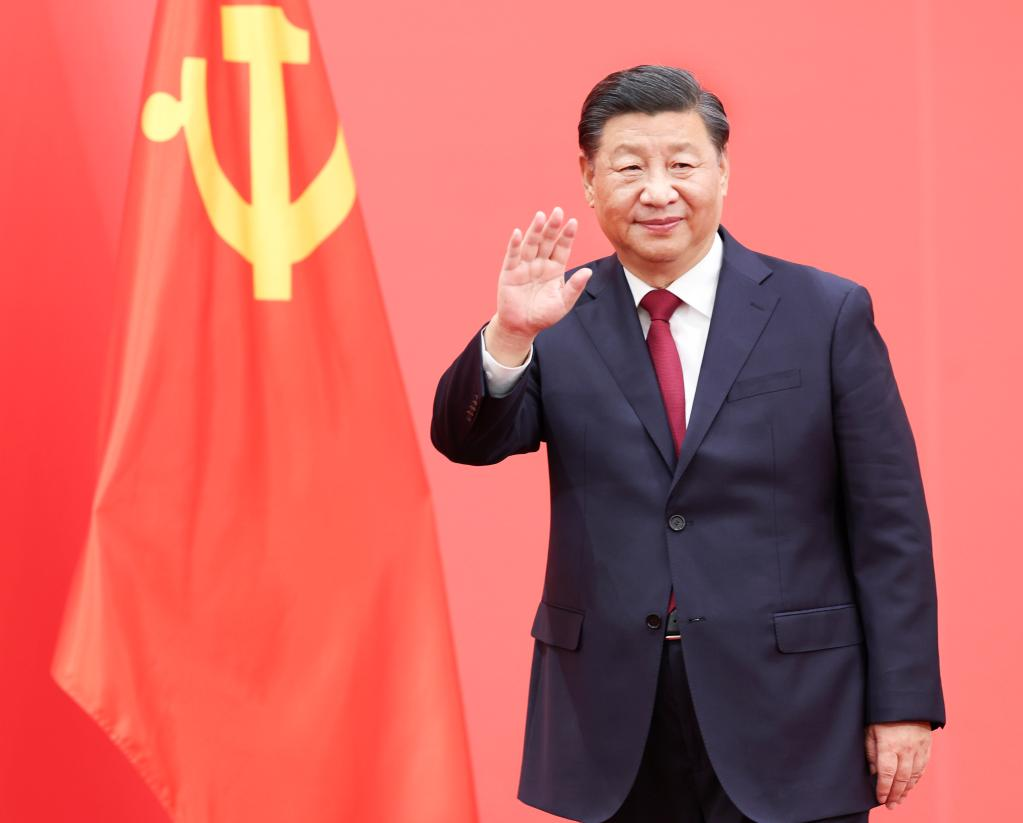
China Reader Daily Wire | 31 January 2026, Saturday | Vol 3 No. 16
INTERNAL
China probe into former Inner Mongolia party chief on corruption charges, reports SCMP
On 30 January, SCMP reported that the former Communist Party chief of the resource-rich Inner Mongolia autonomous region and the country’s first minister of veterans affairs, Sun Shaocheng, is under investigation for corruption, the Central Commission for Discipline Inspection (CCDI) informed. The probe into “suspected serious violations of discipline and law.” His investigation comes just days after probes were announced into two of China’s top military figures — Zhang Youxia and Liu Zhenli — highlighting the campaign’s reach into both civilian and military elites. Sun led Inner Mongolia from 2022 until late 2025, stepping down about four months before the anti-corruption announcement. Sun led Inner Mongolia from 2022 until late 2025, stepping down about four months before the anti-corruption announcement. (“China investigates Sun Shaocheng, former Inner Mongolia party chief and veterans minister,” SCMP, 30 January 2026)
XI Jinping chairs CPC Central Committee meeting
On 30 January, Chinese Communist Party leader Xi Jinping chaired a high-level meeting of the Political Bureau of the CPC Central Committee to review the work of key state institutions and prepare for 2026. The meeting examined reports from the standing committee on the performance of several top bodies, including the National People’s Congress Standing Committee, the State Council (China’s cabinet), the Chinese People’s Political Consultative Conference, the Supreme People’s Court, the Supreme People’s Procuratorate and the CPC Central Committee Secretariat. The leaders evaluated these institutions’ work in 2025 and approved their plans for 2026. (“Xi Jinping chairs CPC leadership meeting to review report on work of state institutions, secretariat of Party Central Committee,” CGTN, 30 January 2026)
China launches corruption probe into Emergency Management Minister
On 31 January, China’s anti-graft watchdog has launched an investigation into the country’s minister of emergency management, Wang Xiangxi, for “suspected serious violations of discipline and law” a standard term used in Beijing to describe alleged corruption. The probe was announced on 31 January by the Central Commission for Discipline Inspection (CCDI), the Communist Party’s top corruption-busting body, and follows a broader sweep targeting senior officials across government and state sectors. It is relatively unusual for a sitting cabinet-level minister to be implicated in a corruption investigation, highlighting the continuing scope of President Xi Jinping’s anti-corruption campaign. (“China’s corruption watchdog probing emergency management minister,” The Straits Times, 31 January 2026)
EXTERNAL
Chinese surveillance cameras guarding Magna Carta spark security concerns, reports The Guardian
On 31 January, The Guardian reported that campaigners have raised alarm over Chinese-made CCTV cameras installed to monitor one of the world’s most iconic democratic symbols, a copy of the Magna Carta at Salisbury Cathedral in England. Because of their alleged links to human rights abuses and security vulnerabilities. The cameras, manufactured by Dahua Technology, have drawn criticism from groups including the World Uyghur Congress (WUC), which says the company’s technology has been implicated in surveillance systems used in Xinjiang against Uyghur Muslims, an ethnic minority that activists describe as subject to “genocide or crimes against humanity.” The WUC has also written to Greek authorities over similar Chinese cameras at the Parthenon. (“Alarm raised over Chinese CCTV cameras guarding ‘symbol of democracy’ Magna Carta,” The Guardian, 31 January 2026)
CHINA & SOUTHEAST ASIA
China accuses the Philippines of increasing tensions in the South China Sea, reports SCMP
On 30 January, SCMP reported that Beijing’s defence ministry spokesman, Jiang Bin, criticised Manila for using the exercises as a pretext to carry out what China calls “infringements and provocations” around the territory it claims as sovereign. The accusation follows Manila’s first joint maritime operation of the year with the United States in the South China Sea, which China condemned as drawing in “external powers” and undermining stability. China has accused the Philippines of “deliberately stoking maritime tensions” after Manila announced a large-scale military exercise in the disputed Scarborough Shoal area of the South China Sea that could run until the end of March. (“China says Philippines is stoking tensions with large-scale Scarborough Shoal drill,” SCMP 30 January 2026)
CHINA & EUROPE
China lifts sanctions on UK lawmakers after Starmer visits China, reports SCMP
On 31 January, SCMP reported that UK Prime Minister Sir Keir Starmer said China has lifted sanctions on British lawmakers following his meeting with Chinese President Xi Jinping during an official visit aimed at resetting bilateral ties. The sanctions, imposed in 2021 in retaliation for UK sanctions on Chinese officials over alleged human rights abuses in Xinjiang, had barred some UK MPs and peers from travel and engagement with China. Starmer told broadcasters in Shanghai that he raised the issue directly with Xi, who confirmed the restrictions “no longer apply” and indicated that all British parliamentarians are now welcome to visit China. China’s Foreign Ministry confirmed the development at a daily press briefing, saying both sides agreed to strengthen people-to-people and legislative exchanges to build mutual trust. (“China lifted sanctions on British lawmakers after Starmer–Xi meeting, UK says,” SCMP, 31 January 20226)
CHINA & THE AMERICAS
US lawmakers move key Taiwan-related bills to Senate committee
On 29 January, US lawmakers moved four Taiwan-related bills through a key Senate committee, sending a clear message to President Donald Trump that support for Taiwan must remain a priority as he prepares for a highly anticipated meeting with Chinese President Xi Jinping in April. The actions by the Senate Foreign Relations Committee reflect growing congressional concern that Taipei’s security, diplomatic space and critical infrastructure should not be overshadowed by broader US and China negotiations. The package includes the Taiwan Energy Security and Anti-Embargo Act, the Taiwan Undersea Cable Resilience Initiative Act, the Taiwan Allies Fund Act and the Strategic Subsea Cables Act. (“Senate bills remind Trump that Taiwan remains a priority before key Xi meeting in April,” SCMP, 30 January 2026)
China Reader Daily Wire | 29 January 2026, Thursday | Vol 3 No. 15
ENERGY
China builds the largest renewable energy system, reports the Ministry of Ecology and Environment
On 28 January, China’s Ministry of Ecology and Environment informed that they have made significant progress during the 14th Five-Year Plan to promote green development and reduce carbon emissions. They said: “China established the largest clean power supply system and the largest clean steel production system globally during the period. Meanwhile, the market penetration rate of new energy vehicles in the country exceeded 50 per cent, and the share of clean transportation in key regions and industries reached 78 per cent.” And that “China has also established the world's largest carbon emissions trading market, marking a major milestone in its efforts to combat climate change.” (“China builds largest renewable energy system globally,” CGTN, 29 January 2026)
CHINA & SOUTHEAST ASIA
China executed 11 members of Myanmar’s scam syndicate, reports BBC
On 29 January, the BBC reported that China executed 11 members of a family that ran a scam centre in Myanmar. A court in Zhejiang province sentenced the Ming family members for crimes including homicide, illegal detention, fraud and operating gambling dens. The Ming family was one of several clans that ran Myanmar's sleepy town of Laukkaing, close to the border with China. Under their rule, the impoverished backwater was transformed into a flashy hub of casinos and red-light districts. This stopped when, in 2023, Myanmar’s authorities arrested them and handed them over to the Chinese government. The scam operations in Myanmar have trapped thousands of Chinese workers over the years, under which hundreds and thousands have been trafficked. (“China executes 11 members of Myanmar scam mafia,” BBC, 29 January 2026)
CHINA & THE PACIFIC
Australia trying to reclaim port Darwin will lead to trade related repurcissuion from China, say s China's Amb to Australia
On 28 January, China’s ambassador to Australia informed that any plan by Australia government to remove Port Darwin from Chinese ownership will affect the future trade growth with the country. Ambassador Xiao Qian’s statements come in light of the Chinese-owned company Landbridge to sell its 99-year lease on the port, sparked by pre-election national security concerns from both Labour and the Coalition. He said that Landbridge has invested a lot, and that “When you’re losing money, you lease it to a foreign country company, and when it has started making money, you want to take it back. That’s not a way to do business.” Landbridge paid USD 506 million to secure a 99-year controlling lease over the port. He noted that “The Chinese government has an obligation to protect the legitimate interests of Chinese companies overseas.” (“China’s ambassador warns Albanese reclaiming Port of Darwin will force Beijing to intervene,” The Guardian, 28 January 2026)
CHINA & SOUTH ASIA
China and Pakistan sign a digital “e-mining platform”
On 28 January, China signed a joint digital “e-mining platform” with Pakistan. This new MoU aims to understand and deepen cooperation in the mineral sector. The initiatives were announced at the Pak–China Mineral Cooperation Forum in Islamabad, where Pakistani officials outlined plans to move beyond raw extraction toward value. Pakistan holds significant reserves of copper, gold, coal and other critical minerals, but much of its resource base has remained untapped for decades. Ministry of Information & Broadcasting said: “A major milestone of the Forum was the launch of the ‘Pak–China E-Mining Platform,’ a digital initiative aimed at improving information sharing, project connectivity and cooperation between Pakistani authorities and Chinese enterprises.” “The platform is expected to enhance transparency, efficiency and collaboration in mineral sector development.” (“Pakistan, China launch digital mining platform, sign cooperation MoUs,” Arab News, 29 January 2026)
CHINA & WEST ASIA
China warns against military adventurism in Iran at the UN
On 28 January, China’s representative in the UN, Fu Cong, warned against the military adventurism against Iran. He called for all parties to follow the rules and purposes of the UN Charter and refrain from interfering in other countries’ matters. He said: “The use of force cannot solve problems. Any acts of military adventurism will only push the region into an abyss of unpredictability.” And that “China hopes that the United States and other relevant parties will heed the call of the international community and regional countries, do more things that are conducive to peace and stability in the Middle East, and avoid exacerbating tensions and adding fuel to the fire.” “We call on all parties to abide by the purposes and principles of the UN Charter, oppose interference in other countries' internal affairs, and reject the use or threat of force in international relations.” (“China warns against 'military adventurism' in Iran,” CGTN, 28 January 2026)
CHINA & EUROPE
UK’s Prime Minister meeting Xi Jinping calls for a comprehensive strategic partnership
On 29 January, UK Prime Minister Keir Starmer met with China’s President Xi Jinping on his first trip in eight years. Stamer, before his trip, noted that China was a pragmatic choice for doing business and that it was time to have a mature relationship. Stamer said: “I have long been clear that the UK and China need a long-term, consistent and comprehensive strategic partnership.” During his meeting, Starmer noted that he hopes that the leaders can identify opportunities to collaborate. Xi Jinping stressed the need for more dialogue and cooperation, as they deal with intertwined international situations. Starmer is in China for three days and is accompanied by a delegation representing nearly 50 UK businesses and cultural organisations, including HSBC, British Airways, AstraZeneca and GSK. China was the UK’s fourth-largest trading partner in 2025, with bilateral trade worth USD 137 billion. Stamer is meeting with Xi, while back home, there are serious criticisms of China's human rights violations. The meeting focuses on economic collaboration. (“China’s Xi Jinping, UK’s Kier Starmer agree to deepen economic ties,” Al-Jazeera, 29 January 2026)
China and the UK to sign an agreement to curb migrant smuggling network, reports UCA News
On 29 January, UCA News reported that the UK and China will be signing a cooperation agreement to target the supply chains used by migrant smugglers. This will be done as Starmer is in China. The party Stamer belongs to has a major agenda on illegal migrants, who in their campaign called to crack down on people smuggling as they face a wave of arrivals. Last year, nearly 42,000 migrants landed on England's southern coast after making the perilous Channel crossing from northern France — the second-highest annual number. Starmer said: “More than half of small boat engines used by people smugglers crossing the English Channel are manufactured in China.” The agreement to be signed aims to share intelligence and have a direct engagement with the Chinese manufacturers of boat parts, noting that their services are not exploited for illegal purposes. The deal also seeks to boost cooperation on combating the trafficking of “highly potent and dangerous synthetic opioids such as nitazenes, known to be produced in China and exported to the UK.” (“Britain and China plan to fight migrant smuggling networks,” UCA News, 29 January 2026)
CHINA & AMERICAS
Chinese man who exposed human rights violations in Xinjiang awarded US asylum, reports BBC
On 29 January, the BBC reported that a Chinese national who exposed human rights violations in Xinjiang has been granted asylum in the US. The US found ground that there is a well-founded threat of prosecution if he returns to China. In 2020, Guan Heng secretly filmed detention facilitates in the north-western Chinese region, where human rights groups say more than one million ethnic Uyghurs have been detained against their will. Guan, 38, applied for asylum after arriving in the US illegally in 2021, but was detained in August as part of a mass deportation campaign by the Trump administration. A UN human rights committee in 2018 said: “China was holding up to a million people in "counter-extremism centres" in the region, which is largely cut off to international media and observers.” (“Man who exposed human rights abuses in China granted US asylum,” BBC, 29 January 2026)
China Reader Daily Wire | 28 January 2026, Wednesday | Vol 3 No. 14
INTERNAL
China’s Central Military Commission’s vice president under investigation for “serious violations of discipline and law”
On 27 January, the BBC reported that a senior-ranking official from the People's Liberation Army (PLA) was purged from his position. This is top general Zhang Youxia, and another senior military officer, Gen Liu Zhenli. Zhang is the vice-chairman of the Central Military Commission (CMC). CMC is made up of seven members, of which there are now only two: Xi Jinping and Gen Zhang Shengmin. The others were removed on anti-corruption charges. The CMC is responsible for controlling millions of military personnel. It is so powerful that being chairman of this body was the single position held by Deng Xiaoping as the absolute ruler of China. There is no official reason listed, while rumours run high. The official announcement stated that they are under investigation and were accused of “serious violations of discipline and law.” Zhang's father was a revolutionary comrade of Xi's father. The general goes back a long way with Xi, and that they were seen as close allies before the turmoil of recent days has possibly made this worse because of a belief that no one is safe. (“China has purged its highest-ranked military general. Why?” BBC, 27 January 2026)
MARITIME
PLA Yulin dry dock aides China’s presence in the South China Sea, reports SCMP
On 26 January, SCMP reported that China’s new dry rock near the South China Sea can help it avoid any gaps in its aircraft carrier presence in the waterways and help it reach the Indian Ocean Region. AllSource Analysis report said: “China’s second aircraft carrier, the Shandong, entered the dry dock for the first time on January 20 or January 21, indicating an expansion of the dock’s capabilities and marking a “milestone” for both the facility and People’s Liberation Army carrier operations.” And that “Construction of the Yulin Naval Base dry dock began in 2017. It became operational in 2022 but had not yet been used by aircraft carriers or vessels of similar tonnage.” Dry docks are specialised basins used to lift aircraft carriers out of the water. The availability of this base means that the aircraft carrier will not have to return to northern China for services. (“Shandong’s use of newest PLA dry dock near South China Sea suggests carrier milestone,” BBC, 26 January 2026)
CHINA & TAIWAN
Taiwan’s defence ministry pushes back against TPP defence proposal, reports SCMP
On 28 January, SCMP reported that Taiwan’s Ministry of National Defence pushed against the opposition party’s proposal to cut the USD 40 billion special military budget and to drop the “T-Dome” layered defence system. There is a deadlock in the special funding bill, which was blocked for the 10th time. The Taiwan People’s Party (TPP), a smaller opposition party, unveiled its version of a special defence procurement bill, cutting the budget over eight years and listing five specific weapons systems to be purchased. They include US-made M109A7 self-propelled howitzers, High Mobility Artillery Rocket Systems (HIMARS), anti-armour drone missiles, Javelin anti-tank missiles and Tow 2B anti-tank missiles. Taiwan’s Lieutenant General Huang Wen-chi called it “rushed and unprofessional.” (“Taiwan’s defence ministry slams TPP’s ‘unworkable’ military spending plan,” SCMP, 28 January 2026)
CHINA & EAST ASIA
China offers special compensation for all cancelled flights on 49 routes to Japan, reports The Straits Times
On 27 January, The Straits Times reported that all scheduled flights on 49 air routes between China and Japan have been cancelled for February. Chinese airlines are offering special ticket change and refund policies. China-Japan routes had cancelled all flights scheduled for February, an increase from January, according to data by Flight Master. China’s three major domestic airlines, Air China, China Eastern Airlines and China Southern Airlines, issued notices detailing special handling measures for tickets on Japan routes. Under this, the passenger will get to do one free change and will be subjected to a fair difference or apply for a refund. (“China cancels all flights on 49 routes to Japan,” The Straits Times, 27 January 2026)
Japan returns pandas amid rising tension with China, reports BBC
On 27 January, the BBC reported that thousands flocked to a zoo to bid farewell to two giant pandas who are set to return to China. This comes after Japanese Prime Minister Sanae Takaichi said Tokyo would get involved militarily if China attacked Taiwan. Since then, there have been a series of escalations and tensions between the two countries. The twins' departure will leave Japan without any pandas for the first time since 1972, the year the two countries normalised diplomatic ties. China has used giant pandas as a gesture of goodwill towards its allies and competitors. But China retains ownership of all pandas it loans to foreign countries, including cubs born abroad. The host country pays an annual fee of USD 1 million per panda. (“Tearful goodbyes as Japan returns pandas to China amid worsening ties,” BBC, 27 January 2026)
CHINA & SOUTH ASIA
China gives NPR 1.5 billion for upcoming Nepal elections, reports The Kathmandu Post
On 27 January, an editorial in The Kathmandu Post reported that India and China will supply vehicles, riot control equipment, and cash for Nepal’s upcoming parliamentary elections to be conducted by 05 March. Sushila Karki’s government, which took office in the wake of the Gen Z revolt in September, had decided to accept support only from India and China. It noted that this is because their resources will not be enough to conduct elections. India’s Embassy in Nepal said: “Based on requests by the government of Nepal, India has been providing election-related support to Nepal since 2008. This includes about 2,400 vehicles that have been gifted by the Government of India for various ministries and departments in Nepal, including the Election Commission.” While China will provide Nepal with NPR 1.5 billion for the elections. The Finance Ministry will use the Chinese cash for election expenditure, including perks and allowances to the security personnel and election officials to be debuted in the booths. (“India sends in-kind assistance, China offers cash for elections,” The Kathmandu Post, 27 January 2026)
CHINA & EUROPE
Xi Jinping meets the Finnish Prime Minister and welcomes them to invest in China’s market
On 27 January, China’s President Xi Jinping welcomed Finnish Prime Minister Petteri Orpo and his entourage of company executives. Xi invited them to “take a swim in the vast ocean of the Chinese market.” Xi noted that Finland was among the first countries to establish diplomatic relations with China. He said: “Over the past 76 years since the establishment of diplomatic ties, China-Finland relations, characterised by mutual respect, equality, future orientation and win-win cooperation, have achieved steady growth regardless of how the international landscape has evolved.” He said: “China is willing to work with Finland to promote an equitable and orderly multipolar world as well as a universally beneficial and inclusive economic globalization.” Oropo said: “Finland is willing to work with China to implement the important consensus reached by the two heads of state, enhance high-level exchanges, and deepen practical cooperation in trade, investment, digital economy, clean energy, agriculture and other fields.” (“Xi welcomes Finnish enterprises to "take a swim in the vast ocean of the Chinese market,” Xinhua, 27 January 2026)
UK’s Prime Minister makes his first trip to China
On 28 January, the UK’s Prime Minister Keir Starmer is making his first trip to China since 2028. With him were 60 British business and cultural leaders, representatives from the bank HSBC, the pharmaceutical company GSK, Jaguar Land Rover and the National Theatre. The visit is aimed at the government’s attempt to reboot Uks relation with China. Before his visit stamer said: “For years, our approach to China has been dogged by inconsistency – blowing hot and cold, from Golden Age to Ice Age, but like it or not, China matters for the UK.” “As one of the world's biggest economic players, a strategic and consistent relationship with them is firmly in our national interest. That does not mean turning a blind eye to the challenges they pose – but engaging even where we disagree.” The meeting will focus on strategic re-engagement. The meeting comes after Canadian Prime Minister Mark Carney and French President Emmanuel Macron visits and currently the Finnish Prime Minister is in China. (“Starmer says 'China matters' as he heads to Beijing with business leaders,” BBC, 28 January 2026)
Finnish Prime Minister arrives in China to enhance strategic relationship, reports Global Times
On 25 January, Finnish Prime Minister Petteri Orpo arrived in Beijing for a four-day official visit to China. He arrived with 20 Finnish companies. China’s Ministry of Foreign Affairs said: “Chinese President Xi Jinping will meet with the Finnish prime minister during the visit, while Chinese Premier Li Qiang and Chairman of China's National People's Congress Standing Committee Zhao Leji will hold talks and meet with Orpo, respectively, to conduct in-depth exchanges of views on bilateral relations and issues of common concern.” China has been Finland’s largest trading partner in Asia for many consecutive years, while Finland is China’s third largest trading partner in Northern Europe. It is expected that an MoU will be signed on the China-Finland Committee for Innovative Business Cooperation, and companies from China and Finland will also sign several business cooperation agreements. The ministry said: “All of this fully demonstrates that China and Finland have the will, confidence and ability to promote the continued positive development of bilateral economic and trade cooperation.” (“Finnish PM arrives in China for 4-day visit; ties set model for Europe when 'law of the jungle' on the rise, says expert,” Global Times, 26 January 2026)
Chinese AI is a risk to Europe, reports an editorial in The Economist
On 22 January, The Economist published that Chinese AI are a risk to Europe. It noted that the rise of China’s DeepSeek is becoming the face of Chinese innovation and AI. DeepSeek is now seeking to invest abroad. Europe is a curse, and the EV industry from China has engulfed German and French carmakers. Several EU countries are seeking restrict access to the DeepSeek chat box. In January, the European Commission launched an effort to identify and remove barriers holding back open models, despite the fears. Chinese software comes with all the old risks. But for Europe, the bigger one now is to spurn it. Therefore, there are also reasons to welcome Chinese AI, being that they are nearly as good as OpenAI, open models are easily accessible, and they offer insurance against lockout. (“Chinese AI is a risk for Europe. So is shunning it,” The Economist, 22 January 2026)
CHINA & THE AMERICAS
Canada reduces tariffs on Chinese EV after Carney visits China, reports Reuters
On 17 January, Reuters reported that China and Canada struck an initial trade deal that will slash tariffs on EVs and Canola. The first Canadian prime minister to visit China since 2017. This comes as Canada’s Prime Minister Mark Carney visits China to recalibrate ties. Canada will initially allow in up to 49,000 Chinese electric vehicles at a tariff of 6.1 per cent on most-favoured-nation terms. Carney said: “This is a return to levels prior to recent trade frictions, but under an agreement that promises much more for Canadians.” And that “For Canada to build its own competitive EV sector, we will need to learn from innovative partners, access their supply chains, and increase local demand.” (“Canada, China slash EV, canola tariffs in reset of ties,” Reuters, 17 January 2026)
China Reader Daily Wire | 27 January 2026, Tuesday | Vol 3 No. 13
INTERNAL
China’s Central Military Commission’s vice president under investigation for “serious violations of discipline and law”
On 27 January, the BBC reported that a senior-ranking official from the People's Liberation Army (PLA) was purged from his position. This is top general Zhang Youxia, and another senior military officer, Gen Liu Zhenli. Zhang is the vice-chairman of the Central Military Commission (CMC). CMC is made up of seven members, of which there are now only two: Xi Jinping and Gen Zhang Shengmin. The others were removed on anti-corruption charges. The CMC is responsible for controlling millions of military personnel. It is so powerful that being chairman of this body was the single position held by Deng Xiaoping as the absolute ruler of China. There is no official reason listed, while rumours run high. The official announcement stated that they are under investigation and were accused of “serious violations of discipline and law.” Zhang's father was a revolutionary comrade of Xi's father. The general goes back a long way with Xi, and that they were seen as close allies before the turmoil of recent days has possibly made this worse because of a belief that no one is safe. (“China has purged its highest-ranked military general. Why?” BBC, 27 January 2026)
MARITIME
PLA Yulin dry dock aides China’s presence in the South China Sea, reports SCMP
On 26 January, SCMP reported that China’s new dry rock near the South China Sea can help it avoid any gaps in its aircraft carrier presence in the waterways and help it reach the Indian Ocean Region. AllSource Analysis report said: “China’s second aircraft carrier, the Shandong, entered the dry dock for the first time on January 20 or January 21, indicating an expansion of the dock’s capabilities and marking a “milestone” for both the facility and People’s Liberation Army carrier operations.” And that “Construction of the Yulin Naval Base dry dock began in 2017. It became operational in 2022 but had not yet been used by aircraft carriers or vessels of similar tonnage.” Dry docks are specialised basins used to lift aircraft carriers out of the water. The availability of this base means that the aircraft carrier will not have to return to northern China for services. (“Shandong’s use of newest PLA dry dock near South China Sea suggests carrier milestone,” BBC, 26 January 2026)
CHINA & EAST ASIA
China offers special compensation for all cancelled flights on 49 routes to Japan, reports The Straits Times
On 27 January, The Straits Times reported that all scheduled flights on 49 air routes between China and Japan have been cancelled for February. Chinese airlines are offering special ticket change and refund policies. China-Japan routes had cancelled all flights scheduled for February, an increase from January, according to data by Flight Master. China’s three major domestic airlines, Air China, China Eastern Airlines and China Southern Airlines, issued notices detailing special handling measures for tickets on Japan routes. Under this, the passenger will get to do one free change and will be subjected to a fair difference or apply for a refund. (“China cancels all flights on 49 routes to Japan,” The Straits Times, 27 January 2026)
Japan returns pandas amid rising tension with China, reports BBC
On 27 January, the BBC reported that thousands flocked to a zoo to bid farewell to two giant pandas who are set to return to China. This comes after Japanese Prime Minister Sanae Takaichi said Tokyo would get involved militarily if China attacked Taiwan. Since then, there have been a series of escalations and tensions between the two countries. The twins' departure will leave Japan without any pandas for the first time since 1972, the year the two countries normalised diplomatic ties. China has used giant pandas as a gesture of goodwill towards its allies and competitors. But China retains ownership of all pandas it loans to foreign countries, including cubs born abroad. The host country pays an annual fee of USD 1 million per panda. (“Tearful goodbyes as Japan returns pandas to China amid worsening ties,” BBC, 27 January 2026)
CHINA & SOUTH ASIA
China gives NPR 1.5 billion for upcoming Nepal elections, reports The Kathmandu Post
On 27 January, an editorial in The Kathmandu Post reported that India and China will supply vehicles, riot control equipment, and cash for Nepal’s upcoming parliamentary elections to be conducted by 05 March. Sushila Karki’s government, which took office in the wake of the Gen Z revolt in September, had decided to accept support only from India and China. It noted that this is because their resources will not be enough to conduct elections. India’s Embassy in Nepal said: “Based on requests by the government of Nepal, India has been providing election-related support to Nepal since 2008. This includes about 2,400 vehicles that have been gifted by the Government of India for various ministries and departments in Nepal, including the Election Commission.” While China will provide Nepal with NPR 1.5 billion for the elections. The Finance Ministry will use the Chinese cash for election expenditure, including perks and allowances to the security personnel and election officials to be debuted in the booths. (“India sends in-kind assistance, China offers cash for elections,” The Kathmandu Post, 27 January 2026)
CHINA & EUROPE
Finnish Prime Minister arrives in China to enhance strategic relationship, reports Global Times
On 25 January, Finnish Prime Minister Petteri Orpo arrived in Beijing for a four-day official visit to China. He arrived with 20 Finnish companies. China’s Ministry of Foreign Affairs said: “Chinese President Xi Jinping will meet with the Finnish prime minister during the visit, while Chinese Premier Li Qiang and Chairman of China's National People's Congress Standing Committee Zhao Leji will hold talks and meet with Orpo, respectively, to conduct in-depth exchanges of views on bilateral relations and issues of common concern.” China has been Finland’s largest trading partner in Asia for many consecutive years, while Finland is China’s third largest trading partner in Northern Europe. It is expected that an MoU will be signed on the China-Finland Committee for Innovative Business Cooperation, and companies from China and Finland will also sign several business cooperation agreements. The ministry said: “All of this fully demonstrates that China and Finland have the will, confidence and ability to promote the continued positive development of bilateral economic and trade cooperation.” (“Finnish PM arrives in China for 4-day visit; ties set model for Europe when 'law of the jungle' on the rise, says expert,” Global Times, 26 January 2026)
Chinese AI is a risk to Europe, reports an editorial in The Economist
On 22 January, The Economist published that Chinese AI are a risk to Europe. It noted that the rise of China’s DeepSeek is becoming the face of Chinese innovation and AI. DeepSeek is now seeking to invest abroad. Europe is a curse, and the EV industry from China has engulfed German and French carmakers. Several EU countries are seeking restrict access to the DeepSeek chat box. In January, the European Commission launched an effort to identify and remove barriers holding back open models, despite the fears. Chinese software comes with all the old risks. But for Europe, the bigger one now is to spurn it. Therefore, there are also reasons to welcome Chinese AI, being that they are nearly as good as OpenAI, open models are easily accessible, and they offer insurance against lockout. (“Chinese AI is a risk for Europe. So is shunning it,” The Economist, 22 January 2026)
CHINA & THE AMERICAS
Canada reduces tariffs on Chinese EV after Carney visits China, reports Reuters
On 17 January, Reuters reported that China and Canada struck an initial trade deal that will slash tariffs on EVs and Canola. The first Canadian prime minister to visit China since 2017. This comes as Canada’s Prime Minister Mark Carney visits China to recalibrate ties. Canada will initially allow in up to 49,000 Chinese electric vehicles at a tariff of 6.1 per cent on most-favoured-nation terms. Carney said: “This is a return to levels prior to recent trade frictions, but under an agreement that promises much more for Canadians.” And that “For Canada to build its own competitive EV sector, we will need to learn from innovative partners, access their supply chains, and increase local demand.” (“Canada, China slash EV, canola tariffs in reset of ties,” Reuters, 17 January 2026)
China Reader Daily Wire | 16 January 2026, Friday | Vol 3 No. 13
EXTERNAL
China urges its firms not to use US and Israeli cybersecurity software, reports The Straits Times
On 15 January, The Straits Times reported that the Chinese authorities told domestic companies to stop using cybersecurity software made by the US and Israel. It noted 12 of these firms stating national security concerns. These included e Broadcom-owned VMware, Palo Alto Networks and Fortinet, while the Israeli companies include Check Point Software Technologies. Chinese authorities noted that this software could collect and transmit data that could be sensitive. Some of the US and Israeli companies facing a ban for their part have repeatedly alleged Chinese hacking operations, which China has denied. (“Beijing tells Chinese firms to stop using US and Israeli cybersecurity software, sources say,” The Straits Times, 15 January 2026)
OUTERSPACE
China’s commercial firm launches the first sea base mission, reports Global Times
On 16 January, Global Times reported that Chinese commercial space firm Galactic Energy successfully carried out a sea-based launch of its CERES-1 carrier rocket. Launched from the coastal area of East China's Shandong Province by the Taiyuan Satellite Launch Center, the launch marked the 23rd successful flight of the CERES-1 carrier rocket. The satellites belong to the sixth group of the Tianqi constellation, the country's low-Earth orbit internet of Things (IoT) satellite constellation. (“Commercial firm launches rocket from Yellow Sea in China's first sea-based mission in new year,” Global Times, 16 January 2026)
CHINA & TAIWAN
US strikes a deal with Taiwan and reduces its tariffs, reports The Guardian
On 15 January, The Guardian reported that the US and Taiwan have agreed to reduce tariffs on goods as increasing Taiwanese semiconductor and tech companies’ investments in America. The US commerce department note that this will drive massive restructuring of America’s semiconductor industry. Washington will lower tariffs on Taiwanese goods to 15 per cent, down from 20 per cent, as part of a “reciprocal” rate meant to address US trade deficits and practices it deems unfair. Sector-specific tariffs on Taiwanese auto parts, timber, lumber and wood products will also be capped. Taiwan will also provide “credit guarantees of at least USD 250 billion to facilitate additional investment by Taiwanese enterprises” into the American semiconductor supply chain. Taiwan’s vice-premier, Cheng Li-chiun, said: “In this negotiation, we promoted two-way Taiwan-US high-tech investment, hoping that in the future we can become close AI strategic partners.” (“US says it reached deal with Taiwan to lower tariffs and boost investments,” The Guardian, 15 January 2026)
CHINA & WEST ASIA
Wang Yi calls for peace and restraint in Iran as he talks with his Iranian counterpart, reports CGTN
On 15 January, CGTN reported that China’s Foreign Minister Wang Yi called to establish peace and restraint on the situation in Iran as he talked on the phone with his Iranian counterpart, Abbas Araghchi. Wang Yi said: “China opposes the use or threat of force in international relations, the imposition of one's will on others, and a return to the "law of the jungle.” And that “China believes that the Iranian government and people will remain united, overcome difficulties, maintain national stability, and safeguard their legitimate rights and interests.” Abbas said: “Iran has prepared itself to respond to any external interference and, at the same time, keeps the door open for dialogue.” And that “China will play a greater role in promoting regional peace and stability.” (“China calls for peace, restraint in Iran situation during foreign ministers' phone call,” CGTN, 15 January 2026)
CHINA & EUROPE
China approves China's transnational education (TNE) programs, reports The Pie
On 15 January, The Pie reported that the 122-strong raft of TNE projects announced on December 30 included 66 joint programs and 56 joint institutes. The agreed projects are spread geographically throughout China, across 25 provinces and municipalities including Jiangsu, Shandong, Zhejiang, Sichuan and Henan. Universities such as the University of Auckland, Durham University, the University of Strathclyde and the University of São Paulo are among the institutions that have agreed on TNE projects in China. Beijng setting out an ambitious aim of boosting China’s TNE enrolments from 800,000 to eight million. Meanwhile, the British Council highlighted that many of the agreements reflected a strong emphasis on STEM subjects, indicating China’s long-term development goals. (“China greenlights 122 new TNE projects as it eyes enrolment boost,” The Pie, 15 January 2026)
CHINA & THE AMERCIAS
Canadian Prime Minister visits China to revive ties, reports AP
On 15 January, AP news reported that the Canadian Prime Minister Mark Carney. He aims to repair ties with China that deteriorated after Canada’s 2018 arrest of a senior Chinese tech executive, to 100 per cent Canadian tariffs on China-made electric vehicles. He met with Chinese Premier Li Qiang, the statement said: “Both sides welcomed the renewal of bilateral engagement.” He also met leaders from Chinese companies, including Alibaba, and China National Petroleum Corp. Carney said: “We’re ready to build a new partnership — one that builds on the best of our past, and responds to the challenges of today.” Canadian Foreign Minister Anita Anand informed that “Wang Yi that the prime minister looks forward to setting the course for the development of relations and restarting dialogue in various fields.” (“Canadian prime minister hails renewed relations with China during his Beijing visit,” AP, 15 January 2026)
US approves the sale of Nvidia chips to China, reports BBC
On 14 January, the BBC reported that the US government had given chip giant Nvidia approval to sell its advanced AI processing chips to China. The H200, Nvidia's second-most-advanced semiconductor, had been restricted by Washington over concerns that it would give China's technology industry and military an edge over the US. President Donald Trump informed last months he will approve the sales if a 25 per cent fee is collected from the sale. The Commerce Department's Bureau of Industry and Security said its revised export policy applies to Nvidia's H200 chips, as well as less advanced processors. Chinese customers must also show "sufficient security procedures" and cannot use the chips for military uses. (“US approves sale of Nvidia's advanced AI chips to China,” BBC, 14 January 2026)
Chinese super tankers sailing to Venezuela took a U-turn, failing to pick up oil cargo, reports SCMP
On 13 January, SCMP reported that two China-flagged super tankers sailing to Venezuela to pick up debt-paying crude cargoes took a U-turn. LSEG Shipping reported that the U.S.-blocked South American country might not be directly exporting oil ?to its main buyer any time soon. Trump informed that Venezuela’s crude oil will not be deprived of China. But China, the biggest market for Venezuela’s oil, has not received any cargoes from state-run PDVSA. SCMP reported that the very large crude carriers Xingye and Thousand Sunny, which have not been the subject of sanctions, had remained anchored in the Atlantic Ocean for weeks, waiting for directions amid the blockade and Venezuela’s political crisis. (“Supertankers sailing to pick up Venezuelan oil for China make U-turn: ship data,” SCMP, 13 January 2026)
China Reader Daily Wire | 13 January 2026, Tuesday | Vol 3 No. 12
INTERNAL
Xi Jinping warns of a major anti-corruption overhaul this year
On 12 January, China’s President Xi Jinping addressed the plenary session of the Central Commission for Discipline Inspection (CCDI), which is China’s top anti-corruption body. He said: “Corruption is a stumbling block and obstacle to the development of the [Communist] party and the country, and the fight against corruption is a major struggle that we cannot afford to lose.” And that. “Currently, the situation in the fight against corruption remains grave and complex … We must maintain a high-pressure stance without wavering, resolutely punishing corruption wherever it exists, eliminating all forms of graft, and leaving no place for corrupt elements to hide.” He also encourages officials to come up with new methods to discover and identify all types of corruption. Xi warns that this year they will see a major overhaul and that the party “must deploy cadres who are truly loyal, reliable, consistent and responsible.” (“China’s fight against corruption is a battle we can’t afford to lose, Xi Jinping warns,” SCMP, 12 January 2026)
DEFENCE
China’s indigenous unmanned drone Tianma-1000 completes maiden flight
On 10 January, China’s domestically developed unmanned transport aircraft Tianma-1000 completed its maiden flight. The aircraft was independently developed by China North Industries Group Corp-affiliated Xi'an Aisheng Technology Group Co., integrating functions such as logistics, transport, emergency rescue, and material delivery. This is China’s first medium altitude, low-cost platform. According to the Civil Aviation Administration of China, the size of China's low-altitude economy is estimated to have reached 1.5 trillion yuan in 2025. (“China’s self-developed ton-class unmanned transport drone Tianma-1000 completes maiden flight,” Global Times, 11 January 2026)
EXTERNAL
G7 Finance Ministers allies meet in Washington, plan to reduce dependence on Chinese rare earths
On 12 January, the Finance Ministers of G7 countries met in Washington to discuss ways to reduce any reliance on Chinese rare earths. This includes setting a price floor and building new partnerships with alternative suppliers. The meeting was attended by the Finance Ministers of the US, Japan, Britain, France, Germany, Italy, and Canada. US Treasury stated that Bessent seeks “to discuss solutions to secure and diversify supply chains for critical minerals, especially rare earth elements," and expressed optimism that countries would pursue "prudent de-risking over decoupling.” Japanese Finance Minister Satsuki Katayama agreed that there was broad agreement that there is a swift need to reduce reliance on Chinese rare earths. Katayama said: “These include creating markets based on standards such as respect for labour conditions and human rights, as well as deploying a range of policy tools - support from public financial institutions, tax and financial incentives, trade and tariff measures, quarantine measures and minimum price setting.” (“G7, other allies discuss ways to reduce dependence on Chinese rare earths,” Reuters, 13 January 2026)
CHINA & TAIWAN
China’s “cognitive warfare tactics against Taiwan in 2025,” says NSB
On 11 January, Taiwan’s National Security Bureau (NSB) reported that China has been using Chinese IT and marketing companies to create fake news sites and accounts to spread misinformation about Taiwan. NSB called this China’s “cognitive warfare tactics against Taiwan in 2025.” They identified 45,000 fake social media accounts and over 2.314 million pieces of disinformation being spread using this tactic. NSB said: “This disinformation was spread by fake and/or bot accounts hired by Chinese IT companies that have set up databases and are developing automated programs to manage them, under the instruction of the PRC's Central Publicity Department and the Ministry of Public Security (MPS).” (“China uses fake news sites, accounts to spread misinformation against Taiwan: NSB,” Focus Taiwan, 11 January 2026)
CHINA & SOUTH ASIA
China’s Foreign Minister Wang Yi calls for further strategic ties as he visits Sri Lanka
On 12 January, China’s Foreign Minister Wang Yi met with his Sri Lankan counterpart Vijitha Herath in Sri Lanka. Wang Yi called to build their community relations for a shared future. Wang Yi said: “China will firmly safeguard the legitimate rights and interests of developing countries, especially small and medium-sized countries, uphold the purposes of the UN Charter and international law, and work with like-minded countries to resist the resurgence of the 'law of the jungle,’ oppose all forms of power bullying, and defend multilateralism and international justice.” Herath said: “Sri Lanka regards China as its most reliable strategic partner, voicing willingness to maintain close high-level exchanges with China, deepen cooperation in areas such as infrastructure, maritime affairs, tourism and people-to-people and cultural exchanges, and continuously elevate the Sri Lanka-China strategic cooperative partnership to new levels.” (“Wang Yi calls for deepening China-Sri Lanka strategic cooperative partnership,” CGTN, 12 January 2026)
CHINA & EUROPE
China and the EU agree on a price undertaking for EV export
On 12 January, China’s Ministry of Commerce informed the public of the consultation meeting between China and the EU on the anti-subsidy cases related to Chinese EVs. The ministry said: “The parties have reached a consensus on the necessity of providing general guidance on price undertakings for Chinese exporters of battery electric vehicles to the European market. This move is intended to allow Chinese firms to address relevant concerns through more practical and targeted measures while remaining strictly aligned with World Trade Organisation (WTO) rules.” The EU will issue a formal guidance document on their price undertaking and affirm the principle of non-discrimination based on international standards and WTO rules. (“China, EU reach consensus on price undertaking guidance for EV exports,” CGTN, 12 January 2026)
CHINA & THE AMERICAS
Chinese super tankers sailing to Venezuela took a U-turn, failing to pick up oil cargo, reports SCMP
On 13 January, SCMP reported that two China-flagged super tankers sailing to Venezuela to pick up debt-paying crude cargoes took a U-turn. LSEG Shipping reported that the U.S.-blocked South American country might not be directly exporting oil ?to its main buyer any time soon. Trump informed that Venezuela’s crude oil will not be deprived of China. But China, the biggest market for Venezuela’s oil, has not received any cargoes from state-run PDVSA. SCMP reported that the very large crude carriers Xingye and Thousand Sunny, which have not been the subject of sanctions, had remained anchored in the Atlantic Ocean for weeks, waiting for directions amid the blockade and Venezuela’s political crisis. (“Supertankers sailing to pick up Venezuelan oil for China make U-turn: ship data,” SCMP, 13 January 2026)
China Reader Daily Wire | 12 January 2026, Monday | Vol 3 No. 11
OUTER SPACE
China plans to install 200,000 internet satellites, reports SCMP
On 11 January, SCMP reported that Chinese firms are planning to launch 200,000 internet satellites and have filed a submission with the US. This comes after China accuses SpaceX of crowding the shared orbital resources. A dozen or so submissions from various Chinese satellite players were filed with the International Telecommunication Union (ITU). The biggest projects – CTC-1 and CTC-2 – were for 96,714 satellites each and filed by the newly established Institute of Radio Spectrum Utilisation and Technological Innovation. The US Federal Communications Commission announced it had given SpaceX the green light to launch a further 7,500 second-generation Starlink satellites. Other Chinese projects submitted to the ITU last month include China Mobile’s L1 project with 2,520 satellites. China has several internet satellite constellation projects in the works, including the Guowang network, which aims to launch around 13,000 satellites, and the Qianfan network, which plans to deploy more than 15,000 satellites by 2030. (“China applies to put 200,000 satellites in space after calling Starlink a crash risk,” SCMP, 11 January 2026)
EXTERNAL
China calls for the US to prevent Japan’s rising militarism, reports SCMP
On 10 January, SCMP reported that China is calling on the US to work and prevent the rising resurgence of militarism in Japan. Chinese embassy in Washington’s spokesperson Liu Pengyu said: “Preventing militarism from harming the world again is in the common interest of both our countries [China and the United States],” and that “We should rise above differences, cooperate, and live up to our obligations as major countries ... and thwart any plot to revive the spectre of militarism.” China and Japan have been embroiled in a diplomatic row since November, when Japanese Prime Minister Sanae Takaichi suggested that a Taiwan contingency could warrant a Japanese military response, which Beijing views as crossing its red line. (“China calls on US to form united front against Japanese militarism,” SCMP, 10 January 2026)
CHINA & EAST ASIA
Chinese international travel to increase by 10 million in 2026, reports SCMP
On 11 January, SCMP reported that China’s international travel will further grow in 2026, which has been boosted by visa-free polices for Chinese nationals and an even stronger yuan. The year is expected to see lower travel to Japan by Chinese nationals, with a 50 per cent decline, which comes in light of the ongoing China-Japan tensions. Mainland Chinese travellers are expected to take about 165 million to 175 million cross-border trips in 2026, up from an estimated 155 million last year, according to the travel marketing and technology firm China Trading Desk. The most popular countries are South Korea, Vietnam, and Thailand in that order. Other countries are likely to see a bump in arrivals after relaxing visa policies for Chinese nationals. That includes Russia, which has allowed Chinese tourists to enter visa-free since December. Turkey introduced a visa-free policy for Chinese travellers this month, while Cambodia plans to waive visas for arrivals from June to October. Dozens of other countries already let Chinese passport holders stay for short periods without a visa. (“China’s outbound travel set to soar by 10 million trips in 2026 – but halve in Japan,” SCMP, 11 January 2026)
CHINA & SOUTH ASIA
Nepal-China border shuts down after forest fire, reports The Kathmandu Post
On 12 January, The Kathmandu Post reported that the Tatopani border point with China has been closed after a massive forest fire broke out near the overnight border areas of Nyalam and Khasa on the Chinese side. The fire destroyed a large forest area across the border. With the fire still raging, there is a risk it could spread towards Nepal’s upper hill areas near the border, including the Kharani Pokhari vicinity. Chinese authorities have warned that if the fire is not contained in time, it could spread into Nepali territory. In view of the potential risk, Nepali authorities have stepped up surveillance around the border. (“Tatopani border point shut after forest fire across Nepal–China border,” The Kathmandu Post, 12 January 2026)
CHINA & AFRICAS
China calls for multilateralism on Wang Yi tour of Africa, reports SMCP
On 11 January, SCMP reported on China’s Foreign Minister Wang Yi’s visit to Africa, where will met with top diplomats of Tanzania and promised that China stands together with Africa. Wang Yi called for Tanzania to uphold international law and multilateralism. He also planned to visit Somalia, but due to scheduled conflicts, it got cancelled. Wang Yi said: “Somalia in safeguarding its national sovereignty, unity and territorial integrity, and opposes the collusion between ‘Somaliland’ and the Taiwan authorities in pursuing independence.” And his Somalian counterpart Abdisalam Abdi Ali said: “adheres to the one-China principle, recognises Taiwan as an inalienable part of the People’s Republic of China, and regards Taiwan-related matters as purely China’s internal affairs.” Beijing has consistently refused to recognise Somaliland. The breakaway region has strengthened diplomatic and economic ties with Taiwan, particularly following the establishment of representative offices by both sides in 2020. (“China urges Tanzania to back multilateralism, vows to ‘always stand together’ with Africa,” SCMP, 11 January 2026)
CHINA & EUROPE
NATO extension to Asia will mark its decline, says former Chinese ambassador to the US
On 12 January, Global Times reported on former Chinese ambassador to the US, Cui Tiankai’s statement on NATO. He noted that if NATO truly extends to Asia, this will mark the decline of the institution. Cui said: “Precisely because alliance relationships no longer conform to the realities of today's world or the direction of history, their continued existence is bound to generate deep divisions within the alliances themselves.” And that. “What are some NATO countries doing by sending warships to the South China Sea and the Taiwan Straits? Do they really have that many warships to withstand the attack?” “Since the end of WWII, this alliance system has never won a war in Asia: it failed in the Korean War, failed in Vietnam, and spent 20 years in Afghanistan only to withdraw in haste in the end.” (“Former Chinese ambassador to US criticizes NATO for overreaching, saying that NATO has never won a war in Asia since WWII,” Global Times, 12 January 2026)
Nordic diplomats reject Trump's claims that Chinese and Russian vessels are operating near Greenland, reports Reuters
On 11 January, Reuters reported that the Nordic diplomats had rejected US President Donald Trump, claiming that Russian and Chinese vessels are operating from Greenland. Another Nordic diplomat said claims that waters around Greenland were “crawling” with Russian and Chinese vessels were unfounded, adding that such activity was on the Russian side of the Arctic. Trump has repeatedly claimed that the water around Greenland was surrounded by Chinese and Russian vessels, to which he has provided no evidence of support. Danish Foreign Minister Lars Lokke Rasmussen said: “The image that's being painted of Russian and Chinese ships right inside the Nuuk fjord and massive Chinese investments being made is not correct.” Trump's renewed push for Greenland, after US military intervention in Venezuela, worries many of the island's 57,000 inhabitants, whose widely held goal is to become an independent nation eventually. (“Nordics reject Trump's claim of Chinese and Russian ships around Greenland, FT reports,” Reuters, 11 January 2026)
CHINA & THE AMERICAS
Canada’s Prime Minister wants to recalibrate ties with China, reports Canadian Parliamentary Secretary
On 11 January, CBC reported that Canada’s Prime Minister Mark Carney’s parliamentary secretary, MP Kody Blois, informed that Carney would like to recalibrate Canada’s relations with the Chinese government and look at the economic prospects for both countries. Noting the upcoming visit to China, Bois stated that the trip will be a continuation of this pivot in their relationship. Carney will meet China’s President Xi Jinping and will be followed by his visit to Qatar, then Switzerland. Blois said: “What I would say, and what Canadians should understand, is that we know the importance of what the Chinese market means from an economic perspective.” Relations between the two countries became icy in 2018, when China detained two Canadians in what was seen as a tit-for-tat move after Canada arrested Meng Wanzhou, the chief financial officer of Huawei, in Vancouver following a US extradition request. (“Carney wants to 'recalibrate' Canada-China relations with visit: PM's parliamentary aide,” CBC, 11 January 2026)
China Reader Daily Wire | 10 January 2026, Saturday | Vol 3 No. 10
INTERNAL
Chinese villagers struggle to get heat as subsidies stop, reports The Straits Times
On 10 January, The Straits Times reported that villagers in northern Heibei province are struggling to afford heating bills as most gas subsidies are gone. In 2017, Beijing mandated that dozens of northern areas wind down the use of coal-fired stoves in favour of electric and natural gas-powered systems. China’s central government allocated funds to refit stoves, but subsidies faded after three years and additional aid has drastically declined. The move came around the same time that international gas prices were driven up by Russia’s war in Ukraine. Last year, Chinese authorities reported national gas consumption growth had slowed. (“Chinese villagers struggle for heat as gas subsidies fade,” The Straits Times, 10 January 2026)
EXTERNAL
China, Russia and Iran to hold joint naval drills in South Africa, reports AP
On 09 January, China, Russia and Iran’s warships launched a week of naval drills with South Africa at the Cape Town coast. The Chinese-led drills were organised last year under the BRICS bloc of developing nations, and South Africa’s armed forces said the maneuvers would practice maritime safety and anti-piracy operations and “deepen cooperation.” It is not immediately clear if other countries from the BRICS group, which also includes Brazil, India and the United Arab Emirates, would take part in the drills. Chinese, Russian and Iranian ships were seen moving in and out of the harbor that serves South Africa’s top naval base in Simon’s Town, south of Cape Town, where the Indian Ocean meets the Atlantic Ocean. (“China, Russia and Iran join South Africa for naval drills as tensions run high,” AP, 09 January 2026)
CHINA & SOUTH ASIA
India’s MEA reject Chinese infrastructure being built in the Shaksgam Valley
On 09 January, India’s Ministry of External Affairs issued that they reject Chinese infrastructure being built through the China-Pakistan Economic Corridor (CPEC) in the Shaksgam Valley. They called it illegal and invalid, stating that the region is an integral and inalienable part of India. Ministry of External Affairs (MEA) spokesperson Randhir Jaiswal said: “India has never recognised the ‘so-called’ China-Pakistan boundary agreement of 1963 or the so-called’ CPEC. Shaksgam Valley is an Indian territory. We have never recognised the so-called China-Pakistan boundary agreement of 1963. We have consistently maintained that the agreement is illegal and invalid. We do not recognise the so-called China-Pakistan Economic Corridor either, which passes through Indian territory, which is under forcible and illegal occupation of Pakistan.” (“MEA rejects China's infrastructure buildup through China-Pakistan Economic Corridor,” DNA, 09 January 2026)
CHINA & AFRICAS
Xi Jinping pens a letter on China-Africa people-to-people exchanges
On 10 January, China’s President Xi Jinping sent a congratulatory letter highlighting Beijing's commitment to strengthening ties and deepening mutual understanding to the China-Africa meeting. Xi said: “Organising the year of people-to-people exchanges on the occasion of the 70th anniversary of launching diplomatic relations between China and Africa is an important consensus reached by leaders from both sides, and marks a significant step to further cement public support for China-Africa friendship at a new historical starting point.” Ethiopian President Taye Atske Selassie said: “Such spirit is particularly precious in today's world. President Xi's letter makes us feel deeply, and from it, we see that there is still hope in the world today.” (“Xi's message on China-Africa exchanges draws warm responses,” Global Times, 10 January 2026)
CHINA & AMEIRCAS
Trump’s calls to buy Greenland to prevent China and Russia from taking it, reports the BBC
On 10 January, the BBC reported on US President Donald Trump’s statement that the US needs to own Greenland to prevent Russia and China from doing so. Trump said: “Countries have to have ownership, and you defend ownership, you don't defend leases. And we'll have to defend Greenland.” He said we will do it the easy way or the hard way. Denmark and Greenland say the territory is not for sale. Denmark has said military action would spell the end of the trans-Atlantic defence alliance. The US already has more than 100 military personnel permanently stationed at its Pituffik base in Greenland's north-western tip - a facility that has been operated by the US since World War Two. (“Trump says US needs to 'own' Greenland to prevent Russia and China from taking it,” BBC, 10 January 2026)
US halts plans to blacklist Chinese-made drones, reports SCMP
On 10 January, SCMP reported that the US Commerce Department had revoked a plan to slap restrictions on Chinese drones. International Crisis Group analyst, Ali Wyne, said: “This decision underscores President Trump’s desire to sustain the trade framework that he and President Xi approved this past October and ensure a cordial meeting between the two leaders during his April visit to Beijing.” And that “It also underlines that his affinity for Xi and his narrow, trade-centric view of strategic competition between the United States and China make Trump an iconoclast within the Beltway.” The US Federal Communications Commission (FCC), which regulates radio, television, wire, satellite and cable transmission, announced a ban on imports of new models of foreign-made drones and critical components. (“US government abandons plan to blacklist Chinese-made drones,” SCMP, 10 January 2026)
Venezuela’s interim President thanks China for its condemnation of Maduro’s abduction
On 09 January, Chinese ambassador Lan Hu met with Venezuela’s interim President Delcy Rodriguez. China noted that they will continue to support Venezuela. Delcy said: “We value China’s firm and consistent stance in strongly condemning the serious violation of international law and Venezuelan sovereignty.” She also thanks China for condemning the abduction of former leader Nicolas Maduro and his wife Cilia Flores. hinese foreign ministry spokeswoman Mao Ning said: “China valued its relations with Venezuela and had always maintained good communication and cooperation with the Venezuelan government, China will continue to firmly support Venezuela in safeguarding sovereignty, dignity and national security.” And that “No matter how the political situation may evolve in Venezuela, China is deeply committed to deepening practical cooperation across many fields and promoting common development.” (“China says it is still ‘deeply committed’ to Venezuela as ambassador meets new leader,” SCMP, 09 January 2026)
China Reader Daily Wire | 09 January 2026, Friday | Vol 3 No. 09
INTERNAL
Chinese protestant church leaders detained, reports BBC
On 08 January, the BBC reported that China has been detaining a prominent Protestant Church leader as part of a crackdown against the underground church movement. Nine people were detained this week after the police raided their homes and churches in Chengdu. In Wenzhou, authorities began demolishing the Yayang Church building, as video obtained by non-profit ChinaAid, which monitors religious persecution, shows. The government said in 2018 that there were 44 million Christians in the country, but it's unclear if that number includes those who attend the many underground churches. China has long been pressuring Christians to join state-sanctioned churches led by government-approved pastors. Li Yingqiang, the current leader of Early Rain Covenant Church, had said he "sensed a storm gathering" and referred to "the imminent prospect of... another large-scale crackdown." Li said: “Yet as an elder appointed by the Lord to stand among you... it is my duty to remind you all to prepare yourselves before the storm returns.” (“Influential China church reports arrests as crackdown on Christians intensifies,” BBC, 08 January 2026)
CHINA & SOUTHEAST ASIA
Cambodia extradites a Chinese billionaire accused of running a crime network, reports SCMP
On 08 January, SCMP reported that Cambodia extradited a Chinese billionaire whom China accused of operating a transnational crime network, including alleged involvement in a casino and fraud. Cambodia arrested three Chinese nationals, including Chen Zhi, the founder of Prince Holding Group. The Cambodian Ministry of Interior and law enforcement from China worked together for months to catch the criminal. The revoked Cambodian citizenship could pave the way for establishing China’s jurisdiction in Chen’s case. China does not allow dual citizenship. China’s Ministry of Public Security called this arrest “another great achievement under China-Cambodia law enforcement cooperation.” (“China accuses extradited billionaire Chen Zhi of running a crime network from Cambodia,” SCMP, 08 January 2026)
CHINA & SOUTH ASIA
Pakistan and China to create a security unit to protect Chinese citizens from terrorist attacks, reports Radio Free Europe
On 08 January, Radio Free Europe reported that China's public security minister, Wang Xiaohong, met with Pakistan's interior and counter-narcotics minister Mohsin Naqvi. China pledged to intensify their cooperation with Pakistan to fight terrorism and telecom crime. Wang said: “effectively address various risks and challenges and jointly safeguard the national security and social stability of both countries.” Militants in Pakistan have repeatedly attacked Chinese nationals working on Beijing-funded multi-billion-dollar infrastructure projects in the South Asian country. The attacks have become a major source of tension in recent years. The two sides agreed to establish a quarterly joint security working group and hold annual meetings between interior ministers. Wang also said: “The protection of Chinese citizens and projects of mutual interest remains our top priority.” Both officials announced the creation of the new security unit in Islamabad, as well as new joint police training programs and a rapid response system to exchange information about terrorist threats in Pakistan. (“Pakistan Creates Special Security Unit To Protect Chinese Citizens Amid A Rise In Attacks,” Radio Free Europe, 08 January 2026 )
CHINA & AFRICAS
Wang Yi attends 9th China–African Union Strategic Dialogue
On 08 January, a joint press release by the African Union reported on a meeting between the Chairperson of the African Union Commission, Mahmoud Ali Youssouf and the Minister of Foreign Affairs of the People’s Republic of China, Wang Yi, for the 9th China–African Union Strategic Dialogue at the African Union Headquarters in Addis Ababa. The statement said: “China and the African Union, members of the Global South, share a broad consensus on major international and regional issues. They underscored the importance of jointly safeguarding the legitimate rights and interests of the Global South and reaffirmed their commitment to supporting each other to safeguard their respective core interests and major concerns. In this regard, they emphasised the need to further strengthen coordination and cooperation to inject positive momentum into global and regional peace, stability, and development.” (“Joint Press Release of the African Union – China Strategic Dialogue,” African Union, 08 January 2026)
CHINA & RUSSIA
The US seizure of Russian-flagged oil tankers seriously violates international law, says the Chinese Foreign Ministry
On 08 January, SCMP reported that China condemned the US seizure of Russia Russia-flagged oil tanker as stated that it is a serious breach of international law. US European Command announced via social media that it had seized the tanker in the North Atlantic. A Russian flag was painted on the hull, and its registry was changed from Guyana to Russia in an apparent effort to gain diplomatic protection from Moscow. China said: “China consistently opposes illegal unilateral sanctions lacking a basis in international law and without authorisation from the United Nations Security Council,” and that “China also opposes any actions that violate the purposes and principles of the UN Charter and infringe on the sovereignty and security of other countries.” Russia’s Ministry of Foreign Affairs urged Russian citizens to be treated fairly in a humane and dignified manner. (“China says US seizure of Russian-flagged oil tanker ‘severely violated’ international law,” SCMP, 08 January 2026)
CHINA & AMERICAS
Nvidia now demands full upfront payments from its Chinese customers, reports Reuters
On 08 January, Reuters reported that Nvidia now requires full upfront payment from its Chinese customers who want to buy H200 AI chips. The chipmaker demands that there is no option to cancel, asking for refunds or even changing any configuration. The stepped-up policy enforcement has not been reported previously. Nvidia and China’s industry ministry had yet to respond to requests for comment at the time of publication. Beijing, in recent days, asked some Chinese tech companies to temporarily pause their H200 chip orders as regulators are still deciding how many domestically produced chips each customer will need to buy alongside each H200. The strict payment requirements underscore the delicate balancing act Nvidia faces as it attempts to capitalise on surging Chinese demand while navigating regulatory uncertainty in both countries. (“Exclusive: Nvidia requires full upfront payment for H200 chips in China, sources say,” Reuters, 08 January 2026)
US pulling out of international organisation is not new, says China’s Foreign Ministry
On 08 January, Global Times reported on China’s Ministry of Foreign Affairs spokesperson Mao Ning on Trump calling to withdraw from 35 non-United Nations (UN) organisations and 31 UN entities. Mao said: “The US pulling out of international bodies is no longer news. As a matter of fact, the raison d'être of international and multilateral organisations lies in their commitment to safeguarding the shared interests of all member states, rather than serving the selfish interests of any single country.” And that “This is what the vast majority of countries in the world, especially small and weak ones, need most at present. No matter how the situation evolves, China will always adhere to multilateralism, support the UN in playing its central role in international affairs, and work with the international community to advance the building of a more equitable and reasonable global governance system.” (“US pulling out of intl bodies ‘is no longer news': Chinese FM on US withdrawal from 66 intl organisations,” Global Times, 08 January 2026)
Taiwan is up to XI Jinping and is not the same as Venezuela, says Donald Trump
On 09 January, SCMP reported that US President Donald Trump said the Taiwan issue was up to Chinese leader Xi Jinping, and Trump drew a sharp distinction between the self-ruled island and the US’s recent military action in Venezuela. In Trump’s interview with The New York Times, he rejected suggestions that his audacious operation targeting the Venezuelan president Nicolas Maduro, could set a precedent that Beijing might apply to Taiwan. Maduro’s government posed a direct threat to the United States that Taiwan did not pose to Beijing, according to Trump. He said: “You didn’t have people pouring into China. You didn’t have drugs pouring into China,” while Venezuela was a real threat to the US. Beijing sees Taiwan as part of China to be reunited by force if necessary. Most countries, including the US, do not recognise Taiwan as an independent state. (“Taiwan is ‘up to’ Xi Jinping and ‘nothing like’ Venezuela: Donald Trump,” SCMP, 09 January 2026)
China Reader Daily Wire | 07 January 2026, Wednesday | Vol 3 No. 06
CHINA & TAIWAN
Taiwan fails to amend the Governing Relations Between the People of the Taiwan Area and the Mainland Area Act, reports SCMP
On 06 January, SCMP reported that Taiwan’s DPP lawmakers’ initiative to amend the Act Governing Relations Between the People of the Taiwan Area and the Mainland Area failed to be drafted into legislation or even reach the legislative agenda committee. They plan to change Taiwan’s law and relations with China and establish independence. DPP want to rename the law to “Taiwan and the People’s Republic of China Relations Act,” and remove “rior to national unification.” The reason for the proposal’s apparent collapse was unclear, but it prompted accusations from the Beijing-friendly opposition Kuomintang that Lin had quietly withdrawn the legislation. (“Bid to change Taiwan law that prompted Beijing to warn of war risk falls at first hurdle,” SCMP, 06 January 2026)
China adds two individuals to “die-hard Taiwan independence, secessionists” list
On 07 January, China’s spokesperson for the State Council Taiwan Affairs Office, Chen Binhua, announced two additions to the list of die-hard “Taiwan independence" secessionists these are Liu Shih-fang and Cheng Ying-yao. Chen said: “Taiwan independence" secessionists are lawbreakers and criminals bent on splitting the country and sabotaging the development of cross-Strait relations and are traitors to the Chinese nation who damage the interests of their fellow Chinese.” This now makes the list 14. Chen also said: “We will take all necessary measures to punish them in accordance with the law and hold them accountable for life.” (“Chinese mainland names two die-hard 'Taiwan independence' secessionists,” CGTN, 07 January 2026)
CHINA & EAST ASIA
China imposes export control on dual-use items to Japan over remarks on Taiwan
On 06 January, The Japan Times reported that China imposed controls on the export to Japan of any military use items as the dispute between the two countries continues. China’s Ministry of Commerce said: “All dual-use items are banned from being exported to Japan for military use effective immediately.” Any export for purposes other than those of the end-user has been banned, as it could enhance Japan’s military capabilities. The ministry said: “Japan’s leader recently made erroneous remarks on Taiwan, hinting at the possibility of military intervention in the Taiwan Strait,” a ministry spokesperson said in a statement. Those comments violated the One-China principle and were of a "malicious nature with profoundly detrimental consequences.” (“China slaps export controls on Japan military for Taiwan remarks,” The Japan Times, 07 January 2026)
CHINA & SOUTHEAST ASIA
China and Myanmar discuss plans to increase items of export under a duty-free regime, reports ANN
On 07 January, Asia News Network reported that China and Myanmar are discussing increasing the number of export items allowed to be exported to China duty-free. The meeting was between Union Minister for Commerce and Industry U Chit Swe, who received a delegation led by Chinese Ambassador to Myanmar HE Ms Ma Jia. During the meeting, they discussed the prospects for increasing trade and investment, including reopening border gates to increase trade between Myanmar and China, cooperating in the areas of machinery and technology needed to ensure that Myanmar’s exports to China meet quality standards, increasing the number of items allowed to be exported to China duty-free, and working together to benefit the people living along the border between the two countries. (‘’ Myanmar, China discuss increasing items allowed to be exported duty-free to China,” Asia News Network, 07 January 2026)
CHINA & SOUTH ASIA
China is building major roads in Tibet, reports Tibetan Review
On 06 January, Tibetan Review reported that the local government in Tibet are building a modern transportation network, as the builds highways. China in the region carried out 167 rural road construction projects in 2025. These projects provide hard-surfaced road access to 14 towns and 231 administrative villages, raising the road accessibility rate to 100 per cent and 92.48 per cent, respectively. Much of China’s recently discovered rare earth minerals are located in remote, hitherto inaccessible parts of Tibet, so it makes for it to open these up for road and railway transport. Additionally, 70 dilapidated rural bridges were renovated during the year, while bus services were extended to 28 additional villages. China is encouraging ethnic Chinese to settle in Tibet in large numbers, including in the newly established border towns. (“China reports major road-building achievement in Tibet in strategic effort,” Tibetan Review, 06 January 2026)
CHINA & EUROPE
China’s Foreign Minister holds a phone conversation with his Finnish counterpart as affirm cooperation, reports CGTN
On 07 January, CGTN reported on China’s Foreign Minister Wang Yi defining the features of China-EU relations during a phone call with Finnish Foreign Minister Elina Valtonen. He said: “Finland, as an important member state of the EU, will play a positive role in fostering a rational and objective view of China within the EU, resolve differences through dialogue and consultation, actively advance the strategic alignment between the Belt and Road Initiative and the EU's Global Gateway Initiative, restart the ratification of the China-EU agreement on investment, and actively explore the negotiation and signing of a China-EU free trade agreement.” Valtonen said: “Europe and China are important partners in climate, energy and other fields, she said that it is essential to maintain a constructive relationship between the two sides, and Finland is willing to play an active role in this regard.” (“Cooperation should be the defining feature of China-EU ties, says Chinese FM,” CGTN, 07 January 2026)
CHINA & THE AMERICAS
Venezuela’s USD 2 billion oil to the US to divert sales from China, reports The Guardian
On 07 January, The Guardian reported that US President Donald Trump will be getting over USD 2 billion worth of Venezuelan crude oil to the US. This deal will divert supplies from China. Trump said: “This Oil will be sold at its Market Price, and that money will be controlled by me, as President of the United States of America, to ensure it is used to benefit the people of Venezuela and the United States!” Venezuela has millions of barrels of oil loaded on tankers and in storage tanks that it has been unable to ship due to the blockade imposed by Trump, as part of the pressure campaign that culminated in the toppling of Nicolás Maduro. China has been Venezuela’s top buyer in the last decade, and especially since the United States imposed sanctions on companies involved in oil trade with Venezuela in 2020. (“Venezuela ‘turning over’ $2bn in oil to US, Trump says, in move that could cut supply to China,” The Guardian, 07 January 2026)
The
US strike on Venezuela struck fear in Taiwan that China can do something similar, reports SCMP
On 05 January 2026, SCMP reported that Taiwan fears a US strike on Venezuela, sparking the PLA to commit copycat measures against Taiwan. The anxiety has been amplified by the People’s Liberation Army’s two-day drills around Taiwan last week, parts of which simulated joint operations aimed at paralysing political and military command structures. The shocking raid has triggered heated debate in Taiwan, with supporters of the US action saying it showcased Washington’s unrivalled precision, intelligence integration and operational reach. (“US ‘decapitation’ strike on Venezuela sparks PLA copycat fears in Taiwan,” SCMP, 05 January 2026)
Nvidia CEO says no formal declaration on China’s approval for the import of H200 chips, reports SCMP
On 06 January, Nvidia CEO Jensen Huang stated that he does not believe that the Chinese government will make any formal declaration that it allows Chinese firms to import from the US and their H200 chips, but the evidence will show once the purchase orders come. Hunag said: “My expectation is that we're not expecting any press releases or any large declarations,” and that “It's just going to be purchase orders. If the purchase orders come, it's because they're able to place purchase orders.” And that “We've fired up our supply chain, and H200S are flowing through the line.” (“Nvidia CEO says purchase orders, not formal declaration, will signal Chinese approval of H200,” Reuters, 07 January 2026)
China Reader Daily Wire | 06 January 2026, Tuesday | Vol 3 No. 05
INTERNAL
China’s CCDI detained a former State Council veteran in an anti-corruption investigation, reports SCMP
On 05 January, SCMP reported that State Council veteran, Tian Xuebin, who worked with several former premiers, was placed under investigation by the top anti-corruption agency. The Central Commission for Discipline Inspection (CCDI), China’s highest political disciplinary and anti-corruption agency, announced Tian, 62, had been detained for “suspected serious violations of discipline and law.” Tian is a first official vice-ministerial level of class grafted in the case of anti-corruption. His most notable achievement was spending 16 years in various roles in the General Office of the Central Committee. The party has vowed to press ahead with President Xi Jinping’s anti-corruption campaign this year, after a record 65 high-ranking officials were detained by the country’s top anti-graft agency in 2025. (“China continued hunt for corrupt ‘tigers’ snares State Council veteran,” SCMP, 05 January 2026)
CHINA & EAST ASIA
South Korea’s President meet Xi Jinping, seeks a new phase in relations with China
On 05 January, South Korean President Lee Jae Myung met with China’s President Xi Jinping as Lee called in a new phase in their relationship. During his four-day visit to China, regional security and lifting China’s ban on K-pop are high on the agenda. It marks the first visit by a South Korean leader since 2019. Bilateral ties had soured under Lee's predecessor, impeached ex-president Yoon Suk Yeol, who was very critical of China. Lee stated that this is a crucial opportunity for a full restoration of relations between South Korea and China. Lee also took a selfie with a Xiaomi phone that Xi Jinping gifted him last year. Xi urged Lee to stand on the right side of history and make correct strategic choices. Lee also vowed to work with China on “viable alternatives for peace in the Korean peninsula.” (“Selfies and smiles: South Korea seeks 'new phase' in ties with China,” BBC, 06 January 2026)
CHINA & SOUTH ASIA
China and Pakistan’s joint communique calls for “visible and verifiable” action against terrorist groups
On 05 January, China and Pakistan issued a joint communique after their 7th round of the Pakistan-China Foreign Ministers’ Strategic Dialogue, for which Deputy Prime Minister Ishaq Dar travelled to Beijing. The communique called “visible and verifiable” to dismantle alls eliminate all terrorist organisations based in Afghanistan. It said: “The two sides called for more visible and verifiable actions to dismantle and eliminate all terrorist organisations based in Afghanistan which continue to pose serious threats to regional and global security, and prevent terrorist organisations from using the Afghan territory for terrorism against any other country and to endanger any other country.” And that “China fully recognised the significant contributions and huge sacrifices that Pakistan made in combating terrorism over the years.” (“Pakistan, China call for more ‘visible, verifiable’ actions to eliminate terrorist groups based in Afghanistan,” Dawn, 05 January 2026)
CHINA & EUROPE
Italy closes probe into DeepSeek after it commits to publish “hallucination” risk warning, reports Reuters
On 06 January, Reuters reported that the Italian regulator, known as the AGCM, ended an investigation into the Chinese AI system DeepSeek for allegedly failing to warn users that it may produce false information, agreeing to binding commitments as a condition for closing the case. The commitments proposed by Hangzhou DeepSeek Artificial Intelligence and Beijing DeepSeek Artificial Intelligence, which jointly own and operate DeepSeek, consist of a package of measures aimed at improving disclosures about the risk of “hallucinations.” AGCM said: “The commitments presented by DeepSeek make disclosures about the risk of hallucinations easier, more transparent, intelligible, and immediate.” (“Italy closes probe into DeepSeek after commitments to warn of AI 'hallucination' risks,” Reuters, 06 January 2026)
Xi Jinping meets the Irish Prime Minister and affirms strategic cooperation
On 06 January, the CPPCC reported that China’s President Xi Jinping met with Taoiseach/ Prime Minister of Ireland Micheal Martin. Xi said: “Both China and Ireland cherish peace, embrace openness and inclusiveness, and strive for self-reliance and progress.” And that “As China and Ireland support multilateralism and advocate international fairness and justice, the two countries should strengthen coordination and cooperation in international affairs and jointly maintain the authority of the United Nations and make the global governance system more just and equitable.” Martin said: “reland firmly adheres to the one-China policy and is committed to developing the strategic partnership for mutually beneficial cooperation.” And that “Ireland is willing to deepen cooperation with China in trade, investment, science and technology, biomedicine, renewable energy, artificial intelligence, education and other fields.” (“Xi meets Taoiseach of Ireland Micheal Martin,” CPPCC, 06 January 2026)
CHINA & THE AMERICAS
US Secretary of Defence warns China and Russia not to “dare test” the US military
On 05 January, US Secretary of Defence Pete Hegseth warned China and Russia, stating that the US is rebuilding its military dominance to a level that its enemies will not dare test it. Addressing shipyard workers and naval personnel at Newport News Shipbuilding, the nation’s largest military shipyard, Hegseth said: “We’re re-establishing deterrence that’s so absolute and so unquestioned that our enemies will not dare to test us.” Hegseth said that while the US sought “good relations” with China and the rest of the world, it was also prepared for conflict, and that “Our purpose is not to be reactive, but to be dominant, so that no enemy, any enemy, will ever attempt to challenge the United States of America.” (“China, Russia won’t ‘dare test’ US, says Hegseth after show of military might in Venezuela,” SCMP, 06 January 2026)
China’s oil investments in Venezuela, reports Energy Now
On 05 January, Energy Now reported on China’s oil investments in Venezuela. China is a major customer of and investor in Venezuela’s oil sector. Years of mismanagement, underinvestment and, more recently, U.S. sanctions have slashed Venezuelan crude production to about 1.1 million barrels per day (bpd). Much of Venezuela’s exported oil is sold to China, although Beijing declares very little and imports are often rebranded. Small independent refiners known as “teapots” are the main Chinese buyers of discounted Venezuelan crude. Some of the Chinese investors are: China National Petroleum Corp., Sinopec Group, China Concord Resources Corp, Kerui Petroleum, and Anhui Erhuan Petroleum Group. (“China’s Oil Investments in Venezuela,” Energy Now, 05 January 2026)
China’s UNSC representative calls US to release Maduro
On 05 January, China delivered a strong message against the US at an emergency meeting of the UN Security Council. China called on the US to abide by international law and end the illusion that is the world police force and court, also calling to release Nicolas Maduro and his wife. The comments were made by Deputy Permanent Representative of China, Sun Lei, he said: “China is deeply shocked by and strongly condemns the unilateral, illegal and bullying acts by the United States,” and that “As a permanent member of the Council, the US has disregarded the grave concerns of the international community, wantonly trampled upon Venezuela’s sovereignty, security and legitimate rights and interests and seriously violated the principles of sovereign equality.” Washington’s UN representative Mike Waltz informed that the US followed law enforcement action and that this does not merit diplomatic oversight. Waltz said: “The United States will not waver in our actions to protect Americans from the scourge of narcoterrorism and seeks peace, liberty and justice for the great people of Venezuela.” (“‘Shocked’ China demands US release Maduro after ‘trampling’ Venezuela’s sovereignty,” SCMP, 05 January 2026)
China Reader Daily Wire | 04 January 2026, Monday | Vol 3 No. 04
CHINA & TAIWAN
China’s cyber-attacks on Taiwan by 6 per cent in 2025, finds NSB
On 05 January, Reuters reported that Chinese cyberattacks on Taiwan's key infrastructure, from hospitals to banks, rose 6 per cent in 2025, according to the National Security Bureau (NSB). Taiwan has in recent years complained about what it sees as China's "hybrid warfare" - from daily military drills near the island to disinformation campaigns and cyberattacks. The report said: “Such a trend indicates a deliberate attempt by China to compromise Taiwan’s crucial infrastructure comprehensively and to disrupt or paralyse Taiwanese government and social functions.” The bureau said China's "cyber army" timed operations to coincide with military and political coercion and that “China’s moves align with its strategic need to employ hybrid threats against Taiwan during both peacetime and wartime.” (“Chinese cyberattacks on Taiwan infrastructure averaged 2.6 million a day in 2025, report says,” Reuters, 05 January 2026)
China’s military exercise on US HIMARS in Taiwan, reports Focus Taiwan
On 04 January, Focus Taiwan reported that China finds the High Mobility Artillery Rocket Systems (HIMARS) Taiwan purchased from the United States as a major threat. During the Justice Mission-2025 drills, the PLA focused on the HIMARS. The China Coast Guard (CCG) released a poster depicting a CCG vessel intercepting a shipment of HIMARS aboard an Evergreen Marine freighter. National Defense and Security Research (INDSR), Su Tzu-yun on HIMARS said: “They can be deployed against a PLA amphibious landing operation to strike enemy lines of communication behind the front lines, which would likely cause the operation to fail.” (“China highlights Taiwan's HIMARS as major threat in latest military drills: Experts,” Focus Taiwan, 04 January 2026)
CHINA & EAST ASIA
North Korea conducts a hypersonic missile test as South Korea’s President visits China
On 05 January, North Korean leader Kim Jong Un oversaw the test firing of hypersonic missiles and stated that Pyongyang need to maintain a powerful nuclear deterrent in its first ballistic missile test of the year. Kim said: “It's a very important strategy to maintain or expand the strong and reliable nuclear deterrence,” noting that this is in light of the recent geopolitical crisis and various international circumstances. North Korea fired ballistic missiles towards the sea to its east as South Korean President Lee Jae Myung started a state visit to China. The strikes also follow North Korea’s criticising of the US strikes on Venezuela. Despite their name, analysts say the main feature of hypersonic weapons is not speed - which can sometimes be matched or exceeded by traditional ballistic missile warheads. (“North Korea's Kim oversaw hypersonic missile test, KCNA says,” Reuters, 05 January 2026)
South Korea’s President arrives in Beijing with a 200-strong delegation
On 04 January, South Korea’s President Lee Jae-myung arrived in China with 200 delegation. This is the first trip to China since he took office. Over 200 South Korean entrepreneurs, including the chairmen of Samsung and SK Group, are accompanying Lee on his trip. Lee will attend a Korea-China business forum on Monday morning, followed by a summit meeting with President Xi Jinping. The two leaders are also expected to hold a memorandum signing ceremony, and Xi will later host a state banquet in Lee’s honour, according to South Korean media. Lee reaffirmed Seoul’s position to uphold the one-China principle, saying that maintaining regional peace and stability was of vital importance. (“South Korean President Lee Jae-myung lands in Beijing with 200-strong delegation,” SCMP, 05 January 2026)
CHINA & SOUTH ASIA
Nepal’s Foreign Ministry affirms commitment to the One-China principle
On 04 January, Nepal’s Ministry of Foreign Affairs released a press release declaring that Nepal recognises China as the sole legal government representation of the whole of China and that Taiwan is an inseparable part of Chinese territory. This comes as China and Nepal mark their 70th anniversary of diplomatic ties between the two countries. Nepal has joined a growing chorus of South Asian nations in formally reaffirming its commitment to the "One China" principle, a move that aligns Kathmandu with neighbours Pakistan, Sri Lanka, and Bangladesh amid heightened tensions in the Taiwan Strait. (“Nepal reaffirms ‘One China principle’: Calls Taiwan ‘inalienable part’ of Chinese territory,” Mathrubhumi, 04 January 2026)
China-Pakistan holds their seventh Foreign Ministers' Strategic Dialogue
On 04 January, China Daily reported that the seventh round of the China-Pakistan Foreign Ministers' Strategic Dialogue was conducted. China’s Foreign Minister Wang Yi met with Pakistan's Deputy Prime Minister and Foreign Minister Mohammad Ishaq Dar. Wang Yi said: “China stands ready to work with the international community, including Pakistan, to firmly uphold the UN Charter, defend the moral bottom line of international relations, uphold the principle of sovereign equality, jointly safeguard world peace and development, and advance the building of a community with a shared future for humanity.” Dar said: “Pakistan's commitment to the one-China principle and said Pakistan will continue to firmly support China on all issues involving China's core interests. Noting that the international order is under severe strain, he said Pakistan is willing to strengthen multilateral coordination with China to jointly address global challenges.” (“China-Pakistan talks highlight role of international law,” China Daily, 04 January 2026)
CHINA & THE AMERICAS
Xi Jinping against US veiled raid on Venezuela, reports SCMP
On 05 January, SCMP reported that Chinese President Xi Jinping expressed that major powers should take the lead in respecting the path of other nations and that China is against the US’s veiled raid on Venezuela and taking President Nicolas Maduro. Xi said: “The world today is undergoing changes and turbulence not seen in a century, with unilateral acts of hegemony severely undermining the international order.” And that “All countries should respect the development paths independently chosen by the peoples of other nations, abide by international law and the purposes and principles of the United Nations Charter, and major powers, in particular, should take the lead in doing so.” China is Venezuela’s largest oil buyer, has repeatedly said that Venezuela has the right to pursue economic cooperation with other countries without external pressure. (“Xi Jinping makes veiled swipe at US for ‘hegemony undermining international order,” SCMP, 05 January 2026)
China Reader Daily Wire | 03 January 2026, Saturday | Vol 3 No. 03
INTERNAL
No place for the corrupt to hide, Xi Jinping warns CPC cadres
On 01 January, SCMP reported that China’s President Xi Jinping warned Chinese cadres that no one should harbour any illusion that they can get away with corruption. He stated that there will be no place for the corrupt to hide. He said: “[We must] maintain a high-pressure stance against corruption at all times, investigate and punish corruption cases according to the law and regulations, and severely punish corrupt officials.” And that “[We must] not stop for a moment or yield an inch, [we must] not give corrupt officials any hiding place, and no one should harbour any illusions or wishful thinking.” Xi noted that the graft cases are the greatest threat facing the party ad that they are another reminder that the fight remains. The committee had reviewed and approved an investigation report on five senior officials and nine military generals who were all accused of corruption, removed from their posts and expelled from the party, according to a statement released after the plenum. (“We must not give corrupt officials any hiding place, Xi Jinping tells cadres,” SCMP, 01 January 2026)
Contraceptive tax and cheaper childcare in China to boost birth rates, reports BBC
On 31 December, the BBC reported that Chinese people will pay 13 per cent sales tax on contraceptives from 2026 and will see cheaper childcare services. Faced with an ageing population and sluggish economy, Beijing has been trying hard to encourage more young Chinese people to marry and couples to have children. China's population has shrunk three years in a row, with just 9.54 million babies born in 2024. Tax on contraceptives, including condoms, birth control pills and devices, has sparked concern about unwanted pregnancies and HIV rates. Observers appear divided on the aim of the tax overhaul. The idea that a tax hike on condoms will impact birth rates is “overthinking it.” (“Condom tax and cheaper childcare: China's plan to boost birth rates,” BBC, 31 December 2025)
CHINA & TAIWAN
China threatened to cancel trade talks with the UK minister who visited Taiwan, reports The Guardian
On 02 January, The Guardian reported that China threatened that it would cancel high-level trade talks with the UK minister who is now the Secretary for Scotland’s visit to Taiwan. Beijing told the British government it would pull its first trade and economic dialogue with the UK in seven years after Douglas Alexander, then a trade minister, travelled to Taipei in late June. The Chinese government strongly condemned a visit to Taiwan by a Labour Party parliamentary delegation in the spring of 2024, while the party was still in opposition. The UK does not recognise Taiwan as a country but has a longstanding unofficial relationship with its government, including via ministerial talks, which have been held since 1991. (“China threatened to cancel key trade talks after UK minister’s Taiwan visit in June,” The Guardian, 02 January 2026)
CHINA & EAST ASIA
Japanese business leaders halt their annual China trip amid rising tensions, reports SCMP
On 01 January, SCMP reported that 200 prominent Japanese business leaders have postponed their annual visit to mainland China. This comes in light of the growing tensions between China and Japan after their Prime Minister Sanae Takaichi made a statement that attacks on Taiwan will trigger Japan’s military response. China has opposed these statements and urges, while Japan has remained defiant against China’s growing “hegemonic view”, says Sanae. JCEA said: “Under the current state of Japan-China relations, we have made sustained efforts to make this delegation a reality,” and that “However, we have found it difficult to secure sufficient exchanges with Chinese government agencies, including meetings with national leaders.” (“Japanese business leaders shelve annual China trip as tensions mount,” SCMP, 01 January 2026)
CHINA & SOUTHEAST ASIA
The Philippines Coast Guard challenges Chinese vessels, reports Reuters
On 31 December, Reuters reported that the Philippines Coast Guard deployed aircraft to challenge Chinese research ships. The statement by the Philippines Coast Guard said: “The pilot issued multiple radio challenges to the CRV Tan Suo Er Hao seeking to confirm whether it was conducting marine research without Manila's consent, which would violate Philippine and international law, but received no response.” China’s Embassy in Manila said: “It does not accept certain Philippine domestic maritime laws, and under international law, has the right to pass through the waters as part of a maritime route.” Philippine Defense Secretary Gilberto Teodoro said: “This heightened scale of coercion has implications that extend beyond cross-Strait relations and into the broader Indo-Pacific community.” (“Philippines challenges Chinese vessel off northern province amid Taiwan tensions,” Reuters, 31 December 2026)
CHINA & SOUTH ASIA
China’s presence in Balochistan is a threat to Bharat and Balochistan, says Baloch leader to India’s Foreign Minister
On 02 January, Pakistan’s Baloch leader Mir Yar Baloch claimed that China could be deploying its military forces in their region as part of the China-Pakistan alliance. He wrote an open letter to External Affairs Minister S Jaishankar, calling this growing partnership as dangerous. The Balochistan region of Pakistan has faced decades of repression under the government. The letter said: “The people of Balochistan have endured Pakistan's state occupation, state-sponsored terrorism, and egregious human rights atrocities for the past seventy-nine years. The time has now arrived to eradicate this festering affliction at its roots, ensuring lasting peace and sovereignty for our nation.” And that “the Republic of Balochistan views the escalating strategic alliance between Pakistan and China as profoundly dangerous. We warn that China, in collaboration with Pakistan, has advanced the China-Pakistan Economic Corridor (CPEC) to its final phases.” He warned that if Baloch defence and freedom forces are not bolstered and continue to be overlooked, it is possible that China could deploy military forces in Balochistan. He also said: “he presence of Chinese boots on Balochistsoil without the will of the 60 million Baloch people would pose an unimaginable threat and challenge to the futures of both Bharat and Balochistan.” (“Baloch leader appeals to EAM Jaishankar, warns China may deploy troops in Balochistan soon,” The Economic Times, 02 January 2026)
CHINA & THE PACIFIC
China urges Australia to abide by the One-China policy, reports CGTN
On 01 January, CGTN reported that China’s Embassy in Australia criticised a statement issued by the Australian Department of Foreign Affairs and Trade (DFAT) for distorting facts and confusing rights from wrong. They urged Canberra to abide by the political commitments on Taiwan. DFAT issued a statement expressing concern over the Chinese People's Liberation Army (PLA)'s recent military exercises around China's Taiwan island. The statement read “China strongly urges Australia to abide by its political commitments, stop interfering in China's internal affairs, cease condoning ‘Taiwan independence" separatist activities, and create a favorable environment for the healthy and stable development of China-Australia relations.“ (“China urges Australia to abide by its political commitments,” CGTN, 01 January 2026)
CHINA & WEST ASIA
Turkey grants visa-free entry to Chinese citizens, reports Global Times
On 01 January, Global Times reported that Turkey grants visa-free travel for Chinese citizens for tourism and transit. Under the new regulations signed by Turkish President Recep Erdogan, Chinese travellers will be exempt from visa requirements for stays of up to 90 days within any 180 days. The move aims to strengthen trade and tourism between the two nations. It follows a significant surge in arrivals from China, which has become one of Turkey's fastest-growing tourism markets. Chinese visitors to Turkey rose 65.1 per cent year-on-year in 2024 to approximately 410,000. (“Turkey grants visa-free entry to Chinese tourists,” Global Times, 01 January 2026)
CHINA & EUROPE
China’s Ministry of Commerce inform that they will take necessary measures against EU trade restrictions, reports CGTN
On 01 January, CGTN reported on China’s Ministry of Commerce warning that China will take all necessary measures to respond to any unfair restrictions by the European Union’s Carbon Border Adjustment Mechanism (CBAM). The EU recently released a series of CBAM-related legislative proposals and implementation rules, including setting default values for carbon emission intensity and planning to expand the scope of covered products. The ministry said: “EU, under the pretext of preventing ‘carbon leakage," is advancing new forms of trade protectionism by ignoring historical emission responsibilities, as well as differences in countries' development stages and technological capabilities, and by imposing its own carbon standards on developing countries.” (“Ministry of Commerce: China will take necessary measures against EU's unfair trade restrictions,” CGTN, 01 January 2026)
CHINA & THE AMERICAS
China’s UN envoy warns against Starlink’s space activity as a security and safety risk, reports SCMP
On 01 January, SCMP reported that China’s representative at the UNSC council stated that SpaceX’s Starlink expansion presents a security challenge. In an informal meeting with Russia, China informed of several incidents that could have led to a near-collision between the Chinese space station and Starlink. They also expressed concerns about the complete disregard for airspace and laws, and their use of military reconnaissance tech by terrorist groups. This comes after a Starlink executive informed that there was a near-miss collision with a Chinese satellite, and he accused them of not coordinating with other satellites. China said: “At the same time, it must also be noted that, with the rapid expansion of commercial space activities, the unchecked proliferation of commercial satellite constellations by a certain country, in the absence of effective regulation, has given rise to pronounced safety and security challenges.” The Chinese envoy said that “Recently, [December 17] one Starlink satellite disintegrated in orbit, generating more than one hundred debris fragments.” (“China warns satellites from Elon Musk’s Starlink are ‘safety and security’ risk,” SCMP, 01 January 2026)
China Reader Daily Wire | 02 January 2026, Friday | Vol 3 No. 02
INTERNAL
No place for the corrupt to hide, Xi Jinping warns CPC cadres
On 01 January, SCMP reported that China’s President Xi Jinping warned Chinese cadres that no one should harbour any illusion that they can get away with corruption. He stated that there will be no place for the corrupt to hide. He said: “[We must] maintain a high-pressure stance against corruption at all times, investigate and punish corruption cases according to the law and regulations, and severely punish corrupt officials.” And that “[We must] not stop for a moment or yield an inch, [we must] not give corrupt officials any hiding place, and no one should harbour any illusions or wishful thinking.” Xi noted that the graft cases are the greatest threat facing the party ad that they are another reminder that the fight remains. The committee had reviewed and approved an investigation report on five senior officials and nine military generals who were all accused of corruption, removed from their posts and expelled from the party, according to a statement released after the plenum. (“We must not give corrupt officials any hiding place, Xi Jinping tells cadres,” SCMP, 01 January 2026)
CHINA & EAST ASIA
Japanese business leaders halt their annual China trip amid rising tensions, reports SCMP
On 01 January, SCMP reported that 200 prominent Japanese business leaders have postponed their annual visit to mainland China. This comes in light of the growing tensions between China and Japan after their Prime Minister Sanae Takaichi made a statement that attacks on Taiwan will trigger Japan’s military response. China has opposed these statements and urges, while Japan has remained defiant against China’s growing “hegemonic view”, says Sanae. JCEA said: “Under the current state of Japan-China relations, we have made sustained efforts to make this delegation a reality,” and that “However, we have found it difficult to secure sufficient exchanges with Chinese government agencies, including meetings with national leaders.” (“Japanese business leaders shelve annual China trip as tensions mount,” SCMP, 01 January 2026)
Contraceptive tax and cheaper childcare in China to boost birth rates, reports BBC
On 31 December, the BBC reported that Chinese people will pay 13 per cent sales tax on contraceptives from 2026 and will see cheaper childcare services. Faced with an ageing population and sluggish economy, Beijing has been trying hard to encourage more young Chinese people to marry and couples to have children. China's population has shrunk three years in a row, with just 9.54 million babies born in 2024. Tax on contraceptives, including condoms, birth control pills and devices, has sparked concern about unwanted pregnancies and HIV rates. Observers appear divided on the aim of the tax overhaul. The idea that a tax hike on condoms will impact birth rates is “overthinking it.” (“Condom tax and cheaper childcare: China's plan to boost birth rates,” BBC, 31 December 2025)
CHINA & SOUTHEAST ASIA
The Philippines Coast Guard challenges Chinese vessels, reports Reuters
On 31 December, Reuters reported that the Philippines Coast Guard deployed aircraft to challenge Chinese research ships. The statement by Philippines Coast Guard said: “The pilot issued multiple radio challenges to the CRV Tan Suo Er Hao seeking to confirm whether it was conducting marine research without Manila's consent, which would violate Philippine and international law, but received no response.” China’s Embassy in Manila said: “It does not accept certain Philippine domestic maritime laws, and under international law, has the right to pass through the waters as part of a maritime route.” Philippine Defense Secretary Gilberto Teodoro said: “This heightened scale of coercion has implications that extend beyond cross-Strait relations and into the broader Indo-Pacific community.” (“Philippines challenges Chinese vessel off northern province amid Taiwan tensions,” Reuters, 31 December 2026)
CHINA & THE PACIFIC
China urges Australia to abide by the One-China policy, reports CGTN
On 01 January, CGTN reported that China’s Embassy in Australia criticised a statement issued by the Australian Department of Foreign Affairs and Trade (DFAT) for distorting facts and confusing rights from wrong. They urged Canberra to abide by the political commitments on Taiwan. DFAT issued a statement expressing concern over the Chinese People's Liberation Army (PLA)'s recent military exercises around China's Taiwan island. The statement read “China strongly urges Australia to abide by its political commitments, stop interfering in China's internal affairs, cease condoning ‘Taiwan independence" separatist activities, and create a favorable environment for the healthy and stable development of China-Australia relations.“ (“China urges Australia to abide by its political commitments,” CGTN, 01 January 2026)
CHINA & WEST ASIA
Turkey grants visa-free entry to Chinese citizens, reports Global Times
On 01 January, Global Times reported that Turkey grants visa-free travel for Chinese citizens for tourism and transit. Under the new regulations signed by Turkish President Recep Erdogan, Chinese travellers will be exempt from visa requirements for stays of up to 90 days within any 180 days. The move aims to strengthen trade and tourism between the two nations. It follows a significant surge in arrivals from China, which has become one of Turkey's fastest-growing tourism markets. Chinese visitors to Turkey rose 65.1 per cent year-on-year in 2024 to approximately 410,000. (“Turkey grants visa-free entry to Chinese tourists,” Global Times, 01 January 2026)
CHINA & EUROPE
China’s Ministry of Commerce inform that they will take necessary measures against EU trade restrictions, reports CGTN
On 01 January, CGTN reported on China’s Ministry of Commerce warning that China will take all necessary measures to respond to any unfair restrictions by the European Union’s Carbon Border Adjustment Mechanism (CBAM). The EU recently released a series of CBAM-related legislative proposals and implementation rules, including setting default values for carbon emission intensity and planning to expand the scope of covered products. The ministry said: “EU, under the pretext of preventing ‘carbon leakage," is advancing new forms of trade protectionism by ignoring historical emission responsibilities, as well as differences in countries' development stages and technological capabilities, and by imposing its own carbon standards on developing countries.” (“Ministry of Commerce: China will take necessary measures against EU's unfair trade restrictions,” CGTN, 01 January 2026)
CHINA & THE AMERICAS
China’s UN envoy warns against Starlink’s space activity as a security and safety risk, reports SCMP
On 01 January, SCMP reported that China’s representative at the UNSC council stated that SpaceX’s Starlink expansion presents a security challenge. In an informal meeting with Russia, China informed of several incidents that could have led to a near-collision between the Chinese space station and Starlink. They also expressed concerns about the complete disregard for airspace and laws, and their use of military reconnaissance tech by terrorist groups. This comes after a Starlink executive informed that there was a near-miss collision with a Chinese satellite, and he accused them of not coordinating with other satellites. China said: “At the same time, it must also be noted that, with the rapid expansion of commercial space activities, the unchecked proliferation of commercial satellite constellations by a certain country, in the absence of effective regulation, has given rise to pronounced safety and security challenges.” The Chinese envoy said that “Recently, [December 17] one Starlink satellite disintegrated in orbit, generating more than one hundred debris fragments.” (“China warns satellites from Elon Musk’s Starlink are ‘safety and security’ risk,” SCMP, 01 January 2026)
China Reader Daily Wire | 01 January 2026, Thursday | Vol 3 No. 01
INTERNAL
“The reunification of our motherland, a trend of the times, is unstoppable!” says Xi Jinping in his New Year's Eve speech
On 31 December, China’s President Xi Jinping delivered a speech on New Year’s Eve. The highlight in the speech was on Taiwan, where he said: “We should unswervingly implement the policy of One Country, Two Systems, and support Hong Kong and Macao in better integrating into the overall development of our country and maintaining long-term prosperity and stability. We Chinese on both sides of the Taiwan Strait share a bond of blood and kinship. The reunification of our motherland, a trend of the times, is unstoppable!” This year marks the 14th Five-Year Plan for economic and social development, he noted that “Our economic output has crossed thresholds one after another, and it is expected to reach RMB 140 trillion yuan this year. Our economic strength, scientific and technological abilities, defense capabilities, and composite national strength all reached new heights.” And that “We integrated science and technology deeply with industries, and made a stream of new innovations. Many large AI models have been competing in a race to the top, and breakthroughs have been achieved in the research and development of our own chips.”
China reveals new standard language laws for ethnic unity, reports SCMP
On 30 December, SCMP reported that China unveiled new legislation to promote ethnic unity law and the use of standard Chinese. They warned of legal penalties for those who violate these rules and the use of the national language. A draft Law on Promoting Ethnic Unity and Progress went for a second review by the National People’s Congress. Meanwhile, the first changes to the Law on the Standard Spoken and Written Chinese Language in 25 years were formally passed. Legislators argued that a common language was crucial for national unity, economic development and stability in ethnically diverse regions. This comes in light of China’s policies against its ethnic minorities from Tibet and Xinjiang. Two years ago, a controversial set of policies designed to promote the use of standard Chinese and Han culture was introduced in Inner Mongolia. (“China unveils new ethnic unity and language laws with ‘national security perspective’,” SCMP, 30 December 2025)
SCIENCE & TECHNOLOGY
China builds record-breaking hypergravity machine “CHIEF1900,” reports SCMP
On 31 December, SCMP reported that China will break its own record in hypergravity research with a colossal new centrifuge that can spin multi-tonne samples at unmatched intensities. The machine, known as CHIEF1900, was built by Shanghai Electric Nuclear Power Group. It allows researchers to recreate catastrophic events such as dam failure and earthquakes inside a laboratory. SCMP reported that all objects on Earth are subject to gravity and the centrifugal force induced when spinning. By generating forces hundreds or thousands of times stronger than Earth’s gravity, machines such as CHIEF can compress time and distance, making it possible to study phenomena that would otherwise take decades or span kilometres, all within a lab. (“China builds a record-breaking hypergravity machine to compress space and time,” SCMP, 31 December 2025)
CHINA & TAIWAN
EU, UK and the Philippines express concerns about Chinese military drills near Taiwan
On 31 December, the European Union, Japan, South Korea and the Philippines voiced concerns against the latest Chinese live fire military drills “Justice Mission 2025” near Taiwan. European External Action Service (EEAS) stated that China is further escalating cross-strait tensions and endangering international peace and stability. They said: “Peace and stability in the Taiwan Strait are of strategic importance for regional and global security and prosperity. We reiterate our calls to exercise restraint and avoid any actions that may further escalate tensions, which should be resolved through cross-strait dialogue.” The German federal government called for restraint and that any change in the status quo must occur only peacefully and in mutual agreement. Foreign, Commonwealth & Development Office said: “any unilateral attempts to change the status quo or any activity that risks destabilising it.” South Korean Foreign Ministry spokesperson Park IL said: “cross-strait relations will develop peacefully through dialogue and cooperation.” Philippines top envoy to Taiwan, Corazon A. Padiernos, said: “Developments that raise the risk of tension, miscalculation, or conflict in the Taiwan Strait and the wider region are deeply worrying, particularly given their potential impact on regional stability, trade routes, and the safety and livelihood of the many Filipinos residing and working in Taiwan.” Taiwan’s Ministry of National Defense informed that the People's Liberation Army (PLA) fired 27 rockets during the second day of its latest military drill near Taiwan, with 10 landing at sea within Taiwan's 24-nautical-mile contiguous zone, making it the closest Chinese live-fired armaments have come to Taiwan. (“EU, UK, Philippines express concern over China's latest drills,” Focus Taiwan, 31 December 2025)
The President of Taiwan calls for unity in light of military drills by China, Taipei Times
On 31 December, Taipei Times reported that President William Lai is calling for unity as China conducts their largest military drills around Taiwan. He posted on social media Facebook where he said: “The Chinese Communist Party has continued to escalate military tension in the region, which is not the behavior of a responsible world power,” and that “Maintaining peace in the Taiwan Strait and the Indo-Pacific region is an international consensus, and Taiwan, as a responsible regional partner, will continue to uphold this goal.” He stated that Taiwan will not provoke for confrontation or seek any kind of conflict with China. He also called on opposition parties to swiftly review and pass the central government budget proposal for the next fiscal year. (“Lai urges unity on day two of PLA drills,” Taipei Times, 31 December 2025)
CHINA & THE PACIFIC
Australia’s meat industry to incur huge loss after Chinese tariffs, reports ABC News
On 01 January, ABC News reported that China's move to impose an additional 55 per cent tariff on beef imports that exceed quota levels from several countries, including Australia, will have a "severe impact." This comes after China’s Commerce Ministry informed that the tariffs are impacting Brazil and the US and were aimed at protecting their domestic cattle market. Australia exported more than 295,000 tons of beef to China in the first 11 months of 2025, and the Australian Meat Industry Council said the new tariff would cut those exports by a third, costing the Australian industry about USD 1 billion. The new annual quota levels are set below import levels for the first 11 months of 2025 for top supplier, Brazil, as well as for Australia. (“Australian meat industry warns China's new beef tariff impact will be 'severe',” ABC News, 01 January 2026)
CHINA & SOUTH ASIA
China mediated tensions between India and Pakistan, says China’s Foreign Minister
On 31 December, Hindustan Times reported that China’s Foreign Minister Wang Yi claimed that China resolved tensions between India and Pakistan and that they mediated the tensions. This is the recent standoff between the military of India and Pakistan after the Pahalgam valley terror attack. He made these statements as he spoke at the Symposium on the International Situation and China’s Foreign Relations and said: “This year, local wars and cross-border conflicts flared up more often than at any time since the end of World War II. Geopolitical turbulence continued to spread.” He added “Following this Chinese approach to settling hotspot issues, we mediated in northern Myanmar, the Iranian nuclear issue, the tensions between Pakistan and India, the issues between Palestine and Israel, and the recent conflict between Cambodia and Thailand.” (“After Trump, China claims mediation in India-Pak tensions, people in New Delhi react to ‘bizarre’ remark,” Hindustan Times, 31 December 2025)
CHINA & THE AMERICAS
Venezuela condemns US arms sale to Taiwan, reports SCMP
On 30 December, SCMP reported that Venezuela criticised the United States over its arms sale to Taiwan. This statement aligns them with China as the tensions escalate near the Island. The Ministry of Foreign Affairs of Venezuela stated that the sale interferes in China’s internal affairs and breaches international commitments. It reiterated its support for the one-China principle and said Taiwan is “an inalienable part of China’s territory.” The Venezuelan government also expressed solidarity with China and said it trusted that Beijing would overcome what it described as a new challenge “orchestrated from Washington.” (“Venezuela condemns US arms sale to Taiwan, echoing Beijing’s position,” SCMP, 30 December 2025)
China Reader Daily Wire | 29 December 2025, Monday | Vol 2 No. 255
China’s anti-corruption drive removed three top military officials, reports SCMP
China imposes new regulatory measures for civilian uncrewed aircraft drones, SCMP

China Reader Daily Wire | 29 December 2025, Monday | Vol 2 No. 255
INTERNAL
China’s anti-corruption drive removed three top military officials, reports SCMP
On 28 December, SCMP reported that three top-ranking Chinese officials have been removed from the national legislature as part of the anti-corruption drive. The expelled Wang Renhua, head of the Central Military Commission’s Political and Legal Affairs Committee; Zhang Hongbing, political commissar of the People’s Armed Police (PAP); and Wang Peng, director of the CMC’s training department. These heads have been missing from key events. Wang Renhua, 63, was promoted to admiral by Chinese President Xi Jinping just last year and put in charge of the military’s courts, procuratorates and prisons. They missed the anniversary of the People’s Liberation Army (PLA) and the party’s fourth plenum in October. Following this, speculation grew regarding their possible removal from their government position and the party. (“China’s anti-corruption campaign claims 3 more top military officers,” SCMP, 28 December 2025)
ECONOMY
China imposes new regulatory measures for civilian uncrewed aircraft drones, SCMP
On 27 December, SCMP reported that China adopted new revisions to the decade-old Civil Aviation Law, stating that they are formally bringing the uncrewed aircraft drones under the national legal framework for the very first time. The revisions were approved by the National People’s Congress Standing Committee, aimed to guide economic development in China’s burgeoning drone industry. The revised laws expand the 1995 legislation to 16 chapters and 262 articles, targeting drones explicitly. The civilian uncrewed aircraft will require all of its entities, from design, production, import and maintenance, to be approved by the Civil Aviation Administration of China (CAAC). It also requires manufacturers to assign unique identification codes to each drone to improve traceability, in line with national regulations. (“China puts drone rules into law as low-altitude economy takes off,” SCMP, 27 December 2025)
ENERGY & ENVIRONMENT
China releases survey report on the coral reef ecosystem of Huangyan Dao
On 29 December, China released a survey report on the coral reef ecosystem of Huangyan Dao, which is located in Sansha City in Hainan Province. The survey report showed that the average coverage rate of hermatypic corals within the Huangyan Dao National Nature Reserve has reached 38.8 per cent, and the coral reef ecosystem of Huangyan Dao is generally in good condition. The research was done by using aerial remote sensing with the analysis of historical data. It found that 135 species of reef-building corals have been identified. A total of 94 species of wild animals under first- and second-class national protection are documented, including hawksbill sea turtles, green sea turtles, Triton's trumpets, tiger cowries, boring clams and other giant clam species. (“China releases survey report on coral reef ecosystem of Huangyan Dao,” CGTN, 29 December 2025)
CHINA & TAIWAN
China launches war game exercise “Justice Mission 2025” around Taiwan
On 29 December, China stages a live fire drill around Taiwan, “Justice Mission 2025.” They deployed troops, warships and fighter jets and artillery as part of the exercise. China Eastern Theatre Command said: “concentrated forces to the north and southwest of the Taiwan Strait and carried out live firing and simulated strikes on land and maritime targets.” Taiwan reported that Chinese military boats came in dozens, and the aircrafts operated around the island. The exercises began 11 days after the US. announced USD 11.1 billion in arms sales to Taiwan, the largest ever weapons package for the island. Eastern Theatre Command stated that this is a serious warning to Taiwanese independence forces and the external influence increasing the region. (“China launches war games around Taiwan as island vows to defend democracy,” Reuters, 29 December 2025)
CHINA & SOUTH ASIA
China is intensifying its repression of Tibetan culture, reports Ommcon News
On 27 December, Ommcom News reported that the Chinese Communist Party is taking coercive measures to erase Tibetan identity, language, religion and culture. Satellite images showed that Om Mani Padme Hum was removed from the rock engraving, and instead Chinese flag was installed. The Tibetan people were forced to swap the traditional Mani prayer flags for the Chinese flag. Ceylon Wire News reported that “The cultural repression in Tibet reached a new low after Chinese authorities burnt traditional prayer flags under the pretext of fire hazard control. The incineration of the flags comes on the heels of earlier incidents involving the removal, replacement, or manipulation of traditional Mani prayer flags found throughout Tibet. Locals labelled it as an escalation in Beijing’s efforts to erase visible Tibetan religious traditions.” And that “The past few years have witnessed several incidents of removal and demolition of Mani flags and wheels by Chinese officials for unreasonable, illogical and dubious reasons. As the Tibetans celebrated the 90th birthday of the spiritual leader, the Dalai Lama, Chinese authorities imposed several restrictions on the movement and religious practices in the region. Those who refused to be a part of Beijing’s ‘re-education programme’ — a national assimilation plan — were subjected to arbitrary detention on fabricated charges, long-term imprisonment, and systemic social exclusion.” (“China Intensifying Cultural Repression In Tibet: Report,” Ommcom News, 27 December 2025)
China discovers copper mines in Tibet, reports Tibetan Review
On 28 December, Tibetan Review reported that China is heavily mining in Tibet after it discovered more than 20 million tonnes of copper deposits since 2021. Copper prices are currently at an all-time high, with the record demand of EVs and green tech. The scale of the reserves was announced in January 2025; the discovery of copper is worth USD 100 billion. This could give China leverage in the market. China might soon dominate not just production but also the intricate web of global trade relations. The world is watching, and the stakes are higher than they’ve been in years. For years, Chilean copper mines have become unshakable pillars, but this recent discovery can change all of that. Copper is an indispensable part of everything from electronics to green technology. (“Massive copper discoveries in Tibet make China world’s market leader,” Tibetan Review, 28 December 2025)
Pakistan and China warplane deal with the Libyan National Army, reports SCMP
On 27 December, SCMP reported that Pakistan is selling warplanes it worked on with China to the Libyan National Army (LNA). In one of Pakistan’s largest-ever arms deals, 16 of the JF-17 “Thunder” fighters were listed among the over USD 4 billion worth of military equipment sold to the force led by Khalifa Hifter, which controls the east of the country. This also included equipment from land, sea and air, such as the 12 Super Mushak trainer aircraft and other basic pilot training. Hudson Institute fellow, Liselotte Odgaard, said: “It enables China to establish market presence behind the veneer of Pakistani exports,” and that “The deal is a way of expanding China’s geopolitical influence through defence-industrial partnerships.” The JF-17 is a fourth-generation single-engine, multi-role aircraft developed jointly by Chengdu Aircraft Corporation and the Pakistan Aeronautical Complex. (“China-Pakistan warplane deal with Libyan faction ‘may help expand Beijing’s influence’,” SCMP, 27 December 2025)
CHINA & SOUTHEAST ASIA
China to send humanitarian aid to displaced Cambodian nations
On 28 December, CGTN reported that China’s Foreign Minister Wang Yi announced that China is willing to provide humanitarian support to Cambodia aimed at settling the displaced people in the border area. This comes after a joint statement was issued where both countries, Thailand and Cambodia, agreed to a ceasefire, led by Wang Yi. He said: “China supports ASEAN in playing its due role and stands ready to assist in the ASEAN observation mission in monitoring the ceasefire.” Cambodia’s Foreign Minister Prak Sokhonn said: “The Cambodian side highly appreciates the positive role played by China in mediating the conflict, including the meeting of the foreign ministers of Cambodia, China and Thailand, as well as the shuttle mediation conducted by the Chinese special envoy.” (“China will deliver humanitarian aid to Cambodia for displaced people along the border: Chinese FM,” CGTN, 28 December 2025)
China Reader Daily Wire | 27 December 2025, Saturday | Vol 2 No. 254
INTERNAL
CPPCC removes eight defence firm chiefs under anti-corruption and disciplinary charges, reports SCMP
On 25 December, SCMP reported that four former defence company bosses have been removed by China’s top political advisory body, the CPPCC. This is part of their anti-corruption drive in the military and other sectors. They are among eight members removed from the Chinese People’s Political Consultative Conference (CPPCC) under a decision passed by the body’s National Committee in Beijing. The revocation, rather than resignation, means that there are suspicions of disciplinary violations and corruption charges being investigated. Those removed from the advisory body include four former senior executives of military-related state-owned enterprises (SOEs). There has been no official statement about any corruption investigations into these individuals yet, though some of them have not been seen in public for months, reports SCMP. Among them are Cao Jianguo, former chairman of Aero Engine Corporation of China (AECC), and Zhang Dongchen, former chairman of China Satellite Network Group. (“China axes 8 from top advisory body CPPCC, including 4 defence firm chiefs,” SCMP, 25 December 2025)
Chinese villagers protest against the forced cremation practice pushed by the government, reports The Straits Times
On 26 December, The Straits Times reported that protests in rural China have stopped the Chinese government’s attempts to enforce cremation in place of traditional burials. Such outbursts of dissent are rare in China, where authorities act swiftly to stamp out civil disobedience both on the ground and online. Localised protests have been increasing, with videos showing crowds of people in the mountainous Guizhou province, where the locals have been confronting officials trying to force cremation of the dead. The Chinese government has promoted cremation for decades, arguing it preserves land, reduces costs and represents “modern” funeral practice. (“Chinese villagers win battle against forced cremation after protests,” The Straits Times, 26 December 2025)
SCIENCE & TECHNOLOGY
China’s MSS warns against foreign actors using AI to stir panic, repost SCMP
On 27 December, SCMP reported on China’s Ministry of State Security (MSS) claiming that foreign forces have used deepfakes and AI to create public panic and to obtain sensitive information on China, which is a national security threat to Beijing. MSS said: “Deepfake technology, which uses AI’s deep learning algorithms to simulate and forge images, audio and video, can be abused or used maliciously to endanger individual legal rights, social stability and national security.” The ministry also said: “Using AI could lead to data leaks and security risks. It cited a case in which staff had used open-source AI tools that permitted users to view files without a password, allowing someone with a foreign IP address to access and download sensitive data.” (“China warns foreign forces deploy AI deepfakes to stir panic and steal data,” SCMP, 27 December 2025)
NUCLEAR
US Congress research on China’s nuclear and missile proliferation, reports USNI News
On 26 December, USNI News reported that the Congressional Research Service published a report titled “China: Nuclear and Missile Proliferation.” The report expressed the US government’s concerns regarding China’s proliferation of nuclear and missile technologies to other countries. The report found that China has direct involvement in the transfer of nuclear and missile-related items and that Chinese firms and individuals continue to export goods. The report also highlighted its concerns regarding the entities operating from China that provide other forms of support for proliferation, through illicit financing and money laundering. (“Report to Congress on China’s Nuclear and Missile Proliferation,” USNI News, 26 December 2025)
OUTER SPACE
China launches “Fengyun-4 03” satellite
On 27 December, China launched its new satellite “Fengyun-4 03” from the Xichang Satellite Launch Centre in the country's southwestern Sichuan Province. This was launched as part of the Long March-3B rocket. This was the 621st flight mission of the Long March rocket series. The Long March 3B (CZ-3B) is a powerful Chinese orbital rocket, known for launching heavy payloads like communication and navigation satellites into geosynchronous orbits. (“China launches Fengyun-4 03 satellite,” Global Times, 27 December 2025)
ENVIRONMENT
China releases its first blue book on climate resource economy, reports CGTN
On 26 December, CGTN reported that China released its first blue book on the climate resource economy by the China Meteorological Administration (CMA). The report looked at how climate resources have been transformed and applied across different sectors and the economy. CMA said: “As global climate change intensifies, climate resources have become a core factor in promoting sustainable economic and social development.” It also reported that “In agriculture, assessments of agroclimatic resources have supported food security, with findings showing that the maize cultivation belt in northeast China has expanded northward by about 61 million mu (nearly 4.1 million hectares). In the energy sector, research indicates that improved forecasting accuracy for wind and solar power can reduce the proportion of disaster-related losses and optimise power grid dispatching. In tourism, climate-related landscapes, such as seas of clouds and sunrises, have become new drivers of economic growth in some regions.” (“China releases first blue book on climate resource economy,” CGTN, 26 December 2025)
MARITIME
Chinese container ships with a missile battery located in Shanghai, reports Naval News
On 25 December, Naval News reported that Chinese shipping vessels with vertical launch cell systems are present in Shanghai. They were 48 in numbers in 3 rows of 16. The vessel in question is also fitted with a Type-1130 Close-in Weapons system and at least 3 decoy launchers. These vessels also had sensors and carried decoys and weaponry. A Type-344 Fire Control Radar was visible. It is also suspected that the AESA array is mounted slightly to the port and one container higher in height relative to the Type-344. At present, the types of missiles to be carried remain largely a mystery, although the VLS cells housed within the containers are likely to be able to fire the standard suite of Chinese anti-ship and land attack missiles, finds Naval News. (“Container Ship Turned Missile Battery Spotted in China,” Naval News, 25 December 2025)
CHINA & SOUTHEAST ASIA
China opens a shopping centre in the disputed Woody Island, reports SCMP
On 26 December, SCMP reported that China opened a new shopping centre in Woody Island in the contested Paracel Islands aimed at bolstering civilian presence. The Sansha City Commercial Centre is open for business. It is a 64,600 sq ft complex is the latest addition to China’s civilian infrastructure on what it calls Yongxing Island. Woody Island is the largest of around 30 islands in the Paracels chain and serves as the administrative hub of Sansha. The city had a permanent population of 2,200 people in 2024. China has built public infrastructure on Woody Island, like the post office, weather station, school and hospital, power plants and public parks. It also has a dual-use civilian and military airport with a 3,000-metre runway capable of accommodating Boeing 737 aircraft, as well as a port able to berth 5,000-tonne vessels. (“China opens shopping centre on Woody Island in disputed Paracels in South China Sea,” SCMP, 26 December 2025)
CHINA & SOUTH ASIA
China-Pakistan conducts 9th China-Pakistan Economic Corridor media forum, reports Daily Times
On 26 December, Daily Times reported that the 9th China-Pakistan Economic Corridor (CPEC) Media Forum was held in a hybrid format (online + offline) in Islamabad and Beijing. The theme of the meeting was “Strengthen Media Cooperation, Advance the Construction of the Upgraded Version 2.0 of CPEC.” The forum was hosted by the Chinese Embassy in Pakistan and co-organised by China Economic Net (CEN) and the Pakistan-China Institute. Federal Minister for Information and Broadcasting, Attaullah Tarar, spoke about the involvement in China-Pakistan exchanges. He proposed establishing a China-Pakistan joint fact-checking forum to promptly counter false reports and enhance media cooperation between the two countries. President and Editor-in-Chief of Economic Daily, Zheng Qingdong, said: “CPEC has evolved from a blueprint into a tangible reality, embarked on a new journey of its upgraded Version 2.0, and established itself as a model of mutually beneficial cooperation between China and Pakistan.” (“Tarar proposes joint forum with China to counter fake news,” Daily Times, 26 December 2025)
CHINA & EUROPE
Chinese tariffs on EU dairy products to ease pressure on domestic market, reports Reuters
On 24 December, Reuters reported that China’s farmers are neck deep in milk, and the recent tariffs on European dairy products will give China a chance to protect its domestic industry. Dairy Asia, Head, Yifan Li said: “The country's milk oversupply plays a significant role in the government's decision to impose tariffs ... the whole Chinese dairy industry has been losing profits in the last four years, the industry has been bleeding.” He added that government subsidies in China decreased in 2025 as a sluggish economy weighed on state finances. (“Analysis: Chinese tariffs on EU dairy to help 'bleeding' domestic industry, send message abroad,” Reuters, 24 December 2025)
CHINA & THE AMERICAS
China imposes sanctions on US defence firm over arms sale to Taiwan, reports The Guardian
On 26 December, The Guardian reported that China’s Ministry of Foreign Affairs announced that they are imposing sanctions on 30 US defence firms. This comes after US President Donald Trump imposed large arms sales to Taiwan. The ministry informed that this is against 10 individuals and 20 US firms. In light of this, any asset they hold in China will be frozen. Additionally, they were barred from engaging and selling to any Chinese domestic organisation and individuals. Individuals on the Chinese sanctions list, including the founder of the defence firm Anduril Industries and nine senior executives from the sanctioned firms, are banned from entering China. The Chinese foreign ministry said: “The Taiwan issue is the core of China’s core interests and the first red line that cannot be crossed in China-US relations. Any provocative actions that cross the line on the Taiwan issue will be met with a strong response from China.” They called on the US to cease its dangerous efforts to arm the Island. (“China imposes sanctions on US defence firms over Taiwan arms deal,” The Guardian, 26 December 2025)
PLA simulate war games exercise near Mexico and Cuba, reports SCMP
On 24 December, SCMP reported that the Chinese military simulated battles near Mexico and Cuba wargaming exercise. Cuba, the Gulf of Mexico and the Caribbean Sea, along with the Sea of Okhotsk and Taiwan, were among the locations of conflict scenarios, as part of People’s Liberation Army wargaming exercises. China has a minimal military presence in Latin America. The footage was recorded at a PLA wargaming event held in Xuchang, Henan province, which was attended by 20 units from across the military and its academies. Dozens of simulation systems were demonstrated. The CCTV said the exercise: “help commanders learn how to fight without engaging in actual combat by creating a low-cost, immersive and repeatable adversarial environment” (“Chinese military simulated battles near Mexico, Cuba and Taiwan, CCTV report shows,” SCMP, 24 December 2025)
China accuses the US of driving a wedge between Beijing and Delhi, says the Foreign Ministry
On 25 December, China’s Ministry of Foreign Affairs spokesperson, Lin Jian, accused the US of distorting its defence policy, aimed at thwarting China-India ties. Lin Jian, in a press briefing, was asked if China would exploit the recent easing of tension with India over the disputed border region to make sure that its ties with the US don’t deepen. Lin said, “China views its ties with India from a strategic and long-term perspective,” and expressed that on the border issue with China and India “, we object to any country passing judgment about this issue.” The statement was made against the Pentagon report, which said: “probably seeks to capitalise on decreased tension… to stabilise bilateral relations and prevent the deepening of US-India ties.” (“China accuses US of trying to thwart improved China-India ties,” The Straits Times, 25 December 2025)
China Reader Daily Wire | 26 December 2025, Friday | Vol 2 No. 253
INTERNAL
CPPCC removes eight defence firm chiefs under anti-corruption and disciplinary charges, reports SCMP
On 25 December, SCMP reported that four former defence company bosses have been removed by China’s top political advisory body, the CPPCC. This is part of their anti-corruption drive in the military and other sectors. They are among eight members removed from the Chinese People’s Political Consultative Conference (CPPCC) under a decision passed by the body’s National Committee in Beijing. The revocation, rather than resignation, means that there are suspicions of disciplinary violations and corruption charges being investigated. Those removed from the advisory body include four former senior executives of military-related state-owned enterprises (SOEs). There has been no official statement about any corruption investigations into these individuals yet, though some of them have not been seen in public for months, reports SCMP. Among them are Cao Jianguo, former chairman of Aero Engine Corporation of China (AECC), and Zhang Dongchen, former chairman of China Satellite Network Group. (“China axes 8 from top advisory body CPPCC, including 4 defence firm chiefs,” SCMP, 25 December 2025)
Chinese villagers protest against the forced cremation practice pushed by the government, reports The Straits Times
On 26 December, The Straits Times reported that protests in rural China have stopped the Chinese government’s attempts to enforce cremation in place of traditional burials. Such outbursts of dissent are rare in China, where authorities act swiftly to stamp out civil disobedience both on the ground and online. Localised protests have been increasing, with videos showing crowds of people in the mountainous Guizhou province, where the locals have been confronting officials trying to force cremation of the dead. The Chinese government has promoted cremation for decades, arguing it preserves land, reduces costs and represents “modern” funeral practice. (“Chinese villagers win battle against forced cremation after protests,” The Straits Times, 26 December 2025)
ENVIRONMENT
China releases its first blue book on climate resource economy, reports CGTN
On 26 December, CGTN reported that China released its first blue book on the climate resource economy by the China Meteorological Administration (CMA). The report looked at how climate resources have been transformed and applied across different sectors and the economy. CMA said: “As global climate change intensifies, climate resources have become a core factor in promoting sustainable economic and social development.” It also reported that “In agriculture, assessments of agroclimatic resources have supported food security, with findings showing that the maize cultivation belt in northeast China has expanded northward by about 61 million mu (nearly 4.1 million hectares). In the energy sector, research indicates that improved forecasting accuracy for wind and solar power can reduce the proportion of disaster-related losses and optimise power grid dispatching. In tourism, climate-related landscapes, such as seas of clouds and sunrises, have become new drivers of economic growth in some regions.” (“China releases first blue book on climate resource economy,” CGTN, 26 December 2025)
CHINA & SOUTH ASIA
China-Pakistan conducts 9th China-Pakistan Economic Corridor media forum, reports Daily Times
On 26 December, Daily Times reported that the 9th China-Pakistan Economic Corridor (CPEC) Media Forum was held in a hybrid format (online + offline) in Islamabad and Beijing. The theme of the meeting was “Strengthen Media Cooperation, Advance the Construction of the Upgraded Version 2.0 of CPEC.” The forum was hosted by the Chinese Embassy in Pakistan and co-organised by China Economic Net (CEN) and the Pakistan-China Institute. Federal Minister for Information and Broadcasting, Attaullah Tarar, spoke about the involvement in China-Pakistan exchanges. He proposed establishing a China-Pakistan joint fact-checking forum to promptly counter false reports and enhance media cooperation between the two countries. President and Editor-in-Chief of Economic Daily, Zheng Qingdong, said: “CPEC has evolved from a blueprint into a tangible reality, embarked on a new journey of its upgraded Version 2.0, and established itself as a model of mutually beneficial cooperation between China and Pakistan.” (“Tarar proposes joint forum with China to counter fake news,” Daily Times, 26 December 2025)
MARITIME
Chinese container ships with a missile battery located in Shanghai, reports Naval News
On 25 December, Naval News reported that Chinese shipping vessels with vertical launch cell systems are present in Shanghai. They were 48 in numbers in 3 rows of 16. The vessel in question is also fitted with a Type-1130 Close-in Weapons system and at least 3 decoy launchers. These vessels also had sensors and carried decoys and weaponry. A Type-344 Fire Control Radar was visible. It is also suspected that the AESA array is mounted slightly to the port and one container higher in height relative to the Type-344. At present, the types of missiles to be carried remain largely a mystery, although the VLS cells housed within the containers are likely to be able to fire the standard suite of Chinese anti-ship and land attack missiles, finds Naval News. (“Container Ship Turned Missile Battery Spotted in China,” Naval News, 25 December 2025)
CHINA & EUROPE
Chinese tariffs on EU dairy products to ease pressure on domestic market, reports Reuters
On 24 December, Reuters reported that China’s farmers are neck deep in milk, and the recent tariffs on European dairy products will give China a chance to protect its domestic industry. Dairy Asia, Head, Yifan Li said: “The country's milk oversupply plays a significant role in the government's decision to impose tariffs ... the whole Chinese dairy industry has been losing profits in the last four years, the industry has been bleeding.” He added that government subsidies in China decreased in 2025 as a sluggish economy weighed on state finances. (“Analysis: Chinese tariffs on EU dairy to help 'bleeding' domestic industry, send message abroad,” Reuters, 24 December 2025)
CHINA & THE AMERICAS
PLA simulate war games exercise near Mexico and Cuba, reports SCMP
On 24 December, SCMP reported that the Chinese military simulated battles near Mexico and Cuba wargaming exercise. Cuba, the Gulf of Mexico and the Caribbean Sea, along with the Sea of Okhotsk and Taiwan, were among the locations of conflict scenarios, as part of People’s Liberation Army wargaming exercises. China has a minimal military presence in Latin America. The footage was recorded at a PLA wargaming event held in Xuchang, Henan province, which was attended by 20 units from across the military and its academies. Dozens of simulation systems were demonstrated. The CCTV said the exercise: “help commanders learn how to fight without engaging in actual combat by creating a low-cost, immersive and repeatable adversarial environment” (“Chinese military simulated battles near Mexico, Cuba and Taiwan, CCTV report shows,” SCMP, 24 December 2025)
China accuses the US of driving a wedge between Beijing and Delhi, says the Foreign Ministry
On 25 December, China’s Ministry of Foreign Affairs spokesperson, Lin Jian, accused the US of distorting its defence policy, aimed at thwarting China-India ties. Lin Jian, in a press briefing, was asked if China would exploit the recent easing of tension with India over the disputed border region to make sure that its ties with the US don’t deepen. Lin said, “China views its ties with India from a strategic and long-term perspective,” and expressed that on the border issue with China and India “, we object to any country passing judgment about this issue.” The statement was made against the Pentagon report, which said: “probably seeks to capitalise on decreased tension… to stabilise bilateral relations and prevent the deepening of US-India ties.” (“China accuses US of trying to thwart improved China-India ties,” The Straits Times, 25 December 2025)
China Reader Daily Wire | 24 December 2025, Wednesday | Vol 2 No. 252
ENERGY & ENVIRONMENT
China discovers 7th 100-million-ton oilfield “Qinhuangdao 29-6”
On 24 December, China National Offshore Oil Corporation (CNOOC) announced that it had found a new 100-million-ton discovery in the shallow Neogene formations of China’s Bohai Sea, the Qinhuangdao 29-6 Oilfield. Since 2019, this is the 7th consecutive 100-million-ton oilfield discovered in China’s largest crude oil production base, which is the Bohai Oilfield. The report said: “The Qinhuangdao 29-6 Oilfield is located in the central Bohai Sea and represents another hundred-million-ton lithologic oilfield in the region following the major discovery of the Qinhuangdao 27-3 Oilfield in recent years. Testing shows that a single well can produce approximately 370 tons of crude oil per day, demonstrating strong exploration potential.” (“China’s Bohai Sea discovers 7th 100-million-ton oilfield: media report,” Global Times, 24 December 2025)
CHINA & EAST ASIA
China called Japan’s emperor to be held accountable for its role in Unit 731 crimes in WWII, reports SCMP
On 24 December, SCMP reported that the Chinese scholars want the late Emperor Hirohito of Japan should be held accountable under international law for the crimes of Unit 731. They wrote that we shielded the ruler for its World War II policies. History Professor from the Hangzhou Normal University, Zhou Donghua said: “The secret Japanese military unit in northeastern China, which was responsible for human experimentation, biological warfare and at least tens of thousands of civilian deaths, had been created by imperial order in 1936.” He is responsible for the units’ atrocities, and that ultimately rests with the emperor of Japan. (“China urged to sue over Japanese royal’s role in Unit 731 crimes,” SMCP, 24 December 2025)
CHINA & SOUTH ASIA
China is expanding the Pakistan corridor to create a strategic route to bypass the Strait of Malacca, says an opinion in CPG
On 23 December, an opinion piece in CPG reported that China is investing tens of billions, building deep-water ports in Pakistan. This is done by extending the corridor to the Arabian Sea and creating a bypass route to the Straits of Malacca. The author stated that this plan will be a strategic cooperation as part of the CPEC and BRI initiative. The Strait of Malacca is one of the most congested and sensitive points on the planet. It connects the Indian Ocean to the Pacific and handles about a quarter of the world's maritime trade, including a large portion of China's imported oil. The author said: “The network of highways, railways, and pipelines exceeds 3.000 kilometers long, crossing deserts, plains, and some of the most challenging mountainous regions on the planet. These corridors connect the Arabian Sea to the Chinese interior, reducing transport time and creating a direct link between industrial zones, energy centres, and consumer markets.” (“China is investing tens of billions, building deep-water ports in Pakistan, extending corridors of more than 3.000 km from the Asian interior to the Arabian Sea, and creating a strategic route to bypass the Strait of Malacca,” CPG, 23 December 2025)
China-Bangladesh inaugurate their Joint Cardiovascular Disease Clinic in Dhaka, reports People’s Daily
On 24 December, the People’s Daily reported on the inauguration of the China-Bangladesh Joint Cardiovascular Disease Clinic in Dhaka, Bangladesh. The National Institute of Cardiovascular Diseases (NICVD) is the first joint cardiovascular disease clinic jointly built by China and Bangladesh. Chinese ambassador to Bangladesh, Yao Wen, said: “The launch of the joint clinic is another important outcome of China-Bangladesh practical cooperation and reflects the two countries' shared commitment to improving people's well-being. He noted that China stands ready to work with Bangladesh to deepen collaboration in public health governance, promote innovation in medical technology, and advance the development of the health industry, contributing to the building of the "Health Silk Road.” Bangladesh's Ministry of Health and Family Welfare Advisor, Nurjahan Begum, said: “The establishment of the joint clinic is a vivid example of friendly cooperation between the two countries and will bring tangible benefits to the Bangladeshi people.” (“China-Bangladesh Joint Cardiovascular Disease Clinic inaugurated in Dhaka,” People’s Daily, 24 December 2025)
CHINA & THE AMERICAS
FCC bans Chinese made drones sale and import in the US, citing security concerns
On 23 December, the US Federal Communications Commission announced that it will ban the new foreign-made drones from China, citing national security concerns. FCC said: “adding uncrewed aircraft systems (UAS) and their critical components made in China and other foreign countries to its ‘covered list’ that features equipment that has been determined to pose an ‘unacceptable risk’ to U.S. national security and the safety of Americans. Specific drones or components would be exempt if the Pentagon or Department of Homeland Security determined they did not pose such risks.” This means they are prohibited from being sold or imported in the US. They also stated that it undermines the resilience of the UAS industrial base and increases their national risk. The US House Select Committee said: “Taken together with the Administration’s recent executive actions to accelerate domestic drone commercialisation, this sends an unmistakable signal to American industry: The U.S. is open for drone innovation—and American manufacturing will be rewarded.” (“FCC announces ban on new Chinese-made drones over national security concerns,” Fox News, 23 December 2025)
China’s envoy to the UN accuses the US of coercion over the Venezuelan oil seizure
On 23 December, Chinese envoy to the UN, Deputy Representative, Sun Lei, accused the US that they are violating international law and destabilising the Caribbean region. The US is currently seizing Venezuelan oil tankers as it vows to put pressure on Nicolas Maduro’s government. They spoke at the UNSC meeting, where China stated that the US actions under the garb of counternarcotics activities are. Unilateral coercion challenges the sovereignty and freedom of navigation. Lei said: “The US actions and the rhetoric have led to continued tensions in the region, raising serious concerns among regional countries and the international community,” and that “The US actions seriously infringe upon other countries’ sovereignty, security and the legitimate rising interests.” US President Donald Trump announced that there will be a complete and total blockade of Venezuelan oil shipments. China rejected Washington’s justification, arguing that the actions had no basis in international law and posed risks far beyond Venezuela. (“China, Russia clash with US at UN meeting over Venezuela oil seizures and naval pressure,” SCMP, 24 December 2025)
US delays chip tariffs on China to 2027, reports CGTN
On 24 December, CGTN reported that the US will delay its tariff increases against Chinese semiconductor imports to June 2027. This came after a year-long investigation of “Section 101.” United States Trade Representative (USTR) informed “Zero tariff will be charged for the next 18 months on semiconductor imports from China, and future tariff rates will be determined at least 30 days in advance.” It noted that China's acts and policies in the semiconductor industry as "unreasonable." Despite this, the USTR has decided to hold off on an immediate action to impose tariffs. The move is seen as a step to preserve the trade trust between the two countries, and that the Trump administration is seeking to cool any trade hostilities, says CNBC. (“US delays new China chip tariffs until 2027,” CGTN, 24 December 2025)
Former aide to New York Governor charged with working as an agent for China
On 23 December. SCMP reported that a former New York official was charged with acting as a Chinese agent. The jury remained deadlocked on all 19 counts after several days of deliberation in the case of Linda Sun, a former aide to New York governors Kathy Hochul and Andrew Cuomo, on charges of violating the Foreign Agents Registration Act (FARA). She and her husband were accused of routing USD 35 million worth of healthcare contracts to favoured suppliers during the pandemic. The case was filed against Sun in 2024 and was charged with peddling influence, visa fraud, alien smuggling and money laundering. (“Mistrial in case of ex-top aide to New York Governor charged with working as China agent,” SCMP, 23 December 2025)
China Reader Daily Wire | 23 December 2025, Tuesday | Vol 2 No. 251
OUTERSPACE
China attempts to retrieve reusable rocket Long March 12A fails, reports Reuters
On 23 December, Reuters reported that China had failed to get its reusable Long March 12A during the rocket’s inaugural flight. The second stage of the rocket successfully entered its planned orbit. 12A's maiden flight marked China's second attempt at landing and recovering a rocket booster after launch. China has in recent years launched dozens of rockets that deliver satellites into orbit, but has yet to complete a reusable rocket test, which requires the rocket's large lower section. Reusability is crucial to lowering the costs of rocket launches, which would make it cheaper to send satellites into space. (“China's second attempt at completing a reusable rocket test fails,” Reuters, 23 December 2025)
CHINA & TAIWAN
China installs new military commanders to oversee Taiwan and Beijing operations, reports The Japan Times
On 23 December, The Japan Times reported that China’s President Xi Jinping appointed a new military leadership in the central and eastern regions, as a purge of top defence leaders had happened. Gen. Yang Zhibin has become commander of the Eastern Theatre Command, responsible for Taiwan operations. Gen. Han Shengyan as the new commander of the Central Theatre Command, which oversees defence forces in the capital Beijing, Tianjin and five other provinces. The former commander of the Taiwan command, Lin Xiangyang, was removed for violating party discipline and laws. Han was serving as commander of the Central Theatre Command’s Air Force, a branch that has so far seen relatively fewer public announcements of corruption purges. (“China replaces military commanders overseeing Beijing and Taiwan operations,” The Japan Times, 23 December 2025)
CHINA & SOUTHEAST ASIA
China’s Embassy in Cambodia issues a safety warning for Chinese nationals
On 22 December, a Chinese national in Cambodia’s Battambang Province sustained minor injuries after being caught in artillery fire along the Cambodia-Thailand border. The Chinese Embassy in Cambodia said: “Chinese citizens in border areas between Cambodia and Thailand to move to safe locations as soon as possible, and those in other parts of Cambodia to avoid travelling to border regions for the time being. In case of emergency, Chinese nationals are advised to contact local police promptly and seek assistance from the Chinese Embassy in Cambodia.” The Cambodian Ministry of Interior said: “This incident resulted in one civilian house being completely destroyed and one Chinese national being injured.” (“Embassy issues safety reminder after Chinese national injured in Cambodia-Thailand border conflict,” Global Times, 23 December 2025)
CHINA & SOUTH ASIA
Nepal’s new bank note, printed in China, includes contested regions with India, reports Frontline
On 20 December, Frontline looked at the new Nepali bank note that adds the disputed regions with India; these notes are printed in China. Nepal’s central bank put a new NPR 100 note into circulation, bearing a revised political map that places Kalapani, Lipulekh, and Limpiyadhura within Nepali territory. These regions are claimed by India as part of Uttarakhand’s Pithoragarh district. China Banknote Printing and Minting Corporation printed the notes under a contract worth USD 8.99 million. The Nepal Rastra Bank (NRB) commissioned the Chinese company to design, print, and deliver 300 million pieces of the new denomination. (“Nepal’s new banknote carries a disputed map, and China’s imprint,” Frontline, 20 December 2025)
CHINA & RUSSIA
Russia and China pledge support for Venezuela against the US blockade, reports The Guardian
On 23 December, The Guardian reported that China and Russia pledged that they would support Venezuela as it faces a blockade by the US on sanctioned oil tankers. Donald Trump continues to ramp up his pressure campaign on the South American country’s president, Nicolás Maduro. Donald warned and asked Maduro to resign, and that the US will keep or sell the oil it seized off the coast of Venezuela. Trump announced the blockade of all oil tankers that were sanctioned from leaving Venezuela. The number of loaded tankers that have not departed has increased in recent days, leaving millions of barrels of Venezuelan oil stuck on board ships, while customers demand deeper discounts and contract changes to take risky voyages beyond the country’s waters. China’s Ministry of Foreign Affairs stated that the seizure has been a serious violation of international law. (“Russia and China pledge support for Venezuela as Trump ratchets up pressure on Maduro,” The Guardian, 23 December 2025 )
Russia’s LNG shipments to China increased by 143 per cent in November, reports SCMP
On 23 December, SCMP reported that Russia’s shipments of liquefied natural gas (LNG) to China soared in November. It has become the top energy supplier for China even under the Western sanctions. Imports of LNG from Russia surged 142.6 per cent, year on year, to 1.6 million tonnes, displacing Australia to become one of China’s top two biggest suppliers alongside Qatar last month. Russian LNG accounted for 23.5 per cent of China’s total shipments in November, more than doubling its 11 per cent share from a year prior. Australian shipments of LNG continued to slide, falling 33.6 per cent by volume in November. (“Russian LNG shipments to China surge 143% in November, overtaking Australia,” SCMP, 23 December 2025)
CHINA & EUROPE
China hits the EU with a dairy tariff of 42.7 per cent
On 22 December, Reuters reported that China is planning to impose provisional duties of 42.7 per cent on dairy products imported from the European Union. This is largely seen as a retaliation for the EU’s EV tariffs. The duties will range from 21.9 per cent to 42.7 per cent. They target unsweetened milk and cream and fresh and processed cheeses, including the iconic French Roquefort and Camembert. China's Ministry of Commerce said: “found evidence that EU dairy imports were subsidised and hurting Chinese producers.” European Commission said: “questionable allegations and insufficient evidence" and called the measures "unjustified and unwarranted,” and said: “Right now, the Commission is examining the preliminary determination and will provide comments to the Chinese authorities.” (“China hits EU dairy with tariffs, broadening trade conflict,” Reuters, 22 December 2025)
CHINA & THE AMERICAS
China to load more than 100 ICBMs in the silo fields, says Pentagon report
On 23 December, Reuters reported that China loaded 100 intercontinental ballistic missiles across the latest three silo fields. This was based on a Pentagon report, citing the Bulletin of the Atomic Scientists. China is expanding and modernising its weapons stockpile faster than any other nuclear-armed power, finds the report. It said: “We continue to see no appetite from Beijing for pursuing such measures or more comprehensive arms control discussions,” “China had likely put in more than 100 solid-fuelled DF-31 ICBMs in silo fields close to China's border with Mongolia - the latest in a series of silo sites. The Pentagon had previously reported the existence of the fields but not the number of missiles loaded.” (“Exclusive: China likely loaded more than 100 ICBMs in silo fields, Pentagon report says,” Reuters, 23 December 2025)
China Reader Daily Wire | 22 December 2025, Monday | Vol 2 No. 250
INTERNAL
China courts rule no compensation for an individual charged with sexual harassment, reports SMCP
On 21 December, SCMP reported that the Chinese top court ruled that if an employer fires an employee for sexual harassment, they need not pay compensation to the dismissed workers. This will make it easier for the victims and the employers to take action against such individuals. The court said: “Sexual harassment not only infringes upon the personal rights and interests of workers but also undermines a safe and civilised working environment, which deviates from core socialist values.” The court added that sexual harassment was prohibited under China’s Civil Code, which took effect in 2021. The Civil Code states that workplaces such as government bureaus, enterprises and schools should take reasonable measures to prevent sexual harassment. (“China’s top court sends message to employers on sexual harassment,” SCMP, 21 December 2025)
China proposes draft review on state-owned assets, reports Global Times
On 22 December, Global Times reported that China has taken steps to establish a foundation law on state-owned assets. The draft law submitted for deliberation is structured into seven chapters totalling 62 articles, covering general provisions, responsibilities of the owner of state-owned assets, management of state-owned assets, reporting on state-owned assets, supervision of state-owned assets, legal liability and supplementary provisions. They want to standardise oversight and strengthen management, aiming to ensure their lawful protection and effective utilisation. (“Draft law on state-owned assets enters first review,” Global Times, 22 December 2025)
DEFENCE
China conducts war games between indigenous J-16s and French Rafales, reports SCMP
On 21 December, SCMP reported on China’s PLA war gaming. This included a simulated encounter between Chinese and French fighters. The exercise pitted Chinese J-16 fighters against French Rafales. The Rafales were bested by the Chinese J-10C when they came face to face in a conflict between Indian and Pakistan. CCTV reported that “this year was the first year that the entire People’s Liberation Army and People’s Armed Police Force were promoting pilot war-gaming at scale.” The gathering was attended by 20 units of the military and academies. The army and submarine forces conducted other war games. War games are strategy simulations that realistically model warfare. Professional military war games are used to train officers in tactical and strategic decision-making, test new tactics, and predict trends in future conflicts. (“J-16s vs Rafales: Chinese air force puts jets to the war-game test,” SCMP, 21 December 2025)
China’s production of armour steel increases by 30 per cent, reports SCMP
On 21 December, SCMP reported that China increased its production of armour steel by 30 per cent with increased investments and technological upgrades. This comes in light of Cleveland-Cliffs’ announcement in May of the indefinite closure. They provided military grade steel for tanks and ships. Chinese military supplier Inner Mongolia First Machinery Group said: “solved key technical challenges to allow large-scale production of high-performance armour steel, which has been deployed for manufacturing tanks and armoured vehicles.” Armour steel is a core material for national defence, military industries and special equipment. It possesses extreme properties such as ultra-high strength, hardness, toughness and low thermal conductivity. (“China speeds up armour steel production by 30% as US Conshohocken plant folds,” SCMP, 21 December 2025)
CHINA & SOUTHEAST ASIA
Indonesia finds Chinese nationals operating drones in restricted areas, reports Asia Times
On 21 December, Asia Times reported on a clash between the Indonesian Army training exercise and Chinese nationals operating drones in a restricted zone. The confrontation happened in Ketapang, West Kalimantan. As the soldiers sought clarification, more foreign workers arrived, and the confrontation escalated. The military reported that “the attackers used machetes, an airsoft gun and an electric shock device. Outnumbered and facing an immediate threat, the soldiers withdrew to prevent further escalation and reported the incident through formal command channels.” Indonesia’s Tanjungpura Military Command authorities detained 29 Chinese nationals who were connected to the site. They found immigration violations, including overstayed permits and discrepancies between registered sponsorships and actual activities. (“Indonesia-China drone clash exposes foreign labor oversight gaps,” Asia Times, 21 December 2025)
CHINA & SOUTH ASIA
China warns India against stealing its Sixth Dalai Lama, reports SCMP
On 20 December, SCMP reported that China objected to India’s effort to celebrate the 17th-century Dalai Lama, stating this was an attempt to challenge China’s territory, claims in the region and their control over Tibetan Buddhism. India hosted an international symposium on the sixth Dalai Lama in Tawang, his birthplace. Tawang is the core settlement at the eastern end of the disputed territory between China and India. It is governed by India as the border state of Arunachal Pradesh, while China claims it as Zangnan, or southern Tibet. National Ethnic Affairs Commission published an article which said: “by no means a sincere academic exchange, but rather an instrumentalisation of cultural symbols, attempting to fabricate and fragment history to weave a seemingly ‘reasonable’ veneer for its illegitimate territorial claims.” (“China warns India over poet monk: ‘don’t even think about stealing our sixth Dalai Lama’,” SCMP, 20 December 2025)
China’s Ambassador to Nepal bids farewell as his tenure completes
On 22 December, China’s Ambassador to Nepal Chen Song completed his three-year stay in Nepal. Addressing his depature, he said: “Before I came to Nepal, I was a supporter of China-Nepal friendship. Three years later, I can proudly say that I have become a lifelong friend of the Nepalese and Chinese people.” Ambassador Chen stated that Nepal’s quiet villages and temples left a lasting impression on him. He noted that beyond the country’s natural beauty, it was the warmth, kindness, diligence and encouragement of the Nepalese people that he would miss the most. He said: “It’s not just the beautiful landscapes that I will miss, but also the people who make them so special.” (“China’s Ambassador Chen Song bids farewell, calls himself lifelong friend of Nepal,” Asia Times, 22 December 2025)
CHINA & AFRICA
Chinese workers are returning in thousands to Africa, finds China Africa Research Initiative (CARI)
On 21 December, SCMP reported on a finding by China Africa Research Initiative (CARI) at the Johns Hopkins School of Advanced International Studies. They found that Chinese workers have been returning to Africa in thousands. This has reversed a decade-long decline and has been signalling towards Chinese coming back for mega projects across the African continent. CARI found that “In 2024, there were 90,793 Chinese workers on contracted projects and labour services on the continent, an increase of about 4 per cent over the 87,078 recorded the previous year.” The increase ended the downward trend that had been there since 2015, the last time the workforce peaked at 263,696. Nearly half of all Chinese workers were concentrated in five continents: Guinea (11,071), the Democratic Republic of Congo (9,694), Egypt (8,170), Angola (7,444) and Nigeria (6,035). (“Chinese workers return to Africa as lucrative job opportunities beckon,” SCMP, 21 December 2025)
CHINA & AMERICAS
US to incur huge loss if involved in Taiwan conflict, finds Pentagon report
On 21 December, SCMP reported on a leaked Pentagon report that showcased heavy US losses should they intervene in the Taiwan conflict. The assessment was called “Overmatch brief.” It stated the People’s Liberation Army’s ability to destroy American fighter planes, large ships and satellites and identified the US military’s supply chain choke points. The brief found that the American warships, such as the USS Gerald R. Ford, the US Navy’s newest aircraft carrier, were “often destroyed.” It also noted that China’s 600 arsenal of hypersonic weapons was difficult to intercept and capable of travelling five times the speed of sound. An opinion piece in the NYT reported that “China now has enough missiles to potentially destroy many of America’s advanced weapons before they come near Taiwan.” It also said: When a senior Biden national security official received the Overmatch brief in 2021, he turned pale as he realised that “every trick we had up our sleeve, the Chinese had redundancy after redundancy.” (“Pentagon’s Taiwan war games reflect US anxiety over PLA power: defence experts,” SCMP, 21 December 2025)
China Reader Daily Wire | 19 December 2025, Saturday | Vol 2 No. 249
EXTERNAL
China imposes a penalty on the usage of Starlink satellite in Chinese waters, reports SCMP
On 19 December, China issued a penalty for foreign vessels linked with Starlink satellites for internet-based services in the Chinese waters. The vessel, which was not identified, was found with a “micro rectangular antenna” installed on its top deck during a routine inspection by maritime law enforcement officers at Ningbo port in Zhejiang province. The Ningbo Maritime Safety Administration said: “illegal use of LEO satellite communication” in Chinese waters was not allowed. The report did not specify what penalty was applied to the vessel or its owner. (“Foreign ship gets penalty for illegally using Starlink within Chinese waters, report says,” SCMP, 19 December 2025)
CHINA & TAIWAN
Taiwan’s opposition parties inform that they will try to impeach the current President of Taiwan
On 19 December, Kuomintang (KMT), Taiwan’s main opposition party and Taiwan People’s Party (TPP) announced that they will try to impeach William Lai, their current President. Convenor of KMT Fu Kun chi said: “Lai must step down and Taiwan must not allow the emergence of figures like Yuan Shikai or Cao Kun.” The call to impeach the island’s leader is more likely a symbolic gesture than a practical possibility. It would require the vast majority to least 76 legislators to agree. However, the opposition camp only holds 62 seats in the 113-seat chamber. The calls for impeachment come as the Taiwanese government refuses to enforce amendments passed by the opposition-controlled legislature last month on local government funding, a move that has sparked controversy and deepened a political stand-off in Taipei. (“Taiwan’s opposition lawmakers vow to impeach leader William Lai,” SCMP, 19 December 2025)
CHINA & EAST ASIA
China’s military build has security implications for Japan, says the defence ministry
On 19 December, SCMP reported that Japan’s Ministry of National Defence stated that the Chinese military build-up can have a serious impact on Japanese security. The report said: “[China] is broadly and rapidly strengthening its military capabilities, centred on its maritime and air forces as well as its nuclear and missile forces ... Its active military activities have created a situation that could have a serious impact on Japan’s security.” Japan had closely monitored People’s Liberation Army (PLA) activities stretching across the first island chain. This comes in light of soaring tensions between Japan and China. Japan, which says China’s 2025 defence budget is more than four times its own, is reportedly eyeing a significant bump in military spending for the coming year. (“China’s military build-up could ‘seriously’ affect Japan’s security, Tokyo warns,” SCMP, 19 December 2025)
CHINA & SOUTH ASIA
China files a complaint against Indian tariffs to the WTO, reports Reuters
On 19 December, Reuters reported that China filed a case against India’s tariffs on information and communications technology products and Indian photovoltaic subsidies with the World Trade Organisation. They said: “Give India's domestic industries an unfair competitive advantage, harm Chinese interests.” And that “We once again urge India to abide by its relevant commitments at the WTO and immediately correct its erroneous practices.” This was reported by China’s Ministry of Commerce in a statement. (“China files WTO case against Indian tariffs, subsidies,” Reuters, 19 December 2025)
CHINA & THE AMERICAS
US lawmakers urge the Pentagon to add dozens of Chinese firms to their military-linked list, reports SCMP
On 20 December, US Republican lawmakers sent a letter to US Defence Secretary Pete Hegseth. The letter urged to ass more than a dozen Chinese technology frims to its list of companies alleged to have links to the Chinese military. This comes after the US President Donald Trump’s administration signed a bill to restrict Chinese investments into their federal contracts. SCMP reported that these firms are Gotion High-Tech; chip companies Hua Hong Semiconductor, Kingsemi and Shennan Circuit; display and imaging companies BOE Technology Group and Tianma Microelectronics; sensing, surveillance and robotics firms CloudMinds, LeiShen, Livox, RoboSense, Tiandy Technologies, Unitree Robotics; and biotech firm GenScript Group. (“US lawmakers urge Pentagon to add DeepSeek, Xiaomi to China military-linked firms list,” SCMP, 20 December 2025)
China is helping to rebuild Micronesia's airfield, reports SCMP
On 19 December, SCMP reported that China is helping with the rebuilding of a World War II-era airfield in Micronesia. This has raised alarms United States, with US defence analysts warning about Beijing’s growing footprint in the strategic western Pacific. Foundation for Defence of Democracies, analyst, Cleo Paskal said: “Chinese company at work rebuilding the old Imperial Japanese runway on Woleai, Yap, Federated States of Micronesia – a bit over 600 miles from Guam. Scheduled to be completed by the end of the month.” (“China’s rebuilding of Micronesian airport runway raises alarm in US,” SCMP, 19 December 2025)
China Reader Daily Wire | 18 December 2025, Friday | Vol 2 No. 248
INTERNAL
China’s unemployment rate has reduced by 16.9 per cent, reports SCMP
On 18 December, SCMP reported that China’s youth unemployment rate had lowered in November. National Bureau of Statistics (NBS) revealed that the jobless rate for those aged 16 to 24, excluding students, fell to 16.9 per cent in November from 17.3 per cent in October. The rate has eased since August, when the graduation of a record 12.2 million university students over the summer pushed it to 18.9 per cent, the highest level since the data set was adjusted in 2023 to exclude students. Xinhua reported that “Central Financial and Economic Affairs Commission acknowledged that industrial upgrading and the development of new technologies were among the challenges facing the job market.” (“China’s jobless rate for young people eases to 16.9% as graduates settle for less,” SCMP, 18 December 2025)
EXTERNAL
G7 ministers condemn Jimmy Lai’s conviction, reports Al-Jazeera
On 18 December, Al-Jazeera reported that the foreign ministers of the G7 countries had condemned the prosecution of the pro-democracy tycoon Jimmy Lai by the Hong Kong court. A panel of three judges found the 78-year-old media tycoon guilty of two counts of conspiring with foreign forces to threaten national security and one count of conspiracy to publish seditious material. Lai faces possible life imprisonment. In a brief joint statement issued by G7 members Canada, France, Germany, Italy, Japan, the United Kingdom, and the United States, they said: “We continue to express our concerns about deteriorating rights, freedoms and autonomy in Hong Kong.” A spokesperson from the Chinese embassy in Canada said: “We urge the relevant parties to respect China’s sovereignty and Hong Kong’s rule of law, and to immediately stop interfering in Hong Kong’s judicial affairs and China’s internal affairs.” (“G7 calls for Jimmy Lai’s release, China slams ‘interference’ in its affairs,” Al-Jazeera, 18 December 2025)
CHINA & TAIWAN
US approves USD 11 billion in arms sales to Taiwan, reports Al-Jazeera
On 18 December, Al-Jazeera reported that the US has approved USD 11.1 billion of arms sales to Taiwan. This is the largest-ever weapons package for the self-ruled island, which Beijing has promised to unify with mainland China. The US State Department announced the deal during a nationally televised address by President Donald Trump. Weapons in the proposed sale include 82 High Mobility Artillery Rocket Systems, or HIMARS, and 420 Army Tactical Missile Systems, or ATACMS. They are worth more than USD 4 billion in defence systems. This is similar to what they have been providing to the US to defend against the Russians. The deal also includes 60 self-propelled howitzer artillery systems and related equipment, other than that military software valued at more than USD 1 billion, Javelin and TOW missiles worth more than USD 700 million, helicopter spare parts worth $96m and refurbishment kits for Harpoon missiles worth USD 91 million. (“US approves $11bn in arms sales to Taiwan in deal likely to anger China,” Al-Jazeera, 18 December 2025)
CHINA & EAST ASIA
China calls on Japan to ponder its historical crimes, says the envoy to the UN
On 19 December, Chinese envoy to the UN, Fu Cong, said: “Japan, as a defeated country in World War II, must do deep soul-searching regarding its historical crimes, abide by the political commitments it made on the Taiwan question, immediately stop provocative actions that cross the line, and retract its erroneous remarks.” He urged the international community to firmly oppose any words or actions that challenge or seek to subvert the post-war international order. And that “Japanese aggressors committed innumerable crimes and atrocities in Taiwan, killing over 650,000 Taiwan compatriots, forcibly recruiting around 200,000 young people to serve in the military, forcing more than 2,000 Taiwan women to become ‘comfort women,’ occupying 70 per cent of Taiwan's land, and destructively exploiting natural resources, including coal and gold mines.” (“China urges Japan to do soul-searching regarding its historical crimes,” CGTN, 19 December 2025)
CHINA & EUROPE
China and Ukraine hold political consultations
On 19 December, China's Assistant Minister of Foreign Affairs Liu Bin held political consultations with the Deputy Minister of Foreign Affairs of Ukraine, Serhiy Kyslytsya. Liu said: “Guided by the principles of mutual respect and trust, mutual understanding and accommodation, and mutual benefit and reciprocity, the two sides have achieved fruitful outcomes in cooperation across fields such as economy and trade, agriculture, science and technology, and people-to-people and cultural exchanges.” China stands ready to work with Ukraine to follow through on the important consensus reached by the two heads of state and promote the steady and sustained development of bilateral relations. Kyslytsya said: “Ukraine attaches great importance to its relations with China, adheres to the one-China principle, and is willing to further deepen exchanges and cooperation in various fields to push for continued progress in Ukraine-China relations.” (“China, Ukraine hold political consultations between foreign ministries,” CGTN, 19 December 2025)
CHINA & THE AMERICAS
China cuts its US treasury holdings to, lowest since 2008, reports SCMP
On 19 December, SMCP reported that China reduced its US treasury holdings, which became the lowest in the last 17 years. The country’s stockpile fell to USD 688.7 billion in October, down from USD 700.5 billion in September, according to US Treasury Department data. Wind reported that October’s figure was the lowest level reported since November 2008 and marked a plunge of more than 47 per cent from the nearly USD 1.32 trillion peak reached in November 2013. This retreat started during US President Donald Trump’s first year. The trend has continued this year amid persistent worries about US debt sustainability. (“China cuts US Treasury holdings to lowest level since 2008 amid debt ceiling fears,” SCMP, 19 December 2025)
TikTok signs deal with the new set of US-based investor groups, reports SCMP
On 19 December, SCMP reported that TikTok signed a binding agreement to divest its US entity into a joint venture controlled by a consortium of American investors. The deal, which has received the backing of US President Donald Trump, effectively averted a looming nationwide ban and secured the platform’s future for its 170 million American users. TikTok USDS Joint Venture LLC is set to come into effect in 2026. This deal restructures the ownership of the company and makes it in line with the US National Security rules. It will also have the exclusive right and authority to provide assurances that content, software and data for American users is secure. Under this deal, Oracle, Silver Lake, and Abu Dhabi-based MGX will hold 50 per cent of the US entity, with each owning 15 per cent. Affiliates of existing ByteDance investors will hold 30.1 per cent, while ByteDance, the original Chinese parent company, will retain 19.9 per cent. (“TikTok reaches deal on new US venture with American investor group,” SCMP, 19 December 2025)
Trump signs the National Defence Authorisation Act, restricting Chinese investments in federal contracts
On 18 December, US President Donald Trump signed a defence bill that will restrict US outbound investment in Chinese technology and curb federal contracts with Chinese biotechnology companies. National Defence Authorisation Act (NDAA) cleared both the House of Representatives and the Senate. The Senate passed the bill with a 77-20 vote, following its passage in the House 312-112. SCMP reports that the version included in this year’s NDAA does not name specific companies but rather directs the executive branch to come up with a list of “biotechnology companies of concern” that would be blocked from federal contracts, grants or loans. (“Trump signs defence bill restricting investment in Chinese tech, military firms,” SCMP, 19 December 2025)
China Reader Daily Wire | 17 December 2025, Wednesday | Vol 2 No. 246
INTERNAL
Xi hears a report on Hong Kong from the Chief Executive of HKSAR
On 16 December, China’s President Xi Jinping met with the Chief Executive of the Hong Kong Special Administrative Region (HKSAR), John Lee, in Beijing. Xi heard a report by Lee on Hong Kong’s current situation. Xi also stated that China recognises the work of Lee and the HKSAR government. Xi said: “HKSAR government to align actively with the national 15th Five-Year Plan, uphold and improve its executive-led government, promote high-quality economic development, and extensively participate in the development of the Guangdong-Hong Kong-Macao Greater Bay Area, so that Hong Kong integrates into and serves the overall national development in an improved manner.” (“Xi hears report from HKSAR chief executive,” Xinhua, 16 December 2025)
ECONOMY
China's Hainan Free Trade Port to begin island-wide special customs operation, reports CGTN
On 16 December, CGTN reported that China's Hainan Free Trade Port (FTP) will officially begin island-wide special customs operations on 18 December. This is a huge step towards China to align with its high-standard international economic and trade rules. China's institutional opening up is entering a new phase and is expected to generate strong demonstration effects for the country's 21 other pilot free trade zones (FTZs). The program first began in 2013 with the launch of the Shanghai Pilot Free Trade Zone. Over the last 12 years, the program has expanded through seven rounds and has a nationwide network with 22 FTZs. (“From Shanghai to Hainan: China's 22 free trade zones fuel high-quality openness,” CGTN, 16 December 2025)
CHINA & EAST ASIA
Japan retreats its stance on Taiwan, says China’s Foreign Ministry
On 16 December, China accused Japan of attempting to mislead the public and hoping that the issue would resolve itself. This comes after Japan’s Foreign Minister selectively quoted its position on Taiwan from a joint communique that was the foundation of establishing diplomatic ties with mainland China in 1972. Foreign Minister Toshimitsu Motegi repeated Tokyo’s position on Taiwan but did not read the part that reflected China’s stance on Taiwan. China’s Ministry of Foreign Affairs stated that Motegi’s reiteration of the relevance of their stance. Spokesperson Guo Jiankun said: “But we also noted that the Japanese side did not reiterate the Japanese government’s recognition that the government of the People’s Republic of China is the sole legal government of China, or that Taiwan is an inalienable part of the territory of the People’s Republic of China.” (“Japan spelled out its stance on Taiwan. It’s what Tokyo didn’t say that angers Beijing,” SCMP, 16 December 2025)
China builds facilities in the Yellow Sea, reports US-based think tank
On 16 December, SCMP reported that China is building maritime facilities in the contested part of the Yellow Sea, which will lead to scrutiny by South Korea. US US-based think tank Centre for Strategic and International Studies informed that there has been a growing presence of Chinese activities around the Provisional Measures Zone (PMZ) in the Yellow Sea. Beijing was building buoys in the area and could not rule out the possibility that they could have military uses. Both South Korea and China have overlapping claims relating to their exclusive economic zones in the PMZ. The report said: “The Chinese buoys had a lighthouse-style design with a circular floating base, central vertical tower and an upper platform, and appeared to be consistent with a standardised 10-metre (33-foot) ocean environmental monitoring buoy.” (“China’s build-up of Yellow Sea facilities expected to fuel South Korean suspicions,” SCMP, 16 December 2025)
CHINA & RUSSIA
Russia-China construction of gas route progressing, says China’s ambassador to Russia
On 17 December, China’s ambassador to Moscow, Zhang Hanhui, informed a Russian news agency, RIA, that their construction is progressing on a planned Far Eastern route to supply Russian natural gas to China. The Far Eastern route is designed to send gas from Russia’s Pacific coast to China via a new branch link connected to Russia's Sakhalin–Khabarovsk–Vladivostok pipeline system. Export activities are scheduled to start in 2027, and China will import an additional 2 billion cubic meters from Russia yearly. Zhang said: “Construction of the Far Eastern route for natural gas supplies from Russia to China is steadily progressing.” (“Russia-China Far Eastern gas route construction progressing, China ambassador to Russia tells RIA,” Reuters, 17 December 2025)
CHINA & EUROPE
Chinese ambassador condemns Britain’s remarks on Hong Kong’s National Security Law
On 15 December, China’s Ambassador to the UK Zheng Zeguang complained about the British Foreign Secretary's remarks on the conviction of Jimmy Lai. Zheng stated that his statement was irresponsible and that it smears the National Security Law of Hong Kong. He said: “Such remarks constitute a gross interference in China's internal affairs, trample on the spirit of the rule of law, and seriously violate the basic norms governing international relations.” He added, “Any attempt by Britain to interfere in Hong Kong's judicial affairs will only further expose its malicious intent to destabilise Hong Kong and provoke society-wide indignation in Hong Kong, and will get nowhere.” (“Chinese ambassador condemns Britain's remarks on Hong Kong, lodges solemn representations,” CGTN, 16 December 2025)
China imposes anti-dumping duties of 19.8 per cent on pork from the EU
On 16 December, China’s Ministry of Commerce reported that it will impose 19.8 per cent tariffs on pork from the EU. This is a drastic drop from the initial 62.4 per cent tariffs. This is an investigation the Chinese side launched into imports of pork from the trading bloc after the EU imposed provisional tariffs on China-made electric vehicles. China also imposed anti-dumping duties on European brandy. The ministry said: ‘EU was dumping pork and pig by-products in China, selling them at prices below production costs or domestic market prices, and harming China’s pork industry. The final tariff rates of 4.9%-19.8% are due to take effect beginning Wednesday and last for five years.” (“China puts anti-dumping tariff of up to 19.8% on imports of pork from the EU,” AP, 16 December 2025)
CHINA & THE AMERICAS
Senior officials meet for the 19th annual US-China Defence Policy Coordination talks, reports SCMP
On 17 December, the SCMP reported that senior US and Chinese defence officials met in Washington this week as part of renewed military-to-military communication, known as the “19th annual US-China Defence Policy Coordination Talks”, as the two countries seek to stabilise their ties. Alvaro Smith, a deputy assistant secretary of defence for China, Taiwan and Mongolia at the Pentagon, met with China’s Major General Ye Jiang, Deputy Director of the Central Military Commission Office for International Military Cooperation. This is the first in-person meeting between the two countries’ defence chiefs under Donald Trump’s second tenure. Pentagon said: “Smith highlighted the department’s ‘support for a wider range of military-to-military communications’ with the People’s Liberation Army “to support strategic stability as well as crisis deconfliction and de-escalation, more broadly.” (“Senior US and Chinese defence officials meet as ‘military-to-military’ dialogue continues,” SCMP, 17 December 2025)
China seizes 430 kg of cocaine after a tip from the US, reports SCMP
On 16 December, SCMP reported that the Chinese authorities were able to intercept 430 kg of cocaine with a tip from the US. This showcased the possible cooperation on their agreement to counter narcotics. The drugs were found inside an international container at Yantian port in Shenzhen, part of Southern China. China’s Ministry of Public Security said: “The two sides had worked on multiple cases together and maintained ‘close communication’, including holding video conferences, exchanging progress updates and discussing major areas for future cooperation.” And that “China will cooperate with the US on the basis of equality and mutual respect to jointly tackle the prominent global drug issue.” (“China seizes 430kg cocaine aided by US intel, in sign anti-drug pact may be working,” SCMP, 16 December 2025)
China Reader Daily Wire | 16 December 2025, Tuesday | Vol 2 No. 245
DEFENSE
China’s newest main battle tank, "Type 99B," upgraded for higher altitude, reports SCMP
On 15 December, SCMP reported that China’s newest main battle tanks, the Type 99B, were designed to perform better in high-altitude and cold-weather operations. The tank is the latest of the Type 99 armoured vehicles and was among the military hardware unveiled during China’s huge Victory Day parade in Beijing. CCTV reported that the upgraded model has a raft of new features. It was shown going through testing of its driving capabilities and electronic systems in diverse terrain, as well as live-fire exercises. The tank has information-based command and communication capabilities and its integrated firepower. (“Chinese main battle tank, upgraded for high altitudes, could be sent to border with India,” SCMP, 15 December 2025)
CHINA & TAIWAN
Taiwan to tighten conscription exemption law, reports SCMP
On 16 December, SCMP reported that Taiwan has moved to tighten its conscription rules as a series of high-profile cases revealed that celebrities and young men were circumventing them. By forging false medical documents to evade mandatory military service. Taiwan’s Ministry of Defence announced a draft amendment for its physical classification standards, revoking eligibility for exemption, alternative service and regular service in what officials described as a bid to close long-standing loopholes and restore fairness to the draft system. If the legislators approve, the exemption criteria would be sharply narrowed. Only individuals with a body mass index (BMI) above 45 or a height of 144cm (4 feet 7 inches) or below would qualify for exemption. Previously, exemptions were given to men with a BMI above 35 or extreme height measurements. (“Taiwan moves to tighten conscription rules after high-profile draft dodging,” SCMP, 16 December 2025)
CHINA & EAST ASIA
China-Japan tension: Chinese UN envoy urges Japan to retract their erroneous remarks
On 16 December, China’s permanent representative to the UN, Fu Cong, spoke during the UN Security Council on "Leadership for Peace." Called for Japanese Prime Minister Sanae Takaichi to withdraw her erroneous remarks. Fu said her remarks: “constitute a crude interference in China's internal affairs, violate Japan's commitments as a defeated country in World War II, challenge the outcomes of the war and the postwar international order, and run counter to the purposes and principles of the UN Charter, posing serious risks to regional and global peace.” And that “the lessons of World War II remain clear. Eighty years ago, Japanese militarism used the pretext of a "survival crisis" and "self-defense" to launch aggression, bringing disaster to China, Asia and the world. China will not allow militarism or fascism to resurface, he said, urging Japan to retract its remarks, seriously reflect on its history and stop moving further down a wrong path.” (“Chinese envoy urges Japan to retract its erroneous remarks on Taiwan,” CGTN, 16 December 2025)
CHINA & SOUTHEAST ASIA
China-Philippines tensions: China accuses the Philippines of provocation near the Sabina Shoal
On 15 December, SCMP reported that China accused the Philippines of “premeditated” provocation and dangerous manoeuvres near a disputed reef in the South China Sea, and Washington of making false statements that have escalated tensions in the region. The Philippines claims that its fishing boats in the Sabina Shoal were targeted with water cannons by Chinese coast guards, while the Chinese side said that the Philippines threatened Chinese officers. Chinese foreign ministry spokesman Guo Jiakun said: “The measures taken by China were necessary to safeguard its territorial sovereignty and maritime rights and interests, were reasonable and lawful, professional and restrained, and beyond reproach.” (“China accuses Philippines of ‘premeditated’ provocations near Sabina Shoal,” SCMP, 15 December 2025)
CHINA & WEST ASIA
China’s Foreign Minister meets his Jordanian counterpart and affirms strategic cooperation
On 15 December, China’s Foreign Minister Wang Yi met with Jordanian Deputy Prime Minister and Foreign Minister Ayman Safadi in Amman. Wang Yi said: “China supports Jordan in safeguarding its national sovereignty, territorial integrity and national dignity, as well as playing its unique and important role in regional and international affairs, Wang said. He added that China supports Jordan in pursuing a path of national rejuvenation featuring prosperity for the country and well-being for the people.” Safadi said: “Jordan highly appreciates China's upholding of fairness and justice on the Palestinian question and for speaking out with a just voice in the international community.” And that “Jordan looks forward to continued communication and coordination with China to make greater efforts toward a comprehensive and lasting settlement of the Palestinian question and the realisation of regional peace and stability.” (“Wang Yi meets with Jordanian Foreign Minister Ayman Safadi,” CGTN, 15 December 2025)
CHINA & THE AMERICAS
Mexico defends its tariffs on Chinese and other Asian partners
On 15 December, Mexico’s Economy Secretary Marcelo Ebrard defended their decision to impose tariffs on imports from China and other Asian countries. He stated that this move is to protect hundreds and thousands of domestic jobs rather than provoking other countries. The tariff package, approved by Congress last week, will take effect on January 1 and introduce duties ranging from five to 50 per cent on 1,463 products from countries without trade agreements with Mexico. These include China, India, South Korea, Indonesia, Brazil and Turkey. This is ten times more than its ten Asian partners, excluding Japan. (“Mexico stands by 50 per cent tariffs on Chinese goods, says move will protect 350,000 jobs,” SCMP, 16 December 2025)
China Reader Daily Wire | 15 December 2025, Monday | Vol 2 No. 244
INTERNAL
China to cover childbirth out-of-pocket costs to curb the demographic crisis, reports SCMP
On 14 December, SCMP reported that China is expanding its national healthcare insurance program to fully cover expenses related to childbirth. The pledge to widen the medical insurance coverage was unveiled at a national healthcare security conference. This is to tackle the looming demographic crisis that undermines growth. National Healthcare Security Administration Director Zhang Ke informed that “[We will] appropriately improve the level of prenatal medical expense coverage, striving to achieve nationwide launch of ‘no out-of-pocket expenses’ for baby deliveries.” And that they will improve the level of coverage for prenatal checkups and expenses. (“China to fully cover childbirth costs for all as fertility crisis sparks economic alarm,” SCMP, 14 December 2025)
Hong Kong’s last opposition party disbands
On 14 December, Hong Kong’s major opposition party was disbanded after a vote by its members. This ends the last of the remaining liberal voices in Hong Kong after the crackdown by China. The Democratic Party has been Hong Kong's flagship opposition since its founding three years before the financial hub's return to Chinese rule from Britain in 1997. It used to sweep city-wide legislative elections and push China toward democratic reforms and upholding freedom. The party’s chairman, Lo Kin Hei, said: “To have journeyed through these three decades, shoulder to shoulder with the people of Hong Kong, has been our greatest honour. Throughout these years, we have always treated the well-being of Hong Kong and its people as our guiding purpose.” (“Hong Kong's last opposition party votes to disband under China pressure,” Reuters, 15 December 2025)
Pro-Democracy tycoon Jimmy Lai found guilty under the National Security Law
On 15 December, the BBC reported that Hong Kong pro-democracy campaigner and media tycoon Jimmy Lai was found guilty of conspiring with foreign actors and a national security law was imposed against him. The 78-year-old, who has been in jail since December 2020, pleaded not guilty. He faces life in prison and is expected to be sentenced early next year. Hong Kong's chief executive John Lee said: “damaged the country's interests and the welfare of Hong Kongers", but rights groups called it "a cruel judicial farce.” Lai, a UK citizen and one of the fiercest critics of the Chinese state, was a key figure in the pro-democracy protests that engulfed Hong Kong in 2019. (“Pro-democracy Hong Kong tycoon Jimmy Lai found guilty of colluding with foreign forces,” BBC, 15 December 2025)
CHINA & EAST ASIA
China imposes sanctions on Japanese defence officials
On 15 December, China announced countermeasures against the former chief of staff of Japan's Self-Defence Forces (SDF), Shigeru Iwasaki. On charges of violating the One China policy and interfering in China’s internal affairs. This comes in light of the ongoing feud between China and Japan over Prime Minister Sanae Takaichi’s statement. China’s Ministry of Foreign Affairs said: “The countermeasures include visa restrictions, freezing Iwasaki's properties, and prohibiting any transactions or cooperation with him.” This measure appears to be in response to his appointment as the adviser of the Taiwanese Cabinet. This is the second Japanese national China has sanctioned this year, after it imposed similar measures on lawmaker Hei Seki. (“China launches countermeasures against former Japan defense official,” The Japan Times, 15 December 2025)
CHINA & SOUTH ASIA
China and Pakistan conclude "Warrior-IX" joint anti-terrorist exercise
On 14 December, China and Pakistan conducted "Warrior-IX" joint anti-terrorist exercise, completed their 10-plus-day mixed-group training and live-force drills in Pakistan. The exercise focused on joint anti-terrorist elimination and suppression operations." Both sides' troops conducted live-fire and live-force drills at the National Counter Terrorism Centre (NCTC) in Pabbi, Pakistan. They also completed drone reconnaissance and countermeasures, joint fire strikes, and airborne assaults, testing the real-combat effectiveness of joint counter-terrorism operations. (“China-Pakistan "Warrior-IX" joint anti-terrorist exercise wraps up,” China Military, 15 December 2025)
China and Nepal conduct the Himalayan Rim Regional Film Exhibition
On 14 December. China and Nepal commence their 2025 Himalayan Rim Regional Film Exhibition in Nepal's Tribhuvan University in Kathmandu. The theme of the event was “Civilizational Mutual Learning, Technological Innovation.” Xinhua reported that the event began with an opening featuring an AI-produced promotional short film, followed by the screening of The Spirit of the Mountains, an AIGC (AI-Generated Content) full-process animated short film that showcased the unique synergy between artificial intelligence and traditional culture. (“Chinese film exhibition kicks off in Nepal,” Xinhua, 14 December 2025)
CHINA & WEST ASIA
China urges Gulf countries to sign the Free Trade Agreement, reports The Straits Times
On 15 December, The Straits Times reported that China’s Foreign Minister Wang Yi urged to Gulf Cooperation Council to kickstart the Free Trade Agreement with China and end the long-running talks. Wang Yi is on a three-nation visit to and tour to the Middle East, which began in the UAE and is expected to end in Jordan. China’s Ministry of Foreign Affairs said: “The talks have lasted for more than 20 years, and conditions for all aspects are basically mature; it is time to make a final decision.” Wang Yi also stated that this will send a strong signal to the world about multilateralism. (“China urges Gulf nations to seal free trade agreement,” The Straits Times, 15 December 2025)
CHINA & THE AMERICAS
Nvidia considers selling H200 chips to China, reports Reuters
On 15 December, Reuters reported that Nvidia is considering selling their H200 chips and is asking Chinese officials to add production capacity. This comes after the US administration under Donald Trump announced that it would allow the export of H200 chips and would collect a 25 per cent fee on the sale. Nvidia said: “We are managing our supply chain to ensure that licensed sales of the H200 to authorized customers in China will have no impact on our ability to supply customers in the United States.” Chinese government is yet to approve this purchase of H200 chips. The supply of H200 chips has been a major concern for Chinese clients, and they have reached out to Nvidia seeking clarification on this matter. (“Exclusive: Nvidia considers increasing H200 chip output due to robust China demand, sources say,” Reuters, 15 December 2025)
China Reader Daily Wire | 13 December 2025, Saturday | Vol 2 No. 243
INTERNAL
China holds a 12th national memorial for Nanjing Massacre victims
On 13 December, the 12th National Memorial Day was observed to honour the 300,000 victims killed by Japanese troops during the Nanjing Massacre, as this year marks the 80th anniversary of the end of World War II. The Nanjing Massacre took place when Japanese troops captured the then-Chinese capital on December 13, 1937. Over the course of six weeks, they proceeded to kill approximately 300,000 Chinese civilians and unarmed soldiers in one of the most barbaric episodes of WWII. This year also commemorates the 80th anniversary of the victory in the Chinese People's War of Resistance Against Japanese Aggression and the World Anti-Fascist War. (“China holds national memorial for Nanjing Massacre victims, calling for remembrance of history,” CGTN, 13 December 2025)
OUTERSPACE
China launches Kuaizhou-11 Y8 carrier rocket, a commercial space experimental spacecraft
On 13 December, China launched the Kuaizhou-11 Y8 carrier rocket, carrying a commercial space experimental spacecraft and a secondary satellite. It was launched from the Jiuquan Satellite Launch Center in Northwest China’s Gansu Province and successfully sent the payloads into the planned orbit. Global Times stated that the successful launch marks the spacecraft’s entry into commercial operations and represents a new stage in the development of China’s private space sector. It also lays the foundation for broader space science research, technology verification, application development and cargo transport. (“China launched Kuaizhou-11 Y8 carrier rocket, marking new stage of commercial operations for private cargo spacecraft,” Global Times, 13 December 2025)
CHINA & TAIWAN
Taiwan detects nine 9 Chinese sorties, 7 naval vessels near the Strait
On 13 December, Taiwan's Ministry of National Defence detected nine sorties of Chinese Military Aircraft and seven naval vessels operating around its territorial waters. Six of the nine crossed the median line of the Taiwan Straits and entered the northern and southwestern Air Defence Identification Zone (ADIZ). The ministry post said: “9 sorties of PLA aircraft and 7 PLAN vessels operating around Taiwan were detected up until 6 a.m, 4 out of 9 sorties crossed the median line and entered Taiwan's northern and southwestern ADIZ. We have monitored the situation and responded.” On 12 December, Taiwan's MND detected 33 sorties of Chinese Military Aircraft and seven naval vessels operating around its territorial waters.(“Taiwan records 9 Chinese sorties, 7 naval vessels around its territory,” Business Standard, 13 December 2025)
CHINA & EAST ASIA
China and South Korea meet to discuss the second phase of the FTA
On 13 December, China’s Minister of Commerce Wang Wentao met with his South Korean counterpart, Minister of Trade, Industry and Energy Kim Jung-kwan, in Beijing. This meeting was to move ahead towards the second phase of the China-ROK Free Trade Agreement (FTA). Ministry reported that the two ministers exchanged views on implementing the important consensus reached by the two countries' leaders, advancing the second-phase FTA negotiations, consolidating cooperation in traditional sectors, expanding collaboration in emerging areas, and promoting the quality upgrading of China-ROK economic and trade cooperation. Wang said: “The recent meeting between the leaders of China and the ROK reached an important consensus on promoting the sound and stable development of bilateral relations, providing strategic guidance for bilateral economic and trade ties.” Kim said: “ROK is willing to strengthen communication and coordination with China under regional and multilateral frameworks to jointly safeguard the multilateral trading system.” (“China, ROK to speed up second-phase FTA negotiations,” CGTN, 13 December 2025)
CHINA & SOUTH ASIA
India opens speed visas for Chinese professionals and business
On 12 December, India opens speed business visas for Chinese professionals. This is a major step taken to boost ties. India had blocked virtually all Chinese visits after the nuclear-armed neighbours clashed on their Himalayan frontier in mid-2020, widening its vetting of business visas beyond the home and foreign ministries. Though the Indian ministries refuse to answer, China’s Ministry of Foreign Affairs stated that they are noticing some positive action by India and their people-to-people exchanges. The Ministry spokesperson Guo Jiankun said: “China is willing to maintain communication and consultation with India to continuously enhance the level of facilitation of exchanges.” (“Exclusive: India frees up visas for Chinese professionals in key step to boost ties,” Reuters, 12 December 2025)
CHINA & WEST ASIA
China’s Foreign Minister on West Asian tour
On 12 December, China’s Foreign Minister Wang Yi met with his UAE counterpart, pledging to have deeper cooperation in oil and gas and infrastructure with the Gulf country. China’s Ministry of Foreign Affairs issued a statement that “Wang, on a three-nation tour of the Middle East that began on Friday, held talks with UAE Foreign Minister Sheikh Abdullah bin Zayed in Abu Dhabi.” Wang Yi said: “China is willing to strengthen high-level exchanges with the UAE, consolidate political mutual trust and elevate bilateral relations.” (“China's Wang Yi seeks deeper oil and gas ties with UAE on Middle East tour,” The Economic Times, 13 December 2025)
CHINA & EUROPE
EU to impose fee on overseas platforms like Shein and Temu
On 13 December, SCMP reported that the EU will collect a euro flat fee for each small parcel below USD 150 coming from a non-EU country. This comes after the EU finance ministers’ meeting in Brussels. The move, set to kick in next July, marks a milestone in Europe’s fight, led by France, against the influx of small parcels, mostly from Chinese platforms such as Temu and Shein, entering the union tax-free. French Finance Minister said: “Today is a big day for Europe, a big day for France, but above all a big day for our citizens, producers and retailers.” The fee will apply to all small parcels directly sent from non-EU countries to European customers. (“EU targets China’s Shein and Temu with new fees on low-value parcels,” SCMP, 12 December 2025)
CHINA & THE AMERICAS
US intercepts cargo travelling from China to Iran, reports Aj-Jazeera
On 12 December, Al-Jazeera reported that US forces raided a cargo ship travelling from China to Iran last month. There is increasingly aggressive maritime tactics by the administration of US President Donald Trump. Unnamed officials told the newspaper that US military personnel boarded the ship several hundred miles from Sri Lanka. It was the first time in several years that US forces had intercepted cargo travelling from China to Iran. A US official claimed that this is potentially useful for Iran’s conventional weapons. The ship was allowed to proceed following the interdiction, which involved special operation forces. (“US forces stormed cargo ship travelling from China to Iran: Report,” Al Jazeera, 12 December 2025)
China’s larger underwater drones threaten the US West Coast, says Naval News
On 12 December, Naval News reported that China’s new underwater drones can threaten US West Coast. It said: “The appearance of new extra-extra-large underwater drones (XXLUUVs) changes this, providing China with low-risk options to threaten West Coast ports directly.” China is testing two models of extra-large underwater drones (XXLUUVs) in the South China Sea. The largest underwater drones in the world by some margin, they rival crewed submarines in terms of size. They will have a range of approximately 10,000 nautical miles. (“China’s New Underwater Drones Could Threaten West Coast U.S.,” Naval News, 12 December 2025)
China Reader Daily Wire | 12 December 2025, Friday | Vol 2 No. 242
DEFENSE
China’s first large drone carrier, “Jiu Tian,” completes flight test
On 12 December, the SCMP reported that China’s aerial drone carrier, Jiu Tian, had completed its first flight. Xinhua reported that the Jiu Tian, which is itself a large drone, took to the air for the first time in the northwestern province of Shaanxi. And that it is designed by the First Aircraft Institute of the state-owned aerospace giant Aviation Industry Corporation of China (AVIC), the carrier drone “leverages independent, integrated technological innovation to deliver core advantages, including heavy payload capacity, high service ceiling, wide speed range and short take-off and landing capabilities. (“First flight of China’s giant drone carrier Jiu Tian signals PLA swarm capacity boost,” SCMP, 12 December 2025)
ECONOMY
China holds its Central Economic Work Conference
On 11 December, Global Times on China’s Central Economic Work Conference, aimed to prioritise for the economic work in 2026. The meeting reported that “China will implement more proactive and impactful macroeconomic policies, formulate more far-sighted, more targeted and better-coordinated policies, continuously expand domestic demand and optimise supply, and develop new quality productive forces according to local conditions.” China’s President Xi Jinping attended the meeting and informed attendees that he had reviewed China’s economy in 2025, noting it was an extraordinary year for both the economy and social development. (“Key meeting maps out plan for China’s economic work in 2026,” Global Times, 12 December 2025)
EXTERNAL
China’s actions affecting regional peace, says Japan’s Defence Minister to his US counterpart
On 12 December, Japan’s Defence Minister, meeting with his US counterpart Pete Hegseth, stated that China’s actions are not conducive to regional peace. Hegseth and Shinjiro Koizumi “exchanged candid views on the increasingly severe security situation in the Indo-Pacific region, including the radar incident,” informed the ministry. And that “expressed serious concern over any actions to increase regional tensions, as China’s actions are not conducive to regional peace and stability.” US Statement said: “Secretary Hegseth and Defense Minister Koizumi reaffirmed the importance of the US-Japan Alliance and underscored their commitment to deterring aggression in the Asia-Pacific.” (“US, Japan defense chiefs say China harming regional peace,” Arab News, 12 December 2025)
CHINA & EAST ASIA
China calls to get Japan Unit 731 to court for crimes against humanity, reports SCMP
On 12 December, SCMP reported on a Chinese archaeologist calling to bring Japan’s Unit 731 to court for crimes against humanity, as they did not face a comparable legal reckoning. The covert unit conducted lethal human experiments that killed at least 3,000 people and biological warfare attacks that led to hundreds of thousands of civilian deaths. China estimates that more than 300,000 civilians and soldiers died during the six-week slaughter from December 13, 1937, in the city known today as Nanjing. Archaeologists Wang Xiaohua and Xue Kaifan from the Heilongjiang Provincial Institute of Cultural Relics and Archaeology claim that the units’ conduct meets the definition of crime against humanity. (“China urged to bring Japan’s Unit 731 to court for crimes against humanity,” SCMP, 12 December 2025)
CHINA & SOUTH ASIA
Nepal imposes corruption charges against Chinese contractors in the Pokhara airport construction case
On 11 December, Reuters reported that the anti-graft committee in Nepal charged 55 officials and a Chinese contracting company with corruption charges at Pokhara airport. The Commission for the Investigation of Abuse of Authority (CIAA) filed the case at the anti-corruption Special Court on Sunday, charging the officials and the Chinese firm with illegally inflating the cost of building the Pokhara International Airport by more than USD 74 million. It said: “The Special Court will now send notices to each of those charged in the case and begin hearing only after receiving statements from them. We cannot say now when the court will finish the hearing and give a judgment.” (“Nepal charges 55 officials, Chinese firm in airport graft case, officials say,” Reuters, 12 December 2025)
CHINA & AMERICAS
US Democrat committee urges Rubio to halt China’s rise in the Arctic, reports SCMP
On 12 December, SCMP reported that the US senior Democrat on a US congressional committee urged Secretary of State Marco Rubio to fill the State Department’s vacant post for Arctic affairs, as they stated that China is increasing their presence in the region. Raja Krishnamoorthi said: “At a time when the People’s Republic of China is dramatically expanding its military, economic and scientific presence in the Arctic region, this prolonged vacancy undermines our representation within the Arctic Council and our position in one of the world’s most strategically vital regions.” They noted that China’s behaviour has become more hostile in the past few years, as the Chinese research vessels are increasing their manoeuvring in the region. (“Fill US Arctic affairs post to halt China and Russia’s rise, senior Democrat urges Rubio,” SCMP, 12 December 2025)
CHINA & THE AMERICAS
Mexico approves 50 per cent tariffs on China, reports BBC
On 11 December, the BBC reported on Mexican lawmakers approving a package of new tariffs of 50 per cent. The levies are set to take effect on 1 January 2026 and will apply to goods like metals, cars, clothing and appliances. Dozens of countries that do not have a free trade agreement with Mexico will be affected, including Thailand, India and Indonesia. This will impact 1,400 products from Asia. China’s Ministry of Commerce said: “substantially harm the interests of trading partners, including China.” Mexico’s President Claudia Sheinbaum said: “needed to boost domestic production, were passed by the Mexican Senate.” (“Mexico approves up to 50% tariffs on China and other countries,” BBC, 11 December 2025)
China’s larger underwater drones threaten the US West Coast, says Naval News
On 12 December, Naval News reported that China’s new underwater drones can threaten US West Coast. It said: “The appearance of new extra-extra-large underwater drones (XXLUUVs) changes this, providing China with low-risk options to directly threaten West Coast ports.” China is testing the two models of extra-extra large underwater drones (XXLUUVs) in the South China Sea. The largest underwater drones in the world by some margin, they rival crewed submarines in terms of size. They will have a range of approximately 10,000 nautical miles. (“China’s New Underwater Drones Could Threaten West Coast U.S.,” Naval News, 12 December 2025)
China Reader Daily Wire | 08 December 2025, Monday | Vol 2 No. 241
ECONOMY
China’s foreign trade increased by 3.6 per cent in 2025
On 08 December, Global Times reported that China’s foreign trade increased in the first 11 months of 2025. The total imports and exports of goods reached USD 5.83 trillion. This is a year-on-year rise of 3.6 per cent. China’s General Administration of Customs said: “The exports reached 24.46 trillion yuan, up 6.2 per cent year-on-year, while imports grew 0.2 per cent year-on-year to 16.75 trillion yuan.” And that “In the first 11 months, China’s imports and exports with the Belt and Road Initiative (BRI) partner countries gained 6 per cent year-on-year to reach 21.33 trillion yuan, accounting for 51.8 per cent of China's total foreign trade. Meanwhile, Chinese private enterprises saw a year-on-year growth of 7.1 per cent in foreign trade in the January-November period, with the value of imports and exports totalling 23.52 trillion yuan.” (“China’s foreign trade of goods expands by 3.6% in first 11 months of 2025,” Global Times, 08 December 2025)
SCIENCE & TECHNOLOGY
China’s expansion into S&T, reports the Australian Strategic Policy Institute
On 08 December, the Australian Strategic Policy Institute came out with a Critical Technology Tracker, 2025. It said: “China leads in seven out of eight AI categories, 13 out of 13 advanced materials and manufacturing technologies, in all seven categories of defence, space, robotics and transportation, nine out of 10 in energy and environment and five out of nine in biotechnology, genes and vaccines.” China is an engineering state, which can't stop itself from building, while America is a lawyerly society that "has a government of the lawyers by the lawyers and for the lawyers" … and "blocks everything it can", although Donald Trump is bulldozing regulations now, stated analyst Dan Wang. (“China's global technology and engineering ascendancy continues,” ABC News, 08 December 2025)
CHINA & TAIWAN
Chinese coastguards conducted their first rescue drill in the Taiwan Strait
On 08 December, Mainland China’s coastguard conducted its first-ever search and rescue exercise in a key section of the Taiwan Strait. The drill was centred around Taiwan Shoal, the location underscored Beijing’s first operational presence in the vital choke point where global trade, military strategy and cross-strait politics converge. China’s Fujian Maritime Safety Administration (MSA) oversaw the drills and stated that the rescue exercise focuses on safeguarding navigation safety and order. Beijing’s Ministry of Transport said: “After receiving the distress call, the Fujian Maritime Search and Rescue Centre activated its emergency response plan, conducted an initial assessment of the situation, guided the crew in carrying out self-rescue efforts, and coordinated multiple forces to launch the rescue operation.” (“Chinese coastguard conducts first rescue drill in Taiwan Strait’s strategic choke point,” SCMP, 08 December 2025)
CHINA & EAST ASIA
China slams Japan over its statements Liaoning aircraft carrier
On 07 December, China's Ministry of National Defense stated that they oppose Japan’s provocative actions of misleading the opinion of China’s Liaoning aircraft carrier formation. They said: “China's far-sea training exercises east of the Miyako Strait fully comply with international law and established practices. Zhang urged the Japanese side to conduct thorough self-reflection, rectify its errors and completely abandon any unlawful attempts.” Japan has recently escalated its provocations and disturbances in the military security domain; what are its true intentions? The international community is fully aware of the answer. Should Japan revert to the perilous path of militarism, it will inevitably plunge into an abyss from which there is no return. (“China slams Japan over its provocative actions on Liaoning aircraft carrier's training,” CGTN, 07 December 2025)
Japan accuses Chinese jets of directing fire control radar
On 07 December, Japanese Minister of Defence Shinjiro Koizumi accused Chinese fighter jets of firing their fire control radar at Japanese aircraft in two separate incidents over the international waters of Okinawa. Koizumi said that Tokyo has lodged a “strong protest” about the two incidents and made “a stern demand for measures to prevent recurrence.” He also said: “The radar illumination… was a dangerous act that exceeded the range necessary for safe aircraft flight.” China’s navy spokesperson stated that Japan’s Self-Defence Force aircraft disrupted Chinese navy training. Japan hosts the biggest overseas concentration of United States military power, including warships, aircraft and troops, with a big chunk of that contingent, including thousands of US Marines, based in Okinawa. (“Japan accuses Chinese jets of directing fire-control radar at its aircraft,” Al Jazeera, 07 December 2025)
CHINA & AFRICA
China’s investments are shifting to long-term financiers in Africa, reports SCMP
On 08 December, SCMP reported that China’s investment in Africa is changing from building to long-term financiers and operators. Across the continent, these companies are increasingly financing, building and operating key infrastructure under public-private partnerships (PPP). This financing model became increasingly common after the decline in bilateral loans after 2016, as Beijing rethought its risk exposure and lending model while dismissing “debt-trap” accusations. (“‘Skin in the game’: China pivots to operating African railways, ports in funding shift,” SCMP, 08 December 2025)
CHINA & RUSSIA
China and Russia hold their third joint anti-missile exercise
On 07 December, China's Ministry of National Defence informed that China and Russia’s militaries conducted their third joint anti-missile exercise within the territory of Russia. It said: “The joint exercise doesn't target any third party and has nothing to do with the current international and regional situation, said the statement. A Chinese expert said that the joint anti-missile drill between China and Russia reflects the deepening strategic mutual trust between the two sides, as China and Russia must work together to reinforce the post-World War II order on issues concerning major interests.” This is the first joint exercise in eight years. The information was planned to be released after the exercise ended, aimed at reducing tensions and sensitivity against the meeting. (“Chinese, Russian militaries hold 3rd joint anti-missile exercise, working together to jointly reinforce post-World War II order: expert,” Global Times, 07 December 2025)
CHINA & AMERICAS
China urges the US to understand the sensitive issue of Taiwan, says the Foreign Ministry
On 06 December, China’s Ministry of Foreign Affairs spokesperson Lin Jian urged the US to have a clear understanding of the nature of the Taiwan issue for China. Lin said: “The US are providing a platform for the leaders of the Taiwan authorities to spread false statements promoting "Taiwan independence" separatist rhetoric, which seriously violates the one-China principle and the three China-U.S. joint communiques, sending a very wrong message to "Taiwan independence" separatist forces.” Lin noted that China opposes it. (“China urges U.S. to gain clear understanding of highly sensitive Taiwan question,” CGTN, 06 December 2025)
Trump’s national security blueprint aims to curb Chinese influence in Latin America
On 06 December, the US released The White House national security blueprint, where its pledged to prevent non-Western powers from expanding their foothold across the Western Hemisphere, a clear reference to China’s growing presence in the region. The White House described the Western Hemisphere as part of America’s “Homeland Security Zone.” It said: “non-hemispheric competitors have made major inroads into our Hemisphere, both to disadvantage us economically in the present and in ways that may harm us strategically in the future.” (“Trump’s new national security blueprint aims to combat China’s rise in Latin America,” SCMP, 06 December 2025)
China Reader Daily Wire | 06 December 2025, Saturday | Vol 2 No. 240
CHINA & TAIWAN
Taiwan and Japan express concern regarding Chinese military activity
On 05 December, Taiwan and Japan voiced concern about Chinese military activity in the region. They informed that China was deploying a large number of naval and coast guard ships across the East Asian waters. Taiwan presidential spokesperson Karen Kuo said: “Chinese activity was not confined to the Taiwan Strait but stretched from the Yellow Sea down through waters near the disputed Senkaku Islands in the East China Sea, into the South China Sea and the western Pacific.” “This indeed poses a threat and impact to the Indo-Pacific and the whole region,” and that “We also especially call on China to live up to its responsibilities as a major power and to exercise restraint in its actions.” (“Taiwan, Japan voice concern over Chinese military movements,” Reuters, 05 December 2025)
CHINA & EAST ASIA
China to accept North Korea as nuclear-armed state, reports SCMP
On 06 December, SCMP reported that Beijing’s omission of the term “denuclearisation of the Korean peninsula” from a new white paper suggested its “tacit acceptance” of North Korea as a nuclear-armed state while prioritising its strategic competition with Washington. The analysis said: “With regard to the Korean peninsula issue, China adopts an impartial stance and adheres to the right approach of always working for the peace, stability and prosperity of the peninsula and the resolution of the Korean peninsula issue through political means.” (“Is China shifting its policy and accepting North Korea as a nuclear-armed state?” SCMP, 05 December 2025)
CHINA & SOUTHEAST ASIA
Australian Defence Force is monitoring Chinese activities near the South China Sea
On 05 December, the Australian Defence Force informed that they are monitoring a four-ship People’s Liberation Army Navy (PLAN) task group operating in the Philippine Sea. They said: “We are aware the task group is composed of four ships: a Yushen landing helicopter dock assault, a Renhai-class cruiser, a Jiangkai-class frigate, and a Fuchi-class replenishment vessel. An Australian P-8 observed the task group on the evening of the second of December in the Philippine Sea, approximately 500 nautical miles north of Palau.” Adm. David Johnson believes that it was possible, given that in the past, similar PLAN task groups had operated in the Philippine Sea and subsequently headed out to either the Western Pacific, the Southwest Pacific, or near Australia. (“Australia Monitors Chinese Task Group Operating in Philippine Sea,” USNI News, 05 December 2025)
CHINA & SOUTH ASIA
Pakistan backs China’s claims on Arunachal Pradesh
On 05 December, Pakistan’s Ministry of Foreign Affairs stated that Pakistan backs China’s claims of Arunachal Pradesh as “South Tibet” or “Zangnan.” The spokesperson from the ministry, Tahir Andrabi, expressed that China has Pakistan’s consistent and full support on matters of their territory and sovereignty. He said: “Well, we have taken note of the remarks made by the Chinese Ministry of Foreign Affairs and the media commentary on this subject. Pakistan reiterates its consistent and full support for China on matters concerning the sovereignty and territorial integrity of that country.” This comes after Prema Thongdok, an Indian national from Arunachal Pradesh, was harassed at the Shanghai Airport. To which China’s Ministry of Foreign Affairs said: “Zangnan is China’s territory. The Chinese side has never recognised the so-called “Arunachal Pradesh” illegally set up by India.” (“Pakistan Again Backs Chinese Claim on Arunachal Pradesh,” The Wire, 05 December 2025)
Three Uyghur Muslims fleeing China, stuck in an Indian prison for 12 years, reports The Guardian
On 05 December, The Guardian reported on three Uyghur Muslims from China in an Indian prison. They were arrested by the Indian Army as Chinese intruders from the Ladakh region. The Guardian reported that the three Thursun brothers – Adil, 23, Abdul Khaliq, 22 and Salamu, 20 – had found themselves in an area of unmarked and disputed borders after a 13-day journey by bus and foot over the rugged Himalayan terrain through China’s Xinjiang province, which borders Ladakh. They informed that they fled their homes in Xinjiang after the Chinese government intensified their crackdown on Uyghur Muslims, with several of them being taken to a detention centre. More than a million Uyghurs in Xinjiang appear to have been imprisoned in “re-education” camps and subjected to torture over the past decade for just attending a mosque or wearing a hijab. After the 18-month sentence, they were arrested under the Public Safety Act. Their dentition order since then has been reissued. (“How three Uyghur brothers fled China – to spend 12 years in an Indian prison,” The Guardian, 05 December 2025)
CHINA & EUROPE
Xi Jinping and Emmanuel Macron pledge global cooperation on trade and crisis
On 05 December, China and France pledged deeper cooperation on global issues like the Ukraine war and trade. On Ukraine, Macron said: “We are facing the risk of the disintegration of the international order that brought peace to the world for decades, and in this context, the dialogue between China and France is even more essential than ever.” Additionally, “I hope that China will join our call, our efforts to achieve, as soon as possible, at the very least a ceasefire in the form of a moratorium on strikes targeting critical infrastructure.” Xi said: “No matter how the external environment changes, both sides as major powers should always demonstrate independence and strategic vision, show mutual understanding and mutual support for each other on core matters and major critical issues.” (“China’s Xi and France’s Macron pledge cooperation on global crises and trade,” AP, 05 December 2025)
Dutch Minister admits to being blindsided by China's response to ban chip export
On 06 December, the Dutch Economy Minister admitted that he was blindsided by China blocking the Nexperia chips from leaving China. The Minister Vincent Karremans said: “An assessment was made of possible counterreactions; this wasn’t the most likely reaction from China.” Karremans triggered the Goods Availability Act to prevent Nexperia’s Chinese owners from transferring production capacity from Europe to China. Beijing restricted the shipment of finished chips from the company’s back-end plants in Dongguan. He was asked why he did not predicted the Chinese response and still went ahead. To which he said: “well-considered and substantiated decision, in which we took all the risks and all the information into account and carefully weighed them against each other.” (“Dutch minister admits being blindsided by China’s retaliation in Nexperia chip crisis,” SCMP, 05 December 2025)
CHINA & AMERICAS
China urges the US to understand the sensitive issue of Taiwan, says the Foreign Ministry
On 05 December, China’s Ministry of Foreign Affairs spokesperson Lin Jian urged the US to have a clear understanding of the nature of the Taiwan issue for China. Lin said: “The US are providing a platform for the leaders of the Taiwan authorities to spread false statements promoting "Taiwan independence" separatist rhetoric, which seriously violates the one-China principle and the three China-U.S. joint communiques, sending a very wrong message to "Taiwan independence" separatist forces.” Lin noted that China opposes it. (“China urges U.S. to gain clear understanding of highly sensitive Taiwan question,” CGTN, 05 December 2025)
Trump’s national security blueprint aims to curb Chinese influence in Latin America
On 06 December, the US released The White House national security blueprint, where its pledged to prevent non-Western powers from expanding their foothold across the Western Hemisphere, a clear reference to China’s growing presence in the region. The White House described the Western Hemisphere as part of America’s “Homeland Security Zone.” It said: “non-hemispheric competitors have made major inroads into our Hemisphere, both to disadvantage us economically in the present and in ways that may harm us strategically in the future.” (“Trump’s new national security blueprint aims to combat China’s rise in Latin America,” SCMP, 06 December 2025)
China Reader Daily Wire | 05 December 2025, Friday | Vol 2 No. 239
EXTERNAL
Shanghai holds Third Global South Think Tanks Dialogue
On 04 December, Shanghai holds its Third Global South Think Tanks Dialogue titled “Seeking Strength Through Unity: Responsibility and Action of the Global South.” 350 Chinese and international participants attended the event, including political party leaders and think tank scholars from over 120 countries. The event was jointly organised by the International Department of the Central Committee, the CPC Shanghai Municipal Committee, and the Global South Think Tanks Alliance. Zambian Vice President Mutale Nalumango said: “that the blueprint outlined at the fourth plenary session of the 20th CPC Central Committee offers valuable insights and cooperation opportunities for Global South countries, expressing willingness to join hands with China in jointly fostering a future of peace, security, prosperity and sustainability.” (“Party leaders, scholars meet in Shanghai on Global South responsibility, action,” CGTN, 05 December 2025)
MARITIME
China is stationing 100 military ships in the East China Sea for military purposes drills, reports Reuters
On 04 December, Reuters reported that China is deploying large numbers of naval and coast guard vessels in the South China Sea, bringing the total to 100. This is the largest maritime show of force to date. This is the military exercise season for China, where the People’s Liberation Army conducts large-scale drills. Reuters reported that the Chinese ships have massed in waters stretching from the southern part of the Yellow Sea through the East China Sea and down into the contested South China Sea, as well as into the Pacific. Yesterday, there were more than 90 Chinese ships in the region. (“Exclusive: China massing military ships across region in show of maritime force, sources say,” Reuters, 04 December 2025)
ENERGY & ENVIRONMENT
China calls for “AI+ energy” pilot projects, reports Reccessary
On 05 December, Reccessary reported that China is looking to identify scalable artificial intelligence (AI) models to integrate into its energy system as part of its broader “AI+” industrial strategy. China’s National Energy Administration (NEA) has called for AI-plus-energy projects. They want to deploy large-scale AI models across sectors of energy grids and generation, oil and gas, and coal by 2027, along with at least ten replicable demonstration projects. This aims to optimise the electricity and energy system by utilising AI for power grids. (“What China’s latest ‘AI+ energy’ pilot projects aim to achieve?” Reccessary, 05 December 2025)
DEFENSE
China’s new unmanned reconnaissance helicopter “Moyujian” is ready for testing, reports SCMP
On 05 December, SCMP reported that China’s new unmanned reconnaissance multipurpose medium-sized helicopter is out for testing. The Moyujian was exhibited at the second Asia General Aviation Exhibition (Aero Asia), held from November 27 to 30. SCMP reported that the unmanned helicopter was shown in its camouflage livery on a static display. The display also featured a video of the aircraft’s first successful live-fire target test at high altitude, which its developers said marked progress in its reliability for plateau operations. The helicopter is developed by the Chinese private company Sichuan Tengden Technology. The website of the firm said: “The Moyujian has a maximum range and flight time of 1,000km (621 miles) and nine hours, respectively. It says the aircraft features a high-altitude take-off and landing capability with a service ceiling of 7,200 metres, specifically tailored for extremely harsh environments.” (“China’s unmanned Moyujian strike helicopter is ready for plateau combat tests,” SCMP, 05 December 2025)
ECONOMY
China’s service sector industry slows down, says an editorial in WSJ
On 02 December, an editorial in the Wall Street Journal looked into the slowing growth of the Chinese service sector industry. RatingDog general services purchasing managers index fell to 52.1 in November from 52.6 in October. This is the lowest it has been in five months. RatingDog’s founder said: “Overall, the services sector remained relatively stable, though growth momentum weakened marginally.” And that “The subindex of total new orders remained in expansion in November, but the pace of growth slowed compared with the previous month. New export orders improved last month, benefiting from increased marketing efforts and a temporary trade truce between the US and China.” (“China’s Services-Sector Activity Growth Slows,” The Wall Street Journal, 02 December 2025)
CHINA & TAIWAN
Taiwanese independence activist turns to China, an op-ed in NYT
On 04 December, an opinion in The New York Times looks into the Taiwanese independence activist’s turn to China. The op-ed looks at the life of student activist Cheng Li-wun, who called to declare independence from China. Now is part of a party that promotes not opening its relations with China. The op-ed said: “Ms Cheng’s abrupt rise to power in the Nationalist Party and her urgent calls for rapprochement with Beijing have made her the most polarising and potentially disruptive opposition leader that Taiwan has seen in years.” She believes that her party is ready to meet Chinese leaders, as they won’t talk to the Taiwanese government. (Chris Buckley and Amy Chang Chien, “Taiwan’s Opposition Leader, Once for Independence, Turns Toward China,” The New York Times, 04 December 2025)
Taiwan bans Chinese apps for failing to comply with rules
On 05 December, the Financial Times reported that Taiwan blocked the Chinese social media app Xiaohongshu. The government said: “It had imposed the ban because the Instagram-like lifestyle app exposed users to scams and that the company, which lacks a local office as required by Taiwan law, was not addressing its concerns.” Taiwanese users have lost USD 7.9 million in an online fraud case. The Chinese app was added as it failed to respond to a request by the Taiwanese government. (“Taiwan bans one of China’s most popular social media apps,” Financial Times, 05 December 2025)
CHINA & EAST ASIA
China rejects Takaichi’s position on Taiwan as “evasive”
On 04 December, China’s Ministry of Foreign Affairs’ spokesperson Lin Jian dismissed the Japanese Prime Minister’s erroneous remarks that are in line to her previous statements on Taiwan. The ministry called her stance evasive and denounced Japan for sidestepping its obligations. She cited the 1972 Sino-Japanese Joint Statement in an upper house session and said: "understands and respects" China's position that Taiwan is an inalienable part of its territory. Lin said: “China's position is clear. We urge the Japanese side to seriously reflect, correct its mistakes, and withdraw Takaichi's erroneous remarks," Lin said, adding that despite the clear historical record and written commitments, as well as China's repeated pressing of Japan for answers and criticism from both inside Japan and the international community, Takaichi continued to brush off the issue by simply not changing Japan's position.” (“China rejects Takaichi's 'unchanged position' on Taiwan as evasive,” CGTN, 04 December 2025)
CHINA & SOUTHEAST ASIA
China’s top political advisor visits Indonesia, reports CGTN
On 05 December, China's top political advisor, Wang Huning, made his official visit to Indonesia at the invitation of Ahmad Muzani, chairman of the People's Consultative Assembly (MPR) of Indonesia. Wang said: “China is ready to work with Indonesia to implement the important consensus reached between the two heads of state and jointly pursue modernisation paths suited to their respective national conditions so as to contribute more to world peace, stability and prosperity.” He met the Indonesian President Prabowo Subianto. Prabowo said: “Indonesia sincerely admires China for its remarkable development achievements and is willing to learn from China's successful experience as it pursues an independent development path suited to its own national conditions.” (“China's top political advisor pays official visit to Indonesia,” CGTN, 05 December 2025)
CHINA & EUROPE
EU reports its 1sts formal review of Chinese EV tariffs, reports SCMP
On 04 December, SCMP reported that the EU has launched its formal review of the price undertaking offered by companies wanting to avoid tariffs on Chinese-made EVS. This comes after Volkswagen’s Chinese joint venture sent its submission. SCMP reported that over the course of 12 to 15 months, the European Commission will examine whether VW Anhui can replace its countervailing duties with a managed price system in a move that would effectively equalise the impact of the tariffs. The review process will be narrow and reduced, and VW Anhui can only start shipping its Cupra electric vehicle to Europe after the investigation is over. (“EU launches 1st formal review of Chinese EV tariffs after VW Anhui’s submission,” SCMP, 04 December 2025)
Emmanuel Macron and Xi Jinping attend the China-France Business Council closing ceremony
On 04 December, China’s President Xi Jinping and French President Emmanuel Macron attended the closing ceremony of the seventh meeting of the China-France Business Council, in Beijing. Xi said: “Both sides to continuously expand new areas of bilateral economic and trade cooperation, keep fostering new progress in mutually beneficial cooperation between China and the European Union (EU), and jointly make fresh contributions to the reform and improvement of global governance.” And that “China and France should seize opportunities, deepen cooperation, ensure the steady and sustained growth of bilateral relations, and jointly write an even brighter chapter for bilateral cooperation.” He noted that China and France should work on AI, industrial and supply chain transparency. (“Xi, Macron attend closing ceremony of seventh meeting of China-France Business Council,” Xinhua, 04 December 2025)
CHINA & AMERICAS
The US introduces a bipartisan bill Safe Chips Act
On 04 December, bipartisan groups of US senators proposed a bill to block the Trump administration from loosening rules that restrict China’s access to AI US chips for two and a half years. The bill is called the Safe Chips Act was filed by US Republican Senator Pete Ricketts and Democrat Chris Coons. Under the act, the US Commerce Department is required to reject any license request coming from Chinese buyers, and from Russia, Iran or North Korea. The bill comes as the Trump administration considers allowing sales of Nvidia’s H200 artificial intelligence chips to China. US lawmakers fear that China can use these AI chips to innovate its AI-powered weapons. (“Senators unveil bill to keep Trump from easing curbs on AI chip sales to China,” SCMP, 05 December 2025)
China is working with parties to de-escalate tensions in Venezuela, says China’s Foreign Ministry
On 04 December, China’s Ministry of Foreign Affairs spokesperson Lin Jian reported that China is engaging with all parties to prevent any kind of escalation in Venezuela. Jian said: “opposes any action that violates the purposes and principles of the United Nations Charter or undermines the sovereignty and security of other countries.” While they are in contact, the ministry noted that any foreign interference is unacceptable for China in Venezuela’s internal affairs. Washington has deployed the aircraft carrier Gerald R. Ford and around 12,000 sailors, as part of their anti-narcotics and maritime security campaign “Operation Southern Spear.” This comes in light of Donald Trump announcing that the US will expand its operations against Venezuela’s drug operations. (“China says it is working ‘with all parties’ to prevent escalation in Venezuela,” SCMP, 05 December 2025)
China is gaining global clout as Trump takes a step back, says an opinion in WSJ
On 02 December, an opinion in The Wall Street Journal looked into the newly confident China, as it is trying to get global clout amid the US backing down. The op-ed said: “China is flexing its muscles, showing new confidence fueled by a belief that President Trump’s retreat from overseas commitments and his focus on the Western Hemisphere and trade deals create unique opportunities for Beijing.” It states that the strains between democracies and the US, China is the new assertive force, which has its prowess in future-defining technologies, from artificial intelligence to high-speed rail and clean energy. (“A Newly Confident China Is Jockeying for More Global Clout as Trump Pulls Back,” The Wall Street Journal, 02 December 2025)
Chinese chip market value increases by 470 per cent, reports FT
On 05 December, Financial Times reported that the former Nvidia executive has increased by 470 per cent in its market debut, aiming to reduce China’s reliance on US tech chips. The firm Moore Threads was recently opened. FT reported that shares of mainland Chinese chipmakers and chip designers have soared this year as investors bet on Beijing’s efforts to create a local supply chain for components crucial to the AI boom. Moore Threads is the first in a series of AI chipmakers expected to go public in either Hong Kong or mainland China. MetaX recently won approval to list on Shanghai’s Star Market. Biren and Enflame are also planning to go public in Hong Kong. (“Chinese challenger to Nvidia surges 470% in market debut,” Financial Times, 05 December 2025)
China Reader Daily Wire | 04 December 2025, Thursday | Vol 2 No. 238
CHINA & EUROPE
French President calls to overcome differences as he meets China’s President in Beijing
On 04 December, French President Emmanuel Macron met with China’s President Xi Jinping, aiming to overcome differences. Macron said: “Sometimes there are differences, but it is our responsibility to overcome them for the greater good,” as he called for more stable titles with China. Xi also echoed this sentiment and stated that they are willing to work with France to exclude interference. Macron is on a three-day visit to China, on which the top of the agenda is the role China can play in cease ceasefire between Russia and Ukraine. Macron said: “We must continue to work towards peace and stability in the world, and in Ukraine and other regions affected by war.” Macron, visiting China for the fourth time since taking office in 2017, is also expected to meet with Premier Li Qiang before travelling to Chengdu. (“Macron tells Xi that France and China must overcome their 'differences',” Le Monde, 04 December 2025)
China’s Foreign Minister met with his French counterpart in Beijing
On 04 December, China’s Foreign Minister Wang Yi met with French Foreign Minister Jean-Noel Barrot. Wang Yi said: “In the face of the current intricate global challenges, China and France must enhance communication and cooperation and shoulder their common responsibility as major countries and permanent members of the United Nations Security Council.” Barot said: “President Macron attaches great importance to relations with China, noting that as permanent members of the UN Security Council, France and China have a responsibility to jointly uphold world peace in a constructive manner.” (“Chinese, French foreign ministers meet in Beijing,” CGTN, 04 December 2025)
SCIENCE & TECHNOLOGY
China Eastern Airlines launches the world’s longest one-way flight
On 04 December, Global Times reported that China Eastern Airlines launched the world’s longest one-way flight. The flight MU745 took off from Shanghai Pudong International Airport, heading to Auckland, New Zealand and ultimately destined for Buenos Aires, Argentina. Spanning approximately 20,000 kilometres and crossing both the Eastern and Western Hemispheres as well as the Northern and Southern Hemispheres. It shortens the travel time between China and South America by four hours, the press release said: “The newly launched route is scheduled to operate two round-trip flights per week. In addition to achieving the longest flight distance globally, it fills the gap in direct flights from Shanghai to major South American cities, establishes a "southbound corridor" flight path across the Pacific Ocean, and reshapes air travel connectivity among three continents.” (“Chinese airline launches world’s longest one-way flight, shortens travel time between China and South America by over 4 hours,” Global Times, 04 December 2025)
CHINA & INDIA
India’s first international conference in Tawang might impact relations with China, says an editorial reports SCMP
On 04 December, an editorial in SCMP reported on India hosting their first international conference of the 17th-century Tibetan spiritual leader Dalai Lama, at his birthplace, Tawang. The area is governed by India and is also claimed by China. This meeting can have an impact on the fragile rapprochement between China and India. Arunachal Pradesh’s Chief Minister Prema Khandu opened the four-day event. Khandu said: “he world knows little about His Holiness the sixth Dalai Lama … It is now our duty to let the world know about his life, his philosophy and his timeless words.” The sixth Dalai Lama, born in 1683 and enthroned in 1697, was an unconventional leader with unique characteristics seen neither before nor since. The peak lies near the Line of Actual Control, the de facto border between India and China. (“How 17th century Dalai Lama could test China-India border thaw,” SCMP, 03 December 2025)
CHINA & SOUTHEAST ASIA
China ramps up the surveillance systems near the Spratly Islands, reports a US think tank
On 03 December, SCMP reported that China carried out extensive upgrades to its surveillance and electronic warfare systems across the Spratly Islands outposts. This is aimed at improving intelligence-gathering systems in the South China Sea. Centre for Strategic and International Studies (CSIS), in the US, under which the Asia Maritime Transparency Initiative published satellite images of new and upgraded radar sites, antenna fields and other reinforced electronic warfare installations at Mischief, Subi and Fiery Cross reefs. The report said: “These upgrades underscore the fact that a major function of China’s bases is to provide unparalleled [intelligence, surveillance, and reconnaissance] coverage of the South China Sea, supporting the operations of China’s coastguard and navy in peacetime.” (“China ramps up surveillance equipment at Spratly Islands bases: US think tank,” SCMP, 03 December 2025)
CHINA & RUSSIA
China and Russia's Foreign Ministers call to safeguard the outcomes of WWII and hold the 20th round of strategic security consultation
On 02 December, China’s Foreign Minister Wang Yi met with his Russian counterpart Sergei Lavrov, where they called to safeguard the outcomes of World War II victory. Wang Yi said: “Two sides agreed to firmly uphold the outcomes of WWII victory, resolutely oppose any retrogressive acts attempting to whitewash colonial aggression, and call for upholding justice and fairness.” He also said: “Russia's visa-free policy for Chinese citizens is a vivid manifestation of the China-Russia comprehensive strategic partnership of coordination for a new era, and will further facilitate personnel exchanges between the two countries and promote exchanges and cooperation in various fields.” Lavrov said: “Russia is ready to take the 25th anniversary of the signing of the Russia-China Treaty of Good-Neighbourliness and Friendly Cooperation next year as an opportunity to intensify high-level exchanges, deepen practical cooperation, enhance personnel exchanges, and achieve win-win results.”
The 20th round of strategic security consultation between Russia and China was held in Moscow. China’s Ministry of Foreign Affairs said: “The two sides conducted comprehensive and in-depth discussions on major issues involving the strategic and security interests of both countries, reached new consensuses and enhanced strategic mutual trust. They agreed to fully implement the important consensuses reached by the heads of state of the two countries in the field of strategic security and promote the strategic cooperation between the two sides to a higher level of quality.” Russian Security Council Secretary Sergey Shoigu said: “The current international geopolitical situation is undergoing complex evolutions, with mounting challenges in the global security field. As comprehensive strategic partners of coordination, Russia and China need to enhance strategic alignment.” (“Chinese, Russian FMs call for safeguarding outcomes of WWII victory,” CGTN, 03 December 2025; “China, Russia conduct strategic alignment on issues related to Japan,” Global Times, 03 December 2025)
CHINA & EUROPE
Europeans want to keep a distance from the US and China, says a survey by Le Grand Continent
On 04 December, a survey SCMP reported that the European wants to maintain an equal distance from the US and China, rather than aligning with any of the two superpowers. The survey was published by Le Grand Continent, which is a French Magazine. The survey found that 4 per cent of Europeans polled will prioritise alignment with China over the US, and 55 per cent preferred to keep a distance between the two countries. One-fifth of European countries prefer to align with the US over China, with Spain having the highest number. Looking towards Washington, 48 per cent of those surveyed said Trump was a “foe of Europe”, with just 10 per cent considering him a friend. Trump is most popular in Poland. (“Most Europeans want to keep the same distance between the US and China, poll finds,” SCMP, 04 December 2025)
German companies optimistic about the Chinese market, reports the German Chamber of Commerce in China
On 03 December, Xinhua reported that German companies operating in China have been growing optimistic over their business outlook and plan to deepen cooperation with their Chinese partners, according to the German Chamber of Commerce in China. They found that 2025/2026 business confidence survey found that 93 per cent of respondents intend to remain engaged in the Chinese market, reflecting greater optimism than a year ago. Additionally, 65 per cent were confident in China’s economic development over the next years. Of 627 German companies surveyed, more than half plan to increase investment in China within the next two years. (“German firms more upbeat in China, eye deeper partnerships: survey,” Xinhua, 03 December 2025)
CHINA & AMERICAS
USMCA calls to secure their economic security against China, reports SCMP
On 04 December, SCMP reported that the United States-Mexico-Canada Agreement (USMCA) is keeping economic security to counter China as a high priority. The hearing convened by the Office of the U.S. Trade Representative was attended by 140 representatives from various institutions. A senior fellow at the Centre for a New American Security think tank, Emily Kilcrease, said: “One cannot make a strategic argument about the value of economic integration without also having a pragmatic and specific plan for ensuring that integration reduces, rather than exacerbates, economic and national security risks.” (“USMCA partners urged to form joint economic security mechanism to address China challenge,” SCMP, 04 December 2025)
China Reader Daily Wire | 03 December 2025, Wednesday | Vol 2 No. 237
INTERNAL
Chinese military’s new rules to prioritise political discipline, reports SCMP
On 03 December, SCMP reported that the Chinese military has released new rules to strengthen political discipline and party loyalty. This is aimed at eradicating erroneous political views and fake combat capabilities. The revisions to the supplementary rules to the implementation of the Communist Party’s disciplinary regulations will come into effect on January 1, 2026, and are part of an ongoing crackdown on corruption that has led to the downfall of several top generals in recent months. The new rules state that disciplinary violations now explicitly include expressions of “erroneous political remarks”, failure to comply with Central Military Commission (CMC) orders, and failure to implement the CMC chairman’s responsibility system. (“Chinese military issues new rules to ‘prioritise strict political discipline’,” SCMP, 03 December 2025)
CHINA & TAIWAN
KMT and TPP block Taiwan’s special military budget
On 02 December, Kuomintang (KMT) and Taiwan People's Party (TPP) lawmakers blocked the bill authorising a special defence budget of USD 40 billion. The special budget aimed to fund major weapons procurement and joint development programs with the United States from 2026 to 2033. The opposition stated that KMT supports protecting Taiwan, but DPP needs to explain why do they need this expenditure. Democratic Progressive Party (DPP) criticized the opposition, saying that their demand for a presidential report was merely an excuse and that their real aim was to help China block Taiwan from increasing its defence budget. (“KMT, TPP block special defense budget on Friday's legislative agenda,” Focus Taiwan, 02 December 2025)
CHINA & EAST ASIA
China calls Takaichi’s remarks the greatest challenge in its bilateral relations with Japan
On 02 December, UN China’s Ambassador Fu Cong sent a second letter to UN Secretary General Antonio Guterres. In the letter, he stated that Takaichi’s comments on Taiwan are the greatest challenge to their bilateral ties with Japan. This was in response to his Japanese counterpart, Kazuyuki Yamazaki, who last week accused Beijing of “stifling” bilateral engagement. Fu said: “The greatest challenge at present is that Takaichi’s erroneous words and deeds have severely undermined the mutual trust between China and Japan and damaged the political foundation of China-Japan relations.” And that “If the Japanese side truly seeks to develop stable China-Japan relations, it should clearly reaffirm the one-China principle … immediately retract the erroneous remarks and take practical steps to honour its commitments to China. Otherwise, the Japanese side should bear all the consequences arising therefrom.” (“China-Japan row widens at UN as Taiwan remarks called ‘greatest challenge’ to ties,” SCMP, 02 December 2024)
CHINA & SOUTHEAST ASIA
Cambodia announces visa-free travel for Chinese nationals
On 02 December, Cambodia announced its pilot visa-free policy for Chinese citizens from June 15 to October 15, 2026. Xinhua reported that Cambodia has approved a trial program allowing Chinese travellers to enter the country without a visa and stay for up to 14 days. During the four-month trial period, Chinese nationals will not be required to apply for a visa or pay any related fees; they will only need to fill out an electronic arrival card. Multiple entries will be permitted throughout the pilot phase. This comes right after Russia announced that visa-free travel for Chinese citizens would be extended until September 2026. Cambodia’s Ministry of Tourism said: “China’s visa-free policy with Russia had produced notably positive effects on facilitating bilateral tourism and related economic activity. From January to October this year, the country received around 1 million visits from Chinese tourists.” (“Cambodia announces pilot visa-free policy for Chinese nationals from Jun 15 to Oct 15, 2026,” Global Times, 03 December 2025)
CHINA & CENTRAL ASIA
China hosts the Tianshan Forum for Central Asia Economic Cooperation
On 02 December, the Tianshan Forum for Central Asia Economic Cooperation opened in the northwest Xinjiang region. Drawing over 300 government officials and representatives from financial institutions, think tanks and the private sector to discuss promoting trade and investment across the region. The theme of the meeting was “Unlocking Connectivity and Investment in Central Asia.” Pakistan's Federal Minister for Planning, Development & Special Initiatives Ahsan Iqbal, said: “The current global landscape is undergoing profound transformation, with Central Asia and South Asia emerging as core engines driving global economic growth. He highlighted successful Pakistan-China projects and called for deeper cooperation on industry, people-to-people exchange, and agriculture and technology.” (“China's Xinjiang hosts regional forum to boost Central Asia links, trade,” Xinhua, 02 December 2025)
CHINA & EUROPE
Chinese mega embassy might bring security advantage, says the UK’s Prime Minister’s office
On 03 December, the BBC reported that the Chinese embassy’s mega plan for London can also bring security advantages, according to the UK Prime Minister’s office. Some believe China's mega embassy, if it gets the go-ahead, would be a huge hub in the heart of London for espionage. However, the government is expected to give the green light to the embassy on 20 January next year. The decision to build this has been delayed for the third time, stating that they need more time to consult. The spokesperson of the UK Prime Minister’s office said: “Should the planning decision for a new embassy be approved, the new embassy would replace seven different sites which currently comprise China's diplomatic footprint in London, which clearly brings security advantages.” The Chinese embassy would be the biggest in Europe, with space to house 200 staff on site, as well as offices and a large basement area. (“Chinese mega embassy could bring security advantages, says No 10,” BBC, 03 December 2025)
CHINA & THE AMERICAS
US soybean cargo gearing up to be shipped to China, reports Bloomberg
On 03 December, Bloomberg reported on US soybean cargo gearing up to be shipped to China as trade resumes. The lineup shows six ships expected to be loaded at Gulf Port terminals in the next several weeks, carrying a total of at least 320,000 tons of soybeans to China. This comes after the October meeting between US President Donald Trump and China’s President Xi Jinping. The US said China has pledged to buy 12 million tons of soybeans by year's end. The Asian nation had been avoiding US purchases as it sought to gain leverage in trade talks with the Trump administration, instead favouring South American supplies. (“Several US Soybean Cargoes Are Set for China as Trade Resumes,” Bloomberg, 03 December 2025)
Trump signs the Taiwan Assurance Implementation Act
On 03 December, US President Donald Trump signed the Taiwan Assurance Implementation Act, which allowed the US State Department to regularly review and update the guidelines governing US interactions with Taiwan. Previously, the State Department was required to conduct a one-time review of its guidance governing relations with Taiwan, but under the new bill, the agency must conduct such a review "not less than every five years." Taiwan's Ministry of Foreign Affairs (MOFA) said: “The legislation will strengthen implementation of the 2020 Taiwan Assurance Act and ensure updates to contact guidelines that keep bilateral ties on a steady trajectory.” Foreign Minister Lin Chia-lung also thanked the US administration for its bipartisan support. He said: “That updating the guidelines through more frequent reviews will allow both sides to engage more fully, including enabling Taiwanese officials to visit federal agencies for meetings, though the newly passed measure did not specify such an outcome.” (“Trump signs Taiwan Assurance Implementation Act into law,” Focus Taiwan, 03 December 2025)
China Reader Daily Wire | 02 December 2025, Tuesday | Vol 2 No. 236
INTERNAL
Chinese authorities arrested three people for inciting chaos in Hong Kong
On 01 December, Chinese authorities arrested activists in Hong Kong and issued a warning against anti-China and pro-chaos elements. This comes in light of the Hong Kong government trying to investigate the deadliest fire that killed several in a housing complex. Hong Kong’s national security police arrested three people over the weekend, ex-district Councillor Kenneth Cheung Kam-hung and an unidentified volunteer who managed supplies for survivors. They were accused of sedition charges, and Cheung was accused of attempting to incite discord. There are online petitions going on asking for greater transparency and accountability by the government. The petition included four demands, including the establishment of an independent commission of inquiry to probe the circumstances of the fire, including whether potential conflicts of interest may have contributed to the disaster. (“China cracks down on calls for accountability over deadly Hong Kong blaze,” Al-Jazeera, 01 December 2025)
Executive Vice Chairman of Xinjiang region under investigation for corruption, reports SCMP
On 01 December, SCMP reported that another senior official in Xinjiang has been placed under investigation as part of the anti-corruption drive in China. The agency reported that Chen Weijun, executive vice-chairman of Xinjiang Uygur autonomous region, was “under disciplinary review and supervisory investigation” for suspected “serious violations of discipline and law.” Xinhua reported that “high pressure against corruption must be maintained to resolutely eradicate the soil for corruption and create a clean and upright political environment.” (“‘No soil for corruption’: China’s Chen Weijun latest among Xinjiang officials investigated,” SCMP, 01 December 2025)
EXTERNAL
China is flooding the global market with gasoline cars amid low domestic demand, says an editorial in The Daily Star
On 02 December, an editorial in the Daily Star reported that the Chinese gasoline automaker is flooding the world as sales for EVs rise, from what they could not sell back home. China's electric-vehicle industry captured half its domestic market in just a few years, crushing sales of gasoline-powered vehicles from once-dominant global automakers. It said: “The influx of Chinese gasoline cars into emerging and second-tier markets reflects a collision between Beijing's current EV push and older policies that built China's domestic gasoline-vehicle industry by leveraging foreign automakers' technology.” And Beijing aims to dominate EVs and plug-in hybrids globally. But in the interim, many Chinese automakers are building overseas brands by giving customers whatever they want. (“China floods the world with gasoline cars it can't sell at home,” The Daily Star, 02 December 2025)
CHINA & EAST ASIA
Japanese artists stopped mid-performance in Shanghai, reports the BBC
On 01 December, the BBC reported that a Japanese musical event was cancelled in Shanghai amid the ongoing row with Japan. One of the performances was stopped midway. Maki Otsuki was halfway through the theme of the hit anime One Piece on Friday when the lights and music went off, after which she was rushed off stage by two crew members. This comes in light of the ongoing tensions between the two countries, after Japan’s Prime Minister Sanae Takaichi made comments over Taiwan. The management attributed the cancellation to unavoidable circumstances. (“Japanese 'One Piece' singer stopped mid-show after China-Japan feud,” BBC, 01 December 2025)
Chinese and Japanese stand-off near the Senkaku Island
On 02 December, vessels from China and Japan were involved in a standoff near the Senkaku/Diaoyu Islands of the East China Sea. Chinese coast guards reported that they had to drive the Japanese fishing boat away from the Island. They said: “The Diaoyu Islands and their affiliated islets are inherent Chinese territory. We urge Japan to immediately cease all infringements and provocative activities in these waters.” They also noted that they will continue patrolling the region to safeguard Chinese interests. The Japanese coastguard said it had intercepted and driven away two Chinese coastguard vessels that approached a fishing boat. (“Chinese and Japanese coastguard ships in fresh confrontation near disputed Diaoyu Islands,” SCMP, 02 December 2025)
CHINA & THE PACIFIC
China’s military reaching further into the Pacific, says Australia’s Foreign Minister
On 02 December, Australia's Foreign Minister Penny Wong claimed that China is projecting its military power further in the Pacific recently and frequently. Wong said: “China continues to assert its strategic influence, including through economic and security means, and is more frequently projecting its military power further into our region.” This was happening without any transparency in the region, and the region’s collective security depends on it. Wong said: “This is how we can ensure that we have choices, should pressure be applied to us. The unity of the Pacific Islands Forum exemplifies regionalism: empowering smaller and medium-sized countries to counter power asymmetries.” (“China's military reaching further, more frequently into Pacific, says Australia,” The Straits Times, 02 December 2025)
CHINA & EUROPE
UK Prime Minister’s 2026 foreign policy to focus on China, reports BBC
On 02 December, the BBC reported on the UK Prime Minister Keir Starmer’s speech at the Lord Mayor's banquet, traditionally used to set out foreign policy for the year ahead. Starmer stated that the government will focus on their relationship with China, where previously he noted that there have been M15 alerts about Chinese spies. And that they have been targeting MPs and parliamentary staff. This comes in light of China wanting to build a mega embassy in London, amid fears of it being a spy centre for China. The prime minister stressed that being tough on national security will enable the UK to pursue economic opportunities with the world's second biggest economy. Stamer rejected isolationism against China and said: “So our response will not be driven by fear, nor softened by illusion. It will be grounded in strength, clarity and sober realism.” (“Starmer says China policy cannot continue to blow 'hot and cold',” BBC, 02 December 2025)
China is drawing more investments from Europe amid scepticism, says an editorial in the Financial Times
On 02 December, an editorial in the Financial Times reported that European manufacturers are increasing their investment in Chinese factories despite the growing anxieties against China. It said: “European companies say China’s low costs and efficient supply chains make it increasingly difficult to compete with Chinese rivals, while Beijing’s government procurement rules also make a local presence necessary to tap the Chinese market.” It stated that amid fears, it’s not that companies are becoming less dependent on China; on the contrary, they are becoming more dependent on China. China, with its lower costs, might then become the main export centre for European companies to sell to third markets as well, further hitting the industry at home. (“China draws in Europe’s businesses despite alarm over competition,” Financial Times, 02 December 2025)
China Reader Daily Wire | 01 December 2025, Monday | Vol 2 No. 235
INTERNAL
China warns against anti-China disruptors as Hong Kong mourns the building fire
On 30 November, thousands of people paid tribute to the victims of Hong Kong’s building fire. The reason for the fire in the high-rise apartments remains under investigation amid public anger. There have been petitions signed demanding an independent probe into the matter of corruption and construction oversight. China's national security authorities warned against Hong Kong plunging into the chaos of 2019, its said: “We sternly warn the anti-China disruptors who attempt to ‘disrupt Hong Kong through disaster’. No matter what methods you use, you will certainly be held accountable and strictly punished.” (“Mourners flock to site of deadly Hong Kong blaze as Beijing warns against protests,” Reuters, 1 December 2025)
EXTERNAL
Fifteen countries in the UNGA condemn China’s human rights violations
On 30 November, fifteen countries from the 80th United Nations General Assembly’s (UNGA) Third Committee condemned China’s systematic human rights violations within its own borders and beyond. The countries include Australia, Israel, Japan, Latvia, Lithuania, Ukraine, the United States, and the United Kingdom. The statement accuses China of running an extensive architecture of repression involving mass arbitrary detentions, forced labour, invasive surveillance, and restrictions on religious and cultural freedoms. They also warned against Hong Kong’s rule of law and freedoms have been undermined under Chinese administration. They call for urgent action, and the coalition demands immediate and unconditional release of all detainees who just exercised their fundamental rights. (“UNGA: 15 Nations Condemn China’s Human Rights Violations,” NewsOnAir, 30 November 2025)
OUTERSPACE
China to launch its own Xingyan ‘Star Eye’ network to track satellites, reports SCMP
On 30 November, SCMP reported that China is launching their second satellite constellation to monitor, Xingyan or Star Eye. This is a space situational awareness constellation that will have 156 satellites to identify the orbits of the satellites and debris. It will also be able to detect any unusual movements and provide a collision warning. Their constellation aims to help commercial operators lower collision risks and ease the country’s long reliance on foreign tracking data. Xingtu Cekong, an Anhui-based spin-off of leading geospatial data company Zhongke Xingtu, said 12 satellites would be launched by 2027 and the full network in operation after 2028. They will deliver 30-minute updates, which will have global low-orbit coverage and targeted monitoring. (“China’s Xingyan ‘Star Eye’ network to track satellites and space debris,” SCMP, 30 November 2025)
DEFENSE
China’s military firms’ sales fell amid anti-corruption purge, reports SIPRI
On 01 December, Reuters reported on the Stockholm International Peace Research Institute’s (SIPRI) finding that sales by China’s military firms fell in light of the anti-corruption purge in China. These purges have slowed arms contracts and procurement. SIPRI found that “The Chinese declines contrast with strong revenue growth globally for big arms and military-services companies, fuelled by wars in Ukraine and Gaza, and global and regional tensions.” This has led to major arms contracts either being postponed or cancelled. Revenue of the world’s 100 largest firms increased by 5.9 per cent, while only China saw a decline. China's weapons revenue fell despite three decades of rising defence budgets in Beijing's growing strategic rivalry with the United States, Asia's traditional military power, and tensions over Taiwan and the hotly disputed South China Sea. (“China's military firms struggle as corruption purge bites, report says,” Reuters, 01 December 2025)
CHINA & EAST ASIA
Takaichi’s remarks on Taiwan are deliberate, says Singapore’s Foreign Minister
On 01 December, Singapore’s Foreign Minister George Yeo noted that Japan’s Prime Minister Sanae Takaichi’s remarks on Taiwan are deliberate. Yeo said: “If she uses these words, China is bound to react. Then the Japanese become a bit more nationalistic, they’ll agree to spend more money on military equipment. Maybe it will improve her popularity in Japan.” He stated that Japan should only act if the US wants it to act. But if Japan acts on its own, disregarding American interests, the Americans will put a stop to it. And the Japanese prime minister will have to climb down, but she will lose face, and she will lose support. (“Takaichi’s controversial Taiwan remarks likely deliberate bid to boost domestic popularity: ex-Singapore FM,” Global Times, 01 December 2025)
CHINA & SOUTHEAST ASIA
China’s investments in Indonesia’s nickel are in vain as it moves away from nickel-based batteries, reports Reuters
On 01 December, Reuters reported that China financed to building Indonesian nickel industry, which is now the largest producer. But China is moving away from nickel batteries. Ever more of what Indonesia digs out of the ground is destined not for an EV battery plant but rather a London Metal Exchange warehouse. Indonesia's nickel sector is still growing as the country pursues its ambition of becoming an EV powerhouse, but there is a very real risk it has bet too much on a battery metal that its biggest customer is growing cold on, says Reuters. (“China built Indonesia's nickel boom but could yet bust it,” Reuters, 01 December 2025)
CHINA & SOUTH ASIA
Bangladesh moves to buy Chinese J-10 fighter, reported The Sunday Guardian
On 30 November, The Sunday Guardian reported that Bangladesh is moving towards the acquisition of the Chinese J-10, a multirole fighter aircraft, signalling a major shift in its air-power strategy. The service is planning to procure the J-10 platform from China, clarifying that the aircraft under consideration is not the Pakistan-China developed JF-17 but the more advanced J-10 fighter. China will not only be a supplier but will also train the Bangladeshi Air Force personnel. Designed for high-end multirole and air dominance missions, the aircraft features advanced radar systems, modern avionics, beyond-visual-range engagement capability and integrated electronic warfare suites. (“Bangladesh moves closer to acquiring China’s J-10 fighter,” The Sunday Guardian, 30 November 2025)
CHINA & WEST ASIA
China-Syria relations threatened by Xinjiang militants’ assimilation into the Syrian Armed Forces, says an editorial in SCMP
On 30 November, an editorial in SCMP looked into Xinjiang and how it affects China’s relations with Syria. In a meeting, China pledged to consider helping Syria reconstruct. But the issue is that militant groups linked to China’s Xinjiang region have integrated into the Syrian Armed Forces. China’s Foreign Minister Wang Yi and his counterpart Asaad al-Shaibani on November 17 agreed that the two sides should gradually resume exchanges, adding that Beijing would consider helping the country rebuild. He urged to act against Uyghur militant groups that have been linked to the fight against the Assad regime. The prospect is overshadowed by the presence in Syria’s armed forces of the East Turkestan Islamic Movement (ETIM), which Beijing regards as the major separatist force in Xinjiang. (“Why Xinjiang casts a long shadow over China and Syria’s efforts to build better relations,” SCMP, 30 November 2025)
China Reader Daily Wire | 28 November 2025, Friday | Vol 2 No. 233
128 dead after a fire in a Hong Kong high-rise building
China’s Premier attends State Council executive meeting, reviews development report

China Reader Daily Wire | 28 November 2025, Friday | Vol 2 No. 233
INTERNAL
128 dead after a fire in a Hong Kong high-rise building
On 28 November, the BBC reported that 128 people had died in the fire that engulfed the Hong Kong high-rise building. Security Chief Tang Ping-Keung attributes the rapid spread of the blaze to Styrofoam placed outside the windows of the apartment blocks. Fire alarms in all eight blocks were also found to be not working effectively, authorities say. Several residents have previously reported that their alarms did not sound when the fire broke out. The situation is currently developing. (“Hong Kong fire death toll rises to 128 as officials say fire alarms not working properly,” BBC, 28 November 2025)
China’s Premier attends State Council executive meeting, reviews development report
On 27 November, Chinese Premier Li Qiang presided over a State Council executive meeting, reviewing the report on high-quality development. The meeting discussed that promoting the provincial-level pooling of basic medical insurance is a key measure to improve the basic medical insurance system with universal coverage. It urged efforts to coordinate and advance this pooling alongside a tiered health care system. It also called for legal guarantees should be provided to promote reading nationwide, that the high-quality supply of content should be expanded, and that reading facilities should be established and utilised effectively. (“Chinese premier chairs State Council executive meeting,” CGTN, 28 November 2025)
CHINA & TAIWAN
Protest in Taiwan against Japan’s PM’s statements
On 27 November, people in Taiwan held a protest against Japanese Prime Minister Sanae Takaichi's remarks. A member of the New Party in Taiwan said, “Takaichi's remarks are aimed at dragging Taiwan into war, and this is something we absolutely cannot tolerate.” Takaichi has repeatedly stirred up tension in the Taiwan Strait, while Lai and the Democratic Progressive Party (DPP) authorities have ignored these rising tensions and have instead staged a show of support for Japan, said another member of the party. (“Young people gather in Taipei to denounce remarks by Takaichi, Lai Ching-te,” CGTN, 28 November 2025)
CHINA & EAST ASIA
China's Defence Ministry warns against Japan paying a painful price over Taiwan
On 27 November, China’s Ministry of National Defence warned that Japan would have to pay a painful price if it stepped over the line on Taiwan. This comes after Japan’s PM Sanae Takaichi made statements on Taiwan. Japan's Defence Minister Shinjiro Koizumi also informed that they are moving towards deploying a medium-range surface-to-air missile unit at a military base on Yonaguni, an island about 110 km (68 miles) off Taiwan's east coast. China’s Ministry of Foreign Affairs spokesperson Jiang Bin said: “Not only has Japan failed to deeply reflect on its grave crimes of aggression and colonial rule in Taiwan, but it has instead, in defiance of world opinion, entertained the delusion of military intervention in the Taiwan Strait.” (“Japan will pay 'painful price' if steps out of line over Taiwan, China military says,” Reuters, 27 November 2025)
CHINA & SOUTH ASIA
India’s Army delegation to visit Sri Lanka to discuss Chinese vessels in the IOR
On 27 November, India Today reported that Indian Army chief General Upendra Dwivedi will embark on a high-stakes two-day visit to Sri Lanka in December. This is part of the ‘Neighbourhood First’ policy and a counter to China’s expanding naval and economic footprint in the Indian Ocean Region (IOR). This visit focuses on Chinese ‘research vessels’ widely suspected of espionage activities in the IOR. At present, three Chinese vessels, Shi Yan 6, Shen Hai Yi Hao and Lan Hai 201 are operating in the Indian Ocean. (“Chinese vessels active in region, how India is engaging Sri Lanka,” India Today, 27 November 2025)
China can transform Bangladesh into a manufacturing hub, says Bangladesh’s Chief Advisor Mohammad Yunus
On 27 November, Chief Adviser Prof Muhammad Yunus, in a meeting with Vice-President of the Export-Import Bank of China, Yang Dongning, stated that China would help transform Bangladesh into a manufacturing hub producing goods for export to developed nations, including China. He said: “We can go full speed in these areas,” citing the pharmaceuticals and healthcare sector. Yunus said: “The world’s largest producer of solar energy could play a significant role in supporting Bangladesh’s transition to green energy through investments in solar panels and rooftop solar systems.” (“CA Yunus: Chinese investors can help transform Bangladesh into manufacturing hub,” Dhaka Tribune, 27 November 2025)
China Reader Daily Wire | 27 November 2025, Thursday | Vol 2 No. 232
INTERNAL
11 killed in China as train runs over railway workers
On 27 November, a train in China ran into a group of railway workers, killing 11 and injuring two in China's southwestern city of Kunming. This is the deadliest rail accident in more than a decade. The train, testing earthquake detection equipment, hit workers on a curved section of track at the city's Luoyang Town railway station, the officials said. China has the world’s largest rail network spanning 160,000 km, with billions of trips taken each year. Nine were killed in 2021 when a train in the northwestern province of Gansu ran into workers on a section of the Lanzhou-Xinjiang railway. (“Train runs down, kills 11 in China's worst rail accident in over a decade,” Reuters, 27 November 2025)
55 dead and still counting after a fire broke out in Hong Kong’s public housing apartments
On 26 November, a major fire engulfed the public housing apartments of Hong Kong’s Tai Po district. According to the current estimate, 55 people have died, and 270 are missing as the relief measures are undergoing. Officials on Thursday morning said the fire was under control in four out of seven affected buildings. Three executives of the construction company were arrested on the use of flammable material that allowed the fire to spread quickly. Hundreds have also been evacuated to shelters, and Hong Kong has suspended all campaigning ahead of the elections for the Legislative Council. (“At least 55 dead and hundreds missing in Hong Kong as firefighters battle last of public housing fires,” BBC, 27 November 2025)
Chinese officials swaying votes to get projects, reports Xinhua
On 27 November, SCMP reported on a magazine report by Xinhua, stating that corrupt officials in China are manipulating collective decision-making procedures for personal gain. The report found that these people are manipulating subordinates to vote in advance. Xinhua report said: “In recent years, to standardise collective decision-making, systematic procedures and requirements were introduced in many places, including mandating public hearings and transparency mechanisms for matters closely related to the public interest.” (“Corrupt Chinese officials hold sham votes to approve projects, state media warns,” SCMP, 27 November 2025)
DEFENSE
China releases White Paper on arms control
On 27 November, China's State Council Information Office released a White Paper on “China's Arms Control, Disarmament, and Nonproliferation in the New Era.” It said: “China plays a constructive role in international arms control, disarmament, and nonproliferation, and actively offers its initiatives and solutions. And “China proposes that with the universal participation of all countries, the UN should play a pivotal role in fostering a global governance framework and standards for emerging fields based on broad consensus, while increasing the representation and voice of developing countries.” (“China releases white paper on arms control in new era,” CGTN, 27 November 2025)
OUTER SPACE
China plans to launch three of its reusable rockets, “Long March 12A, Zhuque-3, and Tianlong-3”
On 27 November, SCMP reported that China is gearing up to launch its first reusable rockets with three contenders lined for testing at the Jiuquan Satellite Launch Centre. If successful,l they will make history. Long March 12A, LandSpace’s Zhuque-3, and Space Pioneer’s Tianlong-3 are competing and being built for the massive internet satellite constellations. Both the Long March 12A and Zhuque-3 are aiming for December lift-offs that will try to reach orbit and bring their first stages back to Earth. If either rocket manages to reach orbit and land safely, China will become the second country after the United States to do so with an orbital-class booster. (“China has 3 reusable rockets lined up for launch as they vie to make history,” SCMP, 27 November 2025)
CNSA releases guidelines for commercial space collaboration, reports SCMP
On 26 November, SCMP reported that China’s National Space Administration (CNSA) released a joint action plan to the commercial space sector, pledging to integrate international commercial projects into its cooperative agenda. The ambitious plan could challenge a number of US laws and government regulations aiming to curb the expansion of China’s space industry on the global stage. The guidelines suggested that this is vital for building a strong space nation. The plan encourages commercial space firms to engage in international cooperation and exchanges, including helping developing countries build satellite applications. It also stated that China plans to take its commercial space industry global, suggesting it will no longer take restrictions set by the US for granted. (“China challenges US containment with global action plan for its commercial space industry,” SCMP, 26 November 2025)
CHINA & TAIWAN
Taiwan unveils USD 39.85 billion defence budget plan for “T-Dome”
On 26 November, Taiwan’s President Lai Ching-te proposed a USD 39.85 billion special defence budget to fund the construction of a multilayered “T-Dome” for their air defence for the next eight years. This comes in light of the increasing threat and pressure from China and its aggression. Lai said: “T-Dome will provide low-, mid- and high-altitude air defence, incorporate artificial intelligence to improve detection and decision-making, and enhance Taiwan's ability to intercept threats to protect military assets, critical infrastructure and civilians.” According to Lai, the Ministry of National Defence (MND) has completed a draft provision for the budget, which is set to run from 2026 to 2033. Defence Minister Wellington Koo said: “T-Dome, the military plans to expand the number and types of air defence and anti-ballistic missiles in its arsenal and integrate them with early-warning and battle-management radar systems.” (“Lai unveils plan to budget US$40 billion to bolster Taiwan's defence,” Focus Taiwan, 27 November 2025)
China Reader Daily Wire | 26 November 2025, Wednesday | Vol 2 No. 231
EXTERNAL
Chinese private defence firms are getting opportunities amid rising tension, reports an editorial in SCMP
On 26 November, an editorial in SCMP reported that increasing global conflicts are creating opportunities for China’s private defence companies as customers, both at home and abroad, seek affordable and reliable military equipment. In light of recent conflicts between Russia and Ukraine and India and Pakistan, there has been an escalated demand for new equipment. While China’s major state-owned defence conglomerates continue to dominate weapons development, private companies have increasingly entered the sector in recent years under the country’s military-civil fusion strategy, which seeks to deepen integration between civilian and defence industries. (“China’s private defence companies see opportunities amid growing global conflicts,” SCMP, 26 November 2025)
SCIENCE & TECHNOLOGY
Chinese private firm launches hypersonic missile “YKJ-1000”
On 25 November, Lingkong Tianxing Technology launched the YKJ-1000 hypersonic missile in flight and demonstrated its capability to strike a real target at a desert testing range. A private Chinese aerospace company has become the first in the world to start mass production of a low-cost, high-performance hypersonic missile, suggesting a seismic shift in military technology and defence industrial dynamics. The company announced that the missile is in mass production and has only one-tenth the cost of traditional missiles. (“90% cost cut: Chinese civilian firm enters mass production of Mach 7 hypersonic missiles,” SCMP, 25 November 2025)
CHINA & TAIWAN
Taiwan’s return to China is not an option, says Taiwanese Premier
On 25 November, Taiwan Premier Cho Jung-tai stated that returning to China is not an option for the Taiwanese people of 23 million after China’s President Xi Jinping laid its claim on Taiwan during a call with US President Donald Trump. Xi told Trump that Taiwan's "return to China" at the end of World War Two was a key part of Beijing's vision for the world order. Taiwan's democratically elected government strongly rejects China's stance. Cho said: “We must once again emphasise that the Republic of China, Taiwan, is a fully sovereign and independent country. For the 23 million people of our nation, 'return' is not an option - this is very clear.” China has offered Taiwan a "one country, two systems" model, which enjoys no support from any mainstream Taiwanese political party and has been rejected by President Lai Ching-te. (“'Return' to China not an option for Taiwan's people, premier says responding to Xi,” Reuters, 25 November 2025)
CHINA & SOUTHEAST ASIA
Humanoid robots to be deployed at the China-Vietnam border
On 25 November, SCMP reported that UBTech Robotics announced that it had secured a major contract to deploy humanoids at border crossings to perform tasks such as guiding travellers, conducting inspections and handling logistics, as the country intensified efforts to apply robotics in the real world. The pilot initiative would see humanoid robots deployed at borders to assist with traveller guidance, personnel flow management, patrols, logistics operations and commercial services. The robots would also conduct inspections at manufacturing sites for steel, copper and aluminium. (“UBTech wins US$37 million deal to deploy humanoid robots at China-Vietnam border crossings,” SCMP, 25 November 2025)
CHINA & THE PACIFIC
China’s President and the King of Tonga discuss the future of bilateral cooperation
On 25 November, China’s President XI Jinping met with King Tupou VI of the Kingdom of Tonga. Xi to the king said: “China is willing to expand cooperation with Tonga on trade and investment, agriculture and fisheries, infrastructure, clean energy, medical and health care, tourism, and climate change response. China will also deepen exchanges in education, sports, youth, media, and subnational cooperation, and continue to provide assistance for Tonga's economic and social development within the framework of South-South cooperation.” King Tupou VI said: “Tonga is ready to expand cooperation with China in the fields of economy, trade, agriculture, clean energy, education, medical care, and environmental protection, among others. He added that the country is willing to learn from the CPC regarding the experience in state governance.” (“Xi meets Tonga's king, urging better alignment of development strategies,” 25 November 2025)
CHINA & SOUTH ASIA
China refutes claims that airport officers harassed Indian women
On 25 November, China’s Ministry of Foreign Affairs spokesperson Mao Ning claimed that China’s border inspection of the Indian National woman did not harass her. Mao said: “carried out verification procedures in accordance with laws and regulations, enforced the law fairly and civilly, and fully safeguarded the legitimate rights and interests of the individual concerned.” She said: “Zangnan is Chinese territory. China has never recognised the so-called Arunachal Pradesh illegally established by India.” Conducting border inspections on persons entering or exiting the country, and making decisions based on the circumstances of that particular entry or exit, is standard practice for border enforcement authorities in all countries. India’s Ministry of External Affairs had lodged strong representations over the matter with the Chinese authorities in Beijing and New Delhi. (“China denies harassing Indian woman born in disputed border region over ‘invalid’ passport,” SCMP, 25 November 2025)
CHINA & WEST ASIA
Xi sends a congratulatory message on International Solidarity Day with Palestine
On 26 November, China’s President Xi Jinping sent a congratulatory message for the UN meeting held to commemorate International Day of Solidarity with the Palestinian People. Xi said: “Conflict governance and reconstruction in Gaza should be carried out under the principle of "Palestinians governing Palestine," with full respect for the will of the Palestinian people and due regard for the legitimate concerns of countries in the region, Xi stressed the urgency of swiftly improving the humanitarian situation in Gaza and alleviating the suffering of the Palestinian people. Most importantly, he said, efforts should be anchored in the pursuit of a two-state solution to promote an early political settlement of the Palestinian issue.” (“Xi extends congratulations on Int'l Day of Solidarity with Palestinian People,” Global Times, 26 November 2025)
China Reader Daily Wire | 25 November 2025, Tuesday | Vol 2 No. 230
OUTER SPACE
China sends emergency spacecraft Shenzhou-22 to Tiangong Space Station
On 25 November, China sent an emergency replacement ship to travel to its Tiangong space station as a substitute return vessel. The uncrewed Shenzhou-22 spacecraft carrying 600kg (1,320 pounds) of goods, including food and equipment, was launched and was expected to dock with the Tiangong space station autonomously. This new vessel will replace the Shenzhou-21 spacecraft, which was used to bring back three astronauts to Earth. They had to new spacecraft because tiny cracks were visible after space debris hit them. This led to them not being able to make a safe return to Earth, as the spacecraft remains in orbit. Any further mishap could pose a challenge to the current Tiangong crew’s safe return next year. (“China sends emergency return vehicle to Tiangong space station to replace damaged craft,” SCMP, 25 November 2025)
SCIENCE & TECHNOLOGY
China’s AS700 airship Xiangyun secures new orders, reports Global Times
On 25 November, Global Times reported that China’s homegrown AS700 passenger airship “Xiangyun” has secured an 18-unit contract from the Hejiang Airspace Integration Low-altitude Industry Development Co. The deal is the first major order following the Aviation Industry Corporation of China's (AVIC). The statement said: “The progression from first delivery to batch production orders—alongside scenario validation and the start of commercial operations—signals that China has completed the full chain of development, production, certification, delivery and operation for manned airships.” (“China’s manned AS700 airship secures new orders, helping advance low-altitude economy,” Global Times, 25 November 2025)
CHINA & EAST ASIA
Former Global Times editors call for the media house to restrain criticism of Japan, reports SCMP
On 25 November, SCMP reported that the former editor of the Chinese nationalist newspaper Global Times, Hu Xijin. Urged the media to manage public expectations and refrain from using harsh language that does not reflect the actual situation. Hu said that official accounts should strive to “use precise language and convey factual information”, thereby “guiding public expectations and preventing misjudgments among citizens.” Hu said: “The fight against Japan is likely to last for a long time. Resilience and sustainability are warranted as we need to maintain the determination, rationality and unity of Chinese society.” (“Former editor Hu Xijin urges restraint in official China media’s criticism of Japan,” SCMP, 25 November 2025)
CHINA & SOUTHEAST ASIA
Myanmar Junta condemns Japanese PM remarks on Taiwan
On 24 November, The Irrawaddy reported that Junta spokesman Zaw Min Tun condemned Japanese Prime Minister Sanai Takaichi and reaffirmed to One China policy and its loyalty to China. He stated that Japan has learned no lessons from the history and have no remorse of the wartime crimes. He accused Japan of encouraging Taiwanese Independence. Many Myanmar citizens quickly pushed back online against Xinhua’s coverage and the Chinese Embassy’s Facebook posts, noting that the junta does not represent the people. (“Myanmar Junta Backs China in Row With Japan Over Taiwan Remarks,” The Irrawaddy, 24 November 2025)
CHINA & SOUTH ASIA
Chinese national detained at Nepal-India border, reports Times of India
On 25 November, The Times of India reported that Indian security agencies detained Chinese nationals at the Rupaidiha checkpoint along the India-Nepal border, after they were found filming sites inside the Indian territory. The arrest triggered an alert across the border region units. SI Ratnesh Yadav of Sashastra Seema Bal’s (SSB) was conducting a routine surveillance. After the search, three mobile phones were recovered with Chinese, Nepali and Pakistani currency. (“Chinese national held India-Nepal border,” Times of India, 25 November 2025)
An Indian woman from Arunachal Pradesh was held at the Shanghai airport over an invalid passport claim, reports The India Express
On 25 November, The Indian Express reported that an Indian woman from Arunachal Pradesh was harassed at the Shanghai transit by the Chinese officials. She was held at the airport for 18 hours on the grounds that her Indian passport for Arunachal Pradesh was invalid. India has launched a strong demarche against China. The woman was singled out at the Shanghai Pudong Airport by the security. She told the Indian Express, “On October 16, I had very successfully transited through the same airport. There was no issue, which is why it is clear that this was a case of harassment. I was waiting in the queue at the security gate when a lady came, singled me out, and took me out of the queue. I asked the authorities there what happened, and they pointed at my passport, which has Arunachal Pradesh as my birthplace. They were insisting that Arunachal Pradesh is a part of China, and that therefore, my passport is not valid. I asked them what laws state this or what written document specifies that such a passport is invalid.” (“India issues ‘strong demarche’ after woman ‘held up at Shanghai airport’ over Arunachal mention in passport,” The India Express, 25 November 2025)
CHINA & EUROPE
UK Prime Minister meets China’s Premier Li Qiang on the sidelines of the G20 Summit
On 25 November, SCMP reported that the British Prime Minister Keir Starmer met China’s Premier Li Qiang on the sidelines of the G20 summit. This comes in light of the speculated Stamer visit to China and the possible approval to build a mega Chinese embassy in London. Stamer when asked about China said: “Our approach is the same approach as we’ve always taken, which is cooperate where we can and challenge where we must, particularly on national security,” “You saw that this week, in relation to espionage, we had a statement in the House [of Commons] setting out the action the government is taking along with MI5 because we will always robustly protect our interests.” While there was no official meeting, they just brushed by each other. (“UK’s Starmer met Premier Li Qiang at G20 in South Africa amid Beijing visit rumours,” SCMP, 25 November 2025)
CHINA & THE AMERICAS
China and Trump discuss the Taiwan issue and affirm to meet next year
On 24 November, China’s President Xi Jinping told US President Donald Trump over a telephone call that China’s claims over Taiwan remain unchanged. He stated that for China, Taiwan is an integral part of China. China claims Taiwan as part of its territory and has vowed to annex it by force if necessary. Taiwan’s democratically elected government strongly rejects China’s stance. China’s Ministry of Foreign Affairs called to build a fragile truce between the US and China. This comes after Japan’s Prime Minister Sanae Takaichi made comments on Taiwan, and she also had a telephonic call with Trump. China’s Foreign Ministry on social media claimed that Trump underscored how important Taiwan is for China. (“China’s Xi Jinping raises future of Taiwan in call with Donald Trump,” The Guardian, 25 November 2025)
China Reader Daily Wire | 24 November 2025, Monday | Vol 2 No. 229
SCIENCE & TECHNOLOGY
China launched a commercial Internet of Things satellite, reports CGTN
On 24 November, CGTN reported that China has launched a commercial trial of satellite Internet of Things (IoT) services to diversify the supply in the satellite communication market. CGTN reported that the trial aims to diversify the supply in the satellite communication market, stimulate the vitality of market entities, enhance industry service capabilities, establish a security regulatory system, and develop replicable and scalable experiences and models. China's Ministry of Industry and Information Technology issued guidance on optimising market access to promote the development of the satellite communication industry, which outlines a comprehensive plan and systematic approach to opening up satellite communication services. (“China launches commercial trial of satellite Internet of Things services,” CGTN, 24 November 2025)
CHINA & EAST ASIA
China’s Foreign Minister urges Japan to retract its statement on Taiwan
On 23 November, China’s Foreign Minister Wang Yi urged Japan to take back its statements and reflect on Takaichi’s comments on Taiwan. He said: “If Japan persists in its own way and keeps making the same mistakes, all countries and people who advocate justice have the right to re-examine Japan's historical crimes and have the responsibility to resolutely prevent the resurgence of Japanese militarism.” And that “Kyrgyzstan, Uzbekistan and Tajikistan have openly emphasized that there is only one China in the world and that Taiwan is an inalienable part of China's territory. They oppose any form of "Taiwan independence" and firmly support all efforts by the Chinese government to achieve national reunification.” (“Chinese foreign minister urges Japan to reflect on, correct mistakes as soon as possible,” CGTN, 23 November 2025)
CHINA & SOUTHEAST ASIA
China and Vietnam hold Cooperation Week for the Honghe River Basin
On 22 November, the China–Vietnam Cooperation Week for the Honghe River Basin was opened. This meeting aimed to have more practical avenues of advanced coordinated regional development. The meeting invited representatives of research institutions and the governments of the two countries. Consul General of Vietnam, Hoang Minh Son said: “It will help strengthen cooperation in areas such as green economic development, digital transformation, water resource protection, climate change response, and cultural and ecological tourism.” (“China, Vietnam boost cooperation through Honghe River Basin Initiative,” CGTN, 22 November 2025)
The Philippines’ four-pronged strategy to counter China shares the Philippines Major General
On 23 November, the Indo-Pacific Defense Forum published an op-ed by Maj. Gen. Elmer B. Suderio from the Armed Forces of the Philippines. He noted that to counter Chinese aggression in the West Philippine Sea, the Philippine armed forces have launched four initiatives to protect their sovereignty. First, maintain an active presence; Second, leverage allies and partner; Third, transparency of their activities in the regions; Fourth, adopt a whole-of-nation approach. He said: “Through our four-pronged initiative, the Philippines’ position in the WPS has gained traction with domestic and international audiences, portraying the AFP as a credible source of information and fostering strong and sustained support. This trust is vital, as it empowers our nation to stand united in the protection of our sovereign rights and the security of our future.” (“Philippines counters China’s aggression with 4 key initiatives,” Indo Pacific Defense Forum, 23 November 2025)
CHINA & SOUTH ASIA
Maritime Silk Road bring China and the Maldives closer, says the Maldives’ minister of Tourism
On 22 November, an interview was held by Xinhua with Maldivian Minister of State for Tourism and Environment Abdulla Niyaz. The meeting focused on the cooperation between the two countries on the Maritime Silk Road. He was attending the 2025 Maritime Silk Road Urban Cooperation & Development Conference and the International Travel Agents Conference. The minister said: “By working together along the Maritime Silk Road, China and the Maldives can turn challenges into opportunities and continue building shared prosperity for our peoples and the region.” (“Interview: Maritime Silk Road brings China, Maldives ever closer -- Maldivian tourism minister,” Xinhua, 22 November 2025)
CHINA & AFRICAS
China at the G20 Africa Summit, reports SCMP
On 23 November, SCMP reported on China at the G20 summit held in Johannesburg Africa. SCMP reported that with the US a no-show, China and its allies drove the consensus on a Global South agenda that has dominated G20 summits since 2022. Chinese Premier Li Qiang sent when he addressed the leaders called for: “accelerate the reform of institutions such as the World Bank, the International Monetary Fund and the World Trade Organization.” Li also rejected unilateralism and affirmed China’s support for debt relief for developing countries. He also called: “adhere to the principle of working together in solidarity, firmly uphold free trade, and build an open world economy.” (“G20 South Africa summit sees China, allies drive agenda as US stays away,” SCMP, 23 November 2025)
CHINA & EUROPE
China calls for closer ties with Germany, reports Reuters
On 23 November, China’s Premier Li Qiang met with German Chancellor Friedrich Merz on the sidelines of the G20 summit. Li suggested stronger ties between the two governments. He said: “Our two governments should work together to strengthen dialogue and communication to properly address their respective concerns,” and that they are important trading partners. Merz is expected to visit China soon, where he should meet Chinese President Xi Jinping, while top diplomat Wadephul agreed with his Chinese counterpart Wang Yi earlier this month to reschedule his trip to the Chinese capital. (“China pitches closer ties to Germany in strategic industries to ease rare earth strains,” Reuters, 24 November 2025)
China Reader Daily Wire | 22 November 2025, Saturday | Vol 2 No. 228
EXTERNAL
China’s UN representative issues a letter to the UN over the Japanese PM’s remarks on Taiwan
On 22 November, CGTN reported that China's Permanent Representative to the United Nations, Fu Cong, sent a letter to UN Secretary-General António Guterres. Over China’s position on the erroneous remarks made by Japan’s Prime Minister Sanae Takaichi. Fu said: “Takaichi openly issued blatant provocations on Taiwan during a parliamentary session earlier this month. He stressed that this marked the first time since Japan's 1945 defeat that a Japanese leader had, in a formal setting, promoted the notion that "a Taiwan contingency is a Japan contingency" and linked it to the exercise of collective self-defence; the first time Japan had openly hinted at armed involvement in the Taiwan question; and the first time it had issued an implied military threat against China – a direct challenge to China's core interests.” He stated that Takaichi's statement violates international law and the basic norms governing international relations, undermines the post-war order, and constitutes a blatant provocation to the 1.4 billion Chinese people and other Asian nations that suffered from Japan's wartime aggression. (“Ambassador Fu Cong sends letter to UN secretary-general, condemning Takaichi's remarks on Taiwan,” CGTN, 22 November 2025)
CHINA & TAIWAN
Taiwan increases its military budget to USD 32 million, focused on drone tech
On 22 November, SCMP reported that Taiwan’s military plans to allocate USD 32 million for drone technology and bolster its asymmetric warfare strength amid pressure from China. The initiative aims to develop core technologies that would allow drones to operate without Global Positioning System support; resist jamming, and use high-density battery capabilities seen as critical in a conflict with Beijing. The goal is to build an innovative research and development and manufacturing cluster, as well as strengthen Taiwan’s emerging drone industry ecosystem. (“Taiwanese military budgets US$32 million for drone tech amid Beijing’s pressure,” SCMP, 22 November 2025)
CHINA & EAST ASIA
Protestors outside the PM’s office in Japan calling to “Retract remarks, oppose war”
On 22 November, Japanese people took to the streets protesting in front of Japanese Prime Minister Sanae Takaichi’s office in Tokyo. They demand that Prime Minister Sanae Takaichi retract her erroneous statements and offer an explanation. The protestors’ slogans said: “Retract remarks, oppose war," "This is all because of Takaichi," and "Takaichi step down," and shouted out slogans like "Prevent the resurgence of militarism." Some even demanded that Takaichi take responsibility by resigning from her position. Protester Okahara said, “What exactly does Takaichi want to achieve? Why did she make such remarks that would provoke a neighbouring country? It's truly incomprehensible.” And that “he must sincerely apologise, retract her statement, and resign as prime minister. Such a person is not suitable for participating in politics.” (“Hundreds of Japanese protestors demand Takaichi retract Taiwan remarks,” Xinhua, 22 November 2025)
Chinese ships avoiding Japanese ports amid tensions, reports Reuters
On 21 November, Reuters reported that Chinese cruise ships are avoiding Japanese ports after the rising tensions since Takaichi’s statements on Taiwan. This is also expected to increase tourism in South Korea as Chinese people are cancelling their tickets to Japan. Tour and port agents stated tensions, sparked by recent remarks from Japan's new prime minister, could cause Chinese tourists to be redirected to South Korea from Japan. Adora Magic City, a Chinese cruise ship that travels to South Korea's touristy island of Jeju as well as Japan, has changed its schedule for December to avoid stopping at the Japanese ports of Fukuoka. (“Chinese cruise ships look to steer clear of Japan amid diplomatic dispute,” Reuters, 21 November 2025)
CHINA & AFRICA
China’s Premier affirms cooperation with South Africa
CHINA & EUROPE
UK mulling to approve China’s mega embassy plan in London, reports BBC
On 22 November, the BBC reported that the UK government is considering approving China’s plans to build a mega embassy in Central London. A final decision is yet to be announced, but it is rumoured that the intelligence agencies have cleared the path for the embassy. The decision has repeatedly been delayed, and last month the government pushed back a deadline to rule on the application to 10 December. The location of the suggested embassy is strategic as it lies in Royal Mint Court, which is close to London. There are optical cables that carry vast quantities of highly sensitive data, sparking concerns that they could pose a risk of espionage. (“UK expected to approve plans for Chinese mega embassy,” BBC, 21 November 2025)
CHINA & THE AMERICAS
The US and China hold a military maritime consultative working group in Hawaii
On 22 November, the US and Chinese militaries held a working-level meeting in Hawaii, the military maritime consultative agreement (MMCA) working group.. The PLA Navy noted that they held a frank and constructive discussion of maritime security. This is the first such working-level meeting on military issues since the beginning of the second term of U.S. President Donald Trump. PLA Navy said: “The two sides had frank and constructive exchanges ... mainly exchanging views on the current maritime and air security situation between China and the US.” (“US, China held maritime security talks in Hawaii, Chinese navy says,” Reuters, 22 November 2025)
The US is considering selling H200 Nvidia chips to China, says Reuters
On 22 November, Reuters reported that the Trump administration is considering greenlighting the sale of Nvidia's H200 artificial intelligence chips to China. The Commerce Department, which oversees U.S. export controls, is reviewing a change to its policy of barring sales of such chips to China, the sources said, stressing that plans could change. The White House said: “"The administration is committed to securing America's global technology leadership and safeguarding our national security.” (“US mulls letting Nvidia sell H200 chips to China, sources say,” Reuters, 22 November 2025)
China Reader Daily Wire | 21 November 2025, Friday | Vol 2 No. 227
INTERNAL
Chief Scientist found faking credentials, reports SCMP
On 20 November, SCMP reported that the Chief Scientist of Jiangsu University of Science and Technology, Guo Wei, was under investigation for academic misconduct and misuse of research funds. His academic contract has been terminated over these accusations. Guo’s academic credentials appear impressive, but mounting evidence suggests that some of them may have been faked. There are claims that he may only have a high school qualification and never even received a degree. The scandal led to widespread criticism over China’s recruitment process. (“Chief scientist at China’s top naval research institute detained over ‘faked’ credentials,” SCMP, 20 November 2025)
CPC holds the symposium for 110th birth anniversary of Hu Yaobang
On 20 November, CPC held a symposium at the Great Hall of the People in Beijing to mark the 110th anniversary of the birth of Hu Yaobang, a former prominent Party leader. China’s President Xi Jinping also attended the event, where he said: “Hu's glorious life and extraordinary contributions. Speaking highly of his indomitable revolutionary will, Xi urged all Party members to follow Hu's example by holding fast to their ideals and convictions, staying loyal to the Party, throwing themselves into advancing Chinese modernisation, and working hard toward their shared, high ideal.” Additionally, “Hu had placed great emphasis on rectifying the Party's conduct, calling on all Party members, especially leading officials, to follow his example by maintaining integrity and upholding the political character of Communists as honest, upright and free from corruption.” (“CPC holds symposium to commemorate 110th birth anniversary of Hu Yaobang,” CGTN, 20 November 2025)
MARITIME
China starts the preservation of historic sites in Woody Island, reports SCMP
On 21 November, China launched a campaign to preserve historical sites on the disputed Woody Island as it seeks to cement its territorial claims in the South China Sea. A team of scientists from Hainan Province will spend six days reinforcing a monument that marks China’s takeover of the Paracel Islands. The monument was erected in 1946 by the Kuomintang (KMT) government, which sent naval expeditions to Woody Island to claim the Paracels and the Spratly Islands, which China calls the Nansha Islands, after Japan’s surrender at the end of the war. The island was then named after one of the navy’s warships, the Yongxing, according to reports by SCMP. The Island is also claimed by Vietnam, claiming the archipelago. The statement by the scientist read: “The Xisha Recovery Monument … stands as a powerful testament to China’s restoration of sovereignty over the South China Sea islands following the illegal occupation by Japan during World War II.” (“Beijing launches historic preservation campaign to cement South China Sea claims,” SCMP, 21 November 2025)
ENERGY & ENVIRONMENT
China’s diesel trucks shift to electric, reports AP
On 20 November, Associated Press reported that China is replacing its diesel trucks with electric models. This can shape the future of global fuel and the future of heavy transport. By the first half of 2025, battery-powered trucks accounted for 22 per cent of new heavy truck sales, up from 9.2 per cent in the same period in 2024, according to Commercial Vehicle World. China’s trucking industry is the second largest after the US, which, as of now, runs on diesel. (“China’s diesel trucks are shifting to electric. That could change global LNG and diesel demand,” AP, 20 November 2025)
CHINA & EAST ASIA
China cancels minister-level meeting between China-Japan-South Korea over tensions with Tokyo
On 20 November, China’s Ministry of Foreign Affairs spokesperson Mao Ning informed that there are no arrangements made for China’s Premier Li Qiang to meet the Japanese leader. Japan’s Chief Cabinet Secretary Minoru Kihara said the following day that Tokyo was still open to dialogue with China. China also cancelled the ministerial-level meeting scheduled for this month between China, Japan and South Korea. On which Mao stated that Takaichi’s remarks undermine the foundation and atmosphere, “made the conditions of holding China-Japan-South Korea meetings temporarily unsuitable.” (“China tells Japan to ‘behave’ properly as it dismisses call for talks,” SCMP, 20 November 2025)
Chinese travellers cancel hundreds of flights to Japan amid diplomatic row, reports The Guardian
On 20 November, The Guardian reported that Chinese travellers have cancelled hundreds of thousands of tickets flying to Japan. Amid reported that there have been suspended visa processing and cultural exchanges. At least seven Chinese airlines, including the three state carriers, said they would offer free cancellations to travellers with flights booked to the country. Sichuan Airlines had cancelled all flights between Chengdu and Sapporo from January until late March, and the budget carrier Spring Airlines had cancelled “multiple” Japan flights. Both airlines cited “company planning reasons.” (“Chinese travellers cancel hundreds of thousands of trips to Japan amid rising tensions,” The Guardian, 20 November 2025)
CHINA & SOUTHEAST ASIA
Chinese women in the Philippines get life imprisonment over human trafficking charges, reports Al-Jazeera
On 20 November, Al-Jazeera reported that the Philippines court sentenced a Chinese woman who became a mayor while acting as a Philippine citizen to life imprisonment on human trafficking charges. Alice Guo, 35, who served as mayor of a town north of Manila, was found guilty of running a Chinese gambling centre where hundreds of people worked and conspired in online scams. State prosecutor Olivia Torrevillas said: “After just one year, the court … gave us a favourable decision. Alice (Guo) was convicted along with seven other co-accused. Life imprisonment.” (“Chinese woman who became Philippines mayor gets life for human trafficking,” Al-Jazeera, 20 November 2025)
CHINA & AFRICA
China’s Premier attends the Tanzania TAZARA revitalisation project event
On 20 November, China’s Premier Li Qiang asserted that China is willing to work with Zambia and Tanzania to advance the development and prosperity of the TAZARA railways. He attended the TAZARA revitalisation project, alongside Zambian President Hakainde Hichilema and Tanzanian Vice President Emmanuel Nchimbi. Li said: “Over the past year, relevant departments and enterprises from the three countries have worked together, making significant progress and paving the way for the project's formal commencement.” He added, “China is ready to work with Zambia and Tanzania to ensure that this railway, filled with hope, shines with renewed splendour in the new era, injecting greater vitality into the development of Tanzania, Zambia and even the entire African continent.” (“Chinese premier says willing to work with Zambia, Tanzania to build new economic hub,” CGTN, 21 November 2025)
CHINA & THE AMERICAS
US Justice Department accuse China of AI chip smuggling
On 21 November, the US Justice Department charged four people in a scheme to illegally export Nvidia’s open tab AI chips to China, prompting a key House Republican to call for urgent passage of a chip-tracking bill. The US House Select Committee on China said: “China recognises the superiority of American AI innovation and will do whatever it must to catch up,” and, "That's why the bipartisan Chip Security Act is urgently needed.” They charge two US citizens and two Chinese nationals with conspiring to export Nvidia GPUs to China without required licenses. (“Alleged AI chip smuggling to China leads to US calls for chip tracking,” Reuters, 21 November 2025)
China Reader Daily Wire | 19 November 2025, Wednesday | Vol 2 No. 225
EXTERNAL
China’s Premier attends the SCO meeting of Council Heads, reports CGTN
On 18 November, China’s Premier Li Qiang attended the 24th Meeting of the Council of Heads of Government of Member States of the Shanghai Cooperation Organisation in Moscow. Li said: “Shanghai Cooperation Organisation (SCO) is equipped and capable of taking the joint implementation of the Global Governance Initiative (GGI) as an opportunity to play a greater role in bringing the world under good governance.” He also said: “China is willing to work with all member countries to pay more attention to strategic coordination, effectively promote the implementation of cooperation, optimise and improve the operation mechanism, further enhance cohesion, capacity for action, and influence, and continuously make the SCO better and stronger.” (“Chinese premier says SCO can play greater role in promoting good global governance,” CGTN, 19 November 2025)
MARITIME
Fujian completes its first training mission
On 18 November, China’s flagship and the newest aircraft carrier, Fujian, returned to port after completing its training mission. CCTV reported that “first maritime live-force training” for the world’s biggest conventionally powered warship since it was commissioned into the PLA Navy. This is China’s first domestically designed carrier has a displacement of more than 80,000 tonnes and is equipped with an advanced electromagnetic catapult launch system and arresting gear. During its training, they processed multiple catapult launches and arrested landings. CCTV reported that “to assess training outcomes and strengthen the armed forces’ ability to protect China’s sovereignty, security, and developmental interests.” (“China’s Fujian aircraft conducts first training exercise shortly after entering service,” SCMP, 18 November 2025)
CHINA & EAST ASIA
Chinese travellers cancel hundreds of flights to Japan amid diplomatic row, reports The Guardian
On 18 November, The Guardian reported that Chinese travellers have cancelled hundreds of thousands of tickets flying to Japan. Amid reported that there have been suspended visa processing and cultural exchanges. At least seven Chinese airlines, including the three state carriers, said they would offer free cancellations to travellers with flights booked to the country. Sichuan Airlines had cancelled all flights between Chengdu and Sapporo from January until late March, and the budget carrier Spring Airlines had cancelled “multiple” Japan flights. Both airlines cited “company planning reasons.” (“Chinese travellers cancel hundreds of thousands of trips to Japan amid rising tensions,” The Guardian, 18 November 2025)
Japan is unqualified to seek a permanent seat in the UNSC, says China's UNSC representative
On 18 November, China's permanent representative to the United Nations, Fu Cong, stated that the Japanese Prime Minister Sanae Takaichi and her country are not qualified to seek a permanent seat in the UNSC. FU made these statements at the UGA annual debate and said: “It is well known that there is only one China in the world, and the government of the People's Republic of China is the sole legitimate government representing all of China. Taiwan is an inseparable part of Chinese territory.” “Such remarks are an affront to international justice, the post-war international order, and the basic norms of international relations, and represent a blatant departure from Japan's commitment to peaceful development.” (“Japan totally unqualified to seek permanent seat on UN Security Council: China's permanent representative,” Global Times, 19 November 2025)
CHINA & SOUTH ASIA
Air India aviation company lobbies to use Chinese sensitive military airspace, reports Reuters
On 19 November, Reuters reported that Air India is asking the Indian government to urge China to let it use the sensitive military airspace zone in Xinjiang to shorten routes, as the financial toll from a ban on Indian carriers flying over Pakistan mounts. This comes weeks after direct India-China flights resumed after a five-year hiatus. For Air India, the country's only carrier with a major international network, fuel costs have risen by as much as 29 per cent and journey times by up to three hours on some long-haul routes. (“Exclusive: Air India lobbies to use airspace over China's Xinjiang as financial woes mount,” Reuters, 19 November 2025)
CHINA & EUROPE
Chinese investments in the UK give access to critical industries, reports BBC
On 17 November, the BBC reported that investments made by China are giving them access to military grade technology in the UK. According to AidData, UK has been the top destination among G7 nations for these investments, relative to the size of its population and economy. The UK has been far too free in allowing access to strategic industries. Some government-backed Chinese investments were purely commercial but others were in line with Beijing's strategic objectives, according to Dr Brad Parks, AidData's executive director. (“China's investment spree in UK gave it access to military-grade technology,” BBC, 17 November 2025)
CHINA & THE AMERICAS
Brazil approves Chinese naval docking, reports SCMP
On 19 November, SCMP reported that Brazil had cleared Chinese navy hospital ships to be docked in Rio De Janeiro. The official statement allows the Ark Silk Road to remain in Rio from January 8 to January 15 next year. The 178 metre (584 feet) vessel operates under China’s People’s Liberation Army Navy. The Chinese and US port calls come as both countries expand their naval activity in the region. China will be docking its ship for the Harmony Mission 2025, the 220-day humanitarian deployment the ship is currently on. (“Brazil approves China’s naval visit while US research ship plans call nearby,” SCMP, 19 November 2025)
Chinese firms investing in US critical sectors, an editorial in BBC
On 18 November, an editorial in the BBC reported that the US, since 2018, has been tightening laws to prevent rivals from buying sensitive sectors by blocking investments. This started when a veteran journalist covering the US intelligence community got a tip-off: a small insurance company that specialised in selling liability insurance to FBI and CIA agents had been sold to a Chinese entity, reports BBC. He said: “Do you know that the insurance company that insures intelligence personnel is owned by the Chinese?” In 2015, Wright UAS was being quietly purchased by Fosun Group, a private firm believed to have close connections with the CCP. (“A Chinese firm bought an insurer for CIA agents - part of Beijing's trillion dollar spending spree,” BBC, 18 November 2025)
China is purchasing more soybeans from the US, reports SCMP
On 18 November, SCMP reported that the US soybean industry looks like it is recovering, showcasing that China stepped up in buying. Brokerage AgResource Co said importers in China have bought seven to 10 cargoes from the US. After a year full of tiff, the US administration under Donald Trump announced that China will be buying 12 million tons of soybeans this season. So far, only 232,000 tons were destined for China out of a total of 1.2 million in soybean sales. Prices in Chicago rose as much as 3.2 per cent. (“US soybean futures rebound on signs China is ramping up purchases,” SCMP, 18 November 2025)
China Reader Daily Wire | 18 November 2025, Tuesday | Vol 2 No. 224
CHINA & EAST ASIA
China’s Premier will not meet Japan's Prime Minister on the sidelines of the G20 Summit
On 17 November, China’s Ministry of Foreign Affairs announced that China’s Premier Li Qiang does not plan to meet with Japan’s Prime Minister Sanae Takaichi on the sidelines of the G20 summit held in South Africa. The announcement came as a senior Japanese Foreign Ministry official arrived in China for a visit aimed at easing the diplomatic spat that has begun to affect travel and tourism between the two countries, as well as the entertainment industry. China has criticised Takaichi’s statement on Taiwan and the possible use of force by Japan under the “survival-threatening situation.” (“China says Premier Li has no plans to meet with Japan PM at G20,” Japan Wire, 17 November 2025)
China to delay release of Japanese films amid escalated tensions, reports BBC
On 18 November, the BBC reported that the release of popular Japanese films has been postponed in China due to the ongoing dispute over Prime Minister Sanae Takaichi’s remarks on Taiwan. The delayed releases include Cells at Work! and Crayon Shin-chan the Movie: Super-Hot! The Spicy Kasukabe Dancers. CCTV reported that film distributors and importers have decided to postpone the releases after assessing the overall outlook of Japanese films in China and the sentiment among Chinese audiences. It is not clear how long this ban will be or delay will be. Additionally, China has imposed a travel advisory to its citizens to Japan. (“Japan movie releases postponed in China after Taiwan row,” BBC, 18 November 2025)
CHINA & SOUTHEAST ASIA
China and Vietnam to hold 39th joint patrol
On 18 November, China’s Defence Ministry announced that it will be holding the 9th joint patrol in Beibu Gulf. A vessel formation will be conducted by the navies of both countries. This is based on the agreements signed between the two militaries. The ministry said: “This will further strengthen practical cooperation between the two militaries and enhance their capability to jointly safeguard the security of the relevant waters.” They also said: “The joint patrol will be carried out in accordance with relevant agreements and arrangements between the two militaries. It aims to further enhance pragmatic cooperation between the two militaries and improve their ability to jointly safeguard the security of relevant water.” (“China, Vietnam to conduct joint patrol in waters of Beibu Gulf,” Xinhua, 18 November 2025)
CHINA & SOUTH ASIA
Tibetan Parliament in exile calls for China to resolve the conflict during the 14th Dalai Lama’s lifetime
On 17 November, the Tibetan Parliament-in-Exile called to resolve the Sino-Tibetan conflict and to end it during the lifetime of the 14th Dalai Lama, who has been in exile for 66 years now. They also marked the 75th anniversary of the assumption of the temporal and spiritual lead of Tibet by the 14th Dalai Lama. The Dharamshala-based parliament said: “On this occasion, we reiterate our call on the leaders of the government of China to make sincere efforts to resolve the Sino-Tibetan conflict during the lifetime of the Dalai Lama.” On November 17, 1950, the 14th Dalai Lama assumed authority as the temporal head and spiritual leader of Tibet. The last round of dialogue took place in 2019. They also said: “From 2002, nine rounds of Sino-Tibetan talks were held. Nevertheless, due to the deeply ingrained mistrust of the Chinese leadership, these talks did not yield meaningful progress toward a positive resolution of the Sino-Tibetan conflict.” (“Tibetan Parl-in-Exile calls on China to resolve conflict during Dalai Lama’s lifetime,” Hindustan Times, 18 November 2025)
CHINA & WEST ASIA
Syria’s Foreign Minister met his Chinese counterpart and pledged efforts towards counter terrorism
On 17 November, Syrian Foreign Minister Asaad al-Shaibani visited China for the first time since the toppling of Former President Bashar al-Assad’s regime. During his visit, he asserted that they would deepen cooperation with China and collaborate on counter terrorism activities. Al-Shaibani met with his Chinese counterpart, Wang Yi, where both heads agreed to work on combating terrorism, with Damascus pledging to now allow their territory to be used for any action against Chinese interests. The statement from China’s Ministry of Foreign Affairs said: “It hoped Syria would take ‘effective measures’ to fulfil its commitment, “thereby removing security obstacles to the stable development of China-Syria relations.” The meeting is also about the Uighur fighters who had gone to Syria after the war erupted in 2011 to fight al-Assad’s forces, with many joining the Uighur-dominated Turkistan Islamic Party (TIP) based in Idlib province. The meeting is also reckoned to be also in motivation to return these fighters who fled persecution in China. Though this claim has no evidence. (“Syrian FM visits China, pledges ‘counterterrorism’ cooperation,” Al-Jazeera, 17 November 2025)
CHINA & THE AMERICAS
China to maintain anti-dumping duties on the US-made Propanol (NPA)
On 17 November, China’s Ministry of Commerce announced that it will maintain its anti-subsidy and anti-dumping duties on the US-made Propanol (NPA) as it begins to review its measures. They are widely used for the production of food packaging and are a component of the electrolyte in lithium batteries for new energy vehicles. The current duties were first imposed on Nov. 18, 2020, for a period of five years, with rates ranging from 254.4 per cent to 267.4 per cent. The investigation is scheduled for conclusion before Nov. 18, 2026, the ministry said. The decision follows an application submitted on Sept. 12, 2025, by domestic NPA producers representing the industry. They argued that terminating the anti-dumping measures could lead to the continuation or recurrence of dumping and renewed injury to the domestic industry. (“China launches expiry review of anti-dumping duties on NPA imports from U.S.,” Xinhua, 17 November 2025)
China is purchasing more soybeans from the US, reports SCMP
On 18 November, SCMP reported that the US soybean industry looks like it is recovering, showcasing that China stepped up in buying. Brokerage AgResource Co said importers in China have bought seven to 10 cargoes from the US. After a year full of tiff, the US administration under Donald Trump announced that China will be buying 12 million tons of soybeans this season. So far, only 232,000 tons were destined for China out of a total of 1.2 million in soybean sales. Prices in Chicago rose as much as 3.2 per cent. (“US soybean futures rebound on signs China is ramping up purchases,” SCMP, 18 November 2025)
Brazil ends 60-year case against Chinese detainees, reports SCMP
On 18 November, SCMP reported that Brazil closed cases against nine Chinese citizens who were arrested in 1964. Brazil’s Superior Military Court ruled that the case should legally have expired in 1981 but was never closed. As a result, a 50-volume case file remained on the docket. SCMP reported that the nine men were detained in Rio de Janeiro on April 3, 1964, three days after the military ousted President João Goulart. Police acting under the authority of Guanabara governor Carlos Lacerda broke into two flats before dawn and took the group away without a warrant. This formal closure of the case removes the lingering friction between the two countries. (“Brazil ends 60-year case of Chinese detainees tortured under military regime,” SCMP, 18 November 2025)
China Reader Daily Wire | 17 November 2025, Monday | Vol 2 No. 223
INTERNAL
The CEO Monk of China was arrested on charges of embezzlement and sex scandal, reports SCMP
On 16 November, SCMP reported that the acquitted former head of the Shaolin Temples is now arrested for an alleged financial and sex scandal. Shi Yongxin’s arrest had been approved on suspicion of embezzlement, misappropriation of funds, and accepting bribes as a non-state functionary. Shi, who is 60, served as an abbot of the world’s most famous Buddhist monasteries for more than 25 years, being removed this July over a series of allegations. He was also accused of “seriously violating” Buddhist principles, maintaining “improper relations” with multiple women and fathering at least one child. Shi’s Buddhist credentials were revoked by the Buddhist Association of China when the scandal broke. (“Disgraced Shaolin Temple abbot Shi Yongxin closer to prosecution over money scandals,” SCMP, 16 November 2025)
CHINA & TAIWAN
Taiwan distributes security handbooks amid threats from China, reports Reuters
On 17 November, Reuters reported that Taiwan have started distributing millions of civil defence handbooks across the Island aimed to prepare residents for potential emergencies and attacks that China poses. Reuters report that the handbook, unveiled in September, includes for the first time instructions on what to do if citizens encounter enemy soldiers and stresses that any claims of Taiwan's surrender should be considered false. It also provides guidance on locating bomb shelters and preparing emergency kits. Deputy Secretary-General of Taiwan's National Security Council, Lin Fei-fan, said: “We need people across the Taiwan Strait to understand that there will be a huge cost if China makes the wrong decision because Taiwanese people have the resolve and very clear commitment in defending ourselves, and people are willing to take that action to protect each other.” (“In a first, Taiwan to distribute security handbook to all households as China threat rises,” Reuters, 17 November 2025)
CHINA & EAST ASIA
Japan sends envoy to de-escalate tension between China and Japan
On 17 November, Reuters reported that Japan sent an envoy to reduce the escalating tensions between China and Japan after the newly elected Prime Minister of Japan, Sanae Takaichi, made statements on Taiwan. Japanese Foreign Ministry's Asia and Oceania Bureau’s Director General, Masaaki Kanai, met with his Chinese counterpart, Liu Jinsong. Kanai clarified that Takaichi’s statements did not mean a shift in Japanese policy towards China and suggested that China should refrain from taking any actions that further damage their ties. Japan's Chief Cabinet Secretary also informed that various channels of communication were open. Taiwan President Lai Ching-te on this issue that China was carrying out multifaceted attacks on Japan and called for the international community to pay close attention. (“Japan seeks to calm escalating spat with China over Taiwan,” Reuters, 17 November 2025)
China sends coast guards near the Senkaku Islands, reports The Guardian
On 16 November, Chinese coast guards informed that they sent their guards to the waters of the Senkaku Islands, and they also sent military drones past the Japanese territory. China asserted their right to conduct patrols and issued a statement that “China coast guard vessel 1307 formation conducted patrols within the territorial waters of the Diaoyu islands. This was a lawful patrol operation conducted by the China coast guard to uphold its rights and interests.” China and Japan have always faced off in the region, but the recent escalation comes in light of Japan’s Prime Minister Sanae Takaichi stating that if China attacks Taiwan, it will trigger a military response from them. (“China sends coast guard to Senkaku islands amid row with Japan,” The Guardian, 16 November 2025)
Japan’s tourism and retail shares fell after a row with China, reports BBC
On 17 November, the BBC reported that Japan’s tourism and retail stocks fell after China warned its citizens against travelling to Japan. This comes after Japan’s Prime Minister Sanae Takaichi suggested Tokyo’s involvement in military action was taken by China against Taiwan. Shares of cosmetic company Shiseido fell by 10 per cent while Uniqlo’s sales fell by 5 per cent. The share price falls came after the dispute between Beijing and Tokyo had deepened in recent days. Chinese tourists have been among the top sources of tourists visiting Japan. China's Education Ministry also told students already based in Japan to closely monitor the security situation. Chinese airlines, including China Southern Airlines, China Eastern Airlines, and Air China, offered refunds for flights to Japan. (“Japan tourism and retail stocks slide after row with China over Taiwan,” BBC, 17 November 2025)
CHINA & SOUTH ASIA
9th China-South Asia Friendship Organizations Forum was held in the Maldives
On 14 November, the 9th China-South Asia Friendship Organizations Forum was held in the Maldives, organised by the Chinese People's Association for Friendship with Foreign Countries (CPAFFC) and the Organisation for South Asian Regional Friendship and Cooperation with China (OSARFCC). The theme of the meeting was "Mutual learning, peace, prosperity for a shared future.” Representatives from eight Chinese localities Beijing, Shanxi, Liaoning and the city of Jinan, engaged in extensive exchanges with participants from the Maldives, Bangladesh, India, Nepal, Pakistan and Sri Lanka. Discussions covered enhancing cooperation in the economy, culture and tourism, as well as youth exchanges between China and South Asian countries. (“9th China-South Asia Friendship Organizations Forum held in Maldives,” Xinhua, 14 November 2025)
CHINA & SOUTHEAST ASIA
Over 5,500 criminals repatriated from Myanmar to China in 2025, reports China’s Ministry of Public Security
On 14 November, China's Ministry of Public Security informed that they repatriated 5,500 criminal suspects to China. This is part of their joint efforts to crack down on gambling and fraud crimes in Myanmar. The ministry said: “The Chinese government, in practising the Global Security Initiative and the Global Governance Initiative, has actively engaged in law enforcement cooperation with countries such as Cambodia, Laos, Myanmar, Thailand, and Vietnam, establishing effective mechanisms and achieving remarkable results.” Chinese and Cambodian police successively apprehended 2,141 criminals. The ministry also said: “During the meeting, law enforcement authorities of the six countries also jointly signed outcome documents and conducted further consultations on the initiative put forward by China at the 2025 Conference of Global Public Security Cooperation Forum.” (“Over 5,500 criminal suspects repatriated to China by Myanmar in 2025: ministry,” Global Times, 14 November 2025)
CHINA & WEST ASIA
C919 to make its debut at the Dubai Airshow of 2025
On 16 November, the Dubai Airshow will showcase global aviation, where China’s domestically built C919 passenger jet will make its debut in West Asia. Two single-aisle C919 planes and one C909 business jet from Shanghai-based Commercial Aircraft Corp of China will be on display during the event. CCTV reported that the confidence behind the C919 stepping onto the global stage of the Dubai Airshow stems from its solid track record during two years of domestic commercial operations. During this period, the aircraft completed its maiden commercial flight, was deployed on the busy Beijing-Shanghai route, handled its first Spring Festival travel rush and received widespread acclaim during its international debut at the Singapore Airshow. (“C919’s Middle East debut represents milestone for China’s aviation sector,” Global Times, 16 November 2025)
China Reader Daily Wire | 14 November 2025, Friday | Vol 2 No. 222
OUTERSPACE
Stranded Chinese astronauts of the Shenzhou-20 crew return
On 14 November, three Chinese astronauts stranded at the Tiangong space station are returning after being hit by debris. Their capsule was expected to land in a remote part of northwest China’s Inner Mongolia region later the same day. The astronauts were on a six-month rotation at the space station and had been originally scheduled to return Nov. 5, four days after the new crew arrived. China’s Manned Space Engineering Office informed that there were minor cracks in a window of the return capsule of the Shenzhou-20 spacecraft, which was impacted by debris. It wasn’t clear if the change in spacecraft would affect the timing of future space station missions, which typically take place at six-month intervals. There are currently three million pieces of tiny debris circling the earth, travelling at speeds faster than bullets, which have posed risks to satellites and astronauts in space. (“China’s stranded astronauts returning from space station on spacecraft that brought new crew,” AP, 14 November 2025)
SCIENCE & TECHNOLOGY
China’s EVs are way ahead, says an opinion in the BBC
On 13 November, an opinion in the BBC looked at the Chinese EV battery race and why they are so much ahead. In 2005, China only had two EV battery manufacturers. Twenty years later, it produces more than three-quarters of the world's lithium-ion cells. How did it happen? Was the question posed by the author? The op-ed traces this back to the 2008 Olympic Games, where different diesel-powered vehicles were switched for lithium-ion battery buses aimed at China’s green high tech. The op-ed said: “The years between 2012 and 2020 proved to be critical for China's battery makers as the government doubled down its effort in putting EVs on the road.” (Xiaoying You, “'They're just so much further ahead': How China won the world's EV battery race,” BBC, 13 November 2025)
MARITIME
The Sichuan: China’s first drone-carrying amphibious assault ship conducts sea trials
On 14 November, China’s first drone-carrying Type 076 amphibious assault ship, “Sichuan”, began its trials. The ship is seen as a key asset for the PLA Navy’s unmanned aerial vehicle (UAV) operations because of its electromagnetic catapult launch system and is often described as the world’s first drone carrier. Its naming ceremony was held in December at Shanghai’s Hudong-Zhonghua shipyard. This comes shortly after the official commissioning of the Fujian aircraft carrier, which is China’s most advanced electromagnetic catapult technology. Sichuan can carry more aircraft within its internal hangar, as well as having additional launching space for them. (“China’s first 076 ‘drone carrier’ amphibious assault ship Sichuan starts sea trials,” SCMP, 14 November 2025)
CHINA & EAST ASIA
China summons Japanese ambassador over Takaichi’s remarks on Taiwan
On 13 November, China’s Vice Foreign Minister Sun Weidong summoned Japanese Ambassador to China Kenji Kanasugi. This comes in light of erroneous remarks of Japanese Prime Minister Sanae Takaichi regarding China and Taiwan. Sun said: “Takaichi openly made blatant and provocative remarks regarding the Taiwan region, even implying the possibility of armed intervention in the Taiwan Straits. The nature and impact of these remarks are extremely egregious. Despite China’s serious démarches and protests, the Japanese side still refused to change course and retract the erroneous remarks. China expresses strong dissatisfaction and firm opposition to this, and lodges solemn representations and strong protests with Japan.” Sun called on Japan to deeply reflect on its historical responsibilities and immediately correct what was wrong by retracting the remarks. (“China summons Japanese ambassador, makes serious démarches over erroneous remarks of Japanese Prime Minister regarding China,” Global Times, 14 November 2025)
CHINA & SOUTHEAST ASIA
Xi Jinping welcomes Thailand’s King as he pledges stronger ties
On 14 November, Thailand’s monarch, King Maha Vajiralongkorn, visited China and met with the Chinese President Xi Jinping. Xi said: “Beijing was ready to import more Thai agricultural products and work with Bangkok to ‘steadily’ advance major infrastructure projects such as the China-Thailand railway, while broadening joint efforts on artificial intelligence, the digital economy and aerospace.” Both leaders acknowledged that they are genuine good relatives and partners. The King said: “Thailand was ready to learn from China’s development experience, expand cooperation across various fields and enhance people-to-people exchanges, the Chinese release of the talks showed.” (“Xi welcomes Thai king to China with pledge of progress for family-strength ties,” BBC, 14 November 2025)
CHINA & THE AMERICAS
Canada claims that Russia and China have intelligence interests in the Arctic, reports CSIS
On 13 November, The Guardian reported that Canada’s Security Intelligence Service (CSIS) claimed that Russia and China have significant intelligence interests in Canada’s Arctic, and that they are targeting both governments and the private sector. The Director of CSIS, Dan Rogers said: “It is not a surprise that CSIS has observed both cyber and non-cyber intelligence collection efforts targeting both governments and the private sector in the region.” Canada has increasingly flagged the navigable routes that pass through the country’s borders and the troves of critical minerals in the region as reasons to increase investment in the north. In addition to new heavy ice breakers, Canada is weighing the purchase of a dozen patrol submarines, reports The Guardian. The federal budget announced by Canada also allocated USD 710 million to build new airports and seaports as part of the Arctic infrastructure. (“Canada says Russia and China are ramping up spy efforts in Arctic region,” The Guardian, 13 November 2025)
Mexico imposes permanent duties on Chinese rubber dumping, reports SCMP
On 14 November, SCMP reported that Mexico’s Ministry of Economy imposed a permanent duty on Chinese imports of specialised synthetic rubber. They reasoned that urge of low-priced shipments of the material used in a wide array of products weakened its only producer at a time when the government is stepping up trade defences to protect local industries and manage rising friction with Beijing. The ministry informed that imports of styrene butadiene styrene will face a charge of USD 0.8324 per kilogram. (“Mexico finds Chinese rubber dumping, moves to impose permanent duty,” SCMP, 14 November 2025)
The US imposes Iran-related sanctions on firms and individuals
On 12 November, the US sanctioned entities and individuals for supporting Iran’s ballistic missile and unmanned aerial vehicle production. The US Department of State said: “The US sanctioned 32 entities and individuals based in Iran, the Chinese mainland, the Hong Kong Special Administrative Region, the United Arab Emirates, Türkiye, India, and other jurisdictions.” Experts in China are calling this another example of the US’s unilateral long arm jurisdiction harming commercial interests. China’s Ministry of Foreign Affairs spokesperson, Guo Jiakun, said: “We urge the US to abandon the wrong practice of arbitrarily resorting to sanctions. Countries' normal cooperation with Iran within the framework of international law is legitimate and justified. China will do what is necessary to ensure its energy security and safeguard the lawful rights and interests of Chinese companies and citizens.” (“US imposes Iran-related sanctions on entities, individuals based in China, other countries; another act of long-arm jurisdiction: expert,” Global Times, 13 November 2025)
China Reader Daily Wire | 13 November 2025, Thursday | Vol 2 No. 221
EXTERNAL
China dominates global patent submissions in 2024, reports WIPO
On 13 November, SCMP reported that China submitted the highest number of patent applications in 2024, which makes it the leading global intellectual property country. It is estimated that 1. Million patent applications were in China, which accounted for half of the global total; this is more than three times the number submitted according to the World Intellectual Property Organisation (WIPO). China issued over 1 million patents, more than three times the amount issued by the US, which was 319,815. The Chinese saw a 124,000-case increase compared with 2023, while the US only approved 4,570 more, which was a 27 times difference, reports SCMP. (“China dominates global patent race with record filings,” SCMP, 13 November 2025)
CHINA & SOUTH ASIA
Ladakh airbase Nyoma near the China border is operational, reports TOI
On 13 November, The Times of India reported India operationalised the new Nyoma airbase, which is close to China, on the sidelines of the 'Poorvi Prachand Prahar' is now underway in Arunachal Pradesh.” This development is on the opposite side of the 3,488 km on the Line of Actual Control. While there is an ongoing reset in their ties, the trust deficit remains high since there has been no resolution on the LAC issue. IAF chief Air Chief Marshal A P Singh himself flew a C-130J “Super Hercules” aircraft from Hindon to the Mudh airfield of Nyoma. (“Ladakh airbase close to China border activated,” Times of India, 13 November 2025)
CHINA & AFRICA
China and Comorian exchange congratulatory messages on 50 years of bilateral ties
On 13 November, China’s President Xi Jinping exchanged a congratulatory message with the Comorian President Azali Assoumani on their 50th anniversary of diplomatic ties. Xi “called for joint efforts to promote the implementation of the outcomes of the Beijing Summit of the Forum on China-Africa Cooperation, keep enriching the China-Comoros strategic partnership, and make greater contributions to building an all-weather China-Africa community with a shared future for the new era.” Azali said: “The Comorian side appreciates China's vision of building a peaceful, just and multipolar world, and stands ready to work with China, under the guidance of the vision of a community with a shared future for humanity, to continue promoting sustainable and inclusive development, and make due contributions to promoting solidarity, cooperation and common prosperity between Africa and China.” (“Chinese, Comorian presidents exchange congratulations on 50th anniversary of ties,” CGTN, 13 November 2025)
CHINA & THE AMERICAS
US FBI Director outlines the agreement between US-China on curbing fentanyl production
On 12 November, US President Donald Trump’s administration announced the agreement with China to control the production of fentanyl by restricting the sale of its key ingredients. Fentanyl kills tens and thousands of Americans each year. US Federal Bureau of Investigation Director Kash Patel said: “These substances are now banned, and they will no longer be utilised by the Mexican drug trafficking organisations or any other [drug trafficking organisations] around the world to make this drug,” and that “Essentially, President Trump has shut off the pipeline that creates fentanyl that kills tens of thousands of Americans.” (“US outlines agreement with China to curb fentanyl chemicals as tariffs ease,” SCMP, 13 November 2025)
China’s Vice Premier met with a delegation from the National Committee on US-China relations
On 12 November, China’s Vice Premier He Lifeng met with the Vice Chair of the National Committee on US-China Relations (NCUSCR), Evan Greenberg and the President of NCUSCR, Stephen Orlins. Lifeng said: “China and the United States enjoy broad space for economic and trade cooperation; they should work in the same direction, uphold and implement the important consensus and outcomes of the Busan meeting between the two heads of state, strengthen cooperation, and manage differences, thereby promoting the stable development of bilateral economic and trade relations.” He also stressed that NCUSCR to make a new contribution to promote friendly cooperation between the two countries. The US side also expressed willingness to bridge the gap and further cooperation. (“Chinese vice premier calls for stable development of China-U.S. economic, trade relations,” CGTN, 13 November 2025)
The US imposes Iran-related sanctions on firms and individuals
On 12 November, the US sanctioned entities and individuals for supporting Iran’s ballistic missile and unmanned aerial vehicle production. The US Department of State said: “The US sanctioned 32 entities and individuals based in Iran, the Chinese mainland, the Hong Kong Special Administrative Region, the United Arab Emirates, Türkiye, India, and other jurisdictions.” Experts in China are calling this another example of the US’s unilateral long arm jurisdiction harming commercial interests. China’s Ministry of Foreign Affairs spokesperson, Guo Jiakun, said: “We urge the US to abandon the wrong practice of arbitrarily resorting to sanctions. Countries' normal cooperation with Iran within the framework of international law is legitimate and justified. China will do what is necessary to ensure its energy security and safeguard the lawful rights and interests of Chinese companies and citizens.” (“US imposes Iran-related sanctions on entities, individuals based in China, other countries; another act of long-arm jurisdiction: expert,” Global Times, 13 November 2025)
China Reader Daily Wire | 12 November 2025, Wednesday | Vol 2 No. 220
INTERNAL
China removes popular gay dating apps from Apple App Store services, reports BBC
On 11 November, the BBC reported that China removed two of its popular gay dating apps, Blued and Finka, from its Apple App Store. The Apple spokesperson said: “We follow the laws of the countries where we operate. Based on an order from the Cyberspace Administration of China, we have removed these two apps from the China storefront only.” While the Lite version of the app remains available on Chinese app stores, other LGBTQA+ apps are still available. Blued is one of the most widely used gay dating apps in China, with 10 million downloads. In 2022, popular US-based gay dating app Grindr was removed from Apple's App Store in China shortly after the Cyberspace Administration of China began a crackdown on content it viewed as illegal and inappropriate. (“Two popular gay dating platforms removed from Apple app store in China,” BBC, 12 November 2025)
DEFENSE
PLA bans four Chinese universities from military procurement over bid rigging, reports SCMP
On 12 November, the SCMP reported that the PLA banned leading Chinese universities from tendering to military projects over bid rigging. PLA’s procurement website is the biggest purchasing platform open to the public. They released a notice, “the universities rigged their bids for a project for engineering simulation analysis and a data-driven intelligent algorithm. They will be banned from taking part in military procurement within the jurisdiction of the Central Theatre Command for varying periods from November 16, pending an appeals process.” Beijing Institute of Technology (BIT) received a permanent ban, Beijing Jiaotong University was banned from bidding for two years, and Harbin Institute of Technology (HIT) and Harbin Engineering University (HEU) were banned for three years. (“PLA bans 4 Chinese universities from procurement process over bid-rigging,” BBC, 12 November 2025)
SCIENCE & TECHNOLOGY
Foxconn sales rise by 17 per cent in the third quarter, reports SCMP
On 12 November, SCMP reported that Foxconn, which is the world’s largest electronics contract manufacturer, reported a 17 per cent rise in its third-quarter profit. Taiwan-based Foxconn, formally called Hon Hai Precision Industry, last month reported a forecast-beating third-quarter revenue on strong demand for AI products. London Stock Exchange Group reported USD 1.89 billion in higher sales. Most iPhones that Foxconn makes for Apple are assembled in China; the bulk that goes to the US is made in India. (“Nvidia and Apple supplier Foxconn posts 17% rise in third-quarter profit, beats forecasts,” SCMP, 12 November 2025)
CHINA & THE PACIFIC
China and the Cook Islands conduct a sea survey, reports SCMP
On 12 November, SCMP reported that China and the Cook Islands completed their first joint scientific expedition in the South Pacific region. This is the area coming as the focal point for rare earths in the region. The 4,000-tonne Chinese marine research vessel Da Yang Hao, one of the most advanced in China, docked at the Avatiu port near the capital Avarua on Saturday, about one month after a US research ship conducted a three-week survey in the region, reports SCMP. China’s State Oceanic Administration, Sun Shuxian said: “China will continue to offer the Chinese government marine scholarship and warmly welcome outstanding young students and scientists from the Cook Islands to pursue master’s or doctoral degrees in marine-related majors in China.” (“China and Cook Islands team up on sea survey as rare earths race expands to oceans,” SCMP, 12 November 2025)
CHINA & EUROPE
EU concerned about Chinese tech in public services, reports NBC News
On 10 November, NBC News reported that there has been an increasing fear of Chinese technology. The European countries are worried that the vast amount of Chinese-built infrastructure could be weaponised by China. NBC reported that now, bus providers in Denmark and Norway say they are urgently investigating and remedying what they say is a security loophole discovered in their fleets of vehicles made by Yutong, a company based in Zhengzhou, China, that is the world’s largest manufacturer of buses by sales volume. Since these buses get their updates over the air, they can be hacked into. (“Fearing vulnerability to China, Europe has a new worry: Electric buses,” NBC News, 09 November 2025)
China’s President meets Spain’s King Felipe VI
On 12 November, China’s President Xi Jinping met with King Felipe VI of Spain on a state visit to China. Xi said: “Both China and Spain boast profound historical and cultural heritages. Over the past more than 50 years since the establishment of diplomatic relations, the two countries have consistently approached and advanced their bilateral ties from a strategic and long-term perspective.” He also stressed that China and Spain should strengthen exchanges in the fields of culture and education and support each other in successfully running their respective cultural and language institutions in each other's countries, adding that China will continue its visa-free policy for Spain to further facilitate people-to-people exchanges. (“Chinese President Xi Jinping meets with Spanish King Felipe VI in Beijing,” CGTN, 12 November 2025)
China Reader Daily Wire | 11 November 2025, Tuesday | Vol 2 No. 219
ECONOMY
The 8th China International Import Expo (CIIE) concludes with record deals
On 10 November, the 8th China International Import Expo (CIIE) concluded in Shanghai. The six-day event saw USD 83.4 billion in tentative deals for one year of purchase of goods and services. This is a 4.4 per cent hike from last year, setting a record high score since 2018. A total of 67 countries, regions, and international organisations took part in the Country Exhibition. CGTN reported that China's pavilion featured 570 exhibits, the largest number in its history, illustrating achievements under the 14th Five-Year Plan (2021-2025) and milestones in cutting-edge sectors such as high-speed rail, civil aviation, and 6G technologies. (“China's import expo sees over $83 billion in tentative deals,” CGTN, 10 November 2025)
ENERGY & ENVIRONMENT
China’s CO2 emissions have been flat or declining, reports The Guardian
On 11 November, The Guardian reported on China’s carbon dioxide emissions being flat or falling for the last 18 months. This reveals that China has hit its target peak emission well ahead of its schedule. The editorial believes that rapid increases in the deployment of solar and wind power generation, which grew by 46 per cent and 11 per cent respectively in the third quarter of this year, meant the country’s energy sector emissions remained flat, even as the electricity demand increased. China has added 240 GW of solar energy and 61GW of wind. Centre for Research on Energy and Clean Air (Crea), reported that China’s CO2 emissions were unchanged, and there was a decline in emissions in the travel, cement and steel industries. (“China’s CO2 emissions have been flat or falling for the past 18 months, analysis finds,” The Guardian, 11 November 2025)
CHINA & EAST ASIA
Taiwan’s military struggles to find enough volunteers, reports Taiwan’s Legislative Yuan
On 11 November, Taiwan’s Legislative Yuan submitted a report stating that their military is facing worsening manpower crises as the number of volunteers falls. This has raised concerns that it could undermine combat readiness. Legislative Yuan’s Budget Centre reported that the troop numbers fell from 88.6 per cent in 2020 to 78.6 per cent in 2024, and by June of 2025, they saw a further decrease of 75.6 per cent. In the recent military budget plan of 2026, even though their defence spending has increased, they still need well-trained professionals. The cabinet also approved a USD 29.2 billion defence budget in light of growing Chinese aggression. (“Taiwanese military struggling to find enough volunteers despite record defence budget,” SCMP, 11 November 2025)
Japan rebukes the Chinese diplomat's statement on Sanae Takaichi, as reported by Reuters
On 10 November, Reuters reported that Japan criticised the remarks made by Chinese diplomats against Japan’s Prime Minister Sanae Takaichi as “extremely inappropriate.” Sanae made remarks that Tokyo could take military action if China attacks Taiwan. China's Consul General in Osaka, Xue Jian, on a later deleted post said: “he dirty neck that sticks itself in must be cut off.” Japan's Chief Cabinet Secretary Minoru Kihara stated that while the intent wasn’t clear, multiple inappropriate statements were made against Japan’s Prime Minister. Chinese foreign ministry spokesperson Lin Jian clarified that Xue’s post was against Takaichi’s dangerous remarks. (“Japan rebukes Chinese diplomat as Taiwan furore escalates,” Reuters, 10 November 2025)
CHINA & AFRICA
Chad looks to China to revive their energy sector, reports SCMP
On 10 November, SCMP reported that Chad is looking towards China to revive its energy sectors after the departure of Western partners. Chad aims to double its current output of 150,000 barrels per day with the support of China and the UAE. This will be led by China National Petroleum Corporation (CNPC). The aim is to help diversify the country’s energy supply and expand the existing Djarmaya oil refinery just north of the capital N’Djamena, which has a capacity of 8 million barrels per year, reports SCMP. CNPC is already active in the oil sector and has developed an oil field in Ronier and Koudalwa in the Bongor Basin, a major source of crude oil for the Djarmaya facility. (“China steps in as Chad bets oil future on Beijing after Western exit,” SCMP, 10 November 2025)
CHINA & THE AMERICAS
China declines to fund Brazil’s Tropical Forest Forever Facility, reports SCMP
On 11 November, SCMP reported that China has declined to fund Brazil’s flagship rainforest protection mechanism, stating that developed nations should take the lead in global climate financing. Brazil was hoping to get support from China for its Tropical Forest Forever Facility (TFFF). China stated that it supports Brazil in principle, but believes in common but differentiated responsibilities. Chinese Vice-Premier Ding Xuexiang also said in the COP30 meeting, “developed countries must take the lead in cutting emissions, honour their financial commitments and provide stronger technical and capacity-building support to developing countries.” (“China won’t back Brazil rainforest fund, points to rich nations’ lack of support: reports,” SCMP, 11 November 2025)
China expects the US to practice fairness in the shipping market, says the Ministry of Commerce
On 10 November, China’s Ministry of Commerce stated that China expects the US to work with China and maintain fair competition in the international shipping market. The ministry said: “This will help add more certainty and stability to the China-U.S. economic and trade cooperation, as well as the global economy, the spokesperson said when asked to comment on the U.S. suspension, for one year, of the implementation of its Section 301 investigation measures aimed at China's maritime, logistics and shipbuilding sectors.” This comes after China suspended the countermeasure against the Shipping port fee from the US. The ministry stated that it is important that they meet halfway. (“China expects U.S. to jointly safeguard fair competition in maritime, shipbuilding sectors: spokesperson,” CGTN, 11 November 2025)
China imposes restrictions on the export of chemicals used for drugs to the US, Mexico and Canada
On 10 November, China announced new export restrictions on 13 drug-making chemicals to the US, Canada, and Mexico. This includes the products used to produce fentanyl, which has killed thousands of US citizens due to overdose. This has been the central issue in US-China relations, with both leaders, Donald Trump and Xi Jinping, urging to curb the sale. Trump said China would help end the fentanyl crisis, and he would ease a related tariff from 20 per cent to 10 per cent. The chemicals newly restricted by Beijing can still be exported without a license to other countries besides the three in North America that were named in the Chinese Commerce Ministry announcement. Fentanyl is mostly manufactured in Mexico. (“China announces restrictions on chemicals after deal with Trump on fentanyl tariffs,” AP, 11 November 2025)
China Reader Daily Wire | 10 November 2025, Monday | Vol 2 No. 218
INTERNAL
President Xi Jinping attends 15th National Games in Guangzhou
On 09 November, China’s President Xi Jinping declared the 15th National Games as open at the Guangdong Olympic Sports Centre. CGTN reported that running through November 21, the Games feature 419 gold-medal events in 34 competition sports for elite athletes, while 166 gold medals are on offer in 23 amateur and exhibition events. More than 20,000 athletes are set to compete in the final phase. These games were first held in 1959; they are China s largest multi-sport event. (“President Xi Jinping attends opening ceremony of 15th National Games in Guangzhou,” CGTN, 10 November 2025)
ECONOMY
China’s foreign trade increased by 3.6 per cent in 2025, reports China’s General Administration of Customs
On 07 November, China’s General Administration of Customs reported that China’s goods trade maintained a growth of the first 10 months of 2025. They have reached USD 5.24 trillion, a 3.6 per cent hike in trade. Both imports and exports increased by 1.4 per cent and 0.1 per cent, respectively. The Association of Southeast Asian Nations (ASEAN) groups remained China's largest trading partner, with bilateral trade expanding 9.1 per cent and accounting for 16.6 per cent of the country's total goods trade. There was also a 7.2 per cent annual increase in foreign trade volume, and foreign firm imports and exports had 29.3 per cent trade. (“China's foreign trade up 3.6 percent in first 10 months of 2025,” CGTN, 07 November 2025)
OUTER SPACE
Chinese astronauts stranded in space after return capsule hit by debris, reports Fox News
On 06 November, Fox News reported that a Chinese space crew was stranded at the Tiangong space station after a piece of space debris struck their return capsule. The mission has been temporarily extended as engineers conduct the impact analysis. The crew's return capsule is believed to have been hit by tiny fragments of space junk. This is an increasing hazard in low Earth orbit. CMSA has not specified the extent of the damage or what repairs, if any, will be required. If the spacecraft cannot be repaired, protocol states the Shenzhou-20 crew will use the Shenzhou-21 team’s capsule to return to Earth. (“Chinese astronauts stranded in space after debris strikes return capsule during mission,” Fox News, 06 November 2025)
CHINA & EAST ASIA
Japan resumes seafood export to China after the 2023 ban
On 07 November, Japan’s Chief Cabinet Secretary Minoru Kihara announced that Japan has resumed its seafood shipment to China for the first time since China banned their imports in 2023. This comes after the release of treated Fukushima wastewater. Kihara informed that six tonnes of frozen scallops from the northern island of Hokkaido were shipped. Additionally, 600 kg of salted sea cucumber will be shipped on 10 November. Under the new provision, Japanese exporters are required to register their facilities with the Chinese authorities and submit certificates for radioactivity inspection for their fishery products before shipping them. (“Japan resumes seafood exports to China after Beijing eases 2023 ban,” The Straits Times, 07 November 2025)
CHINA & WEST ASIA
China calls to restart Iran nuclear programme talks, reports SCMP
On 07 November, SCMP reported that China is calling to have further talks on Iran’s nuclear programme to get the process of track as the European countries imposed a new set of sanctions on Tehran. China’s Foreign Minister, Wang Yi, said: “China appreciates Iran’s recent reaffirmation that it has no intention of developing nuclear weapons and supports Iran’s right to the peaceful use of nuclear energy.” He said: “[China] hopes that all parties will maintain dialogue and communication to bring the Iranian nuclear issue back onto the track of dialogue and negotiation.” He also stressed that a deadlock on the issue is in the common interest of the international community. (“China calls for fresh talks on Iran’s nuclear programme to end ‘deadlock’,” SCMP, 07 November 2025)
CHINA & AFRICA
US takeover of China in FDIs in Africa, reports BBC
On 10 November, the BBC reported that the US has become the biggest foreign direct investor in Africa, wherein 2023, the US invested USD 7.8 billion compared to China’s USD 4 billion, reports China Africa Research Initiative by Johns Hopkins University. This comes in light of China being the biggest player in the global market for critical minerals and metals, which has led the US to curb them. This is the first time since 2021 that the US has regained their lead. This American investment is being led by a government agency called the US International Development Finance Corporation (DFC). This was set up in 2019 during President Trump's first term of office. (“How the US overtook China as Africa's biggest foreign investor,” BBC, 10 November 2025)
CHINA & THE AMERICAS
China suspends countermeasures on US subsidiaries of South Korea
On 10 November, China’s Ministry of Commerce informed that they are suspending the countermeasures imposed on five US base subsidiaries of South Korea from 10 November 2025. Additionally, announced a one-year suspension of Section 301 measures targeting China's maritime, logistics and shipbuilding sectors, starting November 10, reports Global Times. The ministry said: “In view of this, and in accordance with relevant Chinese laws and regulations, China has decided to suspend for one year, starting Beijing Time November 10, 2025, the relevant measures stipulated in MOFCOM Order No. 6 (2025) which concerned countermeasures against the five US-based subsidiaries of Hanwha Ocean Co.” (“China to suspend countermeasures on five US-based Hanwha Ocean subsidiaries starting November 10, 2025: MOFCOM,” Global Times, 10 November 2025)
China Reader Daily Wire | 06 November 2025, Thursday | Vol 2 No. 215
OUTER SPACE
China’s Tianwen-1 Mars probe successfully observes interstellar objects
On 06 November, China National Space Administration (CNSA) reported that China's Tianwen-1 Mars probe's orbiter has used its high-resolution camera to successfully observe the interstellar object 3I/ATLAS. It was 30 million kilometres away from the target, which is the closest the detectors have been to an observed object. CNSA said: “After the data captured by the high-resolution camera was received and processed by the ground application system, the images clearly revealed the comet-like features of the object, consisting of a cometary nucleus and its surrounding coma, with a diameter reaching several thousand kilometers.” (“China's Tianwen-1 Mars probe's orbiter successfully observes interstellar object 3I/ATLAS,” Global Times, 06 November 2025)
CHINA & THE PACIFIC
Australia accuses China of intellectual property theft and political meddling
On 04 November, Australia’s Defence Minister Richard Marles accused China’s security services of intellectual property theft and political interference. Australian Security Intelligence Organisation’s Director General, Mike Burgess, stated that he will call out China for harming Australian interests. He said: “Western liberal democracy and the role and the statutory standing of the security service. We work for the government of the day, but our security assessments and our security action are independent.” (“Australian spy chief accuses China of IP theft and meddling; experts say remarks reflect certain Australian officials’ attempt to mislead public,” Global Times, 05 November 2025)
Taiwan claims that Fiji’s senior official met them despite formal ties with China
On 05 November, Taiwan’s President’s Office informed that they welcome a senior Fijian diplomat this week, who met with Vice President Hsiao Bi-khim. Fiji only has formal ties with China and therefore makes this unusual. Hsiao said: “heartfelt thanks to the permanent representatives, as friends of Taiwan, for their longstanding support and assistance, which have helped Taiwan play a meaningful role in the international system, especially within the United Nations system.” Tarakinikini also met and had dinner with the Taiwan Foreign Minister Lin Chia-lung. Chinese Foreign Ministry spokesperson Mao Ning said: “China expresses its strong dissatisfaction with this and has lodged a solemn representation with Fiji. The despicable actions of the Taiwan authorities will not succeed.” (“Taiwan says senior Fijian UN diplomat visited, despite Fiji's formal ties with China,” Reuters, 06 November 2025)
CHINA & WEST ASIA
China’s Foreign Minister held a phone call with his Iranian counterpart
On 06 November, China’s Foreign Minister Wang Yi called for China and Iran to promote comprehensive strategic partnership. Wang held a telephone conversation with Iranian Foreign Minister Seyed Abbas Araghchi. Wang said: “China appreciates Iran's active support for the four major global initiatives proposed by Xi and is willing to work with Iran and the rest of the international community to make positive contributions to building a more just and equitable global governance system.” Araghchi said: “Iran attaches great importance to developing relations with China and is willing to take the 55th anniversary of diplomatic ties next year as an opportunity to enhance high-level exchanges between the two sides, tap cooperation potential and maintain firm mutual support.”(“ Chinese FM urges China, Iran to promote comprehensive strategic partnership to higher level,” Global Times, 06 November 2025)
CHINA & THE AMERICAS
Starbucks sells majority stake in China business to Boyu firm
On 04 November, the BBC reported that Starbucks, an American firm, is selling 60 per cent of its stake in its business in China, as part of the USD 4 billion deal with Boyu Capital. Under the deal, Starbucks will have a 40 per cent stake in the Chinese retail stores and operations and will retain ownership of the brand. Starbucks came to China in 1999 and has been the second largest market after the US. It has been struggling recently as it is competing with homegrown brands like Luckin Coffee. The business will continue to be headquartered in Shanghai and will own and operate 8,000 outlets in the Chinese market, with plans to grow to as many as 20,000 locations. (“Starbucks to sell majority stake in China business,” BBC, 04 November 2025)
“China is going to win the AI race,” says Nvidia Chief
On 06 November, Nvidia Chief Executive Jensen Huang warned that China will beat the US in AI race, due to lower energy costs and looser regulations. His remarks come after the Trump administration banned California-based Nvidia from selling its most advanced chips to The Nvidia chief said that the West, including the US and UK, was being held back by “cynicism”. “We need more optimism.” Meanwhile, China has boosted energy subsidies for several of its large data centres run by ByteDance, Alibaba and Tencent. (“Nvidia’s Jensen Huang says China ‘will win’ AI race with US,” Financial Times, 06 November 2025)
China Reader Daily Wire | 04 November 2025, Tuesday | Vol 2 No. 214
EXTERNAL
China expands its 240-hour visa-free transit policy
On 03 November, Global Times reported that China's National Immigration Administration (NIA) issued 10 measures for immigration and entry and exit of management. Among these initiatives is the expansion of entry ports authorised to issue single-entry travel permits for island of Taiwan residents visiting the Chinese mainland, as well as the addition of five entry ports in South China's Guangdong Province under the 240-hour visa-free transit policy for foreigners and the introduction of an online foreigner entry card system, reports Global Times. (“China expands 240-hour visa-free transit entry policy to cover 65 ports,” Global Times, 03 November 2025)
OUTERSPACE
China launches first GEO Yaogan satellite
On 02 November, China launched its new Yaogan reconnaissance satellite. The China Aerospace Science and Technology Corporation (CASC) announced launch success, revealing the previously undisclosed payload to be the Yaogan-46 satellite. These satellites are mainly used for disaster prevention and mitigation, land surveying, water conservancy, and meteorology. The Yaogan series is, however, believed to be the designation for China’s military reconnaissance satellites. These include optical imaging and SAR satellites, and electronic intelligence gathering triplets.( “China launches first GEO Yaogan satellite as India lofts record-mass commsat,” Space News, 03 November 2025)
CHINA & PACIFIC
China depended on Australia’s mining for the critical mineral Zirconium
On 03 November, ABC News reported on Chinese companies being the largest shareholders in Australian mine-producing companies. They are used for Beijing's hypersonic missiles and nuclear programs, helping it overcome "severe challenges" to accessing key resources. China depends on these Australian mines for Zirconium. Australia is the world's largest producer and supplies China with 41 per cent of its imports. These mines supply raw materials to the Chinese military’s infrastructure development. National University of Defense Technology reported that China has less than 1 per cent of the world’s zirconium, which makes it vulnerable. (“Australia supplying China with critical mineral vital for hypersonic missiles and its nuclear program,” ABC News, 03 November 2025)
CHINA & SOUTH ASIA
A Pakistani astronaut will be the first visitor to China’s Tiangong station
On 04 November, Space reported that China is training Pakistani astronauts for a short-duration visit to its Tiangong space station. The China Manned Space Agency (CMSA) spokesperson Zhang Jingbo said: “Two selected Pakistani astronauts will participate in training together with Chinese astronauts. One of them will be scheduled to carry out a short-duration flight mission as a payload expert.” China and Pakistan signed a cooperation agreement on sending an astronaut to Tiangong in February of this year. A preliminary astronaut selection round is currently being conducted in Pakistan, while the secondary and final selections will be carried out in China. (“Astronaut from Pakistan will be 1st international visitor to China's Tiangong space station,” Space, 04 November 2025)
CHINA & RUSSIA
China and Russia leaders held the 30th regular meeting
On 03 November, Chinese Premier Li Qiang met with the Russian Prime Minister Mikhail Mishustin in Hangzhou, China. Qiang expressed that China is ready to work with Russia in deepening cooperation in all fields and to safeguard their common interest. This was done during the regular meeting held since 1996, this is the 30th regular meeting for the implementation of the consensus reached between the two countries' heads of state, and for the promotion of bilateral cooperation and people-to-people exchange. Li said “China is willing to work with Russia to provide firm mutual support, enhance high-level exchange, strengthen strategic alignment, expand cooperation in various fields, continuously advance the China-Russia comprehensive strategic partnership of coordination for a new era, and continue moving forward hand-in-hand on the road to modernization.” Mishustin said: “Russia is willing to enhance its high-level exchange with China, host a series of activities for Russia-China Cultural Year, continuously enrich the connotations of bilateral relations, and expand cooperation and exchange in fields such as trade, investment, transportation, energy, agriculture, culture and the digital economy.” (“Chinese, Russian heads of govt hold regular meeting, eyeing closer all-round cooperation,” Global Times, 04 November 2025)
CHINA & EUROPE
China intimidates a UK university over research on human rights violations in Xinjiang, reports BBC
On 03 November, the BBC reported on China's National Security Service demanding the shutdown of research into human rights abuses by China. Sheffield Hallam University staff in China were threatened. The access to the university website was blocked, even impeding Chinese students from applying to this university. China was seeking to halt research by Laura Murphy, professor of human rights and contemporary slavery at Sheffield Hallam, into allegations Uyghur Muslims in the north-western region of Xinjiang were subject to forced labour. China’s Embassy in London said: "The Helena Kennedy Centre at the Sheffield Hallam University has released multiple fake reports on Xinjiang that are seriously flawed." (“China intimidated UK university to ditch human rights research, documents show,” BBC, 03 November 2025)
China and Germany’s Foreign Ministers discuss the future of bilateral ties
On 03 November, China’s Foreign Minister Wang Yi held a phone conversation with German Foreign Minister Johann Wadephul. Wang Yi called to develop a stable and sustainable policy with Germany. Wang Yi said: “Maintaining the sound and steady growth of relations between China and Germany, two major countries and important economies, serves the interests of both sides and meets the expectations of all parties, he said, adding that it also contributes to world peace and stability.” Wadephul said: “Germany stands ready to maintain close exchanges and dialogue with China, and properly handle differences and disagreements to move forward the Germany-China all-round strategic partnership.” (“Wang Yi: China, Germany need to develop stable, sustainable ties policy,” CGTN, 03 November 2025)
CHINA & AMERICAS
US and China might open a direct military hotline, says US Secretary of War
On 01 November, US Secretary of War Pete Hegseth announced that the US and China plan to establish military-to-military communications channels, aimed at de-escalating the conflict. Hegseth posted on social media that he had a positive meeting with China’s Minister of National Defence, Admiral Dong Jun. Hegseth posted, “Admiral Dong and I also agreed that we should set up military-to-military channels to deconflict and deescalate any problems that arise. We have more meetings on that coming soon. God bless both China and the USA!” While attending the ASEAN meeting, he stated that China is sweeping maritime claims in the South China Sea, and that they seek peace and not conflict, and that they must ensure that China does not dominate anyone in the region. (“US, China agree to open direct military hotline after Xi-Trump summit,” Fox News, 02 November 2025)
China Reader Daily Wire | 01-03 November 2025, Saturday- Monday | Vol 2 No. 212 & 213
28th ASEAN-China Summit
On 28 November, the 28th ASEAN-China Summit was convened in Kuala Lumpur, Malaysia, which was attended by ASEAN leaders. The summit was aimed at the ASEAN-China Comprehensive Strategic Partnership and to have an action plan from 2026-2030. During this meeting, they also signed the ASEAN-China Free Trade Area 3.0 Upgrade and exchanged views on regional and international issues of common interest and concern. China’s Premier Li Qiang attended the meeting, and, on behalf of President Xi Jinping, he noted that “China will continue to support promoting the peaceful settlement of disputes between Cambodia and Thailand in the ASEAN way. China and ASEAN countries need to speed up consultations on the Code of Conduct in the South China Sea (COC) and strive for its early conclusion. Second, promote deeper convergence of interests.” Li Qiang affirmed to accelerate China-ASEAN trade and investments and pledged to fund the ASEAN cooperation. Additionally, a China-ASEAN digital academy was established, aimed at building an AI cooperation platform and setting a centre for maritime cooperation and development. The China-ASEAN summit also affirmed a stronger people-to-people bond as they aim to further mechanisms for tourism. Li concluded, “China will always be ASEAN's good friend based on mutual trust and a good partner for shared development. Let us reaffirm our commitment to unity for strength, march forward together with faster steps, promote the sustained and steady development of China-ASEAN cooperation, and make greater contributions to peace and development of the region and beyond.” (“Li Qiang Attends the 28th China-ASEAN Summit,” MOFA, 28 October 2025)
EXTERNAL
Xi Jinping calls for multilateralism at the APEC summit
On 31 October, Al-Jazeera reported on China’s President Xi Jinping calling to promote economic globalisation and multilateralism. Xi said: “The more turbulent the times, the more we must work together. The world is undergoing a period of rapid change, with the international situation becoming increasingly complex and volatile.” Xi called for maintaining supply chain stability, as opposed to US efforts to decouple its supply chains from China, and expressed hopes to work with other countries to expand cooperation in green industries and clean energy. Trump left the country before the summit ended, after China and the US reached several deals. (“China’s Xi takes centre stage at APEC, meets leaders as Trump snubs forum,” Al Jazeera, 31 October 2025)
ENERGY & ENVIRONMENT
China launches first Thorium Molten Salt Reactor
On 01 November, the Chinese Academy of Sciences' Shanghai Institute of Applied Physics (SINAP) informed that they made the first-ever thorium to uranium nuclear fuel conversion in a Thorium Molten Salt Reactor (TMSR). They also got valid experimental data on furl loading and checking technical feasibility. These are advanced nuclear energy systems that use high-temperature molten salt as their coolant. They can cool without water, run at atmospheric pressure, and have a high-temperature output. SINAP said: “that it will work with leading energy companies to consolidate the TMSR industrial and supply chains and accelerate technology iteration and engineering application. The ultimate goal is to construct a 100-megawatt demonstration project and realize its demonstration application by 2035.” (“China cracks fuel conversion problem for wastewater-free nuclear power,” CGTN, 01 November 2025)
POLAR
China’s 42nd team leaves for maintenance of China’s Qinling Station, reports an editorial in Global Times
On 02 November, an editorial in Global Times reported on China’s 42nd Antarctic expedition team’s mission. The team is en route to Antarctica, and their mission is to conduct maintenance of China's Antarctic Zhongshan and Qinling stations. They are expected to finish the construction of China's fifth Antarctic base, Qinling Station, next February. South Pole project from China Railway Construction Engineering Group’s Chief Engineer Cao Tao said: “he construction team will face challenges of continuous daylight, intense ultraviolet radiation, and heavy snowfall, working hard to complete the 42nd Antarctic expedition's task.” CCTV reported that to enhance precision and minimise environmental impact, the interior construction of Qinling Station will adopt shipbuilding outfitting techniques, with all prefabricated components assembled on-site in Antarctica. (“China's Antarctic Qinling Station set for full completion in 2026,” Global Times, 02 November 2025)
OUTERSPACE
China to unveil its Long March-10A carrier rocket and Mengzhou-1 manned spaceship in 2026, reports CGTN
On 01 November, CGTN reported that China’s Long March-10A carrier rocket and Mengzhou-1 manned spaceship will be launched in 2026. The Mengzhou-1 mission is one of the four key missions planned for the coming year. The other three are the Shenzhou-22 and Shenzhou-23 manned missions and the Tianzhou-10 cargo mission. The main aim of this project is to have a long-duration stay experiment and other extravehicular activities. They also aim to perform cargo transfer operations, space science and technology experiments. (“China unveils 2026 space mission lineup: Mengzhou-1 spaceship and Long March-10A rocket set for debut,” CGTN, 01 November 2025)
CHINA & TAIWAN
Taiwan’s new opposition leader calls for cross-strait peace with China
On 01 November, Taiwan’s new opposition leader Cheng Li-wun of the Kuomintang party, warns against the rising military and political opposition with China. Cheng calls for a new era of peace and said: “This is the worst of times. The Taiwan Strait faces grave military danger, and the world is watching closely. Taiwan’s security faces the constant threat of war.” The KMT’s new deputy chairman, Hsiao Hsu-tsen, visited China this week and met Mr Song Tao, head of China’s Taiwan Affairs Office. She said: “The KMT will definitely be the party that opens a new era of cross-Strait peace and leads Taiwan forward.” (“Taiwan’s new opposition leader takes over, warning against risk of China war,” The Straits Times, 01 November 2025)
CHINA & EAST ASIA
China criticises new Japanese meeting with Taiwanese official, reports SCMP
On 02 November, SCMP reported on China’s Ministry of Foreign Affairs condemning Japan’s new Prime Minister Sanae Takaichi’s contacting senior Taiwanese politicians on the sidelines of the APEC summit. Takaichi posted about the meeting and referred to the leader as a senior adviser to the Presidential Office of Taiwan, also hoping for practical cooperation between the two countries. The ministry said: “Those actions severely violated the one-China principle, the spirit of the four political documents between China and Japan, and basic norms of international relations, and sent a gravely wrong signal to the ‘Taiwan independence’ forces.” She also met Taiwanese Foreign Minister Lin Chia-lung in Japan in July. Both meetings drew criticism from Beijing. (“‘Egregious’: Beijing criticises new Japanese PM Takaichi for meeting Taiwanese official,” SCMP, 02 November 2025)
China President and his Japanese counterpart met on the sidelines of the APEC summit
On 31 October, China’s President Xi Jinping met with Japan’s new Prime Minister Sanae Takaichi on the sidelines of the APEC summit in South Korea. Xi asserted that conflicts and disagreement should not define their ties. Xi said: “The two countries should properly manage differences by focusing on the bigger picture, seeking common ground while reserving differences. Efforts should be made to prevent conflicts and disagreements from defining the broader bilateral relationship.” Takaichi said: “Efforts should be made to prevent conflicts and disagreements from defining the broader bilateral relationship.” Takaichi also expressed concerns regarding the export control of rare earths by China. (“China’s Xi Jinping tells new Japanese PM that conflicts should not define their ties,” SCMP, 31 October 2025)
CHINA & SOUTHEAST ASIA
China’s PLA monitors a joint patrol by the Philippines in the South China Sea
On 01 November, China’s PLA informed that they monitored and tracked a patrol by the Philippines in the South China Sea. The spokesperson of the PLA, Tian Junli, stated that the Philippines’ joint patrol with an unnamed partner undermines the regional peace and stability, and called the country a “troublemaker.” Tian said: “The theatre forces remain on high alert and will resolutely safeguard national territorial sovereignty and maritime rights and interests.” The Philippines embassy in China does not respond when inquired about the situation. (“China military says it monitored Philippine patrol in South China Sea,” Al-Monitor, 01 November 2025)
CHINA & SOUTH ASIA
China’s first batch of Hangpr class submarines to be operational in Pakistan by 2026, reports Global Times
On 02 November, Global Times reported that the first batch of Hangor-class submarines under a China-Pakistan cooperation project will be operational and in service in Pakistan Navay by 2026. Chief of Naval Staff of Pakistan Admiral Naveed Ashraf said: “Hangor-class submarine program is progressing smoothly, and the successful launch of the second and third submarines in China earlier this year is a major milestone for naval collaboration between China and Pakistan.” Pakistan signed a contract with China to procure eight Hangor-class conventional submarines in 2015, with the first four to be constructed by China and the rest to be assembled by Pakistan. (“Exclusive: First batch of submarines under China-Pakistan cooperation project to enter service next year, says Pakistani naval chief,” Global Times, 02 November 2025)
CHINA & RUSSIA
China-Russia joint submarine exercises, reports SCMP
On 01 November, SCMP reported on China’s Ordnance Industry Science Technology magazine’s publication on the first Russia-China submarine exercises. They have been sharing data and also carrying out rescue exercises. The two subs passed through the Tsushima Strait that divides South Korea and Japan, entering the East China Sea before finally returning to their bases, covering around 2,000 nautical miles. They also conducted mutual rescue drills, which were jointly conducted by a Russian and Chinese boat. The two sides also shared air defence radar data to intercept targets during the earlier joint exercise and shared key sensor data on anti-submarine warfare. (“Details of Russian-Chinese joint submarine exercise ‘that sent message to US’ released,” SCMP, 01 November 2025)
CHINA & EUROPE
China to lift chip export ban for a few European firms, reports BBC
On 31 October, the BBC reported that China will loosen its chip export ban. This comes after Dutch authorities took charge of the Chinese firm Nexperia. In retaliation, China said that it will not re-export the chips completed in Chinese factories in Europe, which could lead to the temporary shutdown of Volvo and Volkswagen factories. Around 70% of Nexperia chips made in Europe are sent to China to be completed and re-exported to other countries. China’s Ministry of Commerce said: “We will comprehensively consider the actual situation of enterprises and grant exemptions to exports that meet the criteria.” And that the improper intervention by the Dutch government led to the chaos in the global supply chain. (“China to loosen chip export ban to Europe after Netherlands row,” BBC, 31 October 2025)
CHINA & THE AMERICAS
Xi-Carney discusses the revival of the fraught ties between China and Canada
On 31 October, China’s President Xi Jinping and Canadian Prime Minister Mark Carney met on the sidelines of the Asia Pacific Economic Cooperation meeting in South Korea. This is the first time since 2017 that leaders of the two countries have met. Xi stated that China is willing to work with Canada and takes this meeting as an opportunity to get China-Canada relations back on track. Xi also urged that they should view each other correctly and expand their cooperation in areas of trade and economy. Carney said: “Both leaders directed their officials to move quickly to resolve outstanding trade issues and irritants.” This comes after years of tense ties, since the Huawei executive Meng Wanzhou was arrested at the request of the US, and two Canadians were accused of espionage. China was also accused of interfering in Canadian elections, and the former Canadian Prime Minister Justin Trudeau stood with the US over 100 per cent tariffs on Chinese goods. (Xi-Carney talks open door for Canada to ‘make up for lost time’ with China, SCMP, 31 October 2025)
China Reader Daily Wire | 15 October 2025, Wednesday | Vol 2 No. 206
Xi pledges USD 110 million for women’s empowerment at the Global Leaders Meeting on Women
Bangladesh plans to purchase J-10CE fighter jets from China, reports AA

China Reader Daily Wire | 15 October 2025, Wednesday | Vol 2 No. 206
EXTERNAL
China is contributing world’s food security crisis, reports NFSRA
On 15 October, Global Times reported that China's National Food and Strategic Reserves Administration (NFSRA) informed that they have ensured food security for 1.4 billion people over the past five years. According to the data, China's annual grain output has steadily remained above 650 million tonnes over the past five years. In 2024, its grain output exceeded 700 million tonnes for the first time, and per capita grain possession reached 500 kilograms, higher than the internationally recognised food security line of 400 kilograms per capita. China's Ministry of Agriculture and Rural Affairs said: “66.7 million hectares of high-standard farmland have been built in China. Meanwhile, machinery penetration rate in agricultural production has surpassed 75 percent, 13 percentage points higher compared to the level 10 years ago.” (“How China contributes to world food security by holding its "rice bowl" firmly,” Global Times, 15 October 2025)
NUCLEAR
World’s first IAEA fusion research centre opens in China, reports CGTN
On 15 October, CGTN reported that the International Atomic Energy Agency (IAEA) Collaborating Centre for Fusion Energy Research and Training was opened in Chengdu, China. During the Second Ministerial Meeting of the IAEA World Fusion Energy Group and 30th IAEA Fusion Energy Conference. China Atomic Energy Authority (CAEA), Shan Zhongde said: “China will work together with the IAEA, the International Thermonuclear Experimental Reactor (ITER), and all nations to continuously advance global energy innovation and sustainable development, promote the harmonious coexistence of humans and nature, and contribute Chinese wisdom and Chinese solutions to building a clean, beautiful and sustainable world, allowing fusion energy to better benefit humankind.” (“World's first IAEA fusion research, training center opens in SW China,” CGTN, 15 October 2025)
CHINA & EAST ASIA
China seizes “mislabeled” maps citing Taiwan, reports BBC
On 15 October, the BBC reported that China’s customs office seized 60,000 maps that were mislabeled as Taiwan. China’s Customs, authorities said, also "omitted important islands" in the South China Sea, where Beijing's claims overlap with those of its neighbors, including the Philippines and Vietnam. They stated that these problematic maps meant for export are a threat to national unity, sovereignty and territorial integrity. They also noted that the maps did not have nine-dash lines, did not mark the maritime boundary with Japan and were labelled as Taiwan. (“China seizes 60,000 maps for 'mislabelling' Taiwan,” BBC, 15 October 2025)
CHINA & SOUTH ASIA
China is concerned about Pakistan-Afghanistan border clashes, stated China’s Foreign Ministry
On 15 October, SCMP reported that China called to de-escalate the border clashes between Pakistan and Afghanistan since 201, stating that they are concerned about the hostilities. China’s Ministry of Foreign Affairs said: “China sincerely hopes that both countries will prioritise the bigger picture, exercise calm and restraint, and resolve their concerns through dialogue and consultation to avoid further conflict.” They also noted that China is ready to play a constructive role in improving their bilateral ties with both sides. SCMP reported that Tensions between Islamabad and Kabul escalated last week after their forces exchanged fire at various points along their border, marking some of the worst firefights since the Taliban returned to power in 2021. (“China wary of border spillover, urges calm after deadly Pakistan-Afghanistan clashes,” SCMP, 15 October 2025)
CHINA & THE AMERICAS
Trump warns to halt oil exports to China, if they do not buy soybeans
On 14 October, US President Donald Trump stated that China is being “economically hostile” for not buying American soybeans and also threatened to halt imports of cooking oil and other products. Trump posted on social media, Truth Social, “I believe that China’s purposefully not buying our soybeans and causing difficulty for our Soybean Farmers is an Economically Hostile Act.” And that “We are considering terminating business with China having to do with Cooking Oil, and other elements of Trade, as retribution.” US Trade Representative Jamieson Greer said: “They’re now saying that they’re going to control more rare earths and downstream products. And so it makes sense that, you know, we can raise our tariffs.” (“Trump threatens China with cooking oil embargo as soybean spat escalates,” SCMP, 15 October 2025)
China Reader Daily Wire | 14 October 2025, Tuesday | Vol 2 No. 205
INTERNAL
Xi pledges USD 110 million for women’s empowerment at the Global Leaders Meeting on Women
On 13 October, China’s President Xi Jinping announced that they are pledging USD 110 million for female empowerment at the Global Leaders Meeting on Women held in Beijing. The event is co-hosted by China and UN Women as they commemorate 30 years of anniversary since the Fourth World Conference on Women in the Chinese capital. The 1995 conference, where 189 countries unanimously adopted the Beijing Declaration and Platform for Action, is widely regarded as a global turning point for gender equality. Xi called for an “inclusive and harmonious social environment where women are free from discrimination and prejudice.” Additionally, another 100 million is earmarked for the Global Development and South-South Cooperation, working together to promote women and girls’ development. (“China’s Xi pledges US$110 million for women’s empowerment as Beijing hosts global summit,” SCMP, 13 October 2025)
CHINA & SOUTH ASIA
Bangladesh plans to purchase J-10CE fighter jets from China, reports AA
On 10 October, AA reported that Bangladesh plans to buy 20 Chinese-made fighter jets worth USD 2.2 billion, aimed at modernising its air force and bolstering air defense. Advisor to the interim government, Asif Mahmud, said: “The base price of each aircraft is $60 million, or $1.2 billion for the fleet. Training, equipment, and freight add another $820 million, and other maintenance costs will make it $2.2 billion. The payments would be spread across 10 fiscal years,” on purchasing J-10CE multirole fighter jets. The J-10CE, a fourth-generation multirole fighter developed by China’s Chengdu Aircraft Industry Group, which were used during the India-Pakistan May clash. Bangladeshi interim leader Muhammad Yunus discussed the possible purchase during his visit to China earlier this year. The Bangladesh Air Force currently operates 212 aircraft, including 44 fighter jets, of which 36 are Chinese-made F-7s. (“Bangladesh plans to buy 20 Chinese fighter jets worth $2.2B: official,” AA, 10 October 2025)
CHINA & THE AMERICAS
China commences port fees collection from US ships
On 14 October, China officially began collecting special port fees US US-owned, operated, built and flagged vessels, a special exemption for Chinese-built ships. Ships built by China, empty ships entering Chinese shipyards for repair, and other ships are exempt from fees. This new port fee can be seen as a countermeasure against US port fees on China-linked ships. In context, China also announced that they imposing rare earth export control, which led to Trump threatening to impose 100 per cent tariffs on Chinese products. This is all happening as both the head Donald Trump and Xi Jinping as scheduled to meet next month. (“China begins charging port fees for US ships, exempts China-built ones,” Reuters, 14 October 2025)
MILITARY
China’s PLA to use new-generation tanks for visual-range combat, reports PLA Daily
On 13 October, PLA Daily reported that the Chinese People’s Liberation Army is transitioning from close-quarters combat to beyond-visual-range combat. This will be supported by the new-generation main battle tanks. The story titled “Ground force fast tracks battlefield transformation, reshapes combat dimensions with technologies.” Quoted the tank commander, Sun Yongming said: “I never would have imagined that we, the armoured forces, would one day be able to utilize optical, infrared and radar sensors to perceive the battlefield from long range and with full-circle awareness.” China’s military affairs expert, wang Yunfei said: “Beyond-visual-range operations were previously mostly carried out by air forces and navies, which operate large platforms such as warplanes and warships, while armies around the world had mostly not achieved this capability due to technical constraints in integrating advanced and power-consuming radars, communications, electronic warfare and command systems on small ground-based platforms.” (“New-generation tanks drive PLA Army's transition to beyond-visual-range combat: report,” Global Times, 13 October 2025)
CHINA & THE PACIFIC
Chinese naval hospital arrives in Tonga
On 13 October, Chinese naval ships like the SILK road ark arrived at Tonga’s Nuku'alofa Port. This is part of the seven-day trip for medical assistance and cultural activities. This is there fourth visit to Tonga, as the Chinese Navy Hospital “Mission Harmony” arrives. Xi hua reports that Silk Road Ark will provide medical services on the ship, conduct academic exchanges on war injury rescue with the Tongan Navy, hold medical forums with Tongan hospitals, dispatch an onboard helicopter and multiple medical teams for clinic programs in local communities and on outer islands, and send teams to local schools for cultural exchange. (“Chinese naval hospital ship provides medical services in Tong,” Xinhua, 14 October 2025)
CHINA & THE AMERICAS
China sanctions South Korea’s shipping firms’ subsidiary in the US
On 14 October, China imposed port fees on Hanwha Ocean's subsidiary, a South Korean shipping giant based in the US. They accused them of collaborating with the US to restrict China’s maritime sector, according to China’s Ministry of Commerce. The ministry said: “Hanwha’s US-based subsidiaries have assisted and supported the US government in conducting the 301 investigation and imposing measures against China’s maritime, logistics and shipbuilding industries. China expresses strong dissatisfaction and firm opposition.” China stated that it took these actions in light of its anti-foreign sanctions law and regulations. China pledged to impose countermeasures against any country or region that enacts or supports discriminatory bans, restrictions or similar measures targeting its operators. (“China-US shipping dispute escalates as Beijing sanctions South Korean giant subsidiaries,” SCMP, 14 October 2025)
China’s ambassador to Brazil affirms deeper ties with Latin America
On 13 October, China’s Ambassador to Brazil, during his keynote speech in São Paulo, affirmed that China supports investments and experts from the South American economy. Ambassador Zhu Qingqiao expressed that China is committed to sustainable development and building a world-class business environment. Zhu said: “Some major powers, obsessed with power supremacy and their own ‘priority’, maintain a Cold War mentality, apply the law of the jungle, arrogantly interfere in the internal affairs of other countries and incite trade and tariff wars, which severely damage the world economy, the multilateral trading system and the international rules and order.” (“China envoy vows deeper Brazil ties, denounces US ‘jungle’ law in tariff showdown,” SCMP, 13 October 2025)
China Reader Daily Wire | 13 October 2025, Monday | Vol 2 No. 204
CHINA & THE AMERICAS
China condemns Trump’s threats to impose 100 per cent tariffs on Chinese imports
On 13 October, China’s Ministry of Commerce responded to US President Donald Trump’s threat to impose 100 per cent tariffs on Chinese imports, in retaliation for the rare earth export control by China. The ministry stated that it will impose its own unspecified countermeasures if the US president carries out this threat. Trump calls China very hostile and that it is holding the world captive. Trump said, “Highly respected President Xi just had a bad moment. He doesn't want Depression for his country, and neither do I. The U.S.A. wants to help China, not hurt it!!!” in a social media post on Truth Social. These comments have revived the trade tensions between the two countries as they are inching towards cooperation, which led to the Chinese firm Shezhen Componen Index stock falling by 2.5 per cent. The ministry said: “China's position on a tariff war has always been consistent: we do not want one, but we are not afraid of one,” and that “Resorting to tariff threats is not the right way to engage with China.”(“ China accuses US of 'double standards' over tariff threat,” BBC, 13 October 2025)
ECONOMY
China's yuan-based foreign trade increased by 4 per cent, reports GAC
On 13 October, China’s General Administration of Customs (GAC) reported that China’s goods imports and exports in yuan rose by 4 per cent, reaching USD 4.73 trillion in 2025. China’s foreign trade has seen a stable and positive growth momentum in 2025. GAC said: “During the period, the country's total export ramped up by 7.1 percent year-on-year to hit 19.95 trillion yuan, while imports dropped by 0.2 percent to 13.66 trillion yuan.” Deputy Administrator of the GAC, Wang Jun, said: “In the first three quarters, China's trade with the Belt and Road Initiative (BRI) partner countries reached 17.37 trillion yuan, increasing by 6.2 percent year-on-year, accounting for 51.7 percent of the country's total trade value.” (“China’s foreign trade expands by 4% in first 9 months, extending stable growth momentum despite external volatilities,” Global Times, 13 October 2025)
INTERNAL
China hosts the Global Leaders meeting on Women in Beijing
On 12 October, China is hosting The Global Leaders' Meeting on Women in Beijing, the theme focuses on “One Shared Future: New and Accelerated Process for Women's All-round Development.” Leaders from Iceland, Sri Lanka, Ghana, Dominica and Mozambique have already arrived in Beijing. President of the Commonwealth of Dominica Sylvanie Burton said: “She looks forward to exploring how people can enhance the development of women's causes worldwide, and what has been done in China to raise the living standard for women and their families.” Chinese Foreign Ministry spokesperson Guo Jiakun said: “meeting will inject new momentum into advancing gender equality and the well-rounded development of women and promote the building of a community with a shared future for humanity.” (“Global Leaders' Meeting on Women to open in Beijing,” SCMP, 12 October 2025)
China cautions against the sharing of propaganda and state secrets, reports SCMP
On 12 October, SCMP reported on a post by Baomiguan connected to the China Administration of State Secrets Protection. The article cautioned that as websites and social media platforms of various departments were important outlets for propaganda, “this public information is often the focus of external forces’ scrutiny.” It also stated that news workers are blindly pursuing novelty and prioritising publicity over confidentiality. It also informed of instances where the reporters are demanding staff for sensitive material and information for their articles. SCMP reported that “China’s regulations on press and publication confidentiality, news and publishing organisations and their editorial staff are prohibited from publishing matters that the interviewed organisations or individuals have declared to be state secrets.” (“China warns propaganda staff and classified units to stop media leaks of state secrets,” SCMP, 12 October 2025)
China is to witness floods in the Yellow River triggered by heavy rainfall
On 12 October, China's Ministry of Water Resources announced that the country will face its first flood of 2025 along the Yellow River, as recent rainfall has triggered warning-level floods in the tributaries of the Fenhe River and Weihe River. The Yellow River Water Conservancy Committee has launched a Level IV emergency response for Central China's Shanxi, Shaanxi, and Henan provinces. The minister Li Guoying said: “heightened vigilance in flood control across the middle and lower reaches of the Yellow River. During the National Day and Mid-Autumn Festival holidays, Li presided over special consultations and deployed prevention measures.” (“First flood of 2025 expected on China's Yellow River as tributaries exceed warning levels,” Global Times, 12 October 2025)
CHINA & EAST ASIA
China and North Korea to strengthen cooperation, says Xi
On 12 October, The Straits Times reported that China is ready to further its relationship with North Korea, as stated by China’s President Xi Jinping in a letter to Kim Jong Un. Xi was quoted “China and North Korea are good neighbours, good friends, sharing destiny and helping each other, and the friendship is growing stronger.” He also noted that the two countries formed a blueprint for their development during a meeting with Kim Jong Un in September. (“China, North Korea to strengthen strategic cooperation, KCNA says,” The Straits Times, 12 October 2025)
CHINA & EUROPE
Dutch freezes operation of a Chinese subsidiary over national security concerns, reports SCMP
On 13 October, SCMP reported that the Chinese firm Wingtech’s Dutch subsidiary Nexperia is frozen in light of government intervention. This is by the court of the Netherlands, citing a national security threat. Wingtech said: “semiconductor manufacturer Nexperia is now under temporary external management following an order from the Dutch Ministry of Economic Affairs.” The Dutch government has now “invoked the Goods Availability Act due to serious governance shortcomings at semiconductor manufacturer Nexperia.” They said: “These signals posed a threat to the continuity and safeguarding of crucial technological knowledge and capabilities on Dutch and European soil. Losing these capabilities could pose a risk to Dutch and European economic security.” (“China’s Wingtech says Dutch court freezes control of Nexperia amid ‘national security’ dispute,” SCMP, 13 October 2025)
CHINA & THE AMERICAS
US Trade Representative calls China’s move to control export of rare earths a “power grab”
On 12 October, US Trade Representative Jamieson Greer made snide remarks against China over the rare earths export control measure. Greer informed that this move to tighten control was not informed and came as a surprise, “power grab.” He said: “I can tell you that we were not notified, and quickly, as soon as we found out from public sources, we reached out to the Chinese to have a phone call.” This has sent shockwaves in US and EU policy and stock circles. US Vice-President JD Vance said: “We’re going to find out a lot in the weeks to come about whether China wants to start a trade war with us, or whether they actually want to be reasonable. I hope they choose the path of reason.” (“US trade envoy Jamieson Greer calls China’s new rare earths curb a ‘power grab’,” SCMP, 12 October 2025)
China Reader Daily Wire | 11 October 2025, Saturday | Vol 2 No. 203
CHINA & THE AMERICAS
Trump threatens an additional 100 per cent tariffs on China in retaliation to rare earth export control, reports BBC
On 10 October, the BBC reported on the US President Donald Trump threatening to impose additional 100 per cent tariffs on imports from China, which will also include critical software as well. This comes after China announced export control rules on the sale of rare earths, to which Trump responded that China is becoming hostile and to holding the world “captive.” He also threatened that he would pull out from the meeting that is supposed to happen next month with China’s President Xi Jinping. Trump’s remarks led to a drop in the financial market, with the S&P 500 going down by 2.7 per cent. Additionally, China is planning to investigate the US tech firm Qualcomm and its chip industry in China. (“Trump threatens to impose additional 100% tariff on China,” BBC, 10 October 2025)
CHINA & THE AMERICAS
China imposes port fees for US vessels, reports SCMP
On 10 October, SCMP reported that China will levy phased fees on any US vessels coming to Chinese ports, which is seen as a retaliatory action to US fees from the ports. This was approved by China’s State Council, China’s Ministry of Transport said: “Beijing will apply the fees to vessels under several classifications: those owned or operated by US enterprises, organisations and individuals; those whose owners or operators are under direct or indirect ownership by US entities holding a stake of at least 25 per cent; and those built by or flagged under the US.” (“China hits back at Trump’s port fees with reciprocal charges for US ships,” SCMP, 10 October 2025)
CHINA & EAST ASIA
Taiwan launches “T-Dome” as multilayered air defence
On 10 October, Taiwan’s President Lai Ching-te launched their new multi-layered air defence system called “T-Dome.” Lai stated that it is to defend itself against the enemy threats, hinting at China. There has been increased military pressure from China, in light of which Taiwan has increased its defence spending and modernised its armed forces to face China. Lai spoke on the National Day address and said: “We will accelerate our building of the T-Dome, establish a rigorous air defence system in Taiwan with multi-layered defence, high-level detection, and effective interception, and weave a safety net for Taiwan to protect the lives and property of citizens.” They aim to build a more resilient defence net system with a high interception rate. China’s Ministry of Foreign Affairs spokesperson Guo Jiakun said: “He peddles the separatist fallacy of Taiwan independence,” and that “This once again exposes his stubborn nature as a troublemaker, creator of danger and a war-maker.” (“Taiwan president unveils ‘T-Dome’ air defence system to counter China threat,” The Straits Times, 10 October 2025)
CHINA & EAST ASIA
China sets bounty of Taiwanese “separatists”
On 11 October, Chinese police offered a reward of USD 1,400 for 18 individuals who are part of Taiwanese military operations and spreading separatist messages. The released 18 were core members of the Taiwan military's "psychological warfare unit", and published their pictures, names and Taiwan identity card numbers. The bureau said that they plotted to incite separatist activities. Xinhua reported that They launched websites for smear campaigns, created seditious games to incite secession, produced fake video content to mislead people, operated illegal radios for "infiltration", and manipulated public opinion with resources from "external forces". (“China issues bounty for Taiwan PsyOps unit for 'separatism',” Reuters, 11 October 2025)
CHINA & SOUTHEAST ASIA
China-US-Thailand police seize meth near the Scarborough Shoal, reports SCMP
On 11 October, SCMP reported that in a joint operation, China, the US and Thailand seized a record haul of illegal drugs near the South China Sea. Chinese anti-drug agency and the China Coast Guard acted on a tip-off from the US Drug Enforcement Administration (DEA) and the Royal Thai Police. This led to them intercepting Ji Sheng vessel, stationed 130 nautical miles from the Scarborough Shoal. They seized 4,973.4kg of methamphetamine and arrested seven suspects in the case. The security agencies of all three countries met and said: “The three sides agreed to further strengthen cooperation and deepen efforts to dismantle the networks of drug trafficking syndicates operating behind the scene.” (“China, US and Thailand seize record meth haul near disputed South China Sea reef,” SCMP, 11 October 2025)
CHINA & EUROPE
China and Switzerland issue a joint statement on 75 years of diplomatic ties
On 10 October, China and Switzerland issued a joint statement on deepening bilateral cooperation and advancing a strategic partnership. The fourth round of China-Switzerland Foreign Ministers' Strategic Dialogue, visited by China’s Foreign Minister Wang Yi. Both countries marked 75 years of bilateral cooperation and diplomatic ties. The document said: “The two sides spoke highly of the free trade agreement that has been in effect since 2014, underscoring its important role in bilateral trade and economic cooperation. The two countries are ready to advance negotiations on upgrading the agreement to a higher level, to further boost trade and economic cooperation, safeguard free trade and promote economic globalisation in a more open, inclusive and balanced manner to benefit all.” (“China, Switzerland issue joint document to deepen cooperation, advance strategic partnership,” CGTN, 11 October 2025)
CHINA & THE AMERICAS
The US Senate passes bills to limit chip exports by Nvidia and AMD to China, reports SCMP
On 10 October, SCMP reported that the US Senate passed a bill where American companies priority access to Nvidia and AMD AI chips before China. The legislation is aimed at bolstering competitiveness and curbing exports of domestic chips to China. Democratic representative, Senator Elizabeth Warren said: “Today, the Senate acted to make sure American customers – including small businesses and start-ups – aren’t forced to wait in line behind China’s tech giants when purchasing the latest AI chips.” The initiative was approved as part of the Americas’ annual defence policy. (“US Senate passes measure that limits Nvidia and AMD’s AI chip exports to China,” SCMP, 10 October 2025)
China’s embassy in Chile responds to concerns of Chinese vessel presence in Chilean waters
On 11 October, China’s Embassy in Chile responded to concerns expressed by Chilean fishermen about Chinese fishing vessels entering Chilean waters and ports. The embassy noted that they are a responsible fishing nation and that they follow the state obligations. Additionally, Chinese vessels are required to actively report their positions every hour, and the importance is more in international waters. The embassy stated that the accusations are completely false and said, “China has transferred surplus jack mackerel quotas to Chile under the framework of the South Pacific Regional Fisheries Management Organisation (SPRFMO), bringing tangible benefits to the welfare of Chilean fishermen.” (“Chinese Embassy responds to concerns over fishing vessels entering Chilean waters and ports, emphasising the accusations are unfounded,” Global Times, 11 October 2025)
China Reader Daily Wire | 10 October 2025, Friday | Vol 2 No. 203
CHINA & THE AMERICAS
China sanctions fourteen US firms under national security threat, reports SCMP
On 09 October, SCMP reported that China’s Ministry of Commerce imposed sanctions on Western companies and institutions amid trade tensions with the US. The ministry said: “Fourteen entities, mostly headquartered in the US, were added to Beijing’s unreliable entity list on Thursday, banning them from trade and investment in China.” Under the sanction, China is prohibited from engaging in any transactions with its firms, particularly in data sharing and providing sensitive information. This comes right after China announced that they are imposing export control on the sale of rare earth materials and technologies. The Ministry also said: “have engaged in so-called military-technical cooperation with Taiwan, made malicious remarks about China and assisted foreign governments in suppressing Chinese companies.” (“China sanctions US defence firms, chip data provider in latest curbs,” SCMP, 09 October 2025)
ECONOMY
NDRC and SAMR to regulate Chinese market price in key sectors, reports SCMP
On 10 October, SCMP reported that Chinese regulators are bringing in new measures to tackle disorderly price competition. China’s National Development and Reform Commission (NDRC), which is the top economic planner and the State Administration for Market Regulation (SAMR) issued a joint policy paper, outlining measures to limit intense competition within industries, which in turn has led to price wars. The joint paper said: “Disorderly competition can have negative effects on industry development, product innovation, and quality and safety. It’s detrimental to the healthy development of the national economy.” They noted that in key industries where there is disorderly competition, the two agencies will guide the industry, regulate the production cost across the sector and help companies come to a reasonable price. “Any violations of pricing laws or regulations discovered shall be dealt with in accordance with the law,” the statement issued by the agencies. (“Chinese regulators step up efforts to target disorderly price competition,” SCMP, 09 October 2025)
CHINA & EAST ASIA
China’s Premier visit North Korea and meets Kim Jong Un
On 09 October, Chinese Premier Li Qiang visited North Korea, met with Kim Jong Un and noted that China stands to strengthen with this high-level exchange. Li said: “The CPC and the Chinese government have always regarded ties with the DPRK from a strategic height and a long-term perspective, Li said, adding that maintaining, consolidating and developing the traditional friendly and cooperative relations between the two countries is China's unwavering policy.” Kim Jong Un sent his regards to Xi Jinping and said: “Pyongyang is willing to maintain close high-level exchanges with Beijing, promote cooperation in various fields, strengthen multilateral collaboration, advance the development of their respective socialist causes, and bring more benefits to the people of the two countries.” (“China ready to strengthen strategic communication with DPRK, says Premier Li,” CGTN, 10 October 2025)
CHINA & AMERICAS
US-based firm linked to CPC, reports Fox News
On 09 October, Fox News reported on a Consumer Research finding that a US-based insurance company, Chubb Limited and its CEO Evan Greenberg have close ties with the Chinese Communist Party. The campaign accuses the insurance company and its chief executive of "cosying up to the CCP" and "using their market power and resources to push a woke, political agenda on the American people." This comes as part of the research by Consumer’s Research First Initiative, which is aimed at exposing companies. The spokesperson of Chubb said: “Evan has called out China’s authoritarian approach and predatory practices. He has repeatedly called for the U.S. to stand up and defend its interests.” (“Top insurance CEO in the hot seat after scathing ad campaign exposes China ties,” Fox News, 9 October 2025)
Trumps warn to halt Chinese imports amid export control on rare earths by Beijing, reports SCMP
On 09 October, SCMP reported that US President Donald Trump noted that the US imports a lot from China, and they may have to stop doing that. This statement came after China announced that it would impose export control on rare earths. Trump is set to hold trade talks with China next month, and he notes that the US is going to more opening up and noted that “I have things that I want to discuss with him. And one of the things is soybeans,” and that “I had a great deal with China where they would buy US$50 billion worth of our farm product and manufacturing and other things – but farm product – and it was going along well.” (“Trump threatens to halt Chinese imports – while counting on Xi Jinping to buy US soybeans,” SCMP, 09 October 2025)
BYD opens its plant in Brazil, capable of producing 150,00 EVs per year, reports SMCP
On 10 October, China’s EV giant BYD inaugurated one of the largest EV plants in Brazil. This is the largest BYD plant outside Asia. The plant Camacari complex in Bahia state was inaugurated by Brazil’s President Luiz Inacio Lula da Silva, Vice-President Geraldo Alckmin, state and local officials and dozens of industry figures. This is happening parallel to BYD’s 14 million rollout plan for new energy vehicles. BYD founder Wang Chuanfu said: “Green development is an irreversible global trend,” and that “We are here not just to build cars but to build a future, one that belongs to every Brazilian who chooses cleaner transport.” This plant is built on the former site of Ford and will have the capacity to build 150,000 vehicles per year, which aims to expand to 300,000 in the next stage. (“BYD opens massive Brazil plant, its biggest investment outside Asia,” SCMP, 09 October 2025)
China's crackdown on the imports of Nvidia chips, reports Reuters
On 10 October, Reuters reported that China is increasing its chip import restrictions aimed at reducing dependence on US products, especially Nvidia. The customs team in China have mobilised and set up stations across the country to carry out stringent checks on semiconductor shipments. The inspections are aimed at ensuring that local companies halt their purchase of Nvidia chips. Reuters notes that the Cyberspace Administration of China (CAC), instructed major tech firms, including ByteDance and Alibaba, to halt orders and testing of Nvidia products. (“China steps up customs crackdown on Nvidia AI chips, FT reports,” Reuters, 10 October 2025)
A Canadian firm was added to the China Unreliable Entity list
On 09 October, China added Canadian research firm TechInsights to its Unreliable Entity list, which exposed the inner workings of Huawei Technologies’ AI chips. The firm is barred from doing any business with Chinese individuals or firms. The Canadian firms are known to have a detailed breakdown to identify parts of the technology used to find undisclosed suppliers and components of high-profile Chinese hardware. Last week they reported that they were using Taiwan Semiconductor Manufacturing, Samsung Electronics, and SK Hynix were present in Huawei’s most advanced AI semiconductors. (“China blacklists researchers that exposed Huawei chip secrets,” The Straits Times, 09 October 2025)
China Reader Daily Wire | 09 October 2025, Thursday | Vol 2 No. 202
CHINA & SOUTHEAST ASIA
China and Malaysia to hold a joint drill “Aman Youyi-2025”
On 08 October, China’s People’s Liberation Army announced that it would conduct joint drills in the South China Sea with Malaysia. The joint drill “Aman Youyi-2025” is happening for the sixth time since 2014. There will be more than 1,000 personnel who will take part in the equipment training of naval vessels and helicopters. The exercise will focus on humanitarian assistance, disaster relief and maritime security. China’s Ministry of National Defense said: “[The joint exercise] aims to deepen practical cooperation between the Chinese and Southeast Asian militaries and enhance their capacity to jointly address non-traditional security threats and safeguard regional peace and stability.” (“PLA announces South China Sea drill with Malaysia as Japan-Philippines exercise begins,” SCMP, 9 October 2025)
CHINA & EUROPE
China and Italy reaffirm bilateral ties one the 12th Joint Meeting of the China-Italy Government Committee in Rome
On 08 October, China’s Foreign Minister Wang Yi attended the 12th Joint Meeting of the China-Italy Government Committee in Rome, where he met Italy’s Deputy Prime Minister Antonio Tajani. Wang stated that China and Italy are major economies that are focused on supporting free trade. Wang said: “The China-Italy Lin-gang Innovation Cooperation Park has been largely completed, the two sides jointly launched the Zhangheng 1-02 electromagnetic monitoring satellite, the double taxation agreement between China and Italy officially took effect, both sides have supported each other in promoting enterprises, and more than 70 Italian companies will participate in the 8th China International Import Expo.” Tajani said: “Italy stands ready to strengthen multilateral cooperation with China and to work together to promote the peaceful resolution of issues such as the Palestinian-Israeli conflict and the Ukraine crisis.” (“China, Italy reaffirm strong ties, pledge closer cooperation,” CGTN, 09 October 2025)
ENERGY & ENVIRONMENT
China imposes export control on the rare earths, reports MOFCOM
On 09 October, the Chinese Commerce Ministry (MOFCOM) announced that it will impose export controls on the sale of rare earths and other related technologies. These include rare-earth mining, smelting and separation, magnetic materials and secondary resource recycling. MOFCOM said: “In line with the country's laws and regulations, including the Export Control Law and the Regulation on the Export Control of Dual-use Items, the ministry has decided to impose export controls on rare earth-related technologies.” And that “Technologies and relevant data related to rare earth mining, smelting and separation, metal smelting, magnetic material manufacturing, and rare earth secondary resource recycling, as well as the assembly, debugging, maintenance, repair, and upgrade of related production lines are prohibited from export without permission.” The aim of this provision is to safeguard national security, and it is expected that China will also block exports to foreign arms firms and semiconductor industries. (“Chinese Commerce Ministry announces export controls on rare earth-related technologies,” Global Times, 09 October 2025)
CHINA & EAST ASIA
China is increasing military activities near Taiwan, reports Taiwan’s Ministry of National Defence
On 09 October, Taiwan’s Ministry of National Defence reported that China is increasing its military activities around Taiwan to better surprise attack tactics. The report stated that China is using AI to weaken Taiwan’s cybersecurity and to find weak points. The ministry said: “Through both conventional and unconventional military actions, it aims to test its capabilities for attacking Taiwan and confronting foreign forces.” They also reported that China is using a “professional cyber army” to manipulate social media accounts and flood them with misinformation to sow division in Taiwanese society and weaken trust in the government. (“China honing abilities for a possible future attack, Taiwan defence report warns,” The Straits Times, 9 October 2025)
CHINA & AFRICA
Zambian farmers sue Chinese firm over toxic acid spill, reports SCMP
On 06 October, SCMP reported on Zambian farmers suing two Chinese mining companies of USD 80 billion lawsuit, over a major toxic acid spill. This has become a major problem in China and Zambia long long-standing friendship. The lawsuit filed by 176 Zambians against Sino-Metals Leach Zambia and NFC Africa Mining – two local subsidiaries of state-owned Chinese firms – alleges that a tailings dam wall collapse in February released acidic waste into streams, rivers and farms near the town of Kitwe, about 285km (180 miles) north of the capital Lusaka, reports SCMP. The farmers call this an economic catastrophe, which violated their constitutional rights and destroyed their habitat and livelihood. They demand USD 80 billion in an escrow account and a monthly payment of USD 336 per month for the cost of temporary relocation. (“Chinese mining firms sued over toxic acid spill pose dilemma for Zambian government,” SCMP, 06 October 2025)
CHINA & RUSSIA
Russia refutes claims of China’s support in war efforts, says Kremlin spokesperson
On 06 October, the Kremlin stated that they have their own capabilities to cover it battlefield. When asked if China was aiding them with intelligence, they claimed by Ukrainian intelligence. Kremlin spokesman Dmitry Peskov responded to Ukraine's Foreign Intelligence Agency, official Oleh Aleksandrov, who stated that China was sharing information for a precision attack and sharing benefits from foreign investments. To which Peskov said: “We have our own capabilities, including space capabilities, to accomplish all the tasks the special military operation poses.” Ukraine has long accused China of supporting the Russian invasion of Ukraine and condemns it. China has never agreed and has officially remained neutral. (“Kremlin, asked if China is sharing satellite intel for Ukraine, says Moscow has its own capabilities,” Reuters, 06 October 2025)
CHINA & EUROPE
China’s BYD sales to the UK increased by 880 per cent from last year, reports the BBC
On 07 October, the BBC reported that for China’s EV giant BYD, the UK has become the biggest market outside China, as its sales rose by 880 per cent in September. The company says it sold 11,271 cars in the UK last month, with the plug-in hybrid version of its Seal U sports utility vehicle (SUV) accounting for the majority of those sales. This was informed by the Society of Motor Manufacturers and Traders (SMMT), which reported the sales. The UK has imposed no tariffs on Chinese EVS, as the company offers cheaper models compared to its Western counterparts. SMMT informed “UK EV sales hit a record high last month, with sales of pure battery electric vehicles rising to almost 73,000.” Despite the surge in sales, petrol and diesel cars make up more than half of the new car sales. (“Chinese EV giant BYD sees UK sales soar by 880%,” BBC, 07 October 2025)
CHINA & THE AMERICAS
China’s ambassador to Panama accuses of US of spreading lies, reports SCMP
On 06 October, SCMP reported that the Chinese embassy in Central America is accusing the US envoys of spreading lies to undermine China’s ties. This comes in light of the US ambassador to Panama, Kevin Cabrera, saying that Washington viewed China’s presence in the Panama Canal as “malign.” He said: “They come in, give away money and engage in corruption, which the US does not do. American companies cannot participate in those things.” And that “Just look at Chile, Peru and Ecuador: the dams they built, the mines they built. It’s been a disaster; it’s not even worth talking about the canal they were going to build in Nicaragua. They spent I don’t know how much destroying the environment, and nothing happened.” The embassy said: “The US ambassador’s remarks about China lack factual basis and scientific reasoning, and attempt to sow discord between China and regional countries, deprive them of diplomatic autonomy and serve US geopolitical self-interests.” (“China says US ambassador to Panama ‘spreading lies’ after ‘malign’ presence jibe,” SCMP, 06 October 2025)
China Reader Daily Wire | 06 October 2025, Monday | Vol 2 No. 199
CHINA & EUROPE
China to retaliate against the targeted UK foreign influence rules, reports The Guardian
On 05 October, The Guardian reported that China vowed to retaliate against the UK government if it targets parts of the Chinese security apparatus. Russia and Iran have been included on the enhanced tier of the Foreign Influence Registration Scheme (FIRS). Under this, anyone in the UK acting for foreign agencies will be required to declare their activities to the government or face criminal charges. The ministers in the UK, rather than targeting China as a whole, will target entities that are deemed to be of particular risk and will require extra disclosure. These entities include China’s Ministry of State Security, which is its intelligence service; the Chinese Communist Party (CCP); the United Front Work Department, which is often referred to as the international arm of the CCP; and the People’s Liberation Army, which is China’s military. (“China threatened to retaliate against UK over foreign influence rules,” The Guardian, 05 October 2025)
CHINA & RUSSIA
China shares intelligence with Russia, finds Ukraine's Foreign Intelligence Agency
On 05 October, Reuters reported that China is providing Russia with intelligence to launch missiles inside Ukraine, to find the Ukrainian Intelligence. Ukraine's Foreign Intelligence Agency informed that China was passing on satellite intelligence on targets, including those benefiting from foreign investment. They said: “There is evidence of a high level of cooperation between Russia and China in conducting satellite reconnaissance of the territory of Ukraine to identify and further explore strategic objects for targeting.” Ukraine’s President Zelensky has previously accused China of supporting Russia and its invasion efforts in Ukraine. (“China provides intelligence to Russia on Ukraine targets, Ukrainian intelligence says,” Reuters, 05 October 2025)
INTERNAL
Typhoon Matmo hits China’s Guangdong province
On 05 October, hundreds of thousands of Chinese people evacuated their homes as Typhoon Matmo reached China’s southern coast. The Typhoon reached the Guangdong province, and the winds were reported to be of 150 kmh by China’s National Meteorological Centre. Xinhua reported, “As the storm approached, the authorities evacuated 197,000 people from their homes on Hainan Island and 150,000 from Guangdong province.” All public transportation, construction sites and businesses were shut. (“Thousands evacuated as Typhoon Matmo lashes southern China,” The Straits Times, 05 October 2025)
China hits record high in passenger travel for National Day and Mid-Autumn Festival
On 06 October, CGTN reported that China’s cross-regional passenger flow increased during the National Day and Mid-Autumn Festival holiday, with approximately 1.24 billion trips recorded. This was reported by China’s Ministry of Transport, where they said: “The cross-regional passenger flow totalled 301.29 million trips, a year-on-year increase of 6.1 per cent, according to the ministry. The average daily flow during the first half of the holiday exceeded 310 million passenger trips.” The railway trip increased 4.5 per cent, waterways by 5.6 per cent, and civil aviation by 4.1 per cent. Road travel facilitated 278.73 million passenger trips – a rise of 6.2 per cent year on year. (“China sees record-breaking passenger traffic in first half of National Day holiday,” CGTN, 06 October 2025)
CHINA & EAST ASIA
Taiwan detects ten Chinese military aircraft and six naval vessels
On 06 October, Taiwan’s Ministry of National Defence detected 10 Chinese military aircraft and over six Chinese naval vessels in the Taiwanese territorial waters. The ministry posted on X social media: “10 sorties of PLA aircraft and 6 PLAN vessels operating around Taiwan were detected up until 6 a.m. (UTC+8) today. 7 out of 10 sorties crossed the median line and entered Taiwan's northern ADIZ. ROC Armed Forces have monitored the situation and responded accordingly.” These frequent incursions and maritime operations mean that there are rising tensions between Taiwan and China. (“Taiwan detects 10 Chinese aircraft, 6 naval vessels around territory,” Business Standard, 06 October 2025)
China is the South Korean fugitives’ preferred destination, reports ANN
On 06 October, AsiaNews Network reported on figures by the South Korea’s Ministry of Justice, People Power Party Rep. Park Jun-tae. Who noted that more than one in five criminal suspects are fleeing South Korea to China and now become the most common destination for the fugitives. China currently accounts for 20.9 per cent, the US has 14 per cent, and Vietnam has 8.6 per cent of South Korean fugitives. The US was the leading destination in 2021; China surpassed it in 2022 and has remained the No. 1 destination since. The proportion of refugees fleeing rose from 17.5 per cent in 2021 to 23.7 per cent in 2025. Most of them have committed fraud or have violated narcotics. The Ministry rep issued that “When fugitive suspects decide where to go, they consider many elements, such as the host country’s law enforcement capacity, cost of living, and international cooperation with Korea.” (“China overtakes US as top destination for Korean fugitives,” ANN, 06 October 2025)
CHINA & SOUTHEAST ASIA
China sends bombers and frigates to the South China Sea, reports Naval News
On 03 October, Naval News published that Chinese bombers equipped with Supersonic anti-ship missiles flew over the South China Sea region. A People’s Liberation Army Southern Theatre Command release stated that the combat drills at Scarborough Shoal, which occurred on the National Day of the People’s Republic of China, were meant to “reinforce patrols and vigilance, further strengthen control and management of relevant areas, and effectively counter unlawful infringements and provocations.” The Chinese H-6 bombers were equipped with YJ-12 supersonic anti-ship missiles. (“China Sends Anti-Ship Bomber, Frigates to Scarborough Shoal,” Naval News, 03 October 2025)
CHINA & AFRICA
South Africa is pressured to dilute their relations with Taiwan, reports The Straits Times
On 06 October, The Straits Times reported on the flailing relationship between Taiwan and South Africa, just months after Oliver Liao arrived in Pretoria as Taiwan’s de facto ambassador. There has been an increasing campaign in South Africa to downgrade its relations with Taiwan. South Africa broke its formal ties with Taiwan decades ago; it wants to dilute their relations further. Liao’s office was asked to be shifted from Johannesburg, but Taiwan refused. As countries grow closer to China, they are becoming more inhospitable to Taiwanese representatives. China’s Ministry of Foreign Affairs spokesperson, Guo Jaikun, said: “We commend the South African government’s abiding commitment to the One China principle.” (“Chinese pressure shreds Taiwan’s relationship with South Africa,” The Straits Times, 06 October 2025)
China Reader Daily Wire | 04 October 2025, Saturday | Vol 2 No. 198
ARCTIC
China’s manned submersible “Jiaolong” completes 10 Arctic deep dives, reports CGTN
On 04 October, CGTN reported that China is building its deep-sea exploration capabilities as its manned submersible Jiaolong was successfully able to completed more than 10 deep dives in the Arctic Ocean. This is part of China's Ocean Voyage 92 expedition. It officially entered polar operations after undergoing a localisation upgrade and renovation, and following sea trials in the South China Sea. The dives have led to several findings, like there are significant differences between the density, biodiversity and individual size of the benthic organisms. The data and materials provide strong support for creating the biodiversity map of polar sea areas and conducting conservation work. (“China's Jiaolong completes over 10 manned deep dives in the Arctic,” CGTN, 04 October 2025)
CHINA & SOUTH ASIA
China and India to resume direct flights between Kolkata and Guangzhou, reports BBC
On 03 October, the BBC reported that India and China will resume direct flights in October. This was reported by India’s Ministry of External Affairs, as the two countries inch towards gradually normalising ties. Both countries halted their direct flights after clashes in 2020. Since then, they have both worked to desolate the tie on the border. On 26 October, Indigo will restart its direct flights between Kolkata and Guangzhou. The ministry noted that this resumption will contribute to normalising ties and bilateral exchanges. The ties thawed since 2024, as both agreed to a patrolling agreement in the Hiamalyan region. China’s Foreign Minister Wang Yi called India-China partners and not adversaries. (“India and China to resume direct flights after a five-year ban,” BBC, 03 October 2025)
CHINA & EUROPE
China-built Serbia-Hungary railway inaugurated
On 03 October, the Novi Sad-Subotica section of the Hungary-Serbia high-speed railway was launched. This marks the completion of the Serbian section of the Hungary-Serbia Railway. The meeting was attended by China’s ambassador Li Ming and others from China Railway and China Communications Construction. Serbian President Aleksandar Vucic said: “This railway line will bring a lot for economic development. I'm proud of what we built. Grateful to the Chinese friends who completed this professionally and to the citizens of Serbia for their great trust.” The completion of the project means that the train will ride at the speed of Km/h which mean the journey from Belgrade to Subotica in just 68 minutes. Ambassador Li said: “The Hungary-Serbia Railway is the first high-speed railway built by Chinese companies in Europe, a flagship project of cooperation between China and Central and Eastern European countries, and a major initiative aligning the Belt and Road Initiative with Europe's development strategy.” (“Serbian section of Chinese-built high-speed railway opens; President Vucic hails its economy-boosting role,” Global Times, 04 October 2025)
ENERGY & ENVIRONMENT
China has built the world’s largest single-unit floating offshore wind power, reports SCMP
On 03 October, SCMP reported on China installing the world’s largest single-unit floating offshore wind power system. This is aimed at further expanding the maritime economy and clean energy. The 16-megawatt system has been completed in Beihai, in South China’s Guangxi Zhuang autonomous region. China’s Ministry of Science and Technology informed that all key parts from the mooring cable and turbine gearboxes were made domestically. The new system will be towed offshore into deep waters for installation and testing before it is connected to the grid for commercial operations. It will be mounted on a semi-submersible platform and will have the first dynamic ballast system. The project is led by the Three Gorges Corporation, responsible for building the world’s largest hydropower plant and dam. (“With blades that span 7 soccer fields, China’s floating wind turbine is world’s biggest,” SCMP, 03 October 2025)
CHINA & SOUTH ASIA
Xi and Shahabuddin congratulate each other on 50 years of China-Bangladesh diplomatic ties
On 04 October, CGTN reported that China’s President Xi Jinping shared congratulatory messages with Bangladeshi President Mohammad Shahabuddin on 50 years of diplomatic ties. Xi said: “Over half a century since the establishment of diplomatic ties, the two countries have developed relations on the basis of the Five Principles of Peaceful Coexistence, regardless of how international and regional situations evolve.” Shahabuddin said: “Bangladesh highly appreciates China's important role in promoting regional peace, stability and shared prosperity, and China's long-term and valuable support for Bangladesh's sustainable development, he said, expressing confidence that cooperation between the two countries will yield even more fruitful results.” Chinese Premier Li Qiang iterated Xi Jinping's sentiments with the interim government's Chief Advisor Mohammad Yunus. (“Xi, Bangladeshi president exchange congratulations on 50 years of diplomatic ties,” CGTN, 04 October 2025)
CHINA & THE AMERICAS
A US court upholds the ban on the sale of DJI drones to America, citing a link with China.
On 26 September, US Federal Judge called to remove China's largest drone manufacturer, DJI, for its alleged link with the Chinese military. The US District Judge Paul Friedman cited the finding by the US Department of Defence to have substantial evidence in support of allegations that DJI, which is responsible for half of US commercial drones, also sells to the Chinese defence industry. DJI asked to be removed from the Pentagon blacklist, stating that they are neither owned nor controlled by the Chinese military. DJI’s company representative said, “While DJI is pleased that the court agreed with DJI and rejected most of DoD’s purported justifications for listing DJI, we are disappointed that the court nonetheless upheld the listing. This decision was based on a single rationale that applies to many companies that have never been listed.” (“US judge upholds Pentagon’s listing of drone maker DJI as Chinese military-linked firm,” SCMP, 27 September 2025)
China Reader Daily Wire | 03 October 2025, Friday | Vol 2 No. 197
INTERNAL
Chinese officials call for standardised Chinese education in Xinjiang, says an editorial in SCMP
On 26 September, an editorial in SCMP looked into Xi’s visit to Xinjiang to celebrate the anniversary of Xinjiang. The leaders who visited Xinjiang with Xi all pitched to standardised Chinese language and education system in the region. Xi was the first state head to attend such an event. The region of Xinjiang has faced ethnic tensions and saw a series of terrorist attacks a decade ago. The leaders also held six different inspection tours in the region. State Councillor Shen Yiqin said: “consolidate the sense of community of the Chinese nation in a tangible, perceptible and effective manner.” (“Senior officials push use of Chinese language in Xinjiang and intensify focus on religion,” SCMP, 27 September 2025)
ENERGY & ENVIRONMENT
China launches its domestic airborne wind turbine “S1500”, reports SCMP
On 26 September, SCMP reported that China launched its airborne wind turbine. The technology is cheaper and a reliable green energy source that strengthens China’s global clean transition goals. S1500, a basketball court-sized, 13-storey-tall building, became the first turbine of its kind that can generate one megawatt of power, and trial runs were conducted in the Xinjiang region. The CEO of Sawes Energy Technology, Dun Tianrui, expressed that their goal is to make airborne wind power a key part of generating affordable clean energy. The airborne turbine floats on helium-filled shells, lifting the generators into the sky. This avoids the need to build massive steel towers and cuts the material use by 40 per cent, lowering the electricity cost by 30 per cent. (“World’s most powerful flying wind turbine launched in western China,” SCMP, 27 September 2025)
OUTER SPACE
China launches its Fengyun-3 08 satellite
On 27 September, China launched its Fengyun-3 08 satellite into space from the Jiuquan Satellite Launch Site. The launch was done with the Long March-4C carrier rocket and was successful in entering the intended orbit. China National Space Administration (CNSA) said: ”The satellite, equipped with nine remote sensing payloads, including a medium-resolution spectral imager and a microwave imager, will primarily support monitoring and research activities in weather forecasting, atmospheric chemistry and climate change.” They also stated that this will strengthen China’s capabilities and its global weather prediction, climate change and monitoring disasters. The launch is the 596th flight mission as part of the Long March series. (“China launches Fengyun-3 08 satellite,” Global Times, 27 September 2025)
China Reader Daily Wire | 26 September 2025, Friday | Vol 2 No. 196
Trump signs an executive order on the sale of TikTok
Chinese drone experts leave for Russia, reports Reuters

China Reader Daily Wire | 26 September 2025, Friday | Vol 2 No. 196
CHINA & THE AMERICAS
Trump signs an executive order on the sale of TikTok
On 25 September, US President Donald Trump signed an executive order to sell Chinese-owned TikTok to US firms and other global investors that are not Chinese. The new US firm will be valued at USD14 billion, says the US Vice President JD Vance. While details of the deal are not out, Vance said: “There was some resistance on the Chinese side, but the fundamental thing that we wanted to accomplish is that we wanted to keep TikTok operating, but we also wanted to make sure that we protected Americans' data privacy as required by law.” The executive order signed by Trump notes that the algorithm will be monitored by the US companies and their security partner. Trump also informed that he talked with China’s President Xi Jinping and stated that he also approves of the plan. Trump said: “This is going to be American-operated all the way.” (“Trump signs order declaring TikTok sale ready and values it at $14 billion,” Reuters, 26 September 2025)
CHINA & RUSSIA
Chinese drone experts leave for Russia, reports Reuters
On 25 September, Reuters reported on the finding by European security officials who informed that Chinese drone experts are flying to Russia to conduct technical development work on military drones. The state-owned Russian firm IEMZ Kupol has been visited by Chinese experts multiple times, and they have also received shipments of Chinese-made attack and surveillance drones. Kupol had developed a new drone, the Garpiya-3, in China with the help of local specialists. Now the news agency is the first to report specific details of the extensive involvement of Chinese experts in tests and technological work on military-use drones inside Russia. (“Exclusive: Chinese drone experts worked with sanctioned Russian arms maker, sources say,” Reuters, 25 September 2025)
CHINA & THE AMERICAS
Trump administration warns against Argentina-China currency swap
On 24 September, the Trump administration warned Argentina against the currency swap agreement with China and asked it to dismantle the provision. US officials asked Argentina to reduce their reliance on China and their credit lines. They noted the renewed swap agreement worth USD 18 billion, stating that this has long-term risks for Argentina’s sovereignty and creates an opportunity for China to expand its influence in South America. US President Donald Trump’s Latin America envoy Mauricio Claver-Carone described the swap as “extortionate” and warned that Washington would withhold support for Argentina’s loan request to the International Monetary Fund. (“Trump administration ties Argentina support to rollback of China credit line,” SCMP, 26 September 2025)
INTERNAL
China is cleaning its online presence of any negative posts, says an editorial in the BBC
On 26 September, an editorial in the BBC reported that the Chinese government regulates internet space. The piece noted actions by China’s Cyberspace Administration, which launched a two-month campaign to curb negative, exaggerated and pessimistic social media posts. The regulatory body noted that they want to rectify negative emotions and create a civilised online environment. Post like studying is useless or hard work is useless will be removed; they promote weariness. Currently, China faces economic and unemployment issues, which have mostly affected the youth, as they grapple with the fact that their livelihood will be worse than that of their parents. The editorial notes that while censorship is not new to China, it was largely limited to views or dissent against the party and its officials, but never censored the public's personal sentiments. The regulatory body has also warned the internet platforms like Wiebo, Alibaba and Wechat to regulate these platforms, as they want to clean China’s online presence. (“China launches campaign to keep killjoys off the internet,” BBC, 26 September 2025)
China unveils the world’s highest and longest mountain “Huajiang Grand Canyon Bridge”
On 26 September, SCMP reported on the opening of the world’s highest suspension bridge in China, “the Huajiang Grand Canyon Bridge.” The bridge took three years to finish and will open to traffic in the mountainous southwestern province of Guizhou. This will cut travel time, which was initially two hours, to a few minutes. Guizhou is already home to almost half the world’s 100 tallest bridges, and the latest project rises 625m (2,050ft) from the river below to its bridge deck. The bridge crosses the Huajiang Grand Canyon – known as the “Earth’s crack” due to its incredibly deep and narrow gorge. The bridge is also the longest mountain bridge in the world, with a total length of 2,890m. (“World’s highest bridge to open to traffic in China’s mountainous southwest,” SCMP, 26 September 2025)
OUTER SPACE
Shenzhou-20 crew completes its fourth extravehicular activity
On 26 September, China’s Shenzhou-20 crew member completed their fourth round of extravehicular activities EVA, according to China Manned Space Agency (CMSA). They conducted six hours of EVA in coordination with the space robotic arms and ground researchers. CMSA said: “Taikonauts Chen Zhongrui and Wang Jie have safely returned to the Wentian lab module, marking the full success of the mission.” They also said: “During the extravehicular activity, Chen Zhongrui and Wang Jie installed debris protection devices on the space station and carried out inspections of external equipment and facilities. This was the first time two taikonauts from China’s third taikonaut group jointly performed extravehicular operations. So far, the Shenzhou-20 crew has completed four extravehicular activities, making it one of the Chinese crews with the most spacewalks.” (“Shenzhou-20 crew successfully conduct fourth extravehicular activities,” Global Times, 26 September 2025)
CHINA & THE AMERICAS
China’s Premier urge US delegates to improve US-China bilateral ties
On 25 September, China’s Premier Li Qiang met with the US businessmen and other civic leaders and urged them to improve their troubled relations as two economic powerhouses. He spoke to them on the sidelines of the UNGA meeting and stated that steady development in their relations requires both governments to move towards the same direction. Li also thanked the executive heads and other representatives from the US Chamber of Commerce for their support in building US-China relations. A Pew Research Centre survey held in April 2025 found that over three-quarters of Americans have a negative view of China. (“China’s Li Qiang urges US business leaders to help ease troubled trade relations,” SCMP, 26 September 2025)
China’s Ministry of Commerce initiated an anti-dumping investigation against Mexico and the US on the sale of pecans
On 25 September, China’s Ministry of Commerce announced that it will start an anti-dumping investigation into Carya illinoensis originating from Mexico and the US. Carya illinoensis, also known as Pecan, is found by the ministry is being sold to China at below normal price range, which has led to an increase in pecan imports and a decline in market prices. This, in turn, has harmed the prices of the domestic industry in China. China’s regulation on anti-dumping notes, “if MOFCOM has not received a written application for an anti-dumping investigation but has sufficient evidence of dumping, injury and a causal link between the two, it may decide to initiate an investigation.” The ministry said: “that given the low concentration of China's carya illinoensis industry and the large number of growers involved, the investigating authority, having obtained sufficient evidence to meet the requirements for initiating a case, has lawfully decided to launch the investigation on its own initiative.” (“MOFCOM launches anti-dumping probe into carya illinoensis from Mexico, US,” Global Times, 25 September 2025)
China Reader Daily Wire | 25 September 2025, Thursday | Vol 2 No. 195
ENERGY & ENVIRONMENT
China to reduce its greenhouse emissions by 7-10 per cent, pledges Xi Jinping
On 25 September, the BBC reported that China’s President Xi Jinping announced China will reduce its greenhouse gas emissions by 7-10 per cent by 2035. China is the world’s biggest source of planet-warming gases, and for the first time, they have committed to cutting emissions. This comes in light of the US rolling back plans to combat climate change, as US President Donald Trump calls it a con job and a hoax. The pledges are submitted every five years as part of the Paris Agreement. The UN Secretary General Antonio Guterres said: “We absolutely need countries to come [...] with climate action plans that are fully aligned with 1.5 degrees, that cover the whole of their economies and the whole of their greenhouse gas emissions.” He also said: “It is essential that we have a drastic reduction of emissions in the next few years if you want to keep the 1.5 degrees Celsius limit alive.” (“China makes landmark pledge to cut its climate emissions,” BBC, 24 September 2025)
CHINA & SOUTH ASIA
Nepal Airlines Corporation to start direct flight to Guangzhou, China, reports Khabarhub
On 21 September, Khabarhub reported that Nepal Airlines Cooperation (NAC) will have direct commercial flights between Kathmandu and Guangzhou, China, from 25 September 2025. This is the national carrier of Nepal and marks the first time that NAC is operating direct flight service to China. NAC's Executive Chairman, Yubaraj Adhikari, confirmed that all technical preparations have been made to complete the necessary flight permission. Now the Nepal airline serves 11 international destinations across nine countries. The NAC noted that this not only increases their international operations but also contributes to Nepal’s national pride and supports their diplomatic tourism outreach. (“Kathmandu–Guangzhou direct flight to begin Thursday,” Khabarhub, 21 September 2025)
CHINA & SOUTHEAST ASIA
Speculations that Iranian crude oil is being shipped through Indonesia to China, reports Bloomberg
On 24 September, Bloomberg reported on how China is importing more crude oil from Indonesia. In August, they imported 2.7 million tons of crude oil, which is equal to 630,000 barrels a day. Which is alarming, as Indonesia’s domestic production is 580,000 barrels a day. This mismatch showcases that some Iranian barrels are being routed to China through Indonesia. China has reported that they have not imported Iranian crude oil since mid-2022. The trade pattern involves a ship-to-ship transfer in Malaysia and a mid-voyage destination flip. (“China’s Surging Crude Imports from Indonesia Point to Iran Trade,” Bloomberg, 24 September 2025)
MARITIME
China is testing their uncrewed drone in the South China Sea, reports Navalnews
On 24 September, Navalnews reported that China is testing its underwater drones, which are bigger than the largest Western designs of the US. They are over 40 meters long and make the US Navy Orca XLUUV look small. They were first reported as submarines, which have been clarified as drone submarines that are uncrewed and are being tested in the South China. The two uncrewed submarines are being tested in the waters of Hainan in the South China Sea. hey are temporarily based in Gangmen Harbour, west of the main naval base at Sanya. This is where China’s nuclear submarines, aircraft carriers and other uncrewed vehicles have been observed. (“China Moves Two Super-Sized ‘XXL’ Uncrewed Submarines To South China Sea,” Navalnews, 24 September 2025)
CHINA & AFRICA
Chinese solar panels are building Africa’s energy grid, finds Oxford Economic Study
On 25 September, SCMP reported on a finding by the Oxford Economic Study showing how Africa has welcomed 9,516 megawatts worth of Chinese-made solar panels in 2025. This showcases how Africa is turning towards solar energy for homes and businesses, a way to connect to the main power grid and to combat power blackouts. Oxford Economics notes that imports are a useful measure of Africa’s increasing solar capacity, given China’s dominance in global production of the technology. The investments are largely made in South Africa, Algeria and Nigeria. PowerChina is building the 342MW De Aar Central Solar Power Plant in South Africa. (“Chinese solar panels rewire Africa for the future at record pace as costs fall,” SCMP, 25 September 2025)
CHINA & WEST ASIA
China calls for lasting resolution for Palestine at the UN
On 23 September, the Chinese envoy to the UN called to resolve the Palestinian question. China's deputy permanent representative to the United Nations, Geng Shuang, noted that the Palestinian question remains central to the Middle East. He said: “The mounting conflicts and volatility in the Middle East have worsened the global security environment, dampened the economic outlook for the world, and run counter to the common interests of the international community, “and that “It is therefore imperative to accord this issue the utmost importance and accelerate its resolution.” (“China calls for accelerated resolution of Palestinian question,” CGTN, 24 September 2025)
CHINA & EUROPE
BYD sells the most EVs in the EU, reports Reuters
On 25 September, Reuters reported that Chinese EV maker BYD sold three times as many new cars in the European Union as in August 2024. They have surpassed the US competitor Tesla for a second month. Stellantis (STLAM.MI), opens new tab returned to sales growth in Europe for the first time in over a year, as the overall market expanded with a boost from plug-in hybrid (PHEV) and battery-electric (BEV) sales. The sales in the European Union, Britain and the European Free Trade Association increased by 4.7 per cent, which is 0.8 million car sales in August. (“BYD outsells Tesla in EU for second month, Stellantis returns to sales growth,” Reuters, 24 September 2025)
CHINA & AMERICAS
US posts in India are the counterbalance to China in the Indo-Pacific, says the US State Department
On 23 September, the US State Department reports that India remains the democratic counterweight to China in the Indo-Pacific region. They dismissed the trade tensions between the US and India, which changes the position of India's importance and influence in the region under the Trump administration. They noted that they still see India as a critical partner in the Indo-Pacific, adding that the ties with India are strong. This statement comes in light of the hefty US tariff of 50 per cent on India, as to how that might have deteriorated the relations between the two countries. The US also claims that it resolved the India-Pakistan war, which is refuted by India. (“US reaffirms India as counterweight to China despite trade rifts, Pakistan concerns,” SCMP, 25 September 2025)
China Reader Daily Wire | 24 September 2025, Wednesday | Vol 2 No. 194
EXTERNAL
China to let go of the Special and Differential Treatment benefits in the WTO
On 23 September, China announced that it will forgo any special benefits it gains from its developing country status at the World Trade Organization. China’s Premier Li Qiang made this announcement, stating that this country no longer seeks access to Special and Differential Treatment. WTO Director-General Ngozi Okonjo-Iweala said: “This is a culmination of many years of hard work, and I want to applaud China's leadership on this issue.” The US earlier argued that there can be no meaningful WTO reform until countries like China and other major economies relinquish their SDT titles and grants. Countries like China and Saudi Arabia, under the SDT, can set higher tariffs and even get subsidies. (“China to forego Special and Differential Treatment in future WTO negotiations,” The Straits Times, 24 September 2025)
INTERNAL
China detains citizens over support for Tibetan rights, reports The Straits Times
On 23 September, The Straits Times reported that a Chinese student activist who supported Tibetan rights was detained for two months on charges of inciting separatism. Zhang Yadi, 22, also known as Tara, has been missing since last July and is believed to be held at a detention center in Changsha, in Hunan, according to the Human Rights Watch. The charge carries a maximum sentence of 15 years and is rarely used against the Han Chinese ethnic majority like Zhang. The charge of inciting separatism was widely used to convict ethnic Uighurs and Tibetans during prolonged security crackdowns in both regions in recent years, rights groups say, in some cases for travelling abroad or practicing their religion. (“China detains student for Tibet activism, rights group says,” The Straits Times, 23 September 2025)
China’s President attends Xinjiang anniversary celebration for the first time
On 23 September, China’s President Xi Jinping arrived in Urumqi, Xinjiang, marking the 70th anniversary of the region. He is the first national leader to arrive and be part of this celebration. He was accompanied by Wang Huning, China’s fourth-ranking official and chairman of the National Committee of the Chinese People’s Political Consultative Conference, and Cai Xi, the president’s chief of staff and China’s No. 5 official. Xinhua noted that this fully demonstrates how the party leadership attached importance to Xinjiang and its ethnic groups. Xi Jinping extended heartfelt wishes and greeted the people of Xinjiang. He called for “concerted efforts to better build a beautiful Xinjiang in the process of Chinese modernization.” (“Xi Jinping is first Chinese president to attend Xinjiang anniversary celebration,” SCMP, 23 September 2025)
SCIENCE & TECHNOLOGY
CAC accuses ByteDance and Alibaba of displaying harmful content
On 23 September, the Cyberspace Administration of China (CAC) informed that they will take action against Byte Dance and Alibaba over displaying harmful content. China’s top internet regulator informed that they would combat malicious incitement of conflict content. They will moderate any content that is vulgar, pornographic, and harmful. CAC already announced its penalties against the Weibo and Kuaishou app. They said: “summoning the company for a meeting, ordering rectification within a specified time limit, issuing a warning, and strictly dealing with those responsible.” And that “Internet regulators will continue to focus on prominent illegal and non-compliant activities that undermine the online ecosystem.” (“China penalises ByteDance and Alibaba platforms in content crackdown,” The Straits Times, 23 September 2025)
CHINA & EAST ASIA
China cautions Japan against building laser weapons, reports SCMP
On 24 September, SCMP reported that the Chinese military warned Japan against building its laser weapons plan. Japan plans to develop road-mobile laser weapons and even ship systems capable of intercepting unmanned aerial vehicles. The PLA Daily noted that this should be developed with caution. Recently, laser weapons have been developed as a countermeasure to the rapidly evolving drones used in warfare. Japan’s Self-Defence Force showcased its truck-mounted laser with 10kW output power. Japan’s Ministry of National Defense also allocated USD 120 million budget for the development of weapons. The Japan Maritime Self-Defence Force (JMSDF) is building two large Aegis System-Equipped Vessels (ASEVs)(“China criticises Japan’s laser weapon plans as threat to regional stability,” SCMP, 24 September 2025)
CHINA & SOUTHEAST ASIA
China’s natural reserve in the Scarborough Shoal is a boon or bane for other stakeholders, according to an opinion in SCMP
On 24 September, SCMP published an opinion titled “What the Scarborough nature reserve plan means for South China Sea.” The op-ed investigated China’s plans to establish a natural reserve at the Scarborough Shoal, as it is being contested by the Philippines. China’s State Council announced plans by the National Forestry and Grassland Administration, as they look to cover some 3,500 hectares of reefs and waters as core and experimental zones. China claims that this is part of its efforts to protect the biodiversity in the region, while the Philippines lodged a diplomatic protest, describing this as an encroachment of its exclusive economic zone. The US also sided with the Philippines and condemned China’s destabilizing plans and coercive attempts. The op-ed notes that this will lead to China increasing its routine patrols in the region and further strengthening its claims. They also note that this can create common ground for dialogue through environmental stewardship. (“Opinion | What Scarborough nature reserve plan means for South China Sea,” SCMP, 24 September 2025)
CHINA & SOUTH ASIA
Pakistan eyeing Chinese laser weapon, reports SCMP
On 23 September, SCMP reported on Pakistan looking to get Chinese laser weapons. President of the National Institute of Maritime Affairs, Ahmed Saeed, said: “In the coming days, high-energy directed weapons will be more prominent… I think the world is going towards this transition. Pakistan would love to see some integration [with China] into this area.” He made these comments during the annual Xiangshan Forum, where they displayed China’s LY-1 shipborne lasers marking the 80th anniversary of the victory over Japan. The weapon is used to shoot down drones using lasers or microwaves. Saeed stated that Pakistan wants more of integrated weapon’s systems that will have a software system and to boost their interoperability with China. Saeed said: “This could pave the way for more integrated weapons purchases in the future. The integration could be of your hardware, software, so that the [defence system’s] interoperability could increase.” (“Pakistan interested in Chinese laser weapons, former navy commander says,” SCMP, 23 September 2025)
CHINA & THE AMERICAS
Canadian Prime Minister informs of holding constructive trade talks with China’s Premier
On 24 September, Canada’s Prime Minister Mark Carney informed that he had constructive talks with the Chinese Premier Li Qiang, and he expects the dialogue to deepen over time. This comes after tensions between the two countries after Canada imposed tariffs on Chinese-made EVs, steel, and aluminum. Carney said: “There is some alignment of tariffs with the United States, and I will highlight particularly in the steel sector, where we've been very clear in the approach that we have taken, and we had an open discussion with the Premier and our Chinese colleagues about that and the reasons for that.” Both leaders also discussed the trade of agricultural goods, like canola, seafood, and EVs. (“Canadian PM expects 'constructive' trade talks with China to deepen,” The Straits Times, 24 September 2025)
China Reader Daily Wire | 23 September 2025, Tuesday | Vol 2 No. 193
MARITIME
China’s J32 stealth jet launched from the Fujian aircraft carrier, reports SCMP
On 22 September, SCMP reported on China’s third aircraft carrier, Fujian, which used its advanced electromagnetic Catapults to launch J-15T fighters, fifth-generation J-35 stealth jets, and carrier-based KJ-600 early warning and control aircraft. China’s J-35 is the world’s second-largest carrier-based stealth fighter after Lockheed Martin’s F-35 series. This is the first time the aircraft has been taken off from such a vessel. The report on the same noted “This means that Fujian has attained electromagnetic catapult and recovery capabilities, representing another breakthrough in China’s aircraft carrier development and a milestone in the transformation of the navy.” Fujian is the first aircraft carrier designed entirely by China and is the largest conventionally powered warship in the world. CCTV reported that “Since its first sea trial in May 2024, the aircraft carrier Fujian has been conducting various maritime tests in an orderly manner according to schedule, smoothly advancing the commissioning of onboard systems and equipment as well as testing overall operational stability.” (“Landmark launch for China’s J-35 stealth jet from Fujian aircraft carrier,” SCMP, 22 September 2025)
CHINA & AFRICA
China’s exports to Africa increased by 25 per cent amid tariff tension with the US
On 22 September, China’s Administration of Customs reported that exports to Africa reached USD 140.8 billion, which is four times more than those from other regions. This is noted in light of the tariff tensions, which have led China to find alternative routes to export, which have grown by 25 per cent in the first eight months of 2025. Concurrently, China’s shipments to the US fell by 15.5 per cent with the tariff imposition. As the exports grew with Africa, so did the trade deficit, reaching USD 59.55 billion. Africa’s export to China grew by 2.3 per cent, reaching USD 81.25 billion. Africa exports raw materials, commodities, and agricultural goods. China exports high-value manufactured goods, machinery, electronics, and technology parts. (“China’s exports to Africa up by 25% as Trump’s tariffs bite hard,” SCMP, 22 September 2025)
CHINA & THE AMERICAS
Chinese buyers booked 10 soybean cargoes from Argentina, reports Reuters
On 23 September, Reuters reported that Chinese buyers have booked 10 cargoes of soybeans from Argentina, taking advantage of the lower prices amid US-China trade tensions. This comes after Argentina removed export taxes on grains and their by-products, which include soy. The analyst believes the US farmers are missing out on billions of dollars of soybean sales to China halfway through their prime marketing season, as protracted trade talks halt exports and rival South American suppliers led by Brazil step in to fill the gap. (“Exclusive: Chinese buyers book at least 10 Argentine soybean cargoes, sources say,” Reuters, 23 September 2025)
INTERNAL
China calls to create its own IR knowledge away from Western ideas, says an editorial in People’s Daily
On 23 September, People’s Daily published an article calling on China to develop its own international relations knowledge rooted in history and geopolitical risks. The piece noted that this will more effectively explain China’s foreign policy and the global world order. This proposal was made by the Chinese University of Hong Kong, Shenzhen, and its Dean of the School of Public Policy, Zheng Yongnian, who called for strategic intellectual autonomy in China to enhance its global influence. He proposed, and SCMP notes a China-centric knowledge system aligns closely with Beijing’s recently introduced Global Governance Initiative (GGI), which advocates for a multipolar and inclusive global order emphasizing sovereign equality, shared development, and multilateral cooperation. He states that for too long, China’s role within international relations has been viewed through a Western lens. He said: “Western international relations theories are built on the diplomatic practices of Western countries. They explain Western experience but cannot account for China’.” And that “Clearly, China’s experience in international relations differs from that of the West. There is no universal theory that fits all countries, nor one that can be applied wholesale.” (“China urged to create unique foreign relations knowledge system, reject Western concepts,” SCMP, 23 September 2025)
China issues a red alert triggered by Typhoon Ragsa
On 23 September, China’s National Marine Environmental Forecasting Centre issued a red alert, as both storm and high waves are predicted in the coastal waters of Guangdong, where over 10 cities in the region have suspended work for precaution. They noted that this was triggered by Typhoon Ragsa. The alert said: “Coastal waters of Guangdong will face huge to extremely rough waves (4-7 meters) under a red wave warning, southern Fujian’s coastal waters will have rough to huge waves (2.5-4 meters) with a yellow wave warning, and coastal areas in northern Fujian, southern Zhejiang, and eastern Hainan will see moderate to rough waves (2-3.4 meters) under a blue wave warning.” (“China issues red alerts for high waves and storm surges as Typhoon ‘Ragasa’ approaches,” Global Times, 23 September 2025)
CHINA & THE AMERICAS
Brazil’s President meets TikTok Chief to discuss building a data center
On 22 September, Brazil’s President Luiz Inacio Lula Da Silva met with TikTok CEO Shou Zi Chew to discuss their plan for a multi-billion-dollar data center. It is estimated that the investment by TikTok can be of USD 10.29 billion, making it one of the largest technological infrastructure projects in Brazil. The parent company of TikTok, ByteDance, has been negotiating to build a hyperscale data center campus in Ceará, Brazil. The area is sought after due to its abundance of renewable power. Brazil’s Energy Minister Alexandre Silveira stated that he is very confident that Ceará will receive good news. This initiative has seen massive opposition, especially from the indigenous communities, as the land is part of theirs and their right to consultation was bypassed. (“Lula meets TikTok chief to push $10 billion Brazil data centre amid regulatory tensions,” SCMP, 23 September 2025)
China’s Defense Minister meets the US Congress delegation as he calls for cooperation, reports SCMP
On 22 September, SCMP reported a meeting between China’s Defense Minister and the US Congress delegation. Minister Dong Jun called for constructive and pragmatic measures to improve their relations. The US delegation met with Dong and Vice-Premier He Lifeng. Dong said: “I hope you members of Congress can exclude disruptive measures and take constructive and pragmatic measures to contribute to the improvement of relations between the two militaries and promote US and Chinese cooperation.” He also said: “The two sides should smooth military communication channels, and push bilateral military relations towards stable, healthy and sustainable development with concrete actions.” (“Chinese defence minister urges US Congress visitors to promote ‘constructive’ cooperation,” SCMP, 22 September 2025)
China Reader Daily Wire | 22 September 2025, Monday | Vol 2 No. 192
OUTERSPACE
China reports landslides on the moon after moonquakes
On 21 September, the SCMP reported on China's report of active landslides on the moon triggered by moonquakes. The researchers from Sun Yat‐sen University, Fuzhou University, and Shanghai Normal University published their findings and noted that this will help to select more stable sites for the lunar bases. The report noted, “While moonquakes were detected during the Apollo missions, conventional geological wisdom posited that lunar endogenic activity had essentially ceased, leaving geological hazard assessments of lunar seismicity largely unexplored.” They detected 41 new landslides on the moon since 2009. (“Chinese team finds lunar landslides taking place, triggered by moonquakes,” SCMP, 21 September 2025)
INTERNAL
China Tower’s former Chief under anti-corruption investigation, reports SCMP
On 21 September, SCMP reported that the former Chairman of Hong Kong telecommunication giant “China Tower”, Chief Tong Jilu, is under anti-corruption investigation. Central Commission for Discipline Inspection (CCDI) informed that Tong is suspected of serious violations of law and discipline. He has been out of contact since the end of May. His case is also expected to be related to China’s International Capital Corp’s Chairman Ding Wei, the firm was China’s largest brokers. Tong’s firm has been the key driver behind China’s 5G drive. Currently, the firm has 2.119 million towers and has a revenue of RMB 37.8 billion. (“Former China Tower chief Tong Jilu under corruption investigation by Communist Party watchdog,” SCMP, 21 September 2025)
CHINA & THE AMERICAS
US lawmakers' delegation visits China to ease trade tensions
On 21 September, a US delegation made a rare visit to China and met with China’s Premier Li Qiang, aimed to break the ice between the two countries over trade tensions. This was the first trip by the US House of Representatives since the outbreak of COVID-19. Since then, the relation between the two countries rapidly deteriorated. The meeting comes after the US and China have agreed on a deal over TikTok divestments, and a telephone conversation was held between US President Donald Trump and Chinese President Xi Jinping. Li Qiang noted that the trip will further their bilateral ties. Democratic US Representative Adam Smith said: “We can both acknowledge that both China and the U.S. have work to do to strengthen that relationship, which should not be, what, seven, six years between visits from the U.S. House of Representatives.” (“US House lawmakers make rare China visit to stabilise ties,” Reuters, 22 September 2025)
INTERNAL
Chinese Covid-19 whistleblower imprisoned for four more years, reports Reuters
On 21 September, Reuters reported that the Chinese whistleblower who documented the early phases of COVID-19 outbreak was sentenced to four more years in jail. The journalist, Zhang Zhan, 42, is charged with picking quarrels and provoking trouble in China. She was responsible for posting the spread of Covid in Wuhan. RSF Asia-Pacific advocacy manager Aleksandra Bielakowska said: “She should be celebrated globally as an 'information hero', not trapped in brutal prison conditions,” and that “Her ordeal and persecution must end. It is more urgent than ever for the international diplomatic community to pressure Beijing for her immediate release.” (“Chinese COVID whistleblower sentenced to 4 more years in jail, group says,” Reuters, 21 September 2025)
SCIENCE & TECHNOLOGY
CAC warns Weibo and Kuaishou to regulate their online platforms
On 20 September, the Cyberspace Administration of China (CAC) issued a warning against the live streaming platform Kuaishou and Weibo for failing to manage content management and imposed disciplinary actions. Representatives of the firms will be summoned and will be ordered to rectify their mistakes in the stipulated time frame. The CAC noted that both firms failed to fulfill their core responsibility of managing their content and showcased problematic entries. Both firms noted that they take this matter very seriously and sincerely accept the criticism and suggestion by the authorities. (“China’s internet regulator warns Kuaishou, Weibo over content violations,” The Straits Times, 21 September 2025)
CHINA & TAIWAN
“We are determined to defend freedom and democracy and a sustainable Taiwan,” says Taiwan’s President
On 20 September, Taiwan’s President Lai Ching-te expressed that they are determined to defend themselves and that the public should not believe in claims of surrendering in the event of invasion. He noted Taiwan’s efforts to boost its war preparedness and noted in the Taiwan’s civil defense handbook. Lai said: “More importantly, we tell everyone, ‘In the event of a military invasion of Taiwan, any claim that the government has surrendered or that the island has been defeated is false’.” And that “As commander-in-chief of the armed forces of the Republic of China, I want to tell my fellow citizens and the international community that this is Taiwan’s position.”(“ Taiwan determined to defend itself, President Lai says, capping week of defence events,” The Straits Times, 20 September 2024)
CHINA & EAST ASIA
China’s export to North Korea fell by 13.4 per cent, reports The Straits Times
On 20 September, The Straits Times reported that China’s exports to North Korea had recorded a first-time decline in 2025. The shipments totaled USD 147.8 Million, which is a 0.05 per cent low from last year, notes China’s General Administration of Customs. The exports fell by 13.4 per cent. China is North Korea's largest trading partner, and Pyongyang faces international sanctions. Key Chinese exports to the isolated country in August included processed hair and wool for wig-making, soybean oil, and petroleum bitumen. (“China’s exports to North Korea see first year-on-year decline of 2025,” The Straits Times, 20 September 2025)
CHINA & EUROPE
Serbia showcases China-made military equipment in a parade, reports SCMP
On 20 September, Serbia showcased its China made air defense missile at the military parade. The “Power of Military” parade passed the Palace of Serbia, and was attended by 10,000 personnel, and 2,500 military equipment’s was showcased. Serbia’s Ministry of National Defense said: “a selection of state-of-the-art weaponry and military equipment in service with the Serbian armed forces.” It marked the first time that the Chinese-made air defence missile systems FK-3 – an export variant of China’s HQ-22 medium-to-long range system – and the HQ-17AE short-range missile system had made an appearance together in Serbia. Serbian President Aleksandar Vucic said: “This is the survival and victory of Serbia, which wants peace and prosperity and knows how to preserve its dignity, territory and future.” (“Serbia shows off Chinese missiles in military parade amid high European tensions,” SCMP, 21 September 2025)
China Reader Daily Wire | 20 September 2025, Saturday | Vol 2 No. 191
DEFENSE
China held its Changchun Air Show 2025
On 19 September, China held its Changchun Air Show 2025, which is an Air Force aviation open-day event, held at Changchun, Jilin Province. The event showcased both active and retired Air Force equipment. For the first time in an airshow, China’s J-20 stealth fighters were displayed alongside the twin-seat J-20s. Some other highlights were the bomber formation of the KJ-500 warning aircraft, J-6 Bombers showcasing the parachute delivery operations. The Y-20 transport aircraft also opens its cargo bay to the public for the first time. There were also interactive flight stimulations and drone operations. (“Changchun Air Show: Cutting-edge aircraft, unmanned systems on display,” CGTN, 19 September 2025)
CHINA & THE PACIFIC
China urges PNG not to sign the defense treaty with Australia, reports ABC News
On 19 September, ABC News reported that the Chinese embassy in Papua New Guinea is urging them not to sign any deal that will exclude or restrict third parties from cooperating with them. This comes to light as Australis is working towards signing a defense treaty with PNG. China is one of PNG's largest trading partners, and a deal with Australia will affect their relationship with China. The proposed Pukpuk Treaty will formally establish Australia as a military ally of PNG, committing both parties to defend each other in the event of a military attack. The treaty also notes that any activities by a third country should not compromise the treaty. China’s Embassy in PNG posted on social media and said: “Nor should it restrict or prevents [sic] a sovereign country from cooperating with a third party for any reason. It should also refrain from targeting any third party or undermining its legitimate rights and interests.” (“China urges Papua New Guinea not to exclude other countries after it signed 'Pukpuk' communique with Australia,” ABC, 19 September 2025)
CHINA & EUROPE
China and Estonia sign an agreement on the trade of dairy and aquatic products
On 18 September, China and Estonia signed protocols on the export of Estonian wild aquatic and dairy products. The deal was signed between Estonia’s Minister of Regional Affairs and Agriculture, Hendrik Johannes Trass, and China’s General Administration of Customs, Deputy Administrator, Zhao Zenglian. They signed the “Protocol on Inspection and Sanitary Requirements for Wild Aquatic Products to be Exported from Estonia to China and the Protocol on Inspection and Quarantine Requirements for Dairy Products Exported from Estonia to China in Tallinn.” And noted “The signing of these protocols is set to lay a solid foundation for enhancing bilateral trade and practical cooperation in the aquatic and dairy sectors between China and Estonia.” China’s Ambassador to Estonia Guo Xiame i noted the steady growth in trade between the two countries and the other intergovernmental agreements on economic and trade cooperation. (“China, Estonia sign protocols on wild aquatic products, dairy exports,” Global Times, 20 September 2025)
INTERNAL
China’s initiatives for women's empowerment, report by the State Council Information Office
On 19 September, the State Council Information Office released a White Paper, “China's Achievements in Women's Well-Rounded Development in the New Era.” The paper looked into the Global Leader Meeting on Gender Equality and Women’s Empowerment. It noted China’s Philosophy on promoting gender equality and the well-rounded development of women, as well as noting the outstanding achievements by women. They noted “the pursuit of gender equality is a great cause, the white paper emphasized that Chinese women have never before enjoyed such tremendous opportunities to realize their full potential and achieve their dreams, and the cause of Chinese women has never before borne witness to such broad prospects for development.” They noted how China has increased financial support for women in poverty, with USD 63.7 billion allocated for microloans. They noted, “As of 2020, training programs had been organized for a total of 10.21 million impoverished women and female technicians. From 2023 to 2024, the Rain and Dew Program sponsored 632,000 women to receive vocational education, allowing them to continue their march out of poverty.”
ARCTIC
Chinese shipping companies explore Arctic trade routes, reports an editorial in SCMP
On 19 September, an editorial in SCMP reported on Chinese firms ramping up their mission to explore the Arctic routes. This is aimed at finding alternatives to traditional shipping chokepoints and cutting the transit time to Europe; this can be seen in light of the US tariffs and the importance of the European region for China. A Chinese shipping company, SeaLegend Line, dispatched its first Arctic express vessel, “Istanbul Bridge” from Qingdao in Shandong province. They are expected to arrive in Gdansk, Poland, by 16 October 2025. This is the first dedicated service on the Arctic route aimed at serving cross-border commerce and trade. This is a smaller vessel and now offers a shorter transit time. New New Shipping Chairwoman Fan Yuxin said: “The Arctic route cuts voyage distance by 43 per cent compared to traditional routes by reducing detours,” and that “It also expands China’s shipping options and enhances China’s voice and influence in global shipping.” (“Express to Europe: another Chinese shipping company launches Arctic route,” SCMP, 19 September 2025)
DEFENSE
China envisions to build drone based counter swarm system, reports an editorial in SCMP
On 19 September, an editorial in SCMP looked at the Chinese navy constructing its plan to build a multilayers defense architecture to protect its warships. This will be done by using thousands of low-cost drones, as they respond to the existential threat of accessibility. The “counter-swarm system” will be like a Great Wall of the digital age, which will also have offensive capabilities like Hypersonic weapons, laser, and microwave beams. A paper published “Constructing Naval Counter-Swarm Systems: A Framework for Future Warfare,” suggests that this tactic can overwhelm traditional warfare through stealth superiority. (“China plans to build a naval ‘Great Wall’ to fend off thousand-drone swarm attack,” SCMP, 19 September 2025)
CHINA & EUROPE
Europe to sanction Chinese firms for buying oil from Russia, reports SCMP
On 19 September, SCMP reported that the European Commission will be sanctioning Chinese companies involved in buying Russian oil. ” European Commission President Ursula von der Leyen said: “We are now going after those who fuelled Russia’s war by purchasing oil in breach of the sanctions. We [will] target refineries, oil traders, petrochemical companies in third countries, including China.” This is the 19th package of sanctions since Russia’s invasion of Ukraine in 2022. Ursula noted that in these three years, Europe’s revenue from Russian oil has gone down by 90 per cent. She said: “These new sanctions will also squeeze Russia’s access to technologies, including AI and geospatial data, as well as critical resources that feed weapons production. This includes those received from foreign suppliers, including China and India.” (“Europe targets Chinese buyers of Russian oil in fresh round of proposed sanctions,” SCMP, 19 September 2025)
CHINA & THE AMERICAS
Xi and Trump hold a telephone call to discuss tariffs, trade, and TikTok
On 19 September, China’s President Xi Jinping and the US President Donald Trump held a telephonic conversation. During which both leaders affirmed to achieve mutual success and shared prosperity. China’s Ministry of Foreign Affairs issued a statement and said: “The two presidents had a candid and in-depth exchange of views on the current state of China-US relations and other issues of mutual interest, and provided strategic guidance for the steady development of China-US relations going forward. The conversation was pragmatic, positive and constructive.” Xi noted the importance of US-China relations, where they can help each other to succeed and prosper. Trump also noted the importance of their bilateral relations. Xi expressed that US should refrain from imposing unilateral tariffs, and that the Chinese government respects the wishes of the company when it comes to the TikTok deal. (“Xi and Trump hold pragmatic, positive, constructive phone talks,” Global Times, 20 September 2025)
China Reader Daily Wire | 18 September 2025, Thursday | Vol 2 No. 189
DEFENSE
China holds its 12th Beijing Xiangshan Forum
On 17 September, China held the 12th Beijing Xiangshan Forum under the theme “Upholding International Order and Promoting Peaceful Development.” The year’s forum has participants from 100 countries. The forum was first launched in 2006 by the China Association for Military Science. China’s Minister of Defense Dong Jun addressed the gathering as he pledged to further the efforts to safeguard world peace. He said: “The Chinese military is willing to work with all parties to uphold security with concrete actions, enhance military mutual trust, step up multilateral coordination, and promote high-quality and efficient cooperation while improving related mechanisms, to make greater contributions to safeguarding world peace and building a community with a shared future for humanity.” (“Dong Jun addresses Xiangshan Forum, as it happened – China a force for peace,” SCMP, 18 September 2025)
CHINA & THE AMERICAS
TikTok’s operations to continue in America
On 16 September, US President Donald Trump announced that an agreement had been reached between China and the US to keep TikTok's operations open. Trump said: “We have a deal on TikTok ... We have a group of very big companies that want to buy it.” The deal came after the meeting between delegations of the US and China in Madrid, discussing the trade tensions. The announcement came a day before the 17 September deadline to decide the fate of TikTok. The White House has declined to provide any details on the deal with China. The deadline was extended to 16 December, which will give ByteDance more time to finalize an agreement and transfer TikTok to American ownership. The US entity will have an America-dominated board. The deal is said to be similar to the April one, where ByteDance will keep its single largest ownership at 19.9 per cent, and the consortium that holds the other 80 per cent will have new investors from America. (“TikTok lives: US, China in deal for app to keep operating in US,” Reuters, 17 September 2025)
Nvidia unhappy over Chinese firms halting their chip order, reports BBC
On 18 September, the BBC reported on Nvidia CEO Jensen Huang being disappointed that China ordered its top firms to halt their Nvidia chip purchase. He noted that Nvidia wants to make sure that people can access this technology all over the world. He noted Trump’s stance and expressed that he wants America to win, and Xi wants China to win, and it is possible that both can win. China's Cyberspace Administration asked its tech companies to stop using Nvidia chips that have been specifically manufactured for China. China accused Nvidia of violating Chinese anti-monopoly law. Big firms like DeepSeek, Tencent, and Alibaba had orders from Nvidia. (“Nvidia boss 'disappointed' by reported China chip ban,” BBC, 18 September 2025)
INTERNAL
China’s youth unemployment increases to 18.9 per cent, reports NBS
On 18 September, SCMP reported that China’s urban youth unemployment rose to the highest level since 2023. The jobless rate for the age of 16-24 increased 18.9 per cent from August's 17.8 percent, finds the National Bureau of Statistics. When the jobless rate rose to 21.3 per cent in 2023, the government stopped releasing its data every five months. 12.2 million students graduated this year, and they have been struggling to find positions. This is understood to be due to a strained job market facing deflationary pressure and other external uncertainties. (“China’s youth unemployment soars to 2-year high as job crunch deepens,” SCMP, 18 September 2025)
SCIENCE & TECHNOLOGY
Huawei unveils that it can make its own computing power without Nvidia chips, reports SCMP
On 18 September, SCMP reported that Huawei Technologies has unveiled that it no longer requires the computing power of Nvidia chips. This means China can finally free itself from dependence on the American supply of chips as it builds its own AI. Huawei’s Deputy Chairman, Xu Zhijun, said: “Huawei is seeking to build a ‘supernode + cluster’ computing solution using chip manufacturing processes available in China to meet the growing compute needs.” The firm announced that they built the world’s most powerful spuernode computing clusters using a local chipmaking process. This comes in light of the Chinese cyber regulators asking their firms to refrain from buying chips from Nvidia. (“Tech war: Huawei trumpets AI computing breakthrough for China ahead of Xi-Trump call,” SCMP, 18 September 2025)
CHINA & EAST ASIA
China and Singapore's officials meet, affirming dense ties
On 17 September, Singapore Defence Minister Chan Chun Sing met China’s military official General Zhang Youxi, affirming defense ties between the two countries. Singapore’s Ministry of Defense noted that both leaders affirmed their longstanding warm and friendly ties between the two countries. They also affirmed that they will continue their frequent military-to-military interactions to strengthen people-to-people ties. Chan posted on social media where he said: “Singapore will continue to consistently uphold our principles, remain a reliable and relevant partner, and work with China and others to maintain regional peace and stability,” and that “Amidst an increasingly fragmented, uncertain and insecure global environment, it is important to keep communication channels open, seek opportunities for cooperation, and take practical measures to manage risks.” (“Chan Chun Sing meets top Chinese general Zhang Youxia in Beijing, reaffirms defence ties,” The Straits Times, 18 September 2025)
CHINA & THE AMERICAS
China and the US agree to a crackdown on money laundering through fentanyl sales, reports SCMP
On 17 September, SCMP reported on US-China cooperation on tackling the fentanyl sales, as they agreed to work together to crack down on money laundering from the sale of the illegal drug. US Treasury Secretary Scott Bessent stated that both countries have suffered the consequences of money laundering and said: “The money laundering is the result of fentanyl sales, and both the People’s Republic of China’s government and the US government and citizens are hurt by the money laundering.” And that “We discussed ways we could work together, and the Chinese delegation was very keen to work with us. It was an area of extreme agreement.” Fentanyl has killed hundreds of thousands of Americans, and the government has held China accountable for not taking responsibility for the trade and sale of the illicit drug. (“China and US agree to target money launderers linked to fentanyl trade,” SCMP, 17 September 2025)
China Reader Daily Wire | 16 & 17 September 2025, Tuesday & Wednesday | Vol 2 No. 187 & 188
CHINA & THE AMERICAS
US and China agree on a framework deal on TikTok, reports BBC
On 16 September, the BBC reported that the US Treasury informed that they have reached a framework deal with China over the divestment call on TikTok. The US Treasury Secretary Scott Bessent detailed the meeting with the Chinese delegation held in Madrid, Spain. He also informed that the US President Donald Trump will talk to the Chinese President Xi Jinping and finalize the deal. Trump also posted on Truth Social, where he noted the talks went well, and China also affirmed that they have reached a framework agreement, but noted that no deal will be made at the expense of Chinese companies. The meetings come in light of the coming deadline with the Chinese owners of TikTok. The deal is aimed at ending the trade war, notes Bessent, and the deal has agreed upon the commercial terms that would protect US national security interests. (“US says 'framework' for TikTok ownership deal agreed with China,” BBC, 16 September 2025)
CHINA & THE AMERICAS
China claims that Nvidia violated anti-monopoly laws, reports BBC
On 16 September, the BBC reported on Chinese market regulators stating that the US firm and chipmaker Nvidia had violated Chinese anti-monopoly laws. This was discussed during the trade talk between China and the US in Madrid, where they did not elaborate on where, but informed that they will continue their investigation. Nvidia responded that it complied with laws and that it will continue to cooperate with all relevant government agencies. US Treasury Secretary Scott Bessent said: “We had very good discussions. We preferred to keep the discussions on TikTok, we will be holding trade negotiations in about a month again at a different location.” China launched its investigation into Nvidia in December 2024. Nvidia issued a statement and said: “We will continue to cooperate with all relevant government agencies as they evaluate the impact of export controls on competition in the commercial markets.” (“China accuses Nvidia of violating anti-monopoly laws,” BBC, 16 September 2025)
CHINA & SOUTH ASIA
Pakistan’s president visits China’s Advanced Aircraft Complex
On 14 September, Pakistan’s President Asif Ali Zardari pledged to further Pakistan’s cooperation with China in the defense sector. The statement was made during his visit to the Aviation Industry Corporation of China’s (AVIC) Advanced Aircraft Complex in Chengdu. Zardari noted that China is a trusted partner and is a key contributor to Pakistan’s security and technology advancement. Zardari’s office said: “He reaffirmed that the two countries would continue to expand collaboration in defense production and aviation, further deepening their all-weather strategic cooperative partnership.” In the past five years, China has supplied 81 per cent of Pakistan’s imported weapons, notes SIPRI. Zardari’s office also issued that “The President noted that the J-10 and JF-17 have greatly strengthened the Pakistan Air Force, a fact clearly demonstrated during May 2025’s Ma‘raka-e-Haq and Operation Bunyan-um-Marsoos [against India in May.” (“Pakistan president vows to deepen cooperation with China in defense production, aviation,” Arab News, 14 September 2025)
INTERNAL
MSS crackdowns on espionage efforts on military installations
On 15 September, China’s State Security Ministry announced the authority’s crackdown on espionage cases committed by Chinese citizens. They disguised themselves as divinely and stationed their observation post near military installations. They were sentenced to 17, 13, and 9 years of imprisonment. The ministry reported “The three persons who met while working, were close friends and often referred to each other as brothers. However, after long-term exposure to "gray zone industry" groups on foreign websites, the three gradually became dissatisfied with the income from their regular jobs. They believed that with their cleverness, they could find a "shortcut" to make big money in the "gray industry.” (“MSS exposes 3 individuals posing as 'deliveryman' and 'anglers' to steal military secrets,” Global Times, 15 September 2025)
ENERGY & ENVIRONMENT
China delivers the largest floating LNG facility, “NGUYA FLNG”, reports Global Times
On 14 September, Global Times reported on China’s largest domestically built floating LNG facility, “NGUYA FLNG”. It was unveiled and delivered to Nantong, East China's Jiangsu Province, and escorted by the Nantong Maritime Safety Administration. Global Times noted, “The facility measures 376 meters in length, 60 meters in breadth and 35 meters in depth, with the biggest tonnage and gas storage capacity of its kind. It has an LNG storage capacity of 180,000 cubic meters and a liquefied petroleum gas (LPG) storage capacity of 45,000 cubic meters, with an annual LNG production capacity of 2.4 million tons.” It will be deployed in the waters of the Republic of Congo in Africa. (“China delivers its largest domestically built floating LNG facility,” Global Times, 14 September 2025)
OUTER SPACE
China’s Tianlong-3 passes thrust test, reports SCMP
On 17 September, SCMP reported on the Chinese reusable rocket Tianlong-3 passing the 1,000-ton thrust test. China’s Space Pioneer completed a full-scale test of the first stage of its 72 metre (236 feet) partially reusable Tianlong-3 rocket from an offshore platform in the eastern province of Shandong. The firm said: “We aim to fly by the end of this year. After that, we plan to quickly move into routine commercial operations, with a target of more than 30 missions annually.” (“China’s large reusable Tianlong-3 rocket passes 1,000-tonne thrust ‘major exam’,” SCMP, 17 September 2025)
CHINA & SOUTHEAST ASIA
CCG announces to take regulatory measures against the Philippines' ship in the SCS
On 16 September, China’s Coast Guard (CCG) announced that it had taken regulatory measures in accordance with the law against Philippine government ships, which were accused of conducting illegal activities in the South China Sea. CCG spokesperson Gan Yu said: “The Philippines organized over 10 government ships to illegally intrude into the territorial waters of China's Huangyan Dao from multiple directions. In accordance with the law, CCG took regulatory measures against the Philippine ships, including issuing warnings via loudspeaker, conducting route control, and using water cannons.” They noted that the Philippines' ship No. 3014 ignored the warning and rammed into the CCG ship. (“Philippines organize over 10 govt ships to intrude into Huangyan Dao waters, responsible for collision: CCG spokesperson,” Global Times, 16 September 2025)
CHINA & SOUTHEAST ASIA
China warns Philippines against provocation in the SCS, reports Al-Jazeera
On 14 September, Al-Jazeera China’s military warned the Philippines against being provocative in the South China Sea. China’s South Theater Command spokesperson issued a statement, “We sternly warn the Philippine side to immediately stop provoking incidents and escalating tensions in the South China Sea, as well as bringing in external forces for backing such efforts that are destined to be futile.” The US Asia Pacific Command said: “The US, along with our allies and partners, upholds the right to freedom of navigation and overflight and other lawful uses of the sea and international airspace, as well as respect to the maritime rights under international law.” China also announced that it will be building natural reserves in the South China Sea. (“China’s military warns Philippines against provocations in South China Sea,” Al-Jazeera, 14 September 2025)
CHINA & WEST ASIA
China condemns Israeli attack on Qatar
On 16 September, a Chinese diplomat at the UN firmly opposed Israel’s attack on Qatar, as they called for a joint resolution. The envoy Chen Xu made the remarks at the emergency debate held in the 60th UNHRC meeting in Geneva. Chen said: “Israel's attack on Qatar flagrantly violates Qatar's territorial sovereignty and national security, contravenes international law and the UN Charter, and undermines efforts for peace.” He noted that Qatar is an important mediator in the Gaza ceasefire and that the attack was to deliberate sabotage of the ceasefire. (“China condemns Israeli attack in Qatar, calls for de-escalation,” CGTN, 17 September 2025)
CHINA & EUROPE
Wang Yi visits Slovenia, aiming for further bilateral cooperation
On 14 September, China’s Foreign Minister Wang Yi met with the President of the National Council of Slovenia, Marko Lotric. Wang Yi said: “China regards Slovenia as a partner and friend, and is willing to continuously expand its practical cooperation, strengthen multilateral collaboration, safeguard the international system with the United Nations at its core, and play a constructive role in the political settlement of international disputes.” Lotric said: “Slovenia-China friendly ties are built on mutual benefit and win-win results. The bilateral relations, particularly economic and trade cooperation, have developed rapidly, and exchanges in various fields, including legislative bodies, have been fruitful, making contributions to their respective development and to enhancing friendship between their peoples.” (“Wang Yi: China's growth offers opportunities for Slovenia and beyond,” CGTN, 15 September 2025)
CHINA & THE AMERICAS
China and the US to resume trade talks in Spain
On 14 September, SCMP reported that China’s Vice Premier He Lifeng and the US Secretary Scott Bessent will be holding new rounds of trade talks in Madrid. The delegation arrived in Spain. The Foreign Minister of Spain, Jose Manuel Albares, welcomed the Chinese delegation. This is the fourth meeting between the two countries on the future of tariffs as they strive to sort out the trade disagreement, and the deadline to decide the fate of TikTok divestment stands. (“China, US trade delegations kick off fourth round of talks in Madrid,” SCMP, 14 September 2025)
US claims that China is spreading false narratives to pressure Taiwan, reports Reuters
On 15 September, Reuters reported that the US embassy in Taiwan stated that China is using and misinterpreting the World War II documents to isolate Taiwan. They noted the Beijing government says documents like the Cairo Declaration and Potsdam Proclamation support its legal claims of sovereignty over the island, as the wording states Taiwan was to be "restored" to Chinese rule, Taiwan being a Japanese colony at the time. The American Institute in Taiwan said: “China intentionally mischaracterises World War Two-era documents, including the Cairo Declaration, the Potsdam Proclamation, and the Treaty of San Francisco, to try to support its coercive campaign to subjugate Taiwan.” And noted that China’s narratives are false and they do not determine Taiwan’s ultimate political status. (“US says China spreads 'false' World War Two narratives to pressure Taiwan,” Reuters, 15 September 2025)
China’s satellite spies on a US satellite as a tit-for tat measure, reports the BBC
On 16 September, BBC reported that a Chinese satellite observed an American satellite that was monitoring the Chinese space station. The move showcases China’s reconnaissance capabilities as it moves towards a tit-for tat strategy. China’s Jilin-1 satellite constellation, operated by the Chang Guang Satellite Technology, positioned itself where it can have a favourable orbital view to capture images of the American WorldView Legion satellite. This comes after US commercial remote sensing firm Maxar Intelligence featured images of China’s Shijian-26 satellite. (“US satellite spies on Chinese space station and more. China spies back,” SCMP, 16 September 2025)
China Reader Daily Wire | 15 September 2025, Monday | Vol 2 No. 186
ENERGY & ENVIRONMENT
China delivers the largest floating LNG facility, “NGUYA FLNG”, reports Global Times
On 14 September, Global Times reported on China’s largest domestically built floating LNG facility, “NGUYA FLNG”. It was unveiled and delivered to Nantong, East China's Jiangsu Province, and escorted by the Nantong Maritime Safety Administration. Global Times noted, “The facility measures 376 meters in length, 60 meters in breadth and 35 meters in depth, with the biggest tonnage and gas storage capacity of its kind. It has an LNG storage capacity of 180,000 cubic meters and a liquefied petroleum gas (LPG) storage capacity of 45,000 cubic meters, with an annual LNG production capacity of 2.4 million tons.” It will be deployed in the waters of the Republic of Congo in Africa. (“China delivers its largest domestically built floating LNG facility,” Global Times, 14 September 2025)
CHINA & THE AMERICAS
China and the US to resume trade talks in Spain
On 14 September, SCMP reported that China’s Vice Premier He Lifeng and the US Secretary Scott Bessent will be holding new rounds of trade talks in Madrid. The delegation arrived in Spain. The Foreign Minister of Spain, Jose Manuel Albares, welcomed the Chinese delegation. This is the fourth meeting between the two countries on the future of tariffs as they strive to sort out the trade disagreement, and the deadline to decide the fate of TikTok divestment stands. (“China, US trade delegations kick off fourth round of talks in Madrid,” SCMP, 14 September 2025)
CHINA & SOUTHEAST ASIA
China warns Philippines against provocation in the SCS, reports Al-Jazeera
On 14 September, Al-Jazeera China’s military warned the Philippines against being provocative in the South China Sea. China’s South Theater Command spokesperson issued a statement, “We sternly warn the Philippine side to immediately stop provoking incidents and escalating tensions in the South China Sea, as well as bringing in external forces for backing such efforts that are destined to be futile.” The US Asia Pacific Command said: “The US, along with our allies and partners, upholds the right to freedom of navigation and overflight and other lawful uses of the sea and international airspace, as well as respect to the maritime rights under international law.” China also announced that it will be building natural reserves in the South China Sea. (“China’s military warns Philippines against provocations in South China Sea,” Al-Jazeera, 14 September 2025)
INTERNAL
MSS crackdowns on espionage efforts on military installations
On 15 September, China’s State Security Ministry announced the authority’s crackdown on espionage cases committed by Chinese citizens. They disguised themselves as divinely and stationed their observation post near military installations. They were sentenced to 17, 13, and 9 years of imprisonment. The ministry reported “The three persons who met while working, were close friends and often referred to each other as brothers. However, after long-term exposure to "gray zone industry" groups on foreign websites, the three gradually became dissatisfied with the income from their regular jobs. They believed that with their cleverness, they could find a "shortcut" to make big money in the "gray industry.” (“MSS exposes 3 individuals posing as 'deliveryman' and 'anglers' to steal military secrets,” Global Times, 15 September 2025)
CHINA & EUROPE
Wang Yi visits Slovenia, aiming for further bilateral cooperation
On 14 September, China’s Foreign Minister Wang Yi met with the President of the National Council of Slovenia, Marko Lotric. Wang Yi said: “China regards Slovenia as a partner and friend, and is willing to continuously expand its practical cooperation, strengthen multilateral collaboration, safeguard the international system with the United Nations at its core, and play a constructive role in the political settlement of international disputes.” Lotric said: “Slovenia-China friendly ties are built on mutual benefit and win-win results. The bilateral relations, particularly economic and trade cooperation, have developed rapidly, and exchanges in various fields, including legislative bodies, have been fruitful, making contributions to their respective development and to enhancing friendship between their peoples.” (“Wang Yi: China's growth offers opportunities for Slovenia and beyond,” CGTN, 15 September 2025)
CHINA & THE AMERICAS
US claims that China is spreading false narratives to pressure Taiwan, reports Reuters
On 15 September, Reuters reported that the US embassy in Taiwan stated that China is using and misinterpreting the World War II documents to isolate Taiwan. They noted the Beijing government says documents like the Cairo Declaration and Potsdam Proclamation support its legal claims of sovereignty over the island, as the wording states Taiwan was to be "restored" to Chinese rule, Taiwan being a Japanese colony at the time. The American Institute in Taiwan said: “China intentionally mischaracterises World War Two-era documents, including the Cairo Declaration, the Potsdam Proclamation, and the Treaty of San Francisco, to try to support its coercive campaign to subjugate Taiwan.” And noted that China’s narratives are false and they do not determine Taiwan’s ultimate political status. (“US says China spreads 'false' World War Two narratives to pressure Taiwan,” Reuters, 15 September 2025)
China Reader Daily Wire | 12 September 2025, Friday | Vol 2 No. 184
MARITIME
China’s aircraft carrier “Fujian” is speculated to join service soon
On 11 September, China’s third aircraft carrier, Fujian, was seen leaving its shipyard area. This had ignited speculation that the carrier will soon be part of military service for the PLA Navy. Videos and images showcased Fujian’s engines revving up and departing the Changxing Island dock at the Jiangnan Shipyard. The Fujian was seen heading towards the South China Sea, passing Taiwan. Navy Spokesperson Senior Colonel Leng Guowei said: “The cross-regional tests and training are a routine mission of the carrier’s construction process and do not target any specific objects.” The Fujian will be China’s first – but the world’s second after America’s USS Gerald R. Ford – aircraft carrier equipped with electromagnetic catapults. Fujian has conducted eight sea trials since May 2024, and is expected to caryy J-35A stealth fighter jets, J-15T heavy carrier fighters, J-15DT electronic warfare aircraft and KJ-600 early warning aircraft. (“PLA aircraft carrier the Fujian heads to South China Sea. Is it about to enter service?.” SCMP, 12 September 2025)
CHINA & SOUTHEAST ASIA
Philippines protests against the Chinese Huangyan Dao nature reserve
On 11 September, China rejected Philippines' protest against China establishing a natural reserve at the Huangyan Dao. China’s Ministry of Foreign Affairs spokesperson, Lin Jian, said: “The move is fully within China's sovereignty and aims to protect the island's ecological environment and biodiversity, in line with both domestic and international law. He added that it reflects China's role as a responsible major country committed to sustainable development.” He also stressed that the territory has long been settled through international treaties. And they called on Philippines to give aways false claims and to stop provocation and infringements. The outcry from Philippines comes as China announced its plans to establish the Huangyan Dao national nature reserve aimed to preserve marine ecology. (“China rejects Philippines' protest over Huangyan Dao nature reserve,” CGTN, 11 September 2025)
CHINA & THE AMERICAS
Mexico increases tariffs on Chinese imports to 50 per cent
On 10 September, Mexico announced that it will raise tariffs on Chinese automobiles to 50 per cent for some other Asian countries. Mexico’s Ministry of Economy informed that the move will lead to increased tariffs of varying degrees, which will include textile, steel, and automotive products. This decision will affect USD 52 billion of imports coming to Mexico. The ministry noted that they already had tariffs; they are just increasing them to the maximum level possible, noting that if they don’t do so, they cannot compete. China’s Ministry of Foreign Affairs opposed this move, stating that Mexico is being coerced by others. The ministry spokesperson Lin Jian said: “We will resolutely safeguard our own rights and interests in accordance with the actual situation.” Other countries that will be affected by these tariffs are South Korea, India, Russia, Indonesia, Thailand, and Turkey. (“Mexico to raise tariffs on cars from China to 50% in major overhaul,” Reuters, 12 September 2025)
SICENCE & TECHNOLOGY
China is leading the patents for digital innovation in the world. reports CNIPA
On 11 September, China ranked first for the number of innovations patented with grants in the area of the digital economy. China National Intellectual Property Administration (CNIPA) found that there are currently 500,000 patents, which is a 23.1 per cent increase. This data was released at the 14th China Intellectual Property Rights Annual Conference. CNIPA informed that China has been the leading country in terms of AI-related patent holding. There has been an increase since 21,000 in 2016 to 52,000 in 2024. Head of CNIPA Shen Changyu said: “This fully demonstrates that foreign enterprises are confident in the future development of China's digital economy.” (“China leads global core digital economy patents in 2024,” CGTN, 12 September 2025)
DEFENSE
China’s Xiangshan Forum will host officials from 100 countries, reports SCMP
On 11 September, SCMP reported on China conducting its Xiangshan Forum, a security summit often seen as an alternative to the Shangri-La Dialogue. The Defense officials from China are expected to host officials from 100 countries. China’s Ministry of National Defense spokesperson, Senior Colonel Jiang Bin, said: “More than 100 countries, including Vietnam, Singapore, Russia, France, Nigeria, and Brazil, have confirmed their attendance, along with representatives of international and regional organisations.” The forum will take place from 17-19 September at the China National Convention Centre, co-hosted by the China Association for Military Science and the China Institute of International Strategic Studies. (“Over 100 countries to send defence officials to China’s Xiangshan security forum,” SCMP, 11 September 2025)
CHINA & SOUTHEAST ASIA
China dominates Thailand’s industrial sector, reports and editorial in SCMP
On 12 September, an editorial on SCMP reported on China becoming the leading source of foreign investments in Thailand’s industrial sector. From 2019 to 2024, Chinese investors have received several contracts worth USD 8.4 billion, which is 16 per cent of all Eastern investments. The major share of these Chinese investments is focused on projects like EVs, and the energy sectors. The author notes “Chinese investors have joined a Thai consortium to build a 220km (136.7 miles) high-speed railway line through the 3,285 sq km (5,122 square miles) corridor, which lies south of Bangkok.” The Eastern Economic Corridor was launched by Thailand in 2017, aimed to revitalise the provinces of Chonburi, Rayong, and Chachoengsao with focused advances in industry development. (“China bets big on Thai industrial cluster with US$8.4 billion investment,” SCMP, 12 September 2025)
CHINA & AFRICA
Zambia demands compensation for toxic mine spillage by a Chinese firm, reports BBC
On 12 September, the BBC reported that Zambia was seeking compensation for the toxic spill from a Chinese-owned copper mine facility. In February 2025, a spill of highly acidic mine waste laden with heavy metals from the Sino-Metals Leach Zambia copper mine occurred after it collapsed. The dam that held the waste from the mine collapsed, polluting key rivers, that was a major drinking source of water. The firm has apologized and informed that they will compensate the victims, while the Zambian Vice-President Mutale Nalumango informed that this is not enough and that the safety of Zambians is a non-negotiable. Sino-Metals Leach Zambia mine is a subsidiary of China Nonferrous Metal Mining Group, which is owned by the government of China. The spillage has resulted in 1.5 million tonnes of toxic material being dumped into the Kafue River, according to Drizit, a South African-based environmental company. They found and issued: “These materials were found to contain dangerous levels of cyanide, arsenic, copper, zinc, lead, chromium, cadmium, and other pollutants posing significant long-term health risks, including organ damage, birth defects, and cancer.” (“Zambia presses China for more compensation over toxic mine spill,” BBC, 12 September 2025)
CHINA & EUROPE
China cannot be ignored, says Britain’s new trade minister
On 11 September, The Straits Times reported that Britain’s Business and Trade Secretary Peter Kyle will be visiting China since the first trade talks in 2018. He noted that the Chinese economy is “unignorable,” and that better commercial ties hinge on the current row related to the embassies. The row is about China wanting to build its biggest embassy in Europe, which stands to be approved by the British Building Committee. This demand has been rejected by many, stating that this can be used to spy on Europe and Britain. Kyle aims to revive the UK-China Joint Economic and Trade Commission, and seeks to lift the trade barrier worth USD 1 billion. Kyle said: “China, because of its emerging economic status, isn’t just unignorable, it is also desirable to engage with.” (“China cannot be ignored, Britain’s trade minister says as row over embassies clouds ties,” The Straits Times, 11 September 2025)
China Reader Daily Wire | 11 September 2025, Thursday | Vol 2 No. 183
OUTER SPACE
NASA blocks Chinese citizens with US visas from using US facilities
On 11 September, NASA banned Chinese nationals on US visas from visiting its facilities and networks. This move was made in light of concerns regarding China's progress in space technology. NASA has restricted the employment of Chinese citizens, but SOEs and firms have been able to engage as contractors and students. NASA’s spokesperson Bethany Stevens informed that an internal action has been taken and said: “Restricting physical and cybersecurity access to our facilities, materials, and network to ensure the security of our work.” This year, Chinese citizens also lost physical and virtual access to NASA data. (“Nasa blocks Chinese citizens with US visas from its facilities,” SCMP, 11 September 2025)
DEFENSE
PLA rocket force bans 200 suppliers over corruption charges, reports SCMP
On 11 September, SCMP reported that the People’s Liberation Army had terminated over 200 contracts and partnerships with their suppliers over corruption. China Government Procurement News reported that the rocket force of the PLA banned 74 bid evaluation experts and 116 suppliers. Some of them were banned from the rocket procurement project, while others were stripped of their qualification. This would mean they cannot apply to any projects in the PLA. The first violation in the rocket project was found in 2016; the rocket force was established in 2015, aimed to oversee PLA assets. The major investigation started in 2023 after their defense minister, Li Shangfu, was removed from his post 2023 over corruption charges. (“PLA Rocket Force bans nearly 200 suppliers, evaluators after corruption investigation,” SCMP, 11 September 2025)
CHINA & THE AMERICAS
Chinese imports to Brazil account for 5 million Brazilian jobs, reports China-Brazil Business Council
On 10 September, the China-Brazil Business Council released a report stating that Chinese imports support 5.2 million jobs in Brazil. This is double the number of exports, highlighting the extent of reliance. The report is in collaboration with Brazil’s Ministry of Development, Industry, Trade, and Services, which noted that their bilateral cooperation with China has grown fivefold in the past two decades. The cooperation now not only shapes trade flows but also employment in the country. In 2024, China accounted for 28 per cent of Brazilian exports and 24 per cent of its imports. (“Imports from China account for more than 5 million Brazilian jobs, study says,” SCMP, 11 September 2025)
INTERNAL
China unveils the world's longest cable bridge over the Yangtze River
On 10 September, China unveiled the world’s longest cable-stayed bridge in Jiangsu province. This bridge connects Changzhou and the Taizhou region, cutting the travel time by one hour to just 20 minutes. The Changtai Yangtze River Bridge stretches 10.3km and is the first river crossing expressway, which has a regular road and an intercity railway. The bridge tightens links between the Yangtze River Delta. The lead designer was the chief scientist Qin Shuquan of the China Railway Group. (“China launches record-smashing cable-stayed mega bridge over Yangtze River,” SCMP, 11 September 2026)
Hong Kong rejects limited rights bill for same sex couples, reports BBC
On 11 September, the BBC reported that the Hong Kong court rejected the bill to grant limited rights to same-sex couples of the LGBTQA+ community. The bill sought to give some rights to couples who were married overseas, but this was opposed by 71 of the 89 members of the legislative council. The lawmakers proposed to comply with the 2023 ruling. Amnesty International called the rejection of the bill an alarming disregard for the LGBTQA+ rights. (“Hong Kong lawmakers say no to more rights for same-sex couples,” BBC, 11 September 2025)
CHINA & CENTRAL ASIA
China and Kazakhstan firms agree to a cross-border e-commerce agreement
On 11 September, China and Kazakhstan firms agreed to cross-border e-commerce. This comes in light of Kazakhstan’s Freedom Bank/ Freedom Holdings, which signed an agreement with a virtual payment provider, Verum Payments, and Union Pay Business, which is a Chinese SOE. The CEO of Freedom Holding, Timur Turlov, aims to see a boost in this cooperation. Turlov said: “The opportunity now is to build interoperable platforms – ones that can facilitate cross-border flows, while maintaining high regulatory standards,” he said. “That includes everything from digital lending and tokenised assets to AI-driven credit scoring tailored to frontier economies.” He also said: “As a leading fintech player, we aim to collaborate with various Chinese fintech firms and use all UnionPay gateways, WeChat, and the broader Chinese e-commerce ecosystem.” (“China-Kazakhstan economic, cross-border e-commerce ties to grow: Freedom Holding CEO,” SCMP, 11 September 2025)
CHINA & AFRICA
Chinese nationals found guilty of human trafficking and forced labour by a South African court
On 11 September, the BBC reported that the South African court found seven Chinese nationals guilty of human trafficking and kidnapping. The accused who kidnapped Malawians and subjected them to forced labour were sentenced to 20 years each. The accused were four men and three women. The sentence comes six years after they were arrested, as they were apprehended during a local raid in a factory in Johannesburg. The raid found 91 Malawian nationals, 37 of them were children. In Africa, human trafficking is a big issue, and the region is often a source, transit, or destination. The accused were guilty of 158 of the 160 charges. Some of these charges include aiding illegal immigration, violating labour laws, and failing to record earnings. The factory was raided over a tip given by one of the workers who escaped, who informed that they were forced to work 11 work shifts, seven days a week, without proper training or safety measures. (“Chinese nationals jailed over kidnapping and forced labour in South Africa,” BBC, 11 September 2025)
CHINA & THE AMERICAS
China’s Foreign Minister calls for Beijing and Washington to work together
On 10 September, China’s Foreign Minister Wang Yi stated that China and the US should work together towards world peace and prosperity. They aim to tackle global challenges and should shoulder responsibility. Wang Yi said: “to ensure that the two giant ships of China and the United States move forward together without deviating from their courses or losing speed, it is necessary to adhere to the strategic guidance of the two heads of state and to implement the important consensus reached by the two heads of state without compromise.” And that “China and the United States once fought side by side during World War II to defeat militarism and fascism, while in this new era, the two sides should work together for world peace and prosperity, tackle global challenges and shoulder their due responsibilities as major countries.” (“Chinese FM Wang Yi says China, U.S. should work together for world peace, prosperity,” CGTN, 11 September 2025)
China Reader Daily Wire | 08 September 2025, Monday | Vol 2 No. 180
EXTERNAL
Xi Jinping pushes for the Global Governance Initiative at the SCO summit
On 08 September, CAN reported that China’s President Xi Jinping's new initiative Global Governance Initiative (GGI) to shape the new world order. Under which he called the countries to work together for an equitable and just global governance. This initiative was publicized at the SCO summit. Xi drew parallels with WWII, stating how that was the beginning of the founding of the UN and opened a new page in governance. He noted that while peace and development remain fundamental, the rise of cold war mentality and hegemonism is a lingering shadow over global affairs. Xi said: “History tells us that the more difficult the times, the more we must hold fast to the aspiration of peaceful coexistence (and) strengthen our confidence in cooperation and win-win outcomes,” and that “For this reason, I am putting forward a Global Governance Initiative to work with all countries in building a fairer and more reasonable system of global governance, and to jointly advance the building of a community with a shared future for mankind.” (“China’s Xi proposes GGI to reshape global governance: Will the world follow?,” CNA, 08 September 2025)
CHINA & TAIWAN
China monitors Australian and Canadian ships in the Taiwan Strait, reports The Guardian
On 07 September, The Guardian reported that Canadian and Australian ships sailing through the Taiwan Strait region were warned by the Chinese military. People’s Liberation Army’s Eastern Theatre Command informed that the Australian guided missile destroyer Brisbane and Canada’s frigate Ville de Quebec were in the region. They noted, “The actions of the Canadians and Australians send the wrong signals and increase security risks.” Australia’s Defense Spokesperson informed that they were conducting a routine transit and were under international law. They noted “Australian vessels and aircraft will continue to exercise freedom of navigation and uphold International Law, particularly United Nations Convention on the Law of the Sea.” Canada reported that their deployment was part of Operation Horizon, aimed at promoting peace and stability. (“China’s military follows Australian and Canadian warships in Taiwan Strait accusing them of ‘provocation’,” The Guardian, 07 September 2025)
CHINA & EAST ASIA
China-born Japanese lawmaker sanctioned by China’s Foreign Ministry
On 08 September, SCMP reported that China has imposed sanctions against a Japanese lawmaker for spreading misinformation on Taiwan, Xinjiang, and Hong Kong. Noting that he undermined Chinese sovereignty. China’s Ministry of Foreign Affairs announced that it will be sanctioning Seki Hei, a 63-year-old China-born political commentator who was elected to be part of Japan’s Innovation Party. The ministry stated that Seki has long spread fallacies and “seriously interfered in China’s internal affairs and severely undermined China’s sovereignty and territorial integrity.” Under the sanctions, any assets held by Seki within the Chinese territory will be frozen, and all organisations in China are prohibited from working with him. (“China sanctions Japanese lawmaker Seki Hei, accusing him of spreading fallacies,” SCMP, 08 September 2025)
POLAR
Russia pledges to work with China on the Arctic region, reports SCMP
On 06 September, SCMP reported that Russia has pledged to further Arctic cooperation with China. Eastern Economic Forum, Russia, stated that they will deepen their energy and financial infrastructure ties with China, as they offer mutual visa-free travel. Russia’s President Vladimir Putin noted that they are working together with China in the Arctic region and said: “A political decision is only needed for that. Nevertheless, it is possible. It will also be mutually beneficial cooperation in the sphere of gas, in the sphere of oil.” The Arctic cooperation was not mentioned during the meeting with Chinese President XI Jinping. On AI as well, China affirmed that they are ready to work with Russia. Sberbank, Russia’s leading majority state-owned bank, informed that they are working with Chinese researchers on joint AI projects. (“Russia vows to work with China in the Arctic, Beijing pledges AI cooperation,” SCMP, 06 September 2025)
CHINA & SOUTH ASIA
China sends earthquake aid to Afghanistan
On 07 September, two Chinese military aircraft landed in Kabul to deliver humanitarian aid for the earthquake-hit Afghanistan. Two of the People’s Liberation Army Air Force Y-20 heavy-lift transporters. This is the first batch of earthquake relief cargo. The supplies contain tents and blankets. The earthquake was recorded to be of 6.0. The AFGHAN Red Crescent Society reported that “The disasters have resulted in 2,205 fatalities and 3,640 injuries as of September 4, with widespread damage to infrastructure and homes.” The China International Development Cooperation Agency informed that they have earmarked USD 7 million in emergency aid for Afghanistan. (“China sends Y-20s on quake aid mission to Afghanistan,” SCMP, 07 September 2025)
CHINA & RUSSIA
Russia, India, and China have common interests, says Russia’s Foreign Minister
On 07 September, Russia’s Foreign Minister Sergei Lavrov stated that Russia, India, and China have a common interest in developing their mutual partnership. He noted the recent meeting of the leaders of the three countries and the growing ties in the Shanghai Cooperation Organisation summit held in Tianjin. Lavrov said: “It is a demonstration that three great powers, representing three great civilisations, are aware of their common interests in a number of areas,” and that “This does not mean that everything is 100% the same, but there is a tendency for China, Russia and India to develop their partnership, deriving mutual benefit from those areas where we have the same interests.” He noted that this interest lies in developing their economies, solving social problems, and upgrading their living standards. (“Russia, India and China have tendency to interact in common interests: Lavrov,” The Hindu, 08 September 2025)
CHINA & THE AMERICAS
A Chinese-origin Harvard professor to join Tsinghua University, reports SCMP
On 08 September, SCMP reported that the world’s top statistician and long-time professor at Harvard will be returning to China full-time. He will accept a chair at Tsinghua University. This comes in light of a string of China-origin academics returning to China, in fields of data science, biostatistics, and AI. Liu Jun, in 1988, transferred to the University of Chicago, where he became interested in studying human rights issues. He noted that while his aging parents were one reason, the economic growth China is leading made him feel the move was right. Liu said: “Choosing to return now is driven by a love for education and scientific research, as well as a sense of patriotism.” (“Top Harvard mathematician Liu Jun leaves US for China,” SCMP, 07 September 2025)
India and Russia lost to China, says US President Donald Trump
On 06 September, Reuters reported in US President Donald Trump’s comment stating that India and Russia have fallen to China. He said: “Looks like we've lost India and Russia to deepest, darkest China. May they have a long and prosperous future together!” This came as he saw the world leaders of India and Russia attending the SCO summit. On India’s Prime Minister Narendra Modia, Trump said: “He's a great prime minister. He's great. I'll always be friends, but I just don't like what he's doing at this particular moment. But India and the United States have a special relationship. There's nothing to worry about. We just have moments on occasion, retracting his earlier statement.” (“Trump says India and Russia appear 'lost' to 'deepest, darkest China',” Reuters, 06 September 2025)
China Reader Daily Wire | 03 September 2025, Wednesday | Vol 2 No. 179
INTERNAL
Xi Jinping notes the unstoppable rejuvenation of China at the military parade
On 03 September, China’s President Xi Jinping attended the military parade with leaders of Russia and North Korea joining him. During his address, he stated that the rejuvenation of the Chinese nation is unstoppable and paid tribute to the veteran soldiers, comrades, patriots, and officers who fought against the Japanese in WWII. He expressed that this was the first complete victory against a foreign aggressor in modern times. Xi said: “In the past, when faced with critical struggles between good and evil, light and darkness, progress and recreation, the Chinese people rallied together to defy the enemy.” Xi also noted that they will remain committed to peaceful development. (“President Xi hails 'unstoppable' national rejuvenation at V-Day commemoration,” CGTN, 03 September)
CHINA & TAIWAN
Taiwan’s KMT former chairperson and politicians attend China’s military parade despite warnings
On 02 September, SCMP reported that a small Taiwanese delegation of politicians, business leaders, and the KMT former chairperson Hung Hsiu-chu will be attending China’s military parade. Huang announced on social media that “Today, we are able to attend together and take part in commemorating this victorious moment in a national catastrophe. This is a response to history,” and that “The war of resistance against Japan was a battle for the survival of the Chinese nation that is our common history, regardless of province of origin or political party.” Taiwan’s ruling party DPP, was against them attending the parade, and Taiwan’s Deputy Minister Shen Yu-cheng called to shun the parade. Shen said: “The September 3 parade does nothing to promote cross-strait peace. It threatens Taiwan, perhaps aiming to pressure us into accepting their political arrangements through the display of new weaponry. If any citizens insist on going, the [council] will handle penalties on a case-by-case basis.” And that “The only state now seeking to erase the Republic of China is the People’s Republic of China. For KMT politicians to attend the September 3 parade is a historical irony for the KMT.” (“Taiwanese at Beijing’s military parade to include former KMT chair, Want Want executive,” SCMP, 03 September 2025)
CHINA & THE AMERICAS
The US House of Representatives pass the Stop Chinese Fentanyl Act
On 02 September, the US House of Representatives passed a bill that imposes sanctions on Chinese officials who intentionally prevent the trafficking of fentanyl by not taking action. The bill called the Stop Chinese Fentanyl Act was passed with 407-4 votes by lawmakers. This legislation will also make it easier to impose sanctions on Chinese manufacturers and distributors of fentanyl. The sponsor of the bill, Representative Any Barr, said: “We must attack the production of fentanyl by targeting the source of precursors in China: Chinese producers of synthetic opioids and opioid precursors and senior government and Chinese political officials.” The US Representative Gregory Meeks also noted as he supported the provision that they need to take an active partnership with law enforcement of China and Mexico to curb the issue. (“Bill to sanction Chinese officials who avoid action on fentanyl passes US House,” SCMP, 02 September 2025)
INTERNAL
China's military parade showcases a myriad of weapons and missiles
On 03 September, China held its largest ever military parade on the 80th anniversary of the Japanese surrender in World War II. China’s President Xi Jinping oversaw the mass parade in Beijing. During this parade, several weapons and missiles were unveiled. They showcased a nuclear-capable missile that can be launched from sea, land, and air. Long-range missiles like Jingle-1, intercontinental missile Julanh-3, and land-based intercontinental missiles Dongfeng-61 and 31 were paraded. The Dongfeng-5c now uses liquid fuel, capable of releasing multiple warheads on a single target. Additionally, anti-ship missiles like Yingji-19, 17, and 20 were present. They also showcased drones that can operate underwater, used for both reconnaissance and strike targets. (“What weapons China put on display at its military parade,” Reuters, 03 September 2025)
SCIENCE & TECHNOLOGY
BYD's share fell by 8 per cent due to a drop in sales amid a price war with other manufacturers
On 01 September, BYD shares dropped by 8 per cent due to the domestic EV car race and profit drop. The net profit of the firm fell by USD 900 million, which is 30 per cent less than last year. BYD stated that it’s the increased price competition between Chinese EV makers the reason for this fall. BYD faces the challenge as other smaller EV manufacturers like Nio, XPeng, and Tesla and selling for much cheaper. The competition has reached fever pitch, and the industry malpractice and excessive marketing is killing the market. The average prices of cars have fallen by 19 per cent over the past two years. BYD aimed to sell 5.5 million cars but was only able to sell 2.49 million. (“BYD shares slide as China's EV price war hits profits,” BBC, 03 September 2025)
CHINA & EAST ASIA
Chinese missile destroyer spotted near a Japanese Island, reports Japan’s Defense Ministry
On 02 September, Japan’s Ministry of National Defense informed that they saw a Chinese destroyer passing the Japanese island in the East China Sea. The ministry informed that the Type 052D guided missile destroyer, also known as the Luyang-III class, was spotted in the east of Miyako Island of Okinawa. The ministry said: “t was subsequently confirmed that these vessels proceeded northwest through the waters between the main island of Okinawa and Miyakojima, heading towards the East China Sea,” and that “The ministry of defence and the self-defence forces conducted surveillance and intelligence gathering using the Maritime Self-Defence Force’s 7th escort squadron’s Yūdachi (Ominato), the 45th minesweeping squadron’s Izushima (Hakodate), the 2nd air group’s P-3C (Hachinohe) and the 5th air group’s P-3C (Naha).” Before this, a Russian Navy destroyer Udaloy-1, was also spotted near Cape Shiriya. (“Chinese missile destroyer seen passing Japanese island in East China Sea: Tokyo,” SCMP, 02 September 2025)
China Reader Daily Wire | 02 September 2025, Tuesday | Vol 2 No. 178
CHINA & RUSSIA
Putin affirms ties with China before the military parade in Beijing, reported BBC
On 02 September, the BBC reported China’s President Xi Jinping met his Russian counterpart Vladimir Putin for the Shanghai Cooperation meeting held in Tianjin, and the massive military parade. Putin expressed that he and his delegation are pleased to meet their Chinese friends, and that their close communication reflects the strategic nature of their relations. Putin said: “We were always together then, and we remain together now.” Xi also affirmed what Putin said and noted that their relations have withstood the test of time, and that together they will work towards building a more just and global governance system. This meeting takes place in light of the largest-ever military parade to be held, marking the 80th anniversary of Japan’s surrender and the end of World War II. Both leaders also criticized the Western bullying, as Russia blamed the West for triggering the conflict with Ukraine. The meeting now is after the SCO meeting, where both Xi and Putin confronted the Cold War mentality. Putin called to remove and replace the outdated Eurocentric and Euro-Atlantic models. (“Russia's Putin hails 'unprecedented' ties with China as talks begin,” BBC, 02 September 2025)
CHINA & SOUTH ASIA
Nepal rejects China-India resuming border trade from Lipu Lekh pass
On 30 August, Nepal’s Prime Minister K P Sharma Oli objected to India-China restarting their trade through the Lipu Lekh pass, noting that they see the region being part of Nepal. Nepal’s Ministry of Foreign Affairs issued a statement and said: “Referring to the recent understanding reached between India and China on border trade through Lipu Lekh Pass, the Rt. Hon. Prime Minister stated that the territory belongs to Nepal and the Government of Nepal has registered a strong objection on the same.” It also noted, “According to the 1816 Treaty of Sugauli, the entire area to the east of the Mahakali river is part of the sovereign territory of Nepal.” (“In Tianjin, PM Oli expresses Nepal’s “strong objection” to India-China trade through Lipu Lekh Pass,” The Hindu, 30 August 2025)
CHINA & RUSSIA
China to hold trial of 30-day visa-free travel for Russian citizens
On 02 September, China’s Ministry of Foreign Affairs announced that it will initiate a 30-day trial of visa-free travel for citizens of Russia. The ministry informs that this initiative will kick start from 15 September 2025. This will be applicable for Russian citizens with an ordinary passport. The holders of these passports are allowed business, sightseeing, family/friends, and transit. This was informed by the Ministry’s spokesperson, Guo Jiakun. Guo noted that China gives great importance to personal exchanges between the two countries, and said: “We welcome more Russian friends to visit China more often.” (“Update: China to trial visa-free policy for Russian citizens,” CGTN, 02 September 2025)
EXTERNAL
China’s Foreign Minister notes highlights from the SCO meeting
On 01 September, China’s Foreign Minister Wang Yi noted the highlights and takeaways from the Shanghai Cooperation Organization (SCO), held in Tianjin 2025. Wang Yi noted that China proposed Global Governance, stating that the initiative is timely against the needs of the world. Four new SCO centers were established, focusing on countering security threats and challenges, tackling transnational organized crimes, improving information security, and strengthening anti-drug cooperation. Wang said: “China vowed to establish new cooperation platforms and centers on energy, green industry, digital economy, scientific and technological innovation, higher education, and vocational and technical education. Action plans were also developed to promote high-quality development, covering fields including energy, green industry, digital economy, artificial intelligence and tech innovation.” (“Chinese FM highlights fruitful outcomes of SCO Summit 2025 in Tianjin,” CGTN, 02 September 2025)
CHINA & EAST ASIA
North Korea is in China for the largest military parade in China
On 02 September, North Korean leader Kim Jong Un traveled to China to attend the largest ever military parade by China. This event is to celebrate Japan’s surrender in World War II. This will be the 80th anniversary. He will be joining Russian President Vladimir Putin and Iranian President Masoud Pezeshkian. Kim will be joined by an entourage of his Foreign Minister Choe Son Hui, who is also responsible for building weapons in North Korea for over a decade. (“North Korea's Kim Jong Un heads to Beijing by train to attend parade, state media says,” Reuters, 02 September 2025)
CHINA & THE MIDDLE EAST
China and Russia reject EU sanctions against Iran over nuclear program
On 01 September, UN Security Council members China and Russia rejected the European UN sanctions imposed on Iran, citing the nuclear agreement. A letter was signed by the Foreign Ministers of Russia, China, and Iran, stating that the sanctions were legally and procedurally flawed. China, Russia, and three European countries are signatories to Iran's 2015 nuclear deal. The EU launched its snapback mechanism, accusing Iran of violating the nuclear deal and curbing its nuclear program. Iran's Foreign Minister Abbas Araqchi called this: “abuses the authority and functions of the UN Security Council.” He also said: “Our joint letter with my colleagues, the foreign ministers of China and Russia, signed in Tianjin, reflects the firm position that the European attempt to invoke snapback is legally baseless and politically destructive.” (“China, Russia join Iran in rejecting European move to restore sanctions on Tehran,” Reuters, 01 September 2025)
China Reader Daily Wire | 01 September 2025, Monday | Vol 2 No. 177
CHINA & SOUTH ASIA
China and India pledge to be partners and not rivals at the SCO summit, reports BBC
On 01 September, the BBC reported that India and China pledged to be partners, not rivals, at the SCO summit held in Tianjin. China’s President Xi Jinping met India’s Prime Minister Narendra Modi for the Shanghai Co-operation Organisation meeting. This is Modi’s first visit to China in seven years. Xi noted that they should be partners as they move towards peace and stability. There are several background developments to be noted here. The Trump administration imposed hefty tariffs on all countries, and currently, India is facing one of the biggest tariffs. This has led to many countries forging ties to mitigate the effects of the tariffs. Additionally, India and China have been taking steps to resolve their conflict. With the de-escalation at the border, resumption of direct flights, and the opening of border trade. Xi said: “Both sides need to approach and handle our relationship from a strategic height and long-term perspective,” and that “it is the right choice for both sides to be friends.” SCO was first established in 2001 by China, Russia, and Central Asian countries to counter Western alliances like NATO. (“China and India pledge to be 'partners not rivals,” BBC, 01 September 2025)
CHINA & RUSSIA
Putin and Xi call for genuine multilateralism at the SCO summit
On 01 September, China’s President Xi Jinping called the leaders attending the SCO summit to leverage the mega-scale market. This was backed by Russia’s President Vladimir Putin, who is also attending the summit. Xi noted that more than 20 world leaders are attending the two-day summit and said: “We should advocate for equal and orderly multipolarisation of the world, inclusive economic globalisation and promote the construction of a more just and equitable global governance system,” and that “We must take advantage of the mega-scale market... to improve the level of trade and investment facilitation.” Putin responded to Xi and stated that the summit had revised multilateralism as he called to keep the political and socio-economic egos aside. He said: “This security system, unlike Euro-centric and Euro-Atlantic models, would genuinely consider the interests of a broad range of countries, be truly balanced, and would not allow one country to ensure its own security at the expense of others.” (“China's Xi, Russia's Putin share vision for new global order at security forum,” Reuters, 01 September 2025)
SCIENCE & TECHONOLOGY
China has the most nanotechnology patents globally, reports CGTN
On 01 September, CGTN reported that China accounts for 43 per cent of global authorized nanotechnology patents over the last 25 years. Between 2000 and 2025, more than 1.07 million nanotechnology patents were granted globally, with China accounting for 464,000. The key areas they have patents on are semiconductors, biomedicine, and new materials. The Chinese Academy of Sciences ranks first among global patent holders with 23,400 patents. The transfer and licensing rate of nanotechnology patents in China has exceeded 8 percent, reflecting continuous improvement in the efficiency of commercialization. (“White paper: China's nanotechnology patents top the world,” CGTN, 01 September 2025)
CHINA & THE AMERICAS
600,000 Chinese students can enroll in American universities, says Donald Trump
On 27 August, AP reported on US President Donald Trump stating that he will allow 600,000 Chinese students to attend American universities. This stands in contrast to the measures introduced by the administration, where they added vetting of students and blocking foreign enrollments. US Secretary of State Marco Rubio noted that China is the second-highest when it comes to sending its students. Any visa has been revoked for students who have ties with the Communist Party of China. Trump said: “I hear so many stories about ‘We are not going to allow their students,’ but we are going to allow their students to come in. We are going to allow it. It’s very important — 600,000 students.” China’s Ministry of Foreign Affairs spokesperson, Guo Jiakun said: “We hope the U.S. side will implement President Trump's statement of welcoming Chinese students in real terms.” (“Trump saying 600,000 Chinese students could come to the US draws MAGA backlash,” AP, 27 August 2025; “China hopes U.S. will safeguard legitimate rights, interests of Chinese students, says foreign ministry,” CGTN, 27 August 2025)
Mexico to raise tariffs on Chinese imports, reports Bloomberg Tax
On 28 August, Bloomberg Tax reported that Mexico has raised its tariffs on imports from China. This was revealed as part of the 2026 budget proposal, stating that they want to protect their national business from cheap imports from China. The tariff hike is reckoned to include cars, textiles, and plastics. Additionally, other Asian countries are expected to face increased tariffs from Mexico. It is also assumed that the proposal to increase tariffs is due to America’s pressure. China is Mexico’s third-largest trading partner, and the US is the first. Mexico for long been the backdoor to America’s market, through which Chinese goods are circumvented to the country. This comes as the US seeks to lessen its dependence on Chinese goods and halt the other ways through which Chinese products can enter the US. (“Mexico to Raise Tariffs on Imports From China After US Push,” Bloomberg Tax, 28 August 2025)
China and Canada hold their 28th Joint Economic and Trade Commission meeting
On 26 August, China and Canada held their 28th Joint Economic and Trade Commission meeting in Ottawa. During this meeting, they discussed measures to improve bilateral trade and economic relations, according to China’s Ministry of Commerce. China’s Vice Minister of Commerce Li Chenggang stated that the meeting is a critical step to implement a consensus between the two countries. China noted that they are willing to work with Canada to manage their difference and address mutual economic and trade concerns. Before this meeting, several working-level meetings were held aimed at exploring concrete pathways to enhance bilateral trade. (“China willing to work with Canada to expand trade and economic cooperation: senior Chinese official,” Global Times, 28 August 2025 )
China Reader Daily Wire | 04 August 2025, Monday | Vol 2 No. 164
China to continue purchasing oil from Russia and Iran despite US warning, reports AP
China builds satellite receiving ground station in Namibia, reports SCMP

China Reader Daily Wire | 04 August 2025, Monday | Vol 2 No. 164
CHINA & THE AMERICAS
China to continue purchasing oil from Russia and Iran despite US warning, reports AP
On 04 August, Associated Press reported that China will continue to purchase oil from Iran and Russia, which comes after the Stockholm meeting to avert tariffs. China’s Ministry of Foreign Affairs stated that it will ensure that its energy supply will serve its national interest, and that coercion or pressure will not achieve anything. They stressed that they defend their sovereignty, security, and development interests. US Treasury Secretary Scott Bessent, after the talks, noted that China takes its sovereignty very seriously and that “We don’t want to impede on their sovereignty, so they would like to pay a 100% tariff.” He also called the Chinese tough negotiators, and he believes they have a deal in the making. (“China pushes back at US demands to stop buying Russian and Iranian oil,” AP, 04 August 2025)
CHINA & AFRICA
China builds satellite receiving ground station in Namibia, reports SCMP
On 02 August, SCMP reported on how China is building the Namibian space industry. China is building Namibia’s satellite data receiving ground station on the outskirts of Windhoek. China’s embassy in Namibia described this as “a shining example of their cooperation,” as they celebrated 35 years of diplomatic ties. The embassy informed that it aims to support Namibia in developing space infrastructure and training. The ground station will receive remote sensing satellite data for environmental monitoring, agricultural disaster, and resource assessment. China is also planning to provide technical training for engineers in Namibia. Similar but larger investments were made by China in Egypt by building the “Egypt Space City.” This project has enabled Egypt to domestically complete 60 per cent of its satellite manufacturing process, which has made it the first African country to have such capability. (“China-built satellite station a ‘shining’ example of support for Namibian space programme,” SCMP, 02 August 2025)
INTERNAL
Chinese state employees barred from traveling abroad, reports an editorial in Business Standard
On 03 August, an editorial in Business Standard reported on how Chinese employees are refraining from traveling abroad with the institution's permission. A rule was issued that teachers' overseas vacations were not permitted, aimed at strengthening their disciplinary awareness. It op-ed noted that similar warnings are being spread across China, where state employees which including kindergarten teachers, doctors, government contractors, and other officials from travelling abroad and are ordered to hand in their passports. The retired professional only gets their passports back for two years of their leave. Now, travelling overseas as public employees, even for personal reasons, requires approval. The piece also noted that people who have studied abroad are now being disqualified from public positions. The New York Times also reported on the same, as they interviewed an elementary school teacher and a literature professor who confirmed these restrictions. (“No passports, no study abroad: China limits public employees' travel,” Business Standard, 03 August 2025)
MARITIME
China’s Fujian aircraft carriers complete their catapult take-off drill, reports SCMP
On 04 August, SCMP reported that China’s third most advanced aircraft carrier, Fujian, successfully conducted its fighter jet capsulate take-off drill. This makes it the first aircraft carrier which is equipped with an electromagnetic catapult. It is also estimated that Fujian will be able to enter active service by the end of this year. Head of Naval aviation abroad, Senior Captain Tian Wei said: “The Fujian is now entering its final preparatory stage [after completing its eighth sea trial in May.” He said: “Our current challenge is to add to its [capacity for] seamless transition from ski-jump to catapult take-off, optimising and shortening this time to rapidly achieve combat capability upon commissioning.” Fujian has also been seen deploying J-15S, making the Chinese naval fleet a dual-seat, catapult-capable, heavy fighter. (“China’s Fujian aircraft carrier may have conducted first catapult take-off drill,” SCMP, 03 August 2025)
CHINA & SOUTH ASIA
Chinese Z-10ME helicopters in Pakistan, reports SCMP
On 02 August, SCMP reported on images being circulated on social media of Pakistan receiving shipments of China-made advanced attack helicopters. The Z-10ME, which is deployed by China on its border with India, is now in Pakistan. The video uploaded by a Pakistan army member showcased the helicopters conducting the field support mission. The video was captioned “First look at Pakistan’s Z-10ME attack helicopter armed with next-gen air-to-ground missiles.” Another photo was posted showing the Z-10ME undergoing ground maintenance in Pakistan. This comes after Pakistan and India engaged in crossfire during Operation Sindhoor, where it was then revealed that the Pakistan military operated Chinese aircraft. (“Will Chinese Z-10ME attack helicopters now power Pakistan air force?,” SCMP, 02 August 2025)
CHINA & WEST ASIA
China firms investing in the Iraqi oil market, reports Reuters
On 04 August, Reuters reported that China’s independent oil companies are ramping up operations in Iraq. They are investing in OPEC producers after many global players have scaled back from the Iraq market. The Chinese producers will be doubling their output to 500,000 barrels per day by 2030. This has also been beneficial for Iraq, which has been under pressure to accelerate its projects. Iraq’s Ministry of Oil also pushed for rising Chinese investments. Firms like Geo-Jade Petroleum Corp, United Energy Group, Zhongman Petroleum and Natural Gas Group, and Anton Oilfield Services Group won more than half of Iraq's exploration licensing. As Baghdad becomes more stable, they are likely to attract more Chinese and even Western companies. Chinese firms now account for more than half of Iraq’s current production in the fields of Haifay, Rumaila, and West Qurna (“China's independent oil firms elbow into Iraq's majors-dominated market,” Reuters, 04 August 2025)
China Reader Daily Wire | 02 August 2025, Saturday | Vol 2 No. 163
CHINA & EAST ASIA
The Chinese military is ready for reunification with Taiwan, says China’s Defense Minister
On 31 July, China’s Defense Minister Dong Jun announced that the Chinese military is ready to pursue its goal of Chinese reunification, and that they will thwart any separatist movement for “Taiwan’s independence.” The remarks were made at the larger reception for the 98th anniversary of the inception of the People’s Liberation Army (PLA). This year also marked their 80th anniversary of the victory of the Chinese People’s War of Resistance. Dong said: “Chinese military is willing to work with its counterparts in all countries around the world to achieve the vision of a community with a shared future for humanity and the three major global initiatives, address risks and challenges, and build a world with lasting peace, universal security, common prosperity, openness and inclusivity, and a clean and beautiful environment.” (“China's defense minister reiterates PLA's readiness for national reunification,” CGTN, 01 August 2025)
CHINA & THE AMERICAS
China expresses concerns about Nvidia's chip location tracking tech, says CAC
On 31 July, the US-based firm Nvidia, a chip-making giant, announced that it has no backdoor to China, following concerns raised about the H20 intelligence chip. The Cyberspace Administration of China (CAC) expressed that they were concerned about the US proposal on the advanced chips sold abroad to have a tracking positioning function. The CAC noted its concerns weeks after the US export ban on Chips was removed. The CAC regulator has informed that they have summoned Nvidia for a meeting to elaborate on whether the AI chips have any backdoor security risks. This could affect the Chinese use of data and privacy rights that could be affected. A Nvidia spokesperson said: “Cybersecurity is critically important to us. Nvidia does not have 'backdoors' in our chips that would give anyone a remote way to access or control them.” The location verification technology was proposed by both the White House and the US Congress, to include location verification so that this can prevent their chips from being diverted to countries where the US has issued an export ban. (“Nvidia says its chips have no 'backdoors' after China flags H20 security concerns,” Reuters, 31 July 2025)
INTERNAL
China’s torrential rains kill 60, mostly elderly, from nursing home facilities
On 31 July, Reuters reported that after the extreme rains that ravaged China across northern China, it is estimated that 60 people have been killed. Out of which more than half of them were at the care home facility for the elderly. The torrential rains began last week, and 31 people from the nursing home in Miyun's Taishitun died. Though the authorities were alerted to the elderly trapped in the facility but due to the rains and water, the rescue mission was hampered. Miyun’s top official, Yu Weiguo, said: “This showed that our contingency plan had flaws, and our understanding of extreme weather was inadequate.” There were 69 elderly people in the nursing home, of whom 55 had functional impairment. The river's peak flow was 2.3 times higher than they have seen in a century. It is reckoned that more than 300,000 people have been affected by the flooding and rains, 24,000 homes and 242 bridges have been damaged. (“Care home residents among at least 60 killed in north China flooding,” Reuters, 31 July 2025)
CHINA & SOUTH ASIA
China and Nepal affirm friendship on the 70th anniversary of bilateral ties
On 01 August, China’s President Xi Jinping and Nepal’s President Ram Chandra Poudel exchanged congratulatory messages on the 70th anniversary of their diplomatic ties. Xi noted that these countries have long historical ties and are connected by mountains. He also noted that their relations have been sound and stable in recent years, with growing political trust. Xi said: “e attaches great importance to the development of China-Nepal relations and is ready to work with Poudel to take the 70th anniversary of diplomatic ties as an opportunity to carry forward the traditional friendship and strengthen exchanges and cooperation in all fields so as to better benefit the peoples of both countries and contribute to regional peace and development.” Poudel also stated that China is a trustworthy neighbor of Nepal and that they are grateful for their long-standing support. (“Chinese, Nepali presidents exchange congratulations on 70th anniversary of ties,” CGTN, 01 August 2025)
CHINA & THE MIDDLE EAST
China and Kuwait complete their ammunition facility construction, reports SCMP
On 01 August, SCMP reported that China and Kuwait completed the construction of an ammunition factory in the Gulf State. Kuwait’s Deputy Ministry of Defense, Sheikh Abdullah Meshal Al-Sabah, noted that this project is a milestone in their cooperation with China. He also noted the military training porgrammes between the two countries started in 2019 and will expand every year. China’s Embassy in Kuwait stated that this will promote China-Kuwaiti military relations to new heights, and the Chargé d’affaires Liu Xiang called on both countries to adhere to peaceful development. Kuwait is the first Gulf state to have signed a military cooperation agreement with China in 1995. China has supplied 155mm cannons, and the PLA Navy has visited Kuwait three times since 2011. Tactical Report found that China has reached out to Kuwait to aid their defense needs without any preconditions, and is offering to advance their military equipment. (“China and Kuwait pledge closer military ties as joint ammunition plant opening nears,” SCMP, 01 August 2025)
CHINA & EUROPE
China and Switzerland hold goodwill meeting
On 31 July, China and Switzerland culminated their official goodwill visit, where China's top legislator Zhao Leji called for advanced high-level cooperation and development. He noted that Switzerland was one of the first Western countries to have established diplomatic ties with the PRC. Chairman of the National People’s Congress, Zhao Legi said: “Over the 75 years since the establishment of diplomatic relations, the two countries have jointly cultivated a spirit of cooperation featuring "equality, innovation and win-win," setting a model for cooperation between countries with different social systems, at different stages of development and of varying sizes.” He noted that China is ready to work with Switzerland and to implement the consensus. President of the National Council of Switzerland Maja Riniker said: “The National Council of Switzerland stands ready to strengthen cooperation with the NPC of China to play an active role in pushing for an upgrade of the free trade deal between the two countries, as well as promoting sustainable development.” (“China's top legislator calls for high-level development of innovative strategic partnership with Switzerland,” CGTN, 01 August 2025)
China Reader Daily Wire | 30 July 2025, Thursday | Vol 2 No. 161
China and Russia to hold joint Pacific naval exercise “Joint Sea 2025”
China hosts peace talks between the Cambodian and Thai representatives

China Reader Daily Wire | 30 July 2025, Thursday | Vol 2 No. 161
CHINA & RUSSIA
China and Russia to hold joint Pacific naval exercise “Joint Sea 2025”
On 30 July, China’s Ministry of National Defense announced that China and Russia will hold their “Joint Sea 2025” naval exercise in August. This will be the sixth joint maritime patrol to take place in the Pacific region. The Ministry spokesperson, Zhang Xiaogang, informed that the exercise will take place near the Vladivostok airspace. He said: “This is an arrangement within the annual cooperation plan between the Chinese and Russian militaries. It is not targeted at any third party, nor is it related to the current international and regional situation.” The announcement comes in light of the US hosting Air Force exercise “Resolute Force Pacific 2025,” in Hawaii, Guam, and Japan. Zhang extrapolated that the US is clinging to a Cold War mentality and his flexing in the Asia-Pacific region by ganging up in the guise of military drills. This, in turn, will undermine the peace and stability in the region. The China-Russia exercise involves warships, aircraft, and support staff from both sides. (“China announces joint Pacific naval exercise with Russia in August,” SCMP, 31 July 2025)
CHINA & THE SOUTHEAST ASIA
China hosts peace talks between the Cambodian and Thai representatives
On 30 July, China hosted talks between the representatives from Thailand and Cambodia, aimed at restoring stability in the region after tensions flared between the two countries. The discussion was held in Shanghai, hosted by China’s Vice Minister of Foreign Affairs, Sun Weidong. He secured a commitment from both sides to abide by the ceasefire. China’s Ministry of Foreign Affairs spokesperson, Gui Jiakun, informed that the meeting was candid, friendly, and conducive. Guo added that China is working towards creating conditions for an early restoration of peace and stability. Guo said: “We stand ready to maintain close communication with Cambodia, Thailand, and Malaysia, and other regional countries to play a constructive role in cementing the ceasefire agreement and to restore regional peace and stability.” The conflict between the two countries started after landmines exploded, wounding five Thai soldiers, after months of escalation. (“China vows to continue Thailand-Cambodia peace efforts after ‘informal’ post-truce talks,” SCMP, 30 July 2025)
INTERNAL
China to hold its Fourth Plenary Session in October
On 30 July, China’s Central Committee Political Bureau announced that the fourth plenary session of the 20th CPC will be held in October. The agenda for this year's meeting will look into the past years' reports, and they will formulate the 15th Five-Year Plan focusing on economic and social development. They noted that the 15th meeting is crucial to bolster their effort for socialist modernization. They will come out with a new development philosophy, and they will maintain stability while forging a new development paradigm. Macro policies will focus on more proactive fiscal policies. They said: “The meeting also called for efforts to accelerate the cultivation of emerging pillar industries with global competitiveness, promote the deep integration and development of sci-tech and industrial innovation, and push forward the building of a unified national market.” (“20th CPC Central Committee to hold fourth plenary session in October,” CGTN, 30 July 2025)
ECONOMY
China’s top leaders pledge to support their economy and regulate the market
On 30 July, top leaders from China pledged to support their economy as they face various risks by managing any kind of disorderly competition between companies, and that they will strengthen their capacity cuts in key industries. The leader affirmed that they will rein in price wars among Chinese producers and tackle deflation. The Politburo of China met and stated that for the second half of the year, China’s policy will focus on foresight and flexibility, with an aim to stabilize employment, companies, and market expectations. The leader said: “The government is also more willing to take measures to battle deflationary pressure and overcapacity in the manufacturing sector. However, the stress has not pushed policymakers to commit to more immediate stimulus as they only keep the options open if needed.” They also called to make more proactive fiscal policies and to loosen their monetary policy. (“China’s top leaders vow support for economy, crackdown on disorderly competition,” The Straits Times, 30 July 2025)
Evergrande delists from the Hong Kong and China market
On 30 July, Reuters reported that China’s giant real-estate firm, the Evergrande Group, will be removed from the Hong Kong exchange and will be delisted. The firm was unable to revamp its debt and is currently being pushed for liquidation as the property sector in China dies. The real estate sector, which was once the backbone of their economy, has been flailing as consumer demand falls. Evergrande was once China's top developer in 2009 after the liquidation orders from the court, failing to provide a restricting plan for USD 23 billion in offshore debt. The firm was once valued at USD 51 billion, is now only USD 2.2 billion. Evergrande is not listed on China’s stock markets anymore. (“As Evergrande faces delisting, China property debt revamp drags on,” Reuters, 30 July 2025)
DEFENSE
China's Type 815 A ships are pivotal for PLA's reconnaissance maritime efforts, reports SCMP
On 30 July, SCMP reported on China’s Type 815A spy ships and how it has become pivotal in the PLA's naval operations and intelligence gathering. The vessel has now become crucial in China’s maritime efforts. The Chinese spy ship with China’s Coast Guard Zhaojun-class cutter 4203 with their PLA Navy Type 052D guided missile destroyer Guilin, conducted intelligence gathering during the US-Philippines Thunder aerial exercises. Japan’s Ministry of Defense spotted China’s 815A spy shops near the southwestern islands. The spy ship was developed in the late 1990s, and the Type 815 is the third-generation electronic reconnaissance vessel. (“From seas to space: China’s Type 815A spy ships are keeping PLA Navy informed and ready,” SCMP, 30 July 2025)
CHINA & EAST ASIA
China’s Defense Ministry accuses the DPP of forcing its people to be “cannon fodder”
On 30 July, China’s Ministry of National Defense accused Taiwanese citizens of being cannon fodder and condemned the national drills near their island. The ministry stated that under the banner of protection, the citizens are destroying their country and that they are coercing their people to be cannon fodder, said the ministry spokesperson Zhang Xiaogang. They also noted that rather than just repelling Chinese attacks, Taiwanese troops are practicing fighting invading forces in their streets. They called the “Han Kuang” military drills a mere show and said that this cannot change the inevitable demise of Taiwan’s independence. The ministry accused the ruling party Democratic Progressive Party, of hatching this evil plan. They warned the DPP authorities of their unjust deeds that will bring destruction no matter what efforts they put in. Taiwan, on the same day, detected 33 stories of Chinese “auxiliary” warplanes, out of which 23 entered its airspace. (“China accuses Taiwan of forcing its people to be ‘cannon fodder’,” The Straits Times, 30 July 2025)
CHINA & THE AMERICAS
The US earth imaging satellites are landmines, says China Academy of Science
On 30 July, China’s Academy of Sciences researchers reported that the US’s largest earth imaging satellite fleet is like “low-cost landmines,” and that they are a threat to space operations. The scientists found that the US Dove constellation, which was responsible for launching hundreds of CubeSats since 2013, has provided hundreds of images of Earth's surface. Out of these, more than 80 per cent of the 662 Doce satellites have deorbited, which raised concerns that their uncontrolled re-entry will lead to a potential collision. They have now become an Earth orbit minefield. The researchers noted that it is time to revisit the regulatory framework of these satellites and to find a balance between innovation and responsibility. (“US Earth imaging satellite fleet is creating ‘low-cost orbital landmines’, China team says,” SCMP, 30 July 2025)
China Reader Daily Wire | 29 July 2025, Wednesday | Vol 2 No. 160
CHINA & THE AMERICAS
Trump to have the final say on US-China tariff halt extension, says US Treasury Secretary
On 29 July, officials from China and the US agreed to seek an extension on their 90-day truce talks in Stockholm. No breakthroughs were announced after the trade talks. A US official expressed that it was up to US President Donald Trump to decide whether they want to extend their trade truce. US Treasury Secretary Scott Bessent stated that the meeting was constructive and that they are yet to sign off. Bessent also informed that he will be meeting with Trump, and he will have the final say on the extension. US Trade Representative, Jamieson Greer, said: "We had constructive meetings for sure, to go back with the positive report. But the extension of the pause, he'll decide.” China's top trade negotiator Li Chenggang said: “The Chinese and U.S. economic and trade teams will maintain active communication, exchange views on economic and trade issues promptly, and continue to promote the stable and healthy development of bilateral economic and trade relations.” (“US, China tariff truce holds for now but US says Trump has final say,” Reuters, 30 July 2025)
INTERNAL
China to offer nationwide subsidy of USD 500 for childbirth
On 28 July, China’s National Development and Reform Commission announced that they are introducing a nationwide childcare subsidy plan to support families and encourage childbirth. The program will give USD 503 per year for each child under the age of three. The subsidy will be exempt from tax and will not be included in a household or individual's taxable income. This policy will benefit more than 20 million families each year. China, the world’s biggest population, is facing a decline in the birth of newborns, and its population is rapidly ageing. China is also losing its family planning policies, even after it halted the one-child policy by allowing Chinese couples to have two children from 2016. They also supported couples who wanted to have three children. Similar initiatives have already been introduced in the other regions of China, like Inner Mongolia, which grant a one-time subsidy of RMB 10,000 for the first child in the family, and the second child receives an annual subsidy of RMB 10,000 until the age of five and the third child will get a yearly subsidy till, they are of age 10. (“China to offer nationwide childcare subsidies,” The State Council of PRC, 28 July 2025)
ENERGY & ENVIRONMENT
Floods in China kill 30, 80,000 people evacuated, reports BBC
On 29 July, the BBC reported that 30 people had died in China and that more than 80,000 people had evacuated for safety after floods ravaged the northern part of China. It is reckoned that eight people have died in a landslide incident in Chengde city. China is experiencing record rains as floods sweep the country's southwest. China’s President Xi Jinping has called for an “all-out” rescue effort as called on the authorities to prepare for the worst. Xi said: “No effort should be spared to search for and rescue those missing or trapped, to transfer and resettle residents in affected areas, and to reduce casualties to the greatest extent possible.” China has allocated USD 28 million for recovery efforts and the rebuilding of transportation and other infrastructure. The floods have damaged dozens of roads and even disrupted the power supply of more than 130 villages. (“Beijing floods kill 30 as China sees summer of extreme weather,” BBC, 30 July 2025)
INTERNAL
Xi Jinping’s fifth volume on “Xi Jinping: The Governance of China” is published
On 30 July, China’s President Xi Jinping’s fifth volume on “Xi Jinping: The Governance of China” was published at home and abroad. The latest volume contains 91 pieces of spoken and written works of Xi Jinping. The book documents the CPC and its President’s duties. And how is building the modern socialist country under the challenging international landscape as he marches towards domestic reforms and development tasks. The publishers issued that: “Its publication is of great significance in helping CPC members, officials and the public further understand and apply Xi Jinping Thought on Socialism with Chinese Characteristics for a New Era, and in enabling the international community to stay informed of the thought's latest developments and work together in building a community with a shared future for humanity.” (“Fifth volume of "Xi Jinping: The Governance of China" published,” Global Times, 30 July 2025)
ECONOMY
China’s social welfare record level funding since 2007, reports The Straits Times
On 29 July, The Straits Times reported that the Chinese government is inclining towards spending more on social welfare, which was unseen for the last generations. As China is running on a budget deficit, it wants to boost consumption to cushion the blow from the US tariffs. China is investing in expenditure that covers employment and social security of USD 1.02 trillion. This is the highest China has spent on social welfare schemes since 2007, a 6.4 per cent rise from last year. Although China’s President Xi Jinping has been against the welfarist scheme of handouts to families. In recent months, China has been ramping up government support for households. The goal is to increase domestic demand in light of the tariffs. (“China social spending hits highest level in nearly two decades,” The Straits Times, 29 July 2025)
EXTERNAL
China has a military base in South China Sea capable of launching nuclear bombers, reports CSIS
On 30 July, ABCNews reported that China has built an island military base in the South China Sea, which is capable of launching nuclear bombers. The information was reported by the Asia Maritime Transparency Initiative at the Center for Strategic and International Studies (CSIS), noting China’s rapid expansion across the region. The director of the Asia Maritime Transparency Initiative, Gregory Poling, informed that the base development was alarming for Australia and its allies in the region. Poling said: “They include: harbours, large runways, more than 72 fighter jet hangars across three big island bases, surface-to-air missile and anti-ship cruise missile emplacements, and a lot of radar, sensing and communications infrastructure.” And noted that they are a result of the mass dredging and landfill in human history. The image reported that they deployed two Chinese H6K nuclear-capable bombers on Woody Island, in the Paracel archipelago. (“Intelligence reveals scale of China's base-building in the South China Sea,” ABCNews, 30 July 2025)
CHINA & EAST ASIA
China condemns Japan's outer space defense plans, reports SCMP
On 30 July, the BBC reported that China condemned Japan’s new space defence strategy, calling this a threat to security and stability. Japan unveiled its defence guidelines, where it noted that Chinese and Russian development of military capabilities in outer space is the reason by they are seeking to boost their defense plans in outer space in collaboration with the US and its allies. China’s Ministry of Foreign Affairs made a statement that these Western countries have been expanding their military cooperation and have been using defense as a pretext to deploy weapons in outer space. The ministry spokesperson Gui Jiakun said: “These measures threaten the security and stability of outer space and trigger the concerns of neighbouring countries about a revival of militarism.” The Japanese guidelines stated that China and Russia have been developing technologies that could jam and neutralize other countries' satellites with killed satellites and their proximity operations. (“China says Japan’s space defence guidelines ‘threaten security and stability’,” SCMP, 30 July 2025)
CHINA & SOUTH ASIA
Nepal silent on agreed opening of border points with China, reports Republica
On 29 July, Republica reported an agreement between Nepal and China to open seven border points and to construct two dry ports. The locals of Olangchungola, a remote village in eastern Nepal, have expressed support for the operation. These border points have not been in operation for over a decade, despite the announcements. The opening of the Kimathanka border is strategic as it will be part of the Koshi-Lhasa highway connecting Nepal and China. Nepal’s Deputy Prime Minister and Finance Minister Bishnu Paudel called on the Chinese government to open these borders during his last visit. Chian replied and agreed to prioritize these requests, asking for a detailed proposal and requirements. The Ministry of Nepal is yet to reply. Nepal Ministry of Foreign Affairs spokesperson Lok Bahadur Poudel Chhetri informed that the matter was under regular process and that “he issues you've mentioned are likely progressing through regular channels. There’s no specific update available at this point—I’ll need to look into it.” (“Nepal remains silent on China’s proposal to open border points,” Republica, 29 July 2025)
CHINA & THE AMERICAS
Tariff talks with the US constructive, says China’s trade representative
On 29 July, China’s International Trade Representative, Li Chenggang, with China’s Ministry of Commerce, held talks with a US official on tariffs in Stockholm. Li said: “The economic and trade teams of both countries held in-depth, candid, and constructive discussions on major issues of mutual concern, under the framework of the China-U.S. economic and trade consultation mechanism.” He noted that both sides conducted a comprehensive exchange. Li informed that China and the US have agreed to extend the pause as they engage in frank conversation. Other senior Chinese officials informed that both countries will maintain close contact and ensure timely communication. (“China's representative terms U.S. trade talks in Stockholm 'in-depth, candid, constructive',” CGTN, 29 July 2025)
China Reader Daily Wire | 28 July 2025, Monday | Vol 2 No. 158
INTERNAL
Shaolin Temple Abbot “CEO monk” disrobed over embezzlement charges, reports The Straits Times
On 28 July, The Straits Times reported that the head of the Chinese Shaolin Temple was disrobed for bad behavior and embezzlement. The revered temple known as the birthplace of Kung Fu was founded in AD 495. The current Abbot Shi Yongxin, also called the “CEO monk,” was accused of establishing companies abroad and was found embezzling project funds and temple assets. He is also accused of violating Buddhist precepts have engaging in “improper relationships” with multiple women. It is reported that multiple departments in China were investigating him. Buddhist Association of China, which comes under the Communist Party of China, informed that they are cancelling Shi’s ordination and said: “Shi Yongxin’s actions are of an extremely bad nature, seriously undermining the reputation of the Buddhist community, hurting the image of monks.” The issue that their association agrees to deal with is Shi’s actions following the law. Shi was accused by former monks of embezzling money through his temple-run company, and that he maintained a fleet of luxury cars and even fathered many children with multiple women. Shi’ in 2025 was called vicious libel by the temple; he is now 59 and took office in 1999. He was responsible for setting up temple run companies in China’s Henan province, which also received backlash against the commercialization of Buddhism. The temple is known as the birthplace of Zen Buddhism and Chinese gongfu. Shi was first elected as the vice chairman of the Buddhist Association of China in 2002, and he also served as a representative in the National People’s Congress. (“Head of China’s Shaolin Temple removed over embezzlement claims,” The Straits Times, 28 July 2025)
CHINA & THE AMERICAS
China and the US to extend the tariff pause at the Stockholm meeting, reports SMCP
On 27 July, SCMP reported that China and the US are expected to extend their tariff truce for another three months as their trade talks continue in Stockholm. China and the US in May removed heavy tariffs they imposed on each other for a period of 90 days, which is scheduled to expire on 12 August. The Stockholm discussion will discuss China’s industrial overcapacity. While the Chinese team is set to press the Trump administration against the fentanyl related tariffs. It is estimated that during the 90 extension, the two countries will not engage in additional tariffs. China sees the 20 per cent fentanyl related tariffs as unfair, but might agree to the baseline tariff of 10 per cent, said sources privy to SCMP. US President Donald Trump said that they are very close to reaching a deal with China, while European Commission President Ursula von der Leyen also informed that they struck a deal with China and will see how that goes. (“China, US to extend tariff pause at Sweden talks by another 90 days: sources,” SCMP, 27 July 2025)
INTERNAL
Flood warning in 11 provinces with two dead and two missing, informed China’s Ministry of Water Resources
On 28 July, CGTN reported that China’s Ministry of Water Resources has activated the level-IV emergency in light of the flooding in Beijing. Since 24 July, China’s Chaobai River has been hit with heavy torrential rainfall. The Miyun Reservoir recorded the largest inflow of flood since the reservoir was built over six decades. The ministry called for the local authorities to strengthen the monitoring and forecasting system and to promptly issue early warnings. They also suggest preventing flooding in small to medium-sized rivers and to also relocate the individuals from dangerous areas. In the event of flooding, two people have died and two are missing in Hebei province. The ministry has issued a flood warning in 11 provinces and regions. It is estimated that more than 3,000 were transferred from the area after Miyun district was marred by floods and landslides. (“China activates emergency response for flood control in Beijing,” CGTN, 28 July 2025; “Flooding rain in China’s north leaves two people dead and displaces thousands,” The Guardian, 27 July 2025)
CHINA & EAST ASIA
China-Japan hold forum to boost people-to-people exchanges
On 27 July, 50 experts and scholars from 20 universities and research institutes in China and Japan gathered for a forum. The meeting aimed to boost people-to-people exchanges and foster a culture of understanding. The forum is organized by the China Foundation for Human Rights Development and the Japan-China Friendship Center. The meeting discussed high-quality development, modernization, social governance, China-Japan cooperation in global times, and the joint pursuit of peace and development. China Foundation for Human Rights Development’s President Xie Fuzhan stressed the role of people-to-people ties and the need to build an objective understanding between the two countries. Japan’s Ambassador to China, Kenji Kanasugi, stated that the biggest challenge they face is to improve public sentiment towards each other. Japan-China Friendship Center’s President Miyamoto Yuji said: “Amid profound global changes, pursuing peace and development has become a common imperative.” (“Forum in Beijing aims to boost China-Japan people-to-people exchanges,” CGTN, 27 July 2025)
CHINA & SOUTHEAST ASIA
China’s promise of a billion in aid to Philippines fizzles down, reports Lowey Institute
On 27 July, Lowey Institute reported that China pledged to give the Philippines a billion for development, now unfounded. Between 2015-2023, China pledged to give USD 30.5 billion in aid to the Philippines, but today only a fraction of the funding has arrived. Of the total pledged, only USD 700 million was disbursed, which is reckoned to be due to derailed projects and the change in political landscape and relations. The report found that while China promised the most to the Philippines among the Southeast Asian countries, it comes at the bottom when it comes to the actual disbursement. Compared to others, Indonesia has received USD 20.3 billion out of the pledged USD 20.7 billion for energy and transport projects. Most of what was pledged to the Philippines was under Rodrigo Duterte’s regime, which fizzled under Ferdinand Marcos Jnr’s regime. (“China promised the Philippines billions in development aid. Why did it fall so short?,” SCMP, 25 July 2025)
CHINA & EUROPE
China’s embassy condemns the Czech President meeting the 14th Dalai Lama
On 27 July, China’s Embassy in the Czech Republic expressed firm opposition against Czech Republic President Petr Pavel meeting the 14th Dalai Lama and Penpou Tseringem. The embassy issued that this regards China’s overall relations with the Czech. The embassy spokesperson said: “The Xizang region has been an integral part of China's territory since ancient times, and Xizang affairs are purely China's internal affairs and allow no external interference.” They noted that the current Dalai Lama is a political exile who, under the guise of religion, is engaging in a secessionist movement against China. They also noted that the Tibetan government in exile is a separatist political body that strives to gain independence and form a country that no one recognizes. The embassy urged: “The Czech side to uphold its one-China commitment, take effective measures at once to eliminate the adverse impact of this incident, cease sending any wrong signals to "Xizang independence" separatist forces, and in deeds safeguard the healthy and stable development of China-Czech relations.” (“Chinese Embassy in Czech expresses strong dissatisfaction, firm opposition to President Pavel's meeting with Dalai Lama,” Global Times, 28 July 2025)
China Reader Daily Wire | 25 July 2025, Friday | Vol 2 No. 156
CHINA & RUSSIA
Chinese engines sold as refrigerators to support Russia’s drone production, reports Reuters
On 23 July, Reuters reported that Chinese-made engines were being covertly shipped to state-owned manufacturers in Russia, through front companies. Many of these engines were reported as “industrial refrigeration units,” aimed to avoid detection, reports European security officials to Reuters. These shipments have supported Russian weapon makers like IEMZ Kupol to boost their production of Garpiys-A1 attack drone. Kupol had signed a contract with Russia’s Ministry of Defense to produce 6000 drones, and they have already delivered 1500 drones. The Chinese-made engines are made by Xiamen Limbach Aviation Engine Co., who were sanctioned by the US. In light of the sanctions, a new company named Beijing Xichao International Technology and Trade is supplying L550E. China's Ministry of Foreign Affairs informed that they are unaware of the export part, and said: "China has always opposed unilateral sanctions that lack basis in international law and are not authorized by the U.N. Security Council.” (“Exclusive: Chinese engines, shipped as 'cooling units', power Russian drones used in Ukraine,” Reuters, 24 July 2025)
CHINA & SOUTH ASIA
Pakistan signs MoU with Chinese firm to advance its shipping maritime sector
On 24 July, Pakistan signed an MoU with Shandong Xinxu Group to advance ship leasing, sales, and crew management. This was signed with Pakistan National Shipping Corporation (PNSC) as part of modernizing the shipping industry, informs Pakistan’s Maritime Affairs Minister Muhammad Junaid Anwar Chaudhry. He expressed that this is the beginning of their joint development and said: “It will strengthen Pakistan’s role in the growth of the shipping industry and create an enabling environment for further investment in the maritime sector.” The Chinese firm has agreed to give capital and a vessel to the PNSC. This comes days after Karachi ports halved port charges for their largest deep-sea facility, where Chaughry said: “By lowering operational costs and streamlining logistics, we are not only boosting trade competitiveness but also contributing to climate resilience.” (“Pakistan signs maritime deal with Chinese shipping giant to boost fleet, attract investment,” Arab News, 24 July 2025)
CHINA & THE MIDDLE EAST
China’s embassy in Israel condemns the Knesset's call for Taiwan's inclusion in international organizations
On 25 July, China’s Embassy in Israel condemned the Israeli Knesset who signing to calling for Taiwan's participation in the international organization, challenging the one-China policy. The bipartisan group of 72 members of Knesset signed a declaration condemning the systematic exclusion of Taiwan from International forums. The embassy said: “Taiwan’s participation in international organizations and agreements under the UN framework must be handled by the one-China principle. Since coming to power, the Taiwan's Democratic Progressive Party (DPP) authorities have obstinately pursued a separatist agenda for “Taiwan independence” and refused to recognize the one-China principle, thereby dismantling the political foundation for Taiwan’s participation in the activities of organizations such as the World Health Organization (WHO) and the International Civil Aviation Organization (ICAO).” The embassy called this Israel’s attempt to split China, and if they are willing to be complicit in jeopardizing peace and stability in the region. The embassy called the Knesset to be right side of history to promote China-Israel relations. (“Chinese embassy in Israel lodges solemn representations following Knesset’s joint call on Taiwan’s participation in international organizations,” Global Times, 25 July 2025)
SCIENCE & TECHNOLOGY
Chinese UAV drones carry construction material to the mountains, reports SCMP
On 24 July, SCMP reported on Chinese advanced civilian drone technology, which was able to lift heavy construction materials with its unmanned aerial vehicles (UAVs) to the mountains. This was part of the solar power project in the Xichou county of Yunnan province. The 16 drones conducted precision flights delivering steel and concrete to build electricity transmission towers. These drones had auto-preset routes without any manual operation to conduct their serial courier delivery. Yunan Power Grid Corporation’s Senior Manager, Wang Fangmin, stated that each drone would transport a single load of 420kg to a distance of 1.3km. They also did not have to build roads, which meant there was zero ecological disruption. This saved around 2000 trees and prevented damage to the fragile Karst landscape. (“Chinese drones carry 180 tonnes of steel and concrete up mountain in pioneering feat,” SCMP, 24 July 2025)
CHINA & EAST ASIA
Taiwanese citizens to vote to recall pro-China lawmakers, reports the BBC
On 25 July, an editorial in the BBC reported on factions in Taiwan on the campus of “pro-China and anti-China.” Taiwan is seeing protests against the overt Chinese influence in the parliament. Taiwan is scheduled to hold votes to remove more than two dozen lawmakers accused of being close to China, called “Dabamian” or the Great Recall. The provision will shift the political balance in Taiwan, which has led to turmoil and political division on both sides. After the DPP leader was chosen as the President in the recent elections, the opposition KMT is accused of partnering with smaller parties is voting against the bills proposed by the majority party. In 2024, Taiwan saw major protests “BlueBird” movement against the pro-China movement, and suspicions were affirmed when KMT leaders visited China last year and met top-ranking CPC leaders. The petition calls to recall 31 lawmakers, and if successful, the DPP will become the majority party. Citizens in 24 districts will vote if they want to remove their legislator. (“How a vote targeting 'pro-China' lawmakers has split Taiwan,” BBC, 25 July 2025)
CHINA & SOUTH ASIA
China wants to accelerate the trans-Himalayan network with Nepal, reports SCMP
On 24 July, SCMP reported that China aims to expedite the building of the trans-Himalayan network with Nepal. China’s International Development Cooperation Agency Head, Chen Xiaodong went for a three-day visit to Nepal. Chen said: “[We] should implement more projects in areas such as agriculture, new energy, health, and education to promote Nepal’s economic and social development and improve people’s livelihoods.” In 2017, Nepal signed a BRI initiative for a trans-Himalayan multidimensional connectivity network. This has been heavily criticized by India over the strategic influence of the Himalayas. (“China keen to ramp up trans-Himalayan project with Nepal, vying with India for influence,” SCMP, 24 July 2025)
CHINA & EUROPE
Xi Jinping calls for the EU and China to grow their bilateral cooperation at the summit
On 24 July, China’s President Xi Jinping during the 25th China-EU Summit where he met European Council President Antonio Costa and European Commission President Ursula von der Leyen. Expressed that they both are constructive forces of multilaterals, openness, and cooperation. He called for the importance of China-EU communication to further enhance their cooperation. He said: “China and the EU, both 'big guys' in the international community, should keep their bilateral relationship growing in the right direction, and work together to usher it into an even brighter next 50 years.” Xi noted that they faced accelerated global transformation not seen in a century, and that they both should demonstrate vision and leadership. He noted that the EU and China do not face any direct conflict of interest, and therefore their cooperation should outweigh competition. Xi called for the EU to uphold openness and multilateralism in the region. (“President Xi calls for China-EU cooperation to provide more stability, certainty for world,” CGTN, 24 July 2025)
CHINA & THE AMERICAS
TikTok to go dark without divestment, says US Commerce Secretary
On 24 July, US Commerce Secretary Howard Lutnick announced that TikTok would be brought up for discussion with China on trade. And that if China and ByteDance do not approve the divestment of the app, TikTok will go dark in the US. He stated that the Trump administration will allow TikTok to exist if it remains under US control, and that China can retain a stake as the current owner. Lutnick said: “Americans will have control. Americans will own the technology, and Americans will control the algorithm. That’s something Donald Trump is willing to do. If that deal gets approved by the Chinese, then that deal will happen.” TikTok is part of the current trade negotiations with China, as a relevant topic, but is not officially part of the trade deal. BytDance, the parent company, is under pressure by the US to divest its stake in the app, which has a major following in America. During the Biden administration, they came out with a sale-or-ban law of foreign adversary apps to no longer control the app over national security concerns. (“US commerce secretary says next week’s China trade talks could include TikTok,” SCMP, 25 July 2025)
China Reader Daily Wire | 24 July 2025, Thursday | Vol 2 No. 155
CHINA & RUSSIA
China-Russia resumes joint oceanographic research expedition after five years
On 22 July, China and Russia set sail for a joint oceanographic expedition, informed by China’s First Institute of Oceanography (FIO) under China’s Ministry of Natural Resources. This expedition is aimed at investigating the evolution of oceans and the forces of climate change. They have 25 25-member crew from both countries, and this is the ninth such expedition between the two countries, but the first one since the pandemic and the war. This is also in collaboration with the Pacific Oceanological Institute (POI) at the Far East Branch of the Russian Academy of Sciences, estimated to last 45 days. The researchers will conduct environmental surveys at the Bering Sea and the Pacific Ocean. Chinese Consulate General in Vladivostok, Wang Jung said: “The resumption of China-Russia joint oceanographic surveys shows a shared commitment to addressing global climate change and exploring cutting-edge marine science, and marks a new chapter in bilateral marine research cooperation.” (“China, Russia relaunch joint maritime research missions, eyeing Arctic ambitions,” SCMP, 24 July 2025)
CHINA & SOUTH ASIA
India opens tourist visa application for Chinese nationals after five years
On 24 July, India’s Embassy in China announced that they are resuming applications for tourist visas. Noting that they now allow Chinese citizens to acquire it for the first time in five years, as they inch towards improving relations. The applicants will be required to complete an online form and book an in-person appointment to submit their required documents. China’s Ministry of Foreign Affairs called it a “positive move” that serves their common interests. The ministry spokesperson, Guo Jiakun, said: “China stands ready to maintain communication and coordination with India to keep facilitating people-to-people exchanges between the two countries.” From 2020, India suspended all tourist visas for Chinese nationals after the clash in Doklam and the Covid. The Indian Business media were also considering having tighter restrictions on Chinese citizens entering India to curb the dumping of goods in light of the US tariffs. They have also agreed to restore the direct flights between the two countries, and China’s Ambassador to India called to revive the Kailash Manasarovar Yatra to further the mending of ties. (“India to issue first tourist visas to Chinese nationals in 5 years,” SCMP, 23 July 2025)
NUCLEAR
China tests its first commercial fast reactor, “CFR1000”
On 22 July, China’s Nuclear Cooperation (CNNC) announced that they have finished the preliminary design for the country’s first fourth-generation 1-million-kilowatt commercial fast reactor “CFR1000.” This was announced during the symposium on advanced nuclear energy development held in Fujian province. CNNC’s Deputy Chief Engineer, Zheng Yanguo, said: “The CFR1000, with an installed capacity of 1.2 million kilowatts, demonstrates full alignment with the requirements of fourth-generation technology for enhanced safety, sustainability, and economic performance.” The fast reactor will be relevant and advantageous for fuel utilization. The CFR1000 is seen as a step towards energy security, promoting green and low-carbon development. (“China completes preliminary design of 4th-generation commercial fast reactor,” CGTN, 24 July 2025)
NHSA reports a 95 per cent rise in health insurance coverage
On 24 July, China’s National Healthcare Security Administration (NHSA) announced that the national basic insurance coverage rate has been stable. In 2024, the total enrollment reached 1.327 billion people. They also informed of the improvements in the insurance system and noted that medical aides were subsidizing premiums for 80 million people annually. The inpatient expense reimbursement rate to 80 per cent for employees and 70 per cent for residents. The long-term care insurance now covers 190 million people. China’s national pooled insurance fund had a cumulative balance of USD 539.1 billion in 2024. They also issued a unified national drug catalog with now lists 3,159 medicines covered in the healthcare plans. (“China achieves 95% health insurance coverage rate under 14th Five-Year Plan,” CGTN, 24 July 2025)
ENERGY & ENVIRONMENT
China’s High Energy Photon Source to conduct its trial run, reports CGTN
On 24 July, CGTN reported that China’s High Energy Photon Source (HEPS), its synchrotron radiation facility, will begin its trial operations by the end of 2025. This is China’s flagship project, aimed at becoming the fourth-generation synchrotron radiation facility. HEPS will become the research platform for material sciences, chemical engineering, biomedicine, and other fields. The facility will be a super-powered “X-ray microscope” to see the micro world. Once completed, HEPS will accommodate 90 beamlines, with 45 to be completed by 2030. (“China's High Energy Photon Source targets trial run by end of 2025,” CGTN, 24 July 2025)
CHINA & THE AMERICAS
China’s Embassy in the US refutes Microsoft's accusation of cyber-attacks
On 23 July, China’s Embassy in the US refuted claims by Microsoft of cyber-attacks on their SharePoint servers, linked to China. Microsoft claimed that they observed two Chinese “nation-state” actors, Linen Typhoon and Violet Typhoon. Who were claiming to share the firm's vulnerabilities on the SharePoint servers. The embassy’s spokesperson, Liu Pengyu, stated that cyber-attacks are a common threat faced by all countries and that China is also a victim of these attacks. Liu stressed that China has always been consistent and clear, as it has firmly opposed such threats; they have been actively working to crack down on all forms of cyberattacks and cybercrimes. And also stated that at the same time, they are against a smear campaign without any solid evidence. (“China rejects baseless accusations of links to Microsoft SharePoint attack,” CGTN, 23 July 2025)
China Reader Daily Wire | 23 July 2025, Wednesday | Vol 2 No. 154
CHINA & EUORPE
China to host the 25th China-European Union summit, informs China’s Foreign Ministry
On 22 July, China’s Ministry of Foreign Affairs announced that it will be holding the 25th China-European Union Summit to enhance bilateral strategic communication between the two. The ministry spokesperson Guo Jiakun stressed the significance of the summit as they face growing turbulence in the international landscape and the rise of unilateralism and protectionism. The President of the European Council, Antonio Costa, and the President of the European Commission, Ursula von der Leyen, will be visiting China for the summit. The summit also takes place on the 50th anniversary of diplomatic ties between China and the EU. Jiankun said: “Bilateral cooperation has yielded fruitful results, which boost the development and progress of both sides, deliver tangible benefits to the nearly two billion people of China and the EU, and make a significant contribution to global peace and development. This cooperation sets an example of mutually beneficial cooperation in the era of economic globalization.” (“Upcoming China-EU summit to deepen bilateral cooperation, says Beijing,” CGTN, 17 July 2025)
INTERNAL
China launches dedicated train services to supply cotton from the Xinjiang region
On 21 July, Xinhua reported on China launching its dedicated cotton yarn train services from China’s Xinjiang Uygur Autonomous Region. This was informed by China’s Railway Urumqi Group Co., and the Xinjiang region is the biggest producer of high-quality cotton. Two fixed routes have been launched for the transportation of cotton textiles from the southern part of Xinjiang linking to Asu and the Yangtze River Delta, and the other connecting Aksu with the Pearl River Delta in the South. The dedicated trains from the northern part of Xinjiang are expected to cut transportation time from 14 days to 6 days. (“Cotton yarn train services cut logistics costs in China's Xinjiang,” Xinhua, 21 July 2025)
CHINA & THE AMERICAS
BlackRock memo restricts its employees from using company tech while travelling to China
On 22 July, BlackRock advised its staff visiting China to use temporary phones and not to use their company’s laptops. BlackRock is a global investment firm of the US, they one of the world’s largest asset managers. The memo notes that company-issued devices like iPhones and iPads are permitted for use. They also barred to use of their company laptops with remote access via virtual private networks, and that during their travel, they will not have access to the BlackRock network. Before this, the US Department also informed that China is blocking the exit of US government employees from leaving China. Wells Fargo also issued a ban against their employees traveling to China. (“BlackRock restricts use of company devices for China travel, Bloomberg News reports,” Reuters, 22 July 2025)
INTERNAL
China’s military issues guidelines for cadres in light of anti-corruption probes, reports SCMP
On 21 July, SCMP reported that China’s Central Military Commission (CMC) issued a new set of regulations for political officers aimed at curbing corruption. The provision aims to strengthen political loyalty and put emphasis on the officials acting with fairness and integrity in personal matters. A commentary was also issued, said: “clear political red lines, boundaries on the exercise of power and limits on social interactions”, and “represented a solemn commitment to the entire military,” were established. The full text or the actual rules are not made public. This comes in light of the anti-corruption purge, where more than a dozen PLA generals, the defense minister, and tech giants have come under scrutiny against corruption accusations. PLA Daily issued: “regulations on vigorously promoting fine traditions, fully eliminating toxic influences, and rebuilding the image and authority of political cadres,” and that the cadres should “take the lead in building credibility, and strictly eliminate malpractice.” The commentary said: “building a politically loyal, combat-focused, and well-disciplined political workforce requires a spirit of thorough self-reform to confront deep-rooted problems and eliminate factors that harm the [PLA’s] image and authority.” (“‘Eliminate toxic influences’: China’s military issues new political guidelines in wake of corruption wave,” SCMP, 21 July 2025)
Chinese authorities warn comedian against inciting gender wars, reports The Straits Times
On 22 July, The Straits Times reported that Chinese officials warned Comedians in China against creating gender discord, and to not encourage the battle of the sexes for the sake of being funny. The statement was made by Zhejiang’s publicity department after a comedian gave details of her abusive marriage in a performance in China. The department stated that comedy shows are becoming battlefields on gender issues, bringing opposition between men and women. The department suggests that the comedian “Instead of mocking ‘blindly confident men’ it is better to explore the social causes for this mentality,” and that “Instead of blindly ridiculing ‘materialistic women’, it is better to reflect on how consumerism shapes gender roles.” (“Chinese authorities warn comedians against provoking ‘gender opposition,” The Straits Times, 22 July 2025)
DEFENCE
China conducts test exercise for drone technology in border control, reports SCMP
On 22 July, SCMP reported on China demonstrating full-spectrum use of uncrewed systems for drones. They simulated a drone and counter-drone exercise in Mongolia. Many domestically made systems were installed for live operations over six phases of a futuristic battle scenario with reconnaissance, AI planning, infiltration, aerial attack, and elimination. Unmanned aerial vehicles (UAVs) have the capacity for surveillance, long-range and short-range loitering munitions, and tactical first-person view. OW-5 anti-drone laser weapon also carried out a live fire demonstration. (“China showcases full spectrum of drone technology in ‘border control’ exercise,” SCMP, 22 July 2025)
CHINA & THE AMERICAS
Argentina eases Chinese entry into Argentina with a US passport and visa
On 21 July, Argentina announced that Chinese citizens holding a valid US visa will be permitted to travel to Argentina, and that they will not require a separate visa for Argentina. This will be expanded for tourism and business purposes, showcasing better ties between the two countries. Argentina is a key supplier of beef, soy, and lithium products to the Chinese market. The decision was made by Argentine President Alberto Fernández, aimed at boosting tourism and to “deactivate” mechanisms that curtail the development of the Argentine economy. China in May also extended its visa-free policy for citizens of Argentina and other Latin American countries, Brazil, Chile, Peru, and Uruguay. He said: “deemed appropriate to adopt equivalent measures for Chinese nationals holding ordinary passports who enter for tourism and business purposes.” China is Argentina’s second-largest trading partner after Brazil and is also a key investor in infrastructure, energy, and mining projects. (“Argentina loosens visa requirement for Chinese citizens,” Reuters, 22 July 2025)
US complaints against China’s presence in the South China Sea refuted
On 22 July, China's representative to the United Nations, Fu Cong, refuted the US claims against China’s actions in the South China Sea. Fu stated that China holds indisputable sovereignty over the islands in the South China Sea and its adjacent waters, as it has historical and legal rights backing the territorial claims. He also thanked the efforts of China and the ASEAN countries, and the situation in the South China Sea has been stable in recent years, and they advocate for resolving the maritime disputes through dialogue and cooperation. He also criticized the US's disregard of the historical context and the objective facts related to the South China Sea, and the being a signatory to the UNCLOS, it should not interfere with other countries. (“China rejects U.S. accusations on South China Sea at UN Security Council debate,” CGTN, 23 July 2025)
China Reader Daily Wire | 21 July 2025, Monday | Vol 2 No. 152
INTERNAL
China launches Yarlung Tsangpo mega dam project in Tibet with 300 billion kWh annual capacity
On 20 July, China’s Premier Li Qiang launched the mega projects to be made on the Tibetan Plateau, aimed to be the world’s largest hydroelectric facility. The project is located in the lower regions of Yarlung Tsangpo River, the location of the same have raised concerns regarding the water supply of lower riparian countries, and the ecological impact on the downstream countries India and Bangladesh. The ceremony was held in the Nyingchi region of Tibet. The Yarlung Tsangpo River becomes the Brahmaputra River as it leaves Tibet, and it flows to India’s Arunachal Pradesh. The initiative was first announced under China’s 2020 five-year plan. The dam will create 300 billion kilowatt-hours of electricity, which will be three times more than the Gorges Dam. Additional concerns include, impact on water and food security for India and Bangladesh, and the weaponization of water by China, which they can use to cause floods or induce drought. China’s Ministry of Foreign Affairs said: “Rather, the project could help in disaster prevention and mitigation efforts, and support climate change adaptation in downstream regions.” This has also encouraged India to speed up the building of its hydropower projects in the Brahmaputra, Arunachal Pradesh. (“China’s Li Qiang announces launch of Tibet mega dam project that has worried India,” SCMP, 19 July 2025)
CHINA & SOUTHEAST ASIA
China-Vietnam to conduct the first joint army drills, informs China’s Defense Ministry
On 20 July, China’s Ministry of National Defense reported that China and Vietnam will conduct their first joint army training exercise. The ministry announced that they will be held this month in southern China’s Guangxi Zhuang Autonomous Region, which borders Vietnam. The joint exercise comes in light of growing relations between the two countries as economic partners. The two have previously held joint naval and land border patrols. The future exercise will be the first where the armies of the two countries exchange. The ministry said: “This is the first joint army drill between China and Vietnam, with the theme of ‘joint border patrol training.” They added that this will further deepen the practical cooperation between the two militaries. This year also marks the 75th anniversary of diplomatic ties. This year, China's PLA was also part of Vietnam’s annual celebration of the fall of Saigon. It marked 50 years since the end of Vietnam’s civil war. (“China, Vietnam set for first joint army drills as US trade war draws neighbours closer,” SCMP, 20 July 2025)
CHINA & THE AMERICAS
US government employees barred from leaving China, reports SCMP
On 20 July, SCMP reported that American citizens working for the US government have been blocked from leaving China for months, citing national security issues. It was reported that authorities detained a naturalized US citizen upon landing in Chengdu. The clear reason for the exit ban is not made public. The Washington Post also reported that their employees were being held for failing to disclose in their visa application that they worked for the US government. Other than that, people who have worked for the US Army, US Commerce Department, Trademark Office, and have made a personal visit to China have been held as well. The US State Department said: “nothing to share” regarding the case, and that the “highest priority is the safety and security of US citizens.” According to China’s Exit and Entry Administration Law, Chinese citizens and foreigners can be barred from leaving China if they are involved in unresolved civil cases or are under criminal investigation. This exit ban can remain for months or even years. A CIA deputy assistant director for East Asia and the Pacific Forum, Wilder, informed that while most prior cases of ban concerned Chinese descendants, this is the first time individuals working for the US government are also detained. A week prior, a Wells Fargo executive of Chinese descent was barred from leaving the country; since then, the firm has suspended all travel to China. (“US government worker, target of exit ban, prevented from leaving China for months,” SCMP, 20 July 2025)
INTERNAL
Typhoon Wipha hits China after Hong Kong
On 20 July, Al-Jazeera reported that Typhoon Wipha made landfall in Taishan city in China’s southern Guangdong province. It came to China after disrupting Hong Kong. Wipa is at the level of a severe tropical storm, with the maximum wind force of 30 meters per second. In Hong Kong, authorities lowered the Typhoon signal to 8 from the maximum 10. Much of the rain is concentrated in the mainland region. It is reported that 26 people have sought medical attention, 253 have flocked to the shelters, and 471 trees have fallen. China’s Hainan and Guangdong provinces are kept on high alert. (“Typhoon Wipha makes landfall in southern China after battering Hong Kong,” Al Jazeera, 20 July 2025)
CHINA & SOUTH ASIA
China’s Ambassador to India calls for resolving the border dispute, revival of direct flights, and the Kailash Manasarovar yatra
On 21 July, The Hindu published an interview with China’s Ambassador to India, Xu Feihong. He noted that China is ready to discuss the border management and control rules with India to resolve the dispute. He also wished to revive the Kailash Manasarovar Yatra to “inject impetus” between their ties, and to revive direct flights. He said: “Resuming the pilgrimage for Indian pilgrims to the sacred mountain and lake in [Tibet] is an important initiative taken by China to improve relations between the two countries.” On direct flights, he said: “Currently, the government departments of both China and India, as well as major airlines, have done a lot of work for the resumption of direct flights. We hope that direct flights between the two countries will be launched as soon as possible.” Xu also rejected the claims that they supported Pakistan during Operation Sindoor. It was also noted that the comments made by ministers and Indian officials on the Dalai Lama can cause tensions between China and India. He stressed that China does not engage in third-party targeting of the Operation Sindoor incidents, Xu said: “Defence and security cooperation is part of the normal cooperation between China and Pakistan.” On India’s support of the statement by the 14th Dalai Lama, Xu said: “Such words and deeds are, in essence, promoting interfering in China’s internal affairs using [Tibet]-related issues, contrary to the Indian government’s public stance.” (“Reviving Kailash-Mansarovar yatra to ‘inject new impetus’ in India-China ties, direct flights to follow: Chinese Ambassador to India,” The Hindu, 21 July 2025)
CHINA & SOUTHEAST ASIA
China’s coal imports from Indonesia fell by 30 per cent in June, reports Energy World
On 20 July, Energy World reported that China’s coal imports from Indonesia fell by 30 per cent in June, which is its largest supplier. This comes as the coal importers are now shifting away from coal to lower heat content. China imported 90.98 million tons of Indonesian coal, which came down by 21 per cent. There is also a global fall in coal prices, as high-quality coal has become more cost-competitive. This has hurt Indonesia’s lower heat coal supply, and China has ramped up its domestic production and reduced overall import tonnage. China’s coal imports from all sources fell to 33.04 million tons, which was down by 26 per cent, the lowest in two years. In the first half of 2025, China’s total coal imports were down by 11 per cent. (“China's coal imports from Indonesia sink 30% in June,” Energy World, 20 July 2025)
CHINA & AFRICA
South Africa is seeking to increase exports to China, reports an editorial in SCMP
On 20 July, an editorial in SCMP reported on how South Africa is pushing to grow its exports to China. They noted Deputy President Paul Mashatile’s visit to China seeking investments and pitching for investment opportunities. South Africa is now seeking to diversify its exports beyond basic goods to more sophisticated products like pharmaceuticals, automotive parts, and green energy. South is also seeing a growing trade deficit with China, as the countries in the region have a more balanced trade relationship. They also acknowledge China’s role as an alternative market, but the note cautions against seeing the investments as a replacement for the US. China is also strategically relevant to Africa as a provider of agricultural products. African products also see competition from the Chinese market, even though China has removed tariffs from all 53 African countries, excluding Eswatini. (“South Africa pushes to increase trade exports to China amid US’ 30% tariff hike,” SCMP, 20 July 2025)
CHINA & THE AMERICAS
China's exports of rare earths to the US increased in June, reports the General Administration of Customs
On 20 July, the General Administration of Customs of China (GACC) showcased that China’s export of rare earth magnets to the SU increased seven times in June. This showcased a recovery flow of critical minerals that are paramount in the production of electric vehicles and wind turbines. China is responsible for 90 per cent of the global supply of rare earth magnets, and after the tariff tensions with the US. They added several rare earth items to the export restriction list to retaliate. The exports and shipments fell in April, which upset the supply chain as it took time to secure export licenses again. It is reckoned that China exported 3.188 tons of rare earths of permanent magnets in June, which is a 157.5 per cent increase from 1,238 exports in May. The shipments of magnets are estimated to recover by July as more exporters recover their licenses. (“China's exports of rare earth magnets to the US surge in June,” Reuters, 21 July 2025)
China Reader Daily Wire | 19 July 2025, Saturday | Vol 2 No. 151
CHINA & EUROPE
EU’s 18th package of Russian sanctions includes two Chinese firms
On 18 July, the Mission of China to the European Union opposed the unilateral sanctions imposed by the EU. These sanctions are adopted under the 18th package of sanctions against Russia, which includes two Chinese companies. They said: “By listing two Chinese financial institutions in its 18th sanctions package, the EU has acted in a manner both egregious in nature and harmful in effect. China expresses strong dissatisfaction and resolute opposition and has already lodged stern representations with the EU. China will take firm measures to safeguard its legitimate rights and interests.” The Mission of China stated that on the Ukraine issue, they have remained consistent, calling for peace and dialogue, as they are committed to promoting a political settlement. They urged the EU to stop the smear campaign claiming China, and to immediately correct it wrongful inclusion of Chinese firms. (“China expresses strong dissatisfaction, resolute opposition over EU’s 18th Russia sanctions package listing two Chinese banks: spokesperson,” Global Times, 19 July 2025)
SECURITY
Foreign agents “stealing” rare earths through postal services, informs the Ministry of State Security
On 18 July, China’s Ministry of State Security informed that foreign agents have been stealing through China’s postal services to take rare earths. The security agency reported on this crime as they are cracking down on the smuggling channel. The ministry claimed that an unnamed country that cannot produce its own rare earths has been stealing minerals. The ministry informed that they found foreign contracts and receipts of shipping the material packed in fake labels, with false product names, through express delivery packages. The ministry also informed that they were routed through intermediary countries before reaching the final destination. They were also stashed between mannequins or mixed in with ceramic tile material. The ministry said: “Rare earth-related items are a strategic national resource and can be applied to military and civilian use.” (“China exposes foreign spy tactics to steal rare earths by post,” SCMP, 18 July 2025)
CHINA & THE AMERICAS
Forced “decouple” of US-China to fail, says China’s Commerce Minister
On 18 July, China’s Commerce Minister, Wang Wentao, stated that any forcible “decouple” of China-US economic and trade relations will fail. He stated that while their relationship has seen ups and downs over the years, through it all, they have remained important partners to each other. And that despite their sour relations, their bilateral trade has remained relatively stable. He said: “The trade volume of goods and services between China and the United States rose by 18 percent and 34.7 percent in 2024 from 2017 levels, respectively. The two countries also remain key investment partners, with close exchanges between their business communities.” And that “In essence, China-U.S. economic and trade relations benefit both sides and bring win-win outcomes. Cooperation is the only right path.” He reiterated that both China and the US are fully capable of maintaining equal footing and consultation, as China’s stance has remained the same, defending its national interest while upholding international fairness and justice. (“Any attempt at forced China-U.S. 'decoupling' bound to fail, says commerce minister,” CGTN, 18 July 2025)
ECONOMY
Consumer market is their economic engine, says China’s Commerce Minister
On 18 July, China’s Minister of Commerce, Wang Wentao, stated that China’s consumer market has solidified its role as a major economic engine, with retail sales to expected to exceed USD 7 trillion in 2025. In the past four years, the total retail sales of consumer goods have increased by 5.5 per cent, which has helped China maintain its position as the world’s second-largest consumer market. The Service consumption also increased by 46.1 per cent in household spending. From 2020-2024, the service sector consumption by reach 9.6 per cent. The Vice Commerce Minister Ling Ji said: “Foreign-funded enterprises now contribute one-third of China's total trade, one-quarter of its industrial value-added, and provide over 30 million jobs. High-tech industries accounted for 34.6 percent of FDI in 2024, up six percentage points from 2020.” (“China's consumer market strengthens as a key economic driver,” CGTN, 18 July 2025)
CHINA & THE AMERICAS
Canada's duties on Chinese steel imports condemned by the Chinese embassy in Ottawa
On 18 July, China’s embassy in Canada condemned the duties imposed on Chinese steel imports, stating that they violated the World Trade Organization (WTO) rules and disrupted the global trade order. Canada’s Prime Minister Mark Carney informed that Canada will impose 25 per cent tariffs on steel imports from all countries that contain melted steel from China. The move comes in light of Canada protecting Canadian steel after countries were dumping after the US imposed its tariff sanctions. The Chinese Embassy in Ottawa said: “Canada's approach lacks justification in principle, has no legal basis, and will prove ineffective. It will severely undermine normal economic and trade cooperation between China and Canada.” (“Canada's Steel Import Duties Violate WTO Rules, Says China,” US News, 18 July 2025)
China’s embassy in Panama opposes US Ambassador’s “Neo-Monroe Doctrine” remarks
On 19 July, Global Times reported on China’s Embassy in Panama calling the US Ambassador’s statement having “Neo-Monroe Doctrine” mentality, noting that he overstepped his diplomatic mandate. The Chinese embassy noted that the Panama Canal is Panama’s asset and that China respects the canal’s neutrality. They refuted the statements by the ambassador of the US claiming China has been using “malign influence” over Panama and the canal. Panama’s President Jose Raul Mulino also refuted the claims, and China noted that it was in fact the US that once closed the canal and now wants free passage, as it attempts to retake. They also went against the statement that BRI is not good for Panama or the Latin American countries. They also claimed that China provides “predatory loans,” leaving them in distress. The US ambassador said: “We reiterate that China always requires its companies operating overseas to comply with local laws and regulations, and we always oppose any coercive economic measures or hegemonic, abusive practices that harm the legitimate rights and interests of other countries.” (“Chinese Embassy in Panama rebukes US ambassador’s lies on China, criticizes him for exposing ‘Neo-Monroe Doctrine’ mentality,” Global Times, 19 July 2025)
Wells Fargo suspends its employees from travelling to China, reports Reuters
On 18 July, Reuters reported on a US-based company, Wells Fargo, banning all travel to China, after their bankers were blocked from leaving the country. Chenyue Mao was subjected exit ban after entering China. Wells Fargo issued a statement and said: “We are closely tracking this situation and working through the appropriate channels so our employee can return to the United States as soon as possible.” This can also affect multinational companies recalibrating the risks of doing business with China. Wells Fargo has been warning its employees to travel with additional documents, considering the geopolitical risks around the immigration policies. (“Wells Fargo suspends China travel after employee exit ban, source says,” Reuters, 18 July 2025)
China Reader Daily Wire | 18 July 2025, Friday | Vol 2 No. 150
CHINA & THE AMERICAS
The US plans to impose 93.5 per cent duties on Chinese graphite, reports Bloomberg
On 17 July, Bloomberg reported that the US Commerce Department plans to impose preliminary anti-dumping duties of 93.5 per cent on the imports of graphite from China. Graphite is an important battery component. The trade associations in the US issued a petition to investigate is China was violating anti-dumping laws. The duties planned to be imposed will make the tariff total 160 per cent. This will further stress the tensions on the global electric vehicle supply chain as it faces export control from China as well. The tariff will affect battery manufacturers, where the charges will wipe out any profit. Tesla and Panasonic were pushing against the new tariffs; they argued that the reliance comes from the underdevelopment of domestic companies meeting quality standards. (“US Set to Impose 93.5% Duty on China Battery Material,” Bloomberg, 17 July 2025)
CHINA & SOUTHEAST ASIA
Chinese firms complicit in supplying bombs to Myanmar, finds SAC-M report
On 18 July, DW reported on the findings by the Special Advisory Council for Myanmar (SAC-M), which stated that Chinese-made bombs are widely used by Myanmar’s Air Force against attacks on civilians. The report titled “Factory of Death: China's Support for the Myanmar Military's Production of Aerial Bombs,” found links between Chinese SOE China South and the weapons factory in Magway. The researchers used publicly available information, testimonials, official documents, and expert estimates. SAC-M report said: “China South and its subsidiary Hunan Vanguard have been 'essential to establishing the majority of the factory's current production lines.” The Chinese engineers across the border as also training the D1 21 factory staff in Magway, as well as supplying key components for the bombs. The report stated that Chinese firms are providing remote technical assistance to the production of bombs in Myanmar. A former UN special rapporteur, Yanghee Lee said: “China South is a state-owned company — it answers to the government of China. By providing aerial bombs and technical production assistance to the [Myanmar defense industry], China South is complicit in the junta's grave violations against civilians. China must immediately end all support for Myanmar's military arms manufacturing.” (“Chinese firm helps supply Myanmar junta with bombs — report,” DW, 18 July 2025)
CHINA & SOUTHEAST ASIA
Security advisory notice for Chinese students against studying in the Philippines, by the Ministry of Education
On 18 July, China's Ministry of Education issued an advisory warning against studying in the Philippines. The ministry issued that the security situation in the Philippines has been unstable, as there has been a surge in crimes against Chinese nationals. The ministry urged the students to carefully assess the security risks and to practice caution as they consider pursuing education in the Philippines. The statement was also issued by China’s embassy in the Philippines, and they stated that the public security situation in the Philippines has been unstable. Incidents of local law enforcement harassing Chinese nationals and firms have increased. Both the embassy and the ministry urged the Chinese nationals to closely monitor local security developments and “strengthen personal safety precautions and emergency preparedness, minimize unnecessary outings, and avoid political gatherings and crowded areas. Chinese nationals are also advised to comply with local laws and regulations and remain alert to potential safety traps or scams.” (“China issues study abroad alert over safety risks in the Philippines,” Global Times, 18 July 2025)
CHINA & AFRICA
Africa is the testing ground for the Yuan currency rollout, says an editorial in SCMP
On 16 July, an editorial in SCMP reported on Africa being China’s testing ground for the internationalization of the Yuan. China seeks to expand the global use of its currency and to become an alternative, and even break the dollar's dominance. Recently, China and Egypt signed a series of agreements to promote the use of the Yuan for trade and investments. This will be done through panda bond issues to overseas companies. The deal will also include electronic payments by using China’s UnionPay services, aimed at facilitating cross-border business in Yuan between banks. Those are in the China-Egypt TEDA Suez Economic and Trade Cooperation Zone. Egypt has joined the growing list of African countries that have Yuan-based deals, like Nigeria and Angola. AustChina Institute senior research fellow, Lauren Johnston, said: “For China, there may be a chance to test the internationalization of the RMB via a few countries in Africa first, where volumes might be small on a global scale and China’s footprint in the region relatively large.” (“China looks to Africa as testing ground for global roll-out of yuan,” SCMP, 16 July 2025)
US “fentanyl tariffs” undermine anti-drug cooperation, says China’s Foreign Ministry
On 17 July, China’s Ministry of Foreign Affairs expressed that the US’s insistence on imposing fentanyl tariffs undermines the negotiations between the two countries in tackling drugs. The ministry spokesperson, Lin Jian, made the remarks during a press briefing. Lin stated that China has made it clear more than once that fentanyl is the US’s problem and not China's. Therefore, the responsibilities lie with the US side and not China’s. The US should not ignore China’s goodwill and impose the fentanyl tariffs, as it undermines their effort against the production and sale of illicit drugs. Lin stated that if the US truly wants to cooperate with China, it should face the objective facts and also seek dialogue with China based on equality and respect. (“U.S. 'fentanyl tariffs' undermine China-U.S. anti-drug cooperation: spokesperson,” CGTN, 17 July 2025)
US plans to ban Chinese tech usage in building undersea cables, says FCC
On 17 July, Reuters reported that the Federal Communications Commission (FCC) plans to bar companies from connecting undersea submarine communication cables using Chinese technology or tools. FCC Chair Brendan Carr said: “We have seen submarine cable infrastructure threatened in recent years by foreign adversaries, like China,” and that “We are therefore taking action here to guard our submarine cables against foreign adversary ownership, and access as well as cyber and physical threats.” This comes in light of concerns expressed by the US against China’s role in handling the network traffic, where there is a potential opportunity for espionage. Since 2020, the US has blocked four cables that would have linked the US to Hong Kong. Under the provision, the FCC has a ban list of firms, which includes Huawei, ZTE, China Mobile, and China Telecom. Carr stated that we need to guard our submarine cables against foreign adversaries taking ownership or having access to physical and cyber information. (“US aims to ban Chinese technology in undersea telecommunications cables,” Reuters, 17 July 2025)
Wells Fargo suspends its employees from travelling to China, reports Reuters
On 18 July, Reuters reported on a US-based company, Wells Fargo, banning all travel to China, after their bankers were blocked from leaving the country. Chenyue Mao was subjected exit ban after entering China. Wells Fargo issued a statement and said: “We are closely tracking this situation and working through the appropriate channels so our employee can return to the United States as soon as possible.” This can also affect multinational companies recalibrating the risks of doing business with China. Wells Fargo has been warning its employees to travel with additional documents, considering the geopolitical risks around the immigration policies. (“Wells Fargo suspends China travel after employee exit ban, source says,” Reuters, 18 July 2025)
China Reader Daily Wire | 17 July 2025, Thursday | Vol 2 No. 149
MARITIME
China launches new generation “Type076” amphibious assault ship, reports SCMP
On 17 July, SCMP reported on China’s new generation “Type 076” assault ship featuring an advanced electromagnetic catapult launch system. This is China’s latest amphibious warship that is capable of sea-to-land assaults. The flat top part of the vessel will work as a fleet command that will control drones, helicopters, fighters, and landing crafts. Currently, the vessel is undergoing equipment testing, mooring, and sea trials. China is the second country, after the US, to deploy electromagnetic aircraft systems (EMALS), and it is the first time that this has been attached to an assault ship. (“China’s new Type 076 Sichuan is a next-level amphibious assault ship,” SCMP, 17 July 2025)
SCIENCE & TECHNOLOGY
3rd China International Supply Chain Expo held by the CCPIT
On 16 July, CGTN reported that China is holding its 3rd China International Supply Chain Expo (CISCE) from 16-20 July by the China Council for Promotion of International Trade (CCPIT). The theme for this year’s events is “Connecting the World for a Shared Future.” They will focus on six major supply chains: Advanced Manufacturing, Clean Energy, Smart Vehicles, Digital Technology, Healthy Living, and Green Agriculture, as well as a Supply Chain Service area. A total of 651 companies and 75 countries attended the event. The CEO of Nvidia, Jensen Huang, is also visiting from the US. Over 1,100 representatives from more than 100 countries and regions attended the opening ceremony. The meeting calls for global business community building, stability of industrial supply chain, supporting the multilateral trading system, and fostering an open and cooperative international environment. (“The 3rd China International Supply Chain Expo: A leap towards global industrial sustainability,” CGTN, 16 July 2025)
EXTERNAL
China’s Foreign Minister calls for “orderly multipolar world” at the SCO meeting
On 16 July, SCMP reported on statements made by China’s Foreign Minister Wang Yi at the SCO summit. He called for an “orderly multipolar world” to reform the global governance system. He said: “Hegemonism and power politics are going against the trend of the times, protectionism is surging, and regional conflicts are emerging one after another.” Wang expressed that certain countries keep their own needs above others and the global society. SCO countries need to “stick to the right path,” and that “advocate for an equal and orderly multipolar world, inclusive and beneficial economic globalisation, promote the common values of all humanity, safeguard the legitimate rights and interests of member states, and promote the construction of a more just and reasonable global governance system.” China’s Ministry of Foreign Affairs informed that all parties attending the SCO summit agreed to deepen cooperation and to oppose unilateralism. (“Chinese Foreign Minister Wang Yi urges SCO to work for more ‘equal and orderly’ world,” SCMP, 16 July 2025)
CHINA & EAST ASIA
Taiwan holds its largest civil-military exercises in light of Chinese invasion threats
On 17 July, air raid sirens were sounded in Taiwan as it held its largest-ever civil defense exercises. The air raid sirens were sounded across the metropolitan area, and in some areas, residents were asked to seek shelter. The city also plans to hold mass evacuation drills. The drills are held after Taiwan’s largest ever war games, the annual Hun Kuang exercises. Last year, the annual exercises had civil defence components; this year, they have combined Urban Resilience exercises across the Island. Residents of the designated area in each city must shelter indoors, road traffic must stop, and all are required to head home. They will also hold mock mass casualty events, practice response in treating the injured. (“Sirens and evacuations as Taipei rehearses to counter China invasion threat,” BBC, 17 July 2025)
Uptick in Chinese hacking against Taiwanese firms, reports Proofpoint
On 16 July, Proofpoint’s research informed that Chinese-linked hacking attacks on the Taiwanese semiconductor industry and investments have increased. This is part of their cyber espionage campaigns. The firm stated that while hacking to steal data is not new but there has been an uptick in hacking campaigns by China against Taiwanese firms. The previous unreported hacking campaigns were carried out by Chinese-linked groups. The uptick is also seen amid restrictions by the US for the export of chips to China, as many US chips are made in Taiwan. (“China-linked hackers target Taiwan's chip industry with increasing attacks, researchers say,” The Straits Times, 16 July 2025)
CHINA & SOUTHEAST ASIA
China and Malaysia agree to mutual visa-free travel
On 16 July, China and Malaysia announced mutual visa exemption between the two countries after a year of trial period. As of 17 July, citizens of China and Malaysia with ordinary passports can travel between the two countries for free for up to 30 days and stay for 90 days, with a 180-day period. The trial period started on 01 December 2023, after which 3.8 million Chinese tourists visited Malaysia in 2024. This made China the largest tourist in Malaysia outside ASEAN. China currently has agreements with 159 countries on mutual visa exemption, and in 2025, there was a surge in visa-free entries. This group made up 71.2 percent of all foreign arrivals, marking a 53.9-percent year-on-year increase, according to the National Immigration Administration. (“China-Malaysia visa-free travel now officially in effect,” CGTN, 17 July 2025)
China funded rare-earth mines in Myanmar, polluting Thailand, says an editorial in The Nation
On 16 July, an editorial in The Nation looked into Myanmar’s rare earths feeding China and its repercussions faced by Thailand. The note expressed that the Myanmar border region has become a key source of low-cost rare earth minerals, mostly bought and produced by China. The unregulated mining in Myanmar has led to ore leaching, which has contaminated rivers that flow to the north of Thailand. This has polluted Thailand's Chiang Rai province, contaminating the Kok and Sai rivers with arsenic. The low cost of production in Myanmar has led to an increase in mining. China has increasingly invested in foreign mining operations, most of them operated by armed groups supported by Chinese capital. Southeast Asia Campaigns at International Rivers, Director Pianporn Deetes said: “Residents can no longer engage in traditional activities like fishing or operating tour boats, and farmers are worried that rice grown using water from the Kok River may be contaminated with arsenic, as rice tends to absorb arsenic well. Additionally, there have been reports of fish with unusual parasites, which correlate with mining activities disturbing the soil.” (“Low-cost Myanmar rare earths feed China as border mines pollute Thailand,” The Nation, 16 July 2025)
CHINA & THE AMERICAS
China to reprimand fentanyl producers, claims Donald Trump
On 17 July, Reuters reported on US President Donald Trump’s statement that he thinks China will soon sentence people to death for fentanyl manufacturing and the distribution of the drug. He expressed optimism towards China’s handling of the production of illicit drugs. The US accused the Chinese government of failing to curb the flow of chemicals of fentanyl causing many overdose deaths in the US. While China defended itself with records stating that the US is using fentanyl as a “blackmail” against China. Trump also imposed sanctions citing concerns, now he said: “I think we're going to work it out so that China is going to end up going from that to giving the death penalty to the people that create this fentanyl and send it into our country.” It is estimated that over 450,000 Americans have died due to synthetic opioids. Since the simmering down of tensions, Trump expressed that China is helping out. (“Trump thinks China will sentence fentanyl traffickers to death,” Reuters, 17 July 2025)
China Reader Daily Wire | 16 July 2025, Wednesday | Vol 2 No. 148
CHINA & THE PACIFIC
Xi Jinping calls for “unswerving” cooperation between China and Australia
On 15 July, The Guardian reported on Australia’s Prime Minister, Anthony Albanese, meeting China’s President Xi Jinping as part of his six-day visit. Xi emphasized that geopolitical turbulence should not disrupt the newfound stability between the two countries and that they should “unswervingly” maintain cooperation. Xi said: “No matter how the international landscape may evolve, we should uphold this overall direction unswervingly.” This comes as both countries seek to improve their relations, following China's imposition of USD 2 billion in trade sanctions after 2020. In response to Xi, Albanese expressed that he noted Xi’s remarks on seeking common ground and that this approach will be beneficial for both Canberra and Beijing. The issue of Darwin's ownership was not raised. Albanese also expressed his concerns regarding the live fire exercises by China’s navy off the New South Wales coast. He said: “I said what I said at the time: it was within international law, there was no breach of international law by China, but that we were concerned about the notice and the ways that it happened, including the live fire exercises.” He also emphasized that China and Australia are important trading partners and should strengthen their dialogue. (“Xi says Australia and China should ‘unswervingly’ work together despite global instability,” The Guardian, 15 July 2025)
China and Australia sign MoU to review the Free Trade Agreement
On 16 July, China’s Ministry of Commerce and Australia's Department of Foreign Affairs and Trade signed an MoU to review the China-Australia Free Trade Agreement (FTA). The agreement was first signed in 2015 and has been responsible for the development of their bilateral economy and trade relations. The year 2025 marks the 10th anniversary of the FTA implementation where “both sides will maintain close cooperation, continue high-quality implementation of the agreement, jointly conduct a review to identify areas for further improvement or expansion, enhance the liberalization and facilitation of trade and investment, and provide higher-level institutional guarantees for bilateral economic and trade cooperation,” said China’s Commerce Ministry. China has been Australia's largest trading partner and export destination and source of imports for 16 years. Since the agreement of 2015, the trade has increased, estimated to USD 210 billion in 2024. Australia China Business Council and the Bankwest Curtin Economics Center reported that trade with China has increased Australia's household income by USD 1709 and even supported 595,600 jobs, showcasing a 4.2 per cent increase. (“China, Australia sign MoU to implement, review bilateral FTA amid 10th anniversary,” Global Times, 16 July 2025)
CHINA & THE AMERICAS
Nvidia to resume the sale of US H20 AI chips to China
On 15 July, Nvidia announced that it will resume the sale of H20 AI chips to China, informing US Commerce Secretary Howard Lutnick. He informed that this is part of the trade deal on magnets. This is the reversal of the export restriction imposed by the US on AI chips over national security concerns, which garnered the rare bipartisan support. Some are unhappy about it, where Democratic Representative Raja Krishnamoorthi said: “would not only hand our foreign adversaries our most advanced technologies, but is also dangerously inconsistent with this Administration's previously-stated position on export controls for China.” Additionally, similar concerns were expressed by Republican John Moolenaar who said: “The H20 is a powerful chip that, according to our bipartisan investigation, played a significant role in the rise of PRC AI companies like DeepSeek,” and that “t is crucial that the U.S. maintain its lead and keep advanced AI out of the hands of the CCP.” Nvidia’s CEO, Jensen Huang, expressed that the leadership of the firm can slip away if they do not sell to Chinese developers. He said: “The Chinese market is massive, dynamic, and highly innovative, and it's also home to many AI researchers.” (“Nvidia's resumption of AI chips to China is part of rare earths talks, says US,” Reuters, 16 July 2025)
INTERNAL
China's loss of USD 9.6 billion to natural disasters in 2025
On 15 July, The Straits Times reported on the cost of natural disasters ravaging China in the first half of 2025. The direct economic loss is estimated to be USD 9.67 billion, which affected more than 23 million. This year only there was an earthquake in Tibet, a landslide in the southwestern province, and flooding in the southern region. In which 23 million were affected and 307 died or are missing, 620,000 faced emergency evacuation, informed the Ministry of Emergency Management’s spokesperson Shen Zhanli. It is also reported that 29,600 houses were destroyed and USD 2.19 million worth of crops sustained damage. The floods caused the most damage, which accounted for 90 per cent of this year's total loss of RMB 51 billion. (“China suffers $9.6 billion in losses from natural disasters in first half of 2025,” The Straits Times, 15 July 2025)
Over 13 million visa-free entries by foreign nationals in 2025, reports NIA
On 16 July, China’s National Immigration Administration (NIA) informed that China processed 333 million border crossings in the first half of 2025, which is a 15.8 per cent year-on-year increase. The foreign nationals accounted for 38.053 million crossings. Out of this, 13.64 million foreign nationals used the visa-free policy, which accounted for 71.2 per cent of all foreign trips, this is a 53.9 per cent increase. In 2025, China announced its visa-free policy for countries from ASEAN for the 144-hour visa-free transit. NIA worked with authorities to facilitate payments, accommodation, and transportation of foreign nationals, boosting cross-border transit and travel. China’s unilateral visa exemption has increased to 47 countries, and transit visa exemption has increased to 55 countries. (“China records 13.64m visa-free entries by foreign nationals in H1 2025, accounting for 71.2% of all foreign entries: NIA,” Global Times, 16 July 2025)
CHINA & EAST ASIA
China sentences Japanese pharma executive to jail over espionage charges, reports The Straits Times
On 16 July, The Straits Times reported that a Chinese court sentenced a Japanese citizen to jail over espionage charges. The convict is executive of Astellas Pharma was detained in March. Japan has sought to get the man’s release, but China did not agree. Japan’s Ambassador to China, Kenji Kanasugi said: “This is extremely regrettable. We will continue to call for the release of the man at the earliest and support him.” This is not the first case; executives of other countries in China have been taken into custody. This is expected to further deteriorate their relations. (“Chinese court jails Japanese executive for 3½ years in spying case,” The Straits Times, 16 July 2025)
CHINA & SOUTH ASIA
Pakistan’s Foreign Minister meets China’s President on the sidelines of the SCO meeting
On 15 July, Pakistan’s Foreign Minister Ishaq Dar met China’s President Xi Jinping, where he affirmed to deepen their enduring friendship and advance shared regional goals. He met the President on the sidelines of the SCO meeting held in Beijing. Dar posted on X and stated that he was delighted to meet the President, and he conveyed warm regards from the leadership and the people of Pakistan. Dar said: “As iron-clad brothers and All-Weather Strategic Cooperative Partners, we remain committed to deepening Pak-China enduring friendship and advancing shared regional goals.” Dar arrived in Tianjin with other foreign ministers before the SCO meeting. He met his counterparts from Russia, Iran, Kazakhstan, Kyrgyzstan, Uzbekistan, and Belarus. (“Pakistan Foreign Minister Dar meets Chinese President Xi; reaffirms commitment to strengthen bilateral ties,” The Hindu, 16 July 2025)
CHINA & EUROPE
Secondary sanctions on China, Brazil, and India if they continue trade with Russia, says NATO Chief
On 15 July, NATO Secretary General Mark Rutte informed that China, Brazil, and India can face a second set of sanctions if they continue to engage in business with Russia. Rutte made the statement while meeting the US Congress, a day before President Donald Trump made a statement that they are sending weapons to Ukraine, and that there will be “biting” secondary tariffs on the buyers of Russian exports unless a peace deal is reached in 50 days. Rutte said: “My encouragement to these three countries, particularly, is, if you live now in Beijing, or Delhi, or you are the president of Brazil, you might want to take a look into this, because this might hit you very hard.” And that “So please make the phone call to Vladimir Putin and tell him that he has to get serious about peace talks, because otherwise this will slam back on Brazil, on India, and China in a massive way.” Rutte also informed that Europe will find money to ensure Ukraine is in the best possible position for peace talks and that the US will now supply massive air defense missiles and ammunition paid by the EU. (“NATO chief says Brazil, China and India could be slammed by sanctions,” Reuters, 15 July 2025)
CHINA & THE AMERICAS
Chinese brain drain is a “great loss” for the US, says Nvidia CEO
On 16 July, SCMP reported on Nvidia CEO, Jensen Huang’s view on Chinese brain drain from the US and how detrimental it will be for America. He expressed that it is a “great loss” for the US, as many Chinese academicians and researchers are leaving the country to return to China over the tense bilateral ties. Huang said: “But it’s an enormous loss for America when the brightest minds decide to come to you for education and decide to go home.” Huang is set to make his third visit to China to attend the China International Supply Chain Expo. He wished that the US continues to become a place where people from around the world can chase the American dream. Huang, born in Taiwan, expressed that his parents did the same. Huang stated that he is an immigrant, and because of the US, all of his colleagues were able to dream and create a company that is successful company. (“Chinese brain drain a great loss for US, Nvidia CEO Jensen Huang says,” SCMP, 16 July 2025)
China Reader Daily Wire | 15 July 2025, Tuesday | Vol 2 No. 147
CHINA & SOUTH ASIA
India’s External Affairs Minister meets China’s President, appraising revived ties
On 15 July, India’s External Affairs Minister S Jaishankar met China’s President Xi Jinping. This is Jaishankar’s first visit to China in six years as the relations between the two countries improved after the de-escalation of tensions. Jaishankar visited China as part of the Shanghai Cooperation Organization (SCO) Foreign Ministers’ meeting. Jaishankar posted on X and informed that: “Conveyed the greeting of President Droupadi Murmu and Prime Minister Narendra Modi. Apprised President Xi of the recent development of our bilateral ties. Value the guidance of our leaders in this regard.” Jaishankar emphasizes that both countries need to continue to build a positive momentum and that differences should not become disputes. (“SCO meet: Jaishankar meets Chinese President in Beijing,” Times of India, 15 July 2025)
China-India to resume direct flights, informs India’s Ministry of External Affairs
On 14 July, China’s Foreign Minister Wang Yi and India’s External Affairs Minister S Jaishankar agreed to restart mutual personnel travel of direct flights after suspension of five years. India’s Ministry of External Affairs said: “The two sides agreed to take additional practical steps, including travel to each other’s country and direct flight connectivity, for facilitating people-to-people exchange.” While China’s Ministry of Foreign Affairs has made no statement on the same. The flight transfer between the two countries was stopped in 2020, after the border clash of Doklam and the COVID-19 scare. (“China and India to restart direct flights after more than five years,” SCMP, 14 July 2025)
CHINA & THE PACIFIC
Australia refuses to join the US's “Hypothetical” war with China, says Minister of Defence Industry
On 13 July, The Guardian reports on Australia’s stance on China-US tensions. Australia’s Minister of Defence Industry, Pat Conroy, informed that they refuse any request by the US to join the “Hypothetical” conflict with China over Taiwan, and that they will not make any advanced commitment. Australia’s Prime Minister Anthony Albanese also pushed back on such a request he noting that the US also practices “strategic ambiguity.” He informed that Australia will just want to see peace and security in the region. The statement comes in light of a recent report informing that the Pentagon is demanding that Australia guarantee a response in case of conflict in the Indo-Pacific. Newspapers in Australia are reporting that the US officials are seeking a clear sense of what they can expect from Australia. Currently, Albanese is in China for a six-day visit with includes meeting China’s President Xi Jinping. On Taiwan Albanese in the past has said : “We support the status quo when it comes to Taiwan. We don’t support any unilateral action there … We want peace and security in our region.” (“Australia rebuffs calls to commit to joining hypothetical US-China conflict,” The Guardian, 13 July 2025)
ECONOMY
China’s GDP increased by 5.3 per cent in the first of half o 2025, reports NBS
On 15 July, China’s economy increased by 5.3 per cent in the first half of 2025. This is a year-on-year increase from the last year. The rise showcases growth under global uncertainty and domestic pressure, stated the National Bureau of Statistics (NBS). It is estimated that the country’s GDP is at USD 9.2 trillion from January-June 2025. The first quarter saw 5.4 per cent growth in GDP, while the second quarter grew by 5.2 per cent. NBS expressed that China’s economy has been able to withstand global pressure, it has been able to overcome challenges, and has maintained overall stability despite the ongoing pressure from outside. In terms of numbers, Fixed-Asset investment increased by 2.8 per cent, foreign trade remained stable, with total imports and exports increasing by 2.9 per cent. The growth is foreign trade is attributed to private enterprises. China’s General Administration of Customs, Vice Minister Wang Lingjun, said: “As of the second quarter of this year, China's private enterprises had achieved year-on-year growth in imports and exports for 21 consecutive quarters.” Industrial output rose by 6.4 per cent. Retail sales climbed by 5.0 per cent, unemployment rate went down by 0.1 per cent. (“China's GDP expands 5.3% in H1 2025, showing signs of steady recovery,” CGTN, 15 July 2025)
OUTERSPACE
Tianzhou-9 successfully reaches orbit of Tiangong space station
On 15 July, China’s Tianzhou-9 spacecraft launched its cargo to deliver supplies for the orbiting Tiangong space station, informed China’s Manned Space Agency. The Long March-7 Y10 rocket, carrying Tianzhou-9, launched from the Wenchang Spacecraft Launch site, on the southern island of Hainan. After some time, the spacecraft Tianzhou-9 separated from the rocket and was able to reach its designated orbit. The launch was deemed successful. The spacecraft docked at the port of Tianhe of the space station. The Shenzhou-20 crew members will unload the cargo. The essential supplies were 6.5 tons, which included consumables and equipment. A brain organoid chip is also sent to study the brain changes in space. (“China Focus: China launches Tianzhou-9 cargo craft to send space station supplies,” Xinhua, 15 July 2025)
CHINA & SOUTH ASIA
Foreign Ministers of India and China meet and discuss cooperation
On 14 July, India’s External Affairs Minister S Jaishankar met China’s Foreign Minister Wang Yi on the sidelines of the SCO meeting. Wang Yi expressed that India and China should maintain good-neighborliness, practice mutual respect, trust, peaceful coexistence, and common development. He also expressed that China is ready to work with India to expand their exchanges and cooperation. Wang Yi said: “China will safeguard the multilateral trading system, the stability of the global industrial and supply chains, and the international environment of openness and cooperation with India.” Jaishankar stated that both countries are development partners rather than competitors. he also expressed India’s willingness to approach bilateral relations from a long-term perspective. He said: “both sides should work together to build positive momentum, prevent differences from escalating into disputes, and ensure that competition does not lead to conflict.” (“Wang Yi: China, India should adhere to good-neighborliness, friendship,” CGTN, 14 July 2025)
CHINA & EAST ASIA
Japan cautions against China as a strategic challenge in the Indo-Pacific
On 15 July, Japan cautioned against China’s activities in the Pacific as a strategic challenge as part of its annual military report by Japan’s Ministry of Defence. They raised the warning that China’s rapid expansion of military activities in the Pacific is alarming. They also cautioned against the joint operation between China and Russia, posing s serious security concern to Japan. Additionally, tension regarding Taiwan and threats from North Korea were also mentioned. The report stated that the international society is in a new era of crisis and that it faces new and the biggest challenge since WWII. They noted the significant changes in the global power balance between the US and China. Security threats in the Indo-Pacific can be worse in the future. In recent years, Japan has also increased its military presence in the southwestern islands by deploying long-distance cruise missiles. In the past three years, China’s warships ' use of the southwestern Japan passage has increased. Regardless of the warning, China has continued to fly oddly close to Japanese intelligence-gathering aircraft, which can also cause a collision, stated the report. The report said: “China's frequent dispatch of bombers for long-distance flights in the Pacific by more sophisticated flight routes and fleet organization is seen as Beijing's attempt to show off its presence around Japan and to further advance its operational capability.” (“Japan warns of China's military moves as biggest strategic challenge,” Business Standard, 15 July 2025)
China Reader Daily Wire | 14 July 2025, Monday | Vol 2 No. 146
MARITIME
China launches its first intelligent Oceanographic vessel “Tongji”
On 13 July, SCMP reported that China marked a major advancement in maritime science and education by officially delivering China’s first intelligent oceanographic research vessel, Tongji, in Shanghai. The vessel, designed and constructed in China, is 82 meters long and 15 meters wide and can accommodate 15 crew and 30 researchers with a range of 8000 nautical miles. The vessel was built by CSSC Huangpu Wenchang for Tongji University; the 2,000-ton vessel integrates marine geology, chemistry, biology, education, and engineering functions. For real-time coordination across sea, air, and underwater domains, the vessel has features like autonomous navigation, modular labs, and an integrated communication system. The vessel is expected to be optimized for space and energy efficiency with a 460-metre square deck, 320-metre square lab space, and facilities for living, fitness, and meetings. Tongji serves as a floating offshore campus, which highlights China’s capabilities in the Marine arena. (“China's first intelligent oceanographic research vessel Tong Ji delivered in Shanghai,” SCMP, 13 July 2025)
ECONOMY
China’s foreign trade rises 2.9 percent in the first half of 2025, reports CGTN
On 14 July, CGTN reported that according to the General Administration of Customs, China’s total goods trade grew 2.9 Percent in the first half of 2025 and reached 21.79 trillion Yuan. The main reason for such rapid growth is driven by a 7.2 percent rise in exports, which reflects sustained global demand for Chinese products. While the export demand increased, the domestic import demand decreased by 2.7 percent, indicating weaker domestic demand or lower commodity prices. The trade data shows that despite global economic uncertainties and geopolitical tensions, China’s export sector continues to show resilience. The growth in the first half of 20205 highlights a shifting trade balance with trade surpluses playing a vital role in economic performance during the period. (“China's foreign trade up 2.9% in first half of 2025,” CGTN, 14 July 2025)
CHINA & RUSSIA
Russia-China Foreign Ministers discuss Ukraine War and US relations, reports Reuters
On 14 July, Reuters reported the meeting between the Russian Foreign Minister Sergei Lavrov and China’s Foreign Minister Wang Yi on 13 July to discuss the Ukraine war, bilateral ties with the US, and broader geopolitical coordination. The talks ahead of the SCO Foreign Ministers meeting highlight the enhanced cooperation across multilateral platforms like the UN, BRICS, G20, and APEC. Both nations reaffirmed their ‘no limits' partnership and pledged to jointly address global instability. The talks also touched on issues related to the Korean peninsula and Iran’s nuclear issue. Russia highlighted the importance of resolving the crisis in Ukraine, and China emphasized deepening cooperation and coordination to counter global challenges. (“Russia, China discuss Ukraine war and ties with the United States,” Reuters, 14 July 2025)
INTERNAL
Twelve Hong Kong activists appeal for landmark “The 47 Democrats” case
On 14 July, Reuters reported that under China's imposed national security law, twelve Hong Kong pro-democracy activists appealed their convictions and sentences in the high-profile 47-democrats subversion case. Prosecutors labeled the case a conspiracy to undermine the government, and the origin of the case stems from the unofficial 2020 primary election organized by pro-democracy figures. The case has drawn international criticism due to such an action. Out of 16 who have pleaded not guilty, 11 are now appealing their 7–to 10-year sentences. The one who pleaded guilty is also challenging her sentence. The government is also expected to appeal the acquittal of barrister Lawrence Lau. There was a high level of security outside the court with foreign diplomats in attendance and around 100 citizens queuing in support. The appeals are expected to last at least 10 days. While the officials of China and Hong Kong maintain the judiciary’s independence and fairness of trials, the US and other international actors condemned the proceedings as politically motivated. (“Twelve Hong Kong activists appeal convictions in landmark '47 democrats' case”, Reuters, 14 July 2025)
OUTERSPACE
China’s Shijian satellites to dock at geostationary orbit, reports SCMP
On 13 July, SCMP reported that according to US-based COMSPOC, China has likely struck a historic achievement with two of its satellites, Shijan-21 and Shijan-25, appearing to dock in geostationary orbit for an autonomous refuelling mission. The observations between 02 July and 06 July indicated that the satellites have visually merged, and it is expected to be a successful proximity operation. Shijian -25, which was launched in 2025, is designed to test on-orbit refuelling, and Shijian -21, launched in 2021was designed for Space debris mitigation. Optical tracking by Swiss firm S2a Systems also confirmed the proximity of the space mission. This special event at 35,786 kilometres altitude demonstrates China’s growing influence in satellite servicing. The mission aims to extend satellite lifespans and reduce space debris, but it also raises security concerns in the US due to potential dual-use military capabilities. (“China’s Shijian satellite pair appears to dock in orbit for historic refuelling mission,” SCMP, 13 July 2025)
CHINA & EAST ASIA
China and Japan accuse each other after a series of tense air encounters, reports SCMP
On 13 July, SCMP reported that China and Japan have traded sharp accusations after a series of tense air encounters over the East China Sea. Beijing accuses Japan’s aircraft of repeated intrusions into its Air Defence Identification Zone, while Tokyo accuses China’s JH-7 fighter of making unusual approaches towards a surveillance plane of Japan, risking accidental collision. Both countries blame each other for escalating tensions. China is asserting that its actions were lawful, and Japan is warning China about deteriorating airspace and maritime security. The friction adds to the existing strain over Taiwan, resource disputes, and trade restrictions. Japan’s Foreign Minister Takeshi Iwaya raised concerns about China’s Military drills and its recent restrictions on rare earth minerals. China’s counterpart, on the other hand, extended a desire to stabilize ties, despite the frictions, and China’s Vice-Premier He Lifeng is expected to visit Japan to promote a constructive bilateral relationship ahead of Expo 2025 Osaka. (“ China and Japan trade barbs after latest close encounter between warplanes,” SCMP, 13 July 2025)
CHINA & SOUTH ASIA
Pakistan to join the SCO’s Council of Foreign Ministers meeting in China
On 13 July, Dawn reported that Pakistan’s Foreign Minister Ishaq Dar is expected to travel to China to attend the Shanghai Cooperation Organization’s (SCO) Council of Foreign Ministers meeting. This gathering ahead of the SCO Heads of State Summit on 31 August-01 September is expected to see top diplomats from all member states, including China, Russia, India, Iran, and Central Asian countries. The Council of Foreign Ministers is SCO’s third-highest forum, focusing on foreign and security matters, and approves key declarations and decisions for the summit. Dar also held discussions with Uzbekistan’s Foreign Minister on the Uzbekistan-Afghanistan-Pakistan railway project and agreed to meet again during the SCO summit. Pakistan is joining the meeting amidst escalating tensions with India following the April Pahalgam attacks and subsequent military exchanges. Last month’s SCO Defence Minister’s meeting failed to yield a joint statement due to Indian objections, and these events highlight regional divisions within the bloc. (“Foreign Minister Isaq Dar to travel to China for SCO meeting,” Dawn, 13 June 2025)
CHINA & THE AMERICAS
China’s President extends congratulations to the newly elected President of Suriname
On 13 July, SCMP reported that China’s President Xi Jinping extended his congratulations to Jennifer Simons on her election as President of Suriname. China’s President highlighted in his message that Suriname is a strategic and cooperative partner of China in the Caribbean. He also emphasized that bilateral ties established 49 years ago have steadily grown through practical cooperation and multilateral coordination. Xi also expressed his readiness to work with the newly elected President to deepen their friendly and mutually beneficial partnership. The message highlighted China’s intention to further enhance ties and deliver greater benefits to both countries through stronger strategic cooperation. (“President Xi Jinping congratulates Jennifer Simons on election as Surinamese president,” SCMP, 13 July 2025)
China Reader Daily Wire | 12 July 2025, Saturday | Vol 2 No. 145
CHINA & THE AMERICAS
US State Secretary calls for China-US cooperation at the 32nd ASEAN Forum
On 11 July, China’s Foreign Minister Wang Yi and US Secretary of State Marco Rubio agreed to explore “areas of possible cooperation.” They met on the sidelines of the ASEAN regional forum. Rubios said: “Look, we’re two big, powerful countries, and there are always going to be issues that we disagree on,” and that “I think there are some areas of potential cooperation. I thought it was a very constructive, positive meeting and a lot of work to do.” Rubio also hinted at a possible visit by US President Donald Trump to China. He stated that the odds are high and that both sides have to make it happen. Wang Yi called to mutually find a correct for China and the US to get along in this new era. On trade, Rubio said: “We certainly appreciate the role trade plays in our bilateral relationships with individual countries. But the bulk of our talks here have been about all the other things that we cooperate on.” (“Rubio and Wang stress cooperation after talks in Malaysia as US-China tensions simmer,” AP, 12 July 2025)
CHINA & THE PACIFIC
Australia’s Prime Minister to visit China to discuss bilateral ties and trade, reports BBC
On 12 July, the BBC reported that Australia’s Prime Minister, Anthony Albanese, is scheduled to visit China to meet President Xi Jinping. The three-day visit will include Beijing, Shanghai, and Chengdu. Albanese said: “My government will continue to cooperate with China where we can, disagree where we must, and engage in our national interest.” This will be his second official trip to China, and the first one since his re-election. China accounts for a third of Australia’s total trade and is the largest trading partner. This meeting comes in light of increasing concerns in Canberra over China’s expanding presence in the Pacific. Australia-China Relations Institute, Director, James Laurenceson said: “They need to keep the politics stable and constructive so that other parts of the relationship, like businesses, cultural organisations, universities and so on can forge ahead with engagement in their areas.” He also noted how the US will not be pleased with Albanese's visit to China. (“Trade trumps geopolitics as Australia PM visits China,” BBC, 12 July 2025)
EXTERNAL
China’s Foreign Minister opposes the 2016 ruling on the South China Sea dispute by the Hague
On 12 July, Reuters reported on China’s Foreign Minister Wang Yi reaffirming China’s rejection of the 2016 South China Sea ruling. This was made on the eve of the ninth anniversary of the ruling, as the tensions in the South and East China Sea persist. Wang stated that the decision was “farce” and that the ruling first filed by the Philippines and meted out by the Permanent Court of Arbitration in The Hague was “orchestrated and manipulated by external powers.” He claimed that the purpose of the ruling was to destabilize the South China Sea for their benefit. Wang Yi noted that China is working towards maintaining stability in the region, while all attempts to stir trouble will ultimately fail. (“Wang Yi reiterates Beijing’s rejection of South China Sea ruling,” SCMP, 12 July 2025)
OUTERSPACE
China’s “Tianzhou-9” was successfully transported to the launch site
On 12 July, China’s Tianzhou-9 cargo craft was tasked with carrying supplies to the Chinese space station. Additionally, the Long March-7 carrier rocket, according to the China Manned Space Agency (CMSA). The cargo spacecraft will be launched shortly. The facilities and equipment at the Wenchang Spacecraft Launch are in the province of Hainan. The mission will see comprehensive functionality checks and joint tests planned ahead of the launch. (“China's Tianzhou-9 cargo craft transported to launch site,” Global Times, 12 July 2025)
CHINA & EAST ASIA
China’s coast guard's intrusion near Taiwan’s Dongsha Island
On 12 July, Taiwan News reported that Taiwan’s Coast Guard reported that Chinese military vessels were found near Dongsha Island, in the South China Sea. The two Chinese vessels disabled their automated identification systems to conceal their movements. The vessels wanted to take advantage of the ongoing Han Kuang military exercises. The Taiwanese Coast Guard was dispatched to confront the Chinese vessel, despite a warning to leave, the Chinese vessel remained. China regularly engages in maneuvering around Taiwan's waters. (“Chinese coast guard incursions reported near Taiwan's Dongsha Island,” Taiwan News, 12 July 2025)
CHINA & SOUTHEAST ASIA
China’s Foreign Minister attends 32nd ASEAN Regional Forum
On 11 July, China’s Foreign Minister attended the regional ASEAN forum of Foreign Ministers meeting, “32nd ASEAN Regional Forum (ARF).” Wang noted that ARF is an important multilateral platform bearing responsibility for maintaining regional peace and stability. He proposed that China will ensure the stable development of the Asia-Pacific region with the vision of “common, comprehensive, cooperative and sustainable security; a balanced, effective and sustainable security architecture; an Asian security model featuring intertwined security, seeking common ground while reserving differences, and dialogue and consultation, to find a new path of security featuring dialogue rather than confrontation, partnership rather than alliance, and win-win rather than zero-sum.” He called for Eastern wisdom to come in harmony and coexistence, drawn from the Bandung spirit, and that China is willing to work with the regional countries to resolve differences. (“Chinese FM attends ASEAN Regional Forum Foreign Ministers' Meeting,” CGTN, 12 July 2025)
China Reader Daily Wire | 11 July 2025, Friday | Vol 2 No. 144
INTERNAL
China dismantles 300 dams and hydropower stations to revive the Yangtze River
On 11 July, SCMP reported that China demolished 300 dams and shut down most of its hydropower stations in the Yangtze River. The aim of which was to protect the fish population as part of their efforts to restore the ecology of the river. 300 of the 357 dams were dismantled, located in the Chishui H,e “Red River.” Additionally, 342 out of 373 small hydropower stations were also dismantled. This is aimed at enabling the growth of many fish species so that they can continue with their natural reproductive cycle. The Red River flows for over 400km through the provinces of Yunnan, Guizhou, and Sichuan. The construction of dams has blocked water flow due to hydropower stations, restricting water volumes to the downstream area. Tsinghua University’s Professor Zhou Jianjun said: “The key is not whether the facilities still exist, but that, after power generation stops, the method of water control can be changed to meet ecological needs.” (“China blows up 300 dams, shuts hydropower stations to save Yangtze River habitat,” SCMP, 11 July 2025)
CHINA & SOUTHEAST ASIA
China calls for border resolution between Thailand and Cambodia, reports Reuters
On 11 July, Reuters reported that China called for Cambodia and Thailand to resolve their border dispute. China offered to play a constructive role in peace resolution, calling to hold a “objective and fair position.” China’s Foreign Minister, Wang Yi urged both countries to coexist peacefully. Wang said: “China is willing to uphold an objective and fair position and play a constructive role for the harmonious coexistence between Thailand and Cambodia.” This comes after Cambodian soldiers were killed in a border dispute with Thailand. (“China offers to help resolve Thailand, Cambodia border dispute,” Reuters, 11 July 2025)
CHINA & SOUTH ASIA
China and Pakistan jointly agree to tackle fake news through media cooperation
On 10 July, China and Pakistan agreed to tackle fake news and disinformation by enhancing ties with joint broadcasting projects. The government and the Inter-Service Public Relations Director General, Lieutenant General Ahmed Sharif Chaudhry, have called on the digital terrorism plaguing Pakistan. The agreement was made between Pakistan’s Minister for Information and Broadcasting, Attaullah Tarar, and China’s Deputy Head of the Publicity Department of the Communist Party of China (CPC) Central Committee and Minister and Party Secretary of the National Radio and Television Administration (NRTA), Cao Shumin. Both leaders agreed to work jointly against the fake news and emphasised technical training and institutional collaboration. (“Pakistan, China agree on joint media cooperation against fake news,” DAWN, 11 July 2025)
EXTERNAL
China accuses a foreign spy of plotting against Beijing, warns MSS
On 10 July, China’s Ministry of State Security (MSS) informed that it had found three spy plots against Chinese overseas workers. Where public servants were lured by foreign agents. MSS informed workers overseas to remain vigilant. The ministry informed that foreign spies have increased their activities in infiltrating and stealing Chinese data by targeting public officials. MSS said: “Individual officials have caused the damaging effects of leaking secrets due to a lack of belief, a weakened sense of discipline and a loosened awareness of rules... harming national security and interests.” Prior to this, China accused the CIA of recruiting Chinese citizens. (“China says 3 foreign spy plots foiled, including "honey trap" that relied on foreign agent's "seductive beauty,” CBSNews, 10 July 2025)
CHINA & THE MIDDLE EAST
China refutes allegation of selling weapons to Iran, reports SCMP
On 09 July, SCMP reported that China denied sending surface-to-air missile batteries to Iran during the Israel-Iran conflict. Chinese air defence equipment is reportedly being sent to Iran. Sources informed that China received the payment in oil shipments. China’s embassy in Israel denied the accusation and stated that they never exported weapons to countries that are engaged in war, as they maintain strict control over the export of dual-use items. The embassy said: “China firmly opposes the proliferation of weapons of mass destruction and their delivery systems, and continuously strengthens its enforcement capabilities regarding non-proliferation.” China has criticized its role in the conflict and has offered to play the role of a peacemaker. (“China denies giving Iran air defence systems after conflict with Israel,” SCMP, 09 July 2025)
China’s Premier meets Egypt’s Prime Minister to discuss future cooperation
On 10 July, CGTN China’s Premier Li Qiang met with Egypt’s Prime Minister Mostafa Kamal Madbouly. Li expressed that China is willing to work with Egypt to safeguard economic globalization and international trade. He said that both countries need to work towards defending their common interests as developing countries and to promote peace and stability. Li also noted that in 2024, they celebrated their 10th anniversary of a comprehensive strategic partnership. Li said: “China supports Egypt in playing a greater role in international and regional affairs and is willing to closely coordinate and cooperate with Egypt within multilateral frameworks such as the United Nations and the Shanghai Cooperation Organization to practice genuine multilateralism, safeguard economic globalization and international economic and trade order, defend the common interests of developing countries, and promote peace and stability in the Middle East and the world.” Madbouly expressed the long-standing friendship between the two countries. He said: “Egypt highly appreciates China's just and fair stance on Mideast issues and stands ready to strengthen coordination with China within the United Nations, the BRICS, and other multilateral frameworks to safeguard common interests and uphold regional peace and stability.” (“Premier Li: China to work with Egypt to safeguard intl trade order,” CGTN, 11 July 2025)
China Reader Daily Wire | 10 July 2025, Thursday | Vol 2 No. 143
CHINA & SOUTHEAST ASIA
Malaysia’s Foreign Minister: China will sign non-use of nuclear weapons Treaty
On 10 July, Malaysia’s Foreign Minister Mohamad Hasan informed that China will sign a Southeast Asian treaty banning nuclear weapons in the region. The Southeast Asian nuclear weapons Free Zone, or SEANWFZ, was established in 1997, limits the use of nuclear power by the members of the Southeast Asian nations only to peaceful purposes. ASEAN countries want all major nuclear power countries to sign the treaty, committing themselves to the non-use of nuclear weapons. Malaysia’s Foreign Minister Mohamad Hasan said: “China committed to ensure that they will sign the treaty without reservation.” China’s Ministry of Foreign Affairs spokesperson Mao Ning said: “China has always firmly supported the establishment of a nuclear-weapon-free zone in Southeast Asia, and has repeatedly expressed its willingness to take the lead in signing the protocol to the treaty.” Currently, China’s Foreign Minister Wang Yi is in Kuala Lumpur meeting his ASEAN counterparts. (“Malaysia says China ready to sign SEA nuclear weapons-free treaty,” Reuters, 10 July 2025)
CHINA & SOUTH ASIA
China and Pakistan Air Force chiefs discuss military collaboration on training
On 10 July, SCMP reported on a Pakistan Air Force (PAF) general calling for greater cooperation in training with China, as they held talks with his Chinese counterpart in Islamabad. PAF, Air Chief Marshal Zaheer Ahmed Baber Sindhu met with China’s Chief of Staff of PLA Air Force, Lieutenant General Wang Gang. They discussed the operational synergy between the two branches. Wang also was informed of PAFs modernization, and their growing cutting-edge capabilities. Wang said: “textbook example of precision, discipline and courage in the face of unprovoked aggression” and commended the “decisive and measured response delivered by PAF pilots.” He also called for the Chinese Air Force to learn from Pakistan learned battle experience in multidomain operations. Sindhu also appreciated the strong bond between the two air forces, rooted in mutual trust, strategic convergence, and shared aspiration for regional stability. (“Chinese and Pakistani air chiefs seek military synergy on training and tech fronts,” SCMP, 10 July 2025)
CHINA & AFRICA
Hike in kidnapping of Chinese nationals in Africa, reports SCMP
On 10 July, SCMP reported on increasing cases of Chinese nationals being kidnapped in African countries. This comes after more Chinese investors began arriving in Africa, investing in a range of infrastructure and development projects. China’s embassy in South Africa has issued a warning about the rise in kidnapping of Chinese women. In Somalia and Ghana, there has been a rise in targeted attacks on Chinese fishing vessels demanding ransom for release. In the Democratic Republic of Congo and Nigeria, armed robbery and abduction of Chinese nationals have occurred. It is reckoned that Chinese traders are being targeted because they are perceived to have money due to the large investments they are making in Africa. The embassy warning said: “These cases seriously threaten the personal and property safety of Chinese nationals.” On women’s safety, they said: “If you are unable to travel with others, please inform your relatives and friends of your whereabouts.” (“Chinese nationals in Africa ‘vulnerable to kidnappings’ as cases rise,” SCMP, 10 July 2025)
OUTERSPACE
Chang’e-6 mission samples finding reveal by Chinese scientist, reports CGTN
On 10 July, CGTN reported on findings by Chinese scientists on the samples collected from the Chang’e-6 mission of the far side of the moon. They found that there was volcanic activity in the magnetic field, water content in the sample. Research by the Institute of Geology and Geophysics (IGG), the National Astronomical Observatories, both under the Chinese Academy of Sciences (CAS), Nanjing University, and other institutions was published in the Nature journal. In 2024, the Chang’e-6 mission made history by collecting samples from the far side of the moon. CAS academician, Wu Fuyuan said: “The SPA Basin is one of the moon's three major tectonic units, measuring approximately 2,500 kilometers in diameter. The energy from the impact that formed this crater is estimated to be 1 trillion times greater than that of an atomic bomb explosion. Yet, the exact influence of such a massive collision on the moon's evolution has remained an unsolved mystery.” (“China's Chang'e‑6 samples unlock deep insights into moon's far side evolution,” CGTN, 10 July 2025)
CHINA & THE MIDDLE EAST
China’s envoy to the UN calls for peace in the Middle East
On 09 July, China’s Deputy Permanent Representative at the United Nations, Geng Shuang, called on the Houthi forces to safeguard the security of navigation in the Red Sea. He noted China’s deep concern about recent attacks on two cargo ships in the Red Sea, as he calls for Houthis to respect the rights of commercial vessels traveling from all around the world. Geng also expressed concerns regarding the renewed exchange of fire between Houthis and Israel. He said: “The conflict in Gaza must come to an end as soon as possible, the humanitarian crisis there must be alleviated without delay, and the two-state solution must be implemented at the earliest opportunity. The long-delayed high-level meeting on implementing the two-state solution must be convened promptly.” (“Chinese envoy to UN urges ‘seven must-to-do’ on Middle East situation,” Global Times, 10 July 2025)
CHINA & EUROPE
China’s Foreign Ministry refutes accusations of its naval vessel attacking German aircraft
On 10 July, SCMP reported that China refuses that its vessels laser-targeted German aircraft. The German Foreign Ministry informed that their aircraft were conducting their maritime protection activity in the Red Sea when the PLA naval vessel laser targeted the aircraft for no prior reason. China’s ambassador to Berlin was summoned in this regard. China’s Ministry of Foreign Affairs informed that the accusation does not match the facts with what they have gathered. The spokesperson of the ministry, Mao Ning, stressed that there is a need to increase communication to avoid misunderstanding and miscalculations. Mao clarified PLA's naval presence in the region and said: “The Chinese navy’s escort missions in the Gulf of Aden and the waters off Somalia are aimed at fulfilling China’s responsibility as a major country and contributing to the safety and security of international shipping lanes.” (“China denies German accusation that PLA laser-targeted aircraft patrolling Red Sea,” SCMP, 10 July 2025)
China Reader Daily Wire | 09 July 2025, Wednesday| Vol 2 No. 142
EXTERNAL
China’s visa-free policy is open to 74 countries for 30 days
On 08 July, AP News reported that China has now opened 30-day visa-free entry for 74 countries, as a move to welcome tourism. The provision comes in light of China trying to increase its visa-free entry as an economic soft power. In 2024, more than 20 million foreign visitors entered China without a visa, representing a one-third increase from the previous year, according to reports from the National Immigration Administration. After lifting the COVID-19 restrictions, China reopened its border. Some of the countries are almost all European countries, and five Latin American countries. The opening of visas is also aimed at opening business opportunities for sellers, opening up the Chinese market for the world, and allowing external sellers and importers to enter China. (“Citizens of more than 70 countries can now visit China without a visa,” AP, 08 July 2025)
CHINA & EUROPE
Germany accuses a Chinese ship of laser targeting their aircraft
On 08 July, Germany summoned China’s ambassador after China's military was accused of laser targeting German aircraft. The German Federal Foreign Office called this: “Putting German personnel at risk and disrupting the operation is completely unacceptable.” Germany’s Federal Ministry of Defence informed that the aircraft were taking part in the EU's ASPIDES mission aimed at protecting international sea routes in the Red Sea, and they provide flying eye reconnaissance help. The Chinese ship is accused of laser targeting aircraft for no reason. (“Germany accuses China of laser targeting aircraft in EU mission,” Reuters, 08 July 2025)
CHINA & THEN AMERICAS
China and Bolivia celebrate 40 years of diplomatic ties
On 09 July, China’s President Xi Jinping sends a congratulatory note to Bolivia’s President Luis Arce on their 40th anniversary of diplomatic ties. Xi stated that over the past 40 years, countries have stood the test of changing international circumstances. Additionally, both sides support each other’s issues and concerns, and the BRI relationship has yielded fruitful results. Xi said: “Great importance to the development of China-Bolivia relations, and is willing to work with the Bolivian president to carry forward the traditional friendship, elevate the China-Bolivia strategic partnership to new heights, to bring more benefits to the two peoples.” Arc commended China's support and assistance in areas of infrastructure and technology development, and lauded the China-Latin America's growing friendship. (“Xi, Bolivian president exchange congratulations on 40th anniversary of diplomatic relations,” Global Times, 09 July 2025)
ECONOMY
China’s Premier calls for an open economic world order at the 17th BRICS summit
On 07 July, China’s Premier Li Qiang called for a commitment to build an open economic world order, and opposed unilateralism and protectionism. He made these remarks during the 17th BRICS summit, as he called for the need to maintain stability and smoothness in the industrial supply chains. He also expressed his views on multilateralism, AI, and climate change. Li said: “The current international economic and trade order, along with the multilateral trading system, is facing severe challenges, and the global economic recovery remains arduous. Greater BRICS cooperation must stay true to its founding purpose, meet the needs of the times, uphold and practice multilateralism, promote the establishment of a fair and open international economic and trade order, join forces in the Global South, and make greater contributions to global stability and development.” (“Chinese premier calls for commitment to building open world economy,” CGTN, 08 July 2025)
CHINA & AMERICAS
China-Brazil to reach a building transcontinental railway, reports SCMP
On 09 July, SCMP reported that both China and Brazil agreed to study the feasibility of a transcontinental railway. The network can reshape the route connecting Brazil’s Atlantic Ocean coast to Peru’s Pacific Ocean port of Chancay. The MoU was signed between Infra S.A., the Brazilian state-owned company linked to the Ministry of Transport, and the China Railway Economic and Planning Research Institute, part of China State Railway Group. The plan is to build a railway track of 45000 km running from northern Brazil. (“Brazil and China to study South American transcontinental railway project,” SCMP, 09 July 2025)
US ocean imports from China decline by 28 per cent, reports Reuters
On 08 July, Reuters reported that the US imports of container goods from China decreased by 28.3 per cent, after the tariff tensions between US-China. There was a steep decline in May as the US’s top trading ocean’s partner. The overall decline is 3.5 per cent from June 2024. China’s imports to the US were 28.8 per cent in June, really low from the 2024 peak of 40 per cent. The imports from other Southeast Asian countries have surged as they have diversified sources to Indonesia, Thailand, and Vietnam. (“US ocean imports from China tumbled 28% in June on tariff hikes,” Reuters, 08 July 2025)
China Reader Daily Wire | 08 July 2025, Tuesday | Vol 2 No. 141
INTERNAL
China commemorates the 88th anniversary of resistance against Japanese invasion
On 07 July, China’s President Xi Jinping paid tribute to the martyrs of the Japanese aggression. The tribute was paid at the Monument Square honoring the martyrs of the Hundred-Regiment Campaign during the war against Japanese aggression. He also reviewed the history of the fight against the Japanese invaders. This marks the 88th anniversary of the resistance. A total of 600 people participated in the ceremony, including the descendants of the veterans of the war. The veteran of the war Liu Zhirong said: “The crimes committed by Japanese invaders in China are too numerous to be recorded, we shall never forget that.” He also said: “They may have watched films and documentaries, but they should more firmly remember history, never forget national humiliation, work steadfastly, be loyal to the people and the revolution, participate in building socialism, and first and foremost, make the people's lives better.” (“China marks 88th anniversary of whole-nation resistance against Japanese aggression,” Global Times, 07 July 2025)
CHINA & SOUTHEAST ASIA
The Philippines summons China’s envoy in light of sanctions imposed on a former senator
On 08 July, the Philippines' Foreign Minister summoned China’s ambassador to the Philippines over the sanctions imposed on former senator Francis Tolentino. He was banned from visiting China, Hong Kong, or Macao over the egregious conduct that is detrimental to China and the Philippines' relations. Philippines Presidential Press Officer, Claire Castro, said: “The imposition of punitive measures ... is inconsistent with the norms of mutual respect and dialogue that underpin relations between two equal sovereign states.” China’s Ministry of Foreign Affairs accused the senator of making malicious remarks. Relations between the Philippines and China have soured over the dispute of the South China Sea, where Manila claims that China has no claims in the region. (“Philippines summons Chinese envoy over sanctions against former senator,” Reuters, 08 July 2025)
CHINA & SOUTH ASIA
Student delegation from Balochistan, Pakistan, visits China
On 08 July, Global Times reported on a delegation of Pakistani schoolgirls from Balochistan visiting China. The eight female students visited the Forbidden City and also engaged in women-led agricultural enterprises. China’s embassy in Pakistan has been running projects in aiding with health kits to remote areas of Balochistan in over 36 districts. It is estimated that over 7000 female students from 310 schools have benefited from these health kits, and 151 teachers have also been trained to ensure the projects are sustainable. The Beijing People's Association for Friendship with Foreign Countries facilitated trips to China. A student from the project, Asma Munir, said: “Coming from Balochistan, I have seen the struggles of people. Now I see the change -- how lives are improving.” (“Beijing hosts delegation of schoolgirls from Balochistan, Pakistan,” Global Times, 08 July 2025)
SCIENCE & TECHINOLOGY
Of the top 100 AI experts, over half come from China, reports SCMP
On 07 July, SCMP reported on a paper by high-impact researchers who revealed that the world’s top 100 brains on AI are of Chinese origin. The list was compiled for the UN Industrial Development Organisation (UNIDO). The research found that 50 of the top 100 AI experts either work in Chinese research institutes or are part of Chinese firms. Another 20 work in the US but are of Chinese origin. These Chinese experts are highly sought after by Nvidia and Meta head headhunting them for their AI development. The number of AI researchers in China grew from fewer than 10,000 in 2015 to 52,000 last year, representing a compound annual growth rate of 28.7 per cent. (“Meet some of the Chinese AI scientists dominating the field’s global top 100,” SCMP, 07 July 2025)
CHINA & SOUTH ASIA
China condemns India’s Prime Minister for wishing the 14th Dalai Lama birthday wishes
On 07 July, China’s Ministry of Foreign Affairs spokesperson Mao Ning protested against India’s Prime Minister Narendra Modi wishing the Dalai Lama of Tibet birthday wishes. Ning said: “India should fully appreciate the great sensitivity of Tibet-related issues, recognise the separatist nature, honour the commitments it has made to China related to Tibet-related issues, act prudently, and stop using these issues to meddle in China’s internal affairs.” Modi, on the spiritual leader's birthday, posted on social media and said: “I join 1.4 billion Indians in extending our warmest wishes to His Holiness the Dalai Lama on his 90th birthday.” He noted that the Dalai Lama is the symbol of compassion, patience, moral discipline, and love. Mao Ning also informed that the 14th Dalai Lama is a political exile who has participated in anti-China activities aimed at separating Tibet from China. She warned that India should avoid undermining the improvement in their relations. This comes after the Dalai Lama announced that his successor will he reincarnated after his death and that he will be born outside China. (“China protests over Indian PM Narendra Modi’s birthday greetings to Dalai Lama,” SCMP, 07 July 2025)
China-Nepal Friendship Bridge in the Rasuwa collapses after heavy floods
On 08 July, a massive flood washed away the Nepal-China Friendship bridge built at Rasuwagadhi border point in Rasuwa district. During the flood, several newly imported EVs parked at the port were also washed away. Chief District Officer of Rasuwa, Arjun Paudel, said: “The floods have swept away the Friendship Bridge and several EVs at the dry port.” He also said: “There is suspicion that some people were inside vehicles when the flood hit, but that is yet to be confirmed.” The Rasuwagadhi border point was an important trade link between China and Nepal. Currently, the Nepal army is conducting a rescue mission in the area. Some of the individuals trapped in the floods have been rescued. (“Flood washes away Nepal-China border bridge at Rasuwagadhi,” The Kathmandu Post, 08 July 2025)
CHINA & EUROPE
China is spreading an anti-Rafale narrative to undermine the global sales, reports French Intelligence
On 06 July, Al Jazeera reported the allegations of Intelligence Officials in France that China is orchestrating a disinformation campaign to undermine global sales of France’s Rafale fighter jets after the India-Pakistan airstrikes in May. According to a report released by Associated Press, Chinese embassies are allegedly reported to warn countries like Indonesia against purchasing Rafales and promote alternatives from China. The disinformation campaign is alleged to include social media posts, AI-generated content, and imagery portraying Rafales in a poor light, following the first known Rafale combat loss during the clash between India and Pakistan. France claims that these disinformation campaigns have sown the seeds of doubt and uncertainty among countries which already purchased or are considering the purchase of French Rafales. The claims of French Intelligence for China’s role in anti-Rafale narratives have been denied by China as “groundless”. The Rafale is one of the key defence exports of France, selling over 500 units globally to countries like India, Egypt, Qatar, and Indonesia. (“French intelligence claims China trying to foil global sale of Rafale jets,” Al Jazeera, 06 July 2025)
CHINA & THE AMERICAS
TikTok to build new version of its app for American users, reports SCMP
On 07 July, SCMP reported that TikTok is building a new version of its app specifically for US users ahead of a potential sale to a group of American investors. The revamped app is expected to be launched on 05 September, with users required to transition to it by March next year. This action follows US President Donald Trump’s recent statement indicating that the talks with China over a possible TikTok deal could begin early this week. Trump extended the deadline for ByteDance to divest its US assets. The previous attempt to TikTok’s US operations into a US-controlled company was stalled due to escalating US-China trade tensions. The final deal still requires the approval of China, and TikTok has not yet formally responded. (“TikTok building new version of app ahead of expected US sale: report,” SCMP, 07 July 2025)
China Reader Daily Wire | 07 July 2025, Monday | Vol 2 No. 140
CHINA & SOUTHEAST ASIA
Second China-Myanmar-Thailand trilateral meeting on telecommunication and cyberspace fraud
On 06 July, Global Times reported that China, Myanmar, and Thailand held their second ministerial-level meeting in Nay Pyi Taw to intensify efforts to curb telecommunications and cyberspace fraud. In 2024 alone, more than 5,400 Chinese nationals involved in cybercrimes have been captured and repatriated under the Joint campaign. The countries agreed to strengthen law enforcement cooperation, focusing on fraud hotspots like Myawaddy. The director of the Hong Kong Research Centre for Asian Studies stated that the regular ministerial-level meetings highlight the commitment of three countries to fight against cross-border telecom fraud and cyber terrorism. These meetings emphasize the strong signal that the fight against cyber terrorism will not derail due to challenges in domestic politics. (“5,400 Chinese suspects involved in telecom fraud in Myanmar’s Myawaddy repatriated amid joint crackdown by China, Myanmar, and Thailand,” Global Times, 06 July 2025)
CHINA & EUROPE
China retaliates against EU ban with medical device import curbs, reports Reuters
On 06 July, Reuters reported that China has imposed restrictions on government purchases of EU medical devices exceeding 45 million yuan. This retaliatory action is a response to the EU’s recent ban on China’s firms from bidding on medical contracts worth more than 60 billion euros annually. This decision by the EU was made under the 2022 international procurement instrument, aimed at ensuring reciprocal market access. The Ministry of Commerce of the People’s Republic of China accused the EU of protectionist barriers, stating it had ‘no choice but to respond’. The new rules also restrict imports of non-EU medical devices containing more than 50 Percent EU-made components. The latest escalation comes amidst rising economic tensions like the EU's tariffs on China’s EV and China’s new duties on the EU’s brandy ahead of a scheduled China-EU summit. (“China retaliates to EU ban with import restrictions on medical devices,” Reuters, 06 July 2025)
SCIENCE & TECHNOLOGY
China unveils indigenous deep-sea robotic arm for oil and gas exploration, reports CGTN
On 07 July, CGTN reported that China introduced its first indigenous seven-function deep-sea robotic arm, marking a significant milestone in underwater technology. The reported arm was deployed in the Pearl River mouth basin, which performed precision tasks such as valve operations and equipment installations in strong ocean currents and can operate at depths of up to 7,000 meters. The 60 kg device, when fully extended, can carry a payload up to 125 kg and is 35 per cent lighter and 40 per cent cheaper than the global counterparts. The new robotic innovation, capable of extending, retracting, swinging, rotating, opening, grasping, and clamping, enhances China’s capabilities in offshore oil and gas exploration. (“China unveils homegrown deep-sea robotic arm with seven functions,” CGTN, 07 July 2025)
EXTERNAL
China’s Premier Li calls the bloc to lead global governance at the 17th BRICS summit
On 07 July, CGTN reported that at the 17th BRICS summit held in Rio de Janeiro, China’s Premier Li Qiang urged BRICS nations to lead the reform of global governance. While addressing the plenary session on “peace and security and the Reform of Global Governance”, Li emphasized that BRICS should uphold multilateralism, peaceful conflict resolution, and serve as a stabilizing force amidst global uncertainties. Li also highlighted President Xi Jinping’s vision on inclusive governance through “extensive consultation, Joint contribution, and shared benefits. While emphasizing the need for civilizational inclusiveness and mutual learning, Li announced a China-BRICS research centre on productive forces and launched a scholarship program for talent development. BRICS leaders reaffirmed their commitment to defending multilateralism, development rights, and international fairness amid rising unilateralism and protectionism. (“Chinese premier urges BRICS to lead global governance reform,” CGTN, 07 July 2025)
CHINA & SOUTH ASIA
Sri Lanka’s largest Chinese investment in an oil refinery stalled by the government, reports Asian News
On 07 July, Asian News reported that due to disputes over market access, Sri Lanka’s largest FDI, Sinopec’s USD 3.7 billion oil refinery project in Hambantota, has been stalled since early 2025. The deal was signed with Sri Lanka’s Ministry of Energy for an unrestricted domestic market share, which has clashed with the government’s cap of 20 percent, which aims to protect the struggling state-run Ceylon Petroleum Corporation. On top of that, there are other challenges such as disagreements over land allocation, tax concessions, and shareholder structure that persist. The Sinopec refinery is expected to process 200,000 barrels per day and boost foreign exchange through exports, but concerns still persist regarding national energy security. Analysts highlight that the tensions reflect a deeper conflict between commercial interests and political priorities, showcasing uncertainty over a project once considered a pillar of Sri Lanka’s economy. (“Sri Lanka, Chinese mega investment of US$3.7 billion stalled,” Asian News, 07 July 2025)
CHINA & AFRICA
China-Tanzania military ties are Africa’s most enduring security partnership, says an editorial in reports SCMP
On 06 July, an editorial in SCMP reported that, according to a recent Africa Centre for Strategic Studies report, Tanzania holds an enduring deep military relationship with China, which is unmatched by any other African country. The defence doctrine of Tanzania is heavily influenced by the People’s Liberation Army, and more than 90 Percent of Tanzania’s military weapons come from China. This enduring military tie-up dates back to 1964 when China helped Tanzania to rebuild its army after a mutiny, which replaced the Soviet, British, and Canadian advisors. Since then, China has provided extensive military support for infrastructure development, training, and joint drills like Peace Unity 2024. This “very special” relationship reflects Tanzania’s historical non-alignment and its founding father, Julius Nyerere’s, admiration of China’s military model. (“Inside China and Tanzania’s ‘very special relationship’ – found nowhere else in Africa,” SCMP, 06 July 2025)
CHINA & EUROPE
China is spreading an anti-Rafale narrative to undermine the global sales, reports French Intelligence
On 06 July, Al Jazeera reported the allegations of Intelligence Officials in France that China is orchestrating a disinformation campaign to undermine global sales of France’s Rafale fighter jets after the India-Pakistan airstrikes in May. According to a report released by Associated Press, Chinese embassies are allegedly reported to warn countries like Indonesia against purchasing Rafales and promote alternatives from China. The disinformation campaign is alleged to include social media posts, AI-generated content, and imagery portraying Rafales in a poor light, following the first known Rafale combat loss during the clash between India and Pakistan. France claims that these disinformation campaigns have sown the seeds of doubt and uncertainty among countries which already purchased or are considering the purchase of French Rafales. The claims of French Intelligence for China’s role in anti-Rafale narratives have been denied by China as “groundless”. The Rafale is one of the key defence exports of France, selling over 500 units globally to countries like India, Egypt, Qatar, and Indonesia. (“French intelligence claims China trying to foil global sale of Rafale jets,” Al Jazeera, 06 July 2025)
CHINA & THE AMERICAS
TikTok to build new version of its app for American users, reports SCMP
On 07 July, SCMP reported that TikTok is building a new version of its app specifically for US users ahead of a potential sale to a group of American investors. The revamped app is expected to be launched on 05 September, with users required to transition to it by March next year. This action follows US President Donald Trump’s recent statement indicating that the talks with China over a possible TikTok deal could begin early this week. Trump extended the deadline for ByteDance to divest its US assets. The previous attempt to TikTok’s US operations into a US-controlled company was stalled due to escalating US-China trade tensions. The final deal still requires the approval of China, and TikTok has not yet formally responded. (“TikTok building new version of app ahead of expected US sale: report,” SCMP, 07 July 2025)
China-Brazil pledge to strengthen their AI partnership in farming, reports SCMP
On 07 July, SCMP reported that at the 17th BRICS summit in Rio de Janeiro, Brazil’s president Lula da Silva and China’s premier Li Qiang pledged to jointly advance artificial intelligence in agriculture, focusing on semi-arid regions. In partnership with Brazil’s National Semi-Arid Institute and China’s agricultural university, the two leaders announced plans to establish an AI lab to support family farming. The initiative aims to integrate AI into farming to improve soil monitoring and environmental sustainability. They also agreed to expand their cooperation on semiconductors, renewable energy, and shipbuilding. Both sides reaffirmed their commitment to multilateralism, climate action, and deeper strategic ties under the BRICS framework (“China’s Li, Brazil’s Lula pledge joint effort to bring AI to farming in both of their countries,” SCMP, 07 July 2025)
China Reader Daily Wire | 05 July 2025, Saturday | Vol 2 No. 139
CHINA & SOUTH ASIA
China's crucial backing during Operation Sindoor for Pakistan, says India’s Deputy Chief of Army Staff
On 05 July, The Hindu reported the statements by India’s Deputy Chief of Army Staff, Lieutenant General Rahul R Singh, on 04 July that China used the recent India-Pakistan conflict as a live test lab to test its weapons by providing significant support to Pakistan. He emphasized that India faced three rivalries during Operation Sindoor: Pakistan as the direct front, with China and Turkey offering crucial backing, including real-time intelligence from China to Pakistan. He said: "We had one border and two adversaries, actually three. Pakistan was in the front. China was providing all possible support. 81% of the military hardware with Pakistan is Chinese." Following the statements, the Congress party, through Jairam Ramesh, renewed its five-year-long demand for a comprehensive parliamentary debate on India-China relations, which was alleged to be consistently denied by the Modi government. Ramesh highlighted the need for a national consensus to address geopolitical and economic challenges posed by China directly and indirectly through Pakistan. Lt. Gen Sigh also emphasised the need for India to establish a robust air defence system. (“China used conflict between India and Pakistan as a live lab: Deputy Chief of Army Staff,” The Hindu, 05 July 2025: “ Congress renews call for discussion on India-China ties,” The Hindu, 05 July 2025)
DEFENCE
China’s military reveals J-20 fighter jets
On 04 July, SCMP reported that new images of China’s J-20 A stealth fighter jet are circulating on China’s social media platforms and sparked speculations of its public debut in the 3rd military parade in Beijing as part of the 80th anniversary of the World War II victory. These photos, alongside those of the J-35, reveal a J-20A prototype with significant upgrades. The most notable military enhancement is the integration of domestically developed WS-15 turbofan engines. These engines are expected to enable supercruise at Mach 1.8 and a top speed of Mach 2.5-2.8 with a combat radius of more than 2,000 kilometers, placing the J-20 on par with advanced US stealth fighters. Other military upgrades include an enlarged spine for additional fuel and a new AESA radar with an increased detection range. China is also developing a two-seat J-20 variant for specialized missions like electronic warfare and drone control. (“Photos of China’s J-20A stealth fighter spark speculation about military parade debut,” SCMP, 04 July 2025)
CHINA & EUROPE
China imposes anti-dumping duties on EU brandy
On 04 July, CGTN reported the announcement of the Ministry of Commerce of the People’s Republic of China on a five-year anti-dumping tariff on brandy imports from the EU. The ruling concludes the investigation initiated in January 2024, which found that EU brandy imports constituted dumping and threatened China’s domestic industry. China’s dumping margins were determined to be between 27.7 percent and 34.9 percent. The Ministry of Commerce stated that it would not impose duties on imports from EU industry associates and enterprises that comply with the accepted price undertakings. The Spokesperson stated that the EU should work together with China to strengthen dialogue and negotiations to create favorable conditions for enhanced China-EU economic and trade cooperation. (“China issues final ruling of anti-dumping probe into EU brandy imports,” CGTN, 04 July 2025)
INTERNAL
Newnew Polar Bear ship captain in court over sea cable damage
On 04 July, The Straits Times reported that the Captain of the Hong Kong-registered container ship New New Polar Bear, Wan Wenguo, appeared in the Hong Kong court over allegations of damaging a sea cable in the Baltic Sea. The captain faces criminal charges for damaging a natural gas pipeline and submarine telecom cables linking Finland and Estonia on 8 October 2023. He also faces charges of breaching International maritime safety regulations, including the International Convention for the Safety of Life at Sea. The court assigned him a duty lawyer, and the case was adjourned until 26 September, as prosecutors are waiting for evidence from Finnish and Estonian authorities. (“Chinese captain in Baltic sea cable damage case appears in Hong Kong court,” The Straits Times, 04 July 2025)
MARITIME
China’s LNG carrier “Yuan Hai Kou” completes maiden voyage
On 05 July, SCMP reported the successful completion of China’s “Yuan Hai Kou’s” maiden voyage to Greece's Piraeus Port, which delivered 4,000 Chinese vehicles. Yuan Hai Kou is a large Photovoltaic (PV) and liquefied natural gas (LNG) dual-fuel car carrier. This vessel, operated by China’s COSCO shipping, incorporates advanced green technologies, which include one of the largest solar systems and an LNG dual-fuel engine. These innovations can reduce the ship’s carbon footprint by 35 percent over its lifecycle, with the dual-fuel engine alone cutting energy consumption by 20 Percent and carbon emissions by over 24 percent. The Yuan Hai Kou has the capability to transport up to 7,000 cars across 12 decks. These achievement marks a milestone in COSCO Shipping’s green and clean energy transformation and strengthen China’s logistics channels. (“China's large PV, LNG dual-fuel car carrier vessel completes maiden voyage,” SCMP, 05 July 2025)
CHINA & THE PACIFIC
Australia’s diplomatic heads to meet China’s President, reports The Guardian
On 04 July, SCMP reported that Australia’s Prime Minister, Antony Albanese, was preparing for a meeting with China’s President Xi Jinping. Albanese is in the middle of a delicate diplomatic tightrope between newfound stability in the Australia-China relationship and the unpredictable resurgence of Donald Trump in US politics. Australia and China are in a phase of diplomatic and strategic rapprochement; meanwhile, the Prime Minister's immediate challenge with the US involves securing assurances on the AUKUS nuclear submarine deal, addressing defence spending demands, and seeking preferential treatment under potential US tariff regimes. The situation highlights the complexities of Australia’s “cooperate where we can, disagree where we must” foreign policy approach, applicable to both China and the US while navigating through the choppy waters of geopolitics. (“Albanese heads to China as Trump upends the global order. The PM may wish he lived in less interesting times,” The Guardian, 05 July 2025)
CHINA & SOUTH ASIA
China warns India over Dalai Lama succession remarks, reports SCMP
On 04 July, SCMP reported that China has warned India to stop using Tibet-related issues to interfere in its internal matters, such as China’s stance on the Dalai Lama succession. This statement is a response to a statement by a senior Indian Minister, Kiren Rijiju, that only the Dalai Lama and his Gaden Phodrang Trust have the authority to choose his successor. China’s Foreign Ministry Spokesperson, Mao Ning, emphasized that succession must align with the traditional ‘golden urn’ procedure and should get approval from the central government. She urged India to “exercise caution in word and deed” to avoid tensions in bilateral relations. The ongoing debates and disputes regarding the succession of the Dalai Lama highlight the sensitive nature of Tibet in India-China relations despite the recent rapprochement efforts. (“China tells India to stop using Tibet to interfere in Beijing’s affairs,” SCMP, 04 July 2025)
CHINA & EUROPE
China cannot accept Russia’s failure in the Ukraine war, says China’s Foreign Minister
On 03 July, CNN World reported the statement of China’s Foreign Minister Wang Yi to the EU’s top diplomat that China cannot accept Russia losing the war against Ukraine as it could allow US to turn its full attention to China. The statement came during the high-level diplomatic meeting with the EU’s foreign affairs Chief Kaja Kallas, where they exchanged thoughts on various issues like cybersecurity, rare earths and trade imbalances. This statement echoes concerns of critics on China’s stake in the Russo-Ukraine War. This statement is contradictory to official statements of China on negotiation and ceasefire, marking a complex picture of China’s public statements. (“China tells EU it can’t accept Russia losing its war against Ukraine, official says,” CNN, 04 July 2025)
China Reader Daily Wire | 04 July 2025, Friday | Vol 2 No. 138
MARITIME
China launches its first domestically built aircraft carrier, “Shandong”
On 03 July, Reuters reported that China’s first domestically built aircraft carrier, Shandong, arrived in Hong Kong for a five-day visit. The event coincided with the 28th anniversary of Hong Kong’s return from British rule was seen as a showdown of China’s military prowess. The aircraft was accompanied by three People's Liberation Army vessels, including missile destroyers, the 315-meter-long. 70,000 tonne Shandong showcased J-15 fighter jets and Z-18 helicopters. The arrival of Shandong highlights China’s expanding maritime ambitions. The tradition of Hong Kong hosting advanced warships dates back to the 1990’s and the spectators gathered around the shoreline to witness the new warship, Shandong, and compare it with previous US naval warships. (“China aircraft carrier 'Shandong' draws crowds in first Hong Kong visit,” Reuters,03 July 2025)
CHINA & SOUTHEAST ASIA
China conducts military patrols near the Scarborough Shoal
On 03 July, Reuters reported that the announcement of the Chinese military’s Southern Theatre Command that it conducted a combat readiness patrol around the Scarborough Shoal region in the South China Sea by utilizing both naval and air forces. This event marks the continuation of such patrols initiated by China in June, with China asserting that these actions are crucial for solidifying control over the contested sea and airspace. China reiterated that the main aim is to defend national sovereignty and security. The Scarborough Shoal region is the contested space between China and the Philippines. The Philippines has yet to officially respond to these patrols by China. (“Chinese military conducts combat readiness patrol around Scarborough Shoal,” Reuters, 03 July 2025)
CHINA & THE AMERICAS
Bolivia’s congress questions lithium contracts with China, reports Reuters
On 04 July, Reuters reported that chaos erupted in Bolivia’s congress, as the Energy Minister Alejandro Gallardo was assailed during a debate on controversial lithium contracts with China and Russian firms. This two billion worth of deals aim to fast-track the exploitation of Bolivia’s vast lithium reserves. The opposition disrupted the session, alleging that the contracts are unfavorable to the state. The session devolved into scuffles, shouting, and throwing objects. They warned President Luis Arce of mobilized resistance if the illegal and unconstitutional process continues, as the deal does not serve local communities or address environmental concerns. (“Bolivian congress brawls over China, Russia lithium deals, Reuters, 04 July 2025)
ECONOMY
China plans to curb solar panel oversupply amidst industry struggle, reports SCMP
On 04 July, SCMP reported that China ensured to control oversupply and chaotic low-price competition in its dominant solar photovoltaic industry. Industry Minister Li Lecheng highlighted the need to enforce regulations, improve product quality, and phase out outdated capacity to ensure sustainable growth. The action is the result of President Xi Jinping’s recent directive to tackle the overcapacity of the industry. China’s Solar Photovoltaic industry faces internal strain despite its global leadership, holding over 80 percent of the market share in all PV manufacturing stages. Industries highlight challenges in production, innovation, and heavy competition. The new policy support would signal a firmer resolution, unlike the previous attempts, which have faltered. (“As China vows once again to tackle solar panel oversupply, will this time be different?” SCMP, 04 July 2025)
CHINA & EAST ASIA
Youth representatives from China and Taiwan attend the annual cross-strait youth summit, reported CGTN
On 04 July, CGTN reported that the opening ceremony of the annual cross-strait youth summit was held in Beijing, drawing over 700 participants from all walks of life, along with youth representatives from both mainland China and the Taiwan Strait. The head of the Taiwan Work Office of the CPC Central Committee, Song Tao, highlighted the important role of the young generation in national rejuvenation, also encouraged them to oppose the Independence of Taiwan and foreign interference while actively engaging in cross-strait exchanges and integrated development. Former China’s Kuomintang Party Chairman Ma Ying-Jeou, attended the summit virtually and emphasized increased interaction and mutual learning among youth to foster a bright future for China. The summit is expected to feature a series of forums and an exhibition focusing on Sci-tech and culturally integrated development. (“Cross-Straits Youth Summit opens in Beijing,” CGTN, 04 July 2025)
CHINA & THE PACIFIC
China’s Embassy in Fiji denies the claims of military ambitions in the region, reported Reuters
On 03 July, Reuters reported that China’s embassy in Fiji has rejected the claims of seeking a military base or sphere of influence in the Pacific islands by stating it is a false narrative propaganda. The denial comes as a response to concerns raised by Fiji’s Prime Minister Sitiveni Rabuka on China’s expanding regional influence. China’s embassy spokesperson reaffirmed that China’s presence in the Pacific is focused on development projects like roads and bridges rather than military installations. Despite China’s assurances, Rabuka still raises concerns over China’s capability of projecting power without a physical base, citing recent missile tests of China’s intercontinental ballistic missiles over Fuji. Concerns about China’s military ambitions in the Pacific have been ongoing, with the past attempt of Beijing to redevelop naval facilities and the recent security pact with the Solomon Islands. (“China denies military base ambitions in Pacific Islands,” Reuters, 03 July 2025)
CHINA & SOUTH ASIA
Pakistan to revitalize Gwadar port for improved trade and connectivity, reports Firstpost
On 02 July, Firstpost reported Pakistan’s plan to strategically revitalize its China-built Gwadar port. Despite significant investments, the port has largely underperformed, handling less than 2 percent of the country’s cargo. The port failed to meet the expectations as a key component of the China-Pakistan Economic Corridor (CPEC). To boost its relevance, Pakistan aims to expand shipping lines and introduce ferry services to Gulf countries. The initiative aims to attract both passengers and cargo by positioning Gwadar as a vital transshipment and logistics hub in the Arabian Sea. The long-term vision of Pakistan is to connect the Gulf region with Central Asia by fostering regional connectivity and trade. The initiative also aims to generate economic opportunities and improve infrastructure in Balochistan, which has been impacted by the instability in Balochistan and a lack of commercial viability for the port. (“Pakistan to link China-built Gwadar port struggling for trade to Gulf countries,” Firstpost, 02 July 2025)
CHINA & EUROPE
China and Germany engage in 8th strategic dialogue on security and diplomacy in Berlin, reports CGTN
On 04 July, CGTN reported the eighth round of diplomatic dialogue on diplomacy and security between China and Germany in Berlin. The meeting saw China’s Foreign Minister Wang yi and German counterpart Johann Wadephul discussing about strengthening bilateral ties amidst global challenges. Wang Yi emphasized the need for Worlds second and third largest economies to reaffirm trust, cooperation, and counter all forms of protectionism and unilateralism. He advocated the importance of multilateralism, upholding the UN-centred international system, and maintaining a rule-based international order. Wang also urged Germany to adhere to one-China policy and continue its constructive role in EU-China relations. Wadephul responded by highlighting the importance of communication and cooperation, affirming Germany’s One-China policy. Both sides also discussed critical regional issues such as the Ukraine crisis and Iran’s nuclear issue. (“China, Germany hold 8th round of strategic dialogue on diplomacy, security,” CGTN, 04 July 2025)
CHINA & THE AMERICAS
China condemns America’s hegemonic acts, says China’s envoy at the World Peace Forum
On 03 July, SCMP reported that at the World Peace Forum, China’s diplomat Liu Jianchao warned that the Trump administration’s “Peace through strength rhetoric” and “hegemonic thinking” lead to shared destruction. He argued that the mindset fuels the Thucydides trap, leading to inevitable conflict between rising and established powers. Liu advocated for China’s vision of common security and shared future, rejecting zero-sum games in an era of technology. Despite trade tensions between the two countries, Liu expressed his optimism in bilateral relations, emphasizing that both countries and the world desire a friendly relationship. He also reiterated that China’s goal is not global dominance but self-empowerment, rejecting hegemonic powers. (“Veteran Chinese diplomat warns Trump’s policies risk ‘shared destruction’,” SCMP, 03 July 2025)
China Reader Daily Wire | 03 July 2025, Thursday | Vol 2 No. 137
CHINA & THE AMERICAS
Trump administration resumes exports of chip-design software to China
On 03 July, Business Standard reported that as a result of the new China–US trade deal, the Trump administration has lifted some export license requirements for chip design software sales to China. The US Commerce Department informed a leading provider of EDA software that it no longer requires government approval to conduct business in China. The original restrictions imposed in May were a response to China’s rare earth mineral export restrictions. Under the new agreement US has agreed to resume exports of chip-design software, ethane, and jet engines. The EDA software restrictions were part of broader US efforts to curb China’s semiconductor and AI development ambitions. (“Trump admin lifts chip design export curbs as part of new China deal,” Business Standard, 03 July 2025)
ENERGY & ENVIRONMENT
China to install the world’s largest Hydropower station in Tibet
On 03 July, SCMP reported that China is set to install the world’s largest impulse turbine at the Datang Zala Hydropower Station in Tibet. The impulse turbine developed by Harbin Electric Machinery Company has a 500-megawatt turbine which weighs 80 tonnes and features 21 buckets with a 6.23-meter diameter and is made from durable martensitic steel. The turbine can increase energy conversion efficiency from 91 Percent to 92.6 Percent, generating about 190,000 extra kilowatt-hours per day. Two such turbines will power the station, and it will produce four billion kilowatt-hours annually, cutting carbon emissions by 3.4 million tonnes. The project is expected to be completed in 2028, and it aligns with China’s carbon neutrality goal of 2060. This will help China to continue to be the leader of hydropower development, as per the International Hydropower Association. (“China rolls out record-setting turbine for Tibet hydropower plant,” SCMP, 03 July 2025)
INTERNAL
Beijing rejects the Dalai Lama’s succession plan, citing tradition and law
On 02 July, SCMP reported that Beijing rejects the 14th Dalai Lama’s succession plan, calling it a breach of China’s tradition and law. Ahead of the Dalai Lama’s 90th birthday, he declared that only the Gaden Phodrang Trust, in consultation with Buddhist leaders, has the authority to identify his reincarnation. China rejected the statement by asserting that the next Dalai Lama must be chosen through the historic ‘golden urn’ process and should be approved by the central government. The Deputy Director General of the China Tibetology Research Centre stated that reincarnation is not purely a religious matter, but is tied to national sovereignty and government authority. Analysts predict heightened friction, drawing parallels to the Panchen Lama controversy. The Dalai Lama has long been advocating for Tibetan cultural autonomy; meanwhile, China accuses him as a separatist. (“Beijing says Dalai Lama’s succession plan breaks tradition, tensions expected to rise,” SCMP, 02 July 2025)
China’s President urges the youth federation to strengthen reforms and innovation
On 02 July, CGTN reported that China’s President Xi Jinping urged youth and student federations to uphold the right political orientation, deepen reform and innovation, and strive for new achievements under the party’s leadership. On behalf of the Communist Party of China, Xi presented a congratulatory letter to the All-China Youth Federation and the All-China Student Federation for their proactive efforts over the past five years and urged young people to stay committed to national rejuvenation through Chinese modernization. He highlighted the importance of ideals, historical mission, and responsibility among young people. He urged Party Organizations to extend support to foster growth and success among youth. The congress meeting, convened under the leadership of senior party leaders, emphasized the need to fully implement Xi’s vision for youth empowerment and shape plans for the next five years. (“Xi urges youth, students' federations to deepen reform and innovation for new achievements,” CGTN, 02 July 2025)
SCIENCE & TECHNOLOGY
Xiaomi to start EV exports from 2027, says CEO
On 03 July, Reuters reported the announcement of Xiaomi CEO Lei Jun that Xiaomi is expected to export its electric vehicles from 2027 onwards. Currently, Xiaomi is concentrating on the domestic market, where the demand for the electric SU7 sedan and the newly launched YU7 SUV has surged. The SUV outsold Tesla’s EV Model 3, and the YU7 received huge pre-orders within just 18 hours of release. This high demand has led to long waiting times, prompting customer frustration. When many commentators enquired about production ramp-up plans, Lei simply responded, “We will strive to ramp up capacity” without giving further clarity or explanation. (“Xiaomi to consider selling cars outside China from 2027, CEO says,” Reuters,03 July 2025)
OUTERSPACE
China to conduct first-ever satellite-satellite refueling test, reports SCMP
On 02 July, SCMP stated that China is expected to conduct its first-ever satellite-satellite refueling test, marking a major milestone in space technology. Tracking data revealed that China’s Shijian-21 and Shijian-25 satellites are operating in extremely close proximity in geostationary orbit, and it has the probability of docking and servicing soon. If this mission is successful, it would mark the world’s first autonomous refueling operation at such an altitude. The Shijian-25 was launched in January 2025 and was tasked with testing on-orbit refueling and life-extension technologies using robotic arms. The Shijian-21 was launched in 2021 to remove space debris. The test, if successful, has the potential to reduce satellite maintenance costs and mitigate space debris. “China could be about to attempt a landmark satellite refuelling test,” SCMP, 02 July 2025)
ENERGY & ENVIRONMENT
China completed its first methanol refueling of a diesel-powered vessel, reports CGTN
On 03 July, CGTN reported that at Yangpu Port, China completed its first methanol refueling of a diesel-powered vessel, marking a major milestone in its green shipping transition. China BlueChemical Ltd produced 200 tonnes of green methanol using biogas from urban kitchen waste, animal manure, and other organic materials. This action is expected to cut carbon dioxide emissions by 325 tonnes, which is the equivalent of planting more than 19,000 trees. Head of China Bluechem’s green working group, Wu Hongsheng, stated that this achievement marks a significant step in shifting China’s Maritime industry towards more cleaner and sustainable energy industry. (“China's 1st green methanol injection completed on diesel-fueled vessel,” CGTN, 03 July 2025)
CHINA & WEST ASIA
Armenia envisions deepening ties with China, says Armenia’s Foreign Minister
On 03 July, SCMP reported that the Foreign Minister of Armenia stated that following the 2020 Nagorno-Karabakh War, Armenia aims to diversify its foreign policy away from Russia and seeks to deepen ties with China, without limitations. Armenia’s Foreign Minister Ararat Mirzoyan emphasized interests in elevating relations in terms of trade, infrastructure, and cultural exchange in an exclusive interview during his Beijing visit. This marks Mirzoyan’s first official visit to China, and he underscored Armenia’s “crossroads of peace” plan for enhanced regional connectivity linking with China’s Belt and Road Initiative. And the EU’s global gateway. Armenia also aims to normalize its relationship with Turkey and Azerbaijan to reshape its strategic role in the South Caucasus. (“Armenia looks to deepen ties with China while eyeing foreign relations beyond Russia,” SCMP, 03 July 2025)
CHINA & EUROPE
China-US rifts persist on war and trade, says China’s Foreign Minister
On 02 July, SCMP reported that despite efforts to prepare for a major EU-China leaders’ summit in Beijing, recent visit of China’s Foreign Minister Wang Yi exposed sharp rifts between China and EU over Ukraine and trade. While Wang called for united EU and China against unilateralism and hegemony, EU leaders expressed their concerns over Beijing’s support to Russia in Russo-Ukraine war. EU Foreign Policy Chief Kaja Kallas urged China to halt material support to Russia’s military. The EU voiced its support for China’s One-China policy while expressing opposition to altering the status quo. Brussels also criticized China’s rare earth export controls and trade imbalances. The diplomatic meetings ahead of the China-EU summit in Beijing highlighted the geopolitical and economic tensions between the EU and China, despite shared interest in a multipolar world order. (“Wang Yi’s Brussels visit lays bare EU-China rifts on Ukraine, trade,” SCMP, 02 July 2025)
CHINA & THE AMERICAS
China-Brazil to conduct its third China-Latin America Cultural Tour Exhibition
On 02 July, CGTN reported that the third China-Latin America Cultural Tour Exhibition will be open in Brazil. This event is expected to have 150 participants, which will include representatives from both China and Brazil. They will be faculty, students, and other representatives from cultural sectors. The exhibition will showcase 500 Chinese books, dual-language books on China. 100 cultural and creative products showcasing traditional Chinese culture will be kept. In recent years, schools in Brazil have showcased increased cooperation with China, and they even sent 10 graduate students to Hubei University. The event is aimed at promoting the in-depth development of bilateral cultural ties and cooperation. (“The third China-Latin America Cultural Tour Exhibition opens in Brazil,” CGTN, 02 July 2025)
China Reader Daily Wire | 02 July 2025, Wednesday | Vol 2 No. 136
CHINA & SOUTH ASIA
China’s export curbs on fertilizers trigger shortage in India, reports The Indian Express
On 30 June, The Indian Express reported that China’s abrupt halt in DAP exports squeezed global supplies and drove up fertilizer prices. DAP is India’s second most consumed fertilizer. China, being the third largest exporter of DAP, has ceased to export since the start of this calendar year. This sudden shortage has forced Indian importers to turn to Saudi Arabia, Morocco, and Russia. The cost of Phosphoric Acid, a key DAP input, has surged to USD 950 per tonne. Though this shortage poses short-term challenges, experts foresee potential long-term benefits of more diversified and efficient use of fertilizers in India’s agriculture, as farmers have started to adapt by shifting to alternatives like APS and NPKS complexes. (“How China has caused a DAP supply squeeze,” The Indian Express, 30 June 2025)
CHINA & THE AMERICAS
Canada bans Chinese surveillance tech firm Hikvision, reports Al Jazeera
On 30 June, Al Jazeera reported that China has strongly condemned Canada’s decision to shut down the operations of a Chinese surveillance tech giant, Hikvision, and warned of trade disruptions. Canada announced the decision following an intelligence review, with Industry Minister Melanie Joy emphasizing the national security threats posed by Hikvision. In response to the decision, the Ministry of Commerce, People’s Republic of China, urged the correction of wrongdoing and the necessity to protect China’s business interests. China urged Canada not to target China’s firms and called for a non-discriminatory business environment. (“China claims Canada’s order for Hikvision closure ‘damages’ trade relations,” Al Jazeera, 30 June 2025)
US ratifies a bill barring clean energy tax credits for China-linked firms, reports SCMP
On 02 July, SCMP reported that the US Senate has passed President Donald Trump’s 900-page “One Big Beautiful Bill Act” with a narrow 51-50 votes. The bill bars clean energy firms linked to China from receiving federal tax credits. The bill also ends the low-value imports or ‘de minimis’ trade rule, which bypasses duties, particularly to target rising shipments from platforms like Shien and Temu. If over 25 Percent of ownership or key components originate from China, Iran, North Korea, and Russia, the companies will be disqualified from receiving the credits. The legislation can disrupt over 100 China-linked clean energy projects in the US. Before it reaches Trump’s desk for final approval, the House must approve the Senate version of the bill. (“US Senate, passing Trump bill, bars clean energy tax credits for firms with ties to China,” SCMP, 02 July 2025)
INTERNAL
China celebrates the 28th anniversary of Hong Kong’s return, reports CGTN
On 01 July, CGTN reported that the Hong Kong Special Administrative Region (HKSAR) celebrated its 28th anniversary of return to China with a flag-raising ceremony at Golden Bauhinia Square. The event was attended by top officials from the Central government and the People’s Liberation Army, including Vice Chairman Leung Chun-ying, and the HKSAR Chief Executive John Lee. National and regional flags were raised with the Silver Band’s rendition of ‘Ode to Motherland’. The ceremony was followed by a grand reception hosted by the HKSAR government in the Hong Kong Convention and Exhibition Centre. While addressing the reception, Chief Executive Lee reaffirmed the government’s commitment to reforms, economic revival, and social development. He highlighted that Hong Kong’s continued progress and innovation would ensure its global prominence as the “pearl of the Orient”. (“Flag-raising ceremony, reception held to mark 28th anniversary of Hong Kong's return to motherland,” CGTN, 01 July 2025)
ENERGY & ENVIRONMENT
China’s satellite study reports global underreporting of coal emissions, reports SCMP
On 01 July, SCMP reported that China’s scientists, led by China’s Academy of Sciences, mapped emissions from 14 major coal-fired plants across China, the US, South Africa, Indonesia, and Poland using high-precision satellite data from NASA’s OCO-3 instrument aboard the International Space Station. Scientists reported that global coal power plants are emitting significantly more carbon dioxide than previously reported, and also discovered substantial underestimations in widely used databases. To overcome prior setbacks like background interference and wind distortion, the scientific team used an optimized plume modelling algorithm. The study highlighted Satellite monitoring as an essential tool for shaping climate policies and carbon trading. (“Chinese scientists uncover coal power’s dirty secret in satellite data study,” SCMP, 01 July 2025)
SCIENCE & TECHNOLOGY
Xiaomi’s new EV sells 300,000 SUVs in an hour, reports ABC News
On 30 June, ABC News reported that China’s tech giant Xiaomi received 289,000 pre-orders for its YU7 SUV within an hour of the launch of the electric vehicle. Founder Lei Jun exclaimed the launch as a miracle by stating that about 196,000 paid pre-orders in just two minutes. This is considered a stunning record-high entry of Xiaomi’s EV into the market. The launch highlights China’s extensive push to dominate the EV industry, which is backed by government incentives and Xiaomi’s ten billion investment. Experts highlight that though Xiaomi adds competition in the market, the future success of the EV will depend on production, safety, and global expansion, and it may not immediately threaten EV giants like Tesla and BYD. (“China's EV newcomer Xiaomi sells nearly 300,000 SUVs in an hour,” ABC News, 30 June 2025)
CHINA & SOUTHEAST ASIA
Indonesia-China lithium battery plant to begin operations by 2026, reports Reuters
On 29 June, Reuters reported that, as per Indonesian officials, Indonesia Battery Corp and China’s CATL jointly developed a lithium-ion battery plant that is expected to become operational by the end of 2026 with an initial capacity of 6.9 GWh. The plant is part of a six billion project located in West Java and is expected to scale up production to 15 GWh of EV batteries to cater to both domestic and global markets. In North Maluku, the project also includes nickel mining, processing, and battery recycling. Indonesia’s Energy Minister, Bahil Lahadalia, stated that the plant will eventually have the capacity to produce batteries for solar energy storage by boosting up to a total capacity of 40 GWh. This initiative highlights Indonesia’s push to leverage its vast nickel reserves to achieve its target of producing 600,000 electric vehicles by 2030. (“Indonesia-China lithium battery plant operational by end-2026, official says,” Reuters, 29 June 2025)
CHINA & SOUTH ASIA
China and Pakistan to form new regional bloc to replace SAARC, reports an editorial in The Hindu
On 30 June, an editorial in The Hindu reported that, according to The Express Tribune, Pakistan and China are in advanced talks to establish a new regional bloc to replace the South Asian Association for Regional Cooperation (SAARC). Countries like Sri Lanka, the Maldives, and Afghanistan are expected to join the forum with a focus on regional integration, trade, and connectivity. The move follows a trilateral meeting between China, Pakistan, and Bangladesh in Kunming. However, Bangladesh has dismissed the claims by stating that the meeting was not political. The proposed bloc is expected to reinvigorate regional cooperation in South Asia as SAARC remains largely inactive due to India-Pakistan tensions since 2014. (“Pakistan, China working to establish new regional bloc with potential to replace SAARC: Report,” The Hindu, 30 June 2025)
CHINA & THE AMERICAS
US Justice Department charges two Chinese national for espionage, reports Reuters
On 02 July, Reuters reported that the US Justice Department captured two individuals from China for espionage. Nationals from China named Yuance Chen and Liren Ryan Lai are accused of gathering intelligence on US Navy bases and are alleged to be working on behalf of China’s Ministry of State Security. The duo attempted to recruit American service personnel to spy for Beijing. Authorities reported that the suspects tried to facilitate a secret ‘dead-drop’ payment of USD 10,000 in Northern California to receive classified national security information. While responding to the issue, China’s Spokesperson Liu Pengyu dismissed the claims as speculative. This case highlights growing concerns over espionage and external interference in the US. (“US charges two Chinese nationals with attempting to recruit US service members,” Reuters, 02 July 2025)
China Reader Daily Wire | 01 July 2025, Tuesday | Vol 2 No. 135
DEFENCE
China unveils its jet-powered Ekranoplan, the “Bohai Sea Monster”
On 30 June, Naval News reported that China has built a new large jet-powered Ekranoplan, the ‘Bohai Sea Monster’, which marks one of its most ambitious projects. Ekranoplans or Wing-in-Ground effect vehicles fly just above water and are expected to combine the features of ships, airplanes, and hovercraft. This aircraft is known for its stealthy, high-speed, low-altitude transport, which was once dominated by soviet engineering. The new model created by China has four jet engines, a flying boat hull, and a twin tail configuration, which could have a military purpose, possibly for Island resupply or amphibious operations. This development underscores the growing influence in naval and air operations to achieve its strategic goals. (“China Builds New Large Jet-Powered Ekranoplan,” Naval News, 30 June 2025)
CHINA & SOUTH ASIA
China rolls out USD 3.4 billion loan to Pakistan, reports Firstpost
On 29 June, Firstpost reported that China gives over USD 3.4 billion in loans to Pakistan as a significant financial boost. The loan includes USD 2.1 billion retained in Pakistan’s central bank reserves and the refinancing of a USD 1.3 billion commercial loan. This move, along with fresh inflows of USD 1 billion from the Middle Eastern banks and USD 500 billion in multilateral support, is expected to help Pakistan meet the IMF’s foreign reserves target of over USD 14 billion by 30 June. This development is of paramount importance to Pakistan’s ongoing stabilization programme under a USD 7 billion IMF bailout programme. (“China rolls over $3.4 billion in loans to Pakistan, helping boost reserves,” Firstpost, 29 June 2025)
INTERNAL
China to revamp its functions and responsibilities for the top decision-making bodies, reports SCMP
On 30 June, SCMP reported that under the Central Committee, China’s Communist Party is going to formalize boundaries and responsibilities of its powerful policy coordination groups. In a meeting chaired by President Xi Jinping, new rules were reviewed by the 24-member Politburo. The review aims to standardize the functions of Central Commissions and party leading groups to prevent bureaucratic overreach, as these groups play a central role in areas like finance and Taiwan affairs in guiding national policy. These reforms seek to enhance efficiency, coordination, and accountability across state and party organs by ensuring that such groups focus on planning and oversight rather than direct policy implementation. Analysts note that this move is crucial for improving China’s policy formulation and leadership system. (“ New rules to set boundaries for China’s top decision-making bodies,” SCMP, 30 June 2025)
Beijing to host Military parade on 80th anniversary of World War II, reports SCMP
On 1 July, SCMP reported that China will celebrate the 80th anniversary of World War II by hosting a major military parade on 03 September. Though Taiwan is not the official theme, the People’s Liberation Army is expected to showcase advanced military and weaponry, including fifth-generation jets, carrier-based aircraft, and intercontinental ballistic missiles, which are suspected to be tailored weapons for a Taiwan conflict scenario. China’s President Xi Jinping is expected to use his speech as a tool to assert the one-China policy in defending the post-World War order. To highlight the historical ties, Beijing has invited Kuomintang veterans; in response, Taiwan’s government has warned of penalties for those who engage with China. (“Beijing’s military parade not focused on Taiwan, but its message will be,” SCMP, 01 July 2025)
EXTERNAL
Dalai Lama to announce his successor as China onlooks, reports Reuters
On 30 June, Reuters reported that the Dalai Lama is expected to reveal key details of his succession during a major three-day religious gathering in Dharamshala. He stated that his reincarnation is expected to be born outside China, likely in India, challenging Beijing’s claims to control the selection process of his successor. China is trying to meddle in Tibetan religious traditions by insisting on appointing the successor and by labelling the Dalai Lama as a separatist. Tibetan officials emphasize that reincarnation is vital for preserving their distinct culture and spiritual legacy. Tibetan officials reiterated that a system is in place to ensure continuity even if China tries to meddle in Tibetan affairs. (“Dalai Lama set to reveal succession plan as China watches,” Reuters, 30 June 2025)
ECONOMY
Yuan to grow stronger against the US dollar, reports SCMP
On 01 July, SCMP reported that China is showcasing a stronger-than-expected domestic economic rise amidst US debt uncertainties. The People’s Bank of China set its daily reference rate at 7.1534, which is the strongest since November. The total gain of the Yuan rose to 1.86 percent. Goldman Sachs stated that the Yuan can reach 6.9 Percent in a year, and it could break the 7 percent dollar barrier. Investors expressed concerns over US fiscal policy and the rising borrowing costs of the dollar. Citic Securities highlights the low volatility of the Yuan, with its future depending upon Domestic consumption and bilateral trade negotiations. (“Why China’s yuan is forecast to extend gains against the US dollar through 2025,” SCMP, 01 July 2025)
MARITIME
China launches UN-backed deep-sea exploration project
On 30 June, SCMP reported that China marks its rise as a maritime science power as it secured the approval of the UN for the Global Hadal Exploration Programme (GHEP). The project is part of the UN Decade of Ocean Science for Sustainable Development 2021-30 and focuses on studying the hadal Zone, Earth’s deepest ocean trenches. The project brings together over ten countries for joint research on marine life, geological processes, carbon cycling, and human impacts. China can support this mission by using its submersibles, which are capable of diving up to 10,000 meters. Experts stated that GHEP enhances China’s leadership in global governance. (“China steps up deep-sea science role with UN-backed oceans exploration project,” SCMP, 30 June 2025)
CHINA & SOUTHEAST ASIA
China sanctions former Philippine Senator over anti-China remarks, reports Global Times
On 01 July, Global Times reported that China has announced sanctions against former Philippine senator Francis Tolentino, barring him from entering Hong Kong and Macao. The announcement was revealed by Chima’s spokesperson, citing Tolentino’s ‘egregious behaviour’ and repeated anti-China actions. China’s authorities accused certain politicians in the Philippines of promoting anti-China sentiments that harm China’s interests and further strain bilateral ties. The sanctions highlight Beijing's assertive stance to defend its national sovereignty, security, and development interests amidst growing tensions with Manila. This action adds another layer to an already strained relationship between the two nations on regional security and South China Sea disputes. (“Chinese FM announces sanctions on former Philippine senator Tolentino,” Global Times, 01 July 2025)
CHINA & SOUTH ASIA
China-Nepal NPR 27 billion buffalo meat export deal, reports The Kathmandu Post
On 01 July, The Kathmandu Post reported that Nepal is expected to export buffalo meat to China under a NPR 27 billion business partnership with plans to export 5,000 tons per day. China approves NPR 9.5 billion in investment as part of its soft trade diplomacy. The deal is led by Himalayan Food International and China’s Shanghai Ziyan Food, and it includes meat processing and livestock rearing with facilities in Sindhuli, Udayapur, and Chitwan. Construction is expected to begin in September and to be completed by April 2026. Experts raise concerns about Nepal’s current Buffalo population, which could struggle to meet export and domestic demand. China is expecting to import up to USD 1.5 billion worth annually and also highlighted the deal as a game-changer in bilateral trade. (“Nepal to export buffalo meat to China as part of a Rs27 billion project,” Kathmandu Post, 1 July 2025)
CHINA & AFRICA
Chinese nationals are part of an illegal gold mining scheme in Ghana, reports SCMP
On 30 June, SCMP reported on gold mines in Ghana and the growing presence of China in the illegal gold mining scheme. China is the largest producer of gold in Africa and is currently considered part of the growing illegal gold mining in Africa. The prices of gold are soaring. In Africa, there is are increasing number of Chinese firms investing in Africa, where the Chinese nationals are directly linked with illegal sale and illicit mining. China’s ambassador to Ghana, Tong Defa, refuted these allegations that Chinese nationals are solely part of the illegal mining. Tong said: “The issue did not originate from the Chinese. Some of those who are even caught red-handed are simply migrant workers trying to make a living.” He informed that Chinese nationals can not obtain a local mining license and were in cahoots with Ghanaians to facilitate these illegal operations. He called this allegation unfair against China and unjust. This comes after hundreds of Chinese nationals were detained for illegal mining. One of the biggest cases was “Galamsey Queen” Aisha Huang, who was sentenced to over four and a half years in prison. (“Ghana at loggerheads with China over rampant illegal gold mining,” SCMP, 30 June 2025)
CHINA & THE AMERICAS
China is replacing Russia as the major benefactor to Cuba
On 30 June, an editorial in Reuters reported that China is replacing Russia in Cuba as the major benefactor. They informed that China is preparing to install a solar park in Cuba aimed at delivering 21MW of electricity, which will be one of 55 solar parks by China for Cuba. Currently, Cuba is facing food, fuel, and medicine shortages. Russia is not able to provide for Cuba amid the war. Cuba joined China’s BRI in 2018, and since then, they have invested heavily in building Cuba’s infrastructure projects. These include projects for transportation, port infrastructure, and telecoms. China’s solar parks are pivotal for Cuba, as they face grid collapse, leaving millions with no electricity. (“China is quietly supplanting Russia as Cuba's main benefactor,” Reuters, 30 June 2025)
China Reader Daily Wire | 30 June 2025, Monday | Vol 2 No. 134
Communist Party of China has over 100 million members, reports CGTN
Nepal's delegation to visit China to celebrate 70 years of diplomatic ties

China Reader Daily Wire | 30 June 2025, Monday | Vol 2 No. 134
INTERNAL
Communist Party of China has over 100 million members, reports CGTN
On 30 June, CGTN reported that the Communist Party of China has reported a steady increase in membership and organizational strength, ahead of its 104th founding anniversary. The communist Party of China’s Central Committee Organization Department released a statistical report stating the party’s membership has reached 100.27 million by the end of 2024, which is a stark increase of approximately 1.09 million from 2023. The number of primary-level party organizations also increased to 5.25 million, an increase of 74,000 over the previous year. This sustained growth is a result of the Communist Party’s political vision and grassroots consolidation. The primary-level party organizations play an important role in the implementation of party policies at the community level to reinforce ideological unity. This growth will help the party to strengthen ties with citizens amidst evolving domestic and global challenges. (“CPC grows stronger as membership surpasses 100 million,” CGTN, 30 June 2025)
CHINA & SOUTH ASIA
Nepal's delegation to visit China to celebrate 70 years of diplomatic ties
On 30 June, The Kathmandu Post reported the high-level delegation visit of Nepal, headed by the Chairman of Nepal’s National Assembly, to China to celebrate 70 years of Nepal-China diplomatic relations. The visit includes participation in the Yushu International Nepal Trade Exchange series in Qinghai’s Yushu city to celebrate bilateral ties under the theme “Silk Road and Embarking on a New Journey together”. The delegation is expected to explore trade, logistics, and cultural collaboration in alignment with China’s Belt and Road initiative. The event highlighted the exhibition of Nepal’s handicrafts and fabrics. The visit emphasizes China’s growing partnership with regional partners as well as Nepal’s push to deepen economic and cultural ties with China. (“Upper house chair heading for China leading a large delegation,” The Kathmandu Post, 30 June 2025)
CHINA & SOUTHEAST ASIA
China-Laos cross-border transport hits record-breaking growth, reports Global Times
On 30 June, Global Times reported the strong growth of China-Laos cross-border transport in the first half of 2025, reflecting strong growth in both passenger and freight sectors. As of June, more than 145,000 passenger trips from 91 countries passed through the Mohan railway port, marking an increase of 16 percent in entries and 3.5 percent in exits. Foreign nationals accounted for about 18.7 Per Cent of travel from countries like Laos, Thailand, and Malaysia. Freight transport also surged, with over 4,400 cross-border trains with more than 3.3 million tons of cargo. Though the Lanang-Mekong Express offers 26-hour delivery, the China-Laos-Thailand routes have a transit time of 40 hours. Since its launch, the railway has transported over 13 million tons of goods across 12 Belt and Road nations, and is expanding its cargo to more than 3000 product types. (“China-Laos Railway cross-border transport hits new record in first half of 2025,” Global Times, 30 June 2025)
INTERNAL
Second wave of torrential rain in Guizhou, 40,000 residents evacuated
On 28 June, Reuters reported that the torrential rain struck in Rongjiang in China’s Guizhou province for the second time in a week, and this situation has led to the evacuation of over 40,000 residents. The city is located at the confluence of three rivers and a home to 300,000 people had already suffered record rainfall earlier this week, which left six people dead and over 80,000 people displaced. Water levels peaked at 256.7 meters, which is the highest since 1954. Once poverty-stricken Rongjiang was experiencing a tourism boom recently due to soccer matches, which is now under seven meters of water. The disaster underscores extreme weather events in China, where officials warn of black swan events like dam failures. Due to extreme climatic conditions, about 13 rivers in China are above warning levels. (“Heavy rain hits China's flood-stricken Guizhou for second time in a week,” Reuters, 28 June 2025)
Hong Kong’s last active pro-democracy, The League of Social Democrats,” disbands
On 30 June, Reuters reported that Hong Kong’s last active pro-democracy group, The League of Social Democrats, will disband due to immense political pressure stemming from the national security crackdown. The Left of Social Democrats was founded in 2006 and was known for its radical street protests, becoming the third major opposition party to shut down in the past two years. The founder of the party, Leung Kwok-hung, is jailed for subversion in the high-profile “47 democrats’ case”. The president of the party stated that they had no other choice but to dissolve for their safety, as the bank accounts of the members of the party were frozen and Beijing’s 2020 national security law and 2024 Article 23 criminalized protests in China. The dissolution of the party marks a significant shift in the city’s once vibrant democratic civil society. (“Hong Kong's last active pro-democracy group says it will disband amid security crackdown,” 30 June 2025)
China’s controversial legal crackdown on gay authors, reports BBC
On 30 June, the BBC reported that China launched legal actions against female writers of gay fiction, danmei. The action has arrested over 30 women since February 2025 for allegedly violating pornography laws. The crackdown has targeted not just authors but also readers, fuelling a rare public debate about censorship, gender, and creative freedom. The writers were accused of producing and distributing obscene materials, were some of them faced over 10 years in jail. Critics argue that while heterosexual erotica escapes legal scrutiny, works like danmei, which subvert traditional gender norms, face harsh legal punishment. Meanwhile, legal experts raised concerns over the vagueness of laws, where viewers over 5000 views can lead to criminal charges. Danmei is seen as a threat to traditional family values in China by the state, as birth rates are decreasing in China. (“Every word has come back to haunt me': China cracks down on women who write gay erotica,” BBC, 30 June 2025)
EXTERNAL
China resumes rare-earth exports, but industrialists express concerns over the fragility of supply chains, reports Reuters
On 30 June, Reuters reported that China has resumed the exports of rare earth magnets, which are vital to the global auto Industry. Due to China’s export restrictions in April, there was a 75% drop in shipments, and license approvals are accelerating, covering about 60 percent of European suppliers. Though this has eased the fears of mass production halts, hundreds of permits are still pending, particularly for the US-linked firms. The US-China deal is expected to expedite shipments to American companies. Though the outlook has slightly improved, automakers like Ford and Stellantis faced shutdowns or near-disruptions. Despite progress, industrial leaders warn of a fragile and uncertain, rare-earth supply chain as approval delays of over 90 days persist. (“China's rare earths are flowing again, but not freely,” Reuters, 30 June 2025)
CHINA & EAST ASIA
China’s lifting of the seafood ban on Japan showcases the rekindling of ties, reports SCMP
On 30 June, SCMP reported that China has partially lifted its two-year ban on Japan’s seafood imports, signalling a slight rapprochement in strained bilateral relations. The action was announced by China’s General Administration of Customs, which allows partial imports of seafood from certain regions of Japan, excluding ten prefectures, including Tokyo and Fukushima. Beijing imposed the full ban in August 2023, expressing concerns over radioactive contamination. The partial lift of the ban comes after months of diplomatic talks and negotiations, marking a slight improvement in the relationship with Japan as China seeks to stabilize ties with Japan amidst US trade uncertainties. Japan welcomed the decision and urged China to fully lift the ban. (“Can China’s partial lifting of Japanese seafood ban aid a post-Fukushima reset?” SCMP, 30 June 2025)
CHINA & THE AMERICAS
Nike announces plans to reduce dependence on China’s manufacturing companies, reports BBC
On 28 June, the BBC reported the announcement of Nike to reduce its dependence on China’s manufacturing companies, citing that US President Donald Trump's tariffs would cost the company an additional USD 1 billion this year. Currently, 16 percent of the company’s footwear is manufactured in China and is expected to drop to a single-digit percentage by May 2026. As the US-China trade tensions as expected to reach an agreement on rare earth metals, the shares in Nike rose by 10 Percent after the company projected a revenue decline and posted USD 11.1 billion in quarterly earnings. Fragility and uncertainty wreak global economy as the deadline is expected to be 9 July. (“Nike pledges to cut reliance on Chinese factories,” BBC, 28 June 2025)
Trump on China: “getting along well,” reports SCMP
On 30 June, SCMP reported that US President Donald Trump dismissed concerns over recent aggressive acts like the hacking of the US telecom system and intellectual property theft linked to China. While responding to questions posed by Fox News regarding the smuggling of dangerous fungus by two Chinese nationals, Trump emphasized that that’s how the nasty world works, adding that the US also engages in similar behavior. By this act, the US President played down the significance of the smuggling incident, emphasizing a pragmatic shift in Trump’s stance on China. Trump made these comments amidst the recent trade agreements with China to expedite rare earth shipments and a temporary reduction in US tariffs on China. (“Trump says ‘getting along well’ with China, downplays ‘aggressive’ acts linked to Beijing, SCMP, 30 June 2025)
China Reader Daily Wire | 28 June 2025, Saturday | Vol 2 No. 133
INTERNAL
China purges senior military officer from the Central Military Commission
On 27 June, The Guardian reported that China’s senior military officer, Admiral Miao, has been dismissed from the Central Military Commission (CMC). CMC is China’s top military body led by President Xi Jinping. His expulsion was followed by the dismissal of other high-ranking military officials and defence ministers. These officials were removed due to serious violations of discipline, often connected to corruption. This action was part of an anti-corruption drive within the People’s Liberation Army. Admiral Miao is the eighth Central Military Commission (CMC) officer to be terminated under President Xi Jinping’s leadership, marking a significant military shakeup. The article indicates that these purges could undermine the People’s Liberation Army’s unified and disciplined army as the president seeks to project global strength. (“Top Chinese general ousted from body that oversees China’s military,” The Guardian, 27 June 2025)
CHINA & THE AMERICAS
China and Ecuador sign an agreement to promote the BRI
On 27 June, CGTN reported that China and Ecuador signed a Cooperation plan to advance the Belt and Road initiative, marking a milestone in 45 year 45-year-old diplomatic relationship. China’s President Xi Jinping highlighted their long-term and strategic relationship with Ecuador by successfully collaborating in energy, mining, infrastructure, and electricity. He also urged stronger cooperation in economic development, governance, and mutual support for core interests. Ecuador’s President Daniel Noboa also praised China during his visit to China for the summer Davao’s meeting and highlighted their commitment to trade, technology, education, and cultural exchange. Both leaders emphasized mutual trust, respect, shared development goals, and strategic partnership. (“China, Ecuador sign cooperation plan to promote Belt and Road Initiative,” CGTN, 27 June 2025)
MARITIME
China’s largest rescue drill in the South China Sea, reports SCMP
On 27 June, SCMP reported that China conducted its largest integrated land-air and sea emergency rescue drill on 26 June near the disputed Woody Island, Yongxing Island. The drill involves over 200 personnel, 15 vessels, and two helicopters. It was a 75-minute exercise co-hosted by the People’s Liberation Army, China Coast Guard, and the Sansha city authorities. The exercise included maritime collisions, oil spills, and onboard fires to enhance readiness and maritime emergency coordination. The drill was held in a contested Paracel Island, where Beijing asserts territorial claims. The move marks China’s assertive stance in the South China Sea over rival claimants like Vietnam and the Philippines. (“ China conducts ‘largest’ military, civilian rescue drill in contested South China Sea,” SCMP, 27 June 2025)
CHINA & THE MIDDLE EAST
China hosts Iran’s Defence Minister at the SCO meeting, reports SCMP
On 26 June, SCMP reported that China hosted Iran’s Defence Minister Aziz Nasirzadeh and other military officials during the Shanghai Cooperation Organisation Defence Ministers meeting in Qingdao. Amidst the regional tensions in the Middle East, particularly from the US attacks on Iran’s nuclear sites, Dong stated that hegemony is the source of global disorder. Iran’s Defence Minister expressed gratitude for China’s support and urged Beijing to promote a ceasefire and peace in the region. He has also emphasized the role of multilateral frameworks like the UN and SCO to uphold fairness and equity in international affairs. (“China's Dong Jun hosts Iran Defense Minister and others on Warship, condemns hegemony,” SCO, 26 June 2025)
CHINA & AFRICA
China’s President discusses bilateral relations with the Prime Minister of Senegal
On 27 June, Xinhua Net reported the meeting of China’s president Xi Jinping and Senegalese Prime Minister Ousmane Sonko during the Summer Davos meeting in Beijing. In the meeting, Xi emphasized the importance of the China-Africa relationship for building a wealthier China-Africa community for the new era. He also highlighted cooperation in infrastructure, green energy, and stronger people-to-people exchanges. Sonko also extended his support for the one-China policy and emphasized China as a reliable partner. He also emphasized Senegal’s interest in the Belt and Road Initiative and strategic alignment on trade, investment, and energy. Both leaders emphasized cooperation and multilateralism, and promoting equity and justice through closer regional cooperation. (“Xi meets Senegalese PM,” Xinhua Net, 27 June 2025)
CHINA & THE AMERICAS
China’s Ministry of State Security mocks the CIA's call to recruit officials from China, reported SCMP
On 25 June, SCMP stated that China’s Ministry of State Security (MSS) mocked a CIA campaign to recruit Chinese informants as a desperate and farcical move, accusing the agency of using China’s threat narrative to secure more funds. In an official post on the WeChat account, the MSS criticised the recent Chinese language recruitment videos, alleging they aim to sow dissatisfaction among Chinese officials. This is MSS's first response to the CIA’s campaign. The Ministry of Foreign Affairs of the People’s Republic of China has condemned the initiative as a violation of National interest and warned against US attempts to sow the seeds of discord among China’s officials. (“China’s top security agency mocks CIA Chinese spy recruitment drive as ‘farcical’,” SCMP, 25 June 2025)
China Reader Daily Wire | 27 June 2025, Friday | Vol 2 No. 132
CHINA & AMERICAS
US-China trade deal to expedite rare earth exports amid trade tensions, reports Reuters
On 26 June, Reuters reported that, according to a White House official announcement that the US and China have reached an agreement to expedite rare earth shipments to the US. The deal follows ongoing arrangements to de-escalate trade tensions between the countries. both countries have reached an agreement to truce the trade tensions in Geneva, and US Commerce Secretary Howard Lutnick affirmed that once China resumes its shipments of rare earth minerals, which are crucial for automotive, aerospace, semiconductors, and defence, the US would roll back its countermeasures. The move marks an improvement in resolving trade disputes between the two global powers. (“US says deal with Beijing will expedite rare earth exports from China,” Reuters, 26 June 2025)
OUTERSPACE
China’s Shenzhou-20 crew completes second EVA
On 27 June, CGTN reported that according to the China Manned Space Agency, the Shenzhou 20 mission successfully completed its second extra-vehicular activity (EVA). With the support of an astronaut, ground teams, and space stations, Robotic arms, crew members carried out a 6.5-hour spacewalk. They installed a debris protection device and performed inspection and maintenance tasks on external equipment. They also installed an interface adapter to the extravehicular platform, and it is expected to reduce the duration of future spacewalks by 40 minutes. The crew is expected to focus on research areas like space life lessons, microgravity physics, material science, space medicine, and advanced aerospace technology. This event marks a significant milestone in China’s orbital capabilities. (“China's Shenzhou-20 astronauts complete second EVA,” CGTN, 27 June 2025)
CHINA & SOUTHEAST ASIA
China warns Philippines against hosting US missile system
On 27 June, SCMP reported the sharp warning statements by China’s Ministry of National Defence, accuses the Philippines of creating self-inflicted destruction by encouraging the US missile system and fishing in South China waters. Beijing sent this furious message after the deployment of the US army’s Typhoon missile and NMESIS antiship system in Northern Luzon and Batanes, which has a striking range against China and Taiwan. The ministry’s spokesperson, Zhang Xiaogang, responded by stating that Manila is bringing wrath to its home by aligning too closely with the US and undermining regional stability. He also rebuked the decision of the Philippines to send fishermen into the contested waters. At the same time, China’s embassy in Manila rejected all accusations of the Philippines regarding China’s maritime involvement in drug trafficking. Beijing vowed to strengthen territorial control over disputed water and to defend its territorial claims. (“China warns Philippines against ‘self-inflicted destruction’ by hosting US missile systems,” SCMP, 27 June 2025)
CHINA & SOUTH ASIA
India refuses to endorse the SCO joint statement for overlooking Pahalgam attack, reported Reuters
On 27 June, Reuters reported that the SCO failed to adopt a joint statement due to a lack of consensus among member states on issues related to terrorism. India’s Ministry of External Affairs stated it had pushed for a document to reflect on terrorism, particularly in the context of the recent Pahalagam attack, which killed 26 people. But this suggestion by India was omitted in the meeting, which led India to withdraw from its Joint statement. According to media reports, the exclusion of India’s proposal was due to the involvement of Pakistan. Though China claimed the meeting to be successful but it failed to acquire consensus among members. (India says defence gathering in China unable to adopt joint statement,” Reuters, 27 June 2025)
CHINA & THE AMERICAS
US-China trade truce to unfold 10 new deals, says US Commerce Secretary
On 27 June, Bloomberg reported that during last month's talks in Geneva US and China have officially signed a trade truce, solidifying the terms and conditions of each country. The US has agreed to ease its tariffs in return for China’s delivery of rare earth minerals vital for industries like aerospace and renewable energy, stated US Commerce Secretary Howard Lutnick. But the agreement does not address broader issues such as US market access in China and fentanyl trafficking. Ahead of the 9 July deadline to resume US tariffs, Lutnick revealed the US president’s plans to strike a trade deal with 10 major partners in the next two weeks. The success of the deal will depend on both countries' consensus to ease the trade tensions. (“(“Lutnick Says US-China Trade Truce Signed, 10 Deals Imminent,” Bloomberg, 27 June 2025)
China’s energy firms urge Brazil to clarify its regulatory framework on green investments
On 27 June, SCMP reported that Senior executives from China’s energy firms demanded that Brazil clarify its regulatory framework or risk predictability in green energy investments. At the energy summit in Rio de Janeiro, China’s energy firm leaders from State Power Investment Corporation and China Energy Engineering Corporation emphasized the urgent need for energy storage and concessions. In 2023, China invested in various renewable energy programmes in Brazil by investing USD 1.73 billion. Such a demand by China’s leaders is in response to Brazil’s delays in implementing projects. CEEC Brazil’s Marcelo Taulois said that inaction could seriously disrupt Brazil’s position in the global energy transition. SPIC Brazil CEO urged Brazil to act quickly to bridge the gap between policy formulation and implementation to secure its ties with China. (“Chinese energy firms say Brazil must clarify regulations or face loss of investments,” SCMP, 27 June 2025)
China imports 30,000 tons of Soybeans from Argentina, reports SCMP
On 27 June, SCMP reported that China imports Argentine soybean meal amidst US tensions. To diversify the supply chains, China has ordered a 30,000-ton shipment of soybeans from Argentina. This is the first purchase from China since the inception of opening of China’s market to Argentina in 2019. The cargo is expected to depart in July and reach Guangdong by September. This trial shipment is coordinated by several trades and feed producers from China to assess the feasibility of reducing reliance on the US. Argentina, being the world's top exporter of Soybean meal and oil, is seen as a viable alternative by China. Argentina and China are expected to have long-term cooperation in agricultural trade. (“China imports Argentina soybean meal in trial amid US tensions,” SCMP, 27 June 2025)
China-Latin America survey reveals strong mutual understanding, reports Global Times
On 27 June, Global Times reported the survey conducted by China and Latin America, which revealed strong public opinion alignment between both countries in economic and global governance perspectives. The survey was jointly conducted by Global Times Institute, Latin American Council for Social Sciences, and Centro Estudios Sciences. The survey highlights the interdependence of both countries and emphasizes a win-win economic cooperation, and highlights the need for a reformed international order and commitment to peace and development ideals. Both sides reiterated the importance of their vision of equitable development and multipolarity. The survey also highlights the people of China’s views on Latin America. The survey provides insights for mutual interdependence and to foster robust China-Latin American relations. (“ 1st GT Global South Dialogue: China-LAC roundtable forum held in Brazil,” 27 June 2025)
CHINA & AFRICA
The African Union bans donkey slaughter amid high demand from China
On 25 June, The Guardian reported the slaughter of donkeys across Africa for China’s demand for ‘ejao’, which is traditional medicine made from donkey hide. This process has destabilized African communities and their livelihood. The study conducted by the University of Sydney stated that Chiona’s ejao consumption, driven by popular culture, requires about 4-5 million hides annually. This burden has shifted to Africa as China’s donkey population is collapsing. The slaughtering of donkeys in China leads to economic hardships for families who rely on donkeys for income and transportation. In response to such an action, the African Union has imposed a continent-wide ban on donkey skin exports. The editorial highlights the dangers of unchecked resource exploitation and its global social fallout. (“The Guardian view on China, Africa and disappearing donkeys: an unexpected crisis offers a clue to perils ahead,” The Guardian, 25 June 2025)
China Reader Daily Wire | 26 June 2025, Thursday | Vol 2 No. 131
CHINA & AFRICA
China and Mozambique celebrate the 50th anniversary of diplomatic ties
On 25 June, CGTN reports that China and Mozambique is celebrating its 50th anniversary of diplomatic ties, Chinese Foreign Minister Wang Yi and Mozambique’s Foreign Minister Maria Manuela congratulated each other on the occasion. China’s foreign minister Wang highlighted both the countries friendship and mutual support over five decades in myriad areas like agriculture, infrastructure, energy and global governance. China extended its readiness to cooperate in striking win-win deals between the two countries. The Mozambique foreign minister also praised China and the bilateral relationship rooted in mutual respect and equality. She also expressed her firm support for China’s One-China policy and emphasized the country’s interest to learn from China’s sustainable development experience. Both countries have committed to enhancing their strategic cooperation as they mark this diplomatic milestone. (“Chinese FM, Mozambican counterpart exchange congratulations on 50-year ties,” CGTN, 25 June 2025)
CHINA & EUROPE
EU and China celebrate 50 years of diplomatic ties
On 26 June, CGTN reported that the China’s Foreign Minister Wang Yi met envoys from EU on 25 June to mark 50 year of EU – China diplomatic ties. Wang in his speech addressed the importance of mutual trust and cooperation and outlined a three-point proposal to enhance EU-China relations where he demanded EU’s support to One-China policy, Economic partnership without rivalry and joint promotion of multilateralism and global peace and affirmed China’s global commitment to initiatives like Belt and Road Initiative. The envoys from the EU highlighted the importance of China as a key economic partner and expressed the willingness of the EU to work collaboratively to address global challenges and to uphold a rules-based international order. Both sides emphasized stable and constructive EU-China ties. (“Chinese FM meets envoys from EU, member states,” CGTN, 26 June 2025)
CHINA & THE AMERICAS
US bans China’s AI tools under “No Adversarial AI Act”
On 26 June, SCMP reported the bipartisan move that introduces the ‘No Adversarial AI Act’ to ban the use of AI tools linked to China, Russia, Iran, and North Korea, particularly with a blatant focus on China’s AI platform DeepSeek. The legislation mandates the biannual update of the public list of foreign adversary AI models with narrow exemptions for research. The legislative action is a result of alleged accusations against DeepSeek on Cyber espionage, technology theft, and providing support for China’s military intelligence. Legislators emphasized that AI is a strategic tool for the new Cold War, and US systems must remain free from such threats. (“China-tied AI tools like DeepSeek face US federal ban over ‘threat’ to national security,” SCMP, 26 June 2025)
ENERGY & ENVIRONMENT
China’s rare earth production hub is responsible for toxic byproducts, says an opinion in The Guardian
On 26 June, an opinion in The Guardian reported on China’s rare earth industry and the cost paid by the environment for the economic growth of the industry. Baotou, a city at the edge of China’s Gobi Desert, which has over 80 per cent of the country’s rare earth minerals, is the core of China’s rare earth industry. The city serves as the epitome of China’s rare earth industry, producing minerals vital for smartphones, electric vehicles, and military technology, and also serves as a powerful tool in the trade war, particularly with the EU and the US, which have to bear the brunt of severe economic and health damage. Toxic byproducts from rare earth processing have contaminated land and water bodies, resulting in high rates of cancer and birth defects. Though China has policies to clean up these toxins, many of Baotou’s cancer villages remain in ruins, hidden behind the concrete jungle. The story of the city of Baotou, reported by The Guardian, highlights the environmental plight borne by communities amidst technological and environmental advancements, which is often unseen in the economic and power race in geopolitics. (“The world wants China’s rare earth elements – what is life like in the city that produces them?” The Guardian, 26 June 2025)
SCIENCE & TECHNOLOGY
China’s advances in hypersonic capabilities by the successful test of “Feitian 2”, reports SCMP
On 25 June, SCMP reported China’s advancement in rocket-based combined cycle (RBCC) engine technology by conducting a successful test flight of the Feitian 2 hypersonic vehicle. The test was conducted by China’s Northwestern Polytechnical University (NPU), which was the first flight to collect real-time flight data using a kerosene-hydrogen peroxide propellant, which has variable-geometry intake and autonomous flight with adjustable angles of attack. It has an enhanced payload capacity and fuel efficiency as RBCC engines amalgamate rocket and ramjet technologies. Unlike the previous Feitian 1 design, which was a fully controllable vehicle, Feitian 2 includes larger tail fins and wings. The flight test highlights a state-led strategic leap in China’s hypersonic capabilities, despite US sanctions on NPU (“China’s Feitian 2 hypersonic vehicle shows critical capabilities in test flight,” SCMP, 25 June 2025)
CHINA & THE AMERICAS
China’s Foreign Minister meets Harvard professor and discusses the importance of bilateral ties
On 26 June, Global Times reported the meeting of China’s Foreign Minister with Harvard professor Allison. During the meeting, Harvard professor Graham Allison urged the need for China and the US to develop a strategic framework for peaceful coexistence to avoid’ Thucydides’ Trap’. China’s foreign minister Wang praised Allison’s efforts to promote US- China relationship and emphasized China’s traditional believe in “harmony without uniformity” unlike the zero-sum mind set of the west. He urged both countries to adopt a new narrative of peaceful coexistence and win-win cooperation with mutual respect. Allison also echoed the value of embracing diversity, which is embedded in American ideals. Both Allison and Wang reaffirmed their support for bilateral communication. (“Chinese Foreign Minister meets Harvard Professor Allison,” Global Times, 26 June 2025)
China Reader Daily Wire | 25 June 2025, Wednesday | Vol 2 No. 130
CHINA & EUROPE
Ukraine’s President claims Chinese firms are aiding Russia in the war
On 25 June, SCMP reported that Ukraine’s President Volodymyr Zelensky stated that China’s defence companies help Russia sustain its war against Ukraine. He stated that Ukraine is facing “a network of state and non-state actors” that are “assuring the course of aggression”. He said: “This network includes Russia, North Korea, the current regime in Iran, Chinese companies, and many, many schemes across the world that help produce weapons and carry out operations against our country, our people, and our Europe.” He urged countries not to help Russia and its allies in any ways. He said: “It’s just not China,” and “Also Taiwan, and some of these parts come from European countries and the United States. And every single component or machine tool delivered to Russian defence sectors helps prolong the war and crimes against peace.” (Seong Hyeon Choi, “Zelensky tells Nato Chinese companies are among Russia’s suppliers aiding war on Ukraine,” SCMP, 25 June 2025)
CHINA & SOUTH ASIA
India’s National Security Adviser meets China’s Foreign Minister in Beijing
On 23 June, India’s Ministry of External Affairs said: “On 23 June 2025, Ajit Doval, National Security Adviser met with Wang Yi, Member, Political Bureau of the Central Committee of the Communist Party of China (CPC) and Minister of Foreign Affairs in Beijing. NSA Doval is visiting China to attend the 20th Meeting of the SCO Security Council Secretaries.” It added that both sides reviewed recent developments in India-China bilateral relations and underscored the need to promote the overall development of India-China bilateral relations, including by fostering greater people-to-people ties. Doval underlined the need to counter terrorism in all its forms and manifestations to maintain overall peace and stability in the region. (Shubajit Roy, “Doval meets Wang Yi in China, calls for countering terrorism,” Indian Express, 24 June 2025)
EXTERNAL
Summer Davos meeting concludes in Tianjin
On 24 June, SCMP reported that Summer Davos (16th Annual Meeting of the New Champions) concludes in Tianjin with over 1,500 participants from government, business and international organisations. China’s Premier Li Qiang delivered the keynote address, focusing on global economic cooperation during the time of uncertainty. He called for joint efforts to address trade tensions, geopolitical risks and slowing global growth. He urged countries to reject protectionism and avoid turning economic issues into political conflicts. Li stressed the need to build bridges, not barriers, and called for better coordination of global supply chains. A major theme of the meeting was China’s push to become a consumption-driven economy. Li stated that expanding domestic demand will create new opportunities for global businesses. He also pledged support for foreign investment and a fair business environment. Another topic of the key discussions at the forum included the rise of the Global South, the shift toward digital and service trade and the growing number of regional trade agreements. The meeting focused on entrepreneurship and cooperation as solutions for a disrupted global economy. (“At ‘Summer Davos’, Li Qiang says China will be major consumption power: as it happened,” SCMP, 25 June 2025)
CHINA & EAST ASIA
China’s President and Singapore’s Prime Minister celebrate 35 years of diplomatic relations
On 24 June, China’s President Xi Jinping and Singapore’s Prime Minister Lawrence Wong met in Beijing. As this marks the 35th anniversary of diplomatic relations between China and Singapore, both sides called for a new chapter of high-quality cooperation. Xi stated that bilateral cooperation yielded substantial outcomes, such as the Suzhou Industrial Park, and it contributed to each country's modernisation efforts. It also set a benchmark for cooperation among regional countries. He further stated that the two sides have consistently upheld mutual understanding and respect, which provided a solid foundation for the stable and healthy development of bilateral ties. He welcomed Singapore for deep integration to deepen Belt and Road Cooperation and create achievements in the digital economy, green development and artificial intelligence (AI). Wong reaffirmed Singapore’s adherence to the one-China policy and opposed “Taiwan independence.” He further stated his willingness to leverage the opportunities brought by China’s prosperity and development. (“Xi calls for new chapter in high-quality China-Singapore cooperation,” CGTN, 24 June 2025)
CHINA & SOUTH ASIA
Border trade brings growth to China and Nepal, says an editorial in the Xinhua
On 24 June, Xinhua editorial stated that trade between China and Nepal is growing fast after the reopening of major border ports in 2023. New facilities at places like Lektse and Gyirong have made cross-border business easier and more profitable. Nepal’s businessman Dundrup Tsering stated that his life changed since the port opened. He now sells goods from a proper rent-free market instead of a tent, and his family has a steady income. Nearby, China’s companies are building vehicles for Nepal’s rough roads, and the firm expects to export over 2,000 units this year. The editorial states that trade in electric vehicles, wool and fruit is on the rise. From January to May, trade between Xizang and Nepal hit 1.79 billion yuan, up 14 per cent. Customs support and better roads have helped move goods faster, with deliveries reaching Nepal in about ten days. Lhasa Customs’s Comprehensive Business Division Director Tenzin stated that Road transport accounted for 11.52 billion yuan, nearly 80 per cent of the region's total trade with SAARC. Road transport plays a key role, showing how border trade is bringing prosperity to both sides. (“Revitalized China-Nepal border trade brings prosperity,” Xinhua, 24 June 2025)
China Reader Daily Wire | 24 June 2025, Tuesday | Vol 2 No. 129
CHINA & THE AMERICAS
US urges China to convince Iran against closing Strait of Hormuz, says BBC
On 23 June, the BBC reported that US Secretary of State Marco Rubio asked China to stop Iran from closing the Strait of Hormuz. He stated that China depends heavily on oil shipped through the strait and should act to prevent any disruption. Iran’s parliament approved a plan to close the waterway, but the final decision rests with its Supreme National Security Council. Rubio warned that any closure would be “economic suicide” for Iran and hurt many countries more than the US. Around 20 percent of global oil passes through the strait, making it a critical energy route. Oil prices spiked after US strikes on Iranian nuclear sites and hit USD 81.40 per barrel before falling back. China buys more oil from Iran than any other country. Beijing has called for restraint and an immediate ceasefire. Trump posted on Truth Social, urging countries to keep oil prices down. Energy experts warned that closing the strait could push oil prices much higher and damage global markets. (Adam Hancock, “US asks China to stop Iran from closing Strait of Hormuz,” BBC, 23 June 2025)
SCIENCE & TECHNOLOGY
China unveils its first highly parallel optical computing integrated chip, “Meteor 1”
On 24 June, SCMP reported China’s first parallel optical computing integrated Chip, Meteor-1, amidst the ongoing US-China chip war. Meteor-1, developed by Shanghai Institute of Optics, Fine Mechanics, and Nanyang Technological University, can execute over 2,560 tera operations per second at %)GHz optical frequency. Unlike the traditional optical chips, Meteor-1 has a self-developed architecture that includes a light source chip and a modulation matrix driver board. It can reduce size, energy use, and cost due to its micro cavity optical frequency comb, supporting over 200 wavelengths. The chip can act as a scalable solution for AI and data centre demands as it can run over 100 tasks simultaneously. (“In light of US sanctions, China unveils first parallel optical computing chip, ‘Meteor-1’,” SCMP, 24 June 2025)
EXTERNAL
China condemns US strike on Iran at the IAEA meeting, reports CGTN
On 23 June, CGTN reported the strong condemnation of China in an emergency meeting convened by the International Atomic Energy Agency (IAEA). China’s permanent representative to the IAEA rebuked the US strike on Iranian nuclear facilities, where he stated the irresponsibility of the US being a permanent member of the UNSC is a clear violation of international law and the UN charter. China condemns the attacks of a nuclear state on a non-nuclear state, despite being a member of the Non-Proliferation of Nuclear Weapons. Under IAEA safeguard measures, China expresses its concerns about attacks on nuclear facilities. China warned of spiralling escalations in the Middle East and urged Israel to halt all military actions in the region. China also emphasized the importance of Iran’s sovereignty and urged problem-solving through dialogue and negotiations, and through coercion. Li urged the US to make efforts to de-escalate the conflict. (“Chinese envoy at IAEA: U.S. strike on Iran's nuclear facilities 'egregious, unprecedented',” CGTN, 23 June 2025)
CMG President meets International Olympic Committee leaders
On 23 June, CGTN reported the meeting between China Media Group President Shen Haixiong, the president of the International Olympic Committee (IOC), Kirsty Coventry, and the honorary President for life of the International Olympic Committee in Lausanne, to strengthen strategic cooperation. Shen congratulated both the new leaders and emphasized the longstanding partnership between the IOC and CMC in copyright agreements, event broadcasting, and cultural exchange. CMG was appreciated for the 2026 Milano Cortina Winter Olympics as the exclusive producer of 8K broadcast signals. The meeting also extended CMG’s interest to enhance Olympic values through collaboration in AI, e-sports, and digital innovation. The meeting emphasized CMG’s vital role in promoting the Olympic movement. (“CMG president meets with IOC's Bach, Coventry,” CGTN, 23 June 2025)
CHINA & EAST ASIA
China to celebrate the 80th anniversary of victory against Japanese aggression
On 24 June, CGTN reported China’s plan to celebrate the 80th anniversary of the war of resistance against Japanese aggression. In a press conference by China’s State Council Information Office announced the arrangement to mark the 80th anniversary of China’s victory in the anti-fascist war. China is expected to hold a military parade in Tiananmen Square on 3 September to mark the event. China’s President Xi Jinping is expected to deliver the inaugural speech and also review the troops during the parade. The parade will showcase traditional and modern military formations, such as unmanned and intelligent combat equipment. China will also honour notable heroes and martyrs of the war and will release an updated list of anti-Japanese war memorial sites. This event will be attended by foreign delegates, senior officials, and heads of international organisations. These activities aim to emphasise China’s remembrance of its sacrifices and past victories. (“China unveils plans for marking 80th anniversary of victory against Japanese aggression, fascism,” CGTN, 24 June 2025)
Singapore Prime Minister’s visit to China for bilateral cooperation, reports The Straits Times
On 24 June, The Straits Times reported Prime Minister Lawrence Wong’s first official visit to China, where he emphasised the vitality of Singapore-China relations to navigate through global uncertainties. While meeting with China’s President Xi Jinping, Wong emphasized the importance of multilateralism and a rule-based international order. China’s president also echoed the same by emphasising China’s willingness to deepen strategic cooperation with Singapore to tackle common challenges. They also emphasized the friendship between countries rooted in history and mutual respect, and emphasized President Xi’s unique engagement with all Prime Ministers of Singapore. Prime Minister Wong is also expected to attend the Summer Davos on 25 June. (“Singapore-China ties more important than ever amid global uncertainty, says PM Wong,” The Straits Times, 24 June 2025)
CHINA & SOUTHEAST ASIA
Myanmar’s role in China’s dominance over the global rare earth supply, reports CNBC
On 23 June, CNBC reported the important role of Myanmar in China’s dominance over the global rare earth supply chain. Myanmar is rich in heavy rare earth elements like dysprosium and terbium, which are critical elements for defence, aerospace, and green technologies. Myanmar supplied about 57% of China’s rare earth imports; these minerals are extracted from ion adsorption clay. China’s companies have heavily invested in Myanmar’s IAC mining projects. However, internal tensions in Myanmar have also created vulnerabilities in the supply chain, disrupting exports and driving up global prices. China’s over-reliance on Myanmar highlights geopolitical risks and the fragility of China’s resource security. (“How war-torn Myanmar plays a critical role in China’s rare earth dominance,” CNBC, 23 June 2025)
CHINA & THE MIDDLE EAST
China demands real-time updates of vessels passing through the Strait of Hormuz
On 23 June, SCMP reported the urgent message sent by China to all its vessels crossing the Strait of Hormuz to report real-time data as tensions spike after a US strike on Iranian nuclear facilities. Beijing requires all Chinese vessels passing through the Strait of Hormuz, the Gulf of Oman, and the Persian Gulf to report in full crew and voyage. This message is a safety measure as Iran’s parliament is backing a potential closure of the Strait. Through this narrow artery, half of China’s oil imports transit. Global markets are rattled by the conflict and potential closure of the Strait, and China pushes for de-escalation in the region. (“Beijing tells China ships in Strait of Hormuz to phone home, flags ‘shipping safety’,” SCMP,23 June 2025)
CHINA & EUROPE
China opposes the EU medical device procurement limits against Chinese firms
On 24 June, CGTN reported that China opposed the European Union’s move to restrict Chinese firms from public procurement tenders of medical devices over 5 million euros (USD 5.35 million). The Ministry of Commerce spokesperson stated the EU used a one-sided tool that builds protectionist barriers and harms fair competition. The spokesperson urged the EU to "immediately correct its wrong actions" and stated that China will take steps to protect the rights of its enterprises. Since this year commemorates the 50th anniversary of diplomatic ties, China remains open to dialogue and aims to stabilise confidence in China-EU business cooperation. (“China voices opposition to EU's limits on medical device procurement,” CGTN, 24 June 2025)
China Reader Daily Wire | 23 June 2025, Monday | Vol 2 No. 128
CHINA & THE AMERICAS
China condemns US strikes on Iran and calls for a ceasefire
On 23 June, CGTN reported that China strongly condemned the U.S. attacks on Iran’s nuclear sites and called them a serious violation of international law. The criticism came as hundreds of China’s citizens continue to evacuate from Iran and Israel due to rising conflict. China’s Foreign military spokesperson said: “China strongly condemns the U.S. attacks on Iran. The actions of the U.S. seriously violate the purposes and principles of the UN Charter and international law, and have exacerbated tensions in the Middle East. China’s foreign ministry urged all sides, especially Israel, to stop fighting and protect civilians. President Xi Jinping called for a ceasefire and said force was not the answer. China’s embassies are helping with evacuations and advising citizens to register for flights immediately. Over 740 others crossed into Azerbaijan, and more than 400 have left Israel. (“China condemns U.S. attacks as evacuations from Iran, Israel continue,” CGTN, 23 June 2025)
CHINA & AMERICAS
Texas bans property purchases by China’s citizens, says SCMP
On 22 June, SCMP reported that Texas Governor Greg Abbott signed a bill banning citizens of China, Iran, North Korea, and Russia from buying property in the state, unless it is used as a primary home. The law exempts U.S. citizens and green card holders and will take effect on September 1. The law also allows visa holders to buy homes only if they live in them. Investment property purchases will not be allowed. Supporters say the move protects Texas from foreign threats. Critics say the law is discriminatory and could lead to racial bias in housing. Activists plan to file a legal challenge, arguing it violates the U.S. Constitution. Texas holds nearly half of all U.S. land owned by Chinese buyers. A similar case in Florida is already under federal review. China’s groups in Texas have raised concerns about rising prejudice against Asian communities in the wake of such laws. (Bochen Han, “Texas governor signs bill banning Chinese citizens from buying property in the state,” SCMP, 22 June 2025)
INTERNAL
Summer Davos Forum to be held in Tianjin province from 24 to 26 June, says CGTN
On 22 June, CGTN reported that the Summer Davos Forum will be held in China’s Tianjin Municipality from 24 to 26 June. The forum is also known as the World Economic Forum's 16th Annual Meeting of the New Champions 2025. The theme of this year is “Entrepreneurship in the New Era.” At a media conference, the organisers announced that the forum will attract over 1,700 participants from more than 90 countries. The forum aims to explore how entrepreneurship and innovation can drive global growth. The five key focus areas are new energy and materials, investing in people and the planet, disrupted industries, and outlook on China and the world economy. A National Development and Reform Commission official stated that China will reaffirm its commitment to pursuing high-level opening up and to sharing opportunities brought about by its development with the rest of the world. World Economic Forum Gim Huay Neo stated that there will be over 40 sessions, including the opening plenary, that will be livestreamed, alongside the release of key reports such as the 2025 Energy Transition Index and Top 10 Emerging Technologies. (“2025 Summer Davos to be held in China's Tianjin,” CGTN, 22 June 2025)
China observes National Energy Efficiency Promotion Week, says CGTN
On 23 June, CGTN reported that China launched the National Energy Efficiency Promotion Week from 23 to 29 June in Qingdao city. The theme is energy saving and efficiency improvement. National Low-Carbon Day will be observed on June 25. On-site activities on energy conservation achievements, green consumption, digital empowerment, and public participation will be hosted by national and local authorities along with exhibitions. Beijing’s significant milestones, such as the fifth anniversary of China’s carbon peak and carbon neutrality commitment, and the 20th anniversary of the energy efficiency labelling system, will be highlighted. In this 34th year of commemoration, promotional activities on energy efficiency improvement in industry, energy-saving and carbon reduction in the building sector, and green, low-carbon transformation in the transportation sector will be held. (“National energy-saving week launched in East China,” CGTN, 23 June 2025)
DEFENCE
Increasing interest in China’s military academies, says an editorial in SCMP
On 23 June, an editorial in SCMP stated that there is an increase in military academies and a rise in interest in the military among young Chinese citizens. In May, China’s defence ministry on the social media platform Weibo stated that three new military academics would start recruiting high school graduates, and the post received more than eight million views on social media. While the number of recruits remains the same, military education restructuring aims to create a more efficient and higher-quality system to nurture talent and to achieve the “core need for war preparation.” The defence ministry has removed the three-year work experience requirement for the commander post, and this year onwards, after graduating from military school, students can sit postgraduate entrance exams. China’s education ministry stated that tuition subsidies, preferential admission benefits and employment policies, and post-retirement skills would be awarded to students who join the military. The editorial argues that these modernisation plans will turn the PLA into a world-class fighting force by the middle of the century. The editorial believes that tension with the US and war films, and compulsory patriotic education as the reasons behind the boost in interest in military education. Haolan College Application Consultancy education agent Xie Yuzhong said: “Today’s youngsters have a very strong sense of patriotism and hope to become military talent with strong professional skills who can serve the country,” and stated that high school graduates had shown interest in military colleges and defence-related majors. (Carl Zhang & Edith Mao, “Why more young Chinese have military academies in their sights,” SCMP, 23 June 2025)
OUTERSPACE
Taikonauts advance space medicine and metabolism research, says Global Times
On June 23, Global Times reported that taikonauts made progress in space experiments involving vision, microbiota, and nutrient metabolism. Taikonauts are China’s astronauts. Using specialised equipment, the crew completed tests on how microgravity affects vertical visual fields and brain focus. The data will help improve future mission planning and space interface design. The taikonauts also studied metabolic changes using a Raman spectrometer. By analysing urine samples, they refined indicators to track key nutrients. These findings will support further research on bone health and body regulation in space. The team continued working with their smart robot assistant “Xiao Hang” to improve human-robot interaction and coordination. They also carried out routine maintenance on life support and exercise systems. The experiments are part of China’s focus on space medicine and long-term human missions. (“Chinese taikonauts conduct space experiments related to microbiota and nutrient metabolism,” Global Times, 23 June 2023)
SCIENCE & TECHNOLOGY
China’s evolution of EV rise, reports an editorial in BBC
On 23rd June, an editorial in the BBC argued that China’s success in electric vehicles is no accident but the result of years of focused policy, public investment, and industrial strategy. The country now sells more EVs than any other, with nearly half of all new cars sold in 2024 being electric. The editorial explains how China combined government support with market competition. Companies like BYD and XPeng thrived with subsidies, a large domestic market, and control of battery supply chains. The country also built the world’s largest charging network. Western governments raise concerns about data security and unfair trade. The editorial notes that Chinese drivers are choosing EVs for simple reasons like being inexpensive, easier to run, and widely available. The editorial concludes that China’s lead in EVs is not just about technology but about long-term vision, leaving the West to rethink its approach. (Annabelle Liang & Nick Marsh, “How China made electric vehicles mainstream,” BBC, 23 June 2025)
China Reader Daily Wire | 20- 21 June 2025, Friday-Saturday | Vol 2 No. 126 & 127
SCIENCE & TECHNOLOGY
China’s rare earth magnet exports drop by 50 per cent in May, say Reuters
On 20 June, Reuters reported that China’s rare earth magnet exports fell by over 50 per cent in May. Shipments dropped to their lowest level in more than five years. This happened after new export rules were introduced in April. Beijing is the top global producer of rare earth magnets. It supplies over 90 per cent of the world’s needs. These magnets are used in cars, electronics, aerospace, and defence equipment. The export curbs have disrupted global supply chains. In May, China exported only 1,238 tons of rare earth magnets. That was a 74 per cent drop from the same time last year. Confusion over product types and stricter customs checks have delayed many shipments. Some companies have now received export licenses. But officials have not shared many details. Export totals for January to May were also down more than 14 per cent compared to last year. This marks the lowest level for that time frame since 2021. (Amy Lv & Ryan Woo, “China's rare earth magnet shipments halve in May due to export curbs,” Reuters, 20 June 2025)
CHINA & THE PACIFIC
New Zealand's President and China's President meet in Beijing to discuss trade ties
On 20 June, Reuters reported that New Zealand's President and China's President met in Beijing to discuss trade ties. Luxon posted on X that the meeting was constructive. He said: "We discussed the depth of the New Zealand-China relationship - from trade and people-to-people ties to our shared global responsibilities." The meeting happened amidst New Zealand's expressed concerns over the Cook Islands' pact with China. Xinhua reported that Xi called for both countries to seek common ground and view differences "accurately" without mentioning the incident. In the meeting, Luxon has proposed an agenda to boost business, travel, and Education for New Zealand. (Liz Lee & Renju Jose, “Leaders of China, New Zealand discuss trade, Pacific security,” Reuters, 20 June 2025)
CHINA & THE AMERICAS
US President Donald Trump’s new executive order to extend the TikTok ban
On 20 June, US President Donald Trump signed a new executive order to extend the TikTok ban for 90 more days by pushing the deadline to 17 September 2025. This extension, for the third time, will allow us to gain more time to secure a deal that would shift TikTok to American ownership. The extension is due to failed negotiations with China after the withdrawal of China after Trump’s tariff announcement. CGTN noted that the extension of the TikTok ban was wholeheartedly praised by 170 million Americans and 7.5 million US businesses who use this platform. While concerns persist regarding national security and foreign ownership, the extension suggests that the ban is largely unlikely. Major tech firms like Apple, Google, and Oracle have agreed to continue to support the app, and this movement is reaffirmed by assurances from the Justice Department to avoid legal penalties during ongoing negotiations. (“Trump extends TikTok ban deadline for third time,” CGTN, 20 June 2025)
INTERNAL
China’s Hunan and Yunnan provinces are using special bonds to repay local debts
On 20 June, SCMP reported that Hunan and Yunnan have become the first provinces in China to use special-purpose bonds to repay debts owed by local governments. These bonds are usually meant for infrastructure projects, but are now being used to cover overdue payments to businesses. Hunan allocated 20 billion yuan, while Yunnan set aside 35.6 billion yuan from their 2025 quotas. This change supports Beijing’s push to reduce financial risks and ensure timely payments to firms. New national rules require faster repayments, especially to small and medium-sized enterprises. Experts say the move helps but may not be enough, as local debts are often linked through complex ties with state-owned enterprises. Many businesses still face long payment delays, and the central government has not yet revealed how much of the national bond quota will be used to pay off arrears. (He Huifeng, “Word is bonds: China’s provinces use special-purpose funds to pay debts,” SCMP, 20 June 2025)
China’s Labubu dolls viral toy or cultural icon, says an opinion in BBC
On 20 June, an opinion in BBC reported that Labubu dolls, made by China’s company Pop Mart, have become a worldwide trend. These furry figures have big eyes and toothy grins. Some people think they are cute, others say they are strange. Still, fans in many countries wait in long lines to buy them. The dolls started in China but became global after celebrities like Rihanna and Lisa from Blackpink shared them online. Pop Mart now sells Labubu in more than 30 countries. Some stores have paused sales because of high demand. Pop Mart profits have nearly tripled, and nearly 40 per cent of sales come from outside China. Labubu dolls are often sold in blind boxes, which adds to the excitement. Fans like the surprise of finding rare versions. Some collectors shake boxes to guess what is inside. The Chinese government sees Labubu as a symbol of cultural success. The dolls now play a small part in how the world sees modern China. (Fan Wang & Adam Hancock, “Labubu: How the Pop Mart dolls conquered the world,” BBC, 20 June 2025)
ECONOMY
China’s 618 shopping festival sets new sales records, says CGTN
On 20 June, CGTN reported that China's 618 shopping festival saw record-breaking sales in 2025. E-commerce platforms like JD.com and Tmall reported huge growth in orders. JD.com processed over 2.2 billion orders and saw mobile and home appliance sales rise sharply. Tmall said: “More than 450 brands made over 100 million yuan each.” Trade-in programs encouraged people to replace old products with new ones. These were supported by government subsidies and discounts. This boosted sales in many sectors like cars, phones, and home devices. Instant retail also grew fast. Customers ordered items online and got them quickly through local delivery. JD.com had more than 120,000 couriers and handled over 25 million orders a day. Meituan saw a big jump in smart device and education product sales. People also spent more on lifestyle products. These included pet care, anime-themed items, and entertainment. Ticket sales and leisure spending rose sharply. AI tools helped sellers lower costs and market faster. JD.com used digital hosts and virtual agents to run livestreams. Taobao and JD Cloud also gave merchants free AI tools to make videos and ads. (“Record sales for China's 618 festival, fueled by trade-ins and AI,” CGTN, 20 June 2025)
OUTERSPACE
China launches its latest communication satellite, “ChinaSat 9C”
On 21 June, CGTN reported the successful launch of China’s latest communication satellite, ChinaSat 9C, from Xichang Satellite Launch Centre in Sichuan province on 20 June 2025 at 8:37 pm. ChinaSat 9C satellite is expected to take over services from its predecessor, working in both Ku and Ka bands around 92 degrees east. It is expected to support expanded telecom capabilities. The liftoff of the satellite was done by the Long March-3B/E carrier rocket, which placed the satellite into its predetermined geostationary transfer orbit. The mission marked the 582ND flight of the Long March rocket family. The Long March-3B/E is a three-stage, four-booster launcher primarily designed for heavy geosynchronous payloads run by the China Aerospace Science and Technology Corporation. The 582nd flight of the Long March rocket family highlights China’s growing reliability in orbital deployments. (“China launches ChinaSat-9C satellite into orbit,” CGTN, 21 June 2021); (“China launches Satellite ChinaSat-9C,” Xinhua Net, 20 June 2025)
SCIENCE & TECHNOLOGY
China’s plans to develop a space weather monitoring and warning network, say SCMP
On 19 June, SCMP reported that China plans to construct the world's most comprehensive space weather monitoring and warning network. International Meridian Circle Programme is a ground-based system that comprises of largest chain of Earth observatories. It will pass through more than ten countries and regions. The Internet Meridian Circle Programme aims to build a matrix of surveillance stations to better understand and forecast solar activity. The project was officially launched during the second Belt and Road Conference of Science and Technology. According to the Head of the Project Wang Chi, The IMCP now has agreements with 36 international organisations and research institutes from countries that also include France, Sweden, Japan, Norway, Canada, Mexico and Uganda. It aims to conduct global monitoring of Earth's space environment. (Dannie Peng, “China to lead global space weather network to monitor dangerous solar eruptions,” SCMP, 19 June 2025)
Huawei unveils its in-house software ecosystem
On 21 June, SCMP reported that amidst the ongoing US sanctions, China’s technology giant Huawei Technologies unveiled its in-house software ecosystem. Huawei Technologies introduced its latest proprietary operating system, HarmonyOS 6, at its annual developer conference, along with new AI models and its advanced Cloud Matrix 384 AI rack architecture. HarmonyOS 6 has inbuilt AI agent capabilities and a development toolkit that enables the creation of AI agents without building foundation models. The company also introduced updated Pangu 5.5 AI models with a natural language processing model, which has 718 billion parameters, aimed at industrial sectors like medicine, finance, and the automotive sector. Huawei’s HarmonyOS feature is now running on over 103 million smartphones and 21 million tablets, highlighting Huawei's growing self-resilience in the hardware and software industries amidst the choppy waters of heightened geopolitical tensions in the global tech industry. (“Huawei opens HarmonyOS 6 to developers, Unveils AI agents and Cloud architecture updates,” SCMP, 21 June 2021)
CHINA & SOUTHEAST ASIA
China removes Philippine ship from Scarborough Shoal, reports Reuters
On 20 June, Reuters stated that the Chinese coast guard used water cannons and loud warnings to remove a Philippine ship from waters near Scarborough Shoal. They noted that the Philippine vessel entered the area without permission. It stated that its actions were necessary as the Philippine side refused to leave the area. Beijing sees Scarborough Shoal as part of its territory, as the shoal lies in the South China Sea. It is also claimed by the Philippines. The Philippine embassy in Beijing has not responded. The two countries have had past disputes over the shoal. China took control of it in 2012. Tensions in the area often rise due to fishing and patrol activities. (“China says it 'expelled' Philippine vessel from Scarborough Shoal,” Reuters, 20 June 2025)
CHINA & THE MIDDLE EAST
China begins evacuation of citizens from Israel via the Egypt Border, reports SCMP
On 19 June, SCMP reported that China’s evacuation of its citizens from Israel continues. China’s embassy stated that buses will take people across the Egyptian border at Taba. The embassy called for "all Chinese nationals in Israel to register and leave as soon as possible." The evacuation includes citizens from mainland China, Hong Kong, Macau, and Taiwan. Over 1,600 Chinese nationals have already left Iran in recent days. Several hundred have also left Israel. The embassy in Iran warned people to avoid certain crossings. It said: "There are serious delays at the Bajgiran and Astara borders due to large crowds." China’s Foreign Minister Wang Yi said: “Israel’s disregard for international law has escalated tensions” and called for “all sides to exercise restraint and stop fighting.” President Xi Jinping also urged calm and said China “opposes any act that harms the sovereignty of other countries.” Beijing backed a joint call from 21 Arab and Islamic nations to stop the violence. China’s officials said no citizens have been harmed so far. The government said it “will continue to assist with safe transfers and evacuations.” (Meredith Chen, “China to evacuate citizens from Israel via Egypt border amid escalating Mideast conflict,” SCMP, 19 June 2025)
President Xi calls for a ceasefire in the Middle East, reports CGTN
On 19 June, CGTN reported that China’s president Xi Jinping, in a phone call with Russia’s president Vladimir Putin, urged the importance of a truce in the Middle East to de-escalate the tension between Iran and Israel. Xi emphasised that force is not the solution for international disputes, and further escalation would harm both countries and have spillover effects across the region. He underscored the importance of resolving issues such as the protection of civilians, adherence to international law, and Iran’s nuclear program issue through dialogue and negotiations. He urged all the influential nations and the UN Security Council to step up to de-escalate the conflict in the region. Both countries ended the telephonic conversation by assuring their commitment to restoring peace and regional stability in the region. (“President Xi urges immediate ceasefire in Middle East conflict,” CGTN, 19 June 2025)
CHINA & EUROPE
China condemns British warship sailing through Taiwan Strait, reports Reuters
On 20 June, Reuters reported the strong condemnation of China by the passage of British Warship HMS Spey through the Taiwan Strait, accusing the UK of deliberately disrupting regional peace. The Royal Navy responded by stating that the transit was routine, which is a lawful operation under international law. However, Beijing, which claims sovereignty over the strait, viewed it as deliberate provocation. Taiwan welcomed the British Move as support for the freedom of navigation in the Taiwan Strait. In response to intensified military activities of China, Taiwan’s president Lai Ching-te has deployed heightened surveillance. The previous attempt by a British warship to sail through the Strait in 2021 was also warned by China. (“China angered by British Warship sailing as Taiwan raises alert level,” Reuters, 20 June 2025)
China Reader Daily Wire | 18 June 2025, Wednesday | Vol.2 No. 124
CHINA & CENTRAL ASIA
China and Central Asia sign “Treaty of Permanent Good-Neighbourliness and Friendly Cooperation”
On 17 June, President Xi stated that China and Central Asia Countries have formed and explored the China-Central Asia spirit, which is based on mutual respect, mutual trust, mutual benefit, mutual assistance, and the pursuit of common modernisation through high-quality development. During his speech at the second China-Central Asia Summit in the Kazakh capital of Astana, he stated his decision to decided to establish three cooperation centres and a trade facilitation platform within the China-Central Asia cooperation mechanism. The institutions include the China-Central Asia poverty reduction cooperation centre, the China-Central Asia education exchange cooperation centre, the China-Central Asia desertification control cooperation centre, and the China-Central Asia trade facilitation cooperation platform. China and five Central Asian countries have signed the Treaty of Permanent Good-Neighbourliness and Friendly Cooperation. ( “China, C. Asian countries jointly form China-Central Asia Spirit: Xi,” Global Times, 17 June 2025)
OUTERSPACE
“Mengzhou,” the new generation manned spacecraft of China
On 18 June, China’s new-generation manned spacecraft, the Mengzhou, was developed by its designers, who elaborated on its innovative features. On 17 June, it underwent an escape flight test at zero altitude. China’s Aerospace and Technology Corporation’s Yu Kang, the contractor of the Mengzhou spacecraft development, explained the operational difference between the Mengzhou manned spacecraft and the current Shenzhou manned spacecraft. The former jettisons its heat shield, igniting about one meter above the ground to further reduce landing speed, while the latter jettisons its heat shield before landing, then inflates buffer airbags. Yu stated that airbags are fully inflated before touchdown, and through the combined effect of parachutes and buffer airbags, they cushion the landing and reduce the impact on the capsule. China Academy of Space Technology’s expert Pang Zhihao stated that instead of using buffer engines for deceleration before landing, six inflatable airbags are used to help the capsule achieve a “soft landing.” (Deng Xiaoci, “Developers elaborate on innovation of China's new-gen crewed spacecraft Mengzhou,” Global Times, 18 June 2025)
CHINA & THE AMERICAS
China-based bitcoin mining machine manufacturers are establishing firms in the US, reports Reuters
On 18 June, Reuters reported that Bitman, Canaan, and MicroBT are setting up a manufacturing foothold in the US as the tariff war reshapes the cryptocurrency supply chain. These China-based companies are the world’s best-selling makers of bitcoin mining machines and have built over 90 per cent of global mining rigs. Conflux Network’s chief technology officer, Guang Yang, said: “The U.S.-China trade war is triggering structural, not superficial, changes in bitcoin's supply chains,” and “this goes beyond tariffs. It's a strategic pivot toward 'politically acceptable' hardware sources.” Bitmain started US production of mining rigs in December. Canaan's Senior executive stated that Canaan started trial production in the US with the aim of avoiding tariffs after Trump's 02 April. MicroBT said: “actively implementing a localisation strategy in the US” to “avoid the impact of tariffs.” Auradine's chief strategy officer, Sanjay Gupta, stated that the mining rigs, “hundreds of thousands of them connected to the US electrical grid,” are a security risk. ( Samuel Shen & Vidya Ranganathan, “Dominant Chinese makers of bitcoin mining machines set up US production to beat tariffs,” Reuters, 18 June 2025)
ECONOMY
PBC Governor announces eight measures to open up the financial market
On 18 June, Global Times reported that the People’s Bank of China’s Governor Pan Gongsheng announced eight measures to open up the financial market. These announcements to strengthen Shanghai’s position as an international financial centre were made at the 2025 Lujiazui Forum in Shanghai. The eight measures include establishing an interbank market trade repository and a digital yuan international operation centre. The interbank will systematically collect and analyse transaction data across various financial sub-markets, including bonds, currencies, derivatives, gold, and bills. A licensed personal credit agency aims to improve China’s credit system. The Shanghai Lingang New Area will launch a pilot program to accelerate trade liberalisation. The measures also include developing free trade offshore bonds, financial channels for China’s enterprises to expand overseas, as well as to Belt and Road partner companies. PBC stated its support in piloting innovative structural monetary policy tools, which include various relending programs, expanding carbon reduction support instruments, and facilitating the issuance of technology innovation bonds by private equity institutions. Lastly, in cooperation with the China Securities Regulatory Commission, the PBC will study and promote the trading of yuan foreign-exchange futures. (“China's central bank unveils eight major financial opening-up measures at 2025 Lujiazui Forum in Shanghai,” Global Times, 18 June 2025)
CHINA & SOUTHEAST ASIA
China is exporting coking coal to Indonesia, reports Reuters
On 16 June, Reuters reported that China sent three cargoes of coking coal to processors in Sulawesi, Indonesia, in May. The monthly China’s customs data shows that this rare trade export to Indonesia happened three times since 2024. Shanxi Coking Coal, China Risun, and Dexin Steel were the major companies involved in this. Independent Consultant Lawrence Yan stated that this export was to test the export feasibility of China’s supply and to show traditional sellers alternatives to Indonesian plants. The coke processing plants in Sulawesi, which are a major supply hub for metallurgical coke, now face overcapacity with utilisation at only 60 per cent to 70 per cent. (Sam Li, Sudarshan Varadhan & Hongmei Li, “China sells coking coal to Indonesia in rare trade, sources say,” Reuters, 16 June 2025)
CHINA & THE AMERICAS
US-China trade tensions put pressure on Chinese Pharmacy firms, says an editorial in Reuters
On 18 June, an editorial in Reuters reported that China’s Drug research and development firms are changing project plans, stockpiling supplies, and discussing testing locally to mitigate the impact of trade tensions. The Fears of delay in access to U.S. supply chains and raised import tariffs are the major reasons motivating biotech and pharmaceutical companies to avoid, pause, or consider delaying the start of projects. With low-cost development model using imported clinical samples, equipment, chemicals, and other materials to conduct work was employed by China’s pharmaceutical research and manufacturing sector. It serves global drug companies like Pfizer and AstraZeneca. Consequently, companies like WuXi App Tech paused research projects, and companies like Innovent Biologics, BeOne Medicines turned to test locally. (Andrew Silver, “China pharma projects disrupted by Sino-US tensions,” Reuters, 18 June 2025)
China Reader Daily Wire | 13-16 June 2025, Friday-Monday | Vol.2 No. 121 & 122
CHINA & AFRICA
China to drop tariffs on all African countries, reports BBC
On 12 June, the BBC reported that at a China-Africa cooperation meeting, China stated that it is ready to drop the tariffs on imports from all 53 African countries. Currently, China imports a huge number of raw materials from Africa, from the Democratic Republic of Congo and Guinea. China has been Africa's largest trading partner for the last 15 years. The joint ministerial statement stated "certain countries' [efforts to] disrupt the existing international economic and trade order" through the unilateral imposition of tariffs. ( Damian Zane, “China-Africa trade: Beijing ready to drop tariffs on imports from the continent,” BBC, 12 June 2025)
DEFENCE
China’s J-35A jet to appear at the 55th Paris Air Show
On 13 June, Global Times reported that China’s second type of fifth-generation fighter jet, J-35 A, is scheduled to make an international appearance in model form at the upcoming 55th Paris Air Show. The Shenyang Aircraft Design and Research Institute Wang Yongquing stated that the J-35 series is developed with an “air-sea twin configuration” approach and is expected to play the role of a “point guard” in systematic combat operations. He added that the “one aircraft, multiple variants” concept is expected to be produced in large numbers, and it aims for high efficiency in resource utilisation. It also expects to reduce future maintenance costs and improve the logistical efficiency of the equipment. The features of this aircraft include enhanced stealth performance and exceptional combat capabilities for coordinated operations. ( Liu Xuanzun & Fan Wei, “Exclusive: China can build a lot of J-35 fighters, top designer tells GT,” Global Times, 13 June 2025)
EXTERNAL
Vatican appoints China’s first bishop
On 12 June, SCMP reported that China expressed its willingness to promote better relations with the Vatican after the appointment of China’s first bishop under the new pope. On 05 June, the Vatican stated Pope Leo named Joseph Lin Yuntuan, 73, as an auxiliary bishop in Fuzhou, Fujian. Beijing recognised the appointment on the same day. According to Vatican News, the Vatican views it as “a further fruit of the dialogue between the Holy See and the Chinese authorities” and “a significant step in the diocese’s communal journey”. According to the Catholic Church in China, Lin pledged to “love the country and the church” and uphold the principle of independence and self-management of the church, as well as the path of Catholicism’s sinicisation. ( Kawala Xie, “Beijing hoping for closer ties with Vatican after Pope Leo names first Chinese bishop,” SCMP, 12 June 2025)
INTERNAL
Xinjiang's salty soil ploughed into fertile land, reports SCMP
On 16 June, SCMP reported that a Chinese agricultural scientist turned 40 hectares of Xinjiang's salty soil into fertile land. The land is now capable of supporting multiple crops, aiding food security as part of the national strategy. This happened after seven years of effort in the Uyghur autonomous region’s Shiezhi by a local university research team. The land will now be used to cultivate wheat, rapeseed, and other crops. These experiments are part of a national effort to reclaim saline-alkaline land and find a solution to mounting concerns over food supplies exacerbated by climate change, volatile global markets, and geopolitical pressures. ( June Xia, “China’s Xinjiang turns salt desert into fertile farmland in food security push,” SCMP, 16 June 2025)
China allocates 40 million yuan for emergency rescue and disaster relief efforts
On 15 June, Global Times reported that China earmarked 40 million yuan from the central government fund to support emergency rescue and disaster relief efforts. The funds were allocated by China’s Ministry of Finance and the Ministry of Emergency Management. The MOF stated that it is focused on Hainan, Guangdong province, and Guangxi Zhuang Autonomous Region. The statement added that Typhoon Wutip brought heavy rains and caused floods in the southern region. The fund will be used for the evacuation and resettlement of affected people, the removal of hazardous objects, and risk mitigation. ( China earmarks 40 mln yuan for provinces' disaster response as typhoon hits,” Global Times, 15 June 2025)
DEFENCE
China’s nuclear arsenal is growing faster than any other country, reports SIPRI
On 16 June, SCMP reported that, according to the latest Stockholm International Peace Research Institute (SIPRI) report, China’s nuclear arsenal is growing faster than any other country. It added that China has included 100 more warheads to its nuclear stockpile each year since 2023. SIPRI Associate Senior Fellow Hans Kristensen said: “There could be several factors behind the rapid warhead build-up, including President Xi Jinping’s call that China must be a world-class military power by the middle of the century”. The report further stated that China’s intercontinental ballistic missile (ICBM) force could match that of Russia and the US in a decade. ( Seong Hyeon Choi, “China’s nuclear stockpile is growing fast, ICBMs may match US, Russia around 2030: SIPRI,” SCMP, 16 June 2025)
NUCLEAR
China produces “Yttrium-90” using a commercial nuclear reactor
On 15 June, China National Nuclear Corporation stated that it produced “Yttrium-90” using a commercial nuclear reactor. Produced through irradiation at the Qinshan Nuclear Power Base, the Y-90 glass microsphere passed the relevant test, making the country self-sufficient for mass production. It is a beta-emitting radioisotope widely used in medical treatment through the vascular intervention technique. Moving forward, the researchers will disassemble and analyse the Y-90 before moving it to the application phase. (“China achieves Yttrium-90 production using commercial reactor,” CGTN, 15 June 2025 )
CHINA & SOUTHEAST ASIA
The US urges Vietnam to reduce its tech dependency on China, reports Reuters
On 16 June, Reuters reported that the US has asked Vietnam to reduce the use of China’s tech in devices made in the country before exporting to the US during tariff talks. Large manufacturing operation of tech firms such as Apple, Samsung, Meta, and Google happens in Vietnam and rely on China-made components. It added that sources indicated that the ultimate objective to speed up the US decoupling from China’s high tech is to increase Vietnam’s industrial capacity. As an example, it cited that virtual reality devices are Vietnam-assembled products that depend on China’s tech. ( Francesco Guarascio, “US pushes Vietnam to decouple from Chinese tech, sources say,” Reuters, 16 June 2025)
PLA holds joint sea and air patrols in the South China Sea
On 15 June, the People’s Liberation Army’s Southern Theatre Command spokesperson Tian Junli stated that China’s military held joint sea and air patrols. Tian added that the Philippines has courted countries outside the region to organise “joint patrols” and “raised security risks” in the region. He said: “The theatre command forces remain on high alert, resolutely safeguarding China's national sovereignty and maritime rights," and “all military activities that seek to stir up trouble in the South China Sea or create flashpoints are fully under control." Earlier this month, the philippine and the US conducted 17 joint maritime drills in the South China Sea. ( “China's military conducts patrols in South China Sea, warns Philippines,” Reuters, 15 June 2025)
CHINA & SOUTH ASIA
Pakistan's Chief of Army Staff to discuss China and critical minerals at the Pentagon
On 13 June, SCMP reported that Pakistan’s Chief of Army Staff, Asim Munir, will arrive in Washington at the Trump administration's invitation and is expected to attend high-level meetings at the State Department and the Pentagon. SCMP states that analysts have said Munir’s visit indicates Islamabad’s wish to recalibrate its relationship with Washington and to challenge the perception of Islamabad’s closer ties with China. Foreign Policy Magazine political analyst Michael Kugelman said: “The Pakistani civilian and military leadership has, for quite some time, maintained that Pakistan is not in China’s camp, and that it seeks strong relations with both Beijing and Washington.” Analysts expect the discussions to revolve around cryptocurrency, critical minerals, counterterrorism, and China. ( Khushboo Razdan, “Crypto, China, critical minerals to top Pakistan army chief’s US visit agenda: analysts,” SCMP, 13 June 2025)
CHINA & CENTRAL ASIA
China- Central Asia rising health cooperation, reports CGTN
On 11 June, CGTN reported that China and Central Asia nations deepened health collaboration, and China’s Xinjiang Uyghur Autonomous Region emerged as the key hub. To establish itself as an international medical service centre, Xinjiang has implemented clear actions to provide high-quality care to neighbouring countries. By the end of 2023, the region had treated over 25,000 international patients. The cross-border medical service is boosted by establishing international medical service departments in five top tertiary hospitals, offering 500 dedicated beds. The Xinjiang Medical University annually hosted over 100 medical students from Central Asia. It fosters long-term academic exchanges, health education, technical training, and research collaboration locally. There are meetings and centres to extend the cooperation to traditional Chinese Medicine. ( How China-Central Asia health cooperation is gaining momentum,” CGTN, 11 June 2025)
China’s President to attend the Second China-Central Asia Summit
On 16 June, CGTN reported that China’s President Xi Jinping will attend the second China-Central Asia Summit in Astana on the invitation of Republic of Kazakhstan President Kassym-Jomart Tokayev. Standing Committee of the Political Bureau of the Communist Party of China (CPC) Central Committee and director of the General Office of the CPC Central Committee member Cai Qi and Political Bureau of the CPC Central Committee and foreign minister Wang yi will accompany him. China’s Ministry of Foreign Affairs said that the meeting will: “jointly outline a new blueprint for future cooperation.” The meeting will be attended by heads of state from Uzbekistan, Tajikistan, Kyrgyzstan, and Turkmenistan. Central Asian countries are also signatories of the Belt and Road Initiative, and the meeting is expected to extrapolate on this cooperation. Aiming to further cooperation on the sharing, mining, and refining of natural resources. ( “President Xi Jinping leaves for second China-Central Asia Summit,” CGTN, 16 June 2025)
CHINA & THE MIDDLE EAST
China’s UN representative calls for Israel-Gaza ceasefire
On 12 June, CGTN reported that China’s envoy welcomed the General Assembly resolution for an immediate ceasefire in Gaza and immediate access to humanitarian assistance on a large scale. China’s permanent representative to the UN, Fu Cong, stated that the resolution reflects the call of the international community, sends a strong political message, and embodies solidarity and consensus among the majority of the UN membership. He said: "Israel continues to escalate its military offensive against Gaza, and each day, large numbers of innocent lives are lost," and "Whatever pretext will not make killing civilians noble or just." He further added that his country opposes the weaponisation of humanitarian aid. ( “China welcomes adoption of UN resolution on Gaza ceasefire,” CGTN, 13 June 2025)
China-Africa Economic and Trade Expo kicks off in Beijing
On 12 June, CGTN reported that the Fourth China-Africa Economic and Trade Expo opened on 06 June in Changsha, Hunan Province, reaffirming China’s deepening commitment to Africa. The theme being “China and Africa: Together Toward Modernization,” the four-day event draws nearly 4,700 companies and over 30,000 participants. Deals worth over USD 11 billion have already been signed, showcasing good momentum in economic cooperation. China’s Foreign Minister Wang Yi, attending the opening ceremony, emphasized China’s enduring support for Africa, regardless of shifting global dynamics. He described China as a “true friend and sincere brother” in Africa’s modernization journey. Wang also stressed the shared aspiration for modernization among the 2.8 billion people of China and Africa, calling it a foundation for their strategic partnership. Leaders from Uganda, Liberia, and Kenya also participated. Wang announced efforts to align China-Africa development strategies, promote governance exchange, and fast-track the ten partnership actions for modernization. (“China-Africa expo opens with focus on economic ties, new deals,” CGTN, 13 June 2025)
CHINA & EUROPE
China’s Premier meets European Central Bank’s President on 50 years of EU-China relations
On 13 June, Global Times reported that China’s Premier Li Qiang met with European Central Bank (ECB) President Christine Lagarde in Beijing to mark 50 years of China-EU diplomatic relations and push for stronger economic cooperation on 06 June. Li emphasized the need to consolidate political trust, expand practical collaboration, and jointly promote global prosperity. Li noted that China and the EU, as major global economies, are highly complementary. He highlighted China’s vast market and growth potential, calling for greater cooperation across various sectors. He expressed that both sides should enhance multilateral coordination, foster openness, and contribute meaningfully to global economic recovery and governance. He also expressed China’s willingness to work with the ECB on reforming the international monetary system and reiterated China’s commitment to further opening and sharing development opportunities. Lagarde, in response, warned against tariffs and trade wars, calling them “lose-lose” scenarios. She praised multilateralism and emphasized the importance of open, cooperative approaches to global challenges. Lagarde welcomed the establishment of a new meeting mechanism between the ECB and Chinese central bank governors and looked forward to expanding financial cooperation. (Xinhua, “Chinese premier meets ECB chief,” Global Times, 13 June 2025)
CHINA & AMERICA
China’s Vice Premier calls for the US to resolve the trade tensions with diplomacy, reports CGTN
On 11 June, CGTN reported that during the inaugural meeting of the China-US economic and trade consultation mechanism held in London on 09 June, China’s Vice Premier He Lifeng emphasized that the United States should resolve trade disputes with China through equal dialogue and mutually beneficial cooperation. As China’s top official for trade with the US, He underscored the importance of honoring commitments and implementing the consensus reached by the two countries’ leaders. He stated that trade relations between China and the US are inherently win-win, warning that trade wars yield no winners. While reaffirming China’s sincerity in dialogue, he also noted the country’s resolve to uphold its principles and protect its interests. The talks, which included US Treasury Secretary Scott Bessent, Commerce Secretary Howard Lutnick, and Trade Representative Jamieson Greer, led to progress on several economic concerns. Both sides agreed in principle to implement the consensus reached during the 05 June presidential call and to consolidate outcomes from earlier Geneva talks. He urged continuous communication to reduce misunderstandings, boost cooperation, and promote stable bilateral ties that benefit the global economy. (“Chinese vice premier urges U.S. to resolve trade disputes with China through dialogue, cooperation,” CGTN, 11 June 2025)
The US-China rare earth mineral issue remains unresolved, says an editorial in Reuters
On 16 June, an editorial in Reuters reported that the US-China London meeting did not resolve the rare earth mineral issue. China has not granted export clearance for some specialised rare-earth magnets that are vital for US military suppliers in the production of fighter jets and missile systems, noted the editorial. US officials have signalled a possible extension of existing tariffs on China beyond 90 days. The US Treasury Secretary Scott Bessent stated that there would be no “quid pro quo” on easing curbs on exports of AI chips to China in exchange for access to rare earths. ( Laurie Chen & Fanny Potkin, “Exclusive: US-China trade truce leaves military-use rare earth issue unresolved, sources say,” Reuters, 16 June 2025)
China at the WTO meeting says the US narrative on reciprocal tariffs is misleading
On 13 June, Council for Trade in Services meeting, the Chinese delegation stated that the US narrative on reciprocal tariffs is one-sided and misleading. It urged the US to abide by the rules of the WTO, maintain the stability of the global trading system, and not employ double standards in WTO rules. The delegation stated that the US sustained long-term surpluses in the service trade with its major trading partners, and it has reached approximately USD 300 billion in 2024. It further added that this participation in the highest value-added activities, such as research and development, design, branding, and sales, the United States gains much higher returns in international trade and globalisation than surface trade data reflects. ( “China criticizes U.S. tariff narrative as 'one-sided, misleading',” CGTN, 15 June 2025)
China Reader Daily Wire | 12 June 2025, Thursday | Vol.2 No. 120
CHINA & SOUTHEAST ASIA
China-backed UWSA takes control of rare earth mines in Myanmar
On June 12, 2025, Reuters reported that the China-backed United Wa State Army (UWSA) has seized control of new rare earth mining operations in Myanmar's Shan State. These mines are crucial for extracting elements like dysprosium and terbium, which are essential in manufacturing magnets for electric vehicles, wind turbines, and medical devices. The UWSA, a powerful militia with strong ties to China, has established several leaching pools at mining sites since 2023, following disruptions in Myanmar’s Kachin region due to ongoing conflict. Approximately 100 workers are engaged in extracting minerals under Chinese management, with materials being transported directly to China. Analysts note that mining in Myanmar is significantly cheaper and less regulated than in other regions, making it an attractive option for Chinese interests. This development underscores China's strategic efforts to secure access to critical minerals amidst ongoing trade tensions with the United States. The move also highlights the complex interplay between military-backed militias and economic interests in Myanmar's resource-rich regions. (“Exclusive: China-backed militia secures control of new rare earth mines in Myanmar,” Reuters, 12 June 2025)
CHINA & EUROPE
China and Spain upgrade their relations to a comprehensive strategic partnership
On 12 June, CGTN reported that China and Spain have reaffirmed their commitment to advancing their comprehensive strategic partnership during a meeting between China’s Vice President Han Zheng and Spanish Prime Minister Pedro Sanchez in Madrid on 11 June. Marking the 20th anniversary of this partnership, both leaders emphasized deepening cooperation, strengthening political trust, and upholding multilateralism and free trade. Han highlighted the importance of high-level exchanges and collaboration within multilateral platforms like the UN and WTO, especially amid global instability. He called for enhanced China-Europe solidarity to stabilize the global economy and expressed hope that Spain would actively support stronger China-EU relations, using the 50th anniversary of China-EU diplomatic ties as a catalyst. Sanchez reiterated Spain’s support for the one-China policy and praised China's commitment to multilateralism at a time when unilateralism and protectionism threaten global trade, while strongly emphasizing that “there is no winner in a tariff war,” as he welcomed increased Chinese investment in Spain and pledged support for stronger EU-China ties. (“China, Spain pledge to deepen strategic partnership,” CGTN, 12 June 2025)
EU notes it's too early to determine repercussions of US-China trade talks
On 12 June, SCMP reported that the European Union has stated that it is “too early to conclude” whether recent US tariffs on Chinese goods have triggered a diversion of Chinese exports to the EU. Although May 2025 data show a 34.5 per cent drop in Chinese exports to the US and significant increases to France and Germany, EU officials stressed that isolated spikes in trade do not confirm a pattern of diversion. The European Commission recently launched a customs surveillance system to detect trade diversion and assess potential harm to EU industries. Officials explained that trends, not one-off surges, are necessary to justify emergency safeguarding measures. These safeguards that are non-China-specific could rapidly restrict imports if material harm is proven. Concerns over diversion were raised during a high-level dialogue between EU President Ursula von der Leyen and China’s Premier Li Qiang. A task force is monitoring imports using five criteria, including volume and price shifts, and potential industry harm. Recent data showed surges in imports of LEDs, industrial robots, and steel bars, alongside drastic price drops. (Finbarr Bermingham, “EU says ‘too early’ to say if spike in Chinese exports could prompt emergency measures,” SCMP, 12 June 2025)
ENERGY & ENVIRONMENT
500kV power line across Huaihe River completes construction
On 11 June, a 500-kilovolt power transmission from the Huaihe River in Anhui Province construction completed. The power line spans 1,578 meters with two towering 193-meter pylons on either side of the river. The transmission line is part of a broader effort to strengthen the regional power grid and ensure a stable electricity supply to the economically vibrant eastern regions of the country. The completion of this river-crossing section demonstrates not only the technical prowess of Chinese engineers but also the country's strategic focus on long-term energy security and sustainable development. The project is expected to improve grid efficiency and support industrial and residential energy needs more reliably. It reflects China's commitment to high-standard infrastructure, combining technological innovation with practical utility. In a global context, this development further positions China as a leader in executing complex, large-scale energy projects that are vital for regional growth and resilience. The accomplishment also sets a benchmark for future projects involving difficult terrains and river crossings. (“The 500 kV power transmission project from Xiangjian to Ludao in Anhui Province completed the Huaihe River crossing,” Xinhua, 12 June 2025 )
CHINA & SOUTHEAST ASIA
China adds Indonesia to the 10-day visa-free transit list
On June 12, 2025, China announced that Indonesia had been added to its 240-hour (10-day) visa-free transit program, expanding the list to 55 countries. This policy allows travelers from eligible nations to stay in China for up to 10 days without a visa while in transit to a third country or region. The updated program now includes citizens from countries such as the United States, the United Kingdom, Russia, and Indonesia. Travelers can enter through 60 designated ports across 24 provinces and move freely within these regions during their stay. This expansion is aimed at boosting tourism, encouraging international travel, and strengthening China’s global ties, particularly with Southeast Asia. By offering a longer, more flexible stay without visa hassles, China hopes to attract more visitors and make transit travel more appealing. The inclusion of Indonesia, a key ASEAN member, highlights China's ongoing efforts to deepen regional cooperation and enhance people-to-people exchanges. (“China adds Indonesia to 240- hour visa- free transit program, expands list to 55 countries,” CGTN, 12 June 2025)
China-Myanmar diplomatic relations are a facade, says an editorial in The Irrawady
On 10 June, an editorial in The Irrawady looked at the 75th anniversary of China-Myanmar diplomatic ties. The op-ed noted that even though the event highlighted “paukphaw friendship” and “win-win cooperation,” the reality is different. It is characterised by deep asymmetry, transactional politics, and fragmented sovereignty. The editorial stated that the pragmatic power arrangement is rooted in geography, necessity, and cold pragmatism. They claimed that the concept of “paukphaw” is a myth rooted in calculated asymmetry, and Beijing engages with both the Junta and the EAOs with deliberate calculation. The anniversary brought out the hollow diplomacy that sidelines the public and props up power. (Athena Awn Naw, “Fraternal Facade: The Illusion of China-Myanmar Brotherhood at 75,” The Irrawaddy, 10 June 2025 )
Arakan Army advances to Chinese investment hub Kyaukphyu, reports The Irrawaddy
On 11 June, The Irawaddy reported that the Arakan Army advances to Kyaukphyu, a Chinese-backed investment hub in Rakhine. It captured junta positions and is targeting key outposts near Police Battalion No.32. It threatens China’s pipeline and deep-sea port projects. The Junta responded with airstrikes, naval shelling, and reinforcements. The clashes persist near the Danyawaddy naval base, and over 40,000 civilians have been displaced. Meanwhile, junta forces continue to use drones and paramotors to bomb AA-held territory. The area now faces severe food hortages, landmine dangers, and blocked access to medical care. ( Lin Thit, “Myanmar Junta Reinforces Kyaukphyu as AA Nears China-Backed SEZ Hub,” The Irrawady, 11 June 2025)
CHINA & AFRICA
FOCAC follow-up meeting convenes in Beijing on the follow-up action plan
On 11 June, CGTN reported that Representatives from China, 53 African nations, and the African Union Commission convened in Changsha. They met to promote the implementation of agreements from the 2024 Beijing Summit of the Forum on China-Africa Cooperation (FOCAC). The Chinese Foreign Minister Wang Yi and Congolese Foreign Minister Jean-Claude Gakosso read congratulatory messages from their presidents. The Republic of the Congo is the African co-chair of the FOCAC. President Xi Jinping reaffirmed China’s commitment and the ten key partnership actions. Wang Yi highlighted China and Africa’s role as leaders of the Global South and called for unity amid global instability. Gakosso praised China’s support and affirmed Africa’s commitment to the China-Africa Cooperation Vision 2035. The meeting concluded with the release of the China-Africa Changsha Declaration. It stressed solidarity, opposition to unilateral sanctions, and support for a just global order. ( “China, Africa push implementation of FOCAC Beijing Summit outcomes,” CGTN, 11 June 2025)
China Reader Daily Wire | 11 June 2025, Wednesday | Vol.2 No. 119
CHINA & THE PACIFIC
China’s aircraft carrier sails beyond the Second Island Chain of the Pacific
On 10 June, SCMP reported that China’s Liaoning and Shandong aircraft carriers sailed beyond the Second Island Chain. On 10 June, the People’s Liberation Army deployed two carrier groups in the Western Pacific and surrounding waters. They conducted an exercise to test their far sea defence and joint operational capabilities. In a statement, PLA Navy senior captain Wang Xuemang said: “It is a routine training exercise organised according to the annual plan, aiming to continuously strengthen mission fulfillment capabilities. It complies with relevant international laws and practices and is not targeted at any specific country or objective.” There are no details on what the two career fleets are planning to do in the Pacific. ( “China’s Liaoning and Shandong aircraft carriers sail beyond second island chain,” SCMP, 10 June 2025)
CHINA & THE AMERICAS
US-China agree on a trade framework to resolve the trade deadlock
On 11 June, at the end of the two days trade talks between China and the US that took place in London on 9–10 June, senior US and Chinese negotiators agreed on a framework to get their trade negotiations back on track the talks, held at Lancaster House, were focused on resolving differences and deadlocks over mineral and technology exports. They sought to reinforce a fragile truce first established in Geneva, a 90‑day suspension of punitive tariffs. US Commerce Secretary Howard Lutnick remarked that the discussions were moving “really, really well,” underscoring efforts to shift from negative posturing toward practical solutions. China indicated it may ease export licensing for rare-earth minerals, while the US signaled willingness to roll back certain export controls on high-tech goods, a key part of the emerging framework. Despite positive market reactions, both sides face a hard deadline of just 60 days to finalise a detailed agreement under the Geneva truce, and analysts caution that resolving deeper issues like China’s trade surplus will be more complex. (“The US and China say they have agreed on a framework to resolve their trade disputes,” AP News, 11 June 2025)
CHINA & SOUTHEAST ASIA
China-Vietnam rail terminal construction underway, reports China Daily
On 09 June, China Daily reported that preparations are underway for the construction of a cargo terminal connecting China to Vietnam’s Vinh Phuc Province. According to Vietnam SuperPort CEO Yap Kwong Weng, it is an 83-hectare multimodal logistics port developed as a joint venture between Vietnam’s T&T Group and Singapore’s YCH Group, and he commented that this railway project connecting Vietnam with China is a significant game changer for infrastructure connectivity. It is nearly 419 kilometres and over USD 8.3 billion. According to local media, this investment will create about 90,000 jobs during construction and about 2,500 long-term jobs. (Yang Han, “China-Vietnam rail projects to benefit region,” China Daily, 09 June 2025)
China Reader Daily Wire | 09 June 2025, Monday | Vol.2 No. 117
ENERGY AND ENVIRONMENT
Spike in China's exports of rare earth minerals in May 2025
On 09 June, Reuters reported that in May 2025, China’s rare-earth exports jumped 23 per cent. This, compared to April, reached 5,864.6 tons, the highest monthly volume in a year, even after Beijing introduced curbs on certain minerals the previous month. These restrictions in April forced a 50 per cent drop in rare-earth magnet shipments and caused disruptions in European auto parts factories, with some halting production and semiconductor firms warning of closures. Overall, exports of the 17 key rare-earth minerals totalled around 24,827 tons in the first five months of 2025, slightly higher than the same period in 2024. The full effect of the export controls remains unclear, with more detailed data expected on 20 June. The spike highlights China’s dominant global position in rare-earth supply and adds tension to international trade dynamics. (“China's rare earth exports jump 23% in May despite export curbs,” Reuters, 09 June 2025)
INTERNAL
China’s State Council introduces guidelines for innovation development in Shenzhen
On 11 June, CGTN reported that, according to a new set of guidelines, China will advance comprehensive reforms in the southern city of Shenzhen via greater innovation and opening up in the city. The guidelines were issued by China’s Communist Party Central Committee and the State Council, focusing on breaking institutional barriers in education, science, and talent development. It emphasises strengthening the integration of innovation, industry, capital, and talent chains. The guideline stated that Shenzhen will carry out reforms to enhance data security governance and regulatory capabilities and secure cross-border data flow mechanisms in compliance with laws, regulations, and relevant requirements. ( “China unveils guidelines to deepen reforms in Shenzhen,” CGTN, 11 June 2025)
China’s ultra-high voltage project to deliver power from Xinjiang to Chongqing
On 10 June, State Grid Corporation of China announced the operation of the 800-kilowatt ultra-high voltage (UHV) direct current transmission project linking Xinjiang's Hami with southwest China's Chongqing. This is the third project to transmit electricity from energy-rich Xinjiang to other parts of the country. It is expected to contribute to economic development in both Xinjiang and Chinqqing. It will also enhance regional coordinated developments, facilitate rural revitalisation, and help improve public welfare. This project amplifies Xinjiang’s efforts to position itself as a national energy strategic supply base. ( “New ultra-high voltage project begins operation to deliver power from Xinjiang to Chongqing,” People’s Daily Online, 11 June 2025)
CHINA & AFRICA
Beijing supports South Africa against “hegemony and bullying”, says China’s Defence Minister
On 10 June, Chinese Defence Minister Dong Jun expressed strong support for South Africa in standing against “hegemony and bullying” amid growing tension between Pretoria and Washington over South Africa’s ties to Russia. Speaking during a high-level military visit, Dong emphasised a shared history of “comradeship and brotherhood” forged during South Africa’s anti-apartheid struggle, reaffirming China’s ties with the African National Congress (ANC) and broader African interests. The key issue revolves around increasing US pressure on South Africa for its neutral stance on the Russia-Ukraine war and broader geopolitical alignments. Dong’s comments also promoted China’s Global Security Initiative, advocating multilateralism, partnership over zero-sum competition, and dialogue over confrontation, essentially challenging US-led alliance frameworks. His pointed support for Pretoria comes shortly after China opted not to participate at a senior level in the Shangri-La Dialogue, highlighting Beijing’s selective diplomatic engagement. The timing and tone of Dong’s remarks suggest a strategic move to strengthen China’s influence across the Global South, portraying itself as an alternative leader standing against Western dominance. By backing South Africa, China not only reinforces its ideological stance but also aims to deepen military and diplomatic ties with nations sharing scepticism of the West’s global leadership. (“China’s defence chief Dong Jun backs South Africa against ‘bullying’ amid US tensions,” SCMP, 10 June 2025)
CHINA & SOUTHEAST ASIA
Indonesia considers buying China’s J-10 fighter jets
On 05 June, Business Standard reported that Indonesia is evaluating buying China’s battle-tested J-10 fighter jets, recently used in Pakistan’s clashes with India over Kashmir. Deputy Defense Minister Donny Ermawan Taufanto stated that the offer came during an Indonesian Air Force visit to China. He added that the government is reviewing whether the jets meet Indonesia’s operational needs and can integrate with current systems. However, Taufanto stressed the assessment is still in early stages, and no technical team has been sent to China yet for further evaluation or negotiations. (“Indonesia weighs China's offer of battle-tested J-10 fighter jets,” Business Standard, 05 June 2025)
CHINA & CENTRAL ASIA
Second China-Central Asia Summit 2025 to focus on trade and infrastructure linkages
On 07 June, CGTN reported that there is an increase in deeper economic cooperation between China and Central Asia as the Second Summit is approaching. At the center of this momentum is China's new China-Kyrgyzstan-Uzbekistan Railway project that will commence construction in July of this year to reduce transit time and improve trade. The Tianfu cross-border route, launched in 2022, now connects over 20 cities, moving over 40 types of products. Bilateral trade for these products skyrocketed from USD 460 million in 2020 to nearly USD 95 billion by 2024. Wang Jinguo, a professor at Lanzhou University, commented that, for many years, the lack of infrastructure made trade very difficult but now with high-level cooperation and the Belt and Road Initiative, they are ready to grow together as a region. Institutionalization of these cooperation agreements is also viewed as positive due to the establishment of the China-Central Asia Secretariat. With new initiatives likely to be rolled out in Kazakhstan at the upcoming summit, the long-held relationship is entering a deeper phase of strategic partnership and regional integration. (“2025 China-Central Asia Summit to unlock new opportunities for economic cooperation,” CGTN, 07 June 2025)
INTERNAL
China’s National Health Commission to offer epidurals for childbirth in tertiary hospitals
On 09 June, Reuters reported that China’s National Health Commission (NHC) mandated that all tertiary hospitals (with over 500 beds) offer epidural anesthesia for childbirth, with secondary hospitals (over 100 beds) following suit by 2027. This is a proactive move aimed at fostering a more “friendly childbearing environment” amid a three-year decline in birth rates. Currently, only around 30 per cent of Chinese pregnant women use epidurals, which substantially lags developed countries where usage usually exceeds 70 per cent. For instance, approximately 82 per cent in France and over 67 per cent in the US and Canada. The World Health Organisation (WHO) endorses epidural anaesthesia as a safe pain-relief option for healthy women requesting it. The NHC stressed that this policy would “improve the comfort level and security of medical services” and “enhance people’s sense of happiness,” thereby promoting a friendlier environment for childbirth. Additionally, several provinces are beginning to include childbirth anaesthesia in their medical insurance schemes, alleviating costs for expectant parents. (“China to make all hospitals offer epidurals to incentivise childbirth,” Reuters, 09 June 2025)
ECONOMY
China’s economy demonstrates deflation in 2025, reports Reuters
On 09 June, Reuters reported that May 2025 saw China’s economic landscape demonstrate deepening deflationary pressures. In the backdrop, both consumer and producer prices continued to decline, extending a four-month streak of consumer price drops amid persistent headwinds. The Consumer Price Index (CPI) fell 0.1 per cent year-on-year for the second consecutive month and slid 0.2 per cent from April, “matching economists' forecasts”, signalling weak household demand and cautious consumer behaviour. Meanwhile, factory-gate prices plunged 3.3 per cent, marking the steepest producer price index (PPI) decline in 22 months. This worsened from April’s 2.7 per cent drop and outperformed economist projections of a 3.2 per cent contraction. Chief economist of Pinpoint Asset Management, Zhiwei Zhang, highlighted “persistent deflationary pressure” and pointed to a steepening “price war in the auto sector” as a symptom of fierce competition driving down inflation, while expressing concern that property prices had “resumed their downward trend”. (“China's factory-gate deflation worst in 22 months as economic headwinds mount,” Reuters, 09 June 2025)
MARITIME
China Media Group documentary “Sailing Toward the Sea” on China’s evolving maritime capabilities
On 08 June, China Media Group (CMG) debuted a new documentary program exploring China's evolving relationship with its maritime domain. The 20-part documentary series called “Sailing Toward the Sea”, part of its Nature of China project, highlights China’s growing focus on ocean development, technology, and conservation. It showcases major marine innovations like the Mingyang Tiancheng, the world’s largest floating wind-power platform, and deep-sea missions using submarines like the Fendouzhe. The show also features scientific ships like Xuelong-2 and the Mengxiang drilling vessel, underlining China’s rapid progress in marine science. Importantly, it blends human stories, like those of fishermen and marine conservation workers, with high-tech visuals, showing how China's USD 10 trillion marine economy affects real lives. Environmental protection is a key theme, with episodes focusing on rare dolphin habitats in Xiamen and coral reef clean-ups near Hainan. CMG says the documentary aims to balance development with ecological responsibility, promoting a “shared future” for global ocean governance. (“China's maritime renaissance: New documentary chronicles nation's oceanic ambitions,” CGTN, 08 June 2025)
SCIENCE AND TECHNOLOGY
China’s Beihang University begins mass production of the world’s first non-binary chips
On 09 June, SCMP reported that China has begun mass production of the world’s first non-binary AI chip. It is being developed at Beihang University. This has marked a significant breakthrough in computing. Unlike conventional binary chips using 0s and 1s, this chip uses a Hybrid Stochastic Number (HSN) system that combines binary logic with probability-based operations. This innovation directly addresses both the “power wall”, the massive energy demands of traditional binary processors, and the “architecture wall,” which hinders integration with CMOS systems. As Professor Li Hongge explained, today’s chips “face two big challenges: the power wall and the architecture wall,” and the HSN-based chip effectively overcomes both. By blending deterministic and stochastic computation, the chip achieves greater fault tolerance and energy efficiency, opening new possibilities in touch displays, flight systems, and navigation applications, all critical in aviation and industrial control. (“Beyond 1s and 0s: China starts mass production of world’s first non-binary AI chip,” SCMP, 09 June 2025)
CHINA & SOUTHEAST ASIA
Chinese fishing vessel maneuvers near Thitu Island
On 08 June, a Chinese fishing vessel was witnessed near Thitu Island (known locally as Pagasa), which the Philippines has occupied in the disputed South China Sea. The ship appeared only 2.7 km away from the Filipino village, so residents called local authorities for help. The incident led to a Philippine military and coast guard response, yet they discovered that Chinese vessels had already towed the ship away. The Regional Navy spokesperson, Lt. Ellaine Rose Collado, has stated that the incident took place because of stormy weather conditions. However, its appearance matched previous sightings of suspected Chinese militia ships targeting Filipino military units. China has persistent territorial claims over this strategic maritime pathway in the South China Sea, and this is increasing tension at an alarming rate. The US has officially backed its treaty commitments by declaring its readiness to protect the Philippines from any form of hostile behavior. (Jim Gomez and Joeal Calupitan, “Chinese ship runs aground off Philippines-occupied island in the disputed South China Sea,” AP News, 08 June 2025)
China’s President and Myanmar's leader exchange pleasantries on the 75th anniversary of diplomatic cooperation
On 08 May, China’s President Xi Jinping and Myanmar's leader Min Aung Hlaing exchanged congratulations on the 75th anniversary of diplomatic ties between the two countries. Xi commented that China and Myanmar's “Paukphaw” (fraternal friendship) withstood the test of time and has grown even stronger. He added that they jointly uphold the five principles of peaceful coexistence and the Bandung Spirit. He expressed his willingness to work with Myanmar to accelerate high-quality Belt and Road cooperation, jointly implement the Global Development Initiative, the Global Security Initiative, and the Global Civilisation Initiative, and push for solid progress in building the China-Myanmar community with a shared future. Min Aung Hlaing recalled the Chona’s humanitarian assistance to Myanmar and expressed gratitude to China for its firm support of Myanmar's efforts towards peace, stability, national reconciliation, and economic development. ( “Xi, Myanmar leader mark 75 years of diplomatic ties of two nations,” CGTN, 08 June 2025)
CHINA & THE MIDDLE EAST
China implements trial visa-free entry for GCC passport holders
On 09 June, China introduced a trial visa-free access for ordinary passport holders from Saudi Arabia, Oman, Kuwait, and Bahrain for a period of up to 30 days for business, tourism, family visits, exchanges, or transit from 09 June 2025 to 08 June 2026. This invitation is an addition to the unilateral visa-free "circle of friends" of China and completes access to visa-free status for all GCC countries. The UAE and Qatar have had reciprocal visa-free policies with China since 2018. China’s Foreign Ministry spokesperson, Mao Ning, remarked on the new policy, stating, “We welcome more friends from GCC countries to visit China at any time," during a press conference on May 28. (“China implements trial visa-free policy for ordinary passport holders from Saudi Arabia, Oman, Kuwait, Bahrain,” Global Times, 09 June 2025)
CHINA & EUROPE
UK to review security risks in building the Chinese embassy in London
On 09 June, SCMP reported that the UK government has pledged to look at China’s plan to build a large embassy in the vicinity of London’s financial centres, after President Donald Trump lobbied Prime Minister Keir Starmer to reconsider it. He also asked to avoid the proposal due to the risks to intelligence sharing. A senior US official expressed concern about China being able to access sensitive communications from the UK, and the issue was reportedly raised in the ongoing trade negotiations between the US and the UK. The Technology Secretary, Peter Kyle, stated that the UK government would respond wholly and deliberately to any threats posed. Shadow Home Secretary Chris Philp also agreed with US concerns and added that “the UK would be saying yes to a Chinese security threat” due to the espionage threat posed by China in the UK. Over 1,000 people protested against the embassy proposal earlier in the year. The proposal was originally rejected by the Tower Hamlets Council in 2022, and since 2023, it has been at the government’s discretion and was sent from the Planning Inspectorate for review. (“UK vows due diligence on Chinese embassy in London amid security concerns,” SCMP, 09 June 2025)
China Reader Daily Wire | 05 June 2025, Thursday | Vol.2 No. 115
INTERNAL
36th anniversary of the Tiananmen Square massacre
On 04 June, the US Secretary of State and Taiwan’s president stated that the world will never forget the Tiananmen Square massacre. US top diplomat Marco Rubio said in a statement: “Today we commemorate the bravery of the Chinese people who were killed as they tried to exercise their fundamental freedoms, as well as those who continue to suffer persecution as they seek accountability and justice for the events of June 4, 1989.” In response, China’s Ministry of Foreign Affairs spokesperson Lin Jian said: “Erroneous statements by the US side maliciously distort historical facts, deliberately attack China’s political system and developmental path, and seriously interfere in China’s internal affairs.” Taiwan’s President Lai Ching-te praised the bravery of the protestors and said: “Authoritarian governments often choose to silence and forget history, while democratic societies choose to preserve the truth and refuse to forget those who gave their lives – and their dreams – to the idea of human rights.” The People’s Liberation Army opened fire on the unarmed peaceful protestors at the pro democracy demonstrations held in Tiananmen Square. It resulted in the massacre of numerous protestors and bystanders in Beijing. The government arrested thousands of protestors and executed many. (Helen Davidson, “World won’t forget Tiananmen Square, US and Taiwan say on 36th anniversary of massacre,” The Guardian, 04 June 2025)
CHINA & EUROPE
China opposes NATO expansion into the Asia-Pacific, says China’s Foreign Ministry
On 05 June, China’s Ministry of Foreign Affairs strongly reaffirmed its opposition to NATO's expansion into the Asia-Pacific region, warning that such moves are unwelcome and harmful to regional peace and stability. Ministry spokesperson Wang Wenbin addressed the issue during a regular press briefing, making it clear that the majority of Asia-Pacific countries are against introducing military alliances reminiscent of Cold War bloc confrontations into the region. “The position of most countries in the region is very clear,” Wang said: “They oppose the merging of various military blocs in the region. They do not welcome NATO's expansion into Asia, and they do not accept the transfer of bloc confrontation to Asia.” Wang criticized certain countries for preaching openness and peace while simultaneously working to draw NATO into the Asia-Pacific. “Under the banner of freedom and openness, some countries are forming exclusive small groups and introducing military blocs into the region,” he said. “This seriously undermines regional peace, stability, and cooperation.” He further warned that such actions run counter to the trend of peaceful development and mutual trust among regional countries. China’s firm stance reflects a broader resistance among many Asia-Pacific nations to foreign military involvement. The ministry’s comments come amid growing concerns in Beijing over NATO’s outreach to partners like Japan and South Korea, and reflect China's view that NATO’s presence beyond its traditional North Atlantic scope is provocative and destabilising. (“Chinese Foreign Ministry: NATO not welcome in the Asia-Pacific region,” CGTN, 05 June 2025)
Xi and Lukashenko reaffirm long-standing strategic friendship
On 04 June, Chinese President Xi Jinping met with Belarusian President Alexander Lukashenko in Beijing to reaffirm their enduring traditional friendship and strategic partnership. Xi congratulated Lukashenko on his re-election and emphasised that China views Belarus as a true friend and reliable partner, highlighting the strong political mutual trust and growing cooperation between the two countries. He expressed China's willingness to work with Belarus to promote the steady development of bilateral ties and win-win cooperation. Lukashenko, on his 15th visit to China, expressed gratitude for China's long-term support and assistance, stating that Belarus has high trust in China and will actively advance cooperation. Both leaders agreed to launch joint pilot projects aimed at creating joint production facilities based on scientific research. Belarusian officials noted that the visit serves as an example of friendship and mutual support between the two nations. The visit underscores the strategic and long-term nature of China-Belarus relations, with both sides committed to deepening cooperation in various fields, including technology, industry, and international diplomacy. (“Xi, Lukashenko meet, stress enduring traditional friendship,” Global Times, 04 June 2025)
INTERNAL
78 million railway trips during the Dragon Boat Festival, a 9.9 per cent increase from 2024
On 04 June, China State Railway group reported more than 78.75 million railway passenger trips taken during the Dragon Boat Festival holiday. Between 30 May and 03 June, the trips set a new record for the holiday period. The network increased operations with an average of 12,142 passenger trains running each day, up 9.9 per cent from the same period last year. The enhanced services include streamlined ticketing and transfer procedures, improved catering options, and tailored assistance for elderly passengers, children, and the differently abled. ( “China reports over 78 million railway passenger trips during holiday,” CGTN, 04 June 2025)
Citigroup Inc. to cut 3,500 jobs in China, reports Reuters
On 05 June, Reuters reported that Citigroup Inc. plans to reduce the number of employees at two of its technology centres in China by about 3,500. The measure aims to simplify and shrink global tech operations to improve risk and data management. In a statement, the bank stated that the reduction of staff at the China Citi Solution Centres in Shanghai and Dalian is expected to be done by the start of the fourth quarter this year. For Citi’s businesses globally, the service and technology unit in China provides financial technology and operations services. (Selena Li, “Citi to cut 3,500 tech jobs in China in global revamp,” Reuters, 05 June 2025)
NUCLEAR
CCTV reveals details of China’s DF-5 nuclear weapon capability
On 04 June, SCMP reported that China’s state broadcaster CCTV released some key specifications of the country’s DF-5 nuclear weapons. China’s “first-generation strategic ICBM” could deliver a single nuclear warhead with an explosive yield of between 3 and 4 megatons of TNT. It added that the missile had a maximum range of 12,000km and was accurate to within 500 meters. It further stated that the missile was “32.6 metres in length with a diameter of 3.35 metres and a launch weight of 183 tonnes”. ( Enoch Wong, “Chinese state media releases key details about DF-5 nuclear weapons,” SCMP, 04 June 2025)
CHINA & EAST ASIA
China’s top diplomat meets JAPIT President on trade cooperation with Japan
On 04 June, China’s Foreign Minister Wang Yi met with Japan’s Association for the Promotion of International Trade (JAPIT) President Yohei Kono in Beiing. Wang expressed his great appreciation for the China-Japan friendship and stressed the significance of people-to-people exchanges in the current international situation. Kono stated that history should not be forgotten, nor should it be denied, and noted that the past cannot be changed, but the future can be created through present efforts. He added that JAPIT is willing to continue promoting friendly cooperation between Japan and China. ( “China's top diplomat meets Japanese trade association president,” CGTN, 05 June 2025)
CHINA & SOUTHEAST ASIA
“Unfairly priced” imports from China are a threat to domestic manufacturers, says ISSDA
On 04 June, the Indian Stainless Steel Development Association (ISSDA) cautioned against unfairly priced imports from China and Vietnam as a threat to domestic manufacturers. ISSDA President Rajamani Krishanamurti said: “As the world paces towards sustainability and resilient infrastructure, stainless steel’s relevance is only growing. However, the influx of unfairly priced imports continues to challenge domestic manufacturers. ISSDA has consistently cautioned against these risks, emphasising that unchecked trade diversions—particularly from nations like China and Vietnam—could undermine domestic manufacturing and employment in the sector.” The association plans the National Steel Policy, the third edition of the Global Stainless Steel Expo 2025 in Mumbai. ( Mrityunjay Bose, “Apex body of steel industry cautions against China, Vietnam's 'unfairly priced' imports,” Deccan Herald, 04 June 2025 )
CHINA AND SOUTH ASIA
China’s Foreign Minister lauds Pakistan and Afghanistan's elevation of diplomatic missions to Ambassadors
On 4 June, China’s Foreign Ministry Spokesperson Lin Jian stated that China welcomes Pakistan’s decision to elevate its diplomatic mission with Afghanistan to the level of an ambassador. This was reciprocated by Afghanistan to elevate the mission status in Islamabad from Chargé d'Affaires to Ambassador. He further stated that he believes that this will help enhance mutual trust between Pakistan and Afghanistan, strengthen cooperation and collaboration to safeguard peace and stability in the region. He expressed his interest in playing a constructive role in promoting better development of relations between Pakistan and Afghanistan and his commitment to building a neighbourhood community with a shared future. (“Chinese FM welcomes announcements by Pakistan, Afghan interim govt to elevate missions to level of ambassador,” Global Times, 4 June 2025)
CHINA & THE MIDDLE EAST
China’s diplomat meets UAE envoy calling to strengthen the comprehensive partnership
On 05 June, China's top diplomat, Yang Jiechi, met with the UAE President’s Special Envoy in Abu Dhabi to strengthen the comprehensive strategic partnership between China and the United Arab Emirates. The talks focused on deepening cooperation in investment, trade, technology, healthcare, environmental sustainability, and food security. Yang Jiechi affirmed China's strong support for the UAE's sovereignty and security, said: “China firmly supports the UAE in safeguarding its national sovereignty and opposes any interference in its internal affairs.” He also expressed gratitude for the UAE's endorsement of China’s major global initiatives, said: “We appreciate the UAE’s firm support for the Global Development Initiative and Global Security Initiative,” and added that China is “willing to deepen cooperation” under these frameworks. The two sides agreed to align China’s Belt and Road Initiative with the UAE’s “Designing the Next 50” national development strategy. The meeting also addressed regional tensions in the Middle East, with both diplomats agreeing to enhance dialogue and promote peaceful solutions to regional conflicts. Yang emphasised the importance of diplomacy, noting that “China stands ready to work with the UAE to contribute to peace and stability in the Middle East.” According to official data, trade between China and Arab countries reached approximately USD 400 billion in 2024, solidifying China’s position as the Arab world's largest trading partner. This meeting highlights China’s growing influence in the Gulf region and its ongoing efforts to forge stronger political and economic ties with Arab nations. (“China’s Top diplomat meets UAE president’s special envoy,” CGTN, 05 June 2025)
CHINA & EUROPE
EU expresses concerns about China’s rare earth export controls
On June 05, the European Union (EU) urged China to address its recent export restrictions on rare earth elements and magnets, which have caused significant disruptions in European industries. EU Trade Commissioner Maroš Šefčovič described the situation as "alarming," highlighting the essential role of these materials in manufacturing sectors such as automotive, electronics, and defence. He informed Chinese Commerce Minister Wang Wentao about the severe impact on the European car industry and emphasized that rare earths and permanent magnets are "essential for industrial production". China's export controls, imposed in April 2025, added seven rare earth elements like dysprosium, gadolinium, lutetium, samarium, scandium, terbium, and yttrium to its export control list, along with several rare earth magnets. These measures require export licenses and have been implemented in response to US President Donald Trump's "reciprocal" tariffs. Given China's dominance in the global rare earth market, producing approximately 90 per cent of the world's supply, these restrictions have had a widespread impact. In response, the EU has initiated 13 new critical raw material projects outside the bloc, including in Greenland and Ukraine, to diversify its supply sources. These projects, requiring an estimated investment of €5.5 billion, aim to reduce Europe's dependence on Chinese rare earths and ensure a stable supply for its industries. The EU's call for China to ease its export restrictions underscores the growing concerns over supply chain vulnerabilities and the need for transparent and fair trade practices in the global rare earth market. (“EU pushes China to address ‘alarming’ rare earth export controls,” SCMP, 05 June 2025)
CHINA & THE AMERICAS
China’s President Xi is “very tough and extremely hard to make a deal with,” says US President Trump
On 04 June, US President Donald Trump described Chinese President Xi Jinping as “very tough and extremely hard to make a deal with,” marking a shift from earlier statements in which he praised their “great relationship.” The comment, made on Trump’s social media platform Truth Social, comes amid rising tensions over unresolved trade disputes between the United States and China, particularly concerning a Geneva tariff agreement involving critical minerals. A call between Trump and Xi is expected later this week, with the White House aiming to ease mounting trade friction. White House spokeswoman Karoline Leavitt said: “We’re optimistic that a discussion will help clear up misunderstandings, but the president is under no illusion about how difficult these negotiations are.” The diplomatic tension is compounded by recent legal rulings. A US trade court determined that Trump exceeded his legal authority when he imposed broad tariffs under emergency powers. However, a federal appeals court has temporarily reinstated those tariffs while it reviews the government's appeal. These developments reflect ongoing challenges in US-China relations, with economic, legal, and strategic dimensions all contributing to a volatile environment. The outcome of any upcoming discussions could significantly influence trade flows and regulatory stability surrounding critical mineral supplies, a sector central to both nations' industrial strategies. (“Trump calls China's XI tough, ‘hard to make a deal with’,” Reuters, 04 June 2025)
China Reader Daily Wire | 04 June 2025, Wednesday | Vol.2 No. 114
CHINA & SOUTHEAST ASIA
China rolls out “ASEAN visa” for ASEAN's 10 member states
On 03 June, China introduced a new “ASEAN visa” that offers five-year, multiple-entry permits to citizens of the 10 ASEAN member states and Timor-Leste. This initiative aims to facilitate business travel and strengthen regional ties. The visa allows a maximum stay of 180 days and extends to the applicants' spouses and children. This move aligns with China's broader strategy to enhance connectivity and cooperation within the region. In addition to the ASEAN visa, China has expanded its visa-free policy to include citizens from Brazil, Argentina, Chile, Peru, and Uruguay, effective 01 June. This brings the total number of countries with visa-free access to China to 43. These measures are part of China's ongoing efforts to promote high-level opening-up and attract foreign investment. Supporting these initiatives, China's Foreign Ministry reported a significant increase in international engagement. In the first quarter of the year, over 9 million foreign visits were recorded, marking 40 per cent year-on-year. Furthermore, more than 18,000 foreign-invested enterprises were established in China during the first four months, reflecting a 12.1 per cent increase compared to the previous year. These developments underscore China's commitment to fostering a more open and interconnected global economy, facilitating smoother travel and business interactions across borders. (“China launches 'ASEAN visa' to facilitate regional travel: FM,” The Global Times, 03 June 2025)
DEFENCE
China develops AI-powered torpedo to detect real submarines from decoys, reports SCMP
On 04 June, SCMP reported that China is advancing its submarine warfare capabilities by developing an ultra-fast torpedo powered by artificial intelligence (AI) and super cavitation technology. This initiative aims to enhance the torpedo's ability to distinguish real submarines from sophisticated decoys, a challenge highlighted in the Chinese film Operation Leviathan, where American submarines use acoustic holograms to mislead Chinese torpedoes. In a peer-reviewed study published in April 2025 in the journal Command Control & Simulation, researchers from the PLA Navy Armament Department and China State Shipbuilding Corporation reported that their AI system achieved a 92.2 per cent success rate in differentiating actual submarines from decoys, a significant improvement over the legacy system. The torpedo employs supercavitation, a technique that envelops the projectile in a gas bubble, drastically reducing water resistance and allowing for high-speed underwater travel. This technology, previously utilized in Russia's VA-111 Shkval torpedo, is now being enhanced with AI to improve target recognition and tracking. The development underscores China's commitment to integrating advanced technologies into its military arsenal, potentially altering the dynamics of undersea warfare. (“China is working on an ultra-fast torpedo powered by AI for submarine warfare,” SCMP, 04 June 2025)
EXTERNAL
China’s rare earth export control affecting industries, says an editorial in SCMP
On 03 June, an editorial in SCMP looked into China’s recent clampdown on critical mineral exports sent shockwaves through the global supply chain. This is particularly affecting industries dependent on rare earth elements such as automotive, aerospace, defence, and semiconductors. Since April 2025, Beijing has suspended the export of rare earth alloys, mixtures, and magnets, which are vital components in products such as electric motors, sensors, and wind turbines. As a result, thousands of export applications from European firms remain in limbo, raising alarms across major economies. German and Indian automakers have warned of possible production halts, with Germany’s VDA auto lobby specifically pointing to shortages that could affect essential components like windshield-wiper motors and anti-lock braking systems. In response, countries such as Japan, India, and EU members are pushing for urgent negotiations with Beijing to ease restrictions. The US is preparing to invoke emergency powers under the Defence Production Act to boost domestic production of critical minerals and reduce dependency on China, which currently controls over 90 per cent of the world’s rare earth magnet processing. Notably, the US imports nearly 72 per cent of its rare earth supply from China. Antimony, another critical mineral, saw its price surge by 250 per cent in 2024 following export curbs, reaching USD 40,000 per metric ton, highlighting the severe economic and strategic impact of China's move. (“Global alarms rise as China's critical mineral export curbs take hold,” Reuters, 04 June 2025)
China’s Commerce Minister and WTO Director discuss global trade challenges and reforms
On 03 June, China’s Commerce Minister Wang Wentao met with Director-General of the WTO Ngozi Okonjo-Iweala in Paris, France. The discussion centered on the current global trade challenges and the imperative need for WTO reforms. Wentao highlighted concerns over certain member states unilaterally imposing tariffs, urging the WTO to enhance its oversight mechanisms to ensure that such actions align with established multilateral trade rules. He emphasized China's steadfast commitment to upholding the multilateral trading system and advocated for the WTO to play a more pivotal role in global economic governance. Furthermore, Wang called for the restoration of the WTO's dispute settlement mechanism and the acceleration of agreements related to fisheries subsidies, investment facilitation, and e-commerce. He also proposed initiating discussions on emerging topics such as trade and the environment, supply chain resilience, and artificial intelligence. In a show of continued support, China renewed its backing of the WTO's Least-Developed Countries (LDCs) and Accessions Programme through a newly signed Memorandum of Understanding, as noted by Director-General Okonjo-Iweala. This meeting underscores China's proactive stance in advocating for a fair and rules-based international trading environment amidst escalating global trade tensions. (“Chinese Commerce Minister meets WTO Director-General, urging WTO to strengthen oversight of unilateral tariffs arbitrarily imposed by certain members,” The Global Times, 04 June 2025)
China’s Commerce Minister calls for WTO scrutiny on unilateral Tariffs
On 03 June, during a WTO ministerial meeting in Paris, China’s Commerce Minister Wang Wentao called on Director-General Ngozi Okonjo-Iweala to increase the WTO's scrutiny of unilateral tariffs applied by certain members. He also emphasised China's commitment to multilateral trade rules. He also suggested that all WTO members, even China, should have neutral and rule-based policy guidance. Wang called for as swift restoration of the WTO's dispute settlement mechanism and for further progress on fisheries subsidies, investment facilitation, and e-commerce agreements. He further pointed to China's continued focus on development, agriculture, and new issues, including artificial intelligence, supply chains, and the environment. In addition, China reaffirmed its coverage of the WTO's Least-Developed Countries (LDCs) and Accessions Programme with a new template. After the meeting, Okonjo-Iweala took to X to recognize their partnership and its importance to WTO–China cooperation in the current period of turbulence in global trade. (“Chinese Commerce Minister meets WTO Director-General, urging WTO to strengthen oversight of unilateral tariffs arbitrarily imposed by certain members,” Global Times, 04 June 2025)
CHINA & EAST ASIA
A Chinese man was caught on suspicion of the murder of Japanese nationals
On 03 June, a Chinese man was detained on suspicion of murdering two Japanese men. On 23 May, two Japanese nationals were killed in Dalian, Liaoning province, China. Chinese authorities have arrested a 42-year-old Chinese suspect, surnamed Yuan, who had been residing in Japan. According to a statement by Dalian police, Yuan was the business partner of the victims, and the incident was the result of a dispute. Yuan was apprehended the day after the deaths were reported and will be sent to prosecutors following the conclusion of the investigation. Chinese foreign ministry spokesman Lin Jian confirmed that the incident was due to a personal dispute and emphasized that it was not politically motivated. Japanese media outlets, including Kyodo News, reported that the Japanese government has requested local authorities in Dalian to ensure the safety of Japanese nationals in the area. Dalian authorities have communicated with the victims' families. (“Chinese suspect held after 2 Japanese killed in Liaoning province over ‘business grudge,” SCMP, 03 June 2025)
CHINA & SOUTH ASIA
China and Sri Lanka sign MoUs on trade and industrial cooperation
On 03 June, Tamil Guardian reported that in Colombo, Sri Lanka, the China-Sri Lanka Joint Trade and Economic Commission convened to finalize two memoranda of understanding (MoUs) aimed at facilitating trade and promoting industrial cooperation. China’s Commerce Minister Wang Wentao emphasized and supported multilateral trade and green development. He also indicated a firm stance against unilateralism and protectionism. Sri Lanka’s Trade Minister, Wasantha Samarasinghe, welcomed the developments and stated that the world's second-largest economy continued to belong to Sri Lanka as its largest creditor with USD 7.4 billion in debt owed. Sri Lanka reached a USD 4.2 billion debt restructuring agreement in 2023 with China. Sri Lankan leaders approved China’s President Xi's eight BRI measures, including the continued development of the Hambantota Port and Colombo Port City projects. (“China and Sri Lanka sign MoU to deepen economic ties,” Tamil Guardian, 03 June 2025)
CHINA & THE AMERICAS
China is not a neutral peacemaker between Russia and Ukraine, says former US ambassador to China
On 04 June, SCMP reported that Former US Ambassador to China, Nicholas Burns, has cautioned against Beijing’s role in Ukraine-Russia peace talks, as they are not neutral and support Russia in every way: diplomatically, economically, and militarily, including supplying microelectronics to its defense sector. Burns was speaking at the Brookings Institution, where he provided answers to a wide-ranging discussion, including progress China has made toward fulfilling its ambitions of becoming greater than the United States. While Beijing is interested in Ukraine's reconstruction after the war, it warned that this is a strategic way of influencing without responsibility. He commented that the peace plan China proposed at the United Nations was a "hollow" initiative. He reiterated that Chinese involvement should be narrowly defined, if at all, allowed by parks, and only requested from Kyiv. Finally, he also remarked that China is gaining influence in the Global South as part of the Belt and Road Initiative, but should not shape Ukraine's post-war future. ( Igor Patrick, “Former US envoy to China urges caution over Beijing involvement in Ukraine-Russia talks,” SCMP, 04 June 2025)
FBI detains Chinese scientist smuggling toxic crop-killing fungus into the US
On 03 June, Federal authorities charged Chinese nationals Liu Zunyong and Jian Yunqing with attempting to smuggle the toxic fungus Fusarium graminearum into the United States. This pathogen, known to attack crops like wheat, barley, maize, and rice, as well as to sicken livestock and humans, was discovered in Liu's backpack at Detroit Metropolitan Airport in July 2024. The FBI has described Fusarium graminearum as a “potential agroterrorism weapon.” The charges against Liu and Jian include conspiracy, smuggling, making false statements, and visa fraud. US Attorney Jerome Gorgon Jr. emphasized the severity of the situation, said: “The alleged actions of these Chinese nationals, including a loyal member of the Chinese Communist Party, are of the gravest national security concerns.” Jian, who worked in a lab at the University of Michigan, appeared in court and was returned to jail to await a bond hearing. A lawyer assigned for her initial appearance declined to comment. The incident underscores growing concerns over biosecurity and the potential misuse of biological agents in acts of agroterrorism. (“Chinese scientist Liu Zunyong tried to bring toxic fungus into US, FBI says,” SCMP, 04 June 2025)
China Reader Daily Wire | 03 June 2025, Tuesday | Vol.2 No. 113
EXTERNAL
2nd Belt and Road Conference on Science and Technology to be organised in June
On 03 June, Global Times reported that the 2nd Belt and Road Conference on Science and Technology exchange will take place from 10-12 June in China’s Sichuan Province, Chengdu. Participants from over 100 countries and international organisations are set to attend. China’s Ministry of Science and Technology Vice Minister Chen Jiachang stated that the conference aims to promote technological opening up and cooperation, guided by the concept of building a community with a shared future for mankind. He added that the conference will advance the implementation of the International Science and Technology Cooperation Initiative and provide an international platform for tech exchanges in areas such as youth scientist communications, policy dialogue, cutting-edge area exchanges, and industrial technology synergy. It aims to strengthen consensus, enhance cooperation, and promote cross-sectoral and cross-regional collaboration among Belt and Road Initiative (BRI) participating countries. The conference is co-hosted by government agencies and local governments. ( “Second Belt and Road conference on sci-tech exchange to kick off, attracting participants from over 100 countries, regions,” Global Times, 3 June 2025)
CHINA & EUROPE
EU bans Chinese manufacturers from accessing its public procurement tenders
On 02 June, the European Union took a significant step by voting to restrict Chinese medical device manufacturers from accessing its public procurement tenders worth over 5 million Euros (USD 5.2 million) for the next five years. This marks the first use of the EU’s International Procurement Instrument (IPI), which aims to counteract unfair trade practices by ensuring reciprocity in market access. The move came after prolonged and fruitless negotiations with Beijing, following a European Commission investigation revealing that 87 per cent of Chinese public tenders for medical devices contain explicit or implicit restrictions against imported products, effectively favouring domestic suppliers. The EU highlights Beijing’s “Buy China” policies, especially in high-end medical devices, which are targeted in China’s “Made in China 2025” plan. This policy sets ambitious goals for domestically produced devices to make up 50 per cent of county hospital usage by 2020, rising to 70 per cent by 2025, and 90 per cent by 2030. Such measures create significant barriers for EU firms trying to enter the Chinese market, while Chinese manufacturers face comparatively fewer restrictions in Europe. The timing of the EU vote adds tension ahead of a meeting between EU Trade Commissioner Maroš Šefčovič and Chinese Commerce Minister Wang Wentao at an OECD ministerial conference in Paris. Despite a slight easing of trade relations since the US-China tariff wars, the EU remains wary of China’s opaque subsidy regime, industrial overcapacity, and the risk of trade diversion from US tariffs. Jorge Toledo, the EU ambassador to China, recently expressed frustration over stalled trade talks, emphasising the urgent need for progress to avoid further deterioration in relations. This development underscores the ongoing complexities in EU-China trade ties amid broader geopolitical and economic challenges. (“China to be frozen out of big EU medtech tenders for five years,” SCMP, 02 June 2025)
CHINA & CENTRAL ASIA
Xinjiang land port to kickstart 24/7 operations to boost trade with Central Asia, reports Global Times
On 02 June, Global Times reported on the recent launch of round-the-clock cargo clearance at the Irkeshtam Port in China's Xinjiang Uyghur Autonomous Region. This development positions Irkeshtam as the second land port in Xinjiang, after Horgos, to implement 24/7 operations, and notably, the first in southern Xinjiang to do so. Strategically located as China's westernmost land port, Irkeshtam serves as a vital gateway between China and Kyrgyzstan, facilitating connectivity with Central and West Asia. The port has witnessed a significant uptick in cross-border traffic, with daily crossings exceeding 1,000 on 07- 08 May. To accommodate the increased demand and ensure efficient operations, the border inspection station has increased staffing through a shift-based rotation system and introduced an on-arrival inspection mechanism for freight vehicles. A railway expert at Shanghai's Tongji University, Sun Zhang, emphasised the strategic importance of this move, stating that the 24-hour operations not only bolster freight volume and cross-border trade but also enhance southern Xinjiang's role as a pivotal hub in China's foreign trade and opening-up initiatives. He further noted that this development aligns with China's dual circulation strategy, “by deepening both domestic integration and international trade links”. Official data underscores the port's growing significance: since the beginning of the year, over 105,800 travellers and 98,500 vehicles have been processed, marking year-on-year increases of 80 per cent and 79 per cent, respectively. Following the initiation of the 24-hour operations, 966 freight vehicles were processed between 10 am on Sunday and 8:00 am on Monday. This initiative is part of China's broader efforts to strengthen trade ties with Central Asia. In 2024, trade between China and Central Asia reached a record USD 94.8 billion, supported by thriving cross-border e-commerce. Additionally, China's total investment in the region has surpassed USD 30 billion, reflecting the country's commitment to enhancing connectivity and trade facilitation. (“Xinjiang land port starts 24/7 operations to boost trade with Central Asia,” The Global Times, 02 June 2025)
INTERNAL
China’s top military commander dies at 75
On 02 June, SCMP reported that China’s Central Military Commission's former Deputy head Xu Qiliang died aged 75. He was also a senior air force general and served as deputy chief of the PLA General Staff. He was the first vice-chairman of the CMC from the air wing, the main command body of the People’s Liberation Army, symbolising the Chinese military’s greater emphasis on different branches of the armed forces. The state news agency Xinhua described Xu as “an outstanding leader of the Chinese People’s Liberation Army.” He joined the Air Force at the age of 16. In 2017, he was promoted to be the CMC's first-ranking ice chairman, where he became the most senior uniformed officer in the Chinese military. He was a member of the 25-member elite Politburo, where he spearheaded military reform. He consistently called for the modernisation of the PLA. The late commander noted that: “China has to keep pace with the times and emphasise the use of smart technology to achieve interdisciplinary innovation.” ( “Top Chinese military commander Xu Qiliang dies,” SCMP, 02 June 2025)
CHINA & SOUTHEAST ASIA
China releases first comprehensive genomic atlas in collaboration with Southeast Asian teams
On 02 June, SCMP reported that Scientists from the Kunming Institute of Zoology, an affiliate of the Chinese Academy of Sciences, released the SEA3K data set. On 14 May, this decade-long collaboration with 34 research teams from Southeast Asia culminated in the publication of the first comprehensive genomic atlas of the region in Nature. For more than two decades, the Human Genome Project (HGP) mapped humanity’s genetic blueprint, overlooking Southeast Asia’s rich diversity. It contributed a mere 1.57 per cent to global genomic databases, with data derived from diaspora communities rather than local populations. In an interview with China Science Daily, corresponding author Su Bing said: “For over a decade, we conducted fieldwork in Southeast Asian rainforests, adhering to local ethical protocols, fostering community engagement and documenting indigenous cultural and linguistic contexts.” The researchers collected samples from 6 Southeast Asia countries. Five prominent language families and 30 ethnic languages. They completed genome sequencing for 3,023 cases. ( Shi Huang, “China boosts research of Southeast Asian populations overlooked in Human Genome Project,” SCMP, 02 June 2025)
CHINA & SOUTH ASIA
China’s Commerce Minister increases cooperation with Bangladesh and Sri Lanka
On 02 June, according to a press release from China’s Ministry of Commerce, the visit of China’s Commerce Minister Wang Wentao to Bangladesh and Sri Lanka expanded Beijing’s cooperation in areas such as industry and supply chain with both countries. A Chinese expert stated that the visit once again highlighted China’s importance in its ties with two Asian nations and its open approach to cooperation with developing countries. On 31 May, Wang met with Bangladesh’s interim government chief advisor, Muhammad Yunus, and exchanged views on further deepening practical cooperation between China and Bangladesh. The Bangladesh China Chamber of Commerce and Industry's former general secretary said: “It comes at a time when both nations are actively seeking to diversify trade ties and expand strategic cooperation under regional and global economic frameworks.” On 30 May, Wang visited Singapore and exchanged in-depth views on advancing high-quality Belt and Road Cooperation, expanding trade and investment, and safeguarding the multilateral trading system, according to MOFCOM. Following the talk, two memoranda of understanding were signed – one to establish a trade facilitation working group and the other on industrial and supply chain cooperation. (Yin Yeping, “China boosts cooperation with Bangladesh, Sri Lanka,” Global Times, 02 June 2025)
CHINA & AFRICA
Chinese well-drilling technology transforms Egypt's deserts into farmland, reports an editorial in Global Times
On 02 June, an editorial in Global Times reported on Egypt's Western Desert. It was once dominated by sand and rocks, but patches of lush farmland now thrive thanks to deep wells drilled by the Egypt branch of China's Zhongman Petroleum and Natural Gas Group (ZPEC). These wells enable the cultivation of wheat, alfalfa, and potatoes, transforming barren landscapes into productive agricultural zones. This initiative is part of a broader effort to reclaim desert land for agriculture, offering a model for sustainable development in arid regions. It highlights the potential of international cooperation in addressing food security and ecological restoration. The project exemplifies high-quality Belt and Road cooperation, extending beyond infrastructure to encompass agriculture, technology, and industry. Egypt, with over 100 million people, faces the challenge of expanding farmland in a country where only about 4 per cent of the land is arable. To reduce reliance on food imports, the Egyptian government has intensified efforts to reclaim desert land starting in 2015, with water source development being crucial. ZPEC has operated in Egypt since 2016 and drills more than 680 wells across the country, from the Sinai Peninsula to Aswan. At the Owainat Water Well Project, ZPEC’s team drills 63 wells, each about 450 meters deep, in less than a year. They overcome challenges like extreme temperatures, sandstorms, and complex geology. Abou-elKhier Ibrahim, manager of the Owainat sector of the Future of Egypt agricultural project, expresses satisfaction with the cooperation, noting their first wheat harvest this year. In Minya Province, ZPEC supports the Canal Sugar Company’s farm, a joint venture between Egypt and the UAE. Facing technical hurdles due to unstable groundwater layers, ZPEC introduces air foam drilling technology to prevent leakage and boost efficiency. The company later shares this method with local firms to enhance their performance. Beyond agriculture, ZPEC contributes to local employment and skills development. Mohamed Gaber, who joined ZPEC as a worker five years ago, now works as a platform manager. (“Chinese well-drilling technology turns Egypt's deserts into farmland,” The Global Times, 02 June 2025)
CHINA & THE AMERICAS
US Indo-Pacific Commander warns of China's “rehearsals” in Taiwan Strait
On 03 June, SCMP reported on the head of the US Indo-Pacific Command, Admiral Samuel Paparo, expressing grave concerns over China's military activities in the Taiwan Strait. Speaking at an AI expo hosted by the Special Competitive Studies Project think tank, Paparo stated that China's operations are not merely exercises but “rehearsals” for potential military action. He described the current period as a “profoundly consequential time” and warned that China is on a “dangerous course.” Paparo's remarks highlight the increasing frequency of People's Liberation Army (PLA) sorties crossing the Taiwan Strait's median line, a significant indicator of escalating aggression. While he refrained from explicitly referencing a potential takeover of Taiwan, his comments underscore the growing concerns within the US military establishment regarding China's intentions. The US has been closely monitoring these developments, with officials and lawmakers considering 2027 as a possible timeframe for increased Chinese assertiveness. The situation has been further complicated by the election of Taiwanese leader William Lai Ching-te, whom Beijing has labelled a “destroyer of peace.” Paparo also pointed to a "growing transactional symbiosis among an axis of autocracies," referring to technology transfers and coordinated military activities that could embolden China's stance. These developments have raised alarms about the potential for miscalculations and the need for heightened vigilance in the region. (“US Indo-Pacific commander calls PLA operations in Taiwan Strait ‘rehearsals’, not just exercises,” SCMP, 02 June 2025)
Chinese students allegedly working as spies, reports an editorial in SCMP
On 03 June, an editorial in SCMP reported that the allegations of Chinese students spying in US universities have led to visa revocations and severed academic ties. They have claimed espionage at Stanford. US lawmakers have called for restrictions on Chinese student visas and announced the end of their partnership with Shanghai Jiao Tong University. Senator Ashley Moody and others support banning Chinese citizens from US campuses over national security concerns. However, experts warn that the evidence is weak and risks are exaggerated. A former CIA official and fellow at Georgetown University, Dennis Wilder, stated that spying fears are often based on nationality, not behavior. The executive director of the US-China Education Trust, Rosie Levine, stated that vague accusations unfairly target all Chinese students. Yale University scholar Jeremy Daum and Johns Hopkins scholar Jessica Chen Weiss argue that such policies harm US innovation and global academic leadership. They emphasize the need for precise, evidence-based security measures rather than broad crackdowns, which could damage beneficial research and exchanges. (Bochen Han, “Students as spies? US-China educational ties strained by rising claims of espionage,” SCMP, 03 June 2025)
China Reader Daily Wire | 02 June 2025, Monday | Vol.2 No. 112
ENERGY & ENVIRONMENT
China’s “Linglong-1” first modular nuclear reactor is in the final installation phase
On 30 May, Interesting Engineering reported that China’s first commercial small modular nuclear reactor, Linglong-1, is in the final installation phase. According to Global Times, it is the world's first land-based small modular reactor to begin construction. It is expected to play a key role in reducing China’s carbon emissions. Also known as ACP100, this is a third-generation small pressurised water reactor. In 2016, it became the first SMR to pass a safety review by the International Atomic Energy Agency. Each Lianglong-1 reactor can produce 125,00o kilowatts of electricity, which is enough to power 526,000 homes. It is expected to power the Hainan Free Trade Port and help China become carbon-neutral before 2060. ( Kapil Kajal, “World-first mini nuclear plant ready to power 526,000 homes in China,” Interesting Engineering, 30 May 2025)
INTERNAL
10.8 per cent increase in inter-regional trips during China’s Dragon Boat Festival
On 02 June, Global Times reported that there is a 10.8 per cent year-on-year increase in inter-regional trips during the Dragon Boat Festival. China’s Ministry of Transport reported that more than 230.97 million inter-regional trips were made on the first day of the festival. The majority of trips, estimated to be 209.00 million, were made by road, which was an increase of 11.3 per cent year-on-year. A surge of 5 per cent year on year is noted in railway passenger trips, while the waterway passenger volume surged 21.3 per cent year on year. Airlines handle 1.911 million passenger trips. The dragon boat festival, also known as the Duanwu Festival, falls on the fifth day of the fifth month on the Chinese lunar calendar. ( “China reports 10.8 per cent increase in inter-regional trips during Dragon Boat Festival,” Global Times, 02 June 2025)
CHINA & THE PACIFIC
Australia’s Defence Minister calls for transparency on China’s military build-up in the region
On o1 June, Australian Defence Minister Richard Marles asked China to explain why it needs to have “such an extraordinary military build-up.” He stated Beijing needs to provide greater transparency and reassurance, as it is the fundamental issue in the region. Marles said: “what we have seen from China is the single biggest increase in military capability and build up in conventional sense, by any country since the end of the Second World War,” and “what we want to see is strategic transparency and strategic reassurance be provided by China, and an understanding of why it is needed to have such an extraordinary military build-up." He mentioned that Australia upholds transparency by making its national defence strategy and defence review public, and it makes “utterly clear” that when they build up their defence, it is for Australia’s and Asia’s security. (Tessa Wong, “Australia asks China to explain 'extraordinary' military build-up,” BBC, 01 June 2025)
CHINA & CENTRAL ASIA
China wants to secure the Kazakh nuclear power station contract, reports Eurasianet
On 28 May, Eurasianet reported that Russia and China are in a race to build Kazakhstan’s first nuclear power plant. China’s National Nuclear Safety Administration head Dong Baotong is trying to secure a deal for China National Nuclear Corp during talks with Kazakh Atomic Energy Agency head Astana. Additionally, China is making a strong pitch to handle the nuclear fuel cycle and “the strengthening of scientific and technical infrastructure,” according to the statement. China’s bid got attention because of the cost differential. The CNNC estimates can build two HPR-1000 reactors for roughly USD 5.5 billion, while others, including Russia’s Rosatom as well as firms from South Korea and France, range USD 12-15 billion. ( “China angling to elbow Russia out of Kazakh nuclear power station contract,” Eurasianet, 28 May 2025)
CHINA & SOUTH ASIA
Nepal’s former president is on a 10-day visit to China
On 02 June, The Kathmandu Post reported that Nepal’s former president Bidya Devi Bhandari is currently on a 10-day visit to China to meet top officials from the Communist Party of China and the Chinese government. She is preparing to return to active politics, after the CPN-UML party’s “policy convention” coming in September. One UML insider has shared that she will visit India, but the dates are yet to be finalised. Former minister Gokul Baskota said: “She is clear that we should not tilt to one side [between India and China].” Bhandari was the former vice-chair of the UML and was twice elected President of Nepal. Her return to active politics will challenge the leadership of party chief KP Sharma Oli. (Anil Giri, “Bhandari seeks to bolster her political image on China trip,” The Kathmandu Post, 01 June 2025)
CHINA & EUROPE
British man detained for alleged smuggling of American military tech to China, reports BBC
On 02 June, BBC reported that a British man, John Miller, 63, has been indicted in the US for allegedly attempting to smuggle sensitive American military technology to China, including missiles, air defence radar, drones, and cryptographic devices. Miller, a permanent US resident, and his alleged accomplice, Chinese national Cui Guanghai, 43, were arrested in Serbia and face potential extradition to the US. Court documents reveal that the pair discussed exporting encryption devices and paid a USD 10,000 deposit for such equipment. They also allegedly attempted to harass an anti-Chinese government protester by installing a tracking device on their car and slashing their tyres. Deputy Attorney General Todd Blanche described their actions as a "blatant assault" on US national security and democratic values, emphasising that the Justice Department will not tolerate foreign repression on US soil. If convicted, Miller could face up to 20 years in prison for violating the Arms Export Control Act and 10 years for smuggling. (“Briton accused of plot to export US military tech,” BBC, 02 June 2025)
CHINA & THE AMERICAS
China criticizes the US for inciting conflict at the Shangri-La dialogue
On 01 June, at the 22nd Shangri-La Dialogue in Singapore, China's Ministry of National Defence criticized the United States for using the forum to incite confrontation and advance its own interests. Spokesperson Zhang Xiaogang condemned US Defence Secretary Pete Hegseth's remarks, stating they were filled with hegemonic logic and a Cold War mentality, violating China's sovereignty and disregarding regional efforts for peace. Zhang accused the US of initiating trade wars, forming exclusionary alliances, and increasing military deployments in the Asia-Pacific, actions he claimed would ultimately backfire. He emphasised that the Taiwan issue is an internal affair and warned against external interference, asserting China's determination to safeguard its sovereignty. Regarding the South China Sea, Zhang highlighted its status as a vital and safe shipping route, implying that US actions are disrupting regional stability. The statement reflects China's stance against US policies perceived as destabilising, advocating for regional cooperation over confrontation. (“Defense spokesperson: U.S. exploits Shangri-La Dialogue to create dispute,” CGTN, 01 June 2025)
China rejects Trump’s claims of Geneva trade deal breach, says China’s Ministry of Commerce
On 02 June, China firmly rejected US President Donald Trump's allegations that it breached a bilateral trade agreement reached in Geneva in mid-May. The Ministry of Commerce of the People's Republic of China labelled the accusations as "groundless". It criticised the US for introducing "discriminatory restrictive" measures, including new export controls on AI chips, halting sales of chip design software, and revoking Chinese student visas. The ministry emphasised China's commitment to safeguarding its national interests and hinted at taking unspecified forceful measures in response. The Geneva agreement had stipulated a 90-day suspension of triple-digit tariffs, with China agreeing to lift trade countermeasures affecting critical exports like metals essential for the US semiconductor, electronics, and defence industries. However, tensions escalated when President Trump announced a doubling of import tariffs on steel and aluminium to 50 per cent, further straining bilateral relations. These developments have unsettled global markets, with investors reacting to the renewed trade tensions and potential implications for the global economy. (“China rejects Trump's accusation that it breached Geneva trade deal,” Reuters, 02 June 2025)
1,200 per cent hike since China grants visa-free access to five Latin American countries
On 30 May, China began implementing a trial visa-free entry policy for Brazil, Argentina, Chile, Peru, and Uruguay, effective until 31 May 2026. This allows stays for up to 30 days for tourism, business, or cultural exchange purposes. This marks China's first such move for Latin America, expanding its visa-free list to 43 countries. This has strengthened air routes, including a new 14,000 km direct flight from Mexico City to Shenzhen. Other routes, such as the Beijing-Madrid-Sao Paulo, Beijing-Madrid-Havana, and Beijing-Tijuana-Mexico City routes, have also strengthened links between China and Latin America and the Caribbean. This move supports rising mobility. The trade between China and Latin America surpassed USD 500 billion in 2024. The visa-free entries surged 1,200 per cent to 3.39 million in 2024. The tourism expert at Nankai University, Yu Haibo, called the policy a reflection of China’s commitment to high-standard opening-up and inclusive globalisation. China also extended 240-hour visa-free transit for travellers from 54 nations and announced similar policies to the Gulf region: Saudi Arabia, Oman, Kuwait, and Bahrain, starting 09 June 2025 till 08 June 2026. (“China expands visa-free access to 5 Latin American countries,” Global Times, 02 June 2025)
China Reader Daily Wire | 31 May 2025, Saturday | Vol.2 No. 111
China plans to arm the Tiangong space station
Russia and China to collaborate on 80 projects worth USD 200 billion

China Reader Daily Wire | 31 May 2025, Saturday | Vol.2 No. 111
OUTERSPACE
China plans to arm the Tiangong space station
On 29 May, SCMP reported that China is developing a rapid-response space defence system to intercept suspicious spacecraft and push them away. The Beijing National Space Science Centre scientist Sun Zhibin stated that if an unidentified object approaches China’s Tiangong space station or other critical space infrastructure, a small robotic thruster could be deployed to latch onto the intruder and push it to a safer distance. He said: “Sometimes another spacecraft may deliberately come close – maybe just to take a look – but it can still interfere with our operations,” and added that,” In such cases, we first try to assess their intent. Then we choose how to respond – whether by dodging, adjusting our orbit, or releasing a small robot to grab and redirect the object.” In December 2021, China reported to the United Nations that its space station did two evasive manoeuvres to avoid potential collisions with SpaceX Starlink satellites. A note to the UN said the events “constituted dangers to the life or health of astronauts aboard the China Space Station.” ( Ling Xin, “China plans to arm Tiangong space station with self-defence bots, scientist says,” SCMP, 29 May 2025)
CHINA & RUSSIA
Russia and China to collaborate on 80 projects worth USD 200 billion
On 30 May, News. AZ reported that Russian Ambassador to China Igor Morgulov announced that Russia and China are working on over 80 major joint projects worth around USD 200 billion. These projects incorporate sectors like industry, transport, agriculture, logistics, and mineral resources. In 2024, bilateral trade between the two countries hit a record USD 245 billion. Morgulov noted at the event that China has been Russia’s top trading partner for 15 years. He also emphasized ongoing efforts to shift trade to national currencies and expressed optimism about increased investments following a new intergovernmental agreement signed in May to protect mutual capital investments. (“Russia, China collaborate on over 80 major joint projects worth $200 billion,” News. az, 30 May 2025)
EXTERNAL
400 representatives from 85 countries attend the signing of the International Organisation for Mediation
On 30 May, CGTN reported that about 400 high-level representatives from 85 countries and nearly 20 international organisations took part in the signing ceremony of the Convention on the Establishment of the International Organisation for Mediation (IOMed). Thirty-three countries signed the convention on-site, making them the founding members of the IOMed. China’s Foreign Minister Wang Yi has remarked that IOMed is designed to mediate, voluntarily, disputes between states, between states and foreign investors, as well as international commercial disputes. He further added that the IOMed will fill the institutional gap in international mediation. He further added that China expects all signatory countries to ratify the convention as soon as possible and welcomes more countries to actively join. ( “World's first intergovernmental mediation body set up in Hong Kong,” CGTN, 30 May 2025)
CHINA & SOUTHEAST ASIA
China builds first overseas new-generation radio telescope in Thailand, reports SCMP
On 31 May, SCMP reported that China completed its first overseas new-generation radio telescope in northern Thailand. It bolsters the global scientific network that monitors deep space signals and tracks subtle shifts in the Earth’s rotation and tectonic plates. According to the observatory’s WeChat account, the 13-metre radio antenna was officially inaugurated in Chinag Mai on May 16. It is jointly developed by the Shanghai Astronomical Observatory and the National Astronomical Research Institute. China’s Academy of Sciences vice-president Ding Chibiao described the Chiang Mai telescope as “a role model of scientific cooperation between China and Thailand.” The telescope is equipped with a fast slewing antenna, dual-frequency receivers to reduce atmospheric interference, along with high-speed data acquisition and recording systems. This telescope works alongside China’s Tianma-13 and Sheshan-13 stations in Shanghai and the Urumqi-13 station in Xinjiang- all 13-meter new generation antennas together form part of the Chinese VLBI network. ( Ling Xin, “China doubles down on building telescopes in Thailand to monitor Earth using space signals,” SCMP, 31 May 2025)
CHINA & SOUTH ASIA
China warns citizens against travelling to the Nepal-India border
On 30 May, China’s embassy in Nepal repeatedly reminded Chinese travellers in Nepal to avoid going to the Nepal-India border area, as several incidents of Chinese citizens being arrested by Indian border forces on the excuse of illegal entry. To ensure the safety of Chinese citizens travelling in Nepal, the Chinese embassy issued an alert note in a statement via its official WeChat account. The notice further stated that India has strict penalties for illegal entry. Even unintentional border crossings into Indian territory can result in arrest and prosecution, potentially leading to imprisonment for 2-8 years and fines, with no possibility of bail. Despite warnings, Chinese citizens are going to the Nepal-India border at their own risk. ( “Chinese embassy issues alert advising against travel to Nepal-India border area following several incidents of Chinese citizens being arrested by Indian border forces,” Global Times, 31 May 2025)
CHINA & RUSSIA
Russia’s Foreign Minister calls for the revival of the Russia-India-China (RIC) dialogue
On 29 May, Russia’s Foreign Minister Sergey Lavrov expressed strong support for restarting the Russia-India-China (RIC) dialogue at an international conference on Eurasian security cooperation,. Lavrov stated Russia is “genuinely interested” in resuming the RIC format, which was initiated by former Russian Prime Minister Yevgeny Primakov and has held over 20 ministerial-level meetings. The RIC dialogue has been inactive since the 2020 Galwan Valley clash between Indian and Chinese troops. Lavrov also stated that recent progress in India-China border talks emphasises the right moment for revival. He also alleged NATO is trying to involve India in anti-China strategies, stating, “Our Indian friends see this trend as a major provocation,” based on private discussions. (“Russia backs RIC revival, Lavrov says India-China ties show improvement,” Business Standard, 30 May 2025)
CHINA & EUROPE
China calls for peace talks and warns against escalation in the Ukraine conflict
On 30 May, at the UN Security Council meeting, the deputy permanent representative to the United Nations, Chinese envoy Geng Shuang, warned that increasing the supply of lethal weapons in the Russia-Ukraine war would only prolong the conflict and worsen destruction. The accusations by the US about China's role in the Russia-Ukraine conflict were strongly condemned by him. He stated that the US was spreading false information and unfairly blaming China. He also stated these claims are false, not based on facts, and are just part of a political agenda. It has no real intention to solve the crisis. Geng emphasized that China has not supplied any lethal weapons and has promoted dialogue from the beginning. They have also supported recent peace talks in Istanbul. He has urged both sides to continue negotiations and called for respect for international humanitarian law to protect civilians. (“More weapons on battlefield will only protract Ukraine crisis: Chinese envoy,” CGTN, 31 May 2025)
CHINA & THE AMERICAS
Chinese students flee back to China after being accused of illegal voting in the 2022 elections
On 31 May, SCMP reported that a Chinese student from the University of Michigan, accused of voting illegally in the 2022 elections, has fled to China, the FBI reported. Though he had surrendered his Chinese passport and was ordered to stay in Michigan, he allegedly used a second passport to fly out from Detroit in January. He was charged with perjury and voting as a non-citizen, and he missed court hearings. This has to be a federal arrest warrant in April. Federal Bureau of Investigation spokesperson Mara Schneider said: “Only US citizens are allowed to vote in federal elections.” The US does not have an extradition relationship with China, so this means that his return is unlikely. (“Student flees to China after being charged with voting illegally in Michigan,” SCMP, 31 May 2025)
CHINA & THE AMERICAS
US Defense Secretary vows to protect Taiwan against China
On 31 May, US Defence Secretary Pete Hegseth addressed the gathering at Shangri-La Dialogue in Singapore, Asia's premier forum for defence leaders, militaries, and diplomats. He warned the US’s allies in the Indo-Pacific to revamp their military expenditure, saying that “the threat from China was real and potentially imminent.” Hegseth said: “Beijing is credibly preparing to potentially use military force to alter the balance of power in the Indo-Pacific”. Hegseth also addressed the fact that if China were to conquer Taiwan, it would lead to devastating consequences for the Indo-Pacific region and the world. He vowed that a Chinese takeover of Taiwan would not occur under President Trump’s watch. Earlier in February this year, he warned Europe against treating America like a “sucker” while addressing a press conference at NATO headquarters in Brussels and calling out Europe for not spending more on their defence. Many, including US Democratic Senator Tammy Duckworth, co-leading a bipartisan delegation to the Shangri-la Dialogue, called the language Hegseth used in his speech “patronising”. Asian nations spent an average of 1.5 per cent of GDP on defence in 2024, a figure that has remained relatively constant over the last decade. Hegseth expressed that the intention was “not to pressure other countries to embrace or adopt US politics or ideology”, rather to work together in areas of common interest. (“Pentagon chief warns of imminent China threat, pushes Asian allies to boost defence spending,” Reuters, 31 May 2025)
China Reader Daily Wire | 30 May 2025, Friday | Vol.2 No. 110
EXTERNAL
China signs convention to establish the “International Organisation for Mediation”
On 30 May, China signed a convention setting up an international organisation for mediation in Hong Kong in hopes that Beijing might be on par with the International Court of Justice and the Permanent Court of Arbitration of the United Nations in the Hague. This, in the backdrop of the Trump tariff trade war, is significant amid growing geopolitical tensions. The mediation body aims to “cement Hong Kong's presence as a top centre to resolve disputes between countries,” said the current Chief Executive of the Hong Kong Special Administrative Region (HKSAR), John Lee Ka-chiu. Countries that attended the signing ceremony were Indonesia, Pakistan, Laos, Cambodia, and Serbia. Chinese Foreign Minister Wang Yi, said the scope of cases that would be handled include disputes between countries, between a country and nationals of another country and between private international entities. The mediation group also aims to advance China's influence internationally and promote a more assertive role in global governance. (“China sets up international mediation body in Hong Kong,” Reuters, 30 May 2025)
DEFENCE
China’s Defence Minister to not attend Shangri-La Dialogue
On 30 May, SCMP reported China’s downgrade of its representation at the Shangri-La Dialogue this year. In doing so, it will miss its chance of meeting its US and Asia counterparts at the Singapore Forum. However, China's defence minister Dong Jun's absence is justified in the backdrop of the US tariff war and waning interest in a ‘Western-centric’ forum. The forum, scheduled to take place from 30 May to 01 June, will feature only a “delegation from the National Defence University,” according to a statement from the Ministry of National Defence of the People's Republic of China. Jun’s absence will be particularly striking this year, given his consistent presence at the forum over the past three years. The event will be headlined by notable leaders, including French President Emmanuel Macron and the European Union’s top diplomat, Kaja Kallas. (“China’s Dong Jun to skip Singapore forum – and a chance to meet US, Asian defence chiefs,” SCMP, 29 May 2025)
INTERNAL
Four pro-democracy Hong Kongers release after trial
On 30 May, four people jailed in the landmark Hong Kong national security trial of the “47 democrats,” accused of conspiracy to commit subversion, were freed after more than four years behind bars. They were the second group to be released in a month. Among the released was long-time political and LGBTQ activist Jimmy Sham, who led one of the largest pro-democracy groups, the Civil Human Rights Front, which was disbanded in 2021. Coming back home after four years, Sham said that he wanted to spend some time with his family. In a comment, he also said: “I don’t know how to plan because, to me, it feels like today is my first day of understanding the world again.” The Civil Human Rights Front was one of the largest pro-democracy groups in Hong Kong and helped organise a million-strong march during the 2019 pro-democracy protests. Kinda Li, Roy Tam, and Henry Wong were the other three who were released. In early 2021, 47 pro-democracy figures in Hong Kong were arrested and charged with conspiracy to commit subversion under the Hong Kong National Security Law (NSL), which was imposed by Beijing in mid-2020. The charge carries a maximum penalty of life imprisonment. The case centred around their involvement in organizing and participating in an unofficial primary election in July 2020, which aimed to coordinate pro-democracy candidates for the then-upcoming Legislative Council (LegCo) election. The primary was viewed by authorities as part of a broader strategy—the so-called "35+ plan"—to secure a legislative majority and potentially veto government budgets, thereby forcing the Chief Executive to resign, as allowed under the Basic Law. The prosecution argued that this amounted to a plan to paralyze the government, which they classified as subversive activity under the NSL. Following a protracted trial, 45 of the 47 defendants were convicted. Sentences ranged up to 10 years imprisonment, though not all have been sentenced yet as of late May 2025. Only 2 were acquitted. The trial drew widespread criticism from Western governments and human rights organizations, who viewed the case as politically motivated and indicative of a shrinking space for dissent in Hong Kong. In contrast, the Hong Kong and Chinese central governments maintained that the legal proceedings were conducted fairly and by the rule of law, emphasizing that national security laws apply equally to all citizens. (“Second group of Hong Kong democrats freed after 4 years in jail,” Reuters, 30 May 2025)
China’s Foreign Minister meets the chairman of the Asian Peace and Reconciliation Council
On 29 May, China’s Foreign Minister Wang Yi on Thursday met with the chairman of the Asian Peace and Reconciliation Council (APRC) Surakiart Sathirathai at the signing ceremony of the Convention on the Establishment of the International Organization for Mediation (IOMed) in Hong Kong. Wang said: “the IOMed provides a new option for the international community to resolve disputes and achieve reconciliation voluntarily.” China reaffirms its stance to work together with Asian countries in order to continue safeguarding the hard-won peace and stability in Asia. The China-ASEAN partnership, the Shanghai Cooperation Organization, the Lancang-Mekong Cooperation, and the Asia Cooperation Dialogue all serve as strong evidence of this commitment. (“Chinese FM meets chairman of Asian Peace and Reconciliation Council,” CGTN, 30 May 2025)
DEFENCE
China develops world’s first AI nuke detector, reports SCMP
On 30 May, SCMP reported on China's development in AI that can now detect decoys from actual nuclear warheads. They are ahead in “marking the world’s first AI-driven solution for arms control verification.” According to a reviewed paper published in April by researchers with the China Institute of Atomic Energy (CIAE), the technology could prove to bolster Beijing’s stance in stalled international disarmament talks. This feat wasn’t so easily achieved, the project jointly proposed by Chinese and American scientists more than a decade ago, faced three monumental hurdles- training and testing the AI using sensitive nuclear data, persuading the Chinese military leaders that the system would not leak tech secrets and persuading a sceptical United States to abandon Cold War era verification methods. In a statement submitted by the CIAE in their Atomic Energy Science and Technology paper, it said: “Due to the classified nature of nuclear warheads and component designs, specific data cannot be disclosed here.” While this innovation could bolster global disarmament efforts by providing a more reliable verification method, it also raises concerns regarding the handling of sensitive nuclear data and the potential for technological espionage. The integration of AI into such critical areas underscores the need for international collaboration to establish guidelines and ensure that advancements in technology contribute positively to global security. (“China unveils world’s first AI nuke inspector,” SCMP, 30 May 2025)
CHINA & SOUTH ASIA
Magnet shortage from China threatens Indian car output, reports Reuters
On 29 May, Reuters reported that India’s car production could stop by early June due to China’s new export restrictions on rare earth magnets, which are essential for electric and traditional vehicles. These magnets are used in EV motors, power windows, and speakers. China controls over 90 per cent of the global processing capacity for magnets used in automobiles, clean energy, and home appliances. In April, it introduced new rules requiring companies to obtain import permits from Beijing. In a meeting with the commerce ministry, the Society of Indian Automobile Manufacturers (SIAM) stated that auto part inventories may run out by the end of May. SIAM, representing automakers like Maruti, Tata, and Mahindra, urged Prime Minister Modi’s government to help release magnet shipments stuck at Chinese ports since 4 April. In April, China’s magnet exports dropped 51 per cent year-on-year to 2,626 tons. The low- and high-end magnet shipments are affected due to regulatory confusion. (Aditi Shah, “China's magnet curbs risk halting Indian car production - industry documents,” Reuters, 29 May 2025)
China Reader Daily Wire | 29 May 2025, Thursday | Vol.2 No. 109
CHINA & THE MIDDLE EAST
China allows four Gulf countries visa-free travel for up to 30 days
On 28 May, SCMP reported that China now allows passport holders from four Gulf countries- Saudi Arabia, Oman, Kuwait, and Bahrain for a visa-free stay for up to 30 days. This decision was announced a day after the landmark summit China had with the Gulf Cooperation Council (GCC) and the Association of Southeast Asian Countries (ASEAN). Starting 09 June, this policy should be put in place, allowing citizens from the Gulf countries to extend their stay in China for up to 30 days for business, tourism, family visits, or cultural exchanges. Foreign ministry spokeswoman Mao Ning said: “On top of the comprehensive mutual visa-exemption policy implemented for the United Arab Emirates and Qatar in 2018, China’s latest visa-free measures now extend to all six GCC member states.” (“China offers visa-free travel to 4 Gulf countries following landmark meeting,” SCMP, 28 May 2025)
CHINA & THE AMERICAS
US to “aggressively” revoke visas for Chinese students, says US State Secretary
On 29 May, the BBC reported that US President Donald Trump will “aggressively” revoke the visas of Chinese students studying in the US. On 28 May, US State Secretary Marco Rubio said: “Under President Trump's leadership, the US State Department will work with the Department of Homeland Security to aggressively revoke visas for Chinese students, including those with connections to the Chinese Communist Party or studying in critical fields. He added: "We will also revise visa criteria to enhance scrutiny of all future visa applications from the People's Republic of China and Hong Kong." Beijing has not responded to this move specifically. According to US state department data, the pandemic-era restrictions and worsening relations between the two countries have resulted in Chinese student enrollment in recent years. ( Sakshi Venkatraman, “Trump administration to 'aggressively' revoke visas of Chinese students,” BBC, 29 May 2025)
INTERNAL
China’s C919 celebrates its second anniversary with two million passengers flown
On 28 May, the C919 celebrated its second anniversary of operation, with over two million passengers having flown on the airplane. The Chinese-made aircraft competes with the more narrow-bodied Airbus and Boeing airplane manufacturers. Eighteen of these aircraft were given to China Eastern Airlines, Air China, and China Southern Airlines, serving 24 routes across 16 cities and carrying more than 2 million passengers to date. As of 27 May, China Eastern Airlines' C919 fleet logged more than 28,000 safe flight hours and conducted more than 11,400 commercial flights. The model has been appreciated for its dependability, operational reliability, and strong safety performance. The model's first commercial passenger flight flew from Shanghai to Beijing on 28 May 2023. The C919 is regarded as a model to enhance China's competitiveness in the global aviation market. (“C919 carries over 2m passengers in two years of operation,” Global Times, 28 May 2025)
DEFENCE
Satellite images detect China's bombers stationed on the disputed Paracel Islands
On 28 May, Reuters reported on a satellite image of China’s most advanced bombers stationed in Woody Island of the disputed Paracel Islands in the South China Sea. This comes in light of the region's biggest defence forum that is scheduled to take place over the weekend. This is the first time the long-range H-6 bombers have landed on Woody Island in the Paracels since 2020. Singapore's S. Rajaratnam School of International Studies, Defence Scholar, Collin Koh said: “China's long-range bombers don't need to be on the Paracels, so it does appear to be omnidirectional signalling by Beijing - against the Philippines and against the U.S. and other things that are going on.”(“Exclusive: China's most advanced bombers seen on disputed South China Sea Island,” Reuters, 28 May 2025)
OUTER SPACE
China to equip Tiangong with small robotic devices, reports SCMP
On 29 May, SCMP reported that China is developing a rapid-response defence system for its Tiangong space station to protect against potential threats from nearby spacecraft. This system involves deploying small robotic devices capable of intercepting and redirecting unidentified objects that approach the station. The initiative follows incidents in 2021 where Tiangong had to manoeuvre to avoid close encounters with SpaceX's Starlink satellites, highlighting the need for enhanced space safety measures. In 2021, China reported to the United Nations that its space station had to perform two evasive manoeuvres that year to avoid collisions with SpaceX’s Starlink satellites. (“China plans to arm Tiangong space station with self-defence bots, scientist says,” SCMP, 29 May 2025)
CHINA & THE PACIFIC
China and the Pacific Island countries' Foreign Ministers meeting reach five consensus
On 28 May, the Third China-Pacific Island Countries Foreign Ministers' Meeting reached a five-pronged consensus. The meeting was held in Xiamen, southeast China's Fujian Province. During the meeting, China and the Pacific Island Countries engaged in in-depth discussions on advancing bilateral cooperation and international and regional issues of common concern. The five-point consensus reached was to promote common development, including treating each other as equals, reaffirming the one-China principle, upholding fairness and justice, advocating mutual learning and civilizational exchanges, and embracing openness and inclusivity. (“Wang Yi: China and Pacific Island countries FMs' meeting yields five-point consensus,” CGTN, 28 May 2025)
CHINA & EUROPE
Czech Foreign Ministry blames China for cyberattacks
On 28 May, SCMP reported that the Czech Republic had accused China of launching a cyberattack targeting the Czech Ministry of Foreign Affairs' unclassified network since 2022. The attack was allegedly carried out by a hacker group known as APT31, which is linked to China’s Ministry of State Security. Czech Foreign Minister Jan Lipavský responded strongly and said: “China is interfering in our society through manipulation, propaganda, and cyberattacks.” As a result, the Chinese ambassador was summoned to Prague to receive an official protest. The incident has sparked international concern. The EU’s foreign policy chief, Kaja Kallas, condemned the cyber campaign, calling it “a clear and unacceptable violation of international norms.” Meanwhile, the Chinese Embassy in Prague rejected the accusations as “groundless” and reiterated China’s official stance that it opposes all forms of cyberattacks. This event highlights growing tensions between China and Europe over cybersecurity and diplomatic trust. (“China accused of ‘malicious cyber campaign’ targeting Czech foreign ministry,” SCMP, 28 May 2025)
The EU accuses China of a “malicious cyber campaign”
On 28 May, SCMP reported that the European Union accuse a group associated with China’s Ministry of State Security of a “malicious cyber campaign” against the country’s foreign ministry. It named the “cyberespionage actor APT13” associated with the Ministry of State Security as the culprit. The EU’s diplomat Kaja Kallas said: “This is a clear and unacceptable violation of international norms.” The Czech Foreign Minister Jan Lipavsky stated that the attack was “detected during the intrusion,” and “China is interfering in our society through manipulation, propaganda, and cyberattacks.” China’s ambassador has been summoned “to make clear that such hostile actions have serious consequences for our bilateral relations.” ( Finbarr Bermingham, “China accused of ‘malicious cyber campaign’ targeting Czech foreign ministry,” SCMP, 28 May 2025)
Alashankou port handles over 3,000 China-Europe freight trains
On 29 May, Global Times reported that the Alashankou Port in northwest China’s Xinjiang Uyghur Autonomous Region handled over 3,000 China-Europe freight train trips this year. According to railway authorities, it provided a boost to the stability and smooth operation of the global industrial and supply chain. Currently, 123 China-Europe freight trains operate via Alashankou port, connecting 21 countries, including Germany and Poland. The trains transport more than 200 categories of goods, ranging from new energy vehicles to daily consumer goods. Alashankou railway station staff member Yang Peng said: “We operate a 24/7 'green channel' to ensure the smooth operation of China-Europe freight trains,” and added that the station handled an average of over 21 China-Europe freight train trips daily, with a peak of 30 trips in a single day. ( “Xinjiang's Alashankou port handles over 3,000 China-Europe freight trains in Jan-May,” Global Times, 29 May 2025)
China Reader Daily Wire | 28 May 2025, Wednesday | Vol.2 No. 108
EXTERNAL
ASEAN- GCC- China summit in Kuala Lumpur
On 27 May, the Association of Southeast Asian Nations (ASEAN) kicked off its first-ever three-way summit with China and the six-member Gulf Cooperation Council (GCC). Malaysia is the current chair of ASEAN. The annual summit is taking place in Kuala Lumpur, the capital, and its participants include Brunei, Cambodia, Laos, Myanmar, the Philippines, Singapore, Thailand, and Vietnam. The meeting was followed by further talks between the ASEAN, China, and the GCC, which comprises Bahrain, Kuwait, Oman, Qatar, Saudi Arabia, and the United Arab Emirates. Malaysian Prime Minister Anwar Ibrahim addressed the opening ASEAN-GCC summit and said: “I believe the ASEAN-GCC partnership has never been more important than it is today, as we navigate an increasingly complex global landscape marked by economic uncertainty and geopolitical challenges.” He also addressed the current crisis that has left economies under strain, with the recent imposition of US unilateral tariffs. China’s Premier Li Qiang was also present at the summit and used the terms “protectionism” and “multilateralism” to describe the sluggishness of the growth of the world economies. China pledges its support and willingness to work with Malaysia to “promote closer economic cooperation among the three parties” and respond to global challenges. Six of the bloc’s members were among the worst hit, with tariffs between 32 per cent and 49 per cent. Al Jazeera’s Rob McBride, reporting from Kuala Lumpur, said ASEAN members are “very much looking at building ties with other parts of the world, in particular China, but also the Middle East” to strengthen their economic resilience. Hence China, ASEAN and the GCC have come together to fight the tariff war imposed on them by the US. Prime Minister Anwar also said that he had written to Trump to request an ASEAN-US summit this year, however, Washington hasn’t responded. (“ASEAN kicks off summits with China, Gulf states amid US tariff threat,” Al Jazeera, 27 May 2025)
CHINA & THE AMERICAS
Brazilian prosecutors sue BYD over slave-like labour conditions
On 27 May, a Brazilian prosecutor sued Chinese electric vehicle giant BYD and two of its contractors over alleged slave like labour conditions for workers and engagement in human trafficking. The labour prosecutors' office in Bahia state stated that it is seeking USD 257 million in damages from BYD, China JinJiang Construction Brazil, and Tecmonta Equipamentos Inteligentes. This lawsuit stems from an investigation last year that led to the rescue of 220 Chinese workers from the construction site of BYD’s new factory in Camaari. It revealed that workers were brought to Brazil under false pretences and with visas that did not match their jobs. BYD stated that it is collaborating with the investigations from the start and will speak about the case during the course of the probe. It also said it respects Brazil's laws and international labour regulations. ( “Brazilian prosecutors sue China's BYD over allegations of slave-like labor conditions,” The Associated Press, 28 May 2025)
CHINA & THE PACIFIC
China hosts 11 Pacific Island countries in Xiamen
On 28 May, China convened high-level diplomats from 11 Pacific Island nations in Xiamen. This a two-day summit chaired by China’s Foreign Minister Wang Yi aiming to deepen regional engagement and foster a “closer community with a shared future” with Pacific Island nations.. The gathering includes President Taneti Maamau of Kiribati and senior officials from Niue, Tonga, Nauru, Micronesia, Solomon Islands, Vanuatu, Papua New Guinea, Cook Islands, Fiji, and Samoa. The discussions focus on enhancing cooperation in trade, infrastructure, poverty alleviation, sustainability, and climate action. It is the third such meeting, but the first time held in China. Al Jazeera’s Katrina Yu noted this is a chance for Beijing to “extend its influence” as the U.S. shows “very little interest,” with many Pacific nations now “aligned with China.” (“China hosts Pacific Island nations in bid to bolster diplomatic, trade ties,” Al Jazeera, 28 May 2025)
INTERNAL
Chemical plant explosion in Shandong province kills five and injures nineteen
On 27 May, a chemical plant in China managed by Shandong Youdao Chemical exploded in the city of Weifang, Shandong Province. Five people were reportedly killed and nineteen injured. The plant was located in an industrial park and manufactured chemical components for use in pesticides and pharmaceuticals. Local authorities dispatched around 230 responders to the scene in response to the explosion and the resulting blaze. A drone video posted by The Beijing News showed smoke emerging from the chemical plant and a second, unidentified facility nearby. Blasts at chemical plants in China in recent years have included one in the northwest region of Ningxia in 2024 and another in the southeastern province of Jiangxi in 2023. A statement issued by China’s emergency response authority urged response crews to quickly contain the fire and establish the number of people affected. (“At least five reported killed in large explosion at China chemical plant,” Al Jazeera, 27 May 2025)
President Xi congratulates the Ninth National Congress of the Chinese Young Pioneers
On 27 May, China’s President Xi Jinping sent a congratulatory letter to the ninth national congress of the Chinese Young Pioneers (CYP). In his letter, he urged the CYP to follow the Party and cultivate “qualified builders for the cause of socialism with Chinese characters.” With International Children’s Day approaching, Xi also extended his warm greetings to all children across the country. He believes that “children represent the future force in building a strong nation and rejuvenating the Chinese nation.” He also implored the CYP to educate and guide its members to become exemplary examples, love the party, and be diligent in their academics and well-rounded in their development. Among the 3000 people who attended the meeting, a member of the Political Bureau of the CPC Central Committee and head of the CPC Central Committee's Organization Department, Shi Taifeng, was also present. He urged the CYP to keep in mind Xi’s teachings. A member of the Standing Committee of the Political Bureau of the CPC Central Committee and a member of the Secretariat of the CPC Central Committee, Cai Qi was present at the opening meeting of the Congress. (“President Xi sends congratulatory letter to Chinese Young Pioneers national congress,” CGTN, 27 May 2025)
CHINA & SOUTHEAST ASIA
“Red Wa” ethnic group safeguarding Chinese investments in the Shan state, reports The Nation
On 27 May, The Nation reported on the “Red Wa” Army and its activities in Myanmar. The “Red Wa” refers to the United Wa State Party (UWSP) and its military wing. The United Wa State Army (UWSA) is an ethnic armed group based in Myanmar's Shan State. They control a semi-autonomous region along the China-Myanmar border and are heavily supported by China. Thai civil society groups are demanding action against the Red Wa for involvement in drug trafficking and mining operations. Due to the flash floods in Mae Sai, NGOs have raised alarms over toxic contamination in the Sai and Kok rivers. They are now urging the government to intensify negotiations to pressure Myanmar authorities and the Red Wa forces to shut down mining activities. The Red Wa poses not only a security challenge but also a public health threat. China’s involvement owes to the fact that the Chinese Communist Party is a major patron of the United Wa State Party (UWSP) and the United Wa State Army (UWSA). Additionally, Greenpeace Thailand has urged the Thai government to take a firm stance with Myanmar’s government, the Chinese government, and the Red Wa forces to permanently halt mining activities. ("Red Wa": China’s shadow army controlling Shan State power,” The Nation, 27 May 2025)
CHINA & SOUTH ASIA
India tightens rules over testing of China-made CCTVs
On 28 May, Reuters reported on India’s heightened hardware testing rules for all CCTVs. Under the new security rules, manufacturers are required to submit hardware, software, and source code for assessment in government labs. This has been an ongoing rift between global surveillance makers and the Indian regulators in recent weeks. Foreign companies now view these over-regulatory issues as “protectionism” and have issued warnings of supply disruptions. According to a top Indian official involved in policymaking, New Delhi's approach is driven in part by its alarm about China's sophisticated surveillance capabilities. Under the new requirements applicable from April, manufacturers such as China's Hikvision, Xiaomi, and Dahua, South Korea's Hanwha, and Motorola Solutions of the U.S. must submit cameras for testing by Indian government labs before they can sell them in India. (“India's alarm over Chinese spying rocks the surveillance industry,” Aditya Kalra, Reuters, 28 May 2025)
BYD signs an MoU to expand its market to Sri Lanka
On 27 May, at a press conference held in Sri Lanka, representatives of Build Your Dream (BYD) and John Keells signed an MoU to facilitate DENZA's entry into the local market in Sri Lanka. Denza is a Chinese premium electric vehicle (EV) brand that originated as a joint venture between BYD and Mercedes-Benz in 2010. Chairperson of the John Keells Group Krishan Balendra said BYD's rapid success in Sri Lanka's New Energy Vehicle (NEV) segment "reflects the strength of our partnership and our shared vision for the future of mobility." Due to Sri Lanka easing import restrictions in early 2025, BYD has swiftly captured consumer interest with a range of electric vehicles and plug-in hybrid vehicles. This surged the demand for more BYD vehicles. Liu Xueliang, general manager of BYD Asia-Pacific Auto Sales Division, said Sri Lanka is a key market for BYD in South Asia. “While the scale of business in Sri Lanka is not on the same level as other markets we have entered in the region.” (“China's BYD gains ground in Sri Lanka's auto market,” Global Times, 28 May 2025)
CHINA & EUROPE
Chinese cargo port collaborates with European ports for low-carbon maritime cooperation
On 27 May, Ningbo-Zhoushan Port announced three initiatives undertaken in collaboration with three major European ports. It includes Hamburg and Wilhelmshaven in Germany and Valencia in Spain. It aims to construct a green shipping corridor and advance low-carbon cooperation between China and Europe. To decarbonise international shipping, ports will collaborate with shipping lines, cargo owners, energy providers, research institutions, and other stakeholders to promote zero-carbon technology, clean fuels, and smart management systems on designated routes. The key actions to create corridors with net-zero carbon emissions from start to terminal port include the construction and utilisation of shore power infrastructure, optimising freight distribution networks, the adoption of renewable energy solutions, and scaling up clean fuel bunkering. Ningbo- Zhoushan Port Group chairman, Tao Chengbo, said: “We aim to work closely with ports and shipping companies under the Belt and Road Initiative to support the global green transformation of ports and shipping." ( “Top Chinese cargo port partners with 3 European hubs for low-carbon maritime cooperation,” Xinhua, 27 May 2025)
CHINA & THE AMERICAS
North Carolina official denounces WeChat for complicity in the fentanyl crisis
On 27 May, North Carolina Attorney General Jeff Jackson accused the Chinese social media app WeChat of facilitating cross-border money laundering that aids the fentanyl abuse crisis in the US. He alleged that Mexican drug cartels have been using WeChat to coordinate cash pickup cities, arrange currency swaps with Chinese brokers, and quietly move drug profits across borders. He further called on the company to detail how it planned to prevent criminal use of its platform. He said: “This isn’t speculation. This is based on real cases, convictions, investigations, and public reports.” ( Igor Patrick, “WeChat denounced for complicity in US fentanyl crisis by North Carolina official,” SCMP, 28 May 2025)
China Reader Daily Wire | 27 May 2025, Tuesday | Vol.2 No. 107
OUTER SPACE
China to launch its Tianwen-2 mission
On 26 May, China National Space Administration informed that China is set to launch its Tianwen-2 asteroid probe on 29 May from the Xichang Satellite Launch Center in Sichuan Province. The Long March-3B rocket will soon be fueled for the mission. Ground systems such as the Beijing Aerospace Control Center, Xi’an Monitoring Center, Yuanwang tracking ships, and tracking stations have conducted joint control operations and system checks to ensure mission success. The launch aims to advance China's deep space exploration capabilities. (“China to launch Tianwen-2 asteroid probe and sampling mission on May 29: CNSA,” Global Times, 26 May 2025)
CHINA & RUSSIA
Ukraine confirms Chinese military supplies to Russia
On 26 May, Ukraine’s Foreign Intelligence Chief, Oleh Ivashchenko, reported that China is supplying a range of goods used for defence manufacturing to Russia. He said: “There is information that China supplies tooling machines, special chemical products, gunpowder, and components specifically to defence manufacturing industries.” He further stated that Ukrainian Intelligence had information on at least five cases of Russia-China cooperation in the aviation sector in 2024-2025, including the supply of equipment, spare parts, and documentation. Without providing details, he noted that there were six cases of “large shipments” of specialty chemicals. Last month, Ukraine’s President Volodymyr Zelenskiy accused Beijing of providing direct military assistance to Moscow, to which Beijing retaliated as “groundless”. (Yuliia Dysa, Pavel Polityuk, Liz Lee, “Ukraine confirmed Chinese supplies to 20 Russian military plants, intelligence chief says,” Reuters, 26 May 2025)
CHINA & AFRICA
China’s Foreign Minister meets 50 African envoys for Africa Day
On 26 May, China’s Foreign Minister Wang Yi met with over 50 African envoys in Beijing to commemorate Africa Day. Wang emphasised that China-Africa ties have entered their strongest era, marked by an “all-weather community with a shared future.” He noted that the outcomes of the Forum on China-Africa Cooperation (FOCAC), including six modernisation proposals and 10 partnership actions, provide a solid framework for future cooperation. He called for the upcoming coordinator-level FOCAC meeting to serve as a platform to advance Belt and Road Initiative projects, Global Development Initiative implementation, and shared modernisation goals. He reaffirmed China’s support for Africa’s increased global role. The African envoys praised China's initiatives and pledged to uphold the one-China principle, support China's sovereignty, and jointly defend Global South interests. They expressed strong confidence in continued Africa-China cooperation and alignment with the UN Charter's principles. (“Chinese FM meets African envoys in Beijing - CGTN,” CGTN, 27 May 2025)
ECONOMY
Three per cent growth in China's major enterprises, reports NBS
On 27 May, China’s National Bureau of Statistics (NBS) reported that profits of major industrial firms grew by 3.0 per cent year-on-year in April. From January to April, profits rose by 1.4 per cent. Of the 41 major industrial sectors, 23 posted profit growth, with nearly 60 per cent seeing improved revenues. The high-tech manufacturing sector emerged, saw the most gains with profits soaring by 9.0 per cent in the first four months. Notable growth was seen in bio-medicine, aircraft manufacturing, and semiconductor equipment, driven by the “AI Plus” initiative and nationwide digital transformation in China. The semiconductor equipment sector surged by 105.1 per cent, while electronic circuits and integrated circuits saw gains of 43.1 per cent and 42.2 per cent, respectively. Smart automotive equipment profits spiked 177.4 per cent, drones 167.9 per cent, and wearables 80.9 per cent. Equipment manufacturing grew by 11.2 per cent, supported by government policies like equipment upgrades and consumer trade-in programs. Specialized and general equipment profits rose 13.2 and 11.7 per cent, while home appliances gained over 15 per cent. NBS statistician Yu Weining said: “Given the uncertainties in the external environment and domestic constraints like insufficient demand, in the coming months, we need to promote integrated development of scientific and industrial innovation, optimize and adjust industrial structure, accelerate the transformation and upgrading of traditional industries, while cultivating and strengthening emerging industries.” (China’s major enterprises report steady growth in profits in April, led by high-tech manufacturers: NBS, Global Times, 27 May 2025)
OUTERSPACE
China successfully tests next-generation satellite-to-ground data transmission system
On 26 May, China’s Aerospace Information Research Institute (AIR) successfully tested a next-generation high-throughput satellite-to-ground data transmission system. This was conducted jointly by AIR and Beijing Rong Wei Tech at the Lijiang Station. The experiment simulated satellite data transmission using advanced protocols and achieved a record-breaking X-band single-channel data rate of 2100 Mbps using 128QAM modulation—75 per cent higher than previous speeds. Traditionally, civilian satellites rely on standard X-band transmission rates, which are now inadequate to handle high-volume remote sensing data. The new system enhances transmission speeds through high-order modulation and improvements to key ground infrastructure components, and incorporates artificial intelligence, integrating a deep neural network. According to China Remote Sensing Satellite Ground Station, Director Huang Peng stated that this achievement paves the way for faster, more efficient satellite data relay and establishes a strong foundation for China’s continued leadership in space technology. (China successfully tests new-gen satellite-to-ground data transmission technology, Global Times, 27 May 2025)
DEFENCE
President Xi sets regulations to protect military-industrial facilities
On 26 May, China’s President Xi Jinping signed an order to promulgate a set of regulations on protecting China’s important military-industrial facilities. The regulation, jointly published by China’s State Council and CMC, aims to protect the security of important military-industrial facilities, ensure their effective use and standard operations to modernize the country's national defence. This will apply to buildings, sites, and other facilities used for the research, production, testing, and storage of important weaponry and equipment. It mandates security measures such as the establishment of protection zones without authorisation from relevant management authorities, and activities like photography, videography, or documentation will be prohibited. The violation of the rules may result in criminal penalties. This regulation comprises 51 articles in seven chapters and will take effect on September 15, 2025. (“Xi Jinping signs order on protection of military-industrial facilities,” CGTN, 26 May 2025)
CHINA & SOUTHEAST ASIA
China and Malaysia affirm to maintain high-level exchanges
On 26 May, Malaysia’s Prime Minister Anwar Ibrahim and China’s Premier Li Qiang met in Kuala Lumpur on the sidelines of the ASEAN, GCC, and China inaugural summit. They discussed their willingness to maintain high-level exchanges, strengthen strategic communication, and enhance cultural cooperation with Malaysia. The discussion focused on the digital economy, the green economy, and artificial intelligence. Qiang urged the two countries to expand trade and investment cooperation. Qiang said: “China is ready to work closely with Malaysia to take the event as an opportunity to push for closer economic cooperation among the three sides, build a model of global cooperation and development, jointly safeguard free trade and the multilateral trading system, and address global challenges together, to contribute greater stability, certainty and positive energy to a turbulent world.” (Dewey Simin, Shi Jiangtao, “China’s Li Qiang urges Malaysia to safeguard free trade and multilateral ideals,” SCMP, 27 May 2025)
CHINA & AFRICA
China and South Africa create a high-precision observation telescope
On 27 May, CGTN reported that China’s astronomers with international collaborators completed high-precision observations of the Milky Way's globular clusters. They used China’s five-hundred-meter Aperture Spherical Radio Telescope (FAST) and South Africa’s MeerKAT array telescope. This has refreshed the limits for the Galactic observation. The “FAST” is adept at capturing the faintest cosmic ripples while MeerKAT’s 64-antenna array focuses on tracking signals across a broader sky area. The initiative is led by Tsinghua University, it marks the first deep collaboration between the two world-leading telescopes in the study of globular clusters, which successfully obtained polarisation rotation measurements of 43 pulsars from eight globular clusters. Tsinghua University’s Professor, Li DI, said: “By combining equipment from the Southern and Northern Hemispheres, which are of different capabilities, we have more than doubled our observational sample.”(“Chinese, South African telescopes expand galactic horizons,” CGTN, 27 May 2025)
CHINA & THE AMERICAS
Peru pushes for talks with China and Brazil on the bi-oceanic railway
On 26 May, Peru’s Economy Ministry Raul Perez Reyes announced plans to seek a high-level meeting with China and Brazil to move forward on the proposed bi-oceanic railway project. He also met with China's ambassador to Peru, who emphasised a leadership-level discussion to set a clear joint roadmap for the regional rail corridor. The project aims to create a trade route with China connecting Brazil to a new port on Peru's Pacific coast. This will boost trade and regional integration. The ministry emphasized the importance of coordinated planning among the three nations to make real progress on the initiative. (“Peru seeks high-level meeting with China, Brazil to advance bi-oceanic railroad,” Reuters, 27 May 2025)
China Reader Daily Wire | 26 May 2025, Monday | Vol.2 No. 106
EXTERNAL
Pope Leo calls for the unity of Chinese Catholics with Rome
On 25 May, Pope Leo made his first public comments on China, calling for the Chinese Catholics to remain in communion with the church of Rome. He prayed that the Chinese Catholics “obtain the grace to be strong and joyful witnesses of the Gospel” and continue to “promote peace and harmony” even in difficult times. He stated that during the celebration of the feast day on 24 May, “prayers have been raised to God” in China and around the world to show “solicitude and affection” for Chinese Catholics and their unity with the universal Church. This was first initiated by Pope Benedict XVI, calling to unify China’s 12 million Catholic community. Additionally, to bridge the divide between the state-controlled church and the underground church loyal to Rome. In 2018, the Vatican made a secret deal with China allowing the state to help choose bishops, while the pope kept final approval; critics say it gave too much power to Beijing. Now Pope Leo must decide whether to keep renewing the deal, as China has at times appointed bishops without Vatican consent. (“Pope Leo prays for Chinese Catholics to be in communion with Rome,” SCMP, 26 May 2025)
INTERNAL
COVID-19 cases in China are expected to see a decline by June, reports SCMP
On 25 May, a report reviewed by the SCMP stated that the rise in COVID-19 cases in China should see a decrease by June. The country’s best-known respiratory diseases specialist, Zhong Nanshan, advised that people with symptoms, the elderly in particular, should seek medical treatment within 48 hours. Nanshan stated that the current virus was similar to the general influenza virus, but with a more obvious sore throat. According to the data collected from Hong Kong, Singapore, Britain, France, Brazil, and Norway, the cases of coronavirus saw a sharp rise. Zhong stated that tests on outpatients with flu symptoms and hospital patients with severe symptoms had seen an increase in the number of positives from 7.5 per cent to 16.2 per cent between 31 March and 04 May. According to the Chinese Centres for Disease Control and Prevention CDC report released on 08 May, the number of positive cases in southern provinces was higher than in the north. Additionally, a total of 168,507 cases were diagnosed nationwide. 5 per cent of those cases were of the omicron variant. Despite the low probability of another such major outbreak, experts and medical professionals have urged the public to take precautions. Zhong said those over 65 or with chronic diseases should wear masks and take protective measures in crowded places with poor ventilation. Studies lack the effectiveness and safety of drugs on children below 5 years of age, and so in such cases, “medical professionals should increase nursing care and observation.” (“Covid cases reaching a peak in China and will start falling next month: leading expert,” SCMP, 25 May 2025)
China holds its 20th Western China International Fair
On 26 May, the 20th Western China International Fair opening ceremony was held in Chengdu, southwest China's Sichuan Province. Hosted by the Sichuan provincial government and will run till 29 May. The fair showcases several cutting-edge technologies and diverse products, attracting more than 3,000 companies from 62 countries and regions. This year's fair hosted two guest countries of honour, Laos and Hungary. People visited Laos' pavilion, spotlighting tea, coffee, furniture, and handicrafts. Hungary, on the other hand, presented 17 firms specializing in wine, medical devices, and eco-friendly water treatment technology. Indonesian exhibitor Fransisca Pauline Tjandra showcased handmade accessories, including conducting workshops on manual handicrafts such as shell necklaces. Lao’s Deputy Prime Minister Kikeo Khaykhamphithoune said: “The fair provides valuable opportunities for business matchmaking, investment cooperation and information sharing for enterprises from Laos and other countries, effectively enhancing connectivity and integration in regional commodity markets.” (“International expo in western China draws over 3,000 companies,” CGTN, 25 May 2025)
Six dead and two missing after a mountain torrent’s in South China
On 23 May, a mountain torrent hit Sanshe Village in Longsheng County, Guangxi, killing six people. Local authorities confirmed this on 25 May. Three more bodies were found, and two people are still missing. Rescue efforts remain intense, with nine teams conducting high-intensity searches. Officials stated that operations are progressing “orderly” and in a determined manner. (“Death toll rises to 6 in south China mountain torrent,” CGTN, 25 May 2025)
China’s anti-graft committee to investigate big data firms, reports SCMP
On 25 May, SCMP reported that a recent anti-corruption investigation in Guizhou province has removed several officials connected to its important big data industry. In early May, the director of the province’s National Defence Science and Technology Industry Office and former chief engineer at the Guizhou Big Data Development Administration, Li Gang, was investigated for suspected corruption. Following a similar probe was held on the retired former head of the Big Data Development Administration, Jing Yaping, and Ma Ningyu,. Guizhou attracts tech giants like Apple and Huawei, with big data investment reaching 28 billion yuan in Jan–Sept 2023. Experts say this reflects China's push for tech self-reliance amid US tensions. Political scientist Vivian Zhan Jing noted that these cleanups show the importance of high-tech to national security. Singapore’s Nanyang Technological University assistant professor, Stefanie Kam, noted that the Chinese Communist Party (CCP) now ties legitimacy not just to growth, but to public trust and morality. The internet sector is also under scrutiny, with over 305 million yuan in corruption cases noted by a Beijing court. China’s anti-graft body is using AI and big data to track crimes. Similar drives are targeting the chip and metals industries in regions like Guangxi and Shanxi. (Meredith Chen, “China’s corruption busters eye key tech sectors as Beijing gears up to challenge US,” SCMP, 25 May 2025)
DEFENCE
China’s Fujian aircraft carrier completes intensive eighth sea trial
On 25 May, SCMP reported that China’s most advanced aircraft carrier, the Fujian, completed its eighth intensive sea trial. The carrier, the largest conventionally powered warship at over 80,000 tonnes, is equipped with cutting-edge electromagnetic catapults designed to launch heavier planes like the fifth-generation J-35 stealth fighters. While J-35 jets have conducted test flights, it’s unclear if they launched from the Fujian. The catapults allow more frequent, fully loaded aircraft launches, boosting China’s naval defense and long-range operations. The PLA’s second carrier, Shandong, actively patrols the South China Sea to protect China’s sovereignty, often confronting foreign naval forces. A CCTV report emphasized that Fujian’s technology will significantly enhance China’s air and sea combat capabilities. (“China’s advanced Fujian carrier conducts ‘intensive’ eighth sea trial,” SCMP, 25 May 2025)
CHINA & SOUTHEAST ASIA
China and Indonesia celebrate 75 years of diplomatic relations
On 25 May, China’s Premier Li Qiang visited Indonesia to celebrate the 75th anniversary of diplomatic ties. Both countries noted that they are committed to the Bandung Spirit. Li emphasized upholding the Five Principles of Peaceful Coexistence and called for deeper cooperation in trade, industry, finance, AI, new energy, and infrastructure, especially the Jakarta-Bandung High-Speed Railway. Indonesian President Prabowo Subianto expressed readiness to expand collaboration in agriculture, education, and the green economy. Several cooperation agreements were signed to strengthen strategic cooperation. (“China, Indonesia reaffirm Bandung Spirit, pledge closer cooperation,” Xinhua, 25 May 2025)
China and Indonesia banks sign local currency settlement partnership
On 25 May, China’s Central Bank Governor Pan Gongsheng and Bank Indonesia’s Governor Perry Warjiyo signed a new MoU to broaden their local currency settlement partnership. Building on a 2020 agreement, this expanded cooperation now covers not only current accounts and direct investments but also capital and financial account transactions. This emphasis is to boost the use of local currencies in trade and investment. This will strengthen financial ties and market cooperation between China and Indonesia. The PBOC highlighted that this framework will support deeper bilateral economic integration and reduce reliance on third-party currencies. (“China, Indonesia sign MoU to expand local currency settlement cooperation,” Xinhua, 25 May 2025)
China Reader Daily Wire | 23 May 2025, Friday | Vol.2 No. 105
DEFENCE
China’s PLA conducts a landing drill near the Strait of Taiwan, reports SCMP
On 21 May, SCMP reported that China’s People’s Liberation Army (PLA) conducted an amphibious landing drill in the Taiwan Strait. The 73rd Group Army, stationed in Xiamen and closest to Taiwan’s offshore islands like Kinmen, spearheaded the exercise on the Fujian coast. State broadcaster CCTV reported that troops practiced near-shore driving and landing with Type 05 amphibious assault vehicles, manoeuvring through barriers for 1.5km before making a beach landing. The drill happened at the same time as Taiwanese President Lai Ching-te’s one-year administrative speech, during which he reaffirmed Taiwan’s commitment to strengthening self-defence and deterring aggression. In response, Beijing’s Taiwan Affairs Office accused Lai of promoting a pro-independence agenda. Taiwan’s Defence Ministry reported 15 PLA aircraft and eight naval vessels operating around the island during the same timeframe. The U.S., while officially adhering to the One China policy, continues to arm Taiwan and opposes any use of force. (Liu Zen, PLA conducts amphibious landing drill in strait as Taiwanese leader marks first year, SCMP, 21 May 2025)
CHINA & SOUTH ASIA
China-Pakistan-Afghanistan trilateral meeting
On 21 May, China’s Foreign Minister Wang Yi hosts trilateral talks in Beijing with its Pakistan and Afghanistan counter parts, Ishaq Dar and Amir Khan Muttaqi. China pledged support for both countries in defending sovereignty, security, and national dignity. The three sides agreed “in principle” to exchange ambassadors soon. Wang emphasized strengthening diplomatic ties and cooperation under China’s Belt and Road Initiative, particularly in Afghanistan’s reconstruction. The ministers also agreed to boost collaboration on law enforcement, counterterrorism, and safeguarding against foreign interference. These developments come as military tensions escalate between India and Pakistan, further highlighted by a recent school bus bombing in southwestern Pakistan. China, while not formally recognizing the Taliban, has supported the regime economically since 2021 despite not extending formal recognition and urged to curb terrorism affecting Chinese interests. Wang reaffirmed China’s “ironclad” support for Pakistan and vowed to deepen economic, security, and diplomatic ties with Afghanistan, promoting peace, stability, and mutual development across the region. (Dewey Sim, “China urges trust, cooperation with Pakistan, Afghanistan as regional; tensions mount,” SMCP, 21 May 2025)
CHINA & SOUTHEAST ASIA
China and ASEAN countries conclude CAFTA 3.0 negotiations
On 21 May, China and the 10 ASEAN nations successfully concluded negotiations on the China-ASEAN Free Trade Area (CAFTA) 3.0. The announcement was made during a special virtual meeting of economic and trade ministers. Negotiations began in November 2022 and concluded in October 2024 after nine rounds of formal discussions. CAFTA 3.0 aims to modernize and deepen economic ties, introducing nine new chapters focused on the digital economy, green economy, and supply chain connectivity. These updates reflect evolving global trends and aim to enhance industrial cooperation and supply chain integration between China and ASEAN, two of the world’s leading developing economic blocs. The Ministry described the upgraded pact as a model of openness, inclusiveness, and win-win cooperation, reinforcing commitment to free trade and regional stability. CAFTA 3.0 is expected to boost certainty in global trade, while supporting the creation of a mega-market and a China-ASEAN community with a shared future. Both parties will now proceed with domestic ratification procedures, aiming to formally sign the upgraded protocol by the end of 2025. ( “China, ASEAN complete CAFTA 3.0 negotiations,” CGTN, 21 May 2025)
INTERNAL
China’s centuries-old historical monument’s roof collapse, reports BBC
On 21 May, BBC reported that hundreds of tiles fell off the roof of the Drum Tower from the Ming Dynasty, located in China's Anhui province, a centuries-old historical monument. Online footage showed sections of the roof collapsing, narrowly missing several people. A statement from the Fengyang County Culture and Tourism Bureau stated there were no injuries. The towers were built in 1375 during the Ming Dynasty and rebuilt in 1995. County officials stated an investigation was underway and they will be looking at the repair project's design and construction, a statement seen by local media added. (Tarik Habte, “Roof of historic Ming Dynasty tower collapses in China,” BBC, 21 May 2025)
ENERGY & ENVIRONMENT
China’s Ministry of Ecology and Environment unveils plan to protect rivers and lakes
On 22 May, China’s Ministry of Ecology and Environment unveiled an action plan to protect and create beautiful rivers and lakes from 2025 to 2027. With a focus on improving the quality of aquatic ecosystems. They set the goals of achieving notable progress in creating beautiful rivers and lakes by 2030 and completing the initiative by 2035. China’s Deputy Director of the Department of Water Ecology and Environment, Liu Jing, stated that beautiful rivers and lakes generally need to meet several criteria. In terms of water resources, they should have a stable source of replenishment, good water flow, and adequate ecological water use, thus steadily achieving the goal of “rivers with flowing water,” Liu explained. The plan outlines 19 specific measures, focusing on consolidating and deepening water environment management, guaranteeing basic ecological water use, and comprehensively advancing protection and construction efforts. (“China unveils action plan to protect rivers, lakes,” CGTN, 22 May 2025)
China’s made significant progress in protecting endangered wildlife, reports NFGA
On 22 May, China’s National Forestry and Grassland Administration (NFGA) reported that China has made significant progress in biodiversity conservation with the increased population of rare and endangered wild animals. It noted that over 70 percent of the wild giant panda population is effectively protected, the population of the Siberian tiger, also known as the Amur tiger, now exceeds 70, Amur leopard, also called the Far East leopard, over 80. In recent years, China has made steady progress in wildlife conservation. The country has established national research centers for the protection of flagship species such as the giant panda, Asian elephant, and crested ibis, strengthening scientific and technological support for conserving these species and their ecosystems. Rescue-oriented conservation projects have been launched for 48 critically endangered wild animal species, including in-situ protection, rescue and rehabilitation, artificial breeding and reintroduction of wild animals, promoting the growth of wild populations. (“China steps up efforts to restore rare wildlife, with over 70% of wild giant pandas effectively protected,” Global Times, 21 May 2025)
CHINA & EAST ASIA
PLA encounters 11 close aerial standoffs with foreign aircraft
On 21 May, PLA reported on 11 close aerial encounters with an unspecified foreign military for the past 10 consecutive days above the East China Sea. The operations were conducted by the People’s Liberation Army Ground Force aviation corps under the Eastern Theatre Command, which is responsible for operations around the East China Sea and Taiwan Strait. According to CCTV, PLA pilot Wang Ling was ordered to take off in a combat-ready state in response to what the PLA called “provocations by a foreign force” nearing China’s coastline. Wang described the engagement as part of China’s mission to defend its maritime frontier. Although close encounters between PLA and foreign forces are not uncommon in the region, such interceptions involving ground force helicopters are rare, as these aircraft have limited range and usually operate near the coast. (Liu Zhen, “PLA helicopter in close encounters with foreign aircraft over East China Sea,” South China Morning Post, 22 May 2025)
CHINA & EUROPE
European Parliament accuses 5 lawmakers of the Huawei bribery scandal, reports SCMP
On 22 May, SCMP reported that the European Parliament named five lawmakers under investigation by Belgian prosecutors in a bribery scandal involving Chinese tech giant Huawei. The lawmakers stand accused of accepting gifts from Huawei in exchange for lobbying on the company’s behalf within the parliament. In response to the investigation, Belgian authorities have formally requested that the European Parliament waive the immunity of these members to allow for a full legal probe. European Parliament President Roberta Metsola identified the lawmakers on 21 May: Daniel Attard (Maltese Socialist), Nikola Minchev (Bulgarian centrist), and three Italian members of the centre-right European People’s Party – Salvatore De Meo, Fulvio Martusciello, and Giusi Princi. Huawei, at the center of the allegations, has denied any wrongdoing. The company stated it has a “zero-tolerance policy towards corruption or other wrongdoing” and maintains strict compliance with laws and regulations. The probe has heightened concerns about foreign influence in EU institutions and the integrity of parliamentary decision-making. (Finbarr Bermingham, “European Parliament names 5 lawmakers targeted in Huawei bribery scandal,” SCMP, 22 May 2025)
China launches its first direct air cargo route to the Baltic Sea
On 21 May, a direct cargo flight from northwest China’s Xinjiang Uygur Autonomous Region to Tallinn, the capital of Estonia, marked the region’s first air cargo route to the Baltic Sea area. The weekly route is operated by a Boeing 767 freighter, which carries around 51 tonnes of goods per flight with a travel time of approximately 11 hours. With 30 percent more cargo capacity than conventional aircraft, the route significantly reduces logistics costs for exporters. The cargo primarily consists of light industrial products such as garments and daily-use goods. According to Feng Liang, general manager of Xinjiang Wanshengtong Supply Chain Management Co., the route strengthens connections between Chinese sellers and e-commerce platforms in northern Europe, enhancing the consumer experience in the region. Urumqi, the capital of Xinjiang, now operates 20 international cargo routes, including 12 to major European cities. From January to April this year, Urumqi airport handled 1,584 cargo flights, marking a 1,157.1 percent year-on-year increase. Cargo throughput reached 26,000 tonnes, up 522.2 percent. Zhao Beijing of Urumqi Customs highlighted that the regular operation of such routes supports Xinjiang’s cross-border e-commerce sector and boosts exports of competitive products under China’s Belt and Road Initiative. ( “Xinjiang launches first direct air cargo route to Baltic Sea area,” CGTN, 22 May 2025)
CHINA & THE AMERICAS
China's Foreign Ministry criticizes the US 'Golden Dome' missile defense plan
On 21 May, China’s Ministry of Foreign Affairs spokesperson Mao Ning expressed strong opposition to the US “Golden Dome” missile defense project. They describe it as a serious threat to global strategic stability. The program aims to create a worldwide, multi-layered missile shield by 2029, which is viewed by China as a violation of international agreements. Chinese military expert Song Zhongping warned that the project, which may cost over USD 831 billion according to the Congressional Budget Office, could provoke a new arms race in space. He stated the initiative reflects a US desire for military dominance, similar to a more advanced version of Ronald Reagan’s “Star Wars” program. China's Ministry of National Defense also criticized the plan and urged the US to abandon Cold War thinking and stop exaggerating foreign threats. A joint statement by China and Russia rejected any use of outer space for military conflict or confrontation. (Xu Keyue and Liu Xuanzun, “Chinese FM expresses grave concern over US 'Golden Dome' missile defense system; program violates intl consensus: expert,” Global Times, 21 May 2025)
China Reader Daily Wire | 21 May 2025, Tuesday & Wednesday | Vol.2 No. 104
EXTERNAL
China to give additional USD 500 million to WHO
On 19 May, China announced that it will give an additional USD 500 million (SGD 648 million) to the World Health Organization at the World Health Assembly for over five years, as the UN agency seeks extra funding to counterbalance the expected loss of its top donor, the United States. China’s Vice-Premier of the State Council, Liu Guozhong, made the official announcement in a speech in Geneva. “The world is now facing the impacts of unilateralism and power politics bringing major challenges to global health security. Multilateralism is a sure path to addressing difficulties,” Mr. Liu stated to the delegates. (China to give $648m to WHO in next 5 years, official says, The Straits Times, 19 May 2025)
CHINA AND SOUTH ASIA
Top think tanks of China and Nepal meet
On 20 May, top think tanks of Nepal and China met and deliberated on the prospects for bilateral strategic partnership of cooperation marking the 70th anniversary of diplomatic ties. Government officials and experts from the two countries also attended the seminar organized jointly by Nepal's Policy Research Institute and the National Institute of International Strategy under the Chinese Academy of Social Sciences. Counselor at the Chinese Embassy in Nepal, Wang Xin, stated that he hopes the two think tanks will serve as national teams, using the seminar to deepen China-Nepal exchanges and consistently offer policy recommendations and intellectual support for strengthening bilateral relations.(Huaxia, Think tanks of Nepal, China highlight strategic partnership of cooperation, Xinhua Net, 21 May 2025)
CHINA & EUROPE
The EU imposes a USD 2.25 fee on the imports of cheap parcels
On 20 May, the European Union (EU) decided to slap a flat USD 2.25 on billions of cheap product imports. This is aimed at relieving the burden the EU faces from the massive influx of inexpensive items, especially coming from China. The fee would remove the “customs-free status” of packages worth less than USD 168.75 that consumers import from platforms like the Chinese-funded Temu and Shein. The EU expects the margin of imports to rise. Brussels deems that platforms like Shein and Temu don’t do enough to prevent the sales of products that don’t meet European standards. (“EU to impose US$2.25 fee on cheap parcels, mostly from China,” SCMP, 21 May 2025)
ECONOMY
China’s economy maintains steady growth in April 2025
On 19 May, CGTN reported that China’s economy showed stable growth in April, with industrial output rising 6.1 percent year-on-year and services expanding by 6.0 percent. Retail sales hit 3.7 trillion yuan (USD 515.6 billion), up 5.1 percent, indicating strong consumer demand. Fixed-asset investment grew 4.0 percent to 14.7 trillion yuan, driven by high-tech and infrastructure sectors. The unemployment held steady at 5.2 percent. Despite external pressures, coordinated macro policies supported resilience, with officials prioritizing employment, market stability, and high-quality development to sustain economic momentum. (“China's economy shows stable growth in April,” CGTN, 19 May 2025)
SCIENCE & TECHNOLOGY
Huawei unveils HarmonyOS-powered laptops in major tech milestone
On 19 May, CGTN reported that Huawei launched its first HarmonyOS-based laptops, the MateBook Pro and the foldable MateBook Fold Extraordinary Master. This has marked a major step for China’s domestic software ecosystem. The foldable model is touted as the world’s lightest and largest commercial foldable-screen laptop. The launch, held in Chengdu, also featured the new Nova 14 smartphone series, reinforcing Huawei’s commitment to innovation and self-reliance in advanced tech. (“China's Huawei launches HarmonyOS-powered laptop,” CGTN, 19 May 2025)
ENERGY AND ENVIRONMENT
China’s new measures for urban renewal to improve infrastructure
On 19 May, China announced a new round of measures to accelerate its urban renewal drive, to improve city infrastructure, bolster urban functions, and boost high-quality development.
High ranking officials from the Ministry of Housing and Urban-Rural Development, the National Development and Reform Commission, the Ministry of Finance, the Ministry of Natural Resources, and the National Financial Regulatory Administration outlined this new evolving urban strategy, at a press conference held by the State Council Information Office. The objective of the campaign is to stimulate investment and consumer spending, helping to expand domestic demand. Vice minister of housing and urban-rural development, Qin Haixiang, stated the urban renewal initiative is vital for improving city life in addition to enhancing China's long-term economic vitality. ("China unveils new measures to boost urban renewal, eyes high-quality growth and stronger domestic demand," CGTN, 19 May 2025)
EXTERNAL
China’s Foreign Minister meets with the President of the Asia Society
On 20 May, China’s Foreign Minister Wang Yi met with the President of the Asia Society, Kyung-wha Kang. Wang stated that progress had been made in the high-level economic and trade meeting between China and the United States, proving that equal dialogue, mutual respect, and "addressing legitimate concerns" aligns with the common interests of both countries. He encouraged both countries to achieve positive interactions in the Asia-Pacific region first by establishing proper methods "to get along with each other." Kang, noting that the Asia Society has a great understanding of China's thousands of years of cultural heritage, expressed the willingness to continue sharing fact-based and objective insights about China and build a dialogue with people with vision in the United States. (Xinhua, "Chinese FM meets president of Asia Society," Global Times, 21 May 2025)
CHINA AND EAST ASIA
Nissan considers Global Factory sharing with China’s Dongfeng
On 19 May, BBC reported that Nissan is open to integrating Chinese state-owned partner Dongfeng into its global production system as part of a sweeping restructuring effort. The automaker announced 11,000 new job cuts and seven factory closures, adding to 9,000 layoffs in November 2024, amounting to 15 percent of its global workforce. Despite losses of ¥670 billion (USD 4.6billion), Nissan reassured that its Sunderland, UK plant remains secure in the short term, with new car launches planned. The company aims to cut global output by 20 percent after poor sales in the US and China. Nissan’s long standing partnership with Dongfeng, centered in Wuhan, could expand globally to reduce costs. Meanwhile, tensions rise as the UK-US trade deal prompts Chinese concerns. A Chinese embassy spokesperson warned against deals “at the expense of China’s interests” and demanded clarification from the UK. Amid these shifts, Nissan's battery partner AESC secured £1billion from the UK government for a new EV battery plant in Sunderland. (Adam Hancock, “Nissan says it could share global plants with Chinese state firm,” BBC, 19 May 2025)
CHINA & SOUTH ASIA
China’s Foreign Ministry spokesperson Mao Ning questioned about China’s air defense support to Pakistan
On May 19, China’s Foreign Ministry Spokesperson Mao Ning presided over a regular press briefing where she responded to a question raised by a Bloomberg reporter regarding the Indian military's claim that China provided Pakistan with air defense support. Mao stated that for specific details, it is advisable to consult the competent Chinese authorities. According to Beijing Daily reports, Mao noted that both India and Pakistan are important neighbors of China, and China attaches great importance to relations with both the countries. Since tensions between India and Pakistan escalated, China has always maintained an objective and impartial position, calling on both sides to remain calm and exercise restraint to avoid further escalation. We support and welcome India and Pakistan realizing ceasefire and are willing to continue playing a constructive role in promoting a comprehensive and lasting ceasefire and in safeguarding regional peace and stability. (“Chinese FM responds to Indian military’s claim that China provided Pakistan with air defense support,” Global Times, May 19, 2025)
CHINA & EUROPE
China and Denmark marks 75 Years of diplomatic ties
On 19 May, Chinese Foreign Minister Wang Yi and Danish counterpart Lars Løkke Rasmussen met in Beijing to reaffirm commitments to high-level exchanges, green development, and mutual respect. Wang urged Denmark to support China’s sovereignty, including Taiwan and Greenland, while highlighting opportunities for Danish investment in China. Rasmussen reiterated Denmark’s support for the one-China policy and openness to Chinese investments. Both sides pledged to defend multilateralism and free trade, aligning against decoupling and protectionism. Rasmussen emphasized that “trade wars help no one,” while Wang noted that “respect and equality among nations” are vital for healthy bilateral ties. They also discussed enhancing EU-China ties and coordinating on global challenges like the Ukraine crisis. (“Chinese, Danish FMs vow to enhance ties, cooperation in Beijing talks,” CGTN, 19 May 2025)
Wang Yi urges China-Germany unity against unilateralism and protectionism
On 19 May, China’s Foreign Minister Wang Yi in a phone call with newly appointed Germany’s Foreign Minister Johann Wadephul,emphasized the need for China and Germany to jointly oppose unilateralism and protectionism. Wang stressed adherence to the one-China principle and warned against disruptions under the guise of "de-risking." He urged Germany to enhance China-EU cooperation, especially as both mark 50 years of diplomatic relations. Wang also called for resolving the EV anti-subsidy dispute and upholding free trade and global supply chain stability. Wadephul reaffirmed Germany’s commitment to constructive China relations and EU-China dialogue, including peaceful resolution efforts for the Ukraine crisis.(“Chinese, Danish FMs vow to enhance ties, cooperation in Beijing talks,” CGTN, 19 May 2025)
China’s investments in Europe increases, reports SCMP
On 21 May, SCMP reported that Hungary remains the region’s leading hub for Chinese capital, as China’s investments in Europe skyrocketed in 2024 for the first time in nine years. A recent joint report from the Rhodium Group and Rhodium Group and Mercator Institute for China Studies, a 47 per cent increase from the previous year, to €10 billion (USD 11.23 billion). This is the first rise since 2016, back when European governments’ serious concerns over Chinese investments first turned up. The report found that 53.2 per cent of China’s investments in high-income economies flowed into Europe, with the EU and Britain jointly accounted for 19.1 per cent of all foreign direct investment from the country. Hungary is seen as China’s closest partner in Europe. Greenfield investments in Europe – meaning Chinese companies launching new ventures by constructing new operational facilities from the ground up – rose 21 per cent compared to 2023, the third straight annual increase. (Finbarr Bermingham, Chinese investments in Europe have increased for first time since 2016, SCMP, 21 May 2025)
CHINA & THE AMERICAS
China slams US over AI chip ban, warns of retaliation
On 19 May, Beijing urged Washington to "immediately correct its wrongdoings" after the US warned firms against using Chinese-made AI chips, including Huawei’s Ascend series. China’s Ministry of Commerce condemned the move as discriminatory and damaging to the progress made during recent high-level talks in Geneva. The US Commerce Department issued the guidance citing potential violations of export controls. China criticized the move as a misuse of control measures based on “unfounded accusations,” warning it could harm US industrial competitiveness. Following a 90-day tariff truce, China has vowed resolute countermeasures if the restrictions persist. (Ethan Wang, Shi Bu and Liz Lee, “China urges US to correct 'wrongdoings' on AI chip curb,” Reuters, 19 May 2025)
US-China Trade After Truce: Local Production, higher tariffs
On 19 May, Reuters reported that after a recent 90-day pause on the 34 percent US tariffs on Chinese imports and China reversing some of its own tariffs, the effective US tariff on Chinese goods is still very high at 31.8 percent, according to Fitch (May 13). This includes earlier tariffs from Trump’s first term and a 20 percent tariff related to fentanyl, with some temporary exemptions on electronics like phones and computers. However, a new review on semiconductor imports could close these exemptions, making trade talks before the July deadline more complicated. The trade pause hasn’t brought clear benefits with other US allies either. Meanwhile, big companies are moving their production out of China: Apple is moving most of its iPhone production for the US market to India, and VTech plans to move all US manufacturing out of China by the end of 2026. While some hope for a quick trade deal, these big changes show that ongoing trade tensions may continue for a long time. (Hudson Lockett, “The post-truce state of US-China trade looks dire,” Reuters, 19 May 2025)
China Reader Daily Wire | 20 May 2025, Monday | Vol.2 No. 102-103
ECONOMY
Xi Jinping calls for inclusive planning in the 15th Five-Year Plans
On 19 May, CGTN reported China's President Xi Jinping emphasized the importance of creating a high-quality 15th Five-Year Plan (2026–2030) for the country's economic and social development. Xi highlighted that China's five-year plans are crucial tools for guiding the nation's progress. He stressed that the new plan should be developed through thorough research, democratic participation, and adherence to the law. Xi said: “The formulation and implementation of the 15th Five-Year Plan holds immense significance for fully realizing the strategic initiatives outlined at the 20th CPC National Congress and advancing Chinese modernization.” China is looking to implement the 15th Five-Year Plan for economic and social development, starting 2026. This approach reflects China's commitment to careful planning and inclusive decision-making in shaping its future. (“President Xi stresses high-quality compilation of 15th Five-Year Plan,” CGTN, 19 May 2025)
SCIENCE TECHNOLOGY
Xiaomi invests 50 billion yuan in manufacturing microchips
On 19 May, Chinese smartphone and electric vehicle maker Xiaomi announced plans to invest at least 50 billion yuan (USD 6.93 billion) over the next decade to develop its computer chips. This move aims to reduce reliance on foreign chipmakers and enhance the performance of Xiaomi's smartphones and electric vehicles. The company has already spent 13.5 billion yuan developing its advanced mobile chip, the XringO1, and employs over 2,500 people in its chip design unit. Xiaomi's strategy mirrors that of competitors like Apple and Huawei, who design their chips to better integrate hardware and software, leading to improved device performance and user experience. By investing in chip design, Xiaomi aims to strengthen its position in the competitive tech market and ensure greater control over its core technologies. (“Xiaomi to invest at least $6.9 billion in chip design, founder says,” Reuters, 19 May, 2025)
EXTERNAL
China slaps 74.9 per cent import duties on Polyoxymethylene products from US, Japan and Taiwan
On 18 May, China imposed anti-dumping on imports of POM copolymers (a type of engineering plastic) on United States, the European Union, Japan and Taiwan. Polyoxymethylene is a high-performance engineering thermoplastic known for its strength, rigidity, and excellent dimensional stability. Following the anti-dumping probe China retaliated with after US’ increased tariffs. The Ministry of Commerce of the People's Republic of China imposed steep anti-dumping duties on these countries for the next five years. According to the announcement, “the highest anti-dumping rates of 74.9 per cent were levied on imports from the United States, while European shipments will face 34.5 per cent duties.” Japanese imports incurred 35.5 per cent duties except the Asahi Kasei Corp, which received a company-specific rate of 24.5 per cent. Similarly, Taiwan incurred General duties of 32.6 per cent, except Formosa Plastics, which received a 4 per cent tariff and Polyplastics Taiwan 3.8 per cent. (“China slaps anti-dumping duties on plastics from US, EU, Japan, Taiwan,” Reuters, 18 May, 2025)
SCIENCE TECHNOLOGY
China Telecom Quantum Group pioneers the world’s first “unhackable” quantum-encrypted phone call
On 18 May, SCMP reported an announcement made by the China Telecom Quantum Group on the launch of the world’s first unhackable quantum encrypted phone call. The company declared its success in making the “world’s first cross-regional” phone call using the principles of quantum physics. This integrated system would cover a distance of more than 1,000km (600 miles) between Beijing and the city of Hefei. China Telecom said this combination forms an end-to-end quantum-secure architecture for core uses such as “real-time communication, data protection and trusted identity authentication.” Chief quantum scientist at China Telecom, Peng Chengzi said: “Public key-based encryption systems would face increasing threats as global quantum computing advanced.” The company has set up quantum communication networks in 16 major Chinese cities like Hefei, Shanghai, Beijing, and Guangzhou. Out of all of them, the Hefei Quantum Network is the biggest and most advanced of its kind in the world. China Telecom has also introduced a few high-tech tools. The Quantum Secret is the world’s first carrier-grade (meaning large-scale and super reliable) messaging and teamwork platform that uses quantum encryption to keep communications ultra-secure. Quantum Cloud Seal is a digital platform that uses quantum tech to safely handle things like government approvals, financial checks, and business process management. (“Chinese firm launches ‘unhackable’ quantum cryptography system,” SCMP, 18 May 2025)
CHINA & SOUTH ASIA
China accelerates Mohmand Dam construction in Pakistan
On 19 May, SCMP reported that China is accelerating the construction of the Mohmand Dam in the Khyber Pakhtunkhwa province of Pakistan.The Mohmand dam is designed to serve as a multi-purpose facility for power generation, flood control, irrigation and water supply. This was in response to India's warning to suspend the 1960 Indus Waters Treaty following the Pahalgam attack. The construction of this dam started in 2019, designed to produce 800 MW electricity and provide 300 million gallons of water to Peshawar, “the capital and largest city of Khyber Pakhtunkhwa province.” The infrastructure project also incorporates Diamer-Bhasha Dam, being built on the Indus River, which aims to boost Pakistan’s ability to store water. Pakistan, depending on the Indus system for 80 per cent of its farmland, threatened it would retaliate against water diversion as an act of war. Despite tensions, China urges Pakistan to “restraint” to maintain regional “peace and stability.” (Vaneesa Cai, “China says it will speed up Pakistan dam construction after Indian threat to cut supplies,” SCMP, 19 May 2025)
CHINA & AFRICA
China adopts the Public-Private Partnerships (PPPs) model to finance African infrastructure initiatives
On 18 May, SCMP reported that China is moving away from direct loans to Public-Private Partnerships (PPPs) to finance African infrastructure, minimizing financial risks and alleviating African debt. In this model, Chinese companies finance, construct, and manage projects such as Kenya's SGR and Zambia's Lusaka-Ndola road, recovering costs through long-term toll revenues. China has provided 1,306 loans amounting to USD 182.2 billion to Africa between 2000-2023, but the lending reached a peak in 2016 with increasing debt defaults. PPPs are regarded as more sustainable, although there are forebodings from experts of concealed long-term expenditures and restricted accessibility for low-income individuals. (Jevans Nyabiage, “China turns to PPPs as a ‘yellow brick road’ solution to fund big projects in Africa,” SCMP, 18 May 2025)
China Reader Daily Wire | 17 May 2025, Saturday | Vol.2 No. 101
OUTER SPACE
US warns of escalating space tensions amid China’s satellite manoeuvres and Russian electronic warfare
On 15 May, in a commentary published on Thursday by the PLA Daily, an expert from the People’s Liberation Army Space Engineering University pointed to a recent USD 60 million contract awarded by the US Space Force to develop an orbital transport craft. The PLA believes that this action could intensify the militarisation of space and escalate into an arms race between the two nations. The "orbital carrier" is designed to deploy multiple manoeuvrable space vehicles within hours, rather than days or weeks, using conventional launch systems. The system is expected to be demonstrated as early as 2026 and is intended to enhance the U.S.'s ability to respond rapidly to potential threats in space. At a defence conference held in March, US Space Force vice-chief of space operations Michael Guetlein raised concerns about China’s 2024 low-orbit "dogfighting" drills using five synchronised satellites, Russia’s use of jamming and laser systems, and the potential deployment of nuclear-armed satellites. (“US Space Force’s ‘orbital carrier’ risks escalating arms race, China’s PLA warns,” SCMP, 16 May 2025)
CHINA & SOUTHEAST ASIA
China's carmaker Changan opens its first overseas factory in Thailand
On 16 May, China's carmaker Changan opened its first overseas vehicle factory of Changan Automobile in Thailand's eastern Rayong Province. The plant represents a total investment of approximately 10 billion Thai baht (about 300 million USD) and features comprehensive production capabilities, including welding, painting, assembly, engine assembly, and battery assembly workshops. The facility has an initial annual production capacity of 100,000 vehicles, aiming to bolster Changan's global expansion and support Thailand's ambition to become a major hub for electric vehicle (EV) production. Over the next three years, Changan plans to launch 12 new energy vehicle models in Southeast Asia and establish a spare parts warehouse for right-hand drive markets, aiming for 24-hour order delivery. (“Chinese carmaker Changan opens Thailand plant,” Xinhua, 16 May 2025)
CHINA & AFRICA
China invests in Nigeria in military ammunition production
On 16 May, SCMP reported that Nigeria has struck a major deal with a leading Chinese defence company to begin local production of military-grade ammunition, upgrade military hardware, service battle tanks and train defence personnel for Nigeria. Nigeria’s Minister of State for Defence, Dr. Bello Muhammed Matawalle, said: “This collaboration is a cornerstone of our ambition to achieve self-reliance in defence production.” A high-level Norinco delegation visited Nigeria in March to discuss local arms production through collaboration and technology transfers. Nigeria used to depend mostly on Western countries for military equipment. Now, with help from China, it's trying to build more of its weapons and gear at home to counter security threats. The deal is seen as part of a broader shift in Nigeria’s defence strategy, strengthening ties with Beijing while reducing reliance on Western defence partners. In a statement by a China-Africa specialist and professor at George Washington University’s Elliott School of International Affairs, David Shinn states: “China wants to expand its security cooperation and influence throughout Africa and this is a significant step in that direction.” A professor of military science at Stellenbosch University, Francois Vrey, added that China is capitalising on the lull in US-African relations to deepen its defence partnerships, and Nigeria is a strategic foothold for this broader regional influence. The agreement also underscores China's growing role in arms supply across the continent, especially in states facing restrictions or delays in acquiring Western-made defence systems. (“Chinese defence firm strikes arms deal with Nigeria, deepening ties with West Africa,” SCMP, 16 May 2025)
INTERNAL
The Smithsonian returns valuable silk manuscripts to China's National Cultural Heritage Administration
On 16 May, the Smithsonian’s National Museum of Asian Art returned the “Wuxing Ling” and “Gongshou Zhan” (Zidanku Silk Manuscript volumes II and III) to China's National Cultural Heritage Administration. The manuscripts were illegally taken to the United States in 1946, and the handover ceremony took place at the Embassy of the People's Republic of China in Washington, D.C. The silk manuscripts are currently the only known silk manuscripts from the Warring States period (475-221 BC). These volumes are significant to the study of ancient Chinese script and literature, and the history of Chinese thought. Vice Minister of Culture and Tourism and the head of the National Cultural Heritage Administration Rao Quan said: “The repatriation of Wuxing Ling and Gongshou Zhan ensures that these invaluable artifacts can now be fully and rightfully protected and studied in the soil from which they came.” (“U.S. museum returns ancient silk manuscripts from Warring States period to China,” CGTN 16 May 2025)
China’s construction industry adopts environmentally friendly and intelligent machinery
On 15 May, China held its fourth Changsha International Construction Equipment Exhibition (CICEE) in the capital city Changsha of central China's, Hunan Province. The exhibition brought together more than 1,800 exhibitors, including global industry leaders like “Caterpillar” and “Hitachi Construction Machinery.” The exhibition highlighted the construction industry's move toward environmentally friendly and intelligent machinery. The focus is on building machines in a cleaner, more efficient, and high-tech way. SANY, China’s multinational company that manufactures construction machinery, showcased its concept electric excavator robot "E-Mover," which garnered a lot of attention. SANY also presented 25 electric and new-energy products, including electric wheel loaders, mixer trucks, and hydrogen-powered heavy trucks, making up about 40 per cent of its exhibits. Hitachi Construction Machinery showcased electric rigid dump trucks and intelligent industrial solutions, emphasising "Zero Emission" initiatives. Hitachi is accelerating research and development to meet the rising global demand for intelligent, electric, and large-scale construction machinery. Lastly, the president of the China Machinery Industry Federation, Xu Niansha, emphasised the importance of adopting AI, new energy, and digital technologies to drive the industry's transformation and meet global economic challenges. (“China construction machinery expo highlights industry's green, smart shift,” Global Times, 17 May 2025)
CHINA & SOUTHEAST ASIA
“China does want to flex its muscle”, says a Cambodian political analyst
On May 14, EurAsian Times reported that China and Cambodia are conducting their largest-ever joint military exercises, dubbed "Golden Dragon," at the Beijing-renovated Ream Naval Base. Approximately 900 Chinese and over 1,300 Cambodian troops are participating, utilising advanced equipment including artillery, warships, drones, and robotic battle dogs. A Chinese naval vessel, the Changbai Shan, docked at the base on 12 May with military supplies for the drills. Cambodia, a long-standing ally of China, has received billions in investments and supports China's Belt and Road Initiative. While Cambodia maintains a neutral foreign policy, analysts suggest that these exercises signal China's growing influence in Southeast Asia. Cambodian political analyst Ou Virak noted, “China does want to flex its muscle” and to send a message that “it’s a superpower” through the exercises. The drills follow a visit by Chinese President Xi Jinping to Cambodia in April, aiming to deepen bilateral ties. The exercises are scheduled to conclude on 28 May. (“Chinese Warships Dock At Beijing-Funded Ream Naval Base As China, Cambodia Begin Their ‘Largest-Ever’ Military Drills: OPED,” Nitin J Ticku from EurAsian Times, 14 May 2025)
CHINA & EUROPE
China's Defence Minister concludes his European tour
On 16 May 2025, China's Defence Minister Dong Jun concluded a significant European tour, marking the first visit by a Chinese defence minister to the continent in over four years. The trip included meetings in France and Germany, culminating in Dong's participation at the sixth UN Peacekeeping Ministerial in Berlin. During his engagements, Dong emphasised Beijing's intent to enhance security exchanges with European nations and to bolster its role in United Nations peacekeeping operations. In discussions with French Defence Minister Sébastien Lecornu, topics included maritime navigation freedom, nuclear non-proliferation, Indo-Pacific stability, Middle East security, and efforts toward a "just and lasting peace" in Ukraine. Lecornu described the dialogue as "frank," highlighting the shared responsibilities of both countries as nuclear-armed states and permanent members of the UN Security Council. This tour plays a significant role in China's ongoing efforts to position itself as a proponent of global stability and a key player in international security affairs. (“China’s defence chief forges Europe ties in Paris, Berlin plus UN peace pledge,” SCMP, 16 May 2025)
China and France commit to strengthening economic cooperation
On 15 May 2025, during the 10th China-France High-Level Economic and Financial Dialogue held in Paris, Chinese Vice Premier He Lifeng and French Minister of Economy, Finance, and Industrial and Digital Sovereignty Eric Lombard agreed to enhance bilateral economic ties, focusing on trade, investment, and addressing global challenges such as climate change. Vice Premier He emphasised China's dedication to advancing the consensus reached by both nations' leaders, fostering an open global trade environment, and deepening economic and financial cooperation to invigorate the China-France comprehensive strategic partnership. Minister Lombard expressed France's willingness to collaborate with China on multilateralism, free trade, and climate change initiatives. He pledged to provide Chinese consumers with high-quality French products and to improve France's business climate to attract more Chinese investment. The dialogue concluded with the signing of cooperation agreements on poultry meat, breeding poultry, and hatching eggs, reflecting a commitment to practical collaboration. Vice Premier He also visited French family farms and met with representatives from the cosmetics, medicine, and aviation sectors, indicating a broad scope of economic engagement. This meeting was significant in the backdrop of establishing mutual interest between China and France in reinforcing their economic partnership and addressing shared global concerns. (“China and France vow to deepen economic cooperation,” CGTN, 16 May 2025)
CHINA & THE AMERICAS
Brazil's first bird flu case triggers ban on Chinese import
On 16 May, Brazil officially confirmed its first highly infectious bird flu case on one of its commercial poultry farms in the country's southern region. This prompted China, its biggest poultry trade partner, to temporarily suspend imports. According to the Brazilian Animal Protein Association (ABPA), Brazil has recorded chicken meat exports of 5.294 million metric tons in 2024. The export revenues amounted to USD 9.928 billion, a record as well. China was the leading importer, purchasing 562,200 metric tons of Brazilian chicken in 2024, then the United Arab Emirates (455,100 metric tons), followed by Japan (443,200 metric tons) and Saudi Arabia (370,800 metric tons).The avian flu confirmation is challenging for trade interruptions for Brazil's robust poultry market.(Ana Mano, “Brazil's first bird flu case on commercial firm triggers Chinese ban,” Reuters, 16 May 2025)
China Reader Daily Wire | 15-16 May 2025, Thursday & Friday | Vol.2 No. 99 & 100
CHINA & RUSSIA
Russia and China sign a new space deal to build a power plant on the moon
On 14 May, Live Science reported on a deal signed between Russia and China to build a power plant on the Moon. According to the MoU signed between the two countries, a Russian reactor will be used to power the International Lunar Research Station (ILRS) jointly led by China by 2036. According to the Director General of the Russian Space Agency Roscosmos, Yury Borisov, the construction will be carried out “without the presence of humans”. Following the signing of the MoU, Roscosmos stated that the space station will carry out tests and research “with the prospects of a human being’s presence on the Moon.” (“China signs deal with Russia to build a power plant on the moon — potentially leaving the US in the dust,” Live Science, 14 May 2025)
CHINA & SOUTHEAST ASIA
Colombia joins China’s Belt and Road Initiative
On 14 May, China and Colombia signed a cooperation plan on the Belt and Road Initiative in Beijing. By forming new ties, China is gaining influence in Latin America and the Caribbean, a region of strategic importance for the US. Colombia’s foreign minister, Laur Sarabia, called the deal the country’s “boldest step in decades.” Signing of this deal opens new avenues for Colombia in terms of trade, investment and tourism. China’s president Xi Jinping committed to increasing imports from Colombia and investing more in Colombian firms. (“China, Colombia sign Belt and Road cooperation pact,” Reuters, 14 May 2025)
CHINA & THE AMERICAS
China-US ocean cargo bookings jump by 300 percent after tariff rollback
On 15 May, CGTN reported China-US ocean cargo bookings have increased sharply, after tariff negotiations. China to US container cargo booking surged by 300 percent, reports Vice President of Strategic Business Development, Ben Tracy. Bookings had previously slowed down after 02 April tariffs by US President on Chinese imports, but business rebounded from the tariff shock following a decision between the two nations to lower tariffs. German shipping company Hapag-Lloyd informed 50 percent week-on-week growth in China-US traffic bookings. (“China to U.S. ocean cargo bookings surge 300% after tariff rollback, Vizion says,” CGTN, 15 May 2025)
ECONOMY
China’s Central Bank reduces reserve ratio requirements for banks
On 15 May, China’s Central Bank reduced its reserve requirement ratio (RRR) by 0.5 per cent, marking its first RRR cut annually. The policy, which took effect on 08 May, also saw the interest rate on seven-day reverse repo operations fall from 1.50 per cent to 1.04 per cent. The cut in the reserve ratio is expected to inject approximately 1 trillion yuan (USD 138.77 billion) into China’s financial structure. People's Bank of China (central bank of China) Governor Pan Gongsheng stated that the RRR cut would improve the structure of liquidity provided by the banks. Director and chief economist of the Guangkai Chief Industry Research Institute, Lian Ping, told the Global Times that the cut should boost domestic demand and accelerate structural adjustments. (“China cuts banks’ reserve requirement ratio on Thursday, injecting 1 trillion yuan liquidity to shore up economy,” Global Times, 15 May 2025)
Chinese real esyaye firm Vanke receives a USD 215 million loan from Shenzhen Metro
On 14 May, Chinese firm Vanke secured another USD 215 million loan from Shenzhen Metro to bear its already due loan of USD 3.4 billion. Vanke is real-estate property developer. The loan has a 36-month term and may be extended or repaid early upon mutual agreement. Shenzhen Metro has given Vanke loans totalling 10.3 billion yuan this year. Along with the financial aid, several changes were made to the developer’s management team, including appointing 10 new executives, replacing former CEO Zhu Jiusheng and chairman Yu Liang, who stepped down in January. (“Debt-laden China Vanke gets US$215 million loan from state-owned stakeholder,” SCMP, 15 May 2025)
DEFENCE
China establishes new military schools to further PLA’s modernisation
On 16 May, SCMP reported on People's Liberation Army (PLA) and China's Ministry of Defence announced the establishment of a new military academies, curated for its newly reorganized service branches. The action is intended to facilitate the PLA's reform for modern, high-technology warfare by 2027 and the creation of a world-class army by 2049. Ministry spokesman Jiang Bin stated that these academies will assist in adapting to the restructuring requirements and enhancing the training of military talent. The new units are the PLA Ground Force Service Academy in Hefei, the PLA Information Support Force (ISF) Engineering University in Wuhan, and the PLA Joint Logistics Support Force (JLSF) Engineering University in Chongqing. These will enroll high school graduates. Current academies are being affiliated to create new ones, while the PLA Ground Force will keep running a number of specialist academies. (Liu Zhen, “China announces new military academies as part of PLA modernisation drive,” SCMP, 16 May 2025)
MARITIME
China’s “XLUUV” submarine drone reveal, reports Naval News
On 14 May, Naval News reported on a previously unseen submarine drone being transported through the Chinese city. Naval News cross-referenced with various unpublished sources and found that the vessel has been declared as an extra-large uncrewed underwater vehicle (XLUUV), a secretive armed underwater drone. China is investing heavily in new underwater naval technology, the XLUUV being one of them. The vessel may be related to the UUV-300, a type first revealed at the DSA 2024 exhibition in Kuala Lumpur, Malaysia, in May 2024. (“Candid Image Gives First Evidence of China’s Secretive Armed Underwater Drone,” Naval News, 14 May 2025)
OUTER SPACE
China kickstarts building “Three-Body Computing Constellation”
On 14 May, China deployed the initial 12 satellites of its space-based “Three-Body Computing Constellation.” Both satellites, launched on a Long March 2D rocket from the Jiuquan Satellite Launch Centre, possess intelligent computing devices and high-speed laser communication links to enable data transfer at 100 gigabits per second. Zhejiang Lab has developed it with the assistance of companies like Guoxing Aerospace and HiStarlink. It is set to achieve a combined computing power of 1,000 peta operations per second (POPS), and the El Capitan supercomputer in America reports it at 1.72 POPS. The satellites also possess an AI model with 8 billion parameters to process raw data in orbit directly, reducing Earth-based infrastructure dependency. Jonathan McDowell, an astronomer at Harvard University and space historian, noted that cloud computing is increasing in space due to its ability to utilize solar power and dump heat into space, minimizing environmental traces. Since the world's data centres are likely to consume over 1,000 terawatt hours of power by 2026, China's investment could be a more environmentally friendly and efficient alternative. (Ling Xin, “China launches satellites to start building the world’s first supercomputer in orbit,” SCMP, 15 May 2025)
CHINA & EAST ASIA
China sentences Japanese man for 12 years on espionage charges
On 14 May, China’s Ministry of Foreign Affairs confirmed the arrest of a Japanese man in his 50s who was found spying in Shanghai and was sentenced to 12 years. The Ministry’s spokesperson Lin Jian stated that the case is being handled “following legal procedures, ensuring the legitimate rights and interests of the person concerned.” This is not the only case of a Japanese national being charged with espionage by Chinese authorities in recent years. Lin calls on Japan to “respect China’s judicial sovereignty” and “educate and guide its citizens in China to abide by Chinese laws and regulations, and refrain from engaging in illegal activities.” (“China confirms Japanese citizen has been jailed for spying in Shanghai,” SCMP, 15 May 2025)
CHINA & SOUTHEAST ASIA
President Xi discusses cooperation with Myanmar's military leader
On 16 May, an editorial in SCMP reported on China’s President Xi Jinping first high-level summit with Myanmar's junta ruler Min Aung Hlaing in Moscow. Xi called for safeguarding Chinese investment and people in Myanmar and push for more vigorous anti-crime cooperation. Regional security specialist Jason Tower pointed out that this is evident of Beijing's more active role in Myanmar's internal politics, such as putting pressure on ethnic armed groups to relinquish land back to the junta and assisting the rebuilding after heavy battlefield losses. Currently, the regime, however, has lost 86 percent of the country and is still heavily dependent on China. National War College, Washington, Professor Zachary Abuza expounded that although China is oblivious to regime type, it is looking for stability and security for its economic interest. The USD 15 billion China-Myanmar Economic Corridor (CMEC) is currently disrupted by conflict and Arakan Army has control in the Rakhine region. He also stated China could be pushing towards a political solution, viewing elections as a way out for the junta. (Maria Siow, “Xi Jinping’s meeting with Myanmar’s junta leader in Moscow signals China’s backing of regime,” SCMP, 16 May 2025)
CHINA & SOUTH ASIA
Nepal’s Prime Minister discusses China-Nepal future cooperation with Chinese envoys
On 14 May, China’s Vice Chairman of National People's Congress (NPC) Xiao Jie along with 15-member China delegation met Nepal’s Prime Minister KP Sharma Oli in Kathmandu. The talks covered the discussion on bilateral relations and the forthcoming Sagarmatha Dialogue, which will be organized in Kathmandu from 16 May. Jie reiterated China's readiness to strengthen its age-old friendship with Nepal. The delegation also extended warm greetings from China's leadership, remembering Prime Minister Oli's official visit to China in December. Oli reiterated Nepal's support for the One-China policy and emphasized focusing on the implementation of past understandings. (“Chinese delegation meets PM Oli in Kathmandu,” The Week, 15 May 2025)
China's military arsenal in India-Pakistan conflict, reports The Guardian
On 14 May, an editorial by The Guardian reported on Pakistan’s use of China's military arsenal. Used in retaliation to the airstrikes by India in the recent conflict between India and Pakistan in the backdrop of the Pahalgam terror attack. This was the first time the Chinese arsenal, including the J-10c and PL-15 missiles, was used in combat. This marked a significant discovery, showing military analysts of the world what the Chinese defence arsenal was capable of. The Chinese-made J-10 C jets were used to counter India’s French-made Rafales. China is a crucial ally of Pakistan. China is Pakistan’s biggest military weapons supplier, providing more than 80 per cent of its stock from fighter jets to navy vessels and missiles. SIPRI’S senior researcher Siemon Wezeman said: “Any state producing or buying weapons is keen to see how the product does in real conflict. Tests and exercises can tell most about capabilities of weapons, but the ultimate test is often combat.” (“Pakistan’s use of J-10C jets and missiles exposes potency of Chinese weaponry,” The Guardian, 14 May 2025)
India rejects China renaming territories of Arunachal Pradesh
On 14 May, India’s Ministry of External Affairs commented that any attempt made by China to rename territories in Arunachal Pradesh wouldn’t change the fact that they are under Indian jurisdiction. MEA’s official spokesperson, Randhir Jaiswal, called China’s “creative naming” as “vain and preposterous” after China claimed to rename some territories as the southern part of Tibet. India categorically rejects such attempts, which it states shall not alter reality. China’s Ministry of Foreign Affairs spokesperson Lin Jian informed that China earlier has “standarised” the rename. Similar attempts were made in 2023, when China released a map, listing areas of Arunachal Pradesh as their own. (“India rejects China's 'preposterous' attempts to rename places in Arunachal Pradesh,” The Hindu, 15 May 2025)
CHINA & THE MIDDLE EAST
China’s UN envoy calls for all parties to exercise “restraint” in the Red Sea region
On 14 May, China's Deputy Permanent Representative to the United Nations, Sun Lei, called on all parties to de-escalate tension in the Red Sea region, scale up humanitarian aid and resume political dialogue in Yemen. In his address, Lei called on the Houthis to “Stop assaulting commercial vessels and maintain the safety of the Red Sea shipping lanes.” He stated that the sovereignty, security, and territorial integrity of Yemen should be respected, and the ceasefire agreement should be implemented. China underscored that the crisis in Yemen must ultimately be resolved through political means and urged the international community to support Yemen amidst its hard times. (“China calls for calm in Red Sea, political resolution in Yemen,” Global Times, 15 May 2025)
CHINA & EUROPE
China's Defense Minister meets with French and German counterparts, first time in four years
On 14 May, China’s Defence Minister Dong Jun visits France and Germany. This marks the first-ever such European tour by a Chinese Defence Minister in over four years. In his meetings with French Defence Minister Sébastien Lecornu and his German counterpart Boris Pistorius. Dong highlighted strengthening bilateral security cooperation and increasing China's participation in United Nations peacekeeping missions. Lecornu spoke of the importance of the dialogue between two nuclear powers and UN Security Council members, navigation at sea, nuclear non-proliferation, the Indo-Pacific, Middle East security, and the Ukrainian crisis. In context at the sixth UN Peacekeeping Ministerial in Berlin, Dong pledged to enhance China's peacekeeping mission, revealing modernisation for China's 8,000-strong standby force and a new headquarters unit. Retired PLA officer Zhou Bo, now a senior fellow at Tsinghua University, noted that China's growing role aims to boost its image as a responsible international power, especially as the US reduces its UN peacekeeping budget. (William Zheng, “China’s defence chief forges Europe ties in Paris, Berlin plus UN peace pledge,” SCMP, 16 May 2025)
China’s Vice Chairman of NPC visits Austria
On 14 May, a Chinese delegation led by the Vice Chairman of the National People's Congress (NPC) Standing Committee Li Hongzhing visited Austria. During his stay, Li was present at the welcoming ceremony of a new pair of giant pandas in Austria, along with Austrian President Alexander Van der Bellen and Chancellor Christian Stocker. Li acknowledged that China and Austria should account for each other’s core interests and major concerns to promote mutual benefits and win-win results. Austria, in turn, reaffirms its support for the One-China principle. (“Senior Chinese legislator visits Austria,” Global Times, 15 May 2025)
CHINA & THE AMERICAS
China offers visa-free travel to five Latin American countries
On 15 May, China’s Ministry of Foreign Affairs announced that it will give visa-free entry for Brazil, Argentina, Chile, Peru, and Uruguay from 01 June 2025, valid for 30-day. This action comes after a Beijing summit between China and the Community of Latin American and Caribbean States (CELAC). China’s President pledged to deepen ties with the region, calling this move the start of a “golden decade.” China’s Foreign ministry spokesperson Lin Jian highlighted that China is dedicated to opening and promoting cross-border contacts, inviting even more foreign visitors. (Meredith Chen, “China expands visa-free travel to 5 Latin American nations after summit with regional bloc,” SCMP, 15 May 2025)
China condemns at US rule against the use of Ascend Chinese computer chips
On 15 May, China’s Ministry of Commerce condemns at the US policy against the use of Ascend computer chips made by Huawei Technologies. The ministry spokesperson He Yongqian said: “not conducive to long-term, mutually beneficial, and sustainable cooperation and development between the two countries. The Chinese side urges the US side to immediately correct its erroneous practices.” The US Department of Commerce has long been concerned about Huawei, citing national security risks, such as potential spying or cyber threats. Beijing lifted its retaliatory measures after US President Donald Trump raised tariffs on Chinese imports to 145 per cent. Despite the deal struck between the two, frictions remain. The timing of this is sensitive because the US and China have been on a temporary truce to ease trade tensions and negotiate on better terms. The US Commerce Department's Bureau of Industry and Security (BIS) issued a new guideline subjecting Huawei’s semiconductor to US export controls. The department said: “These chips were likely developed or produced in violation of US export controls,” and that “he use of such PRC advanced computing ICs risks violating US export controls and may subject companies to BIS enforcement action.” Hence, any country or company that wants to sell, ship, or transfer those chips internationally (especially if US tech is involved) may need a special license from the US. (“China blasts new US rule banning use of Huawei’s Ascend advanced computer chips,” AP NEWS, 15 May 2025)
Presidents of Chile and China affirm bilateral cooperation
On 14 May, China’s President Xi Jinping met with Chile’s President Gabriel Boric in Beijing during the fourth ministerial meeting of the China-CELAC Forum, marking 55 years of diplomatic ties. Xi welcomed Chilean exports and encouraged Chinese investment in Chile. He called for deeper cooperation through the Belt and Road Initiative and urged both countries to advance partnerships in agriculture, forestry, animal husbandry and fishery, industrial investment, infrastructure, green minerals, and emerging sectors such as artificial intelligence, biomedicine, polar regions, astronomy, and the digital economy. Xi also stated that, as strong advocates of multilateralism and free trade, China and Chile should strengthen multilateral cooperation to protect the shared interests of the Global South. Boric affirmed Chile's commitment to the one-China principle, highlighted China as Chile’s top trading partner, and stressed the importance of free trade, dialogue over conflict, and joint efforts to protect the authority of the United Nations. The visit concluded with the signing of several cooperation agreements in areas like economy, publishing, inspection and quarantine, media and think tanks. (“Xi Jinping calls on China, Chile to enhance multilateral collaboration to safeguard interests of Global South,” CGTN, 14 May 2025)
China Reader Daily Wire | 13-14 May 2025, Tuesday & Wednesday | Vol.2 No. 97 & 98
DEFENCE
PLA Navy uses AI to enhance magnetic capabilities, reports SCMP
On 13 May, SCMP published a report stating, the PLA Northern Theatre Command recently conducted an exercise using artificial intelligence (AI) to enhance warship degaussing. This exercise improved degaussing efficiency by 60 per cent, with an AI-assisted system optimizing the process to reduce the warship's magnetic signature and boost its stealth capabilities. By adjusting electric currents in degaussing coils based on real-time data from magnetic detectors, ocean temperature, vessel speed, and other factors, the system can help warships evade magnetic sensors and sea mines, crucial for survival in combat. The drill simulated an emergency, with the Type 054A guided-missile frigate Yantai requesting urgent degaussing after simulated damage. According to Colonel Sun Hui, the exercise signals a broader shift in PLA training towards forming elite, efficient units. He also noted that all 12 recruits joined the emergency support unit, tested in high-risk scenarios, and prepared for frontline roles from day one. The AI-driven technology is expected to significantly enhance the stealth capabilities of China’s expanding submarine fleet, challenging Western anti-submarine warfare systems, particularly in the Pacific. Senior analyst Malcolm Davis highlighted the need for the AUKUS alliance to accelerate counter-AI developments to maintain naval dominance. (Enoch Wong, “PLA Navy drill uses AI to trim warship’s magnetic field, gets 60% more efficient,” SCMP, 13 May 2025)
CHINA & THE AMERICAS
US sanctions China and Hong Kong firm for aiding Iran’s oil exports, reports SCMP
On 14 May, SCMP reported that the United States has imposed sanctions on two dozen firms from Hong Kong, China, and Singapore, abetting Iran's secret export of billions of dollars’ worth of oil to China. This move targets a network allegedly working for Iran’s Armed Forces General Staff and its front company, Sepehr Energy. The sanctioned firms are accused of disguising Iranian crude oil by falsely certifying its origin and selling it to China’s independent “teapot refineries.” The US Treasury Department stated that the oil revenue supports Iran’s ballistic missile and drone programs, nuclear development, and attacks by the Houthi group in the Red Sea, the US Navy, and Israel. US Treasury Secretary Scott Bessent emphasized continued efforts to target Iran’s oil trade. Tammy Bruce, spokesperson for the US State Department, highlighted that these sales directly fund destabilizing military actions. In response, Chinese embassy spokesperson Liu Pengyu criticized the sanctions as an abuse of power and warned that China would protect the legal rights of its companies. (Zhao Ziwen, “US sanctions network of companies it says helped ship Iranian oil to China,” SCMP, 14 May 2025)
INTERNAL
China launches AI curriculum, spanning, informs China’s Ministry of Education
On 13 May, China’s Ministry of Education unveiled a comprehensive AI education framework spanning primary to senior high school, aiming to cultivate students’ cognitive, technical, and innovative capacities in artificial intelligence. At the primary level, students will gain AI literacy through exposure to core technologies like voice recognition and image classification. Junior high students will deepen their grasp of AI logic and machine learning, with an emphasis on critical thinking to assess generative AI outputs. At the senior secondary level, the curriculum emphasizes applied innovation, guiding students in designing and optimizing AI algorithm models while promoting interdisciplinary thinking. To support this initiative, the ministry will enhance teacher training with AI teaching competencies and require developmentally appropriate curricula. While highlighting the role of generative AI in creating immersive, interactive learning environments, the policy also bans AI-generated content in academic submissions, urging educators to foster students’ critical evaluation skills of AI-generated information. (“China advances AI curriculum to cover full basic education,” CGTN, 13 May 2025)
EXTERNAL
UN and European Commission extend support for China-US tariff de-escalation
On 12 May, United Nations and European Commission spokespersons strongly supported the recent agreement between China and the United States to reduce major trade tariffs. The UN spokesperson stressed the importance of dialogue over conflict, quoting UN Secretary-General António Guterres’ stance that "no one wins in a trade war" and expressing concern about economic decoupling. They noted, “We've always said that we don't need any escalation in the trade war.” European Commission spokesperson Olof Gill also appreciated the temporary easing of tariffs for 90 days while talks continue. The news triggered a global market surge, with the S&P 500 hitting its highest point since early March. However, US Federal Reserve Governor Adriana Kugler warned that despite the agreement, the remaining tariffs are still high and will continue to affect the economy. (“Decision by China, US to slash tariffs ‘very positive’ for global economy: UN spokesperson,” Global Times, 13 May 2025)
OUTER SPACE
Seismic study reveals possible water beneath Mars’ crust
On 13 May, SCMP published a recent study that uncovered seismic evidence of the presence of water beneath Mars’ surface. NASA’s InSight lander collected data between 2018 and 2022, scientists from the Chinese Academy of Sciences, the Australian National University, and the University of Milano-Bicocca detected a mysterious zone in the Martian crust lying between, which is likely consisting of water-saturated rock. This layer, if confirmed, could contain as much water as a global sheet up to 780 metres thick, potentially accounting for Mars’ “missing” water not found in space, rocks, or ice. Findings were based on three key seismic events, including the strongest marsquake recorded, showing a notable drop in wave speed indicative of porous rock filled with liquid water. While earlier 2024 research theorized mid-crustal water at 11-20 km depth, this new study led by Sun Weijia presents more direct seismic evidence for shallower underground water, which researchers describe as a possible “last refuge” for liquid water on modern Mars. However, the water is currently inaccessible due to technological limitations, and findings are limited to the region beneath the InSight lander. (Ling Xin, “Marsquakes point to liquid water in red planet’s crust, study finds,” SCMP, 13 May 2025)
China deploys new satellite for communication tech testing
On 13 May, China launched a new communication technology test satellite from the Xichang Satellite Launch Center in Sichuan Province. The satellite was sent into its planned orbit using a Long March-3C rocket and will mainly be used to test high-speed and multi-band communication technologies. This launch was the 575th mission of the Long March rocket series. (“China launches new communication technology test satellite,” Global Times, 13 May 2025)
SCIENCE & TECHNOLOGY
China's Chutian Project advances a low Earth orbit satellite network
On 14 May, SCMP published China's advancement in very low Earth orbit (VLEO) satellite technology with its Chutian project. The project aims to build a 300-satellite constellation for high-resolution remote sensing and communications, providing continuous global coverage. The first satellite, Chutian-001, launched in 2023, demonstrated key technologies, including real-time target detection, satellite control in low orbits, and multi-sensor environmental monitoring. The Chutian constellation will be deployed in three phases: an initial technology verification with one satellite, followed by nine satellites for Earth observation, and a large-scale deployment from 2026 to 2030. The system will offer various imaging types and rapid response times, eventually reaching under 10 minutes. The constellation will support disaster response, agriculture, and public services like navigation and crowd monitoring. Zhang Chuan, the project leader at China Aerospace Science and Industry Corp (CASIC), emphasized that the system would enable real-time updates and mission dispatches during emergencies. (Ling Xin, “China’s bullet-shaped satellite test paves the way for very low orbit surveillance network,” SCMP, 14 May 2025)
MARITIME
China develops advanced ocean microscope, reports SCMP
On 13 May, SCMP reported on China developing LICOMK++, the world’s most advanced ocean simulation system with a 1 km resolution. This breaks through computational limits for modeling global ocean dynamics and climate patterns with incredible accuracy. The "ocean microscope" is created by the Chinese Academy of Sciences’ Institute of Atmospheric Physics and Computer Network Information Centre. The microscope will help improve predictions for extreme weather events like typhoons and marine heatwaves. SCMP notes that despite US semiconductor export controls, this system marks a significant advancement in high-performance computing, aiding global climate research and disaster response strategies. The ocean plays a crucial role in regulating energy and carbon in the climate system, absorbing over 90 percent of the additional heat from global warming and more than 30 percent of human-caused carbon dioxide emissions. LICOMK++ won the best supercomputing application prize at HPC China 2024 and was a finalist for the prestigious Gordon Bell Prize. According to Xinhua News Agency and the China Meteorological Administration, this breakthrough supports coastal disaster prevention, resource management, and climate adaptation planning. (Dannie Peng, “Amid US chip sanctions and climate pressure, China builds mighty ocean simulation system,” SCMP, 13 May 2025)
CHINA & SOUTHEAST ASIA
Columbia to ratify Belt and Road Initiative, informs President Gustavo Petro
On 12 May, Colombia’s President Gustavo Petro confirms that the country will officially join China's Belt and Road Initiative, a vast development project that funds infrastructure developments across various countries. In an interview conducted at the Great Wall of China, Petro referred to the initiative by its original name, the "Silk Road," and expressed Colombia’s plans to utilize the funds for artificial intelligence projects and create employment opportunities for the youth. (“Colombia to sign onto China's Belt and Road initiative, Petro says,” Reuters, 12 May 2025)
Xi Jinping offers support to Myanmar for post-earthquake reconstruction
On 10 May, according to Global Banking and Finance Review, China’s President Xi Jinping pledged support for Myanmar's recovery after its deadliest earthquake. Xi’s meeting in Moscow with Myanmar's junta leader, Min Aung Hlaing. He discussed several disaster rehabilitation and reconstruction plans. Since the earthquake, Min Aung Hlaing's position has been strengthened, which had been weakened by diplomatic isolation following the junta's ousting of a democratically elected government, leading to a civil war. The disaster has allowed the junta leader to reconnect with regional nations, with countries like China, India, and Russia offering millions in aid and resources. Min Aung Hlaing expressed Myanmar's gratitude for China's three global initiatives and their vision of building a community with a shared future, stating Myanmar is ready to collaborate with China on common challenges. (“China's Xi pledges to help Myanmar rebuild post-earthquake, Xinhua reports,” Global Banking and Finance Review, 10 May 2025)
CHINA & THE AMERICAS
China-France Defense Ministers discuss strengthening military ties
On 13 May, China's Defense Minister Dong Jun visited France and met his French counterpart, Sébastien Lecornu, marking the first official visit by a Chinese defense minister to a major Western country in several years. The talks, held in Paris, focused on bilateral military relations, European and Indo-Pacific security, and regional issues. This visit reflects shifting European attitudes toward China in defense and security, according to experts cited by the Global Times. Wang Yunfei, a Chinese military affairs expert, highlighted the importance of building trust and avoiding misunderstandings through deeper exchanges. The visit is also symbolically significant, coinciding with the upcoming 80th anniversary of the end of World War II, where both nations played key roles. Zhuo Hua from Beijing Foreign Studies University noted a steady warming of China-Europe defense ties, supported by growing political and diplomatic engagement, particularly as 2024 marked 60 years of China-France diplomatic relations. The trend also includes UK-China military exchanges, as shown by Admiral Tony Radakin’s recent visit to China. Zhuo added that Europe’s pursuit of strategic autonomy, driven by security challenges and strained transatlantic ties, has led to more diversified defense partnerships. (Liu Xuanzun, Guo Yuandan and Liang Rui, “Chinese Defense Minister meets with French counterpart in France; carries positive significance in bilateral military ties: expert,” Global Times, 13 May 2025)
US reduces “de minimis” tariffs on China
On 14 May, Reuters reported that the US reduced tariffs on low-value shipments from China under the “de minimis” rule as part of a 90-day easing in trade tensions between the two countries. According to a White House executive order and industry experts, tariffs on direct-to-consumer postal packages valued up to USD 800 will be lowered from 120 percent to 54 percent, while the flat USD 100 fee per package remains, cancelling a planned hike to USD 200. For packages handled by commercial carriers like FedEx, UPS, and DHL, the tariff drops from 145 percent to 30 percent, which includes a 10 percent global duty and a 20 percent fentanyl-related charge. US Trade Representative Jamieson Greer stated that the 10 percent global rate is expected to stay to support US manufacturing. About 90 percent of all small packages entering the US have used the de minimis exemption, with 60 percent from China, contributing USD 240 billion in exports and 1.3 per cent to China’s GDP. Despite the cut, Hu notes that a 54 percent tariff is still steep and may affect Shein more, as it relies on air freight for fast delivery. (Farah Master, Casey Hall, and Lisa Baertlein, “US slashes 'de minimis' tariff on small China parcels to as low as 30%,” Reuters, 14 May 2025)
China lifts Boeing delivery ban amid easing trade tensions
On 13 May, China lifted its ban on receiving Boeing aircraft after a US-China agreement to temporarily reduce mutual tariffs, according to Bloomberg News. This decision allows Chinese airlines to resume taking delivery of planes made in the US, a move not publicly confirmed by China's Civil Aviation Administration or Boeing. Boeing had earlier stated that China refused to accept new aircraft due to high tariffs, forcing the company to reconsider selling dozens of jets. In April, Boeing repatriated at least three aircraft from its Chinese delivery center back to the US. Although there was no formal ban announced, senior industry sources were unaware of any official directive halting deliveries. China accounts for around 10 percent of Boeing’s commercial backlog, making it a vital aviation market. Boeing had expected to deliver 50 jets to China in 2025, with 41 already built or in production. Of the remaining 30 pre-2023 built 737 MAX jets, Chinese airlines are now anticipated to take 25. Additionally, four 777 freighters are being produced for Chinese carriers, according to Aviation Flights Group. (“China lifts Boeing delivery ban as tariff war cools, Bloomberg News reports,” Reuters, 13 May 2025)
Brazil’s President discusses strengthening cooperation on state visit to China
On 13 May, China’s President Xi Jinping met with Brazil’s President Luiz Inacio Lula da Silva, who was on a state visit to Beijing on the occasion of the 50th anniversary of China-Brazil diplomatic relations. During the talks, Xi called on both countries to expand strategic cooperation and deepen Brazil’s engagement in the Belt and Road Initiative. He also expressed a desire to align development strategies more closely with Brazil-specifically in infrastructure, agriculture, and energy, and to expand cooperation in energy transition, aerospace, and artificial intelligence. Xi stated that China and Brazil should enhance cultural and people-to-people exchanges, provide more convenience for personnel movement between the two sides, and strengthen cooperation in culture, education, tourism, and media at the sub-national level. Lula responded that Brazil is willing to promote the construction of a Brazil-China community by further deepening strategic cooperation. Lula stated, “Brazil will work with China to safeguard the common interests of the Global South and safeguard international fairness and justice.” (“Xi Focus: Xi holds talks with Brazilian president,” Xinhua, 13 May 2025)
China-US substantially reduce tariffs after negotiations in Geneva
On 12 May, the US and China agreed to reduce tariffs in a move aimed at easing economic tensions. US President Donald Trump called the deal as a “total reset,” which led to a surge in the stock market. The deal notes that US will reduce its imposed tariffs on China from 145 per cent to 30 per cent, and China agreed to reduce its retaliatory tariffs to 10 per cent from 125 per cent. Trump also told reporters that while some tariffs had been suspended for 90 days, they had not been fully removed and “may rise in three months’ time.” Investors welcomed the de-escalation, with the S&P 500, Dow Jones, and Nasdaq stocks hiked by 3.2 per cent, 2.8 per cent, and 4.3 per cent, respectively. Following the Liberation Day announcements, the BBC also informed that the US will maintain a 20 per cent tariff on illegal fentanyl imports “to pressurize Beijing.” (Nick Edser, Jonathan Josephs & Lucy Hooker, “Markets rise as US and China agree to slash tariffs,” BBC, 13 May 2025)
China and the US issue a joint statement after the de-escalation of tariff tensions
On 12 May, a joint statement was issued by the US and China, informs China’s Ministry of Commerce. The joint statement emphasized their shared commitment to resolving differences and strengthening cooperation through peaceful dialogue and consultation. Acknowledging the importance of US-China economic and trade relations, both sides agreed to significantly reduce bilateral tariffs, recognizing their impact on the global economy. As part of this agreement, the US will remove 91 per cent of tariffs on Chinese imports, while China will suspend a 24 per cent “reciprocal tariff” on US goods. The statement noted that the initiative is expected to benefit both consumers and manufacturers in the two countries. (“Commerce ministry: China-U.S. joint statement an important step toward resolving differences,” CGTN, 12 May 2025)
China Reader Daily Wire | 12 May 2025, Monday | Vol.2 No. 96
CHINA & RUSSIA
President Xi attends Russia’s Victory Day commemorations
On 09 May, the BBC reported on China’s President Xi Jinping’s 11th visit to Moscow, timed with Russia’s Victory Day commemorations. Xi met his Russian counterpart, Vladimir Putin. China and Russia’s troops marched together at the Red Square, marking an “unbreakable” bond between the two nations, noted Xi. BBC noted that the two leaders appear to share a strong relationship and that China remains neutral on Putin’s actions in Ukraine. Additionally, China must be cautious about its closeness to Russia, especially given Moscow’s recent actions in Ukraine. (“Xi shows he wants to be close to Putin - but not too close,” BBC, 09 May 2025)
CHINA & SOUTHEAST ASIA
China and Cambodia to participate in joint military exercise “Golden Dragon”
On 09 May, as reported by SCMP, China and Cambodia will hold their annual joint military exercise “Golden Dragon.” The drill will showcase new military technology, including several drones and robotic dogs. The Golden Dragon joint military exercise will commence on 14 May and last till 28 May. Cambodia’s Royal Air Force Major General Thong Solimo emphasized on a substantive improvement in “the scope, troop participation and use of advanced equipment.” Cambodia and China will deploy 1,331 and 845 military personnel, respectively. (“China- Cambodia drills to showcase more tech and troops as military ties grow”, SCMP, 09 May 2025)
CHINA & AFRICA
China’s investment in the renewable energy sector in Africa increases, reports ODI Global
On 11 May, SCMP reported on a report by UK UK-based think tank, ODI Global, where it noted that China invests more in the renewable energy sector in Africa. The report stated that China’s investment in solar and wind energy projects constitutes 59 per cent of its energy projects on the continent. Africa is the key market for Chinese solar and wind technology, with exports surging 153 per cent between 2020 to 2024. The exports have increased due to Africa’s “growing needs” and China’s ability to meet those demands amidst its “global competitiveness.” In contrast to the US’s USD 117 million and the European Union's USD 11 billion in exports, China exported solar panels and wind turbines worth USD 13.8 billion in 2024. Due to lower trade barriers in African markets as compared to Western markets, China is able to export more to emerging economies. ODI Global informs that China has also adopted a mixed strategy of concessional and commercial bank loans in gas-rich Mozambique. China has been the dominant supplier of clean tech, with Chinese firms making the most profit since 2022. (“More Chinese energy investments in Africa are going to renewables, report finds”, SCMP, 11 May 2025)
EXTERNAL
China’s Vice Premier discusses multilateralism with the WTO Director
On 11 May, China’s Vice Premier He Lifeng met the World Trade Organization’s Director General, Ngozi Okonjo-Iweala. Lifeng stated that all parties should resolve differences and disputes through dialogue under the framework of the World Trade Organization to promote stability and smooth functioning of supply chains. He also reaffirmed China’s commitment to the WTO in upholding a multilateral trading system and being a “stabilizer” of global trade. In the light of recent challenges, he also urged the WTO to strengthen dialogue and cooperation on international trade issues. Iweala also called for an open multilateral trading system, with the WTO playing a larger role in furthering trade liberalization. (“ Chinese vice premier voices China’s strong support for WTO, multilateralism,” Global Times, 12 May 2025)
CHINA & SOUTH ASIA
Four Chinese nationals caught at the India-Nepal border with invalid visas
On 08 May, ETV Bharat reported that four Chinese nationals were detained at the India-Nepal border in the East Champaran district of Bihar by the Sashastra Seema Bal (SSB). The foreigners belonged to the Hunan province and were accompanied by two Nepalese tourist guides. FIRs were lodged, and a fine of NPR 8,000 was issued. They were further taken for interrogation on the purpose of their visit without a valid visa. Haraiya Police Station in charge, Kishan Kumar Paswan said: “The people were speaking in Mandarin. When their passports and visas were checked, it was found that they did not have visas for India. Based on this, they were arrested. Rs 8,000 in Chinese currency and Chinese passports have been seized from them. They are all being interrogated to know their motive behind entering India without a valid visa.”(“Four Chinese Nationals held at Indo- Nepal Border in Bihar”, ETV BHARAT, 08 May 2025)
China’s Foreign Minister wants India and Pakistan to resolve differences through dialogue
On 11 May, as reported by CGTN, China’s Foreign Minister Wang Yi spoke with India’s National Security Advisor Ajith Doval expressing hope that India and Pakistan resolve differences through restrain and calm dialogue. Wang hopes that both nations agree to a lasting ceasefire, reflecting on the will of the international community. He reiterates China’s opposition to any and all forms of terrorism, condemning the terrorist attacks in Pahalgam. Seeing outbreak of violence, Wang noted that peace and stability in Asia was hard- won and must be cherished. However, Doval stated that India must take counter- terrorism action. War is not desirable on either side, and so dialogue is necessary to restore regional peace and stability. (“Wang Yi speaks to India’s Doval. Urges ‘calm and restraint’ after days of fighting”, CGTN, 11 May 2025)
China’s PLA to host 100 African military officers from 40 countries
On 10 May, SCMP reported that China will train 100 mid-career African military officers from 40 countries. This is part of PLA’s long-term strategy to deepen its defense ties across the continent, notes SCMP. The delegation will stay till 15 May, learning China's military systems and technology. Stimson Centre, Director of China programme Sun Yun, called the officers the “future pillars of military leadership in African countries.” This programme is the fourth of its kind organized by China’s Ministry of National Defence with the National University of Defense Technology in Changsha, Hunan province. (“China hosts delegation of 100 African military officers to strengthen defence ties,” SCMP, 10 May 2025)
CHINA & EUROPE
China’s plug-in hybrid EV exports rise in the UK, reports an editorial in SCMP
On 11 May, an editorial in SCMP titled “While China’s EV exports to UK are down, plug-in hybrids are bucking the trend,” by Mia Nulimaimait, reported on China's increased exports of hybrid EVs to the United Kingdom. This comes in light of the EU imposing a 45.3 per cent tariff on Chinese car manufacturers. The author notes that Chinese vehicles remain more affordable in the UK, where the import tariff is only 10 per cent. According to Chinese customs data, the UK is the second-largest importer of Chinese-manufactured electric vehicles and the fifth-largest for hybrid EVs. China saw a 33.6 per cent fall in EV exports in the first quarter of 2025, while the hike in hybrid vehicles surged by 600 per cent. China’s SAIC Motor, British-based firm MG-HS, whose plug-in hybrid car became the seventh bestselling car in the UK in 2025. (Mia Nulimaimait, “While China’s EV exports to UK are down, plug-in hybrids are bucking the trend,” SCMP, 11 May 2025)
CHINA & THE AMERICAS
US-China culminate their first tariff negotiations, Trump notes a “total reset” in relations
On 11 May, BBC reported on recent trade talks between the heads of China and the US in Switzerland. The US Treasury Secretary Scott Bessant met with China’s Vice Premier He Lifeng. Bessant described their discussions as “productive and constructive.” BBC informed that a joint statement is yet to be released, sources anticipate its arrival by Monday. This was the first high-level engagement since US President Donald Trump imposed a sweeping 145 per cent tariff on Chinese imports. Since the meeting, the stock market in mainland China and Hong Kong posted gains a similar rise is expected for US stocks future. Additionally, there is an appreciation of the Chinese yuan against the US dollar. The potential deal could lead to a reduction in trade tariffs between the two nations. Trump hailed the meeting as a “total reset” in US-China relations. (“US says 'deal' reached with China after trade talks”, BBC, 11 May 2025)
“Fruitful” discussion between the US-China tariff deal, informs China’s Vice Premier
On 12 May, Global Times reported on the China–US trade and tariff talks held in Geneva, highlighting progress between the two countries on multiple fronts. China’s Vice Premier He Lifeng stated that both sides appear to have established a new economic and trade consultation mechanism. While the details have yet to be formally announced in a joint statement, the talks were described as “fruitful” by Lifeng. He emphasized the need to resolve differences through meaningful dialogue and consultation. Chinese Academy of Social Sciences scholar Gao Lingyun noted that the outcomes of the talks, including the creation of the consultation mechanism, lay the groundwork for future discussions on trade and economic issues. Both China and the United States only stand to gain from mutual cooperation. (“China, US make substantive progress in Geneva trade talks; ‘meeting injects stability to world economy’, Global Times, 12 May 2025)
China’s President to attend the fourth China-CELAC ministerial meeting
On 11 May, Global Times reported that China’s President Xi Jinping will address the fourth ministerial meeting of the China-CELAC Forum in Beijing. The Community of Latin American and Caribbean States (CELAC) will be chaired by the China’s Foreign Minister Wang Yi and attended by the CELAC foreign ministers and regional organization heads. Vice Foreign Minister Miao Deyu stated that the meeting will yield two key documents-First, the Beijing Declaration, reaffirming the commitment to peace, development, and cooperation; Second, a Joint Action Plan outlining concrete steps for collaboration in innovation, trade, finance, infrastructure, agriculture, energy, and BRI. Xi welcomed all CELAC member states to join China in addressing global challenges, reforming governance, and ensuring world peace and stability. Brazil’s President Luiz Inácio Lula da Silva is attending the China-CELAC Forum. Both countries have signed over 16 agreements, while 32 are under negotiation. They also lifted soybean restrictions from five Brazilian firms. China also signed agreements with Argentina for soybeans and oil. (Deng Xiaoci, “Xi to attend opening ceremony of fourth ministerial meeting of China-CELAC Forum,” Global Times, 11 May 2025)
China Reader Daily Wire | 02 May 2025, Friday | Vol.2 No. 95
INTERNAL
China’s inbound tourism increases by 173 per cent
On 01 May, CGTN reported on the rise of China’s inbound tourism. TripGroup.com informs that during the May Day holiday period, there was a 173 per cent surge. Shanghai, being a popular site for inbound tourism, further supported this through a tax refund consumption environment. China also launched a series of visa-free entry and transit policies, which have led to several tourists entering Shanghai. In 2025, the first quarter, Shanghai received 1.743 million international tourists, which was a year increase of 37.1 per cent. The minimum purchase threshold for departure tax refund has been reduced by USD 27. Shanghai Municipal Commission of Commerce, Deputy Director, Liu Min, said: “In recent years, Shanghai's departure tax refund sales have always been among the highest in the country.” Bloomberg reported that China’s tourist travel will reach USD 968 billion in 2025. Travel and Tour World magazine reported that China is beating the US in global tourism by offering visa-free travel. (“China's inbound tourism trips for May Day holiday surge to 173%,” CGTN, 01 May 2025)
CHINA & THE AMERICAS
China to evaluate US proposal to kickstart tariff negotiations
On 02 May, China’s Ministry of Commerce informed that China is considering the US proposal to kickstart negotiations for trade tariff discussions. The ministry said: “Recently, through relevant channels, actively conveyed messages to China, expressing a desire to engage in talks.” And that they are evaluating this proposal. China’s state media houses informed us that the Trump administration had reached out to them. Last month, the International Monetary Fund lowered the global growth forecast to 2.8 per cent after the tariffs. Gavekal Dragonomics, Research Director, Christopher Beddor, said on China: “They’re ready to stimulate to blunt the damage to economic growth. But policymakers also clearly understand that it would be a lot better if they didn’t have to use those tools because there was a de-escalation.” Prior to this, US President Donald Trump informed that there is a very good chance of reaching a trade deal with China. China’s Ministry of Commerce said: “The tariff war and trade war were unilaterally initiated by the US, and if the US wants to talk, it should demonstrate sincerity by preparing to correct its erroneous actions and rescind the unilateral imposition of additional tariffs.” (“China says it is ‘evaluating’ Trump administration’s outreach on tariffs,” Al-Jazeera, 02 May 2025)
CHINA & SOUTHEAST ASIA
China’s PLA participates in Vietnam’s 50-year celebration to the end of civil war
On 01 May, China’s People’s Liberation Army (PLA) participated in Vietnam’s annual celebration of the fall of Saigon. This marks the 50-year celebration of the end of the Vietnamese Civil War. Vietnam’s Ministry of National Defense invited the PLA for a joint military parade in Ho Chi Minh City. Chinese media houses called the Chinese presence symbolic of brotherhood. The marks the end of the decade-long Vietnamese war, where China and the Soviet Union backed the communist North regime that won from US US-backed South Vietnamese regime. Vietnam’s Communist Party General Secretary To Lam appreciated China’s support in the international arena. Other than China, the Lao People’s Army and the Cambodian Armed Forces also attended the event. (“Chinese PLA soldiers make first-ever appearance at Vietnam’s fall of Saigon parade,” SCMP, 01 May 2025)
NUCLEAR
China's nuclear power plants have a capacity of 120 kilowatts, reports NEA
On 02 May, CGTN reported on National Energy Administration (NEA) claims that operational nuclear power plants and those under construction have exceeded their capacity to 120 kilowatts. An official of NEA, Zhang Xing, noted that China’s nuclear power plant development has always adhered to principles of safety, and that few countries possess the complete nuclear power industrial system. In 2024, China's nuclear power generation reached 450.9 kilowatt, which is a 3.7 per cent rise and a year-on-year increase. This has resulted in the fall of standard coal consumption, with 370 million tons being produced. Xing said: “China's operational nuclear power units have consistently maintained an excellent safety record, with key performance indicators remaining at internationally advanced levels.” (“China nuclear power installed capacity tops 120 million kilowatts,” CGTN, 02 May 2025)
ECONOMY
China launches the International Consumption Season 2025
On 01 May, China’s Ministry of Commerce organized International Consumption Season 2025, which is the sixth Shanghai 5-5 Shopping Festival. This is done by the ministry in collaboration with China Media Group (CMG) and the Shanghai Municipal Government, aimed at expanding the foreign market and investments. China's Ministry of Commerce also called to support the international consumer cities and to proactively align with the government policies. Vice Minister of Commerce, Sheng Qiuping, said: “Setting benchmarks and effectively leveraging various policies to upgrade product consumption at the launching ceremony.” Sheng informed that in 2024, retail sales of consumer goods in Shanghai, Beijing, Guangzhou, Tianjin, and Chongqing accounted for one-eighth of the national growth. (“Launch of International Consumption Season 2025 looks to further expand foreign investment,” CGTN, 02 May 2025)
CHINA & SOUTH ASIA
Lull in the Hilsa crossing despite Nepal-China border reopening, says an opinion in ANN
On 02 May, Asia News Network published an opinion on the state lull in the China-Nepal border after reopening titled “Hilsa crossing on Nepal-China border quiet for fifth year as Manasarovar pilgrimage stays closed.” The author, Krishna Prasad Gautam, notes that despite the reopening of the Hilsa border at the Nepal-China border last year. The Kailash-Manasarovar pilgrimage route is quiet. The borders were officially opened last year in April, but the Chinese did not lift the restriction on their pilgrimage travel to Mt Kailash and Manasarovar. Since Covid, China shut down the holy site, which has 15,000 pilgrims coming mostly from India. The op-ed notes that this has had a profound impact on the economy and tourism in the region. The locals have made repeated appeals to the administration and the Ministry of Foreign Affairs, but the pleas fall on deaf ears. (“Hilsa crossing on Nepal-China border quiet for fifth year as Manasarovar pilgrimage stays closed,” ANN, 02 May 2025)
Chinese firms are accused of using fake documents to secure the Nepali Hydroelectricity project, reports The Kathmandu Post
On 02 May, The Kathmandu Post reported that a Chinese firm used fake documents to get the Jagadulla Hydroelectric Project in West Nepal. This has now opened an investigation in Nepal’s Commission for the Investigation of Abuse of Authority and the Public Procurement Office. The project is a 106-megawatt runoff river hydroelectricity project in the Dolpa district. The bidders were first informed of this when they accused the qualifying firm. Complaints are also registered by Sinohydro Corporation Limited and SEW Infrastructure Limited. The complaint issued that: “Jiangxi Construction Engineering (Group) Corporation Limited has no verified history or prior experience in hydropower projects, despite claiming otherwise in the bid documents. The company has never been granted a license by the National Development and Reform Commission (NDRC) or the Ministry of Ecology and Environment of the People’s Republic of China to undertake any hydropower project within China or abroad.” (“Nepal hydro tender hit by fraud claims against Chinese firm,” The Kathmandu Post, 02 May 2025)
China Reader Daily Wire | 01 May 2025, Thursday | Vol.2 No. 94
MARITIME
China develops first high-speed typhoon-proof submersible “Blue Whale”
On 30 April, SCMP reported that China launched its first high-speed uncrewed submarine. The vessel can operate underwater for 30 days, under extreme weather conditions, and even launch research rockets. The submersible is called “Blue Whale” and it is 11 meters long and weighs 12 tons. Xinhua reported that: “It can reach surface speeds of up to 36 knots – similar to a destroyer or a US Navy torpedo – and can sail hundreds of kilometers before rapidly diving up to 60 meters underwater to avoid storms.” Chinese Academy of Sciences Project Head Chen Dake reported that this is a milestone in marine technology and innovation. (“China launches ‘Blue Whale’ – world’s first high-speed typhoon-proof uncrewed submersible,” SCMP, 30 April 2025)
ECONOMY
“Greater emphasis on development and security,” says Xi, for the next five-year plan
On 30 April, China’s President Xi Jinping called for sound plans for China’s economic and social development from 2026-2030. He called on China to manage its affairs well to ensure that development and security are both steady. This comes as China gears up to establish its 15th five-year plan, Xi said: “The planning must focus on the goal of basically realizing socialist modernization, with a view to building a great country and advancing national rejuvenation.” He also said: “Greater emphasis should be placed on ensuring both development and security, with a comprehensive assessment of domestic and external risks and challenges.” The first five-year plans were established in the 1950s and have worked as a blueprint for China’s overall development. The formulation involves centralized, unified leadership of the CPC Central Committee (“Xi stresses sound planning for economic, social development in 2026-2030,” State Council of China, 01 May 2025)
CHINA & SOUTH ASIA
Bangladesh plans to establish SEZs exclusive for Chinese firms and investments
On 28 April, the Bangladesh Economic Zones Authority (BEZA) informed that they plan to set up additional economic zones exclusively to be used by China. This will be part of the Chinese Economic and Industrial Zone in Anwara, Chattogram. This comes after China wants to increasingly invest in Bangladesh. This meeting by BEZA was chaired by Chief Advisor Muhammad Yunus. The State-owned Power Construction Corporation of China Ltd (PowerChina) will be responsible for building Chandpur Economic Zone-1. The second one, Bhola Eco-Development Economic Zone, will be built by the Chinese firm Leez Fashion Industries. The upcoming meetings will finalize and allocate land and mills to be used, and BEZA will be responsible for fast-tracking foreign investments. Chandpur Economic Zone-1 area lacks water infrastructure and will connect with the mainland, while the Bhola Zone will attract investments (“Bangladesh plans 2 new exclusive economic zones for Chinese investors,” FibertoFashion, 28 April 2025)
INTERNAL
China’s anti-graft commission removes CMC head from the National People’s Congress
On 30 April, SCMP reported that China’s top general of the Central Military Commission (CMC), Miao Hua, has been removed from his position in the National People’s Congress. China’s Standing Committee of NPC issued that Miao Hua has been removed. He was under investigation over charges of serious violence of discipline. China’s Ministry of Defense announced in November 2024 that it had been suspended over disciplinary actions. This is part of the anti-corruption campaign under Xi Jinping. Miao was last seen publicly on October 7 at the 70th anniversary of the Xinjiang Production and Construction Corps in the far western autonomous region. (“Senior PLA ideology official Miao Hua removed from China’s top legislature,” SCMP, 30 April 2025)
CHINA & THE MIDDLE EAST
China’s Foreign Minister affirms support for Iran’s pursuit of the peaceful use of nuclear energy
On 30 April, China’s Foreign Minister Wang Yi noted that he welcomes a dialogue between Iran and IAEA with other relevant parties on the nuclear issue. Wang Yi met with Secretary of Iran's Supreme National Security Council, Ali Akbar Ahmadian. Wang Yi stated that China values Iran’s commitment to not pursue and develop nuclear weapons, and respects its right to have peaceful nuclear energy. He said: “China supports Iran in safeguarding its sovereignty, security, and national dignity and opposes external interference in Iran's internal affairs.” Ahmadian said: “Iran is willing to strengthen high-level exchanges with China, deepen cooperation in economy, trade, science, technology, and connectivity, and elevate bilateral relations to a new level.” He also noted that Iran is ready to work with China and oppose any external interference or arbitrary actions. (“Foreign Minister Wang Yi: China welcomes Iran's pursuit of dialogue on nuclear issue,” CGTN, 01 May 2025)
CHINA & THE AMERICAS
China’s e-commerce shipping to the US decreases by 65 per cent
On 30 April, The Guardian reported that Chinese exports to sites like Temu and Shein in the US have dropped substantially. The e-commerce shipping to the US plunged by 65 per cent in the first three months of 2025. But there has been an increase in e-commerce shipping to Europe by 28 per cent. The average price of products in Temu rose by 40 per cent, CNBC notes: “a dress listed on Temu for USD 18.47 will cost USD 44.68 after import charges.” The Chinese government warned Trump and threatened that they would not kneel down and that “Bowing to a bully is like drinking poison to quench thirst.” (“Chinese e-commerce exports to US plummet by 65% in face of tariffs,” The Guardian, 30 April 2025)
China Reader Daily Wire | 30 April 2025, Wednesday | Vol.2 No. 93
Shenzhou-19 crew mission returns with taikonauts
China creates a list of US firms to be exempted from tariffs

China Reader Daily Wire | 30 April 2025, Wednesday | Vol.2 No. 93
OUTER SPACE
Shenzhou-19 crew mission returns with taikonauts
On 30 April, China’s Shenzhou-19 crewed spacecraft mission returns, with taikonauts. They touched down at the Dongfeng landing site of North China, Inner Mongolia region. During the mission, they completed three spacewalks and conducted six payload operations. They also set the world record for the longest single spacewalk. China Manned Space Agency (CMSA) informed that three astronauts spent 183 days in orbit and installed a space debris protection device for the space station. They also conducted multiple cargo transfer missions and repaired both internal and external equipment. (“Shenzhou-19 return capsule touches down, marking the complete success of space mission,” Global Times, 30 April 2025)
CHINA & AMERICAS
China creates a list of US firms to be exempted from tariffs
On 30 April, The Straits Times reported that China has formed a list of US-made products to be exempted from China’s 125 per cent tariffs. They also notified the firms about the same policy decision, which is reckoned to be a way to ease the impact of trade and tariff tensions between the US and China. Before this, China had already exempted certain products from the US as part of tariffs. These are selected pharmaceuticals, microchips, and aircraft engines from the US. The list has not been publicized but rather has been provided by the US firms. The anonymous informant was contacted by Shanghai Pudong. The list of exempted goods is also growing, as China waived tariffs for ethane imports. (“China creates list of US-made goods exempt from 125% tariffs, sources say,” The Straits Times, 30 April 2025)
ECONOMY
China passes law to promote private sector development
On 30 April, Chinese lawmakers voted to adopt their first law to promote the private sector. This aims to underscore support for an essential part of the Chinese economy. China passed the Private Sector Promotion Law by the National People’s Congress (NPC). The law will cover fair compensation, investment, financial promotion, technological innovation, protection of rights and interests, and legal responsibilities. A professor at the University of International Business and Economics said: “Although various regulations and measures to support the private economy have been introduced over the years, this is the first time such recognition has been elevated to the level of national legislation.” (“China adopts first law promoting private sector, underscoring 'nation's commitment to safeguarding rights of private businesses',” Global Times, 30 April 2025)
INTERNAL
China issues an orange alert for forest fires
On 30 April, China issued an orange alert in light of forest fires starting from 01 May. The National Forest and Grassland Fire-Control Office informed the Ministry of Emergency Management (MEM). After which, the ministry issued an alert for forest fires in areas of Hebei, Shanxi, and Henan. The emergency department is instructed to closely monitor changes for fire hazards and to implement an early warning system and response measures. An official from MEM said: “Generally speaking, China's forest fires have shown an overall downward trend in recent years,” but they are part of the five major disasters. From 1950-1989, China faced 16,000 forest fires, and the numbers dropped drastically to 6,000 in the 1990s and 2020s. China has a four-level warning system, with red being the highest, followed by orange, yellow, and blue. (“China issues orange alert for forest fires,” China Daily, 30 April 2025)
China plans to establish legislation for a standardized five-year plan, reports SCMP
On 29 April, SCMP reported China’s plans to establish legislation for standardized drafting of the five-year plans for their key economic and political goals. The draft on the national planning was submitted for first reading to the National People’s Congress and held a four-day session. The legislation aims to improve strategic modernization for national development. The State Council, before this, met and noted that “the scientific, democratic, law-based, and standardised formulation of the national development plan.” CPC party worker Zheng Shanjie said: “the rule of law should guide and ensure that national development plans better fulfil their strategic guiding role, thereby more effectively transforming institutional advantages into national governance capacity.” (“China mulls law on standards for national 5-year plans,” SCMP, 29 April 2025)
SCIENCE & TECHNOLOGY
China’s President visits AI incubator and calls for sector development
On 29 April, China’s President Xi Jinping visited an AI incubator in Shanghai. They called to take a lead on AI development and governance. This comes after Xi held his AI study session, where he called to gain a head start in the strategic sector. Xi pointed out that AI and strategic technology lead the new round of sci-tech revolution and industrial transformation. Xi said: “The Party Central Committee attaches great importance to the development of AI, and has improved top-level design and strengthened implementation efforts in recent years.” He also noted that while AI is a nascent industry, it is also the industry of the young. (“Xi inspects Shanghai large-model incubator, underscoring China's AI ambitions,” Global Times, 29 April 2025)
CHINA & THE AMERICAS
US retail firms warn of empty shelves and high prices, reports Financial Times
On 28 April, the Financial Times reported on US companies warning of empty shelves amid US-China tariff tensions. This is reckoned to be due to container port operators, and air freight managers see a steep decline in shipments from China. US retailers like Walmart and Target have warned of empty shelves and higher prices of goods. The Port of Los Angeles reported that there has been a 33 per cent drop in arrivals from China, and so did the air freight companies report of similar decrease. The International Chamber of Commerce surveyed 60 countries, finding that most people believe that there will be permanent damage to the trade market. Vizion, a container tracking service, found that 20-foot containers booked from China have decreased by 45 per cent to the US. (“Retailers warn of empty shelves as US-China trade war disrupts shipments,” Business Standard, 28 April 2025)
China-Cuba Foreign Ministers affirm camaraderie between their countries
On 29 April, China’s Foreign Minister Wang Yi appreciated Cuba’s efforts to its national security, sovereignty, and defense. He met with the Cuban Foreign Minister, Bruno Rodriguez Parrilla, in Brazil on the sidelines of the BRICS summit. Wang Yi noted that China and Cuba are good comrades and partners. Additionally, China stands to deepen cooperation with Cuba in all sectors. Rodriguez stressed the friendship between China and Cuba despite the change in the international landscape. He affirmed the steadfast support from Cuba for China and thanked China for its long-standing trust and assistance. (“Chinese FM Wang Yi praises Cuba's anti-hegemony stance, vows continued support,” CGTN, 30 April 2025)
China Reader Daily Wire | 29 April 2025, Tuesday | Vol.2 No. 92
EXTERNAL
China’s Foreign Minister attends the BRICS ministerial meeting in Brazil
On 28 April, China’s Foreign Minister Wang Yi attended the BRICS Foreign Ministers meeting in Brazil, Rio de Janeiro. Wang Yi during his visit and the meeting noted that today’s international landscape is going through profound changes and the cause of peace, stability and development face challenges. He noted that this is a crucial point in history, where the world and the future of humanity will be decided by the countries making the right choice. He called the BRICS countries to be a positive and constructive force on the international stage, and that they should spearhead and pioneer global peace and development. The Foreign Ministers meeting was presided over by Brazil’s Foreign Minister Mauro Vieira, and the leaders from BRICS countries discussed the future of peace and security. (“Chinese FM Wang Yi attends BRICS Foreign Ministers' Meeting,” CGTN, 29 April 2025)
CHINA & SOUTH ASIA
China calls for restraint by both Pakistan and India amid escalating tensions after the terror attacks
On 27 April, China’s Foreign Minister Wang Yi held a phone call with Pakistan’s Foreign Minister Mohammad Ishaq Dar on the Pahalgam attack and the rising tensions with India. Wang Yi noted that they are closely monitoring the situation following the terror attack in India. He urged both sides to practice restraint and work together to de-escalate the tensions. Dar informed Wang Yi that Pakistan remains committed to manage the situation and maintain communication with China and the International community. Wang Yi said: “Combating terrorism constitutes a shared responsibility of all nations, and China consistently supports Pakistan's firm counter-terrorism actions.” He also called to initiate an impartial investigation and noted that conflict serves neither one's interest. The incident happened in a tourist area of Jammu and Kashmir, where gunmen killed 26 people, understood to be travelers. Since then, India ordered the departure of staff members from diplomatic missions, and Pakistan is set to suspend bilateral treaties. (“China supports impartial investigation on terrorist attack, calls on India, Pakistan to de-escalate tensions: Wang Yi during phone call with Pakistani FM,” Global Times, 27 April 2025)
China delivers PL-15 missiles to Pakistan, reports First Post
On 28 April, First Post reported that Pakistan deploys F-17 Block III with Chinese long-range PL-15E air-to-air missiles amid rising tensions with India after the terror attacks. The PL-15E model is supplied by China under a USD 1.525 billion contract. They also delivered 20 J-10CE fighters, 10 spare WS-10B engines, and 240 PL-15E missiles. The PL-15E has a limited range. Pakistan’s Defence Minister Khawaja Asif warned that any escalation might lead to an “all-out war” with India. PPP leader Bilawal Bhutto Zardari said that if the Indus River flow stops, “Indian blood will flow.” Pakistan Air Force (PAF) released the images of fighter jet capabilities on social media, indicating that China made express delivery. (“China delivers PL-15 missiles to Pakistan amid tensions with India: Should New Delhi be worried?,” First Post, 28 April 2025)
INTERNAL
Release of four Hong Kong pro-democracy protesters after four years
On 29 April, the Hong Kong court released opposition lawmakers detained under the National Security Law (NSL). The four released are Claudia Mo, Kwok Ka-ki, Jeremy Tam, and Gary Fan; they were sentenced to four years in jail. The lawmakers were part of the group called Hong Kong 47 and were accused of anti-state activities and overthrowing the government. This they did by running an unofficial primary as an opposition for local elections. The NSL was imposed by China after the pro-democracy protests in 2019. Hundreds and thousands took to the streets for months over the treaty that would have allowed Hong Kong’s extradition to China. China and the current authority in Hong Kong believe that these laws are necessary to maintain peace and stability in Hong Kong. May others were arrested, and this detention was criticized by the international community, including the UK and the US. (“Hong Kong frees four pro-democracy lawmakers after completing jail terms,” BBC, 29 April 2025)
SCIENCE & TECHNOLOGY
Tencent and Alibaba allegedly bought GPUs from ByteDance
On 28 April, SCMP reported that Chinese tech giants Tencent Holdings and Alibaba Group bought graphic processing units (GPUs) of TikTok from their parent company, ByteDance. This is USD 13.7 billion worth of chips. This means billions worth of Nvidia H20 chips are with Chinese firms. This will support the development of AI-like applications. This was refuted by ByteDance, noting that it is untrue. The Information reported that ByteDance, Alibaba, and Tencent ordered billions worth H20 Chips in the first quarter of 2025. Nvidia CEO Jensen Huang visited China and met with Chinese officials. Huang noted that Nvidia will spare no effort to optimize the regulatory market. (“Tencent, Alibaba buy Nvidia GPUs from ByteDance stockpile, report says,” SCMP, 28 April 2025)
CHINA & THE MIDDLE EAST
Syria’s Foreign Minister calls to strengthen ties with China
On 28 April, Syria’s Foreign Minister Assad al-Shaibani expressed his willingness to build a “strategic partnership” with China. Shaibani met with China’s Ambassador to the UN, Fu Cong, as they met for a session in the UNSC meeting. He noted that Syria’s new government is willing to work with China to build and long-term partnership. This is the second high-level meeting since the fall of Assad. That is when the interim President, Ahmed al-Sharaa, met with the Chinese ambassador to Damascus. Instability continues in Syria as the state announced that it killed five Kurdish fighters in an attack in eastern Syria’s Deir el-Zor. (“Syria’s foreign minister wants to ‘strengthen relations’ with China,” SCMP, 29 April 2025)
CHINA & RUSSIA
China and Russia's Foreign Ministers affirm bilateral support on the sidelines of the BRICS meeting
On 29 April, China’s Foreign Minister Wang Yi met his Russian counterpart Sergey Lavrov during the BRICS Foreign Ministers meeting in Brazil. Both leaders discussed the key issues on bilateral relations and the Ukraine crisis. Wang Yi noted the strategic importance of BRICS unity and the cooperation in the global situation. He noted that both China and Russia are founding members of BRICS and that they should strengthen this coordination with the BRICS framework. He called for deeper cooperation, enhancing the influence of BRICS plus countries, and injecting strong momentum into the global development sphere. Lavrov expressed Russia’s willingness to work with China and noted the mutual support. He also noted Russia’s commitment to ensure international order, upholding the principles of the UN, and resisting unilateral bullying. He also informed that Russia is ready for unconditional peace talks with Ukraine and to focus on the root cause of the crisis. Both heads agreed to enhance cooperation within the multilateral framework in international platforms like the UN, the Shanghai Cooperation, and the G20. (“Chinese, Russian foreign ministers discuss bilateral ties, Ukraine crisis,” CGTN, 29 April 2025)
CHINA & THE AMERICAS
China’s Foreign Ministry refutes claims that Trump and Xi engage in tariff and trade talks
On 28 April, China’s Ministry of Foreign Affairs refuted claims by US President Donald Trump that he received a call from China’s President Xi Jinping. The Trump administration, for the past week, has been stating that they have engaged in trade talks with China. Trump told Times magazine that “[Xi]’s called. And I don’t think that’s a sign of weakness on his behalf.” The spokesperson of China’s Ministry of Foreign Affairs, Guo Jiakun, said: “To my knowledge, there has been no phone call between the two heads of state recently,” and that “I would like to reiterate that China and the US have not engaged in consultations or negotiations regarding tariff issues.” During his interview, he noted that we all want to make deals and that on behalf of the people, he owns the stores and sets the price. Guo also said: “We will fight, if fight we must. Our doors are open if the US wants to talk. Dialogue and negotiation must be based on equality, respect, and mutual benefit.” He also urged the Trump administration to refrain from creating confusion. (“China rejects Trump claims of Xi Jinping tariff phone call,” SCMP, 28 April 2025)
China Reader Daily Wire | 28 April 2025, Monday | Vol.2 No. 91
CHINA & SOUTHEAST ASIA
China Seizes a South China Sea reef disputed by the Philippines
On 28 April, BBC reported that China’s coast guards seized a tiny sandbank in the South China Sea, according to CCTV, a flagship Chinese media outlet. The sandbank is part of the dispute between China and the Philippines in the South China Sea. The CCTV posted images of four Chinese officers holding Chinese flags as they stood on the sand reef in the Spratly Islands. After which, the Philippines announced that they landed three soldiers on the sandbanks with the officers holding the Philippines flag. The Philippines National Task Force West Philippine Sea (NTF-WPS) informed that there is an illegal presence of the Chinese coastguards in the region. The statement by the NTS said: “This operation reflects the unwavering dedication and commitment of the Philippine Government to uphold the country's sovereignty, sovereign rights and jurisdiction in the West Philippine Sea.” For the Philippines, Sandy Cay in the Spratly Islands is a key military outpost called Pag-asa. The White House also issued a statement where it noted that China seizing the reef is concerning and that actions like these violate international law and regional stability, noted the US National Security Council spokesperson. (“Beijing seizes tiny sandbank in South China Sea,” BBC, 28 April 2025)
NUCLEAR
China is capable of building 40 nuclear units simultaneously, reports CNEA
On 27 April, China’s Nuclear Energy Association (CNEA) informed that China is capable of building more than 40 nuclear power plants simultaneously. CNEA report of 2025 noted that Hualong One nuclear reactors are at the starting stage of mass construction in both China and abroad. The report noted that China’s capability to build plants has increased multifold, noted CNEA. In 2024, China’s investments in the construction of nuclear power plants were USD 146.9 billion, a record high and a USD 52 billion increase. CNEA’s Executive Vice Chairman Cao Shudong said: “China has gradually developed full lifecycle construction and operating capabilities in nuclear power engineering, from design and construction to commissioning and commercial operation. Its construction and management capabilities for multi-unit nuclear power projects are at the forefront internationally.” Cao also informed that in 2024, China opened 12 nuclear research facilities and even launched collaborative projects with Bangladesh, Thailand, Hungary, Poland, and Nigeria. (“China can build over 40 nuclear units at once, report says,” CGTN, 28 April 2025)
OUTERSPACE
China launches data relay satellite as part of Long March mission
On 27 April, China launched a data relay satellite from Xichang Satellite Launch Center. The satellite Tianlian II-05 was launched from a Long March-3B carrier rocket, and it entered the planetary orbit. The satellite is China’s second-generation geosynchronous orbit data relay satellite. This satellite will be used for telemetry, command, and tracking services of manned spacecraft, spaceships, and space stations in the medium to low Earth orbit. This is part of the 572nd Long Match mission of carrier rockets. (“China launches new data relay satellite,” Global Times, 28 April 2025)
INTERNAL
Speculations of an anti-graft probe against the Central Military Commission’s vice chairman
On 28 April, SCMP reported that China’s top general, He Weidong, was not present at a top political gathering and was not seen in public for a while. Weidong is the second-ranked vice chairman of the Central Military Commission of China (CMC), which is part of one of the 24-member CPC Politburo. He was not present at China’s President Xi Jinping’s study session. CCTV video showed that the first-ranked Vice President of CMC was present, but not Weidong. He was also not present for the neighborhood diplomacy meeting and the symposium marking the 20th anniversary of the Anti-Session Law. This absence is being attributed to the anti-corruption drive by Xi Jinping, where recently the party noted that no one is above the purview of anti-corruption investigation. In recent years, there has been an increase in anti-graft probes. Where top-ranking officials were removed from their positions over violations of party policies and self-agency. (“Absence of China’s top general He Weidong from Politburo study session fuels speculation,” SCMP, 28 April 2025)
ECONOMY
Chinese ministries to hold press conference on stabilizing employment and economy, reports CGTN
On 27 April, CGTN reported that China is set to hold a press conference aimed at discussing policies and measures to stabilize employment and ensure stable growth. This will focus on promoting high-quality development. The briefing will be between China’s National Development Reform Commission, the Ministry of Human Resources and Social Security, the Ministry of Commerce, and the People’s Bank of China. This comes after China’s President Xi Jinping vowed to improve policies to stabilize employment. Additionally, to bring in already planned measures for the economy. The main speakers at this press conference will be China’s Vice Chairman of NDRC, Zhao Chenxin, Vice Minister of Human Resources and Social Security, Sheng Qiuping, Vice Minister of Commerce, and the Deputy Governor of PBOC, Zou Lan. (“China to Brief on Policies to Stabilize Employment, Growth,” Bloomberg, 27 April 2025; “China to launch measures to shore up economy, job market: NDRC,” CGTN, 28 April 2025)
CHINA & THE AMERICAS
US Treasury on China tariffs “there is a path” for negotiations
On 27 April, The Guardian reported that the US Treasury Secretary, Scott Bessent, noting that “there is a path,” to form an agreement with China on tariffs. Bessent informs of his discussion with his Chinese counterpart, which was more about financial stability, the global economy, and early warnings. He also informed that he does not know if US President Donald Trump talked to China’s President Xi Jinping. Donald Trump claimed that he had an interview with China on the tariffs, which was refuted by China’s Ministry of Foreign Affairs, which urged him not to create confusion. The Ministry said: “Certain countries adhere to their own priorities, engage in bullying pressure and coercive transactions, and provoke trade wars for no reason, exposing their extreme egoism.” Bessent, prior to this, made clear that Chinese tariffs are unsustainable and said: “The first path will be, again, a de-escalation, which I think the Chinese are going to have to have. Then I think there can be an agreement in principle, these 17 or 18 important trade deals that we’re negotiating.” (“US treasury secretary says ‘there is a path’ with China over tariff negotiations,” The Guardian, 27 April 2025)
Increase in soybean exports from Brazil to China
On 28 April, an editorial in Global Times looked into the rise of Brazilian soybean imports, titled “China accelerates shift to Brazilian soybeans, as US agricultural exports plunge amid tariffs.” Yuyuantantian, a Chinese media group, reported that in April 2025, 40 Brazilian ships with soybeans docked at the Zhoushan Port. This is the 48 per cent rise in Brazilian soybean imports. This comes after US-China tariff tensions, and it was to mitigate its reliance on US imports. Brazil is now the next alternative. It is projected that 700,000 tons of Brazilian soybeans will be imported, which is 32 per cent more than last year’s 530,000 tons. The US Department of Agriculture (USDA) reported that exports of American agricultural products have reduced substantially, provoked by the tariffs. USDA reported a 12,000-ton loss of US pork exports to China, with just 5,800 tons being exported. (“China accelerates shift to Brazilian soybeans, as US agricultural exports plunge amid tariffs,” Global Times, 28 April 2025)
China Reader Daily Wire | 26 April 2025, Saturday | Vol.2 No. 90
EXTERNAL
Xiangshan Forum on security dialogue to host 31 countries
On 24 April, China’s Defense Ministry announced that representatives from 31 countries will participate in the Xiangshan Forum. The security forum for military diplomacy has been held every year since 2006. The ministry informed that the meeting will focus on discussing opportunities and challenges that they face in the current global security. It is expected that 200 defense officials, scholars and state media officials, and representatives will attend the meeting. There will be several multilateral and bilateral meetings being held on the sidelines. The meeting last year had representatives from 90 countries and regions participating. This navigator meeting comes a month ahead of the Shangri-La dialogue that is held in June. (“China to host first-ever preview meeting for flagship annual Xiangshan security forum,” SCMP, 25 April 2025)
CHINA & AFRICA
China to fund and finance roads and railway construction in Kenya
On 25 April, SCMP reported that China’s President Xi Jinping agreed to construct and finance roads and railways for Kenya, and also to rebuild the accident black spot of Kenya. This comes after Xi met with his Kenyan counterpart William Ruto, where he promised him a high level of connectivity and sustainable trade. This funding will build the Nithi Bridge, which is known as a death trap, claiming hundreds of lives since it was made. Kenya is also part of China’s Belt and Road Initiative, which is heavily invested in the transcontinental projects, where it built the rail link between Mombasa and Nairobi, costing USD 5 billion. This project is among the 20 deals signed between the two leaders covering trade, education, infrastructure, and digital economy. China allowed Kenya to explore the option to issue Yuan panda bonds, and they discussed more about a free trade agreement. (“China to fund Kenyan road and rail schemes as it seeks support in opposing Trump tariffs,” SCMP, 25 April 2025)
CHINA & EUROPE
Switzerland's Foreign Minister visits China and calls to form “coalition” against US tariffs
On 24 April, Switzerland’s Foreign Minister Iganzio Cassis called for countries to make a coalition to deal with the tariff war imposed by the US President. He also positioned China as an important advocate for the multilateral world. He said: “The difficulty we are having on the tariff matter is something that every other country shares. We have to create a kind of coalition.” He made these statements at his two-day visit to China, where he noted China as an important partner in trade. China’s Foreign Minister noted that they discussed the support for the multilateral world order and how they could improve bilateral ties and relations. (“Top Swiss envoy calls for ‘coalition’ to meet US tariff challenge during visit to China,” SCMP, 25 April 2025)
CHINA & THE AMERICAS
China waives off tariffs on some semiconductor imports from the US
On 25 April, SCMP reported that China waived off some tariffs on semiconductor imports from the US. Eight of the integrated circuit (IC) related tariffs will be exempted, additionally, any duties paid for these exempted semiconductors will be refunded from 10 April. This was reported by a Chinese magazine called Caijing, no official information has been issued by China’s customs office or the semiconductor association. China imported USD 88 billion worth of IC in the first quarter of 2025, these measures will ease the tariff tensions. (“China said to waive retaliatory tariffs on some US chip imports in sign of trade war thaw,” SCMP, 25 April 2025)
China Reader Daily Wire | 25 April 2025, Friday | Vol.2 No. 89
CHINA & AFRICA
China-Kenya issue a joint on technological and cultural exchange
On 24 April, China and Kenya agreed to elevate their ties to the community with a shared future as they issued a joint statement. This came as Kenya’s President William Ruto made a state visit to China and met China’s President Xi Jinping. During which they also signed 20 cooperation agreements on BRI, high technology, people-to-people exchange, economic and cultural exchange. In the joint statement, they affirmed to oppose the new hegemonic tools used as unilateral sanctions, decoupling, tariff barriers, and technological blockades. Xi said: “In the face of a complex and changing international landscape, China is willing to work together with Kenya to be in line with the trend of history and the times, to create a model for building an all-weather China-Africa community with a shared future for the new era, and to lead the development of China-Africa relations and the solidarity and cooperation of the Global South.” (“China, Kenya advance shared future,” China Daily, 25 April 2025)
CHINA & THE AMERICAS
China waives off tariffs on some semiconductor imports from the US
On 25 April, SCMP reported that China waived off some tariffs on semiconductor imports from the US. Eight of the integrated circuit (IC) related tariffs will be exempted, additionally, any duties paid for these exempted semiconductors will be refunded from 10 April. This was reported by a Chinese magazine called Caijing, no official information has been issued by China’s customs office or the semiconductor association. China imported USD 88 billion worth of IC in the first quarter of 2025, these measures will ease the tariff tensions. (“China said to waive retaliatory tariffs on some US chip imports in sign of trade war thaw,” SCMP, 25 April 2025)
EXTERNAL
IAEA Director General meets representatives from China, Iran, and Russia
On 24 April, China’s representative at the International Atomic Energy Agency (IAEA) appreciated its involvement in dealing with Iran’s nuclear issue. This comes after the IAEA’s Director General, Rafael Grossi, met with Russia’s representative, Mikhail Ulyanov, China’s representative Li Song, and Iran's representative, Reza Najafi. The three countries jointly called for diplomatic engagement based on mutual respect, and that this is the only way to resolve the nuclear issue. Li said: “China appreciates Iran's commitment not to develop nuclear weapons, respects its right to the peaceful use of nuclear energy, and supports Iran in holding dialogue with all parties, including the United States, to safeguard its legitimate rights and interests through consultation and negotiation.” Additionally, he noted that China appreciates Iran’s commitment to not developing weapons and respecting the peaceful use of nuclear energy. (“China backs diplomatic path on Iran nuclear issue, supports IAEA role,” CGTN, 25 April 2025)
INTERNAL
China’s anti-graft commission warns of continued crackdown on corruption
On 25 April, China’s Central Commission for Discipline Inspection (CCDI) informed that they will continue to crack down on corruption activities in China and noted that “no one is untouchable.” The commission informed that there are over 50 per cent of officials are facing disciplinary actions. CCDI said: “Fairness and justice are crucial conditions for the healthy development of the economy and society, and corruption is the greatest injustice,” and that “Resolutely punishing corruption is a powerful measure to create a market-oriented, law-based and internationalised business environment and to maintain and promote social fairness and justice.” It noted that no one has gold-sealed immunity and no iron-hat price or safe zone for anyone. No areas are forbidden from investigation, and there is a common consensus. In the first quarter of 2025, 185,000 officials were punished, which is a substantial increase from 2024. (“China’s top graft-buster warns ‘no one is untouchable’ in corruption fight,” SCMP, 25 April 2025)
CHINA & SOUTHEAST ASIA
Myanmar hands over 920 Chinese telecom fraud suspects
On 23 April, China’s Ministry of Public Security (MPS) informed that the Myanmar law enforcement authorities handed over 920 Chinese telecom fraud suspects back to China. They were apprehended in Tangyan and Mong Husi region in the Shan State of Myanmar. They were transferred to Chinese authorities through Dalou border in the Yunnan Province. MPS said: “This marks a new achievement in the continued efforts of Chinese and Myanmar law enforcement agencies to combat telecom fraud deeper within Myanmar's territory, following the complete dismantling of large-scale fraud operations in northern Myanmar near the Chinese border.” China and Myanmar have jointly arrested over 55,000 Chinese nationals suspected through special telecom operations targeting online fraud. The MPS also noted that the Chinese public security authorities intensified their intelligence and provided information to the Myanmar side. (“Over 920 Chinese telecom fraud suspects handed over to China from Myanmar amid deepened joint law enforcement,” Global Times, 23 April 2025)
CHINA & EUROPE
Switzerland's Foreign Minister visits China and calls to form “coalition” against US tariffs
On 24 April, Switzerland’s Foreign Minister Iganzio Cassis called for countries to make a coalition to deal with the tariff war imposed by the US President. He also positioned China as an important advocate for the multilateral world. He said: “The difficulty we are having on the tariff matter is something that every other country shares. We have to create a kind of coalition.” He made these statements at his two-day visit to China, where he noted China as an important partner in trade. China’s Foreign Minister noted that they discussed the support for the multilateral world order and how they could improve bilateral ties and relations. (“Top Swiss envoy calls for ‘coalition’ to meet US tariff challenge during visit to China,” SCMP, 25 April 2025)
China Reader Daily Wire | 24 April 2025, Thursday | Vol.2 No. 88
OUTER SPACE
China to launch its Shenzhou-20 crewed mission
On 24 April, China’s Manned Space Agency (CMSA) will launch its Shenzhou-20 crew mission from the Jiuquan Satellite Launch Center. The spacecraft will be responsible for conducting an automated rendezvous and docking of the radial port. This will be the Shenzhou-20 fifth crew mission flight and will be China’s 35th crewed space flight. The main objective is to complete an in-orbit crew rotation with the Shenzhou-19 crew, conduct space science, perform spacewalks, and transfer cargo. They will also receive Tianzhou-9 cargo spacecraft and the Shenzhou-21 crewed spacecraft. The crew is set to return on 29 April with Shenzhou-19. (“China to launch Shenzhou-20 crewed mission on April 24,” CGTN, 23 April 2025)
CHINA & EAST ASIA
South Korea accuses DeepSeek of transferring personal data to Chinese firms
On 24 April, Reuters reported that South Korea’s Personal Information Protection Commission informed that DeepSeek transferred personal information to Chinese firms without user consent. The AI firm shared the data when the app and its services were still available to download in South Korea’s app market. In February, the app was suspended in South Korea, citing its failure to protect personal data. South Korea found that DeepSeek consented to send information to Volcano Engine, a Chinese firm. DeepSeek clarified that it was to improve the user experience and did block the transfer of AI prompts. The commission noted that DeepSeek needs to immediately remove the AI prompts shared and establish a legal basis for transferring personal information. (“South Korea says DeepSeek transferred user data, prompts without consent,” Reuters, 24 April 2025)
CHINA & CENTRAL ASIA
China and Azerbaijan establish a comprehensive strategic partnership
On 23 April, China’s Premier Li Qiang met with Azerbaijan’s President Ilham Aliyev on his state visit to China. Li noted that they established diplomatic ties 33 years ago, and since then, China and Azerbaijan have always respected each other. They have fostered deep friendship and trust through pragmatic cooperation. Both countries announced that they will establish a comprehensive strategic partnership. He also noted that China is willing to promote traditional friendship and enhance mutual trust. China is also willing to extend its economic cooperation through the Belt and Road Initiative and advance the construction of the Trans-Caspian International Transport Corridor and establish a safe and stable China-Europe Trans-Caspian Express. Li said: “The two sides should further strengthen people-to-people exchanges, explore cooperation potentials in areas such as culture, tourism, and education, and promote mutual understanding among their peoples.” Aliyev expressed that he looks forward to high-level exchanges and to expanding bilateral trade and investments. (“Chinese premier meets Azerbaijani president,” CGTN, 24 April 2025)
OUTER SPACE
China’s National Space Administration launches international space cooperation
On 24 April, Global Times reported that China’s National Space Administration (CNSA) unveiled the international cooperation project for the Chang’e-8 mission. Ten projects from eleven countries and regions have been selected. Some of them are the Space & Upper Atmosphere Research Commission of Pakistan (SUPARCO) proposed a Pakistani Lunar Rover. Thailand's Ministry of Higher Education, Science, Research and Innovation, and the National Astronomical Research Institute proposed the International Society for Terrain-Vehicle Systems and the Lunar Neutron Analyzer. Other programs are also included from Turkey, Italy, Iran, and Egypt. SUPARCO’s Deputy Director, Amjad Ali, said: “That is said very commonly that China-Pakistan friendship is higher than the Himalayas and deeper than the seas. Now we are reaching the moon, beyond the limits of the Earth.” Thailand’s National Astronomical Research Institute Deputy Director said: “We are very excited about the prospective cooperation between China and Thailand. Because this program has started quite recently, less than three years ago. And now we are on the trajectory to send our payload to land on the moon with the Chang'e-8 mission in 2029.” (“CNSA unveils 10 selected international cooperation projects for Chang’e-8 lunar probe mission,” Global Times, 24 April 2025)
CHINA & EAST ASIA
China erects a sea structure in the disputed West Sea region of South Korea
On 24 April, South Korea’s Ministry of Foreign Affairs expressed concerns regarding China erecting a sea structure at the western coast of the Korean Peninsula. These concerns were shared with the Chinese officials, who stated that these structures were used for fish farming and have nothing to do with territorial rights. The said structure is established at the disputed Yellow Sea/West Sea. This raised alarms in South Korea, noting they are staking claims in the Provisional Maritime Zone. South Korea’s Foreign Ministry said: “Through diplomatic channels at various levels, it was decided to closely discuss the stable management of the maritime order in the West Sea and the expansion and deepening of tangible cooperation.” China’s Embassy in South Korea issued that “The structure is within both Chinese and international law and does not violate the China-South Korea fisheries agreement.” (“South Korea expressed concern over Chinese structure in disputed area of sea,” Reuters, 24 April 2025)
CHINA & AFRICA
Chinese Premier meets Kenya’s President on a state visit to China
On 23 April, China’s Premier Li Qiang meets Kenya’s President William Ruto. Li noted that China will continue to work with Kenya and enrich the comprehensive strategic cooperation. China is also willing to develop major projects under the BRI, in areas of finance, digital economy, agricultural science, and blue economy. Li also informed that China is willing to import high-quality products from Kenya. Li urged that both sides should facilitate personnel exchanges and enhance personnel cooperation. Li said: “In the current international landscape of intertwined challenges, China and Africa, as significant forces in the Global South, should unite more closely to confront difficulties and promote development and prosperity together.” Ruto affirmed that Kenya stands by the One-China principle and that it looks forward to aligning development strategies. Ruto said: “The Kenyan side looks forward to aligning development strategies with China under the Belt and Road Initiative, tapping into cooperation potential, and promoting practical collaboration in trade, investment, transportation infrastructure, and social welfare.” (“Chinese premier meets Kenyan president,” CGTN, 24 April 2025)
CHINA & THE MIDDLE EAST
China-Iran Foreign Ministers discuss cooperation and the nuclear issue
On 23 April, China’s Foreign Minister Wang Yi met with hi Iranian counterpart Seyed Abbas Araghchi. Both heads discussed the progress on the Iranian nuclear issue. Wang Yi noted that both countries have deepened mutual political trust and that China is willing to work with Iran. He said: “China is also ready to work with Iran to promote the greater influence of the Shanghai Cooperation Organization, the BRICS mechanism and other multilateral frameworks, and to make more efforts to safeguard the common interests of the two countries, as well as efforts to promote regional and world peace and stability.” Araghchi on nuclear issues said: “Talks with the United States are ongoing in the right direction. It's still too soon to judge. We are cautiously optimistic, and if the Americans continue to stay in a constructive mode and avoid any unrealistic, undoable demands, I am confident that we can get somewhere, and we can conclude a good deal at the end.” (“Iran FM arrives in Beijing to reaffirm Iran-China's strategic partnership,” Tehran Times, 23 April 2025; “China, Iran exchange in-depth views on latest progress of Iran nuclear issue,” Xinhua, 24 April 2025)
China Reader Daily Wire | 23 April 2025, Wednesday | Vol.2 No. 87
CHINA & SOUTHEAST ASIA
China brokers Laisho city's return to the Myanmar military
On 21 April, China’s envoy to Myanmar oversaw the handover of the northern Shan State capital to the military regime by the rebel group Myanmar National Democratic Alliance Army (MNDAA). The envoy Deng Xijun was responsible for brokering the deal as the MNDAA was forced to give up the Shan State. The MNDAA flags were replaced by Myanmar’s national flags in Lashio. The envoy there toured the town. China’s Ministry of Foreign Affairs spokesperson Guo Jiaku said that China: “supported various parties in Myanmar in carrying out friendly consultation toward political reconciliation, and support Myanmar in resuming the political transition process.” Lashio residents expressed frustration against Chinese involvement, noting that when protestors were killed by the military, China decided to remain neutral, but now they want to actively intervene. (“Chinese Envoy in Lashio to Broker Return of Myanmar Military,” The Irrawaddy, 22 April 2025)
CHINA & RUSSIA
Ukraine’s President claims Chinese working at Russian drone production site
On 22 April, Ukraine’s President Volodymyr Zelensky claimed that Chinese citizens were working at the drone production site in Russia. The comment was made during a news conference in Kyiv after he accused China of supplying weapons and gunpowder to Russia. He also accused China of sending its civilians and military personnel to Russia. Ukraine’s Ministry of Foreign Affairs informed that they also summoned China’s Ambassador to Ukraine, Ma Shengkun, as they expressed their serious concerns. Zelensky noted that Russia must have obtained the drone capability and technology from China, without China’s knowledge. He said: “We believe that it may be that Russia stole – made an agreement with these citizens outside the agreements with the Chinese leadership – stole these technologies.” Deputy Foreign Minister Yevhen Perebyinis urged China to halt its support for Russia and its aggression against Ukraine. (“Ukraine’s Zelensky says Chinese citizens working at drone production site in Russia,” SCMP, 23 April 2025)
CHINA & THE AMERICAS
US President informs that tariffs on China to drop substantially but will never be zero
On 22 April, US President Donald Trump announced that the tariffs on China will come down substantially, but they will never be zero. This remark came after US Treasury Secretary Scott Bessent called the high tariffs on Chinese goods unsustainable and that he expects a de-escalation. We’re doing fine with China, Trump stated, and that the tariffs will not remain that high and will not go higher. Prior to this, China’s Ministry of Commerce warned countries establishing a trade deal with the US that it would negatively impact China. They said: “China firmly opposes any party reaching a deal at the expense of China’s interests.” (“Trump says China tariffs will drop ‘substantially – but it won’t be zero’,” The Guardian, 22 April 2025)
OUTER SPACE
Shenzhou-19 mission returns after 175 days in orbit, and the longest spacewalk
On 23 April, China’s Manned Space Agency (CMSA) informed that the Shenzhou-19 crew completed three spacewalks and six payload transfers while staying at the Chinese space station. They set the world record for the longest spacewalk, which lasted nine hours. The crew had three-members Cai Xuzhe, Song Lingdong and Wang Haoze. They have been orbiting the world for 175 days. Cai completed five spacewalks, making the most out of the Chinese astronauts. Additionally, Wang is the first female aerospace flight engineer to enter the Chinese space station as well. (“Shenzhou-19 mission review: 175 days in orbit, longest spacewalk,” CGTN, 23 April 2025)
CHINA & SOUTHEAST ASIA
Mekong River Commission calls Cambodia to submit impact assessment of the China-funded canal project
On 23 April, the Secretariat of the intergovernmental Mekong River Commission (MRC) called on Cambodia to share its feasibility study on the impact of China's China-backed canal project on the Mekong Delta. They signed a deal with China on the Funan Techo Canal when China’s President Xi Jinping visited Cambodia. This will be done by the SOE China Communications Construction Company (CCCC), which will have a 49 per cent stake. The secretariat is responsible for overseeing the sustainable development of Southeast Asia’s longest river. They said that they only received basic information and that “We hope that further details, including the feasibility study report and other relevant reports, will be provided.” They want to ensure that there are no potential implications for the Mekong-Lancang Basin. The Cambodian government on the canal noted that it will have minimal environmental impact and that it aligns with the 1995 Mekong agreement. (“Cambodia canal's impact on Mekong questioned after China signs deal,” Reuters, 23 April 2025)
CHINA & SOUTH ASIA
China to take two Pakistani astronauts for an outer space mission under the CSS
On 23 April, the China Manned Space Agency (CMSA) informed that selection for Pakistani astronauts is underway after a cooperation agreement was signed between the two countries. Pakistan’s Prime Minister Shehbaz Sharif expressed that Pakistan wants to enhance its cooperation with China in the field of outer space. A Chinese space firm, Galaxy Space, in Islamabad, also noted this keen interest in cooperation. The Chairman of Galaxy Space, Xu Ming said: “expressed keen interest in investing in Pakistan’s space technology industry, along with pursuing joint ventures with Pakistani space technology institutions and private telecom companies.” Pakistan will send its first manned space mission to China’s space station. The agreement signed between the two countries will send two astronauts from Pakistan, one will be trained as a scientific payload specialist. (“Pakistan expresses desire to enhance ties with China in space technology,” Dawn, 22 April 2025)
CHINA & CENTRAL ASIA
Azerbaijan’s President on their relations with China and the future of their strategic partnership
On 21 April, Aze media reported on an interview by Azerbaijan’s President Ilham Aliyev to Xinhua. Aliyev noted that during his last meeting with China’s President Xi Jinping, they signed a joint declaration, which has opened a new page for Azerbaijan-China relations. The head of the state noted that the declaration elevated their relationship to a strategic partnership. He also expressed full confidence in the high-level bilateral ties and that China has already become Azerbaijan’s fourth-largest trading partner. He also noted the BRI frameworks and their efforts to modernize Azerbaijan’s transport infrastructure. (“President Ilham Aliyev: Azerbaijan-China relations enter the level of strategic partnership,” Aze. media, 21 April 2025)
CHINA & AFRICA
China and Kenya trade grew by 11.9 per cent in the first quarter of 2025, reports GAC
On 22 April, China’s General Administration of Customs (GAC) revealed that the total trade of China with Kenya grew by 11.9 per cent in the first quarter of 2025. The estimated trade is USD 2.2 billion, which is a record high. Additionally, the imports grew by 13.2 per cent. China’s Ministry of Foreign Affair’s spokesperson said: “We believe this visit will contribute to deepening China's relations with Kenya, carrying out the outcomes of the Beijing Summit of the Forum on China-Africa Cooperation, building an all-weather China-Africa community with a shared future for the new era, and promoting the solidarity and cooperation of the Global South.” Kenyan President William Ruto stated that Kenya looks forward to building cooperation with China on new-energy enterprises and manufacturing. China is Kenya’s largest trading partner, while Kenya is the largest partner of China from East Africa. (“China-Kenya trade grows 11.9% in Q1; Kenyan president’s visit to boost cooperation,” Global Times, 22 April 2025)
China Reader Daily Wire | 22 April 2025, Tuesday | Vol.2 No. 86
CHINA & THE MIDDLE EAST
China and Saudi Arabia sign an MoU on nuclear safety and security
On 21 April, China and Saudi Arabia signed an MoU to further deepen their nuclear security cooperation. The MoU is on Nuclear Energy Development, Safety, and Security. The conference under the China-Gulf Cooperation Council (GCC) Forum was held in Chengdu, China. The meeting was on the peaceful use of nuclear technology. The MoU was signed between China’s Atomic Energy Authority (CAEA), and Saudi Arabia’s nuclear regulator. The agreement aims to strengthen cooperation in nuclear safety and non-proliferation. They also aim to develop training programs, provide technical consultation, and creation of joint working groups. The CAEA invited experts and officials from China, Saudi Arabia, Bahrain, Kuwait, Qatar, and the UAE. They also explored the radiation detection equipment in Saudi Arabia and the UAE. CAEA Director Shan Zhongde noted that China aims to pursue multilateral cooperation and honor commitments towards all its partners to promote international nuclear cooperation. Chief Executive Officer of the Saudi Nuclear and Radiological Regulatory Commission, Khalid Aleissa, said: “China is a leading nuclear nation with the world's second-largest nuclear enterprise, covering the full industry value chain. It's great that China is willing to cooperate with GCC countries and Saudi Arabia. While the nuclear industry in our region is still young, it is growing rapidly. Good partnerships will ensure rapid progress.” (“China, Saudi Arabia strengthen nuclear safety collaboration,” Global Times, 21 April 2025)
NUCLEAR
China tests a non-nuclear hydrogen bomb, reports SCMP
On 20 April, SCMP reported that China blasted a hydrazine-based explosive in a controlled field test. The paper of the same was published a month prior. This was developed by the researchers of China State Shipbuilding Corporation (CSSC), where a 2kg bomb made a fireball with a 1,000 ° Celsius blast. The device used magnesium-based hydrogen storage. The magnesium hydride material can hold considerably more hydrogen than a pressure tank. The paper noted that “Hydrogen gas explosions ignite with minimal ignition energy, have a broad explosion range, and unleash flames that race outward rapidly while spreading widely.” This allows them to have precise control over the blast intensity. (“China tests non-nuclear hydrogen bomb, science paper shows,” SCMP, 22 April 2025)
CHINA & SOUTHEAST ASIA
China and Indonesia secure deeper cooperation at the First Ministerial Dialogue
On 21 April, China’s Foreign Minister Wang Yi and their Defense Minister Dong Jun held the First Ministerial Meeting of the China-Indonesia Joint Foreign and Defense Ministerial Dialogue. This was attended by Indonesia’s Foreign Minister Sugiono and Defense Minister Sjafrie Sjamsoeddin. Both countries affirmed to further strategic mutual trust and to maintain a high level of exchange. They also agreed to advance the BRI initiative and to set a benchmark for cooperation in emerging fields. Wang Yi said: “China is willing to strengthen communication and cooperation on platforms such as the United Nations, BRICS, and the G20 with Indonesia to serve as a just force for maintaining world peace and stability.” Dong noted the current international situation and called for the deepening of defense security. Sugiono said: “Indonesia will work with China to deepen mutually beneficial cooperation in fields including economy and trade, agriculture and fisheries, energy, medical care, and digital economy, enhance communication and cooperation.” China and Indonesia signed a MoU to establish a comprehensive strategic dialogue. (“China, Indonesia vow higher-level ties, deepened security cooperation,” CGTN, 21 April 2025)
INTERNAL
China’s Ministry of Education introduces 29 new courses on emerging technology
On 22 April, China’s Ministry of Education announced new courses for undergraduate programs, and that they added 29 new majors on AI, low-altitude economy, carbon neutrality science, marine science, healthcare security, and others. These will also be included in the gaokao/college entrance exams. The change in curriculum is aimed at developing cutting-edge technology in areas like intelligent molecular engineering, medical devices, and spatiotemporal information engineering. The education ministry aims to include majors that can adapt to national priorities and align with the CPC’s vision for key sectors. The Ministry informed that there are 93 disciplinary categories in 845 collegiate majors and that currently there are 62,800 undergraduates. (“China’s Ministry of Education adds 29 new undergraduate majors, covering AI, other cutting-edge technologies,” Global Times, 21 April 2025)
China detains anti-graft official for corruption
On 22 April, China detained a former senior anti-graft official on suspicion of taking bribes. This comes as part of the CPC anti-corruption drive, and they crack down on corrupt officials from high posts. The detainee is Li Gang, who was the head of the discipline and supervision team of the CPC organization department. The department is a human resource arm of the CPC, and they are responsible for assigning roles to the party members. In the last few years, the CPC has focused on cracking down on high-profile individuals involved in corruption and other scandals. Last year, a deputy central bank governor, a top military official, and the former chairman of China’s biggest oil and gas company were detained. (“China arrests former senior anti-graft official for suspected bribes,” Reuters, 22 April 2025)
POLAR
China’s Qinling station in Antarctica is now operating on clean and green energy, reports China Daily
On 22 April, China Daily reported on China’s Qinling station in Antarctica using a clean energy system modified to be used in the polar region and its natural conditions. This has been noted as the first country to have a large-scale operation on clean energy in Antarctica. Lead scientist Sun Hongbin said that this is China’s achievement in green scientific exploration in the polar region. The station has replaced traditional diesel power sources and can provide uninterrupted zero-carbon power. Sun also informed that the primary challenge they faced was the reliability and safety of equipment. He said: “Once the equipment arrives in Antarctica, we have no means to procure a replacement if a single screw malfunctions,” and “Before deployment to Antarctica, various new energy devices underwent testing here. Now the laboratory receives and analyzes real-time data transmitted back from Antarctica.” (“China's Antarctic station powered by new energy,” China Daily, 22 April 2025)
CHINA & SOUTH ASIA
India to impose 12 per cent tariffs on steel imports from China, reports Business Standard
On 21 April, Business Standard reported that India is imposing 12 percent tariffs on steel imports to curb the flow of Chinese steel to India. The government of India aims to enact the law soon, currently, India is the world's second-biggest steel producer and is also a net importer of finished steel products. The shipment of the same reached 9.5 million metric tons for India in 2024. India’s Directorate General of Trade Remedies (DGTR) suggested that there be tariffs imposed on steel products for 200 days to halt the import of cheap steel. This comes after concerns that the unregulated imports of steel have hurt domestic steel production. (“India to impose 12% temporary tariff on steel to curb cheap China imports,” Business Standard, 21 April 2025)
CHINA & CENTRAL ASIA
Azerbaijan’s President on their relations with China and the future of their strategic partnership
On 21 April, Aze media reported on an interview by Azerbaijan’s President Ilham Aliyev to Xinhua. Aliyev noted that during his last meeting with China’s President Xi Jinping, they signed a joint declaration, which has opened a new page for Azerbaijan-China relations. The head of the state noted that the declaration elevated their relationship to a strategic partnership. He also expressed full confidence in the high-level bilateral ties and that China has already become Azerbaijan’s fourth-largest trading partner. He also noted the BRI frameworks and their efforts to modernize Azerbaijan’s transport infrastructure. (“President Ilham Aliyev: Azerbaijan-China relations enter the level of strategic partnership,” Aze. media, 21 April 2025)
CHINA & AFRICA
China's envoy to the UN condemns baseline US tariffs on Haiti
On 21 April, China’s UN Deputy Representative, Geng Shuang, called the US imposition of tariffs on Haiti cruel and absurd. The US imposed a 10 per cent baseline tariff on Haiti, which is one of the world’s least developed countries. He noted that it harmed a fragile nation like Haiti, where its people are in a dire state already. Geng also noted that the US played a vital role in Haitian politics and that it deployed troops and installed puppet regimes. He also accused the US of being the main supplier of weapons to Haiti, even though an arms embargo has been imposed by the UN. Geng said: “The US has consistently interfered in Haiti's development. While it claims to support the Haitian people, it has significantly cut foreign aid and continued deporting Haitian immigrants on the pretext of national priorities precisely when Haiti is in dire need of support.” (“Chinese envoy to UN slams US' tariff to Haiti 'cruel, absurd and profoundly heartbreaking',” Global Times, 22 April 2025)
China Reader Daily Wire | 20 April 2025, Monday | Vol.2 No. 85
CHINA & SOUTHEAST ASIA
China’s PLA warns Philippines’ vessel intrusion in the South China Sea
On 20 April, China’s People’s Liberation Army’s (PLA) southern theater command warned the Philippines to cease any provocation in the South China Sea. Southern Theatre Command’s senior Captain, Zhai Zhiwei, called the Philippines' entry in the South China Sea under China’s jurisdiction an illegal intrusion. The PLA informed that it monitored and issued a warning against the vessels, and it even expelled the vessel. PLA noted that this violated China’s sovereignty and Chinese law relevant to international law. Zhao said: “We sternly warn the Philippines to immediately cease its infringements and provocations, or it will bear all consequences arising from its actions.” (“China urges the Philippines to stop provocations in South China Sea,” CGTN, 20 April 2025)
CHINA & SOUTH ASIA
Nepal’s parliamentary committee reports on corruption by Chinese contractors for the Pokhara airport
On 20 April, Business Standard reported on Nepal’s parliamentary committee investigating corruption accusations. Against USD 216 million, Nepal’s international Pokhara airport. Pokhara government found irregularities by officials and lawmakers who allowed Chinese SOEs to act as contractors to build the airport. The SOEs charged for the work they never completed. The 36-page report by the parliamentary committee found that the Chinese SOE, CAMC Engineering, did not pay taxes and did not finish projects to the due date. Additionally, they were accused of poor-quality construction and oversight. In 2023, The New York Times reported that CAMC increased the cost of the project; the investigative piece noted that this undermines Nepal’s quality control efforts. The international airport is under a 20-year loan from the Export-Import Bank of China, and the airport needs to function soon in order to generate income and profit and pay back the loan. The committee found that the Chinese firm failed to finish digging, refilling, and adding gravel to the runway. They also informed that the firm received payments for parts of projects that were never constructed. The contract noted that the firm was obligated to pay tax and customs duties worth USD 16 million, which were waived by Nepal. Additionally, the contract stated that there would be two functioning runways, while there is only one. (“China-built airport in Nepal littered with corruption, finds inquiry,” Business Standard, 20 April 2025)
CHINA & AFRICA
China urges Rwanda to end its support for the M23 rebels in the DRC, reports SCMP
On 20 April, SCMP reported that China’s UN ambassador, Fu Cong, urged Rwanda to end its backing for the M23 rebel group in DR Congo. Fu said: “China reiterates its hope that Rwanda will heed the call of the international community, stop its military support for M23, and immediately withdraw all its military forces from the [DR Congo] territory.” The ambassador has on two occasions asked Rwanda to end this support. China voted in favor of condemning Rwanda’s role in the conflict in the United Nations Security Council. China has vast mining interests in the DRC and central Africa. This is also reckoned to be a bid by China to protect its interests in Congo. LSE’s Professor of International Relations, Chris Alden, said: “Rather, it demonstrates how serious and worried Chinese authorities are as to the impact of M23 military gains on its economic interests that it would name Rwanda specifically.” And that the disruption to the supply chain of minerals will affect Chinese production. (“With African mining interests at stake, China wades into DR Congo-Rwanda conflict,” SCMP, 20 April 2025)
MARITIME
Chinese shipping firm condemns the US investigating their maritime logistics and shipbuilding industry
On 21 April, China’s COSCO shipping corporation called out the discriminatory practices by the US Trade Representatives, as they investigate China’s maritime logistics and shipbuilding industry. COSCO said: “Such measures not only distort fair competition and impede the normal functioning of the global shipping industry, but also threaten its stable and sustainable development. Ultimately, these actions risk undermining the security, resilience, and orderly operation of global industrial and supply chains.” They noted that they are a responsible global provider of shipping and other logistics services. China’s Ministry of Commerce, in the investigation, noted that the US needs to stop blaming China for its incompetence and industry problems. China’s Ministry of Foreign Affairs spokesperson, Lin Jian said: “uch measures as imposing port fees and levying tariffs on cargo handling facilities hurt the US itself as well as others.” (“COSCO Shipping denounces US measures targeting China’s maritime, logistics, shipbuilding sectors, saying discriminatory move will distort fair competition,” Global Times, 21 April 2025)
CHINA & THE AMERICAS
Boeing jet return to be sold to China returns to Seattle, US
On 20 April, US aviation firm Boeing landed their jet back intended for China, amid tariff tensions between China and the US. The jet 737 MAX, to be used by China’s Xiamen Airlines, came back and landed in Seattle. This is Boeing's selling model, and was ready to be delivered and used in China. US President Donald Trump imposed 145 per cent baseline tariffs on Chinese goods; in retaliation, China imposed 125 per cent tariffs on the US. The CPC asked the airlines to pause the purchase of aircraft and other related equipment from China. China is responsible for 20 per cent of the world’s global demand. China ordered 130 planes from Boeing for both commercial and leasing aviation firms. Boeing's chief executive, Kelly Ortberg, hours before the US tariffs to China were announced, noted that Boeing’s 80 per cent of its planes are sold overseas, and they do not want a situation where certain markets are closed to them. (“China sends back new Boeing jet made more expensive by tariffs,” The Guardian, 21 April 2025)
China Reader Daily Wire | 19 April 2025, Saturday | Vol.2 No. 84
OUTER SPACE
China launches six new satellites as part of the Long March series
On 19 April, China launched six new satellites from the Taiyuan Satellite Launch Center, located in Shanxi Province. The six satellites called Shiyan 27 are a modified version of the Long March-6 carrier rockets that reached the preset orbits. They will be used to explore the space environment and other technological tests. This marks the 570th flight mission as part of the Long March carrier rocket series. China’s outer space presence has developed exponentially over the years; in recent years, its private and government rocket launches compete with the world’s international space station in establishing dominance. (“China launches six satellites for tech, space research,” CGTN, 19 April 2025)
SCIENCE & TECHNOLOGY
Chinese humanoid robot “Tiangong Ultra” wins a marathon
On 19 April, in a historical first, China sent twenty-one humanoid robots to compete in a marathon with thousands of runners at the Yizhuang half-marathon held in Beijing. The robots were made by DroidVP and Noetix Robotics came in many shapes and sizes. Some of the robots also have human features and even have facial abilities to wink and smile. These robots were tested weeks before the race. The race was compared to a car competition as it needed engineering and navigational support. The robots were accompanied by human trainers who supported the robots physically during the race. And for the first time, a robot named Tiangong Ultra of Beijing Innovation Center won the race, with two hours and 40 minutes left to complete the race. The center is partially an SOE led by Xiaomi. Chief of Technology from the Beijing Center, Tang Jiang, said: “Don't want to boast but I think no other robotics firms in the West have matched Tiangong's sporting achievements.” (“China pits humanoid robots against humans in half-marathon,” Reuters, 19 April 2025)
CHINA & SOUTH ASIA
Nepal’s Airlines urges Chinese aviation firm to take their planes back
On 19 April, The Kathmandu Post reported that Nepal Airlines asked the Chinese suppliers to take back five aircraft that had been grounded for over a decade. Four Y12e aircraft and two MA60 aircraft came to Nepal between 2014-2018 as China loaned NPR 6.66 billion. Since 2020, the remaining aircraft have been parked unused at the edge of Tribhuvan International Airport, Kathmandu. The airline officials informed that the planes are deteriorating from not being used and are rusting. Additionally, the grounded aircraft cost the airlines significantly with insurance, parking, and maintenance costs reaching NPR 200 million. The aircraft is made by China’s Aviation Industry Corporation of China (AVIC), and in 2024, Nepali Airlines Executive Chairman Yubaraj Adhikari requested the AVIC to take the planes back. Adhikari also proposed to sell the aircraft, and the Nepali Airlines seeks AVIC's consent to formally sell it. AVIC did not approve the sale, but informed that Chinese operators must be interested; they also suggested that Nepal’s Army or the Civil Aviation Authority of Nepal can also use the aircraft. (“Nepal Airlines seeks to send back rusting Chinese planes,” The Kathmandu Post, 19 April 2025)
CHINA & SOUTHEAST ASIA
Wang Yi Xi Jinping Southeast Asia tour “China welcomes more high-quality products from ASEAN”
On 18 April, China’s Foreign Minister Wang Yi spoke on China’s President Xi Jinping visit to Southeast Asia. The President concluded his Southeast Asian tour after visiting Vietnam, Malaysia, and Cambodia. On Vietnam, Wang Yi noted that leaders agreed to advance their overarching goal of cooperation and expand their cooperation of railway. In Malaysia, the significant development was the upgradation of their ties to building a high-level strategic China-Malaysia community with a shared future. Both countries agreed to become the pacesetters in the region and to cooperate on quality, productive force, and cutting-edge technology. In Cambodia, the highlight was the establishment of an all-weather friendship. Wang Yi quoted Xi and said: “China's mega market is always open to neighboring countries, and China welcomes more high-quality products from the Association of Southeast Asian Nations (ASEAN) members.” (“Xi's Southeast Asia tour promotes good-neighborliness, mutually beneficial cooperation, says Chinese FM,” CGTN, 19 April 2025)
CHINA & RUSSIA
Ukraine imposes sanctions on Chinese firms for supplying Russia with Iskander missiles
On 18 April, Ukraine’s President Volodymyr Zelenskiy imposed sanctions on Chinese firms claiming that they were involved in the production of advanced Iskander missiles for Russia. This comes after Zelensky accused China of supplying weapons to Russia and even prior to that, sending Chinese soldiers and civilians to fight for Russia. China is the second country, alongside North Korea, found supporting Russia in a field war. On the international stage, China has maintained its neutrality and has called for peace between the two countries. Zelensky’s administration released a new list of sanctions on entities, which includes Russian and Chinese companies. The Russian firms called Beijing Aviation and Aerospace Xianghui Technology, Rui Jin Machinery Co, and Zhongfu Shenying Carbon Fiber Xining Co are all said to be registered in China. The missiles sold by these companies are used by Russia for their nuclear-capable short-range missile system. Zelensky said: “Today, we have expanded our Ukrainian sanctions against nearly a hundred more entities - natural and legal persons - most of whom are involved in the production of such missiles -Iskanders - like those that struck our Kharkiv.” (“Ukraine bans China's firms for helping Russia make missiles,” Reuters, 19 April 2025)
China refutes Ukraine’s claims that they have been supplying weapons to Russia
On 18 April, China’s Ministry of Foreign Affairs refuted the Ukrainian President's allegations that China has been supplying weapons to Russia. The ministry called the allegations “groundless,” and noted that China never made lethal weapons that would be party to Ukraine’s crisis, stated the ministry’s spokesperson, Lin Jian. Jian said: “China's position on the Ukrainian issue has always been clear,” and that “It has been actively committed to promoting a ceasefire and ending the conflict, as well as encouraging peace talks.” They refuted these allegations and stated that Zelensky himself had informed that many parts of Russian missiles came from the US and other Western countries. China has suck to neutral stance in the Russia-Ukraine war and has frequently called by peace talks between the two countries, to reach cease fire. (“China dismisses Zelenskiy's claim it is supplying weapons to Russia,” Reuters, 18 April 2025)
CHINA & THE AMERICAS
China’s Ministry of Commerce condemns the US port fees imposed on Chinese ships
On 18 April, China’s Ministry of Commerce opposed the US's newly imposed port fees on Chinese-built ships docking at American ports. The spokesperson of the ministry said: “China has repeatedly reaffirmed its stance on the Section 301 investigation and submitted a non-paper outlining its position, urging the United States to stop blaming China for its domestic industrial issues.” The ministry called this action a typical action of unilateral protectionism. They noted that this harms the legitimate rights and interests of Chinese enterprises. Additionally, it disrupts the stability of the global supply chain as it violates the World Trade Organization's rules. It urged the US to respect the facts and multilateral rules to cease wrongful actions. They also informed that this provision will be closely monitored and that they will take necessary measures to safeguard their rights and interests. (“China slams U.S. probe into maritime, shipbuilding sectors,” CGTN, 18 April 2025)
Chinatown in the US is affected by the tariffs, says an editorial in Reuters
On 19 April, an editorial in Reuters reported on the repercussions of US tariffs in Chinatown in the US. The title of the editorial is “In US Chinatowns, merchants don’t want the trade war to be a war.” The author noted that last week the price of a rice cracker in a grocery store in Chinatown was USD 4.9, but now it is USD 6.99. Stores across Chinatown are feeling the heat of the tariff tensions as the prices of household goods imported from China increase, including traditional medicine, dried noodles, and jewelry. The piece noted that these are affecting the medium to small business owners the most, as many immigrants who come from China rely on business for their livelihood. These local businesses in Chinatown are known for authentic Chinese products. New York City’s Small Business Services reported that residents of Chinatown spend USD 1.15 billion each year on retail goods and services, and about 80 per cent of the local businesses directly serve the Chinese community in the US. China’s Ministry of Commerce noted that after the 245 per cent tariffs by the US urged that they stop putting extreme pressure on the country and that they should engage in trade talks. (Hannah Lang and Judith Langowski, “New York City’s Small Business Services,” Reuters, 19 April 2025)
“We're taking action to address” against Chinese interference in the election, says Canada’s Prime Minister
On 18 April, Canada's Prime Minister Mark Carney called China the biggest threat to curbing foreign interference in the upcoming Canadian elections. He noted that Canada will have to hinder Chinese interference and threats, and even criticized China for assisting Russia in the war. Noting that this poses a threat to Asia and even Taiwan. Carney noted that “We're taking action to address” the interference. Currently, Carney’s Liberal Party is in the lead, as the country grapples with pressure from retaliatory tariffs imposed by the US. They noted that they will not try to match the US, but stated that the entire global trading system is being reordered. (“Carney says China is a foreign interference, geopolitical threat for Canada,” Reuters, 19 April 2025)
China Reader Daily Wire | 18 April 2025, Friday | Vol.2 No. 83
CHINA & SOUTHEAST ASIA
Xi affirms all-weather friendship with Cambodia
On 17 April, China’s President Xi Jinping met with Cambodian Prime Minister Hun Manet, where they agreed to build an all-weather China-Cambodia community. Xi noted their ironclad friendship between the two countries and how that gave a solid political foundation. He affirmed that China will always support Cambodia and will follow the development path that suits their condition. Xi called to maximize the role of their intergovernmental coordinating committee, and to ensure strategic dialogue is conducted regularly. Additionally, he assured that he will encourage more Chinese enterprises to invest in Cambodia and will import high-quality products from Cambodia. Xi said: “China will continue to offer government scholarships to Cambodia, support the establishment of a dialogue and exchange mechanism for youths between the two countries, and encourage more exchanges at the local level, as well as between media outlets and think tanks, to bring the people of the two countries closer together.” Manet affirmed that Cambodia adheres to the One-China policy and supports China in safeguarding its sovereignty and territorial integrity. (“China, Cambodia to build all-weather community with shared future,” CGTN, 17 April 2025)
CHINA & THE MIDDLE EAST
US accuses Chinese satellite firm for aiding Houthis
On 17 April, the US State Department accused a Chinese satellite of supporting attacks by Iran-backed Houthi fighters. The firm is called Chang Guang Satellite Technology, and they noted that this is unacceptable because it is against US interests. The Financial Times reported earlier that the Chinese military was supporting the Houthis with imagery to make attacks. US State Department spokeswoman Tammy Bruce said: “China consistently attempts … to frame itself as a global peacemaker … however, it is clear that Beijing and China-based companies provide key economic and technical support to regimes like Russia, North Korea, and Iran and their proxies.” When I inquired about the same with the Chinese embassy in the US, they noted that they were not familiar with the matter and did not respond to comment on the same. (“US says Chinese satellite firm is supporting Houthi attacks on US interests,” SCMP, 18 April 2025)
CHINA & THE AMERICAS
US President expresses optimism on a tariff deal with China
On 17 April, US President Donald Trump informed that they are talking with China and that he is confident that a deal will be struck on tariffs. He noted that top officials from China reached out to Washington several times and that they had constructive trade talks. Trump also noted that the possible agreement might be reached in three to four weeks. On the tariffs, Trump said: “I may not want to go higher, or I may not want to even go up to that level. I may want to go less, because, you know, you want people to buy.” Washington also announced a two-phase plan that would increase tariffs for China. The first one will be in six months, where Chinese-owned or built ships must pay docking fees at a US port. Second, it will limit the amount of LNG a foreign vessel can transfer. (“Trump says US and China are in trade talks and is confident a deal will be reached soon,” SCMP, 18 April 2025)
The US imposes fees on Chinese ships docking in American ports
On 18 April, BBC reported that the Trump administration will impose port fees on Chinese ships. This is aimed at reviving shipbuilding in the US and curbing Chinese dominance in the shipbuilding industry. S Trade Representative's (USTR) announced a similar plan in February worth USD 1.5 million for each visit to American ports. The fee charged in be hiked in the coming years. USTR said: “China has largely achieved its dominance goals, severely disadvantaging US companies, workers, and the US economy.” This might further affect global trade in addition to the already imposed US tariffs on China. The fee will be estimated based on the weight of the cargo and how many of containers they are carrying. Initially, the Chinese ship owner will be charged USD 50 per ton of cargo, and a USD 30 per ton fee will be added per year for the coming three years. Any non-US ship will be charged USD 150 per vehicle. (“US lays out plans to hit Chinese ships with port fees,” BBC, 18 April 2025)
Trump to impose new tariffs on smartphones and semiconductors, reports BBC
On 15 April, BBC reported that the US President Donald Trump has reverted and informed that electronics and smartphones from China will not be exempted from the tariffs. He took back his statement of exempting tariffs on some products, after which the European stock market bounced back. The US administration has informed that they will be subjected to special “semiconductor tariffs,” which the President will elaborate on later. US Commerce Secretary Howard Lutnick stated that they would levy new tariffs, as they aim to build medicines and semiconductors in America. Trump said: “We are taking a look at Semiconductors and the WHOLE ELECTRONICS SUPPLY CHAIN in the upcoming National Security Tariff Investigations.” (“Trump threatens new tariffs on smartphones days after exempting them,” BBC, 15 April 2025)
China Reader Daily Wire | 17 April 2025, Thursday | Vol.2 No. 82
CHINA & SOUTHEAST ASIA
China’s President calls for mutual high-quality cooperation with Malaysia
On 16 April, China’s President Xi Jinping met with Malaysia’s Prime Minister Anwar Ibrahim, where he called for building high-quality development cooperation. Xi noted that both countries are in their golden era and urged them to boost the shared future of both communities. Xi proposed three points in building this community. First, Xi calls for both countries to follow strategic independence and carry out high-level strategic cooperation. Second, they need to build synergy for development and to further cutting-edge cooperation in areas of digital, green, and blue economy. Additionally, to develop AI technology and the industrial chain of supply. Third, Xi called for deepening exchanges and mutual learning through tourism and sub-national exchanges. (“President Xi calls on China, Malaysia to set example for high-quality cooperation,” CGTN, 16 April 2025)
China’s President's article in the Cambodian new media “Toward a Stable and Sustainable China-Cambodia Community with a Shared Future in the New Era”
On 17 April, China’s President Xi Jinping published a note on Cambodian news media Khmer Times titled “Together We Strive, Together We Thrive: Toward a Stable and Sustainable China-Cambodia Community with a Shared Future in the New Era.” Xi, in his piece, noted that their community has deep rooted historical legacy, due to their geographic proximity. Through the maritime silk route, Chinese ceramics and lacquerware were traded for Cambodian spices and raw silk. He also noted that for many years, China has been the largest trading partner with Cambodia and has the largest source of investment in the country. They have also established a Free Trade Agreement where premium agricultural products reach Chinese households. Xi also expounded that China supported infrastructure projects like the Cambodian first expressway, the largest power plant, and the stadium. He concluded: “China-Cambodia ironclad friendship, which has been tempered through trials of time and storms of adversity, will stay true to its original purpose.” (“Full text of President Xi Jinping's article in Cambodian media,” CGTN, 17 April 2025)
CHINA & SOUTH ASIA
Increase in India's trade deficit with China by USD 99.2 billion
On 16 April, Reuters reported that India’s trade deficit with China hiked to USD 99.2 billion in 2024. The hike is owed to the increased imports of electronic and consumer durables. In March, China’s imports jumped by 25 per cent, worth USD 9.7 billion. The most sales were of electronics, electric batteries, and solar cells. The total imports from China increased by USD 113.5 billion. India’s exports to China fell by 14.5 per cent. A think tank founder, Global Trade Initiative, Ajay Srivastava, said: “This is a wake-up call for India, as the rising imports reflect deeper structural dependencies of the Indian economy.” Ajay is concerned that under the pressure of new US tariffs, Chinese goods might be diverted to India for a cheap price, dumping the Indian market. (“India trade deficit with China widens to record $99.2 bln amid dumping concerns,” Reuters, 16 April 2025)
POLAR
China develops undersea detection capability for Alaskan water, reports SCMP
On 16 April, SCMP reported on Chinese innovation in developing underwater acoustic technology. This innovation will allow scientists to know the depth of low-frequency sound sources and the accuracy to locate the Arctic’s Beaufort Sea. This is the focal point for the US naval operations in Alaska. The paper was published by scientists at Harbin Engineering University (HEU). They claimed that in the challenging Arctic oceanography, they have 93 per cent accuracy in detecting underwater targets and a 100 per cent success rating in identifying surface vessels. This marks a significant step towards the undersea capabilities of China. HEU’s professor Han Xiao said: “This acoustic trapping capability provides new opportunities for long-range under-ice communication, navigation, and both active/passive detection systems.” The researchers from the recent Arctic exploration found that the lower-pitched sounds jump between the ocean layers. So by tracking the sound wave clusters and the measuring the strengths at different depths, they can locate the depth of an underwater target with precision. (“Arctic advantage: China’s new tech boosts sub detection capabilities near Alaskan waters,” SCMP, 16 April 2025)
CHINA & SOUTHEAST ASIA
China-Malaysia affirm to support ASEAN as the regional center
On 17 April, China and Malaysia issued a joint statement in support of the Association of the Southeast Asian Nations (ASEAN). Both countries assured to uphold ASEAN as the central support system of the bloc and to further strengthen ASEAN-led mechanisms. Aimed to promote an open and inclusive regional architecture. Both countries agreed to be peaceful, stable, and conducive to regional development. They also agreed to jointly enhance the building of peaceful, safe, secure, and prosperous homes and to build the ASEAN and China community. Malaysia also extended its support for China to host the APEC summit of Economic Leaders 2026, and they expressed that they back Hong Kong’s accession to the Regional Comprehensive Economic Partnership. (“China, Malaysia pledge support for ASEAN,” CGTN, 17 April 2025)
CHINA & THE AMERICAS
China’s Foreign Ministry response to US tariffs of 245 per cent: “China will ignore it”
On 17 April, China’s Ministry of Foreign Affairs replied to the 245 per cent tariffs on Chinese exports to the US. The ministry said: “We have noticed a relevant report. As for how the figure comes out, you can ask the US side for the specific tax rate figures.” They also noted that these excessive tariffs have degenerated into a number game. And that they do not conform to practical economic significance. The ministry noted that it only exposes the US’s tactics of using tariffs and tricks as a tool and a weapon to bully and coerce. They concluded that trade and tariff wars have no winners, and that China does not want to fight the trade war, not because it is afraid. They noted that if the US continues to play the number game, “China will ignore it.” (“China's response will continue to the end, FM says after White House claims China faces up to 245% tariffs on imports to US,” Global Times, 17 April 2025)
China’s embassy in Canada condemns the cybersecurity advisory issued by Ottawa
On 16 April, China’s Embassy in Canada condemned the cybersecurity advisory issued by the Canadian government against China. The statement noted that despite China’s solemn representation, Canadians have once again smeared China’s image. They called the cyber threat slander and firmly opposed and rejected this. This comes after the Canadian government issued an advisory which said: “has observed increasing levels of China threat actor activity, including activity associated with Salt Typhoon, targeting network edge routers across critical infrastructure sectors.” The embassy replied: “China is one of the primary victims of cyberattacks. We have always firmly opposed and cracked down on all forms of cyberattacks by the law, and we are committed to safeguarding cybersecurity.” (“China urges Canada to stop politicizing, stigmatizing cybersecurity issue following so-called advisory,” Global Times, 17 April 2025)
China Reader Daily Wire | 16 April 2025, Wednesday | Vol.2 No. 81
OUTERSPACE
CAS establishes first three satellite constellations
On 16 April, CCTV reported that China successfully launched the world’s first three-satellite constellations in the distant retrograde orbit (DRO). This is in the Earth and Moon region and is connected with stable inter-satellite measurement and communication links. This was done by the Chinese Academy of Sciences (CAS). CAS said: “Such development has yielded a variety of original scientific and technology outcomes, laying a solid ground for the country's future development.” They added: “Developing and utilizing cislunar space holds tremendous strategic significance for lunar resource exploitation, long-term human habitation beyond Earth, interplanetary activities, and the sustainable exploration of the solar system.” The DROs A and B were first launched in March 2024, and DRO L was launched in February 2024. They formed a constellation for the first time in August 2024. The plans were to permanently station DRO-A satellite while the B satellite maneuvers in the orbits, reports Center for Space Utilization (CSU). (“China establishes world's first three-satellite constellation in the Earth-moon region of space,” Global Times, 16 April 2025)
MARITIME
China sold an LNG dual-fueled ship to France
On 15 April, China’s State Shipbuilding Corporation Ltd. (CSSC) delivered an ultra-large 24,000-TEU, LNG dual fuel container ship to France. Hudong-Zhonghua Shipbuilding (Group) was responsible for this sale, this marks the first ultra-large dual-fuel container ship. This ship can be powered through LNG or oil to power the ship. The ship is 61.3 meters wide and can carry 220,200 tons of goods. The ship can sail for 20000 nautical miles, and they produce less carbon dioxide. (“Chinese shipbuilder delivers 24,000-TEU LNG dual-fuel container ship,” CGTN, 16 April 2025)
ECONOMY
China’s first Quarter report shows a 5.4 hike in GDP
On 16 April, Reuters reported that China beat its economic prediction for the first Quarter and its gross domestic product (GDP) rose by 5.4 per cent from January to March. The expectation for China’s growth in the first quarter was 5.1 per cent. This growth momentum is expected to slow slower and lower amid US tariffs. The rise in the GDP is due to government stimulus that boosted consumption and supported investments. The year-on-year growth for China was revised and is expected to be 4.5 per cent this year as they face US tariffs and duties. An analyst at UBS said: “We think the tariff shock poses unprecedented challenges to China's exports and will set forth major adjustment in the domestic economy as well.” (“China Q1 GDP growth beats expectations, but US tariff shock looms large,” Reuters, 16 April 2025)
CHINA & SOUTHEAST ASIA
China’s President's article on Malaysian news media, “May the Ship of China-Malaysia Friendship Sail Toward an Even Brighter Future”
On 15 April, China’s President Xi Jinping published an article in Sin Chew Daily, a Malaysian media outlet, titled “May the Ship of China-Malaysia Friendship Sail Toward an Even Brighter Future.” Xi noted that on the invitation of the King of Malaysia, Sultan Ibrahim, he will be visiting the country for the second time in 12 years. China and Malaysia are friendly neighbours across the sea and have noted their historical friendship since the maritime Silk Road. 51 years ago, China and Malaysia established diplomatic relations. Xi expounded that they must build their relations into result-oriented cooperation. In 2024, their trade reached USD 212 billion. China has been Malaysia’s largest trading partner for 16 years. He concludes: “China will work with Malaysia and other ASEAN countries to combat the undercurrents of geopolitical and camp-based confrontation, as well as the countercurrents of unilateralism and protectionism, in keeping with the historical trend of peace and development.” (“Full text of President Xi Jinping's signed article in Malaysian media,” CGTN, 16 April 2025)
China and Vietnam publish a joint statement on bilateral cooperation
On 15 April, Vietnam and China released a joint statement after China’s President Xi Jinping visited. Both sides agreed to elevate mutual trust to a higher level. They reaffirmed unswerving support for each other in pursuing the socialist path. Vietnam noted that it is committed to the One-China policy and recognizes China as the representative of the whole of China, including Taiwan. The joint statement called to build more practical pillars of security cooperation. They agreed to work together and consolidate public support for China-Vietnam community for a shared future aimed to enhance multi-strategic coordination. (“China, Vietnam reaffirm commitment to advancing bilateral friendship,” CGTN, 16 April 2025)
CHINA & THE AMERICAS
China halts the shipment of Boeing jets amid tariff tensions with the US
On 15 April, The Guardian reported that China has ordered the halt of the shipment of Boeing jet to China amid tariff tensions. The CPC is against the carriers purchasing aircraft-related equipment and parts from American companies. This comes after China imposed retaliatory tariffs of 125 percent against the US, following Trump's imposition of tariffs of 145 percent on Chinese imports. Ten Boeing 737 Max jets are prepared to be bought by the Chinese airlines. But since the deal was made before the tariff impositions, the Ten might be allowed to enter China. Ryanair’s Chief Executive, Micheal O’Leary, informed that deliveries might be delayed as they become more expensive, hoping that common sense prevails. Boeing already is facing a market value loss of 7 per cent, and these tariffs might affect the availability of parts from their suppliers. (“China reportedly orders its airlines to halt Boeing jet deliveries amid US trade war,” The Guardian, 15 April 2025)
US-China tariff war to affect sale of US-made drugs in China, reports
On 15 April, Reuters reported on how the tariffs will affect US companies' drugs in China. These include medicines for cancer and diabetes. Big US pharmaceutical companies AstraZeneca, Sanofi, GSK, and Eli Lilly are all US companies that have at least one site only for the drugs sold to China, says China's National Medical Products Administration. AstraZeneca’s cancer drug and Eli Lilly’s weight-loss drugs are popular in China. China will be very much affected by these tariffs as the sale of these drugs and the production will take some time to find alternatives. This could either lead to limited supply or increased prices of these medicines. (“Tariff wars to hit popular US-made drugs in China, regulator data shows,” Reuters, 15 April 2025)
China Reader Daily Wire | 15 April 2025, Tuesday | Vol.2 No. 80
INTERNAL
Chinese manufacturers reveal markup by luxury brands, reports Business Standard
On 14 April, Business Standard reported that Chinese manufacturers were posting videos on social media, revealing that global luxury brands use their services. These videos come in light of the tariffs imposed by US President Donald Trump. The videos noted that they made products for brands like Hermes, Louis Vuitton, Chanel, Estee Lauder, and Bobbi Brown. They offered to sell the same products for a fraction of the price, removing the expensive middlemen. The suppliers also informed how unreasonably the luxury brands charge their consumers. A Hermes brand makes a bag called the Birkin costs USD 34000 for one bag. Chinese suppliers clarify that making such a bag only costs USD 1400. The hefty markup is caused by the brand names, the suppliers are willing to sell the same bag for 10th of the price. Some even offered free global shipping. (“Birkin bag for $1,400, Lululemon for $6: China's clapback at Trump tariffs,” Business Standard, 14 April 2025)
Hong Kong’s opposition Democratic Party disbands amid crackdown by CPC
On 13 April, Hong Kong’s last opposition Democratic Party, disbanded after a special meeting was held between the party members. The party stated that they are doing so after facing pressure from China and the national security crackdown. The party was warned that they would either have to disband or face dire consequences. The party was founded in 1994, and it even dominated the direct elections. In 1997, Hong Kong became part of China, and since then, the democratic forces have been pushing against the CPC for democratic reforms. Democratic Party head Party head Lo Kin-hei informed that 90 per cent of the party leaders agreed to disband. He said: “I hope Hong Kong's political parties ... will continue to work for the people,” and that “We have always hoped to serve the Hong Kong people, and to do things that are good for society.” He also informed that until the final disbanding, the party will continue its activities as usual. Currently, five of the party heads are in custody under the National Security Law. Lo said: “I believe people in Hong Kong, after experiencing democracy, open political system and the rule of law, they won't forget and give it up. The political culture and the fight for democracy will carry on in H.K. in a peaceful ... manner.” (“Hong Kong's last major opposition party moves towards disbanding,” Reuters, 13 April 2025)
CHINA & SOUTHEAST ASIA
China’s President met with Vietnam’s Chairman of National Assembly
On 13 April, China’s President Xi Jinping met with Vietnam’s Chairman of the National Assembly, Tran Thanh Man. This comes are part of his first international state visit in 2025 to Southeast Asian countries. The next stop is Malaysia and Cambodia. Xi in Vietnam agreed to move towards modernization. He said: “At present, China is comprehensively advancing the building of a strong country and the great cause of national rejuvenation through Chinese modernization, and Vietnam will usher in a new era of national rise.” Tran noted that they are connected by mountains and rivers and that they have forged their friendship sincerely. He said both countries have “camaraderie plus brotherhood”
CHINA & SOUTH ASIA
India and China discuss the resumption of direct passenger flights
On 14 April, India and China discuss resuming direct passenger services, says Civil Aviation Secretary Vumlunmang Vualnam. No date has been fixed for the resumption of the next discussion. This was first agreed in January by both countries to resolve the trading and economic issues. The secretary informed that while one round of meetings are completed, some issues need to be resolved. After the 2020 China- India clash, direct flights to China were halted, and popular Chinese apps were banned in India. This has changed since China-India signed the disengagement agreement for the Depsand and Demchok flashpoints. (“India and China discuss resuming flights, no date set,” Reuters, 14 April 2025)
Chinese delegation interested in establishing donkey farm in Pakistan
On 12 April, a delegation from China showed interest in forming a donkey farm in Pakistan. This was expressed during a meeting held between National Food Security and Research Minister Rana Tanveer Hussain and the Vice President of China’s Donkey Industry Zhao Fei. Fei noted that Pakistan has the ideal environment for donkey breeding. Rana noted that the formal agreement will be reached are fulfilling the legal requirements, which would state that the breeding will not affect the population of the local donkeys. He also said: “Chinese industry would be allowed to establish farms in the Gwadar Export Processing Zone, where slaughterhouses and export facilities would also be developed to enable the export of donkey meat to China using the Gwadar Port.” Last year, both sides agreed to form the “Protocol on Quarantine Requirement,” aimed to control the export of donkey meat. (“China expresses keen interest in establishing donkey farms in Pakistan citing favourable environment,” Dawn, 12 April 2025)
China-Nepal Korala border showcases development difference, says an editorial in The Kathmandu Post
On 15 April, an editorial in The Kathmandu Post reported on the difference between the Chinese and Nepali sides of the Korala Border. The border is a vehicle crossing path between China and Nepal, often used as a site for trading. The author noted that Nepal has built modest story buildings or tin-roof buildings at the border. The Chinese side has built full facilities in contrast, while the Nepalis are still trading with pushcarts and tents. Traders from Nepali are allowed to go to the Chinese side and buy goods, but there are no storage facilities to keep them. No customs and security personnel are present at the border, and maybe one police officer comes on a motorcycle. Items like clothing, beverages, electronics, and other daily products are bought by the Nepal side. (“At Korala border, trade thrives on China side, but Nepal lags behind,” The Kathmandu Post, 15 April 2025)
CHINA & THE AMERICAS
Trump to impose new tariffs on smartphones and semiconductors, reports BBC
On 15 April, BBC reported that the US President Donald Trump has reverted and informed that electronics and smartphones from China will not be exempted from the tariffs. He took back his statement of exempting tariffs on some products, after which the European stock market bounced back. The US administration has informed that they will be subjected to special “semiconductor tariffs,” which the President will elaborate on later. US Commerce Secretary Howard Lutnick stated that they would levy new tariffs, as they aim to build medicines and semiconductors in America. Trump said: “We are taking a look at Semiconductors and the WHOLE ELECTRONICS SUPPLY CHAIN in the upcoming National Security Tariff Investigations.” (“Trump threatens new tariffs on smartphones days after exempting them,” BBC, 15 April 2025)
China Reader Daily Wire | 11 April 2025, Friday | Vol.2 No. 79
EXTERNAL
China’s Ministry of Commerce met with trade and commerce heads of Saudi Arabia, South Africa, and Malaysia
On 10 April, China’s Commerce Minister Wang Wentao met with his Saudi counterpart Majid bin Abdullah Al-Qasabi and the South Africa’s Minister of Trade, Industry, and Competition Parks Tau who is the G20 presidency holder. The Ministry of Commerce informed that these separate meetings aimed at strengthening multilateral cooperation as they face the US's reckless imposition of tariffs. Wentao discussed the tariffs with Qasabi, and they agreed to enhance cooperation between them and the Gulf Cooperation Council. They both also discussed how they could leverage the World Trade Organization to uphold the multilateral trading system. Tau also agreed to further China and South Africa’s economic relations and trade cooperation and that they should use platforms like G20 and BRICS to their benefit. Wentao also talked to Malaysia's Minister of Investment, Trade, and Industry, Tengku Zafrul Abdul Aziz, who is also the chair of ASEAN. Wentao expressed willingness to further communication and coordination, additionally to safeguard the multilateral trading system. (“China’s commerce minister discusses multilateral cooperation with Saudi, South African counterparts amid US tariff threats,” Global Times, 11 April 2025)
CHINA & EAST ASIA
Central bank heads of China-Japan-South Korea discuss the US tariffs
On 11 April, finance and central bank heads of China, Japan, and South Korea met to discuss the US tariffs and the impact of their regional macroeconomy. This comes after the trade ministers of all three countries met recently to discuss the explosive tariffs by the Trump administration. The three sides also agreed that they would help each other and uphold their regional economy by forging partnerships. These three countries are not facing the same kind of tariff pressure, the volatile being against China with 145 per cent. Both Japan and South Korea were waiting time to renegotiate these tariffs with the US. But for now, Trump administration has announced a pause on all the tariffs for countries who did not retaliate, but to only continue with the base tariff of 10 per cent. They also exchanged their view on the economic situation and called for financial cooperation. China’s Central Bank made a statement where they informed that they will implement a moderately loose monetary policy for the smooth operation of financial markets. (“China, Japan, S.Korea central bank deputies discussed US tariffs,” Reuters, 11 April 2025)
CHINA & SOUTHEAST ASIA
China pledges USD 137 million for earthquake humanitarian assistance to Myanmar
On 10 April, China pledged USD 137 million for emergency humanitarian assistance in Myanmar after the earthquake, according to China’s embassy in Myanmar. The earthquake first struck on 28 March of 7.7 magnitude, killing 3,645 people and toppling several buildings. The embassy informed that the fund would give urgent food, medicine, and prefabricated homes for the victims. This will also pay for the medical, epidemic prevention, and disaster assessment needs. China was one of the first responders and even sent personnel for the rescue mission. These included medical workers, earthquake experts, rescue dogs, and field hospital workers. They also sent their own search and rescue team as well. (“China pledges $137 million for Myanmar earthquake relief,” Reuters, 11 April 2025)
CHINA & RUSSIA
Ukraine’s President claims that 155 Chinese nationals are fighting for Russia
On 10 April, BBC reported on Ukraine’s President Volodymyr Zelensky's claims that 155 Chinese nationals are fighting with Russia against Ukraine. This comes after Ukraine captured two Chinese soldiers after a crossfire with six Chinese soldiers fighting from the Russian front. This is the first time Ukraine found evidence that China was sending personnel to fight in the war. This, they say, stands contradictory to the neutral and peaceful stand China is taking on the world stage when it calls for a ceasefire between the two countries. Zelensky also believes that there are many from China in the Russia- Ukraine conflict. China’s Ministry of Foreign Affairs spokesperson, Lin Jian, advised that the parties should consider China’s role and not make hasty remarks. Lin said: “China is neither the creator nor a party to the Ukrainian crisis. We are a staunch supporter and active promoter of the peaceful resolution of the crisis.” Lin also informed that China has always required its nationals to stay away from any kind of armed conflict, especially refraining from participating in military operations. Zelensky noted that the Chinese issue is serious and said: “There are 155 people with surnames, with passport data - 155 Chinese citizens who are fighting against Ukrainians on the territory of Ukraine.” When interrogated, the Chinese detainee informed that this was their first time in combat and that they had never fired a gun before. Others also mentioned that there were Chinese soldiers who dispersed after the crossfire. (“Zelensky claims 155 Chinese fighting for Russia in Ukraine,” BBC, 11 April 2025)
CHINA & EUROPE
UK Admiral visits China for the first time in a decade, reports BBC
On 11 April, BBC reported that the head of British armed forces for the first time in 10 years in visiting China. UK Admiral Sir Tony Radakin informed that he discussed common issues and concerns with China’s Ministry of National Defence. Tony posted on social media X that “We agreed that in an unstable world we must play our part as responsible nations with global interests,” and that “we reflected on the importance of military-to-military communications.” The last visit of the UK Chief was in 2015. UK’s Defence Secretary John Healy expressed that it is always good to have military engagements, noting that this was the motive of Tony’s visit to China. The visit comes after UK Foreign Secretary David Lammy, for the first time in six years, visited China. Healey informed that the admiral was firm on the peace and stability in the Indo-Pacific region and that they were concerned about any use of military aggression for political ends. (“UK sends military chief to China for first visit in 10 years,” BBC, 11 April 2025)
CHINA & THE AMERICAS
Trump increases tariffs on Chinese goods by 145 per cent
On 10 April, US President Donald Trump imposed additional tariffs on Chinese imports, making the total 145 per cent from the last 125 per cent. Trump called the volatility by China as “transition difficulty.” This comes after China imposed 84 per cent tariffs on US imports. Trump noted this as a bad deal from the Chinese side. These new tariffs include reciprocal duties as well as the tariffs included by the lack of CPC measures to control fentanyl production. The stock market saw a rise as Trump announced that he would pause the tariff imposition for 90 days for countries that did not retaliate. While further punishing the offenders, which is China. The baseline tariff will remain at 10 per cent for all countries. The tariff on China comes into immediate effect. China’s embassy in Washington’s spokesperson, Liu Pengyu said: “If the US truly wants to talk, it should let people see that they’re ready to treat others with equality, respect and mutual benefit,” and that “China does not want to fight these wars but is not scared of them.” (“US markets slide as tariffs on imports from China now hit 145%,” SCMP, 11 April 2025)
China and Latin American countries prepare for fourth ministerial meeting, says China’s Foreign Ministry
On 10 April, China’s Ministry of Foreign Affairs spokesperson, Lin Jian, informed that they are preparing for the fourth ministerial meeting of the China-CELAC (Community of Latin American and Caribbean States) Forum. Lin noted that CELAC is an important platform for countries to strengthen solidarity further and address global challenges. The first meeting was held in 2015 in Beijing, China. Lin expounded that the forum has come out with mechanisms to enhance political mutual trust, build development strategies, and promote people-to-people exchanges. This forum has played a positive role in building relations between China and Latin American countries. Lin concluded that they will be a collective voice for the Global South, solidarity, and self-reliant in this turbulent world. (“China, LAC countries actively preparing for 4th ministerial meeting of China-CELAC Forum,” CGTN, 10 April 2025)
China announces reduction in US film imports, reports China’s Film Administration
On 10 April, China announced that they will reduce the number of US films imported, and since then, stock performances of the big media houses fell. US firm Walt Disney fell by 6.7 per cent, Comcast Cooperation by 6.79 per cent, Netflix by 2.57 per cent, Paramount Group by 1.97 per cent, and Sony Group by 0.22 per cent. China’s Film Administration spokesperson noted that the US imposition of tariffs also impacts the Chinese audience’s interest in US films and media outlets. This reflects the market principles and the audience preference, says the Film Administration from China. China is the second largest film market in the world, and they have always pursued a high level of opening to all kinds of films. The spokesperson informed that they will introduce more exciting films from other countries to cater to the Chinese film market demand. (“China to cut U.S. film imports, Hollywood stocks tumble,” CGTN, 11 April 2025)
China Reader Daily Wire | 09 April 2025, Wednesday | Vol.2 No. 78
CHINA & THE AMERICAS
Trump announces 50 per cent fresh tariff on China, bringing the total to 104 per cent
On 08 April, US President Donald Trump announced that he would go ahead and impose additional 50 per cent tariffs on China. This will bring the total to 104 per cent tariffs on Chinese goods, The breakdown is 50 per cent fresh tariffs, 34 percent March tariffs, and 20 per cent February tariffs. Additionally, the De Minimis Value is halted for small Chinese goods. Where they will be imposed USD 25 per small item or 30 per cent in duties of export of small items from China. Since the announcement, US stocks have dropped for a fourth day since the tariffs. The index is low by 18.9 per cent. US S&P 500 companies lost USD 5.8 trillion in market value; this is the biggest loss since the 1950s. The Trump administration has scheduled talks with countries who want to negotiate the tariffs, something Trump aimed to leverage tariffs for a better deal. Currently, Trump is in talks with South Korea, Japan, and Italy. White House economic adviser Kevin Hassett informed that they will not prioritize negotiations with China but will focus on their allies and trading partners like Japan and South Korea. (“Stocks slide again as US forges ahead with 104% tariffs on China,” Reuters, 09 April 2025)
|MARITIME
Chinese icebreaker returns after 159-day Antarctic expedition
On 08 April, China’s research icebreaker Xuelong,/ Snow Dragon, returned to Shanghai after its 41st Antarctic expedition. The expedition involved 516 members and 118 domestic and international institutions. While the cargo ship returned in January, the ice break remained in the Ross Sea. The snow dragon completed a 159-day journey covering 27,000 nautical miles from its departure in Guangzhou. The polar expedition by domestically developed ships and ice breakers is important for innovation, noted Xinhua. This expedition aims to bolster rapid changes in Antarctica. The head of the expedition Wang Jinjui said: “mission primarily focused on establishing a clean energy system, incorporating wind, solar and hydrogen power as well as energy storage facilities at China's Qinling research station in Antarctica.” China is collaborating with multiple countries for oceanic survey in the Ross Sea. (“China's icebreaker Xuelong returns to Shanghai after fruitful Antarctic surveyv,” People’s Daily Online, 09 April 2025)
CHINA & RUSSIA
Chinese soldiers fighting for Russia captured by Ukraine forces
On 08 April, Ukraine’s President Volodymyr Zelensky informed that the Ukrainian forces captured two Chinese nationals fighting for Russia. He also noted that intelligence finds that more Chinese nationals are with the Russian army. Ukrainian Foreign Minister Andrii Sybiha stated that the Chinese soldiers fighting question the peace stance declared by China and that they summoned the Chinese envoy for answers. This is the first official allegation from the Ukraine on Chinese soldiers being captured. Zelensky on social media, X informed that they were captured in the Donetsk region with bank cards and identification documents. The Urkranian forces fought six Chinese soldiers and detained two of them. The post also uploaded a video of the detained speaking in Mandarin, describing the recent battle. Zelensky said: “Russia's involvement of China, along with other countries, whether directly or indirectly, in this war in Europe is a clear signal that Putin intends to do anything but end the war.” He also called for a response from the US, Europe, and all those who want peace. (“Ukraine captures two Chinese nationals fighting for Russia,” BBC, 09 April 2025)
INTERNAL
Deadly fire in nursing home kills 20
On 09 April, twenty people died in a fire at a nursing home in China’s northern Hebei province. The fire initially broke out a day before in Longhua County. The remaining elderly people have been evacuated from the nursing home and transferred to nearby hospitals for observation and treatment. Building fires are relatively common in Chinese buildings due to lax building codes. In January, a vegetable market in Zhangjiakou city caught fire, killing eight and injuring 15. Additionally, in March, a delay fire in a construction site killed nine people. (“Nursing home fire kills 20 in north China,” Xinhua, 09 April 2025)
EXTERNAL
UN Secretary General against tariff wars says “nobody wins the trade war”
On 08 April, UN Secretary General Antonio Guterres iterated that “nobody wins the trade war,” speaking at the UN. This was the response when asked about the Trump administration-imposed tariffs on nearly all countries. He called the tariffs extremely negative and said that he was particularly worried about the impact the tariffs would have on the more vulnerable and developing countries. Guterres believes that this would be devastating for many countries. He said: “I sincerely hope that we will have no recession, because a recession will have dramatic consequences, especially for the poorest people in the world.” Since the imposition of tariffs and China even imposing counter-retaliatory tariffs, there is a larger fear that the world might face recession. Currently US is going the hardest against China, and Trump has announced imposing additional 50 per cent tariffs, making the total to 104 per cent. (“UN chief on U.S. tariffs: Nobody wins in a trade war,” CGTN, 09 April 2025)
CHINA & SOUTH ASIA
Chinese embassy in India calls to overcome US tariffs together
On 08 April, the Chinese embassy in India’s spokesperson suggested that India and China need to stand together to overcome repercussions faced by the Trump tariffs. The spokesperson, Yu Jing, said: “China-India economic and trade relationship is based on complementarity and mutual benefit. Facing the U.S. abuse of tariffs... the two largest developing countries should stand together to overcome the difficulties.” Jing also noted that trade tariffs and war have no winners and that all countries need to safeguard and uphold multilateralism. They need to jointly oppose all kinds of unilateralism and protectionism. This comes after the tariffs imposed by the Trump administration and an additional 50 per cent on Chinese goods, making the total 104 per cent. (“China turns to India after US tariffs 'abuse', says should stand together,” The Economic Times, 08 April 2025)
CHINA & EUROPE
China’s Premier discusses open trade with EU Commission’s President
On 08 April, in a telephone conversation, China’s Premier Li Qiang and EU Commission President Ursula von der Leyen called for the two countries to maintain free and open trade. Li noted that both countries are staunch advocates of economic globalization and trade liberalization. They both support and defend the World Trade Organization. They should safeguard free and open trade and maintain stability. Li also noted the recent US tariffs and the indiscriminate imposition on all trading partners. He called for a new round of China-EU high-level dialogue on strategic and economic partnership. Li also expressed confidence in China's economy, stating that their macro policies are ready for all kinds of uncertainty. Ursla expressed that the EU always gave great importance to China and looks forward to having stable relations with China. She also warned against the international impact of US tariffs on international trade. Ursala said: “Europe and China to be committed to safeguarding a fair and free multilateral trading system centered on the WTO, and to maintaining the healthy and stable development of global economic and trade relations, which is in the common interest of both sides and the world.” (“Chinese premier calls on China, EU to maintain free, open trade,” CGTN, 08 April 2025)
CHINA & THE AMERICAS
“Together, we will take back the Panama Canal from China’s influence,” says US Defense Secretary
On 08 April, US Defence Secretary Pete Hegseth announced that the US will take back the Panama Canal from China. He made this statement during his visit to Central America, where he met Panama’s government officials. Hegseth vowed the further cooperation and urged that China should not be allowed to weaponize the canal. He said: “Together, we will take back the Panama Canal from China’s influence.” Hegseth does not want the commercial canal to be used for espionage. He met with the Panama President José Raúl Mulino where Hegseth expounded that either ends of the canals are controlled by Hong Kong which is in process to be sold to US firm BlackRock. He accused Chinese firms of controlling the critical infrastructure for surveillance activities in Panama. He believes that this makes both the US and Panama less secure and less prosperous. (“US will take back Panama Canal from ‘China’s influence’, Trump defence chief says,” SCMP, 09 April 2025)
China’s embassy in Panama condemns US Secretary's remarks: “Take back the Panama Canal from China’s influence”
On 09 April, China’s Embassy in Panama urged the US to reflect on its history of bullying and smearing China. This comes after the US Defense Secretary, Pete Hegseth, commented on the China threat in Panama while meeting with the government officials in Panama. The embassy stated that US history is riddled with exploiting Latin America, the Caribbean, and Panama. China has never interfered in canal-related affairs, and they have always respected Panama’s sovereignty as the “permanently neutral international waterway.” The embassy said: “It is clear who is truly upholding the canal's neutrality and prosperity, and who has been clamoring to 'take back' the canal - justice lies in the hearts of the people.” China advised the US that instead of spreading false messages and creating discord, it should focus on how it could truly contribute to the well-being of the region. (“Chinese Embassy in Panama hits back US defense chief's remarks over Panama Canal,” Global Times, 09 April 2025)
Most Americans oppose tariffs on Chinese goods, reveals Pew Research Centre
On 08 April, the Pew Research Centre came out with a poll revealing that most Americans oppose tariffs on allies and Chinese goods. The research found that 52 per cent of Americans oppose the tariffs as they hurt the US, while 24 per cent believe that tariffs will have a positive impact. The survey was conducted with 1,801 American adults after the Trump administration had already imposed tariffs. Additionally, 80 per cent of Democrats found the tariffs on China as bad, while only 24 per cent of Republicans expressed the same sentiments. When asked if the tariffs will benefit them individually, 17 per cent of Republicans thought they would, while 30 per cent expressed the opposite. (“Majority of Americans oppose tariffs on Chinese goods, Pew survey shows,” SCMP, 09 April 2025)
China Reader Daily Wire | 11 April 2025, Friday | Vol.2 No. 79
China Reader Daily Wire | 08 April 2025, Tuesday | Vol.2 No. 77
CHINA & THE AMERICAS
Trump threatens to impose 50 per cent fresh tariffs on China if not revoke their counter-tariffs
On 08 April, BBC reported on the additional 50 per cent tariff imposition threat by Trump on China. Trump warned this if China does not remove the 34 per cent counter-tariffs imposed by China. This comes after the US imposed 20 per cent and 34 per cent “reciprocal tariffs.” China retaliated with its own tariffs as part of their “Liberation Day” and set a minimum levy of 10 per cent on all US products. They also imposed export control on rare earth minerals to the US and also imposed tariffs on oil imports from the US. China is the biggest importer and market for oil imports, US exported the most to China. This statement by Trump was made on a social media post threatening that they will impose more tariffs and, if done, the total will come to 104 per cent. China called this “economic bullying” and noted that it will safeguard its interest. In his post on Truth Social, Trump posted: “All talks with China concerning their requested meetings with us [on tariffs] will be terminated!” Spokesperson for China’s embassy in the US, Liu Pengyu said: “The US hegemonic move in the name of 'reciprocity' serves its selfish interests at the expense of other countries' legitimate interests and puts 'America first' over international rule.” (“Trump threatens new 50% tariffs on China,” BBC, 08 April 2025)
INTERNAL
China’s maternal and infant mortality rate drop significantly, reports CGTN
On 08 April, CGTN reported on the drop in infant and maternal mortality rates. In 2024, the maternal mortality rate was 14.3 per 100,000 live births, and infant mortality was 4 per 1000 live births. There was only 5.6 per 1,000 children under the age of five mortality. The number showcased that in China, there has been a substantial improvement in maternal and child health care. This is owed to the progress made in the prevention and treatment of major diseases, leading to a lack of birth defects and other issues in birth. There has also been a 21 per cent decline in birth defects such as down syndrome and neural tube defects in China. Citing the National Health Commission, there are 3,491 treatment centers for critically ill pregnant women, 3,221 centers for critically ill newborns, and 373,000 gynecologists and obstetricians in China. Chinese medical teams are also dispatched overseas as foreign aid and provided healthcare services in 44 countries and in 2024 delivered 63,800 babies. (“China's maternal, infant mortality rates continue to drop,” CGTN, 08 April 2025)
Closure of top Chinese think tank CASS
On 06 April, SCMP reported that the think tank China’s Academy of Social Sciences (CASS) closure and the internal projects were transferring to the Institute of Economics. It was announced that the public policy research center was being closed and that any activity under the institute would be deemed illegal. The part-time workers in the think tanks will be returning to their original institutes, and the remainder will be dismissed from their position, as noted CASS website. “All activities carried out in the name of the former research center are illegal, and legal responsibility lies with the perpetrators,” said the Institute of Economics. The think tank was headed by economist Zhu Hengpeng, who was the deputy director of the Institute of Economics, last seen in public in April 2024. CASS was home to liberal economists who were vocal about the authorities in China, leading to questioning the loyalty towards the Communist Party. (“Top China think tank shuts down research centre after questions of party loyalty,” SCMP, 07 April 2025)
ECONOMY
China’s SOE increase stock holdings aimed to stabilize the market and optimism towards the Chinese market
On 07 April, China’s state-owned enterprise (SOE) Chengtong Holdings Group Ltd informed that they will increase their investments in light of the tariffs faced by China. Chengtong is an asset regulator, it noted that they have increased their holding in exchange-traded funds (ETFs). Additionally, they are investing more in SOE-owned stocks to safeguard the operation of the market. The firm also expressed that it remains optimistic of China’s capital market and its prospects, as they continue to increase their holding of SOEs and technological innovation stocks. The firm also stated that it plans to become a long-term investor and provide strong support for high-quality development. (“Chinese state-owned capital operation firm increases holdings of ETFs, SOE stocks,” People’s Daily Online, 08 April 2025)
SCIENCE & TECHOLOGY
China held its Zhongguancun Forum 2025 on “New Quality Productive Forces and Global Technology Cooperation”
On 07 April, People’s Daily Online reported on the 2025 Zhongguancun (ZGC) Forum Annual Conference, theme “New Quality Productive Forces and Global Technology Cooperation.” The forum focused on AI agents and 100 intelligent robots volunteering throughout the event. The ZGC meeting started in 2007 and aimed for steady growth in scientific and technological innovation. Since then, the ZGC has become the platform for technological exchange and cooperation. The discussion centered on the future of emerging technologies and large AI models, quantum technology, and industrial eco-systems. The event also unveiled “China's National Innovation Index Report 2024” and its top 10 scientific advances. They also introduced 100 new tech products, international tech innovations, and a launched smart service platform. They also signed 11 major cooperation agreements for tech and innovation development. Director General of the World Intellectual Property Organization, Daren Tang expressed hope for stronger collaboration and China becoming the major tech hub. (“China's Zhongguancun Forum 2025: Bridging innovation with industrial ecosystems,” People’s Daily Online, 07 April 2025)
CHINA & SOUTH ASIA
China “irreplaceable development partner,” says Nepali Congress Party leader
On 08 April, Global Times reported on the leader of Nepal’s Congress Party, Sujata Koirala, on Nepal-China relations. China-Nepal relations have evolved in a robust and multi-dimensional manner through cooperation and partnership. Koirala asserted that all major Nepalese parties see China as an “irreplaceable development partner.” This year marks the 70th anniversary of the two countries' diplomatic relations. Nepal’s Prime Minister, KP Sharma Oli, visited China recently after being sworn in. During his visit, Nepal signed two cooperation agreements to advance the BRI and to strengthen practical cooperation in the areas of economy, finance, and transportation. Koirala also led a delegation of the Nepali Congress to visit China on the invitation of the International Department of the CPC. Citing the BRI initiative and the cross-railway projects, she said: “These initiatives can significantly contribute to Nepal's economic growth by enhancing our connectivity not only with China, but potentially with a wider regional network.” Sujata expressed that having long-term relations with China has become a “National Consensus,” regardless of which political party is in power. She suggested that there are three ways the cooperation can be sustained: project level continuity of agreements, elite consensus by all major political parties, and subnational anchoring. (“Exclusive: Maintaining long-term relations with China a ‘national consensus’ for Nepal: former Nepali deputy PM,” Global Times, 08 April 2025)
CHINA & EUROPE
Foreign Council concerns on Chinese goods being diverted from the US to the EU, reports SCMP
On 08 April, SCMP reported on the indirect consequence of Trump's tariffs leading to Chinese goods being diverted to the EU at the Foreign Councils meeting. The policymakers expressed concerns over low-priced Chinese imports flooding the European market. Minister from EU urged to call for actions to protect business from Chinese overcapacity. EU is now facing issues from two sides, One is the unilaterally imposed tariffs, which will affect 70 percent of their export from the US worth USD 405 billion. Second, Chinese goods that are not reaching the US market are diverted to Europe at a discounted price, putting pressure on local firms to compete. France’s Trade Minister, Laurent Saint-Martin, said: “We need to rebalance trade relations between the EU and China in line with our industry, our economic security and low carbon agendas.” (“EU frets over flood of Chinese imports as Trump stokes tariff war,” SCMP, 08 April 2025)
China’s NPC head meets Finnish parliament speaker to discuss country and party cooperation
On 07 April, Chairman of China’s National People’s Congress (NPC) Zhao Legi met with Speaker of Finnish Parliament, Jussi Halla-aho. They called for the joint creation of a stable legal environment for cooperation. Zhao expressed that this is the 75th year of their diplomatic relations and that China is ready to work with Finland to implement future orientation and cooperative partnership. China is also willing to have exchanges with the political parties and youth-cultural exchanges. Zhao said: “Their two legislative bodies can engage in mutual learning and exchange, fulfilling their legislative and supervisory functions to create a favorable, stable legal environment for practical cooperation, and enhancing coordination on multilateral platforms such as the Inter-Parliamentary Union.” Halla-aho noted the remarkable progress China has made in areas of Science and Technology and that they will adhere to the One-China principle. Finland, according to him, is committed to practical cooperation, and maintaining free trade. (“China's top legislator holds talks with Finnish parliament speaker,” CGTN, 08 April 2025)
CHINA & THE AMERICAS
“China will fight to the end,” says China Ministry of Commerce on Trump’s tariff threat
On 08 April, China’s Ministry of Commerce (MOFCOM) opposed the US escalation of tariffs after Trump threatened to impose fresh 50 per cent additional tariffs, totaling 104 per cent. The ministry said: “hina firmly opposes this. If the US escalates tariffs, China will resolutely take countermeasures to safeguard its own rights and interests.” They called the “reciprocal tariffs” as unilateral economic bullying, and that the counter measures are taken to protect China sovereignty and maintain the interest of international trade system. The ministry stated that the US made a “ a grave mistake on top of an existing one, which once again exposes the US' blackmail nature. China will never accept this. If the US insists on its own way, China will fight to the end.” They also reiterated that there are no winners in a trade war, and there is no way out of protectionism. Additionally, pressure and threats are not a way to deal with China, and urged the US to immediately rectify their actions and wrong practices. They called on the US to cancel all their tariffs against China and to stop suppressing their economic development and trade. (“If the US insists on its own way, China will fight to the end’: Chinese commerce ministry on US threat of 50% tariff,” Global Times, 08 April 2025)
Canada accuses WeChat of spreading false information about Prime Minister Carney
On 07 April, Canada’s Privy Council Office reported that the Chinese social media WeChat is disseminating false information about Canadian Prime Minister Mark Carney. The council believes that this is a tactic to infringe on Canadian elections and spread a false narrative. The council said: “The information operation targeting Mr Carney is deliberately amplifying narratives in a coordinated and inauthentic way on WeChat, to Chinese audiences, including communities living in Canada.” The Wechat account if accused of targeting Carney’s background, experience, and credentials to manipulate Chinese voters in Canada. The account Youli-Youmian was found to have links with the CPC, and the account aims to influence the 28 April elections to be held in Ottawa. China’s embassy in Canada expressed ignorance and stated that they had no information regarding it. The embassy expressed that it's unjustified and absurd to attack the Chinese government based on individual remarks and that they firmly oppose it. (“Canada says WeChat news account pushing false narratives about PM Mark Carney,” SCMP, 08 April 2025)
China Reader Daily Wire | 05-07 April 2025, Saturday-Monday | Vol.2 No. 75 & 76
CHINA & THE AMERICAS
China imposes 34 per cent tariff on all US imports
On 04 April, China’s Customs Tariff Commission of the State Council informed that China will impose an additional 34 per cent of tariffs on all US imports from 10 April. This comes after the US imposed reciprocal tariffs on Chinese products for 34 per cent. This comes on top of the already imposed tariffs of 20 per cent, bringing the total to 54 per cent. This will take effect from 09 April. The commission stated that the US does not follow the international trade rules and undermines Chinese economic rights and interests. This move by the US only harms the interest of the US itself and harms the global economy. They called for the US to lift the unilateral tariffs and resolve the trade dispute through consultation. (“China to impose additional 34% tariffs on all U.S. products from April 10,” CGTN, 04 April 2025)
ECONOMY
Goldman Sachs lowers China’s growth forecast for 2025 amid US tariffs
On 06 April, Goldman Sachs revised China’s growth 2025 forecast after the US imposition of heavy tariffs. They reduced the growth due to the impact after the tariffs can lead to USD 275 billion loss. They brought the 12-month estimate of the MSCI China index to 10 per cent from 16 per cent, and the CSI 300 outlook shifted to 17 per cent from 19 per cent. The average earning per share growth has been reduced to 7 per cent from 9 per cent. Chairman of the Hong Kong Institute of Financial Analyst, Kenny Tang-hing, said: “Hong Kong and mainland stock markets are expected to be more resilient than US stocks because the Chinese government can introduce measures to boost domestic trade and consumption.” The Goldman report also suggested that China will dial up its policy initiative to ease the intensity of the tariffs and facilitate consumption through domestic demand. (“Goldman Sachs lowers 2025 growth forecast for Chinese stocks thanks to Trump tariffs,” SCMP, 07 April 2025)
ENERGY & ENVIRONMENT
China imposes export control on rare earth minerals and metals, reports CGTN
On 06 April, China will impose export control of certain rare earth minerals and material, showcasing the commitment to maintain world peace, says China Nonferrous Metals Industry Association. This comes after China’s Ministry of Commerce announced the control measures on seven types of medium-to-heavy rare earths. The rare earth materials have both military and civil uses as they play a vital role in the production of technology, machinery, and weapons. The ministry also noted that the firms that do not infringe upon China’s national sovereignty, security, and development need not worry. The ministry also informed that they will adopt higher standards of opening up and provide to mutually beneficial countries. The move is largely seen as a repercussion to several tariffs imposed by the US on China and Chinese firms. China has responded with its own sets of tariffs and export control measures. (“Industry body: China's rare earth export control to safeguard security,” CGTN, 07 April 2025)
ECONOMY
Stocks fall amid US-China trade tension, reports SCMP
On 07 April, SCMP reported that the Asian stock market was hit due to the trade tensions between China and the US. Hong Kong’s Hang Seng Index went down by 10.7 per cent; this is the biggest decline since the global financial crisis of 2008. Other than that, Japan’s Nikkei declined by 6.2 per cent, South Korea’s Kospi went down by 4.7 per cent, and Australia's S&P lost 4 per cent. Alibaba, China’s biggest retailer, fell by 14.4 per cent, and Xiaomi tumbled by 15.3 per cent. CSI 300 Index that tracks Shanghai and Shenzhen’s largest stocks fell by 7.6 per cent. SPI Asset Management’s Stephen Inn said: “Traders are bracing for a high-volatility session that could crack the Hang Seng China Enterprises Index into full-blown bear market territory by midweek” (“Developing | Hang Seng Index plummets by the most since 2008 amid Asia sell-off in all-out tariff war,” SCMP, 07 April 2025)
EXTERNAL
G7 leaders call China drills near Taiwan and provocative and destabilizing
On 07 April, SCMP reported on Foreign Ministers of G7 countries calling China’s recent military activities near Taiwan as destabilizing and provocative. They called for the peaceful resolution of the issues. The diplomats noted that the frequent destabilizing activities near the cross-strait puts the global security at risk. The G7 countries' diplomats called for peaceful resolution by cross-strait dialogue. These statements came after China conducted military exercises near the Taiwan Strait for two days. There has been an international pivot towards Taiwan with the US posing any attempt by China to change the status quo. (“Beijing’s military drills around Taiwan are ‘destabilising’, G7 says,” SCMP, 07 April 2025)
CHINA & SOUTHEAST ASIA
China’s rescue team returns from Myanmar after earthquake rescue and relief mission
On 07 April, China’s 37-member crew of rescue and medical team that went to Myanmar for rescue efforts came back. The members were from southwest China’s Yunnan Province who left for Myanmar after the devastating earthquakes. A 7.9 magnitude earthquake hit Myanmar on 28 March, of which the aftermath was felt in Thailand, China, and even Japan. China also sent aid and other supplies for the victims of the earthquake, and a joint force of local firefighters and rescue teams left immediately. It is estimated that more than 500 Chinese rescue workers were in Myanmar for the relief mission. (“China's Yunnan rescue team completes quake response in Myanmar,” Xinhua, 06 April 2025)
China detains three from the Philippines on espionage charges
On 03 April, China detained three Philippines nationals on alleged suspicion of espionage. This comes after five Chinese people were arrested in the Philippines on the same charges. CCTV news broadcaster published images of the three detained along with their names. They were David Servañez, Albert Endencia, and Nathalie Plizardo, who were recruited as spies. There were series of arrests made in the Philippines for spying on American and Philippines warships in the Subic Bay naval base. Chinese embassy in Manila issued a travel advisory warning that Chinese nationals in Manila were facing frequent harassment by Philippines law enforcement. CCTV also informed that these individuals were given monthly allowances by the Philippine intelligence and additional bonuses on the quality of information. (“China detains 3 Philippine nationals on suspicion of spying,” SCMP, 04 April 2025)
China-Cambodia inaugurate Ream joint port
On 05 April, Global Times reported that the China-Cambodia Ream Port Joint Support and Training Centre was inaugurated and put into operation, informs to China’s Ministry of National Defense. The center will support joint operations for the two militaries of both countries. They will work together on counter terrorism, disaster prevention, and humanitarian assistance. Necessary personnel from both countries will be stationed there to ensure smooth operations. The center follows the domestic laws of both countries and relevant international laws. The center, according to the ministry, is not aimed at any third party but to further their bilateral cooperation. (“China-Cambodia Ream Port Joint Support and Training Center officially inaugurated,” Global Times, 05 April 2025)
CHINA & THE AMERICAS
The US abusing tariffs for personal gains, says an editorial in CGTN
On 06 April, CGTN published an editorial on the US tariffs titled “Full text: China states its position on opposing U.S. abuse of tariffs.” The piece called out the US for abusing tariffs and that the Chinese government vehemently opposed them. They noted that the US imposed tariffs on all its trading partners, which included China. This has severely violated the legitimate rights and interests of all the countries. The tariffs also violate the rules of the WTO and undermine the rule-based trading system. The editorial noted that doing so is deifying the laws of economics and market principles by disregarding the repercussions. They called this a typical act of unilateralism and protectionism behavior. And that this is economic bullying under the guise of “reciprocity” and “America first” sentiments. This way, they are putting American interest above all of the common good of the international community. (“Full text: China states its position on opposing U.S. abuse of tariffs,” CGTN, 06 April 2025)
China’s embassy in Canada calls Ottawa to work together to safeguard the trading system
On 07 April, China’s embassy in Canada expressed that they are willing to work with Canada to protect the global trading system. The embassy noted that there are no winners in trade wars and protectionism, calling on the US to recall the tariffs imposed. The embassy calls on Canada to safeguard multilateral and the multilateral system. The embassy said: “The practice of the US imposing additional tariffs disregards the results of the balance of interests achieved in multilateral trade negotiations over the years, and also ignores the fact that the US has long reaped substantial benefits from international trade.” They called US imposition based on subjective one-sided assessments which seriously violates the rules of world trading system. (“China is willing to work together with countries, including Canada, to safeguard multilateralism and multilateral trading system: embassy,” Global Times, 07 April 2025)
Trump extends to deadline to decide on the future of TikTok
On 05 April, US President Donald Trump announced that they are extending 75 days to finalize the future of TikTok. This comes as Trump failed to form a deal to sell TikTok. Trump on social media said: “My Administration has been working very hard on a Deal to SAVE TIKTOK, and we have made tremendous progress. The Deal requires more work to ensure all necessary approvals are signed, which is why I am signing an Executive Order to keep TikTok up and running for an additional 75 days.” Trump also said that his administration hopes they continue to work in good hope with China and that he understands that China is not happy with the reciprocal tariffs. He also expressed that he doesn’t want TikTok to “go dark” and expressed his willingness to work with China and ByteDance. (“Trump extends TikTok deadline to divest, says China is ‘unhappy’ about tariffs,” SCMP, 05 April 2025)
ByteDance informs that TikTok negotiations with the US will be under the purview of Chinese law
On 05 April, TikTok’s partner firm, ByteDance, informed that the negotiation with the US government will be subjected to the approval of Chinese law. The firm informed that they have not reached an agreement yet. This came after Trump announced a 75 extension to decide on the future of TikTok in America. The Trump administration informed that they are working hard to save TikTok and that significant progress has been made. Currently, Trump is offering to reduce the tariffs if the firms agree to divest the app to a non-Chinese firm. (“Any agreement will be subject to approval under Chinese law, ByteDance says after Trump's additional 75-day extension from ban,” Global Times, 05 April 2025)
China Reader Daily Wire | 05 April 2025, Saturday | Vol.2 No. 75
CHINA & THE AMERICAS
China imposes 34 per cent tariff on all US imports
On 04 April, China’s Customs Tariff Commission of the State Council informed that China will impose an additional 34 per cent of tariffs on all US imports from 10 April. This comes after the US imposed reciprocal tariffs on Chinese products for 34 per cent. This comes on top of the already imposed tariffs of 20 per cent, bringing the total to 54 per cent. This will take effect from 09 April. The commission stated that the US does not follow the international trade rules and undermines Chinese economic rights and interests. This move by the US only harms the interest of the US itself and harms the global economy. They called for the US to lift the unilateral tariffs and resolve the trade dispute through consultation. (“China to impose additional 34% tariffs on all U.S. products from April 10,” CGTN, 04 April 2025)
CHINA & THE AMERICAS
Trump extends to deadline to decide on the future of TikTok
On 05 April, US President Donald Trump announced that they are extending 75 days to finalize the future of TikTok. This comes as Trump failed to form a deal to sell TikTok. Trump on social media said: “My Administration has been working very hard on a Deal to SAVE TIKTOK, and we have made tremendous progress. The Deal requires more work to ensure all necessary approvals are signed, which is why I am signing an Executive Order to keep TikTok up and running for an additional 75 days.” Trump also said that his administration hopes they continue to work in good hope with China and that he understands that China is not happy with the reciprocal tariffs. He also expressed that he doesn’t want TikTok to “go dark” and expressed his willingness to work with China and ByteDance. (“Trump extends TikTok deadline to divest, says China is ‘unhappy’ about tariffs,” SCMP, 05 April 2025)
CHINA & SOUTHEAST ASIA
China detains three Philippines nationals on espionage charges
On 03 April, China detained three Philippines nationals on alleged suspicion of espionage. This comes after five Chinese people were arrested in the Philippines on the same charges. CCTV news broadcaster published images of the three detained along with their names. They were David Servañez, Albert Endencia, and Nathalie Plizardo, who were recruited as spies. There were series of arrests made in the Philippines for spying on American and Philippines warships in the Subic Bay naval base. Chinese embassy in Manila issued a travel advisory warning that Chinese nationals in Manila were facing frequent harassment by Philippines law enforcement. CCTV also informed that these individuals were given monthly allowances by the Philippine intelligence and additional bonuses on the quality of information. (“China detains 3 Philippine nationals on suspicion of spying,” SCMP, 04 April 2025)
China-Cambodia inaugurate joint training center
On 05 April, Global Times reported that the China-Cambodia Ream Port Joint Support and Training Centre was inaugurated and put into operation, informs to China’s Ministry of National Defense. The centre will support joint operations for the two militaries of both countries. They will work together on counter terrorism, disaster prevention, and humanitarian assistance. Necessary personnel from both countries will be stationed there to ensure smooth operations. The center follows the domestic laws of both countries and relevant international laws. The center, according to the ministry, is not aimed at any third party but to further their bilateral cooperation. (“China-Cambodia Ream Port Joint Support and Training Center officially inaugurated,” Global Times, 05 April 2025)
CHINA & THE AMERICAS
ByteDance informs that TikTok negotiations with the US will be under the purview of Chinese law
On 05 April, TikTok’s partner firm, ByteDance, informed that the negotiation with the US government will be subjected to the approval of Chinese law. The firm informed that they have not reached an agreement yet. This came after Trump announced a 75 extension to decide on the future of TikTok in America. The Trump administration informed that they are working hard to save TikTok and that significant progress has been made. Currently, Trump is offering to reduce the tariffs if the firms agree to divest the app to a non-Chinese firm. (“Any agreement will be subject to approval under Chinese law, ByteDance says after Trump's additional 75-day extension from ban,” Global Times, 05 April 2025)
China Reader Daily Wire | 02-03 April 2025, Wednesday-Thursday | Vol.2 No. 73 & 74
CHINA & THE PACIFIC
Australian universities close Confucius centers linked to CPC
On 01 April, BBC reported that six Australian Universities closed China-linked Confucius institutes. This means that half of the Confucius institutes in Australia have been shut down. These universities include the University of Melbourne, the University of Queensland (UQ), the University of Western Australia (UWA), the University of New South Wales (UNSW), and the Royal Melbourne Institute of Technology (RMIT). This is said to be in light of increased security threats concerning Australia. the federal government in recent years did not allow the opening of new centers linked to CPC. A 2019 report by Human Rights Watch stated that these Confucius centers also work as an extension of the Chinese government. A fellow of the Confucius Institute of Flinders University, Jerry Gill, expressed that the closure is not surprising as they face concerns of external interference. (“Top Australian universities close Chinese Confucius Institutes,” BBC, 01 April 2025)
CHIINA & RUSSIA
Russia’s President meets with China’s Foreign Minister
On 02 April, China’s Foreign Minister Wang Yi met with Russia’s President Vladimir Putin in Moscow for his three-day visit. He also met with the Foreign Minister Sergei Lavrov. Putin conveyed his friendly greeting to China’s President Xi Jinping and invited him to the 80th anniversary of the Victory in the Great Patriotic War, World War II. He also expressed satisfaction with the way their bilateral relations are developing and the direct support the foreign ministries are giving. Putin noted that China will be our main guest, and this will allow them to discuss the current state of affairs and their interactions in international venues. Wang Yi noted that: “Cooperation between China and Russia is never directed against third parties and does not succumb to impediments coming from outside. We will not tread water when it comes to advancing bilateral relations, and we have broad prospects open to us. Our friendship is not based on fleeting considerations but is of a long-term nature.” Russian Foreign Minister Sergie Lavrov also met with Wang Yi where they discussed Iran’s nuclear program, and the situation in the Korean peninsula. Russia’s Ministry of Foreign Affairs said: “The talks were held in a friendly and open atmosphere, characteristic of Russian-Chinese relations. The overlapping - or closeness - of positions on the main issues of bilateral cooperation and the global agenda was emphasized.” (“Meeting with Foreign Minister of China Wang Yi,” President of Russia, 01 April 20225; “Russian, Chinese foreign ministers discuss Iran's nuclear program and Korea, Russia says,” Reuters, 02 April 2025)
CHINA & SOUTH ASIA
China and India’s presidents exchange congratulatory notes on the 75th diplomatic anniversary
On 01 April, China’s President Xi Jinping and his Indian counterpart, Droupadi Murmur, exchanged congratulatory messages on the 75th anniversary of India-China diplomatic relations. Xi noted that both are ancient civilizations are that they both are on a critical stage of modernization and development. Xi said: “The development of China-India relations demonstrates that it is the right choice for China and India to be partners of mutual achievement and realize the Dragon-Elephant Tango, which fully serves the fundamental interests of both countries and their people.” He also called for peaceful coexistence and the building of mutual trust and common development. Murmur also noted that they both are major powers and that they house one-third of the world’s population. She proposed that the 75th anniversary be an opportunity to jointly promote steady development. (“Chinese, Indian presidents exchange congratulations on 75th anniversary of ties,” CGTN, 01 April 2025)
CHINA & THE AMERICAS
Chinese malware discovered in South American countries, says US nominee for Joint of Chiefs Staff
On 01 April, Defense Scoop reported on the discovery of the presence of Chinese malware in South American countries by the Cybercom firm. This was reported by the nominee as the Chairman of Joint Chiefs of Staffs under the Trump administration Lt Gen Dan Caine. A “hunt forward operation” is going on where the US military is sending their Cyber National Mission Force (CNMF) to foreign countries on invitation to find out malicious activities conducted on their private networks. A spokesperson for Cybercom said: “This strengthens our Allies’ and Partners’ cybersecurity posture, and makes it more difficult for foreign adversaries to threaten all of us. USCYBERCOM’s core mission is to defend the nation in cyberspace. By policy and for operational security, we do not discuss cyber operations, plans, or intelligence. No operation will be publicly disclosed without the partner nation’s consent.” (“Cybercom discovered Chinese malware in South American nations —Joint Chiefs chairman nominee,” Defense Scoop, 01 April 2025)
White House to hold an Oval Office meeting to discuss the future of TikTok
On 02 April, CGTN reported that the White House would hold a meeting to discuss the final proposal related to the future of Tik Tok. US President Donald Trump will consider the final proposal ahead of the 05 April deadline. In context, Trump proposed that TikTok be divested to a non-Chinese firm. Trump will consider lowering their tariffs on China. The meeting will be held in the Oval Office with US Vice President JD Vance, US Commerce Secretary Howard Lutnick, US National Security Advisor Mike Waltz, and the US Director of National Intelligence Tulsi Gabbard. Private forms like Blackstone are also discussing joining ByteDance’s non-Chinese shareholders group. Other than that, US venture capitalist firm Andreessen Horowitz is also discussing plans to invest in TikTok, additionally, his co-founder Marc Andreessen also plans to buy TikTok. (“White House to hold meeting on TikTok,” CGTN, 02 April 2025)
US cosmetics firm Estee Lauder faces lawsuits over sale in China’s gray market
On 31 March, a US federal judge in Manhattan ruled that a US multinational cosmetics company, Estee Lauder, face a lawsuit against defrauding its investors. The firm is accused of overdependence on gray market sales in China. US District Judge Arun Subramanian noted that the shareholders complained that there were several omissions and half-truths in the company’s disclosure. Subramanian said: “What matters is that Estée Lauder touted the reasons for its success while leaving out the parts of the truth it found inconvenient.” The firm lost a lot of money as the Chinese government cracked down on the gray markets, which led to an eventual dip in the sale of Estee Lauder products in China. (“Estee Lauder faces US legal challenge over China sales practices,” Reuters, 02 April 2025)
China Reader Daily Wire | 31 March - 01 April 2025, Monday- Tuesday | Vol.2 No. 71 & 72
China sent the first batch of aid to Myanmar
Wang Yi noted that China-Russia are “friends forever, never enemies”

China Reader Daily Wire | 31 March - 01 April 2025, Monday- Tuesday | Vol.2 No. 71 & 72
CHINA & SOUTHEAST ASIA
China sent the first batch of aid to Myanmar
On 31 March, China’s International Development Cooperation Agency informed that they sent the first batch of aid to Myanmar. They noted that this has been done at the request of Myanmar’s administration, and Chins is donating USD 13.77 million for emergency humanitarian assistance. The aid includes tents, blankets, first-aid kits, and other essentials. Myanmar was hit by a 7.7 magnitude earthquake the tremors were felt in Thailand and regions of China. China previously also sent 88 personnel for rescue efforts in Myanmar. (“China sends first batch of aid to earthquake-hit Myanmar,” CGTN, 31 March 2025)
CHINA & RUSSIA
Wang Yi noted that China-Russia are “friends forever, never enemies”
On 01 April, China’s Foreign Minister, Wang Yi noted that China-Russia are “friends forever, never enemies.” He made this statement during his visit to Moscow, where he said: “The principle of 'friends forever, never enemies' ... serves as a solid legal basis for advancing strategic cooperation at a higher level.” Wang Yi also stated that with the current global atmosphere, big powers are obliged to act as stabilizing factor and therefore called for US and Russia to improve their relationship. He said: “(This) is good for stabilizing the balance of power between major powers and inspires optimism in a disappointing international situation.” (“'Friends forever, never enemies', Chinese foreign minister tells Russia,” Reuters, 01 April 2025 )
ECONOMY
China's four major banks to raise funds with China’s Ministry of Finance economic revival
On 30 March, four commercial banks from China announced that they would raise USD 72.5 billion by issuance of A-share targeting. The major SOEs include the Bank of China, China Construction Bank, Bank of Communications, and Postal Savings Bank of China. They informed that these funds would be raised by reducing issuance-related costs, and this would replenish this respective core tier-1 capital. Additionally, China’s Ministry of Finance will also raise funds and will give 500 billion yuan. China Construction Bank said: “The strategic investment by the MOF in the Bank can optimize the layout of state-owned capital, enhance the transmission efficiency of fiscal policies, strengthen the implementation of national strategies through capital ties, promote a sustained recovery and growth of the macroeconomy, and fulfill the responsibility of state-owned capital in serving national development and people's well-being.” (“China to boost 4 major state-owned banks with 500 billion yuan capital injection,” CGTN, 31 March 2025)
China’s manufacturing PMI rises to 50.5, says NBS
On 31 March, China’s National Bureau of Statistics (NBS) informed that China’s manufacturing sector’s Purchasing managers index (PMI) rose by 50.5. In February, Sub-indices of production rose, and well as production rose to 52.5. This indicates that there is an accelerated manufacturing activity. The NBS also noted that this showcases that manufacturing demand also has risen to 51.8 from 51.1 in the previous report. Additionally, supplier delivery times have also decreased to 50.3 from 51.0. (“China's manufacturing PMI rises to 50.5 in March,” CGTN, 31 March 2025)
ENERGY & ENVIRONMENT
China National Offshore Oil Corporation discovers oil field in the South China Sea
On 31 March, Global Times reported that China founded a large-scale integrated clastic oilfield in the South China Sea for the first time by the China National Offshore Oil Corporation (CNOOC). The oil field is 170 km from Shenzhen, Guangdong Province. The test drilling was able to yield 413 barrels of crude oil and 68000 cubic feet of natural gases. Professor at the Shandong University's School of Oceanography, Wang Yamin said: “Historically, China has had relatively limited oilfield reserves. The current global trend is shifting toward the development of shale and clastic rock oilfields. Therefore, the latest discovery holds significant implications for the future distribution and production potential of oilfields in China.” (“China discovers 100-million-ton oilfield in deep to ultra-deep clastic rock layers in South China Sea for the first time,” Global Times, 31 March 2025)
CHINA & EAST ASIA
China-Japan-South Korea’s Trade Ministers discuss possible Free Trade Agreement (FTA)
On 30 March, China, Japan and South Korea held their first economic dialogue for the first time in five years. This meeting is aimed at bracing themselves for tariffs by US President Donald Trump. The meeting was attended by Trade Ministers of Japan, South Korea and China, and the meeting was held in Seoul, South Korea. The heads all agreed that they would closely cooperate for comprehensive high-level discussion for a Free Trade Agreement between the three countries. South Korean Trade Minister Ahn Duk-Geun said: “It is necessary to strengthen the implementation of RCEP, in which all three countries have participated, and to create a framework for expanding trade cooperation among the three countries through Korea-China-Japan FTA negotiations.” (“China, South Korea, and Japan agree to strengthen free trade,” The Straits Times, 30 March 2025)
CHINA & SOUTHEAST ASIA
China stands with Myanmar and upholds the “Paukphaw” friendship, says China’s Ministry of Foreign Affairs
On 31 March, Global Times reported on China’s Ministry of Foreign Affairs statement on support for Myanmar after the earthquake. The Ministry spokesperson, Guo Jiakun noted that China is paying high attention to the earthquake and that China’s President Xi Jinping extends condolences to the victims and the military leader Min Aung Hlaing. He then also noted the support provided by China by sending a medical rescue team and China Search and Rescue Team. Currently, 400 Chinese earthquake experts are participating in the rescue mission, and the civilian rescue teams are on their way. Guo said: “China will uphold the "Paukphaw" friendship between China and Myanmar, stand together with Myanmar in this difficult time, make the most of the critical 72-hour window to search for survivors, treat the injured, and ensure relief supplies reach those in need. We believe that with the support of the international community, the government and people of Myanmar will overcome the disaster and rebuild their home.” (“China to uphold 'Paukphaw' friendship, stand together with Myanmar in this difficult time: FM spokesperson introduces China's disaster relief assistance,” Global Times, 31 March 2025)
CHINA & SOUTH ASIA
Bangladesh’s Chief Advisor invites China to invest in its ocean
On 01 April, The Indian Express reported on Bangladesh’s Chief Advisor inviting China to build an economic base in Dhaka and their ocean. The interim advisor, Muhammad Yunus, pitched to China during the four-day visit that allowed Bangladesh’s ocean to be an extension of the Chinese economy. Yunus said: “Seven states of India, eastern part of India, called seven sisters… they are landlocked country, landlocked region of India. They have no way to reach out to the ocean.” He also reinstated that Bangladesh is the only guardian of the ocean region. Therefore, he invited China to build, produce, and market things. While wrapping up his visit, he noted that his country must consider China as an important friend and that their relationship has grown over the years. (“Yunus pitch to China: India’s Northeast landlocked, Bangladesh is your gateway,” The India Express, 01 April 2025)
CHINA & THE PACIFIC
Australia is monitoring Chinese research vessel activities, reports ABC News
On 31 March, ABC News reported that Australian agencies are monitoring Chinese research vessels operating their deep seas submersible across Australian waters. The Chinese vessel Tan Suo Yi Hao was recorded passing the Victorian coastline. Australia’s Prime Minister Anthony Albanese informed that he prefers that Chinese vessels were not there but that they did not break any international law. Albanese said: “I would prefer that it wasn't there. But we live in circumstances where, just as Australia has vessels in the South China Sea and vessels in the Taiwan Strait and a range of areas, this vessel is there.” He noted that: “What our task is to do is to make sure that we represent Australia's national interests … and I have every confidence, every confidence, in our Defence Force and our security agencies to do just that.” Shadow Defence Minister Andrew Hastie, expressed that it is imperative that they ask questions regarding Chinese activities and that Albanese should not draw “false equivalence.” Hastie said: “The prime minister should be standing up for our sovereignty; he's shown a pattern of weakness about activities in our waters — particularly with the Chinese flotilla.” (“Australia monitoring Chinese research vessel off the south coast,” ABC News, 31 March 2025)
CHINA & THE AMERICAS
Japan vital deterrent to Chinese aggression and the “cornerstone of peace and security in the Indo-Pacific,” says US Defense Secretary
On 30 March, US Defense Secretary, Pete Hegseth, called Japan to be an indispensable deterrent to deal with Chinese aggression. Hegseth told Japan’s Defence Minister, Gen Nakatani, that “We share a warrior ethos that defines our forces,” and that “Japan is our indispensable partner in deterring communist Chinese military aggression.” He also noted that Japan is a cornerstone for peace in the Indo-Pacific region. Additionally, both heads agreed to produce visual-range air-to-air Amraam missiles and to also consider the joint construction of SM-6 defence missiles. Hegseth also asked that Japan should give America greater access to its southwest islands on the edge of the East China Sea. (“Pentagon chief Hegseth says US command in ‘warrior’ Japan being upgraded to deter China,” The Straits Times, 30 March 2025)
China Reader Daily Wire | 29 March 2025, Saturday | Vol.2 No. 70
CHINA & SOUTH ASIA
Afghanistan announces plans to open Wakhan corridor to China
On 26 March, Taliban spokesperson Zabiullah Mujahid announced that China and Afghanistan will be connecting through Wakhan Corridor, on a social media post in X. Mujahid noted that through this deal, they would earn USD 6 billion in transit revenue per year. The Wakhan road to the Chinese border is just 60 km, notes Mujahid. The corridor is in the north eastern Badakshan province and is close to China’s Xinjian province. Currently, there is construction ongoing; once completed, this will reduce the dependence on Pakistan’s Karachi port as a transit trade route. India’s former defense attaché to Afghanistan, Major General Sanjay Meston, said: “China has its eye on Afghanistan’s mineral wealth estimated at more than $4 trillion dollars.” With the construction completed, China will have land access to Afghanistan without the POK corridor where many Chinese traders and nationals are targeted. (“Afghanistan-China: New Games Around Wakhan Corridor As US Mulls Return,” StratNews Global, 27 March 2025)
CHINA & SOUTHEAST ASIA
China installs long-range bombers near Scarbrough Shoal, reports Reuters
On 28 March, Reuters reported that China deployed two long-range bombers near the Scarborough Shoal in the contested South China Sea. The bombers are H-6 and were captured by satellite imagery. US Defense Secretary, Pete Hegseth, is set to visit the Philippines soon, and China also did not advertise stationing their bomber near the Philippines. The image was taken by Maxar Technologies and showed two aircrafts on the east of Scarbrough Shoal. “The bombers' second message could be you (the United States) have the potential for long range strike; so do we, and in larger numbers. Clearly not serendipity,” says Peter Layton from Australia's Griffith Asia Institute. The bomber is based on Soviet-era design but has me remodeled for anti-ship and land attack cruise missiles capable of launching nuclear ballistic missiles. (“Exclusive: Satellite images show fresh Chinese bomber deployment in South China Sea,” Reuters, 28 March 2025)
INTERNAL
China an ideal destination for foreign investors, says China’s President
On 28 March, China’s President Xi Jinping stated that China will remain an ideal destination for foreign investors, notes a press release by China’s Ministry of Foreign Affairs. He expounded that China is an ideal, secure, and promising destination. China has been advancing towards a high-standard opening up and that they are embracing opportunities. Xi said: “Foreign businesses are important participants in the Chinese modernization drive, in the country's reform, opening and innovation, and its interconnectivity with the world and integration into economic globalization.” Additionally, he noted that in the process, the foreign investors have thrived and enjoyed profitable returns. He also expressed that foreign businesses are responsible for maintaining global economic order and safeguarding the multilateral trading system. This comes after China conducted its China Development Forum of 2025 with 40 international executive heads from major firms. (“President Xi: China has been and will remain an ideal, secure, promising investment destination,” CGTN, 28 March 2025)
CHINA & SOUTHEAST ASIA
China sends 82 personnel to conduct rescue mission in Myanmar after earthquake
On 28 March, China sent a rescue team of 82 personnel to assist with the earthquake rescue mission in Myanmar. As of 29 March morning, it is estimated that 694 have died. An earthquake of 7.9 magnitude hit Myanmar, and the tremors were felt in Thailand, Laos, and some places in China’s Yunna Province, informs China’s Earthquake Networks Centre. China’s Embassy in Myanmar urged Chinese nationals to take precautions and that they are sending an emergency response mechanism as they monitor the earthquake closely. Multiple structures in the Mandalay region were heavily damaged after the earthquake. (“China sends 82-person rescue team to Myanmar after deadly quake,” CGTN, 29 March 2025; “Update: 7.9-magnitude earthquake strikes Myanmar; Chinese embassy making ‘all-out’ efforts to carry out response work,” Global Times, 28 March 2025)
CHINA & THE AMERICAS
Hong Kong might not sell Panama port to US firm amid pressure from China, reports Reuters
On 28 March, Reuters reported that Hong Kong’s CK Hutchison will not sell their two ports shares in Panama Canal to BlackRock due to pressure from China, says an anonymous informer. In context, the Hong Kong-based firm planned to officially sell their shares to a US firm, and two of the ports were strategically located in the Panama Canal. Once this was out, there was an outrage from China against this deal for yielding to US pressure. After this, China banned any Chinese firms from conducting business deals with Hutchinson's CEO or any of his family members. China is currently conducting an anti-trust review of the port deal. The definitive document is set to be signed by 02 April. US State Department spokesperson Tammy Bruce said: “It's also no surprise that the CCP (Chinese Communist Party) is upset at this acquisition, which will reduce their control over the Panama Canal area.” (“CK Hutchison will not sign deal to sell strategic Panama ports next week, sources say,” Reuters, 29 March 2025)
China Reader Daily Wire | 28 March 2025, Friday | Vol.2 No. 69
INTERNAL
Chinese military head removed from CPPCC under anti-corruption probe
On 26 March, Deputy Head of the Chinese military’s anti-corruption department, Lt. Gen Tang Yong, was relieved of his position in the CPPCC. Nor was any explanation given for his dismissal, and neither did any information come out on the investigation and the anti-corruption drive. It is reckoned that this decision usually implies that he was suspected of engaging in corruption activities. His last appearance was last March in 2024. Another convicted was the Director of the political work department of CMC, Miao Hua, who was placed under investigation. Prior to this, two defense ministers were removed Li Shangfu and Wei Fenghe. (“Top member of Chinese military anti-corruption unit may be caught up in graft probe,” SCMP, 27 March 2025)
CHINA & SOUTHEAST ASIA
Myanmar rebel group imposes taxes on Chinese mines after taking over
On 28 March, Reuters reported on Myanmar’s rebel group Kachin Independence Army (KIA), seizing the northern mining belt, which has led to the halting of mineral supply and the hiking of prices. The rare earth mining belt is a key global resource. It is assumed that KIA will try to negotiate this with China as they have heavily invested in the region. China’s imports of rare earth fell by 311 metric tons in February, which is 89 per cent lower since last year. KIA is one of the oldest militias in Myanmar and is fighting for the autonomy of the Kachin region, which is mostly a Christian group. KIA also imposed taxes on Chinese-operated rare-earth mines. China's Ministry of Foreign Affairs said it: “actively promote peace talks and provide all possible support and assistance for the peace process in northern Myanmar.” (“Myanmar rebels disrupt China rare earth trade, sparking regional scramble,” Reuters, 28 March 2025)
CHINA & SOUTH ASIA
China-Nepal teams restore Basantapur Palace ruined in 2015 earthquake
On 27 March, an editorial in Global Times titled “China-Nepal teamwork revitalizes palace complex from ruins,” looked at the restoration of the Basantapur Palace complex. This was done by the joint archeological exploration by China and Nepal. The site is iconic to Kathmandu, a nine-storyed palace that was hit by the earthquake. A Nepali worker part of the initiative, Prasad noted that it was not just a job but a way to reconnect with his ancestors. The project was aided by China and used patented technology for relic restoration. China's National Cultural Heritage Administration (NCHA) said: “representative example of international cooperation in cultural heritage.” The complex was built in the 17th- 18th century and was an important part of the Hanuman Dhoka Palace. The Chinese engineers were responsible for salvaging 85 per cent of the original components. They also invited wood carvers from Nepali communities and hired skilled families to aid in the restoration. (Chen Xi and Ji Yuqiao, “China-Nepal teamwork revitalizes palace complex from ruins,” Global Times, 27 March 2025)
Pakistan to issue “panda bonds”
On 26 March, Pakistan’s Minister of Finance and Revenue Muhammad Aurangzeb, informed that Pakistan plans to issue “panda bonds” this year, which is aimed at integrating the market with China. Aurangzeb made these statements on the sidelines of the Boao Forum 2025, where he noted that it is a testament to the deepening cooperation. He said, “Pakistan and China are ironclad friends and strategic partners. We remain grateful to China for helping us in our journey of growth.” The China-Pakistan Economic Corridor has now been shifted to monetizing on the infrastructure built by the Chinese. He also noted the unstable geopolitical climate and called to stay committed to globalization. He also lauded BRI cooperation for being an enabler to maintain strong trade flows. (“Pakistan to issue 'panda bonds' this year,” China Daily, 28 March 2025)
Bangladesh’s Chief Advisor meets China’s President, Foreign Minister, and Executive Vice Premier
On 28 March, Bangladesh’s Chief Advisor, Muhammad Yunus, met with China’s President Xi Jinping. Before this, he met the China’s Foreign Minister Wang Yi and China’s Executive Vice-Premier Ding Xuexiang. Yunus is on a day visit where he’ll be attending the Boao Forum and is expected to sign agreements with China. Ding expressed that Xi Jinping attached importance to his visit to China. Yunus also affirmed how they stand by the One-China policy and take pride in being the first south asian country to have joined BRI. Ding said: “Beijing will extend duty-free and quota-free access to Bangladeshi goods to China until 2028 – two years after Dhaka graduates from a Least Developed Country to a middle-income economy. Beijing is also keen to start free trade negotiations with Dhaka.” Yunus said, “Let us resolve to work together to usher in a new era of friendship, cooperation, and collaboration, reinforcing the strategic ties between our two nations.” (“China, Bangladesh agree to deepen ties,” Daily Sun, 27 March 2025)
CHINA & AFRICA
China team visits Nairobi for green cooperation and launch of nature observation program
On 26 March, China’s Chongqing Luhai International Communication Foundation and China-Africa Ecological Civilization Exchange Forum met at the University of Nairobi. The forum hosted diplomats, scholars, and environmentalists. They also launched a nature observation program to be kickstarted for Chinese and African youth. Deputy Governor of the County Government of Nairobi Njoroge Muchiri said, “In collaboration with the Chinese government and Chinese investors, we are working on a major rehabilitation program for Nairobi rivers.” The mayor of Chongqing Municipality, Hu Henghua, said: “We stand ready to leverage this platform to collaborate with African partners in sharing expertise and best practices across urban sustainability, clean energy development, wildlife protection, and cultural heritage restoration.” China’s Ambassador to Kenya, Guo Haiyan, also noted the importance of China's cooperation and how Chinese firms are embracing green technology. (“China, Africa team up for a greener future,” CGTN, 28 March 2025)
CHINA & EUROPE
China and France’s Foreign Ministers reject unilateralism and decoupling
On 27 March, China’s Foreign Minister Wang Yi met with his French counterpart Jean-Noël Barrot. Both heads affirmed the future of cooperation and rejecting unilateralism, decoupling and trade wars. This is in the context of the growing uneasiness with Trump administration policies. Wang noted: “We must work toward a more just and equitable global governance system and never allow the world to regress to a lawless 'jungle' where might makes right. To this end, both sides should strengthen strategic coordination and support each other's major multilateral initiatives.” Barrot also noted that France supports free trade and opposes supply chain disruptions. He said: “China supports European integration and strategic autonomy. Taking the 50th anniversary of diplomatic ties as an opportunity, both sides should draw on past successes, uphold their partnership, properly manage differences, and pursue mutually beneficial cooperation to jointly open new prospects for China-EU relations.” (“French FM visits China as ‘EU ups dialogue with China, ’” Global Times, 27 March 2025)
China Reader Daily Wire | 27 March 2025, Thursday | Vol.2 No. 68
CHINA & SOUTH ASIA
Bangladesh’s Chief Advisor in China to sign MoUs on economic cooperation, reports Global Times
On 26 March, Bangladesh’s Chief Advisor, Muhammad Yunus, left to visit China to participate in the Boao Forum for Asia 2025. Chinese Foreign Ministry spokesperson, Guo Jiakun welcomed Yunus and noted the traditional friendship with the neighbor marking the 50th year of their friendship. Bangladesh’s Foreign Secretary, Md Jashim Uddin, stated that several MoUs are expected to be signed between the two countries. These will be based on economic cooperation, technological assistance, human resource development, disaster mitigation, establishing a China book center, and collaboration and cooperation in sports and media sector. (“Bangladesh’s chief adviser kicks off China visit, to continue traditional bilateral friendship,” Global Times, 26 March 2025)
INTERNAL
China kickstarts its Boao Forum 2025
On 26 March, China kickstarted its Boao Forum for Asian Council 2025 in Hainan Province with China’s Vice Premier meeting foreign heads of states and leaders. Vice Premier Ding Xuexiang met with leaders from Laos, FSM, Mongolia, Kazakhstan, Indonesia, and Portugal. The Boao Forum started in 2001 as a non-governmental and non-profit organization to promote regional economic development. Additionally, it aims to foster economic integration between Asian countries. The conference theme for this year is “Asia in the Changing World: Towards a Shared Future,” to be held from 25-28 March. (“Chinese vice premier meets foreign leaders attending Boao forum,” CGTN, 27 March 2025)
CHINA & THE PACIFIC
China and Nauru’s foreign ministers affirm bilateral cooperation and rekindling of ties
On 27 March, China’s Foreign Minister Wang Yi met with his Nauruan counterpart, Lionel Aingimea. Wang Yi noted that China is willing to cooperate on fields of agriculture, fisheries, marine development and climate change response. He also noted that the resumption talks between the two countries have fostered mutual trust and understanding. Wang Yi also appreciated, Nauru’s support for the one-China principle. Aingimea thanked China for the valuable assistance in infrastructure building and socio-economic development. He also reaffirmed that Nauru will not waver from the One-China principle. (“Chinese FM calls for deepened cooperation with Nauru,” CGTN, 27 March 2025)
INTERNAL
China SOEs refrained from conducting business with Hong Kong firm that sold shares to the US, reports Bloomberg
On 27 March, Bloomberg reported that China asked its SOEs to not forge any deal with Hong Kong-based business head Li Ka-Shing and his family over the sale of its shares to US-based firms in the Panama Canal and others. CK Hutchison sold its global ports shares to US firm BlackRock, after which the Hong Kong firm was accused of being manipulated by the US. Currently, and investigation is going on the family’s assets and investments in China. China's Hong Kong and Macau Affairs Office criticized this deal for harming China’s national interest and giving in under US pressure. US President Donald Trump lauded the transaction as he wanted to get control of Panama back to the US. (“China Pauses New Deals With Li Ka-shing Family After Panama Ports Plan,” Bloomberg, 27 March 2025)
CHINA & EAST ASIA
China’s Taiwan Affairs Office online platform reports 323 alleged Taiwanese secessionist activities
On 27 March, China’s Taiwan Affairs Office of the State Council informed that 323 reports had been made on the newly launched online platform for reporting secessionist activities. The spokesperson of the office, Chen Binhua, stated that these included influential Taiwanese political figures, sponsors and influencers. Chen said: “Their egregious activities, such as suppression of the opposition party through baseless charges, intimidation to dissolve organizations in support of China's reunification and blatant infringement on the legitimate rights and interests of mainland-born spouses residing in Taiwan, are exposed in the emails.” He also noted that the authorities will consider the facts and hold the perpetrators accountable. (“Mainland: Online platform for reporting 'Taiwan independence' activities receives 323 emails,” CGTN, 26 March 2025)
CHINA & SOUTH ASIA
India-China issues persist but can be resolved without conflict, says India’s External Affairs Minister
On 26 March, India’s Minister of External Affairs, Subrahmanyam Jaishankar, expounded that China and India will have issues in the “foreseeable future,” and it should be addressed in ways by not getting into conflict. Jaishankar spoke to the Asia Society, where he said: “We know that, between India and China...at least in the foreseeable future, there will be issues, but there are ways of addressing those issues, and what happened in 2020 was not the way.” National Strategy Institute at Tsinghua University, Qian Feng, noted that India is trying to send positive remarks to improve the ties, noting a strategic pivot in the bilateral relationship. Feng believes it's because of the reassessment of the geopolitical climate as they do not want to risk over-relying on the US. Qiang highlighted that economic and trade cooperation is the driving force of this cooperation. (“China-India issues can be addressed without conflict, says Indian top diplomat; observers see 75th anniversary as chance to restore healthy ties,” Global Times, 27 March 2025)
Scholars from China to visit India for the 75th anniversary of bilateral relations
On 27 March, The Hindu reported that 20 Chinese scholars will be visiting India to mark the 75th anniversary of their bilateral ties, informs Chinese Consul General in Kolkata Xu Wei. The scholars will visit Visva-Bharti University to participate in the seminar on Rabindranath Tagore. Xu noted that Tagore visited China in 1924 and was the symbol of China-India relations and friendship; this event also marks the 100 years of Tagore’s visit to China. Xu said, “We will hold an international seminar with Cheena Bhavana, Visva-Bharati University, to commemorate the 100th anniversary of Tagore’s visit to China and the 75th anniversary of our relationship. Nearly 20 Chinese experts, scholars, and artists will be invited to India to attend the seminar.” Cheena Bhavan is the oldest Department of Chinese Studies in the sub-continent established by Tagore and Professor Tan Yun Shan. He also called for the need to increase people-people exchanges and said: “What I know is that in 2024, the Chinese embassy and consulates in India issued more than 280 thousand (or 2.8 lakh) visas to Indian friends, of which more than 80 per cent were business visas.” (“Chinese scholars to visit Visva Bharati to mark 75 years of India-China diplomatic ties,” The Hindu, 27 March 2025)
CHIINA & THE AMERICAS
China condemns US adding Chinese firms to export control entity list
On 26 March, China’s Ministry of Commerce expressed that it vehemently opposes Chinese firms being added to the US entity list for export control. The ministry noted that the US wants to suppress Chinese firms and deprive other countries of their development rights. This will harm the legitimacy of the US and undermine the stability of the global supply chain. Additionally, the ministry expounded that this move is detrimental and could only be solved through dialogue and cooperation. It asked the US to reconsider its wrongdoings immediately, or China would take measures to safeguard its interest. (“China opposes U.S. addition of Chinese entities to export control list: commerce ministry,” CGTN, 27 March 2025)
Trump suggests China’s tariff reduction if TikTok is sold to a non-Chinese firm
On 26 March, US President Donald Trump informed that he would be willing to reduce tariffs on China if they struck a deal on TikTok by selling the app for USD 170 million. The administration gave its parent firm, ByteDance, a deadline of April 05 to find a non-Chinese buyer or be banned on national security charges. Trump noted that China will have a role to pay in the sale of the firm and therefore said: “maybe I'll give them a little reduction in tariffs or something to get it done.” Vice President JD Vance also informed that the general terms of agreement will be established by 05 April. Since the app had the overwhelming support of nearly half of Americans, it was suggested that ByteDance divest in TikTok. (“Trump says he may give China reduction in tariffs to get TikTok deal done,” Reuters, 27 March 2025)
China Reader Daily Wire | 26 March 2025, Wednesday | Vol.2 No. 67
SCIENCE & TECHNOLOGY
Chinese EV giant BYD’s sales in 2024 beat Tesla
On 25 March, BBC reported that BYD and EV manufacturing giants surpassed the sales of Tesla in 2024. BYD informed that last year their revenue rose by 29 per cent worth USD 107 billion by selling the hybrid vehicles. While Tesla only sold EVs worth USD 97 billion last year. BYD also launched a cheaper version of the Tesla Model 3, one of the top-selling Tesla EVs. The US firm is facing backlash over the CEO's closeness with the Trump administration, as the Chinese EVs face stringent sanctions. BYD sold 4.3 million hybrid vehicles last year. Additionally, BYD also announced a new supercharging feature, which only takes 5 minutes to charge the vehicles. They are also giving the “God’s Eye” driving assistance to all its EV models. (“Chinese electric carmaker BYD sales beat Tesla,” BBC, 25 March 2025)
CHINA & SOUTHEAST ASIA
China-Thailand kickstart their sixth “Thailand Blue Strike 2025” joint naval exercise
On 24 March, China and Thailand kickstarted their joint naval exercise at the southern coast of China, according to China’s Ministry of Defense. The naval exercise dubbed as “China-Thailand Blue Strike 2025,” is held in the Zhanjiang region of the South China’s Guangdong Province. The focus of the drills will be on countering terrorism, joint maritime strikes, and anti-submarine exercises. This is the sixth of its kind of exercises between the two countries, The ministry noted that this will be significant in furthering their practical cooperation between the navies of the two countries. China’s military affairs expert, Wang Yunfei, said: “This exercise series usually features both non-traditional security aspects, such as counter-terrorism, maritime rescue and humanitarian aid, and traditional security aspects, such as maritime strike and anti-submarine operations.” Wang also informed that Thailand’s Type 053HT frigate will train with the Chinese counterpart to boost interoperability between Thailand and China. (“China, Thailand to hold Blue Strike-2025 joint naval exercise,” Global Times, 24 March 2025)
CHINA & SOUTH ASIA
India-China hold 33 WMCC meeting on border cooperation, transborder rivers, and Kailash-Mansarovar Yatra
On 25 March, China and India met for the 33rd Working Mechanism for Consultation and Coordination (WMCC) meeting to discuss the border disputes. The meeting aimed to exchange views on the early resumption of cooperation on cross-border issues, focusing on the Kailash Mansarovar Yatra and the transborder rivers. Both sides agreed to work towards the next Special Representatives meeting to be held in India by the end of this year. India’s Ministry of External Affairs came out with a statement: “The two sides explored various measures and proposals to give effect to the decisions taken during the 23rd meeting of the Special Representatives on the India-China boundary question in Beijing in December 2024 and to advance effective border management.” The meeting was attended by the Indian delegation headed by Joint Secretary (East Asia), Gourangalal Das, and China’s Director General of the Boundary and Oceanic Affair, Hong Liang. This comes after China and India agreed to the disengagement deal in the Demchok and Depsang choke points. (“India, China discuss ‘early resumption’ of cooperation,” The Hindu, 26 March 2025)
Pakistan’s Ambassador to China affirms protection to Chinese national amid militant attacks
On 26 March, Pakistan’s Ambassador to China Khalil Hashmi, expressed that Pakistan and China are discussing measures to protect Chinese nationals in their country. Chinese nationals have been attacked and in the line of fire of militant groups in Pakistan, with their ports and individuals being attacked. Hashmi noted that it is Pakistan’s responsibility to do everything possible. He said, "I think our two countries work very closely in terms of information sharing, in terms of developing the standard operating procedures,” and, “We keep our Chinese friends informed of the steps that we are taking, so it's a work in progress.” China has also been pushing to protect its nationals working in Pakistan after the string of attacks and loss of lives. Hashmi also noted that this is a complex environment and that Pakistan has the capacity and capability to “resolve, counter, and combat the terrorists.” (“Pakistan, China in talks about security for Chinese nationals,” Reuters, 26 March 2025)
CHINA & THE MIDDLE EAST
China proposes five-point plan for Iran’s nuclear issue, reports Tehran Times
On 24 March, Tehran Times reported on the China-suggested five-point plan on Iran’s nuclear issue. This discussion was held during the trilateral meeting between China’s Foreign Minister, Wang Yi, Russia’s Deputy Foreign Minister Ryabkov Sergey Alexeevich, and Iran’s Deputy Foreign Minister Kazem Gharibabad. They were: To be committed to the peaceful settlement of political disputes, the ability to balance rights and responsibility, commitment to Joint Comprehensive Plan of Action (JCPOA), cooperation through dialogue, and seek consensus and consultation. China also affirmed that as a permanent member of the UNSC and the JCPOA, China will remain committed to communication and coordination with relevant parties and actors to further peace talks. (“China’s five-point proposition on the Iran nuclear issue,” Tehran Times, 24 March 2025)
China’s UN envoy calls for Syria to combat terrorism
On 25 March, China’s envoy in the UN called for the Syrian interim administration to kickstart an inclusive transition process to combat terrorism. The envoy, Fu Cong, noted that Syria has launched an independent investigation into the indiscriminate killing of civilians in the coastal areas, calling it inhumane. Cong said: “We are following the progress in this regard, and we hope that the Syrian interim authorities will carry out their work in a transparent and responsible manner, which is crucial to the international community's assessment of the credibility of the political transition in the country.” Nearly 1500 people and 1000 civilians have been killed in Syria’s Latakia and Tartus provinces. Fu also noted the recent progress and efforts taken by the Syrian authorities towards political transition. Fu called for the authorities to fulfill counter-terrorism obligations and to take decisive measures in combating terrorist organizations. (“Chinese envoy calls on Syria to advance inclusive transition, combat terrorism,” CGTN, 26 March 2025)
CHINA & THE AMERICAS
China embassy in Ottawa opposes Canada's claims on election interference
On 26 March, China’s Embassy in Canada refuted claims of China interfering in their elections. The Canadian Security Intelligence Service (CSIS), made these claims as they warned that they face the threat of interference by China and India in the upcoming elections. They noted that they are closely monitoring Russia, China, India, and Pakistan. The embassy noted that China follows the principle of non-interference in other countries’ internal matters, and it never has or will. They also noted that Canadian elections are an internal matter for Canada and vehemently oppose China being linked to it. (“Chinese Embassy in Canada refutes allegations of China’s interference in Canadian elections,” Global Times, 26 March 2025)
China Reader Daily Wire | 25 March 2025, Tuesday | Vol.2 No. 66
ECONOMY
Foreign CEOs express hope in China’s economy at the China Development Forum 2025
On 24 March, CGTN reported on foreign executives attending the China Development Forum 2025. Apple CEO Tim Cook visited China as it aims to increase investment. China Council for the Promotion of International Trade noted that it welcomes smartphone makers to use the opportunities provided by China, as the Chairman, Ren Hongbin met with Tim Cook. China’s Vice Premier He Lifeng stated that China will open to a higher level to foreign investors. China’s Commerce Minister Wang Wenato met with BMW CEO, Oliver Zipse as they discussed the EUs anti-subsidy investigation and the rise of Chinese EVs. Wang said: “China hopes to work with the European side to become a pillar of the multilateral trading system, injecting certainty and stability into the world. The Chinese market remains committed to opening up, and China's policies are consistent.” Zipse also noted that Europe's green transition cannot happen without China’s support and their firm remains confident in China’s economic prospects. (“CDF 2025: Global business leaders express confidence in China's future,” CGTN, 24 March 2025)
CHINA & SOUTHEAST ASIA
Laos signs a clean energy deal with Chinese firms worth USD 1.45 billion
On 24 March, Laos signed a clean energy deal with China worth USD 1.45 billion. The agreement was with China’s Western Power Industrial Co Ltd, a Chinese power plant manufacturer. This deal is aimed at Lao's push to diversify energy sources and its role as a key electricity exporter. The Xekong Thermal Power Plant is the Lao counterpart in this deal. The firms also attested to an additional USD 228.8 million power transmission deal, aimed at enhancing efficiency and reliability of power distribution. In 2022, the same Chinese company signed USD 409 million supply and service deal with Lao. Last year several Chinese SOEs invested in Laos to further the wind and solar energy base. Lao is a landlocked country with an abundance of water, therefore essentially relying on hydropower. Laos has been dubbed as the “battery of Southeast Asia,” for being a significant energy exporter in the region. (“Laos Secures USD 1.45 Billion Clean Energy Deal With Chinese Firm, Bolstering Regional Power Ambitions,” ChemAnalyst, 24 March 2025)
INTERNAL
China launches “Sky Net 2025” campaign for anti-graft initiative
On 24 March, China announced a campaign for “Sky Net 2025,” an anti-corruption drive under the Central Anti-Corruption Coordination Group. They vowed to further international anti-graft cooperation aimed at maintaining pressure on international fugitives. The campaign aims to hunt fugitives, recover proceeds, and curb cross-border corruption. The individual crackdown will be carried out by different authorities, like the National Commission will conduct the recovery of illegal proceedings of duty-related crimes. China’s People’s Bank of China will work with the Ministry of Public Security, to stop illicit fund transfers abroad and to offshore firms through an underground banking system. The anti-graft body reported that over 1597 corruption fugitives have been repatriated to China under the 2024 Sky Net Campaign. (“China to maintain high pressure on corruption fugitives,” Xinhua, 24 March 2025)
ECONOMY
China announces rules for “anti-foreign sanctions list ” initiative
On 24 March, China’s Premier Li Qiang signed an order to execute rules to further Chinese countermeasures foreign sanctions. The rules implement the anti-foreign sanctions law passed in 2021. If implemented any firm, entity, or individual used discriminatory measures against Chinese firms or citizens will be added to China’s anti-sanctions list. Those on the list will be denied entry into China and will be removed from China. The assets of the deported individuals or firms will be frozen or even seized, as they will be restricted from doing any business in China. The restriction will on be education, science and technology, legal, trade, culture, and even the health sector. (“China rolls out new rules to step up countermeasures to foreign sanctions,” Reuters, 24 March 2025)
China’s Finance Minister offers “world's most promising super-sized market,” to foreign CEOs
On 24 March, China’s Finance Minister Lan Fo called to implement proactive fiscal policies at the China Development Forum 2025. He noted that there are economic difficulties and challenges, and China has gained rich experience in economic and fiscal understanding. He expressed full confidence in the Chinese economy stating that it has numerous advantages, strong resilience, and fiscal governance. All the while giving room to respond to possible shocks and challenges. Lan said: “China has the world's most promising super-sized market, with immense potential for consumption growth.” To support this, China plans to issue an ultra-long special treasury bond in 2025 of USD 181 billion. He also ensured that the executives would be given equal treatment and an environment in which to invest. (“China's finance minister vows more proactive fiscal policy,” CGTN, 24 March 2025)
CHINA & SOUTHEAST ASIA
“Fictional," says the Philippines on Beijing’s South China Sea claims
On 24 March, Philippines Defense Secretary Gilberto Teodoro calls China’s claims in the South China Sea “the biggest fiction and a lie.” He noted that no Southeast Asian country will accept such claims and China’s President’s aggressive postulate has undermined the years of goodwill. He also informed of the new incidents involving Chinese forces at Scarborough Island. Philippine’s Coast Guard Commodore Jay Tarriela informed that China has installed new floating barriers to prevent fishermen from the Philippines from entering the lagoon. Teodoro called for: “stronger national defense posture,” and continued engagement with allied countries posed by China. He also said: “No ASEAN country accepts the legitimacy of that 10-dash line, because that is the biggest fiction and lie that can be sold to any right-thinking person.” He also remarked on China’s presidential policies and politics and said: “It’s caused by Xi Jinping and his abusive ways … that would possibly destroy the leadership of his party in China and the goodwill that was nurtured by his predecessors.” (“Philippine defense chief calls China’s claims in the South China Sea ‘the biggest fiction and lie’,” AP, 24 March 2025)
CHINA & EUROPE
China’s Chairman to NPC affirms bilateral ties with Italy’s Senate President
On 24 March, China’s Chairman for the National People’s Congress, Zhao Leji, met with Italy’s Senate President, Ignazio La. Zhao expounded that the key to healthy China-Italy relations is mutual respect and seeking common ground when facing differences. China appreciates Italy’s adherence to the one-China policy, and they invite Italy to invest in China’s shipbuilding, new energy, and aerospace industry, stated Zhao. Zhao said: “China is ready to work with the EU to use the 50th anniversary of the establishment of diplomatic ties as an opportunity to promote the sustained, steady, and sound development of China-EU relations, and hopes Italy will continue to play a positive role in this regard.” La expressed that China and Italy should work together to contribute to world peace and stability. And to expand cooperation in the fields of economy, trade, sciences, and technology. (“China's top legislator holds talks with Italy's Senate president,” CGTN, 25 March 2025)
CHINA & AMERICAS
Canada escalates a dispute against Chinese duties on produce at the WTO
On 24 March, Canada escalated a dispute against China’s imposition of additional duties on Canada’s produce to the World Trade Organization (WTO). They requested the WTO to consult China over the measure of imposing additional import duties on agricultural and fishery products from Canada. These tariffs were announced this month on rapeseed oil and peas imported with a 100 per cent surcharge. China has been the largest consumer of Canada’s canola and rapeseed oil. Additionally, China imposed 25 per cent tariffs on aquatic products and pork. The industry leaders from Canada stated that they will be hit by the new tariffs imposed. Last year, Canada imposed 100 per cent tariffs on Chinese EVs and also imposed surcharges on aluminum and steel imports from China. China’s Ministry of Commerce noted that these policies: “disrupted the normal trade order and harmed the legitimate rights and interests of Chinese enterprises.” (“Canada files WTO trade action against Chinese agriculture, fishery import tariffs,” SCMP, 25 March 2025)
China Reader Daily Wire | 22-24 March 2025, Saturday-Monday | Vol.2 No. 64 & 65
DEFENSE
China’s PLA is using DeepSeek’s AI for non-combative training and support, reports SCMP
On 23 March, SCMP reported that Chian’s People’s Liberation Army uses DeepSeek’s AI for tactical support. It is largely used for intelligence and decision-making. Currently, DeepSeek’s LLM model is being used at PLA hospitals and the People’s Armed Police. Central Theater Command announced the embedded deployment of the model to support doctors. They are also being used at the elite PLA General Hospital “301 Hospital,” where top brass officials stay and get treated. The paramilitary forces under the Chinese Central Military Commission are using the app for daily physical training and psychological counseling. PLA has plans to utilize AI for military defense. (“China’s PLA is using DeepSeek AI for non-combat support. Will actual combat be next?,” SCMP, 23 March 2025)
SCIENCE & TECHNOLOGY
China unveils deep-seas cable cutting technology, reports SCMP
On 22 March, SCMP reported that China unveiled technology that can cut deep-sea cables. China’s Ship Scientific Research Centre (CSSRC), along with the State Key Laboratory of Deep-Sea Manned Vehicles, developed this technology. The tool will be able to cut lines in depths of 4000 meters and has been designated specifically for submersibles like Fendouzhe, Striver, and Haidou of China. The device can cut through armored cables protected with rubber, steel, and polymer sheaths. The tools are used for seabed mining the dual-use potential and sent alarms. The team lead, Hu Haolong said: “The cutting tool’s design has overcome several formidable technical challenges arising from the deep.” (“China unveils a powerful deep-sea cable cutter that could reset the world order,” SCMP, 22 March 2025)
CHINA & EAST ASIA
China imposes anti-dumping duties on Japanese imports of resorcinol
On 22 March, China’s Ministry of Commerce (MOFCOM) imposed anti-dumping duties on resorcinol from Japan for five years. Noting that the continued imports from Japan are harming their domestic resorcinol industry. This will be initiated from 23 March after being requested by China’s resorcinol industry. Resorcinol is an antiseptic/disinfectant used by pharmaceutical companies. This is used to treat skin disorders, eczema, and other dermatitis issues. (“Anti-dumping duties on Japanese resorcinol extend for five more years: MOFCOM,” Global Times, 22 March 2025)
ECONOMY
Premier Li Qiang says China’s economy has “great vitality”
On 23 March, China’s Premier Li Qiang addressed the gathering at the China Development Forum 2025. Where he expounded that China will further the market access in all sectors. He noted that the Chinese economy is resilient and has great vitality. The theme of this meeting is “Unleashing Development Momentum for Stable Growth.” More than 80 top officials and executives attended the meeting, Li welcomed the business worldwide to China. Heads of Applem, Pfizer, Mastercard, and others attended the meeting. China Council for the Promotion of International Trade informed that it welcomes Apple to further the supply chain operations in China as the council met with Apple CEO Tim Cook. Li said: “We have prepared for possible unexpected shocks, which, of course, mainly come from external sources. Where necessary, the Chinese government will introduce new policies to ensure the smooth operation of the Chinese economy.” (“Premier Li Qiang pledges expanded market access for foreign investors,” CGTN, 23 March 2025)
CHINA & EAST ASIA
Japan-China-South Korea Foreign Ministers discuss geopolitical tensions and trilateral cooperation
On 22 March, the foreign ministers of China, Japan, and South Korea held a trilateral meeting on issues such as natural disasters, aging demography, declining birthrate, green economy, and the geopolitical climate. The meeting was attended by all Foreign Ministers, China’s Wang Yi, South Korea’s Cho Tae-yul, and Japan's Takeshi Iwaya. They agreed on the need to tackle multi-generational concerns and have mutual trust and understanding. Iwaya expressed his concerns regarding North Korean troops' participation in and enlistment in the Russia-Ukraine war and called to push for North Korea’s full denuclearization. Iwaya said: “There is no place in the world for unilateral attempts to change the status quo by force, a subtle message about China’s growing assertiveness in the region.” Wang Yi noted the need to recognize the regional economy and called to resume talks on economic frameworks. Iwaya also urged China to lift the ban on Japan’s seafood imports over the Fukushima treated water release. Cho also noted that North Korea must not be rewarded for its wrongdoings by siding with Russia. (“Japan, China and South Korea discuss trilateral cooperation,” AP, 21 March 2025)
Japan protests against China misquoting Prime Minister Ishiba’s
On 24 March, Japan’s Chief Cabinet Secretary protested against China’s false reporting and misquoting Prime Minister Shigeru Ishiba’s remarks on the Foreign Minister’s trilateral meeting. China’s Ministry of Foreign Affairs noted that Ishiba affirmed that they respect China’s position, as Wang Yi asked: “fulfill important political commitments on historical issues and the Taiwan question,” and that Japan should send “the right signal to the world with a responsible attitude towards history, the people and the future.” Japan got back and stated that no such statements were made and Japan’s Chief Cabinet Secretary Yoshimasa Hayashi held a press conference. Hayashi noted that Japan protested against the statement and called for immediate removal of the same as it was not factual. He also noted that it is regrettable that a non-factual statement was issued. (“Japan protests Chinese government statement it says misquoted PM Ishiba,” Reuters, 24 March 2025)
“A nearby neighbor is better than a distant relative,” says Wang Yi at the China-Japan-South Korea meeting
On 21 March, Foreign Ministers of Japan South Korea, and Japan for a trilateral meeting. China’s Foreign Minister Wang Yi noted that China gives utmost importance to the cooperation between the three countries and that this cooperation started early and has played an important role in enhancing mutual trust. Wang said: “A nearby neighbor is better than a distant relative,” expounding that the world is becoming unstable which underscores the need for their full cooperation. He also said: “As China-Japan-ROK relations develop further, regional peace and stability will be better guaranteed. As their cooperation deepens, countries in the region will be better equipped to respond to various external challenges.” Additionally, he expressed that China is willing to work with Japan and South Korea to uphold multilateralism and safeguard the role of the international system and the United Nations for global peace and prosperity. (“China confident in China-Japan-ROK cooperation prospects: Wang Yi,” CGTN, 22 March 2025)
CHINA & SOUTHEAST ASIA
Malaysia faces pressure from the US to curb illegal sale of Nvidia chips to China, reports Financial Times
On 24 March, Financial Times reported on the pressure facing Malaysia by the US to control Nvidia chips reaching China. Malaysia’s Trade Minister Zafrul Aziz noted that the US government demanded tight regulation and close track on the movement of Nvidia chips. Aziz said: “[The U.S. is] asking us to make sure that we monitor every shipment that comes to Malaysia when it involves Nvidia chips,” and that “They want us to make sure that servers end up in the data centers that they're supposed to and not suddenly move to another ship.” Recently, worries regarding illegal sales escalated as Singapore detainee three men over USD390 million fraud case of alleged sale of Nvidia chips to China through Malaysia. Aziz also believes that Nvidia chips reached China after passing through Malaysia, he also said: “The US is also putting a lot of pressure on their own companies to be responsible for making sure they arrive at their rightful destination.” (“Malaysia to crack down on Nvidia chip flows under US pressure,” Financial Times, 24 March 2025)
CHINA & SOUTH ASIA
India imposes anti-dumping duties on Chinese products
On 23 March, The Economic Times reported that India imposed anti-dumping duties on four Chinese products. These are Soft Ferrite Cores, vacuum-insulated flasks, aluminum foil, and Trichloro Isocyanuric acid. This was announced by India’s Central Board of Indirect Taxes and Customs, Department of Revenue, and noted that duties will be levied for the coming five years. They imposed USD 276 per ton in imports. The duties imposed are aimed to ensure a level playing field for domestic producers. The duties were imposed on the recommendation of the Directorate General of Trade Remedies, which is the investigative arm of the Commerce Ministry of India. (“India imposes anti-dumping duty on 4 Chinese products,” The Economic Times, 23 March 2025)
CHINA & AFRICA
Xi attends Namibia’s President inauguration
On 21 March, China’s President Xi Jinping attended the inaugural ceremony of the Namibian President, Netumbo Nandi-Ndaitwah. China’s Vice President Peng Qinghua also attended the ceremony and met with the newly inaugurated President. Peng conveyed Xi’s warm regards to the new President and the 35th anniversary of Namibia’s independence. Peng also noted the years of traditional friendship between Namibia and China and expressed that China is willing to give opportunities for a high-level exchange. Aimed at deepening mutual cooperation and international coordination. Nandi also thanked Xi Jinping and spoke highly of their bilateral cooperation. She expressed hope that their cooperation will deepen in various fields. Representatives and dignitaries from 30 countries attended the inauguration ceremony. (“President Xi Jinping's special envoy attends inauguration of Namibian president,” CGTN, 22 March 2025)
China Reader Daily Wire | 21 March 2025, Friday | Vol.2 No. 63
INTERNAL
China’s tourism sees 34.9 per cent hike, says an editorial in CGTN
On 20 March, CGTN published an editorial titled “'China Travel' continues to heat up with huge rise in foreign visitors.” The note looked into the surge of visitors traveling to China after the visa-free transit policy was imposed on 17 December 2024. This policy led to 8.885 million foreigners visiting China, which has led to a 34.9 percent hike in tourists compared to last year. The editorial noted that China had advanced its unilateral visa-free policy to welcome global travelers. This policy includes 38 countries with 30 days stay. Beijing Border Inspection Terminal reported that people transiting China’s Beijing Daxing International Airport has exceeded by 1 million. In the southwest regions of China, Yunnan has become the hub for China-Laos tourism from the Kunming-Mohan Land Port hub. This has facilitated student exchange, information communication at border checkpoints, and the opening of schools. Harbin Taiping International Airport, in northeast China, has a 240-hour visa-free transit policy. (“‘China Travel' continues to heat up with a huge rise in foreign visitors,” CGTN, 20 March 2025)
CHINA & THE AMERICAS
US imposes sanctions on Chinese firms and individuals for buying and storing Iranian oil
On 20 March, the US Treasury imposed sanctions on the Chinese “teapot” refinery, and the vessels that supply crude oil, noting related with Iran. This is the fourth sanction of its kind, as the Trump administration aims to put maximum pressure, in order to curtail Iran’s ambitions to obtain nuclear weapons. The new sanction targets Shandong Shouguang Luqing Petrochemical Co, Ltd., which allegedly bought oil from the vessel linked to Yemen’s Iran-supported Houthi movement, says the US State Department spokeswoman Tammy Bruce. “Teapots” are refiners that primarily are buyers so Iranian oil, as China is the largest oil imported from Iran. The Treasury also imposed sanctions on other 12 entities for buying oil from Iran. Additionally, sanctions were imposed on Wang Xueqing, linked to the refinery, and added to America’s list of prohibited lists of people to do business with. They also flagged Huaying Huizhou Daya Bay Petrochemical Terminal Storage for buying and storing Iranian oil from a sanctioned vessel. (“US slaps Iran-related sanctions on oil tankers, Chinese ‘teapot’ refinery,” SCMP, 21 March 2025)
Canadian farmers face the brunt of China-Canada trade tensions, reports Reuters
On 21 March, Reuters reported on the Canadian farmer's plight as they get sandwiched between Canada-China trade tensions. The farmers are facing pressure from China’s tariffs on canola oil, canned meals, and additional US tariffs. A farmer from Canada Sawyer said: “The seed has already been bought. The inputs have already been bought. We have to seed it. We have no choice but to move forward.” China in early March imposed tariffs of over USD 2.6 billion on Canadian produce, as a retaliation against Canada’s tariffs imposed last year. They decided to match Canada’s duties of 100 and 25 per cent of EVs and aluminum. It is also noted that machinery manufacturers in Canada report that farmers are buying less equipment citing low returns and risk of tariffs. To defend their farms, farmers are taking cheap loans to fund this year’s crop, as they steer clear from major purchases. Canadian Canola Growers Association said: “A lot of our customers are very concerned about whether they're going to be able to sell their product this year, and what the prices are going to be.” (“Canadian farmers face two-front trade war as China duties take effect,” Reuters, 21 March 2025)
SCIENCE & TECHNOLOGY
Baidu refutes user’s intel leak
On 20 March, China’s tech giant Baidu refuted claims that there had been an intel leak by their top executive's teenage daughter. The daughter is said to have posted personal details of internet users. Baidu is China’s largest cloud provider; a controversy was sparked after the daughter of the Vice President posted private information of the users. Baidu replied that all employees are prohibited from accessing user information and that the teenager's post was through a doxing database from another platform. The Vice President apologized on his daughter's behalf and informed her that she obtained information from overseas networking sites. On 20 March, Baidu’s share fell by 4 per cent in Hong Kong. (“China's Baidu denies data breach after executive's daughter leaks personal info,” Baidu, 21 March 2025)
CHINA & SOUTH ASIA
Nepal’s Prime Minister on China-Nepal border management agreement and opening 14 border points
On 20 March, Nepal Monitor reported on Nepal’s Prime Minister KP Sharma Oli’s statements on China-Nepal 2019 Boundary Management System, and its plans to reopen 14 border points along the border. Oil while addressing the House of Representatives meeting noted regulations have been instated for entry into China and the pass for Nepali citizens from the districts adjoining China. Oli noted that this agreement plays a major role in their bilateral relations and that since the agreement it has benefited 800,000. This will boost trade and infrastructure, notes Oli. (“PM Oli Explains Nepal-China Agreement on Border Management,” Nepal Monitor, 21 March 2025)
CHINA & EUROPE
China’s growth in high-tech industries pulling German firms down, says DW
On 20 March, an editorial was published in DW titled “China's growing grip on key German industries.” This looked into the growth of China’s firms and production and how is it affecting Germany’s technological and innovation development. Centre for European Reform reported that Germany’s industries are facing a five-year decline threatening 5.5 million jobs and 20 per cent of its GDP. This is because of the Russia-Ukraine war and even more because of China’s unprecedented growth in the high-tech innovation sector. Kiel Institute for the World Economy employee, Holger Görg said: “China has caught up in several advanced industries ... they are very strong in these areas ... and that is contributing to Germany's poor growth performance.” The rise of Chinese EVs threatens thousands of jobs and the closure of production firms. The editorial noted that the reason for the rise has been the policy by the CPC to provide heavy subsidies that allow Chinese firms to manufacture goods at a cheap rate and in large quantities. (“China's growing grip on key German industries,” DW, 20 March 2025)
CHINA & THE AMERICAS
China’s tech supplier firm sells assets worth USD 4.6 billion under US sanctions
On 21 March, SCMP reported that China’s supplier firm Wingtech Technology sold its 4.6 billion assets Luxshare. The firm was a major supplier for Apple and other electronics companies, which faced heavy losses after US sanctions. The Chinese firm has agreed to sign five of its subsidiaries to Luxshare Precision Industry, reports the Shanghai Stock Exchange. This would mean a full exit from the market and the firms will now only focus on semiconductor production. Wingtech was added to the US entity list under the Biden administration, as a threat to the US national security and foreign policy interests. Wingtech stated that this has affected their business by: “ leading to unfavourable situations such as difficulties in securing new project orders and the loss of existing project orders.” (“Wingtech sells 4.6 billion yuan of assembly assets to Luxshare after US sanctions losses,” SCMP, 21 March 2025)
China condemns calls for information on Chinese students in US universities
On 21 March, China urges the US to halt discriminatory practices against Chinese students, citing a national security threat. This comes after the US congressional panel and the Chair of the House Select Committee, John Moolenaar asked the universities of Standford, Carnegie Mellon, and others to send detailed information on Chinese students enrolled. The panel believes that the Chinese government has embedded researchers in American institutes to gain access to sensitive technology. China’s Ministry of Foreign Affairs, spokesperson, Mao Ning, said: “This is in the interest of both parties,” Mao told reporters at a daily briefing. “We urge the U.S. to stop overstretching the concept of national security, effectively protect the legitimate rights and interests of Chinese students, and not impose discriminatory restrictive measures on Chinese students.” Mao noted that Chinese students account for one-quarter of all international students and that this has promoted economic prosperity and technological developments between both countries. Moolenaar accused institutions of risking American research in exchange for financial gains. (“China calls for protections for students in the US after congressional panel demands data from colleges,” AP, 21 March 2025)
China Reader Daily Wire | 20 March 2025, Thursday | Vol.2 No. 62
CHINA & SOUTH ASIA
Nepal police thwart currency smuggling by China
On 18 March, Nepal thwarted efforts to smuggle NRS 250 million dollars and euros to China, by the Kathmandu Valley Crime Investigation Office. The office is under Nepal police, where they announced that foreign currency was confiscated from a freight truck. The Spokesperson for the Valley Crime Office, Kaji Kumar Acharaya said: “Upon investigation, we found a false button on the upper side of the vehicle's bonnet. From there, we retrieved bundles wrapped with plastic tape. It was suspected that money was wrapped properly using the tapes to hide it clandestinely. We confiscated it all; upon counting, it was a total of 60 bundles, and then we unwrapped the bundles and found Euros and US dollars.” (“Nepal Police thwarts foreign currency smuggling attempt to China, confiscate thousands of USD, Euro,” ANI, 18 March 2025)
CHINA & EUROPE
EU introduces “Steel and Metals Action Plan,” to curb Chinese steel imports
On 18 March, the Europe Commission introduced the “Steel and Metals Action Plan,” aimed at stringent steel imports and a reduction of imports by 15 per cent. The initiative is an extension of the plan of 2018 that will expire in one year. The Europe Commission said Cheap imports from China and India have affected the EUs steel producers. The plan notes: “The industry remains threatened by global excess capacities and by global distortions from China and other countries that artificially support their domestic industries or circumvent EU trade defence measures and sanctions.” Brussels also plans to impose the “melted and poured rule,” aimed to reach back countries circumventing the penalties. European Commission’s Executive Vice President Stephane Sejourne said: “Our competitors must not be able to take advantage of gaps in our regulatory framework, and this is why we are planning to make some changes.” China currently produces 55 per cent of the global steel output. (“EU moves to curb steel imports to protect the military industrial base from China overcapacity,” SCMP, 20 March 2025)
CHINA & THE AMERICAS
Canada condemns execution of its citizens in China for drug smuggling
On 19 March, Canada’s Foreign Affairs Minister informed that China has executed four Canadians under drug-smuggling charges. The Minister, Melanie Joly, called for clemency for the accused of other drug-related cases and dual citizenship charges in China. China’s Embassy in Canada stated that the executions were due to drug crimes and that China does not recognize dual citizenship. Joly condemned the executions and asked for leniency. Spokesperson of Global Affairs, Charlotte MacLeod informed that they are providing consular assistance to the families. She notes that Canada continues to support clemency for Robert Schellenberg, who is sentenced to death for drug smuggling. China’s Embassy in Canada noted: “The facts of the crimes committed by the Canadian nationals involved in the cases are clear, and the evidence is solid and sufficient.” (“Canada says China executed four Canadians earlier this year,” AP, 20 March 2025)
INTERNAL
China’s state security ministry issues death penalty against espionage detainee
On 20 March, China’s Ministry of State of Security (MSS) warned against espionage activities in the country, where agencies are using surveys, academic exchanges, and hobby groups to collate intelligence. A former engineer from a Chinese research institute was detained and sentenced to death for selling information to foreigners. MSS informed that the detained carefully planned to sell the intelligence. After being detained from his job, he collected classified information to blackmail the institute. He travelled around the globe for half a year, with compromising information. The MSS called the public to have extra caution when they receive surveys and emails from unknown sources. MSS said: “For personal professional interests, especially those involving core sensitive areas, it emphasizes the need for sound judgment, adherence to security protocols, and caution against being lured by curiosity into compromising national security and strictly adhere to the bottom line.” (“Foreign espionage agencies conduct intelligence collection under guise of surveys and hobby groups: China's MSS,” Global Times, 20 March 2025; “Ex-researcher sentenced to death for spying, China says,” BBC, 19 March 2025)
CHINA & AFRICA
China develops quantum-secured communication and South Africa
On 20 March, CGTN reported that a Chinese scientist team was able to develop quantum-secured communication for 12,900 km from China to South Africa. This will be done by Jianan-1 micro nano satellites, which have the potential to have secure quantum communication at the global scale. This was done by the team of the University of Science and Technology of China, who were able to develop Quantum Key Distribution (QKD) between satellites of China and South Africa. The paper was published in Nature, and peer reviews lauding the achievement noted “considerable progress towards trusted-node constellations for wide-spread satellite QKD services" and shows "the maturity of the satellite QKD technology.” (“Chinese-led team achieves 10,000-km quantum-secured communication,” CGTN, 20 March 2025)
CHINA & THE AMERICAS
Port fine on Chinese vessels using American ports has led to unsold coal pile up, says Reuters
On 20 March, Reuters reported an exclusive on Trump’s plans to impose fines on Chinese ships using American ports. The exclusive noted that this measure has led to coal inventories swelling up as exporters struggle to find ships to export their products. Currently, the Trump administration is drafting orders to levy fines worth USD 1.5 million on Chinese ships and even built. The port fees have limited the options of ships available to export agricultural produce, mining, and construction goods. If the proposal is enacted it would put USD 130 billion worth of shipments at risk. Coal mines in West Virginia are also laying off employees as unsold coals pile up, says the CEO of the West Virginia Coal Association, Chris Hamilton. (“Exclusive: Proposed US port fees on China-built ships begin choking coal, agriculture exports,” Reuters, 20 March 2025)
China’s commerce ministry and Pepsi CEO discuss investments and growth
On 18 March, China’s Vice Commerce Minister, Wang Shouwen met with the head of US firm PepsiCo. Where Wang noted that stable US-China ties are in the fundamental interest of both nations. He met with the CEO of the firm Ramon Lagurata as they exchanged views of the bilateral economic interest and trade ties. Wang said: “A series of policy measures introduced by the country to expand domestic demand and promote consumption will provide more opportunities for foreign-invested enterprises, including PepsiCo.” Laguarta thanked China’s consumption policies which has led to his firm's growth and pledged to increase investments in local operations to deepen engagement with the Chinese market. (“Stable China-U.S. economic, trade relations will benefit firms worldwide: vice minister,” CGTN, 19 March 2025)
VOA public funding ban “lamenting the loss of a tool to smear China?” says an opinion in Global Times
On 19 March, Global Times published an opinion titled “VOA a biased lens, never ‘an important window’ into China.” Where is looked into the cutting of public funding to Voice of America (VOA) media operations? The editorial mocked the mourning of the VOA as they had to send many of its employees to paid leave. The editorial finds VOA as a propaganda tool to manufacture lies, questioning us the press genuinely mourning for the loss of press freedom or the loss of a tool to smear China. Global Times called the VOA’s “China reporting manual,” as notorious. VOA has been awarded for its reporting on Covid-19, it was the first to report on the condition of dentition centers in Xinjiang and even reported on the defectors in North Korea. The editorial decrees “VOA has long viewed China through a lens of prejudice and distortion, fabricating news. How could it have ever opened a "window"? It only forces the world to wear "cognitive sunglasses" clouded by ideological fog.” (“VOA a biased lens, never ‘an important window’ into China,” Global Times, 19 March 2025)
China Reader Daily Wire | 19 March 2025, Wednesday | Vol.2 No. 61
CHINA & SOUTH ASIA
Pakistan’s Navy launches new Hangor class submarines, built by Chinese shipbuilding firm
On 15 March, Pakistan’s Navy conducted a ceremony for the second Hangor-class submarine with the Wuchang Shipbuilding Industry, Shuangliu Base, Wuhan China. Pakistan’s Chief of Naval Staff, Vice Admiral Ovais Ahmed Bilgrami in his speech highlighted the importance of maritime security in the geo-strategic environment. Ovais noted that the Hangor Class submarines are equipped with weapons and sensors that would be vital to maintain the balance of power in the maritime domain. He also expressed gratitude for the tireless efforts of China’s Shipbuilding and Offshore International Company Ltd (CSOC). Pakistan signed an agreement with the CSOC to acquire eight submarines, out of which four will be built in China and the other half in Pakistan’s Karachi Shipyard and Engineering Works Ltd. (“Pakistan Navy Launches Second Hangor-class Submarine in China,” Naval News, 17 March 2025)
CHINA & CENTRAL ASIA
China-Kazakhstan leaders meet for 12th China-Kazakhstan Cooperation Committee
On 18 March, China’s Vice Premier, Ding Xuexiang met Kazakhstan’s First Deputy Prime Minister, Roman Skylar for the 12th China-Kazakhstan Cooperation Committee. Ding noted that both sides should implement a consensus reached by both countries and enhance mutual trust. Ding wants to synergize development and deepen practical cooperation. Ding called for four sets of suggestions: the role of head-of-state-diplomacy, high-quality BRI cooperation, furthering the role of law and security cooperation, and promoting people-to-people exchanges. Skylar: “Kazakhstan regards the development of relations with China as a diplomatic priority. It stands ready to work with the Chinese side to fully leverage bilateral cooperation mechanisms, ensure the effective implementation of key Belt and Road cooperation projects, and advance new achievements in Kazakhstan-China cooperation.” (“China, Kazakhstan vow to deepen practical cooperation,” CGTN, 19 March 2025)
CHINA & EUROPE
Five detained in Huawei corruption case in EU parliament
On 18 March, five individuals were acquitted in Belgium over suspicion of being involved in a European Parliament corruption investigation that found traces of Chinese firm Huawei. Dozens of raids took place in Belgium and Portugal. The court found the five guilty of “active corruption and criminal organization” and kept them in pre-trial detention.” Huawei said: “Huawei has a zero-tolerance policy towards corruption or other wrongdoing, and we are committed to complying with all applicable laws and regulations at all times.” (“5 charged, new raids in Huawei corruption probe at EU parliament in Belgium,” SCMP, 19 March 2025)
China’s Ambassador to the United Kingdom elaborates on Two Sessions and the bilateral investments
On 17 March, China’s Ambassador to the United Kingdom, Zheng Zeguang called for business firms in both countries to seize the opportunities at hand as China’s economy continues to stabilize. Zheng spoke on the annual Two Sessions that happened recently, as he noted that China is committed to furthering modernization, Zheng said that Two Sessions is: “the secret behind the two miracles of rapid economic development and long-term social stability.” Chairman of the China-Britain Business Council, Sherard Cowper-Coles, said: “It talks about increasing consumption, putting more money in the pockets of the Chinese people, stimulating innovation and opening China up more to investment, and inviting visitors around the world not just commercial businesses, but the tourists and students as well, all very very important.” (“China's development offers opportunities for China-UK ties: ambassador,” CGTN, 19 March 2025)
China Reader Daily Wire | 18 March 2025, Tuesday | Vol.2 No. 60
SCIENCE & TECHNOLOGY
BYD to launch “super e-platform,” says its founder
On 17 March, The Guardian reported that China’s EV giant BYD will unveil a new charging system across China with a super-fast charging option, informs BYD founder, Wang Chuanfu. The “super e-platform” will be able to refill as fast as pump gas with a charging speed of 1000kw and the cars will be able to travel for 400km. This will be twice as fast as Tesla cars whose latest version can with a speed of 500kw. Wang said: “In order to completely solve our users’ charging anxiety, we have been pursuing a goal to make the charging time of electric vehicles as short as the refueling time of petrol vehicles.” The new archetype will be available for the new EV model Han L sedan and Tang L SUV. (“Chinese EV maker BYD says the new fast-charging system could be as quick as filling up a tank,” The Guardian, 18 March 2025)
China’s Ministry of Foreign Affairs appreciates Modi’s statement on India-China relations
On 17 March, China’s Ministry of Foreign Affairs appreciated India’s Prime Minister Narendra Modi’s statement on India-China relations. Modi’s comments were made to the US podcaster Lex Fridman, where he stated that China-India had achieved normalcy after the leaders met. He also noted that they hope to restore ties pre-2020 which was the Doklam incident. Modi urged that and said: “Differences don’t become disputes.” This statement by Modi comes after the recent disengagement agreement signed between the two countries. China’s Ministry of Foreign Affairs spokesperson, Mao Ning noted that both countries: “have earnestly implemented the important consensus of the leaders of the two countries, strengthened exchanges and practical cooperation at all levels, and achieved a series of positive results.” Mao also noted: “It is the only right choice for China and India to be partners who contribute to each other’s success and to realize the ‘Dance of the Dragon and the Elephant’.” (“China welcomes PM comments on ‘normalcy’ at the border after meeting with Xi,” The Hindu, 17 March 2025)
INTERNAL
Hong Kong leader opposes the “coercion” by external actors in the sale of CK Hutchison shares sale
On 18 March, Hong Kong politician and leader John Lee expressed that his government is against foreign investors' and governments' “bullying tactics.” This was the response to the recent sale of shares by a Hong Kong firm to US firms giving shares to Panama ports. CK Hutchison sold most of its global port business worth USD 22.8 billion which was strategically situated near the Panama Canal. Lee said: “(Hong Kong) government urges foreign governments to provide a fair and just environment for enterprises,” and “We oppose the abusive use of coercion or bullying tactics in international economic and trade relations.” CK Hutchison expressed that this deal was purely commercial and unrelated to the political news. (“Hong Kong leader John Lee opposes ‘coercion and bullying’ by foreign governments,” The Strait Times, 18 March 2025)
Foreign CEO from Europe to attend annual China Development Forum
On 17 March, Reuters reported that the annual China Development Forum is scheduled to commence on 23 March at Beijing's Diaoyutai State Guesthouse. It is expected that dozens of foreign CEOs will visit China for the flagship meet on development and out of them few will also meet China’s President Xi Jinping. Some of the attendees are CEOs of Siemens, FedEx, BMW, Mercedes-Benz, Nestle, Deutsche Bank, Estee Lauder, Standard Chartered and others. This year’s European CEO's representation is much higher than the previous year. Executives of top mining and healthcare firms will also take part. This meeting has been analyzed under the recent the recent tariffs imposed by US President Donald Trump, it is believed that in light of these tariffs. There is an increased focus on European Firms and the Chinese government seeks to invite foreign investments. (“Foreign CEOs to flock to China for key summit, Xi meeting, sources say,” Reuters, 18 March 2025)
ECONOMY
China’s new economic plan to boost consumption, reports SCMP
On 17 March, SCMP reported on the economic plan to increase domestic consumption. Where China’s General Office of CPC came out with plans to engineer increased consumption and economic growth. They released the 30-point plan on the following to boost demand: lowering childcare costs, supporting senior citizens, stabilizing the stock and property market, small businesses get paid, inviting FDIs, increasing automotive consumption, re-organizing unnecessary business, and AI investments among others. Xinhua (the flagship newspaper of China) noted: “By connecting consumer spending to broader social goals like elderly care improvement, childcare support, and work-life balance, the plan embeds consumption growth within China’s wider development objectives, signaling that consumption is being positioned not just as an economic target but as a means to enhance the quality of life.” (“What is actually in China’s new plan to boost consumer spending?” SCMP, 17 March 2025)
OUTERSPACE
China’s CERES-1 rocket sends eight satellites in the sun-synchronous orbit
On 17 March, China’s CERES-1 a commercial rocket launched eight satellites in the sun-synchronous orbit. The carrier blasted from the Jiuquan Satellite Launch Center; the mission was called: “Auld Lang Syne.” One of the satellites Yunyao-1 is equipped with a Global Navigation Satellite System (GNSS), it has an occultation detection payload. This payload enables satellites to collect atmospheric temperature, humidity, and pressure. The constellation aims to create a real-time global ionospheric and atmospheric detection system, to aid the global weather forecast. These specific satellites will provide real-time forecasts with a 20-minute difference for countries under BRI. (“China's CERES-1 commercial rocket sends 8 satellites into preset orbit,” CGTN, 17 March 2025)
CHINA & EUROPE
China and UK pledge to address climate change issues
On 18 March, China’s Vice Premier Ding Xuexiang met with the UK Secretary of State of Energy Security and Net Zero, Ed Miliband to further cooperate on climate change issues. Ding noted that China is ready to work with the UK to implement the consensus reached by the leaders of both countries, consolidate bilateral ties, and deepen cooperation in areas of trade, investments, and low-carbon development while jointly collaborating on climate change issues. Miliband said: “he UK government sincerely hopes to enhance engagement with China, is committed to developing a long-term and constructive bilateral relationship, and stands ready to strengthen cooperation with China on energy security and addressing climate change.” (“China, UK pledge to jointly address climate change,” CGTN, 18 March 2025)
China Reader Daily Wire | 14-17 March 2025, Friday- Monday | Vol.2 No. 57-59
ECONOMY
China’s plans to boost domestic consumption, says China’s General Office
On 16 March, China’s General Office of the Communist Party of China issued a special initiative to further domestic consumption. This comes after a heavy focus and an agenda was set to boost domestic consumption in 2025. The office aims to boost domestic consumption and stimulate domestic demand. Increase the spending power of the consumer by increasing their earning by reducing financial burdens. The plan will have eight major sections to address factors like income growth, consumption quality, big-ticket consumption and the consumption environment improvement. They plan to expand property income by stabilizing the stock market and developing bonds suitable for individual investors. (“China unveils plan on special initiatives to boost consumption,” CGTN, 16 March 2025)
SCIENCE & TECHNOLOGY
DeepSeek employees face travel ban; passports confiscated by parent firm High Flyer
On 15 March, The Information reported that DeepSeek has issued travel restrictions on its employees, noting that it could pose a national security threat. Since the launch of the AI firm that made waves around the world, it launched its serially cheap R1 model. The government has now dubbed the firm as a national treasure. DeepSeek’s parent company, High-Flyer, is holding onto employees’ passports and has prevented them from travelling freely abroad. This is reckoned to be a broader directive from the government as they advised AI researchers to avoid traveling to the US to avoid information leaks. (“DeepSeek, a National Treasure in China, is Now Being Closely Guarded,” The Information, 14 March 2025; “DeepSeek employees given travel restrictions,” EuroWeekly, 16 March 2025)
CHINA & SOUTHEAST ASIA
Myanmar pushes for Chinese project despite civil-military conflict, says an editorial in The Irrawaddy
On 13 March, an editorial in The Irrawaddy titled “Myanmar Junta Pushes Chinese BRI projects in Rakhine Amid Fierce Fighting.” The author noted that despite the conflict between the Arakan Army (AA) and the Rakhine State, the military wants to develop China-funded projects further. They cited Deputy Chief of Central Committee on Myanmar Special Economic Zones, Soe Win, who noted that Kyaukphyu Special Economic Zone (SEZ) is paramount to Myanmar’s geopolitical and economic development and said “the project must succeed.” Win stated that the implementation of the Kyaukphyu deep-sea port will further increase cooperation with China under the China-Myanmar Economic Corridor (CMEC) and the Belt and Road Initiative (BRI). (“Myanmar Junta Pushes Chinese BRI projects in Rakhine Amid Fierce Fighting,” The Irrawaddy, 13 March 2025)
INTERNAL
China condemns Hong Kong firm’s sale of Panama port shares to the US firms
On 14 March, The Guardian reported that China’s Hong Kong and Macau Affairs Office (HKMAO) condemned the deal between CK Hutchison and the US firm BlackRock. CK Hutchison sold its shares in Panama Ports Company to the US firm. After this, the shares of the Hong Kong-based firm fell by 6 per cent. A strongly worded commentary was published in Ta Kung Pao; the op-ed noted that this act disregards the national interest of the people of China and called out the firm for not thinking twice and considering whose side they are on. This commentary was reposted by HKMAO. This deal will give BlackRock control of 43 ports in 23 countries. The commentary said: “This deal is an act of hegemony by the US, which uses its state power to infringe upon the legitimate rights and interests of other countries through despicable means such as coercion, pressure and inducement.” The co-managing director of CK Hutchison said: “I would like to stress that the transaction is purely commercial in nature and wholly unrelated to recent political news reports concerning the Panama Port.” The deal is under a 145-day negotiation period and has not yet been finalized. (“China criticises Hong Kong firm’s sale of majority stake in Panama ports,” The Guardian, 14 March 2025; “Despicable! : China lashes out at CK Hutchison for Ports Sale to US,” Newsroom Panama, 15 March 2025)
China’s Foreign Minister invites Laos to collaborate with China
On 13 March, China’s Foreign Minster Wang Yi met with his Lao counterpart Thongsavanh Phomvihane in Beijing where they pledged to further bilateral community of shared future. Wang Yi noted that over 64 years both countries have stood together through challenges and mutual support and that the comprehensive partnership grew stronger. Wang Yi said: “China firmly supports Laos in strengthening the leadership of its party and is willing to enhance strategic mutual trust, strengthen solidarity and cooperation, and promote the building of a China-Laos community with a shared future.” He noted that China welcomes Lao to invest in new opportunities provided by China. Thongsavanh congratulated China for concluding their two-session meeting and the outcomes they came out with. He also lauded China’s “leapfrog” development in the face of a complex external environment. He said: “Laos firmly adheres to the one-China policy and is ready to work with China to achieve greater progress in building a Laos-China community with a shared future.” (“China, Laos pledge stronger ties for a shared future,” CGTN, 14 March 2025)
Chinese nationals repatriated from Myanmar in telecom fraud crackdowns
On 14 March, China’s Ministry of Public Security reported that Chinese nationals involved in telecom fraud from Myanmar were brought back to China through Thailand. A total of 2,876 Chinese suspects were repatriated to China from Myanmar’s Myawaddy region. On 20 February, a joint operation of repatriating and escorting telecom fraud suspects in Myawaddy was launched by China, Myanmar, and Thailand. The first batch of 200 Chinese nationals will land in Nanjing, East China’s Jiangsu Province, via Thailand. An official from the ministry said: “Public security authorities will intensify efforts with greater determination to deepen international law enforcement cooperation, further advance joint crackdown operations, resolutely eradicate criminal hubs, spare no effort in apprehending suspects, and safeguard the lives and property of Chinese citizens.” (“2,876 Chinese nationals repatriated from Myanmar via Thailand in telecom fraud crackdown: MPS”, Global Times, 14 March 2025)
CHINA & SOUTH ASIA
First commercial flight from Pokhara in Nepal to Chengdu in China
On 17 March, Radio Nepal reported that regular commercial flights would be in operation at the Pokhara International Airport. The flights from Chengdu, China, will take flight on the 70th anniversary of bilateral relations between Nepal and China. The first flight takes off on 18 March 2025, Sichuan Airlines is going to operate its commercial charter flight from Pokhara. The Nepal Tourism Board (NTB) is confident that this will expand tourism and said: “Pokhara-Chengdu air service will make it easy for people from mid and western Nepal to avail aviation service as well as provide an opportunity to Chinese tourists to visit a beautiful city, Pokhara.” The NTB believes that this will encourage tourism and further the “Visit Nepal 2025” initiative by China and the “Pokhara Tourism Year” by the Nepalese government. For the first flight, a Nepalese delegation will join the “Pokhara-Chengdu Flight Promotion and China (Sichuan) Sales Mission 2025,” After reaching Chengdu, they will meet government officials, private firms, and other cities. (“Pokhara-Chengdu chartered flights to commence from Tuesday,” Radio Nepal, 17 March 2025)
Bangladesh’s Chief Advisor Muhammad Yunus to visit China and meet the President
On 16 March, The Tribune reported that Bangladesh’s Chief Advisor Muhammad Yunus would meet China’s President Xi Jinping on 28 March 2025. Bangladesh’s Chief Advisor Press Wing noted that the two leaders would issue a joint statement after the meeting. China’s Ambassador to Bangladesh, Yao Wen, met with Yunus. Yao noted that the upcoming meeting between the leaders will be the most important meeting between the two countries in the last 50 years of their bilateral relations. Yunus is scheduled to deliver a speech on Asia, “Changing World: Towards a Shared Future.” He is also set to speak at the Boao Forum, where all CEOs of major firms gather and deliver speeches. Peking University, China’s top educational institution will give an honorary doctorate to Yunus. Longi, the largest solar power panel firm, plans to set up a manufacturing office in Bangladesh. Yunus also told the ambassador that: “Bangladesh needs massive investment in healthcare. The Chinese hospital chains now have unique opportunities to construct hospitals here.” (“Muhammad Yunus to meet Chinese President Xi on March 28 to discuss bilateral issues,” The Tribune, 16 March 2025)
China condemns the passenger train hijack in Balochistan
On 12 March, China’s Ministry of Foreign Affairs condemned the hijack of a passenger train in Pakistan. The spokesperson of the ministry, Mao Ning, said, “We noted the reports and strongly condemn this terrorist attack.” The attack was conducted by the Balochistan Liberation Army (BLA) on the Jaffar Express. Mao extended support from China to strengthen counter-terrorism operations in Pakistan. Mao said: “China stands ready to strengthen counterterrorism and security cooperation with Pakistan and jointly keep the region peaceful, secure and stable.” The 33 militants from BLA targeted a railroad track and hijacked the train. (“Train hijack shocks Pakistan, China says 'ready' to strengthen security in Balochistan,” First Post, 13 March 2025)
CHINA & THE MIDDLE EAST
China’s Ambassador to Jordan affirms bilateral cooperation in Amman
On 16 March, China’s Ambassador to Jordan, Chen Chuandong, noted that China will continue to work closely with Jordan to promote common development and contribute to regional peace and stability. This statement was made in a press conference at Amman. The press conference was on the recently concluded Two Session meeting that happened in China. Chen hailed their “strong complementarity,” and their partnership. Chen noted that China’s development is consistent with Jordan’s modernization. Chen said: “China will continue to offer initiatives and solutions for hot-spot issues, promote the political settlement of the Ukraine crisis, and strive for a comprehensive, just and lasting solution to the Palestinian issue, contributing to peace and stability in the Middle East.” (“China will continue to work closely with Jordan to promote common development: ambassador,” CGTN, 17 March 2025)
CHINA & AFRICA
Africa Energy Chamber signs MoU with China on “Invest in African Energies Forum in Shanghai”
On 13 March, the African Energy Chamber (AEC) signed MoUs for the “Invest in African Energies Forum in Shanghai.” The agreement aims to support the China-Africa energy sector by furthering partnership and technological exchanges. The first deal was signed with a tech firm, Tima Networks, where the company will bring automated fleet management technology to Africa. The second deal was signed with Yunan County Chuangxing Industrial Investment Group to develop a strategic framework for cooperation between China and the African energy sector and chemical industry. The forum is the first of its kind in scale as well, where it offers African firms to collaborate on the energy sector and Chinese firms to invest in African companies. (“Tima Networks to Create $100M Fund with African Energy Chamber (AEC),” Zawya, 14 March 2025)
CHINA & EUROPE
Huawei at the center of Belgian anti-corruption and forgery investigation
On 13 March, a hundred Belgian police officers raided the European Parliament to uncover an “anti-corruption and forgery” scandal. The center of this probe is the Chinese tech giant Huawei Technologies. Belgian Federal Prosecutors Office said: “The corruption is said to have been practised regularly and very discreetly from 2021 to the present day, under the guise of commercial lobbying and taking various forms, such as remuneration for taking political positions or excessive gifts such as food and travel expenses or regular invitations to football matches.” The office claimed that the alleged bribing had benefited Huawei. Offices used two parliamentary assistants were blocked as the investigation developed. Huawei said: “Huawei takes these allegations seriously and will urgently communicate with the investigation to further understand the situation.” (“Huawei named by Belgian authorities in brewing European Parliament bribery scandal,” SCMP, 13 March 2025)
CHINA & THE AMERICAS
CPC delegation visits Panama to consolidate bilateral relations
On 14 March, a delegation from the Communist Party of China (CPC) visited Panama, meeting leaders of political parties and scholars from think tanks. The delegation was led by the Vice Minister of International Department of CPC Ma Hui. Ma expressed that China is ready to strengthen exchanges with Panama’s politicians, political parties, and think tanks. This is aimed at developing a mutual understanding and trust to consolidate China-Panama relations. The representatives from Panama expressed a commitment to deepen friendly exchanges between the two countries to promote sustainable development between Panama and China. (“Delegation of Communist Party of China visits Panama,” Global Times, 16 March 2025)
US to introduce bill “Stop Chinese Communist Prying by Vindicating Intellectual Safeguards in Academic Act”
On 14 March, the US House of Representatives introduced a bill to prevent Chinese nationals from getting student visas. They cited that this poses a national threat as they can pose as spies. West Virgina Representative Riley Moore sponsored the “Stop Chinese Communist Prying by Vindicating Intellectual Safeguards in Academic Act.” This bill is aimed at halting the issuance of student and research visas for all Chinese nationals. Chinese students are the second largest group of students in the US after Indian students. From 2023 to 2024, 277,398 Chinese students were in the US. Moore said: “While many of these visa holders came here to study, far too many also served as intelligence gatherers or paid spies for the CCP.” He cited that five Chinese students from Michigan University were caught misleading authorities about their presence near a remote military site. He said: “We cannot eliminate this threat by simply devoting more time and money to the visa vetting process,” as “many who enter the United States with pure intentions are later recruited or coerced by the CCP.” (“US House Republicans set to introduce bill to block Chinese from student or research visas,” SCMP, 14 March 2025)
Canada will not drop tariffs against China, says Canada's Industry Minister
On 13 March, CTV News reported that Canada does not plan to drop off the tariffs against Chinese EVs, aluminum, and steel, says Canada's Industry Minister Francois-Philippe Champagne. In October 2024, Canada imposed 100 per cent tariffs against China-made EVs and 25 per cent on Chinese steel and aluminum imports. In 2025 February, China retaliated an imposed USD 4 billion in tariffs on Canada’s agricultural produce. The minister said: “We’re going to stand strong,” and that “We want to protect our industry. We want to protect our workers. We want to protect our communities.” Premier of British Columbia David Eby warned against the tariffs and urged them to rethink, noting that “We don’t want to get crushed between the two biggest economies in the world.” He also said: “We understood that he was concerned about security issues related to China, and yet he is coming after Canada far more aggressively than he is the government of China.” Champagne retaliated and noted that China is dumping cheap products and hurting the Canadian economy and industry. (“Canada won’t drop tariffs on Chinese EVs, despite trade war with U.S.: minister,” CTV, 13 March 2025)
China Reader Daily Wire | 13 March 2025, Thursday | Vol.2 No. 56
ECONOMY
ICBC announces USD 11.04 billion to support private economy
On 12 March, the Industrial and Commercial Bank of China (ICBC) announced that it would invest USD 11.04 billion in technology and innovation to support the private economy. The funds want to reinforce the “hard technology” sector like semiconductors and advanced manufacturing over “soft technology” like the internet services. ICBC is the biggest commercial lender in the world by assets. The chairman of the lender, Liao Lin, stated that ICBC will formulate directives from central authority and outline policies with a concrete action plan to support private enterprises in the above-mentioned fields. The bank also called to be “patient capital” rather that rushed/quick profit. The annual parliamentary meeting called for plans to achieve technological breakthroughs and to further invest in technological startups. (“China's ICBC launches $11 billion technology innovation fund,” Reuters, 12 March 2025)
CHINA & SOUTH ASIA
Bangladesh’s 90 per cent pupils have positive outlook on China, says a report by Centre for Alternatives Banagladesh
On 13 March, Xinhua reported that a Center for Alternatives survey found that 90 per cent of Bangladeshi nationals have a positive stance on China. The survey titled: “National Image of China in Bangladesh” found that China and Bangladesh's economic relations have improved, and the people’s perception of Chinese society and economy are under a positive pretense. The findings were compared with surveys conducted in 2022, 2023, and 2024. The survey found that there has been a growing acknowledgment of China’s cultural heritage and global influence. It was noted that most respondents lauded China’s role in the international arena. Executive Director of the Centre for Alternative, Imtiaz Ahmed, noted that there is a positive outlook towards BRI, and the people now expect more investments and people-to-people exchange with China. (“Around 90 pct of Bangladeshi respondents stand in favor of China: survey,” Xinhua, 13 March 2025)
CHINA & SOUTHEAST ASIA
Indonesia to impose anti-dumping duties on China, Thailand, and Taiwan's nylon film imports
On 12 March, Indonesia’s Ministry of Finance announced that it will impose anti-dumping import duties on nylon films coming from Taiwan, China, and Thailand. The regulation will take effect by March and will remain as so for the coming four years. The ministry enlisted firms from China, Taiwan, and Thailand, which will face import duties of USD 1.92 per kilogram. The firms are China’s Kunshan Yuncheng Plastic Industry and Yuncheng Heshan New Material. Thailand’s AJ Plast. The finance ministry justified these anti-dumping duties claiming that the products from these firms have caused losses in the local industries of Indonesia. (“Indonesia to impose anti-dumping import duty for nylon film from China, Thailand, Taiwan,” Reuters, 21 March 2025)
After his Russia tour, Myanmar military leader meets China’s envoy
On 11 March, Myanmar’s military leader Min Aung Hlaing met with China’s Special Envoy for Asian Affairs, Deng Xijun, to discuss future election plans. Prior to this, Deng also met Junta’s Foreign Minister Than Swe as they discuss avenues to stabilize the China-Myanmar border and joint cooperation on combating border cyber fraud issues. Min had just come back from Russia; some analysts believe Deng’s arrival and meeting with the junta leader signifies concerns regarding the growing closeness between Russia and Myanmar. The two officials also discussed China’s intervention in the Shan state as China calls for the ethnic rebels to halt their offensive. (“Myanmar Junta Boss Returns to China’s Embrace After Russia Trip,” The Irrawaddy, 12 March 2025)
Myanmar advocacy group calls for probe into UN envoy’s engagement with Chinese firm
On 11 March, Al Jazeera reported on calls by advocacy groups in Myanmar urging the UN to investigate the UN’s special envoy for Myanmar’s ties with China. The UN envoy for Myanmar, Julie Bishop, also a former Foreign Minister of Australia, was accused of having ties with Chinese SOEs and mining firms. Justice for Myanmar group sent a letter to the UN Secretary General Antonio Guterres, while citing a report published in Australia’s newspaper The Saturday. The group on China’s link in Myanmar said: “unacceptable conflicts of interest that must be fully investigated.” They also called out Bishop and asked the UN to consider: “business activities, consider the appropriateness of her continued U.N. engagement, and disclose the findings.” (“UN urged to probe Myanmar envoy Julie Bishop over alleged China firms ties,” Al-Jazeera, 11 March 2025)
CHINA & THE AMERICAS
China's Foreign Ministry accuse the US of undermining their counter-narcotics
On 12 March, China’s Ministry of Foreign Affairs complained that the US undermined China’s effort for counter-narcotics operation by imposing tariffs. The ministry called on the US administration not to use the fentanyl issue to “blackmail” China. In context, US President Donald Trump imposed 20 per cent tariffs on China-made goods and products over the production and its failure to stop the shipment of chemicals used for fentanyl production. The Ministry said: “The U.S. should've said a big thank you to up. But regrettably, the United States doesn't appreciate this kindness. On the contrary, it is using the fentanyl issue to spread all kinds of lies and has been smearing China, shifting the blame, regardless of the progress of the cooperation.” The ministry also stated that it made sense that the US was returning kindness with hostility and that this seriously undermines the dialogue between the two countries on drug control. (“China says US has undermined fentanyl cooperation by imposing tariffs,” Reuters, 12 March 205)
China Reader | 12 March 2025 | Vol. 2 | No. 55
INTERNAL
Dalai Lama announces this successor will be born outside China from the “free world”
On 11 March, Tibet’s exiled and spiritual leader, the Dalai Lama, announced that his successor will be born in the “free world,” outside China. The 89-year-old spiritual leader of Tibet, which is currently an autonomous region in China, stated this during his new book release. In his book Voice of the Voiceless: “Since the purpose of a reincarnation is to carry on the work of the predecessor, the new Dalai Lama will be born in the free world so that the traditional mission of the Dalai Lama – that is, to be the voice for universal compassion, the spiritual leader of Tibetan Buddhism, and the symbol of Tibet embodying the aspirations of the Tibetan people – will continue.” China considers the present Dalai Lama as separatist and insists on the right to appoint his successor after his death. In 2011, the current Dalai Lama stepped down from his political position and only focuses on his spiritual role. (“Dalai Lama says successor will be born in ‘free world’ outside of China,” Al Jazeera, 11 March 2025)
EXTERNAL
China, Iran, and Russia engage in joint naval drill at the Strait of Hormuz
On 11 March, China, Iran, and Russia conducted joint naval drills in the Middle East. The Maritime Security Belt 2025 drill took place in Oman near the Strait of Hormuz, from where one-fifth of the world's crude oil is traded worldwide. This is the fifth year since the three countries took part in the trilateral drills. The drills invited warning by the British military’s Maritime Trade Operation Centre, informing that there were GPS interference in the strait. It is reckoned that this was because of GPS jamming to reduce targeting capabilities of drones and missiles, informs EOS Risk Group analyst Shaun Robertson. He said: “However, electronic navigation system interference has been reported in this region previously during periods of increased tension and military exercises.” (“China, Iran and Russia hold joint naval drills in Mideast as tensions rise between Tehran and US,” Associated Press, 12 March 2025)
OUTERSPACE
China launches 18 low earth orbit satellites
On 12 March, a group of 18 low earth orbit satellites were launched by the Long March-8 Y6 carrier rocket from the Hainan launch site. The satellites are the fifth of its kind, and they have successfully entered preset orbit, informs China Aerospace Science and Technology Corporation (CASC). This also marks the inaugural launch of site No.1 launch pad. The launch pad is 83 meters tall, customized for the Long March-8 rocket. The launch pad has a modular steel structure and design, a deflection cone for cooling and noise reduction. The Hainan commercial launch site was first inaugurated in 2022 and had its first launch mission in 2024. The Long March-8 rocket was developed by the China Academy of Launch Vehicle Technology. (“China launches 18 satellites from Hainan commercial launch site,” CGTN, 12 March 2025)
SCIENCE & TECHNOLOGY
China’s retailers adopting DeepSeek models to business, reports Reuters
On 11 March, an editorial in Reuters titled “Chinese retail traders embrace DeepSeek in a nod to quants,” looked at retailers adopting DeepSeek in their business. The author noted that investors these days are adopting artificial intelligence tools in their business. Many online crash courses have appeared with training rooms to beat the market using AI models after the popularity of DeepSeek. There has also been a rapid change in the retail sector dominated by the stock market, and AI has generated new risks for investors. The author expressed that in the future, we will see warfare with drones and robots, and stock markets will be grounds for computers fighting with each other. Chinese social media is now filled with online courses teaching traders how to use DeepSeek to evaluate companies, pick stocks, and code trading strategies. (“Chinese retail traders embrace DeepSeek in a nod to quants,” Reuters, 11 March 2025)
CHINA & THE PACIFIC
China’s Foreign Ministry urges Australia to denounce disinformation spread against China
On 11 March, China urges Australia and the international community to denounce the disinformation spread by the Australian Strategic Policy Institute (ASPI). China’s Ministry of Foreign Affairs spokesperson Mao Ning remarked in response to an ASPI posting on social media about the ASPI's inability to have anti-China material due to budget cuts from the US. The research centre urged the US and other relevant organizations to immediately fund the institution. Mao stated that Australia has long been funded by the US to propagate lies against China under “research findings.” Mao claims that they lacked factual grounds and they spread disinformation. Mao said: “What the head of the institute revealed on social media further exposes its hypocritical nature of creating falsehoods and spreading disinformation to vilify China under U.S. funding” (“China calls for resisting disinformation campaigns by anti-China institute,” CGTN, 11 March 2025)
CHINA & EUROPE
China’s EV purchase increases by 49 per cent in February, says Rho Motion
On 12 March, Rho Motion, a research firm, informed that China led the purchase of electronic vehicles worldwide. This comes after the European Union imposed several tariffs on Chinese-made EVs. The sales of battery-charged electric vehicles and plug-in hybrid vehicles in China’s purchase grew by 49 per cent. The EU imposed tariffs on Chinese-made cars last October of 2024 after they culminated their anti-subsidy investigation. Overall, February saw the largest sale of EVs with China buying the most, Europe and North America right behind. Europe’s sales grew by 19 per cent and North America’s sales grew by 17 per cent. Europe’s sales were largely dominated by Germany, which took 40 per cent of the chunk. Rho Motion also noted that Mexico’s EV market also doubled as they stocked up on Chinese EV imports. (“China leads increased EV purchases as EU tariffs start to hit,” Reuters, 11 March 2025)
CHINA & THE AMERICAS
Virginia Governor calls for the development of fusion power or fall behind China
On 11 March, the US governor expressed that the US needs to expedite the development of its fusion energy or deal with falling behind China. The Virginia Governor, Glenn Youngkin, noted this at the CERAWeek energy conference. Reuters noted that Virginia is the hub of energy-hungry data centers, with over 70 per cent of internet traffic routing through the state. Youngkin said: “We've got to drive hard to accelerate fusion, otherwise China will.” Commonwealth Fusion System announced that they will open the first utility-scale fusion power plant in Virginia. (“CERAWEEK Virginia governor say US must develop fusion or fall behind China on energy,” Reuters, 12 March 2025)
Facebook worked with CPC to censor social media, says former Facebook Global Public Policy Director
On 11 March, an interview was published in BBC titled “Facebook was 'hand in glove' with China,” by the former senior Facebook executive Sarah Wynn Williams. Sarah told BBC that Facebook went above and beyond to cater to the Chinese government’s request to censor and control content being circulated in China. Sarah was a Global Public Policy Director and was terminated in 20217 for poor performance. She said in turn of obliging to CPC’s rules, Facebook wanted access to the Chinese market with hundreds and millions of users. Mark Zuckerberg, founder of Facebook, said in 2019: “We could never come to agreement on what it would take for us to operate there, and they [China] never let us in.” Sarah told BBC: “He was working hand in glove with the Chinese Communist Party, building a censorship tool… working to develop sort of the antithesis of many of the principles that underpin Facebook.” (“Facebook was 'hand in glove' with China, BBC told,” BBC, 11 March 2025)
China Reader | 11 March 2025 | Vol. 2 | No. 54
INTERNAL
CPPCC concludes its annual session calls for united Chinese modernization
On 10 March, China’s People’s Political Consultative Conference (CPPCC) and the National People’s Congress concluded its annual session. They called the political advisory to contribute to great unity and solidarity for the rejuvenation of the Chinese nation towards the path of modernization. China’s President Xi Jinping attended the meeting. Chairman of CPPCC, Wang Huning, delivered a speech where he stated that under Xi Jinping the entire nation and the party worked hard in achieving economic, social and innovation goals. He called: “to unswervingly uphold the overall leadership of the CPC, saying the leadership of the CPC is the fundamental guarantee that the Chinese people will develop and maintain strong cohesion and self-confidence.” He noted that the CPPCC serves as a consultative group to promote democracy, cooperation, and unity. He called to refine the mechanism to enable and encourage in-depth consultation. (“China's top political advisory body holds closing meeting of annual session,” CGTN, 10 March 2025)
ECONOMY
China’s CPI fell by 0.7 per cent, reports the National Bureau of Statistics
On 09 March, China’s National Bureau of Statistics informed that China’s consumer price index fell by 0.7 per cent from 2024. Last year it fell by 0.5 per cent. China’s consumer price fell way more than expected, with Bloomberg estimating it to be only a 0.4 per cent decline. Goldman Sachs Group said, “Even when adjusted for the effect of an earlier-than-usual Lunar New Year holiday, consumer inflation slowed to among the weakest levels in months.” This could be reckoned by a fall in service prices and a negative reading of core inflation. The core CPI saw a decline for the first time since 2021. (“China’s Inflation Declines Below Zero for First Time in Year,” Bloomberg, 09 March 2025)
CHINA & SOUTH ASIA
China gave USD 2 billion in loans to Pakistan
On 08 March, China gave USD 2 billion in loans to Pakistan, informs Pakistan’s Finance Minister Khurram Schehzad. Currently, the Pakistan government is working to further strengthen their finance after securing the USD 7 billion loan from the International Monetary Fund (IMF). The government needs to pay USD 22 billion in external debt by the end of 2025. World Bank reports that China is the biggest creditor to Pakistan, with USD 29 billion in loans given. In total, Pakistan has an external debt amounting to USD130.85 billion. China has the largest share in debt given to Pakistan, amounting to 22 percent. Saudi Arabia is the second largest lender to Pakistan, with a debt of USD 9.1 billion. (“China rolls over $2bn loan to Pakistan,” Dawn, 08 March 2025)
Tibetans in India protest outside the China’s embassy, chanting “Free Tibet”
On 10 March, dozens of Tibetans protested outside China’s Embassy in Delhi. These protestors even clashed with the police. The protest came in light of the 66th anniversary of the uprising against China that was cracked down by Chinese forces. The Delhi police first blocked the protestors from entering the embassy and even detained some of the protestors. Hundreds also marched the Indian town of Dharamshala, which is the seat of the exiled Dalai Lama and the Tibetan government. Additionally, 100 Tibetan women gathered at Jantar Mantar to protest. The protestors shouted anti-China slogans, played the national anthem of Tibet, and had banners reading “Free Tibet” and “Remember, Resist, Return” (“Tibetans scuffle with police outside the Chinese Embassy in India as they mark uprising anniversary,” AP, 10 March 2025)
CHINA & THE AMERICAS
Missouri court fines China USD 24 billion for concealing information about COVID transmission
On 11 March, The Washington Post reported that a Missouri Judge ruled that China concealed the knowledge about the merging coronavirus and used the extra time to stockpile protective gear. The decision was handed to Attorney General Andrew Bailey. They charged Chinese agencies and the CPC with USD 24 billion. Senator Eric Schmitt said: “appalling campaign of deceit, concealment, misfeasance, and inaction.” Bailey said they would take every penny back by seizing Chinese assets and Missouri farmland. China’s Embassy in the US said it would: “firmly take reciprocal countermeasures according to international law.” The attorney did not accuse China of being the origin of the virus but accused them of hiding information of the transmission of the virus. More than 21000 Missouri residents died, many over the age of 76, due to complications related to COVID-19. (“Missouri wins $24B judgment against China over its response to covid,” The Washington Post, 11 March 2025)
China Reader | 08 March 2025 | Vol. 2 | Nos. 53
INTERNAL
China’s lawmakers discuss the working report by the National People’s Congress Standing Committee
On 08 March, China’s lawmakers discussed the working report submitted by the National People’s Congress (NPC). The Chairman of NPC, Zhao Leji, delivered a speech at the third session of the 14th NPC meeting. The NPC committees have upheld high-quality legislation to strengthen law-based governance. The report noted that China will continue to compile the environmental code of 2025 and draft national parks law. They also plan to revise the cybersecurity law. The committee in the report also affirmed that they will promote private sector and national development. Additionally, they will revise the Unfair Competition Law, Enterprise Bankruptcy Law, Fisheries Law, Agriculture Law, and Banking Regulation Law, notes the report. The standing committee also plans to hear a special report on the climate action plan of 2025 while fostering the new quality productive forces. (“Chinese lawmakers deliberate on work report of NPC Standing Committee,” CGTN, 08 March 2025)
CHINA & TAIWAN
TSMC may have circumvented tariffs, but anti-American legal accusation remains, says an editorial in SCMP
On 08 March, an editorial in SCMP titled “TSMC may have dodged Trump tariffs but lawsuit over ‘anti-American’ practices presses on” looked at the Taiwan-US deal on TSMC. Taiwan Semiconductor Manufacturing Company (TSMC) is one of the largest semiconductor producers in the world and is a pioneer in the field. Recently, the US and Taiwan announced their plans to open five plants in America to circumvent tariffs and sanctions imposed by the US. TSMC will invest USD 100 billion in the five-factory plan in Arizona over the next four years. This lies in line with Trump’s goal of the “Make in America” agenda. Currently, TSMC has built two factories in Arizona. While this comes, the company still faces allegations of anti-American workforce practices against non-east Asian staff. (“TSMC may have dodged Trump tariffs but lawsuit over ‘anti-American’ practices presses on,” SCMP, 08 March 2025)
CHINA & THE AMERICAS
The US plans to impose fees on China-built or flagged docking at the US port
On 06 March, Reuters reported that the US plans to levy fees from Chinese-built ships and flagged vessels at the US port. The administration of Donald Trump is currently working on producing an executive order to revive domestic shipbuilding in America. Currently, China’s shipbuilders account for 50 per cent of all vessels used for cargo shipment, notes the Centre for Strategic and International Studies. The draft of the executive order proposes that fees should be imposed on all vessels regardless of whether it was built or flagged as Chinese. The draft order said: “he national security and economic prosperity of the United States is further endangered by the People's Republic of China's unfair trade practices in the maritime, logistics, and shipbuilding sectors.” (“Exclusive: US to levy fees on China-linked ships, push allies to do likewise, draft executive order says,” Reuters, 08 March 2025)
China imposes retaliatory tariffs on Canadian imports
On 08 March, China announced that it will impose retaliatory tariffs on Canadian farm and food imports. This was reported by China’s Customs Tariff Commission of the State Council. This comes after Canada imposed duties on China-made electric vehicles, aluminum, and steel products. Additionally, 100 per cent tariffs will be imposed on Canadian rapeseed oil, cakes, and peas. 25 per cent tariffs will be imposed on pork and aquatic imports from Canada. The council said: “Despite China’s repeated opposition and dissuasion, Canada has taken unilateral restrictive measures on electric vehicles, steel, aluminum and other products imported from China without investigation, undermining China-Canada economic and trade relations.” The measure was announced after an anti-discrimination inevtsigation was taken by China, where they found that Canada’s measures have hindered China's trade and harmed their legitimate rights to trade. (“China imposes retaliatory tariffs on Canadian farm and food products,” Associated Press, 08 March 2025)
Chinese companies and business associations support anti-discrimination ruling against Canada
On 08 March, Global Times reported that six Chinese firms and business groups voiced support for China’s tariffs on Canadian products. The groups supported China’s Ministry of Commerce’s finding in the anti-discrimination investigation on Canada's restrictive trade policies. The ruling said: “Canada's restrictive measures against certain Chinese products constitute discriminatory trade restrictions. The investigation result determined that Canada's measures amount to discriminatory restrictions, disrupting normal trade and harming the legitimate rights and interests of Chinese companies.” The ruling was supported by the China Association of Automobile Manufacturers (CAAM), China Chamber of Commerce of Metals, China Iron and Steel Association, and China’s Chamber of Commerce for Import and Export of Machinery and Electronic Products, among others. CAAM said: “The development of China's EV industry is based on its comparative advantages and is a result of open competition” (“Chinese industry groups endorse MOFCOM's ruling on anti-discrimination probe against Canada,” Global Times, 08 March 2025)
China Reader | 07 March 2025 | Vol. 2 | No. 52
INTERNAL
Educational institutions need to “align talent cultivation with economic and social development,” says Xi Jinping
On 07 March, China’s President Xi Jinping call for the strengthening of the education system to further scientific and technological innovation. Xi attended the National Advisory Meeting during the 14th National Committee of CPPCC. He called for a deep understanding of the role of education and technology. Xi said: “The goal is to cultivate a steady stream of talent, unlock their full potential, and ensure their abilities are fully utilized.” He expressed that the correct orientation must be important while running schools. There also needs to be moral grounding among students with intellectual ability, physical vigor, and working skills. Xi also said, “It is important to refine the school management system, grant schools’ greater autonomy in decision-making, and continuously advance law-based school administration.”
CHINA & SOUTHEAST ASIA
Thailand repatriates Chinese victims and owners of scam centers
On 06 March, Thailand repatriated hundreds of Chinese nationals who flew home from Myanmar through Thailand. The three countries, China, Myanmar, and Thailand, have been clearing out illegal cyber scams run at the Thai-Myanmar border, mostly run by Chinese nationals. Two weeks ago, 600 Chinese nationals were sent back. Thailand’s Ministry of Foreign Affairs spokesperson Nikorndej Balankura said, “Another group of Chinese nationals,” and that there will be regular Chinese national repatriation every Wednesday, Thursday, and Friday. (“Thailand repatriates hundreds more Chinese scam-centre workers freed from Myanmar,” Strait Times, 07 March 2025)
CHINA & THE PACIFIC
New Zealand’s spy agency warns against China’s growing presence in the Pacific
On 07 March, Reuters reported that New Zealand’s spy warned of the security posed by China’s presence and influence in the Pacific Island countries. This was reported by the Security Intelligence Service Director, General Andrew Hampton. He noted that the security issues in the Pacific Island countries have created a vacuum for China to sign security deals with Pacific Island countries. Hampton said: “create competing regional architectures, and expand its influence with Pacific Island countries.” In the past few years, China has struck a deal with Pacific Island countries, the most recent being the Cook Island Prime Minister signing agreements on economy, fisheries, and seabed mining, among others. He said: “With the Cook Islands developing deeper relationships with other parties, this will necessitate an even stronger focus from my agency on national security risks” (“New Zealand’s top spy warns on China’s influence in the Pacific, backs Five Eyes,” Reuters, 07 March 2025)
NUCELAR
China’s calls for nuclear cooperation benefiting the Global South at the IAEA meeting
On 07 March, CGTN reported on China calling to push for nuclear cooperation at the International Atomic Energy Agency (IAEA). China’s IAEA representative, Li Song, called for nuclear cooperation that would benefit the Global South. Li expressed that China looks at nuclear energy as the pillar to security and to address climate change. He said: “China's support for strengthening international monitoring of Japan's discharge of nuclear-contaminated water from the Fukushima Daiichi nuclear plant.” Urging Japan to fulfill its commitment while discharging nuclear contaminated water. On Iran, China believes that it is vital to have increased diplomatic efforts and dialogue with the country. He said: “China attaches great importance to this and encourages and supports Iran in its efforts to work with the IAEA to further enhance safeguards cooperation and resolve outstanding issues.” Li also asked the US to take steps to re-engage in international diplomatic efforts and a dialogue with Iran, as it left JCPOA. (“China backs nuclear cooperation, calls for stronger Iran talks,” CGTN, 07 March 2025)
CHINA & THE AMERICAS
Walmart asks Chinese suppliers to reduce costs to balance Trump’s tariffs
On 06 March, Reuters reported that US retail store Walmart asked Chinese suppliers to cut the prices of their goods. The retail giant aims to shift the burden of Trump’s tariffs imposed. The Chinese firms supply kitchenware and clothing to Walmart, they were asked to reduce the price by 10 per cent, which is in line with the 10 per cent tariff imposed by the Trump administration. The suppliers' selling costs to Walmart were already low to keep up the competitive edge. These further cuts imposed by Trump put additional pressure on both suppliers and Walmart to provide cheap goods. A Walmart anonymous spokesperson said: “As we have done in the past, we will continue to work with suppliers to keep prices as low as possible for our customers,” and that “In the meantime, we encourage all parties to work towards finding common ground that will protect consumers from price hikes and continue to grow our economy.” (“Walmart asks China suppliers for price cuts on Trump tariffs, Bloomberg News reports,” Reuters, 2025)
China to “resolutely counter” any pressure by the US, says China’s Foreign Minister
On 07 March, China’s Foreign Minister Wang Yi announced that China will “resolutely counter,” any pressure by US tariffs, at an interview on the sidelines of NPC annual meeting. He said that the major powers should refrain from bullying the weak. Wang Yi said: “If one side blindly exerts pressure, China will resolutely counter that.” This statement was made in light of the tariffs imposed by the Trump administration against Chinese imports. Additionally, he expressed that the US should not repay kindness with grievances and not impose tariffs without any reason. Wang Yi also mentioned the Russia-Ukraine conflict noting that China wants lasting and binding peace where they an agreement agreeable to all parties in this conflict. He said, “China is willing to continue to play a constructive role in the final resolution of the crisis and the realization of lasting peace, by the wishes of the parties concerned, together with the international community.” (“'Major powers should not bully the weak, ' China foreign minister says,” Reuters, 07 March 2025)
China Reader | 06 March 2025 | Vol. 2 | No. 51
INTERNAL
Hong Kong Court of Final Appeal overturns pro-democracy group conviction
On 06 March 2025, Hong Kong’s Court of Final Appeal overturned the conviction of three pro-democracy groups that organized the candlelight protest marking the Tiananmen Square crackdown anniversary. This is seen as a rare victory for the pro-democracy movement in Hong Kong. Several pro-democracy protestors in Hong Kong have faced a stringent crackdown and have been detained. The court was led by Chief Justice Andrew Cheung, who noted that the government prosecutor redacted key facts and that the prosecutor “deprived the appellants of a fair trial, so that their convictions involved a miscarriage of justice.” The convicted group, Hong Kong Alliance in Support of Patriotic Democratic Movements in China, was accused of being a foreign agent. Several discrepancies were found in the identity of the overseas organization, and the other individual's information was removed. (“Hong Kong's top court quashes convictions of pro-democracy Tiananmen group,” Reuters, 06 March 2025)
CHINA & SOUTH ASIA
Bangladesh delegation culminate their visit to China
On 06 March, a delegation from Bangladesh ended their visit to China, conducted by the International Department of the Communist Party of China Central Committee (IDCPC). The delegation included lawmakers, students, scholars, and journalists. The 21-member delegation visited Beijing, Shaanxi, and Yunnan, touring Chinese firms like BYD, LONGi, and ifLYTEK. During this time Chinese Foreign Minister Wang Yi held talks with the interim Foreign Adviser of Bangladesh Abdul Moyeen Khan, noting that they have a trusted friendship of years. Khan said, “Bangladesh is currently undergoing a national transformation, and many of its development aspirations align closely with the concept of Chinese modernization. He hopes that China will continue to support Bangladesh's development.” (“Bangladesh delegation to China amazed by Chinese modernization, calls for closer cooperation,” Global Times, 06 March 2025)
CHINA & EUROPE
China “appalled” by the US’s treatment of its European allies, says China’s envoy to EU
On 05 March, China’s envoy to the European Affairs, Lu Shaye, expressed that they were “appalled” by the way the US President treated its European allies and noted that the peace deal should not be only determined by the US and Russia. Lu said: “When you look at how the Trump administration has implemented a brazen and domineering policy towards Europe, treating its allies in this way, honestly, from a European perspective, it’s quite appalling.” Additionally, he said, “I believe European friends should reflect on this and compare the Trump administration’s policies with those of the Chinese government. In doing so, they will see that China’s diplomatic approach emphasises peace, friendship, goodwill and win-win cooperation.” Lu also accused the US of not only leaning towards Russia but also supporting Russia. He also expressed that China’s foreign policy does not rely on pulling US allies away from each other by rather by cultivating genuine partnership. (“China’s envoy to the EU Lu Shaye ‘appalled’ by Trump’s treatment of Europe,” SCMP, 06 March 2025)
CHINA & THE AMERICAS
China is ready to fight any type of war with the US, says China embassy in the US
On 04 March, the Chinese Embassy in the US expressed that China is ready to fight any type of war against the US tariffs. The embassy posted on X, a social media platform, where they said: “If war is what the US wants, be it a tariff war, a trade war or any other type of war, we're ready to fight till the end.” This came after US President Donald Trump announced that they would impose additional 10 per cent tariffs on top of the previous 10 per cent. This led to China retaliating with 15 per cent tariffs on US farm products that are imported in China. China’s Premier Li Qiang also announced that China will boost their defense spending by 7.2 per cent as they face an unpredictable future. Additionally, Li stated that China will continue to open its economy to foreign investments. (“China says it is ready for 'any type of war' with US,” BBC, 06 March 2025)
US firms call for stricter punitive measures against Chinese firms circumventing tariffs
On 05 March, executives from US-based firms expressed that the government needs to have tougher legislation to prosecute Chinese criminals who circumvent US tariffs by shipping goods from third countries. This was stated at the Capitol Hill event, which had lawmakers and executives attending. They noted that the US business has been losing, and the American companies are losing out of business owing to Chinese firms exploiting trade rules. Vice President of Zekelman Industries, Tom Muth, said: “These imports come not directly from China, but indirectly. They come from countries like Oman, Thailand, Vietnam, and the UAE. These are all major importers of subsidized and dumped hot-rolled steel from China.” A lawmaker, Magnus, said: “Before the ink was dry on the order, China was already evading the order by transshipping through other countries, hopping from country to country, changing the names, shifting shipments, just to stay ahead of us.” (“U.S. firms demand crackdown on tariff-evading Chinese importers,” Reuters, 06 March 2025)
US Republican lawmakers introduce bill to deal with trade-related crimes committed by China
On 05 March, US House of Representative lawmakers introduced a bill on trade crimes committed by Chinese companies. The bipartisan group of lawmakers introduced the bill sponsored by Republican Ashley Hinson of Iowa. They called to establish a task force within the Department of Justice to investigate prosecution on trade crimes. The department will also provide support to other federal organizations of the state. Last year, a similar bill was passed but failed to become law. Hinson expressed that this is about accountability. She said: “Tariffs are a powerful tool in the arsenal to have, but I also believe that they should be backed by strong enforcement of our trade laws and that will stop China from ripping us off.” The bill outline defines trade-related crime as a violation of law, which will be implicated as criminal activity. (“US House revives bipartisan bill to tackle ‘trade crimes’ committed by Chinese companies,” SCMP, 06 March 2025)
China Reader | 05 March 2025 | Vol. 2 | Nos. 50
INTERNAL
Hong Kong pro-democracy group conviction overturned in light of discrepancies
On 06 March 2025, Hong Kong’s Court of Final Appeal overturned the conviction of three pro-democracy groups that organized the candlelight protest marking the Tiananmen Square crackdown anniversary. This is seen as a rare victory for the pro-democracy movement in Hong Kong. Several pro-democracy protestors in Hong Kong have faced a stringent crackdown and have been detained. The court was led by Chief Justice Andrew Cheung, who noted that the government prosecutor redacted key facts and that the prosecutor “deprived the appellants of a fair trial, so that their convictions involved a miscarriage of justice.” The convicted group, Hong Kong Alliance in Support of Patriotic Democratic Movements in China, was accused of being a foreign agent. Several discrepancies were found in the identity of the overseas organization, and the other individual's information was removed. (“Hong Kong's top court quashes convictions of pro-democracy Tiananmen group,” Reuters, 06 March 2025)
CHINA & SOUTH ASIA
Bangladesh delegation culminated their visit to China
On 06 March, a delegation from Bangladesh ended their visit to China, conducted by the International Department of the Communist Party of China Central Committee (IDCPC). The delegation included lawmakers, students, scholars, and journalists. The 21-member delegation visited Beijing, Shaanxi, and Yunnan, touring Chinese firms like BYD, LONGi, and ifLYTEK. During this time Chinese Foreign Minister Wang Yi held talks with the interim Foreign Adviser of Bangladesh Abdul Moyeen Khan, noting that they have a trusted friendship of years. Khan said, “Bangladesh is currently undergoing a national transformation, and many of its development aspirations align closely with the concept of Chinese modernization. He hopes that China will continue to support Bangladesh's development.” (“Bangladesh delegation to China amazed by Chinese modernization, calls for closer cooperation,” Global Times, 06 March 2025)
CHINA & EUROPE
China’s envoy to the EU appalled by the US’s treatment of its European allies
On 05 March, China’s envoy to the European Affairs, Lu Shaye, expressed that they were appalled by the way the US President treated its European allies and noted that the peace deal should not be only determined by the US and Russia. Lu said: “When you look at how the Trump administration has implemented a brazen and domineering policy towards Europe, treating its allies in this way, honestly, from a European perspective, it’s quite appalling.” Additionally, he said, “I believe European friends should reflect on this and compare the Trump administration’s policies with those of the Chinese government. In doing so, they will see that China’s diplomatic approach emphasises peace, friendship, goodwill and win-win cooperation.” Lu also accused the US of not only leaning towards Russia but also supporting Russia. He also expressed that China’s foreign policy does not rely on pulling US allies away from each other by rather by cultivating genuine partnership. (“China’s envoy to the EU Lu Shaye ‘appalled’ by Trump’s treatment of Europe,” SCMP, 06 March 2025)
CHINA & THE AMERICAS
China is ready to fight any type of war with the US, says China embassy in the US
On 04 March, the Chinese Embassy in the US expressed that China is ready to fight any type of war against the US tariffs. The embassy posted on X, a social media platform, where they said: “If war is what the US wants, be it a tariff war, a trade war or any other type of war, we're ready to fight till the end.” This came after US President Donald Trump announced that they would impose additional 10 per cent tariffs on top of the previous 10 per cent. This led to China retaliating with 15 per cent tariffs on US farm products that are imported in China. China’s Premier Li Qiang also announced that China will boost their defense spending by 7.2 per cent as they face an unpredictable future. Additionally, Li stated that China will continue to open its economy to foreign investments. (“China says it is ready for 'any type of war' with US,” BBC, 06 March 2025)
US firms call for stricter punitive measures against Chinese firms circumventing tariffs
On 05 March, executives from US-based firms expressed that the government needs to have tougher legislation to prosecute Chinese criminals who circumvent US tariffs by shipping goods from third countries. This was stated at the Capitol Hill event, which had lawmakers and executives attending. They noted that the US business has been losing, and the American companies are losing out of business owing to Chinese firms exploiting trade rules. Vice President of Zekelman Industries, Tom Muth, said: “These imports come not directly from China, but indirectly. They come from countries like Oman, Thailand, Vietnam, and the UAE. These are all major importers of subsidized and dumped hot-rolled steel from China.” A lawmaker, Magnus, said: “Before the ink was dry on the order, China was already evading the order by transshipping through other countries, hopping from country to country, changing the names, shifting shipments, just to stay ahead of us.” (“U.S. firms demand crackdown on tariff-evading Chinese importers,” Reuters, 06 March 2025)
US Republican lawmakers introduce bill to deal with trade-related crimes committed by China
On 05 March, US House of Representative lawmakers introduced a bill on trade crimes committed by Chinese companies. The bipartisan group of lawmakers introduced the bill sponsored by Republican Ashley Hinson of Iowa. They called to establish a task force within the Department of Justice to investigate prosecution on trade crimes. The department will also provide support to other training and technical help to other federal organizations of the state. Last year, a similar bill was passed but failed to become law. Hinson expressed that this is about accountability. She said: “Tariffs are a powerful tool in the arsenal to have, but I also believe that they should be backed by strong enforcement of our trade laws and that will stop China from ripping us off.” The bill outline defines trade-related crime as a violation of law, which will be implicated as criminal activity. (“US House revives bipartisan bill to tackle ‘trade crimes’ committed by Chinese companies,” SCMP, 06 March 2025)
China Reader | 05 March 2025 | Vol. 2 | No. 49
INTERNAL
China’s President speeches and instructions on economic development now published
On 02 March, CGTN reported that the first volume of selected words of China’s President Xi Jinping has been published and is now available nationwide. The volume has 74 pieces written by Xi on topics like economic development from November 2012 to December 2024. These include speeches and instructions and is the first of its kind. The Volume focuses on Xi’s ideas of economic development in the new era and how it has opened new opportunities. The volume is compiled by China’s Institute of Party History and Literature under the COC, and it will be published by the Central Party Literature Press. (“Selected works of Xi Jinping on economy published,” CGTN, 02 March 2025)
CPPCC held its tenth advisory body meeting
On 02 March, China’s 14th National Committee of the Chinese People’s Political Consultative Conference (CPPCC) held its political advisory body meeting. This was the tenth session of the standing committee meeting. CPPCC’S Chairman, Wang Huing presided over the meeting. He noted that the CPPCC’s National Committee focused on the main tasks of the party and looked into how the country performed the previous year. Wang urged the body that they make contribution in 2025 and advance modernization as they aim to achieve the goal set in the 14th Five-Year Plan. The meeting comes before the annual session to be held this week. (“China's top political advisory body concludes standing committee session,” CGTN, 03 March 2025)
SCIENCE & TECHNOLOGY
China’s DeepSeek claims to make profit of 545 per cent
On 01 March, DeepSeek Chinese AI startup revealed that they were theoretically making 545 per cent profit per day. They revealed this data based on their V3 and R1 model, while they also cautioned that the actual revenue will be significantly lower. DeepSeek revealed such data for the first time; they also informed of the “inference” tasks, a stage where AI training models are made. This revelation can impact AI stocks of companies outside China, noting that DeepSeep claims to have only spent USD 6 million on making chips using their training model. This was significantly less than its rival US firm, OpenAI. (“China's DeepSeek claims theoretical cost-profit ratio of 545% per day,” Reuters, 01 March 2025)
Chinese smartphone firm Honor announces to invest USD 10 billion in AI
On 02 March, Chinese smartphone firm Honor announced that they will invest USD 10 billion to develop AI, informs CEO James Li. The Shenzhen-based firm aims to further expand its company to AI-powered PCs, tablets, and other wearables. James made this announcement at the Mobile World Congress trade show. In 2024, the firm slipped from third place to fourth place for smartphones makers with 14 per cent market share. The new competition has led to recalibration within the company’s investments. (“China's Honor announces $10 billion investment in AI devices,” Reuters, 02 March 2025)
CHINA & THE MIDDLE EAST
Taliban refutes Trump's claim that China controls the Bagram Airfield
On 02 March, the Taliban administration in Afghanistan refuted Trump's claim of Chinese presence in Bagram Airfield. The statement was made by the administration’s chief spokesperson, Zabihullah Mujahid, at a state-run televised interview. Where he noted that the claims were “emotional” and that they “lacked information.” Trump claimed that Bagram, the largest US airbase during the US invasion, was now controlled by China and asked the Taliban administration to return all US-made military equipment. Mujahid stated that there were no Chinese forces present in Afghanistan and that Bagram remains under the control of the Taliban regime. On the issues of equipment, he noted that these were “spoils of war” and that they belonged to the previous regime, and that they will use it to protect their country when under attack. It is estimated that USD 7 billion worth of equipment was left behind when the US left Afghanistan. (“Taliban rejects Trump’s claims about Chinese presence at Bagram Airfield,” SCMP, 03 March 2025)
CHINA & EUROPE
UK to investigate TikTok’s suggestion to children’s accounts
On 03 March, Britain announced that they are launching an investigation into TikTok to safeguard children's privacy. The investigation will be conducted by Britain’s Information Commissioner’s Office. The watchdog aims to probe into how TikTok’s video sharing platform uses 13-17-year-old kid’s data and personal info and suggests a certain type of content. This comes as there are concerns regarding the increased number of harmful materials being suggested. The office said: “If we find there is sufficient evidence that any of these companies have broken the law, we will put this to them and obtain their representations before reaching a conclusion.” (“UK launches investigation into TikTok, Reddit over children's data practices,” Reuters, 03 March 2025)
China Reader | 04 March 2025 | Vol 2 | No. 48
INTERNAL
CPPCC National Committee holds a press conference
On 03 March, China’s People's Political Consultative Conference (CPPCC) National Committee held a press conference. CPPCC is a political advisory body. The 14th CPPCC National Committee’s spokesperson, Liu Jieyi, informed us that all the preparations for the session had been completed. They reviewed the 2024 work report and marked the 75th anniversary of the founding of the People’s Republic of China. Liu said: “They have visited villages, factories and communities, turning grassroots opinions and suggestions into policy options that inform the decision-making of the Party and the government.” Additionally, to further high-quality development, the CPPCC kickstarted 42 research projects, held 95 consultative meetings, and processed over 5000 proposals. Liu also said, “China benefits from significant institutional strengths and the advantages of a super-large market where the potential of emerging consumption trends is rapidly being unleashed. It boasts a comprehensive industrial system, with its manufacturing sector ranking first worldwide for 15 consecutive years.”(“China's top political advisory body holds press conference ahead of annual session,” CGTN, 03 March 2025)
National People’s Congress announces agenda for the two sessions
On 04 March, CGTN reported on the agenda for the 3rd session of the 14th National People Congress. The political advisory meeting adopted the new agenda for the coming session to be held from 05-11 March. The agendas are: to deliberate the working group report of last year; review the implementation of the 2024 plan on economy and social development; draft a plan for economic and social development 2025; review the report on central and local budget and draft a plan of 2025; deliberate to amend the law on Deputies to the National People's Congress; look at the working report of NPC Standing Committee, Supreme People’s Court, Supreme People’s Procuratorate. (“Agenda of 3rd session of 14th National People's Congress,” CGTN, 04 March 2025)
SCIENCE & TECHNOLOGY
New Hope Groups’ Chairman calls for private firms to take forward AI innovation
On 03 March, CGTN cited New Hope Group’s Chairman’s view on the role of private enterprises in technological progress. Chairman Liu Yonghao noted that the private enterprises should seize the opportunity and grab the wave of technological progress. This, he expounded, came with the boom and progress of AI. Liu is a member of China’s People’s Consultative Conference. Liu said, “In 2024, China deepened the integration of technological and industrial innovation and accelerated the construction of a modernized industrial system.” According to the World Economic Forum’s List, 79 per cent of lighthouse factories were from China. (“New Hope Group chairman: Chinese private firms must arm themselves with AI,” CGTN, 2025)
CHINA & THE AMERICAS
China’s Ministry of Commerce US’s additional 10 per cent tariffs
On 04 March, China’s Ministry of Commerce opposed Trump imposing additional 10 per cent tariffs on imports of goods from China. The Ministry said, “China is one of the countries with the strictest and most rigorously enforced anti-drug policies in the world. China and the United States have engaged in extensive and in-depth anti-drug cooperation, achieving remarkable results.” Regardless, the US has repeatedly shifted the blame on Chinese exports, using the fentanyl issue. The Ministry called Trump's actions a typical act of unilateralism and bullying, disregarding facts or rules of international trade. (“China firmly opposes U.S. new tariff move, vows countermeasures to safeguard interests,” CGTN, 04 March 2025)
China Reader | 01 March 2025 | Vol. 2 | No. 47
INTERNAL
China’s President chaired the CPC meeting on government work report
On 28 February, China’s President Xi Jinping chaired a meeting of the Communist Party of China to discuss the government work report before the two sessions meeting. It was noted that China’s economy has reached overall stability and that they are seeing more steady progress. They also noted that it is important to follow the measures made by the Central Economic Worl Conference to implement the new development philosophy. The meeting also called to implement more proactive and impactful macro polices to further increase domestic demand. This way, they integrated scientific and technological innovation with industrial innovation. They also called to promote sustained economic recovery and continuously improve the living standards of the nations, maintain social harmony, and fulfill the goals of the 14th Five-Year Plan. (“Xi Jinping chairs CPC leadership meeting to discuss draft govt work report,” CGTN, 28 February 2025)
SCIENCE & TECHNOLOGY
Chinese AI executives advised not to travel to the US
On 01 March, Reuters reported that Chinese authorities had instructed AI entrepreneurs and experts to abstain from traveling to the US. This is done so that these individuals do not divulge confidential information about China’s progress. It is also reported that the Chinese authorities fear that the executives can be detained and be used as bargaining chips by the US for negotiations. DeepSeek founder Liang Wenfeng refused to attend an AI summit to be held in Paris, and another Chinese AI startup founder cancelled his plan to visit the US on the instruction of the government. (“China tells its AI leaders to avoid US travel over security concerns, WSJ reports,” Reuters, 01 March 2025)
CHINA & SOUTH ASIA
China’s outer space station to invite first foreign astronaut from Pakistan
On 28 February, China and Pakistan signed an agreement to send a Pakistani astronaut to the Chinese space station. This is the first time China’s space station will welcome a foreign astronaut. The agreement was signed by Pakistan’s Prime Minister Shehbaz Sharif, Deputy Director of China Manned Space Agency Lin Xiqiang, and the Chairman of Pakistan’s Space and Upper Atmosphere Research Commission Muhammad Yousuf Khan. According to the agreement, a Pakistani astronaut will join a Chinese astronaut in their space station for a short-term mission. The initiative aims to provide a model for developing countries to participate in international manned space cooperation and to inspire other nations to collaborate in discovering the mysteries of the universe. (“China's space station to welcome first foreign astronaut,” CGTN, 28 February 2025)
CHINA & THE AMERICAS
China vows to retaliate with countermeasures against US 10 per cent tariffs
On 28 February, China’s Ministry of Commerce opposed the 10 per cent tariffs imposed by the US and vowed to take countermeasures against it to protect China’s rights and interests. The Ministry spokesperson, Lin Jian, said: “China has repeatedly stressed that unilateral tariffs violate World Trade Organization rules and damage the multilateral trading system. China firmly opposes the U.S.' move.” They also believe that the US cited the fentanyl issue as an excuse. And that China has the strictest rules against drugs and actively engages in international anti-drug policies. The ministry hopes that the US will not continue on this path and will return to the correct track of resolving differences through dialogue. (“China vows all 'necessary' countermeasures after Trump threatens new extra 10% tariff,” CGTN, 28 February 2025)
China Reader | 27 February 2024 | Vol.1 Nos. 261
Hong Kong to cut 10,000 civil service jobs to deal with financial deficit
Xi Jinping calls for modernization after reviewing the annual report submitted by the CPC

China Reader | 27 February 2024 | Vol.1 Nos. 261
INTERNAL
Hong Kong to cut 10,000 civil service jobs to deal with financial deficit
On 26 February, Reuters reported that Hong Kong will slash spending by removing 10,000 civil service jobs. This was informed by Hong Kong’s Financial Secretary Paul Chan aimed to rein in the rising deficit and to further AI innovation. Paul said: “It gives us a clear pathway towards the goal of restoring fiscal balance in the operating account, in a planned and progressive manner.” Chan informed that these job cuts will be done in April 2027 and the public sector salaries will be frozen. Chan also notes that the cut will act as a foundation for future development. Chan said: “Leverage its strength as an international platform for stepping up the development of the AI industry.” Additionally, Chan also called to safeguard Hong Kong’s future prosperity and to launch a comprehensive tax base expansion. (“Hong Kong to slash 10,000 civil service jobs, push AI in bid to reverse deficit,” Reuters, 26 February 2025)
Xi Jinping calls for modernization after reviewing the annual report submitted by the CPC
On 26 February, CGTN reported that China’s President Xi Jinping called party officials to take on new responsibilities to further Chinese modernization. The statement was made after reading the annual work report submitted by senior party officials at the CPC Central Committee. Xi noted the arduous task of reforming and development stands in front of them as their 14th Five-Year-Plan. Xi said: “calmly responding to any challenges arising from evolving dynamics at home and abroad, accelerating the establishment of a new development pattern, further deepening reform comprehensively, expanding high-standard opening up, and promoting sustained economic recovery and growth.” (“Xi Jinping stresses new responsibilities, actions in advancing Chinese modernization,” CGTN, 26 February 2025)
CHINA & TAIWAN
Taiwan’s Ministry of Defence report of increased Chinese military drill near the Island
On 27 February, Taiwan’s Ministry of National Defence reported that there had been a surge in Chinese military activity near the Island’s southwestern coast. The ministry noted that the Chinese military set zones to conduct drills near Taiwan. They also detected 45 Chinese military aircraft and 14 navy ships around the Island. They also added seven ships in the China-declared drill zone which is 40 nautical miles of Taiwan. Taiwan’s Ministry of Foreign Affairs said: “The Ministry of Foreign Affairs calls on the international community to continue to pay attention to the security of the Taiwan Strait and the region, and to jointly condemn China's repeated and unilateral actions.” (“Taiwan details surge in Chinese military activity, did not detect live fire,” Reuters, 27 February 2025)
China slams Taiwan for blocking cross-strait student exchanges
On 26 February, China’s State Council Taiwan Affairs Office accused the DPP of obstructing educational exchanges between Taiwan and China. The spokesperson Zhu Fenglian noted that DPP’s actions have “reached an unprecedented and unscrupulous level.” These remarks come in light of the Taiwanese provision to ban local universities from collaborating with Chinese institutions. Taiwan also now prohibits high schools from sending their students to mainland China, noting concerns of “infiltration.” Zhu said: “The DPP sees normal cross-Straits exchanges as a threat and labels student interactions as 'united front tactics,” and that “This is a blatant attempt to create an 'information cocoon' and escalate hostility between the two sides.” Zhu also criticized the recent removal of a Taiwanese student leader for visiting students and teachers from China. (“Mainland slams Taiwan authorities for blocking cross-Straits educational exchanges,” CGTN, 26 February 2025)
CHINA & THE PACIFIC
Australian Defence Minister notes that international law is the touchstone to China’s incursion into the Tasman Sea
On 27 February, Australia’s Defence Minister Richard Marles urged the public to take a “deep breath” over the presence of Chinese warships in the Tasman Sea. Chinese warships intensified their drills in the Tasman Sea, this activity was monitored by Australia and New Zealand. The opposition party in Australia accused the government of ignoring the strategic implications of Chinese vessels breaking international law. Marles requested calmness from the public, where he stated that there are more Australian vessels closer to China, than visa versa. He said: “It's really important that we take a deep breath here. Our touchstone has to be international law.” Opposition party leader Peter Dutton said: “Let's remember that the Chinese government is supposed to be our comprehensive strategic partner, this is not how a comprehensive strategic partner, or a stabilized partner, should be treating Australia.” Australian Foreign Minister Penny Wong retaliated and noted that stabilization doesn’t mean that China will halt its activities and accused the opposition of inciting inflammatory language. (“Defence minister urges calm over China warships episode as they travel west,” ABC News, 27 February 2025)
China Reader | 25 February 2024 | Vol.1 Nos. 260
INTERNAL
CPPCC announces to lower the legal age of marriage
On 25 February, the Chinese People’s Political Consultative Conference (CPPCC) announced its plan to reduce the legal age for marriage to 18. This initiative is aimed at boosting fertility chances as the country faces a declining population. The CPPCC plans to submit a proposal to reduce the childbirth restriction in China to an incentive system. The legal age of marriage in China is 22 for men and 20 for women, which is amongst the highest around the world. A member of CPPCC Chen Songxi expressed that the legal age should be reduced to increase fertility and population, to unleash reproductive potential. In 2024, China’s marriage rate plummeted for a third consecutive year despite the government encouraging childbirth. (“China adviser pushes to lower legal marriage age to 18 to boost birthrate,” Reuters, 25 February 2025)
CHINA & SOUTH ASIA
Bangladesh delegation arrive in Beijing on invitation
On 25 February, BBC reported that a 22-member delegation had left for a 10-day visit to China. This delegation includes political leaders, civil society activists, academicians, and journalists. The delegation is scheduled to talk with Chinese officials and members of the Communist Party of China. A senior official from the Bangladesh Nationalist Party (BNP) Abdul Moyeen Khan, noted that this was a goodwill visit that was initiated by China. It is unique because China invited a team that represented the various groups of Bangladesh. The delegation has former Prime Minister Begum Khaled Zia, student representatives, and the interim government/Nobel laureate Muhammed Yunus. (“China woos Bangladesh with Beijing invitation,” BBC, 25 February 2025)
CHINA & SOUTHEAST ASIA
China’s Maritime Safety Administration to hold live-fire drills in Gulf of Tonkin
On 24 February, China’s Maritime Safety Administration informed kickstarting live-fire exercises at the Gulf of Tonkin. The authorities stated that they would focus on the Beibu Gulf area. This comes after Vietnam announced plans to establish a baseline by calculating the width of its territory from the Gulf of Tonkin. Vietnam claims that it is in line with UN Convention of the Law of the Sea. The region has always been tense with the competing claims in the maritime region. China claims the whole of the South China Sea to be part of its jurisdiction. More recently, a Chinese navy helicopter flew within the 10 feet radius of a Philippines patrol plane. (“China holds live-fire exercises in Gulf of Tonkin after Vietnam marks its territorial claims,” Associated Press, 25 February 2025)
CHINA & AFRICA
China sends its first military attaché to Nigeria
On 25 February, SCMP reported that the first ever defense attaché from China is in Niger, Colonel Major Chen Xuming. Chen on his arrival stated that he was ready to work with the West African countries to further Global Security Initiatives. Chinese Ambassador Jiang Feng to Nigeria said: “Support Niger in strengthening its security capabilities and in the fight against terrorism and cross-border crime to preserve the peace and security of Niger and the region.” China has been supporting the military junta in Africa, in the Sahel, Burkina Faso, and Mali. Analysts believe that it is a void filled by the exit of French and US forces. George Washington University, professor David Shinn noted that as security ties with Niger ended for France and the US, there has been a vacuum. With China spending more on arms sales, adding an incentive to send their military attaché. (“How China is filling the void left by France, US with stronger military ties in Africa’s Sahel,” SCMP, 25 February 2025)
CHINA & RUSSIA
China’s President and his Russian counterpart discuss the Ukraine-Russia conflict and historical friendship
On 24 February, China’s President Xi Jinping and his Russian counterpart Vladimir Putin held a telephone conversation. Xi expressed that the two countries have established a common understanding and steadily advanced cooperation in various fields. He noted that both history and reality tell them that they are good neighbors, and support their common goal of development and prosperity. Putin informed of the latest interaction between Russia and the US. With that, he also informed of Russia’s principled stance on the Russia-Ukraine conflict. Noting that Russia is committed to removing the root cause of the conflict and reaching for a lasting sustainable peace. Xi said: “China and Brazil, together with other Global South countries, launched the group of Friends for Peace to foster the atmosphere and condition for the political settlement of the crisis. China welcomes positive efforts made by Russia and relevant parties to resolve the crisis.” (“President Xi Jinping speaks with Russian President Vladimir Putin on the Phone,” Embassy of the People’s Republic of China in India, 24 February 2025)
CHINA & THE AMERICAS
US imposes sanctions on China, India, and Hong Kong for alleged financing of Iranian militants
On 25 February, SCMP reported that US President Donald Trump imposed new sanctions on individuals, entities, and tankers in China, Hong Kong, and India. This is motivated by their aim to put a “maximum pressure campaign,” against Iran’s oil industry. These entities from the respective countries are accused of allegedly financing Iran’s militant groups. The sanctions now target more than 30 individuals, entities, and vessels. This comes after Donald Trump called for an executive order to “drive Iran’s oil exports to zero,” aimed at making sure that Iran is never allowed to acquire to develop any nuclear weapons. The US State Department said: “marks a crucial step in advancing President Trump’s campaign of maximum pressure on the Iranian regime”, adding that “it disrupts Iran’s efforts to generate oil revenues to fund terrorist activities.” (“US imposes new sanctions on Chinese and Indian firms for helping Iran oil sales,” SCMP, 25 February 2025)
China Reader | 24 February 2024 | Vol.1 Nos. 259
INTERNAL
China sees a 7.1 per cent hike in inter-regional travel for the spring festival
On 23 February, CGTN reported that the inter-regional travel of passengers in light of the 40-day spring festival reached 9.02 billion. There has been a 7.1 per cent rise in the travel rush since 2024. This travel rush made it the world’s largest annual human migration. On the road, it is estimated that 8.39 billion trips were made also showcasing a 7.2 per cent year-on increase in road travel. The number of railway passengers traveling also increased and reached 513 million, expanding by 6.1 per cent from 2024, reports China’s State Railway Group. The civil aviation also set a record of 90.2 million passengers traveling and 739,000 flights taking off. (“China sees record inter-regional trips during Spring Festival travel rush,” CGTN, 23 February 2025)
Hong Kong’s opposition party plans to dissolve amid crackdown
On 21 February, BBC reported that the Hong Kong Democratic Party plans to dissolve its part. The opposition is the largest of its kind in Hong Kong politics. The party chairman Lo Kin-hei informed that the members of the party will soon vote on their final decision to shut down the party. The opposition party has been struggling to survive following the Chinese crackdown against its leaders and the dissenters after the 2019 protest. The government in Hong Kong and China stated that this move was necessary to protect national security. In 2021 a patriot’s law was passed where only parties loyal to the CPC in China can serve as local lawmakers and councilors. The move is said to be in light of the current political situation. For dissolving the party 75 per cent of the members need to approve the initiative. Currently, several democratic party leaders like Helena Wong, Wu Chi-wai, and Lam Cheul-ting are among the 47 dissenters jailed. (“Hong Kong's main opposition party announces plan to dissolve,” BBC, 21 February 2025)
CHINA & TAIWAN
PLA ramped up military activities neat the Taiwan Strait amid the Spring Festival holidays
On 22 February, SCMP reported that the People’s Liberation Army ramped up its military activities near the Taiwan Strait during the Spring Festival celebrations. Taiwan’s Ministry of National Defense informed that the PLA sent an average of 13 aircraft and six navy vessels during the 15-day holiday. This time the vessels flew much closer to the Island. During the two-week holiday, 70 per cent of the aircraft crossed the de facto median line, showing a hike from 32 per cent last year. Analysts believe that China is aiming to regularize its posture and presence near the Taiwan Strait. Retired Taiwanese Lt Gen Chang Yen-ting said: “It is meant to tell the public that … for the great cause of reunification, the military has sacrificed their own family reunion time.” Additionally, Chang said: “stress its sphere of influence, and that [the Taiwan Strait] is part of their territory … but that does not pose actual threats [to Taiwan].” (“PLA steps up Taiwan military patrols over Lunar New Year holiday,” SCMP, 22 February 2025)
CHINA & SOUTH ASIA
Nepalese students burn bicycles funded by the China Foundation
On 22 February, Nepal’s National Students' Council- Parsa burned bicycles sent by China at a demonstration held in Laxmanawa Chowk in Parsa District. The students burned the cycles bought by Chinese assistance, noting that they were substandard. These bicycles were distributed last month when the student alleges that they were of low quality. President of the council Binod Yadav said: “China sent substandard materials as an aid to humiliate Madhesh students. Providing substandard materials to Madhesh in the name of grants is unacceptable. If this continues, it would be the humiliation of Madheshi and we will resort to it with strong protest.” The cycles were distributed by the China Foundation to Shri Narsingh Secondary School as part of the International Love Cycle Nepal Campaign. (“Nepal: Students Burn Chinese Bicycles Saying They Are Of Low Quality,” Free Press Journal, 23 February 2025)
CHINA & THE PACIFIC
China accuses Australia of “deliberately hyping,” their live-fire drills in the Tasman Sea
On 23 February, China’s Ministry of National Defense accused Australia of hyping up China’s naval exercises on the Pacific coast. The China’s Ministry of Defence spokesperson Wu Qian called out Australia for “deliberately hyping,” the situation. The ministry also confirmed that they conducted live-fire drills in the region. Australia and New Zealand have been closely following a live-fire drill in the Tasman Sea. China’s Defence Ministry said: “relevant remarks of the Australian side are completely inconsistent with facts,” and that “During the period, China organized live-fire training of naval guns toward the sea based on repeatedly issuing prior safety notices.” The ministry also asserted that China’s action was in full compliance with the international order and law, and Australia's awareness of it made deliberate accusations. (“China accuses Australia of 'hyping' Chinese naval drills,” Reuters, 23 February 2025)
CHINA & THE AMERICAS
US Committee of Foreign investments to restrict Chinese investments, order signed by Trump
On 21 February, US President Donald Trump signed a memorandum for the Committee on Foreign Investment (CFIUS) to restrict any Chinese investment in critical areas. White House informed that national security memorandum is aimed to welcome and promote foreign investments while protecting the national security interest of the US, from any threats posed by countries like China. The order issued that China is: “exploiting our capital and ingenuity to fund and modernize their military, intelligence, and security operations, posing direct threats to United States security.” The directive also issued that the new rules would curb any exploitation of its capital, technology, and knowledge by any foreign adversaries. And that they will only allow investments that serve American interests. China’s Ministry of Commerce commented on the new decree and asked the US to stop “politicizing,” and “weaponizing” economic issues. (“Trump orders use of CFIUS to restrict Chinese investments in strategic areas,” Reuters, 22 February 2025)
OpenAI bans Chinese and North Korean accounts for malicious use
On 22 February, US company OpenAI removed several Chinese and North Korean users from its platform. The firm believes that these accounts were using the tech for malicious use, like surveilling and opinion-shifting activities. The OpenAI report expressed that the activities of these accounts are ways an authoritarian regime can leverage AI against the US. It is not clear how many accounts were banned over some time. There have been instances where ChatGPT was used to generate articles in Spanish to bad mouth the US and used to be published in Latin American newspapers and media, by Chinese firms. North Koreans were found to be using AI to generate fake applications and resumes to apply to Western companies. (“OpenAI removes users in China, North Korea suspected of malicious activities,” Reuters, 22 February 2025)
China Reader | 22 February 2024 | Vol.1 Nos. 258
SCIENCE & TECHNOLOGY
China finds a new strain of bat coronavirus
On 21 February, SCMP reported that the Chinese team found a new bat carrying coronavirus. This carries the risk of it being transferred from animal to human, as it carries the same human receptor as COVID. The study was led by Chinese virologist Shi Zhenngli who has done extensive research on bat and coronavirus. She is best known for her work at the Wuhan Institute which is accused of being the centre of Covid. Shi has time and again denied the involvement of the institute in the spread of the virus. The newest discovery is the new lineage of the HKU5 virus found first in Japan and Hong Kong. The paper published said: “We report the discovery and isolation of a distinct lineage (lineage 2) of HKU5-CoV, which can utilize not only bat ACE2 but also human ACE2 and various mammalian ACE2 orthologs [– genes found in different species with a common origin].” The paper reported that the virus when isolated from the bat samples could infect human cells or any artificial respiratory system. The paper suggested: “Bat merbecoviruses … pose a high risk of spillover to humans, either through direct transmission or facilitated by intermediate hosts.” (“Chinese team finds new bat coronavirus that could infect humans via the same route as Covid-19,” SCMP, 21 February 2025)
Huawei's head expresses concerns over lack of homegrown chips and semiconductors
On 21 February, Reuters reported that Huawei’s founder Ren Zhengfei expressed concerns regarding the lack of homegrown chips and operating systems. Ren shared his concerns with China’s President Xi Jinping at the private enterprise’s symposium. This meeting was attended by other technological giants like BYD, and Xiaomi among others. Ren noted that China's lack the core and soul is a worry but believes that China will rise faster. The statement “lack of core and soul,” cites former China’s technological minister who meant core as semiconductor and soul as operating systems. BYD’s head Wang Chanfu also spoke at the symposium where he talked about the EV industry and showed the impressive rise of the EV sector, noting that “nothing that cannot be overcome.” (“Huawei founder told Xi China's concerns about lack of chips have eased, state media says,” Reuters, 21 February 2025)
CHINA & SOUTH ASIA
China and India’s Foreign Minister discuss renewed friendship and future of stable ties
On 22 February, China’s Foreign Minister Wang Yi met with his Indian counterpart Subrahmanyam Jaishankar on the sidelines of the G20 ministerial meeting. Both heads agreed that China and India are ancient civilizations and neighbors and that they should trust and support each other in their future endeavors. Wang Yi said: “Exchanges at all levels between the two countries have resumed in an orderly manner, while the special representatives on the boundary issue have reached consensus on properly handling specific differences.” He also expressed that China is ready to plan commemorative activities for its 75th anniversary and to inject new momentum into their relationship. Jaishankar also expounded that: “As both India and China are members of the G20, the Shanghai Cooperation Organization, and BRICS, it is particularly important for the two countries to strengthen coordination. India is willing to strengthen communication and coordination with China in this regard.” (“Wang Yi, Jaishankar discuss strengthening China-India ties at G20,” CGTN, 22 February 2025)
CHINA & THE PACIFIC
China’s military drill in the Tasman Sea diverts planes from Australia and New Zealand
On 21 February, BBC reported that Australia and New Zealand planes flying have been diverted by China. The Pacific Island countries were closely surveilling Chinese vessels conducting military drills. Three Chinese naval ships are present in the Tasman Sea making it an unusual occurrence. Australian airline Qantas reported that they have temporarily adjusted their planes and so have other carriers. The ships are now 340 nautical miles east of New South Wales, Australia. It is reported that the Chinese vessels came as close as 150 nautical miles from Sydney. Both countries are closely monitoring a Chinese frigate, cruiser, and supply tanker. New Zealand's Defence Minister Judith Collins said China: “have not deigned to advise us on what they are doing in the Tasman Sea.” While Australia's Defence Minister Richard Marles called China’s presence not unprecedented but unusual. China’s Ministry of Foreign Affairs spokesperson Guo Jiakun said: “The exercises were conducted in a safe, standard, and professional manner at all times, by relevant international laws and practices.” The Australian Prime Minister also expressed concerns and said: “This is an activity that has occurred in waters consistent with international law... there has been no imminent risk of danger to any Australian assets or New Zealand assets.” (“Planes diverted as China conducts rare military drill near Australia,” BBC, 21 February 2025)
CHINA & AFRICA
China and Algerian Foreign Ministers discuss historical and future cooperation
On 22 February, China’s Foreign Minister Wang Yi met with his Algerian counterpart, Ahmed Attaf at the sidelines of the G20 ministerial meeting. Both heads pledged to deepen bilateral cooperation with Wang Yi noting that Algeria has played a pivotal role in restoring its seat in the UN. Wang Yi said: “China attaches great importance to its relations with Algeria and supports the country's efforts to accelerate its development and revitalization, helping it play a more significant role in international and regional affairs.” He also expressed that China attaches great importance to Algeria and that they will support it to accelerate its development and revitalization. Additionally, China will extend its support to Algeria in international and regional affairs. Attaf also noted that both countries share similar historical experiences and have common values. He also reminisced about the Algerian President’s visit to China and the series of agreements signed. He also highlighted the practical cooperation between the two countries with the Algeria-China Joint Economic and Trade Commission and China being the largest trading partner. (“China, Algeria commit to deepening cooperation,” CGTN, 22 February 2025)
China Reader | 21 February 2024 | Vol.1 Nos. 257
SCIENCE & TECHNOLOGY
Ali Baba founder “rehabilitated” into China’s public domain, says an opinion in BBC
On 21 February, an opinion in BBCtitled “What does Jack Ma's return to the spotlight in China mean?”, looked into Ali Baba’s founder Jack Ma's participation at the private enterprise's symposium, also attended by China’s President Xi Jinping. Jack Ma was a prominent figure in China who withdrew from the spotlight after criticizing the Chinese financial sector in 2020. The opinion notes that this reappearance at the event showcases his rehabilitation in the public life of China. Analyst Bill Bishop believes that: “Jack Ma's attendance, his seating in the front row, even though he did not speak, and his handshake with Xi are clear signs he has been rehabilitated.” The op-ed stated that Jack Ma was the poster boy for the Chinese tech industry and called out the Chinese SOE banks as having a “pawn shop mentality.” But some caution was noted in the meeting where he was not the key speaker noting that he has not been fully exalted to the status he once had. (“What does Jack Ma's return to the spotlight in China mean?” BBC, 21 February 2025)
China drills the deepest vertical well
On 20 February, China’s National Petroleum Corporation (CNPC) announced that they completed drilling the deepest vertical well in Asia. The borehole reaches 10,910 meters in depth. This drilling site is called “Shenditake-1” situated in the Tarim Basin part of Xinjiang autonomous region. This vertical well is the second of its kind in the world, achieving the deepest liner cementing, and wireline imaging logging, and has the fastest onshore drilling exceeding 10,000 meters. Petro China’s Chief Technical Expert Wang Chungsheng said: “We have overcome difficulties such as ultra-heavy loads, wellbore instability, drill bit fatigue, tool failure and well leakage within the formation.” The project was first started in 2023 and just took 279 days to finish. (“China drills deepest vertical well in Asia,” CGTN, 21 February 2025)
CHINA & SOUTH ASIA
India’s opposition accuses Modi of going soft on China
On 20 February, India’s Congress party President Mallikarjun Kharge called out India’s Prime Minister Narendra Modi for adopting a soft policy towards China and putting national security at risk. The opposition party leader noted that China was settled in 90 new villages near the Arunachal Pradesh border and said: “You are adopting the policy of ‘red salute’ instead of ‘red eye’ towards China.” Kharge also called Modi’s claims on building vibrant villages program at the border an exaggeration. He said: “You have exaggerated claims on the Vibrant Villages Programme in Parliament. The truth is 90 per cent of the funds under the scheme remain unspent over the last two years.” (“PM going soft on China: Kharge,” The Tribune, 21 February 2025)
CHINA & SOUTHEAST ASIA
China’s military warned and drove away Philippines aircraft over Spratly Island
On 20 February, China’s Peoples Liberation Army informed that they drove away three Philippines aircraft for intruding into the airspace near the Spratly Island. The Southern Theater Command noted that they warned the aircraft and accused the Philippines of peddling its illegal claims by provocation. Additionally warned the Philippines that their “clumsy manoeuvre is doomed to failure.” This comes after the Philippines coast guards and Fisheries jointly participated in flight awareness over Kalayaan Islands (Spratly Island). The mission aimed to assert the Philippines' sovereignty and maritime jurisdiction over the West Philippine Sea. (“China's military says it drove away Philippine aircraft near the Spratly Islands,” Reuters, 21 February 2025)
CHINA & THE MIDDLE EAST
China and Saudi Arabia's Foreign Ministers discuss economic cooperation on all sectors
On 20 February, China’s Foreign Minister Wang Yi met with his Saudi counterpart Faisal bin Farhan Al Saud on the sidelines of the G20 Foreign Ministers meeting in Johannesburg. Wang Yi noted that Saudi Arabia has surpassed 35 years of diplomatic ties and today China has relations with all Middle Eastern countries. Wang Yi said: “China is willing to maintain exchanges at all levels and expand cooperation with Saudi Arabia in fields such as economy, trade, investment, new energy, digital economy, information and telecommunications, and high-end manufacturing to elevate China-Saudi Arabia relations to a higher level.” Wang Yi also appreciated Saudi Arabia’s meditation in the hotspots and the constructive it is playing for peace and stability. Faisal said: “Saudi Arabia attaches great importance to China's role as a major country with significant influence and hopes to find more feasible political solutions to hotspot issues with China's support.” (“Chinese, Saudi FMs meet to push ties, expand cooperation,” CGTN, 21 February 2025)
CHINA & RUSSIA
China and Russia's Foreign Ministers discuss advanced cooperation and safeguarding mutual interest
On 20 February, China’s Foreign Minister Wang Yi met with his Russian counterpart Sergei Lavrov on the sideline of the G20 ministerial meeting. Wang Yi noted that both sides have maintained steady progress in their cooperation and played a crucial role in safeguarding common interests. Wang Yi also expressed that China is willing to work with Russia to reach a full consensus to further advance their bilateral relations. Lavrov said: “Russia is willing to work with China to strengthen high-level exchanges, deepen practical cooperation in economy, trade, finance, culture, and other fields, and promote the further development of the China-Russia comprehensive strategic partnership of coordination.” Lavrov also expressed that both countries uphold multilateralism and value the mutual trust between China and Russia. (“Chinese, Russian FMs meet on bilateral ties,” Global Times, 21 February 2025)
CHINA & EUROPE
China hopes EU will reconsider anti-subsidy case, says China’s Commerce Ministry
On 20 February, China’s Ministry of Commerce’s spokesperson He Yadong expressed his hopes that the EU will take concrete measures to meet China halfway on the anti-subsidy case. Yadong noted that this case had led to concerns from various sectors both in China and Europe. China's Commerce Minister Wang Wentao also iterated the EU’s automotive industry needs to anticipate and find a resolution through dialogue. Yadong stated that China has encouraged advanced dialogue and consultation and now it hopes the EU will take heed of the concerns called by the industry. He also expressed that both sides should follow principles of pragmatism and balance. (“China hopes EU will meet country halfway on anti-subsidy case: commerce ministry,” CGTN, 21 February 2025)
China Reader | 20 February 2024 | Vol.1 Nos. 256
INTERNAL
China’s President Xi Jinping attends symposium for private enterprises
On 18 February, China’s President Xi Jinping attended the symposium for private enterprises from BYD, Zhengfei, New Hope, and others. Xi said: “The private sector enjoys broad prospects and great potential on the new journey in the new era. It is a prime time for private enterprises and entrepreneurs to give full play to their capabilities.” Xi called to dismantle obstacles to growth and to have access to the market fairly. He noted that the interest of these enterprises will be protected withing the legal right of Chinese law. China’s National Development and Reform Commission (NDRC) will overlook the development of private enterprises. NDRC pledged to remove any kind of market access barriers to encourage private sector participation in the national economy. Xi also noted that entrepreneurs should focus on high-quality development by investing in innovation. (“President Xi meets private entrepreneurs, injecting confidence into the private sector,” CGTN, 18 February 2025)
Hong Kong’s population grew by 36,000 with more newborns in 2024
On 19 February, Reuters reported that Hong Kong’s population grew in 2024 and was up by 0.1 percent, reaching 7.53 million. This has been the third year of expansion where the population of Hong Kong is steadily growing. There was a 11 per cent hike in the number of newborns with 36,000 babies being born in 2024. This is also attributed to the many people from mainland China moving to Hong Kong. The rise in population is also owed to stabilizing economic conditions in Hong Kong as the China-supported administration aims to bolster economic growth. Hong Kong saw frequent anti-government protests in 2019 and now China-led factions have imposed stringent national security laws to nullify the dissenters. (“Hong Kong's population up slightly in 2024, rise in newborns,” Reuters, 19 February 2025)
ECONOMY
China’s 19-point action plan to boost consumer spending
On 20 February, SCMP reported that a 19-point plan was issued by Chinese government bodies to encourage a healthy consumption environment. The plan aims to boost consumption by eliminating fraud and low-quality goods that discourage buyers from spending. This comes in light of the ongoing trade wars between the US and China, with the government shoring up economic development domestically. Additionally, the issue will deal with unclear pricing of goods and false adverts for shoddy products. China’s State Administration of Market Regulation said: “Optimizing the consumption environment is an important measure to boost consumer confidence and stimulate economic vitality.” The measures include raising the quality of standards in industries like automobiles, home appliances, leather goods, and domestically made jewelry. They also aim to protect both consumers and businesses by safeguarding both interests. The plans also will create more opportunities for the consumer by integrating commercial, tourist, cultural, and sporting venues to encourage buying. The authorities have also vowed to increase household incomes and stimulate consumer spending. (“China issues new plan to boost consumption by creating a healthier market environment,” SCMP, 20 February 2025)
CHINA & SOUTH ASIA
Bangladesh asks China to report on the Teesta Comprehensive Management and Restoration Project
On 20 February, The Telegraph reported that the interim government in Bangladesh asked Chinese SOEs to prepare a concept note on the Teesta Comprehensive Management and Restoration Project by the end of 2025. This comes after a MoU was signed between Bangladesh Water Development Board and PowerChina. Bangladesh’s environment advisor Syeda Rizwana Hasan said: “We have agreed to give China two years to complete the two tasks under the project.” China has made several field visits to the districts of Lalmonirhat, Bogura, Joypurhar, and Gaibandha among others. These districts are those through which Teesta flows in Bangladesh where it merges with the Bay of Bengal. (“No concern for Indian interests: Bangladesh government looks to China for Teesta study,” The Telegraph, 20 February 2025)
CHINA & SOUTHEAST ASIA
US condemns Chinese navy helicopter maneuvering over Scarborough Shoal
On 19 February, Al Jazeera reported that the US Ambassador condemned Chinese navy helicopters maneuvering over the disputed shoal in the South China Sea. Ambassador MaryKay Carlson noted that this poses a security threat to the Philippines. Kay posted on social media and asked China: “to refrain from coercive actions and settle its disputes peacefully by international law.” The Philippines coast guards reported that the Chinese helicopters flew over the Scarborough Shoal using a navy vessel. The Philippines also protested against the Chinese breach of line, calling it “unprofessional and reckless.” A Filipino pilot sent a warning to the Chinese helicopter “You are flying too close; you are very dangerous and endangering the lives of our crew and passengers,” and “Keep away and distance your aircraft from us. You are violating the safety standard.” (“US condemns ‘dangerous’ moves by Chinese navy helicopter in South China Sea,” Aljazeera, 19 February 2025)
CHINA & AFRICA
China and Somalian Foreign Ministers affirm bilateral ties and partnership
On 18 February, China’s Foreign Minister Wang Yi met with his Somalian counterpart Ahmed Moallim Fiqi to discuss China-Somalia relations. Wang stated that China is ready to work with Somalia to implement the outcomes that came out of the China-Africa Cooperation and the Forum. He also welcomes the Somalian side to actively participate in the 10-plan action for China-Africa growth aimed at advanced modernization. Additionally, he called to efficiently use the zer0-tariff policy for the least developed countries in Africa. Fiqi extending the same courtesy noted that the friendship between the two countries serves as a profound foundation and also thanked China for upholding support for Somalia in the international arena. Fiqi also iterated that they abide by the one-China principle and will oppose actions that hinder China’s sovereignty and territorial integrity. (“Chinese, Somali FMs meet on bilateral ties,” CGTN, 19 February 2025)
China Reader | 19 February 2024 | Vol.1 Nos. 255
ECONOMY
Chinese firms halt the export of sorbents used for lithium extraction
On 18 February, Reuters reported that the Chinese firms have halted the export of critical equipment used to process EV battery’s metal, lithium. Chinese firm Jiangsu Jiuwu Hi-Tech informed its customers last month that they stopped selling/exporting a piece of filtration equipment known as sorbents. China is the world’s largest producer of sorbents that is used to extract lithium. Lithium is a critical mineral used in making EV batteries. The firms will now be required to get a special government license to export overseas. It is also reported that China’s Ministry of Commerce officials have visited these firms, warning against proceeding with export deals. This comes as part of the ongoing trade and tariff war between the US and China. This particular measure is noted to be in retaliation to US tariffs imposed on Chinese products. (“Exclusive: Chinese lithium company halts tech exports as trade tensions build,” Reuters, 19 February 2025)
INTERNATIONAL
China’s Foreign Minister Wang Yi chairs UNSC debate on “International Peace and Security”
On 18 February, China’s Foreign Minister Wang Yi chaired a debate session at the United Nations Security Council (UNSC). The debate focused on multilateralism, reformation, global governance, and a call for the “Maintenance of International Peace and Security.” Wang Yi expounded that for the past 80 years, the world saw polarization and globalization. Where the Global South has risen and grown in strength, whereas the societies have come out of the shadow of world war. Yi said: “The international community drew painful lessons from the scourge of two world wars, and the United Nations was founded,” and that there is now a need to “reinvigorate true multilateralism, and speed up efforts to build a more just and equitable global governance system.” Wang Yi also asserted that China will support peace talks to resolve conflict in the Middle East and Ukraine war. Wang Yi noted that: “Gaza and the West Bank are the homeland of the Palestinian people, not a bargaining chip in political trade-offs. The Palestinians governing Palestine is an important principle that must be followed in the post-conflict governance of Gaza.” (“Chinese Minister for Foreign Affairs Wang Yi Chairs UN Debate on Multilateralism, Global Governance, and the Maintenance of International Peace and Security,” CGTN, 19 February 2025)
CHINA & SOUTHEAST ASIA
Myanmar deports 50,000 Chinese nationals accused of running scam centers
On 18 February, Myanmar’s military regime deported over 50,000 Chinese nationals suspected of being part of online scam operations. Myanmar's scam centers have mushroomed especially in the borderlands, staffed and managed by foreigners illegally working and recruiting as scammers. Another contingent was sent to Vietnam, where they were estimated to have sent 600 individuals. Junta also made calls to their neighbors to participate in combating online scams and online gambling. Most of these borderland scam groups are run by militias and have been used by resistance groups to fuel income against the Junta. The Chinese government has time and again inadvertently supported the resistance groups in Myanmar to strike a balance and maintain peace at the border. This has led to absconding Chinese nationals often migrating to Myanmar to open scam businesses. (“Myanmar deports over 50,000 scam center workers to China amid crackdown,” SCMP, 18 February 2025)
CHINA & THE MIDDLE EAST
People’s Bank offers global financing initiatives to Saudi Arabia
On 18 February, the People’s Bank of China (PBOC) reported that their governor Pan Gongsheng extended interest in promoting currency stability with the Gulf countries. Additionally, Pan noted that China is ready to expand financial investments and formulate an integrated payment system. He also noted that China will establish a digital currency with the Gulf Cooperation Council (GCC) to tackle money-laundering issues. Pan said: “Emerging markets face mounting challenges such as geopolitical risks, economic fragmentation, rising trade protectionism, slowing medium-term growth, financial market volatility, cross-border capital flow pressures, and rising global debt risk.” (“In Saudi Arabia, China’s central bank governor pushes for a new global financial consensus,” SCMP, 19 February 2025)
CHINA & THE AMERICAS
China complains against US omitting statements on Taiwan’s independence
On 17 February, BBC reported that the US Department of State omitted a statement from their website stating that they do not support Taiwan’s independence. This statement sparked complaints from China’s Ministry of Foreign Affairs spokesperson Guo Jiakun said: “This sends a wrong and serious signal to separatist forces advocating for Taiwan independence and is another example of the U.S. stubbornly persisting with its wrong policy of using Taiwan to contain China.” This move was appreciated by Taiwan’s Foreign Minister Lin Chia-Lung who noted that this are positive friendly wording towards Taiwan, whereas the American Institute in Taiwan noted that this showcases the unofficial relations between Taiwan and the US. The statement by the State Department also noted that the US will support Taiwan’s membership in the international organization. (“China anger as US amends wording on Taiwan independence,” BBC, 17 February 2025)
China calls US tariffs a threat to the global trading system at the WTO
On 18 February, China condemned US tariffs imposed on the Trump administration at the World Trade Organization (WTO). China’s Ambassador to WTO Li Chenggang said: “These 'Tariff Shocks' heighten economic uncertainty, disrupt global trade, and risk domestic inflation, market distortion, or even global recession,” and that “Worse, the US unilateralism threatens to upend the rules-based multilateral trading system.” WTO’s Director General Ngozi Okonjo-Iweala urged that the member countries should refrain from retaliating against these tariffs as it might lead to catastrophic trade wars. Trump administration imposed 10 per cent tariffs on all Chinese imports leading to China filing a complaint with the World Trade Organization. (“China condemns Trump's 'tariff shocks' at WTO, warns of possible recession,” Reuters, 18 February 2025 )
China extends full support to Latin America, notes China’s Foreign Minister
On 19 February, Reuters reported that China’s Foreign Minister Wang Yi noted that Latin America will always be a trustworthy partner and friend. He said: “Latin America is the home of the Latin American people, and is not any country's 'backyard,” sending a remark against the US. Wang Yi also noted that China will continue to work towards China-Bolivia relations. Currently, China is the biggest bilateral lender to Bolivia with a debt of over USD 1.7 billion, notes the World Bank data. American Enterprise Institute reported that Chinese firms have invested over USD 6 billion in Bolivia’s metals, energy, and transport sectors. Additionally, he iterated that: “China supports Latin American countries in defending their sovereignty, independence, and national dignity.” While also congratulating Bolivia for joining BRICS. (“China promises Latin America 'trustworthy' ties as Trump lays out demands,” Reuters, 19 February 2025)
China Reader | 08 February 2024 | Vol.1 Nos. 254
CHINA & TAIWAN
China’s slams DPP for obstructing cross-strait relations
On 08 February, China’s State Council Taiwan Affairs Office’s spokesperson Zhu Fenglian slammed Taiwan’s Democratic Republic Party for obstructing cross-strait relations. Zhu made these statements in light of a query regarding Taiwan’s inspection for tour application. Zhu claims that this hinders Chinese mainland tourists from coming to Taiwan and visiting the Island. Zhu said: “DPP authorities remain selfishly obstinate in obstructing cross-Strait’s exchange, they will inevitably lose more public support and face the consequences of their actions.” (“Mainland slams Taiwan's DPP for obstructing cross-Straits tourism,” CGTN, 08 February 2025)
CHINA & AFRICA
China’s survey found a new mineral deposit in Liberia
On 06 February, Liberia’s Ministry of Mines and Energy reported that a China-funded survey led to the finding of new mineral deposits in Liberia. The survey is the largest of its kind in 50 years of valuable minerals to be found in Liberia. This includes neodymium, silver, nickel, zinc, uranium, and cobalt. An assistant minister Rexford Sartuh said: “We are grateful that China helped with this survey, which has resulted in Liberia discovering new minerals that could enhance the country's development.” The last survey was conducted in 1973 by the US and this survey is sponsored by China and will be aided by their technologies. Liberia’s President Joseph Nyumah Boakai noting this report received from China said: “The Liberia Broadcasting System is making significant progress in constructing a new television and radio expansion complex, which is ahead of schedule. This $5.5 million project, funded by the People's Republic of China through China Aid, includes a complete refurbishment of the existing infrastructure and the introduction of modern advanced equipment.” (“China helps Liberia find key minerals for growth,” China Daily, 06 February 2025)
CHINA & CENTRAL ASIA
China’s Premier meets with Kyrgyzstan’s President to discuss bilateral cooperation
On 05 February, China’s Premier Li Qiang met with Kyrgyzstan’s Sadyr Japarov. Li noted that China’s relations with Kyrgyzstan developed over the years and have been built on mutual trust. Li said: “China is willing to work with Kyrgyzstan to implement the important consensus reached by the presidents of the two countries, firmly support each other on major issues concerning core interests, expand mutually beneficial cooperation in all respects, and better contribute to their respective modernization drives.” Li also noted that China was to advance the China-Kyrgyzstan-Uzbekistan railway and other projects under BRI. Japarov also noted that Kyrgyzstan is willing to strengthen high-level exchanges with China. (“Chinese premier meets with Kyrgyz president in Beijing,” Xinhua, 05 February 2025)
CHINA & EUROPE
EU to plans to blacklist 25 Chinese firms
On 08 February, SCMP reported that the European Union planned to add 25 Chinese firms to their blacklist. This list includes companies that have helped Russia circumvent sanctions. These entities include entities from China and Hong Kong, noting that they will be banned from getting goods from the EU. This is reckoned to be because the EU believes that 70 percent of high-tech and sensitive data are reaching Russia with China’s help. China’s Foreign Ministry noted that: “We strongly deplore and firmly oppose the EU’s unjustified sanctions against and listing of Chinese companies and individuals. We have lodged serious representations with the EU over this issue.” (“EU to blacklist 25 more Chinese entities for flouting Russia sanctions,” SCMP, 08 February 2025)
CHINA & THE AMERICAS
US halts tariffs on small packages from China
On 08 February, the Associated Press reported that US President Donald Trump halted the imposition of small tariffs on small-value packages from China. This was due to the need for federal agencies some time to execute and process millions of shipments coming from the US border. US Département of Commerce noted that they will establish “adequate systems,” and “fully and expediently process and collect tariff revenue.” It is reckoned that this is due to a lack of understanding of the implications of such tariffs and therefore this pivot was seen, notes Vice President of e2open, John Lash. The exemption by the Trump administration is expected to lead to higher prices and delayed delivery. The de minimis will lead to paperwork driving up costs, leading to most export sellers to bulk shipping. (“Trump pauses tariffs on millions of low-value packages from China,” Associated Press, 08 February 2025)
China to investigate Apple’s policies and in-app purchases
On 05 February, Business Recorder reported that China’s anti-trust policy will investigate Apple’s policies and their App Store fees. This comes after China announced that it will investigate Google’s presence in China and the services they are conducting. China’s State Administration for Market Regulation will head the investigation starting with Apple’s policies and 30 per cent of their in-app purchases. (“China considers probe into Apple's policies, App Store fees: Report,” Business Standard, 05 February 2025 )
China’s Foreign Ministry criticizes US interference in Panama
On 07 February, China’s Ministry of Foreign Affairs called the US’s calls in Panama a “Cold War mentality.” This comes after Panama opts out of the Belt and Road Initiative. China’s spokesperson for the Ministry of Foreign Affairs. Lin Jian said: “firmly opposes the United States using pressure and coercion to smear and undermine Belt and Road cooperation,” and that “the US side’s attacks … once again expose its hegemonic nature.” Lin also expressed that the US unjustly accused China to deliberately slow down China's development in Latin America and to interfere in their internal affairs. (“China slams US as Panama quits Belt and Road Initiative,” Aljazeera, 08 February 2025)
China Reader | 07 February 2024 | Vol.1 Nos. 253
CHINA & EAST ASIA
South Korea’s ministries, firms, and banks ban the use of DeepSeek over security concerns
On 06 February, South Korea’s Ministry of Interior and Safety urged central government bodies and 17 provincial governments not to download or use DeepSeek AI. Since the advisory, several ministries have been blocking access. South Korea’s Foreign Trade and Defence Ministry noted that: “We are reviewing measures to ban access due to concerns over technology leaks.” South Korea’s National Tax Service already banned access to Open AIs since 2023, and noted: “We considered the data security issues to be greater than the practical benefits of using generative AI to improve administrative service.” Firms like Samsung, SK Group, and LG have banned the use of generative AI services. (“Korea's ministries, businesses block DeepSeek over security concerns,” Korea Herald, 06 February 2025)
CHINA & SOUTHEAST ASIA
China-Brunei issues a joint statement for “Strategic cooperative partnership”
On 06 February, China and Brunei issued a joint statement about the strategic cooperative partnership between communities of both countries. This was after China’s President Xi Jinping met with the Brunei President Sultan Haji Hassanal Bolkiah Mu’izzaddin Waddaulah holding a bilateral talk, on an invitation sent by China. Both countries looked back at their history of bilateral ties starting first in 1991, and noted that it is a time-tested friendship. They also agreed to further Joint Steering Committee with relevant working groups. Both leaders further agreed to enhance economic cooperation by engaging in BRI with projects like the Brunei-Guangxi Economic Corridor, and further FDIs. Brunei also welcomes China’s plans to look for investment opportunities in sectors of clean technology and to fund the building of Pulau Muara Besar Industrial Park. The above were the highlights of the joint statement. (“Joint Statement between the People’s Republic of China and Brunei Darussalam on Advancing the Strategic Cooperative Partnership towards a China – Brunei Community with a Shared Future,” CGTN, 06 February 2025)
China’s President met with Thailand’s Prime Minister
On 06 February, China’s President Xi Jinping met Thailand’s Prime Minister Paetongtarn Shinawatra. Xi expounded that both countries share millennia of history and friendship as both countries adhered to mutual respect and interest. Xi noted that this year marks 50 years of diplomatic cooperation as this is their Gloden Jubilee. Xi also called to further the building of the China-Thailand community of a shared future. Xi said: “China is willing to work with the Thai side to strengthen the synergy of development strategies, expand mutually beneficial cooperation, implement flagship projects such as the China-Thailand Railway, and realize the development vision of China-Laos-Thailand connectivity at an early date.” Xi also appreciated the measures taken by Thailand to crack down on online gambling and telecom fraud. He also extended support to Lacang-Mekong Cooperation and congratulated Thailand for joining BRICS. (“President Xi meets Thai prime minister, calls for expanded cooperation,” CGTN, 06 February 2025)
CHINA & SOUTH ASIA
China’s Premier meets Pakistan’s President to further discuss bilateral cooperation
On 06 February, China’s Premier Li Qiang met with Pakistan’s President Asif Ali Zardari, who came to China for a four-day visit. Both heads noted bilateral cooperation between the countries being a result of their expanding cooperation. Li highlighted that their ironclad friendship has been renewed and deepened over the years. Li stated that China is ready to work with Pakistan to maintain close-level exchanges, forge developmental strategies, and further BRI and CPEC. On security, Li said: “China is willing to further deepen security cooperation with Pakistan and hopes that Pakistan can earnestly guarantee the safety of Chinese personnel, projects, and institutions in Pakistan” Zardari also echoing Li noted their friendship and stated that Pakistan cherishes the bilateral cooperation, and that they are welcoming new investments and business from China. (“President,” CGTN, 07 February 2025)
CHINA & THE PACIFIC
Cook Island need not consult New Zealand before signing a deal with China, says Cooks Island PM
On 07 February, Cooks Island Prime Minister Mark Brown expressed that New Zealand was asking for too much over its deal with China. Brown said: “They certainly did not consult with us when they signed their comprehensive partnership agreement [with China] and we would not expect them to consult with us.” He also stated that there is no need for New Zealand to sit with them on its deal with China and that the level of detail they were inquiring about was not required. Cooks Island is a free association with New Zealand and the Island conducts its affairs independent of New Zealand. (“Mark Brown on China deal: 'No need for New Zealand to sit in the room with us',” RNZ, 07 February 2025)
CHINA & CENTRAL ASIA
China-Kyrgyzstan sign social security agreement
On 06 February, China and Kyrgyzstan signed a bilateral social security agreement, reports China Ministry of Human Resources and Social Security. The agreement was signed between China’s Minister of Human Resources and Social Security, Wang Xiaoping, and Kyrgyzstan’s Chairman of Social Funds, Baktiyar Aliyev. As part of the agreement Chinese employees working in Kyrgyzstan won't have to contribute to basic pension insurance and the same treatment will be given to Kyrgyzstan’s employees in China. It is estimated that currently in Kyrgyzstan there are 70 China-funded firms and 3,000 Chinese employees. (“Official: China-Kyrgyzstan social security agreement to boost bilateral exchanges, interactions,” CGTN, 06 February 2025)
CHINA & THE AMERICAS
Hong Kong to continue with the parcel suspension to the US
On 06 February, Hong Kong Post informed that it would continue to not send postal goods to the US after the US Postal Service reversed its plans to stop all parcels coming from Hong Kong and China. The order was suspended for 12 hours, which could have majorly affected companies like Temu and Shein. The tariffs imposed on Chinese products are not limited to China as the order states: “Articles that are the products of China, which hereinafter will include products of Hong Kong ... will be subject to the additional ad valorem rate of duty.” The US also stipulated those goods made in Hong Kong be labeled as China. Hong Kong reverted and noted that it disapproves US’s imposition and urged them to rectify their policy. (“HongKong Post to continue to suspend parcels to the US,” Reuters, 07 February 2025)
China Reader | 06 February 2024 | Vol.1 Nos. 253
CHINA & SOUTH ASIA
China and Pakistan agree to further CPEC 2.0 on Pakistan’s President's visit to Beijing
On 05 February, China’s President Xi Jinping met with Pakistan’s President Asif Ali Zardari. Xi expressed that China is ready to work with Pakistan to further its modernization. Both leaders affirmed their long-standing partnership and plan to further cooperation under CPEC 2.0. The meeting was held in the Great Hall, where they discussed national and international issues. Xi said: “China appreciates Pakistan's active support for the three global initiatives and participation in relevant cooperation and stands ready to work with Pakistan to adhere to the Five Principles of Peaceful Coexistence, resist unilateralism and hegemonic practices, strengthen multilateral coordination, and safeguard the common interests of developing countries.” On the same line, Zardari affirms to stand with China no matter what and that Pakistan is willing to learn from China’s success to promote high-quality development through CPEC.(“Zardari, Xi chart course for the expansion of CPEC,” Dawn, 06 February 2025; “President Xi Jinping says China ready to build closer China-Pakistan community of shared future,” CGTN, 06 February 2025)
CHINA & SOUTHEAST ASIA
Cambodian Mine Action Center funded by China removed 150 sq Km of land mines
On 06 February, the Cambodian Mine Action Center (CMAC) funded by China reportedly cleared over 150 square kilometers of land covered in mines and other explosive remnants of war (ERWs). CMAC Director General Heng Ratana noted that this has benefited over 2.5 million people from 2018-2024 the project. They have destroyed 82,844 land mines and UXOs which was supported by China-aided “Cambodia Landmines Elimination Project.” Cambodian Mine Action and Victim Assistance Authority (CMAA) senior minister Ly Thuch said: “Over the years, China has provided financial support for our deminers to clear silent killers, the landmines.” This has led to lands riddled with mines being free for farmers, children, and people to build homes, schools, and temples. (“China-aided landmine elimination project benefits 2.5 mln people: Cambodian official,” People’s Daily Online, 06 February 2025)
China’s President talks to Sultan of Brunei on shared future
On 06 February, China’s President Xi Jinping held talks with the Sultan of Brunei Haji Hassanal Bolkiah Mu'izzaddin Waddaulah. Xi noted that since they established ties for more than 30 years the countries have further their cooperation and mutual trust. They also have maintained good coordination when it comes to international and regional affairs while making positive contributions to regional peace. Xi also called to build a China-Brunei community for a shared future in line with the trend of the times. (“Xi holds talks with Brunei's Sultan,” Global Times, 06 February 2025)
CHINA & AFRICA
China’s survey found a new mineral deposit in Liberia
On 06 February, Liberia’s Ministry of Mines and Energy reported that a China-funded survey led to the finding of new mineral deposits in Liberia. The survey is the largest of its kind in 50 years of valuable minerals to be found in Liberia. This includes neodymium, silver, nickel, zinc, uranium, and cobalt. An assistant minister Rexford Sartuh said: “We are grateful that China helped with this survey, which has resulted in Liberia discovering new minerals that could enhance the country's development.” The last survey was conducted in 1973 by the US and this survey is sponsored by China and will be aided by their technologies. Liberia’s President Joseph Nyumah Boakai noting this report received from China said: “The Liberia Broadcasting System is making significant progress in constructing a new television and radio expansion complex, which is ahead of schedule. This $5.5 million project, funded by the People's Republic of China through China Aid, includes a complete refurbishment of the existing infrastructure and the introduction of modern advanced equipment.” (“China helps Liberia find key minerals for growth,” China Daily, 06 February 2025)
CHINA & CENTRAL ASIA
China’s Premier meets with Kyrgyzstan’s President to discuss bilateral cooperation
On 05 February, China’s Premier Li Qiang met with Kyrgyzstan’s Sadyr Japarov. Li noted that China’s relations with Kyrgyzstan developed over the years and have been built on mutual trust. Li said: “China is willing to work with Kyrgyzstan to implement the important consensus reached by the presidents of the two countries, firmly support each other on major issues concerning core interests, expand mutually beneficial cooperation in all respects, and better contribute to their respective modernization drives.” Li also noted that China was to advance the China-Kyrgyzstan-Uzbekistan railway and other projects under BRI. Japarov also noted that Kyrgyzstan is willing to strengthen high-level exchanges with China. (“Chinese premier meets with Kyrgyz president in Beijing,” Xinhua, 05 February 2025)
CHINA & THE AMERICAS
China issued a complaint to the WTO organization against USs discriminatory tariffs
On 06 February, BBC reported on China accusing the US of making false allegations about its role in the Fentanyl trade. A complaint was lodged with the World Trade Organization (WTO) after US President Donald Trump raised tariffs on Chinese products by 10 per cent. In their complaint, China issued that the practice was “discriminatory and protectionist.” It is expected that the ruling will not be in favor of China, and the trade dispute with the US will continue. These tariffs have provoked China as they imposed retaliatory tariffs on US-made goods and an investigation against Google office in China over the violation of anti-trust law. (“China challenges Trump tariffs as 'discriminatory',” BBC, 06 February 2024)
US Postal Service reverses plans to ban parcels coming from Hong Kong and China
On 05 February, the United States Postal Service announced a reversal of its ban on small packages from China and Hong Kong. They announced that they will now accept all international inbound mail and packages from China and Hong Kong. This reversal happened between 12 hours of the first announcement. US postal service stated that they are closely working with the Customs and Border Protection agency to follow an efficient way to work in light of new tariffs on Chinese goods. After Trump's order a “de minus” was imposed where small packages below the value of USD 800 were allowed to enter duty-free. (“US Postal Service reverses decision to suspend taking parcels from Hong Kong, mainland China,” SCMP, 05 February 2025)
China Reader | 05 February 2024 | Vol.1 Nos. 252
MARITIME
China’s deep-sea vessel Jiaolong gets upgraded
On 04 February, SCMP reported on the updates made on Jiaolong's deep-sea research vessel. The submersible is a deep-sea vessel with a crew capable of diving 7,000 meters. The vessel is now upgraded with a lithium battery which has high energy and density. It also has a low-noise propulsion system noted China’s State Oceanic Administration (SOA). SOA also informed that they now have an improved hydraulics system to boost its performance. Xinhua (China’s flagship news media) noted that these upgrades will lead to a “technological leading role and support future deep-sea scientific research voyages.” The vessel in 2010 unfurled a Chinese flag at the bottom of the South China Sea claiming the contesting waters. (“China’s Jiaolong deep-sea research vessel set for sea trials after major upgrades,” SCMP, 04 February 2025)
INTERNATIONAL
China takes over the rotatory presidency of UNSC, discusses conflicts, tariffs, and multilateralism
On 02 February, China took over the rotatory presidency of the United National Security Council and highlighted the agenda set for the Global South. China’s Ambassador to the UN Fu Cong noted that during their tenure they plan to address the conflict in the Middle East and Africa, aimed to promote multilateralism. Fu also noted the new tariffs imposed by the US and said: “I do hope that, despite all the rhetoric that we have heard from the American politicians, we can take a constructive – and I will emphasize a professional – approach to our work here in the United Nations.” Fu also condemned Trump's plans to possibly militarize the Panama Canal. On the developments made by China-based startup DeepSeek, he noted that there is a lesson for the world especially the US here. They should never underestimate Chinese innovation and ingenuity. (“As China takes the gavel at the UN Security Council, its envoy has words for the US,” SCMP, 04 February 2025)
China delays and redirects wheat imports due to ample domestic supply and lower demand
On 05 February, Reuters reported that China has been delaying imports of Australian Wheat imports estimated to be 600,000 metric tons. Most of these cargoes are being offered to other buyers as China had an ample domestic supply of wheat and reduced demand. China currently accounts for 6 per cent of wheat imports notes US Department of Agriculture Data 2023. As the country has well well-stocked supply of wheat most of this wheat from the US and Australia is being to Southeast Asian countries. From January to February, China delayed 10 of its Australian shipments and later redirected them. (“China has delayed or redirected 600,000 tons of wheat imports, sources say,” Reuters, 05 February 2025)
CHINA & SOUTHEAST ASIA
China’s PLA conducts airspace patrol over South China Sea during Manila-US drills
On 03 February, China’s People’s Liberation Army conducted airspace patrols over the contested Scarborough Shoal. This exercise coincided with the Philippines Air Force exercise with the US in the South China Sea. PLA’s Senior Colonel Li Jianjian said: “During this period, the Philippines colluded with extraterritorial countries to organize a so-called joint patrol, deliberately undermining peace and stability in the South China Sea region.” Li noted that China’s Theater Air Force command is on high alert as they safeguard national sovereignty and territory, they are ready to disrupt any activities aiming to hinder peace and stability in the South China Sea. This incident comes after China and the Philippines argued over China’s destroyer fleet’s presence in the Basilan Strait. Commander of the Philippine Western Mindanao Command, Lieutenant General Antonio Nafarrete on the same said: “not consistent with the principles of innocent passage, which require continuous and expeditious transit without lingering in archipelagic waters longer than necessary.” (“PLA decries US-Philippine air drill over South China Sea as tensions escalate,” SCMP, 04 February 2025)
CHINA & THE AMERICAS
China imposes counter-measures against US tariffs on imports and exports to the US
On 04 February, New York Times reported that China State Council Tariff Commission initiated countermeasures against Trump's 10 per cent tariffs on Chinese goods. The measures focus on targeting American firms and imports of critical minerals. This comes after Trump’s executive order on the imposition of tariffs came into full effect. These measures include tariffs on natural gas, farm machinery, coal, and other imports China gets from the US. They also put restrictions on the export of some critical minerals used for the production of critical technology. Tax Commission Announcement officially instates a 15 per cent tariff on coal and LNG, 10 per cent on crude oil, agricultural machinery, and large displacement cars. Additionally, China’s State Administration for Market Regulation launched an antimonopoly investigation against Google. China will look into if and how Google has violated its anti-trust laws. Currently, Goggle’s services are not used in China, but the company has a presence in Beijing, Shanghai, and Shenzhen dealing with sales and engineering of its advertising business. Researchers at Capital Economics reckon that Chinese tariffs will affect USD 20 billion of US exports to China far less than USD 450 billion in Chinese exports to the US. China’s Ministry of Commerce said: “seriously undermine the rules-based multilateral trading system, damage the foundation of economic and trade cooperation between China and the United States, and disrupt the stability of global industry supply chains.” (“China Counters Trump’s Tariffs As Talks Remain in Limbo,” The New York Times, 04 February 2025; “Announcement of the State Council Tariff Commission on imposing additional tariffs on some imported goods originating from the United States,” Ministry of Finance of People’s Republic of China, 04 February 2025; “China launches an antitrust probe into Google. Here’s what it means,” Associate Press, 04 February 2025)
The US Postal Service bans incoming parcels from China and Hong Kong
On 05 February, The Guardian reported that the US Postal Service suspending parcels coming from China and Hong Kong. This comes after the US imposed tariffs on Chinese imports. The suspension takes effect immediately. This will have larger effects on US consumer orders and big retail chains like Amazon. In 2023, it was estimated that 30 per cent of small packages coming to the US were from China. Mostly by the two largest Chinese companies Shein and Temu. After Trump’s administration announcement, the White House secretary expressed that there are no updates on whether the US-China call take place. White House press secretary Karoline Leavitt said: “He is not going to allow China to continue to source and distribute deadly fentanyl into our country, that was the reason for this tariff.” (“US Postal Service suspends incoming parcels from China and Hong Kong,” The Guardian, 05 February 2025)
China Reader | 04 February 2024 | Vol.1 Nos. 251
INTERNAL
Pension funding firms propping in China, reports Xinhua
On 03 February, Xinhua reported on the growing number of fund sales institutions propping up in China for private pensioners. These have mostly come up to aid the wealth management of clients as part of China’s private pension scheme. By the end of 2024, there were 52 sales institutions for private pensioners. Out of them 19 were commercial banks in China, 25 were security companies and eight were independent companies. To cater to the Old-age security system, China came up with private pension schemes where individuals are allowed to contribute a sum of USD 1.647 annually for the pension, these have tax incentives as well. (“China sees growing private pension funds sales agencies,” Xinhua, 03 February 2025)
CHINA & TAIWAN
South Africa presses Taiwan to move its liaison office under alleged pressure from China
On 03 February, SCMP reported that Taiwan’s Liaison Office in South Africa was asked to be relocated and vacate Pretoria. Additionally, they are asked to downgrade the status of representative of the office from Liaison to trade office. This demand is reckoned to be due to increased Chinese pressure in the region. Taiwan’s Liaison Office said: “Despite our ongoing negotiations, the South African government has renewed its demand for Taiwan’s representative office to vacate the capital within a set deadline.” This renewed pressure is attributed to China, especially after sanctions were imposed on a leader of the Democratic Alliance for visiting Taiwan. The Liaison office said that: “Taiwan will continue to engage with the South African government based on the principles of reciprocity and dignity. Future responses will be determined based on South Africa’s reaction and Taiwan’s strategic considerations.” (“South Africa presses Taiwan to vacate liaison office in Pretoria,” SCMP, 03 February 2025)
CHINA & SOUTH ASIA
Pakistan’s President to visit China to discuss economic cooperation and counterterrorism measures
On 04 February, Pakistan’s President Asif Ali Zardari is visiting China for a five-day visit to discuss economic agreements and counterterrorism measures as the main focus. Professor Zhu Yongbiao of Lanzhou University noted that: “The frequent high-level exchanges between Pakistan and China reflect, on the one hand, the special and close nature of the bilateral relationship, but on the other hand the need for the two countries to further strengthen communication.” Zhu noted that Pakistan grapples with serious security issues, as many militant groups specifically target the Chinese. Balochistan Liberation Army (BLA) has been responsible for several such attacks like the massive blast in Jinnah Airport killing two Chinese nationals, five died after a suicide attack in Khyber Pakhtunkhwa in 2024. Therefore, expanding the scope of China's security presence will be a hot topic for Zardari. They are also expected to discuss the China-Pakistan Economic Corridor and fruitful economic cooperation. (“China-Pakistan ties: presidents to focus on terrorism and economy amid security issues,” SCMP, 04 February 2025)
Shein strikes a deal with Indian retail firm, relaunches in India after five years
On 03 February, BBC reported that China’s fashion giant Shein is set to relaunch in India after five years of ban. The comeback owed to a deal signed between Shein and Indian retail giant Reliance. The deal struck issues that there is a long-term agreement for Shein to sell products to Indian platforms. India’s Commerce Minister Piyush Goyal expressed that Shein’s re-entry comes with strict terms to protect and keep data within the country. Since the relaunch, the app has been downloaded by 10,000 people offering clothes for USD 2.30. Currently, the delivery of Shein products is only available in major cities of India Delhi, Mumbai, and Bangalore. (“Chinese fashion giant Shein re-enters India five years after ban,” BBC, 03 February 2025)
CHINA & EUROPE
European firm shift to DeepSeek, reports CGTN
On 04 February, CGTN reported that European firms are using DeepSeek. CEO of Nova AI a German startup Hemanth Mandapati noted that they adopted the DeepSeek chat box from OpenAI. Hemanath said: “There was an offer from DeepSeek which was five times lower than their actual price, I am saving a lot of money, and users don't see any kind of difference.” The executive believes this could be game changer for European firms and this OpenAI application is a step towards democratizing AI. Analyst from Bernstein believes that DeepSeek’s pricing are 20-40 per cent lower.(“DeepSeek helps Europe's tech firms catch up in global AI race,” CGTN, 04 February 2025)
CHINA & THE AMERICAS
China’s Ambassador to Panama accused the US of string problems
On 03 February, China’s Ambassador to Panama expressed concern against the US statement on the Panama Canal and noted that they are bringing a “tropical storm” by intimidating a Central American country. Ambassador Xu Xueyan criticized US Secretary of State Marco Rubio’s statement to avoid China and take action to curb Chinese influence in the canal. Xu wrote an editorial in the Panama newspaper titled: “The United States, please learn to respect,” where she questioned the fury against China-Panama relations. Trump previously has called China’s engagement in Panama violating US-Panama’s neutrality clause. (“China’s ambassador to Panama slams US for stirring ‘tropical storm’ with Marco Rubio visit,” SCMP, 04 February 2025)
China Reader | 03 February 2024 | Vol.1 Nos. 250
INTERNAL
China to see 4.8 billion trips during the first half of the Spring Festival
On 03 February, Global Times reported that China is estimated to see 4.8 billion inter-regional trips during the first half of the Spring Festival 2025. There has been a 7.2 per cent increase in travel since the same time last year, notes a special workers team for the festival. The passenger flow has also increased substantially since 30 January as the daily trips exceed 300 million, reports China’s Ministry of Transport. It is reckoned that 9 billion trips will be made during Chunyun of 2025, which will end on 22 February. During this period family reunite with their loved ones to celebrate the festival, hence the rush to go back home. (“China estimates 4.8 bln trips in the first half of Spring Festival travel rush,” Global Times, 03 February 2025)
ECONOMY
China’s annual trade in services rose by 14.4 per cent
On 03 February, China’s Ministry of Commerce reported that the annual trade in service reached USD 1 trillion. The services import and export value reached a record high of USD 1.05 trillion seeing 14.4 per cent year-end growth. Separately, exports grew by 18.2 per cent and imports grew by 11.8 per cent. A researcher at the Chinese Academy of International Trade and Economic Trade Cooperation, Li Jun expressed that the shift is a global trend to digitization and smart tech is owed to this growth. The change in China’s tourist policy with welcoming measures like “China Travel,” increased the number of international tourists visiting China. (“China's annual trade in services exceeds $1 trillion, highlighting significant growth potential,” CGTN, 03 February 2025)
CHINA & TAIWAN
Taiwan bans government employees from using DeepSeek AI app, stating national security threat
On 02 February, Taipei Times reported that Taiwan’s Ministry of Digital Affairs (MODA) announced that public sector workers are prohibited from using DeepSeek. The AI model came out recently becoming the most downloaded app in the US. There was a recent breach in the AI model where some concerns were expressed over the leakage of personal data. MODA notified that any government agencies or critical infrastructure will not use DeepSeek as it will “endanger national information security.” MODA said: “Its operation involves cross-border transmission, information leakage, and other information security concerns.” The ban also includes employees of central or local government, public schools, SOEs, semi-government organisations, and those working with critical technology and infrastructure. MODA also cited a legislative regulation called Principles on Restricting the Use of Products That Endanger National Cyber Security of 2019, to protect national security. (“Government agencies banned from using DeepSeek, digital ministry says,” Taipei Times, 02 February 2025)
Taiwan’s President Lai Ching-te calls for peace dialogue with China
On 03 February, China’s President Lai Ching-te urged that both countries need to talk to each other and achieve a peace deal as they face “multifold challenges.” Lai was speaking to a member of the Taiwanese Business Community where is said: “Therefore, we should, especially at a time of multifold changes in the international situation, have a good dialogue and exchanges between the two sides of the strait to achieve the goal of peace.” He noted that Taiwan welcomes China as an equal with no preconditions, as Lai believes dialogue replaces confrontation. (“Taiwan and China need peace given 'multifold changes' internationally, president Lai says,” The Strait Times, 03 February 2025)
CHINA & THE AMERICAS
US Secretary of State urges Panama to take steps to curb China’s influence in the Canal
On 02 February, US Secretary of State Marco Rubio warned Panama’s President Jose Raul Mulino against China’s influence in Panama. Rubio informed Mulino that the US would take whatever “necessary measures,” if Panama didn’t do something about it. This comes after Mulino held discussions with US diplomats and noted that he would review Panama’s engagement with Chinese firms and businesses. He also noted that while there will be full cooperation from with US on issues of migration, but will remain sovereign over what goes on in the world’s second busiest waterway. Rubio relegated Trump's concerns that China’s presence by operating two ports near the canals violates the US-Panama waterway treaty. US President Donald Trump earlier expressed his concerns over Chinese presence and said: “China's running the Panama Canal. That was not given to China, that was given to Panama - foolishly - but they violated the agreement, and we're going to take it back, or something very powerful is going to happen.” (“Rubio tells Panama to end China's influence of canal or face US action,” Reuters, 03 February 2025)
China’s Ministry of Foreign Affairs opposes US tariffs imposition
On 02 February, China’s Ministry of Foreign Affairs issued that they oppose the US imposition of tariffs and that they will take countermeasures to defend their rights and interests. The Ministry expressed that their position is firm and that there are no winners in trade wars. Additionally, unilateral tariffs by the US violate World Trade Organization norms and this will not resolve domestic issues the US faces. The Ministry also warned that this additional tariff will undermine China’s full cooperation in Fentanyl drug control. China’s Ministry of Commerce also plans to file a lawsuit against the WTO and said: “China is strongly dissatisfied with and firmly opposes US tariffs imposed on Chinese goods.” (“Multiple Chinese ministries, business community firmly deplore and oppose US tariff move,” Global Times, 02 February 2025)
China Reader | 01 February 2024 | Vol.1 Nos. 249
SCIENCE & TECHNOLOGY
China’s DeepSeek is the most downloaded AI app in the US
On 01 February, BCC reported on China’s newly released AI giant DeepSeek and how has it affected the AI industry. The new AI chatbox owned by a small Chinese company took over OpenAI’s ChatGPT, with it being the most downloaded app in the US. This led to US company Nvidia a chip-making firm to lose USD 600 billion in market value. This is considered to be because of the Large Language Model (LLM) used for the app. Which has the same capabilities as that of OpenAI but for a fraction of the cost. DeepSeek informed that they achieved this by reducing the cost of computation, the time required to train the model, and the memory it needed for the storage. The model was trained on 2,000 Nvidia H800 GPUs, as the current chip are version of the banned H100 chip. As the US administration banned the sale of Nvidia chips, they modified ways to build them. As AI computation costs require a lot of energy, China’s innovation is relevant for the sustainability of AI technology. Additionally, China’s DeepSeek model has released the models used to make it and their development, contrasting the US move of secrecy. (“DeepSeek: What lies under the bonnet of the new AI chatbot?,” BBC, 01 February 2024)
CHINA & SOUTH ASIA
India-China to resume direct flights
On 28 January, Reuters reported that India and China will now resume direct flight services. This comes after five years of halt since the COVID-19 pandemic closed down. Both countries in 2024 took measures to resolve their trade and economic issues and thaw ties. The decision comes after China’s Foreign Minister Wang Yi and India’s Foreign Secretary Vikram Misri agreed to cultivate a framework to resume flights. China’s Ministry of Foreign Affairs confirmed the news noted Wang Yi stating “mutual support and mutual achievement.” Observe Research Foundation’s policy head Harsh V Pant said: “Economic headwinds are being faced by both India and China and both have an interest in ensuring the economic relationship continues to be managed in a (mutually beneficial) way.” (“India and China agree to resume air travel, settle economic differences,” Reuters, 28 January 2024)
Chinese firms pledged to invest USD 340 million in Pakistan’s EV sector
On 30 January, Investment Monitor reported that Chinese firms have announced to invest USD 340 million for the development of Pakistan’s electric vehicle industry. This was pledged by China’s Malik Group and ADEN Group. Pakistan’s Energy Minister of Sindh, Syed Nasir Hussain Shah said: “If the company manufactures EVs in Pakistan, the Sindh government will purchase over 20% of the vehicles produced at the Karachi plant.” Chairperson of the Malik Group informed that they plan to install 30 charging plants which will be delivered from China in the coming ten days, as they aim to conclude infrastructure operation by 2025 end. ADEN Group is reckoned to invest USD 90 million to install 3,000 charging stations and additionally USD 240 million for the production of EVs. (“China pledges $340mn to Pakistan’s EV sector,” Investment Monitor, 30 January 2025)
CHINA & EAST ASIA
China’s Ministry of Commerce urges Japan to reconsider export ban on semiconductors
On 01 February, China’s Ministry of Commerce expressed concerns regarding Japan’s export controls of semiconductors. The ministry noted that this would disrupt trade between the two countries and undermine mutual interest. The Ministry said: “We urge the Japanese side to listen to the rational voices of the industry, promptly rectify its actions with a view of abiding by international trade rules and strengthening the China-Japan economic cooperation, and prevent relevant measures from hindering the healthy development of bilateral trade.” They also noted that few countries have generalized the idea of national security and that they abused the export control measure to debilitate China’s innovation. This ban by Japan will include 18 Chinese firms and will be affecting from 09 February. (“China, Japan should jointly maintain the stability of global industrial and supply chains: commerce ministry,” Global Times, 01 February 2024)
CHINA & THE AMERICAS
Donald Trump to impose tariffs on China, Mexico, and Canada
On 31 January, The Guardian reported that the newly elected US President Donald Trump will impose tariffs on China, Canada, and Mexico. US White House Press Secretary Karoline Leavitt informed that exported goods from Mexico and Canada will be hit by 25 per cent tariffs and that they will start soon this month. Democratic Senate leader Chuck Schumer said: “We should be focused on going hard against competitors who rig the game, like China, rather than attacking our allies.” Donald Trump also noted that he would impose additional tariffs on chips, oil, and gas as soon as 17 February. Former US Consul General in Hong Kong Kurt Tong expressed that imposing such tariffs at this early stage will concur “measurable and significant,” retaliation by China. Canada’s Prime Minister Justin Trudeau expressed that there will be “disastrous consequences,” of these tariffs. Mexico’s President Claudia Sheinbaum said: “We are always going to defend the respect of our sovereignty and a dialogue between equals, as we have always said, without subordination.” China’s embassy in US spokesperson Liu Pengyu said: “There is no winner in a trade war or tariff war, which serves the interests of neither side nor the world.” (“Trump to impose tariffs on imports from Canada, Mexico, and China,” The Guardian, 31 January 2024)
US bill seeks to separate China and US AI technology development
On 01 February, SCMP reported that the US Senate was looking to separate China’s and US AI technological development. US Senator Josh Hawley suggested that he wants to ban all imports and exports of AI technology and intellectual property developed in China. The bill bans all US firms from investing in any Chinese firms that work on AI research. The Decoupling America’s Artificial Intelligence Capabilities from China Act also prohibits US firms and universities from collaborating on AI research. Hawley said: “Every dollar and gig of data that flows into Chinese AI are dollars and data that will ultimately be used against the United States.” (“Reacting to DeepSeek, US Senate bill would separate US and China efforts to develop AI,” SCMP, 01 February 2024)
China Reader | 16 January 2024 | Vol.1 Nos. 248
China and Philippines agree to extend cooperation to resolve concerns
Strong measures against gambling and telecom fraud is needed, states Wang Yi

China Reader | 16 January 2024 | Vol.1 Nos. 248
CHINA & EAST ASIA
South Korea: “DAPA minister scheduled to visit Norway and Saudi Arabia”
On 16 January, The Korea Herald reported the scheduled visit of the head of South Korea’s Defense Acquisition Program Administration, Seok Jong-gun, to Saudi Arabia and Norway. The five-day trip scheduled from 19 January to 24 January is intended to strengthen industry partnerships and defence exports. Seok is expected to meet Saudi Arabia’s Minister of National Guard, Prince Abdullah bin Bandar Al Saud and focus on including Korea in Saudi Arabia’s modernization project for ground forces. Seok will also meet the undersecretary for political affairs, Khalid bin Hussein Albiyari and explore Korea’s involvement in acquiring key strategic assets in maritime and aerospace sectors. In Norway, Seok will visit KSAT to discuss the export of self-propelled howitzers and multiple-rocket launchers. (Hwang Joo-young“DAPA minister to visit Saudi Arabia, Norway”, The Korea Herald, 16 January 2025)
CHINA & SOUTHEAST ASIA
China and Philippines agree to extend cooperation to resolve concerns
On 16 January, the Philippines and China conducted the 10th round of Bilateral Consultation Mechanism to address issues in the South China Sea. China’s Vice Foreign Minister Chen Xiaodong co-chaired the meeting with Philippines undersecretary of the Department of Foreign Affairs Maria Theresa P Lazaro in Fujian. During the meeting, the Philippines extended their concern about the activity of the Chinese Coast guard in Manila’s exclusive economic zone. Despite concerns, China and the Philippines agreed to advance scientific cooperation on marine and coast guards to resolve issues peacefully. (“Philippines, China pledge to seek common ground on South China Sea”, Reuters, 16 January 2025)
INTERNAL
Strong measures against gambling and telecom fraud is needed, states Wang Yi
On 16 January, China’s Foreign Affairs Minister Wang Yi called on ASEAN countries to take strong measures against online gambling and telecom fraud. This was in response to the series of gambling and telecom fraud cases along the Thai-Myanmar border, which has threatened and harmed Chinese citizens and other nationals alike. During his meeting with the region's envoys, Wang stated China’s willingness to strengthen cooperation in law enforcement with the ASEAN countries to provide a safe environment for all. (“Relevant countries should adopt strong measures to combat online gambling, telecom fraud: Wang Yi tells ASEAN envoys”, Global Times, 16 January 2025 )
CHINA & THE AMERICAS
CAAM - Dissatisfaction over Biden administration’s decision
On 16 January,the China Association of Automobile Manufacturers (CAAM),along with the China’s Ministry of Commerce expressed strong dissatisfaction with the prohibition of the import of connected vehicle software ,software systems and complete connected vehicles from China by the Biden administration.The Chinese intelligent connected new-energy vehicles have started to gain consumer favor due to their competitiveness along with contributing to the global automotive supply chain.The CAAM said that this decision would harm the global intelligent connected automotive industry ecosystem.The ministry said that it would take the necessary measures to protect its interests and safeguard the supply chain. “China’s auto industry association blasts US rule against Chinese technology of connected cars,” Global Times,16 January 2025)
S&T
Fish astronauts” to embark on a journey to Tiangong Space Station
On 15 January,The Xinhua News reported ,that the “fish astronauts” are anticipated to board a journey to the Tiangong Space Station.Also called the “ the lab mice in water”, are small tropical freshwater zebrafish ,which supposedly have a 70 per cent genome match with humans ,making this journey crucial for research areas in life sciences.In April 2024 , the "Tiangong Aquarium" containing four zebrafish , turned out to be China’s first successful establishment of an in-orbit self-sustaining aquatic ecosystem. “Second group of ‘fish astronauts’ set to board Tiangong space station this year,” Global Times, 16 January 2025)
China Reader | 15 January 2024 | Vol.1 Nos. 247
CHINA & THE AMERICAS
China to deepen ties with Caribbean
On 13 January, China prepared to deepen its comprehensive cooperative partnership with the Caribbean nations. China’s President Xi Jinping made this assurance while meeting with the Prime minister of Grenada Dickon Mitchell who was also a one-time diplomatic ally of Taiwan. Xi offered to assist regional countries and aid economical and social development. Mitchell was also praising Xi for the benefits reaped due to the ties between both countries. He also affirmed the one-China policy and called for its sovereignty and territorial integrity to be respected. Taiwan had broken off ties with Grenada 20 years ago and since then its Caribbean alliance members has decreased. (“China aims to deepen Caribbean ties, Grenada affirms one-China principle,” Reuters, 13 January 2025)
CHINA & EAST ASIA
Wang Yi calls for improved cooperation with Japan
On 15 January, China’s Minister of Foreign Affairs Wang Yi called for improved dialogue based on historical considerations during the three-day visit of Japanese lawmakers. According to Yi, Sino-Japanese relations are in a “crucial time” for improvement. Furthermore, Yi called for sustained cooperation focused on moving beyond the rhetoric of considering China an “unprecedented challenge”. On 14 January, the Communist Party and the Japanese delegation held the first dialogue after over six years. (Alyssa Chen, “‘Crucial’ time to improve China-Japan relations, Wang Yi tells Tokyo delegation”, SCMP, 15 January 2025)
CHINA & AFRICA
Three Chinese citizens sentenced to prison in DRC
On 15 January, SCMP reported the sentencing of three Chinese citizens for illegally exploiting the mineral resources of the Democratic Republic of Congo. On 04 January, the Chinese citizens were arrested, with USD 400,000 and 10 gold bars in their possession. They were fined USD 600,000 and sentenced to seven years in prison. Money laundering, fraud and looting were other charges to which they pleaded guilty. This verdict marks the first time the court has convicted foreign mineral brokers for unauthorised and illegal mining in Congo. (3 Chinese citizens sentenced to 7 years for illegal mining in DR Congo, SCMP, 15 January 2025)
CHINA & SOUTH ASIA
Sri Lankan President Dissanayake visits China
On 14 January, Sri Lankan President Anura Kumar Dissanayake started his first four-day state visit to China. Dissanayake was officially welcomed by China’s Assistant Minister of Foreign Affairs, Chen Xiaodong. The visit is predicted to deepen bilateral ties between the countries in infrastructure, port city development and tourism, with poverty alleviation, agriculture and technology remaining the key areas.( Liu Caiyu. “Sri Lankan President kicks off a four-day state visit to China, demonstrating ‘Rubber-Rice’ friendship: expert, Global Times, 15 January 2025”)
China Reader | 13 January 2024 | Vol.1 Nos. 246
EXTERNAL
Grenadian PM visits Beijing
On 13 January, Chinese President Xi Jinping met with the Prime Minister of Grenada, Dickon Mitchell, in Beijing. Xi stated China’s willingness to assist in the economic and social development of Grenada. Mitchell extended his condolences to the Chinese government over the Dingri country earthquake. Furthermore, Xi expressed that the two countries should cooperate on new ventures like energy, low-carbon, green development, and digital economy. (“Xi meets Grenadian PM, calls for advancing bilateral ties”, Xinhua, 13 January 2025)
Aftershocks and tremors reported in Tingri
On 13 January, Reuters reported that Tingri, a rural country in the Tibet region, was still feeling tremors and aftershocks from the earthquake that struck the Tibet region on 7 January. The 7 January earthquake was the fifth strongest in the history of China, left at least 126 people dead and tales 338 injured in Tibet. The recent earthquakes in Tingri were recorded at a magnitude of 4.9, with the aftershock registering at 5.0. There were no immediate reports of casualties. The recent tremors in the Tingri region led to more than 4700 people being resettled in tents and prefab houses as the night-time temperature dropped to as low as minus 15 degrees Celsius( “ Earthquakes hit Tibet's Tingri county’, Reuters , 13 January 2025)
ECONOMY
China unveils tools to support weakening Yuan
On 13 January, Reuters reported that China unveiled more tools to support its weakening currency, including parking more dollars in Hong Kong to bolster the Yuan and allow companies to borrow more overseas, thereby improving capital flows. The Yuan has hit 16-month lows owing to a dominant dollar, sliding Chinese bond yields, and a threat of higher trade barriers with the US. The Chinese Central Bank, known as The People's Bank of China, had previously tried other means to improve the sliding Yuan, including warning against speculative moves and attempts to shore up yields. China's foreign reserves stood at around 3.2 trillion dollars at the end of December. China's onshore Yuan traded at 7.3318 per dollar on 13 January, not far from the 16-month low of 7.3328 last week. It has lost over 3% since the US election in early November. To prevent yields from falling too much and to control the offshore circulation of the Yuan, the central bank has been suspending treasury bond purchases and issuing a large number of bills in Hong Kong ( “China flags more policy measures to bolster yuan”, Reuters, 13 January 2025)
CHINA & TAIWAN
National Security Bureau reports surge in Chinese spies”
On 13 January, the National Security Bureau of Taiwan reported a suspected rise in the number of Taiwanese spies for China on the island, bringing the total to 64 individuals. China’s efforts to claim Taiwan include espionage campaigns, military drills and balloons near the island. The number of Taiwanese charged with attempted espionage for China increased from 10 people in 2022 to 48 in 2024. According to the report of the Bureau, two-thirds of the spies comprise of retired or current members of the armed forces. Furthermore, the Bureau has stated that the spies have tried to recruit members through criminal gangs, religious groups and underground banks. China’s Taiwan Affairs office has not responded to these allegations. (“Taiwan reports 'significant rise' in suspected Chinese espionage”, Reuters, 13 January 2025)
CHINA & SOUTHEAST ASIA
Foreign Affairs spokesperson Guo Jiakun responds to Philippines’ protest
On 13 January, Chinese Ministry of Foreign Affairs spokesperson Guo Jiakun responded against the Philippine's protest on the Scarborough Shoal patrols. Jiakun defended the actions of their coast guard, stating it to be "lawful, justified and beyond reproach". On 05 January, the National Maritime Council of Philippines detected 5 Chinese vessels, including the CCG 5901, the world's largest coastguard vessel, around Bajo de Masinloc, approximately 70-90 nautical miles from the coastlines of Zambales. Guo responded by urging Manila to "stop spreading malicious remarks and driving a wedge between China and other countries". (Alyssa Chen, “China defends Scarborough Shoal patrols after Philippine protest”, 13 January 2025)
China Reader | 10 January 2024 | Vol.1 Nos. 245
DEFENCE
Chinese military presence detected in Taiwan
On 10 January, the Ministry of National Defence (MND) of Taiwan detected six naval vessels from the People’s Liberation Army Navy (PLAN) and four aircraft from the People’s Liberation Army (PLA). Three aircraft entered northern and southwestern Taiwan after crossing the median line. Earlier, on 9 January, nine naval vessels of the PLAN and five among the eleven aircraft from the PLA were detected crossing the median line. Despite the intrusion, Taiwan's annual media event continues. (“Taiwan reports 4 Chinese military aircraft, 6 vessels near its territory | External Affairs Defence Security News, Business Standard, 10 January 2025 )
CHINA & THE AFRICAS
China and Nigeria discuss security, economic and finance
On 09 January, Foreign ministers of Nigeria and China announced their plan to strengthen cooperation in finance, defence and energy, with China backing Nigeria’s issuance of Panda bonds for infrastructure funding. This four-day Chinese visit to four African countries is a follow-up of Nigerian President Bola Tinubu’s visit to China and the Beijing intergovernmental committee talks. Chinese Foreign Minister Wang Yi and Nigerian Foreign Minister Yusuf Tuggar also hinted at bilateral efforts to deal with regional security challenges. ( Ope Adetayo and Camillus Eboh,“Nigeria, China deepen ties with pledge on security, finance and economic growth”, Reuters, 09 December 2024)
China and Congo devise road map for strengthening ties
On 09 January, the Republic of Congo and China devised a 3-year road map for the African infrastructure projects using President Xi Jinping’s USD 50 billion funding commitment. Talks on economic-military cooperation, trade and party-to-party relations also took place. The countries also announced zero tariffs on 100 per cent of goods from least developed African countries. A ministerial coordination meeting for the implementation of the Forum on China-Africa Cooperation would be hosted by the countries, stated Chinese Foreign Minister Wang Yi. During the visit, Nigeria and China announced sea and major land connectivity projects.(“Jevans Nyabiage, China, Congo draw up a road map for Xi Jinping’s US$50 billion Africa investment pledge, SCMP, 09 January 2025”)
SCIENCE & TECHNOLOGY
China origin scientist receives National Medal of Technology and Innovation
On 10 January, Zhang Feng, an MIT professor born in China, received the highest honour for technological advancement at the White house. He received the award for his pioneering work in gene editing technology of the gene-editing tool CRISPR-Cas9. This research according to the US Patent and Trademark Office has widespread applications in agriculture and health research. Zang specialised in his role for adapting and optimising the technology for use in mammalian cells. He received a warm welcome when he visited Peking University in China in 2024. (Ling Xin, “China-born gene-editing star scientist Zhang Feng recognised with top US prize,” SCMP, 10 January 2025)
China to build solar power space stations
On 10 January member of the Chinese Academy of Engineering Long Lehao revealed a plan to use super heavy rockets to build solar power stations in space. He called it “another Three Gorges Dam project above the Earth” and is also internationally referred to as the “Manhattan Project.” He said “We are working on this project now. It is as significant as moving the Three Gorges Dam to a geostationary orbit 36,000km (22,370 miles) above the Earth. This is an incredible project to look forward to,” Space-based solar stations can collect energy without being affected by seasons or day-night cycles and the energy density is ten times denser than on earth. The project, if functional, can provide energy in a year equivalent to the entire energy produced by oil in the world. To make this project a reality, advances in heavy-lift rocket technology and technology to efficiently transmit energy from space to the ground need to be made. In June 2021 China started building its first experimental space solar power station in Bishan, Chongqing and in November 2023, test results for the world's first complete ground verification system for space solar power stations was also released. (Zhang Tong, “China plans to build ‘Three Gorges dam in space’ to harness solar power,” SCMP, 10 January 2025)
China Reader | 09 February 2024 | Vol.1 Nos. 244
CHINA & EAST ASIA
China-Japan-South Korea Visa-Free Policy Boosts Youth Tourism and Cooperation
On 9 January ,Global Times reported China's visa-free policy has brought forth vibrant cultural exchanges between China, Japan, and South Korea. Young travelers, from Japan's "panda fans" to South Korea's "Shanghai weekenders," now explore new destinations with ease. This policy fosters mutual trust, regional peace, and a shared cultural identity, emphasizing youth-driven tourism and interest in emerging fields like the digital economy. The policy has strengthened trilateral ties as highlighted in the 2024 Trilateral Tourism Ministers' Meeting. Scholars applaud the policy as a diplomatic success, showing that through communication and collaboration, these nations can transcend differences and set a model for peace and development.(“The visa-free ‘circle of friends’ opens a new chapter in China-Japan-SK relations,”Global Times, 09 January 2025)
CHINA & TAIWAN
Taiwan Accuses Chinese-Linked Ship of Undersea Cable Damage
On 9 January,Taiwan has blamed a Chinese-associated ship for a broken undersea communications cable along its northern coastline, raising further regional tensions. The owner denied involvement, but the bad weather has prevented the coast guard from taking action. A vessel registered to Cameroon and Tanzania, owned by a Hong Kong firm, has been suspected to have "grey zone" activity though no specific proof has surfaced. China dismissed the claims as baseless, describing the incidents as routine maritime accidents and blamed Taiwan for blowing things out of proportion. The Mainland Affairs Council in Taiwan is conducting further investigations while emphasizing the sovereignty and security issues between Taiwan and China.(“Taiwan, China trade barbs over undersea cable damage,”Reuters, 09 January 2025)
ECONOMY
China Faces Deflation Risks Amid Weak Domestic Demand
On 9 January,China's CPI increased by just 0.2 per cent in 2024, the lowest since 2009, as aggressive fiscal stimulus failed to fire up the economy. December's CPI growth was 0.1 per cent, less than the 3 per cent target, while PPI fell 2.3 per cent , marking 27 consecutive months of decline. Weak domestic demand, a sluggish property sector, and subdued rental inflation are all holding back recovery efforts. Economists warned of deflation risks as food prices fell 0.5 percent, while pork prices increased 12.5 percent. Beijing is pushing for domestic consumption and stabilizing growth, with a 5 percent GDP target expected at the National People's Congress in March.(“China remains stuck in low consumer inflation for second year,”SCMP, 09 January 2025)
CHINA & THE AMERICAS
Tencent's WeChat removed from US' so-called notorious markets list - Global Times
On 9 January, Global Times reported that the United States Trade Representative Office moved Chinese social media WeChat from its notorious market list for 2024; the company was included in the 2023 list. Over the past few years, Tencent We Chat's parent company has strongly contested the USD's decision to be included on the list. It has repeatedly communicated to the US government body its efforts to strengthen intellectual property rights protection. ( Tencent's WeChat removed from US' so-called notorious markets list, Global Times, 09 January 2025)
ECONOMY
China remains stuck in low consumer inflation for second year”
On 9 January, the South China Morning Post reported that China remained at a low level of consumer inflation for a second year. China's consumer price index was 0.2 per cent in the last year, matching 2023 figures as the lowest increase since the previous decade. This is despite a series of aggressive fiscal stimulus measures, with analysts noting that the world's second-largest economy faces significant challenges in overcoming deflation and revitalizing domestic demand. The consumer price index, a key measure of inflation, rose by 0.1 percent year on year; the annual CPI reading was in better territory at 0.2% but well below the official control target of 3%. According to Peking University, the 2025 economic growth target is expected to be set at around 5%, the same as last year.(China remains stuck in low consumer inflation for second year, SCMP, 09 January 2024)
China Reader | 07 February 2024 | Vol.1 Nos. 243
INTERNAL
Nine deaths confirmed in Dingri county earthquake
On 07 January, Global Times confirmed the death of nine individuals following the 6.8 magnitude earthquake that struck Dingri county in Shigatse of Xizang Autonomous Region. According to the Ministry of Emergency Management, 15 personnel and three vehicles are heading towards the affected region. Six vehicles and 75 personnel are on standby. The Armed Police Force, Xizang Forest Fire Brigades, and Special Operations team members have been mobilized, according to the People's Liberation Army. Local authorities are coordinating the safe evacuation of residents, with village cadres carrying out rescue operations.(“6.8-magnitude earthquake hits Xizang”, Global Times, 07 January 2025)
Tencent calls inclusion to ‘Section 1260H’ a mistake
On 07 January, Chinese internet and technology company Tencent Holding disproved the company's inclusion in the United States Section 1260H blacklist. Regarding the inclusion as a mistake, Tencent reiterated that they are not a military supplier and promised cooperation with the US Department of Defense to resolve the issue. In a statement, Tencent stated that the blacklist does not affect the company's business. Battery maker and artificial software company SenseTime is also present amongst several Chinese companies blacklisted by the US Department of Defense. (“Chinese tech giants refute US ‘Section 1260H’ list inclusion, Tencent saying ‘clearly a mistake’”, Global Times, 07 January 2025)
Volkswagen and XPENG to work together in building a Superfast charging networks
On 06 January, Global Times reported that Volkswagen Group China and XPENG, a major Chinese EV manufacturer, will jointly build one of China's largest superfast charging EV networks. This collaboration is expected to strengthen Volkswagen's Competitiveness in the Chinese market and help the company employ similar models in Germany and Europe. This collaboration is the latest in a series of partnerships between international manufacturers and Chinese EV brands. China holds immense potential for vehicle consumption. According to the China Passenger Car Association, China's New Energy Vehicle consumption accounted for almost 70 percent of the world's total in 2024. The Xinhua news agency reported that China had been the global front-runner in new-energy vehicle sales and production for nine consecutive years, from 2015 to 2023. (Chen Qingrui, “Volkswagen to work with XPENG to build one of China’s largest super-fast charging networks for EVs”, Global Times, 06 January 2025)
Corruption is the "biggest threat" to CCP, says Xi
On January 6, Reuters reported that President Xi Jinping said that corruption is the biggest threat to the Chinese Communist Party, warning that the ruling party is determined to address the long-running problem entrenched at all Chinese government levels. 2024 saw many high-profile corruption cases ranging from a deputy central bank governor to a former China National Petroleum Corp chairman and a top Chinese Admiral., Miao Hua. At the start of a three-day congress of the Central Commission for Discipline Inspection, Xi said that corruption is not only pervading China but is actually on the rise. The CCDI is the government's top anti-corruption watchdog. To underline the scale of the problem, the CCDI quoted that 58 senior officials were probed in 2024. The People's Liberation Army has also been swept by a wave of corruption charges since 2023, with defense ministers Li Shangfu and Wei FEnghe removed within 7 months of each other on corruption charges.( Ryan Woo, “China's Xi cites corruption as 'biggest threat' to ruling Communist party”, Reuters, 6 January 2025)
CHINA & TAIWAN
Taiwan Undersea Cable damaged: Investigations ongoing
On 7 January, Reuters reported that the Taiwanese Coast Guard suspected an undersea communications cable was damaged by a ship over the weekend. Still, bad weather prevented the Coast Guard from investigating further. The coast guard claims that a vessel registered to Cameroon and Tanzania is suspected of damaging the cable, that all seven crew were Chinese nationals, and that the owner is based in Hong Kong. China has recently amped up activities like balloon overflights and sand dredging in the " grey zones" around the island. Taiwan's Ministry of Digital Affairs said that the communications to the island had not been affected by the damage to the cable, which should be repaired by 3 February.( Ben Blanchard and Yimou Lee, Taiwan coast guard says investigation of damaged undersea cable stymied by weather, Reuters, 07 January 2025)
EXTERNAL
China congratulates Indonesia on becoming full member of BRICS - Global Times
On 6 January,China warmly congratulated Indonesia on becoming a full member of BRICS, as declared by Brazil, the BRICS chair in power now. A large Global South country, Indonesia has participated actively in "BRICS Plus" cooperation and shares the values of BRICS. China believes that accession to BRICS and the Global South will help Indonesia develop solidarity and reform global governance. BRICS countries continue to be dedicated to multilateralism, equity, and development. China looks forward to working with Indonesia and other members to deepen cooperation, promote high-quality BRICS cooperation, and contribute to building a community with a shared future for humanity.(“China congratulates Indonesia on becoming full member of BRICS,” Global Times ,07 January 2025)
China issues guideline for building unified national market
On 07 January, the National Development and Reform Commission (NDRC) of China released a guideline for a unified national market. It is released to implement the key tasks present at the Central Economic Work Conference held in December 2024. The key measures in the guideline were to improve connectivity and unify the market and market regulations for better resources and ensure fair practice. The NDRC said “The guideline aims to encourage all localities and government departments to accelerate their integration into the unified national market and actively support its development,” (Huaxia, “China issues guideline for building unified national market-Xinhua,” Xinhua, 07 January 2025)
China Reader | 02 February 2024 | Vol.1 Nos. 242
CHINA & EUROPE
UK Lawmakers Summon Shein and Temu Over Labor Practice
On 2 January, Reuters reported that the UK Business and Trade Committee will question Shein and Temu on January 7 regarding labor practices in their supply chains. The inquiry, launched in October, examines employment rights and allegations of forced labor in factories supplying the companies. Low-cost fashion and gadgets sold by Shein, which is founded in China and headquartered in Singapore, and Temu, owned by PDD Holdings, come under a lens over worker conditions. Shein seeks regulatory approval for a London IPO despite UK officials expressing their concerns. Evidence will be given by representatives of McDonald's UK, Tesco, and the Department for Business and Trade. Both companies claimed zero-tolerance policies on forced labor but did not immediately comment.(“UK lawmakers summon Shein and Temu for questioning over labour practices,”Reuters,3 January 2025)
SCIENCE & TECHNOLOGY
Southeast University unveils China's first distributed flying vehicle
On 2 January, Global Times reported that a research team at Southeast University, Jiangsu province, unveiled China's first distributed electric-driven flying car. It features all-wheel drive and full steering capabilities. According to the university, the "Southeast University Kunpeng No.1" uses a car as the primary carrier, unlike traditional vertical take-off and landing aircraft that combine the movement capabilities of aerial vehicles. The vehicle has a maximum take-off limit of 500 kg and a flight endurance of at least 20 minutes. (“China’s first distributed electric-driven flying car unveiled by Southeast University”, Global Times, 2 January 2025)
China Reader | 31 December 2024, Friday | Vol.1 Nos. 239
China'S Ministry of Foriegn Affairs defends transparency in COVID-19 data sharing
HVMP virus detected in China

China Reader | 31 December 2024, Friday | Vol.1 Nos. 239
INTERNAL
China'S Ministry of Foriegn Affairs defends transparency in COVID-19 data sharing
On 31 December, China's Ministry of Foreign Affairs spokesperson, Mao Ning, stated that China has always upheld the spirit of scientific cooperation and transparency in COVID-19 data sharing. This statement was in response to the World Health Organisation's request for COVID-19 data access. Furthermore, Ning pointed out that China is the only country that has hosted the WHO expert group for COVID-19 origin tracing. During the routine press briefing, Ning highlighted China's prompt response in sharing information about the pandemic along with measures of diagnosis, prevention, control and treatment without hesitation.(“China has made greatest contribution to COVID-19 origins tracing research, opposing political manipulation: FM responds to WHO's call for data sharing”, Global Times, 31 December 2024)
HVMP virus detected in China
On 03 January, The Economic Times reported the spread of Human Metapneumovirus (HVMP) along with Influenza A, COVID-19 and Mycoplasma pneumoniae in China. The Chinese Center for Disease Control and Prevention reported an increase in the spread of the virus among those aged 14 and under. Reportedly, the virus causes respiratory illness while exuding symptoms of fever, cough and nasal congestion. Deemed as a communicable disease, transmission occurs through person-to-person contact and respiratory droplets. Neither World Health Organisation nor Chinese health officials have declared a state of emergency.(“China facing new Covid-like pandemic? Here's everything we know about it so far”,The Economic Times, 03 January 2025)
China Reader | 26 December 2024, Sunday | Vol.1 Nos. 238
INTERNAL
China approves construction of hydropower dam in Tibet
On 26 December, China approved the construction of the world’s largest hydropower dam in the lower Yarlung Zangbo River in Tibet. The dam would annually produce 300 billion kilowatt-hours of electricity. This project is expected to help meet China’s carbon neutrality goals and carbon peaking while improving employment opportunities in Tibet. According to Reuters, although the geographical location of Yarlung Zangbo makes it ideal, the possible displacement of the Tibetan population and the cost of building raises concerns. (“China to build world's largest hydropower dam in Tibet”,Reuters,26 December 2024)
EXTERNAL
China criticises Philippines use of US Typhoon system
On 26 December, the Chinese Ministry of Foreign Affairs warned the Philippines against the use of US medium-range missile systems during military exercises. Earlier, Philippine Army Chief Roy Galido stated the country’s intention to acquire mid-range missile systems. The US Typhoon system, used during military exercises, can strike Chinese targets. The spokesperson of the Ministry of Foreign Affairs of China, Mao Ning, criticised the Philippines by stating that the country was contributing to ‘geopolitical confrontation and arms race in the region’.(“China urges Philippines to return to 'peaceful development'”, Reuters, 26 December 2024)
China Reader | 25 December 2024, Saturday | Vol.1 Nos. 237
INTERNAL
China Defends Hong Kong Police Actions Against Foreign Criticism
On 25 December, the spokesperson of the Ministry of Foreign Affairs of China, Mao Ning, criticised countries for their remarks against the actions of Hong Kong Special Administrative Region police on anti-China disruptors. The Office of the Commissioner of the Ministry of Foreign Affairs stated its displeasure against the comments made by the United States, United Kingdom, Canada and the European Union. Mao reiterated Hong Kong's affairs as China's internal affairs and disapproved of foreign interference. The police actions were deemed to be essential to defend the security of Hong Kong and ensure China's stability.(“Chinese FM refutes smearing of HKSAR police’s legitimate law enforcement actions”, Global Times, 25 December 2024)
China invites public comments on six draft laws
On 25 December, the National People’s Congress opened the seven draft laws, including the revised Anti-Unfair Competition Law, for public comment. Intended to boost entrepreneurial confidence and private sector growth, the revised draft focuses on sustained and long-term development of the private sector. The All-China Federation and Commerce Report attributed 90 per cent of newly added urban jobs to the 53 million private businesses. Deputy Director of the Economic Policy Committee, Xu Hongcai, stated the significance of the private sector in improving innovation and boosting employment. The draft laws will be open for public comments till 23 January 2025. ( Wang Cong and Ma Tong, “NPC seeks public opinion for draft law on private sector promotion”, Global Times, 25 December 2024)
United Nations Contributions: US, China, and Japan Lead 2025-27 Budget
On 24 December, the United Nations's resolution adopted Japan as the third-largest contributor to the 2025-27 regular budget of the UN. The ceiling of the United States contribution will remain at 22 per cent, while the Chinese contribution increases to 20.004 per cent from 20 per cent. Till 2018, Japan was the second largest contributor till China displaced it. The United States, China and Japan maintain the top three-positions in the current budget.(“Japan to stay the third-largest U.N. contributor”, Japan Times, 25 December 2024)
Chinese companies to re-enter Indian markets
On 25 December, Global Times reported the expansion and re-entering of Chinese smartphone manufacturers, fashion e-commerce and electronic companies in the Indian market after the 2020 ban. The Indian government has stated no objection against Reliance Retail Ventures selling Shein products through indigenous websites, given Reliance controls complete ownership of operations and data. The Chinese smartphone company Vivo is set to open a new franchise in India by partnering with Dixon Technologies. While Chinese appliance maker Hisense is set to acquire 26 per cent of Indian Epack Durable’s subsidiary. Associate research fellow at the National Institute of International Strategy, Liu Xiaoxue, has called this expansion of Chinese companies a catalyst that the Indian manufacturing sector needs.(Ma Tong and Zhang Yiyi, “Chinese firms' reported comeback in India signals positive economic co-op”, Global Times, 25 December 2024)
China Reader | 20 December 2024, Friday | Vol.1 Nos. 236
INTERNAL
Macau’s development and the “One Country, two systems” model
On 19 December, Global Times reported that on Macao’s 25th anniversary of being returned to China its development is a success story of the “One Country, two systems” structure according to legal expert Luo Weijan. Luo Weijan a Law professor at the university of Macao was also a member of the Secretariat of Drafting Committee for the Bask Law of the Macao special administrative region back in 1999. According to Luo, Macau faced many challenges before the handover from the potages to the Chinese Government. A Continuous decline in public security and an economy that was on a downward tailspin. The initial development of the basic law took Four year and 5 months, post this there was a concerted effort to indigenize the mid to senior level civil service position from the Portuguese to local Chinese residents. Luo Weijan further stated that “The local legislature's unwavering dedication to national security and the well-being of Macao's residents since the city's return to China in 1999 has ensured social stability in Macao over the past 25 years”. (Lin Xiaoyi and Wang Haifeng, “Macao’s development a success story of ‘one country, two systems’: legal expert”, Global Times, 19 December 2024)
Macau’s handover through the eyes of the Chinese Negotiator
On 17 December the Global Times reported on an interview with Zong Guangyao who was the deputy director of the Liaison office of the Central People’s Government in the Macao Special Administrative region during the handover of the city from the Portuguese to the Chinese Government in 1999. The initial joint declaration between the Chinese Government and the Republic of Portugal was signed in 1987, determining Dec 20 1999 as the date of the handover. According to Zong this date was chosen to avoid the handover being too close to the millennium and to ensure the Portuguese officials could be back home for Christmas. The day after the return, i.e., 21 December the city saw celebrations from almost 10 '000 local performers displaying a fusion of Chinese and Portuguese Folk and artforms. The last Portuguese governor of Macau Vasco Rocha Viera expressed concern about the wellbeing of Macau’s Portuguese population post the handover but his apprehensions were soon put to rest by the welcoming nature of the Chinese, says Zong. (Lin Xiaoyi, Li Hao and Lin Luwen, “China’s negotiator unveils return details: Macao’s smooth handover bolstered by nation’s growing influence and inclusiveness”, Global Times, 19 December 2024)
Xi Jinping urges for a diversified economic future for Macau
On 20 December, Reuters reported that China’s President Xi Jinping encouraged Macau’s new government to diversify the region’s economy past its gambling roots at the inauguration of the city’s new leader. The City’s new leader Sam Hou Fai, a former judge and speaks fluent Portuguese is the first person from Mainland China to hold this position. Xi Jinping implored those new industries be developed in Macau and the city be integrated with the larger national development strategies, including the Grater Ba area, an economic plan to link the neighbouring financial hub of Hong Kong and Guangzhou. Xi has all called for Macau to be more open and inclusive to "recruit talent from all over the world" and "show greater achievements on the international stage." (Nicoco Chan and Tyrone Siu, “China's Xi urges bigger international role for gambling hub Macau,” Reuters, 20 December)
China-US Drug Control Cooperation - Significant Progress and Shared Efforts
On 20 December, the Chinese Foreign Ministry spokesperson Lin Jian responded to the remarks made by the White House director of drug-control policy Rahul gupta informing about the progress done in China-US Drug Control Cooperation, specifying the progress made with China on fentanyl since the China -US summit in November 2023. This progress was possible due to the establishment of working groups that focused on substance regulation, case investigations, technical exchanges, and even multilateral initiatives. A joint effort has also been presented to deal with online ads for drugs. Li pointed out that China has some of the world's strictest and most comprehensive drug control policies,adding to this Li emphasized that China in 2019 became the first country to schedule all fentanyl-related substances .Continued partnership between the two countries will enhance the mutual cooperation to deal with drug related issues.(“Chinese FM responds to White House director of drug-control policy on progress made between two countries,”Global times,20 December 2024)
Xi Jinping administers oath of office to Macao's new chief executive
On 20 December, The President of the People’s Republic of China, Xi Jinping, administered the oath of office to the new Chief Executive of the Macao Special Administrative Region, Sam Hou Fai. (Xinhua, “Xi administers oath of office to Macao's new chief executive - Global Times,” Global Times, 20 December 2024)
CHINA & EUROPE
Serbian Foreign Affairs Minister set to visit China
On 19 December, Global Times reported the scheduled official visit of the Serbian Foreign Affairs Minister to China at the invitation of the Member of the Political Bureau of the CPC Central Committee and Minister of Foreign Affairs Wang Yi. Recently, under the leadership of Chinese President Xi Jinping and Serbian President Aleksandar Vučić, the bilateral ties have been strengthened in infrastructure, education, energy and cultural exchange. This scheduled visit intends to further solidify this relationship by promoting cooperation in environmental protection, technology and culture, says the Renim University of China professor Wang Yiwei. Serbia's initiative to cement the ties is amidst the backdrop of changing US administration and the changes witnessed in Europe due to the Russia-Ukraine war.( Xu Yelu, “Serbian FM's China visit expected to further solidify ties, explore new areas of common interest: expert”,Global Times,19 December 2024)
CHINA & THE AMERICAS
US bill to limit American investments in China
On 17 December, US lawmakers announced that Congress would vote on a bill to limit US investments in China as part of a bill to fund government operations. The rules finalised by the US Treasury in October limit the country's investment in technological and artificial intelligence sectors in China, effective from 2 January 2025. The bill includes a condition to study the security threat posed by the modems and consumer routers made in China, along with reviews on Chinese real-estate purchases in security-sensitive areas. While Chinese spokesperson Lin Jian has urged the US to stop politicising bilateral trade, the US bill mandates the Federal Communications Commission to release a list of items containing FCC and other authorisation to weed out potential security threats. (David Shepardson, “Congress to vote on new restrictions on US investment in China”,Reuters, 18 December 2024)
Apple in Early Discussions with Tencent and ByteDance for AI Features in China
On 19 December, Apple is said to be in early talks with Tencent and ByteDance to add their AI models to iPhones sold in China.This come at a time when the Huawei has returned to the Chinese market with a stronger lead by incorporating AI capabilities in their newly launched Mate 70 series , and on the other hand Apple is trying to introduce AI features with collobrations with the local partners such a s Tencent’s Hunyuan and ByteDance’s Doubao in China as OpenAI’s ChatGPT is not available in China and requires government approval before release, and cauing the loss of some of its market shares in China .Apple briefly lost ground spot in the top five Smartphone vendors of China but has regained it in the third quarter as domestic brands take competition with it.(Liam Mo and Brenda Goh, “Apple in talks with Tencent, ByteDance to roll out AI features in China, sources say,”Reuters,20 December 2024)
Tech war between China and US
On 19 December, The Japan Times said that tech companies like TikTok And Nvidia were caught in the crossfire between the US and China tech war. China’s market regulators are probing Santa Clara-based chipmaker, Nvidia, from a deal China approved years ago. China has also halted the export of certain minerals to the US in retaliation to the bans imposed by them. China halted the exports of drones to the US and Europe which are vital in Ukraine’s defence. The US federal appeals court upheld a law forcing TikTok to divest from Chinese parent ByteDance or face a ban. Such laws have made the US environment not attractive for other Chinese tech companies to invest and grow. US-based tech companies also find themselves facing the brunt of the sanctions faced by the Chinese government. TikTok has already been banned from India losing a huge chunk of its user base, a ban from the US, which has 170 million users, would be devastating. (Catherine Thorbecke, From TikTok to Nvidia, the tech war is getting uglier,” The Japan Times, 19 December 2024)
China Reader | 18 December 2024, Wednesday | Vol.1 Nos. 235
INTERNAL
China’s Foreign Minister delivers a message of Peace and Cooperation
On 17 December, China’s Foreign Minister Wang Yi said China will continue to advance the banner of peace development, cooperation and mutual benefit. Wang Yi, a member of the political bureau of the Communist Party of China (CPC) Central committee, was addressing a symposium on the international situation and China’s foreign relations in 2024 in Beijing. Wang Yi shared five highlights of China’s diplomacy in his address and further emphasized the guiding role played by the Head of state diplomacy. On China-US relations he said that there has been an overall stability in the past year, with a focus on implementing the San Francisco vision of bilateral ties. President Xi Jinping had met with US President Biden and recently extended congratulations to president trump. President Xi had listed China’s four red lines in his meeting including the Taiwan question, democracy and human rights, China’s path and system and China’s right to development. Wang Yi emphasized that in the face of turbulence and conflicts China will firmly be a force of peace and justice. ( Liu Xin and Li Meng, “China to continue promoting world peace, tranquillity and common progress of mankind in 2025: Chinese Foreign Minister,” Global Times, 17 December 2024)
The Shanghai- Taipei forum continues to serve as an important avenue for Cooperation across the strait
On 17 December, The Global Times reported that the Shanghai-Taipei forum led to in-depth interactions, reached many positive consensus and signed two memorandums of understanding according to Zhu Fenglian, a spokesperson for the Taiwan Affairs office of the State Council, China. The forum was hosted in Taipei and a delegation from Shanghai travelled to the city for the same, however some of the delegation was blocked by the Taiwanese Authorities. The 2024 Shanghai consensus- Taipei Forum was themed ‘smart governance, sustainable future” led to memorandums of exchange and cooperation in the fields of smart health care and red panda exchanges and conservation, according to the Xinhua News Agency. This forum between the cities has long been regarded as the last remaining official dialogue platform between the two countries, consistently focusing on city governance. ( Du Qiongfang, “Shanghai-Taipei City Forum makes new progress in deepening cooperation: Taiwan Affairs Office,” Global Times, 17 December 2024)
Macau’s 25th year under Chinese rule and Xi Jinping’s Visit
On December 18, Reuters reported that Xi Jinping arrived in Macau to mark 25 years of Beijing’s rule over the territory and to attend the inauguration of Macau’s new chief executive. Macau was returned to the Chinese government by the Portuguese on Dec 20 1999 and has been governed under the “One nation, two systems” principle as Hong Kong. Macau is the world’s biggest gambling hub and receives almost 80 per cent of its regional tax revenue from the casino industry. Since Xi Jinping took office in 2013, he has made calls for the diversification of the region’s economy away from the gambling sector. The New Chief Executive of the region Sam Hou Fai shares this mandate and will be the first city leader to be born and raised in mainland China. With more than half of its 700,000 population having immigrated from China, Macau has received constant praise from Beijing for its loyalty and stability. (“Xi Jinping visits Macau to mark 25 years of Chinese rule, Reuters, 18 December 2024)
China proposes plan to increase budget deficits by 2025
On 17 December, Reuters reported the proposed plan of Chinese leaders to increase budget deficits to 4 per cent of GDP in 2025 while maintaining an economic target of approximately 5 per cent. These targets were agreed upon after last week’s Central Economic Work Conference (CEWC) and December’s Politburo meeting. These measures could be perceived as preparatory actions against the 60 per cent US tariff on Chinese imports as proposed by US President-elect Donald Trump. The marginal increase of budget deficits is equated to approximately USD 179.4 million, with additional stimulus expected to be funded by issuing off-budget special bonds.(“Exclusive: China plans record budget deficit of 4per cent of GDP in 2025, say sources,” Reuters,17 December 2024)
Chinese astronauts set world record with historic nine-hour spacewalk
On 17 December, Two Chinese astronauts on the Tiangong space station created a world record with their nine-hour EVA. That is 8 hours and 56 minutes more than the US astronauts maintained since 2001. The two crew members from Shenzhou-19 conducted maintenance operations, installed protection devices in space.This marks a great milestone in China's human spaceflight capabilities. Earlier this year, Shenzhou-18 astronauts accomplished an 8-hour, 23-minute EVA. China's new-generation “Feitian” spacesuits, designed for up to eight hours, indicate a huge technological leap from the country's first 20-minute spacewalk in 2008. The EVA marked Song Lingdong's first and made him the first Chinese astronaut born in the 1990s to perform such a feat, while mission commander Cai Xuzhe completed his second EVA. The China Manned Space Agency (CMSA) declared the mission a success.(Ling Xin, “Chinese astronauts complete world record-breaking spacewalk at 9 hours,” SCMP, 18 December 2024)
Chinese advancing through scientific innovation
On 18 December, The Chang'e-6 mission to the far side of the moon created a chance to enrich the Chinese language as part of global science. Although English is the primary language of science, making discoveries in Chinese first promotes creativity and inclusivity. In the past, Chinese evolved by adopting and creating new words during times of change, helping it grow as a global language. Now, Chinese scientists can coin new words for their inventions, keeping the language alive and current. Though difficult because of the complicated character system, this attempt might help China regain its lost linguistic dominance in the world. As Qian Xuesen a Chinese aerospace engineer predicted, when China becomes a leader in science and technology, its language and new words will naturally become a key part of global scientific communication. (April Zhang , “China’s scientific breakthroughs can lead to linguistic ones too,” SCMP, 18 December 2024)
China's coastguard: A rising power around Taiwan
On 18 December, China's coastguard, often dubbed a “second navy,” played a central role in Beijing's strategy of pressing its claims against Taiwan without causing a full-blown war. Regular patrols and joint drills taking place substantiate this claim.Since a deadly clash in February between Taiwanese coastguards and mainland fishermen, China has increased coast guard patrols off the islands of Taiwan and in the median line separating Taiwan from the Chinese mainland. The China Coast Guard is better prepared for conflict with armed ships, sonar, and even former naval vessels. It works more closely with the Chinese military in drills like blockades and amphibious assault training. Analysts say the coastguard could help in a Taiwan conflict by transporting troops, salvaging ships, and laying mines. Such civil-military hybrid activities and roles support Beijing's grand strategy of keeping steady long-term pressure on Taiwan through non-major escalatory mechanisms, in accordance with reunification by 2049. (Hayley Wong , “Why mainland China’s ‘second navy’ is becoming increasingly active around Taiwan,” SCMP, 18 December 2024)
PLA Intensifies Military Pressure on Taiwan Amid Leadership Change
On 18 December, Since Taiwanese leader William Lai Ching-te came into office in May 2024, China's military, the People's Liberation Army (PLA), has enhanced activities around Taiwan. There is a growing intensity in air and naval operations. A rise in PLA sorties was witnessed with over 2,700 warplanes entering Taiwan's ADIZ by November 2024. Over 60 per cent of these flights have crossed the median line in the Taiwan Strait, which Beijing no longer recognizes. The PLA has been performing routine patrols, practicing blockade drills, and using aircraft, drones, and naval vessels to test Taiwan's defenses. These exercises concentrate on anti-submarine capabilities and intelligence gathering in eastern waters. China's advances, such as drones and hypersonic weaponry, are putting pressure on Taiwan's smaller military. Taiwan has increased defense spending and focused on missile programs, but experts point to readiness gaps, particularly where advanced weaponry are concerned. Analysts think Beijing is looking for political gains rather than a direct confrontation. (Hayley Wong, “More aircraft, more ships, more often: how the PLA is pressuring Taiwan’s defences ,” SCMP, 18 December 2024)
CHINA & EUROPE
Inter- personnel relations and Exchange remain an important part of UK-China relations
On 17 December, The Chinese embassy in the UK issued a statement asking their British counterparts to ‘stop anti-China political manipulations and stop undermining normal personnel exchanges. This is in light of recent reports of a Chinese businessman being banned from entering the UK on the basis of national security concerns. This also led to a few MP’s accusing the business of being a Chinese spy on the floor of the UK parliament, according to the Chinese embassy. The Chinese Embassy emphasised that the UK should have the right perception of China, and handle its relation with China on the basis of mutual respect, non-interference in internal affairs, equality and mutual benefit. Reuters reported that the UK’s labour government has cut short an audit of relations with China, to make way for a less critical report that will help the government to focus on improving economic ties.( “UK PM Starmer ‘pleased’ with engagement and progress on ties with China,” Global Times, 17 December 2024)
Arms Fair in Vietnam to promote Indigenous production and export
On 18 December, Reuters reported that Vietnam will hold an Arms Exhibition on 19 December as it aims to boost its domestic industry and possibly export military equipment. The State is a major importer of weapons especially from Russia. According to the defence ministry media, state owned defence firm Viettel and other local and international companies will showcase missile defence systems, drones, armoured vehicles, air defense radars and artillery. One of the main strategies to strengthen the local industries was the signing of deals with foreign arms exporters to have some of their components to be produced in Vietnam. The expo will also contain equipment from many rival countries with Iranian and Israeli firms showcasing their capabilities. The fair will also host a dozen booths of Russian firms and one for Ukraine’s Motor Such, an aircraft engine manufacturer. (Francesco Guarascio and Khanh Vu, “Vietnam seeks to boost domestic defence industry as it hosts arms fair,” Reuters, 18 December 2024)
CHINA & THE AMERICAS
US Congress to vote on a new bill as the government tightens restriction on Chinese imports
On December 18, Reuters reported that the US Congress is planning to vote on legislation that will restrict U.S investments in China. In October the U.S Treasury finalized rules that will cap U.S Investments in artificial intelligence and other technology sectors in China effective from 2 January. The bill develops on those restrictions and adds other provisions to address China concerns, such as requiring an evaluation of the national security risks presented by Chinese-made consumer routers and modems and mandating reviews of Chinese real estate purchases near additional national security sensitive sites. This bill also requires the Federal Communications Commission to present a list of every entity that both holds an FCC license and has any ownership by foreign governments. This bill is another step in Washington’s efforts to restrict Chinese products, the annual defence bill could ban Chinese drones in the US market and the Commerce department is working towards a mandate that would limit Chinese automakers from selling vehicles in the United States. (David Shepardson, “Congress to vote on new restrictions on US investment in China ,” Reuters, 18 December 2024)
Three bills proposed to restrict China’s role in fentanyl trade
On 17 December, bipartisan US lawmakers proposed three bills, including the setting up of a task force to hinder narcotics trafficking intended at curbing China’s role in the US fentanyl crisis. One of the bills, the CCP Fentanyl Sanctions Act introduced by Democratic Representative Jake Auchincloss, would institutionalise cutting off Chinese companies from the US banking systems, including online marketplace, ports and vessels. The other two bills would establish US agency-based task forces to obstruct the trafficking networks while imposing civil penalties on Chinese actors that fail to follow the legal channels of shipping.(Michael Martina, “US lawmakers propose set of bills to hit China over fentanyl trade,” Reuters,18 December 2024)
China Reader | 17 December 2024, Tuesday | Vol.1 Nos. 234
INTERNAL
China’s policy towards ROK will remain consistent
On 16 December, Chinese Ministry of Foreign Affairs spokesperson Lin Jian stated that China will remain consistent in its policies towards the Republic of Korea amidst the passing of the impeachment motion against President Yoon Suk-Yeol. Perceiving the impeachment as a domestic issue, Lin refused to comment on it while ensuring continued cooperation between the two countries. South Korea’s Constitutional Court released 27 December as the date for the first preparatory hearing of the parliamentary impeachment of President Yoon, despite the absence of 3 judges.This will pose immense pressure on the remaining judges of the Constitutional Court, notes a senior research fellow at the National Institute of International Strategy Dong Xiangrong. Constitutional provisions, public opinion, personal relationships and the time-consuming process of appointing new justices to fill the vacancies will impact the deliberation, notes Dong.(Zhang Yuying,“China's policy towards ROK consistent, says Chinese FM on impeachment motion against Yoon”,Global Times,16 December 2024)
English language loses its importance in China
On December 12, The Economist reported a significant decline in the interest of Chinese citizens in learning English during the post-COVID period. While China ranked 38th out of 100 in English proficiency four years ago, now the country is 91st amongst 116 countries, according to the Education First rankings. The decline in interest can be attributed to the closing of borders during the pandemic and the decline in diplomatic relations between the country and its English-speaking counterparts such as America, Britain, Australia and Canada. Even school administrators and legislators have proposed to limit the weightage given to the language in university-entrance exams while promoting traditional Chinese subjects. While other countries opened their borders post-pandemic, China remained close, with fewer people travelling abroad. Now, the youth choose to depend upon translation apps and pursue public sector jobs rather than going abroad or studying English.(“Why China is losing interest in English”,The Economist, 12 December 2024)
MILITARY
Transport aircraft Y-9E delivered to its first overseas client
On 16 December, Shaanxi Aircraft Industry (Group) Corp (SAIC), under the state-owned Aviation Industry Corporation of China (AVIC), delivered the domestically developed Y-9E transport aircraft to its first overseas client. The strong adaptability, long endurance, spacious interior and carrying capacity render it a good fit for high-altitude, low-temperature and tropical regions, as per the spokesperson of AVIC SAIC, Wu Jiancheng. According to the Global Times, the Y-9E transport aircraft is modelled based on the needs of the overseas clientele and the Y-9 transport aircraft. Special mission aircraft and transport aircraft are the two major product lines introduced by AVIC SAIC. These aircrafts have significantly contributed to the economy and national defence by satisfying domestic and foreign demand. Dubbed an “aerial path of life”, the Y-9 medical aid aircraft, a type of special-mission aircraft, can transport patients faster than helicopters and ambulances.(Fan Wei, Liu Xuanzun and Li Yawei, “China’s independently developed Y-9E transport aircraft delivered to first overseas customer”, Global Times, 16 December 2024)
PLA working with civilian rail authorities to transport military consignments
On 17 December, The South China Morning Post reported that the Central Military Commission and China Railway were working together to transport military consignments. A resolution passed at the third plenum pledged to “improve military-local contact mechanisms” and “refine military-local standardised work collaboration mechanisms”. The China National Defence News recently noted that there were already examples of positive military-civilian cooperation on logistics. This initiative was taken to modernise the PLA , reduce corruption in the military, and strengthen party control. Similar reforms have also been taken by the US. An official from the PLA logistics centre said “Military delivery relies on both local transport and the participation of local authorities and firms.” A former PLA official and military commentator Song Zhongping said “Standards of military and civilian transport are different, and some military equipment has strict transport requirements. The military and railway authorities should step up discussion to align these standards.” (Leopold Chen, “China’s People’s Liberation Army working with civilian rail authorities to boost logistics,” SCMP, 17 December 2024)
SCIENCE & TECHNOLOGY
Satellites under GuoWang Project declared successful
On 16 December, China launched a group of low-orbit internet satellites into the preset orbits through the Long March-5B/Yuanzheng-2 upper stage from the Wenchang Space Launch Site in South China’s Hainan Province. The mission was declared successful after the satellites entered into the predetermined orbit, marking it the 552nd flight of the Long March rocket family. The 13,000 mega constellation satellite intends to provide global broadband internet coverage, intensifying the domestic and international race for space-based broadband. The GuoWang project, managed by the China Satellite Network Group Co Ltd, is perceived as China’s answer to SpaceX’s Starlink.(“China launches first satellites for GuoWang project to rival SpaceX’s Starlink”, SCMP, 16 December 2024)
CHINA & THE AMERICAS
"Worst hack in our nation's history," reports the chairman of the Senate Intelligence Committee
On 12 December, the Economist reported the role of Salt Typhoon, a Chinese hacking group, in compromising the security of at least eight American telecom networks. The group stole call-record metadata of a "large number" of Americans, including access to wiretap requests of security agencies, while targeting the phones of top officials such as Donald Trump, JD Vance and members of the Harris-Walz campaign and Biden administration. Rooting out the hackers remains a time-consuming process, as American officials are finding it challenging to locate the hackers within the network. This attack demonstrates similarity to the 2023 Volt Typhoon hacking of America's critical infrastructure. Portraying the prowess of the Chinese hackers, the former FBI director, Christopher Wray, stated that the Chinese hackers would outnumber the American cyber agents and intelligence analysts "by at least 50 to 1". While China denied any involvement in the cyber-attack, America, along with Australia, Canada, and New Zealand, issued a joint statement proposing the strengthening of telecom networks against such hackers. (“Chinese hackers are deep inside America’s telecoms networks”,The Economist, 12 December 2024)
EXTERNAL
Foreign firms facing decline in Chinese markets
On 9 December, The Economist reported that foreign firms are facing shrinking sales, and loss in revenue in the Chinese market, along with facing serious competition from the local Chinese rivals. The China Council for the Promotion of International Trade (CCPIT) which is controlled by The Ministry of Commerce (MOFCOM) claims that “90% of foreign companies rate their experience in China as satisfactory or better.” However The Economist presents a different perspective, one which says that most of the executives of these foreign companies disagree with the statement of the CCPIT and many struggle to justify investing in the country and look forward to cutting down staff. The American Chamber of Commerce in Shanghai, in a recent survey revealed that only less than half of the respondents were optimistic about the next five years in the country. Companies like General Motors(GM), an American carmaker, Apple, a tech giant, and Volkswagen, a carmaker, Starbucks, a coffee chain, and LVMH, a luxury conglomerate are all facing intense domestic competition and decrease in sales. Chinese competitors like Luckin Coffee, Huawei, BYD, NIO all offer significant competition in their respective fields. China’s economic stagnation, one of the main reasons being the housing crisis which plummeted the property prices, has reduced the total revenue of the western companies to 650 billion USD. The Western companies also are becoming collateral damage in the trade wars between their governments and China’s. (“From Apple to Starbucks, Western firms’ China dreams are dying,” The Economist, 9 December 2024)
China increases visa-free travel for 54 countries
On 17 December, China’s National Immigration Administration (NIA) announced that they will offer 10 days of visa-free transit for international travellers from 54 countries including Australia,Japan, the United States and countries throughout Europe. NIA spokesman Mao Xu said that the changes will “improve the convenience of entry … and attract more foreigners to travel, do business, visit and exchange with China” and he added that they will continue to open up its immigration management. The policy is expected to be implemented immediately and eligible passport holders can obtain visa-free transit for tourism, business or visiting family members, however visas will be required for work, study, or media interviews. Twenty-one ports of entry and exit have been added, bringing the total number to 60, and travellers are allowed to stay in 24 provincial regions during transit with five new regions added. (Yuanyue Dang, “Developing | China expands visa-free travel to 10 days for 54 countries,” SCMP, 17 December 2024
China Reader | 16 December 2024, Monday | Vol.1 Nos. 233
SCIENCE & TECHNOLOGY
Renewed China-US Science Agreement: A Way to Cooperation
On 16 December, the five-year renewal of the China-US Science and Technology Cooperation Agreement (STA) is a rare bright spot in a world where geopolitical tensions are growing. Narrower in scope than before, it focuses on basic research and global challenges like climate change and pandemics, excluding sensitive areas such as artificial intelligence and semiconductors.This pragmatic approach reflects a shared understanding that some issues are too significant to address alone. By emphasizing non-sensitive areas, the STA prioritizes mutual benefits while managing risks, potentially serving as a model for future collaboration.Data transparency and researcher safety mechanisms will help to enhance trust, especially in questions of intellectual property and fair play. For China, the deal represents its pivotal position as a significant scientific contributor, demonstrating commitment toward international cooperation.Renewing the STA, despite distrust and geopolitics, gives new significance to dialogue and collaborative action to deal with common global issues. (“Renewal of China-US STA indicates potential for collaboration”, Global Times, 15 December 2024)
World's Highest-Altitude Photovoltaic Station Now Operational in Xizang
On 16 December,Operations started yesterday for the second phase of the Caipeng Photovoltaic Power Station in the Shannan Prefecture in the Xizang Autonomous Region, a new world high-altitude photovoltaic station at 5,228 meters above sea level-higher than the height 5,100 meters established by its first operational stage since late 2023.It has an installed capacity of 150 MW and can produce 246 million kWh of electricity every year to supply to the Xizang grid. Its green energy production saves about 46,800 tons of coal and avoids carbon dioxide emission equivalent to 129,400 tons yearly. With over 40 million kWh produced by the first phase alone, the plant helped ease the problem of seasonal power shortages in Shannan Prefecture, accelerating regional development.This marks a very significant milestone regarding China's great strides into renewable energy. For the first time in its history, solar power surpasses wind and hydropower and accounts for 24.8 per cent of the country's installed electricity capacity.Besides filling local energy demands, Caipeng Photovoltaic Power Station proves China's promise of green energy and environmental preservation. It is a feat in successful operation at an altitude so extreme that it heralds innovation on the infrastructure of renewable energies everywhere in the world. (“The world's highest-altitude photovoltaic station in Southwest China's Xizang now operational”, Global Times, 15 December 2024)
Electronic warfare ‘kill list’ released by PLA for US carrier groups
On 16 December, the South China Morning Post stated that the People’s Liberation Army’s electronic warfare unit had put out a list of targets of radars, sensors and communication systems against US aircraft carrier groups in case of a potential conflict in the latest issue of Defence Industry Conversion in China, a magazine supervised by the State Administration of Science, Technology and Industry for National Defence. The attack plans takes advantage of the fatal weakness of the Cooperative Engagement Capability (CEC) system which uses old technology compared to the advancements of the Chinese military and civilian electronics, when effectively incorporated works together seamlessly with an ability to convert over 90 percent of its new civilian technologies into military applications. The main two targets for the PLA are the AN/SPY-1 phased array radar on Aegis ships and the E-2C Hawkeye early warning aircraft, along with some US military signal transponders as key targets.( PLA releases electronic warfare ‘kill list’ for US carrier groups, South China Morning Post , 16 December 2024)
CHINA & THE AFRICAS
China’s cement giant Huaxin targets Nigeria as part of its Africa expansion
On December 16, the South China Morning Post reported that China’s Huaxin Cement, as part of its Africa expansion, has been acquiring or building manufacturing operations in six African countries for about four years. This move was done to protect themselves against decreasing profit margins in the domestic housing construction sector market and look for better opportunities in the overseas market. The company is expected to buy an 84 per cent stake in Swiss building materials maker Holcim’s shares in Lafarge Africa, in a deal worth US$1 billion, in Nigeria. The company already has a capacity to produce 18 million tonnes per year and with this deal adding an 84 percent stake of 10.35 million tonnes per year, it is set to become sub-Saharan Africa’s second largest cement producer, but it will be up against a well-established local giant Dangote Cement, the biggest in Africa, with a capacity of 52 million tonnes per year across 10 countries. Geoeconomic analyst Aly-Khan Satchu, who specialises in sub-Saharan Africa, expects Chinese acquisitions of African companies to gather pace but noted that Huaxin is ahead of the pack.( “Next stop, Nigeria: China cement giant Huaxin’s African expansion spree”, SCMP, 16 December 2024)
CHINA & SOUTH ASIA
China’s influence over Myanmar increases while India's trails behind
On December 16, the South China Morning Post reported that China’s expanding role as a peace mediator in Myanmar has heightened India’s concerns over its influence in the region. Key rebel groups, including the Ta’ang National Liberation Army and the Myanmar National Democratic Alliance Army, recently expressed willingness to engage in China-mediated talks with Myanmar’s junta. This follows junta leader Min Aung Hlaing’s visit to Beijing.China’s leverage stems from its deep ties with both the junta and rebel groups, supplying weapons, offering safe havens, and advancing strategic projects like the Belt and Road Initiative-linked Kyaukphyu port. In contrast, India’s hands-off approach limits its influence, even as it works to secure its $484 million Kaladan transport project in Myanmar’s west. Analysts note India’s efforts to engage Myanmar’s authorities and resistance groups, particularly near its border, where resistance forces have gained control. However, experts say New Delhi lags behind Beijing, which holds sway over both sides of Myanmar’s conflict. Meanwhile, worsening refugee crises stemming from the Rohingya exodus and escalating violence have compounded regional challenges for India and Bangladesh. Rights activists urge India to play a larger role in resolving Myanmar’s conflicts, balancing its security, developmental goals, and regional stability.( India plays catch-up to influence Myanmar as China’s clout over junta and rebels grows, SCMP, 16 December 2024)
Xie remarks in speech at U.S.-China Business Council(USCBC) calls for cooperation over confrontation, warns against containment strategies
On 16 December ,The Chinese Ambassador to the United States Xie Feng remarked that it would be unwise for the United States to undermine China and warned the U.S calling any of its attempt to contain china baseless and bound to fail.Xie in his speech at the U.S.-China Business Council (USCBC)2024 Gala Dinner in Washington, D.C. highlighted China’s resilience and its stable upward growth of the economy,emphasizing on its ability to ensure high quality development with capability to manage risks. Xie expressed confidence in achieving China’s growth targets for 2023,he reaffirmed China’s role as a leader for global growth.Xie emphasized that although protectionism is on the rise,China welcomes the international businesses ,including American firms fostering robust U.S.-China economic ties.He remarked that the use of tariffs as weapons would only keep in solitude the nations from markets and innovations ,arguing that “de-risking” only undermines the global supply chains and security. Motivating China and the US to work together for mutual benefit and global stability calling for cooperation over confrontation. ( “Chinese ambassador to U.S. says underestimating China unwise”, CGTN, 16 December 2024)
China's Economy Maintains Steady Recovery in November
On 16 December,China's economy recovered steadily in November as a result of supportive policies and new stimulus measures, the National Bureau of Statistics reported. Growth picked up both in manufacturing and service sectors and was accompanied by improving public expectations.Industrial enterprises with turnover above the designated size recorded an annual growth of 5.4% in value added, slightly faster than that of October. This was recorded as a month-on-month increase of 0.46 per cent. The Services Production Index rose by 6.1% year on year, also led by information technology services, leasing and financial intermediation, up by more than 8.8per cent.Retail sales of consumer goods increased to 4.38 trillion yuan or $601 billion in November, representing a 3.0 per cent year-on-year growth and a relatively modest 0.16 per cent monthly gain. Fixed asset investment rose to 46.58 trillion yuan over the period from January to November, with a year-on-year growth of 3.3 per cent. Excluding real estate, fixed asset investment expanded by 7.4per cent.The average urban surveyed unemployment rate stood at 5.1 percent in the first eleven months, a bit lower than last year. The November rate was 5.0 percent, just the same as October, which continues to reflect a stable labor market during the recovery process. (“China’s economy remains on trajectory of steady recovery in November: National Bureau of Statistics”, Global Times, 16 December 2024)
Xi Jinping urges party to intensify Anti-Corruption efforts
On 16 December,President Xi Jinping has urged China's Communist Party to "turn the knife inward" in its fight against corruption and internal discipline. The renewed push comes at a time when corruption remains an endemic challenge despite over a decade of crackdowns targeting both high-ranking "tigers" and lower-level "flies."Xi said that in order to maintain the vitality of the party, internal conflicts must be confronted and negative influences from corrupt individuals eliminated. In a speech to a January 8 meeting of the party's anti-graft watchdog, excerpts of which were published by Qiushi Journal, Xi cautioed against letting interest groups or privileged classes exploit or corrupt party members.Corruption in the armed forces has been especially worrisome. Over the past two years, two former defense ministers were purged for "serious violations of discipline." Recently, an admiral from the Central Military Commission, the country's highest military authority, was also put under investigation.According to the Central Commission for Discipline Inspection, about 610,000 officials were punished in 2023, with 49 at or above the vice-ministerial level. This indicates that Xi's comments suggest a wider effort to clear corruption and strengthen discipline in order to ensure the party can remain strong and responsive to new challenges. (“China's Xi calls on party to 'turn knife inward' to end corruption”, Reuters, 16 December 2024)
Moody's Ratings raises China 2025 GDP forecast to 4.2 percent from 4.0 percent
On 16 December, Reuters reported that according to Moody’s Ratings China’s GDP for 2025 had a growth forecast to 4.2 percent from 4.0 percent. This growth was expected because of Beijing’s stimulus efforts since September to mitigate impact from potential higher U.S. tariffs and credit conditions were also expected to stabilize.( “ Moody's Ratings raises China 2025 GDP forecast to 4.2% from 4.0%, Reuters, 16 December 2024)
Xiaohongshu Emerges as Key Platform for Niche, Luxury E-commerce in China
On 16 December, Reuters reported that Xiaohongshu, China’s lifestyle-focused social media platform, is gaining traction as a niche ecommerce player, attracting affluent urban consumers despite fierce competition from giants like Alibaba and Pinduoduo. Known for its aspirational content, Xiaohongshu has drawn high-end brands and influencers, such as Tera Feng, who recently sold items like a 15,000 yuan Carven suit via live streaming . Unlike fast-paced sales tactics on other platforms, Xiaohongshu’s influencers adopt a conversational tone, appealing to users from the usual fast-paced aggressive sales talk. Brands like Coach, Max Mara, and Ms Min have seen significant sales boosts through influencer partnerships. For example, a single livestream by actress Dong Jie drove hundreds of unit sales for Ms Min’s premium sweaters. The platform’s integration of livestreaming and e-commerce in 2022 has bolstered its appeal, with industry experts predicting triple-digit growth in gross merchandise volume (GMV) next year, potentially reaching $100 billion by 2025. However, critics argue Xiaohongshu remains a niche player, overshadowed by giants like Tmall and JD.com, which dominate over 90 percent of China’s $2.78 trillion GMV. As Xiaohongshu refines its strategy, it continues to attract luxury brands and financially independent consumers, carving a unique space in China’s competitive e-commerce landscape. ( China's Instagram-like Xiaohongshu making inroads with e-commerce sales, Reuters, 16 December 2024)
China's property investment falls 10.4 percent y/y in Jan-Nov
On 16 December, Reuters reported that according to China's National Bureau of Statistics, property investment fell by 10.4 percent in the first eleven months of 2024 compared to the previous year. Property sales by floor area decreased by 14.3 percent in January-November, showing a slight improvement from a 15.8 percent drop in January-October. New construction starts, measured by floor area, declined by 23.0 percent year-on-year, following a 22.6 percent drop in the first ten months. ( China's property investment falls 10.4% y/y in Jan-Nov, Reuters, 16 December 2024)
MILITARY
Trials proceeding of the Fujian aircraft carrier of China proceeding as planned, spokesperson says
On 16 December, Chinese Defense Ministry spokesperson Wu Qian said that the Fujian aircraft carrier's trials are a routine part of its construction process and that further trials will be conducted as the progress continues. Speaking at a press conference, Wu responded to reports about the carrier returning to port after its latest sea trial, following the Shanghai Maritime Safety Administration's announcement of vessel traffic controls in the Yangtze River estuary earlier in December. The Fujian is China's very first domestically designed and constructed aircraft carrier with catapulting onboard. It has successfully concluded initial sea trials in May 2024, marking a historical period in China's naval development process. ( “China's Fujian aircraft carrier trials 'proceeding as planned'”, CGTN, 13 December 2024)
China Reader | 10 December 2024, Tuesday | Vol.1 Nos. 232
SCIENCE & TECHNOLOGY
The first quantum computing and medical data institute in China was established in Hefei.
On 10 December, the China Daily reported that the Hefei Institute of Quantum Computing and Medical Data, the first of its kind in China, was established on Sunday in Hefei, the Capital Province of Anhui. Origin Quantum and Bengbu Medical University jointly established the Institute, according to the Anhui Quantum Computing Centre. According to a news release from the centre the new institute is to empower the security and application of medical data through quantum computing. "China's medical data urgently needs domestically developed and controllable quantum computing power to advance its development," said Liu Hao, vice-president of Bengbu Medical University. Liu is also the director of the newly established institute. Bengbu medical university and the company continue to explore small molecule drug development using Origin Wukong, a superconducting computer. The computer has completed about 298,000 quantum computing tasks for users from 137 countries, according to the company. (Zhu Lixin, “China's first quantum computing and medical data institute established in Hefei,” China Daily, 10 December 2024)
China Launches Antitrust Probe Into Nvidia Amid U.S.-China Tech Tensions
On December 10,China initiated an antitrust investigation into Nvidia, scrutinizing potential violations of conditions tied to its 2020 acquisition of Mellanox Technologies. The move follows escalating U.S.-China tensions over semiconductor access, with Washington imposing stricter export controls on advanced chips and China retaliating by tightening restrictions on critical raw materials. Nvidia, whose China revenue accounts for 12 per cent of its global total, is accused of possibly failing to uphold promises to ensure an uninterrupted supply of products and fair treatment for Chinese customers.Beijing's actions highlight its strategy to counter U.S. sanctions targeting China's AI and semiconductor sectors. This regulatory move could signify China's intent to flex its geopolitical muscle, though experts caution it may risk further economic decoupling. Nvidia, while adapting its operations to comply with U.S. restrictions, maintains significant business ties with China. The probe underscores the high stakes in the U.S.-China semiconductor rivalry.(“Nvidia Probed in China Over Possible Antimonopoly Violations” ,The Wall Street Journal, 10 December 2024 )
INTERNAL
Trade expands to 4.2 per cent between US and China in the January-November period
On 10 December, according to data released by China’s General Administration of Customs; the trade between China and the US reached 4.44 trillion yuan ( $ 612.4 billion) in the first eleven months of this year. The United States is currently China’s third largest trading partner and the growth rate between the countries has slowed by 0.2 percent and did not change from the 2.3 percent growth recorded in the first three quarters of the year. The increase in trade shows the highly complementary and resilient nature of the two economies and trade structure despite recent uncertainties, according to a Chinese analyst. China’s exports to the US expanded 5.2 percent year on year to 3.8 trillion yuan in the January- November period while U.S imports were 1.06 trillion yuan during the same period. China’s overall foreign goods trae rose 4.9 percent to 39.79 trillion yuan this year, GAC data showed. According to Gao Lingyun, an expert at the Chinese Academy of Social Sciences in Beijing the China Us trade has continued the upward trend even through the US government’s decoupling push and unilateral trade restriction measures. (Li Xuanmin, “China-US trade expands 4.2% in Jan-Nov period - Global Times,” Global Times, 10 December 2024)
Tariff, Trade and sci-tech wars have no winners, says Xi Jinping
On 10 December, Global Times reported that China expects the United States to collaborate with China to steer bilateral ties in a stable, healthy, and sustainable path, President Xi Jinping said on Tuesday. "Tariff wars, trade wars, and sci-tech wars go against the trend of history and the laws of economics, and there will be no winners," Xi warned during a meeting in Beijing with the presidents of key international economic organizations.
China is eager to maintain communication, deepen cooperation, and resolve disagreements with the US administration, Xi said. (Xinhua,” Xi says tariff, trade, sci-tech wars have no winners,” Global Times, 10 December 2024)
China: ‘Will follow national interests says Xi Jinping’
On 10 December, Chinese President Xi Jinping stated that there would be 'no winners' in the trade war between the US and China during a meeting with the heads of 10 major international organisations like the World Bank, IMF and WTO. Xi's statement followed the US President-elect Donald Trump's comments regarding communication between the two countries- a claim neither confirmed nor denied by Chinese authorities. Amidst his presidential campaign, Trump stated his intention to impose an extra 10 per cent tariff on goods from China and 25 per cent tariff on all goods entering from Canada and Mexico. In an act widely regarded as retaliation, China began investigating the US chipmaker company Nvidia over violation of anti-monopoly laws. Xi further stressed China's willingness to maintain and expand cooperation with the US if they can reach a consensus. ( Orange Wang, “China’s Xi sets tone on US ties under Trump 2.0, warning ‘no winners’ in trade war,” SCMP, 10 December 2024)
Need for consumption-based policies amidst economic fluctuations
On 10 December, South China Morning Post reported a slowdown in the Chinese export year-on-year growth, reaching 6.7 per cent in November. As per analysts, China should shift towards consumption-based policies to combat the slowdown amidst its ambitions to navigate trade for economic growth in 2025. Last year's low base advantage of 0.5 per cent year-on-year and a surge in the front-load orders backed by tariff concerns proved to fall short as year-on-year growth was marked at 6.7 per cent as opposed to the expected 8.76 per cent. In anticipation of US President-elect Donald Trump's plans to impose a 60 per cent tariff on China, exports increased while imports fell by 3.9 per cent in November. While exports to Russia declined by 2.54 per cent, Chinese exports grew by 8 per cent to the US, 7.24 per cent to the European Union and 14.9 percent to the ASEAN nations. Despite the growth of exports, the country's economic recovery has remained sluggish due to consumer inflation and a fall in factory gate prices for the 26th consecutive month. The Beijing Politburo meeting vouched for implementing a “more active" structure to boost domestic demand and stabilise foreign investment and external trade through subsidies and other incentives. (Mia Nulimaimaiti, “China export growth narrows to 6.7% in November amid Trump tariff uncertainty,” SCMP, 10 December 2024)
Xi Jinping Confident in China's 2024 Growth Target, Urges US Cooperation
On 10 December, Chinese President Xi Jinping expressed strong confidence in China achieving its 2024 economic growth target of around 5 per cent, reaffirming the country's role as a key driver of global economic growth. Speaking to leaders of major international economic organizations, Xi emphasized the importance of cooperation with the United States, warning that trade, tariff, and technology wars yield no winners.(China has full confidence in achieving this year's growth target, says Xi, Reuters, 10 December 2024 )
Fushun: A City Reflecting China’s Aging Future
On December 10,Fushun, a former industrial hub in China’s Liaoning province, illustrated the challenges of aging demographics and economic decline. Once pivotal to China’s growth, the city has lost over a fifth of its population since 2000, with nearly a third of its 1.7 million residents now aged 60 or above. Birth rates are alarmingly low—just 5,541 babies were born in 2023, compared to 20,065 in Michigan's Wayne County, which has a similar population size.The city's economic downturn began in the 2000s as coal mines and refineries closed, leaving neighborhoods abandoned and pensions dependent on central government subsidies. Efforts to rejuvenate Fushun, such as building the Shenfu "Ring of Life" city, have largely faltered, with many projects underutilized or abandoned.China’s one-child policy, strictly enforced in Fushun, contributed to its current demographic woes, creating a shortfall of younger workers and caregivers. Despite initiatives to boost birth rates and promote elderly engagement, the city faces an uphill battle. Residents like canteen owner Wu Guolei are seeking opportunities elsewhere, highlighting Fushun’s struggles to retain its population and vitality. As Fushun grapples with these challenges, it offers a glimpse into the future awaiting other parts of China.(“In China’s Rapidly Aging Cities, Young People Flee and Few Babies Are Born”, The Wall Street Journal, 10 December 2024)
China Reader | 09 December 2024, Monday | Vol.1 Nos. 231
INTERNAL
China's persistent economic weakness despite monetary measures
On 9 December, the National Bureau of Statistics reported a year-on-year increase in the Consumer Price Index by 0.2 per cent, a decline from the 0.3 per cent witnessed in October. The nominal decrease was attributed to the rising food costs, especially the prices of vegetables and pork. On the other hand, sectors such as home appliances, housing rents and automobiles experienced a drop in their prices. Dong Lijuan, chief statistician of NBS attributed the fluctuations to high temperatures and decline in travel demand. Concerns of deflationary pressure and sluggish demand arose amidst China’s CPI growth remaining zero since March 2023. Although an improvement in economic activity can be witnessed, according to economists this growth is not sufficient to help China escape the deflationary pressures. The decrease of the October month-on-month CPI by 0.3 per cent followed by the 0.6 per cent fall in November is reflective of this deflationary environment. Factory-gate costs measured by the Producer Price Index (PPI) marked its 26th consecutive month of decline in November when the index dropped by 2.5 per cent. Emphasising the importance of countercyclical regulations in combating the fluctuations, the Central Bank governor Pan Gongsheng reestablished a “supportive” monetary policy stance at a financial forum in Beijing. ( “China: “Persistent economic weakness despite monetary measures”, South China Morning Post, 9 December 2024)
China's Consumer Prices Show Modest Rise in November Amid Signs of Economic Stabilization
On 9 December, China's consumer price index (CPI) rose 0.2 per cent year-on-year in November, slightly down from October's 0.3 percent increase, due to slower food price growth, according to the National Bureau of Statistics (NBS). Core CPI, excluding food and energy, edged up 0.3 per cent, reflecting improving domestic demand. The producer price index (PPI) dropped 2.5 per cent year-on-year but rose 0.1 per cent month-on-month, signalling stabilizing factory costs.Economists credit government policies since September for driving recovery, with measures targeting high-quality economic growth and boosting market confidence. Experts predict further supportive policies in 2025 to stimulate consumption, enhance market expectations, and strengthen economic momentum. Initiatives such as upgrading equipment, promoting big-ticket purchases, and stabilizing the property market are expected to fuel spending and investment, sustaining China's economic rebound. (“China’s consumer prices see modest rise in November, as the economy shows more signs of stabilization”,Global Times,09 December 2024)
Beijing’s Population Reaches 21.86 Million in 2023, Highlighting Urban Growth and Demographic Shifts
On 8 December,Beijing's population reached 21.858 million in 2023, an increase of 15,000 from the previous year, with an urbanization rate of 87.8 per cent, significantly above the national average, according to the Beijing Population Development Research Report (2024). The elderly population rose to 4.948 million (22.6 per cent), while the proportion of children decreased to 12 per cent. The dependency ratio increased to 38.7 per cent, reflecting demographic shifts. Economic vitality driven by population growth ranked Beijing first nationwide, with residents increasingly relocating to new urban zones. Green development progress includes declining PM2.5 levels and expanded per capita park green space. The report highlights opportunities and challenges, recommending policies to foster a birth-friendly society, improve fertility support, and expand childcare services. To address aging, it suggests strengthening elderly care systems and leveraging advanced medical resources. Additionally, it advises enhancing talent attraction, youth employment, and population monitoring systems, focusing on optimizing resources in housing, healthcare, and education. (“Beijing's population hit 21.858 million in 2023, up by 15,000 from previous year: blue book”, Global Times, 08 December 2024)
EXTERNAL
Overseas investment for promoting Traditional Chinese Medicin
On 9 November, South China Morning Post reported Chinese intentions of training 1300 overseas healthcare workers in traditional Chinese medicine, by the next three years, under the Belt and Road Initiative. Yu Yanhong, the director of the National Administration of Traditional Chinese Medicine stated that the proposed international collaboration would be concentrated on acupuncture, herbal medicine and evidence-based research. Spanning across borders, TCM will be available to 196 countries and regions comprising over 300,000 practitioners. To supplement this effort, over 80,000 TCM clinics have been established beyond China and Health industry players from over 20 participant countries of BRI attended the TCM conference in Changchun, a northeast city of China. This plan is now criticised regarding its intentions, with some commentators questioning the requirement for overseas investments in TCM research when the amount of qualified domestic practitioners remains substantially low. Adding to the doubt, the efficacy of traditional Chinese medicine came under questioning after a study published in November reported that Chinese herbal medicine used to treat brain bleeds have had no significant effect on moderate to severe patients.( “ China: “Overseas investment for promoting Traditional Chinese Medicine”, South China Morning Post, 9 December 2024)
SCIENCE & TECHNOLOGY
Jack Ma Predicts AI-Driven Future in Rare Speech at Ant Group's 20th Anniversary
On 9 December Jack Ma, Alibaba's founder, delivered a rare speech at Ant Group’s 20th anniversary, his first address to the fintech giant since its cancelled IPO in 2020. Reflecting on Ant's achievements and its transformative role in China’s cashless era, Ma expressed optimism for the company’s next two decades. He emphasized AI's revolutionary potential over the next 20 years, predicting it will surpass the impact of the internet, though he noted that human creativity and value creation remain crucial.Ma's remarks followed structural changes in Ant’s leadership and his earlier commitment to cede control, reducing his influence amid regulatory pressures. While avoiding specifics about Ant’s IPO plans, Ma credited critics and supporters for aiding its growth, urging resilience for future challenges. The event highlighted his enduring influence as a symbol of China's private sector innovation. The speech resonated widely, sparking discussion across Chinese social media. (Zhou Xin, “Jack Ma makes rare speech at Ant Group’s 20th anniversary, predicts AI-driven future”, South China Morning Post ,09 December 2024)
Group created to promote cooperation on artificial intelligence
On 5 December, during a meeting co-chaired by China and Zambia at the United Nations, a new international group proposed by China was launched to promote global cooperation in building artificial intelligence capacity. China’s permanent representative to the UN said that "the development of AI also could bring conflicting rules, social risks and ethical challenges." Representatives from more than 80 countries attended this meeting of the “Group of Friends for International Cooperation on AI Capacity Building”.( “China: Group created to promote cooperation on artificial intelligence” , CGTN, 5 December 2025)
China Reader | 06 December 2024, Friday | Vol.1 Nos. 230
CHINA & SOUTH ASIA
India sees a surge in Chinese steel imports
On 06 December, India saw a hike in Chinese finished steel imports to record levels during the first seven months of the financial year. With the 1.7 million metric tonnes import and a 35.4 per cent year-on-year increase, the flood of cheap Chinese steel is threatening domestic producers. The steel ministry has raised alarms, seeking a 25 per cent safeguard duty to mitigate the impact. Despite the import surge, India’s steel demand remains robust, with consumption reaching a seven-year high. The country has transitioned to a net steel importer, with China, South Korea, and Japan collectively accounting for 79 per cent of finished steel imports during this period. (Neha Arora, “India's steel imports from China hit record high, latest data shows,” Reuters, 06 December 2024)
China and India held the 32nd WMCC meeting to discuss the dis-engagement agreement
On 06 December, China and India held the 32nd Working Mechanism for Consultation & Coordination on Border Affairs in New Delhi. The meeting led by China’s Ministry of Foreign Affairs Hong Liang and India’s East Asia division’s Gourangalal Das brought together representatives from foreign affairs, defence, interior, and immigration departments. The two nations positively evaluated previous border-related solutions and committed to their comprehensive implementation. Focusing on preparations for upcoming special representatives’ talks, both sides emphasised maintaining communication through diplomatic and military channels. The meeting underscored a mutual commitment to sustaining peace and stability in border regions. (“China, India holds 32nd meeting of working mechanism on border affairs, agree to safeguard peace and stability,” Global Times, 06 December 2024)
INTERNAL
China’s President Xi Jinping calls to maintain absolute military loyalty
On 05 December, China’s President Xi Jinping emphasised the importance of military discipline and anti-corruption measures. Xi stressed the need to maintain the military’s absolute loyalty and purity during his address at the newly established Information Warfare Department. The sweeping anti-corruption campaign has removed at least nine PLA generals and several defence industry executives from the national legislative body. Xi highlighted the unprecedented significance of network information systems in modern warfare and described the new People’s Liberation Army Information Support Force as a primary combat unit. The department, directly reporting to the Central Military Commission, represented a major restructuring of China’s armed forces since 2015. (“China's Xi stresses the need to fight graft in the military,” Reuters, 05 December 2024)
CHINA & MIDDLE EAST
China’s Vice Premier met with the Iranian President to discuss a comprehensive strategic partnership
On 06 December, CGTN reported that China’s Vice Premier Zhang Guoqing met with Iranian President Masoud Pezeshkian in Tehran and strengthened bilateral relations. Zhang conveyed President Xi Jinping’s greetings and emphasised Iran’s significant regional and international influence as a key comprehensive strategic partner. The visit followed a successful BRICS summit meeting between the countries’ presidents in October. Zhang reiterated China’s unwavering support for Iran’s sovereignty and territorial integrity, while Pezeshkian expressed a strong commitment to deepening bilateral ties. During separate talks with Iran’s First Vice President Mohammad Reza Aref, Zhang discussed implementing a comprehensive cooperation plan. (“Iranian president, Chinese vice premier meet on bilateral ties,” CGTN, 06 December 2024)
CHINA & THE AMERICAS
China to impose countermeasures against 13 US military companies over arms sales to Taiwan
On 05 December, China announced countermeasures against 13 US military companies and six senior executives in response to recent arms sales to Taiwan. Ministry of Foreign Affairs spokesperson Lin Jian emphasised that the Taiwan issue is central to China’s core interests, and the country will invoke its anti-foreign sanctions law. Lin warned that supporting “Taiwan secessionists” would only push Taiwan into a dangerous conflict zone. China strongly urged the United States to adhere to the one-China principle and previous diplomatic communique, demanding an immediate halt to arms sales. (“China imposes countermeasures against U.S. companies, executives,” CGTN, 05 December 2024)
China Reader | 05 December 2024, Thursday | Vol.1 Nos. 229
CHINA & SOUTH ASIA
Nepal’s Prime Minister Oli calls for enhanced China-Nepal economic and trade cooperation
On 04 December, Nepal’s Prime Minister KP Sharma Oli addressing the Nepal-China Business Summit in Beijing urged for enhanced collaboration. He said: “Trade, commerce, and economic relations between our two countries are now at a new level.” He noted that the strong economic and trade cooperation has boosted overall bilateral cooperation. The President of the Federation of Nepalese Chambers of Commerce & Industry (FNCCI) Chandra Prasad Dhakal said: “The business community in Nepal views Prime Minister Oli's visit to China as a significant step forward in strengthening Nepal-China relations, particularly in the areas of trade, investment and infrastructure development.” Dhakal also stated that they aspire towards a robust Nepal-China relations and economic partnership as they want to enhance market access to Nepalese goods. Additionally, he wants to encourage Chinese investment in Nepal and promote technology transfer. Vice Chairman of the China Council for the Promotion of International Trade (CCPIT) Zhang Shaogang expressed that there is no shortage of attractive products in Nepal but the Chinese consumers do not know about them. (“China-Nepal business community eyes practical co-op amid PM’s visit,” Global Times, 05 December 2024)
CHINA & THE AMERICAS
American metadata hacked by Chinese hackers “Salt Typhoon”
On 04 December, The Guardian reported on an anonymous US official tip informing that a large number of American metadata had been stolen by China’s hacking group “Salt Typhoon.” The informant did not mention the specific number of leaks or if it was all American’s cell phone numbers were hacked. He did note that a large number of individuals' data was with China. They also informed that dozens of US-based telecom companies were hacked into. The metadata of the call record consists of who, what, when, and where a phone call was made. The content of the calls is not accessible. This can give insight into an individual's personal life and intimate relationship. The informant also stated that the White House has taken up the matter and has prioritized cracking down on the Salt Typhoon. A separate closed-door meeting was held with the FBI Director, Federal Communications Commission, and National Security heads. (“Many Americans’ cellphone data being hacked by China, official says,” The Guardian, 05 December 2024)
CHINA & EAST ASIA
China’s Foreign Minister Wang Yi calls for lasting ties at the Beijing-Tokyo Forum
On 04 December, China’s Foreign Minister Wang Yi at the 20th Beijing-Tokyo Forum urged both countries to work together to promote stability. Wang Yi noted that both countries have shared history of over 2000 years and have had normalized diplomatic relations for the last 50 years. Significantly, their relationship moves in the right direction, which will be paramount for the region's development, peace, and stability. He also pushed to promote an open strategy of mutual benefit, where both countries cherish cooperation and common interest. Additionally, he called them to uphold international and regional peace as they face unilateralism and protectionism. He hoped that the forum would continue to further candid exchange and build consensus on the same. The Beijing-Tokyo Forum was established in 2005 after which an annual meeting is held every year. This forum has proved to be a high-level and large-scale interactive forum, noted CGTN. (“China's top diplomat calls for joint work to promote stable, lasting China-Japan ties,” CGTN, 04 December 2024)
CHINA & SOUTHEAST ASIA
China-Laos railway port is the world’s first international sanitary crossing by the WHO
On 04 December, the World Health Organisation (WHO) instituted Mohan railway port as the world’s first international sanitary ground crossing. The port is the hub of the China-Laos Railway in the Yunnan province of China. The designation came after an expert-level assessment was made by the WHO. International Sanitary ports are crossing that meet the WHO guidelines in accordance with the International Health Regulations, aimed at protecting the health of the travelers. China-Laos railway started operating in 2021 from Kunming. The port has handled over 43 million passenger trips and has transported 48.3 million tons of cargo. (“China-Laos Railway port designated international sanitary crossing,” CGTN, 04 December 2024)
Philippines vessel was sideswiped and water cannoned by the Chinese ship
On 04 December, the Philippines coast guards released a video showing Chinese coast guards blasting water on the Philippine fishery department vessel. Another video from the same event also showcased the Philippines shouting “collision” as China’s vessels rammed into the Philippines vessel. The Philippines coast guard informed that the Chinese vessel deliberately sideswiped them and their ship after which they launched water cannon attacks on the same vessel. On the other side, the Chinese coast guard informed that the Philippines vessel had come dangerously close and that their actions had been by the law. The US Ambassador to the Philippines MaryKay Carlson stated that they condemned China’s action and said: “unlawful use of water cannons and dangerous manoeuvres disrupted a Philippine maritime operation ... putting lives at risk.” The incident happened near the contested Scarborough Shoal which has been a point of contention between China and the Philippines. There has been increased tension in the South China Sea and both countries' vessels engage in aggressive posture time and again. (“Filipino vessel 'sideswiped' by China Coast Guard,” BBC, 05 December 2024)
China loans Buddhist relic to Thailand to commemorate the King’s birthday and 50 years of ties
On 04 December, more than 2,000 Thai locals participated in the procession to escort the newly loaned Buddha by China. The relic was loaned by China to a shrine in Thailand on the occasion of King Maha Vajiralongkorn's birthday. It also celebrated the half a century of bilateral relations between Thailand and China. The tooth relic is considered to be sacred and was flown from the Lingguang Temple in Beijing. The sharing of relics has been an effective form of soft diplomacy between Thailand and China. The tooth relic was placed in an ornated golden container and was placed in a flower-bedecked float, as it was paraded around one of the oldest neighbourhoods of Thailand. Thailand’s Prime Minister Paetongtarn Shinawatra received the relics with China’s Ambassador to Thailand. (“Relic of the Buddha loaned by China gets a warm welcome in Thailand,” Associated Press, 05 December 2024)
CHINA & THE AMERICAS
China’s Vice Premier and Goldman Sachs representative push for mutually beneficial collaborations
On 04 December, China’s Vice Premier He Lifeng met the Chief operating officer of Goldman Sachs John Waldron expressed that they welcome US investments. He noted that US financial institutions and long-term capital investments are welcomed to deepen cooperation. He Lifeng said: “We welcome more U.S. financial institutions and long-term capital, including the Goldman Sachs Group, to continue deepening mutually beneficial cooperation with China, and to play a greater role in promoting the healthy development of China-U.S. relations.” Waldron also expressed full confidence in China’s economy and the future of their development and they want to continue to expand cooperation. (“Chinese official encourages U.S. financial institutions to deepen cooperation with China,” CGTN, 05 December 2024)
China Reader | 04 December 2024, Wednesday | Vol.1 Nos. 228
CHINA & NEPAL
China and Nepal sign nine agreements during PM Oli’s visit to Beijing
On 03 December, Nepal’s Prime Minister KP Sharma Oli signed nine agreements with China on his first state visit. Nepal’s Ministry of Foreign Affairs spokesperson Krishna Prasad Dhakal elaborated on the agreements and stated that the MoUs include a letter of exchange for the construction of the Tokha-Chhahare Tunnel, MoU signed on Nepal-China trade enhancement, completion of nine-storey Basantapur Durbar reconstruction, export of buffalo meat and development plan between Nepal’s Ministry of Finance and China’s International Development Agency. Other than that, an economic and technical assistance agreement was signed with a cash assistance grant of RMB 300 million. Additionally, MoUs were signed for the establishment of Chinese language teachers and Nepal Television with China Media Group. Oli met with China’s Premier and is yet to meet China’s President. Before his visit, there was much uproar in the Nepali parliament’s opposition urging Oli to refrain from signing any BRI agreements. Oli also met with China’s chairman of the Standing Committee of NPC Zhao Leji and even delivered a speech at Peking University. (“Nepal, China sign nine deals,” The Kathmandu Post, 03 December 2024)
CHINA & THE AMERICAS
China’s Ministry of Commerce bans the export of critical minerals to the US
On 03 December, China’s Ministry of Commerce announced the ban on exports of critical minerals to the US. These minerals include gallium, germanium, and antimony. These measures strengthen existing limits on critical minerals leading to further escalation in trade tensions. China’s Ministry of Commerce reasoned that the mineral has a dual-use capacity. They can be used both for civilian applications and military. The Ministry said: “In principle, the export of gallium, germanium, antimony, and superhard materials to the United States shall not be permitted.” Borth Gallium and Germanium are used in semiconductor production. Germanium can be especially used in infrared technology, solar cells, and fiber optic cables. The Ministry said: “These new controls only underscore the importance of strengthening our efforts with other countries to de-risk and diversify critical supply chains away from PRC (China).” These measures come after the US imposed sanctions against 140 Chinese firms and Trump announced his plans to impose 60 per cent tariffs if necessary. (“China bans export of critical minerals to the US as trade tensions escalate,” Reuters, 03 December 2024)
ECONOMY
China’s service activity fell to 51.5 per cent from 52.0 per cent
On 04 December, the Caixin/S&P Global Services purchasing managers index reported China’s services activity to have fallen to 51.5 per cent from 52.0 per cent. The activities saw a slow pace in expansion in November in business growth. China’s economy has faced multiple hits with the consumer and business at an all-time low. Reuters noted that there has been a prolonged property downturn with weak global demand. Additionally, China’s economy is bracing to face the repercussions of Donald Trump coming to power in the US. It is expected that policymakers will support the Chinese market to bolster recovery. A senior economist in Caixin Insight Group Wang Zhe said: “Service providers generally expressed confidence in market improvement amid policy support, although some were concerned about the future trade environment.” While economic recovery has gained momentum in China there is increased pressure to grow steadily. (“China's services activity expansion eases in Nov, Caixin PMI shows,” Reuters, 04 December 2024)
CHINA & EAST ASIA
China’s Embassy in South Korea urges its diaspora to practice caution
On 03 December, Global Times reported that China’s Embassy to South Korea warned of the security crisis in the country. They reminded the Chinese citizens staying in South Korea to remain calm and to closely pay attention to the political turmoil ensuing the state. They urged the Chinese diaspora to enhance their security awareness, reduce any unnecessary outings, avoid expressing any political opinions, and adhere to the official order of the government. This came after the South Korean President imposed martial law and declared an emergency. This led to the banning of all political activities and a military takeover of the state. The martial law was readily taken down within a few hours. Yoon’s reasoning for the emergency was anti-state actors at play and the need to curb them, to protect the sovereignty of the state. (“Chinese Embassy reminds Chinese citizens in South Korea to enhance security awareness after the declaration of emergency martial law,” Global Times, 03 December 2024)
CHINA & SOUTHEAST ASIA
China’s President discuss bolstering cooperation with Cambodia’s Senate President
On 03 December, China’s President Xi Jinping met with Cambodia’s Senate President Samdech Techo Hun Sen. Xi expressed that China always gave great importance to Cambodia and is ready to work with Cambodia to build high-quality relations. He wants to develop a high-level and high-standard China-Cambodia relationship. Xi asked both countries to uphold mutual support and consolidate their national sovereignty and security. He further pushed for Cambodia to enrich the “Diamond Hexagon,” cooperation framework, formulate a plan for an “Industrial Development corridor,” “Fish and Rice corridor,” and bolster synergy between BRI countries. Hun Sen also noted the time stood friendship and expressed his gratitude to China for their invaluable support. (“President Xi calls for deepened exchanges, win-win situation with Cambodia in talks with Hun Sen,” CGTN, 03 December 2024)
CHINA & SOUTH ASIA
India’s External Affairs Minister proposes principle for peaceful de-escalation between India and China
On 04 December, India’s External Affairs Minister S Jaishankar noted that the conclusion of the disengagement agreement has led China-India relations in the right direction. Jaishankar said: “Recent developments that reflect our continuous diplomatic engagement… have set our ties in the direction of some improvement.” While disengagement has been successful, now it is time for de-escalation by amassing troops in the LAC, informs Jaishankar. He also noted that the relationship between the two countries will be strictly contingent on the sanctity held on the border. Jaishankar suggested three key principles that have to be observed in all circumstances. First, fair and mutually acceptable settlement over boundary issues. Second, no side to unilaterally alter the status quo. Third, agreements should be abided by in their entirety. (“India-China ties set in direction of some improvement: Jaishankar on disengagement,” Indian Express, 04 December 2024)
China Reader | 03 December 2024, Tuesday | Vol.1 Nos. 227
CHINA & SOUTH ASIA
CPC hosts Bangladesh's Islamist party leaders
On 03 December, The Economic Times reported on Bangladesh’s leaders of Islamist parties touring China, the invitation was sent by the Communist Party of China (CPC). A 14-member delegation led by Jamaat-e-Islami’s leader Nayeb-e-Ameer visited China. Jamaat-e-Islami is considered to be a radical group with anti-India sentiments. Historically, China has engaged with the Awami League since 2009 and had ties with the BNP and Jamaat. China’s ambassador to Bangladesh Yao Wen also recently hosted a reception for the Islamist parties in Dhaka. Where they said: “Regardless of changes in domestic or regional circumstances, the China-Bangladesh relationship has remained steadfast, progressing steadily in the right direction.” (“Islamic party leaders to visit China,” The Daily Star, 03 December 2024)
POLAR
China opens its first Antarctic atmosphere monitoring research station
On 02 December, SCMP reported that China opened the first monitoring station in the Antarctic. The station is located in the Larsemann Hills of East Antarctica. China’s Meteorological Administration announced that China’s Zhongshan National Atmospheric Background Station started operating in the region. The station will engage in long-term observation of concentration changes in the Antarctic’s atmosphere. Director of the Institute of Global Change and Polar Meteorology Ding Minghu noted that the polar regions are the amplifiers of global climate change and that the new stations will have a unique geographical advantage and scientific value. This is China’s ninth atmospheric monitoring station and its first one overseas. (“China opens its first atmospheric monitoring station in Antarctica,” SCMP, 02 December 2024)
MILITARY
China PLA engages in integrated combat training, reports SCMP
On 03 December, SCMP reported on China’s modernizing training program as it seeks to further combat readiness. PLA Daily, China’s flagship newspaper reported on the upgraded efforts by the military and noted that: “The transformation and upgrading of our military training has taken a significant step forward, as [we] explore and implement a new model for integrated training group exercises.” The drills conducted aimed are using different units as a team and the use of specific tactics in battle. SCMP noted that China’s Central Military Commission aims to make the training more realistic as they want to closely align them with realistic combat situations. Military commentator and former PLA instructor Song Zhongp said: “Real war requires joint training as its foundation and core; it’s not enough for a single branch or unit to carry out any combat mission alone.” (“China’s PLA takes ‘significant step’ forward in combat readiness with integrated drills,” SCMP, 03 December 2024)
CHINA & SOUTH ASIA
China-Pakistan to open the Khunjerab Port all year-round
On 01 December, the Khunjerab port border crossing between China and Pakistan situated in China’s Xinjiang region kickstarted a full-year operation. SCMP believes that China’s Xinjiang region is aiming to build closer ties with Pakistan and Central Asia. The border crossing was closed owing to severe weather conditions. There was a 42.6 per cent and 72.7 per cent hike in transits of goods for 11,000 vehicles and 40,900 tons of goods respectively. Central Asia scholar at the Shanghai Academy of Social Sciences Li Lifan said: “As China is somewhat marginalized by the West amid a stand-off with such nations, engaging with Central Asian countries would yield positive outcomes.” (“Khunjerab Pass to remain open round the year,” Dawn, 03 December 2024)
Nepal’s Prime Minister kickstarts China visit
On 02 December, Nepal’s Prime Minister KP Sharma Oli departed for China at the invitation of China’s Premier Li Qiang. Rising Nepal noted that his recent visit to Beijing underscores the deep-rooted friendship between Nepal and China, a relationship with centuries of cultural and diplomatic exchanges. From establishing diplomatic ties in 1955 to ongoing collaborations, China has been a steadfast partner in investing in Nepal’s infrastructure, economic development, and strategic sectors. Former Nepal’s ambassador Mahendra Bahadur Pandey highlighted China’s consistent support and noted that the relationship is built on mutual respect and the expectation of maintaining the “One China” policy. Maoist Centre leader Surendra Karki emphasised the potential for Nepal to become a transit hub through China’s Belt and Road Initiative. He also recognised the need for technological and infrastructure development to fully capitalise on this strategic partnership. (“'Nepal-China relations reflect bilateral interests',” The Rising Nepal, 02 December 2024)
CHINA & EUROPE
BBC investigation uncovers use of Xinjiang forced labour in the tomato puree supply chain
On 02 December, a BBC investigation uncovered evidence of the use of forced labour in the tomato supply chain. The investigation revealed that numerous UK supermarkets may be selling tomato purees procured from China’s Xinjiang region. Seventeen tested products, primarily own-brand items, potentially involve tomatoes linked to systemic labour abuses of Uyghur and Muslim minorities. Eyewitness accounts described brutal working conditions, with workers facing electric shock punishments and beatings for failing to meet extreme harvest quotas. The investigation traced tomato shipments through complex international routes, ultimately implicating major Italian processing companies like Petti, which admitted to using Chinese tomatoes when prompted undercover. Despite denials from most retailers, the findings expose a critical gap in supply chain regulations. Food lawyer Dario Dongo said: “What is the true cost of this product?” This has sparked parliamentary discussions and calls for improved labelling to protect consumer rights and workers' fundamental human dignity. (Mike Rudin & Sarah Buckley, “‘Italian’ purees in UK supermarkets likely to contain Chinese forced-labour tomatoes,” BBC, 02 December 2024)
China-Lithuania relations deteriorate after Vilnius’ expulsion of three Chinese diplomats
On 02 December, Vilnius removed three Chinese diplomats. This prompted Beijing’s strong condemnation and potential retaliatory measures. The crisis stems from Lithuania’s 2021 decision to allow Taiwan to establish a representative office, which China perceives as a violation of the one-China principle. Beijing downgraded its diplomatic presence and recalled its envoy in response. The recent expulsion, linked to an investigation involving damage to telecommunications cables in the Baltic Sea, has further strained relations. However, with Lithuania’s incoming government under Gintautas Paluckas seeking to normalise ties, there might be hope for diplomatic reconciliation. China has called on Lithuania to respect its sovereignty and territorial integrity, emphasising the need to follow the “prevailing international consensus.” (Leopold Chen, “China condemns Lithuania’s expulsion of 3 diplomats; says countermeasures possible,” SCMP, 02 December 2024)
CHINA & THE AMERICAS
US launches export restriction of 140 Chinese semiconductor companies
On 02 December, the US launched its third crackdown on China’s semiconductor industry and imposed export restrictions on 140 companies. The US Commerce Secretary Gina Raimondo stated the goal of preventing China from advancing its domestic semiconductor manufacturing for military modernisation. The new measures target chip equipment makers, high-bandwidth memory chips, and investments in sensitive technological sectors. China condemned the action as “economic coercion,” with China’s Ministry of Foreign Affairs spokesman Lin Jian arguing that such restrictions undermine international trade order. The Biden administration’s move before a potential presidential transition expands US regulatory powers to control chip-related exports globally. Despite China’s efforts to achieve self-sufficiency, it remains significantly behind industry leaders in advanced chip technology. The strategic restrictions aim to limit China’s technological and military capabilities by constraining its semiconductor development. (Karen Freifeld and David Shepardson, “Latest US clampdown on China's chips hits semiconductor toolmakers,” Reuters, 03 December 2024)
China Reader | 01-02 December 2024, Sunday-Monday | Vol.1 Nos. 225-226
OUTERSPACE
China showcases its first commercial space launch with the new Long March-12
On 30 November, China’s space program achieved a remarkable breakthrough with the Long March-12 carrier rocket’s inaugural launch from the Hainan commercial space launch site. Constructed in 878 days, the innovative launch facility features a groundbreaking “three-flat” rapid processing approach, enabling rocket preparation in as little as three days. The 62-metre-long rocket, China’s first 4-metre-diameter liquid-fueled launch vehicle, demonstrates impressive capabilities with a payload capacity of 12 tonnes to low-earth orbit and 6 tonnes to sun-synchronous orbit. Utilising a sophisticated remote firing control system and a versatile second launch pad accommodating nearly 20 rocket types, this milestone represents a significant advancement in China’s commercial space exploration and technological prowess. (Zheng Yibing, “China's first commercial launch site debut with maiden flight of Long March-12,” CGTN, 30 November 2024)
CHINA & THE AMERICAS
China condemns the US arms sale to Taiwan
On 01 December, China condemned the US arms sale of USD 385 million to Taiwan, including F-16 aircraft spare parts and radar equipment. The Chinese Ministry of Foreign Affairs declared it will take “strong and resolute countermeasures” to defend national sovereignty. The spokesperson criticised the sale as a violation of the one-China principle and international law, arguing it undermines peace across the Taiwan Straits. China asserts the arms deal contradicts US leadership commitments and sends an inappropriate signal to “Taiwan independence” separatist forces. The statement demanded the US immediately cease military support to Taiwan and stop supporting separatist movements. (“China vows strong, resolute countermeasures following US approval of $385 million arms sales to Taiwan region,” Global Times, 01 December 2024)
CHINA & CENTRAL ASIA
China and Kyrgyzstan discuss strategic partnership
On 01 December, China’s Foreign Minister Wang Yi and Kyrgyzstan’s Foreign Minister Kulubaev Zheenbek Moldokanovich met in Chengdu to solidify bilateral relations. They emphasised expanding cooperation across multiple domains. Wang highlighted the potential of strategic partnerships, calling for deeper mutual trust and collaborative initiatives. Key developments include the China-Kyrgyzstan-Uzbekistan Railway and the Beshkent border port’s operational launch. China expressed readiness to accelerate intergovernmental trade agreements and improve cross-border infrastructure. Kulubaev praised the strong alignment between the two nations. He noted no political differences and expressed enthusiasm for establishing high-level strategic dialogues. Both countries agreed to enhance coordination within international frameworks like the UN, Shanghai Cooperation Organization, and China-Central Asia mechanism, demonstrating their commitment to regional cooperation. (“China, Kyrgyzstan to deepen cooperation across various sectors,” CGTN, 01 December 2024)
INTERNAL
Hong Kong’s fading democracy and character, says an opinion in BBC
On 01 December, an opinion in BBC stated that Hong Kong which was once a vibrant hub of pro-democracy activism has undergone profound changes since the 2014 Occupy Central movement and the intense 2019 protests. The national security law has silenced dissent, with hundreds of activists jailed and thousands fleeing abroad. Kenneth lamented: “Our city's character is disappearing,” recalling childhood memories of calligraphy posters and passionate vigils. The landscape has shifted from Mandarin replacing Cantonese to skyscrapers celebrating China’s motherland. Despite the challenges, some like Kenneth refuse to forget, believing that “forgetting the past is a form of betrayal.” His story echoes that of many Hongkongers like Kasumi, who now lives in the UK, determined to preserve her cultural identity and teach her daughter about the city's struggle for freedom, with her child proudly declaring, “I'm not Chinese, I'm a Hongkonger.” (Tessa Wong, Grace Tsoi, Vicky Wong and Joy Chang, “Silenced and erased, Hong Kong's decade of protest is now a defiant memory,” BBC, 01 December 2024)
China to reinvent Marxist theory in the modern era, says an editorial in Global Times
On 01 December, an editorial in Global Times reported that China’s President Xi Jinping emphasised the importance of studying and developing Marxist theory as a fundamental strategic program for the Communist Party’s ideological evolution. During a recent Beijing meeting, Xi stressed the need to integrate Marxist principles with China’s specific realities and cultural traditions. This is an aim to adapt theoretical frameworks to contemporary challenges. The goal is to develop an independent knowledge system in Chinese philosophy and social sciences while nurturing high-calibre theoretical talent. A senior party official, Cai Qi, highlighted the significance of Xi’s instructions, calling for innovative approaches to theoretical research that make party theories more engaging and relevant. The initiative seeks to systematically refine defining concepts, explore traditional Chinese culture, and create a comprehensive, scientifically managed framework for theoretical development that responds to the nation’s modernisation efforts. (“Xi urges more efforts to adapt Marxism to Chinese context and needs of times,” Global Times, 01 December 2024)
CHINA & SOUTH ASIA
Nepal-China navigate a strategic BRI cooperation framework
On 30 November, Nepal is preparing for Prime Minister KP Sharma Oli’s pivotal China visit, with intricate negotiations finalising a nuanced Belt and Road Initiative (BRI) cooperation framework. After extensive deliberations, the ruling parties have crafted a strategic document focusing on economic development rather than political implications. The proposed framework encompasses 12 diverse projects spanning infrastructure, energy, education, and trade, including cross-border railway feasibility studies, power transmission lines, and connectivity initiatives. Significantly, Nepal is prioritising grants over loans, with Foreign Minister Arzu Rana Deuba emphasising: “We are not in a position to take loans to fund the projects.” Key proposals include the Tokha-Chhahre tunnel road, Hilsa-Simikot road, and the Kathmandu Centre and Science Museum. The delegation, comprising over 87 members, aims to secure Chinese cooperation while maintaining national sovereignty and carefully managing bilateral relations. (“Deals on BRI framework, 12 projects likely in China,” The Kathmandu Post, 01 December 2024)
CHINA & CENTRAL ASIA
China and Turkmenistan reinforce strategic bonds
On 01 December, during a critical bilateral meeting in Chengdu, China’s Foreign Minister Wang Yi and Turkmenistan Deputy Prime Minister Rashid Meredov reinforced their nations’ commitment to deepening cooperation. Wang emphasised expanding trade, investment, and energy partnerships, pledging support for Chinese enterprises to invest in Turkmenistan. Meredov reciprocated and affirmed Turkmenistan’s dedication to maintaining a permanent friendship and highlighting the importance of the bilateral Cooperation Committee. Both leaders stressed the significance of high-level exchanges and mutual support, particularly in natural gas trade and cultural interactions. (“China, Turkmenistan pledge to strengthen bilateral cooperation,” CGTN, 01 December 2024)
China Reader | 30 November 2024, Saturday | Vol.1 No. 224
CHINA & SOUTH ASIA
China and Nepal reaffirm diplomatic ties and strategic cooperation
On 29 November, during high-level talks in Chengdu, China’s Foreign Minister Wang Yi and Nepal’s Foreign Minister Arzu Rana Deuba strengthened bilateral relations. Nepal reasserted its commitment to the one-China policy, pledging not to allow any territory-based activities opposing China’s interests. Wang emphasised advancing the Belt and Road Initiative and preparing for their diplomatic ties’ 70th anniversary. Deuba expressed Nepal’s appreciation for China’s global development concept and willingness to participate in the Global Development Initiative. (“China, Nepal agree to promote cooperation on all fronts,” CGTN, 30 November 2024)
CHINA & EUROPE
Sweden seeks answers in Baltic Sea cable damage linked to Chinese vessel
On 29 November, Sweden formally requested China’s cooperation in investigating damage to two undersea communication cables in the Baltic Sea, potentially linked to the Chinese vessel Yi Peng Three. The cables connecting Sweden to Lithuania and Finland to Germany were severed on 17 and 18 November. The ship tracking data suggested the Chinese vessel sailed over the cable locations during the incidents. Sweden’s Prime Minister Ulf Kristersson emphasised the importance of determining the exact circumstances, while China’s Ministry of Foreign Affairs expressed willingness to collaborate. The Wall Street Journal reported investigators suspect deliberate cable damage through anchor dragging. This incident occurred against a backdrop of increasing tensions in the Baltic Sea, following previous infrastructure damage like the Nord Stream pipeline explosions and undersea cable disruptions. (Christy Cooney, “Sweden asks China to co-operate over severed cables,” BBC, 29 November 2024)
CHINA & THE AMERICAS
US chip controls spark potential trade tensions with China
On 28 November, China warned of “necessary actions” to defend its tech firms amid reports of potential new US export restrictions targeting semiconductor companies. The Biden administration is considering adding approximately 200 Chinese chip companies to a trade blacklist, which would severely limit their access to US technology supplies. China’s Commerce Ministry spokesperson He Yadong criticised these measures and argued that they disrupt international trade and global industrial security. The proposed restrictions would target semiconductor equipment, AI memory chips, and specific chip factories, reflecting ongoing tensions over technological competition. With the potential for additional tariffs from the incoming administration and concerns about national security, the semiconductor industry stands at the centre of escalating US-China technological and economic confrontations. (“China warns of 'necessary actions' if US escalates chip curbs,” Reuters, 28 November)
INTERNAL
Chinese journalist Dong Yuyu sentenced to seven years in espionage case
On 29 November, Business Standard reported that a veteran Chinese journalist had been handed a severe seven-year prison sentence by a Beijing court on controversial espionage charges. A former Guangming Daily editor, Dong Yuyu, was detained in February 2022 while having lunch with a Japanese diplomat. The closed-door trial, which barred international diplomatic observers, has drawn widespread condemnation from press freedom organisations. A respected academic and a Harvard Nieman Fellow, Dong had a history of writing moderate reform-oriented articles without directly criticising government leadership. The Committee to Protect Journalists denounced the verdict, with program manager Beh Lih Yi calling it “a travesty of justice.” Over 700 journalists and academics have signed an online petition demanding his release, highlighting the growing international concern over press freedoms in China. Dong’s case follows another high-profile espionage prosecution of an Australian writer earlier this year. (“Chinese court sentences journalist to seven years for espionage,” Business Standard, 29 November 2024)
OUTERSPACE
China reveals self-navigating satellite technology
On 27 November, China achieved a significant breakthrough in space technology with the launch of its first autonomous satellites, Siwei Gaojing-2 03 and Gaojing-2 04. These satellites developed by the Shanghai Academy of Spaceflight Technology can independently manage their orbital paths without ground control. Utilising cutting-edge synthetic aperture radar (SAR) technology, they can navigate with remarkable precision, returning to orbit within 100 metres and performing coordinated manoeuvres at sub-metre accuracy. The satellites can operate in all weather conditions, capturing high-resolution imagery day and night by penetrating clouds and darkness. They are part of a larger commercial remote sensing constellation project. These satellites are designed to support critical sectors including disaster monitoring, urban surveillance, agricultural assessment, and environmental management. (Vasudha Mukherjee, “Autonomous space tech: China launches world's first self-driving satellite,” Business Standard, 27 November 2024)
CHINA & RUSSIA
China and Russia conduct ninth joint strategic air patrol over Sea of Japan
On 29 November, Chinese and Russian militaries executed their ninth collaborative strategic air patrol over the Sea of Japan. It also involved 11 military aircraft that entered South Korea’s air defence identification zone. The four-hour mission, part of an annual cooperation plan since 2019, aimed to enhance the joint operational capabilities of both air forces. South Korea responded by launching fighter jets and subsequently protesting the unannounced patrol. This strategic manoeuvre follows a similar joint operation in July near Alaska using nuclear-capable strategic bombers, which prompted responses from the US and Canada. (“China, Russia militaries conduct joint air patrol over Sea of Japan,” Reuters, 29 November 2024)
CHINA & EUROPE
China condemns UK lawmakers’ Taiwan motion as violation of international norms
On 29 November, Global Times reported that China denounced a non-binding motion by British MPs regarding Taiwan. This characterised it as a deliberate distortion of international law and UN principles. The Chinese Embassy spokesperson strongly criticised the motion, emphasising that Taiwan has been an inalienable part of China’s territory since ancient times. Referencing the 1971 UN General Assembly Resolution 2758, China reaffirmed its stance that there is no legitimacy to “two Chinas” or “one China, one Taiwan” concepts. The spokesperson reminded the UK of its 1972 joint communiqué recognizing Taiwan as a Chinese province and urged British politicians to cease what they termed a “clumsy political farce” that challenges fundamental international relations norms. China maintains that such motions cannot impede its historical trajectory toward reunification. (“China condemns UK MP’s Taiwan-related motion for distorting UN resolution: Chinese Embassy in the UK,” Global Times, 29 November 2024)
CHINA & THE AMERICAS
Taiwan President Lai sets out on Pacific tour
On 29 November, Taiwan’s President Lai Ching-te is set to begin a diplomatic tour that includes stops in Hawaii and Guam. This prompted strong warnings from China to the US. Beijing urged Washington to exercise “utmost caution” regarding Taiwan’s interactions, emphasising its opposition to any foreign engagements by Taiwan’s leadership. The US State Department characterised Lai’s transit as routine and consistent with long-standing diplomatic practices. Chinese officials have suggested potential military drills near Taiwan as a response to the trip. Lai, who rejects Beijing’s sovereignty claims, will visit three Pacific allies, the Marshall Islands, Tuvalu, and Palau during his weeklong journey. (“China urges utmost caution by US ahead of Taiwan president's Hawaii trip,” Reuters, 30 November 2024)
China Reader | 29 November 2024, Friday | Vol.1 No. 223
CHINA & SOUTH ASIA
China-Pakistan forge military cooperation through joint counterterrorism drills
On 28 November, SCMP reported that China and Pakistan conducted their eighth Warrior series joint counterterrorism exercise. Ther they deployed over 300 troops from the PLA’s Western Theatre Command. The drills against a backdrop of recent attacks targeting Chinese interests, aim to enhance bilateral defense capabilities and regional security. Chinese military officials, including Zhang Youxia, emphasised strengthening ties amid complex regional dynamics. The exercise focuses on integrated training and simulating combat scenarios, particularly in response to separatist threats in Balochistan. Military analysts highlighted the significance of these drills in deterring terrorist groups and protecting critical infrastructure like the China-Pakistan Economic Corridor. The PLA showcased advanced unmanned technologies, demonstrating its commitment to modernising military operations and reducing personnel risks. (Meredith Chen and William Zheng, “China, Pakistan talk security as they target terrorism against belt and road projects,” SCMP, 28 November 2024)
INTERNAL
Chinese women expose sanitary pad manufacturers’ misled product sizing
On 28 November, Chinese women used major sanitary pad manufacturers which systematically misled customers about product lengths. Social media investigations revealed nearly 90 per cent of tested products were shorter than advertised, with some brands falling at least 10mm below packaging claims. Popular platforms like Xiaohongshu and Weibo became battlegrounds for consumer frustration. One viral video asked manufacturers: “Will cutting a few centimetres help you strike it rich?” The controversy escalated when brand ABC’s dismissive customer service response further angered consumers, leading to widespread apologies from manufacturers. State media and authorities have also intervened, criticising manufacturers for compromising product quality. The uproar reflects deeper grievances about women’s product standards, symbolised by the powerful trending phrase: “Sanitary pads yield a centimetre; women yield for a lifetime.” This highlighted the systemic disregard for women's needs in product design. (Koh Ewe, “Chinese companies apologise for 'shrunken' sanitary pads,” BBC, 28 November 2024)
CHINA & EAST ASIA
Uniqlo’s denies use of Xinjiang cotton
On 28 November, BBC reported that Uniqlo’s CEO and Japan’s wealthiest businessman, Tadashi Yanai, declared the company’s stance on Xinjiang cotton and explicitly stated they do not use cotton from the controversial region. Yanai strategically addresses human rights concerns while maintaining Uniqlo’s aggressive expansion plans. With more stores in China than in Japan, the company sees immense potential in the 1.4 billion-person market. Rejecting the ultra-fast fashion model, Yanai emphasises sustainable clothing production, focusing on essential items designed for longevity. Despite global pressures from the US and China, Uniqlo aims to grow from its current 3 trillion yen revenue and overtake Zara’s parent company Inditex. The company’s future success hangs on balancing ethical manufacturing, global market expansion, and adapting to evolving trade dynamics, including potential challenges from a potential Trump presidency. (Mariko Oi, “Uniqlo does not use Xinjiang cotton, boss says,” BBC, 28 November 2024)
CHINA & SOUTHEAST ASIA
China and Cambodia reaffirm strong diplomatic bonds in high-level meeting
On 28 November, China’s Foreign Minister Wang Yi and Cambodia’s Deputy Prime Minister Prak Sokhonn met in Beijing to reinforce their bilateral relationship. Wang highlighted their commitment to maintaining close high-level exchanges and promoting regional stability by emphasising the enduring “ironclad friendship” between the two nations. Prak Sokhonn reciprocated, affirming Cambodia’s unwavering friendly policy towards China and expressing eagerness to enhance political mutual trust and diplomatic coordination. Both leaders underscored their determination to elevate the bilateral relationship to new heights, demonstrating a strategic approach to addressing regional challenges and safeguarding their mutual interests in the evolving geopolitical landscape. (“Wang Yi: China willing to maintain high-level exchanges with Cambodia,” CGTN, 29 November 2024)
CHINA & THE AMERICAS
China prolongs tariff exemptions for specific US product imports
On 29 November, China’s Customs Tariff Commission announced the extension of tariff exemptions for select US products until 28 February 2025. The exemption covers critical materials including rare earth metal ore, medical disinfectant, and nickel-cadmium batteries. They maintain relief from additional tariffs originally imposed as countermeasures to US trade actions. This decision signals China’s nuanced approach to managing ongoing trade tensions. (“China to extend tariff exemptions for some US products to 2025,” Reuters, 29 November 2024)
China Reader | 28 November 2024, Thursday | Vol.1 No. 222
CHINA & RUSSIA
China and Russia hold meeting on Arctic shipping routes
On 25 November, China and Russia held their first sub-committee meeting on Arctic shipping routes in Saint Petersburg. China’s Transport Minister Liu Wei attended the event at the invitation of Russia’s State Atomic Energy Corporation Rosatom. This is a significant diplomatic milestone on the 75th anniversary of China-Russia diplomatic relations. The new mechanism of cooperation will improve the safety of navigation in the Arctic, the technology of shipbuilding, and transportation capabilities. Rosatom’s director Alexey Likhachev called this partnership historic and expressed his enthusiasm for deepening cooperation in all areas. The meeting produced substantial agreements, such as approved subcommittee regulations and key collaborative objectives for 2025. Both countries showed a commitment to the joint development of Arctic shipping routes, sharing technological insights, and furthering mutual strategic interests through concrete, forward-looking initiatives. (“China, Russia hold the first meeting of the subcommittee on Arctic shipping routes cooperation,” Global Times, 27 November 2024)
CHINA & THE AMERICAS
US-China prisoners’ swap
On 27 November, a spokesperson for the US National Security Council (NSC) announced that three American detainees in China are being released back to the US in a prison swap deal. The three Mark Swidan, Kai Li, and John Leung are on their way back to the US. The exchange took months of negotiations with at least one Chinese detainee in exchange. Former US President Joe Biden expressed his concerns to China’s President Xi Jinping at the APEC Summit regarding the wrongful imprisonment of US citizens in China. NSC spokesperson said: “Thanks to this Administration’s efforts and diplomacy with the PRC, all of the wrongfully detained Americans in the PRC are home.” Out of the three prisoners, two were imprisoned over espionage charges and one was convicted for narcotics trafficking. (“Three Americans released in US-China prisoner exchange,” BBC, 28 November 2024)
ECONOMY
China’s Evergrande investors seek explains from authorities over the collapse of the firm
On 27 November, Reuters reported that hundreds of angry Chinese investors plan to coordinate a campaign urging Chinese authorities to explain the Evergrande collapse. Previously, over 500 investors strategically visited government offices in Shenzhen including investigation bureaus and courts, to inquire about Evergrande’s USD 300 billion liabilities. Operating through small private WeChat groups, investors seek to avoid antagonising officials as they seek answers. An anonymous investor in WeChat groups said: “If we don't speak out now, there will never be a chance.” The protest action casts light on more widespread economic grievances within China, as more than 80,000 have lost investment money in Evergrande’s wealth management products. Officials are growing alarmed over the economic complaints that can spark unrest grassroots activists operate in an increasingly strained environment socially. The protests are a subtle way of expressing dissatisfaction in a system where mass demonstrations are quickly suppressed. (David Kirton and James Pomfret, “Exclusive: In careful protest, China Evergrande's investors press for action,” Reuters, 27 November 2024)
EXTERNAL
China’s Ministry of Foreign Affairs rebuts G7’s critiques on Beijing’s trade and political practices
On 27 November, China’s Ministry of Foreign Affairs spokesperson Mao Ning refuted the G7 country's recent statements on China’s over-capacity and Taiwan issue. Mao stated that these are internal issues and that the countries are interfering. She also challenged the grouping’s issue over Russia’s support, trade practices, and regional issues. Mao said: “If the G7 seeks a constructive and stable relationship with China, it should take concrete actions to practice what it preaches,” and rejected claims on weapons supply and over-capacity. Mao urged the G7 countries to move away from geopolitical games and concentrate on international cooperation. By maintaining a principled stance of resistance, she called for compliance with UN Charter norms and underscored China’s responsibility as a global actor who believed in fairness and inclusive development. (“China opposes G7's interference in sovereignty and internal affairs,” CGTN, 27 November 2024)
CHINA & SOUTHEAST ASIA
Indonesia and China forging strategic partnership, says Indonesian’s Ambassador to China
On 27 November, Global Times reported on an interview with Indonesia’s Ambassador to China on Indonesia’s President Prabowo Subianto’s first visit to China. He noted that this visit reflects the strong cooperation between the nations. China is one of the biggest trading partners of Indonesia. Trade between both nations for the year 2023 stood at USD 139.41 billion, and investments amounted to USD 7.4 billion. During his visit, Ambassador Djauhari Oratmangun stated that Indonesia remains on the same page as its vision for peaceful international developments. Prabowo quoted: “A thousand friends are too few, one enemy is too many,” reflecting the diplomatic spirit. Indonesia’s strategic approach also involves the aspiration for BRICS membership to give developing nations a louder voice in the world economic order. The nations share a vision of collaborative diplomacy and will focus on infrastructure, poverty alleviation, and mutual respect. President Prabowo’s appreciation for Chinese civilisation and commitment to being a “good neighbor.” further cements this emerging partnership, promising greater cooperation in multiple domains. (“Indonesia supports China hosting APEC 2026, to advocate broader interests of Global South with China after joining BRICS, says Indonesian ambassador,” Global Times, 27 November 2024)
CHINA & EAST ASIA
China welcomes 11th batch of Chinese People’s Volunteers war remains from Korea
On 28 November, China welcomed the 11th batch of Chinese People’s Volunteers (CPV) martyrs of the Korean War’s remains from Korea. China’s Y-20 aircraft, escorted by J-20 fighter jets, welcomed the remains with water cannon salutes, representing the highest civil aviation honour at Shenyang Taoxian International Airport. Shenyang city turned the landscape upside down as skyscrapers, buses, and streets were covered with nationalistic slogans like “Mountains and Rivers Welcome Heroes Home,” while hoisting over 3,000 flags of the country. PLA Air Force developed a unique mission emblem “PLA Air Force Brings You Home 2024,” emphasising that the nation cannot forget the fallen soldiers. This batch brings the total returned CPV martyrs’ remains to 981. (“China welcomes home the 11th batch of CPV martyrs’ remains with the highest respect,” Global Times, 28 November 2024)
CHINA & EUROPE
China’s Chairman of the Standing Committee state visit to Spain
On 28 November, China’s Chairman of the Standing Committee of the National People's Congress, Zhao Leji consolidated bilateral ties with Spain during a five-day official visit. He met the country’s key political leaders, including King Felipe VI and Prime Minister Pedro Sanchez. The diplomatic mission emphasised China’s commitment to strengthening strategic partnerships in Europe, focusing on areas such as trade, investment, electric vehicles, and green technology. Zhao conveyed China’s President Xi Jinping’s greetings and underlined the importance of mutual understanding, respect, and cooperation. Spain welcomed Chinese investment and stated that it was ready to actively participate in EU-China relations. Both sides agreed to increase legislative exchanges, cultural exchanges, and cooperation on international issues. The visit marked a strong commitment to further bilateral relations and long-term stability and prosperity ahead of the 20th anniversary of their comprehensive strategic partnership, (“China's top legislator pledges deeper cooperation with Spain,” CGTN, 28 November 2024)
Sweden’s Prime Minister calls Baltics Sea “high risk” after alleged severance of sea cables by China
On 27 November, Sweden’s Prime Minister Ulf Kristersson declared the Baltic Sea a “high risk” zone after the suspicious severance of two fiber optic cables, with a Chinese vessel Yi Peng 3, anchored nearby during the incident. Nordic and Baltic leaders met to discuss security challenges, but China’s Ministry of Foreign Affairs denied involvement. Leaders from Sweden, Denmark, Norway, Finland, Estonia, and Poland came together to discuss regional security and support Ukraine. They unanimously decided against Russia’s aggressive act and increased ammunition and defence support. According to Kristersson, this decision would “echo for many years,” as he underlined the security gained in Sweden with NATO membership and pushed for more responsibility in European countries to ensure their defence. (Miranda Bryant, “Swedish PM says Baltic Sea now ‘high risk’ after suspected cable sabotage,” The Guardian, 27 November 2024)
China to further economic and trade partnership with the Netherlands, says China’s Premier
On 27 November, China’s Premier Li Qiang expressed that they are working on expanding trade exchanges with the Netherlands as they adhered to the principles of mutual benefits. Li Qiang noted this in a telephone conversation with the Dutch Prime Minister Dick Schoof. Li stated that under the guidance of both countries’ leaders both China and the Netherlands have built and developed their relations rapidly. Li expressed that China is ready to work with the new government and uphold the positive momentum. Openness and practicality are at the helm of their bilateral relations as they believe in maintaining close ties and strengthening dialogue. Schoof noted that China plays an important role in global affairs and the Netherlands sees China as an important economic and trade partner. (“China ready to expand economic, trade exchanges with the Netherlands: Chinese Premier,” People’s Daily Online, 28 November 2024)
China Reader | 27 November 2024, Wednesday | Vol.1 No. 221
CHINA & THE PACIFIC
China warns New Zealand against joining AUKUS
On 27 November, China’s Ambassador to New Zealand, Wang Xiaolong, issued a strict warning against the potential consequences of New Zealand joining the AUKUS security pact. He stated that such a move would “inevitably” damage bilateral relations. Wang criticised the trilateral agreement as a manifestation of a “zero-sum Cold War mentality” and raised concerns about the nuclear material transfer, suggesting it could undermine the Non-Proliferation Treaty. Currently, New Zealand’s Prime Minister Christopher Luxon is still interested in AUKUS cooperation. However, Labour leader Chris Hipkins stated that policy decisions must not be influenced by others. The ambassador strongly dismissed accusations of political interference in New Zealand stating that trust is a fragile commodity that can be easily broken. Wang suggested that New Zealand should think twice before becoming a part of AUKUS, as it could harm the country’s security in the region and its diplomatic relations with neighbouring countries. (“China warns New Zealand against joining AUKUS,” ABC News, 27 November 2024)
CHINA & THE AMERICAS
China urges the US to reconsider tariffs imposition over fentanyl smuggling
On 26 November, China’s Embassy in the US’s spokesperson Liu Pengyu expressed that the cooperation will address the US’s fentanyl concerns. The statement came to light after the newly elected US President Donald Trump announced his plans to impose tariffs on China. He expressed that after he is officially instated as the President, he will sign an executive order that would impose 10 per cent tariffs on Chinese imports. This is owed to China’s failure to curb fentanyl drug smuggling entering the US. Liu noted that China took serious steps to combat drug trafficking and said: “The Chinese side has notified the U.S. side of the progress made in U.S.-related law enforcement operations against narcotics.” Additionally, noted that the US allegation stands contrary to the facts of reality. China’s Ministry of Foreign Affairs spokesperson Mao Ning urged the US to safeguard their bilateral relations. (“China, Mexico refute Trump's fentanyl-related tariff threats,” CGTN, 27 November 2024)
INTERNAL
China’s Defence Minister probed over corruption charges
On 27 November, China’s Defence Minister Dong Jun is under investigation over corruption charges. This marked the third successive defense minister to be subjected to such proceedings. Appointed in December 2023, Dong’s investigation comes in the wake of his predecessors Li Shangfu and Wei Fenghe being expelled for “serious violations of discipline,” and accused of receiving substantial bribes. The sweeping purge has already affected at least nine PLA generals and several defence industry executives. Dong was excluded from the Central Military Commission and State Council in the past, raising further questions about his standing. Georgetown University professor Dennis Wilder said: “Once the string of corruption is pulled many other threads are revealed and the sweater unravels.” (Laurie Chen, “China defence minister Dong Jun under investigation for corruption, FT reports,” Reuters, 27 November 2024)
CHINA & SOUTHEAST ASIA
China’s President optimistic of China-Singapore’s economic partnership
On 26 November, South China Morning Post reported that China’s President Xi Jinping voiced strong confidence in China’s economic trajectory and commitment to international cooperation with Singapore. He made the statement at a high-profile meeting with Singapore’s former Prime Minister Lee Hsien Loong. Xi stated that China was ready to participate in “high-quality” digital and green development projects and welcomed Singapore as a strategic partner. Lee reciprocated by underlining the “especially valuable” relationship between the two nations amid global uncertainties. The meeting underlined common interests in multilateralism and economic globalisation. Xi called for resistance against international divisions. Lee visited China for the first time since he stepped down as prime minister, symbolising the enduring diplomatic connection. Furthermore, the Suzhou Industrial Park marked its 30th anniversary, a quintessential example of China-Singapore collaboration and their longstanding economic partnership. (Dewey Sim and Yuanyue Dang, “Keep faith in China’s economic prospects, Xi Jinping tells former Singapore leader,” SCMP, 26 November 2024)
CHINA & THE PACIFIC
China-Samoa celebrates the 50th anniversary of diplomatic relations
On 26 November, China’s Premier Li Qiang met Samoa’s Prime Minister Fiame Naomi Mata'afa on the 50th anniversary of their bilateral cooperation. They reconfirmed their commitment to enhancing bilateral ties. Li Qiang stated that the new strategic cooperation must extend to various domains such as agriculture, fisheries, clean energy, and disaster mitigation. In this respect, the Global South representatives are interested in enhancing multilateral coordination on global challenges like climate change, noted Li. Mata’afa underlined her country’s unwavering support for the one-China principle and commitment to advancing the Blue Pacific Continent strategy. The discussion reflected a shared vision of promoting equitable economic globalisation and fostering development that benefits developing nations through collaborative engagement. (“Chinese premier holds talks with Samoan PM in Beijing,” CGTN, 27 November 2024)
CHINA & MIDDLE EAST
China’s President Xi Jinping advocates for Palestinian statehood and peace at the UN
On 26 November, China’s President Xi Jinping addressing the UN meeting on the International Day of Solidarity, advocated the comprehensive resolution of the conflict in the Middle East and the Palestinian people. Xi urged China to implement the two-state solution, historically based on 1967 borders, and to have East Jerusalem as its capital. China reiterated its resolute support for Palestinian national rights, calling for the rebuilding of Palestinian sovereignty and supporting internal reconciliation efforts. Xi called for a more comprehensive international peace conference and pledged to cooperate with the international community to end all violence, support humanitarian operations, and work toward a comprehensive, lasting settlement that realises Palestinian statehood and all fundamental rights. (“Xi sends congratulations to UN meeting marking Intl Day of Solidarity with Palestinian People,” China Daily, 27 November 2024)
CHINA & EUROPE
EU and China to further negotiate EV trade tariffs
On 25 November, European Union and China are looking for ways to manage imports of electric vehicles differently amid an intensifying trade war. EU officials have discussed possible solutions, such as minimum pricing mechanisms that will help to deal with the artificially low prices from state subsidies. After the European Union decided to apply up to 45.3 per cent tariffs on Chinese-built EVs, the diplomatic channels are still active. While European Parliament’s trade committee chairman Bernd Lange stated that an agreement would be reached soon, other EU sources point to significant obstacles. China Chamber of Commerce has called EU actions “protectionist,” adding to the complexity that surrounds international trade relations. (“EU, China discussing alternatives to European tariffs on Chinese EVs,” Business Standard, 25 November 2024)
CHINA & THE AMERICAS
China denounces US sanctions of 29 firms under UFLPA
On 26 November, China condemned the US to blacklist of 29 Chinese companies under the Uygur Forced Labor Prevention Act (UFLPA) and labelled it as an unjust act of economic coercion. The Chinese Ministry of Commerce spokesperson strongly rejected the allegations and stated that no forced labour exists in Xinjiang urging the US to halt its “political manipulation.” Beijing argued that the sanctions infringe on human rights, undermine corporate interests, and disrupt global supply chains. The representative stated that China strongly opposed forced labour and urged the US to immediately end its “unreasonable suppression” of Chinese enterprises, which she described as groundless and politically motivated. (“China slams U.S. blacklisting of firms over 'forced labor' in Xinjiang,” CGTN, 27 November 2024)
China Reader | 26 November 2024, Tuesday| Vol.1 No. 220
INTERNAL
China’s commits to retain global supply chain stability, says China’s Premier Li Qiang
On 25 November, China’s Premier Li Qiang reaffirmed China’s commitment to retaining strong global industrial webs at a recent international business symposium. Discussing global industrial networks at a symposium for leaders of multinational corporations such as Apple and Rio Tinto, Li stated that the economy was facing a great challenge over unobstructed supply chains. He termed protectionist policies as global network disruptions that would raise corporate costs while fostering less development globally. Li declared China’s steady economic growth and promised to accelerate industrial modernisation, promote technological innovation, and enlarge access to markets. Foreign companies expressed strong confidence in the Chinese economy and they signalled their willingness to deepen investments and collaborative partnerships. Li called for collective efforts to create more dynamic, resilient, and efficient global supply chains through sustained international cooperation. (“China pledges to ensure stability of global industrial, supply chains,” CGTN, 26 November 2024)
China’s Central Committee and the State Council to combat food waste
On 26 November, Global Times reported that China has made a groundbreaking announcement of a structured action plan to reduce food waste. By 2027 it is expected to be achieved within overall ambitious goals. The strategy for this was elaborated in cooperation between the Communist Party of China Central Committee and the State Council to abruptly lower food loss rates at every stage of production, storage, transport, and processing. Innovative approaches include developing green virtual accounts, making conservation bonuses, and distributing incentive coupons to encourage smaller meal sizes. The policy deals with food waste comprehensively, from government and school canteens to cultural practices, including weddings and funerals. In line with China’s food security and anti-waste laws, the program responds to alarming global statistics that disclose 1.05 billion tonnes of food was wasted in 2022, accounting for nearly one-fifth of consumer-available food. (“China announces action plan to reduce food loss, waste,” Global Times, 26 November 2024)
MARITIME
China’s deep-sea cable Haiwei GD11000 becomes the first to operate at extreme ocean depths
On 25 November, SCMP reported that China has made a breakthrough in technology with the Haiwei GD11000, the world’s first submarine cable system operating at extreme ocean depths, particularly in the Challenger Deep of the Mariana Trench. This is a result of close collaboration between Dalian Maritime University and domestic scientific enterprises on an innovative optical cable winch system that can deploy cables up to 11,000 metres underwater. It is led by Professor Li Wenhua and represents a major step in the capabilities of marine research. The deployed specifications are remarkably showcased in the system, such as safe working loads over 15 tonnes and speed up to 120 meters per minute when deploying cables. The ultra-thin cable below 34mm is capable of transmitting a little over 51 kilowatts of power. It advances China’s potential and strategically positions the country at the forefront of deep-sea exploration and resource mapping technologies. (Dannie Peng, “China builds a machine capable of laying submarine cables in the Challenger Deep,” South China Morning Post, 25 November 2024)
CHINA & SOUTH ASIA
India refuses imports from China and other countries
On 25 November, First Post reported that India stepped up the response to its food safety protocols by instituting the Food Import Rejection Alert, a very transparent procedure to keep track of and reject substandard international consignments of food. With the power to regulate as granted under the 2017 Food Safety and Standards (Import) Regulation (FSSAI) step by step, has shut imports from several countries, including China, Bangladesh, Sri Lanka, Japan, and Turkey. Rejections ranged from arsenic-contaminated Sushi Nori from China to moisture-laden areca nuts from Bangladesh and apples that were not fresh enough from Turkey. The three-tier verification process is detailed: it checks on the documentation, visual inspection, and intense detailed testing. Technological transparency and diligent monitoring by India ensure its 1.42 billion population is kept safe as the country takes an active approach to strict standards in importing food products. (“India rejects food shipments from China, Bangladesh, Sri Lanka, Japan, Turkey. Here's why,” First Post, 25 November 2024)
Nepal’s Prime Minister ahead of his trip to China, informs he won’t sign a new loan agreement
On 25 November, Prime Minister K P Sharma Oli is leaving for China on an official visit on 02 December, assuring that the visit will be centred around bilateral relations with no demand for new loans. Former leaders at a high-level meeting told Oli to brush off rumors surrounding the loan agreement and made it clear that Nepal’s international engagement supersedes national sovereignty and global welfare. He emphasised that the visit was aimed at implementing previous agreements, expanding transmission lines, and exploring chances of exporting products. Meanwhile, Oli dispelled fears of Nepal playing diplomatic “cards” against either China or India, assuring that his country enjoys “good relations with both of them”. Former Prime Minister Pushpa Kamal Dahal ‘Prachanda’ echoed this view, emphasising effective bilateral cooperation. Foreign Minister Dr Arzu Rana Deuba said that preparations for the diplomatic mission were going smoothly without a single inter-party dispute. (“Will not sign any loan agreement with China under BRI during the visit: Oli,” Business Standard, 25 November 2024)
CHINA & THE MIDDLE EAST
Xi Jinping’s modernisation vision launched in Arabic
On 25 November, CGTN reported that the Central Compilation and Translation Press recently launched an Arabic version of the overall discourse of President Xi Jinping, reflecting his strategic understanding of Chinese modernisation from November 2012 to October 2023. After having earlier publications in English, French, and Russian editions, the stated purpose of the new edition is to enlighten the international reading public on the theory and practice of China’s modernisation process. Developed by the Institute of Party History and Literature under the CPC Central Committee, the multilingual book has become an important diplomatic and intellectual bridge, transcending the global horizon to understand China’s developmental philosophy and collaborative modernisation vision. (“Arabic version of President Xi's discourses on Chinese modernization published,” CGTN, 25 November 2024)
CHINA & CENTRAL ASIA
Azerbaijan’s green diplomacy and strategic partnership with China, says an interview in Global Times
On 25 November, an interview in Global Times stated that Cop29 host Azerbaijan turned out to be one of the most important countries in international climate negotiations. Azerbaijan’s ambassador, Bunyad Huseynov underlined its commitment to the concept of sustainable development. The country considers China an indispensable partner in the green energy transition and is grateful for its high-level renewable technologies, and extensive experience. Azerbaijan is one of the early supporters of the Belt and Road Initiative. The country has positioned itself strategically as a key transit corridor connecting East and West and boasts ambitious plans to develop regional green energy pathways. By 2030, Azerbaijan aims to attain 30 per cent renewable energy in its electricity generation capacity, indicating its commitment to climate action. Trade relations between the two countries have blossomed with bilateral trade increasing by 44 per cent in 2023. The two nations are adhering to embracing technology exchange, sustainable infrastructure development, and mutual economic prosperity. (Xie Wenting, “China shares green technology with other nations, sets an example for the world: Azerbaijani Ambassador,” Global Times, 25 November 2024)
CHINA & EUROPE
CPC holds dialogue with Central and Eastern European political parties
On 25 November, the Communist Party of China recently hosted a landmark dialogue with political representatives from Central and Eastern European Countries, bringing together nearly 50 delegates from 19 parties across 12 nations. Those participating from abroad spoke highly of China’s unique model of development as the alternative global approach, showing their eagerness to strengthen bilateral understanding. Liu Jianchao emphasised that the biggest potential was in deepening strategic communication and improving cooperation platforms leading the CPC’s International Department. The event was themed “China's Modernization and New Opportunities for China-CEEC Relations: Contribution of Political Parties” and highlighted the willingness and dedication to creating genuine political exchanges and ways of cooperation for mutual development and diplomatic involvement. (“CPC, CEEC political parties agree to advance cooperation,” CGTN, 26 November 2024)
Denmark investigates alleged Chinese vessel cutting undersea cables
On 25 November, Denmark’s Foreign Minister said they are monitoring China’s vessel activities in the Baltic Sea as two cables were cut. Currently, the ministry is in dialogue with China over the sections of telecom cable that were cut on 17 and 18 November in Swedish waters. Sweden and Finland have opened a police investigation with the European officials as they suspect foul play and deliberate sabotage by China for Russia. Kremlin called the allegation as “absurd” and “laughable.” The course of the incident is as follows, Yi Peng 3 a Chinese vessel said to have run the cable. China’s Ministry of Foreign Affairs spokesperson said: “China is currently working with relevant parties including Denmark to maintain smooth communication through diplomatic channels.” (“Denmark says in talks with China over ship linked to cut undersea cables,” SCMP, 26 November 2024)
European Union issues a case against Chinese tariffs on Brandy at the WTO
On 25 November, SCMP reported that the European Union has launched a case in the World Trade Organization against Chinese tariffs on European brandy. This comes as trade tensions between China and Europe heighten. In October, China’s Ministry of Commerce announced that it would collect anti-dumping duties for 39 per cent on liquors and cognac from France. The move is said to be in retaliation to the EU’s imposition of increased tariffs against Chinese EVs. A request was made for consultation which at the Geneva body. China now has 10 days to respond and resolve the consultation. European Commission’s outgoing trade commissioner Valdis Dombrovskis said: “China’s provisional measures on EU brandy are not based on facts, and thus are not in line with WTO rules,” and that “The EU takes very seriously any unfair or questionable use of trade defence instruments against any sector of our economy.” China’s Ministry of Commerce said that they have received the consultation request and that they will handle the same in accordance with WTO rules. They noted that the measures taken are legitimate and in line with the Chinese law. (“European Union launches WTO case against Chinese tariffs on brandy exports,” SCMP, 25 November)
CHINA & THE AMERICAS
Trump to impose 10 per cent tariffs on China until the fentanyl issue is resolved
On 26 November, BBC reported that newly elected US President Donald Trump will impose new tariffs on China, Mexico, and Canada. The measures aim to deter illegal immigration and drug smuggling issues in the US. He noted that immediately after his initiation on 20 January 2025, he will attest to an executive order that would impose 25 per cent tariffs on all goods from Canada and Mexico. For China, he plans to impose 10 per cent tariffs that will be levied until the smuggling of opioid fentanyl is finished. He also called out China for failing to stay on his promises as the officials who caught people for smuggling also participated in it. China’s embassy to the US said: “The idea of China knowingly allowing fentanyl precursors to flow into the United States runs completely counter to facts and reality.” During his campaign, Trump threatened to impose 100 per cent tariffs against China and Mexico if needed. He also said that he would overturn China as the most favored trading partner with the US. (“Trump vows day-one tariffs on Mexico, Canada, and China,” BBC, 26 November 2024)
China Reader | 25 November 2024, Monday | Vol.1 No. 219
OUTERSPACE
China successfully deploys advanced radar surveillance satellites “Siwei Gaojing-2 03 and 04”
On 25 November, China expanded its space capabilities with the successful launch of two high-resolution radar satellites, Siwei Gaojing-2 03 and 04. The mission, marking the 547th flight of the Long March series, utilised a Long March-2C liquid-propellant rocket from Jiuquan Satellite Launch Center. These satellites are manufactured by China Aerospace Science and Technology Corporation, and these products are equipped with advanced phased array radar technology. This helps China to achieve urban security, natural resources monitoring, and maritime operations with day-and-night surveillance capabilities regardless of the weather. (“China launches two high-resolution radar satellites,” CGTN, 25 November 2024)
SCIENCE & TECHNOLOGY
China establishes an advanced coal research laboratory in Xinjiang
On 24 November, CGTN reported that the Chinese Academy of Engineering established the Tianshan Laboratory in Xinjiang to modernise coal mining in that region. The research facility, led by well-known academic Peng Suping, will specifically focus on intelligent mining, clean processing, and rehabilitation with ecological restoration. The endeavour comes at a time when Xinjiang, which holds 40 per cent of the coal reserve in China at 2.19 trillion tonnes, aims to bridge technological gaps even though its national production was at the top with 457 million tonnes in 2023. Situated in Urumqi and backed by local universities, the lab aims to become the global hub for the sustainable development of coal. The project emphasises environmental protection while promoting safe, efficient mining practices, marking a significant step in Xinjiang’s coal industry advancement. (“Xinjiang launches lab program focusing on sci-tech development of coal resources,” CGTN, 24 November 2024)
INTERNAL
China establishes an early response and resolution judicial administration
On 25 November, CGTN reported that China’s Ministry of Justice made significant moves to improve dispute resolution and maintain social stability at all judicial and administrative levels. It officially disclosed its comprehensive efforts as part of a key ministry gathering, focusing on the expansion of people’s mediation for ordinary disputes such as marital, neighbourhood, and property inheritance affairs. It is calling for an early response and resolution at the grassroots level, in which mediators will collaborate with relevant authorities. Prison and rehabilitation centre security will be maintained, along with enhanced support structures for ex-convicts to prevent recidivism. The plan also deals with integrating legal resources like lawyers, notaries, and arbitration services aimed at providing more accurate and effective legal services among citizens using these services to resolve disputes or claim rights. (“China stresses judicial administration's role in resolving disputes,” CGTN, 25 November 2024)
China intensifies public security protocol following recent mass violence
On 24 November, in response to a series of tragic incidents, Chinese authorities announced tighter safety protocols across the country. The urgency follows three major incidents in November, including the stabbing of eight people and the injuring of 17 people in Wuxi, the deaths of 35 individuals as a result of a vehicle attack in Zhuhai, and a worrying incident where a driver targeted pedestrians near a school in Changde. Local governments are strengthening campus security, increasing police patrols, and improving traffic control. The Supreme Court emphasises responding to mental health issues and rehabilitation for ex-inmates. The Ministry of Justice strives for the resolution of domestic disputes, including matrimony conflicts, questions of inheritance, and wage claims. All these point to growing pressure from economic squeezing on mental health and public safety in China. ( Colleen Howe, “China's local governments step up public safety measures after attacks,” Reuters, 24 November 2024)
CHINA & SOUTH ASIA
China-India relations show promise amid calls for concrete action, says an opinion in Global Times
On 24 November, an opinion in Global Times stated that recent border resolutions between China and India opened a potential window for diplomatic improvement after four years of strained relations. While New Delhi is showing interest in improving strategic communication and mutual trust, there is skepticism towards New Delhi’s motivation considering the recent tensions it had with Western nations. Three areas demand new attention from India for the bilateral relationship to be sustainable. Positives in public opinion about China through responsible guidance of the media, lifting excessive security restrictions to revive economic cooperation, and easing obstacles against people-to-people exchanges. The current state of the overall academia highlights these challenges of Indian scholars participating more freely in Chinese events while Chinese scholars increasingly face entry difficulties to India. Though border disengagement marks the first progress, the relationship has not yet been restored to pre-2020 Galwan Valley conflict levels. Meaningful improvement will depend on India showing commitment through actual steps rather than just diplomatic moves. (Lou Chunhao, “New Delhi needs to warm up China-India relations with sincerity,” Global Times, 24 November 2024)
Nepal Prime Minister Oli to visit China
On 22 November, an opinion in The Indian Express stated that Nepal Prime Minister K P Oli’s upcoming visit to China marks his fourth and first bilateral trip to Beijing instead of Delhi. This challenged the tradition of prioritising India. Past tensions, including the 2015 economic blockade and disputes over Lipulekh, Limpiyadhura, and Kalapani continue to strain ties with India. This is further complicated by Delhi’s recent snub in not inviting Oli. Discussions on China’s Belt and Road Initiative, of which Nepal is a part are also planned with Oli. India and the US have warned against debt traps, but the Nepali Congress is asking Oli to pursue only grant-based projects. Neglecting that advice might cost him politically, whereas failure to achieve the sought-after favourable terms with Beijing might damage his credibility. China has hinted at flexibility in extending repayment deadlines for the USD 220 million Pokhara airport loan but remains firm on avoiding grant conversions. Oli’s high-stakes diplomacy may backfire as his political capital dwindles amid mounting corruption allegations and public dissatisfaction. (Yubaraj Ghimire, “Nepal PM K P Oli’s Beijing visit may not win him points at home,” The Indian Express, 22 November 2024)
CHINA & SOUTHEAST ASIA
China eliminates major telecom fraud networks along the Myanmar border
On 22 November, Communications Today reported that according to the Ministry of Public Security of China, all major telecom fraud operations along the China-Myanmar border region have been dismantled. During this time in a joint operation with authorities from Myanmar, more than 53,000 Chinese suspects were arrested since the campaign began last year. The Tangyan area recently saw a breakthrough as 1,079 fraud suspects were arrested and 763 Chinese nationals repatriated to face charges. Meanwhile, the ministry continues to pursue an aggressive posture against cross-border telecom crimes, just as it has improved on collaborations with Myanmar law enforcement. The officials also issued warnings on deceptive overseas job opportunities that will lead people to culprits’ organisational crimes. (“China and Myanmar dismantle major telecom fraud centers in a joint operation,” Communications Today, 22 November 2024)
CHINA & EUROPE
China and EU edge closer to resolution on EV tariff dispute, reports Global Times
On 24 November, Global Times reported that European Parliament trade committee chair Bernd Lange thinks progress is close in a diplomatic solution to the EU and China’s tariff row over electric vehicles. He cited that the much-anticipated agreement could include enforcing a “floor price” for Chinese-made vehicles in the EU market to assuage competition concerns. Both sides have been showing commitment to a diplomatic resolution with five rounds of technical talks held in Beijing from 02 to 07 November focused on price commitment plans. The issue gained high-level attention during the G20 summit, where China’s President Xi Jinping discussed it with German Chancellor Olaf Scholz. Engagements with EU officials by Chinese Commerce Minister Wang Wentao underscore China's diplomatic efforts. Experts, such as the Chinese Academy of International Trade and Economic Cooperation’s Zhou Mi, are positive about this development and highlight its specific benefits for both countries’ economic interests and towards the EU’s green transformation goal. (Yin Yeping, Zhang Yiyi, and Ding Yazhi, “China, EU reportedly nearing a solution over Chinese EV tariffs,” Global Times, 24 November 2024)
CHINA & THE AMERICAS
Mexico scrambles to address Chinese import concerns, says an editorial in AP News
On 23 November, an editorial in AP News reported that Mexico is coming under increasing pressure over the use as a backdoor entry point for Chinese products into North America. This is forcing it to act rapidly to safeguard its position in the US-Mexico-Canada trade deal. President Sheinbaum recently revealed programs to substitute Chinese imports with local inputs, while Economy Secretary Marcelo Ebrard stated that microchips will be made in Mexico starting next year. The US has already taken some protective steps, such as imposing tariffs on steel and aluminum sent through Mexico. Meanwhile, Senator Sherrod Brown cautioned of the “alarming rise in Chinese steel and aluminum” threatening American jobs. Despite Mexican efforts, analysts like José María Ramos see little hope that reduced dependence on imported Chinese goods would happen overnight. The review of the trade deal in 2026 is indeed looming large, even if full abandonment seems unlikely before 2036, given clauses already written into the agreement. Mexico is also updating regulatory reforms to meet minimum trade accord requirements. (Mark Stevenson And María Verza, “Afraid of losing the US-Canada trade pact, Mexico alters its laws and removes Chinese parts,” AP News, 23 November 2024)
China Reader | 23 November 2024, Saturday | Vol.1 No. 218
CHINA & THE AMERICAS
US Homeland Security adds 29 Chinese firms to the Uygur Forced Labour Prevention Act
On 22 November, the US Department of Homeland Security announced that 29 Chinese companies are now blacklisted over the use of Xinjiang forced labour. This means no entity or individual is allowed to import from these firms that use forced labour for production. The 29 firms were added to the Uygur Forced Labour Prevention Act (UFLPA) list. This list includes entities that sell high-tech inputs, polysilicon, and food products amongst others. The US Congress first passed UFLPA in 2021 to deter imports from the Xinjiang region, to prevent the circulation of goods made allegedly with forced labour. US Homeland Security undersecretary for policy Robert Silvers said: “Today’s enforcement actions make it clear – the United States will not tolerate forced labour in the goods entering our markets.” He urged that companies need to take responsibility and ethically source their products. On Xinjiang Daqo New Energy Company blacklisting Homeland Security said: “has reasonable cause to believe, based on specific and articulable information, that Xinjiang Daqo … sources silicon powder from.” (“US blacklists 29 more Chinese companies over alleged forced labour in Xinjiang,” SCMP, 23 November 2024)
CHINA & EUROPE
China to widen subsidy probe into EU’s dairy export
On 22 November, China’s Ministry of Commerce announced that they will expand the anti-subsidy investigation to the EU’s dairy imports. This investigation was first started in August in response to tariffs on Chinese EVs. The new investigation will look into the imports of cheese, milk, and cream from the European Union. The ministry stated that they would include questions regarding additional subsidy programs in Europe. China is the second largest importer of European dairy products. The investigation is said largely to be in response to the EV tariff imposed on 30 October after a series of negotiations and calls by China to look at the issue objectively and not politically. (“China widens EU dairy probe to more subsidy programmes,” Reuters, 22 November 2024)
EXTERNAL
China expands visa-free entry to nine countries
On 22 November, China granted visa-free access to nine countries Japan, Romania, Croatia, Bulgaria, Montenegro, North Macedonia, Malta, Estonia, and Latvia. The visa-free stay will be for 30 days, with now 38 countries on the list. The visa-free initiative goes back to 2023 when China implemented visa-free entry for citizens from Germany, France, Italy, Netherlands, Spain, and Malaysia. Shortly after the announcement was made, there has been a surge of interest in China on the travel websites. With a 65 per cent hike in searches on European sites and a 112 per cent hike in Japanese sites. There also was an immediate surge in flight booking from Japan promoting agents to find additional flight seats to meet the demand. (“China to grant visa-free entry to citizens of more countries,” China org, 23 November 2024)
China’s World Internet Conference concludes with 130 countries participating
On 22 November, the World Internet Conference (WIC) of 2024 concluded in Wuzhen, China. The conferences were attended by 130 countries in hybrid mode. The theme of the conference was “Embracing a People-centered and AI-for-good Digital Future and Building a Community with a Shared Future in Cyberspace.” The summit focused on artificial intelligence and addressed concerns about AI development and governance. There were several activities held at the summit, like the demonstration on shared future cyberspace. The WIC Distinguished Contribution Award was established to honor outstanding innovation in the field of the global internet sector and further the development of the internet industry. They also launched the WIC Specialized Committee for AI aiming to create a platform for international collaboration. With that other initiatives like the WIC Think Tank Cooperation Program and WIC Digital Academy were kickstarted. (“2024 WIC Wuzhen Summit concludes, new initiatives highlighted,” CGTN, 22 November 2024)
SCIENCE & TECHNOLOGY
China launches online cloud platform on remote sensing in public access
On 22 November, an open cloud platform was made public to support aerospace information applications and remote sensing data. GEOVIS Cloud Open Platform is aimed to support smart agriculture, environmental protection, urban planning, traffic monitoring, and natural disaster warning. The main aim is to allow access to aerospace information and remote sensing abilities. China has launched several satellites aiding the high-resolution observation system. Remote sensing satellites are empowering multiple industries with their ability to cover space and time. The capabilities cover land, meteorological, and marine satellites. In 2022, China had 294 civilian remote sensing satellites out of which 189 were commercial satellites. (“China launches cloud platform to share remote-sensing achievementsv,” CGTN, 23 November 2024)
CHINA & THE AMERICAS
China is willing to engage in active dialogue with the US, says Vice Commerce Minister
On 22 November, China’s Vice Commerce Minister Wang Shouwen expressed China’s willingness to work with the US and have a dialogue. He stated that China wants to engage in active discussion based on the principles of mutual respect and to further bilateral economic/trade relations. He noted that China will be able to “resolve and resist” the probable shocks that might come after the initiation of the new US President Donald Trump. Shouwen said: “We believe that China and the U.S. can maintain a stable, healthy, and sustainable development trend in economic and trade relations.” Additionally, he noted that China is willing to expand on areas of cooperation and to deal with their differences. The statement comes as there are concerns that the US might impose over 40 per cent tariff on Chinese imports. There was a dip when Trump was President in his first tenure leading to a 12 per cent low due to the imposition of tariffs. (“China says it is willing to talk with US to push forward bilateral trade,” Reuters, 22 November 2024)
China Reader | 22 November 2024, Friday | Vol.1 No. 217
CHINA & AFRICA
Xi’s visits Morocco and meets the Crown Prince
On 21 November, after the G20 Summit in Brazil, China’s President Xi Jinping paid a short visit to Casablanca. There he was welcomed by Crown Prince Moulay El Hassan. This visit may be seen in light of the deepening economic ties between the two nations, with China increasing its investments in Morocco’s infrastructure and rail sectors. This coupled with its free trade agreements with the EU and US markets, has attracted significant investments from China, particularly about electric vehicles. The economic collaboration reached a milestone in June when Gotion High Tech announced an investment of USD 1.3 billion that would see it establish Africa's first gigafactory in Morocco. (“China's Xi visits Morocco, meets with the crown prince,” Reuters, 22 November 2024)
China’s naval hospital ship “Peace Ark” docks at Algiers port
On 21 November, China’s naval hospital vessel “Peace Ark,” carrying out Mission Harmony 2024, began a five-day technical visit to Algeria. It docked at Algiers Port at 1000 local time. An official welcome ceremony was arranged for the ship by Algerian military officials and Chinese diplomatic representatives. The stopover goes with planned activities including a ship tour for local doctors, Chinese residents, and business representatives; cultural exchanges featuring museum visits and a friendly soccer match between the ship's crew and Algerian naval officers. (“Chinese navy hospital ship 'Peace Ark' makes technical stop in Algeria,” China Daily, 22 November 2024)
CHINA & PACIFIC
China emerges as the second-largest Pacific Islands donor, reports Lowy Institute
On 20 November, China is now the second-largest donor to Pacific Island nations after Australia. According to the 2024 Pacific Aid Map by the Lowy Institute, China’s contribution came in at an impressive USD 1.5 billion. After a significant drop due to the effects of the pandemic, China boosted its financing by 6 per cent in 2022 and provided USD 256 million via a new “double-pronged approach” that focuses more on grants than loans. That strategy includes community-level initiatives such as vehicle donations and support for agricultural equipment. But fears remain over debt financing from China to places like the Solomon Islands and Vanuatu. The report indicates that geopolitics drove much of what Beijing was considering in pursuing its ‘One China’ policy, which has hurt Taiwan. The island nation lost a place in the donor list’s top 10 after several countries had switched diplomatic recognition to Beijing. Between 2008 and 2016, Chinese banks have provided the region with over USD 1.1 billion, fueling concerns over possible diplomatic pressure from Beijing. (“China reclaims position as second-largest donor to Pacific Islands, report finds,” VOA, 20 November 2024)
INTERNAL
China intensifies birth-friendly policies, says an editorial in SCMP
On 22 November, an editorial in the South China Morning Post reported that China is aggressively responding to plummeting birth rates. Hainan province is one example, with its inclusion of labour pain relief in government medical insurance. This touches on an important issue, where less than one-third of Chinese women received pain relief during childbirth in 2022. This is urgent as 2023 was marked by China’s having the lowest birth rate since 1949 with only 9.02 million newborns, below half of that in 2016, standing at 6.39 for every 1,000 people. The Yuwa Population Research Institute conducted a study in which it ascertained the financial cost of raising a child up to university graduation costs about RMB 680,000. This is 6.3 times China’s per-capita GDP. Whereas its is 4.26 in Japan, 4.11 in the US and 2.24 in France. Women suffer a significant drop in their earnings, whereby each child slashes earning capacity by 12 to 17 per cent. The People’s Daily emphasised the need to “reduce the costs of childbirth, childcare, and education” to encourage family growth. (Mandy Zuo, “Chinese province makes labour pain relief pledge to ease childbirth jitters,” South China Morning Post, 22 November 2024)
CHINA & EUROPE
Danish military monitors China’s vessel amid Baltic Sea cable investigation
On 21 November, the Danish military confirmed that it had been monitoring the Chinese bulk carrier, Yi Peng. It was reportedly present during recent undersea data cable disruptions in the Baltic Sea. NATO members Finland, Sweden, and Germany have launched investigations into the damaged cables connecting Finland to Germany and Lithuania to Sweden. China’s Ministry of Foreign Affairs spokesman Lin Jian claimed no knowledge of the ship’s activities, but he emphasised China’s right to “normal navigation” and a willingness to cooperate with relevant parties. According to VesselFinder.com, a Danish patrol boat was tracking the Chinese vessel at one nautical mile’s distance between Denmark and Sweden. This incident follows an earlier unexplained “purposeful” cable rupture between Sweden and Estonia through the Black Sea. Beijing stated that it is willing to cooperate in response to concerns that a Chinese vessel had been spotted in Danish waters and ongoing investigations by Finland and Sweden into damaged Baltic Sea telecommunication cables. The Ministry of Foreign Affairs spokesperson, Lin Jian, stated that China is committed to collaborating with other nations to ensure submarine infrastructure security. The incident involved severed fiber-optic data cables in the region. (“Chinese Naval Hospital Ship 'Peace Ark' Makes Goodwill Stop in Algeria,” AP News, 21 November 2024)
CHINA & THE AMERICAS
Chinese NEVs gain momentum in South American markets, says an editorial in Global Times
On 21 November, an editorial in Global Times reported that Chinese new-energy vehicles (NEVs) achieved high profits in the South American markets, especially in Brazil. Major manufacturers like BYD and Great Wall Motor are also expanding their presence. Great Wall Motors is building a manufacturing facility that will come into operation by May 2025, while BYD already operates three since 2020. Brazil’s President Lula da Silva stated this as “fantastic”. In Lima, Peru Chinese NEVs are becoming visible, as BYD vehicles served as official transportation during the APEC Economic Leaders’ Meeting. The meeting strengthened this growth with the recent launching of the new Chancay Port in Peru and the proper landing of Chinese NEVs. Compared to it, increasing hostility is observed toward Chinese NEVs within Western markets like the US and EU. (Wang Cong, “Chinese NEVs gain popularity in Brazil, Latin America,” Global Times, 21 November 2024)
China-Brazil sign 38 new cooperation agreements
On 21 November CGTN reported that the state visit by President Xi Jinping to Brazil allowed the two countries to sign 38 comprehensive agreements. This was an important step forward in their bilateral relationship. The cornerstone agreement put their partnership at “a community with a shared future for a more just world.” The collaboration brings together China’s Belt and Road Initiative with Brazil’s development programs. Thai involves sectors from bio-economy and artificial intelligence to agriculture and tourism. This strategic alignment is concerned with sustainable development between the two economic powerhouses, industrial growth, and ecological transformation. (“China, Brazil sign 38 cooperation documents during President Xi's state visit,” CGTN, 21 November 2024)
US official alleges that China hacked into numerous telecom companies
On 21 November, US Chairman of the Senate Intelligence Committee Mark Warner informed that China allegedly made a breach into US telecoms companies. The breach he called the “worst telecom hack in our nation's history.” He said interference happened earlier this November when the US authorities linked this hack to China as they intercepted data on surveillance, which was only accessible to American law enforcement. It is reckoned that they targeted the now US President and Vice President, Donald Trump and JD Vance. Mark said: “This is an ongoing effort by China to infiltrate telecom systems around the world, to exfiltrate huge amounts of data.” Mark also alleges that the hackers were able to listen to conversations and had access to text messages, and warned that the “barn door is still wide open, or mostly open.” (“Suspected China-linked hack on US telecoms worst in nation's history, senator says,” Reuters, 22 November 2024)
China Reader | 21 November 2024, Wednesday | Vol.1 No. 216
CHINA & THE AMERICAS
China-Brazil signs nearly 40 agreements and forms a strategic partnership
On 20 November, China’s President Xi Jinping and Brazil’s President Luiz Inacio Lula da Silva raised their bilateral relations to a higher level, establishing a “Community with a Shared Future” that underlines a strategic partnership. A total of nearly 40 cooperation agreements have been signed in areas like agriculture, energy, and communications following the diplomatic engagement. Having bilateral trade that exceeds USD 150 billion, the two nations are positioning themselves to be important players in the Global South. The Brazilian Agriculture Ministry projects USD 450 million in new exports, and Brazilian companies such as BRF are expanding into Chinese markets. The summit took place amidst a changing global landscape, with Xi leveraging diplomatic opportunities as the US changed leadership. Analysts note that China has become increasingly constructive in its approach to multilateralism, and diplomats see a more consensus-building strategy. Xi declared the China-Brazil relationship to be “at its best moment ever,” marking a new era in international collaboration. ( Ricardo Brito and Eduardo Baptista, “Xi and Lula elevate China-Brazil ties in state visit,” Reuters, 21 November 2024)
US crackdown on illegal Chinese immigration
On 20 November, the South China Morning Post reported that the United States has increased its immigration enforcement by hosting its third repatriation flight to China within less than six months. Newsweek reported that 109 Chinese nationals returned in the latest operation after earlier flights that carried 116 and 131 people. DHS stated that it remained dedicated to dismantling human smuggling networks and enforcing immigration laws. Since China eliminated Covid-19 restrictions along its borders in January 2023, Chinese nationals have emerged as the most rapidly growing group crossing the US-Mexico border illegally, with more than 37,000 arrests last year. The figures have been steadily decreasing, reaching a low of 1,326 in September-that is 40 per cent fewer than in June. High-level conversations between officials from both nations, including a video conference call between Minister Wang Xiaohong and Secretary Alejandro Mayorkas, have allowed these coordinated expulsions. (Vanessa Cai, “US deports a third group of Chinese nationals on repatriation flight,” South China Morning Post, 20 November 2024)
INTERNAL
Women breaking barriers in home maintenance, says an opinion in The World of Chinese
On 12 November, an opinion in The World of Chinese stated that in China’s patriarchal home repair industry, women are breaking with tradition through digital platforms and grassroots efforts. Feminist collectives like FeyGal have taken the lead in developing training programs for women interested in maintenance work. Wang Yiran said: “It takes more than raw strength to be a maintenance worker.” New, female-only platforms such as Xiugou Wanshiwu have come up, reaching more than 50,000 users who are mainly based in cities. Xiao Ya is a licensed maintenance worker and she recounts her experience of being one of the only two women in a class of 100 and being discriminated against by some clients. The lack of standard rates and consistency of service adds to the problems with professional services for women. Despite these obstacles, women continue to build communities and share knowledge on social media. They are providing supportive networks to change the home maintenance landscape, supporting safety, skill, and professional respect. (Ana Chen, “Why Is China Struggling to Find More Female Maintenance Workers Amid Surging Demand?,” The World of Chinese, 12 November 20240
SCIENCE & TECHNOLOGY
China’s “digital future” and Xi’s global internet vision at the 2024 World Internet Conference Wuzhen Summit
On 20 November, China’s President Xi Jinping addressed the 2024 World Internet Conference Wuzhen Summit. He emphasised that technological advancement and digital transformation are indispensable and that the development of cyberspace should be innovative, secure, and inclusive. Xi proposed a collaborative vision for a shared digital future that develops global communities’ shared interests. Concerning the already continuing technological revolution, he called on nations to accelerate digital, internet-based, and intelligent development trends in the rapidly evolving technological landscape. (“Xi sends congratulations to 2024 World Internet Conference Wuzhen Summit,” The State Council of the People’s Republic of China, 20 November 2024)
ECONOMY
Novo Nordisk’s strategic entry into China’s weight-loss market
On 18 November, Danish pharmaceutical giant Novo Nordisk launched Wegovy in China, targeting the country’s massive obesity market of over 180 million people. For RMB 1,400 (USD 193.27) a month, the drug enters a competitive landscape with Eli Lilly as the companies intensify the race for market dominance. Initially, the drug will be targeted towards out-of-pocket willing patients, since it has remained outside national healthcare insurance. Still, Novo is looking for affordability options via the channel of commercial insurance. The steps are taken after the successful global expansion for which the market capitalization has achieved a whopping USD 449 billion. Analysts say that the weight-loss market alone will touch USD 150 billion a decade down the line. (Maggie Fick, “Novo Nordisk launches obesity drug Wegovy in China,” Reuters, 18 November 2024)
CHINA & THE AMERICAS
Jimmy Lai’s high-stakes national security trial Unveils Political Tensions
On 20 November, the 76-year-old pro-democracy activist and founder of Apples Daily Jimmy Lai testified in his landmark national security trial, stating that he never colluded with foreign forces. He was accused of conspiracy to engage foreign governments in hostile activities. Charged, Lai stated that he supported freedom and understanding and not against Hong Kong and China. His dealings with US officials Mike Pence and Mike Pompeo were described as informational, rather than demands for interference. Lai did not change his stance on his commitment to Hong Kong’s democratic requirements despite Beijing labelling him an “agent of anti-China forces.” The trial has drawn international diplomatic attention as it was convened in a broader crackdown on pro-democracy activists, with 45 recently jailed in a separate national security case, marking the high-profile prosecution of the democracy activist. Lai, who has been in pre-trial detention for over 1,400 days, continues to assert his belief in the rule of law and fundamental freedoms. (James Pomfret and Jessie Pang, “Tycoon Jimmy Lai denies asking US to act against HK, China in landmark trial,” Reuters, 20 November 2024)
US escalates crackdown on illegal Chinese immigration
On 20 November, the South China Morning Post reported that the United States has increased its immigration enforcement by hosting its third repatriation flight to China within less than six months. Newsweek reported that 109 Chinese nationals returned in the latest operation after earlier flights that carried 116 and 131 people. DHS stated that it remained dedicated to dismantling human smuggling networks and enforcing immigration laws. Since China eliminated Covid-19 restrictions along its borders in January 2023, Chinese nationals have emerged as the most rapidly growing group crossing the US-Mexico border illegally, with more than 37,000 arrests last year. The figures have been steadily decreasing, reaching a low of 1,326 in September-that is 40 per cent fewer than in June. High-level conversations between officials from both nations, including a video conference call between Minister Wang Xiaohong and Secretary Alejandro Mayorkas, have allowed these coordinated expulsions. (Vanessa Cai, “US deports a third group of Chinese nationals on repatriation flight,” South China Morning Post, 20 November 2024)
China Reader | 20 November 2024, Tuesday | Vol.1 No. 215
CHINA & SOUTH ASIA
China and Pakistan to hold first joint counterterrorism exercise in five years
On 19 November, VOA reported that China and Pakistan are to hold their first joint counterterrorism exercise in five years later this month and early December as troops from China’s Western Theater Command are set to participate in the Warrior-VIII exercise. This military collaboration is reported amid rising unease over attacks on Chinese nationals in Pakistan in recent times, including the killing of seven Chinese in separate suicide bombings. Chinese Ambassador Jiang Zaidong expressed sharp concerns and said: “It is unacceptable for us to be attacked twice in only six months.” Though Pakistan described news on Chinese pressure for joint security management as “media speculation,” dialogue exists between the countries on protecting Chinese citizens and projects. The exercise coincided with Pakistan’s growing concerns about TTP militants allegedly operating from Afghanistan, a matter discussed during Chinese special envoy Yue Xiaoyong’s recent visit to Islamabad. (Ayaz Gul, “China, Pakistan to hold first anti-terror drills in 5 years amid rising attacks,” VOA, 19 November 2024)
CHINA & EUROPE
China and France affirm strategic partnership on the sidelines of G20 Summit
On 19 November, China’s President Xi Jinping and French President Emmanuel Macron reaffirmed their commitment to strengthening bilateral relations when they met on the sidelines of the G20 Summit in Rio de Janeiro. Xi emphasised the unique strategic significance of China-France ties and highlighted both nations’ roles as “independent, mature and responsible major countries.” Xi pledged China’s constructive role in seeking peace while opposing conflict escalation regarding the Ukraine crisis. Macron reaffirmed France’s intention to pursue bilateral arrangements and cooperation for the improvement of relationships in climate change, artificial intelligence, and many more. Both leaders agreed to enhance cultural and educational exchanges and economic ties. Their discussion underlined the shared commitment to managing trade disputes with respect and dialogue. (“Xi Jinping says China-France relations are of unique strategic significance, global influence,” CGTN, 19 November 2024)
CHINA & SOUTH ASIA
India’s Foreign Minister meets with his Chinese counterpart at the sidelines of G20 summit
On 20 November, The Indian Express reported that in the aftermath of agreeing on the disengagement at the Depsang Plains and Demchok friction points along the LAC in October. India’s External Affairs Minister Jaishankar met with his Chinese counterpart, Foreign Minister Wang Yi at the G20 Summit in Rio to discuss bilateral relations. The ministers agreed to further several initiatives, including the Kailash Mansarovar Yatra pilgrimage, direct flights, and enhancement in media exchanges. Plans are also afoot to mark 75 years of bilateral diplomatic relations. Jaishankar outlined that India will remain committed to the cause of “a multipolar world, including a multipolar Asia” but with independent foreign policy principles. The talks after Modi and Xi’s interaction in Kazan, Russia, agreed upon three agreements for upcoming Special Representatives meetings and Foreign Secretary-Vice Minister discussions. Both the ministers stated that the pullback along border areas has helped keep the region peaceful and tranquil. (Shubhajit Roy, “Jaishankar and Wang discuss next steps: resumption of Mansarovar Yatra, direct flights,” The Indian Express, 20 November 2024)
INTERNAL
China advances global governance through economic and security initiatives, says an opinion in CGTN
On 19 November, an editorial in CGTN reported that China’s global governance is highly multi-faceted by combining economic development with security measures. At the G20 Summit, President Xi Jinping reiterated the construction of equity-oriented global governance systems in the above sectors-in economics, finance, trade, and digital space. The Belt and Road Initiative, initiated in 2013, has brought together over 150 countries and 30 international organisations. Asian Infrastructure Investment Bank (ADB) has financed over 200 projects across more than 30 countries with an investment of over USD 40 billion. China’s commitment to security is visible through its global security initiative and other diplomatic efforts, such as a 12-point proposal for the Ukraine crisis. Notable achievements include its mediation in the 2023 Saudi-Iran reconciliation. At the same time, China’s knowledge of renewable energy is also seen in Saudi Arabia’s Neom project. This project took on a 1.3 GWh energy storage system to support Saudi Arabia's goal of 50 per cent renewable energy by 2030. (“How is China shaping a fair, equitable global governance system?,” CGTN, 19 November 2024)
CHINA & SOUTHEAST ASIA
China clarifies Myanmar leader’s presence in Beijing is for medical treatment
On 19 November, Beijing informed the public of the presence of Myanmar National Democratic Alliance Army (MNDAA) leader Peng Deren, who is undergoing medical treatment in Yunnan province. This contradicted the media reports stating that he was under house arrest. The fact is that since 2009, Peng has been commanding the MNDAA, part of the Three Brotherhood Alliance, which launched the big attacks against Myanmar’s military junta in Shan State last year. The recently announced control of the Kokang region-the one that is open to China’s Yunnan province was claimed by the alliance. China has been involved in the conflict, especially as a peace broker since the region faces problems involving human trafficking, drug trade, and online scam operations involving Chinese nationals. However, the situation remains unstable as a Beijing-brokered ceasefire earlier this year collapsed with the military junta facing immense difficulties controlling the place after it seized power in 2021. On the other hand, Beijing has committed technical support for Myanmar’s approaching elections. (Victoria Bela, “China says Myanmar rebel chief in Yunnan for medical care, contrary to detention reports,” South China Morning Post, 19 November 2024)
CHINA & EUROPE
“China regards Germany as an important partner,” says Xi Jinping
On 19 November, China’s President Xi Jinping and German Chancellor Olaf Scholz had an opportunity to improve relations between the world’s second and third-largest economies during their respective meeting at the G20 Summit in Rio. It was after Scholz visited China in April, that both countries made tremendous progress in green development and sustainable transportation and African agricultural endeavours. Xi emphasised China’s stable policy toward Germany, highlighting opportunities for shared development through economic interdependence. The leaders focused their discussion on promoting cooperation in digitalisation, intelligent technologies, and low-carbon development. The issue of the EU’s tariffs on Chinese electric vehicles was placed into dialogue, with Xi saying that he would resolve them through dialogue, and Scholz was willing to make active efforts toward negotiation. (“Xi says China, Germany need to view ties from long-term, strategic perspective,” CGTN, 19 November 2024)
CHINA & THE AMERICAS
China and Bolivia discuss bilateral partnership through Belt and Road Initiative
On 19 November, during the G20 Summit in Rio, China’s President Xi Jinping met with Bolivia’s President Luis Arce to discuss plans for the alignment of China’s Belt and Road Initiative with Bolivia’s 2025 development plan. The two nations, as they are about to enter their 40th year of diplomatic relations, promised to enhance cooperation on infrastructure, high-altitude agriculture, green development, and digital economy. Luis Arce commended China for its achievements in modernisation and showed appreciation regarding cooperation in countering COVID-19. Xi called for deepening interlocution in all spheres - state, legislative, and sub-national bodies - while promoting cooperation through multilateral formats, such as BRICS and the China-CELAC Forum. The partnership seeks to strengthen unity and development in the Global South, with Bolivia being particularly interested in infrastructure connectivity projects in the wake of the inauguration of Peru’s Chancay Port. (“Xi Jinping: China will align Belt and Road cooperation with Bolivia's 2025 development plan,” CGTN, 19 November 2024)
China Reader | 19 November 2024, Tuesday | Vol.1 No. 214
INTERNAL
Hong Kong sentences 45 pro-democracy activists
On 19 November, the High Court in Hong Kong handed prison sentences to 45 pro-democracy activists, ranging from four to ten years in a closely watched trial under a Beijing-imposed national security law. Identified key organiser Benny Tai received the longest jail term of 10 years while activist Joshua Wong was sentenced to four years and eight months. Pro-democracy activists were accused of subversion for planning the unofficial 2020 primary election to elect pro-democracy candidates. Critics, including the US, called the trial “politically motivated,” asking China to release those who were arrested. Australia’s Foreign Minister Penny Wong expressed “grave concern” and urged China to stop crackdowns on Hong Kong freedoms. A crowd of supporters gathered outside the West Kowloon Magistrates’ Court amid a strong police presence. Many were vocal in their declaration of support, with some expressing the “injustice” that they felt the activists had been subjected to. (James Pomfret and Jessie Pang, “Hong Kong jails 45 democracy activists in landmark national security trial,” Reuters, 19 November 2024)
Third mass attack in two weeks: An SUV crashes into a school
On 19 November, an SUV driver crashed into pedestrians and students outside a Changde primary school in southeastern China today, injuring multiple people. Some videos showed panicked children fleeing into the school for safety. This is the latest in a string of deadly vehicle attacks. Last week, such an attack in Zhuhai left 35 dead and 43 injured. Social media has been stirred by recent attacks, with some citizens questioning the increasing frequency of public violence featuring students. A Weibo user said: “Why are such incidents happening more frequently…always involving students?” Authorities blamed some of the recent attacks, including a fatal stabbing at a Wuxi vocational college, on individuals reportedly struggling with economic pressure and mental health issues. Security has been heightened in major Chinese cities, with President Xi Jinping calling for proactive monitoring of potential risks after the Zhuhai attack. (“Students hurt in China school crash as nerves fray over recent attacks,” Reuters, 19 November 2024)
MARITIME
China’s first sea drilling vessel “Meng Xiang ” can reach record depth
On 18 November, CGTN reported that China’s brand-new deep-sea drilling vessel, Meng Xiang can drill down into the water and reach a record-breaking depth of 11 kilometres. It surpassed the JOIDES Resolution which is owned by the US, measuring 7.5 km, and Chikyu of Japan, measuring 9.5 km. Guangzhou Marine Geological Survey’s (GMGS) Zhou Yang stated that despite its gross tonnage being measured at 33,000, this vessel comes equipped with nine specialised labs, making it a “mobile national laboratory”. Meng Xiang is for ambitious scientific purposes, including the Moho discontinuity boundary between the Earth’s crust and mantle. Drilling operations will address critical scientific issues of deep-sea energy development, marine disaster prevention, and Moho exploration. The Chinese Academy of Sciences’ Wang Chengshan stated that with advanced facilities such as a hydraulic lifting rig it will significantly contribute to global science programs. (“China's first deep-ocean drilling vessel expected to make breakthroughs in sea exploration,” CGTN, 18 November 2024)
CHINA & EUROPE
China-Europe freight train celebrates a decade of trade transportation
On 18 November, on its 10th anniversary, the Yiwu-Madrid China-Europe freight train, spanning 13,000 kilometres, departed Yiwu with 110 containers bound for Madrid. This route is among the world’s longest and has become a lifeline enhancing trade between China and Europe. CEO of Yiwu Timex Feng Xubin said: “The Yiwu-Madrid route has significantly boosted economic ties, especially with Zhejiang's imports from Spain up by 170.9% and exports by 87.6%.” Yiwu International Trade Market’s Kong Zhijian stated that sea freight is 25 days slower and not reliable. Over the last decade alone, over 1,800 trips transported 145,500 containers worth over USD 8 billion. China Railway Group stated that the trade itself has transformed, with exports increasingly consisting of high-value goods like smart appliances and electric vehicles, signalling increases in both the volume and quality of trade goods. (Zhang Yiyi, “Yiwu-Madrid freight train service marks 10th anniversary, strengthening trade connectivity between China, Europe,” Global Times, 18 November 2024)
China Reader | 18 November 2024, Monday | Vol.1 No. 213
ENERGY & ENVIRONMENT
China announces USD 24.5 billion in green investments COP29
On 17 November, China showed its environmental commitment at COP29 and announced a USD 24.5 billion funding package for climate projects in the Global South in 2016. The nation has established the world’s largest new energy industry chain, and remarkable progress has been made in implementing renewable energy. NDRC official Wen Hua stated that China has constructed a system of carbon reduction and realised its wind and solar power targets ahead of schedule. The country’s green initiatives extend to urban development, with over 90 per cent of new buildings meeting eco-friendly standards. The electric vehicle production is expected to exceed 10 million units in 2024. However, experts such as Ma Jun and Xin Qiang stated that China may claim its difficulties in phasing out fossil fuels. Developed countries, the US included, cannot make sufficient climate finance disbursements. (Zhang Han and Shen Sheng, “COP29 showcases China’s progress in the green transition,” Global Times, 17 November 2024)
CHINA & THE PACIFIC
President Xi Jinping endorses inclusive growth and innovation at APEC Summit
On 18 November, an editorial in CGTN reported that President Xi Jinping during the 31st APEC Economic Leaders’ Meeting in Peru outlined China’s vision for regional development and said: “Asia-Pacific countries carry greater responsibilities” as the world faces more challenges. Xi advocated people-centered economic globalisation by citing it through initiatives like the newly inaugurated Chancay Port project. Domestically, China has managed to make achievements by lifting 800 million people out of poverty and providing more than 40 per cent of the world’s renewable energy capacity since 2013. The country continues opening up its sectors across telecommunications and healthcare while seeking to join significant agreements such as CPTPP and DEPA. At the summit, China launched the Global Cross-Border Data Flow Cooperation Initiative, which stated that technological innovation was key for economic growth. Xi stressed that true balanced development is the prerequisite for global prosperity and said: “true development means common development of all countries.” He also assured the world of measures to promote digital trade and regional SMEs. (“How China empowers the development of Asia-Pacific region,” CGTN, 18 November 2024)
CHINA & THE AMERICAS
Xi and Biden’s final meeting discuss the future of their bilateral relations
On 17 November, BBC reported that China’s President Xi Jinping and US President Biden addressed the future of US-China relations as Trump prepares to return to office. Xi said: “A new Cold War should not be fought and cannot be won.” He also warned against treating each other as enemies. While both leaders recognised progress in easing tensions on the trade and Taiwan fronts during Biden’s tenure, including agreements on narcotics and climate change, there are still challenges ahead. Trump’s plans for 60 per cent tariffs on imports from China and his appointment of China hawks signal potential tensions. While Biden continues some of Trump’s policies and has fortified his Asian defence alliances, he remains “frank” and “candid” with Xi in three face-to-face meetings. (Frances Mao, “Xi says he will work with Trump in the last meeting with Biden,” BBC, 17 November 2024)
INTERNAL
Second mass attack in China left eight dead and 17 injured
On 17 November, knifing spree by a 21-year-old ex-student of Wuxi Vocational College in eastern China left eight people dead and 17 injured. This attack was instigated by exam failure. Zhuhai city witnessed another incident at nearly the same time, where a 62-year-old man reportedly killed 35 people and injured 43 when he drove his car into a crowd. Both perpetrators were motivated by personal setbacks. Fudan University’s Professor Qu Weiguo stated that these cases shared common elements of less privileged individuals with mental health issues who felt unheard. The incidents sparked censored online discussions about China’s mental health and economic slowdown. President Xi Jinping responded by calling on police to identify at-risk individuals. Meanwhile, trends such as “the garbage time of history” reflect growing pessimism about jobs and opportunities. The government introduced stimulus measures to alleviate economic concerns. (Brenda Goh, “China's second mass attack in a week spurs soul-searching,” Reuters, 17 November 2024)
CHINA & SOUTHEAST ASIA
China strengthening regional ties through new “Lancang-Mekong Visa” initiative, says an editorial in Global Times
On 17 November, an editorial in Global Times reported that China announced an important visa policy update of five-year multiple-entry visas to Myanmar’s business personnel and their families, effective up to 180 days per visit. This policy is extended to all Lancang-Mekong countries in the name of regional integration, including Cambodia, Laos, Myanmar, Thailand, and Vietnam, under China’s regional integration guarantee. The Greater Mekong Subregion (GMS) cooperation mechanism, established in 1992, has provided important economic cooperation at a time of increasing global protectionism. Since November 2022, the negotiations for the China-ASEAN FTA 3.0 target have strengthened the cross-industrial chain cooperation of the member states. The members acknowledged that further regional connectivity is necessary in overcoming post-pandemic challenges such as protectionist measures and vulnerabilities of the supply chain, in the 8th GMS Summit Declaration. This visa program is one of China’s examples of providing the benefits of economic growth for the development and prosperity of neighbouring countries through improved institutional arrangements and infrastructure development. (“GT Voice: Lancang-Mekong Visa reflects deepening win-win cooperation,” Global Times, 17 November 2024)
CHINA & THE AMERICAS
President Xi underscores partnership between developing countries at the 19th G20 Summit
On 17 November, during the 19th G20 Leaders’ Summit in Brazil and a state visit, President Xi Jinping underlined the strong partnership between the two major developing countries. On his fourth visit to Brazil in three decades, Xi argued how despite geographical distance, both countries deepened political trust and practical cooperation. Xi said he looks forward to “in-depth exchanges” with President Lula as they celebrate China and Brazil’s 50th year of diplomatic relations. He also emphasised renewing a commitment to strengthening bilateral ties and pursuing common interests. Xi described their role in amplifying the voice of the Global South at international institutions and in promoting world peace. At the G20, Xi will likely appeal for “an equal and orderly multi-polar world” together with inclusive economic globalisation. (“Xi says looking forward to further enhancing China-Brazil ties,” CGTN, 18 November 2024)
China-Latin America green energy partnership, says an editorial in Global Times
On 17 November, Global Times reported that Chinese and Peruvian business leaders at the APEC CEO Summit pointed to growing opportunities for China-Latin America cooperation on green energy. LONGi Green Energy’s President Li Zhenguo stated that though the company is projecting a 50 per cent growth in 2024, there is potential in sustainability for the mining sector. The newly inaugurated Chancay Port shows the strength of the new relationship. This is marked by China’s “new three” exports of electric vehicles, photovoltaic products, and lithium batteries traded in for Peruvian agricultural products. The National Society of Industries of Peru’s President James Callao stated that the country has a lot of potential to make a transition from gas to solar and wind power. The President of LONGi LATAM, Zhu Jiang, emphasised the complementarity that exists between Chinese technology and Latin America’s emerging market. (Wang Cong, “China-Latin America cooperation in new energy holds great potential: business leaders,” Global Times, 17 November 2024)
China Reader | 16 November 2024, Saturday | Vol.1 No. 212
OUTERSPACE
China’s Tianzhou-8 cargo successful docked at the space station
On 16 November, CGTN reported that China’s Tianzhou-8 cargo spacecraft docked with the space station’s Tianhe core module in a critical space operation. This was the third resupply run since the operational phase of the station, launched on 15 November night from Hainan’s Wenchang site aboard a Long March-7 Y9 rocket. The spacecraft carried six tonnes of cargo, including festival gifts and essentials. It reached orbit within ten minutes of its launch. The crew from Shenzhou-19 will soon enter Tianzhou-8 to perform cargo transfer. However, the steady track of China in exploration space is being sustained. (“China's Tianzhou-8 cargo spacecraft docks with space station combination,” CGTN, 16 November 2024)
CHINA & TAIWAN
China condemns US military support to Taiwan
On 15 November, China’s defence spokesman Zhang Xiaogang criticised the United States’s plans to arm Taiwan with HIMARS units and train the Taiwanese military. Zhang said such moves, combined with the Democratic Progressive Party’s pursuit of foreign aid, may push Taiwan “closer to the brink of war.” In his response, he emphasised that the People’s Liberation Army (PLA) will heighten its combat readiness to respond to both internal forces pushing for Taiwan’s independence and external meddling. He also demanded US military aid be halted. (“Chinese defense ministry urges U.S. to stop arming Taiwan,” CGTN, 15 November 2024)
OUTERSPACE
Chang’e-6 Mission reveals ancient volcanic activity on the far side of the moon
On 15 November, Global Times reported that recent analysis of the samples brought back from the lunar far side by Chang’e-6 mission scientists revealed remarkable information about volcanic activity on the far side of the Moon. Professor Li Qiuli’s team found that two significant volcanic activities happened. One was about 2.8 billion years ago and another 4.2 billion years ago. Among 108 pieces of basalt, one sample was proved to be the oldest to date that has been precisely dated from the Moon. It is indicated in the study that far-side volcanic activity took place for at least 1.4 billion years, with different mantle sources being behind every eruption. Concurrently, Professor Xu Yigang’s study revealed that even though the crust of the South Pole-Aitken Basin was thin, its depleted mantle composition restricted volcanic eruptions. These result in hemispheric disparities of the Moon and produce crucial calibration points for lunar crater chronology. This might affect our understanding of very early dynamics in the Solar System. (Leng Shumei, “Chang’e-6 lunar samples reveal 2.8-billion-year-old basalt with depleted mantle source: latest study,” Global Times, 15 November 2024)
CHINA & SOUTH ASIA
CLSA shifts investment strategy from China to India
On 15 November, Business Standard reported that international brokerage CLSA reversed its October stance, with an increase in India allocation and some selloff in Chinese exposure. The brokerage firm did this, as reported in “Pouncing Tiger, Prevaricating Dragon,” when China is faced with multiple challenges, including the fear of Trump-era tariffs and growing domestic economic troubles of deflation and high unemployment among youths. India has seen an outflow of Rs 1.14 lakh crore in foreign investors since October. Still, CLSA feels that it has been relatively insulated from the growing US trade tensions. One brokerage points out the strong ownership of India’s domestic market at 83 per cent, robust foreign-exchange reserves of USD 700 billion, and positive correlation between corporate earnings and economic growth. India, while sensitive to energy prices and potential Iran-Israel tensions, has benefited as a “China plus one” beneficiary and has considerable domestic retail strength. CLSA specifically declares that most international investors believe the correction now offers the right opportunity to increase their level of exposure to the Indian market. (“In U-turn, CLSA shifts focus back to India and reduces China exposure,” Business Standard, 15 November 2024)
CHINA & THE PACIFIC
China-Australia trade relations to strengthen, says China’s Commerce Minister
On 15 November, China’s Commerce Minister Wang Wentao addressed a China-Australia economic forum in Sydney and emphasised China’s commitment to expanding market access and improving its business environment for global partners. More than 220 representatives from the two countries attended the forum. This highlighted the bilateral economic partnership that continues to bring mutual benefit to both countries. Four other significant events include a 4.1 per cent year-on-year growth in bilateral trade for the year. China has been Australia’s biggest trading partner for 15 consecutive years. Furthermore, an unprecedented level of Australian business participation at the just-concluded China International Import Expo shows increasing optimism about bilateral relations. This positive momentum was enhanced by the visit of Wang to Shanghai where he met with the Australian Trade Minister Don Farrell to pursue the interest of both countries in improving their economic cooperation. (“China ready to share development opportunities with the world, including Australia: MOFCOM Minister,” Global Times, 15 November 2024)
CHINA & EUROPE
China-Europe freight train service achieves 100,000-trip milestone
On 15 November, China-Europe freight train service marked a significant achievement as its 100,000th journey departed from Chongqing to Duisburg. It transported goods worth over USD 420 billion from the start. The network now covers 125 Chinese cities and links them with 227 European cities across 25 countries and over 100 Asian cities in 11 nations. The service has shown remarkable growth with annual trips rising from only 1,702 in 2016 to over 17,000 in 2023 The cargo value exploded from USD 8 billion to USD 58 billion-plus in 2024. Other innovations include express routes running at 120 km/h reducing travel time to Europe by five days. The service particularly benefits cities such as Chengdu, which serves 15,000 global companies and facilitates cold-chain logistics for agricultural products. This network has now become essential for connectivity under the Belt and Road Initiative as 50,000 types of goods across 53 categories are transported. (Zhang Yiyi, “China-Europe freight train trips hit 100,000, boosting cross-border connectivity and efficiency,” Global Times, 15 November 2024)
China Reader | 15 November 2024, Friday | Vol.1 No. 211
ECONOMY
China’s APEC trade hits record milestone in 2024
On 13 November, China’s economic ties with APEC reached an all-time high, and trade exceeded RMB 21 trillion early in 2024. This ten-year partnership summed up the total volume of trade into USD 30.62 trillion from 2014 through 2023. China is the biggest trading partner of 13 APEC economies while eight APEC members feature in China’s top 10 trading partners, reflecting the broad extent of integration in the region. (“China-APEC trade volume over past 10 years,” CGTN, 13 November 2024)
CHINA & SOUTHEAST ASIA
China-Philippines tensions escalate in South China Sea over maritime claims
On 14 November, the South China Sea dispute intensified with China conducting coastguard patrols around Scarborough Shoal, which was protested by the Philippines when the latter enacted new maritime laws. In retaliation, China published coordinates for 16 base points around the disputed shoal and named 64 regional islands and reefs. Chinese Ambassador Huang Xilian described the moves as a “necessary response,” and he asked Manila to halt “unilateral actions.” The President of China’s National Institute for South China Sea Studies Wu Shicun, stated that the dispute has moved beyond diplomatic channels, giving special attention to increasing US and Japanese activity. He warned that a second arbitration case by Manila would trigger “tough countermeasures.” The dispute arises from China’s expansive nine-dash line claim, which was turned down by a UN arbitration ruling in 2016 that Beijing has referred to as “illegal.” Recent tensions have manifested in clashes between coastguards and fishing boats near various shoals, with Philippine Defense Secretary Teodoro accusing Beijing of escalating pressure tactics. (Meredith Chen, “China’s coastguard circles Scarborough Shoal after Philippines stakes its legislative claim,” South China Morning Post, 14 November 2024)
EXTERNAL
Global South think tanks unite in alliance to reshape international cooperation
On 14 November, an alliance of over 200 think tanks from developing nations and emerging markets was formed in Nanjing, China, taking a step towards greater South-South collaboration. The launch of the founding members has exceeded expectations with more than 400 participants from over 100 countries as part of the Global South Think Tanks Dialogue. The alliance is led by the IDCPC and co-founded with key Chinese institutions, namely China Media Group (CMG) and leading universities, to pool expertise for reforming global governance. IDCPC Minister Liu Jianchao stated that China is committed to coordinating human development issues with nations of the Global South. Notable personalities, such as Nepal’s Bimala Ghimire noted that the countries of the Global South have become agents of change. Cuba’s Hurtado Perez welcomed President Xi’s vision of a shared future community. CMG’s Fan Yun committed to using their 80-language network to amplify Global South voices globally. (“Global South Think Tanks Alliance established to promote South-South cooperation,” CGTN, 15 November 2024)
ECONOMY
Foreign investors face a triple challenge in China’s evolving market landscape, says an opinion in East Asia Forum
On 13 November, an opinion in the East Asia Forum stated that an analysis of 70 foreign investments across 19 industries in China from 2013 to 2019 indicated three sectors of investment decline. Foreign firms that initially dominated all the 19 sectors began to lose their first-mover advantages as the local players gained strength rapidly. A prime example can be cited in the automotive sector in China, where local manufacturers are as strong as international brands. The regulatory change and strategic sectors like pharmaceuticals added another dimension of challenges for foreign companies. For instance, the 2018 National Centralized Drug Procurement Scheme sent many international companies packing as profits became uneconomical. Cultural differences are the third one, such as in the case of Diageo's failed attempt at setting up whisky culture centers across major Chinese cities. These developments advise foreign firms to reorient their strategies for the sake of the competitive markets which Chinese policymakers need to preserve as investment incentives to keep valuable international relationships and knowledge exchange. (Qiuling Gao, Lin Cui, Sihong Wu, Yoona Choi and Di Fan, “Foreign investors reconsider their commitment to China,” East Asia Forum, 13 November 2024)
CHINA & RUSSIA
Russia-China military ties strengthen as Shoigu attends Chinese defence exhibition
On 14 November, the appearance of Russian Security Council Secretary Sergei Shoigu at the military exhibition in Zhuhai testifies to the strategic strengthening of the ties between Moscow and Beijing. Modern Chinese stealth fighters, from the J22 and J35A categories, are here as competitors to US aircraft. This visit comes after the unlimited partnership agreement signed before Russia invaded Ukraine back in February 2022. While China has not directly supported Russian troops with military aid, it continues to provide dual-use technologies to Russia and remains an important energy customer even with the Western sanctions. The partnership manifested through joint military exercises and aligned foreign policies challenging Western supremacy, even as Russia turned to North Korea for military support. (“In sign of unity, Russian official visits China's premier military showcase,” Business Standard, 14 November 2024)
China’s Zhuhai Air Show showcases military might and commercial aviation advances
On 14 November, the Zhuhai Air Show made it clear that China’s influence in military and commercial aviation is increasing. Russia demonstrated its Su-57 stealth jet, and its international debut, and Saudi Arabia made its first appearance with an inaugural pavilion. Military strength included the unveiling of China’s J-35A stealth fighter and advanced helicopters, drones, and missile defence systems. An analyst from the Australian Strategic Policy Institute Malcolm Davis stated that these developments enhance China’s counter-intervention capabilities. In the commercial aviation space, COMAC named Air China as its launch customer for the C929 widebody jet while receiving preliminary commitments from Hainan Airlines for 60 C919 narrowbodies and 40 regional jets it ordered on an attractive, rebranded C909 designation. Airbus discussed A330neo certification progress with a focus on international participation and Embraer was exploring supply chain opportunities, highlighting China as Brazil’s largest trading partner. (Gerry Doyle and Sophie Yu, “Top Russian official Shoigu visits Zhuhai air show on final trade day,” Reuters, 14 November 2024)
CHINA & THE AMERICAS
China’s USD 1.3 billion Chancay port in Peru shows economic promise and local concerns
On 14 November, the inauguration of Peru’s Chancay mega port, majority-owned by Chinese shipping giant Cosco, marks a significant milestone in China-Peru relations. Presidents Xi Jinping and Dina Boluarte witnessed the ceremony via livestream. The USD 1.3 billion project promises to transform a quiet fishing town into a strategic Pacific hub connecting South American resources with Asian markets. While the government estimates millions to be generated from the 15 quays and an industrial park intended to come in at USD 3.5 billion, locals are very concerned. Fishermen like Julius Caesar feel this is ruining the fishing grounds from dredging. Others worry about environmental impact and still fear the overall changes to their community. The port is an example of China’s growing footprint in Latin America, with Xi emphasising it as a successful Belt and Road Initiative project that could “forge a new land-sea corridor between China and Latin America.” Even with local resistance to the project, the authorities of the port concede there is a development gap. Manager Mario de las Casas promised to address community needs in a town where one-third lack running water. ( Isabel Debre And Franklin Briceño, “China’s president unveils a megaport in Peru, but locals say they’re being left out,” AP News, 15 November 2024; “President Xi eyes new stage of China-Peru comprehensive strategic partnership,” CGTN, 15 November 2024)
US Representative John Moolenaar introduces a bill to revoke normal trade relations with China
On 14 November, US Representative John Moolenaar introduced a bill aiming to revoke the normal trade relations with China. The measure would impose a minimum 35 per cent tariff on Chinese imports and let the duties rise to 100 per cent, allowing the US president to phase the change in over five years. The bill would also strip de minimis treatment of China for lower-value packages, exempting value under USD 5800 from import duties, taxes and rigorous screening. Moolenaar said: “Having permanent normal trade relations with China has failed our country, eroded our manufacturing base and sent jobs to our foremost adversary, The CCP has taken advantage of our markets and betrayed the hopes of freedom and fair competition that were expected when its authoritarian regime was granted permanent normal trade relations.” In September this year US Senators Tom Cotton of Arkansas, Marco Rubio of Florida and Missouri’s Josh Hawley, had introduced a similar bill. Rubio stated that the trade deficit with China has quadrupled and the US has exported millions of jobs by bringing the trade relation to an end. (“US lawmaker introduces legislation to revoke China’s trade status, South China Morning Post, 15 November 2024)
China Reader | 14 November 2024, Thursday | Vol.1 No. 210
EXTERNAL
China’s President Xi Jinping heads to Peru for APEC Summit
On 13 November, China’s President Xi Jinping left for Lima to attend the 31st APEC Economic Leaders’ Meeting. There he will express China’s reform measures and its vision of Asia-Pacific cooperation. The “Empower. Include. Grow.”, themed summit, is set to pull in some 5,000 delegates and 1,200 CEOs, thus possibly making it one of APEC’s biggest meetings. China’s trade with APEC economies has risen to RMB 21.27 trillion in the first ten months of 2024, accounting for 59.1 per cent of its total trade. The country enjoys a sturdy economic relationship in the region and is the largest trading partner for 13 APEC economies while having free trade agreements with 15 member nations. APEC Policy Support Unit director Carlos Kuriyama stated China’s crucial role in regional cooperation, while local Peruvians expressed enthusiasm for strengthening bilateral relations. The summit will discuss climate change, sustainable energy, digital economy, and trade facilitation among the 21 member economies, which will account for nearly two-thirds of global GDP and half of world trade. (Wang Qi and Wang Cong, “Xi leaves for Peru for APEC meeting, state visit,” Global Times, 13 November 2024)
OUTERSPACE
China launches Ocean salinity detection satellite
On 14 November, China had a big success in space with the successful launch of the Ocean-4 01 Satellite. The Ocean-4 01 is specialised for accurate salinity detection in the oceans. It was launched via the Long March-4B Y53 carrier rocket from the Taiyuan Satellite Launch Center and it is the Long March series’ 545th flight. This scientific research satellite will enable the advanced capabilities of the country to focus on marine environmental monitoring, climate research, and precise soil moisture measurements. The CNSA highlighted that it will improve the degree of precision of marine forecasts significantly and meet other diverse sectors, such as agriculture and disaster mitigation, and meteorology. (“China launches new satellite for ocean salinity detection,” CGTN, 14 November 2024)
INTERNAL
Former Chinese Defence Minister Liang Guanglie dies at 83
On 12 November, China’s Defence Minister from 2008- 2013, Liang Guanglie, died in Beijing. At age 18 when he enlisted in 1958, Liang rose through the ranks of the military by taking part in the Sino-Vietnamese War in 1979 and later becoming an influential figure in the People’s Liberation Army’s military diplomacy. He served in critical times as Defence Minister and managed the “pivot to Asia” strategy of Washington and also engaged with US Defence Secretaries Robert Gates and Leon Panetta. Xinhua extolled him as an “outstanding leader in China's national defence construction and military work.” His notable achievements included leading research on Taiwan while commanding the Nanjing Military Region. This culminated in the publishing of “The Study of Sailing Across the Strait,” which analysed historical amphibious operations. During his career, Liang took prestigious positions, including as a member of the Central Military Commission. (Sylvie Zhuang, “Former Chinese defence minister and military leader Liang Guanglie dies aged 83,” South China Morning Post, 13 November 2024)
EXTERNAL
China to coax G20 nations against potential sanction, says an opinion in SCMP
On 14 November, an opinion in the South China Morning Post stated that a new report from the Atlantic Council and Rhodium Group revealed that Beijing is coaxing G20 countries into its financial network as insurance against possible Western sanctions over Taiwan. This is according to analysis as President Xi Jinping and Joe Biden prepare for their final in-person multilateral talks- at G20 in Brazil this week, followed by APEC talks in Lima. Analysis indicates that Chinese economic relations would be cheaper for G20 countries in a “moderate escalation” situation. However, in a “high escalation” situation, G20 countries would tend to follow the Western sanctions. Beijing, with its control over nearly 60 per cent of the world’s rare earth elements, is looking to alternative financial systems to reduce its reliance on US dollars. Co-author Logan Wright stated that China could develop more financial tools to counter Western sanctions and offer “positive inducements” through increased G20 investment. Based on the report, South Korea, Brazil, and Indonesia will be explored concerning possible actions, considering the complex economic interdependencies between both superpowers amidst rising tensions in the Taiwan Strait. (Kawala Xie, “China to court G20 nations to bypass US-led sanctions in potential Taiwan conflict: report,” South China Morning Post, 14 November 2024)
DEFENCE
15th China International Aviation and Aerospace Exhibition’s joint demonstration by the PLA Navy, Army, and Air Force
On 13 November, the 15th China International Aviation and Aerospace Exhibition became a historic moment as it was holding its first-ever joint demonstration from the PLA Air Force, Navy, and Army. It had the premiere of the J-35A fighter jet, building on an Air Force quartet of main combat aircraft- J-10C, J-16, and J-20. Three stealth fighters were shown demonstrating their flight capabilities for the first time. Russia’s Su-57 saw the vehicle in China for the first time. Lieutenant Colonel Li Lanxing praised the top-class agility and good pilot-friendliness of the J-35A and its seamless pilot integration capabilities. It displayed varieties of military hardware-the Navy’s Y-8 anti-submarine patrol aircraft, Z-9F helicopter, air assault capabilities by the Marine Corps and its Z-20J and Z-8C helicopters, and the Army’s helicopter fleet in a long line from the Z-10, Z-20, to Z-8. (Guo Yuandan, “Chinese PLA Air Force, Navy, Army hold a joint press conference for first time in Zhuhai,” Global Times, 13 November 2024)
CHINA & MIDDLE EAST
China lauds growing Saudi-Iran diplomatic rapport
On 13 November, China’s Ministry of Foreign Affairs spokesperson Lin Jian highlighted the recent significant development in Saudi-Iranian ties. Their diplomatic thaw facilitated by China has helped to keep constructive interaction between the two countries at various levels, thus stabilising the region. The improved development was very much evident as Saudi netizens expressed support for Iran regarding potential Israeli threats and condemned actions in Gaza. Lin declared that China remains committed to supporting continued diplomatic progress between the two nations. He also stated that their ministry will continue backing efforts toward “lasting good-neighborly relations and friendship.” (“China supports Saudi Arabia, Iran in achieving lasting good-neighborly relations: FM,” Global Times, 13 November 2024)
CHINA & THE PACIFIC
Palau’s President voices concerns against the presence of Chinese research vessels
On 13 November, newly inaugurated Palau President Surangel Whipps Jr voiced his concerns over the uninvited entry of Chinese research vessels into his country’s waters within the boundary of the maritime borders. The spokesperson for the Chinese Ministry of Foreign Affairs Lin Jian explained that he was not aware of the situation but explained that China conducts its distant-water fishing and marine research lawfully. The diplomatic tension sharpened as Whipps secured his second term as the leader of the Pacific Islands nation after the country had its national election last week. (“Chinese FM responds to Palau’s accusation of China flouting its maritime border,” Global Times, 13 November 2024)
CHINA & THE AMERICAS
China to further cooperation with Latin American countries, says China’s Foreign Ministry
On 13 November, China’s Ministry of Foreign Affairs spokesperson Lin Jian stated that China will continue to improve unity and cooperation with Latin American countries and give the people stronger fulfilment and happiness. Lin Jian stated that Peruvian craftsman Oswaldo Mamani once only had a one-story workshop with annual sales of a minimum of 100 items. Still, the workshop currently has three stories, and hundreds of craftsmen. Hinting at the benefit of China and Latin America’s bilateral cooperation. Lin said: “China and Latin America have all along prioritized major livelihood projects in their cooperation. The list of uplifting and touching stories, such as that of warmpaca, goes on and on.” Additionally, the electricity expressway Belo Monte UHV transmission project linking north and south of Brazil has provided ample power to industrial hubs but resolved the power shortage problem for over 22 million Brazilians. However, China also implemented a few projects in Latin America like the China-aided water supply projects in two cities of Costa Rica benefitting the local people’s economy. (“China to enhance solidarity, cooperation with Latin American countries,” CGTN, 14 November 2024)
Amazon launches cheaper online storefront to compete with Shein and Temu
On 13 November, The Guardian reported that Amazon launched a low-cost online platform featuring electronics, apparel, and other products priced below USD 20. Amazon stated that Amazon Haul storefront would mostly feature products that cost less than USD 10 and offer priceless delivery on orders over USD 25. It also plans to dispatch a few products to US customers from a China-based warehouse. Several types of products resemble items found in Shein and Temu. Amazon’s vice-president Dharmesh Mehta said: “Finding great products at very low prices is important to customers, and we continue to explore ways that we can work with our selling partners so they can offer products at ultra-low prices of worldwide selling partner services. It’s early days for this experience, and we’ll continue to listen to customers as we refine and expand it in the weeks and months to come.” (“Amazon launches under-$20 online storefront to compete with Temu,” The Guardian, 14 November 2024)
China Reader | 13 November 2024, Wednesday | Vol.1 No. 209
CHINA & EUROPE
China’s EV sales grew by 54 per cent with 1.2 million vehicle sale in October
On 13 November, Global electric vehicle sales grew to 1.72 million units in October. China’s once-record 1.2 million vehicle sales expanded that growth by 54 per cent. US and Canadian markets grew by 11.4 per cent to 0.16 million units, and European sales showed a 0.8 per cent growth due to challenges from Chinese competition and high production costs. Rho Motion said: “The Chinese EV market shows no signs of slowing down” as it enters the traditionally strong year-end sales period. Volkswagen’s determination to close three German factories exemplifies the severe transitions the European automotive sector is undergoing. Industry experts forecast a possible fall in EV prices in Europe given the need for the manufacturers to meet the carbon emissions target of 2024. (Greta Rosen Fondahn and Alessandro Parodi, “Global EV sales up 35% in October, Europe ekes out a gain,” Reuters, 13 November 2024)
France-China to renegotiate duties on brandy and other alcohol
On 12 November, after the negotiations at the Shanghai Fair, France and China reopened negotiations on anti-dumping practices by Beijing on Europe’s brandy imports to counter the EU’s tariffs on Chinese EVs. French spirits lobby groups have welcomed Beijing’s decision to accept bank guarantees as an alternative to deposits on Cognac and Armagnac imports and stated it as “a positive initial reaction.” French cognac producers stated that the probe on brandy launched in January affecting France’s cognac producers, is not a market-specific problem but part of a greater trade issue. The temporary measures were implemented shortly after the EU’s decision on Chinese electric vehicles. (“France, China have resumed dialogue on brandy duties, spirits groups say,” Reuters, 13 November 2024)
INTERNAL
Car rampage near Chinese stadium kills 35 dead
On 11 November, in a tragic incident at Zhuhai Sports Center, a 62-year-old man identified as Mr Fan deliberately drove his vehicle into exercising crowds killing 35 people and injuring 45 others, including elderly and children. Witnesses say the car repeatedly circled the running track targeting people in all areas. The motivation behind the attack, reported to be the perpetrator’s dissatisfaction with a divorce settlement, led President Xi Jinping to require “severe punishment” and “all-out efforts” for how survivors are treated. The attack came as a major military airshow was currently taking place in the area, and security became tighter ahead of the event. Mr Fan, who inflicted the wounds that left him in a coma, was airlifted to an intensive care unit. Mourners started leaving tributes outside the venue. Chinese authorities have begun pulling witness videos from social media sites to limit the attack’s spread. (Stephen McDonell and Frances Mao, “Dozens killed in car rampage through Chinese stadium,” BBC, 13 November 2024)
China’s Singles’ Day shopping festival resulted in RMB 1.44 trillion sales
On 11 November, China’s largest online shopping event of the extended Singles’ Day shopping festival was resilient as sales growth stood at RMB 1.44 trillion on major platforms. The event runs from 14 October through Monday and this year’s festival was also the longest. Alibaba Group also reported “robust growth” with 45 major brands along with Apple and Xiaomi, each exceeding RMB 1 billion in sales. JD.com reported that shopper engagement rose 20 per cent. Major trends included a very strong performance by household appliances, which keep riding a wave of sales on the back of an RMB 150 billion trade-in subsidy program. There was also surprising outperformance by collectable toys and gaming merchandise. However, consumer behaviour reflected economic concerns as the shoppers heavily focused on discounts. Jacob Cooke of WPIC Marketing + Technologies stated that recent government stimulus measures had a limited impact on spending. Unlike previous years, major platforms maintained a low-key approach, forgoing the announcement of total GMV figures. (Casey Hall, “China's Singles' Day wraps up super-sized sales event with volume, shopper growth,” Reuters, 12 November 2024)
SCIENCE & TECHNOLOGY
COMAC rebrands ARJ21 aircraft as C909 at Zhuhai Aerospace Expo
On 12 November, the Commercial Aircraft Corporation of China (COMAC) unveiled the rebranding of its ARJ21 regional jetliner as C909, following its current C919 and C929 lineup aircraft. The company announced big new orders during a presentation at the Zhuhai Aerospace Expo. Hainan Airlines would take 40 aircraft, Colorful Guizhou Airlines ordered 30 units, including 20 firm orders. Since 2016’s commercial launch, more than 17 million passengers have been transported across the 150 delivered units. The C909 is available in a variety of configurations, ranging from 78-seat two-class cabins to high-density layouts of up to 97 seats. It can run on sustainable aviation fuel blends up to 50 per cent. Market analyst Lin Zhijie stated that the rebranding “highlights COMAC's strong focus on domestic regional aircraft” and its commitment to expanding model diversity. Its performance in difficult conditions is challenging and thus ideal for frontier regions, Southeast Asia, and Africa. COMAC released seven aircraft at this exhibition in cooperation with more than 50 industrial partners. (Tu Lei, “ARJ21 has a new name of C909, winning 70 orders at the first day of Airshow China,” Global Times, 12 November 2024)
ENERGY & ENVIRONMENT
China launches a Pavilion at COP29
On 12 November, Global Times reported that on the opening day of China’s Pavilion launch in COP29, Baku, Azerbaijan, the nation renewed its commitment to global climate action through a series of ten themed events set for throughout the conference. Vice Minister Zhao Yingmin stated that China is becoming an “an essential participant, contributor, and leader in global ecological civilization.” Special Envoy Liu Zhenmin pointed out in his keynote speech that climate change is one of the most important national strategies of China and displayed great achievements in green development. Liu requested developed nations to implement the funding commitments for supporting climate initiatives from developing countries. The message presented by the delegation included China’s commitment to multilateralism and fair climate governance, in line with “common but differentiated responsibilities.” The pavilion activities, from 11 to 12 November show how China is playing a big role in the global climate solutions. (“China Pavilion opens at COP29 in Baku,” Global Times, 12 November 2024)
CHINA & SOUTHEAST ASIA
China’s updated Sansha City map includes Xisha and Nansha districts
On 13 November, South China Morning Post reported that China’s Ministry of Natural Resources issued a new version of the map for Sansha city, which included the previously established Xisha and Nansha districts that administer the disputed Paracel and Spratly Islands. The city which was established in 2012 in the province of Hainan, has grown into a developed city with a population of 2,300 residents and all the necessary infrastructure. This update comes at a time of escalating regional tensions, especially with the Philippines which recently passed its Maritime Zones Act, proclaiming territorial rights over parts of the Spratlys. In response to this, Beijing released coordinates for 16 base points in the contested Scarborough Shoal. The current issue with territorial disputes is with Vietnam, Taiwan, Brunei, and Malaysia. China has also provided further administrative control that these areas have been allotted region identifiers and postcodes, and infrastructure such as schools, hospitals, and other civic amenities has been expanded. (Leopold Chen, “South China Sea: Beijing updates Sansha city map amid flaring tensions over disputed islands,” South China Morning Post, 13 November 2024)
CHINA & THE AMERICAS
China-Peru relations shine at the 31st APEC economic leaders’ meeting, says and an editorial in Global Times
On 12 November, an editorial in Global Times reported that the China-Peru partnership is reflected in Lima as it prepared to open its doors to the Asia-Pacific Economic Cooperation (APEC) Economic Leaders’ Meeting under the theme “Empower. Include. Grow”. Chinese companies, such as Chinalco and Shougang Group, showed commitments through advertised investments and heavy investments-documented cases involving Chinalco’s USD 1.3 billion expansion of the Toromocho copper mine. Historical ties between the two countries are reflected in Lima’s “Chifa” restaurants, which is a Cantonese-derived term for Chinese eateries. This reflected Peru’s prominent Chinese immigrant heritage. As one of the first Latin American countries to have achieved a comprehensive strategic partnership with China and become part of the Belt and Road Initiative, Peru has taken bilateral cooperation in economic, trade, and cultural sectors to a new level. The APEC summit is the forum where 21 member economies representing nearly two-thirds of global GDP unite to address regional challenges. (Wang Cong, Tang Ya, Yun Tianhua and Wang Qi in Lima, “GT on the Spot: China-Peru cooperation on display in streets of Lima ahead of APEC meeting,” Global Times, 13 November 2024)
China Reader | 12 November 2024, Tuesday | Vol.1 No. 208
CHINA & EUROPE
China implements anti-dumping measures on EU brandy imports
On 11 November, CGTN reported that China’s Ministry of Commerce will apply provisional anti-dumping measures on the EU imports of brandy from 15 November following an investigation that started in January 2024. The Ministry found that products were dumped by the producers in the EU that harmed the domestic industry. The new rules will impose deposits between 30.6 and 39 per cent on the customs of China. Such levies will apply specifically to grape-based spirits in containers less than 200 litres imported into China from the EU. (“China to impose temporary anti-dumping measures on EU brandy imports,” CGTN, 11 November 2024)
INTERNAL
Xi at the Global South media forum said: “China has always been a member of the Global South”
On 11 November, at the Global South Media and Think Tank Forum in Sao Paulo, China's President Xi Jinping reassured the world that China was firmly aligned with the aspiration of developing nations. Xi said: “China has always been a member of the Global South,” noting that the Global South was gradually taking its rightful place in human advancement. He called for true multilateralism and an equitable multipolar world order. The forum was co-organised by Xinhua News Agency and Brazil Communication Company and underscored development and revival. Xi called on participants to strengthen the role of the Global South as a force for peace, development, and cultural exchange. Brazilian President Lula da Silva also extended his congratulations to the forum. Brazilia’s President Lula da Silva also extended his congratulations to the forum. (“President Xi extends congratulations to Global South Media and Think Tank Forum,” CGTN, 11 November 2024)
EXTERNAL
Chinese public opinion reveals complex views on global security and foreign relations, says an opinion in ORF
On 11 November, an opinion in the ORF stated that a recent survey by Tsinghua University’s Center for International Security and Strategy reveals shifting perspectives among Chinese citizens. Nearly half of respondents aged between 18-44 feel there is not enough global security, markinfrom 20 per cent two years ago. Despite international concerns, 70 per cent of respondents continue to feel secure about Beijing’s place in the world, and 90 per cent believe global influence is growing. Other key issues covered in the study include Taiwan disputes and US-China tensions, for which support for military deployments has been seen to decline from 92 per cent to 76 per cent. India is featured only in this 2024 survey, and respondents found it had a "fair amount “considerable influence.” For global conflicts, 55 per cent blamed both sides or external parties for the Russia-Ukraine situation, while 40 per cent blamed Israel for what was happening in the case of the Israel-Palestine situation. The economic orientation seems fairly straightforward, with 65 per cent wanting domestic focus rather than achieving international engagement. Most notable though is that 90 per cent believe Washington is attempting to slow China’s ascent, an indication of the growing rivalry between the two powers. (Kalpit A Mankikar, “Chinese public opinion may have bearing on Asian security,” ORF, 11 November 2024)
DEFENCE
PLA Air Force marks 75th Anniversary with grand airshow display
On 11 November, China’s People’s Liberation Army Air Force (PLAAF) celebrated its 75th anniversary at the 15th Airshow China. That airshow will feature an excellent military aviation show with 36 kinds of military equipment, including strong fighters of J-20 and J-16 with the newly introduced YY-20A. There will be a display of aerobatics by the Bayi Team and the Red Eagle Team. Nine JL-8 aircraft have been deployed for display under the Red Eagle Team and it is also getting ready for preparing three sets of aerobatic maneuvers. Air Force spokesperson Senior Colonel Xie Peng stated that the parade will include themed music performances and static displays. (“Chinese air force holds activities to celebrate its 75th anniversary,” CGTN, 11 November 2024)
NUCLEAR
China is working towards new nuclear aircraft carriers, says an editorial in AP News
On 12 November, an editorial in AP News reported that the latest analysis by the Middlebury Institute of International Studies reveals that China has taken a step toward using nuclear-powered aircraft carriers. This is in the light of a recently discovered land-based prototype reactor at Base 909 in Sichuan province. The development is being considered to match President Xi Jinping’s vision of having a “first-class” navy. Three carriers have been operational so far and there is still much to think about in terms of the maritime ambitions of the PRC. Nuclear propulsion would dramatically enhance operational capabilities, allowing extended deployments without refuelling and increased capacity for weapons and aircraft. Evidence suggested the 701 Institute, which handled carrier development, was involved in acquiring reactor equipment “intended for installation on a large surface warship.” China might join the United States and France as the only operators of nuclear-powered carriers. The Pentagon says this modernisation marks a turning point for China’s transition from an operational navy that restricts itself to regional waters into one that exercises its naval presence far beyond regional waters. ( David Rising And Didi Tang, “A look at the research revealing China’s work on prototype nuclear reactor to power aircraft carrier,” AP News, 12 November 2024)
MARITIME
China intensifies maritime enforcement at Huangyan Dao
On 11 November, Global Times reported that the China Coast Guard (CCG) conducted comprehensive patrol exercises around Huangyan Dao, deploying both thousand-ton-class ships for extended operations and the agile hundred-ton-class vessels for rapid response. This exercise in maritime presence follows recent releases of territorial sea baselines and came in response to the new Maritime Zones Act of the Philippines. The CCG has raised serious concerns over reports of Filipino fishing vessels engaging in such fisheries-related harmful practices as poison fishing and endangering marine species. Ding Duo from the National Institute for South China Sea Studies stated that clear territorial baselines would enable more decisive responses to incursions. The CCG emphasised strengthening its promise to uphold the sovereignty of China by promising measures of firmer patrols based on the country’s laws. This included the Coast Guard Law and the UN Convention on the Law of the Sea, to better secure the ecological environment of the area and maintain the order of the sea. (Fan Wei and Lin Xiaoyi, “China Coast Guard conducts patrol enforcement drill in Huangyan Dao waters,” Global Times, 11 November 2024)
CHINA & RUSSIA
China-Russia strategic dialogue deepens after Russian Security Council Secretary visit to China
On 11 November, Russian Security Council Secretary Sergei Shoigu was in China from 11 to 15 November for critical bilateral meetings with important officials from China, Wang Yi and Chen Wenqing. The 19th annual strategic security consultation will cover international security, regional stability, and bilateral cooperation. Expert Wang Xiaoquan stated that the agenda will include US security policies, the conflict between Russia and Ukraine, Middle East conflicts, and non-traditional security concerns. As strategic comprehensive partners, both countries have long been looking forward to promoting the enhancement of cooperation concerning the protection of global security and the establishment of international patterns. Shoigu will attend Airshow China 2024, where Russia will show its Su-57 fighter jet after a gathering in September in St Petersburg. Wang Yi emphasised that China looks forward to deepening bilateral strategic cooperation, demonstrating continued high-level mutual trust between the two nations despite changes in the global landscape. ( Zhang Yuying and Bai Yunyi, “Shoigu to attend 19th round of annual China-Russia strategic security consultation in China: FM,” Global Times, 11 November 2024)
CHINA & AFRICA
US-China competition intensifies over strategic African railway corridor, says an opinion in SCMP
On 12 November, an opinion in the South China Morning Post stated that the United States and EU are attempting to break into China’s dominance in Africa by funding a massive investment in the Lobito Corridor. That trans-African railway project will connect Angola’s Atlantic coast to the Indian Ocean by travelling through DRC and Zambia. As part of the USD 600 billion Partnership for Global Infrastructure and Investment, it aims to secure critical mineral supply chains in a region that accounts for 30 per cent of global reserves. China has managed to hold significant sway since 2002, having invested USD 46 billion in Angola alone, including rehabilitation of the Benguela Railway. The US has committed over USD 3 billion to the project in the last 18 months. President Biden had planned for his first African visit to Luanda in December. University of Cape Town’s Professor Carlos Lopes stated that this investment “highlights an attempt to promote infrastructure and trade routes that could reduce Chinese logistical dominance.” However, China stays involved through its 32.4 per cent share in Mota-Engil and the USD 1 billion commitment to the rehabilitation of the Tanzania-Zambia railway. (Jevans NyabiageandRalph Jennings, “Could China-US rivalry go off the rails in Africa over a resourceful train route?,” South China Morning Post, 12 November 2024)
CHINA & THE AMERICAS
Xi Jinping strengthens China-Brazil bond through “friendly personages”
On 11 November, CGTN reported that in letters from over 100 Brazilian dignitaries, including former Campinas Deputy Mayor Enrique Teixeira, China’s President focused on the long-lasting friendship between China and Brazil over its 50-year diplomatic relationship. Xi stated that he would like to make the two countries’ bilateral ties “a good example of solidarity” among major developing nations. Xi highlighted the friendship between the two nations through metaphors of the Yangtze and the Amazon rivers flow. Xi also extended an invitation to Brazilians to experience modernisation in China, as a response to gratitude expressed by different Brazilian institutions towards the contributions of China. (“President Xi replies to friendly personages in Brazil,” CGTN, 11 November 2024)
China Reader | 11 November 2024, Monday | Vol.1 No. 207
CHINA & SOUTHEAST ASIA
Xi-Prabowo strengthen China-Indonesia strategic partnership
On 09 November, a meeting in Beijing between China’s President Xi Jinping and the newly-elected Indonesia’s President, Prabowo Subianto strengthened their bilateral relations. Prabowo chose China as the first foreign destination after winning the election and taking office. Xi Jinping considered their friendship time-tested and said he would deepen cooperation in all five “pillars” of politics, economy, people-to-people exchange, maritime affairs, and security. Xi and Prabowo witnessed the signing of multiple cooperation agreements on joint development, blue economy, water conservancy, and minerals. Prabowo renewed a firm statement about Indonesia’s support for the one-China policy and non-interference stance on Xinjiang affairs and declared Indonesia would not join any military alliance against third parties. The two states agreed to put effort into promoting Asian values consistent with peace and cooperation. This is a momentous feat since 2024 marks the 70th anniversary of the Bandung Conference. The State councillor declared he is optimistic about Indonesia’s journey toward becoming an “Indonesia Emas 2045” and promised to sustainably develop all sectors of Indonesian life, including vocational education and scientific research. (“China, Indonesia ready to open new chapter in bilateral ties,” CGTN, 09 November 2024)
Vietnam threatens to block Chinese e-commerce giants over licensing requirements
On 11 November, Reuters reported that Vietnam issued an ultimatum to the two Chinese e-commerce platforms of Shein and Temu. This was done to compel them to register their operations with the trade ministry by the end of November or else face blockage of their domain and app in the country. Deputy Trade Minister Nguyen Hoang Long stated that despite the ongoing talks with both companies, they would take necessary technical measures if compliance with licensing standards is not followed. The moves seem driven by rising pressure over these companies’ aggressive pricing and local market product concerns. This situation particularly affects long-time market player Shein, and the newcomer Temu, which has only just launched its Vietnamese operation last month and is owned by PDD Holdings. Long said at a recent government meeting: “After the ministry's notification, if these platforms do not comply, the Ministry of Industry and Trade will coordinate with relevant agencies to implement technical measures such as blocking applications and domains.” (“Vietnam says Temu, Shein must register with govt or be blocked in country,” Reuters, 11 November 2024)
ECONOMY
China International Import Expo 2024 lead to deals worth USD 80.1 billion
On 10 November, CGTN reported that the seventh China International Import Expo (CIIE) in Shanghai was successful in acquiring several excellent achievements. This included settling tentative agreements amounting to USD 80.1 billion which saw a 2 per cent growth rate compared to the previous year. The CIIE was attended by 852,000 visitors and gave platforms for 77 countries from five continents, out of which 297 Fortune 500 companies were enrolled from 3,500 exhibitors from 129 countries. Some successes included holding more than 50 promotional trade events and matchmaking that resulted in over 260 agreements worth USD 9.4 billion. This year featured innovations in the special buyer corridor and selection meetings near the food pavilion. The 420,000 square metres of exhibition space showcased over 400 new products and technologies. The accompanying Hongqiao Forum addressed crucial topics like new energy vehicles, AI, and the digital economy. (“7th CIIE concludes with over $80 billion in tentative deals,” CGTN, 10 November 2024)
DEFENCE
China’s J-35A stealth fighter makes debut at Zhuhai air show
On 11 November, Reuters reported that China made its aviation milestone in the Zhuhai Air Show with the public debut of the J-35A stealth fighter, coinciding with the PLAAF’s 75th anniversary. While the aircraft evolved from its J-31 predecessor that first flew ten years ago, experts are still uncertain regarding its true capabilities. Singapore’s S Rajaratnam School of International Studies’ Collin Koh stated on the typical “black box” surrounding PLA military developments while acknowledging that fighter jet technology has advanced considerably for China. An air supremacy variant is said to have been constructed in line with the carrier-based J-35 variant by Shenyang Aircraft Corporation. Both jets appear to be much smaller than China’s operational J-20 fighters. The jets copy most design features of the F-35 to be as stealthy as possible. Several reports continue to question the details of Chinese radar-absorbent coatings and its communication systems. Additionally, Chinese WS-19 engines, allegedly designed by China, may have an additional 10 per cent power output over the previous WS-13 engines. (Gerry Doyle, “China's J-35A stealth fighter is 'black box' despite splashy debut,” Reuters, 11 November 2024)
CHINA & EUROPE
China-Italy educational partnership expands with student exchange initiative
On 10 November, China announced over 100 new exchange opportunities for Italian universities. This marks two decades of strategic partnership with five fully funded positions in each of the 22 participating Italian institutions. The Education Minister, Huai Jinpeng stated robust educational ties between the two countries. China is the largest source of international students for Italy and Italy ranks among Europe’s top five for sending students abroad to China. It has promoted 45 cooperative programmes for higher education and nine international research laboratories. In the Beijing dialogue, attended by board members and representatives of 50 universities, board member Tiziana Lippiello referred to Marco Polo’s heritage, focusing on a new emphasis on cultural exchange. The approach pursues an increase in existing collaborations through the diversity of offered programs, which include summer schools, joint training, and research centres. (“China to offer over 100 exchange spots to Italian universities,” CGTN, 10 November 2024)
China Reader | 08 November 2024, Friday | Vol.1 No. 207
CHINA & SOUTHEAST ASIA
China and Malaysia pledge closer strategic cooperation
On 07 November, Chinese President Xi Jinping emphasised China’s strong bond with Malaysia as a “good neighbor, good friend, and good partner” while holding talks with Malaysia’s Prime Minister Anwar Ibrahim in Beijing. While paying tribute to 50 years of diplomatic relations, Xi urged a strengthening China-Malaysia community with mutual growth, stability, and a shared vision. China gives its full support for Malaysia’s strategic autonomy and ASEAN leadership. Xi advocates alignment in development strategies, high-quality Belt and Road cooperation, and expanded trade. The China International Import Expo invited Malaysian products to China. During the Greater Mekong Subregion (GMS) Summit, China’s Premier Li Qiang addressed goals in regional connectivity, policy synchronisation, and cross-border economic integration while announcing clean energy and smart city projects. Li stated that China is committed to promoting smooth infrastructure and policy ties across the Mekong nations. He stated that GMS has played an important role as a platform of economic integration as well as innovation in development. (“President Xi Jinping: Malaysia is China's good neighbor, friend and partner,” CGTN, 07 November 2024; “China decides to issue multiple-entry visas to qualified business individuals from Mekong countries,” Global Times, 07 November 2024)
CHINA & PACIFIC
China and Solomon Islands agree to a visa-free agreement
On 07 November, a visa-free travel agreement between China and the Solomon Islands signed by Ambassador Cai Weiming and Foreign Minister Peter Shanel Agovaka marks an important step forward in bilateral relations. The deal will open up opportunities for more tourism and trade exchanges between the two countries. With attractive aquaculture and tourism resources, the Solomon Islands will attract many visitors from China. Australian Studies Center director Chen Hong stated that this agreement will encourage more cooperation in the economic aspect and the exchange of products. Prime Minister Manele reiterated that the Solomon Islands adheres to the one-China policy and described the pact as a milestone in their bilateral relations. Ambassador Cai stated that the pact has supported their shared vision for modernisation and a community of shared future for mankind. (Li Yawei, “China and Solomon Islands waive visas to facilitate people-to-people exchanges,” Global Times, 07 November 2024)
CHINA & THE AMERICAS
US citizen arrested in Germany over alleged espionage for China
On 07 November, German authorities arrested a US citizen named Martin D, living in Frankfurt, for offering sensitive information about US military secrets to Chinese officials in 2024. The arrest was carried out with German intelligence in coordination because of the increasingly high concern of Chinese activities spying in the West. Germany has lately increased security activities due to increasing espionage-related incidents in the past months. This also includes the arrest of three Germans accused of promoting Chinese naval power and an EU staffer’s alleged ties to Chinese intelligence of an official of the EU. These incidents follow the allegations by the US and Britain against China on cyberespionage against politicians, academics, and defence contractors. A spokesperson at China’s Ministry of Foreign Affairs termed the claims “hyped” attempts to “discredit and suppress China”. (“Germany arrests US national accused of spying for China,” Al Jazeera, 07 November 2024)
ECONOMY
China plans to announce fiscal stimulus for the coming year
On 08 November, South China Morning Post reported that China’s top legislature body, the National People’s Congress (NPC) is wrapping up its session. However, expectations of a major fiscal stimulus announcement stay in check despite earlier suggestions by vice-minister Liao Min that the intervention would be “quite a large scale”. Finance Minister Lan Foan proposed measures such as local debt swaps and special sovereign bonds for recapitalising banks, estimated at RMB 6 trillion to 10 trillion (USD 838 billion) on the market. Standard Chartered’s chief economist Ding Shuang suggested that Beijing may conserve resources for 2025. This is due to officials’ growing confidence in hitting the 5 per cent growth target following October’s improved economic indicators. The timing also goes into the hands of Donald Trump’s win for the US presidency, which is raising fears of over 60 per cent tariffs for imports from China. Macquarie Group’s Larry Hu pointed out that policymakers may take a wait-and-see approach to US trade policies. Details of the final stimulus are expected at the National People's Congress in March, where next year's budget will be debated. (Ji Siqi, “China to unveil fiscal stimulus plans on Friday, may hold fire until early 2025: analysts,” South China Morning Post, 08 November 2024)
DEFENCE
China’s Zhuhai air show with debut of the J-35A stealth fighter
On 08 November, an opinion in Reuters stated that the upcoming China International Aviation & Aerospace Exhibition in Zhuhai marked a milestone on the debut of the J-35A stealth fighter as an underpinning of Beijing’s growing aerospace capabilities. This six-day event made agreements worth USD 40 billion last year and coincided with the People’s Liberation Army Air Force’s (PLAAF) 75th anniversary. The J-35A, a carrier-capable variant that looks a lot like the F-35, is another step in China’s efforts for military technological advancement as regional tensions escalate. Russia’s involvement with its SU-57 fighter jet can be seen as the next step to intensify interregional cooperation. On a commercial level, the emergence of state-owned COMAC and the potential branding of ARJ21 as C909 reveal China’s eagerness to challenge Boeing and Airbus. International certification and engine development are also challenges for COMAC, however, some huge opportunities still lie within the domestic China market. Boeing says it will require 8,830 new planes by 2043. This is also China’s first major aerospace show since the pandemic as the country further eases COVID restrictions. (Lisa Barrington and Sophie Yu, “New Chinese stealth fighter to take centre stage at China's biggest air show,” Reuters, 08 November 2024)
CHINA & SOUTH ASIA
Niti Aayog Chief’s call for India’s joining China’s RCEP
On 08 November, Financial Express reported that Niti Aayog CEO BVR Subrahmanyam has called for membership in the Regional Comprehensive Economic Partnership (RCEP) and Comprehensive and Progressive Agreement for Trans-Pacific Partnership (CPTPP). He stated this as a “given opportunity” against the government decision in 2019 to exit the China-backed trade bloc. The country has FTAs with most members of RCEP except China and New Zealand. However, concern over the USD 85 billion trade deficit with China is paramount to bilateral trade worth USD 118 billion. Analysis by the World Bank shows that the RCEP will burden China disproportionately while increasing ASEAN’s deficit to USD 135.6 billion in 2023, as opposed to the USD 81.7 billion deficit recorded in 2020. According to Subrahmanyam, India has not exploited the “China plus one” opportunity better than Vietnam and Indonesia. This discussion makes more sense with Donald Trump winning the US presidency, who tagged India as a “tariff king” previously, and is expected to affect the trade negotiations as well as the policies of tariffs. (“India should join China-led RCEP, says Niti CEO,” Financial Express, 08 November 2024)
CHINA & RUSSIA
Putin affirms Russia-China partnership is non-confrontational in nature
On 07 November, CGTN reported that Russia’s President Vladimir Putin commemorated the unprecedented degree of trust between Russia and China in his speech to the Valdai Discussion Club. However, he insisted the partnership had no aims against third countries, including the United States. The collaboration ranges from energy and high technology, including mutual support on China’s Belt and Road Initiative (BRI). Putin dismissed concerns over regional competition, saying cooperation in Central Asia was “complementary rather than competitive”. He also talked about security issues and addressed the rising tensions in the Asia-Pacific region due to the provocations by Westerners, particularly NATO, and US-Japan military exercises. He also confirmed Russia’s commitment to the one-China policy, but then criticised Taiwan for perpetuating regional tension. (“Putin: Russia-China cooperation not targeting any third party,” CGTN, 08 November 2024)
CHINA & EUROPE
Italian President’s China visit marks a milestone in bilateral relations, says and editorial in Global Times
On 07 November, an editorial in Global Times reported that President Sergio Mattarella’s second visit to China took place on the occasion of the 20th anniversary of China-Italy comprehensive strategic partnership and the 700th anniversary of Marco Polo’s death. Mattarella visited three cities Beijing, Hangzhou, and Guangzhou in China. It included cultural highlights of viewing the “Marco Polo” opera and visiting the China Millennium Monument. China’s Foreign Ministry spokesperson Mao Ning stated that China wanted to deepen mutual trust and expand practical cooperation. A senior research fellow at the Institute of European Studies at the Chinese Academy of Social Sciences Zhao Junjie stated that the relationship between China and Italy has been relatively sound despite challenges. He also said: “Many high-tech companies in Italy have made great achievements through cooperation with China, and the cultural, tourism, and educational exchanges between Italy and China have consistently maintained substantial collaboration.” This diplomatic engagement follows a July visit by Prime Minister Meloni, who established an action plan for 2024-2027 to strengthen bilateral relations. Zhao believes Mattarella’s visit represents the pragmatic, China-friendly mainstream trend in Italian politics. (“Italian President arrives in Beijing for state visit; Summer Palace first destination,” Global Times, 07 November 2024)
China Reader | 07 November 2024, Thursday | Vol.1 No. 206
ECONOMY
China International Import Expo 2024 attracted 3,496 exhibitors from 129 countries
On 06 November, CGTN reported that the seventh China International Import Expo demonstrates the country’s growing economic influence. The Expo attracted 3,496 exhibitors from 129 countries, including 297 Fortune Global 500 companies. A CGTN survey stated that there is a strong global confidence in China’s openness to the market with 60 per cent of the attendees affirming the same. The level of approval was particularly high in Africa at 86.6 per cent, the Middle East at 88.2 per cent, and Southeast Asia at 78.6 per cent. More than the figures, the exhibition impact has gone on to facilitate smaller nations to access the world market as it has presented 120 free booths to 37 least-developed countries, notes CGTN. China’s economic growth has stood the test by recording quarterly imports and exports at more than RMB 10 trillion for the first three quarters of 2024. The survey proved international acceptance, with 92.3 per cent of the respondents deeming China’s economic power, while at the same time, 89.2 per cent acknowledged its recent input into the world economy. 84.3 per cent believe the world needs China for stable global supply chains. (“CGTN Poll | "Import Expo benefits" keep growing, global respondents look forward to "big market" bringing "big opportunities"” CGTN, 06 November 2024)
China-ADB partnership to focus on strengthening regional development and green initiatives
On 06 November, during a meeting in Kunming with Asian Development Bank (ADB) President Masatsugu Asakawa, Chinese Premier Li Qiang emphasised expanding bilateral cooperation in numerous fields. The partnership focuses on environmental protection, green development, healthcare, and new industries. China, which is the largest developing nation, will look to share the role-modelled poverty reduction and digital economies that could be achieved through the ADB platform. Asakawa emphasised the point that China’s economic stability is the key to the recovery of the Asia-Pacific region and promised to support the high-quality development of China. The partnership deals with climate change, ecological diversity, and energy transition with the promotion of free trade. This meeting during the eighth Greater Mekong Subregion Summit affirms China’s commitment to regional prosperity and participation in Greater Mekong Subregion economic cooperation. (“Chinese premier expects China, ADB to boost cooperation,” CGTN, 06 November 2024)
SCIENCE & TECHNOLOGY
Alibaba Cloud completes largest data migration in history from Xiaohongshu lifestyle app
On 07 November, South China Morning Post reported that Alibaba Cloud became the world’s first cloud service provider to finish the largest data migration in history by shifting the 500-petabyte data lake from Xiaohongshu to its servers. The process took one year and 1,500 staff members to show Alibaba’s stronghold in the Chinese cloud sector which is seen as the country’s leading provider of clouds with a market share of 36 per cent. This scale is huge as each petabyte can hold approximately 11,000 4K movies which if played continuously, would take over two and half years to view. This migration represents the entire 11-year operational data history of Xiaohongshu, supporting 300 million monthly active users. Alibaba Cloud has already suffered outages in 2022 and 2023 affecting Hong Kong and Macau services. However, a successful migration has ensured it remains at the top of Asia Pacific’s cloud providers and now stands at third position in the world on revenue. (Ben Jiang, “Alibaba Cloud notches big with ‘China’s Instagram’ completing largest data migration,” South China Morning Post, 07 November 2024)
ENERGY & ENVIRONMENT
China’s annual Climate Action Report 2024 outlines new climate change initiatives
On 06 November, China’s Ministry of Ecology and Environment published an annual climate action report. This is the eleventh annual report since 2008 start and adds to China’s global reputation for advancement in environmental protection activities and its initiatives at the COP29. MEE Official Xia Yingxian stated that the country remains committed to reforming its industrial and energy structure but on the other hand, is developing multilateral cooperation. Among its climate partnerships is with 42 developing nations through 53 memorandums of understanding, low-carbon demonstration zones, and exchange seminars. China visited Baku in November this year during COP29 in pursuit of actualising objectives of the UN Framework Convention and the principles of the Paris Agreement as a witness to commitment and dedication to global climate governance through South-South cooperation. (“China unveils climate change action report, states position on COP29,” Global Times, 06 November 2024)
CHINA & SOUTHEAST ASIA
Eighth Greater Mekong Subregion Summit 2024 to be held in Kunming, China
On 07 November, an editorial in Global Times reported that the eighth Greater Mekong Subregion (GMS) Summit, in Kunming, China brought leaders from all six Mekong countries and looked to advance regional cooperation. The theme cantered on innovation-driven development. Since its inauguration in 1992 by the Asian Development Bank (ADB), the GMS group of China, Cambodia, Laos, Myanmar, Thailand, and Vietnam have all undergone remarkable development. Recent success stories include the performance of the China-Laos Railway, which has carried more than 16 million passengers and cargo tons, while the Phnom Penh-Sihanoukville Expressway has served 10 million users. Trade relations keep flourishing as China-Mekong commerce hit a record USD 200 billion in the first half of 2024 while registering a 12 per cent growth. Visas exemption schemes between China and Thailand, China and Laos, and mutual cultural understanding programs such as Lancang-Mekong Audiovisual Week and Youth Innovation Competition have increased the connectivity in the region. (“Greater Mekong Subregion converges tide of cooperation: Global Times editorial,” Global Times, 07 November 2024)
CHINA & EUROPE
Lithuania's President calls to end the refit and normalise ties with China
On 07 November, Lithuanian President Gitanas Nausėda stated that both the government and the new incoming coalition are ready to normalise ties with China after a three-year standoff in diplomatic relations. A break happened in 2021 after Lithuania allowed a “Taiwanese Representative Office”. Public opinion polls indicate widespread public support for reconciliation as 63.3 per cent of Lithuanians feel that their country should not interfere with China’s internal affairs, and 44 per cent are concerned about the economic implications if Chinese investment is not achieved. Statistics revealed trade figures had shrunk while bilateral trade has risen by 82 per cent from 2015 to 2020, and reached USD 2.135 billion. The Lithuanian goods sold to China have all been at all-time low export levels in the last few years. The prime minister-designate of Lithuania Gintautas Paluckas described this as “a grave diplomatic mistake.” (Wang Qi, “Lithuania expresses hopes to restore ties with China after rifts over Taiwan question,” Global Times, 07 November 2024)
CHINA & THE AMERICAS
China-Latin America trade relations flourish through the CIIE platform, says an editorial in Global Times
On 06 November, an editorial in Global Times noted that the seventh China International Import Expo will show how China and Latin America are increasing economic ties. China’s Ministry of Foreign Affairs spokesperson Mao Ning stated that market access opportunities are unprecedented. Regional products that win more and more ground in Chinese markets are Honduran shrimp, Nicaraguan honey, and Chilean Andes cherries. The Xiamen-São Paulo air cargo route has recently opened to make cross-continental trade easier. According to the ECALC data, this has come at a remarkable 35-fold growth between 2000 and 2022, compared to a fourfold growth in global trade in the region. This year China is seen as Latin America’s fastest-growing export market due to the success of the Belt and Road Initiative collaboration and the growing presence of the region in Chinese consumer markets. (“Latin America, Caribbean countries to unlock more opportunities in China market: Foreign Ministry,” Global Times, 06 November 2024)
China Reader | 06 November 2024, Wednesday| Vol.1 No. 205
EXTERNAL
China’s Premier at the 7th International Import Expo expresses openness to global trade
On 05 November, at the 7th China International Import Expo opened in Shanghai China’s Premier Li Qiang made clear the commitment to improving market access in all industries, from telecommunications to health care. The expo attracted a record 3,496 exhibitors from 129 countries, including 297 Fortune Global 500 companies. Some of the more prominent attendees, such as Shiseido and FedEx, have shown great enthusiasm for China’s market and many of them have maintained their business here for dozens of years. The event is now a big global tradeshow having arranged various deals amounting to more than USD 420 billion from the previous six editions. This year’s expo showcased over 400 new products and technologies on show with the first one signed at USD 50 million worth. China has been noted to support developing countries. It offered 120 free exhibition booths to 37 least-developed countries and zero-tariff treatment for African nations with which it enjoys diplomatic ties. (Wang Cong, Qi Xijia, and Zhao Juecheng, “China committed to further opening-up as 7th CIIE opens,” Global Times, 05 November 2024)
CHINA & SOUTH ASIA
Two Chinese workers attacked in Karachi, Pakistan
On 05 November, two Chinese nationals who were working at a textile mill in Karachi were injured when a security guard fired at them. This incident comes days after a suicide bombing that killed two Chinese nationals near the Karachi airport. Thousands of Chinese nationals working on Belt and Road-related projects in Pakistan have stepped up concerns about security in the province. Provincial Spokesperson Suhail Jokhoio stated that the guard was arrested. The Pakistan Ministry of Foreign Affairs emphasised that it would produce the culprit before justice and maintained close contact with the Chinese Embassy in Islamabad regarding the incident. (“A Pakistani guard wounds 2 Chinese workers in Karachi,” AP News, 05 November 2024)
CHINA & EAST ASIA
China and Mongolia affirm to build stronger trade and technological partnership
On 05 November, Mongolian Prime Minister Oyun-Erdene stated that Mongolia plans to deepen bilateral cooperation with China further. On the sidelines of the 7th CIIE in Shanghai, the two sides agreed to expand cooperation on all-emerging sectors such as artificial intelligence and green development. They also agreed to reinforce traditional sectors of mining and hydropower. Li stated that Mongolia is special for China’s neighbourhood diplomacy and he called for greater investment in infrastructure and port links. Mongolia reaffirmed its position regarding the one-China policy while taking a keen interest in partnerships in the energy sector, urban planning, and combating desertification. The parties agreed to strengthen cooperation under multilateral mechanisms, with a special focus on the Shanghai Cooperation Organization (SCO). The two countries promised to encourage the investment of Chinese companies in Mongolia. (“China, Mongolia to expand cooperation in trade and investment,” CGTN, 06 November 2024)
CHINA & SOUTHEAST ASIA
China and Malaysia strengthen strategic partnership and cooperation in emerging sectors
On 05 November, at the meeting in Shanghai during the 7th CIIE, Chinese Premier Li Qiang and Malaysian Prime Minister Anwar Ibrahim set out plans to deepen bilateral cooperation. The Chinese Premier stated that the relationship entered a new stage of mutual respect and strategic alignment. The two leaders talked about ways forward in advancing key projects including the East Coast Rail Link and the “Two Countries, Twin Parks” initiative, among others. Anwar reaffirmed China as a very important partner, supported CPTPP membership for China, and committed to further developing the Belt and Road cooperation. With Malaysia hosting the ASEAN rotating chair next year, both parties agreed to boost regional cooperation through the digital economy, education, and cultural exchanges toward Asian economic integration. (“Premier Li: China, Malaysia should explore emerging fields cooperation,” CGTN, 06 November 2024)
Myanmar’s military leader visits China to strengthen ties
On 05 November, Myanmar’s new Senior General Min Aung Hlaing, who assumed power in 2021, landed in China for his first official visit to discuss ways of further strengthening the bilateral relationship and economic cooperation. Myanmar has been one of the biggest trading partners of China and also its main arms supplier. Despite the investments, which include the infrastructure, mining, and energy sectors, challenges in the relationship have seen instability along the borders and online scams have been targeting Chinese citizens. The military regime is seeking to strengthen relations with Beijing as international sanctions and losses on the battlefield at the hands of rebel groups mount. Min Aung Hlaing is set to attend the Greater Mekong Subregion summit in Kunming. China’s Ministry of Foreign Affairs highlighted the need for “unity and cooperation” as global turmoil persists. His visit would be his first to China since the coup and also the first visit compared to multiple ones he has made to Russia thus far. (“Myanmar military government chief on first visit to ally China since the coup,” Al Jazeera, 05 November 2024)
CHINA & THE MIDDLE EAST
China to issue bonds in Riyad forging deeper financial ties with Saudi Arabia
On 06 November, China’s Ministry of Finance stated that it would issue USD 2 billion in dollar-denominated bonds in Riyadh. This marks the first such offering since it issued USD 4 billion in Hong Kong last 2021. ANZ Bank’s Raymond Yeung stated that funding needs do not drive this move. It will increase offshore bond liquidity and support Belt and Road Initiative investors. Capital Economics’ Mark Williams stated that China aims to strengthen its position as Saudi Arabia’s key partner. The issuance follows China’s recent EUR 2 billion bond sale in Paris and aligns with Saudi Arabia’s efforts to develop its capital markets. (“China’s issuance of US dollar bonds to bolster ties with Saudi Arabia,” South China Morning Post, 06 November 2024)
CHINA & AFRICA
Kenyan President William and CCP’s Standing Committee Member discuss the Rironi-Mau Summit road
On 04 November, Kenyan President William Ruto held talks with the Communist Party of China’s Standing Committee member Li Xi over the construction of the Rironi-Mau Summit Road project. The talks were postponed for the project which passed via the Rift Valley instead sponsoring the Standard Gauge Railway (SGR) extension on the border with Uganda. However, a French syndicate won USD 1.4 billion as a contract for the construction of the 233-kilometer Rironi-Naivasha-Nakuru-Mau Summit Road during the earlier Kenyan government. In addition, China Exim Bank funded USD 5 billion for the construction of a 590-kilometer railway line. Additionally, on 03 November, Li visited the Standard Gauge Railway (SGR) Nairobi terminus and stated the possibility of funding to the Ugandan border, while the Chinese delegates held a close assessment of the project with Kenyan senior officials. Furthermore, David Shinn a China-Africa specialist at George Washington University’s Elliott School of International Affairs said: “China saw this as an inexpensive way to build personal relationships with key leaders in Africa. The Communist Party had a long and close relationship with South Africa’s African National Congress (ANC). It was now trying to build strong ties with the UDA in Kenya, especially following Ruto’s successful visit this year to Washington where President Joe Biden elevated Kenya to “major non-Nato ally” – perceived as a response to China’s growing influence in East Africa.” (“With Chinese official’s visit, Kenyan president says deal to fund and build highway is close,” South China Morning Post, 06 November 2024)
China Reader | 05 November 2024, Tuesday| Vol.1 No. 204
EXTERNAL
China pledges economic opening and trade expansion at International Import Expo
On 04 November, China’s Premier Li Qiang announced huge plans at the seventh China International Import Expo and reemphasised on opening up to combat rising global unilateralism. The third China International Import Expo attracted 3,500 exhibitors from 152 countries, including massive companies like L'Oreal and Siemens.Despite facing economic challenges like low domestic consumption and tensions in trade with the West, Li still expressed confidence that he would meet growth goals. He also promised the opening up of foreign investment access in telecommunications, education, healthcare, and cultural sectors. While hosting the first global business leaders from Synopsys and General Electric, Li pointed out that China is a source of investment and entrepreneurship instead of just being an export destination.Though last year’s expo reportedly announced USD 78.4 billion in potential deals, critics such as the European business chamber claim the event is more a tool of government propaganda than a real platform for deal-making. (Casey Hall, “China must open up further to combat rising unilateralism, premier says,” Reuters, 05 November 2024; “Chinese premier pledges broader opening-up for foreign-funded firms,” CGTN, 05 November 2024)
INTERNAL
China’s Minister of Foreign Affairs spokesperson reaffirms one-China principle
On 04 November, China’s Minister of Foreign Affairs spokesperson Mao Ning emphasised that at present, 183 countries have established diplomatic relations with China based on the one-China principle. Mao responded to the Palau-related issues that only a few countries are left that have diplomatic ties with Taiwan. She also stated that this ran counter to UN Resolution 2758 and infringed upon the sovereignty of China. Mao said: “Those who adjust to times with actions, those are wise.” and urged the nations to join the march of history. She also further said: “It's never too late to make new friends.” She also added that China was now open to building friendships with those who respect its sovereignty and one-China principle. (“China: Historical trend of endorsing one-China principle 'unstoppable',” CGTN, 04 November 2024)
China’s military warn young personnel against online risks and emphasise discipline
On 05 November, Reuters reported that China’s navy issued a warning on online security risks to the junior personnel born after 1990. The People’s Liberation Army (PLA) Navy also cautioned against online military identities and warned against casual internet friendships and virtual gambling and described it as being “possessed by a demon”. This advisory comes among broader concerns about internal military discipline. President Xi Jinping emphasised on the “deep-seated” problems within the armed forces. Xi also stated at a June military conference that the Communist Party must have “absolute leadership” over the PLA and should have senior cadres engage in “soul-searching reflections” on upholding its core values while having strict discipline. (“China warns young soldiers against online dating, gambling,” Reuters, 05 November 2024)
SCIENCE & TECHNOLOGY
Chinese new energy vehicles manufacturers set new sales records
On 03 November, Global Times reported that October was a milestone for China’s new-energy vehicle (NEV) sector as BYD achieved unprecedented monthly sales of 502,700 units, representing a 66.5 per cent year-on-year increase and including over 31,000 overseas sales. The company’s revenue reaches 201.125 billion yuan and its success extended to its quarterly performance by surpassing Tesla for the first time. Other ma manufacturers reported heavy gains like Seres’ growth increased up by 104.61 per cent from sales of last month. Top startups maintained strong performance, as Li Auto’s deliveries came in at 51,400 units. Nio and XPeng recorded deliveries of around 21,000 and 23,900 units. The Secretary General of the China Passenger Car AssociationCui Dongshu stated that the growth was mainly due to effective trade-in policies and strong domestic demand and that Western protectionism will not stop sector expansion. (“Chinese NEV producers see sales growth in October, BYD sets record,” Global Times, 03 November 2024)
DEFENCE
PLA Air Force to showcase advanced military aircraft at airshow China 2024
On 05 November, the J-35A is the new stealth fighter from China and is reportedly scheduled to make its international debut at Zhuhai Airshow China 2024. This will turn China into the world’s second country, after the US, operating two dual stealth fighter platforms besides the J-20. A total of six days of demos have been scheduled from 12 November, with military aircraft flying in 36 demo displays, which will also feature performances by both Bayi and Red Falcon aerobatic teams. Visitors will be able to see a variety of advanced equipment, including the HQ-19 surface-to-air missile system and a new reconnaissance drone. The cargo hold of the Y-20 transport aircraft will be accessible through a lottery system. Military expert Li Li pointed out that the J-35 series is designed for carrier operations. (Liu Xuanzun and Guo Yuandan, “PLA Air Force to debut J-35A stealth fighter jet at Airshow China,” Global Times, 05 Nivember 2024)
CHINA & THE AMERICAS
Trump to bring down drug trafficking if elected
On 04 November, the Republican presidential candidate Donald Trump warned both Mexico and China that he would impose tariffs if he were elected unless both nations stopped supplying fentanyl to the United States. At a campaign in Pittsburgh Trump stated that he would bring down drug trafficking quickly occurring along the southern US borders with Mexico, he said: “We will immediately stop the drugs pouring across our border.” In addition to his speech, Trump stated that he would impose tariffs on Mexican goods at a rate of 25 per cent and similar would also be taken on China for exporting fentanyl. He said: “Every damn thing that they sell into the United States is going to have like a 25% (tariff) until they stop drugs from coming in.” (“Trump warns, if elected, he'll impose tariffs on Mexico, China over fentanyl,” The Economic Times, 05 November 2024)
China Reader | 04 November 2024, Monday | Vol.1 No. 203
OUTERSPACE
Chinese taikonauts of Shenzhou-18 crew complete six-month space mission
On 04 November, the Shenzhou-18 crew safely ended its 192-day mission through a safe landing at the Dongfeng site in Inner Mongolia. Chinese astronaut Commander Ye Guangfu made history as he became the first Chinese to spend over one year on multiple missions inside space. During their time on board, the crew, which comprised first-time space travellers Li Cong and Li Guangsu, made history by doing pioneering research. They set up a space “aquarium” where they studied zebrafish behaviour in microgravity and kept a “space garden.” There were two spacewalks, with May excursion being the longest Chinese spacewalk ever done. The taikonauts conducted scientific experiments in physics, space medicine, and technology. They also studied emergency decision-making in orbit. Ye said: “Chinese astronauts have flown to space in successive missions. I believe that the record of the duration in orbit will be broken in the near future.” The success of the current mission opened up perspectives of upcoming Shenzhou-20 and Shenzhou-21 missions scheduled for 2025. (“Shenzhou-18 taikonauts safely return to Earth after completing six-month space station mission,” Global Times, 04 November 2024)
SCIENCE & TECHNOLOGY
China’s EV infrastructure expansion shows remarkable growth in September 2024
On 04 November, CGTN reported that China’s charging infrastructure for electric vehicles has skyrocketed as of September 2024. The number of charging piles in the country is 11.43 million and is growing by 49.6 per cent year-over-year. The distribution is spread across 3.33 million public and 8.1 million private charging facilities. This covers 28.09 million registered new energy vehicles, with a ratio of 1 charging pile per 2.46 vehicles. The first nine months of 2024 saw the net addition of 2.84 million charging piles while charging consumption increased by 12.4 per cent to 66.67 billion kWh. County and town facilities did not lag in this effort, with 417,000 units now added in rural areas. (“China reports sharp increase in EV charging facilities,” CGTN, 04 November 2024)
INTERNAL
China’s marriage registration fell in the first nine months of 2024
On 03 November, Reuters reported that China’s efforts to boost its shrinking population failed as marriage registration fell significantly in the first nine months of 2024. According to statistics compiled by the Chinese authorities, only 4.747 million couples were reported to have been registered with marriages. This displayed a decrease from the previous year by 943,000. The divorce cases were reduced but minimally by 6,000 at 1.967 million. While emphasising women’s role in setting a “new trend of family,” President Xi Jinping promoted policies that simplify the procedures for marriage registration while making the process of divorce stricter. However, economic insecurity and the growing cost of living make young Chinese citizens avoid marriage and bear fewer children. This trend continues even as the government undertakes several initiatives in metropolitan cities that encourage a “new-era” marriage and childbearing culture. (“Marriage registrations in China drop for the first nine months of 2024,” Reuters, 03 November 2024)
Chinese state officials by law now required clear statements to journalist
On 03 November, South China Morning Post reported that new amendments to China’s Emergency Response Law require the officials in power to give a clear answer to the journalists about the situation. This puts an end to previous trends of saying “no comment”. The revised law enacted during this month promises protection from judicial persecution to reporters under obligation to report with timely accuracy, objectivity, and fairness. The All-China Journalists Association warns that there is a risk of a ‘Tacitus Trap’. This refers to the Latin historian Tacitus, who wrote that Rome’s rulers had become so secretive that people lost confidence in government regardless of actions. Still, experts express cautious optimism about the new law. A Communication University of China lecturer Fu Zhijun stated that the legislation might create loopholes through which officials can avoid making direct answers. For instance, officials might claim that the case is still under investigation or simply say nothing concrete. In addition, the amendments cover false information, and Article 97 specifically addresses the public officials who spread false information. (William Zheng, “Chinese officials told to stop avoiding media questions about emergencies,” South China Morning Post, 03 November 2024)
ECONOMY
China’s Ministry of Commerce announces consumption promotion campaign
On 03 November, CGTN reported that the Chinese Ministry of Commerce is introducing a wide-ranging consumption promotion campaign, focusing on five major international consumption centres Shanghai, Beijing, Guangzhou, Tianjin, and Chongqing. This initiative was announced by Vice Minister Sheng Qiuping, who also declared food festivals, camping events, and cultural activities supplemented by incentives from local governments and consumer vouchers. The consumption carnival will take place in Shanghai, parallel with the China International Import Expo. The campaign rides on positive momentum since retail sales were 35.4 trillion yuan during the first three quarters of 2024, or 3.3 per cent year-on-year growth. The trade-in program in operation has processed 1.68 million applications for automotive subsidies and facilitated sales of 24.03 million household appliances. (“China launches consumption promotion events in November,” CGTN, 03 November 2024)
SCIENCE & TECHNOLOGY
Debunking the myth of China’s EV dominance states an opinion in Business Standard
On 04 November, an opinion in Business Standard stated that the common assumption that the key to China’s success in electric vehicles (EV) is government subsidies does not have much evidence. The financial books of major Chinese car manufacturers indicate their direct subsidies are equivalent to, or even less than, those of Western rivals. Volkswagen’s North American subsidies for 2023 surpassed those of all Chinese carmakers combined. But it offers favourable tax rates of 15 per cent in the case of hi-tech sectors, as opposed to the regular rate of 25 per cent. Even such an incentive leaves Chinese producers at a higher tax rate than their international competitors. The idea of state lending with low interest is not sound and only 6 per cent of China Development Bank lending accounts for manufacturing. First-class firms like BYD have capital costs higher than their international competitors, and they fund themselves through equity rather than debt. According to Ford CEO Jim Farley, their new mid-sized electric pickup shows Western manufacturers’ ability to compete and claims that it “matches the cost structure of any Chinese auto manufacturer building in Mexico.” While China’s EV industry initially benefited from government support, its current success extends beyond state aid. ( David Fickling, “China's EV success isn't all about subsidies, it's time rivals compete,” Business Standard, 04 November 2024)
Chinese AI firm DeepRoute.ai gets USD 100 million in investments
On 04 November, autonomous driving developer DeepRoute.ai, based in Shenzhen, secured USD 100 million from a Chinese automaker looking to compete with Tesla’s upcoming Full Self-Driving system. DeepRoute.ai develops systems without expensive high-definition maps and enables smart EVs priced as low as 150,000 yuan. The company, backed by Alibaba, projects it will have nearly 200,000 such vehicles by 2025 compared with the current 20,000. Zhou said: “China has more complicated traffic situations with pedestrians walking on motorways and millions of scooters rushing to deliver their goods.” Founded in 2019, DeepRoute.ai plans to launch over 10 models with its partners in 2025. This will include vehicles under the Geely-Mercedes smart brand while eyeing an expansion into Europe, Southeast Asia, and Middle East markets by 2027-2028. (“Chinese autonomous driving firm DeepRoute.ai raises US$100 million as adoption accelerates,” South China Morning Post, 04 November 2024)
ENERGY & ENVIRONMENT
Chinese solar manufacturers adapting to US tariffs states an editorial in Reuters
On 04 November, an editorial in Reuters reported that Chinese solar manufacturers are shuffling their operations to evade the increasingly stricter US tariffs, which have exceeded 300 per cent for a few. Although the main plants in Vietnam by industry leaders Longi and Trina Solar have started production cuts and laying off staff, new manufacturing sites sprung up in Indonesia and Laos. These new facilities have a combined capacity of 22.9 gigawatts, enough to supply about half of last year’s US panel installations. A former Clinton administration trade official, William A. Reinsch said: “It's a huge cat and mouse game” and “The design of the rules is such that the U.S. is usually one step behind.” China currently dominates about 80 per cent of global solar shipments, with US imports tripling since 2012 to reach USD 15 billion last year. Chinese companies are also building domestic US production facilities, targeting 20 GW of annual capacity within a year. The US market remains particularly attractive, pricing 40 per cent above its Chinese counterpart over the past four years. (Lewis Jackson, Phuong Nguyen, Colleen Howe and Nichola Groom, “Chinese solar firms go where US tariffs don't reach,” Reuters, 04 November 2024)
CHINA & SOUTH ASIA
India’s External Affairs Minister notes that India-China relations are moving ahead
On 04 November, External Affairs Minister S Jaishankar on his visit to Brisbane stated that India-China relations were moving ahead and pointed to recent efforts at disengagement along the Line of Actual Control (LAC) in eastern Ladakh. While speaking to the Indian diaspora, he admitted that Chinese troop deployments were still much higher than pre-2020 levels however, verification patrolling had begun in Demchok and Depsang on mutually agreed terms. Jaishankar said: “We do think the disengagement is a welcome step. It opens up the possibility that other steps could happen.” He also discussed ongoing global conflicts and described the Russia-Ukraine war and Israel-Iran tensions as “very, very worrying situations,” in which India is actively working to promote diplomatic ties. He stated that in discussing India-Australia relations, Prime Minister Modi had shown an interest in enhancing bilateral ties in 2014 and stated that this relationship “did not happen on auto-pilot.” His current tour is a visit to inaugurate the fourth Australian consulate in Brisbane and co-chairing the 15th Foreign Ministers’ Framework Dialogue, followed by Singapore engagements with ASEAN. (“Some progress, opens the possibility for other steps: Jaishankar on India-China disengagement,” The Indian Express, 04 November 2024)
CHINA & EUROPE
A University in Switzerland criticised for restricting Chinese students’ admission
On 31 October, Switzerland’s ETH Zurich (Federal Institute of Technology Zurich) was criticized for restricting the admission of Chinese students. According to the university’s latest security policy, the admissions will affect applications from doctoral and master’s students along with guests, and new staff. ETH Zurich stated that the rules were implemented to reduce the risk of technology and knowledge exploitation at the institute which might be used for military purposes. Additionally, ETH Zurich said: “If certain foreign students, employees or guests could gain access to dual-use goods or key technologies, a security screening of their applications must therefore be carried out. There are neither hard exclusion criteria nor automatic mechanisms; each application is examined individually.” There are 17 Chinese research institutions that are considered security risk, among which seven universities are affiliated with the Chinese Industry and Information Technology Ministry. Other than that there are 23 universities from Iran, Russia, and North Korea who have also been listed. According to robotics scientist Geng Tao, the move was unprecedented and ridiculous, he further said: “As far as he knew, this was the first time a Swiss university had publicly announced such wide-ranging scrutiny of Chinese students and fears other universities might follow suit. ETH itself does not impose sanctions, stressing that the regulations are published to ensure compliance with the rules given the rapidly changing geopolitical environment.” (“Swiss university’s not-so-neutral policy to restrict applications from Chinese students,” South China Morning Post, 04 November, 2024)
China Reader | 02 November 2024, Saturday | Vol.1 No. 202
ECONOMY
China eases foreign investment rules for listed firms
On 01 November, China updated its rules to ease foreign investment in listed companies by lowering entry thresholds and expanding investment methods to attract high-quality global capital. The Ministry of Commerce (MOFCOM) now allows strategic investments by foreign individuals rather than just legal entities. The asset requirement for non-controlling investors is reduced to USD 50 million from USD 100 million. While for assets under management, it is reduced to USD 300 million from USD 500 million. New channels involve tender offers, privatisations, and even private placements. MOFCOM stated that the changes from this law help foster the advancement of Chinese industries, attract cutting-edge technology abroad, and raise the capital market development level of China. The risk controls created in return are also high and the coordination between investment security reviews and antimonopoly reviews ensures national interests under government policies. The Digital-Real Economies Integration Forum’s Hu Qimu said: “This institutional opening-up creates more opportunities for global investors to benefit from the Chinese market.” (“China relaxes rules for foreign investment in listed firms,” Global Times, 01 November 2024)
CHINA & EUROPE
China and Slovakia forge strategic partnership
On 01 November, CGTN reported that during the official visit of the Slovak Prime Minister, Robert Fico, to Beijing, Chinese President Xi Jinping formally declared that the two would take the bilateral relations to a strategic partnership. This marked the 75th anniversary of their diplomatic ties. Xi announced four major proposals that highlight high-level exchanges, practical cooperation, cultural exchange, and multilateral collaboration. China issued a 15-day visa-free policy for Slovakian citizens. Fico underlined that Slovakia adheres to the one-China policy and does not exclude plans to invest in infrastructure and new energy sectors of China. Leaders discussed Ukraine’s situation and Slovakia expressed readiness to join the “Friends of Peace” platform. The leaders also talked about the next 50th anniversary of China-EU relations. Xi Jinping stated that mature diplomatic relations should be formed between China and Slovakia so that the new leadership of the EU would pursue pragmatic policies and not politicise economic issues. (“President Xi, Slovak PM meet in Beijing, agreeing to elevate ties,” CGTN, 01 November 2024)
ECONOMY
China’s Commerce Ministry reveals major policies across five key cities
On 01 November, China’s Commerce Ministry stated that it would implement massive consumer promotion initiatives in Beijing, Shanghai, Guangzhou, Tianjin, and Chongqing. Vice Minister Sheng Qiuping stated that a comprehensive scheme would be launched targeting the debit economy, retail sector, and commercial circulation pilots within 20 cities. Five metropolitans with retail sales that exceed 13 per cent of the country and import over half of consumer goods will have all their activities, ranging from festivals to sporting events. To encourage the opening of stores and consumer vouchers, local authorities will offer incentives. The policy corresponds to the initiatives of China. It is primarily grounded on economic revival policies because it has been effective in the past. Retail sales of consumer goods for the January-September 2024 period were 35.4 trillion yuan, growing 3.3 per cent year on year. The trade-in program handled 1.68 million applications for automotive subsidies and also enabled the sale of 24.03 million household appliances. (“China to introduce new policies in November to boost consumption: official,” CGTN, 01 November 2024)
POLAR
Sino-Russian Arctic collaboration, reports China Daily
On 01 November, China Daily reported that Sino-Russian cooperation would offer considerable opportunities in the Arctic, which contains huge untapped reserves of oil, gas, and minerals. Because China increasingly needs energy to fuel its growth, it will seek reliable suppliers in the Arctic. Russia is willing to engage because it controls this source of resources but lacks the capital and technology needed for its large-scale extraction. The Northern Sea Route, now melting ice permits greater access, shortens the distance between Asia and Europe, and follows China’s Belt and Road Initiative. However, looming geopolitical tensions are present because this kind of cooperation may provoke concern from the USA and its allies. (Hong Nong, “China, Russia navigate in Arctic cooperation,” China Daily, 01 November 2024)
CHINA & EAST ASIA
China navigating the growing Russia-North Korea alliance, says an opinion in BBC
On 02 November, China faces a gigantic diplomatic challenge, as two of its allies, Russia and North Korea, meet at China’s northeast corner, Fangchuan. The rapport between Putin and Kim Jong Un is deepening with rumours that troops from North Korea might provide support to the invasion by Russia in Ukraine. China currently accounts for more than 90 per cent of North Korea’s foreign trade and may be losing influence over the North as Kim becomes increasingly close to Putin, whom he refers to as “my closest comrade.” Kim is getting more intimate with Putin, for he has not met Xi since 2019 but met Putin twice recently. International Crisis Group official Christopher Green said: “China seeks a relationship with a reasonable, high level of control over North Korea” but such control seems to be eroding. The situation is particularly sensitive for Beijing, which is being accused by the US of helping Russia in its war effort at the time it is striving to maintain regional stability and repair ties with the West. Perhaps Kim is shifting the “lips and teeth” relationship to new slants as he is looking for new alliances. (Laura Bicker, “Kim Jong Un was China's ally - until he became the 'comrade from hell',” BBC, 02 November 2024)
CHINA & SOUTHEAST ASIA
Thailand becomes first nation to join both US and Chinese space exploration program
On 01 November, SCMP reported that Thailand is participating in both the Chinese and American space exploration programs, which proves that these initiatives are not mutually exclusive. Following the MOU signed with China for the International Lunar Research Station in April, Thailand has now sanctioned joining the US-led Artemis Accords. A space expert John Sheldon stated that this dual participation could set a precedent for other nations. It is collaborating, for the first time, by supplying scientific instruments to China’s Chang’e-7 mission in 2026. Thailand changed its cooperation from a long time of satellite communications to this new ILRS aimed at establishing a lunar base in the mid-2030s. There are currently 47 signatories to the Artemis Accords who cooperate on best practices in space exploration. Although US-China space cooperation is currently limited to legislations like the Wolf Amendment, Sheldon believes that lunar survival may eventually demand the cooperation of astronauts from the two nations. (Ling Xin, “Thailand set to be the first country to join Chinese and US-led space initiatives,” South China Morning Post, 01 November 2024)
CHINA & SOUTH ASIA
India-China border disengagement agreement making progress, says China’s military spokesperson
On 01 November, The Indian Express reported that India and China are putting their latest disengagement agreement in eastern Ladakh. This is an achievement in India-China border relations. Chinese military spokesperson Zhang Xiaogang stated that “frontline troops of the two militaries are making progress” following resolutions reached through diplomatic and military channels. This development comes after the meeting of Prime Minister Modi and President Xi at the BRICS summit in Kazan. In a recent development sweets by Indian personnel were shared with the Chinese armed forces for Diwali. Showcasing goodwill and easing of ties. The disengagement process at Demchok and Depsang Plains has been finalized according to Indian Army sources and patrolling arrangements remain in the local commander discussions. This is the first and most important step towards de-escalation on the Line of Actual Control (LAC) since June 2020 when India suffered a serious clash with the PLA in Galwan Valley. However, verification processes continue still. (K J M Varma, “India, China troops making progress on disengagement, says Chinese military,” The Indian Express, 01 November 2024)
CHINA & THE AMERICAS
US lawmakers rally support to families caught in between China’s adoption ban
On 02 November, the South China Morning Post reported that a bipartisan group of 103 US lawmakers urged President Biden to intervene after China unexpectedly halted its foreign adoption program. This affected around 300 Chinese children already matched with American families. The surprise stops of the three-decade-old program announced in August left many families hanging in mid-air, particularly for the disabled children whose adoption chances are limited. The Chinese government has only offered vague reasons for deferring the process, yet analysts think this move would be partly driven by escalated tensions in the US-China relationship and also demographic developments. The case highlights some of China’s obligations before the Hague Convention on cross-border adoption, although politicians said adoptions are still legal for other countries. Adopted since 1999, over 82,000 Chinese children have already been taken home by their American parents, making it the favorite destination for American adoptions from China. It has suspended the event following its pause in 2020 due to the COVID-19 pandemic. (Lara Zhou, “China adoption fallout: US lawmakers urge Biden to help families after Beijing ends scheme,” South China Morning Post, 02 November 2024)
China Reader | 30 October 2024, Wednesday| Vol.1 No. 201
OUTERSPACE
China’s Shenzhou-19 mission marks a milestone with first female space engineer
On 30 October, China’s space program recorded another success when Shenzhou-19 docked at the Tiangong space station, carrying the country’s first civilian female astronaut and nuclear rocket scientist, Wang Haoze. The 34-year-old engineer is joined by veteran Commander Cai Xuzhe and first-time astronaut Song Lingdong for a six-month mission. The crew will perform experiments and spacewalks, supporting China’s ambitions on the moon by 2030. This will be one of China’s 100 missions planned this year. Wang had earlier designed nuclear-powered rocket engines and she stated that she had changed “from rocket engine designer to aerospace engineer but my purpose serving the country through space exploration is still the same”. The mission reflects the general ambition of China’s more comprehensive aspirations in space and Mars exploration and retrieval of lunar samples, although those advances have evoked worries in Washington as NASA head Bill Nelson commented on the space race underway. This ignited national pride as hundreds converged to witness the launch from the Jiuquan Satellite Launch Centre in the Gobi Desert. (Laura Bicker, “China declares success as its youngest astronauts reach space,” BBC, 30 October 2024; Holly Chik, “China’s first civilian female astronaut ‘never imagined’ she would voyage into space,” South China Morning Post, 300 October 2024)
ECONOMY
China plans a USD 1.4 Trillion fiscal package to revitalise economy
On 29 October, Reuters reported that China is considering passing an unprecedented fiscal package of over 10 trillion yuan (USD 1.4 trillion) to help address challenges in its economy. The Standing Committee of the National People’s Congress will discuss a proposal during its upcoming meeting on 04 to 08 November, and it is likely to be approved on the last date. The package includes special sovereign bonds of 6 trillion yuan over three years and up to 4 trillion yuan in special-purpose bonds for land and property purchases. In total, it adds up to 08 per cent of the GDP, as part of the stimulus measures for debt risks of local government bodies and economic growth. Interestingly, the package arrived at the time of the US presidential election, and reports indicate it may get more aggressive in case Donald Trump wins as he had proposed 60 per cent duties on Chinese imports. Other plans include consumption incentives and maybe capital injection into state banks. However, S&P’s Louis Kumis said: “Significant fiscal stimulus should buoy confidence. but it remains unlikely that we will see a substantial improvement of the economic growth outlook.” (“Exclusive: China considers over $1.4 trillion in extra debt over next few years,” Reuters, 29 October 2024)
CHINA & RUSSIA
Russian Deputy Foreign Minister meets Chinese officials amid North Korea-Ukraine concerns
On 30 October, Russian Deputy Foreign Minister Andrei Rudenko met with Chinese Foreign Minister Wang Yi in Beijing. The meeting was held as NATO and South Korea raised concerns over North Korea’s possible military involvement in Ukraine. Rudenko was key in developing Russia-North Korea relations since the Ukraine invasion. He has also worked on Russian peace negotiation teams. Before the war he emphasised that Russia is committed to post-Soviet states and said: “They will always be a priority, among our geopolitical priorities, regardless of the geopolitical context.” The reasons for his visit to Beijing are still unknown, further fueling regional diplomatic speculations. (“Russia's deputy foreign minister meets China's foreign minister in Beijing, Russia's RIA reports,” Reuters, 30 October 2024)
INTERNAL
China’s President calls for sustained reform at party school study session
On 29 October, President Xi Jinping delivered a speech to the provincial and ministerial officials at the CPC Central Party School and urged steady reform implementation. The session focused on guidelines from the third plenary session of the 20th CPC Central Committee. Xi emphasised that China has achieved overall reforms in the new era. He underscored the guiding principles of the Party, Party leadership, and socialism with Chinese characteristics. He emphasised integrating reform with the rule of law and opening up, to bring China into international economic standards and to build a market-oriented business environment. Xi said: “Senior officials should strive to open new horizons for reform rather than shying away from risks.” Xi said. Members of the Standing Committee who attended included Li Qiang, Zhao Leji, Wang Huning, Cai Qi, Ding Xuexiang, and Li Xi, as well as Vice President Han Zheng. (“President Xi stresses advancing reform at study session for senior officials,” CGTN, 29 October 2024)
CHINA & EAST ASIA
China’s unprecedented ambassadorial vacancy in South Korea reflects complex diplomatic dynamics, says an opinion in SCMP
On 29 October, an opinion in the South China Morning Post stated that the post of Chinese ambassador to South Korea has been lying vacant for over three months, which is the longest period since diplomatic relations were established in 1992. Since Xing Haiming left the country on 10 July, the Beijing government has not named a successor and Fang Kun is serving as chargé d’affaires. The vacancy in the post matches the latest lengthy diplomatic gaps in the posts of the US and the EU. It may also reflect intricate geopolitical considerations, especially given the strengthening US-South Korea-Japan relationships. Renmin University’s Shi Yinhong stated that bilateral relations have sunk to a point not seen since 1992, pointing to challenges such as “North Korea's greatly accelerated nuclear missile development and Beijing's explicit appeasement.” Some analysts, including Bucknell University’s Zhiqun Zhu, warn against over-reading the significance of the vacancy. Others believe it is strategically timed amid regional tension. Meanwhile, Seoul has tapped former presidential chief of staff Kim Dae-ki to become its ambassador to Beijing, hailed for his “abundant policy experience.” (Vanessa Cai, “China-South Korea ties: empty ambassador chair highlights complications in relationship,” South China Morning Post, 29 October 2024)
South Korean national and former Samsung employee detained in China amid escalating tech espionage tensions
On 29 October, China confirmed that it had detained a South Korean national on charges of spying. This is the first under the new July 2023 amended law on anti-espionage. News agencies report that the detainee was a man in his 50s said to be a former employee at Samsung Electronics whose activities were reportedly detected as suspicious in China where he was reported to have been caught last December allegedly leaking semiconductor information. The foreign ministry spokesman Lin Jian said that the arrest had been “done according to law” and pointed out that all rights of the suspect had been guaranteed. Relatives said that the person, who is diabetic, had been detained and interrogated for five months before the Ministry of State Security had taken over the case. The arrest followed hours after Seoul had detained another former Samsung executive, Choi Jinseog, accused of stealing chip technology for China. The case arises when tensions are on the rise between China’s enhanced counter-espionage efforts and its continued tech competition with the West. (Zhao Ziwen, “South Korean national arrested in China on suspicion of espionage,” South China Morning Post, 29 October 2024)
CHINA & THE AMERICAS
China-Canada air travel set for major expansion following restriction removals
On 30 October, China and Canada are expanding their air connectivity followed by the successful dialogue between the two civil aviation authorities. Air Canada will increase its Vancouver-Shanghai service to seven weekly flights from 07 December. It will also resume its Vancouver-Beijing operation in January 2025. The Canadian Transportation Agency has removed all the restrictions imposed on Chinese mainland carriers that were allowed six weekly round-trips only since February 2022. This has drawn consumer interest with Qunar.com reporting increases in searches by 110 per cent for Toronto flights and 150 per cent for Vancouver routes. Chinese airlines, including Air China, China Eastern, and China Southern now can apply for increased frequencies. This will result in new flights in the coming period before the Spring Festival. It is assumed that the increase will bring down ticket prices and improve bilateral exchanges, bringing the country closer to service levels before 2019. (“China, Canada boost direct air flights following removal of prior restrictions,” Global Times, 30 October 2024)
CHINA & EUROPE
China and Finland strengthen bilateral ties on “green transformation” and Ukraine
On 29 October, Chinese President Xi Jinping and Finland’s President Alexander Stubb strengthened their diplomatic relationship and emphasised that this could be a good example for international cooperation. The meeting is considered a giant leap since President Xi agreed to visa-free entry for Finnish citizens while encouraging cooperation in emerging technologies like green technology, AI, and digital economy. Xi emphasised: “As the world is changing at a speed unseen in a century we need the future-oriented new-type cooperative partnership.” The historical significance of Finland being one of the first Western nations to develop diplomatic relations with China emphasised the meeting’s importance. While referring to the situation in Ukraine directly, Stubb said: “Russian aggression has violated international law” but sought peaceful solutions. Several cooperation agreements were signed in education, environmental protection, and agricultural products, along with a joint work plan for 2025-2029. The bilateral trade between the two countries reached USD 8.2 billion last year, with a decrease of 16.5 per cent from 2022. The leaders also discussed climate change, biodiversity, and global sustainable development and stressed their commitment in maintaining world peace and stability. (“President Xi Jinping hails 'future-oriented new-type' China-Finland cooperative partnership,” CGTN, 29 October 2024; Zhao Ziwen, “China’s Xi seeks closer ties with Finland on green energy, peace plan for Ukraine,” South China Morning Post, 29 October 2024)
China issues a complaint to the World Trade Organisation against the increased EV tariffs
On 30 October, South China Morning Post reported on the possibility of an intensified trade war between China and the European Union. This comes after Beijing issued a complaint to the World Trade Organization about the EU’s increased tariffs on China-made electric vehicles. The European Commission published a final ruling on the same which stated that 35.3 per cent would be applied to EVs from Chinese state-owned company SAIC Motor and its subsidiaries and 10 per cent duty to all EV imports. Major Chinese-owned carmakers like BYD and Geely are set to face extra duties of 17 per cent and 18.8 per cent respectively. Additionally, China’s Ministry of Commerce said: “China advocates resolving trade conflicts through dialogue, adding that it was conducting a “new phase of consultations” with the European bloc. We hope that the European side will work with China in a constructive manner … and reach a solution acceptable to both sides as soon as possible to avoid escalating trade frictions.” Furthermore, EU’s Vice President Valdis Dombrovskis stated that the bloc members welcomed the competition, which must also be supported by impartiality. He further said: “By adopting these proportionate and targeted measures after a rigorous investigation, we are standing up for fair-market practices and for the European industrial base.” (“China-EU trade war erupts as Beijing files WTO complaint over EV tariff hikes,” South China Morning Post, 30 October 2024)
China Reader | 29 October 2024, Tuesday| Vol.1 No. 200
INTERNAL
Chinese kindergarten numbers fall amidst declining birthrate
On 28 October, The Guardian reported that the number of kindergartens in China had declined by 5 per cent. According to a bulletin by the Ministry of Education of the People’s Republic of China, there were 274, 400 kindergartens across China in 2023. This was a decline from 289,200 kindergartens present in 2022. Additionally, the number of children studying in kindergartens fell to 40.9 million in 2023, a decrease of over 11 per cent from the previous year. The decline adds to concerns about the declining population and falling birthrate in China. Several regions in China have begun offering subsidies for families to have second or third children. For instance, a village in the Guangdong province offers bonuses of CNY 10,000 for a second child and CNY 30,000 for a third child. An economist and demographer, Lian Jianzhang argued these measures were not enough. Lian proposed monthly subsidies of up to CNY 3,000 for third and subsequent children and a one-time cash reward of CNY 10,000 for new babies. ( Amy Hawkins, “China’s kindergarten numbers shrink as policymakers struggle to arrest falling birthrate,” The Guardian, 28 October 2024)
CHINA & THE AMERICAS
Brazil decides not to join BRI
On 29 October, SCMP reported that the Government of the Federative Republic of Brazil had decided not to join the Belt and Road Initiative(BRI) by the Government of the People’s Republic of China. The Special Advisor for International Affairs to the President of Brazil, Celso Amorim informed that Brazil wanted to use alternative methods for collaborating with Chinese investors. Amorim informed the aim was to use the BRI framework to find synergy between Brazillian infrastructure projects and investment funds associated with it, without formally joining the BRI. He further stated that Brazil did not want to use Chinese infrastructure and trade projects as an insurance policy. The decision by the Brazilian government against joining BRI contradicted plans by the Chinese government to make the joining of BRI a centrepiece of the state visit by the President of China, Xi Jinping to Brazil. The Brazilian government believes joining the BRI will not bring any tangible benefits for Brazil. Additionally, it is of the view that Brazilian membership in BRI would make relations with the US difficult if Donald Trump returns to the presidency. ( Igor Patrick, “Brazil backs away from joining China’s belt and road but keeps funding door ajar,” South China Morning Post, 29 October 2024)
CHINA & EUROPE
Finland President arrives in China for a state visit
On 28 October, the President of Finland, Alexander Stubb arrived in China for a four-day state visit. Stubb is visiting China from 28 to 31 October, at the request of the President of China, Xi Jinping. Stubb is scheduled to discuss China-Finland bilateral relations and issues of mutual interest with the Premier of China, Li Qiang, and the Chairman of the Standing Committee of the National People’s Congress, Zhao Leji. The visit by Stubb also coincides with the 74th anniversary of the establishment of diplomatic ties between China and Finland. (“Finnish President arrives in Beijing for state visit,” CGTN, 28 October 2024)
INTERNAL
Xi chairs CPC meeting on disciplinary inspection report
On 28 October, the President of China Xi Jinping chaired a meeting by the Political Bureau of the Communist Party of China (CPC) Central Committee. The objective of the meeting was to review a report on the third round of disciplinary inspections launched by the 20th CPC Central Committee. According to a statement by the Committee, the inspection results showed the CPC building of central Party and state departments and centrally administered financial institutions was strengthened. However, the statement also informed issues remained, that needed to be addressed for the promotion of high-quality development. Additionally, CPC members were requested to improve political responsibility and carry out reform tasks with determination. The meeting also stated the root causes and enabling conditions of corruption needed to be eradicated. (“Xi chairs CPC leadership meeting to review disciplinary inspection report,” CGTN, 28 October 2024)
OUTERSPACE
China to launch manned spaceflight mission with first female engineer
On 29 October, Global Times reported that the Government of the People’s Republic of China had informed it would launch the Shenzhou-19 manned spaceflight mission. The mission is to be led by veteran astronaut Commander Cai Xuzhe. Additionally, another astronaut Song Lingdong and the first Chinese female spaceflight engineer Wang Haoze are part of the mission. The Sixth Academy of Chinese space contractor China Aerospace Science and Technology Corp (CASC) is scheduled to escort the astronauts with its engine products, like main propulsion and attitude-orbit control engines. A spokesperson for the China Manned Space Agency (CMSA), Lin Xiqiang informed the batch of Chinese astronauts would be responsible for executing the manned lunar missions of China. Lin also stated the astronauts underwent rigorous training, including mastering specialized skills like space science experiments and extravehicular activities. ( Deng Xiaoci and Fan Wei, “China introduces its first female spaceflight engineer as it unveils launch time, crew for Shenzhou-19 manned mission,” Global Times, 29 October 2024)
CHINA & SOUTH ASIA
Chinese experts state India's External Minister's remarks show mutual efforts needed for China-India border dispute resolution, reports Global Times
On 28 October, Global Times reported that Chinese analysts had stated the recent remarks by the Minister of External Affairs of India, S Jaishankar showed both China and India needed to make mutual efforts for a resolution to the border dispute. Jaishankar had earlier stated that the disengagement of troops at two border areas was the first step. According to Jaishankar, the next step of de-escalation would occur only if China made efforts towards the same as well. A professor from the School of International Relations at Sichuan International Studies University, Long Xingchun stated that Jaishankar must not put unilateral blame on China for the dispute. The Deputy Director of the Centre for South Asian Studies at Fudan University, Lin Minwang stated that the remarks by Jaishankar showed there was still a lack of mutual trust between China and India. Lin also informed that the Government of the People’s Republic of China had always adhered to the principles of equality and mutual respect during negotiations. ( Liu Xin, “Jaishankar’s remarks show joint efforts needed to overcome accumulated mistrust, implement resolution on China-India border issues: expert,” Global Times, 28 October 2024)
CHINA & SOUTHEAST ASIA
China urges more ASEAN collaboration to improve biosecurity, reports SCMP
On 29 October, SCMP reported that the Government of the People’s Republic of China had encouraged more collaboration with countries from Southeast Asia, on the issues of improving biosecurity and the governance of bioweapons. A spokesperson for the Ministry of Foreign Affairs of the People’s Republic of China, Lin Jian informed 11 Southeast Asian countries and China had agreed to improve communication in biosecurity governance during a regional workshop in Shenzhen. Additionally, Lin stated the countries had agreed to improve the implementation of the United Nations-backed Biological Weapons Convention (BWC). Additionally, Lin stated China and the Southeast Asian countries would improve mutual understanding, and promote the modernisation of the biosecurity governance system through building a political consensus. The Deputy Director of the Global Biosafety Governance Research Centre at China Foreign Affairs University, Li Fujian informed that China needed to strengthen cooperation with its neighbours, to tackle biosecurity issues like infectious diseases and animal epidemics. The Head of the Arms Control Department at the Chinese Foreign Ministry, Sun Xiaobo stated the Chinese government was open to contribute more towards global bioweapon control efforts. ( Zhao Ziwen, “China calls for closer Asean cooperation to lower biosecurity and bioweapons risks,” South China Morning Post, 29 October 2024)
Vietnamese approach to China emphasises cooperation and protection of interests, states an op-ed in East Asia Forum
On 28 October, an opinion in East Asia Forum stated that the Government of Vietnam was following a nuanced approach, concerning its relations with the Government of the People’s Republic of China. The Vietnamese government maintains close political and economic ties with China. However, it is also strict about protecting its interests and resisting the growing Chinese encroachment in the South China Sea. This approach uses the geographical proximity and historical ties of Vietnam to China, to promote growing economic interdependence and strong political ties between the two countries. The opinion mentioned how the Vietnamese and Chinese communist parties had party-to-party channels to foster cooperation However, this strategy also uses military modernisation and closer defence cooperation with regional powers to offset Vietnam’s lack of formal allies and its proximity towards China. The op-ed stated that the Vietnamese government focused on upgrading its navy and consolidating defence cooperation with regional partners like the US. However, the op-ed also informed the Vietnamese government was aware of its weaknesses with China, preferring not to publicise encroachments by the Chinese coast guard. The op-ed concluded that Vietnam needed to maintain the balance in relations, and a major shift in relations would occur only when the government saw a balance in its favour. ( Hanh Nguyen, “Cooperation and struggle define Vietnam’s approach to China,” East Asia Forum, 28 October 2024)
CHINA & THE AMERICAS
John Mearsheimer expresses hope for cordial China-US ties
On 28 October, Global Times reported that professor and international relations scholar John Mearsheimer expressed his desire for China-US ties to improve in the future. During an interview with Global Times, Mearsheimer stated that the structure of the international system had changed fundamentally, with a multipolar world the reality now. He also informed the relationship between China and the US was intensely competitive and expressed fears the relationship would escalate into a war. According to Mearsheimer, the foreign policy of the US with actions like bringing Ukraine to the NATO alliance and not pushing for a Palestinian state promoted chaos rather than global stability. Additionally, he stated the functioning of international politics meant that two powerful states like the US and China would end up fearing each other and competing with each other. Mearsheimer also informed the security cooperation between China and the US would not go away. He stated major crises were likely as a result of the security competition between the two states. (Liu Xin, Zhao Juecheng, Zhang Changyue and Yang Sheng, “John Mearsheimer says he hopes future China-US ties could prove him wrong on tragedy of great power conflict,” Global Times, 28 October 2024)
Republican Party members oppose China despite own business ties, states an op-ed in The Guardian
On 28 October, an op-ed in The Guardian informed that several candidates from the Republican Party had taken a tough line over the threat which China posed to the US economy. However, several Republicans hold close business and investment links with China themselves. An example of this is the Republican candidate for the US Senate in Pennsylvania, David McCormick. Despite McCormick’s opposition to business ties with China, the Chinese holdings of the hedge fund Bridgewater Associates increased from USD 1.6 million to USD 1.77 billion while McCormick was the Chief Executive Officer (CEO). Similarly, the family of the Republican candidate for the Senate from Wisconsin Eric Hovde attempted to launch an investment vehicle in China, despite Hovde accusing China of buying up land around military bases. There are other Republican Senate candidates too like Mike Rogers in Michigan and Tim Sheehy in Montana who have stated opposition to China, despite business interests of their own with Chinese firms. Another example is the current Senator and former Governor of Florida, Rick Scott who previously supported Chinese investment in the US despite profiting off Chinese commerce personally. ( Martin Pengelly, “Many Republicans take a tough line on China despite their own business ties to Beijing,” The Guardian, 28 October 2024)
Bridgewater CEO with a large perspective on patriotic hazards, reports The Guardian
On 29 October an opinion in The Guardian titled “Many Republicans take a tough line on China despite their own business ties to Beijing,” looked into the Republican candidate for the US Senate in Pennsylvania’s statement that the CEO of Bridgewater Associates had a larger perspective and opinion about the moral and patriotic hazards of running a business in China. According to a CNN report from 2017 and 2021, uncertainties did not stop McCormick from supervising the Chinese increase of assets from USD 1.6 million to USD 1.77 billion. As a Deputy National Advisor for international economic affairs under George W Bush, it was believed that McCormick managed investment in a Chinese fentanyl producer and benefitted from Chinese trade policies which he helped to shape. Rejecting allegations of any offence McCormick pitches claims of two facades back at his opponent, the incumbent Democrat Bob Casey, over his links for investing in Chinese companies and other countries. In Michigan, the former US House Intelligence Committee stated that McCormick raised the alarm on Chinese threat over economic and national security, while the Detroit News reports said: “That intelligence committee chair Mike Rogers and his wife have gained hundreds of thousands of dollars in wealth through companies that have partnered with Chinese firms. Heartland Signal has highlighted Rogers’ ties with Nokia, a Finnish telecoms firm that “has conducted extensive business deals with Chinese tech companies like Huawei, which is subject to US sanctions.” However, Rogers denied any sort of misconduct and alleged that Elissa Slotkin had signed an NDA with an electric vehicle battery plant in Big Rapids to be built by a Chinese Communist party. Additionally, a Scottish spokesperson confronted the outlet and stated that the senator would be happy to put charges against Democrats pushing Joe Biden’s pro-China agenda.” (“Many Republicans take a tough line on China despite their own business ties to Beijing,” The Guardian, 29 October 2024)
China Reader | 28 October 2024, Monday| Vol.1 No. 199
CHINA & SOUTH ASIA
India and China initiate disengagement process after four-year military standoff
On 27 October, India and China began dismantling temporary structures at Depsang Plains and Demchok in eastern Ladakh. This is the first major de-escalation since the 2020 military standoff. External Affairs Minister Jaishankar stated that troops had been stationed under “very very unimaginable conditions” to defend Indian territory. The agreement revives patrolling rights at these friction points, where Chinese forces had earlier denied Indian access to patrolling points 10 to 13 in Depsang Plains and have maintained a presence at Charding Nullah in Demchok. According to reports, about 40 per cent of temporary structures have been removed, with expectations of 60 per cent clearance by Friday’s end. This development follows Prime Minister Modi and President Xi Jinping’s first bilateral meeting in five years at the BRICS 2024 Summit in Kazan, Russia. Modi stressed that “mutual trust, mutual respect and mutual sensitivity will guide bilateral relations.” Chinese Foreign Ministry spokesperson Lin Jian confirmed the process is “going smoothly,” though Jaishankar cautioned that full normalisation of relations would “naturally take time.” (“After India, China confirms troop disengagement along LAC: ‘Going smoothly at the moment’,” Indian Express, 27 October 2024; Surabhi Pandey “India, China to complete disengagement process by next week, 40% temporary structures removed along LAC,” Money Control, 25 October 2024)
INTERNAL
China quietly reverses stance on private tutoring ban amid economic concerns, says an editorial in Reuters
On 28 October, an editorial in Reuters reported that China is easing its position on its 2021 private tutoring ban without any previous acknowledgement. The original “double reduction” policy banned for-profit extracurricular tutoring for core subjects. It devastated a USD 100 billion industry and led to massive job losses at some of China’s largest providers like New Oriental and TAL Education. More recent developments suggest a shift in Beijing’s stance. Industry officials stated that there were fewer inspections and more visible policies of management, while parents expressed that tutoring centres are blatantly doing their business. One of the parents, Michelle Lee said: “When the policy first came out, tutoring organizations were a little scared so they would close the curtains during class. But it seems like they do not do that anymore.” Economical factors, especially alarming youth unemployment seem to spur the changes. Active extracurricular tutoring centre licenses increased by 11.4 per cent early in 2023, and major companies are hiring again. Most adapted by renaming core subjects, for example, marketing mathematics as “logical thinking”, while others switched to private home tutoring. (Casey Hall and Laurie Chen, “China's private tutoring firms emerge from the shadows after crackdown,” Reuters, 28 October 2024)
China’s plummeting birth rate triggers educational institution closures and demographic crisis, reports SCMP
On 27 October, the South China Morning Post reported that China’s demography problems are becoming more serious with kindergarten enrollment going down. This is with 5.35 million fewer children than last year enrolled, bringing the total to 40.9 million. It was seen that 14,808 closing kindergartens left only 274,400 operational and primary schools reported a reduction of 3.8 per cent. These closures reflect an even wider population crisis within China as births fell last year to an all-time low of 9 million. The fertility rate has fallen below 1.0 which is is far from the 2.1 replacement level needed for population stability and Shanghai has a mere 0.6. A recent survey in Ningbo was concerning where nearly half of the childless women wanted only one child and more than a third wanted no children at all. A demographer, He Yafu concluded that kindergartens should look forward to “expanding early childhood education to include children under three and establishing an integrated care-education system.” (Luna Sun, “Thousands of Chinese kindergartens close as falling birth rate takes its toll,” South China Morning Post, 27 October 2024)
SCIENCE & TECHNOLOGY
China’s advanced deep-sea research vessel completes successful trial voyage
On 26 October, China’s pioneer vessel, Tansuo-3, performed better than the design expectations across the 30 test categories during the eight-day trial. This 104-metre ship of 10,000 tonnes represents a huge leap in the maritime technology of China. The vessel holds 80 people and travels a distance of 15,000 nautical miles in both directions at a pace of up to 16 knots with icebreaking features. This is a product of China that has an integration of deep-sea research capabilities with archaeological features and polar exploration. Tansuo-3 is set to be delivered in early 2025 and is an important step that China takes towards the expedition of the seas and in manned deep sea operations and polar research. (“China's first deep-sea research and archaeological ship completes trial trip,” CGTN, 28 October 2024)
ECONOMY
China’s central bank reveals new lending tool to address year-end liquidity challenges
On 28 October, the People’s Bank of China (PBOC) introduced an open market outright reverse repo facility to support the liquidity of the banking system as 2.9 trillion yuan (USD 406.6 billion) in medium-term loans mature by the end of the year. The new instrument features tenors of three and six months and is the biggest modernisation effort undertaken so far in the monetary policy framework of China. The senior economist of the Economist Intelligence Unit, Xu Tianchen, said: “It's a step to modernize the PBOC's policy toolbox and bring it more in line with” Western standards. It goes beyond regular seven-to-28-day reverse repo operations, which it conducts monthly with the assistance of primary dealers. The move fits with the broader efforts Beijing announced in September to achieve the government’s 5 per cent growth target amid property market challenges and weak consumer confidence. (Joe Cash, “China launches new lending tool before year-end loan expiry,” Reuters, 28 October 2024)
Pakistan seeks additional Chinese funding amid economic challenges
On 27 October, the Finance minister of Pakistan, Muhammad Aurangzeb asked for an additional currency swap arrangement of 10 billion yuan (USD 1.4 billion from China). That is due to Pakistan using up an already available 30 billion yuan (USD 4.3 billion) facility that China offered to extend for three years. The proposal will take the total facility up to about USD 5.7 billion. This is during the visit of Chinese Premier Li Qiang for a major four-day visit to Pakistan. This is the first time a Chinese Premier has been to Pakistan in 11 years, where talks have been held regarding strengthening economic cooperation and acceleration of China-Pakistan Economic Corridor projects with President Asif Ali Zardari. (“Pakistan seeks additional 10 billion yuan loan from China: Report,” Business Standard, 27 October 2024)
India imposes anti-dumping duties on Chinese imports to protect domestic industry
On 23 October, Business Standard reported that India levied five-year anti-dumping duties on Chinese products of isopropyl alcohol, sulphur black, cellophane transparent film, thermoplastic polyurethane, and unframed glass mirrors. The duties are USD 82 to USD 389 per tonne for the items. The imports of cellophane film in 2023-24 stood at USD 60 million and has attracted a USD 1.34 per kg duty. The Directorate General of Trade Remedies has instituted probes against six other products from China, which comprises chemicals and electrical steel among others, at the complaint of the local industries. India plans to have equal trade policies in the region while offering protection to its indigenous firms against imports made available at lower costs than domestic pricing. India’s rising complaints about its heavy trade deficit against China to the tune of USD 85 billion during 2023-24 are on the backdrop that both belong to the WTO group of nations. (“Govt imposes anti-dumping duty on five Chinese products for 5 years,” Business Standard, 23 October 2024)
CHINA & EUROPE
Finland’s President’s China visit marks new chapter in bilateral relations, reports Global Times
On 27 October, Global Times reported that Finland’s President Alexander Stubb’s visit on 28 October marks the 74th anniversary of diplomatic relations between China and Finland. Stubb is scheduled to hold meetings with President Xi Jinping, Premier Li Qiang, and National People’s Congress Standing Committee Chairman Zhao Leji from 28 to 31 October. Finland is the third-largest Nordic trading partner of China to have achieved bilateral trade of USD 8.2 billion in 2023. It has pursued a pragmatic course in China-EU relations and abstained from recent Chinese EV tariff votes. A professor at Beijing Foreign Studies University Cui Hongjian, said Finland’s: “unique positions and policies when dealing with major powers” would lead to stable relations with China. The delegation, which includes the ministers of climate, agriculture, and foreign affairs aims to deepen the cooperation in technology, sustainable development, and green transformation. A director at the China Institute of New Economy Zhu Keli, insisted that there is also complementarity between Finland’s technological expertise and China’s manufacturing capabilities. (Fan Anqi, “Finnish President to start China visit; ‘move contributes to China-EU relations at time of turbulence’,” Global Times, 27 October 2024)
CHINA & THE AMERICAS
China vows measures to counter US weapons sale to Taiwan, reports Al Jazeera
On 27 October, Al Jazeera reported that the Government of the People’s Republic of China had promised to take all necessary measures to assert its sovereignty over Taiwan. The remarks by the Chinese government came after the US State Department approved a USD 2 billion arms sale package for Taiwan, which included advanced surface-to-air missile systems and radar. The Ministry of Foreign Affairs of the People’s Republic of China accused the arms sale package of violating the sovereignty and security interests of China, alongside damaging China-US relations and endangering peace and stability in the region. The ministry further informed that the Chinese government would take all the necessary measures required to defend its national sovereignty, security, and territorial integrity. A spokesperson for the foreign ministry informed Beijing had voiced its opposition to the arms package with the US Government. (“China vows to take ‘necessary measures’ over $2bn US arms sale to Taiwan,” Al Jazeera, 27 October 2024)
China-born US citizens change political stance over land laws, reports AP News
On 27 October, AP News reported that a series of “alien land laws” passed in the US targeting Chinese nationals had compelled China-born US citizens to shift their political affiliations. At least two dozen states passed the laws, which impose restrictions on purchases of property and land by Chinese nationals and companies. The status of China as an adversary for the US is cited as the reason for the ban, which is primarily initiated by the Republican Party. Similarly, the US House of Representatives controlled by the Republicans approved a bill that would flag as reportable sales of farmland from countries deemed US adversaries, including China. However, Chinese-born US citizens who voted for the Republicans feel alienated as a result of these laws and are leaning towards the Democratic Party. The Chinese diaspora mobilised against the law, with organisations like the Florida Asian American Justice Alliance and United Chinese Americans helping drive civic engagement. The board chair of United Chinese Americans, Hua Wang informed individuals from the diaspora were becoming interested and organised politically for the first time; as a result of the laws perceived as discriminatory. ( Terry Tang and Didi Tang, “State alien land laws drive some China-born US citizens to rethink their politics,” AP News, 27 October 2024)
China Reader Daily Wire | 26 October 2024, Saturday | Vol.1 No. 198
OUTERSPACE
Chinese outer space startup sells first tickets for commercial tourism
On 25 October, a Jiangsu-based startup called Deep Blue Aerospace sold its first two tickets at 1.5 million yuan (USD 210,000) each for a 2027 suborbital flight. The journey will take 12 minutes with five minutes of weightlessness. Tickets were sold out within 20 minutes on Taobao. Chairman Huo Liang said even lower prices would be achievable when reusable rocket technology becomes available, and space travel will be within reach of the masses. The company will undertake extensive safety trials over the next two years before starting to launch commercially. The product is already competitively placed at the price point when you compare it with Virgin Galactic which charges USD 600,000 for a seat. There is excitement for the relatively more affordable prices on social media. One Weibo user said: “It seems that Chinese companies might soon drive down prices in the space tourism sector, making space travel far more affordable.” The company acknowledges that there is complexity and risk but remains committed to safety through proper testing protocols. (Meredith Chen, “Chinese space tourism set for 2027 take-off with the aerospace firm offering US$210,000 seats,” South China Morning Post, 25 October 2024)
SCIENCE & TECHNOLOGY
China holds BeiDou Navigation System Summit with 1800 global experts
On 24 October, the third International Summit on BeiDou Navigation Satellite System (BDS) in Zhuzhou witnessed more than 1,800 global experts. They explored China’s satellite navigation system which has grown fast since its establishment in 1994 and completion into the third phase in 2020. Since its full implementation, BeiDou established itself as the world’s third independent global navigation system. The National Development Reform Commission’s Xiang Libin stated that BDS applications have achieved over 90 per cent penetration in key industries like transportation and emergency response. Its products and services have covered over 130 countries, indicating the international nature of the system. According to the White Paper on the Development of China's Satellite Navigation and Location Services Industry (2024), the output value of the industry was 536.2 billion yuan in 2023, with an increase of 7.09 per cent compared to the previous year. (“China hosts summit to boost homegrown BeiDou navigation system applications,” CGTN, 26 October 2024)
INTERNAL
Chinese Court sentence death penalty to child trafficker
On 25 October, BBC reported that a recent verdict from a Chinese court confirmed the death sentence of Yu Huaying, who had shocked the nation with her child trafficking business in the 1990s. She was first accused of selling 11 children. Later on, the investigation found she had sold 17 children, including her son for a sum of 5,000 yuan. Perhaps the most interesting part of this is when Yang Niuhua, who was sold for 3,500 yuan in 1995, uses Douyin to search for her family, only to find out her parents have died. Yu’s operations formed a complex network of extracting children from Guizhou, Yunnan, and Chongqing provinces and selling them in Hebei Province. There was also the case of Luo Xingzhen who waited twenty years at her shoe repair stall for two children who never came back. Luo’s crimes were considered “particularly heinous” with “extremely deep subjective malice” even though she had confessed. Yu received a sentence that included a lifetime loss of political rights and all property. (Joel Guinto, “Chinese child trafficker with 17 victims sentenced to death,” BBC, 25 October 2024)
ECONOMY
Chinese banks implement landmark mortgage rate cuts to boost the housing market, reports CGTN
On 25 October, China’s major financial institutions rolled out significant mortgage rate reductions, with six leading banks cutting existing mortgage rates at least 30 basis points below the loan prime rate. The Central Bank Deputy Governor, Tao Ling stated that the adjustment is automatic, without the requirement of any customer application, and is expected to benefit 50 million households and save them approximately 150 billion yuan in interest payment. For instance, in Beijing, mortgage rates have been lowered from 4.4 per cent to 3.55 per cent, saving a person millions of yuan. For example, a 25-year, million-dollar mortgage will save 469 dollars a month and more than 140,000 yuan in total interest. The stimulus program, as part of bigger stimulus packages, has already begun to pay off. Major cities’ housing sales are up, supporting China’s goals of boosting domestic consumption and investment. (“China's banks cut existing mortgage rates to support real estate,” CGTN, 25 October 2024)
CHINA & EUROPE
EU and China to further navigate negotiations over EV tariffs, reports Reuters
On 25 October, reports Reuters that the European Union is preparing to implement up to 35.3 per cent tariffs on Chinese-built electric vehicles. China and the EU are intensifying diplomatic efforts to find alternative solutions. The parties agreed to conduct further technical talks, building on eight previous rounds of negotiations after a video conference between EU trade chief Valdis Dombrovskis and Chinese Commerce Minister Wang Wentao. The sessions consisted of potential minimum price guarantees and alternative investment options for Europe. Although China invites EU negotiators and demands price guarantees as the preferred solution, it advises against separate negotiations with companies. The EU maintains its right to negotiate directly with single exporters via the China Chamber of Commerce for the Import and Export of Machinery. Other tensions continue in the investigations by China on EU brandy, pork, and dairy products which Dombrovskis termed “unsubstantiated,” though China defends them as WTO-compliant. (“EU, China agree to more talks on potential alternatives to EV tariffs,” Reuters, 25 October 2024)
CHINA & THE AMERICAS
China-Cuba relations strengthen through high-level party dialogue and cooperation
On 25 October, CGTN reported that the visit of the Head of the CPC Central Committee’s Publicity Department Li Shulei, to Cuba marked significant progress in bilateral relations between the two nations. During meetings with Cuban President Miguel Diaz-Canel and other key officials, Li conveyed greetings from President Xi Jinping and brought attention to the importance of implementing the consensus reached earlier between both sides. The discussion on deepening traditional ties while working towards a shared future will be on mutual core interests. Diaz-Canel thanked China for its support in Cuba’s development and promised to promote party-to-party exchanges and practical cooperation. Li’s schedule included meeting with National Assembly President Esteban Lazo Hernandez, Revolution leader Raul Castro, and attending a theoretical seminar in Havana titled “Advancing the Socialist Cause and Building a Shared Future.” (“Cuba's top leader meets senior Chinese official,” CGTN, 25 October 2024)
US Navy adapts PAC-3 for maritime defence against Chinese hypersonic threats, says an editorial in Reuters
On 25 October, an editorial in Reuters reported that the US Navy is going forward with plans to arm its ships with Patriot Advanced Capability-3 (PAC-3) Missile Segment Enhancement interceptors conventionally used by the Army to counter the evolving China hypersonic weapons capabilities. After successful tests conducted against a “virtual Aegis ship” in May, these Lockheed Martin-made interceptors have capabilities unmatched with highly manoeuvrable steering rockets and “hit to kill” technology. The proven capability of the PAC-3 in the destruction of advanced threats in Ukraine and the Middle East, including Russia’s Khinzal missiles, provides a good reason to introduce these interceptors into naval defence systems. The interceptors weighing 300 kg cost approximately USD 4 million each and are much lighter than the 1,500 kg SM-6 missiles. This directly responds to China’s expanding arsenal, especially the DF-27 missile tested in 2023, which can reach 8,000 km and employs an aerodynamic warhead designed to evade defences. The US has also partnered with Japan for joint missile production to meet increasing demand. (Mike Stone and Gerry Doyle, “Fearing China's hypersonic weapons, US Navy seeks to arm ships with Patriot missiles,” Reuters, 25 October 2024)
Anonymous tip alleges phones of Kamala Harris allies were targeted by Chinese hackers, reports Reuters
On 26 October, Reuters reported that an anonymous source had alleged that the phones of allies of the presidential candidate from the Democratic Party, Kamala Harris were targeted by Chinese hackers. According to media reports, the phones of the presidential and vice-presidential candidates from the Republican Party, Donald Trump and JD Vance were also targeted. The New York Times reported that during their presidential campaign, Trump was made aware of the targeting of phone numbers. The Embassy of the People’s Republic of China in the United States responded to the hacking claims by stating it had no intention of interfering in the US elections. The embassy also stated it was opposed to all forms of cyber-attacks and cyber thefts. Additionally, the Federal Bureau of Investigation (FBI) and the US Cybersecurity and Infrastructure Security Agency informed they were investigating unauthorized access to commercial telecommunications infrastructure by individuals affiliated with China. ( Trevor Hunnicutt and Jasper Ward, “Chinese hackers targeted phones affiliated with Harris campaign, source says,” Reuters, 26 October 2024)
US Secretary of Treasury and China’s Vice Minister of Finance discuss macroeconomic policy developments, reports SCMP
On 26 October, SCMP reported that the US Secretary of the Treasury, Janet Yellen, and the Vice-Minister of Finance of the People’s Republic of China, Liao Min had held a meeting where macroeconomic policy developments were discussed. The Ministry of Finance of the People’s Republic of China informed that it had used the meeting to explain the current macroeconomic situation of China, and the stimulus measures introduced recently by the Government of the People’s Republic of China. The ministry stated it had voiced its concerns over US tariffs imposed on China, and sanctions related to Russia. Additionally, the ministry also informed the meeting had witnessed constructive and pragmatic talks on issues like cooperation to help low-income countries cope with liquidity challenges. The Treasury Department informed Yellen had reiterated concerns by the US Government about alleged industrial overcapacity in China, and its impact on American workers and firms. The meeting between Yellen and Liao is the sixth of a working group created last year, to facilitate better communication between the Chinese and US economies ( Khushboo Razdan and Alyssa Chen, “Janet Yellen, senior China finance minister discuss Beijing’s economic stimulus measures,” South China Morning Post, 26 October 2024)
China Reader Daily Wire | 25 October 2024, Friday | Vol.1 No. 197
BRICS
Xi Jinping charts BRICS’ path toward global transformation at Kazan Summit, says an editorial in CGTN
On 23 October, an editorial in CGTN looked at the 16th BRICS Summit in Kazan, Chinese President Xi Jinping posed an important question on the world’s future direction, emphasising the choice between chaos and peace. The five-point agenda of BRICS leadership in peace, innovation, green development, global justice, and international exchanges was presented. Several new initiatives for China include new programs such as the BRICS AI Development Center and Deep-Sea Resources Research Center. Xi was calling for real multilateralism while highlighting the international movement of power that has yet to present a real change in the reformation of global governance. The meeting covered UN reform, financial security, and the blast of new technologies. Experts in Ethiopia, Balew Demissie and in Egypt, Nadia Helmy, welcomed Xi’s recommendations to solidify Global South cooperation. For 18 years, China has been enhancing BRICS trade, investment, and international institutional reform advocacy. (“Experts: President Xi's BRICS speech offers a roadmap for Global South cooperation,” CGTN, 24 October 2024)
CHINA & SOUTHEAST ASIA
China states it wants a diplomatic resolution to the dispute with Indonesia, reports SCMP
On 24 October, SCMP reported that the Government of the People’s Republic of China had informed that it wanted to resolve its maritime differences with the Government of Indonesia through diplomacy. The statement came after the maritime patrol and rescue agency of Indonesia, Bakamla informed it had escorted a vessel from the China Coast Guard twice in the disputed North Natuna Sea area. China claims sovereignty over the entire South China Sea through the “nine-dash line” which cuts into the exclusive economic zone of Indonesia. Bakamla stated the vessel had disrupted seismic survey and data processing activities being carried out in the area. However, a spokesperson for the Ministry of Foreign Affairs of the People’s Republic of China, Lin Jian informed the vessel was carrying out routine patrols in waters under the jurisdiction of China and in line with international law and the domestic law of China. Lin also informed that the Chinese government was ready to improve its communication and consultation with Indonesia through the use of diplomatic channels, and properly handle maritime disputes between the two countries. (Phoebe Zhang, “China looks to Indonesia for diplomatic resolution after coastguards’ Natuna encounters,” South China Morning Post, 24 October 2024)
ECONOMY
Hedge Funds pivot from China to US markets in October, reports Reuters
On 25 October, Reuters reported that Global hedge funds turned sharply in October, exiting Chinese and emerging markets while increasing their holdings of US equities. Goldman Sachs stated that funds have reversed about 80 per cent of their peak investments into Chinese equities to 23 October. Following the stimulus measures that enhanced China’s markets by 20 per cent last month, investor sentiment cooled off as the partial policies’ details were meager, with the risks due to the probability of a Trump presidency. The MSCI China index declined by 4 per cent in October while advancing 23 per cent the previous month. Funds also reduced their investments in India, Taiwan, South Korea, and Latin America. Hedge funds reduced leverage to its lowest level in a year as they expressed discontent over US election volatility. On the performance side, global stock-picking funds rose 0.6 per cent in October as systematic equity funds fell by 0.9 per cent. (Summer Zhen, “HEDGE FLOW Hedge funds have cut most Chinese stock purchase since late September, says Goldman,” Reuters, 25 October 2024)
DEFENCE
China reveals comprehensive dual-use export control regulations to balance trade and security, reports Ministry of Commerce
On 24 October, a spokesman from China’s Ministry of Commerce He Yadong stated that dual-use exports will cover “the products, technologies, and services with both civilian and military applications.” The rules, effective as of 01 December, 2024, represent an effort to strengthen China’s export control system while keeping the standard par with that of the world. The State Council decree, signed last month in September, gives attention to such issues as the increase of transparency and normalisation of rules concerning exports. The officials of the Ministries of Justice and Commerce stated that measures will not disrupt normal international trade and scientific cooperation, and they will not disrupt global chains of supply. The regulations also give concrete license management provisions, control lists, and mechanisms of supervision. As said by the authorities, it is quite a matter of balancing the promotion of trade and security, precisely about items that may have applications in weapons development. (“Dual-use items export control measures are in line with international norms: MOFCOM,” Global Times, 24 October 2024)
Advanced Twin-tailed Scorpion B drone set to headline Airshow China 2024, reports Global Times
On 24 October, Global Times reported that the latest unmanned aerial system from Sichuan Tengden Co is expected to be revealed for the first time during Airshow China 2024. It is currently scheduled to be held in Zhuhai. This heavy drone boasts a large 18-meter wingspan and carries a range of over 8,500 kilometers. It will boast superior short-range takeoff and high-altitude ability and capabilities such as emergency rescue and air transport missions. It weighs up to 1,950 kilograms at full capacity. Composite material is mainly used in its manufacturing. Chinese advanced drone technology will also be revealed including two new transport drones, a twin-engine model with a deployment capacity of two tons on the plateau, and the Twin-tailed Scorpion D, capable of carrying 1,000 kilograms. Aerospace Knowledge magazine’ Chief Editor Wang Ya'nan stated that these developments highlight China’s advanced drone technology and its commitment to developing the low-altitude economy. (Liu Xuanzun, “Twin-tailed Scorpion B, large transport drones to make debut at Airshow China 2024,” Global Times, 24 October 2024)
CHINA & SOUTHEAST ASIA
China’s active intervention in Myanmar as rebel groups gain ground, says an editorial in Reuters
On 25 October, an editorial in Reuters reported that the successful holding of Operation 1027 by the Three Brotherhood Alliance drastically revamped Myanmar’s military landscape. This was especially after the historic takeover of Lashio in August 2023. China’s position has now changed from implicit acceptance of rebel activities to active intervention. It has enforced border closures and restricted supplies to rebel-controlled territories. The cause for concern here is that Myanmar’s military junta is deteriorating rapidly on Chinese radar. Instability is evident in the unprecedented rotation of commanders with 49 in post-coup and 36 in pre-coup, as per the reports of MWRP. The worsening scenario following Lashio’s fall was such that Chinese Foreign Minister Wang Yi had to visit junta leader Min Aung Hlaing, reportedly stating China opposed chaos in the region. Rebel forces are looking to push toward Mandalay but the pressure from Beijing has already prompted the MNDAA to state its readiness to accept a ceasefire. US Institute of Peace analyst Jason Tower said: “China has now become even more proactive and shifted its posture quite remarkably.” Discussion has focused on the way Beijing is increasingly playing a role in Myanmar’s conflict dynamics. (Shoon Naing, Wa Lone, Devjyot Ghoshal, Poppy Mcpherson, and Antoni Slodkowski, “How an anxious China is backing Myanmar's faltering junta in civil war,” Reuters, 25 October 2024)
CHINA & SOUTH ASIA
Rising security concerns challenge China-Pakistan economic partnership, says an editorial in SCMP
On 25 October, an editorial in South China Morning Post reported that the recent attacks on Chinese citizens in Pakistan, the latest being the deadly Karachi airport blast, have raised questions over future bilateral investments. Despite investing USD 65 billion under the China-Pakistan Economic Corridor (CPEC), security challenges persist, especially in the Balochistan province. Lanzhou University’s Professor Zhu Yongbiao said: “this situation may lead to a fundamental change" in the investment pattern. While Chinese Premier Li Qiang’s October visit brought security pacts for bulletproof vehicles, China’s direct security involvement remains limited. Nanyang Technological University’s research fellow, Abdul Basit said: “Pakistan won't allow China to operate outside of the Pakistani security framework.” In other words, Pakistan still strictly controls the country’s security architecture and will not lightly open that to the Chinese or any other country’s influence. While these constraints are significant, there is still reason for optimism. Chinese investment in Pakistan increased by 16 per cent in 2022, albeit to only USD 700 million, far below 2018 levels. Due to the worsening security situation, particularly since the Taliban took power in Afghanistan, it remains a significant challenge to this important Belt and Road Initiative partnership. (Zhao Ziwen, “China-Pakistan economic ties could change ‘fundamentally’ if attacks on Chinese continue,” South China Morning Post, 25 October 2024)
CHINA & THE PACIFIC
Australian PM dismisses Chinese claims of systemic racism in Australia, reports The Guardian
On 24 October, The Guardian reported that the Prime Minister of Australia, Anthony Albanese had dismissed claims by the Government of the People’s Republic of China that Australia was plagued with systemic racism and hate crimes. Albanese informed that the Government of Australia would cooperate with China wherever it could; but would also stand up for its interests and raise the issue of human rights with China. The present dispute between the two countries began after the Ambassador and Permanent Representative of Australia to the United Nations, James Larsen gave support to a joint statement by 15 countries including Australia, the US, and the UK; expressing concerns over human rights violations in China. Larsen urged the Chinese government to release all individuals under arbitrary detention in Xinjiang and Tibet and allow independent observers with unrestricted access to the two territories. In response, a spokesperson for the Ministry of Foreign Affairs of the People’s Republic of China, Lin Jian accused Australia and the other countries part of the joint statement of double standards by ignoring human rights issues in their own countries. Lin alleged that Australia suffered from systemic racism and hate crimes, and had violated the rights of refugees, immigrants, and Indigenous Australians living in Australia. ( Sarah Basford Canales and Karen Middleton, “Albanese dismisses Beijing’s claim Australia plagued by ‘systemic racism’ and ‘hate crimes',” The Guardian, 24 October 2024)
CHINA & EUROPE
Germany eyes investment in India as a way to reduce economic reliance on China, reports Reuters
On 23 October, Reuters reported that the Federal Government of Germany was looking at increasing its investments and trade with India. The Chancellor of Germany, Olaf Scholz is leading a high-level delegation to India this week, for consultations with the Government of India. Amidst worries that a slowing Chinese economy and trade dispute between China and the EU could hurt Germany, the German government is looking to reduce its economic reliance upon China. German businesses and companies are optimistic that the high economic growth of India, skilled and young worker base, and cheaper cost base could benefit Germany. The Federal Minister for Economic Affairs and Climate Action of Germany, Robert Habeck stated the resilience of German companies and their supply chains to and from Asia needed to be improved; and India was a key partner playing a role in the diversification of the German economy. However, the Chief Executive of Foreign Trade at the Association of German Chambers of Commerce, Volker Treier informed that German direct investments in India were about 20 per cent of the volume invested in China. According to Treier, Germany would not completely move away from China, but India would become more important from an economic perspective. According to a study by consultancy firm KPMG and the German Chambers of Commerce Abroad, German firms regard bureaucracy, corruption, and the Indian tax system as hurdles towards investment in India. However, 82 per cent of firms expect an increase in revenues in the next five years, and 59 per cent are planning to expand their investments. Business and investment deals have already been agreed upon between German and Indian firms, and trade between Germany and India hit a new record in 2023. (Christian Kraemer, “Germany bets on India to reduce reliance on China,” Reuters, 24 October 2024)
CHINA & THE AMERICAS
National Security Advisor of the United States expresses concern over Chinese usage of AI, reports Reuters
On 24 October, Reuters reported that the National Security Advisor of the United States, Jake Sullivan had informed the U.S. government was concerned over the usage of Artificial Intelligence (AI) by China. Sullivan stated that Washington was concerned that the Government of the People’s Republic of China was building its technological ecosystem with digital infrastructure. According to Sullivan, the infrastructure could be used by China for mass surveillance and censorship, spreading misinformation and coercing other countries; and could not protect sensitive data effectively. Sullivan also informed that a new directive by the US Government on AI aimed to alleviate these concerns and offer alternatives to developing economies and other partners. (“US concerned about China’s use of AI, says it could make countries vulnerable to coercion,” Reuters, 24 October 2024)
China Reader Daily Wire | 24 October 2024, Thursday | Vol.1 No. 196
CHINA & AFRICA
China furthers its partnership with Egypt
On 23 October, President Xi Jinping stated his willingness for a close partnership with Egypt for joint development. He also congratulated Egypt’s first-time participation as a full member in the 16th BRICS Summit. Xi also vowed to support and safeguard Egypt’s national sovereignty, security, and development matters on the 10th anniversary of the China-Egypt partnership. Xi said: “China is also willing to strengthen coordination with Egypt to promote the steady and long-term development of greater BRICS cooperation, further volume up the influence and voice of the Global South, and safeguard the common interests of developing countries.” Egyptian President Abdel-Fattah al-Sisi congratulated Xi Jinping on the 75th anniversary of the founding of China. Sisi also expressed his gratitude to China for its support in paving Egypt’s way to the BRICS. He also stated that Egypt would follow China’s ‘one-China principle’. Xi expressed his worries about the conflict in the Middle East and also stated that Palestine’s issue is the central element of such chaos. The implementation of relevant UN resolutions in the region was also stated as an important matter. Furthermore, Xi extended his gratitude to Egypt for its promotion of a ceasefire in the region. (“Xi says China to be sincere friend, close partner for joint development with Egypt,” CGTN, 23 October 2024)
EXTERNAL
China wants BRICS to become a tool for Global South solidarity, reports CGTN
On 23 October, CGTN reported that the Government of the People's Republic of China had called for the BRICS bloc to become a tool to be used for greater solidarity amongst the countries of the Global South. The President of China, Xi Jinping stated that the member countries of BRICS needed to work together to ensure that BRICS became the primary channel for improving solidarity and cooperation among countries of the Global South and a vanguard for advancing global governance reform. Xi also states that the enlargement of the BRICS bloc was a landmark event in the evolution of the international scenario. The Chinese president also urged the BRICS countries to act as guardians of common security and uphold the principles of no expansion of the battlefield, no escalation in fighting, and no provocation by any party to work towards de-escalation of the Ukraine crisis. In a similar light, the Ambassador of the People’s Republic of China to Russia, Zhang Hanhui stated that BRICS countries and the Global South stood on the side of peace, reconciliation, dialogue, and solidarity in the Ukraine crisis. Xi also urged an end to violence and an immediate ceasefire in Gaza and Lebanon, alongside increasing efforts for a lasting resolution to the crisis in Palestine. Another key point made by Xi was his demand for BRICS countries to advance the process of expanding membership and improve the representation of developing countries in global governance. The ongoing BRICS summit in Kazan is the first to be held since Egypt, Ethiopia, Iran, and the UAE became official members of the bloc. (“China calls for building BRICS into a channel for Global South solidarity,” CGTN, 24 October 2024)
China criticises double standards of US and Australia on human rights, reports Global Times
On 23 October, Global Times reported that the Government of the People’s Republic of China had criticized the hypocrisy shown by Australia and the US, in matters about human rights. A spokesperson for the Ministry of Foreign Affairs of the People’s Republic of China, Lin Jian stated that the US, Australia, and a handful of other Western countries needed to address their own severe human rights problems, instead of politicizing the issues and using them as tools. Lin also urged the countries to play a constructive role in international cooperation in human rights. The Permanent Representative of the People’s Republic of China to the UN, Fu Cong accused countries like Australia and the US of double standards by ignoring the crisis in Gaza while smearing against China over human rights issues in Xinjiang. Fu stated this showed the true intentions of Australia and the US to use human rights as an excuse to interfere in the internal affairs of China and hamper its development. Fu also stated that the West ignoring the mass killings of Palestinians in Gaza showed it did not care about protecting the human rights of Muslims, as it claimed in the Xinjiang case. (“Chinese envoy criticizes Australia, US for ‘double standards’ on human rights, downplaying Gaza situation,” Global Times, 23 October 2024)
SCIENCE & TECHNOLOGY
Apple CEO informs of plans to increase investments in China, reports The Indian Express
On 24 October, The Indian Express reported that the Chief Executive Officer (CEO) of US tech conglomerate Apple, Tim Cook had informed that Apple would increase its investments in China. Cook made the remarks during a meeting with the Minister for Industry and Information Technology of the People’s Republic of China, Jin Zhuanglong. Cook stated that Apple wanted to seize the opportunities provided by the opening up of the Chinese economy, and believed that increasing its investments in China would contribute to the high-quality development of industrial and supply chains. Jin also informed Cook that he hoped Apple would improve its presence in China, increase investment in innovation, and share the fruits of high-quality development with Chinese companies. Additionally, Jin and Cook discussed online data security management and cloud services during their meeting. (“Apple CEO Cook says the company will increase investment in China,” The Indian Express, 24 October 2024)
ENERGY AND ENVIRONMENT
Steadfast improvement in China’s air and water quality, reports China’s Ministry of Ecology and Environment
On 24 October, CGTN reported that China’s air and water quality displayed signs of improvement for the first time in nine months. The spokesperson for the Ministry of Ecology and Environment, Pei Xiaofei said: “During the January-September period, the average density of PM2.5 in 339 Chinese cities at or above the prefecture level stood at 27 micrograms per cubic meter, down 3.6 per cent year on year.” He also stated that the proportion of the air quality had increased by 1.6 per cent to 85.8 per cent from last year. Pei also stated that 88.5 per cent of surface water quality shows an increase of 1.4 per cent in quality making it above Grade III, whereas the previous year the surface water was monitored at Grade V, the lowest quality. (“China's air, water quality improves in first three quarters of 2024,” CGTN, 24 October 2024)
CHINA & MIDDLE-EAST
China to develop relations with Iran irrespective of changes in the region, stated China’s President
On 23 October, President Xi Jinping announced China’s cooperation with Iran despite changes in the regional and international situations during the 16th BRICS Summit. Xi stated that Iran is a valuable and strategic partner and highlighted the strong China-Iran relations. Iran receives China’s protection in national sovereignty, security, and national dignity as Iran furthers its socio-economic development. Iranian President Masoud Pezeshkian expressed his gratitude to China for Iran’s participation in the BRICS as a full member. He also stated the need to deepen bilateral and comprehensive cooperation in clean energy etc. Xi expressed his worries for the Middle East and suggested international cooperation to resolve this matter. (“Xi says China to develop friendly cooperation with Iran despite int'l situation changes,” Xinhua, 24 October 2024)
CHINA & EUROPE
European Commission criticises China on “misinterpretation” of Resolution 2758
On 24 October, Focus Taiwan reported that the European Union (EU) executive branch, the European Commission stated that Chinese military activities near Taiwan have increased cross-strait tensions. The EU supported Taiwan stating the similarities between them and opposed China’s “One China” policy and said: “any unilateral actions that change the status quo by force or coercion.” The EU also highlighted that the peace and stability in the Taiwan Strait are of “strategic importance for regional and global security and prosperity.” European Commission officials stated China’s interpretation of UN Resolution 2758 for the first time. European Commissioner for Jobs and Social Rights Nicolas Schmit said: “United Nations Resolution 2758 is very short -- only 150 words,” “United Nations Resolution 2758 is very short -- only 150 words.” The Ministry of Foreign Affairs (MOFA) stated that this event carried significance due to the first time the EU “expressed its view.” European Parliament also criticised China’s “misinterpretation” of the UN Resolution 2758. (“European Commission joins Taiwan, U.S. in highlighting Resolution 2758,” Focus Taiwan, 24 October 2024)
CHINA & THE AMERICAS
US-China conflict on technology to escalate irrespective of the party in power says an editorial in Reuters
On 23 October, Reuters editorial reported that the US-China semiconductor and technology conflict is bound to escalate irrespective of the party in power in the upcoming US presidential election. However, presidential candidate Kamala Harris would use a more targeted and specific approach whereas Trump would use a blunter approach. Harris in her campaign said: “America, not China, wins the competition for the 21st century,” on the issue of chips and technology. Trump on the other hand proposed an increase in tariffs to oppose Chinese technology. A former national security official in the Biden administration, Peter Harrell said: “We're seeing the opening of a new front in the U.S. China tech cold war that is focused on data, software and connected devices.” The US proposed two necessary changes of keeping cars consisting of Chinese parts off the streets and also made a law to either buy TikTok or ban it completely from the coming year. A Commerce Department official under Trump, Nazak Nikakhtar stated that the Trump administration will be “much more aggressive about export control policies towards China.” She also stated that China will also be denied licenses to import US technology. A commerce secretary under Trump, Wilbur Ross stated that the US should be aware of its dependency on China for rare earths and be strategically stern with China as “it would be very dangerous to just try to cut them off.” ( Karen Freifeld, “US-China tech war seen heating up regardless of whether Trump or Harris wins,” Reuters, 24 October 2024)
Chinese social media bots attempt to influence voters, report published by Microsoft
On 23 October, Chinese-controlled social media bots attempted to influence the voters in Alabama, Texas, and Tennessee. New research published by Microsoft stated that fake accounts are criticising all Republicans, Alabama's representative Barry Moore, representative Michael McCaul of Texas, Tennessee Senator Marsha Blackburn, and Rubio. Microsoft stated that the fake accounts “parroted antisemitic messages, amplified accusations of corruption, and promoted opposition candidates.” The group responsible is associated with China’s Ministry of Public Security and is called Taizi Food. The Chinese embassy however stated that such allegations are “full of malicious speculations,” and that it “has no intention and will not interfere in the US election.” The bots are targeting Moore for his support for Israel and antisemitism. They also targeted Blackburn alleging that she received bribes from pharmaceutical companies. Spokesman Moore said: “We know that the CCP is antisemitic, so it isn’t surprising that they are targeting me and other politicians who support Israel to try to sow division in advance of the most important election in our lifetime.” The research report by Microsoft however did not mention any viewpoint of the Americans regarding this matter. (“China-linked bots targeting Republicans including Marco Rubio in the run-up to the election, Microsoft says,” The Guardian, 24 October 2024)
China Reader Daily Wire | 23 October 2024, Wednesday | Vol.1 No. 195
EXTERNAL
China’s envoy at UN calls for end to unilateral sanctions affecting developing nations
On 22 October, China’s permanent representative to the United Nations, Fu Cong China’s UN envoy called for an immediate end to unilateral coercive measures by Monday, citing harm caused to developing countries. Fu spoke on behalf of 28 nations at the United Nations General Assembly on these unilateral measures, which he said violate international law and disrupt global cooperation. He termed them “gravely affect food, energy, and financial security” in breaking apart the Sustainable Development Goals. Fu argued that secondary sanctions and over-compliance did nothing but perpetuate economic instability in affected regions and block foreign investment and technology into those areas. He stated that these things infringed upon the very fundamental human rights to health, education, and development and called on the global community to unite in opposition to them. Fu said: “The current circumstance calls for solidarity and unity rather than confrontation and division.” (“Chinese envoy calls for end to unilateral coercive measures,” CGTN, 23 October 2024)
CHINA & EUROPE
Historic China-Vatican agreement on Bishop appointment
On 22 October, China and the Vatican renewed their landmark accord on bishop appointments for another four years following “friendly consultations”. The 2018 accord, which has already seen two renewals, allows Chinese authorities to nominate bishop candidates for the Pope’s final approval. Though specific terms remain private, the agreement marked Beijing's first recognition of the Pope as the universal head of the Roman Catholic Church. Around 12 million Catholics in China have been divided between state-run and Vatican-loyal churches. Foreign Ministry spokesperson Lin Jian reaffirmed the commitment to “promote the improvement of China-Vatican relations.” The Vatican stressed that it would continue to commit to “constructive dialogue” to be in service of the Chinese Catholic Church and people. Critics argue the deal compromises the loyalty of underground church members to Rome. Despite controversy, including past criticism from former US Secretary of State Mike Pompeo, both parties aim for improved relations, with the Vatican hoping to establish a permanent mainland office. (Phoebe Zheng, “China and Vatican agree to extend deal on bishop appointments for 4 more years,” South China Morning Post, 23 October 2024)
ECONOMY
Chinese think tank proposes USD 280 billion for stock market stabilization fund
On 23 October, the Institute of Finance & Banking, a think tank under the Chinese Academy of Social Sciences (CASS) proposed a 2 trillion-yuan (USD 280 billion) stock market stabilisation fund through special treasury bonds. This would maintain stability in the market by trading the blue-chip and Exchange-traded funds (ETFs) as cited by the institute’s quarterly economic report. While CASS has academic influence in China, the impact of this plan on policy is unclear. The proposal comes when China’s stock market has been greatly in motion as large-cap stocks have risen by about 24 per cent in the past month following recent stimulus policies. Central Bank Chief Pan Gongsheng had earlier confirmed studies were ongoing into such a fund plan. It also suggested an increase in investment opportunities for insurance companies and the national pension fund in the stock market. Apart from this, China’s central bank last month unveiled two funding programs, which might inject up to 800 billion yuan into the market, creating easier liquidity access for different financial institutions and facilitating share buybacks. (“China think tank proposes $280 billion stock market stabilisation fund,” Reuters, 23 October 2024)
CHINA & SOUTHEAST ASIA
China and Laos strengthen strategic Cooperation and bilateral ties on BRI
On 22 October, Chinese President Xi Jinping reaffirmed China's commitment to strengthening ties with Laos during his meeting with Lao President Thongloun Sisoulith. Both leaders emphasised the importance of deepening the China-Laos Railway and the China-Laos Economic Corridor. Xi stated that the fruitful cooperation of the last year was about trade, connectivity, and cultural exchanges between the two countries. He reiterated that China will continue being a “trustworthy friend and partner” for Laos, with mutual support over key issues. Thongloun acknowledged that the Laos-China relations stand at their best by mentioning China’s valuable contribution to the development of his country. Thongloun has reaffirmed the one-China policy, with full cooperation on the Taiwan-Hong Kong-Xinjiang issues. Both sides agreed to improve multilateral coordination so that the interests of the developing countries could be well protected. Thongloun expressed his hope for further cooperation with China in ASEAN and other international forums. (“Xi urges China, Laos to forge model for BRI cooperation,” CGTN, 23 October 2024)
CHINA & AFRICA
Uganda-Turkish railway deal could revive stalled Chinese investment for Kenyan rail project, says an editorial in SCMP
On 23 October, an editorial in the South China Morning Post reported that the new USD 3 billion railway deal between Uganda and Turkish firm Yapi Merkezi for the 272 km Kampala-Malaba line may act as a catalyst to secure Chinese funding for Kenya’s incomplete Standard Gauge Railway (SGR). The Turkish project will replace the 2015 terminated deal with China Harbour and Engineering Company and has a fully electrified line, just like the European and American lines. The Ugandan government will commit to its piece of the project while the development could have an impact on China’s decision to fund Kenya’s Naivasha-Malaba section. He believes this development might bring comfort to Chinese financiers as SGR viability is bound to cross-border cargo flow. Even when Kenya’s President William Ruto had discussed railway expansion with Chinese President Xi Jinping at September’s FOCAC meeting, analysts in terms of Aly-Khan Satchu are still not too sure if China will commit to extending financing given Kenya’s accumulated debt burden. The undertaking is a component of the more extensive East African Railway Master Plan, which is to connect Tanzania, Kenya, Uganda, Rwanda, Burundi, South Sudan, and the DRC. (Jevans Nyabiage, “Could Ugandan rail deal convince China to help get Kenyan project back on track?,” South China Morning Post, 23 October 2024)
CHINA & EUROPE
Chinese-European scholars discuss emerging human rights in the digital age
On 22 October, 60 participants from China and eight other European countries, including scholars and officials deliberated on the protection of new human rights. It was its eighth meeting since 2015, focusing on social rights, economic inequality, digital rights, and environmental protection. The Vice President of China Society for Human Rights Studies Ma Huaide expressed his commitment that China is focused on its quest for online security and environmental protection while further demanding greater cooperation. Schiller Institute’s Helga Zepp-LaRouche stated that commended China’s initiatives for addressing modern human rights challenges. The event co-hosted by the China Society for Human Rights Studies and Central South University Human Rights Center assisted in opening up dialogue between civilisations. The Director of the Central South University Human Rights Center Jiang Jianxiang, spoke of how such diverse conceptions of emerging rights reflect international cultural diversity as he emphasised the need for scholarly collaboration between China and Europe. (“Chinese, European scholars discuss human rights issues,” CGTN, 23 October 2024)
Volkswagen executive expelled from China following positive drug test
On 22 October, Volkswagen’s China Chief Marketing Officer, Jochen Sengpiehl has been prohibited from entering China. This is due to the traces of cannabis and cocaine found in his blood during his vacation in Thailand. The German Foreign Ministry admitted it was aware of the case, saying its Beijing embassy has “regular contact with the person concerned and his family, as well as with the local authorities.” Germany’s Bild tabloid stated that Sengpiehl was subjected to hours of interrogation and remained in detention for more than 10 days until VW and officials from the German embassy intervened to win his release on the condition he left China immediately. Sengpiehl is in his 50s and has been an executive here since August 2022. Before that, he oversaw marketing for VW’s entire 10-brand portfolio in Germany. On China’s strict anti-narcotics stance, this contrasts with Thailand’s recent, though temporary, decriminalisation of marijuana in 2022. Volkswagen has refused to further comment on the matter. (“German VW executive Jochen Sengpiehl expelled from China over positive drug test,” South China Morning Post, 23 October 2024)
CHINA & THE AMERICAS
Shein partners with Mexican fintech Stori to launch first global branded credit card
On 22 October, fast-fashion giant Shein, estimated at USD 66 billion stated that it chose Mexico as the launchpad for its first ever-branded credit card in a tie-up with fintech company Stori. The tie-up has a double target to expand credit access in Mexico and raise Shein’s visibility in Latin America’s second-largest economy. Users of the Mastercard will earn points on purchases, with double points on Shein’s website. Mexican Online Sales Association stated that the push comes as Mexico’s e-commerce market leads global growth with clothing accounts for more than 40 per cent of online purchases in Mexico. Stori has added 3 million clients in Mexico over four years and is known for its high-yield savings accounts and credit cards accessible to all. The card is only one part of Shein’s larger plan for further regional expansion and a new Mexican manufacturing facility. (Kylie Madry, “Clothing retailer Shein launches credit card with Mexican fintech Stori,” Reuters, 23 October 2024)
China Reader Daily Wire | 22 October 2024, Tuesday | Vol.1 No. 194
OUTERSPACE
China successfully launches new satellite Tianping- 3, reports Xinhua
On 22 October, Xinhua reported that China had successfully launched a new satellite named Tianping- 3 into space. The satellite was launched from the Taiyuan Satellite Launch Centre in Shaanxi Province through a Long March-6 carrier rocket. The satellite successfully entered its preset orbit. It is expected to provide services like orbital prediction model corrections and atmospheric space environment surveys. (“China launches Tianping-3 satellite,” Xinhua, 22 October 2024)
CHINA & SOUTHEAST ASIA
China lodges protest against Myanmar over China’s consulate attack, reports SCMP
On 21 October, SCMP reported that the Ministry of Foreign Affairs of the People’s Republic of China had expressed its shock over an attack on the Chinese consulate in the city of Mandalay in Myanmar. A spokesperson for the Chinese foreign ministry, Lin Jian informed the foreign ministry and the Embassy of the People’s Republic of China in Myanmar had initiated the emergency response over the attack. Lin also informed China had lodged a solemn protest with Myanmar over the attack. The spokesperson urged Myanmar to enhance the security provided for Chinese institutions, projects, and personnel in Myanmar, and prevent such incidents from occurring again. Lin also urged authorities in Myanmar to carry out a thorough investigation of the attack and spare no efforts in bringing the perpetrators to justice. After the attack, the Consulate-General of the People’s Republic of China in Mandalay issued a security warning, urging all Chinese nationals, companies, and organizations to pay attention to local situations and improve security measures. ( Phoebe Zhang, “China lodges ‘solemn protest’ and demands justice from Myanmar over consulate attack,” South China Morning Post, 21 October 2024)
CHINA & SOUTH ASIA
CPC delegation holds meeting with Nepali political party representatives, reports People’s Daily Online
On 22 October, People’s Daily Online reported that a delegation from the Communist Party of China (CPC) had concluded its visit to Nepal. A member of the CPC Central Committee, Chen Gang led the delegation that met the Prime Minister of Nepal, KP Sharma Oli; and held talks with the leaders of different political parties in Nepal. The CPC delegation also attended a briefing on the spirit of the third plenary session of the 20th CPC Central Committee, which focused on sharing the opportunities presented through Chinese-style modernization and improving trans-Himalaya cooperation. The Nepali representatives expressed their commitment towards the one-China policy, and strengthening interparty exchanges with China. The representatives also stated they were committed to the further development of China-Nepal relations, and cooperation in various fields. (Zhang Kaiwei and Liang Jun, “CPC delegation visits Nepal on ties,” People’s Daily Online, 22 October 2024)
INTERNAL
Rise of second-hand and grey markets for luxury goods in China, reports Reuters
On 21 October, Reuters reported that the second-hand and grey markets for luxury goods in China were witnessing significant growth. The boom in the grey market came amidst an increase in prices charged by luxury brands in China. The price hike resulted in a decline in sales by luxury brands in China; with luxury group LVMH reporting a fall of 3 per cent in quarterly sales. Due to a weak economy, consumers were looking for cheaper ways to buy goods with the grey markets benefitting as a result. The Chief Executive Officer of luxury intelligence consultancy Re-Hub which tracked grey market luxury purchases in China, Max Piero stated price sensitive consumers would prefer the grey market, as long as a price gap existed between China and other countries. According to the founder of the second-hand luxury goods marketplace ZZER, Zhu Tainiqi, the increase in the number of sellers in the second-hand luxury goods market has contributed to a drop in the average purchase prices and average order values. The grey market is estimated to be worth USD 57 billion a year, helped by platforms like DeWu where luxury products are sold at discounts ranging from 20 per cent to over 50 per cent prices at Chinese flagship stores. However, top executives from luxury brands stated they did not plan to launch more affordable products, despite the decline in sales. ( Casey Hall, “China’s booming grey markets add woes to luxury brands,” Reuters, 21 October 2024)
CHINA & SOUTH ASIA
India and China agree on border de-escalation agreement near LAC, reports BBC News
On 21 October, BBC News reported that the Government of the People’s Republic of China and the Government of India had agreed upon patrolling agreements to de-escalate tensions on the India-China border. The Foreign Secretary of India, Vikram Misri informed about the agreement which would lead to disengagement and resolution of issues in the areas in the Line of Actual Control (LAC) which had arisen in 2020 after the Galwan clashes. However, Misri did not provide any details about the disengagement process, and whether it would cover all the points of conflict on the border. The new agreement is a breakthrough in talks between China and India over reducing tensions on the border, which have existed since the Galwan clashes four years ago. The clashes in Galwan, Sikkim, and Tawang after that have negatively impacted bilateral and business relations between China and India. (Vikas Pandey, “India and China agree to de-escalate border tensions,” BBC News, 21 October 2024)
CHINA & EUROPE
Mercedes-Benz CEO reiterates opposition to prospective EU tariffs on Chinese EVs, reports Global Times
On 22 October, Global Times reported that the Chief Executive Officer (CEO) of German car manufacturer Mercedes-Benz, Ola Kaellenius had requested the implementation of tariffs by the European Union (EU) upon Electric Vehicle (EV) imports from China be delayed. Kaellenius stated the proposed tariffs went against the spirit of free trade, and would fail to enhance the global competitiveness required by the EU for long-term economic growth. Kaellenius also urged the EU to look for a balanced solution that would provide benefits for itself as well as for China. He also urged the EU to extend discussions to avoid an escalation in the dispute. The views of Kaellenius are in line with concerns by the German automotive industry at large and the Federal Government of Germany towards prospective tariffs. Germany fears the tariffs could lead to a trade war, which would threaten the economic interests of the EU. (“Mercedes-Benz CEO urges EU to delay tariffs on Chinese EVs,” Global Times, 22 October 2024)
CHINA & THE AMERICAS
US court awards USD 1.6 billion to Bahamas company in dispute with China Construction America, reports SCMP
On 22 October, SCMP reported that a court in New York had awarded a property management company from the Bahamas, BML Properties Ltd with USD 1.6 billion in a legal dispute over a tourism project in the Bahamas named Baha Mar. The dispute was against China Construction America (CCA), a subsidiary of the Chinese government-owned China State Construction Engineering Corporation Ltd. The project was placed in bankruptcy and sold to Hong Kong conglomerate, Chow Tai Fook Enterprises, the current owner. A key point debated in the trial was whether the huge losses of USD 1.5 billion faced by BML were a result of construction delays or its excessive debt. The New York court ruled that BML suffered damages amounting to its entire investment of USD 845 million; due to delays in construction as well as at least four instances of fraud committed by company representatives. The court also ruled that board members from CCA failed to take their responsibilities seriously, and delayed on purpose the Baha Mar project. Another key finding by the court was that the amount of USD 54 million requested from BML by CCA was used to buy the competing British Colonial Hilton hotel in the Bahamas. (Mark Magnier, “US court awards Bahamas firm US$ 1.6 billion in case against China Construction America,” South China Morning Post, 22 October 2024)
US adds six more Chinese companies to export blacklist for supporting Iran, reports SCMP
On 22 October, SCMP reported that the US Government had added six Chinese companies to an export blacklist, over support for the development of weapons of mass destruction(WMD) by Iran and the modernization of the Chinese military. The US Assistant Secretary of Commerce for Export Administration, Thea D. Rozman Kendler stated the US would cut off firms that acted against US national security and evaded their controls. The US Department of Commerce added the companies to the trade-restriction register known as the Entity List, for posing a threat to US national security and foreign policy. This prevents the companies from receiving US technology and goods without a special license. One of the Chinese firms added by the Commerce Department was Beijing Moreget Creative Technology which acquired US-origin items related to aviation-simulation technology in support of the military modernization of China. Another firm added was Small Leopard Electronics alongside the closely connected company Shenzhen Dragonfly Supply Chain, which reportedly engaged in evasive conduct while providing information to the Commerce Department during end-use checks. Additionally, three other Chinese firms were added for procuring or attempting to procure US-origin items for the WMD and drone-development programmes of Iran. ( Bochen Han, “US adds 6 more Chinese companies to export blacklist for boosting Iran, PLA,” South China Morning Post, 22 October 2024)
US tries to manipulate global market despite free trade rhetoric, states op-ed in People’s Daily Online
On 22 October, an op-ed published in People’s Daily Online stated the opinion that the US Government was trying to maintain a hegemony for itself in the global trade market. The op-ed provided the example of how Dutch semiconductor firm ASML witnessed a decline of about half in its third-quarter orders and stock prices. According to the op-ed, attempts by the US to impose export restrictions limiting the sale of advanced chip-making equipment to China had negatively impacted firms like ASML, where China accounted for nearly half of its global sales. The op-ed argued that the US used the façade of national security to weaponize trade policies against countries like China, with the ulterior motive of preserving its dominance of the trade market by constraining its foreign competitors. According to the op-ed, the US had used non-market measures against perceived rivals such as Japanese tech companies like Toshiba and French power and transportation conglomerate Alstom for long. The op-ed also stated the US worldview of trade freedom was dependent upon its own narrow interests rather than genuine market openness. According to the op-ed, the selective use of free-market principles by the US disrupted global supply chains, damaged trust and cooperation between economic partners, and stifled innovation, impacting multinationals like ASML which needed a stable environment to operate in. The op-ed concluded that economic coercion would not lead to long-term economic progress for anyone, and only genuine openness without a single country dominating would lead to a prosperous future. (Zhang Kaiwei and Liang Jun, “Commentary: Free trade or not? Washington calls the shots,” People’s Daily Online, 22 October 2024)
China Reader Daily Wire | 21 October 2024, Monday | Vol.1 No. 193
INTERNAL
Xi Jinping champions innovation and openness in China’s economic zones and calls for “innovation-driven breakthroughs”
On 20 October, President Xi Jinping emphasised state-level economic and technological development zones as a strategically crucial part of propelling the nation forward. While it is the four decades of China’s zones, President Xi called for ‘innovation-driven breakthroughs’, as he underlined their great contributions to China's economic systems and regional development. He pressed for fresh 'innovation-driven' advances as if the zones must be ahead drivers of high-quality growth and deeper reforms. Xi said the nation should participate in all aspects of Belt and Road initiatives and further expand international cooperation, as well as “Invest in China” into a famous brand. The president proposed the need to strengthen advanced manufacturing, promote green industries, and develop new productive forces that fit local conditions. Vice Premier He Lifeng at a memorial forum in Tianjin stated the core message passed down from Xi in a speech. (“Xi Jinping stresses promoting high-standard opening up for reform, development,” CGTN, 20 October 2024)
CHINA & SOUTHEAST ASIA
China and Indonesia reaffirm strategic partnership during Vice President Han’s visit
On 19 October, Chinese Vice President Han Zheng’s visit marked an important turning point in bilateral relations. While hosting the inauguration of the newly elected president-elect Prabowo Subianto, Han emphasised China’s willingness to deepen strategic coordination and ensure high-quality Belt and Road cooperation. The project of the Jakarta-Bandung High-Speed Railway was cited as an example of friendship and cooperation. Indonesian President Joko Widodo stated Indonesia's willingness to ensure the railway's efficient operation and further develop ties with China. Both sides recognised strong growth in their comprehensive strategic partnership over recent years. Han’s visit underlines the importance attached by China to its relationship with Indonesia, expecting the new government in Jakarta to continue consolidating those bonds. (“China, Indonesia vow to deepen ties, boost high-speed rail project,” CGTN, 20 October 2024)
CHINA & RUSSIA
Putin emphasises on China-Russia ties ahead of BRICS Summit
On 18 October, Russia’s President Vladimir Putin highlighted the strength of Russia-China ties during a recent press conference with representatives of BRICS media. The relations between China and Russia are built on “mutual respect” and “equality”. He mentioned the rapid growth in trade between the two countries and further outlined plans for an increase in cooperation in the energy sector, agriculture, and technology. Putin touched on recent expansion within BRICS, welcoming special features of all the new members from Egypt, Ethiopia, Iran, Saudi Arabia, and the UAE. He stated the importance of this diversity saying: “When new players... join any international organisation, they make their contributions.” Putin cautioned on US attempts to contain China stating that China-Russia ties are built on mutual respect. The debate framed against the backdrop of the BRICS summit is opening in Kazan this weekend. This stresses Russia’s intention to bolster inter-block relationships and ties with China. (“China-Russia ties built on mutual respect, says Putin in response to CGTN's question,” CGTN, 19 October 2024)
SCIENCE & TECHNOLOGY
China develops new imaging method that enhances precision for breast cancer surgery, says an editorial in SCMP
On 21 October, an editorial in the South China Morning Post reported that Chinese scientists have developed an innovative imaging technique that may revolutionize the concept of breast-conserving surgery in the treatment of early-stage breast cancer patients. This new approach targets the frequently overexpressed Trop2 biomarker for improved detection of the cancer margins pre- and intra-operatively. The technique that allows real-time visualisation of the tumour during surgery combines sacituzumab govitecan with zirconium-89 for PET imaging and indocyanine green for near-infrared fluorescence. In human tissue samples, the technique had an 86.96 per cent sensitivity when identifying the existence and nonexistence of malignant tumours in tissue within 15 minutes of analysis. Researchers said: “Compared with currently available tumor margin detection methods, this technology offers several advantages, including high-resolution wide-field imaging of whole-tissue specimens within a clinically relevant time frame.” There is however still further research needed. This approach may one day become the successor of intraoperative frozen sections, allowing for more precise management of breast cancer with lesser need for subsequent surgeries to examine margins. (Victoria Bela, “Chinese scientists say new imaging will protect healthy tissue in breast cancer surgery,” South China Morning Post, 21 October 2024)
ECONOMY
China’s economic growth at 4.6 per cent the slowest amid property decline and stimulus efforts
On 19 October, China’s economy grew 4.6 per cent in the third quarter, marking its slowest expansion since early last year and falling short of the government’s 5 per cent target. Slowing performance reflects severe challenges for the world’s second-largest economy-challenges including a deepening property crisis and eroding consumer confidence. The former head of the IMF’s China division, Eswar Prasad, stated that hitting the annual growth target now “appears in serious jeopardy”. New home prices declined at a pace last seen nearly a decade ago. Beijing has taken various measures to stimulate the economy with cuts in interest rates and increased funding programs. Moody’s Analytics’ Harry Murphy Cruise, feels that there is hope for attaining the 5 per cent target, other analysts point to more critical reforms. While China is facing these headwinds in its economic situation, with the former fully coming into effect within the next few months, the stimulus efforts will go a long way in determining the economic outlook of China. (João da Silva, “China's economic slowdown deepens,” BBC, 19 October 2024)
China’s central bank launches USD 42 billion share purchase lending scheme, reports Reuters
On 21 October, Reuters reported that the People’s Bank of China launched a re-lending scheme worth 300 billion yuan (USD 42.24 billion) so that listed companies and their major shareholders can raise shares at easy interest for share buyback or increase their stake. Already more than 20 Chinese listed firms have announced their plans to take the scheme. Analyst Wang Mengying stated that the program may be of great interest to companies with higher dividend ratios or net profit margins given its low 2.25 per cent interest rate cap. Among the participants are Sinopec, which secured share buybacks and purchases to the tune of 1.6 billion yuan, and COSCO Shipping Holdings, securing funds for 2 billion yuan in share buybacks. It may pump new money into the stock market and revive a rally that is slowing down. As more companies are expected to join, the program's impact on market dynamics will be closely watched by investors and analysts alike. (“China's listed companies rush to tap central bank funding for share purchases,” Reuters, 21 October 2024)
CHINA & SOUTH ASIA
China protests over the opening of the Taipei Economic and Cultural Centre office in Mumbai
On 17 October, China strongly protested over the opening of the Taipei Economic and Cultural Centre office in Mumbai and lodged a diplomatic protest with New Delhi. Foreign Ministry spokesperson Mao Ning emphasised China’s position in a statement saying: “There was but one China in the world and Taiwan is an inalienable part of China’s territory.” The Chinese government sees this development as a breach of the one-China principle, which it considers the basis of China-India relations. The government objected to India and Taiwan holding their first naval exercise. Mao called upon India to “strictly abide by the commitments it has made” and not engage with Taiwan at the official level. This instance throws up the vulnerability of India in navigating its relationships with China and Taiwan. The latest office at Mumbai makes three offices that TECC has in India, and this might further complicate diplomatic ties between the two Asian giants. (“China protests to India over the opening of Taiwan's office in Mumbai,” Business Standard, 18 October 2024)
CHINA & EUROPE
Europe’s auto industry faces China’s EV challenge, says an opinion in The Guardian
On 20 October, an opinion in The Guardian stated that Europe’s car industry, once the epitome of industrial muscle, now finds itself pushing back against China’s electric vehicle makers' fast rise. Broad industry opposition has erupted in the EU over the bloc’s decision to propose tariffs on Chinese electric vehicles. The CEO of Stellantis Carlos Tavares stated that plant closures in the Western region are going to accelerate as Chinese companies try to find new production bases in low-cost Eastern Europe. Ambitions by the Chinese to penetrate Europe were evident at the Paris Motor Show. BYD also announced its intentions to manufacture locally. Germany’s opposition to the tariffs showcases growing rifts within the EU. Some European brands are even cosying up to the Chinese rivals including PSA Group’s agreement with manufacturer Hainan Province Yidong Auto. This is causing growing anxiety about competition for them at home. Stax consultancy’s Phil Dunne said: “The Europeans have massive alarm bells ringing. They have recognised they need to do something pretty radical and they only have a couple of years to do it.” (Lisa O'Carroll, “Is China cannibalising the EU car industry?,” The Guardian, 20 October 2024)
CHINA & THE AMERICAS
US Secretary of State for Foreign Affairs presses Chinese counterpart over human rights concerns and collusion with Russia, reports the Guardian
On 19 October, The Guardian reported that US Secretary of State for Foreign Affairs David Lammy urged his Chinese counterpart over human rights concerns and China’s support for Russia’s invasion of Ukraine. The Foreign Office stated the encounter raised several foreign policy and security matters including Chinese companies supplying equipment to the Russian military and the Middle East. Additionally, the statement discussed issues including the ill-treatment of Uyghurs in Xinjiang and the detention of British national Jimmy Lai in Hong Kong. However, the statement made no direct reference to Taiwan, while China held large-scale military exercises around the island. Furthermore, Lammy said: “The UK government would bring consistency to relations with China, adding there had not been sufficient contact between London and Beijing under his predecessors, particularly on human rights issues. It’s only in dialogue that we can bring about better understanding and change. I believe what you need is more diplomacy, not less. That’s why it’s so important to be here as a UK foreign secretary and to keep coming back and, of course, I was able to have a dialogue with the Chinese on areas where we disagree, areas like Hong Kong, areas like Taiwan, areas like human rights in Xinjiang, we were able to have those conversations and raise difficult, challenging issues, it was important to speak candidly about both areas of contention as well as areas for cooperation in the UK’s national interest.” (“David Lammy raises human rights and Ukraine in Beijing talks,” The Guardian, 21 October 2024)
USS Higgins and Canadian frigate the HMCS Vancouver transit the Taiwan Straits, reports Global Times
On 21 October, Global Times reported that a US destroyer the USS Higgins, and a Canadian frigate the HMCS Vancouver transited the Taiwan Straits on 20 October. Senior Captain Li Xi, said: “It’s a move that stirred up troubles and sabotaged peace and stability in the Taiwan Straits.” Additionally, The Chinese People’s Liberation Army (PLA) monitored the US and Canadian warships throughout the transit on high alert with the situation following the law-and-order regulations. Li stated that the move by the US and Canada would stir up troubles and sabotage peace in the Taiwan Straits. Furthermore, Li said: “The troops of the theatre maintain a high level of vigilance at all times and are determined to defend national sovereignty and security as well as peace and stability in the region.” (“PLA Eastern Theater Command tracks, monitors US, Canadian warships through Taiwan Straits,” Global Times, 21 October 2024)
Chinese investments in Latin America provide more opportunities for the US, says an opinion in Global Times
On 21 October, an opinion in Global Times titled “GT Voice: China-Peru cooperation creates more opportunities for the region,” looked into how Chinese infrastructure investments in Latin America like Chancay Port raise concerns in the US over the regional influence race, while cooperation between China and regional countries offers more opportunities to the US rather than rivalry. An executive from COSCO Shipping said: “The port will initially serve a direct route to Shanghai and operate two container ships a week beginning late next month after its official inauguration.” Chinese collaborative projects with Peru are not intended to counter any other nation but would foster mutual benefits like the trade between China and Peru and larger parts of the South American region have proven potential growth. The construction of Chancay Port demonstrates the cooperation between the two sides and provides an expectation for 000many more collaborative projects. However, the Chancay Port will reduce the time taken to ship products from Latin America to Asia, while the new port would provide a more cost-effective route for trade. Additionally, Peru encourages infrastructure investment by several countries, including the US, while once Peru's Foreign Minister Javier González-Olaechea said: “The US is concerned about China's growing presence in Peru, then it should step up its investments.” Through investments coupled with advanced technology and financial support, China plays an essential role in supporting Latin American countries to boost their infrastructure and upgrade their industrial competitiveness. Furthermore, it is expected the US will stop identifying China's global development through aggression and rather will adopt a more constructive approach that would actively engage in global and regional development initiatives. (“GT Voice: China-Peru cooperation creates more opportunities for the region,” Global Times, 21 October 2024)
China Reader Daily Wire | 16 October 2024, Wednesday| Vol.1 No. 192
INTERNAL
Think Tank report highlights new opportunities for the Belt and Road Initiative, says the report authored by the Xinhua Institute
On 15 October, Xinhua reported the potential for enhanced cooperation among Belt and Road Initiative (BRI) partners. An eighty-one-page document titled “Eight Major Steps Heralds Promising New Decade of Belt and Road Cooperation” argues that changes were introduced by China for these eight major steps announced in October last year. It points out that connectivity projects, green development, and digital initiatives have made marked improvements since then. It foresees that the BRI’s second decade will usher in “higher levels of cooperation, greater investment returns, improved supply quality and enhanced development resilience.” It will become “a cornerstone in the construction of an open world economy, a driving force for collective development and an accelerator of global modernisation." To achieve these goals, it advocates green and digital growth, moves into emerging fields, and fosters innovation. It also puts out an alert against “systemic negative propaganda” from certain countries to cast the BRI as a “debt trap” or “neocolonialism” urging the partners to be cautious about such stories. (“China Focus: Think tank report urges closer partnership for new fruits of Belt and Road cooperation,” Xinhua, 15 October 2024)
CHINA & THE AMERICAS
Xi Jinping calls for cooperative US-China relations despite tensions
On 16 October, Chinese President Xi Jinping reached out to the United States with an olive branch, stressing that the two can have a win-win partnership. In a letter addressed to the National Committee on US-China Relations, Xi indicated that China was ready to be “a partner and friend” with the US. In his words, such a friendship would benefit both parties and the world at large. He reminded the global community of the importance of US-China relations and declared that those ties are very important to humanity. He called for a relationship based on “mutual respect, peaceful coexistence and win-win cooperation” even though there have been persistent frictions on national security, trade friction, and geopolitical issues such as Taiwan and the South China Sea. He portrayed China’s success as an opportunity for the US, rather than a threat, suggesting that both countries could enable each other’s development instead of hindering it. (“Xi says China willing to be a partner, friend with the US,” Reuters, 16 October 2024)
CHINA & CENTRAL ASIA
China and Kyrgyzstan strengthen ties and emphasise mutual development
On 15 October, Chinese Premier Li Qiang met with Kyrgyz Prime Minister Akylbek Zhaparov in the framework of the 23rd SCO Council to discuss deepening bilateral cooperation. In his statement, Li stressed how China is to work with Kyrgyzstan as “reliable and dependable partnerS in development and revitalization.” The leaders will try to follow the strategic goals by Presidents Xi Jinping and Sadyr Japarov set in July on connectivity, infrastructure, and trade. In his speech, Li pointed out possible spheres for cooperation in new energy, e-commerce, and artificial intelligence. Zhaparov expressed gratitude to China for its support for the development of Kyrgyzstan and said their country needed cooperation with China and cited a number of projects, including furthering the China-Kyrgyzstan-Uzbekistan railway project and collaborating in all spheres of activity. The parties reaffirmed their commitment to the Belt and Road initiative and the “Shanghai Spirit” within the SCO framework. Kyrgyzstan expressed active support for China’s global initiatives, including the vision for a shared future for mankind. (“China ready to work with Kyrgyzstan to consolidate mutual support -- Premier Li,” Xinhua, 15 October 2024)
ENERGY & ENVIRONMENT
China’s nuclear journey from “Paper Tiger” to strategic deterrent, says an opinion in SCMP
On 16 October, an opinion in the South China Morning Post stated that the nuclear weapons program born of geopolitical tensions under China reached a turning point when it detonated its first atomic bomb on 16 October 1964. Codenamed “Miss Qiu”, this test in the Lop Nur desert in Xinjiang was executed during a time of economic hardship and strains in Sino-Soviet relations. Mao Zedong, who had once viewed nuclear arms as a “paper tiger,” eventually concurred that the country needed them, declaring: “Not only do we need more aircraft and artillery, but also the atomic bomb.” Even with internal debates and famine, the program remained on track, with Foreign Minister Chen Yi declaring: “We must get the atomic bomb even if we have to sell our pants.” China expanded its nuclear arsenal rapidly, including missile delivery systems, and tested a hydrogen bomb by 1967. Significantly, Beijing immediately declared a “no first use” policy on obtaining nuclear weapons. The combination of this position and the PRC’s pledge to maintain its nuclear forces “at the lowest level necessary for its national security” has guided its nuclear strategy since the early 1960s as it responded to managing complex deterrence and restraint within global geography. (Liu Zhen, “How China used a ‘paper tiger’ to emerge as a nuclear weapon superpower,” South China Morning Post, 16 October 2024)
CHINA & TAIWAN
China sanctions Taiwan individuals
On 14 October, China announced sanctions against Taiwanese businessman Robert Tsao and lawmaker Puma Shen for involvement with the “Black Bear Academy” as a threat to cross-strait relations. The announcement of the sanctions comes when Beijing continues with the new wave of Chinese military drills around Taiwan, which it claims as its territory. Tsao, who funded millions of dollars on civilian defence programs and Democratic Progressive Party (DPP) legislator Shen, who has been serving at the academy’s training, are restricted from visiting China, Hong Kong, and Macau. Their allied businesses are also not allowed to engage in any business activities in China. The DPP labelled these moves as “intimidation,” but Shen dubbed them “provocation”. Kuma Academy, or Black Bear Academy, is explained as an attempt to help Taiwan find self-governance. Tsao criticised China’s Communist Party and suggested that if the military move against Taiwan is initiated, it will be an apocalyptic end for Beijing. (“China sanctions Taiwan businessman Tsao, lawmaker for 'separatist' acts,” Business Standard, 15 October 2024)
China reaffirms stance on Taiwan amid escalating tensions
On 15 October, US News reported that China reiterated its unwillingness to renounce the use of force regarding Taiwan, following recent military drills and a visit by President Xi Jinping to a historically significant location. The spokesperson for China's Taiwan Affairs Office Chen Binhua said: “We are willing to strive for the prospect of peaceful reunification with the utmost sincerity and endeavour. But we will never commit ourselves to renouncing the use of force.” This stance, according to Chen, targets “external forces” and Taiwan separatists rather than the majority of Taiwan's population. Taiwan’s government, however, has remained adamant in rejecting China’s sovereignty claims. Taiwan National Security Bureau Director-General Tsai Ming-yen said that Beijing’s military activities have had the opposite effect-they have rallied international support for Taipei. Despite these tensions, Taiwan President Lai Ching-te offered yesterday to cooperate with Beijing on several global issues, including climate change. Beijing continues to maintain military deployments around Taiwan, with 22 aircraft and five navy ships reportedly detected recently, though tension has also escalated both sides to be on high alert. (“China Won't Renounce Use of Force Over Taiwan; Xi Visits Frontline Island,” US News, 15 October 2024)
CHINA & SOUTH ASIA
China's Premier’s Pakistan visit highlights economic ties amid security concerns
On 14 October, the complex relationship between China and Pakistan, where economic cooperation is weighed against security risks, indicates why Chinese Premier Li Qiang went to Pakistan. He officially opened a Chinese-funded airport in Gwadar, Balochistan, as part of the China-Pakistan Economic Corridor, which is worth USD 75 billion. The highway project, connecting the deep-sea port of Gwadar with China over 3,200 kilometres, has been opposed by separatists from the region. During a visit amid recent violence, including the killing of two Chinese workers in Karachi, Li and Pakistani Prime Minister Shehbaz Sharif put forth continued collaboration, with Sharif saying: “This gift from our brother from China is yet another feather in the cap of the CPEC.” At the same time, Li will head to Islamabad for a meeting with the Shanghai Cooperation Organization. Representatives from different member countries will attend the meeting, including Russia and India. Recent attacks in Pakistan have increased security measures, such as police stations being attacked in the Khyber Pakhtunkhwa province. (“China’s premier inaugurates a Beijing-funded airport at the start of a Pakistan trip,” AP News, 15 October 2024)
CHINA & THE PACIFIC
Zeekr targets the Australian market as Chinese EV makers seek new opportunities
On 16 October, Chinese electric vehicle maker Zeekr set its sights on Australia, launching its first model while planning another for 2024. The Geely-owned premium brand is targeting Oceania as the third key overseas market after Southeast Asia and Latin America. Zeekr Australia’s Managing Director, Connal Yan, reported strong initial interest, with over 2,500 expressions registered for their SUV X and MPV 009 models. Australia's appeal to Chinese automakers lies in its lack of a domestic car industry and unlikely protectionist measures, coupled with government support for EV adoption in 2022. This move comes as Chinese EV makers are running into trade barriers in Europe and the US. Australia’s small yet tantalising market selling 1.2 million cars last year makes it a good alternative. Zeekr is optimistic about future growth as its Australian customers will appreciate a new set of vehicle efficiency standards slated to begin in 2025. (“China's Zeekr launches EV in Australia, eyes New Zealand next,” Reuters, 16 October 2024)
CHINA & RUSSIA
Russia and China strengthen “no limits” military partnership amid global tensions
On 15 October, Russia and China held major talks on defence recently, further refining their “no limits” partnership. The Russian Defense Minister Andrei Belousov described a “very substantive” discussion with Zhang Youxia, vice chairman of China’s central military commission. According to Belousov, the two nations share a common understanding of global processes and necessary actions. This meeting comes as China conducted war games near Taiwan, which it said was a warning against “separatist acts”. A strengthening alliance between Russia and China, formalised in February 2022 just before Russia invaded Ukraine, has sparked an uproar in the West. Both countries pledged to deepen their “strategic partnership” and criticised US influence in Asia. While the US accuses China of helping out Russia’s war machinery by supplying dual-use goods, China maintains it has not supplied arms to any party to the conflict. (“Russia holds 'substantive' talks with China to bolster defence ties,” Business Standard, 15 October 2024)
CHINA & THE AMERICAS
China’s motor car manufacturer plans to open factory in Brazil, reports SCMP
On 16 October, SCMP reported that the largest manufacturer of SUVs and pickup trucks in China, Great Wall Motors (GWM) planned to start manufacturing operations in Brazil in May. The information was conveyed via a report in the Brazilian newspaper Valor Economico. GWM had functioned as an importer in Brazil primarily and plans to start manufacturing operations now. The manufacturer has started a recruitment drive for 100 positions as preparation for its local operations and also plans to create an additional 700 jobs through collaboration with a local technical school. GWM also stated its focus in Brazil would be on producing the hybrid sports SUV Haval H6. The SUV has benefitted from a tax incentive programme in Brazil, which offers tax breaks based on factors like domestic sourcing, research and development investment, and emissions reduction. GWM also plans to use its factory in Brazil as an export hub for other countries in South America. (Igor Patrick, “China’s Great Wall Motors to open factory in Brazil in May,” South China Morning Post, 16 October 2024)
Microsoft report alleges cybercrime network used by China and Russia to target West, reports AP News
On 15 October, AP News reported that tech conglomerate Microsoft had stated in its report on digital threats that China, Russia and Iran were relying upon criminal networks for cyberespionage and hacking operations. Microsoft analysts provided an example of how a criminal hacking group connected with Iran infiltrated an Israeli dating site and attempted to sell or ransom personal information; with the objectives of financial benefits and embarrassing Israel. Another hacking attempt found by Microsoft was an infiltration by a Russian criminal network into over 50 electronic devices used by the Armed Forces of Ukraine, to find information beneficial for Russia. The alliance between cybercriminals and countries like China, Russia and Iran has mutual benefits for both sides. For the governments, it allows them to improve the volume and effectiveness of cyber activities without added costs, while the criminal networks have new methods of gaining profits, alongside government protection. The Vice-President of Customer Security and Trust at Microsoft, Tom Burt stated there was no evidence so far that China, Iran and Russia were working with the same criminal networks, or sharing resources. However, Burt also stated the growing usage of private cyber “mercenaries” showed the lengths to which US adversaries would weaponise the internet. A spokesperson for the Embassy of the People’s Republic of China in the US, Liu Pengyu stated the US was spreading disinformation about China partnering with cybercriminals. Liu also informed China was opposed to cyber attacks and cyber theft in all forms. (David Klepper, “Cyber criminals are increasingly helping Russia and China target the US and allies, Microsoft says,” AP News, 15 October 2024)
US welcomes giant pandas from China after 24 years, reports CNN
On 15 October, CNN reported that the US had welcomed pandas from China for the first time in 24 years. Two giant pandas called Bao Li and Qing Bao landed at the Dulles International Airport in Washington D.C., in a cargo plane known as “Panda Express.” The pandas are supposed to remain on loan for 10 years at the National Zoo partnered with the Smithsonian Institution. However, they will be quarantined for 30 days and will not be open for viewing by the general public until 24 January 2025. The US Government will pay the Government of the People’s Republic of China USD 1 million annually to support conservation efforts in China. The panda diplomacy between China and the US has a rich history, having begun after the visit of the President of the US, Richard Nixon to China in 1972. (Nectar Gan, “One’s got a big appetite, the other’s a bit of an introvert. China’s new panda diplomats touch down in DC,” CNN, 15 October 2024)
China Reader Daily Wire | 15 October 2024, Tuesday | Vol.1 No. 191
ECONOMY
Goldman Sachs revises China’s growth forecast after new stimulus measures, reports Business Insider
On 14 October, Business Insider reported that Goldman Sachs lifted its 2024 GDP growth forecast for China to 4.9 per cent from 4.7 per cent, getting close to Beijing's target of 5 per cent. The upgrade comes after the People’s Bank of China unveiled new stimulus measures, including more public spending and advanced pre-approval of projects next year. Analysts point to a “more backloaded fiscal impulse” and expect a larger growth rebound in Q4. Long-term challenges like demographics, debt deleveraging and global supply chain shifts continue to dent the country’s long-term outlook. Analysts said: “While we have upgraded our cyclical view… our structural view on China’s growth has not changed.” As positive as the upgrade is, it does not alleviate the qualms over the struggling property sector and anaemic domestic demand. The stimulus aims to address these issues, but Goldman Sachs cautions that structural headwinds are unlikely to be reversed by these policy measures. (Kelly Cloonan, “Goldman Sachs raises China growth outlook on optimism over Beijing's fresh push to revive the struggling economy,” Business Insider, 14 October 2024)
CHINA & SOUTHEAST ASIA
Xi and Widodo reaffirm China-Indonesia strategic partnership
On 15 October, in a recent telephone call between Chinese President Xi Jinping and Indonesian President Joko Widodo, the two leaders reiterated their commitment to their bilateral relationships. Xi expressed the desire of China to improve cooperation under the Belt and Road Initiative (BRI), especially in its key projects such as the Jakarta-Bandung High-Speed Railway. Leaders who met frequently over the past decade said their communications have fostered a “new pattern of comprehensive strategic coordination”. Anticipating the 70th anniversary of the Bandung Conference, Xi proposed joint efforts to promote the spirit of Bandung and support Global South countries. Widodo acknowledged China’s contribution to Indonesia’s economic growth and expressed confidence in the future of relations under his country’s incoming government. (“Xi Jinping says China willing to jointly promote high-quality Belt and Road cooperation with Indonesia,” CGTN, 14 October 2024)
CHINA & RUSSIA
Chinese exports to Russia growing at the fastest pace in the last nine months, reports Reuters
On 15 October, Reuters reported that exports from China to Russia had grown at the fastest pace in nine months. Data from the General Administration of Customs of the People’s Republic of China showed Chinese exports to Russia grew by 15.7 per cent in September, compared to a year earlier. This was also higher than the 10.1 per cent growth in Chinese exports in August. On the other hand, imports from Russia declined by 9.2 per cent in September, in comparison to the previous year. The increase was after the Government of the People’s Republic of China and the Government of the Russian Federation signed agreements in August to improve economic cooperation. (“China’s exports to Russia grow in September at the fastest pace in nine months,” Reuters, 15 October 2024)
ECONOMY
Plans for major debt relief plan to boost local government finances
On 12 October, China’s finance ministry announced a significant debt relief plan, labelling the effort as “the strongest measures taken in recent years.” The new program will enhance the ceiling for local government debts while exchanging repressed debts with government bonds. Finance Minister Lan Fo'an revealed that the plan could exceed 2.2 trillion yuan, with an additional 1.2 trillion-yuan quota arranged this year. This may cut down risks and enhance the spendable capacity of local governments. An analyst at Yuekai Securities Luo Zhiheng stated that high-cost, short-term debts are being replaced with lower-interest, longer-term bonds. This is so crucial because local governments account for 86 per cent of public expenditures. Chinese Academy of Social Sciences’ He Daixin thinks that it will let local governments work more efficiently, possibly stimulating consumption and business environment. The plan is set to heighten the confidence of the market and produce new waves in economic development. (“What to know about China's "strongest debt relief measures in recent years",” Xinhua, 14 October 2024)
CHINA & EAST ASIA
Japan condemns Chinese military activity near Taiwan and Yonaguni
On 14 October, Barron reported that Japan voiced its apprehension to China regarding recent military exercises around Taiwan. According to Deputy Chief Cabinet Secretary, Kazuhiko Aoki, Japanese fighter jets were scrambled in response to the naval activity of China off Yonaguni island. While two Chinese ships, including the aircraft carrier Liaoning, had been spotted south of Yonaguni, it was visible that jets were taking off and landing on the aircraft carrier. Aoki said: “China in recent years has been further expanding and activating its military activities around Japan.” This incident marks a continuation of a trend of aggravating relations, following August’s confirmed airspace incursion and September’s unprecedented transit by the Liaoning between Japanese islands. Japan’s subsequent naval transit through the Taiwan Strait further strained relations. (“Japan Told China Of 'Concerns' Over Taiwan Drills, Scrambled Jets,” Barron’s, 14 October 2024)
CHINA & SOUTHEAST ASIA
Philippines accuses Chinese vessel of deliberate collision in South China Sea
On 11 October, the Philippines’ Bureau of Fisheries and Aquatic Resources (BFAR) reported a deliberate collision between a Chinese "maritime militia" boat and a Philippine patrol vessel near Thitu island in the South China Sea. The incident happened during a routine maritime patrol and damaged the right-hand side of the bow section of the Philippine ship. Videographic proofs show the Chinese boat, designated 00108, drawing nearer before ramming into BRP Datu Cabaylo. This is the latest tussle between China and the Philippines on territorial issues in the region. Besides charging Beijing for its reported maritime militia, Manila has also accused China of having a maritime militia that Beijing denies. It happened at a time when Philippine President Ferdinand Marcos Jr has been calling for expedited talks over the code of conduct for the South China Sea. China’s expansive claims in that region have been rebuffed by a 2016 Permanent Court of Arbitration ruling to which China continues to object. (“Philippines says 'Chinese maritime militia' boat sideswiped fisheries vessel,” Reuters, 15 October 2024)
CHINA & SOUTH ASIA
Chinese Premier wants to turn CPEC into a demonstration project
On 15 October, CGTN reported that the Premier of China, Li Qiang had stated the Government of the People’s Republic of China was ready to work with the Government of Pakistan to build the China-Pakistan Economic Corridor (CPEC) into a demonstration project for cooperation in the Belt and Road Initiative (BRI). Li made the remarks while marking the completion of the New Gwadar International Airport project in Pakistan, alongside the Prime Minister of Pakistan, Shehbaz Sharif. Li stated the new airport was a key facility for the Gwadar Port to become a regional connectivity hub and an important symbol of the deepening construction of the CPEC. The Chinese Premier also stated the CPEC had achieved fruitful results through the efforts of both China and Pakistan; and had played a positive role in promoting the socioeconomic development of Pakistan. Li informed the Chinese government was ready to work with Pakistan in building a closer community with a shared future, following the principles of joint contribution and shared benefits. Meanwhile, Sharif stated the airport was a demonstration of the China-Pakistan friendship, and the Pakistani government was ready to join hands with China in improving cooperation. (“China, Pakistan to turn CPEC into demonstration project: Chinese premier,” CGTN, 15 October 2024)
CHINA & AFRICA
Chinese pharmaceutical firms expand facilities in Africa, reports SCMP
On 14 October, SCMP reported that Chinese pharmaceutical firms were setting up factories and expanding facilities in African countries. This is a part of increased investments in the health sector under the Belt and Road Initiative (BRI) of the Government of the People’s Republic of China; in what is known as the “health Silk Road.” An example of expanded health facilities under the Health Silk Road is a manufacturing facility for antimalarial drugs and facilities constructed by the Chinese pharmaceutical firm Shanghai Fosun Pharmaceutical in the city of Abdajan in the Ivory Coast. The facility is expected to produce 5 billion tablets annually and provide nearly 1,000 job opportunities, once completed. Another example of manufacturing opportunities under the health silk road is the establishment of a cholera vaccine production factory in Zambia, with the Jijia International Medical Technology Corporation of China and the Industrial Development Corporation from Zambia collaborating on the same. A China-Africa specialist, Lauren Johnston stated the health silk road aimed to improve health outcomes for citizens across BRI countries; while simultaneously creating opportunities for the healthcare industry in China through the construction of clinics and hospitals and the provision of medical supplies and equipment. ( Jevans Nyabiage, “Chinese pharmaceutical firms expand to Africa under ‘health silk road’,” South China Morning Post, 14 October 2024)
CHINA & THE MIDDLE EAST
Lebanon to import more electronics from China after pager attacks, reports SCMP
On 14 October, SCMP reported that Lebanon was planning to import more telecom products from China and reduce its dependence upon the West. The President of the Lebanese Chinese Business Association, Ali Al Abdullah informed that Lebanon and other countries would “turn east for technology” and reduce purchases of tech products from the West due to safety concerns. Al Abdullah also stated the pager explosions were a lesson for Lebanon and the world; and that Western companies would suffer major losses. According to Al Abdullah, some Chinese companies had stayed in Lebanon despite safety concerns due to the war; and this provided encouragement they would continue supporting Lebanon. However, there has been no official confirmation from the Government of the People’s Republic of China that telecom product imports to Lebanon would be increased. ( Meredith Chen, “Lebanon turns to Chinese electronics after West ‘lost credibility’ since deadly attacks,” South China Morning Post, 14 October 2024)
Chinese foreign minister holds calls with Israeli and Iranian foreign ministers, reports Global Times
On 15 October, Global Times reported that the Minister of Foreign Affairs of the People’s Republic of China, Wang Yi had held phone calls with the foreign ministers of both Israel and Iran, expressing his concern over the tensions in the region. During a phone call with the Minister of Foreign Affairs of Israel, Israel Katz, Wang demanded an immediate, complete, and permanent ceasefire in Gaza; alongside unimpeded access of humanitarian aid to the region and the release of all hostages. During the phone call with Katz, the Chinese foreign minister also expressed his opinion that a “two-state solution” was the right way to achieve stability, lasting security, and peaceful co-existence of Israel and Palestine. Wang also stated the Government of the People’s Republic of China was not interested in geopolitical contests in the Middle East and stood on the side of peace and international law. During his phone call with the Minister of Foreign Affairs of Iran, Seyyed Abbas Araghchi; Wang expressed the same sentiments, calling for dialogue to resolve tensions. Wang also stated China was pleased to see the Government of the Islamic Republic of Iran carry out mediation diplomacy and improve understanding and relations with regional countries. (“Chinese top diplomat holds phone calls with FMs of Israel and Iran, calls for immediate, complete and permanent ceasefire in Gaza,” Global Times, 15 October 2024)
CHINA & THE PACIFIC
Products sold by Temu fail Australian safety standards, reports The Guardian
On 14 October, The Guardian reported that several toys sold by Chinese shopping platform Temu had failed safety standards in Australia. Australian consumer advocacy group Choice made the revelations after carrying out tests on the toys. Choice carried out tests on 15 battery-operated toys, including watches, a cartoon projector, a writing tablet, and an electronic pet game. The tests were carried out by Choice after it was observed that some of the Temu products appeared concerning. The Chief Executive of Choice, Ashley de Silva informed most of the toys contained unsafe battery components and failed at least one requirement of mandatory button-battery safety standards. According to de Silva, the results were a reminder of the risk of these toys causing serious injury or death to Australian children. Temu is not a signatory to the online product safety pledge in Australia, which has made it difficult to keep a check on its products. (Daisy Dumas, “Battery-operated items from Temu tested by Choice fail Australian safety standards,” The Guardian, 14 October 2024)
CHINA & RUSSIA
China and Russia’s defence ministers agree to improve cooperation, reports Global Times
On 14 October, Global Times reported that the Minister of National Defence of the People’s Republic of China, Dong Jun, and the Minister of Defence of the Russian Federation, Andrei Belousov had agreed to deepen cooperation following a meeting. The meeting was on the occasion of an official visit by Belousov to China. Dong stated that the friendship between China and Russia had strengthened despite tests. He also stated ties were at an all-time high under the leadership of the President of China, Xi Jinping, and the President of Russia, Vladimir Putin. Dong also stated the Chinese and Russian militaries must follow the direction provided by Xi and Putin to improve strategic coordination and cooperation, and the joint interests of both countries. Meanwhile, Belousov informed the Government of the Russian Federation was ready to work with the Government of the People’s Republic of China to improve cooperation and push bilateral military relations to a new level. (“Chinese, Russian defense ministers meet in Beijing, call for deeper cooperation,” Global Times, 14 October 2024)
China Reader Daily Wire | 14 October 2024, Monday | Vol.1 No. 190
CHINA & EUROPE
Chinese carmaker GAC explores the manufacture of EVs in Europe to avoid tariffs, reports VOA
On 13 October VOA reported that Chinese carmaker GAC exploring the manufacture of EVs in Europe to avoid EU tariffs. GAC still regarded Europe as an important open market despite attempts by the European Commission to impose tariffs on EVs made in China. Wei Heigang said: “The tariffs issue has an impact on us. However, all this can be overcome in the long term ... I am positive there is going to be a way to get it all resolved. Local production would be one of the ways to resolve this. We are very actively exploring this possibility.” Furthermore, the compact SUV on display in Paris, called ‘Aion V’ will be launched in some European markets in mid-2025 and priced at a range of USD 43,748 approximately, however, the next GAC vehicle in Europe will be a small electric hatchback planned to be released in late 2025. (“Chinese carmaker GAC considers making EVs in Europe as tariffs loom,” VOA, 14 October 2024)
INTERNAL
China crackdowns on Communist Party officials reading banned books, reports The Guardian
On 12 October, The Guardian reported that the Government of the People’s Republic of China was detaining officials from the Communist Party of China (CPC) for reading banned books. A bookshop owner from Hong Kong, Lam Wing-kee informed officials from the CPC to purchase books informing about ongoing events in China, changes in the governance structures, the hierarchy of top party officials, and struggles between them. According to Lam, the officials often bought books to know about the internal events within their party. However, now officials face accusations of procuring or reading banned materials as a part of corruption cases against them. A former municipal-level official in Heilongjiang, Li Bin was accused of privately reading an illegal publication containing contents undermining the unity and solidarity of the CPC. Li was expelled from the CPC as a result. Former CPC officials Yang Lei and Cheng Zhiyi faced accusations of losing their ideals and beliefs, through reading prohibited books and magazines. The list of books that the Chinese government is critical of includes writings on Chinese politics and history, such as on the policies of Mao Zedong and the Tiananmen Square massacre; or critical of the policies of the Chinese government. Books like The Memoir of Hillary Clinton and The Origins of Totalitarianism by Hannah Arendt are also on the list of banned titles. The book bans also come amidst an increasing crackdown on internal discipline within the CPC by the President of China, Xi Jinping. A professor from Seton Hall University, Margaret Hall stated it remained to be seen if cases for reading illegal titles would move beyond internal proceedings in the CPC towards criminal charges. ( Helen Davidson and Chi-hui Lin, “China cracks down on Communist party officials for reading banned books,” The Guardian, 12 October 2024)
ECONOMY
China promises more fiscal stimulus for economy, says China’s Ministry of Finance
On 12 October, Reuters reported that the Ministry of Finance of the People’s Republic of China had promised more stimulus and debt issuance to revive the economy. The Minister of Finance of the People’s Republic of China, Lan Foan stated the Chinese government would support local governments in tackling their debt problems. He also promised other measures such as recapitalizing banks, supporting the property market, and offering subsidies for individuals with a low income. However, the size of government investments in the stimulus package has not been revealed. This is likely to increase the tensions of investors for a clearer roadmap towards reviving the Chinese economy. The Managing Director for investment strategy at OCBC in Singapore, Vasu Menon stated the Chinese government did not announce the large-scale fiscal stimulus expected by investors. Menon also stated that the press conference by Lan was strong on determination but lacking in numerical details. The People’s Bank of China announced the most aggressive monetary support measures since the COVID-19 pandemic last month, including interest rate cuts and a liquidity injection of about CNY 1 trillion. However, investors are of the view the Chinese government needs to engage in structural reforms to boost consumption and improve market sentiment. The International Monetary Fund calculated China had an overall public debt of about USD 16 trillion, or 116 per cent of its total Gross Domestic Product (GDP). Lan promised the Chinese government would launch structural reforms, step-by-step. (Kevin Yao and Joe Cash, “China flags more fiscal stimulus for the economy, leaves out key details on size,” Reuters, 12 October 2024)
China’s plan to improve economic growth flawed, states op-ed in The Guardian
On 13 October, an op-ed in The Guardian argued the present approach by the Government of the People’s Republic of China to revive its declining economy was flawed. According to the op-ed, the Chinese government had launched a series of economic stimulus measures for the fourth time in the past 16 years. The op-ed stated these measures had failed due to the Chinese government being focused on only the short-term outlook. The op-ed argued the Chinese government needed to resolve the long-term structural issues that the Chinese economy was plagued by. The op-ed stated that the current measures announced by the Chinese government were extensions or variants of pre-existing governmental policies that had not left a positive impact. The op-ed also gave its opinion that the governmental measures announced now were not enough to stabilize the employment and property markets or help in income growth. The op-ed stated the economic agenda followed by the President of China, Xi Jinping was a Leninist one of “high-quality development” which focused more on using state and party-led industrial policies to allocate capital for dominating modern science, technology, and innovation in the global system. However, the op-ed believed liberal and open economic reforms were required to address the macroeconomic imbalances and troubles that hampered plans of technological dominance by China. The op-ed argued a sustainable expansion of the income and consumer demand shares of the Chinese economy, an end to deflation risk, promotion of private enterprise, income redistribution, and tax reforms were among the steps the government needed to take to improve the economy. The op-ed concluded that the Chinese government needed to move away from the focus on merely Gross Domestic Product (GDP) growth and undertake structural changes. ( George Magnus, “China’s plan to boost flagging growth is the very definition of economic insanity,” The Guardian, 13 October 2024)
ENERGY & ENVIRONMENT
Chinese ultra-deepwater gas field records accumulated natural gas output, reports CGTN
On 14 October, CGTN reported that the first ultra-deepwater gas field independently developed and built by China, Shenhai Yihao or Deep-Sea No 1 had recorded a high level of accumulated natural gas output. The accumulated natural gas output amounts to over 9 billion cubic meters, while the oil output is over 900,000 cubic meters. The oil field can operate at a maximum marine depth of over 1,500 meters. The China National Offshore Oil Corporation informed Shenhai Yihao would increase its peak annual output from 3 billion cubic meters to 4.5 billion cubic meters, once the phase II project aimed towards upgrading the oil field was operational. The phase II project involves facilities such as 12 deepwater gas wells, five submarine pipelines, and a comprehensive processing platform weighing over 14,000 tonnes. Shenhai Yihao is expected to be an important gas source for the energy security of China by then. (“Chinese deepwater gas field sees record-high oil, gas output,” CGTN, 14 October 2024)
CHINA & EAST ASIA
Japanese leader’s call for NATO-like nuclear sharing to deter China, reports SCMP
On 13 October, SCMP reported that the plans of the new Prime Minister of Japan, Shigeru Ishiba to create an “Asian version of NATO”, and engage in the sharing of US nuclear weapons in the Asia-Pacific could create a new nuclear race in the region. Ishiba stated an Asian version of NATO was required to deter the threat posed by countries like China, Russia, and North Korea. Japan has had a policy of no possession of nuclear weapons since World War II, and relies upon the “extended deterrence” nuclear umbrella of the US for protection alongside other US allies in the Asia-Pacific like South Korea and Australia. However, increasing military tensions in the region threatened to change the status quo. A non-resident Senior Fellow at the Atlantic Council Scowcroft Centre for Strategy and Security, Ryo Hinata- Yamaguchi stated nuclear sharing was being discussed despite the no-nuclear policy of Japan. Hinata-Yamaguchi also stated the US policy would decide the future of nuclear sharing in the region. He stated nuclear sharing involving Japan would increase tensions in the Asia-Pacific region, and lead to China escalating its military strategies towards Japan. A visiting fellow at the Japan Institute for International Affairs, Stephen Nagy stated nuclear sharing between Japan and the US was unlikely to take place in the next decade. However, Nagy also believed the Government of the People’s Republic of China would continue to acquire tactical nuclear weapons, based on its understanding that the US lacked adequate resources for conventional action against China and North Korea. Nagy believed there would be increased synergies and commitment between the US and its Asia-Pacific allies in terms of deterrence and security cooperation, due to the shared challenges. Senior Fellow at the S. Rajaratnam School of International Studies, Collin Koh believed the increasing Western expansionism would result in the Chinese government prioritizing its nuclear build-up. ( Seong Hyeon Choi, “Japan’s leader is calling for Nato-like nuclear sharing with the US. Will it deter China?,” South China Morning Post, 13 October 2024)
CHINA & SOUTHEAST ASIA
China-Vietnam emphasise handling differences through diplomacy, reports CGTN.
On 13 October, CGTN reported that the Government of the People’s Republic of China and the Government of Vietnam had stressed the need to handle their differences through consultation and diplomacy. The Premier of China, Li Qiang urged friendly consultation and proper handling of differences between the two sides during a meeting with the Prime Minister of Vietnam, Pham Minh Cinh. Li stated the Chinese government supported Vietnam in following a path suiting its national conditions and called for the alignment of development strategies like the Belt and Road Initiative of China and the One Economic Circle strategy of Vietnam. Li also stated Beijing was ready to improve cooperation with Vietnam in areas like connectivity, trade and investment, tourism, disaster prevention and management, digital economy, and green development. The Chinese premier also informed China was prepared to strengthen coordination and cooperation with Vietnam at multilateral platforms such as the United Nations and Asia-Pacific Economic Cooperation, to promote fairer global governance. He also encouraged more cultural and people-to-people exchanges between China and Vietnam, to increase mutual understanding. Meanwhile, Pham Minh Cinh stated developing relations with China was a top priority and strategic choice for Vietnam. He also informed Vietnam was ready to manage ties between China and Vietnam in a friendly manner, and maintain exchanges in fields like cross-border infrastructure, education, and tourism. (“China, Vietnam stress handling differences via friendly consultation,” CGTN, 13 October 2024)
CHINA & RUSSIA
Russia-China blocks a proposed accord for the East Asia Summit, reports The Guardian
On 13 October, The Guardian reported on a US official statement that Russia and China blocked a proposed accord for the East Asia Summit by Southeast Asian countries over the South China Sea dispute. An official in the East Asia Summit meeting in Laos said: “ASEAN presented this final draft and said that, essentially, this was a take-it-or-leave-it draft, the United States, Japan, Australia, South Korea, and India all said they could support it. The Russians and the Chinese said that they could not and would not proceed with a statement.” Additionally, the Russian foreign minister, Sergei Lavrov stated that the final declaration had not been adopted due to stubborn attempts by the United States, Japan, South Korea, Australia, and New Zealand to flip it into a complete political statement.” Furthermore, according to Reuters, it stated that the 2023 UN resolution in UNCLOS set out the legal framework for all ocean and sea activities. However, the Chinese premier, Li Qiang, said: “Beijing was committed to UNCLOS and striving for an early conclusion of a code of conduct while stressing its claims have solid historical and legal grounds. Relevant countries outside the region should respect and support the joint efforts of China and regional countries to maintain peace and stability in the South China Sea, and truly play a constructive role in peace and stability in the region. (“Russia and China accused of blocking ASEAN statement due to dispute over the South China Sea,” The Guardian 14 October 2024)
China Reader Daily Wire | 12 October 2024, Saturday | Vol.1 No. 189
SCIENCE & TECHNOLOGY
China builds the world’s largest transparent spherical detector to detect neutrinos
On 11 October, China built the world’s largest transparent spherical detector to detect neutrinos that are often called “ghost particles”. The Jiangmen Underground Neutrino Observatory, 700 m beneath a hill in Guangdong Province, is centred by a 35.4-metre diameter acrylic sphere. This giant detector, capable of working for at least 30 years, watches neutrinos coming from nearby nuclear plants and cosmic phenomena to unravel the secrets of the universe. According to JUNO chief scientist Wang Yifang, it may indeed lift the veil from our understanding of neutrino mass hierarchy and how the universe has evolved. The facility’s construction has overcome many technological challenges, including creating an ultra-clean environment and developing highly sensitive photomultiplier tubes. Once operational in August 2025, JUNO will be sensitive to about 40 reactor neutrinos per day as well as atmospheric, geo-, and solar neutrinos. The experiment is an international collaboration that brings together over 700 scientists representing 17 countries and is based on China’s earlier successes with the Daya Bay Reactor Neutrino Experiment. (“China Focus: China builds huge underground transparent sphere to trap "ghost particles"” Xinhua, 11 October 2024)
CHINA & SOUTH ASIA
Chinese envoy praises Bangladesh student protestors, reports SCMP
On 11 October, SCMP reported that the Ambassador of the People’s Republic of China to Bangladesh, Yao Wen had praised the courage and wisdom of student protestors in Bangladesh. Yao made the remarks during a meeting with student leaders, some of whom have joined the new interim government of Bangladesh. The Embassy of the People’s Republic of China in Bangladesh informed Yao had encouraged the student leaders to positively contribute towards Bangladesh and return it to the right track of unity, stability, development, and prosperity. According to the embassy, the student leaders also praised China during the meeting, calling it a true and reliable friend which had sent an emergency medical rescue team to treat injuries during the protests. The student leaders also informed they would continue making positive contributions to develop the traditional friendship between China and Bangladesh. (Zhao Ziwen, “Chinese envoy praises Bangladesh student protestors while urging return to stability,” South China Morning Post, 11 October 2024)
CHINA & SOUTHEAST ASIA
China and Vietnam reaffirm strategic partnership in high-level Beijing meeting
On 11 October, Chinese President Xi Jinping met with a senior Vietnamese Communist Party official, Luong Cuong in Beijing to deepen bilateral ties. Xi added that communist party leadership and socialism form the premise of their relationship and therefore China treats Vietnam at the top of its neighbourhood diplomacy. He called for in-depth cooperation and building a “China-Vietnam community with a shared future that carries strategic importance.” Xi pointed out that China and Vietnam need to maintain the right political orientation under international changes and seek greater exchange in governance, development strategy, and people-to-people relations. He stressed that the reforms China has initiated are also in the fundamental interests of Vietnam. Luong Cuong reflected on the stand of his counterpart saying that the creation of ties with China is a “strategic choice and top priority”. He asserted that Vietnam still adheres to materialising agreements which were already attained, developing cooperation, and resolving disagreements between the two parties. Both heads of state confirmed the importance of this strategic comprehensive cooperative partnership and the mutual spirit of building a community with a shared future between both countries. (“Xi Jinping calls for efforts to promote China-Vietnam community with shared future,” CGTN, 12 October 2024)
INTERNAL
China unveils draft law to strengthen private sector development, reports Ministry of Justice of the People’s Republic of China
On 11 October, the Ministry of Justice of the People’s Republic of China reported that a new draft law proposed represents an important step toward the development of China’s private sector. Draft legislation jointly published by the Ministry of Justice and the National Development and Reform Commission aims for private businesses to be equally treated and protected. Comprising 77 articles across nine chapters, it addresses key areas ranging from fair market participation and improved access to financing to support for technological innovation. In the draft, a harmonised negative list system for access to the market is established, encouraging investment in sectors of emerging and traditional industries by private enterprises. The draft also proposes private enterprises’ inclusion in national scientific research projects and major technological initiatives. The law imposes an obligation to effectively communicate between government and businesses. It also states that input from private enterprises should be sought when formulating regulations or making major decisions affecting entities within the market. If the legislation is passed, it will mark China’s first foundational law when it comes to private economic development. (“China solicits public opinion on draft law on private sector promotion,” Ministry of Justice of the People’s Republic of China, 11 October 2024)
ECONOMY
China signals potential for increased fiscal stimulus amid economic challenges, informs China’s Finance Minister
On 12 October, China’s Finance Minister Lan Fo’an hinted at the possibility of expanding government debt and deficit to bolster the economy during a press briefing. While specific details were not revealed, Lan emphasised that there is “rather large” room for deficit increase, suggesting that more stimulus measures may be possible. Additionally, the finance ministry intends to deal with local government debt problems, stabilise the real estate sector, and act for employment. Vice Minister of Finance Liao Min has also cited potential cuts for real estate tax and the ability to apply affordable housing subsidies to existing inventory. China remains under economic headwinds with modest retail sales growth and the suffering property market. Economists have been demanding more fiscal support, which can be between 2 trillion yuan and over 10 trillion yuan. All eyes will now be on the parliamentary meeting and also the third quarter GDP figures that are to be released on 18 October. These will have crucial implications for China’s immediate economic trajectory and any stimulus measures that will come out in the future. (Evelyn Cheng, “Chinese finance minister hints at increasing the deficit at highly anticipated briefing,” CNBC, 11 October 2024)
SCIENCE & TECHNOLOGY
China’s technological leap from BeiDou to green innovation, says an editorial in Xinhua
On 04 October, Xinhua reported China took leaps forward in the area of technological innovation under the leadership of President Xi Jinping. This is seen in the completion of the BeiDou-3 Navigation Satellite System, new energy vehicles, and developments in renewable energy. Xi said: “Chinese modernization should be supported by sci-tech modernization,” a vision reflected in China’s rise to 11th place in global innovation rankings. The BeiDou system is now common to over 98 per cent of Chinese smartphones, which shows the measure of this country’s progress in ensuring that technology features the daily life of its people. China’s interest in green development can be seen in the renewable energy sector, where it accounted for more than 40 per cent of global annual installations over the last decade. This explains the drops in the cost of wind and solar power all over the world. Xi’s enterprise-led innovation has especially spurned new energy vehicle manufacturers, given the country exported 818,000 such automobiles in early 2024. (“Xi Focus: Leading the way to Chinese modernization through sci-tech innovation,” Xinhua, 04 October 2024)
CHINA & SOUTHEAST ASIA
China and Laos reaffirm commitment to deepen strategic partnership
On 11 October, Chinese Premier Li Qiang and Lao President Thongloun Sisoulith vowed to keep their nations’ bilateral relationship strong at the meeting in Vientiane. Li assured Laos that China is in full preparation to develop a “community with a shared future characterized by high standards, high quality, and a high level of cooperation”. He also highlighted Laos’ special position in the neighbourhood diplomacy of China and called for the acceleration of the implementation of their joint action plan. In their speeches, the two leaders stated that further improvement of cooperation is called for in several areas, including trade, investment, and infrastructure, especially in the project of the China-Laos Railway. Laos Minister Thongloun Sisoulith praised President Xi Jinping’s reiterations of Chinese development achievements. He also described Laos’ devotion to the one-China principle and support for global initiatives and core interests pursued by China. High-level exchanges, consistent development strategies, and strengthening cultural ties were essential for both presidents. (“Li Qiang calls on China, Laos to enhance practical cooperation,” CGTN, 12 October 2024)
China and Singapore strengthen ties emphasising mutual development and cooperation
On 11 October, Chinese Premier Li Qiang and Singaporean Prime Minister Lawrence Wong reaffirmed their commitment to further bilateral cooperation in a meeting held in Vientiane. Li emphasised the willingness of China to cooperate with Singapore in mutual modernisation processes and urged strategic communication and mutual support. Since the two nations are in transitional phases of development, Li has called for advanced cooperation between the nations in the manufacturing, digital economy, and artificial intelligence sectors. Wong stated these views, remarking on progress in the areas of cooperation. He reiterated Singapore’s firm commitment to the one-China policy and supported China’s accession to trade agreements like CPTPP and DEPA. Both leaders stressed the need for strengthening economic ties and people-to-people exchanges and coordination multilaterally. In agreement with the approaching 35th anniversary of diplomatic relations, both agreed to lead their partnership in a quality, forward-looking way contributing to regional peace, stability, and prosperity. (“China ready to partner with Singapore on modernization: Premier Li,” CGTN, 12 October 2024)
CHINA & EAST ASIA
Chinese and Japanese premiers promise stable ties after meeting, reports SCMP
On 11 October, SCMP reported that the Premier of the People’s Republic of China, Li Qiang and the Prime Minister of Japan, Shigeru Ishiba had promised to maintain stable ties between their countries. The meeting between the two leaders took place on the sidelines of the ASEAN Summit in Laos, and was the first high-level exchange between China and Japan since Ishiba became Prime Minister. The Ministry of Foreign Affairs of the People’s Republic of China informed Li had urged the promotion of strategic and mutually beneficial relations with Japan while maintaining stability in global supply chains. Li also stated the Government of the People’s Republic of China was ready to work with the Government of Japan to utilize their comparative advantages and cooperate in fields like scientific and technological innovation, green development, and the digital economy. Li also expressed concerns over export restrictions by Japan and urged joint efforts by China and Japan to protect the industrial supply chains and free trade system. The Ministry of Foreign Affairs of Japan informed the two leaders had agreed to continue communications at all levels, including summits. Ishiba also made clear his concerns over increasing Chinese military activity around Japan; as well as the fatal stabbing of a Japanese schoolboy in China. Ishiba urged the Chinese government to ensure greater security for Japanese expatriates and crack down on anti-Japanese content in social media. The new Prime Minister has proposed radical new plans to change the security landscape in Asia, such as the creation of a NATO-like framework in Asia, allowing the deployment of Japanese troops on US soil; alongside planning to upgrade the defence capabilities of Japan. These proposals have made the Chinese government wary. ( Alyssa Chen, China’s Li Qiang and Japanese PM Ishiba pledge stable ties in first meeting, South China Morning Post, 11 October 2024)
CHINA & SOUTH ASIA
Maldives caught between India and China, states op-ed in Greater Kashmir
On 12 October, an op-ed published in Greater Kashmir stated the Government of the Maldives was having to rely upon both the Government of the People’s Republic of China and the Government of India for economic ties and support. The op-ed informed how the President of the Maldives, Mohamed Muizzu had run an election campaign with the slogan “India Out”, and campaigned for removal of all Indian military presence from the Maldives. According to the op-ed, Muizzu was more sympathetic toward the Chinese government; and showed it through his actions after taking office such as visiting China and the elevation of China-Maldives ties to a Comprehensive Strategic Cooperative Partnership. However, according to the op-ed, Muizzu realized he could not completely ignore India and treat it with disdain. The op-ed stated that the poor financial condition of the Maldives made Muizzu adopt a more balanced relationship. The op-ed also stated the Indian government did not behave in an improper manner with the Maldivian government; and understood it needed to maintain diplomatic relations with the Maldives for the purposes of its maritime security. The op-ed informed how the Prime Minister of India, Narendra Modi and Muizzu agreed to set out a roadmap for a comprehensive economic and maritime security partnership covering fields such as development and security cooperation, health and energy. According to the op-ed, the Maldivian government will continue to engage with both India and China for its defence and security capabilities. The op-ed also argued that the Indian government would have to make it clear that there would be consequences if the Maldives took actions negatively impacting Indian security interests. Another key argument put forth in the op-ed is that the Indian government must inform the Maldivian government of the consequences of closer economic ties with China, pointing to the example of countries like Sri Lanka. The op-ed concluded by stating that money is the deciding factor in inter-state ties, giving the example of how India is continuing to provide financial assistance to Maldives. (Vivek Katju, “Maldives: Between China and India,” Greater Kashmir, 12 October 2024)
China Reader Daily Wire | 11 October 2024, Friday | Vol.1 No. 188
OUTERSPACE
China launches high-orbit internet services satellite, reports Global Times
On 11 October, Global Times reported that the Government of the People’s Republic of China had launched a new high-orbit internet services satellite into space. The satellite was launched aboard a Long March-3B carrier rocket from the Xichang Satellite Launch Centre in Sichuan Province. This was the third high-orbit internet services satellite launched by the Chinese government. It is also the 538th mission by the Long March carrier rockets. (“China launches third high-orbit internet services satellite,” Global Times, 11 October 2024)
CHINA & RUSSIA
Chairman of US Joint Chiefs of Staff states that China-Russia activities in the Arctic are a growing concern, reports SCMP
On 10 October, SCMP reported that the Chairman of the US Joint Chiefs of Staff, General Charles Brown had stated increasing joint activities between the Government of the People’s Republic of China and the Government of the Russian Federation in the Arctic were a matter of concern. Brown stated it remained to be seen whether China and Russia were undertaking the activities for a positive benefit or to challenge other nations and other interests. Brown also informed the US Government remained focused on deterring malign activities in the region including the Russian modernization capabilities posing a risk to allied territories and the growing influence of China. Cooperation in the Arctic region between China and Russia has grown in recent years, with both countries having conducted joint coastguard exercises, joint maritime and air patrols, and joint naval drills in the past few months. The President of China, Xi Jinping, and the President of Russia, Vladimir Putin had announced plans to build a “Polar Silk Road.” The “Polar Silk Road” through the Arctic Ocean would reduce dependence on vulnerable maritime checkpoints such as the Strait of Malacca and the Suez Canal. (Enoch Wong, “We ‘all need to pay attention’ to China and Russia in the Arctic, says top US commander,” South China Morning Post, 10 October 2024)
CHINA & SOUTH ASIA
Indian defence minister to inaugurate infrastructure projects along India-China border, reports Hindustan Times
On 10 October, Hindustan Times reported that the Minister of Defence of India, Rajnath Singh would inaugurate 75 projects worth INR 2,236 crore along the India-China border. The projects come amidst a continuing increase in infrastructure projects built by the Government of the People’s Republic of China along the border with India. The projects include roads and bridges that will significantly improve military mobility and logistics support for deployed forces in forward areas in Ladakh, Jammu and Kashmir, Himachal Pradesh, Uttarakhand, Sikkim, and Arunachal Pradesh. Singh will inaugurate the Kupup-Sherathang road in Sikkim in person, and inaugurate the remaining 74 projects virtually. Anonymous officials from the Government of India stated the new projects would take the number of Border Roads Organization (BRO) infrastructure projects in India to 111 with a total cost of INR 3,751 crore. The officials also informed the projects to be inaugurated by Singh including 22 roads and 51 bridges; with the vast majority of the projects in Jammu and Kashmir, Ladakh, and Arunachal Pradesh. The officials also informed the BRO had completed the projects in record time, with several of them executed in a single season using state-of-the-art technology. The Indian government has been attempting to improve its defence preparedness on its northern and western borders, with the BRO having completed 450 infrastructure projects in the past five years. The increased connectivity will help India in troop deployments, and compete with the infrastructure push by China. ( Rahul Singh, “Rajnath to inaugurate projects worth ₹2,236 cr in infra push along China border,” Hindustan Times, 10 October 2024)
INTERNAL
President Xi greets Chinese senior citizens on the occasion of Seniors’ Day, reports CGTN
On 10 October, CGTN reported that the President of China, Xi Jinping had sent greetings to elderly citizens. Xi sent the greetings on the eve of Seniors’ Day in China on 11 October. Xi expressed his hopes that the senior citizens were well provided for, enjoyed their lives, and continued their pursuits. Xi also stated that senior citizens who participated in the national voluntary initiative known as Silver Age Action had actively participated in volunteer activities in recent years, applying their knowledge and skills to serve the public. According to the Chinese president, this showed the spirit of the Chinese elderly in the new era. Xi further stated that committees from the Communist Party of China and governments at all levels must prioritize work related to the elderly; and encourage efforts and policies aimed at meeting the interests and concerns of the senior citizens. (“Xi Jinping extends greetings to elderly on eve of China’s Seniors’ Day,” CGTN, 10 October 2024)
Former Chinese deputy central bank head given life imprisonment after reprieved death sentence, reports Reuters
On 10 October, Reuters reported that the former Vice Governor of the People’s Bank of China, Fan Yifei had been handed a suspended death sentence for accepting bribes. Fan was found guilty on charges of illegally accepting property worth over CNY 386 million. While announcing the judgment, the Huanggang Intermediate People’s Court stated Fan Yifei had accepted bribes of an extremely large amount with the social impact and circumstances of his crime extremely severe. The court also informed Fan had a two-year reprieve from his sentence, after which his death sentence would be commuted to life imprisonment. There is no possibility of commutation or parole from the sentence for Fan. The former Vice-Governor was placed under investigation by Chinese authorities in 2022; and is the highest-ranked official at the People’s Bank of China to be arrested as a part of anti-corruption investigations by the Government of the People’s Republic of China in the past decade. The investigations by government officials have resulted in the arrest of several prominent figures in the Chinese financial sector, such as the former Chairman of the Bank of China, Liu Liange. (“Former China deputy central bank head gets suspended death sentence for taking bribes,” Reuters, 10 October 2024)
China’s National Development and Reform Commission and the Ministry of Justice China plan new law to protect the private sector, reports SCMP
On 10 October, SCMP reported that the Government of the People’s Republic of China had released the draft of a law related to the promotion and protection of the private sector. The National Development and Reform Commission (NDRC) and the Ministry of Justice of the People’s Republic of China informed the legislation would mark a “systemic approach” to meet the challenges of the private sector, alongside helping create a fair, predictable, and stable business environment. The legislation draft proposes measures such as enhancing the investment and financing environment, encouraging private sector involvement in scientific projects and technological innovation, and safeguarding economic rights and interests; to promote fair market competition. The draft also listed steps for the protection of private entrepreneurs; such as ensuring the protection of private property and personal rights and requiring law enforcement agencies to clearly distinguish between economic disputes and economic crimes. Additionally, law enforcement agencies would be required to differentiate between the assets of an enterprise and the personal property of an operator while conducting raids. The draft proposal comes amidst a decline in private firm activity in China due to weak consumer spending and government crackdowns. A senior researcher at the think tank China Enterprise Institute, Tang Dajie stated the proposed bill did not extend beyond the policies rolled out in recent years; lacked specific target requirements, and placed undue moral constraints upon businesses. (Mia Nulimaimaiti, “China moves to elevate and protect its private sector with the new draft law,” South China Morning Post, 10 October 2024)
CHINA & TAIWAN
Taiwan informs four Foxconn employees detained by China, reports Reuters
On 10 October, Reuters reported that the Government of Taiwan had informed that four employees from Taiwanese electronics manufacturer Foxconn were detained in China. The Mainland Affairs Council of Taiwan stated the four employees were detained in the Chinese city of Zhengzhou, on suspicion of a “breach of trust.” The Council stated the circumstances of the case were strange, and it might be connected to corruption and abuse of power by some Chinese officials. The Council also informed that Foxconn had suffered no losses, but the case had damaged the confidence of companies. Foxconn declined to comment on the case. (“Taiwan says four Foxconn employees detained in China,” Reuters, 10 October 2024)
CHINA & SOUTHEAST ASIA
Chinese Premier wants to improve friendship and cooperation with Thailand, reports CGTN
On 11 October, CGTN reported that the Premier of China, Li Qiang had stated the Government of the People’s Republic of China was ready to work with the Government of Thailand to improve their traditional friendship and cooperation between the two countries. Li made the remarks during a meeting with the Prime Minister of Thailand, Paetongtarn Shinawatra on the sidelines of the leaders’ meetings on East Asia cooperation. Li stated a China-Thailand community with a shared future was continuing to progress, with the result of fruitful cooperation across different fields and increasingly vibrant people-to-people exchanges. Li also informed the Chinese government was willing to be a partner for Thailand in its developmental activities, and cooperate and communicate with Thailand better in areas such as the construction of the China-Thailand railway, industrial parks, new energy vehicles, and the digital economy. The Chinese Premier also expressed his desire that China and Thailand jointly host activities to commemorate 50 years of diplomatic ties next year and increase media, culture, and youth exchanges to consolidate public support for friendship. Shinawatra also reaffirmed her desire to improve cooperation with China and work together on areas like combating transnational crimes, promoting mutually beneficial cooperation, and improving cultural and people-to-people exchanges. (“Premier Li: China aims to strengthen traditional friendship, cooperation with Thailand,” CGTN, 11 October 2024)
Philippines agreement unlikely to curb China South China Sea ambitions, states op-ed in East Asia Forum
On 05 October, an op-ed published in the East Asia Forum stated a temporary agreement signed between the Government of the People’s Republic of China and the Government of the Philippines on the South China Sea was unlikely to hamper China’s ambitions in the South China Sea. The agreement allowed the Filipino government to deliver supplies to Filipino naval troops stationed at the naval warship in the disputed area, BRP Sierra Madre. According to the op-ed, the agreement would protect the lives of Filipino soldiers but do little to change the prevailing scenario in the region. The op-ed argued this was because the agreement recognized the right of the Philippines to the Exclusive Economic Zone(EEZ), undermining the Chinese agenda in the South China Sea. The op-ed stated the deal could have strategic benefits for China since it would provide China with a brief reprieve from encounters that could escalate into military conflicts. However, the op-ed also warned the Chinese government was unlikely to sustain a deal that could weaken its military position. The op-ed informed that the BRP Sierra Madre was an old ship, and if it collapsed, the Philippines would be forced to abandon the ship. According to the op-ed, this would be a strategic win for China. A key argument laid out in the op-ed was that the Filipino government must invoke the past decision by the Permanent Court of Arbitration dismissing Chinese claims in the South China Sea. According to the op-ed, this would help the Philippines negotiate from a position anchored in international law and help promote a rules-based maritime order in the South China Sea. The op-ed also laid out its opinion that the Chinese government was facing problems in coordinating its strategic, economic, and diplomatic policies, which could disrupt the ambitions of Chinese hegemony. According to the op-ed, China needed free trade grounded in the rules-based liberal economic order, and could not be outright antagonistic towards the West. The op-ed concluded that the Chinese government would need to reconcile the damage done to its diplomatic and economic ties by its territorial ambitions. ( Jenny Balboa and Shinji Takenaka, “Beijing’s South China Sea ambitions won’t be battered by China-Philippines agreement,” East Asia Forum, 05 October 2024)
CHINA & THE PACIFIC
Chinese Premier expresses that China-Australia ties are progressing, reports CGTN
On 10 October, CGTN reported that the Premier of China, Li Qiang had stated ties and cooperation between China and Australia were steadily increasing. Li made the remarks during a meeting with the Prime Minister of Australia, Anthony Albanese on the sidelines of the leaders’ meetings on East Asia cooperation. Li stated the Government of the People’s Republic of China was willing to strengthen mutual understanding with the Government of Australia, to build a more mature, stable, and fruitful China-Australia comprehensive strategic partnership that benefits the citizens of both countries. Li also stated China was ready to share more development opportunities and strengthen exchanges and cooperation with Australia; especially in fields like trade and investment, scientific and technological innovation, and green development. The Premier also emphasized the need to work together to safeguard peace and stability in the Asia-Pacific region; and expand cultural exchanges between China and Australia alongside greater business investment. Meanwhile, Albanese stated ties between China and Australia were developing positively. Albanese also expressed a willingness to improve cooperation with China in fields like climate change and clean energy. He also expressed support for cultural and people-to-people exchanges to promote the sustained development of bilateral ties. (“Chinese Premier hails recent progress in China-Australia ties,” CGTN, 10 October 2024)
CHINA & CENTRAL ASIA
Deputy Minister of Foreign Affairs of Kazakhstan affirms that close ties with China to continue, reports SCMP
On 10 October, SCMP reported that the Deputy Minister of Foreign Affairs of Kazakhstan, Alibek Kuantyrov had stated the Government of Kazakhstan would continue working with the Government of the People’s Republic of China. Kuantyrov informed that the Kazakh government would continue its close coordination with China on international platforms like the United Nations and the Shanghai Cooperation Organization (SCO). Kuantyrov also informed that Kazakhstan viewed its hosting of the SCO summit next year as an opportunity to take ties between Central Asia and China to a “new level of partnership.” Kuantyrov stated joint connectivity projects like the Belt and Road Initiative and the Middle Corridor transport route would be the focus of the summit, which would also aim to enhance the role of Central Asia in global trade and diplomacy. The deputy foreign minister also informed bilateral ties between Kazakhstan and China were founded on a high level of political mutual trust and shared interests. He also stated the development in trade relations reflected natural economic trends like the global economic rise of China and the strategic position of Kazakhstan as a transit hub between Europe and Asia. Kuantyrov also informed Kazakhstan would continue to follow a balanced foreign policy wherein it aimed at promoting cooperation, stability, and development without taking sides. (Orange Wang, “Kazakhstan sees more ‘close coordination’ with China in platforms like UN, SCO,” South China Morning Post, 09 October 2024)
CHINA & THE AMERICAS
Chinese investment in Mexico may be six times higher, reports Rhodium Group
On 11 October, an opinion in the South China Morning Post titled “China’s Mexico investment may dwarf official figures, with estimated US$13 billion in play,” looked into Chinese investment in Mexico around US-imposed tariffs could be six times more than the original data. The Washington-based Rhodium Group has turned up more than 700 completed foreign direct investment transactions from China to Latin America contributing USD 13 billion. However, Chinese investment mostly produces motor vehicles, electronics, and consumer goods. The Rhodium Group said: “Although it represents a relatively small portion of total foreign investment, Chinese FDI in Mexico is significantly higher than shown in official statistics, while some Chinese firms are eyeing the local Mexican market, overall investment appetite will be shaped by market access to the US.” Rhodium uses a comprehensive method compared to government officials like investments that pass through third countries scrutinizing projects in Mexico. Additionally, Washington pursued new measures to ban Chinese-made vehicles from the US market. The Rhodium Group stated that Chinese manufacturers would be effectively closed only by the new actions. Mexico’s Secretariat of Economy reported Chinese investment stock of USD 1.2 billion for last year, furthermore, Evan Ellis, a research professor of Latin American studies at the US Army War College’s Strategic Studies Institute said: “Differences in calculation methods should explain Rhodium’s higher estimates, I can’t say who’s right and who’s wrong, but it doesn’t surprise me if there are significant questions and methodological differences regarding what is and what is not Chinese capital.” (“China’s Mexico investment may dwarf official figures, with estimated US$13 billion in play,” South China Morning Post, 11 October 2024)
China Reader Daily Wire | 10 October 2024, Thursday | Vol.1 No. 187
CHINA & EUROPE
China-Serbia sign MoU on modernization of airport, reports CGTN
On 10 October, CGTN reported that the Government of Serbia had signed a Memorandum of Understanding (MoU) with the China Shandong International Economic & Technical Cooperation Group. The project relates to the second phase of construction and modernization of the Constantine the Great Airport in the Serbian city of Nis. The Minister of Construction, Transport and Infrastructure of Serbia, Goran Vesic stated the project and its features like the rehabilitation of the airport runway, expansion of the aircraft parking platform, construction of new taxiways, and construction of a new control tower would ensure the airport reached full operational capacity. The Ambassador of the People’s Republic of China to Serbia, Li Ming stated that airport modernization would improve passenger traffic and cooperation between China and Serbia. The airport modernization is expected to be completed by 2027, according to the Ministry of Construction, Transport and Infrastructure of Serbia. (“China, Serbia sign MoU on modernizing airport in Serbia’s Nisl,” CGTN, 10 October 2024)
ECONOMY
Chinese central bank launches yuan swap facility for improving capital market, reports Global Times
On 10 October, Global Times reported that the People’s Bank of China (PBC), the central bank of China had announced the launch of a CNY 500 billion swap facility. The new facility would allow eligible financial institutions to use assets as collateral to secure liquidity. The aim of the new facility is to boost the healthy and stable development of the capital market. The PBC stated the new facility known as the Securities, Funds and Insurance Companies Swap Facility (SFISF) would allow eligible securities, funds, and insurance companies to swap their holdings of bonds, stock exchange-traded funds(ETFs), and stocks as collateral for high-liquidity assets like government bonds and central bank bills. The Governor of the PBC, Pan Gongsheng stated if the initial funding of CNY 500 billion was successful, there could be more funding which would be utilized only for investing in the stock market. Measures like these by the Government of the People’s Republic of China to stimulate the economy have revitalized the stock market. (“China’s central bank launches 500 billion yuan swap facility to boost capital market,” Global Times, 10 October 2024)
EXTERNAL
Chinese Premier affirms support for ASEAN, reports CGTN
On 10 October, CGTN reported that the Premier of China, Li Qiang had stated the Government of the People’s Republic of China supported building the Association of Southeast Asian Nations (ASEAN) community. Li also stated that the Chinese government supported a central position for ASEAN in regional cooperation and a greater role for the bloc in international affairs. The Premier also informed China was ready to have constructive discussions with all the relevant parties on regional cooperative issues and contribute towards making Southeast Asia an important engine for global development. Li made the remarks during a visit to Laos at the invitation of the Prime Minister of Laos and the current chair of ASEAN, Sonexay Siphandone. Li is scheduled to attend the 27th China-ASEAN Summit, the 27th ASEAN Plus Three Summit and the 19th East Asia Summit during his visit. Li also praised the Government of Laos for its role in building a consensus and promoting progress in the ASEAN region. He stated the Chinese government was ready to provide support for Laos in helping achieve development, and build a China-Laos community with a shared future. ( “Premier Li says China supports building of ASEAN community,” CGTN, 10 October 2024)
INTERNAL
Chinese ban on overseas adoptions severely impacts disabled orphans, reports BBC News
On 10 October, BBC News reported that the decision by the Government of the People’s Republic of China to ban international adoptions would leave a grave impact on children in need. The Chinese government announced the ban in September and stated the ban was in line with international agreements and showed China’s development and progress. According to the new policy, the Chinese government would send children overseas for adoption only if the adoptive parents were blood relatives. Data from the Ministry of Civil Affairs of the People’s Republic of China earlier showed that 95 per cent of international adoptions between 2014 and 2018 involved children with disabilities. A Senior Fellow at the Council on Foreign Relations, Huang Yanzhong stated the children had no future without international adoption since they would likely not be adopted domestically. While the Chinese government has upgraded infrastructure and accessibility for disabled residents, stigma against disabled residents still exists in Chinese society and they are viewed as a source of “bad luck” in many cases. However, some individuals hold a contrary opinion that ending international adoptions is a step in the right direction. A Chinese girl adopted by a family in the UK, Lucy Sheen stated many adoptive families from the West had a “white savior” mentality and looked down upon other races. A non-profit group aiding in connecting adoptees to their roots in China, Nanchang Project stated it was relieved children would no longer be separated from their birthplace and culture. (Kelly Ng, “Disabled orphans bear brunt of China’s overseas adoption bano,” BBC News, 10 October 2024)
China plans nationwide survey to monitor population changes, reports Reuters
On 10 October, Reuters reported that the National Bureau of Statistics of China was planning to survey changes in the population. The Bureau stated the survey aimed to monitor population changes and plan national economic and social development policies better. The Bureau also informed the local governments and personnel would be held accountable for illegal acts during the survey work, and all sectors of society needed to cooperate with the survey. The nationwide sample survey will begin on 10 October and will run until 30 November. The survey comes amidst concern by the Government of the People’s Republic of China about the rapid ageing of the population and decline in birth rates. The country has seen two consecutive years of population decline, and the population growth rate is at its lowest since the 1950s. (“China to hold nationwide survey on population changes,” Reuters, 10 October 2024)
ECONOMY
China trade-in programme focuses on improving consumption, states an explainer in SCMP
On 10 October, an explainer in SCMP informed about the new programme of trade-ins launched by the Government of the People’s Republic of China focusing on renewals, upgrades and sales mainly of consumer products like air conditioners, refrigerators, computers and televisions. The aim of these subsidies is to help improve consumption and reduce overcapacity pressure across multiple industries. The Chinese government aims to use around CNY 300 billion worth of ultra-long-term special government bond funds to support the trade-in programmes. The trade-in programme includes subsidies for areas like home appliances, property, and automotive trade-ins, alongside support from central funds to make up for the lack of support from local governments facing debt. The programme has also resulted in over CNY 55.79 billion being generated in sales; through the sale of 11.78 million major appliances under eight categories by over 8.23 million customers. The number of home appliances and vehicles in use have crossed 3 billion and 300 million respectively in China. The automotive sector and passenger vehicle market have also seen an increase in sales. The National Development and Reform Commission stated the trade-in scheme had not only boosted consumption, but also driven investment and growth in related industries. Local governments in areas such as Shanghai have expanded the scope of the subsidies being offered to cover more products like dishwashers, robotic vacuums, smartphones and tablets. Each purchase can receive a subsidy equivalent to 15-20 per cent of the transaction price. Additionally, these subsidies are being introduced in the housing sector as well. ( He Huifeng, “How much is China’s massive trade-in programme driving consumption of everyday items?” South China Morning Post, 10 October 2024)
ENERGY & ENVIRONMENT
China at forefront of the global green energy boom, reports The Guardian
On 09 October, The Guardian reported that China was expected to lead new installations of renewable energy capacity globally in the next few years. According to the International Energy Agency (IEA), China is expected to account for 60 per cent of new renewable energy projects to be installed in the next six years until 2030. The IEA also informed the pace of new renewable energy projects over the next six years is expected to be three times the pace of the previous six years, with the clean energy programmes of China and India at the lead. China is expected to have over half of the renewable energy projects globally by the end of the decade. With its substantial investments in solar energy, the Government of the People’s Republic of China has also turned its focus away from coal power. According to Global Energy Monitor, the Chinese government issued permits for only 12 new coal power projects in the first half of 2024. The Executive Director of the IEA, Fatih Birol stated the new trends were being driven by Chinese investments and solar energy. ( Jillian Ambrose, “China to head green energy boom with 60% of new projects in next six years,” The Guardian, 09 October 2024)
CHINA & SOUTHEAST ASIA
China expanding military presence in Cambodia, states op-ed in BBC News
On 08 October, an op-ed in BBC News informed the Government of the People’s Republic of China was expanding its military presence in Cambodia. Warships from the Chinese People’s Liberation Army(PLA) Navy are now visible at the Ream Naval Base in Cambodia. The US Government fears the Chinese government in investing in building a network of military bases or civilian ports to be used as military bases globally, with Ream as the first one. While Ream was once being provided with US assistance, the US government cut down on military assistance for Cambodia amidst concerns over Cambodia being increasingly authoritarian. Amidst this scenario, the Government of Cambodia grew closer to China and switched from military exercises with the US to the Golden Dragon exercises with China. While Cambodia claimed the stationing of Chinese ships was a temporary move, there are fears Beijing is preparing for a more permanent position at the base with satellite photographs showing warehouses, administrative offices, and living quarters present at the base. Analysts believe that while a Chinese base at Ream would offer little advantages to the Chinese government, it would trouble Cambodia’s neighbors like Thailand and Vietnam. The base could be viewed by the Government of Vietnam as an attempt to encircle its coast, and it could cover exit points for Thailand from the Gulf of Thailand. However, analysts believe China is unlikely to match the global reach of the US for years to come. The Director of the CSIS Asia Maritime Transparency Initiative, Greg Poling stated the Ream base did not add much in terms of power projection. According to Poling, the base could have a bigger impact in terms of gathering intelligence, tracking satellites and detecting or monitoring long-range targets. (Jonathan Head, “Does China now have a permanent military base in Cambodia?,” BBC News, 08 October 2024)
CHINA & SOUTH ASIA
Chinese security agency promises greater anti-terrorism intelligence cooperation after Pakistan attack, reports SCMP
On 09 October, SCMP reported that the Ministry of State Security of the People’s Republic of China (MSS) had vowed to step up early warning and anti-terrorism intelligence cooperation. The comments came after an attack in Karachi claimed by the Baloch Liberation Army (BLA) left two Chinese nationals dead. The MSS informed it was committed towards supporting counterterrorism efforts by the Government of Pakistan, and would adopt stricter measures to combat terrorist activities legally. According to the MSS, the Government of the People’s Republic of China would take a multifaceted approach, involving improving international cooperation against terrorism, mechanisms for anti-terrorism intelligence sharing, financial regulations, law enforcement cooperation, and judicial assistance. The MSS also informed it would guard against the infiltration of extremist violent ideologies, and prevent foreign terrorist activities from extending into domestic territory. The MSS further stated that combating terrorism was a shared responsibility and pressing priority for the international community. It also stated early warning systems and emergency responses to terrorist attacks would be prioritized. ( Xinlu Liang, “China’s security agency vows to boost intelligence sharing after deadly attack in Pakistan,” South China Morning Post, 09 October 2024)
CHINA & AFRICA
Chinese envoy reiterates appeal for external forces to withdraw from Libya, reports CGTN
On 10 October, CGTN reported that the Government of the People’s Republic of China had reiterated its appeal for external armed forces and mercenaries to withdraw from Libya. The Deputy Permanent Representative of the People’s Republic of China to the United Nations, Dai Bing stated a strong dialogue and consultation alongside promoting a political transition were among the urgent needs for Libya. Dai also stated the international community needed to support a political settlement wherein there were African solutions for African problems; with a focus on improving the humanitarian condition in Libya and maintaining security in Libya. The envoy also encouraged all the actors involved in Libya to put the interests of the country and the Libyan people first and foremost; and urged international support for the Government of Libya in strengthening counter-terrorism efforts. Dai stated the Chinese government supported proper utilization of oil resources by the Libyan government, to improve livelihoods. (“Chinese envoy renews appeal for external armed forces to withdraw from Libya,” CGTN, 10 October 2024)
CHINA & THE AMERICAS
Mexico seeks US help in reducing dependence upon China, reports SCMP
On 10 October, SCMP reported that the Government of Mexico was planning to collaborate with the United States Government in reducing its reliance upon imports from China. The Deputy Secretary of Commerce of Mexico, Luis Rosendo Gutierrez informed the Mexican government had already held informal discussions with semiconductor manufacturers, space companies, and car manufacturers from the US. Gutierrez also informed the new President of Mexico, Claudia Sheinbaum planned to support domestic supply chains in Mexico. Despite strong trade ties between Mexico and China, the Mexican government had raised concerns previously about the trade imbalance; with a perception that China increased its presence in global exports at the expense of North America. However, analysts warned that decoupling the Mexican and Chinese economies would face significant issues. The former Ambassador of Mexico to the US, Martha Barcena stated China had substantial investments in the auto sector, raising questions about how there would be decoupling. The former US Ambassador to Mexico, Robert Jackson stated several Mexican entrepreneurs were advocating for a triangular strategy with Mexico trading with both China and the US. However, Jackson admitted the US was unlikely to accede to a triangular strategy followed by Mexico. ( Igor Patrick, “Mexico seeks US help in cutting back on imports from China,” South China Morning Post, 10 October 2024)
China Reader Daily Wire | 09 October 2024, Wednesday | Vol.1 No. 186
ECONOMY
China unveils comprehensive Economic Stimulus Plan for 2024
On 08 October, The Chinese government unveiled a set of strong policies to take the economy closer to its target growth in 2024. Officials expressed confidence in reaching the annual goal of around 5 per cent growth, citing recent improvements in market sentiment, manufacturing, and consumption. The economy has grown by 5 per cent in the first half of 2023. For the third quarter, growth is expected between 4.6 per cent and 4.8 per cent Key measures include accelerating investment projects of about 200 billion yuan, focusing on revitalising cities and infrastructure. The government will continue to issue ultra-long special treasury bonds and encourage local governments to make all efforts to use special bonds for project construction. To support the enhancement of domestic consumption, the upgrade of electrical appliances and automobile trade-in and purchase was strengthened. These already began to stage a rebound in car and home appliance sales. The government also promised to ensure strict regulation of business enforcement and stated that it would adopt “inclusive, prudent, and flexible” approaches. This aims to avoid unlawful practices such as arbitrary fines and excess inspections, making the environment friendlier for business. (“Key takeaways from China's incremental pro-growth policies,” CGTN, 08 October 2024)
CHINA & SOUTH ASIA
Pakistan vows swift justice after a terror attack on Chinese nationals in Karachi
On 07 October, Dawn reported that a terrorist attack near Karachi’s Jinnah International Airport left two Chinese nationals dead and several others injured, as Pakistan’s officials issued strong condemnation. Prime Minister Shehbaz Sharif assured Chinese Ambassador Jiang Zaidong that there would be a thorough probe of the incident. He added: “I will personally supervise the investigation of this incident.” The outlawed Majeed Brigade of the Baloch Liberation Army claimed responsibility for the attack. The explosion, previously reported as an IED blast, had damaged several vehicles and triggered a fire. Security for foreigners will be bolstered as a response. The Chinese Embassy said that Pakistan should: “thoroughly investigate the attack, severely punish the perpetrators, and take all necessary measures to protect the safety of Chinese citizens.” Pakistani leaders, which also include President Asif Ali Zardari and Interior Minister Mohsin Naqvi, condemned the attack in the strongest words. Naqvi termed it a “cowardly conspiracy” against Pakistan-China friendship. The incident is taking place ahead of the Shanghai Cooperation Organisation summit in Islamabad, leaving open concerns about regional security. Pakistani officials underline their readiness to bring the perpetrators of the incident to justice and also safeguard Chinese nationals working in the country. (Imtiaz Ali, Abdullah Momand and Nadir Guramani, “PM Shehbaz assures Chinese envoy of personally overseeing Karachi terror attack investigation,” Dawn, 07 October 2024)
CHINA & SOUTHEAST ASIA
China-Philippines tensions escalate in disputed South China Sea waters as China takes “control measures”
On 08 October, the tensions between China and the Philippines flared up in the South China Sea. The Chinese Coast Guard (CCG) reported taking “control measures” against two Philippine vessels near Scarborough Shoal, claiming they had invaded Chinese waters without permission. CCG spokesman Liu Dejun urged the Philippines to cease “infringement actions” and vowed to continue enforcing China’s territorial claims. The Philippine Bureau of Fisheries and Aquatic Resources (BFAR) countered that Chinese vessel had fired water cannons at their boats during a resupply mission. Philippine Rear Admiral Roy Vincent Trinidad stood firm that the Philippines was not backing down on its patrol in the disputed area. He also said: “We will ensure that the integrity of our territory is intact.” This is after China held a naval drill in the region after it stated it was determined to “safeguard peace and stability”. (Sylvie Zhuang, “China fires water cannons at Philippine boats that ‘invaded’ waters near Scarborough Shoal,” South China Morning Post, 08 October 2024)
INTERNAL
China’s President Xi Jinping on China’s 75th anniversary predicts a difficult road ahead
On 30 September, on the eve of China’s 75th National Day, President Xi Jinping addressed a gathering of Communist Party members and foreign dignitaries, cautioning about potential difficulties facing the nation. He emphasised vigilance and said: “The road ahead will not be smooth, there will be difficulties and obstacles.” He urged the Chinese people to rely on the party and its military as they prepare for those challenges. For China, the address presented a chance to talk about economic troubles including slow post-pandemic growth and an intertwined housing sector shambles. Xi once again spoke about Taiwan as a “sacred territory” and pledged that “no one can stop the wheel of history”. This is no surprise since China has claimed Taiwan as its own since 1949 and is in heightened tension with the US for approving a massive military aid package to the island country. This year’s anniversary celebration enthusiasm is much less compared to that of previous anniversaries, possibly reflecting sensitivity to the nation's current economic strain. On the other hand, Hong Kong will celebrate with several events under heavy security, reflecting its increasing alignment with Beijing following recent political changes. (Helen Davidson, “Xi Jinping forecasts ‘rough seas’ on 75th anniversary of People’s Republic of China,” The Guardian, 01 October 2024)
ECONOMY
China’s economic announcement disappoints investors and halts stock rally, reports BBC
On 08 October, BBC reported that China’s recent stock market rally lost momentum following an announcement on economic plans. Shares jumped more than 10 per cent initially after the Golden Week holiday but enthusiasm among investors died down when the economic planners held a news conference. The Shanghai Composite Index closed 4.6 per cent higher, while Hong Kong’s Hang Seng fell 9.4 per cent. The head of China’s National Development and Reform Commission Zheng Shanjie, said the country would meet its economic goals but added that “increasing downward pressures” were driving this. Spending and investment projects worth 200 billion yuan were less than what investors had expected. The chief economist at Natixis Alicia Garcia-Herrero said: “The market expected more.” Growth issues stemming from the property market and falling prices in China have been on everyone’s discussion table. To support confidence in the property industry and the stock market, the government has implemented various measures, but some economists feel that sustained growth is possible only if further reforms are undertaken. (João da Silva, “China stock rally fizzles as stimulus news disappoints,” BBC, 08 October 2024)
CHINA & SOUTH ASIA
Chinese spy balloons over Indian territory
On 01 October, the Indian Air Force confirmed “Chinese spy balloons” flying over Indian territory and had undertaken all military action and strategic planning. Recently, an IAF Rafale jet shot down a balloon flying close to the Chinese border at 55,000 feet, in an incident more or less similar to last year’s US military shootdown of its Chinese balloon. IAF is working out standard procedures for this. This is in line with concerns raised in the US Department of Defense report, where China continues to research high-altitude surveillance systems. The report said: “Military and commercial entities in China have been researching and developing high-altitude systems, including high-altitude balloons, since at least the mid-2000s.” This has further heightened international tensions because the US believes that Chinese military balloons have crossed over 40 countries’ airspace. Japan and Taiwan also reported incursions of suspected Chinese balloons. These are ostensibly for scientific purposes, but most countries do not believe China, believing these to be a part of a larger military surveillance program. (“Situation along LAC stable, not normal: Army chief on east Ladakh standoff,” Business Standard, 01 October 2024)
CHINA & MIDDLE EAST
China offers medical aid to Lebanon as conflict with Israel escalates
On 08 October, China announced plans to provide emergency medical supplies to Lebanon as the war between Hezbollah and Israel experienced a surge in violence. Massive casualties have ensued after each side traded several strikes in the Israeli-Hezbollah war, which has seen spiking violence. Local media reported that Israel claimed to have killed a key logistics commander of Hezbollah, Suhail Hussein Husseini through a “precise, intelligence-based strike” into Beirut. Violence has severely impacted the country’s health sector, with WHO reports indicating that more than 77 on-duty health workers have been killed and that many clinics and medical centres have been closed down. China evacuated more than 200 of its citizens from Lebanon and issued travel warnings for the region. In a broader context, the conflict spread from Gaza with Iran recently launching a huge missile attack on Israel. The situation, however, remains volatile as the humanitarian crisis continues to worsen in Lebanon with its public health ministry reporting a 200 per cent rise in deaths from the conflict. Israel has threatened to widen its military action in Lebanon following Hezbollah strikes on Haifa. (Alyssa Chen, “China aid agency commits emergency medical supplies to Lebanon amid worsening conflict,” South China Morning Post, 08 October 2024)
CHINA & EUROPE
China imposes taxes on European brandy imports, reports BBC News
On 08 October, BBC News reported the Government of the People’s Republic of China had imposed a tax on imports of European brandy. The Ministry of Commerce of the People’s Republic of China informed the measure was against dumping since brandy imports threatened to cause “substantial damage” to Chinese brandy producers. The Ministry also informed importers would have to pay “security deposits” on European brandy. The Minister Delegate for Foreign Trade and Economic Attractiveness of France, Sophie Primas stated the brandy tax was a retaliatory measure after the European Union (EU) raised tariffs on the imports of Electric Vehicles(EVs) from China. Primas also informed the Government of France would work with the EU to take action at the World Trade Organization against the Chinese contradiction of international trade rules. France is responsible for 99 per cent of European brandy exports to China. The French brandy lobbying group BNIC stated the proposed Chinese tariffs would be catastrophic for the brandy industry, and the taxes needed to be suspended before it was too late. French brandy companies like LVMH and Remy Cointreau witnessed a fall in company shares after the announcement of the tariffs. (Tom Espiner, “China hits back at EU with brandy tax,” BBC News, 08 October 2024)
CHINA & THE AMERICAS
TikTok sued by 13 US states over failure to protect young viewers, reports Reuters
On 09 October, Reuters reported that Chinese social media platform TikTok was facing lawsuits filed by 13 US states and the District of Columbia. TikTok faces charges of harming and failing to protect young people through using intentionally addictive software to ensure children watch for as long as possible. The separate lawsuits also demanded that financial penalties be imposed against TikTok. The Attorney General of California, Rob Bonta stated TikTok was cultivating social media addiction for boosting corporate profits, and intentionally targeting children who could not create boundaries around addictive content. The Attorney General of New York, Letitia James stated TikTok was causing struggles with mental health for young people. According to the Attorney General for the District of Columbia, Brian Schwalb, TikTok was operating an unlicensed money transmission business through its live streaming and virtual currency features. TikTok responded to the lawsuits by stating that the claims were misleading and inaccurate. The company also stated it had safety features for younger users like default screentime limits and privacy defaults for minors under 16. TikTok also expressed disappointment that the states had gone down the path of lawsuits rather than collaborating on constructive solutions. ( Jody Godoy and David Shepardson, “TikTok sued by 13 states and DC, accused of harming younger users,” Reuters, 09 October 2024)
US telecom firms reportedly infringed by Chinese hackers, reports Business Standard
On 06 October, Business Standard reported that multiple US telecommunications firms were reportedly infiltrated by a group of Chinese hackers. US news outlet CNN reported that investigators in the US had identified US broadband and internet providers AT&T, Verizon, and Lumen as the targets of cyberattacks by Chinese hackers. The Chinese hacking team is known as Salt Typhoon and possesses significant levels of skills and abilities required to access advanced computer networks. Intelligence committees in the US House of Representatives and the US Senate have been briefed by officials from the US Government on the Chinese hacking campaign, with cybersecurity experts from tech conglomerate Microsoft and Google-owned firm Mandiant helping investigate the hacking activity. The Embassy of the People’s Republic of China in the US denied any hacking, claiming it was a distortion of facts. A spokesperson for the Embassy, Liu Pengyu stated the US was politicizing cybersecurity issues to smear China. (“Group of Chinese hackers access critical American telecom firms: Report,” Business Standard, 06 October 2024)
China Reader Daily Wire | 30 September 2024, Monday | Vol.1 No. 185
China's central bank suggests low mortgage rates
China’s Shanxi province leads the way in green energy transition, reports CGTN

China Reader Daily Wire | 30 September 2024, Monday | Vol.1 No. 185
ECONOMY
China's central bank suggests low mortgage rates, reports Reuters
On 30 September, Reuters reported on China's central bank's suggestions for lowering mortgage rates for existing home loans before 31 October as part of sweeping policies to support the country's struggling property market as the economy slows. Across China, a swing of policies is included like reductions in down-payment ratios and mortgage rates, struggling to increase liquidity in a market avoided by buyers remaining as a hindrance to extensive economic growth. Additionally, statistics related to properties presented new home prices which fell at a faster pace than the previous nine years and property sales collapsed 18 per cent in the first eight months of the year. People's Bank of China (PBOC) said: “With the public showing strong responses (to the situation), the mechanism needs urgent adjustments and optimisation.” According to the value of individual mortgages stood at USD 5.39 billion at the end of June and decreased by 2.1 per cent year-on-year. Furthermore, the PBOC also announced on 29 September that it would extend supportive measures on real estate development loans and trust loans. (“China to cut existing mortgage rates by the end of October,” Reuters, 30 September 2024)
INTERNAL
75th anniversary of PRC founding is an important milestone, states an editorial in Global Times
On 29 September, an editorial in Global Times informed the 75th anniversary of the founding of the People’s Republic of China (PRC) on 01 October was an important milestone. The editorial informed that China had made substantial gains in the past 75 years; such as an average annual economic growth rate of 7.9 per cent and a Gross Domestic Product (GDP) over 200 times higher, and increases in life expectancy and improvements in public service systems. The editorial quoted the President of China, Xi Jinping who had said about China’s progress, “Our modernization is both the most challenging and the greatest.” According to the editorial, over 1.4 billion individuals in China collectively entering a modernized society was a development that would completely reshape the world map of modernization. The editorial also stated that Chinese modernization had changed the world; providing an example of how global reductions in poverty rates were primarily driven by China’s contributions. According to the editorial, the progress of China provided a counter to the myth that “modernization equals Westernization”; and Beijing had shown an alternative vision of modernization for the Global South wherein general laws of modernization were followed alongside independently exploring a path of modernization with Chinese characteristics. The editorial concluded by stating that China would not rest on its laurels, and it was the determination of the government and the citizens to advance Chinese modernization. (“75th anniversary marks a milestone and prelude in Chinese modernization: Global Times editorial,” Global Times, 29 September 2024)
EXTERNAL
Chinese Foreign Minister reiterates dedication to peace at UNGA, reports Global Times
On 29 September, Global Times reported that the Minister of Foreign Affairs of the People’s Republic of China, Wang Yi had reiterated that the Government of the People’s Republic of China was committed towards achieving peace globally. Wang made the remarks during a speech at the United Nations General Assembly (UNGA). Wang stated the Chinese government was dedicated towards using peace as the path to address global conflicts and crises, such as in Ukraine, Palestine and Afghanistan. According to Wang, continued Chinese modernization would contribute towards ensuring greater global peace.The foreign minister also informed that the Chinese government was playing a larger role in global governance than ever before with ideas for issues confronting humanity and improving global governance. Wang provided the example of three major initiatives to improve global governance put forth by the President of China, Xi Jinping; namely the Global Development Initiative, Global Security Initiative, and the Global Civilization Initiative. A professor from the China Foreign Affairs University, Li Haidong stated the initiatives contributed Chinese wisdom towards resolving global challenges; and advocated for a comprehensive and sustainable security perspective for long-term global peace and security. According to Li, the initiatives showed China as a responsible global power that sought inclusive development and respected the diversity of civilizations. Li also stated the speech by Wang reflected the proactive stance of the Chinese government in participating in international affairs, advocating for justice on the international stage, and maintaining global stability. (Liu Xin and Bai Yunyi, “Chinese FM reiterates dedication to peace at UNGA,” Global Times, 29 September 2024)
China’s aggressive behaviour creates unrest among Quad, says an opinion in South China Morning Post
On 29 September, an opinion in the South China Morning Post titled “Why the Quad faces an uncertain future,” looked into China’s behaviour and its test of patience to the Quad countries. In their joint statement, Biden, Australian Prime Minister Anthony Albanese, Indian Prime Minister Narendra Modi, and Japanese Prime Minister Fumio Kishida highlighted the shared values and commitment to the international order based on the rule of law and a free and open Indo-Pacific that is inclusive and resilient. However, the Quad did not hit out at China directly but rather announced initiatives in public health, cutting-edge and critical technologies, quality infrastructure, and maritime security. However, the Quad faces the uncertainty of the US election; Donald Trump’s presidency could probably topple the global idea and jeopardise relations with allies. Additionally, the strategic situation changed in 2010, when China strengthened its prowess in the South and East China seas, apparently after Biden took Charge as America’s President, he made it crystal clear that the US is Quad-friendly and China-sceptic foreign policy was a two-party compromise. Furthermore, the growing motion for the trilateral defence cooperation schemes such as the Japan-Philippines-US alliance, the South Korea-Japan-US pact, and the Aukus alliance between the US, the UK and Australia is probable to remain no matter irrespective of the US election results in November. However, by a prospective means a second Trump administration could impose more punishing economic measures, including tariffs, not only affect China but also in Japan and Australia. (“Why the Quad faces an uncertain future,” South China Morning Post, September 2024)
CHINA & SOUTH ASIA
Chinese missile intercept test near India sends deterrence message, says an editorial in SCMP
On 28 September, an opinion in SCMP reported that a missile intercept test conducted by the Government of the People’s Republic of China near the Indian border was a message of deterrence directed towards India. The Chinese People’s Liberation Army (PLA) Xinjiang Military District conducted the test as a part of a live-fire exercise involving surface-to-air missile operations on the Karakoram Plateau. A subsonic cruise missile was successfully intercepted at an altitude of 5,300 metres during the exercise, showing its compatibility with harsh conditions. The test was conducted close to the Line of Actual Control (LAC) border between India and China, the site of a contentious border dispute between the two countries. The Deputy Director of the Centre for South Asian Studies at Fudan University, Lin Minwang stated the latest test carried a deterrent message towards India that China possessed military capabilities required to fight. The test occurred on the same day the Chinese government and the Government of India held their 31st meeting on border affairs, and agreed to strengthen dialogue and maintain peace along the border. A Chinese military commentator, Song Zhongping stated the test was a ‘guarantee of strength’ to support the ongoing talks. An Associate Professor with the School of Historical Studies at Nalanda University, Rajeev Ranjan Chaturvedy stated the test showed how the Chinese government was focused on actively enhancing its military capabilities; and moving towards damage limitation with the deployment of missile defence systems. According to Chaturvedy, the test showed how the Indian government needed to focus upon building a more robust deterrence force. Chaturvedy also stated India could accelerate its own military capabilities such as through the development of hypersonic missiles and nuclear ballistic missile submarines, as a response to the test. ( Amber Wang, “China sends ‘deterrent message’ with missile intercept test near Indian bordern,” South China Morning Post, 28 September 2024)
CHINA & EUROPE
Italy resets ties with China after leaving BRI, states op-ed in East Asia Forum
On 28 September, an op-ed in East Asia Forum informed the Government of Italy was trying to reset its relations with the Government of the People’s Republic of China following its exit from the China-led Belt and Road Initiative (BRI). The article stated how the Italian government joining the BRI in 2019 was a surprising development and a diplomatic victory for China, as Italy was the first G7 country and founding member of the European Union to join it. However, the benefits of the BRI for Italy were unclear, since the Memorandum of Understanding (MoU) signed between the Chinese and Italian governments was more of a symbolic gesture rather than a proper plan with specific goals. Chinese investments in Italy remained lower than countries like Germany and France even after joining the BRI, and Italy did not see a substantial increase in import and export dealings with China. According to the op-ed, this made it easier for the Italian government to eventually leave the BRI. The op-ed informed the Chinese government did not retaliate against Italy despite its departure from the BRI; due to Beijing’s need to maintain polite relations with countries like Italy owing to its strained ties with the US and the European Union(EU). According to the op-ed, the three-year action plan signed between the two governments during the visit of the Prime Minister of Italy, Giorgia Meloni to China could be a fresh start. However, the op-ed noted that many of the key areas highlighted in the new MoU such as trade and bilateral investment were under EU jurisdiction or heavily influenced by the EU. The op-ed gave the example of how the electric vehicle industry could be a potential area of greater cooperation between China and Italy, but could be hampered by EU tariffs on imports of battery electric vehicles from China. The op-ed stated China-Italy relations were on a different track, and would be dependent upon the broader dynamics between the EU, the US and China. The op-ed concluded by stating that the best strategy for Italy vis-à-vis its ties with China, was to improve its influence in the EU and play a key role in decision-making. ( Giorgio Prodi, “Italy’s soft reset with China after dropping the Belt and Road/,” East Asia Forum, 28 September 2024)
CHINA & THE AMERICAS
US scientist and family appear on ‘kill list’ for working with China, reports SCMP
On 29 September, an article in SCMP informed the President of scientific research organization EcoHealth Alliance (EHA) and a leading US disease ecologist, Peter Daszak had faced death threats and harassment due to his work with Chinese scientists on virus research before the Covid-19 pandemic. Daszak informed that the names of his wife and children had appeared on a “kill list” in the anonymous online forum of 4chan, and an envelope containing white powder was sent to his home. The scientist stated he and EHA had endured four years of “relentless” and “damaging” attacks both online and in the press. Daszak and the EHA had begun working with Chinese scientists at the Wuhan Institute of Virology(WIV) after the 2003 SARS virus outbreak; in order to identify the wildlife reservoir of the original SARS-CoV, and assess the chances of a similar coronavirus causing a global outbreak. After the beginning of the Covid-19 pandemic, EHA faced accusations that its joint research with WIV contributed towards the pandemic, through a leak from its laboratory. The scientific partnership between EHA and WIV ended; and geopolitical tensions have made it difficult for Chinese and US researchers to work together. According to Daszak, geopolitical tensions meant the American public viewed collaborations between US and Chinese scientists as inappropriate despite advancements in research through collaboration. Daszak also informed collaborations between Chinese and US scientists had almost entirely stopped, and the EHA faced the threat of debarment which would prevent it from receiving US government funding. (Holly Chik and Victoria Bela, “US scientist and family appear on ‘kill list’ for working with Chinan,” South China Morning Post, 29 September 2024)
China Reader Daily Wire | 28 September 2024, Saturday | Vol.1 No. 184
JAPAN READER
LDP strikes again: Shigeru Ishiba to be next Japanese PM, reports The Japan Times
On 27 September, The Japan Time reported that the former Minister of Defence of Japan, Shigeru Ishiba had won the internal party election to be the next President of the Liberal Democratic Party (LDP). Due to the LDP having a majority in the Japanese Diet or parliament, Ishiba is assured of being elected as the Prime Minister. Ishiba defeated the Minister of Economic Security, Sanae Takaichi in the second round of the election, garnering 215 votes. The election was necessitated by the resignation of the Prime Minister of Japan, Fumio Kishida over increasing corruption scandals in the government. Ishiba responded to the results by saying, “I will do the utmost to believe in the people, to speak the trust with courage and sincerity, and to make this country a safe and secure place where everyone can live with a smile on their face once again.” Ishiba faces the challenge of improving the stagnant Japanese economy, as well as tackling regional security threats in the form of Japan’s nuclear-armed adversaries China and North Korea. He has proposed to build an Asian collective self-defence alliance like NATO and have greater oversight over United States bases in Japan. He has also supported greater diversity and gender equality, such as revisions to the existing civil code with its provisions of requiring married couples to adopt a surname. A correspondent for Al Jazeera, Rob McBride stated Ishiba being a maverick who had promised to change the LDP may resonate with a cynical public. (“Fifth time's a charm: Shigeru Ishiba set to be Japan PM after LDP poll win,” The Japan Times , 27 September 2024)
INTERNAL
Hong Kong arrests two journalists under sedition act, reports BBC
On 26 September, BBC reported that the Hong Kong Court arrested two journalists for leading a pro-democracy newspaper under the sedition act. Chung was sentenced to 21 months and Lam was given 11 months but later released on medical grounds. Hong Kong local autonomy Mr Kwok said: “It even became a tool to smear and vilify the Central Authorities [in Beijing] and the [Hong Kong] SAR Government.” Additionally, Critics stated that the law effectively reduced the city's once-prized judicial autonomy by making it easier to punish demonstrators and activists, however, China defends it as necessary for maintaining stability. Stand News was the last pro-democratic publication till December 2021, when more than 200 police officers raided its office. Furthermore, Asia-based Advocacy Manager Aleksandra Bielakowska said: “Political tool, used to threaten those who dare to speak independently. Like in China, the regime is trying to create its narratives and make sure that all reporters will be only telling Hong Kong’s story well. Deliberately targeting independent media and its journalists has left a huge void in Hong Kong’s media landscape that will be very difficult to rebuild.” (“Hong Kong jails two journalists for sedition,” BBC, 27 September)
EXTERNAL
BRICS needs to contribute towards multi-polar world: Chinese Foreign Minister
On 27 September, CGTN reported that the Minister of Foreign Affairs of the People’s Republic of China, Wang Yi had stated the BRICS countries needed to foster a multi-polar world and economic globalization which benefitted all. During a meeting with BRICS foreign ministers, Wang stated that common security was required to ensure lasting peace; and multilateralism needed to be practiced for better global governance. The foreign minister also stated more participation by Global South countries in international decision-making processes was needed, and it was essential to enhance their voice and representation in global institutions. Wang informed BRICS countries needed to prioritize development, with a focus on poverty reduction, development financing, energy, and food security for developing countries. Wang also stated the bloc needed to seize opportunities presented by the technological revolution and industrial transformation. (“BRICS should contribute to multi-polar world: Chinese FM,” CGTN, 27 September 2024)
ECONOMY
Chinese leaders promise fiscal spending to meet the economic growth at 5 per cent for 2024, reports Reuters
On 26 September, Reuters reported on Chinese leaders promising to organize necessary fiscal spending to meet the economic growth target of roughly 5 per cent for the year 2024 by considering new problems and raising market expectations. The economic data have missed predictions to raise concerns among economists on the risk and a longer-term decline. China's central bank on 24 September revealed the most aggressive monetary easing since the pandemic with a wide range of interest rates and USD 140 billion liquidity into the financial system. However, Chinese real estate contributed more than 8 per cent and Hong Kong ascended 9 per cent after the Politburo announcement with a wide gain in the stock market. Additionally, the Politburo said: the government should promote the stabilisation of the real estate market and expand a whitelist of housing projects that can receive further financing and revitalise idle land and officials will respond to people's concerns, adjust home purchase restriction policies, lower existing mortgages rates and improve land, fiscal, tax and financial policies as soon as possible to push forward the new model of property development.”(“China vows 'necessary spending' to hit economic growth target,” Reuters, 28 September 2024)
EXTERNAL
China exporting its authoritarian political system, says an op-ed in Foreign Affairs
On 25 September, an opinion in Foreign Affairs titled “China’s Soft Sell of Autocracy Is Working and America’s Efforts to Promote Democracy Are Failing,” looked into the United States promoting democracy around the world amid increasing US-Chinese rivalry and questioned if Beijing is attempting to export its authoritarian political system. Chinese leader Xi Jinping in 2017 said: “We do not seek to export a China model nor do we want other countries to copy our way of doing things.” It would become a mistake if China didn't seek to shape global opinion in favour of its political system, however, the Chinese Communist Party also attempts to promote autocracy which is not as explicit as the United States. The CCP has invested largely in public diplomacy and influence operations intended to make the global public more positive of its nondemocratic political system. It has developed a far-reaching program of training, conferences, and workshops that focus on CCP-style management of the press, Internet, military, and civil society to foreign political leaders despite Western policymakers and academia calling the attempt lame. The CCP style is focused primarily on people of the developed world where the model is seen as effective in shaping poverty in the middle class. The CCP’s official stand is that China is a complete democracy in which the ruling party, despite being unelected represents the interests of all its people. Additionally, this message builds support for China’s intolerant and authoritarian system while it disguises itself as a populist democracy. Moreover, China’s propaganda campaign has helped greatly with a reputation born of decades of international activity and portrays China as relatively a new player. Furthermore, the CCP is seizing the opportunity to define itself from overseas while the United States is the incumbent to China’s challenger; the US. (“China’s Soft Sell of Autocracy Is Working and America’s Efforts to Promote Democracy Are Failing,” Foreign Affairs, 27 September 2024)
CHINA & AFRICA
Chinese FM states UNSC reforms must prioritize special arrangements for Africa, reports CGTN
On 27 September, CGTN reported that the Minister of Foreign Affairs of the People’s Republic of China, Wang Yi had stated reforms to the United Nations Security Council (UNSC) needed to prioritize special arrangements for Africa. During a meeting of the African Union Committee of Ten(C10) Heads of State and Government on UN Security Council Reform and the foreign ministers of the five UNSC permanent members; Wang stated the current UNSC structure was unjust due to the lack of African representation. Wang also informed the Government of the People’s Republic of China supported correcting the historical injustices against Africa and was among the first to advocate for special arrangements to address African demands in UNSC reform. According to Wang, the UNSC needed to ensure it did not become a club for big or wealthy countries or a battleground for political confrontations; and this could be achieved through more participation from developing countries which would increase the UNSC’s authority and efficiency. Wang also showed support for the Intergovernmental Negotiations (IGN) platform as the primary channel for UNSC reform. The foreign minister informed this platform needed to be protected, to create a global consensus on reform. (“UN Security Council reform should prioritize special arrangements for Africa: Chinese FM,” CGTN, 27 September 2024)
CHINA & SOUTH ASIA
Indian investors paying premiums for Chinese market investments, reports Business Standard
On 27 September, Business Standard reported that Indian investors were paying hefty premiums to invest in markets in China. Investors were trying to invest in the two China-focused exchange-traded funds (ETFs) available in the domestic markets. The Mirae Asset Hang Seng Tech ETF closed at Rs 16.9 on the National Stock Exchange (NSE), a premium nearly 7 per cent higher than its indicative net asset value or iNAV and the Nippon India ETF Hang Seng BeES closed at a premium 6 per cent higher than its iNAV. Mutual Fund (MF) officials stated there was a high demand for the ETFs due to the expansion of the Chinese market. Additionally, limitations on foreign investments meant fund houses could not create additional ETF units; leading to a lack of supply for new ETF units. The high demand and lack of supply for ETF units contributed to an increase in the premiums. The ETFs are the only international fund available for fresh investments, and this has led to ETFs trading at high premiums on several occasions over the past few years. The Mirae Asset Mutual Fund requested investors to be precautionary while purchasing ETFs, due to international ETFs trading at significant premiums. ( Abhishek Kumar, “Indian investors paying hefty premiums to invest in China markets,” Business Standard, 27 September 2024)
China objects to India naming an unclimbed peak after Dalai Lama, reports Business Standard
On 27 September, Business Standard reported on China’s strong objection to the naming of an unclimbed peak in Arunachal Pradesh by an Indian expedition team. However, the peak was scaled by a group of Indian mountaineers and named Tsangyang Gyatso Peak in honour of the sixth Dalai Lama. Chinese Minister of Foreign Affairs spokesperson Lin Jian said: “Let me say more broadly that the area of Zangnan is Chinese territory, and it’s illegal, and null and void for India to set up the so-called 'Arunachal Pradesh' in Chinese territory. This has been China’s consistent position.” Both India and China follow strict guidelines in naming geographical features. However, in India is process is supervised by the Survey of India, the national mapping and surveying organisation while in China it is administered by the Regulations on the Management of Geographical Names. Additionally, China refers to Arunachal Pradesh as Zangnan or South Tibet and routinely disagrees with popular faces of India visiting the region. However, India responded to Chinese claims as strange and baseless. Furthermore, the US has officially recognised Arunachal Pradesh as part of Indian territory despite China’s criticism and accused the US of provoking and misusing other countries’ disputes for self-interested geopolitical benefits. (“China fumes as India names Himalayan peak after the Dalai Lama in Arunachal,” Business Standard, 28 September 2024)
CHINA & THE PACIFIC
Australian treasurer praises China’s efforts to improve its economy, reports VOA
On 27 September, VOA reported that the Treasurer of Australia, Jim Chalmers had praised efforts by the Government of the People’s Republic of China to stimulate its economy. Chalmers made the remarks during a visit to China for the Australia-China Strategic Dialogue. Chalmers informed global economic uncertainty, high interest rates and the previous slowdown in the Chinese economy had negatively affected the Australian economy. The Treasurer informed that Australian prosperity and resilience were connected closely with the Chinese and global economy, and Chinese efforts to improve its economy would be beneficial for Australia. Chalmers also stated he had raised the issue of restrictions by the Chinese government on Australian imports of lobsters and meat. The Chairman of the National Reform and Development Commission of China, Zheng Shanjie stated trade relations between China and Australia had improved since the Australian Labour Party returned to power in 2022. Zheng stated the turbulent international situation made discussing economic development and cooperation opportunities essential for both China and Australia. (“Australian treasurer, visiting Beijing, welcomes Chinese efforts to stimulate its economy,” Voice of America, 27 September 2024)
CHINA & EUROPE
China and Brazil push Ukraine peace plan at UN despite objections by Kyiv, reports The Guardian
On 28 September, The Guardian reported that the Government of the People’s Republic of China and the Government of the Federative Republic of Brazil had pushed ahead with a proposed plan to end the war in Ukraine at the United Nations(UN). The meeting was chaired by the Minister of Foreign Affairs of the People’s Republic of China, Wang Yi, and the Chief Advisor to the President of Brazil for Foreign Policy, Celso Amorim; and attended by seventeen countries. Wang informed the need to prevent escalation in the war and the usage of weapons of mass destruction; alongside the prevention of attacks on nuclear power plants were discussed during the meeting. The President of Ukraine, Volodymyr Zelenskyy had earlier criticized the China-Brazil peace plan. Zelenskyy stated proposing half-hearted settlement plans and alternatives to his own peace plan would provide the Government of the Russian Federation with the political space required to continue the war. (“Ukraine war briefing: China and Brazil push peace plan at UN despite Zelenskyy opposition,” The Guardian, 28 September 2024)
EU planning actions against Chinese fast fashion retailers, reports SCMP
On 27 September, SCMP reported that officials from the European Commission were considering actions against Chinese fast fashion online retailers Shein and Temu. The actions being considered include customs duties on items below the EUR 150 value threshold at which import taxes are applied and actions against transport subsidies received by Chinese operators allowing low-cost goods to be sent by air cargo from China to meet consumer demand. The officials raised concerns over the shipments of low-value items from China, with consumers in the European Union(EU) targeted through prominent advertising and search engine optimisation. The State Secretary at the Federal Ministry for Economic Affairs and Climate Action of Germany, Sven Giegold stated the imports posed a threat to European industrial producers and law-abiding trade companies. According to Giegold, many of the goods arriving from China did not meet EU criteria on intellectual property, data protection, or environmental standards. Shein brands have been facing increasing scrutiny, with the Government of Italy announcing a greenwashing investigation into the brand. An EU-China trade flows analyst at the Mercator Institute for China Studies, Francois Chimits stated enforcing non-discriminatory legislative rules was not a trade war. ( Finbarr Bermingham, “EU chiefs seek to put brakes on China’s fast fashion online retailers Shein, Temu,” South China Morning Post, 27 September 2024)
CHINA & THE AMERICAS
Chinese Foreign Minister urges US to publicly denounce Taiwanese independence, reports CGTN
On 28 September, CGTN reported that the Minister of Foreign Affairs of the People’s Republic of China, Wang Yi had stated the US Government needed to publicly oppose independence for Taiwan during a meeting with the US Secretary of State, Antony Blinken at the United Nations General Assembly. Wang also stated the US needed to adhere to the One-China principle and support the peaceful reunification of China. The foreign minister also criticized the US for following a “two-faced” approach wherein it suppressed China while seeking dialogue. Wang stated stabilizing China-US relations would benefit both countries and required a rational understanding with respect in dialogues, mutual cooperation, and a careful handling of differences. Wang also stated the US government was politicizing national security, and interfering in the internal affairs of China through the excuse of human rights. He also stated the US government needed to remove barriers to cultural exchanges. ( “Wang Yi urges U.S. to publicly oppose ‘Taiwan independence’ after meeting with Blinken,” CGTN, 28 September 2024)
China Reader Daily Wire | 27 September 2024, Friday | Vol.1 No. 183
CHINA & SOUTHEAST ASIA
China opposes US deployment of mid-range capability missiles in Philippines, reports People’s Daily
On 27 September, People’s Daily reported that the Government of the People’s Republic of China had reiterated its opposition to mid-range capability missiles being deployed in the Philippines by the US Government. A spokesperson for the Ministry of National Defense of the People’s Republic of China, Zhang Xiaogang stated the US government needed to address its actions and deliver on its earlier commitment to withdraw the missile system from the Philippines. Zhang also stated the Government of the Philippines would hurt its interests if it miscalculated the situation or involved itself in the US agenda. The spokesperson also informed the Chinese government had abundant tools, and would take countermeasures depending upon the evolving situation. ( Zhang Kaiwei and Zhong Wenxing, “China opposes U.S. deployment of mid-range capability missiles in Philippines,” People’s Daily, 27 September 2024)
MARITIME
China’s naval ambitions suffer setback as new nuclear submarine sinks, reports The Guardian
On 26 September, The Guardian reported that in a significant blow to China’s maritime military aspirations, American officials have confirmed the sinking of a new Chinese nuclear submarine at the Wuchang shipyard near Wuhan. The incident which happened last May or June involved a Zhou-class submarine with an X-shaped stern for better manoeuvrability. Despite efforts to conceal the event, satellite imagery revealed unusual activity, prompting speculation from experts like Thomas Shugart. The submarine was eventually salvaged, but its service return is expected to take months. US officials do not believe this accident demonstrated transparency nor protection against possible environmental damage where one said: “It's not surprising that the PLA navy would try to conceal.” The stalling will probably slow China’s drive to boost its submarine fleet to balance out US influence, especially about Taiwan. The Heritage Foundation’s Brent Sadler said: “This is significant,” highlighting the incident’s potential to slow China's naval growth plans. (Robert Tait, “China’s newest nuclear submarine sank in dock, US officials confirm,” The Guardian, 26 September 2024)
INTERNAL
China’s leadership outlines economic strategy for stability and growth
On 26 September, in a meeting of the Communist Party of China’s Political Bureau, top officials, including Xi Jinping, discussed the nation’s economic outlook and strategic plans. They acknowledged that the country was in some kind of challenges but cited good economic fundamentals and vast market opportunities. Leadership came forward with an array of solutions to be utilised to prop up the economy by issuing special treasury bonds, revising policies in the property market, and supporting the capital market. They called for proper implementation of policies already in place, while coming up with new targeted ones. Among the proposed strategies included were bringing down reserve requirements, reducing interest rates, and consolidating real estate sectors. Still, they portrayed a need to promote private sector growth, increase middle- and low-income groups’ earnings, and provide more focus on support in the employment sectors targeted. It also highlighted the role of agricultural production towards achieving national food security as it certainly reflects an integrated strategy on the part of the leadership to address the economic priorities of China. (“Xi Jinping chairs CPC leadership meeting to analyze economic situation, arrange for economic work,” CGTN, 26 September 2024)
China’s shifting attitude towards wealth, says an opinion in Financial Times
On 26 September, an opinion in the Financial Times stated that the perception of extreme wealth in China's changing economic context has changed dramatically, especially as having gotten rich was once declared glorious by Deng Xiaoping’s leadership. Now, the very richest people in the country tread carefully. Recent incidents make the case well for this case, about the adventures of Colin Huang and Jack Ma, whose fortunes have changed with government scrutiny. Xi Jinping’s “common prosperity” campaign has been accompanied by a hard push against the rich, and that has driven a retreating private sector. Markets are buckling and state-owned companies have taken over the stock market. The millionaire exodus and a plummeting number of billionaires illustrate the shift in climate. One Wall Street broker observed: “seems nobody wants to be the richest man in China in this new era.” There is a stark contrast with other countries where billionaires can fund launching space programs or throw lavish weddings while China’s super-rich are increasingly choosing to keep low-key for fear of unwanted attention. (Ruchir Sharma, “It’s no longer glorious to get rich in China — it’s dangerous,” Financial Times, 26 September 2024)
EXTERNAL
China’s Global Development Initiative gains momentum at UN event
On 25 September, addressing a recent United Nations function in New York, Chinese Foreign Minister Wang Yi mentioned the progress the Global Development Initiative (GDI) had made since three years ago when President Xi Jinping first floated the idea. Wang stated that the country is now ready to cooperate further under the GDI framework to enable better work with the UN’s 2030 Agenda for Sustainable Development. The initiative, which has attracted over 100 countries and 20 international organisations, targets the primacy of development and help to Global South nations. Wang emphasised: “No country should be left behind in the global modernization process.” President of the 79th session of the UN General Assembly, Philemon Yang, has praised GDI for its leadership and the potential to accelerate the Sustainable Development Goals. The event, attended by UN officials and representatives from around the globe, marked one of the major transformations of GDI from a concept to a practical approach in fostering cooperative development on a global scale, mainly in the benefit of Global South. (“China ready to deepen cooperation with all parties within GDI: Chinese FM,” CGTN, 27 September 2024)
China’s diplomatic efforts in the Ukraine crisis, says an editorial in Global Times
On 25 September, an editorial in Global Times reported that Chinese Foreign Minister Wang Yi’s recent meetings with his Russian and Ukrainian counterparts at the UN General Assembly highlight China’s ongoing efforts to mediate the Ukraine conflict. Wang reiterated China’s interest in peaceful resolution and humanitarian aid while insisting that China has “provided four batches of humanitarian aid” to Ukraine. This positive reception both from Russia and Ukraine’s governments challenges accusations against China’s stand on the crisis. Ukrainian Foreign Minister Andrii Sybiha “highly values China’s stance on the crisis and its efforts for peace” while Wang reaffirmed China’s strategic partnership with Russia. Experts such as Zhang Hong, claimed that US criticism of China’s position should be seen as “a sign of incompetence and selfishness” in handling the crisis. Meetings with EU representative Josep Borrell touched on the fact that the growing importance of China in the world can hardly be ignored. While Ukrainian President Zelenskiy rejected a peace proposal issued by China and Brazil, sources indicate that high expectations from Ukraine and US influence make it harder for him to make peace. China, however, is unrelenting in calling for dialogue and peaceful resolution. (Yang Sheng, “Chinese FM meets Russian, Ukrainian counterparts at UN, ‘proving China’s undoubtable stance for peace’,” Global Times, 26 September 2024)
CHINA & SOUTHEAST ASIA
China reveals advanced vessels for enhanced Mekong River patrols
On 26 September, Yunnan Province recently commissioned two new law enforcement vessels, a major step in bolstering the joint patrol capacities of China, Laos, Myanmar, and Thailand on the Mekong River. The new command vessel No. 53108 and high-speed patrol vessel No. 53117 are the fourth generation of vessels for this multinational effort. The vessels promise better performance, having greater expanded functionality, to provide better support for joint operations. In this regard, the vessels initiated construction at the end of April 2024 and will be deployed after they have been subject to extreme performance testing. The last joint patrol that covered more than 630 km involved 130 law enforcement personnel and took place in June 2024. As an example, the four countries conducted river patrols since 2011 to increase the Mekong River’s significance in the transportation of cross-border and regional cooperation. (“China launches Gen-4 law enforcement vessels for Mekong River joint patrols,” Global Times, 26 September 2024)
CHINA & SOUTH ASIA
Indian steel producers demand higher tariffs against Chinese imports, reports SCMP
On 26 September, SCMP reported that the Indian Steel Association (ISA) had requested the Government of India to double tariffs levied on steel imports from China. On 02 September, the ISA wrote a letter to the Minister of Finance of India, Nirmala Sitharaman, requesting that the customs duty on steel imports be increased to 15 per cent and an extra 25 per cent import tax be imposed on steel. In the letter, the ISA expressed concerns over the influx of cheap steel imports at predatory prices into India; and the threat posed due to the downturn in the Chinese economy. The ISA also stated the trend of cheaper Chinese imports coming into India was likely to continue. Imports of finished steel from China to India hit the highest level in seven years from April to August, while overall finished steel imports hit a six-year high of 3.7 million metric tonnes. ( “Indian steelmakers seek higher tariffs as ‘predatory’ Chinese imports surge,” South China Morning Post, 26 September 2024)
Indian foreign minister states ties with China ‘significantly disturbed,’ reports The Times of India
On 26 September, The Times of India reported that the Minister of External Affairs of India, S Jaishankar had stated ties between the Government of India and the Government of the People’s Republic of China were ‘significantly disturbed.’ While speaking at a think tank in New York, Jaishankar stated the parallel rise of India and China presented a unique problem of a multi-polar system existing in Asia. Jaishankar stated Asia needed to be multi-polar, for the world to be multi-polar; and the India-China relationship could influence the world. Jaishankar also informed the two governments had resolved 75 per cent of disengagement problems in Eastern Ladakh, and the issue of patrolling along the Line of Actual Control remained to be resolved. The foreign minister also stated it would be difficult to carry on with the India-China relationship properly; until peace and tranquillity were restored on the border and there were assurances agreements already signed would be adhered to. In the past few months, the Indian and Chinese governments have intensified diplomatic and military talks to resolve the border situation; ahead of a prospective meeting between the President of China, Xi Jinping and the Prime Minister of India, Narendra Modi at the BRICS summit. (“China ties ‘significantly disturbed’, will influence entire world: EAM Jaishankar,” The Times of India, 26 September 2024)
CHINA & THE PACIFIC
Australian Treasurer visits China for trade talks, reports Reuters
On 27 September, Reuters reported that the Treasurer of Australia, Jim Chalmers had undertaken a rare visit to China. Chalmers met with the Chairman of the National Development and Reform Commission (NDRC), Zhang Shanjie, and discussed stimulus measures announced by the Government of the People’s Republic of China to boost the Chinese economy. At a news conference, Chalmers praised the stimulus measures and stated he had discussed closer cooperation between the Chinese government and the Government of Australia on the topics of trade, investment, and decarbonisation, including green steel. The NDRC issued a statement informing that the growth prospects of both China and Australia, policy formulation, and investment policies under a transparent and efficient investment framework were discussed during the meeting. Trade relations between China and Australia have improved after a dip, since the return of the Australian Labour Party to power in 2022. (Lewis Jackson, “Australian Treasurer visits Beijing, discusses trade, investment and recent stimulus,” Reuters, 27 September 2024)
Chinese spy agency accuses New Zealand of intimidating Chinese citizens, reports SCMP
On 26 September, SCMP reported that the Ministry of State Security of the People’s Republic of China (MSS) had accused the Government of New Zealand of “harassment and intimidation” in its investigations of Chinese nationals. The statement by the MSS came after the annual threat report by the New Zealand Security Intelligence Service (NZSIS) described China as a “complex intelligence concern.” According to the NZSIS report, the Government of the People’s Republic of China had used front organizations and a Chinese-language news outlet under governmental influence; to manipulate viewpoints and promote narratives within Chinese communities in New Zealand. After the release of the report, the Embassy of the People’s Republic of China in New Zealand informed it had received reports of security officials in New Zealand harassing and intimidating Chinese nationals. The MSS stated the report was part of a broader pattern of rumours being spread about China; and showed the “cold war mentality” of the New Zealand government. According to the MSS, the report could harm bilateral ties between China and New Zealand. The MSS also stated that the New Zealand government needed to create a fair environment for Chinese nationals and follow ethical standards. ( Xinlu Liang, “China’s spy agency accuses New Zealand of ‘harassment, intimidation’ of Chinese citizens,” South China Morning Post, 26 September 2024)
China Reader Daily Wire | 26 September 2024, Thursday | Vol.1 No. 182
OUTERSPACE
Xi demands acceleration in the Chinese space program, reports Xinhua
On 23 September, Xinhua reported that the President of China, Xi Jinping had urged an acceleration in progress in space endeavours by China. Xi made the remarks during a meeting with the representatives of space scientists and engineers involved in the research and development of the Chang’e-6 lunar mission. Xi stated that the achievements of the mission showed the progress made by China in scientific and technological self-reliance in recent years. The President also stated that Chang’e-6 was an important milestone for the lunar exploration project of China, and its endeavours in science and technology; since it had succeeded in collecting samples from the far side of the Moon for the first time in human history. Xi also informed the lunar exploration project had focused on key core technologies, and ensured a path towards high-quality and cost-effective lunar exploration; with productive results achieved in fields like scientific discovery, technological innovation, and engineering practice. According to Xi, the Chang’e lunar missions contributed to Chinese wisdom and strength toward deep space exploration globally. The President also stated the lunar exploration project had always followed principles of equality, mutual benefits, peaceful utilization, and win-win cooperation. Xi also encouraged lunar scientists to increase various forms of international space exchange and cooperation and share development achievements. He also stated space science and technology achievements needed to be made more accessible to the rest of the world. (“Xi calls for accelerating progress in China’s space endeavours,” Xinhua, 23 September 2024)
CHINA & EUROPE
"Mutual trust would help China and the EU contribute to global stability": Chinese foreign minister
On 26 September, CGTN reported that the Minister of Foreign Affairs of the People’s Republic of China, Wang Yi had stated cooperation and trust between the Government of the People’s Republic of China and the European Union (EU) was in the long-term interests of both sides. Wang made the remarks after meeting the High Representative of the EU for Foreign Affairs and Security Policy, Josep Borrell. Wang appreciated Borrell for his commitment to promoting China-EU mutual trust and cooperation and stated that mutual trust would help China and the EU contribute to global stability and the development and progress of humanity. Wang also stated he hoped the EU would promote the sound and steady development of ties with China by adhering to its strategic autonomy and eliminating external interference. Meanwhile, Borrell stated Europe needed to strengthen cooperation with China; and the rise of China was an unstoppable global trend. Borrell also informed cooperation was required to maintain peace and stability. (“China, EU should enhance mutual trust, cooperation: Wang Yi,” CGTN, 26 September 2024)
SCIENCE & TECHNOLOGY
Airshow China to witness the debut of new airplanes by PLA, reports CGTN
On 25 September, CGTN reported that the upcoming Airshow China was likely to witness the unveiling of new warplanes by the Government of the People’s Republic of China. The Vice-Commander of the Chinese People’s Liberation Army (PLA) Air Force, Lieutenant General Yu Qingjiang stated the newly developed warplanes would make their first appearance during flight performances at the airshow; showing their long-range strategic delivery and air combat capabilities. Yu also informed a range of new equipment showing the PLA Air Force’s capabilities in fields like air combat, air strike, unmanned and anti-unmanned warfare, and early warning would be shown publicly for the first time. Yu informed these exercises would show the PLA Air Force’s capabilities and confidence in defending territorial integrity and national sovereignty; as well as conveying its vision for safeguarding peace and openness towards communication. A Chinese military aviation expert, Fu Qianshao stated China had made rapid progress in new warplane development. Fu informed a medium-sized stealth fighter jet developed based on the FC-31, unmanned stealth drones, modified versions of old aircraft like the Y-20 equipped with new domestically developed engines, and new special operations aircraft were among the warplanes that could be revealed at the expo. Fu also stated the event would witness the PLA Ground Force participate along with the PLA Air Force and the PLA Navy. (Liu Xuanzun and Guo Yuandan, “New warplanes to make debut at Airshow China,” CGTN, 25 September 2024)
INTERNAL
Chinese economist disappears after criticizing President Xi in private group chat, reports The Guardian
On 25 September, The Guardian reported that a leading Chinese economist at a think tank had disappeared after criticizing the President of China, Xi Jinping in a private chat group. The economist, Zhu Hengpeng allegedly made critical remarks about the Chinese economy and Xi in a private group on the social media platform WeChat. According to The Wall Street Journal newspaper, Zhu was detained in April and put under investigation. The Wall Street Journal also informed Zhu had allegedly made references to Xi’s mortality. The Chinese newspaper Sing Tao Daily reported Zhu had improperly discussed the central policies of the group. Zhu had worked for the Chinese Academy of Social Sciences (CASS) for over 20 years, including as the Director of the Public Policy Research Centre. While CASS reports directly to the Chinese Communist Party (CCP), it has been known for providing accurate and impartial analysis to the Government of the People’s Republic of China. However, criticism of the leadership of Xi and the CCP has become difficult now; with critics being treated harshly. The Director and Secretary at CASS were removed from their posts, at the same time as Zhu; indicating changes at the institute dictated by the government. The current President of CASS, Gao Xiang has attempted to ensure complete loyalty to the CCP and the Chinese government at the institute since his appointment. (Helen Davidson, “Top Chinese economist disappears after criticizing Xi Jinping in private chat-report,” The Guardian, 25 September 2024)
China to provide allowance to poverty-stricken citizens, reports Reuters
On 26 September, Reuters reported that the Government of the People’s Republic of China would distribute a one-time allowance to disadvantaged citizens. The Chinese government issued a statement, informing that the allowance would provide cash to citizens suffering from poverty and other difficulties and orphans. According to the government statement, the allowances would be paid before the beginning of the one-week public holiday on 01 October to mark the 75th anniversary of the founding of the People’s Republic of China. The government stated regional civil affairs and finance departments needed to treat the allowance decision with great importance and ensure timely distribution. The government also informed the scheme showed its concern and care for citizens in need. Additionally, the Chinese cabinet issued guidelines on promoting high-quality and sufficient employment, in response to increasing unemployment amongst the youth and pay cuts. (“China to give one-off handouts to needy,” Reuters, 26 September 2024)
EXTERNAL
China to investigate Calvin Klein over discriminatory measures against Xinjiang companies, reports BBC News
On 25 September, BBC News reported that the Government of the People’s Republic of China was investigating fashion company PvH which owns the brands of Calvin Klein and Tommy Hilfiger. The investigation was in response to alleged discriminatory measures by PvH against cotton companies from Xinjiang. The Ministry of Commerce of the People’s Republic of China accused the company of “boycotting Xinjiang cotton and other products without any factual basis.” There have been widespread concerns over cotton and other goods from Xinjiang being produced through forced labour from the Uyghur ethnic group; with the US Government banning imports from Xinjiang in 2021 over these concerns. PvH responded to the Chinese investigation by informing it was in communication with the Chinese commerce ministry, and would respond by the relevant regulations. The company has 30 days to respond to the Chinese government; after which it could be added to the list of “unreliable entities”, increasing the prospect of further punishment. A Senior Fellow at the Peterson Institute of International Economics, Cullen Hendrix stated the Chinese government was trying to remind firms from the West that simply following the directives of Western governments vis-à-vis China would not work, and actions had consequences. According to Hendrix, Beijing was trying to weaponize the naming-and-shaming tactic. Hendrix also stated the case against PvH showed disputes between China and the US were moving beyond areas like defence and affecting a growing number of supply chains across different economic sectors. Hendrix also informed that the reputation of PvH amongst Chinese shoppers was likely to be damaged through the case. (Natalie Sherman, “China probes Calvin Klein over Xinjiang cotton,” BBC News, 25 September 2024)
CHINA & THE PACIFIC
Positive progress visible in China-Australia relations, says an editorial in Global Times
On 25 September, an editorial in Global Times reported that relations between the Government of the People’s Republic of China and the Government of Australia had improved recently, with more high-level exchanges occurring. During the United Nations General Assembly session, the Minister of Foreign Affairs of the People’s Republic of China Wang Yi met with the Minister for Foreign Affairs of Australia, Penny Wong. Wang informed his Australian counterpart that both China and Australia needed to work towards building a more mature, stable, and fruitful comprehensive strategic partnership; and not define relations between them from the perspective of differences. The foreign minister also stated that he hoped Australia would work with China to ensure bilateral relations achieved more results. Meanwhile, Wong informed Australia was ready to promote the stable development of ties with China, engage in constructive communication, and strengthen economic and trade cooperation. The Executive Director of the Asia Pacific Studies Centre at East China Normal University, Chen Hong stated the Chinese and Australian governments needed to strengthen high-level dialogue between each other; since it could avoid misunderstandings and misjudgements. The Treasurer of Australia, Jim Chalmers is scheduled to visit China and co-chair the fourth China-Australia Strategic Economic Dialogue with the Chairman of the National Development and Reform Commission, Zheng Shanjie. Chen stated the visit of Chalmers was expected to improve the overall bilateral relationship; and could provide opportunities for breakthroughs in China-Australia cooperation in new areas like climate change and clean energy initiatives. However, experts have warned the recent Quad summit’s focus on China could hamper China-Australia relations. (Xu Keyue, “China-Australia relations see more high-level exchanges, conducive to avoid amplifying difference: experts,” Global Times, 25 September 2024)
CHINA & THE MIDDLE EAST
China offers support to Iran amidst Middle East tensions, reports SCMP
On 25 September, SCMP reported that the Government of the People’s Republic of China had offered support for the Government of the Islamic Republic of Iran; amidst increasing risks of a war between Israel and the Iran-backed militia Hezbollah. The Minister of Foreign Affairs of the People’s Republic of China, Wang Yi met the President of Iran, Masoud Pezeshkian during the United Nations General Assembly. Wang promised support for Iran in protecting its sovereignty, security, and territorial integrity; and stated China would always support Iran and oppose external interference in the internal affairs of Iran. Pezeshkian stated China had an important role to play in the resolution of the conflict, and that Iran and China needed to work together to bar coercive powers from imposing their demands upon other countries. Wang also met the Minister of Foreign Affairs of Lebanon, Abdallah Bou Habib, and stated that China would always stand on the side of justice, and Arab brothers including Lebanon. Additionally, the Special Envoy on the Middle East Issue of the People’s Republic of China, Zhai Jun met with the Assistant Foreign Minister for West Asian and North African Affairs of Iran, Mehdi Shushtari, and a senior advisor to the Minister of Foreign Affairs of Iran, Ali Asghar Khaji. Zhai reaffirmed the Chinese government’s support for Iran in protecting its sovereignty; and informed Beijing was ready to strengthen communication and coordination with Iran in Middle Eastern affairs towards promoting a comprehensive and lasting solution. The recent statements are in line with the Chinese government’s intentions to be more involved in Middle Eastern affairs. ( Zhao Ziwen, “China offers Iran moral support in the shadow of Israel-Hezbollah hostilities,” South China Morning Post, 25 September 2024)
CHINA & EUROPE
China to allow visa-free entry for Slovenians, reports CGTN
On 26 September, CGTN reported that the Government of the People’s Republic of China had decided to grant visa-free entry to China for Slovenian citizens. The Minister of Foreign Affairs of the People’s Republic of China, Wang Yi announced after a meeting with the Minister of Foreign and European Affairs of Slovenia, Tanja Fajon. Wang stated the move would help promote friendly exchanges between China and Slovenia and improve their friendship and trust. Wang also informed the Chinese government was willing to work with Slovenia towards promoting multilateralism and international peace and security, and supported Slovenia assuming the rotating chair of the United Nations (UN) Security Council. Meanwhile, Fajon informed the decision to grant visa-free entry was a positive factor that would make exchanges between citizens of China and Slovenia easier; and facilitate economic and trade cooperation between the two countries. Fajon also stated the Government of Slovenia was looking forward to close coordination with the Chinese government in its role as rotating chair of the UN Security Council. Fajon also informed the Slovenian government would work together with the Chinese government in resolving hotspot issues such as the wars in Ukraine and Gaza. (“China grants visa-free entry to Slovenians,” CGTN, 26 September 2024)
CHINA & THE AMERICAS
Canadian envoy tortured psychologically under Chinese detention, reports BBC
On 24 September, BBC reported on a former Canadian envoy imprisoned in has accused the Chinese authorities of psychological torture. However, the Chinese government has declined on his allegations. Michael Kovrig and fellow Canadian Michael Spavor were arrested for spying charges. Kovrig said: “It was the most grueling, painful thing I’ve ever been through. We came up a spiral staircase right in front of the plaza in front of my apartment building, and boom. There’s a dozen men in black with cameras on them surrounding us, shouting in Chinese, ‘That’s him.” He further stated that his treatment during detention had broken all international law. Additionally, he said: “The United Nations standard is no more than 15 days in solitary confinement. More than that is considered psychological torture. I was there for nearly six months.” He further stated that he had been isolated for six months and interrogated for nearly six to nine hours a day. Furthermore, he said: “locked in a chair for hours on end and at times was forced to survive on three bowls of rice per day. They are trying to bully and torment and terrorize and coerce you into accepting their false version of reality.” (“Canadian alleges 'psychological torture' in Chinese jail,” BBC, 26 September 2024)
US economists and analysts warn of the consequences of tariffs by China, reports CGTN
On 26 September, CGTN reported on the consequences of imposing new tariffs on imports by China according to US economists and analysts. The tariffs would be imposed from 27 September, which include 100 per cent duty on Chinese electric vehicles, 50 per cent on solar cells, and 25 per cent on steel, aluminium, EV batteries, and key minerals. Gary Hufbauer, a senior fellow at the Peterson Institute for International Economics, stated that US trade policy confines America's access to high-quality and affordable foreign products and withdraws American consumers from the right to buy Chinese EVs. Additionally, William Alan Reinsch, a senior adviser at the Centre for Strategic and International Studies, said: “Liberalizing trade with China would allow U.S. manufacturers to significantly scale up operations by accessing lower-cost inputs, and provide consumers with affordable goods essential for achieving decarbonisation goals.” Furthermore, the Director of the Centre for Sustainable Development at Columbia University Jeffrey Sachs, stated that the US is walking away from its international responsibilities and violating international economic and trade rules. However, China and other countries must defend the international trade system and maintain transparency. (“U.S. economists warn of dire consequences from tariffs on China,” CGTN, 26 September 2024)
US-China near international climate finance agreement, reports SCMP
On 26 September, SCMP reported that the Government of the People’s Republic of China and the US Government were coming close to an agreement on the topic of international climate finance. Yalchin Rafiyev, the Lead Negotiator for the upcoming COP29 climate conference in Azerbaijan stated he had received positive signals, after recent high-level talks between the two governments. Rafiyev informed the gap between the positions of the US and China was narrowing, and there was progress with a softening of stances on both sides. According to Rafiyev, this had provided hope that positive outcomes might be achieved at COP29. The upcoming climate summit faces the challenge of having to decide the levels of climate financing required for developing countries to deal with climate change and transition towards green economies. Developing countries have demanded greater financial support from developed countries; which think that China and the oil-rich Gulf countries must share the financial burden as well. Rafiyev stated the benchmark for success at COP29 would be arriving at a consensus upon a final figure for financial aid. ( “US-China progress sparks hope for COP29, Azerbaijan says,” South China Morning Post, 26 September 2024)
China Reader Daily Wire | 25 September 2024, Wednesday | Vol.1 No. 181
ECONOMY
China’s central bank reveals ambitious economic stimulus package, reports BBC
On 25 September, BBC reported that China’s central bank announced plans to implement a broad package of measures to support the economy after China faced one of its weakest growth readings in years. According to PBOC Governor Pan Gongsheng, there are plans to cut borrowing costs and increase bank lending. The development comes amid a fear that China’s economy may not even meet its 5 per cent growth target this year. It announced a reduction in the reserve requirement ratio by 0.5 per cent, potentially freeing up 1 trillion yuan. The Asian stock markets welcomed the reduced mortgage interest rates, lower down payments, and support for the property market that has been in crisis since 2021. Asian stock markets showed an over 4 per cent increase for the indexes in Shanghai and Hong Kong. Such economic stimulus comes at the heels of a recent interest cut by the US Federal Reserve, releasing other efforts in correcting economic challenges going around in the world. The PBOC’s actions aim to revitalise various sectors of China’s economy, from banking to real estate. (Peter Hoskins, “China unveils raft of measures to boost the economy,” BBC, 25 September 2024)
CHINA & RUSSIA
China and Russia ramp up joint military drills over the years, notes an editorial in Al Jazeera
On 24 September, an editorial in Al Jazeera reported that the Government of the People’s Republic of China and the Government of the Russian Federation had stepped up joint military drills with each other. The escalation in drills occurred after the Russian invasion of Ukraine in 2022. Over 20 joint China-Russia military drills have taken place between 2022 and 2024; including prominent ones such as a multilateral military drill with South Africa in February 2023 and drills in the North Pacific close to Alaska, in the Gulf of Oman with Iran, and in the disputed South China Sea region. Analysts think that through the drills; the Russian and Chinese governments are trying to improve the ability of their militaries to fight together and operate each other’s equipment without problems, improving the interoperability of their forces. A US-based think tank, Centre for Strategic and International Studies(CSIS) concluded through its analysis after the drill near Alaska that China and Russia were trying to show their power and ability to target the US. After the Alaska drill, a spokesperson for the Ministry of National Defence of the People’s Republic of China, Zhang Xiaogang stated the drills were being conducted only to strengthen mutual trust and cooperation between Russia and China. However, the increasing frequency of the drills has alarmed the West and its allies like Japan. On 23 September, the Government of Japan accused Russia of violating its airspace during joint drills with China, the first announced incursion of Japanese airspace by Russia since 2019. (“Japan to Alaska: What’s behind Russia-China joint military drills?,” Al Jazeera, 24 September 2024)
CHINA & TAIWAN
China is weaponizing diplomacy against Taiwan, says an op-ed in E-International Relations
On 23 September, an op-ed in E-International Relations argued the Government of the People’s Republic of China was trying to isolate the Government of Taiwan on the international stage. The op-ed stated that the Chinese government was attempting to persuade the few diplomatic allies of Taiwan that their economic prosperity and sustainable development lay in closer ties with China. The op-ed noted how ten countries had terminated diplomatic relations with Taiwan in favour of relations with China, between 2016 and 2024. The op-ed also stated that Beijing had prevented Taiwan from membership in prominent international forums, such as the World Health Organization (WHO). According to the op-ed, China has four objectives behind attempting to isolate Taiwan. The op-ed stated the first objective was to put the Taiwanese government in a diplomatically vulnerable position. The op-ed argued China was limiting Taiwan’s ability to garner diplomatic support by preventing its participation in intergovernmental forums and urging other states to not formally acknowledge Taiwanese independence. The second objective was to force the Taiwanese government into disadvantageous bilateral talks with China, by blocking its participation in intergovernmental forums and ensuring it does not have diplomatic allies. The third objective of Beijing listed in the op-ed is to limit diplomatic interactions with Taiwan by preventing interference from external forces; an example of this given is how China imposed trade restrictions on Lithuania after the latter established a representative office under the name of Taiwan. The op-ed stated the fourth and final objective of China is the delegitimization of the Taiwanese government by portraying Taiwan as an illegitimate political entity. The op-ed provides the example of Taiwan being excluded from the WHO and the International Civil Aviation Organization to argue that this reinforces the Chinese narrative of Taiwan being subordinate. The op-ed concludes that the diplomatic pressure campaign conducted by China aims to undermine the legitimacy of Taiwan, and coerce it into unfavourable negotiations. ( Tarik Solmaz, “Opinion- Beijing’s Weaponisation of Diplomacy Against Taiwan,” E-International Relations, 23 September 2024)
ECONOMY
Country Garden Services divests its stake in Zhuhai Wanda amid financial restructuring
On 25 September, Country Garden Services, a subsidiary of the embattled Chinese property developer Country Garden, sold 1.49 per cent of Zhuhai Wanda Commercial Management for 3.14 billion yuan (USD 446.54 million). It is part of its efforts at rejuvenating investments and reforming key operations. That choice should help Country Garden, which has been battling significant financial challenges, including restructuring active debt in offshore markets after defaulting on 11 billion dollars worth of bonds last year. The firm is facing intense financial pressure since profits plummeted by 38 per cent in the first half of this year to drive the need for strategic realignment in a volatile property sector of China. (“Country Garden Services to sell stake in Zhuhai Wanda for $446 mln,” Reuters, 25 September 2024)
China faces its third deflationary episode, says an opinion in East Asia Forum
On 22 September, an opinion in the East Asia Forum stated that China is facing its third major turn of deflation since the millennium, a direct consequence of shattered consumer confidence in the wake of the COVID-19 pandemic and a protracted decline in real estate. As seen in the above turns, decisive action and policy changes have overcome previous turns. History might go as far as to suggest that all it needs is not incremental policy measures but bold transformative measures to deal with the issue of deflation. Past revivals have revolved around solving some of the simpler balance sheet problems and supply-side reforms to help refurbish the debt-laden industry. The revival round this time around should focus on paying for the local government debt and waking the ailing real estate market. Experts are proposing the heavy transfer of liabilities of local governments to the central administration and very creative initiatives such as the bodies of states buying properties to stabilise the shaky real estate industry. Additional measures should include expansive fiscal policies targeted at the household sector, even more, potential currency adjustments, and further supply-side reforms for legacy industries. The clear lesson from all these past experiences is that "muddling through" passively will be inadequate. This is what China must do to regain confidence and rejuvenate growth across its economy not just everywhere but certainly in a wide spectrum of sectors because it only breaks the cycle of deflation. (Huw McKay, “China needs boldness from its economic policymakers,” East Asia Forum, 22 September 2024)
EXTERNAL
China’s Foreign Minister Yi condemns attacks on Lebanon
On 23 September, at the UN General Assembly, Chinese Foreign Minister Wang Yi strongly condemned the recent Israeli air strikes in Lebanon that killed several civilians. Wang said China was standing by its “Arab brothers” and was against attacks on civilians. Referring to the Gaza situation, he also appealed for a permanent ceasefire and adoption of the two-state solution. But China’s diplomatic outreach goes beyond the Middle East and Wang had discussions over Ukraine with various European counterparts. Wang declared that the Chinese stand is reasonable as he contested claims that it supports the military side of Russia while at the same time slamming unilateral sanctions, even pointing out the importance of building consensus for a political resolution. The talks discussed EU-China trade tensions, including potential tariffs on Chinese electric vehicles. Both Germany and Hungary have opposed such moves, while the Hungarian Foreign Minister Péter Szijjártó thanked China for efforts at peace in Ukraine, broadly condemning the warmongering of some Western politicians. Wang Yingxia called for a “pragmatic and rational” policy by the EU toward Beijing, emphasising the idea of a partnership rather than rivalry in international relations. (Kawala Xie, “At UN, Wang Yi expresses China’s support for Lebanon after fatal Israeli strikes,” South China Morning Post, 25 September 2024)
OUTERSPACE
China’s launches Lijian-1 rocket
On 25 September, China’s commercial space sector marked a significant achievement as the Lijian-1 rocket, developed by CAS Space, successfully deployed five satellites into dawn-dusk sun-synchronous orbits. The fourth launch of Lijian-1 has proven that versatility in this very new orbital configuration is ideal, especially for Earth observation missions. Since its debut in July 2022, the Lijian-1 has consistently delivered, placing 42 satellites into orbit with a cumulative payload exceeding 4 tonnes. This mission carried satellites meant for several applications-including land surveys and meteorological observations-proving the growing capabilities of China in commercial space launches and satellite technology. (“Chinese commercial carrier rocket sends five satellites into orbit,” CGTN, 25 September 2024)
MARITIME
Chinese research vessel Deep Sea No. 1 and submersible Jiaolong visit Hong Kong
On 24 September, China’s Deep Sea No. 1 research vessel and the manned submersible Jiaolong, made their inaugural visit to Hong Kong, marking a significant milestone in marine research collaboration. The vessel arrived after completing its science expedition in the Western Pacific Ocean. Local officials welcomed the ship warmly. On board, scientists will spend two days talking to students in Hong Kong via lectures as well as attending international seminars to present their findings. According to a senior official in the HKSAR Warner Cheuk, the visit showed the central government’s support for marine research projects in Hong Kong. 18 dives have been conducted since the journey started from Qingdao on 10 August. This is also the first time that foreign scientists have used Jiaolong to conduct deep-sea research. Wu Changbin, director of China Ocean Mineral Resources R&D Association said that the expedition played an important role in unlocking deep-sea biodiversity and represents great significance to global marine science. (“China's manned deep-sea submersible Jiaolong arrives in Hong Kong for 1st time,” People’s Daily China, 25 September 2024)
CHINA & THE PACIFIC
China's intention to join CPTPP creates scepticism, says an opinion in East Asia Forum
On 23 September, an opinion in the East Asia Forum stated that China’s 2024 announcement of its intention to join the Comprehensive and Progressive Agreement for Trans-Pacific Partnership (CPTPP) has sparked both interest and skepticism among member nations. A study from Australia suggests a small amount of direct economic benefits but a broader regional gain in that the anchor of China is toward high-standard trade rules. The three main reform areas include bringing an end to subsidies for state-owned enterprises, increasing the free flow of cross-border data, and bringing an end to forced labour. All these concerns China is being opened up to match the various wide-ranging concerns from countries such as Japan, Canada, and Australia regarding China’s economic practices. Successful accession through CPTPP would thus not only demand intent but also proof that China has been acting in conformance with the trade obligations already placed on it. Such a process would likely trigger deep domestic reforms within China while resolving regional tension over the economy. However, the realisation of these goals could come at a cost, like using reform of SOE with greater sensitivity to China’s public services sector. The WTO can complement these with complementary initiatives built on change driven by CPTPP in, for example, digital trade standards and labour practice. The CPTPP Commission chair slot passes to Australia in 2025. The author stated that this presents a singular opportunity to encourage China to engage in this complex but potentially transformational process. (Ken Heydon, “Australia can encourage China’s credibility in the CPTPP,” East Asia Forum, 23 September 2024)
China conducts routine ICBM tests in the Pacific Ocean
On 25 September, China’s PLA Rocket Force successfully tested an intercontinental ballistic missile at 0844 hours. The missile, armed with a dummy warhead, launched and landed in predetermined areas of the Pacific Ocean. According to a statement issued by the Chinese Defense Ministry, the exercise is part of the annual routine, however, it emphasised that the launch was in compliance with international law and did not target any particular country. Relevant countries were informed about the launch in advance. (“China test launches ICBM into high seas of Pacific Ocean,” CGTN, 25 September 2024)
CHINA & SOUTH ASIA
Sri Lanka sandwiched between escalating China-India geopolitical rivalry, says op-ed in East Asia Forum
On 19 September, an op-ed in the East Asia Forum stated Sri Lanka faced the prospect of a delicate balancing act between China and India. The op-ed informed how the Government of India had applied to the International Seabed Authority (ISA) for the exploration of cobalt-rich ferromanganese crusts in the Central Indian Ocean. However, the ISA rejected India’s request since the area was within the continental shelf of Sri Lanka. According to the op-ed, this was an example of India seeking to increase its presence in the global critical minerals market to improve its growth and strengthen its tech industry. The op-ed also stated India views increased Chinese activities in the Indian Ocean as a threat to its dominance in the region; and part of an attempt by the Government of the People’s Republic of China to dominate the global critical minerals market. A key point put forth in the op-ed is that India fears smaller countries like Sri Lanka moving away from India and becoming Chinese proxies. The op-ed stated that despite increased Indian efforts to gain influence in Sri Lanka such as signing agreements to improve maritime security with the Government of Sri Lanka; challenges like Indian fishermen being accused of encroaching into Sri Lankan waters and disputes over the extent of the continental shelf remain. According to the op-ed, a new area of dispute between India and China could emerge if the request of the Sri Lankan government for an extended continental shelf is met. The op-ed stated Sri Lanka needed to resolve disputes through diplomatic means. However, it also acknowledged that Sri Lanka’s small size and economic dependence upon India and China meant its position of neutrality was at risk amidst the geopolitical rivalry. The op-ed concluded by stating that the example of the challenges Sri Lanka faced showed the need for a rules-based maritime order with a careful balancing of national interests. ( Chulanee Attanayake, “Sri Lanka caught in the crossfire of India-China maritime rivalry,” East Asia Forum, 19 September 2024)
CHINA & EUROPE
Chinese foreign minister states Germany must not politicize economic concerns, reports CGTN
On 25 September, CGTN reported that the Minister of Foreign Affairs of the People’s Republic of China, Wang Yi had informed the European Union (EU) must not politicize economic and trade issues. Wang made the remarks during a meeting with the Federal Minister for Foreign Affairs of Germany, Annalena Baerbock amidst the United Nations (UN) General Assembly session. Wang stated mutually beneficial cooperation was the foundation for close ties between the EU and the Government of the People’s Republic of China, and enhancing bilateral cooperation was in the interests of both sides and conducive to global stability. The foreign minister also stated that the politicization of economic and trade issues between China and the EU, and the imposition of tariffs on Chinese imports would not serve the interests of anyone, and ruin the green transition of the global economy as well. Wang also informed that he hoped the Federal Government of Germany and the EU would continue to conduct dialogue, open cooperation, and consultations with China; alongside properly handling related issues and jointly upholding international trade rules and a fair environment for competition. Wang also stated China and Germany could engage in mutually beneficial development; and noted how economic and trade cooperation between the two countries had maintained a high level with German companies investing in the Chinese market. Meanwhile, Baerbock reiterated that Germany believed in free trade and open dialogue. She also stated that the EU must keep its market open for China. (“Chinese FM tells Germany not to politicize trade disputes with China,” CGTN, 25 September 2024)
Finland zoo to return giant pandas to China, reports The Guardian
On 25 September, The Guardian reported that the Ahtari Zoo in Finland had decided to return two giant pandas to China. The Chairman of the Board of Ahtari Zoo, Risto Sivonen informed the decision was taken due to increasing debts owing to the Covid-19 pandemic and increasing inflation which increased the costs of taking care of the pandas. Sivonen stated over EUR 8 million had been invested into the facility where the pandas lived, and the zoo faced annual costs of EUR 1.5 million for taking care of the pandas; including a preservation fee paid to the Government of the People’s Republic of China. The pandas will be placed in quarantine for one month before they are returned to China. The pandas named Lumi and Pyry had been brought to Finland in January 2018 for a stay of 15 years. The pandas were brought months after the President of China, Xi Jinping had signed a joint agreement with the Government of Finland on the protection of pandas. A spokesperson for the Ministry of Foreign Affairs of Finland stated the decision to return the pandas was a business decision by Ahtari Zoo which did not affect ties between China and Finland. The Embassy of the People’s Republic of China in Finland informed the decision to return the pandas was jointly concluded by China and Finland after friendly consultations. (“Finland zoo will return its giant pandas to China, blaming inflation,” The Guardian, 25 September 2024)
China Reader Daily Wire | 24 September 2024, Tuesday | Vol.1 No. 180
EXTERNAL
China’s military development “plateauing,” reports the Lowy Institute's Asia Power Index
On 22 September, an ABC News article titled “Lowy Institute's Asia Power Index says China is chipping away at America's military might but its overall influence is plateauing,” looked into China’s persistent attempts to erode the US military power in Asia. The Lowy Institute's Asia Power Index, which measures the relative strength of 27 states and territories, has found that the US remains the most powerful country in the province. America maintains tougher defence networks and cultural capabilities. The ABC report said: “The United States and China appear to be digging in for a long contest, China's power is neither surging nor collapsing, but plateauing. Flatlining economic capability, driven by slower economic growth and longer-term structural challenges, means that China's economic clout, while still commanding, is no longer growing. “However, Beijing aims to close the gap with military capabilities and huge investment in expanding its armed forces. According to the report China is in a good position when compared to the US in deploying its power. Furthermore, the index's main author, Susannah Paton said: “The US economy has performed relatively better than China's, and when you look at future resources and demographic trends, that looks more positive for the US than China. But China is still the region's main trading partner, and the US hasn't dented that, which points to continued deficiencies with US economic engagement in the region, and the lack of a dividend from US efforts to encourage the private sector in the region.” (“Lowy Institute's Asia Power Index says China is chipping away at America's military might but its overall influence is plateauing,” ABC News, 23 September 2024)
CHINA & THE AMERICAS
Brazil kickstarts discussion to join BRI amid US election concerns, reports SCMP
On 24 September, SCMP reported that Brazil may join China’s Belt and Road Initiative (BRI), and an inter-ministerial working group has been set up to study the move. The upcoming US presidential election complicates the decision’s timing, as diplomats advise President Lula to delay any announcement until after 05 November. Lula has supported Kamala Harris, potentially complicating relations with a future Trump administration if Brazil aligns with China. The project picked up steam in June when former President Dilma Rousseff pitched its benefits. Lula publicly confirmed that he was considering it in July, stating that he was studying what Brazil “had to gain.” Brazilian analysts believe membership is a “fundamental measure” compatible with Lula’s development strategy. Concerns persist about the impact of Trump’s presidency on US-Brazil relations. The working group is supposed to hold a meeting after the UN General Assembly to deliberate on further steps. (Igor Patrick, “Brazilian officials work with China on details of joining belt and road,” South China Morning Post, 24 September 2024)
TAIWAN READER
Taiwanese Defence Ministry refutes China’s hacking accusations
On 24 September, Taiwanese officials asserted that it is China that leads other countries in daily cyberattacks against Taiwan. They countered China’s claims of cyberattacks by Taiwanese a military-backed hacking group called Anonymous 64. Taiwan Ministry of National Defence spokesperson Wellington Koo countered the claims and said that China is actually, “the first country when it comes to daily cyber-attacks” on Taiwan and the democracies. Premier Cho Jung-tai accused Beijing of propaganda to discredit Taiwan by spreading misinformation, stating that what Taipei needed in return for accusations of “fake news” was a strong response. China's national security ministry had named three Taiwanese individuals allegedly involved in the group, but Koo dismissed these accusations as untrue. The row brings to mind earlier tensions between China and Taiwan, where Beijing is unwilling to commit to a renouncement of the use of force to gain control over the island. The government of Taiwan sticks out by asserting and attesting to its sovereignty, opposing the claims of China, and further insisting that only its citizens shall have the decisive say over their future. (“China are the real hackers not us, Taiwan says after cyber accusations,” Reuters, 24 September 2024)
INTERNAL
Xi congratulates Chang'e-6 lunar mission scientists and engineers, reports CGTN
On 23 September, CGTN reported on Xi Jinping encouraging the Chinese space industry professionals for their continued hard work and increasing progress in space research. Xi also met space scientists and research engineers involved in developing the Chang'e-6 lunar mission at the Great Hall of the People in Beijing. Xi urged the attempts to promote lunar exploration and collaboration to overcome challenges and obtain a win-win aid. He further boosted the nation’s confidence and pride in all Chinese through a comprehensive promotion of building a greater nation. Xi said: “Over the past 20 years, the lunar exploration project has focused on key core technologies and achieved fruitful results in scientific discovery, technological innovation, engineering practice, achievement application, and international cooperation. It has blazed a path of high-quality and cost-effective lunar exploration, making a major contribution to the development of China's space industry and human space exploration.” He further stated that the program provides a broad avenue for international scientific and technological cooperation and strengthening global space exploration. Furthermore, Xi said: “China will promote various forms of international space cooperation and share the fruits of its development with other countries to benefit mankind.” (“Xi calls for accelerating progress in China's space endeavors,” CGTN, 23 September 2024)
CHINA & EUROPE
European Union files WTO case over Chinese dairy subsidies investigation, reports South China Morning Post
On 23 September, the South China Morning Post reported on the WTO case launched by the European Commission against Chinese dairy subsidies. The case concerns the WTO case concerning an anti-subsidy inquiry by China’s Ministry of Commerce into milk, cream, and cheese products under the EU’s giant common agricultural policy. Additionally, the inquiry also targets national-level programmes in several member states and aims to retaliate to the commission's anti-subsidy probe into Chinese EVs. European Union trade commissioner Valdis Dombrovskis said: “The Chinese investigation on EU dairy is based on questionable allegations and insufficient evidence, therefore we will continue to challenge it vigorously in all available venues while calling on China to bring it immediately to an end and stressed that these investigations are unwarranted, are based on questionable allegations, and lack sufficient evidence thus called for these investigations to be terminated and informed the Chinese side that the EU will do its utmost to defend the interests of its industries.” Furthermore, EU twenty-seven members are supposed to vote before October 30 on deciding if the tariffs are supposed to become law for five years. (“EU to take China to the WTO over dairy subsidies investigation,” South China Morning Post, 23 September 2024)
CHINA & THE AMERICAS
China strengthens diplomatic ties across continents as Chinese FM visits Panama
On 23 September, China’s recent diplomatic engagements highlight its efforts to bolster relationships with diverse nations. In a visit to Panama, Foreign Minister Wang Yi underscored that China wants sustained bilateral ties and informed the audience that China is the largest Central American trading partner of Panama. The Panamanian foreign minister, Martinez-Acha stated on record that his country adheres to the one-China principle and welcomes Chinese investment. Wang held a comprehensive round of talks with Indonesia on deepening strategic cooperation to resist unilateralism. The two parties agreed on the broadening of cooperation in various fields, in a meeting where the Ethiopian Foreign Minister, Atske Selassie, stated that the current status is in line with international affairs. Meanwhile, Wang announced the China-Hungary situation as the “best period in history” and urged closer strategic cooperation. Hungary’s Minister Szijjarto shared similar views and said: “European countries need China to improve their competitiveness.” Wang also spoke on EU-China relations and advocated “a more pragmatic and rational policy” should be adopted. He reflected on the trend of protectionism and warned against it. (“Wang Yi meets foreign officials on sidelines of UN Summit of Future,” CGTN, 24 September 2024)
Biden condemns China in Quad summit, reports The Guardian
On 22 September, an opinion in The Guardian titled “China ‘testing us’ across the region, Biden tells leaders at Quad summit,” looked into Joe Biden’s harsh statement as China is “testing us” during the Quad summit, without referring to China by name. Biden unwrapped a farewell with Indian Prime Minister Narendra Modi, Japanese Prime Minister Fumio Kishida, and Australian Prime Minister Anthony Albanese. All four nations in a joint statement said: “China continues to behave aggressively, testing us all across the region, and it’s true in the South China Sea, the East China Sea, South China, South Asia, and the Taiwan Straits, Biden was heard in what was supposed to be behind-closed-doors remarks to the Quad grouping of four countries.” Biden criticised Xi Jinping as focusing on domestic economic challenges and focused on having some diplomatic space to follow China’s interests. However, after the summit, no leader commented on China directly but expressed the border tensions and critically condemned the activities of China in the East and South China Seas tug of war with the Philippines. Indian Prime Minister Modi made a similar promise as Biden and said: “Our message is; that the Quad is here to stay.” Additionally, the leaders announced an initiative to fight against cervical cancer, he also posted pictures on social media with the leaders. The White House said: “The summit reflected the way Biden prioritised international alliances.” (“China ‘testing us’ across the region, Biden tells leaders at Quad summit,” The Guardian, 23 September 2024)
Chinese analyst criticises US plan to ban Chinese software and hardware
On 23 September, Global Times reported on Chinese experts criticising the US plan to ban Chinese software and hardware in autonomous vehicles. The call for a ban came after the US announced extra tariffs on Chinese EVs in an all-out effort. Lü Xiang, a research fellow at the Chinese Academy of Social Sciences said: “It has lost in the competition so it resorts to protectionist measures. In the long term, it means Chinese companies will lose a major market if the US implements the ban; however, the ban will also cause losses for US businesses and consumers.” Additionally, trade groups representing General Motors, Toyota, Volkswagen, and Hyundai have warned that the time required for changing hardware and software would consume some time. Chinese EVs have also gained criticism from US businesses, which forced the US government to postpone the announcement twice. Furthermore, the US government has continuously disagreed with pleas from the business fraternity due to political motivations behind causing huge demand for industries. Lu further said: “It becomes increasingly clear that the US protectionist industry policies have failed, and more protectionism will lead to even greater failure.” (“The US’ proposed ban on Chinese EV software, hardware protectionist: analyst,” Global Times, 23 September 2024)
China Reader Daily Wire | 23 September 2024, Monday | Vol.1 No. 179
OUTERSPACE
China reveals Lunar samples from Chang’e-6 mission
On 21 September, China revealed samples of lunar soil brought back by the Chang’e-6 mission from the far side of the moon. With a total mass of 1.9 kg, they are conserved alongside samples returned by Chang’e-5 and appear lighter in colour and greyer than those due to a higher content of feldspar and glass. Deputy Chief Designer Li Chunlai explains that these samples require painstaking steps before collection, such as breaking bigger rock fragments and dividing drill samples into more than 100 portions. Early research articles published in the National Science Review include those on samples with lower density and a porous texture. Meanwhile, the Chinese Yutu-2 rover has safely operated on the far side of the moon for nearly six years by travelling over more than 1,610 metres of record-breaking distance. In the future, China will send Chang’e-7 and Chang’e-8 missions and even build a research station at the lunar south pole. In short, those asteroid exploration missions, Tianwen-2 and Tianwen-3, are as per schedule, according to confirmation by the Head of the China National Space Administration Bian Zhigang. China's ambitious space program also aims to send astronauts to the moon by 2030 and conduct further Mars exploration. (Zhang Tong, “China’s Chang’e-6 reveals greyer, rockier soil from the far side of the moon,” South China Morning Post, 22 September 2024)
ECONOMY
China’s central bank injects 234.6 billion yuan into the banking system
On 23 September, China’s central bank undertook steps that seem to point towards an added direction to further monetary easing. The People’s Bank of China (PBOC) injected 234.6 billion yuan into the banking system, which included 74.5 billion yuan through 14-day reverse repos at a discounted rate of 1.85 per cent. This was done before the National Day holidays in line with the repo rate of 7 days in July. While some analysts, like Zhang Zhiwei of Pinpoint Asset Management, caution against interpreting this as significant policy ease, expectations of further rate cuts and reserve requirement ratio cuts continue. The world’s second-largest economy has borne the brunt of pressures of deflation as well as growth challenges where speculation concerning accelerated monetary easing has emerged. Global brokerages have cut their 2024 China growth forecasts below the government’s 5 per cent target. President Xi Jinping said officials must strive to meet annual economic targets. Regulators will hold a rare joint press conference offering hints of policy direction ahead. (“China's central bank injects cash, lowers 14-day reverse repo rate,” Reuters, 23 September 2024)
INTERNAL
China celebrates the seventh Farmers’ Harvest Festival
On 22 September, China marked its seventh Chinese Farmers’ Harvest Festival, celebrating rural energy and agricultural successes through festivities across the country. First launched in 2018, the festival coincides with the autumnal equinox as calculated on the lunar calendar. Events range from spectacular performances and markets to traditional events like the fire dragon dance. Agriculture in China has also developed well since grain output has been above 650 million tonnes over the last seven consecutive years since 2015, and production per capita stood at 493 kilograms in 2023. The country has shifted its attention from quantity-oriented to quality-oriented and efficient. Thus, over 66.7 million hectares of high-standard farmland have been developed with high mechanisation rates for crop production. A dean of the School of Economics at Renmin University, Liu Shouying, said modernisation in rural areas should be accelerated, commenting, "It's essential to increase urban integration for farmers.” He further proposed “One county, one industry” to promote the value of agriculture. China remains developing agricultural infrastructure and technological innovations to achieve food security and efficiency. (“China celebrates harvest festival, showcases agricultural achievements,” CGTN, 22 September 2024)
China to launch “Silver Age Action,” encouraging elderly in volunteer work
On 20 September, China’s National Committee on Ageing released the standards for implementing the Silver Age Action, which seeks to encourage volunteering and community service activities among the elderly. The action is crucial because the country continues to face the challenges of an ageing population and a dwindling workforce. The Silver Age action entails activities by older volunteers in community patrols, childcare, and support for less developed regions among others. By 2023, the population aged 60 and above had crossed 297 million with over 21 per cent of its total population. The Economist Intelligence Unit projects that this share will increase to nearly one-third by 2035. The plans foresee establishing a standardised program by 2026 and making it a “key brand” of elderly social activity by 2028. Meanwhile, China is gradually increasing its retirement age and extending minimum pension contribution periods. The committee puts importance on “showcasing the spirit of the elderly, who, like old steeds, continue to strive and contribute positively to society.” (Sylvia Ma, “China encourages elderly to volunteer as workforce shrinks and population ages,” South China Morning Post, 21 September 2024)
China’s maritime aggression sparks regional tensions and strategic realignments, says an opinion in The Guardian
On 21 September, an opinion in The Guardian stated that China’s assertive actions in the South China Sea are escalating tensions and reshaping the geopolitical landscape of the Asia-Pacific region. Under Xi Jinping’s leadership, Beijing has further intensified its territorial claims to the dismay of neighbouring countries, especially the Philippines. Violent clashes on Second Thomas Shoal and Sabina Shoal have also been followed by a shift in regional alliances. The Philippines’ President Ferdinand Marcos Jr has established his country’s relations with the US by enhancing cooperation in the military and joint exercises with their US counterparts. The new attack by China on Japan in the East China Sea has faced similar aggression on Japan. The country too has been investing in increasing defense capabilities and strengthening international partnerships. These facts have given rise to the discussion on the need for an “Asian NATO”. Marites Dañguilan Vitug writes in Foreign Affairs that Marcos has: “returned the country to its strategic moorings” by allowing the US greater access to military bases. The status of affairs allows room for question over the moves and motivations of Xi, and maybe much worse, probable miscalculations. Alexander Görlach warns in Politico: "There's no war scenario in which Japan wouldn't be affected by China's aggression against Taiwan." But even if the circumstances of history are inevitable, its legacy is not-and the present-day tensions in the South and East China Seas are avoidable if China revises its approach. (Simon Tisdall, “Xi Jinping’s ‘gunboat diplomacy’ risks driving his bullied neighbours into enemy hands,” The Guardian, 21 September 2024)
CHINA & SOUTHEAST ASIA
Chinese President Xi Jinping offers condolences to Vietnam following Typhoon Yagi
On 21 September, Chinese President Xi Jinping expressed his sympathies to Vietnamese President To Lam after Typhoon Yagi caused significant damage in northern Vietnam. Xi said that on behalf of the Chinese government and its people, he extends condolences to the President of Vietnam and the people, indicating that the two countries have an extraordinary relationship. Xi described China and Vietnam as “friendly neighbors connected by mountains and rivers” and stressed their “profound friendship of ‘comrades plus brothers’.” Xi declared that China stood ready to support Vietnam in any way possible and had faith in the latter’s capacity to recover once more under its leadership. This act helps to drive home the strategic nature of the China-Vietnam relationship as Xi called the two “a community with a shared future of strategic importance.” (“Xi Jinping extends condolences to Vietnam's To Lam over typhoon disaster,” CGTN, 22 September 2024)
CHINA & SOUTH ASIA
BYD’s to enter Pakistan market, reports Financial Times
On 23 September, Financial Times reported that Chinese electric vehicle giant BYD is set to enter Pakistan’s market, partnering with Hubco’s subsidiary Mega Motor to establish the country's first EV assembly plant by 2026. BYD’s second foray into South Asia will end restrictions on its exports to India. According to the CEO of Hubco, Kamran Kamal: “We have big ambitions to be the leading carmaker in this country by the end of the decade.” The Pakistani government is encouraging BYD to export vehicles to African and South Asian markets. Finance Minister Muhammad Aurangzeb said: “We want Pakistan to become an export hub, period.” Though official details are yet to be announced, Hubco is targeting 100,000 BYD vehicles annually in Pakistan by 2030. An industry expert Tu Le stated that BYD may face challenges managing factories in different cultural contexts. The expansion comes as rising tariffs on Chinese exports in multiple markets start constricting sales. (Humza Jilani, John Reed, and Edward White, “China’s BYD raises car export hopes in Pakistan after being spurned by India,” Financial Times, 23 September 2024)
China and Nepal launch fourth anti-terrorism exercise “Sagarmatha Friendship”
On 22 September, China and Nepal commenced their fourth Sagarmatha Friendship joint army drill in Chongqing, focusing on urban anti-terrorism operations. The exercise will run till 01 October, with various activities such as light arms shooting, drone operations, and emergency rescues. A highlight of the event is the debut of a ball-shaped reconnaissance drone, described by an anonymous military expert as capable of “moving through urban areas by rolling on the ground with little noise”. This device is expected to reduce the threat to personnel in dangerous surroundings. The Chinese side demonstrated more than 20 pieces of equipment including robot dogs and through-wall radar. The exercise, in addition to counter-terrorism, will also include disaster relief scenarios, including earthquakes and damages from snow. At the same time, the collaboration will strengthen mutual trust and understanding between the armed forces of both nations, while boosting their joint operational capabilities in areas like multidimensional search and armed rescue. (Liu Xuanzun, “China’s ball-shaped recon drone debuts in a joint drill with Nepal,” Global Times, 22 September 2024)
CHINA & AFRICA
China recreating Hunan model for East Africa, says an editorial in SCMP
On 23 September, an editorial in SCMP reported that the Government of the People’s Republic of China was attempting to recreate the ancient Silk Road to East Africa. The Chinese government was promoting the interconnected development of transport links and industrial parks built and operated by Chinese companies in Africa; as well as air, railroad, and sea links under the Belt and Road Initiative (BRI). A China-Africa specialist and Associate Professor at the China Studies Centre at the University of Sydney Laura Johnston stated the Chinese government was following the Hunan model. The landlocked Hunan Province built the Hunan-Guandong- Africa rail-sea intermodal logistics route which transports goods from Hunan to the southern coast. During the recent Forum on China-Africa Cooperation (FOCAC) Summit; the President of China, Xi Jinping held meetings with the President of Kenya, William Ruto, the President of Tanzania, Samia Suluhu Hassan, and the Prime Minister of Ethiopia, Abiy Ahmed over ports and rail connectivity projects for the upcoming network. Xi reaffirmed Beijing’s support for infrastructure projects and interconnected development in these countries; such as the Addis Ababa-Djibouti railway. According to Johnston, the Chinese government was planning to replicate the connection between landlocked and coastal Chinese provinces with African countries. Johnston also stated the strategic coastal location and ports of the East African region made it crucial to the BRI ambitions of China. A professor emerita in international political economy at the School of Advanced International Studies at Johns Hopkins University, Deborah Brautigam stated that African leaders viewed the investment projects in East Africa as a long-term programme. Brautigam also stated that Chinese leaders favoured the continuation of the ‘two axes plus two coasts’ plans with the development of the Red Sea and the Indian Ocean. A Research Fellow in the Centre of International and Comparative Politics at the Stellenbosch University in South Africa, Tim Zajontz stated integrating BRI plans with national development plans and African ambitions to industrialize was key to the Chinese government’s plans. However, with several African nations beyond debt sustainability levels, regional organizations were likely to garner a considerable share of Chinese lending to Africa. ( Jevans Nyabiage, “Why China’s sea-rail transport link plan for Africa is an echo of the ‘Hunan model’,” South China Morning Post, 23 September 2024)
Egypt rumoured to buy Chinese J-10C jets, reports SCMP
On 21 September, SCMP reported that the Government of Egypt was reportedly seeking to buy fighter jets from the Government of the People’s Republic of China. According to the Bulgarian defence news portal Bulgarian Military, the Ministry of Defence of Egypt reportedly placed an order for Chinese J-10C 4.5-generation fighter jets. However, neither the Egyptian nor Chinese governments confirmed the news. A senior international defence researcher at the US think tank Rand Corporation, Timothy Heath stated the Egyptian government’s purchase was in line with its push to diversify its sources of military purchases, which also included Russia and France. Heath also stated Egypt was trying to reduce its reliance on the US, and China’s limited focus on human rights compared to the West made it an attractive proposition. According to analysts, the Chinese government’s growing influence in the region is reflected in the Egyptian decision to purchase Chinese combat aircraft. The trend to diversify away from US equipment is not limited to Egypt, with other US allies in the Middle East like Saudi Arabia following the same policy. ( Seong Hyeon Choi, “Egypt rumoured to buy Chinese J-10C jets as Middle East looks beyond US weapons,” South China Morning Post, 21 September 2024)
CHINA & RUSSIA
China-Russia joint military exercise reaches second phase, reports Global Times
On 22 September, Global Times reported that the ongoing Northern/Interaction-2024 joint military exercises between the Government of the People’s Republic of China and the Government of the Russian Federation had entered its second phase. The Ministry of Defence of the Russian Federation informed about the second phase, in which Chinese and Russian warships are scheduled to hold live-fire drill sessions in the Sea of Japan. The Chinese People’s Liberation Army (PLA) Navy stated the opening ceremony was conducted at a Russian naval port. Forces from the two sides will hold joint drill sessions over objectives like alert and defence, live-fire shooting, air defence and anti-missiles, and maritime and air escort. The Russian defence ministry informed a joint detachment of ships had set out from the Russian city of Vladivostok, and would hold exercises in the Sea of Japan during the week. An anonymous Chinese military expert stated the drill was separated into two phases, because the first phase had been held concurrently with the Ocean-2024 strategic exercise of Russia, and the second phase is a standalone session. Another Chinese military expert, Zhang Junshe stated the consecutive military interactions showed China and Russia were boosting strategic cooperation; which was conducive to global peace and stability. According to experts, the joint drills and joint patrols conducted between the Chinese and Russian governments besides the military drill showcased a high level of security and defence cooperation; and are conducive to the maintenance of international maritime order and advancing ocean governance. (Liu Xuanzun, “China-Russia joint drill enters 2nd phase,” Global Times, 22 September 2024)
CHINA & THE AMERICAS
US Commerce Department to propose ban on Chinese hardware and software, reports Reuters
On 22 September, Reuters reported that the US Commerce Department was planning to propose a prohibition of Chinese software and hardware in connected and autonomous vehicles on American roads. The US Government has raised national security concerns over Chinese companies collecting data on US drivers and infrastructure, and manipulating vehicles connected to the internet and navigation systems. According to sources, the proposed regulation would ban the import and sale of vehicles from China with key communications or automated driving system software or hardware. The US Department of Commerce also plans to give the public 30 days to comment before the finalization of the rules. The department also plans to propose prohibitions on software effective in the 2027 model year, with an effective hardware ban to be implemented from January 2029 or the 2030 model year. The prohibitions would include vehicles with certain Bluetooth, satellite, and wireless features as well as autonomous and driverless vehicles. The proposals come amidst attempts by the US Government to impose restrictions on Chinese vehicles, software, and components. (David Shepardson, “Exclusive: US to propose a ban on Chinese software, hardware in connected vehicles,” Reuters, 22 September 2024)
China Reader Daily Wire | 21 September 2024, Saturday | Vol.1 No. 178
INTERNAL
Xi Jinping calls to “fully utilize” CPPCC in advancing “political unity and cooperation”
On 20 September, in a ceremony commemorating the 75th anniversary of the Chinese People’s Political Consultative Conference (CPPCC), President Xi Jinping again emphasised the critical role of this system in CCP promoting whole-process people’s democracy. According to him, the CPPCC is an innovative political system uniting different parties, persons, and groups under the leadership of the Communist Party of China. He emphasised strengthening the CPPCC’s role as a specialist advisory body and improving China’s socialist political party system. Xi, underlining the importance of consultative democracy, urged its broad, multilevel, and institutionalised development. He called upon the CPPCC to strengthen political unity, solve intricate issues in Chinese modernisation, and guide non-Party intellectuals and emerging social groups. Xi also emphasised the importance of mechanisms for thorough-going consultation and reflection of public opinion. The president instructed the CPC committees to enhance their leadership over the CPPCC work. Other top leaders attending the session are Li Qiang, Zhao Leji, and Wang Huning. Wang presided over and vowed to turn the outcome of the session into reality as led by Xi. (“Xi Jinping stresses fully utilizing CPPCC's political advantage,” CGTN, 20 September 2024)
OUTERSPACE
With four new satellites, China expands Tianqi network in low Earth orbit
On 20 September, China launched four new satellites into low Earth orbit, expanding the Tianqi constellation of satellites. The Kuaizhou-1A rocket, known for its precision and cost-effectiveness, successfully deployed Tianqi satellites 29-32 into their designated orbits. This happens to be its 33rd flight for the KZ series and the 27th for the KZ-1A. The Tianqi constellation, when finished, will provide data services worldwide to support various applications environmental monitoring and emergency communication could be mentioned. This was one of the most significant steps China took as it continues to make its IoT information sector better. It reflects technological innovation regarding space-based communications. (“China launches four Tianqi constellation satellites,” CGTN, 21 September 2024)
CHINA & RUSSIA
China-Russia naval drills intensify strategic cooperation in East Asia, says an editorial in SCMP
On 20 September, an editorial in SCMP reported that China and Russia recently staged joint naval exercises in the Sea of Japan, where the Chinese Navy has become more actively involved. This exercise included a live-fire drill, “Northern/Interaction-2024,” from 11 to 15 September. The next step in that operation was China’s participation in Russia’s massive “Ocean-2024” exercise, which will take place across multiple seas with more than 400 warships and 90,000 troops. Russian President Vladimir Putin said that “friendly states” are crucial for military cooperation amid tensions around the world. The frequency of China-Russia joint exercises has significantly increased over the past decade, reaching nine drills this year alone. According to analysts, these drills are an example of the ability of both countries to counter US influence in the region. According to Malcolm Davis of the Australian Strategic Policy Institute, such exercises give the partnership “characteristics of a military alliance”. These exercises highlight the strategic significance of the Sea of Japan because it comes into key waterways and is bordered by both US allies and potential adversaries. (Seong Hyeon Choi, “In Sea of Japan, China and Russia flex power to counter US and allies in Asia-Pacific,” South China Morning Post, 20 September 2024)
CHINA & SOUTHEAST ASIA
Philippine senator urges China to combat illegal gambling and cybercrime networks
On 20 September, Philippines Senator Risa Hontiveros called for increased efforts from China to tackle illegal online gambling and scam operations run by Chinese criminal syndicates in Southeast Asia. According to the UN, these networks often made use of forced labour to exploit hundreds of thousands of persons. She said further that international cooperation against cybercrime must be strengthened as a potential threatening force in undermining the law-and-order institutions. More than 400 Chinese-run online gaming establishments have been identified by the Philippines, which employ tens of thousands, many of whom were trafficked illegally to the country. President Ferdinand Marcos Jr recently banned the operations, citing a lot of criminal activities. Hontiveros criticised China’s response and said: “China is not doing enough, given her impressive powers.” She also brought up the need for greater accountability from social media companies. This has been cited as the justification for the rise of the gambling industry in the Philippines, bribing officials, and rampant corruption. The most prominent recent case was the detention of Alice Guo, an ex-mayor held in Indonesia for her alleged role in illegal gambling enterprises and attempts to gain citizenship there. (“Philippine senator says China should do more to help fight cybercrime gangs,” AP News, 20 September 2024)
Chinese President and Malaysian King pledge to enhanced cooperation on the 50th anniversary of diplomatic ties
On 20 September, the President of China, Xi Jinping, and Malaysia’s King Sultan Ibrahim Sultan Iskandar met in Beijing as their countries were marking 50 years of diplomatic relations. Jinping and the monarch sealed agreements to strengthen strategic partnerships, deepen cooperation, and push modernisation efforts. Xi reiterated the long friendship between the two countries. He said they “have always been friendly, supporting each other.” He assured China’s interest in collaboration with the Madani principles in Malaysia but through enhanced cooperation in areas like the Belt and Road Initiative and new promising sectors like new energy and digital economy. The Malaysian King confirmed his country’s view that China is a trustworthy partner and expressed his support for Xi’s global initiatives. Malaysia will assume the chair of ASEAN next year, and both leaders stressed the importance of stability in the region. The two also underlined mutual concerns to promote bilateral relations and help stabilize regional peace and development. (“China, Malaysia commit to closer cooperation in modernization efforts,” CGTN, 20 September 2024)
Philippine Senator probes ex-mayor’s alleged ties to Chinese crime networks
On 20 September, Senator Risa Hontiveros investigated former Bamban Mayor Alice Guo, who had been charged with having connections with Chinese criminal syndicates. Guo, also popularly known as Guo Hua Ping, will be charged for alleged counterfeiting in the diversion of funds used in offshore gambling operations. Hontiveros said: “I'm not yet ready to close the book on that, that she's not connected. to spying.” She said it trying to underline the seriousness of the allegations. The case has attracted national attention amidst rising tensions with China over the South China Sea disputes. Guo, who claims Philippine citizenship, denies all the allegations. President Ferdinand Marcos Jr calls for transparency regarding the expansion of online gambling businesses targeting Chinese customers. Hontiveros said: “In the case of the rise of POGOs. we have seen numerous and deep links to transnational crime syndicates.” The senator feels that this probe has only just scratched the surface of a very complicated issue and that the layers run far beyond the country’s borders. (“Philippine senator won't rule out ex-mayor Alice Guo is a Chinese spy,” Reuters, 20 September 2024)
CHINA & AFRICA
China showcases Y-20 military transport aircraft at South African aerospace exhibition, reports SCMP
On 20 September, SCMP reported that China is exhibiting its Y-20 military transport aircraft at the Africa Aerospace and Defence Exhibition (AAD 2024) in South Africa to seek more military exports from African nations. Capt Liang Yao said the aircraft will perform: “carefully choreographed manoeuvres” during the 10-minute display. The Y-20 is a similar aircraft to the Soviet Il-76 and the American C-17 as it can carry 66 tonnes and since 2016 has been a workhorse of the Chinese air force. This is the show that came into being when the Y-20 debuted at the Egypt International Airshow, impressively manoeuvring and flying over the Giza Pyramids. China is actively marketing the Y-20, of course, but also its export version, the Y-20BE, to countries such as Nigeria, shows that it is intent on developing its capabilities quickly. The plane’s participation in AAD 2024 reflects the efforts by China to strengthen its ties with Africa amid rising competition in the geopolitical landscape against the US. (Liu Zhen, “China showcases Y-20 transport plane, other military exports at South Africa air show,” South China Morning Post, 20 September 2024)
China’s West African diplomacy tested by Niger-Benin pipeline challenges, says an opinion in East Asia Forum
On 21 September, an opinion in the East Asia Forum stated that the Global Security Initiative launched by China in 2022 is bound to test its nerves as political instability threatens the multibillion-dollar investments in West Africa. A 2000-kilometre pipeline connecting Niger and Benin is being constructed by the China National Petroleum Corporation, with a proposed daily output of 90,000 barrels of oil. The project has been constantly delayed and disrupted. Complications in regional tensions added by the July 2023 military coup in Niger have complicated China’s diplomatic efforts and economic interests. The pipeline, valued at more than USD 5 billion, is CNPC’s largest cross-border crude oil investment. However, the growing war between Niger and Benin, in addition to terror threats, has caused CNPC to close its operations. With CNPC losing USD 9 million a day in this operation, Niger loses USD 1.8 million in oil revenues. China’s diplomacy had changed dramatically as CNPC was now set to mediate between Niger and Benin. This was a greater shift from state-to-state diplomacy. Challenges of terrorist attacks on the Chinese facilities and regional instability remained, even as there was some progress. The entire situation showcases the intricacies involved in China’s energy diplomacy in West Africa, and this kind of situation could be added to more cautious investment strategies in the coming years. For Beijing to successfully realise its aspirations as a global provider of security and economic interest in the region, it would need to navigate through the challenges that arise. (Samir Bhattacharya, “China’s mediation diplomacy hits a roadblock in Africa,” East Asia Forum, 21 September 2024)
CHINA & EUROPE
UK’s China policy in a dilemma as it balances economics and ethics, says an opinion in East Asia Forum
On 18 September, an opinion in the East Asia Forum stated that the 2024 UK general election has shown a gap in foreign policy discourse, especially regarding China. Although Prime Minister Keir Starmer-led government faces numerous challenges in the domestic sphere, his party remains ambiguous and lackluster in its position regarding East Asia. It is the difficult job of the Labour government to redefine the UK-China relationship, which marks a departure from the “Golden Era” of David Cameron’s times. Starmer’s previous experience as Director of Public Prosecutions may signify that there is a commitment to governance with certain ethics and being more principled about China. The economic realities are however that UK universities are pretty reliant on Chinese students for revenue. It is one of the fine balancing between financial benefits and strategic risks. Labour promises an audited view of UK-China relations as proof that there will be a clear, careful, and evidence-informed policy. The author stated that there is another case in which China may want to score a point in the wake of Brexit opportunities in the aftermath of Brexit, where investments can be channelled into Labour-held northern constituencies. This would enable China to stretch its grasp over important economic hubs and be a part of what the UK would consider rebalancing the economy. The strategic autonomy that Starmer needs to balance the imperatives of economic growth lies in the fact that this world, which Britain perceives as needing rebalancing, is increasingly multipolar. (Mitchell Gallagher, “UK faces a critical juncture in its China relationship,” East Asia Forum, 18 September 2024)
China Reader Daily Wire | 20 September 2024, Friday | Vol.1 No. 177
OUTERSPACE
China advances BeiDou navigation system with final backup satellites launch
On 19 September, China recently launched the last pair of backup satellites for the BeiDou-3 Navigation Satellite System (BDS-3). The last two satellites-the 59th and 60th members of the BeiDou family have been transferred to medium Earth orbit to boost the system’s reliability and improve its positioning, navigation, and timing services globally. As chief designer Liu Yingchun stated this series of satellites heralds the transition from BDS-3 into the development phase of BDS-4. Chinese BeiDou system followed the three-step approach, beginning within borderlines and then gradually covering the entire globe. With the completion of BDS-3 in 2020, China entered an elite club of countries with individual global navigation systems. China looks forward to a much more complex system by 2035, extending from “deep sea to deep space”. This ambitious plan includes developing a low-orbit constellation by 2025 for centimetre-level positioning and addressing challenges in underwater, indoor, and deep space navigation. (“China launches last pair of backup satellites for BeiDou-3 system,” CGTN, 19 September 2024)
INTERNAL
China’s dairy sector faces oversupply amid declining demand, reports Reuters
On 20 September, Reuters reported that China’s dairy industry is grappling with an unexpected milk surplus, a consequence of declining birth rates and shifting consumer preferences. The government has poured in all the resources needed to ramp up the industry, but consumption of milk has gone from a record 14.4 kg per capita in 2021 to 12.4 kg in 2022. At the same time, milk production almost touched 42 million tonnes last year, beating the 2025 target Beijing had set for itself. This oversupply pushes milk prices below the average production cost of 3.8 yuan per kilogram, forcing large numbers of farms to shut down or postpone reproduction altogether. It is also partly driven by a listless economy and an aging population, affecting the demand for dairy products. Imports have also declined, and dairy product volumes are forecast to fall by 12 per cent in 2024. The impact on infant formula is the highest and has affected A2 Milk Company, which said sales plunged by both volume and value. In an assessment, Li Yifan of StoneX believes “dairy farming companies are losing money on selling milk and selling beef,” the two major concerning issues of the business at the moment. These oversupplies illustrate the unintended effects of China’s push for food self-sufficiency in dairy. (Mei Mei Chu, “China dairy farms swim in milk as fewer babies, slow economy cut demand,” Reuters, 20 September 2024)
CHINA & SOUTH ASIA
Chinese ambassador to India welcomes more Indian investments in China, reports Reuters
On 19 September, Reuters reported that the Ambassador of the People’s Republic of China to India, Xu Feihong had stated the Government of the People’s Republic of China would welcome more Indian investments and commodities in the Chinese market. Xu stated that China was willing to advance cooperation with the Government of India on science and technology; and hoped that the Indian government would take measures to resume direct flights and facilitate visas for Chinese citizens. The ambassador also stated that he hoped the Indian government would provide a sound business environment for Chinese enterprises. Economic relations between China and India have been strained since clashes between the armies of the two countries in 2020. However, China continues to be the biggest source of goods, and the largest supplier of industrial products for India. The Indian government has also eased restrictions on Chinese firms. (“China welcomes more Indian investments, ambassador says,” Reuters, 19 September 2024)
INTERNAL
China’s NDRC ramps up efforts to boost domestic demand
On 19 September, China’s top economic planner, the National Development and Reform Commission (NDRC), stepped up efforts to boost investment and consumption. In a recent press conference, spokesperson Jin Xiandong presented several strategies. According to him, the NDRC intends to support government investment to drive social investment and encourage the private sector to be part of major national projects. Jin emphasized offering high-quality projects to private investors and promoting government-private investment cooperation. To boost consumption the NDRC will resort to “employment-first" policies and seek ways to raise income. Ultra-long special treasury bonds will also be used to promote the trade-in of consumer goods and boost service consumption in various sectors. Retail sales of consumer goods were up 2.1 per cent year-over-year in August, and the consumer price index rose 0.6 per cent in the same month. These measures are focused on the stable recovery of the consumer market of China and strengthening the general domestic demand. (“China steps up efforts to boost domestic demand,” CGTN, 20 September 2024)
Volkswagen’s Xinjiang facility audit raises credibility concerns, says an editorial in Financial Times
On 20 September, an editorial in the Financial Times reported that Volkswagen’s claims to have had a clean audit at its Xinjiang facility have recently fallen under a lens following an anonymously leaked report whose contents reveal clear deviations from international standards. The work of auditing was done by Guangdong Liangma Law in partnership with Löning consultancy. Although the firm would claim that its facility was free of certain deviations regarded as crucial in the SA8000 standard, it is clear that major lapses exist. One such deviation is found in aspects concerning worker interviews, which were live-streamed, and therefore, their confidence was compromised. The intimidation factor might also have left apparent marks on participants. Judy Gearhart, who works in social auditing said: “The conclusion of [VW’s] press release is not substantiated by the audit” The report highlights the challenges of conducting credible audits in Xinjiang, where human rights abuses against Uyghurs have been documented. The qualifications of personnel engaged in conducting the audit have to be questioned, too. For instance, Clive Greenwood is said to have operated expat bars and pubs. Neither Liangma nor Löning is certified to conduct SA8000 audits. VW noted: “The group always complies with legal requirements in its communications,” but critic and researcher Adrian Zenz argues that the company’s claims are “misleading or false.” The scandal now puts to the fore the challenges Western companies face in sensitive areas of China. (Patricia Nilsson and Edward White, “VW audit of Xinjiang plant failed to meet international standards,” Financial Times, 20 September 2024)
China’s economic shift leaves professionals adrift in “Garbage Time”, says an editorial in Bloomberg
On 19 September, an editorial in Bloomberg reported that President Xi Jinping's vision for China's economy affected millions. The departure from finance and real estate, consumer tech, and a move to electric vehicles, and chip production has upended the lives of millions. Thomas Wu, a 43-year-old insurance executive, embodies this struggle, facing a 20% pay cut and anxiety about his children's future. The impact is felt across the sectors because the salaries of the workers are cut, some are laid off, and the lifestyle of some is under public review. The finance sector, a symbol of prosperity for some time, is now reeling from the full force of pay cutbacks and more regulation. One securities firm worker said: “It feels like we're rats in the street smacked by everyone.” This feeling of malaise in China’s educated workforce can go on to perpetuate further economic woes such as deflation and weak consumer spending. This has spawned new colloquialisms like “tang ping” (lying flat) and “garbage time of history,” expressing a general malaise. The portfolio manager Steve Huang said: “None of those complaining now would actually dare to” protest, which captures the resignation in Xi’s China to this reality. (“Xi Unleashes a Crisis for Millions of China’s Best-Paid Workers,” Bloomberg, 19 September 2024)
CHINA & THE PACIFIC
China-Australia co-host 10th Joint Committee on Science and Technology Cooperation
On 19 September, as a major milestone towards stronger cooperation, China and Australia co-hosted the 10th Joint Committee on Science and Technology Cooperation in Canberra. The discussion reflected the years-long collaborative partnership between the two nations about scientific and technological innovation, putting emphasis on how that bilateral relationship has been crucial for both countries. The discussion parties included the major institutions’ representatives from China’s Ministry of Science and Technology and Australia’s Department of Industry, Science and Resources. The committee evaluated the past achievements and mapped out even deeper cooperation in a wider spectrum of fields. Both sides considered what they could reap from their joint efforts in terms of economic and social development. The agreement reached at the meeting urged the parties to use the occasion as a starting point for more intensive and meaningful cooperation. They promised to contribute not only to the development of the regions in which they respectively reside, but also to global scientific progress and better quality of living. Such renewed commitment makes international scientific partnership indispensable in the challenges being presented by the world. (“China, Australia seek wider, deeper technological cooperation,” CGTN, 20 September 2024)
CHINA & SOUTHEAST ASIA
Malaysian King seeks Chinese investment for high-speed rail project to Singapore, reports Bloomberg
On 20 September, Bloomberg reported that Malaysia’s King, Sultan Ibrahim Iskandar, is pursuing Chinese investment for a multibillion-dollar high-speed rail link to Singapore. With over 100 billion ringgit (USD 23.8 billion), the project is expected to reduce the travel time between the cities to just 90 minutes. During his state visit to China, the Sultan will seek funding from a Chinese state-owned company under President Xi Jinping’s Belt and Road Initiative. Malaysia’s government, with Prime Minister Anwar Ibrahim, revived the project last year and demanded the study be privately funded. It is up to the cabinet to decide whether the project is viable by end-year said Transport Minister Anthony Loke. Three groups are bidding for the project which is placed on the shortlist, one of which involves YTL Corp. Sultan Ibrahim, who took to the throne in January under Malaysia’s system of rotating monarchy, has always been an ardent proponent of the rail link. He had proposed a 30-year concession to a private consortium that would fund and run the link, handing it over to the government at the end of that period. The project also depends on Singapore’s stance, with Prime Minister Lawrence Wong stating that he would consider new proposals. (Niki Koswanage, “Malaysia’s King to Seek Funds for High-Speed Rail on China Visit,” Bloomberg, 20 September 2024)
China funds the new Foreign Ministry building in Burundi
On 19 September, China undertook the obligation to build the 11-story building of the Ministry of Foreign Affairs and Development Cooperation for the Burundian Republic in Gitega. Signed between Minister Albert Shingiro and Chinese Ambassador Zhao Jiangping, the agreement sets aside unending cooperation between the two countries since 1963. The minister appreciated this “significant donation,” pointing out that support from China has always been there since the independence of Burundi. The fully-equipped facility, to be completed in 2028, will centralise ministry operations, shifting from the current dispersed system. Ambassador Zhao stated that the project started with a design in 2020 but has become more gainful with recent feasibility studies done in tandem with the 2024 FOCAC Summit She highlighted China’s commitment to support the development of Burundi through its infrastructure and trade initiatives. This would also lead to the improvement of working conditions at the ministry but would stand as proof that relations between China and Burundi are growing. (“China, Burundi sign agreement for government building construction,” CGTN, 20 September 2024)
CHINA & SOUTHEAST ASIA
China-Myanmar trade route hampered by Myanmar war, says an editorial in BBC News
On 20 September, an editorial in BBC News reported that trade through the China-Myanmar Economic Corridor was affected by the civil war in Myanmar. The corridor aimed to connect the landlocked south-western parts of China such as Kunming in Yunnan Province to a deep-sea port being built along the Indian Ocean coast of Myanmar by the Government of the People’s Republic of China. Towns like Ruili in China and Muse in Myanmar were designated as special trade zones. Chinese investments in energy, infrastructure, and rare earth mining for the manufacturing of electric vehicles would pass through the route, However, Shan State in Myanmar on the China border is now witnessing heavy battles between the Myanmar military junta and rebel forces; damaging the plans of the Chinese government. A Burmese food and drinks stall owner in Ruili, Li Mianzhen stated the economic condition in Myanmar was dire, and no one had enough money. Li informed that people from Myanmar had crossed the border into China to earn as little as 10 CNY, to feed their families. A Burmese worker in an industrial park on the outskirts of Ruili, Zin Aung informed he and other workers from Myanmar were working in China as a sanctuary; and sent money back to their families in Myanmar. Ruili has become a haven for Burmese workers escaping the war, with Chinese government-backed firms recruiting Burmese workers as cheap labour. It is estimated that the Burmese workers earn about 2,400 CNY a month, less than their Chinese colleagues. According to the Myanmar advisor to the International Crisis Group, Richard Horsey; the Chinese government did not like the present situation in Myanmar and was pushing for elections to resolve the situation. However, it remains unclear what Beijing can do beyond pressuring both the Government of Myanmar and rebels for peace talks. The impasse can be reflected in the fact that economic activities in border towns like Ruili have declined; with labour from Burma also having stopped. (Laura Bicker, “China spent millions on this new trade route-then a war got in the way,” BBC News, 20 September 2024)
CHINA & AFRICA
South African minister states FOCAC will boost Global South modernization, reports Global Times
On 18 September, Global Times published an interview conducted with the Minister of International Relations and Cooperation of the Government of South Africa, Ronald Lamola. Lamola stated that the Forum on China-Africa Cooperation (FOCAC) Summit 2024 was an opportunity for China and Africa to carry out more practical cooperation, promote solidarity, and boost the modernization of the Global South. Lamola also stated that the African Continental Free Trade Area (AfCFTA) was developing through China-Africa cooperation in infrastructure. According to Lamola, relations between the Government of the People’s Republic of China and the South African government are at a “golden era”, with the visit of the President of South Africa, Cyril Ramaphosa to China an example of this. Lamola informed that Chinese investment had created thousands of jobs annually in South Africa; and the South African government was seeking to increase cooperation with China in fields such as clean energy and electric vehicles. Lamola stated South Africa was seeking to learn from the successful modernization experience of China. The foreign minister also stated people-to-people exchanges between the two countries such as South African students arriving in Chinese universities and engaging in vocational training would have a positive influence upon the economic development of South Africa. Lamola also informed that South Africa should join hands with China to promote a fair and multilateral world order. He also informed South Africa would continue to engage with global institutions like the United Nations and FOCAC to support the modernization of the Global South. ( Fan Anqi and Bai Yunyi, “Exclusive: FOCAC promotes solidarity of Global South, boost modernization: South Africa FM,” Global Times, 18 September 2024)
CHINA & THE MIDDLE EAST
China opposes any action against Lebanese sovereignty, reports Global Times
On 19 September, Global Times reported that the Ministry of Foreign Affairs of the People’s Republic of China had stated it opposed any act that infringed upon the sovereignty and security of Lebanon. The statement came after pager and radio bomb attacks in Lebanon, which left at least 20 individuals dead and thousands injured. The Government of Lebanon has blamed Israel for the explosions, although the Government of Israel has not commented on the same. A spokesperson for the Chinese foreign ministry, Lin Jian stated the Government of the People’s Republic of China opposed any act infringing upon the sovereignty and security and Lebanon; and expressed concerns over a potential escalation of tensions in the Middle East due to the incident. Lin also stated that the Chinese government urged all relevant parties to earnestly safeguard peace and stability in the Middle East. A professor at the Middle East Studies Institute of Shanghai International Studies University, Lin Zhongmin stated the explosions had blurred the lines between military and civilian equipment; with a large number of injuries amongst civilians. Lin also stated that the usage of communication devices to target armed personnel showed new challenges for international security, and could further exacerbate regional conflicts. According to Chinese security experts, the pager and radio attacks highlighted the growing danger of civilian communication devices and other electronic equipment being weaponized in modern warfare. (Zhao Yusha and Shen Sheng, “China opposes any actions that infringe on Lebanon’s sovereignty, security: FM,” Global Times, 19 September 2024)
CHINA & EUROPE
China and EU fail to agree upon EV imports deal, reports SCMP
On 20 September, SCMP reported that the Government of the People’s Republic of China and the European Union (EU) had failed to reach a deal on ending a dispute over the import of electric vehicles (EVs). A readout from the European Commission informed that talks between the European Commissioner for Trade, Valdis Dombrovskis, and the Minister of Commerce for the People’s Republic of China, Wang Wentao were “frank and constructive”; and both sides had reaffirmed their desire to find a politically agreeable solution. According to the readout, the two sides agreed to take a renewed look at price undertakings. This could mean a commitment from the Chinese government to place a minimum price on EVs exported to the EU, addressing European concerns that Chinese EVs are undercutting local competition. A readout from the Ministry of Commerce of the People’s Republic of China warned that the Chinese government would take steps required to safeguard the legitimate rights and interests of enterprises, if the EU insisted on implementing unreasonable tax measures. The onus is now upon the Chinese government to formulate a deal meeting the criteria of the European Commission (EC). The EC informed it would push ahead with plans to impose tariffs on Chinese EVs, in case a deal was not agreed upon. The EU will impose the tariffs for five years from 30 October, in case no deal is agreed upon. There have been disagreements between EU members over imposing the tariffs; with countries like Spain and Germany opposing the proposed tariffs. ( Finbarr Bermingham, “EU and China trade negotiators fail to strike deal on electric vehicle imports,” South China Morning Post, 20 September 2024)
CHINA & THE AMERICAS
Chinese foreign ministry criticizes FBI for hyping Chinese hacking group, reports Global Times
On 19 September, Global Times reported the Ministry of Foreign Affairs of the People’s Republic of China had slammed attempts by the Federal Bureau of Investigation (FBI) to hype up the so-called Chinese hacking group Flax Typhoon. A spokesperson for the Chinese foreign ministry, Lin Jian stated the Government of the People’s Republic of China was opposed to all forms of cyberattacks; and groundless accusations and smears against China. Lin stated that the Chinese government urged the US to behave as a responsible major country and step up dialogue and cooperation with the international community; alongside jointly responding to cybersecurity risks. A professor at the China Foreign Affairs University, Li Haidong stated the FBI and the US Department of Justice (DoJ) had not provided sufficient evidence regarding Flax Typhoon, and its connection with China. According to Li, the hacker hype was only to justify measures by the US Government to contain China, and undermine Beijing’s global image. Li also stated that accusations by the FBI were questionable and problematic due to the threat of information released by the agency being politically motivated. An example of this is the China Initiative, which was started by the FBI and the DoJ to counter Chinese economic espionage; but ended up harassing innocent scientists and led to perceptions that the entire Chinese-American community was disloyal. ( Zhang Han and Shen Sheng, “FBI’s new attempt to hype so-called Chinese hacking group slammed by FM,” Global Times, 19 September 2024)
China Reader Daily Wire | 19 September 2024, Thursday | Vol.1 No. 176
INTERNAL
China struggles with an ageing population and pension reform, says an opinion in The Guardian
On 18 September, an opinion in The Guardian stated that China is raising retirement ages to adjust to an ageing population, where the problem has been worsened by decades of birth control policies. Retirement ages are among the world’s lowest, where women retire as young as 50 and men, 60 years old at retirement, while life expectancy now reaches 78. The government says these will be hiked gradually over 15 years when men retire at 63, and women at 55 or 58, depending on the profession. This is the biggest demographic shift in history in terms of scope and velocity. By 2035, over-65s will comprise 30 per cent of the population, compared with 14.2 per cent as of 2021. The pension system has exerted severe pressure, with the Chinese Academy of Social Sciences warning that it could be exhausted by 2035 without a radical overhaul. Economic pressures compound the problem. Cornell University’s Eswar Prasad said: “The economic outlook is flashing red, or pretty close to red.” Young people, facing high unemployment and uncertainty, are less willing to contribute to pensions. A comment on the internet entailed frustration: “When I was born, they said too many. When I gave birth, they said too few. When I wanted to work, they said I was too old. And when I retire, they say I'm too young.” (“The Guardian view on China’s ageing population: an economic and social conundrum,” The Guardian, 18 September 2024)
CHINA & SOUTHEAST ASIA
Maldives deepens ties with China as ruling party delegation visits Beijing
On 18 September, a delegation from the Maldives’ People’s National Congress kick-started their eight-day tour of China. This would help in strengthening relations between the two countries. The team, led by Transport Minister Mohamed Ameen, is expected to learn valuable lessons in China’s economic development strategies and develop bilateral ties. The trip follows a visit to China by President Mohammad Muizzu, who broke convention when he made it his first overseas visit since assuming office in November. He will meet with Liu Jianchao, the Minister in charge of the International Department of the CPC, and then travel to five Chinese cities. The visit marks the increasing influence of the Chinese in the Maldives as bilateral trade stands above USD 700 million. A Free Trade Agreement, which is set to come into effect in January 2025, is to drive the trade upwards to USD 100 billion. PNC Secretary General Zeenaz Adnan said that the trip is to: “seek the strategies used by China to achieve the current economic development,” citing the interest of the Maldives in replicating China’s economic model. (“Maldives' ruling party team embarks on China visit,” The Week, 18 September 2024)
INTERNAL
China issues flood alerts as typhoons approach eastern coast
On 18 September, China’s Ministry of Water Resources issued a Level-IV flood emergency across Shanghai, Jiangsu, Zhejiang, Henan, and Hainan regions due to Typhoon Bebinca, Typhoon Pulasan, and a tropical depression forecast to hit the regions. The Ministry of Water Resources said water levels in some rivers may top warning thresholds between Wednesday and Friday. The officials have emphasised the necessity of monitoring and early warning to avoid disasters in small and medium-sized rivers and mountainous areas. The National Meteorological Center has issued a yellow alert on Typhoon Pulasan, making an overall prediction that eastern China might face strong winds and heavy rain. Pulasan is said to make landfall between Thursday afternoon and evening on Zhejiang’s coast. These weather events remind everyone to be more vigilant and prepared in anticipation of these events so that public safety may be ensured, and damage is minimised. (“China activates emergency response to flooding,” CGTN, 19 September 2024)
EXTERNAL
China halts international adoptions leaving families in limbo, says an editorial in The Guardian
On 19 September, an editorial in The Guardian reported that China's recent announcement to end its 35-year-old international adoption program has sent shockwaves through the adoption community. This move, confirmed by government spokesperson Mao Ning, leaves prospective parents who were waiting with broken hearts and complicated emotions by many adoptees. Since its inception, over 160,000 Chinese children have been adopted in foreign lands, of whom over half have gone to America. Adopted mainly as an offshoot of China’s one-child policy to halt the abandonment of many of those children, especially girls, created under this umbrella, the policy was aggressively pursued within China. The news for families midway through the adoption process has been really brutal. Lauren and Harrison Smith, who were matched with a boy named Benaiah in 2019, received the crushing news via a phone call. Lauren said: “My heart started racing,” and “This is it!' I thought, but as soon as I heard her voice, I knew this call wasn't a call of good news.” The news has elicited varied emotions within the adoptee communities of Chinese people. The development manager of the Nanchang Project Xavier Huang said: “The reality for many is that however loving and happy the family these adoptees grow up in, there is a series of huge traumas that we all experience.” (Helen Davidson and Amy Hawkins, “‘It breaks us deeply’: anguish as China closes door to foreign adoptions,” The Guardian, 19 September 2024)
CHINA & SOUTH ASIA
India surpasses China in key MSCI Index reflecting economic momentum
On 18 September, India surpassed China in the MSCI investable large, mid, and small-cap index for the first time. As per reports by Morgan Stanley, India weighs 2.35 per cent, which is greater than that of China at 2.24 per cent. This has marked a great milestone for India as the country has recorded its robust economic growth coupled with sound market performance. Analysts led by Jonathan Garner believe India is still on the ascendant, headlining “market outperformance, new issuances, and liquidity improvements”. Nominal GDP growth runs in the low teens while severely trouncing its neighbour China. This sets up a “profound divergence in earnings growth environment”. Indian Benchmark indexes have gone up fantastically this year, and the NSE Nifty 50 and S&P BSE Sensex are currently up 17 per cent and 15 per cent respectively. Meanwhile, China’s Shanghai Composite Index has tumbled around 9 per cent after the country’s economic and property sectors were hit with concern. Morgan Stanley believes India will even surpass China in the MSCI Emerging Markets index, stating the Indian stock market rally is “only halfway done”. This brings in more significant weightage and is likely to attract even more inflows to the Indian market. ( Bharath Rajeswaran, “India tops China for the first time in a key MSCI equities index,” Reuters, 18 September 2024)
China’s builds new heliport near LAC, reports Business Standard
On 18 September, Business Standard reported that a new heliport by China in the ‘Fishtails’ region of Arunachal Pradesh, close to the Line of Actual Control (LAC), has caused strategic disquiet for New Delhi. The facility is located 20 km east of the LAC and is all but ready to be operational. Recent construction activity has begun from December 2023 as evident from the satellite images. The heliport has a 600-metre runway and infrastructure to support military as well as civilian use. Military reports believe “it will strengthen their reaction capabilities and enable a rapid build-up of troops during any contingency”. Retired Lt Gen Pravin Bakshi called the development a “threat,” urging a robust response from India. The heliport is part of China’s larger strategy to strengthen its frontier, including the setting up of dual-use ‘Xiaokang’ villages. India responded with ‘Vibrant Villages’, a Rs 4,800 crore project, and the construction of a trans-Arunachal highway. Experts still claim eastern Arunachal Pradesh is still behind in development while infrastructure rises sharply on the other side. Brahma Chellaney stated that these developments raise questions about the effectiveness of ongoing efforts to defuse military tensions along the LAC. (Nandini Singh, “China builds new heliport near LAC, raising security concerns for India,” Business Standard, 18 September 2024)
China faces a dilemma in balancing strategic ambitions with Pakistan, says an opinion in ORF
On 18 September, an opinion in ORF stated that China’s flagship Belt and Road Initiative project, the China-Pakistan Economic Corridor (CPEC), faces significant hurdles in Pakistan, particularly in Balochistan and Gilgit-Baltistan. Developed initially as a silver bullet for tackling Pakistan’s economic and security problems, CPEC today stands as a symbol of instability and discontent. At the same time, the recent Operation Herof conducted by the Balochistan Liberation Army also points to rising insurgency. Akhtar Mengal said: “The military will have to talk to the insurgents as they hold the cards.” Chinese investments have slowed down due to security concerns and Pakistan’s economic instability. Among those key and most visible sectors, one would include sectarian violence and terrorist activities towards Chinese people. The main aspect that could even better explain the current situation is the inactivity of the Port of Gwadar, an essential place in the CPEC route, as local Balochs are feeling neglected and exploited. China is faced with a dilemma that the failure of CPEC may have knock-on effects on other BRI projects while supporting it becomes incrementally expensive. A Pakistani journalist said: “G2G, the CPEC route from Gilgit to Gwadar, is now the centre stage of militant attacks.” Beijing has already begun to pressure Pakistan to provide security with such serious propositions as large-scale military operations. But this would prove to be another rip in the fragile fabric of Pakistan, further destabilisation and economic paralysis. (Sushant Sareen, “When the ‘flagship’ starts sinking: China’s CPEC is foundering in Balochistan,” ORF, 18 September 2024)
CHINA & THE PACIFIC
Australian opposition calls Chinese jet interception video propaganda, reports The Guardian
On 18 September, The Guardian reported that the Australian opposition had called a video showing Chinese military aircraft in an interception with an Australian surveillance plane as “risky and “deeply troubling” propaganda. The video posted on BiliBili showed a Chinese People’s Liberation Army (PLA) J-16 fighter intercepting a P-8 Poseidon aircraft from the Australian Defence Forces (ADF). The Shadow Minister for Foreign Affairs, Simon Birmingham stated that the video was “an unacceptable glorification of unacceptable military conduct.” Birmingham also stated that China appeared to be describing Australia as an enemy going by the video, which was not how Australia saw the relationship between the two countries. According to Birmingham, the conduct of the PLA jeopardized peace and stability; and the Government of Australia should raise the issue with the Government of the People’s Republic of China. The Shadow Minister for Defence, Andrew Hastie stated that the video was a reminder of the continued aggression towards the ADF by the PLA and not the actions of a friend. Hastie also stated that the Australian government needed to show strength in the face of aggression. The Minister for Defence of Australia, Richard Marles informed that the video had not been verified; and that Australia had called out China over unsafe and unprofessional incidents in the past. Marles also stated that the Australian government had tried to stabilize its relationship with China and work wherever possible. ( Emily Wind, “Video of Chinese jet’s apparent intercept with Australian defence plane ‘deeply troubling’ propaganda, coalition says,” The Guardian, 18 September 2024)
CHINA & EUROPE
German minister urges political solution to EV tariffs dispute with China, reports CGTN
On 19 September, CGTN reported that the Federal Minister for Economic Affairs and Climate Action of Germany, Robert Habeck had urged the European Union (EU) and the Government of the People’s Republic of China to reach a political solution to the dispute over tariffs on Electric Vehicles (EVs). Habeck stated that the objective was to avoid a trade conflict that could escalate into a tariff spiral that would harm both sides. Habeck also stated that the European Commission and the Chinese government needed to work towards a negotiated solution. The minister also informed that fair competition conditions needed to be guaranteed and the Federal Government of Germany welcomed competition with China. Last week, a spokesperson for the Federal Government of Germany had taken a similar stance to Habeck; informing that the German government had remained skeptical about proposed tariffs on EVs from the beginning. The spokesperson also stated that it would be helpful if other EU member states recognized that tariffs were not in the best interests of their industry. The European Commission imposed provisional tariffs on Chinese EV makers in July, sparking concerns over the competitiveness and green transition of the EU being damaged. ( “German economics minister urges political solution to EV tariffs with China,” CGTN, 19 September 2024)
CHINA & THE AMERICAS
FBI director informs second Chinese hacking group disengaged, reports Reuters
On 18 September, Reuters reported that the Director of the Federal Bureau of Information (FBI) Christopher Wray had informed that they had disrupted a second major Chinese hacking group. Wray stated that the group nicknamed Flax Typhoon was being run by a Chinese company called the Integrity Technology Group. According to Wray, the company posed as an IT firm but also “collected intelligence and performed reconnaissance for Chinese government security agencies.” Wray informed that the Flax Typhoon was targeting critical infrastructure, corporations, media organizations, universities, and government agencies; just like the previous Chinese hacking group disrupted the Volt Typhoon. Wray also informed that Flax Typhoon had routed their malicious traffic through a network of “botnets” which included hijacked devices like cameras and digital storage services. The Embassy of the People’s Republic of China in the United States of America responded by accusing US authorities of making unwarranted accusations against China. The embassy also stated that the Government of the People’s Republic of China cracked down on all forms of cyberattacks. Meanwhile, Wray warned that the Flax Typhoon action was “just one round”, and actions against Chinese cyberattacks would continue. (“US FBI disrupts second Chinese hacking group, director says,” Reuters, 18 September 2024)
Chinese government sanctions nine Pentagon contractors over Taiwan arms deal, reports SCMP
On 18 September, SCMP reported that the Ministry of Foreign Affairs of the People’s Republic of China had announced sanctions on nine contractors for the US Department of Defence or Pentagon. The sanction was over the approval by the US State Department of a USD 28 million ‘return, repair and reshipment’ package to sell spare parts and related equipment for F-16V fighter aircraft to Taiwan. The nine contractors sanctioned are Sierra Nevada Corporation, Stick Rudder Enterprises, Cubic Corporation, S3 Aerospace, TCOM LP, TextOre, Planate Management Group, ACT1 Federal, and Exovera. The Chinese foreign ministry informed that the Government of the People’s Republic of China would freeze assets and properties owned by these companies in China. Additionally, groups and individuals in China are now prohibited from transactions with these companies. A spokesperson for the Chinese foreign ministry, Lin Jian stated that weapons sales to Taiwan by the US seriously infringed upon China’s sovereignty and security interests, damaged China-US relations, and violated the one-China principle. Lin also urged the US Government to stop arming Taiwan and undermining peace and stability in the Taiwan Strait. ( William Zheng, “Beijing sanctions 9 Pentagon contractors after US arms deal for Taiwan,” South China Morning Post, 18 September 2024)
China accuses US of blocking Gaza ceasefire attempts, reports SCMP
On 18 September, SCMP reported that the Government of the People’s Republic of China had accused the US Government of repeatedly shielding Israel. At a United Nations (UN) Security Council Meeting, the Deputy Permanent Representative of China to the United Nations, Geng Shuang stated the Security Council had failed to prevent Israel’s actions in Gaza. Geng also referred to the US vetoing three ceasefire resolutions, accusing it of rejecting and defying Security Council resolutions through its repeated shielding of Israel. Geng urged the US government to take action to push Israel toward ending its military operations. The Permanent Representative of the People’s Republic of China to the United Nations, Fu Cong also stated that the Government of Israel rejecting the two-state solution was worrying; and that Israel had a legal obligation to end the occupation of Palestine. A researcher on Chinese policy in the Middle East at the Eastern Mediterranean University in Northern Cyprus, Razan Shawamerah stated the Chinese government needed to engage more directly with the involved parties, rather than the UN. According to Shawamerah, Beijing needed a strategic approach with proactive and direct diplomatic measures involving both Israel and Palestine; to facilitate a ceasefire and peace talks, as well as counterbalance US influence. Shawamerah also stated that China had avoided confrontation with Israel so far, preferring to adhere to international consensus and agreements. He stated this had allowed Beijing to maintain a relatively balanced diplomatic position, among all parties. ( Cyril Ip, “China accuses the US of shielding Israel, blocking Gaza ceasefire efforts,” South China Morning Post, 18 September 2024)
China Reader Daily Wire | 18 September 2024, Wednesday | Vol.1 No. 175
CHINA & EUROPE
Chinese commerce minister states EV tariffs will hurt both China and Germany, reports Reuters
On 18 September, Reuters reported that the Minister of Commerce of the People’s Republic of China, Wang Wentao had stated that tariffs imposed by the European Union (EU) on electric vehicles (EVs) would hurt both China and Germany. Wang made the comments while holding talks with the Vice-Chancellor of Germany, Robert Habeck. According to a statement by the Ministry of Commerce of the People’s Republic of China, the commerce minister stated that he hoped to avoid an escalation in economic and trade friction between China and the EU; and hoped to solve line with World Trade Organization rules soon. Wang also stated that the hope was the Federal Government of Germany would proceed from its own interests, and push the European Commission and the Government of the People’s Republic of China to work together in the same direction. Meanwhile, Habeck stated that the German government welcomed Chinese auto and parts companies to invest in Europe, and would urge the European Commission to avoid a trade war and find solutions. The Chinese commerce ministry informed Wang had also met with the Head of the German Chancellery, Wolfgang Schmidt, and informed that the Chinese government had insisted on resolving the case through dialogue and consultation. Wang expressed disappointment that the EU had pushed ahead with plans to impose tariffs; and hoped the German government would urge the European Commission to work with China in resolving the issue. ( “EV tariffs will damage Germany, China, says Chinese commerce minister,” Reuters, 18 September 2024)
ENERGY & ENVIRONMENT
China’s Shanxi province leads the way in green energy transition, reports CGTN
On 18 September, CGTN reported that China’s Shanxi province proves the nation’s commitment to renewable energy by transforming former coal mining areas into vast solar farms. An important photovoltaic base in Datong has generated over 12 billion kilowatt-hours of green energy since 2016. In China, as of 2023, it shared 63 per cent of the world’s new renewable energy capacity. As of July 2024, installed capacity has topped 1.68 billion kilowatts. The province continues to find creative ways to make use of its coal industry, such as using coke oven gas to produce hydrogen for local hydrogenation. The smart mining technologies in the province have reduced the energy consumption per unit of GDP by 10.9 per cent since 2021. The National Energy Administration’s Lu Junling reveals that through its exports of renewable energy, China impacts the world as it has reduced carbon emissions in other countries by 810 million tons. This puts China as a source to boost the adoption of renewables and cooperation in green technology, powerful and robust. (“China's major coal producing province inspires global energy transition,” CGTN, 18 September 2024)
CHINA & THE MIDDLE EAST
China at the UN requests Israel to end its presence in Palestine, reports CGTN
On 18 September, CGTN reported that the Permanent Representative of the People’s Republic of China to the United Nations, Fu Cong had urged the Government of Israel to end its unlawful presence in the Palestinian territories. At the UN General Assembly special session on Palestine, Fu stated that ending the occupation of Palestine was not an option, but a legal obligation for Israel. Fu also referred to the advisory opinion of the International Court of Justice (ICJ) which had concluded Israel’s presence in the occupied Palestinian territories was a violation of international law, and Israel was obligated to end its unlawful presence in the occupied Palestinian territories. According to Fu, the ICJ’s advisory opinion pinpointed the crux of the Palestinian issue. He also stated that ending the Israeli occupation was essential for addressing historical injustices, and only the creation of an independent Palestine could bring about peace. The ambassador also stated the Palestinian population had been unable to realize self-determination due to the occupation; and emphasized that the two-state solution was the only viable solution to the issue. Fu stated the international community needed to put pressure on the Israeli government to implement UN Security Council and UN General Assembly resolutions, as well as stop its military operations in Gaza and illegal settlement activities in the West Bank. Fu also informed that the Government of the People’s Republic of China would vote in favour of a draft resolution introduced by the State of Palestine, to implement the advisory opinion of the ICJ. ( “Chinese envoy urges Israel to end presence in Palestinian territory,” CGTN, 18 September 2024)
EXTERNAL
China reaffirms commitment to global nuclear energy cooperation, says Chinese Premier
On 16 September, Chinese Premier Li Qiang recently congratulated the IAEA on its 68th General Conference, highlighting nuclear energy as being a clean source of energy. Li explained China’s vision for a global nuclear security framework that is fair and mutually beneficial for all countries. On the occasion of 40 years of China’s membership in the IAEA, Beijing has always supported the work of the agency with full cooperation in development, nuclear safety, security, and non-proliferation efforts. Such cooperation has achieved fruitful results, and China will continue to make active contributions to global nuclear governance. Li said China would like to push forward cooperation with the IAEA and other member states to make global nuclear governance more equitable and rational. He also deemed it necessary for China to help make international cooperation in this field open and orderly while pursuing nuclear energy development. Such efforts indicate that China remains committed to promoting responsible use of nuclear energy worldwide. (“Chinese premier extends congratulations to 68th IAEA General Conference,” CGTN, 18 September 2024)
OUTER SPACE
Chinese scientists unveil groundbreaking insights from far side Lunar samples, reports SCMP
On 18 September, SCMP reported that Chinese researchers had investigated the very first samples of the far side of the moon ever studied. They came from the Chang’e-6 mission and proved some essential differences between the materials formed in what was known about the near side. The samples are characterised as “highly significant for scientific research”. Only on the far side, an unusual mixture of basalts and foreign ejecta was discovered. Basaltic volcanic rocks dominate the near side. Far-side samples contain more light-coloured particles and lower density, meaning a looser and more porous composition. Scientists interpret this material results from “mixing of mature lunar soil with freshly ejected materials” because it is close to impact craters. Importantly, the research emphasises the sampling importance on the far side of the moon. It claims “near-side samples alone. cannot fully capture the geologic diversity of the whole moon”. This research might revise our view on how the volcanism of the moon occurred and with what kind of impacts the moon had to endure. Astrophysicist Richard de Grijs said these findings contribute to: “a more holistic picture of how the inner solar system came to be.” (“What lies on the moon’s mysterious far side? China’s Chang’e-6 samples give first signs,” South China Morning Post, 18 September 2024)
SCIENCE & TECHNOLOGY
China calls for global nuclear cooperation on 40th IAEA anniversary, reports CGTN
On 18 September, CGTN reported that China has opened its nuclear research facilities to international scientists, and the country said this is an important step in global nuclear cooperation. The 12 nuclear research facilities from basic research to waste disposal sites are aimed at advancing nuclear technology across the world. The announcement came on the 40th anniversary of China’s membership in the International Atomic Energy Agency and was marked by a “Share for Development” meeting. China National Nuclear Corporation’s Yu Jianfeng emphasised an interest in cooperation with the IAEA and with international partners at a deeper level. IAEA Deputy Director General, Mikhail Chudakov has thanked the country for its achievement in nuclear power and opened the doors for efforts to open research facilities. At a reception honoring the anniversary, China's representative Li Song reaffirmed the commitment towards the mitigation of problems for the benefit of the Global South and nuclear energy for it. The meeting was closed by the unveiling of a bronze statue of Chinese nuclear physicist Qian Sanqiang at IAEA headquarters. (“China opens 12 nuclear research facilities to global scientists,” CGTN, 18 September 2024)
CHINA & SOUTHEAST ASIA
Malaysia’s king to visit China for an infrastructure investment
On 18 September, China’s Foreign Ministry stated that Malaysia’s newly installed 17th king, Sultan Ibrahim, is to make a four-day visit to China following an invitation from Chinese President Xi Jinping. The visit to China would come at a time when the government of Malaysia looks to resuscitate several connectivity projects, most of which connect to Singapore. As Sultan Ibrahim has shown interest in political matters even when the role would be ceremonial, he says he plans to revive the high-speed rail project between Malaysia and Singapore. This project is also part of China’s broader Pan-Asia Railway initiative, which Premier Li Qiang pledged to support during his visit to Kuala Lumpur. The rail line would be useful for Forest City, a mega-scale development undertaken by China at the expense of Malaysia, in which Johor Sultan Ibrahim has some shares. The visit of Premier Li Qiang to Malaysia seems to build further into these growing economic ties between both nations, with infrastructure development being at the top of their list of cooperation. (“Malaysia's sultan to visit China, eyes infrastructure support,” Reuters, 18 September 2024)
Tensions persist as Philippines withdraws ship from disputed South China Sea reef, an editorial in Global Times
On 18 September, an editorial in Global Times reported that the Philippines had pulled back its coast guard ship MRRV-9701 from Xianbin Jiao, or Xianbin Reef, in the South China Sea ending five months of standoff. However, Philippine Coast Guard spokesperson Jay Tarriela claims: “We have not lost anything. We did not abandon anything,” signalling continued tensions. The pullout was made shortly after bilateral talks between China and the Philippines, but it did not seek leave from China in advance. Chinese analysts believe it to be the Philippines’ attempt at saving its “face” while hinting at more robust retaliatory measures if actions persist. The Philippines will send more vessels to the waters, but this might fuel the situation. On the other side, the US has shown support for its partner, as Philippine Defense Secretary Gilbert Teodoro Jr said that the US will intervene if China tries to take away another Philippine ship near a nearby reef. This, according to Chinese experts, is a clear indication that the Philippines is not getting sufficient support from the US, which has been described as “lip service”. They encourage the Philippines to return to diplomatic channels to settle conflicts in the region. (“China to step up counteractions if Manila keeps provocation: expert,” Global Times, 18 September 2024)
CHINA & THE AMERICAS
US government investigates potential Chinese imports of Russian uranium, reports Reuters
On 18 September, Reuters reported that the US Government was probing whether the Government of the People’s Republic of China was importing enriched uranium from Russia. In December 2023, the US House of Representatives had banned the imports of Russian-enriched uranium. Data from the US International Trade Commission showed that shipments of enriched uranium from China to the US reached 242,990 kilograms in December 2023. The Chinese government has been exporting large amounts of uranium to the US, such as 123,894 kilograms in May 2024. However, there are concerns that China is importing Russian enriched uranium, and then exporting it to the US. According to data from the World Bank, Chinese imports of Russian enriched uranium increased in 2022 and 2023. The think tank Royal United Services had stated in a report in March that increased imports of Russian enriched uranium could help China carve out a role for itself in global enriched uranium markets. The US Trade Representative (USTR) has been urged by industry group the Uranium Producers of America (UPA) and enriched uranium capacity development company Centrus to increase tariffs on enriched uranium imports from China. A counsel for UPA, Jon Indall stated that Chinese imports circumventing the ban on Russian enriched uranium was a concern; and UPA had urged the US Department of Commerce to look into the matter. A spokesperson for the US Department of Energy informed that the Department was closely tracking imports from China to ensure they were not importing Russian uranium, as part of a scheme to export material. ( Timothy Gardner, “US probes uranium imports from China to prevent circumventing Russian ban,” Reuters, 18 September 2024)
US officials to visit China to express concerns over the export boom, reports The Wall Street Journal
On 17 September, The Wall Street Journal reported that a group of senior US Government officials was traveling to China for meetings with the Government of the People’s Republic of China over the increasing level of Chinese exports. An official for the US Department of the Treasury informed that the Undersecretary of the US Treasury for International Affairs, Jay Shambaugh was leading the US officials who will hold discussions with their Chinese counterparts. Shambaugh stated that the US officials would raise their concerns over the Chinese government’s industrial policies, its policies of debt and financing towards developing countries, and macroeconomic policies, during the discussions. The Chinese government has sent excess manufacturing capacity overseas, amidst weak demand domestically. The policy is a part of the plan of the President of China, Xi Jinping to build an all-encompassing, industrial supply chain which reduces the Chinese reliance on foreign products; but increases the dependence of the rest of the world on China. The US Government, the European Union, and other countries around the world fear that the influx of cheap Chinese imports could overwhelm domestic industries, causing job losses and business closures. Several of China’s trading partners including the US have raised tariffs and other barriers to combat the threat from cheap Chinese goods. Additionally, economists within China have urged Beijing to shift its support from manufacturing to households to improve domestic consumption amidst a decline in productivity growth. However, the Chinese government has accelerated its industrial drive, focusing on sectors like renewable energy, artificial intelligence, and electric vehicles. This is seen as key to China’s efforts to outcompete the US. ( Lingling Wei, “U.S. Officials Jet to Beijing Amid Flood of Cheap Chinese Exports,” The Wall Street Journal, 17 September 2024)
China Reader Daily Wire | 17 September 2024, Tuesday | Vol.1 No. 174
DEFENCE
J-35: China tests new warplane
On 14 September, Global Times reported that the Chinese People’s Liberation Army (PLA) Navy had tested a new type of warplane on its aircraft carrier Liaoning. The national television broadcaster of China reported the test, China Central Television (CCTV). It is speculated that the new warplane could be the J-35, China’s next-generation carrier-borne stealth fighter jet. Experts stated that the CCTV report confirmed the Government of the People’s Republic of China had a new-type carrier-borne aircraft ready for service. The report also confirmed that the new warplane was operational on all three of China’s aircraft carriers. Additionally, photos released previously by Hong Kong news outlet wenweipo.com showed a full-scale model of a J-35 stealth fighter jet. According to wenweipo.com, the J-35 is superior to its US counterpart of F-35. (Liu Xuanzun, “China’s new-type warplane tested on aircraft carrier Liaoning,” Global Times, 14 September 2024)
CHINA & EUROPE
Germany urges EU members to vote against Chinese EV tariffs, reports SCMP
On 17 September, SCMP reported the Government of the People’s Republic of China and the Federal Government of Germany were trying to convince members of the European Union (EU) to oppose tariffs on Chinese Electric Vehicles (EVs). A vote on the tariffs is scheduled for 25 September. Germany is China’s largest trading partner in Europe, and the German car manufacturing industry has close links with the Chinese economy. The German car industry has opposed the tariffs, which the European Commission argues are required to combat Chinese exports benefitting from government subsidies. The German government has been contacting other European governments and trying to convince them to oppose tariffs. The German government’s efforts come amidst a visit to Europe by the Minister of Commerce of the People’s Republic of China, Wang Wentao. Wang is scheduled to meet the Federal Minister for Economic Affairs and Climate Action of Germany, Robert Habeck; as well as top car industry operatives from both Europe and China and the European Commissioner for Trade, Valdis Dombrovskis. Other European governments have opposed the tariffs as well ahead of the vote. The Prime Minister of Spain, Pedro Sanchez informed the Government of Spain would vote against the tariffs. However, success in stopping the tariffs could also hamper efforts by the President of the European Commission, Ursula von der Leyen to take an assertive stance in terms of trade against China. Noah Barkin, an analyst of EU-China relations at the Rhodium Group stated the tariffs being prevented could cause deep scars in terms of the EU’s leverage with China and its credibility with allies from the G7. According to Barkin, Franco-German ties might suffer too; due to the Government of France’s strong support for measures against China. ( Finbarr Bermingham, “Germany lobbies fellow EU members to vote against tariffs on Chinese EVs,” South China Morning Post, 17 September 2024)
CHINA & THE AMERICAS
US charges Chinese aerospace giant employee with hacking charges, reports SCMP
On 17 September, SCMP reported that an employee from the Aviation Industry Corporation of China (AVIC), Song Wu had been charged with trying to hack into the US space agency NASA and the US military. The office of the US Attorney for the Northern District of Georgia, Ryan Buchanan stated that Song had tried to obtain computer software and source code from NASA, the US Army, US Air Force, the US Navy, and the Federal Aviation Administration. According to the statement, Song also tried to hack individuals working at major research universities in Georgia and five other states, alongside private aerospace companies. Song has been charged with 14 counts of wire fraud and 14 counts of aggravated identity theft. AVIC, which employed Song has faced sanctions from the US Government in the past, over its ties to the Chinese People’s Liberation Army. ( “US charges employee of Chinese aerospace giant with hacking NASA, US military,” South China Morning Post, 17 September 2024)
INTERNAL
Hong Kong remains attractive for business, states op-ed in SCMP
On 17 September, an op-ed in SCMP stated the Hong Kong Special Administrative Region of the People’s Republic of China was still the best place to do business. The op-ed acknowledged Hong Kong faced problems such as a declining property market and high vacancy rates in the commercial sector. However, the op-ed points out Hong Kong has continued growing; with a Gross Domestic Product (GDP) year-on-year growth rate of 3.2 per cent and a population increase of 0.4 per cent. The op-ed argues that Hong Kong must attempt to attract global enterprises amidst the relocation of Western enterprises to Southeast Asia. While the op-ed states initiatives by the Government of Hong Kong to attract enterprises like the Hong Kong Investment Corporation are positive; it states the government needs a strong narrative to remain a preferred economic destination. According to the op-ed, the Hong Kong government must ensure a transparent legal environment for building trust amongst foreign businesses. The op-ed also states the Hong Kong government needs to ensure investors that controversial laws like Article 23 are required for national security, and will not hinder the business environment. The op-ed argues that the Hong Kong government needs to take advantage of its well-established financial infrastructure and proximity to mainland China; to offer opportunities to foreign businesses. It also states that governmental investments in technology and innovation have created a vibrant start-up ecosystem, and this can help Hong Kong become a global innovation hub. The op-ed concludes by stating that Hong Kong can continue to attract new businesses, retain local talent, and recruit foreign professionals; by following its spirit of “can do.” ( Christopher Tang, “Despite setbacks, Hong Kong is still the best place to do business,” South China Morning Post, 17 September 2024)
ECONOMY
China International Fair for Trade in Services 2024 edition concludes, reports CGTN
On 16 September, CGTN reported that the 2024 edition of the China International Fair for Trade in Services (CIFTIS) had concluded with abundant results. According to the organizing committee of CIFTIS, the trade fair witnessed nearly 1000 outcomes including deals and investments completed across seven categories, mainly in the fields of construction, finance, and business services. A key focus of the event this year was on smart and innovative service. Cutting-edge technologies in the field of artificial intelligence, metaverse, 6G, and cloud computing were showcased at the fair; and over 200 integrated innovative results related to digital, intelligent, and green services were unveiled. The Deputy Director of the Department of Trade in Services and Commercial Services at the Ministry of Commerce of the People’s Republic of China, Wang Bo stated CIFTIS played a crucial role in improving innovation and cooperation. He also informed the Government of the People’s Republic of China would use it to accelerate the high-quality development of service trade. The event saw 2,000 companies participate offline, and over 6,000 companies participate online. International presence among offline exhibitors was over 20 per cent, including more than 460 Fortune Global 500 companies. Additionally, a record number of 85 countries and international organizations set up exhibits and hosted events. The fair had nearly 242,000 visitors, an increase of 20 per cent from the previous year. (“2024 CIFTIS sees abundant results, highlights innovation in services trade,” CGTN, 16 September 2024)
ENERGY & ENVIRONMENT
Global green transition exceedingly dependent on China, states op-ed in The New York Times
On 16 September, an op-ed published in The New York Times argued there would be dire global consequences if the Government of the People’s Republic of China reduced its support for green industries. The op-ed states that carbon emissions in China might be peaking already, in contrast to a rise in the rest of the world. It is pointed out how the Chinese government has been making large investments towards its green transition; and is far ahead of the rest of the world. The op-ed cites examples to support its assertion; such as China accounting for 263 out of the 425 gigawatts of new solar power installed in 2023 or nearly two-thirds of all big solar and wind plants being built globally being in China. According to the op-ed, the rest of the world including the US is much behind in its green transition in comparison to China. It gives an example of how the G7 nations together managed barely one-quarter of the new green energy installations in 2023, as compared to China. The op-ed states that China is outpacing the world across sectors; and is helping power the green transitions of the rest of the world as well. Examples given are how roughly 90 per cent of the solar wafers and solar cells produced globally are Chinese, and the country accounts for 80 per cent of the global solar manufacturing market. The op-ed states that while five years ago, China was regarded as a climate villain lagging behind in emissions reduction; now the opposite is true. According to the op-ed, Beijing’s investments in green technology are a boost for its struggling economy, as well as a prospective path to help it dominate the global economy with clean energy becoming increasingly important. The op-ed states that despite being the largest emitter of carbon in the world, China has successfully invested in green energy technologies at a rapid pace. The op-ed argues that the gap between China and the rest of the world means that the global green transition is being led by Beijing; despite attempts by other countries like the US to engage in green tech trade wars. However,, the op-ed also warns of a potential drawback to the imbalance in green technology investments. The op-ed concludes by stating that China is leading the green technology industry, and the global push towards decarbonization would be slowed down if it reduced its investments. ( David Wallace-Wells, “What Happens if China Stops Trying to Save the World?,” The New York Times, 16 September 2024)
CHINA & SOUTH ASIA
India considers joining Russia and China in building Moon nuclear plant, reports RFI
On 14 September, RFI reported that the Government of India was considering joining the Government of the People’s Republic of China and the Government of the Russian Federation in constructing an atomic power plant for a human base on the Moon. The Chief Executive Officer (CEO) of the Russian atomic energy corporation Rosatom, Alexey Likhachev stated India and China had shown interest in collaborating on the project. According to Rosatom, the nuclear plant will be built with little human involvement and plans to have an energy capacity of up to half a megawatt. There are also plans to deploy the reactor around 2036. The proposed power plant will be integrated into a wider Chinese-Russian project to set up the International Lunar Research Station(ILRS), either on lunar soil or in lunar orbit. ILRS is planned to be a centre for scientific research open to all countries. However, it would require a stable power supply, which only a nuclear reactor can provide. While the Indian government has not commented on the proposed collaboration, a partnership between the Indian and Chinese governments would be surprising owing to border disputes between the two countries. However, analysts state India is seeking out potential opportunities to accelerate its space ambitions. ( Pratap Chakravarty, “India considers joining Russia, China to build a nuclear plant on Moon,” RFI, 14 September 2024)
CHINA & CENTRAL ASIA
Kazakhstan’s leader urges Germany to support Chinese peace plan for Ukraine, reports Reuters
On 16 September, Reuters reported that the President of Kazakhstan, Kassym-Jomart Tokayev had requested the Chancellor of Germany, Olaf Scholz to support the Chinese peace plan for Ukraine. Tokayev stated that Russia could not be defeated on the battlefield, and a further escalation of the conflict would have irreparable consequences for humanity. The Kazakh President urged Scholz to support the peace plan by the Government of the People’s Republic of China. However, Scholz rejected the idea; stating that the Federal Government of Germany would continue to support Ukraine because Russia had invaded it. Scholz admitted that opportunities to open up peaceful development in the war needed to be looked into. However, he also stated that the Government of the Russian Federation was responsible for starting and continuing the war, and could contribute towards ending the war by stopping its aggression. ( “Kazakh leader urges Scholz to support China’s peace plan for Ukraine,” Reuters, 16 September 2024)
CHINA & EUROPE
UK trade committee demands greater scrutiny of Shein IPO, reports The Guardian
On 16 September, The Guardian reported that the Chair of the Business and Trade Select Committee, Liam Byrne had stated that Chinese fast-fashion retailer Shein needed to be scrutinized more. Byrne informed that it was essential the UK Government find out whether Shein had links to forced labour in the Xinjiang province of China. The Government of the People’s Republic of China has faced accusations of subjecting members of the Uyghur Muslim community in China to forced labour. Byrne stated that he would want a British version of the Uyghur Forced Labour Prevention Act passed in the US, which bans US companies from using cotton produced in Xinjiang. Shein stated that it had a “zero tolerance” policy towards forced labour, amidst plans by the retailer to list on the London Stock Exchange at a valuation of GBP 50 billion. However, two cases of child labour and factories failing to pay the minimum wage were found in the Shein supply chain last year. In case, a law requiring greater transparency requirements for the Shein supply chain is passed; a listing on the London stock exchange for the company would be difficult. Human rights organizations have also demanded the company be prevented from listing, over allegedly using forced labour. ( Jasper Jolly, “Planned Shein IPO needs closer scrutiny, says former Labour minister,” The Guardian, 16 September 2024)
CHINA & THE AMERICAS
China requests US to urge Israel to end Gaza operations, reports CGTN
On 17 September, CGTN reported that the Government of the People’s Republic of China had urged the US Government to push Israel towards ending its Gaza military operations. The Deputy Permanent Representative of China to the United Nations, Geng Shuang stated that the US needed to use the influence it had over the Government of Israel to push the latter towards stopping its military operations in Gaza. According to Geng, a ceasefire could have been agreed in Gaza long back if the US had not stood in the way. Geng stated that multiple resolutions of the Security Council had been rejected and defied, because of the US supporting one side. Geng also informed that the Chinese government strongly condemned attacks on humanitarian agencies and personnel. The diplomat also noted that the humanitarian situation in Gaza was constantly worsening, despite the efforts of humanitarian agencies and international organizations. Geng stated that the Chinese government renewed its call for the Israeli government to fulfill its obligations under international humanitarian law by putting lives and humanity first. Geng also stated that Israel needed to lift the blockade in Gaza and cooperate with humanitarian agencies; by ensuring them safe access and preventing restrictions and attacks on them. Geng also informed that Beijing supported UN Security Council efforts to stop the war and bring peace. ( “China urges U.S. to push Israel to cease military operations in Gaza,” CGTN, 17 September 2024)
China’s chip-making industry grows amidst US sanctions, says an editorial in Business Standard
On 16 September, an editorial in Business Standard titled “China claims chipmaking gear advance despite tightening US curbs: Report,” looked at how China made a breakthrough in developing domestic chip-making equipment, by overpowering US sanctions designed to prevent China’s semiconductor business. MIT suggested that domestic rivals have started to develop more sophisticated machines, though SMEE and its peers have a long way to go. Chinese semiconductor producers seldom provide ideas about their chip-making technology, which is identified by Beijing as strategically critical to national security. Additionally, SMEE could develop a lithography machine to produce 28nm chips, but It’s unclear whether the machine has started its production. Furthermore, the Biden administration has applied export controls on China and has forced the Netherlands to stern restrictions on ASML’s China business, but China relies on ASML’s ultraviolet lithography systems for its chip-making production technology. (“China claims chipmaking gear advance despite tightening US curbs: Report,” Business Standard, 17 September 2024)
US State Departments pushes for releasing American citizens detained by China, reports Reuters
On 17 September, Reuters reported on America’s efforts to release US citizens held by China after the release of American Pastor David Lin. State Department spokesperson Matthew Miller said: “We welcome David Lin's release from prison in the People's Republic of China," he said. He has returned to the United States and reunited with his family for the first time in nearly 20 years. It's something that we've been working on for some time, we’ll continue to push for the release of other Americans.” However, the Chinese embassy refused to comment anything when asked if China received anything on Lin’s return. The call for release came after the US Secretary of State Antony Blinken met China's top diplomat Wang Yi in Laos. (“US says worked on the release of US pastor from China for some time, seeking others,” Reuters, 17 September 2024)
China Reader Daily Wire | 16 September 2024, Monday | Vol.1 No. 173
INTERNAL
Shanghai braces as Typhoon Bebinca makes historic landfall
On 16 September, Typhoon Bebinca brought on a rare and fierce weather experience when it landed in Shanghai. The storm possessed wind speeds of 151 kph, making it the strongest since it struck the metropolis straight since Typhoon Gloria happened in 1949. This category one storm was rare to reach the financial hub of 25 million residents as intense typhoons generally hit the more southern parts of China. Transportation has suffered immensely, with hundreds of flights cancelled and railway services suspended. Even the Shanghai Disney Resort closed its entrance. The time of the middle autumn celebrations, the three-day public holiday in China has also been marked by disruptions. However, Category 4 Typhoon Yagi, which hit the Hainan province last week, is more severe in its severity than Bebinca. A testament to Bebinca’s unpredictability is the heavy weather conditions that the country has experienced, and different typhoons have devastated other parts of the Philippines as well. (Casey Hall and Ryan Woo, “Typhoon Bebinca lands in Shanghai, the strongest storm to hit the city since 1949,” Reuters, 16 September 2024)
EXTERNAL
Pope Francis expresses optimism for Vatican-China relations at his Asia tour
On 14 September, Pope Francis, in a recent press conference following his Asian tour, expressed optimism regarding China-Vatican relations. The pope even referred to China as “a promise and a hope for the Catholic Church” and expressed his intention to visit China, where he would praise its “millennial culture” and its capacity for dialogue. These comments came as the Vatican was closing in on the final round of its negotiations with China on the renewal of a 2018 agreement on bishop nominations, an issue long left unaddressed in their complicated relationship. Rather than expressing regret over the weakness of the deal, Francis held out hope for the talks ongoing now. The bottom line is that it aims to bring together China’s estimated 12 million Catholics, who have been divided between the officially recognized and underground churches for decades. However, the conciliatory policy pursued by the Holy See has been not well received mainly from US conservatives, who accuse it of sacrificing the interests of the faithful. Francis’s statement reflects that the Vatican continues pursuing its relations with China for improvement but under increasing restrictions on religions. (Nicole Winfield, “Pope makes a new overture to China, calling Beijing ‘a promise and hope’ for the church,” AP News, 14 September 2024)
China intensifies security measures in Tibet ahead of National Day, reports SCMP
On 16 September, SCMP reported that China’s Head of national security, Chen Wenqing recently made a four-day tour of Tibetan regions, calling for vigilance to be increased to prevent independence activities. Chen calls for a strict crackdown on “separatist and destructive activities” as the country approaches the 75th anniversary of the People’s Republic while managing religious affairs. This visit, which includes stops in Tibet and the Sichuan Ganzi Tibetan autonomous prefecture, follows meetings between American officials and the Dalai Lama in New York. Chen’s orders encompass Tibetan autonomous prefectures in several provinces beyond the Tibetan region. Meanwhile, the country’s highest judges have also joined the chorus. Supreme Court Chief Zhang Jun has urged hard punishment for “violent terrorism” and “ethnic separatism”. The Chief of the Supreme People's Procuratorate Ying Yong has also reiterated that justice should be served to weaken activities that jeopardise the country’s security. (William Zheng, “China’s security chief calls for ‘resolute crackdown’ on separatists in Tibetan areas,” South China Morning Post, 16 September 2024)
CHINA & SOUTHEAST ASIA
China calls for de-escalation in South China Sea dispute with Philippines
On 15 September, after a Philippine Coast Guard vessel withdrew from Xianbin Jiao, a China Coast Guard spokesperson Liu Dejun urged the Philippines to end tensions in the South China Sea. Liu emphasised China’s “indisputable sovereignty” over the area, including Xianbin Jiao and adjacent waters. He criticised the Philippine vessel’s five-month presence as a violation of regional agreements and a threat to stability. Liu reiterated China’s firm commitment to defend its rights over waters under its jurisdiction and stated that the Coast Guard will continue performing all its activities there. The spokesperson encouraged the Philippines to observe the Declaration on the Conduct of Parties in the South China Sea and stressed that the only way to maintain peace in the area was through working together. (“China urges Philippines to stop hyping up situation after Philippine vessel leaves Xianbin Jiao,” CGTN, 15 September 2024)
CHINA & SOUTH ASIA
Pakistani envoy states terror attacks do not affect China partnership, reports SCMP
On 15 September, SCMP reported that the Ambassador of the Islamic Republic of Pakistan to China, Khalil Hashmi had stated Pakistan and China would remain strong partners with growing economic cooperation. Hashmi stated that the Pakistan-China friendship had weathered several challenges and changes in the regional or international environment; and was on an upward trajectory despite geopolitical tensions. The ambassador also informed the Government of Pakistan had been successful in countering terrorism; and denied the Government of the People’s Republic of China had stopped investing in Pakistan because of security concerns. He also informed the Pakistani government would pursue “government to business” models over “government to government” collaboration; to attract high-end and innovative Chinese industries. According to Hashmi, the vast, young, and well-educated labour pool of Pakistan was an attractive proposition for Chinese investment. The Pakistani government has been an active participant in the Belt and Road Initiative(BRI) initiated by the Chinese government; with several infrastructure projects announced such as the China-Pakistan Economic Corridor(CPEC) which has seen over USD 65 billion in Chinese investment. However, a deteriorating security situation in the provinces of Balochistan and Khyber Pakhtunkhwa with Chinese infrastructure projects targeted, has put a shadow over the plans. ( Zhao Ziwen, “Pakistan envoys Says China belt and Road Links Growing Despite Terror Attacks on projects,” South China Morning Post, 15 September 2024)
CHINA & THE PACIFIC
Chinese economic downturn to hamper Australian growth, states op-ed in The Guardian
On 14 September, an op-ed in The Guardian stated the economic decline of China would have an impact on Australia. The op-ed points out how the Chinese economy has been facing signs of deflation; such as the longest stretch of falling prices since 1999; and cheaper Chinese products will be viewed unfavourably by trade-exposed factories in nations like Australia. Another point mentioned in the op-ed is the over-reliance on construction by the Government of the People’s Republic of China. According to the op-ed, the business model of selling land to developers will be difficult to replace. The op-ed cites an economist for the ANZ Banking Group, Xing Zhaopeng who stated mortgage repayment was the biggest issue for consumption. It is also mentioned how Zhaopeng informed consumers have been opting to repay debt early despite interest rate cuts by the People’s Bank of China. According to the op-ed, Australian firms hopeful of a rebound in demand might be disappointed unless consumption picks up. The op-ed also states how Xing informed that Chinese factories have been stockpiling commodities; which they are beginning to resell at very low prices. It is mentioned in the op-ed that prices of iron ore and oil which make up over half of the China commodity price index have been declining; with iron ore prices dropping to the lowest level in nearly two years. According to the op-ed, falling commodity prices pose a significant challenge to the Government of Australia. The op-ed also mentions how with Australia’s Gross Domestic Product(GDP) growth already low, the Reserve Bank of Australia could cut interest rates soon. The op-ed concludes that this would mean the Chinese slowdown has gone global. ( Peter Hannam, “What’s causing China’s economic downturn and what does it mean for Australia,” The Guardian, 14 September 2024)
CHINA & AFRICA
Nigeria aims to showcase its local service sector at the China International Fair for Trade in Services, reports Global Times
On 14 September, Global Times reported the Government of Nigeria was trying to connect with the Chinese business community at the China International Fair for Trade in Services (CIFTIS). A trade commissioner from the Nigeria Regional Investment and Trade Office (Asia), Ibrahim Akopari Ahmed stated Nigeria was participating in CIFTIS for the first time; and expected to showcase the Nigerian service sector to the world. Ahmed informed that the Nigerian service sector contributed over 50 per cent to the Gross Domestic Product (GDP) of Nigeria, such as the entertainment and film industry. He also stated that Nigeria was trying to showcase to the Chinese business community, that they could benefit each other mutually. Several Nigerian companies showcased musical instruments and telecommunication services at CIFTIS, showing the country’s growing presence in the tech sector. According to Ahmed, CIFTIS and the Forum on China-Africa Cooperation (FOCAC) would help enhance the trading relationship between the Nigerian government and the Government of the People’s Republic of China. (“Nigeria aims for greater exposure of its services sector to Chinese business community: trade official,” Global Times, 14 September 2024)
CHINA & EUROPE
China impacted by Dutch export controls, reports SCMP
On 16 September, SCMP reported that export controls on chip tool conglomerate ASML Holding were causing problems for factories in China. The Government of the Netherlands announced a change to its export controls, requiring ASML to apply for licenses to sell their 1970i and 1980i immersion deep ultraviolet machines to China-based customers. The 1980s is extremely common in Chinese semiconductor plants. Owing to its versatility. The new regulations also require ASML to apply for a license to service, as well as provide spare parts and software updates, for immersion lithography systems. ASML has been barred from exporting its most advanced EUV systems and immersion DUV systems without a Dutch license. According to ASML, the new rules would not have any impact on its financial outlook. An anonymous source familiar with ASML’s operations stated the Chinese chip industry could face a huge short-term impact from losing access to services. The source informed making lithography machines from scratch would pose a significant challenge for China, alongside performing maintenance and finding spare parts. An editor at Dutch tech magazine Bits&Chips, Paul Van Gerven informed current licenses tied to blacklisted Chinese companies would no longer be renewed, and future license applications would be denied. ( Che Pan, “China hit hard by new Dutch export controls on ASML chip-making equipment,” South China Morning Post, 16 September 2024)
Low-priced Chinese EVs make gains in Europe, reports SCMP
On 15 September, SCMP reported that Electric Vehicles (EVs) manufactured in China were rapidly expanding across Europe. Low prices are responsible for the expansion, with the number of EVs exported to the European Union (EU) surging in 2023, to nearly two and a half times the 2021 volume. EVs are offered in Spain at an average cost of EUR 28,000; 60 to 70 per cent of the price for Western brands like Tesla and BMW. Four of the ten bestselling EVs in Spain are now Chinese, including brands like MG and BYD. The expansion of Chinese EVs in the market has resulted in established Japanese, Korean, and European brands being pushed off the streets. According to a consultant working in the Spanish city of Barcelona, Andres; Chinese brands have enhanced the purchasing power of unemployed or working-class youth thanks to affordable phones and budget-friendly EVs. However, the chief economist for Asia-Pacific at the French investment bank Natixis Alice Garcia-Herrero stated a lack of EV charging facilities was causing a shrinking demand for Chinese EVs in the EU. The temporary tariffs of nearly 38 per cent on Chinese EVs imposed by the EU have caused an impact; with Chinese EV manufacturers aggressively lowering prices to secure their share in the market. An analyst with the Mercator Institute for China Studies, Alexander Brown stated that Chinese firms can still export EVs to the EU despite the tariffs; and still be cheaper than local products. Brown also informed the EU’s decision was aimed towards addressing competitive imbalances, and the EU has a responsibility to protect local businesses from foreign competitors benefitting from subsidies. According to Brown, pressure from China could also bring down local costs and compel European players to innovate. (Mia Nulimaimati, “ China’s low-priced EVs reign in Spain, make gains in Europe’s lanes,” South China Morning Post, 15 September 2024)
CHINA & THE AMERICAS
China frees US pastor jailed on fraud charges, reports SCMP
On 16 September, SCMP reported the Government of the People’s Republic of China had released an American citizen and pastor, David Lin who had been imprisoned for nearly two decades. The US State Department confirmed the release of Lin; one of several Americans the US Government regards as unjustifiably detained in China. According to Lin’s daughter, he was handed a life sentence of contract fraud in 2009 for trying to open a Christian training centre. According to the human rights group Dui Hua Foundation, the charge of contract fraud is used frequently against house church leaders who raise funds to support their works. The organization also estimated that over 200 Americans are “under coercive measures” in China. Lin’s release comes amidst an attempt to mitigate tensions between the Government of the People’s Republic of China and the US Government; with the US National Security Advisor Jake Sullivan having met the Minister of Foreign Affairs of the People’s Republic of China Wang Yi. The release is also days before a scheduled hearing by the Congressional-Executive Commission on China, focused on detained US citizens in China. ( Bochen Han, “China frees American pastor David Lin who US claims was wrongfully jailed,” South China Morning Post, 16 September 2024)
TikTok in US Federal Court on possible app ban, reports AP news
On 16 September, AP news reported that the US government and TikTok would face each other in the federal court either banning TikTok or separating ties. TikTok has repeatedly stated that no US data was shared with the Chinese government however both attorneys argued in the court to penalize the platform used for any propaganda they perceived to be on TikTok. Parent companies like Byte Dance also appealed that the divestment would not be possible if the courts didn’t block the law. Additionally, the companies said: “Even if divestiture were feasible, TikTok in the United States would still be reduced to a shell of its former self, stripped of the innovative and expressive technology that tailors content to each user, the companies said in a legal brief filed in June. It would also become an island, preventing Americans from exchanging views with the global TikTok community.” During negotiations with the Biden administration, TikTok presented a ninety-page draft agreement allowing a third party to monitor its algorithm, content moderation practices, and other programming and TikTok said: “It has spent more than $2 billion to voluntarily implement some of these measures, which include storing U.S. user data on servers controlled by the tech giant Oracle. But it said a deal was not reached because government officials essentially walked away from the negotiating table in August 2022. (“ TikTok heads to court over US law that could lead to a ban on the popular platform,” AP news, 16 September 2024)
China Reader Daily Wire | 14 September 2024, Saturday | Vol.1 No. 172
INTERNAL
China raises the retirement age for the first time since the 1950s, reports BBC News
On 13 September, BBC News reported that the People’s Republic of China government would raise its retirement age for the first time since the 1950s. Proposals to raise the statutory retirement age from 50 to 55 for women in blue-collar jobs, and from 55 to 58 for females in white-collar jobs were approved by the top legislative body. Men will see an increase in the retirement age from 60 to 63. According to the plan, the change will set in from 01 January 2025, with the retirement ages raised every few months over the next 15 years. Employees would also have to contribute more to the social security system to receive their pensions from 2030. By 2039, they would have to clock 20 years of contributions to access their pensions. The Chinese state-owned agency Xinhua stated the plan to raise retirement ages was based on an assessment of factors like average life expectancy, health conditions, and population structure. The measures come amidst a falling birth rate and an ageing population. (Kelly Ng, “China raises retirement age for first time since 1950s,” BBC News, 13 September 2024)
CHINA & EUROPE
German navy transits Taiwan Strait after 22 years, reports Taiwan News
On 13 September, Taiwan News reported vessels from the German Navy had transited through the Taiwan Strait after 22 years. The frigate Baden-Wurttemberg and supply ship Frankfurt am Main passed through the Taiwan Strait on 13 September. This was after the Federal Minister of Defence of Germany; Boris Pistorius had confirmed the vessels would pass through the Taiwan Strait while travelling from South Korea to Indonesia. Pistorius informed the ships had chosen the path since it was the safest and most direct route given climatic conditions. He also stated the passage was in full compliance with international law, and Germany had the right to transit international waters. Earlier, the Ministry of Foreign Affairs of the People’s Republic of China had warned the Federal Government of Germany, over provocative actions vis-à-vis Taiwan. (Duncan DeAeth, “German navy transits Taiwan Strait for first time in 22 years7,” Taiwan News, 13 September 2024)
CHINA & SOUTH ASIA
China-Maldives sign a MoU to settle current transactions and investments in local currencies, reports Reuters
On 13 September, Reuters reported the Government of the People’s Republic of China had agreed to strengthen trade and investment with Maldives. The People’s Bank of China and the Maldivian Ministry of Economic Development and Trade announced a Memorandum of Understanding (MoU) aimed at promoting the settlement of current account transactions and direct investments in local currencies, alongside facilitating smoother trade. The Ministry of Foreign Affairs of the People’s Republic of China stated Beijing would always provide support for the economic development of the Maldives. The MoU is another example of the Maldivian government moving away from its traditional ally India towards China. The MoU also resulted in the only international market bond of Maldives; the sharia-compliant sukuk bond seeing a sharp rebound. ( Joe Cash and Marc Jones, “China throws fresh support line to crisis-threatened Maldives,” Reuters, 13 September 2024)
China informs that its troops disengaged in four areas of contention with India, reports The Times of India
On 14 September, The Times of India reported the Government of the People’s Republic of China had stated China and the Government of India had realized disengagement in four areas in the western sector. A spokesperson for the Ministry of Foreign Affairs of the People’s Republic of China Mao Ning stated the Minister of Foreign Affairs Wang Yi had met with the National Security Advisor of India Ajit Doval; and agreed to deliver on the common understandings reached. Ning also informed China and India had agreed to enhance mutual understanding and trust, and created conditions for improving bilateral ties. The official also stated the China-India border situation was generally stable, and under control. The Chinese government also hoped the two sides would handle their differences pragmatically, and push towards stable development. ( “Troops disengaged in 4 areas, including Galwan valley: China,” The Times of India, 14 September 2024)
CHINA & CENTRAL ASIA
Top Chinese legislator calls for more exchanges with Kyrgyzstan, reports People’s Daily Online
On 14 September, People Daily Online reported the Chairman of the Standing Committee of the National People’s Congress, Zhao Leji had held talks with the Speaker of the Parliament of Kyrgyzstan, Nurlanbek Shakiev. Zhao stated that the Government of the People’s Republic of China was ready to work with the Government of Kyrgyzstan to deepen mutually beneficial cooperation and build a community with a shared future through shared prosperity. Zhao also informed that enhanced exchanges were essential to provide the legal guarantee for deepening pragmatic cooperation. Zhao stated cooperation needed to be enhanced, to jointly maintain the security and development interests of both countries. He also informed Beijing would always support Kyrgyzstan in protecting its national sovereignty and security. Zhao also stated the two sides should look more into cooperation in traditional areas, promote scientific innovation achievement exchanges, and improve connectivity. Zhao also informed China was willing to strengthen exchanges of democratic experiences and communication between high-level members of legislatures. (Zhang Kaiwei and Liang Jun, “China’s top legislator calls for enhanced exchanges with Kyrgyz parliament,” People’s Daily Online, 14 September 2024)
CHINA & THE AMERICAS
US government maintains tariff hikes on Chinese imports, reports Reuters
On 14 September, Reuters reported the US Government had maintained steep tariff hikes on Chinese imports. The Office of the US Trade Representative (USTR) informed many of the tariffs such as a 100 per cent duty on Chinese electric vehicles (EVs), 50 per cent on solar cells and 25 per cent on steel, aluminium, EV batteries, and key minerals would take effect on 27 September. Additionally, a 50 per cent duty on Chinese semiconductors will start in 2025. The USTR also raised tariffs to 50 per cent on medical face mask and surgical glove imports. The duty on syringes will increase to 100 per cent, with a temporary exclusion for a year on temporary syringes used to feed infants. However, US port operators dependent on China for ship-to-share cranes were provided relief. Chinese port cranes ordered prior to the initial tariff announcement on 14 May will be excluded from the tariffs, as long as they are delivered by 14 May, 2026. The US government under the President of the US, Joe Biden has largely left in place most of the tariffs on China imposed by Biden’s predecessor, Donald Trump. The tariffs imposed by Trump on Chinese goods such as toys and internet routers worth over USD 300 billion remain in place. Automakers had requested lower tariffs on critical minerals used in EV battery production like graphite which rely upon Chinese supplies. The industry fears the tariffs will disrupt the supply chains. However, the USTR’s final decision did not heed these complaints. The President of the Information Technology Industries Council Jason Oxman responded to the announcement by stating the US was depending upon the ineffective tool of tariffs; and that it had failed to change the trade policies of the Government of the People’s Republic of China. The Director of the National Economic Council, Lael Brainard stated the tariffs were required to counter state-driven subsidies and technology transfer policies by the Chinese government. According to Brainard, Chinese EVs were using an unfair cost advantage to dominate the market. A spokesperson for the Embassy of the People’s Republic of China in the US stated the US tariffs would backfire, and showed the hegemonic nature of US power politics. The spokesperson also informed the Chinese government would take all the necessary measures to safeguard its interests. ( David Lawder, “US locks in steep China tariff hikes, some industries warn of disruptions,” Reuters, 14 September 2024)
China Reader Daily Wire | 13 September 2024, Friday | Vol.1 No. 171
EXTERNAL
11th Beijing Xiangshan Forum on “Promoting Peace for Shared Future”
On 12 September, the 11th Beijing Xiangshan Forum, China’s version of the Shangri-La Dialogue, kicked off with over 100 countries and international organisations participating. With the theme “Promoting Peace for a Shared Future,” over 500 representatives, including 30 defence ministers and military chiefs, have attended the event. Crucial topics to be discussed in the forum include the Global Security Initiative, China-US relations, and regional security issues. A former official with the US State Department John Richard Waters III said: “It is extremely rare to have this kind of different perspective.” Attila Demkó from Hungary emphasised China’s importance to global security. The event homed in on the Global South-lawrence Freeman was full of admiration for China’s development programmes. Lieutenant General He Lei reiterated China’s position on Taiwan and the tensions in the South China Sea. This is also a forum for the extension of its scope and record attendance, serving as a platform for both South-South and South-North cooperation on pressing international security challenges. (Liu Xuanzun, Wang Qi and Li Aixin, “Beijing Xiangshan Forum offers a platform to address global challenges,” Global Times, 12 September 2024)
CHINA & RUSSIA
Russia's President and Chinese Foreign Minister reaffirm strong China-Russia ties ahead of BRICS Summit
On 12 September, Chinese Foreign Minister Wang Yi in St Petersburg met with the Russian President Vladimir Putin and stressed that the relations between their countries confidently develop as a strong strategic partnership. Putin stated that he was looking forward to China’s participation in the coming BRICS summit in Kazan and how bilateral relations deepen with substantial bilateral benefit and equality. Wang conveyed the greetings from President Xi and said that China and Russia enjoy profound mutual trust and firm friendship. The two leaders stressed the importance of strengthening strategic coordination and opposing unilateral actions to meet the aspirations of Global South countries. Expanded BRICS cooperation was also discussed during the meeting, with Wang promising China’s support for the Russian chairmanship and the summit’s success. Putin praised the “Six-Point Consensus” issued by China and Brazil on Ukraine, stating that Russia is ready for negotiations toward peace. Putin commended China’s diplomatic policy, guided by “big, long-term perspectives and the common future of humanity”. Both sides emphasised their commitment to a multipolar world’s development and an international order of justice under international law to meet their shared aspiration for global governance. (“Russian President Putin meets with Wang Yi in St. Petersburg,” Global Times, 13 September 2024)
INTERNAL
Evergrande chairman detained amid ongoing property crisis
On 12 September, China’s Evergrande Group chairman, Hui Ka Yan, was moved to a special detention centre in Shenzhen. The once richest man in China has not been in public since his arrest one year ago. In March, he was fined USD 6.6 million and was banned for life from the securities market after a fraud case was discovered by regulators at Evergrande’s flagship unit. The company was ordered to liquidate in January and has been at the epicentre of China’s property sector crisis. Hui founded Evergrande in 1996 and transformed it into China’s largest property developer by contracted sales. However, in 2021 it defaulted on most of its USD 300 billion liabilities. Sources said that Hui was in “good shape” at the detention centre, which is well-equipped to provide medical care and proper food for its detainees. He reportedly wrote to executives for the resolution of the unpaid returns to investors in the wealth management product. The company is allegedly nearing completion of over 70 per cent of homes promised to buyers. (Clare Jim and Julie Zhu, “Exclusive: Evergrande Chairman kept in special Shenzhen detention center,” Reuters, 13 September 2024)
DEFENCE
China’s Defence Minister advocates for enhanced military cooperation at Xiangshan forum
On 13 September, China’s Defence Minister Dong Jun while attending the Xiangshan Forum of Beijing, a premier military diplomacy event of China called for strengthening military ties with the neighbouring countries. Dong stated that major powers should take the lead in ensuring global security and urged them to “abandon a zero-sum mentality and to stop bullying the small and the weak,” addressing delegates from 90 countries and international organisations. He emphasised that China is committed to deepening military relations with developing countries and promoting open cooperation. The forum, which had the theme “Promoting Peace for a Shared Future,” takes place in a period when the US and Chinese militaries are gradually de-escalating tensions. But there are still concerns over disputes in the South China Sea and Taiwan. The US was represented by Michael Chase, a senior defense official. Dong’s speech underlined China’s desire to position itself as a responsible global player as it navigates regional territorial disputes. The Minister stressed the primacy of equality in international relations, for every big country, there should be an equally loud voice on whatever other small country. (“Major countries must lead in safeguarding global security: China's minister,” Business Standard, 13 September 2024)
EXTERNAL
Independent prosecutor clears WADA of bias in Chinese swimmers’ case
On 12 September, an independent investigation fully cleared the World Anti-Doping Agency (WADA) of any vested interest for or against China in handling contamination cases of some Chinese swimmers in 2021. The appointed prosecutor, Eric Cottier, while presenting his final report to WADA’s Executive Committee, reiterated his previous findings that the Agency acted “autonomously, independently and professionally”. WADA President Witold Banka said the development of sophisticated detection technologies has acutely enhanced the possibility of detecting even minute traces of prohibited substances. Banka further noted the increasing tribunals’ cadre accepting contamination cases, including those that sounded implausible. The inquiry that began in April focused on the WADA decision not to appeal the Chinese cases. The finding by Cottier confirmed that the WADA decision was legitimate and not biased. The report recommended revisiting rules relating to group contamination since it is tricky handling trace-level contamination cases. (“Independent prosecutor reaffirms WADA not biased towards China,” CGTN, 13 September 2024)
China warns against foreign incursions in the South China Sea
On 12 September, Lieutenant-General He Lei’s address at the Xiangshan Forum in Beijing was China’s version of Singapore’s Shangri-La Dialogue. He issued a strict warning to those who want to interfere in the South China Sea. He said: “China will resolutely crush any foreign hostile encroachment” on its territorial claims. Over 500 delegates from over 90 countries have joined the forum, which will also discuss regional security concerns. RSIS fellow Dr Benjamin Ho of Singapore cited how China is open to direct bilateral negotiations but resists the involvement of outsiders. Tension between China and the US was one point of focus during this event as He called for better ties with the US while pressing its stance. It also confirmed the attendance of US Deputy Assistant Secretary of Defense Michael Chase and urged him to “listen more to the voices of China”. The forum comes amid the recent confrontations between Chinese and Philippine vessels over disputed waters. While Beijing and Manila have continued diplomatic exchanges, Dr Ho said substantial improvements in US-China relations would require more than brief conversations. It is expected to involve discussions between military representatives of different countries during its opening ceremony. (“China will 'crush' foreign encroachment on South China Sea: Military official,” Channel News Asia, 12 September 2024)
CHINA & SOUTH ASIA
Indian Foreign Minister claims 75 per cent progress in India-China border negotiations, reports The Indian Express
On 13 September, The India Express reported that Indian External Affairs Minister S Jaishankar claimed that remarkable progress has taken place over the military standoff with China along the Line of Actual Control in eastern Ladakh. According to Jaishankar, about 75 per cent of the “disengagement problems” have been “sorted out,” while he underlined “the increasing militarisation of the border” as a major concern. The standoff indeed has been going on for over four years, with around 50,000 to 60,000 troops deployed by both sides along the LAC. The recent round of diplomatic talks in Beijing was to “narrow down the differences” and find ways for an early resolution. Similarly, NSA Ajit Doval’s meeting with Wang Yi in Russia conveyed the imperatives required to complete disengagement in “remaining areas”. Jaishankar earlier termed the India-China relationship “complex”. Specific development in 2020 violated multiple agreements and underlined that peace at the border is essential for the normalization of bilateral ties. While some friction points have been resolved through buffer zones, challenges still exist. The BRICS summit, scheduled to take place in Russia, which both leaders are expected to attend, may provide further opportunity for dialogue on this key issue. (Shubhajit Roy, “Jaishankar: 75% of disengagement problems with China sorted out,” The Indian Express, 13 September 2024)
CHINA & MIDDLE EAST
Chinese Premier calls for enhanced UAE-China business cooperation at Dubai Forum
On 12 September, Chinese Premier Li Qiang, in a message at the UAE-China Business Forum in Dubai on his visit to the UAE, pointed out new opportunities in bilateral cooperation. During the message, Li emphasised three areas of priority in the development of high-quality Belt and Road initiatives, alignment of development strategies, and technological innovation. He encouraged businesses to be optimistic toward global partnership, deepen infrastructure cooperation, and further promote cutting-edge fields represented by AI and the digital economy. Marking the 40th anniversary of their diplomatic relations, Li pointed to the “profound necessity” behind their partnership, rooted in shared values and trade traditions. He underlined that the Asian commitment to peace and cooperation was so crucial in conditions of global turmoil. More than 200 government and business representatives attended the forum, where UAE participants praised the market potential of China. They showed interest in increasing investments under the Belt and Road framework of infrastructure, technology, and energy sectors for mutual benefits. Li welcomed UAE companies to invest in China, foreseeing continued economic growth between the nations. (“Chinese premier urges Chinese, UAE enterprises to seize cooperation opportunities,” CGTN, 13 September 2024)
CHINA & EUROPE
EU rejects Chinese EV makers’ price proposals amid ongoing anti-subsidy investigation
On 12 September, the European Commission rejected minimum import price proposals from Chinese electric vehicle makers to enter the EU-a widely seen bid to avoid possible tariffs. These proposals, referred to as price undertakings, were in response to the ongoing anti-subsidy investigation into Chinese-built EVs. According to one Commission spokesperson, these offers were simply turned down because they did not fulfil the requirements of eliminating subsidy effects and ensuring effective monitoring and enforcement. While refusing to elaborate, the Commission said it is open to a settlement that meets WTO norms and subsidy issues. The EU has reportedly made a case for slapping terminal duties as high as 35.3 per cent on Chinese-made EVs over and above the applied 10 per cent tariff on vehicle imports. It may do so by the end of October unless a qualified majority of EU members oppose it. The EU’s trade chief, Valdis Dombrovskis, could meet China’s Commerce Minister Wang Wentao next week as tensions are running high. (Philip Blenkinsop, “EU rejects minimum price offers from Chinese EV exporters,” Reuters, 12 September 2024)
CHINA & THE AMERICAS
US imposes sanctions on Chinese firms allegedly contributing to Pakistan’s missile program
On 12 September, The US State Department imposed sanctions against several Chinese companies and a research institution over their suspected material and assistance contribution to the Pakistan ballistic missile program. These are entities under sanctions for the alleged provision of goods and equipment needed to test rocket motors for the Shaheen-3 and Ababeel systems of Pakistan. The Beijing Research Institute of Automation for Machine Building Industry and three China-based firms are included in the list of those under sanctions. US Department of State spokesperson Matthew Miller reiterated US commitment to countering proliferation activities: “The United States will continue to act against proliferation and associated procurement activities of concern, wherever they occur.” In response, Chinese Embassy Spokesperson Liu Pengyu took to the criticism and said: “China firmly opposes unilateral sanctions and long-arm jurisdiction” without an international legal basis. Liu also vowed to protect the rights of Chinese companies and individuals affected by these sanctions. (“US imposes sanctions on Chinese suppliers to Pakistan’s ballistic missile program,” Reuters, 13 September 2024)
CHINA & EUROPE
Spanish PM Sanchez’s turnaround on China stance, not surprising, editorial in Global Times
On 13 September, an editorial in Global Times stated the “significant turnaround” by the Prime Minister of Spain, Pedro Sanchez vis-à-vis the issue of imposing tariffs on China was not surprising. Sanchez had stated Europe “needs to reconsider” imposing tariffs, while on a visit to China. According to the editorial, Sanchez changed his position after the visit to China; wherein he gained an understanding of the development of Chinese companies and the country’s development philosophy. The editorial informs Sanchez had made the remarks on reconsidering tariff imposition after visiting the Kunshan Spain Mondragon Industrial Park in Jiangsu Province. The editorial notes the on-field assessment left an impact on Sanchez, with the Spanish PM stating that European car manufacturers should learn from Chinese companies. According to the editorial, European political elites would not be surprised by Sanchez’s remarks, if they observed without bias China’s economic progress and commitment to open cooperation. The editorial states that China and the European Union (EU) must collaborate for mutual gains and win-win cooperation, in a changing global industrial landscape needing an energy transition. Another point mentioned is the EU must use planned technology competitiveness reforms to abandon the idea of development through protectionism. It is also noted how some analysts believe these visits indicate the EU does not want a trade war with China. According to the editorial, the proposed policy of imposing tariffs on China has encountered resistance within the EU, compelling the European Commission to revise duties or lower tariffs. The editorial uses this as an example to state that protectionist measures garner resistance both internally and externally, which makes them hard to sustain. The editorial concludes in the hope that Europe views the development of China in a rational manner, and focuses on solving problems. A collaborative approach towards finding solutions for issues is encouraged. The editorial also states that the Chinese government has always tried to resolve trade disputes through dialogue and consultation. (“ Sanchez’s ‘significant turnaround’ is not surprising: Global Times editorial,” Global Times, 13 September 2024)
CHINA & THE AMERICAS
US House clears a package of bills to counter China and its influence, reports AP News
On 13 September, AP News reported the US House of Representatives had approved a package of bills for countering Chinese influence. One of the main areas covered in the bills was technology. The technology-related bills passed included outlawing devices from Chinese drone producer DJI on grounds of national security and preventing federal funding for five biotech companies with links to China; alongside an amendment to cut off remote Chinese access to advanced US technology. The House also passed bills for increased sanctions on China, such as the financial assets of Chinese officials being targeted in case of aggression towards Taiwan. The importance of closer ties with allies in the Asia-Pacific was recognized, with a resolution recognizing the importance of cooperation with Japan and South Korea. Another bill passed would direct the US Department of Justice to pursue individuals engaged in theft of trade secrets, economic espionage, and hacking, in order to prevent spying on US intellectual property and academic institutions by the Chinese government. The bill was an attempt to revive the China Initiative, a program started during the presidency of Donald Trump which was closed after accusations of racial and ethnic profiling. US House Representative for the Democratic Party from California, Judy Chu criticized the bill for being a “new McCarthyism”; which would investigate US researchers and scholars if they had any connections with China. Another bill passed would restrict federal funding for universities with cultural institutes funded by the Chinese government or programs linked to certain Chinese schools; despite fears academic programs like exchange students could be targeted. Representatives from the Democratic Party were critical of bills excluding Chinese electric cars from receiving clean-vehicle tax credits, and declaring land sales to citizens from China, North Korea, Russia, and Iran “reportable.” The Embassy of the People’s Republic of China in the US responded by stating the bills would damage bilateral relations and US interests. ( Didi Tang and Elsie Chen, “US House clears a largely bipartisan package of bills to counter China,” AP News, 13 September 2024)
China Reader Daily Wire | 12 September 2024, Thursday | Vol.1 No. 170
EXTERNAL
Chinese Foreign Minister urges BRICS nations to aim for peace strategies, reports CGTN
On 12 September, CGTN reported that Chinese Foreign Minister Wang Yi urged members of the BRICS bloc to discuss areas for cooperation and seek sound strategies for peace. Wang made the remarks during the 14th Meeting of BRICS High-Ranking Officials Responsible for Security Matters/ National Security Advisors. Wang informed that it was important for the BRICS nations to discuss ways of cooperation and look for peace strategies; amidst global turbulence and transformation such as security threats, deficits in peace and security, and bullying against developing nations. According to the Foreign Minister, the active and stabilizing role played by BRICS in international affairs had become more prominent; with BRICS nations a constructive force in maintaining global peace, improving global governance, and promoting common development. Wang stated the BRICS mechanism had set a banner for South-South cooperation over the past 18 years, adhering to the principles of openness, inclusiveness and win-win cooperation. He also informed that the recent bloc expansion showed the vitality and appeal of the mechanism. The Foreign Minister urged for a clearer and more consistent BRICS message to be shown in the global governance system, through actions like building multilateralism, upholding principles of independence and solidarity, promoting political settlements and defending justice, and acting as implementers of peaceful co-existence. According to Wang, this would contribute towards the maximization of the strategic significance and political effects of the “greater BRICS.” Wang also stated the BRICS mechanism needed to be fully utilized, for actions like enhancing strategic coordination and safeguarding interests. Other actions for which the BRICS mechanism needed to be utilized according to Wang; were taking the international system in a more equitable direction, and contributing towards maintaining global peace. Wang also informed that the Government of the People’s Republic of China would build a consensus and increase strategic communication with Russia, in its role as BRICS chair. (“Wang Yi calls on BRICS members to seek sound strategies for peace” CGTN, 12 September 2024)
CHINA & THE MIDDLE EAST
Chinese Premier invited by UAE’s Prime Minister to discuss replenished China-UAE relations
On 11 September CGTN reported on an official visit of Chinese Premier Li Qiang to the United Arab Emirates on UAE's Vice President and Prime Minister Sheikh Mohammed bin Rashid Al Maktoum's invitation. On his arrival, Li said: “ties between China and the UAE have maintained strong growth momentum since the two countries established diplomatic relations 40 years ago, and their friendship has grown stronger and continues to flourish.” Additionally, he stated that the meeting in May had drawn a new plan for the China-UAE bilateral relationship. China-UAE relations have developed systematically, and quickly with practical cooperation in various fields like cultural exchanges which are increasingly attractive. Both countries have upheld close coordination on multilateral platforms in the contribution of peace and prosperity. Furthermore, Li said “I look forward to having in-depth exchanges with UAE leaders and people committed to China-UAE friendship in various sectors to deepen and solidify China-UAE comprehensive strategic partnership.” (“Chinese premier lands in Abu Dhabi for visit,” CGTN, 12 September 2024)
CHINA & THE AMERICAS
First China-Latin American and Caribbean roundtable held, reports Global Times
On 11 September, Global Times reported that the First China- Latin American and Caribbean (LAC) States Roundtable on Human Rights was convened in Rio de Janeiro in Brazil. The roundtable was co-hosted by the China Society for Human Rights Studies from Renmin University in China, and Fluminense Federal University from Brazil. It involved over 120 scholars, senior officials, experts, and representatives from think tanks and social organizations discussing paths toward achieving human rights. This was the first mechanism-based exchange and discussion on human rights between China and LAC. The Dean of the School of National Security and Research Fellow of the Human Rights Research Centre at Northwest University of Political Science and Law, Shu Hongshui stated that the Government of the People’s Republic of China had shown its commitment to a human rights development path; through its legal safeguards for counterterrorism efforts in Xinjiang. According to Shu, the US and its allies had used the excuse of human rights and democracy to intervene in the internal affairs of other nations. Shu stated that revolutions instigated by the West had set back the development of human rights, and triggered humanitarian crises alongside deepening political strife. Shu also informed that the China-LAC cooperation showed promoting and protecting human rights required collective participation in a global effort; rather than there being a perfect model. The China Society for Human Rights Studies, the Chongyang Institute for Financial Studies at Renmin University, and the Faculty of Law at Fluminense Federal University released a joint report at the closing ceremony. The report stated that China-LAC cooperation on human rights development was grounded in their existing collaboration across various sectors. The report also informed that China and the LAC had opposed human rights being used as a unilateral and hegemonic tool; and had advocated for a fairer, more equitable, and more inclusive approach towards the international human rights agenda alongside the impartial functioning of UN human rights organizations. Associate Professor of the National Base for Human Rights Education and Training at Fudan University, Zhu Xiaohui stated that the report showed how China-LAC cooperation can be a model vis-à-vis South-South cooperation for the Global South. According to the Director of the China-Brazil Centre for Research and Business Ronnie Lins; China-LAC cooperation could contribute towards a more balanced and inclusive global order. Lins also stated that it showed developing countries could create their path to progress, without depending on Western models. (Cao Siqi, “First China-LAC roundtable on human rights held in Brazil, hailed as cooperation model for Global South,” Global Times, 11 September 2024)
INTERNAL
Chinese President Xi inspects cities in northwestern China, reports CGTN
On 12 September, CGTN reported that Chinese President Xi Jinping inspected northwestern China’s city of Baoji in Shaanxi Province and Tianshu City in Gansu Province. He visited the Baoji Bronze Ware Museum to learn about local efforts to improve the protection and utilization of cultural relics. During his museum visit, Xi stated it was important to develop a sense of reverence and affection for Chinese civilization. Xi also stated that China’s fine traditional culture needed to be passed on from generation to generation. The President also visited an ecological park along the Weihe River, to know about efforts for the ecological conservation of the Weihe River. While in Tianshu, Xi inspected the Fuxi Temple, a local apple production base, and the Maijishan Grottoes. The objective of his visit was to learn about the protection and preservation of local cultural heritage and the development of the modern specialty fruit industry in mountainous areas. (“Xi Jinping inspects cities in NW China’s Shaanxi and Gansu provinces,” CGTN, 11 September 2024)
EXTERNAL
Foreign automakers face uphill battle in China’s evolving EV market, reports VOA
On 11 September, VOA reported that most foreign manufacturers are finding it extremely challenging in the Chinese automotive landscape. What was once lucrative for international brands, the country has been marred by an explosion in domestic production of NEVs, which is fundamentally changing consumer tastes and the market environment. Recently, BMW reduced its forecast for the profit margin, partly due to weak demand from China. Data from Dunne Insights shows that since 2020, foreign automakers’ market share has sharply fallen, while Chinese brands have surged to 62 per cent from 43 per cent. GM’s sales have halved since 2017. Toyota and Honda are experiencing declining profits and declining sales forecasts. Ford Chief Executive Jim Farley said: “We've never seen competition like this before.” Attributed to government subsidies, in addition to shifting consumer behaviour, the proliferation of NEVs accounted for over half of all car buys this July. The Cato Institute’s Clark Packard noted that Chinese manufacturers, such as BYD, can make cars 25 per cent cheaper than global competitors in part because of subsidies. Sino Auto Insights’ Tu Le said: “Because of the significant decline in ICE demand and significant increase in NEV demand, the legacies are getting squeezed on both sides.” (Yang Ming, “Electric vehicle sales in China transform auto market,” VOA, 11 September 2024)
ECONOMY
China’s deflation dilemma and economic challenges, notes an editorial in Bloomberg
On 09 September, Bloomberg reported that the Chinese economy continues suffering from persistent deflation, which threatens to undermine its future growth prospects. According to recent data, consumer prices have been static for several years on end across most of the sectors except food items. The GDP deflator, which serves as a broad indicator of the overall prices in the economy, could continue falling well into 2025 and may turn out to be the longest period of deflation suffered by China since 1993. This has all the hallmarks of Japan’s “lost decades” of the 1990s, and some said immediate policy action was called for. Former central bank Governor Yi Gang underscored the desperation, saying: “Rooting out deflation has to take priority for policymakers.” The consequence spills over into falling wages, most especially in government-preferred sectors such as electric vehicle production. Consumer confidence has plunged to all-time lows, with most opting for saving over spending or investing in real estate. A sales engineer Jack Liu said: “The country doesn't admit there's deflation,” underlining how different official stances and public perceptions are. (“China’s Deflationary Spiral Is Now Entering Dangerous New Stage,” Bloomberg, 09 September 2024)
SCIENCE & TECHNOLOGY
China’s strategic shift in EV exports, reports Bloomberg
On 12 September, Bloomberg reported that Beijing is taking a prudent approach to the overseas expansion of Chinese carmakers, with “knock-down kits” exports to be assembled abroad, rather than overseas full-fledged production, being encouraged. In this way, leakage of EV industry know-how from China can be avoided, while companies like BYD and Chery enter foreign markets. A July meeting by the Ministry of Commerce seems to have set an investment cap for India and notification requirements for investments in Turkey. These instructions come when the Chinese EV makers plan to localise production to avoid tariffs and enter into newer markets due to the competition at home. Such a move might impede the globalisation process and send ripples of disappointment in the form of, among others, European nations anticipating the boost of local economies with factories from China. For instance, BYD’s possible Turkish plant could be classified under these instructions, as an investment expected to produce 150,000 cars per year and promise 5,000 jobs. Officials warned manufacturers against “blindly” following investment trends and added that many countries that invite Chinese automakers consider trade barriers against Chinese vehicles. The policy reflects Beijing’s delicate balance between supporting global expansion and safeguarding the competitive edge of its domestic EV industry. (“China Asks Its Carmakers to Keep Key EV Technology at Home,” Bloomberg, 12 September 2024)
China’s commercial space sector advances with successful reusable rocket test
On 11 September, LandSpace, a private Chinese rocket company, took one important step further with the development of reusable rockets, conducting a 200-second test flight of its Zhuque-3 prototype. For the very first time, China demonstrated the technology of engine reignition in flight-a crucial one for recovering rockets. Accurate landing and joint guidance control are among the key technologies to be confirmed by this test. Project commander Dai Zheng called the suborbital test an important step toward frequent and economic space launches. Measuring 18.3 metres in length, the test rocket was powered by a single Tianque-12B and attained an altitude of 10,002 metres before landing within two meters of its target. One anonymous engineer countered that, although remarkable, China still lags far behind industry leaders like SpaceX, estimating “five years” for the development of a Falcon 9 equivalent and “20 years” for a Starship counterpart. The full-scale Zhuque-3 is targeted to make its maiden flight in 2025 and will be employed in the ambitious satellite constellation projects of China in hopes of revolutionizing the country's commercial space capability and positioning it globally. (Ling Xin, “LandSpace’s Zhuque-3 reusable rocket test a ‘breakthrough’ for China space race,” South China Morning Post, 12 September 2024)
MARITIME
China asserts sovereignty in South China Sea amid rising tensions
On 12 September, Chinese Lieutenant General He Lei warned foreign powers, especially the United States, over territorial disputes in the South China Sea at the Xiangshan Defence Forum. He underlined how China would “crush any foreign hostile encroachment” on its claimed sovereignty after recent confrontations with Philippine vessels and an international court ruling against Beijing’s expansive maritime claims. While speaking optimistically of a peaceful resolution, He Lei warned the United States not to meddle, as there were limits to China’s patience. China and the Philippines held “candid” talks to ease tensions after recent maritime confrontations and to discuss possible cooperation mechanisms. With over 500 representatives from over 90 countries in attendance, the forum is China’s answer to Singapore’s Shangri-La Dialogue. During discussions, He Lei confirmed that US Deputy Assistant Secretary of Defense Michael Chase was in attendance and invited him to “listen more to the voices of China”. (Ludovic EHRET, “China to 'crush' foreign encroachment in South China Sea: military official,” KTen, 12 September 2024)
CHINA & SOUTHEAST ASIA
China-Philippines dispute shifts from sea to air in the South China Sea, reports VOA
On 11 September, VOA reported that the dispute over the South China Sea is increasingly being felt between Beijing and Manila as the likelihood of conflict extends from maritime to aerial confrontations. Tensions mount as tensions rise ahead of the bilateral talks over recent Coast Guard collisions and resupply missions to disputed territories. According to former Philippine Navy analyst Vincent Kyle Parada, a possible shift from maritime to aerial resupply emissions increases risks as Beijing ramps up its aerial presence in the region. Chinese military expert Song Zhongping insisted that the disputed areas fell into China’s sovereign area, while the Philippines had filed 176 diplomatic protests against Chinese actions. A Taiwanese research fellow Su Tzu-yun warned that such aggressive interception tactics by China were “moving the definition of grey zone operations closer to the direction of war.” The Philippines stated that it will increase its defences with new fighter jets and missiles. The US has repeated its “ironclad” commitment to Philippine security in the face of China’s aggressive behaviour. Several nations are involved in the dispute that centres around waters critically rich in resources and vital to global shipping. An international ruling in 2016 rejected China’s sweeping claims to the waters, but Beijing insists that the region belongs to China. (Peh Hong Lim, “China, Philippines to discuss South China Sea dispute amid clashes,” VOA, 11 September 2024)
CHINA & CENTRAL ASIA
China strengthens security ties with Central Asian nations to safeguard BRI interests
On 10 September, China took a big stride toward reinforcing its security cooperation with Central Asian countries through hosting the first Conference of the Global Public Security Cooperation Forum. The meeting, headed by China’s Minister of Public Security Wang Xiaohong, brought his counterparts from Kazakhstan, Kyrgyzstan, Tajikistan, Turkmenistan, and Uzbekistan together for discussing shared security concerns. Wang stressed the need to “establish a sense of a security community” and to go further on counterterrorism. The forum targets the security of major projects under the Belt and Road Initiative and works to combat transnational crime. A researcher at Tsinghua University Zoon Ahmed Khan, said the dialogue far exceeds previous agreements on countermeasures against what China has called the “three evils,” terrorism, separatism, and religious extremism. The security-centric agenda of the meeting was preceded by recent moves by China to increase its clout in the region. China signed an agreement with Kyrgyzstan and Uzbekistan recently, including one on a railway. (Cyril Ip, “Central Asia: China touts ‘universal security’ at forum to counter terrorism, crime,” South China Morning Post, 12 September 2024)
CHINA & SOUTH ASIA
India reconsiders Chinese investment stance to boost manufacturing ambitions, reports Reuters
On 11 September, Reuters reported that India has embarked on revisiting the hostile policies towards Chinese investment due to an ambitious aim to become a powerhouse in manufacturing. Relations with China have been ice-cold since a clash along the border in 2020, but New Delhi recognises the country needs Chinese know-how in crucial areas such as electric vehicles and semiconductors. The Modi government is considering the relaxation of investment rules now and may allow the investments by companies with as much as 10 per cent Chinese shareholding without seeking the approval of the government in order to attract global companies that may also have Chinese supply chain partners. A Yale University lecturer Sushant Singh said: “There is a realization that you cannot be part of any major supply chains. without being part of Chinese supply chains.” India has already relaxed visa restrictions for Chinese professionals, clearing almost 2,000 short-term visas in recent months. Meanwhile, the trade deficit with China has almost doubled to USD 85 billion since 2020, underscoring the economic interdependence. The Head of the Indian Cellular and Electronics Association Pankaj Mohindroo said: “We will be better off with some Chinese investment and technology flowing into our country without compromising national security concerns.” (Shivangi Acharya and Sarita Chaganti Singh, “India's bid to match China's factory heft gets a reality check,” Reuters, 11 September 2024)
CHINA & AFRICA
China-Egypt agrees to improve cooperation at the sidelines of BRICS meeting, reports CGTN
On 12 September, CGTN reported that the Government of the People’s Republic of China and the Government of Egypt had agreed to deepen cooperation. The Minister of Foreign Affairs of the People’s Republic of China, Wang Yi, and the Secretary-General of the Egyptian National Security Council Youssef Alaa El-Deen held a meeting during the Meeting of BRICS High-Ranking Officials Responsible for Security Matters. Wang noted that the leaders of China and Egypt had provided strategic guidance for bilateral ties. According to Wang, this had been a strong political guarantee for mutual trust and unity between the two nations. Wang, who is also the Director of the Office of the Central Foreign Affairs Commission informed the Chinese government was willing to implement the key agreements and deepen China-Egypt cooperation, towards building a shared community with a shared future. Wang informed that Beijing was ready to collaborate with Egypt and other BRICS partners for advancing greater BRICS cooperation and creating a platform for South-South cooperation; alongside safeguarding the interests of developing nations. The Foreign Minister also appreciated Egypt’s contribution to the success of the Forum on China-Africa Cooperation (FOCAC) Summit 2024 and stated China was willing to work with Egypt and other African nations to fulfill the FOCAC pledges and aid in African development. Wang also welcomed Egypt as a new BRICS member attending the security officials meeting for the first time. Meanwhile, El-Deen thanked China for its support; and informed Egypt would try to strengthen cooperation with China and its African partners. Both sides also expressed readiness to work towards political solutions to the Gaza and Ukraine wars. ( “China, Egypt agree to implement consensus, deepen cooperation,” CGTN, 12 September 2024)
Chinese envoy urges UN work towards conflict resolution in Sudan, reports CGTN
On 12 September CGTN reported on a Chinese envoy urging the UN Security Council to intensify efforts for a political solution between the fighting groups in Sudan. China's deputy permanent representative to the United Nations, Dai Bing said: “At this moment, the Council should channel more of its energies into pushing the parties towards dialogue and engagement in search of a political solution, while helping Sudan build up its humanitarian response capacity to stop the humanitarian crisis from worsening even further.” He further stated that Sudan hauled for more than one and half years with no signal for de-escalation and withdrawal of sanctions would not have a steady go, but rather flow into the battlefield settling down the ground situation. He further said: “This is what the international community wants and what this Council must do, and that's why China voted in favor of the draft resolution that was put to a vote a moment ago.” Additionally, he insisted the international community respect Sudan's sovereignty and territorial integrity by securing more assistance and cooperation from the Sudanese government. (“Chinese envoy urges more efforts to push for a political solution in Sudan,” CGTN, 12 September 2024)
CHINA & THE AMERICAS
China-Brazil agree to improve mutual political trust and strategic cooperation, reports CGTN
On 12 September, CGTN reported that the Minister of Foreign Affairs of the People’s Republic of China, Wang Yi had promised to work with the Government of the Federative Republic of Brazil towards strengthening mutual political trust and strategic cooperation. Wang held a meeting discussing China-Brazil ties with Special Advisor to the President of Brazil, Celso Amorim, on the sidelines of the Meeting of BRICS High-Ranking Officials Responsible for Security Matters. Wang stated that the Government of the People’s Republic of China was prepared to improve strategic collaboration and mutual political trust with Brazil. He also informed that China was ready to broaden mutually beneficial cooperation and elevate bilateral ties to new heights. Wang also stated that China and Brazil were stabilizing forces and major developing nations, who would continue to contribute towards global peace, stability, and development. Amorim informed that the Brazilian government was ready to work with China to promote the further development of bilateral ties; and prepare for the next stage of important high-level interactions between them. The two sides also expressed their willingness to achieve greater outcomes from BRICS cooperation, through joining hands with BRICS partners for safeguarding common interests. ( “China, Brazil agree to strengthen political mutual trust,” CGTN, 12 September 2024)
US businesses outlooks towards China hits new low, reports AmCham Shanghai Annual Business Report
On 12 September, Reuters reported that the optimism of US businesses about their five-year outlook in China had fallen to a record low. The American Chamber of Commerce (AmCham) Shanghai Annual Business Report showed that only 47 per cent of US firms were optimistic about their outlook, the weakest ever level. The number of firms profitable in 2023 also hit a low, at 66 per cent. 306 US firms were polled, from a range of industries. The Chairman of AmCham Shanghai, Allan Gabor stated that domestic demand, deflation, and perceptions of members about geopolitics had contributed to the fall. Gabor also informed the survey would have an impact on how business plans for China were developed in the future. 66 per cent of respondents stated that the US-China bilateral relationship was their biggest challenge, and 70 per cent thought that it was the biggest challenge to China’s economic growth. The percentage believing there was favouritism towards local companies increased to 60 per cent. 40 per cent of US firms are also looking to redirect investment towards Southeast Asia and India from China. The survey indicates how geopolitical tensions and trade disputes are negatively impacting US business perceptions of China. Additionally, data from the US State Department showed that US foreign direct investment into China fell 14 per cent to USD 163 billion in 2023. (Casey Hall, “US businesses’ optimism in China falls to record low, survey shows,” Reuters, 12 September 2024)
China Reader Daily Wire | 11 September 2024, Wednesday | Vol.1 No. 169
CHINA & EUROPE
EU proposes lower tariffs on Chinese EV imports, reports SCMP
On 10 September, SCMP reported that tariffs by the European Union (EU) on imports of Electric Vehicles (EVs) from China would be lowered. The EU decided after consultations with companies likely to be affected by the tariffs. The proposed tariff rate on Tesla would be lowered to 7.8 per cent from 9 per cent; while SAIC and Geely would have their rates lowered to 35.3 per cent and 18.8 per cent respectively. The duties would be applied in addition to the base rate of 10 per cent which the EU applies on all EV imports. The Government of the People’s Republic of China has been attempting to strike a deal with the EU regarding the tariffs, ahead of an EU vote on putting the tariffs into law. The Ministry of Commerce of the People’s Republic of China informed that the EU needed to show sincerity, and the Chinese government was ready to work closely with the EU for a solution in line with World Trade Organization (WTO) rules and the common interests of both sides. The Vice-Minister of Commerce for the Government of the People’s Republic of China Li Fei held talks with senior EU officials. A meeting is expected to take place between the Chinese Minister of Commerce Wang Wentao and the European Commissioner for Trade, Valdis Dombrovskis. However, there remain questions over whether a deal between the EU and the Chinese government is plausible. The former Prime Minister of Italy, Mario Draghi stated that the EU would remain an accessible market for subsidized Chinese products; due to higher tariffs on Chinese products in other markets. However, Draghi also informed that local jobs in the EU could be jeopardized if the EU market was kept open to Chinese-made EVs. He informed that data from the European Central Bank had shown the domestic production of EVs would decline by 70 per cent if the Chinese EV industry followed the same model of subsidies used in the Chinese solar power industry. The EU-China dispute has threatened to escalate into a larger trade war; with the EU accusing Beijing of using unfair subsidies for its EV industry. However, there are signs that both sides are keen to avoid a major trade war. ( Finbarr Bermingham, “ EU proposes lower tariffs on Chinese-made electric vehicles after input from car makers,” South China Morning Post, 10 September 2024)
INTERNAL
China to train foreign law enforcement to protect overseas interests, reports SCMP
On 101 September, the South China Morning Post reported that China is trying to expand its influence over international policing and security. During the Conference of Global Public Security Cooperation Forum in 2024 held in Lianyungang, the Public Security Minister, Wang Xiaohong, announced training for upwards of 3,000 foreign law enforcement officials over the coming year. The move aims at overcoming international security challenges and ensuring protection for Chinese interests abroad. More than 2,100 delegates from 122 countries and organisations participated in the conference, which was held to build a “global public security community” through cooperation. Wang showed China’s commitment to the promotion of a “more fair, reasonable and efficient” global public security governance system. The country will send police consultants abroad, carry out joint patrols, and deal with cross-border crime. These efforts have been part of China’s Global Security Initiative, which was raised by President Xi Jinping to expand the country's role in global governance. The initiative called for strategic dialogue among nations to promote confidence-building and manage differences. Several countries have shown interest in learning from the Chinese approach, such as Nicaragua. (Phoebe Zhang, “China to train 3,000 foreign law enforcement officers to protect overseas interests,” South China Morning Post, 10 September 2024)
Chinese legislature to discuss increasing the state retirement age
On 10 September, China's top legislature started deliberating on a draft decision to increase the statutory retirement age in phases. The move reflects the country’s response to the rapidly changing demographic landscape, in an attempt to address an aging population coupled with a low birth rate by following the relevant international practice. The reform comes as the Chinese average life expectancy has reached 78.6 years in 2023 from 57 years in 1957. It is up against a negative natural population growth rate with an increasing elderly dependency ratio that puts pressure on the labor supply and the pension system of the country. According to experts like Zhou Haiwang and Yuan Xin, this adjustment is necessary given China’s “new normal” demographic situation and modernisation requirements. The current system, established in the 1950s, prescribed a relatively low retirement age compared with that of OECD countries. There are widespread jitters over the possible pressure on the employment market, but experts assure due to gradual implementation, impacts could remain minimal. (Li Xuanmin and Wang Cong, “Top legislature reviews draft decision on gradually raising the retirement age,” Global Times, 11 September 2024)
MARITIME
PLA Navy’s Type 075 amphibious assault ship joins Shandong Carrier Group
On 09 September, an amphibious assault ship of the PLA Navy, Type 075 for the first time took part in a far sea exercise alongside the aircraft carrier Shandong. This was done according to an annual training plan in the South China Sea and West Pacific waters. The exercise was meant to elevate the combat readiness of the carrier group in distant waters through various scenario-based training. It also included support ships of Type 055 and Type 052D destroyers and a Type 901 replenishment ship. According to military experts, this constellation is essential for defending the sovereignty of China’s territory and maritime rights over Taiwan and the South China Sea. The integration of amphibious assault ships within carrier groups is at the forefront of adopting a systematic amphibious combat strategy. The approach, according to a Beijing-based military expert who requested anonymity, allows for safer landing operations under the cover of air and sea superiority from the carrier group. (Liu Xuanzun, “Amphibious assault ship joins Chinese aircraft carrier group in far seas exercise,” Global Times, 10 September 2024)
CHINA & AFRICA
China’s symbolic gesture on African debt relief, says an editorial in SCMP
On 10 September, the South China Morning Post reported that the recent Chinese announcement of the relief of debt for 33 African countries has revived debate on its significance in the overall African debt burden. Debt forgiveness of interest-free loans was regularised through the Forum on China-Africa Cooperation (FOCAC) and represents about 5 per cent of the total Chinese loans to Africa. A professor at Johns Hopkins University Deborah Brautigam said: “This is a symbolic gesture,” meaning these loans come as gifts. Most of China’s lending to Africa consists of policy bank lending for projects under the Belt and Road Initiative. It is these larger loans that are more likely to be extended or refinanced than to see a write-off of their principal. While China trumpets its role in debt relief, it is also calling for more active participation by multilateral institutions and commercial creditors. According to Jason Tuvey at Capital Economics, the danger is that these prolonged debt restructuring discussions block African countries’ access to development finance. (Jevans Nyabiage, “China writes off more interest-free loans to Africa but is the move just symbolic?,” South China Morning Post, 10 September 2024)
CHINA & THE MIDDLE EAST
Chinese premier begins visit to Saudi Arabia for Chinese-Saudi Joint Committee, reports CGTN
On 11 September, CGTN reported that the Premier of the People’s Republic of China, Li Qiang had begun a visit to Saudi Arabia. Li had arrived in the Saudi capital of Riyadh to chair the Fourth Meeting of the High-Level Chinese-Saudi Joint Committee. Li stated that he expected his visit to allow the Chinese government and the Government of Saudi Arabia to strengthen the alignment of their development strategies, and push bilateral ties to a higher level. Li also stated joint efforts by China and Saudi Arabia had allowed bilateral relations between them to achieve leapfrog development, and fruitful results in practical cooperation. Li informed the two countries have actively implemented the key outcomes of the China-Arab States and China-Gulf Cooperation Council summits held in 2022. The Premier informed this had allowed political mutual trust to be strengthened, maintained close communication and coordination on regional and international affairs, and advanced exchanges and cooperation in various fields. The Premier also stated he would hold in-depth discussions with the Prime Minister of Saudi Arabia, Mohammed bin Salman al Saud, regarding bilateral relations and issues of common concern. He also informed that he hoped his visit would further expand mutually beneficial cooperation between China and Saudi Arabia. Li hoped his visit would deepen China-Saudi Arabia friendship, and foster greater progress in China-GCC and China-Arab relations. ( “Chinese premier starts Saudi Arabia visit to further boost cooperation,” CGTN, 11 September 2024)
CHINA & RUSSIA
China agrees to strengthen strategic cooperation with Russia, reports CGTN
On 11 September, CGTN reported that the Minister of Foreign Affairs for the People’s Republic of China, Wang Yi had stated that China was willing to strengthen strategic communication and enhance bilateral ties with Russia. Wang, who is also the Director of the Office of the Central Commission for Foreign Affairs made the remarks during a meeting with the Secretary of the Russian Federation Security Council Sergei Shoigu. According to Wang, relations between the Government of the People’s Republic of China and the Government of the Russian Federation have remained stable and healthy due to the guidance of the heads of state of both countries. Wang also stated that China was willing to strengthen strategic communication with Russia and utilize the China-Russia strategic security consultation mechanism. The Foreign Minister also affirmed that China supported Russia’s work as the rotating head of BRICS, and is ready to collaborate for improving mutual trust and cooperation amongst BRICS nations. Wang stated that this would be alongside shaping the BRICS mechanism into a channel for “Global South” powers to cooperate and have solidarity. Wang informed that China and Russia had maintained exchanges at all levels, and consolidated the political and social foundations of strong China-Russia relations. He informed that Beijing was committed towards gathering an international consensus, and was committed to increasing the voice of balance in the international community. Meanwhile, Shoigu expressed his commitment to cordial ties between China and Russia. He also stated that the Russian government supported China’s role as the rotating chair of the Shanghai Cooperation Organization (SCO). ( “China, Russia agree to strengthen strategic consultation, cooperation,” CGTN, 11 September 2024)
CHINA & EUROPE
Spanish PM states trade war needs to be avoided between China and EU, reports Reuters
On 11 September, Reuters reported that the Prime Minister of Spain, Pedro Sanchez had stated that there does not need to be a trade war between the European Union and the Government of the People’s Republic of China. During his visit to China, Sanchez informed that the two sides needed to agree to a compromise around planned tariffs. Sanchez said, “We don’t need another war, in this case a trade war.” According to the Prime Minister, the Spanish government would try to find a compromise between the Chinese government and the European Commission. He also informed that the Spanish government wanted to consolidate the growth of its trade relations and investment with China, with a focus on green and innovative industries. Sanchez stated that relations needed to be balanced, so that trade and geopolitical relations did not damage them. Sanchez’s remarks come amidst an anti-subsidy investigation by the European Commission into imports of Chinese Electric Vehicles. ( Casey Hall, “EU, China should build bridges, avoid a trade war , says Spanish prime minister,” Reuters, 11 September 2024)
CHINA & AMERICAS
Canada plans to impose more tariffs on Chinese products, reports SCMP
On 11 September, SCMP reported that the Government of Canada was likely to impose further tariffs on Chinese batteries, tech products, and critical minerals. The Deputy Prime Minister of Canada, Chrystia Freeland announced a 30-day consultation on Chinese imports to Canada of batteries and battery parts, semiconductors, critical minerals and metals, and solar products. The Office of the Deputy Prime Minister issued a statement later; alleging that the Government of the People’s Republic of China was following unfair competition which threatened Canadian workers and businesses. According to the statement, the consultation on the proposed tariffs would seek industry input on the application and timing of the tariffs. The proposal for more tariffs comes after the Canadian government announced it would impose a tariff of 100 per cent on the imports of Chinese electric vehicles. The Canadian government also announced a surtax on steel and aluminum imports from China. In response, the Chinese government stated it would launch an anti-dumping probe into Canadian canola and chemical products. ( “Canada signals further tariffs on Chinese, batteries, tech and critical minerals,” South China Morning Post, 11 September 2024)
China Reader Daily Wire | 10 September 2024, Tuesday | Vol.1 No. 168
CHINA & EAST ASIA
China and Russia intensify military cooperation with "Northern/Interaction-2024" exercises
On 09 September, the Chinese Defence Ministry announced that China and Russia would hold joint naval and air exercises in the Sea of Japan and the Sea of Okhotsk for their strategic partnership. The “Northern/Interaction-2024” exercises are to deepen their combined response against security threats. On its part, the cooperation is to be expanded to joint patrols in the Pacific and an exercise named “Ocean-2024”. The announcement follows recent “Joint Sea-2024” drills in the South China Sea and underlines deepening military trust between the two nations. These exercises come against a backdrop of heightened geopolitical tensions, with Japan strengthening its defence ties with the US and other allies. Chinese Foreign Minister Wang Yi has warned that Sino-Japanese relations are at a “critical stage”. Japan’s Defence Minister Minoru Kihara cited recent joint exercises with European and Asian partners, illustrating deepening international involvement in the Indo-Pacific. (Phoebe Zhang, “Chinese, Russian navy, air forces to hold joint drills again in Sea of Japan,” South China Morning Post, 09 September 2024)
CHINA & THE AMERICAS
US and Chinese troops take part in Formosa exercises for the first time, reports SCMP
On 10 September, the South China Morning Post reported that troops from both the US Armed Forces and the Chinese People’s Liberation Army (PLA) were taking place in the Formosa exercises for the first time. Operation Formosa is one of the largest military exercises in Latin America and involves different nations taking part in the exercises. A spokesperson for the Brazilian Armed Forces stated that 33 personnel from the PLA Navy and 54 from the US Navy were taking part in the exercises. The Brazilian Navy stated that inviting friendly nations for these exercises was customary, and was linked to the opportunity to promote greater integration between the Brazilian Navy and friendly nations. Since the Rim of the Pacific(Rimpec) exercise in 2016, the Chinese and US militaries have not held joint military exercises. The US Government has cited the Government of the People’s Republic of China’s military activities and violation of international norms as the reason. China’s involvement in Operation Formosa also shows its increasing military cooperation with the Government of the Federative Republic of Brazil. ( “US and Chinese troops taking place in joint ‘Formosa’ exercise in Brazil for first time,” South China Morning Post, 10 September 2024)
CHINA & THE AMERICAS
China starts anti-dumping probe into Canadian rapeseed imports, reports Reuters
On 10 September, Reuters reported that the Government of the People’s Republic of China had announced the beginning of a one-year investigation into rapeseed imports from Canada. The Ministry of Commerce of the People’s Republic of China stated that the inquiry would examine imports from 1 January to 31 December 2023. The Ministry also informed that preliminary data and information showed rapeseed dumping had taken place. According to the Ministry, there exists a casual relationship between the dumping of Canadian rapeseed imports and damage to domestic industry in China, following falling prices and significant rises in imports. The Ministry also stated that the inquiry would start effectively immediately, and should be completed before 9 September 2025; although special circumstances might compel it to be extended by 6 months. The probe comes just weeks ahead of 100 per cent tariffs imposed by the Government of Canada on Chinese-made electric vehicles and other products coming into effect. The Minister of Agriculture and Agri-Food in Canada, Lawrence MacAulay responded to the announcement by stating that Canada’s products met the highest standards. MacAulay also informed that the Canadian government followed rules-based trade and had strong inspection systems. He also stated that the Canadian government would always support the agriculture sector. Over half of Canada’s rapeseed exports are to China, making it a key market. (“China begins anti-dumping probe into Canadian rapeseed,” Reuters, 10 September 2024)
INTERNAL
China sees an increase in newborns across multiple regions in 2024, reports Global Times
On 09 September Global Times reported that recent data from various Chinese localities follows the promising trend in birth rates for the first half of 2024. Baoji of Shaanxi Province reported a 10.7 per cent increase, while Tianmen of Hubei reported an 11.3 per cent rise. Besides, Qingdao had a 5.93 per cent growth after two consecutive years of decline. According to Qingdao Health Commission’s Du Weiping, this is due to more women of childbearing age and increased childbearing willingness. The Dragon Year, which is believed to be auspicious for births, and supportive fertility policies also contribute to that. According to demographic expert He Yafu, this year's birth population will exceed last year’s 9.02 million but will not reach 10 million. He said this is under the influence of the impact brought by higher marriage registrations in 2023. However, the Shanghai Academy of Social Sciences’ Liang Zhongtang stresses that long-term reversal depends on population structure. While national data is pending, these local trends paint a picture of an improving birth rate in China, although it remains to be seen if it will be sustainable. (Du Qiongfang and Shen Sheng, “Multiple cities see increase in newborns,” Global Times, 09 September 2024)
ECONOMY
China’s export growth accelerates amid domestic economic challenges, reports AP News
On 10 September, AP News reported that exports from China accelerated 8.7 per cent year-on-year in August to USD 308.65 billion and extended the stretch of growth to five consecutive months. This increase was stronger than economists’ expectations, which expected an increase of 7 per cent as against July’s rise. Demand jumped because of reopenings around the world. The increase in imports was slower than expected at 0.5 per cent. The trade surplus widened to USD 91.02 billion from USD 84.65 billion in July. Capital Economics projects Zichun Huang further export resilience based on China’s declining real effective exchange rate. Yet, resilience in exports has still to turn into robustness in domestic demand. The consumer price index inflation stayed steady at 0.6 per cent in August, but core CPI growth fell to 0.3 per cent, the lowest for three years. The contracting in manufacturing continued with the Purchasing Managers’ Index falling to 49.1. Chinese leaders have also been pouring money into manufacturing in hopes of invigorating the economy, which, since the pandemic, has grown more slowly than desired. ASEAN is China’s biggest trading partner, with exports to ASEAN, the US, and the EU expanding year-on-year. (“China’s August exports grow a robust 8.7%, beating forecasts while imports soften,” AP News, 10 September 2024)
SCIENCE & TECHNOLOGY
Huawei’s triple-folding smartphone garners massive pre-orders ahead of Apple’s iPhone launch
On 09 September, Huawei’s Z-shaped foldable Mate XT received over 3 million pre-orders before the official release. Chinese tech giant Huawei will reveal the device at a launch event on 10 September, just after the official launch of the Apple iPhone 16. This huge number of pre-orders shows that Huawei is still in a strong position in the market despite US sanctions. It accounted for 42 per cent of China’s foldable phone market share in Q2, per IDC. Huawei’s strategy will enable customers to get information about the purchase on the day it launches without making any purchases in advance. This launch came when Apple was ready to provide features related to AI in the new iPhone to heat smartphone competition. The timing and successful pre-orders have placed Huawei well to challenge Apple, which lately cut prices to retain market share in China. (“Huawei racks up 3 mln pre-orders for tri-fold phone before Apple's iPhone 16 reveal,” Reuters, 09 September 2024)
China’s reactive approach to global AI governance, says an opinion in East Asia Forum
On 10 September, an opinion piece in the East Asia Forum stated that the Shanghai Declaration and the Global AI Governance Initiative represent recent drives into global AI governance by China, but these are reactive to what has been emerging in the West. This reflects the marginal position of China within current governance structures, together with the unexpected impact of ChatGPT. The position of China is still towards UN-centered, inclusive governance, whereas all actual policies in the country seem to counter perceived Western dominance by making use of such partnerships as BRICS. That is the gap between rhetoric and reality China does not join any non-Chinese or non-UN-led initiatives. An illustrative case is its refusal to sign the agreement of the Seoul AI Safety Summit, creating a fragmentation within global AI governance. Though having ambitions to be the world’s primary AI innovation centre by 2030, from the perspective of governance, pragmatic engagement with the West would be required at multiple institutions. The involvement of various institutions is necessary for the successful governance of AI at the global level in various key aspects, as “gridlock” is already being faced by the UN in the process of addressing the pressing issues at hand. (Huw Roberts, “China’s ambitions for global AI governance,” East Asia Forum, 10 September 2024)
CHINA & EAST ASIA
China and Singapore strengthen ties amid regional complexities
On 09 September, Chinese Foreign Minister Wang Yi met with his Singaporean counterpart, Vivian Balakrishnan marking a significant step in their bilateral relationship. Wang sought strategic coordination between the two nations on various fronts, stating that they are the “stabilising forces” in a turbulent international landscape. The discussions focused on the “all-round, high-quality and future-oriented partnership” established by the leadership of the two countries last year. Balakrishnan said: “Our discussion underscored Singapore's commitment to strengthen ties with China further - particularly as we will celebrate the 35th anniversary of our country's establishment of diplomatic relations in 2025.” A dean at Hainan Tropical Ocean University Gu Xiaodsong said that the visit was important to convey the new foreign policy initiatives of the new Singaporean government. East China Normal University’s Chen Hong, further commented that the meeting helped in building consensus on regional issues. According to him, Singapore has balanced its relationship with China and the West through strategic autonomy. (Zhang Yuying, “Wang Yi meets Singapore FM, seeking to expand cooperation,” Global Times, 09 September 2024)
CHINA & SOUTHEAST ASIA
China urges Philippines to reconsider relations amid South China Sea tensions
On 09 September, a commentary published in the Communist Party newspaper, the People's Daily, urged the Philippines to “seriously consider the future” of the bilateral relationship, which it said had arrived “at a crossroads”. Tensions have risen in recent months in the South China Sea, where both countries have accused each other of ramming coast guard vessels. Commentary, under the pen name “Zhong Sheng,” stated that dialogue is the correct way ahead. It also cites that “there is no way out of the conflict through confrontation”. China claims nearly the entire South China Sea despite an international ruling in 2016 invalidating its sweeping claims. The disputed waters are important to USD 3 trillion in annual trade and have been a source of conflict with multiple Southeast Asian nations. The US has reassured Manila of its commitment to Philippine security. However, China called on Filipino troops to withdraw from the Second Thomas Shoal, which it referred to as an “illegally stranded ship”. (“China says ties with Philippines at a crossroads over South China Sea,” Reuters, 09 September 2024)
CHINA & EUROPE
Chinese and Spanish leaders hold a meeting to improve ties, reports CGTN
On 10 September, CGTN reported that the President of China, Xi Jinping had called on China and Spain to build long-term bilateral relations during a meeting with the Prime Minister of Spain, Pedro Sanchez. During the meeting, Xi stated that the Government of the People’s Republic of China and the Government of the Kingdom of Spain must adhere to the original intention of establishing diplomatic ties based on mutual respect and equal treatment, as well as adding new dimensions to bilateral ties. The Chinese President informed that platforms like the Mixed Committee on Trade and Economic Cooperation and the China-Spain Joint Commission on Science and Technology Cooperation could be utilised to promote development in high-tech fields like artificial intelligence and digital economy for mutual benefits. Xi also informed that China and Spain had maintained close exchanges and interactions at all levels, and promoted high-quality cooperation in all areas since establishing diplomatic ties. He stated that China and Spain must uphold inclusiveness and mutual learning and improve cultural exchanges in areas such as language education, youth, culture, and tourism, alongside fostering people-to-people friendship. Xi informed that Beijing was ready to work with the European Union (EU) for guiding relations towards a stage of independence; wherein both sides helped each other succeed and benefit the rest of the world. Sanchez stated that Spain and China had signed cooperation agreements on areas like green development during his visit and stated that he hoped for improved cultural exchanges and cooperation in sectors like trade and new energy vehicles. The Spanish Prime Minister informed that his country viewed its relationship with Beijing from a strategic perspective, and was looking forward to deepening the Spain-China comprehensive strategic partnership. Additionally, Sanchez stated that Spain did not favour trade wars, and was in support of free trade and market openness. ( “President Xi Jinping meets Spanish PM Pedro Sanchez, calls for efforts to boost ties,” CGTN, 10 September 2024)
Chinese President Xi seeks greater green energy cooperation with Norway, reports Reuters
On 09 September, Reuters reported that the President of China, Xi Jinping had informed the Prime Minister of Norway, Jonas Gahr Stoere that China was willing to work with Norway for friendly cooperation including on green energy. The Chinese state broadcaster CCTV informed that Xi had emphasised environmental protection, energy transition, shipping, electric vehicles, and agricultural and fishery products as areas for greater cooperation between the Government of the People’s Republic of China and the Government of Norway. According to CCTV, Xi had informed Stoere that he hoped all parties in the Ukraine war would try to create conditions conducive to a resolution through dialogue. The Chinese President also informed that his country would continue to follow the path of peaceful development. On the other hand, Stoere stated that he had discussed climate and sustainable development policies; alongside business and human rights with Xi. ( “China’s Xi seeks ‘friendly’ cooperation with Norway on green energy,” Reuters, 09 September 2024)
CHINA & THE AMERICAS
Chinese and US military commanders hold a call to stabilise ties, reports Reuters
On 10 September, Reuters reported that the Government of the People’s Republic of China and the US Government had held theatre-level commander talks for the first time. The Commander of the US Indo-Pacific Command, Admiral Sam Paparo held a video telephone call with the Commander of the Southern Theater Command of the Chinese People’s Liberation Army (PLA) Wu Yanan. The Ministry of Defence of the People’s Republic of China stated in a readout that both sides had an “in-depth exchange of views on issues of common concern.” The US Indo-Pacific Command, which counts the potential hotspots of Taiwan and the South China Sea amongst its areas of responsibility stated that the call had been “constructive” and “helpful.” The Command also informed that Paparo had requested the PLA to reconsider its usage of coercive and potentially escalatory techniques in the South China Sea and beyond. Paparo also emphasised continuing talks to reduce miscalculation and clarify intent. The current talks come amidst attempts by Beijing and Washington to reach out to each other. Last month, the US National Security Advisor Jake Sullivan visited China; and US and Chinese troops are taking part in large-scale military exercises organised by the Brazilian Armed Forces. The US also plans to send a major official from the Department of Defence to a major security forum in China. ( “Top US, Chinese military brass hold first call to stabilize ties,” Reuters, 10 September 2024)
China Reader Daily Wire | 09 September 2024, Monday | Vol.1 No. 167
ECONOMY
China expands foreign investment in healthcare sector
On 08 September, China revealed its plan to open its healthcare sector to more foreign investment. This will allow wholly foreign-owned hospitals to shop in certain cities and regions. A circular from several key government bodies stated that wholly foreign-owned hospitals would be allowed in major urban areas including Beijing, Shanghai, and Guangzhou among others, and all over Hainan island. The document also outlines plans to allow foreign-invested enterprises to engage in stem cell and gene therapy research in specific free-trade zones. However, these enterprises must follow China’s rules on genetic resources, clinical trials, and ethical standards. It calls for local authorities to facilitate foreign enterprise engagement while keeping a tight rein to minimise potential risks. The move is a major liberalisation of China’s healthcare policy, which might attract foreign expertise and investment in the sector. It said the terms and process for setting up such hospitals will be announced later. (“China to allow wholly foreign-owned hospitals in certain areas,” CGTN, 09 September 2024)
China eliminates restrictions on foreign investors in the manufacturing sector
On 08 September, the removal of all restrictions on foreign investment in China’s manufacturing sector promises significant change in the country’s economic landscape. The National Development and Reform Commission and the Ministry of Commerce jointly issued a revised negative list about foreign investment access, which will take effect on 01 November 2024. In the revised negative list, the number of restricted areas has been cut to 29 from 31, fully opening the manufacturing sector to foreign investors. An NDRC official termed this move as marking an important step toward a more open economy. It said the commission would work in close coordination with other departments for the smooth implementation of the new measures. This indicates that China is committed to attracting global capital and expertise to its industrial sectors. (“China to lift foreign investment access restrictions in manufacturing sector,” CGTN, 09 September 2024)
China’s CIFIT becomes a global investment hub
On 08 September, the 24th China International Fair for Investment and Trade opened in Xiamen reflecting China’s determination for global economic cooperation. The total exhibition areas this year reach 120,000 square metres, with participants from 119 countries and regions. Among them, a large part are countries participating in the Belt and Road Initiative. Digital economy, new energy, and green innovation have become the spotlights for CIFIT 2024, with more than 80 activities relating to investment. CIFIT, initiated in 1997 by the Ministry of Commerce, has emerged as an important international platform for investment and development. China underlined its role in fostering global economic ties and promoting sustainable growth strategies through the four-day fair. (“China holds international fair to boost investment, trade,” Xinhua, 08 September 2024)
CHINA & CENTRAL ASIA
China-Mongolia relations strengthen amid broader regional cooperation, reports Global Times
On 08 September, Global Times reported that a recent visit to Mongolia by Chinese Vice-President Han Zheng has signalled the importance of the bilateral relationship between the countries. During his three-day trip, he paid visit to leading Mongolian figures and emphasised cooperation on energy, infrastructure, and international affairs. The visit highlighted China’s encouragement of Mongolia’s tourism initiative and the need for the expansion of youth and media exchanges. Han called for accelerating the China-Mongolia-Russia Economic Corridor, for pushing trilateral cooperation. Mongolian Prime Minister Oyun-Erdene passed on the message of his willingness to advance bilateral relations based on mutual respect and common development. Experts see Mongolia’s strategic position as significant for regional integration in Northeast Asia, especially within the framework of the Economic Corridor project. Visits to Mongolia by both Chinese and Russian leaders have lately demonstrated how significant this country is for the region. According to analysts, such cooperation goes beyond traditional spheres, like energy and mining industries, and may involve climate change and green development initiatives. (Yang Sheng and Xu Keyue, “China, Mongolia vow to expand cooperation,” Global Times, 08 September 2024)
INTERNAL
China’s continuing defiance of global concerns over Uyghur human rights in Xinjiang, says an opinion in First Post
On 06 September, an opinion piece in First Post stated that it has been two years since the Office of the United Nations High Commissioner for Human Rights (OHCHR) released a report on human rights violations in Xinjiang. However, China continues to resist international pressure against its treatment of Uyghurs. After several years of investigation, various organisations concluded that China has been carrying out “serious human rights violation” under the counterterrorism banner. These reports from several organisations documented the incarceration of over a million Uyghurs in detention camps. Beijing strongly denies the claims. China has undertaken an all-rounded propaganda campaign by publishing White Papers and taking foreign dignitaries on guided tours in the restive region, presenting it as stable and prosperous. The Chinese government has successfully used its economic and diplomatic influence to silence the critics and sway Islamic countries in their favour. Following their recent visits, Arab leaders and Pakistani journalists praised Chinese policies. The situation in the Xinjiang region remains impenetrable with tight surveillance and media control. Although the international community including the US is disappointed with China for not following the recommendations of OHCHR, the influence of Beijing on global opinion seems to be increasing. (Mahesh Ranjan Debata, “World merrily forgets Uyghur cause as China mobilises mega-propaganda machine,” First Post, 06 September 2024)
CHINA & SOUTHEAST ASIA
China strengthens naval ties with ASEAN countries, reports Global Times
On 08 September, Global Times reported that there have been all-out naval engagements between China and several ASEAN countries recently, marking regional cooperation amid tensions with the Philippines. Recently, China and Singapore finished Exercise Cooperation 2024, which incorporated combined maritime exercises off Guangdong Province. Meanwhile, Chinese warships stopped for a technical visit in Vietnam after the exercises in Africa, which offered professional exchanges. During the visit, an Indonesian Navy vessel arrived in Shanghai for a friendly visit to advance the navy relations. China will be donating two Type 056 corvettes to Cambodia by 2025. This indicates the growth of military relations. The various efforts range from joint exercises, and ship visits, to equipment transfers. Through these efforts, China has tried to maintain positive relations with its Southeast Asian neighbours. Analysts consider this engagement a constructive form of regional security cooperation to imply that peace and development remain the primary focus in the South China Sea amid recent tensions with the Philippines. (Liu Xuanzun, “China holds intensive naval interactions with ASEAN members,” Global Times, 08 September 2024)
CHINA & AFRICA
China pledges USD 50.7 billion to Africa in credit and investment, says an editorial in Reuters
On 07 September, an editorial in Reuters reported that at the recent Forum for China-Africa Cooperation (FOCAC), China pledged 360 billion yuan, or USD 50.7 billion, over three years to African development. However, the amount is below the funding levels of previous years and the debt relief sought by several African countries. The initiative aims at financing 30 infrastructure projects, to address Africa’s estimated USD 100 billion annual funding gap. China’s approach has changed toward “small and beautiful” projects from large-scale projects, because of the domestic economic pressures and increasing African debt risks. China’s push into clean energy and nuclear technology cooperation was also discussed at the summit. Although many analysts see this as the right move toward green development, there is continued scepticism over the terms of Chinese investments. The summit underlined the ongoing race between China and the Western powers for influence in Africa, with Tanzania’s President Samia Suluhu hailing China-Africa relations as “at their best in history.” ( Duncan Miriri and Laurie Chen, “China stops short of Africa debt relief as it pledges more cash,” Reuters, 07 September 2024)
CHINA & EUROPE
Chinese car manufacturer plans for production in the UK, reports BBC News
On 08 September, BBC News reported on Chinese car manufacturer Chery’s plans to begin production in the UK. The head of Chery’s UK division, Victor Zhang, stated that it was “just a matter of time” before the company set up manufacturing plants in the UK. Chery has set up two brands focused on the international market, Omoda and Jaecoo, to support its global expansion plans. The company has a deal with Spanish firm EV Motors, which enables Omoda and Jaecoo models to be built at a former Nissan factory in Barcelona. Omoda has begun selling a mainstream SUV, Omoda 5, in electric and petrol-powered versions in the UK. Chery plans to have over 100 dealerships in the UK by the end of 2024. Besides Chinese Chery, SAIC is well-established in the UK, while BYD has opened dozens of dealerships in the UK. However, the UK is not the only country on Chery’s list, with the company looking to invest in Italy as well. According to Zhang, government initiatives alongside the quality of education, logistics, and the supply chain would decide which country Chery would build its factories in. He stated that Chery would not use any unfair methods, and wanted to be adaptable to the local market. Zhang added that being localised was the only long-term strategy. (Theo Leggett, “Chinese giant Chery could build cars in UK,” BBC News, 08 September 2024)
Spanish and Norwegian leaders visit China, reports Global Times
On 09 September, Global Times reported on the Prime Minister of Spain, Pedro Sanchez, and the Prime Minister of Norway, Jonas Gahr Store visits to China. The Diplomat informed that Sanchez would preside over the Spain-China Forum, and participate in the China-Spain Business Advisory Council Meeting. It added that after his meeting, Sanchez would attend a bilateral business meeting organised by the Spanish Confederation of Business Organizations, and open the Cervantes Institute in Shanghai. The Norwegian Consulate General in Shanghai stated that Store would attend events at Fudan University and the Norwegian Seafood Council respectively. It informed that the Prime Minister would attend the christening of a Norwegian company-owned ship, built at a shipyard near Shanghai. Store informed through the Consulate statement that he hoped to strengthen Norway-China cooperation on key global issues like climate and the green shift, and geopolitical issues. Research Fellow at the Chinese Academy of Social Sciences’ Institute of European Studies, Zhao Junjie, stated that the engagement with business communities showed the Spanish and Norwegian leaders’ importance to trade and economic cooperation with China. According to Zhao, the inclusion of cultural events suggested a potential diversification of bilateral channels between the Government of the People’s Republic of China and members of the EU. Zhao pointed out that despite an economic dispute between China and the EU on EV tariffs, the sectors of industrial manufacturing, culture and tourism had great potential for cooperation. Zhao added that China and Spain must have constructive communication on trade issues and show the EU that trade differences in a few areas were not a hurdle towards bilateral ties. According to Zhao, Norway-China cooperation in various fields would facilitate Europe’s green transition and climate action. Zhao stated that Norway-China cooperation could compel more EU member states to change their perceptions and policies towards Beijing. Zhao informed that he hoped the two leaders understand China’s sincerity and carry a friendly message back to Europe. ( Zhang Han, Yu Xi and Li Yawei, “PMs of Spain, Norway visit China amid trade frictions,” Global Times, 09 September 2024)
China expresses dissatisfaction with Dutch decision to expand export controls, reports SCMP
On 09 September, the South China Morning Post reported that the Government of the People’s Republic of China had expressed its dissatisfaction with a decision by the Government of the Netherlands to expand export controls on chip-making equipment manufactured by Dutch multinational corporation ASML Holdings. The Dutch government informed that it would expand export licencing requirements for ASML’s 1970i and 1980i deep ultraviolet (DUV) immersion lithography tools. Netherlands’s Minister for Foreign Trade and Development Aid, Reinette Klever, stated that the decision was taken “for our safety.” The Ministry of Commerce of the People’s Republic of China responded to the announcement by accusing the US of coercing countries to tighten export control measures for semiconductors and related equipment. The Ministry stated that the Dutch government must avoid measures that would damage cooperation between China and the Netherlands and safeguard the common interests of Chinese and Dutch enterprises. It added that the Dutch government must not abuse export controls. The Chinese government criticised the US previously for pressurising its allies to restrict Chinese access to chip-making equipment. (“China blames US ‘coercion’ for new Dutch export controls on ASML chip-making equipment,” South China Morning Post, 09 September 2024)
China Reader Daily Wire | 07 September 2024, Saturday | Vol.1 No. 166
CHINA & AFRICA
China deepens African ties with ambitious economic and development pledges
On 05 September, at the Forum on China-Africa Cooperation, President Xi Jinping revealed an ambitious plan for the expansion of China’s partnership with Africa. Under this, he pledged to create at least one million jobs and pledged 360 billion yuan (USD 51 billion) in new financing. Xi emphasised past successes: “We have together built roads, railways, schools, hospitals, industrial parks and special economic zones.” Denominated in yuan, the financial package was intended to undergird 30 infrastructure projects and ramp up continental connectivity. China is by far Africa’s largest trade partner and creditor, which makes this engagement important. UN Secretary-General Antonio Guterres hailed China’s development know-how while calling for “historic injustice” against Africa to be set right. Xi also pledged 30 clean-energy projects and extended an offer of cooperation on nuclear technology to respond to power deficits across the continent. More than 50 African nations attended this summit, during which the Beijing Declaration and an Action Plan up to 2025-27 were adopted, further strengthening China’s position as a key development partner of the Global South. (“China’s Xi promises one million jobs for Africa,” Aljazeera, 05 September 2024)
China-Africa partnership flourishes with shared vision for modernisation, reports CGTN
On 05 September, CGTN reported that China and Africa’s partnership continues to deepen, as shown in the recent Forum on China-Africa Cooperation (FOCAC) summit. The President of China, Xi Jinping, was at hand to declare the elevation of the bilateral relations to the strategic level, keener on an “all-weather China-Africa community with a shared future”. The results of the collaboration were recorded from USD 10.5 billion in 2000, trade volumes expanded to reach USD 282.1 billion by 2023, and China’s accumulated direct investment in Africa surpassed $40 billion. Infrastructure projects like the TAZARA railway, best describe the permanent partnership. Xi followed the outline with ten action plans for the following three years, ranging from trade to health and security. Importantly, China will implement 30 infrastructural projects and provide 2,000 medical personnel to Africa in the foreseeable future. For instance, jobs and local economic growth attributed to Chinese investments in these countries are what has happened at the Sapphire Float Glass Factory in Tanzania. China has established 24 agricultural technology demonstration centres and significantly enhanced multiple crop yields. Xi emphasised inclusive modernisation: “On the path to modernization, no one, and no country, should be left behind.” (“Joint pursuit of modernization: China, Africa eye new chapter in building a community with a shared future,” CGTN, 05 September 2024)
China strengthens educational and cultural ties with Africa through UNESCO partnership
On 06 September, in a move to strengthen China-Africa ties, Chinese Vice Premier Ding Xuexiang announced plans for expanded education cooperation and the protection of cultural heritage. Addressing a Beijing dialogue which attracted 460 participants, including officials from China and African nations, Ding told the gathering that China was committed to working with Africa and UNESCO. It provided that the initiative shall focus on three major areas of promoting digital education, offering youth employment and entrepreneurial opportunities, and protecting cultural heritage. China pledged to establish with UNESCO a trust fund for heritage protection which would help Africa enhance its capacity to protect its cultural heritage. A member of the Standing Committee of the CPC Central Committee’s Political Bureau Ding, emphasised that all those mentioned domains require joint efforts. (“Vice premier: China ready to advance education cooperation with Africa, UNESCO,” CGTN, 07 September 2024)
China-Africa Summit marks new era of strategic cooperation
On 05 September, Chinese Foreign Minister Wang Yi hailed the 2024 China-Africa Cooperation Forum Summit as a “great success,” noting that China and 53 African countries have elevated their relations to strategic partnerships. Speaking alongside his Senegalese counterpart Yacine Fall and Congo’s Jean-Claude Gakosso, Wang said China-Africa relations had, until now, been characterised as “all-weather friends” but were now an “all-weather community with a shared future”. He set out six proposals for modernisation, including a detailed three-year cooperation plan with 10 new partnership actions by Chinese President Xi Jinping. Both sides vowed to support each other on core issues, reject prejudice and ensure modernisation benefits all people. Wang described the summit as underlining confidence in the solidarity of the Global South and said Africa and China are committed to multilateralism and an inclusive global order. African leaders described the partnership as transformational and said it would go down in history as a model for international cooperation. (“Chinese FM says 2024 FOCAC summit achieves 'complete success',” CGTN, 07 September 2024)
China and Central African Republic elevate ties, reports CGTN
On 06 September, CGTN reported that the President of China, Xi Jinping, and the President of the Central African Republic Faustin-Archange Touadera had announced the elevation of bilateral ties between their nations into a strategic partnership. At the Forum on China-Africa Cooperation (FOCAC) Summit 2024; Xi stated that the Government of the People’s Republic of China was ready to improve exchanges with the Government of the Central African Republic to create a better life for citizens from both countries. The Chinese President also informed that the Central African Republic needed to utilize well the measures announced at FOCAC, in order to improve bilateral cooperation across sectors with China. According to Xi, the ultimate goal of Chinese modernization is to ensure a better life for citizens; which is also the goal behind the efforts to advance modernization with African nations. Xi also stated that he hoped the Central African Republic would provide a safer business environment for Chinese enterprises. On the other hand, Touadera stated that he hoped to work with Beijing to meet the objectives of the FOCAC summit and enhance cooperation in areas like agriculture and infrastructure. He also informed that the Central African Republic was willing to improve multilateral coordination with China; and appreciated China’s leading role in international affairs. ( “China, Central African Republic elevate bilateral ties,” CGTN, 06 September 2024)
China announces strategic partnership with South Sudan, reports CGTN
On 06 September, CGTN reported that the President of China, Xi Jinping and the President of South Sudan, Salva Kiir had announced the elevation of bilateral ties between their countries into a strategic partnership. The two leaders made the announcement while meeting at the Forum on China-Africa Cooperation (FOCAC) Summit 2024. Xi informed that the Government of the People’s Republic of China was ready to share development expertise and opportunities with the Government of South Sudan, strengthen cooperation in sectors like agriculture, mining, and petroleum, and continue implementing projects such as education. Xi also stated that China was ready to help South Sudan diversify its economy; and supported the country in advancing its political transition process. Xi also informed that China opposed external interference in South Sudan’s internal affairs, and that building substantive relations between the two countries was in line with shared expectations and long-term interests of the citizens of both nations. Meanwhile, Kiir informed that Chinese support had helped improve South Sudan’s economy and improve the livelihood of its residents. The South Sudanese President also promised to provide a conducive environment for Chinese enterprises. ( “Chinese, South Sudanese presidents elevate bilateral ties,” CGTN, 06 September 2024)
China-Africa entrepreneurs conference held, reports Global Times
On 07 September, Global Times reported that the eighth conference of Chinese and African Entrepreneurs had been held. The conference was held as a part of the Forum on China-Africa Cooperation(FOCAC) Summit 202; and involved companies across diverse sectors like energy, mining, technology and electronics. Official data showed that the conference had over 1,000 participants from African nations. The Chief Executive Officer (CEO) at a South Africa-based security firm, Phuti Jackson Mampa who attended the conference stated that Chinese investment and collaborations in Africa would help bring greater benefits to the continent; and aid in its development. Another participant, the chief strategy and growth officer from the Smart Africa Alliance, Didier Nkurikiyimfura informed that the collaboration potential between China and Africa in terms of digital technology was waiting to be unlocked. He also stated that China had competitive advantages that could help use technology to achieve the internal modernization of Africa. According to Nkurikiyimfura, specific digital collaborations like e-agriculture and smart city solutions could be designed based on the needs of every country. The secretary-general of Tanzania-China Friendship Promotion Association, Joseph Kahama stated that China and Africa could collaborate together in terms of building infrastructure; an area where Africa had lagged behind while China had advanced. A spokesperson from Artificial Intelligence (AI) company 4Paradigm informed that AI technology could play a role in the modernization of Africa. ( Liu Caiyu, Fan Anqi and Li Meng, “China-Africa entrepreneurs conference held in Beijing,” Global Times, 06 September 2024)
SCIENCE & TECHNOLOGY
US export restrictions fail to curb China’s access to advanced AI chips
On 07 September, despite the efforts of the US to block the access of China to state-of-the-art AI chips, advanced chips from Nvidia seem to be freely available in the Chinese market and at competitive prices. Small Chinese cloud providers, for instance, offer access to servers with eight Nvidia A100 processors for about USD 6 an hour versus US rates of around USD 10 per hour. The disparity in that price would indicate ample supply and, therefore, circumvention of export controls. Chips such as A100s and H100s are crucial to large language model training pop-ups on Chinese e-commerce sites and in electronic goods markets. The founder of one start-up estimated that well over 100,000 H100 processors were in China, with some of those smuggled in. One Chinese entrepreneur said: “We bought our H100s from a company that smuggled them in from Japan. They etched off the serial numbers.” While larger Chinese tech firms, such as Alibaba and ByteDance, charge a higher rate, smaller vendors seem less bothered by compliance. It underlines how hard it is to enforce export restrictions as one American sanctions expert said: “It's hard to completely enforce export controls beyond the U.S. border.” (Ryan McMorrow and Eleanor Olcott, “Nvidia’s AI chips are cheaper to rent in China than US,” Financial Times, 07 Septemeber 2024)
INTERNAL
China ends international adoptions amid demographic challenges
On 06 September, China is going to pause its international adoption program in a big policy turn after thirty years. The Chinese have placed more than 160,000 children overseas since 1992, most of them girls, and 82,000 were taken home by American families. Foreign Ministry Spokeswoman Mao Ning stated that this decision aligns with global trends, limiting adoptions to children of blood relatives within three generations. It comes as China battles demographic challenges, such as the falling population and one of the lowest birth rates in the world. The government is now focused on urging young couples to have children from a strict one-child policy enforced from 1979 to 2015. That law often led families to favour male children, with many girls being given up for adoption. The move follows similar decisions of other countries, like the Netherlands and Denmark, to restrict or halt international adoptions. But as China shifts priorities, the impact on families currently in the process is not yet certain. (Farah Master, “China stops foreign adoptions of its children after three decades,” Reuters, 07 September 2024)
Super Typhoon Yagi batters Hainan Island and threatens Southern China
On 07 September, BBC reported that super typhoon Yagi is barreling into southern China’s popular tourist region of Hainan Island with sustained winds as high as 223 kilometres per hour. Yagi, which was the strongest typhoon to hit the region in a decade, forced 400,000 people to be evacuated and halted transportation services. The Indo-Pacific Tropical Cyclone Warning Center named Yagi an “extremely dangerous and powerful” weather system and warned that it can cause destructive damage. Power outages have been across the board in Hainan, which is generally referred to as “China's Hawaii”. Up to 830,000 households lost electricity, and emergency teams are trying to restore it. The storm has also reached far beyond Hainan, with Hong Kong suspending stock trading and shutting schools. Vietnam is bracing for the arrival of Yagi, mobilizing 460,000 military officers to cope with the typhoon. Deputy Agriculture Minister Nguyen Hoang Hiep warned that negligence would amount to devastating damage in key socio-economic regions. According to scientists, the uptrend in the strength and frequency of typhoons is due to the changing climate, since warmer oceans and atmosphere fuel more intense storms. (Kelly Ng and Joel Guinto, “Strongest typhoon in a decade hits 'China's Hawaii',” BBC, 07 September 2024)
ENERGY & ENVIRONMENT
China’s brokerage sector consolidation creates USD 230 billion
On 06 September, large consolidations have been taking place in the brokerage industry in China, with the latest involving a deal between Guotai Junan Securities and Haitong Securities. This USD 230 billion transaction will result in the biggest brokerage in the country, edging past Citic Securities. An analyst Huang Yan said: “This marks the start of an industrywide consolidation that will see more mergers between major brokerages.” The transaction thus fits in with Beijing’s ambition to foster around 10 leading institutions within five years and internationally competitive investment banks by 2035. It will take this move to consolidate and finally make the USD 1.7 trillion industry stronger in the face of unfavourable market conditions and shrinking profits. The trend is likely to continue, with possible matches between other big players, including CICC and Galaxy Securities. Analysts from Morgan Stanley say that could “revive some investor interest in broker stocks generally, especially those with potential M&A stories”. That broader restructuring is part of China’s overall campaign to reform its financial industry, make it more competitive, and reduce the risks of a cooling economy. (Selena Li, Samuel Shen and Julie Zhu, “China creates $230 billion brokerage powerhouse as sector consolidates,” Reuters, 06 September 2024)
CHINA & EAST ASIA
China’s deflation concerns
On 06 September, during a Bund Summit in Shanghai, former governor of the Bank of Japan Haruhiko Kuroda used similar economic challenges to warn China of the spectre of “Japanification”. Though his comments said that China’s situation is not as serious as it has been for Japan, Kuroda did stress that wage increases have to be sustained to keep deflation at bay. Similar concerns were expressed by former People’s Bank of China Governor Yi Gang, who warned that the emergence of falling prices needs to be addressed urgently. He said some price indicators are in negative territory now for quarters, such as the Producer Price Index. Recovery in China’s economy remains “small” because of weak domestic demand and has recently urged the government to trigger spending mechanisms. In any case, deflation is not a big threat, Beijing claims. Yi emphasised addressing unemployment, using proactive fiscal policy, and facilitating monetary policy. He said: “The key lies in how to improve domestic demand, successfully address the real estate market and the local government debt problem, and increase confidence in society.” (Mandy Zuo and Frank Chen, “China must act to avoid crisis, former Japanese central banker warns,” South China Morning Post, 06 September 2024)
CHINA & AMERICAS
Georgia Tech to end research and educational partnerships with China, reports Reuters
On 07 September, Reuters reported that the US university of Georgia Tech was ending research and educational partnerships in the Chinese cities of Tianjin and Shenzhen. The university had faced criticism for its affiliations; with the US House Select Committee on Strategic Competition between the United States and the Chinese Communist Party writing a letter requesting details on collaborations between Georgia Tech and Tianjin University on semiconductor technology. The Committee stated that the research centre in Tianjin was affiliated with a Chinese company; whose subsidiaries supplied the People’s Liberation Army (PLA) of China. Before this, Tianjin University and its affiliates had been added to the export restrictions list by the US Commerce Department in 2020, for violating US national security through actions like trade secret theft and research collaboration advancing the PLA. A spokesperson for Georgia Tech, Abbigail Tumpey stated that the university had assessed the situation, and decided it could not continue its partnership with Tianjin University. Georgia Tech also informed that it would stop participating in the Shenzhen institute; although the students currently in programs there would be allowed to complete their degree requirements. Chairwoman of the House Committee on Education and the Workforce and a Member of the US House of Representatives, Virginia Foxx stated that Georgia Tech had taken the right decision. Foxx also hoped that other universities followed the lead of Georgia Tech. Scrutiny of alleged Chinese influence at US universities has increased in recent years; with concerns that Beijing is violating US national security laws. ( Michael Martina, “Georgia Tech to end China partnerships following concerns over military ties,” Reuters, 07 September 2024)
China to hold joint military exercises with Brazil, reports SCMP
On 06 September, SCMP reported that the Government of the People’s Republic of China would hold joint military exercises with the Government of the Federative Republic of Brazil. The Ministry of National Defence of the People’s Republic of China informed that a detachment of the People’s Liberation Army(PLA) Marine Corps would take part in the annual military exercise, Exercise Formosa. According to the Chinese defence ministry, the Brazilian Armed Forces had invited China to take part in the exercises. The defence ministry also stated that the exercises would focus on joint landing and anti-landing combat drills; and would increase friendship and cooperation between the Chinese and participating militaries, alongside improving their ability to launch joint responses to security risk challenges. Exercise Formosa is an annual military exercise hosted by the Brazilian Marine Corps, and Chinese participation is a result of improving ties between the Chinese and Brazilian governments. The President of Brazil, Luiz Inacio Lula da Silva had announced Brazil’s participation in the Chinese Belt and Road Initiative (BRI); while the Minister of National Defence of the People’s Republic of China Dong Jun met with the Commander of the Brazilian Army, Tomas Ribeiro Paiva. ( Yuanyue Dang, “In rare shift, China will send marine corps to Brazil for joint military exercise,” South China Morning Post, 06 September 2024)
Commercial and trade working groups of China and US to hold meeting, reports Global Times
On 07 September, Global Times reported that the China-US commercial and trade working group was scheduled to use its second meeting. China International Trade Representative and Vice-Minister of Commerce of the People’s Republic of China Wang Shouwen will chair the meeting alongside the US Secretary of Commerce for International Trade Marisa Lago. According to the Ministry of Commerce of the People’s Republic of China, the two sides will discuss topics such as concerns about economic and trade policies; and appeals from businesses for pragmatic cooperation during the meeting. The working group meetings come amidst a recent increase in meetings between officials from the US Government and the Government of the People’s Republic of China; such as US National Security Advisor Jake Sullivan’s recent visit to China. Senior Fellow from the Centre for China and Globalization, He Weiwen stated that improving bilateral dialogue would help stabilize bilateral ties, especially in the fields of trade and economy; as well as addressing common concerns for both sides. He also informed that the Chinese government might use the meetings to raise its concerns over US policies; such as the plan to impose additional tariffs on electric vehicle exports from China and export restrictions of tech products targeting China. Director of the Centre for International Political Economy Studies at Renmin University, Bao Jianyun stated that despite the US policies; the Chinese government was trying to ensure that bilateral relations were normal. According to Bao, the US Government needed to join hands with the Chinese Government to maintain normal global trade order and reasonable market competition. (Ma Jingjing, “China-US commercial, trade working group to hold 2nd meeting,” Global Times, 07 September 2024)
China Reader Daily Wire | 06 September 2024, Friday | Vol.1 No. 165
CHINA & AFRICA
China promises more financial support for Africa, reports Reuters
On 05 September, Reuters reported that the President of China, Xi Jinping had promised to send more funding and financial support for Africa. While attending the Forum on China-Africa Cooperation(FOCAC) summit, Xi informed delegates from over 50 African countries that the Government of the People’s Republic of China would provide 210 billion CNY or 50.70 billion USD in financial assistance to Africa over three years; as well as aid in creating a million jobs. However, he stated that 210 billion CNY would be disbursed through credit lines, and 70 billion CNY would be provided as fresh investment by Chinese companies. The Chinese President also promised to carry out three times as many infrastructure projects as before; and stated that Beijing was willing to increase cooperation with Africa in industry, agriculture, infrastructure, investment, and trade. Xi also stated that China was ready to launch 30 clean energy projects across Africa, and offered cooperation on nuclear technology and dealing with the power deficit. He also stated that a China-Africa network of land and sea links and co-ordinated development needed to be created, and urged Chinese contractors to return to the continent. According to Chinese state media, the FOCAC summit witnessed the adoption of the Beijing Declaration and the Beijing Action Plan for 2025-2027. The Action Plan includes provisions for postponing debt owed to China by African nations; as well as establishing an African rating agency. ( Laurie Chen and Joe Cash, “China offers Africa $51 billion in fresh funding, promises a million jobs,” Reuters, 05 September 2024)
UN Secretary-General shows support for China-Africa partnership, reports UN News
On 05 September, UN News reported that the Secretary-General of the United Nations (UN), Antonio Guterres had indicated support by the UN for closer ties between China and Africa. While addressing the Forum on China-Africa Cooperation (FOCAC) summit, Guterres stated that joint efforts by China and Africa could spark new momentum for development in Africa. According to Guterres, African nations faced several challenges presently; such as debt, geopolitical tensions and conflicts, growing poverty and hunger, the worsening climate crisis, and threats to efforts towards sustainable development. The Secretary-General also stated that the strong China-Africa partnership was a pillar of South-South cooperation; and could be a catalyst towards the renewable energy revolution, as well as transitions in food systems and digital connectivity. Guterres informed that Africa could maximize the potential of Chinese support in areas like trade, finance, and technology; and that the support of both was required for initiatives aimed at making the UN Sustainable Development Goals (SDGs) a reality. Guterres also stated that the UN was pushing for reforms that would allow the international financial architecture and institutions to respond to the challenges faced by developing nations; including those in Africa. He concluded by informing that the UN would be fully engaged in support of a strong China-Africa partnership, to meet common goals. (“Guterres underlines support for China-Africa partnership,” UN News, 05 September 2024)
Chinese Foreign Minister states FOCAC complete success, reports CGTN
On 05 September, CGTN reported that the Minister of Foreign Affairs of the People’s Republic of China, Wang Yi had stated the Forum on China-Africa Cooperation (FOCAC) Summit 2024 had been a complete success. Wang informed that bilateral ties between China and all African nations with ties to it had been elevated to the position of strategic relations, and an all-weather China-Africa community with a shared future for the new era. The Foreign Minister also stated that a blueprint had been laid out for action to advance China-Africa cooperation; informing how the President of China, Xi Jinping had announced 10 partnership actions for modernization to consolidate China-Africa cooperation for the next three years. According to Wang, six major proposals to advance China-Africa modernization had been put forth; and both China and Africa had agreed to show mutual support and practice multilateralism alongside opposing prejudice, advancing modernization, and addressing historical injustices. According to Wang, the FOCAC summit showcased the Global South’s faith in solidarity and cooperation. ( “Chinese FM says 2024 FOCAC summit achieves ‘complete success’,” CGTN, 06 September 2024)
FOCAC Summit witnesses adoption of action plan for Africa, reports Global Times
On 06 September, Global Times reported that a declaration and an action plan intended to improve cooperation between China and Africa had been adopted at the Forum on China-Africa Cooperation(FOCAC) Summit 2024 in Beijing. The action plan is to be implemented in the next three years and covers several areas; such as people-to-people exchanges, healthcare, rural revitalization and people’s wellbeing, green development and common security, development cooperation, and mutual learning among civilizations. Professor at the School of International Relations and Diplomacy at Beijing Foreign Studies University, Song Wei stated that the plan showed China’s confidence and sincerity in promoting modernization with Africa, and covered basically all aspects of modernization. The Government of the People’s Republic of China plans to provide Africa with 360 billion CNY in the next three years to ensure the successful implementation of the 10 partnership initiatives. The action plan contains several provisions relating to China providing aid in Africa’s development; including 30 infrastructure projects in Africa implemented by Beijing, sending 2,000 medical personnel and public health experts and 500 agricultural experts, encouraging Chinese businesses in Africa to create 1 million local jobs, providing 60,000 training opportunities with women’s empowerment and youth development prioritized, 30 clean energy and green development projects, building a multimodal sea-rail transport network which connects the central and western parts of China to Africa. Beijing also plans to establish and implement a Global Security Initiative partnership which involves providing military grants, training military personnel, and inviting African military officers to China. The President of China, Xi Jinping also emphasized Beijing’s support for Africa’s development; stating that the 10 partnership actions would advance modernization. Xi also stated that bilateral ties between China and all African countries having diplomatic ties with it must be elevated to strategic relations, and China-Africa relations must be elevated to an all-weather China-Africa community with a shared future for a new era. Executive director of the Southern African Research and Documentation Centre, Munetsi Madakufamba stated that China was offering an alternative political model for Africa by inviting 1,000 African political party members to Africa for an exchange. A member of the research institute TRENDS Research and Advisory, Hamad Alhosani informed that China’s engagement would empower African nations; and lead to mutual benefit and long-term growth. According to Alhosani, FOCAC emphasized cooperation over confrontation; and showed China as a key partner of Africa. ( Zhang Han, Liu Caiyu, Fan Anqi and Chi Jingyi, “Beijing declaration, action plan adopted at FOCAC summit,” Global Times, 06 September 2024)
OUTER SPACE
China’s Lunar South Pole base by 2035, says Chinese blueprint
On 06 September, CGTN reported that the Government of the People’s Republic of China had unveiled a blueprint for building an international lunar research station (ILRS). The chief designer of the Chinese deep space exploration programme, Wu Yanhua revealed the plan while delivering a speech at the second International Deep Space Exploration Conference. Wu stated that the ILRS would consist of sections on the lunar surface, on Earth and in lunar orbit; and would be built in two phases with a basic model to be built on the lunar south pole region by 2035 and an extended model to be built by 2050. Wu informed that the the ILRS blueprint planned the extended model to be a comprehensive lunar station network using the lunar orbit station as its central hub, and the south pole station as its primary base. According to Wu, the extended model would also include exploration nodes on the lunar equator and far side of the moon; and would be capable of laying a foundation for manned landings by China on Mars. Wu also informed about the ILRS composition, with solar, radioisotope, and nuclear generators powering the lunar station; and lunar-Earth and high-speed lunar surface communication networks alongside lunar vehicles such as an unmanned long-range vehicle would be included amongst the features of the ILRS. He also stated that features like orbital and lunar-surface refueling stations, a launch vehicle, and a return capsule were being developed. This was being done to ensure Earth-moon transportation, according to Wu. (“China outlines blueprint for international lunar research station,” CGTN, 06 September 2024)
CHINA & AMERICAS
China investigates Canada’s tariff on Chinese EVs, reports South China Morning Post
On 06 September, an editorial in South China Morning Post titled “China widens trade battlefield with precedent-setting dispute over Canada’s EV tariffs,” looked into the Chinese investigation over Canada’s tariff hike on Chinese EVs. The Ministry of Commerce stated that Article 7 of China’s foreign trade law, permits countermeasures over any country as a response to prohibitive or other measures on a discriminatory basis. A professor of economics at Shanghai University Yao Weiqun said: “This is a new use of a trade tool for China. Though the article has been part of the law since 1994 – when the first version was entered into force – it has never been referenced as justification for a trade action. This means on top of the existing mechanism at the WTO, China can also officially deal with Canada bilaterally, which opens more ways for this matter to be tackled.” However, the tariff imposition by Canada came shortly after similar duties were imposed by the US and European Union, both criticising China’s overcapacity and biased competition in its EV production. A law professor at Singapore Management University Henry Gao said: “the anti-discriminatory article in the Chinese foreign trade law was modelled after similar legislation in the US and EU. It had not been previously used, he added, as China preferred to “follow proper WTO procedure in settling trade disputes” but now wants to deter other countries with “swift and decisive countermeasures.” Additionally, the economic investment is comparatively less in Canada as compared to the US and is unlikely to have similar outcomes of pressure on the US to manage trade. (“China widens trade battlefield with precedent-setting dispute over Canada’s EV tariffs,” South China Morning Post, 06 September 2024)
INTERNAL
Paired-up assistance improves education in Xizang, reports Xinhua
On 06 September, Xinhua reported that the paired-up assistance model by the Government of the People’s Republic of China was aiding in the educational development of the Xizang Autonomous Region. Three decades ago, the region faced problems of a high teacher turnover and poor teacher facilities. However, the Chinese government launched the paired-up assistance model to resolve the issue; with central state organs, centrally-administered enterprises owned by the Chinese government, and provincial-level regions designated to aid in specific areas in the Xizang region. Cadres from government and enterprise units have taken turns to work in the region, contributing towards the development of local education in the region. An example of other provinces coming to the aid of Xizang is how schools in Zhongshan City in the Guangdong Province in south China organized paired-up assistance with all primary and secondary schools in the Gongbo’Gyamda County in Xizang in 2016. The help provided by provinces like Guangdong has contributed towards facilities like advanced teaching facilities, heating systems, basketball courts, and football fields being built in schools in Xizang. This has greatly improved the teaching standards and quality of education in Xizang. (“Paired-up assistance boosts Xizang’s education development,” Xinhua, 06 September 2024)
POLAR
China-Russia cooperation in Arctic against West increases, reports SCMP
On 05 September, SCMP reported that the Government of the People’s Republic of China was seeking greater collaboration with the Government of the Russian Federation in the Arctic region, against Western interests. According to the magazine Newsweek, the Chinese government sent three icebreakers to the Arctic in July; giving open-source ship tracking data based on the automatic identification system vessel tracker as evidence. Three Chinese icebreakers; namely the Xue Long 2, the Ji Di, and the Zhong Shan Da Xue Ji Di are now travelling through the Arctic. Research associate for China analysis at the US-based Centre for Strategic and International Studies, Aidan Powers-Riggs stated that China was sending “a clear signal” that it was pursuing its great power ambitions in the polar regions; through sailing the icebreakers in the Arctic region. According to Powers-Riggs, the Chinese government was increasing its Arctic presence through commercial and scientific activities, and trying to take advantage of the changes in the geopolitical landscape. In recent years, Beijing has described itself as a “near-Arctic state”; amidst growing tensions in the polar regions between the US and Russia. According to the Chinese newspaper Global Times, the Chinese government plans to start constructing a fourth icebreaker in early 2025; to operate around the year in polar environments for the purposes of in-depth scientific research missions and garner full-area and all-time entry capabilities. Powers-Riggs stated that China was trying to reduce obstacles and cooperate more closely with Russia in the Arctic region; and remained sceptical of attempts to exclude it from the Arctic by nations that were members of the North Atlantic Treaty Alliance (NATO). The Premier of China, Li Qiang signed a joint communique with the Prime Minister of Russia, Mikhail Mishustin on developing Arctic shipping routes, as well as polar ship technology and construction. Back in July 2023, the Chinese People’s Liberation Army (PLA) Navy and the Russian Navy had conducted joint patrols near the Aleutian Islands close to Alaska. China has also been the largest importer of oil and natural gas from Russia; with Senior Fellow at the Hudson Institute Liselotte Odgaard stating that Beijing was showing it was a “close strategic partner” of Russia in the Arctic. The US Defence Department has noted the threat from China, updating its strategy in July to strengthen its Arctic technological capabilities against China; which it described as a “pacing challenge.” According to the Defence Department, China’s collaboration with Russia had “implications” vis-à-vis the security of the US and its allies and partners. However, Associate Professor of Political Science at the Arctic University of Norway Marc Lanteigne; stated that it remained to be seen how much China and Russia trusted each other regarding their Arctic interests. According to Lanteigne, China was more dependent on Russia for regional access in the Arctic. He also stated that Russia was trying to create an alternative Arctic group with China and the other BRICS states. ( Seong Hyeon Choi, “‘Arctic ambition’: 3 Chinese icebreakers forge polar presence and unity with Russia,” South China Morning Post, 05 September 2024)
CHINA & THE AMERICAS
Intense diplomatic efforts underway to prevent US-China war, reports The Economic Times
On 06 September, The Economic Times reported that US National Security Adviser, Jake Sullivan and the Minister of Foreign Affairs for the People’s Republic of China, Wang Yi had held talks to reduce tensions between their countries. Sullivan and Wang have been set up by the President of the United States, Joe Biden, and the President of China, Xi Jinping as a quasi-formal back channel to handle China-US ties. US officials have been attempting to engage in dialogue with China and Sullivan’s visit; wherein he met Xi and Vice-Chairman of China’s Central Military Commission (CMC) General Zhang Youxia appears to be a step ahead. Observers think that Zhang is a key source of influence upon Xi and his administration; visiting him and Sullivan crucial. While the US administration is keen to deter an accidental conflict or deliberate Taiwan invasion; tensions are likely to linger between the two nations. Sullivan’s request for the Government of the People’s Republic of China to stop supplying industrial components to Russia was ignored; for instance. Reports also indicate that Xi took an assertive approach vis-à-vis China’s interests and position in his meeting with Sullivan, as well as with Biden last year. An official from the Chinese Government stated that Xi informed Biden that China’s reunification with Taiwan was “unstoppable”; indicating his rigid stance on the issue. For the moment, the US Government is focused on small victories; such as a deal with Zhang for direct communications between US and Chinese regional commanders. According to Sullivan, diplomacy mattered; and it would help in improving understanding and finding common interests. ( “The ‘intense diplomacy’ to stop a US-China war,” The Economic Times, 06 September 2024)
Major Superpowers to prevent misunderstandings in the Indo-pacific, reports Reuters
On 05 September, Reuters reported on a speech to be made by the US Commander in the Indo-Pacific to the Southern theatre command of Chinese armed forces to prevent military misunderstanding among the superpowers. The call came from Ambassador of the United States to China Nicholas Burns, after he visited Beijing last month along with the US National Security Adviser Jake Sullivan, who subsequently met Xi’s leading military adviser and agreed that the command leaders would have a telephonic conversation with their counterparts in the region. Additionally, Burn said: “I think that Admiral Sam Paparo ... is going to have a conversation with a southern theatre commander of the People's Liberation Army in the next few weeks and Washington had been pursuing closer military-to-military communication channels with Beijing since ties sank to a historic low point after the U.S. downed a suspected Chinese surveillance balloon last year.” He further stated the apprehension of the Chinese Navy’s aggressive nature over US allies in the Philippines and Japan. Furthermore, he said: “the United States had been encouraged by some progress with China in dealing with the scourge of fentanyl, the leading cause of U.S. drug overdoses, but wants to see more actions on precursor chemicals, arrests and attention to illicit finance.” (“US and China commanders to discuss conflict prevention 'in next few weeks',” Reuters, 06 September 2024)
Kamala Harris backed by Chinese Americans launch groups, reports South China Morning Post
On 06 September, an opinion in South China Morning Post titled “US 2024 election: Chinese-Americans launch group backing Kamala Harris and Tim Walz,” looked into US politicians and community leaders launching ‘Chinese-Americans for Harris-Walz’, supporting the Democratic presidential candidate Kamala Harris. US Trade Representative Katherine Tai said: “It is hard to be Chinese-American in America. There is a level of scrutiny that is placed on our community by virtue of our origin stories, our names. This is something that this community may get particularly and feel particularly strongly: an extra set of responsibilities in order to feel like we are proving ourselves as Americans and Harris saw Chinese-Americans as integral to the country’s fabric.” The event was co-chaired by US Democratic senator Tammy Duckworth aiming to register Chinese-American voters to raise funds and neutralise disinformation. The event could make more than USD 17,000 and launched several like-mindedness groups, subsequently, Harris rose to the top some six weeks ago. In addition, a Zoom call titled ‘Black Women for Harris’ attracted approximately forty-four thousand audiences and could raise USD 1.5 million in a mere three hours. Also, a few speakers on 04 September, emphasized the Asian-American heritage of Harris, who perhaps emigrated from India, a similar event was launched titled ‘South Asian Women for Harris’ online rally attracting nine thousand attendees. According to the Pew Research Centre, 56 per cent of registered Chinese-Americans identify with the Democratic Party, while 39 per cent are Republican and 62 per cent of registered Asian Americans stand with Democrats, and 34 per cent with Republicans. Additionally, speakers condemned the presidential transition plan developed by the Heritage Foundation which referred to China as a ‘totalitarian enemy.’ However, Trump distanced himself from the project, which created instability among his critics that it could work in his administration if he is to win in this November. (“US 2024 election: Chinese-Americans launch group backing Kamala Harris and Tim Walz,” South China Morning Post, 06 September 2024)
China Reader Daily Wire | 05 September 2024, Thursday | Vol.1 No. 164
CHINA & AFRICA
Xi Jinping commemorates China-Africa cooperation at FOCAC Summit
On 04 September, Chinese President Xi Jinping highlighted the profound impact of China-Africa collaboration on improving lives across the continent at the 2024 Forum on China-Africa Cooperation (FOCAC) summit. During a welcome banquet, Xi emphasised how FOCAC has facilitated the construction of vital infrastructure, including roads, railways, schools, and hospitals. Xi expressed admiration for the “solid foundation, high starting point and bright future” of the China-Africa community by reflecting on his ten visits to Africa and numerous meetings with African leaders. He cited their partnership as a model for building a global community with a shared future. Xi traced the roots of this relationship to mid-20th-century struggles against imperialism and colonialism, noting how it has endured and strengthened despite changing international dynamics. He praised the implementation of outcomes from the 2021 FOCAC ministerial conference, including the execution of nine key programs. The Chinese leader also commended the mutual support between China and African nations during the COVID-19 pandemic and their united voice on global issues. (“Xi Jinping says FOCAC helps change lives in toast at welcome banquet,” CGTN, 04 September 2024)
China-Cammeron announces strategic partnership, reports CGTN
On 04 September, CGTN reported that the President of China, Xi Jinping, and the President of Cameroon, Paul Biya had agreed to elevate ties between their respective nations into a comprehensive strategic partnership. The decision was announced during the Forum on China-Africa Cooperation (FOCAC) summit 2024 in Beijing. Xi stated that the Government of the People’s Republic of China was prepared to work with the Government of Cameroon to improve the level of bilateral ties and the significance of the partnership; and jointly safeguard the legitimate rights and interests of developing countries by improving joint communication and coordination. The Chinese President also praised his Cameroonian counterpart for attending all the FOCAC summits, showing the importance he attached to China-Africa friendship and cooperation. According to Xi, the Chinese government has always stood by Cameroon in achieving peace and development, fighting terrorism, and safeguarding national unity. On the other hand, Biya informed that Cameroon was ready to deepen the comprehensive strategic partnership with Beijing and maintain high-level exchanges. Biya stated that Cameroon’s geographic location and human resources were conducive for Chinese investment; which could convert Cameroon’s mineral resources advantages into development momentum. The Cameroonian President also affirmed that his government was ready to strengthen multilateral cooperation with China to promote global governance conducive to world peace and international justice; and appreciated the global initiatives put forth by Xi. According to Biya, Cameroon also adheres firmly to the one-China principle. ( “Chinese, Cameroonian presidents announce elevation of bilateral ties,” CGTN, 04 September 2024)
China-Gabon agrees to bilateral agreements at FOCAC, reports CGTN
On 04 September, CGTN reported that the President of China, Xi Jinping had stated his desire to carry forward relations between China and Gabon. While meeting the President of Gabon, Brice Clotaire Oligui Nguema during the Forum on China-Africa Cooperation (FOCAC) summit; Xi stated that relations between the Government of the People’s Republic of China and the Government of the Gabonese Republic had become a model for relations between China and other African countries. The summit witnessed China and Gabon signing bilateral documents in areas like investment, economic cooperation and infrastructure development. Xi informed that China was willing to use the FOCAC summit as an opportunity to improve cooperation with Gabon in fields like agriculture, infrastructure, and health to aid Gabon in diversifying its economic transformation. Xi affirmed that China was willing to improve cooperation with Gabon in matters of counter-terrorism and security; in the interests of domestic stability and regional peace and security. Meanwhile, Nguema stated that China was Gabon’s most important partner which had contributed towards Gabon’s development in many ways. He also thanked Beijing for supporting the political transition process in Gabon; and stated that Gabon supported the One-China principle. Another point mentioned by Nguema was that the two nations actively cooperate under the Belt and Road Initiative (BRI) framework. ( “President Xi Jinping says ready to carry forward traditional China-Gabon friendship,” CGTN, 04 September 2024)
Elevation of strategic partnership between China- Libya, reports CGTN
On 04 September, CGTN reported that the Government of the People’s Republic of China and the Government of National Unity in Libya had agreed to form a strategic partnership between them. The President of China, Xi Jinping, and the Chairman of the Presidential Council of Libya, Mohammad Younes Menfi announced the partnership during the Forum on China-Africa Cooperation (FOCAC) summit in Beijing. Xi stated that China was willing to work with Libya to strengthen dialogue and cooperation with African and Arab nations, have close communications with multilateral organizations like the United Nations, and safeguard the common interests of developing countries, alongside consolidating solidarity and cooperation amongst nations of the Global South. Xi also informed that China supported Libya in safeguarding its national sovereignty and in economic reconstruction; and in ensuring peace and stability through dialogue and consultation. The Chinese President also stated that Beijing’s policy of supporting stable development and improving friendly bilateral cooperation would not change, irrespective of the political scenario. On the other hand, Menfi stated that the FOCAC summit was a historic opportunity for developing relations between China and Libya, as well as Africa. Menfi also informed that Libya was willing to strengthen economic and trade cooperation with China under the Belt and Road Initiative and within the FOCAC framework. He also stated that Libya was ready to provide a favourable environment for Chinese businesses; and encouraged them to take part in economic reconstruction efforts in Libya. ( “China and Libya announce establishment of strategic partnership,” CGTN, 04 September 2024)
CHINA & EUROPE
Five years of bilateral ties: Chinese Vice President meets Russian President
On 05 September, Global Times reported that the Vice President of the People’s Republic of China, Han Zheng held a meeting with the President of Russia, Vladimir Putin during the ninth Eastern Economic Forum (EEF). Han stated that China-Russia relations continued to operate at a high level under the strategic guidance of their leaders, 75 years after bilateral ties were established. The Vice President also stated that the Government of the People’s Republic of China actively supports and participates in development and cooperation in the Russian Far East, values the role and influence of the EEF, and is ready to share development opportunities with the Government of the Russian Federation; which will promote common development among the two nations. Meanwhile, Putin stated that “relations between Russia and China have reached unprecedented heights” and stated that he hoped new areas of cooperation would be found. Director of the Centre for Russian and Central Asian Studies at the Shanghai Institutes for International Studies, Li Xin stated that Chinese officials and companies attending the EEF showed Beijing’s interest in actively participating in the development of the Russian Far East; and sent a signal of greater cooperation between the two nations for mutual benefits. According to Li, Western sanctions had compelled China and Russia to seek cooperation in more areas. Li also stated that combining developmental activities in both northeastern China and the Russian Far East would lead to mutual benefits for both nations; as well as economic cooperation which would contribute towards peace and stability in Northeastern Asia. China and Russia have been expanding mutually beneficial cooperation in the northeastern regions in recent years; with Chinese infrastructure projects being constructed in the region, alongside officials and business delegations from both nations paying mutual visits for expanding economic and trade cooperation opportunities. (“ Han meets Putin in Vladivostok, hailing bilateral ties, joint devt,” Global Times, 05 September 2024)
CHINA & THE PACIFIC
Former Kiribati President urges the Pacific Island countries to resist Chinese influence
On 03 September, Kiribati’s former President Anote Tong called for Pacific Island nations to demonstrate “courage and dignity” in the face of China’s growing influence in the region. In a recent interview with Nikkei Asia, Tong criticised the Pacific Islands Forum’s decision to remove a clause reaffirming Taiwan’s status as a development partner from its joint communique. Tong expressed scepticism about claims that the Taiwan clause was included in error, stating that leaders typically review draft communiques before publication. He argued that the PIF should have stood firm against Chinese criticism, saying:” That's what we decided. It stays. You don't like it, get out.” While acknowledging China’s investments in large-scale projects in Kiribati, Tong emphasised that the island nation’s true needs lie in education, water, and sanitation. He also voiced concerns about Chinese assistance to Kiribati’s police force, citing incompatibility between democratic and communist systems. Tong addressed climate change challenges, calling for Australia to reduce its fossil fuel emissions while supporting Pacific resilience efforts. He also advocated for expanding partnerships beyond traditional allies, recalling discussions with former Japanese Prime Minister Shinzo Abe about Japan’s potential full membership in the PIF. (Sophie Mak And Rurika Imahashi, “Kiribati ex-leader calls on Pacific to confront assertive China,” Nikkei Asia, 05 September 2024)
INTERNAL
China launches nationwide database to protect migrant workers children, reports SCMP
On 04 September, South China Morning Post reported that China is addressing the challenges faced by children of migrant workers through a comprehensive nationwide database. The initiative aims to cover “left-behind” children and those who have relocated with their parents. The director of the Ministry of Civil Affairs’ Child Welfare Department Guo Yuqiang, announced the government’s goal to compile a precise list of children needing care by 2026, with plans to improve their psychological and physical health by 2035. The database will encompass various aspects of these children’s lives, including residency status, medical insurance, and disabilities. Local authorities are tasked with providing 16 essential services, ranging from infant vaccinations to school enrollment assistance. The 2020 census revealed approximately 71 million migrant children and 67 million left-behind children in China, with over 60 per cent of the latter residing in rural areas. (Josephine Ma, “China to build migrant children database to improve welfare and services,” South China Morning Post, 04 September 2024)
CHINA & EAST ASIA
China has intensified its military activities near Japan, reports SCMP
On 03 September, the South China Morning Post reported that China has intensified its military activities near Japan, probing the defences of the US and its allies along the strategic “first island chain”. Recent incidents include a Chinese naval survey vessel entering the Tokara Strait and a reconnaissance plane flying over the Danjo Islands. These moves, coupled with increased patrols near the disputed Diaoyu/Senkaku Islands, signal Beijing’s determination to assert its presence in the region. A senior fellow at the S Rajaratnam School of International Studies Collin Koh, explains that these operations serve both” offensive and defensive aspects of China's war contingency planning.” They aim to gather intelligence and explore potential routes to break through the first island chain in future conflicts. Japan has strengthened its military cooperation with European nations and regional partners like the Philippines. This has prompted Beijing to protest, with military commentator Song Zhongping arguing for China’s right to conduct surveillance near Japan. Tokyo’s International Christian University’s Stephen Nagy predicts that China will “continue to expand its military provocations” to test the responsiveness of the US-Japan alliance.(Seong Hyeon Choi and Yuanyue Dang, “China’s military prods southern Japan with eye on first island chain route: analysts,” South China Morning Post, 033 September 2024)
CHINA & EUROPE
Trade more important than ideology for China-Germany relations, says an op-ed in East Asia Forum
On 02 September, an op-ed published in East Asia Forum informed how the Government of the People’s Republic of China and the Federal Government of Germany were maintaining strong economic ties despite strong political tensions; and suggested how to manage these tensions. The op-ed gives figures about how China has been Germany’s top trading partner for eight consecutive years now, with exports and imports of goods between them valued at 254.4 billion EUR. The op-ed mentions how for both nations, economic stability is the paramount concern, and the European Union(EU) where Germany exercises influence has taken a pragmatic stance vis-à-vis China. It is pointed out how while the German government published a Strategy on China which regarded the country as a strategic enemy, it also published a joint statement with the Chinese government on increasing market access and cooperation in capital market investments. The joint statement also includes important points of future cooperation between Beijing and Berlin; such as combating trade protectionism, having a sustainable and transparent multilateral trading system with the World Trade Organization at the centre, transitioning towards carbon neutrality, and promoting an open world economy. The op-ed states that China and Germany should have a multifaceted approach towards dealing with these issues, utilising their robust institutional architecture to economic dialogues. However, according to the op-ed, German companies need to invest in other markets or promote innovation within Germany and the EU in order to reduce their dependency on China. Another argument put forth in the op-ed is that the Chinese and German governments should include cybersecurity dialogues in their strategic partnership; including agreements on cyber conduct and frameworks for handling cyber incidents. The op-ed states that this would not only create a unified approach towards handling espionage and protect critical infrastructure; it would also address mutual concerns of both China and Germany and alleviate the mistrust of China amongst the German public. The op-ed concludes in the hope that China-Germany bilateral trade will triumph over political and diplomatic concerns; as it has before. ( Preksha Shree Chhetri, “Trade trumps political persuasions in China-Germany relations,” East Asia Forum, 02 September 2024)
CHINA & TAIWAN
Taiwan’s Ministry of Defence investigates ex-general’s inclination towards China
On 04 September, the Taiwan Times reported on a Taiwanese Ministry of National Defence (MND) statement that an investigation was in process regarding a retired general who had stood for the Chinese national anthem in Hong Kong. Mirror Media reported that the incident happened when Tsang You-hsia attended a group meeting named the China Council for the Promotion of Peaceful National Reunification. The retired general was the former head of the Kuomintang’s (KMT) Huang Fu-hsing, whose association had close military links. Additionally, the MND said: “it would invite the National Security Bureau (NSB), the Ministry of Interior, the Ministry of Justice, and the Mainland Affairs Council to help out with the investigation, per CNA. The ministry also called on former military staff to take care and stay away from invitations from China to attend events.” Furthermore, Tsang failed to depart when the Chinese national anthem was played, falling under the Act Governing Relation. According to the People of Taiwan, any action that damages the national dignity could be punished by 50 per cent to 100 per cent loss in pension for five years. (“Taiwan probes ex-general accused of standing for China anthem in Hong Kong,” Taiwan Times, 05 September 2024)
New US-Taiwan bilateral cooperation to boost security and resilience, says US Ambassador to Taiwan
On 04 September, Focus Taiwan reported on increasing bilateral cooperation to boost Taiwan's overall resilience and security, listed by United States Ambassador to Taiwan Raymond Greene. Raymond said: “that about half the world's trade passed through the Taiwan Strait and up to 90 per cent of high-end semiconductors were made in Taiwan, if peace and stability across the Taiwan Strait are disrupted, the global economy will suffer a heavy blow and every country will be affected.” Additionally, he also he promised that the US would assist Taiwan with climate change and geopolitical risks. He also iterated the US security commitment toward Taiwan by supporting with arms supplies to Taiwan. Furthermore, he said; “the US is committed to enabling Taiwan, a highly developed economy, to share its expertise in multilateral forums which includes calling for Taiwan's meaningful participation in the United Nations system and other international organizations. Washington will also continue to increase economic, trade and cultural exchanges with Taiwan.” (“New U.S. envoy vows to help enhance Taiwan's resilience, security,” Focus Taiwan, 05 September)
CHINA & THE AMERICAS
US denies expulsion of Chinese diplomat, reports The Guardian
On 04 September, The Guardian reported that the United States Department of State had denied expelling the Consul General of the People’s Republic of China’s Consulate General in New York, Huang Ping. Reports by CNN had stated that the Governor of New York, Kathy Hochul had wanted the Consul General and his mission suspended; and had conveyed the same to the U.S. Government. Hochul stated that she had been informed that Ping was no longer a part of the mission. However, Spokesperson for the U.S. State Department, Matthew Miller informed that Ping had not been expelled, but his stint at the consulate had ended as part of a regular rotation. The reports around Ping’s removal come after a former Deputy Chief of Staff to the Governor of New York, Linda Sun faced charges of using her post to promote policies favourable to the Government of the People’s Republic of China. Sun and her husband allegedly received gifts and preferential treatment for their spying. ( Ed Pilkington, “US denies Chinese diplomat expelled amid New York spying dispute,” The Guardian, 04 September 2024)
China Reader Daily Wire | 04 September 2024, Wednesday | Vol.1 No. 163
CHINA & AFRICA
China-Zimbabwe call for “five-star ironclad cooperation framework” at the FOCAC summit
On 03 September, during the 2024 FOCAC Summit, Chinese President Xi Jinping and Zimbabwean President Emmerson Mnangagwa held talks to bolster bilateral relations. Xi proposed a “five-star ironclad cooperation framework,” focusing on politics, economy, security, culture, and international coordination. He emphasised China’s support for Zimbabwe’s sovereignty and opposition to foreign interference. Xi also pledged continued educational support for Zimbabwean students. Mnangagwa expressed gratitude for China's assistance in various sectors, including the COVID-19 response. He affirmed Zimbabwe’s commitment to the one-China principle and willingness to deepen cooperation in areas such as infrastructure and agriculture. Both leaders agreed to strengthen exchanges in governance experience and expand mutually beneficial cooperation. China Media Group (CMG) also signed cooperation agreements with key Zimbabwean media entities, witnessed by President’s Xi Jinping and Emmerson Mnangagwa. The memoranda signed by Zimbabwe’s Information Ministry, Broadcasting Corporation, and The Herald newspaper aims to enhance cultural exchanges and media collaboration between the two nations. CMG President Shen Haixiong and Zimbabwean Foreign Minister Frederick Shava formalised the partnerships, which will focus on content sharing, program co-production, and technical cooperation. These agreements build on existing relationships and seek to deepen bilateral ties. The collaborating Zimbabwean organisations play crucial roles in the country’s media landscape, with the Ministry overseeing information dissemination, the Broadcasting Corporation operating multiple channels, and The Herald standing as Zimbabwe’s oldest and most widely circulated newspaper. (“President Xi proposes 'five-star ironclad' cooperation framework with Zimbabwe,” CGTN, 03 September 2024; “CMG signs Memorandum of Cooperation with Zimbabwean media outlets to strengthen ties,” CGTN, 03 September 2024)
Xi Jinping reaffirms China’s commitment to Africa in talks with AU chief
On 03 September, during the 2024 FOCAC Summit, Chinese President Xi Jinping met with AU Commission Chairperson Moussa Faki Mahamat, emphasising China’s dedication to strengthening ties with Africa. Xi highlighted the deepening political trust and close coordination between China and the AU in international affairs. He pointed to the successful China-funded Africa CDC as a symbol of their cooperation. Xi stressed Africa’s importance in China’s diplomacy and expressed willingness to enhance strategic trust and practical cooperation. He called for mutual support in advocating for a multipolar world and fair economic globalisation. Faki praised the rapid development of AU-China relations and thanked China for its support in various sectors and in backing the AU’s G20 entry. He reaffirmed Africa’s commitment to the one-China policy and lauded Xi’s global initiatives. Both leaders emphasised the importance of solidarity among Global South countries and the promotion of a fairer global governance system. (“President Xi pledges to deepen China-Africa cooperation in talks with AU Commission chairperson,” CGTN, 03 September 2024)
China and Chad ties elevated to comprehensive strategic partnership at the FOCAC Summit
On 03 September, Chinese President Xi Jinping and Chadian President Mahamat Idriss Deby Itno announced the deepening of their bilateral relations to a strategic partnership during the 2024 FOCAC Summit in Beijing. Xi highlighted China’s position as Chad’s largest trading and investment partner, emphasising the mutual benefits of their cooperation under initiatives like the Belt and Road. The Chinese leader expressed willingness to align development strategies and deepen practical cooperation. Xi acknowledged Chad’s support on issues crucial to China and pledged continued backing for Chad’s sovereignty and development choices. He called for strengthened contacts, expanded consensus, and consolidated political trust between the nations. Xi also encouraged Chad to leverage the FOCAC summit outcomes to enhance its independent development capacity. Furthermore, he expressed China’s readiness to collaborate on implementing the Global Security Initiative, aiming to safeguard stability and serve as a joint force for peace. (“China, Chad lift ties to strategic partnership,” CGTN, 03 September 2024)
CHINA & THE AMERICAS
Former New York Governor aide charged with being Chinese spy, reports The Guardian
On 04 September, The Guardian reported that a former official in the New York State Government had been charged with acting as a Chinese agent. The individual, Linda Sun was arrested from her home on the morning of 03 September, along with her husband Chris Hu. Sun held several posts in the New York government including Deputy Chief of Staff for the current Governor of New York, Kathy Hochul. The accusations against Sun by New York prosecutors include; blocking representatives of the Government of Taiwan from having access to the Governor’s office, trying to align New York governmental messaging with the priorities of the Government of the People’s Republic of China, and facilitating a trip to China for a high-level New York politician. It is alleged that Sun and her husband received several benefits in return such as tickets to performances by Chinese ballet and orchestra groups, and support for Hu’s China-based business activities; and laundered the financial proceeds to purchase luxuries for themselves such as a property in Long Island and luxury cars. Eight charges have been filed against Sun including money laundering conspiracy and a failure to register under the Foreign Agents Registration Act. Hu faces three charges of money-laundering conspiracy, conspiracy to commit bank fraud, and misuse of identification means. United States Attorney Breon Pearce stated that Sun and Hu had worked towards advancing the interests of the Chinese government and the communist party. The Embassy of the People’s Republic of China in Washington D.C. made no comment. ( “ Ex-aide to New York governors charged with being agent of Chinese government,” The Guardian, 04 September 2024)
CHINA & THE AMERICAS
Chinese investment in EV and electricity sector in Brazil grows, reports SCMP
On 04 September, SCMP reported that investments by the Government of the People’s Republic of China in Brazil had substantially increased. According to a study by the non-profit organization Brazil-China Business Council (CBBC); Chinese investments in Brazil grew by 33 per cent in 2023, reaching 1.73 billion USD. The electricity sector accounted for 39 per cent of the total investments, with investments worth 668 million USD. Renewable energy sources like wind, solar and hydropower garnered most of the investments. Chinese investments in the automotive sector also increased by 56 per cent in 2023, reaching 568 million USD. Chinese projects in the Brazilian automotive sector are focused on manufacturing electric vehicles (EVs), with companies like Great Wall Motors and BYD having expanded EV and hybrid vehicle production in Brazil. As per the CBBC study, 83 per cent of all projects and 90 per cent of the total investment volume in 2023 were greenfield investments; which involve the creation of new projects or expansion of existing projects. Research Director at CBBC, Tulio Cariello stated that this was a change from earlier; when China would enter the Brazilian market through acquisitions or mergers with already established Brazilian companies. However, the investments remain at historically low levels and are the second-lowest figure since 2009. Cariello stated that the investment increase took place amidst a devaluation of the Brazilian currency, the real; and it was noted that China continued to exhibit “strategic caution” preferring low-risk projects over large-scale investments. However, the CBBC study also identified sectors like renewable energy, electromobility, and high-end manufacturing as ones with potential for future opportunities. It was also found that China invested 37 per cent more in Belt and Road Initiative (BRI) nations; meaning that the increased investments could help Brazil gain if it joins the BRI. ( Igor Patrick, “ Chinese investment in Brazil’s EV and electricity sector soars, says report,” South China Morning Post, 4 September 2024)
CHINA & EAST ASIA
China celebrates the 79th anniversary of the victory against Japanese aggression
On 03 September, China marked the 79th anniversary of its victory over Japanese aggression and the end of World War II with various commemorative events across the country. In Beijing, a symposium reflected on the war’s hardships and the importance of peace. Shenyang’s 18th September Historical Museum shared heroic stories and planned to extend patriotic education to universities. Shanghai’s Songhu Memorial Hall held a solemn ceremony at Victory Square, featuring flower-laying and tributes to fallen heroes. The museum’s curator Kong Xiangjun, emphasised the importance of these events in promoting “the great spirit of resisting aggression” and inspiring younger generations. A student attendee in Shanghai expressed mixed emotions of solemnity and hope. Hong Kong also participated in an official ceremony at the City Hall Memorial Garden, including the national anthem and flag-raising. These nationwide activities aimed to honour history, remember sacrifices, and foster patriotism while underscoring the value of peace and national rejuvenation in modern China. (Yu Xi and Lu Ting, “China commemorates 79th anniversary of victory against Japanese aggression,” Global Times, 03 September 2024)
CHINA & SOUTHEAST ASIA
Former Philippine mayor arrested in Indonesia, accused of spying for China and money laundering
On 04 September, The Guardian reported that the controversial ex-mayor of Bamban town in the Philippines Alice Guo, was apprehended in Indonesia. She is wanted for skipping a Senate probe into her alleged criminal connections and is faced with multiple money laundering charges involving over 100 million pesos. Her arrest in Tangerang City follows her flight from the Philippines in July, travelling through Malaysia and Singapore. The investigation began after a March raid on a Bamban casino revealed suspected scams and human trafficking. Guo’s background has been questioned, with inconsistencies in her claims about her childhood and education. She maintains her innocence, asserting she’s a natural-born Filipino citizen-facing “malicious accusations.” However, the election commission found her fingerprints matched those of a Chinese national. The case has drawn significant attention, with one senator suggesting Guo could be a Chinese spy. Guo denies this, claiming to be the child of a Chinese man and a Filipina helper. Her lawyer reports she’s been traumatised by the hearings and social media reactions. (“Philippine fugitive mayor Alice Guo arrested in Indonesia, officials say,” The Guardian, 04 September 2024)
CHINA & EUROPE
Spanish PM Sanchez to visit China amid EU-China trade tensions
On 03 September, Spanish Prime Minister Alexis Sanchez is set to make an official visit to China from 08 to 11 September, at the invitation of Chinese Premier Li Qiang. This trip comes at a critical time, as China and Europe struggle with trade disputes, particularly concerning potential tariffs on Chinese electric vehicles. Sanchez’s itinerary includes attending the ninth Spain-China Forum, the first since 2015, and engaging with entrepreneurs in Beijing and Shanghai. This visit, following his last trip to China in March 2022, occurs as China actively seeks support from EU member states against the European Commission’s proposed temporary tariffs on Chinese-made electric cars. The timing of Sanchez’s visit underscores its potential significance in the context of ongoing EU-China trade relations. The Spanish leader’s meetings with Chinese officials and business leaders could play a role in shaping the discourse around these pressing economic issues. (“西班牙首相桑切斯将访华,” 参考消息, 03 September 2024)
CHINA & THE AMERICAS
US safety commissioners demand an investigation Shein and Temu, reports Reuters
On 04 September, Reuters reported that two leaders from the US Consumer Products Safety Commission (CPSC) requested an investigation into e-commerce retailers Shein from Singapore and Temu from China. The US CPSC Commissioners Peter Feldman and Douglas Dziak requested an investigation into how foreign retailers like Shein and Temu comply with CPSC rules, represent imported products, and handle relationships with third-party sellers. Shein and Temu import products into the US from China; and their usage of de minimis, a rule that exempts packages valued at 800 USD or less from tariffs if they are sent directly from shoppers is raising concern with the CPSC. Last year, a bipartisan grouping of the US lawmakers had planned to introduce a bill to eliminate de minimis. De minimis has also been considered to be a reason for Shein and Temu’s success in the US, alongside low prices. However, there have been concerns over the quality of products sold by these retailers as well. ( Arriana McLymore, “ US safety commissioners call for investigation into Shein, Temu,” Reuters, 04 September 2024)
Xinjiang legislation pledge to support local firms affected by US sanctions, reports SCMP
On 03 September, the South China Morning Post reported that Xinjiang’s regional legislature had taken a bold stance against US sanctions by pledging increased support for affected enterprises. Effective 04 September, the resolution calls for immediate action to aid sanctioned businesses, denouncing the US measures as baseless. It urges legal support for companies seeking compensation and promotes their expansion in domestic and international markets. The US Uyghur Forced Labor Prevention Act, enacted in 2021, has led to sanctions on numerous Xinjiang firms over alleged human rights abuses and forced labour, claims Beijing denies. The US Homeland Security Department’s Robert Silvers noted an acceleration in additions to the entity list, with over 30 Chinese companies sanctioned this year alone. The resolution describes the US actions as “political manipulation and economic bullying.” It also encourages officials to become “voluntary advocates” for sanctioned companies. (Meredith Chen, “China’s Xinjiang vows to increase support for firms under US ‘forced labour’ sanctions,” South China Morning Post, 03 September 2024)
China Reader Daily Wire | 03 September 2024, Tuesday | Vol.1 No. 162
CHINA & SOUTH ASIA
FOCAC provides a guide for India’s relations with Africa, says an op-ed in The Hindu
On 03 September, an op-ed in The Hindu stated that the China-Africa Forum meeting could provide a guide for India in its dealings with Africa. The op-ed noted how at the ninth edition of the Forum on China-Africa Cooperation (FOCAC), there was still a lack of strategies on the African side vis-à-vis how to set the agenda and take greater ownership of their strategic thinking. According to the op-ed, African governments have been unable to take advantage of the expertise of the Government of the People’s Republic of China; and African negotiators are on the back foot against an agenda driven by Beijing. The op-ed cites data from 2022 by AidData showing that half of Chinese loans to Sub-Saharan Africa are not disclosed in sovereign debt records, complicating estimations of debt levels. The op-ed author also gives the opinion that China is more likely to write off small interest-free loans, rather than outright debt cancellation. It is pointed out how the Indian model and way of doing business have comparative advantages in sectors like human resource development and agriculture. The op-ed lists four key lessons India can learn from China’s engagement with Africa. It first states that India must emphasize continuity in its engagements with Africa; by holding the India-Africa Forum Summit which was last held in 2015. According to the op-ed, an India-Africa Track 1.5 Dialogue could also be set up. The op-ed next states that Indian companies must seek higher value-added investments in African sectors like pharmaceuticals to set up manufacturing bases that will create employment and serve markets. Another point put forth in the op-ed is that the Indian private sector must be involved in Africa; and utilize innovative financing solutions like public-private partnerships and blended finance. The op-ed states that Indian strategic and business interests in Africa must be combined with low-cost credit support from the Government of India for Indian banks and entrepreneurs. The op-ed concludes by stating that India must use its digital technologies such as biometrics and Jan Dhan to foster greater digital and physical connectivity in Africa. It argues that currency-neutral transactions are in the best interest of India and Africa. The op-ed states that gauging the behavior of African leaders with China under FOCAC holds valuable lessons for India. ( Abhishek Mishra, “Dealings at a China-Africa forum that India must track,” The Hindu, 03 September 2024)
CHINA & AMERICAS
China to conduct anti-discrimination investigation against to Canadian tariffs, reports CGTN
On 03 September, CGTN reported that China announced it would launch anti-discrimination and anti-dumping investigations into Canadian imports. This was in response to Canada’s recent 100 per cent tariff on Chinese-made electric vehicles (EVs) and a 25 per cent duty on Chinese steel and aluminium. The Chinese Ministry of Commerce expressed strong dissatisfaction with Canada’s “discriminatory unilateral restrictions,” and plans to challenge these actions through the World Trade Organization (WTO). China will investigate the potential dumping of Canadian rapeseed and related chemical products, citing a 170 per cent increase in Canadian rapeseed exports to China in 2023, which reached USD 3.47 billion while prices fell. The Ministry noted that this surge has negatively impacted China’s domestic industries, leading to continuous losses. A spokesperson emphasised that China will proceed with the investigations “by domestic laws and regulations and in line with WTO rules.” (“China announces probes over Canada's tariff hike, certain products,” CGTN, 03 September 2024)
KOREA READER
South Korea-US joint underwater excavation project kicks off in Busan, reports The Korea Times
On 03 September, The Korea Times reported on the Ministry of Defence statement, which said: “Korea and the United States kicked off a joint underwater excavation project in waters off the southeastern port city of Busan to search for the remains of American soldiers killed during the 1950-53 Korean War.” According to the ministry, nearly twenty-two personnel from the ministry's KIA Recovery & Identification and the US Defence Accounting Agency (DPAA) were deployed in an area of around 12 square kilometers. Additionally, three American service members were supposed to be killed in January 1953, when a US bomber aircraft crashed into the sea after takeoff from the K-9 air base. After signing an agreement for joint war remains excavations in 2011, both sides have repeatedly conducted joint searches for the remains of missing Americans. According to data from the UN Command, approximately 1.7 million US troops served in the Korean operations command during the Korean War, with more than 36,000 killed and according to the Defence Acquisition Program Administration7,500 Americans have been missing. (“Defence Acquisition Program Administration,” The Korea Times, 03 September 2024)
INTERNAL
Mitigation hearings end in Hong Kong national security case against subverting state power, reports Reuters
On 03 September, Reuters reported that 45 pro-democracy activists in Hong Kong entered their final pleas for their light sentences, in a national security trial. Hing Kong’s Judge of the Court of First Instance of the High Court, Andrew Chang informed that the sentencing would be announced at a later date. The activists were arrested and charged in 2021 for participating in an unofficial poll to choose pro-democracy candidates; and face charges of “a conspiracy to subvert the state power.” They are accused of planning to indiscriminately veto the budget if they gained a legislative majority through candidates chosen in the unofficial poll. The 45 activists began mitigation hearings to try and reduce their sentences in six batches and hearings in June; with the last batch beginning on 2 September. One of the activists, Gwyneth Ho risked a harsher sentence by stating she had no mitigation to enter; while another activist facing charges Owen Chow wrote in his mitigation letter that he had faith a democratically elected government would arrive in Hong Kong one day. The activist Ventus Lau stated his key objective was to “advocate for the protestors who were arrested for rioting”. One of the prosecution witnesses, Mike Lam took a different stance; writing in his mitigation letter that “he had been influenced by the overseas power or sensationalism of the online media.” However, Lam’s request for community service was rejected by the judges, who questioned the validity of his claims. Judge of the Court of First Instance of the High Court, Johnny Chan described Lam’s request as “unreasonable.” ( Jessie Pang, “‘Hong Kong 47’: Court wraps up mitigation hearing in city’s largest national security case,” Reuters, 03 September 2024)
EXTERNAL
China spends more on-chip tools than South Korea, Taiwan and the US, reports Nikkei Asia
On 02 September, Nikkei Asia reported that China had bought more chip tools and equipment in the first half of 2024 than South Korea, Taiwan, and the United States combined. Data from the global semiconductor industry association SEMI showed that China, which is the world’s biggest semiconductor equipment market; spent a record 25 billion USD on-chip tools in the first six months of 2024. This comes amidst a push by the Government of the People’s Republic of China to localize chip supplies, reducing the risk of Western export restrictions. China could be on track for a full-year record on semiconductor spending. ( Cheng Ting-Fang and Lauly Li, “China buys more chip tools than South Korea, Taiwan, U.S. combined,” Nikkei Asia, 02 September 2024)
Bangladesh political party Jamaat chief wants balanced relations with China, reports Business Today
On 28 August, Business Today reported that the chief of the political party Bangladesh Jamaat-e-Islami, Shafiqur Rahman had stated that his party wanted stable ties with China. In an interview, Rahman informed that his party sought “balanced and stable ties” with global powers like China and the US, in an increasingly globalized and interconnected world. The Jamaat chief also stated that his party was not against India; and hoped India would be “a friend and play a responsible role in bilateral ties.” However, Rahman also stated that there must be a policy of non-interference in internal affairs. According to Rahman, the Jamaat wants “an equal and balanced relationship” with all the countries of South Asia; since the balance is crucial to stability. (“ ’New Delhi mustn’t interfere: Jamaat-e-Islami chief says Bangladesh wants strong relations with US, China, Pakistan,” Business Today, 28 August 2024)
CHINA & THE PACIFIC
New Zealand Secret Intelligence Service report shows China remains intelligence concern, reports SCMP
On 03 September, SCMP reported that a New Zealand intelligence report had deemed China as an intelligence concern. The annual report by the New Zealand Secret Intelligence Service into New Zealand’s threat environment found that China was “a complex intelligence concern;” and that a few illiberal foreign states were engaging in foreign interference against New Zealand to advance their interests. The report, titled “New Zealand’s Security Threat Environment” stated that what was once defined as strategic competition in the Indo-Pacific region between China and New Zealand and its partners; was now one with several different centres of power and influence like India and Southeast Asia. According to the report, New Zealand was not alone in facing the threat of foreign interference; which was a global challenge since illiberal states were taking advantage of openness. It was also noted in the report that drawing conclusive links between the interference activity and the foreign state is a challenge. Director-General of the New Zealand Secret Intelligence Service, Andrew Hampton informed that the assessment was not to alarm anyone. He stated that they were being upfront about the national security threat. ( “‘China remains complex intelligence concern’: New Zealand threat report,” South China Morning Post, 3 September 2024)
CHINA & AFRICA
China and Africa forge stronger ties at the 2024 FOCAC Summit, says an editorial in Global Times
On 03 September, an editorial in Global Times reported that Chinese President Xi Jinping kicked off bilateral meetings with African leaders before Beijing’s 2024 Forum on China-Africa Cooperation (FOCAC) Summit. The “Joining Hands to Advance Modernization and Build a High-Level China-Africa Community with a Shared Future” summit aims to strengthen ties between China and African nations like South Africa, Guinea, Eritrea, Seychelles, Djibouti, Togo, Comoros, Mali, and the Democratic Republic of the Congo (DRC). Xi emphasised China’s commitment to opening its doors wider to African countries and promoting high-quality cooperation. The partnership between China and Africa is seen as mutually beneficial, with both sides sharing historical experiences and development goals. Unlike Western powers, China follows a “five-no” approach, respecting African countries’ autonomy. Experts highlight China’s role in supporting Africa's modernisation and industrialisation efforts. The executive director of the Southern African Research and Documentation Center Munetsi Madakufamba, noted that China-Africa cooperation represents a win-win partnership. The summit is expected to announce new measures for advancing modernisation and draw a blueprint for future China-Africa relations, potentially setting an example for global South cooperation. (Yang Sheng, Zhao Yusha, and Liu Caiyu, “Xi meets with African leaders attending FOCAC summit,” Global Times, 03 September 2024)
China’s satellite TV initiative in Africa near completion, says an editorial in BBC
On 03 September, an editorial in BBC reported that China’s “10,000 Villages Project,” aimed at providing digital TV access to over 10,000 remote villages across 23 African countries is nearing completion. There are over 9,600 villages now equipped with satellite infrastructure. The initiative, implemented by the private Chinese company StarTimes was seen as a gesture of goodwill and an opportunity for China to strengthen its soft power in Africa. Some villagers, like Nicholas Nguku from Kenya, initially celebrated access to global events like the Olympics. However, enthusiasm has waned due to unexpected subscription costs after a brief free trial. One villager noted: “It makes no difference if no one is using it.” Despite its initial impact, the project has not significantly increased China’s image as anticipated, with many villagers prioritising local news and content over Chinese offerings. (Shawn Yuan, “China's mission to win African hearts with satellite TV,” BBC, 03 September 2024)
CHINA & EUROPE
EU plans to impose five-year import duties on Chinese EVs, says an opinion in SCMP
On 03 September, the South China Morning Post reported that the European Commission plans to impose definitive five-year import duties of up to 36 per cent on Chinese electric vehicles (EVs). China has retaliated by launching investigations into European dairy subsidies and considering higher tariffs on EU fuel-powered cars. This escalating trade tension has led EU’s top diplomat, Josep Borrell, to warn of a possible trade war, though dialogue remains ongoing. The dispute, centred on subsidies, reflects broader concerns about fairness in global trade, with the EU, the US, and China all heavily subsidising green industries. Experts argue that instead of pursuing a zero-sum bilateral solution, the EU and China should address their differences within the World Trade Organization (WTO). By doing so, they could help update outdated WTO rules on subsidies, creating a more collaborative and balanced trade environment. The EU and China have a responsibility to seek multilateral resolutions by setting a precedent for handling similar disputes in the future. (“How China and Europe can best settle their EV tariff disputes,” South China Morning Post, 03 September 2024)
Xinjiang Regional People’s Congress condemns US sanctions as economic bullying
On 02 September, a new resolution passed by the Xinjiang Regional People’s Congress opposes US sanctions on companies in Xinjiang, labelling them as “political manipulation and economic bullying” under the guise of human rights protection. The sanctions, based on accusations of “forced labor,” target key industries like textiles and silicon-based solar products, harming Xinjiang’s economic development and the livelihood of its people. A deputy to the regional congress, Anwar Abdullah, criticised the US for trying to prevent Xinjiang’s growth and said: “Through sanctions, people in Xinjiang lose their right to development.” The resolution calls for the US to halt these unwarranted sanctions and restore a fair market environment. It also urges local governments and judicial authorities to support affected companies in expanding markets, boosting innovation, and protecting their legal rights. The head of a sanctioned silicon manufacturer Cheng Yufeng, acknowledged the challenges but expressed optimism. She noted: “With broad support our enterprise will have more room for development.” (“Xinjiang resolution combating U.S. sanctions takes effect,” People’s Daily, 03 September 2024)
China Reader Daily Wire | 02 September 2024, Monday | Vol.1 No. 161
CHINA & AFRICA
China and Africa’s flourishing partnership, says an opinion in China Daily
On 31 August, an opinion piece in the China Daily looked into the growing closeness between China and Africa and how this relationship has flourished despite geographical distance. The author noted that China’s and Africa’s connection goes beyond economics. It is rooted in mutual respect and shared experiences. China’s Belt and Road Initiative (BRI) and substantial investments have made it Africa’s top trading partner, with trade volume reaching USD 282.1 billion in 2023. The author stated that, unlike Western initiatives, China’s projects are visible across Africa, from the African Union headquarters to critical infrastructure. The bond is strengthened by a history of mutual support, dating back to China’s backing of African independence movements. Kenyan President William Ruto noted: “It is not intelligent for 54 of us to go and sit before one gentleman from another place.” This highlights the contrast with Western approaches. China’s rapid modernization has inspired African nations to seek alternative development paths. Their shared interests in addressing global inequality have led to cooperation in international forums. Mo Ibrahim said: “We are not a shithole. We are decent people like everybody else.” This sentiment underscores the depth of China-Africa relations, built on equality, respect, and common aspirations. (Vox South, “Why is Africa so close to China?” China Daily, 31 August 2024)
China-Africa space cooperation beneficial across the continent, reports CGTN
On 01 September, CGTN reported that space cooperation between China and Africa was increasing, leading to achievements in fields like satellite exports and space infrastructure development. The Government of the People’s Republic of China has developed and launched satellites for several countries such as Egypt and Nigeria, and the Forum on China-Africa Cooperation (FOCAC) Dakar Action Plan stated that China and Africa would actively work for the establishment of a China-Africa space cooperation sub-forum under the FOCAC framework. The commitment of both sides to support projects concerning satellite remote sensing and communication satellites has resulted in the development of several network satellites and ground stations across Africa. This includes the BeiDou Navigation Satellite System (BDS) used in Africa’s agriculture, urban planning, infrastructure construction, and traffic services. Similarly, a hospital in Burkina Faso used BDS high-precision services for construction surveying and mapping, completing the survey in six days. The Chinese government is also attempting to empower young African talent, conducting a training session with young technical and management professionals from African countries on topics like communication technology and satellite internet. A live class titled “Talk with Taikonauts” was held at the African Union headquarters in 2022 wherein three Chinese taikonauts shared their space experiences with African youth, promoting their space knowledge. According to the Mission of China to the African Union, the Chinese government has also awarded scholarships to graduate students from eight African countries to study fields such as remote sensing and geographic communication systems, satellite communication, and navigation. The Chinese government has also carried out space science and technology innovation cooperation and exchange activities with African universities and research institutes. (“ China-Africa space cooperation benefits people across the continent,” CGTN, 1 September 2024)
ECONOMY
China to push for new industrialization at a faster pace, says China’s Minister of Industry and Information Technology
On 02 September, CGTN reported that China’s Minister of Industry and Information Technology Jin Zhuanglong has outlined the country’s strategic push to promote new industrialisation at a faster pace. This will provide a solid support for its modernisation efforts. At the core of this plan is the accelerated development of a modern industrial system with advanced manufacturing as the backbone. This also includes deeper integration between the real economy and the digital economy. The minister emphasised the urgency of improving the resilience and safety of industrial and supply chains, particularly in key areas like integrated circuits and medical equipment. China has already cultivated 12,000 “little giant” firms, novel elites of small and medium-sized enterprises (SMEs) specializing in manufacturing and cutting-edge technologies. The ministry’s focus on supporting the digital transformation and healthy growth of these firms underscores the country’s commitment to empowering its industrial backbone. China aims to cement its position as a global industrial powerhouse with ambitions to harness new growth engines like bio-manufacturing, commercial aerospace, and 6G. (“China to accelerate the promotion of new industrialization, says minister,” CGTN, 02 September 2024)
EXTERNAL
Chinese loans left a string of debts, says an opinion in The New York Times
On 31 August, an opinion in the New York Times titled “The China Hangover Is Here,” looked into how Former President of Venezuela Hugo Chávez staked his country’s economic future on China, through investments and loans-for-oil deals. Initially, the attempt paid off but later China ravenously consumed Venezuelan oil and financed infrastructure projects such as high-speed railways and power plants. Oil growth declined in 2010 in China subsequently decreasing the oil demand, Venezuela’s oil export revenues fell, to USD 22 billion in 2016 from more than USD 73 billion in 2011. Approximately eight million people fled the country during Venezuela’s economic collapse in 2014. China side-lined it with Venezuela by cutting off new credit and loans, the over-dependence on the Chinese was also ignored by other superpower states. Other countries are now in financial distress as the Chinese economy stagnates but China refuses to offer meaningful foreign debt relief and is doubling down at home on its protectionist trade practices rather than reforms to free up and restart its economy. After the 2008 global financial crisis, China became the economic saviour by providing USD 29 trillion into its economy, about one-third of the global GDP. From 2008 to 2021 China accounted for more than 40 per cent of global growth. China became the top trading partner for most of the world’s nations and all developing countries eagerly joined China’s rapid economic growth. Like Venezuela, many countries understood that the booming Chinese economy was profitable and leaned heavily, allowing other sectors of their economies to weaken. The International Monetary Fund and the World Bank have warned that dozens of countries across the developing world of debt distress. Pakistan is stalled in a deep economic crisis because of the need to pay back billions of dollars in loans to China for infrastructure and other projects. In Laos, around half of the nation’s foreign debt is owed to China, for projects like the China-Laos high-speed rail line which has been widely panned as a white elephant. The heavy debt has hammered Laos’s currency, making it more difficult for the country to service its debt and forcing it to surrender some of its economic sovereignty as repayment, including China taking ownership of stakes in Laos's power grid. The United Nations said: “China, now by far the world’s largest sovereign lender, has played a leading role in saddling many countries with levels of debt, often through nontransparent arrangements, that are comparable with those seen in the 1980s. The situation is becoming perilous noted the op-ed. Over the past decade, during which China doled out more lending than the Paris Club — a grouping of 22 of the world’s largest creditor nations — the total value of interest payments of the 75 poorest countries in the world have quadrupled and will outstrip their total annual spending on health, education and infrastructure combined, according to the World Bank. An estimated 3.3 billion people live in countries where interest payments exceed investments in either education or health.” Additionally, the alarm is raised for wealthy economies and creditor nations to collaborate to provide debt relief, market access, and other ways to help fragile economies. (“The China Hangover Is Here,” the New York Times, 02 September 2024)
INTERNAL
China’s educated youth struggle for employment, says an editorial in Reuters
On 02 September, an editorial in Reuters reported that 32-year-old He Ajun has found a new calling as an “unemployment influencer” after leaving the education industry last year due to China’s crackdown on private tutoring. She offers career advice to her 8,400 followers and shares her journey through long-term joblessness. China’s record 11.79 million university graduates this year face unprecedented job scarcity. Analysts say that the urban youth unemployment spiked to 17.1 per cent in July which masks millions of rural unemployed. Redundancies have even spread to government work, with Henan province trimming 5,600 jobs and Shandong province cutting nearly 10,000 positions since 2022. A Chinese economist noted: “Although they cannot be called a 'lost generation', it is a huge waste of human capital.” With the general impression that “the current environment isn't good and fiscal pressure is high,” young Chinese are turning to social media to share tips for surviving long-term unemployment. An influencer advised the graduates to “lower their ambitions” and “accumulate skills or do something creative” in this economic climate. (Laurie Chen, “New unproductive forces: the Chinese youth owning their unemployment,” Reuters, 02 September 2024)
ECONOMY
China pushes for mortgage refinancing, reports Bloomberg
On 30 August, Bloomberg reported that China is considering to allow homeowners to refinance up to USD 5.4 trillion in mortgages to lower borrowing costs for millions of families. This plan would enable existing homeowners to renegotiate terms with their current lenders or refinance with a different bank. Authorities are putting efforts to reduce mortgage costs, which could potentially save homeowners around 300 billion yuan (USD 42 billion) through a maximum 1 percentage point cut in rates, according to estimates. While the move would squeeze banks’ net interest margins, experts believe the impact would be “manageable”. The refinancing plan is seen as a market-oriented approach that could indirectly support the real estate sector and boost overall consumption. (“China Considers Allowing Refinancing on $5.4 Trillion in Mortgages,” Bloomberg, 30 August 2024)
China’s real estate faces deepening slump, reports Business Standard
On 01 September, Business Standard reported that China’s residential real estate market continued to face a slump. The value of new-home sales from the 100 biggest real estate companies plunged nearly 27 per cent year-over-year in August. This is a faster decline than the 19.7 per cent drop in July. The real estate crisis, now in its fourth year, has weighed heavily on China’s economy. This has necessitated more stimulus to meet the government’s 5 per cent growth target this year. China is considering a new funding option for local governments to buy unsold homes which reached 382 million square metres. Country Garden Holdings is considering extending payments on some of its yuan bonds, highlighting the industry’s dire situation. (“China home sales slump continues despite government's rescue efforts,” Business Standard, 01 September 2024)
ENERGY & ENVIRONMENT
China reports that the South China Sea’s coral reefs are healthy, says an editorial in Global Times
On 30 August, an editorial in the Global Times reported that a recent on-site investigation by Chinese scientists refuting the Philippines’ allegations of widespread coral bleaching around Xianbin Jiao in the South China Sea. The investigation by the Chinese Scientists found that the coral reef ecosystem is generally in good health. The report found no evidence of terrestrial materials entering the ocean, contradicting the Philippines’ accusations of China’s land reclamation activities damaging the reefs. Importantly, the discovery of six sandbars in Xianbin Jiao, all exposed at low tide, supports China’s longstanding assertion that the area falls under its territorial waters and exclusive economic zones. Experts stressed that the 2016 South China Sea arbitration’s classification of Xianbin Jiao as a “low-tide feature” was based on flimsy evidence, and the recent scientific research provides “ample and precise evidence” to support China’s claims. The report also highlighted the disruptive impact of the Philippines Coast Guard vessel’s anchoring and fishing activities on the coral reefs. (Hu Yuwei and Fan Wei, “China releases investigative report on coral ecological system in Xianbin Jiao,” Global Times, 30 August 2024)
CHINA & EAST ASIA
Several contenders compete for Japan PM post after Kishida departure, says an opinion in East Asia Forum
On 02 September, an op-ed in the East Asia Forum informed that several candidates were attempting to become the Prime Minister of Japan after the decision of the incumbent PM Fumio Kishida to step down. According to the op-ed, while the longest-serving Japanese PM Shinzo Abe is remembered as a pragmatist, Kishida is likely to be remembered as a compromiser. The op-ed argues that it was never made clear to the Japanese public what Kishida stood for, beyond being in power. Lead articles by East Asia Forum columnists Ryo Sahasi and Ben Ascione point out that Kishida’s New Capitalism plan failed due to opposition from conservative factions within the Liberal Democratic Party (LDP), and his excessive cooperation with the conservative factions in the LDP disappointed the centrists. According to Sahasi and Ascione, Kishida’s achievements were at the international level, through strengthening relationships with the US and South Korea, committing towards increasing defence spending, and successfully hosting the G7 summit in 2023. An argument put forth in the op-ed is that Kishida’s successor will be able to survive in power only by improving the economy and pushing forth reforms. The op-ed states that difficult reforms that both Kishida and Abe shied away from are required to resolve Japan’s problems such as declining fertility rates, a shrinking and ageing population, huge public debt, and a stagnant economy. According to the op-ed, the leadership needs to break through vested interests present in both the LDP and within Japanese society to reform Japanese institutions, with success in developing political capital. The op-ed concludes by stating that whichever of the twelve candidates becomes PM will want to focus on pragmatism and conviction over compromise, to fix the economy. (“Kishida’s departure as Japan’s prime minister leaves an open field,” East Asia Forum, 2 September 2024)
CHINA & SOUTH ASIA
China-Nepal relationship runs into difficulties over BRI and boundary issues, says an opinion in the East Asia Forum
On 31 August, the East Asia Forum reported that the relationship between the Government of the People’s Republic of China and the Government of the Republic of Nepal was encountering challenges. The attempt to build the comprehensive partnership between the two nations into a strategic partnership as outlined by the President of China, Xi Jinping rested on two pillars the Belt and Road Initiative (BRI) and the Boundary Management System (BMS). The BMS proposed by Xi committed both nations to return individuals crossing the border illegally, but the Nepalese government has yet to ratify the agreement. Similarly, the Nepalese government has failed to implement BRI projects. Meetings conducted between the Chinese and Nepalese governments in June 2024 also failed to reach a consensus due to disagreements over the BMS and the BRI. The Chinese government is eager for a BMS due to the need for a comprehensive security mechanism at the border, to protect the political stability of Tibet. However, the Nepalese government has urged Beijing to follow the BMS mandates which require both sides to engage in border investigation, then meet and resolve border issues, and finally ratify the BMS. On 26 June 2024, after the 16th meeting of the Nepal-China Diplomatic Consultation Mechanism was held, a joint statement was not released and the Nepalese press release did not mention the BRI at all, showing disagreements over the BRI remain. The Nepalese government is wary of being caught in unsustainable debts towards China as a result of BRI, as happened with nations like Sri Lanka, with Nepalese lawmakers also having expressed concern over the lack of transparency in BRI projects. China’s reluctance to provide grants and Nepal’s need to maintain a strategic balance with India have also proven to be stumbling blocks for the Nepal-China relationship. The BRI and the BMS are driving China’s interest in Nepal, but the lack of a consensus on these two issues has prevented the creation of a strategic partnership between China and Nepal. The formation of a new government in Nepal consisting of the Nepali Congress opposed to BRI loans, is expected to further complicate the situation. ( Dolma Tsering, “China-Nepal strategic partnership stumbles over BRI and boundary issues,” East Asia Forum, 31 August 2024)
CHINA & SOUTHEAST ASIA
Row after China-Philippines ships collide, reports BBC News
On 31 August, BBC News reported that the Government of the People’s Republic of China and the Government of the Philippines had accused each other of deliberately ramming coast guard vessels in the South China Sea region. The collision occurred on the Sabina Shoal Island claimed by both countries where incidents have escalated in the past few weeks. The China Coast Guard released a statement, calling on the Philippines to withdraw from Sabina Shoal while promising to combat all provocative acts constituting infringement. However, the Philippine Coast Guard informed that it would not remove its vessel- the Teresa Magbanua, despite harassment, bullying, and intimidation by China. Philippine Coast Guard Commodore Jay Tarriela stated that the vessel had sustained some damage during the collision, while the US Ambassador to the Philippines Mary Kay L Carlson condemned the “multiple dangerous violations of international law” by China in a post on social media platform X. Carlson also reaffirmed the US’s support for the Philippines, which comes amidst fears of a larger confrontation in the South China Sea. However, last month, in an attempt to de-escalate tensions, both China and the Philippines agreed to restock the outpost on Second Thomas Shoal island with food, supplies, and personnel. ( Dearbail Jordan, “ China and Philippines trade blame as ships collide,” BBC News, 31 August 2024)
CHINA & THE MIDDLE EAST
Saudi Arabia looks for Chinese technology to become innovation hub, reports SCMP
On 01 September, SCMP reported that the Government of the Kingdom of Saudi Arabia was looking to build greater cooperation with Chinese companies in the car and automation sectors. The Minister of Industry and Mineral Resources in Saudi Arabia, Bandar Alkhorayef is leading a delegation to visit the Chinese city of Guangzhou, Singapore, and Hong Kong from 8 September, aiming to improve relations and joint venture opportunities. Saudi Arabia is attempting to diversify its economy and emerge as an industrial hub, while Chinese companies are seeking an attractive overseas market amidst pressure from the US, leading to both China and Saudi Arabia seeking mutual gains through their partnership. China is Saudi Arabia’s biggest trading partner with trade exceeding 100 billion USD in 2023, while Chinese investment in Saudi Arabia included 5.6 billion USD in original equipment manufacturing for the automotive industry. Official data from the Government of the People’s Republic of China also showed that the total value of goods exports to Saudi Arabia from January to July was 27.55 billion USD, an increase of 12 per cent from the same period last year. Alkhorayef’s office stated that the visit aligns with the Saudi government’s objectives of becoming a key automative hub in the Middle East and a leader in innovative and eco-friendly relations. According to the statement, discussions are expected to be held with Electric Vehicle(EV) manufacturer GAC Group, tech giant Huawei, and lithium battery producer General Lithium. The statement added that talks with Huawei would discuss collaborating for smart solutions and leveraging technologies in the “Fourth Industrial Revolution”, which involves advancements in artificial intelligence and robotics. As per the statement, Saudi Arabia aims to attract investments in 12 industrial sectors, and “the visit is expected to result in partnerships on mutual growth through high-quality investments, sustainable development, and economic diversification, particularly in strategic industrial sectors.” ( Kandy Wong, “Saudi Arabia seeks Chinese tech as it reinvents itself as car and automation hub,” South China Morning Post, 01 September 2024)
CHINA & EUROPE
China requests fairness from EU on South China Sea dispute, reports Reuters
On 02 September, Reuters reported that the Government of the People’s Republic of China had urged the European Union (EU) to be “objective and fair” with its statements on actions in the South China Sea. China’s response came after a statement by the EU condemning Chinese actions against Philippine operations in the South China Sea, and stating that they violated the right to freedom of navigation. The Chinese Mission to the European Union stated that the EU was not involved in the South China Sea issue “and has no right to point fingers.” The Chinese Mission informed that it was “strongly dissatisfied” with the EU’s “accusations” and stated that the EU’s “repeated hyping up” on the freedom of navigation issue “has no benefits to the EU’s interests and international credibility.” ( China urges EU to be ‘objective and fair’ on South China Sea issue, Reuters, 02 September 2024)
CHINA & THE AMERICAS
Tim Walz’s experience with China is not a liability but an asset for the US, says an opinion in WSP
On 08 August, an op-ed published in The Washington Post argued that the experience and knowledge of the vice-presidential candidate for the Democratic Party, Tim Walz vis-à-vis China should be seen as an asset and not a liability. The op-ed begins by looking at the beginning of Walz’s relationship with China with his experience as a teacher in the country amidst the Tiananmen Square protests being repressed. It is noted how Walz came to adopt a nuanced position on China, criticizing its autocratic leadership while still working to engage with the Chinese people; and admitted that his earlier position that engaging China economically would lead to political liberalization was naïve. The op-ed mentions how Walz himself described his position as neither a “dragon slayer” nor a “panda hugger.” It points out how Walz has a record of standing up for human rights against the Government of the People’s Republic of China, despite accusations by right-wing conservatives in the US that he is soft on China. Examples of his commitment are cited in the op-ed, such as Walz joining the Congressional-Executive Commission on China (CECC) which is focused on human rights, his criticism of the Chinese government for its cultural genocide in Tibet and Xinjiang, a visit to Tibet, criticizing political repression in Tibet and supporting Tibetan political prisoners, meeting with the Dalai Lama. The op-ed also points out Walz supported the Hong Kong democracy movement, forming a close relationship with student leaders like Joshua Wong and co-sponsoring the Hong Kong Human Rights and Democracy Act in 2017. The op-ed provides examples of support for Walz such as from an activist in Hong Kong, Jeffrey Ngo who stated that Walz was probably “the most solid candidate on human rights and China on a major party ticket in recent memory;” and from a Democratic Party senator who served on the CECC with Walz, Jeff Merkley who informed that Walz’s selection as vice-president shows that an administration with Kamala Harris as president and Walz as vice-president would prioritize human rights in a relationship with China. According to the op-ed, Walz’s position on engaging with Chinese people and the Chinese economy while critiquing the Chinese government on human rights should not be a controversial stance. However, it also raises the question of how Walz can adapt this thinking towards a US Government focused on national security if he becomes vice-president. The President of the Jamestown Foundation, Peter Mattis, stated that Walz would have to consider China as a global rival harming US interests and values. Nevertheless, the op-ed concludes by stating that Walz’s experience, knowledge, and commitment to the US-China relationship must be seen as an asset for both his campaign and the US. ( Josh Rogin, “Walz’s decades of China experience are an asset, not a liability,” The Washington Post, 08 August 2024)
China Reader Daily Wire | 29 August 2024, Thursday | Vol.1 No. 160
Mekong dam did not discharge water as Thailand is ravaged by floods, says China’s embassy in Thailan
China supports Africa in modernization and poverty relief, says Chinese Foreign Ministry’s spokesperson

China Reader Daily Wire | 29 August 2024, Thursday | Vol.1 No. 160
ECONOMY
China's MNC’s 14.2 per cent growth showcases sustained growth
On 28 August, CGTN reported on Chinese multinational companies sustaining their growth. According to a report the MNCs, the industrial structure, and regional layouts were optimized by the Chinese use of FDI in 2023. The report noted that there has been 14.2 per cent increase in the first half of 2024 related to foreign-funded enterprises. The Vice President of the Chinese Academy of International Trade and Economic Cooperation, Yu Zirong, stated that multinational companies have continued to benefit by investing in China by increasing profits, optimising cost structures and improving resource allocation, he also said: “From 2018 to 2022, the annual average growth rate of operating revenues for foreign-invested industrial enterprises in China reached 4.1 per cent, accounting for over 20 per cent of the total operating revenues of industrial enterprises above the designated size, with profit margins remaining above 7 per cent.” (“China's newly established foreign-funded enterprises grow by 14% yoy,” CGTN, 29 August 2024)
EXTERNAL
China ready to collaborate with the UN to review legislation used in Xinjiang, reports VOA
On 28 August, VOA reported on China’s readiness to engage with the Office of the High Commissioner for Human Rights, for a comprehensive review of Beijing’s laws and policies in Xinjiang. China and its policies have been at a point of tension in recent years for the international community, especially for major issues like incarcerating more than 1 million Uyghurs in Xinjiang. In the 2022 report, the then-UN High Commissioner for Human Rights Michelle Bachelet condemned the abuses in Xinjiang and stated that the report cited mass arbitrary detentions and forced labour and urged the Chinese government to address these violations and implement meaningful reforms. On 27 August, OHCHR released a report and renewed its call for a complete review of China’s laws, especially those impacting ethnic and religious minorities in Xinjiang. Foreign Ministry spokesperson Lin Jian said: “China was willing to engage and warned against the politicization of human rights and divisive confrontational actions. We believe that the OHCHR needs to fulfill its mandate in a just and objective manner, respect countries’ sovereignty, respect facts, and conduct constructive dialogue and cooperation with countries. Xinjiang today enjoys social stability and economic growth, and the people there live a happy life,” he said. It is at its best in history, where people of all ethnic groups are working together for a better life.” (“China willing to engage with UN rights body on Xinjiang,” VOA, 29 August 2024)
CHINA & TAIWAN
KMT chairperson expresses that ‘both sides of the Taiwan Straits belong to the same Chinese nation’ to China’s Taiwan affairs office, reports CGTN
On 29 August, CGTN reported on China’s effort to improve institutional mechanisms and policies to boost Cross-Straits integrated development as the Taiwan office in China meets with the chairman of KMT. The Head of the China’s Taiwan Work Office Song Tao, said: “based on the common political foundation of adhering to the 1992 Consensus and opposing Taiwan's independence, the mainland is willing to work with the KMT to oppose Taiwan's independence separatism and external interference, promote the peaceful development of cross-Straits relations, and advance national reunification and rejuvenation.” Additionally, the Vice Chairman of the Chinese Kuomintang (KMT) party, stated both sides of the Taiwan Straits belong to the same Chinese nation, based on the common political foundation of adhering to the 1992 Consensus, the KMT is willing to safeguard peace and stability across the Straits and promote positive growth. (“Mainland's Taiwan affairs official meets with KMT vice chairman,” CGTN, 29 August 2024)
CHINA & SOUTHEAST ASIA
Mekong dam did not discharge water as Thailand is ravaged by floods, says China’s embassy in Thailand
On 27 August, the South China Morning Post reported that flood water was not being discharged by a major dam on the Mekong River amid heavy floods. Extensive flooding has been caused in some areas of Thailand killing at least nine and affecting more than fifty thousand people. The flooding along the banks of the Mekong has concerns over hydropower dams along China’s stretch of the river, known as the Lancang. The National Water Resources has sent an emergency notice to the Mekong River Commission, urging Laos and China to work together and decrease water discharges from dams. The Chinese embassy in Thailand said: that the embassy added that it was highly concerned about flooding in north and northeast Thailand, but a preliminary investigation had confirmed that water levels in the Lancang River remained stable and its reservoirs do not currently need to discharge water. The six countries of the Lancang-Mekong River basin are a community with a shared future … China fully respects and considers the interests and concerns of the countries in the basin and China is willing to further enhance information sharing and cooperation on water resources, improve comprehensive river basin governance, and jointly address challenges such as climate change and flood disasters.” (“China says Mekong dam did not discharge water downstream amid heavy flooding in Thailand,” South China Morning Post, 29 August 2024)
CHINA & AFRICA
China supports Africa in modernization and poverty relief, says Chinese Foreign Ministry’s spokesperson
On 28 August, CGTN reported on China’s support for Africa's modernization and efforts in poverty relief. Chinese Foreign Ministry spokesperson Lin Jian said: “Over the years, under the principle of sincerity, real results, amity and good faith and the principle of pursuing the greater good and shared interests, we have made active effort to implement the Program for Strengthening Cooperation on Poverty Reduction between China and the African Union, and carried out poverty reduction exchanges and cooperation under the framework of Forum on China-Africa Cooperation (FOCAC), which produced remarkable results.” Lin further stated that the technology has enabled many African citizens to increase their income and China's hybrid rice has helped increase the rice yields in many African countries by increasing 7.5 tonnes per hectare and also by setting up demonstration villages of rice cultivation to help the agriculture. Additionally, China-Africa cooperation helped African countries to advance the industrialization process and self-reliance on economic growth, Furthermore, Lin said: “that Nigeria's Lekki Free Trade Zone, the China-Egypt TEDA Suez Economic and Trade Cooperation Zone and other cooperation zones, which benefit from Chinese investment, make African countries a much stronger magnet for foreign investment and formed industry clusters that took made in Africa worldwide.” (“China has always staunchly supported Africa's poverty alleviation: spokesperson,” CGTN, 29 August 2024)
Chinese Peace Ark in Africa providing medical aid to 2000 South Africans, says an editorial in BBC
On 29 August, an editorial in BBC titled “Why South Africans are flocking to a Chinese hospital ship,” focused on the financial crisis in Africa’s biggest and most developed economies leaving the public services underfunded, the call came after the government signed the controversial new health scheme, which aims to provide universal healthcare for all, along threats of legal challenges. China's Peace Ark docked in the African harbours providing medical aid for nearly 2,000 South Africans ranging from maternity check-ups and cataract surgeries to cupping therapy. The African National Congress (ANC) stated its National Health Insurance (NHI) scheme will improve all services at both public and private facilities paid out of a central fund. Health Minister Aaron Motsoaledi insisted on implementing the scheme immediately despite the party losing its parliamentary majority. Additionally, the critics fear that the initiative could prompt an exodus of health professionals to find employment abroad. Dr Manjra said: “Our history of corruption and incompetence will potentially destroy the entire health sector. There's an estimate that in some cases up to a third of the health budget is lost through corruption. Dealing with these issues within the public health sector should be the priority.” (“Why South Africans are flocking to a Chinese hospital ship,” BBC, 29 August 2024)
CHINA & THE AMERICAS
A new round of China-US strategic communication as Chinese FM meets US State Advisor, reports CGTN
On 28 August, CGTN reported on China-US strategic communication in Beijing. China’s Foreign Minister Wang Yi stated the key to the guidance of the two states is to maintain the same direction in the relationship, he further said: “calling on China and the U.S. to uphold the principles of mutual respect, peaceful coexistence and win-win cooperation and implement the consensus reached by the two heads of state to promote the stable, sound and sustainable development of bilateral relations.” According to Wang, China is committed to delivering a better life for its people and contributing to world peace and development, the US should not use its path to speculate on China. The US National Security Advisor Jake Sullivan said: “there are differences and competition between the U.S. and China, but there are also many areas where cooperation is needed and the two countries should treat each other as equals and competition should be healthy and fair. The United States has no intention of decoupling from China.” Additionally, both sides agreed to continue the important consensus by maintaining high-level exchanges and communication at all levels and continue to carry out cooperation in drug control, law enforcement, repatriation of illegal immigrants and climate change mitigation. Furthermore, Wang and Sullivan also agreed to institutional arrangements by hosting a video call between theatre leaders of the two militaries and intergovernmental dialogue on artificial intelligence at an appropriate time. (“What do we know from the new round of China-U.S. strategic communication,” CGTN, 29 August 2024)
China Reader Daily Wire | 28 August 2024, Wednesday | Vol.1 No. 159
CHINA & AFRICA
Nigerian President visits China seeking economic cooperation, reports Reuters
On 27 August, Reuters reported that Nigerian President Bola Tinubu met with Chinese leader Xi Jinping to discuss cooperation on the economy, agriculture, and satellite technology. A spokesperson of Nigeria, Ajuri Ngelale said: “This is going to be part of a broader engagement where the two heads of state will discuss matters of mutual interest across not just the economy, but also on issues of national, regional, and international security.” Additionally, Reuters reported on Tinubu's agenda in China including site visits to two major Chinese companies: Huawei Technologies and the China Rail and Construction Corporation as Nigeria is keen to complete a high-speed rail line linking Ibadan in southwest Nigeria to the capital. Furthermore, Nigeria is also seeking investment to boost its economy, battling double-digit inflation, foreign currency shortages, and issues such as crude oil theft. (“Nigeria's Tinubu to visit China seeking economic cooperation,” Reuters, 28 August 2024)
EXTERNAL
UN states China's controversial laws remain in Xinjiang, reports SCMP
On 27 August, SCMP reported that the Office of the United Nations High Commissioner for Human Rights (OHCHR) had stated that “problematic laws and policies” remain enforced across Xinjiang province in China. This comes two years after a report by the United Nations (UN) stated that policies by the Government of the People’s Republic of China in Xinjiang may constitute ‘crimes against humanity.’ The OHCHR stated that it faced difficulties in Xinjiang, in terms of accessing information and the fear of reprisals against individuals communicating with the UN. Spokesperson for the UN High Commissioner for Human Rights, Ravina Shamdasani stated that allegations of human rights violations needed to be fully investigated, and that an OHCHR team had visited China in June to engage with the authorities over the justice system and counterterrorism policies, including in Xinjiang. Shamdasani also informed that the OHCHR has continued to raise concerns with the Chinese government, over the targeting of ethnic and religious minorities in Xinjiang, as well as individual cases of concern such as detentions and disappearances. The Chinese government has denied all allegations of human rights violations in Xinjiang, although the US and European Union (EU) have taken action against Chinese officials suspected of complicity in crimes, and the import of goods made with forced labor in Xinjiang. Uyghur activists welcomed the OHCHR statement, while the Chinese government made no response. ( Finbarr Bermingham, “ China’s ‘problematic laws’ remain in Xinjiang two years after damning report: UN,” South China Morning Post, 27 August 2024)
ECONOMY
IBM shuts down its R&D operations in China, reports SCMP
On 26 August, SCMP reported on IBM reportedly shutting down its research and development (R&D) operations in China, by joining global Big Tech firms in trimming their mainland businesses amid geopolitical prevention of its progress. The call came after IBM’s employees found themselves blocked from accessing the company’s intranet system. An IBM representative said: “IBM adapts its operations as needed to best serve our clients, and these changes will not impact our ability to support clients across the Greater China region, IBM’s local strategy is focused on having the right teams with the right skills to help Chinese companies – especially privately owned firms – co-create hybrid cloud and artificial intelligence (AI) solutions by drawing on its “considerable technology and consulting expertise.” Additionally, IBM’s revenue in the country dropped 19.6 per cent compared to a 1.6 per cent rise in the Asia-Pacific region, for the year 2023. China provided a Development Lab for making important contributions to IBM for the development of the company’s AI generative platform WatsonX, Furthermore, IBM reported 2 per cent growth in global revenue for the second quarter, and 7 per cent in software sales. (“IBM China said to be laying off more than 1,000 employees as it closes research labs,” South China Morning Post, 28 August 2024)
OPINION
More negative than positive views of China globally, survey by the Pew Research Center
On 09 July, Pew Research Center released the report of its opinion survey conducted across 35 countries regarding views on China. According to the survey, the overall median of the 35 nations found that 35 per cent of respondents held a positive view of China, while 52 per cent held a negative view. However, the survey found that there were discrepancies among the countries, based on economic status. In the 18 high-income countries polled, views on China were largely negative overwhelmingly (such as 71 per cent of respondents in Canada or 82 per cent in Sweden holding an unfavourable view of China). However, among high-income countries, Chile, Singapore, and Greece were exceptions; with positive and negative views on China divided. On the other hand, the 17 middle-income countries polled held a more positive view of China; with the exception of India, Türkiye, and the Philippines. At the same, the survey found there is an age gap in terms of views over China since younger people hold a much more favourable view of Beijing than older people. Countries like Brazil and the UK had a large age gap; since people in the age group of 18-34 years were 25 points more likely to hold a positive view of China than those aged 50 and older. Hungary and South Korea were the only surveyed nations where younger people held a less favourable view of China, as compared to older ones. The survey also discovered an ideological difference vis-à-vis views on China in some nations; such as the US and Israel where left-wingers held a more positive view of China, in comparison to right-wingers. The opposite held true in nations like Bangladesh and Spain, with right-wingers viewing China more favourably than left-wingers. Another finding of the survey was the change in opinions on China in different countries over time. In countries like the Philippines, Israel, and Hungary, favourable opinions on China have declined over time. External events like China’s condemnation of Israeli actions during the war with Hamas or China’s offer for a security pact with Hungary have played a part in this. A major finding of the survey is that few of the respondents have confidence in the leadership of the President of China, Xi Jinping; with 62 per cent across the 35-country median expressing little or no confidence in his leadership. There is an economic discrepancy to be found here; with high-income nations in Europe, North America, and the Asia-Pacific expressing less confidence than middle-income countries in the Asia-Pacific and Africa. Middle-income India and high-income Singapore are exceptions to this. The survey also found that opinions on Xi have also declined across countries. (Laura Silver, Christine Huang, Laura Clancy, and Andrew Prozorovsky, “ Views of China and Xi Jinping,” Pew Research Center, 09 July 2024)
China attempts to utilize Tibet to expand influence in the Himalayan region, says an opinion in Deccan Herald
On 25 August, an op-ed published in the Deccan Herald argued that the Government of the People’s Republic of China was attempting to use Tibet as a platform through which it could expand its influence in the Himalayan region. The op-ed gives the example of the ‘China-Xizang Himalayan Forum’ as a way of encircling India; noting how the first meeting of the Forum was initiated at a Tibetan prefecture opposite the Indian state of Arunachal Pradesh which China claims. The op-ed claims that China is using the Forum as a way of encircling India, with the inclusion of South Asian countries like Pakistan, Nepal, and Bhutan in the Forum meetings given as an example of trying to put pressure on India. Another claim made in the op-ed is that the Forum is being utilized as a platform to garner support for the Chinese government’s policies on Tibet. In order to justify this, the author points out how the latest meeting of the Forum on 5 July involved countries like Sri Lanka, Chile, and South Korea which are not connected in any manner to the Himalayan region. According to the op-ed, the Chinese government aims to dominate Tibet completely; giving the example of how the Tibet Forum Meeting in 2020 attended by members of the Politburo of the Chinese Communist Party declared the goal of the “sinicization of Tibet.” The op-ed alleges that the Chinese government has been trying to fill Tibet with Han Chinese identity, pointing out how Tibetans are a minority in Tibet now due to the migration of 7.5 million Han Chinese. The op-ed also points out how China has tried to take control of the succession of the Dalai Lama, and built “well-off society” villages on Tibet’s borders, with the op-ed believing that this is intended to consolidate Chinese dominance in the region. A key argument made in the op-ed is that China’s attempts to modernize Tibet through funding infrastructure projects like railways, energy pipelines, and hydroelectric dams; are leading to the destruction of the Tibetan ecology. The op-ed states that Tibetan glaciers have melted over 15 per cent in the past decades, due to China diverting water and electricity from Tibet, and exploiting Tibetan minerals. The op-ed concludes by urging the Government of India to review its policies in the Himalayan region. It encourages the Indian government to build an international Buddhist circuit in Arunachal Pradesh, promote eco-tourism, and prepare for turbulence in the region. ( Srikanth Kondapalli, “ China-Xizang Himalayan Forum: The cynical ‘sinicisation’ of Tibet,” Deccan Herald, 25 August 2024)
INTERNAL
China issues 16,000 test licenses for autonomous vehicles, reports CGTN
On 28 August, CGTN reported that 16,000 test licenses for autonomous vehicles had been issued in China, according to the Ministry of Public Security of the People’s Republic of China. The Ministry announced at a press conference, where they also revealed that 32,000 kilometers of roads nationwide had been opened for autonomous vehicle testing. Data from the Ministry shows that 250 million digital driver’s licenses have been issued across China so far, alongside a pilot program for digital vehicle licenses in 60 cities. A senior official from the Ministry, Wang Qiang stated that these initiatives had provided strong support for the development of autonomous technology in China and that there had been collaborations with relevant authorities like the Ministry of Transport to improve management and support for the autonomous driving industry. Wang informed that the Ministry would continue working to promote and upgrade the Chinese autonomous driving industry. The press conference also informed about measures to streamline services for issuing licenses, handling traffic accidents, and other aspects of traffic management (“16,000 test licenses for autonomous vehicles issued in China,” CGTN, 28 August 2024)
Venture funding for Chinese startups declines, reports Crunchbase News
On 27 August, Crunchbase News reported that venture funding for Chinese startups had dried up. Data from Crunchbase showed that Chinese startups received only 7.4 billion USD in the last quarter, a 42 per cent decline from the first quarter of the year, and the lowest since the third quarter of 2014. China is on track to witness its weakest year of venture funding since 2014, with the decline in early-stage funding another factor. Early-stage funding in the second quarter of 2024 was 2.5 billion USD, the lowest since 2014. The fall in funding for early stage has also resulted in a small decline in the figures for large growth rounds, with a 13 per cent decline in funding for the second quarter of 2024 as compared to the first one. Tensions between the US and China, alongside Chinese regulatory policies on venture and Initial Public Offers (IPO) are believed to have played a role in the decline. The decline in the Chinese venture market has also led to fears that the same could happen to other countries in the Asia-Pacific market. Additionally, the Artificial Intelligence (AI) market has seen a drop as well, not achieving the heights it was expected to. A concern for venture capitalists and founders is whether the current decline is an aberration, or the start of a wider decline. (Chris Metinko, “ Venture Funding To China-Based Startups Dries Up,” Crunchbase News, 27 August 2024)
SCIENCE & TECHNOLOGY
China’s BYD to use Huawei advanced autonomous driving system, reports Reuters
On 27 August, Reuters reported that Chinese electric vehicle (EV) manufacturing company BYD had signed an agreement with Chinese tech conglomerate Huawei to use Huawei’s advanced autonomous driving system. Huawei stated that the Bao 8 SUV under the Fangchengbao lineup of BYD would be the first model to use the Qiankun intelligent driving system of Huawei. BYD has been dominant in the EV market due to its vertical integration strategy, wherein it manufactures the key components such as batteries on its own and has put substantial investments into developing its own advanced-driver-assistance-system (ADAS). The usage of Huawei technology reflects the company’s attempts to compete with rivals in providing smart driving features. Additionally, the Huawei partnership is also a part of BYD’s attempts to move upscale, and increase the sales of its premium brands of Denza, Fangchengbao, and Yangwang for greater profitability. Meanwhile, Huawei is growing as a key supplier of ADAS in the EV market, with Volkswagen’s Audi also scheduled to use Huawei’s ADAS. (“China’s BYD to use Huawei’s advanced autonomous driving system in off-road EVs,” Reuters, 27 August 2024)
EXTERNAL
US and Indian internet firms hacked by Chinese hackers, reports Business Standard
On 27 August, Business Standard reported that a state-sponsored Chinese hacking campaign called Volt Typhoon was hacking US and Indian internet companies. The revelations were made via a blog post by Black Lotus Labs, a unit of telecommunications company Lumen Technologies Inc. As per the assessment by Black Lotus Labs, Volt Typhoon exploited a bug in a server product of US startup Versa Networks to breach four US firms and one Indian firm. The bug has a “high” severity rating, according to the National Vulnerability Agency. Lumen stated that it had shared the findings with Versa, which has offered a patch and other mitigations to deal with the bug. Chief Marketing Officer at Versa, Dan Maier informed that the company had taken measures of its own to make its system “secure by default” to reduce the risk to its customers, even without following company guidelines on usage. The new hack is expected to add to concerns over the vulnerability of US infrastructure to cyberattacks. The US government had accused Volt Typhoon of infiltrating critical networks like the communications sector and power grids earlier this year. (“Chinese hackers breach Indian, US internet firms via startup, says Lumen, Business Standard, 27 August 2024)
CHINA & TAIWAN
Taiwan’s Foreign Ministry criticizes China’s push to ban Taiwan from Pacific forum, reports Focus Taiwan
On 27 August, Focus Taiwan reported that the Ministry of Foreign Affairs of Taiwan (MOFA) had expressed its regret over a move to ban it from the Pacific Islands Forum (PIF). Reports in The Australian newspaper claimed that the Government of the Solomon Islands planned to introduce a motion to strip Taiwan of its “development partner” status, at the 2024 PIF summit. The newspaper also claimed that the Government of the People’s Republic of China had instructed the Solomon Islands government to prevent Taiwan’s attendance at the 2025 PIF summit, to be hosted by the Solomon Islands. In response to the reports, the Ministry stated that Taiwan’s participation in the PIF had always been conducted under the principles of diversity and inclusion; and that Taiwan had contributed financial aid and scholarship programmes to the PIF members, since its participation in the organization. The Ministry also stated it was “regrettable” that “a certain country, based on selfishness” was trying to foster disunity in the Pacific region. However, it thanked Taiwan’s remaining diplomatic allies and like-minded non-member countries for their support. A Ministry source stated that any possible motion challenging Taiwan’s participation in the PIF is unlikely to pass, since decisions are made by verbal consensus rather than vote in the PIF. (“China push to ban Taiwan from Pacific Islands Forum ‘regrettable’: MOFA,” Focus Taiwan, 27 August 2024)
CHINA & EAST ASIA
China claims it had no intention of breaching Japan’s airspace, reports SCMP
On 27 August, SCMP reported that the Ministry of Foreign Affairs of the People’s Republic of China had claimed that it had no intention of breaching the airspace of any country. Spokesperson for the Foreign Affairs Ministry, Lin Jian said, “I’d like to stress that China has no intention of breaching any country’s airspace.” Lin also informed that China and Japan had “maintained communication through existing working channels.” The statements come after the Government of Japan accused China of breaching its airspace, with Japan Self-Defence Forces stating that a Chinese Y-9 reconnaissance plane had been detected circling over the Danjo Islands off the coast of the Japanese island of Kyushu. The Ministry of Foreign Affairs of Japan had summoned the acting Chinese Charge d’Affaires, Shi Yong in protest over the incident; and the Chief Cabinet Secretary of Japan, Yoshimasa Hayashi had stated the incident was a “serious violation” of Japanese sovereignty. ( Cyril Ip, China says it has ‘no intention’ of breaching any nation’s airspace after Japan claim, South China Morning Post, 27 August 2024)
CHINA & SOUTH ASIA
PLA’s General Li Qiaoming awarded with Pakistan’s Nishan-e-Imtiaz honour, reports The Indian Express
On 27 August, The Indian Express reported that Pakistan honoured Chinese commander of the Ground Forces of the People's Liberation Army, General Li Qiaoming with Nishan-e-Imtiaz, one of the highest honours by Pakistan. A state-run news agency Associated Press of Pakistan (APP) said: “The citation at the ceremony highlighted General Li Qiaoming's four-decade career, noting his significant contributions to the Chinese military. His intellect, administrative skills, and dedication have earned him a reputation as a courageous and capable officer, crucial in promoting peace and stability in China and beyond.” Qiaoming and Prime Minister Sharif discussed Pakistan-China friendship, particularly on the bilateral, defence and strategic partnership. Additionally, General Li stated that China, as an iron brother, strategic partner and reliable friend with Pakistan and expressed China's desire for bilateral friendship with new levels of cooperation and collaboration, by recognising the role of Pakistan's armed forces in promoting regional peace and stability and combating terrorism. (“Pakistan’s Nishan-e-Imtiaz (Military) awarded to top Chinese general,” The Indian Express, 28 August 2024)
CHINA & AFRICA
Green Partnership between China-Africa energizes sustainable future, says an editorial in CGTN
On 28 August, an editorial in CGTN reported that the China-Africa partnership in renewable energy is propelling towards sustainable development. The initiative exemplified how South Collaborations can address global challenges. China, with its extensive experience and resources, appears as an ideal partner in Africa's green transition initiative, by providing clean, reliable, and affordable energy to regions that are needed most. The editorial noted that Africa is the most vulnerable to climate change and faces the need to transition to a low-carbon economy. Despite these challenges, Africa has the potential with a young and dynamic population united with a policy shift towards green energy and sustainable growth, positions the continent for significant progress. The vice-chair of the United Nations Intergovernmental Panel on Climate Change (IPCC) Youba Sokona said: “China's experience in renewable energy development is very worthy of reference for African countries. In this field, African countries and China have huge potential for cooperation.” Additionally, the framework of the Forum on China-Africa Cooperation (FOCAC) and the Belt and Road Initiative, have developed partnerships and collaborated with African governments to develop renewable energy projects, ranging from hydro-wind power to solar and geothermal energy. (“China-Africa green partnership energizes shared sustainable future,” CGTN, 28 August 2024)
CHINA & THE MIDDLE EAST
Chinese aircraft to debut in Egypt next month, reports SCMP
On 27 August, the SCMP reported on China’s Y-20 transport aircraft debut air show alongside J-10 jets in Egypt next month as a Military expansion by Beijing, influencing the Middle East and Africa. The Y-20 will fly nearly 6,200 miles and perform at the first Egypt International Air Show from 3-5 September, the same aircraft was delivered to Tanzania in a joint counterterrorism exercise. A Chinese military specialist Wang Mingzhi said: “the long-haul deployment reflected the Chinese air force’s long-range mobility delivery capabilities and combat-oriented training level, the transfer range across many time zones, with rapid changes in temperature and security difficulties. It will test the pilots’ flight ability and their physical endurance, and showcase the People’s Liberation Army Air Force’s ability in long-range manoeuvres, delivery and combat-oriented training.” According to Xinhua, Y-20 pilot Yuan Bo stated that the crew had streamlined and optimised its cargo during the mission requirements, and had designed specific flying moves for the mission. Additionally, during the Tanzanian drill, two Y-20s were spotted deployed in Russia’s Far East. According to the Stockholm International Peace Research Institute, China was the largest arms supplier for Africa in 2019-23, with a 19 per cent share of the arms imports. (“China’s Y-20 transport plane heads to Egypt on Middle East military influence mission,” South China Morning Post, 28 August 2024)
CHINA & THE AMERICAS
China still a priority for the outgoing Biden administration, says an editorial in BBC
On 28 August, an editorial on BBC titled “Top-level meeting shows China - and Xi - still a priority for Biden,” focused on the US national security adviser Jake Sullivan visiting China. This week's talks between Sullivan and Minister of Foreign Affairs Wang Yi signal that China is still a priority for the Biden administration, both have already acknowledged the need to find common ground even after disagreements between their nations, cited the editorial. In addition, the US and Chinese diplomats acknowledged that talks between both nations are never easy. China is watching closely what the next US president might have in store for China. But Donald Trump has made it clear he will raise tariffs further on Chinese goods, unlike while Mr Biden's administration also reversed tariffs, including the EVs. Additionally, Biden strengthened alliances across Asia to combat China’s rising influence. The White House stated that Sullivan's visit is not a voice for the next president. The meeting is on another mode as two independent economic rivals battle mutual distrust probing each other’s real intentions. Sullivan said: “he and Mr Wang had increasingly gotten to the point of setting aside the talking points and having strategic conversations, and described the character of those conversations as direct, including one on the war in Ukraine. Both of us left feeling that we didn’t agree or see eye-to-eye on everything but that there was a lot of work to carry forward.” (“Top-level meeting shows China - and Xi - still a priority for Biden,” BBC, 28 August 2024)
China Reader Daily Wire | 27 August 2024, Tuesday | Vol.1 No. 158
CHINA & THE AMERICAS
Canada to impose 100 per cent tariff on Chinese electric vehicles, reports BBC News
On 27 August, BBC News reported that the Government of Canada would impose a 100 per cent tariff on Chinese-made Electric Vehicle (EV) imports. The tariffs imposition is over allegations that Chinese EVs benefit from subsidies provided by the Government of the People’s Republic of China. The Canadian tariffs also include EVs manufactured by automotive corporation Tesla; which requested the European Union (EU) for a reduction on tariffs on Chinese-made Teslas. Additionally, the Canadian Government plans to impose a 25 per cent duty on Chinese imports of steel and aluminium. The tariffs on Chinese EVs will be implemented from 1 October, while the duties on steel and aluminium will be implemented from 15 October. The Embassy of the People’s Republic of China in Canada responded to the tariffs by a statement that China’s EV industry had grown due to technological innovation and using its comparative advantages to gain competitiveness, rather than government subsidies. On the other hand, the Prime Minister of Canada, Justin Trudeau accused China of trying to give itself an unfair advantage in the global economy. Canada’s tariffs follow a similar tariff of 100 per cent on Chinese EVs being imposed by the United States, with the EU planning to impose tariffs as well. (Joao Da Silva, “ Canada hits China-made electric cars with 100% tariff,” BBC News, 27 August 2024)
CHINA & THE PACIFIC
Chinese spending on military exercises in the Pacific is estimated to be USD 15 billion, reports Reuters
On 27 August, Reuters reported that the Government of the People’s Republic of China had spent about 15 billion USD on military exercises in the Western Pacific region in 2023. This amounts to 7 per cent of the total defence budget of China. The internal research and the compilation of reports on China’s military activity were carried out by the Taiwanese Armed Forces and the Ministry of National Defence of Taiwan; to help the Government of Taiwan understand how China allocates military resources and the gap between China’s intentions and actual capabilities, according to Taiwanese government officials. As per the report, the total cost in 2023 of China’s naval and air missions in the Western Pacific and surrounding regions like the South China Sea and the Taiwan Strait amounted to 110 billion CNY or 15.3 billion USD. Calculations by Reuters estimated that the 110 billion CNY figure amounts to about 85 per cent of Taiwan’s defence budget in 2023. The Taiwanese government officials also stated that comparing the costs of the exercises to China’s economy helps assess the risk to both Taiwan and China. The publication of the report comes amidst escalating tensions in the region, with China increasing its military drills and incursions near Taiwan. ( Yimou Lee, “ Exclusive: China spent $15.3 billion on Pacific exercises in 2023,” Reuters, 27 August 2024)
CHINA & EAST ASIA
Japan accuses China of violating airspace after reconnaissance aircraft were detected, reports Al Jazeera
On 27 August, Al Jazeera reported that the Government of Japan had accused China of threatening its security through incursions into Japanese airspace. The accusations came after the Japan Self-Defence Forces stated that a Chinese Y-9 reconnaissance plane had been detected circling over the Danjo Islands off the coast of the Japanese island of Kyushu. The Ministry of Foreign Affairs of Japan informed that in response to the violations, it had summoned the acting Chinese Charge d’Affaires, Shi Yong; to protest over the incursion and demand China take preventive steps to avoid such incidents. At a news conference, the Chief Cabinet Secretary of Japan Yoshimasa Hayashi stated the incursion was “not only a serious violation of Japan’s sovereignty, but it also threatens our security.” Hayashi also informed that the Japanese government would continue to monitor Chinese military activities, and was prepared for any airspace breaches. There was no response from the Embassy of the People’s Republic of China in Japan to the incursion; although growing Chinese activity around Japanese airspace is a matter of concern for the Japanese government. (“Japan says China airspace incursion ‘serious violation of our sovereignty,” Al Jazeera, 27 August 2024)
EXTERNAL
China to require over 8000 new planes in next 20 years, reports Reuters
On 26 August, Reuters reported that the US plane manufacturing corporation Boeing had stated it expected China to need 8,830 new planes by 2043. This comes amidst the ongoing expansion and modernization of the Chinese aviation industry, to meet a growing demand for cargo and air travel. Last year, Boeing had forecast that 8,560 new commercial planes would be needed by Chinese airlines by 2042. (“Boeing says China will need 8,830 new planes over next 20 years,” Reuters, 26 August 2024)
CHINA & TAIWAN
Taiwanese government cancels Chinese rapper’s concert over insinuating Taiwan as part of China, reports AP News
On 27 August, AP News reported that the Government of Taiwan had cancelled a scheduled concert in the country by a Chinese rapper over his usage of an ‘insulting term.’ According to the Mainland Affairs Council under the Taiwanese government, the rapper, Wang Yitai had his planned concert on 14 September in Taipei cancelled for using the term ‘Taipei, China’ in promotional materials. Additionally, Wang was also banned from entering Taiwan. The term was deemed insulting for it describes the Taiwanese capital of Taipei as a Chinese city and supports the aim of the Government of the People’s Republic of China to annex Taiwan. The Chinese Government regularly bans Taiwanese artists, while the Taiwanese government regularly welcomes Chinese artists. However, the Mainland Affairs Council stated that exchanges between Chinese and Taiwanese artists should be based on mutual respect, and any publications belittling Taiwan’s status would not be tolerated. (“Taiwan bans concert by Chinese rapper over insulting ‘Taipei, China’ promotional materials,” AP News, 27 August 2024)
CHINA & SOUTHEAST ASIA
Chinese People’s Liberation Army increases patrols on Myanmar border, reports Al Jazeera
On 26 August, Al Jazeera reported that the Chinese People’s Liberation Army (PLA) was stepping up army and police patrols along its border with Myanmar. In recent months, fighting in the northern state of Shan in Myanmar between the military junta regime and ethnic rebels has increased following the collapse of a truce brokered by the Government of the People’s Republic of China. The escalating conflict has had an impact on China, with artillery shells from Myanmar injuring Chinese residents and damaging Chinese property. The PLA stated that the patrols would focus on border areas such as Rulli town, a key route for people and goods heading to and from Myanmar; and its Southern Theatre would organize army units to test the ability of troops to “quickly move, block and control, and strike together, and maintain security and stability in the border areas.” The increased PLA deployments come after the recent statement by the Chinese Minister of Foreign Affairs Wang Yi that the Chinese government would continue to seek peace and stability in Myanmar. (“China steps up armed patrols on the border as Myanmar conflict deepens,” Al Jazeera, 26 August 2024)
CHINA & AFRICA
BRI provides a platform for Africa’s economic development, an editorial in Global Times
On 27 August, an editorial in Global Times reported that the Belt and Road Initiative (BRI) was powering greater economic development in Africa. According to the article, the joint construction of the BRI between the Government of the People’s Republic of China and African countries has led to faster African integration into the global industrial chain through infrastructure projects by Chinese companies. The upcoming Forum on China-Africa Cooperation (FOCAC) summit scheduled to be held in Beijing from 4 to 6 September, is expected to see China and African nations expand their pragmatic cooperation further. Executive Director and Senior Research Fellow at the Africa-China Centre for Policy and Advisory, Paul Frimpong stated that the BRI projects had led to greater industrial development in Africa, with China building tangible infrastructure like railways and ports in several countries. This sentiment was echoed by the Executive Director of the Southern African Research and Documentation Centre, Munetsi Madakufamba; who gave the example of the integrated steel manufacturing plant set up by Chinese firm Dinson Iron and Steel Company in Zimbabwe, which provides employment and infrastructure. He also stated that China’s projects were keeping the environment in mind, and helping the sustainable development of African countries. Professor from the School of International Relations and Diplomacy at Beijing Foreign Studies University, Song Wei stated that China was training African citizens in human resources development and providing more opportunities in trade. Song also emphasized how China treated African nations with respect and followed a policy of non-interference in internal affairs. (Liu Caiyu, “BRI deeply integrated into African development; more pragmatic cooperation expected in FOCAC,” Global Times, 27 August 2024)
CHINA & EUROPE
China calls for greater support for Ukraine peace plan, reports AP News
On 27 August, AP News reported that the Government of the People’s Republic of China had called for more countries to support its prospective peace plan for Ukraine. Chinese Special Representative for Eurasian Affairs, Li Hui called on the governments of Indonesia, Brazil, and South Africa to support its plan, referring to the countries as representatives of the Global South and “important forces in promoting world peace.” Li also criticized the sending of weapons to Ukraine by Western nations, stating the West was allowing Ukraine to strike Russian territory with its weapons. Earlier this year, the Chinese government and the Government of the Federative Republic of Brazil issued a joint peace plan, with a peace conference with Ukraine and Russia as one of the provisions. The Government of Ukraine indicated support for the peace plan, although the Chinese government did not attend a separate peace summit held earlier this year. Meanwhile, the US and the North Atlantic Treaty Organization (NATO) have accused China of providing Russia with equipment to build weapons being used in the war. ( Huizhong Wu, “China calls for more support for its Ukraine peace plan created with Brazil,” AP News, 27 August 2024)
CHINA & THE AMERICAS
Chinese Foreign Ministry denies overcapacity accusation by the US, reports CGTN
On 26 August, CGTN reported that the Ministry of Foreign Affairs of the People’s Republic of China had stated that actions by the United States Government posed the biggest concern for a new trade war. The Ministry statement was in response to an article in a US media outlet; which stated that China’s growing investments in manufacturing would adversely affect businesses globally by increasing overcapacity and creating a new trade war. Spokesperson for the Chinese Foreign Ministry, Lin Jian responded by stating that China’s creation of a full-fledged industrial manufacturing chain had kept global industrial and supply chains and increased technological progress globally. The spokesperson also stated that China’s continued investments in research and development, and utilization of its comparative advantages were the reason behind the widespread popularity of Chinese products, rather than subsidized dumping or protectionist measures. According to Lin, the US poses the biggest risk of starting a trade war through protectionist measures, giving examples like the US passing the Inflation Reduction Act, imposing tariffs on imports, and preventing the appointment of new judges to the World Trade Organization’s Appellate Body. Lin accused the US of using other countries as a scapegoat; and informed that China would continue to embrace cooperation and drive global growth. (“China pushes back at U.S. ‘overcapacity’ concerns,” CGTN, 26 August 2024)
China Reader Daily Wire | 26 August 2024, Monday | Vol.1 No. 157
CHINA & SOUTH ASIA
Bangladesh Interim government head Muhammad Yunus encourages China to relocate solar plants to Dhaka, reports The Daily Star
On 25 August, The Daily Star reported that the Chief Adviser of Bangladesh Muhammad Yunus had urged China to relocate some of its solar plants to Bangladesh. On the occasion of a meeting with the Ambassador of the People’s Republic of China to Bangladesh Yao Wen, Yunus encouraged Chinese manufacturers to relocate some of their solar panel factories to Bangladesh. Yunus believed that this would help Bangladesh in diversifying its exports and transitioning towards a green economy. Yunus also encouraged greater economic cooperation between China and Bangladesh through technology transfers, greater imports of Bangladeshi goods to China, increased collaboration in disaster management, education and farming, and youth-to-youth collaboration. Meanwhile, Yao stated that China was ready to work with the Yunus government, and was committed to finding a solution for the Rohingya crisis in neighbouring Myanmar. Yao also invited Yunus for a visit to China on behalf of the Chinese government and provided a donation from the Chinese Embassy for flood victims in Bangladesh. (“ Yunus urges China to relocate solar panel plants to Bangladesh,” The Daily Star, 25 August 2024)
CHINA & SOUTHEAST ASIA
Chinese People’s Liberation Army to conduct patrols near Myanmar border, reports Reuters
On 26 August, Reuters reported that the Chinese People’s Liberation Army (PLA) would organize army units and joint air-ground police patrols near the China-Myanmar border. Fighting between the Myanmar military junta regime and rebel forces in the northern states of Kachin and Shan in Myanmar has escalated recently; with artillery shells damaging property and injuring citizens in China as well as threatening Chinese infrastructure projects. The PLA stated that the conflict was negatively affecting stability and social order on the China-Myanmar border; and informed that its Southern Theatre would organize army units to test the ability of troops to “quickly move, block and control, and strike together, and maintain security and stability in the border areas.” The PLA also stated that one of its units would organize live-fire exercises on the Chinese side of the Myanmar border. The military plans to conduct patrols and exercises in border areas of China such as Rulli city and Zhenkang country. (“ China’s military to conduct armed patrols, live-fire exercises near Myanmar border,” Reuters, 26 August 2024)
CHINA & THE AMERICAS
US blacklists 42 Chinese firms over the support for Russian military, reports Reuters
On 23 August, Reuters reported that the United States Government had added 105 firms from Russia and China to a trade restrictions list over alleged support for the Russian Armed Forces. 42 Chinese and 63 Russian firms were added to the list, alongside 18 from other nations, for reasons such as producing drones for Russia to use in Ukraine and sending US electronics to Russian military-related entities. Owing to the restrictions, suppliers from the US and overseas now require a licence to ship to the targeted companies. The new restrictions show that the US government is trying to keep pressure on companies accused of supporting the Russian war in Ukraine. (“US targets 105 Russian and Chinese firms for aiding Russian military, Reuters, 23 August 2024)
INTERNAL
China reforms marital laws to assist marriages and delay divorces, reports SCMP
On 25 August, SCMP reported that the Government of the People’s Republic of China was planning new regulations making marriage easier and divorce harder. These regulations come as the country combats a demographic crisis; with the birth rate having reached the lowest ever of 9.02 million births in 2023 as per the National Bureau of Statistics of China. At the same time, 3.43 million individuals registered for marriage in the first six months of 2024, a 12 per cent decline from a year ago. The Ministry of Civil Affairs of the People’s Republic of China released a draft amendment to the Regulation on Marriage Registration, which allows couples to be married anywhere in the country only using their ID cards; in contrast to the earlier system of household registration or hukou being required and marriages being allowed only in the hukou residence. Additionally, the amendment states that divorce applications made at registry offices will have a 30-day cooling-off period, wherein either party can withdraw their application. A spokesperson for the Civil Affairs Ministry stated the waiting period would not affect the right to divorce, but many fear that the 30-day period will affect personal freedom and extend unhappy marriages. The high cost of living, lack of jobs, pressures of work, and growing independence of women have been cited as reasons for the declining marriage rate in China. Divorce and family lawyer Zhong When believes that the slow rate of divorce applications has also convinced many people that marriage is a trap.( Phoebe Zhang, “China wants to make it easier to get married, and harder to divorce, South China Morning Post, 25 August 2024)
CHINA & SOUTH ASIA
Nepal says China not providing information on glacial lakes, reports Climate Home News
On 22 August, Climate Home News reported that a senior official from the Government of Nepal had accused the Government of the People’s Republic of China of not providing essential information about its glacial lakes. Director-General of the Department of Hydrology and Meteorology of Nepal, Jagdishwor Karmacharya stated that the Chinese government had not provided information about these lakes, despite multiple requests from Nepal; and promises to provide information by the Chinese government. According to Karmacharya, a lake burst in China could cause floods and spark disaster in Nepal; making it essential for the Nepalese government to have the information required to prepare. The escalating melting of glaciers which form lakes, has increased the chance that lake water bursts through the glacier ice leading to floods. A similar phenomenon occurred with the Para Chhumo lakes in Nepal last week, with the lake burst causing floods that severely impacted a neighbouring village. The threat of a huge lake burst remains paramount, with Nepalese tourism entrepreneur Ang Tshiring Sherpa stating that Himalayan tourism and local mountain communities are suffering the most. ( Mukesh Pokhrel, “Nepal says China withholds “essential” info on bursting Himalayan glacial lakes,” Climate Home News, 22 August 2024)
CHINA & SOUTHEAST ASIA
Philippines demands end to dangerous actions by China, reports Al Jazeera
On 24 August, Al Jazeera reported that the Philippines South China Sea Task Force had demanded the Government of the People’s Republic of China to stop all its provocative actions. The task force stated that aircraft belonging to the Philippines’ Bureau of Fisheries and Aquatic Resources (BFAR) had witnessed a Chinese jet fighter deploying flares at a “dangerously close distance” while conducting patrols over the South China Sea. The BFAR aircraft also “faced harassment” from a jet fighter while on a surveillance flight near the Scarborough Shoal Island. The task force demanded China to “cease all provocative and dangerous actions” and stated that regional peace and security were at risk over the Chinese actions. On the other hand, the Ministry of Foreign Affairs of the People’s Republic of China made no comment on the Scarborough Shoal event, stating it had conducted “countermeasures” against Philippines military aircraft which flew into its airspace over the island base of Subi Reef. The present military confrontations come amidst high tensions between China and the Philippines in recent months over the South China Sea dispute. (“Philippines demands China halt ‘dangerous actions’ in South China Sea,” Al Jazeera, 24 August 2024)
Philippines vessel restricted by China coast guard, reports Global Times
On 25 August, Global Times reported that the China Coast Guard (CCG) had undertaken restrictive measures against a Philippines vessel that had trespassed into waters off the island of Xianbin Jiao or Sabina Shoal. Spokesperson for the CCG Gan Yu stated that the Philippine Ship 3002 had illegally trespassed into waters off Xianbin Jiao, and intentionally rammed into a CCG ship ignoring Chinese warnings. Deputy Director of the Institute of Maritime Law and Policy at the National Institute for South China Sea Studies in China, Ding Duo stated that the Philippines was trying to provide daily supplies to its coast guard vessel MRRV-9701 which has been stranded in the Xianbin Jiao lagoon since April. According to Ding, the restrictive measures of the CCG show that China possesses the means and capabilities to cut off supplies to MRRV-9701 and restrict actions by the Philippines in the lagoon. Ding also encouraged the Government of the Philippines to work with China towards avoiding conflicts, rather than escalating them through provocative incidents. (Liu Xuanzun, “CCG restricts Philippine ship at Xianbin Jiao,” Global Times, 25 August 2024)
CHINA & EUROPE
European farmers suffer due to EU-China trade war, an editorial in SCMP
On 26 August, an editorial in SCMP noted that dairy farmers in Europe feared being collateral damage amidst escalating trade war between China and the European Union (EU). This comes after EU’s proposed 36.3 per cent subsidy duties on Chinese-made electric vehicles (EVs), the Chinese government in retaliation announced that it would investigate subsidies for dairy product exports from the EU. Denis Drennan, President of the Irish Creamery Milk Suppliers Association (ICMSA) stated that farmers would be collateral damage in the trade war, with the European Commissioner for Agriculture Janusz Wojciechowski also having requested China to not bring farmers into the row over EVs. Officials at the European Commission believe that China’s plans to investigate dairy subsidies alongside a proposed Chinese duty on auto imports from the EU are intended to influence an EU members vote scheduled for October on whether the EV tariffs should be adopted for five years. A majority of the 15 EU members need to vote against the tariff adoption to be blocked, and China is targeting eight countries with national-level dairy subsidy programmes in its probe. However, the European Commission is confident members will vote in favour of the tariffs, and China’s pressure will not work. On the other hand, farmers like Drennan are encouraging the tariffs to be blocked, fearing adverse consequences for the farming industry. ( Finbarr Bermingham, “European farmers caught in crossfire of EU-China trade war as Beijing targets dairy,” South China Morning Post, 26 August 2024)
CHINA & THE AMERICAS
Chinese property developer seeks debt restructuring in US, reports SCMP
On 25 August, SCMP reported that Chinese property developer Yuzhou Group Holdings had filed for Chapter 15 bankruptcy in New York. Yuzhou has an ongoing debt of 2.9 billion USD with interest and is undergoing restructuring in Hong Kong and the Cayman Islands. A Hong Kong court advised the Yuzhou company board to seek recognition by a US court for its offshore debt restructuring, in order to avoid litigation. China introduced leverage caps on highly indebted developers in 2020, aiming to curb systemic risk. However, the government measures have led to several developers defaulting, leading to an announcement last week that Chinese housing officials would seek to expand sales of completed homes rather than half-finished ones. The Chapter 15 proceedings allow the US courts to recognize the effectiveness of restructuring in foreign areas, and Yuzhou issued a statement that the offshore debt restructuring would allow it to rectify its balance sheet. Yuzhou also believed that restricting would allow it to restore the capital structure to levels required for the conduct of sustainable business. (“Chinese builder Yuzhou seeks debt restructuring recognition in US,” South China Morning Post, 25 August 2024)
China Reader Daily Wire | 24 August 2024, Saturday | Vol.1 No. 156
CHINA & EUROPE
China and Belarus promise “weather comprehensive strategic partnership”, reports CGTN
On 24 August, CGTN reported that the Premier of China, Li Qiang indicated willingness to work with the Government of the Republic of Belarus to maintain good bilateral relations. Li made the remarks during a meeting with the Prime Minister of Belarus, Roman Golovchenko; and stated that the Government of the People’s Republic of China was willing to work towards maintaining the China-Belarus all-weather comprehensive strategic partnership. Li also informed that China was ready to strengthen communication and cooperation with Belarus through forums like the United Nations (UN) and the Shanghai Cooperation Organization (SCO), align developmental strategies together, and promote cooperation on the Belt and Road Initiative. He went on to state that China was willing to improve ties in fields such as green development, digital economy, trade, and investment, increase people-to-people exchanges in domains like education, and work towards building a truly multilateral global community. After the meeting, Li and Golovchenko issued a joint communique promising greater cooperation and investments in the agricultural sector, as well as more access to the Chinese market for agricultural and food products. Additionally, the two leaders signed bilateral cooperation documents on fields like green development and Belt and Road cooperation. (“China, Belarus vow to further boost ties as true friends, good partners,” CGTN, 24 August 2024)
CHINA & EAST ASIA
South Korean chip giants see hike in Chinese demand, reports SCMP
On 23 August, SCMP reported that Samsung Electronics and SK Hynix reported significant increases in chip sales to China during the first half of 2024. Samsung’s revenue from China rose 82 per cent year-on-year to USD 24.1 billion, while SK Hynix saw a 122 per cent jump to 8.6 trillion won. This surge comes amid speculation of potential US restrictions on China’s access to advanced technologies. Analysts suggest Chinese importers are stockpiling chips, particularly those used for AI, in anticipation of new export controls. TrendForce noted that buying activity intensified in the second quarter. This boosted Korean suppliers’ DRAM sales. High-bandwidth memory (HBM) chips, crucial for AI applications, have become particularly sought after. The sales growth also reflects a recovery in DRAM and NAND prices following production cuts last year. Samsung and SK Hynix dominate the global DRAM market, with 43 per cent and 35 per cent share respectively. SK Hynix controls over 50 per cent of the HBM market, positioning both companies advantageously in the current demand landscape. (Che Pan, “China spends big on Samsung, SK Hynix chips in first half amid US sanctions fears,” South China Morning Post, 23 August 2024)
CHINA & MIDDLE EAST
Oman strengthens economic ties with China through BRI, says an editorial in CGTN
On 23 August, an editorial in CGTN reported that Oman is actively reinforcing its economic partnership with China, particularly through the Belt and Road Initiative (BRI). The governor of Dhofar Sayyid Marwan bin Turki al Said emphasised Oman’s historical role in the Silk Road and its current efforts to revive these trade routes. The collaboration aligns with Oman Vision 2040, aiming to diversify the economy beyond oil. The Dhofar governorate is developing the Salalah Free Zone and Port to attract foreign investment. Ahmed Mohammed Qattan highlighted the region’s competitive advantages, including tax exemptions and strategic location. Bilateral trade between Oman and China grew by 8 per cent in early 2024, exceeding USD 15 billion. Oman sees its geographical position as a key asset in becoming a crucial hub for the BRI. With China as its main trade partner, Oman is leveraging this relationship to enhance its logistics and trade sectors and contribute to its economic diversification goals. (“Oman eyes closer economic ties with China through Belt and Road cooperation,” CGTN, 23 August 2024)
INTERNAL
Chinese President Xi Jinping outline plan for western region development
On 23 August, Chinese President Xi Jinping outlined a comprehensive strategy for the western region’s development. The meeting emphasised a balanced approach, focusing on environmental conservation, large-scale opening up, and high-quality development. The plan aims to create a new pattern of growth that enhances regional strength and sustainability. The key aspects include deepening reforms, boosting technological innovation, and upgrading traditional industries while developing local specialities. Environmental conservation along with pollution control and green development are a priority to this. The strategy also calls for increased economic openness and the development of clean energy bases. The plan addresses urbanisation, poverty alleviation, and ethnic unity. It stresses the importance of maintaining achievements in poverty reduction and preventing large-scale relapse into poverty in rural areas. The meeting also highlighted the need to forge a strong sense of community for the Chinese nation, ensuring stability in border areas. (“Xi Jinping chairs CPC leadership meeting on boosting development of China's western region,” CGTN, 23 August 2024)
ENERGY & ENVIRONMENT
Yangtze river’s ecological recovery, reports an editorial in SCMP
On 24 August, an editorial in the SCMP reported that China’s Yangtze River, a crucial aquatic ecosystem, is displaying signs of recovery following significant conservation efforts. A recent government report highlights improvements in biodiversity and water quality. It is largely attributed to a 10-year fishing ban implemented in 2020. The river basin saw an increase in native fish species and protected wildlife in 2023 and aquatic resource density rose by 16.7 per cent in the main channel. However, the Chinese paddlefish and Yangtze sturgeon have lost their ability to breed naturally, and some river sections struggle with poor water connectivity and shoreline hardening. The Yangtze’s aquatic biological integrity index remains “poor” though improved from its previous “no fish” status. President Xi Jinping’s 2016 call for Yangtze protection led to stringent measures, including the Yangtze River Protection Law. Despite progress, ecological departments face criticism for not grasping the importance of restoration efforts. The Central Supervision Office reported ongoing damage from pollution and illegal activities. This underscores the long road ahead in preserving this vital waterway’s ecosystem. (Dannie Peng, “Biodiversity of China’s Yangtze River improves, but endangered species still under threat,” South China Morning Post, 24 August 2024)
CHINA & SOUTH ASIA
Pakistan’s new Gwadar airport opening delayed owing to security concerns, reports Nikkie Asia
On 23 August, Nikkei Asia reported that Pakistan postponed the opening of the USD 246 million New Gwadar International Airport (NGIA), funded by China, due to security concerns following mass protests in the region. The airport, part of the USD 50 billion China-Pakistan Economic Corridor (CPEC), was set to open on 14 August but faced delays amidst doubts about its commercial viability. Despite being Pakistan’s largest airport by size, capable of handling large aircraft like the Airbus A380, experts question its potential for success. An airline economics expert Afsar Malik noted: “The inauguration of NGIA is symbolic in nature because it is not commercially viable for any airline in the short term.” The project faces challenges including limited demand, security threats, and local unrest in Balochistan province. Some fear it may become another “world's emptiest international airport” like Sri Lanka’s Mattala Rajapaksa International. Resident Mariyam Suleman observed: “The airport is more to accommodate the government officials, diplomats and international delegations rather than the local population.” (Adnan Aamir, “Pakistan delays China-funded airport opening over security fears,” Nikkei Asia, 23 August 2024)
CHINA & AFRICA
China’s military donations to Africa are mutually beneficial, says an editorial in SCMP
On 24 August, SCMP reported that China has recently donated military equipment, including howitzers, to Benin’s Armed Forces, continuing its pattern of military cooperation with African nations. This gesture, aimed at combating terrorism, follows a similar donation of drones last year. Brigadier General Fructueux Gbaguidi called it “a strong symbol of the friendship” between the two countries. China’s strategy extends beyond Benin. They have provided military donations to numerous African nations including Kenya, Zimbabwe, Nigeria, and Ghana. Peace Research Institute Oslo’s Dr Ilaria Carrozza explains that China views these donations as a way to “foster mutually beneficial relations” and promote long-term economic and political exchanges. From 2000 to 2022, China provided USD 3 billion in military loans to eight African countries. George Washington University’s Professor David Shinn noted that while these donations help China build relationships, they may have a limited impact on terrorism. He said: “Only ending the root causes of terrorism will rein it in – not the provision of artillery howitzers.” (Jevans Nyabiage, “China donates military equipment to Benin in latest bid to build ties in Africa,” South China Morning Post, 24 August 2024)
Chinese President and UK Prime Minister held telephonic conversation on improving ties, reports Global Times
On 23 August, Global Times reported that the President of China, Xi Jinping, and the Prime Minister of the United Kingdom (UK), Keir Starmer had held a phone call over the potential for better relations between the two nations. During the call, Xi told Starmer that amidst a volatile international situation; China and the UK must maintain a stable and mutually beneficial relationship with strong dialogue and cooperation, taking note of their role as permanent members of the United Nations Security Council (UNSC) and major global economies. The Chinese President emphasized upon his country’s willingness to engage in equal dialogue with the UK and increase cooperation and mutual trust between the two nations. Xi also expressed his hope that the UK would view China in an objective and rational way. Professor at the Academy of Regional and Global Governance with Beijing Foreign Studies University, Cui Hongjian stated that the phone call initiated by the UK government showed its desire to improve relations with the UK. Relations between the two nations have been tense, and Cui believed that better ties with China was a way for Starmer’s government to distance itself from the previous Conservative government of the UK which had taken a more antagonistic stance towards China. (Liu Xin, “Xi speaks to Starmer on strengthening exchanges,” Global Times, 23 August 2024)
CHINA & THE AMERICAS
US National Security Advisor to visit China and discuss China’s support Iran and Russia, reports Al Jazeera
On 23 August, Al Jazeera reported that the National Security Advisor of the United States, Jake Sullivan would be making a visit to China. The White House announced that Sullivan would visit Beijing from 27 to 29 August, and would meet the Minister of Foreign Affairs of the People’s Republic of China, Wang Yi. A senior official from the US Government informed that Sullivan would raise American concerns over China’s support for Russia and Iran. According to the official, Sullivan’s visit did not mean the US government was changing its stance towards China, and they still believed US-China relations to be “an intensely competitive relationship.” The official also emphasized that the US government would try to prevent a conflict with China from erupting, but would take steps to protect its national security. Sullivan’s visit is the first by a US National Security Advisor to China since 2016 and comes in the backdrop of escalating tensions between the two nations over economic and security matters. (“Top Biden advisor Jake Sullivan to visit China next week,” Al Jazeera, 23 August 2024)
China Reader Daily Wire | 23 August 2024, Friday | Vol.1 No. 155
CHINA & SOUTH ASIA
Nepal to China: Make loan into grant, reports The Kathmandu Post
On 23 August, The Kathmandu Post reported that the Government of Nepal had requested the Government of China to convert the 1,378.74 CNY loan into a grant. The Deputy Prime Minister and Minister of Finance of Nepal, Bishnu Prasad Paudel made the request while meeting the Vice-Chairman of the China International Development Cooperation Agency (CIDCA), Yang Weiqun, according to Ministry of Finance Nepal spokesperson Mahesh Bhattarai. The loan granted by The Export-Import Bank of China had been used by the Nepal government to fund the construction of Pokhara International Airport. However, the airport has failed to generate the income required to sustain enough and service the loan. Due to this scenario, several Nepali governments have requested China to convert the loan into a grant. The former Prime Minister of Nepal, Pushpa Kamal Dahal had earlier stated that diplomatic efforts were underway to turn the loan into a grant. However, this is yet to occur. (“ Nepal asks China to turn Pokhara airport loan into grant,” The Kathmandu Post, 23 August 2024)
CHINA & THE PACIFIC
Kiribati MP supports diplomatic switch from Taiwan to China, reports RNZ
On 23 August, RNZ reported on the incumbent government's decision to re-establish bilateral relations with China. The newly elected MP Kwan Sing stated that re-establishing bilateral relations with China at Taiwan's expense so far has proved to be beneficial. Kwan Sing, who contested for a seat in Teinainano Urban Council (South Tarawa), was one of three successful candidates in the largest constituency, she stated that there was a lot of uncertainty and concern in the community when Taneti Mamau's government cut ties with Taipei in favour of Beijing, but she said: “they seem to have done so with the best interests of the country at heart, and so here we are, four years later, and I think the friendship between China and Kiribati has deepened, and it has reignited more interest in the Pacific region, which is also seems to be a positive outcome.” Additionally, the MP stated the Kiribati people have now accepted the switch and discussing how best to leverage support from China and other donor partners. She said: “In Kiribati, like most countries, we are just concerned about the things that we need and the support that we need. I find it interesting that China does come under the radar as much as it does, because we have got in country presence from a few countries, and China being one of them, having been a decision of the previous government to decide that this was an important relationship to explore. We certainly did not understand the geopolitical implications of it, but we did understand that the government of the day were doing what they thought had the best interest of the country at heart. I think [the government] protected the interests of the country while reaching out for the support that the country needs.” (“Diplomatic switch from Taiwan to China 'a positive outcome’, first-time Kiribati MP says,” RNZ, 23 August 2024)
CHINA & TAIWAN
Eight Taiwanese military officers convicted of spying for China, reports Taipei Times
On 23 August, Taipei Times reported that eight current and retired officers of the Taiwanese Armed Forces were convicted, on charges of spying for China. The defendants, who received sentences ranging from 18 months to 13 years from the Taiwan High Court; were led by two Taiwanese businessmen working in Taiwan, Chen Yu-hsin and Hsieh Ping-cheng. The Taiwan High Prosecutors’ Office which conducted the investigation discovered that Chen and Hsieh had been recruited by Chinese intelligence with the objective of forming a spy network in Taiwan among officers. The two businessmen recruited several officers and received financial rewards from Chinese intelligence for handing over classified materials. Chinese intelligence also offered a military helicopter pilot Hsieh Meng-shu 15 million USD to defect, an attempt prevented by Taiwanese authorities. The Ministry of National Defence of Taiwan urged Taiwanese national security and defence units to improve their national security education and training, in order to prevent Chinese espionage. (Yang Kuo-wen, Chen Tsai-ling, and Jason Pan, “Eight convicted in espionage case,” Taipei Times, 23 August 2024)
INTERNAL
President Xi urges maintaining Chinese form of socialism, reports CGTN
On 22 August, CGTN reported that the President of China, Xi Jinping urged China to continue advancing socialism with Chinese characteristics. Xi made the remarks at a meeting to commemorate the 120th birth anniversary of the former President of China, Deng Xiaoping. The Chinese President lauded Deng’s “outstanding contributions” stating that he had succeeded in bringing modernization to China, with a successful model of socialism adapted for the Chinese context. In remarks at the meeting, Xi said, “The best way to honour Deng is to continue advancing the cause of socialism with Chinese characteristics that he initiated.” Xi also hailed the Deng Xiaoping Theory as Deng’s most important intellectual legacy, suggesting that it should be studied and applied to address real-world problems; and encouraged China to take more steps towards achieving prosperity for all, and complete reunification. (“ Xi Jinping urges advancing socialism with Chinese characteristics on 120th birth anniversary of Deng Xiaoping,” CGTN,22 August 2024)
Calls for economic reform in China on Deng Xiaoping’s birth anniversary, reports Reuters
On 23 August, Reuters reported that some Chinese economists had called for greater reforms in the country, on the occasion of the 120th birth anniversary of the former President of China, Deng Xiaoping. Several economists published articles praising Deng for his economic reforms, while expressing disappointment with the incumbent Chinese government for the slow pace of reforms at present. An economist, Wang Zhigang stated in an online article that China was once again at a crossroads in history; and that Deng could be commemorated only through inheriting his legacy and opening up the future. An article published in 2018 by prominent liberal economist and Sinar Mas Chair Professor of Economics at the National School of Development, Peking University, Zhang Weiying; which praised Deng’s economic reforms was widely circulated on the social network WeChat and deleted twice by internet censors. China is facing a slowing economy at present, and experts believe that the present reforms announced by the government are not enough. (“ Late Chinese reformer Deng Xiaoping’s birthday stirs calls for bolder reform/,” Reuters, 23 August 2024)
ENERGY & ENVIRONMENT
State Council of the China approves 11 new nuclear reactor project, reports Bloomberg News
On 20 August, Bloomberg News reported that the State Council of the People’s Republic of China had approved 11 new nuclear reactors across five sites. The reactors across Jiangsu, Shandong, Guangdong, Zheijang and Guangxi are expected to cost about 31 billion USD across five years, according to the financial publication Jiemian Global. China has approved 10 new reactors in each of the last two years, having more nuclear reactors under construction than any other country. As per the China Nuclear Energy Association, 56 reactors which amount to about 5 per cent of the country’s total electricity demand are currently operational. According to investment bank Citic Securities Co., 10 new reactors are likely to be approved annually for the next 3 to 5 years. Among the new projects is a fourth-generation nuclear reactor at the Xuwei plant in Jiangsu, operated by the China National Nuclear Corporation (CNNC). CNNC stated that the reactor would supply both heat and electricity, alongside advanced safety features. According to research organization BloombergNEF, China is likely to surpass the US and France as the world’s leading atomic energy producer by 2030, with new projects driving its rise. (“China Makes $31 Billion Nuclear Push With Record Approvals,” Bloomberg News, 20 August 2024)
DEFENCE
China uses Jinggang Shan advanced warfare ship for combat drills, reports SCMP
On 22 August, SCMP reported that the People’s Liberation Army Navy staged combat drills using the Jinggang Shan, an advanced amphibious warfare ship. The People’s Liberation Army Southern Theatre Command informed through a social media post that the Jinggang Shan, which is a Type 071 landing ship with the ability to carry hundreds of troops and dispatch hovercraft and amphibious vehicles at the same time; had taken part in “high-intensity maritime training”. The Southern Theatre Command stated that this was intended to improve the Navy’s ability to undertake diverse missions in challenging environments, and its operational coordination. A simulation where the Jinggang Shan ship tracked and destroyed a target in the air, helicopter drills, battlefield rescues, information gathering, and offensive and defensive manoeuvres were part of the exercises. These drills come after the Jinggang Shan took part in joint training exercises in Cambodia and East Timor earlier this year; and amidst escalating tensions between China and the Philippines. ( Zhao Ziwen, “PLA sends advanced landing craft for ‘high-intensity’ drills amid South China Seas tensions,” South China Morning Post, 22 August 2024)
ECONOMY
PwC China faces suspension and fine over auditing of Evergrande, reports Reuters
On 22 August, Reuters reported that a part of the auditing unit of accounting firm PricewaterhouseCoopers’(PwC) in China was likely to be hit by a six-month ban. Anonymous sources informed that PwC Zhong Tian LLP, the registered accounting entity and main onshore arm of PwC in China would also face a fine of about 400 million CNY alongside the ban. PwC has been under scrutiny due to its role in auditing the now-liquidated Chinese property developer China Evergrande Group. Evergrande was accused of fraud worth 78 billion USD and was audited by PwC for nearly 14 years. The sources stated that PwC would be barred from signing off on key documents like Initial Public Offer(IPO) applications for clients in mainland China and other securities-related services, as a part of the ban. PwC Zhong Tian could also be barred from taking on new state-owned and domestically listed clients for the next three years. Reports of a potential ban and suspension for PwC have been circulating for the past few months, leading to cost cuts and resignations at the firm. ( Xie Yu and Julie Zhu, “PwC China faces 6-month business ban, large fine over Evergrande audit, sources say,” Reuters, 22 August 2024)
SCIENCE & TECHNOLOGY
China still the largest industrial robot market in world, says Chinese Minister for Industry and Information Technology
On 23 August, China’s Deputy Minister at the Ministry of Industry and Information Technology, Xin Guobin informed that China remained the world’s largest market for industrial robots for the 11th consecutive year. Guobin made the remarks at the World Robot Conference 2024 in Beijing, stating that China’s industrial robot production was at 430,000 sets and its newly added robot installations accounted for over half of the global market in the last three years. According to Xin, the “Robot plus Application,” integrating robots across industries has been increasing in China, with the number of robots per 10,000 workers in the Chinese manufacturing sector at 470. Xin also hailed the progress made by China’s robot industry, with breakthroughs in areas like the research and development of bionic perception. Experts also believe that China is likely to be at the forefront of the booming humanoid robot industry. Vice-President of Chinese robotics manufacturer UBTECH Robotics, Jiao Jichao stated that China’s large market and quality industrial supply chain would enable large-scale production(“China remains world’s largest industrial robot market,” CGTN, 23 August 2024)
CHINA & TAIWAN
41 PLA Chinese aircraft and vessels located near Taiwan, reports Business Standard
On 23 August, Business Standard reported that the Ministry of National Defence of Taiwan had detected 41 aircraft belonging to the People’s Liberation Army (PLA) of China and seven People’s Liberation Army Navy (PLAN) vessels around its territory. The Ministry stated that 32 aircraft had crossed the median line dividing the Chinese mainland and Taiwan, and entered Taiwan’s Eastern Air Defence Identification Zone (ADIZ) on the morning of 23 August. It added that the Taiwanese Armed Forces had monitored the situation and responded accordingly. Before this, on 22 August, the Ministry had detected eight PLA aircraft and six PLAN vessels, out of which three aircraft had entered the ADIZ. The latest incident follows a list of increasing military incursions into Taiwanese territory by China. (“ 41 Chinese aircraft, seven vessels detected around Taiwan, 32 cross border,” Business Standard, 23 August 2024)
CHINA & SOUTH ASIA
India overtakes China as top buyer of Russian oil, reports Reuters
On 22 August, Reuters reported that India had surpassed China as the leading buyer of Russian oil in July. Data from trade and industry sources showed that Russian crude oil made up 44 per cent of India’s imports in July, a 12 per cent increase from a year ago. The Indian total of 2.07 million barrels per day was more than China’s 1.76 million barrels per day. Lower profit margins from producing fuels have reduced demand for fuels in northeastern China. On the other hand, trade between India and Russia has increased since the Russian invasion of Ukraine, due to limited energy purchases by Western nations. This has contributed towards India surpassing China as a buyer of Russian oil. ( Nidhi Verma, “India surpasses China to become Russia’s top oil buyer in July,” Reuters, 22 August 2024)
CHINA & SOUTHEAST ASIA
China and Myanmar joint combat initiative against telecom fraud, reports Global Times
On 23 August, an editorial in Global Times titled “China and Myanmar’s joint combat on telecom fraud a vivid practice of GSI,” reported on successfully capturing 307 Chinese criminals suspected of cross-border telecom fraud in northern Myanmar and handing them to China. The editorial noted that recently, the public security organs in Southwest China's Yunnan Province and the law enforcement authorities in Myanmar cooperated and successfully nabbed the criminals. Since last year, China and Myanmar have deepened international police cooperation and handed over 50,000 Chinese suspects involved in fraud to China. China encouraged countries in the Global Security Initiative (GSI) to make institutional arrangements to fight transnational crimes and actively conduct law enforcement cooperation to maintain sovereignty. It also supported the promotion of cooperation in non-traditional security fields under the Lancang-Mekong Cooperation (LMC) framework, implementing relevant cooperation projects under the LMC Special Fund. The joint statement issued by China and Vietnam stated that both countries should promote cooperation in combating telecom fraud and other fields. The pieces expressed that the Chinese model of cooperation with neighbouring countries to combat telecom fraud may also be replicated in other fields, promoting the further implementation of the GSI and providing solid security for regional and global development. (“China and Myanmar’s joint combat on telecom fraud a vivid practice of GSI,” Global Times, 23 August 2024)
CHINA & RUSSIA
“China and Russia will boost all-round cooperation,” cites an editorial in Global Times
On 22 August, an editorial in Global Times reported on Chinese-Russian cooperation in emerging fields. A Chinese analyst said: “China and Russia will boost all-round cooperation with exploration in and bilateral ties will not be weakened by the sanctions and containment imposed by the US and its allies.” According to the Xinhua News Agency report, Chinese Premier Li Qiang voiced China's readiness to work with Russia to strengthen the cooperation and lift the bilateral partnership. Li further stated that both sides have agreed on joint efforts to optimize trade structure and economies, trade and promote the development of e-commerce. According to the text of the joint communique released by the Chinese Foreign Ministry, the two countries will boost cooperation in many fields including logical cooperation on artificial intelligence (AI) technology, cybersecurity and aerospace cooperation. A Shanghai-based scholar Cui Heng, said: “that apart from planning for pragmatic cooperation, the two countries are also looking forward to solving the problem caused by the blockade, isolation, long-arm jurisdiction and sanctions imposed by the US and some of its allies, which are attempting to contain the rightful development of China and Russia.” Furthermore, he stated that China and Russia will explore new trade routes and improve the interconnectivity in maritime. (“China, Russia to boost all-round cooperation,” Global Times, 23 August 2024)
CHINA & EUROPE
China and Belarus boost agriculture and freight train cooperation, reports CGTN
On 23 August, CGTN reported on the Chinese-Belarus cooperation to boost agriculture and Railway Express service. In a joint communique, Chinese Premier Li Qiang and Prime Minister Belarus Roman Golovchenko, said: “they are ready to give full play to the huge potential of cooperation in agriculture and strengthen investment cooperation in this sector.” Both sides are keen to expand access to the Chinese market for agricultural and food products, according to the document, they welcomed the entry of high-quality agricultural products into each of their respective markets and encouraged their enterprises to participate in exhibitions. Additionally, they also agreed to strengthen cooperation on the China-Europe Railway Express, an inter-governmental cooperation mechanism on the service to promote infrastructure connectivity and ensure the safety of the China-Europe freight corridor. (“China, Belarus pledge to boost agriculture, freight train cooperation,” CGTN, 23 August 2024)
CHINA & THE AMERICAS
Chinese democracy activist charged for spying in US, reports Aljazeera
On 22 August, Aljazeera reported on the United States prosecutors charging a New York resident for spying. The resident took part in the Chinese pro-democracy movement that resulted in the 1989 Tiananmen Square crackdown with spying for China. The Department of Justice (DoJ) stated that the resident Yuanjun Tang was charged for acting as an agent to the Chinese Ministry of State Security (MSS) from 2018 to 2023, by making materially false statements to the FBI. The DOJ said: “Yuanjun had provided the MSS, the country’s principal intelligence agency with information on individuals and groups viewed as potentially adverse to China’s interests, including prominent US-based Chinese democracy activists and dissidents.” Yuanjun used a particular email account, encrypted chats, text messages and audio and video calls to relay information to his handler, before he fled to Taiwan the US authorities repeatedly detained, questioned and harassed him. Additionally, the DOJ further stated his regular participation in events with PRC dissidents promoting the democracy of China. A spokesperson for the Chinese embassy to the US said: “China firmly opposed groundlessly slandering and smearing of the country.” (“US charges former democracy activist with spying for China,” ALJAZEERA, 23 August 2024)
China warns US against Tibetan spiritual leader Dalai Lama visit, reports SCMP
On 22 August, SCMP reported that China warned US allowing Dalai Lama to visit and engaging in separatist activities while visiting the country. Chinese foreign ministry spokeswoman Mao Ning said: “China firmly opposes any country allowing the Dalai Lama to visit under any pretext and firmly opposes any government officials of any country meeting with the Dalai Lama in any form, we have made solemn protests to the US. The appointment of a so-called special coordinator of Tibetan issues constitutes interference in [China’s] internal affairs.” China’s call came after a few senior US officials met the spiritual leader of Tibet in New York on 21 August. The officials stated that the meeting reaffirmed the US commitment to advancing the human rights of Tibetans. Additionally, China condemned US President Joe Biden for signing the Resolve Tibet Act, which urges Beijing to resume direct dialogue with the Dalai Lama to resolve differences and calls for a negotiated agreement on Tibet. Furthermore, China considers the Dalai Lama as a separatist and refrains from contact with him by foreign government officials. (“China warns US not to allow Dalai Lama’s ‘separatist activities’ or talks with officials,” South China Morning Post, 23 August 2024)
China Reader Daily Wire | 22 August 2024, Thursday | Vol.1 No. 154
CHINA & EUROPE
China launches anti-subsidy probe into EU dairy imports, reports The Guardian
On 21 August, The Guardian reported that China is beginning an anti-subsidy investigation into dairy imports from the European Union (EU). The Ministry of Commerce of the People’s Republic of China announced that it would look into 20 subsidy programmes in eight EU member states, supporting the production of milk, cream and cheese. The investigations being conducted include on Ireland for subsidies on dairy equipment, Italy for livestock insurance schemes and dairy subsidies, Austria and Belgium for loan schemes, Romania for livestock subsidies among others. The European Union Chamber of Commerce in China stated that the investigation was not a surprise, following the EU imposing tariffs on Chinese electric car imports, alleging benefits from subsidies. Meanwhile, the European Commission promised to defend the interests of the European dairy industry and the common agricultural policy, and intervene in accordance with World Trade Organization (WTO) rules. ( Jennifer Rankin and Lisa O’Connell, “China begins anti-subsidy investigation into European dairy imports,” The Guardian, 21 August 2024)
ENERGY & ENVIRONMENT
China approves 11 new nuclear reactors, reports Business Standard
On 20 August, Business Standard reported that the State Council of the People’s Republic of China had approved 11 new nuclear reactors across five sites. The reactors across Jiangsu, Shandong, Guangdong, Zheijang and Guangxi are expected to cost about 31 billion USD across five years, according to the financial publication Jiemian Global. China has approved 10 new reactors in each of the last two years, having more nuclear reactors under construction than any other country. As per the China Nuclear Energy Association, 56 reactors which amount to about 5 per cent of the country’s total electricity demand are currently operational. According to investment bank Citic Securities Co., 10 new reactors are likely to be approved annually for the next 3 to 5 years, with the new projects including a fourth-generation nuclear reactor. According to research organization BloombergNEF, China is likely to become the world’s leading atomic energy producer by 2030, with the new projects driving its rise. (“ China approves 11 nuclear reactors worth $31 billion across five sites,” Business Standard, 20 August 2024)
ENERGY & ENVIRONMENT
World’s highest Chinese solar power station kickstarts construction
On 20 August, construction began on the second phase of the Huadian Tibet Caipeng Photovoltaic Power Station. This set a new global altitude record for solar installations at 5,228 metres. This 100-megawatt expansion in Xizang Autonomous Region will feature nearly 170,000 solar panels and an advanced energy storage system. The project aims to address Shannan Prefecture’s seasonal power shortages, building on the success of its first phase, which has already generated over 40 million kilowatt-hours since late 2023. Upon completion, the entire facility will boast a 150-megawatt capacity, producing an estimated 246 million kilowatt-hours annually. This landmark project not only pushes the boundaries of high-altitude solar technology but also promises to significantly boost Tibet’s energy infrastructure, supporting the region’s ongoing development efforts. (“China expands world's highest solar power station to new height,” CGTN, 21 August 2024)
EXTERNAL
Chinese UN envoy calls for an end to unilateral sanctions
On 22 August, at a UN Security Council debate, China’s envoy Fu Cong called for an end to unilateral sanctions. He argued that they violate international law and exacerbate global instability. Fu emphasised the need for a supportive external environment to prevent conflicts, urging the UN to prioritise economic growth in its peacekeeping missions. He stressed the importance of an open international economic system and reforms in global finance to benefit developing nations. Fu criticised interference in other countries’ affairs and highlighted poverty as a major source of conflict. The envoy underscored the role of effective governance and inclusive development in maintaining stability. China’s commitment to supporting the Global South was exemplified by initiatives like the China-UN Peace and Development Trust Fund and Juncao Technology, which aids farmers in 107 countries. Fu reiterated China’s willingness to collaborate internationally to help developing countries achieve self-sufficiency and contribute to global peace. (“Chinese envoy urges immediate lifting of unilateral sanctions,” CGTN, 22 August 2024)
CHINA & EAST ASIA
Chinese amphibious assault ship spotted near Japan’s waters, reports SCMP
On 20 August, SCMP reported that China’s most advanced amphibious assault vessel was spotted in the western Pacific for the first time in a year. Joint Staff Office of Japan said: “that two Chinese naval vessels – a Type 075 Yushen-class amphibious assault ship and a Type 052D Luyang-class guided missile destroyer – were spotted about 120km (75 miles) northeast of the Miyako Islands in Okinawa.” The office further stated that the Ministry of Defence carried warning surveillance aimed at information gathering. A senior fellow Collin Koh at the S. Rajaratnam School of International Studies in Singapore said: “the deployments are intended to assert Beijing’s freedom of navigation through these waters, and symbolically to demonstrate its ability to break past the supposed US-led strategic containment within this chain.” A senior analyst at the Australian Strategic Policy Institute Malcolm Davis, said: “the Type 075 was designed to allow aviation and amphibious forces to operate from sea to shore and support those forces while ashore so in a Taiwan crisis, such a vessel could be employed to seize Taiwanese offshore territories, or support a direct invasion of the main island.” Additionally, Koh stated that, in the event of an asset like the Type 075, operating off the island’s east coast could complicate Beijing’s planning. (“China’s most advanced amphibious assault ship spotted near Japanese waters,” South China Morning Post, 22 August 2024)
CHINA & SOUTHEAST ASIA
Experts fear more China-Philippines clashes in the Sabina Shoal, says an editorial in SCMP
On 21 August, an editorial in SCMP stated that clashes between China and the Philippines over the disputed Sabina Shoal Island would increase citing maritime analyst. The island has been a source of tension since April; when the Philippine Coast Guard deployed its flagship BRP Teresa Magbanua on the shoal and China responded by sending several ships of its own to monitor. Deputy Director of the Institute of Maritime Law and Policy at the National Institute for South China Sea Studies in Hainan, Ding Duo stated that more clashes over the shoal were likely; since it was a strategic location for the Philippines from where it could resupply troops stationed on the Philippines-controlled Second Thomas Shoal. According to Ding, Sabina Shoal could also aid the Philippines in resupplying its ship BRP Sierra Madre. Moreover, China could block Philippine ships from entering Second Thomas Shoal, were Sabina Shoal to come under Chinese control, stated Ding. Senior Fellow at the S. Rajaratnam School of International Studies at Singapore, Collin Koh stated that Sabina Shoal also lies in close proximity to Recto Bank, an area with substantial reserves of oil and natural gas which could meet the Philippines’ energy needs Koh believed that the Philippines might try to assert control over Sabina Shoal through a regular maritime presence. However, both Ding and Koh urged caution from both China and the Philippines, since any provocative action by them could escalate. ( Alyssa Chen, “Why has Sabina Shoal become a China-Philippines flashpoint,” South China Morning Post, 21 August 2024)
Former Philippines mayor suspected of spying for China flees, reports BBC News
On 21 August, BBC News reported that an ex-mayor in the Philippines accused of spying for China had fled the country. The former mayor of Bamban municipality, Alice Guo left the country illegally and escaped border checks, according to the Bureau of Immigration Philippines. The Bureau also admitted that she had travelled abroad, to countries like Malaysia and Indonesia. Guo came under scrutiny in March 2024, after accusations that she had allowed scam centres and human trafficking operations to persist, through Philippine Offshore Gaming Operators or “Pogo” firms on land owned by Guo’s family. Guo has also been accused of being a spy for China, due to questions over her Chinese parentage. In his response to news of Guo’s departure, President of the Philippines, Ferdinand Marcos Jr. stated it showcased corruption and had eroded the trust of citizens. Macros promised to find the culprits who had helped Guo escape, and ordered the cancellation of her Philippine passport. (Joel Guinto, “Fury as suspected China spy flees the Philippines,” BBC News, 21 August 2024)
CHINA & SOUTH ASIA
India now allowing Chinese investments, says an editorial in The Economic Times
On 22 August, an editorial in The Economic Times reported that an inter-ministerial panel in India had cleared five to six investment proposals from Chinese companies in the electronic manufacturing sector. Investment from China in India had required prior government approval, following the border clashes of 2020. However, now the Government of India appears to have heeded the requests of the electronics manufacturing industry, who had requested the Government to allow companies with Chinese links, owing to the need to improve supply chains. According to reports by the Economic Times, the industry had told the Government that tensions with China had cost the industry 15 billion USD and 100,000 jobs in the last four years. The industry also stated that restrictions on Chinese investment had cost India about 12 billion USD worth in export opportunities. An anonymous government official stated that the inter-ministerial panel in India was meeting every six to seven weeks to grant approvals, and take stock of the situation. With Chinese companies like Luxshare entering India already to set up units, the Chinese investment is likely to grow in India. However, there are also a few conditions in place for Chinese investment. These include an assurance that the technology being utilized is needed for local manufacturing development in India, no Chinese national holding an executive position in any company or joint venture operating in India, and Chinese companies being allowed to hold only minority stakes. ( Kiran Rathee, “Forbidden no more: India begins OKing Chinese proposals,” The Economic Times, 22 August 2024)
CHINA & AFRICA
China-Africa media forum calls for greater media role in modernization, reports Xinhua
On 21 August, Xinhua reported that attendees at the 6th Forum on China-Africa Media Cooperation and China-Africa Think Tank High-Level Dialogue had called for the media in both China and Africa to make joint efforts for the modernization of developing countries. According to the attendees, media organizations and think tanks must make efforts to show the successes of China-Africa cooperation, and topics related to modernization must be high on the reporting and research agenda. The attendees also stated that the Global South nations must receive intellectual and public support in their journey towards modernization. The event was attended by over 500 representatives of media organizations, think tanks, government departments and international organizations from China and over 40 African nations; and witnessed the Head of the Publicity Department of the Central Committee of the Communist Party of China, Li Shulei delivering a speech at the opening ceremony. Additionally, six television and radio agreements were signed between organizations from China and Africa, and 20 cooperation projects were announced. ( “China-Africa media cooperation forum focuses on support for modernization,” Xinhua, 21 August 2024)
China- Egypt conduct joint naval exercises, reports Global Times
On 21 August, Global Times reported that the People’s Liberation Army(PLA) Navy of China and the Egyptian Navy had held a joint naval exercise in the Mediterranean Sea. The PLA Navy stated in a press release that its missile destroyer Jiaozuo and its replenishment ship Honghu from the 46th escort task group had held a joint maritime exercise with the Egyptian Navy’s multipurpose frigate Al-Galala, in the Mediterranean Sea to the north of the Egyptian city of Alexandria. According to the PLA Navy, training courses like communication coordination, formation manoeuvring and maritime replenishment positioning were carried out together, and held a flotilla separation ceremony after completing the training. The PLA Navy further stated that the visit promoted exchanges between the Chinese and Egyptian Navies and increased cooperation, with sailors from both sides visiting each other’s’ vessels and engaging in activities like football matches. An anonymous Chinese military expert stated that the PLA Navy’s visit to Egypt immediately after Russia shows a level of friendship and pragmatic cooperation between China and Egypt. (Liu Xuanzun, “ China, Egypt hold joint naval exercise in Mediterranean Sea,” Global Times, 21 August 2024)
CHINA & RUSSIA
“Unprecedently high level” meeting between Russian President and Chinese Premier, reports AP News
On 22 August, AP News reported that the Russian President Vladimir Putin met the Premier of China, Li Qiang. The meeting came on the occasion of Li’s visit to Russia, and amidst Russian attempts to combat the Kursk incursion by Ukraine. President Putin stated that trade relations between China and Russia were developing successfully, and the two countries were planning large-scale projects. Li also expressed his confidence in China-Russia ties, stating they were at an “unprecedently high level.” According to US intelligence, China has increased sales of weapons-based technology to Russia this year, showing China’s growing influence in Russia. ( “Putin meets China’s Premier Li as Moscow and Beijing deepen their relations,” AP News, 22 August 2024)
CHINA & EUROPE
EU foreign policy chief claims trade war with China “unavoidable,” reports SCMP
On 21 August, SCMP reported that High Representative of the European Union for Foreign Affairs and Security policy, Josep Borrell warned that a trade war with China was ‘unavoidable.’ In remarks at a press conference, Borrell said, “We mustn’t be naïve, we have no interest to get into a trade war… but maybe it’s unavoidable, it’s also in the logic of things.” Borrell also stated that cheap Chinese-made products like electric vehicles were being diverted to the European Union (EU) due to higher tariff rates in the United States, and this was creating an issue of competitiveness with industries in Europe. Fears of a trade war between the EU and China have grown in recent months, with the EU proposing a tariff on Chinese-made electric vehicle imports, and China launching an anti-subsidy probe into EU dairy imports, However, Borrell believed the EU should avoid confrontation with China, and called trying to oppose its rise impossible. Borrell was also sceptical that an investment deal between China and the EU could be revived, due to sanctions placed by both sides on each other’s officials. (Finbarr Bermingham, “China trade war ‘maybe unavoidable’, EU’s top diplomat Josep Borrell warns,” South China Morning Post, 21 August 2024)
CHINA & THE AMERICAS
Paraguay’s President expressed willingness to trade with China, reports SCMP
On 22 August, SCMP reported that the President of Paraguay, Santiago Pena stated that he was open to making trade deals with China through the South American trade bloc Mercosur. Paraguay remains the only South American nation to maintain formal ties with Taiwan, which China claims as its own territory. Paraguay’s support for Taiwan has made it difficult for Paraguayan farmers to export grains to China. However, Pena said, “Our position with China is one of total openness,” adding that the obstacle was China not accepting Paraguayan recognition of Taiwan. Pena indicated that he supported a potential trade deal between Mercosur and China. (“Paraguay open to China trade deals via Mercosur trade bloc despite Taiwan ties, Pena says,” South China Morning Post, 22 August 2024)
Legal dispute in the US between Shein and Temu over copyright infringement, reports VOA
On 21 August, VOA reported that the online fashion giant Shein filed a lawsuit against competitor Temu. The Chinese shopping platform Temu was accused of stealing designs, copying product images. The complaint was filed by Washington federal group, alleging that Temu, which grew in popularity in the US has subsidized its low prices by encouraging sellers to offer counterfeited items, stolen designs and substandard products. Temu spokesperson said: “Shein, buried under its mountain of IP lawsuits, has the nerve to fabricate accusations against others for the very misconduct they're repeatedly sued for.” Additionally, Temu, criticised Shein for forcing clothing manufacturers to submit to unfair supply chain arrangements and prevent them from working with Temu. VOA also reported about the Attorneys for Shein complaining that at least one Temu employee stole valuable secrets from Shein and falsely presented itself as Shein through impostor X accounts, directing customers to Temu's site and further alleged that Temu has engaged in similar practices through sponsored Google advertisement. (“Shein sues Temu over copyright infringements as legal feud heats up,” VOA, 22 August 2024)
China-US agree to strengthen financial stability in the Financial Working Group meeting, reports Bloomberg
On 19 August, Bloomberg reported on China’s central bank meeting in Shanghai, which produced an agreement with the US Treasury to appoint contact people to deal with financial stress events. Both sides exchanged lists of financial stability contacts in the fifth meeting of the Financial Working Group. Additionally, the People’s Bank of China and the US Treasury Department signed an exchange of notes on strengthening China-US financial stability cooperation. According to a treasury readout, it said: “two sides exchanged letters in support of coordination during times of financial stress to strengthen appropriate information sharing and reduce overall uncertainty between Treasury and the PBOC regarding crisis management and recovery and resolution frameworks. The exchange of key points of contact is to make it easier to quickly coordinate in instances of financial stress or operational resilience issues.” Furthermore, the Chinese readout stated that the agreements would enable both sides to maintain timely and smooth communication channels and reduce uncertainty when financial stress events and financial institutions operate under risk. The PBOC readout stated that financial institutions have participated for the first time in these types of meetings. (“China, US to Set Up Contact Group for Cases of Financial Stress,” Bloomberg, 22 August 2024)
China Reader Daily Wire | 21 August 2024, Wednesday | Vol.1 No. 153
CHINA & SOUTHEAST ASIA
US criticises China's “deliberate collision” with the Philippines vessel
On 20 August, US National Security Adviser Jake Sullivan criticised China’s “deliberate collision” with Philippine coastguard vessels near Sabina Shoal. This occurred during a call with Sullivan’s Filipino counterpart, Eduardo M. Año. The incident, which caused significant damage to a Philippine vessel, has heightened tensions in the disputed South China Sea. Sullivan reaffirmed the US commitment to the Mutual Defense Treaty, emphasising its extension to armed attacks on Philippine forces in the region. This show of support comes as Beijing accuses the Philippines of causing the collision and conducting drone reconnaissance.The discussion also covered the recent USD 500 million US foreign military financing for the Philippines, aimed at modernising its armed forces and coastguard. This assistance is part of broader efforts to enhance US-Philippine cooperation in upholding international maritime law in the South China Sea. Sabina Shoal, an uninhabited atoll in the Spratly Islands, has become a new flashpoint between China and the Philippines. Located within the Philippines’ claimed exclusive economic zone, it is crucial for resupplying Philippine troops stationed nearby. ( Mark Magnier, “US assures Manila of support after PLA vessel’s ‘deliberate collision’ in South China Sea,” South China Morning Post, 21 August 2024)
CHINA & SOUTH ASIA
Nepal set to lift TikTok ban, reports Kathmandu Post
On 21 August, The Kathmandu Post reported that Nepal’s government will lift restrictions from the popular Chinese app TikTok, after banning it for nearly nine months. The previous administration, led by Prime Minister Pushpa Kamal Dahal, implemented the ban in November 2023, citing concerns over social harmony. The KP Sharma Oli government plans to allow TikTok’s operation with new regulations. The app’s South Asia division recently reached out to Communication Minister Prithvi Subba Gurung, pledging compliance with local rules. A ministry official, speaking anonymously, said: “The government is positive.” The ban’s reversal will likely be decided in an upcoming Cabinet meeting. Despite the restriction, many users bypassed it using VPNs, leading to a 20 per cent increase in international bandwidth consumption. Internet service providers report that TikTok accounts for nearly 40 per cent of Nepal’s internet bandwidth usage. The ban faced criticism as an attack on free speech, with experts arguing that completely banning technology is counterproductive. Instead, they suggest implementing “RegTech” (Regulatory Technology) to enhance compliance processes. (Krishana Prasain, “Nepal plans to lift ban on popular Chinese app TikTok,” The Kathmandu Post, 21 August 2024)
CHINA & AFRICA
China-Africa economic and trade cooperation continues to grow, says an editorial in Xinhua
On 20 August, and editorial in Xinhua looked into Forum on China-Africa Cooperation and the growing economic cooperation. Assistant Minister of Commerce for the People’s Republic of China Tang Wenhong, informed at a press conference that China-Africa economic and trade cooperation had been steadily growing since the Forum on China-Africa Cooperation (FOCAC) held in 2021. The press conference detailed the progress made under the nine cooperation programs announced at FOCAC 2021, which include medical and health, poverty reduction and agricultural development, and digital innovation. According to Tang, China’s direct investment stock in Africa now exceeds 40 billion USD, and Chinese firms have improved Africa’s tax revenues by creating trade and cooperation zones in sectors like manufacturing. Tang further went on to state that Chinese companies have contributed to Africa’s continuing development by implementing clean energy projects, and “small but beautiful” projects which promote local economic and social development. Deputy Head of the China International Development Cooperation Agency, Liu Junfeng further elucidated China’s aid for Africa, such as supplying 240 million COVID-19 vaccine doses, providing emergency food aid worth about 100 million USD to over 30 nations, and assistance in areas like employment promotion. Tang informed that China would increase cooperation with Africa on industrial and supply chains during the FOCAC 2024 summit, to be held in Beijing from 4 to 6 September. Director of the West Asia and Africa Department under the Chinese Ministry of Commerce, Shen Xiang was also present at the press conference and informed that a conference of Chinese and African entrepreneurs would be held during FOCAC 2024, to improve cooperation.(“ Update: China-Africa economic, trade cooperation reaches new heights,” Xinhua, 20 August 2024)
INTERNAL
Chinese President Xi Jinping commends Chinese Olympians performance in Paris 2024
On20 August, Chinese President Xi Jinping praised China’s Olympic team for their outstanding performance at the Paris 2024 Games, where they secured 40 gold, 27 silver, and 24 bronze medals. Meeting the delegation at the Great Hall of the People, Xi emphasised that their success reflects China’s growing national strength and position as a major Olympic contender. He attributed this achievement to improved technological support, training environments, and talent development. Xi urged the athletes to continue excelling while promoting national fitness and youth sports. He commended their sportsmanship and positive representation of China’s culture and modern image. Xi declared: “The motherland and the people are proud of you.” The president stressed the importance of integrating national fitness with health initiatives as China aims to become a sports powerhouse. However, Xi encouraged Olympians to remain humble while striving for further improvement in preparation for future competitions. (“President Xi Jinping hails Olympians for winning glory for country,” CGTN, 20 August 2024)
Hong Kong hosts Overseas Chinese World Conference 2024
On 20 August, Overseas Chinese World Conference 2024 on Promoting Peaceful Reunification of China was convened in Hong Kong. It drew over 1,200 representatives. A top CPC official Wang Huning sent a congratulatory letter praising overseas Chinese for their efforts in opposing “independence” and fostering cross-strait exchanges. He urged compatriots to “keep pace with the trends of history” and work towards reunification. Another senior CPC member, Shi Taifeng, attended the event, emphasising its importance in advancing the cause. The conference, themed around promoting peaceful reunification and national rejuvenation, resulted in the adoption of the 2024 Hong Kong Declaration. This gathering highlights China’s ongoing efforts to engage overseas Chinese in its reunification agenda and reinforce the one-China principle internationally. (“Conference on promoting China's peaceful reunification held in HKSAR,” CGTN, 21 August 2024)
DEFENCE
China installed laser energy weapon to its amphibious assault ship, reports Business Standard
On 20 August, Business Standard reported that China has reportedly equipped one of its Type 071 amphibious assault ships with a laser-directed energy weapon. This showcases its advancement in naval capabilities. This development, revealed in a recent photo circulating on social media, mirrors similar efforts by the United States and other nations. The laser system, concealed under a dome-like structure when not in use, is believed to be a test platform for potential wider deployment across China’s fleet. The move follows the US Navy’s successful trials of the Laser Weapon System Demonstrator (LWSD) Mk 2 Mod 0, which downed a small drone in 2020. While the specifics of China’s system remain unclear, it is expected to offer similar capabilities to the US version. This will include defence against small boat swarms and unmanned aircraft as well as the ability to dazzle optical sensors. China’s People’s Liberation Army Navy has previously employed lower-power laser dazzlers, reportedly using them in confrontations with Australian and US maritime patrol aircraft. This latest development shows that China is advancing towards more powerful laser weapons capable of addressing complex threats like cruise missiles and aircraft, potentially revolutionising naval warfare capabilities. (Bhaswar Kumar, “China deploys new laser weapon on amphibious navy ship. What we know so far,” Business Standard, 20 August 2024)
CHINA & SOUTHEAST ASIA
Indonesian market flooded with cheap Chinese products, reports AP News
On 21 August, AP News reported that Indonesia is facing a flood of low-cost Chinese products entering its market. This is severely impacting local manufacturers. The situation has become so dire that the government is considering imposing import tariffs of up to 200 per cent on various Chinese goods, including textiles, electronics, and cosmetics. Trade Minister Zulkifli Hasan announced this potential measure in July, aiming to protect domestic businesses and prevent job losses. The impact is particularly severe in the textile industry, with at least 12 factories closing and over 12,000 workers losing their jobs in the first half of 2024. In Bandung, a region known for its textile production, workers are facing reduced hours and irregular income. A manager at Asnur KonveksiNeng Wati noted: “Now they take turns. The number of workers stays the same, but the work is divided up and not all get some.” While the government seeks to protect local industries, it must balance this with maintaining good relations with China which is Indonesia’s largest trading partner. (Edna Tarigan, “Indonesia searches for ways to balance domestic industries with surging Chinese imports,” AP News, 21 August 2024)
CHINA & THE PACIFIC
Chinese President Xi Jinping vows developmental support for Fiji, reports SCMP
On 20 August, SCMP reported that the China promised to support Fiji’s development and help tackle climate change. The promise was made when Prime Minister of Fiji, Sitiveni Rabuka visited China and met Chinese President Xi Jinping. According to the national television broadcaster China Central Television (CCTV), Xi had stated that China would continue assisting Fiji’s economic and social development and was ready to help Fiji and the Pacific Island nations in combating climate change. CCTV also reported that Rabuka had shown a willingness to learn from China’s success in poverty eradication and infrastructural development. In a post on Facebook, the Government of Fiji reaffirmed Rabuka’s eagerness to work with China on issues such as poverty alleviation and infrastructure development. Rabuka’s trip also involved a meeting with Premier of China Li Qiang; wherein the two leaders agreed to improve cooperation across areas like infrastructure, agriculture, tourism, and poverty alleviation, as per the Ministry of Foreign Affairs of the People’s Republic of China. The meeting between Rabuka and Xi comes amidst tensions in the region over China’s attempts to increase its political and security influence. (Zhao Ziwen, “China promises to help Fiji tackle climate change as Beijing seeks greater Pacific role,” South China Morning Post, 20 August 2024)
CHINA & EUROPE
Lower EU tariff for China-made Tesla electric vehicles, reports Reuters
On 20 August, Reuters reported that the European Union (EU) had reduced by half the planned tariff on Tesla electric vehicles (EVs) imported from China. The EU set a new reduced rate of 9 per cent for Tesla, lower than the 20.8 per cent planned earlier. The European Commission, which is responsible for EU trade policy, has been planning to impose tariffs on Chinese EV imports; arguing that the EV manufacturers benefit from subsidies by the Government of the People’s Republic of China. Tesla had requested a recalculation of the tariff rate, based on the specific subsidies it had received. The Commission stated that it had confirmed that Tesla received less subsidies from the Chinese government, as compared to other EV manufacturers from the country. The Commission still plans to impose a tariff of up to 36.3 per cent on other Chinese EV companies; although this is lower than the 37.6 per cent tariff initially planned and Chinese firms in joint ventures might be reduced. Meanwhile, the Ministry of Commerce of the People’s Republic of China stated that it would take all measures to protect Chinese firms, and hoped the EU would take practical actions to avoid tensions. The Chinese government had also launched a formal complaint over the tariffs at the World Trade Organization (WTO) earlier. ( Philip Blenkinshop and Kate Abnett, “Tesla to get lower EU tariff on its Chinese-made EVs,” Reuters, 20 August 2024)
Chinese Premier visits Russia for the 29th Regular Meeting, reports CGTN
On 21 August, CGTN reported that the Premier of China, Li Qiang had arrived in Russia for the 29th Regular Meeting Between Chinese and Russian Heads of Government. Li was also undertaking an official visit to Russia at the invitation of the Prime Minister of Russia, Mikhail Mishustin. Li stated upon his arrival that China and Russia had set a model for a new type of international relations between neighbouring countries under the guidance of the President of China, Xi Jinping, and the President of Russia, Vladimir Putin. According to Li, China-Russia ties in recent years have shown mutual cooperation, friendship, and trust; and his visit is aimed at carrying forward the friendship from generation to generation, as well as improving cooperation. Li also noted how the heads of state of both China and Russia have met twice already this year, laying out a strategic plan for a new era of China-Russia relations, on the 75th anniversary of bilateral diplomatic ties between the two nations. Li’s visit comes close on the heels of Russian President Putin’s visit to China in May, where Chinese President Xi Jinping hailed the growing bilateral cooperation between the two nations. ( “Chinese premier arrives in Moscow to promote ties,” CGTN, 21 August 2024)
CHINA & THE AMERICAS
US President Biden approves nuclear strategy to tackle China, Russia and North Korea, reports The Guardian
On 21 August, The Guardian reported that President of the United States, Joe Biden had approved a US nuclear strategy to deal with adversaries like China, according to a report by the New York Times. Spokesperson for the National Security Council(NSC), The White House, Sean Savett, stated that the plan approved earlier this year was not a response to any specific country or threat. However, the New York Times reported that the new US policy took into account the rapid expansion of China’s nuclear arsenal, with estimates that China may possess 1000 warheads by 2030. In June, Senior Director for Arms Control, Disarmament, and Non-proliferation at the NSC, Pranay Vaddi indicated that the US government was prepared to expand its nuclear arsenal, in order to combat the threat from China, Russia, and North Korea. According to the Times, the former Acting Assistant Secretary of Defence for Space Policy, Vipin Narang informed that Biden had “issued updated nuclear weapons employment guidance to account for multiple nuclear-armed adversaries,” as well as the increase in China’s nuclear arsenal. The reports of increased American nuclear usage come amidst increasing alignment between China and Russia, with Chinese and Russian long-range bombers patrolling near Alaska for the first time last month. ( Edward Helmore, “ Biden approves nuclear strategy refocusing on China threat-report,” The Guardian, 21 August 2024)
US clinical trials in China scrutinised for IP theft and forced involvement of Uyghurs, reports SCMP
On 21 August, SCMP reported that US politicians across party lines had called on the US government to look into US clinical trials conducted in China. The risk of intellectual property (IP) theft and possible forced participation of the Uyghur community in the trials were given as reasons for scrutinizing the trials more. John Moolenaar, a Member of the US House of Representatives and Chair of the House Committee on the Chinese Communist Party and fellow Member of the House Raja Krishnamoorthi wrote a letter to Commissioner of the Food and Drug Administration (FDA) Robert Califf, stating that there were ethical concerns over conducting clinical trials in the Xinjiang province, due to the historical suppression and medical discrimination carried out against communities like the Uyghurs. According to Moolenaar and Krishnamoorthi, US drug companies have collaborated with Chinese military-run hospitals in conducting hundreds of clinical trials in Xinjiang, over the past decade. The letter also expressed concern that China could seize control of critical IP due to the collaborative research activities and asked the FDA for a response regarding the trials by 1 October. The Embassy of the People’s Republic of China in the United States of America dismissed the allegations, calling them ‘groundless.’ (“US clinical trials in China draw questions on IP theft, forced Uyghur involvement,” South China Morning Post, 21 August 2024)
China Reader Daily Wire | 20 August 2024, Tuesday | Vol.1 No. 152
CHINA & THE AMERICAS
China-US 5th financial working group meeting in Shanghai
On 19 August, CGTN reported on the fifth meeting in Shanghai between the China-U.S. financial working group, debating a range of issues related to the financial policies of both countries. The Chinese central bank said: “the two sides had professional, pragmatic, candid and constructive communication on a range of financial policy topics of mutual interest, including the broader strategy of further deepening comprehensive reforms as discussed at the third plenary session of the 20th Central Committee of the Communist Party of China.” Additionally, the meeting covered economic and financial situation, monetary policies, financial stability, anti-money laundering and counter-terrorism financing. The central bank stated that both sides agreed to maintain communication and signed an exchange of letters to enhance cooperation on financial stability. In addition, they also exchanged lists of financial stability ensuring timely communication between the financial regulatory authorities during operational risks of financial institutions. (“China, U.S. hold 5th meeting of economic and financial working groups,” CGTN, 20 August 2024)
CHINA & SOUTH ASIA
BYD to station NEV assembly plant in Pakistan
On 17 August, Chinese electric vehicle leader BYD is set to make an impact in Pakistan’s automotive sector. The company has announced plans to establish the country’s first NEV assembly plant, scheduled to begin operations in 2026. This move, described as a “landmark investment” by Hubco CEO Kamran Kamal, will introduce three BYD models to the Pakistani market through a partnership with Mega Motors. Recognising the current lack of charging infrastructure, Hubco will develop fast-charging stations across major cities and highways. BYD’s General Manager for Asia Pacific, Liu Xueliang, emphasised that this venture goes beyond merely introducing advanced vehicles, signalling a comprehensive approach to establishing a foothold in Pakistan’s emerging electric vehicle market. (“China's BYD plans car plant in Karachi as part of Pakistan entry,” Reuters, 17 August 2024)
INTERNAL
China bolsters social security fund to address ageing population crisis
On 20 August, China took decisive action to strengthen its 2.88 trillion yuan (USD 406 billion) social security fund in response to its rapidly ageing population. The fund’s party secretary Ding Xuedong, emphasised the need to make the fund “bigger and stronger” to support the elderly as the workforce shrinks. With an estimated 300 million Chinese set to retire in the next decade, the fund faces unprecedented challenges. Ding stressed the urgency of expanding the strategic reserve fund, calling it the “ballast” of China’s social security system. The fund plans to increase investments in the domestic capital market, focusing on areas crucial to the national economy and people’s livelihoods. It will also prioritise investments in scientific and technological innovation. To address public concerns, the fund aims to improve transparency by disclosing important financial information. According to the Chinese Academy of Sciences, these measures come as China grapples with projections that its pension system could be depleted by 2035. (“China plans 'bigger, stronger' social security fund to aid ageing society,” Reuters, 20 August 2024)
China’s foreign tourists surge boosts economy, reports CGTN
On 19 August, CGTN reported that China has witnessed a remarkable increase in foreign visitors, with numbers soaring 129.9 per cent year-on-year to 17.25 million in the first seven months of 2023. This influx has significantly impacted the economy, generating an estimated 100 billion yuan in consumption. The National Immigration Administration (NIA) attributes this surge to streamlined entry procedures for foreigners. The issuance of port visas jumped 183 per cent to 846,000, catering to urgent entry needs. Overall cross-border trips reached 341 million, marking a 62.34 per cent increase from the previous year. The NIA’s deputy head, Liu Haitao, highlighted the success of the 72/144-hour visa-free transit policy in facilitating international exchanges. This policy, along with other measures, reflects China’s commitment to high-level opening up and improved global connectivity. The NIA has pledged to optimise these policies, welcoming foreign visitors with increasing openness. (“China reports 129.9-percent growth of foreign visitors this year,” CGTN, 19 August 2024)
EXTERNAL
China’s 2+2 dialogues a strategic shift towards regional diplomacy, says an editorial in SCMP
On 19 August, an editorial in the South China Morning Post reported that China’s recent “2+2” dialogues with Indonesia and South Korea signal a potential evolution in its diplomatic strategy. These talks, involving senior foreign and defence officials, reflect Beijing’s efforts to strengthen ties with key regional players. While not a novel approach, China’s use of this format indicates a more comprehensive engagement strategy. A professor at Hopkins-Nanjing Centre, David Arase, suggested these dialogues allow China to “better leverage its rising military power” and align neighbours with a “China-centred regional order.” The timing is significant, as smaller Asian nations increasingly engage with Quad powers. However, experts like Nanyang Technological University’s Dylan Loh caution against overstating the shift, viewing it as an evolution recognising the intertwined nature of defence and foreign policy. The dialogues serve multiple purposes of enhancing strategic mutual trust, addressing regional issues like the South China Sea, and potentially countering the growing influence of Quad nations. (Dewey Sim, “China is using 2+2 talks with South Korea and Indonesia to ‘get its plans back on track’,” South China Morning Post, 19 August 2024)
SCIENCE & TECHNOLOGY
China the new Silicon Valley of the east as it dominates GenAI, says an opinion in Financial Express
On 20 August, an opinion piece in Financial Express stated that China has emerged as a powerhouse in generative AI (GenAI). The World Intellectual Property Organization’s 2024 report reveals China’s commanding lead, with 38,210 GenAI inventions compared to the US’s 6,276. Chinese companies dominate the top 10 patent applicants, with Tencent leading with 2,074 inventions. This success stems from proactive government planning, strategic investments, and a well-crafted regulatory environment. China’s approach balances innovation and control, creating a fertile ground for AI growth. The country has developed a robust AI infrastructure, supported by tech giants like Alibaba and Huawei. A thriving ecosystem of startups, established firms, and academic institutions fuels progress, backed by substantial venture capital and government funding. China’s emphasis on STEM education has produced a large, skilled AI workforce, further bolstered by international collaboration. Advancements in AI-specific hardware, supported by state initiatives like “Made in China 2025,” have cemented China’s position. This multifaceted strategy offers valuable lessons for countries like India in building their own AI ecosystems. ( Aditya Sinha & Aasheerwad Dwivedi, “China clout in GenAI patents,” Financial Express, 20 August 2024)
CHINA & SOUTH ASIA
China-Maldives FTA will be catalyst to regional economic development, says an opinion in Global Times
On 19 August, an opinion piece in the Global Times stated that the upcoming implementation of the China-Maldives Free Trade Agreement (FTA) in September marks a significant milestone in regional economic cooperation. Despite Western media raising concerns about the Maldives’ potential economic dependence on China, this partnership promises mutual benefits. The FTA will grant the Maldives greater access to the Chinese market for its aquatic products, while Chinese exports to the Maldives will enjoy reduced tariffs. As China’s 16th FTA and the Maldives’ first bilateral trade agreement, this collaboration could serve as a model for economic integration in South Asia. The agreement underscores China’s commitment to supporting small island developing states and may inspire similar partnerships in the region. While Western media often prioritise geopolitical concerns over regional economic growth, the pursuit of this FTA demonstrates the unwavering desire of Asian countries for development. As Maldivian President Mohamed Muizzu stated, the agreement will proceed after completing necessary legal procedures, signalling a commitment to mutual prosperity despite geopolitical pressures. (“GT Voice: China-Maldives FTA to serve regional economy, defy hype,” Global Times, 19 August 2024)
India needs to expand its ports to compete with China, says an opinion in The New York Times
On 20 August, an opinion piece in The New York Times stated that India is embarking on an ambitious port expansion program to support its aspirations of becoming a manufacturing and export powerhouse countering China. The Jawaharlal Nehru Port, handling about 25 per cent of India’s container traffic, has seen a tripling of container flow in two decades. However, it remains small compared to major Chinese ports. To address this, India is planning new ports and expanding existing ones. The proposed USD 9 billion Vadhvan port, set to be completed by 2035, aims to accommodate the world’s largest container ships, potentially reducing shipping costs and delivery times. The chairman of the Jawaharlal Nehru Port Authority Unmesh Sharad Wagh noted: “The world doesn't want total dependence on China. The best alternative is India.” This shift is driven by global businesses seeking alternatives to China amid trade tensions and supply chain disruptions. However, challenges remain, including infrastructure limitations and potential labour unrest. The success of India’s manufacturing ambitions may hinder its ability to rapidly modernise its ports and related infrastructure to meet growing demand and compete effectively on the global stage. (Peter S. Goodman and Hari Kumar, “Global Trade Needs a China Alternative. India Needs Better Ports,” The New York Times, 20 August 2024)
CHINA & SOUTHEAST ASIA
US missile deployment in the Philippines alarms China, reports Defence News
On 18 August, Defence News reported on China warned against the deployment of US missile system in Philippines, stating that it would destabilize the region. Philippine’s Foreign Secretary Enrique Manalo said: “Chinese counterpart, Wang Yi, expressed China’s concern over the U.S. mid-range missile deployment to the Philippines during their talks last month in Laos on the sidelines of the Association of Southeast Asian Nations meetings with Asian and Western countries.” Additionally, the US Army stated that it provided the Philippine troops with a mid-range missile system, a land-based weapon that can fire the Standard Missile-6 and the Tomahawk Land Attack Missile, as part of combat exercises. The Defence News reported Chinese criticism of the US military deployments in the territory and warned that the actions could be a threat to regional stability. The US and the Philippines condemned China’s increasingly forceful actions to strengthen its territorial claims in the South China Sea. (“China ‘dramatically’ alarmed by US missile deployment: Philippines,” Defence News, 20 August 2024)
CHINA & EUROPE
Chinese Premier to visit Russia to foster new depth in bilateral relationship, reports Global Times
On 20 August, Global Times reported on Chinese Premier Li Qiang's plans to travel to Russia on the occasion of the 29th regular meeting between Chinese and Russian heads of government. Chinese Foreign Ministry spokesperson Mao Ning said: “the regular meeting between Chinese and Russian heads of government is an important mechanism for delivering the common understanding between the two presidents and coordinating practical cooperation in areas such as people-to-people and cultural exchanges.” In addition, Premier Li and Russian Prime Minister Mishustin will co-chair the 29th regular meeting and exchange views on bilateral relations, practical cooperation and important issues of mutual interest. An expert at the Center for Russian Studies at East China Normal University Wan Qingsong said: “The latest round of interactions between China and Russia is a concrete action to implement a series of consensus reached by the two countries heads of state during Russian President Vladimir Putin's visit to China in May.” A scholar from Shanghai, Cui Heng, stated that Li’s visit is expected to cover a variety of topics and agendas fostering a new depth in the bilateral relationship. (“Li to visit Russia, Belarus to ‘boost exchange, cooperation,” Global Times, 20 August 2024)
CHINA & THE AMERICAS
Chinese students sceptical of US universities, says an opinion in SCMP
On 20 August, an opinion in SCMP titled “As Chinese students forgo US university degrees, the impact on brainpower transcends borders,” reported that Chinese Universities are being placed on a US sanctions list. Rafael Wang, a master’s programme student in the United States realised, as a surprise that his college was on the sanction list for 2022. Wang said: “pointing to its prowess in science and technology. But the problem was that even if a university admitted me, it was impossible to get a study visa. So, I decided to study in Europe.” Additionally, Wang’s case demonstrates how some Chinese students have been avoiding degree programmes in the US, fearing for getting caught in the geopolitical tensions between the two countries, while others are concerned about being denied a visa. The decline of enrolment among Chinese at US universities has subsequently taken count on foreign talent in the country, apparently strengthening great minds in China to support when it faces a shortage of employees in important industries. According to the 2023 Open Doors report on Chinese students in the United States, it marked a year-on-year decline of 0.2 per cent of students dropping out in admission. An assistant professor with Princeton University’s Department of Politics Rory Truex said: “We know that Chinese students, especially PhD students, are increasingly feeling unwelcome in the United States, this population is incredibly talented and important to the American scientific and research enterprise, but unfortunately, they have been branded as potential threats. In my view, the current strategic competition between the United States and China is about human capital more than anything.” (“As Chinese students forgo US university degrees, the impact on brainpower transcends borders,” South China Morning Post, 20 August 2024)
China Reader Daily Wire | 19 August 2024, Monday | Vol.1 No. 151
CHINA & SOUTHEAST ASIA
Chinese and Philippine coastguards collide in Sabin Shoal of South China Sea
On 19 August, a maritime incident near the disputed Sabina Shoal heightened tensions between China and the Philippines. The Chinese coastguard accused its Philippine counterpart of “unprofessional and dangerous” behaviour, claiming a deliberate collision occurred early Monday morning. Chinese spokesman Gan Yu warned the Philippines to “cease its infringement and provocation” or face consequences. The clash reportedly involved Philippine vessel No 4410 ramming Chinese vessel 21551 after ignoring warnings. This incident follows ongoing disputes over the Second Thomas Shoal and recent stand-offs at Sabina Shoal, which serves as a meeting point for Philippine resupply missions. Philippine Coast Guard spokesman Jay Tarriela asserted their right to operate in the area, stating, “Our Philippine Coast Guard vessels have the right to operate within the lagoon of Escoda Shoal for as long as necessary, without requiring permission from any other country.” (Laura Zhou, “Philippines coastguard accused of ‘ramming’ in South China Sea Sabina Shoal collision,” South China Morning Post, 19 August 2024)
INTERNAL
China’s youth unemployment reached 17.1 per cent, reports VOA
On 17 August, VOA reported that the youth unemployment rate in China reached 17.1 per cent in July this year. This is the highest this year and reflects the increasing economic downturns. This increment comes as a result of various problems, such as a faltering property market and strained relations with Western states due to trade disputes. Premier Li Qiang reaffirmed that there was a need to tackle issues related to distressed companies The unemployment bump is especially big for those aged between 16-24, rising from June’s figure of 13.2 per cent. This surge can probably be attributed to nearly 12 million college graduates who recently completed their studies and are now looking for jobs. Youth unemployment has been termed a “top priority” by President Xi Jinping. There is still an overall national unemployment rate standing at 5.2 per cent. Other indicators have shown signs of economic stress too. Industrial production growth fell to 5.1 per cent during July while property values continued sliding downwards even in major cities. For the first time since nearly two decades ago, the demand for bank loans has diminished significantly. The challenge posed by such domestic issues together with increasing international trade barriers from EU and US towards China according to the perception of unfair competition seem to be paying off for them. (“Youth unemployment in China jumps to 17.1% in July,” VOA, 17 August 2024)
ECONOMY
China renews gold import quotas
On 16 August, China’s central bank issued new gold import quotas to several banks, signalling potential renewed interest in the precious metal despite record-high prices. This move comes following a two-month hiatus occasioned by a fall in physical demand. Today gold goes for as much as 21 per cent higher than it did at the beginning of the year and peaked at USD 2,500.99 an ounce. However, one insider said: “There is no guarantee that the quotas will be made use of until things improve,” pointing out local premiums that are low. There exists good investment demand but poor jewellery needs. According to MKS PAMP’s Bernard Sin, China has more than enough physical gold in the market at present. For three months in a row, the People’s Bank of China did not buy any gold, maintaining its holdings at 72.8 million fine troy ounces by July. Furthermore, traders in China have urged lower prices than international spot ones showing reduced interest from buyers. Meanwhile, on the Shanghai Gold Exchange, trade volumes remain low but Hugo Pascal from InProved forecasts increased market activity between late August and September. He further said: “Given how resiliently gold has performed in America, I don't see why Chinese shoppers should shy away from it.” (Ashitha Shivaprasad and Polina Devitt, “Exclusive: China issues new gold import quotas after pause,” Reuters, 16 August 2024)
ENERGY & ENVIRONMENT
Climate change has reshaped China’s Qinghai-Xizang plateau, reports Chinese Academy of Sciences
On 18 August, findings from the second Qinghai-Xizang Plateau scientific expedition reveal significant environmental changes in the region. An academician with the Chinese Academy of Sciences Tandong reported that the plateau is becoming “warmer, wetter and greener,” with decreasing glaciers and snow cover but increasing vegetation. These shifts could alter Asian monsoon patterns, potentially leading to more extreme weather events in China. The plateau, crucial for regional and global water cycles, now holds over 10 trillion cubic meters of surface water. Climate models predict substantial glacier mass loss and rising lake levels by the century’s end, increasing the risk of glacier collapses and glacial lake outburst floods. Yao emphasises the need for improved early warning systems and sustainable water management strategies. (“Qinghai-Xizang Plateau turning warmer, wetter, and greener, new scientific research shows,” CGTN, 18 August 2024)
CHINA & SOUTHEAST ASIA
China backs Myanmar junta’s plans to hold elections, reports SCMP
On 17 August, SCMP reported that China has expressed support for Myanmar’s military junta’s proposal to hold elections next year, viewing it as a potential solution to the ongoing crisis in the Southeast Asian nation. Chinese Foreign Minister Wang Yi spoke at a regional meeting in Chiang Mai, Thailand and said: “We support Myanmar in achieving domestic political reconciliation within the framework of its constitution... and restarting the process of democratic transition through elections.” The announcement came amid escalating conflicts between the junta and opposition groups, particularly along the China-Myanmar border. Wang emphasised that neighbouring countries are most concerned about Myanmar’s stability and urged regional cooperation to promote “peaceful reconciliation.” However, China’s stance contrasts sharply with the United States’ approach. While Chinese officials met with Myanmar’s junta leadership, US officials held talks with opposition members and rebel groups, pledging support for a transition to civilian government. Wang also addressed regional concerns about cross-border crime, calling for a ministerial-level meeting to tackle non-traditional security threats in the area. (Josephine Ma, “China backs Myanmar junta’s census-plus-election plan to end turmoil,” South China Morning Post, 17 August 2024)
Cambodia’s deepening ties with China Phnom Penh road renamed ‘Xi Jinping Boulevard,’ says an opinion in East Asia Forum
On 17 August, an opinion piece in the East Asia Forum stated that Cambodia’s recent renaming of a major Phnom Penh road to ‘Xi Jinping Boulevard’ underscores the nation’s growing alliance with China. This relationship has brought significant economic benefits, with China funding numerous infrastructure projects like the Phnom Penh-Sihanoukville Expressway and the Sihanoukville Special Economic Zone. However, this partnership raises concerns. Cambodia’s external debt, 40 per cent of which is owed to China, has sparked fears of a potential debt trap. Prime Minister Hun Manet dismisses these worries, citing clear debt limits in annual budget laws. The influx of Chinese investment, particularly in Sihanoukville, has led to soaring real estate prices and demographic shifts, with an estimated 90 per cent of local businesses now Chinese-owned. Geopolitically, Cambodia’s alignment with China on issues like the South China Sea has strained ASEAN unity. Projects like the Funan Techo Canal have raised concerns in neighbouring countries, particularly Vietnam. The author stated that as Cambodia benefits from China’s support in various sectors, including healthcare and landmine clearance, it must balance these gains against potential risks. A diversified approach to partnerships and investments could help ensure sustainable development and regional stability. (Sokleap Sreng and Sovinda Po, “Chinese cash paves the way for complicated Cambodian development,” East Asia Forum, 17 August 2024)
Vietnam’s new Communist Party General Secretary visits China
On 18 August, Vietnam’s newly appointed Communist Party General Secretary to Lam started their three-day visit to China. This signalled the importance of Sino-Vietnamese relations. Lam’s first state visit since taking office includes meetings with President Xi Jinping and Premier Li Qiang. The visit builds upon the momentum created by Xi’s December trip to Vietnam, where over a dozen agreements were signed, covering areas such as railway cooperation and South China Sea incident management. China views this as “a good start” towards building a “China-Vietnam community of shared future that carries strategic significance.” Despite occasional tensions over South China Sea boundaries, the two communist-run nations have maintained strong economic and trade ties since establishing diplomatic relations in 1950. Their comprehensive strategic partnership, formed in 2008 and strengthened in 2013, addresses shared regional and international concerns. Lam’s visit to Guangzhou, where he will explore sites of revolutionary significance to Ho Chi Minh, underscores the historical depth of this relationship. (“Vietnam top leader To Lam arrives in China, set to meet Xi Jinping,” Reuters, 18 August 2024)
CHINA & SOUTH ASIA
India’s electronics sector still dependent on Chinese imports, says an editorial in The Indian Express
On 18 August, an editorial in The Indian Express reported that despite India’s growing electronics manufacturing sector, the country’s reliance on Chinese electronic components remains substantial. In the 2023-24 financial year, India imported electronic components worth over USD 18 billion from China and Hong Kong combined, accounting for more than half of its total imports in this category. Over the past five years, imports from China and Hong Kong have consistently outpaced those from other major manufacturing hubs like South Korea, Japan, Taiwan, and ASEAN countries combined. This dependence persists even as India has emerged as a significant electronics assembly hub, particularly for smartphones. While India has made strides in assembling finished products, with companies like Apple now exporting phones from India, the country lacks a substantial manufacturing base for crucial components such as printed circuit boards and integrated circuits. A senior government official noted: “China has built its manufacturing base over the last three-four decades. It is very difficult to rapidly decouple from them.” To address this issue, the Indian government is reportedly working on an incentive scheme for electronic components. However, the Economic Survey 2023-24 suggests a nuanced approach to reducing Chinese product imports while maintaining investments from Beijing. (Soumyarendra Barik, “China dominates supply of electronic components for ‘made in India’ products,” The Indian Express, 18 August 2024)
CHINA & MIDDLE EAST
Iran’s new Foreign Minister prioritizes alliance with China and Russia, reports CGTN
On 19 August, CGTN reported that the nominee for Iran’s foreign minister Abbas Araghchi, has unveiled a foreign policy agenda that signals a significant shift in the country’s diplomatic focus. Speaking before parliament, the 61-year-old former deputy foreign minister emphasised strengthening ties with China, Russia, and nations that have supported Iran through sanctions. He also highlighted the importance of emerging powers in Africa, Latin America, and East Asia. Araghchi stressed the need for regional integration, proposing closer infrastructure connections with neighbouring countries. Regarding Western relations, he suggested that improved ties with Europe would hinge on a change in their “incorrect and hostile” stance towards Iran. On US relations, Araghchi advocated for a strategy of managing hostility while working to alleviate sanctions. The nominee reaffirmed Iran’s commitment to Palestinian causes and regional resistance movements, including Hezbollah, against what he termed Israel’s “cruel and criminal” policies. (“Iranian president's FM pick says China, Russia among foreign policy priorities,” CGTN, 19 August 2024)
CHINA & EUROPE
Chinese envoy asks US and EU to buckle up their EV production, reports SCMP
On 17 August, SCMP reported on Chinese envoy asking the US and European Union to step-up their production for affordable electric vehicles if they want to justify their tariff imposition. At a climate change event, a Chinese ambassador Wu Peng said: “a leader in EV technology, solar energy and other new energy products – had played a big role in cutting harmful carbon emissions.” Wu further challenged the EU and the US, for imposing high tariffs on Chinese EVs, the Chinese diplomat also stated that in 2023, over half of the world’s newly installed renewable energy was from China accounting for about 38 per cent of total global investment. Additionally, on 12 June the European Commission announced it would impose additional tariffs of up to 38 per cent on imported Chinese electric vehicles from July 4, followed by a similar announcement made by the US to increase duties for Chinese EVs from 25 per cent to 100 per cent. (“Chinese envoy dares EU and US to ‘catch up’ in electric vehicles to justify tariffs,” South China Morning Post, 19 August 2024)
CHINA & THE AMERICAS
Exclusion of Chinese immigrants in 1800s American society ; Editorial in The World of Chinese
On 19 August, an editorial in The World of Chinese titled: “The Rocky History of Chinese Immigration in the American West,” noted the 31 October 1880 riots where 500 Chinese immigrants were cleared from their business and homes. This marked the end of Chinatown, but nearly a century and a half later, a project called Reimagining Denver’s Historic Chinatown was started by local Asian American associations, hoping to document the experiences of those who once called this part of the Rocky Mountains home. The California Gold Rush and the construction of the Transcontinental Railroad promised economic opportunities attracting Chinese immigrants who began arriving on US shores around 1849. Colorado was considered untouched land having the potential to bring untold wealth. Central City, a major gold mining area, proved a potent lure known as the richest place on Earth, eventually yielding almost 1 million ounces of gold extracted from its mines. Despite the local government recruiting Chinese labour, anti-Chinese agitation started. In addition, the Government stated California was already ruined by Chinese labour, and now Colorado was threatened with the same disaster. Denver’s Bloody Riot attracted nationwide attention, especially since it occurred two days before the 1880 presidential election, the lively Chinatown was decimated, and many Chinese residents in Denver were forced to rebuild their homes and businesses. Subsequently, after two years the Chinese Exclusion Act was passed in Washington, preventing Chinese immigrants from establishing their lives in America until 1943. (“The Rocky History of Chinese Immigration in the American West.,” The World of Chinese, 19 August 2024)
China Reader Daily Wire | 17 August 2024, Friday | Vol.1 No. 150
INTERNAL
Premier Li Qiang's comprehensive reform strategy for China's economic growth
On 16 August, Chinese Premier Li Qiang outlined a multi-pronged strategy to make the country’s economy strong so that the development goals fixed for this year can be realised at a State Council meeting. He added that there is an urgent need for structural reforms in the fiscal and taxation systems, market integration, and urbanisation. He also emphasised the necessity of a boost in domestic demand by increasing the scope and quality of service consumption. Li called for more use of government funding to spur investment in support of private sector initiatives and to increase local government special bonds. He called on the smooth communication of the government with enterprises to timely iron out difficulties. Li also called for the establishment of “new quality productive forces” adapted to local conditions and asked for support for newly developing technologies. The Premier called for high-standard opening up to the outside world, soliciting foreign investment, improving living standards and boosting the income of residents. Li put a particular emphasis on law-based governance that can hold its weight for the maintenance of market order and spur innovation in all fields. (“Chinese premier stresses solid work to meet annual development goals,” CGTN, 16 August 2024)
INTERNAL
China’s visa-free policies to promote international tourism, reports Global Times
On 15 August, Global Times reported that China’s newest visa-free policies have been associated with a notable inflow of foreign visitors, as officially released data shows promising growth in international travel. According to the country’s border inspection agencies, it has recorded big inflows of traveller numbers at many points of entry. For instance, Shanghai’s airports handled more than 4.75 million travelers since 01 July. Mohan in Yunnan Province also recorded a 153.71 per cent increase year on year in the number of foreign visitors. According to the National Immigration Administration, the country saw 14.64 million foreign visitors in the first half of 2024, a surge of 152.7 per cent compared with the same period in the previous year. Of these, 8.54 million came via visa-exemption programs, up by 190.1 per cent year on year. To still further push for tourism, it has also extended its 144-hour visa-free transit policy to more entry points, now totalling 37. Streamlining policies for entry at borders and improving the consumption environment for tourists are also changes that will make a difference. According to a recent survey, 86 per cent of foreign tourists considered the payment experience in China more convenient, and most of these tourists used mobile payment methods. (“China’s expanding visa-free ‘circle of friends’ draws more global travelers,” Global Times, 15 August 2024)
EXTERNAL
China warns against disruptive defence cooperation in South China Sea
On 16 August, China’s Ministry of National Defense expressed concern over recent military activities in the South China Sea involving the United States, Japan, and the Philippines. According to spokesman Zhang Xiaogang, these countries are “stirring up troubles” in the region. He particularly singled out the case of the US’s half a billion military aid to the Philippines and the combined drills between Japan and the Philippines. In this regard, Zhang accused the Philippines of “inviting wolves into the house” with these powers, which, according to him, other regional countries view negatively. The spokesperson said that China has “indisputable sovereignty” over the Nanhai Zhudao and adjacent waters and will take “legitimate countermeasures” against provocations that will threaten its integral territory. The ministry stressed that defence cooperation between nations shall not be aimed at third parties or jeopardise regional peace, a statement that signalled Beijing’s stance in maintaining stability in the contested waters. (“China's defense ministry: Third party should not be targeted in defense cooperation,” CGTN, 16 August 2024)
China’s youth face grim job market amid economic slowdown, says an editorial in Business Standard
On 16 August, an editorial in Business Standard reported that young job seekers in China are in a dreadful time in the hunt for employment. Newly released figures from the country’s statistics bureau indicate that the jobless rate for 16- to 24-year-olds, excluding students, surged to 17.1 per cent last month from 13.2 per cent in June. It is at its highest since December 2023, when the methodology changed. Slow growth in the USD 19 trillion economy has made employers cautious about hiring, even as the market was flooded with around 12 million new graduates this summer. Careers as far-flung as county-level positions in remote rural areas have drawn candidates from elite universities, a sign of how desperate things have become. Little better are other age groups, such as the 6.5 per cent unemployment rate for 25- to 29-year-olds and the 3.9 per cent for those aged between 30-59. The manufacturing sector, a traditionally solid source of employment, portends little progress in that respect. Its employment sub-index has not grown since February 2023. (“China's youth jobless rate climbed to 17.1% in July as hiring held off,” Business Standard, 16 August 2024)
ENERGY & ENVIRONMENT
China accelerates hydrogen energy development, reports CGTN
On 16 August, CGTN reported that China is pushing forward efforts to promote hydrogen energy as a major part of its sustainable and low-carbon economy. Several provinces, such as Shaanxi, Shandong, Sichuan, and Inner Mongolia, have rolled out policies to be exempt from expressway tolls with hydrogen-powered vehicles, reducing operational expenses to help push the industry forward. However, North China Electric Power University’s Liu Jianguo said: “active government guidance and nurturing are essential for the rapid development of this industry.” Exemptions from tolls would reduce the operating cost of fuel-cell trucks by 25 per cent, making them more competitive with diesel alternatives. Ambitious plans by China include putting 50,000 hydrogen fuel-cell vehicles on the road by 2025. Some projections of hydrogen energy consumption might reach as high as 86 million tonnes in 2060, equivalent to an industry worth 4.6 trillion yuan. The Chongqing Institute of New Energy Storage Materials and Equipment's Wang Jingfeng said: “The potential for hydrogen energy is vast, yet we face the challenge of developing safe and cost-effective methods for hydrogen storage and transportation.” These are exactly the challenges ongoing research into magnesium-based battery materials and hydrogen storage technologies hopes to overcome. (“Hydrogen sector gets policy catalysts for China's low-carbon shift,” CGTN, 16 August 2024)
China’s clean energy surge, says an editorial in The Guardian
On 16 August, an editorial in The Guardian reported that an unprecedented expansion of clean energy in China is altering its power sector and offers the prospect of global implications for climate change mitigation. This year, just in the first half of 2024, China added as much new clean energy generation as the total UK production in the same period last year. This spurt in renewable energy has meant that overall, in July, coal and gas electricity generation was cut by 5 per cent compared with the previous year. the director of the China Climate Hub Li Shuo said: “China is leading against all its competitors when it comes to green technology.” Projections indicate solar power could overtake coal as China's primary source of energy by 2026 after a record 293GW of wind and solar power was installed by the country in 2023. At the same time, concrete data have given space for speculation that China's greenhouse gas emissions may have already peaked. An analyst at CREA Qi Qin said: “If renewable energy continues to displace coal power generation, 2024 emissions could continue to decrease, potentially making 2023 the peak year for China's emissions.” However, coal still provided 60 per cent of China’s power in 2023, and new coal-fired plants keep getting switched on. (Fiona Harvey, “China adds new clean power equivalent to UK’s entire electricity output,” The Guardian, 16 August 2024)
OUTERSPACE
China launches new cluster of remote sensing satellites
On 16 August, a new cluster of remote sensing satellites was successfully launched by China into orbit, taking another step-in space technology. The Yaogan-43 01 Group was launched into the orbit of space using a Long March-4B rocket from the Xichang Satellite Launch Center in Sichuan province. The mission, at 1535 hours Beijing time, was the 531st launch of the Long March rocket series. These satellites will primarily be placed to test new technologies for developing innovative low-orbit constellations. The launch symbolises continued advancement by China into space, where it continues to enhance its satellite network for a myriad of applications, including Earth observation and communication systems. (“China launches new remote sensing satellite group,” Xinhua, 16 August 2024)
CHINA & TAIWAN
China warns Japan to not interfere in Taiwan issue, says an editorial in VOA
On 16 August, an editorial in the VOA reported that China issued a strong warning to Japan, declaring it may “pay a heavy price” if it interferes in Beijing’s plans for Taiwan. It comes after a recent visit to Taiwan by a group of Japanese lawmakers, including former Defence Minister Shigeru Ishiba. During the visit, Ishiba stated that more deterrence against Chinese aggression was necessary to keep peace in the Taiwan Strait. Taiwan’s President Lai Ching-te said essentially the same thing, emphasising the desire to both bolster national defence and solidify economic defences. The diplomatic tension is taking place under changed Japanese defences. The government of Prime Minister Fumio Kichida is set to nearly double defence spending by 2027 as regional threats increase from China, Russia, and North Korea. Interestingly, Ishiba currently leads public approval polls of potential LDP leadership and is considered a possible candidate for Japan’s next prime minister. His stance on Taiwan and regional security could create something of a sea change in Japan’s future foreign policy. The warning is not the first of its kind from China. It issued similar statements earlier this year after reports that Japan’s military exercises had named China as a hypothetical enemy. (Yang An, “China warns of ‘heavy price’ for Japan after lawmakers visit Taiwan,” VOA, 16 August 2024)
Taiwanese hotel chain faces boycott over refusal to hoist Chinese flag
On 16 August, SCMP reported a Taiwanese hotel chain faced boycott calls from mainland China after an alleged incident in which its Paris location is said to have refused to fly the Chinese national flag during the Olympics. Blogged videos of the incident have gone viral and spurred outrage on Chinese social media sites. Media from the mainland, like Beijing Daily’s social account, had started demanding boycotts of Evergreen Laurel and its mother company. The case has tapped into the heated relations involving Taiwan and China, where the latter views the former to be part of its territory. A Taiwan official, Liang Wen-chieh denounced the resort of using nationalism to disrupt business. A Taiwanese businessman working in China expresses his worries over the incident’s influence on cross-strait relations. An apology was later sent by the Shanghai branch of Evergreen Laurel for peaceful development between the two sides. This incident comes amidst consumer boycotts in China against firms that are perceived to offend nationalist sentiments. The hotel’s website afterwards was changed to list locations by city and not by country, amid accusations of not recognizing Taiwan as part of China. (Yuanyue Dang, “Mainland Chinese urged to boycott Taiwanese hotel chain that refused to fly flag in Paris,” South China Morning Post, 16 August 2024)
CHINA & SOUTHEAST ASIA
9th Lancang-Mekong cooperation meeting to strengthens regional ties
On 16 August, the Ninth Lancang-Mekong Cooperation Foreign Ministers’ Meeting in Chiang Mai, Thailand, hosted foreign ministers of China, Cambodia, Laos, Myanmar, Thailand, and Vietnam. Chinese Foreign Minister Wang Yi stressed that the mechanism played a big role in safeguarding regional stability and promoting common prosperity. He put forward a four-point plan, with peace, innovation, interconnected development, and cultural exchanges at the forefront. The participants appreciated the rapid developments exhibited by LMC and support from China through the Special Fund in prompting efforts to shorten the development gaps and support the ASEAN process. The joint statements made covered water resources, clean air, and cross-border crime. There was another report on implementing the action plan published after five years. Wang Yi said that deepened reform and modernisation in China were willing to bring new opportunities for global development. The ministers promised to expand cooperation in connectivity, innovation, and food security. (“LMC foreign ministers meet in Thailand, agree on closer connectivity, cooperation,” CGTN, 17 August 2024)
China agrees to combat cross-border crimes with neighbours, reports CGTN
On 17 August, CGTN reported that the Ministers of Foreign Affairs of China, Laos, Thailand and Myanmar had jointly discussed cross-border crime. The discussion took place on the occasion of the Informal Discussion between the Permanent Secretary for Foreign Affairs of Thailand and the Minister of Foreign Affairs for China, Laos and Myanmar; at Chiang Mai in Thailand. At the meeting, the agenda agreed upon included strengthening cooperation between the four nations, and increasing efforts to combat cross-border crimes like online gambling and drug trafficking; in order to maintain the peace and stability of the region, Chinese Minister of Foreign Affairs Wang Yi stated that cross border crimes such as online gambling and telecom fraud remained prevalent in the region, posing a risk to peoples’ lives as well as societal stability and national image. Wang believed only joint efforts by countries could reduce these crimes, citing the China-proposed Global Security Initiative which had received positive responses from Laos, Thailand and Myanmar as an example. Wang informed that the four nations had jointly arrested over 50,000 people involved in gambling and fraud last year, and called for greater border controls to tackle the issue. Other key measures called for by Wang include the smooth exchange of information and intelligence, continued repatriation of lawless people and enhancing governance capacity. Wang also encouraged holding a ministerial meeting on law enforcement and security cooperation in the Lancang-Mekong region. ( “China, Laos, Myanmar, Thailand agree to step up joint efforts to combat cross-border crime,” CGTN, 17 August 2024)
China promises resolute action against Philippines, reports SCMP
On 16 August, SCMP reported that the Ministry of Foreign Affairs of the People’s Republic of China had promised ‘resolute and strong measures’ against the Philippines in the Sabrina Shoal dispute. In the past few months, tensions over Sabina Shoal, an island controlled by the Philippines but claimed by China have escalated. The Philippine Coast Guard has deployed its flagship BNP Teresa Magbanua on the shoal since April and China has sent its own ships to keep watch. Spokesperson for the Chinese Ministry of Foreign Affairs, Lin Jian accused the Philippine ship deployed of infringing upon China’s sovereignty. Lin also alleged the Philippines was violating the DOC or Declaration on the Conduct of Parties in the South China Sea, a non-binding principle signed between China and the Association of SouthEast Asian Nations (ASEAN) in 2002 to maintain peace in the South China Sea. Lin further stated that China had raised its objections with the Philippines through diplomatic means, and would take resolute and strong measures to protect its territorial sovereignty and maritime rights. The Ministry of National Defence of the People’s Republic of China also reaffirmed China’s sovereignty over the islands in a statement, promising countermeasures against infringements. (Liu Zhen, “China vows ‘strong measures’ against Philippines over encroaching ships in South China Sea ,” South China Morning Post, 16 August 2024)
CHINA & EUROPE
Germany’s sales to China fell by 2.7 per cent, reports Reuters
On 16 August, Reuters reported that German exporting companies had sold more goods to Poland than China in the first half of 2024. The Committee on Eastern European Economic Relations (OEA), a business lobby group promoting trade between Germany and Eastern Europe, revealed data showing that German goods exports to Poland grew by 4.6 per cent to 48.6 billion EUR in the first six months of 2024. At the same time, exports to China fell by 2.7 per cent to 48.2 billion EUR. Poland is now the fourth most important market for German exporters, while China stands at fifth. The increase in exports is a success for German companies who have been attempting to reduce their dependence on the Chinese market, amidst tensions between the West and China. Chairperson of the OEA, Cathrina-Claas Muehlhaeuser hailed it as success for the diversification of the German economy. According to her, Eastern European nations now account for almost 19 per cent of the export-oriented German economy. ( Rene Wagner, “Poland overtakes China as sales market for German products,” Reuters, 16 August 2024)
China Reader Daily Wire | 16 August 2024, Friday | Vol.1 No. 149
SCIENCE & TECHNOLOGY
Chinese EV maker Zeekr claims to have the fastest battery charger
On 14 August, Zeekr, a Chinese electric vehicle manufacturer, announced a ground-breaking advancement in EV battery technology. The company claimed its latest battery technology can charge from 10 per cent to 80 per cent capacity in 10.5 minutes when used with ultra-fast charging stations, outperforming top brands like Tesla and BYD. This technology will debut in Zeekr’s 2025 007 sedan next week. These experts viewed these claims as credible, stating they underscore how intensely EV market competition is taking off in China. Sino Auto Insights’ Tu Le said: “Tesla’s charging technology is not industry-leading anymore, and it hasn't been for some time.” The new batteries also work well at lower temperatures, allowing rapid charging at temperatures as low as -10 degrees Celsius. Zeekr’s breakthrough comes amid growing international alarm over the rise of Chinese EVs. The Biden administration just announced a 100 per cent border tax on Chinese EVs, citing unfair policies and job protection. It reflects broader concerns in big car markets about the very rapid global expansion of China’s EV companies. Despite these challenges, Zeekr’s technological leap shows the dynamic nature of the EV industry and China's significant role in driving innovation. (João da Silva, “China firm claims world's fastest-charging EV battery,” BBC, 14 August 2024)
CHINA & THE MIDDLE EAST
China’s UN representative call Houthis to respect maritime international law
On 15 August, China’s Deputy UN representative, Geng Shuang, addressed the Security Council on Yemen, emphasising the need for Houthis to respect international maritime law in the Red Sea. He welcomed recent progress between Yemen’s government and the Houthis but warned that further dialogue was required to secure a political solution. Geng supported UN mediation efforts in the row and demanded international aid to help alleviate Yemen’s humanitarian crisis. He emphasised the connection between Yemen's situation with the Gaza conflict, advocating the implementation of recent UN resolutions to achieve a ceasefire and de-escalation across the region. Geng said: “China, once again, calls on the Houthis to respect the rights of navigation of all merchant ships in the Red Sea in accordance with international law.” He also pressed for the release of detained UN staff in Yemen. China vowed to pursue a political solution to the Yemen crisis and greater Middle East stability. (“Chinese envoy reiterates call for Houthis to respect rights of navigation in the Red Sea,” CGTN, 16 August 2024)
INTERNAL
Xi Jinping outlines comprehensive reform strategy for Chinese modernisation, reports CGTN
On 15 August, CGTN reported on the Chinese President Xi Jinping’s explanation of the CPC Central Committee’s resolution on deepening reform that will be published in Qiushi Journal. The explanation identifies four key issues; deepening reform to advance Chinese modernisation which is gathering mighty strength for the Party’s work at the centre, perfecting the socialist system with Chinese characteristics, fostering high-quality development, and protecting against major risks and challenges. Xi outlined five principles in the draft resolution on the fifth plenum, which relate to upholding tested experience, problem-oriented, prioritising institutional and strategic readjustments, a people-centered approach, and integrated planning of all sectors. It has the salient features of strengthening the emphasis on economic structural reform, innovation mechanisms, comprehensive promotion of reform and development, balancing security, and strengthening Party leadership over the reform process. This is for the holistic modernisation of the governance system and capacity of China, to meet the requirements laid down by society while facing its challenges. (“Xi Jinping's explanation of key reform resolution to be published by Qiushi Journal,” CGTN, 15 August 2024)
China to screen foreign arrivals with mpox symptoms, reports SCMP
On 16 August, SCMP reported that China would begin screening overseas arrivals who exhibit symptoms of mpox. The General Administration of Customs of the People’s Republic of China issued a statement that people in contact with mpox cases or showing symptoms of the disease should make a declaration upon entering China. All aircraft and vessels arriving from mpox-affected regions must comply with the health processing measures. This marks the fourth time the customs office has issued a mpox screening policy and the first time in 2024. The screening measures will last for six months, and the list of affected countries will be updated in line with information from the World Health Organization (WHO). Mpox, which is usually spread through contact with wild animals; is classified as a Class B infectious disease by the National Health Commission. ( Jun Mai and Zhao Ziwen, “ China to screen arrivals showing mpox symptoms as cases spread outside Africa,” South China Morning Post, 16 August 2024)
China’s AI-powered electronic warfare capabilities raise strategic concerns in the Pacific, says an editorial in SCMP
On 16 August, an editorial in the South China Morning Post reported that a high-performance AI system developed by Chinese researchers can now detect coordinated military radar signals across the Pacific, from the South China Sea to Alaska. This is a significant advancement in Chinese electronic warfare intelligence gathering, headed by Zhou Changlin’s team. The AI sifts through complex signal data, which is collected by numerous platforms, recognising patterns indicative of tactical coordination among foreign radars. It effectively extends China’s reach deep into areas of strategic concern to the US, such as Guam and the Marshall Islands. The ability to process massive amounts of data far surpasses that of more traditional means, offering invaluable insights to combat units. Zhou and his team added that the AI can also predict future naval deployments and detect unknown forms of radar. The breakthrough comes as both China and Russia have increased military activities near US territories, with recent reports of warships approaching Alaska and Guam. (Stephen Chen, “China’s military AI detects secret radar links between South China Sea, Alaska, and Guam,” South China Morning Post, 16 August 2024)
ENERGY & ENVIRONMENT
China to impose limits on critical mineral export citing antimony, reports Reuters
On 15 August, Reuters they are reported that China has announced export limits on critical mineral over antimony as it cites national security concerns. As the world’s leading supplier, at 48 per cent of global mined output in 2023, the implications are huge for international markets and military uses. A mining strategist Christopher Ecclestone said: “This will put a real squeeze on the US and European militaries.” The curbs, which take effect from 15 September, cover six antimony-related products and ban the export of some technologies without permission. It comes after the previous Chinese bans on exports of rare earth magnets, graphite, gallium, and germanium. Markets are already feeling the move, with antimony prices at record highs and the share price of Chinese producers surging. In response, countries like the US are accelerating initiatives to break dependence on Chinese supplies. Pentagon-backed Perpetua Resources is working on a plan to fast-track the production of antimony in the US. Although China dominates the refined market in antimony, it relies on concentrates from nations including Thailand, Myanmar, and Russia. Project Blues’s Jack Bedder stated that the global antimony market is tightening, with “a lack of concentrate feedstock” at the heart of the problem. (“China to limit antimony exports in latest critical mineral curbs,” Reuters, 15 August 2024)
CHINA & TAIWAN
Beijing’s hardening stance on Taiwan creates unease, says an opinion in BBC
On 16 August, an opinion in BBC looked into China’s latest legal moves against “die-hard” Taiwanese independence activists have sent ripples of shock through the Taiwanese community, both in China and at home. The Supreme Court’s decision to allow life imprisonment and even the death penalty for those backing Taiwanese independence has engendered fear and uncertainty. The op-ed cited Taiwan’s Academia Sinica’s Professor Chen Yu-Jie said: “The line is now very unclear,” referring to the vagueness of these new regulations. Chinese authorities assure everyone that these measures are aimed at only a small group, but many Taiwanese are not taking any chances. The visible effects of this are that the Taiwanese population in China has dropped from over 400,000 in 2009 to 177,000 in 2022. The reasons for this include a slowing economy and COVID-19 lockdowns but rising political tension is also a big factor. However, a tech billionaire and independence supporter, Robert Tsao, believes these measures might backfire: “This new ruling is helping people like me,” suggesting it could strengthen Taiwanese resolve against China’s claims. (Rupert Wingfield-Hayes, “China's rhetoric turns dangerously real for Taiwanese,” BBC, 16 August 2024)
CHINA & SOUTHEAST ASIA
China and Cambodia affirm “iron-clad friendship” at the 9th Lancang-Mekong Cooperation meeting
On 15 August, Chinese Foreign Minister Wang Yi and Cambodian Deputy Prime Minister Sok Chenda Sophea met in Thailand to deepen bilateral relations and discuss regional cooperation. Wang stated that China would work with Cambodia through frequent high-level interactions and practical cooperation, stressing that their relationship is an “iron-clad friendship” and that Cambodia is one of the priorities of China’s diplomacy with its neighbours. Ministers also commended joint efforts against transnational crime and vowed to further enhance joint efforts on gambling and fraud fights. According to Wang, since 2016, the Lancang-Mekong Cooperation (LMC) mechanism has also greatly contributed to improving regional development and well-being. Chenda Sophea acknowledged China’s role in maintaining regional stability and its potential to benefit neighbouring countries. Wang voiced that China was prepared to cooperate with Cambodia and all other countries in pushing forward the development of the Indo-China Peninsula through the LMC, covering such areas as connectivity, production capacity, economic cooperation, water management, and poverty reduction. (“Wang Yi calls for high-quality China-Cambodia cooperation,” CGTN, 15 August 2024)
China and Laos agree to strengthen ties at the Lancang-Mekong Cooperation
On 15 August, at the Lancang-Mekong Cooperation (LMC) the Chinese Foreign Minister Wang Yi and his Lao counterpart, Deputy Prime Minister Saleumxay Kommasith, reaffirmed the strong bilateral relationship their countries have shared. Wang pointed to increasingly extending trade, increasing railway capacity, and closer international cooperation between China and Laos. He pledged support for Laos’ development path and its role in chairing ASEAN. Wang noted that China was ready to deepen cooperation, particularly in maximising the gains from the China-Laos Railway. According to Saleumxay, the cooperation of China played a significant role in Laos’ socio-economic development. He also stated that it was ready to implement the consensus reached by both nations’ leaders to further deepen bilateral cooperation in various fields. At the meeting, the situation in Myanmar was also discussed, with Wang stating China’s support for ASEAN’s engagement with Myanmar and efforts in lining up ASEAN’s Five-Point Consensus with Myanmar’s new roadmap. Saleumxay highly valued China’s positive role in promoting Myanmar’s peace talks and national reconciliation and expressed Laos’ readiness to work with China in support of the process for the stabilisation and development of Myanmar. (“Wang Yi meets Lao Foreign Minister Saleumxay Kommasith in Chiang Mai,” CGTN, 15 August 2024)
CHINA & EUROPE
China and Vatican discuss peace plan for Ukraine, reports SCMP
On 15 August, SCMP reported that the governments of the People’s Republic of China and the Vatican City State held talks for a peace plan for Ukraine. The talks occurred through a call between Pope Francis’ Special Envoy to Ukraine Cardinal Matteo Zuppi and Special Representative of the Chinese Government on Eurasian Affairs Li Hui. According to the Ministry of Foreign Affairs of the People’s Republic of China, the call took place at Zuppi’s invitation, and he had taken the Chinese government for its efforts towards peace and its plan for Ukraine. The discussion comes in the background of a Ukrainian incursion into the Kursk region of Russia. China which has taken an officially neutral stance in the war; has projected itself as an intermediary for talks between Russia and Ukraine. Li has been trying to gain global support for its six-point plan to end the Ukraine war, which includes a ceasefire and a negotiated settlement. According to China, 26 countries have supported the plan and over 100 have received it favourably. Nevertheless, suspicion over China’s intentions has lingered, due to its close ties with Russia. Zuppi has carried out his own peace missions, meeting the President of Ukraine, Volodymyr Zelenskyy, and top advisors to the President of Russia, Vladimir Putin. ( Kawala Xie, “China and Vatican discuss Ukraine peace plan as Russia continues to lose ground,” South China Morning Post, 15 August 2024)
CHINA & THE AMERICAS
China-Brazil ties showcase South-South cooperation, says an editorial in Global Times
On 15 August, Global Times published an editorial on the significance and prospects of relations between the People’s Republic of China and the Federative Republic of Brazil. The editorial was written on the occasion of 50 years of diplomatic ties between the two nations. The editorial notes how cooperation between China and Brazil goes beyond diplomatic matters, owing to their position as developing countries and significant emerging markets. The author stated that China and Brazil have moved towards being a community with a shared future and cooperation in different sectors, with China being Brazil’s largest trading partner for the past 15 years. The editorial cites examples like Brazil’s exports to China in 2023 being worth 104 billion USD, Brazilian exports of soybean, corn, meat entering the Chinese market, China aiding Brazil’s agricultural modernization through sending machinery such as harvesters and drones for pesticide spying. Both Brazil and China are natural allies seeking a multipolar world order, according to the editorial. It is further noted that there is scope for more improvement in bilateral ties. The editorial provides China’s Belt and Road Initiative (BRI) as an initiative that can be mutually beneficial for both nations. It states that in an era of global unilateralism, the “Global South” must take the initiative towards fostering global cooperation and development. The editorial concludes with the belief that China-Brazil relations will continue to provide more benefits for its citizens and bring peace and stability to the world. (“ China-Brazil ties show the broad prospects of South-South cooperation,” Global Times, 15 August 2024)
China Reader Daily Wire | 14 August 2024, Wednesday | Vol.1 No. 148
CHINA & SOUTHEAST ASIA
Chinese Foreign Minister’s to visit Myanmar and Thailand, reports Global Times
On 13 August, Global Times reported that Chinese Foreign Minister Wang Yi is set to visit Myanmar and Thailand. The visit will focus on the strengthening of regional ties under the Lancang-Mekong Cooperation framework. The LMC was established in 2016, and since then, it has been assisting in the promotion of economic and social progress among its six member countries. Wang will co-chair the Ninth LMC Foreign Ministers’ Meeting and hold bilateral talks with the foreign ministers from Laos, Myanmar, and Thailand. China aims to turn the Lancang-Mekong region into “an exemplar for high-quality Belt and Road cooperation” and advance multiple global initiatives. Wang said he will seek to further enhance relations with Myanmar while standing by China’s foreign policy of non-interference in other countries’ internal affairs. (“Wang Yi to visit Myanmar, Thailand amid tensions in South China Sea,” Global Times, 13 August 2024)
EXTERNAL
OPEC adjusts oil demand forecast over decreased Chinese consumption, says an opinion in Forbes
On 12 August, an opinion piece in Forbes stated that OPEC has slightly lowered its 2024 global crude oil demand forecast in its latest monthly report, citing China’s slowing economic growth. This matches the actual statistics of early 2024 and the softening expectations for Chinese oil demand. The cartel has now revised down its forecast to 1.78 million bpd of growth in 2025. Even with these downward revisions, OPEC's current forecasts remain well above those of the IEA and EIA. The organisations optimism is based on expectations of stronger global economic growth later in 2024. However, recent stock market volatility may signal slower growth, potentially leading to further forecast adjustments. All these events placed the OPEC+ alliance in a difficult situation after it agreed to extend production cuts. The non-OPEC+ countries led by the US continued to boost their output, with American production hitting another record of 13.4 million bpd. This scenario could pressure OPEC+ to reconsider its strategy if global demand doesn't meet expectations. (David Blackmon, “Slowing Chinese Growth Has OPEC Spooked, But Only A Little,” Forbes, 12 August 2024)
INTERNAL
Chinese State Council and Central Military Commission announced military subsidies, reports CGTN
On 14 August, CGTN reported that China introduced a new scope of military subsidies and benefits that will take effect starting 01 October. The State Council and Central Military Commission jointly issued these revisions to ensure service members receive their entitled support. This will match benefits with contribution levels and adjust standards with socio-economic progress. They specify the scope of subsidies, management duties, and financial responsibilities at the respective government levels. The simplified procedures for the delivery of benefits are equally clear. This is the third amendment since 2004, which reflects that Beijing is committed to its armed forces. By improving these mechanisms, China aims to stimulate its military personnel and enhance defence capabilities in pace with comprehensive national development. (“China revises regulations on military personnel's subsidies, benefits,” CGTN, 14 August 2024)
SCIENCE & TECHNOLOGY
Huawei set to launch AI chips comparable to banned Nvidia H100, reports Wall Street Journal
On 13 August, Wall Street Journal reported that Huawei Technologies is reportedly on the verge of launching a new AI chip, the Ascend 910C, to rival American Nvidia's H100 in China. This move has come when US sanctions are restricting Nvidia from selling its advanced chips to Chinese customers. Major Chinese tech giants including ByteDance and Baidu, as well as China Mobile, are among those testing the 910C. Huawei says its performance should be comparable to that of the H100. It is most likely to begin shipment as early as October to fill the gap left by the US restrictions. Based on the preliminary negotiations there is a possibility orders could amount to more than 70,000 chips at a value of approximately USD 2 billion. While Nvidia has introduced China-specific chips with reduced capabilities, Huawei’s new offering could reshape the AI chip landscape in the Chinese market. (“Huawei readies new AI chip to challenge Nvidia in China, WSJ reports,” Reuters, 13 August 2024)
CHINA & TAIWAN
Chinese authorities freed Taiwan fishers seized last July, reports SCMP
On 13 August, the South China Morning Post reported that recent developments show an improvement of tensions regarding fishing issues between China and Taiwan. Mainland authorities freed four crew members from a Taiwan fishing boat that was seized in July. The captain of the boat is in mainland custody and is under investigation. The detained boat, Da Jin Man 88, was detained at Quemoy for allegedly breaking the fishing regulations. This incident is part of the string of disputes since February when two fishermen from the Chinese mainland died in a chase by Taiwan’s coastguard. The impasse, which had lasted for months, recently saw both sides sign an agreement that includes compensation from the February incident, the return of bodies, and vessels. The latest rare direct communication between Beijing and Taipei since 2016 has also freed a former Taiwanese military officer who was detained on the mainland for five months. (Seong Hyeon Choi, “Mainland China returns Taiwanese fishing boat and 4 crew; captain held for investigation,” South China Morning Post, 13 August 2024)
Chinese religious tourists in Taiwan heavily surveilled, reports SCMP
On 13 August, an editorial in the South China Morning Post reported that a recent visit by mainland Chinese religious devotees to Taiwan has raised controversy about how the island handles its dealings with cross-strait relations. A group of them were reportedly studying the remnants left by 17th-century commander Koxinga but received unprecedented surveillance by Taiwanese security agents during their tour. The visit raised concerns on obstruction of people-to-people exchanges and religious freedom. Opposition legislator Lai Shyh-bao criticised government actions as “hamper individual and religious exchanges” and not benefiting cross-strait relations. Contrastingly, earlier spokesperson of Taiwan's Mainland Affairs Council Liang Wen-chieh had warned that the Chinese Communist Party is weaponising folk religion as part of “united front tactics.” This has its religious leaders like Lin Chun-lin on the offensive already upset with the statement and calling it “distressing” and “infuriating.” (Lawrence Chung, “Taiwanese security forces accused of trailing mainland Chinese religious group,” South China Morning Post, 13 August 2024)
Former Chinese naval captain indicted in Taiwan for illegally entering Taiwan
On 14 August, A 60-year-old former Chinese navy captain surnamed Ruan is set to be indicted in Taiwan for illegally entering the island by boat. Prosecutors said there was “no military or national security involvement” in his case. Ruan is one of 18 recent Chinese defectors who reportedly admired Taiwan’s “democratic way of life.” However, the authorities are still wary, as these could be testing Taiwan’s defences. The case has emerged amid growing tensions between Beijing and Taipei. In recent months, several fishing boat cases have exacerbated tensions as in July, Chinese authorities seized one Taiwanese vessel. While the four crew members in the vessel were repatriated, the captain of that fishing boat is still in detention. The Mainland Affairs Council of Taiwan has requested Beijing to release the captain and the vessel. (“Chinese Ex-naval Captain Charged With Illegally Entering Taiwan,” Barron’s, 14 August 2024)
CHINA & SOUTH ASIA
China-built hydropower project successfully connects to grid, reports Global Times
On 13 August, Global Times reported that the first unit of the Chinese-built Suki Kinari hydropower project in North Western Pakistan was connected to the power grid. The project was initiated as a part of the China Pakistan Economic Corridor (CPEC), and aims to provide clean and affordable electricity to over a million households in Pakistan. Construction began in January 2017, and has seen investments of about 1.962 billion USD. Chinese experts believe that this is a milestone in China-Pakistan cooperation, and shows how China has helped in Pakistan’s sustainable development. Director of the Centre for South Asia Studies at the Shanghai Institutes for International Studies Liu Zongyi said, “Helping Pakistan deal with its energy shortage has been an important task under the development of the CPEC since the beginning. The hydropower station offers an alternative choice to resolve many of these problems due to its ecologically friendly, affordable and sustainable nature.” Director of the Research Department at the National Strategy Institute at Tsinghua University Qian Feng believes the launch will ease Pakistan’s electricity crisis, and boost living standards and economic developments. (“China-built landmark hydropower project connects to grid, another milestone for China-Pakistan Economic Corridor, despite Western media’s smears,” Global Times, 13 August 2024)
CHINA & THE PACIFIC
China offered opportunity to rebuild trust with Fiji, says an editorial in SCMP
On 14 August, an editorial in SCMP on China’s desire to improve security ties and restore trust with Fiji. Looked into the ten-day visit by Prime Minister of Fiji Sitiveni Rabuka the opportunity offers a chance to rebuild ties; which were damaged after a controversial policing agreement which allowed Chinese police officers to be stationed in Fiji. The agreement had been reviewed by the Fiji Government last year, with Rabuka saying: “If our systems and values differ, what cooperation can we get from them?” While the agreement was upheld, Chinese officers were no longer allowed to be deployed inside Fiji. Ministry of Foreign Affairs of the People’s Republic of China spokesperson Mao Ning stated that China hoped the visit would bring the partnership with Fiji to “a new level”, and “build an ever-closer community.” Researcher at the Australia-China Relations Institute, University of Technology Sydney, Corey Bell stated that China might push for greater security cooperation over the course of Rabuka’s visit. Bell said: “Beijing belatedly realized they were a bit insensitive and heavy-handed in prosecuting their policing agreements in Fiji.” According to Bell, Fiji represented China’s “biggest failure” in the Pacific, and Rabuka’s visit offered an opportunity to win back that trust. Additionally, Bell felt that China might convey its desire that Fiji be more sensitive to China’s security issues such as Tibet and Taiwan, hoping that other Pacific Island nations would follow its lead. Associate Professor in Security Studies at Massey University, Anna Powles stated that despite problems in China-Fiji relations since Rabuka took office, agreements on areas like climate and health could be reached during the visit. Bell suggested China’s new outreach towards the Pacific Island nations was an attempt to change its previous aid and development model, which had proved to be unsustainable. He felt that China was working on a new plan towards the region. (Dewey Sim,” Fiji leader’s visit gives China chance to restore trust after ‘biggest failure’ in Pacific,” South China Morning Post, 14 August 2024)
CHINA & EAST ASIA
Radioactive water leak detected in Fukushima, reports CGTN
On 14 August, CGTN reported that a leak of 25 tonnes of radioactive water was detected at the Fukushima nuclear power plant. The leak was found within the spent nuclear fuel cooling pool of Reactor 2 at the Fukushima Daiichi Nuclear Power Plant belonging to Tokyo Electric Power Company Holding Inc. (TEPCO). TEPCO stated that the cooling system for the nuclear fuel remains operational and the nuclear-contaminated water has not breached the plant’s containment. The company also plans to utilize robotic equipment to discover the precise location of the leak, as well as the reason why it occurred. The leak comes after a TEPCO announcement on 09 August that equipment related to the spent fuel pool of Reactor Unit 2 had malfunctioned, which resulted in the cooling system for the spent fuel pool being stopped as a precautionary measure. Subsequently, investigations were opened into the cause of malfunction. ( “Fukushima nuclear-plant detects 25 tonnes of radioactive water leak,” CGTN, 14 August 2024)
CHINA & EUROPE
Estonian Defence Minister sceptical of China’s claims of accidently damaging the pipeline, reports SCMP
On 14 August, SCMP reported that Estonian Minister of Defence Hanno Pevkur doubted the Chinese claim that a Chinese ship accidentally wrecked a Baltic pipeline last year. Pevkur’s assertion comes after a SCMP report on 12 August, stating that Chinese authorities had admitted the “Balticonnector” pipeline between Estonia and Finland was accidentally damaged by a Chinese ship. Pevkur said: “Personally, I find it very difficult to understand how a ship’s captain could fail to notice for such a long time that its anchor had been dragging along the seabed, but it is up to the prosecutor’s office to complete the investigation.” Pevkur also believed that China would not pay for the repairs which cost EUR 35 million. Both the governments of Estonia and Finland have initiated a joint criminal inquiry centred on the “NewNew Polar Bear” container ship, owned by Chinese shipping firm, NewNew Shipping Line. Both Finland’s National Prosecution Authority and the Office of the Prosecutor General in Estonia have requested China to comply with the joint inquiry, and submitted a legal aid request to China to gather evidence from the vessel and its crew. A spokesperson for the Office of the Prosecutor General from Estonia, Kairi Kungas said: “In order to execute the legal aid request, the Chinese authorities can carry out the investigative operations by themselves or involve Estonian investigators.” ( Finbarr Bermingham, “Estonian defence minister doubts China’s claim pipeline damage was accidental,” South China Morning Post, 14 August 2024)
CHINA & THE AMERICAS
American soldier admits to leaking military secrets to China, reports SCMP
On 14 August, SCMP reported that a US Army intelligence analyst pleaded guilty to conspiring to sell military secrets to China. The charges against Korbein Schultz include conspiracy to disclose national defence information, exporting defence articles and technical data without a licence, and bribery of a public official. According to the charging documents, Schultz conspired with an individual in Hong Kong to collect classified national defence information and technical data about US weapons systems, in exchange for money. Schultz had also succeeded in sending dozens of sensitive but unclassified military documents before his arrest, as per the US Department of Justice. Assistant Director for the Counterterrorism Division of the Federal Bureau of Investigation (FBI) Robert Wells stated that governments like China were targeting American military personnel and classified military information, and promised to safeguard that information. Commanding General of the Army Counterintelligence Command, Brigadier General Rhett R. Cox said,” Let this case serve as a warning: if any member of the Army, past or present, is asked for classified or sensitive information, they should report it to the appropriate authorities within 24 hours or be held fully accountable for their inaction.” Meanwhile, Schultz faces the prospect of decades in prison. (“ US soldier Korbein Schultz pleads guilty to selling military secrets to China,” South China Morning Post, 14 August 2024)
Venezuelan leader accuses TikTok of fomenting unrest, reports SCMP
On 14 August, SCMP reported that the President of Venezuela, Nicolas Maduro accused TikTok of seeking to start civil war in Venezuela. Maduro claimed that the Chinese-owned company had suspended his access to the platform until 19 August for ‘promoting violence.’ In remarks to the National Defence Council, Maduro said: “Look how immoral TikTok is. I accuse the directors and owners of TikTok of wanting a civil war in Venezuela, of supporting fascism in Latin America and the world.” Maduro also claimed that TikTok was encouraging ‘violent protests’ by live-streaming rallies held against his government. Venezuela has been in turmoil since disputed presidential elections on 28 July, which Maduro claims to have won. He has since accused foreign apps of promoting allegations of fraud, asking the Venezuelan public to uninstall WhatsApp and temporarily blocking X in the country. Maduro’s election opponent Edmundo Gonzalez has been recognized as the legitimate election winner by much of the international community. Only eight nations including China have recognized the embattled Maduro as the election winner. ( Igor Patrick, “Venezuelan leader slams TikTok for ‘wanting civil war’ in his country,” South China Morning Post, 14 August 2024)
China Reader Daily Wire | 13 August 2024, Tuesday | Vol.1 No. 147
CHINA & SOUTHEAST ASIA
Chinese Foreign Minister calls for China and ASEAN to work together
On 13 August, Chinese Minister of Foreign Affairs Wang Yi called on China and the Association of Southeast Asian Nations (ASEAN) to collaborate for coordinated development. Wang Yi made the remarks in a congratulatory letter to the ASEAN-China Week 2024 and stated progress made in establishing a China-ASEAN community. He also celebrated the growth of mutual respect and understanding between the region’s people and called on both sides to find new areas to further ties. The need for joint efforts to leverage complementary advantages and accelerate synergistic development which would lead to greater stability and prosperity, was also emphasized by the minister. ( “Wang Yi calls for coordinated development between China and ASEAN,” CGTN, 13 August 2024)
CHINA & SOUTHEAST ASIA
China and Indonesia to hold “Joint Foreign and Defence Ministerial Dialogue”, reports Global Times
On 13 August, Global Times reported that the governments of the People’s Republic of China and the Republic of Indonesia would hold their first Senior Officials Meeting of the Joint Foreign and Defence Ministerial Dialogue. A spokesperson from the Ministry of Foreign Affairs of the People’s Republic of China stated that Vice Minister of Foreign Affairs Sun Weidong and Deputy Director of the Office for International Military Cooperation of the Central Military Commission Zhang Baoqun led a delegation to the Indonesian capital of Jakarta to attend the meeting. The spokesperson went on to say that the meeting would involve discussions on issues of mutual interest for both countries. According to the Director of the World Navy Center at the National Institute for South China Sea Studies Chen Xiangmiao, issues like the Code of Conduct on the South China Sea, greater economic and trade cooperation, the Belt and Road Initiative, China and ASEAN, clean energy could be discussed at the meeting. Chen also informed the Global Times that military cooperation between China and Indonesia could be agreed upon. (“China, Indonesia hold first 2+2 senior officials’ meeting amid South China Sea tensions,” Global Times, 13 August 2024)
INTERNAL
Hong Kong court rejects media baron Jimmy Lai’s appeal for bail, reports Reuters
On 12 August, Reuters reported that the Court of Final Appeals of the Hong Kong Special Administrative Region unanimously rejected an appeal to overturn the convictions of businessman and politician Jimmy Lai alongside six others. Lai, the founder of pro-democracy tabloid “Apple Daily,” and his compatriots had been found guilty on charges of organizing and participating in an unauthorised assembly during the 2019 protests in the city against the extradition bill and China’s growing control of the local system. While a lower court had acquitted the defendants from the charges of organizing, they were still deemed guilty of participating in it. The new appeal brought to light the question of whether the conviction was proportionate to fundamental human rights protections( the doctrine of operational proportionality set forth by the UK Supreme Court which says that punishments should be given depending on the gravity of the crime) Chief Justice of the Court of Final Appeals, Andrew Cheung and Permanent Judge of the Court of Final Appeals, Robert Ribeiro wrote in their judgment, that the examples of cases in the UK could not be used as a precedent for judgments in Hong Kong. Meanwhile, Lai continues to remain in solitary confinement, serving a sentence of five years and nine months for violating a lease contract. He also faces the prospect of a separate national security trial. ( Jessie Pang, “Hong Kong court dismisses bid by media tycoon Jimmy Lai to overturn the conviction,” Reuters, 12 August 2024)
SCIENCE AND TECHNOLOGY
190 Generative AI services registered with the CAC, reports Xinhua
On 12 August, Director of Cyberspace Administration of China (CAC), Zhuang Rongwen, informed that over 190 generative Artificial Intelligence (AI) service models have been registered in China with the national internal regulator. Zhuang stated that the number of registered users of these models has crossed 600 million, and promised that the government would actively promote high-quality development and security in this field. He also laid out plans for independent research and developing computing chips and algorithm frameworks. Zhuang further went on to state that the government would encourage applying generative AI in industries such as manufacturing and agriculture, to empower the real economy. On security, he noted that the government would support service providers in providing high-quality and safe services. The coordinated governance of AI security, alongside supervision from the public and international cooperation, would be carried out, Zhuang promised. Other governmental priorities listed by Zhuang include building a cyberspace ecosystem based on comprehensive governance, improving the laws and regulations, cracking down on online criminals, and protecting the security of internet users. Xinhua noted that the steps are in line with China’s emphasis on generative AI, with the country being the first globally to have a set of provisional management rules for generative AI ( “China Focus: China sees dynamic generative AI services with 190 models in use,” Xinhua, 12 August 2024)
EXTERNAL
World Youth Development Forum 2024 begins in Beijing, reports Xinhua
On 12 August, World Youth Development Forum 2024 began in Beijing, with over 2000 youth from over 130 countries and 20 international organizations participating both in-person and online. The opening of the event coincided with International Youth Day, with more than 500 young leaders and youth representatives attending the opening ceremony and plenary meeting. Deputy Secretary-General of the United Nations, Amina Mohammed, in her video message, asked for the voice of the youth to be heard, and for them to be empowered with skills. The Forum has been themed “Together for a Better Future and could help utilize the youth for implementing the 2030 UN Agenda for Sustainable Development and the Global Development Initiative. A youth proposal for the upcoming UN Summit of the Future and an international cooperation program on youth skills and entrepreneurship training was also launched. Additionally, the participants will tour Chinese cities such as Hangzhou, learning about youth development-oriented cities. (“World Youth Development Forum opens in Beijing,” Xinhua, 12 August 2024)
CHINA & TAIWAN
Taiwan and China engage in shows of military firepower, reports SCMP
On 12 August, SCMP reported that Taiwan would engage in a series of missile drills later this month, to test its military preparedness. The drills come in the face of growing military belligerence by the People’s Liberation Army (PLA), the armed forces of the People’s Republic of China, which has sent more warplanes and ships near Taiwan. The Taiwanese Air Force will conduct live-fire exercises in a restricted zone off the coast of Taitung from August 27-29, as per the Fisheries Agency of Taiwan. This would be followed by annual air-to-air firing drills, and sea-launched missile drills by the Republic of China Navy. An anonymous military source informed that these drills were intended to test the precision of Taiwan’s main combat aircraft; namely the Indigenous Defence Fighters, French Mirage 2000s, and upgraded F-16Vs. These aircraft have been equipped with several upgraded technologies, such as the AIM-9X Sidewinder short-range air-to-air missiles bought from the United States. The navy would also utilize warships equipped with medium-range Hsiung Feng-2 and 3 supersonic missiles during the drills to test their readiness against PLA attacks, according to the source. ( Lawrence Chung, “Taiwan to mount missile drills off the east coast as PLA flexes more military muscle nearby,” South China Morning Post, 12 August 2024)
CHINA & EAST ASIA
Cheaper Chinese Kimchi imports are preferred by Korean consumers, reports The Korean Times
On 12 August, an article in The Korea Times observed that Koreans were choosing to buy cheaper, Chinese-made kimchi over the costlier, domestically-made kimchi. The Korea Customs Service revealed that the Korean kimchi trade had a deficit of 549,000 USD, with kimchi exports worth 83.8 million USD and imports worth 84.35 million USD. This is in line with a continuing trend of kimchi imports exceeding exports. Since 2004, South Korea has imported more kimchi than it has exported, with the annual deficit growing from 37,777 tons in 2004 to 242, 505 tons in 2023. Chinese kimchi costs less in comparison to Korean-made kimchi, meaning that restaurants and businesses choose the cheaper option. In the first half of 2024, the price of exported Korean kimchi was 3513 USD per ton, in contrast to just 569 USD for Chinese kimchi. By choosing the cheaper imports, restaurants and businesses hope to reduce costs and keep their customers. Additionally, a decrease in cabbage harvests due to extreme temperatures means that the price of Korean kimchi is expected to rise. The Korea Rural Economic Institute predicts a 19.3 per cent increase from 2023 in cabbage prices. This will further increase the prominence of Chinese kimchi as a preference for the population. ( Ko-Dong Hwan, “Korea’s kimchi export growth lags behind the surge in cheaper Chinese imports,” The Korea Times, 12 August 2024)
Japanese World War II veteran apologizes for crimes committed against Chinese citizens, reports CGTN
On 13 August, CGTN reports a former member of the Japanese Unit 731 apologized for the crimes committed by their unit to the Chinese citizen during World War II. The former member Hideo Shimizu was sent by Japan to Harbin in 1945, where he spent over four months witnessing the activities of Unit 731, the biological and chemical warfare research and development unit of the Imperial Japanese Army during World War II. The unit conducted brutal atrocities such as live human experiments and dissections. Shimizu wrote that he expressed his apologies to the Chinese people, and hoped to avoid new wars, with the hard-won peace cherished. ( “Ex-member of Japanese germ warfare unit comes to China for repentance,” CGTN, 13 August 2024)
CHINA & THE MIDDLE EAST
Chinese Mega Oil and Gas platform construction for the Gulf completed, reports SCMP
On 13 August, SCMP reported on China’s completion of the construction of a giant offshore oil and gas platform. According to Chinese state broadcaster CCTV, it took three years to build 24 storeys, weighing more than 17,000 tonnes and a deck size of 15 basketball courts. It has one of the world’s biggest transmissions capable of delivering 24 million tonnes of crudeoil and 7.4 billion cubic metres of gas every year. In addition, SCMP stated that the platform was built in the eastern port of Qingdao by China’s Offshore Oil Engineering Company and will be transported to the Marjan oil field in the Gulf. The CCTV reported that: “the completion of the Marjan oil and gas platform marks a breakthrough in China’s technology in large-scale offshore oil and gas equipment construction.” According to a London-based Industry, Offshore Technology the platform is part of the USD 12 billion Marjan crude increment programme to expand the field’s capacity by Three hundred thousand barrels of crude oil a day. (“China finishes work on mega oil and gas platform destined for the Gulf,” South China Morning Post, 13 August 2024)
CHINA & EUROPE
China admits that it destroyed the Baltic gas pipeline, says it was an accident, reports SCMP
On 12 August, SCMP reported that Beijing accepted that a Chinese ship had damaged the Baltic Sea gas pipeline between Estonia and Finland. The Chinese authorities conducted an investigation and communicated the result to governments in the European countries, and said it was an accident due to a strong storm. Both countries are conducting a joint criminal inquiry on a container ship the “New New Polar Bear,” that was flying the Hong Kong flag on its voyage. A spokeswoman for the Estonian prosecutor said: “document had not been sent to that office and that it can’t be used as evidence in an Estonian criminal investigation in any case.” Similarly, a spokeswoman for the Finnish National Bureau of Investigation (NBI) Anna Zareff said: “During the investigation, co-operation with the Chinese authorities has been done and among others NBI has submitted a request for legal assistance to the competent Chinese authorities.” In addition, Chinese sources stated that the investigation was conducted in line with International Maritime Organization rules, the Chinese Ministry of Justice is yet to respond to the queries of Estonia and Finland. (“Beijing admits Hong Kong-flagged ship destroyed key Baltic gas pipeline ‘by accident’,” South China Morning Post, 13 August 2024)
China attempts to forge new ties in Eastern Europe, says an opinion in SCMP
On 12 August, SCMP published an opinion talking about the Chinese government’s attempts to build new relations with countries in Central and Eastern Europe. Chinese ambassadors and representatives have been visiting countries in the region regularly. According to Professor of International Relations at Renmin University, Wang Yiwei, China is trying to “break the ice” in a region where it is looked on with suspicion, due to its neutral stance in the Ukraine war. The China and Central and Eastern European Countries (China-CEE) cooperation mechanism established in 2012 looks to build closer cooperation between China and those countries in the fields of trade, infrastructure, and development. China’s investments in the electrical vehicle sector could allow Eastern and Central European countries to become bases of Chinese production facilities, and bring in new technologies and greenfield investments to the region, according to Wang. However, he also cautions China to be pragmatic in building closer ties, especially since its close ties with Russia could damage its image. ( Laura Zhou, “Can China’s charm offensive breathe new life into ties with central and eastern Europe?,” South China Morning Post, 12 August 2024)
CHINA & THE AMERICAS
China shaped the US Vice President candidate Tim Walz, says an opinion in The Guardian
On 13 August, an opinion in the Guardian titled “Always remember’: how Tim Walz’s time in China shaped him,” focused on how Tim Walz’s time in China shaped him. The op-ed goes back to November 2016, Donald Trump had just been declared the winner of the US presidential election. It was a hard time to organise an event about Hong Kong, a Chinese city in which only a few people showed interest after the Umbrella Movement of 2014. Nobody from Congress turned up to meet Joshua Wong, a student leader who was flying to Washington for a briefing organised by the Congressional-Executive Commission on China (CECC), shortly before the event, a congressperson agreed to come (Tim Walz). During his speech. Unlike other people, he spoke from his heart about the importance of human rights and democracy and stated what Ngo said. “I just remember thinking that he really knew his stuff.” Tim Walz, announced Kamala Harris as his running mate for the US election in November, who has a long history with China. The Republican Party has accused the Governor of Minnesota of being pro-Beijing. But Walz’s admirers, including critics of the Chinese government, have welcomed the sudden prominence of an American politician who is seen to have a people-centric approach to America’s major geopolitical rival. A Minnesota lawyer Jillian Walker, said: “I can read about China in a book, but if I go there, think how impactful that could be.” In 2009, Xinjiang was abused of human rights as a mainstream issue in Washington, During that time Walz spoke of cultural genocide taking place there and in Tibet, subsequently, he met the Dalai Lama in 2016, an experience he described as “life-changing.”(“Always remember’: how Tim Walz’s time in China shaped him,” The Guardian, 12 August 2024)
China Reader Daily Wire | 12 August 2024, Monday | Vol.1 No. 146
MARITIME
China launches international deep-sea expedition in Western Pacific Ocean
On August 11, China’s research vessel Shenhai Yihao set off on a 45-day scientific mission to the Western Pacific Ocean with the manned submersible Jiaolong onboard. This expedition forms part of the 2024 Western Pacific International Voyage where 18 dives are planned to explore seamount ecosystems. Scientists are expected to collect organisms from the deep-sea environment as well as seawater and sediments to gain more knowledge about these unique places. Ministry of Natural Resources Tang Dongmei stated that this mission is China’s first international voyage under its Digital Deep-sea Typical Habitats Program which has received support from 39 countries. The expedition team consists of researchers from different countries like Canada, Spain and Colombia. (“China's Deep Sea No. 1 vessel embarks on expedition to Western Pacific,” CGTN, 12 August 2024)
CHINA & SOUTHEAST ASIA
Philippines calls for de-escalation as China’s ‘dangerous’ actions persist in South China Sea
On 12 August, tensions in the South China Sea flared again as the Philippines confronts China over recent aerial incidents. Philippine Defence Secretary Gilberto Teodoro has urged Beijing to “temper” its actions and adhere to international law following what Manila describes as “very dangerous” manoeuvres by Chinese aircraft near Scarborough Shoal. The Philippine military reported Chinese planes dropping flares in the path of their routine patrol, a claim Beijing disputes. Teodoro views these actions as part of a “continuous pattern” by China to assert its territorial claims. Despite recent agreements to manage maritime disputes, the situation remains volatile. Philippine President Ferdinand Marcos Jr condemned China’s behaviour, with plans to file a diplomatic protest. Military chief Romeo Brawner emphasised that such incidents will not deter Philippine patrols within its exclusive economic zone. (“Philippines urges China to de-escalate tensions after air incident over Scarborough Shoal,” Reuters, 12 August 2024)
INTERNAL
China-US ties for most gold medal in the 2024 Olympics, reports NBC News
On 11 August, NBC News reported on the US and China winning the most Gold Medals. The US and China each won 40 gold medals in Olympic history, with the Americans pulling into a tiebreak on Sunday with victory in the last event of women’s basketball. The US equalled China in its heart-stopping 67-66 victory over France in an astonishingly close game for the women’s gold. The Women's National Basketball Association Breanna Stewart said: “I wasn’t aware until someone told me after the game, but I’m happy that we won for ourselves and USA basketball, but also for the entire Team USA delegation so we can be tied.” In addition, NBC News reported on the athletic rivalry between the US and China, stating that they did not match up in many events except in the aquatic games. The US Swimmer Caeleb Dressel said: “The goal when we come to the Olympics and the world championships is to win gold medals. Other countries are getting very dominant — Australia and U.S. are the two most recognized. But from these Games, I saw a lot from Italy, China, France. So the wealth has just been spread around. I don’t think we’re getting any worse, per se.” (“U.S. and China fight to 40-40 draw for most Olympic gold medals,” NBC News, 12 August 2024)
China’s youth military education: Patriotism or Preparation, asks an editorial in The Guardian
On 11 August, an editorial in The Guardian reported that China has intensified its national defence education program by targeting younger children. This trend can be noted in Beijing Jiaotong University’s elementary school called “Model School for National Defence Education,” where kids as young as six participate in military activities. The government plans to expand this scheme by nearly doubling the number of model schools and amending the National Defence Education law to make military training compulsory for high schools or even younger students. Experts believe that such a thrust is part of Xi Jinping’s larger strategy. According to Bethany Allen from the Australian Strategic Policy Institute, it “normalizes China’s increasingly aggressive foreign policy” and could psychologically prepare the country for potential armed conflict. Merics’Katja Drinhausen observes it forms part of internal cohesion efforts in the face of adversity. She said: “It is useful to see this development against various scenarios of possible military and defense teaching.” (Helen Davidson and Chi-hui Lin, “Love the army, defend the motherland: how China is pushing military education on children,” The Guardian, 11 August 2024)
ECONOMY
China’s overcapacity has global implications, says an opinion in The Guardian
On 11 August, an opinion piece in The Guardian stated that that although US recession fears drive capital markets, the real economic threat could be found within China’s structural dilemmas. China’s historical growth model which relies on massive state investment and cheap credit has resulted in localities having too much production capacity. This mismatch between supply and demand is forcing Chinese firms into deep discounting generating what Zongyuan Zoe Liu calls “a doom loop of falling prices, insolvency, factory closures and eventually job losses”. The 1990s featured two significant differences. Overcapacity problems worsened whereas Western governments are now officially implementing tariffs and subsidies to protect their economies from low-cost imports coming from developing countries including China. This change has led to increased tension between different countries related to trade issues as China tries to evade such obstacles imposed by developed nations like the US or EU-28 member states. Goods in UK were approximately 1.4 per cent less persistent than a year ago in June due to large volumes of imports flooding into its markets from mainland China. Simultaneously, it appeared that the Middle Eastern region remained uncertain since there was always a possibility of escalation into armed conflicts that could influence fuel pricing internationally. (Larry Elliot, “Threat to stock markets comes from China and Middle East, not the US,” The Guardian, 11 August 2024)
ENERGY & ENVIRONMENT
China’s guidelines for green transition, reports CGTN
On 11 August, CGTN reported on the unveiled comprehensive guidelines for a nationwide green transition plan by the Chinese government. This is to set ambitious targets for 2030 and 2035. Other sectors such as energy, industry and urban-rural development are also involved in it. Green development will have “remarkable results” in all economic and social areas by 2030 according to China’s aim. This involves increasing the amount of non-fossil energy consumed from its current level to about 25 per cent, expanding the energy-saving industry by 15 trillion Yuan and reducing carbon emissions from commercial transport by 9.5 per cent relative to 2020 levels as examples of specific goals outlined in this plan. Additionally, optimising land use patterns and promoting the circular economy are some of the other important aspects of this overall plan as well. China envisions establishing a green low-carbon circular development ecological system that aligns with the Beautiful China initiative by the year 2035. (“China details guidelines of 'green transition' in economic, social development,” CGTN, 11 August 2024)
SCIENCE & TECHNOLOGY
China focuses on anti-drone technology development, says an editorial in SCMP
On 11 August, an editorial in the South China Morning Post reported that China was ramping up efforts towards anti-drone weaponry by studying the Ukraine war as a point of reference. The People’s Liberation Army (PLA) had been training and researching advanced foreign technology including Britain’s DragonFire laser system. Military literature has underscored the significance of countering unmanned aerial vehicles (UAVs) effectively. One write-up said: “Whichever side can better counter this kind of drones deploy will always be in control on battlefields.” To create “smarter, high efficiency” systems meant for de-predating UAVs, PLA is at work on those. It’s even spilling over into private sectors where companies such as Jindowin are reporting a “thriving” market for these devices. An employee remarked: “The drones from our country are something else entirely. For every spear there has to be a shield.” This technology might turn critical during possible armed conflicts, the Taiwan Strait being one area example. Due to China’s economic model, it produces “high standard yet low cost products” enabled by extensive supply chains. (Amber Wang, “China eyes anti-drone technology as key to future battlefield success,” South China Morning Post, 11 August 2024)
CHINA & THE PACIFIC
Fiji’s PM visit to China highlights growing cooperation, says an editorial in Global Times
On 11 August, an editorial in the Global Times reported that Fiji’s Prime Minister Sitiveni Rabuka is scheduled to visit China, further consolidating bilateral ties. The purpose of this visit is to revamp their comprehensive strategic partnership and their common interests. China and Fiji have been sharing diplomatic relations for 49 years with China being the first among Pacific island countries that recognized Fiji. The visit is expected to touch on climate change, economic growth and advanced technologies like new energy and desalinisation. According to East China Normal University’s Chen Hong, these sectors are key for most South Pacific Nations. Despite efforts by Western powers criticising Chinese involvement in the region, Fiji has stayed under Chinese police surveillance because it recognises the benefits of such collaborations. Chen noted that unlike the former colonialists “whose hegemony” is marked by a “military presence,” there are no Chinese troops in any part of the South Pacific islands encompassed by this area. However, Rabuka mentioned the need for balance when he said: “We have friendly relations with both China now and the US always; we don’t want to be caught up in superpower struggles.” (Xu Keyue, “Fiji’s PM to start 10-day China visit to elevate ties,” Global Times, 11 August 2024)
CHINA & SOUTH ASIA
India’s diplomatic push in Maldives amid perceived competition with China, reports Global Times
On 11 August, Global Times reported on the recent trip by Indian External Affairs Minister S Jaishankar to Maldives. Global Times stated that some sections of Indian media have framed his visit as a reaction to the escalating dominance of China within the region but some experts offer a different view. Sichuan International Studies University’s professor Long Xingchun explained that from China’s perspective, its relations with countries such as Maldives are normal rather than exclusive but then again India sees it as a potential threat on its part further hindering free trade. Moreover, it coincides with difficult times between India and Maldives since Maldivian President Muizzu has requested for all Indian military personnel present on their soil to be withdrawn immediately. Hence, India is making use of diplomacy to repair their broken ties because isolating them would only lead them into China’s arms. Long adds that “China also supports the Maldives in fostering friendly cooperation with India”, pointing out China’s respect for smaller South Asian states sovereignty. (“Indian FM visits Maldives; ‘China-Maldives cooperation not exclusive, doesn’t affect India’,” Global Times, 11 August 2024)
CHINA & THE MIDDLE EAST
China’s Foreign Minister condemns assassination of Hamas Chief, reports CGTN
On 11 August, CGTN reported on the Chinese Foreign Minister Wang Yi condemns the assassination of Hamas Chief Ismail Haniyeh. Wang Yi said it was an act that: “seriously violates,” basic norms governing international relations and may directly jeopardize the process of ceasefire negotiations in Gaza. In addition, he further stated the significance for the international community to join hands to effectively implement the Security Council resolutions and create a permanent ceasefire in Gaza. Furthermore, he spoke about cooperation with Iran in all areas, expecting to bring new prospects to the strategic partnership between the two countries and stated that China will continue to work with the new Iranian government in giving firm support to each other's interests. (“Wang Yi says the assassination of Hamas chief jeopardizes Gaza ceasefire negotiations,” CGTN, 12 August 2024)
CHINA & EUROPE
Chinese vessel voyaging through UK waters monitored by the Royal Navy, reports Sky News
On 10 August, Sky News reported on two Chinese warships that voyaged through UK waters, the voyage were closely monitored by a British frigate HMS Richmond. The frigate has had a close monitor on the PLA’s Vessel as it passed twice in the past three weeks, the frigate travelled from and to Russia. The Minister of Armed Forces Luke Pollard said: “These escorts are a clear demonstration of how the Royal Navy continues to protect the sovereignty of UK waters.” He further stated that working closely with the UK allies and the Euro Atlantic Security support would be the top Priority. In addition, the British warship monitored China's Jiaozuo, and Honghu, supply ships, with the support of a French warship and a patrol ship from the Belgian navy, as they made their journey back and forth through the North Sea and into the Channel. The Commanding Officer of HMS Richmond, Commander Richard Kemp, said: “By maintaining a visible and persistent presence, the Royal Navy demonstrates our commitment to the NATO alliance and in maintaining maritime security which is crucial to our national interests.”(“Royal Navy watches Chinese warships travelling through UK waters,” Sky News, 12 August 2024)
CHINA & THE AMERICAS
Chinese Foreign Ministry accused US-based group National Endowment for Democracy of “ideological infiltration,” reports SCMP
On 10 August, South China Morning Post reported on China’s accuses US-based group of “ideological infiltration”, including funding anti-Beijing forces in Hong Kong and supporting separatist forces in Taiwan, in a lengthy report aimed at “unmasking” its operations. A report was published by China’s Ministry of Foreign Affairs on Friday accusing Washington of “subverting state power in other countries” and “conducting ideological infiltration,” through the National Endowment for Democracy (NED) claims that have been echoed by countries in Latin America and the Middle East. The NED is funded by the United States Congress aiming to support democratic struggles. In addition, SCMP stated on the NED’s Long conspiring attempts to destabilise Hong Kong by providing funds and public support, the report said: “naming organisations including Hong Kong Watch and Amnesty International, as well as “anti-China lawmakers” in the US, UK and Germany.” The report also accused the NED of working with Taipei’s ruling Democratic Progressive Party to mobilise democratic forces to open up the front line of democratic struggle in the East and publicise a false plot of Ukraine today and Taiwan tomorrow. Furthermore, the article said: “The sprawling, full-spectrum influence and engagement campaign that the Chinese Communist party-state is waging around the world requires an equally comprehensive response from civil societies, governments, and economic actors that back democracy.” (“China accuses US group National Endowment for Democracy of ‘ideological infiltration,” South China Morning Post, 12 August 2024)
China Reader Daily Wire | 10 August 2024, Saturday | Vol.1 No. 145
ECONOMY
China’s industrial sectors face oversupply crisis, says an editorial in The Economist
On 08 August, an editorial in The Economist reported that the manufacturing sectors of China are facing severe overcapacity and financial strain. The electric vehicle, solar module, and semiconductor industries are facing severe challenges as a result of overcapacity and competition. The latest data found that around 30 per annum of the industrial firms were incurring a loss by the end of June. This exceeded the1998 Asian financial crisis levels. The EV sector has witnessed the shutdown of about eight large makers this year and nearly 11,000 chip-related firms closed down the earlier year. The solar industry faces a problem whereby the component prices are below production costs. The oversupply conundrum is because of undue spending by the local governments in any high tech sector that has in turn more the number of manufacturers of previously identified uncompetitive suppliers. The central government acknowledges the problem, with President Xi recognising over-investment in green technologies. The politburo has called for avoiding “neijuan-style vicious competition” and allowing market forces to filter out weak producers. However, consolidation efforts are are proving a challenge because successful companies are unwilling to acquire weak brands. The situation is further complicated by the fact that local governments have little capacity to rescue troubled firms as their debt piles up. (“China’s manufacturers are going broke,” The Economist, 08 August 2024)
CHINA & EUROPE
China-Russia call for “peaceful use of outer space”
On 08 August, the Russian Ministry of Foreign Affairs informed that the leaders of China and Russia met and discussed outer space ambition and safety. Both countries called for the “peaceful use of outer space.” Russian Foreign Ministry said: “international legal regulation, as well as ensuring the long-term sustainability and safety of space activities” and the agenda of the UN Committee on the Peaceful Uses of Outer Space.” They stated that they want to strengthen coordination bilaterally and on multilateral platforms. Director General of the Chinese Foreign Ministry’s department of treaty and law, Ma Xinmin represented the Chinese side as they discussed the issues of common interest. In February 2024, both China and Russia stressed the need to continue their close cooperation to prevent an arms race and weaponization in outer space. US is keeping track of the growing closeness between the two nations as US Space Command chief General Stephen Whiting warned against the growing cooperation and said: “As we’ve seen Russia struggle on the battlefield in Ukraine, it appears that they’ve gone to these other countries … looking for assistance, and maybe they’re willing to share or cooperate more in the space sphere. Certainly, that’s of concern to us.” (“China and Russia hold talks on ‘peaceful’ use of outer space,” SCMP, 09 August 2024)
MARITIME
China advances deep-sea legislation, reports People’s Daily
On 08 August, People’s Daily reported that China will expand the scope of its legislation to protect its interests in the deep sea, making this the latest front in its great power competition with the United States. Public Security Minister Wang Xiaohong disclosed his intentions of “proactively advancing national security legislation” in areas of greatest necessity like deep sea security. This follows Chinese legislation in 2016 regarding deep-sea resource exploration. It is aimed at protecting assets ranging from subsea communications cables in which Chinese companies have quite a wide market share. The move comes at a time when competition for these resources is increasing, and so is the military presence in the deep seas. Knowfar warns that it could hence foster “militarisation and arms races in the deep sea,” leading to a possible threat against global safety and sustainable development. Authorities such as Shanghai Jiao Tong University’s Zhang Guobin believe that a strong legal regime will be able to fill in the gaps provided by the regulations that relate to deep-sea exploration. Deep seas, meaning the oceans subsurface deeper than 200 metres, are considered a critical theater through which technological development and power projection can be executed. The legislative push is one among others for shoring up these broader Chinese maritime claims, making a case for a normalisation of activities in international waters and a response to the sanctions put in place by the US against Chinese subsea technology firms.(Coy Li, “China pushes to preserve deep-sea interests with national security legislation,” South China Morning Post, 10 August 2024)
INTERNAL
China crackdowns on security sector, reports SCMP
On 09 August, SCMP reported that the Chairman of Harvest Fund Management Zhao Xuejun has resigned as he was under investigation. This happened because Beijing has increased monitoring over China’s security industry. According to the announcement, it is noted that China’s fourth-largest fund house will have co-chairman An Guoyong as its acting chairman. Harvest reassured stakeholders: “The Board of Harvest has made due and sufficient arrangements to ensure stability at the level of management, investment, and research teams.” It comes as part of a wider crackdown in the financial sector, with the National Audit Office sending inspection teams to top mutual funds. The campaign is to run until September and is targeting illegal practices. The scrutiny is coming just when Chinese markets are facing challenges, as the CSI 300 Index has been down close to 10 per cent since May. The government’s actions follow President Xi Jinping’s “common prosperity” initiative to address the issue of wealth inequality. That bill is supposed to introduce a kind of salary cap for employees of banks and other financial institutions. According to reports, it is expected to cap annual salaries at around 3 million yuan. With the deepening crackdown, higher-ranking officials in brokerages and fund houses will be punished for corrupt practices. (Daniel Ren, “Chinese fund manager Zhao Xuejun whisked away as Beijing cracks down on securities sector,” South China Morning Post, 09 August 2024)
CHINA & TAIWAN
China calls citizens to list “diehard secessionists,” reports The Guardian
On 08 August, The Guardian reported that China is increasing pressure on Taiwanese independence as it launches new webpages urging citizens to report “diehard secessionists” and their “criminal activities.” According to the Taiwan Affairs Office and Ministry of Public Security, there is a list of ten current and former Taiwanese officials including Vice President Hsiao Bi-khim, who were earmarked to be targeted as part of this campaign. It is part of Beijing’s broader strategy to assert control over Taiwan, which it claims as a province. The Chinese Communist Party has pledged to annex the island, even by force if needed, though Taiwan’s democratically elected government refuses Chinese rule. Recently, China warned that “ringleaders” of independence efforts could face the death penalty under Chinese law. It was stated by a Chinese security official Sun Ping, that “the sharp sword of legal action will always hang high.” Taiwan’s leaders have dismissed Chinese claims of having legal jurisdiction over the island. The Mainland Affairs Council said to reassure citizens: “The government appeals to our country’s people to feel at ease and not be threatened or intimidated by the Chinese Communist party.” (Helen Davidson, “China lists Taiwanese independence supporters it wants people to denounce,” The Guardian, 08 August 2024)
CHINA & SOUTHEAST ASIA
Vietnamese frigate docked in China for five days
On 07 August, a Vietnamese guided-missile frigate docked in Zhanjiang, China, for a five-day visit. The development comes at a time when both countries are engaged in heightening military activities in the disputed South China Sea. According to the Chinese Southern Theatre Command responsible for the region, the aim of the visit is to “improve mutual understanding and trust” between the two navies. Meanwhile, the Philippines was holding naval exercises with the US, Canada, and Australia, as China performed its patrols close to the contested Scarborough Shoal. Reports of Chinese drones near Vietnam’s coastline are the newest factor adding to the tensions here in the region. The two nations have recently tried to strengthen military ties despite their previous conflicts. The two sides conducted joint patrol exercises in June within the Gulf of Tonkin. Vietnam is trying to balance its relations with China and the US through its nuanced “bamboo diplomacy.” (Alyssa Chen, “South China Sea: Vietnamese navy frigate visits China amid flurry of drills in waterway,” South China Morning Post, 08 August 2024)
China files suit at the World Trade Organisation against EU tariffs on Chinese EVs
On 09 August, China's Ministry of Commerce (MOFCOM) files against the EU at the World Trade Organization. This suit comes in light of the EU imposing anti-subsidy measures against Chinese EVs. MOFCOM expressed that they need to safeguard the Chinese EV industry and its development it for a green global transition. Global Times cites an expert saying: “China has legitimately resorted to the multilateral mechanism to address the China-EU dispute over provisional tariffs on China-made electric cars. Mediation through the WTO could lead to some new changes in discussion mechanisms within the bloc.” They urge the EU to face healthy competition and ramp up their green cooperation, stated Global Times. The Ministry noted that the EU finding lacked factual and legal basis and that it violates WTO rules. Deputy Director of the Center for China-Europe Relations at Fudan University, Jian Junbo said: “The MOFCOM's move is a legitimate response by China to the EU's investigation and subsequent decision to impose provisional tariffs on Chinese EVs against WTO rules. It also shows that China uses the multilateral platform to resolve bilateral trade disputes, which will help keep the bilateral economic and trade relations on track.” The suit comes after European Commissioner Valdis Dombrovskis announced that they are likely to go ahead with imposing tariffs on Chinese EVs. (Liu Yang and Chi Jingyi, “China files WTO suit against EU over tariffs on Chinese EVs; ‘Move may prompt changes in discussion mechanisms within bloc’,” Global Times, 10 August 2024)
China Reader Daily Wire | 08 August 2024, Thursday | Vol.1 No. 143
CHINA & SOUTHEAST ASIA
China conducts military drills near Scarborough Shoal
On 07 August, Chinese military conducted air and sea combat drills near the Scarborough Shoal in the South China Sea. It was done to test its “strike capabilities” in response to joint military exercises by the United States, Australia, Canada, and the Philippines. The drills carried out by the Chinese Southern Theatre Command aimed to evaluate reconnaissance and early warning capabilities. China stated that it is controlling military activities that could disrupt regional peace and stability. The exercises come amid a tense standoff between Beijing and Manila. China asserts its claims to nearly the entire South China Sea despite the 2016 international tribunal ruling that rejected its claims. Scarborough Shoal, located 240 km west of the Philippines’ Luzon island, has been a flashpoint since China seized it in 2012, disrupting access for Filipino fishermen. The US, Australia, Canada, and the Philippines emphasised their commitment to upholding international law and ensuring unhindered passage in the Asia Pacific. In contrast, Beijing criticised external involvement, warning that it could aggravate regional tensions and lead to greater insecurity for Manila. The US recently pledged USD 500 million in military aid to the Philippines to counter China’s growing assertiveness in the region. (“Beijing, Manila and allies, launch drills near South China Sea flashpoint,” Aljazeera, 07 August 2024)
ENERGY & ENVIRONMENT
China discovers major gas field in South China Sea, reports SCMP
On 08 August, SCMP reported that China confirmed the discovery of a significant natural gas field, Lingshui 36-1 in the South China Sea. The gas field contains over 100 billion cubic meters of natural gas. Xinhua News Agency describes this field as the world’s first “ultra-shallow gas field in ultra-deep waters.” It is situated southeast of Hainan Island, with an average water depth of 1,500 metres. The China National Offshore Oil Corporation (CNOOC) announced this breakthrough in June, noting that the field could produce over 10 million cubic meters of gas per day. CNOOC’s president, Zhou Xinhuai, emphasised the South China Sea’s importance in boosting China’s natural gas reserves, which now exceed a trillion cubic meters in the region. However, the discovery heightens tensions in the disputed waters of the South China Sea, where China’s claims conflict with those of Vietnam, the Philippines, Malaysia, Brunei, and Taiwan. The region has a history of confrontations over oil and gas exploration. CNOOC’s previous operations in contested areas, such as the 2014 incident near the Paracel Islands, sparked significant diplomatic and political tensions. (Liu Zhen, “China confirms the discovery of a major natural gas field in the South China Sea,” South China Morning Post, 08 August 2024)
INTERNAL
Chinese woman arrested for defamatory social media posts against Chinese athletes and coaches
On 07 August, Beijing police arrested a 29-year-old woman, He, for posting defamatory remarks on social media about Chinese athletes and coaches. The incident occurred after the table tennis women’s singles final at the Paris Olympics. The Daxing district police reported that the suspect, “maliciously fabricated information and blatantly defamed others, resulting in an adverse impact on society.” During the 03 August match, where Chen Meng defeated world No 1 Sun Yingsha, the crowd’s boos and cheers sparked social media criticism. Social media erupted with criticism of the crowd’s behaviour, with one Weibo user warning that such fan culture could undermine athletes like Sun Yingsha. China’s popular microblogging site Weibo, deleted over 12,000 posts and banned more than 300 accounts for “illegal” comments. (“China arrests woman suspected of 'defaming' Olympic table tennis players,” CNA, 07 August 2024)
China’s machinery industry thrives with green advances, reports CMIF
On 07 August, the China Machinery Industry Federation (CMIF) reported that China’s machinery industry saw strong performance in the first half of the year, bolstered by intelligent and green initiatives. Key sectors like automobiles and electrical equipment experienced rapid growth, with the automotive industry’s added value increasing by 9.8 per cent year-on-year. 61.5 per cent of the 122 monitored mechanical products showed increased production. New energy vehicles (NEVs) and industrial robots added momentum, with NEV production and sales rising by 30.1 per cent and 32 per cent, respectively, and industrial robot output increasing by 9.6 per cent. Green energy power generation also surged, comprising 85 per cent of newly added installed capacity. CMIF’s executive vice president Luo Junjie highlighted significant R&D achievements, enhancing the resilience and security of industrial and supply chains. (“China's machinery industry sees stable performance, new momentum in H1,” CGTN, 08 August 2024)
ECONOMY
Investors seek liquidation of Evergrande amid debt crisis
On 07 August, a stock filing reported that an investor petitioned to the Chinese court to liquidate a major unit of the indebted property developer China Evergrande. Shenzhen-listed Vanward is pursuing liquidation over a 200 million yuan (USD 27.9 million) investment dispute with Evergrande’s Guangzhou Kailong Real Estate. Evergrande stated that Kailong’s bankruptcy would not impact the operations of its primary property entity in mainland China Hengda Real Estate. Kailong, which controls 60.3 per cent of Hengda, is a holding platform with no direct property projects. Vanward won arbitration in December 2022, ordering Kailong to return the investment, but compliance is still pending. This comes amid Evergrande’s broader financial struggles with over USD300 billion in liabilities. (Xie Yu, “Investor files liquidation petition in China against Evergrande unit,” Reuters, 07 August 2024)
Foxconn’s continued confidence in Chinese manufacturing, an editorial in Global Times
On 08 August, an editorial in the Global Times reported Foxconn’s recent announcement to invest 1 billion yuan (USD 139 million) in a new headquarters in Zhengzhou, Henan Province and Apple’s decision to continue assembling its iPhone 16 series in China. This reflects their strong confidence in the Chinese mainland’s economic environment. Despite previous Western media hype about “Foxconn leaving,” the company’s increased investment counters the narrative of “de-Chinaization.” It also underscores the resilience of China’s manufacturing sector. Foxconn Chairman Young Liu denied any relocation, stating that having multiple suppliers is normal. Apple’s CEO Tim Cook emphasised China’s irreplaceable role in their supply chain. China’s complete industrial system, vast market, skilled workforce, and efficient government have made it the global leader in manufacturing, attracting substantial foreign investment.n (“What does Foxconn’s ‘return’ mean?: Global Times editorial,” Global Times, 08 August 2024)
CHINA & EAST ASIA
Japanese luxury brands sales plunge by 15.5 per cent
On 08 August, Shiseido a Japanese luxury brands shares dropped by 15.5 per cent in Tokyo trading, hitting the daily limit of 700 yen. This followed a midyear earnings report that revealed a 2.7 billion yen (USD 18.44 million) operating loss. Cosmetics giant faced challenges from slumping demand in China and incurred 20.4 billion yen in restructuring costs. Shiseido joins other luxury brands like Cartier-owner Richemont and Gucci’s Kering, which have also been impacted by slowing growth in China’s economy. Despite these setbacks, Shiseido’s domestic sales saw a boost driven by a surge in tourism. This is particularly from Chinese shoppers taking advantage of Japan’s weak yen to purchase designer goods. (“Japan's Shiseido becomes latest luxury brand hit by China slump, shares plunge,” Reuters, 08 August 2024)
CHINA & THE PACIFIC
Debt concerns over China funded Vanuatu presidential palace, says an opinion in The Guardian
On 01 August, an opinion in The Guardian titled “Vanuatu presidential palace funded by China stirs debt fears,” looked into the glistening red and white building in Port Vila, Vanuatu’s seaside capital, gifted by the Chinese to the Pacific country. The exorbitant complex is the latest in a series of gifts and infrastructure missions offered to Vanuatu by Beijing, to transform several towns and villages in the small island nation. Vanuatu’s Minister of Finance John Salong said: “The projects have been a boon for the developing country, which often struggles to pay for building works itself. The Lowy Institute estimates the presidential palace and new government buildings cost $20m.” The op-ed further focused on the majority of Chinese-funded projects that have taken place in Pacific Island countries, corresponding with an expansion of China’s security and strengthening of diplomatic ties between Chinese and Pacific governments. In a joint statement released after the talks, China said: “It welcomed Vanuatu’s active participation in its belt and road initiative, Beijing’s multi-billion dollar project to connect the world through a series of infrastructure builds.” The op-ed also reflects on the debt concerns over increased reliance on China. Where the author notes:“China is the region’s largest lender, and though many of the Pacific’s government buildings have been donated as gifts, the majority of its infrastructure builds are made possible by sizeable loans from its Exim Bank.” (“Vanuatu presidential palace funded by China stirs debt fears,” The Guardian, 08 August 2024)
CHINA & THE MIDDLE EAST
Chinese FM calls for the international community unite and achieve cease fire, reports Global Times
On 08 August, Global Times reported on Chinese diplomat Wang Yi’s telephonic conversations with the Ministry of Foreign Affairs of Egypt and Jordan, criticising the assassination of Hamas political chief Ismail Haniyeh in Tehran. On 31 July, Wang called for efforts by diverse parties to prevent escalation of conflicts and urged countries to form a force to achieve a cease-fire in Gaza. Hamas named Yahya Sinwar, as successor to Haniyeh, creating a dilemma among the Arab World; hoping that China could play a positive role in de-escalating the situation. An Analyst said” But the complexity of the situation requires joint efforts from all parties to address the current crisis, especially the US and Israel, to avoid escalation,” subsequently the Chinese Ministry of Foreign Affairs released audio tapes of the telephone conversation, stating that China decisively opposes and strongly condemns the assassination of Haniyeh. The analysts further said: “In past decades, the vicious cycle in the Middle East has repeated with no country emerging as a true winner, and if the cycle continues, none of regional countries can have substantial security.” ("Chinese FM calls for intl community to unite behind cease-fire in Gaza," Global Times, 08 August 2024)
CHINA & THE AMERICAS
Democrat Tim Walz's links with China, says an editorial in BBC
On 08 July, an editorial in BBC titled “Walz has history with China - it's more hawkish than critics claim,” looked into Tim Walz background. The Republicans alleged that he is pro-China, Donald Trump's former ambassador to Germany, Richard Grenell, stated that No one is more pro-China than Marxist Walz, his relationship with China started in 1989 after college where he became a volunteer teaching American history and English at the Foshan No 1 High School in southern China. He later set up a business with his wife Gwen organising annual summer educational trips to China lasting for more than a decade at his estimation. As a congressman, he met the Dalai Lama and before getting jailed, spent over a decade in the Executive Commission examining the Chinese government’s human rights abuses. Mr Walz’s strong backing of the Hong Kong Human Rights and Democracy Act imposed prohibitions on Chinese and Hong Kong officials for human rights abuses during the city's democracy protests. A Weibo said: “Walz's "unique background gives him a real perspective on China", and he could "promote cultural exchanges when... relations are extremely difficult.” (“Walz has history with China - it's more hawkish than critics claim,” BBC, 08 August 2024)
US plans “more frequent” deployment of bomber aircrafts in Australia, reports The Guardian
On 07 August, The Guardian reported on the US deployments of bomber aircraft to Australia amid concerns over China’s behaviour in the region. The statement comes after increased rotations of American forces to Australia, along with an attempt to upgrade Australian military and pre-position US army equipment in Australia. The Australian Minister of Foreign Affairs Penny Wong travelled to the US for annual talks with the US Secretary of State, Antony Blinken, and Secretary of Defence, Lloyd Austin following a joint statement was issued on:“terrorism, the large-scale loss of civilian lives, and the humanitarian crisis in Gaza are all unacceptable.” The US State Department and the Australian Department of Foreign Affairs and Trade said: “they would launch a bilateral dialogue “on reducing the risk of conflict and upholding peace in the Indo-Pacific.” (US plans more frequent bomber deployments to Australia amid China’s ‘escalatory behaviour, The Guardian, 08 August 2024
China Reader Daily Wire | 07 August 2024, Wednesday | Vol.1 No. 142
OUTER SPACE
China to establish its own “Starlink”; launches 18 satellites, reports Global Times
On 06 August, Global Times reported that China took a significant step in the global satellite internet industry by successfully launching 18 Qianfan satellites. This marked the beginning of its version of Starlink. The Qianfan mega constellation project, also known as G60, aims to establish a network of over 15,000 low-Earth orbit satellites to provide high-quality communication services. Nanjing University of Aeronautics and Astronautics Professor Kang Guohua highlights the project’s potential to bridge the digital gap in remote areas. With ambitious goals to achieve regional coverage by 2025 and global coverage by 2027, Qianfan is set to compete with SpaceX’s Starlink. It currently has about 5,500 satellites in orbit. The project emphasises multimedia functionality and broadband capabilities to meet diverse user needs. As China’s commercial aerospace industry anticipates “explosive growth,” experts like Dai Zheng predict high-density satellite launches starting in late 2025 or early 2026. This development is expected to accelerate innovation in various sectors, including mobile technology, autonomous driving, and disaster prevention. (Fan Anqi, “‘Milestone event’: China launches first batch of satellites to establish ‘Chinese Starlink’,” Global Times, 06 August 2024)
CHINA & SOUTHEAST ASIA
"China-Cambodia Cultural Corridor" launched to promote tourism
On 06 August, the China-Cambodia Cultural Corridor, launched at Siem Reap Angkor International Airport, aims to promote cultural diversity and heritage between the two nations. The initiative features exhibitions of world heritage sites and intangible cultural heritage, including a “See 10 World Heritage Sites in 10 Days” tour plan. A Cambodian official Chhean Leang called it “another milestone in people-to-people and cultural exchanges.” The corridor aligns with the “Visit Siem Reap 2024” campaign. The Deputy Governor of Siem Reap Ngov Sengkak, also expressed confidence in the corridor’s positive impact on local tourism. Yunnan’s tourism department’s Wang Jianghong hopes the project will “innovate tourism products and services, and create a new pattern of cross-border tourism cooperation.” The event showcased performances by cultural heritage artists from both countries at Cambodia’s largest airport, which serves as the main gateway to the UNESCO-listed Angkor Archaeological Park. (“China-Cambodia cultural corridor injects energy into regional tourism,” Xinhua, 06 August 2024)
SCIENCE & TECHNOLOGY
Tesla recalls 1.7 million EVs from China to fix it, reports Reuters
On 06 August, Reuters reported Tesla conducted a significant recall in China, affecting 1.7 million vehicles across its Model S, X, 3, and Y lines. The issue stems from a potential safety hazard where the vehicles may fail to detect an unlocked front trunk lid. This recall will be executed remotely via an over-the-air software update. It will showcase Tesla’s advanced technological capabilities. China, Tesla’s second-largest market, will see both imported and locally manufactured vehicles undergo this update. The State Administration for Market Regulation announced this measure, highlighting the importance of addressing even software-based safety concerns in modern vehicles. (“Tesla to fix 1.7 mln vehicles in China, says market regulator,” Reuters, 06 August 2024)
INTERNAL
Xi Jinping calls for the preservation of Chinese cultural and natural heritage, reports CGTN
On 06 August, CGTN reported that Chinese President Xi Jinping called for increased efforts to protect and utilise China’s cultural and natural treasures following UNESCO’s recognition of three new World Heritage sites. The newly inscribed sites include the Beijing Central Axis, the Badain Jaran Desert, and Migratory Bird Sanctuaries along the Yellow Sea-Bohai Gulf coast. Xi stressed that this recognition “adds new luster to world civilizations” and aligns with China’s vision of modernisation that balances material and cultural-ethical advancement. He urged for the protection of these sites and their integration into meeting people’s needs. The President also emphasised the importance of international cooperation in heritage preservation, linking it to the Global Civilisation Initiative and the concept of “a community with a shared future for humanity.” With these additions, China now boasts 59 World Heritage sites. (“Xi Jinping stresses preserving China's cultural, natural heritage,” CGTN, 06 August 2024)
ECONOMY
China’s export growth slows amid global economic challenges, reports Reuters
On 07 August, Reuters reported that China’s export growth decelerated to 7.0 per cent in July. The growth fell short of expectations and raised concerns about the manufacturing sector’s outlook. This slowdown, as reported by customs data, reflects the growing pressures faced by Chinese factories due to Western tariffs and weakening demand. The chief economist at ING Lynn Song warns of “bigger pressure” on outbound shipments in the latter half of 2024. Surprisingly, imports saw a robust 7.2 per cent increase, partly attributed to Chinese firms stockpiling chips ahead of anticipated US export restrictions. The global economic landscape poses additional challenges for Chinese exporters, with many countries implementing tariffs and barriers on Chinese products. Capital Economics’ Zichun Huang noted, that lower export prices are squeezing manufacturers’ profit margins. Despite government efforts to stimulate domestic demand, including a 150 billion yuan subsidy for consumer goods replacement, the economy grew by only 4.7 per cent in the second quarter. This has prompted calls for more targeted stimulus measures to achieve the government’s 5 per cent annual growth target. (Liz Lee and Ellen Zhang, “China's imports resume growth but tamer exports raise outlook concerns,” Reuters, 07 August 2024)
EXTERNAL
Chinese swimmers face intense scrutiny amid record-breaking performances in the Olympics, says an editorial in CGTN
On 06 August, an editorial in CGTN reported that the 2024 Paris Olympics thrust Chinese swimmers into the spotlight, with their exceptional performances sparking both admiration and controversy. Despite facing intense scrutiny and doping allegations, Chinese athletes have undergone rigorous testing, surpassing their competitors in frequency. World Aquatics reported that since January 2024, Chinese swimmers have been tested an average of 21 times each, compared to 4 to 6 times for their rivals. This heightened vigilance comes in response to past controversies, including the 2021 incident involving 23 Chinese swimmers who tested positive due to accidental contamination. The situation has ignited heated debates, with figures like Adam Peaty and Michael Phelps voicing concerns about fair competition. However, Chinese athletes and fans have staunchly defended their achievements. Pan Zhanle, who set a new world record, expressed feeling “looked down on” by some foreign swimmers. Zhang Yufei questioned the double standards in scrutiny, comparing the treatment to that of Michael Phelps. Amidst the controversy, China has reaffirmed its commitment to anti-doping efforts. The Chinese government maintains a “zero-tolerance” policy, with plans to enhance its anti-doping system as part of its 2021-2025 sports development blueprint. International officials, including IOC’s Mark Adams and WADA board member David Lappartient, have acknowledged the extensive testing and lack of current violations among Chinese swimmers. (“Clean bill of health for Chinese swimmers: over 600 tests, zero violations,” CGTN, 06 August 2024; “'Our gold medals are squeaky clean' - China slams doping doubts,” BBC, 07 August 2024)
CHINA & THE PACIFIC
US and Australia to increase military cooperation over their China concerns
On 07 August, the US and Australia announced plans to increase their military cooperation, with more frequent deployments of US bomber aircraft to Australia. This decision made during annual talks between the two nations addresses concerns over China’s activities in the Indo-Pacific region. US Defense Secretary Lloyd Austin said: “We're also increasing the presence of rotational US forces in Australia.” This included more maritime patrol and reconnaissance aircraft operating from northern Australia. Australian Defence Minister Richard Marles emphasised that the American force in Australia now spans “every domain: land, sea, air, cyber and space.” The move is part of a broader strategy to enhance regional stability, with Marles noting that neighbouring countries appreciate the US presence. The joint statement also criticised China’s “dangerous and escalatory behavior” in the South China Sea. However, both nations stressed the importance of maintaining open communication channels with China to prevent miscalculations. While some analysts warn of potential risks associated with increased US military presence in Australia, the two countries view this cooperation as crucial for regional security and stability. (Daniel Hurst, “US plans more frequent bomber deployments to Australia amid China’s ‘escalatory behaviour’,” The Guardian, 07 August 2024)
CHINA & SOUTHEAST ASIA
China and Indonesia align efforts to resolve Ukraine crisis
On 06 August, China’s special representative on Eurasian affairs Li Hui met with the Director General for American and European Affairs of the Ministry of Foreign Affairs of Indonesia Umar Hadi to discuss the ongoing Ukraine crisis. Li emphasised the need for international cooperation to de-escalate the situation, citing the risks of further conflict. He highlighted the positive reception of China and Brazil’s six common understandings for a political settlement. Li expressed China’s willingness to collaborate with Indonesia, invoking the Five Principles of Peaceful Coexistence and the Bandung Spirit to facilitate direct negotiations between relevant parties. Hadi commended China’s leadership in seeking a political resolution and appreciated the six common understandings. He affirmed Indonesia’s commitment to working alongside China and other stakeholders to find a solution to the crisis. (“China, Indonesia vow efforts to promote settlement of Ukraine crisis,” CGTN, 06 August 2024)
CHINA & SOUTH ASIA
Chinese Internet users voice support to Bangladeshi protesters, reports VOA
On 06 August, VOA reported on China losing the Prime Minister of its friendly neighbour. Bangladesh’s long-serving Prime Minister Sheikh Hasina resigned under pressure, she had signed 28 bilateral agreements with China. The Chinese social media platforms praised the efforts taken by students to compel the prime minister to resign. A Weibo user said: “At a moment when democracy and equality were faced with sustained and serious setbacks, the heroic people of Bangladesh used their lives and blood to turn the tide around. The world’s civilisations may be diverse, but they only have one path forward. Best wishes to the Bengalis.” After Hasina fled, The Army Chief of Staff General Waker-Uz-Zaman addressed the people of Bangladesh, ensuring that the military would investigate the manage the ongoing chaos. Another Weibo user said: “A handful of ambitious people, plus a small group of mindless fanatics, has shaped and destroyed the fate of everyone. The only way to avoid this result is through iron-fist rule by a party representative of the people. Democracy and freedom accelerate a country’s self-destruction. They are the worst political system.” (Chinese internet users praise Bangladesh protesters, military, VOA, 07 August, 2024)
CHINA & AFRICA
Africa-China call for “Peace Unity-2024” at their joint drill, reports Global Times
On 06 August, Global Times reported on PLA’s joint military exercises in the African countries, focusing on improving counter-terrorism and counter-piracy competencies. The joint exercises in Africa progressed smoothly, with a Chinese warship kicking off a joint naval drill in Mozambique on 06 August, followed by two other Chinese vessels completing the drills with Tanzania earlier on 05 August. The Qilianshan, PLA Navy's Type 071 landing ship will join the Peace Unity-2024 joint exercises from 06 August to 08 August. The Peace Unity-2024 banner holds the joint naval exercise with Mozambique followed by the joint naval exercises with Tanzania. The Chinese Military Expert said: “The joint drills will help African countries enhance their counter-terrorism and counter-piracy capabilities, which is conducive to peace and stability in the region.” (PLA continues Peace Unity-2024 exercises in Africa, Global Times,07 August 2024)
CHINA & THE AMERICAS
White House welcomes Chinese regulations on fentanyl, reports Reuters
On 06 August, Reuters reported on White House remarks on the Chinese controls and regulations to curb usage of illicit fentanyl. The White House further stated that the Chinese move was a “valuable step forward.’ National Security Council Spokesperson said: “It is the third significant such action since the United States and China resumed bilateral counter-narcotics cooperation in November 2023.” The illicit fentanyl remains a potent issue for the Biden administration which clinches for a favourable result in the Presidential Election. A US congressional committee said: “that China was directly subsidizing production of illicit fentanyl precursors for sale abroad and fueling the U.S. opioid crisis, releasing findings from an investigation it said unveiled Beijing's incentives for the deadly chemicals.” (China to beef up regulations on fentanyl chemicals, White House says, Reuters, 07 August 2024)
Fake pro-democracy Chinese agent convicted by the US court, reports SCMP
On 07 August, SCMP reported on New York’s Federal Jury’s verdict for naturalised US citizen Wang Shujun, helping a pro-democracy group. The Prosecutors claimed that Wang lived a double life on behalf of China’s intelligence. The prosecutor further said: “He held himself out as a critic of the Chinese government so that he could build rapport with people who actually opposed it, then betrayed their trust by telling Beijing what they said and planned.” Brooklyn-based US lawyer Breon Peace said: “The indictment could have been the plot of a spy novel, but the evidence is shockingly real that the defendant was a secret agent for the Chinese government.” The jury felt they had credible evidence to convict him, even though no evidence caused any harm. Wang, aged 75 was convicted of spying and acting as a foreign agent without reporting to the attorney general and charged with imprisonment for 25 years. The Chinese embassy in Washington denied China’s interference in other country's internal activities; stands by international law and respects the sovereignty of foreign soil. (Pro-democracy activist’ convicted in US of acting as a covert Chinese agent, South China Morning Post, 07 August, 2024)
Brazil considering to join BRI, reports SCMP
On 07 August, SCMP reported on the China-Brazil Business Council event marking the 50th anniversary in advance of both countries. Beijing's ambassador to Brasilia Zhu Qingqiao stated that the country ponders on what it could gain by joining hands with China on the infrastructure and trade project. Zhu said: “If Brazil were to join the BRI it would be a “demonstration of stability” in the two countries’ “long-term cooperative relationship.” In addition, the SCMP stated a highly consistent development strategy with the Lula Government. In regards to the Belt Road Initiative, Zhu hinted at the benefits that it could reap including the funding for work, water port, and Brazil’s connection to the Pacific Ocean. Furthermore, the SCMP reported on considerable tension in Washington amid Chinese influence over Brazil and Latin America. The chief of US Southern Command Laura Richardson warned that Brazil could join the BRI initiative, perhaps it is aware of the conditions imposed by China. (Chinese ambassador to Brazil pitches Belt and Road membership as ‘fundamental measure’, South China Morning Post, 07 August 2024)
China Reader Daily Wire | 06 August 2024, Tuesday | Vol.1 No. 141
CHINA & EUROPE
TikTok agrees to remove controversial rewards feature under EU pressure, says an editorial in SCMP
On 05 August, an editorial in the South China Morning Post reported that TikTok has agreed to permanently withdraw its controversial rewards program from the TikTok Lite app in France and Spain. This marks the first case resolved under the European Union’s Digital Services Act (DSA). The program, which incentivised users to spend more time on the platform, raised concerns about potential addiction and negative impacts on young users’ mental health. EU Internal Market Commissioner Thierry Breton emphasised: “The available brain time of young Europeans is not a currency for social media.” While TikTok has not admitted any wrongdoing or faced fines, this “commitment” settlement demonstrates the DSA’s effectiveness in addressing digital platform issues. The European Commission launched an investigation in April, focusing on the program’s potential to encourage excessive screen time, particularly among minors. A separate inquiry into TikTok's main app algorithm is ongoing. This case highlights the EU’s increasing scrutiny of Chinese-owned tech companies, including AliExpress and Shein. (Finbarr Bermingham, “TikTok to remove Lite app rewards programme targeted in landmark European Union DSA case,” South China Morning Post, 05 August 2024)
CHINA & SOUTH ASIA
Indian steel industry faces threat from cheap Chinese imports, says Tata Steel managing director
On 04 August, Managing Director of Tata Steel T V Narendran raised concerns about China potentially routing cheaper steel into India through Southeast Asian countries. This practice could undermine significant investments made by Indian steel companies. Narendran urged the government to protect the industry from cheap imports and said: “Do not let it get derailed by imports coming in at predatory prices.” India’s steel imports rose by 38.1 per cent in FY24, while exports only increased by 11 per cent. This imbalance has led to pressure on domestic prices. Narendran highlighted that Chinese steel is often sold at loss-making prices, distorting market competition. The situation mirrors global concerns, with the US recently imposing tariffs on Chinese steel products and preventing circumvention through Mexico. Narendran emphasised the need to safeguard India’s vibrant steel market and willingness to invest in the sector. (Suresh P. Iyengar, “China routing cheap steel imports via South East countries could derail Indian steel investments: TV Narendran,” Business Line, 04 August 2024)
ECONOMY
16 out of 31 Chinese provinces surpass the national GDP growth average
On 05 August, China’s provinces demonstrated diverse economic performance, with 16 out of 31 regions surpassing the national GDP growth average of 5 per cent for the first half of 2024. Inner Mongolia led with a 6.2 per cent growth rate, closely followed by Chongqing and Xizang at 6.1 per cent each. Guangdong, Jiangsu, and Shandong remained economic powerhouses, each exceeding 2 trillion yuan in output. The Western region showcased remarkable progress in foreign trade, recording a 10.2 per cent increase to 1.93 trillion yuan. Hainan’s trade with Belt and Road countries surged by 40.2 per cent year-on-year. Key economic zones, including the Beijing-Tianjin-Hebei region, Yangtze River Delta, and Guangdong-Hong Kong-Macao Greater Bay Area, continued to drive national growth, contributing over 40 per cent to the country’s GDP. These areas have been instrumental in fostering new quality productive forces, with significant growth in industries like biomedicine, AI, and new energy vehicles. The head of the NDRC Zheng Shanjie, emphasised the importance of innovation and tailored industry transformations to cultivate these new productive forces, underlining China’s focus on sustainable and innovative economic development. (“Half of China's provincial-level regions post GDP growth rates above 5% in H1 2024,” CGTN, 05 August 2024)
INTERNAL
New International Land-Sea Trade Corridor boosts China’s Western regions, reports CGTN
On 06 August, CGTN reported that the New International Land-Sea Trade Corridor, launched in 2017, has significantly expanded China’s trade network. Presently it connects 523 ports across 124 countries and regions. This logistics passage, linking western China with ASEAN members, has seen remarkable growth over the past five years. The operational hub, Chongqing has experienced consistent annual freight volume increases, ranging from 21 per cent to 54 per cent year-on-year since 2019. The corridor’s scope has broadened which now transports over 1,150 types of goods compared to just 80 initially. It has facilitated the export of regional specialities from western China, such as Ningxia’s goji berry juice and Chongqing’s oranges. It also imports Southeast Asian products like Thai durians. The corridor has supported over 30,000 China-Europe freight train operations, achieving a near-balance in inbound and outbound shipments. (“New International Land-Sea Trade Corridor connects 523 ports worldwide,” CGTN, 06 August 2024)
China’s state-run funeral industry riddled with corruption, an editorial in SCMP
On 06 August, an editorial in the South China Morning Post reported that China’s state-run funeral industry has become the latest focus of anti-corruption efforts, with investigations spanning multiple provinces. Recent cases include the detention of Zhang Duo in Huainan for “suspected serious violations of discipline and law,” a common euphemism for corruption. The industry, largely monopolised and directly supervised by civil affairs authorities, has long been plagued by opaque pricing and substandard services. In Benxi, Liaoning province, funeral centre staff faced disciplinary action for soliciting illegal tips. Meanwhile, the former director of Huinan County Funeral Home in Jilin Lu Wanjun was expelled from the Communist Party and faces criminal charges for fraudulent service billing. These investigations align with President Xi Jinping’s call to combat corruption affecting everyday citizens. The funeral industry, worth 258 billion yuan in 2020, has seen various forms of misconduct, including overpriced services and bribery. A 2015 Xinhua investigation revealed cases of funeral homes partnering with suppliers for kickbacks and issuing fake cremation certificates. (William Zheng, “China’s anti-corruption squads target funeral officials making a killing from the dead,” South China Morning Post, 06 August)
China’s ethnic affairs official criticised “self-centered” artworks about ethnic minorities, reports SCMP
On 05 August, South China Morning Post reported that the director of China's National Ethnic Affairs Commission Pan Yue criticised “self-centered” artworks about ethnic minorities. He also urged creators to focus on a common national identity. In a recent speech, Pan expressed concern over the influence of “Western multicultural theorie” on minority artworks, which he claims isolates social groups and creates binary oppositions.
Pan specifically criticised a Tibetan-language film for neglecting to credit the Communist Party’s infrastructure developments. He emphasised that the primary criterion for evaluating ethnic literature should be its contribution to strengthening “the sense of community for the Chinese nation.” The official’s remarks align with President Xi Jinping’s “community of the Chinese nation” policy, which prioritises national unity over ethnic differences. Pan dismissed Western portrayals of China’s efforts as “ethnic assimilation” or “cultural eradication,” insisting that all ethnic minorities are “co-creators of Chinese civilisation.” Pan called on minority filmmakers and authors to create stories that resonate with both personal histories and the national narrative promoted by the Communist Party, warning that failure to do so could allow “falsehoods” to overshadow “the true story of the Chinese nation.” (Xinlu Liang, “China’s ethnic policy chief says minority artists must focus on common national identity,” South China Morning Post, 05 August 2024)
ECONOMY
Evergrande liquidators pursue USD 6 billion in recovery
On 05 August, China Evergrande Group’s liquidators initiated legal proceedings to recover approximately USD 6 billion from seven defendants, including founder Hui Ka Yan and former executives. The action stems from alleged misstated financial statements between 2017 and 2020. Injunctions have been obtained against Hui, his former spouse Ding Yumei, and former CEO Xia Haijun, restricting their ability to dispose of assets worldwide. This development follows the Hong Kong High Court’s order to liquidate Evergrande in January after the company failed to present a viable restructuring plan for its USD 23 billion offshore debt. The China Securities Regulatory Commission previously found that Evergrande’s onshore unit had overstated revenue by 564 billion yuan over two years. Joint liquidators Edward Middleton and Tiffany Wong cautioned that the outcome of these proceedings remains uncertain. Meanwhile, Evergrande's shares continue to be suspended from trading. (“Evergrande aims to recover $6 bln from founder Hui, former top execs,” Reuters, 06 August 2024)
CHINA & SOUTHEAST ASIA
Cambodian Prime Minister on China-backed canal project said: “We will build this canal, no matter the cost”
On 05 August, Cambodia initiated construction on the controversial USD 1.7 billion Funan Techo canal. This is a China-funded project to connect Phnom Penh to the Gulf of Thailand. This 180-kilometre waterway designed to reduce Cambodia’s reliance on Vietnamese ports, has raised environmental and diplomatic concerns. The project underscores China’s significant influence on Cambodia’s economy and politics. Prime Minister Hun Manet emphasised the canal’s importance and said: “We will build this canal, no matter the cost.” However, Vietnam has expressed quiet concerns about potential impacts on its Mekong Delta rice production and trade routes. Environmental experts, including the Stimson Center, warn of “significant transboundary impacts” on water availability and agriculture in Vietnam. The canal project reflects Cambodia’s complex relationships with its neighbours and China. Nearly 40 per cent of Cambodia’s USD 11 billion foreign debt is owed to China, which has funded numerous infrastructure projects in the country. This close relationship has raised concerns among other Southeast Asian nations and the US. This is in particular, potential military implications, such as the expansion of the Ream Naval Base. (Sopheng Cheang And Aniruddha Ghosal, “Cambodia breaks ground on a China-funded canal and says it will be built ‘no matter the cost’,” AP News, 06 August 2024)
CHINA & THE AMERICAS
China key trade importer of beef from Latin America and the Caribbean, says an editorial in SCMP
On 06 August, an editorial in SCMP reported that China has become the key trading partner for Latin America and Caribbean nations for frozen beef. Boston University’s Global Development Policy Centre said: “mainly from Brazil, Argentina and Uruguay – to China had doubled in volume in the past five years and roughly quintupled in the past decade.” China’s beef imports grew about a quarter of a million tonnes a decade ago, enhanced by many new trade agreements, that the Chinese have signed with Latin and Caribbean countries, while the increase has concerned ecological harm from China’s agricultural demand. However, the Chinese meat industry has implemented a zero-deforestation assurance for its purchases. According to a Boston University study, Chinese imports of beef from LAC nations witnessed a sudden incline from 2018, when Beijing raised tariffs on agricultural imports from the United States in response to Washington’s move to impose tariffs on Chinese products. (“China spends big on beef from Latin America-Caribbean as copper drops among exports,” South China Morning Post, 06 August, 2024)
China stockpiles Samsung chips expecting US curbs on trade, reports Reuters
On 06 August, Reuters reported on storing high bandwidth memory (HBM) semiconductors from Samsung Electronics in expectation of US curbs on exports of the chips to China. Companies like Huawei and Baidu have geared up to buy artificial intelligence (AI) capable semiconductors accounting for about 30 per cent of Samsung's revenue. The attempt shows how China keeps its technology desires on track amid rising trade tensions with the US, subsequently impacting the global semiconductor supply chain. The US has planned an export control package which will impose new restrictions on consignments of the Chinese semiconductor industry. In addition, Reuters said: “Chinese firms have made some headway in producing HBM, with Huawei and memory chipmaker CXMT focusing on developing HBM2 chips, which are three generations behind the HBM3E model.” (Chinese firms stockpile high-end Samsung chips as they await new US curbs, say sources,” Reuters, 06 August, 2024)
China Reader Daily Wire | 05 August 2024, Monday | Vol.1 No. 140
CHINA & AFRICA
China enhances military ties with Africa through Joint Counterterrorism Drill, reports SCMP
On 04 August, the South China Morning Post reported that China, Tanzania, and Mozambique had commenced a trilateral counterterrorism exercise named “Peace Unity-2024.” This marked Beijing’s renewed focus on military diplomacy in Africa. The drill, set to run until mid-August, involves ground units from the People’s Liberation Army (PLA) Central Theatre Command and a naval flotilla from the Southern Theatre Command. The exercise encompasses a range of operations, including anti-piracy patrols, boarding and seizure techniques, and joint maritime patrols. A China specialist at the National Defence University’s Africa Centre for Strategic Studies in Washington, Paul Nantulya describes this as a “blended approach” combining military, diplomatic, and cultural engagement. The drill serves multiple purposes for China, including strengthening political ties, showcasing military assets, and testing new equipment. For African nations, it offers professional training and alternative defence partnerships. (Jevans Nyabiage, “China’s drills with Tanzania and Mozambique show ‘blended approach’ to military diplomacy,” South China Morning Post, 04 August 2024)
CHINA & THE MIDDLE EAST
China-Saudi Arabia financial synergy boosts new deals with the PIF, reports CGTN
On 05 August, the CGTN reported on China and Saudi Arabia's deal to bolster the financial sector collaboration with a new set of international agreements. This attempt marks a strategic fulcrum in reshaping the economic landscapes of both nations. On 01 August the Public Investment Fund (PIF), of Saudi Arabia signed memorandums of understanding (MOUs) with six major Chinese financial institutions worth USD 50 billion in total, enhancing the bilateral collaborations in the financial sector. In addition, the CGTN reported that the Chinese financial influence in the Middle East makes a parallel with the Belt and Road Initiative. The idea behind the local currency settlements in bilateral trade could reduce dependence on the US dollar modifying exchange rate risks. Besides, both nations navigate the intricacies of the global economy, their enhanced financial collaborations could serve as a model for the future emphasizing the importance of strategic economies in a unified global market. (“Saudi PIF's new deals turbocharge financial synergy with China,” CGTN, 05 August, 2024)
INTERNAL
Chinese State Council reveals plan to boost consumer services and economic growth
On 03 August, China released a comprehensive guideline for improving consumer services to drive high-quality economic development. The State Council’s document outlines 20 key tasks, focusing on expanding consumption in various sectors including hospitality, elderly care, and tourism. The plan focuses on fostering new consumption types such as digital and green services, while relaxing market access and improving regulation. China aims to open up sectors like telecommunications and education, optimise entry policies, and explore visa-free options for more countries. This initiative aligns with China’s broader strategy to boost domestic demand, with service consumption playing a crucial role. The country’s retail services sales have already shown promising growth, increasing by 7.5 per cent in the first half of 2024, outpacing goods consumption by 4.3 percentage points. (“China moves to advance high-quality development of service consumption,” CGTN, 04 August 2024)
EXTERNAL
International airlines retreat from China, an opinion in The Diplomat
On 03 August, an opinion piece in The Diplomat noted that several major international airlines are scaling back or eliminating direct flights to mainland China. Virgin Atlantic and Qantas have both suspended their routes to Shanghai, with Virgin citing increased costs due to longer flight times caused by Russian airspace restrictions. Qantas pointed to weak demand, potentially linked to Australia-China tensions. India, meanwhile, has maintained its suspension of direct flights to China since 2020 due to ongoing border disputes, despite thriving bilateral trade. These decisions reflect broader challenges in China’s international relationships and may impact its global connectivity. As one Chinese source noted, these airline withdrawals might inadvertently align with China's tendency to “keep our people at home.” The situation potentially influences foreign investment patterns and reinforces China’s inward-looking tendencies. However, the impact varies across countries, with some maintaining strong economic ties despite diplomatic tensions. (Bonnie Girard, “International Airlines Leave China, Despite Beijing’s Urging,” The Diplomat, 03 August 2024)
CHINA & TAIWAN
Taiwan struggles to bolster military readiness against China, an editorial in The Washington Post
On 03 August, an editorial in The Washington Post reported that Taiwan faces significant challenges in strengthening its military capabilities as tensions with China escalate. President Lai Ching-te’s administration is grappling with low recruitment numbers and inadequate training for reservists. Only 6 per cent of eligible conscripts participated in the new 12-month program this year, with most deferring service for university education. The defence ministry acknowledges shortages in equipment and instructors, hampering efforts to professionalise reservist training. These shortcomings are particularly concerning given China’s growing military presence around Taiwan. A former US deputy national security adviser Matt Pottinger noted: “The last thing that Taiwan wants is for Xi Jinping... and the United States... to doubt Taiwan's commitments to its defense.” Public sentiment is mixed, with many supporting extended mandatory service but questioning its effectiveness. A reservist Cony Hsieh expressed uncertainty about her role in a potential conflict: “I don't even know what I’m supposed to do in my position if a war breaks out.” The situation is further complicated by potential changes in US support, especially if Donald Trump wins the 2024 election. (Christian Shepherd and Vic Chiang, “Taiwan is readying citizens for a Chinese invasion. It’s not going well.” The Washington Post, 03 August 2024)
China escalates drone activity around Taiwan amid regional tensions
On 03 August, Taiwan reported unprecedented drone operations by China’s People’s Liberation Army (PLA). Two unmanned aerial vehicles circled the island for approximately nine hours, coming as close as 43 nautical miles to Taiwan’s southernmost point. This activity coincided with joint exercises between Japan and the Philippines in nearby waters, potentially signalling a strategic response from Beijing. Taiwan’s Ministry of National Defence detected a total of 36 PLA aircraft and 12 vessels in 24 hours, with 31 aircraft crossing the median line of the Taiwan Strait. A senior fellow at Singapore's S. Rajaratnam School of International Studies Collin Koh, noted the rarity of such extensive drone operations, suggesting an “intensification of its ISR missions targeted at Taiwan.” Military commentator Song Zhongping speculated that the drones were likely conducting reconnaissance, possibly gathering intelligence on the Japan-Philippines exercise. (Hayley Wong, “Taiwan says PLA drones circled for hours, after Japan-Philippine naval drills nearby,” South China Morning Post, 04 August 2024)
CHINA & SOUTHEAST ASIA
Malaysia sees surge of Chinese residents, an editorial in Financial Times
On 05 August, an editorial in the Financial Times reported that Malaysia is experiencing a significant influx of Chinese citizens, with their numbers nearly doubling in the past three years. A director at the University of Malaya's Institute of China Studies Ngeow Chow Bing, estimates the current Chinese population in Malaysia at 150,000 to 200,000, up from 82,000 in 2022. This surge is driven by students, investors, and middle-class families seeking affordable destinations and escaping perceived anti-China sentiment in Western countries.Educational institutions report a substantial increase in Chinese enrollments. In 2023, Malaysian universities hosted 44,043 Chinese students, a 35 per cent rise from 2021. Moreover, Chinese holders of Malaysia My Second Home long-stay visas have doubled to over 56,000. The influx also includes Chinese investors and entrepreneurs, with an estimated 45,000 owners, managers, and workers of Chinese companies now in Malaysia, up from 10,000 in 2021. (Kathrin Hille, “Chinese emigration to Malaysia doubles on student and investment surge,” Financial Times, 05 August 2024)
Chinese coast guard monitors Philippines vessels
On 05 August, the Chinese coast guard reported monitoring Philippine vessels near the contested Sabina Shoal in the South China Sea. Spokesperson Gan Yu claimed China’s “indisputable sovereignty” over the area, part of the disputed Spratly Islands. The Chinese authorities allege that a Philippine ship is “illegally stranded” at the shoal, violating China’s territorial rights and undermining regional stability. Philippine patrol boats and fishing vessels have reportedly gathered near the stranded ship, escalating tensions. The shoal, known as Xianbin Reef to China and Escoda Shoal to the Philippines, exemplifies the ongoing maritime disputes in the region. (“China coast guard monitors Philippine patrol boats in Sabina Shoal,” Reuters, 05 August 2024)
CHINA & THE PACIFIC
China-Australia relations: navigating a delicate balance of pragmatism and principle, an opinion in East Asia Forum
On 02 August, an opinion piece in the East Asia Forum stated that Chinese Premier Li Qiang’s visit to Australia in June 2024, signalled a thaw in bilateral relations after years of tension. This diplomatic milestone, the first such visit in seven years, followed Australian Prime Minister Anthony Albanese’s trip to China in 2023. The renewed engagement reflects a mutual recognition of the benefits of stability in their relationship. Albanese’s approach of cooperating while maintaining principled disagreements has yielded tangible results. Two-way trade increased by 10 per cent in 2023, reaching AUD 326.9 billion, with services exports to China surging by 53.4 per cent. China’s lifting of trade restrictions on key Australian exports further eased economic tensions. However, the author stated that challenges persist. Australia must balance its alliance with the United States against its economic ties with China, especially as global trade dynamics shift. Concerns over human rights, regional security, and Chinese influence in Australia remain potential flashpoints. Despite these hurdles, both nations appear committed to pragmatic engagement. As China seeks to counter perceptions of diplomatic isolation and Australia aims to diversify its trade partnerships, their evolving relationship underscores the complex interplay of economics, diplomacy, and strategic interests in the Asia-Pacific region. (Zhuowen Li, “Recalibrating Australia–China relations,” East Asia Forum, 02 August 2024)
CHINA & SOUTH ASIA
India grapples with Chinese investment dilemma, an opinion in the ORF
On 02 August, an opinion piece in the ORF noted that India’s Economic Survey 2023-24 sparked controversy by suggesting that Chinese Foreign Direct Investment (FDI) could boost India’s participation in global supply chains. This recommendation contrasted sharply with India’s current stance, implemented in 2020, which requires government approval for investments from countries sharing land borders with India. Commerce Minister Piyush Goyal swiftly clarified that there is no rethinking Chinese investments, emphasising the survey’s role in proposing novel solutions. However, the debate highlighted India’s complex relationship with Chinese capital. Despite booming trade, Chinese investment accounts for a mere 0.37 per cent of total FDI inflow between April 2000 and March 2024. Some economists argue that India’s approach, unlike the US’s targeted “small yard, high fence” strategy, treats all Chinese capital with suspicion. This stance potentially hinders India’s growth, particularly in sectors like renewable energy where China dominates critical mineral processing. As India prioritizes job creation and reducing inequality, there is a growing call for a nuanced, whole-of-government approach to Chinese FDI. The NITI Aayog vice-chair has advocated for clearer guidelines, citing the current case-by-case review as time-consuming and potentially detrimental to India’s economic ambitions. (Harsh V. Pant and Kalpit A Mankikar, “Time for a nuanced debate on Chinese FDI,” ORF, 02 August 2024)
CHINA & THE MIDDLE EAST
China donates USD 3 million through the UN to Gaza, reports CGTN
On 05 August, the CGTN reported on a Chinese donation of USD 3 million to the United Nations Relief and Works Agency for Palestine Refugees (UNRWA) to support humanitarian efforts in Gaza. The People’s Republic of China’s Head of Office Zeng Jixin signed the agreement with Deputy Commissioner General (of the UNRWA Antonia Marie De Meo, In a statement Zeng said: “China had provided emergency cash assistance to the agency after the outbreak of the Gaza conflict last year and will continue to implement the Global Security Initiative works with the international community to end the fighting in Gaza at an early date, ease the disastrous humanitarian situation, and implement the two-state solution.” (“China donates $3 million to UN agency for aid in Gaza,” CGTN, 05 August 2024)
CHINA & THE AMERICAS
China with Maduro over his presidential election victory, reports VOA
On 03 August, the VOA reported on widespread protests and drew criticism internationally over Venezuela's presidential election results. China and Russia swiftly endorsed the new Venezuela president, while the US had its support behind it. The council invited the Carter Centre as an observer, the Carter Centre claimed that the poll did not meet international standards of electoral integrity and could not be considered democratic. In addition, the VOA stated the expression of rejection of most Latin American countries over the election results. The Chinese President Xi Jinping later added that Maduro was focused on national development and progress hence China would stand by Venezuela’s efforts in safeguarding the national sovereignty. Maduro and Xi signed an “all-weather strategic partnership” last September strengthening the bilateral relationship and subsequently joined the Belt and Road Initiative project. China has a substantial loan portfolio with Venezuela, estimating USD 60 billion worth of projects. (“China stands by Maduro in Venezuela to safeguard its investments,” VOA, 05 August, 2024)
Stunning rise of Chinese money launderers, an editorial on NBC News
On 03 August, an editorial in NBC News titled “Marijuana and Mexican cartels: Inside the stunning rise of Chinese money launderers,” looked into the career of federal drug agent, Ray Donovan having a singular focus of capturing the Mexican Cartel Boss Joaquin “EL Chapo” Guzman. During the rise of Fentanyl Trafficking at its peak in the US Guzman was arrested, and Donovan found a new project by enlisting a data scientist to map out the fentanyl networks operating on the East Coast by viewing the telephonic records of suspected traffickers. In 2015 Donovan diverted himself to El Chapo digging into the fentanyl trade had made another significant discovery, as the Chinese brokers currently started to launder marijuana across the US. The Chinese marijuana producers operated with liberty when US enforcement agencies focused on busting fentanyl traffickers and suppliers. A former CIA Officer and Chinese Expert Dennis Wilder said: “American authorities must investigate whether some amount of the illicit cash is flowing to China’s powerful spy agency.” Since 2023, 31 people have been charged by Federal prosecutors in cases linked to Chinese groups suspected of laundering cartel drug money. (“Marijuana and Mexican cartels: Inside the stunning rise of Chinese money launderers,” NBC News, 05 August, 2024)
Despite uncertainty China promises jobs in North Michigan, reports The Associated Press
On 05 August, The Associated Press reported about the biggest-ever economic development project by the China based lithium-ion battery company. The company plans to build USD 2.36 Billion factories and provide thousands of jobs in North Michigan. The US suspicion of China united with Chinese technological competitiveness, intimidates to break ties between the two larger economies. The Professor of political science and international relations at Bucknell University said: “The main reason is U.S.-China rivalry, and the U.S. government prioritizes ‘national security’ over economic interests in dealing with China.” Joe Biden’s administration tries to boost US technological capabilities, while many politicians believe that Chinese companies should be kept away. The Michigan Economic Development Corporation stated that it has received “bipartisan support at all levels” creating up to 2,350 jobs. (“Chinese businesses hoping to expand in the US and bring jobs face uncertainty and suspicion,” The Associated Press, 05 August 2024)
China Reader Daily Wire | 03 August 2024, August | Vol.1 No. 139
CHINA & THE AMERICAS
US sues TikTok and ByteDance for violating Children’s Online Privacy Protection Act
On 02 August, the US Justice Department and Federal Trade Commission took legal action against TikTok and its parent company ByteDance. The department filed a civil suit accusing them of failing to protect children’s privacy. The government stated that TikTok which has over 170 million US users has violated the law as it collected and disclosed personal data and information of minors under the age of 13 without parental permission. The department accused TikTok of knowingly allowing children to create accounts on the app and even retain their personal information by letting them make regular accounts, also refusing to honor account deleting requests by concerned parents. In 2019, the government also sued Musically a popular social media platform for violating the law Children’s Online Privacy Protection Act (COPPA). US Associate Attorney General Benjamin C. Mizer said: “The department is deeply concerned that TikTok has continued to collect and retain children’s personal information despite a court order barring such conduct.” (“US sues TikTok and China’s ByteDance, claiming they failed to protect children’s privacy,” SCMP, 03 August 2024)
SCIENCE & TECHNOLOGY
China proposes the integration and advancement of AI technology
On 03 August, CGTN reported that the Chinese government has come up with several policy combinations and recommendations to boost AI development. Ministry of Industry and Information Technology released a guideline with six other ministries calling for future developments of industries. They referred to emerging industries that could integrate advanced technologies, like the Metaverse, humanoid robots, and brain-computer interfaces with quantum information. In March, they also proposed integrating AI technology into educational systems and developing special AI models for teaching and learning. Head of the Artificial Intelligence Research Institute Wei Kai said: “We have numerous scenarios in various industries that need these technologies to empower. We need to address all kinds of issues in the industrial implementation of large models, such as data governance, platform construction, and computing power layout to lay a solid foundation for the sustainable development of AI.” (“China steps up policy support for AI development,” CGTN, 03 August 2024)
ENERGY & ENVIRONMENT
China to include carbon emission as part of their national economic and social goal
On 02 August, the Chinese General Office of the State Council announced that they will incorporate carbon emission targets as part of their national economic and social development goal. The aim is to build a mechanism to control the total emission amount and the intensity of carbon emission. The plan reckons that by 2025, China’s capacity to account for, monitor, and measure carbon emissions will improve. The plan said: “China will establish mechanisms focusing on curbing the intensity of carbon emissions during the 15th Five-Year Plan period (2026-2030). After peaking carbon emissions, the focus of the mechanisms will be shifted towards controlling the total amount of emissions.” The plan also proposed to establish a local emission assessment system and to further early warning mechanisms. (“China to incorporate carbon targets into development plans,” CGTN, 03 August 2024)
INTERNAL
Death toll from the bridge collapse rises to 38, reports Xinhua
On 02 August, Chinese state media Xinhua reported that the death toll after the highway bridge collapse in northern China has climbed to 38. The Bridge collapse was due to heavy rainfall in the region currently there are 24 who are still missing. The bridge collapsed on 19 July due to a sudden downpour of floods. China is enduring extreme weather conditions; first, it faced heavy rains across the east and southern regions of China and is now facing scorching sun and heat waves. Within this week the heavy rains have claimed 30 lives. Additionally, July has been the hottest month for China in the last six decades. (“Death toll in China bridge collapse rises to 38, with 24 missing,” 03 August 2024)
New Chinese regulation to help veterans find jobs after service, reports SCMP
On 02 August, SCMP reported that China will announce new legislation that would help veterans to kick-start business and further their education. The initiative comes after there was sizeable social pressure to improve welfare mechanisms for military personnel who are transitioning to civilian life. For veterans, the state would ask institutions to relax age and education requirements for hiring. Additionally, the veterans will be given preference when they are competing with and against others. Chinese Central Military Commission and the State Council have updated the regulation and the rules will come into effect by 01 September. The regulations state that the institution that hires these veterans must not raise their hiring conditions or requirements above what the government has mandated. Any violation will lead to disciplinary actions imposed against these state institutions. The regulation also encourages the veterans to start their businesses with the support of government initiatives. The rules also outline new training and educational opportunities for veterans so they can learn the necessary skills to perform their jobs. With opportunities come requirements that the veterans need to follow to access these opportunities, they need to maintain; military secrets, promote and uphold glorious traditions, and proper conduct in the PLA. The initiative was announced just three days after Chinese President Xi Jinping called to support the veterans to find work after they leave the military. Xi said: “[We must] let military service be a profession that is respected by the whole society, and let our veterans become among the most respected people in society.” China also saw years of protests by veterans due to the social problems they faced after they left the military since then there have been active measures taken by the Chinese government to provide for the veterans. (“China rolls out new rules to help veterans find jobs and start businesses,” SCMP, 02 August 2024)
CHINA & THE AMERICAS
Florida attorney pleads guilty to Chinese embassy bombing
On 02 August, Florida man pleaded guilty to a series of explosive-related crimes targeting Chinese interests and communist symbols. Christopher Rodriguez, a 45-year-old attorney from Panama City was the detainee. In September 2023, Rodriguez attempted to detonate a backpack containing 15 pounds of explosives near the Chinese embassy in Washington DC. He tried to trigger the explosion by shooting at the backpack with a rifle however missed his target. In November 2022, Rodriguez successfully bombed a sculpture of Vladimir Lenin and Mao Zedong outside the Texas Public Radio building in San Antonio. He scaled an eight-foot fence, placed explosives on the sculpture’s base, and detonated them from a nearby roof, causing significant damage. Rodriguez has admitted to three charges of damaging property occupied by a foreign government, damaging federal property with explosives, and possessing an unregistered firearm. Under his plea agreement, prosecutors recommend a sentence of seven to ten years in prison. Chief Judge James Boasberg is scheduled to deliver the final sentence on October 28 in Washington. (“Florida lawyer pleads guilty to Chinese embassy bombing attempt in DC,” The Guardian, 02 August 2024)
China Reader Daily Wire | 02 August 2024, Friday | Vol.1 No. 138
CHINA & THE AMERICAS
Uber announces EV deal with Chinese BYD, reports BBC
On 01 August, BBC reported on Uber deal to bring one hundred thousand electric vehicles manufactured by the Chinese BYD to the Automobile world. Two anonymous firms stated that they would offer incentives to drivers of the automobile world to swap over the EVs. This would first be initiated in Europe and Latin America eventually followed by other countries. The announcement comes after concerns about the decline of EVs in the global markets, forcing Chinese car owners to face high import taxes in European nations. In addition, BBC stated that BYD plans to integrate self–driving technologies into Uber’s Platform, stimulating BYD and other Chinese EV owners to expand production facilities outside China. (“Uber strikes EV deal with Chinese Tesla rival BYD,” BBC, 02 August 2024)
CHINA & EUROPE
Germany accuses China of cyber attack, reports Reuters
On 31 July, Reuters reported that Germany had accused China of orchestrating a cyber attack on its federal cartography agency in 2021, escalating tensions between the two nations. Interior Minister Nancy Faeser called on China to cease such activities, with the German government attributing the attack to Chinese state actors based on intelligence reports. The hackers allegedly compromised private and corporate devices for espionage purposes. China’s embassy in Germany vehemently denied these claims, labelling them “groundless accusations” and urging Germany to stop “anti-China political manipulation.” This incident adds Germany to a growing list of countries, including the US, UK, and Canada, that have accused China of cyber-espionage. The Chinese embassy further stated that they have “lodged solemn representations with the German side” and rejected claims of a “so-called cyber intrusion.” (“China rejects ‘groundless’ claims after Germany summons ambassador over cyberattack,” South China Morning Post, 01 August 2024)
INTERNAL
Typhoon Gaemi wreaks havoc and claims 30 lives
On 31 July, typhoon Gaemi left a trail of destruction in China’s Hunan province, claiming 30 lives and leaving 35 people missing. Zixing bore the brunt of the disaster, with 118,000 residents affected by severe flooding, mudflows, and landslides. The typhoon, which had previously caused damage in the Philippines and Taiwan, first struck China’s Fujian and Jiangxi provinces before moving inland. Over 1.2 million people have been impacted in Hunan, with more than 100,000 hectares of farmland submerged. The National Committee on Disaster Prevention, Mitigation and Relief has elevated Hunan’s emergency response level due to the crisis. Premier Li Qiang visited the affected areas, urging local officials to prioritise flood control and safeguard lives and property. While this year has seen fewer typhoons than average, more have made landfall in China. The National Meteorological Bureau predicted two or three more typhoons in August, potentially affecting unusual areas north of the Yangtze River. (Liu Zhen, “Typhoon Gaemi’s Hunan toll rises to 30 dead, with 35 missing,” South China Morning Post, 01 August 2024)
Xi Jinping urges Hong Kong entrepreneurs to contribute to national modernisation
On 01 August, CGTN reported on President Xi Jinping encouraging Hong Kong entrepreneurs with Ningbo roots to play a crucial role in China’s modernisation efforts. In a reply to representatives including Pao Pui-hing and Chao Kee-Young, Xi praised their patriotism and contributions to national development. He emphasised that building a great country requires “concerted efforts of all Chinese people,” urging them to further integrate into national reform and development. Xi’s letter highlighted the historical importance of Ningbo-born overseas entrepreneurs, such as Pao Yue-kong and Run Run Shaw, in China’s development. This aligns with past leaders’ recognition of their value, including Deng Xiaoping’s 1984 directive to garner their support for Ningbo’s growth. The President's message underscores the continued significance of Hong Kong’s business community in realising the “Chinese Dream of national rejuvenation.” (“President Xi encourages Hong Kong entrepreneurs to contribute more to Chinese modernization,” CGTN, 01 August 2024)
SCIENCE & TECHNOLOGY
Apple bolsters earnings despite China slump, an editorial in The Guardian
On 01 August, an editorial in The Guardian reported that Apple’s third-quarter earnings for 2024 surpassed expectations, with revenue climbing 4.9 per cent to USD 85.78 billion. However, Apple faced challenges in China, its third-largest market, where sales declined 6.5 per cent to USD 14.73 billion. CEO Tim Cook remained optimistic and said: “We continue to be confident in the long-term opportunity in China.” The company’s overall iPhone sales fared better than anticipated, dropping only 0.9 per cent to USD 39.30 billion, buoyed by excitement surrounding Apple’s new AI features. These AI innovations, including a partnership with OpenAI, are set to integrate with Apple’s devices and Siri. Investing.com’s Thomas Monteiro praised the results, calling it “an incredibly solid quarter” that positions Apple as “the leading player in the AI-to-consumer space.” iPad sales saw a significant boost, increasing 23.7 per cent to USD 7.16 billion, following the launch of AI-focused models. While wearables sales dipped slightly, the overall performance suggests Apple’s AI strategy is already influencing consumer behaviour positively. (Kari Paul, “Apple beats earnings forecast despite decline in iPhone sales,” The Guardian, 01 August 2024)
CHINA & SOUTHEAST ASIA
US-Philippines military cooperation intensifies amid South China Sea tensions, an editorial in Global Times
On 01 August, an editorial in Global Times reported that the Philippines and the US recently conducted joint naval exercises in the South China Sea, following a provisional arrangement between China and the Philippines on managing the Ren’ai Jiao situation. This move with the Philippines’ interest in purchasing US F-16 fighters, suggests a deepening military alliance between the two nations. An anonymous Chinese military expert criticised these actions, stating that they reveal the Philippines’ continued interest in Chinese islands despite recent agreements. A deputy director of the Institute of Maritime Law and Policy China’s National Institute for South China Sea Studies’ Ding Duo noted that these drills enhance interoperability and intelligence sharing between the US and the Philippines. Global Times noted that analysts question the Philippines’ financial capacity to acquire F-16s and their effectiveness against Chinese stealth fighters. The broader strategy appears to be the US tightening its grip on the Philippines, ensuring alignment with American interests in the region. (Liu Xuanzun and Guo Yuandan, “Philippines eyes F-16 deal after joint drill with US in South China Sea,” Global Times, 01 August 2024)
CHINA & SOUTH ASIA
Protest in Gwadar as Baloch over Gwadar port fencing, reports Dawn
On 29 July, Dawn reported on the recent protests in Pakistan’s Balochistan province that have escalated into violent confrontations. The unrest stems from the decision to resume fencing around Gwadar port, a move perceived by locals as transforming the area into a military zone and restricting public access. Critics argue that this action and Chinese-backed development projects, exploit Balochistan’s resources without benefiting the local population. The Balochistan Yakjehti Committee (BYC) organised a “Baloch National Gathering” to voice concerns over local rights and alleged disappearances, drawing participants from across the region despite government roadblocks. The situation turned deadly when at least three civilians lost their lives and numerous others were injured in clashes with security personnel. Tensions further intensified as both sides traded accusations. Conversely, the Inter-Services Public Relations (ISPR) reported that a “violent mob” had assaulted security forces, resulting in the death of Sepoy Shabbir Baloch and injuries to 16 soldiers. Balochistan Chief Minister Sarfaraz Bugti questioned the protesters’ motives and said: “People say they are peaceful. Why do these peaceful [people] cover their faces and how do they fire at Frontier Corps?” He emphasised the government’s willingness to negotiate while asserting that they “will not allow anyone to take the law into their own hands.” The protests have spread beyond Gwadar, with reports of unrest in Quetta, Turbat, and Mastung. As the situation remains tense, the ISPR has called for calm, urging citizens “not to fall prey to propaganda” and to cooperate with law enforcement. (Iftikhar Shirazi, “Govt, protesters trade blame as Gwadar’s Baloch National Gathering descends into violence,” Dawn, 29 July 2024; Dipanjan Roy Chaudhury, “Massive protests rock Balochistan over alleged attempts to turn China-backed Gwadar Port into a military zone,” The Economic Times, 31 July 2024)
CHINA & CENTRAL ASIA
China Society for Human Rights Studies visit Tajikistan and Uzbekistan
On 01 August, a delegation from China’s Society for Human Rights Studies (CSHRS) completed a week-long exchange in Tajikistan and Uzbekistan. The group led by the Executive Vice-President of the CSHRS Jiang Jianguo, shared China’s human rights achievements and experiences with officials and scholars from both countries. The visit highlighted shared perspectives on human rights philosophies and a mutual desire to enhance cooperation in global human rights governance. Tajikistan’s Deputy Foreign Minister Farrukh Sharifzoda opposed politicising human rights issues, while Uzbekistan’s Human Rights Center Director Akmal Saidov praised China’s contributions to global poverty reduction and human rights advancement. Both Central Asian nations commended China’s progress in improving living standards and deepening reforms. (“China enhances human rights cooperation with Tajikistan and Uzbekistan, accelerating human rights development,” Global Times, 01 August)
CHINA & THE MIDDLE EAST
Saudi Arabia’s PIF forges USD 50 billion deal with Chinese financial giants
On 01 August, Saudi Arabia’s Public Investment Fund (PIF) recently inked six memorandums of understanding worth USD 50 billion with major Chinese financial institutions. These agreements, involving banks like the Agricultural Bank of China and the Industrial and Commercial Bank of China, aim to foster two-way capital flows through debt and equity. This move aligns with Saudi Arabia’s Vision 2030 plan to diversify its economy beyond fossil fuels. China has expressed readiness to deepen cooperation in various sectors, including green development and digital economy. The partnership reflects both nations’ commitment to mutual economic growth, with China welcoming Saudi investments from entities like PIF and Aramco to establish a stronger presence in its market. (“Saudi sovereign fund PIF signs $50bn deals with Chinese banks,” Nikkei Asia, 01 August 2024)
CHINA & EUROPE
Zelenskyy asks China to exert pressure on Russia
On 31 July, Ukrainian President Volodymyr Zelenskyy expressed his desire for China to exert pressure on Russia to end the ongoing conflict, rather than act as a mediator. In a statement to French media, he emphasised: “If China wants to, it can force Russia to stop this war.” Zelenskyy called for increased international pressure on Moscow, comparing it to efforts by the United States and European Union. While Ukraine insists on restoring its 1991 borders, Zelenskyy indicated openness to negotiations under the right circumstances, even before a complete Russian withdrawal. He stressed the importance of Russian participation in future peace summits and said: “Otherwise, we will not obtain viable results.” Zelenskyy acknowledged recent Russian advances in eastern Ukraine, attributing them to equipment delays and Western restrictions on weapon deployment. Despite Russian President Vladimir Putin’s willingness to negotiate contingent on Ukraine ceding annexed territories, Zelenskyy firmly rejected this possibility, citing constitutional constraints. The Ukrainian leader emphasised that territorial concessions are "impossible" and a matter for Ukraine alone to decide. (“Ukraine's Zelenskyy wants China to put more pressure on Russia,” Nikkei Asia, 02 August 2024)
CHINA & THE AMERICAS
World Anti-Doping Agency caught between the US and China, reports BBC
On 01 August, BBC reported that World Anti-Doping Agency (WADA) was caught between the geopolitical tensions of the US and China in the ongoing Olympics in Paris. Chinese swimmers were drug tested twice in Paris adding to the allegations of the conspiracy. The US accused Wada of covering up the doping allegations in favour of China. The Wada’s Head of Media said: “The result is that it has created distrust and division within the anti-doping system.” Last week Wada stated that it would consider legal action by filing a defamatory charge against its US counterpart, US lawmakers have alleged Wada's favouritism towards Chinese swimmers causing the lawmakers to introduce a bill at the white house to cut funding to the agency immediately. The New York Times stated that Wada is probing the issue in China, Mexico and other countries against similar allegations. (“Why the world's anti-doping agency feels stuck between US and China,” BBC 02 August 2024)
Canadian warship in Taiwan Strait alerts Chinese military, reports South China Morning Post
On 01 August, the South China Morning Post reported on Canadian warship voyage through the Taiwan Strait and also stated that the three wings of the PLA closely monitored the situation. Chinese Eastern Command spokesperson, Captain Li Xi stated that Canada had hyped the voyage undermining the tranquillity of the region. Following Li’s announcement, the Canadian Joint Operations Command (JOC) stated that it had conducted a routine transit in the region. Canadian JOC stated that Canada supported the “rules-based international order” and that its activities maintained tranquillity in the Indo-Pacific. In addition, the Canadian Minister of Defence, Bill Blair said: “Montreal’s transit reaffirmed his country’s commitment to a free, open and inclusive Indo-Pacific.” Furthermore, the SCMP stated that Canada’s Indo-Pacific strategy was announced in November 2022, focusing on fostering intelligence, capacity building, and expanding military operations in order to have a bigger presence in the Taiwan Strait. (“China military condemns Canadian warship Montreal’s transit of Taiwan Strait,” South China Morning Post, 02 August 2024)
Biden’s plan to curb chip export to Beijing will face retribution, reports The Global Times
On 02 August, The Global Times reported on Chinese observers stating that the US cannot obstruct China’s technological progress against which the Chinese are ready to counter the issue by filing a complaint with the WTO. This comes after Biden's administration plans to impose unilateral restriction on Chinese access to AI memory chips. Chinese analyst warned that the decoupling of the US from China would lead to further problems in bilateral relations. A report by Bloomberg on 01 August stated that Biden’s administration plans to impose new restrictions that would curb the Chinese access to AI memory chips and related types of equipment. Beijing-based tech analyst Fu Liang said: “For the US, tightening chip export controls on China is a double-edged sword.” Despite immense external pressure, the Chinese chip makers are accelerating research and development with an understanding that the medium and low-performance US chip products will significantly increase the growth of the Chinese market. (“US reportedly to escalate AI chip restrictions on China, 'may incur countermeasures,” Global Times 02 August 2024)
China congratulate Venezuela’s New President, reports Nikkei Asia
On 01 August, Nikkei Asia reported that Chinese President Xi Jinping swiftly congratulated the newly elected Venezuelan President Nicolas Maduro’s victory. The Carter Centre claims that the poll did not meet international standards of electoral integrity and could not be considered democratic. The Chinese government was upset by the remarks made by the observer, Xi Jinping later added that Maduro was focused on national development and progress hence China would stand by Venezuela’s efforts in safeguarding the national sovereignty. In addition, the report stated that the Chinese view on Venezuela is slightly critical as they are under US sanctions, but in a visit to Beijing Maduro signed an “all-weather strategic partnership” strengthening the bilateral relationship and subsequently joined the Belt and Road Initiative project. (“China's Venezuela connection: A warm state embrace with corporate cold feet,” Nikkei Asia 02 August 2024)
China Reader Daily Wire | 01 August 2024, Thursday | Vol.1 No. 137
CHINA & SOUTH ASIA
Working Mechanism for Consultation and Coordination on India-China Border Affairs discuss border issues
On 01 August, The Indian Express reported that India and China held “constructive” and “forward-looking” discussions under the Working Mechanism for Consultation and Coordination on India-China Border Affairs (WMCC). This meeting, following talks between External Affairs Minister S Jaishankar and his Chinese counterpart Wang Yi, signals a potential thaw in the four-year-long border standoff. The Indian Ministry of External Affairs emphasised that restoring peace and respecting the Line of Actual Control (LAC) are crucial for normalizing bilateral relations. Both sides agreed on the importance of maintaining peace on the ground, adhering to existing agreements and protocols. Led by Joint Secretary Gourangalal Das, the Indian delegation engaged in in-depth discussions with their Chinese counterparts. The meeting aimed to find an early resolution to outstanding issues along the LAC, where over 50,000 troops from each side remain stationed. India’s stance remains firm that peace and tranquility at the border are non-negotiable prerequisites for improved relations. While the talks represent a positive step, India continues to prioritize its territorial integrity and sovereignty in these negotiations, balancing diplomatic efforts with strategic caution. (“‘Constructive’: India, China hold talks to resolve standoff at LAC,” The Indian Express, 01 August 2024)
China calls to maintain peace along the border with India
On 31 July, China and India took a significant step towards resolving their border disputes during the 30th Meeting of the Working Mechanism for Consultation and Coordination on Border Affairs (WMCC). The talks, led by the Director-General of the Department of Boundary and Ocean Affairs of the Chinese Foreign Ministry Hong Liang and the Joint Secretary of the East Asia Division of the Indian Ministry of External Affairs Gourangalal Das, aimed to accelerate negotiations and maintain peace along the shared border. Both nations committed to implementing the consensus reached during recent ministerial-level discussions, focusing on addressing specific border issues while considering each other’s concerns. The goal is to swiftly reach a mutually acceptable solution, fostering healthier bilateral relations. China emphasises the importance of maintaining open communication channels, both diplomatic and military, to strengthen the negotiation process. Both sides aim to maintain peace in the border regions by adhering to established agreements and protocols. This meeting follows recent talks between Foreign Ministers Wang Yi and Subrahmanyam Jaishankar in Vientiane, where they agreed to resolve differences and steer bilateral relations towards a positive trajectory. China views these ongoing discussions as crucial steps in normalising relations with India and achieving long-term stability in the region. (“China, India speed up border talks, agree to maintain peace,” CGTN, 01 August 2024)
INTERNAL
Xi Jinping calls for modernisation of China’s defence systems
On 31 July, Chinese President Xi Jinping called for the modernisation of China’s border, coastal, and air defence systems during a leadership study session of the Political Bureau of the CPC Central Committee ahead of Army Day. Xi highlighted the need to strengthen overall planning and enhance border defence capabilities in the face of new opportunities and challenges. The Chinese leader stressed the importance of integrating science and technology into national defence efforts and improving infrastructure connectivity. He also emphasised the need for “friendly and practical cooperation with neighbouring countries” to create a favourable environment for China's defence development. Xi acknowledged the progress made since 2012 in safeguarding China’s territorial sovereignty and maritime rights. However, he underscored the necessity for continued improvement, including enhancing air traffic management and optimizing civil air defence. (“Xi Jinping stresses modernizing China's border, coastal, air defense,” CGTN, 31 July 2024)
SCIENCE & TECHNOLOGY
China tightens military drone export controls, reports Bloomberg
On 31 July, Bloomberg reported that China has revised its drone export regulations, adding high-precision measurement equipment to a blacklist while easing restrictions on consumer-grade models. The changes which are effective from 01 September come as Beijing faces accusations of supporting Russia’s military efforts in Ukraine. The Ministry of Commerce emphasised that civilian drones should not be used for “mass destruction weapons, terrorism or military purposes.” These adjustments follow Ukrainian Foreign Minister Dmytro Kuleba’s recent visit to China and reports of Chinese-Russian collaboration on attack drones. Beijing denies providing weapons to any party in the Ukraine conflict and opposes “illegal sanctions” on Chinese entities over drone use. (“China Expands Military Drone Export Curbs After Ukrainian Visit,” Bloomberg, 31 July 2024)
INTERNAL
China’s nationwide digital ID proposal sparks privacy concerns, an editorial in the Financial Times
On 01 August, an editorial in Financial Times reported that China’s Cyberspace Administration and Ministry of Public Security have proposed a nationwide digital ID system for internet users, prompting significant debate. The voluntary system aims to replace real names and phone numbers for online registrations, potentially expanding government oversight of online activities. Trivium consultancy’s Tom Nunlist notes this could “significantly expand the government's ability to monitor people's activity online.” While proponents argue it protects user data from corporate exploitation, critics like Tsinghua University’s Lao Dongyan see it as a “facade” for increased regulation. She warns it’s akin to “installing a monitor for everyone’s online behaviour.” Others question the government’s data management capabilities, recalling the 2022 Shanghai police data breach. Legal experts also challenge the proposal’s legal basis. However, Bird & Bird’s James Gong suggests it offers users an alternative to sharing sensitive information with companies. The public response highlights Chinese citizens’ privacy concerns, with Nunlist observing: “There is a mistaken view that Chinese people care less about their privacy and state intrusion than other places.” (Eleanor Olcott and Wenjie Ding, “China data watchdog plans tighter control of internet users,” Financial Times, 01 August 2024)
ECONOMY
Chinese small cities a model for economic rejuvenation, an editorial in The Economist
On 30 July, an editorial in The Economist reported that while many of China’s former economic powerhouses have slowed, some small “county level” cities continue to thrive. Yueqing, a coastal town of 1.3 million, exemplifies this trend with its impressive 8 per cent annual growth. The city’s success stems from its entrepreneurial spirit, strategic location, and government-supported industrial upgrades. Yueqing has transformed from producing basic electrical components to becoming a leader in high-tech manufacturing. Its evolution earned it the title of “national advanced manufacturing cluster,” a designation typically reserved for larger cities. This success has attracted population growth, bucking the trend of shrinking populations in many Chinese counties. However, Yueqing’s story isn't simply one of government intervention. Local business owners pride themselves on their independence, often avoiding state-owned enterprises and bank loans. Where public policy has helped, it has been by complementing private sector strengths rather than dictating terms. (“China’s last boomtowns show rapid growth is still possible,” The Economist, 30 July 2024)
OUTER SPACE
Chinese scientists challenge moon crust formation theory, reports CGTN
On 01 August, CGTN reported that a recent analysis of lunar samples from China's Chang'e-5 mission led to a groundbreaking proposal about the moon's early crust development. A team led by Wang Shuijiong from the China University of Geosciences in Beijing suggests a continuous process, challenging the traditional two-stage model. Their study, published in Communications Earth & Environment, found evidence of magnesian-suite rocks within anorthosite fragments, indicating simultaneous formation. The researchers propose that during the lunar magma ocean’s cooling, gravitational instabilities triggered small-scale overturns in the upper mantle, followed by larger-scale events. This process links the formation of primitive and secondary crusts, contradicting the classical model of distinct stages. These findings stem from the examination of 1,731 grams of lunar material brought back by Chang’e-5 in December 2020. The study’s geochemical and thermodynamic simulations suggest that the parent magma originated from the moon’s upper mantle, further supporting the continuous crust formation theory. (“Chang'e-5 lunar sample reveals early moon crust formation process,” CGTN, 01 August 2024)
DEFENCE
PLA’s 97th Anniversary marks progress amid regional tensions, an editorial in Global Times
On 31 July, an editorial in Global Times reported that as the Chinese People’s Liberation Army (PLA) approaches its 97th anniversary, it continues to evolve in response to regional challenges. Over the past year, the PLA has conducted numerous exercises, including the Joint Sword-2024A around Taiwan and operations in the South China Sea, demonstrating its growing capabilities. The military has undergone significant restructuring, with the Strategic Support Force being divided into information support, aerospace, and cyberspace forces. This reorganisation aims to enhance China’s ability to operate in new domains of warfare. Notable developments include sea trials of China’s third aircraft carrier, Fujian, signalling advancements in naval technology. The PLA has also engaged in international military exercises, fostering cooperation with countries like Russia, Belarus, and Laos. As the PLA nears its centennial in 2027, Western speculation about potential forceful reunification with Taiwan has increased. However, Chinese military expert Fu Qianshao emphasises that while China prefers peaceful reunification, it “never promise[s] to renounce the use of force.” (Liu Xuanzun, “PLA celebrates Army Day with combat readiness,” Global Times, 31 July 2024)
CHINA & SOUTHEAST ASIA
China, US, and Australia vie for influence in Cambodia, an editorial in VOA
On 31 July, an editorial in VOA reported that China’s appointment of Wang Wenbin as its new ambassador to Cambodia signals an intensifying diplomatic contest in Southeast Asia. Wang, a seasoned “wolf warrior” diplomat arrived as Cambodia’s new Prime Minister Hun Manet took office, potentially reshaping the country’s foreign relations. The US and Australia are countering with their own China-experienced envoys. This diplomatic maneuvering reflects Cambodia’s growing importance in the US-China rivalry, particularly regarding issues like the South China Sea and the Ream naval base. While China remains Cambodia’s largest trading partner, concerns about over-reliance on Beijing are prompting Phnom Penh to seek balanced relations. A research fellow Ek Bunly noted: “Cambodia would be in total vulnerability should China decide to weaponize its economic domination.” Despite gestures like naming a boulevard after Xi Jinping, Cambodia’s post-COVID economic struggles present challenges for Wang. As Bunly observed, reviving Chinese investment and tourism “is not necessarily within his control and partly depends on China's own economic conditions.” (Sim Chansamnang and Han Noy, “China's new 'wolf-warrior' envoy to Cambodia portends superpower rivalry,” VOA, 31 July 2024)
CHINA & THE MIDDLE EAST
Chinese Foreign Ministry condemns the Hamas leader assassination
On 31 July, Chinese Ministry of Foreign Affairs spokesperson Lin Jian condemned the assignation of Hamas Leader Ismail Haniyeh. The Chinese Ministry informed that they were closely monitoring the situation as they expressed their disappointment. Jian said: “We are closely following the incident. China firmly opposes and condemns the act of assassination and is deeply concerned that the incident may plunge the region into greater turmoil. China has been calling for settling regional disputes through negotiation and dialogue and an early, comprehensive and permanent ceasefire in Gaza and there should be no more escalation of the conflict and confrontation.” An Associate Professor of the Institute of Middle Eastern Studies at Northwest University in Xi’an, stated that the killing of Haniyeh would end further negotiations between Hamas and Israel as the continuing dialogues were important and this incident would bring a negative impression. According to CNN, the demise of Haniyeh is termed to be a major operation by the Israelis, since last October the Israelis have managed to kill Haniyeh’s family members and several other Senior leaders of Hamas leading to further complications in the region. (“China condemns assassination of Hamas political chief Haniyeh,” Global Times, 01 August 2024)
CHINA & THE AMERICAS
China sanctions US lawmaker advocating Tibet human rights, reports VOA
On 31 July, VOA reported that the US representative and lawmaker Jim McGovern is sanctioned by China. He is the bill advocator for the China-Tibet dispute. China claims that Tibet belongs to Chinese since ancient times. This sentiment has been subsequently denied by Dalai Lama stating Tibet was independent historically. The sanctions froze McGovern’s Chinese assets, prohibiting fellow and firms in China from engaging alongside him and banning him and his family’s entry into China, according to Xinhua. The “Tibet-China Dispute Act” was passed in mid-June 2024 giving the US State Department the power to counter the Chinese. McGovern advocated against large-scale human rights exploitations by the Chinese in Tibet. In a statement McGovern stated The People’s Republic of China has systematically denied Tibetans the right to self-determination and continues to deliberately erase Tibetan ethnicity. (“China sanctions US lawmaker,” VOA, 31 August 2024)
Chinese envoy visits US to discuss fentanyl crisis, reports SCMP
On 31 July, the South China Morning Post reported on a group of Chinese envoys visit to Washington to discuss counter-narcotics measures against fentanyl. The stalled cooperation resumed after the Chinese President and his US counterpart promised to join hands in combating fentanyl drug crisis. The Senior American official said: “meeting with the Chinese delegation is meant to address several key issues, such as urging Beijing to classify all substances identified as controlled chemicals by international bodies and discussing enhanced information exchange regarding companies involved in shipping drugs to the US.” The talks matched with Biden’s announcements on combating synthetic drugs. (“China delegation visits US to discuss fentanyl crisis collaboration amid ‘complex’ ties,” South China Morning Post, 01 August 2024)
US presidential elections: “do not expect significant changes in U.S. policy toward China,” an opinion in Foreign Affairs
On 01 August, in an opinion in Foreign Affairs titled “Does China Prefer Harris or Trump,” looked into the US Presidential elections that have drawn massive attention worldwide and how it doesn’t matter to China. Several nations weighed the possibilities of Donald Trump’s return to the white house paralleled with how Biden’s second term looked for the world. The editorial stated that China’s perspective is completely different on this issue as the previous Trump government took an antagonizing approach towards China calling it a “revisionist power,” and so did Biden’s administration by imposing frequent sanctions. The editorial further emphasised the Chinese observer's opinion that both Governments have the same view towards China, which is backed by political concerns. Unlike America, The Chinese are concerned about their domestic situation. China seems to be administratively steady under the CCP. The 20th CCP held in mid-June showcased a positive rise in China’s economic recovery regardless of low economic expectations for growth for the first part hence developing modifications for Chinese modernization. (“Does China Prefer Harris or Trump,” Foreign Affairs, 01 August 2024)
The US plans to restrict export of chip equipment by its allies to China, reports Reuters
On 31 July, Reuters reported on the Biden’s administration plans to stop exports of semiconductor manufacturing equipment by US allied countries to China. Anonymous sources told the media that Japan, Netherlands, and South Korea would be excluded from this plan. The United States Department of Commerce stated that it is assessing the threat in the area to protect the national security and technological network. The Chinese Ministry of Foreign Affairs Lin Jian said: “coerce other countries into suppressing China's semiconductor industry,” additionally it undermines global trade and hurts all parties. In 2022 and 2023 Californian-based companies were restricted from shipping to the Chinese Military. (“Exclusive: New US rule on foreign chip equipment exports to China to exempt some allies,” Reuters, 01 August 2024)
China Reader Daily Wire | 31 July 2024, Wednesday | Vol.1 No. 136
Meloni’s China visit signals a new era in Sino-Italian relations, an editorial in Global Times
Xi and Meloni reaffirmed Sino-Italian partnership through the Silk Road

China Reader Daily Wire | 31 July 2024, Wednesday | Vol.1 No. 136
CHINA & EUROPE
Meloni’s China visit signals a new era in Sino-Italian relations, an editorial in Global Times
On 28 July an editorial in Global Times reported that Italian Prime Minister Giorgia Meloni’s five-day visit to China marked a significant milestone in bilateral relations. Meloni’s trip aims to strengthen economic ties and address diplomatic challenges. Premier Li Qiang welcomed Meloni, emphasising the need for enhanced cooperation. The visit resulted in multiple agreements covering industry, education, and environmental protection. Despite Italy’s withdrawal from the Belt and Road Initiative (BRI), both nations express interest in alternative collaboration plans. Business leaders like Massimo Bagnasco highlight opportunities in green technologies and climate change solutions. The former president of the Italian Chamber of Deputies, Irene Pivetti envisions: “a restart of a planned global cooperation” with “a much more constant and deep dialogue.” The visit also addressed broader EU-China relations, particularly regarding electric vehicle tariffs. Global Times reported that experts view the visit as strategically timed, potentially stabilising China-Europe relations and preparing for geopolitical shifts, including possible changes in US foreign policy following the upcoming presidential election. (“Italian Prime Minister kicks off China visit, with economic cooperation in focus,” Global Times, 28 July 2024)
Xi and Meloni reaffirmed Sino-Italian partnership through the Silk Road
On 29 July, Chinese President Xi Jinping and Italian Prime Minister Giorgia Meloni met in Beijing. They emphasised their enduring friendship between their nations and the importance of the Silk Road spirit in fostering mutual understanding. Xi highlighted that despite global shifts, China’s commitment to Italy remains steadfast and said: “China's commitment to valuing and developing relations with Italy has not changed.” The leaders discussed expanding cooperation in traditional and emerging sectors, including electric vehicles and artificial intelligence. Xi welcomed Italian investment in China and called for a fair business environment for Chinese companies in Italy. He also expressed hope for Italy’s support in promoting positive China-EU relations. Meloni acknowledged China’s crucial role in addressing global challenges and reaffirmed Italy’s adherence to the one-China policy. She emphasised Italy’s opposition to decoupling and protectionism. She said: “Italy opposes decoupling and protectionism, and is willing to play a positive role in further deepening and consolidating EU-China relations.” The meeting concluded with issuing a 2024-2027 action plan to strengthen the comprehensive strategic partnership between the two nations. (“Xi meets Italian prime minister, calls for upholding Silk Road spirit,” Xinhua, 29 July 2024)
Italy and China forge new path with a three-year Action Plan
On 28 July, Italian Prime Minister Giorgia Meloni and Chinese officials unveiled a three-year action plan during her official visit to Beijing. The plan is aimed at revitalising bilateral relations. This strategic move comes after Italy's exit from China's Belt and Road Initiative, signalling a shift in approach rather than a retreat from cooperation. The plan focuses on implementing existing agreements and exploring an industrial collaboration memorandum, focusing on electric vehicles and renewable energy. Meloni described these as “sectors where China has already been operating on the technological frontier for some time.” Meloni also emphasised the plan's potential and said: “We certainly have a lot of work to do and I am convinced that this work can be useful in such a complex phase on a global level.” Chinese Premier Li Qiang highlighted China’s commitment to market openness and fair treatment of foreign companies, addressing common business concerns. The action plan aligns with recent developments, such as Stellantis’ joint venture with Chinese EV startup Leapmotor. However, challenges persist with EU-China trade tensions over electric vehicles and China’s recent anti-dumping investigation into European pork exports persist. (Ken Moritsugu, “Italy and China sign a 3-year action plan as Italian leader Meloni tries to reset relations,” AP News, 28 July 2024)
CHINA & SOUTHEAST ASIA
US to extend USD 500 million aid to Philippines to deter China
On 29 July, US Secretary of State Antony Blinken announced that the US will “allocate” USD 500 million more in military aid with the aim of boosting “security collaboration” at a news conference in the presence of Foreign Affairs Secretary, Enrique Manalo and Defence Secretary of Philippines, Gilbert Teodoro. The allocation is described as a “once in a generation investment” which will alter Philippine’s defence forces and coastguard. Defence Secretary Lloyd Austin commented that the US’ collaboration with the Philippines is to “advance” their common objective of a “free and open Indo-Pacific.” Manalo responded that his country approves of this “ironclad commitment” and Teodoro said the aid will tremendously “boost” Manaila’s military “capabilities.” (“US hands $500m military aid boost to Philippines amid China tensions ,” Al Jazeera, 31 July 2024)
CHINA & AFRICA
China and Tanzania conduct joint military drills
On 29 July, China and Tanzania initiated a “joint counter-terrorism” exercise in the Peace Unity 2024 joint exercise “Mapinga.” According to the PLA Daily, the exercise consisted of a land and sea phase. The latter will be carried out till 5 August and the former till 11 August. The China Central Television noted that China has sent “whole units” to Tanzania with Y-20 aircraft, two Type 071 landing ships, Type 052D missile destroyers, and the ‘Hefei’. Chinese Military experts highlighted this as the “first time” the People’s Liberation Army (PLA) has sent out its aircraft and ships to a program in Africa. The PLA Daily said at a display session “23 typical Chinese weapons in seven categories” were shared with Tanzania. According to a Chinese expert, the exercise will assist in “peace and stability in the region.” (Liu Xuanzun and Guo Yuandan, “China-Tanzania joint military drill kicks off, 'reflects Chinese continental power projection capabilities',” Global Times, 30 July 2024)
China Reader Daily Wire | 30 July 2024, Tuesday | Vol.1 No. 135
MARITIME
China’s top naval officer joins Russia’s Navy Day, reports SCMP
On 29 July, SCMP reported that China’s newly appointed top naval commander Admiral Hu Zhongming made his international debut at Russia’s Navy Day celebrations in St Petersburg. This visit underscores the growing maritime cooperation between China and Russia amid global tensions. Hu’s participation in the event, hosted by President Vladimir Putin, included discussions on “pressing” naval cooperation issues with Russian officials. China’s presence at the parade was marked by the Type 052D guided missile destroyer Jiaozuo, which Putin inspected. Chinese sailors aboard responded with “long live friendship” to Putin’s greetings, symbolising the warm relations between the two navies. This marks China’s third participation in Russia’s Navy Day celebrations, following appearances in 2017 and 2019. (Amber Wang, “Top Chinese navy officer Hu Zhongming and PLA ships head to Russia for maritime parade,” South China Morning Post, 29 July 2024)
CHINA & SOUTHEAST ASIA
US-Philippines engagements help with 'agile' responses to China, says Marcos
On 30 July, CNA reported on Philippines President Ferdinand Marcos Jr’s invitation to the United States Cabinet secretaries Antony Blinken and Lloyd Austin. To discuss measures to counter China related maritime tensions in the Manila region. Under Marcos both countries have established cordial relations; China claims 90 per cent of the sea as sovereign in the South China Sea region, while the Philippines compete for the same region. In addition, the CNA reported, about the high tensions in recent years after a “Filipino sailor losing a finger in a Jun 17 clash” for which the Manila claimed to be “intentional-high speed ramming.” The Manila avoided America’s offer and accepted a “provisional agreement” with the Chinese to ease the tensions. Furthermore, the US top diplomat met the Chinese Minister of Foreign Affairs Wang Yi in Laos and criticised China’s actions against Taiwan and the Philippines. Besides, the Pentagon’s spending of USD 128 million for the development of infrastructure at Philippine bases for US accessibility is also noticeable. (“US-Philippines engagements help with 'agile' responses to China, says Marcos,” CNA 30 July 2024)
CHINA & SOUTHEAST ASIA
IPAC conference in Taiwan draws global lawmakers, reports SCMP
On 29 July, SCMP reported that the Inter-Parliamentary Alliance on China (IPAC) is set to commence its annual conference in Taiwan. The conference drew 48 lawmakers from 24 countries across five continents. This gathering, described as “the largest parliamentary delegation ever to visit Taiwan in an institutional capacity,” aims to develop strategies for maintaining cross-strait stability and peace. Taiwan’s leader, William Lai Ching-te will deliver the opening address, with Deputy Hsiao Bi-khim also participating. The delegation’s itinerary includes meetings with officials and visits to hi-tech companies, offering insights into Taiwan’s political landscape and economic role. Beijing’s displeasure with the event is evident, with reports of Chinese diplomats attempting to dissuade lawmakers from attending in at least five countries. IPAC condemned these actions by asserting that “democratically elected lawmakers are free to visit and support causes of their choosing.” The conference occurs amid heightened cross-strait tensions following Lai’s election, whom Beijing labels an “obstinate separatist.” (Lawrence Chuung, “Taiwan hosts international anti-Chinese Communist Party coalition conference,” South China Morning Post, 29 July 2024)
INTERNAL
China Eastern Airlines expands C919 fleet, reports CGTN
On 29 July, China Eastern Airlines bolstered its fleet with the addition of its seventh C919 aircraft. The aircraft was delivered by the Commercial Aircraft Corp of China in Shanghai. This latest acquisition, coded B-919H, marks the third C919 received by the airline this year. The C919 now serves four routes from Shanghai Hongqiao International Airport, connecting major cities including Beijing, Chengdu, Xi'an, and Guangzhou. Since its commercial debut on 28 May, 2023, the C919 has demonstrated impressive performance, completing 3,031 flights and transporting nearly 405,000 passengers. (“China Eastern Airlines receives 7th domestically developed C919 aircraft,” CGTN, 30 July 2024)
EXTERNAL
China rebuffs US and Quad alliance stance on regional Security, reports SCMP
On 29 July, SCMP reported that China strongly criticised recent diplomatic manoeuvres by the US and its allies, accusing them of destabilising regional peace. This response follows US-Japan “2+2” talks and a Quad foreign ministers’ meeting. This meeting highlighted concerns about China’s actions in the Indo-Pacific. Chinese foreign ministry spokesman Lin Jian asserted that Japan and the US were “compromising the security interests of other countries” under the guise of promoting international order. He said: “They claim to promote regional peace... but are actually forming blocs, cobbling together exclusionary groupings, manipulating political games and creating confrontations.” The US-Japan joint statement labelled China as the “greatest strategic challenge” in the region, criticising its nuclear expansion and maritime activities. The Quad meeting echoed similar concerns, particularly regarding the South China Sea. Lin defended China's actions as “legitimate and reasonable,” accusing “extra-regional countries” of provoking tensions. He emphasised China's commitment to addressing maritime issues through bilateral dialogue. (Alyssa Chen, “China slams US, Japan, Quad alliance as ‘threats to regional peace and stability’,” South China Morning Post, 29 July 2024)
CHINA & TAIWAN
China and Taiwan agree to negotiations after fishing boat chase incident
On 30 July, Mainland China and Taiwan reached an agreement over a maritime incident that resulted in the deaths of two mainland fishermen in February. The deal, struck after months of stalled negotiations, includes compensation for the victims’ families and the repatriation of the deceased. The incident occurred when a fishing boat capsized during a chase by the Taiwanese coastguard near Quemoy (Kinmen). The Deputy Director of the Quanzhou Taiwan Affairs Office Li Zhaohui expressed hope for swift implementation of the agreement. While specific terms were not disclosed, local media reported a compensation of 1.5 million yuan per family and an apology from Taiwan. The head of Taiwan's coastguard Chang Chung-lung publicly apologized during a memorial service. The talks marked a rare instance of direct communication between officials from both sides since Beijing severed ties in 2016. Taiwan's Mainland Affairs Council’s Liang Wen-chieh emphasised the importance of “continuous communication” in reaching an agreement. This resolution comes amid ongoing tensions, including the detention of a Taiwanese fishing boat and a soldier by mainland authorities. Despite the agreement, cross-strait relations remain strained, particularly with the election of William Lai Ching-te as Taiwan's new leader. (Sylvie Zhuang and Lawrence Chung, “Mainland China and Taiwan reach deal to resolve crisis over fishing crew deaths near Quemoy,” South China Morning Post, 30 July 2024)
CHINA & SOUTH ASIA
Quad FM meeting ‘creates tensions,’ an opinion in Global Times
On 29 July, an opinion in Global Times reported that talks were held by top diplomats of the Quad countries, regarding the East and South China Sea promising maritime order in the “Indo-Pacific region.” The op-ed stated that the “China-threat” rhetoric is a method opted by the US to create security chaos and hence make other countries rely on the US. Japan’s Minister of Foreign Affairs said the Quad Countries have pledged towards the understanding of a “free and open Indo-Pacific, by following all international rules related to the maritime order. In addition, the Minister highlighted the significance of having freedom of navigation and overflight, and cooperation on maritime security, critical and emerging technologies, cybersecurity, and counter-terrorism. The Chinese Ministry of Foreign Affairs spokesperson Lin Jian said Quad: “runs counter to the overwhelming trend of pursuing peace, development, cooperation, and prosperity in the Asia-Pacific and will by no means gain any support.” (“Quad FM meeting ‘creates tensions’ by hyping up ‘China threat’ in South China Sea,” Global Times, 30 July 2024)
China Reader Daily Wire | 29 July 2024, Monday | Vol.1 No. 134
CHINA & THE PACIFIC
Australia to establish “cable connectivity and resilience center,” to deter China, reports The Guardian
On 28 July, The Guardian informed that Australia plans to set up a “cable connectivity and resilience center,” to further connectivity among Pacific countries and deter Chinese influence. Australian Foreign Minister Penny Wong is set to announce the same during the Quad meeting in Japan as other counterparts from India and the US join. The centre will be donated USD 18 million by Australia and they will provide technical assistance and training across the Indo-Pacific. Wong expressed that this would address the most pressing issue in the Indo–Pacific. The center will be staffed by Australian civil servants who will be responsible for providing advice and assistance to other Pacific countries. (“Wong announces new digital cable center to limit China’s influence in Indo-Pacific,” The Guardian, 28 July 2024)
CHINA & EUROPE
Italian Prime Minister’s China visit signals a new era of cooperation amid global tensions, an editorial in Global Times
On 27 July, an editorial in Global Times noted that Italian Prime Minister Giorgia Meloni’s five-day visit to China marked a significant step in strengthening bilateral relations. Despite Italy’s withdrawal from the Belt and Road Initiative (BRI), the visit aimed to enhance cooperation and resolve differences. Premier Li Qiang emphasized the need for “enhanced economic and trade cooperation” during their meeting. The CEO of China Europe Carbon Neutral Technology Massimo Bagnasco highlighted the importance of green technologies and said: “This visit will confirm the guidelines for framework cooperation in certain sectors.” The former president of the Italian Chamber of Deputies Irene Pivetti expected “a restart of planned global cooperation” with “a much more constant and deep dialogue than before.” The visit came amid EU discussions on imposing tariffs on Chinese electric vehicles. Pivetti dismissed accusations of Chinese overcapacity as “nonsense,” emphasizing Italian entrepreneurs’ desire to engage with China. The editorial stated that experts viewed Meloni’s trip as an opportunity to stabilize China-Europe relations and prepare for potential shifts in US foreign policy. A professor at Beijing Foreign Studies University Cui Hongjian noted that the visit could help “minimize losses and impacts” of potential geopolitical changes while fostering stronger EU unity and China cooperation. (“Italian Prime Minister kicks off China visit, with economic cooperation in focus,” Global Times, 28 July 2024)
ECONOMY
Evergrande’s creditor NEV served bankruptcy notice, reports SCMP
On 29 July, SCMP reported that Chinese Evergrande’s New Energy Vehicle (NEV) Group has also been served bankruptcynotice. Evergrande New Energy Vehicle (Guangdong) and Evergrande Smart Automotive (Guangdong) are two subsidiaries of NEV. The submission of a bankruptcy notice can have a substantial impact on production and operations. The information comes after the carmaker was asked to return USD 1.9 million in subsidies. Last year the company estimated that its total comprehensive loss was 12.3 billion Yuan. Director at Beijing-based investment firm Chanson & Company, Shen Meng said: “Should the company declare bankruptcy, it may lose control of its two subsidiaries, further weakening the quality of its assets. However, given the company’s current condition, [its downfall] will not have an industry-wide impact.” (“Evergrande NEV’s creditors seek bankruptcy proceedings for carmaker’s 2 units,” SCMP, 29 July 2024)
ENERGY & ENVIRONMENT
Chinese researchers develop meltdown safe nuclear power plant reactors, reports Independent
On 29 July, Independent reported that China has successfully developed the world’s first meltdown-proof nuclear power plant. The plant was developed by researchers at Tsinghua University. This new fleet will be transformative for nuclear energy development and a major step towards nuclear energy safety. In nuclear plants, nuclear fission that powers the plant generates extreme heat and poses a fire risk. There is a traditional risk of plant meltdown if the cooling system in the plant fails. The Chinese researchers have developed a “pebble-bed reactor,” to curb that risk. This reactor instead of water uses helium gas to cool down the reactor. Additionally, instead of large fuel rods, it uses small graphite spheres with uranium fuel particles that are highly resistant to heat. The new design ensures that the reactors won’t overheat if the cooling system fails. (“China unveils meltdown-proof nuclear power plant in clean energy breakthrough,” Independent, 29 July 2024)
EXTERNAL
Lawmakers from six countries inform that China is pressuring them to not attend a conference in Taiwan, reports Associated Pres
On 29 July, the Associated Press reported that lawmakers from six countries informed that Chinese diplomats are pressuring them to not attend the China conference held in Taipei. The information was shared by politicians from Bolivia, Colombia, Slovakia, North Macedonia, and Bosnia among others. They informed me that they were getting urgent texts for a meeting to be conducted with China on the same day as they were supposed to be in Taiwan. The meeting is held by the Inter-Parliamentary Alliance (IPAC) on China, discussing how democracies look at China. IPAC has long been pressurized by the Chinese government and many members of IPAC have been sanctioned by the Chinese government. (“Lawmakers from 6 countries say Beijing is pressuring them not to attend a conference in Taiwan,” Associated Press, 29 July 2024)
CHINA & SOUTHEAST ASIA
Chinese President meets President of Democratic Republic of Timor-Leste
On 29 July, Chinese President Xi Jinping met the President of the Democratic Republic of Timor-Leste Jose Ramos-Horta. Xi stated that China’s comprehensive reforms would provide new opportunities for global economies and would help in their bilateral cooperation. Xi said: “China will further comprehensively deepen reform and promote high-quality development and high-level opening up, which will provide new impetus and new opportunities for global economic development and cooperation between China and Timor-Leste.” This is the first time that the president of Timor visited China in 2022. Chinese Ministry of Foreign Affairs Mao Ning stated that China is the first country to recognize Timor-Leste and establish diplomatic ties with them. (“China's comprehensive deepening of reforms to bring new impetus to global economic development: Xi,” People’s Daily Online, 29 July 2024)
INTERNAL
Typhoon Gaemi’s kills 22 in China and North Korea
On 30 July, the remnants of Typhoon Gaemi unleashed devastating floods and mudslides across China and North Korea, claiming at least 22 lives. China’s Hunan province bore the brunt of the disaster, with 15 fatalities reported from a single landslide at a guesthouse. Zixing city in Hunan faced unprecedented rainfall, recording 645 mm in just 24 hours. The deluge damaged nearly 1,000 homes, triggered over 1,300 road collapses, and forced the evacuation of more than 11,000 residents. Simultaneously, a dam breach in another part of the province displaced almost 4,000 people. China’s National Meteorological Centre issued an orange alert for rainstorms across multiple regions, while the Ministry of Finance allocated 238 million yuan for disaster prevention and agricultural aid. The crisis extends beyond China’s borders, with the Yalu River separating China and North Korea, which is experiencing severe flooding. Weather experts attribute this extreme weather to a combination of the southwest monsoon and Typhoon Gaemi's lingering effects. (“At least 22 dead as tail end of Typhoon Gaemi lashes China,” Aljazeera, 30 July 2024)
Former CNPC chairman expelled from Communist Party over corruption allegation
On 31 July, the ex-chairman of China National Petroleum Corp (CNPC)Wang Yilin, was expelled from the Communist Party for severe disciplinary violations. State media reported that Wang illegally accepted valuable assets and misused his position to grant favours in project contracting and business operations. He also indulged in improper travel arrangements with private entrepreneurs. Wang, who retired from CNPC in January 2020, was under investigation since February. His case will now be transferred to prosecutors. Notably, Wang previously held leadership positions at China National Offshore Oil Corp (CNOOC) and served as a deputy director in the China People's Political Consultative Conference's economic committee. However, he is no longer listed in these roles on the organisation’s website. (“China's Communist Party expels former CNPC chairman, state media says,” Reuter, 31 July 2024)
ECONOMY
China’s Politburo strategize economic plan to further consumerism, an editorial in VOA
On 30 July, an editorial in VOA reported that China’s Politburo had outlined a strategic plan to boost the economy by encouraging consumer spending and promoting market efficiency. The 24-member leadership group acknowledged upcoming challenges and said: “There are still many risks and hidden dangers in key areas,” and emphasised the need for reform and stability in the latter half of the year. The plan aims to support low and middle-income groups, enhance the social safety net, and stimulate spending through measures like subsidies for electric vehicles. The editorial noted that critics like Julian Evans-Pritchard noted the lack of specifics in implementation. The Politburo stressed supporting innovative “gazelle” and “unicorn” enterprises while eliminating inefficient production capacity. It also highlighted concerns about rural poverty and bureaucratic resistance to new initiatives. Despite these efforts, Chinese markets have shown little enthusiasm. The Hong Kong Hang Seng index and Shanghai Composite index have both declined in recent months. This economic strategy comes as China faces slowing growth, with the economy expanding at 4.7 per cent in the last quarter, down from 5.3 per cent in the first quarter, amid global uncertainties and domestic challenges. (“China's top leaders vow to support consumers and improve confidence in its slowing economy,” VOA, 30 July 2024)
CHINA & TAIWAN
IPAC Summit in Taiwan expands amid Chinese diplomatic pressure
On 31 July The Guardian reported that the Inter-parliamentary Alliance on China (IPAC) recently concluded its fourth annual summit in Taipei, drawing approximately 50 parliamentarians from 23 countries. The event, aimed at countering perceived threats from China, faced diplomatic resistance from Beijing. IPAC's executive director Luke de Pulford, condemned China’s attempts to dissuade attendance as “remarkably bullish” and “massively overstepping.” He noted that these efforts primarily targeted Global South countries, describing it as “a really shocking way to behave.” The summit saw IPAC expand its membership, notably including representatives from Taiwan and the Solomon Islands. A Solomon Islands opposition MP Peter Keniloria, expressed a desire to restore his country’s relationship with Taiwan. IPAC’s agenda included addressing China’s alleged mischaracterisation of UN Resolution 2758 and discussing human rights issues in Xinjiang and Hong Kong. Bolivian senator Cecelia Requena highlighted concerns about China’s influence in Latin America. China's foreign ministry dismissed IPAC as having “no credibility” and opposed any official exchanges between its diplomatic partners and Taiwan. (Helen Davidson, “China used ‘shocking’ bullying tactics ahead of Taiwan Ipac summit, organiser says,” The Guardian, 31 July)
CHINA & EAST ASIA
Chinese Foreign Ministry summons Japanese diplomat comments on China at international platform
On 30 July, Chinese Department of Asian Affairs of Chinese Foreign Ministry, summoned a senior Japanese diplomat voicing “serious concern and strong dissatisfaction.” This was over Tokyo’s recent remarks about China. The director-general of the Department of Asian Affairs of the Chinese Foreign Ministry Liu Jinsong rebuked Japan for its comments at several international meetings, stating that they undermined the strategic reciprocal relationship. He urged Japan to “cease interference in China's internal affairs” and halt collaborations with other countries that foster confrontation. Liu called for Japan to honor the political foundation of their bilateral ties. Yokochi Akira from the Japanese Embassy in return reaffirmed Japan’s commitment to the 1972 Japan-China Joint Statement and expressed a desire to advance their strategic relationship. (“China urges Japan to stop meddling in its internal affairs,” CGTN, 31 July 2024)
China and Russia are vying for influence over North Korea, says US Deputy Secretary of State
On 30 July, Korea Times reported on the US Deputy Secretary of State Kurt Campbell sheddding light on the intricate power dynamics between China, Russia, and North Korea. At a Senate Foreign Relations Committee hearing, Campbell revealed that China and Russia are vying for influence over North Korea, with Beijing expressing concern about Moscow’s growing ties with Pyongyang. Campbell emphasised the complexity of relationships among these nations and said: “It doesn't mean that there is a division or gulf, but it just means that there is a complex diplomacy among these various countries that are aggrieved by us.” The diplomat contrasted these relationships with the US’s “deeper” partnerships based on shared democratic values. He noted the unprecedented support from Japan, South Korea, and Australia for Ukraine as evidence of strong US alliances. Campbell also highlighted Vladimir Putin’s diplomatic prowess, describing him as “a master at even playing the weak hand.” He stressed the importance of US cooperation with allies to counter challenges posed by the “increasingly purposeful” association of China, Russia, North Korea, and Iran. (“Russia vying for influence over N. Korea: Campbell,” The Korea Times, 31 July 2024)
CHINA & SOUTH ASIA
“No rethinking at present to support Chinese investments in the country,” says Indian Commerce and Industry Minister
On 30 July, Indian Commerce and Industry Minister Piyush Goyal firmly stated that India has no plans to reconsider its position on foreign direct investments (FDI) from China, despite recent recommendations from the Economic Survey. Goyal emphasised: “There is no rethinking at present to support Chinese investments in the country,” dismissing the survey’s non-binding nature. The Economic Survey had proposed attracting Chinese FDI to boost local manufacturing and exports, particularly in light of the ‘China plus one’ strategy. However, India’s cautious approach towards Chinese investments, implemented in 2020, remains unchanged due to ongoing border tensions. Despite limited Chinese FDI, bilateral trade has flourished, with China becoming India’s largest trading partner in 2023-24, surpassing the US. The trade volume reached USD 118.4 billion, although the trade deficit widened to USD 85 billion. India’s complex relationship with China is evident in its actions, including banning Chinese apps and rejecting major investment proposals. However, some Chinese-linked investments, such as JSW Group’s stake in MG Motor India, have been approved, indicating a nuanced approach to economic engagement while maintaining strategic caution. (“No rethinking on supporting Chinese investments in India: Piyush Goyal,” Business Standard, 30 July 2024)
CHINA & SOUTHEAST ASIA
Malaysia seeks BRICS membership, Prime Minister Anwar Ibrahim
On 28 July, Malaysian Prime Minister Anwar Ibrahim notified that he sent an application to Russia to join the BRICS. Russia is currently the chair of the alliance. On 29 July, the Chinese Ministry of Foreign Affairs spokesperson Lin Jian welcomed this development. He said that the “expansion” of BRICS represents a “trend of the times.” The bloc is essential in fulfilling countries' interests and is a “strong driving force” for democracy in the international arena. Senior Fellow of Pangoal Institution, a think tank, highlighted that though the Russian Foreign Minister had announced a “pause” in giving entry to new members, Malaysia joining will “only be a plus.” He added that China, one of the founding member’s endorsement of Malaysia will assist in its chances of becoming a member. He spoke about Malaysia sharing similar political concerns about the West. (Cyril Ip, “China supports Malaysia’s Brics application, saying ‘like-minded partners’ are welcome ,” South China Morning Post, 30 July 2024)
CHINA & THE MIDDLE EAST
Arab League and China Media Group sign a MoU on “joint content production, media technology innovation, and personnel exchanges”
On 30 July, the Arab League and the China Media Group entered a memorandum of understanding. It seeks collaboration between both parties in the areas of establishing, exchanging, and digitizing documentary archives, “joint content production, media technology innovation, and personnel exchanges.” It is scheduled to launch at the second forum summit in 2026. To commemorate the 20th anniversary of the China-Arab States Cooperation Forum, the group’s plan to create a documentary that will represent the key junctures in history, past accomplishments, and future prospects of development for the forum. Secretary General of the Arab League Ahmed Aboul Gheit engaged in a discussion with the deputy head of the Publicity Department of the Communist Party of China Central Committee and CMG president. Gheit affirmed that China’s reforms will “bring new impetus to global development.” He further expressed appreciation of CMG’s media technologies including “ultra-high definition, cloud computing, and artificial intelligence” and lauded China Global Television Network’s “fair” and “objective” reports. Shen commented that China-Arab relations “are at an all-time high.” This is also an example of "South-South cooperation.” (“Arab League, China Media Group sign cooperation agreement” Global Times, 30 July 2024)
CHINA & AFRICA
“China-Africa community with a shared future,” an editorial in Global Times
On 30 July, in an editorial in Global Times titled “FOCAC summit to start a new stage for China-Africa relations,” Chen Qingqing discusses the upcoming China-Africa summit which will be held in Beijing between 4-6 September. The theme of the forum is to join “Hands to Advance Modernization” and set up a “China-Africa Community with a Shared Future.” The Forum on China-Africa Cooperation is set to “write a new chapter” on the development of China and Africa ties and the future. Experts believe that the forum will allow African countries to align their “development strategies” and meet their “collective demands.” According to a resident research fellow at Zhejiang Normal University, Shen Shiwei, the summit will be closely watched by Western powers. Beijing Foreign Studies University professor, Song Wei is of the opinion that China and Africa may have “closer cooperation” from the post-COVID period. This cooperation is characterised by “financial support”, and “Africa’s industrialization and modernization.” Shen said that the summit may focus on financing industries that contribute to “modernization” as the previous FOCAC projects concentrated on improving livelihoods, poverty upliftment, “governance exchange, and infrastructure development.” (Chen Qingqing, “FOCAC summit to start a new stage for China-Africa relations,” Global Times, 30 July 2024)
CHINA & THE AMERICAS
China must “prepare for the worst,” says an editorial in SCMP
On 29 July, in an editorial in South China Morning Post titled “Why US right-wing Project 2025 could be bad news for Beijing: ‘China is a threat’,” experts forecast that in the US presidential elections the Republicans may emerge victorious and they may implement the Project 2025. The Project 2025 is a “radical political blueprint” of the right wing government. Their 900-page manifesto is titled Mandate for Leadership: The Conservative Promise. It proposes a “massive reshaping of the federal government” with an objective to dissolve “the Deep State.” Besides this, the blueprint states “How we can take on China.” The editorial quotes director of the China programme at Stimson Centre, Yin Sun saying that China to the US “is a threat, not a competitor.” She added that if Former US president Donald Trump were to come back to power, the “US policy on China will be tougher” and the latter must understand “that things will become worse.” Professor at Nanjing University, Zhu Feng believes that China will have to “be well prepared.” The 2024 Republic platform is supposedly “one of Project 2025’s four pillars.” It consists of a list of the personnel who will serve under the Trump administration, training programmes for said personnel and measures that will be put to action within 180 days of joining office. The forward of this book deems China a “totalitarian” adversary of the US and is neither a “strategic partner nor fair competitor.” The book suggests steps by which the US will curb Chinese influence by for instance, banning TikTok, countering the Belt and Road Initiative, providing military assistance to Taiwan and so on. The former editor in chief of Global Times, Hu Fijian deems the tone of Project 2025 “shockingly malicious.” In his opinion, the Americans are not ready to bear the repercussions arising from terminating ties with China. He concluded that the projects will become the US’ declaration of war against China. (“Why US right-wing Project 2025 could be bad news for Beijing: ‘China is a threat',” South China Morning Post, 30 July 2024)
US-China tensions persist , US Secretary of State meets Chinese FM
On 27 July, US Secretary of State Antony Blinken and Chinese Foreign Minister Wang Yi met in Laos. This marked their sixth encounter since last year. The hour-long discussion, held during a Southeast Asian security forum highlighted ongoing friction between the two nations. While the US State Department described the talks as “open and productive,” significant disagreements remained unresolved. Blinken emphasized America’s commitment to a “free and open Indo-Pacific,” addressing concerns about China’s actions towards Taiwan and in the South China Sea. The Chinese Ministry of Foreign Affairs expressed frustration and said: “The US has not stopped its containment and suppression of China and has even further intensified it.” They stressed the need to “manage risks, properly handle differences, eliminate disturbance, and promote cooperation.” Blinken praised a recent agreement between China and the Philippines that eased tensions in the disputed South China Sea. However, he also criticized China’s “escalatory and unlawful actions” in the region. (Matthew Lee, “The US and China air global differences as their top diplomats meet for the sixth time since last year,” AP News, 27 July 2024)
US raid on Fuyao Glass America sparks concerns in China, reports SCMP
On 26 July, SCMP reported that a high-profile investigation into Fuyao Glass America and its contractors raised eyebrows in China. This further potentially complicated US-China relations. Multiple US law enforcement agencies, including Homeland Security and the FBI, executed search warrants at twenty-eight locations in Ohio, investigating allegations of “financial crimes and labor exploitation.” Fuyao stated it's “not the target of the investigation,” the raid coincides with ongoing US political discussions about containing China ahead of the presidential election. A Tsinghua University professor noted the raid’s sensitive timing and suggested it “might become a talking point in the run-up to the US presidential election.” The investigation has stirred local concerns, with Ohio State Senator Niraj Antani expressing he was “deeply concerned” about the action, given previous state incentives provided to Fuyao. Amid these tensions, Chinese Ambassador Xie Feng emphasized the mutual benefits of US-China cooperation and said: “More than 70,000 US companies had benefited from China’s growth.” He urged both sides to complement rather than hurt each other” and “lengthen the cooperation list, shorten the ‘negative list’.” (William Zheng, “US special agents raid Chinese firm Fuyao Glass over ‘financial crimes and labor abuse’,” South China Morning Post, 28 July 2024)
China Reader Daily Wire | 27 July 2024, Saturday | Vol.1 No. 133
CHINA & EAST ASIA
China-Japan relations at crossroads amid regional tensions, says Chinese Foreign Minister
On 26 July, Chinese Foreign Minister Wang Yi warned that China-Japan relations are at a “critical stage” during talks with his Japanese counterpart, Yoko Kamikawa, in Laos. Wang urged Japan to take an “objective and correct” view of China, emphasising the need to safeguard their relationship's political foundations. The meeting addressed several contentious issues, including Japan's semiconductor export restrictions and China’s ban on Japanese seafood imports following the Fukushima water release. Kamikawa expressed concerns about China’s military activities and human rights issues while reiterating the importance of Taiwan Strait stability. (Orange Wang, “Chinese foreign minister warns relations with Japan risk going backwards,” South China Morning Post, 26 July 2024)
CHINA & THE AMERICAS
The US needs to appease Mexico to overcome China, an opinion in Foreign Policy
On 24 July, in an opinion in Foreign Policy titled “Solving the China Challenge in Mexico,” Connor Pfeiffer and Ryan C. Berg believe that Mexico has now become “the No. 1 trade partner of the US.” But Mexican officials have warned that Mexico may turn to “China if there were disagreements with the US on trade matters.” In the backdrop, a US-Mexico-Canada Agreement (USMCA) is underway in 2026. The authors argue that Mexico’s “theory of nonalignment” and “openly” welcoming China’s presence would “debilitate Washington’s ability to compete effectively with Beijing.”Andrés Manuel López Obrador’s victory in June and the US presidential elections in November will determine “the dynamic for the countries’ bilateral relations” for the next ten years. The authors believe that it is now important for the “next U.S. administration” to offer Mexico “economic incentives” that can pump up “nearshoring investments”, create employment in both states, and “bolster North American supply chain security.” The authors emphasize that this is a “pivotal juncture” for the leaders in Washington and Mexico City, to “upgrade the relationship to a strategic partnership.” The authors outline three key issues where the US faces a “growing China challenge in Mexico.” They include foreign investment, “critical infrastructure and the fentanyl crisis.” The Mexican Association of Private Industrial Parks expects “1 in 5 new customers” to “be Chinese companies.” The authors suggest that as a result, the “growing Chinese presence” in “strategic” areas, for instance, “electric vehicles, mining, ports, technology, and telecommunications” will “undermine” the US security and economic interests. Additionally, the authors note that “at least seven Chinese companies” that were sanctioned by the US for catering to “Beijing’s military and intelligence apparatuses” also operate in Mexico. (Connor Pfeiffer and Ryan C. Berg, “Solving the China Challenge in Mexico” Foreign Policy, 24 July 2024)
INTERNAL
Level-IV emergency response initiated over Typhoon Gaemi, says the Ministry of Emergency Management
On 26 July, the Chinese Ministry of Emergency Management launched their level-IV emergency response for floods. These response measures are for Guangdong, Shandong, Henan, and Hubei provinces. The measures come in light of Typhoon Gaemi hitting China after it wreaked havoc in Taiwan. The typhoon is travelling inland of the Fujian Province in southeast China. The ministry informed that consolations are going on amongst government departments. Chinese State Flood Control and Drought Relief Headquarters said: “Typhoon Gaemi is moving deeper inland and northward, bringing heavy rainfall to the central and eastern parts of the country. Some small and medium-sized rivers have experienced floods above the warning level, and the flood control situation is severe and complicated.” The headquarters called for continuous updates on forecasting and warning of Typhoons. (“China activates emergency response to floods in four provinces as typhoon Gaemi hits,” CGTN, 27 July 2024)
ECONOMY
Shanghai retail sales dipped by 9.4 per cent, reports SCMP
On 26 July, SCMP reported on the decreasing retail sales in Shanghai. The city Shanghai is the biggest Chinese city; recently it observed a 9.4 per cent slump in sales. The figures are the worst seen in the last two months since the Covid-19 lockdown. This slump shows that domestic consumption remains low in the largest Chinese city. Shanghai Statistics Bureau informed that the retail sales growth has dropped by 13.5 per cent for daily necessities. Food consumption dipped by 1.7 per cent, clothes sales saw a decline of 5 per cent and fuel saw the same trajectory of decline by 4.7 per cent. The city consumption has been sluggish since last year’s boom after the lifting of pandemic restrictions. (“Shanghai’s retail sales sink, revealing weak link in China’s consumption,” SCMP, 26 July 2024)
SCIENCE & TECHNOLOGY
Apple’s no more China’s top five smart phone retailer, reports Financial Times
On 26 July, the Financial Times reported that Apple kicked out of the top five smart phone sellers in China. This is the first time Apple was not in the top five lists of sellers as iPhone sales saw a dip over the growing popularity of domestic brands. Chinese smart phone shipment grew by 8.9 per cent but Apple saw a decline in sales to 3.1 per cent, reports the International Data Corporation research group. Currently, rival domestic companies make up for smart phone sales. Xiaomi has entered the top five sales. IDC research director Nabila Popal said: “This year the slump of Apple [in the first half of 2024] goes beyond just seasonality but is directly a result of increased competition from Huawei, the only other major player in the premium segment outside of Apple.” Popal also mentioned that the year on the decline of Apple has improved but the domestic sale of Chinese companies has also increased. (“Apple’s iPhone elbowed out of top 5 in China by domestic smartphone rivals,” Financial Times, 26 July 2024)
INTERNATIONAL
China a broker of global peacekeeping, an editorial in AP News
On 26 July, an editorial in AP News stated that China’s recent diplomatic endeavours have solidified its position as a major broker on the world stage. Beijing brokered a deal between Palestinian factions Hamas and Fatah. Additionally, it hosted Ukraine's Foreign Minister Dmytro Kuleba, showcasing its growing influence in global affairs. These events follow China’s successful mediation of last year’s Iran-Saudi Arabia rapprochement, demonstrating Beijing’s expanding diplomatic reach. The United States Institute of Peace’s Carla Freeman said: “China is now offering itself as a broker on the global stage, and countries are responding.” The editorial states that while the effectiveness of these initiatives remains to be seen, they represent a significant shift in China’s global role. Shifting from its previous low-profile approach Beijing has pursued “major-country diplomacy with Chinese characteristics,” under President Xi Jinping’s leadership. China’s involvement in complex geopolitical issues, from the Middle East to Eastern Europe, reflects its ambition to be recognized as a diplomatic force. However, as RAND Corporation’s Derek Grossman observes, China maintains a more cautious approach compared to the US, balancing its desire for influence with reluctance to shoulder global responsibilities. (Huizhong Wu, Didi Tang, “With Palestinian deal and Ukrainian foreign minister’s visit, China shows its rising influence,” AP News, 26 July 2024)
CHINA & TAIWAN
China’s military posturing near Taiwan Strait amplifies cross-strait tensions, an opinion in East Asia Forum
On 27 July an opinion piece in the East Asia Forum noted that Chinese activities in and around the Taiwan Strait threatens escalation. The op-ed cited China’s Eastern Theatre Command executing a large-scale military exercise in May 2024 “Joint Sword-2024A.” This exercise was followed by the release of a simulated video depicting an amphibious assault on Taiwan. This event reignited concerns over escalating cross-strait tensions, highlighting China’s evolving strategy of information warfare and military intimidation. The author stated that the simulation video, targeting Hualien County, serves multiple purposes. Domestically, it appeals to Chinese nationalists, while internationally, it aims to deter foreign engagement with Taiwan. While causing internal divisions within Taiwan, the frequent military activities have paradoxically led to a degree of desensitization among Taiwanese citizens. This contrasts sharply with heightened concerns in Western media, revealing a significant perception gap. In response, the United States has bolstered its support for Taiwan through arms sales, increased military cooperation, and regional presence. Other nations have also emphasized the importance of peace in the Taiwan Strait. As China expands its military activities, including recent coast guard operations near Kinmen Island, the effectiveness of its intimidation strategy remains contingent on concrete actions and strategic decisions. (Tzu-Chieh Hung, “China plays word games and war games with Taiwan,” East Asia Forum, 27 July 2024)
CHINA & SOUTHEAST ASIA
China and ASEAN strengthen ties at Foreign Ministers meeting in Laos, reports CGTN
On 27 July, the ASEAN-China Foreign Ministers’ meeting in Vientiane marked a significant step in bolstering regional cooperation. Chinese Foreign Minister Wang Yi emphasised the fruitful nature of the 33-year China-ASEAN dialogue, describing it as “the most dynamic cooperation model in the Asia-Pacific region.” Wang highlighted China’s commitment to supporting ASEAN’s strategic autonomy and championed the idea of a “China-ASEAN community with a shared future.” He outlined several key areas for enhanced collaboration, including upgrading the free trade agreement, advancing regional industrial integration, and expanding local currency settlements. The meeting also focused on the 2024 China-ASEAN Year of People-to-People Exchanges, aiming to strengthen cultural ties. ASEAN representatives expressed appreciation for China’s global initiatives and support for ASEAN centrality. Discussions touched on the South China Sea issue, with parties welcoming progress on the Code of Conduct negotiations. The gathering also addressed broader regional concerns, including efforts towards a mine-free ASEAN. On the sidelines, Wang held bilateral talks with several international counterparts, underscoring China's active engagement in global diplomacy and its commitment to regional stability and development. (“China, ASEAN to further enhance cooperation, exchanges,” CGTN, 27 July 2024)
China and Philippines seek diplomatic resolution amid rising tensions
On 26 July, Chinese Foreign Minister Wang Yi and his Philippine counterpart Enrique Manalo met in Vientiane to address the escalating challenges in their countries’ relationship. Wang emphasised the importance of “good neighbourliness, mutual benefit, and common development,” while expressing concern over recent Philippine actions. Wang criticized the Philippines for “repeated violations of bilateral consensus” and warned against the potential deployment of US missiles, stating it would “create regional tensions” and “trigger an arms race.” He stressed the need for the Philippines to fulfill its commitments regarding the Ren’ai Jiao arrangement. Manalo acknowledged the “long-standing history of traditional friendship” between the nations and expressed commitment to easing tensions through dialogue. He highlighted a recent agreement on managing maritime issues, demonstrating mutual goodwill. Both ministers recognised the relationship was at a crossroads. Wang urged for “dialogue and consultation” over “conflict and confrontation,” while Manalo expressed willingness to improve relations as the 50th anniversary of diplomatic ties approaches in 2025. (“Chinese FM addresses bilateral challenges in meeting with Manalo,” CGTN, 27 July 2024)
Indonesia navigates US-China tensions in Nickel industry, an editorial in Financial Times
On 27 July, an editorial in Financial Times reported on the Indonesia is adapting its nickel industry strategy to align with US regulations while balancing Chinese investments. The world’s largest nickel supplier Indonesia aims to restructure deals with Chinese firms as minority shareholders to qualify for tax breaks under Biden’s Inflation Reduction Act. This Act excludes EVs with batteries sourced from “foreign entities of concern,” including companies with over 25 per cent Chinese ownership. The Deputy Coordinating Minister Septian Hario Seto said: “It's not just about IRA, but also diversification. We do not want to get trapped in geopolitical tensions.” USD 700 million smelter projects with a Chinese minority stake are underway, involving Indonesian and South Korean partners. However, challenges persist as Chinese companies control 80 to 82 per cent of Indonesia's battery-grade nickel output. US lawmakers have expressed concerns about Chinese presence and environmental impacts. During a recent Jakarta visit the US under-secretary Jose Fernández expressed interest in a critical minerals agreement. Benchmark Mineral Intelligence’s (BMI) Bryan Bille notes the difficulty for Indonesia to qualify for IRA benefits, adding that a US-Indonesia trade agreement is unlikely in the near term due to domestic pushback and the upcoming US election. (A Anantha Lakshmi, “Indonesia moves to reduce Chinese ownership of nickel projects,” Financial Times, 27 July 2024)
Indonesia Chinese missile procurement, a strategic dilemma, an opinion in East Asia Forum
On 24 July, an opinion piece in the East Asia Forum noted that Indonesia’s potential acquisition of YJ-12E coastal defence missiles from China presents a complex strategic challenge. The author stated that while this initiative is aimed at deterring maritime incursions in its Exclusive Economic Zone. This move could backfire on multiple fronts. China had supplied downgraded weapons to Indonesia previously, potentially limiting the missiles’ effectiveness against Chinese naval assets. Moreover, this procurement risks straining Indonesia’s relationships with Western partners, who are increasingly wary of Chinese influence. The acquisition also complicates Indonesia’s military logistics, adding to its diverse arsenal of anti-ship missiles from various countries. The opinion piece stated that experts suggested Indonesia should focus on strengthening non-traditional security cooperation with China. This approach, involving areas like counter-terrorism, intelligence sharing, and cybercrime prevention, poses minimal geopolitical risks while maintaining strategic partnerships. By prioritising non-military collaboration, Indonesia can safeguard its national interests while fostering a balanced approach to international relations, particularly in the complex geopolitical landscape of the South China Sea region. (Alfin Basundoro, “Indonesia must rethink its defence cooperation with China,” East Asia Forum, 24 July 2024)
China Reader Daily Wire | 26 July 2024, Friday | Vol.1 No. 132
CHINA & THE MIDDLE EAST
China restarts massive Afghan copper mine project after 16-year delay, reported SCMP
On 24 July, after a 16-year hiatus, China resumed work on what's set to become the world’s second-largest copper mine in Afghanistan. The China Metallurgical Group Corporation (MCC) initiated the construction of a 25 km road to the Mes Aynak site in Logar province, marking a significant milestone in the project's revival. Chinese Ambassador Zhao Xing hailed the road construction as “a significant step” in implementing the mine’s plans. The project initially agreed upon in 2007, faced numerous setbacks due to security concerns and disputes with the previous Afghan government. The USD 4.2 billion investment aims to alleviate China's copper shortage and boost Afghanistan’s economy, potentially creating 10,000 jobs and generating USD 1.2 billion annually. The project also raises concerns among archaeologists about preserving ancient Buddhist artifacts at the site. Despite not formally recognizing the Taliban, China has strengthened diplomatic ties by appointing an ambassador to Kabul and hosting Taliban officials in Beijing. (Laura Zhou, "Afghan copper mine holds promise for Taliban, tempered expectations for China," South China Morning Post, 25 July 2024)
INTERNAL
Typhoon Gaemi’s kills 22 in China and North Korea
On 30 July, the remnants of Typhoon Gaemi unleashed devastating floods and mudslides across China and North Korea, claiming at least 22 lives. China’s Hunan province bore the brunt of the disaster, with 15 fatalities reported from a single landslide at a guesthouse. Zixing city in Hunan faced unprecedented rainfall, recording 645 mm in just 24 hours. The deluge damaged nearly 1,000 homes, triggered over 1,300 road collapses, and forced the evacuation of more than 11,000 residents. Simultaneously, a dam breach in another part of the province displaced almost 4,000 people. China’s National Meteorological Centre issued an orange alert for rainstorms across multiple regions, while the Ministry of Finance allocated 238 million yuan for disaster prevention and agricultural aid. The crisis extends beyond China’s borders, with the Yalu River separating China and North Korea, which is experiencing severe flooding. Weather experts attribute this extreme weather to a combination of the southwest monsoon and Typhoon Gaemi's lingering effects. (“At least 22 dead as tail end of Typhoon Gaemi lashes China,” Aljazeera, 30 July 2024)
Former CNPC chairman expelled from Communist Party over corruption allegation
On 31 July, the ex-chairman of China National Petroleum Corp (CNPC)Wang Yilin, was expelled from the Communist Party for severe disciplinary violations. State media reported that Wang illegally accepted valuable assets and misused his position to grant favours in project contracting and business operations. He also indulged in improper travel arrangements with private entrepreneurs. Wang, who retired from CNPC in January 2020, was under investigation since February. His case will now be transferred to prosecutors. Notably, Wang previously held leadership positions at China National Offshore Oil Corp (CNOOC) and served as a deputy director in the China People's Political Consultative Conference's economic committee. However, he is no longer listed in these roles on the organisation’s website. (“China's Communist Party expels former CNPC chairman, state media says,” Reuter, 31 July 2024)
ECONOMY
China’s Politburo strategize economic plan to further consumerism, an editorial in VOA
On 30 July, an editorial in VOA reported that China’s Politburo had outlined a strategic plan to boost the economy by encouraging consumer spending and promoting market efficiency. The 24-member leadership group acknowledged upcoming challenges and said: “There are still many risks and hidden dangers in key areas,” and emphasised the need for reform and stability in the latter half of the year. The plan aims to support low and middle-income groups, enhance the social safety net, and stimulate spending through measures like subsidies for electric vehicles. The editorial noted that critics like Julian Evans-Pritchard noted the lack of specifics in implementation. The Politburo stressed supporting innovative “gazelle” and “unicorn” enterprises while eliminating inefficient production capacity. It also highlighted concerns about rural poverty and bureaucratic resistance to new initiatives. Despite these efforts, Chinese markets have shown little enthusiasm. The Hong Kong Hang Seng index and Shanghai Composite index have both declined in recent months. This economic strategy comes as China faces slowing growth, with the economy expanding at 4.7 per cent in the last quarter, down from 5.3 per cent in the first quarter, amid global uncertainties and domestic challenges. (“China's top leaders vow to support consumers and improve confidence in its slowing economy,” VOA, 30 July 2024)
CHINA & TAIWAN
IPAC Summit in Taiwan expands amid Chinese diplomatic pressure
On 31 July The Guardian reported that the Inter-parliamentary Alliance on China (IPAC) recently concluded its fourth annual summit in Taipei, drawing approximately 50 parliamentarians from 23 countries. The event, aimed at countering perceived threats from China, faced diplomatic resistance from Beijing. IPAC's executive director Luke de Pulford, condemned China’s attempts to dissuade attendance as “remarkably bullish” and “massively overstepping.” He noted that these efforts primarily targeted Global South countries, describing it as “a really shocking way to behave.” The summit saw IPAC expand its membership, notably including representatives from Taiwan and the Solomon Islands. A Solomon Islands opposition MP Peter Keniloria, expressed a desire to restore his country’s relationship with Taiwan. IPAC’s agenda included addressing China’s alleged mischaracterisation of UN Resolution 2758 and discussing human rights issues in Xinjiang and Hong Kong. Bolivian senator Cecelia Requena highlighted concerns about China’s influence in Latin America. China's foreign ministry dismissed IPAC as having “no credibility” and opposed any official exchanges between its diplomatic partners and Taiwan. (Helen Davidson, “China used ‘shocking’ bullying tactics ahead of Taiwan Ipac summit, organiser says,” The Guardian, 31 July)
CHINA & EAST ASIA
Chinese Foreign Ministry summons Japanese diplomat comments on China at international platform
On 30 July, Chinese Department of Asian Affairs of Chinese Foreign Ministry, summoned a senior Japanese diplomat voicing “serious concern and strong dissatisfaction.” This was over Tokyo’s recent remarks about China. The director-general of the Department of Asian Affairs of the Chinese Foreign Ministry Liu Jinsong rebuked Japan for its comments at several international meetings, stating that they undermined the strategic reciprocal relationship. He urged Japan to “cease interference in China's internal affairs” and halt collaborations with other countries that foster confrontation. Liu called for Japan to honor the political foundation of their bilateral ties. Yokochi Akira from the Japanese Embassy in return reaffirmed Japan’s commitment to the 1972 Japan-China Joint Statement and expressed a desire to advance their strategic relationship. (“China urges Japan to stop meddling in its internal affairs,” CGTN, 31 July 2024)
China and Russia are vying for influence over North Korea, says US Deputy Secretary of State
On 30 July, Korea Times reported on the US Deputy Secretary of State Kurt Campbell sheddding light on the intricate power dynamics between China, Russia, and North Korea. At a Senate Foreign Relations Committee hearing, Campbell revealed that China and Russia are vying for influence over North Korea, with Beijing expressing concern about Moscow’s growing ties with Pyongyang. Campbell emphasised the complexity of relationships among these nations and said: “It doesn't mean that there is a division or gulf, but it just means that there is a complex diplomacy among these various countries that are aggrieved by us.” The diplomat contrasted these relationships with the US’s “deeper” partnerships based on shared democratic values. He noted the unprecedented support from Japan, South Korea, and Australia for Ukraine as evidence of strong US alliances. Campbell also highlighted Vladimir Putin’s diplomatic prowess, describing him as “a master at even playing the weak hand.” He stressed the importance of US cooperation with allies to counter challenges posed by the “increasingly purposeful” association of China, Russia, North Korea, and Iran. (“Russia vying for influence over N. Korea: Campbell,” The Korea Times, 31 July 2024)
CHINA & SOUTH ASIA
“No rethinking at present to support Chinese investments in the country,” says Indian Commerce and Industry Minister
On 30 July, Indian Commerce and Industry Minister Piyush Goyal firmly stated that India has no plans to reconsider its position on foreign direct investments (FDI) from China, despite recent recommendations from the Economic Survey. Goyal emphasised: “There is no rethinking at present to support Chinese investments in the country,” dismissing the survey’s non-binding nature. The Economic Survey had proposed attracting Chinese FDI to boost local manufacturing and exports, particularly in light of the ‘China plus one’ strategy. However, India’s cautious approach towards Chinese investments, implemented in 2020, remains unchanged due to ongoing border tensions. Despite limited Chinese FDI, bilateral trade has flourished, with China becoming India’s largest trading partner in 2023-24, surpassing the US. The trade volume reached USD 118.4 billion, although the trade deficit widened to USD 85 billion. India’s complex relationship with China is evident in its actions, including banning Chinese apps and rejecting major investment proposals. However, some Chinese-linked investments, such as JSW Group’s stake in MG Motor India, have been approved, indicating a nuanced approach to economic engagement while maintaining strategic caution. (“No rethinking on supporting Chinese investments in India: Piyush Goyal,” Business Standard, 30 July 2024)
CHINA & SOUTHEAST ASIA
Malaysia seeks BRICS membership, Prime Minister Anwar Ibrahim
On 28 July, Malaysian Prime Minister Anwar Ibrahim notified that he sent an application to Russia to join the BRICS. Russia is currently the chair of the alliance. On 29 July, the Chinese Ministry of Foreign Affairs spokesperson Lin Jian welcomed this development. He said that the “expansion” of BRICS represents a “trend of the times.” The bloc is essential in fulfilling countries' interests and is a “strong driving force” for democracy in the international arena. Senior Fellow of Pangoal Institution, a think tank, highlighted that though the Russian Foreign Minister had announced a “pause” in giving entry to new members, Malaysia joining will “only be a plus.” He added that China, one of the founding member’s endorsement of Malaysia will assist in its chances of becoming a member. He spoke about Malaysia sharing similar political concerns about the West. (Cyril Ip, “China supports Malaysia’s Brics application, saying ‘like-minded partners’ are welcome ,” South China Morning Post, 30 July 2024)
CHINA & THE MIDDLE EAST
Arab League and China Media Group sign a MoU on “joint content production, media technology innovation, and personnel exchanges”
On 30 July, the Arab League and the China Media Group entered a memorandum of understanding. It seeks collaboration between both parties in the areas of establishing, exchanging, and digitizing documentary archives, “joint content production, media technology innovation, and personnel exchanges.” It is scheduled to launch at the second forum summit in 2026. To commemorate the 20th anniversary of the China-Arab States Cooperation Forum, the group’s plan to create a documentary that will represent the key junctures in history, past accomplishments, and future prospects of development for the forum. Secretary General of the Arab League Ahmed Aboul Gheit engaged in a discussion with the deputy head of the Publicity Department of the Communist Party of China Central Committee and CMG president. Gheit affirmed that China’s reforms will “bring new impetus to global development.” He further expressed appreciation of CMG’s media technologies including “ultra-high definition, cloud computing, and artificial intelligence” and lauded China Global Television Network’s “fair” and “objective” reports. Shen commented that China-Arab relations “are at an all-time high.” This is also an example of "South-South cooperation.” (“Arab League, China Media Group sign cooperation agreement” Global Times, 30 July 2024)
CHINA & AFRICA
“China-Africa community with a shared future,” an editorial in Global Times
On 30 July, in an editorial in Global Times titled “FOCAC summit to start a new stage for China-Africa relations,” Chen Qingqing discusses the upcoming China-Africa summit which will be held in Beijing between 4-6 September. The theme of the forum is to join “Hands to Advance Modernization” and set up a “China-Africa Community with a Shared Future.” The Forum on China-Africa Cooperation is set to “write a new chapter” on the development of China and Africa ties and the future. Experts believe that the forum will allow African countries to align their “development strategies” and meet their “collective demands.” According to a resident research fellow at Zhejiang Normal University, Shen Shiwei, the summit will be closely watched by Western powers. Beijing Foreign Studies University professor, Song Wei is of the opinion that China and Africa may have “closer cooperation” from the post-COVID period. This cooperation is characterised by “financial support”, and “Africa’s industrialization and modernization.” Shen said that the summit may focus on financing industries that contribute to “modernization” as the previous FOCAC projects concentrated on improving livelihoods, poverty upliftment, “governance exchange, and infrastructure development.” (Chen Qingqing, “FOCAC summit to start a new stage for China-Africa relations,” Global Times, 30 July 2024)
CHINA & THE AMERICAS
China must “prepare for the worst,” says an editorial in SCMP
On 29 July, in an editorial in South China Morning Post titled “Why US right-wing Project 2025 could be bad news for Beijing: ‘China is a threat’,” experts forecast that in the US presidential elections the Republicans may emerge victorious and they may implement the Project 2025. The Project 2025 is a “radical political blueprint” of the right wing government. Their 900-page manifesto is titled Mandate for Leadership: The Conservative Promise. It proposes a “massive reshaping of the federal government” with an objective to dissolve “the Deep State.” Besides this, the blueprint states “How we can take on China.” The editorial quotes director of the China programme at Stimson Centre, Yin Sun saying that China to the US “is a threat, not a competitor.” She added that if Former US president Donald Trump were to come back to power, the “US policy on China will be tougher” and the latter must understand “that things will become worse.” Professor at Nanjing University, Zhu Feng believes that China will have to “be well prepared.” The 2024 Republic platform is supposedly “one of Project 2025’s four pillars.” It consists of a list of the personnel who will serve under the Trump administration, training programmes for said personnel and measures that will be put to action within 180 days of joining office. The forward of this book deems China a “totalitarian” adversary of the US and is neither a “strategic partner nor fair competitor.” The book suggests steps by which the US will curb Chinese influence by for instance, banning TikTok, countering the Belt and Road Initiative, providing military assistance to Taiwan and so on. The former editor in chief of Global Times, Hu Fijian deems the tone of Project 2025 “shockingly malicious.” In his opinion, the Americans are not ready to bear the repercussions arising from terminating ties with China. He concluded that the projects will become the US’ declaration of war against China. (“Why US right-wing Project 2025 could be bad news for Beijing: ‘China is a threat',” South China Morning Post, 30 July 2024)
CHINA & EUROPE
Russia and China conduct unprecedented joint air patrol near Alaska
On 24 July, Russia and China conducted their first joint bomber patrol over the North Pacific Ocean and Bering Sea, near Alaska’s coast. The operation involved Russian TU-95MS strategic missile carriers and Chinese Xian H-6 strategic bombers. While both nations asserted the patrol was “not aimed at any third party,” it drew attention from US officials. North American Aerospace Defense Command (NORAD) intercepted the bombers but noted they remained in international airspace and posed no threat. However, Alaska Senator Lisa Murkowski described it as an “unprecedented provocation by our adversaries.” This event underscores the growing military alignment between Moscow and Beijing, particularly since Russia’s invasion of Ukraine in 2022. NATO countries have accused China of enabling Russia’s war efforts, urging it to cease support. However, Kremlin spokesman Dmitry Peskov countered, stating that Russian-Chinese cooperation in the Arctic would contribute to “stability and predictability” in the region. (Laura Gozzi, “China and Russia stage first joint bomber patrol near Alaska,” BBC, 26 July 2024)
INTERNAL
Chinese President Chairs Standing Committee on Disaster Relief Work
On 25 July, Chinese President Xi Jinping chaired a meeting with the standing committee of the CPC political bureau to discuss and arrange for flood control and relief. With the onset of typhoons and the month of flooding and heavy rains, China has reached a critical stage of damage control and flood mitigation. It is expected that there will be significant flooding of major rivers, including the Yangtze River and Yellow River. July to August is the peak season for heavy rainfall and poses a threat to the communities living along the river and coastlines. It is reckoned that all seven major river basins will experience flooding and that the typhoon will reach the inland region. The Chinese Metrological Centre has issued a red alert over Typhoon Gaemi. The meeting called for minimizing causalities and called for a prompt relocation of those in danger. It also iterated that disaster relief funds should be promptly allocated and that appropriate measures should be taken to ensure that medical services are provided. It is estimated that over 628,600 people in Fujian province were affected by the Typhoon. (“President Xi Jinping chairs meeting on flood control, relief work,” CGTN, 25 July 2024)
MARITIME
Beijing in the South China Sea: “America should call China’s bluff,” an opinion in The New York Times
On 25 July, an opinion in The New York Times by Oriana Skylar Mastro looked into how China doesn’t need to get into direct conflict in the South China Sea as it is making do without firing any shots. The op-ed stated that in the past 15 years, China has expanded its influence in the South China Sea (SCS) significantly. It noted that China has laid its claims in all major waterways in the SCS that are vital for shipping and rich in energy and resources. China has done all of this by using non-military assets such as their Chinese Coast Guards. These coast guards have essentially bullied their neighbors and even aided in building Chinese military bases. The author blames the US for not taking stringent measures and its hesitance to use the military. This has only emboldened China to further bully the others in the region. Therefore the US must confront China. The op-ed then mentioned the various ways China has increased its aggressive posture in the SCS in the past month. The author then states that China has been careful in not using its military assets in the region and it is unlikely that it would risk war with the US in the SCS. The main reason for this is that it doesn’t need to. Bullying and nonmilitary assets' aggressive posture has worked in the SCS. The suggestion the op-ed provided is that America should call China’s bluff and tout its military by aiding its allies in the SCS. This means escorting the Philippines' resupply ship and even conducting supply missions for other allies. The op-ed ends with: “The United States can re-establish a favorable balance of power, but it must act now.” (“Beijing Can Take the South China Sea Without Firing a Shot,” The New York Times, 25 July 2024)
ECONOMY
Luxury brands sale in China sees a dip, an editorial in BBC
On 25 July, an editorial in the BBC reported how the economic slowdown in China is affecting luxury brands' sales. LVMH a luxury goods company informed that their sales in Asia including China fell by 14 per cent in the last three months. The firm and other luxury goods companies are seeing a slump in sales in China. It is reckoned that Chinese shoppers are cutting back on buying expensive goods, additionally; the government is censoring social media accounts that showcase their wealth and luxury goods. Another brand called Burberry said their sales in China have fallen by 20 per cent, Swatch Group reported that their sales went down by 14.4 per cent. The editorial points that the economic slump and Chinese government crackdown against showcasing flamboyant goods has led to this dip. (“Luxury brands suffer as Chinese shoppers hold back,” BBC, 25 July 2024)
INTERNATIONAL
Chinese manufacturers dominate the Paris Olympics, an editorial in SCMP
On 26 July, an editorial in the SCMP looked into the dominance of Chinese-made goods and manufacturing in the Paris Olympics 2024. The piece noted that while the cuisine will be French in the Olympics the mass-produced products will be from China including all cutting-edge technology and souvenirs. This has happened regardless of the US push to divert the supply chain away from China. Yan Zaixing of Sonic Composite Technology is the only manufacturer selected to sell windsurfing equipment. He stated that there are no comparable competitors when it comes to speed and quality of production. Yan added: “We are the only company in the world that covers the whole industrial chain to produce high-performance hydrofoil equipment.” He also expressed that China does not need any world event to promote its goods but need just need to focus on the quality of their production. (“At Paris Olympics, Chinese manufacturers won big before the Games even started,” SCMP, 26 July 2024)
ENERGY & ENVIRONMENT
Chinese scientist develops material to extract uranium from the ocean, reports SCMP
On 25 July, SCMP reported in a Chinese research group announcing their ability to extract uranium efficiently. This development would aid their nuclear energy ambition as Uranium is the primary heavy metal used in nuclear reactors. Qingdao Institute of Bio energy and Bioprocess Technology (QIBEBT) under the Chinese Academy of Sciences informed that they were able to develop a “cost-effective” method to extract and have found a material that has exceptional uranium absorption capabilities. The material works by allowing dissolved solids, gas, or liquid to appear on the surface. The material is made by combining sodium alginate and has functional strands of DNA used to bind uranium ions. The findings were published in a peer-reviewed Chemical Engineering Journal. Uranium has been a vital component in nuclear power generation. Traditionally uranium is mined from rocks and is non-renewable energy. Due to this limitation, scientists around the world have been looking for an alternative source in the ocean. The Nuclear Energy Agency reckons that there are about 4.5 billion tonnes of uranium in the world’s oceans, while the extraction of the same is considered extremely challenging. Therefore China-led findings become crucial in the development of nuclear energy sources. (“‘Significant potential’: China uses organic ‘detector’ to extract ocean uranium for energy,” SCMP, 25 July 2024)
CHINA & SOUTH ASIA
China and India agree to maintain peace and tranquility in the region, reports Global Times
On 25 July, Chinese Foreign Minister Wang Yi met with his Indian counterpart Subrahmanyam Jaishankar in Vientiane, Laos. Both high-level delegates agreed to maintain peace and tranquility in the border areas and promote peace. Wang Yi said: “Both sides should take on their responsibility to history, their peoples, and the world, with wisdom that transcends conflicts, differences, and frictions, and promote the improvement and sustainable development of China-India relations.” He emphasized that getting China-India relations back on track is in the interest of both. Jaishankar said: “India is willing to find ways to resolve differences with a historical perspective, strategic thinking, and an open attitude, and to promote bilateral relations back to a positive and constructive track.” (“Chinese, Indian FMs meet in Laos, agree to promote progress in border affairs consultations,” Global Times, 26 July 2024)
CHINA AND SOUTHEAST ASIA
Wang Yi visits Laos for ASEAN meeting reports Global Times
On 25 July, an editorial in Global Times reported on Chinese Foreign Minister Wang Yi’s arrival in Vientiane for the ASEAN meeting. The meeting highlighted a delicate balance between regional cooperation and tensions in the South China Sea region. The author noted that while the Philippines hopes to use the events to endorse its stance; analysts believe otherwise. ASEAN members recognize the complexity of the issue and prioritize development and prosperity, says Global Times. The theme of the meeting was: “ASEAN: Enhancing Connectivity and Resilience,” it aimed to address various challenges, including economic difficulties, climate change, and security issues. Key topics included infrastructure development, economic growth, and negotiations on the China-ASEAN Free Trade Agreement version 3.0. Despite ongoing frictions between China and the Philippines, experts expect ASEAN to maintain its position that South China Sea disputes should be addressed directly by involved countries. The bloc is likely to resist external intervention, with Indonesian warnings against using Southeast Asia as a “proxy” for major power rivalries. Global Times mentions that the analysts suggest that ASEAN members are increasingly aware of the potential consequences of excluding China from the regional landscape and are cautious about aligning too closely with US interests in the region. (Zhang Han, “Chinese FM arrives in Laos with cooperation in mind,” Global Times, 25 July 2024)
The Sierra Madre the rusting symbol of Philippine sovereignty in the SCS, says Philippines Retd Vice Admiral
On 26 July, an interview in The Guardian with retired Vice Admiral Eduardo Santos of the Philippines revealed a calculated move to assert the Philippine’s sovereignty in the disputed South China Sea through the strategic grounding of the BRP Sierra Madre on the Second Thomas Shoal in 1999. The then chief of Navy Santos, orchestrated the covert operation to prevent Chinese expansion within the Philippines’ exclusive economic zone. The World War II-era vessel Sierra Madre was repurposed as a makeshift military outpost, initially providing comfortable living conditions for rotating troops. However, after 25 years of exposure to harsh elements, the ship now teeters on the brink of collapse. China has repeatedly demanded its removal and obstructed resupply missions, leading to numerous maritime confrontations. Santos emphasized the importance of legal avenues in addressing territorial disputes and said: “We cannot fight them by force of arms.” He supported the government’s efforts to publicise Chinese aggression and strengthen international alliances which reflected a broader strategy to defend Philippine interests in the region. (Rebecca Ratcliffe, “I did it as quietly as I could: the navy chief who wrecked his ship to scupper China’s ambitions,” The Guardian, 26 July 2024)
CHINA & EAST ASIA
Chinese students accused of drone surveillance on US carrier in South Korea
On 24 July, Korea JoongAng Daily reported that three Chinese students are under investigation in South Korea for allegedly using a drone to photograph a US aircraft carrier without authorization. The incident occurred near Busan's Naval Operations Command, where the USS Theodore Roosevelt was docked. The nuclear-powered carrier is part of Carrier Strike Group 9. It arrived on 22 June with two destroyers for joint exercises involving South Korea, the US, and Japan. The suspects, aged between 30 and 49, claim their actions were driven by curiosity. However, they potentially face severe consequences under South Korean law, including up to three years in prison or a substantial fine. The drone reportedly captured over five minutes of footage of the carrier and base. (Amber Wang, “South Korea accuses Chinese students of taking illegal drone video of US aircraft carrier,” South China Morning Post, 25 July 2024)
China and Russia reaffirm strategic partnership in the Asia-Pacific
On 25 July, during a meeting in Vientiane, Chinese Foreign Minister Wang Yi and his Russian counterpart Sergey Lavrov emphasized the strength of their nations’ relationship and their commitment to regional cooperation. Wang highlighted the “mature, stable, resilient and independent” nature of China-Russia ties, stressing their readiness to support each other’s core interests despite international challenges. Both ministers expressed their dedication to maintaining ASEAN’s central role in regional architecture and opposed external interference. Lavrov commended China’s recent diplomatic success in facilitating Palestinian unity talks and pledged Russia's support for Middle East peace efforts. (“China, Russia can communicate, cooperate in East Asia: Chinese FM,” CGTN, 25 July 2024)
China Reader Daily Wire | 25 July 2024, Thursday | Vol.1 No. 131
CHINA & EUROPE
China to deepen energy ties with Russia
On 23 July, China will “solidly advance cooperation in energy trade and investment” said the Vice Premier of the People’s Republic of China, Ding Xuexiang, at the Sixth China-Russia Energy Business Forum, held in Moscow. According to China’s State Council, on 24 July, Ding recommended the launch of “large scale” energy projects, collaborating on hydrogen power and having “integrated cooperation” in the “upstream” and “downstream” of the energy supply chain. He added that using “multilateral platforms” would foster a “fair, balanced and inclusive” international system to govern energy. Additionally, in a letter to the energy forum, President Xi Jinping promises that “China stands ready to work with Russia” and “safeguard the steadiness and resilience of the energy industrial chain and supply chain.” This will push the creation of a “robust, green and healthy” “global energy industry.” In the backdrop, the US has warned of imposing more sanctions on China if it continues to engage with Russia. However, Political-Science Professor, Zhu Zhiqun is of the opinion that Xi’s statement at the forum “is a clear indication that China-Russia energy cooperation will expand and deepen, regardless of what the United States will do.”(Ralph Jennings, “China aims to step up Russian energy cooperation despite US sanctions calls,” South China Morning Post, 25 July 2024)
CHINA & THE MIDDLE EAST
China brokers Palestinian factions unification with “National reconciliation government,” reports BBC
On 23 July, BBC reported on the formation of an interim “National reconciliation government” concerning the seizure of the West Bank and Gaza through the signing of a declaration by Hamas and Fatah brokered by the Chinese. Officials and twelve Palestinian groups have promised to work in harmony after the talks held in Beijing. The Spokesperson of Hamas, Hossam Badran said the declaration was a positive step in achieving Palestinian national unity, the report also added that there was no confirmation from the Fatah on the declaration. In addition, the Israelis promptly dismissed the Beijing declaration. The Chinese Foreign Minister Wang Yi defined a three-step plan to address the war inclusive two-state solution and UN membership. Chinese ongoing support to Palestinians throws light on history when “Mao Zedong” sent weapons to Palestine for “National Liberation” movements. (“China seeks to unite Palestinian factions with reconciliation deal,” BBC 24 July 2024)
INTERNAL
China plans to hike the retirement age owing to an aging population, reports BBC
On 22 July, BBC reported that China plans to gradually increase the statutory retirement age in the next five years. The measure was proposed by the Third 20thCPC plenary meeting, aiming to address the ageing population issue in China. The life expectancy of Chinese people has risen to 78 years, marking a huge difference from 36 years in 1949. The Chinese retirement age is one of the lowest in the world with 60 years for men and 55 years for women in white-collar jobs. The resolution said: “In line with the principle of voluntary participation with appropriate flexibility, we will advance reform to gradually raise the statutory retirement age in a prudent and orderly manner.” The resolution did not specify how they will raise the retirement age and by when, but the Chinese Pension Development report stated that 65 might be the retirement ceiling. In 2019, the Chinese Academy of Social Sciences reported that the government will run out of pension funds by 2035 and with that Chinese population has been on a decline as the birth rate continues to be low. Some people have criticized this initiative stating that some would like to retire early owing to their laborious jobs while some with comfortable jobs would welcome this change. They also noted that delayed retirement also means delayed access to their pensions and that there is no guarantee that they would have their jobs before the retirement age comes. (“China to raise the retirement age as the population gets older,” BBC, 22 July 2024)
Typhoon Gaemi makes its way to China
On 24 July, Typhoon Gaemi moved towards Mainland China, this comes after the storms wreaked havoc in Taiwan with heavy rains and winds. The typhoon submerged roads and suspended several flights in Taiwan. Joint Typhoon Warning Centre of the US Navy informed that the cyclone is a category three hurricane. It is expected that the typhoon will fall into the Chinese province of Fujian. In light of the possible calamity, Fujian has banned public gatherings, schools are shut and so are the tourist attractions. Other coastal regions are evacuating tourists and the ships are informed to take shelter. In Taiwan, the typhoon has killed six people and more than 600,000 Taiwanese people have experienced power outages. China has already been facing natural calamity with deadly floods and heavy rains. (“Typhoon Gaemi Heads for China’s Coast After Pummeling Taiwan,” NYT, 25 July 2024)
Xiamen Airlines to further Taiwan-China cross-strait exchanges, says Xi Jinping
On 24 July, Chinese President Xi Jinping urged Xiamen Airlines to play an active role in furthering their economic and social development. He also asked them to advance their exchanges and relations with the Taiwan Strait. Xi made the statement to the staff members of the airline while they were celebrating their 40th founding anniversary. The Xiamen region is strategic as it is a coastal city on the western side of the Taiwan Strait. Xi was the vice mayor of the region and during his tenure, he helped the airlines to solve a number of problems. Xi also expressed how pleased he was with the growth of the airlines and asked the staff to stay committed to the reform and innovation. Xiamen Airlines was established in 1984 and was the first one to operate under a modern corporate system. (“Xi instructs Xiamen Airlines to play an active role in cross-Strait exchanges,” Xinhua, 24 July 2024)
SCIENCE & TECHNOLOGY
“AI models infused with specific values will likely hurt China,” says an opinion in Bloomberg
On 23 July, an opinion in Bloomberg titled: “What's Wrong About ‘Chat XiPT’ Is Bigger Than China,” looked into the problem with the Chinese AI advancement method and how that would be a roadblock for China. The op-ed stated that China's push for AI and chatbots with socialist values is hindering its growth when competing with the US. China must understand that chatbots cannot have political beliefs the same way they cannot be expected to make human decisions. The author points out the recent political test Chinese firms are facing from the government, this just makes it harder for the tech firms to innovate freely and impedes innovation. The op-ed said: “The difficulty of creating AI models infused with specific values will likely hurt China’s efforts to create chatbots as sophisticated as those in the US in the short term.” China’s AI ambition is already under severe threat as the US goes for an all-out effort to advance the technology. While the Chinese home-grown AI is focused on developing technology that does not go against the Communist Party’s ideology and leader. The authors also point out that Chinese AI is already at a disadvantage as there are more English texts online for AI to learn from than Chinese. The censoring nature of Chinese AI with firms working on building spate layers to control the AI output would hinder growth. (“What's Wrong About ‘Chat XiPT’ Is Bigger Than China,” Bloomberg, 24 July 2024)
OUTER SPACE
Chinese scientist discover water molecules in lunar soil, reports CAS
On 23 July, SCMP reported that Chinese scientists have found water molecules in the lunar soil collected from the moon. This development stands contrary to American Apollo’s finding where a decade ago they revealed that there is no sign of water. The Chang’e-5 mission of 2020 brought this lunar soil and they found hydrated minerals with molecular water in the soil, reports the Chinese Academy of Sciences (CAS). The research was published in a peer-reviewed journal Beijing National Laboratory for Condensed Matter Physics and the Institute of Physics of CAS. Skepticism is also expressed, when one scientist said: “If this water-bearing mineral is present in the lunar samples, more than one piece should be found.” (“Chinese team finds a first trace of lunar water, a big step towards understanding the moon,” SCMP, 23 July 2024)
CHINA & SOUTH ASIA
China holds 5th South Asia Corporation forum in Nepal, excluded India, an editorial in Firstpost
On 24 July, an editorial titled “China holds South Asia meet minus India, Nepal foreign secretary to address keynote” in Firstpost, details the exclusion of India from China’s South Asia outreach program, known as, the 5th China-South Asia Cooperation Forum (CSAF). It is currently being hosted in Kunming, Yunnan, China. The meeting is set to start on 23 July and conclude on 28 July. The editorial states that despite the exclusion of India, Nepal’s “pro-China” leader KP Sharma Oli was invited to the forum. His foreign secretary Sewa Lamsal was set “to deliver a keynote address” on 24 July. According to the editorial, Lamsal’s presence at the forum is reflective of Nepal’s domestic politics, that is, “depending on who is in power in Nepal, its foreign policy takes a pro-China or pro-India” stance.” While the CSAF is China’s tool to deepen its “penetration in Nepal” via “increased connectivity and infrastructure projects” and fulfill its “strategic ambitions in South Asia”, observers believe that “these measures largely aimed at curbing India’s traditional influence in the region.” The editorial further outlines that the non-inclusion of India in the forum not only aligns with China’s “‘One Belt, One Road’ (OBOR) and the establishment of economic corridors” infiltrating into the Indian territory, but also poses a challenge to India’s “Neighbourhood First Policy.” India’s difficulty arises in “balancing its strategic interests with China’s expanding influence in South Asia and the Indian Ocean Region.” Over the last decade, China’s engagement with the South Asian region is seen through an annual growth of 8.3 per cent. In monetary terms USD 197.4 billion. This compliments China’s “regional strategy” of initiatives such as the “China-Indian Ocean Region Forum.” Compared to India’s role of extending funds, “capacity building, and cultural diplomacy”, China sanctions loans and supports “infrastructure development” for countries in the region. The editorial indicates that critics see China’s initiative as a situation that may lead to “debt dependency among recipient countries”, for instance, citing “financial difficulties”, the Sri Lankan government handed over its Hambantota port to China “on a long-term lease.” ( “China holds South Asia meet minus India, Nepal foreign secretary to address keynote,” Firstpost, 24 July 2024)
CHINA & MIDDLE EAST
China brokers Palestinian factions unification with “National reconciliation government,” reports BBC
On 23 July, BBC reported on the formation of an interim “National reconciliation government” concerning the seizure of the West Bank and Gaza through the signing of a declaration by Hamas and Fatah brokered by the Chinese. Officials and twelve Palestinian groups have promised to work in harmony after the talks held in Beijing. The Spokesperson of Hamas, Hossam Badran said the declaration was a positive step in achieving Palestinian national unity, the report also added that there was no confirmation from the Fatah on the declaration. In addition, the Israelis promptly dismissed the Beijing declaration. The Chinese Foreign Minister Wang Yi defined a three-step plan to address the war inclusive two-state solution and UN membership. Chinese ongoing support to Palestinians throws light on history when “Mao Zedong” sent weapons to Palestine for “National Liberation” movements. (“China seeks to unite Palestinian factions with reconciliation deal,” BBC 24 July 2024)
World leaders welcome the Beijing Declaration for Palestinian faction unifications, reports CGTN
On 24 July, CGTN Chinese flagship media outlet reported on the signing of the declaration by fourteen Palestinian groups in Beijing and praised the Chinese interest in peace-making. The United Nations Spokesperson said that the Secretary-General of the UN welcomed the Beijing declaration by advising all groups to overcome individual differences and to work on the declaration The Prime Minister of Malaysia said the unification of the Palestinian group is an important attempt concerning the moralities of the affected people. Cairo-based Executive Director Abdel Mohdy Motawe and advisor Abu Bakr Al-Deeb voiced that strengthening national harmony must be done within the context of the PLO leading to the end of divisions and all fourteen groups must be well-adjusted. advisor Abu Bakr Al-Deeb also added that the declaration signifies an “overwhelming success of China’s Diplomacy” Furthermore an academician from Istanbul-based Marmara University said this declaration would focus on China’s competence and impact in the Middle East. (“World leaders welcome Beijing Declaration by Palestinian factions, laud China's role,” CGTN, 24 July 2024)
CHINA & EUROPE
Ukraine tells China it is open to talks with Russia, informs Ukrainian Foreign Minister
On 24 July, Ukraine’s Foreign Minister Dmytro Kuleba said Kyiv is interested in having talks with Beijing after “deep and concentrated” talks in China regarding the ongoing war with Russia paralleled with no compromise in Ukraine’s sovereignty and integrity. Kuleba said: “no agreement could be reached without its participation” also added no readiness by the Russians for negotiation. Kuleba travelled to China after the 2022 invasion for talks with China’s Minister of Foreign Affairs Wang Yi and highlighted two principles that must be persistent, i.e. no agreements about Ukraine without Ukraine and full respect for Ukraine's sovereignty and territorial integrity. Ukraine’s Minister added no temporary solutions are required for the disengagement of the ongoing conflict. Furthermore, President Putin said the war would come to a halt only if NATO ambitions were dropped by Ukrainians and the handing over of four partially occupied Ukrainian provinces back, eventually rejected by Kyiv as a ridiculous demand. (“Ukraine tells China it is open to talks if Moscow acts in good faith,” Reuters 24 July 2024)
CHINA & THE AMERICAS
US and Canada intercept Russian and Chinese bombers
On 24 July, the joint US-Canadian North American Aerospace Defence Command (NORAD) said It had “detected and tracked" two Chinese H-6 and two Russian TU-95 military aircraft near Alaska, in the international airspace. The zone in which these planes were intercepted lies beyond the national airspace. NORAD added, the fighter jets of US and Canadian origin “conducted the intercept” and since the said bombers “did not enter the American or Canadian sovereign airspace”, their activity “is not seen as a threat.(Arab News, “US, Canada jets intercept China, Russia planes near Alaska”, 25 July 2024)
China Reader Daily Wire | 23 July 2024, Tuesday | Vol.1 No. 130
CHINA & SOUTH ASIA
Kunming 8th China-South Asia Expo
On 23 July, China held its 8th China-South Asia Expo in Kunming. The event was organized by the Chinese Ministry of Commerce and the Yunnan province government. The expo is the main event for economic and trade exchanges between China and other South Asian countries. The expo attracts over 2000 exhibitors where half of them are from South and Southeast Asia. The six-day event features 15 exhibition halls that have themes like manufacturing, green technology and energy, modern agriculture, and architectural technology. Since the inception of the expo, it has served over 18000 domestic and foreign firms. It has promoted trade for over USD 100 billion and helped the signing of over 3000 projects. The event is the single most important economic and trade exchange between China and other South Asia and Southeast Asian countries. (“China-South Asia Expo opens, boosting regional cooperation,” Xinhua, 22 July 2024)
CHINA & THE AMERICAS
China- Latin America strategic cooperation, an editorial in Xinhua
On 22 July, an editorial in Xinhua on China-Brazil relations and the Brazil-China Parliamentary Front of the Brazilian National Congress developed by Chinese President Xi Jinping to further the China-Latin America community. The President of the Brazil-China Parliamentary Front Fausto Pinato expressed that China’s proposal to build the community with a shared future showcases an important commitment to the Latin American region. He said: “The partnership between China and Latin America is a clear example of how international cooperation can generate important benefits for all parties involved.” Xi ten years ago said that their shared dream has brought the two together and that China always regarded Latin America as an important partner in consolidating unity among developing countries. In 2023, Xi interacted with the heads of Brazil, Venezuela, Argentina, Chile, and Peru amongst others. (“Xiplomacy: Far apart, close in heart -- China-LatAmerica cooperation embarks on a new voyage,” Xinhua, 22 July 2024)
SCIENCE & TECHNOLOGY
Chinese scientists produce ultra-thin semiconductor material, reports SCMP
On 23 July, an editorial SCMP reported that a Chinese team of scientists were successfully able to create ultra-thin semiconductor material. It is reckoned that this material could be used for faster and energy efficient creation of microchips. The team was led by Peking University’s Liu Kaihu, Renmin University’s Liu Can, and the Institute of Physics at the Chinese Academy of Sciences Zhang Guangyu produced a 0.7 nanometres semiconductor material through a fabrication method. The scientists used transition-metal dichalcogenides (TMDs) as an alternative to silicon, which consumes less power and has better electron transport properties, ideal for the ultra-scaled down transistors- the feature of coming generations’ electronic and photonic chips. They used the “grow at interface” method for each crystal layer to prevent the accumulation of defects and improve structural controllability. Liu stated: “These 2D crystals, when used as materials for transistors in integrated circuits, can significantly enhance chip integration. On a chip the size of a fingernail, the density of transistors can be substantially increased, thus boosting computing power.” (Zhanh Tong, “Could this way of making ultra-thin semiconductors lead to faster microchips?” South China Morning Post, 23 July 2024)
INTERNAL
China on “Silver economy,” plenary session vows to develop elderly care
On 22 July, CGTN reported on the Third 20th CPC Central Committee outlining measures to respond to the aging population issue in China. The committee affirmed that they would refine policies to push elderly development programs and care programs further. The resolution after the meeting said: “We will develop the silver economy and support the creation of diverse jobs tailored to elderly people.” It also suggested that they would encourage and raise the statutory retirement age but would make it voluntary and would provide flexibility. China also added the silver economy as part of its economic activities. The resolution also proposed the development of community-based facilities for elderly care and improving the operation of public institutions. The resolution also said: “We will also see to it that better services are provided for elderly people with special difficulties including those who live alone, have disabilities, or suffer from physical impairment, and accelerate the introduction of insurance schemes for long-term care.” (“China vows to develop silver economy as population ages,” CGTN, 22 July 2024)
Plenary session resolution to promote quality employment
On 22 July, CGTN reported on the Third 20th CPC meeting outlining the agenda to promote “high-quality and full employment.” The resolution stated that they would provide a sound mechanism to promote employment as they aim to deepen reform and advance modernization. The resolution stated that they would resolve employment-related public services and tackle the issue of structural unemployment. They also proposed the improvement of employment support for college students, rural migrants, and ex-service members. The resolution said: “We will coordinate urban and rural employment policies, simultaneously advance service reforms related to household registration, human resources, and personnel records, improve the policy environment to boost employment by encouraging business startups, and support and regulate the development of new forms of employment.” (“China vows to develop 'sound mechanisms' to boost quality employment,” CGTN, 22 July 2024)
ECONOMY
Chinese Xizang region's foreign trade increased by 132.4 per cent in H1 2024
On 22 July, Chinese Lhasa Customs reported that the foreign trade in the Southwest Xizang Autonomous region increased by 132.4 per cent. This happened in the first half of 2024, and the local authorities also informed us that the total import and export value also increased by USD 522.7 million. This growth is touted to come first nationwide in terms of foreign trade expansion. For Xizang the total exports grew by 122.9 per cent and the imports increased by 202 per cent. The foreign trade partners increased exponentially in sectors of mechanical and electrical goods. It is reckoned that over 90 per cent of the region's foreign trade was by private firms, contributing to 3.72 billion yuan on a year-on-year basis. (“China's Xizang sees robust foreign trade growth in H1,” CGTN, 22 July 2024)
China created 6.89 million jobs, reports Chinese Ministry of Human Resources and Social Security
On 23 July, the Chinese Ministry of Human Resources and Social Security reported that China created 6.89 million new urban jobs in the first half of 2024. The country took a survey in June when the urban unemployment rate stood at five per cent and the employment rate remained the same. The Chinese government has proposed an annual target of creating 12 million new urban jobs and also plans to survey urban joblessness which is currently at 5.5 per cent. Unemployment is a major issue in China, with Chinese youth struggling to find jobs after graduating. The current economic climate has added to the bane of their problems. (“China adds 6.98 million new urban jobs in H1,” Xinhua, 22 July 2024)
CHINA & SOUTHEAST ASIA
China and the Philippines disagree on resupply agreement to the Second Thomas Shoal, reports SCMP
On 23 July, SCMP reported on the deal struck between China and the Philippines over the resupply agreement for the Second Thomas Shoal. Chinese Ministry of Foreign Affairs spokesperson Mao Ning said: “We hope that the Philippine side will honor its commitments, work with the Chinese side, and jointly manage the situation at sea.” While the Philippines side did not mention any condition the Chinese side said that they only assented to the deal on the condition that the Sierra Madre be towed away, that there be a prior notification for on-sight verification, and that no construction materials are sent to the area. They iterated that if the Philippines plan to send large construction materials to the region to build fixed facilities they will not accept the deal. Philippines Department of Foreign Affairs spokesperson refuted the claims made by the Chinese Foreign Ministry’s spokesperson Mao Ning as “Inaccurate.” The disagreement has brought the issue to a stalemate again with both sides backtracing on the recently agreed deal. (“Deal or no deal? China and Philippines at odds over Second Thomas Shoal resupply agreement,” SCMP, 23 July 2024)
“The Philippines cannot yield. The Philippines cannot waver,” says the Philippines President
On 22 July, Philippine President Ferdinand Marcos Jr stated in the annual State of the national address to the Congress that the Philippines will stand its ground against China on the challenges to its territorial sovereignty in the South China Sea. The South China Sea, which is known as the West Philippine Sea in Manila is claimed by China, which also includes the Second Thomas Shoal, the disputed territory between the Philippines and China. Marcos stated: “The Philippines will continue to find ways to de-escalate tensions in contested areas … without compromising our position and our principles,” and “by asserting our rights and interests in the same fair and pacific way that we have always done.” The statements were made in light of the recent deal struck between China and the Philippines over the resupply mission. (“Marcos says Philippines ‘cannot yield’ in South China Sea dispute,” Al Jazeera, 22 July 2024)
Philippine President bans Chinese-run online gaming operation
On 22 July, Philippine President Ferdinand Marcos Jr imposed a ban on the Chinese-run online gaming operations acquitted with illegal activities. The Chinese gaming firms are accused of financial scams, human trafficking, torture, kidnappings, and murder. He also announced the strengthening of defence capabilities through security alliances with friendly countries for countering threats in the South China Sea. Marcos said: “Disguising as legitimate entities, their operations have ventured into illicit areas furthest from gaming such as financial scamming, money laundering, prostitution, human trafficking, kidnapping, brutal torture, even murder,” and “The grave abuse and disrespect to our system of laws must stop.” He further advocated for alternative jobs for Filipino workers due to the shutdown of the gaming agencies. (Jim Gomez, “Philippine president orders shutdown of Chinese-run online gambling industry employing thousands,” AP News, 23 July 2024)
China to “support capable private enterprises,” CPC proposes at the third plenum
On 22 July, China vowed to provide the private sector with better resources to achieve technological breakthroughs. The Communique by the Communist Party’s 20th Central Committee said: “[It is necessary] to support capable private enterprises to take the lead in undertaking major national technological research tasks, and further open up major national scientific research infrastructure to private firms.” The principal economist for China at the Economic Intelligence Unit Su Yue said: “It seems to focus on how to unite private enterprises to shoulder national strategic tasks.” The third plenum displayed support for the formulation of a law to promote the private sector and economy. While the central government aims to stabilize the private sector, it also wants to maintain its national security as the foremost priority. (Ji Siqi, “China’s third plenum vows to support ‘capable’ private sector to lead tech innovation,” South China Morning Post, 22 July 2024)
CHINA & THE AMERICAS
US delegation from the US-China Business Council visit Beijing
On 23 July, SCMP reported that the delegation from the US-China Business Council visited Beijing after the Third 20th CPC Plenary meeting. They met the Chinese Foreign Minister Wang Yi and Chinese Vice-Premier He Lifeng. The US delegation was headed by the FedEx Corporation CEO Raj Subramaniam who is the council board chair. Wang Yi expressed that the lobby would encourage US firms to play a “strong role” in the world’s second-largest economy. The Vice Premier expressed that they hoped the American firms would seize this opportunity offered to them and lead to win-win cooperation and development. Wang Yi stated that the group came at the right time as they could feel the new vibe of reform after the plenary meeting. Wang Yi said: “A pleasant environment for the US and China will let everybody benefit, but an unpleasant environment between both countries will naturally lead to the suppression of cooperation and exchange.” Subramaniam expressed that the US business groups would continue to explore the Chinese market with confidence and that they hope the US-China Business Council will make more contributions. (“China hopes US firms can ‘play a strong role’ after top executives visit Beijing,” SCMP, 23 July 2024)
China Reader Daily Wire | 22 July 2024, Monday | Vol.1 No. 129
SCIENCE & TECHNOLOGY
China’s tech self-reliance saved them from Microsoft outage, an editorial in Global Times
On 22 July, an editorial in Global Times looked into the Microsoft outage and how it did not affect China. The “blue screen of death” hit millions of users of Microsoft worldwide affecting banks, airlines, hospitals, and hotels. China was the only country barely affected by technological outages owing to its self-sufficient system. The Microsoft outage was caused by third-party software that left several computers inoperable. This incident has caused global concerns regarding tech independence. The software update Windows used is by a company called CrowdStrike, and since that cloud computing system was not sold in China, it remained unaffected. Global Times said: “The majority of Chinese enterprises, especially state-owned companies as well as large private firms were largely unaffected," Wang Liejun, a security expert from QI-ANXIN Technology Group Inc.” This was thanks to China’s early substitution plan for domestic software. National Committee of the Chinese People's Political Consultative Conference Xiao Xinguang said: “Chinese users can choose their security products. This highlights to domestic entities, from government to individual users, the significant importance of China's self-reliance and strength in the cybersecurity industry and technology.” (“Tech self-reliance helps shield China from Windows outage,” Global Times, 21 July 2024)
CHINA & SOUTHEAST ASIA
China and the Philippines struck a deal to replenish supplies at the Second Thomas Shoal
On 21 July, China and the Philippines hashed out a deal to defuse their conflict and tensions in the South China Sea as they reached a middle ground. The deal was struck between diplomats that laid down terms for how to provide supplies to Filipino troops at the Second Thomas Shoal. Philippine Department of Foreign Affairs said: “Both sides continue to recognize the need to de-escalate the situation in the South China Sea and manage differences through dialogue and consultation.” The Shoal has been at the hot spot for contention between the two countries which in recent months has escalated to violent conflict between coast guards and fishermen. (“Philippines says reached deal with China to avoid disputed shoal clashes,” Aljazeera, 21 July 2024)
CHINA & SOUTHEAST ASIA
China and the Philippines struck a deal to replenish supplies at the Second Thomas Shoal
On 21 July, China and the Philippines hashed out a deal to defuse their conflict and tensions in the South China Sea as they reached a middle ground. The deal was struck between diplomats that laid down terms for how to provide supplies to Filipino troops at the Second Thomas Shoal. Philippine Department of Foreign Affairs said: “Both sides continue to recognize the need to de-escalate the situation in the South China Sea and manage differences through dialogue and consultation.” The Shoal has been at the hot spot for contention between the two countries which in recent months has escalated to violent conflict between coast guards and fishermen. (“Philippines says reached deal with China to avoid disputed shoal clashes,” Aljazeera, 21 July 2024)
INTERNAL
The next 10 years: On China, Taiwan, and the US, an exclusive on SCMP
On 22 July, SCMP issued an exclusive by the dean of the Institute of International Relations at Tsinghua University, Yan Xuetong. He is known for his predictions on International Relations. In this exclusive he elaborated on the US and Taiwan and what it means for China. He was questioned whether Trump’s election would mean a further challenge to the “One China” policy. Yan replied that it is unlikely that they will go any further than Joe Biden on the Taiwan issue. Rather Trump less likely to interfere stating that the Biden administration was more inclined to Taiwan while Trump has time and again iterated that he has no plans to go to war for other countries. During the presidential meeting in San Francisco, he believed that the meeting deescalated the possibility of conflict and resolved the main core issue between the two countries for the time being, as the two sides agreed to engage in exchanges. He was then asked if the continued exchanges would disrupt the current flow of exchange. To which Yan responded that US-China relations would be greatly impacted by who wins the elections. If it’s Joe Biden the current bilateral relations would continue but if Trump wins there is the possibility of growing confrontation, on the EU-China trade dispute and the recent investigation into energy subsidies. Yan said that the trade dispute will not resolve on its own and that they need to stop the tit-for-tat retaliation against each other. In the next 10 years of US-China relations, he made certain predictions. Yan believes that China and the US would widen the gap in economic development compared to other countries. If US GDP grows by 1 per cent China must grow it by at least 7 per cent. The technology gap between the two countries may widen as well and on defense spending the US would continue to invest majorly in it while China will continue on the same trajectory it has. (Kawala Xie, “Exclusive | The next 10 years: Tsinghua’s Yan Xuetong talks Trump, Taiwan and what it means for China,” South China Morning Post, 22 July 2024)
Rain led to bridge collapse in China killing eleven
On 22 July, BBC reported that at least eleven people have died and over 30 are missing after the highway bridge collapsed due to rains in the North-western region of China. The bridge in the Shaanxi province's Shangluo City collapsed on 19 July after which the rescue team rescued several vehicles. Chinese President Xi Jinping has called for an “all out” effort to find those missing people. Xinhua reported that over 736 firefighters, 18 boats, and 32 drones were sent to the scene of calamity. Chinese Ministry of Emergency Management has informed that they plan to allocate USD 260 million to support the local government deal with disaster relief measures. The funds would be allocated to Jiangsu, Shandong, Henan, Chongqing, Sichuan, and Shaanxi for response work, resettlement of people, and repairing the damaged houses. (“China bridge collapse kills at least 11 after floods,” BBC, 22 July 2024)
Exiled Hong Kong activist barred from accessing their pensions, reports The Guardian
On 22 July, The Guardian reported on two exiled pro-democracy protestors from Hong Kong blocked from receiving their pensions. They are being banned from tens of thousands of savings as the Chinese government crackdowns against activists in Hong Kong. In 2020 when the activist and the former legislator fled to Australia his saving was frozen. The assets are under the British Bank of HSBC. In 2020 his account was briefly unfrozen during which he was able to transfer the majority of his savings. But his pension worth a hundred thousand dollars is held in the same bank. The activists who now have fled Hong Kong have arrest warrants on their heads stating that they violated national security law. Another activist who wished to remain anonymous stated that Manulife administered the account and also refused the monetary claims stating that his account is under investigation. He said that this is hypocritical of the organization which proclaims to protect international human rights. Manulife’s spokesperson when questioned said: “We do not comment on individual cases. Manulife complies with all laws and regulations in the jurisdictions we operate in.” (“Exiled pro-democracy Hong Kong activists blocked from accessing pensions,” The Guardian, 22 July 2024)
Chinese State Security promotes awareness from espionage threat, reports Global Times
On 21 July, Global Times reported that the Chinese Ministry of State Security is calling out citizens to increase their knowledge and awareness to protect national security. They did this by circulating a short film showcasing an espionage agency posing as are researcher disclosing national research secrets clandestinely. The movie is called “The Windmill Code,” describing how national authorities discovered espionage activities abroad. Global Times said: “Such microfilms serve as reminders from China's Ministry of State Security to the public, especially research academics in national core fields, that any foreign espionage should be reported by all means as soon as possible.” (“China’s state security authorities warn foreign spy agencies of stealing core scientific research outcomes,” Global Times, 21 July 2024)
OUTER SPACE
Chinese Tiangong space station simulates emergency drills, says Global Times
On 21 July, Global Times reported that the Shenzhou-18 crew conducted emergency drills simulating space debris impact on their Tiangong spacecraft. The three taikonauts examined the space station and also conducted an emergency drill in case the space station was impacted by space debris. The ground control team carried emergency response as they simulated pressure loss. Chief Editor of Beijing-based Aerospace Knowledge magazine Wang Ya'nan said: “Generally speaking, space debris impact can be divided into two scenarios. One is very small particle-like debris that would only cause minor damage which could potentially threaten some external equipment; the other is the impact of larger debris with sizes of about five millimeters or centimeter-level, which could potentially penetrate the hull, which could even cause severe breaches in the structure.” (“Shenzhou-18 crew conducts emergency drill simulating space debris impact on Tiangong,” Global Times,” 21 July 2024)
CHINA & EUROPE
China- Belarus joint army exercise
On 21 July, the Global Times reported the joint exercise between China and Belarus named China-Belarus Eagle Assault-2024 held at Brest in Belarus. The drills focused on anti-terrorism activities. A representative of Belarus said the exercise was carried out for 10 days with extremely skilled command completing all drills at a preset schedule. The exercise witnessed reconnaissance and search, blockading, joint strikes, multidimensional infiltration, and joint anti-terrorism operations expanding sensible relationships. In addition, the GT added, that NATO’s summit was linked to the joint exercises, relating the guilt of the Western countries alongside NATO. Finally, it concluded that the Chinese are firm on the motto of the exercise and are focused on peace and stability. (“China, Belarus joint army exercise reaches preset goals,” The Global Times 22 July 2024)
Research body from EU and NATO nation join China-led moon project
On 22 July, The South China Morning Post reported the partnership of Hungary with the International Lunar Research Station (ILRS) a project in association with the Chinese and Russians to build a permanent base on the moon before 2035. The agreement brought all twenty-five members of the ILRS including space agencies and research organisations. An agreement was signed by the Kazakhstan Space Agency during Chinese President Xi Jinping’s visit, agreeing in exchange for space data. In addition, the SCMP says the US-led Artemis Programme is the key competitor for the Chinese in the permanent moon base initiative. The US has forty-three members in the program. Both the superpowers are developing to drop astronauts on the moon. (“Research body from EU and NATO nation joins China-led ILRS moon project,” South China Morning Post 22 July 2024)
China Reader Daily Wire | 15 July 2024, Monday | Vol.1 No. 128
ECONOMY
Chinese trade volume grows by 6.1 per cent
On 14 July, Xinhua reported that the Chinese economy saw a new high with the goods trade volume expanding to 6.1 per cent estimated to USD 2.97 trillion. There have been multiple indicators pointing out the improved performance of the Chinese economy as the country showcases recovery momentum. Chinese Premier Li Qiang last week stated that the Chinese economy has sustained its economy and has moved towards upward momentum and nurtured new growth despite the complex external issues. The current high has beaten the forecast for Chinese growth and even the consumer spending has perked showing the growing consumer confidence. China Association of Performing Arts reckons that the commercial performance saw a 13 percent hike from a year ago. Chinese consumption has risen to 4.1 per cent according to the National Bureau of Statistics. (“Chinese economy gathers steam amid targeted policy mix,” Xinhua, 14 July 2024)
INTERNAL
China's National Immigration Administration expands 144-hour visa policy for three new ports
On 15 July, China's National Immigration Administration (NIA) informed their plans for a 144-hour visa-free transit policy to be expanded to three more entry ports. This has taken the number of ports with free visa transit entry to 37. The administration added: “Zhengzhou Xinzheng International Airport in central China's Henan Province, Lijiang Sanyi International Airport in southwest China's Yunnan Province, and the Mohan railway port in Yunnan,” reports Xinhua. The eligible foreigners can now enter China through these three new ports and the people now entering from these ports are allowed to stay in more areas of the province. Currently, 54 nationals are eligible for this visa which includes nationals from the US, Canada, and Britain. NIA believes that the visa-free policy will provide choices for foreign nationals and promote exchange and cooperation. (“China expands visa-free transit policy to more ports,” Xinhua, 15 July 2024)
INTERNAL
China's National Immigration Administration expands 144-hour visa policy for three new ports
On 15 July, China's National Immigration Administration (NIA) informed their plans for a 144-hour visa-free transit policy to be expanded to three more entry ports. This has taken the number of ports with free visa transit entry to 37. The administration added: “Zhengzhou Xinzheng International Airport in central China's Henan Province, Lijiang Sanyi International Airport in southwest China's Yunnan Province, and the Mohan railway port in Yunnan,” reports Xinhua. The eligible foreigners can now enter China through these three new ports and the people now entering from these ports are allowed to stay in more areas of the province. Currently, 54 nationals are eligible for this visa which includes nationals from the US, Canada, and Britain. NIA believes that the visa-free policy will provide choices for foreign nationals and promote exchange and cooperation. (“China expands visa-free transit policy to more ports,” Xinhua, 15 July 2024)
China Reader Daily Wire | 13 July 2024, Saturday | Vol.1 No. 127
SCIENCE & TECHNOLOGY
China launches its biggest uranium extraction project, reports China National Nuclear Corporation
On 12 July, China National Nuclear Corporation (CNNC) informed that they started their work on a uranium production project in Ordos, North China part of the Inner Mongolia Autonomous Region. The project is aimed the ensuring the national supply of the mineral. The project started by CNNC has an investment of USD 1.5 billion and will have the largest capacity of any of the domestic projects used for uranium site. The CNNC said: “The project will use the latest green and digital mining systems and technologies, realizing lower emissions, sustainable development and remote monitoring.” Natural uranium is the base for nuclear industry development and is strategically important for ensuring national security. (“China launches largest natural uranium mining project,” Global Times, 13 July 2024)
CHINA & THE PACIFIC
China and Vanuatu sign joint partnership agreement
On 12 July, Chinese President Xi Jinping met with the Prime Minister of the Republic of Vanuatu Charlot Salwai, and shared his interest in working with the Pacific region countries by jointly furthering the China-Vanuatu community. Both countries established their diplomatic relations 42 years ago and Xi noted that since then they have been good friends. Xi said: “China attaches great importance to the development of China-Vanuatu relations and stands ready to work with Vanuatu to deepen high-level political mutual trust, promote the high-quality building of the Belt and Road, and enhance the all-weather and all-round friendly cooperation to jointly build a China-Vanuatu community with a shared future in the new era.” Salwai also expressed his admiration for the remarkable development of China and the outstanding performance of China under Xi Jinping. He also stated that Vanuatu firmly adheres to the one-China principle and that it supports China’s position on Xinjiang, Hong Kong, and the South China Sea issues. They signed a joint statement agreeing to upgrade a comprehensive strategic partnership between China and Vanuatu. (“China ready to build community with shared future in new era with Vanuatu: Xi,” Xinhua, 12 July 2024)
CHINA & THE PACIFIC
China and Solomon Island agree to deepen their comprehensive partnership by signing a joint statement
On 12 July, Chinese President Xi Jinping met with Solomon Island’s Prime Minister Jeremiah Manele. Xi stated that it regards the Solomon Island as their good friend and it want to pursue national development while safeguarding its national sovereignty. Xi said: “China is ready to enhance strategic communication with the Solomon Islands to firmly support each other in safeguarding core interests and addressing major concerns, enhance the synergy between the Belt and Road cooperation and the development strategy of the Solomon Islands.” He also added that China will work in coordination with the Solomon Islands at multilateral institutions like the UN and the Pacific Island Forum. Manele stated that China is an example for developing countries and that they advocate common values of humanity and uphold multilateralism. He also cited that the Global Development Initiative, the Global Security Initiative, and the Global Civilization Initiative proposed by Xi Jinping promote world stability and peace. They both signed a joint statement agreeing to deepen their comprehensive partnership. (“Xi meets prime minister of Solomon Islands,” Xinhua, 12 July 2024)
INTERNAL
Chinese transporting truck scandal, cooking oil transported in the fuel containers
On 11 July, The Guardian reported that Chinese trucks used to haul fuel, transported cooking oil in the same trucks. The incident was unveiled by Beijing News stating a Chinese app used to track trucks was found after which the app was disabled. It was reported that the trucks were not properly cleaned in between the transitions. The app Shipping Help went under after there was a surge of queries regarding the information that got out. The information led to fear that the oil may have been contaminated with toxic chemicals finding its way to people’s food. The Chinese government has vowed to investigate the matter. Since the scandal broke out it was found that the oil was sent to packaging facilities run by big and household oil brands widely used in the Chinese market. These claims were refuted by the household companies stating that their trucks meet the safety requirements. (“App that tracked fuel tankers in China used to transport cooking oil is disabled,” The Guardian, 12 July 2024)
SCIENCE & TECHNOLOGY
As China develops its first legs towards 6G technology, the West still grapples with 5G, an editorial in Global Times
On 13 July, an editorial in Global Times titled, “As 6G race begins, West is still caught up with China's 5G: Global Times editorial,” looked into Chinese 6G upgrade and the West’s baseless fears towards Chinese 5G tech. The editorial notes that China has built the world's first field test network for 6G communication. On the other hand, Germany plans to remove Huawei and other Chinese companies’ components from their 5G networks by 2029, as they fear espionage activities. The piece states that while Chinese technology is rising and developing, the Western world is still fixated on whether they want to use the Chinese 5G tech. It claims that Germany’s sudden shift was influenced by the US pressure, as earlier it was more than willing to use Chinese 5G technology. The editorial states that Chinese 5G technology offers better quality, and higher stability at a reasonable price. It noted that the decision was also influenced by the baseless and hyped-up claims that China was engaging in espionage activities. In February 2024, the US and nine other countries formed a “6G alliance” without China. The editorial states that China leads the development in the field of cutting-edge technology and the development of the 6G alliance will be stale without China’s participation. (“As 6G race begins, West is still caught up with China's 5G: Global Times editorial,” Global Times, 13 July 2024)
Chinese White Paper on marine and ocean governance worthy of international attention, an editorial in Global Times
On 11 July, an editorial in Global Times titled looked into the recent White Paper published by the Chinese Ministry of Ecology and Environment on conserving marine ecology and the ocean. The editorial states that the White paper gives the full picture of the Chinese action plan and is worthy of international attention. The White paper proposes to develop a legal system for marine ecology and global ocean governance. The Chinese measures to preserve marine ecological red lines and pollutant discharge provide an important lesson for the world. They also mentioned the use of technological innovation and its application to preserve and protect marine ecology provides an important lesson. Chinese President Xi Jinping also emphasized the need to protect marine ecology and the ocean, he said: “We should cherish the ocean as we treat our lives.” (“China's marine protection offers valuable experience, wisdom for global ocean governance,” Global Times, 11 July 2024)
China celebrates 20th Maritime Day and looks into its growing maritime industry, an editorial in Global Times
On 11 July, China celebrated its 20th Maritime Day, the only holiday approved by the Chinese government in the field of maritime, according to an editorial in Global Times. Director of the Water Transport Bureau of the Ministry of Transport, Yang Huaxiong at a conference stated that the theme of this year is smart navigation and a smooth future, reflecting on the aim to further develop the maritime industry for the new era. Yang stated that developing the water transport industry continues to further the maritime industry. Global Times states that they have 21 automated container terminals and 28 automated bulk cargo terminals. The first automated terminal in the Yangtze River Basin is operating more efficiently. China has also developed the world’s largest maritime security system wherein the last 16 years the Chinese Navy has dispatched 46 fleets, 150 warships, and 35000 officers to rescue and escort 7200 Chinese ships. It also recently, launched, China’s first independently built polar icebreaker “Snow Dragon 2.” (“Impression of New Era: China's maritime industry continues to contribute Chinese wisdom, strength to the world,” Global Times, 11 July 2024)
CHINA & TAIWAN
Taiwan’s Defence Ministry detects “waves” of Chinese missile testing
On 13 July, Taiwan’s Ministry of National Defence reported that it monitored “waves” of Chinese missile testing that took place in the far northern region of Inner Mongolia. The Ministry informed that: “4 a.m. (2000 GMT on Friday) it had detected "multiple waves of test launches" by China's Rocket Force in Inner Mongolia, which lies some 2,000 km (1,200 miles from Taiwan,” reports Reuters. China considers Taiwan to be part of its own territory and Taiwan feels otherwise. This has led to frequent confrontations owing to increased monitoring by both sides. (“Taiwan on alert over 'waves' of missile tests in north China,” Reuters, 13 July 2024)
CHINA & PACIFIC
Solomon Islands strengthens its ties with China, a worrisome situation for the US in the region
On 12 July, the new Prime Minister of Solomon Islands is on his official visit to China. Beijing aims to strengthen ties with the strategic Pacific archipelago. Prime Minister Jeremiah Manele met Chinese leader Xi Jinping in Beijing, after a stop in coastal Fujian province. Prime Minister Manele said: “The Solomon Islands values its comprehensive and strategic relations with China.” China’s influence increased significantly during the term of Manele’s predecessor, during his term the country signed a secretive security pact that has raised fears of China’s security forces gaining a foothold in the region long dominated by the U.S., Australia, and New Zealand. Those moves came at a time of major tensions between Washington and Beijing, and the island’s closer ties with China are seen as undermining the influence of the U.S. and other traditional allies in the Western Pacific. (“The Solomon Islands and China are strengthening ties in a worrying move for US and its Pacific allies”, AP News, 12 July 2024)
CHINA & EAST ASIA
China was disappointed with Japan's defence paper citing “Beijing’s invasion strategy,” against Taiwan, an opinion in Global Times
On 12 July, an opinion in Global Times urged Japan to not be the vanguard of NATO citing the Taiwan reference in the Japanese Defence paper. The op-ed stated that Japan should play a constructive role in maintaining the peace and stability in the region and further the Asia-Pacific expansion. The Japanese defense paper first cited Taiwan in 2021 and since then has increasingly mentioned it. It also cited China’s activities in the Taiwan region as part of “Beijing's invasion strategy.” This is the first time since Japan has used such strong words on Taiwan against China. Chinese Foreign Ministry spokesperson Lin Jiang states that the Japanese defense paper gravely interferes with China’s internal affairs and is just furthering the “China threat.” Lin also stated that the Chinese defense policy is for security reasons and is justified. The patrols around the countries are in line with international law and international practices. (“China warns Japan not to act as NATO 'vanguard',” Global Times, 12 July 2024)
CHINA & SOUTHEAST ASIA
Philippines senate orders arrest of mayor for ties with Chinese crime syndicate
On 13 July, the Philippines Senate ordered the arrest of a small-town mayor after she refused to appear at hearings investigating her alleged ties with Chinese criminal syndicates. The case has captivated the nation amid tensions between Manila and Beijing. The arrest order, signed by the Senate President on 12 July, and to be carried out by the Senate’s sergeant-at-arms came after mayor Alice Guo failed to appear for a second consecutive hearing on 10 July citing stress. The Senate investigation began in May after authorities raided a casino in Guo’s town Bamban in March. The authorities have uncovered scams perpetrated from a local facility partially owned by the mayor. Guo’s lawyer said that the mayor was incapable of hearings due to her physical and mental health conditions, owing to massive cyberbullying humiliation. (“Philippine Senate orders arrest of mayor probed for alleged Chinese crime ties,” Reuters, 13 July 2024)
Indonesia is likely to maintain a strong pro-China policy, and opinion in East Asia Forum
On 11 July, an opinion in the East Asia Forum stated that Indonesian President Prabowo Subianto has decided to have a China policy similar to his predecessor, President Jokowi. He maintains this position despite Indonesia’s growing debt exposure to China. President Subianto looks to maintain this stand due to the high Chinese investments in infrastructure projects and trade. He is even ready to compromise Indonesia’s non-alignment stand and cooperate with China. On his visit to China in April 2024, he echoed similar expressions when he said that Indonesia values its relations with Japan and Malaysia, but its relationship with China can’t be overstated. He also said that rising tensions between the US and China in the South China Sea put Indonesia in a precarious situation. With three of the world’s most important chokepoints — the Malacca, Lombok, and Sumba Straits — Indonesia is arguably the most geo-strategically important territory in any broader Indo-Pacific conflict. (Daniel Peterson, “Expect the expected with Prabowo’s incoming China policy,” East Asia Forum, 11 July 2024)
China calls out the fallacies in the South China Sea Arbitration Award to the Philippines, an opinion in Global Times
On 12 July, an opinion in Global Times looked into the 12 July 2016 South China Sea Arbitration Award. On the same day, the Philippines celebrate their 8th anniversary of the verdict ruling in favour of them. The op-ed states that the Philippines continue to ignore the fallacies in the verdict while ignoring the truth. The celebration of the same was to further push the baseless allegation to push the rhetoric of “China threat,” as the West continues to manipulate the international perception, states the opinion. The event hosted the biggest West-Philippines Sea conference that was attended by military leaders and ambassadors of the US, Canada, Australia, France, and Japan. The US and EU also issued a joint statement expressing their support for the award. The Chinese Ministry of Foreign Affairs spokesperson Lin Jian expressed that the US refuses to follow the UNCLOS and often lectures others to do the same. The previous statements cite that the US committed to not take any position on the South China Sea issue. Lin said: “This is political manipulation aimed at using allies to destabilize the South China Sea (SCS) and the region and advance the nefarious agenda of going after China.” The op-ed stated that the SCS has generally been a peaceful region as China and the ASEAN member states keep the peace. Lin urged the external countries led by the US to refrain from interfering and respect their efforts. (“Manila urged to stop abusing arbitration, disrupting the South China Sea,” Global Times, 12 July 2024)
CHINA & EUROPE
Iran’s President refuses to budge to the US pressure and cites its friendship with Russia and China
On 13 July, President-elect Masoud Pezeshkian said in a statement that The United States should realize that Iran will not respond to pressure. He also highlighted his country's friendship with China and Russia. He further also reiterated that Iran does not seek nuclear weapons, adding that Tehran would expand ties with neighbors and engage with Europe. Iran’s defense doctrine does not include nuclear weapons," Pezeshkian said in the statement, titled "My message to the new world" "China and Russia have consistently stood by us during challenging times. We deeply value this friendship. However, many Iranians are skeptical about his ability to fulfill his campaign promises as Supreme Leader Ayatollah Ali Khamenei. (“Iran's Pezeshkian rejects U.S. pressure, praises Russia, China,” Reuters, 13 July 2024)
Germany orders a phase-out of Chinese telecom companies, informs Chinese Embassy in Germany
On 12 July, A spokesperson from the Chinese Embassy in Germany expressed strong dissatisfaction and resolute opposition to Germany's decision to phase out Huawei and ZTE telecom gear from its 5G network. It warned that the move will seriously undermine the mutual trust between the two sides and will also affect future cooperation between China and the EU in related fields. Chinese experts said that Germany's decision shows increasing pressure from the US and the EU, and warned that the removal of Chinese components from its 5G network will have a significant cost and hinder the country's communications development. (“Germany’s decision on Huawei, ZTE 5G issue to ‘block its digital devt, harm mutual trust,” Global Times, 12 July 2024)
China Reader Daily Wire | 12 July 2024, Friday | Vol.1 No. 126
MARITIME
Chinese deep-sea mining vehicle “Kaituo 2” finished its sea trials
On 11 July, The South China Morning Post reported, reported that the Chinese mining vehicle named “Kaituo 2” finished it sea trials and is ready for mineral extraction in deep ocean areas in the Western Pacific. Further, the article emphasized the technical aspects of the vehicle and its tough landscape. Project Leader Yang Jianmin added the three key technical challenges viz, “International deep-sea mining, navigating complex seabed terrain, extracting diverse mineral forms efficiently, and safely managing heavy equipment in rough sea conditions.” In addition, SCMP stated the vehicle collected important minerals having a wide scope in areas of defense and medicine. India conducted a similar trial at a depth of 5.270 meters. The Post further spoke about the risks involved to the aquatic life due to mechanical disturbances of the vehicle. It stated that: “The mining activities also create a lot of floating debris that can cloud the water for a long time, suffocating marine life.” (“Chinese deep-sea mining vehicle that could put the entire South China Sea in reach tested,” South China Morning Post 11 July 2024)
CHINA & SOUTH ASIA
Bangladesh and China inaugurate new direct flight between Dhaka and Beijing
On 11 July, a new chapter in Bangladesh-China relations unfolded as Air China inaugurated a direct flight between Dhaka and Beijing. The service, operating four times weekly, was launched at Hazrat Shahjalal International Airport by Bangladesh's Civil Aviation Minister, Muhammad Faruk Khan. He hailed the flight as a catalyst for trade expansion and improved connectivity between the two nations. Air China's country manager in Bangladesh, An Ming, emphasized the route's significance in promoting bilateral ties, trade, and cultural exchange. The direct connection is expected to benefit various sectors, including tourism and business while providing easier access for students and travellers. (“Air China Dhaka-Beijing direct flight inaugurated in Bangladesh capital airport,” Xinhua, 11 July 2024)
ECONOMY
China expands foreign investment opportunities in tourism and telecom sectors, reports Global Times
On 11 July, China's State Council announced new measures to open up various sectors to foreign investment in six trial cities of Shenyang, Nanjing, Hangzhou, Wuhan, Guangzhou, and Chengdu. These initiatives cover industries such as aged care, tourism, telecommunications, and entertainment. For instance, foreign investors can now establish non-profit aged care facilities in select cities and operate outbound travel businesses in others. The telecom sector will see VPN services opened to foreign joint ventures in five of these cities. The Chief Researcher at China Center for International Economic Exchanges Zhang Yansheng, noted that these well-selected pilot cities are highly appealing to foreign capital. The Deputy Secretary-General of the Digital-Real Economies Integration Forum 50 Hu Qimu emphasised that this move demonstrates China's commitment to being an open economy. The initiative follows recent policies aimed at attracting foreign investment, including visa-free entry for certain countries. In the first half of 2024, China saw a significant increase in foreign visitors and new foreign-invested firms. (Qi Xijia and Ma Tong, “China further opens up service sector in 6 cities with wider market access for foreign investment in tourism, culture, telecom industries,” Global Times, 11 July 2024)
MARITIME
Chinese Ministry of Ecology and Environment releases a white paper on protection of Marine Ecology in China
On 11 July, Chinese Minister of Ecology and Environment, Guo Fang, released a white paper on Marine Eco-Environment Protection in China was also issued. The paper presented a full picture of China's ideas, actions, and achievements in marine eco-environmental protection. Experts believe that there are several points in the white paper that are worth international attention. China's development of a legal system for marine eco-environmental protection provides a model for global ocean governance. China's specific measures and achievements in delineating marine ecological protection red lines, biodiversity conservation, and pollutant discharge control present valuable experience. China's technological innovation and application in marine ecological environment protection offer new ideas and methods for global marine environment protection, promoting technological cooperation in this field are some of the few highlights of the paper. (China's marine protection offers valuable experience, wisdom for global ocean governance,” Global Times, 11 July 2024)
Trilateral polar icebreaker deal between the US, Canada, and Finland to deter Chinese expansion
On 11 July, The South China Morning Post reported of a trilateral “Ice Pact” between the US, Canada, and Finland at the NATO Summit held in Washington, to deter China’s capabilities. The pact is an attempt to further shipbuilding capacity through information exchange between the three countries, succeeding AUKUS the second maritime trilateral agreement by Biden. The pact showcases a stern alarm to the Chinese and Russians as the Americans hold possession with its allies in industrial progress and fostering strategic partnership. The 2024 NATO summit focuses mainly on countering China alongside its transatlantic alliance. The Ice Pact brings additional pressure to the Arctic region, viewed as important by the international community. Furthermore, the United States' plan for its five polar ice breakers has been delayed due to issues with funds. The “Ice Pact” involves informational exchanges, training of American workers, and a hike for Finnish and Canadian investors, stated SCMP. (“Ice Pact: US, Canada, and Finland sign polar icebreaker deal in challenge to China,” South China Morning Post 11 July 2024)
CHINA & SOUTH EAST ASIA
China-Laos railway network eases transportation for swift transit of goods, reports Xinhua
On 11 July, reports Xinhua that the China-Laos Railway transported more than 100,000 tons of fruits this year. Local railway authorities have noticed a 120 percent increase year on year. China Railway Kunming Bureau Group Co., Ltd, said that due to easy customs clearance measures, tropical fruits from South and South East Asia are continuously transported to China via the railway. The current system has reduced the time by more than five hours and has facilitated the transportation of fruits, vegetables, flowers, and other goods that require swift transit. (“China-Laos Railway facilitates fruit transport,” Xinhua, 11 July 2024)
CHINA & EUROPE
China condemns Germany's decision to remove Chinese tech from 5G networks, says Chinese embassy in Germany
On 11 July, China strongly criticized Germany's plan to phase out Chinese telecom components from its 5G networks. The Chinese Embassy in Germany expressed firm opposition to the decision, which was announced by Germany's Interior Ministry citing “national security risks.” The embassy dismissed these concerns as baseless, highlighting the lawful operations of Chinese companies like Huawei and ZTE in Germany. They argued that the move would harm mutual trust and future China-EU cooperation. The statement emphasized China's openness to European companies in its 5G development and warned that Germany's actions could impact its business environment. China vowed to protect its companies' interests, urging Germany to reconsider its stance on fair competition and avoid discriminatory policies based on unfounded accusations. (“China opposes Germany's discriminatory decision on Chinese 5G companies,” Xinhua, 12 July 2024)
CHINA & THE AMERICAS
Satellite images indicate Chinese strikes on American facilities in Japan, reports SCMP
On 12 July, South China Morning Post reports that a recent discovery of satellite images showed a dummy US Fighter aircraft on a Chinese military range in the Taklamakan Desert is expected to galvanize Tokyo to seek closer ties with the US, NATO, and other potential security partners. Bulgarian Military Network and Turkey-based Clash Report suggest that the US has stationed its most advanced fighters at the Marine Corps Air Station in the Iwakuni and Kadena air bases in Japan, Chinese military have set up replicas of these bases and their air assets for more realistic training. Google Earth first captured the latest aircraft images on May 29. The image revealed over 20 mock-ups of US F-22 Raptors and F-35 Lightning II stealth fighters in the Xinjiang desert. (Julian Ryall, Chinese military simulations of attacks on US air bases in Japan alarms Tokyo,” South China Morning Post, 12 July 2024)
China Reader Daily Wire | 06 July 2024, Saturday | Vol.1 No. 125
CHINA & CENTRAL ASIA
China-Tajikistan ties reach new heights amid regional cooperation, an editorial in Global Times
On 05 July, an editorial in Global Times reported that China and Tajikistan have elevated their relationship to a comprehensive strategic partnership for the new era in a significant diplomatic move. President Xi Jinping's recent third state visit to Tajikistan underscores the deepening ties between the two countries. The visit saw Xi awarding Tajikistan President Emomali Rahmon the Friendship Medal of China, a first-time presentation outside Chinese borders. According to Global Times, analysts view this development as a milestone in bilateral relations. As one expert stated: “The visit is a landmark event... laying the future foundation for deepening strategic relations between China and Tajikistan.” The partnership is seen as an example of a new type of international relations based on mutual respect and equality, despite differences in economic size and development levels. The visit also aligned with broader regional cooperation efforts, including the Belt and Road Initiative (BRI) and the Shanghai Cooperation Organisation's (SCO) goals. As China assumes the SCO's rotating presidency, this strengthened bilateral relationship is expected to play a crucial role in addressing regional security challenges and promoting economic development across Central Asia. (Li Xuanmin and Chu Daye, “China, Tajikistan elevate ties during Xi's landmark visit,” Global Times, 05 July 2024)
CHINA & THE PACIFIC
China strengthens ties with Pacific Island nations through Prime Ministerial visits
On 05 July, China is set to host the prime ministers of Vanuatu and Solomon Islands, signaling a deepening of diplomatic relations with Pacific island nations. China's Foreign Ministry announced that these visits aim to enhance strategic communication and expand cooperation. Vanuatu Prime Minister Charlot Salwai will visit from 07 to 12 July, marking 42 years of diplomatic ties. Solomon Islands Prime Minister Jeremiah Manele's visit from 09 to 15 July represents his first official trip to China since taking office in May. A professor at East China Normal University Chen Hong noted that China-Solomon Islands relations exemplify successful South-South cooperation. He emphasised that despite Western criticism: “ultimately the people of these countries have the greatest say in the matter” The visits are expected to focus on infrastructure development, economic growth, and climate change mitigation. Chen observed: “There is great potential for further cooperation between China and Pacific island countries.” (Yu Xi, “Vanuatu, Solomon Islands PMs' visits to China expected to boost cooperation,” Global Times, 05 July 2024)
DEFENCE
China’s latest fighter jet J-31 B likely to be inducted into service
On 06 July, according to a video posted by the state media, China’s latest stealth fighter jet with carrier-based potential is ready to enter military service. The FC-31 Gyrfalcon with a variant now officially revealed as the J-31B is expected to complement the J-20, China’s most advanced stealth fighter jet inducted into service in 2017. Chinese state broadcaster CCTV posted a promotional video from the Shenyang Aircraft Corporation of the warplane and state-owned subsidiary of one of China’s top defense contractors. The video featured a computer-generated prototype of the new jet notably with a side weapon bay carrying two missiles. (Amber Wang, “China’s latest stealth fighter jet ‘J-31B’ ready for military service, CCTV video post suggests,” South China Morning Post, 06 July 2024)
INTERNAL
“China will continue to resolutely follow its own path of human rights development,” an opinion in Global Times
On 05 July, an opinion piece in Global Times highlighted China's successful completion of its fourth UN Human Rights Council Universal Periodic Review (UPR). Ambassador Chen Xu led the Chinese delegation at the Geneva meeting, where China's human rights report was unanimously approved. It emphasised China's commitment to a “people-centered approach” and its plans to “steadily improve the level of human rights protection” during its modernisation process. Over 120 countries praised China's progress, with representatives from Russia, Venezuela, and others commending China's efforts. Ambassador Chen stressed that: “there is no universally applicable model for human rights protection worldwide” and reaffirmed China's opposition to the politicisation of human rights issues. The piece concluded by noting China's determination to “resolutely follow its own path of human rights development,” while contributing to global human rights advancement. (Liu Xin, “UN Human Rights Council unanimously approves China’s 4th UPR report,” Global Times, 05 July 2024)
China intensifies fight against financial fraud in capital markets, reports Xinhua
On 05 July, Xinhua reported that Chinese regulatory authorities unveiled a comprehensive plan to combat financial fraud to strengthen China's capital markets. The initiative, launched by key financial and security agencies, aims to enhance market discipline and protect investor interests. From 2021 to 2023, the China Securities Regulatory Commission (CSRC) handled nearly 400 cases of illegal information disclosure, with over half involving fraud. The new framework adopts a zero-tolerance approach towards various financial irregularities and calls for stricter review processes for securities issuance. It also emphasised the need for increased penalties and market bans for offenders and mandatory delisting for companies engaging in serious fraud. A CSRC spokesperson stated that while listed companies are generally exemplary, these measures will: “effectively promote all parties to severely punish financial fraud further, and protect the legitimate rights and interests of investors.” (“Economic Watch: China beefs up combat against financial fraud in capital markets,” Xinhua, 05 July 2024)
CHINA & EUROPE
Chinese Ministry of Commerce sets hearing date for EU brandy Anti-Dumping probe
On 05 July, China's Commerce Ministry scheduled a hearing on July 18 for its anti-dumping investigation into EU brandy imports to ensure fairness and transparency. The probe, initiated in January following a request from the China Alcoholic Drinks Association, will examine EU-produced brandy in containers under 200 litres imported between October 2022 and September 2023. Commerce Minister Wang Wentao emphasised that the investigation: “neither targets any specific EU member state nor carries predefined findings.” A research fellow Zhou Mi noted that this process demonstrates China's adherence to WTO rules. The hearing will involve parties such as Martell and Hennessy. While coinciding with EU tariffs on Chinese EVs, experts assert the brandy investigation is unrelated. The probe is expected to conclude by January 2025, with a possible six-month extension under special circumstances. (“Chinese Commerce Ministry to hold hearing on anti-dumping probe into EU brandy,” Global Times, 05 July 2024)
CHINA & EAST ASIA
China walks on a tightrope as nuclear risks continue to loom over the Korean Peninsula, reports SCMP
On 05 July, the South China Morning Post reported that Beijing continues to face dilemmas in dealing with the Korean Peninsula. The risks continue for Beijing as North and South Korea continue to risk a nuclear crisis. Observers have warned that there is a possibility for further provocations by Pyongyang as the US elections come close and called on China to set efforts to rein in North Korea before any escalation. Beijing also differs from the defense pact signed between Russia and North Korea. Several analysts have also called this military pact detrimental to China’s interests. Tensions have been brewing since 2022 over Pyongyang’s accelerated missile tests. It flared in January when North Korean leader Kim Jong-un ditched the goals of his predecessor and declared the South Korean regime to be his principal enemy. (Shi Jiangtao, “China treads complex path between North and South Korea as nuclear risk rises,” South China Morning Post, 05 July 2024)
CHINA & MIDDLE EAST
BYD to set up a new plant in Turkey
On 06 July, Turkey will soon reveal an agreement with the Chinese Automobile Company, BYD to construct a USD 01 billion plant in the country's western region. Turkish officials have said that boosting the presence of Chinese carmakers in Europe at the time of escalating trade tensions. Turkish President Recep Tayyip Erdogan is expected to announce the accord on 08 July during a ceremony in Manisa Province where the plant is expected to be built. The BYD representatives have refused to comment on this as of now. The BYD’s new factory would improve its connectivity and access to the European Union as Turkey has a customs union agreement with the bloc. The European Union has hit the BYD with an additional 17.4 percent charge on the existing 10 percent charges. (“Springboard to EU? BYD poised for US$1 billion electric car plant in Turkey, officials say,” South China Morning Post, 06 July 2024)
CHINA & SOUTHEAST ASIA
Philippine Army General clears his intentions on de-escalating tensions with China in South China Sea
On 06 July, according to a new survey, most Filipinos want China to follow a rule-based order instead of military actions to resolve the South China Sea conflict. The Philippine military meanwhile has announced plans to adopt new countermeasures against Chinese incursions and propaganda. Philippine Armed Forces Chief of Staff General Romeo Brawner Jnr in a press briefing said that these measures would include fighting back during self-defense sea operations, protecting potential targets from Chinese missile and drone attacks, and Chinese fake news. He also added that the military would follow the orders of the President to de-escalate tensions. (Raissa Robles, “South China Sea: most Filipinos want Beijing to follow rules-based order, survey shows,” South China Morning Post, 06 July 2024)
China Reader Daily Wire | 05 July 2024, Friday | Vol.1 No. 124
Focus Note
SCO Summit highlights China's growing influence and calls for unity, an editorial in Global Times
On 04 July, an editorial in Global Times reported that the 24th Meeting of the Council of Heads of State of the Shanghai Cooperation Organisation (SCO) in Astana, Kazakhstan underscored China's increasing role in shaping regional cooperation and global governance. President Xi Jinping's address emphasized the need for SCO members to stand united against external interference and embrace a win-win approach in the face of complex security challenges. Xi's call for building “a shared home featuring solidarity and mutual trust” resonates with China's broader initiatives, including the Belt and Road Initiative (BRI) and the Global Security Initiative.
These efforts align with the SCO's goals and reflect China's commitment to fostering peace and development across the Eurasian region. The summit marked Belarus's official entry into the SCO, expanding the organization's reach and influence. This growth highlights the SCO's attractiveness as a platform for cooperation, particularly as geopolitical tensions rise globally. According to Global Times, experts praised China's contributions to the SCO, noting its role in promoting economic cooperation, cultural exchanges, and regional stability. As China assumes the SCO presidency for 2024-2025, expectations are high for continued leadership in addressing shared challenges.
The editorial stated that Xi's subsequent state visits to Kazakhstan and Tajikistan demonstrated China's commitment to strengthening bilateral ties within the SCO framework. These diplomatic efforts by China position the country as a key player in shaping the future of Eurasian cooperation and global governance. The SCO summit reaffirms the organization's stance against unilateral sanctions and emphasizes the importance of building a multipolar world to address pressing global issues. As the SCO continues to evolve, China's influence and vision for regional cooperation are likely to play an increasingly significant role in shaping the organization's future direction. (“Xi hails solid foundation of SCO, warns of real threat, risks,” Global Times, 04 July 2024)
Xi and Lukashenko reaffirm strong China-Belarus ties at SCO summit
On 04 July, Chinese President Xi Jinping and Belarusian President Alexander Lukashenko met on the sidelines of the Shanghai Cooperation Organization (SCO) summit in Astana, reinforcing the robust relationship between their nations. Xi expressed confidence in the continued healthy development of China-Belarus relations. The meeting marked a significant milestone as Belarus officially joined the SCO. Xi highlighted the two visits Lukashenko made to China in 2023, during which they outlined a new vision for the “all-weather comprehensive strategic partnership” between their countries. Lukashenko expressed gratitude for China's support in Belarus joining the SCO and congratulated China on assuming the organization's rotating presidency. He also praised the recent performance of the Chinese People's Liberation Army Guard of Honor in Belarus, viewing it as a symbol of their friendship. The Belarusian leader voiced support for Xi's global initiatives on development, security, and civilization, as well as the joint China-Brazil proposal for resolving the Ukraine crisis. Lukashenko emphasized Belarus's desire to strengthen bilateral and multilateral coordination with China in various spheres of cooperation. (“Xi says China-Belarus relations to develop healthily, with great strides,” Xinhua, 04 July 2024)
Xi Jinping affirms UN’s relevancy and urges it to push for multilateralism
On 04 July, during a meeting with UN Secretary-General Antonio Guterres at the Shanghai Cooperation Organization (SCO) summit in Astana, Chinese President Xi Jinping emphasized the crucial role of the United Nations in global governance. Xi stated that the UN's importance should be reinforced, not diminished, highlighting China's unwavering support for genuine multilateralism. Xi viewed the global community as a ship navigating uncertain waters, stressing the need for international cooperation to maintain the right course. He expressed that China backs the UN Summit of the Future, hoping it would promote multilateralism and enhance global governance. Xi also voiced support for UN-led reforms in international finance and AI governance. Guterres praised China's constructive role in fostering world peace and development, recognizing the nation's significant influence on humanity's future. He expressed the UN's eagerness to strengthen ties with China. (“Xi says UN's role as core platform for practicing multilateralism should be strengthened,” Xinhua, 04 July 2024)
Xi and Erdogan reaffirm commitment to strengthening China-Türkiye relations
On 04 July, in a meeting on the sidelines of the Shanghai Cooperation Organization (SCO) summit in Astana, Chinese President Xi Jinping and Turkish President Recep Tayyip Erdogan emphasized the importance of enhancing their nations' strategic cooperative relationship. Xi called for mutual support on core interests and the consolidation of political trust. Xi noted their shared perspectives as developing countries and members of the Global South by highlighting the stable development of China-Türkiye relations. He expressed China's support for Türkiye's independent development path and encouraged expanded trade, increased Chinese investment in Türkiye, and cooperation on infrastructure projects.
Erdogan reaffirmed Türkiye's commitment to the one-China principle and its respect for China's sovereignty. He acknowledged China as Türkiye's most significant global and Asian economic partner, welcoming further Chinese investment and tourism. Both leaders emphasised the importance of aligning the Belt and Road Initiative (BRI) with Türkiye's development strategies and expanding cooperation in various sectors. They also discussed their similar views on international issues such as the Palestinian-Israeli conflict and the Ukraine crisis. (“Xi says China, Türkiye should push for greater development of strategic cooperative relationship,” Xinhua, 04 July 2024)
Xi Jinping's Central Asia tour strengthens regional ties and cooperation, says an editorial in Xinhua
On 04 July, an editorial in Xinhua looked into Chinese President Xi Jinping's state visit to Kazakhstan and participation in the Shanghai Cooperation Organization (SCO) summit in Astana yielded significant diplomatic outcomes, reinforcing China's commitment to regional cooperation and development. The visit marked the new “golden 30 years” in China-Kazakhstan relations, with both leaders pledging to build a “more substantive and dynamic community with a shared future.” During talks with Kazakh President Kassym-Jomart Tokayev, Xi emphasised the goal of doubling bilateral trade and expanding cooperation in various sectors, including critical minerals, new energy, and the digital economy. The leaders signed multiple cooperation documents and inaugurated several cultural exchange facilities, highlighting the deepening ties between the two nations.
Xi's meetings with other regional leaders on the sidelines of the SCO summit further underscored China's role in promoting regional stability and prosperity. Xi and Russian President Vladimir Putin reaffirmed their commitment to strategic coordination and opposition to external interference. The Chinese leader also held productive discussions with the presidents of Uzbekistan, Kyrgyzstan, and Azerbaijan, focusing on enhancing bilateral relations and aligning development strategies. Xi consistently expressed China's support for these countries' sovereignty and independent development paths. He pledged to work towards building “an even closer SCO community with a shared future,” as China assumed the rotating SCO presidency. This commitment, along with the announced upgrade of China-Azerbaijan relations to a strategic partnership, demonstrated China's growing influence and dedication to fostering multilateral cooperation in Central Asia. (“Xinhua Headlines: Xi's Central Asia trip pushes for China's stronger bond with regional countries,” Xinhua, 04 July 2024)
SCIENCE & TECHNOLOGY
China includes Tesla cars in the provincial procurement list for the first time
On 04 July, Global Times reported that despite the immense pressure from the US and the EU on China's new-energy vehicles (NEV), China continues to adhere to its opening-up policy which recently included Tesla cars in East China’s Jiangsu provincial government’s procurement list for the first time, Tesla has also confirmed the move by the Chinese government. The framework agreement for the NEV procurement by the Jiangsu provincial government department was made public with the Tesla Model Y included in its purchase list. This also marks the first time Tesla has been included in a provincial government procurement directory. This is also seen on the Jiangsu government’s website. (Zhang Yiyi, “Tesla Model Y included in provincial government's procurement list, a testimony of Chinese market openness, impartiality,” Global Times, 04 July 2024)
CHINA & EUROPE
Chinese Ministry of Commerce urges EU to sincerely engage in EV tariffs consultation
On 04 July, China's Ministry of Commerce (MOFCOM) spokesperson He Yadong urged the European Union to engage in proper consultation on its tariffs imposition plan on Chinese Electric Vehicles (EVs). And that they should reach a mutually acceptable solution. Despite hard opposition, the EU confirms provisional import tariffs on Chinese EV manufacturers. Yadong informed that the EU would be sincere and accept a solution suitable for both sides, he concluded after a series of meetings. China vehemently opposes the EU’s anti-subsidy investigation and it stated that trade frictions must be wisely handled. The European Commission ruling means that from 05 July 2024, they will witness the provisional duties to be imposed for the next four months. The Commission is expected to make the final decision in the next four months an the decision would lead to a duties imposition plan for the next five years. Experts have warned that: “it could potentially spark a trade war with China” if the EU presses ahead with permanent tariffs. (“ China urges EU to advance consultations on resolving EV tariffs spat as Brussels moves ahead with provisional tariffs,” Global Times,04 July 2024)
INTERNAL
Groundbreaking study reveals ancient Denisovan survival on the Tibetan Plateau
On 04 July, a recent study published in Nature uncovered compelling evidence of Denisovan presence on the Qinghai-Tibet Plateau 40,000 years ago. Researchers from Lanzhou University, the University of Copenhagen, and the Chinese Academy of Sciences examined over 2,500 bone fragments from the Baishiya Karst Cave, situated 3,280 metres above sea level. Using advanced proteomic screening methods, the team identified a hominin rib specimen dating back 48,000 to 32,000 years, alongside remains from over 20 vertebrate species. This diverse array of fauna provides insight into the Denisovans' adaptive capabilities and long-term survival in the challenging high-altitude environment. A professor from Lanzhou University Zhang Dongju stated: “Large amounts of bone remains were found in the cave. The diverse species identified partly answer the questions of why Denisovans chose to live in Baishiya Karst Cave and the surrounding Ganjia Basin, and how they survived there for hundreds of thousands of years.” The study sheds new light on the behaviour and adaptations of this extinct hominin group, contributing significantly to our understanding of human evolution in eastern Eurasia during the late Pleistocene era. (Yu Xi and Leng Shumei, “New study reveals how ancient Denisovans survive on Qinghai-Tibet Plateau,” Global Times, 04 July 2024)
“Structural failure at the connection point,” Global Times reports on Chinese commercial rocket test launch and crash
On 04 July, a recent static fire test of Space Pioneer's Tianlong-3 rocket in Gongyi, Henan Province, ended in an unexpected launch and crash, raising concerns about China's burgeoning commercial space sector. The incident, described by experts as a “rookie mistake,” occurred due to structural failure at a connection point during the test of the “Falcon 9 equivalent” carrier rocket. No casualties were reported despite the alarming nature of the accident, which generated significant thrust and caused property damage. The Chief Editor of Aerospace Knowledge magazine Wang Yanan suggested that insufficient safety margins or installation issues may have been to blame. While the incident sparked debate about the industry's future, experts believe it will serve as a crucial learning experience. Wang stated: “If companies can learn from this lesson, then it can actually be beneficial for their future development," emphasising the importance of prioritising safety in China's rapidly growing commercial spaceflight sector. (Fan Anqi, “Chinese 'Falcon 9 equivalent' rocket accident 'a rookie mistake',” Global Times, 04 July 2024)
SCIENCE & TECHNOLOGY
Chinese Premier discusses the importance of collaborative efforts in AI governance
On 04 July, Chinese Premiere Li Qiang addressed the opening ceremony of the World AI Conference and High-level meeting on Global AI Governance 2024 held in Shanghai. He said that the development of artificial intelligence (AI) requires urgent in-depth discussions and consensus building among countries and collaborative efforts to seize opportunities to overcome challenges. He added that the recent developments in new AI technologies have been a continuous breakthrough, new business models are emerging, and new applications have been rapidly expanding. These have become an important driving force behind a new round of technological and industrial revolution. He noted that China has actively embraced the intelligence revolution, has vigorously promoted the innovation and development of AI attached great importance to the security and governance of AI, and has implemented a series of measures for it. (Qi Xijia and Liu Yang “Premier Li calls for global AI cooperation at WAIC; event shows China's power, openness in global AI development,” “Chinese premier urges consensus-building among countries on AI development,” Global Times, Xinhua, 04 July 2024)
Chief scientist of China wins the Marcel Grossman award for his FAST telescope
On 05 July, Li Di, the Chief scientist of China’s Five-hundred-meter Aperture Spherical Telescope (FAST) is recognized for his groundbreaking contributions to scientific definition. He has been named co-winner for this year’s Marcel Grossman Award. He is the first award recipient who has conducted his research in China. His FAST telescope is considered the most sensitive radio telescope. He has also worked on numerous innovations in characterizing the dynamic universe. Li worked in NASA’s Jet Propulsion Laboratory till 2012, he later joined the National Astronomical Observatories in Beijing as a full-time researcher and led the FAST team to make precise measurements of the interstellar magnetic field and advance the field of radio bursts. (Lin Xin, “Li Di, the chief scientist of China’s FAST telescope, wins Marcel Grossmann prize,” South China Morning Post, 05 July 2024)
Chinese robot companies display their AI humanoid robots at the WAIC event expo
On 04 July, the company representatives at an industry expo told the Global Times that the Chinese-manufactured humanoid robots are catching up fast with global rivals. Industry insiders believe that mastering core technologies and China’s complete industrial chain advantages would mean that countries like the US may have to rely on China’s manufacturing capabilities and industrial infrastructure for producing humanoid robots. Tesla unveiled its most anticipated humanoid robot Optimus Gen 2 at the World AI Conference and High-Level Meeting on Global AI Governance (WAIC) 2024 in Shanghai. A Tesla employee at the venue said that the robot highlighted the great importance the company attached to the WAIC amid China’s rapid AI development. Shanghai-based Dataa Robotics also debuted its humanoid bipedal robot XR4 at the event. (Zhang Weilan, Qi Xijia, “China's AI humanoid robots catching up fast with global rivals: insiders,” Global Times, 04 July 2024)
China marks a significant milestone as it launches its G15 gas turbine
On 04 July, China reached a significant milestone in its gas turbine manufacturing capacity as its first domestically developed 15 MW gas turbine, the G15 rolled off the assembly line. This would further expand China’s homegrown gas turbine line-up and optimize the country’s structure. The new turbine unit is characterized by higher power density and efficiency but low emissions, poised to reduce carbon emissions by 150,000 tons per year and generate enough electricity to meet the daily needs of 2500 households. The big breakthrough came amid China’s ongoing efforts of a widespread industrial upgrade and high-speed energy transition. Observers have said that the gas turbine can have diverse applications in different sectors like energy, aerospace, industrial manufacturing, and marine engineering. (“China's home-developed 15 MW heavy-duty gas turbine rolls off the assembly line,” Global Times, 04 July 2024)
CHINA & CENTRAL ASIA
Decisions made at the SCO stand crucial for the world, says an editorial in Global Times
On 04 July, an editorial in Global Times covered Chinese President Xi Jinping and delegates of international organizations at the Shanghai Cooperation Organization as the 24th meeting of the Council of Heads of States begins. The SCO showcases the “Shanghai Spirit”. The editorial stated that President Xi’s five proposals were not merely on past experiences but rather required for the future, emphasizing strategic and historical positions with win-win cooperation and maintaining peace in the Eurasian. Economic supremacy fall might be witnessed via its innovation and the construction of an international order of multilateralism can be seen politically. The Astana Declaration” was adopted showcasing SCO’s commitment to building international and political stability. The GT reported that NATO’s expansion creates an unrest situation globally and SCO implies progress regionally. Mention of BRI and SREB were also spoken at Astana. “Shangai Spirit” of valuable qualities in the development of societies have become SCO’s core fundamentals. (“The choice jointly made by SCO is crucial to the world,” Global Times, 04 July 2024)
CHINA & SOUTHEAST ASIA
China will not sit by and watch their legitimate rights being violated, says the Chinese Foreign Ministry against Philippines
On 04 July, the Chinese Ministry of Foreign Affairs spokesperson Mao stated that China is no threat to other nations and is committed merely to peace development, followed by a Philippine senator claiming that “China had set up 25 targets around the Philippine archipelago that it would attack with hypersonic missiles,” he also added that Philippine would not sit quietly when its national interests are under danger. The GT cites Mao’s opinion that China is concerned over the interests of other nations. According to a Reuters report, Senator Imme Marcos expressed that The Northern Islands of Batanes would be the primary target. The recent Consultation dialogue urged the Chinese to compensate for the destruction caused on 17 June despite both mutually agreeing on the South China conditions. (“China won't tolerate any violation, the threat of its legitimate rights: FM on Philippine senator's claim about China's missile plan,” Global Times, 04 July 2024)
CHINA & AFRICA
China strongly condemns deadly attack in DRC, says Chinese Foreign Ministry
On 04 July, the Chinese Ministry of Foreign Affairs criticized the attack in Congo claiming the lives of Chinese nationals, demanding to pinpoint the culprits. A stern action was demanded against the culprits A nationwide hunt is in progress to recognize the missing Chinese nationals. The Ministry also advised its nationals to stay alert for safety, following a statement from the Chinese embassy on security it defines that it is strong in a few regions but dwindles in a few areas. Media coverages claim the livelihood of Chinese in DRC is weak, stating about 2014 killings of two Chinese nationals by anti-government armed forces. (“China strongly condemns deadly attack in DRC, reminds local Chinese to stay alert amid deteriorating safety situation,” Global Times, 04 July 2024)
CHINA & SOUTH ASIA
Indian and Chinese Foreign Ministers meet alongside the SCO to discuss border disputes
On 04 July, Chinese Foreign Minister, Wang Yi met his Indian counterpart Indian External Affairs Minister Dr. Subrahmanyam Jaishankar alongside the Shanghai Cooperation Organisation to discuss the border disputes between the two countries. The two foreign ministers agreed to double efforts to resolve differences and resume normal ties. They reached a consensus during a meeting, four years after the clash in the Galwan Valley. Indian External Affairs Minister, Dr. Subrahmanyam Jaishankar said “Prolongation of the current situation in the border areas is not in the interest of either side, and meetings between diplomatic and military officials should be improved to resolve the remaining issues at the earliest.” Wang said, “China and India were both part of the Global South and emerging economies and should explore a correct way to get along with each other.” (Liu Zhen, “China-India border dispute ‘not in either side’s interest’, foreign ministers agree,” South China Morning Post, 04 July 2024)
CHINA & THE AMERICAS
Pentagon looks to partially exempt the ban imposed on Chinese tech giants, an editorial in The Global Times
On 04 July, an editorial in Global Times reported on the Pentagon's plans to exempt the ban imposed on contracting deals with Chinese tech giants. This has raised alarms amongst US defense officials who warn against the possible threat to security by violating the National Defence Authorization Act. The editorial stated that the US has time and again used “National Security” threats as an excuse to crack down against Chinese tech giants. Bloomberg reported that Huawei is deep-rooted in the country’s telecommunication sector and that the ban would hurt some of the key sectors. Huawei’s products are popular and cost-effective making it hard to find a substitute. The Deputy Director for the Department of Asia Pacific Studies states the complete lift of the ban is unlikely, but the US would need to reconvene the ban, An article published by the Economist titled “America's assassination attempt on Huawei is backfiring" on June 13 reads that Uncle Sam's attacks failed to kill Huawei, but have only "made it stronger (“US' ban on Huawei eventually boomerangs on itself,” Global Times, 04 July 2024)
China Reader Daily Wire | 04 July 2024, Thursday | Vol.1 No. 123
Focus Note
Xi-Putin reunite on the sidelines of the SCO meeting
On 03 July, Chinese President Xi Jinping met with Russian President Vladimir Putin on the sidelines of the 24th Shanghai Cooperation Organisation (SCO). Xi expressed that Sino-Russian relations should continue to converse their unique value. The Chinese flagship newspaper Xinhua reported that Xi believes that as they face international turbulence and changes, the two countries should affirm their lasting friendship and uphold them. While doing so they should safeguard their legitimate rights and interests to ensure their norms of governance. The two leaders last time met in May, since the war and the sanctions both country's leaders have had frequented visits. Scholar of China National Institute for SCO International Exchange and Judicial Cooperation, Cui Heng said: “This is especially important given today's complex and chaotic world situation. And with the upcoming US presidential election, the international landscape is anticipated to become even more complicated.” The focus of this SCO meeting would be on counter-terrorism measures and cooperation amongst the SCO members, as they aim to take joint combative action against terrorism. (“Xi meets Russia's Putin in Astana, urging conservation of unique value in bilateral cooperation,” Global Times, 04 July 2024)
Xi and Tokayev on new “golden 30 years” of friendship
On 03 July, Chinese President Xi Jinping informed Kazakhstan’s President Kassym-Jomart Tokayev that they are ready to work with them to build a more substantial and dynamic relationship. Xi noted that his talks with Tokayev were friendly and amicable as they signed a joint statement. Xi said that both countries have agreed that they are in a critical stage of development and that the two sides will continue to carry their tradition of mutual support. He additionally informed that the two sides have agreed to double the two-way trade. A Luban Workshop in Central Asia is also being planned as Xi informed their plans to expand their cooperation in the fields of media and television. They also affirmed to work closely in the international arena within the framework of the United Nations. Kazakhstan’s President Tokayev also expressed his solidarity with China and stated that the two nations have always been mutually respectful. He also cited the importance of their relations as China is the biggest trading partner for them and the most important foreign investor. An editorial in Global Times informed that China's Beijing Language and Culture University (BLCU) is being opened in Astana. This aims to promote more cultural exchange between the two countries. Tokayev also invited more Chinese investors and companies to invest in Kazakhstan, stating that they would provide the necessary and favorable conditions to them. He asserted that “friendship is the common asset” for them and that he looks forward to the new “golden 30 years” of friendship and cooperation. (“Xi, Tokayev hold talks, hail China-Kazakhstan relations,” Global Times, 03 June 2024; “Xi says China, Kazakhstan are companions on the path to modernization,” Xinhua, 03 July 2024)
Beijing-Astana launched connectivity projects to boost bilateral cooperation
On 03 July, Chinese President Xi Jinping and Kazakh President Kassym-Jomart Tokayev attended the opening ceremony of the Trans-Caspian international transportation route. An editorial in Xinhua reported on the new transport route for enhanced connectivity. The World Economic Forum reported that 90 percent of world trade happens through the ocean, this poses a huge disadvantage for a landlocked country like Kazakhstan. The crucial part of this agreement is the land-linked projects established with China through BRI. They also enhanced their “soft connectivity” through cultural and educational projects. Kazakhstan Branch of Beijing Language and Culture University (BLCU) is set to welcome its first cohort of first 100 students. The new branch aims to train Kazakh-Chinese interpreters and to train other multilingual translators in Central Asia. (“China, Kazakhstan launch new connectivity projects to boost bilateral, regional cooperation,” Xinhua, 04 July 2024)
China-Uzbekistan ready to engage in high-quality development
On 03 July, Chinese President Xi Jinping informed that he was ready to engage in high-quality development with Uzbekistan. These statements were made during the 24th SCO meeting of the heads where Uzbek President Shavkat Mirziyoyev was present. In January, during Mirziyoyev’s state visit to China, the two agreed to elevate their ties to an “all-weather comprehensive strategic partnership.” Xi also expressed that they support Uzbekistan safeguarding its national independence and security. Xi also welcomed Uzbekistan’s participation in the seventh China International import expo and pushed for increased sub-national level exchanges in tourism, trade, and education. In return, Mirziyoyev said that they side with the One-China principle and that they are also willing to work with China. He said that they are also ready to implement the Global Development Initiative, the Global Security Initiative, and the Global Civilization Initiative proposed by the Chinese President. (“Xi says China ready to promote high-quality development of China-Uzbekistan relations,” Xinhua, 04 July 2024)
China-Kyrgyzstan to further BRI cooperation
On 03 July, Chinese President Xi Jinping made remarks on their relationship with Kyrgyzstan ahead of the 24th SCO meeting held in Astana where he met Kyrgyz President Sadyr Japarov. Xi said that they should explore new avenues of thinking to promote high-quality BRI cooperation and they should continue to deepen their cooperation. He also expressed that he is happy to see a stable Kyrgystan and that they firmly support them in safeguarding their national security. Xi affirmed that they are willing to import high-quality green agricultural products and they fully support Chinese companies investing in Central Asia. Japarov also informed that Kyrgyzstan adheres to the One-China principle and that he would promote the construction of the China-Kyrgyzstan-Uzbekistan railway project. (“Xi urges China, Kyrgyzstan to promote high-quality Belt and Road cooperation,” Xinhua, 04 July 2024)
CHINA & SOUTH EAST ASIA
Indonesian President plans to impose 200 per cent tariffs on Chinese products
On 02 July, the Indonesian President convened his economic ministers' plans to impose up to 200 percent tariffs on certain China-made products to protect domestic manufacturing industries against dumping practices triggered by the Western nations. The tariff plan was revealed by Trade Minister Zulkifli Hassan last week and the industry minister Agus Gumiwang Kartasasmita said the new tariffs are expected to be announced in two weeks. According to the Indonesian Trade Minister Zulkifli Hassan, the trade war between China and the Western economies has resulted in an influx of Chinese products in the Indonesian markets, and the indigenous producers redirect exports. The Indonesian Finance Minister also said they are preparing regulations to impose taxes on Chinese textiles, garments, electronics, ceramics, and cosmetics. (Resty Woro Yuniar, “Indonesia plans tariffs of up to 200% on China-made products to protect domestic industries,” South China Morning Post, 03 July 2024)
CHINA & AFRICA
Four Chinese miners killed in a gold mine attack in Congo
On 04 July, local sources reported that a militia attack on a mining site in the gold-rich Ituri province killed at least four Chinese nationals in the northeastern Democratic Republic of Congo. Several Congolese were also killed and injured in the attack. The sources have attributed this attack to the Codeco militia group, claiming to defend the interests of the Lendu tribe against the rival Hema tribe. Attacks on the mining sites and convoys are common in Ituri and other gold-rich provinces of South Kivu where many Chinese miners are in high numbers. There have been frequent conflicts between Congolese residents and Chinese miners. The Chinese Embassy in the Democratic Republic of Congo has refused to comment on the incident. (Agence France-Presse, “Several Chinese nationals killed in DR Congo gold mine attacks,” South China Morning Post, 04 July 2024)
CHINA & AMERICAS
Chinese Foreign Ministry refutes accusations that China of setting up spy bases in Cuba
On 03 July, the Chinese Ministry of Foreign Affairs refuted a US think tank report claiming that it had found suspected spy bases in Cuba. It is believed that these spy bases could enable China to conduct intelligence operations against U.S. analysts and have said that the US has hyped up the issue through the collusion between media and institutions to suppress China. The Ministry also added that at the same time, it reflects the anxiety of Washington and is deeply entrenched in its Monroe Doctrine tradition over China’s rising influence. According to the latest reports released by the Center for Strategic and International Studies, several electronic eavesdropping stations in Cuba are believed to be linked to China, including the construction of 110 kilometers from the US Naval base at Guantanamo Bay. (Wang Qi, “Hyping Chinese 'spy bases' in Cuba slander; shows US' hysteria: expert,” Global Times, 03 July 2024)
The US Department of Homeland Security deports more than 100 Chinese migrants, reports The Guardian
On 03 July, The Guardian reported that the US Department of Homeland Security said that the US has deported 116 Chinese migrants in its first-ever large charter flight in five years. The weekend flight came amid rising political debates ahead of the forthcoming US Presidential election over the issue of Chinese Migration. The department said that it was working with China to reduce and deter irregular migration and to disrupt illicit human smuggling through its expanded law enforcement efforts. The department added that it is working with Chinese officials and will be working out more of such flights. Although there has been no fixed date given by the department regarding the next flights. (“US expels more than 100 Chinese migrants in rare mass deportation,” The Guardian, 03 July 2024)
The US government revokes licenses for Chinese companies including Huawei, reports Reuters
On 03 July, Reuters reports that the Biden administration revoked eight licenses this year that allowed some companies to ship goods to Chinese telecoms equipment giant Huawei. The Commerce Department which overlooks the US export policy said that in May, the government had revoked certain licenses but did not specify the name or number of suppliers that were impacted. The names of Qualcomm and Intel were amongst those whose names were included. According to the document, license approvals of Huawei include exercise equipment office furniture, and low-technology components for consumer mass-market items, such as touchpads and touchscreen sensor tablets which are widely available in China and from Chinese sources. There has been no response from form Huawei and Qualcomm as of now. (Alexandra Alper “Biden revoked 8 licenses for China's Huawei in 2024, document shows,” Reuters, 03 July 2024)
CHINA & EUROPE
German Automotive Association warns against the tariffs against China
On 03 July, the German Association of the Automotive Industry said that the planned tariffs against China-made electric vehicles would be counterproductive for Europe’s goals regarding Climate. The tariffs are also said to be harmful to Europe’s industry and consumers. The Association has released a warning statement that the Western car manufacturers in China would also be affected by these tariffs initiated by the European Union and in some cases even worse than Chinese companies. The cooperation and production of the European Union and China was an important building block for the transformation and competitiveness in Europe. It emphasized that the EU has benefitted from the historically from its openness in international trade. Germany in particular maintains a surplus in the automotive trade with China. (“Tariffs on China's EVs harm EU's interest, German association warns,” Xinhua, 03 July 2024)
EU plans to impose import duty on cheap goods a hit to Shein and Temu, reports The Guardian
On 03 July, the Guardian reported that the EU might go ahead and impose customs duty on cheap goods, which might have an impact on the imports affecting online retailers and Shein’s London listing. The measure comes as retailers based in Europe expressed distress over the rising competition with the Chinese market via Shein and Temu. The Chinese firm evades the payment of import duty, enabling Shein to ship products directly from overseas. The Spokesperson of the European Commission said: “In May last year we put on the table customs reforms for a simple, smarter, and safer customs union. What we have proposed now is there is no exemption anymore for packages valued at below €150.” An analyst of Peel Hunt John Stevenson said: “that the impact of a change in the rules on Shein would be huge depending on the territory,” he also added that other countries' import duty increased by 30 per cent and this forced Shein to change the course of its business model. The international supply chain will face ethical issues if Shein presses forward by launching a London listing causing great concern for the investors. Donald Tang the boss of Shein is on a “fact-finding” mission in Europe and remarks that he accepts the import duty, by having a fair race in the world, reports Politico. (“EU plan to impose import duty on cheap goods could dent Shein and Temu,” The Guardian, 03 July 2024)
China's Xi greets EU Council president ahead of EV tariffs taking effect
On 04 July, The President of the European Council Antonio Costa, was greeted by Chinese President Xi Jinping right before the EU curbs on Chinese electric cars are in time to be implemented. The EU plans to impose 37.6 per cent provisional import tariffs on Chinese EVs. Xi expressed that he “attaches great importance to the development of China-EU relations”. The former Prime Minister of Portugal Mr Costa holds an effort to have a common cause among the 27-member council’s uncertainty in backing the commission on EVs. Despite China’s anti-dumping probe into European brandy imports. The Chinese customs data verified almost all EU brands exported to China were from France. Spain is under pressure as Beijing’s anti-dumping investigation imports of European pork and its by-products. (“China's Xi greets EU Council president ahead of EV tariffs taking effect,” Reuters, 04 July 2024)
China Reader Daily Wire | 03 July 2024, Wednesday | Vol.1 No. 122
Focus Note
Xi to attend the 24th SCO meeting, expected to further Sino-Central Asia relations
On 02 July, Chinese President Xi Jinping left Beijing to attend the 24th Shanghai Cooperation Organization meeting of the council head states. After which he is expected to visit Kazakhstan and Tajikistan. The 24th SCO meeting is held in the capital of Kazakhstan, Astana where Xi is expected to discuss the possible avenues of development and consensus of cooperation to further peace in the Eurasian continent, reports Xinhua. Eurasian countries share long historical linkages and this trip according to Xinhua is expected to enhance Chinese cooperation with the Central Asian countries and build the China-Central Asia community. Xinhua cited the railway agreement with China-Kyrgystan-Uzbekistan and stated that it showcases the “Shanghai spirit” of SCO that the Belt and Road Initiative furthers.
The SCO is a 23-year-old cooperation between nine member states and 14 dialogue partners. Chinese President Xi Jinping has attended all SCO head meetings since 2013. SCO has provided immensely to economic trade activities and projects. The former SCO Secretary-General Bolat Nurgaliyev stated that BRI has promoted socio-economic development in the region and that this is the epitome of the country's cooperation in the SCO as it showcases the “Shanghai Spirit.” China-Kazakhstan diplomatic relations are 32 years old where in 2013 Chinese President’s state visit to Kazakhstan he proposed the idea of the Silk Road and Economic Belt. The idea was the very base and important component of now Belt and Road Initiative. Both countries have cross-border transportation and trade facilities.
In 2023, China was Kazakhstan’s largest trading partner where they engaged in trade worth USD 41 billion in one year. Xi is also expected to further China’s relations with Tajikistan as they share 30 years of diplomatic ties. Tajikistan is one of the first few countries that supported the BRI which led to the construction of the China-Tajikistan highway. The recent visit is aimed at building these close ties and to further establish bilateral and regional cooperation. An editorial in CGTN looked into the 24th SCO meeting under their special series of “Shanghai Spirit in a Chaotic World.” The editorial stated that the summit has always adhered to SCO’s comprehensive cooperation and never positioned itself as a military alliance against any country or institution. Despite many tensions, it has maintained its priority for peace and security in the region. (“Xi's visit to promote SCO cooperation, enhance China-Central Asia relations,” Xinhua, 07 July 2024; “China-Kazakhstan partnership takes SCO collaboration to a new height,” CGTN, 02 July 2024)
Continuing tension between China and the Philippines
China urges the Philippines to “stop maritime infringements and provocative actions,” and editorial in Global Times
On 02 July, an editorial in the Global Times stated that the Philippines’ recent provocations in the South China Sea heightened tensions with China. The China Coast Guard (CCG) reported monitoring Philippine vessels attempting to supply an illegally stationed ship at Xianbin Jiao. CCG spokesperson Liu Dejun stated: “China firmly opposes this behaviour and the CCG will continue to conduct right protection law enforcement in its jurisdictional waters.” The Philippines also filed a claim with the UN for an extended continental shelf, a move China views as an attempt to legitimise the controversial South China Sea arbitration ruling. Despite these tensions, some Filipino organizations are calling for de-escalation. Dr Cecilio K. Pedro of the Federation of Filipino Chinese Chambers of Commerce and Industry, Inc. (FFCCCII) emphasised: “A peaceful resolution to the sea dispute is essential for Philippine economic development.” China and the Philippines held bilateral consultations, exchanging views on managing disputes and enhancing maritime cooperation. However, China urged the Philippines to “stop maritime infringements and provocative actions” and return to dialogue for dispute resolution. (Fan Wei, Chen Qingqing and Hu Yuwei, “‘Manila's provocations in South China Sea to be responded with countermeasures’,” Global Times, 02 July 2024)
CHINA & EUROPE
China provides a replica of Iran’s Shahed drone to Russia, reports The Straits Times
On 03 July, Chinese and Russian companies are developing an attack drone similar to an Iranian model deployed in Ukraine. European officials familiar with the matter European companies said that Beijing is edging closer to providing the lethal aid that the Western economies have warned them against. The companies from the two countries have been in talks since 2023 regarding the collaboration to replicate Iran’s Shahed drone and have developed a testing version of that and are in the preparation stage of its shipment to Russia. Providing these drones to Russia will deepen China’s support to Russia despite repeated warnings from the US and its allies. XI Jinping has tried to portray China as a neutral nation in the conflict even as Western officials have accused them of providing weapons to Moscow. (“China is building and testing lethal attack drones for Russia,” The Strait Times, 03 July 2024)
INTERNAL
China and Tajikistan’s stable diplomatic relations, an editorial in Xinhua
On 03 July, an editorial in Xinhua looked into China-Tajikistan relations and their aim towards a shared future. The editorial cites a statement by Chinese President Xi Jinping where in 2014 he said: “I am filled with joy and expectations to visit the home of a good neighbour and good brother during this crisp fall season.” In 2014, Xi was invited by the Tajik President Emomali Rahmon’s family residence. During his visit, Xi Jinping was awarded the highest honour of the nation with a sash, where Xi noted that the order of the crown showed their profound friendship and of their people. Since then, there have been some landmark projects between the two countries one of which is the new government building that is nearing completion. In 2014, Tajikistan was one of the two countries to sign the MoU to build the Silk Road Economic Belt and was amongst the first signatories to China’s Belt and Road Initiative. China also aided the construction of the Dushanbe No.2 power plant as part of the BRI, and since the completion of the plant, it has provided power to over 700,000 local citizens of Tajikistan. (“Xi Jinping and Tajikistan: "Good brothers walk hand in hand,” Xinhua, 07 July 2024)
Chinese President affirms China-Kazakhstan’s “unique comprehensive strategic partnership,” an editorial Xinhua
On 02 July, an editorial in Xinhua reported that Chinese President Xi Jinping reached Kazakhstan where he made remarks on their years-old cooperation and their unique comprehensive strategic partnership. Xi expressed his delight in visiting Astana on the invitation of Kazakh President Kassym-Jomart Tokayev, and to also attend the SCO meeting of the heads. Xi noted that China and Kazakhstan have shared a long history of traditional friendship dating back to 2000 years ago to the ancient Silk Route. Xi stated that in 32 years their diplomatic relations withstood the test of time and the changing international landscape. Xi recalled the 11 years of the Silk Road Economic Road proposal led to their cooperation in BRI which has led to several successful economic and trade cooperation. He expressed that he plans to have an depth discussion with the President of Kazakhstan on their international cooperation and issues of common concern. In 2019, the two countries declared their elevated relations by establishing permanent comprehensive ties toes and strategic partnerships. Some of the recent cooperations the two countries engaged in are the Zhanatas wind farm and the Turgusun hydropower station. He also stated that he looks forward to attending the SCO meeting of the heads and advancing regional cooperation. The World Bank also reported that the BRI has supported the cross-border transportation benefits to Kazakhstan in a report titled: “South Caucasus and Central Asia: The Belt and Road Initiative Kazakhstan Country Case Study.” As part of the mutual visa exemption deal, over 60000 cross-border trips have been recorded in 2023.“Xi hails uniqueness of China-Kazakhstan partnership,” Xinhua, 07 July 2024; “Xi arrives in Kazakhstan for state visit, SCO summit with focus on bolstering cooperation,” Xinhua, 07 July 2024)
SCIENCE & TECHNOLOGY
China advocates for inclusive AI development at UN, reports Global Times
On 02 July, Global Times reported that China's UN envoy, Fu Cong, criticised recent US moves to restrict AI investments in China, arguing they hinder technological progress and global governance. This comes after the UN adopted a Chinese-proposed resolution on bridging the AI access gap, co-sponsored by over 140 countries. Fu stated: “We do not believe that the position or decisions of the US government will contribute to the healthy development of AI technology itself, and will instead divide the world in terms of regulatory standards and rules for AI.” The resolution aims to promote international cooperation in AI capacity building, particularly for developing countries. It aligns with China's Global AI Governance Initiative, emphasising a people-centred approach and cooperation. Chinese Foreign Ministry spokesperson Mao Ning welcomed the US participation in the resolution's consultation, inviting further dialogue at the upcoming World Artificial Intelligence Conference in Shanghai. (Liu Caiyu, “UN adopts Chinese resolution on closing AI gap,” Global Times, 02 July 2024)
CHINA & TAIWAN
Taiwan plans to convert temples into ammunition storehouses in case of conflict
On 03 July, the Taiwanese military proposed to convert the local temples into ammunition depots during wartime, which sparked public concerns about these sites being targeted in case of a cross-conflict. Temples in Maoli have been sent an official document from a local reserve command asking them to sign an agreement that allows the military to use their open spaces to store the ammunition. The document was issued on 17 June and three temples made it public. The document specified that in case of a potential war, the command planned to transport some ammunition from its depot to the open areas in the temples. It further explained that this would facilitate the resupply of ammunition for reserve brigade units and would ensure continued combat effectiveness. (Lawrence Chung “Taiwanese military bid to store ammunition on temple grounds during wartime sparks outcry,” South China Morning Post, 03 July 2024)
CHINA & SOUTHEAST ASIA
Philippines transporting constructing material to Xianbin reef, reports Global Times
On 02 July, Global Times reported that a Chinese state-affiliated media outlet highlighted escalating tensions between China and the Philippines in the South China Sea. According to the reports, the Philippines has been conducting frequent supply operations to its Coast Guard vessel BRP Teresa Magbanua, which has been stationed at Xianbin Jiao (also known as Xianbin Reef) since April 2024. Global Times claimed to have obtained footage showing the Philippine Coast Guard delivering not only food, water, and fuel, but also suspected construction materials, including cement, to the stationed vessel. This has raised concerns in China about potential attempts to establish a permanent presence on the reef. China Coast Guard (CCG) spokesperson Liu Dejun stated that the Philippines' actions “infringed upon China's territorial sovereignty and maritime rights” and violated regional agreements. The Chinese government maintains that it has “absolute control” over both Xianbin Jiao and Ren'ai Jiao (Ren'ai Reef). In an opinion piece, the Global Times suggested that the Philippines might be attempting to replicate its 1999 tactic of grounding a warship at Ren'ai Jiao. The Deputy Director at the China Institute of Contemporary International RelationsYang Xiao quoted: “The Philippines fails to realize that this opportunistic idea has no feasibility at all.” The article also speculates that these actions may lead to increased Chinese law enforcement presence in the area. (Fan Wei, “Exclusive: Evidence shows Philippines attempting to transport construction materials to China's Xianbin Jiao,” Global Times, 02 July 2024; “Philippines' attempt to repeat old tricks at Xianbin Jiao is nothing but a pipe dream,” Global Times, 02 July 2024)
Scepticism lingers between China and the Philippines, an opinion in Global Times
On 03 July, in an opinion piece from the Global Times, scepticism persists despite recent diplomatic efforts between China and the Philippines. The 9th meeting of the Bilateral Consultation Mechanism on the South China Sea, led by high-ranking officials from both nations, aimed to address tensions and restore trust. However, Chinese experts remain cautious, adopting a “wait-and-see” approach. The article highlights a disconnect between diplomatic talks and frontline actions, with one expert noting: “The Philippines says one thing but does another.” This sentiment is echoed in reports of continued Philippine activities in disputed areas, including alleged attempts to reinforce military presence at Ren'ai Jiao. While both sides agreed on the importance of maintaining regional stability, conflicting statements emerged. The Philippines vowed to be “relentless” in protecting its interests, while China urged an end to “provocative actions.” The Global Times suggested that despite ongoing tensions, Manila may feel compelled to return to negotiations due to maritime and public opinion pressures. (Chen Qingqing, “Chinese experts take a ‘wait-and-see’ approach on latest China-Philippines consultation on South China Sea,” Global Times, 03 July 2024)
Philippines and China meet to resolve a dispute in the South China Sea
On 03 July, The Strait Times reported that Beijing and the Philippines have agreed to restore trust and build confidence in the South China Sea, weeks after clashes near the disputed Second Thomas Shoal. The agreement came after both sides had frank and constructive talks on 02 July. The meeting was headed by China’s Vice Foreign Minister Chen Xiaodong and his Philippine counterpart Theresa Lazaro. There have been frequent escalations in the region between the two countries since last year. Recently the two countries had a clash on 17 June where one Philippine soldier got injured. At the 02 July meeting, the Philippines representative said that both sides recognized the need to restore trust rebuild confidence and create a conducive environment for dialogue and interaction. (Mara Cepeda and Lim Min Zhang, “China, Philippines agree to lower tensions in the South China Sea, boost communications,” The Strait Times, 03 July 2024)
CHINA & MIDDLE EAST
China’s UN envoy says people in Gaza are living in open-air prisons as Israel obstructs humanitarian aid
On 03 July, China called on Israel to fulfil its obligations under the International Humanitarian Law and respond to the international community’s calls to ensure rapid and safe entries of humanitarian supplies to Gaza. During a UN Security Council briefing on the situation in the Middle East, China’s permanent representative to the United Nations, Fu Cong mentioned the severe humanitarian crisis in Gaza which is exacerbated by extreme shortages of essential supplies and dire health conditions in the region. He noted that millions of people are struggling with hunger, disease, and pain in this manmade disaster and a violation of international law. He added that people in Gaza are living in an open-air prison as the supplies in the region have been blocked for nine months and 02 million people are deprived of water, electricity, food, medication, and fuel. He criticized the closure of Rafah crossing because of the Israeli Military Operations which led to the thousands of trucks loaded with humanitarian supplies waiting in long lines. He also condemned the repeated attacks by the Israeli forces on humanitarian agencies and added that over 200 humanitarian workers have lost their lives during the conflict. (“China urges Israel to fulfill humanitarian obligations in Gaza,” CGTN, 03 July 2024)
China Reader Daily Wire | 02 July 2024, Tuesday | Vol.1 No. 121
INTERNAL
Chinese Communist Party completes 103 years of its establishment
On 01 July, the Communist Party of China celebrates its 103rd anniversary since its establishment. The people of China are visiting museums and historical sites in Shanghai and Beijing as various activities were held across China to celebrate the occasion. The CPC is embarking on a new phase as it completes 100 million membership. The CPC is set to move on to a new phase of reform which aims to guide 1.4 billion people towards a better life and advancing Chinese modernization. Analysts have pointed out that the upcoming third session of the 20th CPC Central Committee which is to be held in Beijing from 15-18 July is a significant milestone for the CPC to pursue national development and rejuvenation. Several activities along with the oath-taking ceremony took place along with the oath-taking ceremony. Amid the widespread celebrations in the country, patrolling has increased in the South China Sea and the Xinjiang region. (“Celebrations held nationwide to mark CPC's 103rd birthday,” “103 years on, how CPC leads China toward modernization,” Global Times, CGTN, 01 July 2024)
INTERNATIONAL
Chinese President Xi Jinping jets off to attend the SCO meeting
On 02 July, Chinese President Xi Jinping left to attend the 24th meeting of the Council of the Heads of States of the Shanghai Cooperation Organization in Astana. He will also be visiting Kazakhstan and Tajikistan from there at the invitation of the Heads of the two states. Xi’s team that went with him included Cai Qi, a member of the Standing committee of the Political Bureau of the Communist Party Central Committee, the director of the General Office of the CPC Central Committee, and Wang Yi a member of the Political Bureau of the Communist Party and the Foreign Minister. (“Xi leaves for SCO summit, state visits to Kazakhstan, Tajikistan,” Xinhua, 02 July 2024)
INTERNAL
Chinese tourism industry sees a hike as summer holidays approach
On 29 June, Global Times reported that with the summer holiday period coming, China’s tourism market is expected to enter its peak season as major online travel agencies have registered an increase in bookings. Ctrip, a popular online travel agency in China, showed that the search popularity for domestic hotels and flights has increased by more than 20 per cent compared to 2023. Data from Chinese home-share platform Xiaozhu showed that summer accommodation bookings in popular cities had tripled year on year. The report released by Ctrip showed, “the bookings for destinations in northwest China saw an increase of 40 per cent and the bookings for Southwest China also experienced a 25 per cent rise.” Another data from Tuniu.com showed that in July, the proportion of domestic long-distance trips surpassed 50 per cent for the first time in the platform’s history. (“China's tourism enters peak season as Chinese tourists embrace summer vacation,” Global Times, 29 June 2024)
China’s new rail link Shenzhen-Zhongshan
On 30 June, China opened the Shenzhen-Zhongshan link in the Guangdong Province in South China. The 24 km passage starts from the Shenzhen airport interchange and connects with Ma’anshan island in Zhongshan across the Pearl River. The new link will reduce the travel time between Shenzhen and Zhongshan from two hours to 30 minutes. The megaproject consists of one underwater tunnel, two bridges, and two artificial islands. This makes this one of the most difficult sea-cluster projects in the world and holds 10 world records. The new 24 km link has been labelled the “transportation backbone” as it shoulders the vital task of connecting the Urban centres to either side of the Pearl River. The link is a key component of the national expressway network G2518, located 31km south of the Hong Kong-Zhuhai-Macao Bridge and connects major transport arteries. (“Shenzhen-Zhongshan Link opens to traffic with 10 world records,” CGTN, 30 June 2024)
ENERGY & ENVIRONMENT
Chinese State Council announces revised rules for rare earth management
On 02 July, the State Council unveiled a set of new rules on earth management. The new regulations have clearly stipulated that the rare-earth resources belong to the state and no organization or individual may occupy or destroy rare-earth resources. The state plans to implement these protective measures on the mining of rare earth resources, and the announcement of China’s new regulations has attracted the attention of the Western media. Rare earths are known as the industrial vitamins and are referred to as industrial gold highlighting the importance of these non-renewable strategic resources to modern industry. China is a major country in terms of rare-earth resources and its production and supply of more than 70 per cent of the world’s rare earth raw materials with less than 40 per cent of the global rare earth resources for many years. China is also under considerable pressure regarding rare earth resources and environmental protection. (“China has its own pace in protecting rare-earth resources: Global Times editorial,” Global Times, 02 July 2024)
ECONOMY
NBS survey shows a dip in economic activities in China for a second consecutive month
On 01 July, an official survey conducted by the National Bureau of Statistics (NBS) reported that China’s manufacturing units had seen a fall in activity for the second consecutive month in June. The service sector has reported a slip in its activity as well. The dip in the activities of the service sector was at a five-month low as the Chinese economy struggled to get back on its feet. Xu Tianchen, a senior economist at the Economist intelligence unit said “Actual industrial activity should be stronger than the data suggests as the Purchasing Managers Index fails to show the current export momentum which is a major economic driver this year.” He also added that external and domestic demand remains relatively inadequate to absorb China’s manufacturing capacity and prevent a recovery. Several indices related to new orders, raw materials stocks, employment, supplier delivery times, and new export orders were in contractionary territory as per the survey. China’s exports in May had surpassed the forecasts but given the growing trade tensions between China and the Western economies, the sustainability of these exports is questioned. (Joe Cash and Ellen Zhang, “China's June factory activity contracts again, services slows,” Reuters, 01 July 2024)
CHINA & CENTRAL ASIA
China and Central Asia to enhance green energy cooperation, an editorial in Xinhua
On 30 June, an editorial in Xinhua stated that the green energy cooperation between China and the Central Asian countries has become closer in recent years. This has led to the completion of several projects. Goldwind Sci &Tech Co Ltd. displayed its latest wind power projects at the eighth China-Eurasia Expo in Urumqi, the capital of the Xinjiang Autonomous region. The wind power project is said to be suitable for the geographic environment of Central Asia. In recent years, many Chinese enterprises have invested in new energy projects in Central Asia. Several wind farms, hydropower stations, and photovoltaic power stations are built in collaboration with Chinese companies and have effectively helped with the local transition to low-carbon production. At the expo, Chinese enterprises have also presented battery components and generation models that can adapt to different landforms. China has held the top spot for many years in terms of installed capacity for hydropower and wind power, photovoltaic, and nuclear power under construction. Renewable energy accounts for more than a per cent of China’s installed generating capacity. It is estimated that by this year the cumulative installed capacity of new energy in Xinjiang will exceed 89 million kW, becoming the largest power source in the region. (Economic Watch: Promisingprospects for China-Central Asia green energy cooperation,” Xinhua, 01 July 2024)
Chinese President to tour Kazakhstan and Tajikistan
On 30 June, the Chinese Foreign Ministry announced that Chinese President Xi Jinping will attend the 24th Meeting of the Council of Heads of States of the Shanghai Cooperation in Astana. He will also visit Kazakhstan and Tajikistan on the invite of the heads of the states. The upcoming visits carry great ramifications against the backdrop of the growing geopolitical tensions in the world. The state visits to Kazakhstan and Tajikistan also underscore that China attaches great importance to neighbourhood diplomacy and is set to give a new push to the China-Central Asia relationship where all five countries are China’s strategic partners. Kazakhstan is the place where the Belt and Road initiative was proposed and since then has transformed the region, this visit is expected to enhance bilateral cooperation between China and Central Asian countries. (Li Xuanmin and Xing Xiaojing, “Xi to attend SCO summit, visit Kazakhstan, Tajikistan,” 30 June 2024)
China Reader Daily Wire | 29 June 2024, Saturday | Vol.1 No. 120
China and Peru strengthen economic ties with FTA upgrade
China-Laos railway expands Chinese regional expansion strategy in Southeast Asia, says an editorial in VOA

China Reader Daily Wire | 29 June 2024, Saturday | Vol.1 No. 120
CHINA & AMERICA
China and Peru strengthen economic ties with FTA upgrade
On 28 June, China and Peru announced the substantial conclusion of negotiations to upgrade their 2009 free trade agreement. During a meeting in Beijing, Chinese President Xi Jinping and his Peruvian counterpart Dina Boluarte discussed enhancing cooperation in various sectors, including minerals and agriculture. The leaders signed several agreements, including one facilitating Peruvian grape exports to China. Boluarte emphasised China's crucial role in Peru's economy, stating: “China's interest in key sectors... is fundamental to national development plans.” As Peru's top investor and primary copper market, China's involvement is significant for the South American nation. The ongoing construction of the Chancay “megaport” by Chinese company Cosco Shipping further exemplifies this partnership. Xi is expected to visit Peru in November and inaugurate the new port, while attending the APEC summit. (“China, Peru completed 'substantial negotiations' to upgrade FTA,” Reuters, 29 June 2024)
CHINA & SOUTHEAST ASIA
China-Laos railway expands Chinese regional expansion strategy in Southeast Asia, says an editorial in VOA
On 29 June, according to an editorial in VOA, the USD six billion China-Laos railway project is expanding its regional strategic presence in Southeast Asia. The project connects China’s Kumming to the Gulf of Thailand through Laos. The project is managed by the the Laos-China Railway Company in Laos. Laos has a 30 per cent stake through the Lao National Railway State Enterprise, with Chinese state-owned enterprises, led by China State Railway Group Company Ltd., covering the 60 per cent stake. 60 per cent of the loan was funded by China’s Exim Bank. Daniele Carminati said that this project offers local employment and business growth but increases the risk of deepening dependence on China. He also mentioned the increased political influence by China on Laos government. The project’s long-term gains will put Laos in debt cycle. The vendors at the Laos railway station accepts Yuan due to increased Chinese tourists. The project is part of China’s vision for the Kunming–Singapore Railway, also known as the Pan-Asia Railway under BRI in Southeast Asia. (“China-financed Laos railway expands Beijing’s reach in Southeast Asia,” VOA, 29 June 2024)
INTERNAL
Xi Jinping calls for five principles for Peaceful Coexistence for global peace and security
On 28 June, Chinese President Xi Jinping delivered a speech on the 70 years of the five principles for Peaceful Coexistence. He called for the principles to be carried forward to build a community with a shared future. The Five principles were put forth by then Chinese Premier Zhou Enlai in 1954, which talks about mutual respect for sovereignty and territorial integrity, mutual non-aggression, non-interference in each other's internal affairs, equality and mutual benefit, and peaceful coexistence. Xi describes this as an effective way to promote Chinese way of peaceful development. For China, the principles are gaining traction among the Global South countries to protect the interests and pursuits of small and weak countries from power politics. This is supported by Xi’s mentioning of BRI and Global Security Initiative to engage cooperation with Global South countries. (“For a community with shared future, China calls for five principles to be carried forward in new era,” CGTN, 28 June 2024)
China inaugurates the world’s first operational carbon fibre metro train
On 28 June, China Daily reports of China unveiling the world’s first operational and commercial metro train built with carbon fiber. This step is significant towards eco-friendly urban transportation technology. It is developed by CRRC, the CETROVO 1.0 train has reduced weight and energy consumption. CRRC designer Liu Jinzhu said that the new material usage will reduce 11 per cent weight and seven per cent energy consumption compared to traditional metal models. The train also incorporates advanced digital twin technology using SmartCare platform, which allows for to self-diagnose and detect potential problems. The innovation was meant to transform urban rail transit achieve carbon reduction goals. (“Carbon fiber metro train unveiled,” China Daily, 28 June 2024)
40 projects worth USD 16.62 billions of investments were agreed for Xinjiang
On 28 June, around 40 projects worth USD 16.62 billion investments were agreed on the sidelines of the ongoing 8th China-Eurasia Expo held in Urumqi, Xinjiang. The event was organized to develop the Urumqi sub-zone of the China (Xinjiang) Pilot Free Trade Zone (FTZ). It was themed “New Opportunities of Silk Road, New Vitality for Eurasian Cooperation.” It was hosted by the Urumqi government and attended by over 300 representatives from 200 enterprises and 10 chambers of commerce. Che Mingze highlights Urumqi’s geographic advantage of expanding into Central Asia and other overseas markets. (“Investment contracts worth over 16 bln USD signed for Xinjiang regional capital,” Xinhua, 29 June 2024)
CHINA & TAIWAN
Chinese government ask Taiwanese to visit China “in high spirits”
On 28 June, the Chinese government welcome Taiwanese people to visit China “in high spirits.” This comes after China’s Taiwan Affairs Office announced legal guidelines threatening prosecution death penalty for Taiwan independence separatists. In response, Taiwanese government raised travel warnings. The office blamed the Taiwanese people for intimidating its own people for “political means.” China considers Taiwan as part of its territory. Taiwan’s President Lai mentioned that he rejects China’s sovereignty claims and said that only Taiwanese people can decide their future. (“China tells Taiwanese to visit 'in high spirits', despite execution threat,” CNA, 29 June 2024)
China Reader Daily Wire | 28 June 2024, Friday | Vol.1 No. 119
INTERNAL
Former defence ministers from CPC expelled over corruption charges
On 27 June, Xinhua reports of CCP’s Politburo suspending the party membership of Wei Fenghe and Li Shangfu over corruption charges. The announcements come after the sudden removal of Li in October 2023, who served as the defense minister. Wei previously held the position from 2018 to 2023. The previous meetings of the Central Military Commission (CMC) have removed their positions as generals and membership from the People’s Liberation Army (PLA). On 31 August 2023, the investigation led to Li’s admission of corruption charges. On 21 September 2023, Wei accepted charges on accepting gifts and large amounts. SCMP reports of the first time that the two former defense ministers’ corruption charges are made in public. The report mentioned the trust betrayal of the party and the CMC. (Jun Mai and Liu Zhen, “In a first, China accuses former defence ministers Li Shangfu and Wei Fenghe of corruption,” South China Morning Post, 27 June 2024
CHINA & SOUTH ASIA
India imposes anti-dumping duties on Chinese products impacting domestic industry
On 27 June, India imposed anti-dumping duties on three Chinese products through a directive issued by the Ministry of Commerce’s directorate general of trade remedies (DGTR). The DGTR conducted a probe on Chinese goods which found China’s dumping of these goods at very low prices thereby impacting domestic industries. The directive was issued based on the complaints made by the domestic companies. The new notifications will impose the anti-dumping duties on hydraulic rock breakers, which earlier were charged between 4.55 per cent and 162.5 per cent of CIF (cost, insurance, freight) value. The duties will be now effective for five years. The new duties are imposed on imports from China of 'Easy open ends of tin plate, including electrolytic tin plate, measuring 401 diameter and 300 diameters in dimension. The duties are also imposed a provisional anti-dumping duty of $614 per tonne on imports of 'Telescopic Channel Drawer Slider' imported from China for six months. (“India imposes anti-dumping duties on three Chinese products,” Business Standard, 27 June 2024)
CHINA & EUROPE
China-Serbia FTA to enhance bilateral trade, says Chinese Ministry of Commerce
On 28 June, China’s Ministry of Commerce informed that the Free Trade Agreement (FTA) between China and Serbia, officially be effective from 01 July. The two sides have eliminated tariffs on 90 percent of the products in the tariff line while tariffs on 60 percent of the products have been suspended with immediate effect. The FTA was signed on 17 October 2023 and both countries have completed the procedures of approvals. The import tariffs applied by the Serbian Government will slowly reduce to zero from the current range of 05-20 percent. The final proportion of zero imports on both sides will reach 95 percent covering major traded commodities. The agreement will promote the growth of bilateral trade. The trade and economic exchanges between China and Serbia have deepened in various sectors. China’s Yuan Clearing Bank established its first international branch in Serbia earlier this month. The bank reported a transfer of remittances worth USD 275,224 to North China’s Hebei Province from Serbia. (“China-Serbia FTA to take effect on July 1, further facilitates bilateral exchanges” Global Times, 28 June 2024)
INTERNAL
Hong Kong officials blame two schools for signing Chinese national anthem “too softly”, reports BBC
On 27 June, BBC reports of Hong Kong government officials blame two schools for signing Chinese anthem “too softly.” The officials have directed the teachers to make the students sing the national anthem in full confidence. This move is part of China’s enforcement of patriotic education for Hong Kong since 2020. The two schools, Hong Kong and Macau Lutheran Church Primary School and the Yan Chai Hospital Lim Por Yen Secondary School were issued notice and mentioned it as “soft and weak.” The comments come after the Education Bureau conducted inspection on 20 schools and interview with teachers and parents. They found out the six schools were less patriotic in education curriculum and were asked to improve. The notification is part of China’s new law which was implemented in January and was meant to promote the leadership and ideology of the CCP. China states the reason as “unifying thoughts” and “gathering strength for building a strong country.” Despite the controversial national security law in 2020, China sees it as necessary. The law led to the introduction of new subject that covers China’s new national security law, which includes Chinese culture and history aligned with the CCP. (Kelly Ng, “School children sang anthem too softly - Hong Kong,” BBC, 27 June 2024)
CHINA & TAIWAN
Taiwan raises its travel warning against China, Hong Kong and Macau over new judicial law
On 27 June, Taiwan’s Mainland Affairs Council has raised the travel warning for its citizens to Mainland China including Hong Kong and Macau over Beijing’s new judicial guidelines. The council mentioned the warning as “severely threatened” for the Taiwanese people’s safety. The warning was raised from yellow to orange. These warnings are similar to the ones issued for countries such as Cambodia, Myanmar and Lebanon. They also advised its people to avoid getting involved in sensitive issues. China’s new guidelines will involve police and legal system to “severely punish Taiwan independence diehards for splitting the country and inciting secession crimes .... and resolutely defend national sovereignty, unity and territorial integrity.” The punishments will involve death penalty and 10 years to life prison imprisonment for separatist activities. Beijing’s Taiwan Affairs Office clarified the rules and said that it was meant for “few diehard separatists” and not against Taiwanese public. Taiwan also issued warning to travel to Hong Kong over 2020 National Security Law and the Article 23. (Hayley Wong, “Taiwan raises travel risk warnings for mainland China, Hong Kong and Macau over new anti-separatist rules,” South China Morning Post, 27 June 2024)
CHINA & SOUTHEAST ASIA
China and Vietnam: President Xi and PM Chinh meet in Beijing, push for a shared future
On 26 June, Chinese President Xi Jinping met Vietnamese Prime Minister Pham Minh Chinh in Beijing. Xi said that the initiative of the China-Vietnam Community with a shared future that they had agreed on during his visit to Vietnam has progressed well. He praised their bilateral relations and mentioned the resilience and strength of the socialist system of the two countries. Xi mentioned the need for this initiative to achieve the modernization needs of both sides for regional stability and for promoting the development of the global socialist cause. Both sides discussed cooperation opportunities in economic and trade, interconnectivity, and the digital economy. Xi also expressed hope for a fair, just, and nondiscriminatory business environment for Chinese companies. Chinh expressed Vietnam’s support towards China’s global initiatives and supported Beijing’s accession to the Comprehensive and Progressive Agreement for Trans-Pacific Partnership (CPTPP). (“Xi: China-Vietnam community with shared future’ off to a good start’,” CGTN, 26 June 2024)
CHINA & THE MIDDLE EAST
Jordan hopes for China’s strategic role in Middle East amid Gaza war, says Minister Hanandeh
On 27 June, Jordanian Minister of digital economy and entrepreneurship Ahmad Hanandeh, expressed hope for China’s larger strategic role in Middle East amid the ongoing war in Gaza. He highlights the need for security and stability to achieve growth. His remarks comes on the sidelines of his visit to Dalian for the 15th Annual Meeting of the New Champions, Summer Davos Summit. IMF predicted Jordan’s growth to decline to less than two per cent. He appreciated Beijing’s larger role in the region and praised Jordan’s economic relationship with China. He also expressed hope for China to stake greater responsibility in the region. He cited the peace deal between Saudi Arabia and Iran as a case of China’s influence in the region beyond economics to security. Despite its eagerness to mediate in the Gaza conflict, China has failed to implement them due to ground complexities. (Dewey Sim, “Jordanian minister banks on Middle East stability in courting Chinese investment,” South China Morning Post, 27 June 2024)
CHINA & EUROPE
China extends visa-free entry for 11 European countries till 2025, reports Euro News
On 25 June, Euro News reported visa-free entry by China for 11 European countries till the end of 2025. The countries include Austria, Belgium, France, Germany, Hungary, Ireland, Italy, Luxembourg, the Netherlands, Spain and Switzerland. Citizens from these countries are allowed to enter China without a visa. The Ministry of Foreign Affairs spokesperson Mao Ning said the aim is “to facilitate the high-quality development of Chinese and foreign personnel exchanges and high-level opening up to the outside world.” The visa-free entry will be granted for up to 15 days. Due to China’s strict pandemic measures, international travel has yet to rise. According to government statistics, in 2023, China recorded 35.5 million foreign entries and exits, which is less than 97.7 million in 2019. The data from travel agency Trip.com showed a 663 per cent increase in overall bookings from Europe to China compared to 2022 figures. The data also showed that the UK and Germany were among the top 10 sources of inbound travelers to China. Shanghai has emerged as the top destination for Europeans to visit in China. (Angela Symons, “China extends visa-free entry to Poland along with 11 other European countries,” Euro News, 25 June 2024)
China Reader Daily Wire | 27 June 2024, Thursday | Vol.1 No. 118
CHINA & SOUTHEAST ASIA
China and Vietnam: President Xi and PM Chinh meet in Beijing, push for a shared future
On 26 June, Chinese President Xi Jinping met Vietnamese Prime Minister Pham Minh Chinh in Beijing. Xi said that the initiative of the China-Vietnam Community with a shared future that they had agreed on during his visit to Vietnam has progressed well. He praised their bilateral relations and mentioned the resilience and strength of the socialist system of the two countries. Xi mentioned the need for this initiative to achieve the modernization needs of both sides for regional stability and for promoting the development of the global socialist cause. Both sides discussed cooperation opportunities in economic and trade, interconnectivity, and the digital economy. Xi also expressed hope for a fair, just, and nondiscriminatory business environment for Chinese companies. Chinh expressed Vietnam’s support towards China’s global initiatives and supported Beijing’s accession to the Comprehensive and Progressive Agreement for Trans-Pacific Partnership (CPTPP). (“Xi: China-Vietnam community with shared future’ off to a good start’,” CGTN, 26 June 2024)
CHINA & EUROPE
China extends visa-free entry for 11 European countries till 2025, reports Euro News
On 25 June, Euro News reported visa-free entry by China for 11 European countries till the end of 2025. The countries include Austria, Belgium, France, Germany, Hungary, Ireland, Italy, Luxembourg, the Netherlands, Spain and Switzerland. Citizens from these countries are allowed to enter China without a visa. The Ministry of Foreign Affairs spokesperson Mao Ning said the aim is “to facilitate the high-quality development of Chinese and foreign personnel exchanges and high-level opening up to the outside world.” The visa-free entry will be granted for up to 15 days. Due to China’s strict pandemic measures, international travel has yet to rise. According to government statistics, in 2023, China recorded 35.5 million foreign entries and exits, which is less than 97.7 million in 2019. The data from travel agency Trip.com showed a 663 per cent increase in overall bookings from Europe to China compared to 2022 figures. The data also showed that the UK and Germany were among the top 10 sources of inbound travelers to China. Shanghai has emerged as the top destination for Europeans to visit in China. (Angela Symons, “China extends visa-free entry to Poland along with 11 other European countries,” Euro News, 25 June 2024)
CHINA & AMERICAS
Peru signs deal with Huawei
On 26 June, the South China Morning Post reported on Peru signing a deal with China’s telecom company Huawei Technologies to train their citizens in new technology. The deal comes after Peruvian President Dina Boluarte’s visit to Huawei’s headquarters in Shenzhen as part of her weeklong trip to China. The agreement involves training 20,000 young professionals, women, and entrepreneurs from small and medium-sized entrepreneurs in new technologies, primarily artificial intelligence. ChinaDaily noted her visit to exchange cooperation and investment with China in key areas such as digital transformation, clean energy, AI, etc. Later, she plans to visit BYD headquarters in Shenzhen to build an EV plant in Peru before meeting Chinese President Xi Jinping. Her visit comes as Peru is their largest recipient of BRI investments, up to USD 2.9 billion in 2023. Furthermore, the Chancay Port, located near Lima under BRI, has become controversial as Peru seeks to build a rail line connecting the port with Bolivia and Brazil. Xi plans to inaugurate the Chancay port in November while attending the Asia-Pacific Economic Cooperation summit. (Kawala Xie, “Chinese telecoms giant Huawei signs deal to train thousands of Peruvians in new technology,” South China Morning Post, 26 June 2024)
INTERNAL
Chinese empty warehouses stressing the economy, says a commentary in Bloomberg
On 26 June, according to a Bloomberg commentary, the growing number of empty warehouses in China is affecting the rents and short-term leases amid the ongoing property sector crisis. Equity analyst Xavier Lee mentions that the average vacancy rate of logistical properties (warehouses) in east and north China has increased to 20 per cent. He noted the increased construction of warehouses as the main problem leading to a supply glut in logistics. However, the logistical properties in key cities are performing well with market fluctuations. China’s domestic e-commerce sector has lagged, reaching only 30 per cent. The shifting of foreign companies’ facilities to other countries due to geopolitical tensions and a decrease in cross-border trade has reduced the demand for warehouses in China. Overall, the data from Cushman & Wakefield indicates a 16.5 per cent vacancy rate for warehouses across China. The data also showed that out of 20 major Chinese cities, 13, including Beijing and Shanghai, witnessed a fall in rental rates by 4.2 per cent and 3.9 per cent, respectively. Luke Li mentions the increased flexibility landlords offer over rents and better amenities to tenants. (Shawna Kwan and Low De Wei, “A $100 Billion Bet on China’s Economy Sours as Warehouses Empty,” Bloomberg, 26 June 2024)
CHINA & TAIWAN
China’s Taiwan Affairs Office informs of the detained Taiwanese soldier in good health, reports SCMP
On 27 June, SCMP reported statements from the Chinese Taiwan Affairs Office, which mentioned the arrest of a former Taiwanese soldier three months ago. They said Hu was in good condition and could visit his family members. The Taiwan Affairs Office accused Taiwan of misleading the fact that Mainland China was using detained former soldiers for espionage. They mentioned that there is no need for Taiwanese people to worry about travelling to the mainland unless they do not engage in illegal or criminal activities. The Chinese Coast Guard arrested Hu and his companion Wu after their fishing boat got lost in the power of Weitou Bay, which separates the Taiwanese-controlled island of Quemoy from Fujian. Hu was released after five days, and Wu was detained for concealing information about his military service. The incident comes as China accused the Taiwanese Coast Guard of using “violent and dangerous methods” after a Chinese fishing vessel capsized while being chased away near Quemoy Island, killing two fishermen. (Hayley Wong, “Mainland China says it is still holding former Taiwanese soldier who was picked up while fishing,” South China Morning Post, 27 June 2024)
CHINA & EUROPE
UK’s Human rights law firm asks FCA to block Shein over exploitation of Uyghur Muslims
On 26 June, UK’s human rights law firm Leigh Day filed a legal complaint to the Financial Conduct Authority (FCA) to block Shein’s listing on the London Stock Exchange. The firm is concerned about the labour practices by Shein and the Uyghur genocide. Shein, in its statement, has rejected the accusations and mentioned its commitment to human rights and transparency across its supply chains. On 25 June, Amnesty International UK said that the listing of Shein would be a bad image for the LSE. Reuters reported the start of the listing process with the submission of papers by Shein. The FCA does not have any investigation or enforcement powers regarding the breaches of investigation. (“UK human rights group launches campaign to stop Shein’s potential London IPO,” Reuters, 27 June 2024)
Italian Police detains a network trafficking Chinese Migrants in luxury cars
On 26 June, The Guardian reported that the Italian Police busted a trafficking network that used luxury cars to smuggle Chinese migrants into Italy before confiscating their passports and treating them like enslaved people. According to the statement given by the police, “the smugglers had the migrants pose as unsuspecting Asian citizens, well-dressed with little luggage, travelling in powerful and expensive cars driven by Chinese citizens who were living in Italy and spoke Italian.” The investigators were alerted to a possible Chinese citizen who was stopped at the Italy-Slovenia border during regular checks in April and was found transporting four undocumented Chinese. They unearthed a regular flow of such Chinese citizens in small groups to countries where they entered with visa exemption. They were then smuggled into Italy, where they were transported to a safe house in Venice. They stayed there for a couple of days and would later be taken to other European countries like France and Spain. The statement said: “Their passports were taken at the safe house, and from then they were exposed to severe exploitation. Police have arrested 09 alleged members of the trafficking network and have identified 77 undocumented migrants, many of them are women and some are young people aged between 15-18. (“Police bust gang using luxury cars to smuggle Chinese migrants into Italy,” The Guardian, 26 June 2024)
CHINA & AMERICAS
The US set to welcome Pandas from China after 20 years
On 27 June, the South China Morning Post reported for the first time in 20 years, that two giant Pandas will fly to the US from China. The five-year-old male Panda, Yun Chuan, and the four-year-old female Panda, Xin Bao will be arriving at the San Diego Zoo anytime this week. The Pandas will be accompanied by their caretakers. The zoo authorities have said that once the Pandas arrive safely, they will be given time to acclimatize to their new home, and the public won't be allowed to see them until the wildlife health and care teams give their confirmation. The zoo welcomed its first Panda from China in 1996. Since then, there have not been any new ones welcomed for 20 years. The zoo authorities have the Pandas and their caretakers in April to discuss a special care and nutrition plan for the Pandas, (Khushboo Razdan, “2 giant pandas set off from China to the US – for first time in over 20 years,” South China Morning Post, 27 June 2024)
China Reader Daily Wire | 26 June 2024, Wednesday | Vol.1 No. 117
OUTERSPACE
China’s Chang’e-6 lunar probe returns to Earth with Graphene sample to study Moon’s origin, says a report in BBC and SCMP
On 25 June, BBC reported that China’s Chang’e-6 lunar probe had landed back on Earth in the Inner Mongolia desert. The mission lasted for two months and was tasked to land and retrieve lunar samples from the far side. The Moon’s far side was challenging for the lunar probe due to its distance and the difficult terrain for the probe to navigate around huge craters. According to South China Morning Post reports, Chinese scientists discovered Graphene, a pure form of carbon. The discovery could challenge the formation of the Moon, which is commonly understood to have been formed in a collision between the Earth and another small planet. The theory was supported by the US Apollo 17 mission samples. Japanese scientists also challenged moons’ formation based on the presence of emission fluxes of carbon on the lunar surface. After studying, Chinese scientists concluded the potential of the lunar surface possessing a capturing process, leading to the formation of the Graphene sample. In 2010, NASA scientists found from the previous Apollo sample that they found graphite was formed by the impact of meteor strikes on the Moon and not solar winds. Chinese scientists noted the important role of natural Graphene in planetary and space science. The scientists compared the sample with the sample from Chang’e-5 mission to understand its structure and its formation. (Laura Bicker & Kelly Ng, “China space probe returns with rare Moon rocks,” BBC, 26 June 2024; Victoria Bela, “Graphene find in China’s Chang’e-5 moon samples challenges lunar origin theory,” SCMP, 26 June 2024)
CHINA & MIDDLE EAST
China’s UN envoy urges Israel for an immediate ceasefire in Gaza
On 25 June, China’s permanent representative to the United Nations, Fu Cong, at the UN Security Council session, urged Israel for an immediate ceasefire in Gaza. He urged Israel to “stop its collective punishment” for the people as the war drags on for more than eight months, affecting humanitarian aid. Citing the UNSC resolution 2735, he said that Israel has not agreed to a long-lasting ceasefire. He also mentioned massive civilian damage caused by Israel’s attempt to rescue hostages. Fu also criticized Israel’s settlements under the UNSC Resolution 2334. He also urged all sides to exercise restraint amid the ongoing tensions along the Lebanese-Israeli border and the Red Sea. (“Chinese envoy urges Israel to cease military action in Gaza,” CGTN, 26 June 2024)
INTERNAL
Gender discourse divides Chinese social media, says an opinion in East Asia Forum
On 25 June, according to an opinion in East Asia Forum by Jiannan Luo, a man’s suicide incident with his girlfriend led to increasingly divided opinions on Chinese social media where many criticized the girlfriend of money mentality. On 19 May, the Chongqing Public Security Bureau issued a statement that cleared the girlfriend of any accusations. Many Chinese media, such as People’s Daily and China National Radio called for rational decision and cyber violence against the girlfriend. Some people supported the government’s stance, while others criticized it as “extreme feminists.” Anti-feminist rhetoric opposes state-backed institutions on gender institutions such as the All-China Women’s Federation. Luo highlights the vulnerability of the Chinese government in controlling public opinion on gender issues. Modern China’s patriarchal rhetoric aligns with patriotic sentiments. The current state’s discourse and policies do not support women’s rights. However, President Xi, frequently mentions the need to address women’s employment discrimination and the importance of welfare system guarantees. Currently, the women’s proportion in the National People’s Congress has increased to 26 per cent. However, China does not discuss these issues in public discourse as it links women’s rights with “family harmony” and “reproductive support.” The Chinese government faces backlash from anti-feminist forces, leading to not addressing gender tensions. (Jiannan Luo, “Patriotism and patriarchy on Chinese social media,” East Asia Forum, 25 June 2024)
Chinese Premier Li advocates for open-mindedness in addressing development issues at Summer Davos
On 25 June, Chinese Premier Li Qiang called on countries worldwide to advocate open-mindedness in addressing development issues. He mentioned the need to avoid trade protectionism under the pretext of “promoting green and environmentally friendly development.” Li made his remarks at the opening plenary of the 15th Annual Meeting of the New Champions, also known as the Summer Davos, in China’s coastal city of Dalian, Northeast China’s Liaoning Province. The theme for the forum is “Next Frontiers for Growth,” and will run from 25-27 June. The remarks come as the world faces increasing climate change and food and energy security issues coupled with global geopolitical issues and weak economic recovery. Li’s remarks resonate with the EU’s recent decision to impose tariffs on Chinese EV exports. The forum signalled China’s intent to share its development with the world. He mentioned some countries pursuing a “small yard and high fence” policy will severely impact the global economy and intensify disputes. Experts such as Said AI Shanfari and Dominique V. Turpin highlighted the need for open communication between China and the world to reduce friction. Li also mentioned China’s intent to keep its markets open and to have a level playing field for all participants. He also highlighted China’s desire for tech innovation in areas such as renewable energy and AI to address sustainability issues. (Liu Yang, Yin Yeping and Tao Mingyang, “Premier Li calls for broader mind for development at Summer Davos,” Global Times, 25 June 2024)
CHINA & EAST ASIA
China’s Foreign Ministry requests South Korea to quickly identify the cause of the fire accident and assist victims
On 25 June, China’s Ministry of Foreign Affairs requests South Korea to quickly determine the cause of the fire accident and provide immediate assistance to the affected Chinese victims. This comes as a fire at a lithium battery factory in South Korea on 24 June killed 22 people, including 17 Chinese citizens. The Chinese Foreign Ministry immediately activated its consular emergency response and its embassy in South Korea. The Chinese embassy has asked the citizens to follow safety procedures and pay attention to any disasters. The Ministry also expressed China’s support to collaborate with South Korea on this matter. Da Zhigang, director of the Institute of Northeast Asian Studies, has raised questions about South Korean factories’ safety standards and urged Seoul to implement effective post-accident protocols against future disasters. (“China asks South Korea to determine cause of deadly fire,” Global Times, 25 June 2024)
CHINA & THE AMERICAS
Chinese AI firms capitalise on OpenAI's API restrictions, reports Reuters
On 26 June, Reuters reported OpenAI's plans to block API access in China and this spurred swift action by the Chinese AI companies. The ChatGPT maker confirmed it is: “taking additional steps to block API traffic from regions where we do not support access to OpenAI's services,” effective 9 July. In response, major Chinese tech giants are offering incentives to attract affected users. Baidu announced an “inclusive program” providing free migration to its Ernie platform, while Alibaba Cloud is offering free tokens and migration services. Zhipu AI introduced a “Special Migration Program,” emphasising their GLM model's compatibility with OpenAI's ecosystem. These moves highlight the competitive landscape of China's AI sector, where numerous companies have launched their chatbots over the past year. The situation underscores the growing importance of AI technology and the strategic manoeuvring of Chinese firms in response to international restrictions. (“Chinese AI firms woo OpenAI users as US company plans API restrictions,” Reuters, 26 June 2024)
Peru and China resolve Chancay Port dispute ahead of Presidential meeting
On 26 June, a USD 1.3 billion port project near Lima, constructed by China's Cosco Shipping, has overcome a legal hurdle just before a high-level meeting between Peruvian and Chinese leaders. The Peruvian government has withdrawn its lawsuit challenging Cosco's exclusive operating rights at the Chancay port, set to open in November. Peru's port authority chief Juan Carlos Paz confirmed the resolution stating: “Their exclusivity is now a fact and the issue of the lawsuit is history.” This development precedes President Dina Boluarte's meetings with Cosco officials and President Xi Jinping in China. The Chancay port, expected to significantly reduce cargo travel times between South America and Asia, will be inaugurated during the Asia-Pacific Economic Cooperation summit in Peru later this year. The project has become a focal point in US-China relations in the region. (“Peru resolves Chinese megaport dispute as president prepares to meet Xi,” South China Morning Post, 26 June 2024)
US probes Chinese telecom giants over data security concerns, reports Reuters
On 24 June, Reuters reports that the Biden administration conducted a previously undisclosed investigation into China Mobile, China Telecom, and China Unicom. The Commerce Department's probe focused on the potential exploitation of US data through the companies' cloud and internet operations in America. Despite previous FCC restrictions on their US telephone and retail internet services, these state-backed firms maintained a presence in cloud services and wholesale internet traffic routing. This access to American data raised national security concerns. The investigation, part of Washington's efforts to prevent Beijing from exploiting Chinese firms' access to U.S. data, could potentially block transactions allowing these companies to operate in U.S. data centres and route data for internet providers. An internet routing expert Doug Madory commented: “They are our chief global adversary and they are very sophisticated. I think (U.S. regulators) would not feel like they were doing their job if they weren't trying to shore up every risk.” The Chinese Embassy in Washington called for the US to: “stop suppressing Chinese companies under false pretexts,” while the companies themselves have not responded to requests for comment. (Alexandra Alper, “Exclusive: US probing China Telecom, China Mobile over internet, cloud risks,” Reuters, 26 June 2024)
China Reader Daily Wire | 25 June 2024, Tuesday | Vol.1 No. 116
MARITIME
China inducts fourth polar research icebreaker
On 24 June, China’s Ministry of Natural Resources in Guangzhou’s Nansha district inducted the fourth polar research icebreaker named Jidi, which translates to the polar region. It was designed and built by the CSSC Offshore & Marine Engineering Company. The ship was intended to support research and replenish supplies for China’s seven North and South Pole stations. Jidi has a displacement of 5,600 tonnes and is 17.8 metres wide and 89 metres long. It has a range of 26,000km and can carry up to 60 crew for 80 days. Cai Ruimou, Jidi’s chief designer, said that the ship could conduct its operations and break the ice in the Yellow and Bohai Seas during winter. The ship is designed to conduct polar and deep-sea surveys during summer. According to Beijing Daily, China built more than 30 marine research vessels between 2010 and 2022. The ship is designed to conduct other research, such as gathering data on atmospheric, geophysics, and sea ice. (Cyril Ip, “China’s expanding next-generation icebreaker fleet welcomes Jidi, its newest member,” South China Morning Post, 25 June 2024)
CHINA & SOUTH ASIA
President Xi hosts Poland's President in Beijing
On 24 June, Chinese President Xi Jinping met with Polish President Andrzej Duda in Beijing and addressed key issues including trade relations and the Ukraine conflict. Xi defended China's trade ties with Russia, stating: “China opposes the attempt by some people using the normal trade between China and Russia as an excuse to smear China and divert conflicts.” Xi reiterated China's stance of promoting peace talks and seeking a political settlement on matters of Ukraine. He emphasised China's willingness to play a constructive role in resolving the crisis. The leaders discussed strengthening bilateral cooperation, particularly in trade and the Belt and Road Initiative (BRI). Xi pledged to open the Chinese market to more Polish agricultural products and announced a 15-day visa-free entry for Polish nationals. Duda, acknowledging China's influence on Russia, expressed his intention to present Poland's view on the Ukraine situation to Xi. He also highlighted the impact of geopolitical turmoil on European economic cooperation, particularly affecting railway links in the Belt and Road strategy. (Orange Wang and Liu Zhen, “Xi defends China’s ‘normal trade’ with Russia in talks with Polish leader Duda,” South China Morning Post, 24 June 2024)
CHINA & AMERICAS
Canada likely to join the US and EU in tariff imposition on Chinese EV, reports SCMP
On 25 June, South China Morning Post reported that Canada sought public opinion on joining the US and the European Union in imposing tariffs on Chinese-made electric vehicles (EVs). On 02 July Ottawa will be starting a 30-day consultation on its policy responses to protect the auto workers of Canada and its growing EV industry. Deputy Prime Minister Vaughan Ontario and Finance Minister Chrystia Freeland said “The options of tariffs could include investment restrictions, import of EVs, and adjustment to the federal incentives for the EVs.” He also added that Canada’s auto sector faces unfair competition from China’s state-directed policy of over-capacity and lack of rigorous labour and environmental standards. The move came after the increased pressure from the domestic automobile industry to raise tariffs to protect their job. (Bochen Han, “Canada considers imposing new import tariffs on Chinese EVs,” South China Morning Post, 25 June 2024)
INTERNAL
China ramps up its flood control measures for 33 rivers across the country
On 24 June, according to the Ministry of Water Resources, China’s flood control measures were ramped up to tackle the water levels exceeding 33 rivers across the country. This comes as heavy rains affect 22 rivers in Jiangxi, Hubei, Anhui, Zhejiang, and Guizhou provinces, leading to waters exceeding flood warning levels. Also, 11 rivers in northeast China’s Heilongjiang Province witnessed similar cases. China’s State Flood Control and Drought Relief Headquarters increased the flood warning to Level III in Zhejiang, Anhui, Jiangxi, and Hunan provinces. According to the Changjiang Water Resources Commission of the Ministry of Water Resources, the situation in the Yangtze River basin has worsened with increasing water levels, thereby affecting its tributaries and the mainstream. The Ministry also reported heavy rains from 24 June to 30 June along the Yangtze and Huaihe rivers. (“China intensifies disaster control efforts amidst downpours and floods,” Xinhua, 25 June 2024)
CHINA & EAST ASIA
Fire incident in lithium battery factory in South Korea kills 22 mostly Chinese workers
On 24 June, According to the reports from the Chinese embassy in South Korea, 17 Chinese nationals were killed among the 22 people in the fire incident in a lithium battery factory plant in Hwaseong, Gyeonggi Province. The South Korean authorities are still investigating the final count. Chinese Ambassador Xing has urged the South Korean government to determine the accident cause along with the casualty details of the Chinese citizens. The Chinese embassy has expressed condolences for the victims’ families. According to media reports, the factory stored around 35,000 lithium batteries in a three-storey building. According to The Beijing News, 100 workers were working, mostly ethnic Korean women aged 30 and 40 from Northeast China. According to research fellow Lü Chao, many Chinese citizens of Korean ethnic groups choose to work in South Korea due to geographical proximity and cultural similarities. (“S.Korean plant fire kills 22, mostly Chinese nationals,” Global Times, 25 June 2024)
CHINA AND SOUTHEAST ASIA
The Philippines Foreign Minister proposes to work on resolving the dispute in South China Sea
On 25 June, the Philippines’s Foreign Minister said: “The Philippines is committed to working with China to develop confidence-building measures to manage tensions in the South China Sea after last week's clashes.” The Foreign Ministry has lodged a diplomatic protest against China’s illegal and aggressive actions during a routine resupply mission on 17 June. The Philippine Defense Secretary Gilberto Teodoro, backed the statement made by Philippine President Marcos, that “the country is not involved in the business of instigating war.” China has disputed the claims made by the Philippines on the clashes in the South China Sea calling the actions by the China Coast Guard lawful and beyond reproach. (Neil Jerome Morales, “Philippines says it wants to work with China to manage tensions in South China Sea,” Reuters, 25 June 2024)
CHINA & EUROPE
China and France joint satellite mission to unravel the mysteries of gamma-ray burst
On 22 June, a satellite launched by France and China blasted. This has been the mightiest explosion in the universe in a case of cooperation between a Western power and an Asian giant. The 930 kg satellite carrying 04 instruments- 02 French and 02 Chinese, took off at 15:00 in a Chinese Long March 2C rocket from the Xichang province. Developed by engineers from both countries, the Space Variable Objects Monitor (SVOM) will seek out gamma-ray bursts. The gamma-ray burst generally occurs after the explosion of huge stars. Experts have said that the SVOM can explore and unravel several mysteries in the field of gamma-ray bursts. The satellite will send its data from the orbit 625 km above the Earth. Once it detects a burst it will send alerts to the team in the observatories. (“France, China launch a satellite in an attempt to explore the universe,” Al Jazeera, 22 June 2024)
China Reader Daily Wire | 24 June 2024, Monday | Vol.1 No. 115
CHINA & TAIWAN
“Democracy is not a crime and autocracy is the real evil,” says Taiwan’s President on death penalty threat by China
On 24 June, after China threatened to impose the death penalty in extreme cases for Taiwan's Independence separatists, Taiwan President, Lai Chang-te said: “Democracy is not a crime and autocracy is the real evil.” On 21 June, China ramped up its pressure on Taiwan by issuing legal guidelines to punish those it says support the island’s formal independence, though Chinese courts have no jurisdiction on the democratically governed island. At the conference at the Presidential office in Taipei, he said: “China has absolutely no right to sanction Taiwan’s people just because of the positions they hold. According to China, anyone who does not uphold reunification is therefore a Taiwan independence supporter. I also want to call to face up the existence of the Republic of China and have exchanges and dialogue with Taiwan’s democratically elected legitimate government.” (“Autocracy is 'evil', Taiwan president says after China threatens death for separatism,” CNA, 24 June 2024)
CHINA & SOUTH ASIA
Eight dead in Hunan province landslide
On 24 June, 08 people died in a landslide in Hunan province as extreme rains continued to batter southern China and extend to other parts of the country. More than 300 rescuers from local police, emergency workers, power and health authorities continue to rescue the victims. The 08 missing people were found and declared dead by the medical workers on the scene. Multiple cities in Hunan have been affected by the extreme weather with the heaviest rainfall recorded at Taoyuan County. Hunan’s Water Resources Department has reported the rise of multiple rivers to a record height of 314 feet. Six flood alerts have been issued in the provincial capital Changsha and neighboring cities as multiple river waters are still on the rise. More rainstorms are expected this week in other provinces. (Phoebe Zhang, “Landslide kills 8 in Hunan as extreme rainfall in China continues to wreak havoc,” South China Morning Post, 24 June 2024)
CHINA & SOUTHEAST ASIA
China urges UN Commission to decline Philippines' request to extend continental shelf
On 23 June, China urged the United Nations Commission on the Limits of the Continental Shelf, not to consider the Philippines' request to extend the legal outer limits of its continental shelf in the disputed South China Sea beyond the legal limit of 200 nautical miles. The note submitted by the Chinese Mission to the UN Secretary-General said: “The Philippines's claims have seriously infringed China’s sovereignty, sovereign rights and jurisdiction in the South China Sea. China claims almost all of the South China Sea but the Philippines, Vietnam, Malaysia, and Brunei also have competing claims on the waterway. The Philippines has asked the UN to recognize the outer limits of its continental margin extend beyond 200 nautical miles in the West Palawan region. According to the submission made by Manila, the new proposed limits cover the Palwan -Mindoro microcontinent. The document summary made available last week said: “It served as the basis for determining the natural prolongation of the Palawan and Mindoro landmasses.” The submission made by the Philippines overlaps with similar claims made by Malaysia and Vietnam in 2009 and is willing to discuss maritime border disputes with them. “Alyssa Chen, “South China Sea: Beijing urges UN not to consider Philippine request to extend continental shelf,” South China Morning Post, 24 June 2024
INTERNAL
China to quarantine Taiwan and cripple the island without military confrontation, reports Center for Strategic and International Studies
On 23 June, CNN cited a Washington-based think tank which said: “China’s military could isolate Taiwan, cripple its economy, and compel the democratic island to submit to Beijing’s Communist Party without firing a shot.” According to military strategists, there are two ways for China – a full-scale invasion or a military blockade. Meanwhile, the Center for Strategic and International Studies in Washington highlighted a third option of quarantine. The method includes the use of grey zone tactics like cutting off access to ports and essential supplies. Recently, China’s Minister of National Defence, Admiral Dong Jun warned external forces for “emboldening Taiwan Independence separatists in an attempt to contain China with Taiwan and these malicious intentions are dragging Taiwan into a dangerous situation.” (“China could take control of Taiwan without firing shot: US think tank,” Business Standard, 23 June 2024)
CHINA & EUROPE
EU and China to negotiate tariff imposition on Chinese EVs
On 22 June, China and the European Union agreed to start talks on the planned imposition of tariffs on Chinese-made electric vehicles and their import into the European Union. Germany’s Economy Minister Robert Habeck said that he was informed by the EU Commissioner Valdis Dombrovskis that “there would be concrete negotiations on the tariffs with China.” The German Minister has expressed great hope from these dialogues and looks forward to the resolution of the dispute through dialogues. Habeck is currently in Shanghai and said: “The doors are open for discussions and I hope that this message was heard.” He is the first senior European official to visit China since Brussels decided to impose hefty duties on Chinese EVs to combat excessive subsidies. (Maria Martinez, “EU and China set for talks on planned electric vehicle tariffs,” Reuters, 22 June 2024)
China Reader Daily Wire | 22 June 2024, Saturday | Vol.1 No. 114
CHINA & THE AMERICAS
US-China resume nuclear arms discussion after five years
On 21 June, the United States and China restarted informal nuclear arms discussions in March after a five-year hiatus. During these Track Two talks in Shanghai, Chinese representatives assured their American counterparts that they would not resort to nuclear threats over Taiwan. The US organizer, David Santoro reported that the Chinese delegation expressed confidence in prevailing conventionally without nuclear weapons in a Taiwan conflict. The Pentagon estimates China's nuclear arsenal grew by over 20 per cent between 2021 and 2023, projecting it to reach 1,000 warheads by 2030. Despite this expansion, Chinese delegates maintained their commitment to a “no-first-use” policy and minimal deterrence strategy. US participants sought clarification on China's nuclear policies, given its modernisation efforts. Chinese representatives emphasised the need for a survivable second-strike capability, citing concerns about improved US missile defences and alliances. While these Track Two discussions offer a channel for dialogue, the State Department spokesperson noted they cannot replace formal negotiations, highlighting China's “refusal to substantively engage” in official talks about its nuclear build-up. (Greg Torode, Gerry Doyle and Laurie Chen, “U.S. and China hold first informal nuclear talks in five years,” Reuters, 21 June)
CHINA & SOUTH ASIA
India reluctant to restore China-India flights, an editorial in Global Times
On 22 June, an editorial in the Global Times looked into India-China relations. The op-ed stated that direct passenger flights between China and India are halted for four years, with India reluctant to restore air links due to border tensions. An Indian official stated: “Unless there is peace and tranquillity on the border, the rest of the relationship cannot move forward.” India implemented strict visa restrictions on Chinese citizens, affecting businesses, students, and journalists. Despite these challenges, bilateral trade reached USD 118.4 billion in fiscal year 2023-24, with over half of Indians purchasing Chinese-made products. Some Indian politicians argued that normalising relations depended on resolving border disputes, while others advocated for “decoupling” from China. However, experts suggest that reducing economic ties with China is neither practical nor beneficial for India. In 2019, there were over 1 million trips between the two countries, highlighting the potential for tourism and business exchanges. India's approach to China appears to be driven by a mindset of “demanding” and “coercion,” using bilateral actions as leverage in border negotiations. This stance extended to India's recent statements on the Taiwan question, with some experts suggesting using it as a bargaining chip in discussions with China. (“New Delhi should do correct math on direct flights between China, India: Global Times editorial,” Global Times, 22 June 2024)
CHINA & AFRICA
Chinese Foreign Minister and his Nigerian counterpart call to strengthen diplomatic ties
On 22 June, Chinese Foreign Minister Wang Yi and Nigerian Foreign Minister Yusuf Maitama Tuggar met in Beijing to strengthen bilateral relations. The meeting which included the inaugural China-Nigeria Inter-governmental Committee session, emphasised the strategic importance of their partnership. Wang highlighted Nigeria's significance in Africa, stating that their relationship could serve as a model for China-Africa relations. Nigeria reaffirmed its commitment to the one-China principle, while both nations agreed to enhance cooperation in various fields. The ministers discussed China-Africa collaboration, anticipating productive outcomes from the upcoming Forum on China-Africa Cooperation. Wang stressed the need for both countries, as major developing nations, to build consensus and promote cooperation. He emphasised the importance of maintaining strategic partnerships and achieving coordinated development that benefits their citizens. Tuggar expressed Nigeria's willingness to deepen mutual trust and expand cooperation with China, aiming to unite Global South countries and uphold multilateralism. (“Chinese, Nigerian FMs hold talks, attend 1st plenary session of inter-governmental committee,” CGTN, 22 June 2024)
INTERNAL
Devastating floods in Southern China claim 47 lives
On 21 June, Southern China's Guangdong province was ravaged by catastrophic floods and landslides, resulting in at least 47 fatalities. State broadcaster CCTV reported that 38 additional deaths were confirmed in Meizhou city, adding to the previously known nine casualties. The disaster, dubbed a “once-in-a-century” event, affected over 55,000 people and caused extensive damage to homes and infrastructure. The economic loss is estimated to be 3.65 billion yuan in Jiaoling County and 1.06 billion yuan in the Meixian district. Rescue efforts continue, but authorities warn of the challenges ahead, stating: “Due to the severity of the disaster... the search and rescue of trapped people is difficult and time-consuming.” As southern regions grapple with floods, northern China faces scorching temperatures exceeding 35 degrees Celsius. The National Meteorological Centre issued warnings for several provinces, predicting rainfall of up to 80 mm in some areas within 24 hours. Scientists attributed the increasing frequency and intensity of extreme weather events to climate change, highlighting China's role as the world's largest greenhouse gas emitter. (“Death toll from southern China floods reaches 47,” Al Jazeera, 21 June 2024)
CHINA & TAIWAN
Chinese Ministry of Public Security calls for the death penalty for Taiwanese separatist leaders
On 22 June, China intensified its stance against Taiwan's independence by introducing guidelines that threatened the death penalty for “diehard” separatists in Taiwan. This move comes amid heightened tensions following the inauguration of Taiwan's President Lai Ching-te, whom China labels a “separatist.” The new guidelines call for severe punishment of those advocating Taiwan independence, with the death penalty applicable for “ringleaders” causing “particularly serious harm to the state and the people.” An official from China's Ministry of Public Security, Sun Ping stated: “The sharp sword of legal action will always hang high.” Taiwan's Mainland Affairs Council swiftly denounced the measure, asserting: “The Beijing authorities have no jurisdiction over Taiwan, and the Chinese communists' so-called laws and norms have no binding force on our people.” While China claims these guidelines align with existing laws, including the 2005 anti-secession law, their practical impact is limited as Chinese courts lack jurisdiction in Taiwan. The move is seen as part of a broader pattern of increased pressure on Taiwan, including military actions, trade sanctions, and coast guard patrols. President Lai stated that only Taiwan's people can decide their future by consistently offering dialogue with China despite repeated rebuffs. (“China threatens death penalty for Taiwan independence ‘diehards’,” The Guardian, 22 June 2024)
CHINA & THE AMERICAS
China is strategically shifting towards nuclear submarines, an opinion in SCMP
On 21 June, an opinion in the South China Morning Post reports that China's People's Liberation Army (PLA) Navy is prioritising the development of nuclear-powered submarines to enhance its long-distance combat and deterrence capabilities. This strategic shift, aimed at modernising the military by 2027, was publicly acknowledged for the first time by Navy official Wen Xuexing, who stated: “Our nuclear submarines are routinely patrolling at sea.” The move comes amid growing tensions in the South China Sea and Taiwan Strait. China currently operates six Type 094 ballistic missile submarines and six Type 093 attack submarines, with plans for the advanced Type 096 by decade's end. These submarines can potentially launch missiles capable of reaching the US mainland from the mid-Pacific. Former PLA instructor Song Zhongping described this shift as “a move towards an ocean-going and strategic navy,” emphasising the need to strengthen nuclear capabilities due to rapidly changing international situations. The focus on nuclear submarines also complements China's expanding aircraft carrier fleet, with a fourth carrier, rumoured to be nuclear-powered expected soon. This naval strategy update occurs as China faces increased maritime security challenges, particularly with the US deploying nuclear-powered submarines in Guam and patrolling contested waters. (Zhao Ziwen and Coy Li, “Chinese military focusing on nuclear-powered subs with an eye on US Navy: analysts,” South China Morning Post, 21 June 2024)
Chinese Navy to increase nuclear capacity to target high-sea confrontation with the US, an opinion in SCMP
On 21 June, an opinion in SCMP cites military analysts, that China increased its focus on nuclear submarines and aimed at boosting long-distance naval combat and deterrence power amid rising concerns of high seas confrontation with the US Navy. The People’s Liberation Army for the first time announced a strategic shift away from conventional submarines and pushed to build a modernized military by 2027. Beijing has also ordered the PLA Navy to strengthen battle readiness. According to the Pentagon, the PLA Navy has six Type 094 nuclear submarines, two advanced Type 094A variants, and six nuclear submarines of Type 093 attack submarines. The Pentagon said: “Type 094 can fire JL-2 submarine-launched ballistic missiles which could reach the US mainland if operated from the mid-Pacific.” China also has two aircraft carriers in service and Shandong. The third carrier, Fujian, is under trial. China has yet to unveil the fourth aircraft carrier, which is expected to be nuclear. Song Zhongping, a former instructor of the PLA, said: “China’s nuclear-oriented submarine force was seen as a move towards an ocean-going and strategic navy with the heavy presence of aircraft carrier formations, which was a major shift in China’s naval strategy.” (Zhao Ziwen and Coy Li, “Chinese military focusing on nuclear-powered subs with an eye on US Navy: analysts,” South China Morning Post, 21 June 2024)
China-US restore dialogue to tackle drug trafficking
On 21 June, the Minister of Public Security, Wang Xiaohong met the US National Drug Control Policy Director Rahul Gupta to address the shared threat of synthetic drugs. The two countries have agreed to establish a direct line of communication and to continue regular exchanges between scientists. The Whitehouse said: “The meeting was intended to follow up on the commitment to counteraction cooperation made by the US President Joe Biden and Chinese President Xi Jinping at the Woodside Summit in California. The meeting was the latest effort by Beijing and Washington to stabilize ties. The two sides restarted talks on counternarcotics and law enforcement cooperation. The Chinese Ministry of Public Security cited this as a prime example of recent China-US anti-drug cooperation. Counternarcotics cooperation between China and the US started in 1985, and by 2003 the two countries established a mechanism for exchanging information to tackle drug trafficking. (Laura Zhou, “China and US agree to scientist exchanges in the fight against synthetic drugs trade,” South China Morning Post, 21 June 2024)
China Reader Daily Wire | 21 June 2024, Friday | Vol.1 No. 113
CHINA & EUROPE
China objects EU’s “unprecedented” investigation into Chinese EV
On 20 June, the Chinese Ministry of Commerce said that the European Union had asked for unprecedented types, scope, and amount of information in its anti-subsidiary probe into Chinese Electric Vehicles (EVs), which has far exceeded the necessary request for such an investigation. The European Commission required massive information covering the production, planning, and technical processes of EV and battery makers. The EC has also demanded details on battery composition and formulation, production costs, sales and pricing, customer information, and supply chain. The Commission has also threatened that failure in cooperation would result in an unfavourable ruling. The move by the EU lacks factual and legal basis, disregards the rules of the World Trade Organization, and undermines fair competition as well as global green transition and cooperation. (“China says EU's demand for information in EV probe far exceeded its scope,” CGTN, 20 June 2024)
INTERNATIONAL
International Human Rights groups jointly call for UN intervention in Xinjiang
On 20 June, Human Rights groups called for the United Nations to act and provide more updates on a report published nearly 02 years ago on the violation of rights in China’s Xinjiang province. The report issued in 2022 found actions taken in the region may include crimes against humanity and credible abuses including torture, forced sterilization, sexual violence, and forced separation of children. China has called the report a farce and politically motivated. Two years later, with few updates, multiple international agencies like the Human Rights Watch, Amnesty International, the International Service for Human Rights and the World Uyghur Congress called for action by the UN High Commissioner for Human Rights Volker Türk. In his presentation on global updates at the 56th UN Human Rights Council session, he mentioned the case of Xinjiang. He said: “Continued to engage with China on a range of Human Rights issues, including serious concerns my office identified in the Xinjiang region.” In their statement, the rights groups said: “Türk did not provide any specifics about his engagement with the government, a substantive update on the situation in Xinjiang nor an assessment of the implementation of the report recommendations by his office. (“Human rights groups call for UN update, action on China's Xinjiang,” VOA News, 20 June 2024)
CHINA & EAST ASIA
Japan imposes trade sanctions on China for abetting Russia
On 21 June, the Japanese Foreign Ministry informed that Japan will impose trade restrictions on China-based companies as a part of a fresh round of sanctions against individuals and groups supporting Russia’s war on Ukraine. It is the first time Japan has imposed sanctions on China-based firms in connection with the war in Ukraine. The new sanctions have also targeted firms in India, Kazakhstan, and Uzbekistan. The targeted firms include Hong Kong-based Asia-Pacific Links Ltd which provides microchips for Russian drones, and China-based Yilufa Electronics Ltd. The sanctions are in line with previous measures imposed by other countries. The US has also broadened sanctions on Russia and has targeted China-based companies selling semiconductors to Moscow. (“Japan imposes trade curbs on China-based firms for supporting Russia's war in Ukraine,” Reuters, 21 June 2024)
INTERNAL
Xi Jinping stresses “national unity” on his visit to a Tibetan temple in Qinghai
On 19 June, Chinese President Xi Jinping visited a middle school for Golok Tibetans and a Tibetan Buddhist temple in Xining, the capital of Qinghai. He called for national unity at a Tibetan Buddhist temple as Tibet became a point of contention again in its relations with the US. The temple has been a key to Beijing’s communication with Tibetan Buddhist leaders since 1951. Xi’s visit was reportedly focused on local efforts to deepen education to forge a strong sense of community for the nation. It also aimed to strengthen love for country and religion. He met government officials and provincial members of the Communist Party and stressed building national unity in the province concentrated with ethnic minorities. He also discussed the mission of the province to preserve ecological security as the Qinghai-Tibetan plateau has a rich, diverse but fragile ecosystem. The President said: “Provincial leaders should accelerate the construction of a world-class Salt Lake industrial base and make the province a national clean-energy industry highland, an international ecotourism destination, and green energy and agricultural and livestock product export base.” (Hayley Wong and William Zheng, “Xi visits Tibetans and temple in western China, calls for ethnic unity,” South China Morning Post, 19 June 2024)
CHINA & EAST ASIA
The Chinese embassy in Japan’s spokesperson warns Tokyo against interfering in SCS
On 21 June, in a statement, the spokesperson of the Chinese embassy in Japan said: “Japan is not a party to the South China Sea issue between China-Philippines and has no rights to intervene in the maritime matters between the two countries.” During this week, the Foreign Ministry of Japan has made accusations about China’s recent actions towards Filipino vessels that intruded into waters near China’s Ren ’ai Jiao in the South China Sea. The spokesperson also stated that the Philippines was attempting to occupy China’s Ren ’ai Jiao by repeatedly sending shipping supplies to reinforce its stranded warship. The control measure taken by the China Coast Guard was lawful and controlled.” (“China urges Japan to stop meddling in China-Philippines maritime issues,” CGTN, 21 June 2024)
Russia-North Korea defence pact creates worries for China, an opinion in NYT
On 20 June, an opinion in The New York Times looked into Russia's mutual defence pact with North Korea and called for immediate military assistance to each other in the event of war, which is a kind of bloc building China has accused the US of. China’s only treaty allies – Russia and North Korea are now heightening Cold War-like tensions in Northeast Asia. The pact has created more headaches for Beijing by appearing to deepen the semblance of a trilateral axis between China, Russia, and North Korea which China has sought to avoid. Possible retaliatory actions taken by the US, Japan, and South Korea have created worries for the Chinese leadership. For this reason, Xi Jinping would not accept the budding bromance between Vladimir Putin and Kim Jong-Un. The pact has also exposed the limitations of China’s partnerships with both countries. With promising complete and unwavering support to the countries, Xi is also at risk of falling out from the actions of their unpredictable leaders. (David Pierson and Choe Sang-Hun, “Russia and North Korea’s Defense Pact Is a New Headache for China,” The New York Times, 20 June 2024)
Australia aims to resume defence talks with China, says Australian Defence Minister
On 21 June, Australian Defence Minister, Richard Marles said that Australia would like to restart the annual dialogue with China’s Chief of Defence to reduce misunderstandings between the militaries with the matter raised with China’s Premier Li Qiang. After the meeting with the Chinese Premier, Albanese said that the two countries would take steps to improve military communication. In a radio interview, Marles said: “Australia wants to resume annual meetings between the two nations’ chiefs and department secretaries. Although some defence dialogues have started, it wasn’t at the level it was 10 years ago when the defence chiefs met regularly. (Kirsty Needham, “Australia seeks defence chiefs dialogue with China to reduce military incidents,” Reuters, 21 June 2024)
China Reader Daily Wire | 20 June 2024, Thursday | Vol.1 No. 112
CHINA & EUROPE
Germany urges China to participate in global climate finance
On 20 June, State Secretary Jennifer Morgan stated that Germany would drive China to participate in global climate finance by helping poor countries with their mitigation and adaptation measures. She also expressed that it is “very important” for the group of seven developed countries and other large economies including China, to take the lead and make contributions. Germany has been having talks with China to “have the capacity to contribute, especially to multilateral funds.” Morgan stated: “The representatives will be looking to see how we can be working together to accelerate the implementation of China's measures to help keep global warming below 1.5 degrees Celsius from the pre-industrial level in sight.” Germany is cooperating with China on a stable grid and energy efficiency. Morgan commented that Germany has been working on bilateral collaboration with Japan and also mentioned that Germany has been trying to avoid over-reliance on Chinese production and technologies. Japan’s trade minister Ken Saito and EU energy commissioner Kadri Simson stated their cooperation in in hydrogen in areas such as technology development and standardization. The use of “unabated” coal was agreed on to end recently in the G7 countries by 2035 which would allow for the use of coal combined with emission-reducing technologies such as carbon capture and storage (CCS) and ammonia. (Akane Okutsu, “Germany to push for Chinese contributions to climate finance,” Nikkei Asia, 20 June 2024)
CHINA & EAST ASIA
China and South Korea aim to enhance political trust at 2+2 dialogue
On 19 June, Beijing and Seoul agreed to more dialogue to build political trust and promote practical cooperation. The Chinese Foreign Ministry said: “The two sides had a candid and in-depth exchange of views on bilateral relations and international regional issues of mutual interest and outlined their diplomatic and security policies.” The dialogue coincided with the visit of Russian President Vladimir Putin’s visit to North Korea. Beijing clarified that the dates for the 2+2 dialogue with South Korea were decided earlier and had nothing to do with the visit of Russian President Vladimir Putin to North Korea. The Chinese Foreign Affairs Ministry informed, “Beijing and Seoul have agreed to carry out dialogue and exchanges at various levels and fields to enhance communication and political trust and to promote practical cooperation through high-level strategic dialogue. This also included the 2+2 dialogue and the track 1.5 dialogue.” The two sides have also discussed the Korean Peninsula issues to which China has said: “safeguarding peace and stability on the peninsula was in line with the common interests of all, including China and South Korea.” (Vanessa Cai “In ‘2+2’ talks, China and South Korea agree to push for more ‘political trust’,” South China Morning Post, 19 June 2024)
INTERNAL
Chinese President Xi calls for “no hiding place for corrupt elements in the army”
On 19 June, Reuters reported that the Chinese President Xi Jinping said: “There were deep-seated problems in the Chinese military’s politics, ideology, work style, and discipline” amid an ongoing military anti-corruption purge. At a military-political work conference, he said, “There must be no hiding place for corrupt elements in the army.” In a keynote speech to the military cadres, Xi said: “The political tests currently faced by the People’s Liberation Army (PLA) are complex and the national situation is also going through complex and profound changes.” The Chinese military has undergone a sweeping anti-corruption purge since last year with nine PLA generals being removed from the National legislative body, including from the strategic PLA Rocket force. A handful of other defence industry bosses have also been dismissed from the advisory body of the country. Former Chinese Defence Minister, Li Shangfu was also removed from the website of the Central Military Commission in February after being investigated for corrupt procurement of military equipment. This time also, Xi has vowed to build a toolbox for punishing corruption and strengthening the supervision of senior cadres. (Laurie Chen, “China's Xi says army faces 'deep-seated' problems in an anti-corruption drive,” Reuters, 19 June 2024)
South China’s Guilin city worst hit by floods, reports SCMP
On 20 June, the South China Morning Post reports that the city of Guilin experienced its worst floods since 1998. Authorities in Guilin have issued an emergency alert of level-1 floods on 19 June. By the evening of the same day, the water levels at the Lijiang River had risen 08ft above the alert level and over the peak of the 1998 level of 486.87ft. The floods in 1998 lasted for two months and wreaked havoc in 24 provinces killing a total of 3004 people. According to CCTV “multiple parts of Guilin, in the Guangxi Zhuang autonomous region are affected by the latest rains. So far, 69 residents have been rescued from their homes while others remain trapped.” Local authorities have provided food and emergency materials for those trapped. Rainstorms have lashed and caused floods in neighbouring Guangdong and Fujian provinces. These floods are expected to ease over a few days. (Phoebe Zhang, South China’s Guilin city hit by worst floods since 1998 devastation,” South China Morning Post, 20 June 2024)
INTERNATIONAL
China at the Human Rights Dialogue affirms to safeguard fundamental rights
On 18 June, The Chinese representatives presented China’s views on Human Rights and reiterated China’s position during talks with EU diplomats in the 39th session on the Human Rights discussion. Chinese Assistant Foreign Minister Miao Deyu gave a comprehensive introduction to the concept and achievements of human rights in China during talks with Paola Pampaloni, Deputy Director General for Asia and Pacific of the European External Action Service. Miao stressed that the Communist Party of China adheres to the fundamental purpose of serving the people wholeheartedly. He also added that China believes developing and safeguarding its people's fundamental interests is the greatest human right. He lodged solemn representations with the EU in the dialogue over the recent release of its annual report on global human rights and democracy and firmly refuted the groundless accusations made by the EU on China’s human rights situation, judicial processes, death penalties, labour rights, and ethnic and religious issues. (“China stresses its stance at China-EU Human Rights Dialogue,” CGTN, 18 June, 2024)
ENERGY AND ENVIRONMENT
China’s hydropower generation likely to set new record, reports Energy World
On 19 June, Energy World reported that China’s heavy rains have enabled the country to use its massive cascade dams more fully, boosting hydroelectric output sharply and reducing the need for coal-fired generation in May. Hydro generation was the second highest for the time of year in the last decade and not far below the record 122 billion kWh following heavy rainfall in the spring of 2022. Stations at Wudongde, Baithetan, Xiluodu, Xiangjiaba, Three Gorges, and Gezhouba can meet the annual electricity needs of 54 million people and save up to 15 million metric tons of coal fuel. Prolonged drought between the middle of 2022 and the end of 2023 meant the generation was sharply reduced including at the newly finished Baithetan, the second-largest hydroelectric project in the world. Heavy rains across Southern China, raising volumes of river water have enabled increased use of hydro stations. If the monsoon rains are average or higher, generation through hydro stations is likely to set new records. (“Opinion: China's hydropower generation surges and coal ebbs,” Energy World, 19 June 2024)
CHINA & SOUTHEAST ASIA
Chinese Coast Guard met and engaged in an armed confrontation with the Philippine soldiers
On 20 June, the Philippines accused the Chinese Coast Guard of acting like pirates saying, “personnel armed with knives and spears boarded their resupply vessel at Second Thomas Shoal in the latest confrontation in the South China Sea.” The Chief of the Armed Forces, General Romeo Brawer said: “The incident took place on the 17 June as Filipino soldiers attempted to resupply sailors stationed on the Sierra Madre which Manila grounded on the reef in 1999. These Chinese Coast Guard personnel had bladed weapons and our personnel fought with bare hands.” The Philippines reported that one of their sailors was badly injured and the boats were damaged. The situation at the Second Thomas Shoal, which lies in the Philippines” Exclusive Economic Zone, has become increasingly fraught in recent months as China attempts to disrupt the Philippines’ regular missions to the Sierra Madre. Beijing has denied any inappropriate act by its personnel. Spokesman of the Chinese Foreign Affairs Ministry, Lin Jian said: “The law enforcement action taken by the China Coast Guard was restrained and professional.” (“China Coast Guard accused of behaving ‘like pirates’ in South China Sea,” Al Jazeera, 20 June 2024)
China-Malaysia celebrate 50th anniversary of diplomatic ties
On 20 June, the Chinese Premier on his visit to Malaysia said: “China-Malaysia ties are at the forefront among relations between regional countries and have set a benchmark. China hopes to celebrate the 50th anniversary of the establishment of diplomatic ties with Malaysia. “The two leaders have agreed that China and relevant countries should independently solve the disputes in the South China Sea, manage disputes and differences, and promote dialogue and cooperation. Li also met the King of Malaysia, Sultan Ibrahim, and attended a ground-breaking ceremony at a construction site for the East Coast Rail Link, part of China’s Belt and Road initiative. China-Malaysia relations have been playing a pioneering role and exemplary role for other ASEAN countries. Li’s visit comes as tensions in the South China Sea have escalated due to the continued provocations by the Philippines with support from the US. As one of the claimant countries in the South China Sea dispute, Malaysia is focused on properly managing the situation and controlling disputes. On 19 June, China-Malaysia signed a range of agreements and renewed a five-year economic cooperation pact, and allowed fresh durians. (Chen Qingqing, “China-Malaysia ties exemplary for region,” Global Times, 20 June 2024)
CHINA & SOUTH ASIA
Cobalt-race in South Asia over Chinese presence, an opinion in Al-Jazeera
On 19 June, an opinion in Al Jazeera looked into the scramble to procure cobalt in South Asia, as Chinese presence increased in the region. India was scrambling to secure rights to explore a cobalt-rich underwater mountain in the middle of the Indian Ocean. Its bid has come up against competing claims of Sri Lanka which also is looking to mine the region for precious minerals. The urgency behind India’s application comes from fears over China’s presence in the region at a time when the world’s second-largest economy already dominates the global cobalt supply chain. In January, India approached the Jamaica-based International Seabed Authority (ISA), seeking approval to explore the Afanasy Nikitin Seamount which is in the Central Indian Ocean, about 1350 km from the Indian Coast. In its application, India mentioned its desire to conduct extensive geophysical, geological, biological oceanographic, and environmental studies in the area over 15 years. The ISA has put India’s application on hold due to the territorial claims and will review its application once India responds to their raised questions. Meanwhile, Sri Lanka applied for the extension of the limits of its continental shelf from 200 nautical miles to a much larger area, in 2009. If the claim is accepted by the Commission on the Limits of Continental Shelf (CLCS), then the Afanasy Nikitin Seamount would fall in the Sri Lankan territory. (Rejimon Kuttappan, “China fears spark Indian race forcobalt in contested ocean water," Al Jazeera, 19 June 2024)
CHINA & THE AMERICAS
China and US anti-narcotics cooperation is based on mutual trust, says Chinese Ministry of Public Security
On 19 June, China detained a person surnamed Tong suspected of being involved in drug-related money laundering in the US, following a tip-off from the US. China’s Ministry of Public Security reported that Tong’s car showroom in the US later “evolved into criminal activities” that included the illegal trade of foreign exchange. According to the ministry, this case was a “prime example of recent China-US anti-drug cooperation.” The director of the ministry’s Narcotics Control Bureau, Wei Xiaojun, stated that China was only informed in April despite the US investigation of the case starting in 2019. Wei stated from the US tips on the case: “that China has a huge underground banking system is not convincing, at least at this stage.” We also commented on the campaign against fentanyl by the Chinese police which resulted in the shutdown of 14 websites, suspension of 332 businesses and 1016 online shops. Wei stated: “China has made efforts to help the US effectively deal with its domestic fentanyl crisis.” Chinese ambassador to Washington Xie Feng stated: “But out of humanitarian considerations, China has been doing its utmost to help the US side deal with the fentanyl issue,” and “demonstrated its sincerity for cooperation.” (Cyril Ip and Yuanyue Dang, “China says US tip led to suspect in ‘prime example’ of cooperation amid fentanyl crisis,” South China Morning Post, 19 June 2024)
China Reader Daily Wire | 19 June 2024, Wednesday | Vol.1 No. 111
INTERNAL
Inequalities in the Chinese education system, an opinion in Foreign Policy
On 18 June, an opinion in Foreign Policy looked into the inequalities in the Chinese education system. The op-ed cites an unexpected result in a math competition that made a Chinese student a hero. Jiang Ping, 17, stood in the 12th position in the preliminary round of the 2024 Alibaba Global Mathematics Competition last week. Jiang was the only girl in the top 30 and was a fashion design student at a vocational school in China. The story highlighted the inequalities in the Chinese education system. The Chinese university entrance exams are rigorous, the high school exams conducted are when the students are just 16 years old. This exam marks the creation of the division of Chinese students into haves and have-nots. The exam combines academic evaluation, physical education, and questions that require politically correct answers. Nationally only 60 per cent of students can pass the exam and are allowed to attend high schools. The other 40 per cent either attend vocational high schools or drop out of the education system. The vocational schools are underfunded, lack qualified teachers, and are often stigmatized. These programs often require exploitative internships which have led to the abuse and suicide of a student in 2021. The educational system creates a distinction between classes where students who got to vocational school often did not get to go to good universities which in turn affects their job prospects. Students from wealthy families can bribe their way in or apply to private universities that are unaffordable to most students. (James Palmer, “China’s Secondary Schools Are Not Equal,” Foreign Policy, 18 June 2024)
CHINA & EAST ASIA
China and South Korea conducts 2+2 dialogue to ensure stability in the region
On 18 June, China and South Korea held the first 2+2 vice-ministerial diplomatic and security dialogue in Seoul. Observers have expressed hopes that this upgraded mechanism will address China-South Korea differences, tackle risks, and increase mutual political trust to stabilize bilateral relations and inject stability in Northeastern Asia. Chinese Vice Foreign Affairs Minister, Sun Weidong and Deputy Director of the Office for International Military Cooperation of the Central Military Commission, Zhang Baoqn met their counterparts from South Korea. For the dialogue, South Korea’s priorities have been the worsening situation in the Korean Peninsula in recent months. China, on the other hand, wants South Korea to respect its core interests and understand its concerns, mainly the Taiwan question. Holding the 2+2 dialogue was among the agreements reached between China and South Korea on the sidelines of the Trilateral Leader’s meeting in May. (Zhang Han and Zhao Juecheng “China, SK hold 2+2 dialogue as ‘new buffer’ to stabilize ties, ‘meaningful for NE Asia,” Global Times, 18 June 2024)
INTERNAL
Chinese authorities rename villages and towns with Uyghurs cultural references, reports Human Rights Watch
On 19 June, A report by Human Rights Watch found that the Chinese authorities had renamed several Uyghur towns and villages to remove cultural and religious references. The new names of these places reflect the ideology of the Communist Party. Research published by the Human Rights Watch and the Norway-based organization, Uyghur Help documents have shown that about 630 communities have been renamed in this way by the government. The name-changing has been happening since 2009, and major changes happened from 2017-19. Any mentions of the Uyghur cultural or religious practices were removed. “Hoja”, a title of Sufi teacher, was removed from at least 25 village names. The authorities have also changed names that referenced Uyghur kingdoms, republics, or leaders before 1949. Elaine Pearson, the Director of the Human Rights Watch, Asia division said: “This is a part of broader efforts by the Chinese government to conflate Islam terrorism.” (“China has renamed hundreds of Uyghur villages and towns, say human rights groups,” The Guardian, 19 June 2024)
Chinese President Xi Jinping calls for “all-out effort” for disaster relief measures after floods
On 18 June, Chinese President XI Jinping urged all-out efforts to fight floods and droughts and ensure solid work in disaster relief to safeguard the lives of people’s lives, property, and social stability. Concerning the heavy rainfall in many parts of Southern China and droughts in Northern and central China, Xi said: “No efforts should be spared to search and rescue those who are missing or trapped. Make proper arrangements for the victims and maintain normal order in the work and life and minimize the damage.” Several provinces have initiated or upgraded their emergency response for flooding after experiencing downpours and rising river levels. Meanwhile, Northern and Central China is baking in scorching heat as the national weather stations are recording extremely high temperatures daily. (“President Xi Jinping urges all-out efforts to fight floods, droughts,” CGTN, 18 June 2024)
Polarity in space exploration, an opinion in VOA
On 18 June, an opinion in VOA looked into the growing polarity in space exploration as China's Chang'e-6 probe is expected to return to Earth next week from the far side of the moon, carrying rock and soil samples that could reveal valuable insights into the differences between the near and far sides of our celestial neighbour. This milestone mission has garnered international attention and participation, but it also underscores the deepening divide in space exploration efforts between China and Russia on one side, and the United States and its allies on the other. While the European Space Agency (ESA) and several European countries have contributed to Chang'e-6, the mission comes amidst heightened geopolitical tensions, with China and Russia collaborating on the planned International Lunar Research Station (ILRS). A space policy expert, Namrata Goswami, noted that China is portraying the ILRS as a “strategic high ground” for nations seeking space resource utilisation benefits. In contrast, the US-led Artemis Accords, joined by over thirty countries, promote principles of civil exploration and cooperation in outer space. As the Chang'e-6 prepares to return with its lunar bounty, the future of space cooperation remains uncertain. The ESA has indicated it may not participate in China's subsequent lunar missions or the ILRS due to the embargo on Russian space cooperation following the Ukraine invasion. Meanwhile, China's space ties with Russia continue to deepen, further solidifying the emerging divide in space exploration efforts. (Adam Xu, “Russian involvement in China's moon exploration divides space research camps,” VOA News, 18 June 2024)
ECONOMY
IMF plans to set up a Shanghai Regional Center
On 19 June, the International Monetary Fund (IMF) announced that it is opening a regional center in Shanghai to strengthen its engagement in the Asia-Pacific region. The Shanghai Regional Center will serve as a hub to promote research that can inform policies in areas of interest to emerging-market and middle-income countries. A statement released by the IMF said: “The centre will help deepen the IMF’s dialogue with several countries and stakeholders in the region, including international financial institutions, academics, think tanks, civil society organizations, and private sector.” The Managing Director of IMF, Kristalina Georgieva welcomed “this important initiative with the People’s Bank of China to establish the Shanghai Regional Center.” “We believe the Shanghai Regional Center will deepen cooperation between the IMF and China, enhance macroeconomic policy exchange and coordination among Asia-Pacific countries, and support regional and global financial stability.” (Ji Siqi and Alice Li, “IMF unveils plan for China-based regional centre in Shanghai, moving closer to Asia-Pacific,” South China Morning Post, 19 June 2024)
INTERNATIONAL
Chinese Deputy representative to the UN stressed on resolving arms trade issue
On 18 June, China’s Deputy permanent representative to the United Nations, Geng Shuang, stressed resolving the issue of the trade of small arms and light weapons. He called this move essential to combat terrorism and transnational organised crime. At the debate of the Fourth Review Conference of the Programme of Action on Small Arms and Light Weapons, Geng said: “All countries should, per their national conditions, establish and improve relevant laws, regulations and institutional systems while enhancing law enforcement and control efforts.” He called on the international community to take measures for economic development and social stability to eliminate the root cause of conflict. He highlighted the importance of upholding a common and sustainable concept of security, jointly addressing global and regional security threats, and preventing new sources of conflict. He added, “China has continuously improved laws and regulations, strengthened institutional safeguards, and continued cooperation among different institutions to improve law enforcement capabilities.” (“China urges global action against illicit small arms trade,” CGTN, 18 June 2024)
CHINA & SOUTHEAST ASIA
“A strategic mutual trust has been continuously consolidated,” Chinese Premiere Li arrives in Malaysia
On 18 June, Chinese Premier Li Qiang arrived in Malaysia after his talks in New Zealand and Australia regarding an official visit. Li commented on the sound development of China-Malaysia relations stating: “A strategic mutual trust has been continuously consolidated, cultural and people-to-people exchanges have become ever closer, and high-quality Belt and Road cooperation has yielded fruitful results, which have brought tangible benefits to the two peoples and contributed to regional peace and development.” Li also stated that creating a China-Malaysia community based on Chinese President Xi Jinping and Malaysian Prime Minister Anwar Ibrahim’s joint consensus would give rise to better China-Malaysia relations. According to Li, China showed great enthusiasm in cooperating with Malaysia to promote peace, stability, development, and prosperity regionally and globally. Li will be conducting talks with Malaysia’s King Sultan Ibraham Sultan Iskandar and Prime Minister Anwar. He will also be attending an event celebrating the 50th anniversary. (“Chinese premier arrives in Malaysia for an official visit,” XinhuaNet, 18 June 2024)
CHINA & THE PACIFIC
“Share a common desire for the development of China-Australia relations,” says Chinese Premiere to Australian Prime Minister
On 18 June, Chinese Premiere Li Qiang attended a welcome banquet with Australian Prime Minister Anthony Albanese prepared by the Chinese community in Australia. Li stated that the Australian leaders and people share a common desire for the development of China-Australia relations from the various meetings and talks with the different Australian leaders over the years. He also stated that both states have a positive outlook on the development of bilateral ties, strategic partnerships and cooperation in fields of common interest. Li stated: “China's economy has continued to rebound and improve against the backdrop of sluggish global economic growth, with its new growth drivers gaining momentum.” He commented on the new opportunities for cooperation between the two states from the development of a prosperous, healthy and stable economy of China. Albanese expressed his gratitude in the banquet for the overseas Chinese in Australia contributing to multicultural prosperity. (“Chinese premier says stable China-Australia ties serve common interests of the two peoples,” CGTN, 18 June 2024)
CHINA & THE AMERICAS
US crackdown on Chinese ‘Underground Bankers’ tied to Mexican Sinaloa Cartel, reports The Guardian
On 18 June, the US Justice Department unveiled a major operation targeting a criminal network that facilitated the laundering of over USD 50 million in drug proceeds for Mexico's notorious Sinaloa cartel. According to an indictment unsealed in California, 24 individuals, including Chinese nationals, have been charged with conspiracy to distribute cocaine and methamphetamine, as well as money-laundering offences. Drug Enforcement Administration chief Anne Milgram stated that the years-long investigation, dubbed Operation Fortune Runner, uncovered a partnership between Sinaloa cartel associates and a Chinese criminal syndicate operating in Los Angeles and China. This partnership enabled the cartel to transfer drug profits from the United States to Mexico through an underground banking system. The department stated: “Drug traffickers increasingly have partnered with Chinese underground money exchanges to take advantage of the large demand for US dollars from Chinese nationals.” During the operation, authorities seized USD 5 million in narcotics proceeds, 302 pounds of cocaine, 92 pounds of methamphetamine, and 3,000 ecstasy pills. (“US accuses Chinese ‘underground bankers’ of laundering $50m in cartel drug money,” The Guardian, 18 June 2024)
Chinese Foreign Ministry warns the US delegation against meeting Dalai Lama
On 19 June, tensions between China and the United States escalated as a US congressional delegation, including former House Speaker Nancy Pelosi and Representative Michael McCaul, arrived in Dharamshala, India, to meet with the exiled Tibetan spiritual leader, the Dalai Lama. Beijing has issued a stern warning, vowing “resolute measures” if Washington fails to honour its commitment to recognise Tibet as part of China. Chinese Ministry of Foreign Affairs spokesperson Lin Jian stated: “It's known by all that the 14th Dalai Lama is not a purely religious figure, but a political exile engaged in anti-China separatist activities under the cloak of religion.” He urged the US “to have no contact with the Dalai group in any form, and stop sending the wrong signal to the world.” Specifically, Lin warned President Joe Biden against supporting the recently passed congressional legislation, the Promoting a Resolution to the Tibet-China Dispute Act, which challenges China's claim of control over Tibet. The delegation is scheduled to discuss the China-Tibet legislation during their meeting with the Dalai Lama on 19 June. Representative McCaul asserted: “Yes, he [Biden] will” sign the bill when asked about the president's stance. According to an international relations professor at King's College London, Harsh V Pant, the delegation's meeting with the Dalai Lama will add complexity and tension to the already fraying US-China relations. Pant stated: “It signals that there is bottom-up pressure on the Biden administration – that is trying to stabilize the relationship with China – to relook at the question of Tibet.” He added that the wider political establishment in the US remains focused on elevating issues like Tibet and Taiwan, which were previously considered less important. (Khushboo Razdan, “China warns US over lawmakers’ India trip to meet Dalai Lama, including Nancy Pelosi,” South China Morning Post, 19 June 2024)
China Reader Daily Wire | 18 June 2024, Tuesday | Vol.1 No. 110
CHINA & TAIWAN
Xi congratulates the Huangpu Alumni association
On 17 June, Chinese President, Xi Jinping sent a congratulatory message to the alumni association of the Huangpu Military Academy on the centennial of the academy and the 40th anniversary of the alumni association. In the letter, Xi said: “The Huangpu Military Academy, was born out of the first cooperation between the Chinese Kuomintang (KMT) and the Communist Party of China. This stood as the first cultivating military officers for the Chinese revolution.” The Alumni Association connects the academy’s alumni and their relatives at home and abroad. It has served the overall development of the Party and the country and positively expanded exchanges and cooperation across the Taiwan Strait. He urged the association to carry on the patriotic and revolutionary tradition of the Huangpu Military Academy and oppose the separatism seeking “Taiwan Interdependence.” (“Xi sends a congratulatory message on centennial of Huangpu Military Academy,” Xinhua, 17 June 2024)
CHINA & THE PACIFIC
Australian Prime Minister expresses hope over improved China-Australia relation
On 17 June, Chinese Premiere Li Qiang asserted that China is willing to work with Australia to create a “mature, stable, and fruitful China-Australia comprehensive strategic partnership to better the two peoples.” Li also announced that China will include Australia on the list of unilateral visa-free countries. Meanwhile, Prime Minister of Australia Anthony Albanese stated: “Australia is pleased to see that current Australia-China relations are stabilizing and improving. Australia adheres to the one-China policy and does not support Taiwan independence.” Li has also expressed great hopes that the Australian side can provide a fair, just, and non-discriminatory business environment for Chinese enterprises. A Statement on Joint Outcomes of the China-Australia Annual Leaders’ Meeting reaffirmed mutual respect, equality, mutual benefits stable development, and Australia’s commitment to the One-China policy. (Zhao Yusha, “Premier Li meets Albanese; 'visit shows China’s sincerity in improving ties with Australia',” Global Times, 17 June 2024)
CHINA & SOUTH ASIA
Indian Government eases visa rules for Chinese professionals
On 17 June, the Modi government addressed the issue by permitting Chinese tech workers into the country as part of the“Atmanirbhar Bharat” initiative. Domestic manufacturing firms have been raising concerns about delays in obtaining visas for the Chinese technicians essential for tasks such as machine installation, repair, and training of Indian workers. The Indian government’s efforts to streamline visa approval for Chinese professionals are crucial for realizing the vision of Atmanibhar Bharat. Ensuring the viability of necessary expertise will help domestic manufacturing units enhance production capabilities. Escalating tensions with China have reportedly cost Indian electronics manufacturers USD 15 billion in production losses and 100,000 jobs over the past four years. (“Let the Chinese come, for Aatmanirbhar Bharat's sake,” The Economic Times, 17 June 2024)
CHINA & EUROPE
NATO chief warns of sanctions against China
On 17 June NATO chief Jens Stoltenberg accused China of “get it both ways” by supporting Russia’s war effort and also trying to maintain relationships with the European allies. In a long interview with the BBC, he also addressed the concern of nuclear weapons and defense spending. Ahead of the Peace Summit in Switzerland and what NATO members would do about China’s support to Russia he replied there was an ongoing conversation over the possible sanctions. Beijing is already under some sanctions for its support to Russia, last month the US announced restrictions that would target about 20 firms based in China and Hong Kong. (Sumi Somaskanda & Tiffany Wertheimer, “China should pay for propping up Putin's war - Nato chief,” BBC, 17 June 2024)
China’s MOFCOM launches anti-dumping investigation into EU’s pork imports
On 17 June, China’s Ministry of Commerce (MOFCOM) announced its anti-dumping investigation into particular pork and pig by-products imported from the European Union (EU) at the request of the Chinese domestic industry. MOFCOM reported that the investigation will occur based on relevant Chinese regulations and World Trade Organisation (WTO) rules. According to the MOFCOM, the investigation is said to be completed by 17 June 2025, however, the time taken could be extended by six months. Authorities reviewed the application submitted by the Chinese domestic industry and confirmed that it met the requirements for launching an anti-dumping investigation by the relevant Chinese regulations and the WTO rules. However, Chinese officials were faced with harsh criticism of its speculated relation with the EU imposed additional 38.1 per cent tariffs on Electric Vehicles (EVs) from China. Chinese officials refuted the allegations stating the contrast between the Chinese probe, which was launched at the legitimate request of the Chinese domestic industry in line with relevant Chinese regulations and WTO rules. In contrast, the EU imposed additional tariffs on China’s EVs lacked legitimacy and were in potential violation of WTO rules. The investigation is said to have major implications for the EU meat industry as more than half of China’s pork imports are exported by Spain (6.04 billion yuan), the Netherlands (1.86 billion yuan) and France (1.07 billion yuan). Beijing Foreign Studies University’s professor in the Academy of Regional and Global Governance, Cui Hongjian, stated: “As for the EC's investigation, there was no application from the EU industry, and the EC took the initiative. This actually shows that the EC is increasingly viewing economic and trade issues through a so-called security and political lens, which is completely different from a reaction based on market conditions.” In addition, China is also looking into raising the temporary tariff rate on imported cars with large-displacement engines. (Wang Cong and Qi Xijia, “China launches anti-dumping probe into EU pork, pig by-products,” Global Times, 17 June 2024)
Chinese electric carmaker BYD expands into Europe
On 18 June, the Chinese electric car company BYD surprised many by being the only carmaker to sponsor Europe’s premier international tournament instead of German company BMW or its rivals Volkswagen or Mercedes-Benz. Auto Trader stated that the advertising campaign during the first weekend (14 June to 16 June) generated a 69 per cent weekly increase in views of BYD models on its website. BYD is now competing with Tesla as the world’s largest electric carmaker. The company is faced with EU-imposed tariffs on its vehicles however, it faces lower tariff rates (17.4 per cent) compared to other carmakers like SAIC (38.1 per cent) and Geely’s (20 per cent). It is speculated to be due to its cooperation with the European Union (EU). Kiel Institute for the World Economy stated: “BYD receives particularly high subsidies.” A Berlin-based electric vehicle (EV) analyst, Matthias Schmidt stated that BYD sold less than 10,000 cars in Western Europe in its first four months of 2024 due to its: “Ambitious pricing, presumably designed to soak up any rise in European tariff increases.” However, BYD is also expanding its market into the electric bus market in the UK as well as Canada. BYD’s pioneering in the usage of the cheaper lithium iron phosphate (LFP) chemistry has given it an important manufacturing advantage. The director of global powertrain at LMC Automotive, Al Bedwell stated: “BYD invested in [LFP] heavily and optimised it to the point that it can compete.” (Jasper Jolly, “BYD: China’s electric vehicle powerhouse charges into Europe,” The Guardian, 18 June 2024)
CHINA & THE AMERICAS
“The US should behave the way a major country should,” stated Chinese Foreign Ministry spokesman Lin denouncing the US’ misinformation on vaccines
On 18 June, China strongly condemned the United States for spreading misinformation and tarnishing the image of other countries, in response to a recent report revealing a covert US military campaign to discredit Chinese-made COVID-19 vaccines. The Minister of Foreign Affairs spokesman Lin Jian stated: “It has always been the practice of the US to manipulate social media to spread false information, poison the public opinion environment, and smear the image of other countries. China firmly objects to this.” The report by Reuters revealed that the US military launched a secret programme during the pandemic's peak, utilizing social media platforms to sow doubt about the efficacy and safety of vaccines developed by Chinese company Sinovac Biotech, among other Chinese medical supplies. Lin stated that when the U.S. seeks to contain and suppress a country, it disregards truth and “coordinates resources” to smear and discredit it, citing examples such as defaming China's Belt and Road Initiative and spreading rumours about the country's new energy vehicles. Sinovac Biotech expressed concern over the spread of misinformation and rumours online during the pandemic, suspecting organised campaigns aimed at attacking the company. In a statement, the company emphasised that such misinformation not only affects its reputation but also undermines public trust in vaccines, warning that long-term stigmatisation could impair trust in science, public health institutions, and governments. Global health experts have denounced planting scepticism over vaccines and called for concerted efforts to build public trust. The Taskforce for Global Health’s Epidemiologist Joseph Bresee stated: “Vaccine hesitancy and suspicion have become more serious compared with before the COVID-19 pandemic, with many populations less willing to be vaccinated. Tackling this issue will require lots of resources, lots of tailored strategies for different people, lots of complexity, but obviously it cannot be ignored.” (Wang Xiaoyu and Zhang Yunbi, “China slams US misinformation on vaccines,” China Daily, 18 June 2024)
China Reader Daily Wire | 17 June 2024, Monday | Vol.1 No. 109
CHINA & THE AMERICAS
On nuclear power: China is 15 years ahead of the US, reports Reuters
On 17 June, Reuters reported that the US is as many as 15 years behind China in developing high-tech nuclear power as Beijing’s state-backed technology approach and extensive financing. A study by the Information Technology and Innovation Foundation showed that China has 27 nuclear reactors under construction with an average construction timeline of about seven years, far faster than other countries. The US has the world’s largest fleet of nuclear power plants and President Joe Biden’s administration considers the virtually emissions-free electricity source to be critical in curbing climate change. After two large plants in Georgia came online in 2023 and 2024 billions of dollars over budget and delayed by years. China’s state-owned banks can offer loans at 1.4 per cent, far lower than available in Western economies. Its nuclear power industries have benefitted from the sustained state support. (Timothy Gardner, “US as many as 15 years behind China on nuclear power, report says,” Reuters, 17 June 2024)
CHINA & SOUTHEAST ASIA
Philippine’s ship collides with a Chinese vessel in the South China Sea
On 17 June, a collision in the disputed South China Sea escalated tensions between China and the Philippines. According to the Chinese Coast Guard, a Philippine supply ship illegally intruded into waters adjacent to the Second Thomas Shoal and dangerously approached a Chinese vessel, resulting in a slight collision. The Coast Guard stated that the Philippine ship ignored repeated warnings and deliberately manoeuvred in an unprofessional manner, leading to the collision, though no injuries or damages were mentioned. This incident adds to the ongoing maritime dispute between the two nations over the Second Thomas Shoal, an atoll within the Philippines' exclusive economic zone (EEZ). For months, both countries have accused each other of dangerous manoeuvres and collisions during the Philippine’s resupply missions to Filipino soldiers stationed on an ageing warship grounded in the area to assert Manila's maritime claims. The situation is further complicated by China's claims over almost the entire South China Sea, a crucial shipping route valued at over USD 3 trillion annually. China has recently implemented new rules, effective 15 June, that allow its coast guard to use lethal force against foreign ships in waters it claims and detain suspected trespassers for up to 60 days without trial, based on a 2021 law. (“China coast guard: Philippine supply ship bumped Chinese ship at Second Thomas Shoal,” Reuters, 17 June 2024)
The Philippines builds a BrahMos missile base in the South China Sea to deter China, says Naval News
On 14 June, recent satellite images revealed that the Philippines has built the first BrahMos anti-ship missile base and is taking installations facing the South China Sea. Manila’s order of the Indian supersonic missiles in 2022 has marked a significant milestone in its defence modernization program. The missile deal worth USD 375 million includes three batteries of BrahMos missiles and technical support for the system to the Philippine Marine Corps Coastal Defence Regiment. Compared to the Indian bases, the Philippine Navy’s installation seems smaller. Western Luzon's first Philippine BrahMos missile base positions the supersonic anti-ship cruise missile to strike targets 290-300 km away. Another potential deployment site for BrahMos may be the Philippine Marine Corps 4th Marine Brigade, at its headquarters in Camp Cape Bojeador in Burgos, Ilocos Norte. The Coastal Defense Regiment, the Philippine Marine unit responsible for the operation, has also donated land from local officials in Lubang and Calayan. Defence officials have called these islands strategic locations. (Aaron-Matthew Larios, “Philippines Builds First BrahMos Anti-Ship Missile Base Facing South China Sea,” Naval News, 14 June 2024)
INTERNAL
China issues severe heat alert due to scorching temperatures
On 16 June, China’s National Meteorological Centre issued an alert for scorching temperatures. Many regions throughout China are experiencing scorching heat, while the southern provinces are facing heavy rains and have issued severe flood warnings. The centre reported maximum temperatures of 37 to 39 degrees Celsius in Xinjiang, Inner Mongolia and Henan regions. Northern China and areas between the Yellow and Huaihe Rivers are expected to experience a drop in the high temperatures. China’s state television CCTV reported the rising temperatures of up to 40 to 42 degrees Celsius in China’s northeastern province of Liaoning. The southeastern province of Fujian experienced heavy rainfall for seven days and is expected to continue with some rivers exceeding warning levels. CCTV reported that some local rivers in the Guangxi province have exceeded warning levels and the death of a student from the floods in the southern city of Guilin. (“Flooding hits China's south, temperatures sizzle elsewhere,” Reuters, 16 June 2024)
CHINA & TAIWAN
“We cannot accept defeatism,” Lai states against China’s pledge to “smash any separatist plots”
On 16 June, Taiwan's President William Lai Ching-te visited the Whampoa Military Academy on the 100th anniversary of its founding. He stated in his speech that China’s national cause is the “annexation” and “elimination” of Taiwan. China branded Lai as a “separatist” upon his swearing-in last month. Lai faced China’s major military drill in Taiwan’s airspace during his inauguration. He stated in his speech on 16 June: “The biggest challenge is to face the powerful rise of China, [which is] destroying the status quo in the Taiwan Strait and regards Taiwan’s annexation and the elimination of the Republic of China as the great rejuvenating because of its people,” and “The highest mission is to bravely take up the heavy responsibility and grand task of protecting Taiwan, and safeguarding the peace and stability in the Taiwan Strait.” The fourth-ranked leader in China’s ruling Communist Party Wang Huning at a Saturday forum stressed on “reunification is a historical necessity for the great rejuvenation of the Chinese nation,” regarding China-Taiwan relations. Lai stated at the event attended by senior military officials and also the top United States diplomat in Kaohsiung, Neil Gibson: “We really must be able to distinguish between ourselves and our enemies and between friend and foe, and absolutely cannot accept the defeatism of ‘the first battle is the last battle’.” (“‘Elimination’ of Taiwan is China’s great national cause, Lai says,” Al Jazeera, 15 June 2024)
CHINA & THE PACIFIC
Chinese Premier offers to send Pandas to Australia
On 16 June, China's Premier Li Qiang offered to send Australia two new pandas, replacing the existing pair, Wang Wang and Fu Ni, whom he referred to as “friendly messengers of China-Australia relations,” during his visit to Adelaide Zoo. This gesture comes as Li's four-day trip marks the first visit by a Chinese leader to Australia in seven years, signalling improving ties between the two nations. The practice of “panda diplomacy,” or sending pandas as diplomatic gifts, dates back to the Tang Dynasty, which ruled from 618 to 907 CE. It has long been an instrument of China's diplomatic efforts. Li stated that while Wang Wang and Fu Ni will return to China by the end of the year: “China will soon provide another pair of pandas that are equally beautiful, lively, cute and younger to the Adelaide Park [Zoo].” Li's visit is seen as crucial for addressing outstanding trade and consular issues between China and Australia. He emphasized that “mutual respect, seeking common ground while shelving differences and mutually beneficial cooperation” are key to the relationship. However, despite the improving ties since Australia's Labour Party took power in 2022, differences remain, including the removal of remaining trade barriers and the release of imprisoned Australian democracy blogger Yang Hengjun. Yang's supporters released a statement saying Beijing's High Court had upheld his suspended death sentence on espionage charges on 16 June. They urged Australian Prime Minister Anthony Albanese to use his meeting with Li to directly demand Yang's release on medical parole, stating: “Our most immediate concern is that Yang's medical conditions remain serious and unaddressed.” (Lipika Pelham, “Beijing offers pandas as ties with Australia thaw,” BBC, 17 June 2024)
CHINA & AFRICA
Zimbabwe seeks debt relief but China unlikely to grant ‘deep haircuts’, says a SCMP opinion
On 15 June, an opinion in the South China Morning Post reported that Zimbabwe found itself grappling with a crippling USD 19.2 billion debt crisis, comprising USD 13 billion in external debt and USD 6.2 billion in domestic debt. Zimbabwe’s Finance Minister Mthuli Ncube is actively seeking debt relief from creditors, including China, requesting “deep haircuts” and the “elimination of all penalties,” stating: “We are looking for a lot of haircuts … very deep haircuts and elimination of all penalties.” However, analysts suggest China, a major creditor owed USD 2 billion by Zimbabwe, is unlikely to accept debt reduction. The head of macro strategy at asset management firm FIM Partners, Charlie Robertson remarked: “China is always reluctant to accept a cut in debt it is owed, but is amenable to suspensions of interest and principal repayments.” The head of Zimbabwe's Public Debt Management Office, Andrew Bvumbe clarified: “I checked with the embassy when it was reported. They didn't say anything about debt cancellation,” contradicting earlier reports of China writing off interest-free loans from the Mugabe era. To address the crisis, Zimbabwe has initiated reforms, including introducing a new currency, the ZiG pegged to a currency basket and backed by foreign exchange assets, and a planned USD 3.5 billion compensation program for evicted white farmers, with USD 55 million allocated in the 2024 budget. China, a major investor in Zimbabwe's mining industry, has expressed commitment to helping resolve the debt issues, with Ambassador Zhou Ding stating: “China firmly opposes any unilateral sanctions and supports Zimbabwe in safeguarding its sovereignty and its right to development.” Zhou also stated: “China attaches great importance to resolving Zimbabwe's debt issues,” expressing hope for continued Chinese investment in Zimbabwe's mining sector. (Jevans Nyabiage, “China ‘not in the business of haircuts’ as Zimbabwe asks for debt reduction from creditors,” South China Morning Post, 15 June 2024)
CHINA & EUROPE
German firms anticipate positive results from the EU-China talks after tariff imposition
On 17 June, German firms in China have yet to revise their business plans in response to the European Union’s new tariffs on Chinese electric vehicles. Political negotiations are underway and German firms have held hopes with them. Maximillan Butek, executive director of the German Chamber of Commerce in China said: “The tariffs on Chinese EVs, can’t offer protection to German carmakers or increase their competitiveness.” Germany is affected to be the worst hit by possible retaliation from Beijing. Has lobbied intensely against the duties. For German carmakers, China has been one of the most important markets. Their close involvement with local partners and Chinese governments has deeply shaped economic relations between Beijing and Berlin. Many German auto giants have also bet heavily on the new-energy industry in China for their green transformations. (Ji Siqi, “German firms hope EU-China tariff talks can help dodge shake-up in EV business,” South China Morning Post,17 June 2024)
China and the European Union holds a Human Rights Dialogue
On 16 June, China held human rights dialogues with the European Union in Southwest China’s Chongqing Municipality. Experts have said that maintaining a high-level dialogue will help the European countries gain a more comprehensive understanding of China’s human rights achievement. Zhu Ying, a professor at the Baize Institute said: “Maintaining the dialogue between both sides is beneficial for both countries in Europe to have a more thorough understanding of the current development of human rights in China, and is sure to help eliminate certain misunderstandings.” China hopes to leverage the channel to present its views on human rights more comprehensively. The last Human Rights dialogue between China and the EU was held in February 2023. (Zhang Yuying, “China, EU kick off human rights dialogue in Chongqing,” Global Times, 16 June 2024)
China Reader Daily Wire | 15 June 2024, Saturday | Vol.1 No. 108
CHINA & THE AMERICAS
“American For Free Trade” calls for a hearing to discuss Chinese tariff imposition
On 14 June, The 173 pro-trade American business groups called “American For Free Trade” consisting of manufacturers, retailers, technology firms etc asked the US Trade Representative’s Office to hold a public hearing on the matter. President Biden’s announcement of the tariff hikes on Chinese imports by quadrupling duties on Chinese EVs to over 100 per cent and a doubling of semiconductor duties to 50 per cent to protect the US manufacturers in strategic sectors was given a 30-day public comment period by the USTR, scheduled to start on 1 August. The Alliance for American Manufacturing stated that the US should reinstate a long-expired legal tool to halt Chinese import surges. The Semiconductor Industry Association, the Information Technology Industry Council, the American Chemistry Council, the Beer Institute, the National Retail Federation, the Halloween and Costume Association and the American Trucking Association all took part in signing the letter, however, it did not include trade groups representing auto and EV manufacturers. The groups stated in the letter: “We are actively surveying our collective membership to gather feedback on the projected impacts of the proposed (tariff) modifications and document them in a manner that is most helpful to USTR.” (David Lawder and David Shepardson, “US industry groups seek hearing, more on Biden's China tariff hike,” Reuters, 15 June 2024)
CHINA & TAIWAN
KMT leaders meet leaders from Beijing at the Strait Forum
On 15 June, the Kuomintang Party (KMT) and the Chinese Communist Party organized the 16th Strait Summit in Xiamen. At the start of the forum, the KMT Deputy Chair, Sheng-wen met with the Chair of the Chinese People’s Political Consultative Conference Wang Huning. During the meeting, Lian affirmed the KMT’s acceptance of the 1992 consensus and that the KMT remains opposed to Taiwan’s independence. The ruling Democratic People’s Party has never accepted the 1992 consensus which Beijing asserts is the prerequisite to the official talks between the governments of Taipei and Beijing. Wang said: “The Strait Forums demonstrates the desire of both sides to improve cross-strait relations.” (“KMT delegation from Taiwan meets China’s Wang Huning at Straits Forum,” Taiwan News, 15 June 2024)
INTERNAL
Chinese archaeologists find ancient trading ships in the South China Sea
On 13 June, a team of archaeologists hauled up more than 900 artefacts from 02 ancient shipwrecks in the South China Sea. The researchers have investigated the Ming Dynasty on the northwest continental slope at a depth of 1.5 km in three phases over the last year. Archaeologists believed that the shipwrecks were merchant vessels and belonged to the Ming Dynasty period. From the first shipwreck 890 objects were recovered including pottery and copper coins. From the second shipwreck, 38 artefacts were recovered including ebony logs from the Indian Ocean Region. the National Cultural Heritage Administration (NCHA) called these discoveries important evidence of Chinese trade and cultural exchanges along the Maritime Silk Road. (Kamun Lai, “South China Sea: Ming dynasty shipwreck treasures offer new clues to ancient trade route,” South China Morning Post, 14 June 2024)
OUTER SPACE
Chinese moon rocket successfully tests sublevel propulsion system
On 14 June, China’s new Moon rocket Long March 10 made a successful test on its sublevel propulsion system. This marked the first large-scale ground test at a system-wide level. During the test, the engine started and operated as expected, and it shut down on time. All parameters have been tested normally. The Long March 10 series carrier rocket is designed for sending spacecraft and moon landers for China’s manned moon landing mission. It has a total length of about 92.5 meters and a weight of 2189 tons. This also marks the series of rockets entering the fast lane for large-scale ground test development. (Fan Wei, “China's moon landing rocket successfully tests sub-level propulsion system,” Global Times, 14 June 2024)
INTERNATIONAL
G7 vows collective action against China, reports SCMP
On 14 June, leaders of the G7 nations vowed to take collective action against the Chinese industrial overcapacity, unfair state subsidies, and state-led dominance of strategic industries. The nations have threatened sanctions against the Chinese financial institutions that support Russia’s wartime economy. On 13 June, the US treasury targeted the Moscow Exchange, Russia’s main financial marketplace, and broadened the risk of secondary sanctions. The member also vowed to end allegedly unfair lending practices by China whereby the World Bank and other Western multilateral institutions inject money into developing countries. The leaders’ statement, the group stressed that it welcomed constructive and stable relations with China and was not trying to undercut its development and its role in global trade.” (Mark Magnier, “G7 vows to counter ‘economic and national security threats’ posed by China,” South China Morning Post, 14 June 2024)
CHINA & SOUTHEAST ASIA
China warns against the escalatory marks by the Philippines
On 14 June, China’s Ministry of National Defence spokesperson Zhang Xiaogang said in a press conference that Beijing will take necessary countermeasures against dangerous and escalatory acts by the Philippines in the South China Sea. The Philippines side is a peace destroyer and instability maker in the region. Zhang made the comments in response to the reports that the Philippines side denied that its soldiers pointed guns at China Coast Guard vessels and said: “stationed aboard the BRP Sierra Madre only held on to their weapons to defend themselves.” (“China slams Philippines' 'dangerous, escalatory' acts in South China Sea,” CGTN, 14 June 2024)
CHINA & PACIFIC
Chinese Premier jets off on his visit to Australia
On 15 June, Premier Li Qiang visited Fonterra’s Headquarters in Auckland. After the Headquarters visit, he departed for his visit to Australia. He was shown Fonterra’s food service, ingredient products, milking systems, robotics, and genetic innovations. Miles Hurrell said the company had built strong relationships with its partners in China over the years. The Greater China executive of the company appreciated the visit of the Chinese premier, and said: “It gave them a chance to talk about close business relations.” Fonterra continues to invest in innovation in China’s dairy sector with a sixth application centre opening in Wuhan. (Liu Chen, “Chinese Premier Li Qiang departs for Australia after Fonterra visit,” RNZ, 15 June 2024)
CHINA & THE AMERICAS
“He wouldn’t travel to China if there was another alternative,” reports SCMP on future Xi-Milei meeting
On 15 June, the South China Morning Post reported on a possible visit of Argentinian President Javier Milei to China. The local news in Argentina reported 04 July as a tentative date for the visit, however, Milei’s spokesman denied it stating: “Not only is there no date, there is nothing, absolutely nothing confirmed.” However, such reports surfaced upon Beijing’s agreement to extend the activated part of the Renminbi currency-swap agreement with Buenos Aires. This currency swap agreement was seen as an essential element for Argentina in continuing its duties to the International Monetary Fund (IMF). The talk of Milei’s visit to China had started after a meeting between the Chinese diplomat Wang Wei and Argentinian Chief Cabinet Minister Guillermo Francos on 12 June. Sino-Argentine Observatory’s Patricio Giusto stated: “I think if he ends up travelling it’s because there is no other option. If he had one, he would return all the swaps, but Milei knows he can’t do that.” Giusto believes that China is likely to reaffirm Argentina’s participation in the Belt and Road Initiative (BRI) during Milei’s visit. However, he also predicts sensitive issues like China’s investments in infrastructure development will not be addressed. Milei has frozen negotiations to build a nuclear power plant in partnership with China and declined the proposal to buy Chinese fighter jets since he swore into office. Giusto stated: “Under Milei, Argentina will not collaborate with China on strategic projects, nor will there be any military cooperation,” and “China is aware of this. They will not try to exert pressure because that is a losing battle and could jeopardise other things they can achieve.” This visit could be used to revitalise the trade between the two states. (Igor Patrick, “China and Argentina in early talks over Javier Milei’s possible visit to Beijing: sources,” South China Morning Post, 15 June 2024)
China Reader Daily Wire | 14 June 2024, Friday | Vol.1 No. 107
INTERNATIONAL
UNCTAD “promoted a new international economic order,” says Chinese President at the 60th anniversary
On 12 June, Chinese President Xi Jinping delivered a video speech at the opening ceremony of the celebration of the 60th anniversary of the United Nations Conference of Trade and Development (UNCTAD). Xi pointed out that over the past sixty years, the UNCTAD has vigorously advanced South-South cooperation, advocated North-South dialogue, promoted a new international economic order, and made important contributions to global trade and development. Xi said that all sides need to follow the trend toward open development, and called for advocating a universally beneficial and inclusive economic globalization, promoting trade and investment liberalization. He also stressed the importance of building an inclusive and non-discriminatory environment for the digital economy, the AI-for-good principle, and strengthening AI-related governance. This year also marks 75 years since the formation of the People’s Republic of China, he added that China will always be a member of the Global South and will actively work with other countries in the Global South. (“Xi delivers video speech to the opening ceremony of UNCTAD 60th anniversary celebration,” Xinhua, 12 June 2024)
CHINA & THE PACIFIC
“New Zealand in the list of countries eligible for unilateral visa exemptions,” says Chinese Premier on 10 years of strategic partnership
On 13 June, China and New Zealand are poised for an upsurge in the tourism industry of both countries with increased collaborations indicating a promising future for the tourism industries of both countries. Chinese Premiere Li Qiang met the New Zealand Prime Minister Christopher Luxon. Li said: “China will include New Zealand in the list of countries eligible for unilateral visa exemptions.” In a meeting with the country’s Governor-General, Cindy Kiro, Li hailed the progress facilitated in bilateral relations and the multiple firsts achieved in cooperation. This also coincides with the 10th anniversary of the comprehensive strategic partnership between the two countries. Li added that “this trip to New Zealand is a trip of friendship and cooperation.” As a result of this cooperation, China is New Zealand’s largest trading partner and export destination. (“China seeks win-win cooperation with New Zealand, Australia,” CGTN, 13 June 2024)
CHINA & EUROPE
China objects EU’s increased tariffs on Chinese EV exports
On 13 June, China expressed dissatisfaction with the EU tariffs imposed on the Chinese Electric Vehicles (EV). Chinese Ministry of Foreign Affairs spokesperson, Lin Jian stated: “We urge the EU to listen carefully to the objective and rational voices from all walks of life, immediately correct its wrong practices, stop politicising economic and trade issues, and properly handle economic and trade frictions through dialogue and consultation.” The EU’s increased tariffs at 38.1 per cent set to be applied by 4 July, brought dissatisfaction not only to Chinese automobile companies like BYD but also to Western automobile companies like Tesla, BMW and Volkswagon. This was due to the fear of China’s retaliation against the increased tariffs. Companies like Chery Auto, BYD, and Great Wall Motor have planned to set up manufacturing and assembly plants in Europe to offset the impact of the tariffs. Chery Auto has recently set up its first manufacturing site in Europe. Beijing has expressed its dissatisfaction and disapproval towards the increased tariffs from both the EU and the US, where the US quadrupled tariffs on the Chinese EVs. However, the mixed Chinese auto industry (public and private) helps relieve tension through government subsidies. The automobile companies like BYD charge more than double for their models in China whereas Tesla is also expected to increase its model price due to the increased tariffs. Many speculate the increased tariffs by the EU were a retaliation to China’s anti-dumping investigation on EU brandy imports. ( Liz Lee, Laurie Chen and Nick Carey, “China urges EU to reverse EV tariffs, Chery undeterred,” Reuters, 14 June 2024)
INTERNAL
Chinese activist for #MeToo and Labor movement sentenced for state subversion
On 14 June, a leading Chinese activist Huang Xueiqn was sentenced to five years of jail after she was found guilty of state subversion. Huang is a 35-year-old independent journalist and plans to appeal her sentence. Wang Jianbing, a 40-year-old labour activist, also stood trial with her and was sentenced to three years and six months. The pair were detained in September 2021 and were put to trial last year. The pair denied any wrongdoing during the trial which happened behind closed doors. The charges of sedition against the pair were based on the gatherings they would often conduct with the youth and discuss social issues. The charge of subversion of state power is frequently used by the Chinese government against dissidents and carries a maximum prison term of five years. This term can be extended if the suspect is considered a ringleader or to have committed serious crimes. There have been widespread protests and campaigns by their supporters outside the Guangzhou People’s Intermediate Court. (David Kirton and Laurie Chen, “China #MeToo activist Huang sentenced to five years on subversion charges, supporters say,” Reuters, 14 June 2024)
Beijing sends emergency relief to Central and Eastern provinces facing severe drought
On 13 June, Beijing sent task forces to provide relief to the people in Central and Eastern China. The regions have been the epicentre of severe drought. Nearly 300 million people in several regions have been affected by it. In a meeting on 12 June, the Chinese Ministry of Emergency Management stressed that local governments must ensure there is water for crops and that residential water is safe. The Ministry said: “In recent weeks extreme heat has persisted in Northern and Central China with rainfall down by 50 per cent,” China’s weather forecast department has informed that the drought will further develop. Xinhua news agency reported, “More than 290 million people have been affected across the country.” In response to the drought, China has launched a level-4 emergency, which requires the experts to be sent within 24 hours. To relieve the damage, China has called for irrigation in artificial rain, changes in irrigation methods, and constant monitoring of the farmland. (Phoebe Zhang, “China sends emergency relief to central and eastern provinces battling extreme drought,” South China Morning Post, 13 June 2024)
Chinese Ministry of State Security held two officials for selling confidential military documents
On 13 June, China’s Ministry of State Security disclosed that two personnel sold confidential military documents as scrap for a mere USD 2.76. A retired person named Zhang found those documents outside the recycling station. Zhang reported to the local state security department and handed over the books to them. In its investigation, the department found the two suspects surnamed Guo and Li, who worked at a military-related unit had sold those documents. Instead of following the destruction process, these two sold more than 200 classified documents as scrap paper. After the incident, the unit promptly addressed the security management loopholes under the guidance of the security authorities, and the individuals were held accountable according to the law. (“Two secret-related personnel dealt with for selling confidential military documents as scrap,” Global Times, 13 June 2024)
CHINA & SOUTHEAST ASIA
Philippines hikes patrol in South China Sea as China plans to detain “trespassers”
On 14 June, The Philippines stepped up patrols in the South China Sea as China brought out a new regulation to detain foreigners for trespassing. The new regulation will be effective from 15 June 2024. This marks a further escalation in the tensions in the waterway as this is one of the busiest trade routes. The new legislation will allow the Coast Guard to detain foreign trespassers to be detained for 60 days without trial. The President of the Philippines, Ferdinand Marcos Jr. has expressed his concerns about the new legislation and called them worrisome. China claims almost 90 per cent of the Sea though the International Tribunal at The Hauge has rejected it. Other neighbouring countries also have overlapping claims. The Philippines has accused China previously of dangerous behavior including the firing of water cannons and disrupting the missions of the Philippine Coast Guard. A spokesperson of China’s Foreign Ministry said: “Individuals and entities do not need concern as long as they have not done anything illicit.” (Rebecca Ratcliffe, “Philippines increases South China Sea patrols as Beijing set to roll out new trespass laws,” The Guardian, 14 June 14, 2024)
CHINA & AFRICA
Chinese renewable energy plant in South Africa nears completion
On 14 June, the construction of the biggest renewable energy plants in South Africa is nearing completion. The plant is being constructed in the semi-arid regions near Postmasburg. The Redstone Concentrated Solar Thermal Power Project is expected to begin trial operations soon. The Power Plant will be generating power to provide power to 200,000 households in South Africa. Energy has been one of the major areas of cooperation between China and South Africa over the past years. Since Xi’s visit in August, the work on the Redstone Power Plant has accelerated. The Steam generation system and solar receiving system are already completed. Trial operations will start by the end of this month and full operation is scheduled before the end of this year. (Wang Xiaodong “Chinese tech to light up homes in South Africa,” China Daily, 14 June 14, 2024)
CHINA & AMERICAS
China-US Track 1.5 Dialogue on "Sharing perspectives and finding solutions on key and urgent issues"
On 13 June, the second China-US Track 1.5 Dialogue was held in Beijing on: “sharing perspectives and finding solutions on key and urgent issues.” In the dialogue China and the US agreed to strengthen communication, properly handle differences, avoid confrontations, peaceful coexistence, and enhance mutual understanding and trust. In addition to the Chair of the Board of Trustees of the Asia Society John Thorton, around 30 representatives were present from both China and the US. Both sides mutually agreed to deepen cooperation and collaboration in the fields of economy, trade, climate change, health, and artificial intelligence and promote people-to-people interactions. The International Department of the Communist Party of China Central Committee and the Asia Society of the United States conducted and co-hosted this dialogue to be a success. (“China-U.S. Track 1.5 Dialogue agrees to step up talks, avoid conflicts,” CGTN, 14 June)
Microsoft President testifies over Chinese breach and hacks into federal networks
On 13 June, Microsoft President Brad Smith faced criticism over repeated breaches and hacks into federal networks and documents. He testified before a House panel on Homeland Security over the company’s link with China and its lack of transparency. The company disclosures state that the China-linked hackers stole 60,000 US State Department emails by breaching the company’s system and the Russians spied on the company’s senior staff emails this year. Democratic Congressman Bennie Thompson stated: “Microsoft is one of the federal government’s most important technology and security partners, but we cannot afford to allow the importance of that relationship to enable complacency or interfere with our oversight.” The Cyber Safety Review Board (CSRB) analysed the data from reports to accuse Microsoft of a lack of transparency in its system over the Chinese hack. However, Smith responded to its report by stating that they had already started their work on the findings. He also justified: “We’re dealing with formidable foes in China, Russia, North Korea, Iran, and they’re getting better,” and “They’re getting more aggressive … They’re waging attacks at an extraordinary rate.” Upon questions on the company’s presence and investments in China, Smith responded that they were working on reducing its engineering presence there. (“Microsoft president testifies before US House over security lapses after China-linked hack,” South China Morning Post, 14 June 2024)
China Reader Daily Wire | 13 June 2024, Thursday | Vol.1 No. 106
MARITIME
China’s third aircraft carrier Fujian completes its second sea trials
On 11 June, China’s third aircraft carrier, Fujian completed its second sea trial where it returned to the Jiangnan Shipyard in Shanghai after 20 days of intensive tests. Observers noted that Fujian’s second test validation test started on 23 May 2024 and finished on 11 June 2024 from the analysis of the two restriction notices released by the maritime safety administration of Shanghai. The second sea test took place in the Yellow Sea unlike the first sea test which took place in the East China Sea where the Chinese People’s Liberation Army (PLA) Navy has its carrier-based aircraft training base and the region is also safe from the surveillance of the US intelligence. The long duration of the second test suggests intensive and additional tests for an increase in the speed of the trial progress. (Liu Xuanzun, “China's third aircraft carrier's reported second sea trial attracts media attention,” Global Times, 12 June 2024)
CEAP Analysis: (Vetriselvi Bhaskaran, “The Fujian: China’s third aircraft carrier,” 05 May 2024)
“Shadowy Chinese militias” in the South China Sea, an explainer in The Guardian
On 13 June, an editorial in The Guardian looked into the Chinese maritime militia and overlooked its existence. The editorial notes that the Chinese fishing boats in the reefs of the South China Sea were not regular fishing boats but Chinese maritime militia which the government hardly recognizes. The author stated that they have been seen floating around the Philippines' exclusive economic zone from around mid-May and that are a shadowy militia used to defend or protect the disputed land in the South China Sea. The seizure of the Scarborough Shoal in 2012 is speculated to be one of the militia’s operations. The piece explained that the shadowy militia is divided into two main forces, one consists of professional fleets of a minimum of 100 boats similar to fishing vessels containing mechanisms and the other is known as Spartly Backbone Fishing Vessels (SBFV) consisting of actual fishing boats to stay out of surveillance or radars and operate out of ports across Hainan and Guangdong. Asia Maritime Transparency Initiative (AMTI) stated: “Militia is primarily funded through various government subsidies, and some personnel receive full-time salaries from state-owned companies.” The militia operates across the region which includes the Yellow Sea, EEZ of Indonesia, Vietnam, Malaysia and especially in the South China Sea where the disputes between China and the Philippines keep increasing. (Helen Davidson, “China’s maritime militia: the shadowy armada whose existence Beijing rarely acknowledges,” The Guardian, 13 June 2024)
CHINA & EUROPE
European Union imposes 38 per cent tariffs on Chinese EVs
On 13 June, it was provisionally concluded that Chinese electric vehicle (EVs) manufacturers would be facing 38 per cent tariffs by the European Union from 04 July if the discussions with the Chinese authorities do not lead to an effective solution. The announcement came from the European Union as it continues to investigate the flood of cheap, government-subsidized Chinese cars into the trade bloc. China alleged that the tariffs have violated international trade laws and described the investigation as protectionism. The non-Chinese car brands that produce their EVs in China like BMW will also face the tariffs. The decision made by the EU leaders has been facing criticism from the Chinese leadership but also from several politicians and industry figures within Europe. German Transport Minister, Volker Wissing said: “The European Commission’s punitive tariffs hit German companies and their top products, and risked a trade war with Beijing.” (Mitchell Labiak, “EU threatens China EVs with tariffs of up to 38%,” BBC, 13 June 2024)
INTERNAL
China’s anti-corruption campaign investigates medical sector fraud
On 13 June, the South China Morning Post reported on yet another senior health official joining the list of leaders for “serious violations of discipline and laws.” The party chief of the Guizhou Provincial Health Commission Yang Hui is currently under investigation due to the crackdown on medical sector corruption. During the pandemic period, pharmaceutical companies and other healthcare sectors received billions worth of funding from the US. This investigation is part of the corruption crackdown project in the medical sector and was launched last August in Beijing due to the repeated misuse of funds, ‘rent-seeking’ and other types of corruption. China’s News Service reported that more than 300 hospital chiefs and party secretaries have been held accountable for corruption, power abuse and embezzlement since January 2023. (Xinlu Liang, “China’s health system anti-corruption drive nets another senior official in Guizhou,” South China Morning Post, 13 June 2024)
China faces severe heatwaves and droughts in the northern provinces of Hebei and Henan
On 12 June, authorities from China’s National Meteorological Center (NMC) declared an orange alert due to the scorching temperatures and intense heatwaves in the northern regions of China until 14 June. The provinces of Hebei and Henan had a red alert for declaring high temperatures on 12 June. The chief forecaster from the NMC, Fu Jiaolan stated: “The joint effect of the high pressure and the clear sky with subsidence of warming has facilitated the development of high temperatures.” However, authorities have stated that La Nina has very little involvement with the current scorching temperatures in China. The continuous high temperatures have strengthened droughts in major crop-producing provinces like Henan. China is currently facing a rise of 1.4C compared to the previous years, making it the highest on record since 1961. (Du Qiongfang, “Authorities take actions to respond to droughts caused by heat waves in central, northern China,” Global Times, 12 June 2024)
Overseas pro-democracy activist passports cancelled under the new Hong Kong national security law
On 12 June, pro-democracy activists and lawmakers had their passports cancelled by the Hong Kong government. The individuals include former lawmaker Nathan Law, unionist Mung Siu-tat and activists Simon Cheng, Finn Lau, Johnny Fok and Tony Choi. These actions by the government are supported by Hong Kong’s new national security law, which upped the crackdown on the protestors and activists who moved abroad. HKD 1 million was offered as a reward for the information on these activists by the police which drew criticism from Western Governments. The Secretary for Security, Chris Tang clearly stated: “We have to combat, deter and prevent those people who have committed the offences relating to endangering national security through absconds.” He also stated these activists were given shelter in the UK and accused British officials of their attempt to violate the rule of law. Lau stated on X that he never owned a Hong Kong passport and expressed: “It is ridiculous to cancel something that never exists.” (Kanis Leung, “Hong Kong invokes a new law to cancel passports of 6 overseas-based activists, including Nathan Law,” AP News, 12 June 2024)
ECONOMY
China shows signs of steady domestic demand recovery
On 12 June, China’s Consumer prices displayed signs of a steady domestic demand recovery by gaining for the fourth straight month in May. The National Bureau of Statistics (NBS) stated: “The consumer price index (CPI), a main gauge of inflation up 0.3 per cent year on year last month.” The core CPI deducting food and energy prices, went up 0.6 per cent to maintain the upward trajectory. (“China's consumer prices up for 4 consecutive months,” Xinhua, 12 June 2024)
CHINA & THE PACIFIC
China’s Premier Li Qiang visits New Zealand
On 13 June, China’s Premier Li Qiang had a rare visit to New Zealand to discuss concerns about South Pacific Security on Wellingtonn’s agenda. China is the largest trading partner of New Zealand and New Zealand’s Prime Minister Christopher Luxon is expected to salute trade links with China later this week. They had signed a bilateral free trade agreement in 2008 and Li’s current visit marks the 10th anniversary of a pledge signed in 2014. China’s Foreign Ministry also announced Li’s visits to Australia and Malaysia later. However, despite Luxon’s positive remarks on Li’s visit, the government seeks to diversify its market through expansion. (Ken Moritsugu, “China’s Premier Li is visiting New Zealand, where security fears vie with trade hopes on the agenda,” AP News, 13 June 2024)
CHINA & EUROPE
China likely to impose retaliatory tariffs on dairy products, reports Reuters
On 13 June, Reuters reported that Global Companies from Dairy to pork exporters are on high alert for potential retaliatory tariffs from China following the decision of the EU. Chinese media has reported that domestic companies are preparing to request investigations into some EU dairy and pork imports over anti-subsidiary or anti-dumping concerns. The EU was the second-largest source of dairy products with at least 36 per cent of the total value of its imports in 2023. It is unclear as of now, what products could be targeted for retaliation. The top export items in the EU’s USD 1.8 billion worth of dairy exports to China in 2023. France, Germany, Netherlands, Ireland, and Denmark are some European countries with exposure to the Chinese dairy markets. Meanwhile, producers in New Zealand are already doing a roaring trade with China. (Casey Hall, Lucy Craymer, and Mei Mei Chu, “European dairy, pork producers wary of Chinese retaliation for EV tariffs,” Reuters, 13 June 2024)
China Reader Daily Wire | 12 June 2024, Wednesday | Vol.1 No. 105
CHINA & SOUTH ASIA
India to release a new map after renaming 30 Tibetan territories across the LAC
On 11 June, the Narendra Modi government decided to rename 30 places in Tibet across the Line of Actual Control (LAC) as a response to the action of the Chinese in Arunachal Pradesh. The new names have a key place in the Tibetan culture and will be released by the Indian Army on their updated maps. These areas include 11 residential areas, 12 mountains, 04 rivers, 01 lake a mountain pass, and a piece of land presented in Chinese characters. Despite China’s repeated claims, India has consistently affirmed Arunachal Pradesh as an integral and inalienable part of the country. The Ministry of External Affairs, India has maintained that assigning invented names does not alter this reality.” This response by India follows the global disapproval of China’s expansionist policies. India’s External Affairs Minister, Dr. S Jaishankar reaffirmed that border-related issues with China will be dealt with firmly. (Nandini Singh, “India retaliates to Chinese aggression: Renames 30 Tibetan sites across LAC”, Business Standard, 11 June 2024)
CHINA & MIDDLE EAST
China votes in favour of UNSC resolution on complete ceasefire in Gaza
On 10 June, the United Nations Security Council came up with the resolution to reach a comprehensive ceasefire deal drafted by the US in three phases to end the war in Gaza. China has voted in favour of the resolution and called for the resolution to be implemented comprehensively and effectively. China has also expressed its concern that the US-drafted text is still ambiguous in several aspects. The resolution was adopted with a large majority with 14 votes in favour and Russia abstaining. The resolution also urges both parties to the conflict to fully implement the proposal terms without delay and conditions. The three phases include an immediate, full, and complete cease-fire with the release of the hostages including women, the elderly, and the wounded. The return of the remains of the hostages who were killed and the exchange of Palestinian prisoners. The resolution also called for the withdrawal of the Israeli forces from populated areas of Gaza. (Yang Sheng, “China calls for 'comprehensive, effective implementation' of UNSC resolutions for Gaza cease-fire,” Global Times, 11 June 2024)
CHINA & SOUTHEAST ASIA
Chinese Foreign Minister Wang Yi meets his Thailand counterpart
On 11 June, Chinese Foreign Minister Wang Yi met his Thai counterpart Maris Sangiampongsa in Nizhny Novgorod, Russia. Wang wished Maris on his new term in office and said: “China and Thailand are good neighbours, good friends, and are as close as family, vowing to enhance cooperation in various fields.” He also mentioned many bilateral prospects, including constructing the China-Thailand railway and the larger connectivity of China-Laos-Thailand. He also expressed gratitude to Thailand for supporting China in the Taiwan issue. Wang reaffirmed his stance of supporting Thailand for a larger China-ASEAN relations. He also expressed China’s support towards ASEAN centrality and warned of any external interference in the region. Maris mentioned Thaialnd’s support and collaborations on the sidelines of the 50th anniversary of establishing diplomatic ties between Thailand and China in 2025. Furthermore, Thailand expressed a willingness to join BRICS and actively contribute to South-South cooperation. (“Wang Yi: China, Thailand to further enhance
INTERNAL
Chinese police arrest suspect involved in the US college instructor stabbing, reports The Guardian
On 11 June, The Guardian reported the arrest of a suspect named Cui, aged 55 years, by the Chinese police for stabbing four US college instructors. The attack occurred in Beishan Park in the Jilin province of north-eastern China. The instructors belonged to Cornell College in Iowa and were accompanied by a faculty member from Beihua University. According to the police, the suspect collided with the Americans before attacking them. Iowa state representative Adam Zabner said that his brother, David Zabner, was one of the visiting faculties in Beishan Park and got wounded in the attack. The attack comes as the US and China are trying to maintain people-to-people ties despite tensions in bilateral relations. The Guardian noted Chinese President Xi Jinping’s plan to invite 50,000 young Americans to China in the next five years. Currently, the US State Department has issued a level 3 travel advisory, the second highest warning level for mainland China, that mentions “reconsider travel.” According to US data, around 9,000 students study in China, whereas 290,000 Chinese students study in the US. (“Man arrested after four US academics stabbed in park during China visit,” The Guardian, 11 June 2024)
CHINA & TAIWAN
Taiwan Coast Guard arrests a Chinese citizen for illegally entering Taipei harbour
On 09 June, the Taiwanese Coast Guard said that they had arrested a Chinese person who had illegally entered Taipei harbour close to the Tamsui River via a speed boat. He mentioned to the authorities that his name was Ruan, and he was a former officer in China’s People’s Liberation Army Navy. He expressed his desire to defect to Taiwan. Head of Taiwan’s Ocean Affairs Council (OAC), Kuan Bi-ling, said that his credentials proved his previous service history under the PLA Navy. Taiwan Defense Minister Wellington Koo said in the parliament that such a boat incident could be a part of China’s “grey zone” tactics against it. Kuan mentioned that around 18 similar cases have taken place in a year. She suggested plans to boost Taiwan’s security measures by enhancing radar operations and monitoring stations. (“Taiwan arrests former Chinese navy captain over illegal speedboat arrival,” AlJazeera, 11 July 2024)
CHINA & THE PACIFIC
Chinese Premier to visit New Zealand, Australia, and Malaysia
On 11 June, the spokesperson of the Chinese Ministry of Foreign of China informed about the official trip of the Chinese Premier Li Qiang. He will visit New Zealand, Australia, and Malaysia between 13 and 20 June. These visits will concentrate on enhancing communications and friendships with these countries. The Foreign Ministry of China spokesperson informed: “In New Zealand, he will be meeting the Governor General Dame Cindy Kiro and Prime Minister Christopher Luxon and will be exchanging views on the bilateral relations between the countries.” China has high expectations for Li’s visit to Australia as both countries are important in the Asia-Pacific region and share high economic complementarity. China aims to restore and enhance its bilateral relations with Australia through this visit. With the visit to Malaysia, China aims to deepen its friendship and expand cooperation. (“Premier to visit New Zealand, Australia, and Malaysia”, Global Times, 11 June 2024)
CHINA & EUROPE
Chinese Embassy protests over racist and sexist comments passed on to Chinese women
On 11 June, the Chinese embassy in Spain protested with Real Madrid after a blogger reported being the subject of racist and sexist remarks during a postgame street interview. On 02 June a Chinese blogger on a TikTok account about soccer culture, was conducting a post-match interview on the streets of Britain. The fan had approached Real Madrid fans who were celebrating, on learning that the reporter was from China, the fan sang racist and sexist songs towards the Chinese women to the camera in Spanish. According to the Chinese embassy in Spain, Real Madrid expressed opposition to the remarks and the actions of the individual fan saying he did not represent the general attitude of Real Madrid. The embassy said Real Madrid also expressed thanks to Chinese fans and was hopeful of playing a positive role in friendship between the West and China. (Coy Li, “Chinese embassy protests to Real Madrid after fan’s ‘racist and sexist’ video interview,”South China Morning Post, 11 June 2024)
China Reader Daily Wire | 11 June 2024, Tuesday | Vol.1 No. 104
INTERNATIONAL
Wang Yi calls for “Big BRICS cooperation,” at the BRICS ministerial meeting in Russia
On 10 June, Chinese Foreign Minister Wang Yi visited the BRICS ministerial meeting and called for a new multilateral cooperation based on developing countries. This was the first ministerial meeting since the expansion of BRICS with Egypt, Ethiopia, Iran, and UAE. This meeting is significant as BRICS looks towards a new era of large-scale cooperation by including new countries. Wang Yi also noted that certain major power hinting at the US and the West, that they are reviving the cold war mentality as they are forming geopolitical “small circles,” and are openly resisting UN resolutions in turning undermining multilateral mechanisms. He also said: “clash between economic globalization and "anti-globalization" tendencies, we must follow the trend of history, stand on the side of fairness and justice.” While meeting Russian Foreign Minister Sergei Lavrov, Yi expressed that BRICS countries represent a vital platform of solidarity amongst the developing countries and that would ensure the “big BRICS cooperation.” Director of the Institute of Developing Countries at the China Institute of International Studies in Beijing, Wang Youming pointed out that the BRICS is now moving beyond economic cooperation and into the realm of political trust and cultural exchanges. (“Chinese FM Wang Yi attends BRICS Foreign Ministers’ Meeting amid growing Voice of Global South,” Global Times, 10 June 2024)
CHINA & EUROPE
Chinese Defence Ministry warns against Netherlands presence in East China Sea
On 11 June, the Chinese Ministry of National Defence warned the Netherlands to restrain their naval and air forces actions after the Netherlands Ministry of Defence informed that Chinese fighter jets approached their ships in the East China Sea. The Chinese ministry said: “We strongly deplore the heinous nature of the Dutch side's words and deeds, and have lodged solemn representations with them.” This comes after the Dutch issued that their frigate was approached by a Chinese aircraft that could have caused a possibly unsafe situation. Netherlands said that their HNLMS troops were patrolling in support of UN sanctions against North Korea that’s when they were encircled. Chinese Defence spokesperson Zhang Xiaogang said: “falsely claiming to be carrying out a U.N. mission and flexed its force in the sea and airspace under the jurisdiction of another country, creating tension and undermining the friendly relations between the two countries.” (“China's defence ministry says Dutch ship incident ‘heinous’,” Reuters, 11 June 2024)
INTERNAL
Chinese students express their solidarity with the Palestinian cause
On 11 June, the South China Morning Post reported on a rare sight where Chinese students voiced their solidarity with Palestine in the northeastern province of Heilongjiang and called for peace in the Middle East. Videos were shared on social media when the outgoing students at their Gaokao exam were seen wearing Palestinian flags. Several videos have been shared and heavily liked online where Chinese students are expressing their support for the Palestinian cause. These public demonstrations are a rare sight in China but the opinions stand in line with the Chinese government which has been consistent in calling for peace in Gaza. China has been calling for a two-state solution and the resolution of the Isarel-Palestine conflict. (Yuanyue Dang, “Chinese students voice hopes for Mideast peace in rare public political stand,” South China Morning Post, 11 June 2024)
ECONOMY
Consumers purchasing ability and not demographic gain to revive Chinese economy, an opinion in Nikkie Asia
On 11 June, an opinion in Nikkie Asia by Stefan Angrick noted that Chinese demographic decline will not cause an economic slump as most draw parallels with Japanese fixation on population decline. The op-ed stated that there have been countless reports since the demographic decline in 2022 in China that it would affect their economy and their factories are destined to be left without workers. Angrick asserts that they fail to look at the larger picture of the Chinese economy as the issue was never about demography because their success was never attributed to demography. Only a fifth to a tenth of its economic output was due to demographic gains most of it was because of productive improvements. Therefore, the op-ed stated that: “What has mattered most for the country's development has not been the growth of China's population, but how it has been put to work.” While demographic decline is a problem it’s not their current predicament. Rather years of outsourcing and their mammoth capacity to produce are still relevant the problem lies in that they lack a consumer who can afford to purchase its supply. There has been an overemphasis on Japanese style response to their economic and demographic decline. (“Japan-style fixation on population decline won't help China,” Nikkie Asia, 11 June 2024)
CHINA & TAIWAN
Kinmen Island to stage Taiwan’s annual Hua Kunag war games
On 10 June, the South China Morning Post reported that Kinmen Island was to be used by the Taiwanese military for their annual Hua Kuang exercises. The Island is just 10km away from mainland China. Since the recent diplomatic and military back and forth between China and Taiwan, the Taiwanese military has hiked their security measures and tightened their counter-drone and military activities. The decision is said to be a response to the military activity conducted between the PLA called the Joint-Sword-2024A. The military exercises are said to take place from 22-26 July. A professor at Tamkang University, Cheih Chung said that Kinmen Island would play a key role given its proximity to Chin and also the vulnerability it faces due to the same proximity. The focus would also be on taking part in countermeasures against incursion as they aim to integrate them into drills. (Lawrence Chung, “Quemoy to take bigger role in Taiwan’s Han Kuang war games this year, source says,” South China Morning Post, 10 June 2024)
CHINA & THE AMERICAS
US-based college instructors stabbed in Jilin province of China
On 11 June, four US-based instructors were stabbed in the park during daytime in China. They were working at the Iowa Cornel College. The college statement said: “The Iowa Cornel College instructors were injured in a serious incident during a daytime visit to the park in the northern province of Jilin.” The US State Department spokesperson said they have limited information about the incident. The Chinese authorities are yet to respond however, the news of this incident has been censored on the Chinese internet. There have also been a few reports related to this incident in the Chinese media. (Laura Bicker and Frances Mao, “Four US college instructors stabbed in public park in China”, BBC, 11 June 2024)
China Reader Daily Wire | 10 June 2024, Monday | Vol.1 No. 103
CHINA & SOUTH ASIA
China and Pakistan jointly agree to build CPEC into a high-quality BRI project
On 08 June, with the conclusion of Pakistan PM Shehbaaz Sharif’s visit to China, both Beijing and Islamabad agreed to jointly build the China-Pakistan Economic Corridor (CPEC) into an exemplary project of high-quality building of Belt and Road Cooperation (BRI). Xinhua reported Beijing’s statement that China-Pakistan relations are “a priority in its foreign relations.” The joint statement emphasized the need for an upgraded version of CPEC based on Pakistan’s 5Es Framework: Exports, E-Pakistan, Environment, Energy, and Equity & Empowerment. Recognizing the role of Gwadar Port, both sides agreed to ramp up the development of auxiliary infrastructure of the Gwadar Port as a transhipment hub. On the Taiwan question, both sides agree to the UNGA Resolution 2758. Pakistan states that it adheres to the One China Principle and says that Taiwan is part of Chinese territory. According to Xinhua, both Premier Li and PM Sharif signed agreements for cooperation in transport, industry, agriculture, market regulation, livelihoods, capacity-building, and film and television. (“China, Pakistan issue joint statement, vowing to build CPEC into ‘exemplary project of Belt and Road cooperation’,” Global Times, 09 June 2024)
THE PACIFIC
Chinese Premier to visit New Zealand to mark 10 years of strategic partnership
On 10 June, the Prime Minister of New Zealand, Christopher Luxon, announced that Chinese Premier Li Qaing would visit New Zealand later this week amid tensions between Beijing and its Western trading partners. This also marks 10 years since the conclusion of the New Zealand-China Comprehensive Strategic Partnership and will be the first by a Chinese premier since 2017. The new government seeks to deepen ties with like-minded Western nations such as Australia, the US, and the UK. It also considers whether to participate in pillar two of the Aukus Security Pact, which China opposes. Last month, the External Affairs Minister, Winston Peters, said: “the country is seriously concerned by China’s increased interest in the Pacific” (Tracy Withers, “Chinese Premiere Li Qiang to visit New Zealand this week”, Bloomberg,10 June 2024)
CHINA & EUROPE
Volvo is shifting its EV car production from China to Belgium, reports Bloomberg
On 09 June, The Times reported that Volvo is shifting its electric vehicles from China to Belgium. This comes as the European Union plans to impose tariffs on China-made EVs. The company will shift its EX30 and EX90 models to models to Belgium. Zhejiang Geely Holding Group owns Volvo. The EU investigations are part of unfair subsidies the Chinese government gives to its companies. The EU will decide to levy provisional tariffs on China from 04 July onwards. Xinhua cited Chinese Commerce Minister Wang Wentao, who expressed hope that the EU to abandon its protectionist stance and return to dialogue and cooperation. (“Volvo Is Shifting EV Production to Belgium From China,” Bloomberg, 09 June 2024)
INTERNAL
China targets dissents via social media for using sensitive cartoons, says an opinion in BBC
On 10 June, according to an opinion in BBC, China targets dissents abroad for using politically sensitive cartoons in social media. The COVID-19 pandemic and the posting of several recordings on lockdowns led to severe crackdowns on social media. Police used to raid the people’s houses for questioning. For Chinese citizens living abroad, the Chinese government conducts espionage on them using its surveillance systems, justifying that it is for their safety and well-being. This was exposed with the ex-Chinese spy revealing to Australian authorities about China’s espionage operations across the world. China uses transnational repression to catch fugitive criminals, which they believe is a threat to its regime. This was evident with the censorship of several messages on social media regarding the Tiananmen massacre in 1989. (Tessa Wong, “A cartoon cat has been vexing China’s censors – now he says they are on his tail,” BBC, 10 June 2024)
CHINA & SOUTHEAST ASIA
Chinese Coast Guard releases video and calls the Philippines accusations untrue
On 08 June, Chinese media agencies released video footage from Chinese Coast Guards responding to the Philippines’ accusations against China. This comes as Manila blames Beijing for “barbaric and inhumane behaviour” for blocking the evacuation of sick Philippine servicemen stationed in the Second Thomas Shoal in the SCS. Global Times accused the Philippines of lying and said that Manila had sent high-speed boats to illegally transport and repair” operations on the BRP Sierra Madre stranded in the SCS. The video depicted the Philippines military transferring supplies instead of personnel. Chinese Ministry of Foreign Affairs said that it would allow food and other necessities to be transported to the reef and evacuation if given advanced notice. Philippines Coast Guard Spokesperson Jay Tarriela noted that the country is not obliged to seek permission from China. (Kawala Xie, “Chinese coastguard releases South China Sea videos to counter Philippine claims of ‘barbaric’ behaviour,” South China Morning Post, 08 June 2024)
CHINA & EUROPE
Worker’s rights campaigners call the UK government to prevent Shein from joining the FTSE
On 09 June, The Guardian calls the UK government to prevent the online fashion business company Shein from joining the FTSE. Campaign leader of the Labour Behind the Label said that the overall process has been non-transparent on the company’s supply chains and ethical concerns. She highlighted an investigation conducted by Swiss-based Public Eye found that workers producing garments for Shein routinely work more than 70-hour weeks and the involvement of forced Uyghur labour. The company is expected to release documents before listing on the London Stock Exchange. However, the upcoming elections in September will delay the process. The campaigners voiced their concerns after the British Fashion Council (BFC), whose members include Burberry, Mulberry, and Victoria Beckham’s fashion label, warned that Shein’s FTSE entry was a significant concern for the industry. The company defended that it had published a Modern Slavery statement on its website, as required by UK law. (Sarah Butler, “Stop Shein listing on the FTSE, workers’ rights campaigners urge,” The Guardian, 09 June 2024)
CHINA & THE AMERICAS
China asks the US to reflect on its behaviour and reduce its nuclear arsenal, reports SCMP
On 09 June, SCMP reported that China asking the US to reflect its behavior and reduce its nuclear arsenal. This comes as Pranay Vaddi, senior director for arms control disarmament and non-proliferation at the National Security Council, said that Russia, China, and North Korea were expanding their nuclear arsenals at a “breakneck pace” and have no interest in arms control. He then recommends the US inducting more nuclear weapons for deterrence. China asks the US to reduce its nuclear weapons in national and collective security policies for global welfare. According to the Stockholm International Peace Research Institute, the US has 3,708 nuclear warheads, and Russia has around 4,489 warheads. China also declined to participate in a three-way discussion on nuclear arms with the US and Russia. The US pressured China to increase its nuclear transparency and engagement rules, including nuclear arms and outer space. China also said that it did not participate in any nuclear arms race. (Dewey Sim, “China urges US to ‘reflect’ on nuclear arms policy,” South China Morning Post, 09 June 2024)
China Reader Daily Wire | 08 June 2024, Saturday | Vol.1 No. 102
INTERNAL
Hong Kong police arrest three for insulting Chinese national anthem
On 06 June, the police arrested three individuals for disrespecting and insulting the Chinese anthem. The arrested individual turned their backs and remained seated while the national anthem of China played at the World Cup qualifier against Iran. Prior to this, football enthusiast used to boo the Chinese anthem to show their political dissent, but it was later banned in 2020 as the crackdown against democracy widen. The police informed that they arrested two men and a woman for their act. The convicted were aged between 18-31 and face three years in jail and USD 6400 in fine. The pro-democracy movement has been insistently quashed with the imposition of more stringent rules favouring pro-China sentiments. (“Three arrested in Hong Kong for ‘insulting’ Chinese anthem at World Cup qualifier,” The Guardian, 07 June 2024)
EAST ASIA
US based geoscience company confirms the presence of oil and gas reserves in East Sea
On 07 June, there is a high probability of presence of oil and gas worth 14 billion barrels is present in a deposit off the coast of the south eastern city of Pohang, according to Victor Abreu, the owner of the US based geoscience research company Act-Geo. He said: “the exploration success rate is about 20 per cent.” The development of oil and gas fields consists of geophysical surveys, exploration drilling and commercial development. President Yoon has said that the exploration drill will start by the year end and its results are expected by the first half of 2025. The oil exploration expert added that in order to forecast the presence of oil, for criteria’s need to be met, source rock, reservoir rock, cap rock and trap and all these are present in the depths of the East Sea. (Baek Byung-yeul, “Presence of oil, gas reserves in East Sea highly promising: Act-Geo owner”, The Korea Times, 07 June, 2024)
CHINA & EUROPE
Serbia inaugurates a Chinese build high-speed train
On 08 June, A new Chinese-built high-speed train was unveiled in Belgrade. The ceremony was attended by the Serbian President Aleksandar Vucic. The President highlighted that the 180 km trip from Belgrade to Subotica, near the Serbia -Hungary border, would take just one hour and ten minutes. The 350 km long Belgrade-Budapest railway is under construction by a consortium of Chinese companies including the China Communications Construction Company. The President also said that the last train would arrive by 31 December 2025 according to the contract. The Chinese contractors have so far completed the railway between the capital of Belgrade and Novi Sad and will extend this railway to Subotica by December 2024. the Belgrade-Budapest railway is one of the flagship projects for jointly building the Belt and Road in Central and Eastern Europe with cooperation from Hungary, China, and Serbia. (“Serbia unveils Chinese-built high-speed train in Belgrade”, CGTN, 08 June 2024)
INTERNAL
China’s expanding travel restriction of state officials blocking international ties, an opinion in SCMP
On 06 June, an opinion in the South China Morning Post looked into travel curbs imposed on Chinese state workers. The op-ed reflected on the stiffer travel policies imposed against government workers by the Chinese authorities to reduce corruption and espionage risks. The higher the rank, the more the restrictions over their activities. These restrictions come in the form of outright bans as China looks to control wider types of risks. Impeding travel can lead to constraints on Chinese people-to-people exchange. Some of the measures taken to curb the travel are by locking up the passport and the retrieval of the same requiring a complex chain of bureaucratic approval. Individuals of higher rank face more scrutiny as they have more access and knowledge to more confidential data. The first vague travel rule was imposed in 1999, which controlled the private trips taken by government officials. In 2014, as part of Xi Jinping’s official anti-corruption campaign, travel curbs were imposed on key SOEs and leadership. A Fox Hunt campaign was initiated to repatriate economic and corrupt fugitives abroad. (Sylvie Zhuang & Jun Mai, “China’s expanding travel curbs are cutting off more state workers from the rest of the world,” South China Moring Post, 06 June 2024)
SCIENCE & TECHNOLOGY
Tesla launches car upgrades for navigation software in China
On 07 June, Reuters reported on Tesla releasing a software upgrade for the car navigation system in China. The new upgrade consists of lane markings that would be in line with the actual lane on the road. Other than that, the company also announced its official WeChat account and a series of new features assisting the reduced use and reliance on smartphones while driving. Tesla has been using Baidu’s navigation map since 2020. Baidu announced its V20 lane-level navigation where the company can provide human-driven road information and lane recommendations to further driver’s safety and experience. Chinese users have often complained that the in-car lane and map services are not as detailed as those in Phones. Tesla is currently working with Baidu to introduce ‘Full Self Driving’ software for its vehicle. (“Tesla upgrades in-car navigation software in China, introduces lane-level guidance,” Reuters, 07 June 2024)
CHINA & EAST ASIA
Chinese Coast Guard patrols waters near Senkaku Island
On 07 June, Japan’s Chief Cabinet Secretary Yoshimasa Hayashi protested against Chinese coast guards entering Tokyo waters. The Japanese government stated that this was the first time that four Chinese vessels appeared with cannons and entered the territorial water that is near the contentious Senkaku Island in the East China Sea. Hayashi said: “am not in a position to state what the Chinese side's intentions are, but the intrusion of vessels belonging to China's coast guard into (our) territory is a breach of international law.” Chinese coast guards informed that the patrol was part of their routine action to safeguard their sovereignty and maritime rights. They said: “We advise the Japanese side to be prudent in its words and actions, to reflect on itself and to stop provocations.” Hayashi vehemently opposed Chinese action and said: “The intrusion into our territorial waters is extremely regrettable and cannot be tolerated. We will continue to do our utmost to be vigilant and monitor the areas surrounding the Senkaku Islands with a sense of urgency while dealing calmly and resolutely with China.” (“Chinese armed vessels patrol waters around disputed islands, angering Japan,” The Japan Times, 07 June 2024)
Chinese envoy calls for strict supervision over treated Fukushima wastewater discharge
On 08 June, a Chinese envoy for IAEA Li Song calls for strict, independent, and effective international supervision over Japan’s discharge of nuclear-contaminated wastewater from the Fukushima Daiichi Nuclear Power Plant into the ocean. Japan carried out the sixth round of nuclear wastewater release. The Chinese envoy stated that the discharge continues to raise deep concerns among the international community, especially among Japan’s neighbouring countries. Li Song, China’s permanent envoy to the International Atomic Energy Agency (IAEA), has expressed concerns about Japan’s wastewater purification equipment, the effectiveness of the current monitoring arrangements, weak supervision from the Japanese government, and the chaotic management of the Tokyo Electric Power Company, the operator of the Fukushima plant. He emphasized that through such mechanisms Japan can dispel the concerns of the people of China and other stakeholders. (“China urges long-term supervision over Japan's radioactive water discharge”, CGTN, 08 June 2024)
CHINA AND SOUTH ASIA
Chinese President and Pakistan Prime Minister discuss Sino-Pak relations
On 07 June, Chinese President Xi Jinping spoke highly of China-Pakistan relations and called for more efforts to build a closer community between the countries in a meeting with the Prime Minister of Pakistan Shehbaz Sharif. Xi stressed the key to an all-weather China-Pakistan friendship is the fact that both sides have always understood, trusted, and supported each other. He thanked his Pakistani counterparts for their long-standing and firm support on issues related to China’s core interests and major concerns. Xi said: “China is willing to create an upgraded version of the CPEC and build a growth corridor, a livelihood-enhancing corridor, an innovation corridor, a green corridor, and an open corridor with Pakistan.” Pakistan appreciated and supported the Global Development Initiative, Global Security Initiative, and Global Civilization Initiative proposed by Xi. Pakistani Prime Minister stressed the development in Pakistan due to the Economic corridor and its benefits to the people. (“Xi Jinping hails China-Pakistan ties in talks with Shehbaz Sharif”, CGTN, 07 June 2024)
CHINA & AMERICAS
China-Brazil celebrate 50 years of diplomatic relations
On 07 June, Chinese President Xi Jinping met the Brazilian Vice President, Geraldo Alckmin. Xi said: “China and Brazil are like-minded good friends and partners. Walking hand in hand. With joint efforts in the past year, the two countries have continuously deepened strategic mutual trust, steadily advanced pragmatic cooperation and closely coordinated on the international stage. The two countries celebrate 50 years of diplomatic relations this year. China backs Brazil’s greater role on the international stage and its hosting of the G20 Leaders’ Summit this year. Alckmin said that the Brazilian government is committed to inclusive and sustainable growth and is willing to enhance the synergy of development strategies with China. (“Xi meets Brazilian vice president”, Xinhua, 07 June, 2024)
China Reader Daily Wire | 07 June 2024, Friday | Vol.1 No. 101
ECONOMY
Chinese exports grows to 7.6 per cent in May 2024
On 07 June, the General Administration of Customs said that the Chinese economy grew at 7.6 per cent at a faster pace in May 2024 which is a 1.5 per cent increase in April 2023. China’s exports to the Association of Southeast Asian Nations (ASEAN) rose 22.5 per cent in May, which is 8.2 per cent in April 2023. Exports to the US rose by 3.6 per cent. Exports to the European Union declined to 0.1 per cent in May. President Biden said it would impose higher tariffs on many goods, including EVs, solar cells, steel, and aluminium products. Economists surveyed that China’s trade surplus was USD 82.62 billion in May 2024, higher than the USD 72.35 billion in April 2023. (“China’s Exports Picked Up Pace in May,” The Wall Street Journal, 07 June 2024)
CHINA & TAIWAN
Taiwan’s Pro-reunification groups oppose Washington-Taipei relations
On 06 June, according to a statement in Global Times, Pro-reunification groups in Taiwan opposed the growing relations between Taipei and Washington. They said that the US arms sale and visit of American arms dealers to Taiwan aims to escalate cross-Straits tension. It added that the US weapons would only lead to more severe casualties and drag Taiwan island into war. The statement comes after the recent visit of representatives of 27 American arms dealers to Taiwan to cooperate on defence technologies. It highlighted the dangers to Taiwanese people’s safety with the cooperation with the US. Pro-reunification groups also said “We want peace, not weapons! We want the economy, not war! We want reunification, not ‘Taiwan independence!’” The statement also reflects the Pentagon's recent announcement on approval of two potential sales to the Taiwan island of F-16 parts and related equipment worth a total of USD 300 million. (“Pro-reunification groups in Taiwan issue joint statement to oppose separatists’ collusion with US,” Global Times, 06 June 2024)
CHINA & SOUTH ASIA
Pakistan’s Prime Minister Shehbaz Sharif commits to protect the Chinese citizens in Pakistan
On 06 June, Pakistan’s Prime Minister Muhammad Shehbaz Sharif made a firm commitment in Beijing that his government would ensure the safety of Chinese people in Pakistan. He made his remarks on the sidelines of the Pakistan-China Friendship and Business Reception held in Beijing. The event was part of Sharif’s five-day visit to China, which aims to enhance bilateral cooperation and push the China-Pakistan Economic Corridor (CPEC). The visit is the first of the new Pakistani government to China in 2024. In an op-ed for Global Times, he expressed Pakistan’s willingness to benefit from Chinese wisdom on peace, security, and development issues. (“Pakistani PM Shehbaz Sharif highlights safety and economic cooperation with China,” Global Times, 06 June 2024)
INTERNAL
Yuan Mountain’s uninterrupted waterfalls use an artificial pipe, finds a viral video
On 06 June, posting a video, a hiker revealed the water flow from China’s tallest uninterrupted waterfall, known as Yuntai Mountain Waterfall, was sustained using a pipe. On 03 June, the video clip went viral 70,000 times on social media. It received over 14 million views on Weibo and nearly 10 million on Douyin. This led the local government to investigate the issue. The pipe was added as part of the enhancements made to the waterfall before the tourist season. The 312-metre Yuntai Falls is located inside the Yuntai Mountain Geopark, a UNESCO Global Geopark. The park officials said that the pipe was meant to pump water into the waterfalls. China’s artificial waterfall projects are not new and are done to maintain their flow during the dry season so as to make the experience for the Hikers enjoyable. (Fan Wang, “Hiker finds pipe feeding China's tallest waterfall,” BBC, 06 June 2024)
Visa tightening hindering Chinese families' dream to migrate abroad, says an opinion in SCMP
On 07 June, according to an opinion in SCMP, visa tightening by many countries is impacting middle-class family's dream of migrating abroad. The property sector crisis has affected the wealth and affluence of families in China’s urban cities. The European Union’s Parliament has confirmed that it will close all its investment residency and citizenship programmes by 2025. Crystal Tan noted that around 2,000 Chinese families will apply to Malta’s visa program of Citizenship by Naturalisation for Exceptional Services by Direct Investment. Also, more than 4,000 families will apply for the US’s EB-1A and NIW visas in 2024. Getting a second citizenship costs around USD 250,000 to USD 1 million. The eagerness to migrate abroad rose with the sharp decline in income and wealth. Also, many people are scared of China's changing economic and political environment. Affluent middle-class families consider attaining second citizenship important for a person’s position in a hierarchical global system. According to the 2024 Hurun Chinese Luxury Consumer Survey released by the Hurun Report Research Institute, 36 per cent of the surveyed high-net-worth individuals from China are eager to migrate abroad. (He Huifeng, “For China’s eager emigrants, the FOMO is real, and a move overseas may be now or never,” South China Morning Post, 07 June 2024)
CHINA & SOUTH ASIA
Chinese Foreign Ministry objects to the personal message exchanged between Modi and Lai
On 06 June, China’s Ministry of Foreign Affairs opposed the interaction between Narendra Modi and Taiwanese President Lai Ching-te and said that there is one China, so Taiwan is part of China. This comes as on 05 June, Taiwanese President Lai, in his post on X, said: “My sincere congratulations to Prime Minister @narendramodi on his election victory. We look forward to enhancing the fast-growing #Taiwan-#India partnership, expanding our collaboration on trade, technology & other sectors to contribute to peace & prosperity in the #IndoPacific.” Replying to the message, Modi said: “Thank you @ChingteLai for your warm message. I look forward to closer ties as we work towards mutually beneficial economic and technological partnership.” Despite not having formal ties between Delhi and Taipei, both sides maintained ties in commerce, culture, and education. (Shubhajit Roy, “China objects after Taiwan congratulates Modi who says thank you,” The Indian Express, 07 June 2024)
CHINA & SOUTHEAST ASIA
The Philippines accuse China of blocking the medical evacuation of its armed forces members from SCS
On 07 June, The Philippine Coast Guard (PCG) accused the Chinese Coast Guard (CCG) of blocking the medical evacuation of its armed forces members in the South China Sea. It even termed the CCG’s actions as “barbaric and inhumane.” The incident occurred near the BRP Sierra Madre, a Philippine vessel grounded at the disputed Second Thomas Shoal, which witnessed repeated confrontations with China. PCG spokesperson Jay Tarriela said that the CCG “engaged in dangerous manoeuvres and even intentionally rammed" a navy boat while it was transporting the sick personnel.” Philippine military chief Romeo Brawner said that the second attempt to rescue the soldier was successful. This comes as China unilaterally claims the entire SCS as part of its own, which conducts more than USD three trillion in annual shipping commerce. (“China blocked medical evacuation in South China Sea: Philippines,” Nikkei Asia, 07 June 2024)
CHINA & CENTRAL ASIA
China signs a joint railway agreement with Kyrgyzstan and Uzbekistan
On 06 June, the Chinese President congratulated Kyrgyz President Sadyr Japarov and Uzbek President Shavkat Mirziyoyev on signing an intergovernmental agreement on a joint railway line between the three countries. Xi said: “The railway is a strategic project for the connectivity of China and Central Asia and a landmark construction for Belt and Road cooperation among the three countries. The signing of the intergovernmental agreement provides a solid legal base for the construction of the project, marking the railway’s turn from a vision to reality.” Japarov called this railway line a new transport linking Asia and Europe through the Persian Gulf, which would be significant for trade and connectivity. Mirziyoyev noted that this line would be the shortest land route between China and Central Asian countries and would open markets in South Asia and the Middle East. The railway line would start in Kashgar in northwest China’s Xinjiang Uygur Autonomous Region and would enter Uzbek territory through Kyrgyzstan. (“Presidents of China, Kyrgyzstan, Uzbekistan congratulate signing of railway project agreement,”CGTN, 06 June 2024)
CHINA & AFRICA
22 Chinese nationals held guilty for cybercrime in Zambia
On 05 June, 22 Chinese nationals pleaded guilty to committing cybercrime in Zambia. The swoop on a Chinese company followed an alarming rise in internet fraud cases in the country targeting people from other countries. The Chinese nationals are to be sentenced on 07 June as per a local media report. The Chinese nationals pleaded guilty to three charges that are computer-related misinterpretation, identity-related crimes and illegally operating a network or service. Li Xianlin, the director of the company, was charged with operating the network in the country without a license from the Zambian authorities. According to the Drug Enforcement Commission: “More than 13,000 SIM cards, local and foreign, were confiscated demonstrating the extent of the operation's reach.” Lately, people from Singapore, UAE, Peru, and several parts across Africa have been made the target of the online scam. (Wycliffe Muia, “Chinese nationals ran cybercrime syndicate from Zambia,” BBC, 05 June 2024)
CHINA & EUROPE
China-Europe and the possible future “Trade War,” says an opinion in Bloomberg
On 07 June, James Mayger predicts a trade war between Europe and China as Brussels intends to impose tariffs on electric vehicles imported from China. In such a case, Beijing has vowed to protect its interests at all costs. Chinese External Affairs Minister Wang Yi has written a letter to the European Union Trade Chief. Valdis Dombrovskis, threatening action against the aviation and agriculture industries. Chinese airlines are looking to purchase more than 100 wide-body aircraft from France-based Airbus. The official announcements of preliminary tariffs are expected to be made on 04 July. The US is also equally unwilling to import Chinese EVs and Latin American nations also plan to impose tariffs on Chinese steel. Chinese retaliations to the tariff rise are yet to be predicted. (James Mayger, “China, Europe March Towards a Trade War,” Bloomberg, 07 June 2024)
CHINA & AMERICAS
China’s Foreign Minister meets his Cuban counterpart
On 07 June, the Chinese External Affairs Minister Wang Yi said that China resolutely opposes the US’s blockade against Cuba in a meeting with the special envoy of the Cuban President and Minister of Foreign Affairs Bruno Rodriguez Parrilla in Beijing. The two countries have come to an important consensus on jointly building a China-Cuba community with a shared future. Wang said: “China firmly supports Cuba in protecting its national sovereignty and opposing foreign interference, and will continue to resolutely oppose the US’s unreasonable blockade against Cuba. Rodriguez said: “The special friendly relations between China and Cuba enjoy profound public support. Cuba sincerely thanks China for supporting it against the unreasonable blockade by the US and temporary difficulties in economic operations. Cuba will continue to abide by the one-China Policy.” (“Chinese FM Wang Yi: China opposes U.S. blockade against Cuba,” CGTN, 07 June 2024)
China Reader Daily Wire | 06 June 2024, Thursday | Vol.1 No. 100
CHINA & AFRICA
China-Africa satellite TV project uses AI to promote local languages
On 05 June, an editorial in Global Times looked into China-Africa cooperation and satellite TV installed in 10,000 villages with AI technology to promote native language. In the rural areas of Africa, the Chinese initiative has led to villages being able to access international television in their local language and dialect with the use of AI technology. The company StarTimes pioneered this effort of “Access to Satellite TV for 10,000 African Villages.” By 2023, the project reached 20 African countries and 9,512 villages that directly linked 190,000 households with Chinese satellite television. The Xinhua News Agency reported that each village received two sets of solar-powered projector TV systems and one solar digital TV free of charge. The StarTimes project targets the rural market of Africa and wants to become a key player in breaking information barriers and helping the rural areas know more about the diverse world, stated the editorial. The PR director of StarTimes William Masy said: “Although English, French, and Portuguese are official languages in many African countries, a large number of ordinary Africans do not speak these languages when they leave the main cities or even modern buildings. Instead, they speak local languages, especially in remote rural areas. How to bridge this information gap and tell the story of China in languages they truly understand became our priority.” This has led to Chinese TV dramas and local reality television being part of local African households. (“China-Africa Rhapsody: ‘Access to Satellite TV for 10,000 African Villages’ project promotes native languages, local dialects in remote rural Africa,” Global Times, 05 June 2024)
CHINA & SOUTH ASIA
China-funded Gwadar Airport kickstarts flight testing
On 04 June, Pakistan's newly made Gwadar International Airport funded by China kickstarted its five-day flight testing. This testing marks that the project is nearing its completion and is at the final stage. The project head Ding Kan informed Xinhua that the initiative is part of the China-Pakistan Economic Corridor (CPEC) and is organized and implemented by the Pakistan Civil Aviation Authority (CAA). The main aim of the testing is to check the safety and the project's navigation facilities, flight procedures, road surface and navigation aid. Once the testing of the new airport is complete, the project will move ahead to the final step and will be handed over to the local authorities by 2024. The completion of the project would make the airport the modern landmark of Gwadar and they would be responsible for improving the condition of Gwadar, laying a better foundation for their future development, says Xinhua. (“China-aided airport in Pakistan's Gwadar port city starts flight test,” Xinhua, 06 June 2014)
INTERNATIONAL
China, Russia and Iran calls to restore the JCPOA deal
On 05 June, three countries Iran, Russia and China issued a joint statement on the Joint Comprehensive Plan of Action (JCPOA). The three countries affirmed that the initiative's provisions are still at play, at the sixth International Atomic Energy Agency (IAEA) Board of Governors meeting. The joint statement said: “Our countries have consistently provided strong support to the JCPOA... Our support for the nuclear deal has not changed since 2018, when the United States illegally and unilaterally withdrew from this agreement, while the imposition of unilateral illegal sanctions and the implementation of a policy of maximum pressure on Iran became a turning point for this agreement.” The statement called for the West to take steps to restore the deal. The JCPOA was signed in 2015, between Iran and five other UNSC permanent members. In 2018, the then US President Donald Trump pulled out of the deal while the current President Joe Biden has shown interest in resigning from the agreement. (“Iran, Russia, China issue joint statement on JCPOA,” MEHR News Agency, 05 June 2024)
SCIENCE & TECHNOLOGY
Chinese Gene Therapy trial successful in proving hearing abilities to deaf children
On 05 June, The Guardian reported on a scientific fleet achieved by the Chinese medical community where a useful Gene Therapy led to hearing in deaf children. The Gene Therapy trial was led by Fudan University in Shanghai where they treated five deaf children aged between 01-11. The children were unable to hear due to inherited genetic mutations that disrupted their ability to cognitive hearing. Within weeks of therapy, the children were able to gain hearing and could locate sounds and recognize speech. The therapy uses an inactive virus to smuggle working copies of the hearing gene that was affected. Currently, more than 430 million people globally are affected by the hearing disability out of which 26 million are born deaf from birth. (Ian Sample, “Gene therapy trial gives deaf children hearing in both ears,” The Guardian, 05 June 2024)
Chinese scientists discuss lunar base construction on the moon
On 06 June, CGTN reported on a Chinese scientist press discussing the lunar base construction project. Huazhong University of Science and Technology (HUST) researchers have made significant gains in the advancement of lunar base construction techniques project and their goal has been to have a sustainable and extraterrestrial settlement. HUST have found through rigorous testing and have found solution that could address the problem posed at the ultra-high vacuum environment on the lunar. The National Center of Technology Innovation for Digital Construction in Wuhan now showcases egg-shaped houses called the “Yuehuzun,” that could deal with the extreme weather on the moon. The hollow structure has an internal heating system and airbags that can resist moonquakes and have high thermal insulation performance. (“Chinese scientists press ahead with lunar base construction project,” CGTN, 06 June 2024)
ECONOMY
CPPCC calls to establish a social market economy
On 04 June, the 14th National Committee of the Chinese People's Political Consultative Conference (CPPCC) called for building a high-level society based on the socialist market economy. This discussion amongst the politburo was the seventh meeting of the standing committee which was presided by CPPCC member Wang Huning. Wang suggested that there should be a national political advisory that would carry out in-depth consultation and suggest a system for a high-level socialist market economy system. They called to encourage state-owned capital and enterprises to grow stronger and stressed how important it is to speed up the development of a unified national market. The advisory all discussed the transformation and upgradation of traditional manufacturing industries and the need to construct a water conservatory for better production capacity. (“China's political advisors meet on high-level socialist market economy,” CGTN, 05 June 2024)
CHINA & EUROPE
Turkish Foreign Minister urges the Chinese authorities on Uyghur Muslim’s rights
On 05 June, the External Affairs Minister of Turkey urged the Chinese authorities to protect the cultural rights of the minority Muslim Uyghurs in the Xinjiang province of China. Hakan Fidan, Foreign Minister of Turkey concluded his three-day visit to China on 05 June where he met his Chinese counterpart, Wang Yi, Vice President Han Zheng, and other officials. He traveled to the cities of Urumqi and Kashgar in Xinjiang, making him the first Turkish official to do so since President Recep Tayyip Erdogan in 2012. China is accused of sending more than a million Uyghurs to prisons and detention camps, while Beijing denies these human rights abuses and says the centers were for vocational training. The Turkish government has recently moderated its criticisms against China on this issue, as it has developed strong economic ties with Beijing. (Suzan Fraser, “Turkey urges Chinese authorities to protect the cultural rights of minority Muslim Uyghurs,” AP News, 05 June 2024)
CHINA & AMERICAS
China-Venezuela celebrates 50 years of diplomatic ties
On 05 June, the Chinese Foreign Affairs Minister Wang Yi and his counterpart from Venezuela affirmed to build relations between the two countries from a strategic and long-term perspective and jointly opposed external interference and bullying. This year also marks the 50th anniversary of the establishment of diplomatic relations between the two countries. Wang Yi also emphasized that “China supports Venezuela's efforts to safeguard national sovereignty and dignity and its greater role in the world especially in Latin America.” China is willing to further expand bilateral trade with Venezuela and broaden the areas of cooperation. Wang said: “As an important part of the global south, China and Venezuela should closely cooperate in international multilateral fields and jointly address global challenges.” (“Wang Yi meets Venezuelan FM, says China, Venezuela jointly oppose external interference, bullying,” The Global Times, 05 June 2024)
“NewsBreak” the most downloaded news app in the US has Chinese roots
On 05 June, “NewsBreak” a free news app with roots in China became the most downloaded news app in the US. It published an alarming piece about a shooting in a small town in New Jersey. The article was titled “Christmas Day Tragedy Strikes Bridgeton, New Jersey Amid Rising Gun Violence.” According to the local police, no such event had taken place on or around Christmas. NewsBreak informed Reuters; that it had removed the article on 28 December. The company was launched in the US in 2015 as a subsidiary of Yidian, a Chinese news aggregation app. Both companies were founded by Jeff Zheng, the CEO of NewsBreak, and the companies share a US patent registered in 2015 for an “Interest Engine” algorithm that recommends news content based on the interests and location of the users. The main target audience of NewsBreak are women who live in rural and suburban areas. (James Pearson, “NewsBreak: Most downloaded US news app has Chinese roots and 'writes fiction' using AI,” Reuters, 05 June 2024)
Peru President is scheduled to visit China to bolster economic investments
On 06 June, the President of Peru Dina Boluarate confirmed her visit to China by the end of June. The main agenda of this visit would be to increase economic investment in the country. During her visit, she also aims to address the controversies related to the operation of the mega port in the city of Chancay, built with Chinese financing. The Peruvian Congress approved the visit on 05 June. According to the legislative resolution, Boluarate is to arrive in Hong Kong on 25 June, from there she will travel to Shenzhen to take part in a local exhibition and meet representatives from Huawei Technologies and BYD to seek investments. The most significant part of the trip will be her visit to Shanghai and Beijing. In Shanghai, she will host an event for business representatives to present investment opportunities in Peru. She will also meet officials of the Cosco Shipping Port who are the major shareholders of the Chancay port. (Igor Patrick, “Peruvian president to travel to China at the end of June,” South China Morning Post, 06 June 2024)
The US and the Five Eyes issue against China hiring former foreign personnel
On 06 June, the US and other Five Eyes allies warned that China has been circumventing measures aimed at halting its recruitment of current and former Western military pilots and other personnel in the Chinese army. The embassy of China in Washington has not responded to this claim. The PLA is using private companies in South Africa and China to hire former pilots, flight engineers, and air operations center personnel from Western countries to train its Air Force and Navy aviators. Personnel are often contacted through emails or personal acquaintances from the military or by privately owned companies with hidden ties with the PLA. The Five Eyes agencies asked people to guard against such offers which they said often entail promises of lucrative salaries and to report any attempts to the FBI or military investigators in their countries. (“The US and ‘Five Eyes’ allies warn that China is recruiting Western military trainers”, The South China Morning Post, 06 June 2024)
China Reader Daily Wire | 05 June 2024, Wednesday | Vol.1 No. 99
OUTER SPACE
China achieves historic and technological breakthrough; Chang'e-6 mission back to Earth, says an editorial in Global Times
On 05 June, according to an editorial in Global Times, China has achieved a significant breakthrough in aerospace in historical and technological terms. This comes as China’s Chang’e-6 ascender took off back from the moon to Earth. The mission was carrying lunar samples from the moon’s far side. In its mission, the lunar probe quickly undertook intelligent and rapid sampling of the South Pole-Aitken Basin. China has become the only country in the world that has landed twice on the far side of the moon. China National Space Administration (CNSA) said the mission was risky due to rugged terrain, poor communication, etc. 2024 marks the 20th anniversary of establishing China's lunar exploration project from Chang’e-1 to Chang’e-6. Global Times noted that this successful mission will bolster China’s confidence to achieve manned lunar landings by the 2030s and complete construction of an integrated international lunar research station before 2040. It also mentioned that the mission would provide opportunities for international cooperation, thereby indicating equality and mutual benefit, peaceful utilization, and inclusive development. (“Chang'e-6 demonstrates 'international style': Global Times editorial,” Global Times, 05 June 2024)
CHINA & EUROPE
European Commission to impose provisional duties on Chinese EVs
On 03 June, the European Commission is set to impose provisional duties on Chinese-made electric vehicles from 04 June. The duties come as the EU investigates subsidies in China’s EV industry. On 03 June, a Chinese Automobile Association met the EC’s trade department in Brussels to discuss the probe. So far, no tariff rates have been announced. The rates will be disclosed on 05 June. The EC has the provision to turn the provisional duties into permanent ones by four months. EC President Ursula von der Leyen warned Europe of Chinese EVs flooding the continent and threatening its automotive industry. SCMP reports of free traders and environmentalists opposing duties saying that it will derail the bloc’s efforts to wean away from combustion engine cars and decarbonization. The German lobbyists are opposing the duties as their own brands are in the fire against Chinese retaliation. China’s Ministry of Foreign Affairs said that the country will safeguard businesses’ lawful rights and interests. Research from the Kiel Institute for the World Economy, notes that a 20 per cent tariff on Chinese EVs would result in a USD3.8 billion decline in the EU’s EV imports from China. Despite its lobbying efforts, Beijing has threatened the EU with a retaliatory measure. (Finbarr Bermingham, “Chinese carmakers brace for EU tariffs on electric vehicles from July 4,” South China Morning Post, 04 June 2024)
EAST ASIA
Africa-Korea Leaders Agree on Critical Minerals Dialogue
On 04 June, leaders from Africa and South Korea agreed to launch a multilateral dialogue for critical minerals to ensure their stable supply and promote technology cooperation at a summit held in Seoul to redefine diplomatic and economic ties between the two. The South Korean President said: “The launch of the Korea-Africa Critical Minerals Dialogue will be the world’s exemplary case of sustainable development by seeking mutually beneficial cooperation and stability in the industrial supply chain.” Alongside the multilateral dialogue, South Korea has signed two MOUs concerning critical mineral resources trade with African countries according to Yoon’s office. There were another 34 MoUs signed to boost cooperation in infrastructure, mobility, agriculture, health care, marine and fishery industries, and other sectors. (Son Ji-hyoung, “Leaders of Korea, Africa agree to open critical minerals dialogue,” The Korean Herald, 04 June 2024)
ECONOMY
China requires a new economic theory for development, says a commentary in SCMP
On 03 June, according to a commentary published by People’s Daily in SCMP, China should have its own economic theory for its development and to counter Western systems. This comes as Western rating agencies depict negative growth outlooks for China. Professor Zhou Wen and Hong Yongmiao noted that Chinese economic modernization is different from the West and can’t answer China’s problems. He favours President Xi Jinping’s political doctrine on the economy to achieve social development. Coining Xi’s comments, he rejects the idea of modernization as Westernization. He cites the case of Xi’s political doctrine on the economy, known as “Xi Jinping Thought on Socialism with Chinese Characteristics for a New Era.” It covers diplomacy, the military, the environment, legal affairs and culture. He mentions that the theory incorporates traditional culture with contemporary values. The theory is based on the integration of Marxist political economy with Chinese traditional culture. The argument comes as Fitch Ratings, a credit rating agency, downgraded China’s sovereign debt outlook from stable to negative. (Vanessa Cai, “Does China need its own theory of economics? Some academics call for a new model,” South China Morning Post, 05 June 2024)
CHINA & SOUTH ASIA
PM Modi’s election victory and the China-India tango, says an opinion in Global Times
On 04 June, the opinion in Global Times analyses the case of Prime Minister Modi’s victory for the third term in the 2024 elections and the future of China-India relations. Global Times analyzes India’s political capital to drive domestic manufacturing and reforms in the third term. India’s strong rhetoric and decisive policies may aid short-term political support. Still, its objective, in the long run, will depend upon cultural shifts and increased social inclusivity. Citing Reuters data, India’s manufacturing share in the country’s GDP dropped from 15.16 per cent in 2016 to 13.98 per cent in 2021, less than China’s stable 26 per cent share of its total GDP. It cites the lack of a skilled workforce as the primary challenge for India’s manufacturing. Global Times also notes India’s dependency on Chinese intermediate goods and raw materials despite the goal of replacing China in global supply chains. It also mentions India’s assertive foreign policy during PM Modi’s third term, which could result in a clash between India’s security risks from China and economic and trade collaboration with China. It also mentions the need for change in cultural attitude, which has resulted in actual manufacturing in East Asian economies. (“Can the dragon and the elephant dance together?,” Global Times, 04 June 2024)
CHINA & THE AMERICAS
Xi Jinping congratulates Claudia Sheinbaum on being elected as the President of Mexico
On 04 June, Chinese President Xi Jinping congratulated Claudia Sheinbaum on her election victory as president of Mexico. China’s Ministry of Foreign Affairs also extended wishes to the new president and expressed willingness to work with the new government. Sheinbaum is a climate scientist and a former mayor of Mexico City. She became Mexico’s first female president in its more than 200 years of independence. The Foreign Ministry also expressed its desire to deepen the China-Mexico comprehensive strategic partnership. Her presidential inauguration will take place on 01 October. Global Times noted the possibility of extending cooperation in new energy vehicles and the green economy. China looks to partner with Mexico due to the latter's possession of a huge lithium resource, creating opportunities in mineral resource development and energy transition. Sheinbaum appreciated the role of Chinese companies’ participation in multiple infrastructure construction projects in Mexico City. It is expected that she might take an independent approach to maintain friendly ties with China and other Western countries. (Liu Xin, “China congratulates Sheinbaum on election as president of Mexico, willing to deepen bilateral ties,” Global Times, 04 June 2024)
US and China agree for continued dialogue at all levels, reports Nikkei Asia
On 05 June, the US and China agreed to continue dialogue at all levels of government after the meeting that took place between the American and Chinese defence heads in Singapore. On 31 May, during the Shangri-La Dialogue, the US Secretary of Defense Lloyd Austin urged China to stop its provocative behaviour in the Taiwan Strait. The Chinese Defense Minister countered it by saying that it is interfering in China’s internal affairs. The US called for respecting freedom of navigation in the South China Sea while China objected to the US’s deployment of medium-range missiles in the Philippines. The two sides also failed to reach a consensus on their approach to the Russia-Ukraine war. The two sides agreed to keep the military-diplomatic channels open. (“Productive U.S.-China dialogue can prevent clashes,” Nikkei Asia, 05 June 2024)
China Reader Daily Wire | 04 June 2024, Tuesday | Vol.1 No. 98
INTERNAL
China to establish rail links between Xinjiang and Tibet
On 03 June, the South China Morning Post reported that China would start the construction of the railroad linking the autonomous region of Xinjiang and Tibet. A senior official from the Chinese Railway Group Liu Wenxian said: “The rail network layout still needs to be improved. There are still many places in the western regions left undeveloped, and the major strategic channels for entering and exiting Tibet and Xinjiang need to be strengthened.” The plans aim to strengthen the strategic link between the two places and to effectively implement major national strategies said Liu. The other aim of this plan was to strengthen transport links to ensure the energy supply chain. A Chinese scholar who wanted to be unnamed stated that Xinjiang would be the gateway to China-Europe freight and Tibet plateau would be vital for their western border. Liu informed that by 2025, China’s railway infrastructure would be complete and the rail network would reach 165,000Km with 50,000 Km high-speed rails. According to Statista, China leads the development of high-speed rail and ranks second in terms of the total rail network. (William Zheng, “China to boost rail links to Xinjiang and Tibet, with an eye on supply chains and energy security,” South China Morning Post, 03 June 2024)
35th anniversary of the Tiananmen Square crackdown by the Chinese army
On 04 June, the Associated Press reported on the 35th anniversary of the Tiananmen Square incident, wherein today the Chinese government have heightened security all over the country. The Chinese government systematically quashed all memories of the crackdown when the Army was instructed to end the months-long protest. The order led to an army of 180,000 troops armed with tanks and vehicles opening firing into the crowds and pushing over the protestors in Tiananmen Square. The operation started on 03 June and ended on the ill-fated 04 June 1989. The crackdown changed Chinese politics which now supported the party hardliners who did not want reform. As the economy grew, China grew as well but was increasingly controlled. An odd silence creeps the streets of China and no one is allowed to grieve, especially the family members of the protestors who died. The spokesperson of the Chinese Ministry of Foreign Affairs Mao Ning was asked to comment, she said: “The Chinese government has long since come to a clear conclusion on the political disturbance that took place in the late 1980s.” Tiananmen Mothers a group formed by the grieving families made a public appeal to the government to publish names and the number of people who died and compensate the victim’s families. The group posted: “The June 4 tragedy is a historical tragedy that the Chinese government must face and explain to its people, and some people in the Government at that time should be held legally responsible for the indiscriminate killing of innocents.” (Ken Moritsugu and Kanis Leung, “Silence and heavy security in China and Hong Kong on 35th anniversary of Tiananmen crackdown,” Associated Press, 04 June 2024)
OUTER SPACE
Chang’e-6 kickstarts its journey back to Earth with the far side of the moon samples
On 04 June, China’s Chang’e-6 lunar probe finished its journey to the fair side of the moon and now is returning back towards the Earth at the Chinese Space Agency. The commencement of the return journey back to China means that it will be the first country ever in the world to have a sample of the far side of the moon, that permanently faces away from the Earth. The official sample collection was completed on 03 June. China National Space Administration (CNSA) informed that the probe withstood the test of high temperatures on the far side of the moon much better, compared to its predecessor Chang’e-5. The mission used robotic arms to dig up the soil below the surface of the moon and displayed the Chinese flag on the far side of the moon. They will land in China’s Inner Mongolian region by 25 June. (Eduardo Baptista and Liz Lee, “Carrying lunar rocks, Chinese probe lifts off from the far side of moon,” Reuters, 04 June 2024)
CHINA & SOUTH ASIA
Pakistan’s Prime Minister Shehbaz Sharif leaves for China
On 04 June, Pakistan’s Prime Minister Shehbaz Sharif started his five-day trip to China to discuss their alliance and talk with the top politburo. Shehbaz is scheduled to visit Beijing, Xi’an and Shenzhen. Pakistan and China relations go way back and have become ever stronger partners as Pakistan looks for economic aid in light of the crisis back home. The China-Pakistan-Economic-Corridor (CPEC) is the pillar of their bilateral relations that was established in 2015. The mission of this initiative focused on the construction of flagship seaports, power plants, road networks and others. The CPEC also pushes the ambition of the Belt and Road Initiative to have a massive network of roads and bridges made under it. The discussion is aimed to focus on the security issues facing Chinese citizens in Pakistan other than the investments and other bilateral agreements. (“Sharif’s Beijing trip: Can China-Pakistan Economic Corridor be revived?” Al Jazeera, 03 June 2024)
CHINA & THE MIDDLE EAST
Turkish Foreign Minister arrives in China to discuss Gaza war and bilateral cooperation
On 03 June, Turkish Foreign Minister Hakan Fidan came to China aiming to boost bilateral cooperation and jointly promote a cease-fire in Gaza. Head of the Commission for Political and Legal Affairs of the CPC Central Committee, Chne Wenqing met with Fidan and discussed their relations. Chen said: “Guided by the important consensus of the leaders of the two countries, China is willing to work with Turkey to bring cooperation in the field of security to new heights continuously, enrich and expand the connotations of bilateral ties further, protect the security interests of both countries in an improved manner, serve the strategic alignment of the two countries' development, and contribute actively to the peace and development of both countries, the region and the world.” Both sides further discussed how to build a sustainable security mechanism that effectively restrains both Israel and Palestine and prevents any conflict in the future. (“Turkish FM visits China to 'enrich bilateral ties',” Global Times, 03 June 2024)
CHINA & AMERICAS
China condemns US meddling in internal affairs of Hong Kong
On 4 June, China appealed to the US to stop meddling in the affairs of Hong Kong and warned that it would take countermeasures if the US implemented visa restrictions on officials from the Chinese central government and the Hong Kong Special Administrative Region government (HKSAR). Mao Ning, the Spokesperson of China’s External Affairs Ministry remarked after the US announced visa restrictions on Chinese officials last week in response to the verdict given by the Hong Kong court regarding the subversion case. Mao in his statement said: “The US had abused visa restrictions, deliberately attacked the principle of one country, two systems, smeared China’s national security law, and meddled with HKSAR’s judicial matters.” China called this action blatant interference in its internal affairs and violated international law and basic governing norms. Mao added that the ‘primary election’ organized by those involved in the case seeks to destabilize Hong Kong. This endangers the constitutional order in the state and national security. China urged the US to earnestly respect China’s sovereignty and the rule of law in Hong Kong. (“MOFA: China will respond if U.S. puts visa curbs on Chinese officials”, Xinhua, CGTN, 4 June 2024)
China Reader Daily Wire | 03 June 2024, Monday | Vol.1 No. 97
OUTER SPACE
China’s Chang’e 6 lands on Moon’s South Pole
On 02 June, the China National Space Administration (CNSA) said the Chang’e 6 uncrewed craft landed on the South Pole-Aitken Basin at 06:23 Beijing time. On 03 May, the mission was launched to collect rock and soil samples from this region. The probe will collect the Moon’s oldest rocks from the massive crater on its South Pole. China is the only country to have achieved the feat before, landing its Chang'e-4 in 2019. CNSA said that the operation was supported by the Queqiao-2 relay satellite. It also said that the mission would embark on future engineering innovations. Professor John Pernet-Fisher said that the samples from the far side of the moon will help in understanding the formation of the moon, the origin of water, etc. According to the CNSA, the mission will collect 2kg of material using a drill and mechanical arm. The South Pole–Aitken basin, an impact crater, is one of the largest known in the solar system. Overall, China aims to send its astronauts to the moon by 2030. (Georgina Rannard and Laura Bicker, “China says its spacecraft lands on Moon's far side,” BBC, 02 June 2024)
EAST ASIA
Massive oil and gas deposits found in Pohang, says South Korean President
On 03 June, South Korean President Yoon Suk-yeoul said that a potentially massive oil and gas reserve could be buried off the southeast city of Pohang. He announced drilling would be taking place in that region to verify, later this year. Per predictions, the Pohang reserve could hold up to 14 billion barrels of oil and natural gas. This volume of oil and gas could meet the oil and gas demands of the state for 04 and 29 years respectively. These findings have been further verified by leading research institutes. South Korea's Ministry of Trade, Industry, and Energy has approved the exploration drilling plan and the preliminary results are expected in the first half of next year. The government has predicted three-quarters of the total deposits to be gas and the rest to be oil. Industry Ministry Ahn Duck said that commercial drilling in that region could begin there once the actual deposits are confirmed. ("Yoon says potentially massive oil, gas reserve could be buried off Pohang", The Korea Times, 03 June 3, 2024)
Nippon Steel's Vice Chairman heads to the US to acquire their domestic company
On 3 June, Nippon Steel's Vice Chairman Takahiro Mori was set to jet off to the US again to seal the acquisition deal with US Steel. This is his second visit to the States after his recent one from 20-26 May. This highlights the efforts of Nippon Steel to acquire the US-based company amid growing regulatory scrutiny and political opposition. There has been resistance from President Joe Biden, who wishes this company to remain domestically owned. United Steelworkers has also been opposing this deal over the fear of unemployment. This acquisition would give Nippon Steel greater access to the profitable market of the US and its long-term goals. The controversial deal has received all regulatory approvals outside the US. The deal is worth USD 14.9 billion. Mori said; "that Nippon would examine selling some assets if that is required by the US regulators to approve the deal." Although he has downplayed the likelihood of anything like this to happen. (Yuka Obayashi, Katya Golubkova, and Ritsuko Shimizu, "Nippon Steel's Mori hints at selling some assets to aid U.S. Steel deal", The Japan Times, 3
INTERNATIONAL
Chinese Defense Minister on their approach to global security at Shangri-La Dialogue
On 02 June, on the closing day of the Shangri-La Dialogue in Singapore, Chinese Defense Minister Dong Jun introduced China's approach to global security. He offered to resolve global issues from a global perspective through the Global Development Initiative, the Global Security Initiative, and the Global Civilization Initiative. He mentioned China’s willingness to deepen security cooperation for lasting peace and common prosperity in the Asia-Pacific and the world. Associate Professor Zhang Chi said Dong’s speech targeted US Defense Secretary Austin’s speech and that the US only focused on its allies and partners, acted selfishly, and ignored ASEAN's centrality in regional cooperation. He also criticized the US's leadership through the Indo-Pacific regional initiatives such as QUAD and AUKUS towards an Indo-Pacific version of NATO. On the South China Sea, he expects the relevant parties to uphold dialogues and restraint from provocative actions. On Taiwan, he said that China is ready to stop Taiwan’s independence. Lieutenant General He Lei, former vice president of the PLA's Academy of Military Sciences, said China's global security approach also covers the South China Sea and the Taiwan Straits. (Li Aixin and Guo Yuandan, “China’s approach to global security elaborated at Shangri-La Dialogue,” Global Times, 02 June 2024)
CHINA & TAIWAN
Taiwan is the “core of core issues” for China, says Chinese Defense Minister Dong Jun
On 02 June, Chinese Defense Minister Dong Jun said in his speech at the Shangri-La Dialogue conference in Singapore that Taiwan remains China's “core of core issues” for China. This comes as he accuses Taiwan’s ruling Democratic Progressive Party (DPP) of pursuing separatism and is determined to eradicate Chinese identity. China views Taiwan as part of its territory and has not ruled out the use of force for its reunification. China conducted two-day war games during the inaugural ceremony of President Lai. He issued a threat by saying, “Whoever dares to split Taiwan from China will be crushed to pieces and suffer his own destruction.” Dong’s remarks after the US and Chinese defence minister held an in-person meeting during the forum. Dong emphasized the need for more dialogues as there exist differences between the two militaries. On the South China Sea, Dong mentioned China’s restraint on infringements but had limitations on it. (“China ready to ‘forcefully’ stop Taiwan independence: Defence minister,” Al-Jazeera, 02 June 2024)
CHINA & SOUTH ASIA
Pakistan to ramp up security for Chinese workers
On 03 June, Nikkei Asia reported that Pakistan is raising security for two cities, hubs for Chinese workers. This comes after a series of attacks by militants on Chinese workers, putting investments and ties with Beijing at risk. Security has increased at Dasu and Chilas in Pakistan's north. Pakistan is under increased pressure from Beijing on the killing of its citizens. Pakistan continues to face increased militant activity near the Balochistan province, where the Gwadar port is located as part of the USD 50 billion China-Pakistan Economic Corridor (CPEC). In March, five Chinese engineers were killed by a suicide bomber near the Dasu hydropower project. Around nine Chinese engineers were killed in a similar attack in 2021 near Dasu. Pakistan has paid around 2.5 million in compensation to the families of the Chinese engineers and arrested 11 militants suspected in the March attack. Pakistan government plans to erect a barbed wire fence around Gwadar towns to protect Chinese workers. Khuram Iqbal said that such separate enclaves create divides between China and local communities. (Adnan Aamir, “Pakistan beefing up security after deadly attacks on Chinese workers,” Nikkei Asia, 03 June 2024)
CHINA & SOUTHEAST ASIA
Two Filipino troops pointed guns at a Chinese Coast Guard, says CCTV
On 02 June, Chinese state media CCTV reported that the two Filippino troops stationed on the grounded Philippine warship on the disputed Second Thomas Shoal pointed guns at a Chinese coast guard ship in May. On 19 May, using its social media account, CCTV posted the Chinese Coast Guard’s response to the supplies airdropped to the “illegally grounded” Sierra Madre. China calls the disputed shoal Renai Jiao, and the Philippines calls it Ayungin Shoal. Chinese Defense Minister Dong mentioned China’s limitation in exercising restraint on the overall issue. Collin Koh from RSIS said that the issue witnessed many counterarguments from both sides. He also pointed out the role of CCTV for Beijing to gain some lost ground on the public's dispute with Manila in the South China Sea. (Dannie Peng, “Chinese state media says Philippine troops pointed guns at coastguards near disputed South China Sea reef,” South China Morning Post, 02 June 2024)
CHINA & AFRICA
China transfers control of two main Africa belt and road railways to Ethiopia, Djibouti, and Kenyan governments
On 02 June, China transferred the operational control of two main African belt and road railways to Ethiopia, Djibouti, and Kenyan governments. It had recently handed over control of the railway linking Ethiopia and Djibouti (752km) to the Ethiopia-Djibouti Railway Share Company (EDR). In Kenya, China Road and Bridge Corporation (CRBC) has transferred more than 90 per cent of the operations of the Mombasa-Nairobi Standard Gauge Railway to Kenya Railways Corporation. SCMP notes China’s localization strategy, which involves training local workers and providing skills-based knowledge to maintain and run the infrastructure. The Ethiopia-Djibouti Standard Gauge Railway, also known as the Addis Ababa-Djibouti Railway, was built by a JV formed by China Railway Engineering Corporation (CREC) and China Civil Engineering and Construction Corporation (CCECC) costing up to USD 4.5 billion. Zajontz said that Beijing’s human resource training is part of China’s South-South cooperation, which was a part of Zhou Enlai’s Eight Principles for Economic Aid and Technical Assistance of 1964. However, Zajontz points out that Chinese firms have little interest in tech transfer with African countries and are willing to exploit the market potential. (Jevans Nyabiage, “China hands over the keys to the railway as African countries take control of 2 major belt and road projects,” South China Morning Post, 02 June 2024)
CHINA & RUSSIA
Zelensky accuses Russia of using China to subvert the Peace Summit
On 03 June, Ukrainian President Zelensky made a surprise visit to the Shangri-la Dialogue in Singapore. Zelensky discussed the Peace Summit happening in Switzerland later this year. He said that this conference would focus on issues like nuclear security, food security, and releasing the PoWs in the Russia-Ukraine War. In the same address, Zelensky said: "Moscow has been trying to dissuade other states from attending the event, and China was working to do this as well." Zelensky, in his address to an Asian Security forum, has accused China of supporting Russia by providing it with the elements of Russia's weaponry, and purchasing oil and natural gas in high volumes thus softening the impact of Western sanctions. He stated that Russia was trying to use China's influence on the region and the diplomats and was threatening the participating countries with a blockade of agricultural and chemical goods and energy. Zelensky recalled that Xi Jinping had earlier promised that China would stand away from the war but now according to intelligence reports, there have been elements in the Russian weaponry that were sourced from China. He called for China to maintain a "consistent position." (Tessa Wong, "Zelensky accuses Russia and China of undermining summit", BBC, 03 June 2024)
CHINA & EUROPE
Chinese Ministry of State Security probe against a couple allegedly spying for MI6
On 03 June, China's Ministry of State Security (MSS) cracked a major espionage case that involved a married couple who worked for the government. The couple is said to be spying for MI6. One of the accused, surnamed Wang, was working in a position dealing with top state secrets and had applied for an exchange program to Britain in 2015. According to the MSS, it was during this program that MI6 contacted him and was persuaded financially. The MI6 had sent operatives who befriended him and informed him about the part-time opportunities to work in the ministry. This part-time research job started with public programs but gradually involved core information from the government. He was offered a pay which was much higher than that of the regular consultation fee. His wife Zhou, who worked for a confidential government agency, was also persuaded similarly. (Phoebe Zhang, "Beijing's top anti-spy agency accuses Chinese married couple of spying for Britain and passing state secrets to MI6", South China Morning Post, 3 June 2024)
China Reader Daily Wire | 01 June 2024, Saturday | Vol.1 No. 96
CHINA & SOUTHEAST ASIA
Philippines President Ferdinand Marcos Jr warns China against committing “acts of war”
On 31 May, the Philippines President Ferdinand Marcos Jr warned China that they should not cross the red line in the South China Sea, as the standoff between the two countries continues to escalate. Marcos warned that if any Filipino died as a result of Chinese wilful actions, it would be considered an “act of war.” US Defence Chief Lloyd Austin also asserted when conversing with Marcos that the region is of priority for Washington too and that the US was only secure if Asia was. In recent months, the conflict between the two countries has escalated in the South China Sea. Observers of the conflict fear that a conflict could erupt and due to the US treaty, Washington is bound to come to the Philippines' aid should there be an attack. Marcos's full statement said: “If by a wilful act a Filipino - not only serviceman but even Filipino citizen - is killed… that is what I think very, very close to what we define as an act of war and therefore we will respond accordingly. And our treaty partners, I believe, also hold that same standard.” Chinese military spokesperson replied to the threat: “If only one personnel was accidentally killed in a conflict or accident that triggers war, then I really believe it’s a belligerent country.” (“Philippine president warns China against 'acts of war',” BBC, 01 June 2024)
CHINA & THE MIDDLE EAST
China and Bahrain upgraded their relationship to a comprehensive and strategic partnership
On 31 May, as part of the 10th Ministerial Conference of the China-Arab States Cooperation Forum, Chinese President Xi Jinping and Bahrain’s King Hamad bin Isa Al Khalifa announced a comprehensive partnership. Xi expressed that Bahrain has been a good friend to China as they celebrated the 35th anniversary of establishing diplomatic ties. He said: “China firmly supports Bahrain's efforts to safeguard national sovereignty, security and stability, and supports Bahrain's path of independent development, as well as Bahrain's Economic Vision 2030 and its diversified development strategy.” He also informed that China is willing to work with the Gulf Cooperation Council (GCC) and that they would soon host the China-Arab States summit. Hamad also expressed mutual kinder spirits with China and that they firmly stand by the One-China principle and their peaceful reunification with Taiwan. He also expressed that Bahrain is ready to work with China to push for a GCC-Free Trade Agreement and further their friendship. Both countries also agreed with their stance on the Palestine conflict and called for an immediate cease-fire. (“China, Bahrain establish a comprehensive strategic partnership,” Xinhua, 01 June 2024)
EAST ASIA
South Korea and Japan agree to ensure “smooth and safe” warship and aircraft activities
On 01 June, South Korean and Japanese Defence Ministers Shin Won-sik and Minoru Kihara agreed jointly to steps to prevent the recurrence of the maritime spat in 2018 caused by the Japanese aircraft patrol. The spat greatly affected the bilateral relations between Japan and South Korea which were already soured due to historic context between the two countries. The decision was announced on the sideline of the Shangri-la dialogue. The move comes in light as both East Asian countries aim to further their cooperation. The context of the 2018 dispute is that the Japanese aircraft flew over the South Korean warship at an unusually low altitude. South Korean Defence Ministry called the move “menacing,” while Japan accused South Korea of locking the fire control radar of Japan. The agreement states that both countries would be responsible for ensuring “smooth and safe” warship and aircraft activities. (“S. Korea, Japan agree to prevent repeat of 2018 maritime spat over Japanese patrol aircraft,” Korea Times, 01 June 2024)
ECONOMY
Prices of Chinese houses hiked by 25 per cent, says Chinese Index Academy
On 01 June, Reuters reported that prices for Chinese homes hiked, May would be the ninth month as the prices continue to rise. Chinese Index Academy found that the average prices for houses in 100 cities rose by 0.25 per cent. The Chinese government is struggling to boost home sales and increase the liquidity of the homes. China in May also announced that historical steps would be taken to cater for the housing prices issues and the central bank would ease the mortgage rules and facilitate 1 trillion yuan in funding. The survey by Chinese Index Academy said: “After the implementation of the new policy, the number of visits to some core city projects has increased, but it will still take time from the increase in house viewings to a pickup in transactions,” and that “Looking to the future, the pace of market recovery still depends on changes in residents' income expectations.” (“China's new home prices inch up for 9th month in May, survey shows,” Reuters, 01 June 2024)
SCIENCE & TECHNOLOGY
AI summit in Geneva flocked with Chinese companies
On 30 May, Artificial Intelligence (AI) for Good Global Summit 2024 was flocked with Chinese companies. The international conference was co-convened by the Swiss government and organized by the International Telecommunication Union (ITU). The aim of the summit was to leverage AI for various sectors of Health, Climate Change, Equality and Gender. The summit invited over 2500 participants from around the world and invited government officials from the country. One of the major Chinese companies participating where Alibaba DAMO, which showed solutions for early cancer detection. ZTE gave solutions for the use of AI for industrial applications. Head of the unit for strategic partnerships at the Municipality of Tirana Sara Cela, said: “China is developing rapidly in AI, and I believe it has significant potential in advancing technology.” UN Secretary-General Antonio Guterres also called AI a game-changer in achieving the UN’s Sustainable Development Goals. Guterres also called for global coordination to build and safeguard the use of AI. (“Chinese companies under spotlight as AI summit kicks off in Geneva,” CGTN, 01 June 2024)
CHINA & RUSSIA
China cites gap in negotiation as the reason for not initiating the Russia-Ukraine discussion
On 31 May, spokesperson for the Chinese Ministry of Foreign Affairs Mao Ning expressed that China finds it hard to meet for the Russia-Ukraine war discussion citing gap negotiations. Mao said: “There is still a clear gap between the arrangements for the meeting and the demands of the Chinese side, as well as the general expectations of the international community.” Mao also said that China was neutral and that they would inform all parties concerned and would keep in touch with them. This comes after Russian President Vladimir Putin hailed ties with China and said: “President Xi maintains a respectful, friendly, open and at the same time business-like style of communication.” Additionally, he also said: “Our every meeting is not just a dialogue between old friends ... but also a fruitful exchange of views on the most topical issues on the bilateral and international agenda.” (“China says it’s ‘hard to meet’ discussions on Russia-Ukraine war, citing problems with arrangements,” Associated Press, 01 June 2024)
CHINA & THE AMERICAS
China and US defence heads discuss contentious issues and their military ties
On 31 May, Chinese Defence Minster Dong Jun and US Defence Secretary Lioyd Austin exchanged their view on China-US relations and other contentious issues. Both heads held their talks on the sidelines of the Shangri-La Dialogue. Chinese Ministry of National Defence spokesperson Wu Qian said: “It was a positive, pragmatic and constructive strategic communication,” and “Generally speaking, the talks have helped both sides enhance understanding of each other to avoid miscalculation.” Dong during his conversation stated that the relations between the two militaries have stabilized and that the two should adhere to the bottom line of non-confrontational conflict. Dong said: “The purpose of communication between the two militaries is to enhance understanding, eliminate misunderstandings and accumulate mutual trust.” (“Defense chiefs of China, U.S. hold 'constructive' talks in Singapore,” CGTN, 31 May 2024)
China Reader Daily Wire | 31 May 2024, Friday | Vol.1 No. 95
China and Tunisia celebrate 60 years of diplomatic ties
Renault announces a joint venture with Chinese automobile company Geely

China Reader Daily Wire | 31 May 2024, Friday | Vol.1 No. 95
CHINA AND AFRICA
China and Tunisia celebrate 60 years of diplomatic ties
On 30 May, Chinese Premier Li Qiang met the Tunisian President Kais Saied in Beijing. This year marks the 60th Anniversary of diplomatic ties between the two countries. On this occasion, Li said: “Noting that over the past 60 years, China-Tunisia relations have maintained sound and steady development, benefitting the two peoples.” China expressed its willingness to cooperate with Tunisia in various fields for a better future. Saied said: “Since establishing diplomatic ties, bilateral relations have achieved rapid development and pragmatic cooperation has achieved fruitful results. Tunisia firmly abides by the One-China principle and unwaveringly supports China in safeguarding its national sovereignty and territorial integrity.” (“Chinese premier meets Tunisia's president,” Xinhua, 30 May 2024)
CHINA AND EUROPE
Renault announces a joint venture with Chinese automobile company Geely
On 31 May, French automobile company Renault announced a highly anticipated joint venture with Chinese partner Geely. The joint venture aims to develop combustion and hybrid engines, hoping to improve the competitiveness of their legacy auto business. The venture aims to develop more efficient gasoline engines and hybrid systems as rival automakers ramp up investment in low-emission powertrains. In a joint statement, Renault and Geely said: “A combination of various powertrain technologies is necessary to achieve a successful decarbonization in a world where more than half of vehicles produced are still expected to rely on combustion engines by 2040.” For Geely, this venture extends its partnership-building beyond China. Previously, Geely had announced a hybrid gasoline development deal with Mercedes Benz and holds a stake in the German automaker. The venture, dubbed ‘Horse Powertrain,’ will be headquartered in London and supply both the groups’ brands and third-party manufacturers. The business is expected to reach around EUR 15 billion. (“Renault, Geely create joint venture for hybrid, combustion engines,” Reuters, 31 May 2024)
INTERNAL
Chinese Ministry of finance impose fines on PWC
On 30 May, the Ministry of Finance will announce the penalties on PwC over its auditing work on China’s Evergrande Group. Bloomberg reports that the fines are estimated at around USD 138 million. Additional penalties would include a suspension of PwC’s operations in Mainland China. The fine comes as China launched the biggest financial fraud investigations involving Evergrande. In early 2024, the MoF imposed penalties of up to CNY4.18 billion against Hengda, overstating its revenue by CNY 564 billion from 2020. Professor Pingyang Gao mentioned the penalty’s damage to the company’s reputation and public confidence in accounting. The penalties come as President Xi Jinping has increased focus on tackling financial risks and crime to stabilize the economy. In May month alone, PwC lost many Chinese clients, including China Taiping Insurance Holdings Co., China Merchants Bank Co., and People’s Insurance Company (Group) of China Ltd. PwC’s mainland China branch earned revenue of CNY 7.9 billion in 2022, which is more than the 9,000 local rivals. (“China Weighs Record Fine for PwC Over Evergrande Audit Work,” Bloomberg, 30 May 2024)
Chinese programmers volunteer for free internet despite Beijing’s censorship, says a commentary in AlJazeera
On 31 May, according to a commentary in AlJazeera, Chinese programmers voluntarily work to make the internet accessible for its citizens despite Beijing’s severe crackdown against commercial virtual private networks (VPNs) and proxy servers. The volunteers use v2Ray and other open-source VPNs and proxy servers, which are illegal but are gaining popularity in China. Unlike other VPNs such as ExpressVPN and NordVPN, V2Ray’s original developer identity is unknown, which allows users to avoid censors and mask their internet activity. According to Freedom House, Global Internet Freedom declined for the 13th consecutive year in 2023, in which China ranked as the most repressive internet environment out of 70 countries. It also noted 22 countries creating legal frameworks encouraging or incentivizing tech companies to use machine learning to remove disfavoured political, social, and religious speech. Using V2Ray, the volunteers try to assure the Chinese citizens of not being a spy and help them with information. (Erin Hale, “China’s volunteer programmers work in the shadows to set the internet free,” AlJazeera, 31 May 2024)
China promotes peace and development via Global Security Initiative, says an opinion in China Daily
On 31 May, in an opinion in China Daily, China aimed to promote peace and development worldwide via the Global Security Initiative. The opinion cites the case of the Five Principles of Peaceful Coexistence 70 years ago, which matched China’s traditional idea of promoting peace among all nations. All countries recognized it, and it became one of the key principles of the UN Charter. Zhang also mentions the Declaration on the Conduct of Parties in the South China Sea, signed between China and the 10 ASEAN member states, which is significant in international relations. He mentions the role played by NATO and the US in destabilizing Asia-Pacific security and causing wars in the Middle East and Europe. He further adds the role of the US in pursuing a Cold War mentality and using China's threat as a pretext to maintain global hegemony. He also cites the case of the Indo-Pacific Economic Framework, where the exclusion of China and ASEAN countries undermines ASEAN unity and Asia-Pacific regional order. To help the world have a better future, he mentions China’s recent projects, such as the Global Development Initiative, the Global Security Initiative, and the Global Civilization Initiative. It seeks to pursue security through cooperation, dialogue rather than confrontation, partnership rather than alliance, win-win rather than zero-sum, and providing Chinese solutions to international security challenges. (Zhang Chi, “Global Security Initiative promotes peace,” China Daily, 31 May 2024)
ECONOMY
China’s manufacturing purchasing managers index fell to 49.5 points, reports AP
On 31 May, the Associated Press reported a decline in China’s manufacturing purchasing managers index from the China Federation of Logistics and Purchasing fell from 50.4 to 49.5 points in April. The decline is due to the slowdown in factory output by weak export orders. Analysts forecasted the manufacturing PMI to be above 50 as the economy grew at 5.3 per cent. However, the uncertainties over access to the US market affected by the US presidential elections and rising tariffs against China have weakened the export demand. The report also mentioned a slowdown in real estate construction despite the government’s relaxation in payment requirements. Other factors, such as increased household savings, job losses, and tightening on tech-related business, have impacted the index. IMF predicts that the Chinese economy will grow by five per cent and warns the country to shift its economy away from exports and investments. (Elaine Kurtenbach, “China factory indicator falls in May, suggesting growth has faltered,” Associated Press, 31 May 2024)
SCIENCE & TECHNOLOGY
China to restrict exports of aviation and aerospace equipment and technology, says Chinese Ministry of Commerce
On 30 May, China’s Ministry of Commerce said it would restrict the export of some aviation and aerospace-related equipment and technology from 01 July. The ministry justified the move to ensure national security, defend its interests, and fulfill international obligations like non-proliferation. The announcement was made with China’s General Administration of Customs and the Central Military Commission’s equipment development department. Export restrictions will be imposed on aircraft and aerospace engines, structural parts, and engine manufacturing-related equipment, software, and technology. The export restrictions come as the US and China impose them for national security concerns. Despite export restrictions, China still relies on foreign suppliers for key aircraft parts, such as engines, while pursuing its development. (“China to impose controls on exports of some aviation and aerospace equipment,” Associated Press, 30 May 2024)
OpenAI reports of disruptive five online influence campaigns by China, Russia and Iran, says New York Times
On 30 May, a report by OpenAI identified and disrupted five online influence campaigns that use generative AI tools to manipulate public opinion globally. The report said that state actors and private companies ran the campaigns in Russia, China, Iran, and Israel. It revealed that these actors used OpenAI’s technology to generate social media posts, translate and edit articles, write headlines, and debug computer programs to influence public opinion in geopolitical conflicts or for political campaigns. The report highlighted how technology aids online disinformation. Ben Nimmo, a principal investigator for OpenAI, said that the online campaigns failed to impact at a larger scale. The report also noted a Russian campaign called Doppelganger and a Chinese campaign called Spamouflage, which extensively used OpenAI’s tools. The Doppelganger campaign used OpenAI’s technology to generate anti-Ukraine comments. Spamouflage campaign used OpenAI technology to debug code, seek advice on analyzing social media, and research current events to prevent criticizing the Chinese government. The Iranian campaign, known as the International Union of Virtual Media, used OpenAI tools to produce and translate long-form articles and headlines that aimed to spread pro-Iranian, anti-Israeli, and anti-U.S. sentiment on websites. (Cade Metz, “OpenAI Says Russia and China Used Its AI in Covert Campaigns,” The New York Times, 30 May 2024)
CHINA AND SOUTH ASIA
China stations six J-20 jets close to Sikkim
On 27 May, satellite images revealed that China had stationed its six advanced J-20 fighter jets at the Shigatse airport in Tibet. The airport is less than 150 km away from its boundary with Sikkim. The deployment of these aircraft is notable as they are stationed on China's eastern borders. The image provided by All Source Analysis shows the KJ-500 Airborne Early Warning and Control Aircraft stationed at the airport. The Indian Air Force is aware of the recent action by China but has chosen not to respond. The IAF has countered this by deploying a fleet of 36 Rafale fighter jets less than 290 km from the Tibetan airport. Sim Tack said: “China has been steadily building its air power capacity in Tibet and other areas over the past five years.” this build-up includes creating new bases and upgrading the infrastructure of the existing ones. China has also deployed the J-20 and the H-6 nuclear-capable bombers near the border. India has also responded by making new air bases and deploying the S-400 surface-to-air missile system across the LAC. ( “Satellite images show China's J-20 stealth fighters near Indian border in Sikkim,” The Economic Times, 30 May 2024)
CHINA AND THE MIDDLE EAST
Saudi Arabia becomes the first country to invest in a Chinese AI startup Zhipu AI
On 31 May, Saudi Arabia made headlines by investing in a Chinese AI startup, Zhipu AI. It became the first foreign country to invest in China’s domestic generative AI rival, Open AI. Prosperity 7, the venture capitalist arm of ARAMCO, has invested around USD 400 million in Zhipu AI. Due to US restrictions, all previous Chinese AI apps have depended on Chinese government funds. A source close to the fund said: “The investment demonstrates Saudi’s willingness to support an ecosystem that could guard against US dominance in AI. The Saudis don’t want Silicon Valley dominating this industry.” A tech consultant commented on the importance of Saudi Arabia to the Chinese ecosystem despite the absence of US funds. Meanwhile, the US has increased pressure on other countries to stop supporting China’s tech sector through investments or exports of cutting-edge tech. (“Saudi fund invests in China effort to create a rival to OpenAI,” Financial Times, 31 May 2024)
CHINA AND AMERICAS
Chinese and US Defence Ministers held first in-person meeting at Shangri-La Dialogue
On 31 May, Chinese Defense Minister Dong Jun and US Defence Minister Llyod Austin held the first in-person bilateral meeting since 2022 at the Shangri-La Dialogue in Singapore. This is the first in-person meeting since a phone call in April, during which they discussed issues such as the South China Sea and the Taiwan Strait. Bilateral relations dipped after Nancy Pelosi visited Taiwan in 2022. This meeting is an attempt by both countries to restore military communication. Senior Colonel Wu Qian, the Chinese Ministry of Defense spokesperson, said: “The bilateral meeting between Dong Jun and Llyod Austin was positive, practical, and constructive communication at the strategic level. The meeting had a positive effect on promoting understanding and avoiding miscalculations.” Austin expressed concern about recent provocative PLA activity around the Taiwan Strait in his press release, reaffirming the importance of peace and stability near the self-ruled island. According to the press release, Austin said: “Beijing shouldn’t use Taiwan’s political transition process as a pretext of coercive measures.”(Seong Hyeon Choiin and Amber Wangin, “China-US relations: defence ministers Dong Jun and Lloyd Austin meet for first time at Shangri-La Dialogue in Singapore,” South China Morning Post, 31 May 2024)
China Reader Daily Wire | 30 May 2024, Thursday | Vol.1 No. 94
CHINA & THE MIDDLE EAST
China-Arab “five cooperation frameworks,” by Xi Jinping at the 10th ministerial conference of the China-Arab States Cooperation
On 30 May, Chinese President Xi Jinping said that China is willing to work with Arab countries through “five cooperation frameworks” for a larger China-Arab community. His remarks during Xi’s keynote speech at the opening ceremony of the 10th ministerial conference of the China-Arab States Cooperation Forum. In the previous forum in December 2022, Xi emphasized “eight major cooperation initiatives” for cooperation. Now, Xi wants to move ahead and place emphasis on five cooperation frameworks. The framework includes innovation, investment and finance cooperation, energy cooperation, mutually beneficial economic and trade ties, and people-to-people exchanges. (“Xi says China ready to work with Arab side to put in place “five cooperation frameworks”,” Xinhua, 30 May 2024)
Xi meets Egyptian President Sisi in Beijing
On 29 May, Chinese President Xi Jinping meets Egyptian President Abdel Fattah El-Sisi in Beijing. The two leaders discussed as part of the ongoing 10th Ministerial Conference of the China-Arab States Cooperation Forum. Xi said both countries celebrate the 10th anniversary of establishing the China-Egypt comprehensive strategic partnership. Xi also expressed China’s willingness to deepen its relations with Egypt to build a community with a shared future. He also agreed to cooperate with Egypt in infrastructure, industry, electricity, agriculture, etc. Xi urged to organize the 2024 China-Egypt Year of Partnership to promote cultural exchanges. Sisi mentioned Egypt’s stance to support the One China Principle and supports China’s position on issues relating to its core interests, such as Taiwan, Hong Kong, Xinjiang, and human rights. The two sides also discussed the Palestine-Israel conflict. Both sides called for an immediate ceasefire to ease the humanitarian crisis in Gaza. Xi also expressed China’s support for a two-state solution. (“Xi holds talks with Egyptian president,” Xinhua, 30 May 2024)
CHINA & SOUTH ASIA
China bolsters military support to Pakistan along LoC
On 29 May, PTI reported China’s active support in bolstering Pakistan’s military along the Line of Control (LoC) in Jammu and Kashmir over the last three years. The support included the construction of steelhead bunkers and the provision of Unmanned Aerial and Combat Aerial Vehicles. The assistance also included the installation of highly encrypted communication towers and underground fibre cables along the LoC. Furthermore, the Chinese-origin radar systems, such as the ‘JY’ and ‘HGR’ series, have been deployed to enhance medium and low-altitude target detection capabilities. These inductions and deployments are seen to bolster its security along the China-Pakistan Economic Corridor (CPEC), which runs through Pakistan-occupied Kashmir. PTI also mentioned that some PLA soldiers were assisting Pakistan in building border infrastructure along the LAC in 2014. India objected to the continued Chinese presence and its activities in the Gilgit and Baltistan areas several times. (“China Enhances Military Support to Pakistan Along LoC in Kashmir,” Press Trust of India, 29 May 2024)
INTERNAL
14 pro-democracy supporters convicted in the largest national security case
On 30 May, fourteen pro-democracy supporters have been convicted for subversion by a Hong Kong court in the city’s largest national security case. These protestors are among the Hong Kong 47, who were charged under the same NSL imposed by China. Officials have accused them of trying to overthrow the govt. by running unofficial primaries to pick candidates for local elections. The Judge in his ruling has agreed to the prosecution’s argument that this scheme would have created a ‘Constitutional crisis’ if the primaries were elected as lawmakers. The primaries were held in July 2020. Some famous protestors are – Benny Tai, a scholar and a law professor at the University of Hong Kong. called ‘hardcore trouble maker’ by China was accused of subversion under the NSL for organizing an ‘illegal primary’. Joshua Wong, a student joined the movement at the age of 14 and became the face of the Umbrella Movement. He is accused of heading the movement and sieging the police station for protesting against a bill. Leung Kwok-hung, a former lawmaker had described himself as a Marxist Revolutionary. He hurled bananas as a sign of protest and released a balloon with the banner of a yellow umbrella showing his support for the movement after being sworn in in 2016. Claudia Mo is a prominent opposition lawmaker, she resigned from the LegCo after 04 pro-democracy were ousted in 2020. Jimmy Sham, is a long-time political and LGBTQI activist. He is in prison for his role in the Hong Kong primaries. Gwyneth Ho ran in the 2020 primaries and was arrested under the NSL. (Yvette Tan, “The 47 Hong Kong activists in the city's largest national security case,”BBC, 30 May)
SCIENCE & TECHNOLOGY
Huawei Technologies replaces Nvidia for AI chips in China
On 30 May, the South China Morning Post reported that Huawei Technologies is replacing Nvidia as China’s key supplier of AI chips. This comes as US-sanctioned Huawei to access advanced chips from American companies. The company’s 910B Ascend chips have scaled across Chinese machines. Due to the US sanctions on sophisticated A800, H800, and L40S processors, Nvidia started designing low-grade chips for China-based clients. However, Huawei’s Ascend chips gave tough competition to Nvidia chips. The Ascend ecosystem has 40 hardware partners, 1,600 software partners, and 2,900 AI application solutions. SCMP reports that Chinese companies increasingly use Ascend chips to make AI boxes in all industries. Some Chinese companies, such as iFlytek, have joined hands with Huawei to tackle the computing power bottleneck for AI applications. (Che Pan, “Tech war: Huawei races to fill void left by Nvidia in China, with home-grown chips becoming popular components in ‘AI boxes’,” South China Morning Post, 30 May 2024)
CHINA & EAST ASIA
North Korea differs from China in discussing denuclearization with Japan and South Korea, says an opinion in Reuters
On 29 May, according to an opinion in Reuters, North Korea and China differed on the latter’s nuclear weapons program. This comes as North Korea criticized China, Japan, and South Korea for discussing denuclearization of the Korean Peninsula and said that the joint declaration is a “grave political provocation” of its sovereignty. According to Patricia Kim from the Brookings Institution, North Korea criticized the joint statement that China had signed despite keeping the tone down by mentioning the Korean Peninsula rather than the North. The joint statement said, “The three nations reiterated positions on regional peace and stability, denuclearisation of the Korean peninsula.” Tong Zhao from Carnegie Endowment said that North Korea desires formal international recognition as a nuclear-armed country. Rachel Minyoung said that despite good relations between Pyongyang and Beijing, they have had major disagreements for the first time. She added that North’s growing ties with Russia would reduce its dependence on China. She also points out China’s concerns about the North’s deepening military cooperation with Russia, which could undermine Beijing’s near monopoly of influence on Pyongyang. (Josh Smith, “Rare spat shows China, North Korea still at odds on nuclear weapons,” Reuters, 29 May 2024)
CHINA & PACIFIC
China removes ban on Australian beef processing facilities
On 30 May, the Australian government said that China removed the ban on Australia’s five major beef processing facilities. It said that Beijing removed restrictions from eight abattoirs, but two were subjected to import bans. China imposed the ban in 2020 and 2022, which restricted the export of coal, timber, and wine from Australia after Canberra called for an independent investigation into the origins of the COVID-19 pandemic. Agricultural consultant Matt Dalgleish says that the reduction in US supply of beef exports due to shrinking cattle herd has been one reason for China’s ban reversal. China’s import ban has affected Australian exports worth up to 13.6 billion. China stated the reasons for the ban included issues over labelling, contamination or cases of COVID-19 among their workers. (“China lifts ban on five Australian beef exporters,” Reuters, 30 May 2024)
CHINA & AFRICA
Mauritius Foreign Minister Merzouk meets Chinese Foreign Minister Wang Yi
On 29 May, Mauritanian Foreign Minister Mohamed Salem Ould Merzouk meets Chinese Foreign Minister Wang Yi in Beijing. Merzouk’s visit to Beijing included his participation at the 10th ministerial meeting of the China-Arab States Cooperation Forum. Wang reaffirmed China’s firm support for Mauritania’s development needs and opposed any internal interference. He also cited China’s strong support through economic assistance in Mauritania’s economic and social development and cooperation with Mauritania to expand China-Arab collective cooperation. Merzouk said Mauritania strongly adheres to the one-China principle and is willing to work with China to push for Africa-China relations. (“Wang Yi meets Mauritanian FM in Beijing,” CGTN, 30 May 2024)
CHINA & RUSSIA
China could arrange a peace conference between Russia and Ukraine, says Russian Foreign Minister Lavrov
On 30 May, Russian Foreign Minister Sergei Lavrov said that China could host a peace conference to enable the participation of both Russia and Ukraine. Noting China’s position, he mentioned the need to address the conflict's root problems and protect all parties’ interests based on equal and indivisible security principles. Previous Russian calls for peace talks to recognize territorial gains as Ukraine and the West rejected pre-conditions. Lavrov blamed the US for supporting crimes of the Kyiv regime and said that the US was also “fanning the flames of conflict.” (“China could arrange Russia-Ukraine peace conference, Lavrov tells RIA,” Reuters, 30 May 2024)
China Reader Daily Wire | 29 May 2024, Wednesday | Vol.1 No. 93
ECONOMY
IMF upgrades economic forecast for China to 5 per cent and warns against inefficient policies
On 29 May, the Financial Times reported on the IMF upgrading its forecast for China. The IMF assessment found that the gross domestic product growth would be 5 per cent in 2024 than the 4.6 per cent it previously reckoned. The change in the forecast was driven by the exceptional success in the first quarter of China, where they are seeing an upward trajectory in their economy after a dip. While there has been visible growth, the IMF also urged that they need to abolish inefficient industrial policies that could affect their trading partners. Rather they should focus more on pushing domestic consumption. The statement is made in light of the recent complaints by the West that Chinese overcapacity to produce is ruining the market and the competition. The IMF said: “Key priorities include rebalancing the economy towards consumption by strengthening the social safety net and liberalising the services sector to enable it to boost growth potential and create jobs.” (“IMF raises China growth forecast but warns on industrial policy,” Financial Times, 29 May 2024)
SCIENCE & TECHNOLOGY
Apple’s iPhone sales increase in China by 52 per cent
On 28 May, the China Academy of Information and Communications Technology (CAICT) reported that Apple shipments to China increased by 52 per cent from April 2023. The hike comes after the company saw weakened sales in China as the competition in China rose with more affordable high-end phones made by the domestic rival and giant Huawei. CAICT informed that 3495 million units were sold in April of this year than 2301 million in previous years. While the report specifically does not mention Apple the report showed that the shipments by foreign companies hiked and Apple is the only largest phone sale holder in China. After Huawei came out with its new high-end phones, Apple enticed its buyers with heavy discounts and price reductions. (“Apple's iPhone sales in China jump 52% in April, data shows,” Reuters, 29 May 2024)
CHINA & AFRICA
China and the Republic of Equatorial Guinea affirm their friendship
On 28 May, Chinese President Xi Jinping met with the President of the Republic of Equatorial Guinea Teodoro Obiang Nguema Mbasogo where they discussed elevating their bilateral cooperation and strategic partnership. Xi Jinping affirmed that they support Equatorial Guinea’s ambition to protect its national sovereignty and independence. He also said: “China is ready to take the opportunity of elevating bilateral ties to further deepen friendly exchanges with Equatorial Guinea, and exchange experience in reform, development and poverty alleviation to inject lasting impetus into the two countries.” After the meeting Obiang and Xi signed multiple documents on cooperation and investments based on the economy, green development and the implementation of the Global Development Initiative. Obiang also expressed solidarity and said: “China and Equatorial Guinea have steadily advanced major cooperation projects in infrastructure construction, technical assistance and other areas. Projects, such as the port of Bata on the Gulf of Guinea and the Djibloho Hydropower Plant, built or aided by Chinese enterprises, have brought tangible improvements to the life of local people.” (Zhang Han and Zhang Yuying, “China, Equatorial Guinea elevate partnership, to inspire more in West Africa,” Global Times, 28 May 2024)
INTERNAL
Xi Jinping calls for high-quality and sufficient employment
On 28 May, Chinese President Xi Jinping remarked at the group study session of the Chinese Communist Party’s political bureau. Where he pushes to promote high-quality and sufficient employment to enhance the sense of fulfillment and happiness amongst the workers. He urged that they need to apply a people-centric approach to development and focus on improving both the quality and quantity of the jobs. The Chinese Academy of Labour and Social Security gave a lecture on high-quality and sufficient employment issues. Xi Jinping noted that employment is the most basic part of any person’s well-being and is vital for the country’s economic and social development. China in 2024 aims to create over 12 million jobs and keep the unemployment rate below 5.5 per cent. Additionally, during his speech, Xi also urged that they should support the growth of industries and enterprises that can create jobs and nurture new businesses. As China is set to see 11.7 million college graduates, Xi urged for stronger employment policies for young graduates. (“Xi Focus: Xi stresses promoting high-quality, sufficient employment,” Xinhua, 28 May 2024)
CHINA & TAIWAN
Chinese envoy to the UN affirms One-China principle after WHO rejects Taiwan’s participation
On 28 May, CGTN reported on a Chinese envoy to the United Nations statements on the World Health Organization's decision to not invite Taiwan to the annual assembly in Geneva. The envoy said that the refusal to admit Taiwan proves that the ambition for “Taiwan’s independence” is a dead end and that any strategy to undermine the One-China policy is set to face doom. The World Health Assembly decided that they will not include Taiwan’s participation and this will be the eighth year where the Taiwan-related proposal will be rejected. China’s UN office representative Chen Xu said that China’s position on Taiwan has been clear and consistent and that the issue must be handled following the One-China principle and the UN resolution 2758. Chen also said that China has made arrangements for the representation of Taiwan in global affairs under the One-China principle. (“Chinese envoy: WHO's rejection proves 'Taiwan independence' a dead end,” CGTN, 28 May 2024)
CHINA & SOUTH ASIA
China drills for oil in Nepal as Kathmandu looks to curb its dependence on Delhi
On 28 May, the South China Morning Post reported on China drilling for oil in Nepal. It was reported by a Nepali newspaper Kantipur that a team of 20 Chinese engineers and 45 Nepali technicians are working together for the next six months to drill for oil in Dailekh. The initiative comes after the Sino-Nepal deal signed in 2007, the project is funded by the Chinese government. This will be the first oil and gas drilling in the Himalayan country since 1985, as Nepal looks to reduce its dependence on its neighbour India. A research fellow at the Global Research Institute at the College of William and Mary in Virginia, Narayani Sritharan said: “Nepal’s dependence on India for oil has long been a strategic vulnerability, often subject to political and logistical challenges.” The move comes in light of the contentions between India and Nepal that happened in 2015, where Kathmandu accused Delhi of blocking energy supply in light of their new constitution. This led to Nepal turning to China where China gave 1.4 million liters of fuel. There has been a rise in China-Nepal relations which by India can be seen as strategic advancement by Beijing into Delhi’s neighborhood. (Laura Zhou, “China helps Nepal look for oil, vying with India for influence in Himalayan nation,” South China Morning Post, 28 May 2024)
CHINA & RUSSIA
“Russia needs China more,” says an opinion on Al Jazeera
On 28 May, an opinion on Al Jazeera asserted that “Russia needs China more.” Both Russia and China have pledged a new era for their all-weather friendship. Both countries have come exponentially closer as the US and the West crackdown increased. In the face of the mutual face threat of sanctions, two countries came together. For Russia, it needs a powerful ally to circumvent the sanctions imposed and for China, it looks to expand its sphere of influence to challenge the US, according to the op-ed. The bilateral trade between the two countries is high with USD 420 billion. While the numbers are huge Russia is only at number six for China. Russia has also increased its international value in rubles and yuan and therefore “Russia needs China more,” says a fellow at the Peterson Institute for International Economics, Elina Ribakova. Director of the South Asia Institute at the Wilson Center, Micheal Kugelman expressed that: “Russia will want to do everything it can to keep China close, especially as it is facing the very real threat of global isolation particularly from more consequential powers.” (Megha Bahree,“‘Russia needs China more’: Are Putin and Xi in a marriage of convenience?,” Al Jazeera, 28 May 2024 )
CHINA & THE AMERICAS
China reports human rights violations done by the US in 2023
On 29 May, China’s State Council Information Office issued a human rights report which describes the Human Rights violations done in the US in 2023. As per the report, the state has failed to guarantee the civil and political rights of the people. There have been mass shootings that have continued at a high rate. Police abuse and violence in law enforcement are also witnessed. The report highlighted the deep-rooted racism and systemic racial discrimination in American society against African–Americans and immigrants. Additionally, it stated that they were subjected to mass arrest. It also highlights the increased gap between the rich and the low-income groups and how they struggle to pay for necessities. It also points out the violation of the rights of women and children and states that 54,000 women have lost their jobs due to pregnancy discrimination every year and drug abuse has spread among teenagers. The report found that the US has practised the politics of hegemony, sparked armed conflict in various regions, and destabilized societies violating the human rights of other countries. (“China Issues Report on U.S. Human Rights Violations in 2023,” CGTN, 29 May 2024)
Sino-US talks on AI risk reduction
On 27 May, an opinion in the South China Morning Post looked into the China-US AI discussion. A high-level delegation from the US and China met in Geneva and reaffirmed their commitment. A US National Security Council spokeswoman stressed the need to harness the benefits of AI and to build a global consensus on developing an AI system. Chinese delegation leader Yang Tao said China supported the vision of AI and called for the United Nations to play the main role. The Geneva talks stand to be significant as they will be the first inter-governmental exchanges between the world's two biggest leaders and economies as they have agreed to reduce the risk of AI and improve governance technology. (“Sino-US talks on AI are off to a positive start,” South China Morning Post, 27 May 2024)
China Reader Daily Wire | 28 May 2024, Tuesday | Vol.1 No. 92
INTERNAL
China’s C919 passenger jet’s journey, a report in SCMP
On 28 May, SCMP reported on China’s unique C919 production line journey towards a modern commercial aircraft. This is because China aims to mark its debut with its homegrown aircraft to compete against the two duopoly – Airbus and Boeing. Chen points out the various cabin amenities, which include benefits for short-height people as the overhead luggage compartments are placed 10cm (4 inches) lower than the rival products. He also mentions the spacious galley in the aircraft, which makes it more comfortable for cabin crew to work. Besides that, Chen notes the training campus and its various course modules like preflight prepping, landing-gear operations, and maintenance of the C919’s imported engines. Despite this, China still relies on foreign engineers to install and test critically important equipment such as flight simulators. He also mentions China’s ambitions to develop indigenous simulators to make the C919 a complete Chinese jet. (Frank Chen, “Inside China’s C919, and why it’s great for short passengers – a reporter goes behind the scenes,” South China Morning Post, 28 May 2024)
ECONOMY
China’s industrial profits up by 4 per cent in April, says an editorial in The Wall Street Journal
On 26 May, according to an editorial in The Wall Street Journal, China’s industrial profits rose by four per cent. The rise is due to Beijing’s stimulus measures, which started taking effect with increased demand for Chinese products abroad. According to the National Bureau of Statistics, the April profits are higher than the previous 3.5 per cent profit in March 2024. The data also included a 4.3 per cent increase in the first four months which is 2.3 per cent more than in 2023. The increase in profits is a result of the lopsided growth of the Chinese economy, which is due to robust industrial output and weak consumption. The data also showed 70 per cent of China’s industries witnessing profits rise, especially in the electronics and auto sectors, by 75.8 per cent and 29 per cent respectively. State-owned industrial companies reported a 2.8 per cent decline in profits in the first quarter, a 2.6 per cent fall in the first quarter. Despite this trend, the NBS cautioned China of its weak consumption demand. (“China’s Industrial Profit Rose in April as Stimulus Measures Kicked In,” The Wall Street Journal, 26 May 2024)
ENERGY & ENVIRONMENT
Xi warns against excessive investment in the energy sector, reports SCMP
On 28 May, the South China Morning Post reports excessive investments in the country’s energy sector and calls for fair competition. His remarks come during. The meeting was attended by executives from state and private sectors, startups, and foreign investment agencies. This comes as Western countries accuse China of deliberate industrial capacity. Xi said that the support for “new three” commodities, namely electric vehicles, lithium-ion batteries, and solar panels, must be “adapted” to local conditions. While referring to new productive forces, he said that the new energy industry must not be the only prime focus. Xinhua quoted Xi’s statement, which mentions the need for an enterprise and new productive forces to be sustainable against challenges. His remarks come as most Chinese investments are directed towards the low end of value chains rather than high-tech advancements in the green energy sector. (Amanda Lee, “China’s Xi Jinping cautions against energy investment overload at meeting,” South China Morning Post, 28 May 2024)
CHINA & TAIWAN
Taiwan’s Ministry of Defence detects huge Chinese military presence around Taiwan
On 28 May, Taiwan's Ministry of National Defence (MND) said it had detected a huge Chinese military presence around the island. It said it detected three PLA aircraft, seven PLA Navy vessels, and four Chinese Coast Guard vessels until 6 am local time. It also said three PLA aircraft crossed the median line and entered southwestern ADIZ. On 27 May, the Ministry said that it had detected 21 Chinese military aircraft, 11 Chinese naval vessels, and four Chinese coast guard vessels. In response, Taiwanese armed forces have been monitoring the situation and deployed its naval vessels, aircraft, and coastal missile defence systems. The two-day Chinese military drills come after Lai Ching-te was sworn in as Taiwan's President. The tensions are due to China’s position of Lai as a “dangerous separatist” hindering Taiwan’s reunification with mainland China. (“Taiwan detects significant Chinese military presence around the nation,” Business Standard, 28 May 2024)
CHINA & AFRICA
China to set up book corner in Kenya for Chinese linguistic and literature training, reports VOA
On 27 May, VOA reported that Chinese authorities plan to set up a Chinese book corner in Kenyan training institutions. These provide scholars and students with Chinese literature, language resources, and insights. Experts’ points put China’s soft power strategy in the continent. VOA cites some cases of the public benefitting from Chinese language expertise and the growing crowd to learn about China. Prisca Oluoch mentions including Chinese books as part of diversity along with the existing American and European authors. According to a study by the Africa Center for Strategic Studies, the CCP uses a “united front” to gain influence in Africa and globally. According to IR professor Chacha Nyaigotti, China uses its technological expertise to make inroads into Kenya. (Victoria Amunga, “China book corner set up at Kenya workers training institution,” VOA, 27 May 2024)
CHINA & EUROPE
Senior UK politicians call for investigations against Chinese retail company Shein
On 27 May, BBC reported that senior UK politicians were calling for an investigation against Chinese retail company Shein for its IPO on the London Stock Exchange. The IPO attempts come after Shein faces regulatory hurdles while filing an IPO on the New York Stock Exchange. The company’s global presence rose with its domination in cheap clothing and dresses. BBC also reports on the company’s scrutiny by US lawmakers on its labour malpractices. It also mentions the Sunak government’s efforts to attract Shein to the UK market. Alicia Kearns, the Conservative chair of the Commons foreign affairs committee, said that the company needs to disclose its complete findings on supply chains to the committee. The Guardian reported on Shein’s failure to fully disclose its supply chains in 2021. It is reported that Shein’s potential IPO listing will be the biggest on the London Stock Exchange after the chip maker Arm. (Eleni Courea, “Senior UK politicians call for greater scrutiny of potential Shein IPO,” The Guardian, 27 May 2024)
CHINA & EAST ASIA
Chinese Premier Li Qiang calls the trilateral meeting between Japan and South Korea as new beginning
On 27 May, Chinese Premier Li Qiang praised a new start in its relations with Japan and South Korea through the recent trilateral meeting in four years. The Chinese premier met South Korean President Yoon Suk Yeol and Japanese Prime Minister Fumio Kishida in Seoul to discuss the free trade agreement which has been stalled since 2019. In his opening remarks, Li said that the “meeting was both a restart and a new beginning and called for the comprehensive resumption of cooperation between East Asia's economic powerhouses.” Professor Leif-Eric Easley said that the trilateral meeting was conducted to reduce tensions between the three sides. This happens as the US-China faces massive distrust over Taiwan and North Korean nuclear programme. (Hyonhee Shin and Jack Kim, “China's premier hails 'new beginning' with US-allied South Korea, Japan,” Reuters, 27 May 2024)
CHINA & THE AMERICAS
China-US maritime affairs consultations in the East and South China Sea
On 24 May, according to a statement by the Chinese Ministry of Foreign Affairs, China and the US held the second round of China-US maritime affairs consultations. The Chinese side urged the US to respect China's territorial sovereignty and maritime rights and end US support for Taiwan and its independence goals. The meeting was chaired by Hong Liang, director-general of the Ministry’s Department of Boundary and Ocean Affairs, and Mark Lambert, US State Department China Coordinator, and Deputy Assistant Secretary in the Bureau of East Asia and Pacific Affairs. The two sides discussed maritime situations and issues and agreed to maintain dialogue and communication, avoid misunderstandings and misjudgments, and manage maritime risks. The first round of consultations on maritime affairs between China and the US was held in Beijing on 03 November 2023. The second round of maritime consultations was held amid the ongoing tensions in the SCS and US support to Taiwan. (“2nd round of China-US maritime affairs consultations held; highlighting one-China principle ‘important basis for maritime dialogues’,” Global Times, 28 May 2024)
China Reader Daily Wire | 27 May 2024, Monday | Vol.1 No. 91
CHINA & EAST ASIA
Chinese Premier meets leaders of Japan and South Korea on the sidelines before the trilateral meeting
On 26 May, Chinese Premier Li Qiang met with the Japanese and South Korean leaders before their trilateral meeting after four years of standstill. The bilateral meeting prior to the larger visit aimed at discussing mutual issues and cooperation. Chinese Premier Li Qiang met with Japanese Prime Minister Fumio Kishida and discussed the tension in the South China Sea, Hong Kong and the Xinjiang region. Japan also asked China to remove the ban on the seafood imported from Japan that was instated after the release of treated Fukushima water. Chinese Premier Li Qiang also met with South Korean President Yoon Suk Yeol called China as the permanent member of the UN Security Council to promote peace in the Korean peninsula. Yoon also expressed his worries about the North Korean nuclear program advancement. He also agreed to launch a new South Korea-China dialogue and to restart negotiations for the free trade agreement initiative. (Hyung-Jin Kim, “South Korean, Chinese and Japanese leaders discuss thorny topics and ways to boost cooperation,” Associated Press, 26 May 2024)
CHINA & SOUTH ASIA
Pakistan arrests militants involved in the suicide bombing attack that killed five Chinese engineers
On 27 May, Pakistani Counter Terrorism Chief Rai Tahir informed that they had arrested 11 militants who were involved in the suicide bomb attack that killed five Chinese engineers. The arrested men are part of the local militant group Tehreek-e-Taliban Pakistan (TTP) which has been responsible for frequent bombings in Pakistan. The larger aim of the terrorist group is to overthrow the government and instill Islamic law and governance in Pakistan. The use of cell phones for communications aided the arrest of the bomber; they also found that they were instructed by Afghanistan TTP leaders through calls. TTP denied its involvement in the attack; this was refuted by Pakistani Interior Minister Mohsin Naqvi who said: “We have forensic evidence to prove that the TTP militants who were operating from Afghanistan are involved in it.” The minister also demanded that the Afghanistan authorities arrest the three terrorists and the TTP Chie Noor Wali Mehsud. (Abdul Moiz Malik, “Afghanistan asked to hand over plotters of Bisham attack,” Dawn, 27 May 2024)
ECONOMY
China’s funds USD 47 billion to boost semiconductor industry
On 27 May, Reuters reported that China has initiated a third state-backed investment fund to boost the semiconductor industry. The funding is estimated to be USD 47.5 billion according to the filing of the company’s registries in China. There has been a renewed interest and investment schemes in China towards the semiconductor industries and the West and US sanctions have increased and continue to sideline China’s access to these sophisticated technologies. The Integrated Circuit Industry Investment Fund was established on 24 May under the Beijing Municipal Administration for Market Regulation, which informs the National Enterprise Credit Information Publicity System. The fund would be known as the “big fund” and the Chinese Ministry of Finance would be the largest shareholder with a 17 per cent stake. (“China sets up third fund with $47.5 bln to boost semiconductor sector,” Reuters, 27 May 2024)
SCIENCE & TECHNOLOGY
Chinese Scientist breakthrough cure diabetes with cell therapy
On 27 May, the South China Morning Post reported on a breakthrough by the Chinese Shanghai Changzheng Hospital with a successful innovative cell transplant on a diabetes-risk patient. The 59-year-old patient had been living with type-2 diabetes for 25 years and has been at risk of related complications. He received a transplant in 2021 which led to him being free of the need for external insulin and any dose of oral medication required to maintain the sugar levels. The research at the hospital Yin Hao said: “Follow-up examinations showed that the patient’s pancreatic islet function was effectively restored.” The advancement is an important step in the field of cell therapy for diabetes. Yin informed that the development is also a step towards the field of regenerative medicine where the body’s own regenerative capacity is pushed to treat the illness. (“Chinese scientists report world first as they cure patient’s diabetes with cell therapy,” South China Morning Post, 27 May 2024)
CHINA & EUROPE
China to initiate anti-dumping probe against pork imports from EU
On 26 May, Chinese industries and firms planned to ask the authorities to initiate an anti-dumping investigation against the imports of pork from the European Union. The move is reckoned to be a retaliatory step against the heightened trade tension with the West. Previously, Chinese automotive experts called for increased tariffs on cars with bigger engines that would hit major European companies like Benz and BMW. Currently, China imports 1.55 million tons of pork from Europe and Spain is the largest supplier with 382,000 tons sold. In January, China also initiated an investigation against European brandy imports into China. (“China Firms Seek Dumping Probe for EU Pork, Global Times Says,” Bloomberg, 26 May 2024)
CHINA & THE AMERICAS
US delegation of lawmakers and Nvidia visit Taiwan
On 26 May, a delegation of US lawmakers and Nvidia boss Jensen Huang reached Taiwan right after China ended its aggressive military exercise near the Taiwan Strait. The US delegation was headed by Representative Michael McCaul, Republican of Texas, chairman of the House Foreign Affairs Committee. This was the first US Congress visit after the new President of Taiwan was sworn in. Taiwan’s President William Lai Ching-te is scheduled to meet the lawmakers on 27 May and is supposed to discuss peace and stability in the Indo-Pacific. Additionally, the Nvidia head landed in Taiwan and is expected to make public appearances and attend the tech expo in Taipei. Huang has time and again stressed how important Taiwan is in the global AI supply chain and that Semiconductor giant TSMC is a stalwart head for creating the bulk of the world’s most sophisticated chips. (“US lawmakers, Nvidia boss visit Taiwan after Chinese drills,” The Straits Times, 27 May 2024)
UN resolution 2758 on the “one-China” representation debated over, states legal international status of Taiwan inconclusive
On 26 May, The Straits Times reported on the UN resolution 2758 which makes the People’s Republic of China the sole representative, passed on 25 October 1971. The debate was renewed after a Washington-based German Marshall Fund Think Tank published a report calling out the “mischaracterization” by China of the resolution. The resolution gave the PRC the sole representation rights and removed Kuomintang leader Chiang Kai-Shek of Taiwan. The resolution granted the PRC an exclusive role in representing China at the UN and other forums like the World Health Organization. While it did that it did not address the international legal status of Taiwan. The report said: “We need to collectively push back at China’s mischaracterisation of Resolution 2758 so that countries around the world know that they can maintain or develop robust relationships with Taiwan.” (“US, China lock horns in renewed debate over Taiwan’s UN status,” The Straits Times, 26 May 2024)
China Reader Daily Wire | 25 May 2024, Saturday | Vol.1 No. 90
CHINA & TAIWAN
China ends its war games near the Taiwan Straits, informs PLA Daily
On 25 May, China ended its two-day war games near the Taiwan Strait with its army, navy and air contingencies. China stimulated attacks and bombing practices issued the Taiwan’s Ministry of National Defence. Chinese PLA Daily informed that they have officially ended the exercises. China kickstarted its “Joint Sword-2024A” exercises after William Lai became the new President of Taiwan, which China considers to be separatist from its one-China policy. China called its presence and activities in the Taiwan Strait a “punishment.” The Taiwanese Defence Ministry informed that they detected over 62 Chinese aircraft and 27 navy ships throughout the military aggression in the region. The PLA Daily snide a remark that the new President of Taiwan wants to be a “pawn” for external power to deter China’s development. They said: “If Taiwan independence separatist forces insist on going their own way or even take risks, the PLA will obey orders and take decisive action to resolutely smash all separatist plots.” (“China ends war games, Taiwan details warplane, warship surge,” Reuters, 25 May 2024)
CHINA & THE AMERICAS
Elon Musk against US tariffs on Chinese EV
On 24 May, BBC reported that Tesla CEO Elon Musk said that he opposes US tariffs over the Chinese EVs. This comes after the Biden administration further imposed stringent sanctions on Chinese electronic vehicle exports. He said via online conference that: “Neither Tesla nor I asked for these tariffs.” This comes after Elon Musk scored big investments with the Chinese government and companies to get access to critical technology to operate Tesla in China. His recent comment and pivot towards China stand to be contrary to his statements in January where he warned against the Chinese car makers demolishing the competitors. Biden administration instated 100 per cent tariff over EV’s from China, to which Musk responded: “In fact, I was surprised when they were announced. Things that inhibit freedom of exchange or distort the market are not good,” and that “Tesla competes quite well in the market in China with no tariffs and no deferential support. I’m in favour of no tariffs.” (“Musk opposes US tariffs on Chinese electric cars,” BBC, 24 May 2024)
INTERNAL
Sinification of Yunnan province mosque by the Chinese government, reports The Guardian
On 25 May, The Guardian reported that the major Chinese mosque with Islamic style dome and feature have lost its dome and has been radically modified. The satellite images show the Grand Mosque of Shadian in the Yunnan province altered. The mosque is 21,000 square metres and is adorned with a tiled green dome and a crescent moon. The satellite image from 2022 shows that the entrance pavilion was decorated with a star with vivid black tiles. The images show the Han-Chinese-style pagoda rooftop on the dome. In 2018, the Chinese government came out with a five-year plan for the “Sinification of Islam.” An anthropologist from Cornell University Ruslan Yusupv said: “sinification of these two landmark mosques marks the success of the campaign. Even if there are small mosques left of Arab style in villages, it will be difficult for local communities to contest their sinicisation.” (Amy Hawkins and Elena Morresi, “Last major Islamic-style mosque in China loses its domes,” The Guardian, 25 May 2024)
CHINA & TAIWAN
A joint statement by the US pushes for Taiwan’s participation at the World Health Assembly
On 24 May, a joint statement was issued urging Taiwan to participate in the World Health Assembly. The statements were issued by the US, Britain, Australia, Canada, Czech Republic, Germany and Japan. The World Health Assembly is a meeting between experts from all around the world to discuss priorities to further global health. Taiwan has attended the meeting as a nonvoting observer country but this also stopped after China clocked Taiwan’s entry as an observer when Tsai Ing-wen became the President. U.S. Secretary of State Antony Blinken also called for Taiwan’s participation and said: “the WHO to reinstate an invitation to Taiwan to participate as an observer at this year’s WHA so the world may once again benefit from Taiwan’s expertise and experience.” Chinese Ministry of Foreign Affairs Spokesperson Wang Wenbin said: “Taiwan independence' separatist position,” and that “Which means that the political foundation for the Taiwan region's participation in the WHA no longer exists.” (“US, allies urge Taiwan participation in World Health Assembly,” VOA, 24 May 2024)
CHINA & SOUTH ASIA
Pakistan issues USD 2.5 million compensation for Chinese worker's families killed in bomb blast
On 23 May, the Economic Coordination Committee of Pakistan approved a USD 2.58 million compensation package for the families of the Chinese workers killed in Pakistan due to the bombing. Recently, five Chinese workers were killed when a suicide bomber rammed into a convoy of workers in Khyber Pakhtunkhwa. The ECC statement said: “The ECC considered and approved proposals for Technical Supplementary Grants, including $2.58 million and PKR 2.5 million to the Ministry of Water Resources as the compensation packages for Chinese and local casualties at DASU Hydropower Project.” Pakistan claims the attacker was an Afghan national and therefore the attack was planned in Afghanistan. (Sarah Zaman, “Pakistan to compensate families of slain Chinese workers,” VOA, 24 May 2024)
CHINA & EUROPE
Chinese and UK businesses gather for the promotional China International Supply Chain Expo
On 24 May, a promotional event was held for the China International Supply Chain Expo (CISCE) as both UK companies and China aim to foster steady ties in the supply chains. The promotional event was held in London where the Chairman of the China Council for the Promotion of International Trade (CCPIT) came with a delegation of Chinese businessmen. Other notable people who addressed the gathering were the Chinese ambassador to the UK, Zhen Zeguang and the Chair of the China-Britan Business Council (CBBC), Sherard Cowper-Coles. Other than that, the event was littered with at least 150 other big names and insiders from the business community and commercial sector. CISCE was first launched in 2023 aiming towards: “connecting the world for a shared future.” It is estimated that over 200 deals were signed at the expo with a total evaluation of 20 billion. (“Business communities of China, UK look to deepen partnership at supply chain expo,” CGTN, 25 May 2024)
CHINA & THE AMERICAS
China rejecting Guatemalan shipments owed to its closeness with Taiwan, says Guatemalan President
On 24 May, Guatemalan President Bernardo Arevalo stated that China rejected their entry of a few shipments over their diplomatic relationship with Taiwan. The Guatemalan Export Association informed that over seven containers of macadamia nuts were denied entry. The central American country is only one amongst the 12 countries that have official diplomatic ties with Taiwan as China aggressively instates its claims over the Island region. President Arevalo said: “As you know, the inauguration of the new Taiwanese government, which Guatemala has ties with, was a few days ago,” and “There could be some dispute with China related to this.” The Guatemalan Foreign Minister Carlos Ramiro Martinez attended the inaugural event of the new Taiwanese President. The export between the two countries is estimated to be USD 82 million, the Guatemalan government is resolving the issue while there has been no response from the Chinese side. (“China's rejection of Guatemalan shipments could be related to Taiwan ties, Guatemala president says,” Reuters, 25 May 2024)
China and Brazil discuss peace conference for Russia-Ukraine conflict resolution
On 23 May, Chinese Foreign Minister Wang Yi and the director of the Office of the Foreign Affairs Commission of the CPC Central Committee while meeting the Chief Advisor to the President of Brazil stated that they need to hold peace talks between Ukraine and Russia. They urged for a political settlement and peace talks between the two countries. Both China and Russia issued a six-point consensus on the common understanding of the conflict and called for all relevant parties to settle the issue. The Xinhua news agency reported that both countries support an international peace conference that is recognised by both Russia and Ukraine. They also agreed on the need to increase humanitarian assistance and deter large-scale humanitarian crises. Chinese Ministry of Foreign Affairs spokesperson Wang Wenbin said: “Ukraine crisis has entered its third year, with spillover effects and high risk of escalation. The international community believes the most urgent task is to de-escalate the situation and create conditions for a cease-fire.” (Zhang Han, “China, Brazil propose a road map for solving Ukraine crisis,” Global Times, 24 May 2024)
Former CIA agents plead guilty to sharing state secrets with China
On 24 May, a former CIA agent and a linguist for the FBI admitted to having been spying for China for at least a decade as he pleaded guilty. The accused Alexander Yuk Ching Ma was arrested in 2020 by the US Justice Department when a war chest of evidence was found against him. There was also video evidence sharing classified information with the intelligence officer with the Chinese Ministry of State Security. In the video, he was caught counting USD 50000 that he received from the Chinese agents. During the sting operation, he accepted thousands of dollars from the undercover agent and even admitted to saying that he wanted to see his “motherland” succeed. He was accused of sharing information regarding assets, international operations and others. (Jennifer Sinco Kelleher, “Ex-CIA officer accused of spying for China pleads guilty in a Honolulu courtroom,” Associated Press, 25 May 2024)
China Reader Daily Wire | 24 May 2024, Friday | Vol.1 No. 89
INTERNAL
Xi calls for deeper reform focusing on Chinese modernization
On 23 May, President Xi Jinping stressed the need to deepen reform centred around Chinese modernization. He made these remarks during a symposium in Jinan, Shandong Province. Xi said, “Reform is the driving force for development,” and that it must be directed to develop the socialist system with Chinese characteristics. He added that China should remove the ideological and institutional barriers hindering modernization. His trip to Shandong is the first since the CPC Central Committee Political Bureau held a meeting on 30 April. The nine representatives included entrepreneurs from state-owned, private, and foreign-funded enterprises and shared their opinions on development and investment. He stressed the need for reform to improve people’s aspirations for better living standards. He also mentioned that fundamental things such as upholding the overall leadership of the Party, adhering to Marxism, etc. must not be compromised. (“Xi chairs symposium, urges further reform to advance Chinese modernization,” Xinhua, 23 May 2024)
CHINA & THE AMERICAS
US questions on China’s lethal weapons aid to Russia
On 23 May, the US National Security Advisor, Jake Sullivan, said that China’s lethal weapons aid to Ukraine may be a possibility but has not seen any viable evidence. His remarks are related to the UK’s Defense Secretary Grant Shapps that China is sending “lethal aid” to Russia for use in its war in Ukraine. Shapps also called for NATO to wake up and boost defence spending. He said there has been a 64 per cent increase in their bilateral trade. He urged the NATO to bolster the collective deterrence. The US expressed concerns about China’s sharing of inputs to Russia’s defence industrial base. China and Russia have strengthened their ties since the onset of the Ukraine war and China’s import of oil and gas from Moscow to support its economy. The US ambassador to NATO, Julianne Smith, said that China claims neutrality and is picking a side. (Luke Harding and Shaun Walker, “US challenges British claim China is sending ‘lethal aid’ to Russia,” The Guardian, 23 May 2024)
EAST ASIA
South Korea and Japan announce sanctions against Russia over trade with Pyongyang
On 24 May, South Korea and Japan announced they would impose sanctions on Russia for breaching UNSC sanctions on North Korea. South Korea’s Ministry of Foreign Affairs announced that it had imposed sanctions on seven North Korean individuals and two Russian vessels over weapons trade and other activities between Pyongyang and Moscow. The ministry said that the Russian vessels were carrying huge supplies between the two countries and were suspected of transporting military supplies. This comes as both the US and South Korea accused North Korea of transferring weapons to Russia for use in its war in Ukraine. Japan’s Chief Cabinet Secretary Yoshimasa Hayashi said it had imposed sanctions on 11 organisations and one individual. Russia said the South Korean sanctions on its individuals were an “unfriendly move” and would respond accordingly. This also comes as the UN panel of experts monitoring sanctions on North Korea failed to extend its mandate due to a veto by Russia. (“South Korea, Japan unveil sanctions over alleged Russia-North Korea arms trade,” The Straits Times, 24 May 2024)
INTERNAL
Suspected gas explosion killed one and injured three person in China’s eastern city of Harbin
On 23 May, a suspected gas explosion in the eastern city of Harbin in China killed one person and injured three persons. This incident is similar to the previous one that killed two and injured 26 people in Hebei province. The district officials noted that the blast was caused by a gas explosion at a building in the city’s district of Xiangfang. Xinhua mentioned that the blast was on the fourth floor of the building at a downtown intersection in the capital of the province of Heilongjiang. China Daily reported that the investigation is still ongoing. (“Suspected gas blast in China’s Harbin kills, 1 injures 3,” The Straits Times, 23 May 2024)
CHINA & SOUTHEAST ASIA
China’s operational rules in the SCS are of international concern, says the Philippines Defense Secretary
On 24 May, Philippine Defense Secretary Gilberto Teodoro said that China's rules about how its Coast Guard can operate in the South China Sea were an international concern. It added that Beijing’s claims are an act of provocation. This comes as China issued new rules that would enforce its 2021 law, allowing its coast guard to fire on foreign vessels. His statements come during the speech at the Philippine Navy's anniversary. Both countries face maritime disputes in the South China Sea, leading to the use of water cannon by the Chinese Guard that damaged Manila’s resupply boats and injured crew members. Beijing said that the new rules are meant to protect the maritime order. (“Philippines says China Coast Guard rules a provocation,” Reuters, 24 May 2024)
CHINA & EUROPE
China urges UK to stop spreading "groundless accusations"
On 24 May, a spokesperson for the Chinese embassy in the UK called London to stop making groundless accusations against Beijing on the Ukraine issue. This comes as British Defence Minister Grant Shapps accused China of “providing or preparing to provide” Russia with lethal aid for use by Moscow in its war against Ukraine. He provided no evidence but claimed that the British and US defence intelligence possessed evidence. The accusations lie with China’s deepening trade and defence ties with Russia following the Ukraine war and sanctions on Moscow. On the Ukraine issue, China said that it favours peace talks through a political settlement. On the export of military products, China said that it is responsible for the export of dual-use items by international law. (“China urges UK to stop making ‘groundless accusations’, says Chinese embassy in UK,” The Straits Times, 24 May 2024)
China on US and EU on the EVs, says a report in Global Times
On 23 May, according to Global Times report, China’s Ministry of Commerce criticized certain countries' actions by the US and the EU for taking restrictive actions against Chinese EVs. Some Chinese experts call for a temporary tariff hike on imported cars with larger engines than 2.5 liters. These remarks come as the US imposes tariffs on Chinese EVs, with the EU following suit. China said that it would take countermeasures. He also mentioned China’s policies towards green and low-carbon development to achieve high-quality development and tackle climate change. Prominent Chinese experts mentioned that the US and EU are violating the principles of WTO and the market economy. Some experts also advised China to file a complaint in WTO against US actions, while some urged Beijing to review the green energy and climate change cooperation plans with the US. (Wang Cong, “China sharpens response, as US sets date for tariff hikes, pushes EU to follow suit,” Global Times, 23 May 2024)
CHINA & THE AMERICAS
The US must carefully observe China, Japan, and South Korea's trilateral meeting despite differences, says an opinion in SCMP
On 24 May, according to an opinion in South China Morning Post, the US must carefully observe the trilateral meeting between China, Japan and South Korea despite their differences. The meeting was disrupted due to the Covid-19 pandemic. With the growing geopolitical developments and US-led security groupings, China aims to re-engage with its neighbours. According to SCMP, China seeks to counterweight the US as the regional countries have a security arrangement with Washington. Despite that, Japan and South Korea share deep historical animosity. The US aimed to unite the two countries through the Camp David talks in 2023. Despite a security alliance with the US, Japan and China have close economic relations with China. Beijing is Tokyo’s and Seoul’s largest trading partner, so the economic benefits limit the de-risking moves by these countries. SCMP notes the upcoming trilateral meeting as an achievement despite their deep divergences from Ukraine to North Korea and sanctions. (Daniel Russel and Emma Chanlett-Avery, “China, South Korea and Japan are talking again – the US should take note,” South China Morning Post, 24 May 2024)
China Reader Daily Wire | 23 May 2024, Thursday | Vol.1 No. 88
CHINA & TAIWAN
China kickstarts military drills near the Taiwan Strait
On 23 May, the Chinese military’s Eastern Theatre Command of the PLA started its drills near the Taiwan Strait. The military has announced that they will be conducting a two-day drill in both water and airspace around the contentious strait, to the Chinese claim sovereignty. Chinese military spokesperson Col Li Xi called the exercises conducted by the army, navy and air force a “strong punishment for the separatist acts of Taiwan independence forces and a stern warning against interference and provocation by external forces.” The exercise is code-named “Joint Sword-2024A”. The exercises come after the newly elected President was sworn in and there has been a tussle going in the Taiwanese legislative Yuan against expanding legislative power bills. Taiwanese Ministry of Defence has also issued a high alert against the Chinese drills and also called the Chinese actions “irrational provocations and actions that disrupt regional peace and stability.” After Taiwan’s new president was sworn in, Chinese Foreign Minister Wang Yi said: “The ugly acts of Lai Ching-te and others who betray the nation and their ancestors is disgraceful.” (“ ‘Strong punishment’: China starts two days of military drills around Taiwan,” Al-Jazeera, 23 May 2024)
CHINA & THE AMERICAS
Beijing sanctions 12 US defense companies for arming Taiwan, says Foreign Ministry
On 22 May, China’s Ministry of Foreign Affairs said that it had sanctioned 12 US-origin defense companies and their senior executives for arming Taiwan and sanctioning Chinese companies. The Ministry said it had sanctioned companies like Lockheed Martin, Raytheon, and General Dynamics. It added that the sanctions would ban senior executives from entering China, including Hong Kong and Macau. The Ministry justified the move by saying that the US imposed unlawful sanctions against Chinese firms linked to Russia. The Ministry mentioned that the US is engaging in economic bullying and has violated China’s one-China principle on Taiwan. (“Beijing targets 12 US military-linked firms over Taiwan arms, sanctions,” South China Morning Post, 22 May 2024)
INTERNAL
China envisions self-sufficient food security, reports Reuters
On 23 May, Reuters reported on China's aim to reduce its reliance on agricultural imports in order to promote food security. The 10-year projection by the Chinese government aims to expand agriculture production by creating genetically modified crops and using high-end technology. Chinese President Xi Jinping also envisions China to become a leading “agricultural power” and that there will be a 92 per cent self-sufficiency achieved by China in staple grains by 2033. The reduced reliance on imports would severely affect US, Brazil and Indonesia’s sales. The Chinese Agricultural Ministry envision a plunge of 75 per cent in corn imports and a 60 per cent plunge in wheat imports. To make this vision into reality, China has been heavily investing in farming research as they have a very small per cent of arable land. Another issue that plagues them is the growing ageing demography where there is a possibility that there would be fewer workers and they won’t be able to keep up with the technological advancements. (“China's food security dream faces land, soil and water woes,” Reuters, 23 May 2024)
CHINA & EAST ASIA
Trilateral summit to be held between South Korea, Japan and China after four years
On 23 May, The Straits Times reported on the upcoming trilateral meeting between South Korea, China and Japan for the first time in four years. The meeting is scheduled to be held from 26-27 May in Seoul. Before the trilateral meeting South President Yoon-Suk-yeol will engage with Japanese Prime Minister Fumio Kishida and Chinese Premier Li Qiang separately. The trilateral meeting is aimed at adopting joint statements on economy and trade. The history of the meeting goes back to 2008 when all three countries decided to meet every year, the initiative was disrupted by bilateral feuds and the pandemic. (“South Korea, China, Japan to hold first summit in 4 years on May 26-27,” The Straits Times, 23 May 2024)
CHINA & THE AMERICAS
US scientist barred from receiving US federal funding for collaborating with Wuhan lab
On 23 May, South China Morning Post reported on the US scientist who has been facing funding cutbacks for allegedly working with the Chinese Wuhan lab that has been accused of leaking the coronavirus. The disease ecologist got his federal funding barred and he was sent a letter stating his: “alleged conduct of EHA is imputed to you, because during all or part of the time relevant, you participated in, knew of, or had reason to know of EHA’s improper conduct, through your role as the president of EHA.” The scientist Peter Daszak came under scrutiny for collaborating with Wuhan Institute of Virology. The Ohio Republican Brad Wenstrup issued that the scientists: “never again receives a single cent from US taxpayers nor has the opportunity to start a new, untrustworthy organization.” The EcoHealth Alliance received sizeable funding from the US and they worked regularly with the Wuhan lab. (“US scientist who worked with China lab targeted in coronavirus leak allegations barred from funding,” South China Morning Post, 23 May 2024)
China Reader Daily Wire | 22 May 2024, Wednesday | Vol.1 No. 87
INTERNATIONAL
China calls for a fair trial by the ICC
On 21 May, China expressed its desire to see the International Criminal Court (ICC) take an objective and fair stance and exercise power by the law. This comes as the ICC issued arrest warrants against Israeli and Hamas leaders. On 20 May, ICC Prosecutor Karim Khan said that the ICC had issued warrants against Israeli and Hamas leaders for alleged crimes committed during the Hamas-led 07 October attack on southern Israel and Israel's subsequent war on Gaza. Global Times quoted Khan’s statement that “Israeli PM Benjamin Netanyahu and Defense Minister Yoav Gallant bear “criminal responsibility” for “war crimes and crimes against humanity.” China says that it supports a fair and lasting solution to the issue. According to Global Times, ICC’s arrest warrants are symbolic pressure and face enforcement challenges and would increase more moral and public pressure against Israel. Both the US and Israel had rejected the warrants. President Biden termed it as “outrageous, ” whereas PM Netanyahu said that the ICC decision was a disgrace and an attack on Israel. (Chen Qingqing, “China hopes ICC to uphold objective view on Palestine-Israel conflict,” Global Times, 21 May 2024)
ECONOMY
China’s real estate rescue plan not enough, says an opinion in Financial Times
On 22 May, according to an opinion in Financial Times, China’s recent USD 41 billion budget to revive the country’s ailing real estate sector is insufficient. Moody’s economist Harry Murphy Cruise said that the funding is minuscule compared to the volume of unsold homes. According to Goldman Sachs estimates, in terms of cost, China has Rmb 30 trillion of unsold housing inventory, which is ten times more than the number of houses sold in 2023. The housing market crisis started with the bankruptcy of Evergrande Company in 2021. The new measures included eliminating minimum mortgage rates and lowering first-time homebuyers' down payments. Goldman Sachs estimated that China possesses around 90-100mn units of shadow unsold housing stocks, which were bought as investment properties. UBS chief China economist Tao Wang said that PBOC’s funding is encouraging but not enough for higher economic growth. (Thomas Hale and Joe Leahy, “China has finally unveiled its real estate rescue plan. Will it be enough?,” Financial Times, 22 May 2024)
INTERNAL
China’s forced urbanization of Tibetans, report by the Human Rights Watch
On 22 May, Human Rights Watch said in its report that China is ramping up the forced urbanization of Tibetan villagers and herders. It mentioned that it is part of the government’s efforts to assimilate rural Tibetans through control over their language and traditional Buddhist culture. The report also criticized the Chinese government’s voluntary move. The report mentioned the forced relocations as violent actions against the ethnic minorities who are forced to adopt the Mandarin language and pledge their fealty to the ruling Communist Party in western and northern territories that include people from Tibetan, Xinjiang Uyghur, Mongolian, and other minority groups. China claimed Tibet as part of its territory for centuries, and the CCP took control during the 1949 Civil War. The report cited that by 2025 end, more than 930,000 rural Tibetans will have been relocated to urban centers. More than 3 million of the more than 4.5 million Tibetans in rural areas have been forced to build homes and give up their traditional nomadic lifestyles. The report cited China’s policies in Tibet to bring stability and development to the strategic border region. (“China is accelerating the forced urbanization of rural Tibetans, rights group says,” Associated Press, 22 May 2024)
CHINA & TAIWAN
ASML and TSMC Chip companies can disable their machines if China invades Taiwan, reports Bloomberg
On 21 May, Bloomberg reported that ASML of the Netherlands and TSMC of Taiwan had assured the US officials of their ability to disable its machines if China invades Taiwan. It comes as the US raises the Chinese aggression concerns and its escalation impact with Taiwan and the Netherlands. ASML said that the Dutch government and the company had conducted simulations on a potential Taiwan invasion. ASML’s extreme ultraviolet machines (EUV) have a remote shut-off system and sell most of it to TSMC. The EUV can print the smallest microchip transistors with AI and sensitive military applications. The US predicts that China will invade Taiwan by 2027, which Beijing has rejected. ASML is the world’s only manufacturer of EUVs and requires regular servicing and updates, costing more than USD217 million per piece. The invasion threat becomes critical as Taiwan produces 90 per cent of the world’s advanced semiconductor chips. (Diederik Baazil, Cagan Koc and Jordan Robertson, “ASML and TSMC Can Disable Chip Machines If China Invades Taiwan,” Bloomberg, 21 May 2024)
CHINA & SOUTH ASIA
New Chinese ambassador to India faces rapprochement challenge due to contested border issue, says a commentary in The Straits Times
On 21 May, according to a commentary in The Straits Times, the arrival of the new Chinese ambassador to India, Xu Feihong, in New Delhi faces difficulty in rapprochement due to contested border issues. This is because India and China face multiple disputes along the Line of Actual Control (LAC). On 10 May, in an interview, Feihong said he would “work to restore exchanges and cooperation in various fields and create favourable conditions for a sound and steady China-India relationship.” His arrival comes before the Indian general elections. The ties remained under stress since the 2020 border clash in Ladakh, leading to casualties. According to Harsh Pant at ORF, the potential of the re-election of PM Modi raises speculation in Beijing. Despite the signalling, India maintains that the ties cannot be normal until the border issue is normalized. (Nirmala Ganapathy, “New China envoy finally arrives in India, but defrosting ties will be tricky,” The Straits Times, 21 May 2024)
CHINA & EUROPE
The Vatican reaffirms that it poses no threat to China’s sovereignty
On 21 May, the Vatican reaffirmed to Beijing that the Catholic Church poses no threat to China’s sovereignty and also admitted that the Western missionaries had wrongfully made errors in the past in converting Chinese to Christianity. The statement comes from the Vatican hosting the conference of the head of China’s bishops to celebrate the 100 years of the Concilium Sinense. It involved the commemoration of a landmark 1924 meeting in Shanghai that affirmed the need for foreign missionaries in China to give control to local Church leaders. AP News notes that it was the first time the Vatican allowed a mainland bishop to participate as a keynote speaker. The event witnessed the presence of Shanghai Bishop Joseph Shen Bin alongside the Vatican Secretary of State, Cardinal Pietro Parolin. In his opening remarks, Pope Francis said that the 1924 meeting in Shanghai was a turning point for Vatican-China relations. (Nicole Winfield, “Vatican makes fresh overture to China, reaffirms that Catholic Church is no threat to sovereignty,” Associated Press, 21 May 2024)
CHINA & THE AMERICAS
Imported vehicles used Chinese parts made with forced labour, report by the Senate Finance Committee
On 20 May, according to the US Senate Finance Committee investigation report in VOA, vehicles imported into the US have used Chinese parts made with forced labour in the Xinjiang region. The 2021 Uyghur Forced Labor Prevention Act (UFLPA) states that importing goods from Xinjiang to the United States is banned unless companies prove that the production did not use forced labour. Senate Finance Committee Chair Ron Wyden said that multi-billion-dollar companies such as BMW, Jaguar Land Rover imported parts, and Volkswagen AG manufactured cars with Chinese parts using Uyghur labour and are not following the legislation. The Congressional report also cited the case of Bourns Inc. This US-based supplier had sourced components from the Sichuan Jingweida Technology Group Co. (JWD), a company on the UFLPA ban list since 2023. In the questioning, BMW said it had stopped taking parts from JWD in at least 8,000 Mini Cooper cars. Jaguar Land Rover said it was unaware of the links and would investigate it. Despite the accusation, the Chinese officials denied the allegations of forced labour in Xinjiang. (“Report: Vehicles shipped to US used parts made in China with forced labor,” VOA, 20 May 2024)
Beijing bans the entry of former US lawmaker Mike Gallagher into China
On 21 May, the Ministry of Foreign Affairs said that China banned the entry of former US lawmaker Mike Gallagher into China for interfering in its internal affairs. It also said that China will Gallagher’s assets in the country and ban organizations and individuals there from trading and cooperating with him. Gallagher, a Republican lawmaker, finished his term at the Select Committee on CCP in April. He has been a strong critic of China and a supporter of Taiwan. Furthermore, he visited Taiwan with his congressional delegates and met former President Tsai Ing-wen and current President Lai Ching-te. He mentioned that the trip displayed bipartisan support to Taiwan and called Tsai “a leader within the free world.” (“China sanctions former Rep. Mike Gallagher, a fierce critic of Beijing,” NBC News, 21 May 2024)
China Reader Daily Wire | 21 May 2024, Tuesday | Vol.1 No. 86
CHINA & THE AMERICAS
China sanctions US companies for selling arms to Taiwan
On 20 May, the Chinese Commerce Ministry sanctioned three US defence companies that sold arms and ammunition to Taiwan. This comes right after the new President in Taiwan is sworn in. The list of the companies are General Atomics Aeronautical Systems, General Dynamics Land Systems, and Boeing Defense, Space and Security. They were listed as “unreliable entities.” The ministry said: “They will be barred from engaging in China-related import or export activities, and are forbidden to make new investments in China.” Additionally, all senior executives of the mentioned companies will be barred from entering China and their work permit will be revoked. (“China sanctions US firms over arms sales to Taiwan,” The Straits Times, 20 May 2024)
CHINA & SOUTHEAST ASIA
The Philippines accuses China of destroying the marine environment in the South China Sea
On 20 May, the Philippine National Security spokesperson Jonathan Malay accused China of destroying Scarborough Shoal’s environment and asked for international scrutiny against China. Hague in 2016 refuted China’s claims to 90 per cent of the South China Sea. In recent months, there have been ongoing tensions between China and the Philippines where the latter accused the former of using water cannons. Malaya stated that there has been a consensus in the Philippines government to officially file a case against China. Photographs taken by the Philippines Coast Guards between 2018 and 2019 showed that the Chinese fishermen were illegally growing clams and sting strays which would have a lasting impact on the marine environment. Chinese Foreign Ministry called the comments made “scare tactics,” and that “if there is no illegal behaviour by the individuals and bodies involved, there is no need to worry.” (“Philippines urges China to allow scrutiny of disputed South China Sea shoal,” Reuters, 20 May 2024)
CHINA & EAST ASIA
Chinese embassies in South Korea and Japan rebuke lawmakers visiting Taiwan for the Presidential inauguration
On 21 May, the Chinese embassy in South Korea and Japan expressed strong opposition to South Korean and Japanese lawmakers from visiting Taiwan to celebrate the inauguration ceremony of the newly sworn-in President. The embassy stated that this visit counters China-South Korea’s strategic relationship and their cooperative partnership. The Japanese embassy also said the move affects the Sino-Japan relations. They also urged Japan to refrain from joining in with the US and to avoid disrupting peace in the Taiwan Strait. Prior to this Chinese Foreign Minister warned that “Anyone who attempts to challenge the one-China principle will end in failure.” The relations between China- South Korea/Japan have increasingly turned sour as they pivot towards Taiwan. (“China rebukes South Korea, Japan lawmakers visiting Taiwan,” Reuters, 21 May 2024)
SCIENCE & TECHNOLOGY
Chinese National Space Centre finds the first radar network data for weather forecast
On 21 May, the Super Dual Auroral Radar Network in China released the results of the scientific detection from its self-developed mid-latitude radar network. The radar network has been built by the National Space Science Centre (NSSC) which is under the Chinese Academy of Sciences under the Chinese Meridian Project. NSSC said: “China has made new breakthroughs in high-frequency coherent scattering radar technology and scientific research, and will deepen international cooperation in this field.” They also stated that “This high-frequency radar chain achieves large-scale continuous detection of ionospheric irregularities in mid and high latitudes of the Asian sector. The detection range can reach 4,000 km from south to north, and the east-west span exceeds 12,000 km.” (“China unveils first radar network data for global space weather forecast,” CGTN, 21 May 2024)
CHINA & TAIWAN
Taiwan’s newly sworn-in President asks China to refrain from threatening the Island
On 20 May, the newly inaugurated Taiwan President William Lai asked China to refrain from threatening Taiwan. He asked China to avoid the confrontational dialogue and accept the existence of Taiwanese democracy. He also asserted that Taiwan would never back down from the intimidation from China. Chinese Ministry of Foreign Affairs spokesperson Wang Wenbin said: “Regardless of the pretext or the banner under which it is pursued, the push for Taiwan independence is destined to fail.” Prior to this, last week China’s Taiwan Affairs Office also warned Lai to seriously consider its China tactics. As soon as Lai was sworn in, China imposed sanctions against a number of US companies for supplying arms to Taiwan. (Rupert Wingfield-Hayes, “ ‘Stop threatening Taiwan’, its new president William Lai tells China,” BBC, 20 May 2024)
CHINA & CENTRAL ASIA
Chinese Foreign Minister visits Kazakhstan to discussion EV cooperation
On 20 May, Chinese Foreign Minister Wang Yi kickstarted his visit to Kazakhstan and is also expected to attend the Council of Ministers at the Shanghai Cooperation Organization (SCO). Wang Yi met with the Kazakh President Kassym-Jomart Tokayev and his counterpart to discuss possible future cooperation for the manufacturing of electric vehicle manufacturing. Kazakh President stated that the Chinese had played an exceptionally important role in maintaining peace and stability. Deputy Prime Minister and Minister of Foreign Affairs Murat Nurtleu said: “Kazakhstan supports China manufacturing electric vehicles in the country and also invites Chinese companies to jointly develop rare-earth minerals. The two sides are also open to cooperation in the fields of digital technologies and AI.” (“FM’s Kazakhstan visit to ‘bring new momentum to cooperation’,” Global Times, 20 May 2024)
CHINA & EUROPE
US Treasury Secretary asks German banks to enhance efforts to counter efforts by China aiding Russia circumvent sanctions
On 21 May, US Treasury Secretary Janet Yellen called on German bank executives to ramp up efforts to comply with sanctions against Russia and shut down efforts to circumvent them in order to avoid potential penalties themselves. This statement was made during a meeting with bankers, wherein Yellen explained that Russia’s war efforts in procuring goods for its war in Ukraine were stifled by the Treasury’s new authority to impose secondary sanctions on banks aiding Russian military-related transactions. She issued a warning to the executives to police sanctions compliance among their banks’ foreign branches and subsidiaries, while also reaching out to foreign correspondent banking customers to do the same. This is because Russia is currently “desperate to obtain critical goods from advanced economies like Germany and the United States,” making it important to prevent the “Kremlin’s ability to supply its defence industrial base.” Yellen issued this warning after the US Treasury successfully convinced Austria’s Raiffeisen Bank, the biggest Western bank in Russia, to end a deal involving a Russian tycoon. Earlier in May, following intense US pressure, the Raiffeisen Bank International (RBI) dropped a bid for a USD 1.6 billion industrial stake linked to Russian tycoon Oleg Deripaska. This decision was a fresh setback for the RBI, which has been heavily criticised for its ties to Moscow since Russia’s invasion of Ukraine. Yellen detailed that the most concerning Russian sanctions evasion activity stemmed from China, the UAE, and Turkey. However, the Treasury is working to “disrupt evasion” wherever it comes from. (David Lawder, “Yellen urges German banks to boost compliance with US sanctions on Russia,” Reuters, 21 May 2024)
China Reader Daily Wire | 20 May 2024, Monday | Vol.1 No. 85
CHINA & CENTRAL ASIA
China to deepen its security ties with Tajikistan
On 19 May, Chinese Foreign Minister Wang Yi said that China vows to strengthen ties with Tajikistan under the SCO framework to deepen its security cooperation. On 18 May, Wang Yi met Tajikistan’s President Emomali Rahmon in Dushanbe and expressed China’s desire to cooperate in emerging industries and economic development. He also expressed China’s interest to strengthen counter-terrorism cooperation. Besides that, he mentioned the possibility of cooperating with the United Nations, the Shanghai Cooperation Organisation, and the China-Central Asia mechanism. His remarks come during his four-day trip to Tajikistan and Kazakhstan. SCMP notes that China is the second largest trading partner of Tajikistan after Russia. Through SCO, China aims to strengthen its relations with the Central Asian countries through its Belt and Road Initiative projects. (Orange Wang, “China’s top diplomat Wang Yi vows stronger security, anti-terror ties with Tajikistan,” South China Morning Post, 19 May 2024)
CHINA & THE AMERICAS
China's plan to sanction three US defense companies
On 20 May, China’s Ministry of Commerce said that it plans to sanction three US companies for their sale to Taiwan. The Ministry said that the US companies named General Atomics Aeronautical Systems, General Dynamics Land Systems, and Boeing Defense, Space and Security will be added to the “unreliable entities” list. Xinhua reported that these sanctioned entities will not be permitted to trade with China or make investments in the country. Also, the sanctions will prohibit the entry of senior executives from entering China. This comes as the US recently approved a military aid package for Taipei in April worth up to USD 1.9 billion to replenish its military equipment and training. China sees Taiwan as part of its territory and sees the security aid as conflict escalation along the strait. (“China sanctions US firms over arms sales to Taiwan,” The Straits Times, 20 May 2024)
INTERNAL
China’s agriculture minister Renjian, under investigation by CCDI
On 18 May, China’s Central Commission for Discipline Inspection (CCDI) said that Agriculture Minister Tang Renjian is under investigation and is undergoing disciplinary review and supervisory investigation. The minister is suspected of violating the CCP’s discipline and the law. Tang’s investigation comes days after visiting a rural talent conference in Xianyang, northwest province of Shaanxi. According to SCMP, Tang is the 11th delegate to the party’s national congress in October 2022 and the first member of the 20th Central Committee to be investigated. Tang started his political career in the agriculture ministry in the 1980s. He has worked in various roles in the sector and moved on to work in provincial governments, including Guangxi Zhuang autonomous region and Gansu province. In December 2020, he was appointed agriculture minister. As part of the country’s Seed Law, Tang was tasked to improve the country’s crop production, which included increasing corn acreage and self-sufficiency in edible soybeans to address food security concerns. (Pheobe Zhang, “China’s corruption watchdog targets Agriculture Minister Tang Renjian,”South China Morning Post, 19 May 2024)
EXTERNAL
China launched anti-dumping probe against imports from EU, US, Japan and Taiwan, says Ministry of Commerce
On 19 May, China’s Ministry of Commerce said that the Ministry had launched an anti-dumping probe into POM copolymers (engineering chemicals) imported from the EU, US, Japan, and Taiwan. The Ministry said that the chemicals can partially replace metals such as copper and zinc and have various applications, including auto parts, electronics, and medical equipment. It was added that the investigation will undergo at least a year and will be extended for six additional months. (“China launches anti-dumping probe targeting EU, US, Japan, Taiwan,”Nikkei Asia, 19 May 2024)
ECONOMY
China keeps the benchmark lending rates unchanged amid property crisis
On 20 May, China kept its benchmark lending rates unchanged despite its planned attempt to revive the housing demand, which is stagnant with the ongoing crisis in the property sector. The steady monthly loan prime rate (LPR) fixings come after China announced steps last week to stabilize its crisis-hit property sector, with the People’s Bank of China (PBOC) facilitating CNY1 trillion (USD 138billion) in additional funding to revive housing demand. The monetary plan was designed to reduce the urgency of cutting further benchmark lending rates, which would have increased the pressure on the weakening Yuan. The one-year LPR was kept at 3.45 per cent, while the five-year LPR was unchanged at 3.95 per cent. (“China leaves benchmark lending rates unchanged, days after ‘historic’ steps to stabilise crisis-hit property sector,”South China Morning Post, 20 May 2024)
CHINA & TAIWAN
“Cross-strait peace and stability is key to the world,” says Lai during his first presidential speech
On 20 May, in his first speech as president, Taiwanese leader William Lai Ching-te said, “Cross-strait peace and stability is key to the world.” His remarks aimed to maintain the status quo and called for China to work together toward peace. He succeeds former President Tsai Ing-wen of the Democratic Progressive Party (DPP). Lai said that his government will maintain the four commitments: national sovereignty, democracy, and freedom, while preserving the status quo. He noted, "Republic of China and the People’s Republic of China are not subordinate to each other.” He mentioned other countries' support towards Taiwan on the international stage and said, "Taiwan is a reliable force for global peace and prosperity.” Beijing views his remarks in suspicion and sees him as a troublemaker for cross-strait peace. (Phoebe Zhang, Hayley Wong, Xinlu Liang, and Lawrence Chung, “Lai pledges to retain status quo in Taiwan Strait, calls on Beijing to jointly maintain peace,” South China Morning Post, 20 May 2024)
China Reader Daily Wire | 18 May 2024, Saturday | Vol.1 No. 84
CHINA & EUROPE
Russia and China to find way against the US sanctions, says President Putin
On 17 May, President Putin said that Russia and China would find a way together against the US sanctions on Chinese banks. He also said that “the US sanctions policy was undermining the confidence in the dollar.” The remarks come as US sanctions hit Russia and its secondary sanctions threatened Chinese banks to limit their transactions with Russian companies. During his visit to China, he also said the sanctions are illegitimate unless approved by the UN Security Council. He mentioned that the excessive sanctions are forcing countries to reduce their dollar reserves. (“Putin, in China, says U.S. sanctions undermine confidence in dollar,” Nikkei Asia, 17 May 2024)
EAST ASIA
North Korean leader Kim orders to ramp up nuclear weapons, says KCNA
On 18 May, according to KCNA, North Korean leader Kim Jong Un ordered to ramp up the production of nuclear weapons as he witnessed the test of a tactical ballistic missile using new guidance technology. While visiting an arms factory, Kim said that more nuclear weapons are necessary to bolster nuclear deterrence. This order comes as North Korea fired a short-range ballistic missile on 17 May from its east coast. The launch is aimed against the recent joint drills conducted by the US and South Korean forces simulating air combat. (“North Korea's Kim accelerates production to shore up nuclear force,” KCNA says,” Nikkei Asia, 18 May 2024)
INTERNAL
China cracked down on multiple espionage cases in the space sector, says MSS
On 17 May, China’s intelligence agency, the Ministry of State Security (MSS), said through its WeChat post that the country has tackled multiple espionage cases in the space sector and its linkage to certain countries in stealing sensitive Chinese aerospace technology. The MSS mentioned that certain countries targeted China’s technologies, such as satellite remote sensing, communication, navigation, and positioning technologies. It noted that the space has become a strategic area of geopolitical rivalry. The investigation comes as part of China’s counter-espionage law, which was introduced in 2023. It also comes as Beijing eyes big ambitions for its space programme, including launching a crewed lunar mission by 2030 and becoming a world leader in space by 2050. (Sylvie Zhuang, “China says ‘multiple espionage cases’ have been uncovered in space sector,” South China Morning Post, 17 May 2024)
ECONOMY
China launched CNY 300 billion in funding to buy excess housing inventory
On 17 May, the South China Morning Post reported new funding of up to CNY 300 billion (USD 41.5 billion) to buy excess housing inventory. This comes as the government aims to assure developers access to finance and restructure the property sector. The funding access will allow the local state-owned enterprises to buy unsold houses and offer them as affordable housing. The lenders from commercial banks will offer loans at a 1.75 per cent interest rate. According to the deputy governor of the People’s Bank of China (PBOC), Tao Ling, the government’s steps will balance the supply-demand mechanism in the property sector and facilitate the sale of unsold affordable homes. The move comes as the PBOC announced the removal of the national lower limit on mortgage rates for first and second homes. (Yulu Ao and Ji Siqi, “China property: Beijing launches US$41 billion of funds to buy unsold homes, repurchase of ‘idle’ land in drive to rescue housing market,” South China Morning Post, 17 May 2024)
CHINA & AFRICA
China’s import of timber is financing insurgency in northern Mozambique, says a report by EIA
On 17 May, according to a report by the Environmental Investigation Agency (EIA), huge timber imports by China are financing the insurgency in Northern Mozambique. The insurgency has been ongoing in the country’s Cabo Delgado province since 2017. The report mentions of Mozambique importing 90 per cent of Mozambique’s timber. The EIA estimates that around 30 per cent of the exported timber comes from the insurgency-controlled areas. The report also mentions bribes from Chinese businesses to local officials for an easy export process. The EIA noted that the endangered rosewood tree is being exploited through exports to China due to heavy corruption. In its interview with the local people, EIA said corruption is institutionalized in the timber trade. The report also mentioned the legitimacy gained by the ruling Frelimo party with Chinese investments. Mozambique has been a big beneficiary of China’s Belt and Road Initiative for many years. (Kate Bartlett and William Mapote, “Report: China’s taste for ‘blood timber’ may be fueling Mozambique conflict,” VOA, 17 May 2024)
CHINA & THE AMERICAS
Last remaining pandas leave Atlanta Zoo in US to China
On 18 May, the Associated Press reported on the last remaining pandas in Atlanta Zoo in the US to leave for China this Autumn. The zoo is preparing to return four giant pandas to China. The zoo officials said that the return will be done during October and December. These four pandas are the last remaining ones after the Washington Zoo returned their last three pandas to China in November 2023. The pandas are given to the US under loan agreements. The return comes as diplomatic tensions escalate between the two countries. Atlanta received Lun Lun and Yang Yang from China in 1999 as part of a 25-year loan agreement that will expire soon. (“America’s last pandas expected to leave Atlanta for China this autumn,” South China Morning Post, 18 May 2024)
China Reader Daily Wire | 14 May 2024, Tuesday | Vol.1 No. 81
INTERNAL
China targets its students abroad for their political activism, says Amnesty International
On 13 May, human rights group Amnesty International said that the Chinese government is trying to target its students abroad for their political activism. It mentioned that China is intolerant towards any political dissent and has used sophisticated tech tools and intimidation to crack down on domestic protesters and activists. The group’s remarks come after interviewing many students in eight European and North American countries. The group also mentioned that family members in China received threats after they attended events abroad, including commemorations of the 1989 Tiananmen Square incident. Students also said they had been blocked from posting and were monitored on Chinese social app. China’s Ministry of Foreign Affairs dismissed the groups' reports and said it was malicious. The group highlighted the growing fear among the Western university campuses among students due to Beijing’s transnational repression. (“China accused of targeting overseas citizens for political activism,” The Straits Times, 13 May 2024)
INTERNAL
China’s MSS issues alert over environmental data theft from Chinese national reserves
On 13 May, China’s spy agency, the Ministry of State Security (MSS), issued an alert about the environmental data theft from Chinese national reserves, posing a risk to national security. The MSS mentions data theft under the guise of research and environmental protection. The alert comes after two cases of theft were posted in an article posted on China’s WeChat app. The first case noted the theft by a professor from an unnamed country. In the second case, a foreign university cooperated with the scientific management arm of a national nature reserve in southwest China with an NGO’s support. The ministry said that the theft was conducted by installing meteorological stations, infrared camera equipment, GPS mapping, and classified computer data theft. The ministry warned about the risk to ecological security and the need for public awareness against environmental espionage. (Yuanyue Dang, “China’s spy ministry raises alert over foreign NGO theft of ‘environmental data’,” South China Morning Post, 13 May 2024)
ECONOMY
China to raise CNY 1trillion long-term treasury bonds to boost its ailing economy
On 13 May, the Chinese Ministry of Finance said that it plans to raise CNY 1 trillion in long-term treasury bonds this week to boost its ailing economy. The ministry said that the bonds will have a maturity of up to 20 to 50 years and will be issued on 17 May. Reuters reported on the ministry’s plans to issue CNY300 billion worth of 20-year bonds, CNY600 billion worth of 30-year bonds, and CNY100 billion worth of 50-year bonds to be issued. Chinese Premier Li Qiang urged the ministry to efficiently “use the special government bonds to support the implementation of major national strategies as well as building security capabilities in key areas.” The news of the bond release has led to a slight dip in portfolio markets by 2.55 per cent. (“China to kick off 1 trillion yuan stimulus bond issues this week,” Reuters, 13 May 2024)
CHINA & EAST ASIA
China calls for strengthen cooperation with South Korea without interference, says FM Wang Yi
On 13 May, Chinese Foreign Minister Wang Yi told his South Korean counterpart that despite challenges, the two countries can strengthen cooperation without interference. His statements come during the South Korean foreign minister Cho Tae-yul’s trip to Beijing. Before his trip to China, Cho told Korean business leaders that the economic relations between South Korea and China face risks and challenges due to increasingly fierce competition over technology. South Korea attempts to navigate tense waters amid the ongoing US-China rivalry. Cho also said that both countries will focus on working together on semiconductors and AI for mutual growth and prosperity. They also discussed the upcoming trilateral partnership with Japan and other regional issues. (“China calls for boosting cooperation with South Korea without interference,” The Straits Times, 13 May 2024)
CHINA & EUROPE
Two Chinese companies withdrew from European solar projects amid EU’s subsidy investigation
On 13 May, the South China Morning Post reported that two Chinese companies withdrew their participation from two solar projects in Europe amid the EU launching an investigation against foreign subsidies. The two companies, Longi Solar and Shanghai Electric, were bidding for procurement contracts to construct a photovoltaic park in Romania. The EU’s investigations were part of the foreign subsidies regulation on the firms suspected of undercutting domestic companies. The initial inquiry targeted China’s CRRC Qingdao Sifang Locomotive Co, a division of state-owned rolling stock manufacturer CRRC Corporation, which had withdrawn from the train supply tender by the Bulgarian government after the EU launched the investigation. Additionally, investigations are being carried out against Chinese companies in the wind turbine sector amid suspicion of receiving market distortion subsidies. The regulations led to a massive moment when the EU officials raided the premised of Nuctech, a Chinese company producing airport and cargo scanning machines, flagged as a security risk to the EU. The SCMP mentions that the regulations only focus on state subsidies' impact on companies in the domestic market. (Finbarr Bermingham, “Chinese companies pull out of solar projects after EU launches subsidy probe,” South China Morning Post, 13 May 2024)
China and Russia to use their own financial platforms to bypass Western sanctions, says a report by Renmin University
On 13 May, according to a report by researchers at Renmin University, China and Russia could develop their own financial payment platforms to conduct transactions circumventing Western sanctions. The report, dated 11 May, noted that the small Chinese banks could be used to advance trade while circumventing sanctions. The report said that the current sanctions had reduced the overall bilateral transactions by 80 per cent. The Ukraine war has led to increased talks on alternative payment mechanisms. The bilateral China-Russia trade increased by 26.3 per cent to USD240 billion in 2023. The report further suggested that the two countries can use the Russian central bank’s System for Transfer of Financial Messages and China’s Cross-Border Interbank Payment System as alternatives to Swift. They are planning it for the medium to long term. The report mentioned the use of Yuan in the transactions. The report also suggested that China negotiate with Russia for rights to use and develop the Tumen River estuary near the Russia-North Korea border for mutual development. (Ralph Jennings, “China, Russia could bypass barriers to buoy business as Western sanctions bite, researchers say,” South China Morning Post, 13 May 2024)
China Reader Daily Wire | 13 May 2024, Monday | Vol.1 No. 80
ECONOMY
Yuan based loans rose by USD 1.4 trillion in 2024 first Quarter
On 10 May, according to the People’s Bank of China (PBOC), China's yuan-denominated loans rose by CNY10.19 trillion (USD1.41 trillion) in the first four months of 2024. The M2 (cash in circulation and all deposits) climbed 7.2 per cent yearly to CNY 301.19 trillion at the end of April. The M1 (cash in circulation plus demand deposit) was at CNY 66.01 trillion at the end of April, down 1.4 per cent yearly. The increase of yuan-denominated loans extended to the real economy from social financing reached CNY9.44 trillion. JLL Greater China's chief economist Bruce Pang noted that financial data for April month showed PBOC’s efforts to bolster sluggish demand and mitigate disinflationary pressures by ensuring smooth credit support growth. Pang predicts a reversal in the upcoming months due to tight fiscal support and a rise in government borrowing. (“China's yuan loans grow by 10.19 trillion yuan in Jan-April,” CGTN, 12 May 2024)
MARITIME
PLA Navy conducts anti missile and submarine drills in the SCS
On 10 May, the Southern Theatre Command’s PLA Navy conducted anti-missile and anti-submarine drills in the South China Sea. The command said the drills were conducted by the destroyer division led by Type 055 guided-missile destroyers Zunyi, Haikou, Kunming, and Xianning. The command said the drills aimed at sea warfare, air defense, anti-missile warfare, and anti-submarine warfare. The announcement came a day after the end of the annual Balikatan military exercise between the United States and the Philippines, which began on 22 April. The Philippines has accused the Chinese coastguard of “dangerous maneuvers” in disputed areas of the South China Sea. (Hayley Wong, “South China Sea: PLA Navy sends destroyers on anti-missile, anti-sub drills,” South China Morning Post, 12 May 2024)
INTERNAL
Beijing pursues Chinese dissenters, says a BBC report
On 12 May, according to BBC report, Beijing is still looking out for Chinese dissidents after decades. BBC reports of a secret operation named Yellow Bird to allow the escape of dissidents from the Chinese mainland to British-controlled Hong Kong. The incident is linked to the student-led protests in Tiananmen Square in 1989 and its brutal crackdown by the CCP. The BBC mentions the Yellow Bird operation being organized by groups of citizens in Hong Kong, motivated by a desire to help those escape the CCP crackdown. It also noted the UK’s hesitancy due to its fear of upsetting China in the handover of Hong Kong to the PRC in 1997. The BBC reported the constant Chinese interference in the UK and US through its overseas police stations to monitor and pressure the Chinese dissidents to be silent or return back to China. (Gordon Corera, “The escaped dissident still pursued decades on by China,” BBC, 13 May 2024)
Chinese journalist jailed for her Covid-19 reporting to be released
On 11 May, Chinese journalist Zhang Zhan, who was arrested for four years in prison, was set to be released on 13 May after she reported on the covid-19 pandemic in Wuhan. Her reports on the pandemic were posted on X, YouTube, and WeChat. In one of the recorded videos in May 2020, she highlighted the strict restrictions and media freedom. She was held in Shanghai women's prison. Her lawyer said that she turned to hunger protests against her arrest, leading to severe health issues. The Associate Asia director at Human Rights Watch, Maya Wang, said that he won’t be able to regain her complete freedom as she will be kept in surveillance or in soft prison. (Amy Hawkins, “Chinese woman jailed for reporting on Covid in Wuhan to be freed after four years,” The Guardian, 11 May 2024)
SCIENCE & TECHNOLOGY
Chinese scientists found new way to mass produce optical chips at lower costs amid US sanctions
On 13 May, Chinese scientists found a new way to mass produce chips at lower costs amid the US sanctions. These chips are used in supercomputers and data centers. Professor Ou Xin said that the “industrial use of this technology is hindered by the high cost per wafer and the limited wafer size.” Tobias Kippenberg and Ou Xin’s findings have been published in the journal Nature. Their paper noted that Lithium tantalate has the potential for scalable manufacturing at lower costs and is superior to lithium niobate. According to experts, the new technique could help China reduce the impact of US sanctions, including export controls and sanctions targeting institutions. (Zhang Zang, “Chinese scientists find a way to mass-produce optical chips that the US cannot sanction,” South China Morning Post, 13 May 2024)
CHINA & EAST ASIA
South Korean FM Cho to have talks with Chinese Foreign Minister Wang Yi
On 13 May, South Korean Foreign Minister Cho Tae-yul said “he will have "frank and in-depth" talks with his Chinese counterpart, Wang Yi,” to improve bilateral relations. His remarks come before his two-day trip to Beijing. The Korea Herald notes topics of discussion, including bilateral ties to the Korean Peninsula and regional and global issues. The two sides are expected to discuss a trilateral summit with Japan which is going to take place in Seoul. Cho also mentioned that he will discuss North Korea's nuclear and missile threats and calls for China to play a constructive role. On AUKUS, he said that his country would give a proper response. (Yonhap, “FM Cho says he will have 'frank, in-depth' talks with Wang,” The Korean Herald, 13 May 2024)
CHINA & THE PACIFIC
Former Chinese spy in Australia reveals about China’s secret police operations overseas
On 13 May, a former Chinese spy named Eric exposed China’s secret police operations to target overseas dissidents who are critical of the CCP. Eric worked as an undercover agent within the Political Security Protection Bureau, or the 1st Bureau, part of the Ministry of Public Security (MPS) between 2008 and early 2023. The Bureau is one of the CCPs' tools to silence the critics against the party. Four Corners stated that Eric fled from China, arrived in Australia in 2023, and revealed the secrets to the Australian Security Intelligence Organisation (ASIO). Four Corners noted several documents matching Eric’s claims on operations targeting dissidents across China, India, Cambodia, Thailand, Canada, and Australia. Eric mentions China’s active secret police operations in Australia and the target case of Yin in 2018. According to experts, these are part of Xi Jinping’s anti-corruption campaigns, Fox Hunt and Sky Net, to return more than 12,000 so-called fugitives to China since 2014. (Echo Hui, Elise Potaka, and Dylan Welch, “Former spy for China's secret police reveals operations targeting dissidents in Australia and overseas,” ABC News, 13 May 2024)
CHINA & THE MIDDLE EAST
Chinese companies won licensing bid to explore five Iraqi oil and gas fields
On 11 May, Chinese companies won licensing bids to explore five Iraqi oil and gas fields for hydrocarbon exploration. In the bidding round, an Iraqi Kurdish company also took two of the 29 projects across central, southern, and western Iraq in the three-day licensing round. The bidding rounds come as Iraq looks to attract investments to develop its oil and gas sector and stop gas imports from neighboring Iran. More than 20 companies were pre-qualified for the licensing round, including European, Chinese, Arab, and Iraqi groups with no US companies. The Iraqi oil ministry said that the Zhongman Petroleum and Natural Gas Group (ZPEC) took the northern extension of the Eastern Baghdad field in Baghdad and the Middle Euphrates field in the southern Najaf and Karbala provinces. China’s United Energy Group won a bid to develop the Al-Faw field in south Basra. In contrast, ZhenHua won a bid to develop Iraq’s Qurnain field in the Iraqi-Saudi border region, and Geo-Jade won a bid to develop Iraq’s Zurbatiya field in the Wasit. (“Chinese companies win licensing bids to explore Iraq oil and gas fields,” South China Morning Post, 12 May 2024)
CHINA & THE AMERICAS
Former US Marine Corp pilot fights against extraction from Australia for training Chinese pilots
On 12 May, The Straits Times reported of a former US Marine Corps pilot, Daniel Duggan, fighting against the extraction from Australia to the US on charges of training Chinese pilots. His lawyer said that he unknowingly worked with a Chinese hacker and added that the investigation put his family at risk. The Straits Times notes that Duggan, a naturalized Australian citizen, was convicted of working with Chinese defence hacker Su Bin. They also reported that he was in Australian prison since 2022 and denied allegations of breaking US arms control laws. The case will be heard after two years of getting arrested by Australian authorities over the UK’s warning for its former military pilots not to work for China. The Australian Security Intelligence Organisation (ASIO) and US Navy criminal investigators did not disclose many details. Still, they said that Duggan worked for Chinese aviation company AVIC which is linked to PLA and was blacklisted by the US in 2023. (“Ex-US Marine pilot arrested in Australia worked with Chinese hacker unknowingly, lawyer says,” The Straits Times, 12 May 2024)
China Reader Daily Wire | 11 May 2024, Saturday | Vol.1 No. 79
CHINA & SOUTH ASIA
Newly appointed Chinese ambassador arrives in India after 18 months of hiatus
On 10 May, Chinese Ambassador to India, Xu Feihong arrived in Delhi with his wife after 18-month hiatus. The ambassador left after the 2020 border stand-off between India and China. Xu said that China is ready to work with India and will accommodate their concerns and aim to find mutually acceptable solutions to concerns. Xu is the 17th Chinese ambassador to India enlisted by Chinese President Xi Jinping. Xu succeeds Sun Weidong who concluded his tenure amidst China and India navigating through the 2020 border stand-off. Xu on his arrival said: “I will do my best to deepen understanding and friendship between the two peoples, expand exchanges and cooperation in various fields, and improve and advance the bilateral relationship.” He also said: “The Chinese side always believes that China-India ties should not be defined by any single issue or area; the boundary question is not the entirety of the relationship. Speaking at the Indian Council of World Affairs in September 2014, President Xi Jinping said that we must not focus our attention only on differences and forget about our friendship and cooperation.”(“ After 18-month gap, Chinese envoy in Delhi: ‘Ready to work, turn the page’,” The Indian Express, 11 May 2024)
CHINA & SOUTHEAST ASIA
Philippines demands the expulsion of Chinese envoy
On 10 May, The Philippines national security advisor demanded that the Chinese diplomats in the Philippines be expelled over the alleged leaked phone conversation with the admiral of the Philippines. They said that the Chinese embassy has committed: “repeated acts of engaging and dissemination of disinformation, misinformation and misinformation,” to further discord, division and disunity. The national security advisor said that these kinds of actions should not be tolerated and should not be passed along unsanctioned without serious penalties. The leaked phone call discussed the dispute in the South China Sea where the admiral was seen agreeing with the Chinese diplomat to concessions with China. They agreed to establish a new model of cooperation where the Philippines would inform of their resupply mission in advance and that they would use fewer vessels. (“Philippines calls for expelling Chinese diplomats as South China Sea row escalates,” VOA, 10 May 2024)
SCIENCE & TECHNOLOGY
US to stunt Chinese chip-making capacity by 2032, says BCG and SAI
On 11 May, the South China Morning Post published an opinion on how the US would curb China’s chip-advancing capacity by 2032. The report was published by Boston Consulting Group (BCG) and Semiconductor Industry Association (SAI) where they found that the US would triple its output and dwarf China’s output capabilities. According to the report, the US would grow its shares in advanced chips of below 10 nanometers by 28 per cent while China is expected to grow by 2 per cent. In 2022, the capacity of production was dominated by Taiwan and South Korea in 10 nm chips but is expected to overturn as the Chips and Science Act would boost US capacity. The US is forecasted to hold 14 per cent of the world's chip manufacturing while Taiwan and China would still have the lead with 21 per cent and 17 per cent. (“Tech war: US to dwarf China in advanced chip making capacity by 2032, report finds,” South China Morning Post, 11 May 2024)
MARITIME
Increase in number of marine protected areas in the South China Sea, says an opinion in SCMP
On 11 May, according to an opinion in South China Morning Post, there is an increase in the number of marine protected areas in South China Sea due to an increase in bleached coral reefs, declining fish stocks and rise in plastic garbage in the sea. The Marine Conservation Institute has noted Tristan da Cunha in British Overseas Territory, Gitdisdzu Lugyeks in Canada, and Siete Pecados Marine Park in the Philippines as a network of 30 blue parks to protect marine life. The opinion also notes of the challenges faced by the blue parks due to differences in national boundaries. Scientist and author Callum Roberts said that the humans are the primary drivers behind the changes in ocean ecology. The Institute also reports that they are at present around 18,000 blue parks which constitutes 8 per cent of the world’s ocean. Furthermore, the transboundary marine protected areas, also known as marine peace parks, can help prevent conflict and promote cooperation among the neighbours. This is seen in the case of Turtle Islands Heritage Protected Area which was set up by the Philippines and Malaysia in 1996 in the South China Sea. Opinion mentions the need to reverse the degradation of habitats and living resources at the local level to ensure protection of biodiversity in the South China Sea. (James Borton and Vu Hai Dang, “Wanted in the South China Sea: more marine peace parks,” South China Morning Post, 11 May 2024)
CHINA & THE PACIFIC
China collecting data from global gaming and shopping sites to spread propaganda, says Australian Strategic Policy Institute
On 10 May, VOA reported on an Australian Strategic Policy Institute finding that China has been monitoring global internet users’ habits through their online games. The report found that the Chinese government is forging ties with tech companies in China to consolidate information from popular gaming sites. Some of these include DiDi, Genshin Impact and Temu. The report claims that the ultimate aim for China is to harvest strategically valuable data from the media. It found that it is: “working to extend its influence abroad to reshape the global information ecosystem … to strengthen its grip on power, legitimize its activities and bolster China’s cultural, technological, economic and military influence.” The lead author of the Australian Strategic Policy Institute Samantha Hoffman said: “If China is trying to shape the way that the world perceives and understands truth and reality, then this data will help to make those efforts more successful over time.” (“Australian study says China uses global apps, games for propaganda,” VOA, 10 May 2024)
CHINA & EUROPE
Shein looks to set up its IPO in London
On 10 May, The Guardian published a commentary on Shein planning to open its Initial Public Offering (IPO) venue in London. The company is now looking toward a London listing as it struggles to remain in New York due to regulatory pressure and pushback from US lawmakers. Earlier this year the USD 66 billion worth company founded in China and now based in Singapore discussed listing. Shein’s IPO with the US Securities and Exchange Commission (SEC) is still on the table they face hurdles over labour malpractice and lawsuits by competitors. Republican senator Marco Rubio asked the SEC to block Shien’s attempt to list publicly in New York unless they make additional disclosures as they are serious risk. (“Shein ‘steps up plan for London IPO’ amid US listing hurdles,” The Guardian, 10 May 2024)
CHINA & THE AMERICAS
PLA informs they “drove away” the US Navy present in the South China Sea
On 10 May, China’s South Theatre Command of the People’s Liberation Army informed that they “drove away” the USS destroyer Halsey. They monitored it closely as it approached the territorial waters of Paracel Island in the South China Sea. It said that the US move infringed the Chinese sovereignty and that “It is yet another iron proof of its navigation hegemony and militarization of the South China Sea.” The military affirmed that they would stay on high alert and would safeguard national security. The US Navy asserted that they were using their navigational rights and stated that it was in line with international law. (“China military says it ‘drove away’ US destroyer in South China Sea,” The Straits Times, 10 May 2024)
US and China plan to meet in Azerbaijan to discuss methane emission issue
On 11 May, the South China Morning Post informed that the US and China plan to meet in Azerbaijan to reduce methane emissions. The second summit is set to take place in November during the United Nation’s climate change conference. The talks this week marked the first preliminary meeting between the two countries. The meeting is built on last year’s discussion where both sides committed to promoting the corporation and conducting capacity building. The US read out informed that they aim to reduce greenhouse gases and both sides agreed that they need to bolster technological and political exchanges if it wants to expedite urban transformation and mitigate deforestation. (“ US and China set to meet this year in Azerbaijan to discuss methane emission reductions,” South China Morning Post, 11 May 2024)
China opposes the US sanctions on 37 Chinese entities
On 10 May, Chinese Ministry of Foreign Affairs spokesperson Lin Jian said that they firmly oppose the new sanction imposed by the US on Chinese entities. The new sanctions by the US enlists 37 Chinese firms as questionable and therefore these firms face trade restrictions over national security concerns of the US. Some of these entities were used by the Chinese military to make drones, the US believes that these firms are shipping to Russia and aiding their war efforts. The Chinese side believes that they have a right to carry out economic activities and trade cooperation with Russia that should not be disturbed. (“China says it firmly opposes US export control tools,” Reuters, 10 May 2024)
China Reader Daily Wire | 11 May 2024, Saturday | Vol.1 No. 79
CHINA & SOUTH ASIA
Newly appointed Chinese ambassador arrives in India after 18 months of hiatus
On 10 May, Chinese Ambassador to India, Xu Feihong arrived in Delhi with his wife after 18-month hiatus. The ambassador left after the 2020 border stand-off between India and China. Xu said that China is ready to work with India and will accommodate their concerns and aim to find mutually acceptable solutions to concerns. Xu is the 17th Chinese ambassador to India enlisted by Chinese President Xi Jinping. Xu succeeds Sun Weidong who concluded his tenure amidst China and India navigating through the 2020 border stand-off. Xu on his arrival said: “I will do my best to deepen understanding and friendship between the two peoples, expand exchanges and cooperation in various fields, and improve and advance the bilateral relationship.” He also said: “The Chinese side always believes that China-India ties should not be defined by any single issue or area; the boundary question is not the entirety of the relationship. Speaking at the Indian Council of World Affairs in September 2014, President Xi Jinping said that we must not focus our attention only on differences and forget about our friendship and cooperation.”(“ After 18-month gap, Chinese envoy in Delhi: ‘Ready to work, turn the page’,” The Indian Express, 11 May 2024)
CHINA & SOUTHEAST ASIA
Philippines demands the expulsion of Chinese envoy
On 10 May, The Philippines national security advisor demanded that the Chinese diplomats in the Philippines be expelled over the alleged leaked phone conversation with the admiral of the Philippines. They said that the Chinese embassy has committed: “repeated acts of engaging and dissemination of disinformation, misinformation and misinformation,” to further discord, division and disunity. The national security advisor said that these kinds of actions should not be tolerated and should not be passed along unsanctioned without serious penalties. The leaked phone call discussed the dispute in the South China Sea where the admiral was seen agreeing with the Chinese diplomat to concessions with China. They agreed to establish a new model of cooperation where the Philippines would inform of their resupply mission in advance and that they would use fewer vessels. (“Philippines calls for expelling Chinese diplomats as South China Sea row escalates,” VOA, 10 May 2024)
SCIENCE & TECHNOLOGY
US to stunt Chinese chip-making capacity by 2032, says BCG and SAI
On 11 May, the South China Morning Post published an opinion on how the US would curb China’s chip-advancing capacity by 2032. The report was published by Boston Consulting Group (BCG) and Semiconductor Industry Association (SAI) where they found that the US would triple its output and dwarf China’s output capabilities. According to the report, the US would grow its shares in advanced chips of below 10 nanometers by 28 per cent while China is expected to grow by 2 per cent. In 2022, the capacity of production was dominated by Taiwan and South Korea in 10 nm chips but is expected to overturn as the Chips and Science Act would boost US capacity. The US is forecasted to hold 14 per cent of the world's chip manufacturing while Taiwan and China would still have the lead with 21 per cent and 17 per cent. (“Tech war: US to dwarf China in advanced chip making capacity by 2032, report finds,” South China Morning Post, 11 May 2024)
MARITIME
Increase in number of marine protected areas in the South China Sea, says an opinion in SCMP
On 11 May, according to an opinion in South China Morning Post, there is an increase in the number of marine protected areas in South China Sea due to an increase in bleached coral reefs, declining fish stocks and rise in plastic garbage in the sea. The Marine Conservation Institute has noted Tristan da Cunha in British Overseas Territory, Gitdisdzu Lugyeks in Canada, and Siete Pecados Marine Park in the Philippines as a network of 30 blue parks to protect marine life. The opinion also notes of the challenges faced by the blue parks due to differences in national boundaries. Scientist and author Callum Roberts said that the humans are the primary drivers behind the changes in ocean ecology. The Institute also reports that they are at present around 18,000 blue parks which constitutes 8 per cent of the world’s ocean. Furthermore, the transboundary marine protected areas, also known as marine peace parks, can help prevent conflict and promote cooperation among the neighbours. This is seen in the case of Turtle Islands Heritage Protected Area which was set up by the Philippines and Malaysia in 1996 in the South China Sea. Opinion mentions the need to reverse the degradation of habitats and living resources at the local level to ensure protection of biodiversity in the South China Sea. (James Borton and Vu Hai Dang, “Wanted in the South China Sea: more marine peace parks,” South China Morning Post, 11 May 2024)
CHINA & THE PACIFIC
China collecting data from global gaming and shopping sites to spread propaganda, says Australian Strategic Policy Institute
On 10 May, VOA reported on an Australian Strategic Policy Institute finding that China has been monitoring global internet users’ habits through their online games. The report found that the Chinese government is forging ties with tech companies in China to consolidate information from popular gaming sites. Some of these include DiDi, Genshin Impact and Temu. The report claims that the ultimate aim for China is to harvest strategically valuable data from the media. It found that it is: “working to extend its influence abroad to reshape the global information ecosystem … to strengthen its grip on power, legitimize its activities and bolster China’s cultural, technological, economic and military influence.” The lead author of the Australian Strategic Policy Institute Samantha Hoffman said: “If China is trying to shape the way that the world perceives and understands truth and reality, then this data will help to make those efforts more successful over time.” (“Australian study says China uses global apps, games for propaganda,” VOA, 10 May 2024)
CHINA & EUROPE
Shein looks to set up its IPO in London
On 10 May, The Guardian published a commentary on Shein planning to open its Initial Public Offering (IPO) venue in London. The company is now looking toward a London listing as it struggles to remain in New York due to regulatory pressure and pushback from US lawmakers. Earlier this year the USD 66 billion worth company founded in China and now based in Singapore discussed listing. Shein’s IPO with the US Securities and Exchange Commission (SEC) is still on the table they face hurdles over labour malpractice and lawsuits by competitors. Republican senator Marco Rubio asked the SEC to block Shien’s attempt to list publicly in New York unless they make additional disclosures as they are serious risk. (“Shein ‘steps up plan for London IPO’ amid US listing hurdles,” The Guardian, 10 May 2024)
CHINA & THE AMERICAS
PLA informs they “drove away” the US Navy present in the South China Sea
On 10 May, China’s South Theatre Command of the People’s Liberation Army informed that they “drove away” the USS destroyer Halsey. They monitored it closely as it approached the territorial waters of Paracel Island in the South China Sea. It said that the US move infringed the Chinese sovereignty and that “It is yet another iron proof of its navigation hegemony and militarization of the South China Sea.” The military affirmed that they would stay on high alert and would safeguard national security. The US Navy asserted that they were using their navigational rights and stated that it was in line with international law. (“China military says it ‘drove away’ US destroyer in South China Sea,” The Straits Times, 10 May 2024)
US and China plan to meet in Azerbaijan to discuss methane emission issue
On 11 May, the South China Morning Post informed that the US and China plan to meet in Azerbaijan to reduce methane emissions. The second summit is set to take place in November during the United Nation’s climate change conference. The talks this week marked the first preliminary meeting between the two countries. The meeting is built on last year’s discussion where both sides committed to promoting the corporation and conducting capacity building. The US read out informed that they aim to reduce greenhouse gases and both sides agreed that they need to bolster technological and political exchanges if it wants to expedite urban transformation and mitigate deforestation. (“ US and China set to meet this year in Azerbaijan to discuss methane emission reductions,” South China Morning Post, 11 May 2024)
China opposes the US sanctions on 37 Chinese entities
On 10 May, Chinese Ministry of Foreign Affairs spokesperson Lin Jian said that they firmly oppose the new sanction imposed by the US on Chinese entities. The new sanctions by the US enlists 37 Chinese firms as questionable and therefore these firms face trade restrictions over national security concerns of the US. Some of these entities were used by the Chinese military to make drones, the US believes that these firms are shipping to Russia and aiding their war efforts. The Chinese side believes that they have a right to carry out economic activities and trade cooperation with Russia that should not be disturbed. (“China says it firmly opposes US export control tools,” Reuters, 10 May 2024)
China Reader Daily Wire | 10 May 2024, Friday | Vol.1 No. 78
CHINA & EUROPE
Hungary and China signed a strategic partnership agreement
On 10 May, the leaders of China and Hungary signed the strategic cooperation agreement. It comes as the Chinese President Xi Jinping makes Hungary the last stop as part of his six-day trip to Europe. During a press brief, Hungarian Prime Minister Victor Orban told Xi that the friendship between the two countries is long-lasting and uninterrupted. Beijing invested in the Hungarian economy, which includes the construction of the first European EV production factory of BYD in Hungary. Xi said that China’s BRI is synonymous with Hungary’s eastward policy. He also said that Hungary plays a greater role in facilitating China-EU relations. Both countries signed 18 other agreements and other MoUs. (Bela Szandelszky, “Hungary and China sign strategic cooperation agreement during visit by Chinese President Xi,” Associated Press, 10 May 2024)
CHINA & THE AMERICAS
The US adds 37 Chinese entities to the trade restrictions list
On 09 May, the Biden administration added 37 Chinese entities to the trade restrictions list, suspecting their involvement in the spy balloon incident. The US Department of Commerce informed that it was adding some units of China Electronics Technology Group to the list for allegedly trying to obtain American technology to support China’s quantum technology capabilities threatening US national security. The action comes as the Biden administration continues to act against the spy balloon case that flew over the US airspace in February 2023, fueling political and diplomatic outrage. The department said that the entities have connections to the People’s Liberation Army’s (PLA) aerospace programmes, including airships and balloons. (“Chinese companies hit with US trade restrictions over ‘spy balloon’ incident,” South China Morning Post, 10 May 2024)
EAST ASIA
North Korea starts building attack submarine, reports 38 North website
On 10 May, according to reports from the US-based 38 North website, North Korea began constructing a new submarine. The report notes that the submarine could launch nuclear attacks from under the sea. It reports the presence of construction equipment at the Sinpho South Shipyard. It comes as North Korean supreme leader Kim Jong Un vows to expand the capability of sea-launched nuclear missiles. The Straits Times also notes the inaugural ceremony of its new attack submarine, Hero Kim Kun Ok, in September, which can launch ballistic missiles. (“North Korea appears to be building new submarine for attacks, research group says,” The Straits Times, 10 May 2024)
INTERNAL
Head of PR at Baidu apologizes for her comments on work till you drop culture
On 08 May, on WeChat, Qu Jing, the head of public relations, acknowledged her online post and apologized for her comments. This comes after Qu commented in WeChat, “Keep your phone on 24 hours a day,” leading to a huge public outcry. BBC mentions the promotion of work till you drop culture by Qu, which has created huge debates across social media. The BBC noted that the poor work-life balance affects employees in China. (Kelly Ng, “'Keep your phone on 24 hours a day: Chinese PR boss apologises after backlash,” BBC, 09 May 2024)
SCIENCE & TECHNOLOGY
Tesla’s job cuts escalate in China amid global EV slowdown
On 09 May, Bloomberg News reported on Tesla’s increased job cuts in China as it faces the heat of the global EV slowdown in the largest EV market. Tesla officials report that the layoffs in its global offices will not exceed 10 per cent. The move has affected customer service staff, engineers, production line workers, and the logistics team at Tesla’s Shanghai plant. Also, Tesla faces intense competition from its rival, BYD Co., and weak consumer demand in the Chinese market. This has led to a drop in shipments from its Shanghai factory by 18 per cent. Despite the recent deal signed between Tesla and Baidu for its driver assistance system, the company still faces increased job cuts in China. (“Tesla Ramps Up Job Cuts in China as Sales Slowdown Bites,” Bloomberg News, 09 May 2024)
CHINA & AFRICA
Rise of AI in South Africa, reports VOA
On 09 May, VOA reports of the rise of Artificial Intelligence (AI) developments in Africa. At a government summit on AI in April, the minister of communications and digital technologies Mondli Gungubele said, “The era of generative AI is just beginning, and as a country and a continent we cannot and must not allow ourselves to be left behind.” The Ministry of Communications and Digital Technologies spokesman, Hitekani Magwedze, said South Africa has established AI hubs across the country’s universities via the Artificial Intelligence Institute of South Africa (AIISA). Magwedze highlights that AI can address unemployment, inequality, and poverty in the country. Wayne Dalton mentions that the continent needs African solutions to address the African challenges, and AI will play a significant role in solving social issues. He also said that South Africa’s AI development will have space for both the US and China to develop their industry. (Kate Bartlett, “AI becomes latest frontier in China-US race for Africa,” VOA, 09 May 2024)
CHINA & THE AMERICAS
US President Joe Biden to impose new sanctions against China’s strategic sectors
On 09 May, Reuters reported of new sanctions to be imposed by the US President against China’s strategic sectors. This intent comes as Biden seeks his re-election bid in November's upcoming US presidential bid. According to Bloomberg News, the sectors include electric vehicles, batteries, and solar equipment. Biden is also planning to prohibit Chinese exports via Mexico. (Trevor Hunnicutt and Jeff Mason, “Biden set to impose tariffs on China electric vehicles, sources say,” Reuters, 10 May 2024)
US to deport Chinese billionaire
On 09 May, the South China Morning Post reported that a Chinese billionaire, Qin Hu, was to be deported by the US federal court in New York after spending seven months in prison time. He was arrested in October 2024 over illegal political donations and immigration fraud. He was mentioned in Forbes magazine as one of the richest individuals with a wealth of up to USD 1.8 billion in 2018, and he operates an entertainment entity called SMI Culture in Hong Kong. US attorney for the Eastern District of New York, Breon Peace, said he will be removed from the United States. He also said, “Qin has learned a lesson in American civics the hard way, that no one is above the law.” In his confession, Qin admitted that he agreed to reimburse two individuals up to USD 11,600 during the US presidential campaigns in 2020. The prosecutors also reported that Qin forged names such as Hui Quin, Muk Lam Li, and Karl in the immigration documents. (Mark Magnier, “Chinese billionaire sentenced 7 months by US federal court for illegal political donations and fraud,” South China Morning Post, 10 May 2024)
China Reader Daily Wire | 09 May 2024, Thursday | Vol.1 No. 77
CHINA & EUROPE
China and Serbia sign agreement on a “shared future”
On 08 May, China and Serbia signed an agreement to build on a “shared future.” Serbia is the first Balkan country to have signed such a deal with China. The agreement was signed after Chinese President Xi Jinping met with the Serbian President Aleksandar Vucic. Xi during a press conference said: “Eight years ago, Serbia became China’s first comprehensive strategic partner in the Central and Eastern European region, and today Serbia is the first European country to build a community of destiny with China, fully reflecting the strategic, special and high level of China-Serbia relations,” Vucic also backed Xi and said: “are moving from strategic relations, through which we had managed to raise our bilateral ties, to the joint future of our two countries.” (“China and EU-candidate Serbia sign an agreement to build a ‘shared future’,” Associated Press, 08 May 2024)
75 Years of China-Hungary Ties: “We…rejoice over your achievements” says President Xi to Hungary
On 08 May, Chinese President Xi Jinping arrived in Hungary as part of this three-country Euro trip. Xi Jinping in a written speech expressed that China and Hungary are good partners who have mutual trust and were delighted to pay a state visit to Hungary on the invitation of President Tamas Sulyok and Prime Minister Viktor Orban. Xi pointed out that Hungary was amongst the first countries who establish a diplomatic relation with the People’s Republic of China in 1949. In 2017, they upgraded their relationship to a comprehensive strategic partnership said Xi. On international global issues he said: “I believe that no matter how the international landscape evolves, China and Hungary will always view and approach the bilateral relationship from a broad perspective and a long-term view.” (“Xi arrives in Budapest for state visit to Hungary,” Xinhua, 09 May 2024)
CHINA & TAIWAN
US warships sail near the Taiwan Strait ahead of their Presidential inauguration
On 08 May, US warships were seen sailing the Taiwan Strait as the country prepared itself for the inauguration of their new President-elect Lai Ching-te. The US warships and the Navy patrol the region at least once a month. The recent sail is considered sensitive as the China coined “dangerous separatist” is set to become the new President of Taiwan. The US Navy’s 7th Fleet informed that their Arleigh Burke class conducted the routine transit “through waters where high-seas freedoms of navigation and overflight apply in accordance with international law.” The Eastern Theatre Command of the People’s Liberation Army said that this was merely “public hype” and that they had sent their aerial and naval forces to warn the US ship. They said: “Troops in the theatre are always on high alert and will resolutely defend national sovereignty and security as well as regional peace and stability.” (“US sends warship through Taiwan Strait ahead of the presidential inauguration,” The Straits Times, 09 May 2024)
CHINA & EAST ASIA
“Glory to Hong Kong” banned by the Hong Kong court
On 09 May, The Guardian reported on the Hong Kong court banned the use of the “Glory to Hong Kong” song widely used during the pro-democracy protest. The court demanded that the song be removed from the internet, the judgement described the song as a “weapon” that could incite violence. Judge Jeremy Poon said: “It had been used as an impetus to propel the violent protests plaguing Hong Kong since 2019. It is powerful in arousing emotions among certain fractions of the society.” The judgement also stated that the song cannot be performed or broadcasted as it would be considered as “criminal intent.” The US State Department spokesperson Mathew Miller said: “the latest blow to the international reputation of a city that previously prided itself on having an independent judiciary protecting the free exchange of information, ideas and goods.” (“Court bans Glory to Hong Kong protest song prompting further fears for free speech,” The Guardian, 09 May 2024)
SCEINCE & TECHNOLOGY
Huawei is using more domestic-made parts for its high-end phones, finds iFixit
On 09 May, Reuters reported that the Huawei Chinese phone giant has been using more Chinese-made parts in its high-end phones. The company iFixit found that they are using a new flash memory storage chip and a better chip processor. Additionally, the repair company found after internally examining that their new pura 70 has mostly used the Chinese telecom equipment made by the makers of in-house chip unit HiSilicon and others. This comes as the US and the Western countries have imposed heavy sanctions against Chinese access to advanced technology. iFixit’s lead technician Shahram Mokhtari said: “While we cannot provide an exact percentage, we'd say the domestic component usage is high, and higher than in the Mate 60,” and that “This is about self-sufficiency, all of this, everything you see when you open up a smartphone and see whatever is made by Chinese manufacturers, this is all about self-sufficiency.” (David Kirton and Brenda Goh, “Exclusive: Huawei's new phone uses more China-made parts, memory chip,” Reuters, 09 May 2024)
CHINA & EUROPE
China allegedly hacked into UK’s Ministry of Defence payroll data
On 07 May, Sky News reported that China hacked into the UK’s Ministry of Defence. The government informed the MPs that there had been a cyber-attack. The government though did not mention which country was involved it was hinted that it was China. The cyber-attack was on the payroll system which has information on the personnel and the veterans of the army. Chinese Ministry of Foreign Affairs said: it “firmly opposes and fights all forms of cyber-attacks,” and that it “rejects the use of this issue politically to smear other countries.” The conservative party MP Tobias Ellwood said that China: “was probably looking at the financially vulnerable with a view that they may be coerced in exchange for cash.” (Sam Coates, “China hacked Ministry of Defence, Sky News learns,” Sky News, 07 May 2024)
Chinese President Xi Jinping arrives in Hungary
On 08 May, Chinese President Xi Jinping arrived in Hungary as part of this three-country Euro trip. Xi Jinping in a written speech expressed that China and Hungary are good partners who have mutual trust and were delighted to pay a state visit to Hungary on the invitation of President Tamas Sulyok and Prime Minister Viktor Orban. Xi pointed out that Hungary was amongst the first countries who establish a diplomatic relation with the People’s Republic of China in 1949. In 2017, they upgraded their relationship to a comprehensive strategic partnership said Xi. On international global issues he said: “I believe that no matter how the international landscape evolves, China and Hungary will always view and approach the bilateral relationship from a broad perspective and a long-term view.” (“Xi arrives in Budapest for state visit to Hungary,” Xinhua, 09 May 2024)
CHINA & THE AMERICAS
US Commerce Department to propose measures to curb China’s access to US’s Artificial Intelligence
On 09 May, Reuters reported that the US Commerce Department is considering pushing to restrict the export of closed-source AI models. The Biden administration is set to propose a new provision to safeguard US AI from China and Russia by providing exclusive access to the most sophisticated AI model and software they have. The recent provision is in line with the measures established by the US government in the recent to curb and deter the access of critical and advanced technology to China. The Chinese Embassy called the move a: “typical act of economic coercion and unilateral bullying, which China firmly opposes.” Currently, American private firms like Microsoft and Google DeepMind have created some of the world's most powerful AI models and there is no regulation in place to see where it has been shared. The government has been worried that the adversaries can use this technology against the US. (Alexandra Alper, “Exclusive: US eyes curbs on China's access to AI software behind apps like ChatGPT,” Reuters, 09 May 2024)
Nicaragua cancels canal building plans with China after 10 years
On 08 May, The Guardian reported that Nicaragua cancelled its plans to build the canal with China after 10 years of back and forth. The controversial canal was set to link the Atlantic and the Pacific and for that, it would have to destroy large tracts of environment and farms affecting the rural communities. In 2024 they performed the symbolic “ground breaking” but after 10 years no work has been done. Thousands of farmers protested the land seizures that were meant for the canal route. The canal was worth USD 50 billion and would have crossed Central America. If successful the canal would have dissected Lake Nicaragua which is one of the largest Central American lakes and would have displaced 120,000 people. (“Nicaragua cancels Chinese plan for controversial canal 10 years on,” The Guardian, 08 May 2024)
China Reader Daily Wire | 08 May 2024, Wednesday | Vol.1 No. 76
CHINA & EUROPE
China signs 18 agreements with France
On 07 May, Global Times reported on 18 cooperation agreements signed between China and France on aviation, agriculture, people-to-people exchanges, green development, and SME cooperation during Chinese President Xi Jinping's state visit to France. On 06 May, Xi vowed to strengthen the economic and trade dimensions of the China-France comprehensive strategic partnership. He also said China will open its telecommunication and medical services sector for French and other European companies. He also said the two countries must oppose any business relations turning into political, ideological, or security issues. The key highlights of the agreements included collaboration in agriculture, artificial intelligence (AI), and green development. Global Times noted that the China-France cooperation will challenge the US’s decoupling efforts against Beijing. (Qi Xijia and Chen Qingrui, “China signs 18 deals with France to expand economic cooperation, opening up wider for France, Europe,” Global Times, 07 May 2024)
President Xi in Serbia to commemorate NATO bombings of 1999
On 07 May, Xi arrived in Belgrade and visited the Chinese embassy in the capital city, which was hit during the NATO bombings of 1999. Xi said, the “friendship of China and Serbia” was “soaked in the shared blood of the two nations.” His remarks come as he undertakes a six-day trip to Europe to visit China-friendly countries. The Guardian notes Hungary and Serbia as the key supporters of China’s Belt and Road initiative in Europe. It is believed that Xi will announce a high-speed railway train project connecting Belgrade in Serbia to Budapest in Hungary. (Lisa O’Carroll, “Serbia prepares warm welcome for Xi in contrast to China-EU tensions,” The Guardian, 07 May 2024)
INTERNAL
A stabbing attack in a hospital led to the death of two people and 21 injured in south-west China
On 07 May, two people died and 21 wounded after a man went on stabbing at a hospital in south-west China. The suspect is under investigation by the local authorities. Stabbing incidents are rare in China but have risen in recent years. In August 2023, in Yunnan, two people died, and seven others were wounded after a man with a history of mental illness attacked people with a knife. (“China hospital attack leaves two dead, 21 wounded,” The Straits Times, 08 May 2024)
Former Chinese Defense Minister Wei Fenghe emerges from a long absence
On 06 May, the South China Morning Post reported that former defence minister and PLA rocket army veteran Wei Fenghe had returned from the political absence. The officials mentioned Wei’s name on a wreath at the funeral of Oyunqemag, 81, who served as vice-chairwoman of the National People’s Congress Standing Committee (NPCC) from 2008-2013. CCTV mentions Wei’s leadership of the Rocket Army’s formation in 2015 under President Xi Jinping’s military overhaul. SCMP mentions Wei’s removal from the PLA Rocket Army and state councillor post by China’s Central Military Commission (CMC). The PLA purge included Zhou Yaning and Li Yuchao, the Rocket Force commanders who succeeded Wei in 2023. The military has been one of the primary targets of Xi’s nationwide anti-corruption campaign. (William Zheng, “Former Chinese defence minister Wei Fenghe emerges after months of speculation,” South China Morning Post, 08 May 2024)
Concerns over the rapid ageing of migrant workers in China, says an opinion in Reuters
On 08 May, according to an opinion in Reuters, the migrant workers were concerned about their well-being amidst the ageing crisis affecting more than 100 million workers in China. Reuters reports of growing demand for social services surpassing the government’s efforts towards industrial modernization. Statistics from Reuters showed that around 94 million working people, comprising 12.8 per cent of China's 734 million labour force, were older than 60 in 2022, which is 8.8 per cent in 2020. Experts fear that China’s economy is heading towards a middle-income trap. They also point out that China is increasingly prioritizing production rather than consumption. Nomura economists mention that the annual hike of pensions in China is less than 0.001 per cent of China's USD18 trillion GDP. China's Academy of Social Sciences (CASS) estimates the pension system will run out of money by 2035. Despite Beijing‘s assurances, the government is yet to give a specific timeline to address this crisis. (Tingshu Wang, Laurie Chen, Kevin Yao, and Farah Master, “In rapidly ageing China, millions of migrant workers can't afford to retire,” Reuters, 08 May 2024)
CHINA & TAIWAN
Four Chinese ships illegally entered near Kinmen Island, says Taiwan’s Coast Guard
On 06 May, the Taiwanese Coast Guard reported that four Chinese Coast Guard ships illegally entered Taiwan’s Kinmen Island. The Taiwanese Coast Guard immediately asked Beijing to stop its provocative behaviour, which threatened navigational safety in the region. The moves come before the inaugural ceremony of William Lai as the new president of Taiwan on 20 May. China stepped up its patrols near the Kinmen Islands after the deadly fishing incident on 14 February 2024. (“Taiwan says four Chinese ships entered ‘prohibited’ waters,” The Straits Times, 07 May 2024)
CHINA & SOUTH ASIA
Chinese President Xi Jinping appoints senior diplomat Xu Feihong as the new Ambassador to India
On 07 May, Chinese President Xi Jinping appoints senior diplomat Xu Feihong as the new Ambassador to India. This comes after an 18-month delay in appointing a new ambassador due to the tense border crisis over Eastern Ladakh. China’s Ministry of Foreign Affairs has confirmed that Xu, a former Ambassador to Afghanistan and Romania, has been appointed China’s new envoy in India. He will replace the existing Chinese diplomat, Sun Weidong, who completed his tenure in India in October 2022. His appointment comes as India undergoes the Lok Sabha elections amid a prolonged military standoff. (“Xi Jinping appoints senior diplomat Xu Feihong as China’s new envoy to India,” The Hindu, 07 May 2024)
CHINA & THE PACIFIC
Australian PM Albanese rejects China’s arguments over airspace incident
On 08 May, Australian Prime Minister Anthony Albanese rejected China’s arguments on the dangerous clash involving Australia's helicopter in the international airspace over the Yellow Sea. The incident comes as both sides blame each other for the Chinese fighter jet’s close manoeuvre of its J-10 fighter jet near the Australian Seahawk helicopter. The Australian officials said they had to take immediate evasive measures to avoid the flares from Chinese fighter jets. AP mentions Australia immediately accused China of its dangerous actions, while China accused Australia of flying close to Chinese airspace. (Rod Mcguirk, “Albanese rejects China’s argument that Australia was at fault for dangerous aircraft encounter,” Associated Press, 08 May 2024)
CHINA & THE MIDDLE EAST
China calls on Israel to cease its attacks on Rafah
On 07 May, Chinese Foreign Ministry spokesman Lin Jian urged Israel to stop attacking Rafah. The statement comes after the Israeli army said that it took operational control of the Palestinian side of the Rafah border crossing between Gaza and Egypt. It also urged Israel to prevent a humanitarian crisis in the Gaza Strip. On 07 May, The Straits Times reported that its ground troops had started operations in Eastern Rafah. (“China urges Israel to ‘stop attacking Rafah’,” The Straits Times, 07 May 2024)
CHINA & EUROPE
UK media suspects China of mass cyberattack on Britain’s military
On 07 May, VOA reported speculations made by BBC and other UK media over the potential Chinese hacker's role in the massive cyberattacks against the British military. Prime Minister Rishi Sunak and Defense Minister Grant Shapps said that the attack involved the role of a malign actor. They did not mention any specific details. Shapps told the House of Commons that "the role of a state actor can’t be ruled out." Labour Party questions Shapps about the clear briefing given to British media on the Chinese role in the hacking. Tobias Ellwood, a British lawmaker and the former chairman of a parliamentary defence committee pointed out China as the culprit. China’s Ministry of Foreign Affairs denied any involvement and criticized the UK for blaming without evidence. (“China suspected of cyberattack on Britain's military,” VOA, 07 May 2024)
China Reader Daily Wire | 07 May 2024, Tuesday | Vol.1 No. 75
CHINA & EUROPE
“We count on China to use all its influence on Russia to end Russia’s war,” says EU President Ursula von der Leyen to Chinese President Xi Jinping
On 06 May, European Commission President Ursula von der Leyen met with Chinese President Xi Jinping and urged China to pursue Russia against its aggression towards Ukraine. Additionally, she expressed that China would help stem Iran’s proliferation of drones and missiles. Ursula said: “We count on China to use all its influence on Russia to end Russia’s war of aggression against Ukraine,” and that “President Xi has played an important role in de-escalating Russia’s irresponsible nuclear threats, and I am confident that President Xi will continue to do so against the backdrop of ongoing nuclear threats by Russia.” Ursula and President Emmanuel Macron also discussed trade ties with China and pushed for a more balanced relationship. Macron said: “The future of our continent will also very clearly depend on our capacity to further develop in a balanced way our relationship with China.” (“EU urges China to use influence on Russia and Iran,” Aljazeera, 06 May 2024)
CHINA & THE PACIFIC
“We’ve just made it very clear to China that this is unprofessional and that it’s unacceptable,” says Australian PM on Chinese fighter jet attack
On 07 May, the Associated Press reported that Australia is protesting against Chinese fighter jets endangering Australian navy helicopters by flaring over international waters. Defense Minister Richard Marles informed that the Chinese Chengdu J-10 fighter jet released a flare in the flight path of the Australian Navy helicopter Seahawk. The flares were said to be 300 meters and they had to “take evasive action in order to not be hit by those flares.” Marles said: “We will not be deterred from engaging in lawful activities and activities which are there to enforce U.N. sanctions in respect of North Korea.” Australian Prime Minister Antony Albanese said: “One of the things that had broken down over a period of time was any dialogue. Dialogue is important. It’s always, always important to have avenues of communication.” (“Australia accuses China of unsafe behaviour when fighter jet released flares in a helicopter’s path,” Associated Press, 07 May 2024)
INTERNAL
China to kickstart mandatory military training for the youth
On 07 May, The Chinese National Defence Education Law drafted a provision to encourage national defence awareness amongst youngsters. The new legislation now would require military training in High Schools and Universities. The draft stated: “theory, knowledge and skills associated with national defence.” The moves come as there is rising tension between China and the US. Some universities in China have already allowed students to train with ammunition and tanks. The education and training would be guided by the People’s Liberation Army and the elementary school children will be given basic knowledge and skills, while high school students will undergo mandatory military training. (“China's next defence buildup: mandatory military training for students,” Nikkie Asia, 07 May 2024)
Labour Day holiday saw a substantial hike in domestic tourism aiding the tourism sector
On 06 May, the South China Morning Post reported on the heightened Chinese Tourism amid the Labour Day holiday. The five-day holiday added to the tourism industry and aided the government’s efforts to further the economic momentum. The Labour Day holiday is for five days, The Ministry of Culture and Tourism informed that China recorded 295 million domestic trips across the country they were a 7.6 per cent hike from last year's record. The total revenue was USD 23.1 billion a 12.7 hike from the last year. Chief economist for Greater China at ING Lynn Song said: “It was unsurprising to see strong numbers again in the May Day holidays after earlier data from the Lunar New Year holiday also showed tourism numbers beating pre-pandemic levels.” (“China sees Labour Day tourism surge, paving way for sector’s full-spectrum recovery,” South China Morning Post, 06 May 2024)
CHINA & SOUTHEAST ASIA
“We will not follow the Chinese coast guard and Chinese vessels down that road,” says Philippines President
On 06 May, Philippine President Ferdinand Marco Jr announced that they would use the water cannon attack tactics or any other kind of offensive weapon in the South China Sea. He expressed that the last thing he wants is to raise tensions in the South China Sea. Marcos said: “We will not follow the Chinese coast guard and Chinese vessels down that road.” Marcos informed the media that they have no plans to install any water cannons in the vessels they use in the South China Sea. Chinese Ministry of Foreign Affairs spokesperson in the briefing said: “If the Philippines truly wants to de-escalate the situation in the South China Sea, it should immediately stop sending ships... and stop sending supplies to the illegally grounded ship.” (“The Philippines says it won’t raise South China Sea tensions, won’t use water cannon,” The Straits Times, 07 May 2024)
CHINA & EUROPE
Germany diplomatically balancing China and the West, says Global Times
On 06 May, Global Times published a commentary on Germany’s diplomatic balancing in the Pacific region. The commentary focused on German Foreign Minister Annalena Baerbock’s visit to Australia, Fiji, and New Zealand. During her visit, she said: “Germany has now developed a comprehensive China policy to diversify its supply chains while maintaining a strong trade relationship with Beijing,” quoted from ABC News. The commentary pointed out that after the high-profile visit by the German Chancellor to China, Germany wanted to do damage control and therefore hurriedly sent the Foreign Minister for diplomatic balance. (“German FM hyping China issues during trip to S.Pacific exposes Germany's deep political divisions,” Global Times, 06 May 2024)
CHINA & THE AMERICAS
Congress approves USD 500 million for the Replicator Programme
On 07 May, the South China Morning Post reported that the US government is funding a private US-based weapons company AeroVironment Inc which makes tank-busting drones for Ukraine. The weapon is called Switchblade 600 and is the first of its kind, the funding by the Pentagon is aimed at countering conflict with China. The drones can fly for more than 24 miles and attack with an anti-armour warhead. Congress approved USD 500 million for the Replicator effort- a program used to field new systems to counter Chinese capabilities. The US Congress said: “These investments bring together the capabilities of a broad range of traditional and nontraditional technology companies, including systems vendors, component manufacturers, and software developers.” The US commander for the Indo-Pacific Command said: “a critical step in delivering the capabilities we need, at the scale and speed we need, to continue securing a free and open Indo-Pacific.” (“Pentagon’s ‘Switchblade 600’ drone gets funding for China fight,” South China Morning Post, 07 May 2024)
China Reader Daily Wire | 06 May 2024, Monday | Vol.1 No. 74
CHINA & EUROPE
Chinese President Xi Jinping begins his first trip to Europe in five years
On 06 May, Chinese President Xi Jinping embarked on his first trip to Europe after five years. His first stop is in France, and he is set to hold talks with President Emmanuel Macron and European Commission President Ursula von der Leyen. After France, Xi plans to visit Serbia and Hungary, which maintains close ties with Russia. According to Matt Geracim from the Atlantic Council, the three goals of Chinese President Xi Jinping’s visit to Europe are: “repairing relations in Europe damaged by China’s support for Russia’s war on Ukraine, blunting the EU’s economic security agenda vis-a-vis China, and showcasing Beijing’s strong ties with its stalwart partners Serbia and Hungary.” Xi’s visit to France marks 60 years of diplomatic relations between the two countries, and France is the first Western country to recognize the People’s Republic of China (PRC). (“China’s Xi Jinping begins first Europe tour in five years in France,” Al-Jazeera, 06 May 2024)
EAST ASIA
Children’s population aged 14 and below drops to 14.01 million in Japan
On 04 May, according to the Ministry of Internal Affairs and Communication data, the population of children aged 14 years or younger severely dropped to 14.01 million in Japan. This comes as the percentage of children in Japan’s total population decreased to 11.3 per cent. The record-level population decline in Japan is leading the country to a severe demographic crisis. Japan’s total population has fallen since 2010, leading to chronic labour shortages. The Ministry also mentions that the declining birth rate will affect Japan's overall population replacement rate. (“Japan’s children population drops to a new record low, weighs on growth,” The Straits Times, 04 May 2024)
INTERNAL
Chinese rural migrant workers looking for jobs near their homes, says NBS report
On 04 May, a 2023 report by the National Bureau of Statistics (NBS) showed that more Chinese rural migrant workers are looking for jobs near their homes rather than working at factories near the Yangtze River Delta or Pearl River Delta regions. The report also revealed that the property sector crisis has reduced the number of migrant workers in construction, and instead are seeking jobs in service sectors in big cities. The report also mentioned that around 300 million rural workers, or 40 per cent, worked near their homes, whereas 60 per cent left their hometowns. There was an increase in the number of migrant workers by 1.91 million in 2023, whereas the number of migrant workers in the construction sector will fall by 6.5 million. Associate Professor Wei Dongxia said that migrant workers are less motivated to move to different cities due to inconveniences such as the high cost of urban housing, education, and senior care. The report also mentions the ageing problem among migrant workers, as 30 per cent of the workers are above 50 years old. (Huang Huizhao and Denise Jia, “China's rural migrant workers seek jobs closer to home,” Nikkei Asia, 04 May 2024)
Chinese buyers now prefer second-hand homes amid property crisis, says an Opinion in Financial Times
On 06 May, an opinion in the Financial Times stated that Chinese buyers increasingly prefer second-hand homes amid the ongoing property sector crisis. Property experts like Andrew Lawrence say that the consumers have lower trust in the housing developers. China’s property sector contributes 25 per cent of the country’s GDP. Zerlina Zeng notes a decline in China’s primary housing market due to the sector’s liquidity shortage. According to China Real Estate Information Corporation (CRIC), secondhand home sales have increased across 11 major cities. The National Bureau of Statistics (NBS) reported that the property sales of new homes declined sharply by 19.4 per cent in Q1 2024. It further mentioned that due to increased selling of existing homes by owners, the prices of secondhand homes declined in bigger cities such as Beijing, Shanghai, Guangzhou, and Shenzhen. (Thomas Hale, Wang Xueqiao, Andy Lin and Chan Ho-him, “Chinese homebuyers favour ‘second-hand’ houses as property crisis bites,” Financial Times, 06 May 2024)
Stamps boost revenue in China’s retail shops, says a commentary in The Straits Times,
On 05 May, according to a commentary in The Straits Times, increased demand for stamps among consumers has led to a sudden rise in footfall and revenue in China’s retail shops. The stamp sale increased the retail revenues by 20 per cent. The trend comes as Chinese consumers mainly depend on e-commerce for shopping as the COVID-19 pandemic boosted its market share in the country’s retail sector. According to a popular travel app named Tongcheng, the trend of “stamp travel” has emerged as the top search term in China. Some Chinese consumers mention that stamp collection helps spread cultural knowledge, which has increased competition among Chinese retailers. (Aw Cheng Wei, “Have stamp, will travel: New fad a boost to China’s retail scene,” The Straits Times, 05 May 2024)
ECONOMY
China’s services sector growth slowed with the rise in new export orders, reports Caixin survey
On 06 May, according to the Caixin survey, there was a slowdown in the expansion of China’s service sector, with a rise in new export orders for better economic recovery. The data from the Caixin survey shows that the Caixin/S&P Global services purchasing managers’ index (PMI) eased to 52.5 from 52.7 in March, thus showing an expansion for the 16th straight month. Wang Zhe, senior economist at Caixin Insight Group, said that the new export orders and tourism boom have boosted the country’s economy and business sentiments. However, the companies report rising materials, labour, and energy prices. Economists point out that China’s economic slowdown is due to low consumer demand and the property crisis. (“China’s services activity growth eases in April, but new business and export orders accelerate,” South China Morning Post, 06 May 2024)
Xi Jinping’s thoughts limiting PBOC’s autonomy, says an opinion in Nikkei Asia
On 06 May, according to an opinion in Nikkei Asia, Chinese President Xi Jinping’s thoughts have limited the scope of People’s Bank of China (PBOC) policy autonomy. This comes as the PBOC has been reducing the short-term policy rates at a slow pace. The authors mention Xi Jinping’s thoughts through four guidelines. Firstly, he does not intend to follow Western policy on monetary tightening as Xi prefers an incremental easing program. Second, he prefers the PBOC to play a greater role in allocating credit facilities to high-quality productive forces that drive the economy. Third, Xi expects the PBOC to avoid severe inflation and intense deflation and to avoid systemic financial risks. Lastly, he expects the Chinese currency, the yuan, to play a significant role in international trade and the global financial system. However, the experts highlight the PBOC’s actions on financial stability as the country’s average net interest margins of commercial banks fell below 1.7 per cent in Q4 2023. Furthermore, the PBOC has pushed the banks to reduce mortgage rates amid the housing sector crisis. (Wei Yao and Michelle Lam, “Xi Jinping Thought explains the curious stance of China's central bank,” Nikkei Asia, 06 May 2024)
CHINA & AFRICA
China ready to step up for the controversial oil pipeline in Uganda, reports SCMP
On 05 May, the South China Morning Post reported that observers view China’s eagerness to fund a controversial oil pipeline project in Uganda as a geoeconomic move. On 04 May, Ugandan President Yoweri Museveni revealed on receiving a letter from President Xi Jinping on China’s “unwavering support” for the construction of the East African Crude Oil Pipeline (EACOP). The pipeline is set to start from Uganda’s Lake Albert oilfields and continue to the port of Tanga in Tanzania. SCMP reports on Uganda’s oil discovery in the Lake Albert basin on its border with the Democratic Republic of the Congo in the early 2000s. The Western banks and firms expressed support but backed out, citing opposition from environmental and human rights groups. Uganda’s Ministry of Energy and Mineral Development said that China Export & Credit Insurance Corporation was working with the Export-Import Bank of China (Eximbank) to provide USD1.5 billion out of USD3 billion to build the pipeline. The Tilenga oilfield is estimated to cost between USD 4 billion and USD 6 billion and is expected to produce 190,000 barrels per day. Tim Zajontz mentions that the oil project allows China to portray itself as a more reliable development partner than Western countries. (Jevans Nyabiage, “What has driven China to bankroll controversial Ugandan crude oil pipeline?,” South China Morning Post, 05 May 2024)
CHINA & THE AMERICAS
Cuba grants visa-free travel to Chinese tourists
On 05 May, Cuban Tourism Minister Juan Carlos Garcia announced that the country would grant visa-free travel to Chinese tourists and China would be the guest of honour for the Cuban International Tourism Fair. This is because direct flights resume between the two countries on 17 May. The Paper noted that the resumption of flights from China to Mexico, Brazil, Cuba, and other Latin American destinations will significantly reduce the overall travel costs and time. China has emerged as Cuba's largest trading partner, with trade amounting to USD 862 million in 2023. The announcement comes on the sidelines of China’s five-day golden week Labour Day break from 01 May onwards. (Sylvie Zhuang, “Cuba opens visa-free doors to Chinese tourists as direct flights resume,” South China Morning Post, 05 May 2024
It makes all sense for TikTok to switch to US ownership, says US National Security Advisor
On 04 May, the US national security advisor Jake Sullivan said that it would make "all the sense in the world" for TikTok to switch to U.S. ownership. His statement comes after the US President signed a USD95 billion national security package that contains a provision to force Beijing-based ByteDance to sell TikTok to American ownership. As per the provision, ByteDance has been given 270 days with a potential 90-day extension to divest from the Chinese parent company. The app has 170 million active users in the US. The app has nine months to comply with the deadline before getting banned. Ian Bremmer, the president of Eurasia Group and GZERO Media, said China seeks strategic competition with the US. He also noted that TikTok can pose a national security vulnerability as the app can manipulate Americans. He also said that Gaza war protests and Anti-Semitic sentiments have led to quick passage of the bill. (Ken Moriyasu, “TikTok under U.S. ownership makes sense, Jake Sullivan says,” Nikkei Asia, 05 May 2024)
China Reader Daily Wire | 04 May 2024, Saturday | Vol.1 No. 73
INTERNATIONAL
Chinese media distanced themselves from journalism awards, reports Nikkei Asia
On 03 May, Nikkei Asia reported that Chinese media are distancing themselves from The Society of Publishers in Asia (SOPA) awards, Asia’s highest journalism prize. This comes as they are accused of working with foreign forces. SOPA was founded in Hong Kong as a not-for-profit organization in 1982, aiming to promote the best journalism practices in the Asia-Pacific region. It reported that the five-time award winner Caixin Media, from 2014 to 2018, had stopped applying for this year. Even the Shanghai-based Sixth Tone news outlet, run by the state-owned Shanghai United Media Group, did not submit any entries this year. Experts mentioned that the Chinese media faces increased political risks, threatening their survival. Recently, Chinese media, including both Caixin and Sixth Tone, have come under growing scrutiny from nationalists for their critical reporting of Beijing. (“Chinese media withdraw from regional journalism competition,” Nikkei Asia, 03 March 2024)
SCIENCE & TECHNOLOGY
Four Chinese generative AI start-ups to compete against US firms like OpenAI and Anthropic, reports Financial Times
On 04 May, according to Financial Times, four Chinese generative AI start-ups were to compete against US rivals like OpenAI and Anthropic as these companies are valued between USD 1.2 billion and USD 2.5 billion in the past three months. The report comes as Chinese companies Zhipu AI, Moonshot AI, MiniMax, and 01.ai gather huge domestic investment to build advanced AI products. FT mentions the unavailability of US AI products in China is bringing out domestic AI brands. So far, the Chinese government has approved AI products for public use through tax breaks and subsidies. FT reports of Chinese startups possessing talents and technology despite US sanctions on advanced chip exports. (Eleanor Olcott, “Four start-ups lead China’s race to match OpenAI’s ChatGPT,” Financial Times, 04 May 2024)
CHINA & THE AMERICAS
US grants additional flexibility on EV tax credits for using graphite from China
On 03 May, the US Treasury Department granted additional flexibility for the automakers on EV tax credits for using graphites from China. The department extended until 2027 to remove graphite in anode materials and critical minerals in electrolyte salts, binders, and additives. The rules took effect on 01 January, restricting Chinese content in batteries eligible for EV tax credits of up to USD 7,500. The Treasury has so far exempted importing critical materials from China, Russia, North Korea, and Iran deemed as a Foreign Entity of Concern (FEOC). China currently accounts for 70 per cent of the global output of graphite, which is used to make electric battery anodes. The Treasury said that the tax credits led to savings of up to USD 700 million for the automakers. (“US delays ban on Chinese graphite for EV tax credits,” Nikkei Asia, 04 May 2024)
OUTER SPACE
China launches Chang’e-6 mission to the moon’s far side
On 03 May, China launched the Chang’e-6 probe from its Wenchang Space Launch Center to collect samples from the far side of the moon. The mission’s endurance is 53 days, and it will bring back two kilograms of lunar samples. Vice Director of China's Lunar Exploration and Space Engineering Center, Ge Ping, said that the mission will collect samples from the moon’s far side for the first time. The probe was named after the Moon goddess in Chinese mythology. Ping said that the mission will use a relay satellite named Queqiao 2 to communicate with the Earth. China aims to put humans on the moon by 2030 and to explore Mars and Jupiter. (Jemma Crew, “China rocket blasts off for far side of Moon,” BBC, 03 May 2024)
CHINA & EAST ASIA
Hong Kong’s SFC launched criminal proceedings against Segantii Capital Management
On 02 May, Hong Kong’s financial regulator, the Securities and Futures Commission (SFC), said that it had initiated criminal proceedings against Segantii Capital Management. The hedge fund was run by Blackpool Football Club owner Simon Sadler. According to SFC’s statement, the proceedings relate to the dealing in the shares of an unnamed company listed on the Hong Kong Stock Exchange before a block trade in June 2017. The fund was launched by Sadler in 2007 and later expanded in Hong Kong, New York, and London. (Ortenca Aliaj, “Hong Kong launches insider trading case against Segantii Capital,” Financial Times, 04 May 2024)
CHINA & PACIFIC
Australian wineries face challenges in attracting Chinese consumers
On 03 May, Australian wineries face challenges in attracting Chinese consumers after China lifts import tariffs on Australian wines in March. The slowdown in the Chinese economy and the change in the market have forced wine sellers to re-orient their marketing strategy. According to data from Statista, China’s alcohol market ranked first in the world in 2023, with an annual revenue of USD 336 billion, followed by the US and Japan. According to the president and co-founder of the Hong Kong Wine Industry Association, Pierre Tam, China dominates wine processing and supply chains as they buy vineyards directly in Australia and then sell them to China at lower prices. Data from Wine Australia showed that sales to mainland China increased by 21 per cent to AUSD 13 million (USD 8.55 million) in the 12 months to March 2024, due to a low base of comparison from 2023. China was the largest market for Australian wine until 2020, with its exports reaching up to AUSD 1.1 billion in 2019. (Kandy Wong, “As Australian wine returns to China, how will the industry cope when ‘good old days’ are gone and adversity remains?,” South China Morning Post, 04 May 2024)
CHINA & SOUTHASIA
China launches Pakistan’s first lunar satellite
On 03 May, China carried Pakistan’s first lunar satellite aboard a Chinese spacecraft. The Long March-5 rocket carried China’s Chang’e-6 spacecraft along with Pakistan and other countries' satellites and equipment. According to the Institute of Space Technology (IST) in Islamabad, Pakistan’s lunar cube satellite named ICUBE-Qamar (ICUBE-Q) will be placed into lunar orbit within five days of launch and will circle the moon for three to six months. The IST says its ICUBE-Q is designed to “obtain lunar magnetic field data; establish a lunar magnetic field model and lay the foundation for subsequent international cooperation on the moon.” The ICUBE-Q was developed in collaboration with the country’s SUPARCO and China’s Shanghai University. PM Shehbaz Sharif said that this mission would help Pakistan expand its space capabilities for economic development and national security. (Sarah Zaman, “China carries Pakistan into space,” VOA, 03 May 2024)
CHINA & AFRICA
Resource-backed loans for access to Chinese funding are “asymmetrical” and “non-transparent,” says AfDB President
On 04 May, South China Morning Post quotes African Development Bank President Akinwumi Adesina, “Resource-backed loans, pioneered as a way to access Chinese funding for the building of roads, hydroelectric dams, and railways has been termed asymmetrical and non-transparent.” His remarks come on the sidelines of the International Monetary Fund/World Bank spring meetings in Washington from 17 to 19 April. He mentioned that Chinese loans can be expensive and subject to commodity price fluctuations, making repayment difficult for host countries. SCMP cites the case of the Angola Model to highlight Angola’s access to Chinese funding for infrastructure in return for oil revenues as collateral. Yun Sun, director of the China Programme at Stimson Centre, said that the COVID-19 pandemic had severely impacted the ability of African countries to repay their debts. SCMP mentions Angolan President Joao Lourenco’s acknowledgement in 2019, in which he clearly mentioned that the oil-backed loans were not working and that he was discontinuing them. (Jevans Nyabiage, “Does China’s oil-for-infrastructure lending model in Africa need a rethink?,” South China Morning Post, 04 May 2024)
CHINA & EUROPE
US uses secondary sanctions to contain China, says Russian Foreign Ministry
On 03 May, Russian foreign ministry spokeswoman Maria Zakharova said that the United States aims to use secondary sanctions to contain China. Her remarks come in light of a question related to US sanctions on 300 entities, including two Chinese companies, for aiding Russia in circumventing sanctions. She said that Russia is just a pretext to target China. The State Department also sanctioned four China-based companies that were accused of supporting Russia's defence industrial base. Zakharova added that the US is using a trade war to re-orient the market to its own development. (“Russia says US secondary sanctions aim to 'contain' China,” Reuters, 03 May 2024)
The UK needs to protect its interests while engaging with China, says an opinion in Nikkei Asia
On 04 May, according to an opinion in Nikkei Asia, the UK’s minister of state for the Indo-Pacific region, Anne-Marie Trevelyan, said that the UK needs to continue engaging with China and needs to protect its own interests on the Hong Kong issue. Her opinion comes after Trevelyan made a visit to Hong Kong to discuss the UK’s concerns over the loss of autonomy and promised rights and freedoms in Hong Kong and sanctions on the UK’s parliamentarians. Hong Kong is critical for the UK as many UK companies, including HSBC and Standard Chartered, have operated for decades. In 2023, the bilateral trade stood at almost USD30 billion. Trevelyan mentions her concerns about additional legislation on national security laws in Hong Kong. She also mentions China’s critical role in global peace and security, including in the Russia-Ukraine war. She finally mentioned the need for open dialogue to ensure the UK’s interests are protected. (Anne-Marie Trevelyan, “UK can protect its interests while engaging with China,” Nikkei Asia, 04 May 2024)
China Reader Daily Wire | 03 May 2024, Friday | Vol.1 No. 72
SCIENCE & TECHNOLOGY
China to launch uncrewed Chang’e-6 mission to the far side of the moon
On 03 May, China is set to launch the uncrewed Chang’e-6 mission towards the far side of the moon. This is the first of the three scheduled trips to the moon and part of their goal to land a human on the Lunar surface by 2030. This mission has drawn several concerns from its rivals and other space-ambitious countries. NASA had called it the “new space race.” Chang’e was named after the Chinese moon goddess. The mission would have no direct contact with the Earth and Chang’e-6 will have to rely on deployed satellites that would be orbiting the moon during the 53-day mission. The mission will retrieve some samples from the South Pole Aitken Basin, which could answer the period of solar system activity. The Chinese National Space Administration wants to share the samples internationally if the mission is successful. (“China to launch ambitious mission to far side of the moon amid Nasa ‘space race’ concerns,” The Guardian, 03 May 2024)
INTERNAL
Families of late Chinese “comfort women” file lawsuit asking compensation from Japan
On 02 May, the South China Morning Post reported on the lawsuits issued by the families of late Chinese “comfort women” in World War II against the Japanese government. 18 families filed a lawsuit in the Chinese central court in the Shanxi province, this is the first legal action taken by China of this kind. The plaintiffs are asking for a formal apology by the Japanese government and a USD 276,000 in damages to each victim. The leader of a group of lawyers representing Jia Fangyi said that the action was inspired by the South Korean government ruling in favour of the “comfort women”. Jia said: “It will inevitably require the governments of both countries to address these issues, from making judgments to responses by the Japanese side to the future enforcement of judgments.” According to the Research Centre for Chinese Comfort Women there are 200,000 Chinese women that were forced to work for Japan at their brothels during wartime. (“Families of China’s WWII ‘comfort women’ seek Japanese compensation, apologies in landmark lawsuits,” South China Morning Post, 02 May 2024)
SCIENCE & TECHNOLOGY
China to launch uncrewed Chang’e-6 mission to the far side of the moon
On 03 May, China is set to launch the uncrewed Chang’e-6 mission towards the far side of the moon. This is the first of the three scheduled trips to the moon and part of their goal to land a human on the Lunar surface by 2030. This mission has drawn several concerns from its rivals and other space-ambitious countries. NASA had called it the “new space race.” Chang’e was named after the Chinese moon goddess. The mission would have no direct contact with the Earth and Chang’e-6 will have to rely on deployed satellites that would be orbiting the moon during the 53-day mission. The mission will retrieve some samples from the South Pole Aitken Basin, which could answer the period of solar system activity. The Chinese National Space Administration wants to share the samples internationally if the mission is successful. (“China to launch ambitious mission to far side of the moon amid Nasa ‘space race’ concerns,” The Guardian, 03 May 2024)
Chinese domestic aircraft C919 passed the flight safety test
On 02 May, the South China Morning Post reported that China’s domestic aviation company COMAC’s C919 aircraft passed the battery of “deep level” safety test. This test would help C919 to sell in the international market and give tough competition to Boeing and Airbus. The C919 conducted a four-day investigation. The aircraft is supposed to undergo four safety checks every four months. A crew of 60 checked in the aircraft and tested the engine, the landing gear and the other equipment in the cabin. Inouye Asia-Pacific Centre for Security Studies in Hawaii said: “The Chinese will offer a better price, and of course, they will advertise their aircraft of similar quality as Boeing and capitalise on all the scandals that Boeing has run through in the last couple of years.” (“China’s C919 passes ‘deep level’ post-flight safety tests, ramps up rivalry with embattled Boeing,” South China Morning Post, 02 May 2024)
Apple CEO Tim Cook calls the Chinese market the “most competitive market in the world”
On 02 May, Apple CEO Tim Cook called the Chinese market “the most competitive market in the world.” The tech company is facing weak sales in China as it faces competition with Chinese domestic companies. In the last Quarter, Apple’s revenue dropped to 4.3 per cent and the iPhone sales dropped by 10.5 per cent a loss of USD 46 billion. Cook said: “I maintain a great view of China in the long term,” and that “I don't know how each and every quarter goes, and each and every week, but over the long haul, I have a very positive viewpoint.” Counterpoint Research found that iPhone sales in China dropped by 19.1 per cent and Huawei’s comeback directly affected the sales of the Apple phones. (“Apple CEO calls China 'the most competitive market in the world' as iPhone sales drop,” Nikkie Asia, 03 May 2024)
CHINA & TAIWAN
Tawan’s Defence Ministry detected 26 Chinese aircraft and 5 naval vessels near the strait
On 03 May, Taiwan’s Defence Minister informed that they detected 26 Chinese aircraft and five naval vessels near the Taiwan Strait in the last 24 hours. The recent Chinese activities come in light of the upcoming Presidential inauguration of the newly elected Lai Ching-te. Lai is considered to be a separatist by China who wants an independent Taiwan. The Defence Ministry also informed that the aircraft crossed the median line and entered Taiwan’s northern air defence identification zone. The line that divides the Taiwanese Strait is a narrow 180 km waterway, this separation is not accepted by mainland China. (“Taiwan detects 26 Chinese aircraft and five ships around island,” The Straits Times, 03 May 2024)
CHINA & THE PACIFIC
“The New Zealand-China relationship is complex,” says New Zealand Foreign Minister
On 03 May, New Zealand’s Foreign Minister Winston Peters called their relationship with China “complex.” Peters was making a speech at the New Zealand China Council, Aukland. China is a vital economic partner for New Zealand but the Human Rights violation, the issue with Taiwan Strait and the increased Chinese presence in the Pacific region makes their relationship complex. He said: “We expect China to adhere to the principles and commitments that underpin internationally agreed human rights framework.” He expressed concerns regarding China’s presence in the Pacific and stated that: “China has a long-standing presence in the Pacific, but we are seriously concerned by increased engagement in the Pacific security sector,” and that “We do not want to see developments that destabilize the
institutions and arrangements that have long underpinned our region’s security.” (“New Zealand foreign minister calls China relationship complex,” The Straits Times, 03 May 2024)
CHINA & SOUTHEAST ASIA
The Philippines Foreign Ministry summoned the Chinese Deputy Chief over Chinese coast guard water cannon attack
On 02 May, the Philippines Ministry of Foreign Affairs summoned the Chinese Deputy Chief of Mission Zhou Zhiyong. He was called as the Philippines accused China of “harassment” and “dangerous manoeuvers” after a Chinese vessel blasted water cannons at the Philippines boat. The Ministry said that this was the 20th protest by the Philippines against the way China was conducting in the South China Sea with its vessels and coast guards. The Ministry issued: “The Philippines protested the harassment, ramming, swarming, shadowing and blocking, dangerous manoeuvres, use of water cannons, and other aggressive actions of [the] China Coast Guard and Chinese maritime militia.” (“Philippines summons China envoy over water cannon attack in South China Sea,” Al-Jazeera, 02 May 2024)
CHINA & THE AMERICAS
US lawyers argue that ByteDance TikTok in China protects children contrary to US
On 03 May, the South China Morning Post looked into the ongoing tussle between TikTok owner ByteDance and the lawyers representing young people and families in the US. The lawyers claim that social media is addicting to youth and that the protective measures it has in China are much better. ByteDance refuses to share information on their platforms in China and other countries stating that it is not relevant to the case. The lawyers said that it: “provides safety features in some countries and not others” and that information about how the app’s platform designs differ by country is relevant to their case,” and that ByteDance insists that “what happens overseas should stay overseas.” The filing in the Oakland court stated that the overseas version protects the Children in China than the US version. ByteDance refutes these allegations and says: “Those services were developed for use in other countries and are subject to different laws and regulations, reflecting those countries’ different cultures and priorities.” (“TikTok argues how ByteDance protects children on Douyin is irrelevant to youth addiction lawsuits in the US,” South China Morning Post, 03 May 2024)
US law firm Mayer Brown backs out of China amid rising tensions
On 03 May, the Financial Times reported that another US law firm backed out of China's operation. The firm is now rethinking its business in the Chinese market as the laws become stricter and geopolitical tensions soar. Mayer Brown is one of the world’s largest and top-grossing law firms that mainlined 170 lawyers in China and Hong Kong. The reason for the split is that they have struggled to operate in China as the tensions between the US and China rose. They struggled especially after the firms refused to back the University of Hong Kong case demanding the removal of the “pillar of shame” of the Tiananmen Square victims. (“US law firm Mayer Brown to hive off China operations,” Financial Times, 03 May 2024)
China Reader Daily Wire | 02 May 2024, Thursday | Vol.1 No. 71
OUTER SPACE
Shenzhou-17 manned spaceship returns to Earth
On 30 April, the Shenzhou-17 manned spaceship returned to Earth at the Dongfeng landing site in North China's Inner Mongolia Autonomous Region. The taikonauts Tang Hongbo, Tang Shengjie, and Jiang Xinlin were aboard the Tiangong space station for six months. Xinhua reported that the mission was a complete success. The Shenzhou-17 mission was launched on 25 October 2023, taking over control of Tiangong from the outgoing Shenzhou-16 crew. CMSA spokesperson Lin Xiqiang said that these space missions will help China to implement better flight crew rotation and training. (Fan Anqi and Wang Qi, “Shenzhou-17 crew return to Earth after completing 1st extravehicular repair task for damages caused by space debris impact,” Global Times, 30 April 2024)
SCIENCE & TECHNOLOGY
Tesla partners with Baidu for its full self-driving system, reports SCMP
On 01 May, the South China Morning Post reported on a deal signed between Tesla and Baidu for its full self-driving technology in China. Elon Musk claimed that Tesla can rely on its self-driving technology without using high-definition maps or lidar technology. The South China Morning Post mentioned the requirement for Tesla to partner with a local company for a mapping license before using the FSD technology. Baidu is one of the top 20 entities in China that have been granted top-level qualification with an independent mapping and navigation system. The condition for Tesla was such that it had to sign a deal with Baidu, which required constant human supervision before deploying in the Chinese market. (“Tesla seals deal with Baidu for China maps, whether CEO Elon Musk wants them or not,” South China Morning Post,” 01 May 2024)
CHINA & THE AMERICAS
Argentina will remain China friendly, despite any change in government, says its foreign minister
On 30 April, Argentina’s Foreign Minister Diana Mondino told her counterpart, Wang Yi, “No matter how Argentina’s internal political situation changes, its friendly policy toward China will not change.” She further mentioned Argentina’s willingness to cooperate with China on various BRI projects. Mondino’s statements coincided with her four-day visit to Beijing, which senior financial and business officials accompanied. She called Beijing as Argentina’s “long-term and reliable cooperation partner.” The US had expressed concerns about a Chinese deep space ground station in Neuquen province. SCMP also notes President Milei’s election campaign, which involved heavy criticism against China and Argentina’s desire to pivot strongly towards a US-led alliance. Mondino also said that Argentina would welcome any Chinese investment, especially in the energy sector. (Alyssa Chen, “Argentina’s foreign minister pledges unchanged ‘China-friendly’ policy during a visit aimed at steadying strained ties,” South China Morning Post, 01 May 2024)
INTERNAL
Death toll rises to 36 in a highway collapse in Southern China
On 02 May, according to reports from Xinhua in Al-Jazeera, at 5:30 am local time, the collapse of the highway in Southern China led to the death toll of 36 people, with 30 people being injured. The incident happened as China witnessed the May holidays, leading to severe road traffic. The reports mentioned that the portion of the S12 highway between Meizhou City and Dabu County had fallen away due to the earth’s collapse. State media CCTV reported that the incident resulted from a natural disaster caused by persistent heavy rain. It added that a 17.9-metre stretch of the road collapsed, damaging 23 vehicles and causing severe human casualties. (“Death toll in southern China highway collapse rises to 36,” Al-Jazeera, 02 May 2024)
ECONOMY
China pushes for cash amid rising digital payments worldwide, an editorial in The Guardian
On 01 May, according to an editorial in The Guardian, the Chinese government pushes to support using cash by ordering the local authorities to accept payment in bank notes. This is meant to ease the payment process for foreign tourists and poor rural people whose access and adaptability to new technology are challenged. According to the editorial, China has been pushing to adopt the digital yuan to tackle corruption. Also, the survey conducted by The Conversation in 2020 revealed that 98 per cent of the consumers paid via online apps, thus ensuring convenience. According to a study conducted by the Financial Conduct Authority, 46 per cent of the digitally excluded, 31 per cent of those without educational qualifications, and 26 per cent of those in poor health heavily rely on cash as managing it online is difficult. (“The Guardian view on the cost of a cashless society: the most vulnerable will pay,” The Guardian, 01 May 2024)
Interest rates for Chinese listed banks continue to shrink by 70 per cent below the industrial warning line, reports Nikkei Asia
On 02 May, Nikkei Asia reported shrinking interest rates for listed Chinese banks by 70 per cent below the industrial warning line. This comes amid low consumer demand and credit uncertainty raising funding costs to banks. Nikkei Asia mentions that the net interest income margins for 39 listed banks were below the warning line of 1.8 per cent. The narrowing of interest margins is due to lower lending rates, higher funding costs, and growing credit uncertainty among small and medium-sized banks. The case of Shengjing Bank, in which its interest rates fell to 0.96 per cent as its largest shareholder, the Evergrande Group, defaulted on its debt. According to the National Financial Regulatory Administration, the overall interest margin for China's commercial banks was 1.69 per cent in December 2023. This has resulted in difficulty for Chinese banks in disposing of bad loans. (Noriyuki Doi, “China's listed banks see interest margins fall below warning line,” Nikkei Asia, 02 May 2024)
China struggles to find a new growth model, says an opinion in the Financial Times
On 01 May, according to an opinion in Financial Times, China struggles to find a new growth model as it faces a property crisis and sluggish consumer demand. This comes as the EU accuses China of over-industrial capacity, excessive state subsidies, and little focus on boosting consumer demand. Leahy mentions President Xi Jinping’s short-term measures, such as promoting new quality productive forces by investing more in high-end manufacturing, such as EVs, green energy industries, and AI. He also mentions that ideology and geopolitical factors significantly influence Xi’s decision-making. Xi desires maximum control over the global supply chains for greater national security. According to leading economist Michael Pettis, China is overdependent on consumption, and its excessive supply is over-reliant on its trading partners. Leahy also notes no priority to boost domestic consumption as its investment to GDP ratio is more than 40 per cent in 2023 which is the highest, and its private consumption to GDP was about 39 per cent in 2023, which is significantly less compared to its rival country, the US. (Joe Leahy, “Why Xi Jinping is afraid to unleash China’s consumers,” Financial Times, 02 May 2024)
CHINA & EUROPE
China exports digital authoritarianism abroad through its Digital Silk Road project, finds Human Rights Group
On 02 May, according to a report published by Article 19, a UK-based human rights group, China is exporting its digital authoritarianism to other countries using its digital Silk Road project. The watchdog has warned of China’s neighbors, such as Cambodia, Malaysia, and Vietnam, implementing Chinese systems. It started with China’s launch of the digital Silk Road project to expand access to digital infrastructure such as submarine cables, satellites, 5G connectivity, etc. The watchdog mentioned China’s larger interests in reshaping standards and internet governance norms from a free, open, and interoperable internet in favor of a fragmented digital ecosystem built on censorship and surveillance. The report also mentioned the role of Chinese private companies like Huawei, ZTE, and Alibaba as proxies of the CCP. The report also mentioned the ban on companies like Huawei and ZTE on national security threats from countries like Australia, the UK, the US, Canada, and Japan. (“China trying to develop world ‘built on censorship and surveillance’,” Al-Jazeera, 02 May 2024)
China and Russia plan to militarize space, says Assistant Defence Secretary for Space
On 01 May, Assistant Defense Secretary for Space Policy John Plumb said that China and Russia intend to militarize space. His remarks come during a hearing by the Republican-led House Armed Services Committee. According to Plumb, the US is concerned about Russia’s development of anti-satellite capability with satellites carrying a nuclear device. He mentioned that this action would threaten the world’s essential communications and scientific research, thus making the lower Earth orbit unusable. His remarks come after the Russian veto of a US-led resolution of the Outer Space Treaty of 1967 at the UN, along with China’s abstention. Plumb asserted that Russia and China have militarised space, with the latter developing robotic satellites with dual-use purposes. (Khushboo Razdan, “China, Russia space ‘militarisation’ could include nuclear weapon: US official,” South China Morning Post, 02 May 2024)
CHINA & THE AMERICAS
Four-fifths of Americans view China as an enemy, reports Pew survey
On 01 May, according to a survey by Pew, around four-fifths of Americans had an unfavorable view of China and saw it as an enemy. The data showed that 81 per cent of the respondents viewed it negatively on China, slightly less than 83 per cent in 2023. The data showed that the proportion of unfavorable views increased from 70 percent to 83 percent in the last five years, while the share of favorable views declined from 21 percent to 16 percent. The survey mentions the huge negative sentiments against China due to President Trump’s trade war against China in 2017, coupled with the pandemic and the election cycle in 2020. According to Professor Todd Belt, the negative attitude against China will continue and will reflect in the upcoming 2024 US presidential elections. He further mentioned that the older age groups are more inclined toward anti-China sentiments, while young people favor issues such as climate change, student loan waivers, and abortion. (Robert Deleney, “More Americans view China as an enemy, new Pew survey shows,” South China Morning Post, 02 May 2024)
The US imposed sanctions on Russian, Chinese, and Turkish entities over Ukraine war
On 01 May, the US imposed sanctions on more than 300 Russian entities and some Chinese and Turkish entities over support to the Russian military in the Ukraine war. The sanctions were imposed on two Chinese groups that provided Russia with nitrocellulose, an ingredient for gunpowder, rocket fuel, and other chemicals. US Treasury Secretary Janet Yellen said that the sanctions will disrupt Russia’s industrial base and will limit its war actions against Ukraine. The Chinese embassy in Washington opposed illegal unilateral sanctions and said it complied with international laws. (Felicia Schwartz, Demetri Sevastopulo and Jamie Smyth, “US includes Chinese groups in sanctions over aid to the Russian military,” Financial Times, 02 May 2024)
China Reader Daily Wire | 01 May 2024, Monday | Vol.1 No. 70
CHINA & THE MIDDLE EAST
China hosts rival Palestinian groups - Hamas and Fatah
On 01 May, the Chinese Ministry of Foreign Affairs confirmed that representatives of Rival Palestinian groups Fatah and Hamas held a meeting in China to negotiate potential reconciliation. The groups have competed with each other for years but the Israel war on Gaza has created a mutual threat and therefore provoked the want for reconciliation. Chinese Ministry of Foreign Affairs spokesperson Li Jian said: “The two sides fully expressed their political will to achieve reconciliation through dialogue and consultation, discussed many specific issues and made positive progress,” and that “China and Palestine share a traditional friendship. We support Palestinian factions in achieving reconciliation and increasing solidarity through dialogue and consultation. We will continue to work actively towards that end.” (“Rival Palestinian groups Fatah and Hamas meet in China,” Al-Jazeera, 01 May 2024)
MARITIME
Chinese aircraft carrier kickstarts its sea trial
On 01 May, China’s third most sophisticated aircraft carrier “The Fujian” left the Shanghai Jiangnan shipyard. The carrier is set to begin its maiden sea trial. The Fujian is the first aircraft carrier with electromagnetic catapults that would help with the launching of aircraft more regularly. The sea trials are expected to take a year according to military analysts with the first phase being focused on power, navigation and communication. The takeoff and landing testing are unlikely to start in the current trial phase. Xinhua reported: “will primarily test the reliability and stability of the aircraft carrier’s propulsion and electrical systems,” and that “Since its launch in June 2022, the Fujian has completed its mooring trials, outfitting work and equipment adjustments. It has met the technical requirements for sea trials.” (Jun Mai, Yuanyue Dang and Hayley Wong, “China’s third aircraft carrier Fujian tests power, navigation in maiden sea trial,” South China Morning Post, 01 May 2024)
INTERNAL
Chinese scientists working on Covid-19 genomic sequencing face lab eviction
On 01 May, a Chinese virologist Zhang Yongzhen published a genomic sequence of the COVID-19 virus going against the Chinese government's orders. Zhang said that a sudden eviction was imposed against him and his team from entering the lab. This led to a sit-in protest by Zhang after which he was tentatively allowed to resume his work in the lab. Zhang said: “I would like to sincerely thank all the netizens and people from all walks of life who have supported me and my team for a long time.” Zhang's team published findings on COVID-19 without the government’s permission after which his team was been subjected to several crackdowns. The Shanghai Public Health informed that his lab was closed for safety reasons and renovations. (Helen Davidson, “First scientist to publish Covid sequence in China protests over lab ‘eviction’,” The Guardian, 30 April 2024)
CCP’s holistic revised State Secrets law now extends to private companies like Tencent and Weibo
On 01 May, the Chinese government implemented a revised State Secrets Law aiming to holistically cover National Security issues. The revision now requires companies like Tencent and Weibo to delete any state-sensitive leaked information and the requires them to cooperate with the government when probed. These revisions aim to curb the spread of state secrets online in a digital society. The amendment added “internet information” to the list as the distribution channel needs to follow the secrecy provisions. The network operators will now be asked to closely monitor leaks of information and duly remove them from the site. The law also states that the scope of classification will be determined by the National Administration of State Secrets Protection. Additionally, the government employees who now leave their positions will be subjected to a period of “classification separation management period,” under which they will be restricted from finding new employment or leaving mainland China. The revision aims to safeguard state secrets by using science and technology. (Yukio Tajima, “China enlists Tencent, Weibo and Douyin to protect state secrets,” Nikkie Asia, 01 May 2024)
Chinese homeowners struggle to pay mortgages as they await the promised subsidies
On 30 April, The Straits Times looked into the burden facing Chinese homeowners who struggle to pay their mortgages as they wait for the subsidies. The article gave the example of Amy Wong who awaiting the USD 19,200 subsidies promised by the Chinese government. Wong currently pays 6000 yuan out of her 8000 yuan salary in mortgage for the 1.1 million houses she bought on top of the monthly rent she has to pay. Weifang a city in China promised subsidies and other incentives to support the buying of the troubled real-estate sector. The Weifang officials blame Covid and the economic slump for not making the promised payments to the house owners. The Human Resources department of these authorities where ever questioned said that they need to keep patience and that they have “partially dispersed,” the subsidies. Rhodium Group research provider Dr Logan Wright warned that: “It’s crucial for relevant departments to realize that this issue cannot be ignored for long and must be resolved, or it will affect the credibility of the government.” (“Strained Chinese cities struggle to pay home-buying subsidies,” The Straits Times, 30 April 2024)
Chinese teaming up with “saving partners” over low confidence in the economic future
On 01 May, a commentary on BBC looked into the thrifty new trend of how Chinese people are teaming up to save money together. The current population have been feeling insecure about their economic future as they feel they are barely saving money from their income. The shock has prompted several to join an online trend of young Chinese people seeking partners or saving partners who have similar interests. They team up together to share tips on saving money with the hashtag “Saving da zi,” they have attracted over 1.7 million followers. Even though the Chinese economy is growing again this trend shows low confidence in the consumers. The group of people everyday log their budget and expenses and this helps them from engaging in impulse buying. There is a developing sense of comradery with the saving partner, where there have been examples of the partners saving rising by 40 per cent. (Sylvia Chang, “Chinese women are teaming up with strangers to save money,” BBC, 01 May 2024)
CHINA & TAIWAN
Taiwan on alert expecting heightened Chinese military activities post-presidential inauguration
On 01 May, Reuters reported that Taiwan is on high alert for China to carry out military drills in light of the inauguration of the newly elected President Lai Ching-te of the Democratic Progressive Party. The party and leader are staunch supporters of independent Taiwan and have opposite ideologies to the more pro-China party Kuomintang. The Island’s security has already been informed of unusual activities and tactics at play. China sees Taiwan as part of its own territory and finds Lai as a dangerous separatist. The current and outgoing President Tsai Ing-wen also upholds the sovereignty claims of Taiwan and asserts that the people can determine their future. Taiwan National Security Bureau Director-General Tsai Ming-yen expressed that maintaining stability is in everyone’s interest including that of China. He also said: “Whether the Chinese Communists use this hot season as an excuse to carry out some military drills to further pressure Taiwan is a key point the National Security Bureau is focusing on.” (Ben Blanchard, “Taiwan on alert for post-inauguration Chinese drills,” Reuters, 01 May 2024)
CHINA & THE AMERICAS
Georgia’s Governor approves bills banning Chinese “agent” from acquiring land
On 30 May, US state’s Georgia Governor Brian Kemp approved and signed a bill limiting the ability of Chinese citizens to buy land in the state. The bill SB420 bans any Chinese agent from acquiring farmland in Georgia or any land near the military base or installations. The Democrats and others criticized the legislature as discriminatory. Kemp said: “We cannot allow foreign adversaries to control something as critical to our survival as our food supply.” The critics expressed that this would harm the immigrant community, Cynthis Chois co-founder of Stop AAPI Hate said: “By signing this bill, Governor Kemp is shirking his responsibility to protect the equality, civil rights and constitutional right to due process of all Georgians and is instead engaging in anti-Asian scapegoating and anti-immigrant fearmongering.” (“Georgia governor signs bill into law restricting land sales to some Chinese citizens,” Associated Press, 01 May 2024)
China Reader Daily Wire | 30 April 2024, Tuesday | Vol.1 No. 69
Taiwanese semiconductor firm KYEC to divest from China over geopolitical tensions
Tesla shares soar by 15 per cent after confirming a deal with Chinese firm Baidu

HIGHLIGHTS
CHINA & TAIWAN
Taiwanese semiconductor firm KYEC to divest from China over geopolitical tensions
On 29 April, the South China Morning Post reported that King Yuan Electronics Co (KYEC) had divested from the Suzhou subsidiary in China. KYEC is one of the world's largest semiconductor testing and packaging firms. The board of directors of the firm decided to divest from the Jiangsu province of China amid brewing geopolitical tensions and the changes in cross-strait supply chain changes. KYEC Microelectronics Co. gave away its 92.16 per cent shares in the Suzhous King Long Technology firm for USD 4.9 billion Yuan. KYEC informed that the deal will with completed by the third quarter of 2024 and the funds raised would be used to invest in high-tech testing and other equipment. The company’s decision reflects how the US tech restriction has affected the supply chain and now they look to invest in other markets. This comes after the Biden administration updated the restrictions on semiconductor-related exports to China. (Kelly Le, “Taiwan semiconductor firm KYEC to exit mainland China amid geopolitical tensions, changes in cross-strait chip supply chain,” South China Morning Post, 29 April 2024)
SCIENCE & TECHNOLOGY
Tesla shares soar by 15 per cent after confirming a deal with Chinese firm Baidu
On 29 April, CNBC reported that Tesla shares have jumped exponentially since the firm approved a deal with the Chinese company Baidu. China has tentatively approved the plan to launch the “Full-Self Driving” FSD software in the Chinese market. After the deal, Tesla’s shares rose by 15 per cent the highest in the last two years. This surprise tie-up comes after Musk met two Chinese leaders. Tesla’s sales in China fell by 30 per cent in 2024 as it faced stiff competition from domestic rivals in China. Muska aims to introduce FDS which can accelerate, steer, and brake but is not fully autonomous technology. Data security has been a hurdle for Tesla’s investment in China and therefore the deal with Baidu, the Chinese firm would provide access to Tesla to its mapping and navigational technology. (Ryan Browne, “Tesla jumps 15% after passing key hurdle to roll out advanced driver-assistance tech in China,” CNBC, 29 April 2024)
CHINA READER DAILY WIRE
SCIENCE & TECHNOLOGY
China has 369 unicorn start-ups with an average value of USD 3.28 billion
On 30 April, the South China Morning Post looked into a report finding that there are start-ups in China mainly on AI and Semiconductors. The report was published by Zhongguancun Unicorn Company Development Alliance and consultancy Great Wall Enterprise Institute and KPMG amongst others. The report found that there are 369 unicorn companies in China with an average value of USD 3.8 billion, most of these startups are involved with the advancement of Artificial Intelligence and Semiconductors. The highest valued in these are the AI unicorns with an average of USD 6.76 billion. While growing China is still behind the number of startups overall compared to the US. In 2024 the Global Unicorn Index found that there were 700 unicorns in the US and 340 unicorns in China. The ZGC report found that 25 unicorns are being incubated by big Chinese tech companies and more than 70 per cent received investment and funds internationally. (Coco Feng, “China now home to 369 unicorns, with an average value of US$3.8 billion, led by AI and semiconductor firms, report says,” South China Morning Post, 30 April 2024)
CHINA & SOUTHEAST ASIA
Chinese Coast Guard claims they “expelled” Philippines vessels
On 29 April, Chinese coast guards informed that they “expelled” a Philippines vessel from the Scarborough Shoal. The Philippines coast guard accused the Chinese of using water cannons against their ship. Commodore Jay Tarriela said: “This damage serves as evidence of the forceful water pressure used by the China Coast Guard in their harassment of the Philippine vessels.” This comes in light of the ongoing conflict between China and the Philippines in the South China Sea region as they assert their claims in the disputed region. (“China’s coast guard expels Philippine vessels from waters off Scarborough Shoal, state media says,” The Strait Times, 30 April 2024)
CHINA & SOUTH ASIA
Pakistan’s Navy launches Hangor Class submarine constructed by Chinese Wuchang Shipbuilding Industry
On 26 April, the Pakistan Navy announced the launch of their 1st Hangor-Class submarine constructed by the Wuchang Shipbuilding Industry Group based in Wuhan, China. Chief of the Naval Staff Admiral Naveed Ashraf addressing the gathering stated the importance of maritime security in the current geo-strategic environment. The Hanor Class is state-of-the-art weaponry that would be pivotal in maintaining peace and stability in the region said the Naval Chief. He also acknowledged the efforts of the China Shipbuilding & Offshore International Company Ltd (CSOC) who signed the deal with Pakistan to acquire 8 Hangor Class submarines. The launch was attended by high-ranking Chinese and Pakistani officials and a representative from the Wuchang Shipbuilding Industry Group. (“Pakistan Navy Launches First Hangor-Class Submarine In China,” Naval News, 28 April 2024)
CHINA & EUROPE
Chinese President to visit Europe expects to discuss ongoing conflict and trade tensions
On 29 April, VOA reported that Chinese President Xi Jinping is set to visit Europe for a six-day trip. The trip would include stops in France, Hungary, and Serbia. The analyst believes that while the discussion will include the Russia-Ukraine war and the Israel-Gaza conflict, Xi might focus more on the trade tensions. National Dong Hwa University in Taiwan expert on EU-China relations Zsussa Anna Ferenczy said: “In light of Europe’s growing appetite to investigate what they view as China’s unfair trade practices, [Xi’s European tour] is a trip to disrupt the EU’s efforts to adopt tougher trade measures against China.” Anna also believes that by making a stop at Hungary and Serbia Xi wants to show that China is still influential in Central and Eastern Europe. Anna said: “For Beijing, the symbolism of the trip to Serbia and Hungary is important as the stop in Budapest serves as an opportunity to amplify divisions within the EU.” (William Yang, “China's Xi to Visit Europe as Trade Tensions Rise,” VOA, 29 April 2024)
CHINA & THE AMERICAS
American Athletes groups call WADA to investigate the clearance of 23 Chinese swimmers of drug use
On 30 April, the Associated Press reported that two American athlete groups had sent a letter calling for a “truly independent” probe and investigation into the clearing of 23 Chinese swimmers by the World Anti-Doping Agency. The USD Athletes Advisor Council and the Team USA Athletes Commission sent the letter to the director of the National Drug Control Policy. The US holds half the funds for the WADA and had previously held back the funds due to the incompetency of the agency. The athlete's group stated that: “As athletes, we have to trust WADA to set and enforce standards that will ensure fair play and protect our rights,” and that “WADA’s failure to follow its own rules and procedures in the wake of the positive tests of these 23 Chinese athletes has broken this trust.” (“Chinese doping on their mind, US athletes send a letter to America’s drug czar asking for answers,” Associated Press, 30 April 2024)
Chinese Foreign Ministry Warns US against “Negative China-related” legislations
On 29 April, the Chinese Foreign Minister hinted that they could retaliate after the US signed the two legislation that goes against China. The Joe Biden administration approved two bills one to provide military aid packet to Taiwan and the second the divestment of ByteDance from TikTok if it does not want to be banned. The spokesperson for the Chinese Ministry of Foreign Affairs Lin Jian said: “If the United States clings obstinately to its course, China will take resolute and forceful steps to firmly defend its own security and development interests.” It urged the US to refrain from implementing “negative China-related” legislation. (“China hints at retaliation after Biden signs Taiwan, TikTok laws,” The Straits Times, 29 April 2024)
Grievances grow in Argentina over Chinese mining firms
On 30 April, BBC looked into the growing unrest in Argentina over the Chinese mining activities for green technology. There has been a protest in Argentina over the friction between the locals and the Chinese firms extracting and mining. Chinese firms dominate the processing of minerals that are vital for the development of green technology. The Chinese companies have expanded over the years and are now facing abuses and challenges. Ai Qing who works for the Chinese company that extracts lithium said: “Beyond the language, we have to tone down many things, like how management thinks the employees are simply lazy and too reliant on the union, and how locals think Chinese people are only here to exploit them.” (“Tensions grow as China ramps up global mining for green tech,” BBC, 30 April 2024)
China Reader Daily Wire | 29 April 2024, Monday | Vol.1 No. 68
Tesla CEO visits China to discuss Full Self-Driving cars for Chinese consumers
China to send its Chang’e 6 lunar mission soon to collect samples, reports SCMP | Japan sees the lowest slump in Yen since 1990

HIGHLIGHTS
SCIENCE & TECHNOLOGY
Tesla CEO visits China to discuss Full Self-Driving cars for Chinese consumers
On 28 April, Tesla CEO Elon Musk visited Beijing to discuss the Full Self-Driving (FSD) software rollout and permission to transfer data overseas. The Chinese state media CCTV reported a meeting between Premier Li and Musk. Li told Musk that Tesla’s presence in China marked a successful case of US-China economic and trade cooperation. Tesla’s presence in China continues with its first plant in Shanghai since 2018. In an online query on X, Musk responded that Tesla would make FSD available to Chinese customers. CCTV also reported a meeting between Musk and Ren Hongbin, the head of the China Council for the Promotion of International Trade. Musk’s trip to China comes after he scrapped a planned visit to India to meet PM Modi, citing “very heavy Tesla obligations.” (“Elon Musk visits China as Tesla seeks self-driving technology rollout,” Reuters, 28 April 2024)
China to send its Chang’e 6 lunar mission soon to collect samples, reports SCMP
On 28 April, the South China Morning Post reports China’s plans to send Chang’e 6 mission this week to the moon's far side to collect samples. This is part of China’s goal of placing a person on the lunar surface by 2030. The China National Space Administration (CNSA) said that it will be the world’s first attempt to collect lunar samples up to 2kg. It also mentioned the mission’s ability to explore China’s lunar exploration. Chang’e 6 will touch down in the Apollo Basin, away from direct Earth communication. Deputy Director of CNSA Ge Ping said that the mission will initiate a “breakthrough in the lunar orbit design and control technology, intelligent sampling technology and take-off and ascent technology on the lunar dark side, and ultimately achieve automatic sampling and return from the lunar dark side.” (Xinlu Liang, “Countdown starts for China’s Chang’e 6 sample mission to the far side of the moon,” South China Morning Post, 28 April 2024)
EAST ASIA
Japan sees the lowest slump in Yen since 1990
On 29 April, the Japanese Yen fell to the lowest rate since the 1990. The Yen has been seeing a slump for 34 years against the US dollar and on Monday it reached 160.17 Yen per Dollar. There is an expectation that soon the Japanese authorities will intervene to prop up the currency for the first time since 2022. The Yen has seen a continued trend of sinking since 2021 as the Bank of Japan maintained extremely low-interest rates while other banks of the US and central banks have charged up the borrowing cost. This has led to a boost in Japanese exports and tourism in Japan but has put pressure on Japanese households as the prices of imported goods rose. (“Japan’s yen plunges to the lowest level against the dollar since 1990,” AlJazeera, 29 April 2024)
CHINA READER DAILY WIRE
INTERNAL
Tornado hits China’s southern city of Guangzhou, five people dead and 33 injured
On 27 April, a tornado hit China’s Southern city of Guangzhou, killing five people and injuring many people. State media Xinhua reported severe devastation of buildings in Guangzhou’s Baiyun district after a heavy thunderstorm. The tornado hit came after China faced massive floods in Guangdong province, affecting 127 million people and thousands of factories. Xinhua reports that 33 people were injured and 141 factories were damaged in the recent tornado. (“Tornado kills five, causes widespread destruction in China’s Guangzhou,” Al-Jazeera, 29 April 2024)
Xi’s views on BRI (2023 edition) published, reports Xinhua
On 28 April, Xinhua reported an English version of a book reflecting Chinese President Xi Jinping's view on the Belt and Road Initiative (2023 edition). The Central Compilation & Translation Press has published the book. The book has 78 important discourses on the BRI by Xi, General Secretary of the Communist Party of China (CPC) Central Committee, from September 2013 to November 2023. According to government officials, the book is aimed to “help foreign readers better understand the concept, measures, goals, and achievements of the BRI and play a significant role in boosting international cooperation under the BRI.” (“English version of book about Xi's elaborations on BRI published,” Xinhua, 28 April 2024)
ECONOMY
Chinese government plans to foster inclusive finance to help Chinese people and foreigners, says a commentary in The Guardian
On 29 April, according to a commentary in The Guardian, the Chinese government aimed to strengthen financial inclusion to help the Chinese people and foreigners. The aim is to facilitate easy travel and to conduct better retail transactions. The Guardian mentions that China’s e-payment giants, Alipay and WeChat pay are dominant in retail payments nationwide. However, foreigners are required to have a Chinese bank account or extensive identification to access the facility. According to associate professor Sara Hsu, “China is one of the top countries for using cashless payment systems, but penetration is not 100 per cent.” Xinhua reported that cashless systems had led to a drop of a mere 3.7 per cent of the total money in circulation. Prof Sun highlights gaps in China’s payment system and the government’s efforts to boost financial inclusivity. (Helen Davidson and Chi Hui Lin, “Cash is king — for now: China signals it will slow transition to cashless society,” The Guardian, 29 April 2024)
CHINA & TAIWAN
China to lift restrictions on Fujian residents from visiting Taiwan
On 28 April, China’s Ministry of Culture and Tourism said that the country will remove the restrictions on its Fujian residents to visit Taiwan. China’s Vice Minister Rao Quan announced it to a visiting delegation from Taiwan's main opposition party, the Kuomintang (KMT). The move comes before Taiwanese President-elect William Lai's inauguration in May. China will allow travel to Taiwan’s Matsu islands, which are close to the Fujian coast, with the opening of the ferry service. China announced the tourism restrictions on Fujian residents in 2019 after ties between the two sides nosedived with the election of President Tsai as President of Taiwan. China sees her Democratic Progressive Party’s (DPP) anti-reunification stance as a separatist movement. (Yukoi Tajima, “China to lift Taiwan tourism restrictions for Fujian residents,” Nikkei Asia, 29 April 2024)
CHINA & SOUTHEAST ASIA
China used water cannon for deterrence and to not use of force against the Philippines, says Col Zhou Bo
On 29 April, in an interview conducted by the South China Morning Post, Senior Colonel Zhou Bo (retired) talks about the global and regional challenges and military diplomacy from China’s perspective. On the issue of the South China Sea (SCS) with the Philippines, he claims that Beijing’s water cannon action is deterrence and not a use of force. Zhou said that the Philippines used offensive measures against Chinese fishing vessels near the Scarborough Shoal. He further says that the best measure to resolve the tensions is to tow the ship away from the disputed waters and fulfill the 1999 promise between the two countries. He added that US actions in the region will not be significant due to its pre-occupation with the tensions in Europe and the Middle East. On the Chinese navy, he said that the PLA Navy has acted in China’s national interests and facilitated international responsibilities. Zhou also mentioned China’s commitment to ensure the PLA's speedy transformation into a modern fighting force by 2049. (Amber Wang and Sylvie Zhuang, “China used water cannon as ‘deterrence’ against Philippine ships, PLA senior colonel Zhou Bo says,” South China Morning Post, 29 April 2024)
Myanmar’s opposition party urges China to stop arms deals with the Junta regime, says FM of NUG Zin Mar Aung
On 28 April, the South China Morning Post reported an interview with the Foreign Minister of the National Unity Government (NUG), Zin Mar Aung, in Brussels. She called on China to stop arms exports to the Junta regime as it is being used to kill its own population. She also claimed his party, NUG, as the legitimate representative of Myanmar after it was thrown away in a military coup in 2021, ousting Aung San Suu Kyi from power. She also urged the European Union to ramp up the sanctions against the regime. According to the UN report in 2023, the junta regime imported at least USD 1 billion in arms since the coup from sources in China, Russia, and Singapore. She mentioned NUG’s 10-point position on China, which mentioned supporting China’s One China Principle and deepening economic relations. (Finbarr Bermingham, “Myanmar’s opposition foreign minister urges China to stop ‘arms deals’ with ruling junta,” South China Morning Post, 28 April 2024)
CHINA & EUROPE
Djibouti government detained and deported a MP for criticizing China, says Conservative MP Tim Loughton
On 28 April, the Conservative MP for East Worthing and Shoreham, Tim Loughton, said that he was detained and deported by Djibouti for criticizing China. He mentioned that the actions came because of Djibouti’s close ties to China. This incident comes as China imposed sanctions on seven parliamentarians, including Loughton, in 2021 over spreading lies and disinformation about human rights violations in Xinjiang. On 08 April, Loughton arrived in Djibouti for a 24-hour visit, which included meeting the British ambassador. He said that he was detained without any reason. The Chinese embassy rejected the allegations and said Loughton’s comments are damaging the China-UK relations. (Nadeem Badshah, “Tory MP says he was deported from Djibouti due to criticisms of China,” The Guardian, 28 April 2024)
EAST ASIA & THE PACIFIC READER
EAST ASIA
South Korean President to meet Opposition party leader
On 29 April, South Korean President Yoon Suk-yeol will meet the leader of the opposition party Lee Jae-myung of the Democratic Party of Korea. This meeting comes after Yoon failed to secure a majority in the recent National Assembly elections where the Democratic Party came victorious. The loss has rendered the People’s Power Party and its leader handicapped and he would find it difficult to get his policies approved in an opposition majority assembly. The meeting is the first since Yoon took office. President Yoon was advised to reengage with the party after he shrugged at the National Assembly election result, which further affected his approval rating. The discussion is vital as this would determine if Yoon could convince Lee to approve his policies of tax cuts, easing business regulations, and expanding family support. (“South Korea’s Yoon to meet opposition leader amid bid to reset presidency,” The Straits Times, 29 April 2024)
North Korean Defence Ministry criticises US’s shipment of long-range ballistic missiles to Ukraine
On 29 April, the North Korean Ministry of National Defence criticized the US for supplying long-range missiles to Ukraine. In recent weeks US supplied these missiles secretly to Ukraine to fight the Russians. Director of the Department of Foreign Military Affairs at North Korea’s Defence Ministry said: “The US has secretly supplied long-range missiles to Ukraine, sparking off uneasiness and concern of the international community.” Additionally, the director said that the US can never defeat the heroic Russians and their army with any kind of new weaponry or military support. Since the Russia-Ukraine war, the military ties between the two countries have grown closer. (“North Korea criticizes US for supplying long-range missiles to Ukraine,” The Straits Times, 29 April 2024)
South Korea informs of North Korea installing land mine in Demilitarized Zones
On 29 April, the South Korean military informed that North Korea had installed land mines in the inter-Korea road that is inside the Demilitarized Zone that separates both South Korea from North Korea. The military detected that North Korea has been laying mines in the unpaved roads of DMZ near the Arrowhead Hill of Cheorwon which is 85 kilometers from Seoul. Joint Chiefs of Staff when asked about the motivation behind such actions, pointed out that they are restoring their military measures since the scrapping of the 2018 agreement. JCS spokesperson Col. Lee Sung-jun expressed that South Korea is also taking measures but they will not be installing mines for proportionate actions. (“N. Korea installs mines on inter-Korean road within DMZ,” The Korea Herald, 29 April 2024)
THE PACIFIC
Domestic violence a “national crisis,” Australian PM attending the rally against gender-based violence
On 29 April, Australian Prime Minister Anthony Albanese called the issue of domestic violence a “national crisis” as thousands of protestors took to the streets and rallied against the violence towards women. The protestors in thousands rallied against the death of 27 women caused by gender-based violence in this year only. Albanese said: “The fact that ... a woman dies every four days on average at the hand of a partner is just a national crisis.” The Organiser Martina Ferrara said: “We want alternative reporting options for victim-survivors to let them own their stories and own their healing and reporting journey.” Albanese also asserted that they need to change the culture and the legal system and need to make sure that this isn’t just up to women but men as well. (Katy Watson and Hannah Ritchie, “Australians call for tougher laws on violence against women after killings,” BBC, 29 April 2024)
China Reader Daily Wire | 27 April 2024, Saturday | Vol.1 No. 67
China’s Q1 industrial profits fell by 3.5 per cent in March 2024, reports Reuters
China to host Palestinian unity talks between Hamas and Fatah groups in Beijing

HIGHLIGHTS
ECONOMY
China’s Q1 industrial profits fell by 3.5 per cent in March 2024, reports Reuters
On 27 April, Reuters reported a fall in China’s Q1 industrial profits by 3.5 per cent year on year in March 2024. This fall raises doubts about Chinese economic recovery. The National Bureau of Statistics (NBS) data showed that the combined profits of China's industrial firms rose 4.3 per cent to USD207.0 billion in the first quarter of the previous year, which is less than a 10.2 per cent rise in the first two months. The data showed that the fall was shown in retail sales and industrial output. JLL economist Bruce Pang said that slow profit growth will affect the country's overall output and investment. Reuters also reports a rise in profits for the Chinese automobile sector by 32 per cent in Q1 as Beijing hosts the auto show after four years of COVID lockdown. (Liangping Gao and Ryan Woo, “China Q1 industrial profits' growth pace stirs doubts about economic recovery,” Reuters, 27 April 2024)
CHINA & THE MIDDLE EAST
China to host Palestinian unity talks between Hamas and Fatah groups in Beijing
On 26 April, Chinese Foreign Ministry spokesman Wang Wenbin said that China is willing to support all Palestinian factions and is willing to host Palestinian unity talks between Hamas and Fatah groups in Beijing. Fatah is the group led by President Mahmoud Abbas of the Western-backed Palestinian Authority (PA), which controls the West Bank. The two groups failed to reconcile due to their political disagreements as Hamas expelled Fatah in a small war in 2007. The Chinese Foreign Ministry said it will promote peace through dialogue and consultation between the two sides. The Ministry also reports a meeting between Chinese diplomat Wang Kejian and Hamas chief Ismail Haniyeh in Qatar in March 2023. (“China to host Hamas, Fatah for Palestinian unity talks,” The Straits Times, 27 April 2024)
CHINA READER DAILY WIRE
INTERNAL
China plans to give USD 1,381 to replace their old cars with EVs or hybrid vehicles
On 26 April, in a joint statement, China’s Ministry of Commerce said it would offer a subsidy of USD 1,381 or CNY10,000 to replace their old vehicles with electric or hybrid cars before the end of 2024. The Ministry added that the people will be eligible for subsidies if they sell old cars with engine sizes of 2.0 litres and below, which are eligible for CNY7,000. The move comes as the EV market slows down in China. Also, the government is trying to boost domestic consumption amid an economic slowdown. According to the China Passenger Car Association data, the estimated passenger car retail sales dropped 1.5 per cent on year in April 2024, which is a 6.2 per cent decline compared to March 2024. Deutsch Bank mentions that the recent subsidy will benefit lower-priced vehicles belonging to brands such as BYD. (Jiahui Huang, “China to Pay Consumers Up to Nearly $1,400 to Replace Old Cars,” The Wall Street Journal, 26 April 2024)
CHINA & CENTRAL ASIA
Chinese Defense Minister vows to deepen military cooperation with Kazakhstan
On 24 April, Chinese Defense Minister Dong Jun vowed to deepen military cooperation with Kazakhstan. While addressing Kazakh President Kassym-Jomart Tokayev in Astana, Dong said that the region is facing severe threats in three forms - terrorism, separatism, and extremism. His remark comes after Dong visited Kazakhstan on 23 April for the annual defence chiefs’ meeting of the Shanghai Cooperation Organisation (SCO). Dong also mentions the possibility of future joint drills and personnel training to improve defence ties. Wong mentions Kazakhstan’s critical role in China’s BRI projects connecting China and Central Asia. (Hayley Wong, “China highlights extremism threat, pledges deeper military ties with Kazakhstan,” South China Morning Post, 26 April 2024)
CHINA & THE MIDDLE EAST
China’s local food delivery giant Meituan to debut in Riyadh, Saudi Arabia
On 26 April, the South China Morning Post reports China’s local food delivery giant Meituan’s plans to debut in Riyadh, Saudi Arabia. This comes as the company expands its first overseas market amid a domestic economic slowdown. It is planning to debut its KeeTa app in the Middle East. The company’s entry will compete directly against local rivals, including Jahez International Co, Delivery Hero’s Talabat and HungerStation, and Uber Technologies-backed Careem. The move also comes after Saudi Arabia plans to diversify its economy to become a tourism and commercial hub. The company has already started posting job openings for its KeeTa app via LinkedIn and website. According to SCMP, the KeeTa app launched in May 2024 only took a few months to reach the second spot in Hong Kong, ahead of Deliveroo. (“Chinese food-delivery giant Meituan to debut in Saudi Arabia’s capital Riyadh as international expansion quickens,” South China Morning Post, 26 April 2024)
CHINA & THE EUROPE
Maintaining close ties with Russia was of “particular importance,” says China’s Defence Minister Dong Jun
On 26 April, China’s Defence Minister said on Friday that maintaining close ties with Russia was of “particular importance.” This comes as the US calls China to end its support of Russia’s war in Ukraine. Dong made the statement on the sidelines of a defence ministers’ meeting of the Shanghai Cooperation Organisation (SCO). He added that ties with Russia are critical for strategic stability worldwide. Russian Defense Minister Sergey Shoigu said both sides carry out complex war exercises in all domains. The Astana meeting coincided with the meeting of US Secretary of State Antony Blinken’s trip to Beijing. (Liu Zhen, “Chinese and Russian defence ministers reaffirm close bilateral ties,” South China Morning Post, 26 April 2024)
China summons German ambassador over Berlin’s arrest of four people on espionage charges
On 24 April, Germany’s ambassador to China, Patricia Flor, said on X that China’s Ministry of Foreign Affairs summoned her for the four German citizens arrested for espionage charges. She said Germany did not tolerate spying “regardless of which country it comes from.” She added the arrest was by constitutional means. The Chinese Foreign Ministry blamed Germany for its wrong accusations. The issue arose after Germany arrested an aide to Maximilian Krah, a member of the European Parliament for the far-right Alternative for Germany (AfD), on suspicion of spying for Chinese intelligence agencies. The arrests were made after German Chancellor Olaf Scholz's trip to China last week. (Yuanyue Dang, “Chinese spy claims: Beijing summons German ambassador to protest after 4 arrested on espionage charges,” South China Morning Post, 26 April 2024)
CHINA & THE AMERICAS
China is fuelling biggest threat to European Security, says US Secretary of State Blinken
On 26 April, in an interview with BBC, the US Secretary of State Antony Blinken told his counterparts that China is helping to fuel the biggest threat to European Security. He praised China’s efforts to stop the fentanyl supplies to the US. He also stressed that China should play a constructive role in resolving tensions in the Middle East. His statement comes after his recent visit to China. He mentions that the only way to improve ties between the West and China is for Beijing to stop war aid to Russia. (Laura Bicker, China correspondent, and Flora Drury, “Blinken says China helping fuel Russian threat to Ukraine,” BBC, 26 April 2024)
THE PACIFIC
Five teenagers were charged amid anti-terror raids across Sydney, Australia
On 25 April, five teenagers were charged during the anti-terror raids across Sydney, Australia. The arrests come as the local police conduct an investigation on a teenage boy who killed an Assyrian bishop during a church sermon in Sydney. The police said they had arrested three teenagers, and the other two were charged with violent extremist acts. More than 400 officers were involved in the investigation across Sydney. The police said that the teenagers were religiously motivated as part of a larger network of associates. On April 24, New South Wales police deputy commissioner Dave Hudson said there was a need for an intensive surveillance system to take immediate action. (“Five Australian teens charged following anti-terror raids,” The Straits Times, 25 April 2024)
EAST ASIA & THE PACIFIC READER
EAST ASIA
The US and Taiwan plan to hold new trade negotiations on 29 April
On 26 April, the US Trade Representative’s (USTR) office said the US and Taiwan will hold another round of trade negotiations for the planned trade agreement on 29 April in Taipei. The Straits Times mentions that USTR and the Taiwan Economic and Cultural Representative Office lead the talks from both sides. They intend to discuss complex issues such as agriculture, labour, digital trade, environment, and state-owned enterprises. The Straits Times notes a solid US-Taiwan economic relationship, with the US benefiting from increased exports and Taiwan benefiting from an alternative trading source to resist China’s economic coercion. The trade talks are expected to occur before the inaugural ceremony of Lai Ching-te as the new President of Taiwan on 20 May. The negotiations come as both sides signed an agreement on the first part of the “US-Taiwan Initiative on 21st Century Trade” in June 2023. (“US, Taiwan to resume trade talks in Taipei on April 29,” The Straits Times, 27 April 2024)
China Reader Daily Wire | 26 April 2024, Friday | Vol.1 No. 66
China and the US “should achieve mutual success, not harm each other,” says Xi Jinping to Blinken
“ByteDance doesn't have any plans to sell TikTok,” says TikTok parent company ByteDance

HIGHLIGHTS
CHINA & THE AMERICAS
China and the US “should achieve mutual success, not harm each other,” says Xi Jinping to Blinken
On 26 April, Chinese President Xi Jinping met with the US Secretary of State Antony Blinken. Xi called for the US to be a partner of China and not a rivals. He said: “This year marks the 45th anniversary of the establishment of diplomatic relations between China and the United States … the two countries should be partners, not rivals,” and that “The two countries should achieve mutual success, not harm each other; they should seek common ground while reserving differences instead of vicious competition; they should be true to their words and be resolute in deeds, rather than saying one thing and doing another.” Xi asserted that he said several times before that the world is big enough for both China and the US and China would like to see a prosperous US and hope the US can see China in a positive light as well. (Zhuang Pinghui and Kawala Xie, “China-US relations: Xi Jinping meets Blinken, urges America to be a partner, not a rival for ‘mutual success’,” South China Morning Post, 26 April 2024)
CHINA & THE AMERICAS
“ByteDance doesn't have any plans to sell TikTok,” says TikTok parent company ByteDance
On 26 April, BBC reported that TikTok’s parent company ByteDance posted on social media that it has no plans to sell TikTok. TikTok also announced its plans to challenge the court and the “unconstitutional law.” It is also reported that ByteDance is looking to work TikTok operation in the US without the algorithm that powers it. TikTok boss Shou Zi Chew said: “We are confident and we will keep fighting for your rights in the courts,” and that “The facts, and the Constitution, are on our side... rest assured, we aren't going anywhere.” This comes after the US Congress approved the bill to either ban or ask the Chinese company to divest from TikTok. (João da Silva, “TikTok will not be sold, Chinese parent tells US,” BBC, 26 April 2024)
CHINA READER DAILY WIRE
INTERNAL
Chinese Ministry of State Security introduced new administrative and procedural law
On 26 April, Global Times a Chinese flagship media outlet reported on the Chinese Ministry of State Security releasing documents on law and enforcement procedures. The department released two department regulations called “Administrative Law Enforcement Procedures of the National Security Agencies,” and “Criminal Case Handling Procedures of the National Security Agencies.” The Ministry said that the introduction of this regulation showcases the strong commitment of the CPC’s commitment to enforce the governing of China according to the law. The ministry said: “Administrative Law Enforcement Procedures of the National Security Agencies, consists of seven chapters and 140 articles, including general principles, prevention guidance, investigation and evidence collection, expropriation and compensation, administrative penalties, periods and service, and supplementary provisions.” The “Criminal Case Handling Procedures of the National Security Agencies" consists of 11 chapters and 360 articles, including general principles, jurisdiction, avoidance, participation of lawyers in criminal proceedings, evidence, coercive measures, filing and withdrawal of cases, investigation, execution of penalties, special procedures, and supplementary provisions.” (“China’s Ministry of State Security releases documents on administrative law enforcement procedures, criminal case handling procedures,” Global Times, 26 April 2024)
ECONOMY
Country Garden to propose a debt restructuring plan, reports Reuters
On 26 April, Chinese real-estate giant Country Garden shared its plans to provide a debt restructuring proposal reveals private sources to Reuters. Country Garden defaulted on over USD 11 billion on offshore bonds in 2023 and is facing a liquidation petition in Hong Kong as they did not pay their USD 250 million loan. Other than that, the other real-estate giant Evergrande was ordered to liquidate from Hong Kong as well. If the proposal for debt restructuring is approved, they can push back the liquidation process. The Country Garden group is now looking at creditors and bank lender group reviewing the data, though no plans for restructuring have been announced. (“Exclusive: Country Garden plans to present debt revamp plan in the second half,” Reuters, 26 April 2024)
INTERNATIONAL
“They cannot have it both ways,” China must stop supporting Russia to keep its relations with the West, says NATO
On 25 April, NATO Secretary General Jens Stoltenberg warned China that if it wasn’t to enjoy good relations with the West it needed to stop supporting Russia in the war. The Chief of the Western Military alliance believed that China was vital in helping Russia’s war efforts and propping their war economy. Stoltenberg said: “Last year, Russia imported 90 per cent of its microelectronics from China, used to produce missiles, tanks and aircraft. China is also working to provide Russia with improved satellite capabilities and imaging,” and “China says it wants good relations with the West. At the same time, Beijing continues to fuel the largest armed conflict in Europe since World War Two. They cannot have it both ways.” In 2023, the Russia-China trade record hit the roof with over USD 240.1 billion a 23 per cent hike from the previous year. (“China must stop aiding Russia if it seeks good relations with the West, NATO says,” The Strait Times, 26 April 2024)
CHINA & THE AMERICAS
Wang Yi warned Blinken against US crossing the “Red Lines” of China
On 26 April, The Guardian reported on US Secretary of State Antony Blinken’s meeting with Chinese Foreign Minister Wang Yi. Blinken at his three-day visit to China discusses the issue and the future of Sino-US relations. Wang warned the US that the recent improvement of their relations will be jeopardized by the disruption and lead to a “downward spiral.” He said that the US should not step on China’s “Red Lines.” Blinken stressed the responsibility of both nations to maintain their “most consequential relations.” The meeting comes against the backdrop of the US planning to sanction more Chinese companies over their aid to Russia and the US Congress passing the legislation to either divest or ban TikTok. Wang said: “China’s legitimate development rights have been unreasonably suppressed and our core interests are facing challenges,” and “Should China and the United States keep to the right direction of moving forward with stability or return to a downward spiral?” (Julian Borger, “China warns relations with the US could slip into ‘downward spiral’ if red lines crossed,” The Guardian, 26 April 2024)
EAST ASIA & THE PACIFIC READER
EAST ASIA
Smaller towns in South Korea are burdened the most by the doctor shortage
On 26 April, The Straits Times reported on the burden taken on by the smaller towns over the doctor’s strike in South Korea. As the nationwide protest goes on and the trainee doctors refuse to budge there is a lack of physicians available in South Korea. Due to the shortage of staff, the doctors have roved from different hospitals to perform surgery. The Korean Medical Association have been protesting against the government's proposal to increase admission, stating that they are underpaid and overworked and as long that is not resolved they would not agree to add more physicians. (“Smaller towns in South Korea bear brunt of doctors’ shortage,” The Straits Times, 26 April 2024)
Toyota to invest USD 1.4 billion in Indiana factory and plant, US
On 25 April, Toyota Motor Corp informed that they are planning to invest USD 1.4 billion at the Princeton facility in Indiana, US. They plan to make this investment to prepare for the assembly of a three-row battery-electric SUV. With the new investment, the total investment by Toyota in Indiana will be worth USD 8 billion and would lead to 340 new job opportunities. Before this, the company also announced that it would invest USD 1.3 billion at its Kentucky facilities. The Indiana facility homes 7,500 employees and is responsible for making popular models like Sienna vans, Highlander and Lexus TX. Apart from manufacturing vehicles, it would be respirable to add a new battery assembly line. (“Toyota to invest $1.4 bln in its Indiana plant, adding 340 new jobs,” Reuters, 25 April 2024)
China Reader Daily Wire | 25 April 2024, Thursday | Vol.1 No. 65
Blinken raises concerns over China’s trade policies and non-market economic practices
US and Chinese navy chiefs hold talks at the 19th Western Pacific Naval Symposium in Qingdao, China

HIGHLIGHTS
CHINA & THE AMERICAS
Blinken raises concerns over China’s trade policies and non-market economic practices
On 24 April, US Secretary of State Anthony Blinken expressed concerns to his counterpart about China’s trade policies and non-market economic practices. This comes as Blinken undertakes a three-day trip to China to restore ties between the two sides. On 25 April, Blinken met Chinese Communist Secretary for Shanghai Chen Jining to discuss sensitive issues such as Russia, Taiwan, and Trade. On trade, Blinken calls for a “level playing field for US workers and firms operating in China.” Chen mentions the importance of US businesses in China and its role in the well-being of both sides. Blinken's visit comes after the US Biden announced a USD 8 billion aid package to Taiwan to counter the Chinese threat and the TikTok legislation bill banning TikTok in the United States. (“US top diplomat Blinken calls for ‘level playing field’ for firms in China,” Al-Jazeera, 24 April 2024)
CHINA & THE AMERICAS
US and Chinese navy chiefs hold talks at the 19th Western Pacific Naval Symposium in Qingdao, China
On 23 April, the US and Chinese navy chiefs hold talks at the 19th Western Pacific Naval Symposium in Qingdao, China. Commander of the US Pacific Fleet Admiral Stephen Koehler met the Political Commissar of the People’s Liberation Army (PLA) Navy, Admiral Yuan Huazhi, in Qingdao. In the meeting, Admiral Koehler discussed the importance of maintaining open lines of communication, operational safety, and regional security concerns in the Indo-Pacific. The meeting took place on the sidelines of the symposium attended by 29 countries. The member countries passed the updated 3.0 version of the Code for Unplanned Encounters at Sea. It is a non-binding multilateral agreement adopted in 2014. The forum started on 21 April and focused on establishing a research working group on unmanned systems” with China as the coordinating country. (Amber Wang, “South China Sea: amid tension, US and Chinese navy chiefs discuss ‘increasing security challenges in Indo-Pacific’,” South China Morning Post, 24 April 2024)
CHINA READER DAILY WIRE
INTERNAL
Flood victims race to salvage property from muddy water in Southern China, reports The Straits Times
On 24 April, The Straits Times reported the victims racing to salvage their property from muddy waters amid the recent floods that hit Guangdong province in Southern China. The recent flooding has led to the forced evacuation of more than 100,000 people. The provincial authorities warn of more rains between April 24 to 26 rising to 240mm to 300mm. The province also witnesses rumours of price rises due to a shortage of essential commodities. Chief Hydrology Forecaster Yin Zhijie said the intensive climate change has led to heavy rains in the province. (“Victims of China floods race to salvage property,” The Straits Times, 24 April 2024)
Chinese Police arrest five people for stealing corn valued USD 3.45 million
On 22 April, police in Northern China detained five people for stealing up to 10,000 tonnes of corn valued at around 25 million yuan (USD3.45 million). The stealing continued over two years amid China’s food security plans. The state media CCTV reports of a grain dealer named Guo in Hebei province being accused of misrepresenting delivery data. The report said that Guo under-delivered corn between 2020 and 2022. The police mentioned that Guo admitted to dishonest delivery and stated that he had disputed with the grain company. According to CCTV’s documentary in January, more than 1,000 corruption cases in the agricultural sector have been filed since November 2023. (Mandy Zuo, “China’s food security push catches ‘grain-stealing mouse’ among 5 accused of US$3.45 million corn theft,” South China Morning Post, 25 April 2024)
SCIENCE & TECHNOLOGY
EU raids Chinese security equipment supplier Nuctech over national security threats, reports Financial Times
On 25 April, European Union (EU) authorities raided Chinese security equipment supplier Nuctech over national security warnings. The raid comes as the supplier won 160 European public tenders, triggering security risks. The state-owned company supplies cargo, baggage, and human scanners, which are used in border checkpoints to seaports across Europe. The company has been suspected of having close ties with Beijing and is currently headed by former president Hu Jintao’s son, Hu Haifeng. The head of Belgian customs, Kristian Vanderwaeren, said that the company can access the internal customs data completely. The raids come as the EU targets Chinese companies unfairly benefitting from state subsidies over European companies. Financial Times mentions Nuctech company as a subsidiary of Tsinghua Tonfang, which China National Nuclear Corporation partly owns. (Laura Dubois, Alice Hancock, Henry Foy, and Joe Leahy, “From state contracts to a dawn raid: how Europe turned on China’s Nuctech,” Financial Times, 25 April 2024)
OUTER SPACE
China’s Shenzhou-18 mission to take off on 25 April
On 25 April, China plans to send its Shenzhou-18 mission to space crewed by three astronauts. The mission is set to take off from the Jiuquan Satellite Launch Center in North-west China. The mission will be led by Commander Ye Guangfu, a fighter pilot and astronaut who had previously taken part in the Shenzhou-13 crew in 2021. The astronauts will stay in orbit for six months to conduct experiments in gravity, physics, and life sciences. The Deputy Director-General of the China Manned Space Agency, Lin Xiqiang, said that the mission will conduct a “project on high-resolution global greenhouse gas detection.” The new mission will replace the Shenzhou-17 team, who were sent to orbit in 2023. This mission is part of China’s space dream led by President Xi Jinping. (“China to send fresh crew to Tiangong space station,” The Straits Times, 24 April 2024)
China’s military capabilities in space are developing at a “breathtaking pace,” says the US Space Command Chief
On 24 April, the head of the US Space Command, General Stephen Whiting, said that China’s military capabilities in space are developing at a “breathtaking” pace. He mentions the pace at which China has tripled the number of intelligence surveillance and reconnaissance satellites in orbit within six years. He said that the recent space ambitions are part of its military reforms. The Straits Times mentions China’s announcement on 19 April on creating an information support force within the People’s Liberation Army (PLA) to better conduct cyber, information, logistics, and space operations. Whiting urged China to be more transparent about its civilian and military space capabilities. (“US commander sees ‘breathtaking’ development of China’s space power,” The Straits Times, 24 April 2024)
CHINA & EAST ASIA
China linked to North Korea’s arms transfer to Russia, reports Reuters
On 25 April, according to reports by Reuters based on satellite images, China is assisting a US-sanctioned Russian ship in North Korean arms transfer to Moscow. The Royal United Services Institute (RUSI) think tank said the Russian vessel Angara was docked at a Chinese shipyard in eastern Zhejiang province in February 2024 and is suspected of holding North Korean munitions. Reuters highlights the challenges faced by the US and its allies trying to block economic and military support to Russia. The US Department of State said that it had raised the issue of Angara with open-source reports with the Chinese authorities. According to RUSI reports, the Angara ship has conducted 11 deliveries between the North Korean Rajin port and Russian ports since August 2023. Chinese Ministry of Foreign Affairs said it had no information about this matter. (Michael Martina and David Brunnstrom, “China harbors ship tied to North Korea-Russia arms transfers, satellite images show,” Reuters, 25 April 2024)
CHINA & EUROPE
China and Russia to strengthen communications in intelligence and law enforcement
On 23 April, during a meeting, the head of the Communist Party’s Central Political and Legal Affairs Commission, Chen Wenqing, told Russian Security Council Secretary Nikolai Patrushev that both sides aim to strengthen communications in intelligence and law enforcement. This comes after both sides aimed to strengthen their national security to counter Western suspicion. Chen also condemned the terrorist attack on Moscow in March. His remarks come on his nine-day trip to Russia on 20 April. He was invited to attend the 12th International Meeting of High Representatives for Security Issues in St Petersburg. Amid the tensions with the West, the two sides have stepped up their strategic relations from energy trade to UN, SCO, and BRICS. (Laura Zhou, “China and Russia eye stronger intelligence and law enforcement ties as top security officials meet,” South China Morning Post, 24 April 2024)
EAST ASIA & THE PACIFIC READER
EAST ASIA
North Korea will maintain its military power despite US sanctions pressure, says Foreign Ministry
On 25 April, North Korea’s Ministry of Foreign Affairs said that the country will continue to maintain its military power despite US sanctions. It also said that the sanctions have only made the country stronger. KCNA reports that the sanctions imposed by Washington have prompted North Korea to conduct nuclear tests. On 24 April, the sister of North Korean leader Kim Jong Un said that the country would continue with the military build-up amid the US-South Korean drills. The Ministry also said that the US military drills are aimed at launching a nuclear war against North Korea. (“North Korean official lambasts US over sanctions: State media,” The Straits Times, 25 April 2024)
China Reader Daily Wire | 24 April 2024, Wednesday | Vol.1 No. 64
Anthony Blinken arrives in China amid deteriorating bilateral ties
Far-right European parliament member arrested for aiding Chinese espionage

HIGHLIGHTS
CHINA & THE AMERICAS
Anthony Blinken arrives in China amid deteriorating bilateral ties
On 24 April, the US Secretary of State Anthony Blinken arrived in China amid deteriorating bilateral ties between the two countries. The visit comes as the US and its allies warn China about its sale of weapon components and dual-use products to Russia, aiding Putin’s war in Ukraine. The relations normalised with the meeting between Biden and Xi in November 2023 on the sidelines of the APEC meeting. On his three-day visit, Blinken plans to visit Shanghai to meet students and attend a basketball game. In Beijing, Blinken is set to meet China’s Foreign Minister Wang Yi and President Xi Jinping to discuss various agendas, including the US sanction on Chinese companies. The US and its allies are expecting China to prevent any further weapons shipments to Russia. (Julian Borger, “Antony Blinken arrives in China with warning for Beijing over support of Russia,” The Guardian, 24 April 2024)
CHINA & EUROPE
Far-right European parliament member arrested for aiding Chinese espionage
On 23 April, German Police arrested an aide to the far-right member of the European Parliament, suspected of spying for China. German prosecutors announced Jian G’s involvement in sharing the European Parliament's sensitive information with China’s Ministry of State Security (MSS). The arrest comes before the upcoming EU elections in June. Media reports indicate that the aide was employed by Maximilian Krah, a lead candidate for the far-right Alternative for Germany (AfD) party for the upcoming European Parliament election. Germany’s interior minister Nancy Faeser said that the “spying allegations were serious and are an attack from inside on European Parliament.” The arrest comes after German Police arrested three others suspected of spying for MSS. (“Far-right German politician’s aide arrested for spying for China,” AlJazeera, 23 April 2024)
CHINA READER DAILY WIRE
INTERNAL
Curse of 35 hits white-collar professions in China, says a commentary in Financial Times
On 24 April, according to a commentary in Financial Times, China faces the curse of 35 among the white-collar jobs due to greater home responsibilities. It comes as the economic slowdown and the government’s crackdown on the tech sector led to companies firing thousands of jobs involving older workers. According to Beijing-based labour lawyer Yang Baoquan, there is a perception in China that older people can’t keep up with the latest technological developments. Yang also cited the broadness of China’s labour law, which gives scope for companies to discriminate against older people. According to the All-China Federation of Trade Unions, the average age of workers in China is 38.3. (Kai Waluszewski and Eleanor Olcott, “China’s ageing tech workers hit by ‘curse of 35’,” Financial Times, 24 April 2024)
ECONOMY
Uncertainty looms over China’s real estate sector, says a commentary in The Wall Street Journal
On 23 April, according to a commentary in The Wall Street Journal, China’s real estate sector, including the home-owners, experienced serious uncertainty. Their concern arises as the Chinese government aims to revive consumer demand by encouraging them to spend more to better focus on industrial policy and increased supply. According to data from property agency Centaline, China’s real estate sector faces a decline in overall value by one-fifth. The data also indicates that the price of existing homes in China’s most developed cities fell 7.3 per cent year-over-year in March 2024. Centaline reports that the Chinese property market is facing too many sellers and few buyers. According to Professor Tao Ran, the bleak economy and lack of job opportunities have affected China's housing supply and prices. (Cao Li, “Chinese Villagers Jumped at the Deal of a Lifetime—Then It Turned Sour,” The Wall Street Journal, 23 April 2024)
Chinese farmers place hopes on pig breeding amid lower profitability, says an editorial in SCMP
On 24 April, according to an editorial in South China Morning Post, Chinese farmers placed their hopes on pig breeding as they kept fewer in number amid lower profitability. The report mentions the reasons for the weak market indicators in which the drop in the sow head went below 40 million head. This has impacted the number of piglets, thereby witnessing a sharp rise in prices of 10 per cent in the last two months. The report also mentions the pork cycle which is critical in the country’s food basket. The deflationary pressures have led to a weakened livestock market and consumer spending, posing a severe threat to China’s economic growth targets. China’s central bank predicts a target of 3 per cent annual growth in consumer growth with a 0.1 per cent increase in the consumer price index. The report also mentions farmers holding some pig supplies in anticipation of higher prices, thereby reaping higher profits. (“Meaty economic indicator? China’s distressed pig farmers eye turnaround,” South China Morning Post,” 24 April 2024)
ENERGY & THE ENVIRONMENT
China’s coal consumption threatens climate goals by 2040, says a report by DNV
On 23 April, according to a report published by Norwegian risk assessment firm DNV in The Straits Times, China’s coal consumption will make the climate goals unrealistic to phase out coal by 2040. It also found that China’s coal consumption will reduce by one-third by 2040 and will peak by 2050. The IAEA has said that the countries must phase out coal by 2040 to keep the average global temperature rise within the 1.5-degree Celsius threshold. The report mentioned China’s additional approval of coal power plants of 114 gigawatts in 2023. The report also found that the decarbonization efforts are slowing in China. The report suggests that China could achieve its target by 2060 if it boosts its decarbonization efforts. (“China can’t quit coal by 2040, researchers say, despite global climate goals,” The Straits Times, 23 April 2024)
CHINA & THE MIDDLE EAST
Saudi Arabia looks to China for foreign investments in its Neom project
On 22 April, Business Insider India reported that Saudi Arabia sending its delegation to China to seek investments for its Neom project. The officials visited Beijing, Shanghai, and Hong Kong to gather more attention and funds for the project through road shows. The press release mentioned a private showcase to provide the experience of the 105-mile-long futuristic city in the latter part of 2024. Bloomberg reports that Saudi Arabia significantly reduced the estimated number of people living in the city from 1.5 million to less than 300,000. The Wall Street Journal reported that Saudi Arabia is looking for more funds for its Neom project and other projects of Vision 2030 amid escalating price rise. (Beatrice Nolan, “Saudi Arabia wants China to help fund its struggling $500 billion Neom megaproject. Investors may not be too excited,” Business Insider India, 22 April 2024)
CHINA & EUROPE
EU targets Chinese surveillance equipment manufacturers under its foreign subsidies regulation
On 23 April, the South China Morning Post mentions the European Union’s latest action against a Chinese company under its foreign subsidies regulation. The investigation was carried out against the Dutch and Polish subsidiaries of the Chinese company involved in manufacturing surveillance equipment. The European Commission (EC) said it was “carrying out unannounced inspections at the premises of a company active in the production and sale of security equipment in the EU.” It also mentioned that the company received foreign subsidies to disturb the internal market. The China Chamber of Commerce to the EU said that the EU authorities acted unjustly against the company. This comes as the Chinese government and its lobbyists aim to go against the EU’s foreign subsidies regulation. (Finbarr Bermingham, “EU ‘dawn raids’ target Chinese surveillance kit maker in latest use of foreign subsidies regulation,” South China Morning Post, 23 April 2024)
CHINA & THE AMERICAS
US exports to China declined by 4.3 per cent, says UCBC report
On 23 April, according to a report released by the US-China Business Council (UCBC) in South China Morning Post, the US exports to China were USD 144.9 billion in 2023, which is a 4.3 per cent decline compared to the 2022 data. The decline was witnessed in the export of agricultural goods and semiconductors due to rising tensions between the two countries. According to UCBC President Craig Allen, the US states are free to maintain their own economic and trade relationship with China. In 2023, China became the third largest trading partner for the US after Mexico overtook it after 17 years. The report warns of major challenges to the US agriculture sector if the trade relations with China worsen. This comes as the US President imposes a Section 301 investigation into China’s maritime, logistics, and shipbuilding sectors and threatens to triple tariffs on Chinese exports. The report mentions China’s weak economy and expanding US export controls as the reasons for reduced demand and weak exports. (Ji Siqi, “US exports to China declined 4.3% year on year in 2023 amid trade tensions: report,” South China Morning Post, 24 April 2024)
PLA Navy displays its JL-2 submarine-launched ballistic missiles before Blinken visit
On 22 April, the People’s Liberation Army (PLA) Navy released the footage of a JL-2 ballistic missile launch from a nuclear submarine just before US Secretary of State Antony Blinken visited Beijing and Shanghai on 24 April. The video was part of the country’s simulated exercise involving the Shandong aircraft carrier and four submarines. The missile has a hit range of 7,400km and was China’s first credible sea-based nuclear deterrent deployed on Type 094A nuclear submarines in 2015. According to an annual Pentagon report published in 2023, the deployment of JL-2 in the Pacific Ocean could threaten targets in the western half of the continental US, Hawaii, and Alaska. The video was released to commemorate the 75th anniversary of the PLA Navy. (Amber Wang, “China shows off nuclear might ahead of top US diplomat Antony Blinken’s visit,” South China Morning Post, 23 April 2024)
EAST ASIA & THE PACIFIC READER
EAST ASIA
North Korean delegation visits Iran
On 24 April, KCNA reported that a North Korean delegation led by the cabinet minister visited Iran. The delegation was led by the Minister for External Economic Relations, Yun Jong Ho. The Straits Times reports that North Korea and Iran are cooperating on ballistic missile programmes involving technology transfer and components export. This comes as Reuters reports suspicion that both North Korea and Iran are supplying ballistic missiles, drones, and artillery shells to Russia’s war in Ukraine. The visit is aimed at breaking the diplomatic isolation of North Korea due to global sanctions. (“North Korea officials visit Iran in a rare public trip,” The Straits Times, 24 April 2024)
Former Japanese Prime Minister Aso meets Trump
On 23 April, former Japanese Prime Minister Taro Aso met Trump in Manhattan, US. Aso currently serves as the vice president of Japan’s ruling Liberal Democratic Party. The Straits Times mentions the close bond between PM Abe and Aso and has experience shaping US-Japan ties. Japan has been trying to forge close ties with Trump as Tokyo is concerned about his win in the upcoming US presidential elections and his potential steps hurting Japanese economic and defence ties with the US. In a press conference, Japanese Foreign Minister Yoko Kamikawa said that Aso’s visit was personal and had no government involvement. The meeting comes after US President Biden held a bilateral meeting with PM Kishida to strengthen the US-Japan alliance. (“Trump meets Japan’s former prime minister Aso,” The Straits Times, 24 April 2024)
THE PACIFIC
“AI is HOT: equal parts Hype, Opportunity, and Threat,” says Australia’s Security Intelligence Organization Director-General Mike Burgess
On 24 April, in a speech to the National Press Club, Director General of Australia’s Security Intelligence Organization Mike Burgess said that he sees it as “AI is HOT: equal parts Hype, Opportunity and Threat.” He warns of AI’s ability to improve the capabilities of Australia’s enemies, which results in increased espionage, disinformation, and radicalization. Burgess also mentions the role of internet facilitating as an incubator for extremism. He also highlights the vast opportunities associated with AI. He also calls for cooperation between the companies and the agencies to ensure privacy via end-to-end encryption. The speech comes after Australia witnessed two knife attacks in the last two weeks, which Police had described as “terrorist incidents.” (“Australia’s spy chief warns AI set to inflame radicalisation,” The Straits Times, 24 April 2024)
China Reader Daily Wire | 23 April 2024, Tuesday | Vol.1 No. 63
Nvidia chips found in Chinese firms and institutes after US restriction of sale, finds Reuters
China’s sizeable donation to the World Anti-Doping Agency strengthens its influence, reports AP

HIGHLIGHTS
SCIENCE & TECHNOLOGY
Nvidia chips found in Chinese firms and institutes after US restriction of sale, reports Reuters
On 23 April, Reuters reported that Chinese universities and research institutes were able to catch hold of Nvidia chips, the AI chip through resellers, despite the US restrctions imposed. The sanction prohibited and banned the sale of critical technology to China. The Reuters report found that 10 Chinese entities were able to acquire tech from Super Micro Computer, Dell, Taiwan Gigabyte Tech and others. While the ban is imposed it is not illegal to sell these technologies in China. It is not clear if the sellers are selling from the stockpiles from before the US restrictions. Nvidia spokesperson said: “They do not indicate that any of our partners violated the export control rules and are a negligible fraction of the products sold worldwide.” Some of the Chinese institutes that have access to these technologies are the Chinese Academy of Science, the Hubei Earthquake Administration, and a tech firm owned by the Heilongjiang provincial government amongst others. Some believe that the chip could be diverted to China without the manufacturer's knowledge and the lack of transparency in the supply chain. Reuters investigation found that dozens of transactions found that Chinese state entities were able to purchase these techs, though a small fraction showed that China still had access. (Eduardo Baptista, Fanny Potkin and Max A. Cherney, “Exclusive: China acquired recently banned Nvidia chips in Super Micro, Dell servers, tenders show,” Reuters, 23 April 2024)
INTERNATIONAL
China’s sizeable donation to the World Anti-Doping Agency strengthens its influence, reports AP
On 22 April, the Associated Press looked into the China-WADA relationship and their growing closeness. World Anti-Doping Agency (WADA) cleared 23 Chinese swimmers accused of using performance enhancers. Prior to this, the Chinese government contributed nearly USD 2 million for WADA programs, this included strengthening WADA’s investigating and intelligence capabilities. AP reported that WADA executives listed China’s contributions to be USD 993,000 in 2018 and USD 992,000 in 2019 after which one of the Chinese Olympians was elected as the vice president of WADA. There are allegations that China used the money to clear its name and have more agency in WADA as the money received was publicly informed and notified. WADA director general Olivier Niggli said: “All this was done in total transparency,” and “And frankly, the (question) has absolutely nothing to do with what we are discussing today. So, the optics is a question (I appreciate), but I have absolutely no problem with the relationship we have with China.” This also came at a time when relations between WADA and its largest regular contributor were tense. In 2021, the US was unhappy with the approval of a law to combat doping and with held few payments, stating the “sorry state of affairs,” of WADA. (Eddie Pells, “Chinese generosity in lead-up to cleared doping tests reflects its growing influence on WADA," Associated Press, 22 April 024 )
CHINA READER DAILY WIRE
INTERNAL
110,000 evacuated and 25,800 in shelter after floods in Southeast China
On 22 April, BBC reported on the massive floods in China. The Chinese authorities have evacuated more than 110,000 people from Guangdong. The reason for this catastrophe is said to be the heavy rains in China’s most populated region. It is estimated that four people have died while ten are still missing. The water levels are dangerously high as the rivers burst out of their banks. The region Guangdong is part of the Pearl River delta which is a low-lying river, prone to floods due to storms and rising sea levels. The worst hit was the provincial capital Guangzhou and the city of Shaoguan and Heyuan. Over the weekend over 1.16 million houses lost power while 80 per cent of it was successfully restored. The Xinhua news reported that currently there are 25,800 people in the shelters. The estimated loss after dozens of homes across the region collapsed and damaged is USD 19.8 million. (Kelly Ng“Tens of thousands evacuated from massive China floods,” BBC, 22 April 2024)
CHINA & EAST ASIA
China opposes Japanese PM's offering to a shrine dedicated to Japanese war criminals
On 22 April, Chinese Ministry of Foreign Affairs spokesperson Wang Wenbin opposed the ritual offering by the Japanese Prime Minister Fumio Kishida at the Yasukuni Shrine. The Shrine is considered controversial as it symbolizes Japan’s former military aggression. Kishida made a bonsai offering to the shrine. Wang said that the shrine was dedicated to 14 Class-A war criminals, who played a substantial role in the war. The Shrine is seen as a symbol of Japanese war as it is dedicated to leaders who were convicted as war criminals by the Allied Tribunal after the war. Wang said: “The Chinese side firmly opposes Japan’s negative moves about the Yasukuni shrine. The Chinese Foreign Ministry and the Chinese embassy in Japan have made solemn statements to Japan, respectively.” South Korea also protested against Kishida’s actions are expressed disappointment, urging the leader to show repentance of their wartime past. (“China opposes Japan Prime Minister’s offering at Yasukuni shrine,” The Straits Times, 22 April 2024)
CHINA & SOUTHEAST ASIA
China and Cambodian agree to hurry the finalization of the South China Sea Code of Conduct
On 22 April, Chinese Foreign Minister Wang Yi and Cambodian Deputy Prime Minster Sun Chanthol, Wang echoed the need to protect regional peace in the region. They agreed to speed up the process to finalize the South China Sea Code of Conduct. The plans for the code of conduct can be traced back to the early 2000s when the provision was first introduced. Other than that Wang also informed of cooperation in six fields of politics, agriculture, energy, security, production capacity and humanities. China is Cambodia’s largest trading partner where there was USD 11.6 billion in trade. China owns 37 per cent of foreign loans given to Phnom Penh worth USD 10 billion. Other than the above, Wang also called for a continuous crackdown on cyber scams and investments. (Zhao Ziwen, “South China Sea: China and Cambodia vow to move quickly to conclude code of conduct amid tension in the disputed waterway,” South China Morning Post, 22 April 2024)
CHINA & EUROPE
Germany and the UK probe local nationals as Chinese spies for sharing technology and information
On 22 April, prosecutors from Germany informed that they found three German Nationals shared technologies with Chinese intelligence that could be used for military purposes. Additionally, the UK arrested two medical students on suspicion of sharing “prejudiced” information with China. The Chinese embassy in Germany refuted the allegation and said: “We call on Germany to desist from exploiting the espionage accusation to politically manipulate the image of China and defame China.” The prosecutor found Thomas R. as an agent for China’s Ministry of State Security (MSS). The court found Herwing F and Ina F a couple were found guilty of procuring information from researchers. The couple informed us that they were preparing a study for Chinese contractors on machine parts used for marine engines and combat ships. The contractor they informed was the same MSS employee from whom Thomas R. also received the orders. The court found that the suspects bought a special laser from Germany on behalf of the MSS and exported it to China without legal authorization. The UK court also found two British Nationals breaching the Official Secrets Act by providing prejudiced information to China. (“Suspected Chinese spies arrested in Germany, Britain,” Al-Jazeera, 22 April 2024)
CHINA & THE AMERICAS
US Annual Human Rights Report wrote extensively on Chinese exploitation of Uyghur Muslims
On 22 April, the US Secretary of State Antony Blinken launched the Annual Human Rights Report by the US State Department. Blinken highlighted the condition of Uyghur Muslims in China’s Xinjiang region and called the issue “genocidal crimes against humanity.” The report while including atrocities occurring in Myanmar and Sudan wrote extensively on Chinese violations throughout several decades. The report said: “continues to carry out genocide, crimes against humanity, forced labour and other human rights violations against predominantly Muslim Uygurs and members of other ethnic and religious minority groups.” The report comes ahead of Blinken’s visit to China where he expected to make remarks on unfair economic practices and the human rights issue in China. (Bochen Han, “Antony Blinken highlights China’s Uygurs as victims of ‘genocide’ at US human rights report launch,” South China Morning Post, 23 April 2024)
Chinese media criticize US bill on forceful divestment of TikTok
On 22 April, Chinese media criticized the bill passed by the US House of Representatives, forcing the company to disinvest from TikTok. The US House fast-tracked the legislation and asked the ByteDance company to divest from the ownership of the popular social media app in 12 months. The company is now forced to sell TikTok even though they said that they would fight in court, said TikTok’s head of policy in America Micheal Beckerman. While the Chinese government did not respond or comment on the same, the Chinese media have been voicing concerns over the prejudiced action. CGTN a Chinese state-run English newspaper called the divest of TikTok as “Sinophobia,” and opinion also inferred that the bill exposed the weakness of the US and the lack of confidence they have. The op-ed also said that it is apparent that any non-American entity poses a threat to US dominance in any sector, and that is when the government intervenes and makes it political to rearrange the rules, said David Gosset’s piece in CGTN. (Coco Feng, “Chinese state media hit out at US over TikTok ‘sell-or-ban’ bill as owner ByteDance remains silent,” South China Morning Post, 22 April 2024)
EAST ASIA & THE PACIFIC READER
EAST ASIA
Taiwan affirms to “safeguard peace and freedom,” after US military aid
On 22 April, Taiwanese Premier Chen Chien-jen affirmed that they would work with the US to “safeguard peace and freedom in the region.” This comes after the US approved billions to Taiwan for military aid as they face increased Chinese threat. On 20 April, the US of Representatives passed a bill of USD 95 billion for Ukraine and Israel, while they also allotted USD 8 billion to deter China. The Taiwanese Defence Ministry informed that they have marked USD 1.9 billion in aid by the US to replenish their military and USD 2 billion for “foreign military financing,” of Taiwan. Premier Chen said: “Taiwan will continue to work with like-minded countries, including the United States, and all countries in the free democratic camp... to safeguard peace and freedom in the Indo-Pacific region and make the Taiwan Strait area more stable.” (“Taiwan thanks US for the aid package, says it will ‘safeguard peace’,” The Straits Times, 22 April 2024)
China Reader Daily Wire | 22 April 2024, Monday | Vol.1 No. 62
US House of Representatives approve TikTok ban bill
Taiwan discusses the US funding assistance | Chinese researchers face increasing interrogations and deportations in the US

HIGHLIGHTS
CHINA & THE AMERICAS
US House of Representatives approve TikTok ban bill
On 20 April, the US House of Representatives approved a bill that would impose a ban on TikTok if it does not divest from Chinese parent company ByteDance. The Straits Times mentions the growing popularity among young Americans, allowing Beijing to spy on them. The bill was passed with strong bipartisan support by a margin of 360 to 58. The bill comes after the US President Biden expressed on TikTok to Chinese President Xi Jinping. The ultimate to TikTok was mentioned in the legislation that provides aid to Ukraine, Israel and Taiwan. Under the bill, ByteDance would have to sell the app within a year or be excluded from Apple’s and Google’s app stores in the US. However, many critics, including the owner of X, Elon Musk, said that the ban would be contrary to the Freedom of Expression in the US. (“Bill to ban TikTok in US moves ahead in Congress,” The Straits Times, 21 April 2024)
EAST ASIA
Taiwan discusses the US funding assistance
On 21 April, Taiwan’s Ministry of Defense said that the country is discussing with the US the legislative funding assistance included in the USD 95 billion package. The request comes as Chinese warplanes fly closer to Taiwanese airspace. The ministry thanked the US for ensuring “rock solid” support for Taiwan. The Straits Times reports multiple complaints made by Taiwan to the US regarding delayed weapons deliveries. Wang Ting-yu of Taiwan’s ruling Democratic Progressive Party said that Taiwan was able to detect the incoming warplanes using its aircraft and land-based missile systems. (“Taiwan to discuss new funding with US as Chinese warplanes get close to island,” The Straits Times, 21 April 2024)
CHINA & THE AMERICAS
Chinese researchers face increasing interrogations and deportations in the US
On 20 April, The Guardian reported that Chinese researchers are facing increased interrogations and deportations in the US despite possessing valid visas for scientific research. This comes as the Chinese embassy in Washington mentioned 70 deportation cases since July 2021 despite possessing valid documents. Professor Win Yan of Yale School of Medicine said that the impact is significant and will have a significant impact on future Chinese students. He also mentioned straining US-China people-to-people exchanges. The interrogation is linked to the 2020 US rule that barred Chinese postgraduate students with links to China’s “military-civil fusion strategy,” which aims to leverage civilian infrastructure to support military development. (Amy Hawkins, “Chinese students in US tell of ‘chilling’ interrogations and deportations,” The Guardian, 20 April 2024)
CHINA READER DAILY WIRE
INTERNAL
High alert in China flooding in the southern city of Guangdong
On 21 April, the South China Morning Post reported flooding alerts in the southern Chinese province of Guangdong with local authorities warning of once in 100 years floods. The provincial flood and disaster prevention department said that floodwaters in the Bei River were expected to peak at 37.3 metres (122 feet) by 1am, or about 5.8 metres above the warning line. The department also reported intense rainstorms hitting Northern and western Guangdong since 19 April. According to the National Meteorological Centre, most of the affected areas have reported 200-350mm of rain since April. Local officials announced that they would ensure to set up monitoring and early warnings, flood control dispatch, flood diversion, patrol duty, and emergency rescue. (Xinlu Liang, “China issues ‘once in a century’ flood warning for Guangdong’s Bei River zone,” South China Morning Post, 21 April 2024)
EXTERNAL
Western Pharma companies warn of supply chain disruption, says an Opinion in Financial Times
On 22 April, according to an opinion in the Financial Times, Western pharmaceutical companies warns of potential supply chain disruption due to certification issues for manufacturing sites in China. It also reports fears over arrest for spying and denying access to the facilities. This comes as China’s anti-espionage laws continue to target foreign citizens as spies. According to the German Medicines Manufacturers’ Association (BAH), the fear of arrest led to the refusal of a visit by Germany to China. Fatima Bicane of BAH mentions the pending certifications of Chinese sites, which were delayed due to the COVID-19 pandemic. The US FDA’s data mentions the 150 refusals by China in 2021. Jim Miller notes China’s critical role in supplying important ingredients and active ingredients for antibiotics. (Arjun Neil Alim, Oliver Barnes, Ian Johnston, “Pharma groups warn of supply crunch over China spying law,” Financial Times, 22 April 2024)
MARITIME
“South Pacific region should not become an arena for major power rivalries,” says Chinese FM Wang Yi
On 20 April, Chinese Foreign Minister Wang Yi said the “South Pacific region should not become an arena for major power rivalries,” and that “its assistance to countries there is free of political conditions.” His comments come during a joint press conference with his Papua New Guinea counterpart. He also said that confrontation attempts do not serve any purpose for the people of South Pacific Island countries. He mentions China’s regional engagement as mutual assistance without any “geopolitical self-interests.” He further mentioned China’s willingness to open free trade negotiations with Papua New Guinea. (“Major powers should avoid rivalry in the South Pacific, says China’s Foreign Minister,” The Straits Times, 21 April 2024)
CHINA & SOUTHEAST ASIA
China warns against “gunboat muscle” flexing by US-Philippines joint drills
On 22 April, Vice Chairman of the Central Military Commission Zhang Youxia warned the countries against “gunboat muscle” flexing amid the ongoing US-Philippine joint drills in the South China Sea. On 22 April, the annual Balikatan, or “shoulder-to-shoulder” drills, began and will continue till 22 May outside of Philippines territorial waters with the participation of the Philippines Coast Guard. Defending the drills, the Philippines military said that the exercises were not linked to one country’s actions. Zhang also said that China would prefer to resolve the maritime disputes through dialogue. The tensions arise as Philippines President Marcos Jr tries to cement its ties with the US and its allies amid the escalation of maritime disputes with China in the region. (Helen Davidson, “Beijing warns against flexing of ‘gunboat muscles’ as US and Philippines begin military drills,” The Guardian, 22 April 2024)
Chinese FM Wang Yi arrives for a three-day trip to Cambodia
On 21 April, the Chinese Foreign Minister arrives for a three-day trip in Cambodia to boost bilateral relations. His trip comes after the three-nation tour to Indonesia and Papua New Guinea. Associated Press reports of his visit aiming to oversee the two ongoing Chinese-funded projects in Cambodia. At present, 40 per cent of USD 10 billion is owed to China in foreign debt. Wang Yi is set to meet Prime Minister Hun Manet, and his father, Hun Sen. Cambodia said that it is determined to proceed with the Chinese-financed 180-kilometer long, USD 1.7 billion Funan Techo Canal project, connecting Phnom Penh to the Gulf of Thailand. (Sophie Cheang, “Chinese foreign minister arrives in Cambodia, Beijing’s closest Southeast Asian ally,” Associated Press, 21 April 2024)
CHINA & SOUTH ASIA
Pro-China Muizzu’s party won the landslide elections
On 22 April, According to the Elections Commission of Maldives, President Mohamed Muizzu’s People’s National Congress (PNC) won 66 of the first 86 seats, winning a greater majority in the 93-member parliament. The Guardian notes that the election victory is critical for Muizzu’s plan to boost ties with China. Despite winning the elections in September, his party, PNC, lacked a majority in the parliament. The main opposition, the Maldivian Democratic Party (MDP), faced a massive defeat with few seats. (“Pro-China party wins landslide victory in Maldives parliamentary elections,” The Guardian, 22 April 2024)
“Pakistan rejects political use of export controls,” says Pakistan FM spokesperson
On 20 April, spokesperson of Pakistan’s Ministry of Foreign Affairs Mumtaz Zahra Baloch said, “Pakistan rejects political use of export controls.” The statement comes after the US imposed sanctions on four international companies aiding Pakistan’s ballistic missile program. The US Department of State said that it imposed sanctions on three Chinese companies and one Belarus-based firm for supplying missile-applicable items to Pakistan’s long-range missile program. Baloch reiterated the need to end the arbitrary application of sanctions and the use of technology intended for socio-economic development. She also said Pakistan is ready to discuss the end-use and end-user verification mechanisms with the US. (Ayaz Gul, “Pakistan protests 'erroneous' US sanctions on Chinese firms over missile program allegations,” VOA, 20 April 2024)
CHINA & THE AMERICAS
Chinese companies using Mexico to get access to the US market
On 22 April, according to a commentary on BBC, Chinese companies are using Mexico to manufacture final goods in Mexico and export directly to the US market to avoid tariffs and sanctions amid the ongoing trade war between the two countries. The nearshoring phenomenon has boosted the Mexican economy, with its total exports increasing by 5.8 per cent to USD 52.9 billion in June 2023. However, the trend has slowed down significantly. BBC reports that Mexico is displacing China as the largest trading partner of the US. However, some experts warn of Mexico being drawn into the US-China trade war. (Will Grant, “How Chinese firms are using Mexico as a backdoor to the US,” BBC, 22 April 2024)
China Reader Daily Wire | 20 April 2024, Saturday | Vol.1 No. 61
Huawei’s new Pura 70 series to take over iPhone sales in China, reports SCMP
Huawei’s new Pura 70 series to take over iPhone sales in China, reports SCMP
HIGHLIGHTS
SCIENCE & TECHNOLOGY
Huawei’s new Pura 70 series to take over iPhone sales in China, reports SCMP
On 19 April, the South China Morning Post reported on Huawei’s new Pura 70 phone series affecting iPhone sales in China. The new model of the Huawei phone is expected to take on the biggest smartphone market in the world. The Pura 70 model is set to generate 10.4 million from global shipments. The new model is set to be the only key competitor to Apple’s iPhone. TechInsights predicts that the Pura 70 model will ship over 50 million smartphones and will regain the No.1 spot. Huawei’s Pura 70 Pro and Ultra would cost USD 1,400. IDC Asia-Pacific research manager Will Wong informed that the new series has seen good initial demand which is not surprising for Huawei. Wong said: “There’s a good chance [to be back in the top five], especially since Huawei has a more well-rounded 5G product portfolio now, ranging from the flagship series to the Nova series.” (Iris Deng, “Huawei’s new Pura 70 series smartphone poses a threat to iPhone sales in China, say analysts,” South China Morning Post, 19 April 2024)
INTERNATIONAL
G7 countries to put pressure on China from supporting the Russian defence industry
On 19 April, G7 member countries meeting the Capri Island discussed the concerns regarding China transferring material to Russia that would be used for weapons and military. The US Secretary of State Antony Blinken urged his counterparts that they need to further push China to stop this and create pressure. The US believes that China is supporting the Russian cause in the war regardless of what it says. Blinken said that China’s exports are fueling the biggest threat to Europe since the Cold War, and that: “We see China sharing machine tools, semiconductors, other dual-use items that have helped Russia rebuild the defence industrial base.” He said that this enables Russia to constitute and revitalize the defence industrial base, which poses a threat to not only Ukraine but the international security. German Foreign Minister Annalena Baerbock said: “If China openly pursues an ever-closer partnership with Russia, which is waging an illegal war against Ukraine, … we cannot accept this.” (“G7 countries slam Chinese firms’ support for Russia’s defence industry,” Al Jazeera, 19 April 2024)
CHINA READER DAILY WIRE
INTERNAL
Controversial Chinese marathon winners stripped of their medals
On 19 April, BBC reported that all three top finishers of the Chinese Half Marathon are now stripped of their medals and prices after the controversial race. This comes after a video on Chinese social media went viral showing three African-origin runners pushing and signing the Chinese runner, He Ji to move ahead as they reach the finish line. The race was called fixed and caused a major backlash against the Chinese Athletics Association. During the probe, one of the African athletes claimed that they participated in this race as “pacemakers” and not as competitors therefore justifying their actions. CCTV, the Chinese state broadcaster reported that all four athletes have been punished and the results have been cancelled. The Chinese Athletics Association said: “In general, the overall operation of road running events has been smooth, “But problems in the organisation and management of the events have also been exposed, which has aroused widespread concern.” He Ji the controversial winner was the 2023 Asian Games gold medal winner and held the country record in the full marathon. (“Beijing half marathon: Top three stripped of medals after investigation,” BBC, 19 April 2024)
“Without a hi-tech, high-quality service sector..there would be no advanced manufacturing,” says former Chief of China’s Central Bank
On 20 April, the South China Morning Post reported on the former Chief of China’s Central Bank Sheng Songcheng, emphasising the need for a modern service sector in the push for a new productive force. He said as China seeks to develop its manufacturing sector and move away from service-centric growth, Sheng called for the need to refocus and to have more enhanced R&D product services. And that “My view is, we cannot simply categorise the service sector as the ‘virtual economy’.” Sheng asserted that the Chinese service sector is China’s largest source of employment providing 54.6 per cent of the GDP. The current economic agenda focuses on cutting down the support for what is the real economy with which Sheng disagrees. Sheng warned against the division of real and virtual economy, as elements of manufacturing also require producer services. Sheng said: “Without a hi-tech, high-quality service sector – particularly producer services – there would be no advanced manufacturing.” (Frank Chen, “Former China central bank official warns against miscategorising ‘virtual economy’,” South China Morning Post, 20 April 2024)
CHINA & EUROPE
EU to investigate Chinese subsidies and the procurement of medical devices
On 19 April, Reuters reported that the European Union is set to start the investigation into the Chinese procurement of medical devices. Additionally, they plan to probe into whether Chinese green and clean tech are not dumping subsidies goods on the market and are the Chinese companies unfairly benefiting from these subsidies. The European Commission stated that it aims to prevent any kind of unfair competition and market distortion. The investigation will look into whether any third countries' domestic policies are favouring suppliers and it will also look into the wind park development in various countries by Chinese firms. (“EU probes on Chinese subsidies and imports,” Reuters, 19 April 2024)
CHINA & THE AMERICAS
FBI on trump era China Initiative
On 20 April, the South China Morning Post reported that the FBI did not plan to have a “negative impact” on the Chinese Asian-American community, addressing Committee of 100. The initiative was brought under Donald Trump's administration where they prosecuted Chinese researchers. The people criticized the initiative stemmed from China’s espionage threats and the Asian-American communities complained that they were punished harshly for minor paperwork violations. Though the China initiative was disbanded in 2022, due to the ongoing threat of espionage it considered that it was observed and followed. (Mark Magnier, “FBI ‘did not intend negative impact’ of prosecuting Chinese academics with ties to Beijing under Trump-era China Initiative,” South China Morning Post, 20 April 2024)
Chinese Ambassador to Canada return to China as tensions rise
On 20 April, the South China Morning Post reported that China’s ambassador to Canada returned to its homeland after being posted for five years in Canada. The return to China of Amb Cong Peiwu comes as Canada and China see rising tensions. The representative of Global Affairs Canada informed of this return. The relationship between the two countries has been souring in the previous years, the recent investigation ongoing on the Chinese interference in the Canadian elections and the involvement of the Chinese consulate led to this move. Canada probed into the interference and even made top Canadian leaders including Prime Minister Justin Trudeau testify. (“China’s ambassador to Canada Cong Peiwu leaves post amid tensions,” South China Morning Post, 20 April 2024)
FBI director warns of Chinese hacker's infiltration into critical American firms
On 18 April, FBI director Christopher Wray informed that the Chinese hackers had stationed themselves in the critical US infrastructure and were just waiting for the right moment to deal a devastating blow. During his speech at Vanderbilt University, he informed that the Chinese hacking campaign the Volt Typhoon has hacked into a number of American companies in all sectors of telecommunication, energy and water among others. Wray said it has the: “ability to physically wreak havoc on our critical infrastructure at a time of its choosing,” and that “It plans to land low blows against civilian infrastructure to try to induce panic.” Wray informed that the Chinese hackers operate through a series of compromised personal computers and servers around the globe to conceal their malicious intent and activities. (“FBI chief says Chinese hackers have infiltrated critical US infrastructure,” The Guardian, 18 April 2022)
EAST ASIA & THE PACIFIC READER
EAST ASIA
North Korea tests warhead test of cruise missile
On 20 April, Korean Central News Agency (KCNA) informed that North Korea had successfully conducted cruise missile warhead testing of the new anti-aircraft missile. They conducted a test for the super-large warhead made for the “Hwasal-1-Ra-3,” a strategic missile and another new type of aircraft missile the “Oyoljji-1-2.” KCNA informed that both test were part of the regular activities for North Korea’s administration that is affiliated with the defence science institute. And that it aims for: “rapid development of technologies in various aspects such as tactical and technical performance and operation of new-type weapon systems.” (“North Korea conducts cruise missile warhead test on April 19: KCNA,” The Straits Times, 20 April 2024)
China Reader Daily Wire | 19 April 2024, Friday | Vol.1 No. 60
China calls for a ceasefire and supports Palestine’s full UN membership
China warns of greater insecurity amid the upcoming US-Philippines drills | US to begin new sanctions enforcement regime on North Korea, says the US ambassador to the UN
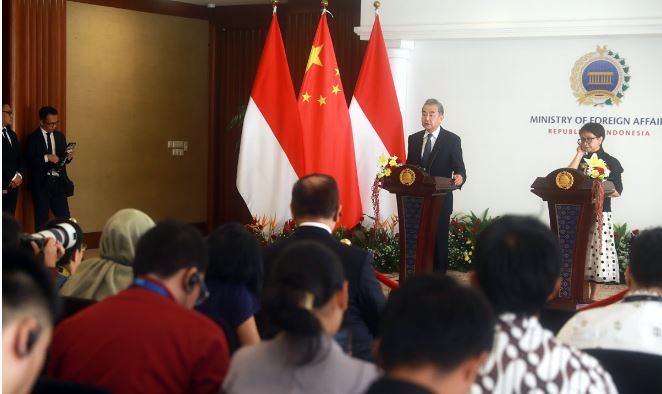
HIGHLIGHTS
INTERNATIONAL
China calls for a ceasefire and supports Palestine’s full UN membership
On 18 April, Chinese Foreign Ministry Wang Yi called for an immediate ceasefire and extended support for Palestine’s full UN membership ahead of the upcoming UNSC vote. Global Times analysts mention the increased political and moral pressure on the US and Israel, thereby leading to global isolation. Wang Yi’s statements come during a bilateral meeting with Indonesian Foreign Minister Retno Marsudi in Jakarta. Wang calls for an immediate setup of the humanitarian relief mechanism to provide aid to Gaza and calls for a two-state solution to the escalating situation. Citing Reuters, Global Times notes that the UNSC meeting schedule is to take place at 3 PM local time. US ambassador to the UN Linda Thomas-Greenfield said that “the US opposes a Palestinian push for full membership at the UN, as it backs statehood but only after direct negotiations with Israel.” (Wang Qi, “China expresses support for Palestine's full UN membership ahead of Security Council vote,” Global Times, 18 April 2024)
CHINA & SOUTHEAST ASIA
China warns of greater insecurity amid the upcoming US-Philippines drills
On 18 April, the Chinese Foreign Ministry warned against the upcoming US-Philippines drills and said that it would lead to greater insecurity in the South China Sea. The annual Balikatan, or shoulder-to-shoulder drills, will take place from 22 April to 10 May. They will involve 16,700 soldiers simulating retaking enemy-occupied islands facing Taiwan and the South China Sea. Colonel Michael Logico mentioned that the drills will be held outside of the Philippines’ territorial waters and will involve the Philippine Coast Guard for the first time. Chinese state media also criticized the drills and said that they would have a “destructive impact on regional security.” The Philippines Department of Foreign Affairs said that its decision was a sovereign choice and urged China to “reflect upon its own actions” in the South China Sea. (Helen Davidson, “China sounds warning after Philippines and the US announce most expansive military drills yet,” The Guardian, 18 April 2024)
EAST ASIA
US to begin new sanctions enforcement regime on North Korea, says the US ambassador to the UN
On 19 April, the US Ambassador to the United Nations, Linda Thomas-Greenfield, said that the US aims to find new ways to enforce a new sanctions enforcement regime on North Korea by May as Russia and China withdrew from the previous monitoring regime. She added that the US and its allies are looking to replace the old panel that monitored the implementation of sanctions aimed at curbing North Korea’s nuclear and missile programs for 15 years. The Straits Times notes Russia’s rejection and China’s abstaining from the annual renewal of the panel in March. (“US aims to begin new North Korea sanctions monitoring regime by May,” The Straits Times, 19 April 2024)
CHINA READER DAILY WIRE
INTERNAL
Half of Chinese cities are shrinking because of water extraction and building weight: BBC report
On 19 April, according to a report in BBC, around half of China’s major cities are sinking due to water extraction and increased building weight caused by their rapid expansion. Scientists mention the rapid rise of sea levels leading to flooding and threatening the lives of millions of people. BBC mentions a study by some Chinese universities that aims to understand the problem of sinking cities in China. They researched a population of two million in 82 cities using Sentinel-1 satellites to measure vertical land motions. The study revealed that 45 per cent of urban areas are subsiding by more than 3mm per year between 2015-2022. It also said that 16 per cent of urban lands are sinking faster than 10mm a year. Scientists mention that the major reasons for sinking are groundwater loss, geology, and building weight. They also highlight the presence of urban transportation systems and excessive mining for minerals and coal, which leads to city subsidence. McGrath mentions that urban areas will soon be exposed to severe flooding arising from subsidence and rising sea levels due to climate change. Matt McGarth, “Water extraction and weight of buildings see half of China's cities sink,” BBC, 19 April 2024)
ECONOMY
Countries fear of global supply shock as China manufacturing booms by 6.1 per cent: Morgan Stanley expert
On 18 April, countries fear a global supply shock amid a boom in China’s manufacturing output over demand. The concerns come as Chinese President Xi Jinping puts his belief on the country’s manufacturing sector to revive the economy from a prolonged property crisis. On 16 April, the data released by the National Bureau of Statistics showed a 6.1 per cent rise in industrial production and a nearly 10 per cent increase in manufacturing investment, thereby expecting GDP growth of 5.3 per cent in 2024. Chinese officials counter the criticism and argue that the market forces drive China’s green industries, not solely on subsidies and protectionism. According to Robin Xing, chief China economist at Morgan Stanley, China’s massive overcapacity has forced exporters to offer huge discounts on their exports. (John Leahy and Thomas Hale, “China warns west of ‘survival of the fittest’ as manufacturing boosts economy,” Financial Times, 18 April 2024)
CHINA & TAIWAN
China opens new air route close to Taiwanese-controlled island
On 19 April, China’s Civil Aviation Administration said that it opened the new air routes to the Chinese cities of Xiamen and Fuzhou, close to the Taiwan-controlled islands of Kinmen and Matsu. Straits Times notes Taiwan’s anger at China after Beijing unilaterally changed the flight path called M503 close to the sensitive median line in the Taiwan Strait. In January, China said that it was opening routes from west to east towards Taiwan, but it did not announce its operation. The regulator announced that the flight paths would optimize the airspace around Fuzhou airport. Both Kinmen and Matsu have regular flights to Taiwan, and Taiwan does not permit Chinese aircraft to fly in the island’s airspace. However, China threatens aviation safety and seeks to use flight routes to further pressure Taipei for political purposes. (“China opens new air routes near Taiwanese islands,” The Straits Times, 19 April 2024)
CHINA & SOUTHEAST ASIA
China rejects President Marcos’s allegations of a deal signed between Duterte and Beijing on SCS
On 19 April, China rejected remarks made by Philippine President Ferdinand Marcos Jnr, claiming that former President Rodrigo Duterte had signed a secret deal with Beijing over the South China Sea. Marcos said that the secret deal made by Duterte could jeopardize sovereignty. The Chinese embassy in Manila rejected the accusations and said that the Marcos government abided by the agreement after taking office in 2022. The embassy said that the Philippine government complied with the agreement until the start of February 2023. The embassy stated that the agreement focused on diffusing the tensions and did not impact the respective sovereign positions. It also said that the two sides agreed on a new agreement for resupply to the reef after multiple negotiations. President Marcos said that the country will not honor the agreement and will not seek any permission from another country for its sovereign decisions. (Liu Zhen, “Beijing denies its South China Sea deal with former Philippine leader Duterte was a ‘secret’,” South China Morning Post, 18 April 2024)
CHINA & EUROPE
EU sees Chinese exporting military components to Russia
On 18 April, Executive Vice-President of the European Commission, Valdis Dombrovskis, said that the EU sees the military application of components exported by China to Russia. During his meeting with the US lawmakers, Dombrovskis raised the importance of approving long-delayed US aid to Ukraine. He said that the EU was working alongside the US to crack down on the bypassing of sanctions. He also said West’s actions are insufficient and will lead to negative consequences. (“EU sees signs China supplying dual-use components to Russia,” The Straits Times, 19 April 2024)
CHINA & THE AMERICAS
US returns 38 ancient Chinese artifacts to China
On 17 April, the US announced that 38 ancient cultural artifacts were returned to Beijing under the repatriation deal. The officials stated that the artifacts dated back to the Ming (1368-1644) and Qing (1644-1911) dynasties. The Director General of the Chinese National Cultural Heritage Administration (NCHA), Li Qun, said the latest repatriation deal would signify mutual trust between the two sides to retrieve lost treasures. He also noted that this cultural exchange is marked on the 45th anniversary of establishing diplomatic relations between China and the US. The US Heritage Administration said that with the 2009 MoU, around 504 artifacts have been successfully returned to China. Chief of the Antiquities Trafficking Unit at the Manhattan District Attorney’s Office, Matthew Bogdanos, said: “Cultural heritage has the power to bring people together and bridge differences.” (Meredith Chen, “US returns cultural relics to China as part of antiquity repatriation deal,” South China Morning Post, 19 April 2024)
EAST ASIA & THE PACIFIC READER
EAST ASIA
TSMC to charge customers extra for making chips outside Taiwan
On 19 April, the Financial Times reported that Taiwan Semiconductor Manufacturing Company (TSMC) plans to charge customers extra for manufacturing chips outside of Taiwan. CEO of TSMC, CC Wei, said: “If a customer requests to be in a certain geographical area, the customer needs to share the incremental cost.” TSMC's price increase comes after governments and companies are diversifying their risks by sourcing chip supplies outside of Taiwan. Hille notes that Taiwan produces 90 per cent of the world’s advanced semiconductors. She mentions that the cost of producing chips outside Taiwan is significantly higher. The price rise also comes as TSMC’s profit predictions are expected to slide down due to rising power costs at its main manufacturing base in Taiwan, the impact of Taiwan’s 3 April earthquake, and a slower rise in 3nm manufacturing efficiency. (Kathrin Hille, “TSMC plans to charge customers more for chips made outside Taiwan,” Financial Times, 19 April 2024)
North Korea welcomes Belarus delegation to strengthen bilateral relations
On 18 April, state media KCNA reported of Belarusian delegation visiting Pyongyang to improve bilateral relations with North Korea. Both sides criticized the US for imposing sanctions. The Belarusian delegation was led by Deputy Foreign Minister Evgeny Shestakov and discussed bilateral cooperation with his counterpart Lim Chun Il on sectors of economy and culture and mutual support on the global stage. The diplomatic visits come after North Korea lifts COVID-19 restrictions. (“North Korea, Belarus deputy foreign ministers agree to strengthen ties,” The Straits Times, 19 April 2024)
China Reader Daily Wire | 16, 17 and 18 April 2024, Tuesday, Wednesday and Thursday | Vol.1 No. 57, 58 and 59
Fukushima Nuclear Disaster, 13 Years Later: Energy Debate, Safety Concerns and Global Fallouts
Chinese “Red Circle” law firms expanding in the overseas market | “China’s word carries weight in Russia,” says Olaf Scholz to Xi Jinping
HIGHLIGHTS
EXTERNAL
Chinese “Red Circle” law firms expanding in the overseas market
On 18 April, an Opinion in the Financial Times looked into the rising Chinese law firms in Asia and the US. Chinese top law firms also known as the “red circles” are stepping up to expand their international presence, by working at a much lower fee. The op-ed reckoned that at least eight of the biggest Chinese law firms in mainland China have now opened overseas. The expansion also known as the “red circle” came as a counter to London’s legal firm “magic circle.” Dozens of Chinese firms have opened offices in the US over the past few years. Jingsh Law Firm one of China’s biggest firms have announced its plans to set up offices in South Korea and Japan. Managing partner at Zhong Lun Alan Xu said: “Chinese law firms are rapidly evolving and increasingly competing in these areas by hiring experienced lawyers from international firms and expanding their international presence.” (Chan Ho-him, “China’s ‘red circle’ law firms rush to tap other markets,” Financial Times, 18 April 2024)
CHINA & EUROPE
“China’s word carries weight in Russia,” says Olaf Scholz to Xi Jinping
On 16 April, German Chancellor Olaf Scholz said: “China’s word carries weight in Russia,” while urging President Xi Jinping to persuade Russia to end its war in Ukraine. He mentioned President Xi’s acceptance for the peace conference in Switzerland. Xi stated: “efforts towards a peaceful resolution should be recognised by both sides and include equal participation by all parties.” Scholz said to Xi that Russia’s aggression and arms buildup in Ukraine has negative implications for Europe’s security. Chinese state media CCTV quoted Xi’s statement: “four principles to prevent the Ukraine crisis from spiralling out of control and to restore peace.” His remarks come after Scholz, accompanied by his delegation, arrived in Beijing on 14 April for the second time since taking office. (“German chancellor urges Xi Jinping to press Russia to end Ukraine war, saying ‘China’s word carries weight’,” The Guardian, 17 April 2024)
CHINA READER DAILY WIRE
INTERNAL
Authorities collective punishment on Chinese dissenters, reports Chinese Human Rights Defenders
On 15 April, VOA reported on US-based human rights group Chinese Human Rights Defenders finding that China has been “collectively punishing” and persecuting Chinese families. The authorities are probing against the children and family members of detained human rights defenders. They are taking them in custody and keeping them in psychiatric wards, hospitals and orphanages. They forced school-aged kids of detainees to drop out and banned them from leaving China. The director of Chinese Human Rights Defenders groups Renee Xia said: “The most heartbreaking part is [how the Chinese authorities are] inflicting so much pain on the children of human rights defenders and the experience of watching their parents being mistreated growing up leaves long-term psychological trauma on them.” As part of the collective punishment children and families are forced to be evicted from their houses and the schools repeatedly turn them away from admission. Chinese Huma Rights Lawyer Wang Quanzhang who was detained in 2015 stated that he and his family has been evicted multiple times and hotels have refused to take them in. Wang said: “The authorities think our community has been trying to humiliate them, so they want to use all the means at their disposal to punish human rights lawyers.” He also said that his 11-year-old son had been turned away from several schools and when they tried to leave the country the customs office stopped them stating national security issues. The report demands: “immediately cease all harassment and extralegal detention of the family members of human rights defenders.” (William Yang, “Report: Chinese authorities impose collective punishments on families of detained dissidents,” VOA, 15 April 2024)
Former industry workers disagree on the Chinese overproduction issue, says an Opinion in BBC
On 18 April, an Opinion in BBC looked into the dwindling Chinese industries and the issue of overproduction. Ren Wenbing former factory worker in the manufacturing hub Dongguan. Ren lost his job when the owner of the former company he was working at shifted the production house to Southeast Asia to save costs. The op-ed highlighted the growing concern of the Chinese overproduction by the US and the West. The Chinese brand of “Made in China” has shifted from t-shirts, tables and TVs to electric cars and solar panels. The old industrial pillar furniture, clothes and electric goods are no more as China looks for a “new productive force,” that would focus on solar panels, lithium batteries and electric cars. Yan Mu a salesperson for Chinese solar batteries said: “I think Chinese companies are leading the whole energy storage market. With innovation, with new technologies, battery sales, PCS [power conversion systems] ... well, everything. Right now, I think 80% to 90% of the energy storage equipment is designed and manufactured in China.” China in 2024 has installed more solar panels than the US in the last decade. But this new growing industry is not labour-intensive says the op-ed, therefore the booming industry does not alleviate the unemployment crisis. Dongguan is also changing from an industrial hub, it is changing itself to an aspiring high-tech hub. Huawei made a campus to house 25,000 employees, there are a set of new science parks and chains of hotels being built. These new jobs require specialized skills and people like Ren do not have to make use of the new opportunities. (“The West says China makes too much. Its workers disagree,” BBC, 18 April 2024)
China’s debt defaulters barred them from high-speed trains and fancy hotels, says an Opinion in WSJ
On 17 April, an Opinion in the Wall Street Journal looked into the punitive actions taken by the Chinese authorities against people with bad debt. Many of the debt repayment defaulters are blocked from buying tickets for high-speed trains as a penalty. People in China are penalized for not paying their debts the authorities are seizing their salaries and restricting them from getting government jobs due to non-payments. They are forbidden from buying expensive insurance policies and are not allowed to go on vacations or live in nice hotels. Unlike the US the defaulters are not allowed to declare bankruptcy and write off their bad debts. The long-standing property crisis has caused significant personal debts and as the prices are falling many are stuck with mounting debts. Chinese bank issues tens of millions of new credit cards with each year having an outstanding balance jumping over 50 per cent. This has created a new black market to cater for the needs of blacklisted people, where one ring of scammers bought tickets on behalf of these backlisted people. Some analysts believe that the Chinese economy gives more power to creditors and powerful SOEs rather than individuals and that there is an urgent need to create a nationwide bankruptcy system. (Brian Spegele, “Pacemaker or competitor? Beijing half marathon under probe as Chinese star handed a win,” VOA, 16 April 2024) “ China’s Punishment for People With Bad Debts: No Fast Trains or Nice Hotels,” Wall Street Journal, 17 April 2024)
Controversial Chinese marathon win of He Jie probed into
On 16 April, VOA reported on the controversial win of the Chinese long-distance runner He Jie. The Beijing Half Marathon is facing a probe as a video went viral where three African runners allowed and even deliberately slowed to let, He win the race. The video showed all three African runners Kenya’s Robert Keter and Willy Mnangat, and Ethiopia’s Dejene Hailu Bikila letting He in front as they approached the finish line together, they gestured He to pass in front of them to win the race. Once the video went viral the Mnangat said that he let him win because the Chinese runner is his friend and refused that any monetary reward was given or promised. He then later changed his statement and said it let him win because they were hired as pacemakers and were not there to compete. (“Pacemaker or competitor? Beijing half marathon under probe as Chinese star handed a win,” VOA, 16 April 2024)
ECONOMY
The Chinese economy grew by 5.3 per cent surpassing predictions, reports the National Bureau of Statistics
On 16 April, the Chinese National Bureau of Statistics informed that their economy grew by 5.3 per cent, the official data found that the Gross Domestic Product expanded by 5.3 per cent in the first three months of 2024 than 2023. They not only completed their goal but surpassed the expectation, where many analysts believed that the growth would be slowed down to 4.6 per cent. Last month they set a target for 5 per cent economic growth in 2024. They made a stronger-than-expected comeback even as the real-estate crisis still plagues the Chinese economy. The data also revealed that their retail sales in the first quarter and the consumer confidence fell to 3.1 per cent. Moody’s analyst Harry Murphy said: “You cannot manufacture growth forever so we need to see households come to the party if China wants to hit that around 5% growth target.” Additionally, the property investment fell by 9.5 per cent. Real estate accounts for 20 per cent of the Chinese economy. (“China economy grows faster than expected in first quarter,” BBC, 16 April 2024)
Chinese central bank cautions against the “one-sided pursuit of credit expansion”
On 18 April, the Chinese Central Bank cautioned against the “one-sided pursuit of credit expansion.” The banks have slowed down lending as they prioritize quality credit oversize. People’s Bank of China said: “With the transition of the economy from high-speed growth to high-quality development, ... it is even more necessary to change the traditional mindset of one-sided pursuit of scale and establish the concept of prioritising quality and efficiency.” PBOC has stated that they would channel funding into innovation technology and green manufacturing of smaller firms. PBOC also said: “Credit allocation should ultimately be in line with the needs of high-quality development of the real economy. The key is to grasp the level well, rather than the more, the better.” They aim to revitalize the existing credits to improve their quality and efficiency. (“China's c.bank warns against 'one-sided' pursuit of credit expansion,” Reuters, 18 April 2024)
ENERGY & ENVIRONMENT
Ampace is the largest Chinese exporter of battery storage systems
On 18 April, the South China Morning Post reported on the growing Chinese industry of batteries under Contemporary Amperex Technology Limited (CATL) as it looks to dominate internationally. Ampace part of Contemporary Amperex Technology Limited (CATL) is investing heavily in the energy storing system and the “batterfication” of tools. A researcher at Ampace said that there is a huge demand for diverse applications of energy storage and they want to carve out their space. In three years, the company has been able to establish itself in the global home energy storage market. Shenzhen Gaogong Industry Research (GGII) found that China has shipped over 20 gigawatt hours of residential energy storage system and Ampace was the largest manufacturer of it accounting for 30 per cent of it. The company recently launched an Ampace C5 that can be used commercially and for industries at a reduced cost of 46 per cent. (Yujie Xue, “How a little known spin-off of Chinese battery giant CATL has come to dominate the global home energy storage market,” South China Morning Post, 18 April 2024)
CHINA & TAIWAN
PLA sends fighter jets to warn US Navy aircraft from patrolling in the Strait
On 17 April, PLA’s Eastern Theatre Command informed that they sent fighter jets near the Taiwan Strait to warn US Navy patrolling in the region with aircraft. The US Navy’s 7th fleet also informed that the P-8A Poseidon maritime that is reconnaissance and patrolling aircraft flew over the international air space near the Taiwan strait. They issued that they operated within the Strait and in line with international law asserting that the US “upholds the navigational rights and the freedom of all nations.” Chinese military’s Eastern Theatre Command of the People’s Liberation Army called this a public hype and that “Troops in the theatre are always on high alert and will resolutely defend national sovereignty and security as well as regional peace and stability.” This comes right after the US Defence Secretary Lloyd Austin spoke with Chinese Defence Minister Dong Jun, where Dong said: “The Chinese People’s Liberation Army will never let any Taiwan independence separatist activities and external connivance and support go unchecked,” and that the Taiwan issue is the core of Chinese interest and this core interest mustn’t be harmed. (“China sends fighter jets to shadow US Navy plane over Taiwan Strait,” The Straits Times, 17 April 2024)
CHINA & EAST ASIA
China’s NPC president meets Kim Jong Un to discuss the friendly future of Beijing and Pyongyang
On 13 April, Chinese legislator and the President of the National People’s Congress China Zhao Leji met with the North Korean Leader Kim Jong Un in Pyongyang. Zhao expressed China’s willingness to work with its North Korean counterparts to further deepen their cooperation. Zhao said: “No matter how the international situation changes, the traditional friendship between China and the DPRK, created and nurtured by the older generation of leaders from both parties and countries, remains deep-rooted and strong over time.” Zhao also said that it is China's strategic policy to defend and further friendly relations between China and North Korea. (“China’s top legislator meets North Korea’s Kim Jong Un on goodwill visit,” The Straits Times, 13 April 2024)
“Hong Kong must tightly hold onto the bottom line of national security to safeguard development,” says the director of the Hong Kong and Macau Affairs Office
On 15 April, the director of Beijing’s Hong Kong and Macau Affairs Office, Xia Baolong, said that “Hong Kong must tightly hold onto the bottom line of national security to safeguard development” in a speech to mark the annual National Security Day. It comes as the Hong Kong authorities imposed Article 23, or the new national security law in March 2023 that updates or introduces new laws to prohibit treason, sabotage, sedition, the theft of state secrets, and espionage, with jail terms of up to life imprisonment. Baolong mentions that the new law does not threaten investors amid criticism of a wider public crackdown. The legislation was introduced as part of the national security law China directly imposed on Hong Kong in 2020 in response to mass pro-democracy protests in Hong Kong. (“China says Hong Kong must ‘tightly hold’ national security line to safeguard development,” The Straits Times, 15 April 2024)
CHINA & SOUTHEAST ASIA
Chinese coast guards block the Philippines research vessel for eight hours
On 13 April, Chinese coast guards blocked two Philippines ships for hours near their country’s coast. The incident took place just 35 nautical miles from the Philippines coast. The satellite imagery by Sea Light found that the Philippines's maritime research vessels and escort ships met the Chinese coastguards. The image showed that they met near the infamous nine-dash line that China marks as part of its claim in the region. The vessel was stopped for eight hours. Sea Light director Ray Powell informed that they intercepted them as they crossed the nine-dash line claim. Powell also believes that China’s actions are a reaction to the US-Philippines and Japan’s trilateral summit where they voiced concerns stating that this is a dangerous behaviour in the South China Sea. Chinese Ministry of Foreign Affairs said: “[T]he Philippines has abandoned the current administration’s understanding with China on the Ren’ai Jiao issue.” (Kathrin Hille and Demetri Sevastop, “China coastguard blocks Philippine vessels as maritime tension grows,” Financial Times, 15 April 2024)
Vietnamese high-level delegation visits China to boost economic ties
On 17 April, Vietnam’s National Assembly Chairman Vuong Dinh Hue led a high-level delegation to China from 7 to 12 April to boost economic ties. The delegation also met Chinese President Xi Jinping. Hue said the two countries “aim to connect Vietnam to China's large development strategies.” Lim notes that Vietnam is China's largest trading partner of China, and Beijing has a greater role in boosting FDI in Vietnam. Korea Chamber of Commerce and Industry (KCCI) representative said that Chinese companies are putting tough competition on South Korea with their increased investments in Vietnam. Kim Hyong-mo notes that South Korea ranked first in FDI since 1988 with USD 85 billion but faces fierce competition from Chinese firms. He also mentions a growing preference for Vietnam due to its proximity to China and its population of 100 million people, making it attractive for shifting industrial chains from Mainland China. (Peh Hong Lim, “China-South Korea competition grows in Vietnam,” VOA, 17 April 2024)
PLA conducts second live-fire drills along China- Myanmar border
On 17 April, the People’s Liberation Army conducted its second live-fire drill along the China-Myanmar border, indicating Beijing’s concerns over the deteriorating security situation. As reported by the theatre command’s WeChat account, the drills were organized by the PLA’s Southern Theatre Command, which involved both ground and air forces. The PLA statement said: that the drill tested the forces’ abilities in “air-defence capacity, reconnaissance, early warning, and repulsion.” The drills come after the first drill two weeks ago due to the continued rebel uprising in Northern Myanmar. China repeatedly calls all the parties to exercise restraint and promotes resolving issues through dialogues and discussions. (Zhao Ziwen, “China holds another live-fire drill along Myanmar border as concerns over rebel uprisings grow,” South China Morning Post, 17 April 2024)
“China and Indonesia pledges to strengthen economic ties and maintain peace and stability in the region,” says Chinese Foreign Ministry Wang Yi
On 18 April, Chinese Foreign Minister Wang Yi said: “China and Indonesia have pledged to strengthen economic ties and maintain peace and stability in the region,” after meeting with his counterpart Retno Marsudi in Jakarta. Wang also called all parties to exercise maximum restraint and urged the US to support the UN ceasefire resolution in Gaza. Indonesian Foreign Minister Retno Marsudi said she hoped China “would use its influence to prevent escalation” in Gaza, “emphasising the need for a two-state solution.” Wang also plans to attend the China-Indonesia High-Level Dialogue Cooperation Mechanism meeting with his Indonesian counterparts in Labuan Bajo on 19 April for further cooperation. Wang also expressed a quick resolution to the ongoing code of conduct on the South China Sea. Retno also mentioned the meeting between Jokowi and Wang for further economic cooperation in the transportation and petrochemical sector. (“China foreign minister says Beijing and Jakarta want regional peace and stability,” Reuters, 18 April 2024)
CHINA & THE MIDDLE EAST
“Energy trade between China and the Middle East is likely to increase,” says an analysis by the UBS Investment Bank
On 15 April, according to an analysis by the UBS Investment Bank, the energy trade between China and the Middle East is likely to increase significantly amid the Saudi-Iran peace deal brokered by China. According to Ken Liu, head of China and Hong Kong renewables, utilities, and energy research at UBS Investment Bank, by 2030, the trade between the two sides will increase by USD 423 billion annually or 11 per cent, with renewables and petrochemicals accounting for USD 77 billion and USD 325 billion, respectively. He further mentions that the Beijing Accord of March 2023 will yield greater monetization potential, thereby sudden impact on share prices. Liu also mentions additional trade in the green energy sector, with China playing a greater role in the Middle East through its control over the renewable equipment supply chain. According to the Chinese customs data, trade between China and the Middle East from 2017 to 2022 has doubled from USD 262.5 billion to USD 507.2 billion. (Yujie Xue, “China’s energy trade with Middle East set to surge since Beijing brokered last year’s Iran-Saudi deal, UBS says,” South China Morning Post, 16 April 2024)
CHINA & EUROPE
German Chancellor Scholz urges China to play fair in EU market
On 15 April, Germany’s Chancellor urged China’s top industrial heads to play fair in EU markets and not violate copyright rules or overproduce cheap goods. In his three-day visit to China, Schulz said he would encourage the EU to pursue a protectionist policy. In the case of the automotive industry, Scholz said that European cars should have equal access to the Chinese market. He also requested that Chinese authorities not impose stringent restrictions on foreign companies trying to set up manufacturing capabilities in China. Connolly mentions that Scholz’s visit aimed to pursue a de-risking strategy to reduce overall dependency on China. (Kate Connolly, “German chancellor urges Chinese industry bosses to play fair in EU market,” The Guardian, 15 April 2024)
Russian and Chinese firms avoid taxes, western sanctions through trading in copper scrap, says an editorial in Reuters
On 15 April, according to an editorial in Reuters, Russian Copper Company (RCC) and Chinese firms avoided taxes and Western sanctions by trading in new copper wire rods disguised as scrap. Reuters reports of copper wire rods being shredded in the remote Xinjiang Uyghur region by an intermediary to allow both exporters and importers to earn profits from scrap and new metals. It further reported that Russia's export duty on copper rods was 7 per cent in December, lower than the 10 per cent levy on scrap. Imports of copper rods into China are taxed at 4 per cent and no duty on Russian scrap imports. Data from Chinese customs showed that China imported more copper scrap from Russia. The Federal Customs of Russia noted that its trade data in April 2022 stopped publishing after the start of the Russia-Ukraine war. Reuters reports that shredding is out of the sanctions regime as the shredded copper metal is harder to identify and trace, thereby making it easier to sell to Chinese manufacturers. The data showed that around 97 per cent, or 6,434 metric tons, came from the Alashankou border of Xinjiang in December 2023. (“Exclusive: Russia and China trade new copper disguised as scrap to skirt taxes, sanctions,” Reuters, 15 April 2024)
CHINA & THE AMERICAS
China opposes US probe into its shipbuilding industry, says an editorial in The Wall Street Journal
On 17 April 2024, according to an editorial in The Wall Street Journal, China opposes the US probe into its shipbuilding industry and calls the investigation politically driven with false accusations. It came after US Trade Representative Katherine Tai said that it would open an investigation into China’s policies and practices in the maritime, logistics, and shipbuilding sectors after receiving petitions from the five national labour unions. China’s Ministry of Commerce rejected it and said that USTR’s statements misinterpreted normal trade and investment practices and called its accusations “baseless and against economic common sense.” In addition to USTR, President Biden calls for increasing tariffs on the imports of Chinese steel and aluminium to boost the domestic steel sector. (“China Denounces U.S. Probe Into Shipbuilding Sector,” The Wall Street Journal, 17 April 2024)
“IPR continues to be the main concern for US businesses in China,” says US Patent and Trademark Office Director
On 16 April, the US Patent and Trademark Office director Kathi Vidal said that “intellectual property rights (IPR) continue to be a main concern for US businesses in China.” Vidal mentioned that the Office of the US Trade Representative has placed China on its priority watch list, citing insufficient protection and enforcement of IP. She also said that Beijing’s actions harmed US companies and workers and hurt other countries. On 15 April, in her meeting with Chinese Vice-Premier Ding Xuexiang, Vidal mentioned the US’s willingness to cooperate in developing intellectual property cooperation with China. (“US official says intellectual property rights infringement still main concern in China,” The Straits Times, 17 April 2024)
The US and China discuss Middle East developments, the South China Sea and Taiwan
On 15 April, the US diplomats discussed Middle East developments, the South China Sea, and Taiwan issues with their Chinese counterparts to stabilize bilateral ties. During the US delegation’s visit to Beijing on April 14-16, Assistant Secretary of State for East Asian and Pacific Affairs Daniel Kritenbrink met China’s Executive Vice-Foreign Minister Ma Zhaoxu and Beijing’s Taiwan Affairs Office Deputy Director Qiu Kaiming. The US Department of State said that the delegation officials, including the US National Security Council senior director for China and Taiwan, Sarah Beran, and US Ambassador to China Nicholas Burns, discussed bilateral, regional, and global issues. It stated that the visit was aimed at managing differences and reducing the risk of miscalculation. The US officials warned of the risk to bilateral ties amid China’s support for Russia’s war in Ukraine. (“US, China officials discuss Middle East, Taiwan, South China Sea,” The Straits Times, 16 April 2024)
EXTERNAL
Chinese “Red Circle” law firms expanding in the overseas market
On 18 April, an Opinion in the Financial Times looked into the rising Chinese law firms in Asia and the US. Chinese top law firms also known as the “red circles” are stepping up to expand their international presence, by working at a much lower fee. The op-ed reckoned that at least eight of the biggest Chinese law firms in mainland China have now opened overseas. The expansion also known as the “red circle” came as a counter to London’s legal firm “magic circle.” Dozens of Chinese firms have opened offices in the US over the past few years. Jingsh Law Firm one of China’s biggest firms have announced its plans to set up offices in South Korea and Japan. Managing partner at Zhong Lun Alan Xu said: “Chinese law firms are rapidly evolving and increasingly competing in these areas by hiring experienced lawyers from international firms and expanding their international presence.” (Chan Ho-him, “China’s ‘red circle’ law firms rush to tap other markets,” Financial Times, 18 April 2024)On 17 April, US President Joe Biden announced that he would increase the tariffs on imports of Chinese steel and aluminium by threefold and vows to block the acquisition of US Steel company by Japanese company Nippon during his speech to the steelworkers union in Pennsylvania. His statement comes as the union's support would provide vital support to Biden in the November presidential elections. The President asked the Trade Representative to triple the existing tariffs of 7.5 per cent on Chinese imports to protect US jobs from unfair competition. Biden also said that he will ensure to prevent Chinese shipments to the US via Mexican ports. White House national economic adviser Lael Brainard, mentioned that the Biden administration vowed to boost American manufacturing and to protect the domestic industry from unfair imports due to China’s industrial overcapacity. (Leonie Chao-Fong, “Biden to triple taxes on Chinese steel and block Japanese takeover of US Steel,” The Guardian,” 17 April 2024)
US Congress targets Chinese drugmaker over links to the Chinese government
On 15 April, The New York Times reported a Chinese drugmaker being targeted by the US Congress over links to the Chinese government. The company WuXi AppTec is one of many companies that supply critical drugs for the US market to treat cancers, obesity, and debilitating illnesses like cystic fibrosis. The US lawmakers identified the company as a potential threat to the security of individual Americans’ genetic information and US intellectual property. According to Jewett, the sudden move by Congress has shocked the US pharmaceutical industry, which has already been struggling with widespread drug shortages for the past 20 years. Jewett mentioned the reputation of WuXi AppTec for creating low-cost drugs and reliable work to produce in bulk quantities, with one-fourth of the drugs being developed for the US market. She also reports the Biosecure Act bill, which linked the company to the PLA and accused WuXi AppTec of sponsoring military-civil events and receiving military-civil fusion funding. (Christina Jewett, “Chinese Company Under Congressional Scrutiny Makes Key U.S. Drugs,” The New York Times, 15 April 2024)
EAST ASIA & THE PACIFIC READER
EAST ASIA
Japan to conduct demonstration tests for autonomous underwater drones in June, reported by The Straits Times
On 18 April, according to The Japan News and Asia News Network in The Straits Times, the Japanese government will start the demonstration tests for autonomous underwater vehicles (AUVs) from June to December 2024. The expected costs per unit are reported to rise to JPY one billion. The government mentions using AUVs in dangerous waters and deep seas with high pressure. It will be used in marine resource development and national security. The government also indicated using AUVs to inspect offshore wind power generation facilities and underwater surveillance and vigilance activities. According to the government, Japan aims to strengthen its AUV capability amid China’s maritime expansion. The government will invite AUV manufacturing companies, research institutes, and organisations specializing in oceanographic surveys for the demonstration tests. The government mentions the strategy for domestic production of AUVs in 2023 to industrialise AUVs by 2030. (“Underwater drones to be tested in Japan with aims to promote domestic manufacturing,” The Straits Times, 18 April 2024)
6.4 magnitude earthquake hit Southern Japan
On 17 April, the Japan Meteorological Agency (JMA) said the 6.4 magnitude earthquake hit Southern Japan. It was reported that the Bungo Channel between the Kyushu and Shikoku islands was the epicentre of the earthquake. JMA also reported that six-magnitude earthquakes were recorded in the Ehime and Kochi prefectures. Local media reports minor damages, such as water pipe bursts, with no casualties. Japanese government spokesperson Yoshimasa Hayashi said that one of the operational Ikata nuclear reactors in Ehime prefecture witnessed no damages. Hayashi also warns of multiple earthquakes with lower magnitudes of six seismic scale. (“Earthquake jolts southern Japan’s Ehime, Kochi prefectures,” The Straits Times, 18 April 2024)
Australia boosts defence budget to prepare against potential US-China conflict in the Pacific
On 17 April, Australia to boost defence spending by AUSD 50.3 billion over the next decade to prepare against a potential conflict between the US and China in the Pacific. Australian Defense Minister Richard Marles said that the new defence spending indicates new priorities, such as focusing on missiles, drones, and warships to prepare the country against potential regional conflicts. According to the ministry, the new spending will take place after the next five years and will take the overall defence spending from the current two per cent to 2.4 per cent of the GDP by 2034. Out of the AUSD 330 billion, 40 per cent or AUSD 145 billion, is allocated for the navy, which includes surface fleets, AUKUS nuclear-powered submarines, and Ghost Shark undersea drones. Also, one-fifth, or AUSD 74 billion, will be allocated for missile-related programs as per the suggestions given under the 2023 review. The remaining AUSD18 billion will be allocated to upgrade military bases in northern Australia. (“Australia to prioritise missiles, drones and warships as part of $44 billion defence boost,” The Straits Times, 17 April 2024)
Japanese Foreign Minister expresses concerns over Iran’s retaliatory attack on Israel
On 14 April, Tokyo expressed concerns regarding Iran’s retaliatory attack on Israel and warned of potential escalation of conflict in the region. Japanese Foreign Minister Yoko Kamikawa said: “This attack is one that further worsens the current Middle East situation. We are deeply concerned and strongly condemn this sort of escalation.” This comes after Iran launched drones and missiles at Israel on 13 April in retaliation for an Israeli air strike on its embassy in Syria. The minister’s statement also stressed the need for diplomatic steps to prevent any further deterioration of the situation. The Straits Times reports Japan’s heavy reliance on oil, with 95 per cent of the crude imported from the Middle East region. (“Japan strongly condemns Iranian attack on Israel as ‘escalation’,” The Straits Times, 14 April 2024)
South Korean President Yoon accepts the public sentiment after the general election results
On 16 April, South Korean President Yoon Suk-yeol said that he and his government accepted the public sentiment on the recent 10 April general election. The elections led to the win of the opposition party and its control over the National Assembly for the next four years. President Yoon also admitted the shortfall in meeting economic recovery for all. He urged the government to refine existing domestic policies to enhance their effectiveness in addressing the people’s livelihoods and warned against populist policies such as cash allowances. He said that he would focus on major reform drives on labour, education, public pensions, and the medical sector. According to The Straits Times, President Yoon did not address the careless nomination of former defence minister Lee Jong-sup as the envoy to Australia. The ruling People Power Party won 108 seats out of 300 in the National Assembly in recent general elections, leaving the party stressed against the opposition’s majority. Yoon said in a cabinet meeting that he would cooperate with the National Assembly to make key policy changes. (“South Korean President Yoon sorry for shortcomings but insists policies were right,” The Straits Times, 16 April 2024)
Outgoing President Tsai announces Lin as Taiwan’s next Foreign Minister
On 16 April, during her remarks to a visiting New Zealand delegation in Taipei, outgoing President Tsai Ing-wen introduced Lin Chia-lung as Taiwan’s new Foreign Minister. She added that the incumbent Foreign Minister, Joseph Wu, will become the secretary-general of the National Security Council. Tsai’s steps marked a shift in the announcements being made by the incoming government. Presidential Office spokesperson said President-elect Lai Ching-te’s team would confirm any new government appointments. Opposition KMT party member Ma Wen-chun said that Tsai’s deep involvement in national security issues will continue to exert her influence behind the scenes. Lin served as an adviser to the National Security Council in the early 2000s under then-President Chen Shui-bian. Lin also served as an ambassador for Tsai’s digital New Southbound Policy initiatives between Taiwan and 18 countries across Southeast Asia, South Asia, and Australasia. (Yip Wai Yee, “Taiwan has a new foreign minister – it’s announced by outgoing President Tsai, not her successor Lai,” The Straits Times, 18 April 2024)
China Reader Daily Wire | 12 April 2024, Friday | Vol.1 No. 56
Japan, the Philippines, and the US concerned over Chinese actions in the South China Sea
The US becomes the largest export destination for Taiwan, reports Taiwanese’s Foreign Ministry
HIGHLIGHTS
EXTERNAL
Japan, the Philippines, and the US concerned over Chinese actions in the South China Sea
On 12 April, Japan, the Philippines, and the US leaders voiced serious concerns over China’s actions in the South China Sea. The three leaders issued their joint statement at the end of their first trilateral summit between the three countries in Washington, DC. In March, the Philippines President Ferdinand Marcos called for increased countermeasures against China after a confrontation near the Second Thomas Shoal, which injured Filipino soldiers and navy vessels. Beijing claims the entire South China Sea as its own through its nine-dash line claims, which were rejected by the ICJ ruling in 2016. The joint statement reiterated the need to respect the sovereignty of other states within their EEZ as part of the 1982 UNCLOS. (“Japan, Philippines, US rebuke China over ‘dangerous’ South China Sea moves,” Al Jazeera, 12 April 2024)
CHINA & THE AMERICAS
The US becomes the largest export destination for Taiwan, reports Taiwanese’s Foreign Ministry
On 10 April, according to data from the Taiwanese Foreign Ministry, the US became Taiwan's largest export destination. The data indicated that Taiwan’s exports to the US grew by 65.7 per cent year on year in March to USD 9.1 billion, whereas its exports to China grew by 6 per cent to USD 7.9 billion. This shift in trade was due to the changing priorities of the successive US administrations, which were to reduce dependence on China. The data also reveals that China remained Taiwan’s number one export destination since 2003, which fell recently to second position. Overall exports to China and Hong Kong still remain the largest export places for Taiwan. (Samson Ellis and Miaojung Lin, “US Buys More Taiwan Exports Than China for First Time Since 2003,” Bloomberg, 11 April 2024)
CHINA READER DAILY WIRE
ECONOMY
20 countries ambassadors extend support towards China’s policies in Xinjiang
On 11 April, ambassadors from 20 countries extended their support for China’s policies in China’s Xinjiang Uygur autonomous region to develop close economic ties amid allegations of human rights violations. In the event organized by Xinjiang officials, more than 50 diplomats from 49 countries, including 21 ambassadors, attended the reception. The ambassadors from South Africa, Pakistan, Kazakhstan, Iran, Syria, and Turkey told Xinjiang officials that they hoped to strengthen economic ties with the region. Xinjiang is home to 25.85 million people, 14.93 million of whom are members of ethnic minority groups comprising the Muslim Uygurs and Kazakhs. China’s vice-minister of foreign affairs, Chen Xiaodong, said that Beijing would actively promote Xinjiang to the outside world and would resist lies about forced labour. (Yuanyue Dang, “China finds foreign support for Xinjiang policies as the region seeks to boost economic ties,” South China Morning Post, 11 April 2024)
EXTERNAL
The US and Japan had “smeared and attacked” China at the summit, says Chinese Foreign Ministry
On 11 April, China’s spokesperson for the Ministry of Foreign Affairs, Mao Ning, said that the US and Japan had “smeared and attacked” China during the recent Washington summit. On 10 April, both countries agreed to restructure the US command in Japan, marking a significant upgrade in US-Japan defence ties. This plan enables the US and Japanese forces to respond to the potential Chinese invasion of Taiwan quickly. President Biden said the move was purely defensive and not directed against China. The Spokesperson also said that the US-Japan ties must not harm other countries' interests and threaten regional peace and stability. She further added that Taiwan is China’s internal affairs, and Beijing won’t allow any external force. (“Beijing says US, Japan ‘smeared and attacked’ China at summit,” The Straits Times, 11 April 2024)
CHINA & EAST ASIA
China willing to work with North Korea to help relations reach a “higher level,” says NPC Standing Committee head Zhao Leji
On 11 April, the head of the National People's Congress Standing Committee, Zhao Leji, said that China is willing to work closely with the North Korean legislature to help relations reach a “higher level.” Leji also says maintaining close ties with the DPRK is part of China’s overall strategic priority. (“China says it is ready to work closely with North Korea to help relations reach higher level,” Reuters, 11 April 2024)
CHINA & SOUTH ASIA
“India and China must urgently address their border disputes to improve bilateral relations,” says PM Modi
On 10 April, in an interview with Newsweek magazine, PM Modi said, “India and China must urgently address their border disputes to improve bilateral relations.” In the interview, PM Modi did not respond to the opposition party’s allegation but stated the importance of India’s ties with China. He also said that the peaceful relations between the two countries were important for the entire region and the world. On India’s role as a global manufacturing hub, PM Modi said, “India, as a democratic polity and global economic growth engine, is a natural choice for those looking to diversify their supply chains.” India’s opposition Congress party accused the ruling government of giving clean chit to China’s illegal encroachment of Indian territory. According to Newsweek magazine, the interaction with PM Modi was a written interview, followed by a 90-minute conversation. (“India’s Modi urges peace at China border,” BBC, 11 April 2024)
CHINA & EUROPE
China opposes EU’s investigation into Chinese wind turbine makers
On 10 April, the Associated Press reported China’s opposition to the ongoing EU’s investigation into Chinese windmakers and referred to it as protectionism and reckless distortion of the definition of subsidies. EU’s investigation on 09 April is the latest move against Chinese companies under a new EU regulation. The EU Commissioner for Competition, Margrethe Vestager, said that the investigation will find out whether Chinese subsidies are giving wind turbine companies an unfair advantage in the competition for projects in five member countries: Spain, Greece, France, Romania, and Bulgaria. The China Chamber of Commerce to the EU mentions the investigations as an act of economic coercion undermining the EU’s own goals to reduce greenhouse gas emissions. China’s Ministry of Commerce said that the “EU’s investigation undermines the motivation for Chinese companies to invest and trade in Europe and affects global efforts to combat climate change.” (Ken Moritsugu, “China protests EU’s investigation of subsidies in green industries, calling the move protectionist,” Associated Press, 11 April 2024)
2500 Chinese victims asked Beijing to return EUR 3 billion worth bitcoin seized in the UK
On 12 April, the Financial Times reported that 2500 Chinese people who are victims of investment fraud seek China’s help to retrieve the amount worth up to EU3bn bitcoin seized in the UK. The victim’s representation group, Chinese company Tianjin Lantian Gerui Electronic Technology, submitted a letter this week to the foreign ministry in Beijing to retrieve the seized money in the UK. The request comes after the conviction in conviction in Southwark Crown Court in March of British-Chinese woman Jian Wen on one count of helping her employer Zhimin Qian convert some of the bitcoin into cash, jewellery, and property. The Tianjin task force said that 8 per cent and 5 per cent of their investment capital had been repaid using assets confiscated from Lantian Gerui and its former employees that were worth a total of Rmb2.8bn. The victims said that their financial loss had resulted in family breakdown, separation from their children, indebtedness, and no money left for medical treatment. (Eri Sugiura and Wenjie Ding, “Chinese fraud victims seek the return of £3bn in bitcoin seized in UK,” Financial Times, 12 April 2024)
CHINA & THE AMERICAS
China sanctions two US companies over arms sales to Taiwan, says China Foreign Ministry
On 11 April, the Chinese Ministry of Foreign Affairs said that China sanctioned two US companies for arms sales to Taiwan. The sanction includes a ban on the senior executives of two US defence companies, namely General Atomics Aeronautical Systems and General Dynamics Land Systems, from entering the country and freezing their property. It said that Taiwan's arms sales interfere with China’s internal affairs and threaten its sovereignty and territorial integrity. Similar sanctions were imposed against US defence companies named Northrop Grumman and Lockheed Martin for exporting weapons to Taiwan. The ministry also said that the arms sales to Taiwan violated China’s One China principle, the provisions of the three joint communiques of the United States and China. (“China sanctions two US defence firms for selling weapons to Taiwan,” The Straits Times, 11 April 2024)
Bill to establish Open Translation Centre in the US
On 11 April, some bipartisan lawmakers introduced a bill to establish an Open Translation Centre meant to create publicly accessible English translations of open-source materials from China. The initiative would train analysts and linguists to specialize in China and other countries. Democratic congressman Joaquin Castro of Texas said, “The United States can’t afford to be in a position where our competitors know more about us than we know about them.” He further said that Russia and China’s investment in open-source translation programs has put the US at a strategic disadvantage. The initiative would ensure that contextual information is provided to the public, including biographical sketches of key leaders, descriptions of political processes, military weapons systems, important government bodies and companies, and analysis of significant concepts and phrases. Wisconsin Republican Mike Gallagher said, “Our adversaries, namely the Chinese Communist Party, continue to grow increasingly aggressive across the world stage.” The bill comes as the US faces challenges in getting accurate information out of China, as Beijing recently tightened restrictions on access to academic and corporate databases. (Bochen Han, “Bill to set up US research centre translating open-source China materials unveiled by lawmakers,” South China Morning Post, 12 April 2024)
EAST ASIA & THE PACIFIC READER
EAST ASIA
New Security law silences Hong Kong, says an opinion in The Guardian
On 12 April, according to an opinion in The Guardian, the new security law silenced any dissent by the pro-democratic groups against the government due to the national security law. Some publishing agencies have said that Hong Kongers are adjusting to the lack of freedom of expression. The Hong Kong government claims that the national security law is aimed at restoring stability, while critics argue that the law’s describing crimes of secession, subversion, terrorism, and collusion with foreign forces effectively criminalize dissent. According to Professor Jeffrey Wasserstrom, more than 800 people have been arrested, while 300 people have been targeted. The law comes from the provision in Hong Kong’s 1997 Basic Law. According to The Guardian, the arrest of well-known activists such as Joshua Wong and Benny Tai were arrested in 2020, accused of plotting to bring down the government by holding informal pre-election primaries. Beyond arrests, the government plans to host events to attract locals and tourists to showcase Hong Kong’s normalization. (Amy Hawkins and Helen Davidson, “‘The old days are no more’: Hong Kong goes quiet as security laws tighten their grip,” The Guardian, 12 April 2024)
China Reader Daily Wire | 11 April 2024, Thursday | Vol.1 No. 55
“External interference cannot stop the historic cause of our reunion,” says Xi Jinping
China’s consumer price rose but slowly, says Wall Street Journal
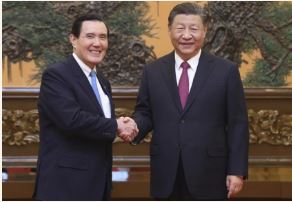
HIGHLIGHTS
CHINA & TAIWAN
“External interference cannot stop the historic cause of our reunion,” says Xi Jinping
On 10 April, Chinese President Xi Jinping met with the Taiwanese former president and Kuomintang leader Ma Ying-jeou. Xi inferred with Ma that any external interference would not stop China from unifying with Taiwan. Ma was visiting China as part of the “journey of peace” 11-member youth delegation. Xi stated that China was written the invisible history of both Taiwan and China, which has been engraved and that proves that they are compatriots by blood. He also said: “There is no force that can separate us... Differences in systems cannot change the objective fact that we belong to one nation and one people.” In return, Ma also stated that the young people of China and Taiwan represent the future of China hinting at a joint and same future. Ma also stressed that Chinese people on both sides should peacefully handle the dispute and avoid conflicts, while they should oppose Taiwanese independence. (“China’s Xi tells ex-Taiwan leader ‘external interference’ cannot block unification,” The Straits Times, 10 April 2024)
ECONOMY
China’s consumer price rose but slowly, says Wall Street Journal
On 10 April, The Wall Street Journal reported that the Chinese consumer price rose but at a slower pace in the month of March. WSJ looked into the data provided by the National Bureau of Statistics (NBS) which reported that the consumer price index rose to 0.1 per cent in March compared to 0.7 per cent in February. There has been a 0.4 per cent growth. The weak consumer prices can lead to the revival of deflation. The food price in China has dropped to 2.7 per cent while the prices of non-food items have increased by 0.7 per cent. When compared with February there has been a 1.1 per cent growth. In March the producer prices index fell by 2.8 per cent compared to February’s 2.7 per cent. While the consumer price index grew the producer price index is seeing an 18-month high. (Jason Douglas, “China’s Consumer Inflation Softens,” The Wall Street Journal, 10 April 2024)
CHINA READER DAILY WIRE
INTERNAL
Save Uyghur Org calls for the boycott of Shien over the use of Uyghur forced labour
On 10 April, VOA reported that the Human Rights group Save Uyghur Org called for the boycott of Shein and urged people celebrating Eid to stop buying from there. The post stated that it is disappointing that thousands of Muslim women buying jilbab from Shein despite that there is well-known information regarding the exploitation of Uyghur labour by these companies. The head of the organization Arslan Hidayat said that Shein has used forced labour and furthered the oppression of the Uyghur Muslims. She said: “It is crucial for Muslims to use their consumer power to protest against the use of forced labour and to demonstrate solidarity with the Uyghur community,” and that “It is incumbent upon us to prioritize ethical consumption practices and advocate for justice for the Uyghur people.” The company spokesperson responded to VOA's question via email and stated: “We take visibility across our entire supply chain seriously, and we are committed to respecting human rights. To comply with U.S. law, we require our contract manufacturers to only source cotton from approved regions.” Bloomberg also found that Shein’s clothes contain cotton from the Xinjiang region which is prohibited under US law of Uyghur Forced Labor Prevention Act, 2022. (Kasim Kashgar, “Fashion retailer faces boycott amid allegations of Uyghur forced labour in China,” VOA, 10 April 2024)
Widening “she-cession” in China continues after the pandemic, says an Opinion in SCMP
On 11 April, an opinion in the South China Morning Post looked into the problem of “she-cession,” in China by Many Zuo. Mandy looked into a survey by Peking University where the study found that there has been a major employment disparity in the men and women workforce. The study found that this workplace disparity was widened due to Covid and has continued to increase since then and that is when they coined the term “she-cession.” The pay gap has increased to 30 per cent in 2020 and an article by the China Economic Review stated that while the pandemic has ended the disparity is on the rise. Compared to men, women's unemployment rate was 5.1 per cent higher than that of men and they worked 1.4 hours less a day. The overall gender parity has been low for decades due to a lack of political empowerment and sex ratio at birth. The university report stated: “If policymakers hope to prevent COVID-19 from widening existing gendered gaps in the labour market, they must provide more safe options for childcare.” And that during this period working mothers have been the most affected where they have more familial responsibility and suffered greater unemployment impact. (Mandy Zuo, “China’s gender gap widening post-pandemic, with ‘she-cession’ still a real threat to economy,” South China Morning Post, 11 April 2024)
ECONOMY
China refuted Fitch downgrading credit outlook, say Chinese Finance and Foreign Ministry
On 10 April, Global Times reported on the Chinese Ministry of Finance refuting Fitch downgrading the Chinese credit outlook. Fitch agency moves the Chinese credit rating to negative from stable. The ministry and other critics stated that their growth will remain unchangeable and that the government has the ability to maintain sound sovereign credit. The ministry expressed its regret over the Fitch downgrade and said while they expressed the same concerns as they have, the credit downgrade fails to show the forward-looking Chinese fiscal policy that aims to push growth. The Ministry said: “In the long run, maintaining a moderate deficit and making good use of precious debt funds will help expand domestic demand, support economic growth, and ultimately help maintain good sovereign credit.” Chinese Ministry of Foreign Affairs spokesperson Mao Ning also stressed that the Chinese economy has not changed and that the government’s ability to have a sound credit has not changed either. Some called the report biased where an economist from Peking University Cao Heping said: “Even as a growing number of economic data showed improvements in the first two months, Fitch actually moved to cut China's ratings outlook. That shows that foreign rating agencies specifically selected some unfavourable indicators in their evaluation.” (Wang Cong and Qi Xijia, “China refutes Fitch's credit outlook cut,” Global Times, 10 April 2024)
CHINA & SOUTHEAST ASIA
“To keep the peace in the South China Sea and the freedom of navigation,” Marcos route to the trilateral summit with the US and Japan
On 09 April, Philippine President Ferdinand Marcos Jr left for his meeting with the US and Japanese leaders in Washington. While leaving he made some statements that they followed the discussion to further strengthen economic cooperation and come up with a deal to maintain freedom of navigation in the South China Sea. This will be the first-ever trilateral summit between the US, Japan and the Philippines. Marcos said: “The main intent of this trilateral agreement is for us to be able to continue to flourish, to be able to help one another, and of course to keep the peace in the South China Sea and the freedom of navigation.” The details of the cooperation will be informed later. The freedom of navigation in the South China Sea comes in light of increased tension between Chinese and Philippines guards and civilians. Chinese Ministry of Foreign Affairs said it: “opposed to the cobbling together of exclusive small circles and to confrontation between different groups in the region.” (“Summit with US, Japan aimed at economy, South China Sea cooperation: Marcos,” Al-Jazeera, 09 April 2024)
CHINA & AFRICA
Zambian Drug Enforcement Commission raids Chinese firm led cybercrime group
On 09 April, BBC reported on the Zambian Drug Enforcement Commission (DEC) finding a sophisticated crime syndicate that included 77 people out of which 22 were Chinese. The centre of the raid was the Chinese company called Gloden Top Support Service; they recruited Zambians who thought they were working at the call centre. The breakthrough came after months of investigation and intelligence gathering as there was an alarming rise in internet fraud cases in Zambia. The Chinese firms recruited unsuspecting Zambian youth aged between 20-25 to work for them. They were asked to engage in deceptive conversation following a script. From the raid, they found 11 sim boxes and devices that can route calls and bypass phone networks. 13,000 SIM cards domestic and international were seized. There were people from other countries involved like Singapore, Peru, UAE and others from within Africa. (Wycliffe Muia, “Zambia uncovers 'sophisticated' Chinese cybercrime syndicate,” BBC, 09 April 2024)
CHINA & THE AMERICAS
US Commerce Department bans four Chinese companies for seeking AI chips for Chinese military
On 10 April, US Commerce Department’s Kevin Kurland informed that the US would likely add four Chinese companies to the export blacklist trying to seek AI chips. The companies are part of the already 11 new additions to the list of Commerce Department Entity List, the supplier's license to ship and export to these companies will be demined. The Chinese entities were acquired in light of attempting to seek US items to support Chinese military modernization. The companies are Beijing Anwise Technology Co, Sitonholy (Tianjin) Co, Linkzol (Beijing) Technology Co, Xi’an, and Like Innovative Information Technology Co. The Commerce Department also halted the export to five companies that helped Russia produce drones one was also a Chinese company called Jiangxi Xintuo. Another Chinese company was added Shenzhen Jiasibo Technology Co for collecting aerospace items for an aircraft company in Iran. (“US blacklists 4 Chinese firms for helping military get AI chips,” South China Morning Post, 10 April 2024)
“Despite attempts by foreign states to interfere, those elections held in their integrity,” says Canadian PM on Chinese interference in elections
On 11 April, The Guardian reported on Canadian Prime Minister Justin Trudeau's statement on Chinese interference in the Canadian elections. Trudeau admitted that China did meddle in the past two elections but the election results were not affected by them. He also said that it was “improbable” that China chose one party over the other. The main opposition leader of the conservation party Erin O’Toole said that the Chinese interference cost them nine seats but it did not change the course of elections. Trudeau said: “While individual [Chinese] officials may well have expressed a preference or another, the impression we got and consistently would get is that … it just would seem very improbable that the Chinese government itself would have a preference in the election.” A spokesperson from the embassy stated that: “China has never had any interest in interfering in Canada’s internal affairs,” and that “China strongly deplores and resolutely opposes this.” (“China meddled in past two Canada elections, says Justin Trudeau,” The Guardian, 11 April 2024)
EAST ASIA & THE PACIFIC READER
EAST ASIA
Democratic Party’s resounding win in the South Korea National Assembly election 2024
On 10 April, South Korea voted for its new National Assembly where the liberal Democratic Party came victorious. The party won a resounding majority and this has severely affected President Yoon-Suk-Yeol and the conservative party. The National Election Commission of South Korea reported that the main opposition and the Democratic Party won 174 seats of the 300 while the People’s Power Party won 109 seats. The election turnout was 67 per cent and was the highest in the last 32 years. DP leader Lee Jae-Myung said that their top priority is to work towards economic recovery and that: “The ruling and opposition parties must join forces to overcome the crisis in consumers’ economic livelihood.” (“Opposition win in South Korea election to deepen policy stalemate for Yoon,” The Straits Times, 11 April 2024)
China Reader Daily Wire | 10 April 2024, Wednesday | Vol.1 No. 54
Chinese property developer Shimao faces winding up petition by China Construction Bank
Fitch revised its outlook on China's sovereign credit rating to negative
HIGHLIGHTS
ECONOMY
Chinese property developer Shimao faces winding up petition by China Construction Bank
On 08 April, BBC reported of Chinese real estate developer Shimao Group facing a major winding-up petition filed by the state-owned China Construction Bank (Asia) in Hong Kong over Shimao's failure to repay loans worth HKUSD1.58bn (USD201.8m). Shimao said that it opposes the lawsuit. The lawsuit had wiped out a third of the company’s value since the beginning of 2024 by more than 15 per cent. The Shimao Group defaulted on the offshore bonds in 2022. China’s real estate sector has faced a major financial crunch since 2021, with Evergrande being the face of the crisis, severely impacting China’s economy. (Mariko Oi, “China property giant Shimao faces winding-up case,” BBC, 08 April 2024)
ECONOMY
Fitch revised its outlook on China's sovereign credit rating to negative
On 09 April, rating agency Fitch revised its outlook on China's sovereign credit rating to negative due to risks to public finances as it shifts to new growth models. It forecasted that the general government deficit would rise to 7.1 per cent of GDP in 2024 from 5.8 per cent in 2023 amid Beijing’s strict covid lockdowns. The agency affirmed China’s IDR rating at “A+” despite the downgrade over the medium term. Fitch’s forecasts predict an economic slowdown from 5.2 per cent in 2023 to 4.5 per cent in 2024, similar to the forecasts by the Citi and the International Monetary Fund. Analysts predict Beijing’s 5 per cent GDP growth rate as highly ambitious as its rising factory outputs and sales in January and February 2024 will boost its growth. Fitch said that China’s uncertain economic prospects arise from its shift from a property-reliant model to a sustainable growth model. (“Fitch downgrades outlook on China to negative on economic growth risks,” Reuters, 10 April 2024)
CHINA READER DAILY WIRE
CHINA & EUROPE
Chinese Commerce Minister visits Europe to defend China’s EV sector
On 09 April, The Straits Times reported that Chinese Commerce Wang Wentao initiated a trip to Europe to defend his country’s EV excess capacity and supply chains against US and EU assertions. On 08 April, Wang reiterated Beijing’s stance that Chinese EV makers did not depend upon subsidies for their competitive advantage and relied upon continuous technological innovation, better production, and a supply chain system. The Straits Times reports on the European Commission investigation which was initiated in 2023 to determine whether to impose tariffs on Chinese exports to protect European carmakers. The investigation is expected to end by November 2024. Renault CEO and acting chairman of the European Automobile Manufacturers’ Association (ACEA) Luca de Meo said to Wang the need for reciprocity and invited greater Chinese supply chain presence to Europe. Chinese officials argue that trade restrictions will deprive consumers of green energy alternatives to address climate change goals. (“China commerce minister launches Europe trip defending Chinese EV sector,” The Straits Times, 09 April 2024)
Workshop radiation leak triggers emergency alert near Russia-China border, reports TASS
On 08 April, according to a report by TASS in the South China Morning Post, radiation leaks in a workshop triggered an emergency alert on 06 April in a Russian city close to the border with China. The radiation was caused by the parts from a mobile repair and chemical workshop in the city of Khabarovsk in Russia’s Far East, which lies 30km from China’s northernmost Heilongjiang province. On 09 April, the local authorities were informed that the issue was under control and resolved. The Novaya Gazeta newspaper reported that the radioactivity level reached 800 microsieverts, which is 1600 times higher than the required level of 0.5, posing a risk to human lives. (Holly Chik and Victoria Bela, “Russian city near China’s border says radiation under control after workshop leak triggered emergency alert,” South China Morning Post, 09 April 2024)
Russia and China to cooperate against terrorism threats, Russian FM Lavrov
On 09 April, Russian Foreign Minister Sergei Lavrov said to his counterpart Wang Yi that Russia and China to cooperate to fight against terrorism. He also extended his gratitude to China for their condolences on the terror attacks in Moscow. Both Russia and China had declared a no-limits partnership in February 2022 before the invasion of Ukraine. He also thanked China for sending observers to Russian presidential elections in March. He mentioned that the comprehensive and strategic interaction has reached greater heights. (“Russia, China to maintain fight against terrorism, Lavrov says,” Reuters, 09 April 2024)
Brussels launches subsidy investigation into Chinese wind turbine companies
On 10 April, the Financial Times reported that Brussels launched a subsidy investigation into Chinese wind turbine companies to protect its domestic industries from cheap and unfair competition from abroad. Margrethe Vestager, the top EU official, said that the European Commission (EC) will conduct its investigation against the suspected market-distorting subsidies from foreign governments, including Beijing. The investigation will be conducted on the ongoing development of wind parks in Spain, Greece, France, Romania, and Bulgaria. The investigation comes after the EC launched a probe into two Chinese consortiums bidding to develop a solar park in Romania. A similar EC investigation led to the withdrawal of China’s CRRC from the Bulgarian railway tender. Vestager said that less than three per cent of the solar panels were installed in the EU due to Chinese imports. (Javier Espinoza and Andy Bounds, “EU launches probe into Chinese wind turbine companies,” Financial Times, 10 April 2024)
CHINA & THE AMERICAS
US remarks on AUKUS to deter China against Taiwan are dangerous, says China's Taiwan Affairs Office
On 10 April, China’s Taiwan Affairs Office referred to US Deputy Secretary of State Kurt Campbell’s comments as dangerous after he spoke on AUKUS’s role in deterring Chinese moves against Taiwan. Spokesperson Zhu Fenglian said that the trilateral security partnership between the US, UK, and Australia is provoking military confrontation in the region through military cooperation. Linking AUKUS and Taiwan, Campbell said new submarine capabilities will ensure peace and stability in the Taiwan Strait. Szhu opposed his comments and said that it is a violation of the One China principle and endangers peace and stability in the Taiwan Strait. The AUKUS was formed with the US, UK, and Australia in 2021 to deter against the growing Chinese power in the Indo-Pacific region. (“China says US comments on Taiwan and Aukus are dangerous,” The Straits Times, 10 April 2024)
US cites red line on China’s ties with Russia, says the US Deputy Secretary
On 09 April, Deputy Secretary of State Kurt Campbell cited the red line violation as sensitive to its interests in China’s closer ties with Russia. He said that the US is trying to convince China about the US core interests to ensure peace and stability in Europe. While discussing with the US, Xi mentions Taiwan as the red line for China. Campbell said that Beijing’s aid to Russia will impact US-China relations. He further cites the rationale for a stronger alliance with Japan and the Philippines amid China’s close ties with Russia. Campbell’s remark comes after no end in sight for the deadlock between the two sides on issues related to trade and technology restrictions to China. (Robert Delaney, “China-US relations: American state department official explains how Beijing risks crossing ‘red line’ with Russia,” South China Morning Post,” 10 April 2024)
US plans to ease advisory for Americans to travel to China, says the Deputy Secretary
On 09 April, the US Deputy Secretary of State Kurt Campbell said that the country intends to ease the advisories for its citizens traveling to China. He acknowledged that the warnings have stopped exchanges between the people of the two sides. Campbell mentions the normalization of communication between the two sides but warned of the risk due to China’s support to Russia in the Ukraine war. China has issued its own warnings to the US and criticized the increasing harassment of Chinese nationals by US agents at the entry point. (“US considers easing warnings for Americans travelling to China,” The Straits Times, 10 April 2024)
Academicians oppose Florida’s new law against Chinese citizens
On 10 April, the South China Morning Post reported two graduate students and one professor filing a legal petition against the Florida state’s new law against Chinese citizens. This comes after Governor Ron DeSantis signed into law a bill requiring state colleges and universities to get government approval before they hire or work with Chinese people who aren’t US citizens or green card holders. Even the Florida International University paused the hiring of Chinese and citizens of six other “countries of concern” also targeted by the law, such as Iran, Cuba, North Korea, Russia, Syria, and Venezuela. Some critics argue that the two bodies overseeing approvals, the state university system’s board of governors and the state board of education, are being appointed by DeSantis, and they see his policies as a wide crackdown on academic freedom. According to Han, in 2021, DeSantis cited national security concerns to justify the SB 846 law and wanted to use the same template for other states. Han notes that Chinese students comprise 40 per cent or 1100 of the international graduate student population at the University of Florida. (Bochen Han, “Professors, students say ‘no’ to Florida as new law targets Chinese,” South China Morning Post, 10 April 2024)
China opposes mistreatment of Chinese visitors at the US border, says Chinese embassy in the US
On 08 April, the Chinese embassy in the US said that it opposes the mistreatment of its citizens at the US border and will continue to protest for every single incident. It said that the US had “unjustifiably” sent back around 300 students despite having valid travel documents. It also warned of the US customs officer interrogating a Chinese scholar for secondary inspection, adding that such acts are driven by ideological bias. In February, Chinese Foreign Minister Wang Yi raised this issue with Anthony Blinken and other senior US officials. The Chinese embassy accused the US of violating the common understanding reached between the two leaders. In light of this issue, the Ministry of Foreign Affairs has raised the travel advisory to its citizens, citing it as “unwarranted interrogation and harassment.” (Orange Wang, “China vows to protest ‘every single incident’ of mistreatment of Chinese arrivals in the US,” South China Morning Post, 09 April 2024)
Cancellation of shipments by Chinese buyers hits global wheat markets
On 10 April, Nikkei Asia reported that cancellations of wheat shipments by Chinese buyers had impacted the global wheat market. In March, the US Department of Agriculture said 504,000 tonnes of wheat sales to China had been cancelled, half of the total US shipments to China in 2022. Reuters also reports cancelling one million tons of Australian wheat exports to China. According to Ruan Wei at Japan's Norinchukin Research Institute, Chinese buyers try to avoid long-term contacts and repurchase at lower prices. Hama mentions that flooding in China’s Henan province in the summer of 2023 led to buyers securing long-term wheat contracts from Australia, Canada, and the US. Hama also notes China’s new food security law, which will prioritize more on domestic procurement to bolster food security. (Misa Hama, “China shakes wheat market with cancelled shipments from US, Australia,” Nikkei Asia, 10 April 2024)
EAST ASIA & THE PACIFIC READER
EAST ASIA
Taiwan appoints former DPP chairman Cho Jung-tai as the new premier
On 10 April, Taiwan President-elect Lai Ching-te announced that the former Democratic Progressive Party (DPP) chairman Cho Jung-tai was the new premier. He will resume his duties after the inauguration of President Lai on 20 May. In the Taiwanese government model, the president appoints the premier, who, in turn, appoints the cabinet members under presidential approval. Under the premier’s leadership, the cabinet will enact the policy and propose legislation. This comes as Lai won the presidential elections in January but lost the majority in the parliament. (“Taiwan’s new premier is ruling party’s former chairman,” The Straits Times, 10 April 2024)
Taiwan’s annual war games 2024 to practice simulation against a potential Chinese offensive, says Taiwan’s Ministry of Defense
On 09 April, Taiwan’s Ministry of Defense said that its annual war games 2024 would practice kill zones at scenes and simulate a scenario of a sudden change in Chinese drills into a real offensive. The ministry also mentioned that the annual Han Kuang exercises will take place for five to eight days and will be followed up with further exercises in July. The head of the ministry’s joint combat planning department, Tung Chih-Hsing, said that the drills would be practiced to quickly respond to a sudden Chinese offensive and coordinate a response to a Chinese blockade. He added that the drills will involve naval, air, and coast guard forces, shore-mounted anti-ship weapons, and drones to establish a maritime “attack-and-kill chain.” He also mentioned the role of the Navy, Coast Guard, and Air Force in carrying out escort operations. Tung mentioned that the exercise would feature the lessons learned from the ongoing war in Ukraine and Gaza. Taiwanese President Tsai Ing-wen has emphasized the focus on asymmetric warfare against Chinese forces. (“Taiwan war games to simulate repelling Chinese drill that turns into attack,” The Straits Times, 09 April 2024)
China Reader Daily Wire | 09 April 2024, Tuesday | Vol.1 No. 53
Small to mid-level banks hit harder by the property crisis, says an opinion in Nikkie Asia
“Comrades plus-brothers,” Xi Jinping meets Vietnamese top brass | China's warning on including Japan into AUKUS: "Disregards the risk of nuclear proliferation"
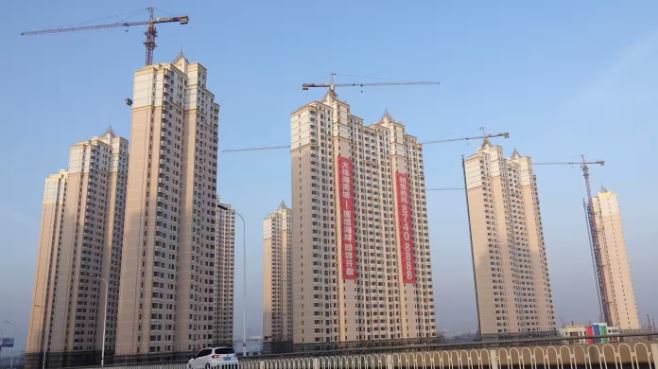
HIGHLIGHTS
ECONOMY
Small to mid-level banks hit harder by the property crisis, says an opinion in Nikkie Asia
On 09 April, Nikkie Asia published an Opinion on the Chinese property crisis affecting smaller banks harder and more than the big banks. The toll of the re-estate crisis is hitting the low-growth generating provinces more as the banks are saddling debts by lending to smaller developers. Deloitte’s partner Glen Ho stated that the small to medium regional banks would be more affected by the debt problems as they lend to not-so-well-funded firms and enterprises. Jilin Jiutai Rural Commercial Bank had their profits drop by 90 per cent and the property debt grew by 37.3 per cent. 31 banks reported a 9.83 per cent hike in debt estimated to be 291.2 billion yuan. Additionally, the foreign investors in these banks are fleeing, one example being China Bohai Bank which saw a net fall in profit of 16.8 per cent. This made the UK-based firm Standard Chartered leave by paying USD 850 million in impairment charges. (ECHO WONG “China's property crisis hits small regional banks harder than big players,” Nikkie Asia, 09 April 2024)
CHINA & SOUTHEAST ASIA
“Comrades plus-brothers,” Xi Jinping meets Vietnamese top brass
On 08 April, Chinese President Xi Jinping hosted Vietnam’s Chairman of the National Assembly Vuong Dinh Hue. Hue’s trip was on invitation by the Chairman of National Pole’s Congress Standing Committee Zhao Leji. Xi outlines the distinct feature of China-Vietnam relations to be like-minded and that they are a pair bound by destiny and see them as “comrades plus brothers.” Xi asserted the need to promote China-Vietnam community building for a shared future and to benefit the two communities. Xi also said in the face of complex challenges: “It is in the common interest of China and Vietnam to safeguard the socialist system and maintain national stability and development.” He also suggested that they should extend people-to-people exchange through the BRI. (“Xi calls China-Vietnam ties 'comrades-plus-brothers' when meeting visiting Vietnam top legislator,” Global Times, 08 April 2024)
CHINA & EAST ASIA
China's warning on including Japan into AUKUS: "Disregards the risk of nuclear proliferation"
On 08 April, the Chinese Ministry of Foreign Affairs spokesperson Mao Ning expressed concerns regarding the possible inclusion of Japan into the AUKUS pact with the UK, US, and Australia. Ning said they were “gravely concerned,” and that this move ignores the risks to nuclear proliferation. She also stated that this would increase and intensify the arms race in the Indo-Pacific and this would in turn disrupt regional peace and stability. The statements come in as the AUKUS trio is set to discuss and consult the US suggestion to add Japan to the AUKUS security pact. China vehemently opposed the formation of exclusive small circles of blocs and iterated that Japan should learn from the historical lessons and exercise caution. (Meredith Chen, “China ‘gravely concerned’ about reports Japan could join Aukus security pact,” South China Morning Post, 09 April 2024)
CHINA READER DAILY WIRE
INTERNAL
China probes into CETC defence company’s executive
On 09 April, the Financial Times reported on China’s Central Commission for Discipline Inspection and the National Supervisory Commission statement informing that China Electronics Technology Group Corporation’s (CETC) Deputy General He Wenzhoug is under investigation. The anti-corruption authorities in China are looking into the case, the company is also currently facing sanctions from the US. Before this, there has been a series of removal of top leaders and executives. The statement said: “He Wenzhong . . . is suspected of serious violations of discipline and law and is currently undergoing disciplinary review and supervisory investigation.” CETC was formed after merging 46 electronic research groups and 26 SOE’s. Currently, CETC has 200,000 employees and is touted as one of the world’s largest defence groups. CETC claims to be China’s only domestic source of military equipment and that it severs all branches of the military. The probe is said to have similar results to the disappearance of the defence minister after the Equipment Development Department was under the radar of a probe for corruption. Some people believe that the removal of that leadership was linked to leaked state secrets. ( Joe Leahy, “China investigates senior executive at top defence group,” Financial Times, 09 April 2024)
ECONOMY
PBOC to facilitate refinancing of USD 69 billion loans for tech-based firms
On 09 April, the South China Morning Post reported that the People’s Bank of China (PBOC) would restart the tool to stimulate lending for tech and innovation development. The bank will issue USD 69 billion in loans to commercial banks that would lend to qualifying firms for technological development. The two arenas they would be investing in would be technological innovation and large-scale equipment upgrades. This initiative shows the market player to what extent the government is ready to invest and where. The PBOC will offer re-lending rights to 21 banks at 1.75 per cent for one year. The bank also said that this refinancing will cover 60 per cent of the qualifying loans for small to medium-base tech firms. It said: “[The loans] will guide financial institutions to provide credit support to tech-focused enterprises in their start-up and growth phases, as well as projects focusing on digitalisation, intelligence enhancement, high-end upgrades, eco-friendly technological transformation and equipment renewal in key sectors.” (Sylvia Ma, “China pledges US$69 billion in credit backing for tech after resurrecting dormant financial tools,” South China Morning Post, 09 April 2024 )
CHINA & TAIWAN
“No losers in peace”: Urges KMT leader and former Taiwanese President
On 08 April, Kuomintang leader and former Taiwanese President Ma Ying-jeou visiting China with 11 youth delegates inferred that there are “no losers in peace.” He called on the younger generation to “resolve disputes peacefully.” He said: “People in both the mainland and Taiwan had been bullied by Japanese warlords, and suffered heavy casualties. Although we were lagging in terms of equipment and training in a disadvantaged situation, we were united in our determination.” He urged that there are no losers in peace and that the younger generation must remember that they should learn from history and not repeat it. The visit stands as Taiwan is set to inaugurate the new leader of Taiwan Willian Lai Ching-te who is part of the Democratic Progressive Party. (Vanessa Cai, “‘No losers in peace’: Taiwan’s Ma Ying-jeou sends anti-war message in Beijing,” South China Morning Post, 08 April 2024)
CHINA & EAST ASIA
Japan “deviating from the principle of a pacifist constitution,” says PLA Daily
On 09 April, the South China Moring Post reported on an article published in the Chinese military newspaper People’s Liberation Army Daily questioning the Japanese military’s pivot towards a more offensive tactic. The articles stated that Japan was moving away from its pacifist laws and ideology as they established a new anti-ship missile in Okinawa. The Japanese Self Defence forces installed the 7th Surface to Ship Missile Regiment which would be the first on the Island of the Ryukyu chain. The PLA Daily stated that they would supervise the military unit and would aim to strengthen the defence and attack capabilities of the Islands. It informed that Japan now can block and even attack arriving ships entering the region. It also said: “[Tokyo’s] accelerated arms expansion is increasingly deviating from the principle of a ‘pacifist constitution’, bringing more uncertainty to regional and global security, and deserves higher awareness from neighbouring countries and the international community.” The report also stated that Japan is changing its defensive role and is pushing for “joint-deterrence.” (Hayley Wong, “Japan showing ‘obvious offensive characteristics’ with new Okinawa missile unit, says Chinese military newspaper,” South China Morning Post, 08 April 2024)
CHINA & THE AMERICAS
“China constantly uses coercion and pressures other countries, including Japan and the Philippines,” says US envoy to Japan
On 08 April, the US ambassador to Japan, Rahm Emanuel, said: “China constantly uses coercion and pressures other countries, including Japan and the Philippines.” He made his remarks at the Center for Strategic and International Studies event in Washington before the arrival of Japanese Prime Minister Fumio Kishida and Philippines President Ferdinand Marcos Jr for a summit with President Biden. (“China constantly coerces Japan and Philippines, US envoy to Japan Emanuel says,” Reuters, 08 April 2024)
China rejects Yellen’s remarks on overproduction concerns
On 08 April, China’s deputy finance minister, Liao Min, said that Beijing dismissed the allegations of the US Treasury Secretary on scaling back industrial production. He countered her claims and said that there are disagreements over the overcapacity issue, and China’s economy is on the right track and warned of any protectionist measures. His remarks came after Secretary Yellen warned of scaling down production as Chinese goods overwhelmed American industries. Liao mentioned that overcapacity is a market mechanism that always remains imbalanced, and so the balance between the demand and supply is relative. He further noted that the current global production capacity is far from addressing emerging demand from developing countries. Liao also said that China’s advantage in the new energy sector is based on the country’s massive market, complete industrial system, and abundant human resources working together with the companies and entrepreneurs. Liao warns Yellen that protectionism measures in the new energy sector will hinder other countries from tackling climate change. (“Beijing Pushes Back on Overproduction Concerns After Yellen Visit,” The Wall Street Journal, 09 April 2024)
US won’t allow Chinese imports threatening new domestic industries, warns US Treasury Secretary
On 08 March, US Treasury Secretary Janet Yellen warned China that Washington would not accept further Chinese imports that would damage the new domestic industries during her four-day trip to Beijing. She reiterated President Biden’s agenda of not repeating the China shock, which had decimated two million American jobs in the early 2000s. She also warned of further new tariffs and trade restrictions if China continues to extend its subsidy for its electric vehicles, batteries, solar panels, and other green energy goods. On her second trip to Beijing within nine months, Yellen complained to China about its excessive manufacturing capacity exceeding domestic demand and threatening other countries. She mentioned the newly created US-China financial working group to discuss the solution to tackle the overcapacity issue. She suggested China boost consumer demand by shifting its growth model away from supply-side investment. In her meeting with Chinese Premier Li Qiang, Finance Minister Lan Foan, People’s Bank of China (PBOC) governor Pan Gongsheng, and former vice-premier Liu He, Yellen said that the US aims to improve economic ties with China through cooperation and mutual understanding. (“Yellen says US will not accept Chinese imports decimating new industries,” The Straits Times, 08 April 2024)
CHINA & EUROPE
China not to take advantage of the Ukraine war, says Chinese Foreign Ministry
On 08 April, the Ministry of Foreign Affairs of the People’s Republic of China spokesperson Mao Ning said that China does not seek to derive any profits from the ongoing war in Ukraine. She reiterated Beijing’s stance to advance peace in its own way and maintain communication with both parties (Russia and Ukraine). She also mentioned China’s control of the export of dual-use goods to Russia. White House National Security Council spokeswoman Adrienne Watson said that President Biden had discussed the need to prevent the bolstering of Russian military capacity with Chinese President Xi Jinping. Mao also notes Russian Foreign Minister Sergei Lavrov’s visit to Beijing on 08 April to discuss bilateral cooperation. (“China says it will not seek to gain from war in Ukraine,” The Straits Times, 08 April 2024)
EAST ASIA & THE PACIFIC READER
EAST ASIA
Australia initiates security cooperation with Taiwan
On 08 April, deputy chair of Australia’s Parliamentary Joint Committee on Intelligence and Security Andrew Wallace raised the subject of security cooperation with Taiwan during a meeting with Taiwanese President Tsai Ing-wen. While both sides have a vested interest in ensuring regional security, Andrew said: “Taiwan and Australia both recognize the importance of maintaining peace and stability in the Indo-Pacific region. Our partnership, our strategic partnership, contributes significantly to regional security.” He also emphasized the need for security cooperation amid the changing geopolitical landscape in the region. He also mentioned the ongoing collaborations on cyber security initiatives safeguarding critical infrastructure and important digital networks. Recently, a senior US State Department official mentioned the importance of AUKUS in safeguarding Taiwan from Chinese aggression. Tsai told Andrew that both countries are defenders of freedom and democracy. (“Senior Australia lawmaker broaches security cooperation on Taiwan trip,” The Straits Times, 08 April 2024)
South Korea launches its second indigenous spy satellite
On 07 April, South Korea launched its indigenous spy satellite on a SpaceX Falcon 9 rocket from the US to keep an eye on the threats from North Korea. The satellite is a synthetic aperture radar (SAR) satellite that can use radar waves to produce ultra-high-resolution images of objects on the ground. The Ministry of Defense of South Korea said that launching the first military SAR satellite has strengthened the country’s intelligence monitoring and surveillance capability. South Korean Defence Minister Shin Won-sik said North Korea plans to launch its spy satellite by mid-April. Through this launch, South Korea aims to reduce its reliance on the US and wants to increase its own reconnaissance capabilities by launching five such satellites by 2025. (“South Korea launches second home-grown spy satellite from the US,” The Straits Times, 08 April 2024)
Washington announces USD 6.6 billion grant to Taiwan’s TSMC plant
On 08 April, the US announced a USD 6.6 billion grant to Taiwan Semiconductor Manufacturing Company (TSMC) to build a third plant to manufacture advanced semiconductors. In addition, the US Department of Commerce will grant a loan to TSMC to build three semiconductor fabrication plants in Arizona worth USD 65 billion. The department added that the chip factory will be ready by the end of 2030 and will produce two-nanometer chips. Ji notes President Biden’s intent to push semiconductor manufacturing in the US through the Chips and Science Act, which came into effect in 2022. The US currently produces less than 10 per cent of chips globally. The Commerce Department said that by 2030, the US will produce 20 per cent of the world’s global supply of chips, thereby providing America with a competitive edge in science and technology innovation. Ji also mentions the delay in the operation of TSMC’s previous two plants due to a shortage of specialist workers and the US government initiatives. (Ji Siqi, “US-China tech war: TSMC strikes US$11.6 billion deal to make ‘most advanced semiconductor chips’ in Arizona,” South China Morning Post, 08 April 2024)
Japan faces delay over the upcoming Expo 2025 in Osaka, says a commentary in Nikkei Asia
On 09 April, according to a commentary in Nikkei Asia, Japan aims to launch the Expo 2025 in Osaka on 13 April 2025, which faces major construction delays that are caused due to labour shortages, overtime restrictions, and political and business infighting. The delays led to cost overruns of more than USD 1.5 billion. According to Akira, the Expo 2025 is organized by the Japan Association for the 2025 World Exposition, which is themed “Designing Future Society for Our Lives.” Akira also mentioned a similar expo launched in 1970 and marked its status as a post-war economic superpower. The event will be held on an artificial island called Yumeshima, meaning “Dream Island,” with an estimated 28 million visitors attending the expo. Akira also noted Japanese officials' concerns over the construction delays as the country faces a chronic shortage of labour and is prioritizing elsewhere the construction of large-scale projects like TSMC’s new plant in Kumamoto, Japan. According to Tomonari Yashiro, president of Tokyo City University, construction companies are disinterested in bidding for the expo project due to the insufficient design completion level and limited capacity of building services suppliers. According to estimates by the Asia Pacific Institute of Research, Expo 2025 will have a positive impact worth Yen2.5 trillion on Japan. (Akira Kitado, “Japan's Expo 2025: Osaka triumph or billion-dollar folly?” Nikkei Asia, 09 April 2024)
China Reader Daily Wire | 08 April 2024, Monday | Vol.1 No. 52
AUKUS countries to discuss the expansion to deter China by including Japan
US-China have a “duty” to address their complex relationship, says US Treasury Secretary | Mexico is the new hot destination for Chinese entrepreneurs, says an opinion in SCMP

HIGHLIGHTS
EXTERNAL
AUKUS countries to discuss the expansion to deter China by including Japan
On 07 April, the Financial Times reported about a discussion to expand the AUKUS by the member countries - the US, UK, and Australia. According to the report, the US aims to push for Japan in the pact to deter China. The defence ministers of Aukus are set to discuss the “Pillar II” of the pact, which would involve collaborating on technologies and sharing hypersonic weapons and undersea capabilities. They do not plan to expand the “Pillar I” that suggests allowing Australia to get nuclear procurement submarines. The discussion comes right before the Biden cabinet is set to host Japanese Prime Minister Fumio Kishida, and parallelly, a trilateral meeting will be held on 11 April between Japan-US-Philippines. The ministry announced that they would begin their consultations to discuss the formal inclusion of Japan and the US pushes for it. Japan has recently announced its expansion in the defence budget and there are speculations that Japan would be party to possible “Pillar II” plans. The UK and Australia have pushed against the Japanese inclusion in the pact stating that it lacks security capabilities to protect highly sensitive information. Australia stresses that they need to approve and expand the submarine program before they expand the pact. Kishida when asked on the same said: “To achieve a free and open Indo-Pacific, we would like to continue various efforts to strengthen our cooperation with the US, Australia, and the UK, who are important partners in security and defence.” (Demetri Sevastopulo and Kana Inagaki “Aukus weighs expanding security pact to deter China in Indo-Pacific,” Financial Times, 07 April 024)
CHINA & THE AMERICAS
US-China have a “duty” to address their complex relationship, says US Treasury Secretary
On 07 April, US Treasury Secretary Jante Yellen while visiting China raised several concerns regarding the Chinese production overcapacity and told the Chinese Premier Li Qiang that they could stabilize their relationship as they have “tough” discussions. Qiang said that both countries would respect each other and that they should be partners and not adversaries. Yellen asserted that they must manage their complex relationship and that: “This has not meant ignoring our differences or avoiding tough conversations. It has meant understanding that we can only make progress if we directly and openly communicate with one another.” Qiang also said that the US should not turn the issue of economy and trade into a political and security issue and view the problem of overcapacity from the lens of market and global perspective, quoting Xinhua. Yellen and her Chinese counterpart Vice Premier He Lifeng agreed to launch a dialogue on “balanced growth” and Yellen stated that she intends to use that platform to push for a level playing field with China. (David Lawder, “US, China need 'tough' conversations, Yellen tells Chinese premier,” Reuters, 07 April 2024)
CHINA & THE AMERICAS
Mexico is the new hot destination for Chinese entrepreneurs, says an opinion in SCMP
On 06 April, an opinion in the South China Morning Post looked into the Chinese rush into Mexico as their new hot destination for small merchants. The op-ed stated that there has been a shift in perception of the Mexico. Chinese, viewed it as an unruly state with several gang wars. Within the last four-year Fujianese businessmen have built a “Chinatown” in Mexico. The op-ed then looks into the owner of four wholesale markets and the designer of the idea Lin Yun who said that the neighbourhood had no trace of Chinese people but now it is littered with them. For many Chinese merchants, Mexico has become the new hot destination and this has led to an influx of Chinese expatriates. This influx has also sparked protests by the Mexican communities with signs saying “Go Back Chinese” and that this is unfair competition. According to Mexico’s Secretariat of Tourism, the government has granted over 5,018 visas to Chinese immigrants in 2023. There has also been an increased exposure to Chinese brands where in 2023, Mexico became China’s second largest car importer and major Chinese companies like Oppo, Honor and BYD have found their place in the Mexican market. (Ji Siqi and Igor Patrick, “Chinese expatriate entrepreneurs find a new gold rush destination in Mexico,” South China Morning Post, 06 April 2024)
CHINA READER DAILY WIRE
ENERGY & ENVIRONMENT
Australian mineral industrialist asks China to increase green standards for its Nickel production in Indonesia
On 08 April, the Australian mining industrialist Andrew Forrest called out China to increase their environmental standards for its global supply of nickel. He highlighted the companies exporting nickel processed from Indonesia, should know that the Chinese activity in Indonesia is a “complete environmental irresponsibility.” In an interview with the Financial Times, he said that Electric Vehicle manufacturers should be cautious of Nickel produced in Indonesia, highlighting that they are procured at a high cost to the environment. His statements come as the prices of nickel fell which was partly due to Indonesian supply. Indonesia is slowly becoming a vital player in the supply of nickel as the Chinese investment aid is tapping into the vast nickel source. While China has domestically improved environmental policies, in Indonesia the industries are infamous for waste pollution, high carbon emissions and heavy reliance on coal. The abuse by Indonesian supply has led to the imposition of the London Metal Exchange, where nickel contracts need to provide a green premium for sustainable production. Under the LME it will support the trade of low-carbon Nickel and it will ask the countries and companies to report monthly Nickel trade volumes and keep a threshold. The Australian Nickel industries were particularly hit by the Indonesian supply where many firms pulled back their investments or halted their operations, this included Forrest’s firm as well. (Joe Leahy, Nic Fildes and A. Anantha Lakshmi, “Mining billionaire Forrest urges China to demand greener nickel,” Financial Times, 08 April 024)
CHINA & TAIWAN
KMT leader and former Taiwanese President disqualifies Japan's claims to Senkaku Island citing Chinese imperial records
On 07 April, former Taiwanese President and a party member of Kuomintang (KMT) Ma Ying-jeou visited Beijing with a youth delegation on an 11-day trio of “journey of peace.” While visiting a museum he weighed in that the debate over the Senkaku Island/ Diaoyu Island claimed by the Japanese are at odds with the historical records. In the museum, he was shown the “historical” proof showing that the Island did not belong to Ryukyu and that the Island was part of Chinese territory for 500 years until it was annexed by Japan in 1879. The Island has contested claims by both China and Japan. Japan believes the Island belongs to its Okinawa prefecture which includes the area known as Ryukyu. This claim has been disputed by China. Ma said the records on the same should be publicised. Currently, the Island is under Japanese control but China has increased its patrols in the nearby waters. (Sylvie Zhuang, “Taiwan’s former leader Ma Ying-jeou rejects Japan’s claims to Diaoyu Islands during mainland China trip,” South China Morning Post, 07 April 2024)
CHINA & EAST ASIA
China is not a beneficiary but a source of economic revival for South Korea, says South Korean Finance Minister
On 08 April, South Korean Finance Minister Choi Sang-mok stressed the need for South Korea to adapt in competing with China. He warned of the export battles for market share awaiting them in sectors of chips, shipbuilding, and display panels. Choi said that China has gone from beneficiary to South Korea to an economic rival, due to which the country needs to expand its export economy. Choi said: “Our economic relationship with China has changed — rather than being a beneficiary of China’s export boom, a rivalry has emerged over the past 10 years.” He believes that South Korea will face challenges if it sticks with the old growth model. The South Koreans worry that they will lose their technological edge over the coming decades as China is gaining momentum. (Christian Davies and Song Jung-a, “China now a rival rather than a boon for South Korean exporters, warns minister,” Financial Times, 08 April 2024)
CHINA & AFRICA
Algerian railway network to provide China with alternative Iron Ore supply, says an analysis in SCMP
On 08 April, an analysis in the South China Morning Post looked into the Chinese investment in the Algerian national railway network. The China Railway Construction Corporation (CRCC) has been building a rail line of 575km connecting the Algerian iron ore mines to the national rail network. Algerian Iron ore is one of the biggest reserves in the world. China is currently dependent on Australia and Brazil for their primary supply and China hopes by building the railway network they can get supply from the Gara Djebilet mine. This would help China to diversify its source and for Algeria, it would help them reduce dependency on the oil and gas industry while also boosting the economy. Algerian SOE Cosider Travaux Publics will work with CRCC to develop the railway network. This project is part of China’s “railway diplomacy” and it is also part of one of the deals signed between Algerian President Abdelmadjid Tebboune and Chinese President Xi Jinping in 2023. Algerian MP Mohamed Machkak said: “It will raise standards of living and create economic opportunities for individuals and communities.” The project can produce 2-3 million tonnes annually from the initial production said Lina Benabdallah an associate professor at Wake Forest University. (Jevans Nyabiage, “How North African railway is on track to helping China de-risk its iron ore supply,” South China Morning Post, 08 April 2024)
CHINA & THE AMERICAS
US warns against increased China’s support for Russia
On 06 April, Bloomberg reported on the increased Chinese support to Russia. The US has been warning its allies of the same and China provided geospatial intelligence to aid Russia in its war against Ukraine. The countries are participating in military integration and China has provided Russia with satellite imagery for military use, it also gave them microelectronics, machine tools and tanks. The support by China also includes optics and propellants that are used in missiles while increasing outer space cooperation. While China placed itself at a neutral stance on the war, it also signed a “no limits partnership” and its trade reached USD 240 billion in 2023. For Russia, China and Hong Kong are key gateways for access to technologies that are restricted. US Secretary of State Antony Blinken informed the European allies about the scope of Chinese support and that they need to do more to curtail it. (Alberto Nardelli and Jennifer Jacobs, “China Providing Geospatial Intelligence to Russia, US Warns,” Bloomberg, 06 April 2024)
CHINA & EUROPE
“Asian ‘pivot’ was flawed from the beginning,” on Britain ditching EU, says an Opinion in The Guardian
On 07 April, The Guardian published an Opinion on Britain switching trade from Europe towards China and India as a “poor bet.” The author Will Hutton started with Brexit and how Britain pivoted itself from Europe and made its way to booming Asia. Will called the Asian pivot fanciful for neither is easy picking for Britain nor something that they could use for their economic progression. The op-ed stated that Brexit’s ambitions have turned to ashes. He then outlines the fallacies in both economies, in China, it is an openly run authoritarian government whose economy and demography are both plagued. For India, while it is growing a little faster, its economy is also plagued by the structural problems facing foreign investors. The supporters of China, the Eurosceptics have turned the tables and are now the strongest critics of the Chinese intentions and its espionage activities. To this Will suggests that they need to trade with their eyes open and only when it is mutually beneficial. They should avoid being dependent on either economy and further their security capabilities in their backyards that is the Britain and European Union, because that is where Will believes their interests and values strongly align. (Will Hutton, “Ditching European trade for China and India was ever a poor bet. Now it’s a farce,” The Guardian, 07 April 2024)
Russian Foreign Minister Sergei Lavrov to visit China
On 07 April, Reuters reported that Russian Foreign Minister Sergei Lavrov is set to visit China to discuss the Russia-Ukraine war and to further deepen their partnership. Lavrov is set to meet his Chinese counterpart Wang Yi who initially extended the invitation, the discussion is assumed to include topics like the crisis in the Russia-Ukraine war and the issues in the Asia-Pacific. It is also reported that Russian President Vladimir Putin will travel to China in May to meet Chinese President Xi Jinping. This would be his first foreign trip since his re-election as the President. (“Russia's Lavrov to visit China to discuss Ukraine war,” Reuters, 07 April 2024)
|
|
|
China Reader Daily Wire | 06 April 2024, Saturday | Vol.1 No. 51
Giorgio Armani bags made by Chinese subcontractors accused of using exploited workers from China, re
China-Cambodia canal project can lead to increased Chinese military presence, says Vietnam

HIGHLIGHTS
CHINA & EUROPE
Giorgio Armani bags made by Chinese subcontractors accused of using exploited workers from China, reports Italian Police
On 06 April, the South China Morning Post reported on an ongoing investigation in Italy where Giorgio Armani bags were made by exploited Chinese workers in Italy. The fashion house denied all allegations against the GA Operations that is responsible for producing the handbags and the apparel. The company Armani said: “The company has always had control and prevention measures in place to minimise abuses in the supply chain,” and that “GA Operations will collaborate with the utmost transparency with the competent bodies to clarify its position on the matter.” The Italian police found that the scam was part of the illegal supply chain, most workers were brought in from China’s rural area. While GA Operations are not directly under investigation they are been looked into. The report released by the police found that the Chinese subcontractor was paid USD 100 and the same bag was sold for USD 1,950. The police said: “The system allows for maximising profits [in which] the Chinese factory produces the products, lowering labour costs by resorting to off-the-books and illegal workers.” (“Giorgio Armani bags made by exploited Chinese workers near Milan, Italian police say,” South China Morning Post, 06 April 2024)
CHINA & SOUTHEAST ASIA
China-Cambodia canal project can lead to increased Chinese military presence, says Vietnam
On 06 April, an opinion in The Straits Times looked into the concerns regarding Cambodia’s plan to build the Funan Techo Canal project with the help of China. The navigation canal is estimated to be USD 1.7 billion. Vietnam has expressed concerns that this would welcome a larger Chinese military presence in the region. The 180km canal would end close to the Vietnam border in the province of Kep. The project would be built under the China Road and Bridge Corporation. The arrangement will be based on a build-operate and transfer basis. Where the Chinese company after the completion of the canal would use it for 50 years and then return it to the Cambodian government. The Cambodian government believes that this would help increase imports and exports in the region and help them transit through Vietnam ports. Oriental Research Development Institute under the Vietnam Union of Science and Technology Associations researchers criticized the project stating that it is not just an economic project but has a major military value as they fear Chinese military presence in the region and that it would give them access to Vietnam and the Gulf of Thailand. (Tan Hui Yee, “Vietnamese concerned that canal project in Cambodia could be a potential gateway for Chinese forces,” The Straits Times, 06 April 2024)
CHINA READER DAILY WIRE
INTERNAL
The declining birth rate led to the closure of several Obstetric Unit, says an Opinion in SCMP
On 06 April, an opinion South China Morning Post reported on the repercussions of a declining birth rate. This has led to several maternity wards being closed and an “obstetrics winter” is observed a term coined by Professor Duan Tao. Since last June at least 11 public hospitals suspended their delivery services, these included small local clinics and bigger hospitals. In light of hospitals closing their services, the government issued a notice that public hospitals need to check with the pregnant women registered with them before closing the ward. The public’s right to medical service must be ensured. The closure of medical wards has also further led to the closure of kindergarten schools. In 2023, only 9 million babies were born, the lowest since 1949. The lack of childbirth is attributed to the general fall in the marriage rate. Where increasing number of young populations are refusing to get married, owing to economic and societal pressure. (Phoebe Zhang, “China’s maternity services put on notice as the country faces an ‘obstetrics winter’,” South China Morning Post, 06 April 2024)
China’s overcapacity is stimulated by the state, says an analyst
On 05 April, VOA reported on issues with the Chinese overcapacity of goods and how it has hurt the market. It quoted a senior fellow at the Peterson Institute for International Economics, Gary Clyde Hufbauer, who said that when the capital utilization of steel and oil refining industries is less than 75 per cent, it is observed that production is in overcapacity. Hufbauer stated that Chinese industries are backed by the government and stimulated and heavily financed by Chinese banks. This has resulted in the industries creating at over capacity. Hufbauer said: “If China does pursue a massive export 'solution,' that will hurt manufacturing firms in Japan, the E.U., Korea and other industrial countries. But low prices will be welcome in many developing countries in Latin America, Africa and Asia.” Rhodium Group found that the Chinese market utilisation rate of silicon wafers fell to 57 per cent in 2022. While some over-capacity is normal, this problem begins when the government pushes for it. Hufbauer said: “Systemic bias toward supporting producers rather than households or consumers allows Chinese firms to ramp up production despite low margins, without the fear of bankruptcy that constrains firms in market economies.” (Li Ya, “China's overcapacity results from state interference in markets, say analysts,” VOA, 05 April 2024)
CHINA & SOUTHEAST ASIA
Live fire drill footage near the Myanmar border showcases the mobility and quick response of the PLA, says Global Times
On 04 April, Global Times reported on the People’s Liberation Army releasing the footage of a live army drill near the Myanmar border. The drills were aimed to test the rapid mobility, precise targeting and joint strike capability. The Global Times reported that: “the Air Force aviation, Army aviation, armoured infantry, artillery, air defence forces and others rapidly mobilized to the designated exercise area to conduct joint live-fire exercises in different zones and at different times.” The PLA’s Southern Theatre Command stated that: “stressing that the command has been prepared at all times to respond to various emergencies and is committed to safeguarding national sovereignty and border stability.” The live drills are in light of the recent conflict in Myanmar and the spillover effects in the bordering regions of China. (“Videos of PLA's live-fire drills along China-Myanmar border released; troop's rapid mobility, precise targeting honed,” Global Times, 04 April 2024)
CHINA & THE AMERICAS
US-China military officials discuss avoiding accidental escalation at Military Maritime Consultative Agreement Working Group
On 04 April, the US and Chinese military officials met in Honolulu for a meeting on the Military Maritime Consultative Agreement Working Group. The military officials met to discuss ways to avoid any unintentional and accidental clashes in the Indo-Pacific region. Indo-Pacific Command’s Colonel Ian Francis said: “The United States will continue to operate safely and professionally in the Indo-Pacific wherever international law allows, and we take this responsibility seriously.” And that open communication with the PLA and the other military forces in the region is the most important to avoid any escalation or miscommunication. This comes in as Xi Jinping and Joe Biden had a telephone call to discuss and stabilize relations as they escalated increasingly. (Khushboo Razdan, “US-China military talks address potential for accidental conflicts in Indo-Pacific,” South China Morning Post, 06 April 2024)
EAST ASIA & THE PACIFIC READER
EAST ASIA
Naval drills to be conducted between the US, Philippines, Japan and Australia at the EEZ of Manila
On 06 April, the US, Philippines, Japan and Australia released a joint statement regarding the conduction of naval drills in the South China Sea and within the Exclusive Economic Zone of the Philippines to strengthen the interoperability of their forces. The statement said: “Our four nations reaffirm the position regarding the 2016 South China Sea Arbitral Tribunal Award as a final and legally binding decision on the parties to the dispute.” The Embassy of Japan also reported that the exercise will also include anti-submarine warfare training as well. The naval exercise comes right before the trilateral meeting between US President Joe Biden Philippines President Marcos Jr and Japanese Prime Minister Fumio Kishida. U.S. Defense Secretary Lloyd Austin said: “These activities with our allies Australia, Japan, and the Philippines underscore our shared commitment to ensuring that all countries are free to fly, sail and operate wherever international law allows.” CEO of Amador Research Services in the Philippines Julio Amador said: “The presence of ships from the U.S., Australia, and Japan indicate attempts at closer collaboration, and [are] probably made more urgent by Chinese aggression in Ayungin Shoal,” and that the Philippines is comfortable with its allied strategic partners. (Ramon Royandoyan And Yuichi Shiga, “Philippines, Japan, Australia, U.S. to hold drills in the South China Sea,” Nikkie Asia, 06 April 2024)
China Reader Daily Wire | 05 April 2024, Friday | Vol.1 No. 50
“Children in North Korea face egregious human rights violations,” says Seoul envoy to the UN
Microsoft warns of Chinese disruption in US, South Korean, and India’s elections
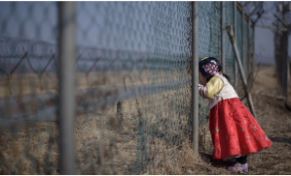
HIGHLIGHTS
EAST ASIA
“Children in North Korea face egregious human rights violations,” says Seoul envoy to the UN
On 03 April, South Korean Ambassador to the UN Hwang Joon-kook said children in North Korea face grave human rights abuses, including receiving the death penalty for distributing South Korean dramas. During the UNSC Briefing on Children and Armed Conflict, Hwang said children in North Korea face “egregious human rights violations” despite North Korea being a signatory country to the Convention on the Rights of the Child. He also mentioned the collective punishments given to their family members and the widespread use of child labour. He added North Korea faces a severe humanitarian crisis as it spends most of its resources on nuclear and ballistic missile programs and luxury items. He noted, “17 per cent of children in the DPRK are reported to suffer from stunted growth due to malnourishment.” (“North Korean kids face death penalty for distributing K-dramas: Seoul envoy to UN,” The Straits Times, 05 April 2024)
CHINA & THE AMERICAS
Microsoft warns of Chinese disruption in US, South Korean, and India’s elections
On 05 April, Microsoft warned about a potential Chinese attempt to disrupt elections in the US, South Korea, and India in 2024 with artificial intelligence-generated content. The report also predicted North Korea’s role in targeting elections in 2024. The report mentioned China’s similar act to use an AI-generated disinformation campaign in the Taiwan presidential election in January 2024. China has been steadily experimenting with augmenting memes, videos, and audio. Microsoft notes that a Beijing-backed group called Storm 1376, also known as Spamouflage or Dragonbridge, was heavily active during the Taiwanese elections but was quickly removed before its mass broadcast. Microsoft also claims that Chinese groups use social media accounts to influence voters through divisive questions. (Dan Milmo, “China will use AI to disrupt elections in the US, South Korea and India, Microsoft warns,” The Guardian, 05 April 2024)
CHINA READER DAILY WIRE
INTERNAL
China bans burning of joss paper and other offerings, triggers social media outburst
On 05 April, according to an opinion in South China Morning Post, local governments in China crackdowns on the burning of joss paper and other offerings during the Ching Ming festival triggered an outcry on social media. The government described it as a “feudal superstition” as the city of Nantong in the eastern province of Jiangsu announced a ban in March on the use of spirit money, joss paper, and other supplies for the festival. The announcement was meant to ensure the reforms of funeral and burial practices and promote civilized customs and practices. The local authorities warned of fines, administrative penalties, and criminal prosecution for rule violations. In 2012, the State Council banned the manufacturing and sales of joss paper and similar items 2012 as part of its funeral management regulations. Chen notes that the local governments have been promoting civilized rituals in recent years instead of superstitious activities during traditional Chinese holidays such as the Ching Ming Festival, the Hungry Ghost Festival, and the Lunar New Year. (Meredith Chen, “Chinese cities spark outcry with ban on joss paper sales and ‘feudal superstitions’ for Ching Ming Festival,” South China Morning Post, 05 April 2024)
Deaths due to air pollution will rise in China soon, says an opinion in The Guardian
On 05 April, according to an opinion in The Guardian, a multinational study from Chinese, German, and Canadian universities warned of more deaths in China over inaction over the growing air pollution. Studies have shown that despite improvements in China’s air pollution, around half of Chinese cities failed to meet their domestic standards in 2019. Gary notes the Chinese government’s “blue skies defence war” using huge investments in renewable energy to tackle air pollution. Prof Michael Brauer from the University of British Columbia mentions the severe impact of air pollution on older people. The studies project China’s air pollution-related deaths are projected to increase by between 116,000 and 181,000 a year from 2030 to 2060. (Gary Fuller, “China braced for rise in air pollution deaths,” The Guardian, 05 April 2024)
ECONOMY
Chinese central bank plans for additional monetary easing amid uncertainty over US Federal Reserve, commentary in SCMP
On 05 April, according to a commentary in South China Morning Post, the growing uncertainty over the US Federal Reserve’s interest rate cuts is adding pressure on the yuan amid the ongoing plans by China’s central bank for greater monetary easing. So far, the yuan has declined at an average of 0.53 per cent against the US dollar since 20 March, despite the monetary targets set by the People’s Bank of China (PBOC). Louise Loo, a China economist at Oxford Economics, said that the PBOC can accommodate further weakening yuan as a weak currency can revive the country’s economy. Amidst the management of the property crisis fallout and countering deflationary pressures by the PBOC, China suffered slow money and credit growth. The Institute of International Finance (IIF) said that the PBOC prioritized the yuan’s stability over its easing. It also predicted that the weak yuan would lead to capital outflows and increased trade imbalances. (Amanda Lee, “China’s yuan: central bank sees resolve for stable currency, stimulus tested as Fed holds firm on rates,” South China Morning Post, 05 April 2024)
CHINA & TAIWAN
Taiwan condemns China’s comments on global earthquake sympathies
On 04 April, Taiwan condemned Chinese comments as “shameless” after a Chinese deputy ambassador to the United Nations thanked the world for its concern about the recent earthquake. It comes as Beijing claims the island territory as part of its own and the right to speak for it internationally. On 03 April, China’s Deputy Permanent Representative to the UN, Geng Shuang, expressed condolences to Taiwan and offered aid. Taiwan’s Ministry of Foreign Affairs said that China’s shameless use of the Taiwan earthquake is part of its international cognitive operations, also known as Chinese psychological warfare. (“Taiwan condemns 'shameless' China's thanks for global sympathy on quake,” Reuters, 04 April 2024)
CHINA & SOUTHEAST ASIA
After live drills near Myanmar border, Chinese PLA on high alert
On 04 April, the People’s Liberation Army (PLA) said that it will remain on high alert and will boost additional patrol along the China-Myanmar border after its recent live fire drills. The PLA Daily mentions the growing tensions in Northern Myanmar due to the increased resistance by the rebel groups against the military junta. Myanmar has been facing severe instability since the military coup in 2021. The article mentions the need for an immediate ceasefire in Northern Myanmar and calls for resolution through dialogue and negotiation. The article also noted Beijing’s growing concerns over trade disruptions caused by the ongoing civil war in northern Myanmar. (Hayley Wong, “China military on ‘high alert’ at Myanmar border after live-fire drill ends,” South China Morning Post, 04 April 2024)
CHINA & AFRICA
Kenya to regulate TikTok over fears of data privacy
On 04 April, according to a survey published by the Reuters Institute Digital News Report in South China Morning Post, the growing concerns over data protection and privacy, the Kenyan government plans to impose restrictions on the use of TikTok in the country. The Interior and National Administration Minister, Kithure Kindiki, said the National Security Council is considering banning public officials from using the app to protect sensitive data. He further said that Kenya is not satisfied with TikTok’s compliance with the country’s data protection and privacy laws. In the parliamentary committee, he mentioned the government’s steps to question the company for compliance with domestic laws. Citing the example of the US cryptocurrency Worldcoin and its suspension in the country for collecting biometric iris scans without authority, the government can ban TikTok if it fails to provide information. Kindiki also warned of increased use of social media, especially TikTok, by criminals. Moses Kemibaro notes that countries worldwide are trying to regulate social media platforms for users' privacy and national security while at the same time ensuring innovation and economic growth. (Jevans Nyabiage, “Kenya becomes latest country to consider curbs on TikTok over data security and privacy fears,” South China Morning Post, 04 April 2024)
CHINA & THE AMERICAS
A level playing field for American companies and workers in China, says US Treasury Secretary
On 05 April, during her five-day visit to China, the US Treasury Secretary Janet Yellen called for a level playing field for American companies and workers. While speaking to Wang Weizhong, the governor of Guangdong province, Yellen mentioned the need for open and direct communication on areas of disagreement, including the issue of China’s industrial overcapacity and its global spillovers. Before meeting senior Chinese officials, Yellen took input from American, European, and Japanese business representatives to hear their concerns. Quoting a survey from the American Chamber of Commerce, Yellen said that a third of American firms in China say they have experienced unfair treatment compared to local competitors by imposing barriers to access domestic markets and coercive actions against the firms. Experts note Yellens’ push for fair competition in new technology sectors such as green energy and EVs with adequate access for American companies. (Fatima Hussein and Ken Moritsugu, “Yellen calls for level playing field for US workers and firms during China visit,” Associated Press, 05 April 2024)"
EAST ASIA & THE PACIFIC READER
EAST ASIA
Japan needs to take an active role in the Middle East, says Armitage-Nye report
On 04 April, according to the Armitage-Nye report in Nikkei Asia, some bipartisan group of Japan analysts said Japan needs to strengthen its presence in the Middle East to uphold free and open international order. This comes after the ongoing attacks on merchant vessels in the Red Sea. The report highlights Japan’s absence in the region despite its heavy reliance on sea lanes in the Middle East. Ken noted that the previous editions were focused on Japan playing an equal role alongside the US in the alliance. However, in this edition of 2024, the report suggests Japan playing a larger role in leading the alliance. Ken also noted that Japan might face greater leadership responsibilities at the regional and global levels in the short term. The report also suggested Japan and South Korea normalize bilateral relations and follow the 2007 Japan-Australia Joint Declaration on Security Cooperation model. The report also called for the US and Japan to explore new models of Free Trade Agreements and called for the US to return to CPTPP. (Ken Moriyashu, “Japan needs 'hulls in the water' to defend Red Sea: Armitage report,” Nikkei Asia, 05 April 2024)
Taiwan is better prepared to face earthquake, says an editorial in The Straits Times
On 05 April, according to an editorial in The Straits Times, Taiwan’s improvement in building codes, greater public awareness, and highly trained search and rescue operations led to small casualties after a 7.4 magnitude earthquake hit Taiwan. It reported that so far, only ten people died and 1000 injured. The editorial also mentioned the resumption of rail services followed by steady repair of roads and quick evacuations of civilians. It also mentions the strict building codes enforced since 1974 based on the experiences from other parts of the world. Even the 2018 earthquake in Hualien led to an immediate revision of building codes. The Director General of the National Centre for Research on Earthquake Engineering said the government had played a major role in reinforcing private apartment buildings for the past six years. The editorial also mentioned the need to protect its vital infrastructure, mainly the TSMC chip manufacturing company. The editorial mentions the critical role played by civil societies in the preparation against disasters. (“Why Taiwan was so prepared for a powerful earthquake,” The Straits Times, 05 April 2024)
China Reader Daily Wire | 04 April 2024, Thursday | Vol.1 No. 49
China faces massive demographic crisis, says an opinion in BBC
China organizes International Import Expo event to boost investor's confidence | China targeted Canadian politicians, says a report in The New York Times
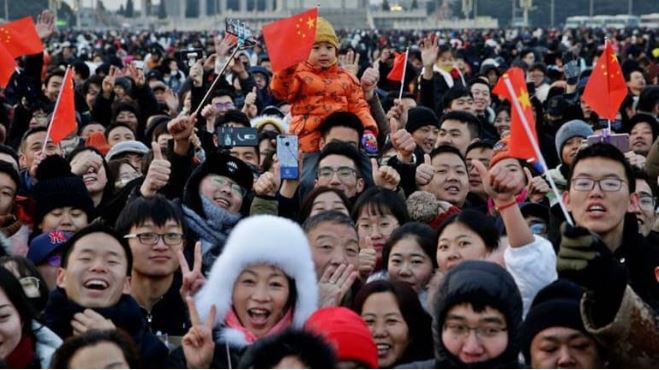
HIGHLIGHTS
INTERNAL
China faces massive demographic crisis, says an opinion in BBC
On 03 April, according to an opinion on BBC, Laura Bicker stated that China faces a massive demographic crisis with the economic slowdown, shrinking government benefits, and the adverse effects of the decades-long one-child policy. Laura reports that China will comprise 300 million people aged above 50 to 60 years will be out of the workforce, which is equal to the population of the US. The country faces acute pension shortages for the social care of elderly people. Laura mentions that the rapid economic growth led to youth migrating away from their parents, leaving them alone to take care of government pensions. According to the 2019 estimates by the state-run Chinese Academy of Sciences, China will run out of its pension funds by 2035. According to Laura, the demographic problem and the economic crisis will force China to increase the retirement age, which at present is 60 for men, 55 for white-collar women, and 50 for working-class women, the lowest in the world. Laura notes that Beijing has recently been pressuring private companies to ramp up the setting up of daycare centers and wards for the elderly, which has been facing losses since its operations. (Laura Bicker, “China's ageing population: A demographic crisis is unfolding for Xi,” BBC, 03 April 2024)
ECONOMY
China organizes International Import Expo event to boost investor's confidence
On 04 April, Xinhua reported of China International Import Expo (CIIE) event being held in southwest China's Chongqing Municipality from 01 to 03 April to boost foreign investors' confidence in the country’s domestic market. The event’s theme focused on “To Boost Dual Circulation by Introducing More Foreign Investment” and aimed to attract prominent companies and representatives from multinationals and investment promotion agencies. Senior Vice President of Qualcomm Qian Kun said that the company aims to strengthen its collaboration with Chongqing in the areas of 5G and terminal side AI. Xinhua notes that Qualcomm’s growing interest reflects foreign companies' desire to explore Western China’s markets. According to government statistics, there has been an increase of 30.49 per cent in the creation of new foreign companies in Chongqing in 2023. Similarly, it has been found in Shaanxi Province in northwest China. Experts like Takeo Keizo and Tino Zeiske note China’s huge market potential, especially in western China, offering huge investment opportunities for foreign companies. This is followed by the government’s increased focus on developing new quality productive forces to attract foreign capital in other parts of the country. (“Economic Watch: Foreign investors continue expansion in western China,” Xinhua, 04 April 2024)
CHINA & THE AMERICAS
China targeted Canadian politicians, says a report in The New York Times
On 03 April, a report in The New York Times revealed the ongoing attempts by the Chinese government to target Canadian politicians who are opponents of China. It shows the media campaign of the Chinese government to spread false narratives about the candidates and encourage the Canadian public to vote against them. The intelligence reports mention China’s intervention in Canada’s general elections in 2021 and the vulnerability of the country’s democratic institutions. This comes after Canadian politicians criticized China for its human rights record. The Chinese embassy had denied its interference in Canadian elections. Onishi reports that the Chinese government opposed Conservative party members as they took a hard stance on China. On 03 April, Jenny Kwan, a veteran Parliament member from Vancouver, testified of Chinese government interference through its diaspora communities. (Norimitsu Onishi, “Canadian Politicians Were Targeted by China in 2021,” Report Says,” The New York Times, 03 April 2024)
CHINA READER DAILY WIRE
INTERNAL
Storm wind hit Southern China, killing seven people
On 03 April, Reuters reported that stormy winds hit China’s southern Jiangxi province on 31 March, killing around seven people. The Jiangxi provincial emergency flood control headquarters reported that extreme weather had affected nine cities, including Nanchang and Jiujiang, with 93,000 people in 54 counties. The local officials reported that 552 had to be evacuated in an emergency, and 2,751 houses suffered damages, leading to total damage losses amounting to 150 million yuan (USD21 million). The local authorities had issued an orange alert for severe weather warning throughout Southern China for 04 April. (“People blown from apartments as typhoon-like winds ravage southern China,” Reuters, 03 April 2024)
CCP controls media to convey positive China story, says an opinion in Al Jazeera
On 04 April, according to an opinion in Al Jazeera, Frederik mentioned how the Chinese government uses censorship to project the positive side of China’s story. Editors are required to check in with censors every few hours, and certain terminology has been changed to align with the preferred narrative of the Chinese Communist Party (CCP), including referring to Tibet as “Xizang.” Frederik mentions how the employees of the Sixth Tone mention how the articles have been removed and phrases censored on a massive scale across the outlet’s archives. Frederik also mentions how the CCP uses the large audience base of Sixth Tone to control them by promoting the positive side of China’s story. However, some experts mention that such an approach hinders the overall reflection of socio-economic issues that the common people face in China. Shaoyu Yuan, a scholar of Chinese studies at Rutger’s University, notes that the CCP intends to focus more on aligning content with party ideology and government policy and less on editorial independence. Frederik mentions that the media environment was restricted with Xi’s ascendence to power in 2013, which is reflected in the Freedom House’s 2023 report, where China was rated as “not free,” scoring nine out of 100. (Frederik Kelter, “Media feel pressure to tell ‘positive’ China story as party tightens grip,” Al Jazeera, 04 April 2024)
China’s Central Financial Commission lays down a plan to regulate the financial industry
On 03 April, according to an article published by Study Times in South China Morning Post, China’s Central Financial Commission (CFC), designated to regulate the sector, laid out its vision for its financial sector. This plan aims to achieve national objectives like sustainable growth and advancement in the global tech race. The article mentioned China’s cyclical and aggregate problems in its economic development and resolved them by promoting financial development through supply-side structural reform. Chen notes that China’s 461 trillion yuan (USD 63.7 trillion) play a leading role in the country’s economic growth, which was mentioned by Xi’s recent remarks on making China a financial superpower. Chen mentions that the presence of foreign players in China’s banking industry is around one per cent. CEIBS’ Zhu said that China’s financial reforms focus on generalities but lack specifics to drive the financial sector’s growth. (Frank Chen, “China’s Communist Party finance organ draws institutional road map for the sector,” South China Morning Post, 04 April 2024)
CHINA & EAST ASIA
South Korean companies face intense competition in Vietnam, says an interview in Nikkei Asia
On 04 April, according to an interview in Nikkei Asia, South Korean companies such as Samsung Electronics, LG, etc., faced stiff competition from Chinese companies in Vietnam, which is becoming a critical manufacturing hub in global supply chains. Representative of the Korea Chamber of Commerce and Industry (KCCI) Kim Hyong-mo said that despite leading in investments in Vietnam since 1988 with USD 85.8 billion, Korea faces intense competition from China. In 2023, South Korea ranked fourth in FDI in Vietnam, behind Hong Kong, China, and Singapore. Kim added that due to the slowdown in the global economy, South Korean companies are reluctant to invest in Vietnam due to increased labour costs. He further said that Vietnam’s open trade and investment environment, geopolitical advantages, and domestic political stability have made it an attractive country for FDI. He mentioned the reasons behind the slowing FDI in Vietnam, including the rising minimum wage, slow policy decision-making by the government, and lack of infrastructure, especially electricity. Besides, Vietnam’s embrace of the global minimum corporate tax rate of 15 per cent hurts its prospects as a major investment destination. (Toyoaki Fujiwara, “South Korean firms in Vietnam face growing competition with China,” Nikkei Asia, 04 April 2024)
CHINA & SOUTHASIA
India and China ongoing talks to continue, says Defense Minister Rajnath Singh
On 02 April, India’s Defense Minister Rajnath Singh said: “Indian troops are standing “firm,” and the ongoing talks between the two sides will continue” for finding a “peaceful resolution to the India-China military face-off in Eastern Ladakh.” Also, he referred to the growing use of proxy warfare by adversaries and the need for synergy between the CAPF police forces, and the Army to tackle terrorism in Jammu and Kashmir. Addressing the senior Army officers at the Army Commanders’ Conference, Singh said, “Cyber, information, communication, trade, and finance have all become an inseparable part of future conflicts. This necessitates that Armed Forces will have to consider all these facets while planning and formulating strategies.” The conference is an apex-level biannual event that deliberates upon the present security scenarios and challenges for overall security. (“India-China face-off: De-escalation way forward, talks will continue, says Rajnath Singh,” The Indian Express, 04 April 2024)
CHINA & THE AMERICAS
US questions Microsoft for security breach leading to Chinese hacking
On 02 April, The Guardian mentioned the report issued by the US Cyber Safety Review Board, saying that Microsoft corporate security and transparency has conducted multiple errors that facilitated Chinese cyber operators to break into the email accounts of senior US officials, including Commerce Secretary Gina Raimondo. The Board was created in 2021 as per the executive orders of the US President. The report concluded that Microsoft’s security culture was inadequate and needs a complete overhaul as the company’s products provide essential services that are critical to national security. The board said that the cyber intrusion which was detected in June 2023 was preventable. In response, Microsoft said that it would continue to improve its systems against any potential cyber intrusions. The board, headed by Homeland Security Secretary Alejandro Mayorkas, blamed Microsoft for the inaccurate display of public statements, and it had not updated the information until March 2024. The board recommended rapid cultural change to ensure that fundamental security-oriented reforms are implemented across the company and its products. (“US reprimands Microsoft for security failures that allowed Chinese hack,” The Guardian, 03 April 2024)
Chinese Canadian parliamentarian testifies against getting foreign Chinese students to vote
On 02 April, Chinese Canadian Parliamentarian Han Dong testified at a public hearing against allegations of collaborating with the Chinese government and using High School students from China to gain votes. Han Dong stated that he did seek support from the students but had no idea about who chartered the us for the Chinese students. The Canadian intelligence report found that there was a proxy agent in the Chinese Consulate who threatened students and used false documents to get them to vote. According to Canadian law, all students over the age of 14 can register and vote as long as they show proof that they are part of the electoral district. Dong’s testimony is part of the ongoing investigation going on in Canada on foreign interference during the 2019 and 2021 elections. While Dong denied all accusations of Chinese government interference, he also said though there is no evidence, it is “possible.” The lawmakers noted that any foreign students who come to Canada for a one-year program can vote, and any authoritarian governments can coerce these students. (Norimitsu Onishi, “Canadian Lawmaker Testifies Chinese Students Were Bused In to Elect Him,” The News York Times, 02 April 2024)
EAST ASIA & THE PACIFIC READER
EAST ASIA
Pro-Taiwan US envoy to head the American Institute in Taiwan
On 04 April, The Straits Times reported a pro-Taiwan envoy to be appointed as the head of the American Institute in Taiwan (AIT). AIT is responsible for handling relations between Taiwan and the US as there is no official relation established. Like other countries, the US also does not officially recognize Taiwan, due to China's claims. But it has established a steady relationship with the Island nation, by providing arms and being an international supporter. It is reckoned that Raymond Greene is set to become the director of AIT, he is seen as a staunch supporter of Taiwan. Greene previously said about Taiwan: “The United States no longer sees Taiwan as a 'problem' in our relations with China, we see it as an opportunity to advance our shared vision for a free and open Indo-Pacific and also as a beacon to peoples around the world who aspire for a more just, safe, prosperous, and democratic world.” (“‘Staunch friend’ of Taiwan to become top US diplomat in Taipei, sources say,” The Straits Times, 04 April 2024)
Japan is pro-active in supporting its national interest in the South China Sea, says an opinion in VOA
On 03 April, an opinion in VOA, titled “Japan seeks to defend national interests in the South China Sea,” by Chermaine Lee looks into how Japan seeks to bolster its National interest in the South China Sea by inching closer to the Philippines. A trilateral meeting is set to start on 11 April between Japan, Philippines and the US. The countries aim to discuss robust military roles in the Asia-Pacific region. For the Philippines, Japan is the second most important partner in safeguarding its claims in the South China Sea, after the US. As both countries have a mutual stake at play, the Philippines find this meeting beneficial. According to the professor at the Asia-Pacific Center for Security Studies Alexander Vuving, Japan is now taking a more proactive role in defending its national interest and not only depending on the US. (Chermaine Lee, “Japan seeks to defend national interests in the South China Sea,” VOA, 03 April 2024)
Japan struck with 6 magnitude earthquake
On 04 April, the Japan Meteorological Agency informed that a 6-magnitude earthquake struck north-eastern Japan’s Fukushima region. There were no reports of damage or injury after the earthquake. At the epicentre, the depth of the earthquake was 40 km. Japan is one of the world's most earthquake-prone and tectonically active countries. It has witnessed many earthquakes and therefore it has strict building regulations and standards to make it earthquake-resistant. Japan is home to around 125 million people and experiences 1,500 jolts every year, while most go undetected. (“6-magnitude quake shakes north-east Japan; no tsunami alert,” The Straits Times, 04 April 2024 )
South Korean population looks to the Reform Korea Party over the People Power Party (PPP)
On 04 April, The Straits Times reported on the growing popularity of former justice minister Cho Kuk. An increasing number of South Korean population are in support of the once disgraced politician facing jail term. Cho is part of the Reform Korea Party and has been fiercely promoting the anti-government narrative. This comes as South Korean President Yoon-Suk-Yeol’s approval rating is at an all-time low with the scandals, rising inflation and the ongoing doctor's strikes. Cho’s rally has been largely anti-Yoon where he said: “I am going to make President Yoon first a lame duck, then a dead duck.” The political analysts believe that Cho’s arty can garner 30 per cent of the vote and therefore will be able to get 15 seats in the parliament, this would prevent PPP from forming a majority government for the first time since 2016. (“‘Angry’ South Korean voters turn to disgraced ex-ministers fledgling protest party,” The Straits Times, 04 April 2024)
Semiconductor supply chain saw a minor hiccup as Taiwan was hit by an earthquake
On 03 April, The Straits Times reported on the disruption of the semiconductor supply chain after Taiwan was hit by an earthquake. The Chipmakers had to halt the operation of TSMC and UMC to check and inspect the facilities. While most of the firms were not close to the earthquake epicentre, many decided to evacuate their employee and shut down their facilities. TMSC: “To ensure the safety of personnel, some fabs were evacuated according to company procedure,” and “Mitigating the impacts of the earthquake necessitates careful measures and time to restore production and uphold quality standards, presenting additional implications and obstacles.” Barclays analysts believe that this could have a minor short-term hiccup in the manufacturing of the semiconductors as some parts of it need to operate seamlessly 24/7 for several weeks. (“Taiwan quake to hit some chip output, cause Asia supply chain disruptions, analysts say,” The Straits Times, 03 April 2024)
03 April 2024, Wednesday | Vol.1 No. 48
Xi Jinping and Joe Biden discuss issues and avenues of cooperation on call
Southeast Asia prefers China over the US: ISEAS Report | China Yunnan province tightens restrictions for Ramadan
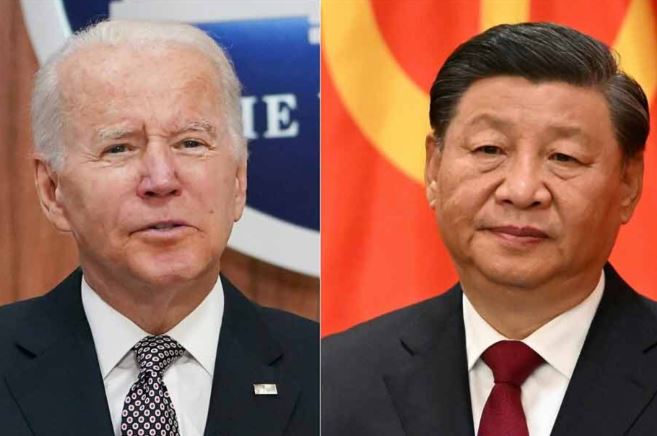
HIGHLIGHTS
CHINA & THE AMERICAS
Xi Jinping and Joe Biden discuss issues and avenues of cooperation on call
On 02 April, Chinese President Xi Jinping and US President Joe Biden engaged in a telephone conversation, aiming to subdue the tension between the two countries. They discussed multiple avenues of cooperation and shared vision to combat Climate Change. On Taiwan, Biden expressed his support for Taiwan while Xi called US involvement as the “Red Line.” Xi called those sanctions imposed by the US an “endless stream of measures to suppress China's economy, trade, science and technology.” He said that if the US aim to deter their right to develop, China will not sit idly. Xi again stated that US support for Taiwan is not “risk reduction” but “risk escalation.” Biden also questioned the Chinese support for Russia, their industrial base, trade policies and national security. (Kayla Epstein, “Biden and Xi discuss US-China cooperation and conflict,” BBC, 03 April 2024)
INTERNAL
Southeast Asia prefers China over the US: ISEAS Report
On 02 April, according to a survey published by the ISEAS – Yusof Ishak Institute’s “The State of Southeast Asia 2024 report,” in The Straits Times, China leads ahead of the US as the preferred superpower by a narrow margin. The survey indicated a sizable shift in the respondents in the region who had relied on the US. Out of the 1,994 respondents polled across the 10 ASEAN countries, 50.5 per cent indicated China as their preferred choice, while 49.5 per cent selected the US on the question of which country the region should choose if it was forced to align itself with. In the 2023 survey, only 38.9 per cent of respondents picked China, with 61.1 per cent opting for the US. The 2024 survey was conducted online from 03 January to 23 February and polled respondents from academia, think tanks, research groups, businesses, civil society, the media & regional or international organizations, and governments. The 2024 survey perceived China as the most influential power in Southeast Asia, followed by ASEAN and the US. The survey also revealed growing concerns about China’s regional political and strategic influence, with 73.5 per cent of the respondents expressing their uneasiness. However, there were exceptions where the respondents in the Philippines, Singapore, and Vietnam perceived US influence more positively. (Michelle Ng, “When push comes to shove, China edges out US as S-E Asia’s preferred superpower: ISEAS survey,” The Straits Times, 03 April 2024)
INTERNAL
China Yunnan province tightens restrictions for Ramadan
On 02 April, according to a commentary in VOA, restrictions were imposed in China on the sidelines of the Ramadan festival from 10 March to 09 April. The Yuxi Municipal government in southwestern Yunnan Province issued an emergency notice for the party committees, governments, and education departments at all levels to comprehensively investigate and strictly prohibit Muslim members of the Communist Party of China (CCP) and minors from participating in religious activities such as fasting. Lin mentions that the CCP desires to maintain political discipline among the party members. According to Lin, the notice emphasized separating education and religion to participate in religious activities with severe punishment threats. He also reports the local government tightening the restrictions with the onset of Ramadan. Ruslan Yusupov, a Society for the Humanities fellow at Cornell University, said that before Xi’s arrival, ethnic customs were allowed even for the CCP members, and with Xi’s tenure, there has been increased government control and suppression of religions using unofficial measures. (Ke Lin, “China tightens restrictions during Ramadan,” VOA, 02 April 2024)
CHINA READER DAILY WIRE
INTERNAL
AIUla joins hands with China’s Henan province to preserve cultural heritage
On 02 April, Arab News reported of the Royal Commission for AlUla signing a strategic partnership with the Cultural Heritage Administration of China’s Henan province to preserve heritage. The Saudi Press Agency mentions RCU's goals of expanding its global network through the Saudi-Chinese partnership. At present, the “AlUla, Wonder of Arabia” exhibition is being held at the Palace Museum in Beijing, a UNESCO World Heritage site, until 11 April and has attracted over 250,000 visitors and features several sections, exhibits, archaeological pieces, and heritage items from historical sites in AlUla. The partnership, as reported by the Arab News, includes establishing a technology-driven archaeological laboratory, conducting excavation activities, engaging in research, and fostering connections between heritage sites in AlUla and Henan. (“AlUla, China’s Henan province strengthen cultural ties for heritage conservation,” Arab News, 02 April 2024)
ECONOMY
China Construction Bank's chief financial officer expects more policy support
On 02 April, China Construction Bank (CCB) chief financial officer Sheng Liurong said that the country’s economy is slowly recovering and Beijing needs to ensure more policy support to boost the economy. He also said that big financial institutions could lower financing costs to boost domestic confidence. He predicts a future cut in banks’ reserve requirement ratios (RRR) and loan prime rates (LPR), which are critical for household, corporate, and mortgage loans. This was followed by the People’s Bank of China (PBOC) announcing a 25-basis-point cut to the five-year LPR, a key mortgage benchmark, to boost housing demand since 2019. It was followed by the country’s central bank in January, leading to a cut in the RRR by 50 basis points to inject 1 trillion yuan liquidity into the market. BOC chairman said that the bank would pursue more retail loans as they have high yields, less capital accumulation, and low-risk costs. He added that the CCB will continue monitoring property and local government debt to prevent and contain credit risks. (Aileen Chuang and Yuke Xie, “China Construction Bank sees more policy support from Beijing, despite pressure on state-owned lenders to boost profit,” South China Morning Post, 02 April 2024)
Profits doubled for China’s fast fashion retailer Shein amid its pending IPO approval
On 01 April, Shein, China’s online fast fashion retailer, doubled its profits to more than USD 2 billion as it waits for its IPO approval for stock market listings in New York or London. Quoting a Financial Times report, The Guardian noted the rapid growth of Shein using social media for its goods promotion with sales clocking up to USD 45 billion in 2023. Shein, headquartered in Singapore, is the world's fastest-growing and profitable fashion company, ahead of Swedish fashion group H&M and the UK’s Primark and Next. The company predicts that a potential stock listing in London will value its IPO to USD 90 billion. Sarah notes that Shein directly sells its goods to customers in the US and the UK to avoid taxation, which has led to increased calls for change in tax rules. (Sarah Butler, “Fast fashion retailer Shein doubles profits as it awaits IPO approval,” The Guardian, 01 April 2024)
CHINA & TAIWAN
Taiwan detects 30 Chinese warplanes and nine navy vessels around its territory
On 03 April, the Taiwanese Ministry of Defense said it had detected 30 Chinese warplanes and nine naval warships around Taiwan. The reports come after a 7.7 magnitude earthquake hit Taiwan. The Armed Forces of the Republic of China detected 20 aircraft entering Taiwan’s Northern middle line and SW ADIZ. On the same day, Taiwan also reported a satellite launch close to its territory from the Xichang Satellite Launch Center (XSLC). (“Over 30 Chinese Warplanes, 9 Navy Vessels Around Taiwan,” TimesNow, 03 April 2024)
CHINA & EAST ASIA
Hong Kong Stock exchange suspends trading shares of Country Garden
On 02 April, the Hong Kong exchange suspended the trading of the shares belonging to the Country Garden aid financial crisis from the ongoing housing crisis. This comes after the company postponed the release of the 2023 annual results. The company said the delay in the financial report was due to the requirement to compute appropriate accounting estimates. The suspension comes after the company suffered losses of up to USD 844 million since 2022, facing a liquidation petition in Hong Kong. Apart from Country Garden, the Hong Kong Stock Exchange suspended the trading of other companies such as Modern Land, Central China Management, and Ronshine China. (“Trading of indebted developer Country Garden suspended in Hong Kong,” VOA, 02 April 2024)
CHINA & SOUTHEAST ASIA
China has diplomatic charm over Southeast Asian countries despite tensions, says an opinion in VOA
On 02 April, an opinion in VOA, titled, “China launches Southeast Asia outreach amid tensions with Philippines,” by Willian Yang stated that China tried to extend its diplomacy to Southeast Asian countries this week. President Xi Jinping met Indonesian President-elect Prabowo Subianto on 01 April and foreign ministers from Laos, Vietnam, and East Timor on 02 April. The meeting comes amid the ongoing diplomatic tussle between China and the Philippines in the South China Sea. On 01 April, Xi, in the meeting with Prabowo, promised to deepen ties with Indonesia at all levels, including joint maritime cooperation and focus on economy, trade, and poverty alleviation. The spokesperson of the Ministry of Foreign Affairs of China announced that Beijing will work with the three countries via the guidance of the important common understandings between General Secretary and President Xi Jinping and leaders of the three SEA countries. Ja Ian Chong, an expert on Chinese foreign policy at the National University of Singapore, notes that China aims to cultivate strong ties with Timor Leste and Indonesia and is trying to pursue Prabowo to take positions in Beijing’s interest. Ngeow Chow-Bing, an associate professor in China studies at the University of Malaya, said that ASEAN countries, except for the Philippines, are abiding by not criticizing China on the territorial disputes and seeking opportunities with Beijing for collaboration. (William Yang, “China launches Southeast Asia outreach amid tensions with Philippines,” VOA, 02 April 2024)
CHINA & SOUTH ASIA
Investors paring Indian stocks and going back to China as the economy revives, says an Opinion in Bloomberg
On 01 April, Bloomberg published an opinion titled, “Investors Are Unwinding the ‘Buy India, Sell China’ Stocks Trade,” by John Cheng, Abhishek Vishnoi, and Tania Chen. The op-ed looked into the change in strategy of foreign investors, now tracing back to China from India as they believe the economy is recovering. The strategy according to the op-ed “Buy India and Sell China” is at its “inflection point.” The firms Lazard Asset Management, Candriam Belgium NV and Manulife Investment Management are cutting away from India, while a sizeable number of Wall Street banks are pitching India as a key destination for investments for the upcoming decade. Head of emerging markets in Lazard Asset, James Donald said: “As China has got cheaper and cheaper, some of our Chinese investments have become less valuable but the investment case for them has increased,” and for India “has been a source of negative attribution for our portfolios,” due to its rich valuations.” According to HSBC Holdings, more than 90 per cent of the emerging market funds are going back to China and its shares. (John Cheng, Abhishek Vishnoi, and Tania Chen, “Investors Are Unwinding the ‘Buy India, Sell China’ Stocks Trade,” Bloomberg, 01 April 2024)
CHINA & THE AMERICAS
Chinese Businessmen Guo Wengui pleas to dismiss charges were declined by the US court
On 02 April, U.S. District Judge Analisa Torres rejected the Chinese businessman Guo Wengui's petition to retract his indictment. The court dismissed Guo’s pleas who was detained after being accused of defrauding thousands of investors estimated to be USD 1 million. The judge stated that the prosecutors found that Guo was operating through four fraud schemes. Guo pleads not guilty on all 12 charges that include, security fraud, unlawful transactions, conspiring, money laundering and wire fraud. His indictment stated that Guo used his online platform and his popularity to secure financial investments. In reality, these only helped the investors in funding Guo and his conspirator’s extravagant lifestyle. (“Exiled Chinese businessman Guo Wengui must face US fraud indictment,” VOA, 02 April 2024)
EAST ASIA & THE PACIFIC READER
EAST ASIA
Taiwan hit with 7.4 magnitude earthquake
On 01 April, Taiwan was hit by an earthquake of 7.4 magnitude killing at least seven people and injuring more than 700, while 77 are still trapped in tunnels and the rubbles of the collapsed buildings. This is the biggest earthquake Taiwan experienced in the last 25 years. The quake hit a depth of 15.5 km while most people were going to work and schools. This has led to a series of warnings being issued in the southern part of Japan and the Philippines. The newest President-elect Lai Ching-te informed that the priority of Taiwan is to rescue people. (“Seven dead, over 700 injured after 7.4-magnitude earthquake rocks Taiwan,” The Straits Times, 03 April 2024)
North Korea tests its mid-to-long-range solid fuel-based hypersonic missiles
On 02 April, the Korean Central News Agency (KCNA) reported that North Korea successfully tested its mid-to-long-range solid fuel-based hypersonic missiles. The launch was overseen by North Korean leader Kim Jong Un who applauded the development of strategic weapons and stated that it showcases “absolute superiority” they have in defence technology. Kim said North Korea has: “fully turned all tactical, operational, and strategic-grade missiles of different ranges into solid-fuel, with warhead control, and capable of nuclearization.” The hypersonic capabilities give a strategic boost to North Korea as they are hard to intercept and the use of solid fuel made it easy to store hence expediting the launch timing. (“North Korea says it test-fired a new solid-fuel hypersonic missile,” Nikkie Asia, 02 April 2024 )
South company Hyundai announces biggest Initial public offering
On 03 April, Nikkie Aisa reported that South Korean company HD Hyundai Group has envisioned raising USD 550 billion for an initial public offering (IPO) for the South Korean stock market. They would allocate 8.9 million shares which is 20 per cent to the investors. Hyundai CEO Kidong Lee said: “We are expected to benefit from the transition toward an environmentally friendly market,” and “We have actively prepared for coping with rising demand for ships fuelled, with cleaner alternatives.” The IPO remained subdued for the past two years but after this HD Hyundai will remain the largest shareholder with a 55 per cent stake. The HD Hyundai conglomerate is the company that offers services to container ships and other LNG carriers. They also repair and maintain systems while providing them with a navigation system that gives energy-saving data. (“Hyundai Marine Solution targets South Korea's biggest IPO in 2 years,” Nikkie Asia, 03 April 2024)
US urges South Korea to tighten its chips exports to China
On 02 April, Bloomberg reported that the US is urging South Korea to toughen up its Chip export control to China. They have asked South Korea to adopt a similar sanction as that of the US and implement it to thwart Chinese ambitions. They want South Korea to restrict the flow of equipment and technologies that are vital in making chips. The South Korean side is still discussing as they see China as a key trading partner. The US has been pressing its allies to curb Chinese access to Chip technology, especially pressuring South Korea which plays a leading role in providing technology for the production of semiconductors. China remains the largest trading partner with South Korea and this can affect big conglomerates like Samsung Electronics Co. and SK Hynix Inc. Chinese Foreign Ministry spokesman Wang Wenbin said: “We hope that the ROK will make the right judgments and independent decisions.”( Mackenzie Hawkins and Sam Kim, “ US Asks South Korea to Toughen Export Curbs on China Chips,” Bloomberg, 02 April 2024)
02 April 2024, Tuesday | Vol.1 No. 47
Indonesian President Prabowo Subianto met the Chinese President to discuss future cooperation
Former Taiwanese President kickstarts his 11-day visit to China | China to conduct live fire exercises near its border with Border
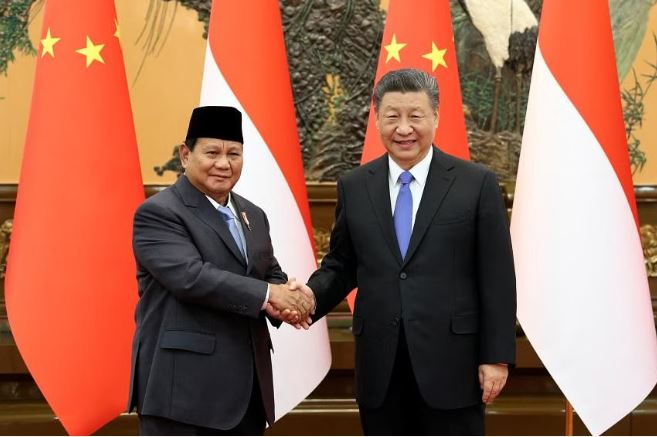
HIGHLIIGHTS
CHINA & SOUTHEAST ASIA
Indonesian President Prabowo Subianto met the Chinese President to discuss future cooperation
On 01 April, Indonesian President Prabowo Subianto met with Chinese President Xi Jinping at the Great Hall of People, discussing the bilateral economic and strategic ties between the two countries. Xi Jinping stated that China sees their relations with Indonesia from a long-term perspective and that they are willing to deepen strategic cooperation with the country. Xi cited the China-built Jakarta-Bandung high-speed railway, stating that it showed the cooperation between the two countries. Prabowo also asserted that he would continue former Indonesian President Joko Widodo’s foreign policy of friendship with China and that they would further push for cooperation. He also stressed that for defence cooperation and regional peace and stability, China is the key player in ensuring the same. (“China willing to deepen strategic cooperation with Indonesia, Xi tells Prabowo in Beijing,” The Straits Times, 01 April 2024)
CHINA & TAIWAN
Former Taiwanese President kickstarts his 11-day visit to China
On 01 April, former Taiwanese President Ma Ying-jeou left for an 11-day trip to China to meet the Chinese President Xi Jinping and the top politburo of the Communist Party of China. The meeting comes in light of the growing tensions in the regions and the Taiwan Strait. Ma was a president-elect from 2008-2016 and is the first former Taiwanese leader to visit China. Upon his arrival, he met with the Chinese Taiwan Affairs Office head Song Tao. Ma was quoted by Xinhua (flagship Chinese media outlet) stating: “Strengthen exchanges and cooperation in various fields, especially among young people, to push forward the development of cross-Straits relations.” Ma also asserted that this trip comes in peace and friendship and that he wanted to convey the message to the Taiwanese people that they hope to avoid war and want to maintain peace. (“Former Taiwan president Ma leaves for China, likely to meet Xi,” The Straits Times, 02 April 2024)
CHINA & SOUTHEAST ASIA
China to conduct live fire exercises near its border with Border
On 02 April, the South China Morning Post reported that the Chinese military aiming to conduct a series of live-fire exercises near its border with Myanmar amid the ongoing fighting between the rebel groups and the Junta government. On 01 April, the autonomous prefecture of Dehong Dai and Jingpo in Yunnan said the live drills would take place in two counties bordering Myanmar on 02 and 03 April. On 02 April, the Southern Theatre Command of the People’s Liberation Army (PLA) confirmed its participation in the drills which are aimed to test the force capabilities of “rapid manoeuvre, precise destruction, three-dimensional sealing and control and joint strike.” Previously, in November 2023, the PLA conducted live-fire drills after an alliance of three armed groups began a major offensive against the junta in the Kokang region of Shan state bordering China. (Hayley Wong, “China’s military to hold live-fire exercise on Myanmar border as fighting continues,” South China Morning Post, 02 April 2024)
CHINA READER DAILY WIRE
CHINA & SOUTH ASIA
Pakistan’s counterterrorism police detained 12 suicide bombing suspects that killed five Chinese worker
On 01 April, a Pakistani official informed that the Pakistani counterterrorism police had arrested 12 suspects after they started multiple raids. The raids come in light of the brutal suicide bombing that killed five Chinese workers in Pakistan as they were travelling for work. The suspects are said to not be directly involved with the attack but were part of the orchestration of the attack. Some also had links to Pakistani militia groups as well. The bodies of the Chinese victims were sent back to China. Chinese Ambassador Jiang Zaidong was present to receive them and expressed his deep condolence to the victims’ families and the victims. Pakistani Prime Minister Shehbaz Sharif visited the hydropower project, Dasu Dam, where the victims worked and assured them of security while affirming that the attackers would be punished. (“Pakistani police arrest 12 people over a suicide bombing that killed 5 Chinese workers,” Associated Press, 01 April 2024)
CHINA & THE PACIFIC
Australia needs to strategize its diplomatic messaging to China, says an opinion in Nikkei Asia
On 02 April, according to an opinion in Nikkei Asia, Ben Scott, senior advisor at the National Security College of Australian National University, suggested a strategized messaging to China after debates emerged on whether Canberra is acting soft on China during the recent Chinese Foreign Minister Wang Yi’s visit to the country. Ben mentions China’s blockage of Australian exports in 2020, and its perception as an attempt to besmirch China as part of its discourse power used in orchestrated public messaging. Ben also mentioned China’s private meeting with Australian officials and allowing only Chinese media reflects China’s attempts to shape the information environment. He mentions that potential Australian criticism may risk the Chinese narrative of external powers' intervention and the alienation of ASEAN countries. In the long run, he advises Australia to strengthen its military capabilities and alliances against Chinese aggression by responding transparently and quietly. (Ben Scott, “Australia's China policy more effective with disciplined messaging,” Nikkei Asia,” 02 April 2024)
CHINA & EUROPE
French Foreign Minister presses China to send a “clear” message to Russia on the Ukraine
On 01 April, during a meeting in Beijing, French Foreign Minister Stephane Sejourne said that Paris expects “China to send clear messages to Russia over its war in Ukraine.” This comes as Paris, one of Ukraine's biggest supporters, has recently refused to rule out putting troops on the ground. The Straits Times reported China’s neutral stance in the Ukraine conflict and its refusal to condemn Moscow’s offensive. Chinese Foreign Minister Wang Yi said, “We are convinced that there will be no lasting peace if it is not negotiated with the Ukrainians.” Sejourne also referred to China as playing a key role in ensuring respect for international law. His visit is the second to China by a French foreign minister in less than six months, following a trip by his predecessor, Catherine Colonna, in November 2023. Sejourne 's visit to Beijing is part of the 60th anniversary of diplomatic relations between France and China. (“France wants China to send ‘clear message’ to Russia over Ukraine war,” The Straits Times, 02 April 2024)
CHINA & THE AMERICAS
Eight Chinese nationals found dead on beach in Mexico
On 29 March, the bodies of eight Chinese nationals were found on a beach in the state of Oaxaca in Mexico. The local officials report boat capsizing as the leading cause of death of Chinese nationals. The officials report one survivor and one missing boat driver. The seven women and a man were boarding the boat and travelling from Chipas state in Mexico to the US. The prosecutors' office mentions the growing number of migrants attempting to enter the US from Mexico illegally. According to data mentioned in the BBC, since 2021, more than 6.3 million migrants have entered the US, and this has increased since 2018, primarily from Central America. This is due to the growing gang violence, poverty, political repression, and natural disasters. In 2023, around 37,000 Chinese nationals have been detained at the US-Mexico border, which is 50 times more than in 2021. (“Mexico: Eight Chinese migrants found dead on beach,” BBC, 31 March 2024)
EAST ASIA & THE PACIFIC READER
EAST ASIA
South Korean President Yoon criticized the medics cartel opposing medical sector reforms
On 01 April, South Korean President Yoon Suk-yeol criticized the cartels of medics opposing reforms in the medical sector. He said the government will not back down on the quota increase plan that led to the month-long strike. The Straits Times reports that hospitals were cancelling critical treatments and surgeries as thousands of trainee doctors stopped working from 20 February onwards. The government aims to increase medical school admissions by 2000 seats from 2024 onwards to address the shortage of health workers and the growing ageing issue. Yoon said the increased numbers will only partially address the shortage issue, especially outside Seoul. He also urged the protesting doctors to return to work before completing the license suspension process. Yoon added that the cartels of doctors had strengthened, thereby the failure of previous governments to increase medical school admissions. South Korea will conduct its elections next week with the voting process. Also, The Straits Times reports increased public sympathy with the Yoon-led government on the doctors' strike. (“South Korean President Yoon slams doctor ‘cartel’ as the strike drags on,” The Straits Times, 01 April 2024)
North Korea launches intermediate-range ballistic missile, says Joint Chiefs of Staff South Korea
On 02 April, South Korea’s Joint Chiefs of Staff (JCS) reported that North Korea launched an intermediate-range ballistic missile into the East Sea. The JCS said that South Korea detected a ballistic missile launch from the Pyongyang area at 6.53 am, suspected to be intermediate-range class, which flew about 600 km before falling into the sea. JCS suspects North Korea is testing a new intermediate-range hypersonic missile powered by a solid fuel engine. Japan reports that the missile had fallen outside of its Exclusive Economic Zone. The latest missile test has led to immediate condemnation from Japanese PM Kishida. (“North Korea fires suspected intermediate-range ballistic missile,” The Straits Times, 02 April 2024)
Japan lifts its suspension of funding on UNWRA
On 02 April, Japan announced that it would lift its suspension on the funding to the UN Palestinian Refugee Agency (UNRWA) as the body was accused of some of its staff being involved in the 07 October attacks on Israel. The Straits Times mentions Japan as the sixth biggest donor to the agency. The suspension was announced by 15 other countries, which halted USD450 million in funding following the agency’s involvement in the Gaza conflict. At present, countries such as Australia and Canada have restored the funding. In a meeting with UNRWA head Philippe Lazzarini, Japan's Foreign Minister Yoko Kamikawa said, “The agency's role in addressing the Gaza crisis was indispensable even as it works to improve governance and manage risks.” She also said that Japan would immediately continue funding the UNWRA with USD 35 million. (“Japan resumes funding to embattled Palestinian refugee agency UNRWA,” The Straits Times, 02 April 2024)
01 April 2024, Monday | Vol.1 No. 46
PDD’s use of Noncompete Agreements stifling former employees, says an opinion in The Wall Street Jou
Japanese lawmakers push for US-Japan steel deal to deter Chinese dominance
HIGHLIGHTS
INTERNAL
PDD’s use of Noncompete Agreements stifling former employees, says an opinion in The Wall Street Journal
On 31 March, The Wall Street Journal looked into the Noncompete Agreements used by the rising PDD company which also owns the world's most downloaded app Temu. The Op-ed is titled, “Chinese E-Commerce Giant Squeezes Workers With Noncompete Agreements,” by Shen Lu and Raffaele Huang. Job at PDD Holding is highly sought after as they provide a handsome package and lift the resume of its employees. While working includes gruelling long hours of work, what happens after one leaves the company is worse. The company has been using the noncompete agreement to file against its former employees. The noncompete agreement aims at thwarting competition that can become a potential rival after leaving the company, it also aims to protect company secrets. The company imposes hefty penalties through this agreement. One instance the op-ed notes is the one small business selling weight loss supplements was sued with USD 34.9 billion. PDD claims that they use this in a limited and responsible manner. PDD filed 110 employment-related lawsuits in the past five years, out of which 15 per cent were on noncompete agreements. Temu is also accused of outsourcing spying on its previous midlevel managers and their career trajectories. The op-ed also informed that the employees are further discouraged from sharing their names and socializing at work. The blatant use of Noncompete agreements has stifled the growth and prospects of smaller businesses. (Shen Lu and Raffaele Huang, “Chinese E-Commerce Giant Squeezes Workers With Noncompete Agreements,” The Wall Street Journal, 01 April 2024)
CHINA & EAST ASIA
Japanese lawmakers push for US-Japan steel deal to deter Chinese dominance
On 01 April, Bloomberg reported on the statements made by the Japanese lawmaker on the US-Japan deal for the steel industry to deter Chinese dominance. A senior Japanese ruling party lawmaker Akira Amari suggested that the Nippon Steel Corp. of Japan's accession of the United States Steel Corp. would benefit both countries to further economic ties and in turn, also curb Chinese dominance in the field of steel manufacturing. The USD 14.1 billion deal will be useful and a win-win for both companies and the larger motive of the country. Amari said: “This deal would be a symbol of Japan-US cooperation as allies because we would be able to confront China’s rising technological capability.” The United Steelworker Union and Trump have spoken against the deal. Amari believes that without this merger the US and Japan will lose to China as they dominate the supply chain with their cheap excessive dumping and without weeding out competition. He also iterated that Japan has no intention of making this a political issue or even interfering in the US presidential elections. Amari suggested that the best way would be to let the companies sort out the differences and misunderstandings by themselves. (Yoshiaki Nohara and Yuki Hagiwara, “Japanese Lawmaker Says US Steel Deal Would Help Counter China Risks,” Bloomberg, 01 April 2024)
CHINA READER DAILY WIRE
ECONOMY
China’s factory manufacturing rose to 50.8, says a report by NBS
On 31 March, the Chinese National Bureau of Statistics (NBS) revealed that there has been an increase in manufacturing activities. This happened for the first time since September 2023. The manufacturing purchasing index rose by 50.8 from 49.1 in February. They have followed their forecast of 50.1 and beat it. This shows a sign of recovering and stabilizing the economy of China. The Purchasing Managers' Index (PMI) looks into the prevailing economic trends of manufacturing and service sectors. This rise in PMI was largely aided by the production rise of 52.2 from 49.8 last February. While there is a hike the producer's gate price keeps on falling. This rise also comes in light of the Chinese government focusing on recovering its economy as it aims for a 5 per cent GDP rise. (“China Factory Activity Expands for First Time in Six Months,” Bloomberg, 31 March 2024 )
Chinese real-estate prices see a 0.27 per cent hike, says China Index Academy
On 01 April, Reuters looked into a report by the China Index Academy, which found that the new home prices in China saw an exponential hike. The report was by a private firm which highlighted that the average prices of homes across 100 cities rose by 0.27 per cent in March. This has been the biggest hike in two and a half years, that is July 2021. In February, they saw a 0.14 per cent hike, and the prices of the real estate are rising month on month. China is facing a crippling real-estate crisis that has been the pillar of its economy. There has been a regulatory crackdown against the high-profit property giants, which has triggered a liquidity crisis among these Chinese companies. With rise in the property prices, the Chinese government are easing regulations to buy houses, to encourage by removing the restriction on people from buying houses within three years of their divorce. Shanghai saw the biggest price hike with a 1.09 per cent rise. As the prices rose the sale value of these houses also plunged to 49.0 per cent. (“China's new home prices rise at fastest pace in over 2-1/2 years, survey shows,” Reuters, 01 April 2024)
CHINA & TAIWAN
Taiwan’s differential naturalization law discriminatory against Chinese spouses, says an opinion in The Strait Times
On 30 March, an Opinion in The Straits Times, titled, “Proposal to loosen naturalization laws for Chinese spouses in Taiwan sparks debate,” by Yip Wai Yee looked into the issue of discriminatory naturalization law in Taiwan against Chinese spouses. There has been an issue of differing naturalization rules against Chinese spouses in Taiwan from spouses from other countries. Kuomintang (KMT) proposed a bill to shorten the time against Chinese spouses from six to four years, making it equal to other countries. The other opposition party Taiwan People’s Party also expressed its support for the bill stating that the Island is a “society of immigrants,” and that as long as they live in Taiwan and recognize themselves as Taiwanese then they are. DPP the current ruling government responded that we keep seeing China’s encroachment towards Taiwan and why has KMT been pushing to propose a policy that would hurt Taiwanese sentiments. Taiwan Association of University Professors Dr Chen Li-fu said: “They cannot say that they want to live in Taiwan, have their household registration here… vote in presidential elections, while at the same time continue to be Chinese citizens. This is just wrong,” and that they would continue to be a national risk even after they receive citizenship. (Yip Wai Yee, “Proposal to ease naturalisation laws for Chinese spouses in Taiwan sparks debate,” The Straits Times, 30 March 2024 )
CHINA & EAST ASIA
Hong Kong ports diminishing popularity to Chinese ports, says an opinion in The Financial Times
On 01 April, The Financial Times published an opinion titled, “Hong Kong’s port loses ground as exporters pivot to mainland China,” by Chan Ho-him, William Langley and Andy Lin looking into the loss of Hong Kong port popularity as it loses to its rival China and Southeast Asian ports. The containers that went through the Hong Kong port were at 14 per cent, this was the biggest decline in the shipping of one the world’s biggest ports. Hong Kong’s port is the world’s 10th largest port and its deepwater port at the Pearl River Delta has made it a sought-after gateway. Shippers are now preferring Chinese ports due to more attractive options and their improved capacity and capability. Some even get incentive by the government and therefore are able to provide a service offer that is much cheaper than that of Hong Kong. (Chan Ho-him, William Langley and Andy Lin, “Hong Kong’s port loses ground as exporters pivot to mainland China,” The Financial Times, 01 April 2024)
CHINA & SOUTHEAST ASIA
Philippines President ordered to strengthen maritime capabilities to ward off tensions in the South China Sea
On 31 March, Reuters reported on Philippine President Ferdinand Marcos Jr plans to expedite maritime security in the South China Sea. He ordered his government to strengthen maritime coordination and security as they face serious challenges to their peace and territorial integrity with China acting as an aggressor. The order agrees on bilateral maritime confrontation and mutual accusation over the disputed parts of the South China Sea. These actions can be seen in response to the recent Chinese coast guards using water cannons against the Philippines supply boats to the Thomas Shoal. Marcos said: “Despite efforts to promote stability and security in our maritime domain, the Philippines continues to confront a range of serious challenges that threaten territorial integrity, but also the peaceful existence of Filipinos.” His orders contained the need to reorganize and expand their maritime council by adding a security advisor, solicitor general, National Intelligence Coordinating Agency chief and a special task force for the South China Sea. The National Maritime Council will be central to formulating strategies to ensure a “unified, coordinated” framework for maritime security. (“Philippines boosts maritime security as China tension rises,” Reuters, 31 March 2024)
Chinese naval ships spotted at Cambodian Ream naval base, reports Nikkie Asia
On 01 April, Nikkie Asia reported the presence of the Chinese Navy in the Cambodian Ream naval base. Nikkie Aisa believes that at least two vessels were found in the vicinity of the facility. The Cambodian base has been upgraded with the financial assistance of China. Before this the first Chinese presence was noted in December 2023 and the latest was on 20 March 2024. The US has expressed concerns that the Chinese are building a base for its exclusive use. Nikkie Asia obtained images of one Chinese vessel called the Wenshan. The base is strategic as it is located near the Gulf of Thailand and has been frequently used by the Cambodians to access the South China Sea. The U.S. assistant secretary of state Daniel Kritenbrink, in February met with the Cambodian Prime Minister Hun Manet and expressed serious concerns against the Chinese military activities near the Ream base and its involvement in the construction of the base. The ongoing speculation stated that the Cambodian state is granting Chinese presence in the Ream in exchange for renovation of the naval base. (Yuji Nitta, “Chinese warships spotted again at Cambodia naval base,” Nikkie Asia, 01 April 2024)
CHINA & SOUTH ASIA
China renames 30 more places to assert its claims over Arunachal Pradesh
On 30 March, China’s Ministry of Civil Affairs published the latest standardized names for 30 places in Arunachal Pradesh to assert its claims amid the ongoing territorial dispute. China refers to the region as Zangnan and says it is a part of the Tibet Autonomous region. The renaming covered 11 residential areas, 12 mountains, four rivers, one lake, one mountain pass, and a piece of land in Mandarin Chinese. The Ministry also included detailed latitude and longitude and a high-resolution map. Wang notes that the new list includes more parts of the disputed area than the three previous renaming since 2017. Wang also notes China’s recent protest against PM Modi’s visit to Arunachal Pradesh and India's response back, saying that Beijing’s claims are absurd. China officials agreed to reach a solution acceptable to both sides and to promote a peaceful settlement of the border situation into a normalized phased control and management. (Orange Wang, “China asserts claim to Indian-held Arunachal Pradesh in latest list of place names,” South China Morning Post, 31 March 2024)
CHINA & EUROPE
China opposes the visit of UK lawmakers to Taiwan, says Global Times
On 31 March, Global Times reported China’s opposition to the ongoing visit of some Labour Party members of the House of Lords and MP to Taiwan, saying that it violates the One China principle and intervention in China’s internal affairs. The visit comes after the UK accused China of cyberespionage and criticized China for implementing Article 23 legislation in Hong Kong and the South China Sea issue. Experts note the UK’s intent to create a political manoeuvre to create a bargaining chip against China. The seven-member delegation was led by Lord Sonny Leong, co-chair of the "Labor Friends of Taiwan." On 30 March, the delegation arrived in Taiwan to meet Tsai Ing-wen to discuss trade and business relations and technological innovation between the two sides. The visit also comes after the UK’s Foreign Secretary David Cameron issued a warning on China’s blockade of Taiwan and its crippling impact on the global economy with multiple threats arising from China in the form of cyber-espionage attacking the British democratic institutions. (“China strongly opposes, condemns provocative visit of UK politicians to the island of Taiwan,” Global Times, 31 March 2024)
Dutch software company Datenna is vital in screening Chinese investments, says an Opinion in SCMP
On 31 March, according to an opinion in the South China Morning Post, Datenna, a software company based in the Netherlands, uses open-source intelligence to provide service to governments for policy decisions. The company does not work with private businesses and only works with state governments. In an interview with chief executive Jaap van Etten of Dattena with the South China Morning Post, he said the company’s software can track “an incredibly vast array of detail, including intricate details of over 45 million corporate entities and research institutes within China.” Etten also said the company’s software provides valuable insights into China’s techno-economic landscape. Finbarr mentions that any government with software access can gain valuable information to detect whether or not any Chinese company investing in Europe has any military connections. This is because the China issue has been frequently discussed in the EU, and EU companies are sharing concerns about vague data transfer rules in China, posing severe operational and compliance challenges. (Finbarr Bermingham, “The Dutch software company that could shape EU-China relations for decades,” South China Morning Post, 31 March 2024)
Conservative party’s immigration policies risk UK universities over-reliance on China, warns former universities minister
On 31 March, according to a commentary in The Guardian, former universities minister Chris Skidmore warned the Conservative party’s immigration policies risking UK universities becoming increasingly over-reliant on China to avoid a financial crisis. Richard notes that around 25 per cent of the tuition fees at top British universities come from China. Chris resigned as the Conservative MP in 2023. He said that the UK government’s policy on restrictions in issuing international student visas and the recent reversal of graduation work visas threatened the government’s own education strategy. In March 2023, Home Secretary James Cleverly said the graduate work visa was considered as evidence of abuse. Skidmore also noted that the government’s policy measures are seen as an election issue and will be counterproductive to the UK. The International Higher Education Commission, led by Skidmore himself, reports that the UK is excessively reliant on China for student recruitment. Russel Group reports that recent changes in the government’s policy on banning postgraduate taught students bringing dependents are having an impact on international student numbers, thereby threatening diversification efforts and sectors’ financial resilience. (Richard Adams, “Tory immigration policies risk over-reliance on Chinese students, ex-universities minister warns,” The Guardian, 31 March 2024)
CHINA & THE AMERICAS
China strongly objects to the US's latest revised chip export rules, says Chinese Ministry of Commerce
On 01 April, China strongly objected to the latest chip export revision by the US, saying it would disrupt the global semiconductor market and cooperation between the companies. China’s Ministry of Commerce said that the recent rules revision comes within six months of the rules being introduced on 17 October 2023. It also blamed the US for overstretching the national security concept and creating obstacles between Chinese and American companies. The Ministry also indicated China’s desire and willingness to work with other countries to promote the security and stability of the global semiconductor industrial supply chain. (“China strongly opposes revised U.S. chip export restrictions,” Xinhua, 01 April 2024)
CHINA & THE PACIFIC
Australia offers permanent residency to 680 Hongkongers
On 01 April, Australia offered permanent residency to 680 Hongkongers for the second straight year as part of the immigration scheme introduced after Beijing imposed the national security law in 2020. Australia’s Department of Home Affairs said that the visas were granted between March and February 2024, double the 370 visas offered in 2023. The Australian government said Hongkongers applying for this scheme would be exempted from tougher new English language requirements. Under the bespoke scheme introduced in 2022, passport holders from Hong Kong and British nationals (overseas) who have graduated in Australia and worked in the country for three or four years are eligible for permanent residency. Jane Poon, a leader of the community group Australia-Hong Kong Link said that the new age limit introduced by the government for permanent residency had worried many Hong Kongers in Australia over the 30s. (William Yiu, “Australia grants permanent residency to 680 Hongkongers in second year of bespoke migration scheme, nearly double first intake,” South China Morning Post, 01 April 2024)
EAST ASIA & THE PACIFIC READER
EAST ASIA
South Korean President Yoon to continue with its quota increase plan in medical colleges
On 01 April, South Korean President Yoon Suk Yeol refused to budge from his plans to increase the number of seats for medical students by 2,000 amidst the standoff with the doctors for more than a month. Yoon said that the additional 2000 seats are minimum and will prevent the shortages and medical challenges due to an ageing society. Steven notes increased escalation as doctors will reduce their working hours due to overwork caused by the absence of trainee doctors. President Yoon said that he intends to conduct more negotiations with the doctors if they come up with an appropriate plan. He blamed the 90 per cent of trainee doctors for abandoning their responsibility to patients by leaving their posts. According to RealMeter, the doctor's walkouts were a rare political boon for President Yoon, who has faced low popularity throughout his term. (Steven Borowiec, “South Korea's Yoon doubles down on contentious doctor quota plan,” Nikkei Asia, 01 April 2024)
Spycams discovered at 40 polling locations across South Korea
On 30 March, according to the officials from the Nonhyeon Police Station in Incheon, illegal spycams were discovered at 40 locations nationwide, including polling stations and vote-counting venues, ahead of the 10 April general election. On 29 March, the police arrested a suspect on 28 March for installing cameras inside the polling stations in Incheon and Yangsan, South Gyeongsang Province. The suspect justified that he was worried about the disparities between early and main voting outcomes. Early voting for the general elections will occur on 5 to 6 April. The Ministry of Interior and Safety initially reported that illegal cameras had been installed in 26 places. However, the later investigation by the police led to the disclosure of 14 more locations. On 29 March, the National Election Commission (NEC) said it was conducting emergency inspections of early voting stations with the Ministry of Interior and Safety and local governments for any spy cameras in the poll stations. (“South Korea’s police uncover spycams at 40 polling, ballot counting locations,” The Straits Times, 01 April 2024)
Japanese Kobayashi factory investigated after five deaths from the supplements
On 30 March, the Ministry of Health, Labour and Welfare and the officials of the city of Osaka jointly searched the Kobayashi Pharmaceutical factory after the reports of five deaths linked to the dietary supplements. The inspection team found the supplements containing Beni-Koji red yeast, which was suspected of having caused health damage. NHK reports that the product has been stopped for manufacturing until December 2023 due to ageing facilities. On 29 March, Kobayashi said that with the reports of kidney disease linked to the products, they have started conducting an investigation into a suspected link between the products and their effects on the kidneys. On 28 March, health officials reported 114 people were hospitalized and five died after the intake of supplements. On 26 March, Japanese Chief Cabinet Secretary Yoshimasa Hayashi criticized the company for a two-month delay in announcing the negative health impact of its products. (“Kobayashi factory searched over deaths possibly linked to supplements,” The Straits Times, 30 March 2024)
30 March 2024, Saturday | Vol.1 No. 45
Beijing conducts the first China-Kazakhstan strategic dialogue
Xi woo American CEOs, assuring that the Chinese economy is on track, says an Opinion in Financial Times Xi Jinping promotes PLA’s security chief to General rank
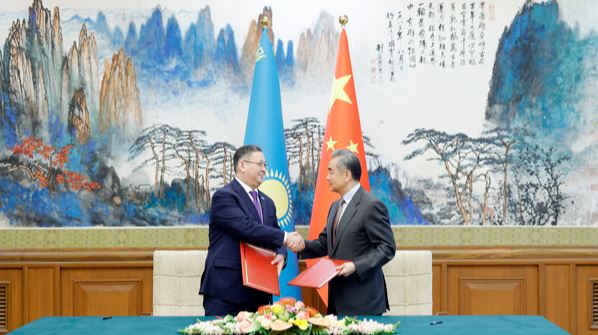
HIGHLIGHTS
CHINA & CENTRAL ASIA
Beijing conducts the first China-Kazakhstan FM Strategic Dialogue
On 29 March, Chinese Foreign Minister Wang Yi held the first China-Kazakhstan Foreign Ministers' Strategic Dialogue with Kazakhstan's Deputy Prime Minister and Minister of Foreign Affairs Murat Nurtleu in Beijing. Wang Yi said that the two sides would work together to advance trust, support, and assistance among the neighbouring countries. He also highlighted China’s desire to increase trade under the BRI for a sustainable and resilient trade corridor. Nurtleu said that Kazakhstan supports China’s diplomatic initiatives and will work with China to address Xinjiang-related issues. He also agreed to more significant exchanges among the people. The two sides also agreed to enhance cooperation against interference and infiltration, upgrade law-enforcement and security cooperation, continue to improve and strengthen the China-Central Asia mechanism and support each other in the rotating presidency of the Shanghai Cooperation Organization (SCO) and other multilateral frameworks. (“China, Kazakhstan hold first foreign ministers' strategic dialogue,” CGTN, 30 March 2024)
CHINA & THE AMERICAS
Xi woo American CEOs, assuring that the Chinese economy is on track, says an Opinion in Financial Times
On 30 March, the Financial Times published an Opinion, titled, “China’s Xi Jinping plays salesman-in-chief in meeting with US CEOs,” Joe Leahy and Sun Yu looking into Chinese President Xi Jinping’s meeting with US CEOs discussing the future of investments in China. The op-ed stated that the President welcomed 18 American CEOs from majors like Blackstone’s Stephen Schwarzman and Qualcomm’s Cristiano Amon amongst others. President of the National Committee on US-China Relations Steve Orlins elaborated on the meeting and informed that Xi Jinping received the guest in a friendly manner with a tinge of persuasion in his tone. Orlin stated that and why wouldn’t he, as trillions of dollars were at stake, that is vital for investment and revenue, and therefore he wanted to show that their economy is resilient. The meeting comes in light of a flailing Chinese economy and troubled geopolitical tension. Xi according to Orlin was adamant that their economy was still on track and it was not going back to the old model, quoting Xi. He also stressed that China is now focused on high-quality growth and that they have recognized they have problems. Xi also touched on a range of issues, from over-securitization to fentanyl sales. (“China’s Xi Jinping plays salesman-in-chief in meeting with US CEOs,” Financial Times, 30 March 2024)
INTERNAL
Xi Jinping promotes PLA’s security chief to General rank
On 28 March, Chinese President Xi Jinping promoted the head of the Central Military Commission’s Political and Legal Affairs Commission, Wang Renhu, to the highest rank of general. His sudden promotion comes amid the recent purge of senior military officers and leaders within the PLA due to the CCP’s corruption campaign. In December 2023, nine officers from the PLA Rocket Force were dismissed from China’s NPC. Also, the former defence minister Li Shangfu was unexpectedly sacked and removed from CMC in February 2023. A former instructor at the Taiwanese naval academy Lu Li-shih said that Xi’s recent move would give more power to Wang and the CMC in the trials of senior generals. The PLA’s National Defence University president, Xiao Tianliang, was also promoted to general. Wang previously served as director of the political unit at the Jiuquan Satellite Launch Centre in the Gobi Desert and as deputy head of the PLA Ground Force political work department. In 2017, he became chief of the graft-buster of the PLA Navy’s East Sea Fleet. (Vanessa Cai, “Chinese military’s security chief Wang Renhua elevated to top rank of general,” South China Morning Post, 29 March 2024)
CHINA READER DAILY WIRE
INTERNAL
China claims positive shift in its economy, says a WSJ Opinion
On 29 March, according to an opinion in The Wall Street Journal, Chinese leaders proclaimed the positives about the Chinese economy at the Boao Forum for Asia. They highlighted the shifting global economy paradigm towards China and Asia away from the US-led West. Jason noted little mention of domestic economic crises like the real estate crisis and local debt rise. He stated that the reduced foreign demand is the reason for an economic slowdown. Jason also noted that China’s claims contradicted the negative prospects of an unresolved property crisis by economists in the short term and the declining population and contestation with the West in the long term. The Wall Street Journal quoted the IMF, which predicted a growth rate of 3.4 per cent for the slowing Chinese economy. Foreign economists forecast China’s over-reliance on investments and exports to boost its economy, leading to a glut of Chinese products within the domestic market. Jason mentioned China’s increased focus on development via new productive forces in critical sectors such as EVs and renewable energy has raised concerns among Western countries. (Jason Douglas, “China Gives Business Leaders Sunnier View of Its Economy on Island Getaway,” The Wall Street Journal, 29 March 2024)
SCIENCE & TECHNOLOGY
Huawei and Chery Automobile to mass deliver electric sedan
On 30 March, Chinese tech giant Huawei and Chery Automobile began mass-delivering its co-developed Luxeed S7 electric sedan amid a shortage of semiconductors and production issues. The managing director and chairman of Huawei's smart car solutions, Richard Yu, said that many vehicles are ready for delivery to customers. Reuters reports that Chery lodged a complaint with Huawei over the production issues with a computing unit made by the tech company, resulting in delays in delivering the vehicle. Currently, the S7 sedan has orders up to 20,000 units until November 2023 and is priced at 249,800 yuan (USD34,600). Due to US sanctions, Huawei is diversifying its consumer segment and income to other businesses, such as smart car components, to boost its growth. (“Huawei says Chery's Luxeed S7 premium EV starts mass delivery,” Reuters, 30 March 2024)
CHINA & SOUTHEAST ASIA
Indonesia’s new President to visit China
On 29 March, the Ministry of Foreign Affairs of the People’s Republic of China announced that the newly elected Indonesian President Prabowo Subianto will visit China next week. This will be his first visit to a key trading partner outside of Indonesia. Chinese Foreign Ministry spokesperson Hua Chunying said Prabowo will visit China from 31 March to 2 April. His visit announcement came after President Xi congratulated Prabowo for winning the elections and said that China's ties with Indonesia are of greater importance. China is the largest FDI source in Indonesia and constructed a high-speed line in 2023. (“Indonesian president-elect Prabowo to visit China,” The Straits Times, 30 March 2024)
CHINA & SOUTH ASIA
In Pakistan, China halts activities at the hydropower project in Pakistan
On 29 March, The Economic Times reported that a Chinese company named Power Construction Corporation of China (PCCC) halted its construction activities after a deadly suicide attack that killed five Chinese nationals at the Dasu hydropower project in the Khyber Pakhtunkhwa province. The incident was caused by a vehicle carrying explosives hitting a bus carrying six people. It was the second suicide attack on individuals working on China-backed projects in the region since 2021. PCCC has been supervising the construction of the Tarbela 5th Extension Hydropower Project and has decided to suspend the operations and laid off 2,000 workers due to security concerns. The general secretary of the Awami Labour Union at the project assured that the delay in the project's completion timeline would be minimal. The Tarbela extension project (T5) is scheduled for completion by May 2026. The Dasu Dam project was being developed by the China Gezhouba group with funding from the World Bank. Pakistan’s PM Shehbaz Sharif has ordered a joint investigation and ensured the safety of Chinese citizens working on projects across the country. (“Chinese company halts work on Pakistan Hydropower project after deadly terror attack,” The Economic Times, 29 March 2024)
EAST ASIA & THE PACIFIC READER
EAST ASIA
“UN Security Council can no longer use old templates,” Russia veto’s UN review committee for accessing sanction imposed on North Korea, Foreign Ministry of Russia
On 29 March, Russian Ministry of Foreign Affairs spokesperson Maria Zakharova said that the global powers need to have a new approach towards Pyongyang and accused the US and its allies of exacerbating military tensions in the region. Russia vetoed the renewal of the expert panel to monitor the long-standing sanctions imposed by the United Nations against North Korea, on nuclear weapons and ballistic missile development. This veto underplays all the efforts made by the UN to impose sanctions to curb North Korean nuclear capabilities. North Korea was able to earn this stance by growing increasingly closer to Russia and the West turned its back against Moscow over the Russia-Ukraine war. Maria said: “It is obvious to us that the UN Security Council can no longer use old templates in relation to the problems of the Korean Peninsula,” and that “The United States and its allies have clearly demonstrated that their interest does not extend beyond the task of ‘strangling’ the DPRK by all available means, and a peaceful settlement is not on the agenda at all.” The US State Department in response said that the Russian veto undermines international peace and security, and accused Russia of biased burying of the report owing to its own collusion with Pyongyang. The US State Department issued: “Russia alone will own the outcome of this veto: a DPRK more emboldened to reckless behaviour and destabilizing provocations, as well as reduced prospects for an enduring peace on the Korean Peninsula.” (“After the veto, Russia says big powers need to stop ‘strangling’ North Korea,” The Straits Times, 30 March 2024)
South Korean Prime Minister discuss doctor's strike with top general hospital heads
On 29 March, South Korean Prime Minister Han Duck-soo held a meeting with heads of the top five general hospitals in South Korea. Han discussed the ways the hospitals can cope with the staff shortage in the hospital, and the doctor's strike goes on. The doctor's strike and walkout entered the second month and 13000 trainee doctors protested. The South Korean government regardless still stands strongly with its plan to incorporate 2000 doctors’ slots in medical schools, to alleviate the doctor shortage. Leader of doctors' strike lobby Dr Lim Hyun-taek said: “The ruling party is clearly to blame for this situation,” the doctors on strike believe that the enrollment would not solve the fundamental problem in the healthcare system. The general public seems to be siding with the government. (“South Korean PM meets heads of country’s top hospitals over doctors walkout,” The Straits Times, 29 March 2024)
US-funded media outlet Radio Free Asia stops all functions in light of the new Article 23 imposition
On 29 March, the US-funded Radio Free Asia (RFA) announced that it would close its Hong Kong office, over the concerns after the imposition of the controversial Article 23. The RFA President Bay Fang expressed that the recent actions by the Hong Kong authorities, which include referring to RFA as a “foreign force,” have raised questions about their operationality and safety in Hong Kong. The Hong Kong authorities when emailed about the same they refused to comment but stated that they “condemn all scaremongering and smearing remarks,” and that “To single out Hong Kong and suggest that journalists would only experience concerns when operating here but not in other countries would be grossly biased, if not outrageous.” The US State Department issued that the RFA’s decision showcases the consequences of such controversial law and the suppression of media. They said: “We remain deeply concerned about the deterioration in protection for human rights and fundamental freedoms and the systematic dismantling of Hong Kong’s autonomy under the national security law and recently passed Article 23 legislation.” The RFA has been working in Hong Kong since 1996, a year before Hong Kong was reverted to British Colony to be under Chinese rule. (“US-funded Radio Free Asia shuts down in Hong Kong over safety concerns,” The Guardian, 30 March 2024)
THE PACIFIC
Australia banked carbon credits with underperforming reforestation projects, reports The Straits Times
On 28 March, The Straits Times reported that Australia’s world-leading reforestation project has been underperforming. The Australian reforestation program planned for forest regeneration in the vast land of the Australian desert. The initiative aimed to offset emissions by growing more trees in the region. It was found that 80 per cent of the plantation plans for forest growth, were either stagnant or the woodlands were shrinking. Despite this Australia has been able to use the initiative to collect major carbon credits. Australia set aside 42 million ha of land under the scheme, the area larger than the landmass of Japan. (“‘Gross failure’: Researchers claim Australia is selling carbon credits that don’t exist,” The Straits Times, 28 March 2024)
29 March 2024, Friday | Vol.1 No. 44
“Asia should manage its own security,” says NPC Standing Committee Chairman
5G market to fuel China’s economic growth |Australia to ramp up on Rare earth minerals despite China’s dominance|
HIGHLIGHTS
INTERNAL
“Asia should manage its own security,” says NPC Standing Committee Chairman
On 29 March, Zhao Leji, Chairman of the Standing Committee of the National People’s Congress, said that Asia should manage its own security while delivering his opening remarks at the Boao Forum for Asia. He also calls for closer regional trade ties through a common regional market mechanism to drive the world economy. With the growing US hegemony, Zhao mentioned the implementation of the Global Security Initiative (GSI) for greater security via cooperation and rejected the Cold War mentality and bloc confrontation by the US. According to Joe, Zhao’s words tried to depict China and GSI as a framework for world peace. Zhao further mentions China’s desire to upgrade its FTA with ASEAN countries for greater regional integration. (Joe Leahy, “Xi Jinping lieutenant calls for Asia to ‘jointly’ manage its own security,” Financial Times, 29 March 2024)
5G market to fuel China’s economic growth: Report
On 26 March, according to the Mobile Economy China 2024 report released by the Groupe Speciale Mobile Association (GSMA) in the South China Morning Post, China’s rising 5G market will add around USD260 billion to the country’s GDP in 2030. The report mentioned that the mobile industry added 5.5 per cent of China’s GDP in 2023, and one-fourth of the upcoming contribution is expected to come from 5G. GSMA mentioned that mobile market contribution will add around USD 1.1 trillion to China’s economy by 2030. The report indicates that the sector provides around 8 million direct and indirect jobs and has contributed USD110 billion in tax revenue in 2023. GSMA predicts that China’s mobile and telecom sector will expect further boom and aid China’s economy, which is facing multiple domestic crises and geopolitical uncertainties. (Mandy Zuo, “China’s 5G market set to expand, fuel economic growth as tech solidifies status as pillar industry,” South China Morning Post, 29 March 2024)
CHINA & THE PACIFIC
China to remove tariffs on Australian wine
On 28 March, according to an opinion in BBC, China announced that it will remove tariffs on Australian wine exports. Mao mentions that Beijing’s latest move will improve ties between the two countries. The tariffs were imposed by China of more than 200 per cent in 2020 due to bilateral dispute. Mao indicated that the change in the Australian government in 2022 led to an improvement in China-Australia relations. Prime Minister Anthony Albanese welcomed the decision from China’s Ministry of Commerce and said that his government has been able to reduce other trade barriers with Beijing. Mao reported that the Australian wine industry lost USD1.37 billion in 2020 amid trade disputes with China. Chinese Commerce Ministry said that the tariffs on wines will be removed from 29 March. The tariff removal comes after China’s foreign minister Wang Yi visits Canberra to improve trade and economic relations. (Frances Mao, “China removes tariffs on Australian wine as relations improve,” BBC, 28 March 2024)
CHINA READER DAILY WIRE
ECONOMY
China's domestic reforms and tech innovation to drive world economic recovery
On 28 March, the Chairperson of the Standing Committee of the National People's Congress (NPC) said that China will strive to drive the recovery of the world economy through its domestic reforms and tech innovation. This comes as the country faces high youth unemployment, mounting local government debt, and a rising property sector crisis. On the sidelines of the Boao Forum for Asia, Zhao welcomes the participation of other countries in China’s development by opening the market for foreign investors to boost green energy production. He announced a growth target for China’s economy by 5 per cent. Zhao also affirmed the goal of achieving climate neutrality through green technologies. He said that carbon dioxide emissions will peak by 2030 and achieve carbon neutrality by 2060. This comes after China filed dispute proceedings within the WTO, creating a rift between Washington and Beijing. (“China to Drive World Economic Recovery, Says a Top Communist Official,” VOA, 28 March 2024)
SCIENCE & TECHNOLOGY
“We have benchmarked our car with [Tesla’s] Model 3,” says Xiaomi chairman
On 28 March, Chinese smartphone company Xiaomi launched its first EV, the SU7 or Speed Ultra, in Beijing. Xiaomi has priced its car with the standard variant at 215,900 yuan to challenge Tesla’s Model 3. Xiaomi’s founder, chairman, and chief executive Lei Jun, “We have benchmarked our car with [Tesla’s] Model 3.” He further said that the SU7 has a battery life of 700 km and is priced lower than the Tesla Model 3. Phate Zhang, founder of CnEVPost, said that Xiaomi’s attractive pricing will help the company attract many buyers and stay competitive in the EV market. Lei mentioned that the launch of the SU7 EV car will help the company diversify its revenue sources beyond smartphones and electronic devices. According to a Bloomberg report, it is estimated that China’s EV market is expected to decline for the second straight year, with sales dropping by 25 per cent in 2024. (Che Pan, “Xiaomi surprises with lower-than-expected pricing on new EVs, in new challenge to Tesla,” South China Morning Post, 28 March 2024)
CHINA & TAIWAN
Any halt in US aid to Ukraine emboldens China against Taiwan, says Taiwan’s FM
On 28 March, Taiwanese Foreign Minister Joseph Wu said that any halt in US arms shipments to Ukraine would embolden China to project aggression against Taiwan. He also said that this will enable China to push propaganda that the US is an unreliable partner. He also mentions that Russia’s victory will be seen as the victory of authoritarian countries as Russia, China, North Korea, and Iran are linked together. His remarks come as the US Congress is unable to pass the supplement funding package that includes funding to Taiwan. Edward mentions that some Republican members, like former US President Donald Trump, are against the idea of giving further aid to Ukraine. Wu states that if the US backs out, then its allies will back out from the US alliance, thereby encouraging China to wage aggression against Taiwan. (Edward Wong, “Taiwan’s Top Diplomat Says US Aid to Ukraine Is Critical for Deterring China,” The New York Times, 28 March 2024)
CHINA & EAST ASIA
China warns against stringent sanctions on North Korea
On 28 March, China's Deputy Permanent Representative to the United Nations, Geng Shuang, warned of any further sanctions against the Democratic People's Republic of Korea (DPRK). His remarks come after the UNSC voted on a draft resolution that extends the mandate of the Panel of Experts assisting the Democratic People's Republic of Korea (DPRK) Sanctions Committee. Geng said that increasing sanctions would be counterproductive, and any military alliances and intentions with confrontations would further exacerbate tensions in the Korean Peninsula. He reiterated China’s stance, calling for all parties to adopt a rational and pragmatic approach to a political settlement. Geng also said that the sanctions should serve to denuclearize the Korean peninsula. He further adds that China supports Russia’s proposal to set a time limit for the DPRK sanctions and conduct periodic reviews. (“China warns against tightening of sanctions against DPRK,” CGTN, 29 March 2024)
CHINA & SOUTHEAST ASIA
Philippines says it won’t remain silent against Chinese aggression
On 29 March, the Ministry of Defense said that the Philippines would not engage in any fight with China in the South China Sea (SCS) but would not bow down and remain silent. The ministry showed China’s isolation from the rest of the world due to its constant illegal aggression. The ministry also said, “It also shows the inability of the Chinese government to conduct open, transparent, and legal negotiations. Their repertoire consists only of patronising and, failing that, intimidating smaller countries.” The remarks come after the Chinese counterpart accused the Philippines of 28 March provocations after Manila accused Beijing of aggressive actions in Manila’s EEZ. On 28 March, Philippines President Ferdinand Marcos Jr said that the Philippines would take proactive measures against “illegal, coercive, aggressive, and dangerous attacks by China’s coast guard.” (“Philippines says it will not yield in submission in row with ‘patronising’ China,” The Straits Times, 29 March 2024)
Chinese top diplomat for a four-day visit to Singapore
On 28 March, China’s top diplomat, Liu Jianchao, visited on a four-day trip to Singapore to meet with Prime Minister Lee Hsien Loong and the country’s incoming leader, Deputy Prime Minister Lawrence Wong. In his remarks on the ongoing global conflicts, Liu said, “The world needs connectivity, not decoupling.” In the US, Liu said that Washington is trying to oppress and contain China. According to Adam, it is believed that Liu is going to be the next Foreign Minister, replacing Wang Yi. Liu currently heads the international department of the CCP and is responsible for maintaining relations with foreign political relations. He had previously met US Secretary of State Anthony Blinken in January 2023. The Ministry of Foreign Affairs of Singapore said that both countries were committed to expanding their cooperation in trade and investments. Both sides discussed ASEAN-China relations and other regional and international developments. (Adam Hancock, “Chinese Diplomat Liu Jianchao Meets With Singapore's Leaders,” VOA, 28 March 2024)
CHINA & THE AMERICAS
Less than three Americans supports TikTok bill, says Savanta poll
On 29 March, according to a poll released by Savanta in the South China Morning Post, three out of ten Americans supported the bill the US House of Representatives passed in February, which would ban TikTok if its owner did not divest it. According to the poll, half of the 2,000 Americans aged 18 or older opposed the bill, while only 28 per cent supported it. Most respondents said they could switch to other social media apps, mainly YouTube and Instagram. According to Ethan Granholm, research analyst at Savanta, the ability to deliver and implement the TikTok ban for lawmakers is different, as young people are critical to the outcome of the upcoming presidential elections. Mark mentions that TikTok has 102 million monthly active American users. The polls also showed that two-thirds of the respondents were concerned about the security risks from the TikTok app and vouched for increased protection of personal data. TikTok has spent a lot of money on US lobbying and advertising and has released a marketing campaign worth USD 2.1 million in key election polling states of Nevada, Montana, Wisconsin, Pennsylvania, and Ohio. (Mark Magnier, “Poll shows fewer than 3 in 10 Americans support TikTok bill that would force Chinese owner to sell the app,” South China Morning Post, 29 March 2024)
CHINA & EUROPE
UK government to impose sanctions on China over hacking
On 29 March, according to an explainer in The Guardian, the UK plans to impose sanctions on two individuals and one entity from China due to hacking. The UK Home Secretary James Cleverly said, “The sanctions were a sign that “targeting our elected representatives and electoral processes will never go unchallenged.” According to Professor Alan Woodward, the sanctions will not make any difference to the UK’s cybersecurity, and they are responding to the US’s request. Amy reveals that a hacking outfit known as APT31 is accused of engaging in large-scale global hacking operations by sending more than 10,000 malicious emails to politicians, officials, journalists, and critics of China across the world. The Chinese embassy in London rejected the UK government’s baseless claims. However, the government has not accused the Chinese entity of breaching the data as the UK tries to balance its relationship with Beijing. Amy also reports the struggle within Western countries to effectively coordinate a response against hacking attempts due to China’s plausible deniability regarding its responsibility. (Amy Hawkins, “Western governments struggle to coordinate response to Chinese hacking,” The Guardian, 29 March 2024)
EAST ASIA & THE PACIFIC READER
EAST ASIA
Taiwanese Navy chief plans to visit US
On 29 March, Reuters reported that Taiwanese Navy chief Tang Hua will visit the US next week to attend a military ceremony and discuss bilateral cooperation. It also revealed that Tang would visit the US Indo-Pacific Command in Hawaii for a Pacific Fleet change-of-command ceremony. He is also expected to attend the Sea-Air-Space conference on 8-10 April and plans to meet the US chief of naval operations, Admiral Lisa Franchetti. Idrees and Ben mention Tang’s visit as part of the US effort, known as the Joint Island Defence Concept, to coordinate with Taiwan, Japan, and others to counter China's armed forces within the first island chain. The visit announcement comes after China ramped up its military pressure on Taiwan for years by sending fighter jets over the median line in the Taiwan Strait. (Idrees Ali and Ben Blanchard, “Taiwan's navy chief to visit US next week, sources say,” Reuters, 29 March 2024)
THE PACIFIC
Australia to ramp up on Rare earth minerals despite China’s dominance
On 29 March, according to a commentary in Nikkei Asia, Australia boosted its role in rare earth minerals despite China’s dominance in this sector. Shaun reports that Australia had recently announced a second large rare-earth project with a loan offer of AUSD840 million to the Australian miner Arafura to build a mine and processing facility in the Northern territory. Iluka constructed a similar project with a rare-earth processing plant of AUSD1.25 billion in Western Australia. Shaun mentions that Australia desires to boost its midstream and downstream industries to become a global supplier of rare earth materials. However, it faces tough competition from low-cost producers in Africa and Asia. Experts mention that Australia currently faces an overproduction issue, and the declining prices will hurt the industry’s long-term growth. According to Wood Mackenzie analyst Ross Embleton, China currently accounts for about 60% of the global mined supply of rare earths and is expected to fall to 50 per cent by 2035. Chief executive Tom O'Leary of the Iluka project mentions that the project's costs have increased to AUSD1.2 billion. He also mentions that the project is not only from a geopolitical and defense perspective but also from the perspective of facilitating global decarbonization. (Shaun Turton, “Australia doubles down on rare earths despite Chinese dominance,” Nikkei Asia, 29 March 2024)
CEAP Team: Femy Francis and Akhil Ajith are Research Assistants at NIAS.
28 March 2024, Thursday | Vol.1 No. 43
Sri Lankan Prime Minister visits Chinese President at the Great Hall of People
“China’s overcapacity distorts global prices and production patterns,” US Treasury Secretary Janet Yellen to warn China | Chinese research claims to have developed a surface-to-air missile with a 2000 km range |
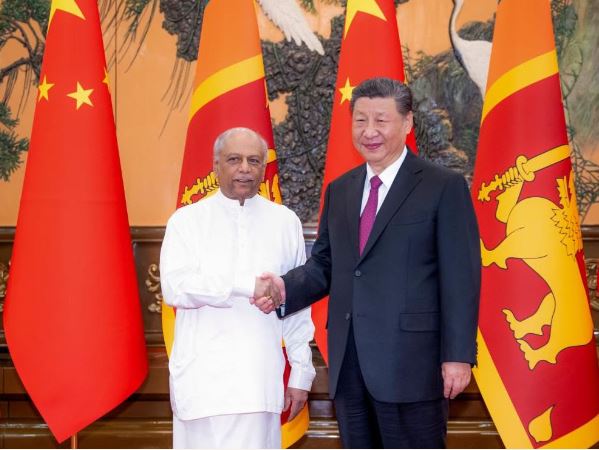
HIGHLIGHTS
CHINA & SOUTH ASIA
Continued “Rubber-Rice-Pact,” Chinese President meets Sri Lankan Prime Minister
On 28 March, Sri Lankan Prime Minister Dinesh Gunawardena visited Chinese President Xi Jinping at the Great Hall of the People in Beijing. Xi called to promote the relations between the two countries as he looked at the long history they share, naturally building their affinity. Xi highlighted that China is willing to work on the “Rubber-Rice-Pact” between the two countries, the pact is characterized by “independence, self-reliance, unity and mutual support,” aiming to consolidate mutual trust and further exchanges and experiences. He said that both sides should promote high-quality Belt and Road cooperation through flagship projects, Colombo Port City and the Hambantota Port. Gunawardena also noted the long history they share and affirmed upholding the “One-China” principle and following policy-friendly cooperation with China. He also expressed his appreciation for China and the role it played in uplifting Sri Lanka’s economy. Sri Lanka also confirmed its participation in the Global Development Initiative, Global Security Initiative and Global Civilization Initiative. (“Xi meets Sri Lankan PM in Beijing,” Xinhua, 27 March 2024)
SCIENCE & TECHNOLOGY
Chinese research claims to have developed a surface-to-air missile with a 2000 km range
On 28 March, the South China Morning Post reported on the Chinese language Journal of Graphics, paper publication, where the researchers claim that they successfully designed a surface-to-air-missile, with a kill range of 2000 km. Such ultra-long-range capabilities are considered infeasible, where the maximum flight range is tens of kilometers. The team is led by an associate professor at Northwestern Polytechnical University Su Han, who said that the weapon will be able to shoot down early-warning aircraft, and missiles. The paper stated that the People’s Liberation Army would first warn the target and it would be only launched if they refused to turn back. The paper stated that this technology is vital to maintain regional and global stability. (Stephen Chen, “Chinese scientists plan surface-to-air missile with 2,000km kill range,” South China Morning Post, 28 March 2024)
CHINA & THE AMERICAS
“China’s overcapacity distorts global prices and production patterns,” US Treasury Secretary Janet Yellen to warn China
On 28 March, the Financial Times reported on US Treasury Secretary Janet Yellen's plans to warn China on her visit to not flood the world with cheap Chinese clean product exports, stating that they will distort global markets and harm the workers. She said that it is important that the American firms can compete on a level playing field and that they have earlier raised concerns against the overcapacity of China’s exports. Yellen believes that the overproduction and export of metals and other goods have damaged the global market, and therefore warned against the oversupply of clean energy products, these include solar and electric vehicles, lithium batteries and others. She said: “China’s overcapacity distorts global prices and production patterns and hurts American firms and workers,” she will say, adding that she had heard similar warnings “from government counterparts in industrialized countries and emerging markets, as well as from the business community globally.” (“Janet Yellen warns China against clean energy dumping,” Financial Times. 28 March 2024)
CHINA READER DAILY WIRE
INTERNAL
Commercial Aircraft Corporation of China’s C929 at a crucial stage of development, SCMP quotes Comac firm
On 27 March, an analysis in the South China Morning Post looked into the crucial developmental stage of the Commercial Aircraft Corporation of China (Comac) and the Chinese government's push for the aviation company. The marketing director of Comac Zhang Xiaoguang said: “It’s a crucial stage in the development process, which indicates the overall technical scheme of the aircraft has been determined.” Russia and China announced in December of 2023 that they would promote the joint venture of developing long-range widebody passenger aircraft also known as C929. The aircraft would have 280-400 seats and would fly 12,000km. The Chinese aviation company are aggressively developing their capabilities to break the duopoly of American and Boeing and Europe-based Airbus. The C919 is the poster child of Comac as the fifth aircraft came into operation, and now they are pushing for European certification of the jet. Cormac's deputy marketing director Liu Yan said they will: “coordinate the domestic and international markets in an orderly manner and secure a large number of customers and orders, laying a solid foundation for large-scale production, delivery and operation.” (Sylvia Ma, “China’s home-grown C929 widebody passenger jet enters ‘crucial’ development stage amid Beijing’s aviation push,” South China Morning Post, 27 March 2024)
CHINA & EAST ASIA
Trilateral summit between China-Japan-South Korea should resume as they face “Polycrisis,” says South Korea
On 27 March, South China Morning reported on the heads of the trilateral cooperation between China-Japan-South Korea stressing the urgency to kickstart the summit to solve the “Polycrisis” at the Boao Forum. Secretary General of the Trilateral Cooperation Secretariat (TCS) Lee Hee-sup stated that the current “Polycrisis,” showcases the need for closer engagement of trilateral cooperation and deeper exchanges. He said that no country can handle a crisis singularly and therefore the TCS need to push for the resumption of the trilateral cooperation. The summit saw a lull as for four and half years no summit was held, solidarity and cooperation are vital to stabilizing the global crisis and therefore, “we need to cooperate closely,” said Lee. The current rotating chair is South Korea which anticipated to hold the chair in 2023 but the Japanese side has delayed the summit with China still weighing the option if it wants to join. The first summit was held in 2008 and the TCS was formed in 2011, tasked with promoting peace and stability in the region. (Alyssa Chen, “Long-delayed China-Japan-South Korea leaders’ summit needed ‘as soon as possible’ as countries face ‘polycrisis’,” South China Morning Post, 27 March 2024)
CHINA & SOUTH ASIA
Traditional deployment of troops, a prerequisite to India-China relations, says Indian External Affairs Minister Jaishankar
On 28 March, External Affairs Minister of India S Jaishankar stated that the normalcy of ties with China is based on the deployment of troops, addressing Indian Diaspora in Malaysia. He asked what country does not want good relations with its neighbour. But those relations are also based on some prerequisites. For India, it is the traditional deployment of troops in the contentious region and area. While stating that he also iterated that his first duty is to secure the borders and that he could never compromise on that. Additionally, he said: “We're still negotiating with the Chinese. I talk to my counterpart. We meet from time to time. Our military commanders negotiate with each other. But we are very clear that we had an agreement. There is a Line of Actual Control. We have a tradition of not bringing troops to that line. Both of us have bases some distance away, which is our traditional deployment place. And we want that normalcy.” (“Normalcy in ties with China based on troops deployment: Jaishankar,” Hindustan Times, 27 March 2024)
CHINA & EUROPE
China hopes for continued lithography trade from the Netherlands
On 27 March, Chinese Commerce Minister Wang Wentao met with the Dutch Trade Minister Geoffrey van Leeuwen and expressed his hope that the Netherlands would support the trade of lithography machines, by allowing companies to fulfil their contractual obligation and ensure normal trade. Wang stated that they take the Netherlands as a trusted trade and economic partner. Both heads discussed the future of lithography exchange and cooperation in the semiconductor industry. The Dutch government also denied a Dutch firm ASML license to export advanced “DUV” to line to China. This is in line with the other Western countries, which are curbing China’s access to critical technology and minerals. (“China hopes Netherlands will ensure 'normal' lithography machine trade,” Reuters, 28 March 2024)
“No force can stop the pace of China’s scientific and technological development and progress,” Xin Jinping on restricted technology access to Dutch PM
On 27 March, Chinese President Xi Jinping met with Dutch Prime Minister Mark Rutte at the Great Hall of People, in Beijing. Xi stated that any attempt to restrict access to technology will not stop Chinese technology advancement. In 2023, the Netherlands imposed export licensing requirements, on the export of machinery used for advanced technology and chip manufacturing. This came after the US halted China’s access to advanced equipment used for chip manufacturing. He said that creating barriers to access scientific and technological machinery would only fragment the industry and would lead to confrontation and division. Xi said: “The Chinese people also have the right to legitimate development, and no force can stop the pace of China’s scientific and technological development and progress.” Rutte replied: “What I can tell you is that ... when we have to take measures, that they are never aimed at one country specifically, that we always try to make sure that the impact is limited, is not impacting the supply chain, and therefore is not impacting the overall economic relationship.” (“Chinese leader Xi tells Dutch PM that restricting technology access won’t stop China’s advance,” Associated Press, 28 March 2024)
|
CEAP Team: Femy Francis and Akhil Ajith are Research Assistants at NIAS. |
27 March 2024, Wednesday | Vol.1 No. 42
China hosts Boao Forum for Asia discussing Asian economic outlook for 2024
Apple iPhone sees a shipment decline of 33 per cent
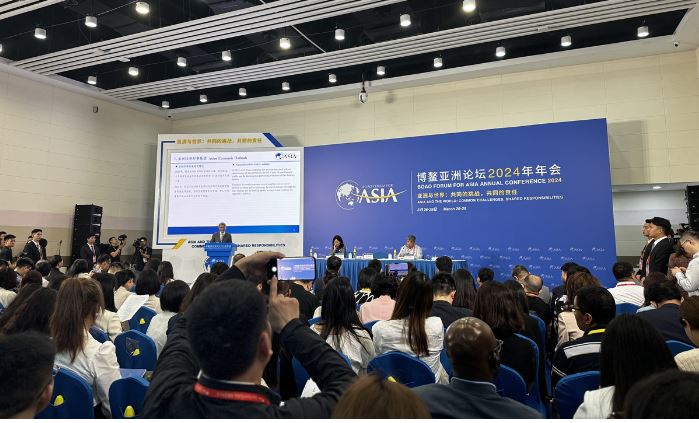
CHINA READER DAILY WIRE
INTERNAL
“Nationalist Crusades” by the Chinese netizens, an Opinion in The New York Times
On 26 March, an Opinion in The New York Times, titled, “Why Are China’s Nationalists Attacking the Country’s Heroes?” by Joy Dong and Vivian Wang, looked into the plague of unbridled nationalism trends in China. The op-ed stated that while the Chinese government is championing domestic companies, the efforts are being affected by the growing nationalist netzine threat to the business. The online army has taken on themselves to call out and punish those who hurt the nationalist sentiments, these largely include major public figures and business firms. These attacks are usually against the US are now attacking the crown jewels of China like Huawei, for allegedly being a secret admirer of Japan. This behaviour has been encouraged by the government, as they for “nationalist crusades”. A professor from North Carolina Yaoyao Dai said: “The government needs and wants to be the one that shapes the narrative. They cannot just give everyone this power to shape the narrative of who are ‘the people’ and who is ‘the enemy.’” The online crusades are also fuelled by the growing dissent in the population over economic malaise. Recently, there were attacks against the Nongfu Spring, beverage company, stating that they focus more on profit rather than the state, after the death of its rival company’s owner who was said to have economically supported his employees with benefits of houses and child care subsidies. A smear campaign was started against the only Chinese Nobel Prize winner for literature Mo Yan, who was accused of being anti-Mao, by depicting a turbulent 20th-century in China. (Joy Dong and Vivian Wang, “Why Are China’s Nationalists Attacking the Country’s Heroes?,” The New York Times, 26 March 2024)
China hosts Boao Forum for Asia discussing Asian economic outlook for 2024
On 25 March, China held the Boao Forum for Asia (BFA), in the Hainan Province. The forum consisted of participants from around the world discussing the regional challenges and the issue of trade protectionism behaviour with the rising geopolitical tensions. The forum projected substantial economic growth of up to 4.5 per cent in 2024. It stated that Asian integration in the economy remained unchanged. The report highlighted the contribution made by China to the global economic growth. The BFA was attended by 2,000 representatives from 60 countries. The forum released its annual report on the Asian Economic Outlook and Integration Progress and the second one on Sustainable development in Asia. The report outlined that: “In 2024, global economic turbulence and divergence will persist. Faced with a severe external environment, many Asian economies will also encounter significant internal challenges. Nevertheless, the region's economic growth and regional integration continue to show promising momentum.” (“China's economic prospects, opening-up pledges help global growth, stability as Boao Forum kicks off annual meeting,” Global Times, 26 March 2024)
SCIENCE & TECHNOLOGY
Apple iPhone sees a shipment decline of 33 per cent
On 26 March, Bloomberg reported on the declining Apple’s iPhone shipment in China. They reckoned that the shipment to China fell by 33 per cent in February, this showcases an extended slump in the demand for Apple’s most popular product. The figures by the China Academy of Information and Communications Technology show that foreign brands only shipped 2.4 million smartphones in February, a major chunk of it was by Apple. The February decline is the second consecutive decline when only 5.5 million units were shipped in January. The rising Huawei trend has taken a sizeable share of the Apple market in China, which this led to them offering rare discounts. The overall smartphone market has seen a decline showing the dwindling interest in consumers buying discretionary items amid economic woes. (“iPhone Shipments in China Fell 33% in February, State Data Show,” Bloomberg, 26 March 2024)
DEFENCE
Strategic Support Force: Nodal to People’s Liberation Army’s advancement, says an analysis in SCMP
On 27 March, South China Morning Post published an analysis, titled, “Strategic Support Force: China’s mission to win future wars hinges on this shadowy military branch,” by Amber Wang, which looked into the youngest Chinese military wing the “Strategic Support Force,” (SSF) founded in 2015. The SSF is a branch of the People’s Liberation Army that aims to expand its military capabilities by making use of outer space, and cyber and AI technology. The contingent is responsible for offering intelligence to all the forces in China. The PLA aims to build strategic capabilities in all emerging areas and to provide asymmetrical advantages as proposed by Chinese President Xi Jinping. The SSP branch relies heavily on innovation and AI technology and is playing a critical role in the preparation for “intelligence warfare” as the technologies advance, says the op-ed. The SSF oversees two departments, the Space Systems Department which takes care of satellite launches and training bases. The Space Department is tasked with providing intelligence support, space-based reconnaissance, and satellite navigation to help with military operations. The other department is the Network Systems Department, tasked with defending China from cyber-attacks, electromagnetic defence and offence and collecting intelligence by intercepting signals. The heavy reliance on technology can also be a bane for China and the US increasingly has imposed sanctions and curbed China’s access to these technologies. Regardless, the SSF will play a vital role in providing the Chinese military with critical intelligence. (Amber Wang, “Strategic Support Force: China’s mission to win future wars hinges on this shadowy military branch,” South China Morning Post, 27 March 2024)
CHINA & EAST ASIA
South Korean FM expresses concerns against the Chinese use of water cannons at Philippines civilian boats
On 26 March, the South Korean Ministry of Foreign Affairs issued their concerns regarding the conflict in the South China Sea and especially the recent confrontation between the Philippine and the Chinese vessels. The ministry expressed “grave concerns” regarding the Chinese use of the water cannons against the Philippines ships. It stated that it strokes further tensions and that it violated maritime rules and order in the South China Sea. The incident went as such the Philippines accused China of using water cannons against its civilian boats supplying troops at the Spratly Islands. The Island that has been largely inhabited is part of a major contention between the two countries, both claiming ownership of the archipelago. The South Korean Ministry of Foreign Affairs said: “These actions increase tensions in the South China Sea, a major international navigation route used by all countries, including Korea, and undermine efforts to maintain peace, stability, security and a rules-based maritime order.” (“South Korea has ‘grave concerns’ over China using water cannon against Philippine ships,” The Straits Times, 26 March 2024)
CHINA & SOUTHEAST ASIA
Vietnam’s “Bamboo Diplomacy” balancing China and US, says and analysis in SCMP
On 27 March, an analysis in the South China Morning Post looked into Vietnam’s “Bamboo Diplomacy,” which has balanced both US and China relations. Vietnam’s Foreign Minister Bui Thanh Son, attributed Vietnam’s bamboo diplomacy as being paramount in balancing both rival global actors, the US and China. Son said: “In 2023, Vietnam hosted both US President Joe Biden and Chinese President Xi Jinping – which means Vietnam wishes and can have good relations with all major powers, thanks to Vietnam’s bamboo diplomacy.” Son stated that while competition between these major powers is natural, conflict is not inevitable. Recently, Son met with top US office bearers US Secretary of State Antony Blinken and National Security Adviser Jake Sullivan. The visit showcased that Vietnam looks to assure its neighbours, allies and investors. And even more so now President Vo Van Thuong resigned from his post over corruption allegations. Son said: “The resignation of the president, I think, will not affect our foreign policy as well as our own [domestic] policy of economic development. We have collective leadership. We have a collective foreign policy. We have collective-decided economic-path development.” (Khushboo Razdan, “Vietnam minister credits ‘bamboo diplomacy’ for balancing nation’s relations with China and US,” South China Morning Post, 27 March 2024)
CHINA & THE PACIFIC
China and Nauru hold talks in Beijing
On 25 March, Chinese President Xi Jinping, and Nauruan President David Adeang held talks in Beijing. Xi notes Nauru’s decision to uphold the One China Principle and appreciates the restoration of diplomatic ties with China. He welcomes Nauru’s decision to sign the Belt and Road (BRI) document with China and is willing to deepen its cooperation in trade, investment, and infrastructure construction. Xi also said that China is ready to assist Nauru in addressing climate change under the framework of South-South cooperation. Adeang said that Nauru’s decision to restore ties with China was the right step in history and would open a ‘new chapter in the country’s national development and bilateral relations.’ He further said that Nauru is willing to participate in the BRI and to implement the Global Development Initiative, Global Security Initiative and Global Civilization Initiative. (“Chinese, Nauruan presidents hold talks for 1st time since resuming ties,” Xinhua, 25 March 2024)
CHINA & SOUTH ASIA
Suicide bomber ram vehicle carrying Chinese engineers killed in Pakistan
On 26 March, five Chinese engineers and one Pakistani driver were killed after a suicide bomber rammed into their vehicle convoy in northwest Pakistan. The regional police chief Mohammad Ali Gandapur said that the engineers were en route from Islamabad to their camp at the dam construction site in Dasu in the province of Khyber Pakhtunkhwa. So far no one has claimed any responsibility for the attack on 26 March. Chinese engineers have been assisting Pakistan with several projects as part of the China-Pakistan economic corridor (CPEC) under Beijing’s Belt and Road Initiative (BRI). Local police reported that the convoy carrying engineers belonged to the construction firm China Gezhouba Group Company working on the Dasu hydropower project. Pakistan faced a similar issue when they faced attacks in 2021. The Chinese embassy in Pakistan called for an investigation into the attack to ensure safety for the Chinese citizens. This attack comes as the newly elected Pakistani PM Shehbaz Sharif plans to visit Beijing next week. (“Six killed after suicide bomber rams convoy of Chinese engineers in Pakistan,” The Guardian, 26 March 2024)
India firmly supports the Philippines in upholding its national sovereignty, says EAM S Jaishankar
On 26 March, Indian External Affairs Minister (EAM) S Jaishankar, on his visit to Manila said, “I take this opportunity to firmly reiterate India’s support to the Philippines for upholding its national sovereignty.” He also expressed India’s interest in expanding cooperation in the areas of defence and security. He also said that the trust and comfort between the two countries are growing rapidly. Their meeting took place a day after the Chinese ambassador in Manila was summoned to convey the Philippines' concerns about China’s aggressive actions in the South China Sea. In his remarks, the Chinese Ministry of Foreign Affairs spokesperson Lin Jian said that the maritime disputes are bilateral and there is no role of third parties to interfere. Jaishankar also said that India places greater emphasis on Act East policy and Indo-Pacific vision and supports the ASEAN centrality position. (“Jaishankar backs the Philippines in the South China Sea, riles China,” The Times of India, 26 March 2024)
CHINA & AFRICA
China and Honduras extend wishes for 1st anniversary of their bilateral relations
On 26 March, Chinese President Xi Jinping and Honduran President Xiomara Castro exchanged congratulations over the first anniversary of their bilateral relations. Xi highlighted the new opening in their bilateral relations through establishing diplomatic ties in 2023 and the visit of Castro to China in June 2023. Xi appreciated Honduras' firm stance on the One China principle and their bilateral relations are the right step in history serving the fundamental interests of the two countries. He also reiterated China’s support to Honduras in all areas. Castro pointed out China as a civilizational nation and its importance for Honduras as a partner in its development. She also mentioned respecting the One China principle and is in favour of cementing ties with China for greater mutual respect. (“Xi, Honduran president exchange congratulations on 1st anniversary of ties,” Xinhua, 26 March 2024)
CHINA & AMERICAS
US aims to expand domestic lithium supply with reduced reliance on China, a commentary in VOA
On 26 March, according to a commentary in VOA, the US aimed to step up in increasing the domestic supply of lithium with reduced reliance on China for manufacturing batteries. This comes after the US Department of Energy announced a record conditional loan of USD 2.26 billion to American companies. According to DOE’s Loan Programs Office (LPO), the loan, if approved, will help Lithium Americas Corp. construct a lithium carbonate processing plant. This indicates that the locally sourced battery materials, especially the lithium carbonate from Thacker Pass will bring down the carbon footprint, transportation costs, and supply chain risks. It also said that the lithium reserves will support the production of batteries “for up to 800,000 electric vehicles (EVs) per year, saving 317 million gallons of gasoline per year.” A report by the Organization for Economic Co-operation and Development (OECD) in 2023 highlights that China increased restrictions on its exports of critical minerals ninefold between 2009 and 2020. Ellen R. Wald, a nonresident senior fellow with the Atlantic Council Global Energy Center says that the western countries spent lots of resources on developing raw materials but little attention to refining and processing of lithium as China dominates the supply chain. Chatham House reports that Chinese companies accounted for about 72 per cent of global lithium refining capacity in 2022. Wald mentions that China has an advantage and can restrict access to specialized lithium-ion batteries to the US as it wishes as the US defence industry is dependent on China for these batteries. (John Xie, “US Aims to Tap Domestic Lithium Supply Without Chinese Products,” VOA, 26 March 2024)
China initiates dispute settlement proceeding on EV against the US at WTO
On 26 March, the Chinese mission to the UN said that it had initiated a dispute settlement proceeding against the US World Trade Organization (WTO) to safeguard its interests in the electric vehicle industry. It justified its stance as it was contesting "discriminatory subsidies" under the U.S. Inflation Reduction Act (IRA), as the Chinese mission said that it led to the exclusion of goods from China and other WTO countries. It further added that the proceedings are meant “to safeguard the legitimate interests of the Chinese electric vehicle industry and to maintain a fair level playing field of competition for the global market.” U.S. Trade Representative Katherine Tai said that Washington has initiated a review of China's request for WTO consultations for IRA 2022 and its implementing measures. Defending the IRA, she said that the IRA is instrumental in promoting clean energy practices along with its allies and partners and accused China of engaging in unfair market policies. (“China opens WTO dispute against US subsidies to protect its EV industry,” The Straits Times, 27 March 2024)
Chinese President Xi Jinping meets US executives and academics
On 27 March, Chinese President Xi Jinping met US executives and academics in Beijing. The meeting was a follow-up to the November dinner that took place in San Francisco. Reuters reported that the attendees from the US side were the chief executive of US insurer Chubb (CBBN), Evan Greenberg, Stephen Orlins, president of the National Committee on US-China Relations, and Craig Allen, president of the US-China Business Council. The foreign CEOs raised concerns about Premier Li Qiang not meeting the delegation at the China Development Forum in Beijing on 24-25 March raising doubts about transparency. Foreign companies have been trying to address the issue with government officials over China’s excessive and harsh implementation of anti-espionage law, raids on consultancies and due diligence firms, and exit bans. (“China's President Xi meets US executives, academics in Beijing,” Reuters, 27 March 2024)
EAST ASIA & THE PACIFIC READER
EAST ASIA
BOJ rate hike leads to a steep drop in Japanese Yen
On 27 March, according to a commentary in Nikkei Asia, the Japanese yen dropped to a record low in 34 years, trading at 151.96 to the dollar after the Bank of Japan (BOJ) ended its negative interest rate policy. Japanese Finance Minister Shunichi Suzuki said that he would not rule out any measures and would take decisive action to address this steep fall. The report published by Nomura Securities indicates that the sudden rise in inflation of the price of goods will compel BOJ for additional interest rate hikes. Hirofumi Suzuki, the Chief Foreign Exchange strategist at Sumitomo Mitsui Banking Corp., said that according to the BOJ, a weak yen is advantageous for the Japanese economy, however, the increased volatility will impact the business environment. Experts predict that the BOJ could face increased pressure if the yen crosses beyond 155 in the second and third quarters of 2024. (Lisa Kim, “Japanese yen drops to lowest in 34 years despite BOJ rate hike,” Nikkei Asia, 27 March 2024)
Taiwan’s chip maker Advantech boosts investments in Malaysia, an Opinion in Nikkie Asia
On 27 March, according to an opinion in Nikkei Asia, Taiwanese industrial computer maker Advantech plans to boost investment in manufacturing and other operations in Malaysia. The company aims to create a regional hub to serve customers across Southeast Asia. Li reports that Advantech's computers and Internet of Things products are used in many industrial applications, from semiconductor manufacturing to high-speed railway systems. Due to the volatility in supply chain disruptions and increased political tensions, the company plans to diversify its operations in regional hubs to meet the demand. Vincent Chang, Advantech's managing director for Asia said that the company’s sales in Southeast Asia grew by 200 per cent in six to seven years due to the diversification of supply chains. Chang mentions that Malaysia is the best cost-effective option because it has a diverse culture and a high-quality workforce, which will benefit the company’s long-term strategy. He said that the changing market dynamics, such as the US-China trade war and the growing trend of the China+1 supply chain, have presented greater opportunities for growth for the company in emerging markets. (Lauly Li, “Taiwan's Advantech aims to turn Malaysia into Southeast Asia hub,” Nikkei Asia, 27 March 2024)
26 March 2024, Tuesday| Vol.1 No. 41
Chinese grocery store ad for job triggers discussion on discriminatory hiring practices
China to host Western Pacific Naval Symposium to prevent drone collisions
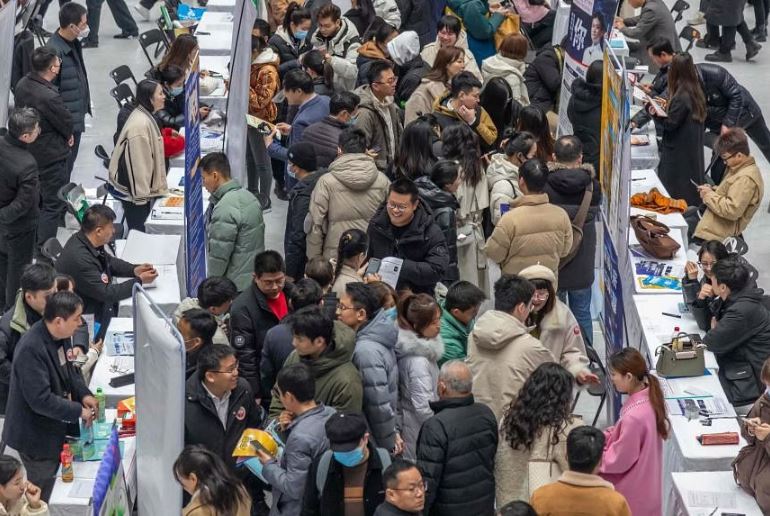
INTERNAL
Chinese grocery store ad for job triggers discussion on discriminatory hiring practices
On 25 March, The Straits Times reported that an advertisement from a Chinese grocery store seeking cashiers aged between 18 and 30 had triggered many people through social media amid the economic slowdown. Some social media users highlighted that the government only focuses on addressing the high youth unemployment for college students while leaving the issues of the middle-aged population. Many people, including the Chinese state media, criticized employers for adopting discriminatory hiring practices to seek young and cheap workers. Despite the government’s plan to raise the retirement age in phases, there has been no concrete plan laid out for implementation. (“Chinese grocery store ad for under-30s triggers outcry from older job-seekers,” The Straits Times, 25 March 2024)
MARITIME
China to host Western Pacific Naval Symposium to prevent drone collisions
On 26 March, China plans to host a naval conference in the port city of Qingdao in April. The invite will bring in top naval officials from 30 countries, including the US and Japan, to prevent drone collisions. China is the rotating host of the Western Pacific Naval Symposium for 2024, a biennial event started in 1988. It hosted the summit back in 2014. The main topic of discussion will be to create a framework to prevent accidental collisions between unmanned aerial vehicles flying over the sea. In a workshop organized by China in Nanjing in January, participating countries approved the recommendation to create working groups to study the prevention of drone collisions. The symposium aims to discuss the practice of the Code for Unplanned Encounters at Sea (CUES), a set of non-binding guidelines meant to prevent an escalation of tensions between militaries at sea. (Yukio Tajima, “China-hosted naval forum will seek to prevent drone collisions at sea,” Nikkei Asia, 26 March 2024)
SCIENCE & TECHNOLOGY
Chinese scientists research Chang’e 5 lunar rock samples
On 26 March, according to a commentary in the South China Morning Post, Chinese scientists undertook research on the lunar samples returned by China’s Chang’e 5 mission. According to the lead author of the Extremes journal, Du Wei, a unique material was probably produced in the biggest lunar crater, Aristarchus crater, formed due to the collision of asteroids, and then ejected northwards to the Chang’e 5 sampling site. She notes that seifertite was generated under extremely high pressure and temperature and is one of the densest and hardest forms of silica found in nature. Seifertite was found in the Chang’e 5 sample in 2022 after the return of the Chang’e 5 mission, which brought back 1.73 kg of moon soils from the Oceanus Procellarum region of the moon. South China Morning Post reports that Du’s team plans to answer the mysteries of the samples collected by the Chang’e 5 mission. (Ling Xin, “Chinese scientists analysing Chang’e 5 lunar rock samples find clues to moon’s past in super-hard material,” South China Morning Post, 26 March 2024)
CHINA & SOUTH ASIA
India is “today trying to find a way,” on the Arunachal Pradesh contention with China, says EAM Jaishankar
On 23 March, according to a commentary in The Strait Times, in a lecture organized by the National University of Singapore’s Institute of South Asian Studies (ISAS), India’s External Affairs Minister (EAM) S Jaishankar said India is “today trying to find a way,” on the question of Arunachal Pradesh. He mentioned that the diplomatic negotiations are ongoing and not easy despite completing more than 20 rounds of talks at military commanders and diplomatic levels. He stressed the need for border stability before returning to normalizing ties between India and China. EAM is on his three-day visit to Singapore from 23 March to meet Prime Minister Lee Hsien Loong Deputy Prime Minister Lawrence Wong and others. He mentioned that the 2020 border clashes by China have led to greater disequilibrium as China failed to honour the agreements that were set years ago since 1975. On the question in his book Why Bharat Matters, he said that India is “non-West” but not “anti-West,” and its ties with both the US and Russia are due to its multi-vector policy based on a “non-exclusive basis.” On Pakistan, he mentioned that India would deal firmly and won't grant any more “free passes.” (Connie Er, “India, China need to find ways to return stability to disputed border: Foreign minister Jaishankar,” The Straits Times, 24 March 2024)
CHINA & SOUTHEAST ASIA
Chinese FM warns Philippines over the growing maritime confrontations in the SCS
On March 25, the Ministry of Foreign Affairs of the People’s Republic of China warned the Philippines against the growing tensions and confrontation in the South China Sea (SCS). It asked Manila to behave cautiously and seek dialogue as their ties cross. The Chinese Vice-Foreign Minister Chen Xiaodong and his Philippine counterpart Theresa Lazaro conveyed the message amid the growing tensions near the Second Thomas Shoal in the SCS. Lazaro, in turn, had conveyed Manila’s stance and strongly protested the aggression by the Chinese Coast Guard against the Philippine resupply ship on 23 March. In a statement, Manila said, “China’s continued interference with the Philippines’ routine and lawful activities in its own exclusive economic zone (EEZ) is unacceptable,” as it violates the Philippine. (s' sovereign rights and jurisdiction. On 25 March, Philippines Defence Minister Gilberto Teodoro indicated that China must prove its maritime claims through arbitration rather than ambiguity“China says relations with Philippines at ‘crossroads’ amid maritime incidents,” The Straits Times, 25 March 2024)
CHINA & EAST ASIA
Detained South Korean soccer player on bribery charges returned by China
On 25 March, the Ministry of Foreign Affairs of the Republic of Korea said that the South Korean soccer player detained and investigated in China for a year for alleged bribery charges was released and returned to South Korea. Son Jun-ho, a former South Korean national team member who had played professionally in China, was arrested by Chinese police at the Shanghai airport over bribery charges. Quoting a report from the South China Morning Post, VOA noted that the bribery allegations were related to a suspected match-fixing involving the Jinan club’s team coach, Hao Wei. He played with the Jinan club and won the Chinese championship in 2021. He also played for South Korea 18 times, including the 2022 World Cup in Qatar. (“China Releases South Korean Soccer Star After Detention Over Bribery Suspicions,” VOA, 25 March 2024)
CHINA & EUROPE
Germany is skeptical of China’s claims to equal treatment of foreign companies
On 25 March, according to VOA, China’s new pledge to treat foreign companies at par with domestic companies created concerns in Germany, and its industries called for action rather than words. This comes after Chinese Vice Commerce Minister Guo Tingting told at the China Development Forum in Beijing that the country would “fully guarantee national treatment for foreign companies.” Germany’s concerns arise as China remains its top trading partner and has called China a “partner, competitor, and systemic rival.” Oliver Wack, an Asia expert at the German engineering association VDMA, said that China’s signals are positive but not concrete in terms of content as Beijing had aggressively implemented anti-espionage laws, exit bans, and raids on foreign companies. He adds that China’s latest steps are part of its efforts to attract foreign investors amid the growing exodus of foreign capital. (“German Industry Skeptical of China's Vow to Treat Foreign Firms Equally,” VOA, 25 March 2024)
CHINA & THE AMERICAS
US claims on mineral-rich seabed challenged by China and Russia
On 26 March, according to an opinion in Financial Times, the US claims on the vast amounts of mineral-rich seabed in the international waters were challenged by Russia and China. Both countries protested US claims and stated that US claims were unacceptable due to its failure to ratify the 1982 United Nations Convention on the Law of the Sea (UNCLOS). According to the authors, the International Seabed Authority (ISA) has agreed to the deep sea exploration regulations and has led former US government officials to pressure the Senate to ratify the treaty. The Chinese and Russian sides claim that the US claims stretch beyond the US jurisdictions, and the area is twice the size of California and spans regions that include the Pacific and Atlantic oceans, the Gulf of Mexico, and other regions comprising the continental shelf. The director of the Polar Institute at the Wilson Center, Rebecca Pincus, said that the criticism resulted from the increased competition over the seabed resources and is part of great power politics potentially leading to opportunity and disruption. Concerns emerge in the US on China’s efforts to gain greater influence in top international bodies and take advantage of where the US has less influence. Former Director of National Intelligence Negroponte advised the US government to immediately ratify the UNCLOS agreement as China begins its expansionist and illegal claims over the South China Sea. He also indicated that unless the US ratifies the treaty, it will be unable to tackle China’s growing claims of resources in the international waters. (Kenza Bryan, Josh Gabert Doyon, and Demetri Sevastopulo, “China and Russia challenge US claim to mineral-rich stretches of seabed,” Financial Times, 26 March 2024)
Chinese Premier meets Dominica PM on their 20th anniversary of diplomatic relations
On 25 March, Chinese Premier Li Qiang held diplomatic talks with Prime Minister Roosevelt Skerrit of the Commonwealth of Dominica in Beijing. On the occasion of the 20th anniversary of the establishment of diplomatic relations, Li said that both countries have treated each other with mutual respect and equality. He further said that both countries should work for mutual benefit. Li said that China has supported Dominica in infrastructure construction, agriculture, and trade under the BRI and will assist in disaster prevention and mitigation capabilities. He also welcomed Dominica and other Caribbean countries to participate in the fourth China-Caribbean Economic and Trade Cooperation Forum for greater China-Dominica economic and trade cooperation. Skerrit said that Dominica is willing to partner with China in the areas of climate change and promote the construction of a Dominica-China community with a shared future. Both sides signed bilateral agreements on joint construction of the Belt and Road, agriculture, green development, infrastructure construction, and implementing the Global Development Initiative. (“Chinese premier holds talks with Dominican PM,” CGTN, 26 March 2024)
EAST ASIA AND THE PACIFIC READER
EAST ASIA
Tokyo intends for a summit with Pyongyang, says Kim Yo Jong
On 25 March, North Korean leader Kim Jong Un’s sister Kim Yo Jong said that Japanese PM Fumio Kishida has requested a summit with Kim Jong Un despite historically strained ties. In 2023, Kishida said he would meet Kim to resolve all issues without any conditions. The primary issue for Japan remains the abduction of Japanese citizens by North Korean citizens in the 1970s and 1980s. The Strait Times quoted the Korean Central News Agency (KCNA), in which Kim Yo Jong said, “Kishida... conveyed his intention to personally meet the President of the State Affairs of the Democratic People’s Republic of Korea as soon as possible.” She further mentioned that the improvement in the DPRK-Japan ties will rest on Tokyo’s part for a substantial policy change as the relations are full of misunderstandings and distrust. She warned that Japan’s persistence with the abduction issue won’t materialize in improving ties with North Korea. In 2002, North Korea admitted that it had sent its agents to kidnap 13 Japanese people in the 1970s and 1980s. Atsuhito Isozaki, a North Korean expert and professor at Keio University, mentions ambiguity in Kishida's convincing on improving ties with North Korea among the Japanese public. (“North Korea says Japan PM Kishida requested summit with Kim Jong Un,” The Strait Times, 25 March 2024)
Japan approves the export of defence equipment to other countries
On 26 March, the Japanese cabinet officially agreed to export next-generation future-generation fighter aircraft jets to other countries as part of its defence equipment export plans, making a shift from its pacifist stance adopted post-World War 2. The decision allows Japan to export the newly co-developing fighter jet with Italy and the UK, which gathers international arms sales and bolsters the Japanese arms industry and its role in global affairs. The new guidelines will, however, not allow the export of other co-developed lethal weapons and will require cabinet approval. In 2014, Japan began exporting non-lethal defence equipment, and in December 2023, it allowed the export of 80 lethal equipment and components. The December policy had allowed Japan to export its US-designed Patriot missiles to the US for its own munitions replacement for the missile aid to Ukraine. The new guidelines for exporting finished products were to ensure the successful completion of the joint fighter jet program. The delay in passing the new guidelines was due to resistance from the ruling party, LDP’s junior coalition partner, Komeito, backed by Buddhist supporters. To address the opposition party’s concerns, the Japanese government limited the export of defence products with conditions for the buyer not to use them in active war. (Mari Yamaguchi, “Why is Japan changing its ban on exporting lethal weapons, and why is it so controversial?,” Associated Press, 26 March 2024)
25 March 2024, Monday I Vol 1, No.40
Beijing encourages ethnic Chinese to tell positive Chinese story, analysis in Al-Jazeera
Chinese hospitals shutting down delivery wards amid declining birth rates, analysis in Al-Jazeera
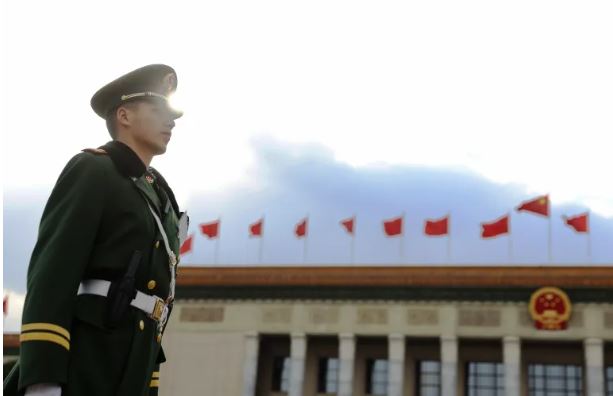
CHINA READER DAILY WIRE
INTERNAL
Beijing encourages ethnic Chinese to tell positive Chinese story, analysis in Al-Jazeera
On 23 March, according to a commentary in Al Jazeera, Beijing encouraged ethnic Chinese outside the country to unite and work with Chinese officials to spread positive messages about China. The government mentions that approximately 60 million people of Chinese origin live outside of the country except for Hong Kong, Macau, and Taiwan, claiming to be part of their own. President Xi Jinping highlighted the role of Chinese sons and daughters in leading the nation's rejuvenation. According to Professor Ian Chong Ja at the NUS, Xi’s words indicate that the CCP views ethnic Chinese expats as a source to mobilize support and advance Beijing’s interests. Chong also pointed out that the presence of Chinese expats is diverse, and their reactions will be mixed with the CCP’s external goals. Xi refers to both the Chinese citizens living abroad (Huaqiao) and ethnic Chinese with foreign nationalities (Huaren) as “members of the great Chinese family who would never forget their homeland and never deny the blood of the Chinese nation in their bodies.” Chong noted that Beijing’s diasporic nationalism has complicated the integration of ethnic Chinese and also has increased the suspicion and hatred towards Chinese minorities. (Frederik Kelter, “‘Insane’: Xi’s call for ethnic Chinese to tell Beijing’s story stirs anger,” Al Jazeera, 23 March 2024)
Chinese hospitals shutting down delivery wards amid declining birth rates, analysis in Al-Jazeera
On 24 March, according to an explainer in Al Jazeera, Chinese media reported the growing closure of obstetric departments or delivery wards nationwide due to the declining population for two consecutive years. The issue has been labelled in the press as “obstetric winter.” In February 2024, China’s National Bureau of Statistics announced that the country’s population fell by 2.08 million to 1.409 billion in 2023. The data further revealed that new births fell by 5.7 per cent to 9.02 million, and the country’s birth rate also reached a record low of 6.39 births per 1,000 people, down from 2022’s rate of 6.77 births per 1,000. This has been due to the implementation of the strict One Child policy in the 1980s, which was later reversed by the government in 2015. According to data from China’s National Health Commission, as reported by Reuters, the number of maternity hospitals fell from 807 to 793 between 2020 and 2021. Professor Deng Yong and Professor Wang Chongyu of the Beijing University of Chinese Medicine warned of the rapid abolition of the pediatric and gynaecological departments in China, leading to severe social problems in the country. Stuart Gietel-Basten, professor of social science at Hong Kong University of Science and Technology, indicates that the expectations among Chinese women have changed concerning giving birth to a child at a young age and also getting married due to increased living costs. (Kevin Doyle, “‘Obstetric winter’: Why are China’s hospitals shutting delivery wards?” Al Jazeera, 24 March 2024)
Chinese government tighten its grip on rewriting China’s Imperial Past, an Opinion in the WSJ
On 23 March, according to an opinion in The Wall Street Journal, the Chinese Communist Party (CCP), ruled by President Xi Jinping, tightened its grip on the country’s past to advance its goals. CCP derives its historical claims from the Qing era, which saved China from the “century of humiliation” caused by the opium wars. Xi issued the party to align Qing-era history with his vision for the future. According to Wong, Xi aims to strengthen China's Dream of a national renaissance and autocratic rule by revising the country’s past. This ensures the promotion of nationalistic narratives that depict the CCP as the sole guarantor of China’s inexorable rise. According to Pamela Kyle Crossley, a Qing expert at Dartmouth College, Xi rejects the portrayal of the Qing as an “empire of conquest” as they could encourage separatist sentiments in the borderland regions of Tibet and Xinjiang. Instead, he states that there were no conquests in Chinese history and there were only reunifications. (Chun Han Wong, “Xi Jinping’s Historians Can’t Stop Rewriting China’s Imperial Past,” The Wall Street Journal, 23 March 2024)
ECONOMY
China needs to reinvent itself for a new era of high-quality growth, says IMF Managing Director
On 24 March, the International Monetary Fund's Managing Director Kristalina Georgieva said, “China faces a fork in the road to rely on the policies that have worked in the past or reinvent itself for a new era of high-quality growth.” At the opening of the China Development Forum, officials said that China will meet its economic targets of 5 per cent in 2024 and has expressed its desire to support the country’s new productive forces. Regarding consumer-centred policy, Georgieva said that China needs to take decisive steps to complete unfinished housing and reduce the risk of mounting local government debt by boosting consumer spending. China’s FDI declined by 8 per cent in 2023 due to the increased tensions with the US and its allies. Apple CEO Tim Cook said to CGTN that China is opening up its economy to foreign businesses and the country’s suppliers have supported sustainable manufacturing for Apple. (“China must reinvent itself to turn economy around, says IMF's Georgieva,” Business Standard, 24 March 2024)
China’s economic slowdown impacting the sales of luxury brand Gucci among Chinese consumers, an Opinion The Economic Times
On 25 March, according to an opinion in The Economic Times, the fears of a Chinese economic slowdown have affected the sales of luxury brand Gucci among Chinese consumers. Experts note that the rising unemployment and property crisis have affected consumer confidence along with the deflationary concerns, which have fueled concerns about the Chinese economy. There has been a significant drop in the online sales of Gucci products in China due to minimalistic designs, which has reduced the appeal among Chinese consumers. The slowdown in the Chinese economy has affected the sale of other luxury brands than Gucci, like Swiss watches, while other companies such as Rolex, Hermes, Chanel, and Louis Vuitton saw double-digit growth in 2023. According to a report from Bain & Co., foreign luxury brands are trying to reduce their reliance on China as they forecast their growth to be single digits compared to 12 per cent growth in 2023. Angelito Perez Tan, Jr., co-founder and CEO of RTG Group Asia, said that the growing volatility in the Chinese market has forced them to look for alternative markets in India, Southeast Asia, and the Middle East. (Jennifer Creery, Shirley Zhao, and Andy Hoffman, “Gucci’s China shock reverberates across the luxury landscape,” The Economic Times, 25 March 2024)
Chinese Premier Li Qiang pledges to allow more FDI into China
On 24 March, Premier Li Qiang said in his opening remarks at the China Development Forum that he would pledge to bring in more overseas investors to invest in Chinese markets. He said that the country would focus on cultivating new productive forces in emerging industries such as biomanufacturing, artificial intelligence, aerospace technology, and electric vehicles. Data from the State Administration of Foreign Exchange shows that China accumulated FDI worth USD33 billion in 2023, which is 82 per cent less compared to 2022. Li acknowledged the growing concerns in China’s property sector and high local government debts and said that these problems are not serious. He also agreed to boost domestic demand in 2024, which includes reducing barriers to a unified domestic market and urbanizing its rural areas. (Aw Cheng Wei, “China’s Premier Li Qiang promises changes to woo overseas investors,” The Straits Times, 24 March 2024)
China’s Evergrande Group withdraws application for offshore debt restructuring plan
On 24 March, China’s Evergrande Group withdrew its applications for Chapter 15 of the offshore debt restructuring filed in the US. The Hong Kong Stock Exchange noted that the Evergrande Group, along with SJ and Tianji Holdings, had submitted their documents to exit from the debt restructuring plan on 22 March. Tianji and SJ are Evergrande Group's main overseas financing platforms. In August 2023, the Evergrande Group filed for offshore debt restructuring with a US court. However, in January 2024, the Hong Kong court ruled against the group and ordered them to liquidate their assets to repay the outstanding debts. Evergrande Group has defaulted in 2021 with liabilities up to USD 300 billion. (Jiahui Huang, “China Evergrande to Withdraw Offshore Debt-Restructuring Applications,” The Wall Street Journal, 24 March 2024)
SCIENCE & TECHNOLOGY
China’s new guidelines to ban the use of Intel and AMD chips in government computers, an analysis in The Financial Times
On 24 March, according to an analysis in the Financial Times, China introduced new guidelines that will ensure the removal of government PCs and servers in its efforts to replace foreign technology with domestic solutions. The new guideline also seeks to replace Microsoft’s Windows operating system and other foreign-made database software with domestic alternatives. It also aims to localize these efforts for the country’s state-owned enterprises. The latest purchase rules come after the growing tensions between the US and China and the former’s imposition of sanctions on Chinese companies and blocking the export of advanced chips and equipment to China. On 26 December 2023, the guideline was unveiled by the finance ministry and the Ministry of Industry and Information Technology (MIIT) and started implementing from 2024 onwards. According to the Financial Times, Beijing’s increased procurement of domestic products is a part of the national strategy for technological autarky in the military, government, and state sectors which the government refers to as xinchuang or “IT application innovation.” Analysts at Zheshang Securities estimate that China may require a budget of RMB 660bn (USD91bn) from 2023 to 2027 to replace the IT infrastructure in government, party organs, and eight major industries. (Ryan McMorrow, Nian Liu, and Qianer Liu, “China blocks use of Intel and AMD chips in government computers,” The Financial Times, 24 March 2024)
CHINA & TAIWAN
Former Taiwanese President Ma Ying-jeou plans to visit China for the second time
On 25 March, Reuters reported that the former Taiwan president Ma Ying-jeou plans to visit China for the second time in April. He plans to lead a group of students on a trip of 11 days to Beijing. In his presidential tenure from 2008 to 2016, Ma became the first former Taiwanese leader to visit China. He also intends to visit Guangdong's southern province and Shaanxi's northwestern province for greater student exchanges between the two sides. Ma remains one of the senior members of Taiwan's main opposition party, the Kuomintang (KMT), advocating for closer ties with China via dialogue. China considers Taiwan as part of its territory and views the current ruling Democratic Progressive Party as dangerous separatists. (“Former Taiwan president Ma to make second trip to China,” Reuters, 25 March 2024)
CHINA & EAST ASIA
“Hong Kong, as it was, is over. But it does not end there,” an Opinion in The Guardian on Hong Kong Article 23
On 23 March, an Opinion was published in the Guardian, titled, “Lies, ideology and repression: China seals Hong Kong’s failed-state fate,” by Simon Tisdall who looked into the dire state of the once bustling economy and society of Hong Kong after the recent imposition of Article 23. Tisdall said farewell to the once vibrant and pulsating city of Hong Kong, stating that the once great financial business state has been brought to its heels, as Xi Jinping the President of China sucked out all the joy. Tisdall painted a picture by highlighting how one day randomly the Hong Kongers woke up to the pro-Chinese puppet regime approving the controversial National Security law, where any act could be seen as treason and a seditious act. The current head of the state John Lee of Hong Kong, saw an all-time low in his approval rating, as it hit a record low. This according to the author, triggered paranoia that further led to the current authorities opting for the measure. The op-ed called it a “shocking breach of faith,” as China pledged with the British colonial rule that they would respect Hong Kong’s autonomy and declared “one country two systems.” Tisdal ended by saying: “Hong Kong’s long goodbye is a cautionary tale for the modern age. A flawed but totemic success story crushed by outdated ideology, hyper-nationalism, and the new emperor of Beijing. Britain and its friends failed dismally to protect the former colony. Hong Kong, as it was, is over. But it does not end there.” (Simon Tisdall, “Lies, ideology and repression: China seals Hong Kong’s failed-state fate,” The Guardian, 23 March 2024)
CHINA & SOUTHEAST ASIA
“The Philippines repeatedly challenges China’s bottom line, China will continue to take resolute and decisive measures,” says Chinese Defence Ministry
On 24 March, the Chinese Ministry of National Defence’s spokesperson Wu Qian warned the Philippines against making remarks intensifying the conflict and refrain from all infringement and provocations in the South China Sea. This comes after the latest row between the countries, where the Philippines Coast Guards accused China of blocking their supply boat to the Second Thomas Shoal with water cannons. Wu said: “If the Philippines repeatedly challenges China’s bottom line, China will continue to take resolute and decisive measures to firmly safeguard its territorial sovereignty and maritime rights and interests.” The Chinese defence ministry stated that the Philippines Coast Guard intruded the area, despite multiple warnings, leading to China carrying out control obstruction and eviction according to the law. Wu, also stated that the incident was entirely provoked by the Philippines and that they handled it in a reasonable manner. (Amber Wang, “South China Sea: Beijing warns Philippines against ‘escalating situation’ after latest Second Thomas Shoal face-off,” South China Morning Post, 24 March 2024)
CHINA & AFRICA
“Stadium Diplomacy” China to build two stadiums in Tanzania and Kenya, an Analysis by SCMP
On 24 March, an analysis was published in the South China Morning Post, titled, “China’s latest African building contracts prove ‘stadium diplomacy’ is a winning formula,” by Jevans Nyabiage which looked into the recent China-Africa deal on building more stadiums. There are plans to construct two major stadiums in Tanzania and Kenya as part of their “stadium diplomacy,” informs Jevans. Tanzania signed a deal with the state-owned enterprise China Railway Construction Engineering Group (CRCEG) of USD 112 million, where they plan to build an arena in Arusha with 30,000 seats before the 2027 African Cup of Nations (Afcon). Kenya also signed a deal with China Road and Bridge Cooperation (CRBC) to build Nairobi’s Talanta Stadium and a 60,000-seater football arena. The Talanta Stadium will be built on a public-private partnership agreement and the Chinese company will be tolling the fee for the coming 27 years to recover its investment after which it will be handed to the government. The op-ed states that the two new stadiums are part of China’s strategy to influence the African government and the elite, China is not new to building stadiums and other infrastructure in Africa. According to the Global Times, a flagship Chinese newspaper, they have built more than 100 stadiums in Africa. Many believe that these are not only economic in nature but are part of China’s long-term strategy to boost diplomatic relations with African countries and foster interdependence. (“China’s latest African building contracts prove ‘stadium diplomacy’ is a winning formula,” South China Morning Post, 24 March 2024)
CHINA & EUROPE
UK Deputy Prime Minister Oliver Dowden to link 2021 cyber-attack on the electoral commission on China
On 24 March, British Deputy Prime Minister Oliver Dowden is set to address the Parliamentary gathering addressing the Chinese threat to their personal data. They are set to link the cyber-attacks on the country’s election to China. The claim made is that the attacks on the electoral watchdog, when the Election Commission of Britain saw a breach into their personal data in 2022. During this several MP’s private data were targeted by these cyber-attacks, reports BBC. The report also stated that hostile actors gained access to electoral registers and breached the emails and control system. It is now expected that the MP will link these attacks from China and lay out a plan of action to deal with it. In 2022, three MPs were specifically targeted as informed by BBC: “former Conservative leader Iain Duncan Smith, former minister Tim Laughton and the SNP's Stewart McDonald.” All three were part of the Inter-Parliamentary Alliance on China, a group that critically looked at Beijing’s activities. (James Gregory & Iain Watson, “China linked to UK electoral roll cyber-attacks, Dowden to say,” BBC, 25 March 2024)
China invites Italy’s President and Prime Minister to relaunch strategic ties after it withdrew from BRI
On 24 March, an analysis in the South China Morning Post, titled, “No longer in Belt and Road Initiative, Italy focuses on strategic ties with China, leaders invited to Beijing this year,” by Ambrose Li, looked into Beijing’s invitation of top Italian diplomats to China. This invitation comes after Italy withdrew from the Chinese Belt and Road Initiative. Italian Ambassador to China, Massimo Ambrosetti stated that this backtracking has had “no impact” on their relationship as China invited the Italian President and Prime Minister to Beijing. China and Italy are set to mark their 20th anniversary and Amb Massimo believes that this is a testament to their positive relationship and their political willingness to keep their relationship at a strategic level. Additionally, the Italian government also invited Chinese EV giants BYD and Chery to invest in Italy. (“No longer in Belt and Road Initiative, Italy focuses on strategic ties with China, leaders invited to Beijing this year,” South China Morning Post, 24 March 2024)
CHINA & THE AMERICAS
“Mutually reinforced fear and animosity is what I call it,” exclusive coverage on the US-China relationship in SCMP
On 25 March, an exclusive edition in the South China Morning Post, titled, “‘Structural’ problem: top China scholar says US tensions will be ‘with us for a long time’,” by Dewey Sim, interviewed the founding director of the University of Hong Kong’s Centre on Contemporary China and the World Li Cheng. The interview looked into the deteriorating relations between China and the US. Cheng answered that this deterioration goes back to 2017 when China was becoming a rising threat to the US. The policy discussion argued that their previous engagements with Beijing did not yield results as the US planned. The US saw Russia and China as a revisionist country, stating that while Russia is a regional power, China has become a global power and therefore is a bigger and formidable challenge. Cheng when questioned about how he felt about this deteriorating relationship, he said that China's challenge was different as it was the only comprehensive challenge after WWII facing the US, where it included issues on economic, political, and science and technological levels. Another reason is the instability in their own country and that if the US’s economy and politics were in good shape the Chinese threat wouldn’t matter. The growing Chinese middle class and the smaller American middle class also stop them from reaping the benefits of economic globalization. When asked about the external tensions facing both countries, Cheng stated that this needs to be looked at from a global perspective with the two ongoing wars between Russia-Ukraine and Israel-Palestine. This raises questions about the possibility of a similar war extending to the South China Sea, Taiwana and Indo-China border, which would have devastating effects. Cheng was asked about how both countries are responsible for rising tensions, to which he said: “Mutually reinforced fear and animosity is what I call it,” China wants to maintain the status quo while the US pushes the envelope by supporting Taiwan, both sided blame each other where the US accused China of military mobilization and pressure on Taiwan. (by Dewey Sim, “Structural’ problem: top China scholar says US tensions will be ‘with us for a long time,” South China Morning Post, 25 March 2024)
EAST ASIA & THE PACIFIC READER
EAST ASIA
Medical professor join the doctor's strike in South Korea
On 25 March, The Guardian reported that in support of the trainee doctors the medical professors joined the protest. Some medical professors have decided to resign while others will be cutting back their hours to showcase their support for the trainee doctors. This comes against the South Korean government’s plans to increase the admission of trainee students in order to address the lack of doctors in rural areas. Medical Professors Association of Korea’s President, Kim Chang-soo informed that they would start scaling back from outpatients and only focus on emergency patients who are severely and need immediate attention. Kim said: “It is clear that increasing medical school admissions will not only ruin medical school education but cause our country’s healthcare system to collapse.” In light of the protest, the government announced that they would suspend the license of doctors who do not return to work while later they urged the doctors to seek a conciliatory approach and use flexible measures to solve the issue. The South Korean President Yoon’s office asked the Prime Minister to form a constructive consultative body. (“South Korea doctors’ strike widens as medical professors join protests,” The Guardian, 25 March 2024)
Taiwan detects seven Chinese naval ships and five aircraft incursions
On 24 March, the Taiwanese Ministry of National Defence detected seven Chinese naval vessels and five Chinese aircraft near the Taiwan Strait. The Ministry of National Defence announced that the People’s Liberation Army’s aircraft entered the Southwest Air Defense Identification Zone (ADIZ). Seeing the incursion the Taiwanese armed forces deployed and monitored the situation to support an appropriate response. The statement read: “6 PLA aircraft and 8 PLAN vessels operating around Taiwan were detected up until 6 a.m. (UTC+8) today. 1 of the aircraft entered Taiwan's southwestern ADIZ. ROC Armed Forces have monitored the situation and employed CAP aircraft, Navy vessels, and coastal missile systems in response to the detected activities.” According to Taiwan News, in the month of March, Taiwan tracked 301 incursions by Chinese aircraft and 165 by Chinese naval vessels. Since 2020, the news stated that China has increased its “Gray zone tactics,” whereby one uses a series of steady attempts to achieve one’s sovereignty in the region without resorting to direct and sizeable force. (“Taiwan detects 7 Chinese naval ships, 5 military aircraft around nation,” The Economic Times, 25 March 2024
22 March 2024, Friday | Vol.1 No. 38
China is critical for Apple’s Business, says Tim Cook
Senior leaders from China and Singapore discuss the future of deeper cooperation | China plans to hold talks on maritime affairs with Australia|

HIGHTLIGHTS
SCIENCE & TECHNOLOGY
China is critical for Apple’s Business, says Tim Cook
On 20 March, according to an opinion in The Financial Times titled, “Tim Cook praises China’s ‘critical’ role in Apple’s business,” by Ryan McMorrow, CEO of Apple Tim Cook, in his visit to China, said China is critical to its businesses amid the declining sales of its iPhones products in the country. On his sudden trip to Beijing, he praised the country’s market and vowed to invest more in China. Financial Times quoted Global Times report on Tim Cook saying, “There’s no supply chain in the world that’s more critical to us than China,” and appreciated the “high level of modernization in Chinese factories, with very advanced manufacturing capabilities and well-trained workers.” Cook’s visit comes amid the declining sales of its iPhones, which contributed to USD 21 billion in the fourth quarter of 2023, which is 17 per cent of total sales in China. The research group Counterpoint noted that the sales of iPhones declined 13 per cent year on year and had declined by 24 per cent in 2022. According to Ryan, Apple’s sales were affected by the ban on using iPhones among Chinese state employees and the government's increased championing of Huawei and other domestic brands amid the US sanctions. Cook said the company will build more on China's already invested USD 140 million in an applied research lab. (Ryan McMorrow, “Tim Cook praises China’s ‘critical’ role in Apple’s business,” Financial Times, 22 March 2024)
CHINA & SOUTHEAST ASIA
Senior leaders from China and Singapore discuss the future of deeper cooperation
On 21 March, two high-level delegates from China and Singapore, China's Central Party School President Chen Xi and Singapore’s Senior Minister Teo Chee Hean met and discussed ways to understand China, to work better together in a deeper manner. Teo said that they participated in a long list of activities, human resource development between the two countries, and the two parties the Communist Party of China and the People’s Action Party. Teo also reflected that the exchanges between the two parties allow them to learn from each other's experiences and insights. He also said: “We want to understand China more deeply, come to the provinces, understand what you’re doing in the party school, what are the key priorities that you have. And how you’re addressing those priorities.” Chen also agreed that he hoped the two countries and their leaders could continue to work together. (“Singapore-China govt, party exchanges allow for deeper cooperation: Teo Chee Hean,” The Straits Times, 22 March 2024)
CHINA & THE PACIFIC
China plans to hold talks on maritime affairs with Australia
On 21 March, The Ministry of Foreign Affairs of the People’s Republic of China Lin Jian said that China is interested in discussing maritime affairs with Australia amid the increased tensions among several countries bordering the South China Sea (SCS) threatening its regional security. The plan comes after the visit of Foreign Minister Wang Yi to Australia to discuss the issue of trade and regional security. Lin said the discussion will also focus on increasing cooperation in the areas of diplomacy, trade, technology, education, and law enforcement. In the joint statement in March 2024, both sides agreed to refrain from any unilateral action in the SCS. On 21 March, in a meeting with Wang Yi, the Premier of New South Wales, Chris Minns, said that the country is willing to deepen its cooperation with China in various fields. (“China considers launching maritime talks with Australia,” The Straits Times, 21 March 2024)
CHINA READER DAILY WIRE
INTERNAL
China looks into the PwC financial advisor’s role in Evergrande fraud
On 22 March, Bloomberg reported on the Chinese authorities investigating the role of PricewaterhouseCoopers LLP (PwC) in the Evergrande fraud. The PwC group’s accounting practices are questioned as the real-estate giant and its owner Hui Ka Yan were accused of USD 78 billion fraud, by overstating their revenue. Evergrande’s onshore subsidiary Hengda Real Estate Group is also accused of hiking the revenue as well. The auditors of PwC who handled the Evergrande account are contacted and the decision to penalize them is still going on. The PwC is already going through a fallout scandal with many of its international firms observing job cuts as the company was accused of sharing government tax plans with its clients. GMT Research Ltd. in Hong Kong analyst Nigel Stevenson said that these are some serious accusations. The GMT firm had previously questioned the financial report presented by the Evergrande group. The Chinese Securities Regulatory Commission stated that Hengda also overstated USD 12.7 billion in profit between the years 2019-2020. A professor of accounting practice at Sheffield University in the UK, Richard Murphy said that this would affect PwC’s reputation not only in China but also globally. (“China Scrutinizes PwC Role in $78 Billion Evergrande Fraud Case,” Bloomberg, 22 March 2024)
ECONOMY
China’s “ultra-long” bond for the local government, an explainer in SCMP
On 22 March, an Explainer in the South China Morning Post, titled, “What makes China’s ‘ultra-long’ bonds special? Here’s what we know about Beijing’s trillion-yuan offering to stabilise the economy,” by Amanda Lee looked into the new “Ultra Long” bond provision brought by the Chinese government offering 1 trillion yuan. The provision was announced at the annual plenary meeting where they aimed at 5 per cent economic growth. The details of the bonds are yet to be revealed, the Analyst believes that the bonds could of 30-50 years long and that the special nature of bonds means that they would be allocated for specific purposes only. The 1 trillion yuan would be “off-budget,” and the funds would be used to support areas of technological and innovation, urban-rural development, regional development, food-energy security, and population development. There are only special cases when such bonds are sold and the reason for this is the growing debt faced by the local government of China, which is at the forefront of promoting economic gains. (“What makes China’s ‘ultra-long’ bonds special? Here’s what we know about Beijing’s trillion-yuan offering to stabilise the economy,” South China Morning Post, 22 March 2024)
CHINA & TAIWAN
Taiwanese Ministry of National Defence detected 36 Chinese aircraft in Taiwan
On 22 March, the Taiwanese Ministry of National Defence informed that 36 Chinese military aircraft had been detected near the Taiwan Islands within the window of 24 hours. Additionally, the Ministry also detected six naval ships that were operating near Taiwan. The Ministry of National Defence stated that 13 aircraft crossed the median line of the Taiwan Strait, this median line is important as it separates China from Taiwan. The relations between the two countries have become frosty with the election of pro-independence President Tsai in 2016 and the recent election of her party leader William Lai in 2024 of the Democratic Progressive Party. China sees Taiwan as an indispensable part of its own, while Taiwan disagrees. (“Taiwan detects 36 Chinese military aircraft in high single-day activity,” The Strait Times, 22 March 2024)
CHINA & SOUTHEAST ASIA
Chinese Coast Guard accused Philippines civilians of illegally entering the Tiexian reef of Spratly Island
On 21 March, Chinese Coast Guards accused the Philippines nationals of illegally landing on the disputed reef of the South China Sea. The Chinese Coast Guard alleges that 34 people from the Philippines were warned against entering the Tiexian Reef of Spratly Island. The Chinese side stated that they investigated the incident and dealt with the matter in accordance with the law. China claims “indisputable” sovereignty over the reefs and Spratly Island and they believe that their territorial rights were undermined in the South China Sea. The Chinese Coast Guard Gan Yu said: “We urge the Philippine side to immediately stop the infringements. The Chinese coastguard will continue to protect our legal rights and enforce the law in waters under China’s jurisdiction.” (“Beijing says Philippines made ‘illegal landing’ on disputed reef in South China Sea,” South China Morning Post, 21 March 2024)
Internal faultlines in Southeast Asia’s approach to the South China Sea dispute, a commentary in East Asia Forum
On 22 March, according to a commentary in East Asia Forum titled “Southeast Asia stymied in South China Sea dispute,” ASEAN’s efforts to resolve the South China Sea dispute have lacked effective outcomes on the overlapping claims of the countries and have forced the claimant countries to seek outside of the ASEAN process. This is evident in the Philippines' approach to Vietnam by establishing a direct hotline with each other’s coast guard to avoid unwanted incidents. This approach is seen as a way to resolve the pending issue of the Code of Conduct within ASEAN member states. The Philippines’ expedited measures are a result of the fatigue witnessed in the negotiation process and China’s growing aggression. The Philippines has been taking a collective deterrence strategy to counter China’s claim by aligning with like-minded countries like the US, whereas Vietnam is prudent in its actions and wishes to separate maritime issues from its overall relations with China. China’s Three Warfares strategy by using tools such as public opinion, psychological and legal warfare, and economic rewards to keep the ASEAN countries divided on the SCS issue. Thus, China’s wedge strategy and divided Southeast Asia countries continue to weaken the overall ASEAN’s mechanism to resolve the ongoing South China Sea dispute. (Harshit Prajapati & Prisie L Patnayak, “Southeast Asia stymied in South China Sea dispute,” East Asia Forum, 22 March 2024)
CHINA & THE MIDDLE EAST
Houthi rebels affirm safety deal with Russia and China at the Red Sea in turn for diplomatic support, says Bloomberg
On 21 March, Bloomberg reported on a deal struck between the Yemen-based and Iran-backed Houthi Rebel fighters in the Red Sea with Russia and China. Houthi group told China and Russia that their ships could freely sail in the region of Red and the Gulf of Aden, as they wouldn’t be attacked. This understanding was reached between the Chinese, and Russian diplomats and the Houthi top leader and spokesperson Mohammed Abdel Salam. In return, the rebel groups want political support in the Global Arena, like the United Nations Security Council. The discussion did not specify how this support would work, but the larger aim of this deal is to block provisions against the rebel group, says Bloomberg. The misidentification of ships has become a problem in the region and now both Russia and China want stronger assurance from the rebel group, says Bloomberg. In January, missiles exploded near a ship boarding Russian Oil, days after the Houthi spokesperson affirmed that both countries should not fear the attacks. Most Western ships have changed their trajectory for trade routes by going around Southern Africa, while China and Russia’s ship tracking details show that they still follow the shipping route. The senior Houthi political leader Ali Alqhoom said: “sinking America, Britain, and the West in the swamp of the Red Sea.” Russia and China seek more security and affirm the safety of their cargo from the Houthi attacks. (Sam Dagher, Mohammed Hatem, “Yemen’s Houthis Tell China, Russia Their Ships Won’t Be Targeted,” Bloomberg, 21 March 2024)
CHINA & THE AMERICAS
Democrats objected to the bill passed in the Georgia House of Representatives to ban Chinese agents from purchasing land in Georgia
On 21 March, the Democrats objected to the new bill that was passed in the Georgia House of Representatives, which would ban any agent of China, Cuba, Iran, North Korea, and Russia who are not US citizens or legal residents from owning farmland in Georgia or any land in the state within10 miles (16 kilometres) of a military installation unless they have spent at least 10 months of the previous year living in Georgia; stating that it would lead to discriminations against Asian Americans and threatens national security. After lengthy debates and testimonies, the State House voted 97 to 67 in favour of SB420. Rep. Michelle Au, a Democrat of Chinese American origin, said that she has been accused of being an “agent of the Chinese Communist Party (CCP), spy, a plant, un-American and a foreign asset.” She said that the bill aimed to weaponize racism against residents from certain parts of the world. Republicans defending their stance noted that the bill does not pose any discrimination and aims to protect the country’s food supply and military from foreign adversaries. The approved bill will be going to the State Senate for consideration. Other states such as Florida, Alabama, Louisiana, and Arkansas passed similar laws amid fears of growing Chinese espionage. The law became important after the Chinese spy balloon flew over the US in 2023. (Sudhin Thanawala, “Land purchases by Chinese ‘agents’ would be limited under Georgia bill; Democrats say it’s racist,” Associated Press, 22 March 2024)
Chinese chipmaker SMIC potentially violated American control laws, says US Under Secretary of Commerce for Industry and Security
On 21 March, the Under Secretary of Commerce for Industry and Security Alan Estevez said in a testimony that the Chinese chipmaker Semiconductor Manufacturing International Corporation (SMIC) “potentially” broke American law for manufacturing a processor for a company named Huawei Technologies sanctioned by the US. In reply to the question raised by the US Foreign Affairs Committee chairman Michael McCaul, Estevez said that the concerns were serious about SMIC’s potential sale of a 7nm processor to Huawei. He also said that SMIC’s manufacturing process has a low yield for producing advanced chips. SCMP also noted that despite the US sanctions, Huawei incorporated the advanced 7nm chip into its latest Mate 60 device, which coincided with the visit of Commerce Secretary Gina Raimondo in August 2023. Estevez noted that Huawei had access to chip manufacturing tools before the US sanctions took effect. In September 2023, The Bureau of Industry and Security said that it is investigating the sale of a 7nm chip and will take measures to protect US national security. (“Chinese chip maker SMIC ‘potentially’ broke US law to make Huawei’s 7-nm smartphone processor, lawmaker says,” South China Morning Post, 22 March 2024)
Xi Jinping plans to meet US business leaders in Beijing
On 21 March, Chinese President Xi Jinping plans to meet the US business leaders on 27 March amid the government’s efforts to attract foreign businesses in light of the excessive outflow of FDI. Along with Xi Jinping, Chubb’s CEO Evan Greenberg, Stephen Orlins, president of the National Committee on US-China Relations, and Craig Allen, president of the US-China Business Council are expected to attend the meeting. According to the Wall Street Journal, US business leaders will be attending the China Development Forum to meet the Chinese policymakers and the theme for the forum is focused on China’s economic growth, artificial intelligence and climate change. According to Liza, foreign companies are seeking reassurances from China about the inconsistency in regulations and operational risks. Amid the growing US-Sino tensions, only 23 business leaders came to China in March 2023 to attend the forum. At the November dinner meeting with Xi, China did not provide any assurance for executives in China for its counter-espionage law. (Liza Lin, “China’s Xi Jinping to Meet U.S. CEOs in Beijing Next Week,” The Wall Street Journal, 21 March 2024)
EAST ASIA & THE PACIFIC READER
EAST ASIA
South Korea’s Ambassador to Australia Lee Jong-sup willing to cooperate on the ongoing probe in Seoul
On 21 March, South Korea’s Ambassador to Australia Lee Jong-sup said that he is willing to face questions from the anti-corruption agency over allegations of manipulating the probe on the death of a marine, who was involved in a search and rescue operation during floods in 2023. He had denied any wrongdoings. Lee was recently appointed as the head of the embassy in Canberra. Some South Korean lawmakers had criticized Lee’s appointment as the ambassador to Australia on 10 March amid the ongoing investigation. President Yoon’s office said that Lee’s appointment was under the law and would fully cooperate with the investigation. (“South Korea’s ambassador to Australia says he will cooperate with graft probe,” The Straits Times, 21 March 2024)
North Korea’s ruling Workers’ Party of Korea delegation heads for a three-nation tour to China, Vietnam and Laos
On 22 March, North Korean state media KCNA said that the country had sent its delegation from the ruling Workers’ Party of China led by Kim Song Nam for a three-nation tour to China, Vietnam and Laos. He is the alternate member of the Political Bureau and director of the International Department of the party’s Central Committee. On 21 March, the delegation arrived in Beijing. The Chinese state media reported that Kim met the fourth-ranking senior official in China’s Communist Party, Wang Huning, and the head of CCP’s International Liaison Department, Liu Jianchao. Wang said that China is willing to deepen its friendship, partnership and unity with North Korea for a peaceful and stable external environment. (“North Korea sends delegation to China, Vietnam, Laos, KCNA says,” Financial Express, 22 March 2024)
21 March 2024, Thursday | Vol.1 No. 37
Chinese youth employment rate sees a 15.3 per cent hike, says National Bureau Statistics
CPEC’s ‘Gwadar port’ attacked by the armed wing of Balochistan Liberation Amry, Majeed Brigade
CHINA READER DAILY WIRE
INTERNAL
Chinese youth employment rate sees a 15.3 per cent hike, says National Bureau Statistics
On 20 March, the Chinese National Bureau of Statistics released the Youth Unemployment data where the rate rose to 15.3 per cent in February while in January 2024, it was at 14.6 per cent. The result shows the persisting unemployment issue in China as they try to recover their economy, the young population's employment condition from the age of 16-24 remains the same. In June 2023, the NBS issued that they won’t declare the document anymore as they saw an all-time high in the youth unemployment rate, reaching 21.3 per cent. In January, the NBS introduced a new measuring technique where they excluded students from the report. This exclusion is considered unusual in most countries like the US and the European countries include students looking for jobs as part of census. (“China’s Youth Jobless Rate Edges Higher After Methodology Change,” Wall Street Journal, 20 March 2024)
CHINA & SOUTH ASIA
CPEC’s ‘Gwadar port’ attacked by the armed wing of Balochistan Liberation Amry, Majeed Brigade
On 20 March, Pakistan security forces curbed an attack at the Gwadar port, Pakistan, where eight armed attackers were killed. Gwadar Port in Balochistan is a multimillion project initiative between the China-Pakistan Economic Corridor. It is one of Pakistan's most ambitious infrastructure projects. Chief Minister of Balochistan Sarfraz Bugti said: “Whosoever chooses to use violence will see no mercy from the state. Kudos to all law enforcement brave hearts who fought bravely today for Pakistan.” The attackers are said to be part of the Majeed Brigade, which is an armed wing group of the Balochistan Liberation Army (BLA). BLA is a separatist group demanding secession of their province from the rest of Pakistan. They even accept the responsibility stating: “BLA accepts responsibility for the attack and further details will be released to the media.” This is not the first time it was attacked, the city of Gwadar consists of many Chinese families and citizens who work there. (“Pakistan’s Gwadar port attacked, eight armed fighters killed,” Al-Jazeera, 20 March 2024)
|
CHINA & THE AMERICAS
US recognizes Arunachal Pradesh to be part of India, rejects China’s claims |
|
|
|
|
|
EAST ASIA & THE PACIFIC READER EAST ASIA |
20 March 2024, Wednesday | Vol.1 No. 36
China’s claims over Arunachal Pradesh are absurd, says Indian Foreign Ministry
China built big military bases near Taiwan’s Itu Aba in the South China Sea, says Taiwanese Foreign Minister

HIGHLIGHTS
CHINA & SOUTH ASIA
China’s claims over Arunachal Pradesh are absurd, says Indian Foreign Ministry
On 19 March, the Spokesperson of the Ministry of Foreign Affairs of the Republic of India,Randhir Jaiswal, said that China’s claims on Arunachal Pradesh were absurd and added that it would be an integral part of India. He said, "Repeating baseless arguments in this regard does not lend such claims any validity."China claims Arunachal Pradesh as part of Southern Tibet, while India rejectsChinese claims. He responded to the comments made by the spokesman of China'sMinistry of National Defense Senior Colonel on the inauguration of the road tunnel by PM Modi on 09 March. Zhang said, “India should stop taking any moves that complicate the border issue and earnestly maintain peace and stability in the border areas,” adding that the tunnel's inauguration “runs counter to the efforts made by both sides to ease the border situation.” (“India says China's claims overArunachal Pradesh state 'absurd',” Reuters,19 March 2024)
CHINA & TAIWAN
China built big military bases near Taiwan’s Itu Aba in the South China Sea, says Taiwanese Foreign Minister
On 20 March, Taiwanese Foreign Minister Joseph Wu said that China had built big military bases on the three islands close to Taiwan’s Itu Aba in the South China Sea.Amid the growing contestation for claims in the South China Sea, Taiwan controls only one islet in the disputed Spratly Islands called Itu Aba, whichTaiwan refers to as Taiping. Taiwanese lawmakers are forcing President Tsai to visit the island as her predecessors had visited the island. Wu said that the island belonged to Taiwan and that the government would defend its sovereignty.He also said that despite the ongoing tensions between China and thePhilippines in the South China Sea, the tensions are increasing over Itu Aba. He said, "China has already created very enormous South China Sea military bases on the three islands surrounding Taiping - Subi Reef, Fiery Cross Reef, and Mischief Reef - and these are all quite close to our Taiping." Taiwan also controls the Pratas Islands in the northern part of the South China Sea. Vietnam, Malaysia, and Brunei claim the disputed regions of the South China Sea with both China and Taiwan. (“Taiwan warns of 'enormous' Chinese bases near its South China Sea holding Itu Aba,” The Straits Times, 20 March 2024)
CHINA READER DAILY WIRE
SCIENCE & TECHNOLOGY
Chinese company EHang’s flying taxi takes off in the Taobao marketplace, says anEditorial in SCMP
On 19 March, the South China Morning Post reported that the Chinese flying taxi company EHang began selling its EH216-S electric vertically short take-off landing(VTOL) vehicle on Taobao marketplace, an online platform by Alibaba Group. EHang is based in Guangzhou province in China, and its EH216-S is priced at2.39 million yuan (USD332,000). EHang announced that its products will be available for sale at USD410,000 outside China from 01 April. EH216-S became the world’s first company to obtain a Type Certificate and StandardAirworthiness Certificate for pilotless eVTOLs from the Civil Aviation Administration of China (CAAC). The product was first announced in February 2018 and has conducted over 42,000 successful fight tests in more than 14 countries. It is a two-seater aircraft with a top speed of 130 kmph, a cruising speed of 100km/h, and a maximum altitude of 3,000 metres. It has a range of 30km and a flight time of 25 minutes. According to EHang, the EH216-S is ideal for various urban air mobility (UAM) applications, including air taxi services, aerial tourism, airport shuttles, and cross-island transport. (Ben Jiang, “Chinese flying taxi maker EHang sells autonomous passenger drone for US$332,000 on Taobao as nation’s low-altitude economy takes off,” South China Morning Post, 19 March 2024)
CHINA & SOUTHEAST ASIA
China draws a new territory along its southern waters bordering Vietnam, says a commentary in SCMP
On 19 March, according to a commentary in the South China Morning Post titled “China has drawn its territorial line in the Gulf of Tonkin. Is the South China Sea next?,” by Laura Zhou, China’s decision to draw a new territorial line has sparked regional concerns about its intention to replicate the same in the South China Sea. In early March, Beijing declared a new set of seven base points along its southern coast to demarcate its territorial waters and sovereignty over airspace, seabed, and sea soil in the Gulf of Tonkin, also known as the Beibu Gulf in China. Beijing says that its new baseline was in accordance with the UNCLOS, which allows for a straight line in some cases and is in line with China’s Law on the Territorial Sea and the Contiguous Zone in1992. On 15 March, the Spokesperson for the Ministry of Foreign Affairs of thePeople’s Republic of China, Wang Wenbin, said that China “has a legitimate and lawful right” to decide the new baseline. He also said that the new baseline is meant to serve better economic development to the provinces and regions along the Beibu Gulf, such as Guangxi, Guangdong, and Hainan, and to realize China’s strategic goal of becoming a strong maritime power. Kentaro Nishimoto, an international law professor at Tohoku University, said that the new baseline will allow China to convert a major portion of the northern side of the SouthChina Sea into its control, thereby exercising more power in the region. (LauraZhou, “China has drawn its territorial line in the Gulf of Tonkin. Is the South China Sea next?,” South China Morning Post, 19 March 2024)
“We are trying to keep things on an even keel,” says Philippines President Marcos Jr
On 19 March, Philippine President Ferdinand Marcos Jr said that despite China’s growing claims in the South China Sea, the Philippines government’s efforts to protect the sovereignty of the disputed territories are not poking the bear. In an interview with Bloomberg Television’s Haslinda Amin in Manila, he said, “We are trying to keep things on an even keel,” adding that the country needs to do more to defend its territory. With President Marcos holding office in 2022, thePhilippines military has increased its operations to continue the resupply missions and escorting the fishermen in the SCS. Marcos said that his country has not instigated any conflict or seeking any confrontation and is trying to address people’s concerns. China claims the disputed Second Thomas Shoal as its own and has been sending its coast guard ships to threaten the Philippines' resupply mission. On the mutual defense treaty with the US, President Marcos Jr said he does not want to invoke the treaty as the Philippines' has kept the talks open with China. (“Marcos warns on China threat, says he’s ‘not poking the bear’,” The Straits Times, 19 March 2024)
CHINA & THE PACIFIC
Australia intends to manage the differences wisely with China, says FM Penny Wong
On 20 March, Foreign Minister Penny Wong said that Australia desires a stable, productive, and mature relationship with China in her discussion in Canberra. ChineseForeign Minister Wang Yi has been visiting Australia for a bilateral visit in2017. The ties between the two countries deteriorated after Australia’s former PM, Scott Morrison, called for an inquiry into the origins of the COVID-19pandemic, which led to the imposition of trade restrictions on Australian exports to China. Wong welcomed the removal of trade impediments on barley, wine, and other exports to China. Chinese state media welcomed Australia’s decision to suspend anti-dumping duties on Chinese wind towers. Wong also conveyed her concerns about the death sentence given to top Australian writerYang Hengjun and said that the Australian government would advocate for his release. She also raised concerns about maritime security, the South China Sea, and China’s unsafe conduct in the sea. She added, “Dialogue enables us to manage our differences, it doesn't eliminate them, but this government, in the interest of Australia, will always seek to manage those differences wisely.”(Sophie Mak and Shaun Turton, “Australia, China foreign ministers to manage differences 'wisely',” NikkeiAsia,20 March 2024)
CHINA & THE AMERICAS
Canadian Chinese arrested in the US over stealing Tesla’s secret
On 19 March, the South China Morning Post reported that a Chinese Canadian was arrested in the US for stealing Tesla’s trade secrets and conspiring to sell them to the undercover police. Federal Prosecutors in Brooklyn said that Klaus Pflugbeil, an operator of the China-based business, was arrested in New York, and he travelled to meet with undercover agents. They further noted that Pflugbeil and his business partner Yilong Shao built their company using Tesla’s trade secrets and will be charged with a prison tenure of 10 years if convicted. Breon Peace, US attorney for the Eastern District of New York, said to the Justice Department and the FBI that the defendants had set up a company in China and stole trade secrets from Tesla to manufacture electric vehicles costing millions of dollars for R&D. (“China-based Canadian stole Tesla secrets, US prosecutors say,” South China Morning Post, 20 March 2024)
CHINA & EUROPE
Putin to visit Beijing in May, says Reuters
On 19 March, according to reports from Reuters and other sources, Russian President Vladimir Putin will be travelling to Beijing for bilateral talks with President Xi Jinping. It will be his first overseas trip after his new presidential term. Kremlin spokesman Dmitry Peskov said that the details will be informed as the dates get closer. His visit will mark before Xi’s planned visit to Europe. Along withChina, India and North Korea congratulated Putin for his election victory asRussia’s President. Both Russia and China had declared a no-limits partnership in February 2022 before the start of the Russia-Ukraine war. The Western sanctions on both Russia and China had led Beijing to forge greater trade and military ties with Moscow. (“Russia’s Putin to visit China inMay: Sources,” The Straits Times, 19 March 2024)
EAST ASIA & THE PACIFIC READER
EAST ASIA
Bank of Japan hikes interest rates, says an Opinion in NikkeiAsia
On 19 March, according to an opinion in NikkeiAsia titled “What's next for the BOJ after itsexit from negative rates?,” by Wataru Suzuki, the Bank of Japan (BOJ) has hiked the interest rates since 17years ago. After the financial bubble burst in the 1990s, BOJ initiated its quantitative and qualitative easing" policy to stimulate more spending by companies and households. However, it failed to remove the deflationary tendencies in the country. The increasing inflation backed the decision to end this policy due to the declining yen against the dollar and global price following the Ukraine war and COVID-19 recovery. The Japan Business Federation Chairman Masakazu Tokura said that the BOJ’s policy shift will end a favourable environment for domestic businesses. BOJ Governor Kazuo Ueda said that he cannot rule out the possibility of any unforeseen disruption with the increase in interest rates. Prime Minister Fumio Kishida said that the BOJ had tried to ensure an accommodative monetary policy for positive economic growth. In a report, SMBC Nikko Securities in Tokyo said that the interest rate hike will strengthen the yen against the US dollar by mid-2024, thus making investors look for domestic businesses. Experts predict that the continued increase in the interest rates will impact Japanese exports and raise the borrowing costs for small companies. (Wataru Suzuki, “What's next for the BOJ after itsexit from negative rates?,” NikkeiAsia, 19 March 2024)
19 March 2024, Tuesday | Vol.1 No. 35
The Rise of Temu, an e-commerce giant from China
“Strengthening AI safety and security, privacy protections, and equity and civil rights,” Antony Blinken at the Summit for Democracy

HIGHLIGHTS
ECONOMY
The Rise of Temu, an e-commerce giant from China
On 19 March, an analysis in the BBC, titled “How Temu is Shaking up the world of online shopping,” by Sam Gruet, looked into the rising e-commerce online shopping giant Temu. It is owned by the Chinese e-commerce giant Pinduoduo, which has taken the top spot of Alibaba and is currently worth USD 117 billion. The company Temu has been criticized by the US and the UK governments for being part of using forced labour (Uyghur Muslims) to produce its goods sold in Temu. In response, Temu stated: “strictly prohibits" the use of forced, penal, or child labour by all its merchants.” The company was launched in 2022 in the US and later the US and then worldwide. Since its founding, it has topped the global app download charts and has 152 million American buyers. Temu attracts customers by selling goods at cheap prices where its focus is not on profit but on increasing its market share. (“How Temu is shaking up the world of online shopping,” BBC, 19 March 2024)
CHINA & THE AMERICAS
“Strengthening AI safety and security, privacy protections, and equity and civil rights,” Antony Blinken at the Summit for Democracy
On 17 March, US State Secretary Antony Blinken made some comments at the third Summit for Democracy, held in South Korea. Blinken outlined the importance of the decisions they make as governments and the impacts they may have in coming years when it comes to the space of Artificial Intelligence and Innovation. He urged the need to make sure that they not only reap benefits from them but also protect themselves from harming people. He then listed how AI helped innovation with Kenya’s AI-enabled bot helping girls with accurate reproductive and health information, to Chile’s “Creamos” where young people can submit their ideas for social change. While AI is set to play a vital role in the advancement of innovation, it can also be critical to democracy, where many can misuse it. Blinken said: “So while we seek to harness the power of AI and other digital technologies for good, some governments are abusing those same technologies to do just the opposite.” He stated that they are using AI tools for surveillance, facial recognition and bots. Some countries use them to spread disinformation and misinformation curbing free and fair elections, said Blinken. He said that the US is determined to shape the terms of the technological future that is inclusive and sustains democratic value while “strengthening AI safety and security, privacy protections, and equity and civil rights.” (“Secretary Antony J. Blinken At the Ministerial Conference of the Third Summit for Democracy,” US Embassy, 17 March 2024)
CHINA READER DAILY WIRE
INTERNAL
Chinese school kid killed by classmate sparks debate on left-behind children and juvenile criminal law in China
On 19 March, The Straits Times reported on the arrest of three juvenile boys who allegedly killed their classmate, which sparked the debate on left-behind Children in China and the Juvenile criminal law in the country. The victim of the incident was a 13-year-old middle schooler who went missing on 10 March and was found the next day buried at a vegetable greenhouse. The current Criminal Law of China after the amendment holds juveniles criminally liable from the age of 12, to prevent children from committing crimes. The amended law states that the accused children would face punitive action against them for intentional homicide. Though the law has been amended their punishment would depend on how the prosecutor probes them as they might hold the principle of “education first and punishment second.” This incident also sparked discussion on the issue of left-behind children of migrant parents, and how social workers and the government need to provide provisions for a better environment for the children. According to the National Bureau of Statistics in 2023, there were 66.93 million left behind children living in the rural areas. (“Arrests of three boys who allegedly killed schoolmate cast light on left-behind children in China,” The Straits Times, 19 March 2024)
ENERGY/ENVIRONMENT
China to host the fifth international “Enhancing the Operational Safety of Nuclear Power Plant,” with IAEA
On 19 March, an analysis in the South China Morning Post, looked into the upcoming Enhancing the Operational Safety of Nuclear Power Plant, an international conference to be held in China and the possible agendas of the meeting. The conference is scheduled to be held from 15-19 April and this would be the first conference held outside Vienna, which is the headquarters of the International Atomic Energy Agency (IAEA). The agenda of the gathering would focus on how to make nuclear power plants safer and not on the Fukushima nuclear power plant release the IAEA said: “The specific topic of the release of treated water from Fukushima Daiichi nuclear power plant is not within the scope of this conference.” The director general of the IAEA, Rafael Mariano Grossi is set to participate in the event he has been an avid advocate for the water release and the Chinese have heavily criticized Grossi and career diplomats for it. (Victoria Bela, “China to host global nuclear safety conference – but row over Fukushima nuclear waste water will not be on agenda,” South China Morning Post, 19 March 2024)
ECONOMY
Evergrande founder Hui Ka Yan accused of inflated revenue fraud of USD 78 billion
On 19 March, BBC reported that the Chinese real estate giant Hui Ka Yan, the founder of the Chinese property firm Evergrande has been accused of USD 78 billion in fraud. Hui is accused of inflating the revenues of the company, the financial market regulator of China has now fined his mainland business of USD 583.5 million. The founder is now also banned from the Chinese financial market. This comes after the Hong Kong court also asked the Chinese firm to liquidate its assets. The China Securities Regulatory Commission (CSRC) blame much of the defaults owed by the company on the founder who inflated their revenue. The company Evergrande has been China’s biggest real estate project supported by the government. The liquidators have informed us that they would seize and sell off assets to repay the outstanding debts owed by the company. (“Evergrande: China property giant and its founder accused of $78bn fraud,” BBC, 19 March 2024)
CHINA & TAIWAN
China rebukes South Korea over Taiwan’s participation at the Summit for Democracy
On 18 March, Chinese Ministry of Foreign Affairs spokesperson Lin Jian opposed the Taiwanese participation in the third Summit of Democracy, held in Seoul, South Korea. Taiwan’s Digital Minister Audrey Tang attended the meeting and delivered a video message on the discrimination faced by Taiwan and that they face concerted cyber attacks regularly. He also said that they are willing to work with other like-minded countries and stakeholders to ensure the safe use of Artificial Intelligence. Lin urged South Korea to follow the “one-China” principle and that: “Taiwan is an inalienable part of Chinese territory.” (“China protests against Taiwan minister’s role at Seoul summit backed by the US,” The Straits Times, 18 March 2024)
CHINA & THE PACIFIC
China’s ties with New Zealand had been “at the forefront of China’s relations with developed countries,” says FM Wang Yi
On 18 March, in his five-day tour, the Chinese Foreign Minister Wang Yi said that China’s ties with New Zealand are “a force for stability in a turbulent world.” He held talks with Prime Minister Christopher Luxon, Foreign Minister Winston Peters, and Trade Minister Todd McClay in Wellington. Wang said, “China regards New Zealand as a rational and mature partner, and the relationship between China and New Zealand is strategic and long-term.” He also showed the country's willingness to celebrate the 10th anniversary of the Comprehensive Strategic Partnership and upgrade it for stronger bilateral relations between the two countries. He also urged the two countries to increase cooperation and counter the Cold War mentality, unilateralism, and protectionism. Peters acknowledged the differences between the two sides in areas such as human rights violations in Xinjiang, Hong Kong, and Tibet. He also raised regional security issues such as the South China Sea and Taiwan Strait. (Laura Zhou, “China and New Zealand are a ‘force for stability’ in a turbulent world, says Foreign Minister Wang Yi,” South China Morning Post, 18 March 2024)
CHINA & THE MIDDLE EAST
ADIA seeks to capitalize on the Chinese equities left by Western investors, says an Opinion in the Financial Times
On 19 March, according to an opinion in the Financial Times, The Abu Dhabi Investment Authority (ADIA) is willing to capitalize on the Chinese equities managed by Hong Kong-based PAG at a discount. They are being sold by Western investors, particularly the US, to reduce their reliance on China. PAG is one of Asia’s most prominent private equity groups, which manages more than USD 55 billion, including the state pension schemes in the US and investment funds in Canada, Australia, and Europe. It is led by Weijian Shan, who sat on Alibaba’s board. PAG could not raise new funds in 2022 due to Shan’s criticism against Beijing. According to Reuters, PAG aimed to raise funds of USD 9 bn; however, it could raise only 2.2bn by March 2023. In its long-standing interests and ties in China, ADIA intends to buy stakes in PAG funds at a discount. Western investors are increasingly worried about China as the geopolitical tensions have led to US restrictions on China and Beijing’s crackdown on foreign companies and investors. (Kanye Wiggins, Mercedes Ruehl, Chloe Cornish, “Abu Dhabi fund offers to buy out investors fleeing China private equity,” Financial Times, 19 March 2024)
CHINA & THE AMERICAS
Chinese battery maker Gotion more vocal in filing the lawsuit against Michigan township, says an Opinion in SCMP
On 19 March, according to an opinion in the South China Morning Post titled, “Embattled Chinese battery maker Gotion vows ‘more vocal’ US strategy after filing lawsuit in Michigan,” by Khushboo Razdan, Chinese battery maker Gotion sued Michigan’s Green Charter township for the breach of contract of USD 2.3 upcoming billion EV plant. VP of North American manufacturing for Gotion Inc., Chuck Thelen, said that people have been hearing many mistruths for nine months, and the company will be more vocal in conveying the truth. According to Khushboo, Gotion has been trying to address the community’s concerns through events hosted by Township officials. On 18 March, Thelen said their company was forced to file a lawsuit in a US federal court in Michigan on 15 March to protect its investments. So far, the company has invested USD 24 million to purchase 270 acres of land and incurred USD 500,000 in additional costs. Khushboo notes that Gotion faces public anger over its ties to China and the CCP. In November 2023, the Green Charter Township residents ousted five out of seven local government officials over their support to the Gotion project, and two Republican congressmen, John Moolenaar of Michigan and Darin LaHood of Illinois, had introduced the No Gotion Act in the US House. The bill prohibits companies affiliated with the CCP from receiving tax credits under the Inflation Reduction Act. (Khushboo Razdan, “Embattled Chinese battery maker Gotion vows ‘more vocal’ US strategy after filing lawsuit in Michigan,” South China Morning Post, 19 March 2024)
China PLA social media account criticizes US for deploying SpaceX spy satellites
On 17 March, based on a report by Reuters, China accused the US of deploying hundreds of SpaceX’s spy satellites in space, threatening global security. The report notes that the Starshield unit of SpaceX is building the satellite network under the classified USD 1.8 billion contract with the National Reconnaissance Office (NRO). One of the PLA’s social media accounts on Weibo said that the SpaceX programme exposes “US’s shamelessness and double standards” amid Washington’s accusation of Chinese companies threatening US security. Wang Yanan, chief editor of Aerospace Knowledge, said that the deployment of spy satellites poses a challenge to global security and stability. The Starshield entity is separate from SpaceX’s Starlink. China also said that it has studied the deployment of Starlink satellites in the Ukraine war and its risk to China and is willing to build its own satellite network in space. (“China’s military, state media slam US after Reuters report on SpaceX spy satellites,” The Straits Times, 19 March 2024)
CHINA & EUROPE
“Your re-election is a full demonstration of the support of the Russian people for you,” says President Xi Jinping
On 18 March, Chinese President Xi Jinping congratulated Vladimir Putin for winning the Presidential elections and said China is willing to deepen its partnership with Russia. On 17 March, Putin won a landslide victory in the recent presidential polls, cementing his power over the country. According to Xinhua News, President Xi said, “Your re-election is a full demonstration of the support of the Russian people for you.” The two countries strengthened their bilateral relationship amid the ongoing war in Ukraine and declared a “no limit” partnership in February 2022. Chinese Foreign Ministry spokesperson Lin Jian said that 2024 will mark 75 years of establishing diplomatic relations between China and Russia. (“China’s Xi congratulates Putin on election win, set to develop their ties,” The Straits Times, 18 March 2024)
EAST ASIA & THE PACIFIC READER
EAST ASIA
Korean youths say reunification between the North and South is not necessary, says South Korean Ministry of Unification
On 19 March, The Straits Times reported on the government survey, titled “4 out of 10 South Korean youth say ‘reunification not necessary’,” four out of ten students in South Korea responded that reunification between the North and South is not necessary. The survey was conducted in October 2023 by the Ministry of Unification and involved 73,991 students aged between six and 18 from all over the country. The survey highlights that around 38.9 per cent of the respondents believe that reunification is unnecessary, which is higher compared to its previous years at 31.7 per cent in 2022, 25 per cent in 2021, and 24.2 per cent in 2020. Also, 49.8 per cent of the respondents believed that reunification is necessary, which has reduced compared to the 2014 survey. Furthermore, around 28.3 per cent of the respondents are not interested in the reunification issue, which has increased marginally from 27 per cent in 2022. The survey points out that there is a growth in the negative perception of North Korea, with 80.6 per cent of the respondents being concerned about the escalating military conflict between the two countries. The Ministry of Reunification said that the growing provocations by Pyongyang have led to increased negative perceptions about North Korea among the respondents in South Korea and is ready to increase awareness to boost reunification efforts. (“4 out of 10 South Korean youth say ‘reunification not necessary’,” The Straits Times, 19 March 2024)
Taiwanese VP Visits Czech Republic
On 19 March, Taiwan's vice president-elect and former de facto ambassador to Washington, Hsiao Bi-khim, makes a trip to the Czech Republic after her recent trip to the US. China referred to her as a "diehard Taiwan independence separatist" and imposed sanctions on Hsiao. Ministry of Foreign Affairs of the Republic of China spokesperson Jeff Liu said that Hsiao was extended an invitation by Sinopsis think tank to the Czech Republic. Except for the Vatican, Taiwan has no formal relations with any European country. However, many central European countries have expressed their support to Taiwan amid the ongoing Russia-Ukraine war. (“Taiwan's vice president-elect makes Czech visit after US trip,” Reuters, 19 March 2024)
18 March 2024, Monday | Vol.1 No. 34
Brazil investigates against Chinese industrial products dumping, says an analysis in the Financial T
Filipino women trafficked to China as mail-order brides, warns Philippines Bureau of Immigration | South Korea hosts Summit for Democracy in Seoul, warns against AI and digital risk to democracy|
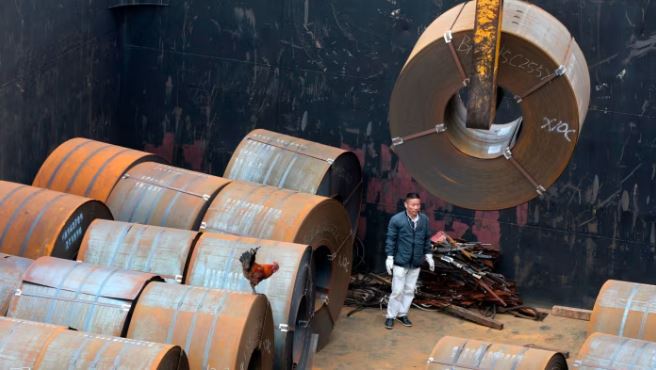
HIGHLIGHTS
CHINA & THE AMERICAS
Brazil launches investigation against Chinese industrial products dumping, says Analysis in the Financial Times
On 17 March, Brazil’s Ministry of Development, Industry, Trade and Services investigates the alleged industrial product dumping by China. They opened the probe to look into the past six months of imports on products ranging from metal sheets, pre-painted steel and tyres, etc. As China faces surplus production capacity there has been a flood of exports to China. In order to curb it, many European countries have imposed tariffs and Brazil joined the bandwagon by imposing temporary tariff hikes, as an “indispensable regulatory tool for combating these predatory operations and preserving the domestic market,” says the President of the Brazilian Chemical Industry Association, André Passos Cordeiro. This has created a dilemma for President Luiz Inácio Lula da Silva, who wants to further their relations with China while protecting the domestic industry. Another investigation found that by 2023 imports of carbon steel increased by 85 per cent and chemical phthalic anhydride rose to 2000 per cent between 2018-2023. Brazil is not the only country concerned, Vietnam also launched a similar investigation against the dumping of wind towers and steel products. The tariffs were also put in place after the US has been pressurizing countries, with Mexico recently imposing tariffs of 5-25 per cent on countries with which it does not have a free trade agreement. (Bryan Harris, Joe Leahy, A. Anantha Lakshmi, “Brazil launches China anti-dumping probes after imports soar,” Financial Times, 17 March 2024)
CHINA & SOUTHEAST ASIA
Filipino women trafficked to China as mail-order brides, warns Philippines Bureau of Immigration
On 18 March, according to a commentary in The South China Morning Post, titled “Filipino mail-order brides trafficked to China: alarm in Philippines over links to Chinese organised crime,” The Bureau of Immigration had recently warned of a complex trafficking scheme targeting Filipino women to China as mail-order brides linking to Chinese organised crime and trafficking syndicates. According to the immigration bureau, four couples have been arrested so far, and other documents looked original, thus prompting the officials to conduct further probes on these documents. Nathalie Africa-Verceles, a professor at the University of the Philippines’ Department of Women and Development Studies, said there is an organized crime group involved in the trafficking scheme and is responsible for the release of the legal marriage certificates. According to Ross Tugade, a human rights lawyer and professor of international law at the University of the Philippines, China’s gender gap is driving the demand for mail-order brides from the Philippines. Enriquez points out that women’s trafficking to China was a “historical phenomenon rooted in China’s patriarchal demand,” along with other Southeast Asian countries "such as Myanmar, Cambodia, Laos, and Vietnam used as source areas for women to be sexually exploited.” She also highlights the implications of China’s One Child Policy, which has resulted in an increased proportion of men to women by 35 million, thereby prompting Chinese men to search for wives. (Sam Beltran, “Filipino mail-order brides trafficked to China: alarm in Philippines over links to Chinese organised crime,” The South China Morning Post, 18 March 2024)
EAST ASIA
South Korea hosts Summit for Democracy in Seoul, warns against AI and digital risk to democracy
On 18 March, South Korea kickstarted the third Summit for Democracy, hosted in Seoul. South Korean President Yoon Suk Yeol addressing the gathering stated that the countries share the duty to exchange information on artificial intelligence and technology, to further promote democracy. He warned that AI and other digital technology without accountability are a threat to democracy. Yoon said: “Fake news and disinformation based on artificial intelligence and digital technology not only violates individual freedom and human rights but also threatens democratic systems.” The main agenda for the meeting was the threat and the use of technology for democracy. US Secretary of State Antony Blinken reached Seoul and stated: “As authoritarian and repressive regimes deploy technologies to undermine democracy and human rights, we need to ensure that technology sustains and supports democratic values and norms.” Several countries accused China and Russia of misusing technology and surveillance, where the Ministry of Foreign Affairs Republic of Poland’s undersecretary called out the “disgusting web of lies spun by Russian propaganda, accelerated by social media, deep fake techniques and omnipresent bots.” (“South Korea hosted summit warns of AI risks to democracy,” Reuters, 18 March 2024)
CHINA READER DAILY WIRE
INTERNAL
Growing recreational activities market for the aging population in China
On 17 March, according to an editorial in Reuters titled “Tutoring the Elderly Is Growing Fast in China,” the growing elderly population is creating an opportunity for Chinese companies to provide recreational classes such as yoga, African drumming, and smartphone photography. Qiu Peilin, the Beijing head of Mama Sunset, said that China’s education industries will rise as the elderly learning businesses have been growing in Beijing since April 2023. Consulting firm Frost & Sullivan predicts China's senior learning market will grow 34 per cent by 2027 to USD16.8 billion, up from USD3.8 billion in 2022. The growing demographic crisis threatens China’s industrial base, finances, and poverty alleviation efforts. However, it is also seen as an opportunity for the ever-increasing elderly population by many investors. In March 2023, Premier Li Qiang vowed to announce tax incentives and financial support for older people. Rachel He, research manager at Euromonitor, said that the Chinese elderly market has great potential but is doubtful compared to the markets in Japan and South Korea due to the deep income inequality mindset and conservative attitudes among them, thus making them spend less on themselves. (“Tutoring the Elderly Is Growing Fast in China,” Reuters, 17 March 2024)
ENERGY & ENVIRONMENT
Beijing may approve ten nuclear reactors every year, Chairman of China National Nuclear Corporation
On 15 March, according to a commentary in Bloomberg, titled “China’s Nuclear Energy Expansion Is Getting Even Faster,” by Dan Murtaugh, the Chairman of China National Nuclear Corporation, Jianfeng Yu, said that Beijing may approve ten nuclear reactors every year, thus increasing the pace of atomic energy expansion. According to BloombergNEF, China has 36 nuclear reactors under development and will overtake France and the US to become the world’s largest nuclear power source by 2030. Dan notes that China has increased its share of renewable energy sources by adopting solar and wind, leading to irregular energy generation. According to the World Nuclear Association, out of 16 countries that are building reactors, China holds half the reactors under construction. According to BloombergNEF, the cost of constructing a nuclear reactor is much less for China than for France and the US due to greater support from state-backed banks. Also, China focuses on keeping the same design for all its reactors, thereby allowing the creation of a skilled workforce with readily available supply chains and less time and cost to build them. (Dan Murtaugh, “China’s Nuclear Energy Expansion Is Getting Even Faster,” Bloomberg, 15 March 2024)
CHINA & SOUTHEAST ASIA
Chinese New Village internment camps nomination for UNESCO angers Malaysians
On 18 March, according to an opinion piece in The Straits Times titled “Why an idea to nominate Chinese new villages as a UNESCO site got Malaysians riled up,” the Chinese new village, with a population of 4,000 people, was one of the 631 internment camps for the Chinese people around Peninsular Malaysia set by the British colonialists during the Malayan Emergency from 1948 to 1960. On 01 February, Local Government Development Minister Nga Kor Ming announced that the work for UNESCO recognition for the village is in process and will promote Malaysian Chinese history and culture through tourism. Selangor's Chinese new village cultural recognition has led to massive internal debates and was rejected by many Malay nationalists. On 05 March, Opposition party Parti Pribumi Bersatu Malaysia’s youth chief Wan Ahmad Fayhsal Wan Ahmad Kamal critiqued the historical value of the site and called them Cold War relics where the country fought against the communists, and instead vouched for Kampung Baru Kuala Lumpur as a UNESCO World Heritage site. Umno noted that the proposal would undermine the rights of the Malays as the country’s indigenous communities. According to Azril, Nga belongs to the Chinese-led Democratic Action Party, which has been in controversy for undermining Malay Muslim rights. On 13 March, Former Petaling Jaya MP Kua Kia Soong said that the proposal was an insult to the Malays as the villages were concentration camps during British rule. (Azril Annuar, “Why an idea to nominate Chinese new villages as a UNESCO site got Malaysians riled up,” The Straits Times, 18 March 2024)
CHINA & THE PACIFIC
“Today is a valuable opportunity to reflect on the challenges and opportunities that are now before us,” says Chinese FM Wang Yi visiting New Zealand
On 18 March, Chinese Foreign Minister Wang Yi met his New Zealand counterpart Foreign Minister Winston Peters, in Wellington as he began his tour of the country and Australia. Peters said in his opening remarks, “There have been some significant developments since we last met, not least a global pandemic that impacted both our countries.” New Zealand was the first developed country to establish a bilateral free trade deal with China in 2008. Chinese foreign ministry spokesman Wang Wenbin said that the country is willing to work more to deepen the bilateral relations between the two sides and is ready to contribute to the China-New Zealand and China-Australia comprehensive strategic partnerships. On 20 March, Wang will meet his Australian counterparts in Canberra to discuss the Australian citizen Yang Hengjun’s detention case. (“China’s foreign minister meets New Zealand counterpart, beginning a trip that also includes Australia,” Associated Press, 18 March 2024)
CHINA & SOUTH ASIA
China gifts a “PNS Rizwan” spy ship to Pakistan
On 17 March, China gifted Pakistan with a research vessel or spy ship, PNS Rizwan is the first in its class for the Pakistan Navy to deter the Indian Navy’s growing power in the region. It measures 87 meters, which makes it smaller compared to India’s INS Dhruv, which was inducted into the Indian Navy in 2021 and had the capabilities to track nuclear missiles and gather intelligence in modern-day warfare. The induction of PNS Rizwan puts Pakistan on the elite list of countries to operate such ships, including India, France, the US, the UK, Russia, and China. According to open-source intelligence expert Damien Symon, Pakistan’s naval modernization aligns with China’s strategic interests in the Indian Ocean region by enhancing the capabilities of its allies. PNS Rizwan can give Pakistan the ability to deploy near India’s coasts to monitor India’s missile launches as well as map oceanographic data. Also, it boosts China’s intelligence-gathering operations in the Indian Ocean Region. (Vikrant Singh, “Pakistan Navy gets its first spy ship, courtesy China,” WION News, 17 March 2024)
Arunachal Pradesh is “Inherent part of China’s territory,” says Chinese Defence Ministry
On 18 March, the Ministry of National Defense People's Republic of China’s spokesperson Colonel Zhang Xiaogang stressed that Arunachal Pradesh is part of Chinese territory. He called it: “inherent part of China’s territory.” He reiterated that the “Xizang” (Chinese name for southern Tibet) is part of Beijing’s territory and that they do not acknowledge the so-called “Arunachal Pradesh” established by the Indian government. This comes after India rejected China’s unhappiness with Prime Minister Modi’s visit to the state. His remarks also come in light of India’s plan to increase military readiness in the region through the Sela Tunnel, Arunachal Pradesh. China considers Arunachal Pradesh to be South Tibet, a claim rejected by India and they even dismiss the “invented” name they have imposed on the region. The Sela tunnel is set to be built to provide connectivity and is strategically stationed in Tawang to ensure easy movement for the Indian troops. Zhang asked India to refrain from complicating the border issue and work towards maintaining peace in the region. (“Arunachal Pradesh ‘inherent part of China’s territory’, claims Chinese military,” The Indian Express, 18 March 2024)
CHINA & EUROPE
“Our national interests coincide,” says Putin on Russia-China relations
On 17 March, Russian President Vladimir Putin reinstated Sino-Russia relations in a victory speech post elections. He reckons that their relations will become stronger in the coming years. And stated that their relationship has a stabilizing factor and the personal equation between the two countries' leaders allows them to further develop their ties. Putin said: “Our relations have been taking shape over the past two decades. They are very strong and we are complementing each other.” Specifically referring to Xi Jinping he said that this good relationship will be maintained thanks to their good relations with the President of China. But even more vital he said is that: “our national interests coincide, and this creates a favourable environment for resolving our common tasks and in the sphere of international relations, where relations between Russia and China serve as a factor of stability.” (“Russia-China relations will become stronger, Vladimir Putin says in post-election victory speech,” South China Morning Post, 18 March 2024)
EAST ASIA & THE PACIFIC READER
EAST ASIA
North Korea fires ballistic missiles as US State Secretary Antony Blinken visits South Korea
On 18, the South Korean Joint Chief of Staff informed that North Korea fired a ballistic missile test towards the east of the Korean peninsula. The test ballistic missile run is expected to be conducted in light of the US States Secretary Antony Blinken’s visit to Seoul for the Summit for Democracy. Japanese Coast Guards also confirmed the launch and said that the remainder of the launch had already fallen. The US has been an active ally of South Korea and has stationed several of its troops and military technology in the region, with both countries participating in regular exercises. This goes against North Korea’s wishes and they believe South Korea is inviting an external actor in the region and that the US is intervening in internal matters of the Korean Peninsula. (“North Korea fires ballistic missile towards the sea: South Korea military,” The Straits Times, 18 March 2024)
Taiwan’s Dunmu Goodwill Fleet kickstarts friendship tours towards the Pacific
On 16 March, the Taiwanese Navy started its friendship tour across the region and towards the Pacific. The marines of the Taiwanese Navy executed concrete-smashing stunts and somersaults before the ship boarded. The three warships will be participating in the tour are called the Dunmu Goodwill Fleet, they will first circle Taiwan and stop at various ports to showcase their talent. The visit to the Pacific Island stands crucial as the support for them dwindles after the elections, and Naru was poached by China. Taiwanese Naval Academy students expressed that as the tensions rise, they hope that this provides an opportunity for them to put their theoretical understanding to practice. The ships unfurled slogans stating: “Support national defence, protect the homeland.” (“Taiwan’s navy hosts warship tours before Pacific charm offensive,” The Straits Times, 17 March 2024)
16 March 2024, Saturday | Vol.1 No. 33
The US House of Representatives voted in favour of banning TikTok
Fiji reaffirms policing cooperation deal with China | “China does not want Vietnam to join the United States and its allies,” China warns Vietnam, an Opinion in VOA |
HIGHLIGHT
CHINA & THE AMERICAS
The US House of Representatives voted in favour of banning TikTok
On 13 March, the House of Representatives voted with a total of 352 representatives in favour of passing the bill. China has opposed the Bill proposed by the U.S. Congress which aims to ban TikTok and has also accused the US of “unjustly” behaviour comparing it to a “Bandit.” According to the bill, TikTok’s parent companies will have 2 options either to separate themselves from TikTok or to face a ban. The concern over TikTok from the viewpoint of the lawmakers in the US is the user's data being misused. According to Wang Wenbin a Chinese Foreign Ministry Spokesman, the vote on the bill is against the principle of fair competition and justice. The CEO of TikTok Shou Zi Chew stated that this bill will lead to “Billions of dollars out of the pockets of creators and small businesses” and will also cause a job risk to the 300,000 Americans. On 13 March, The TikTok creators interviewed by the BBC said that they are worried about their livelihood and business if this bill becomes Law. On 14 March, the Government of Canada initiated a national security review of TikTok's expansion in the country, which began in September and is still ongoing but the Prime Minister of Canada Justin Trudeau chose not to provide any comment on the ban similar to the one proposed in the United States. (Bernd Debusmann, “TikTok ban: China attacks 'bandit logic' of House vote” BBC, 14 March 2024)
CHINA & THE PACIFIC
Fiji reaffirms policing cooperation deal with China
On 15 March, Reuters quoted the Guardian Australia News where, Fiji confirmed to maintain the Policing cooperation deal with China, despite concerns raised in Australia. Fijian Home Affairs Minister Pio Tikoduadua stated that Fiji would revert to the original police agreement with China after a 12-month review. This confirmation came after the Fijian Prime Minister, Sitiveni Rabuka, put on hold the decade-old police cooperation deal between Fiji and China because of the differences in policing, investigations, and legal systems. On 15 March, according to Guardian Australia Pio Tikoduadua, only Fijian officers would undergo training in China, with no embedding of Chinese officers within the Fiji police force. In February, Australia's Pacific Minister, Pat Conroy, emphasized that there would be no role for China in policing the Pacific Island. Earlier in 2024 China's ambassador to Australia has countered this view by stating that China aims to form ties with Pacific Island countries to maintain the social order. (“Fiji upholds China policing agreement, Guardian Australia reports” Reuters, 15 March 2024)
CHINA & SOUTHEAST ASIA
“China does not want Vietnam to join the United States and its allies,” China warns Vietnam, an Opinion in VOA
On 15 March, VOA published an opinion titled, “China Gives Warnings on Vietnam-Australia Strategic Relationship,” by An Hai who quoted the spokesperson from the Ministry of Foreign Affairs of the People’s Republic of China, Wang Wenbin responding to a question by Shenzen TV on the Comprehensive Strategic Partnership (CSP) agreement between Vietnam and Australia saying, “Promoting bloc confrontation and creating exclusive circles runs counter to current trends and the shared goals of the nations in the region.” An, stated that Vietnam had signed CSP with China, India, Japan, the United States, Russia and South Korea. But China expressed its uneasiness, as the joint statement by the Prime Minister of Vietnam, Pham Minh Chinh and the Prime Minister of Australia, Anthony Albanese plans to settle the disputes in the South China Sea by peaceful means. A believes that China does not want Vietnam to join the United States and its allies. However, since Vietnam’s initial goal is to establish a security balance, China cannot be offended, said Ha Hoang Hop, an Associate Senior Fellow with Singapore’s ISEAS Yusof Ishak Research Institute. (An Hai, “China Gives Warnings on Vietnam-Australia Strategic Relationship,” VOA, 15 March 2024)
CHINA READER DAILY WIRE
INTERNAL
Appointment of a new press official for the Ministry of Foreign Affairs of China
On 15 March, the Ministry of Foreign Affairs of the People’s Republic of China announced on its website that a new senior press official, Lin Jian was appointed as the Deputy Director General of the Ministry’s Press unit to work on the release of information on diplomatic events and foreign policy. Lin graduated from Beijing Foreign Studies University and was sent to Denmark for studies by the Ministry of Foreign Affairs. He worked as a career diplomat in Warsaw and Copenhagen and returned home to work at the Foreign Ministry’s European Affairs Department. Lin served as Communist Party Chief at the Xinjiang Production and Construction Corps. (Sylvie Zhuang, “China’s foreign ministry brings in new press official from Xinjiang,” South China Morning Post, 15 March 2024)
CHINA & TAIWAN
Chinese Coast Guards to increase patrols near the Kinmen islands
On 15 March, Chinese Coast Guards issued that they plan to increase patrols near the Taiwan-administered Kinmen Islands amid rising Chinese fishing boat accidents. This comes after the February incident where a Chinese fishing boat was chased by Taiwanese Coast Guards for entering “prohibited waters” collapsed close to the island after the collision, this killed two crew members of the Chinese fishing boat. This led to a heated diplomatic row between China and Taiwan, both blaming each other. After the incident the Chinese Coast Guards stated, “We will continue to patrol to ensure the safety of the property of Chinese fishermen including Taiwan’s.” (“China steps up patrols around outlying Taiwan islands,” The Straits Times, 15 March 2024)
CHINA & SOUTHEAST ASIA
Philippine's efforts to reinforce its outpost in the South China Sea, “doomed to failure,” says Chinese Defence Ministry
On 15 March, a spokesperson from the Ministry of Defence of the People’s Republic of China, Zhang Xiaogang stated that the Philippines' effort to reinforce its outpost in the contentious water is set to face doom. On 05 March, the vessels of China and the Philippines collided near the Second Thomas Shoal, where the Philippines tried to carry out a resupply mission at the Thomas Shoal. Following the incident, Zhang stated, “It is the Philippines side that resorted to deception. Such illegal actions have violated the sovereignty of China.” After the incident this month, the Philippines stated clearly that Manila would not permit Beijing to remove its military base located on the Second Thomas Shoal. Later, Zhang further warned Manila to stop any further "provocative actions" that could intensify the conflict. (Dewey Sim, “‘Doomed to failure’: Beijing warns Manila against bolstering South China Sea outpost after ships collide,” South China Morning Post, 16 March 2024)
CHINA & THE AMERICAS
“Supremely ironic” the US Ambassador on Beijing’s position on TikTok ban
On 15 March, the United States Ambassador to China Nicholas Burns said that the position of Beijing is “supremely ironic” on the bill banning TikTok, stating that China itself puts censorship on the various online platforms within its territory. China has opposed the bill passed on 13 March stating that the bill is “unjustly suppressing foreign companies”. During an online seminar held by the East-West Centre, a US-based research organization US Ambassador Nicholas Burns stated that China’s stance is unjustified as China itself has banned TikTok not making it available for its 1.4 billion citizens. The online platform is closely watched by the Chinese government with tight control over it, no information against the government or China can be surfed online. Douyin by TikTok’s parent company has been used as a replacement for TikTok inside China. The next step for the bill is to be passed in the US Senate, on which President Joe Biden stated that if the bill gets passed in the Senate, he will surely sign it. ( “US ambassador says Beijing’s stance on TikTok ban ‘supremely ironic’” The Straits Times, 15 March 2024)
EAST ASIA & THE PACIFIC READER
EAST ASIA
Senior doctors resign in solidarity with Junior Medical professionals
On 16 March, A group of Senior South Korean Doctors announced that they would step down and resign from their posts on 25 March in solidarity with junior medical professionals. On 20 February, many trainee doctors in South Korea walked out from their work and started protesting against the governmental initiatives aiming to alleviate doctor shortages by expanding medical student intakes. According to the government the nation has however managed to stave off a complete catastrophe. Professor Bang Jae-seung, the head of the group said that Doctors from 20 universities have voluntarily decided to submit their resignation on 25 March but until the resignation has been filed all the doctors continue to do their duties as they were doing it before the strike. The South Korean Health Ministry clearly stated that there will be no negotiation and implementation of the reforms will happen “without wavering”. If the strike continues then the doctors and medical students have to face legal action and their licenses will be suspended too. The government aims to admit 2000 medical students from 25 March. Prof Bang has requested the government to reconsider this and if not it will be impossible to negotiate further. The junior doctors have also submitted a letter to the International Labour Organization requesting “emergency intervention”. (“South Korean senior doctors to resign in support of junior medics’ walkout” The Straits Times, 16 March 2024)
Fukushima nuclear wastewater release suspended after the earthquake
On 15 March, the Japan Meteorological Agency reported that Japan was hit by an earthquake of 5.8 magnitudes on the coast of the northeastern Fukushima region. Amidst the Earthquake the nuclear release of wastewater from Japan’s stricken Fukushima Daiichi nuclear plant was suspended. According to the operator of the nuclear plant, this was a precautionary measure. Tokyo Electric Power Company (TEPCO) also stated that there were no abnormalities in the system but they have suspended the operations by the “predefined operational procedures”. Japan’s nuclear regulatory authority has also supported this and stated that there were no abnormalities in the Fukushima Daiichi plant. From August 2023 Tokyo Electric Power Company has started to release the nuclear wastewater into the Pacific Ocean which is the waste collected at Fukushima Daiichi since the 2011 accident. This release of the wastewater is criticized by China and Russia which has led to the ban on Japanese seafood imports. (“ Japan suspends Fukushima water release after quake as precaution” The Straits Times, 15 March 2024)
Hong Kong court sentenced 12 pro-democracy protesters to 7 years of imprisonment
On 16 March, The Hong Kong Court of Law passed the verdict and sentenced 12 accused to up to 7 years of imprisonment for the 2019 pro-democracy demonstration where the protestors broke into the legislative council. On 1 July 2019, the 22nd anniversary of Hong Kong’s handover of the territory from British to Chinese sovereignty, a large number of protestors broke into the city’s legislature building and vandalised the infrastructure. There were 14 people who were accused of participating in the protest and later charged with the offence of riots, criminal damage, and trespassing in the legislative chamber. Out of these 14 accused 12 people were sentenced to up to 7 years in prison and the rest 2 accused were charged with a fine of HKD1,500 (USD190). Deputy judge of the district court of Honk Kong Li Chi-ho stated that “Aside from the actual damage to the building, it had a symbolic meaning which was challenging the Hong Kong government and even weakening its governance,” According to a children’s rights activist and a former student leader, Althea Suen the actual crime which the protestors have committed is the “pursuit of democracy, freedom of thoughts and free will”. The protest is said to be a demonstration against the government bill to amend the fugitive offender’s ordinance regarding extradition. (“Hong Kong court jails 12 for storming parliament in pro-democracy protests” The Guardian, 16 March 2024)
13 March 2024, Wednesday | Vol.1 No. 32
China objects to Taiwan Vice President’s visit to the US
Taiwan redefines first strike definition against China | China to use TikTok to influence 2024 US elections, says the US Director of National Intelligence |
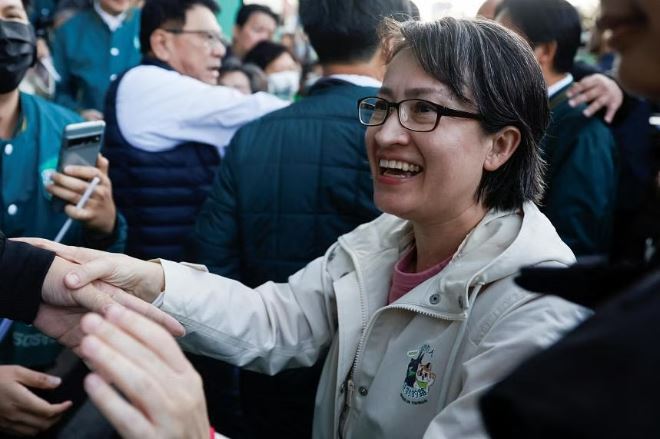
HIGHLIGHTS
CHINA & TAIWAN
China objects to Taiwan Vice President’s visit to US
On 12 March, Chinese officials objected to newly elected Taiwanese Vice President Hsiao Bi-khim’s private visit to the US. Chinese Embassy Spokesman Liu Pengyu said that the country firmly opposes any form of official interaction between the US and "the Taiwan region” and referred to Hsiao as "a diehard 'Taiwan independence' separatist." He added that the US must not facilitate any contact between the US government officials and Hsiao Bi-Khim. Taiwanese officials clarified that Hsiao will be in the US for the next few days and is on a low-profile personal trip. The US State Department reiterated that Hsiao would be travelling in her capacity. Hsiao was Taipei's de facto ambassador to the United States from 2020 until 2023, when she joined the Taiwanese presidential race and decided in an election in January 2024. (“Taiwan's vice-president elect Hsiao on 'personal trip' to the US; China objects,” The Straits Times, 13 March 2024)
CHINA & TAIWAN
Taiwan redefines first strike definition against China
On 12 March, according to an analysis in The Straits Times, the Ministry of National Defense of the Republic of China updated its definition of “first strike” to include any warplane or vessel incursion into its territorial space. This highlights a shift away from the Taiwanese military’s traditional rule of engagement, where the armed forces are authorised to respond only after an enemy has fired a first shot, such as a missile or artillery shell. Taiwan defines its territorial space as 12 nautical miles from its coast, which is in line with international conventions. Taiwanese Defense Minister Chiu Kuo-cheng said, “We should not rashly provoke war, but we must strengthen combat readiness.” While the Defense Ministry’s comments focused on air space, Chiu’s statement also focused on covering territorial waters. Dr Chen Liang-chih, a military expert at Taiwan’s Institute for National Defence and Security Research (INDSR), said that China’s grey zone tactics to intimidate Taiwan are increasing daily by erasing the median line concept and moving close to Taiwan. He further said that Beijing might increase its pressure tactics close to May during the President’s inauguration to weaken Lai’s credibility before taking office. (“‘Cannot be passive forever’: Taiwan updates definition of ‘first strike’ to counter China,” The Straits Times, 12 March 2024
CHINA & THE AMERICAS
China to use TikTok to influence 2024 US elections, says the US Director of National Intelligence
On 13 March, according to an analysis in The Guardian, the Director of National Intelligence, Avril Haines, said during the House of Representatives intelligence committee hearing that China could use the social media app TikTok to influence the 2024 US elections. Lawmakers also raised concerns about the growing influence of the Chinese government over the app and its content, creating US political divisions. Democratic Representative Raja Krishnamoorthi, along with Republican chair Mike Gallagher, introduced the bill last week that would give TikTok’s Chinese owner ByteDance six months to divest its stakes from the company. The House is scheduled to vote on the bill on 13 March. On 11 March, the 2024 annual threat assessment of the US Intelligence Community reported that the Chinese propaganda arm used TikTok accounts to target candidates from both political parties during the US midterm election cycle 2022. FBI Director Christopher Wray voiced the same concerns and said that TikTok will compromise their devices to Chinese interference. (“China could use TikTok to influence US elections, spy chief says,” The Guardian, 13 March 2024)
CHINA READER DAILY WIRE
INTERNAL
Chinese citizens question beverage giant Nongfu Spring national allegiance, calls for boycott
On 13 March, according to an opinion in The Strait Times, Chinese domestic beverage brand Nongfu Spring faced boycott calls from mainland nationalist citizens, questioning their national allegiance, the firm is facing in working in a highly patriotic environment. The boycott calls started after the death of the founder of key rival Hangzhou Wahaha Group on 25 February, leading to a sharp drop in its stock by 06 per cent on the Hang Seng China Enterprises Index. The critics argue that the packaging of Nongfu Spring has some elements linked to Japan. Other criticism includes the old debate on Nongfu’s superior water quality over Wahaha and other brands. Some critics blame the company as its founder, Zhong Shanshans’ son, possesses a US passport, doubting the family’s allegiance to China. The growing nationalistic pressure is backlashing some domestic firms amid the country’s pivot from foreign brands. The nationalistic sentiments also create challenges for the government’s efforts to restore the country’s private sector, which has been subjected to tight regulations in achieving the 5 per cent growth rate. The Supreme Court has vowed to punish online attacks against domestic entrepreneurs to facilitate a conducive environment for the nation’s economy. (“China bottled water giant Nongfu Spring faces boycott calls,” The Straits Times, 13 March 2024)
One killed and many injured in a building explosion near Beijing
On 13 March, one person was killed, and 22 people were hurt in a four-storey building blast near Beijing. The explosion occurred at 7:54 am in Sanhe county of Langfang in northern Hebei province, neighbouring Beijing. The government stated that the explosion happened due to a gas leak at a fried chicken restaurant in Yanjiao, a town in Sanhe. The municipal department had dispatched 36 vehicles and 154 personnel to the blast scene. (Alyssa Chen, “1 dead and more than 20 hurt in China after blast tears down 4-storey building near Beijing,” South China Morning Post, 13 March 2024)
ECONOMY
China’s mounting local government threatens’ its target growth: Opinion in The Financial Times
On 13 March, an opinion in the Financial Times, China has started ending infrastructure projects in debt-ridden provinces to curb infrastructure spending to meet its target economic growth. Many analysts project that China’s ambitious 5 per cent target annual growth rate announced during the Two Sessions meeting will be difficult to achieve. According to Michael Pettis, a finance professor at Peking University, the Chinese government focused on tackling the real estate crisis in 2021 and is now focused on addressing the local debt issue. According to a policy document referred to by the Financial Times, China’s State Council to maintain oversight on the government projects for the ten debt-laden provinces. Many local governments tried to seek debt relief on the sidelines of the NPC’s two-session meeting. As per Goldman Sachs analysis, China is trying to reallocate the fiscal stimulus by scrapping the debt-ridden projects in indebted areas to other provinces for balanced growth. Chris Beddor of Gavekal Dragonomics says that the local government’s attempts to restructure the debts through bank-issued bonds are not ideal in the long term and will create many policy errors for its growth target. (Joe Leahy; Ryan McMorrow; Cheng Leng, “China’s treatment of local debt ‘ulcer’ threatens growth target,” Financial Times, 13 March 2024)
CHINA & EAST ASIA
“Behave cautiously and in a neutral manner,” Chinese Foreign Ministry warns South Korea
On 12 March, the Ministry of Foreign Affairs of the People’s Republic of China warned about South Korea’s behaviour in the disputes between Beijing and Manila in the South China Sea (SCS). The Ministry Spokesperson Wang Wenbin expressed severe concerns about South Korea’s comments about a collision between Chinese and Philippine coast guard vessels near the Second Thomas Shoal last week. Wang pointed out that South Korea is not part of the South China Sea disputes and has repeatedly blamed China over many years. He also said that Seoul has abandoned its neutrality stance. On 07 March, a spokesman for the Ministry of Foreign Affairs of the Republic of Korea said that Seoul was “deeply concerned about the dangerous situation” and “use of water cannons against the Philippine vessels in the South China Sea.” The Second Thomas Shoal, known as Renai Jiao in China and Ayungin Shoal in the Philippines, is an uninhabited reef located within the Philippines' 200-nautical mile exclusive economic zone. Using its Nine Dash Line claims, China is trying to claim sovereignty over the entire Spratly Islands. (Liu Zhen, “‘Watch yourself’: Beijing warns South Korea after remarks on South China Sea clashes,” South China Morning Post, 12 March 2024)
CHINA & SOUTH ASIA
Chinese Foreign Ministry fields diplomatic protests against PM Modi’s Arunachal visit
On 11 March, China issues diplomatic protests against PM Modi’s visit to Arunachal Pradesh on 09 March and said that India’s actions would complicate the border issue. On 09 March, PM Modi inaugurated the Sela Tunnel, which was built at an altitude of 13,000 feet in Arunachal Pradesh. India had rejected Chinese claims and said that Arunachal Pradesh is an integral part of India, and China’s invented names won’t change the reality. Chinese foreign ministry spokesperson Wang Wenbin said, "Zangnan area is Chinese territory," and opposes India’s right to develop the area arbitrarily. (“China lodges protest over PM Modi's visit to Arunachal,” The Times of India, 12 March 2024)
CHINA & EUROPE
China’s new diplomatic initiative to repair ties with EU: VOA Analysis
On 12 March, according to an analysis in the VOA, China launched new diplomatic initiatives to repair its ties with the EU by sending its special envoy on Eurasian affairs on shuttle diplomacy to many European countries. Last week in a press conference, Chinese Foreign Minister Wang Yi countered the EU’s outlook on China as “a partner, competitor and systemic rival” and stressed that “common interests outweigh differences.” He said, “China and Europe do not have clashing fundamental interests between them or geopolitical and strategic conflicts.” Justyna Szczudlik, a China analyst and deputy head of research at the Polish Institute of International Affairs, says that China is attempting to revive ties with the US and EU as Western sanctions are hurting the Chinese economy. Sari Arho Havren, an associate fellow at the Royal United Services Institute, said that despite Beijing’s efforts, the old strains remain, including trade imbalance and China’s stance on the Ukraine war. Beijing had recently extended visa-free travel to six other European countries to amend ties with the EU. Chinese special envoy on Eurasian affairs, Li Hui, conducted a second round of shuttle diplomacy to Russia, Brussels, Poland, Ukraine, Germany, and France in early March to oppose its stance against EU’s sanctions on Chinese companies. He told his European counterparts that Ukraine’s territorial integrity would be ensured only when the EU stopped sending its arms to Kyiv. (William Yang, “China Renews Diplomatic Push to Repair Strained Ties with EU,” VOA, 12 March 2024)
CHINA & THE AMERICAS
China opposes US’s 100 million dollar proposal to strengthen Taiwan’s cross-strait deterrence
On 12 February, China rejected the US administration’s budget proposal to seek USD 100 million to help strengthen Taiwan’s cross-strait deterrence. Chinese Ministry of Foreign Affairs spokesperson Wang Wenbin said, “China strongly opposes US’ efforts to arm Taiwan and will take resolute measures to firmly safeguard its own sovereignty and territorial integrity.” The US Department of State, in its standalone 2025 budget, said that it is a “historic investment in Taiwan’s security … [to] strengthen deterrence and maintain peace and stability across the Taiwan Strait.” The US Department of Defense sought USD 500 million under the US Pacific Deterrence Initiative to replenish weapons that would enable Taiwan to address Chinese aggression in the region. The funding requests are part of a USD 7.27 trillion budget by US President Joe Biden for the 2025 financial year. The Deputy Secretary of State for Management and Resources, Richard Verma, said that the USD 100 million aid would strengthen Taiwan’s capability and assure the US’s commitment to security assistance for the island country to ensure a free and open Indo-Pacific. He added that the funding was part of the International Military Education and Training Programme (IMET), which assists cooperation between the US and foreign militaries. The budget requests come as Taiwan continues to face increased threats from the PLA. (Lawrence Chung, “Beijing hits back after Biden White House seeks US$100 million to boost Taiwan’s cross-strait deterrence,” South China Morning Post, 12 March 2024)
12 March 2024, Tuesday | Vol.1 No. 31
CCP amends law to uphold party leadership over the State Council
Ukraine to lose war without American aid , and bolster Chinese ambition in Taiwan and SCS, says CIA | Chinese companies to boost energy investments in Laos|
HIGHLIGHTS
INTERNAL
Chinese Communist Party amends law to uphold party leadership over the State Council
On 11 March, South China Morning Post reported on the legislature (NPC) passing a revised law allowing the CCP to gain more control over the State Council, ending the separation of power between the party and the state. It amended the Organic law of the State Council with 2,883 votes in favour, eight against, and nine abstentions. The amended law states that the State Council must uphold the party leadership and follow the political teachings of the party leadership, including President Xi Jinping. Deng Yuwen, former deputy editor of Study Times, said that Xi has revived Chairman Mao’s famous slogan: “Government, the military, society and schools, north, south, east and west – the party leads them all.” According to Zheng, the State Council law was passed in 1982 by Deng Xiaoping, which pushed for the separation of party and the government to prevent the concentration of power seen during the Mao era, especially the Cultural Revolution. The party’s control over the cabinet took place under Xi’s presidency. According to Deng Yuwen, an independent researcher, this amendment will make Xi the sole decision-maker for all policy matters. (William Zheng, “‘Two sessions’ 2024: China ‘all about the party’s leadership’ as it gets more control over cabinet,” South China Morning Post, 12 March 2024)
CHINA & THE AMERICAS
Ukraine to lose war without American aid , and bolster Chinese ambition in Taiwan and SCS, says CIA
On 11 March, according to a report from the Annual Threat Assessment 2024 in The New York Times, Senior US Intelligence officials warned of Ukraine losing the war with Russia without American as Russia continues to get regular and ample supply of arms and technology from China. During the public testimony, the officials predicted that any delays in US aid to Ukraine would translate into additional territorial gains by Russia, and its impact would be visible in Europe and the Pacific. CIA director William Burns told the US Congress that the delays in US aid to Ukraine would create doubts amongst its allies and partners in the Indo-Pacific and would drive Chinese ambitions from Taiwan to the South China Sea. Director of National Intelligence Avril D. Haines expressed her concerns about Ukraine’s ability to maintain their advances amid a sustained surge in Russia’s ammunition production and purchase from North Korea and Iran. Burns mentioned that the additional US aid of USD 62 billion will enable Ukraine to pose long-term costs against Russia and can strike deep inside Russian territories of Crimea and the Black Sea fleet. (David E Sanger; Julian E Barnes, “Intelligence Officials Warn of Losses for Ukraine Without More U.S. Aid,” The New York Times, 11 March 2024)
CHINA & SOUTHEATS ASIA
Chinese companies to boost energy investments in Laos
On 12 March, according to an opinion in Nikkei Asia titled “China goes big on Laos power projects, boosting Southeast Asian sway,” Chinese state-owned companies are expanding their investments in hydroelectric power plants and transmissions in Laos, which is aiming to become the “battery of Southeast Asia.” The Nam Ou hydroelectric plant has seven dams and was built by the Power Construction Corp. of China, or PowerChina, at a cost of USD 2.8 billion. The plant began its full operation in 2021 with an annual capacity of 5,000 gigawatt-hours, equivalent to a small nuclear power plant. According to the American Enterprise Institute, Chinese companies invested USD 3.2 billion in Laos’ energy sector in March 2023, which is 30 per cent higher than the previous five years. According to Akama, PowerChina intends to build another new hydroelectric power plant in Pak Lay in the western part of the country in 2032. Furthermore, China General Nuclear Power plans to start generating solar and wind power in northern Laos. According to World Bank data, Laos' public debt has reached 125 per cent of its GDP, and China accounts for 50 per cent of its debt. At present, electricity exports are the main source of Lao’s foreign currency. (Kenya Akama, “China goes big on Laos power projects, boosting Southeast Asian sway,” Nikkei Asia, 12 March 2024)
CHINA READER DAILY WIRE
CHINA & SOUTHEAST ASIA
Manila must not invite other countries to intervene in SCS disputes, says Chinese FM spokesperson
On 11 March, Chinese foreign ministry spokesman Wang Wenbin said that the countries concerned in the territorial disputes, including resource exploitation, must not undermine China’s overall interests in the South China Sea (SCS) and must not invite extraterritorial countries to intervene in this dispute. He also said that the two sides must be careful and properly handle the dispute. Philippine ambassador to the United States Jose Manuel Romuadez said, “When the time comes that we are going to start exploring it, we’ll have the options to be able to see how we can secure the expedition,” and “we’re working closely with our allies, not only the US but also Japan and Australia.” According to Zhou, the SCS basin is expected to have 11 billion barrels of untapped oil and 190 trillion cubic feet (5.4 trillion cubic metres) of natural gas. However, territorial disputes exist among China, Vietnam, the Philippines, Taiwan, Malaysia, and Brunei, thus leading to tensions among the rival claimants. With the detreating ties with Beijing, Manila has recently increased its efforts to extract oil and gas in the Sulu Sea with an Israeli company named Ratio Petroleum Energy LP to conduct a 3D seismic survey in April 2024. (Lara Zhou, “South China Sea: energy exploration should not involve countries outside the region, Beijing says,” South China Morning Post,” 11 March 2024; “Philippine envoy says US key to Manila’s plan to tap oil, gas in South China Sea,” The Strait Times, 11 March 2024)
Countries placing higher priority on supply chain resilience and security: Editorial in The Guardian
On 11 March, according to an editorial in The Guardian titled “The Guardian view on supply chains: not only just in time, but just in case,” the US is increasingly concerned about the stagnant port infrastructure, especially the crane construction, which has not taken place in the US for decades, and the Biden admin has allocated USD 20 bn to the industry. In 2023, the EU foreign affairs chief, Josep Borrell, said, “a paradigm shifts from the primacy of open markets to the primacy of security; from ‘just in time’ to ‘just in case’.” The editorial also mentions the role played by the pandemic and its impact on the countries, forcing them to think about the debate between the efficiency and resilience of supply chains, the increasing climate change events, and the growing cyber-attacks on the world. According to a survey published by the British Chambers of Commerce in February 2024, the cost of containers from Asia to Europe has increased by 300 per cent, and consumers are suffering because of the increased price of supply chain disruptions. The editorial mentions the growing discussions on globalization and its successive terms, such as onshoring, friend-shoring, or nearshoring. The US is concerned about the potential war with China over Taiwan and its impact on the logistics. (“The Guardian view on supply chains: not only just in time, but just in case,” The Guardian, 11 March 2024)
EXTERNAL
Joint naval exercises between China-Russia and Iran near the Gulf of Oman
On 11 March, according to the Ministry of National Defense, the People’s Republic of China, China, Russia, and Iran are conducting joint naval exercises from 11 March to 15 March 2024 near the Gulf of Oman. The exercise aims to strengthen maritime cooperation and jointly safeguard regional maritime security. According to Iran’s state news agency, IRNA, the drills are set to start on 12 March with naval representatives from Pakistan, Kazakhstan, Azerbaijan, Oman, India, and South Africa as observers. Beijing said that it will send its guided missile destroyer Urumqi, guided missile frigate Linyi, and comprehensive supply ship Dongpinghu. Russian news media says that the exercise will enhance greater maritime security. It also reported that Russia sent ships from its Pacific Fleet, led by the Varyag cruiser. The exercise comes amid the ongoing tensions in the Red Sea due to the ongoing war in Gaza and the attacks on vessels by Houthi rebels. In 2023, former Chairman of the Joint Chiefs of Staff Mark Milley said that the alliance between the three countries would pose problems for the US in the long term. (Samuel Weinmann, “China, Iran, Russia Host Naval Drills,” VOA, 11 March 2024)
CHINA & THE PACIFIC
Concerns over delayed US aid delivery to the Pacific Islands
On 12 March, according to an opinion in The Guardian, titled “The US funding deal is good for the Pacific. But the key is what happens next,” after long delays, the US Congress approved a USD 7 billion funding package for the three Pacific Island countries (PICs) namely the Marshall Islands, Federated States of Micronesia and Palau on 08 March. The approval was meant to renew the Compacts of Free Association (Cofa) agreements, which focused on critical services for these countries for the next twenty years and provide special migration facilities to the US. In return, the US will receive exclusive access to the strategically located Pacific Island countries. According to the authors, the risk remains high as the chances of US attention diverting from PICs to Taiwan, Ukraine, and Gaza remain high. The main concern is the money, as the US has yet to deliver on USD 1 billion in aid committed to the previous two US-Pacific summits. Australia’s minister for the Pacific, Pat Conroy, China has increased its policing in the Solomon Islands and Kiribati. Another major risk is the increasing disturbances caused by climate change, natural disasters, and election interference. The US has an advantage in terms of assets like Market access, services to boost education, health, and infrastructure, and building relationships for greater community engagement with the PICs. (Meg Keen; Mihai Sora, “The US funding deal is good for the Pacific. But the key is what happens next,” The Guardian, 12 March 2024)
CHINA & SOUTHEAST ASIA
Cambodian shipments increasingly relying in Chinese-built canals
On 12 March, according to an opinion in Nikkei Asia titled “Cambodia to divert Mekong trade via China-built canal, vexing Vietnam,” Cambodia plans to shift its future trade along the USD 1.7 billion Chinese-funded Funan Techo canal, which connects Phnom Penh with Cambodian ports on the Gulf of Thailand, bypassing Vietnam's controlled waters of the Mekong Delta. Cambodian PM Hun Manet appealed for this canal construction as it creates geopolitical tensions due to the shifting of Cambodia’s dependence away from Vietnam, which not only undermines Hanoi’s regional leverage but strengthens Beijing’s influence in the Southern Mekong. According to Brook, the Chinese canal could pose a fault line between Cambodia and Vietnam amid increasing regional polarity. Cambodian officials note that the new canal would reduce shipping costs by 30 per cent, thus increasing the critical export industries, especially the garment industry. As per Mekong expert Brian Eyler, Camdoaian claims of limited environmental impact are wrong and will be worse than its estimates, and that the new canal will impact the Mekong Mainstream based on the maps submitted to the Mekong River Commission (MRC) Secretariat. (Jack Brook, “Cambodia to divert Mekong trade via China-built canal, vexing Vietnam,” Nikkei Asia, 12 March 2024)
CHINA & THE AMERICAS
Biden pressured to investigate against unfair practices by Chinese shipbuilders
On 12 March, the US Union Steel Makers union requested President Joe Biden to conduct an investigation against the alleged unfair Chinese economic practices in the shipbuilding and maritime logistics sectors. The USW and other unions will lodge a petition with the Trade Representative highlighting discriminatory practices that helped the Chinese shipbuilding industry. Former President Donald Trump used the same statute, Section 301 of the Trade Act, to justify the imposition of tariffs on Chinese imports in 2018. The union highlighted CCP’s strategy to dominate global trade through its shipbuilding industry and engage in predatory trade, and it is happy with Biden's admin policy to revive domestic supply chains. The unions are seeking to build momentum in this policy by reviving the US commercial shipbuilding industry. According to Demetri, it is expected that President Biden will unlikely turn down the investigation request due to the upcoming 2024 US Presidential elections. He highlights that any investigations against Beijing will create tensions between the US-China relations. This comes after the US Congress agreed to USD 52 billion to build a domestic chip-building industry. (Demetri Sevastopulo, “US steel unions urge Joe Biden to open probe into Chinese shipbuilding,” Financial Times, 12 March 2024)
US faces an “increasingly fragile world order,” says Annual Threat Assessment Report 2024
On 11 March, according to a report titled “Annual Threat Assessment 2024” in The Guardian, the US faces an “increasingly fragile world order,” due to great power competition, transnational challenges, and regional conflicts. The report also highlights an ambitious China, a confrontational Russia, some regional players like Iran, and capable non-state actors challenging the US primacy in the international system. The report mainly focused on the growing threats from Russia and Ukraine amid the ongoing Ukraine and Gaza war. The report points out China’s growing security assistance to Russia and its potential interference in US elections due to less intent to criticise China and increased US societal division. As per the US intelligence assessment, CIA director William Burns told the Senate Intelligence Committee that Putin was not serious about ending the conflict despite economic consequences and that Russia is becoming an economic vassal to China. The director of national intelligence, Avril Haines, said that the US Congress must continue its support to Kyiv and also send a tough message to China on its aggression against its neighbours such as Taiwan or in the South China Sea. (“US faces ‘increasingly fragile world order’ amid Russia and China threat,” The Guardian, 11 March 2024)
EAST ASIA & THE PACIFIC READER
EAST ASIA
Bilateral meeting between North Korea and Mongolia
On 11 March, the Ministry of Foreign Affairs of Mongolia said that North Korean Vice-Minister of Foreign Affairs Pak Myong Ho held talks in Mongolia with his counterpart, Amartuvshin Gombosuren. It was an unexpected trip, as North Korea plans to expand its diplomatic ties after its tight isolation during the Covid-19 pandemic. The last visit from North Korea to Mongolia was made by the country’s General Federation of Trade Unions of Korea in 2019. The ministry said that the two sides discussed the steady development of their bilateral relationship and to focus on international and regional cooperation. On 10 March, Pak also met Mongolian Foreign Minister Battsetseg Batmunkh. The ministry sent an invite to North Korea for the 9th International Conference on North-east Asian Security “Ulaanbaatar Dialogue” as well as the World Women’s Forum later in 2024. The two sides agreed to cooperate in areas such as education and culture. (“North Korea’s vice-foreign minister in Mongolia on rare visit,” The Strait Times, 11 March 2024)
11 March 2024, Monday | Vol.1 No. 30
On Lithium: China gets a head start in Zimbabwe
South Korean trainee doctor protestors license suspension | “Chinese forces trying to "normalize" drills near Taiwan,” says NSC|
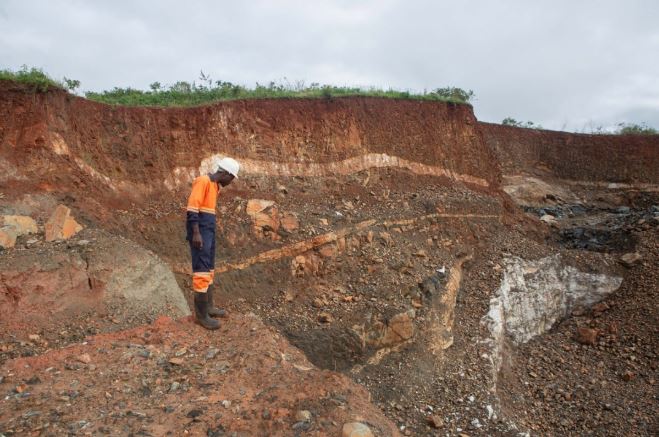
HIGHLIGHTS
CHINA & AFRICA
China gets a head start in in Zimbabwe amid global rush for lithium, Opinion
On 10 March, according to an Opinion in the South China Morning Post titled “China strengthens its grip on global lithium trade amid processing plant building boom in Zimbabwe,” by Jevans Nyabiage, China rushed for the lithium reserves as its major companies, such as Zhejiang Huayou Cobalt, Sinomine Resource Group and Chengxin Lithium Group, sets up the processing plants in Zimbabwe in 2023. According to Jevans, Zimbabwe is home to the world’s largest hard rock lithium reserves, which has attracted many Chinese companies to mine them, which are critical in lithium-ion batteries and other items. Beijing currently controls the global lithium-ion battery industry and dominates much of the processing of the minerals. As Jevans points out, China has increased its lithium procurement from Africa due to the ongoing trade dispute with the US and its desire to control the entire critical metal supply chain. According to data from Benchmark Mineral Intelligence, from August to the end of November 2023, Zimbabwean spodumene concentrate exports to China increased nearly five-fold to 177,000 tonnes (195,109 tons), compared to 38,000 tonnes in the same period of 2022. The extracted lithium reserves are then exported to China for further processing into lithium chemicals to make batteries and other electronic goods. According to Adam Megginson, a price and data analyst at Benchmark Mineral Intelligence, current lithium processing is limited, so there is growing political momentum in both countries to expand the processing industry in Zimbabwe. (Jevans Nyabiage, “China strengthens its grip on global lithium trade amid processing plant building boom in Zimbabwe,” South China Morning Post, 10 March 2024)
EAST ASIA
South Korean trainee doctor protestors license suspension
On 10 March, The Straits Times reported that the South Korean government would complete sending license suspension notices to thousands of trainee doctors. This comes after 90 per cent of South Korea’s trainee doctors did not report to work in the month of February. They are protesting against the government's plans to increase the enrollment number of medical students. The doctors who are served notice would be required to submit their view to the government, if not their license would be suspended for several months. The government states the proposal is to ease the burden on the doctors and to provide more doctors in rural areas. The protestors believe that this would not solve the issue and that they want to see changes in the malpractice system and give more protection to Physicians. The public is siding with the government and criticizes the protestors. They believe that the South Koreans are some of the best paid amongst other countries and that this protest is for the betterment of the health care system, but to increase their power. (“South Korea to finish sending licence suspension notices to doctors in walkout,” The Straits Times, 10 March 2024 )
CHINA & TAIWAN
“Chinese forces trying to "normalize" drills near Taiwan,” says Taiwanese National Security Bureau
On 11 March, Director-General of Taiwan’s National Security Bureau Tsai Ming-yen said in the parliament that China runs "joint combat readiness patrols" near its islands every 7-10 days on average, saying that the Chinese forces were trying to "normalize" drills near Taiwan. He added that China dispatches around 10 warplanes and three to four naval ships on joint patrols near Taiwan, referring to them as a “multi-front” effort that includes economic coercions and a misinformation campaign to pressure the island country. He said that the patrols were occasionally timed to coincide with diplomatic events such as visits by foreign lawmakers to Taiwan. Taipei has urged the Chinese side not to change the status quo in the Taiwan Strait by dispatching ships near the restricted waters. Tsai said Beijing is deploying its carrot-and-stick approach toward Taiwan ahead of the upcoming new president's inauguration speech in May 2024. (“China trying to 'normalise' military drills near Taiwan: island's top security official,” Reuters, 11 March 2024)
|
|
|
|
CHINA READER DAILY WIRE INTERNAL “Housing is for living in, not for speculation,” says Chinese Housing Minister |
|
|
|
|
|
EAST ASIA & THE PACIFIC READER |
09 March 2024, Friday | Vol.1 No. 29
Beijing and Bern urge Russia to attend Ukraine peace summit
South Korean government plans to increase trainee doctors pay
HIGHLIGHTS
CHINA & EUROPE
Beijing and Bern urge Russia to attend Ukraine peace summit
On 08 March, South China Morning Post reported that China and Switzerland had appealed to Russia to attend a peace summit regarding the war in Ukraine. In January, the Swiss government agreed to host a peace summit at the request of Ukraine. Beijing has expressed interest in attending the summit. The Swiss summit was discussed, as China's envoy for Eurasia, Li Hui, visited Europe and Moscow. Li Hui stated that Russia would attend the summit if the West ceases supplying arms to Ukraine and Ukraine cancels a decree signed in October 2022, declaring negotiations with Russian President Putin as impossible. Additionally, Li Hui highlighted to EU officials that the summit cannot be forced on Russia. The summit's agenda is expected to include nuclear safety, grain exports, and child trafficking. Kyiv and the EU have previously requested that Beijing engage in these matters, while China has advocated its 12-point proposal for peace released in February 2023. ("China and Switzerland in the push for Russia to join Ukraine peace summit," Finbarr Bermingham, South China Morning Post, 08 March 2024)
EAST ASIA
South Korean government plans to increase trainee doctors pay
On 08 March, the Government of South Korea proposed to increase the pay and improve working conditions for young doctors, a key demand from the protesting medical trainees doctors. Prime Minister of South Korea, Han Duck-Soo said that currently young doctors are forced to work for 36 hours, which is to blame for the protest walkout and the government will consider limiting it to 24 hours. The suggestions put out by Han seemed to be an attempt to reach an understanding with the demonstrators, even if they weren't giving up the government's plans to admit additional medical students. (“South Korea to boost young doctors’ pay even as it denies healthcare is in crisis,” The Straits Times, 08 March 2024)
CHINA READER DAILY WIRE
INTERNAL
Chinese government prioritizes National Security
On 08 March, VOA news reported that China is scheduled to adopt security laws in 2024 to eliminate "threats” to the government. Chinese legislator Zhao Leji, highlighted that lawmakers would safeguard China's sovereignty, security, and development interests during the agenda for the National People's Congress. Additionally, Zhao stated that the revision of the National Defense Education Law and Cybersecurity Law is expected. Zhao stated that to modernise China's system and capacity for national security, Beijing would enact an emergency management law, an energy law, an atomic law energy law, and a hazardous chemical safety law. The NPC is scheduled to introduce and amend laws regarding finance, education, and healthcare. However, Zhao did not offer details regarding what the new laws would involve. The "Two Sessions" attempt to provide a strategy for the Chinese government. ("China Vows To 'Safeguard' National Security With New Laws at Conclave," VOA news, 08 March 2024)
Chinese General calls for restrictions on fake combat military capabilities
On 09 March, South China Morning Post reported that Chinese General He Weidong stated that a crackdown is expected on fake combat capabilities in the military. The general remarked during a People's Liberation Army delegation. The discussion was related to the ongoing "two-session" gathering of China's legislature and political advisors. Analysts state that the crackdown might impact weapon procurement. Nine generals were ousted from the legislature on charges of violating discipline in December. Fake combat capabilities could also refer to drills that have not reached the standards required. The PLA, under pressure from Beijing, has attempted to improve real combat exercises and training. Additionally, on 6 May, senior generals pledged to deepen the anti-corruption drive. PLA delegation member, Chen Guoqiang suggested utilising data and intelligence tools to combat corruption in the military. (Amber Wang, "Chinese general calls for crackdown on ‘fake combat capabilities’ in the military," South China Morning Post, 09 March 2024)
ECONOMY
Rise in consumer prices indicates positive economic growth for China, says WSJ
On 09 March, The Wall Street Journal reported that Chinese consumer prices increased owing to expenditure amidst the Lunar New Year. The Consumer Price Index rose 0.7 per cent year-on-year in February. The year-on-year growth in consumer prices was the highest in 11 months. On 04 March, Premier Li Quang announced a growth target of more than 5 per cent. Additionally, Li set an inflation target of 3 per cent in 2024. In January-February, the CPI remained constant with food prices down 3.4 percent and non-food prices 0.9 down. (Jonathan Cheng, "Chinese Consumer Prices Edge Higher, Breaking a Four-Month Slide," The Wall Street Journal, 08 March 2024)
CHINA & TAIWAN
Taiwan urges Beijing to not alter the status quo
On 08 March, Taiwan's China policy-making body urged China to not alter the situation around waters near Taiwan's frontline islands. In February, Beijing conducted regular coast guard patrols around the Kimmen Islands. The surveillance follows the deaths of two Chinese fishermen fleeing Taiwan's coast guard. The Mainland Affairs Council deputy head, Jyh Horng, stated that the situation should be controllable and does not require measures that violate the status quo. Additionally, he highlighted that Taipei hoped that Beijing would employ peaceful means to engage with Taiwan and urged China to have more confidence. Additionally, Jyh urged Chinese authorities to permit Chinese students and tourists to visit the island following the COVID-19 pandemic travel disruption. China has stated that it would improve its defence expenditure by 7.2 per cent in 2024. ("Taiwan urges China not to alter situation around waters near frontline islands," The Strait Times, 08 March 2024)
CHINA & SOUTH ASIA
Indian deployment of troops would not ease tensions, says Chinese Foreign Ministry
On 08 March, China stated that India's deployment of 10,000 soldiers along the disputed border would not ease tensions. The Chinese foreign ministry spokesperson, Mao Ning, stated that China is committed to engaging with India to safeguard peace and stability in border areas. India has deployed 10,000 soldiers from its western border in Uttarakhand and Himachal Pradesh. Additionally, Mao stated that the increase in India's military deployment would not safeguard peace and safety in the region. The two countries have agreed to engage through military and diplomatic channels to resolve the issues on the western section of the India-China border. ("China says more Indian troops at Himalayan border won't ease tensions," Reuters, 8 March 2024)
CHINA & THE AMERICAS
The US seeks to divest Chinese company ByteDance, says SCMP
On 09 March, the South China Morning Post reported that US President Joe Biden stated that he would sign legislation resulting in Chinese company ByteDance divesting from TikTok. The legislation, known as the Protecting Americans from Foreign Adversary Controlled Applications Act, has been passed by the House Committee on Energy and Commerce. The bill was sponsored by Republican Mike Gallagher and Democrat Raja Krishnamoorthi. The bill aims to restrict the influence of foreign-controlled apps in the US. The bill would provide ByteDance with 165 days to divest from TikTok. Failing to divest could result in the suspension of web-hosting services at ByteDance. Republican presidential nominee Donald Trump highlighted that a ban on TikTok would result in Facebook doubling its business. Analysts speculate that China would unlikely permit any measures by ByteDance to divest from TikTok("Joe Biden vows to sign TikTok bill forcing China’s ByteDance to divest as Donald Trump voices concern," Igor Patrick, South China Morning Post, 9 March 2024)
The US urges allies to tighten the restrictions on chip tech exports to China, says Nikkie Asia
On 09 March, Nikkei Asia published an article with the headline, “U.S. urges Japan and Netherlands to tighten China chip tech curbs,” by Rintaro Tobita saying that the United States is urging Japan and Netherlands to heighten their restrictions on exports of chip tech-related goods to China, including the chemicals used for chip-making and equipment for older-generation chips. The shipment of goods not included in the ban imposed by the US to curb the exports of semiconductor-related goods to China in October 2022 has grown significantly. Japanese companies state that if Japan tightens the export of equipment for older chips, it will lose the market share meaninglessly as they know China can get access from another source. The United States is applying pressure in response to indications that its initial plan to restrict China's advancements in chip manufacturing has not been as successful as anticipated. (Rintaro Tobita, “U.S. urges Japan and Netherlands to tighten China chip tech curbs,” Nikkei Asia, 09 March 2024)
China is surpassed by Mexico as the leading exporter to the US in 2023
On 07 February, the Bureau of Economic Analysis released a data report saying that Mexico became the leading exporter to the United States in 2023 with 475.6 billion USD of exports surpassing China’s exports of 427.2 billion USD. The reason behind the fall in exports from China is the unstable relations between the United States and China, which made American companies diversify their supply chains to favourable places. One of which is the Southeast Asian region, which remains a stable region for building supply chains for semiconductors, especially with the countries Vietnam, Singapore and Malaysia. (Marrian Zhou, “Mexico replaces China as top exporter to U.S. in 2023,” Nikkei Asia, 08 February 2024)
EAST ASIA & THE PACIFIC READER
EAST ASIA
Taiwan expects more tourists from Indonesia
On 09 March, Nikkei Asia published an editorial on the topic, “Taiwan seeks more tourists from Indonesia,” by Randy Mulyanto saying that Taiwan is expecting a significant amount of tourists from Indonesia as the number of visitors from mainland China has reduced due to the political tensions and the COVID pandemic. However, the number of visitors from Indonesia had risen to 201,980 in 2023, which is a great improvement from 78,162 tourists in 2022 due to the pandemic, according to the data from Taiwan Tourism Administration. To even increase the rate of tourists, the Taiwan Tourism Administration in Indonesia under the Ministry of Transportation and Communications, often conduct workshops on Taiwan tourism. Additionally, Taiwan launched a Travel Authorization Certificate program that enables Indonesian nationals to visit Japan, South Korea, or any Western country without a visa as long as they possess one of these documents. (Randy Mulyanto, “Taiwan seeks more tourists from Indonesia,” Nikkei Asia, 09 March 2024)
National Security law in Hong Kong, concerns the financial community
On 08 March, a new national security law draft bill was proposed at the city’s legislature, that included serious offences such as treason, espionage and theft of state secrets, sabotaging national security, and external interference which could buy a life imprisonment. According to the government of Hong Kong, the bill is to fill the legislative gaps left by a national security law imposed on Hong Kong by China in 2020. The Chairman of the Swedish Chamber of Commerce in Hong Kong, Kristian Odebjer criticized the definitions of the law as ‘vague’, particularly for the theft of state secrets, including defence intelligence along with the information on the economy, and social and technological developments of the city. According to him, “This could negatively affect activities like research and due diligence that some of our members engage in.” (“Fears grow for Hong Kong’s finance hub status under proposed security law,” The Straits Times, 08 March 2024)
THE PACIFIC
The ties between Australia and the Philippines are significantly increased
On 09 March, SCMP published an editorial on the topic, “The Philippines’ ties with Australia are ‘stronger than ever’. Is it a sign it has West’s backing in South China Sea?,” by Maria Siow and Su-Lin Tan which outlines the President of the Philippines, Bongbong Marcos’ explanation on why the strategic ties between Australia and Philippines had “grown more important than ever.” He started with the long-known prosperity and the development of their ties which helps in maintaining peace and stability in the Indo-Pacific region. Marcos also stated the importance of strengthening cooperation as the Philippines is severely facing tensions with China in the South China Sea region. He continued to say that we must come together to face the challenge, as it cannot be done by one country itself. He addressed the ten-member Association of Southeast Asian Nations, saying, “This is meant to indicate to ASEAN member states and to the region that the Australia-Philippine strategic partnership is alive and well, and stronger than it has ever been.” (Maria Siow and Su-Lin Tan, “The Philippines’ ties with Australia are ‘stronger than ever’. Is it a sign it has West’s backing in South China Sea?,” South China Morning Post, 09 March 2024)
07-08 March 2024, Friday | Vol.1 No. 27 & 28
Deepening ties between China & Russia
China’s aggressive sea tactics in the South China Sea, says WSJ | “The Philippines should not let itself be at the mercy of the US,” says Chinese FM
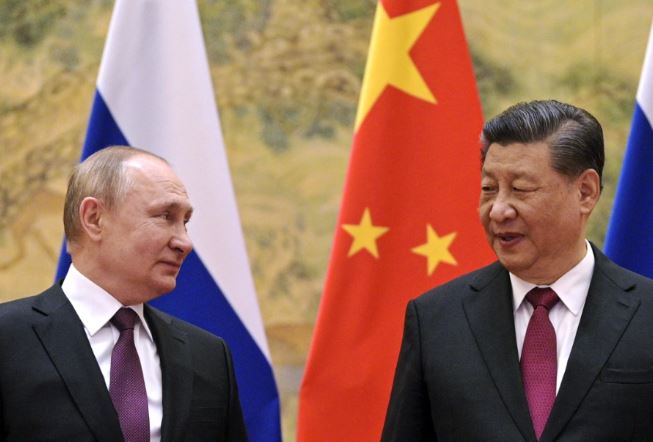
HIGHLIGHT
Ties deepen between China and Russia
On 08 March, according to an editorial in The Straits Times titled “China-Russia ties set to deepen as Ukraine war heads into third year,” by Lim Min Zhang, ties between China and Russia deepened amid the third year of the war in Ukraine as their bilateral trade grew record total of USD 240 billion beyond expectations. On 07 March, on the sidelines of a press conference during the NPC meeting, Chinese Foreign Minister Wang Yi said that the relations between the two major powers led to “a new paradigm of great power relations that is completely different from that of the old Cold War era.” He added that Russia’s energy, especially natural gas, powers thousands of Chinese homes, and the presence of Chinese people in Russia reflects the mutually beneficial cooperation between the two sides. In 2019, Both countries set a target of USD 200 billion in trade by 2024, which has been surpassed in 2023. Russia has overtaken Saudi Arabia as the largest oil supplier to China, and Russia, in return, imported more consumer and manufactured goods from China. According to Dr Liu Minran, China wants to ensure that the West does not undermine its interests and wants to become another pole in the changing world order. It would not let Russia away as China strives for greater international influence. (Lim Min Zhang, “China-Russia ties set to deepen as Ukraine warheads into third year,” The Straits Times, 08 March 2024)
China’s aggressive sea tactics in the South China Sea, says WSJ
On 06 March, according to an editorial in The Wall Street titled “How China’s Aggressive Sea Tactics Look From the Deck of an Opposing Ship,” by Feliz Solomon, a large fleet of Chinese coast guard ships surrounded the Philippines convoy, leading to the two minor collisions between the vessels of two countries. The Philippines ships supplied logistics to the small military outpost in the Second Thomas Shoal. Philippines Coast Guard Ensign Bernadette Soriano Addun said Chinese manoeuvres are unpredictable and scary. The incident happened on 05 March. For the first time, the Philippines invited foreign journalists to the supply mission, which takes place twice a month. According to Feliz, under President Marcos’ leadership, the Philippines has taken an assertive stance by publicizing China’s actions and strengthening security ties with the US, EU, Japan, Australia, and India. The International Tribunal in The Hague ruled in 2016 that China’s claims have no legal basis, but China rejected the ruling. China has accused the Philippines of using these missions to ferry construction materials to the Sierra Madre as they might use it to build permanent military outposts. The Philippines rejected their claims and said it had the right to repair the ageing ship. (Feliz Solomon, “How China’s Aggressive Sea Tactics Look From the Deck of an Opposing Ship,” The Wall Street Journal, 06 March 2024)
“The Philippines should not let itself be at the mercy of the US,” Chinese Foreign Ministry
On 06 March, China accused the US of using the Philippines as its “pawn” in the South China Sea conflict. The comments come as the tensions in the region escalate over the territorial disputes. After the recent incident, the Philippines summoned the Chinese representative over the Chinese vessel colliding with the Philippines Coats Guards and using water cannons at them. This happened as the Philippines Coast Guards were on a resupplying mission for its troops. China refuted the accusations of aggression and stated that they “took control measures” against the illegal intrusion by the Philippines, additionally, they accused the Philippines coast guards of intentionally ramming into the Chinese vessel. Chinese Foreign Ministry spokesperson Mao Ning said: “China urges the US not to use the Philippines as a pawn to stir up trouble in the South China Sea,” and that “The Philippines should not let itself be at the mercy of the US.” (“China says US using Philippines as ‘pawn’ in the South China Sea,” The Straits Times, 06 March 2024)
CHINA READER DAILY WIRE
INTERNAL
China updates the list of suspected journals of being “untrustworthy”
On 06 March, according to an interview in Nature by Smriti Mallapaty, China’s Early Warning Journal List updated the list of journals as its latest edition in February 2024 added 24 more due to untrustworthiness, predatory or not serving the Chinese research community’s interests. It flagged journals that violated citation counts for the first time in its publication. In 2024, Nature updated the method for developing the list as the Chinese ministries sent notices about the journals. According to Yang, with feedback from the publishers, the number of journals in the list was reduced from 50 to 24. Yang also said that the journal’s list this year removed the low-risk category to allow the journal to receive a maximum number of manuscripts. Yang also mentions the growing manipulations about the author names used and alerts the researcher immediately about the same. She added that the journals with a paper mill problem are identified using social media and websites such as PubPeer for published articles for better research integrity. (Smriti Mallapaty, “China has a list of suspect journals and it’s just been updated,” Nature, 06 March 2024)
Growing support against government’s push for marriage among Chinese youth, Opinion
On 07 March, according to an opinion in The Straits Times, titled, “More Chinese women choose singlehood amid record youth unemployment, economic downturn,” there is a growing trend against marriage among young women in China, thus creating challenges against the government’s policy. With the declining population and low birth rates for two consecutive years, Chinese President Xi Jinping pushed in 2023 to cultivate a new culture of marriage and childbearing. Also, Premier Li Qiang stressed working towards a birth-friendly society. According to the author, the CCP views the nuclear family as the pillar of social stability in which unmarried mothers are kept out of government benefits. According to the government data, the number of single people over 15 grew to 239 million in 2021. According to a 2021 Communist Youth League survey of some 2,900 unmarried urban young people found that 44 per cent of women do not plan to marry. According to feminist activist Lu Pin, refusing childbirth or marriage is seen as non-violent disobedience towards the patriarchal state. Delayed marriages and falling birth rates will threaten China’s demographics. (“More Chinese women choose singlehood amid record youth unemployment, economic downturn,” The Straits Times,” 07 March 2024)
Chinese ambassadors urged CPPCC to increase international engagement
On 05 March, in an event chaired by Liu Jieyi, vice-chairman of the Chinese People’s Political Consultative Conference (CPPCC) Foreign Affairs Committee, China’s ambassador to the US and ambassador to Japan urged the representatives of the CPPCC to conduct more interviews with the foreign media and visit other countries to tell China’s story properly with the rest of the world. The discussion was part of the ongoing Two Sessions meeting of the top legislative bodies. China’s initiatives indicate the necessity to counter Western narratives in or about China’s side of the world and establish control over the international narrative. China’s ambassador to Japan, Wu Jianghao, said that non-party members' interaction with Western societies is more effective in communicating the message about China. He also urged them to promote China’s Global Development Initiative, the Global Security Initiative, and the Global Civilisation Initiative as part of President Xi’s foreign policy frameworks. According to political scientist Yang Mingjie, foreigners are interested in learning more about China and its domestic stability, growth, and modernization story. (Lim Min Zhang, “China’s ambassadors urge top advisory body to engage more with foreign media,” The Straits Times, 07 March 2024)
Chinese leadership offers assurances while achieving a 5 per cent GDP growth target
On 06 March, China assured that with the ongoing economic slowdown, the country has sufficient financial resources to tackle the crisis and assure foreign investors. National Development and Reform Commission chief Zheng Shanjie told the press that the leadership has a growth target of 5 per cent, which is in line with China’s growth potential. He stated that the 2024 growth target was kept the same as in 2023 as it weighed the current problems, long-term needs, and possibilities, and was part of the country’s 14th five-year plan (2021-2025). He also mentioned that the number of tourists increased by 19 per cent compared to the pre-COVID levels amid the Lunar holiday week. Zheng acknowledged that the target set faces many internal and external challenges while overcoming economic concerns. According to Xu Tianchen from the Economist Intelligence Unit (EIU), the Chinese economy has been in a long-term crisis and said that “the economy right now looks like a hardworking middle-aged man,” and it needs to change its approach. Zheng vowed to give complete rights to the private sector to boost investment in China. He further said that the three new types of exports, electric vehicles, lithium-ion batteries, and solar panels, are driving the Chinese economy and continue to make its presence in the global market. (Luna Sun, Amanda Lee, “China’s 5% GDP growth target demands ‘hard work’, leaders insist while flagging hopes and risks,” South China Morning Post, 06 March 2024)
China must clarify its anti-espionage laws for international students, says Peking University
On 06 March, according to an opinion in the South China Morning Post, titled, “‘Confusion’ over China’s spy laws could be deterring foreign students: academic,” the former dean of the International Relations School of the Peking University, Jia Qingguo wroten to the Chinese People’s Political Consultative Conference (CPPCC) that the government must provide complete detail of the anti-espionage law to reduce the concerns among the international students. He wrote that the implementation regulations of the law have not been issued yet, leading to confusion among the students and misunderstanding outside China. Despite lifting the Covid-19 lockdowns, international students have not returned to China. According to the data released by the US ambassador to China, Nicholas Burns, it is estimated that there are around 350 American students in China, much less than 15,000 students pre-Covid. Furthermore, the number of South Korean students also declined in China from 73,240 students in 2017 to 15,857 in 2023. He stated that geopolitics is the main reason for the reduced number of international students in China. (Laura Zhou, “‘Confusion’ over China’s spy laws could be deterring foreign students: academic,” South China Morning Post, 06 March 2024)
SCIENCE & TECHNOLOGY
Apple sales fall, and Huawei rises in China’s domestic market
On 06 March, according to a report published by the research firm Counterpoint in the BBC, Apple’s iPhone sales fell by 24 per cent in the first six weeks of 2024, whereas China’s Huawei’s sales grew by 64 per cent in the same period. According to Mengmeng Zhang from Counterpoint, beyond Huawei’s competition against Apple in the premium segment, the fierce competition led by Oppo, Vivo, and Xiaomi through aggressive prices dominates the Chinese market. According to the report, the overall smartphone market in China fell by 7 per cent in the same period. Furthermore, Huawei faced challenges in sales due to the sanctions imposed by the US that barred access to advanced chips and technology required to make 5G phones, which later increased in China by August 2023. The report noted that Huawei’s sales rose to 16.5 per cent to become the second largest player, whereas Vivo remained China’s top smartphone seller. Since February 2023, Apple has started offering discounts on its official sites to revive its sales. (Mariko Oi, “Apple: iPhone China sales slide as Huawei soars, report says,” BBC, 06 March 2024
ECONOMY
Chinese officials plan to increase stimulus for exports
On 06 March, according to an editorial in The Wall Street Journal titled “Chinese Officials Say Exports Are Strong but Hint at More Stimulus,” by Brian Spegele, Chinese officials hinted that there would be double-digit growth in the exports in January and February of 2024 by 10 per cent and the government aims to boost monetary stimulus to boost exports. Brain says that the government intends to paint a positive picture of the Chinese economy, and the official statistics will be released on 07 February. China’s central bank governor, Pan Gongsheng, plans to boost liquidity by cutting banks' reserve requirements., thus making the price rise and yuan stable. Commerce Minister Wang Wentao said that both imports and exports fell by 8.2 per cent. He further noted that foreign trade will be complex in 2024 due to the growing protectionism and the uncertainty over overseas political elections in 2024. (Brian Spegele, “Chinese Officials Say Exports Are Strong but Hint at More Stimulus,” The Wall Street Journal, 06 March 2024)
Trusting Chinese data can be challenging, says The Wall Street Journal
On 05 March, according to a commentary in The Wall Street Journal, CCP announced in its Two Sessions meeting that the growth rate targeted will be per cent in 2024. Premier Li Qiang said that the target will be challenging to achieve. According to Western analysts, Chinese GDP data is misrepresented and inconsistent as it serves President Xi’s goal of making China’s economic and political model reliable to the world. As per Rhodium Group’s data, China’s output declined in 2022 to 1.5 per cent growth compared to 3 per cent by the government estimates. Finland's Central Bank reports China's growth to be 1.2 per cent in 2022 and 4.3 per cent in 2023. According to the author, China’s retail data is heavily manipulated as multiple evidence reports of falling sales of Alibaba, rising household deposits, and local government debts. Furthermore, the fixed asset investment reported by China’s NBS as it reported a 3 per cent growth in 2023 instead of a 12 per cent decline. In China, the data published is used to praise the CCP’s success with Xi Jinping as the country’s leader. (Greg Ip, “Why You Shouldn’t Trust China’s Growth Data,” The Wall Street Journal, 06 March 2024)
CHINA & TAIWAN
Taiwan accuses China of using Grey-zone tactics
On 07 March, the Taiwanese Defence Ministry accused China of creating a grey zone near the Taiwan Strait, by making the areas around the region saturated with balloons, drones and boats. The Taiwanese defence agency has complained about the heightened Chinese aggression in the region by using grey-zone-warfare tactics. The tactics aim to exhaust the enemy with irregular pressure rather than resorting to open conflict. A report by the Taiwanese Defence Ministry was sent to the parliament outlining “multi-front saturated grey-zone” tactics stationed by China to harass Taiwan. This is done by increasing the burden on the naval and air forces and by stationing research vessels and militia in the region disguised as military activities. To deter these threats the report stated that the defence ministry is aiming to preserve its troops and wants to further boost its resilience by building defence infrastructure. (“China steps up grey-zone warfare to exhaust Taiwan: Defence report,” The Straits Times, 07 March 2024)
CHINA & EAST ASIA
North Korea ramps up security along the border with China
On 08 March, according to a report published by HRW on BBC News, North Korea adopted severe restrictive measures in the country that have not only led to its isolation and worsening humanitarian crisis but have led to reduced cross-border movement and trade with China. The report titled “A Sense of Terror Stronger than a Bullet: The Closing of North Korea 2018-2023,” mentions that North Korea is constructing 482km (299 miles) of new fencing beyond the existing 260 km of border fence. Along with the fence, additional authoritarian rules have been enforced, like the shoot-on-sight order for border guards. Many survivors say that many North Korean people are suffering from hunger and poor health. The Covid-10 lockdown has stopped the cash flow from South Korea to relatives in North Korea. The UN reported that the sanctions had led to a severe impact on the women. (Michael Sheils McNamee, “Images show North Korea sealing its border with China,” BBC, 08 March 2024)
China needs to maintain an edge against South Korean rivals in shipbuilding, says SCMP
On 08 March, according to an editorial in the South China Morning Post titled “For China to leave S Korean shipbuilding rivals in its wake, leaders told to be stern in shipbuilding efforts and seas the day,” by Luna Sun; according to Fu Guotao, chief engineer of the China Shipbuilding Industry Corporation and a delegate of the National People’s Congress (NPC), China needs to maintain an edge against its rivals South Korea in the world’s shipbuilding market in terms of design and manufacturing and to ensure self-sufficiency in the sector. He also points out that international tensions have affected ship engines' supply chains. He adds, "China lacks core R&D capabilities for key engine components, positioning China at the lower end of the industrial chain in the international market, leading to low competitiveness, a small market share, a lack of pricing power, and limited product development.” According to Sun, China became a dominant player in the shipbuilding industry in 2023 for 50.2 per cent of the total volume, 66.6 per cent of new orders and 55 per cent of backlogged orders. According to Clarkson Research, China overtook South Korea as the top receiver of global shipbuilding orders in 2021 regarding annual volumes but lagged in advanced technologies, designs, and standard-setting. Sun points out that South Korea plans to expand its advantage in the shipbuilding industry as it similarly seeks to contend with growing challenges from China. (Luna Sun, “For China to leave S Korean shipbuilding rivals in its wake, leaders told to be stern in shipbuilding efforts and seas the day,” South China Morning Post, 08 March 2024
CHINA & SOUTHEAST ASIA
China and the Philippines doubles down on their positions in the South China Sea
On 07 March, according to an editorial in the South China Morning Post, titled “South China Sea: Beijing poised for ‘long game’ with Manila over shoal dispute to avoid drawing in US, analysts say,” by Laura Zhou, both countries will not give up their positions in the disputed waters of the South China Sea. China is expected to play a long game with the Philippines as it would like to tire out Manila and avoid a full-scale conflict that could draw in the US and its allies. On 07 March, Chinese Foreign Minister Wang Yi said at the press conference of the NPC that the country will defend its interests in the South China Sea and will take countermeasures against any provocation. On 06 March, the US said that it would protect the Philippines in case of an armed attack in the South China Sea. This comes after Manila accused the Chinese Coast Guard of causing two collision accidents on the Philippine ships on its re-supply mission to the Second Thomas Shoal. President Marcos Jr has warned that the growing armed conflict between the two countries in the South China Sea is higher. (Laura Zhou, “South China Sea: Beijing poised for ‘long game’ with Manila over shoal dispute to avoid drawing in US, analysts say,” South China Morning Post, 07 March 2024)
CHINA & SOUTH ASIA
Colonel Doming supervises border infrastructure near LAC
On 08 March, Colonel Ponung Doming, currently serving in the Indian Army, became the first female officer to lead the Border Roads Task Force (BRTF) and supervise critical road construction along the Line of Actual Control (LAC) with China. She is currently posted at an altitude of 19,400 feet at -20 degrees Celsius in Hanle, Ladakh. She is currently supervising the construction of 300km of roads in the Demchok sector and managing the construction of bridges and a fighter air base in Nyoma, Eastern Ladakh. Before serving in Ladakh, she served in the UN peacekeeping mission in Congo, J&K, and Manipur. She further said that the terrain is challenging for infrastructure construction and requires a tough mind and tenacity. (Sandip Dighe, “Colonel moves mountains, builds road on China border,” The Times of India, 08 March 2024)
India deploys additional 10,000 troops at the border with China
On 07 March, according to an editorial in Bloomberg titled “India Frees Up 10,000 More Soldiers to Guard Border With China,” by Sudhir Ranjan Sen, India has re-assigned 10,000 additional soldiers from its Western border to patrol the LAC with China. They will guard a 532 km (330.57 miles) border stretch separating China’s Tibet region with India’s northern states of Uttarakhand and Himachal Pradesh. According to Sen, the deployment shows the region’s importance and sensitivity among the Indian leadership. In 2021, after the deadly border clash with China, India deployed an additional 50,000 troops, and both sides have rapidly upgraded their military infrastructure for troop deployments. According to India’s Defense Secretary Giridhar Aramane, the possibility of another Chinese offensive has kept India alert and active all the time. (Sudhir Ranjan Sen, “India Frees Up 10,000 More Soldiers to Guard Border With China,” Bloomberg, 07 March 2024)
India’s EAM blames China for bloody border clashes and violation of agreements
On 07 March, while speaking at the inaugural session of the Raisina Roundtable in Tokyo, India’s External Affairs Minister of India Dr S Jaishankar, said that Beijing has violated the agreed written agreements with India and blamed it for the violent border clashes that took place on the borders in 2020. He spoke on the changing world order and mentioned the changing power shift in the Indo-Pacific and changing capabilities and influence with ambitions and strategic consequences. Regarding its relationship with China, he said there have been no border clashes for the last 45 years, and its sudden change raises doubts about the country’s intentions. He also mentioned that the international agreements were not followed in other parts of the world, such as in the Middle East and Europe, and its weaponization. He pointed out that post-sanctions, Russia is looking towards Asia for greater collaborations and would seek multiple collaborations. (“Jaishankar blames China for not observing longstanding written agreements,” The Indian Express, 07 March 2024)
CHINA & THE PACIFIC
Prime Minister Anthony Albanese concerned about the tension in the South China Sea
On 06 March, Australian Prime Minister Anthony Albanese expressed his concerns over the tension in the South China Sea, especially after the collision between Chinese and Philippines vessels. Manila claimed that the Philippines vessels carrying supplies to the Thomas Shoal were harassed by Chinese vessels as they blocked them. Prime Minister Albanese came when he was questioned on the same at the ASEAN summit in Australia, he stated that the behaviour was dangerous and that any miscalculations can lead to escalated conflict. He said: “I am very concerned and Australia is concerned about any unsafe and destabilising behaviour in the South China Sea.” (“Australia concerned about destabilising behaviour in the South China Sea,” The Straits Times, 06 March 2024)
CHINA & EUROPE
China complains against Dutch broadcaster calling Beijing aggressive
On 06 March, China expressed its dissatisfaction with the comments made by a Dutch public broadcaster, where they hinted that Beijing was hardening its position in the Taiwan Strait. To which the Chinese embassy issued that the public broadcaster should adhere to the “one-China” principle, also that they need to remove the negative connotation and not provide a platform for Taiwan’s independent forces for their secessionist movement. The broadcast was based on an interview held with the Taiwanese Deputy Minister of Foreign Affairs Roy Chun Lee, where while talking about the Chip industry, they stated that: “the country sees it as life insurance against an invasion by rival China.” (“China complains about a Dutch news report on Taiwan’s chip industry,” The Straits Times, 06 March 2024)
China a “force for peace,” in the Russia-Ukraine conflict, FM Wang Yi
On 07 March, Chinese Foreign Minister Wang Yi commented on pursuing deeper cooperation with Russia despite its invasion of Ukraine. Wang Yi said that it sees itself as the force of peace in the region. And that in the face of complex turmoil, China would persist as the force of peace and would forge stability and promote progress in the world. Since the Russia-Ukraine war, China has established a ‘no-limits partnership’ with Moscow. Wang said that they would not seek conflict and that the cold war should not be allowed to come back. China has stationed itself as the neutral peacemaker in the region though has time and again expressed its inclinations towards Russia. Wang said: “A conflict, when prolonged, tends to deteriorate and escalate and could lead to an even bigger crisis.” (“FM Wang Yi insists China ‘force for peace’; defends Russian ties,” Al-Jazeera, 07 March 2024)
CHINA & THE AMERICAS
US Army intelligence analyst booked for sharing US military data with China
On 08 March, a US Amry intelligence analyst Korbein Schultz was charged by the US federal prosecutor for conspiring and selling data to China. He was accused of disclosing and sharing defence information, exporting defence-related articles, sharing technical data, and bribing public officials, stated the US Justice Department. Korbein was arrested in Kentucky’s Fort Campbell, where he was found to have been paid USD 42,000 by an individual in Kong Kong to reveal US plans if Taiwan is attacked. Assistant Attorney General Matthew G. Olsen said that he kept his profit above the security of the American citizens and that: “Today’s arrest shows that such a betrayal does not pay – the Department of Justice is committed to identifying and holding accountable those who would break their oath to protect our nation’s secrets.” Korbein said to had access and top security clearance and some of the information he shared where the High Mobility Artillery System, future development of the US military, studies of the US military drills, and information on their hypersonic equipment. The incident stated that he was first asked about what lessons could be learned from the Russia-Ukraine war and what would be the US reactions in the event of a military attack against Taiwan. (“US Army intelligence analyst Korbein Schultz charged with selling military secrets to China for US$42,000,” South China Morning Post, 08 March 2024)
Canadian businessman Micheal Spavor detained in China compensated by the federal government
On 07 March, an article in The Guardian reported on the settlement between the Canadian government and the former Canadian detainee in China Micheal Spavor. The federal government of Canada has agreed to give a million-dollar compensation to Spavor who was held in China for nearly three years owing to a diplomatic feud between Canada and China. Both Micheal Spavor and Micheal Kovirg also known as “two Micheals” were detained in China in 2018. This is said to be a retaliation against the Vancouver arrest of Huawei executive Meng Wanzhou. His settlement is said to be worth USD 5.2 million including legal fees and expenses. A spokesperson for Global Affairs Canada Charlotte MacLeod said: “While the 1019 days in which they were arbitrarily detained by China will never be erased, the Government of Canada is committed to supporting them in their efforts to turn to a new chapter in their lives and on their circumstances and impacts, and in acknowledgement of their ordeal and the suffering caused by their arbitrary detention by China.” (Leyland Cecco, “Canada reaches settlement with Michael Spavor over detention in China,” The Guardian, 07 March 2024)
EAST ASIA & THE PACIFIC READER
EAST ASIA
Hong Kong legislation pushes for new security law
On 08 March, Hong Kong Chief Executive John Lee called for an expedited finalization of the anti-espionage law by the government and the legislative council. The bill has been especially pushed by China and the National People’s Congress, the bills will be deliberated on by the legislative council and will be pushed for at unprecedented speed. The Hong Kong media reckons that the bills can be passed by April, signaling the legislation's push. The new is said to fill loopholes in the Chinese National Security Law that were applied in 2020, additionally, it would strengthen crackdowns on foreign entities' interference and sharing of state secrets. Chinese Vice Premier Ding Xuexiang stated that they fully support the bills and their implementation. (“Hong Kong fast tracks new security law on apparent Beijing prodding,” Nikkie Asia, 08 March 2024)
Kim Jong Un oversees military drills for war preparedness
On 07 March, Korean Central News Agency (KCNA) reported that North Korean leader Kim Jong Un called for military preparedness and said that their army needs to: “usher in a new heyday of intensifying the war preparations in line with the requirements of the prevailing situation.” Kim has been overseeing the military drills in Pyongyang, this comes after North Korea has eliminated reunification plans with South Korea. KCNA quotes Kim saying: “Our army should ... steadily intensify the actual war drills aimed at rapidly improving its combat capabilities for perfect war preparedness.” North Korean Defence Ministry spokesperson stated that the countries engaging in drills would pay a dear price for threatening the existence of Pyongyang. (“North Korean leader Kim Jong Un orders heightened war preparations, KCNA says,” The Straits Times, 07 March 2024)
06 March 2024, Tuesday | Vol.1 No. 26
Tuvalu and the rising Chinese influence in the Pacific
| Xi Jinping on China’s “new productive forces” | | US lawmakers warn TikTok to comply with new legislative laws |
|
|
|
|
|
|
|
EAST ASIA & THE PACIFIC READER |
05 March 2024, Tuesday | Vol.1 No. 23
China sets growth target of 5 per cent in 2024
Human rights violation in Xinjiang and Tibet, says UN Human Rights Chief | Philippines ship damaged after colliding with Chinese vessel
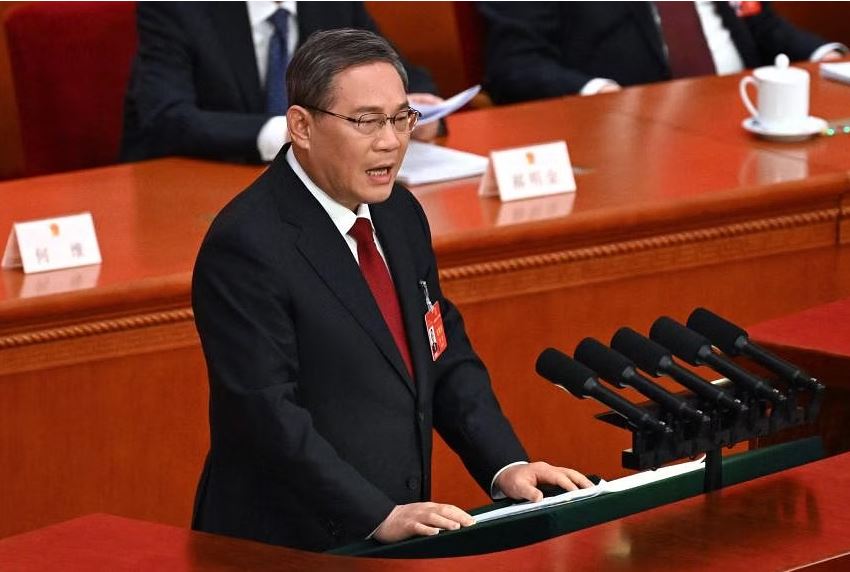
CHINA READER DAILY WIRE
INTERNAL
"The need to boost employment and incomes and prevent and defuse risks," Premier at the 17th NPC
On 05 March, Chinese Premier Li Qiang at the 17th National People’s Congress (NPC) announced China’s economic plan for 2024. He aimed that the target for economic growth would be 5 per cent and affirmed to change the country’s development model by defusing the bankrupt property developers and indebt cities. Li also called out the higher defence spending while iterating China’s claims on Taiwan. Chief macro analyst at the Soochow Securities, Tao Chuan said: “It’s more difficult to achieve 5% this year than last year because the base number has become higher, indicating that the top leaders are committed to supporting economic growth.” The new growth model called for can be seen in light of uneven growth in the previous year and the structural imbalance, weakening consumption habits and lower returns on investment. Li also highlighted that it won't be able to have a proactive stance and “prudent monetary policy.” The following are the aims that the NPC proposed: budget deficit of 3 per cent of the economic output, 1 trillion yuan in ultra-long-term treasury bonds, creation of 12 million urban jobs and reducing the unemployment rate to 5.5 per cent. Additionally, to tackle the issue of an ageing demographic, the government plans to improve policies encouraging and supporting childbirth and racing benefits for pensioners and the elderly. (“China vows to 'transform' economy, sets ambitious growth target,” Reuters, 05 February 2024)
Selection of new foreign minister not on NPC 2024 agenda, Editorial
On 04 March, according to an editorial in The Straits Times, titled “China unlikely to get new foreign minister at Two Sessions,” by Lim Min Zhang, China would not be able to elect a new foreign minister as it was not part of the agenda for the annual 17th NPC meeting. The NPC meeting has the power to elect and appoint top officials such as president, state councillors, ministers and the chairman of the Central Military Commission (CMC). China hinted that Liu Jianchao, head of the International Department of the CCP, to take over Wang Yi as the country’s next foreign minister after Qin Gang was removed from his post in July 2023. He had previously served as the ambassador to the Philippines and met US Secretary of State Anthony Blinken in January 2024. Similarly, former Defense Minister Li Shangfu was removed from his office in October 2023 on corruption charges and will not be participating in the NPC session. NPC spokesman Lou Qinjian said that General Li cannot join as he is no longer a deputy. However, the successor of General Li, Admiral Dong Jun, has not yet been appointed to the CMC or the State Council. (Lim Min Zhang, “China unlikely to get new foreign minister at Two Sessions,” The Straits Times, 05 March 2024)
China to develop indigenous technology against sanctions and decoupling
On 04 March, a spokesman for the National People’s Congress (NPC), Lou Qinjian, said that no country can prevent China’s access to technology and that China will develop its advanced technology. He replied in response to the growing competition in advanced technology between major countries on AI, 5G, and semiconductor chips. In response to de-risking and decoupling against China’s rise, he said that China is ready to work together or work alone. He gave the example of China’s homegrown navigation system known as Beidou as a breakthrough in advanced technology. His remarks come amid China’s involvement in the trade war with the United States. (Aw Cheng Wei, “‘No one can put a stranglehold on us,’ says Chinese official on global tech race,” The Straits Times, 05 March 2024)
China to further childbirth policies amid falling demography
On 05 March, government reports outlined China’s aim to support childbirth policies, by increasing the benefits and basic pensions and shifting towards a new private pension system. The announcements come amid a falling in Chinese demography for the 2nd time in 2023 in which new birthrates are half in 2023 than in 2016. According to a report released by Premier Li Qiang, China aims to implement new policies by “refining parental leave policies, improving the mechanism for sharing the related labour costs of employers, and increasing the supply of childcare services.” China’s declining population is due to the one-child policy imposed between 1980 and 2015, and the government has allowed them to have three children since 2021. Despite the government’s efforts, many women are unwilling to have more children due to higher living costs. The report mentions the government’s efforts to build a new system to provide elderly care services and a healthcare system for the elderly. (“China to improve childbirth policies and boost support for elderly,” The Strait Times, 05 March 2024)
China cancels Premier Li’s Press Conference, NPC
On 04 March, National People's Congress (NPC) spokesperson Lou Qinjian said that Premier Li Qiang will not hold the annual press conferences for the remaining term of China’s NPC till 2027. In 1993, the Chinese Premier used the annual NPC meeting to answer the questions from Chinese and foreign journalists to attract foreign journalists as part of its economic liberalization and boosting foreign investment and trade. Yaqiu Wang, research director for China, Hong Kong, and Taiwan at Freedom House, said that the cancellation of the press conference shows the CCP’s tightening control over the country and a reversal of the reform policies of the past. Neil Thomas, a fellow for Chinese politics at the Asia Society Policy Institute, says that the cancellation of Premier Li’s press conference is seen as another step by President Xi to consolidate his position in the country and does not want anybody else to attain higher popularity. Chien-wen Kou, director of the Institute of International Relations at National Cheng-Chi University in Taipei, said that the cancellation of press conferences shows the diminishing role of the Premier and the two sessions in Chinese politics. (Adrianna Zhang, Wenhao Ma, Bo Gu, Chuang Chih-wei, “China Watchers: No Premier's Annual Press Conference, No Difference,” VOA, 04 March 2024)
INTERNATIONAL
Human rights violation in Xinjiang and Tibet, says UN Human Rights Chief
On 04 March, United Nations Human Rights Chief Volker Turk said that China is violating the fundamental rights of the people in Xinjiang and Tibet and needs to correct its actions. In his update to the Human Rights Council, Turk has expressed his concerns about Hong Kong’s new national security law. However, China has rejected the allegations and said that its vocational centers have helped combat extremism and enhance development. While praising China’s growth and anti-poverty policy, Turk criticized the government’s imposition of Article 293 of the Criminal Law against the people protesting in Hong Kong. China’s ambassador, Chen Xu, countered the UN and blamed it for politicizing and weaponizing human rights issues. (“China violating ‘fundamental rights’ in Xinjiang, Tibet: UN rights chief,” The Straits Times, 05 March 2024)
ECONOMY
China sets growth target of 5 per cent in 2024
On 05 March, during the opening day of China’s annual legislature meeting of the NPC, Premier Li Qiang delivered the government work report that followed the growth target of 5 per cent in 2024. According to the official government data, China achieved a growth rate of 5.2 per cent in 2023 due to the increased investment in infrastructure and increased liquidity in the market. The report highlighted the government’s aim to create 12 million urban jobs and projected the unemployment rate to be around 5.5 per cent. The inflation is expected to rise by 3 per cent. Also, the defense budget is expected to rise to 1.67 trillion yuan, which is a 7.2 per cent increase from the 2023 budget. Li pointed out that the targets set are difficult to achieve due to the ongoing challenges in the Chinese economy, such as the property market crisis, weak global demand, and high local government debt. The government is focused on science and technological innovation as part of the country’s National Development Reform Commission (NDRC), and its budget of 370.8 billion yuan has been allocated, which is a 10 per cent increase compared to 2023. The government is also committed to developing new development and financing models for China’s real estate sector. On foreign policy, Li said that the country will adopt an independent policy and will oppose all hegemonic and bullying acts. (Aw Cheng Wei, Tan Dawn Wei, “China sets sight on around 5% growth in 2024, defence spending to rise,” The Straits Times, 05 March 2024)
SCIENCE & TECHNOLOGY
China invests more in car carriers to support EV export
On 05 March, an editorial in Nikkie Asia, titled, “BYD to deploy a fleet of 8 car carriers to underpin global EV expansion,” by Shizuka Tanabe informed of the Chinese EV giant’s plan to increase their car carriers to facilitate export capacity. BYD chairman and founder Wang Chuanfu said: “BYD is going to deploy seven car carriers in the coming two years to ease the shortage of shipping capacity for automobile exports.” BYD Explorer No. 1, a roll-on/roll-off (RORO) ship used for export has a capacity of 7,000. They are the first Chinese car carrier exclusively made for the export of domestic products. One of the reasons for the company’s investment is due to the rising cost of transportation which it hopes to be reduced with its vessel. The rapidly growing exports of China surpassed Japan in 2022 and became the world's largest exporter with 4.9 million vehicles in 2023. While the exports expanded the transport capacity remained the same. China’s carriers are now rapidly driven with many ship owners placing orders for 37 car carriers. (Shizuka Tanabe, “BYD to deploy a fleet of 8 car carriers to underpin global EV expansion,” Nikkie Asia, 05 March 2024)
CHINA & SOUTHEAST ASIA
China and Maldives sign ‘free military assistance’ agreement
On 04 February, China and Maldives forged a defence cooperation agreement, where they offered free military assistance to further strengthen bilateral ties. Deputy Director of China’s Office for International Military Cooperation Major General Zhang Baoqun and Maldives Minister of Defense, Mohamed Ghassan Maumoon discussed to need for defence cooperation between the two countries. Before this Chinese ambassador to the Maldives, Wang Lixin donated 12 ambulances to the Maldives Health Ministry. The visit also comes after the Male allowed a Chinese research ship to make a port call. The agreement comes weeks after the Maldivian President Mohamed Muizzu called for a withdrawal of Indian troops stationed there. (“After asking India to withdraw troops, Maldives signs free military assistance deal with China,” Livemint, 05 February 2024)
Philippines ship damaged after colliding with Chinese vessel
On 05 February, the Philippines Coast Guards (PCG) accused Chinese ships of blocking their resupply mission in the South China Sea. PCG spokesperson Jay Tarriela informed that the incident which led to minor structural damage happened near the Second Thomas Shoal. Tarriela said: “The PCG vessels faced dangerous manoeuvres and blocking from Chinese Coast Guard vessels and Chinese Maritime Militia,” He also stated that the reckless and illegal actions by the Chinese led to a collision between the MRRV-4407 and China Coast Guard 21555. The Chinese side continued that they had just taken their “regulatory action” against the Philippines and accused them of entering waters illegally. (“Philippines says ship damaged in South China Sea incident with Chinese boat,” Al-Jazeera, 05 March 2024)
04 March 2024, Monday | Vol.1 No. 22
The Philippines Coast Guard conducts patrols to deter Chinese research ships
Thailand transfers 900 scam victims to China | South Korean trainee doctors protest to face legal action
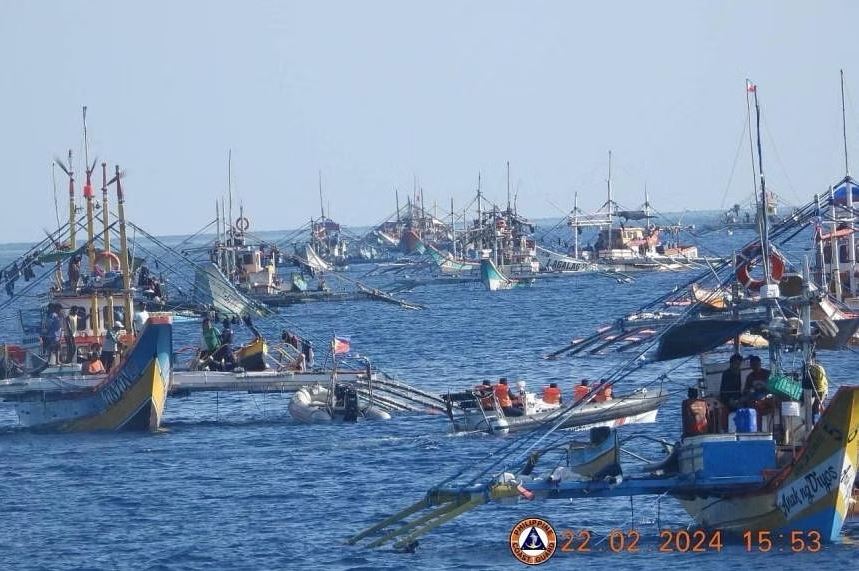
CHINA READER DAILY WIRE
INTERNAL
China kickstarts its Two Sessions meeting of the NPC & CPPCC
On 04 March, according to an article in Al Jazeera titled “What to expect at China’s ‘Two Sessions’ amid sagging economy, party drama,” by Erin Hale, Beijing begins its Two Sessions meeting of the National People Congress (NPC) and the Chinese People’s Political Consultative Conference (CPPCC). These legislative meetings, also known as liangui in Chinese, will run for the next two weeks. The meetings will involve approving new laws and political appointments and presenting government reports from various departments. In the Two Sessions meeting held in 2023, the legislators unanimously voted for Xi Jinping to be the third term as president. The agenda for the 2024 meeting will be based on China’s slowing economy coupled with deflation, debt, and failing exports. Premier Li will present the annual work report and set the goal targets for 2024. NPC is seen as the highest legislative body in China on paper but is less potent than the NPC Standing Committee in practice. NPC is considered a rubber stamp as its primary function involves formal approval of the decisions agreed upon and rarely exhibits any dissent or veto. (Erin Hale, “What to expect at China’s ‘Two Sessions’ amid sagging economy, party drama,” Al Jazeera, 03 March 2024)
Xi sets to groom next-gen party leaders but no successor yet, says The Strait Times
On 03 March, according to a commentary in The Strait Times, in January, China’s State Council promoted three senior government officials and another six on 23 February for the annual Parliament session on 04 March. Four of the nine officials belong to the post-1970s generation (7G). Out of nine, former president Hu Jintao’s son Hu Haifeng is the youngest promoted official to the position of vice-minister for civil affairs. The four officials belonged to the “third echelon” (disan tidui) under Deng Xiaoping in the 1980s to groom successive vice ministers and vice governor cadres. The list of 171 CPC’s Central Committee members will give President Xi options to pick and groom to become the country’s future leader. Out of 171 members, 154 are newcomers, indicating the role of young people in leadership positions. Professor Wu Guoguang, senior research scholar at Stanford Centre on China’s Economy and Institutions at Stanford University, said that the chances of Xi’s potential heir will come from the 7G group. Wu also noted that Xi has established his power base by replacing his rivals with loyalists and aiming to groom them as the next generation of leaders. (Benjamin Kang Lim and Tan Dawn Wei, “China’s Xi grooms next-generation party leaders, but no anointed heir yet,” The Straits Times,
ECONOMY
Rise in China’s middle-income population, Opinion
On 03 March, according to an opinion published in the state-owned Economic Daily, China’s middle-income population reached 500 million. It highlighted that increased purchasing power and technological innovation will drive the country’s future growth. It was published as part of a series named “How China is Going to Maintain Relatively Fast Long-term Growth.” The article referred to Walt Rostow’s stages of growth theory and said that China’s market has huge development potential and global appeal. The officials expect China’s large population to drive the consumption demand heavily. According to the National Bureau of Statistics, in 2023, Consumption was the primary growth driver, with a rise of 83 per cent in the GDP. China’s disposable income per capita stood at 39,218 yuan, 6.1 per cent from 2022. According to Zhang Wenkui, China’s goal is to maintain a 5 per cent economic growth rate. Also, China’s per capita income is 17 per cent compared to the US, which won’t classify it as a wealthy and developed country. (Mandy Zuo, “China’s middle-income population passes 500 million mark, state-owned newspaper says,” South China Morning Post, 03 March 2024)
Xi to go against market expectations for long-term stimulus, Opinion
On 04 March, according to an opinion in the Financial Times, China will begin its session at the National People’s Congress on 05 March to discuss the country’s future growth targets. The NPC meeting will be crucial for China as it takes place on the 75th anniversary of the PRC in 2024 amid the real estate crisis, deflationary pressures, and eroding investors’ confidence. According to Neil Thomas at Asia Society Policy Institute’s Center for China Analysis, Xi views the country’s current economic challenges as necessary to be dealt with to achieve the long-term goals for greater development. Premier Li is expected to set a growth target of 5 per cent this year. Also, Xi is looking to hire new members, like looking for a new foreign minister to replace Wang Yi, who took charge after Qin Gang was suddenly expelled from his office in 2023. According to Moody’s Analytics, China needs to focus more on domestic consumption rather than investment for higher growth in 2024. However, according to Heron Lim, an economist with Moody’s Analytics, China will focus more on its industrial policy by investing in property markets and advanced manufacturing. (Joe Leahy, “China’s Xi Jinping to resist market pressure to step up stimulus efforts,” Financial Times, 04 March 2024)
Another Chinese economic crisis is making
On 03 March, according to an editorial in The Wall Street Journal titled “The World Is in for Another China Shock” by Jason Douglas, contrary to its past filled with China’s rise, the Chinese economy is slowing with greater deflationary trends. To avoid the dumping of cheap Chinese exports into their economy, which had driven domestic businesses out, the US, Europe, and Japan have started offering financial support to their industries and imposed tariffs on Chinese imports. According to a paper in 2019, China’s accession into the WTO in 2001 led to a fall in the consumer prices in the US for goods by 2 per cent for every extra share gained by Chinese exports. Autor estimated that between 1999 and 2011, the US lost more than 2 million jobs due to Chinese imports. Currently, the West sees China as its main economic rival, with former US President Trump imposing up to 60 per cent or higher tariffs against Chinese imports. With the growing protectionism and shift towards high-end manufacturing by South Korea and Japan, China still commands an edge in low-end manufacturing and is diversifying its markets. (Jason Douglas, “The World Is in for Another China Shock,” The Wall Street Journal, 03 March 2024)
CHINA AND SOUTHEAST ASIA
The Philippines Coast Guard conducts patrols to deter Chinese research ships
On 04 March, the Philippines delayed its coast guard ship to undertake a two-week patrol to monitor and check the growing presence of Chinese research ships near the Benham Rise, which is located near the Philippines' east coast. In 2017, Manila renamed it “Philippine Rise.” The Philippine Coast Guard (PCG) said that its vessel will undertake maritime domain awareness near northern Luzon Island and monitor the local fishermen and the Chinese research vessels. According to the director of SeaLight at the Gordian Knot Center for National Security Innovation, Ray Powell said that on 01 March, two Chinese research vessels left a port in Longxue Island in Guangzhou on 26 February and were sailing around the northeast of Benham Rise, within the Philippines exclusive economic zone. (“The Philippines conducts marine patrols to check the presence of Chinese research ships,” The Straits Times, 04 March 2024)
Chinese embassy expresses its dissent on Philippines’ South China Sea remarks
On 03 March, the Chinese embassy in Manila strongly protested against the Philippines ambassador’s statement and said that he had disregarded basic facts. On 28 February, the Philippine Ambassador to the US, Jose Manuel Romualdez, said that the West Philippine Sea is the next flashpoint concerning the South China Sea and the Taiwan conflict. The Chinese embassy urged the ambassador to stop spreading lies about China as a regional threat. He indirectly targeted the US, saying that inviting outsiders would not lead to a peaceful resolution of the ongoing problem between the two sides. This happens amid China’s claim over the entire South China Sea and Beijing and Manila exchanging accusations over the sovereign claim in the disputed regions. (“China’s embassy condemns Philippine envoy’s remarks on South China Sea,” The Straits Times, 03 March 2024)
CHINA & SOUTHEAST ASIA
Thailand transfers 900 scam victims to China
On 03 March, Thailand’s Prime Minister Srettha Thavisin announced that 900 Chinese citizens that were trapped in Myanmar border scam centers were transferred to China. Myanmar and other Southeast Asian countries have become hotspots for online fraud and human trafficking, where they were forced to work in scam centers by criminal gangs. The Royal Thai Police spearheaded the operations from 29 February to 02 March, where they transferred the Chinese nationals from the Myanmar border town of Myawaddy to the Thai district of Mae Sot and eventually boarded Chinese planes. PM Srettha said: “This was a joint voluntary operation between three countries, China, Myanmar and Thailand,” and that “The process was done voluntarily, based on humanitarian principles, it was not forced.” The operation used 15 flights and three days of trip to return to China. This comes after in 2023, Myanmar handed over 31,000 telecom fraud suspects to China, in a joint crackdown initiative between Myanmar and China. (“Thailand facilitates the transfer of 900 scam victims from Myanmar to China,” The Straits Times, 03 March 2024)
CHINA & THE MIDDLE EAST
China’s Red Sea peace negotiation to yield no result, SCMP
On 04 March, an editorial in the South China Morning Post, titled, “Why China’s Red Sea diplomatic mission is unlikely to stop Houthi shipping attacks,” by Zhao Ziwen stated that the diplomatic missions by China in the Red Sea would yield no result. Ziwen owes this to China’s reluctance to intervene further as it also refuses to giveaway its neutral international stance. The Chinese have been consistently trying to subdue the conflict in the Red, aiming to restore safety and stability. In February, Ziwen states that the Director General for the West Asian and North African department Wang Yi met with the Omani, Saudi Arabian and Yemeni officials. During his visits, he highlighted China’s call for a peaceful ceasefire of the Israel-Palestine conflict which had the spillover effect in the Red Sea. Drector of the School of Arabic Studies at Beijing Foreign Studies University, Liu Xinlu said: “Although the Yemeni Houthis have not launched attacks on Chinese ships and have given such facilities to [Chinese] personnel and enterprises, the Red Sea corridor is related to world shipping, so the transport of oil and gas resources and commodities still has a relatively large impact [on China].” (Zhao Ziwen, “Why China’s Red Sea diplomatic mission is unlikely to stop Houthi shipping attacks,” South China Morning Post, 04 March 2024)
CHINA & AFRICA
China-based phone giants on the rise in the African market, SCMP
On 03 March 2024, an editorial in the South China Morning Post, titled, “Chinese-made phones are calling the shots in Africa as they beat global giants Samsung and Apple,” by Jevans Nyabiage looked into the rising market in Africa for China manufactured Phones. Some of the major China-based giants selling in Africa are, Transsion which manufactures for companies like Tecno, Infinix and iTel. These companies are unknown to Chinese nationals as they are exclusively sold mostly in Africa and later expanding to Latin America, India Southeast Asia and Eastern Europe. In 2023, the Transsion’s, Tecno brand phone company surpassed Samsung and Apple sales in the Middle East and Africa. This success has encouraged more Chinese firms to establish themselves in Africa and the Middle East. An analyst in Counterpoint stated that Tecno’s growth is attributed to its two major bestsellers Tecno Pop 7 and the Camon 20. They also attributed this success to the healing economic factors, with a better macroeconomic environment, energy prices down with inflation and the local currency stabilized. There has been a boost in consumer confidence in lower-income households and that is where Transsion brand companies have invested in, mid-to-lower-tier smartphones. International Data Corporation (IDC) reported that Transsion shipped 95 million smartphones in 2023, a 30 per cent hike from 2022. (Jevans Nyabiage, “Chinese-made phones are calling the shots in Africa as they beat global giants Samsung and Apple,” South China Morning Post, 03 March 2024)
EAST ASIA & THE PACIFIC READER
EAST ASIA
South Korean trainee doctors protest to face legal action
On 04 March, the South Korean Health Ministry announced that authorities would take legal action against the trainee doctors who refused to come back to work and end their walkout protest. The protest came in response to the government’s proposal to increase medical school admission candidates. It is estimated around 9,000 trainee doctors and 70 per cent of the South Korean doctors walked out, which led to the cancellation of several surgical procedures, in turn straining the emergency department. The government warned that the protesting doctors would face administrative actions and even the suspension of their medical licenses, fines and jail terms. Health Minister Cho Kyoo-hong said: “From today, we plan to conduct on-site inspections to confirm trainee doctors who have not returned, and take action according to the law and principle without exception.” Additionally, Cho warned that this would affect their career path. For the doctors who do return, they would consider the circumstances while looking into their actions. Patients have been complaining about the ongoing protest stating that “Doctors should first return and reassure patients and their families, and then have a dialogue with the government.” The World Medical Association condemned the provision introduced by the government, and the stifling of leaders in the Korean Medical Association, who have the right to collective action. (“South Korea to start legal action against doctors over walkout,” The Straits Times, 04 March 2024)
South Korea and the US kickstart “The Freedom Sheild Exercise”
On 04 March, South Korea and the US kickstarted their annual spring drills, where twice the number of soldiers joined. The drills would focus on deterring North Korea and its nuclear threat. The Freedom Sheild Exercise comes in after the incessant North Korean test ballistic missile launches. They also started their annual battalion-level Ssangmae exercises. The Freedom Shield drills will include 48 rounds of combined field training, air assault training and air strikes training, informed the South Korean Joint Chiefs of Staff. The exercise's primary aim is to locate identify and then strike the missiles by North Korea. The US Forces Korea said that the US assets like their aircraft carrier and bomber would be deployed in the region. (“South Korea, US troops kick off annual drills over North threats,” The Straits Times, 04 March 2024)
THE PACIFIC
Australia to fund USD 286.5 million for ASEAN projects
On 04 March, Australian Foreign Minister Penny Wong at the Australia-ASEAN summit announced USD 286.5 million funding for the ASEAN projects. The areas they would be focusing on are maritime security and defence building. They believe that the countries in the Indo-Pacific and Southeast Asia and facing imminent security threats and that’s why they need to set aside funding for maritime security in the region and form a pact with the ASEAN countries. This funding comes in light of the growing tensions in the South China Sea, Wong said: “We face destabilizing, provocative and coercive actions including unsafe conduct at sea and in the air.” Wong also emphasized that whatever happens in the South China Sea, the Taiwan Strait and the Mekong region affects us all. Australia used its 50th anniversary to bolster ties with Southeast Asian countries. Philippine’s Secretary of Foreign Affairs Enrique Manalo stated that the South China Sea is a strategic region and holds a promising future if and only the regions resolve their issues and “uphold cooperation over confrontation and diplomacy over the use or the threat of use of force.” (“Australia warns South-east Asia of ‘coercive actions’,” The Straits Times, 04 March 2024)
28- 29 February 2024, Thursday | Vol.1 No. 20 & 21
Beijing approves revised state secrets law for the first time
Chinese Coast Guard ships no threat if it's not close to land forces, says Taiwanese Defence Minister| Chinese Coast Guard ships no threat if it's not close to land forces, says Taiwanese Defence Minister
CHINA READER DAILY BRIEF
INTERNAL
Beijing approves revised state secrets law for the first time
On 27 February, Chinese legislative body approved the revised state secrets law for the first time since 2010, which will take effect from 01 May. The revised law will include “work secrets” with restricted sensitive information. Xinhua News agency reported that the revision is part of Chinese President Xi Jinping’s efforts to improve national security of China, this comes after the implementation of an anti-espionage law in April 2023 that created fear among foreign businesses. The existing state secrets comprise areas such as the government, CCP decision-making, military and diplomatic activities, and so on. The new revision will require government agencies to protect information that is not state secret but can have negative implications if leaked. The revised law increases coordination with China’s Data Security Law for managing confidential data. (“China broadens law on state secrets to include ‘work secrets’,” Reuters, 28 February 2024)
Housing authority to regulate rental fees to boost long-term leasing market, SCMP
On 27 February, Beijing’s Municipal Commission of Housing and Urban-Rural Development issued a draft proposal to regulate rental fees that could boost long-term leasing, aiming to reinforce the rights and interests of tenants. The proposal would enable the housing rental companies that collect rent for over three months to deposit a part of it into a third-party escrow account. Tenants can monitor the account using a number linked to the contract. The draft proposal is open to public consultation until 05 March. Deputy director of the China Index Academy, Xu Yuejin, said that the proposal would support China’s housing rental regulations, standardize the procedure involved, and ensure the healthy development of the housing rental market. According to the proposal, the Beijing Real Estate Agency Association will settle disputes between the tenants and the rental companies. It will assist tenants in retrieving their rents and deposits. China’s apartment industry was designed to provide furnished apartments and amenities at affordable prices to young urban professionals. Yan Yueijin said the country’s recent policy proposal will respond well to the crisis-hit property market. (Yuke Xie, “Beijing housing authority’s proposal to regulate rental fees will revive confidence in leasing market, analysts say,” South China Morning Post, 29 February 2024)
SCIENCE & TECHNOLOGY
Chinese shipbuilding industry achieves record growth despite US sanctions, SCMP
On 28 February, according to a report in the South China Morning Post, “China’s shipbuilding industry ‘edge’ helps it thrive under US sanctions: study,” by the Chinese Academy of Engineering, Chinese shipyards continue to withstand the mounting US sanctions imposed by the former Trump Presidency. According to the data from the China Association of the National Shipbuilding Industry, in 2023, Chinese shipbuilding achieved a growth of 12 per cent year on year to 42.32 tonnes, which is more than other countries combined. The peer-reviewed paper published by Marine Development and Management shows that Chinese shipyards continue to have access to all specialized equipment in small quantities. The studies also reveals that some Chinese products are inferior compared to Western products but are catching up in technology and have an attractive price offer. The study also reveals that Trump's presidential sanctions posed significant challenges to China’s marine equipment and supply chains. China’s shipbuilding is 200 times faster than the US's, which poses difficulty for the US Navy to maintain its dominance in the global oceans. (Stephen Chen, “China’s shipbuilding industry ‘edge’ helps it thrive under US sanctions: study,” South China Morning Post, 28 February 2024)
ECONOMY
China’s Country Garden faces liquidation petition over USD 205 million adebt
On 28 February, China’s property giant Country Garden face liquidation petition for the nonpayment of a loan amounting to USD 205 million. The company's shares fell more than 12 per cent in early trading. The company rejected the petition filed by the creditor, Ever Credit Limited of Kingboard Holdings. This comes after the Evergrande Group was ordered to be liquidated by the Hong Kong court on the USD 300 billion debt accumulated by the company. China’s property sector faces a massive crisis due to the intense regulatory crackdown imposed since 2021, leading to a liquidity crisis. The Country Garden plans to actively communicate about the debt restructuring program to the creditors. Investment holding company Kingboard became the first listed company to take legal action against Country Garden when its unit firm issued a debt of USD 204 million. (“Embattled China property giant Country Garden faces liquidation petition,” The Guardian, 28 February 2024)
Chinese leadership places high priority for economic recovery in2024
On 26 February, Chinese leadership headed by Premier Li Qiang called for economic recovery as the highest priority for the 2024 agenda. During the meeting, he said that the efforts are directed towards smoothening domestic trade, establishing a more favourable business environment, and stimulating market vigour. His remarks come after his previous five separate State Council meetings in 2024 focused on issues such as technology, demographics, local debt, and attracting overseas investors. He further said that China needs to remove trade barriers set up by the local governments as they pose issues to foreign companies. According to Peng, China’s local protectionist policies are dragging domestic and foreign investment. He further added that the government’s crackdown on the internet, foreign businesses, real estate, and strict pandemic policies has led to a stagnant recovery of the Chinese economy. (Mia Nulimaimaiti, “China vows to break down barriers to aid economic recovery, but call continues for stronger stimulus,” South China Morning Post, 27 February 2024)
CHINA & TAIWAN
Chinese Coast Guard ships no threat if it's not close to land forces, says Taiwanese Defence Minister
On 27 February, Taiwanese Defense Minister Chiu Kuo-cheng said that the military won’t consider the presence of Chinese Coast Guard ships in the disputed waters as long as they are away from the Taiwanese land forces. Chiu's statements come after the recent dispatch of Chinese ships around the Taiwan-controlled defence outpost of Quemoy, also known as Kinmen. He wanted to ease the growing tensions between the two sides to avoid potential conflict. He highlighted the SOPs to handle such cases and mentioned that the military won’t directly intervene and won’t increase its forces on the islands near mainland China. According to the Taiwanese media, no agreement has been reached so far with the two sides initiating the talks on 20 February to resolve the fishermen's death case. (Lawrence Chung, “Mainland China’s coastguard ships no threat if they stay clear of land forces, Taiwan military says,” South China Morning Post, 27 February 2024)
China clarifies no threat by its coast guard patrol around the Taiwan islands
On 28 February, a spokeswoman for China’s Taiwan Affairs Office, Zhu Fenglian, said that the Chinese Coast Guard did not recognize any limits around Kinmen Islands for its fishermen and did not cause any alarm while boarding the Taiwanese tourist vessel. She further said that the Coast Guard’s actions were to protect the lives of fishermen and travellers. Taiwan noted last week that the boarding of Chinese Coast Guard officials on a Taiwanese tourist boat had triggered panic. China accused Taiwanese coast guards of killing the two Chinese nationals on the fishing boat near the Kinmen islands. Taiwan, while defending its actions, has accused China of failing to control its ships entering its waters around the Kinmen Islands. (“China says its coast guard patrols around Taiwan islands are ‘beyond reproach’,” The Straits Times, 28 February 2024)
Lessons for China from Taiwan’s bubble recovery, Nikkie Asia
On 29 February, according to an editorial in Nikkei Asia titled “Taiwan's post-bubble recovery holds lessons for China,” by Paul Cavey, in the 1980s, Taiwan faced a property crisis similar to China and was in worse condition than Japan. Since 1989, Taiwan’s nominal GDP has risen five times, and its purchasing power parity has been higher than Japan's. According to Cavey, the critical driver for Taiwan’s economic development was the manufacturing sector, especially the tech industry, led by the Taiwan Semiconductor Manufacturing Co. (TSMC), which currently dominates the country’s economy and the global chip industry. At the same time, Japanese electronics faced a decline, especially in its consumer electronics. Apart from TSMC, other factors played a significant role for Taiwan, including a reformed monetary policy. However, in China's case, despite the surge in the country’s share in global manufacturing, it shares similar woes as Japan, such as low consumer confidence, turgid property market activity, and prolonged banking sector weakness. Taiwan enjoyed the benefits of a rising external surplus and a depreciating currency between 1990 and 2010. Cavey suggests that Beijing needs to p[provide direct fiscal benefits to the household sector’s purchasing power and ease some protectionist measures to boost its economy in a new direction. (Paul Cavey, “Taiwan's post-bubble recovery holds lessons for China,” Nikkei Asia, 29 February 2024)
MARITIME
Beijing bolsters its presence in the South China Sea, says AMTI
On 28 February, according to a report released by the Asia Maritime Transparency Initiative (AMTI), the presence of Chinese maritime militia vessels grew by 35 per cent in 2023 in the South China Sea as its actions continued to fuel tensions in the region. According to the satellite images and data in the report, an average of 195 militia ships are present in the disputed region in a day. As per the report, around 180 boats suddenly shifted towards the Mischief Reef in July 2023, which are being claimed by the Philippines and Vietnam. The Mischief Reef is located within the Philippines' EEZ and has been controlled by China for the last three decades. In response, Manila established a military outpost near the Second Thomas Shoal in 1999 using the old rusty BRP Sierra Madre warship. In 2023, the ship became a hotspot for increased contestation between the two sides as Chinese ships attempted to block the Philippines' supply mission to the outpost, leading to a water cannon attack and near collisions. (“China militia presence increases in South China Sea, report says,” The Straits Times, 29 February 2024)
CHINA & EAST ASIA
US raises concerns against the new national security law in Hong Kong
On 29 February, US State Department spokesman Matthew Miller expressed concerns on the Hong Kong authority’s proposal to adopt a broad and vague definition of ‘state secrets’ and ‘external interference’ that could be used to eliminate dissent through the fear of arrest and detention under the pretext of the national security law. According to the new security legislation, two new offences were added to Article 23 of the Basic Law: treason, insurrection, and sabotage, endangering national security. He further said that the new legislation would restrict the free speech of US citizens and local residents, it violates China’s international commitments, and undermines the “one country, two systems” principle. Previously, on British Foreign Secretary David Cameron’s criticism, the Chinese embassy in London said the Sino-British Joint Declaration did not give Britain the right to intervene in Hong Kong’s affairs. The embassy added that Hong Kong’s domestic legislation was completely in line with international law. Cameroon said that the legislation will restrict freedom of speech and expression. (Kahon Chan and Natalie Wong, “US voices concerns over use of ‘broad and vague’ definitions in Hong Kong’s Article 23 national security law to stifle dissent,” South China Morning Post, 29 February 2024)
CHINA & SOUTHEAST ASIA
Vietnam requests tech transfer from China’s energy company
On 27 February, Vietnam’s government delegation, led by Deputy Prime Minister Tran Hong Ha, requested technology transfers from PowerChina, an energy and construction giant in China. He welcomed PowerChina’s delegation to Vietnam to discuss wind and solar projects under China’s BRI. The investment is part of Chinese President Xi Jinping’s visit to Vietnam in December 2023 after US President Joe Biden visited Hanoi. Amid the slowing domestic market and US sanctions on Chinese manufacturing, Vietnam captured most of the FDI, amounting to USD 9 billion. Powerchina has around 50 projects in Vietnam and is building a 600MW project in Laos. (Lien Hoang, “Vietnam seeks tech transfer from Chinese energy giant,” Nikkei Asia, 29 February 2024)
CHINA & SOUTH ASIA
PM Modi and DMK exchange words over controversial ad of a Chinese flag on an Indian rocket
On 28 February, DMK MP K Kanimozhi defended its party after PM Modi criticized the Tamil Nadu government’s newspaper advertisement showcasing the Chinese flag on an Indian rocket. She said the party was unaware of the person involved in the act. She added that PM Modi had invited Chinese President Xi Jinping to Mahabalipuram, so there is no need to divert away from the truth. PM Modi said that the DMK party has crossed limits by placing Chinese stickers and taking credit for the ISRO launch pad in Tamil Nadu. Tamil Nadu BJP President K Annamalai criticized DMK for disregarding India’s sovereignty. Responding to the allegation, DMK spokesperson J Constandine Ravindran said that the BJP accusations are political and not objective. He said the ad's objective was to show India’s success and accomplishments in space technology along with those of the developed countries. (“China flag in Isro ad: PM Modi blasts DMK, party hits back,” Times of India, 28 February 2024)
CHINA & THE PACIFIC
Australia extends formal invite to Wang Yi after frosty bilateral ties
On 29 February, according to an editorial in the South China Morning Post, titled, “, “China’s Wang Yi invited to Australia as Beijing, Canberra ties thaw after prolonged frost,” by Kandy Wong, the Chinese Australian Foreign Minister extended a formal invitation for a two-day visit to Chinese Foreign Minister Wang Yi in the second half of March. The talks come after PM Albanese's visit to Australia in November 2023 to normalize bilateral ties, especially trade. According to Kandy Wong, issues such as the signing of a new science and technology agreement under the AUKUS alliance and the sentencing of Australian writers on espionage charges won’t be quickly resolved. And that Wang Yi's trip will be made after the two sessions of China’s legislature and political advisory body to discuss China’s diplomacy. Australia’s Department of Foreign Affairs and Trade (DFAT) will push China to lift the sanctions imposed on its wine and lobster during Wang Yi’s visit. In contrast, China pushes Australia to sign a new Science and Technology Agreement. As per the DFIT’s data, China is Australia’s largest bilateral trading partner, comprising 26 per cent of goods and services trade during 2022-2023. (Kandy Wong, “China’s Wang Yi invited to Australia as Beijing, Canberra ties thaw after prolonged frost,” South China Morning Post, 29 February 2024)
Chinese Coast Guard ships no threat if it's not close to land forces, says Taiwanese Defence Minister
On 29 February, The Australian director general for security Mike Burgess of the Australian Security Intelligence Organisation (Asio), revealed that a foreign and unnamed spy team had recruited a former Australian politician for spying activities. The politician has said to be recruited “seven years ago”.. Burgess also reported that this former politician also held international conferences where the other spies posed as bureaucrats would participate to recruit new members. They mainly wanted to enlist people to obtain security and defence information, said Burgess. This information has sparked outrage in Australia, where many are demanding the name of the accused politician. The breach is highly sensitive as Australia is part of the Five Eye Intelligence sharing group with the US, Britain, Canada and New Zealand. Burgess said: “We want the A-team to know its cover is blown. We want the A-team’s bosses to know its cover is blown.” (“Spy row erupts in Australia over ‘traitor’ politician,” The Straits Times, 29 February 2024)
US may lose influence over the Pacific Islands to China over delayed aid, says The Telegraph
On 27 February, according to an opinion piece in The Telegraph, the US defence official warns the risk of losing influence over the Pacific Islands to China due to the aid held up in Congress. This comes after the leaders of the three island countries of Palau, the Marshall Islands, and the Federated States of Micronesia (FSM), through a joint letter in February, warned that the delay in the funding is “leading to greater domestic uncertainty within the among their populations and “resulted in undesirable opportunities for economic exploitation by competitive political actors active in the Pacific.” The blocked funding comes as Beijing attempts to shift the balance of power in the region in its favour. Palau President Surangel Whipps said that the delay in the funding is making China a credible partner for the region, and the CCP is making all efforts to erode Palauan confidence with the US. Dr Euan Graham points out that the delay in US congressional funding hurts America’s national interests. (Nicola Smith, “US could lose strategic Pacific islands to China over blocked funding,” The Telegraph, 27 February 2024)
CHINA & THE AMERICAS
Joe Biden proposes an executive order to prevent the transfer of data to countries of concern
On 28 February, US President Joe Biden issued an executive order to prevent large amounts of, personal and sensitive transfer to the “countries of concern.” The data transfer includes genomic, biometric, personal information and financial data. They believe that bad actors and the information in the wrong hands can lead to the misuse of sensitive data. The provision is said to impact manufacturers, online stores and sellers. Even though the order is hinted at China, there is no clarity if it would be applied to Chinese firms in the US and social media platforms like TikTok and fast fashion retail group Shein. (“Eyeing China, Biden limits personal data transfers to U.S. rivals,” Nikkie Asia, 28 February 2024)
Canada: 2020 sacking of Chinese scientists accused of sharing information
On 28 February, The Globe and Mail newspaper reported on the sacking of two Chinese scientists Xiangguo Qiu and her husband, Keding Cheng working at a high-security infectious disease lab. They were accused of sharing confidential information with China. This happened in 2021, were the security agency in Canada stated that they were a “credible threat to Canada’s economic security.” The opposition legislature at that time demanded information behind the sacking, while Health Minister Mark Holland called it an unacceptable security lapse. The couple were working for the National Microbiology Lab in Winnipeg in 2019. The documents now on the case shows that the Canadian Security Intelligence found an intentional transfer of data by the coouple. The breach is worrysome and the laboratory in Winnipeg has some of the most dangerous human and deadly animal pathogens such as Ebola. (“Canada fired scientists Xiangguo Qiu and Keding Cheng for sharing information with China, report says,” South China Morning Post, 29 February 2024)
The US needs to focus better on Latin America to cope with Chinese influence, say US officials
On 26 February, the report published by the Atlantic Council highlighted that there is a need for the US to update its political, diplomatic, and economic toolkit to catch up against the growing Chinese influence in the Latin American region. Juan Gonzalez of the National Security Council said that the security and prosperity of Latin America and the Caribbean significantly impact the US. Gonzalez said that during defence exports, China offers better terms to Latin American countries in terms of lower prices and extending financing options compared to advanced payment collection by the US, which financially constrains these countries. The report also mentioned that the Inter-American Development Bank, which was a primary source of development financing agency for decades in the region, faces a lag in attracting private companies’ investments. Deputy Assistant Secretary of State for Western Hemisphere Affairs, Mark Wells, said President Biden’s Americas Partnership for Economic Prosperity in 2022 aims to expand cooperation and financing for high-quality critical infrastructures. Argentine Foreign Minister Diana Mondino called for greater US engagement with the region through free trade agreements to counter Chinese influence. (Igor Patrick, “US must update Latin America toolkit to keep pace with China sway in region, Biden officials say,” South China Morning Post, 28 February 2024)
CHINA & RUSSIA
Testing times for Russia-China’s “no-limits partnership,” Opinion
On 27 February, an opinion in the South China Morning Post, titled, “Why isn’t China letting Russia take out yuan loans in their ‘no-limits’ partnership?,” by Kandy Wong outlined the realities of the “no-limit” partnership between Russia and China. Kandy stated that the discussion over whether Russia will be granted loans in Yuan has been going on to no avail. The backdrop to this is the sanctions imposed on the Chinese companies by the Western firms accused of helping Russia to avoid sanctions repercussions. Since the Russia-Ukraine war, Moscow has resorted to the use of Yuan furthering their financial dependence on China. Senior economist at BBVA Research, Dong Jinyue, stated that regardless of their increased cooperation they have to maintain a neutral international stance. Dong also believes that China needs to consider the safety of its returns, considering that they have a weak financial market and an underdeveloped financial structure. While Russia is ready to use and spend Yuan, China needs to think if Moscow would be able to sustain their consumption power, said Russia and Central Asia specialist Li Lifan. Lialso stated that: “the creditor is always the party that has more concerns than the debtors in any loan business.” (Kandy Wong, “Why isn’t China letting Russia take out yuan loans in their ‘no-limits’ partnership?,” South China Morning Post, 27 February 2024)
Chinese Vice FM affirms their relations with Russia
On 28 February, Chinese Vice-Foreign Minister Sun Weidong visited Moscow on 26 February to discuss the need to further their bilateral tie by strengthening their communication and coordination on Asia-Pacific affairs. Sun said that both countries should play: a “better role as an anchor of stability in the changing circumstances of the century.” He also met with Russian Foreign Minister Sergei Lavrov and later exchanged views on the Russia-Ukraine war and the issues in the Korean peninsula. Additionally, Sun also expressed China’s readiness to support Russia to assume the presidency for the BRICS 2024 summit. (“China says Beijing and Moscow should strengthen coordination on Asia-Pacific issues,” The Straits Times, 28 February 2024)
CHINA & EUROPE
EU bills demanding audits for human rights and environmental violations rejected
On 28 February, the European Union failed to pass the law holding big companies accountable for human rights abuses and environmental violations. The proposal stated that any EU firm with over 500 staff and EUR 150 million turnover would be required to conduct detailed audits of their suppliers/partners. It also mentioned that after three years of the regulation of the proposal, the non-EU companies with EUR 150 million turnover in Europe will be expected to do the same. The initiative failed to come to action as it fell short of votes, countries like Germany and Italy abstained from voting while Sweden voted against it. The reasons for abstaining the same are the “administrative burden” and fear of an uneven level playing field. More pro-business parties in the EU believe that this burden would keep the companies at a disadvantage with competing against other firms who do not have the same regulations. (“EU fails to pass law requiring human rights and environmental audits on Chinese suppliers,” South China Morning Post, 28 February 2024)
EAST ASIA & THE PACIFIC READER
EAST ASIA
Japanese PM Fumio Kishida to face the parliamentary ethics committee
On 29 February, Japanese Prime Minister Fumio Kishida became the first sitting PM of Japan to appear on the parliamentary ethics committee. This comes after there has been a stark decline in his popularity since the funding scandal. The opposition has demanded a full public hearing and that should include five key members of the biggest faction caught in the same scandal, while Kishida’s party argued for a closed session. While Kishida is not directly accused of the scandal he stated that he feels a strong urgency to revive people’s trust and not addressing it would further their distrust. He said: “I'm hoping that lawmakers ... will fulfil their responsibility to explain their actions on various platforms, including this ethics committee, for us to revive trust in politics.” The negotiations on how to conduct the hearing have also delayed the fiscal budget of 2024. (“Embattled Japan PM faces ethics committee to save popularity and budget,” The Straits Times, 29 February 2024)
North Korean leader Kim Jong Un calls for an “industrial revolution”
On 29 February, North Korean leader Kim Jong Un called for an “industrial revolution” where he wanted the rural regions to build factories nationwide as the country faced acute food shortage. Kim Jong Un was attending the ceremony of the plant in Songchon Country, where he pledged to push for regional development policies, under which they aim to open factories in 20 remote areas every year for ten years. Kim said: “Establishing regional industry factories equipped with modern equipment and production lines in every city and county of the country within the next 10 years is truly a great revolution with enormous epochal significance.” (“North Korea’s Kim seeks ‘industry revolution’ in rural areas amid widening inequality,” The Straits Times, 29 February 2024)
South Korea and US to kickstart their annual drill aiming to deter North Korea
On 28 February, Reuters reported that South Korea and the US plan to kickstart their annual spring military drills aiming at deter North Korea’s nuclear weapons potential. The Freedom Sheild Exercise will be kicksarted from 04-14 March. These drills come in light of North Korea’s repeated testing of missiles and they recently also scrapped their unification plans with South Korea, showing their aggressive stance. The drills would be tough and realistic which would include 48 hours of field training, air assault and air strike training. They are expected to neutralize North Korea’s nuclear threat and aim at identifying and striking the cruise missiles. South Korea’s Joint Chief of Staff, Lee Sung-Jun: “The two countries are jointly developing a counter-operation concept against North Korea's nuclear and missile threats and it will be applied to deter and prevent their further and possible nuclear usage.” (“South Korea, US to stage annual drills focusing on Korea nuclear threats,” Reuters, 28 February 2024)
Taiwan’s 2-28 massacre, The Guardian
On 28 February, an article in The Guardian, titled, “‘Facing up to history’: relatives of Taiwan’s 2-28 massacre victims demand an official reckoning,” by Helen Davidson and Chi Hui Lin looked into Taiwan’s 2-28 massacres, where the Kuomintang (KMT) Republic of China government killed anti-government protestors. The article looks into the story of Li-cai now 80, wholost her dad when she was just two years old and later came to know that he was murdered. Since Japan was defeated after the WWII, Taiwan was given to KMT to control, Li’s father is among 18,000-28,000 people killed and disappeared in the anti-government protest. The protestors and dissenters were taken from their homes and workplaces where they were tortured, jailed and eventually executed. Taiwan now every year marks the anniversary and has dedicated museums and parks. Even though the KMT have apologized for their White terror regime many call out their paradoxical ideology as they also want to recognize the achievements in uplifting Taiwan. (“‘Facing up to history’: relatives of Taiwan’s 2-28 massacre victims demand official reckoning,” The Guardian, 28 February 2024)
North Korea ships weapons to Russia: South Korean Defence Minister
On 27 February, South Korean Defence Minister Shin Won-Sik informed that North Korea had shipped containers to Russia with millions of artillery shells. Shin estimated that there were about 6,700 containers sent to Russia after their meeting in September. They are set to have sold a million rounds of 152mm shells. The deal is said to reciprocate with Russia helping North Korea with food, raw materials and parts supply. The exchange has stabilized the food prices in North Korea and Russia plans to send more military technology to North Korea. Both countries have denied arms transfer, while a satellite imagery found four cargo vessels shuttling between North Korea and the Russian border. (“North Korea speeds up the pace of secretive weapons shipments to Putin,” The Straits Times, 27 February 2024)
Protest in Hong Kong against the new national security law
On 27 February, The Straits Times reported on the protest by Hong Kong activists against the government’s plans to establish a new national security law. The law is said to include 2020 China’s imposed security legislation and add new offences like treason, insurrection, theft of state secrets and espionage. The protestors stated that it lacked democratic oversight and human rights safeguards. Since 2019, China has curbed the pro-democracy protests, where this demonstration has been a first in a while. Hong Kong officials believe that they need the home-grown law to plug the loopholes in the security system. The activist Yu Wai Pan from the League of Social Democrats (LSD) was at the protest and expressed the concerns of the Hong Kongers stating: “National security is important to the people, but it must be based on democracy, freedom and rule of law,” (“Rare Hong Kong protest sounds alarm on new security law,” The Straits Times, 27 February 2024)
THE PACIFIC
New Zealand lists Hamas as a terrorist group
On 29 February, New Zealand’s Prime Minister Christopher Luxon announced that they have listed Hamas as a terrorist entity and have imposed travel bans on the “Israeli settlers” accused of committing violent acts against Palestine. Luxon also stated that they want to be clear that this is not a reflection on the innocent people of Palestine in Gaza and around the world, but that they are specifically against Hamas's actions of 07 October. New Zealand’s Foreign Minister said that the whole of Hamas is responsible for the October act. They also made carrying out financial and other transactions with or for Hamas a criminal offence and froze their asset in New Zealand. They also iterated that they continue to support the future of Palestine and the two-state solution, urging them to end the conflict. (“New Zealand lists Hamas as a terrorist group, sanctions ‘extremist’ Israeli settlers,” The Straits Times, 29 February 2024)
27 February 2024, Tuesday | Vol.1 No. 19
COMAC to showcase its C919 and ARJ21 aircraft in five Southeast Asia countries
| Billionaire and founder of Wahaha Group, Zong Qinghou dies at 79 | | US warns Pacific Islands countries of taking Chinese security assistance |
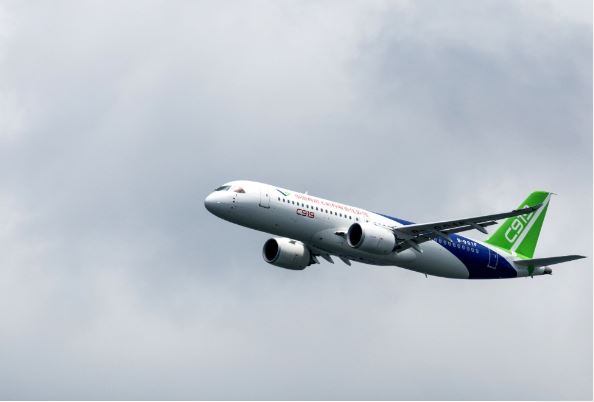
HIGHLIGHT
COMAC to showcase its C919 and ARJ21 aircraft in five Southeast Asia countries
On 27 February, Chinese Commercial Aircraft Corporation of China announced that they are set to conduct a flying display of their C919 and ARJ21 aircraft in five Southeast Asian countries. This aims to promote their aircraft and lay the groundwork for future sales. In the coming weeks, they are set to be showcased in Laos, Vietnam, Malaysia, Indonesia and Cambodia. Recently, it conducted airshows in Vietnam and Singapore as it touted its narrow-body plane. COMAC said: “The primary purpose of these flights is to ... showcase the aircrafts' good performance and lay the groundwork for future market expansion in Southeast Asia,” the company aims to garner international recognition and gain the European Union Aviation Safety Agency certification. (Sophie Yu, Brenda Goh, “China's COMAC to showcase C919, ARJ21 jets in 5 Southeast Asian countries,” Reuters, 27 February 2024)
Nurses to undertake additional work due to doctor's strike in South Korea
On 27 February, South Korean Health Minister Cho Kyoo-hong said that the government was activating a program to legally protect nurses from conducting medical procedures that were performed by doctors within a medical institution. The Nurses complained about severe workloads and legal risks due to the trainee doctors' walkout from the hospitals to protest against the government’s plan to boost medical school admissions by 2,000 students per year to address the shortage of doctors in the country. The protests had led to the absence of two-thirds of the doctors, leading to the disruption of services at major hospitals and the cancellation and postponement of several emergency and other surgery cases. The doctors have yet to attend the meeting despite the government's request for a dialogue. Cho warned the 9,000 protesting doctors to return to work by 29 February to avoid facing any punishment, which includes license suspension and possible prosecution and arrest. The protesting doctors continue to demand that pay and working conditions be addressed before increasing the admission quotas in medical schools. (“South Korea nurses will take on more medical work due to doctor walkout,” The Straits Times, 27 February 2024)
Billionaire and founder of Wahaha Group, Zong Qinghou dies at 79
On 25 February, one of the richest men in China and the founder of Chinese drink Hangzhou Wahaha Group, Zong Qinghou died at the age of 79. His demise was announced by his company and the memorial service is said to be held on 28 February in Xiasha, Hangzhou. In 2010 and 2012 he was ranked as the wealthiest businessman in China by the Hurun Research Institute’s China Rich List, estimated to be worth USD 13.1 billion, currently, he is ranked 31st in the list. Wahaha was born to a poor family in the Jiangsu provincial city of Suqian in 1945. In 1987 with two retired teachers, he became a drinks and ice cream distributor in a local school. In 1989, he established the Hangzhou Wahaha Nutritional Foods Factory, in two years he formed the Hangzhou Wahaha Group with a canned food factory. 1995, he launched bottled water that became popular in the consumer market and the following year French multinational Danone invested USD 70 million in five joint ventures later extended to 39. The joint venture was one of the major reasons for their success until their relationship changed when the French counterpart sought to buy out Wahaha’s assets. Wahaha believed Danone was trying to initiate a hostile takeover while the French accused Wahaha of secretly operating by mirroring products. The dispute ended when Danone sold its interests to Wahaha. Zong Qinghou is now succeeded by his only child and daughter Zong Fuli who was appointed vice-chairman and general manager and eventually trajected to take full control over the company. Additionally, Zong Qinghou was also a member of the Communist Party of China and was a delegate in the 10th, 11th, and 12th National People Congress. (Sylvia Ma, Salina Li, “Zong Qinghou, billionaire founder of Chinese drinks giant Wahaha Group, dies at 79,” South China Morning Post, 25 February 2024)
|
|
|
|
CHINA READER DAILY WIRE
|
|
|
|
|
|
EAST ASIA & THE PACIFIC READER EAST ASIA
|
26 February 2024, Monday | Vol.1 No. 18
China pledges USD 490,000 to support LDCs in WTO
| The US government urged to block Chinese imports of auto parts through Mexico | | China names its spacecraft “Dream Vessel” for lunar mission |
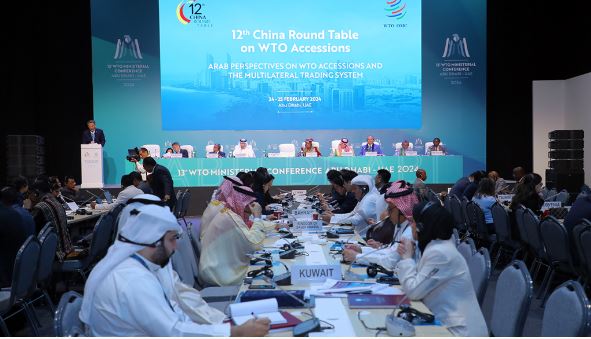
|
CHINA READER DAILY WIRE |
|
|
|
|
|
EAST ASIA & THE PACIFIC READER EAST ASIA |
22 February 2024, Thursday | Vol.1 No. 17
China buys the bulk of Russian crude oil as Indian imports dwindle
| European Union blacklists three Chinese firms | | China set to miss climate targets with increased CO2 emissions |
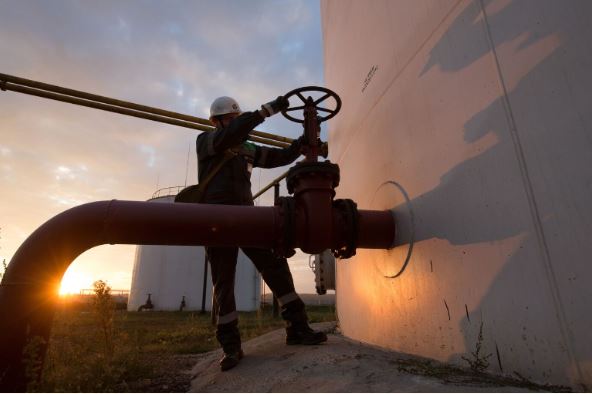
|
|
|
|
CHINA READER DAILY WIRE |
|
|
|
|
|
EAST ASIA & THE PACIFIC READER |
21 February 2024, Wednesday | Vol.1 No. 15 & 16
‘China needs to be more active in debt relief’, World Bank
| Chinese Coast Guard intercepts Taiwanese tourist boat | | 3,058 South Korean doctor’s trainee doctors resign |
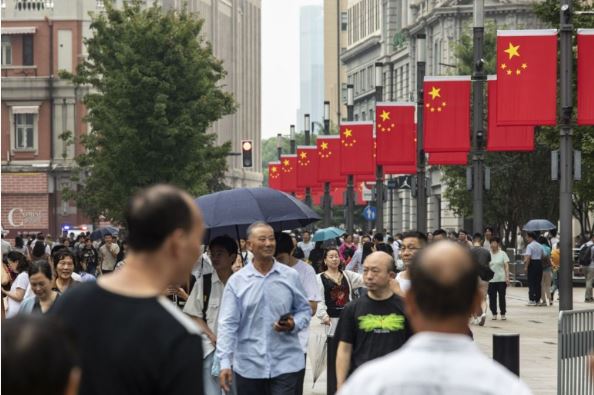
CHINA READER DAILY WIRE
INTERNAL
CCP attempts to influence and manipulate Taiwanese youth, Financial Times
On 21 February, according to an editorial in the Financial Times titled “China’s Communist cadres woo Taiwan with youth trips and video apps,” by Kathrin Hille, CCP’s United Front Work Department promoted trips among young Taiwanese at grassroots levels to foster Chinese patriotism and unification ideology. The United Front has ramped up its efforts after the electoral victory of Lai Ching-te, who won the third term for Taiwan’s DPP. Taiwanese government officials warned of the CCP’s manipulation tactics to marginalize the government in the country. Hille noted that with Taiwan’s opening of movement of its citizens to China in the late 1980s, the United Front cadres have been working to influence the Taiwanese people against the DPP. (Kathrin Hille, “China’s Communist cadres woo Taiwan with youth trips and video apps,” Financial Times, 21 February 2024)
Revival of Mao-era reserve military units, Opinion
On 20 February, according to an opinion in the Financial Times titled “Chinese companies revive Mao Zedong-era militias,” by Edward White, Many Chinese state-owned enterprises (SOEs) started setting up in-house reserve units belonging to the legacy of the Mao Zedong era known as People’s Armed Forces Departments (PAFD). The department recruits at the village and county levels and performs civil defence activities. Timothy Heath, an international defence researcher at the Rand Corporation, said creating these new units indicates the risk of growing social instability as China’s economy faces a prolonged slowdown. James Char, the expert from RSIS, noted that the rise of PAFDs is due to the “CCP party-state stressing ‘security’ over ‘development’,” which relates to Xi’s second term since 2017. Hath further said that the rise of PAFDs was surprising as ordinary Chinese citizens had little interest in the Maoist era reforms. (Edward White, “Chinese companies revive Mao Zedong-era militias,” Financial Times, 20 February 2024)
Chinese LGBTQ community faces government repression, Opinion
On 20 February, according to an opinion in Nikkei Asia titled “China LGBTQ community hangs tough in dissent amid repression,” by Pak Yiu, Jin Xing, the country’s well-known transgender celebrity, was accused of "poisoning children and destroying the traditions of marriage,” after the photos and videos of her event got viral across Chinese social media. Before transitioning, Jin was a former star of the People's Liberation Army's dance corps. According to Yiu, Homosexuality was decriminalized in China in 1997, but discrimination against gay and transgender people is not a criminal offence. According to the China Dissent Monitor, it is estimated that the LGBTQ population comprises around 80 million in China. The data also reports 18 dissents in the second half of 2023 and is showing resilience in raising awareness for safe spaces in the community. Police often cite the importance of protecting the country’s stability and national security as the main reasons while interrogating LGBTQ activists. (Pak Yiu, “China LGBTQ community hangs tough in dissent amid repression,” Nikkei Asia, 20 February 2024)
SCIENCE & TECHNOLOGY
China uses advanced tech to control global opinion, USCC
On 20 February, according to a report published by the bipartisan U.S.-China Economic and Security Review Commission (USCC), titled “Censorship Practices of the People's Republic of China," China is attempting to control global opinion on Taiwan, Hong Kong, and others using advanced technology. The report says that under Xi Jinping, China has massively expanded the censorship apparatus, thus enabling the country to strengthen its control over the internet content, which is deemed to be sensitive by the party, such as human rights issues in Xinjiang and Tibet. The report also mentions the development and deployment of advanced AI and big data analysis technologies for online content monitoring. The report highlights the dangers of China’s manipulation of foreign audiences and its negative impact on the global information commons. It also warns about Chinese censorship of Taiwan, Hong Kong, and Xinjiang, posing concerns amongst the US national security. It recommends that the US government work alongside the private sector to tackle PRC’s disinformation campaigns. (Tomoko Ashizuka, “China building up tech for 'censorship apparatus,' U.S. report says,” Nikkei Asia, 20 February 2024)
China ramps up clean energy production in its deserts
On 20 February, according to an editorial in the South China Morning Post titled “China builds up electric power in Gobi and western deserts equal to half US capacity,” by Stephen Chen, China boosted its clean energy production and transmission network in Gobi and other north-western deserts. The total combined production in Gobi and other north-western deserts is estimated to be 600GW, half of the US’s combined energy production is of 1,100 GW. The energy facilities in the deserts consist of wind and solar energy. Chen outlined that the North-western region powers 60 per cent of China’s solar energy and one-third of its wind power. At present, the installed capacity of renewable energy in the region has reached 230GW, with half of it transmitted to power the densely populated eastern coastal provinces. According to Professor Ma Xiaowei, China’s northwest power grid has overtaken the EU in core energy utilization indicators. Also, Chen stated that China has incorporated AI to predict power generation ten days in advance using many sensor data with greater prediction accuracy. (Stephen Chen, “China builds up electric power in Gobi and western deserts equal to half US capacity,” South China Morning Post, 20 February 2024)
ECONOMY
China’s new financial regulator vows to restore investor confidence
On 21 February, according to an article published by People’s Daily, CCP’s newly created Central Financial Commission (CFC) said that China will benchmark its financial policies with global standards to make them more transparent, stable, and predictable. This is done to revive investor confidence during the stock meltdown. The article focused on the CGC’s commitment to making China a financial superpower. This comes after foreign investors are worried about China’s policy choices. According to the State Administration of Foreign Exchange data, direct investment liabilities increased by USD33 billion in 2023 compared to the previous year, which resulted in an 82 per cent drop year on year since 1993. China looks to manage the financial risk as part of its future development, which is currently facing multiple challenges in the form of inflation, corruption, debt, and so on. (Mandy Zuo, “China’s new financial regulator pledges transparency to bring investors back from the brink,” South China Morning Post, 21 February 2024)
China needs to be more active in debt relief, the World Bank official
On 21 February, a former deputy chief economist of the World Bank, Ayhan Kose, said that Beijing needs to be more proactive in its debt relief efforts towards the distressed countries and end the “silent crisis.” Kose also noted that China needs to take more responsibility for creating a post-pandemic debt relief structure while becoming a major creditor country. The World Bank and IMF are increasingly concerned about the growing debt crisis among low-income countries, with 11 in distress and 28 at high risk of default. Kose added that 40 per cent of the low-income countries would have lower per capita income by the end of 2024, and there is a need for the global community to make the Common Framework work. So far, four countries have applied for the Common Framework, a system launched by G20 in 2020, in which only two countries, Chad and Zambia, have reached an agreement. (Larry Elliott, “China needs to do more on ‘silent crisis’ of debt, says World Bank official,” The Guardian, 21 February 2024)
China risks FDI with its strict policies
On 21 February, according to an editorial in Nikkei Asia titled “China should not underestimate impact of inward FDI plunge,” the government data revealed that total FDI into China amounted to USD33 billion in 2023, which is 80 per cent lower than in 2022. According to the editorial, the decline in FDI has led to a decrease in new and existing factories' construction and operational units. Despite the real estate slump and deflationary trends, the Xi-led government failed to tackle the crisis. Also, foreign investors are hesitant to invest further in China due to the ongoing US restrictions on China, especially on semiconductors. Furthermore, China’s anti-spying law worries foreign investors about detention without any explanation. The editorial highlights Xi’s growing priority to strengthen the CCP’s power rather than strengthening the existing struggling economy. (“China should not underestimate impact of inward FDI plunge,” Nikkei Asia, 21 February 2024)
New reforms to boost nations’ modernization drive, Xi Jinping
On 19 February, Chinese President Xi Jinping mentioned the need to focus more on tackling the problems hindering the nations’ modernization efforts. His remarks are seen as a preparation for the upcoming 20th Central Committee’s third plenum focused on reform. State media Xinhua reported that the CCP’s focus is to promote reforms for modernization in Chinese style and to address the institutional obstacles while facing the challenges. Alex Ma, an associate professor of public administration at Peking University, said “How to restore confidence is one key aspect to watch as Beijing cooks up new reform initiatives and implementation plans,” while promising to resolve the problems. Zhu Tian, an economics professor at the China Europe International Business School in Shanghai, said that China needs to implement real reforms soon to keep government intervention away from the functioning of the private sector and amend impulsive enforcement. (Frank Chen, “China’s Xi Jinping hypes up obstacle-crushing economic reforms as expectations for third plenum reach fever pitch,” South China Morning Post, 20 February 2024)
CHINA & TAIWAN
Chinese Coast Guard intercepts Taiwanese tourist boat
On 19 February, the Chinese Coast Guard (CCG) boarded a Taiwanese tourist ferry amid the surging tensions between the two sides. The Taiwanese ferry King Xia carried 11 crew and 23 passengers on a tour near Kinmen’s main island and was intercepted by two Chinese Coast Guard patrol boats. Taiwan’s Coast Guard Authority (CGA) said that six officers from CCG boarded the ferry and inspected the crew documents before returning to their boats. Later, they were escorted by Taiwan’s CGA. Kinmen Island is a Taiwanese territory very close to the Chinese mainland. Kuan Bi-ling, head of Taiwan’s Ocean Affairs Council, said the actions of the Chinese coast guard had “triggered panic” among Taiwanese people. The incident took place amid tensions from a Chinese fishing boat being chased by Taiwanese CGA capsized, and two out of four fishermen died. (Helen Davidson, “China coast guard boards Taiwan tourist boat in escalation of tensions,” The Guardian, 20 February 2024)
Taiwan denies increased military deployments on its offshore islands
On 21 February, Taiwan’s defence ministry said it had not deployed any military on its frontline islands close to China amid tensions with Beijing. This takes place amid the death of two Chinese nationals while fleeing away from the Taiwanese Coast Guard near Kinmen Island. Taiwan Defense Ministry intelligence officer Huang Ming-chieh said there was “nothing abnormal” in China’s military movement around Taiwan. Lee Chang-fu, deputy head of the ministry’s joint operations planning department, said there has not been any increase in the deployment of troops on its offshore islands. Kinmen is very close to the Chinese cities of Xiamen and Quanzhou and has been under the control of Taipei since the Republic of China fled to Taiwan in 1949 after losing a civil war with Mao Zedong’s communists. (“Taiwan says it has not stepped up military deployments on frontline islands,” The Straits Times, 21 February 2024)
CHINA & EAST ASIA
China reaffirms its stance on Fukushima water release
On 20 February, the Japanese new ambassador to China Kenji Kanasugi met with a few Chinese ministers and was informed that Japan should take responsibility for the Fukushima nuclear plant release situation. From the Chinese Ministry of Ecology and Environment, Huang Runqiu reaffirmed their view on the Fukushima release. Hunag said that Japan should dispose of the water that is contaminated responsibly and should also cooperate with the stakeholders. Both sides also expressed their willingness to promote Sino-Japan relations with green and low carbon emission goals. Since the release, China has staunchly opposed the contaminated water release of Fukushima even after Japan’s assurance of otherwise. (Liu Zhen, “China affirms stance on Fukushima nuclear wastewater release in rare ministerial meeting with Japan’s new envoy,” South China Morning Post, 20 February 2024 )
CHINA & SOUTHEAST ASIA
PLA monitors the US-Philippines joint air patrol
On 19 February, the People’s Liberation Army (PLA)’s Southern Theatre Command dispatched its naval and air forces to monitor the US-Philippines joint air patrol on the disputed waters of the South China Sea. The drills were conducted near the western Philippines as part of their “maritime cooperative activity.” The PLA command said that the Philippines was heightening tensions in the disputed waters by bringing in the non-regional country. The Philippine Air Force dispatched their 3 FA-50 combat aircraft, and the US Pacific Air Force sent a B-52 bomber to patrol the area. Both sides accuse each other of illegal entry into their exclusive economic zone. Recently, the Philippines accused China of cyanide fishing and intentional destruction of the disputed Scarborough Shoal. (Hayley Wong, “South China Sea: PLA sends forces to monitor US-Philippines air patrols over disputed waters,” South China Morning Post, 20 February 2024)
CHINA & THE MIDDLE EAST
Dip in Oil prices due to tensions in the Middle East
On 20 February, Reuters reported the price of oil declined a little due to the rising tensions in the Middle East while China works towards recovering its economy. Companies such as Brent futures fell 0.35 per cent to 88.27 USD a barrel, U.S. West Texas Intermediate fell 0.38 per cent to 78.08 USD a barrel. The conflict in the Red Sea and Bab al-Mandab by the Houthis since 16 February have exacerbated geopolitical tensions in the Middle East and in turn, affected the oil supply. Lately, China revealed the largest fall in the benchmark mortgage rate since the reference rate was instituted in 2019. ANZ banking group analysts said that the signs of demand in China will also be boosted. (Paul Carsten, “Oil hovers near 3-week high on Middle East tensions, China demand,” Reuters, 20 February 2024)
CHINA & AFRICA
African Union ratified a ban on donkey trade, a blow to China’s ‘ejiao’ medicine, says SCMP
On 18 February, the Heads of State of the African Union ratified the ban on the donkey skin trade for 15 years which will affect the production of China’s traditional medicine, ‘ejiao’. The Animal welfare organisations in Africa marked the decision as a ‘historic moment’. In November, a specialised technical committee of the African Union had proposed the ban, which was ratified at the 37th ordinary session of the AU Assembly in Addis Ababa. Ejiao is made from gelatin extracted from the hides of donkeys, which enhances vigour, enriches the blood and carries anti-ageing properties. Over 5 million donkeys are slaughtered each year to meet Chinese demand; only 2 million are provided locally, and the rest are imported from South America and Africa. (Jevans Nyabiage, “African donkey trade ban to slash China’s supply of traditional medicine ejiao,” South China Morning Post, 20 February 2024)
CHINA & THE AMERICAS
China criticises the US veto on the immediate cease-fire resolution of the Israel-Gaza war
On 21 February, BBC News reported on China criticizing the US for vetoing the UN Security Council resolution looking for an immediate ceasefire in the Israel-Gaza war. China stated that the move sent the wrong message and encouraged the continued slaughter of innocent civilians. The resolution was proposed by Algeria where the US called the proposal jeopardises the talks to end the war. On the other hand, the US proposed its solution where they called for a temporary ceasefire and demanded Israel to refrain from invading Rafah. The resolution was backed by 13 UNSC member states, vetoed by the US and abstained by the UK. Chinese UN ambassador Zhang Jun said: “The spill-over of the conflict is destabilising the entire Middle East region leading to rising risk of a wider war.” The Algerian diplomat Amar Bendjama also expressed his disappointment and said that the UN has yet again failed and asked them to examine their conscience as history will judge them. The US ambassador to the UN Linda Thomas-Greenfield said that this is not the most appropriate time for a ceasefire and negotiations between Israel and Hamas are ongoing. The UK ambassador for the UN Barbara Woodward believes that the resolution can be counterproductive as it may make the ceasefire less likely. (“Israel Gaza: China condemns US veto of call for immediate ceasefire at UN,” BBC News, 21 February 2024)
CHINA & EUROPE
Turkey detains six on espionage charges against Uyghurs
On 20 February, Turkey's state-run Anadolu Agency reported that their police detained six individuals in Istanbul on charges of spying on prominent Uyghurs. The accused were detained on espionage charges on Uyghur-related institutions and were allegedly accused of passing on this information to Chinese intelligence. The specifications of the arrest are still not outlined as the nationalities are said to be foreign. Turkey has the largest population of Uyghurs outside of Central Asia with a population of to be of 5,000. The communities share ethnic and religious ties with the Uyghurs in China, this has made the Turkish authorities sympathetic to their cause and the discrimination faced by the community in China. (“Turkey detains 6 for allegedly spying on Uyghurs for China,” Nikkie Asia, 20 February 2024)
Chinese FM urges French President Macron to further encourage China-EU ties
On 20 February, Chinse Foreign Minister Wang Yi told French President Emmanuel Macron that France would continue to a pivotal role in China-EU relations. Wang Yi met with Macron at the Elysee Palace in Paris. This year both countries marked the 60 years relationship between China and France, where Wang Yi called for both countries to chart for the coming 60 years of relations. Wang also stated that China would open its market to all countries and that France will also keep the business environment as just and fair. (“China urges France to help develop China-EU ties as Wang Yi meets Macron,” CGTN, 21 February 2024)
EU plans to blacklist Chinese firms on alleged aid to circumvent Russian sanctions
On 20 February, according to an opinion in the South China Morning Post titled “China firms in EU firing line as Hungary yields to anti-Russia sanctions package,” by Finbarr Bermingham, the European Union could now blacklist Chinese firms and ban them from trading with EU companies for allegedly circumventing the sanctions for Russia. This will be part of the 13th package of sanctions, which the ambassadors of the EU will finalise at a meeting on 21 February. Three mainland China-based companies such as Guangzhou Ausay Technology Co Limited, Shenzhen Biguang Trading Co Limited, Yilufa Electronics Limited and one Hong Kong-based company RG Solutions Limited are planned to be blacklisted. (Finbarr Bermingham, “China firms in EU firing line as Hungary yields to anti-Russia sanctions package,” South China Morning Post, 20 February 2024)
EAST ASIA & THE PACIFIC READER
EAST ASIA
The US and EU components found in recovered North Korean missiles, says CAR
On 20 February, Conflict Armament Research (CAR) reported that the remains of North Korean ballistic missiles recovered from Ukraine contained parts of US and European technology. They found that North Korea was able to obtain Western parts for its missiles despite the sanctions imposed by the West. CAR informed that: “ballistic missile produced by the Democratic People’s Republic of Korea (North Korea) and recovered in Ukraine includes more than 290 non-domestic electronic components.” It is estimated that a total of 75 per cent of parts recovered from the missiles belonged to the US and 16 per cent were from the European Union. They said: “Half the components documented bore identifiable date codes, and more than 75 per cent of those codes indicated production between 2021 and 2023. Based on those production dates, CAR concludes that the missile recovered in Kharkiv could not have been assembled before March 2023.” (“US, European parts found in North Korean missile in Ukraine: Report,” The Straits Times, 21 February 2023)
Task force to monitor AI-generated content ahead of South Korean general elections
On 19 February, The South Korean Constitutional Agency overseeing the Election Administration declared that it established a task force for fighting AI-generated false content and had successfully busted a total of 129 deepfakes that violated the laws on elections between 29 January and 16 February. In December, the National Assembly decided to revise the law by adding a law to bar the usage of deep fakes in political campaigns which came into effect on 29 January, which can lead the violators to jail for seven years or a fine of 50 million won (50,000 SGD). (“Election watchdog busts political deepfakes ahead of South Korea’s April general election,” The Straits Times, 20 February 2024)
3,058 South Korean doctor’s trainee doctors resign
On 20 February, hundreds of trainee doctors participated in a protest where they walked off their jobs. This comes as the South Korean Health Ministry announced that 6,415 of the trainee doctors out of 13,000 have applied for resignation. The ministry informed that they would cater for the emergency of shortage of personnel by providing transport facilities to help the transfer to other hospitals. The protest came in light of the government’s plans to increase the medical student’s admission from 3,058 to 5,000 by next year. The measures were intended to cater to the shortage of medical professionals, especially in rural areas. The protestors argue that they should have been consulted by the government and that this initiative would lead to an influx of poorly trained doctors. (“South Korean trainee doctors walk off job over medical student increase,” Nikkie Asia, 20 February 2024)
THE PACIFIC
Australia to boost its defence spendings
On 20 February, the Australian Government Department of Defence announced that they would boost the defence spending to USD 11.1 billion from USD 9.8 billion over the next decade. The boost comes with a vision to procure six warships and eleven frigates aiming to further their combat-ready fleets. The Oceania country was increasingly getting worried about the Chinese presence in the Pacific and the geopolitical conflicts in the regions. Defence Minister Richard Marles informed that the government plans to eventually increase the navy capabilities and said: “What is critically important to understand is that as we look forward, with an uncertain world in terms of great power contest, we’ll have a dramatically different capability in the mid-2030s to what we have now.” The Australian government's defence strategy is based on the concerns over the competition between the US a China affecting the Pacific region leading to potential conflict. (“Australia boosts defence spending, aims to double warships,” The Straits Times, 20 February 2024)
19 February 2024, Monday | Vol.1 No. 14
China's deficit in FDI
EU-China bonhomie at Munich Security Conference| C919 in the Singapore Show
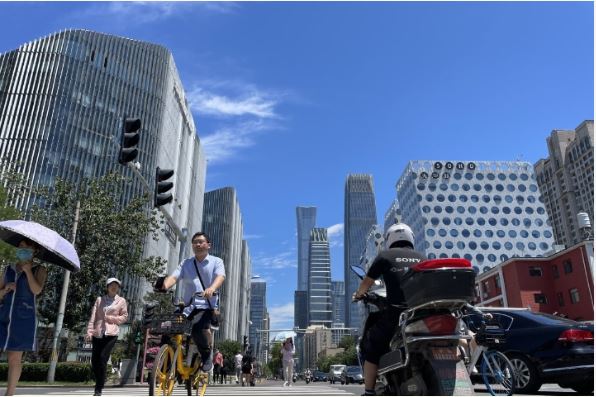
|
CHINA READER DAILY WIRE
|
|
|
|
|
|
EAST ASIA & THE PACIFIC READER |
17 February 2024, Saturday | Vol.1 No. 13
“Frank, substantial and constructive,” Wang Yi and Blinken’s meeting
| Hike in Labour protests amid slowing Chinese economy | | China concerned about newly elected Indonesian President Prabowo Subianto |
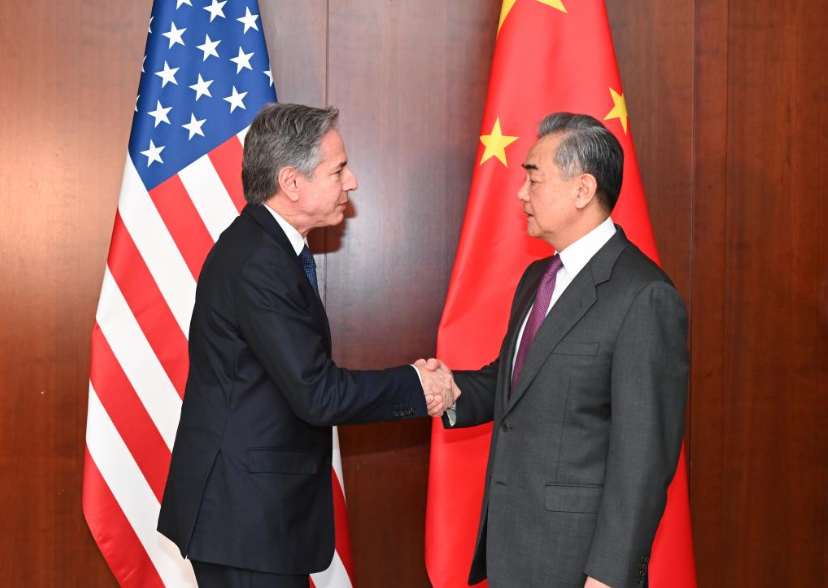
|
CHINA READER DAILY WIRE
In Brief
|
|
|
|
|
|
EAST ASIA & THE PACIFIC READER |
16 February 2024, Friday | Vol.1 No. 12
“We will not compete with other developing members,” China at WTO
| ‘A secret policeman on every street,’ says The Economist | | Chinese interest in Africa “driven by the metal and mining sector,” says SCMP |
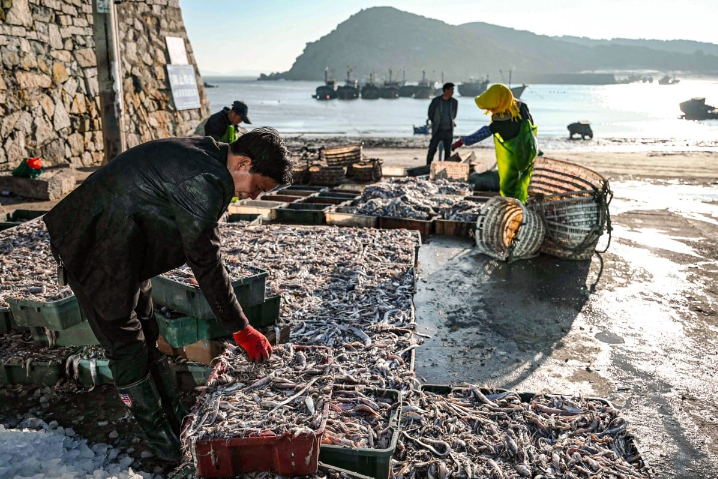
|
CHINA READER DAILY WIRE CHINA & THE AMERICAS
|
|
|
|
|
|
EAST ASIA & THE PACIFIC READER |
15 February 2024, Thursday | Vol.1 No. 10. & 11
Chinese ‘Taobao villages’ opt for Alibaba alternative
| Chinese influence lagging in the Red Sea Crisis | | US restrictions on China are a business risk, ASML |
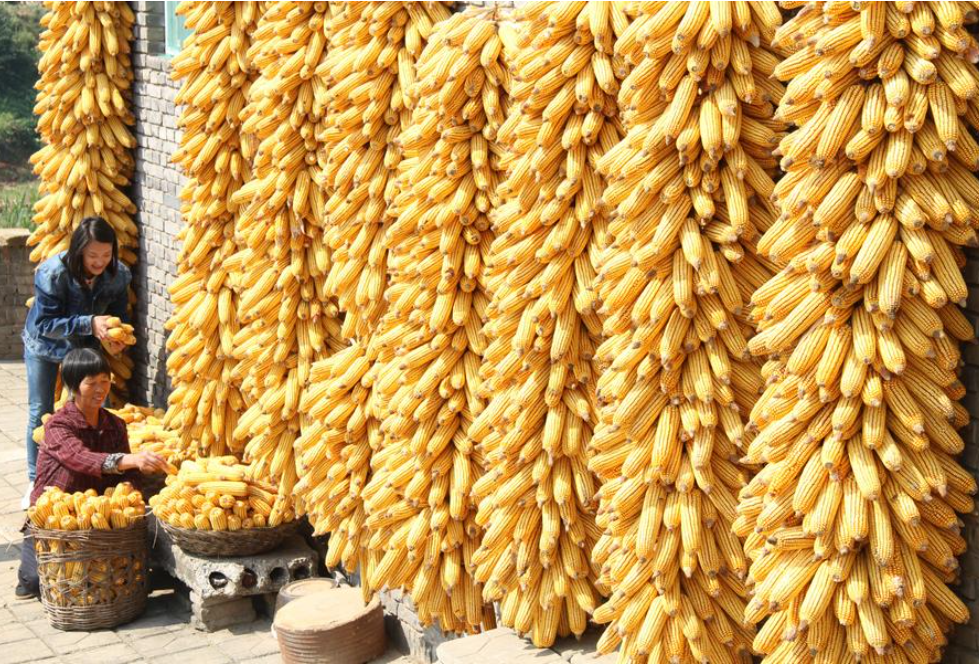
|
CHINA READER DAILY WIRE |
|
|
|
|
|
EAST ASIA & THE PACIFIC READER North Korea fired multiple cruise missiles Australia must impose climate change levy on fossil fuels |
13 February 2024
Declining birth rate threatens the teaching sector
Chinese universities to declare retractions and research misconduct | Chinese migrant detainees at the US border multiplied
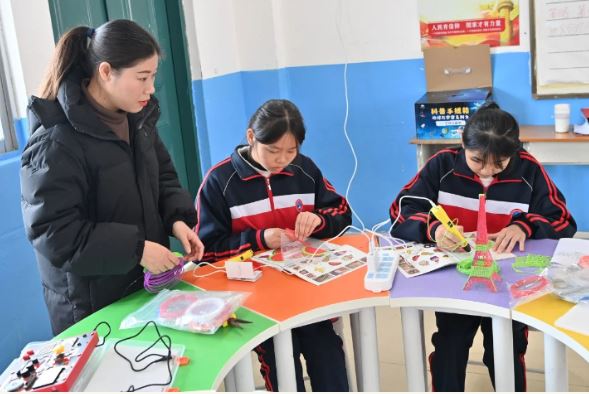
|
CHINA READER DAILY WIRE |
|
|
|
|
|
EAST ASIA & THE PACIFIC READER Taiwan’s PSA to expand its market in Southeast Asia |
|
|
About the Authors |
12 February 2024
Beijing threatens Tibetan exiles with repressive policies
Chinese presence in Mali purely economic, says SCMP | Chinese dealing with Russia halted over fear of international sanctions
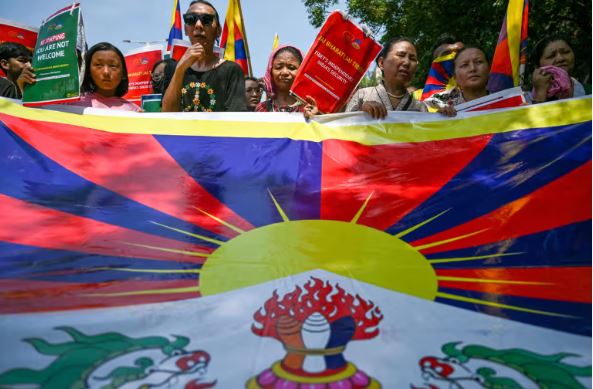
CHINA READER DAILY WIRE
In Brief
INTERNAL
Young Chinese upset with poor economy during the Lunar New Year holidays
On 11 February, according to a commentary in the BBC titled “Bad economy, nosy relatives: Young Chinese put off by Lunar New Year,” by Lok Lee, Chinese authorities expect around nine billion trips for the Year of the Dragon which is also known as the “chunyun”, which is the world’s largest annual migration. According to Lok Lee, many people wrote on social media platforms saying that they wouldn’t go home to attend the festival. According to the official data in June 2023, more than one in five city dwellers aged between 16 and 24 in China were unemployed. China suspended the release of youth unemployment data since January 2023 with the latest figure standing at 14.9 per cent. Lee further added that the confidence crisis has worried investors as it is expected that Chinese President Xi Jinping will focus more on party control over economic development. (Lok Lee, “Bad economy, nosy relatives: Young Chinese put off by Lunar New Year,” BBC, 11 February 2024)
SCIENCE & TECHNOLOGY
China’s Galactic Energy to debut its reusable rocket in 2024
On 12 February, according to an editorial in the South China Morning Post titled “Chinese start-up Galactic Energy plans reusable rocket debut this year,” by Ling Xin, Chinese company Galactic Energy is planning to debut its reusable rocket in 2024. The Pallas-1 is going to be the first Chinese rocket to deploy reusable rockets in its orbital missions. According to local news site Hinews.cn, Pallas-1 is set to take off from a spacecraft launch centre on the southern island of Hainan in November 2024. Galactic Energy was founded in 2018 and has established itself as a leader in China’s commercial launch sector. So far, only SpaceX from the US has achieved partial success with its reusable rockets (Falcon 9 and Falcon Heavy rockets) for reduced costs and profitable orbital flights. (Ling Xin, “Chinese start-up Galactic Energy plans reusable rocket debut this year,” South China Morning Post, 12 February 2024)
Chinese companies to build an alliance for the EV revolution
On 12 February, according to an editorial in Nikkei Asia titled “CATL, BYD, others unite in China for solid-state battery breakthrough,” by Shunsuke Tabeta, Chinese companies such as CATL and BYD are uniting as part of the China All-Solid-State Battery Collaborative Innovation Platform (CASIP), a government-led drive to commercialize all-solid-state batteries, challenging Japan and the West to challenge and revolutionize the electric vehicle market. China plans to set up research and development of next-generation batteries, AI and other technologies. According to Chen Qingtai, head of China EV100, solid-state batteries have the potential to change the balance of power in the industry, which means their development should be prioritized to ensure that China becomes an "automotive powerhouse." (Shunsuke Tabeta, “CATL, BYD, others unite in China for solid-state battery breakthrough,” Nikkei Asia, 12 February 2024)
CHINA & TAIWAN
Taiwan detects Chinese balloons ahead of New Year holidays
On 10 February, Taiwanese Ministry of Defense said that it had detected eight Chinese balloons crossing the Taiwan Strait in the past 24 hours since 09 February, ahead of the New Year celebrations. Out of eight balloons, two of them crossed the northern part of Taiwan. The Chinese government dismissed the complaints by Taiwan and said that the balloons are used for meteorological purposes and should not be used for political reasons. China does not recognize the median line and considers the Taiwan Strait as part of its sovereign territory. The spy balloon issue became a key global issue when the US shot down the balloon in 2023 (“Taiwan reports Chinese balloons at start of New Year holiday,” The Straits Times, 10 February 2024)
CHINA &SOUTHEAST ASIA
Chinese vessels conduct dangerous manoeuvres against the Philippines
On 11 February, the Philippine Coast Guard reported Chinese vessels were conducting dangerous manoeuvres during a nine-day patrol. The Philippine vessel BRP Teresa Magbanua was deployed on 03 February near the waters of Scarborough Shoal in the South China Sea. The reef became a case of dispute between the two countries when Beijing seized the island under its control in 2012. The PCG said that the ships were “four Chinese maritime militia vessels”, who were chasing the Philippine ships on more than 40 occasions. China claims the entire island and its surroundings in the South China Sea. Both countries have agreed to deal with bilateral maritime issues in January 2024. (“Philippine coast guard accuses Chinese vessels of ‘dangerous’ manoeuvres,” The Straits Times, 11 February 2024)
Tesla debuts its car sales in Thailand to counter its Chinese rivals
On 07 February, Tesla launched its popular Model 3 and Model Y EV cars in Thailand to compete against its Chinese competitor BYD. The company says that it offers its latest navigation systems and other features at competitive prices for Thai consumers. Tesla says that it will open its first Service Center and Supercharger station in Thailand by March and plans to have at least 10 set up in the country in 2023. Nithi Thuamprathom, an auto expert says that Tesla’s latest car launch will give a massive boost to Thailand’s market, which will give an edge over its rival BY Dover pricing and brand value. (Tassanee Vejpongsa And Tian Mcleod Ji, “Tesla launches in Thailand ,vying to compete with China EVs,” Associated Press, 07 February 2024)
CHINA & SOUTH ASIA
Beijing threatens Tibetan exiles with repressive policies
On 10 February, according to a report by the Tibetan Centre for Human Rights and Democracy (TCHRD), the Chinese government continues to implement repressive policies in Tibet. The Tibetans are subjected to spying, blackmail and threats against family members still living in Tibet. China uses Transnational repression to suppress the voices of Tibetans, Hongkongers and Uyghurs outside its borders. According to the report, there are an estimated 125,000 Tibetans in total living in exile. The suppression policies undermined solidarity among the Tibetan diaspora and reduced their ability to mobilize against Chinese policies in Tibet. (Jessie Lau, “Beijing accused of using spying, threats and blackmail against Tibetan exiles,” The Guardian, 10 February 2024)
CHINA & AFRICA
Chinese presence in Mali purely economic, says SCMP
On 11 February, an editorial in South China Morning Post titled, “China tipped to keep Mali ties strictly economic as UN peacekeeping mission wraps up,” by Jevans Nyabiage reported on the Chinese peacekeeping force leaving Mali in December of 2023. They came as part of the US peacekeeping mission, and in 2023 it ended its 10-year peacekeeping mission. With the exit of French troops, Mali’s Junta is warming up to China and Russia. In December, Chinese Foreign Minister Wang Yi hosted Mali’s minister of finance, commerce and foreign affairs. Wang said the programs Mali Digital project and the African Solar Belt is to: “help promote the peace and development process in Mali.” Stimson Centre analysed that the Chinese presence in Mali is limited to economic and security interests and not to diplomatic and political. (Jevans Nyabiage, “China tipped to keep Mali ties strictly economic as UN peacekeeping mission wraps up,” South China Morning Post, 11 February 2023)
CHINA & EUROPE
Chinese dealing with Russia halted over fear of international sanctions
On 08 February, Russian Deputy Foreign Minister Andrey Rudenko informed that they are trying to resolve the issue of Chinese banks halting their transaction with Russia amid sanction fears. Rudenko informed that while many banks are refraining from transactions, they are ready to continue with Financial Messaging System. Chouzhou Commercial Bank is the world's largest wholesale market and is the main location for Russian exports. The trade with China and the Yuan is the economic lifeline for Russia, in the year 2023, China and Russia traded with USD 240.1 billion. (Kinling Lo, “Chinese banks ‘refrained’ from dealing with Russia over sanctions fears,” South China Morning Post, 11 February 2024)
08 February 2024
Mexico overtakes China as the largest exporter to the US
Chinese and European scientists find an ocean in Saturn’s moon | Consumer prices in China witness a steep decline
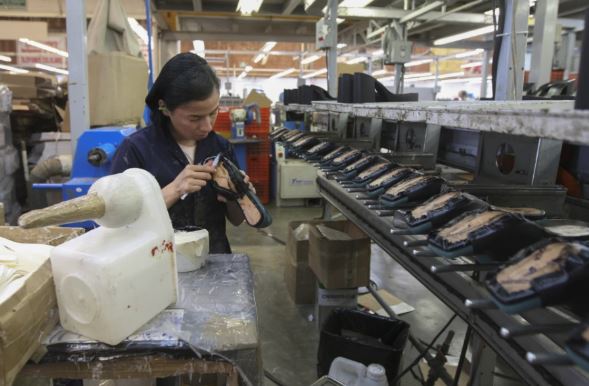
|
CHINA READER DAILY WIRE In Brief |
|
|
|
|
|
About the Authors |
07 February 2024
Chinese population to fall by 20 million in 2035, says EIU
Morgan Stanley foresees a market shift towards India away from China | Russia and China condemn the US strike on Iraq and Syria
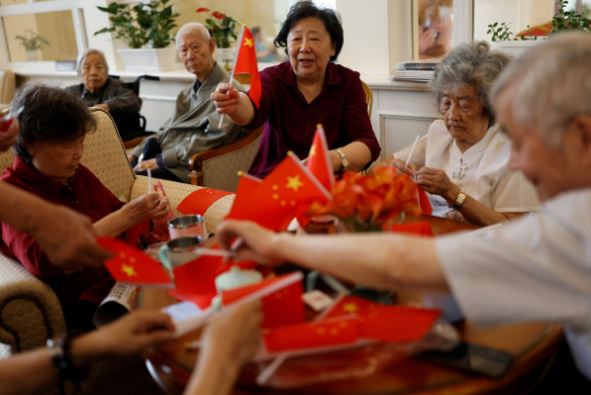
|
CHINA READER DAILY WIRE
|
|
|
|
|
|
EAST ASIA & THE PACIFIC READER EAST ASIA |
|
|
About the Authors |
05 February 2024
Chinese companies upgrade mining deal with DRC
Premier Li Qiang says China is open to foreign talents | Russia and China cooperation in the use of AI for military
|
In Brief |
|
|
|
|
|
EAST ASIA & THE PACIFIC READER Senior citizens and women suggested enlisters part of mandatory military service SOUTHEAST ASIA
|
|
|
About the Authors |
05 February 2024
Chinese companies upgrade mining deal with DRC
Premier Li Qiang says China is open to foreign talents | Russia and China cooperation in the use of AI for military
|
In Brief |
|
|
|
|
|
EAST ASIA & THE PACIFIC READER Senior citizens and women suggested enlisters part of mandatory military service SOUTHEAST ASIA
|
|
|
About the Authors |
17 January 2024
China Reader Daily Wire
National Bureau of Statistics releases its youth unemployment data
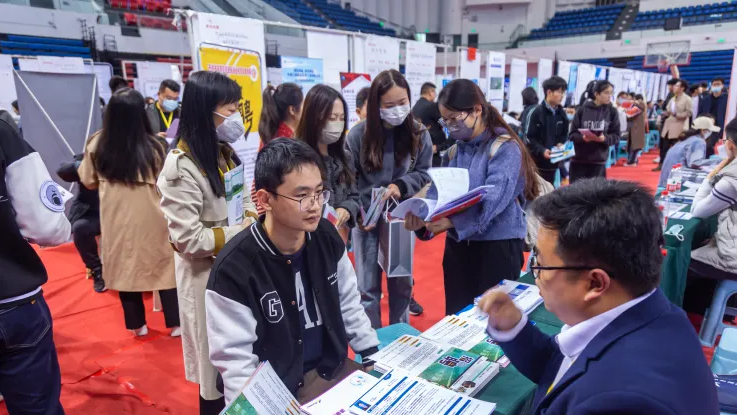
In Brief
ECONOMY
China’s targets for the financial sector
On 16 January, President Xi, during the Central Financial Work conference, set forth targets for China’s financial sector. Xi envisions the sector to follow the modernization path with Chinese characteristics and focus on bolstering institutional liberalization through the prevention and diffusion of risks. He further said the nation's financial regulation must have "teeth and thorns" and remain sharp-edged. According to China Daily, China’s financial sector has opened up to foreign investors by removing foreign ownership caps and thresholds in the banking and insurance sectors. According to the governor of the People’s Bank of China, Pan Gongsheng said that the outstanding loans of China’s banking system exceeded 200 trillion yuan and the balance of social financing exceeded 300 trillion yuan. (Xu Wei, “President sets key targets for financial sector,” China Daily, 17 January 2024)
Beijing aims to boost its GDP and economy in 2024
On 17 January, the National Bureau of Statistics (NBS) said that China’s GDP rose by 5.2 per cent in 2023 beyond the government’s target of 5 per cent. Economics Professor Zhu Tian said, “The yearly 5.2 per cent growth is achieved on the previous year’s low base and falls short of the widespread expectation of a story recovery at the beginning of 2023,”. According to the South China Morning Post, despite the focus for 2024, China is witnessing loosening investors’ confidence, stagnated property market, weak private sector and growing deflationary trends. Chief economist at Citigroup China said “On top of economic growth, other requisites for a confidence boost include a stable property market, receding deflationary pressure, as well as less policy unpredictability,” (Frank Chen & Orange Wang, “China GDP: Beijing’s long to-do list to boost economy in 2024,” South China Morning Post, 17 January 2024)
INTERNAL
National Bureau of Statistics releases its youth unemployment data
On 17 January, China’s National Bureau of Statistics (NBS) released its youth unemployment data after a six-month suspension. The report states the jobless rate for the 16 to 24 age group stood at 14.9 per cent in December 2023. According to NBS, exclusion of youth in school are excluded to reflect the status of unemployed college graduates in China. Until June 2023, the jobless rate for the 16-24 age group has gradually climbed since 2020, hitting a record high of 21.3 per cent. China feels the heat to create new jobs amid the process of economic recovery. The Chinese government has main concern on the growing unemployed graduates with an ageing population thus impacting the country’s future growth and huge pressure on social stability. (Amanda Lee & Orange Wang, “China jobs: youth-unemployment rate returns, adjusted, stands at 14.9%,” South China Morning Post, 17 January 2024)
China’s term growth concerns amid population decline
On 17 January, China’s National Bureau of Statistics (NBS) reported that the country’s population decreased for the second straight year in 2023 due to the low birth rate, wave of COVID-19 deaths and strict lockdowns. The population dipped by 2.08 million or 0.15 per cent to 1.409 billion in 2023. New births fell 5.7 per cent to 9.02 million and the birth rate was a record-low 6.39 births per 1,000 people, down to 6.77 in 2022. The country’s demography declined due to the One China Policy implemented from 1980 to 2015 and China’s rapid urbanization. According to The Strait Times, high childcare and educational costs, and job uncertainty among women discourage couples from having children. Despite the push by various local governments, many of them have not been implemented due to funding issues. (“China’s population drops for 2nd year in 2023, raises long-term growth concerns,” The Straits Times, 17 January 2024)
China appoints son of former President Hu Jintao to ministerial post
On 16 January, China announced Mr Hu Haifeng, son of former president Hu Jintao, to be appointed as the vice-head of China’s Human Resources and Social Security Ministry. Mr Hu Jintao was at the centre of the political firestorm after he was forcibly removed from the assembly against his will by President Xi’s orders. According to his official biography, Mr Hu Haifeng held mid-level official posts in the party as party committee secretary in the eastern city of Lishui. (“China appoints son of ex-president Hu Jintao to ministerial role,” The Straits Times, 16 January 2024)
CHINA & TAIWAN
Dip in Taiwan- China investments
On 15 January, an editorial in South China Morning Post “Taiwan-mainland China investment plunges to 22-year low as politics plague ties,” by Ralph Jennings highlighted that there has been an all-time dip in Taiwanese investment in China where it fell to a 22-year low in 2023. Ministry of Economic Affairs, Department of Investment Review of Taiwan reported that the investment of Taiwanese companies approved in mainland China is estimated to be USD 3.04 billion worth. Taiwanese companies have been investing in US-allied countries as tension progressed between the US and China. Executive chairman of the Guangdong Society of Reform Peng Peng said: “Taiwanese investors prefer to avoid mainland China because of US pressure to “decouple.” (“Taiwan-mainland China investment plunges to a 22-year low as politics plague ties,” South China Morning Post, 15 January 2024)
CHINA & THE AMERICAS
US expresses disappointment over Nauru’s switch to China
On 16 January, the US State Department expressed disappointment in the decision made by the tiny Pacific Island nation of Nauru to switch its diplomatic ties from Taiwan to China. This takes place amid the recent conclusion of the Taiwanese elections and the victory of the DPP at the elections. On 15 January, Nauru said that it would no longer recognize Taiwan as a separate country and would recognize it as an inalienable part of China. With Nauru’s departure, only 12 countries remain to support Taiwan. The US State Department stated that “Taiwan is a reliable, like-minded, and democratic partner. The PRC often makes promises in exchange for diplomatic relations that ultimately remain unfulfilled,”. (“US says Nauru switching ties from Taiwan to China ‘disappointing’,” The Straits Times, 16 January 2024)
CHINA & EUROPE
Li Qiang makes his official visit to Dublin, Ireland
On 16 January, Chinese Premier Li Qiang arrived at Dublin International Airport to begin his Ireland visit on the official invitation of Irish Prime Minister Leo Varadkar. The visit marked the 45th anniversary of diplomatic relations between China and Ireland. Li Qiang noted that the relations between the two countries have served as a model of friendly coexistence and win-win cooperation. Li said that both countries share similar development and other converging interests. He further said that China is willing to work with Ireland to boost the China-Ireland strategic partnership for mutually beneficial cooperation for greater benefits for both countries. (“Li Qiang arrives in Dublin for official visit to Ireland,” CGTN, 17 January 2024)
Chinese envoy says not to worry about China-Nauru ties
On 17 January, China’s ambassador to Australia Xian Qian said that China’s presence in the Pacific Islands is to assist them with policing and not defense and will not harm Australia’s security. He further stated that Nauru’s decision to choose China over Taiwan was its natural choice. Xian further stated that China intends to assist the Pacific Island countries with investment in their infrastructure, telecommunications, etc. He added that Security is the main focus of the relations between the two sides to ensure social stability and order within these island nations. Australian PM Albanese said that he respected Taiwan’s election results and also respected Nauru’s diplomatic decision. (“No need to be ‘anxious’ over China’s growing Pacific presence, envoy tells Australia,” South China Morning Post, 17 January 2024)
Editorial Team : Femy Francis, Akhil Ajith are Research Assitant at NIAS, Gopi Keshav and Arun S are Research Interns.
16 January 2024
China Reader Daily Wire
Taiwan-China investment slides down amid strain in political ties
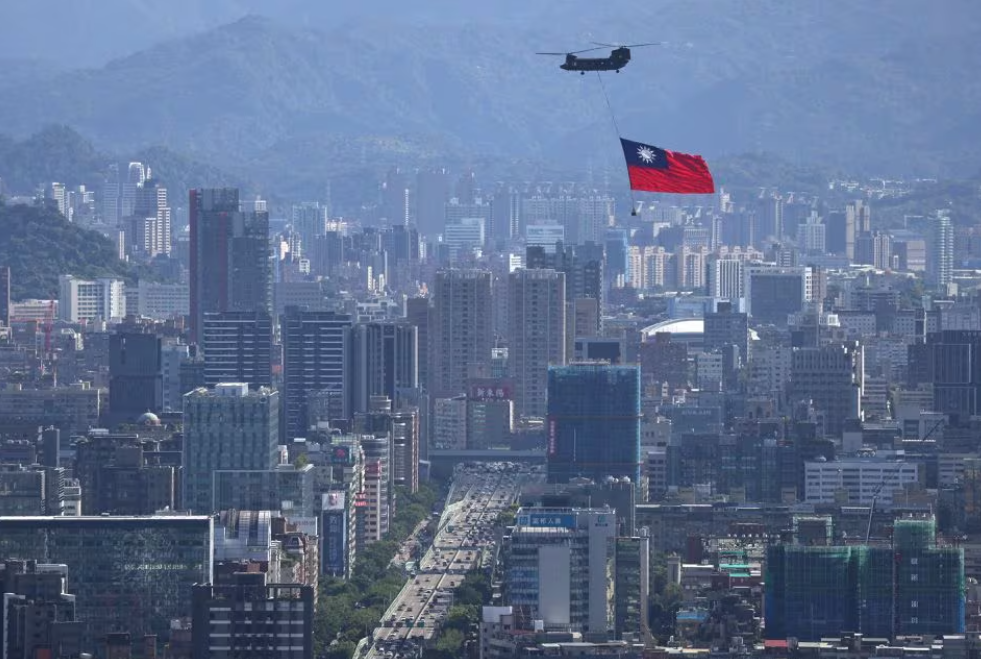
In Brief
INTERNAL
Xi Jinping calls CCP to win people’s hearts in Hong Kong, Macau and Taiwan
On 15 January, according to S, President Xi directs the CCP to “win the hearts” of people in Hong Kong, Macau and Taiwan through strengthening patriotic and reunification forces amid the DPP’s victory in Taiwan’s elections. Following the elections, Beijing’s Taiwan Affairs Office mentioned that Taiwan Reunification is inevitable. He further mentions the winning of people’s hearts as the biggest politics. He stressed to respect intellectuals outside of party and mentioned the need for overseas Chinese to return and serve the motherland for modernization. (Natalie Wong, “Communist Party must ‘win the hearts’ of people in Hong Kong, Macau and Taiwan: Xi Jinping,” SCMP, 15 January 2024)
China experiments on new Covid strain
On 15 January, according to Firstpost, Doctors from the PLA have been experimenting with the covid strain of “pangolin coronavirus” which has 100 per cent mortality in mice. According to a report published in bioRxiv, SARS-Cov-2 related pangolin coronavirus were invested on some mice and the results indicate potential dangers and its spread on humans. The Institutional Animal care and Use Committee of the Fifth Medical Center, General hospital of the Chinese PLA approved the animal experiment procedure. The study also raises the need for further investigations to understand the virus’s behavior and its potential impact on human health. (“China experimenting with 100% deadly new Covid strain: Report,” Firstpost, 15 January 2024)
Xi struggles to eradicate corruption within the PLA
On 11 January, according to The Economist, China is opaque about the corruption trends and its reasons within the PLA. In the past President Xi has openly stated the corruption’s impact on PLA’s combat skills. According to Bloomberg reports, the purge has led to expulsion of many senior officers in the last six months most of which belonged to the PLA Rocket Force. The report also highlights that XI is unlikely to wage any major offensive war in the coming future. Despite launches of many weapon systems including the aircraft carrier Fujian, Xi might think twice before sending them into ambitious missions. Xi’s military shake up has led to greater emergence of the ani-corruption agency and had also initiated greater political education among the troops. According to the article, such trends is seen as a threat to Xi’s rule. (“Xi Jinping is struggling to stamp out graft in the PLA,” The Economist, 11 January 2024)
EXTERNAL
Xi Jinping’s past speeches at World Economic Forum
On 16 January, according to China Daily, Xi Jinping’s past three speeches at Davos remains important for his upcoming speech at the World Economic forum Annual Meeting 2024. On his 2017 speech Xi mentions the interconnectedness of the global economy and the risks associated with protectionism and its negative impact. He further stressed on China making it more open and accessible for all countries to trade thus facilitating China to integrate with global economy. In the 2021 speech, Xi highlighted the principles of multilateralism to be open and fair fort all and discouraged the idea of certain multilateral groups with selective agenda and stressed on collaborative approach to address global challenges. (“Xi's key statements at past World Economic Forum,” China Daily, 16 January 2024)
SCIENCE & TECHNOLOGY
Chinese court recognizes AI generated image to benefit creators
On 15 January, according to SCMP, Chinese court made a landmark ruling to recognize the copyright of the image generated by AI. This is going to benefit the creators and its industry. In its first judgement, the court ruled that the image generated via text to image software will be considered original and intellectual input of the human creator. The Presiding judge Zhu Ge said last week at a lecture that the AI with legal status is done to encourage creators in this field and further stated that the such issues must be judged on a case-by-case basis. The IP infringement lawsuit was filed by plaintiff named Li, who used US start up StabilityAI’s Stability Diffusion program to build AI image. The court ruled in favor of Li. Many Chinese companies tech firms have ramped up their focus to build business on generative AI. “Xinmei Shen, “Why a Chinese court’s landmark decision recognizing the copyright for an AI-generated image benefits creators in this nascent field,” SCMP, 16 January 2024)
China begins to launch its Tainzhou-7 cargo spacecraft
On 15 January, according to XinhuaNet, China prepares to launch its Tainzhou-7 cargo spacecraft using Long March-7 Y8 carrier rocket at the Wenchang Spacecraft Launch Site in the southern province of Hainan. According to the China Manned Space Agency, the pre-launch function tests and joint tests will be conducted soon, and the timing of the launch will be determined after the completion of the tests. (“China prepares to launch Tianzhou-7 cargo spacecraft,” XinhuaNet, 15 January 2024)
CHINA & TAIWAN
Taiwan-China investment slides down amid strain in political ties
On 15 January, according to SCMP, bilateral investments between China and Taiwan fell to a record low in 2023 due to the political rifts between the two and the shifts in the global supply chains. The Taiwanese Ministry of Economic Affairs said that Mainland China approved investments worth USD 3.04 billion last year. Taiwanese companies are shifting out of China to US allied countries since 2018 due to declining lower costs. Taiwan approved China’s investments in Taiwan up to USD 29.7 billion which was lowest since 2013. According to experts, Change in Taiwanese investors preference is due to US’s pressure on decouple from China. (“Ralph Jennings, “Taiwan-mainland China investment plunges to 22-year low as politics plague ties,” SCMP, 15 January 2024)
Taiwan loses its ally Nauru to China post elections
On 15 January, according to The Straits Times, Taiwan loses its remaining allies Nauru to China just after the country elected its new president and accused Beijing to pressure Nauru. The government of Nauru said that “in the best interests” of Nauru and its people, it was seeking full resumption of diplomatic relations with China and would cut ties with Taiwan.” Taiwanese officials also mentioned that China will continue to sway away handful of countries that are supporting Taiwan. Taiwan’s Presidential Office said Beijing’s move has suppressed the islands’ voices but won’t undermine Taiwan’s will to engage with the world. (“Taiwan loses ally Nauru, accuses China of post-election ploy,” The Straits Times, 15 January 2024)
CHINA & EAST ASIA
Declining Trade between China and South Korea: US influence
On 16 January, according to the SCMP, Beijing’s trade with South Korea may be impacted due to the strain in ties between China and the US. China approved the shipment of graphite to South Korea as it plays an important role in the manufacturing of batteries, fuel cells, metallurgy, etc. Around 93.7 per cent comes from China thus making it one of the largest trading partners for South Korea. To reduce external dependencies along with growing tensions with US, China has tightened its export of key battery material affecting buyers in Japan, the US, and India. According to the data form the South Korean Ministry of Trade, Industry and Energy (MOTIE), due to the ongoing trade tensions between US and China, South Korea faced trade deficit of USD 18 billion with China in 2023. (Mia Nulimaimaiti, “Why China-South Korea trade drop-off may persist as US influence weighs on chips and tech,” SCMP, 16 January 2024)
CHINA & SOUTHEAST ASIA
China: Southeast Asia adapted to deal with Beijing, says The Economist
On 11 January, The Economist published: “South-East Asia learns how to deal with China,” where the article talked about how the region has managed to maneuver around China. The Chinese Belt and Road Initiative heavily invested in the Southeast Asian region where many of the projects went well and saw fruition a decade ago. But soon the others showcased loss as they were unable to gather results, with the mounting losses and no return the image of BRI also started to tarnish. The article states that though there was heavy Chinese investment there was no apparent influencing power with China over Southeast Asian countries. The region has realized that they cannot say no to China but be strategic about the deals they do form. The current Chinese investment showcases the new priorities of the region where they invite profit-generating investments like Huawei and steel firms. Though BRI's image has been tarnished this has not affected the relationship and Southeast Asia as it still seeks to further build their relationship. (“South-East Asia learns how to deal with China,” The Economist, 11 January 2024)
Malaysia: Singapore to revive Chinese-funded decaying Forest City project with SEZ
On 11 January, Singapore Prime Minister Lee Hsien Loong met with his Malaysian counterpart Anwar Ibrahim aiming to revive the “Forest City” estimated at USD 100 billion by developing it as a special economic zone. The project was built by Chinese real estate giant Country Garden to welcome Chinese buyers. The project built 28,000 units out of which only 9,000 are filled. The provision by the two countries hopes to increase cross-border flow, where they can invite people and businesses to revive the project. The plan would offer a passport-free QR code immigration to entice buyers and investment. The project saw a steep downfall in 2020 when China was hit by the housing bubble crisis, and the fanfare within the project came to existence soon died down. Now lays vacant properties decaying with stray dogs and crocodiles colonizing the area. (Hadi Azmi, “Malaysia seeks to revive China-backed Forest City megaproject – never mind the stray dogs, crocodiles and day drinkers,” South China Morning Post, 13 January 2024)
Philippines: To develop islands over claimed areas of the South China Sea
On 15 January, Philippines Military Chief General Brawner informed of the country’s plan to establish islands in the South China Sea, within the territories it recognizes as its own. The proposal came in light of the growing tensions between China and the Philippines in the SCS. There are nine islands Philippines claims out of which Thitu island stands to be the most strategic as it is 480 km west of Palawan province. General Brawner said: “Also included in the military’s modernization plans is the acquisition of more ships, radars and aircraft as the Philippines shifts its focus to territorial from internal defence.” (“Philippines to develop islands in South China Sea: Military chief,” The Strait Times, 15 January 2024)
Philippines: Congratulates new Taiwan elect while reaffirming to “One China” policy
On 16 January, the Philippines Department of Foreign Affairs issued a statement from President Ferdinand Marcos where he affirmed the “One China” policy. This comes after President Marcos congratulated the newly elected Dr Lai for his victory in the Taiwanese elections. After this statement Beijing accused the President of gravely violating Chinese policy and that it was meddling in China’s internal affairs. The statement said: “The message of President Marcos congratulating the new president was his way of thanking them for hosting our workers and holding a successful democratic process. Nevertheless, the Philippines reaffirms its ‘one China’ policy.” (“Philippines reaffirms ‘one China’ policy after President Marcos congratulates Taiwan’s Lai,” The Strait Times, 16 January 2024)
CHINA & AFRICA
Egypt: China issues a joint statement for peace settlement between Israel and Palestine
On 14 January, Chinese Foreign Minister Wang Yi visited Egypt holding talks with his counterpart Sameh Shoukry and Secretary-general of the League of Arab States Ahmed Aboul Gheit. During the visit, the two countries signed a joint statement for peaceful settlement of the conflict between Israel and Palestine. The issue called for an immediate cease-fire of the conflict, providing humanitarian aid and kickstarting the two-state solution. The statement also highlighted the spillover effects of the war with the grim situation unfolding in the Red Sea. They also called for a larger international peace conference and the formulation of a road map to implement solutions. (Zhou Jin, “Nation's efforts to mediate conflict win recognition,” China Daily, 16 January 2024)
CHINA & THE AMERICAS
US: China should not sour ties with the US over the Taiwan issue
On 15 January, South China Morning Post reported on the suggestion proposed by a professor at the Chinese University of Hong Kong’s Shenzhen campus Zheng Yongnian. Zheng expressed that the Taiwan issue should not affect the US-China relations. Even though the Taiwan issue looms high, he urged China to build a “new Taiwan narrative” by clearing that it is not about democracy and freedom but about sovereignty and that cannot be discussed. Zheng also believes that the US used Taiwan as a bargaining chip to “contain China.” He said: “We must desensitise and cool down the Taiwan issue, reduce its weightage in Sino-US relations, and not let the issue hold the overall state of Sino-US relations hostage.” He suggested a “Salami Slicing” approach to further the peaceful reunification by attracting youth. (Dewey Sim, “ US-China ties should not be ‘held hostage’ by Taiwan issue, says Chinese political scientist and adviser to Beijing,” South China Morning Post, 15 January 2024)
CHINA & EUROPE
Switzerland: To upgrade the free trade agreement with China
On 15 January, Chinese Premier Li Qiang met with the Swiss President Viola Amherd to discuss the upgrade of their free-trade agreement. The Chinese Foreign Minister issued that: “The two sides announced the completion of the joint feasibility study on the upgrading of the China-Sweden FTA and agreed to support the launch of formal upgrading negotiations as soon as possible.” Beijing plans to grant Swiss citizens visa-free provision and in return, Switzerland also plans to ease the visa process for Chinese nationals. Switzerland was one of the first countries to sign such a deal with China in 2013 which saw a deep in dialogue. Li said: “China is ready to work with Switzerland to implement the important consensus reached by the two heads of state, further consolidate the foundation of political mutual trust and carry forward the cooperative spirit of "equality, innovation and mutual benefit.” (Zhao Ziwen, Liu Zhen “China and Switzerland to revive push to upgrade free-trade agreement,” South China Morning Post, 15 January 2024)
20 September 2023
China Reader
China This Week
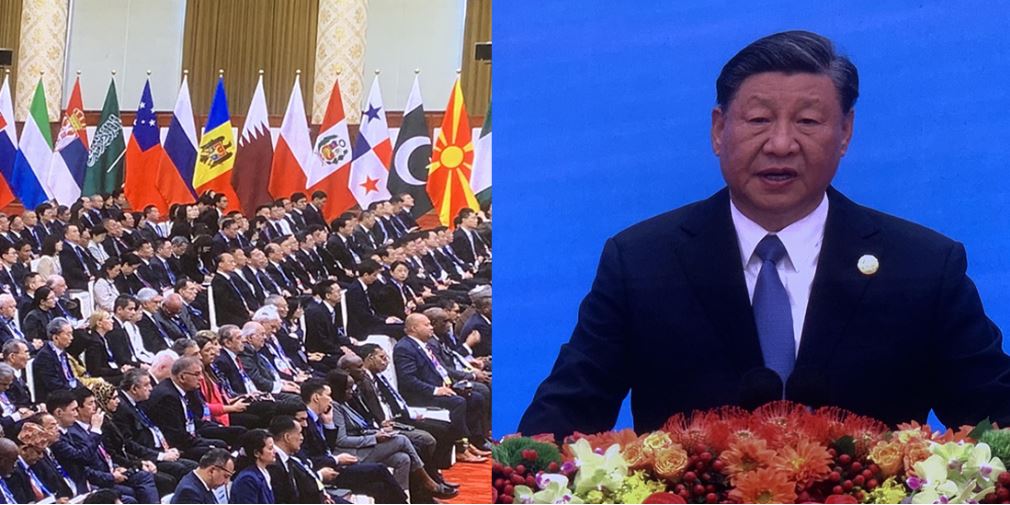
China: A special envoy to visits Cairo to de-escalate Palestine-Israel conflict
On 20 October, the Chinese Ministry of Foreign Affairs informed that a special envoy Zhai Jun will visit Cairo to discuss the Gaza-Israel conflict. The summit is aimed to bring world leaders aiming to establish peace. China is seeking to de-escalate the conflict and resume peace with an eventual ceasefire. Zhai has been holding a series of telephonic discussions to discuss the current issue and the Chinese Foreign Ministry Spokesperson Mao Ning said: “China has always stood on the side of peace and justice. We oppose all acts of violence against civilians and civilian facilities, and condemn any actions that violate international law.”
China: Refutes Pentagon claims of bolstering nuclear capabilities
On 20 October, China refuted the Pentagon’s claims that China’s military has been bolstering its nuclear abilities to counter US forces in the Asia-Pacific. China stated that its nuclear programme is only for self-defence. The Pentagon claimed that China will have over 1000 nuclear warheads by the year 2030. Chinese Ministry of Foreign Affairs spokesperson Mao Ning said: “We have always kept our nuclear forces at the minimum level required for national security and have no intention to engage in a nuclear arms race with any country.” She said no country will be threatened by China’s nuclear weapons as long as it does not use the same against them. Mao also questioned the heavy investment by the US in upgrading nuclear capabilities and providing nuclear assistance to non-nuclear countries, hinting at South Korea’s Washington Declaration.
Taiwan: Launches its first domestically built submarine “Hain Kun”
On 28 August, Taiwan announced their first domestically built submarine aiming to further their defence capabilities in deterring China. Taiwan has bolstered its defence spending to USD 26 billion for the coming year. The prototype was unveiled and was named “Hai Kun” meaning the mythical sea creature. Taiwanese President Tsai Ing-wen said: “History will forever remember this day,” and “In the past, building submarines domestically was considered ‘Mission Impossible’. But today, a submarine designed and built by our people is right in front of everyone – we did it.” Hai Kun is estimated to be 80m in length and weigh approximately 3,000 tons that features combat mechanisms sourced by Lockheed Martin a US-based defence company.
China: Accused of international media manipulation by the US
On 28 September, the US State Department accused China of manipulating the international media via censorship, data harvesting and covert purchases. The report warned of repercussions stating that this will affect the global freedom of expression. With the rise of Chinese aggression and competition, Beijing has intensified its efforts to clean its negative image. It claimed that China has invested in satellite networks and services to further the state-backed media. With its global footprint, China has been able to data harvest overseas, facilitating its censorship efforts.
China: Refuses to expand support for some CPEC proposals by Pakistan
On 26 September, an editorial in The Express Tribune “CPEC expansion plan in doldrums,” on the state of China and Pakistan’s economic ties as China did not agree to further their bilateral cooperation in areas of energy and water management. They expressed that Islamabad left its opposition to set up a coal-powered plant in Gwadar and that China refuses to agree to measures proposed by Pakistan. The negotiations signed upon largely exclude provisions proposed by Pakistan like the issue of financial challenges faced by power companies. They also advised that the imported fuel-based Gwadar plant converts to Thar coal. The Planning Ministry called the ratification of the 11th JCC meeting a testament to their strong cooperation while the iron-clad friendship is seeing strains.
China: Xi Jinping reaffirms his resolve to rebuild Syria
On 22 September, Chinese President Xi Jinping expressed his resolve to the ostracized leader Bashar Al-Assad in rebuilding Syria’s shattered economy. Assad met with Xi in the city of Hangzhou with China looking further its influence in the Middle East. Xi inferred with Assad that China also opposes any external interference and would work with Syria to “safeguard international fairness and justice.” This comes in light of Syria being heavily sanctioned since 2011 and now is in dire need of foreign investments, while some question the resolve turning into something concrete as it would mean more sanctions by the US on China via the 2020 Caeser Act. Under this, any third state that engages with a Pariah state would face sanctions and their assets frozen.
China: Huawei wants to be the alternative to US tech industry
On 20 September, Chinese tech giant Huawei executive Meng Wanzhou announced their plans to “build a solid computing based for China and a second option for the world.” Huawei’s Chief Financial Officer Ren Zhengfei expressed their future strategy for AI, stating that lack of development in computing power is the factor holding back AI development hinting towards US sanction and restriction of export of Nvidia chips. Huawei recently made headlines with the release of Mate 60 Pro smartphones with China-made chips, additionally, the Chip is made with 7- 7-nanometer technology.
China: The US National Security adviser held an informal discussion with the Chinese Foreign Minister
On 18 September, US National Security Adviser Jake Sullivan met with the Chinese Foreign Minister Wang Yi in Malta. Both sides agreed to establish exchanges and bilateral consultations over Asia-Pacific affairs and foreign policy. White House issued a statement that it is: “committed to maintain this strategic channel of communication and to pursue additional high-level engagement and consultations in key areas ... in the coming months.” Sullivan stressed the need for peace and stability across the Taiwan Strait and Yi responded by saying that the issue is: “first insurmountable red line of Sino-US relations”by saying that the issue is: “first insurmountable red line of Sino-US relations”
China: IMF looks to engage in future cooperation
On 1 September, Chinese Premier Li Qiang met the Managing Director of the International Monetary Fund (IMF) Kristalina Georgieva. The meeting aimed to promote economic growth and strengthen policy coordination. Qiang assured that China will provide an environment to promote growth for private enterprises and attract foreign capital. He hoped that the IMF would go against protectionist policies and promote globalization and free trade. Furthermore, he assured continued cooperation of China is aiding the debt issue in supporting the developing countries.
China: Meeting in Fiji between US and China’s Defence officials
On 31 August, China and US defence officers held talks in Fiji as reported by the Chinese Ministry of National Defence (MOD). MOD spokesperson Senior Colonel Wu Qian expressed that talks between the two countries have not been suspended and that both sides have maintained open and effective communication. The meeting comes right after the announcement made by the US State Department approving USD 80 million worth of military support to Taiwan under the “Foreign Military Financing program.” An international affairs expert in China Zhuo Hua states: “If the two militaries want to have further positive interactions, the key lies in whether the US can truly change its erroneous perception and policies towards China in the coming period, and whether it can take concrete goodwill actions”
China: President Xi Jinping announces measures to expand market access
On 02 September, Chinese President Xi Jinping announced that they plan to widen the market access for the service industry and welcome cross-border service trade. The initiative plans to expand on the domestic market by increasing imports of high-quality services. This comes in as China is facing an economic slump where some US-based think tanks are stating the once thriving but now diminishing Chinese economy poses no threat to the US.
China: Discusses export controls with the US
On 28 August, US Commerce Secretary Gina Raimondo met with her Chinese counterpart Wang Wentao in Beijing. The meeting aimed to serve as a platform to mitigate misunderstanding and to further explain their export control systems. They decided that every year both government and private sector representatives would be allowed to discuss trade and investment policy. Several analysts found that while the meeting won't lead to any concrete provisions, talking is better than not talking.
China: Suspends seafood imports from Japan
On 24 August, the Chinese customs office announced that they would "comprehensively '' suspend any seafood imports from Japan. The reason stated was that they want to avoid any risk of radioactive contamination from the nuclear-treated water to ensure food safety. Additionally, the Chinese Ministry of Ecology and Environment announced that they would take the necessary steps to monitor any radiation in the sea caused by the release. The Japanese government has evaluated the safety of the release with a two-year review by the International Atomic Energy Agency. However, this has not been well received by countries, with mass protestsin South Korea and North Korea.
China: Urges US to stop arming Taiwan
On 25 August, the Chinese Defence Ministry accused the US of "arming" Taiwan and urged them to stop. This comes after the USD 500 million sale of the Island of Infrared Search and Track Systems for F-16 fighter jets was approved by the US State Department. Chinese Defence Ministry spokesperson Zhang Xiaognag said: "China urges the U.S. side to effectively fulfil its commitment not to support the independence of Taiwan, to immediately stop arming Taiwan, and to stop enhancing US-Taiwan military ties."
China: Xi welcomes “Old friend” Henry Kissinger
On 20 July, Chinese leader Xi Jinping met the former US Secretary of State Henry Kissinger in Beijing. Xi welcomed him calling Kissinger an “old friend.” Kissinger was a vital player in establishing the US-China relationship in the 1970s and his visit aimed at resolving estranged ties. Kissinger said: “Under the current circumstances, it is imperative to maintain the principles established by the Shanghai Communique, appreciate the utmost importance China attaches to the ‘one China’ principle, and move the relationship in a positive direction.”
China: US Treasury Secretary Janet Yellen arrives in Beijing
On 6 July, US Treasury Secretary Janet Yellen arrived in Beijing to mend US-China relations. She complained of the “punitive actions against US companies and new exports controls on citerical mineral” that China was imposing and that it was an “unfair economic practice.” Chinese finance minister Li Kun said they hope that the United States will take concrete actions to provide for a conducive environment to flourish their relationship, further, he said: “No winners emerge from a trade war or from decoupling and ‘breaking chains.”
30 July 2022 | Saturday | China Reader Evening Brief | Vol.1, No. 246
China's Foreign Minister addresses the Shanghai Cooperation Organization
Wang Yi initiated a five-point proposal to work towards building a community with a shared future.
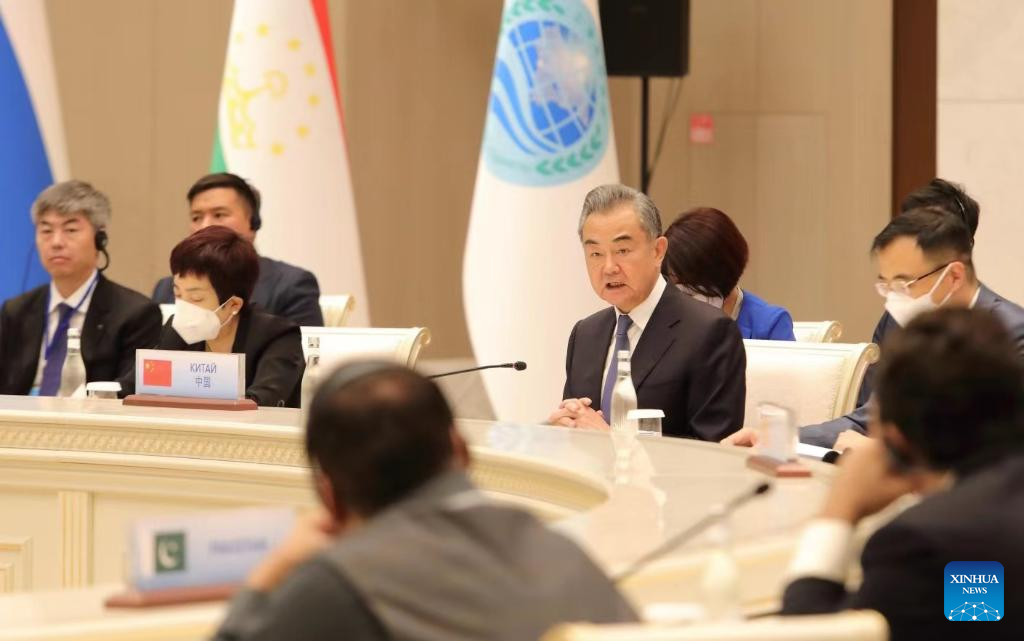
IN BRIEF
By Avishka Ashok and Arshiya Banu
INTERNATIONAL
Shanghai Cooperation Organization: China's Foreign Minister initiates a five-point proposal to build a shared community
On 29 July, China’s Foreign Minister Wang Yi attended the meeting of the Council of Foreign Ministers of the Shanghai Cooperation Organization and stressed on the changing dynamics of the international order and the rising regional challenges. Wang said: “Chinese President Xi Jinping has grasped the pulse of historical development and echoed the voices of people from all over the world. He proposed the Global Development Initiative and the Global Security Initiative, contributing Chinese wisdom and public goods to solving the problems of the times, which has received positive responses from the international community, including the SCO member states.”
Wang Yi also highlighted China’s objective of building a closer SCO community with a shared future and upholding the Shanghai spirit. Wang initiated a five-point proposal to work towards this goal. First, cementing solidarity and coordination. Wang said: “They should firmly support each other in following the path of development in line with national conditions, back each other in taking major measures to maintain social stability, and work together to create a sound environment for the development and revitalization of countries in the region.” Second, he stressed on regional security and urged the member countries to implement the concept of common, comprehensive, cooperative and sustainable security while opposing confrontation between factions and undermining regional stability.
Third, Wang Yi highlighted the need to promote sustainable development and pursuing people-centred development, and continuing cooperation in poverty reduction and green development. Fourth, he emphasized the need to focus on multilateralism. He said: “They should step up multilateral coordination and cooperation, reject unilateral sanctions and "long-arm jurisdiction," and defend the shared interests and development space of emerging markets and developing countries.”
Lastly, China called for expanding the group steadily and gradually. Wang Yi suggested keeping the geographical factors, the observer states, dialogue partners while expanding the group and its capacity.
(“Chinese FM attends SCO foreign ministers' meeting in Tashkent,” Xinhua Net, 30 July 2022; Chinese FM advocates closer SCO community with shared future,” Xinhua Net, 30 July 2022)
Germany: Eight projects signed at Forum for Industrial Cooperation and Development
On 30 July, Xinhua Net reported that the China-Germany Forum for Industrial Cooperation and Development in Beijing had resulted in eight projects which are expected to draw an investment worth USD 297 million dollars. The projects have an industrial output value of 11.5 billion yuan per year. VASTALTA’s CEO, one of the companies within the network said: “China's carbon emission peak and carbon neutrality goals provide great opportunities for us.” Since its inception in 2018, the Sino-German Industrial Park has resulted in over 80 companies setting up their branched in China. (“Eight projects worth nearly 300 mln USD signed at China-Germany forum,” Xinhua Net, 30 July 2022)
Poland: President Xi encourages trade ties and traditional friendship
On 29 July, China’s President Xi Jinping held a telephonic conversation with the Polish President Andrzej Duda and discussed the trade relations and positive progress made by the countries in the past years. Xi noted that the countries had agreed to advance bilateral relations during the Beijing Winter Olympics and had also reached other important consensus. Xi further expounded that China perceives Poland as a preferred partner for trade in Europe and aims to continue close communication and enhance political mutual trust between the countries. Xi said: “”The two sides should work hard for the early launch of the China-Central and Eastern European countries (CEEC) wholesale market for agricultural products, and actively cooperate in planning and organizing relevant events to mark the 10th anniversary of China-CEEC cooperation mechanism, so as to lay a solid foundation for cooperation in the next decade.” (“Xi holds phone talks with Polish president,” Xinhua Net, 29 July 2022)
Iran: President Xi Jinping discusses cooperation with President Raisi
On 29 July, China’s President Xi Jinping discussed the present challenges and the need for international equity and justice during his telephonic conversation with Iranian President Ebrahim Raisi. Xi noted the strengthening of cooperation between China and Iran and said: “China views its relations with Iran from a strategic perspective and stands ready to work with Iran to push for new progress in the China-Iran comprehensive strategic partnership.” Additionally, he stressed on supporting each other’s core interests and uphold the policy of non-interference in each other’s internal affairs. Iran further extended its support to China on the Global Development Initiative and Global Security Initiative. (Xi talks with Iranian president over phone,” Xinhua Net, 29 July 2022)
The US: Chinese embassy condemns remarks by the US Secretary of the Navy
On 30 July, the Asahi Shimbun reported that after a senior US Navy officer decried Beijing's increasingly belligerent tactics in the South China Sea, China retaliated by accusing the US of engaging in "navigation bullying" by stationing military forces in the disputed waterways. The Chinese Embassy in Manila strongly condemned the comments made by the US Secretary of the Navy Carlos Del Toro, stating they were “unfounded accusations against and maliciously smeared China” and that they inflated the “China threat.” Del Toro emphasised how Beijing has violated international law by invading the territorial waters of its Asian neighbours in an interview with The Associated Press on Tuesday while in Manila. (“China accuses U.S. of ‘navigation bullying’ in South China Sea,” The Asahi Shimbun, 30 July 2022)
The US: White House says it sees no indication of impending Chinese military activity against Taiwan
On 30 July, the Strait Times reported that when White House national security spokesman John Kirby was asked about a potential trip to the island by US House of Representatives Speaker Nancy Pelosi, he stated that the US has seen no indication of impending Chinese military activity against Taiwan. He said: "(We've) seen no physical, tangible indications of anything untoward with respect to Taiwan." A prospective trip to Taiwan has not been confirmed by Pelosi. In a phone call on Thursday between President Joe Biden and Chinese President Xi Jinping, tensions around Taiwan dominated the conversation. Xi cautioned against handling Taiwan in a reckless manner. (“No evidence of looming Chinese military action against Taiwan, US official says,” The Strait Times, 30 July 2022)
REGIONAL
Taiwan: Expert talks about Pelosi’s trip to Taiwan
On 30 July, the Asahi Shimbun reported that the controversy caused by House Speaker Nancy Pelosi's prospective trip to Taiwan misses the mark because the main issue at hand should be how the United States and China handle their differences to prevent the risks of conflict from growing out of control. Pelosi's planned visit has sparked a great deal of discussion about China's possible diplomatic and military measures. But if it does happen, the visit to Taiwan will just add to the tension that has been looming over the island’s democracy for years. A defence studies expert Arthur Zhin-Sheng Wang from Taiwan’s Central Police University said: “The main point is not in Pelosi coming to Taiwan, but it’s to look at how the U.S. and China effectively control the risks that may arise.” (“For Taiwan, Pelosi visit is about U.S., China controlling risk,” The Asahi Shimbun, 30 July 2022)
ECONOMY
Banking and Insurance Regulatory Commission: Continuous regulation has greatly reduced the assets and hazards of China's "shadow" banking sector
On 30 July, Vice-chairman of the China Banking and Insurance Regulatory Commission Liang Tao stated that continuous regulation has greatly reduced the holdings and dangers of China's "shadow" banking sector. He added that as of the end of June, the sector has decreased from its peak by more than 29 trillion yuan. Liang issued warnings about significant underlying dangers as certain goods have intricate structures and significant levels of leverage. According to him, People should be on the lookout for hazards associated with a resurgence of shadow banking, as some organisations may exploit questionable financial advances to develop fresh iterations of the practise. (“Shadow-banking risks in China curbed significantly, regulator says,” The Strait Times, 30 July 2022)
29 July 2022 | Friday | China Reader Evening Brief | Vol.1, No. 245
President Xi and President Biden discuss bilateral relations and mutual interests
During the two-hour long telephonic conversation, both the heads of states expressed their concerns and called for greater cooperation between China and the US,
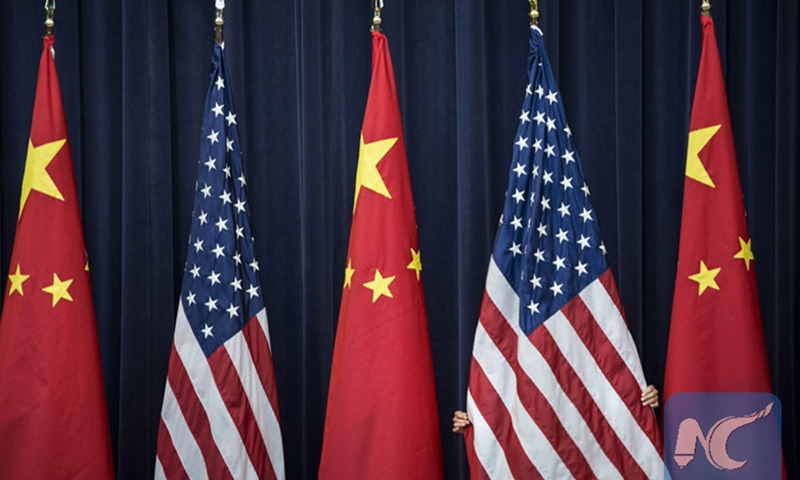
IN BRIEF
By Avishka Ashok and Arshiya Banu
INTERNATIONAL
The US: President Xi and President Biden discuss mutual interests and bilateral relations on call
On 28 July, the Chinese President Xi Jinping and US President Joe Biden discussed and exchanged their views and concerns on the bilateral ties and other issues of mutual interest during the two-hour long telephonic conversation. Xi highlighted the current situation of the international order and stressed on the economic superpowers to take the lead in upholding world peace and security. The Chinese Head of State expressed his concerns regarding the China-policy of the US and the country’s perception of China as a strategic competition and a primary rival. Xi suggested working together with the US on macroeconomic policies, global industrial and supply chains, energy and food security. Xi additionally stressed on maintaining communication at all levels and promoting bilateral cooperation. The two leaders also exchanged their country’s position on the Russia-Ukraine war.
On the Taiwan issue, President Xi reiterated China’s objection to any support extended towards the independence movement and interference in the country’s internal affairs. Xi urged the US to abide by the one-China principle and the joint communiques. He said: “The three China-U.S. joint communiques embody the political commitments made by the two sides, and the one-China principle is the political foundation for China-U.S. relations. China firmly opposes secession aimed at "Taiwan independence" and external interference, and never allows any room for "Taiwan independence" forces in whatever form.” Biden reassured Xi that the US adherence to the one-China principle had not changed and that the country did not support the independence movement in Taiwan.
(“Xi speaks with Biden over phone,” Xinhua Net, 29 July 2022;
“Xi underscores need for China, U.S. to maintain communication on important issues,” Xinhua Net, 29 July 2022;
“Xi warns against misperceiving China-U.S. ties, misreading China's development,” Xinhua Net, 29 July 2022;
“China firmly opposes "Taiwan independence," external interference: Xi,” Xinhua Net, 29 July 2022;
“Xi criticizes US rivalry policy in candid talk with Biden, warns over Taiwan question but both sides emphasize cooperation,” Global Times, 28 July 2022)
Defence Ministry Press Briefing: Spokesperson objects NATO’s strategic document and warns US from deploying troops in Japan
On 28 July, China’s Defense Ministry Spokesperson Wu Qian addressed a press inquiry and commented on NATO’ strategic concept document and the US plan to deploy troops in Japan. On NATO’s strategic document, Wu expressed China’s opposition to certain content for distorting facts, instigating confrontation and conflicts, and making irresponsible remarks on China’s military development. Wu said: “China is a consistent builder of world peace, a contributor to global growth, a defender of the international order, and a provider of public goods. China's military development not only underpins efforts to safeguard the country's sovereignty, security, and development interests but also promotes world peace and stability, and provides more public security goods worldwide.” On the deployment of US troops in Japan, Wu Qian said that China would take resolute countermeasures if the US decides to go ahead with its plans. He said: “The United States' intention to make such a move is perilous and detrimental to the national security of countries in the region as well as regional peace and stability.” (“Chinese spokesperson slams NATO for strategic concept referring to China,” Xinhua Net, 29 July 2022; “China warns against U.S. missile troop deployment plan in Japan,” Xinhua Net, 29 July 2022)
India: China reached four-point consensus on border issues
On 28 July, China’s Ministry of National Defence Spokesperson Wu Qian addressed a press conference and announced that a four-point consensus had been reached with India on the resolution of border issues at the 16th round of the China-India Corps Commander Level Meeting. Wu Qian said: “The two sides continued discussions for the resolution of relevant issues along the Line of Actual Control of the China-India border, said Wu Qian, spokesperson for China's Ministry of National Defense.” According to the Chinese Defence Ministry, the two sides consented to actively work towards implementing the consensus achieved at the meeting, thereby building momentum for progress in bilateral relations. China and India have agreed to effectively manage differences, maintain security and stability and continue open communication and dialogues while attempting to reach an acceptable solution on the issue. The Chinese spokesperson also revealed that the current situation along the borders were calm with regular military and diplomatic channels between the two sides. (“China-India corps commander level meeting reaches four-point consensus: spokesperson,” Xinhua Net, 29 July 2022)
Uzbekistan: China’s Foreign Minister agrees on strengthening relations
On 28 July, China’s Foreign Minister Wang Yi visited Uzbekistan and reached a series of consensus on improving their bilateral relations. Wang said: “The two sides will take the 30th anniversary of the establishment of diplomatic ties as a new starting point to make joint efforts toward the vision and goal of building a China-Uzbekistan community with a shared future and inject new strong impetus into their comprehensive strategic partnership.” China and Uzbekistan discussed the Global Development Initiative and the Global Security Initiative and also agreed to support two other initiatives. The countries now aim to achieve annual trade worth USD 10 billion. They also decided to quickly implement the five-year plan for economic, trade, and investment cooperation. Other areas for cooperation will be poverty alleviation, medical and health infrastructure and vaccine production. (“China, Uzbekistan reach consensuses on strengthening ties,” Xinhua Net, 29 July 2022)
REGIONAL
Taiwan: Military blasts flare to scare away drone
On 28 July, the Taiwanese Defence Ministry stated that Taiwan's military blasted flares to scare away a drone that "glanced by" a strategically positioned and heavily defended island close to the Chinese coast and may have been testing its defences. Chinese military operations have increased over the past two years or so in an effort to pressure Taiwan's democratically elected government to recognise Beijing's sovereignty. According to the ministry, the drone twice "glanced by" Dongyin island, which is a part of the Matsu archipelago off the coast of Fujian province in China and is under Taiwanese control since the end of the Chinese Civil War in 1949. (“Taiwan says it fired flares to warn off drone near remote island,” The Strait Times, 28 July 2022)
Taiwan: Week-long military exercises come to an end
On July 29, the Strait Times reported that Taiwan has concluded a weeklong yearly military exercise and air raid drills, which it conducted to strengthen its defences against a Chinese invasion. As part of the Wan An air defence exercise, which was held from Monday to Thursday, sirens wailed throughout the island to remind people what to do in the event of an air raid. The yearly Han Kuang military drills, which simulate the responses to a Chinese invasion, were being conducted at the same time by the land, air, and naval forces. Although both exercises are conducted annually, this year's drills took place in the midst of an increase in Chinese military activity near the island. (“Taiwan ends week-long defence drills amid China tension,” The Strait Times, 29 July 2022)
INTERNAL
Xiaomi: Company struggles to obtain approval for its electric vehicle project
On 29 July, the Strait Times reported that Beijing-based company Xiaomi is finding it challenging to obtain regulatory approval for its electric vehicle project. The company has been attempting to discuss the issue with officials at the National Development and Reform Commission for months without success. Xiaomi’s co-founder Lei Jun, who has said that electric vehicles will be his final venture into the startup world, is relying on Xiaomi's experience in linked technologies and cultivating devoted user communities to catch up. But the longer it takes to get a licence, the more advantage its competitors will have. (“Xiaomi's $14b car project 'runs into regulatory barrier',” The Strait Times, 29 July 2022)
Laoximen: Shanghai’s former central hub to be demolished
On 29 July, the Strait Times reported that one of Shanghai's oldest neighbourhoods is barely hanging on as the city pushes through with demolition and redevelopment plans, featuring bricked-up doorways, deteriorating facades, and a small handful of defiant people. Laoximen, also known as the "old West Gate," was originally the city's cultural hub and was called for its location within Shanghai's 16th-century defensive walls. The majority of the stone and wood structures, which are typically two and three stories tall and are located around the site of a Confucian temple, are an anachronism in Shanghai's dazzling business sector. At the end of 2017, thousands of occupants were asked to leave their homes, though some remained in the deteriorating structures for years after the deadline. (“Demolition looms for Shanghai's historic Laoximen neighbourhood,” The Strait Times, 29 July 2022)
28 July 2022 | Thursday | China Reader Evening Brief | Vol.1, No. 244
Chinese Foreign Ministry responds to South Korea's statements on deployment of THAAD
The Foreign Ministry Spokesperson urges South Korea to stick by the commitments made by the preceding government on the deployment of the THAAD and the Three No's Policy.
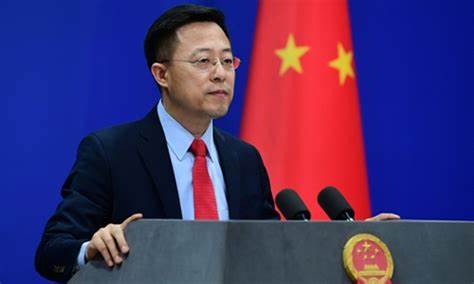
IN BRIEF
By Avishka Ashok
REGIONAL
South Korea: China’s Foreign Ministry responds Seoul’s recent statements on THAAD
On 27 July, China’s Foreign Ministry Spokesperson Zhao Lijian referred to South Korean Foreign Ministry’s statement on the ‘Three No’s Policy” and the THAAD (Terminal High Altitude Area Defense) and urged the country to stick to the commitments made by the country previously. The South Korean Foreign Minister Park Jin addressed the National Assembly and said that the preceding government’s agreement on the policy was not a promise to China. Political experts and analysts in China believe that the statement by Moon Jae-in’s government on the THAAD in 2017 saved the bilateral relations and sustained the trade ties. Zhao said: “No matter which party takes office, no matter what political needs it has domestically, it needs to ensure basic continuity and stability in its foreign policy.” Zhao further explained that China’s position on the US deployment of the THAAD in South Korea was aimed to protect its own national security and prevent the US from harming China’s strategic interests. (“China urges SK to stick to commitment despite change of govt, as ‘Three No’s’ on THAAD ‘plays key role in mutual trust’,” Global Times, 27 July 2022)
INTERNATIONAL
United Nations: China calls on countries to respect sovereignty of post-conflict countries
On 27 July, China’s Permanent Representative to the United Nations Zhang Jun addressed the Security Council Briefing on Peacebuilding Commission and asked the member countries to respect the sovereignty of post-conflict countries and provide constructive assistance when requested by the countries. Zhang said: “National conditions vary greatly among post-conflict countries and even evolve within the same country as it goes through different stages. The international community should support the countries concerned in exploring development paths that fit their own national conditions and engage in peacebuilding in a targeted manner, aligned with the priorities of the said countries.” He further stressed on development in post-conflict countries and urged the countries to assist them in improving people’s livelihood and developing the economy. (“Chinese envoy urges respecting sovereignty of post-conflict countries,” Xinhua Net, 28 July 2022)
INTERNAL
Communist Party of China: President Xi calls for planning country’s goals and challenges in the next five years
On 28 July, the Strait Times reported on President Xi Jinping’s statements at the meeting of top political leaders in the country during the week. Xi called for planning for risks in the coming five years and beyond as the 20th Party Congress is scheduled to take place later this year. He asked the party to prepare goals, tasks and policies for China until 2027. He said: “Against the backdrop of accelerating global changes unseen in a century, and more complex risks, challenges, contradictions and problems, the fundamental task is to run our own affairs well.” (“Xi urges plan to tackle risks for next 'five years and beyond',” The Strait Times, 28 July 2022)
Hong Kong: City houses highest number of women prisoners in the world
On 28 July, the Strait Times reported that more than a quarter of Hong Kong’s prisoners are women, out of which a record high percentage were accused of trafficking drugs. However, in most cases the women were duped or coerced into transporting packages by a third party. Hong Kong Correctional Services said that 37 per cent of the foreign inmates female and are a majority in the female prison wings in the city. The World Prison Brief also reported that the number of women in prisons in Hong Kong was the highest in the world. The prison chaplain Father John Wotherspoon who has worked with convicted drug smugglers for decades referred to the issue and said: “Coercion is a big problem and it can come in many forms, economic, physical, emotional.” (“Easy targets: Drug mules fill women's jails in Hong Kong,” The Strait Times, 28 July 2022)
Heatwaves: National Meteorological Centre extends orange alert in a few regions across China
On 28 July, China’s National Meteorological Centre continued its orange alert for heatwaves across various parts of the country. The state body alerted that some parts of Xinjiang, Inner Mongolia and some of the southern parts could experience temperatures as high as 35 degree celsius. Some regions of Zhejiang, Jiangxi and Xinjiang could even experience temperatures as high as 40 degree celsius. The government has advised the people to remain indoors and reduce continuous outdoor activities in the coming week. (“China renews orange alert for high temperatures as heatwaves linger,” The Strait Times, 28 July 2022)
Hong Kong: UN Human Rights Committee urges China to repeal the National Security Law
On 27 July, the United Nations Human Rights Committee expressed its concern over the deteriorating state of human rights in Hong Kong and called on the Chinese government to repeal the National Security Law which was imposed in 2020. The international body published a report on the issue and strongly advised China to “take concrete steps to repeal the current national security law and, in the meantime, refrain from applying the law." The report claimed that over 200 citizens had been arrested over concerns of endangering national security since 2020. The Committee consists of 18 independent experts who are appointed by the United Nations. The committee does not review the human rights situation in the rest of the country as China is not a signatory of the International Covenant on Civil and Political Rights. However, Hong Kong is considered to be a party to the covenant through the Basic Law that gave the city its autonomous status in 1997. The Hong Kong COnstitutional and Mainland Affairs Bureau has expressed its discontent and objection to the report on the city and said that they were unsubstantiated criticisms. (“Hong Kong must repeal national security law, says UN rights watchdog,” The Strait Times, 28 July 2022)
Xinjiang: Xinhua reports that voluntary emails were written to UN High Commission for Human Rights
On 28 July, Xinhua Net reported that citizens from the Xinjiang Autonomous Region had voluntarily sent email-letters to the United Nations High Commissioner for Human Rights Michelle Bachelet, explaining their experiences and attempting to discredit the anti-China narratives being formed in the international order. The report claimed that people who suffered from terrorist attacks in Xinjiang, students and graduate trainees from the centres in the region, the religious minorities, scholars and public representatives, and migrant workers had written to the Human Rights Chief ecplaining the positive changes in the region in the past decades. (“People of Different Ethnic Groups in Xinjiang Express Legitimate Concerns through Real-life Experiences in Their Letters to UN High Commissioner for Human Rights,” Xinhua Net, 28 July 2022)
TECHNOLOGY
Space: Tianzhou-3 re-enters earth’s atmospheres, debris falls in South Pacific
On 27 July, China Manned Space Agency announced that the Tianzhou-3 cargo craft had re-entered the earth’s atmosphere in a controlled manner. The agency explained that most of the spacecraft’s components had burned upon entry while small bits of debris fell into the scheduled safe waters of the South Pacific. The report further explained that the cargo craft had delivered six tonnes of supplies to Tiangong, the Chinese Space Station. The cargo craft also assisted in two rendezvous and docking operations and carried out a few space technology tests. (“China's Tianzhou-3 cargo craft re-enters atmosphere under control,” Xinhua Net, 27 July 2022)
27 July 2022 | Wednesday | China Reader Evening Brief | Vol.1, No. 243
Indonesian President Joko Widodo's visit to China
Indonesian President Joko Widodo met with President Xi Jinping and Premier Li Keqiang and other Chinese officials during his visit to Beijing, discussing bilateral relations and trade ties.
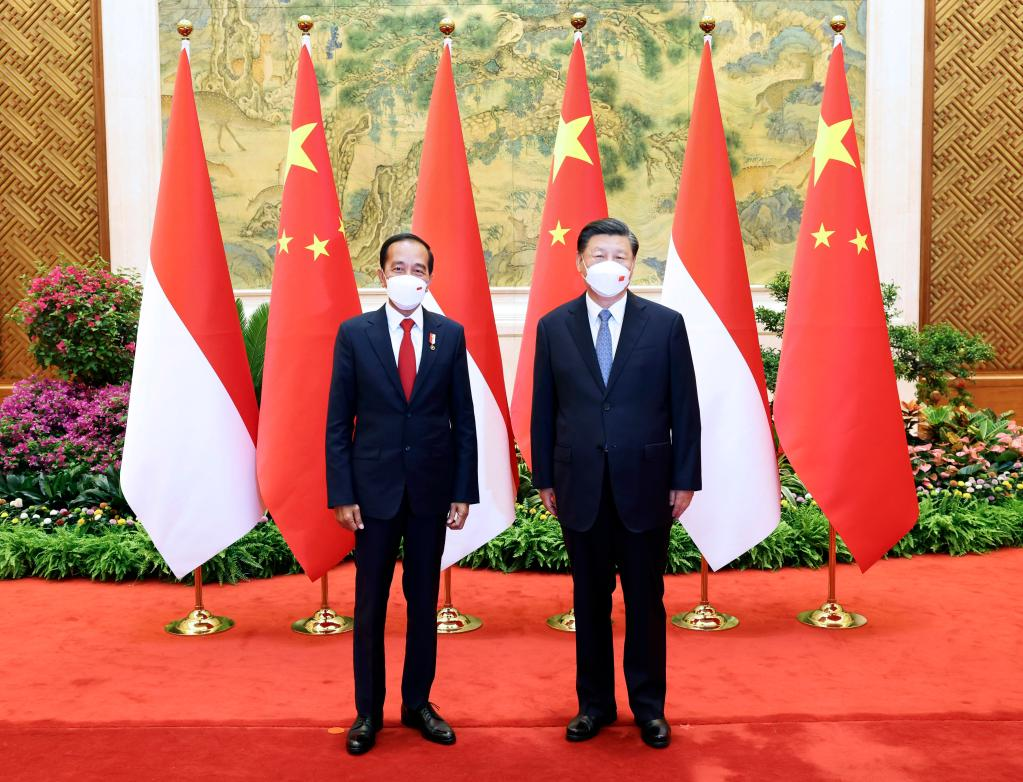
IN BRIEF
By Avishka Ashok and Arshiya Banu
REGIONAL
Indonesia: President Widodo’s visit to China and meeting with President Xi Jinping and other officials
On 26 July, China’s President Xi Jinping met the visiting Indonesian President Joko Widodo in Beijing and held comprehensive discussions on common issues of interests, bilateral relations and international affairs. President Xi shed light on Indonesia being the first country to be hosted by China after the Winter Olympic games in Beijing, signifying the strong relations and growing bilateral ties between the countries. President Xi said: “The China-Indonesia relationship has enjoyed robust growth under the joint guidance of the two presidents in recent years, demonstrating great resilience and vitality. Strategic mutual trust has been further consolidated, and the four-pillar cooperation, namely political, economic, people-to-people and maritime cooperation, has kept deepening.”
The Presidents of the two countries released a Joint Statement on the Bilateral Meeting. The Joint Statement covers 15 points. The fourth point focused on the China-Indonesia Strategic Partnership and noted the new synergy and four-pillar cooperation covering politics, economy, people-to-people exchanges and maritime projects. The fifth point focused on the creation of a shared community with a common future. Through the sixth point, the leaders agreed to speed up the formulation of a new Five-Year Action Plan for the Implementation of the Comprehensive Strategic Partnership between the two countries. The other points emphasized increasing bilateral trade, strengthening cooperation along the Belt and Road Initiative and Global Maritime Fulcrum, deepening cooperation in the field of agriculture, health, poverty alleviation and food security, and extending support in implementing consensus reached on China-ASEAN Special Summit to celebrate the 30th Anniversary of China-ASEAN Dialogue Relations.
President Xi Jinping’s wife Peng Liyuan also met with Indonesia’s First Lady Iriana Joko Widodo at the Diaoyutai State Guesthouse in Beijing. Peng observed that the countries shared a strong friendship that propelled the people-to-people exchanges between China and Indonesia. Iriana appreciated the warm welcome and hospitality shown by China and wished for more Chinese citizens to visit Indonesia.
On the same day, China’s Foreign Minister Wang Yi met with Indonesia’s Coordinator for Cooperation with China and the Coordinating Minister Luhut Binsar Pandjaitan and the Foreign Minister Retno Marsudi. The officials discussed Indonesia’s Presidency in the G20 and the country’s chairmanship at ASEAN next year. Chinese Premier Li Keqiang also met with the Indonesian President Joko Widodo and discussed bilateral relations and other issues of common interest. Li said: “As friendly neighbors and major developing countries in the region, China and Indonesia share broad common interests, which makes the two natural cooperation partners.” Li further stressed on maintaining peace and stability in the South China Sea to conform to the interests of all countries in the region.
(“Chinese, Indonesian presidents pledge joint efforts to build community with shared future,” Xinhua Net, 26 July 2022;
“Peng Liyuan meets with Indonesian first lady,” Xinhua Net, 27 July 2022;
“Chinese FM meets Indonesian ministers,” Xinhua Net, 27 July 2022;
“Chinese premier meets Indonesian president to discuss bilateral ties,” Xinhua Net, 27 July 2022;
“Full text of Joint Press Statement on the Bilateral Meeting between President of the People's Republic of China and President of the Republic of Indonesia,” Xinhua Net, 27 July 2022)
Japan: China’s Defense Ministry condemns 2022 white paper
On 26 July, China’s Ministry of National Defense spokesperson Wu Qian addressed a press conference and commented on Japan’s defense white paper and specifically on the part referring to China. Wu claimed that the paper disregarded facts and was completely biased. He said: “The white paper made irresponsible remarks on China's national defense and military development, hyped up the so-called "military threat of China," stirred up regional tensions, and grossly interfered in China's internal affairs.” He also expressed China’s strong dissatisfaction and firmly opposed the contents of the paper, lodging solemn representations with the Japanese side. Wu Qian further stressed on China’s commitment to peaceful development, upholding the national defense policy and world peace while accusing Japan of choosing violence throughout its imperialist historic era. (“Japan's 2022 defense white paper disregards facts, full of bias: spokesperson,” Xinhua Net, 26 July 2022)
INTERNATIONAL
Sri Lanka: Premier Li Keqiang congratulated Prime Minister Gunawardena
On 26 July, China’s Premier Li Keqiang sent a congratulatory message to Dinesh Gunawardena, congratulating him on becoming the Prime Minister of Sri Lanka. In his message, Li appreciated the traditional friendship between China and Sri Lanka and noted that the strategic cooperative cooperation has resulted in positive benefits for both countries. Li said: “Since the establishment of their diplomatic ties 65 years ago, the two sides have always treated each other with respect and as equals, continuously strengthened mutual political trust and promoted mutually beneficial cooperation, and joined hands to deal with difficulties and challenges.” He further reassured the newly elected Sri Lankan Prime Minister that China stands ready to support and help the country fight the political and economic challenges facing Sri Lanka. (“Chinese premier sends congratulations to Sri Lankan new PM,” Xinhua Net, 26 July 2022)
United Nations: Open letter urges Human Rights High Commissioner to refrain from fabricating assessment on Xinjiang
On 27 July, Xinhua Net publicized an open letter to the United Nations High Commissioner for Human Rights Michelle Bachelet. The letter expressed concerns regarding the pressure created on the international organization on releasing the assessment on Xinjiang. The letter hoped that the High Commissioner’s report would reflect the truth and facts of what she witnessed and experienced during her visit to Xinjiang in May 2022. It claimed that the report falsely accused the Chinese government of suppressing the Muslim minority in the Xinjiang Autonomous Region and will be used as a tool to interfere in the country’s internal affairs. Xinhua Net reported: “The assessment, once released, will be definitely used by certain countries as a political tool to interfere in China's internal affairs and to contain China's development under the pretext of human rights. It will badly damage the credibility of Madame High Commissioner yourself and the OHCHR, and seriously undermine the developing countries' confidence in constructive cooperation with the OHCHR.” The letter was signed by 923 state institutions and other government bodies. (“Open letter to UN High Commissioner for human rights,” Xinhua Net, 27 July 2022)
The US: President Biden to speak with Xi Jinping over the phone
On 27 July, White House national security spokesperson John Kirby stated that in the midst of rising tensions over Taiwan and Russia's invasion of Ukraine, US President Joe Biden and Chinese President Xi Jinping are planning to speak on call. He added that handling economic rivalry between the two states would also be a focus of the conversation. The call comes amid warnings issued by China to the US regarding the possibility of the speaker of the US House, Nancy Pelosi’s visit to Taiwan. Kirby said: "This is a call that has been scheduled for a long time and there's already a pretty robust agenda of things for these two leaders to talk about." (“U.S. says Biden-Xi call expected to cover Taiwan tensions, Ukraine,” The Asahi Shimbun, 27 July 2022)
The UNSC: Chinese representative calls out for more importance to the Palestinian issue
On 27 July, Xinhua reported that China’s deputy permanent representative to the United Nations Geng Shuang urged the UN Security Council that the issue of Palestine be discussed at a more powerful global peace conference. He said: "China calls for a larger, more authoritative, and more influential international peace conference, in which permanent members of the Security Council and all stakeholders in the Middle East process are invited to participate in exploring effective ways and means to politically resolve the Palestinian issue." The Middle East peace process, according to Geng, is "still at a standstill," relevant UN resolutions have not been carried out for a considerable amount of time, and the rights of the Palestinian people have consistently been infringed. (“China calls for more influential peace conference to address Palestinian issue,” Xinhua Net, 27 July 2022)
INTERNAL
COVID-19: New cases in Wuhan cause more restrictions
On 27 July, a district in Wuhan experienced a temporary closure of some businesses and public transportation as the city increased surveillance in response to a number of new infections. China, which has invested a lot in its "dynamic COVID zero" strategy, uses severe quarantining of cases, rapid restrictions on business activity and people's movements, and mass testing to prevent fledgling clusters from spreading. The plan has assisted Wuhan and other regions of the nation in containing the number of cases, but severe lockdowns during significant outbreaks and the worry of potential recurrent restrictions whenever new cases are reported have hurt the economy, business confidence, and the willingness of people to travel. (“China’s Wuhan shuts some businesses, transport amid new Covid-19 cases,” The Strait Times, 27 July 2022)
TECHNOLOGY
Space: Long March 5B rocket expected to crash by month end
On 27 July, the Strait Times reported that a Chinese rocket is expected to crash to Earth sometime in the coming days, with the possibility for debris to land all around the world. According to the Aerospace Corp, a non-profit organisation with a base in El Segundo, California, a portion of a Long March 5B rocket China launched on July 24 will make an unexpected re-entry around July 31. The organisation estimated the potential debris field might span over a large portion of the US as well as Africa, Australia, Brazil, India, and South-east Asia. (“China says it's closely tracking debris of its most powerful rocket crashing towards Earth,” The Strait Times, 27 July 2022)
26 July 2022 | Tuesday | China Reader Evening Brief | Vol.1, No. 242
20th anniversary of the signing of Declaration of the Conduct of Parties in South China Sea
China's Foreign Minister addresses the 20th anniversary of the signing of Declaration of the Conduct of Parties in South China Sea and stresses on peace in the region.
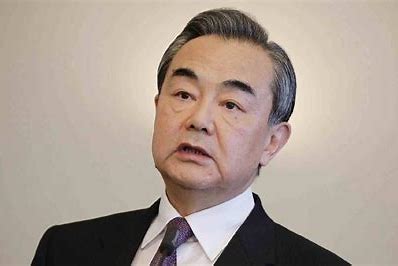
IN BRIEF
By Avishka Ashok and Arshiya Banu
INTERNAL
South China Sea: China commemorates the 20th anniversary of signing the Declaration of the Conduct of Parties
On 25 July, China’s Foreign Minister Wang Yi addressed the opening ceremony of the 20th anniversary of the signing of the Declaration on the Conduct of Parties in the South China Sea and said that peace and stability are crucial in the region. The Declaration of Conduct establishes the basic principles and common norms and is the first political document signed by China and ASEAN on the South China Sea issue. Wang Yi said: “All sides should firmly support all efforts that are conducive to peaceful settlement and management of disputes, oppose any words and deeds that create tension and provoke confrontation in the region.” He further called for improving bilateral and multilateral maritime-related dialogue mechanisms. (“Chinese FM stresses peace, stability in South China Sea for regional development,” Xinhua Net, 25 July 2022)
Hong Kong: Students required to take up course on Beijing’s national security law to graduate
On 26 July, the Strait Times reported that the most esteemed university in Hong Kong is requiring students to attend a course on Beijing's national security law in order to graduate. A spokeswoman of the University of Hong Kong stated that beginning with the following academic year, students must complete the online course named "Introduction to the Constitution, the Basic Law, and the National Security Law" in order to graduate from the university. The new course is uncredited but represents an effort to explain the contentious rule and the penalties for breaking it to a group that was in the centre of the street protests that led to the legislation in 2019. (“Hong Kong students must learn China security law to graduate,” The Strait Times, 26 July 2022)
ECONOMY
Hong Kong: Slow economic recovery to result in lowering annual growth prediction for the second time
On 26 July, Hong Kong’s Financial Secretary Paul Chan Mo-po stated that the slow recovery of the economy from the COVID-19 outbreak may force the city to lower its annual growth prediction in August for the second time in three months. Paul added that as a result of Hong Kong’s economy in the second quarter not being as robust as anticipated, there was a potential the projection will be further reduced soon. He claimed that the COVID-19 crisis had taken longer than expected to alleviate. In May, the Hong Kong government cut down the real GDP prediction for 2022 from an earlier 2 to 3.5 percent to 1 to 2 percent. (“Hong Kong says it may have to downgrade annual growth forecast: Report,” The Strait Times, 26 July 2022)
REGIONAL
Laos: China launches Peace-Train 2022 initiative
On 26 July, the “Peace Train-2022” joint humanitarian medical rescue exercises and medical services activities was launched in Phonhong in Laos. The event marks the first time where in the People’s Liberation Army of China has operated abroad and collaborated with a foreign hospital in taking measures against the spread of the pandemic. The joint exercises aim to increase the stability of medical departments in the Chinese and Lao militaries in assisting the quick recovery and rehabilitation of the wounded and sick. The Lao Deputy Defence Minister Vongkham Phommakone also noted that the most recent event is the fourth time a medical team has visited Laos for the Peace-Train initiative. (“Chinese, Lao militaries launch "Peace Train-2022" joint medical drill,” Xinhua Net, 26 July 2022)
Taiwan: President boards naval warship to oversee drills
On 26 July, Taiwan President Tsai Ing praised the country’s military’s commitment to defending the island when she went onboard a naval vessel to oversee its biggest annual naval and aviation drills. In hopes of improving battle readiness in the face of increasing military pressure from China, the training exercises, which simulate the repelling of an invading army, take place concurrently with air-raid drills around the island. Beijing's escalating aggressiveness toward the island it claims as its own, along with Russia's invasion of Ukraine, has reignited discussion about how to strengthen defence and pushed officials to intensify measures in the case of a Chinese attack. (“Taiwan president oversees drills on warship, lauds determination for defence,” The Strait Times, 26 July 2022)
INTERNATIONAL
Libya: China appreciates Libyan parties’ efforts to ensure normal oil production
On 25 July, China’s Deputy Permanent Representative Dai Bing addressed the Security Council briefing on Libya and appreciated the efforts of Libyan parties to ensure normal production of oil in the country. Bing said: “China welcomes that the Libyan parties are working to remove political interference, negotiate and resolve differences in the management of the oil sector and revenue distribution, and ensure the normal order of oil production in Libya.” He further stressed on the importance of frozen assets for national reconstruction and observed that the political situation in the country was gradually showing the negative impacts and the challenges caused by the political transition. (“China welcomes Libyan parties' efforts to ensure normal oil production,” Xinhua Net, 26 July 2022)
Sri Lanka: Ambassador calls out to China for financial support
On 25 July, Sri Lanka’s ambassador to China Palitha Kohona stated that Sri Lanka seeks an emergency package of USD 4 billion from China to help it recover from an economic collapse and has also requested assistance in trade, investment, and tourism to help it expand sustainably. After exhausting its foreign reserves, the country is going through its biggest economic turmoil since gaining independence in 1948. The Rajapaksa ruling family was overthrown by protesters outraged about the shortages of food, fuel, and medicine. The fact that China, along with Japan, is one of Sri Lanka's two biggest foreign creditors explains Kohona's emphasis on Beijing as a factor in the island nation's economic recovery. (“Sri Lanka asks China for help with trade, investment and tourism,” The Strait Times, 25 July 2022)
Africa: President Xi sends congratulatory note at Peace and Security Forum
On 25 July, China’s Defence Minister Wei Fenghe attended the ministerial meeting of the second China-Africa Peace and Security Forum and called for enhancing the peace cooperation between China and the countries in the continent. The Defence Minister read out President Xi Jinping’s congratulatory note for the forum which was held online. Wei said: “Attaching great importance to China-Africa peace and security cooperation, President Xi has put forward the initiative of building a China-Africa community with a shared future in the new era, pointing the way forward for China and Africa to strengthen solidarity and coordination and achieve common security.” Wei further called for stronger strategic communication, maintaining equipments and technological cooperation, deepening joint maritime exercises and expanding exchanges in professional fields. (“Chinese defense minister urges enhanced China-Africa peace, security cooperation,” Xinhua Net, 26 July 2022)
22 July 2022 | Friday | China Reader Evening Brief | Vol.1, No. 240
China refutes accusations on its foreign aid
The China International Development Cooperation Agency and the Ministry of Commerce condemn statement by the US on its foreign aid policy.
IN BRIEF
By Avishka Ashok and Arshiya Banu
INTERNATIONAL
The US: China refutes remarks on its foreign aid having double intentions
On 21 July, the head of the China International Development Cooperation Agency (CIDCA) Luo Zhaohui addressed the Anti-Corruption Forum organized by the CIDCA and the Ministry of Commerce and refuted statements made by US officials on the country’s foreign aid policy. Luo stressed on China’s attached importance to foreign aid in the past 73 years and called out the US’ “empty checks” laced with personal gains and intent to intervene in the internal affairs of foreign countries. He said: “The United States never shies away from using aid as a tool to advance its own interests and to openly meddle in the internal affairs of other countries. The U.S. side has put forward at least 60 foreign aid initiatives in recent years. Though the initiatives appear to offer substantial funding, they are difficult to implement and are "empty promises" or merely a game of numbers.” He further reassured that China's aid had no political strings attached and aimed at building the recipient countries’ self-development capacities. Luo also shed light on China’s response to the G20 Debt Service Suspension Initiative which suspended debt service payments of over USD 1.3 billion and accounted for 30 per cent of the total debt service suspension. (“U.S. attempts to smear China's foreign aid policy denounced,” Xinhua Net, 22 July 2022)
AUKUS: Chinese academic institutions denounce nuclear proliferation undertaken by the West
On 22 July, Xinhua Net reported on the research report by the China Arms Control and Disarmament Associations and the China Institute of Nuclear Industry Strategy titled “A Dangerous Conspiracy: The Nuclear Proliferation Risk of the Nuclear-powered Submarines Collaboration in the Context of AUKUS.” The report is a first of its kind on the AUKUS submarine collaboration published by Chinese academic institutions. The findings of the report claimed that the AUKUS nuclear powered submarine collaboration set a dangerous precedent for illegal transfer and nuclear proliferation. According to the report: “The AUKUS nuclear-powered submarine collaboration runs counter to the spirit of the South Pacific Nuclear Free Zone Treaty and also undermines ASEAN countries' efforts to establish the Southeast Asia Nuclear Weapon-Free Zone. In addition, it ferments potential risks and hazards in multiple aspects, such as nuclear security and arms race in nuclear submarines, with a profound negative impact on global strategic balance and stability.” (“AUKUS submarine collaboration risks nuclear proliferation: report,” Xinhua Net, 22 July 2022)
World Youth Development Forum: All China Youth Federation convenes meeting between 2000 youth representatives
On 21 July, China President Xi Jinping sent a congratulatory message to the World Youth Development Forum organized by the All China Youth Federation which began in Beijing on the same day. On behalf of President Xi, the Foreign Minister Wang Yi read out the congratulatory note. The Forum was attended by over 100 distinguished guests such as the President of Niger Mohamed Bazoum, United Nations Secretary-General Antonio Guterres and Executive Chairman of the World Economic Forum Klaus Schwab. Antonio Guterres also addressed the forum virtually and delivered his address. The forum was also attended by over 2000 young representatives from 100 countries. The forum focused on employment and entrepreneurship, climate change and green development, digital economy and high-quality education. (“World Youth Development Forum opens in Beijing," Xinhua Net, 22 July 2022)
International Union for Conservation of Nature: New endangered species list classified Chinese Paddlefish and wild Yangtze Sturgeon to go extinct
On 22 July, the International Union for Conservation of Nature (IUCN), which proclaimed the Chinese Paddlefish and wild Yangtze Sturgeon to be extinct, sparked a lot of comments calling for greater environmental protection on China's social media platforms. According to the IUCN’s most recent list of endangered species, 100 per cent of the 26 remaining sturgeon species worldwide are now threatened with extinction, up from 85 per cent in 2009. The Union said: "The assessments are based on new calculations which show their decline over the past three generations to be steeper than previously thought," and confirmed the extinction of the Chinese Paddlefish. (“Chinese Paddlefish and wild Yangtze Sturgeon extinct: IUCN,” The Strait Times, 22 July 2022)
REGIONAL
South Korea: China announces progress in second phase of FTA negotiations
On 21 July, China’s Ministry of Commerce spokesperson Shu Jueting addressed a press conference and announced that the country had made substantial progress in its talks with South Korean officials on the second phase of the free trade agreement. Shu said: “The two sides have held nine rounds of formal negotiations so far, and recently reached a consensus on pushing forward follow-up negotiations.” He further expressed China’s willingness to reach a mutually beneficial agreement and push bilateral and trade relations to a new level. The FTA was signed between the two countries in 2015 and has since cut tariffs eight times. Shu appreciated the rapid pace of economic growth despite the setbacks in global recovery. The bilateral trade volume reached USD 184.25 billion in the first half of 2022. (“Substantial progress made in China-ROK FTA talks: official,” Xinhua Net, 21 July 2022)
INTERNAL
Jiangsu: One killed by Tornado in eastern China
On 22 July, the Asahi Shimbun reported that in eastern China’s farming region of Jiangsu, 11 villages were struck by a tornado that destroyed homes, killed at least one person, and injured 25 others. At the same time, large areas of the nation are experiencing excessive heat. Over 2,000 people had homes and other property destroyed by the tornado that hit the province located in the south of Beijing. The overall damage was expected to be about 65 million yuan (USD 9.6 million). Despite the fact that tornadoes are not common in China, last year around 12 people died and over 300 people were left injured because of a tornado in Jiangsu and the central city of Wuhan. (“Tornado kills 1 in eastern China as country faces high temps,” The Asahi Shimbun, 22 July 2022)
Emissions Trading Scheme: Excess of carbon allowances cause a slowdown in trading
On 22 July, the Strait Times reported that over 2,000 power plants in China have experienced emissions trading owing to the country’s carbon market, but experts believe there have been few significant environmental advantages due to design problems and data theft. The Emissions Trading Scheme (ETS) in China, which is the largest ETS in the world, controls roughly 4.5 billion tonnes of yearly CO2 output from the power sector. In the first year of business, about 200 million tonnes of carbon were traded for a total of 8.5 billion yuan (USD 1.2 billion). However, due to an excess of carbon allowances and worries over data veracity, trading has been somewhat slow. (“A year on, China's CO2 market yet to drive big emission cuts,” The Strait Times, 22 July 2022)
Heatwaves: “Big heat” day to hit China with unusually hot weather
On 22 July, meteorologists issued warnings that heatwaves are to return to China during the next 10 days after a brief reprieve, with high temperatures anticipated from east to west. The day of the "big heat" on the Chinese Almanac, July 23, is predicted to see a strong rise in temperatures. Heatwaves, which are defined as periods of unusually hot weather lasting three days or longer, are expected to follow. Chief forecaster Fu Jiaolan stated that the hot wave is anticipated to have a comparable geographic scope to the heatwaves from July 5–17, although more areas may see temperatures of 40 degrees Celsius or higher. (“Heatwaves to hit China from east to west as almanac's 'big heat' day looms,” The Strait Times, 22 July 2022)
21 July 2022 | Thursday | China Reader Evening Brief | Vol.1, No. 239
Sierra Leone and China discuss bilateral relations
The Foreign Ministers of Sierra Leone and China pledge to continue mutual support and assistance to each other during telephonic conversation.
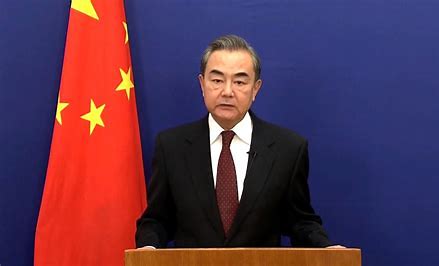
IN BRIEF
By Avishka Ashok and Arshiya Banu
INTERNATIONAL
Sierra Leone: Foreign Ministers pledge to continue support and assistance to each other
On 20 July, Xinhua Net reported that China’s Foreign Minister Wang Yi had discussed bilateral relations with Sierra Leone during a phone call with Foreign Minister David John Francis. The Sierra Leonean official expressed the country’s gratitude and appreciated China’s financial and humanitarian assistance, especially in fighting the COVID-19 pandemic. Francis said: “Sierra Leone highly recognizes China's commitment to prioritizing development and putting people first, and speaks highly of China's leading role in preserving world peace and security.” He further promised the country’s support to China in matters related to its core interests and other major concerns while encouraging greater investments from Chinese businesses in Sierra Leone. Wang Yi, on his part, pledged to continue the support and assistance and said: “China will continue to offer support and assistance according to the developmental needs of Sierra Leone, promoting cooperation in mining, agriculture and infrastructure, carring out more livelihood projects, encouraging Chinese enterprises to invest there, and helping Sierra Leone improve its independent development capabilities and accelerate the industrialization process.” (“Chinese, Sierra Leonean FMs discuss ties over phone,” Xinhua Net, 20 July 2022)
Syria: China urges the US to stop plundering national resources
On 20 July, China’s Foreign Ministry Spokesperson Wang Wenbin addressed the press conference and commented on the US occupation forces who transferred oil from Syria to Northern Iraq and urged the US to stop plundering Syria’s national resources. Wang commented on the US actions in Syria and said: “The U.S. military still occupies the main grain- and oil-producing areas in Syria, looting and plundering Syrian national resources, worsening the local humanitarian crisis.” He further highlighted the plight of the Syrian population,; 90 per cent of whom are under the poverty line, suffer from food insecurity and depend on humanitarian assistance for their survival. (“China urges U.S. to stop looting Syrian national resources,” Xinhua Net, 20 July 2022)
Mexico: Chinese-made metro train ready to upgrade Metro Line 1
On 20 July, Xinhua Net reported that the first rubber-tired subway train developed by CRRC Zhuzhou Electric Locomotive Co. Ltd will be exported to Mexico city from the Hunan Province. The train will be used to upgrade the Metro Line 1 and has a maximum passenger capacity of 2,252 people. The train has been independently developed by the Chinese manufacturer and has a maximum speed of 80 kilometer per hour. The Metro line 1 is 50 years old and gave the contract to the Chinese enterprise in December 2020. According to the report, the contract involves “investment and financing, new vehicle manufacturing, comprehensive modernization and upgrading of existing vehicle communication signal systems, lines, electromechanical systems, and maintenance, among others.” (“Chinese company makes rubber-tired metro for Mexico City,” Xinhua Net, 20 July 2022)
Germany: Chemical plant receives green signal to construct third-largest plant in China
On 20 July, Xinhua Net reported that the German chemical enterprise BASF SE had approved the construction of the Verbund site in Zhanjiang city. The project is the first completely foreign funded assignment in China’s heavy chemical industry and is advancing as per its schedule. The company stated: “The focus will now be on building the core of the Verbund, which includes a steam cracker and several downstream plants for the production of petrochemicals and intermediates, among others. BASF will invest up to 10 billion euros (about 10.2 billion U.S. dollars) by 2030 to build the new Verbund site.” (“German chemical giant BASF advances mega project in China,” Xinhua Net, 20 July 2022)
INTERNAL
Tianjin: Building collapse leads to gas explosion with 3 missing
On 20 July, three people were reported missing and eleven others injured after a gas leak that followed the collapse of a six-story building in Tianjin, a port city in northern China. Investigations into the incident are ongoing, but it seems to indicate that infrastructure has deteriorated as a result of more than thirty years of rapid economic development. Living standards have significantly increased as a result of this development, which frequently evades environmental and safety laws. There was no evident damage to the nearby units, but photos from the area showed that the building's upper storeys had caved in. (“3 missing in gas explosion in major north China port city,” The Asahi Shimbun, 20 July 2022)
Hong Kong: Eric Yip wins National Poetry Competition of the UK
On 21 July, the Strait Times reported that Eric Yip won the National Poetry Competition of the UK in March at the age of 19, making him the competition's youngest ever winner. Yip was a young man trapped in the pressure-cooker education system of Hong Kong, who turned to poetry as an outlet for his frustrations; having no idea that one day his work would go on to win a prestigious award halfway around the world. His work now explores issues of race, sexism, migration and language. He won the competition against more than 7,000 competitors from 100 different nations, solidifying his place among the group of poets from Hong Kong who have gained popularity in recent years. Although Hong Kong city has been a cradle for Chinese and English literature, anglophonic poetry has been slow to receive the state's encouragement. (“'Private rebellion': Hong Kong's anglophone poets gain recognition abroad,” The Strait Times, 21 July 2022)
China Banking and Insurance Regulatory Commission: Victims of scandal to be reimbursed by banks
On 21 July, the Strait Times reported that in an effort to appease irate clients who have been refused access to tens of billions of yuan in deposits for months, Chinese officials will reimburse victims of the country's largest bank fraud. The regional offices of the China Banking and Insurance Regulatory Commission stated that Customers with deposits up to 100,000 yuan (USD 14,803) from the four rural banks in Henan's central province and one in Anhui will start receiving their money back from July 25. Last week, after hundreds of angry bank customers increased pressure on local governments over the past two months, authorities started to compensate people with savings under 50,000 yuan (USD 7401.70). (“China to repay more victims next week in biggest bank scam,” The Strait Times, 21 July 2022)
TECHNOLOGY
Baidu: Artificial Intelligence company showcases new electric vehicle
On 21 July, the Chinese search engine and artificial intelligence company Baidu showcased its newest electric autonomous vehicle, the Apollo RT6. Baidu's robotaxi fleet will soon include the Apollo RT6 as China advances its goals for autonomous driving. It will cost 250,000 yuan (USD 37,008) per unit and be a fully electric car with a steering wheel that can be removed or added as needed. Co-founder and CEO of Baidu Robin Li said: “This massive cost reduction will enable us to deploy tens of thousands of autonomous vehicles across China… We are moving towards a future where taking a robotaxi will be half the cost of taking a taxi today,” at the firm’s global conference. (“Baidu unveils latest autonomous electric vehicle: Apollo RT6,” The Asahi Shimbun, 21 July 2022)
13 July 2022 | Wednesday | China Reader Evening Brief | Vol.1, No. 234
Foreign Minister Wang Yi's visit to Malaysia
Wang Yi met with the King of Malaysia, the Prime Minister and the Foreign Minister during his visit and reached a five-point consensus on taking the bilateral relations forward.
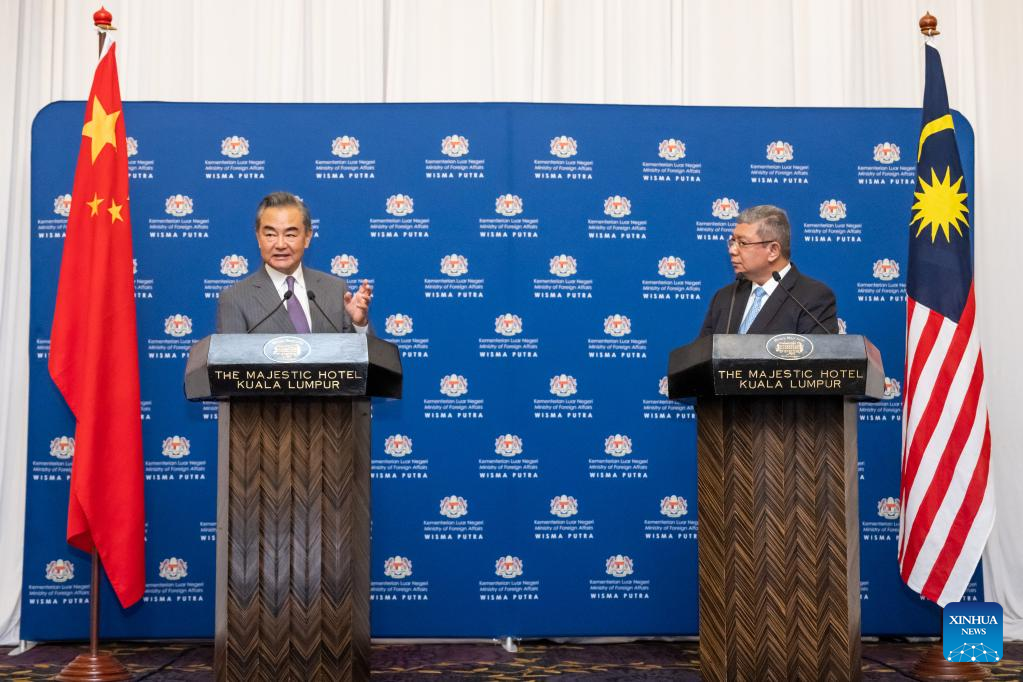
IN BRIEF
By Avishka Ashok and Arshiya Banu
REGIONAL
Malaysia: Foreign Minister meets top officials and agrees on five-point consensus
On 12 July, China’s Foreign Minister Wang Yi visited Malaysia and held a discussion with the Malay Foreign Minister Saifuddin Abdullah on boosting strategic communication between the countries while safeguarding their legitimate rights and interests. Wang Yi stressed on injecting positive energy into world peace and stabilizing the world economy. Wang said: “China would like to enhance mutual learning with Malaysia to improve governance capability and contribute the wisdom of the East to global governance.” Saifuddin also expressed Malaysia’s readiness to work with China, accelerate the construction of the Belt and Road Initiative in the country and the Global Development Initiative led by China towards achieving the 2030 Agenda for Sustainable Development.
Wang Yi also held a meeting with the Malaysian Prime Minister Ismail Sabri Yaakob and promised to strengthen coordination and connectivity between their countries. Noting the traditional friendship between the countries, Wang Yi said: “China-Malaysia relations have withstood the test of changes in the international landscape and their domestic situations, and maintained a sound and stable momentum of development, bringing benefit to the two countries and peoples, and contributing to peace and prosperity in the region and the world at large.” Wang also suggested the establishment of new directions, goals and priorities as the countries celebrate 10 years of comprehensive strategic partnership in 2023 and 50 years of bilateral relations in 2024.
The Foreign Minister then met with the Malay King Sultan Abdullah Sultan Ahmad Shah who agreed on increasing collaboration on major projects in the Belt and Road Initiative. The King appreciated China’s close relationship with the country and the COVID-19 assistance offered by China. He further encouraged heightened Chinese investments and combining efforts on completing the BRI projects in the country. Wang Yi also appreciated Malaysia as a business partner and said: “China has been the largest trade partner of Malaysia for 13 consecutive years, and the all-round cooperation between the two countries has been fruitful, boosting both countries' development and rejuvenation, and delivering huge benefits to the two peoples.”
The countries also reached a five-point consensus on further developing their bilateral relations. Wang Yi remarked that the countries were faced with new opportunities for development and had the space to elevate their ties to a new high. First, the countries agreed to collectively work towards constructing a China-Malaysia community with a shared future under the concept of “the world is one family.” Second, the countries agreed to enhance their cooperation on the Belt and Road Initiative and also encourage new growth points such as digital economy and green development. Third, China and Malaysia pledged to combine efforts in the quick development of the East Coast Rail Link and other mega rail projects. The leaders also discussed the pan-Asia railway network. Fourth, both sides agreed to increase trade to benefit the people of the two countries. China will seek to import more agro-products from Malaysia and also help international students resume their education in Chinese universities. Lastly, the countries reached a political consensus on safeguarding regional peace and stability while advocating for open regionalism, true multilateralism and upholding ASEAN centrality in their affairs.
“China ready to enhance strategic communication with Malaysia amid world volatility: Chinese FM,” Xinhua Net, 13 July 2022;
“China, Malaysia reach 5-point consensus on developing ties,” Xinhua Net, 12 July 2022;
“China, Malaysia pledge to strengthen coordination, connectivity,” Xinhua Net, 12 July 2022;
“China, Malaysia agree to expand, strengthen key BRI projects,” Xinhua Net, 12 June 2022
INTERNATIONAL
The US: Foreign Minister condemns US Consul-General’s farewell remarks
On 12 July, China’s Foreign Ministry Spokesperson Wang Wenbin addressed a press briefing and commented on the farewell remarks made by the outgoing US Consul General in Hong Kong Hanscom Smith. Wang condemned actions and activities against China and its internal affairs and warned that such efforts would be futile and were doomed to fail. He said: “The Hong Kong Special Administrative Region (SAR) government has already made a solemn response to this. The U.S. consular official disregarded facts, made wild talks on China's Hong Kong policy, and denigrated Hong Kong's political and economic situation. The Chinese side deplores and rejects this.” While on the subject, Wang also remarked that the National Security Law had helped in reestablishing law and order in Hong Kong city. According to a poll, 76.2 per cent of the city believed that the new security law had not impacted their freedom while 63 per cent believed that the law had improved Hong Kong’s business environment. (“China slams U.S. consular official's remarks on Hong Kong policy,” Xinhua Net, 12 July 2022)
Syria: China appreciates UNSC’s resolution on humanitarian aid
On 12 July, China’s Deputy Permanent Representative to the United Nations Dai Bing referred to the Security Council’s adoption of a resolution on re-authorizing cross-border aid deliveries into Syria. Dai said that the resolution 2641 provides all necessary flexibility to the Security Council to assess and manage its mandate in a timely order. Dai said: “We expect all parties to strictly abide by the basic principles governing international humanitarian assistance, strictly comply with the requirements of the Security Council resolutions, ensure the neutrality and transparency of assistance, and make it more targeted and effective.” (“China welcomes Security Council resolution on Syria humanitarian aid,” Xinhua Net, 13 July 2022)
Georgia: China pledges to strengthen legislative cooperation
On 12 July, the Vice Chairman of the National People’s Congress Wang Chen and the Deputy Chairman of Georgia’s Parliament Giorgi Volski held a video conference and discussed the last 30 years of diplomatic ties between the two countries. Chen said: “the NPC of China is willing to strengthen exchanges and mutual learning with the Georgian parliament, and make legislative contributions to deepening practical cooperation, strengthening solidarity in fighting the COVID-19 pandemic and enhancing people-to-people exchanges. It will also promote the implementation of the Global Development Initiative and the Global Security Initiative, and facilitate the sustained, sound and stable development of bilateral relations.” (“China, Georgia vow to strengthen cooperation between legislatures,” Xinhua Net, 12 July 2022)
The US: Embassy asks China to comply to 2016 arbitration ruling on South China Sea claims
On 12 July, US Secretary of State Antony Blinken urged China once more to abide by a 2016 arbitration decision that invalidated Beijing's claims in the South China Sea and issued a warning that the US would be bound to defend Philippines if its forces, vessels, or aircraft were attacked in the disputed waters. The US embassy released Blinken’s statement on Tuesday, which was the sixth anniversary of the arbitral tribunal established under the United Nations Convention on the Law of the Sea after the Philippine government filed a complaint about China's increasingly hostile behaviour in the disputed sea in 2013. In recent years, China has engaged in territorial disputes with the Philippines and other Southeast Asian claimant nations after refusing to take part in the arbitration, rejecting its verdict as a sham, and continuing to do so. Blinken said: “We call again on the PRC to abide by its obligations under international law and cease its provocative behaviour.” (“U.S. warns it will defend ally if China breaks sea ruling,” The Asahi Shimbun, 12 July 2022)
INTERNAL
Shanghai: Residents forced to seek relief for violent heatwaves
On 12 July, the Asahi Shimbun reported that as heatwaves melted the roofs of buildings, buckled roadways and scorched Chinese cities, many residents were forced to seek relief in underground raid shelters. With temperatures expected to exceed 40 degrees Celsius (104 degrees Fahrenheit) over the next 24 hours, 68 localities, including Shanghai and the neighbouring city of Nanjing, had issued red alerts. Red alerts are the highest level in a three-tiered heatwave warning system. The 25 million people in Shanghai, which is still dealing with intermittent COVID-19 outbreaks, have been advised to get ready for this week's hot weather. Shanghai has only experienced 15 days with temperatures over 40 degrees Celsius since records began being kept in 1873. (“Dozens of Chinese cities on heatwave alert as roofs melt, roads buckle,” The Asahi Shimbun, 12 July 2022)
Hong Kong: Secretary for Health claims possibility for travelling without a quarantine
On 13 July, Hong Kong’s new Secretary for Health Lo Chung-mau stated that conditional quarantine-free travel may be permitted by November, just in time for the city to host a world bankers’ summit. Lo claimed that the city does not have to adhere to the COVID-19 rules since it has certain flexibility under the "one country, two systems" approach. Lo said: "Is nothing required anymore? I think that would be a bit tough… At least PCR testing is needed. But does quarantine have to be confined to a fixed location?" He proposed a scenario in which newcomers might be exposed to polymerase chain reaction (PCR) testing and restricted from going to high-risk places like bars. (“Hong Kong may allow conditional Covid-19 quarantine-free travel by November: Health chief,” The Strait Times, 13 July 2022)
TECHNOLOGY
Environment: Scientists design robotic fish to clean microplastics in the ocean
On 12 July, a team of Chinese scientists from Sichuan University in southwest-China stated that they designed a black robot fish, 1.3 centimetres in size, which can "eat" microplastics and can one day assist in cleaning up the world's contaminated oceans. Dr. Wang Yuyan, one of the researchers, claimed that the team intends to make it possible for them to retrieve microplastics in deeper water and offer information to analyse marine pollution in real time. Wang said: "We developed such a lightweight miniaturised robot. It can be used in many ways, for example in biomedical or hazardous operations, such a small robot that can be localised to a part of your body to help you eliminate some disease." (“Chinese scientists develop robot fish that gobble up microplastics,” The Strait Times, 12 July 2022)
12 July 2022 | Tuesday | China Reader Evening Brief | Vol.1, No. 233
China's Foreign Minister at ASEAN Secretariat
Foreign Minister Wang Yi addresses the Secretariat, calls for open regionalism
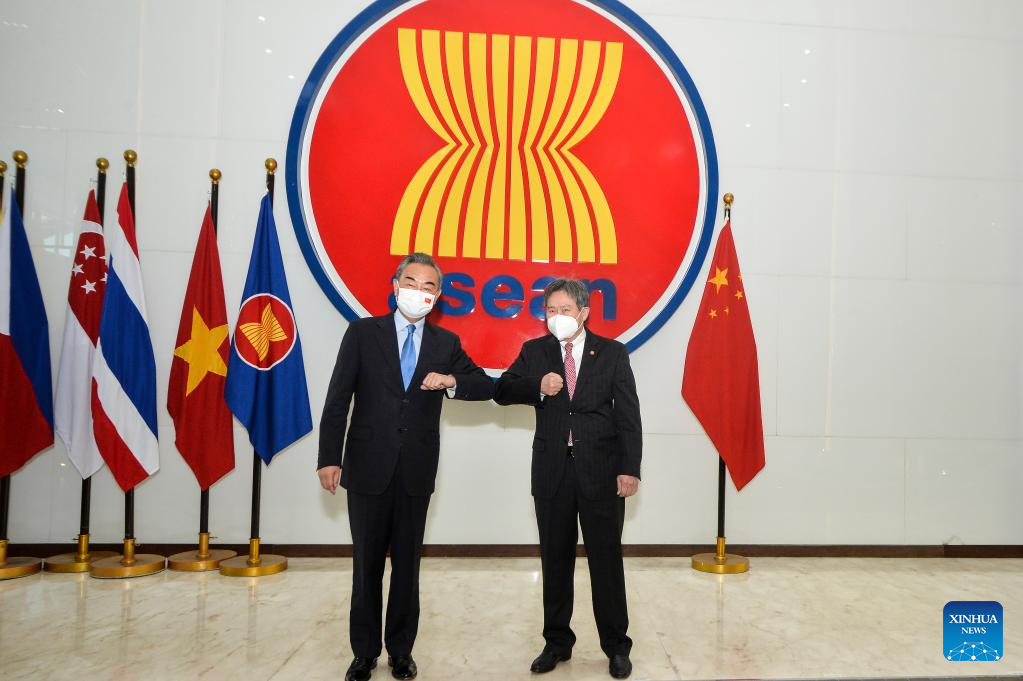
IN BRIEF
Avishka Ashok and Arshiya Banu
REGIONAL
ASEAN: Foreign Minister Wang Yi addresses the Secretariat, calls for open regionalism
On 11 July, China’s Foreign Minister Wang Yi addressed the ASEAN Secretariat and spoke about the country’s achievements in partnership with the regional organization and proposed for jointly upholding regionalism in Southeast Asia. Wang Yi referred to China’s relationship with the ASEAN countries and noted: “We are always good neighbors, good friends and good partners with a shared future.” Wang also observed the positive cooperation with the organization and noted that China and ASEAN were each other’s largest trading partner, surpassing one-fifth of the global trade. He stressed on post pandemic economic recovery and said: “China and ASEAN members have conducted fruitful cooperation in fighting the pandemic and became the first group of countries that successfully brought the pandemic under control, which created necessary conditions for rapid economic recovery and also offered valuable confidence for the rest of the world.”
Wang Yi also met with the ASEAN Secretary-General Lim Jock Hoi and expressed China’s priority in foreign policy while dealing with the organization. He also stressed on China being the first strategic partner of ASEAN and the first country to join the Treaty of Amity and Cooperation in Southeast Asia and initiate a free trade area negotiations. Wang said: “China is willing to work with ASEAN to build a peaceful, safe and secure, prosperous, beautiful and amicable home, benefiting both Chinese and ASEAN people.” He further urged ASEAN to jointly initiate the idea of open regionalism and safeguard the peace in Southeast Asia. The Foreign Minister then highlighted the China-ASEAN security cooperation and the progress that was made between the two entities.
On the issue of maritime issues in the South China Sea and the question of sovereignty over Taiwan, Wang Yi said that positive progress was being made through the implementation of the Declaration on the Conduct of Parties in the South China Sea. On Taiwan, Wang Yi said: “History and past experience prove that when the one-China principle is fully recognized and followed, there will be able to achieve peaceful development across the Taiwan Strait. And when the one-China principle is challenged or even undermined, there will be tension in the Taiwan Strait.”
On the US involvement in the Indo-Pacific region, Wang Yi said that the country should engage positively with the countries in the region. Wang Yi compared the actions of the US with China and said that Beijing had always maintained open relation with all the ASEAN countries while also maintaining regional peace and stability. During the G20 meeting in Bali, Wang Yi addresses the US Secretary of State and said: “The core element of the rules is to support ASEAN's central position and maintain the existing regional cooperation framework; to respect the legitimate rights and interests of China and the United States in Asia-Pacific, and do not take hostility or containing the other party as purpose; to play the role of a responsible major country, promote regional stability and development, and provide more public goods for all countries.”
Lastly, the Foreign Minister shed light on the changing political environment in the Asia-Pacific region and said that the countries in the region would be presented with unprecedented development opportunities. Further he expressed China’s willingness to aid the Asian countries in developing their infrastructure. He made four points about pursuing open regionalism. First, upholding peaceful coexistence. Second, preserving the goal of development and rejuvenation. Third, upholding the principle of independence and fourth, protecting the spirit of openness and inclusiveness.
(“Chinese FM lauds China-ASEAN friendship, renews commitment on open regionalism,” Xinhua Net, 11 July 2022;
“China, ASEAN provide confidence, dynamics for global recovery: Chinese FM,” Xinhua Net, 11 July 2022;
“China, U.S. should engage in healthy interactions in Asia-Pacific: Chinese FM,” Xinhua Net, 11 July 2022;
“China's Wang Yi meets ASEAN Secretary-General Lim Jock Hoi vowing to strengthen ties,” Xinhua Net, 12 July 2022;
“China-ASEAN relations enter "fast lane": Chinese FM,” Xinhua Net, 11 July 2022;
“China urges to uphold vision of peace, development, independence, inclusiveness,” Xinhua Net, 11 July 2022;
“Wang Yi: Upholding one-China policy is mainstay for Taiwan's stability,” CGTN, 12 July 2022)
Japan: Foreign Ministry urges country to remember past mistakes as LDP wins two-thirds majority
On 11 July, the Foreign Ministry spokesperson Wang Wenbin called on Japan to revisit its history and draw lessons from its past after the Liberal Democratic Party of Japan achieved a two-thirds majority in the upper house of the Diet. The LDP has been advocating a change in the post-war constitution of Japan and urging the country to give more power to its defence forces. Wang Yi reiterated China’s willingness to cooperate with Japan and promote beneficial relations but urged the country against going back to its Imperialist past. Wang said: “Because of historical reasons, the change of Constitution in Japan is followed closely by the international community, especially Japan's Asian neighbors.” (“China urges Japan to draw lessons from history,” CGTN, 11 July)
Taiwan: Vice-President visit Japan on a private trip; pays respects to Abe
On 11 July, the Vice-President William Lai visited Japan to pay his respects to former Prime Minister Shinzo Abe. The trip marked the first trip in five years by one of the senior Taiwanese officials to Japan. The Taiwanese Presidential Office referred to the visit and said that Lai was on a private trip to Japan as he was a close friend of Abe and his family. The Foreign Ministry refused to comment on Lai’s personal schedule. Lai’s trip is seen as Taiwan's most senior official visiting Japan since it broke relations with the country in 1972. (“Taiwan vice-president makes rare Japan visit to pay respects to Abe: Media,” The Strait Times, 11 July 2022)
INTERNATIONAL
The US: Counsellor of the US Department of State foresees greater cooperation with South Korea as China creates more challenges
On 12 July, the Strait Times, referred to an interview conducted by Reuters and reported that the Counsellor of the US Department of State Derek Chollet perceived the attendance of four–Asia Pacific countries as a change in the US transatlantic security partnership. Derek further expressed the US expectation and hopes for cooperation between South Korea and NATO in times of rising challenges from China. Chollet said: I think one of the most consequential shifts we've seen over the decade is the growing relationship between our transatlantic partners and our partners here in the Indo Pacific.” (“US envoy sees 'consequential shift' in Nato, Asia ties amid China challenges,” The Strait Times, 12 July 2022)
INTERNAL
Rural revitalization: Vice Premier addresses senior officials; urges them to speed up rural development
On 11 July, the Vice Premier Hu Chunhua addressed the opening ceremony of a seminar on promoting rural revitalization for provincial-level officials in the country and delivered a speech. He highlighted the need to accelerate the rural revitalization along all fronts in the country. He encouraged the officials to proceed by the rule of law and agricultural development, improve work methods, strengthen systematic and overall planning and promote rural revitalization in an organised and stable manner. (“Chinese vice premier stresses comprehensive rural revitalization,” Xinhua Net, 11 July 2022)
TECHNOLOGY
H5N1 virus: Research by scientists claims virus originated in Netherlands
On 11 July, a team of researchers from the Chinese Academy of Agricultural Science identified the origin, evolution and propagation of the H5N1 virus. The Harbin Veterinary Research Institute published the research in the journal Emerging Microbes and Infections. According to the findings of the research, the virus was discovered in Netherlands in October 2020 as an H5N8 avian influenza-virus. The leader of the research team Chen Hualan said: “The H5N1 virus was responsible for the loss of over 70 million domestic poultry in Europe, Africa, Asia, and North America since October 2020.” The team performed a detailed phylogenic analysis of 233 representative H5N1 strains from 28 countries. (“Chinese scientists identify evolution of H5N1 avian influenza virus,” Xinhua Net, 11 July 2022)
11 July 2022 | Monday | China Reader Evening Brief | Vol.1, No. 232
China initiates four-day joint military drill in Shanghai port
China and Pakistan began their four-day joint military exercise at a port in Shanghai.
IN BRIEF
Avishka Ashok and Arshiya Banu
INTERNATIONAL
Pakistan: China initiates four-day joint military drill in Shanghai port
On 10 July, China and Pakistan began their four-day joint military exercise at a port in Shanghai. The People’s Liberation Army Navy Spokesperson Liu Wensheng referred tot he drill and said: “The drill, codenamed Sea Guardians-2, is a normal arrangement as per a yearly plan between the two militaries. It is not related to any regional situations and does not target any third party.” The joint drill is aimed at enhancing defense cooperation, exchange expertise and experiences on military practices, deepen strategic and traditional friendship between countries and militaries and promote the development of China-Pakistan cooperative partnership. (“China, Pakistan hold joint maritime drill,” Xinhua Net, 10 July 2022)
REGIONAL
Indonesia: China discusses infrastructure and anti-epidemic cooperation
On 11 July, Global Times reported that China and Indonesia met at the Second Meeting of the China-Indonesia High-Level Dialogue Cooperation Mechanism and pledged to jointly elevate their cooperation on numerous infrastructure projects along the Belt and Road Initiative. Two big projects in the plan are the Jakarta-Bandung High-Speed Railway and the Two Countries Twin Peaks. The meeting was co-hosted by China and was attended by China’s Foreign Minister Wang Yi, Indonesia’s Coordinator for Cooperation with China and Coordinating Minister Luhut Binsar Pandjaitan, and the Foreign Minister Retno Marsudi. The top diplomats discussed issues such as food security, strengthening cooperation between the countries, supply and value chain integration and jointly helping boost the world economy. Wang Yi also highlighted the anti-epidemic cooperation as a key area for collaboration and said: “China supports Indonesia in building a regional vaccine center and is willing to help Indonesia increase its vaccine production capacity and promote the joint construction of a joint research center for vaccines and genes.” (“China and Indonesia to jointly push for major landmark projects on transportation, vaccine: FM,” Global Times, 11 July 2022)
Thailand: Bangkok-Kele railway line finishes first phase of construction
On 11 July, CGTN reported that the China-Thailand high-speed railway project had completed the first phase by successfully erecting the girders in the 252.3 kilometer-long section. The line connects Bangkok to Kele and can reach speeds of 250 kilometer per hour. The project is the first standard-gauge railway in Thailand which is making use of the Chinese standards. The project plays a key role in connecting China and Singapore through the Trans-Asian Railway Network and is one of the special projects between China and ASEAN countries. The railway line is expected to increase economic productivity, improve local and regional infrastructure, heighten regional trade and connect Thailand with the rest of the region. (“Construction speeds up of giant bridge on China-Thailand railway,” CGTN, 11 July 2022)
INTERNAL
Anti-corruption drive: People’s Procuratorate files lawsuit against ex-senior official
On 11 July, the Changchun Municipal People’s Procuratorate filed a lawsuit in the Intermediate People’s Court of Changchun and initiated a public prosecution against the senior official Fu Zhenghua for taking bribes and bending the law for his own personal gains. The lawsuit comes after the conclusion of the National Supervisory Commission which looked into Fu’s case. Fu was the former deputy head of the Committee of the Chinese People’s Political Consultative Conference and had also served as the head of the Beijing Municipal Public Security Bureau, the vice minister of public security and the minister of justice. (“China's ex-senior official Fu Zhenghua prosecuted,” The Strait Times, 11 July 2022)
Mass protests: Police arrests criminal gang for fleeing with depositors’ money
On 10 July, a large crowd of bank depositors’ protests turned into a faceoff with the police authorities as some were forcibly taken away to prevent further mobilization of the demonstrations. The protestors held banners and chanted slogans in front of the Central Bank in Zhengzhou province. One of the protestors said: “We came today and wanted to get our savings back, because I have elderly people and children at home, and the inability to withdraw savings has seriously affected my life.” The protestors are victims of a bank scam who are now unable to withdraw their deposits from six local banks as the head of the bank’s parent company had run away with the money. Soon after the protests, the police arrested members of a criminal gang for their involvement in the scam. The police said: “We came today and wanted to get our savings back, because I have elderly people and children at home, and the inability to withdraw savings has seriously affected my life.” (“Chinese bank depositors face police in angry protest,” The Asahi Shimbun, 11 July 2022; “China detains alleged bank fraud 'gang' after rare mass protests,” The Strait Times, 11 July 2022)
Heatwaves: China National Observatory issues an orange alert
On 11 July, China’s National Observatory issues an orange alert for parts of Shaanxi, Anhui, Jiangsu, Shanghai, Hubei, Hunan, Jiangxi, Zhejiang, Fujian, Chongqing, Guizhou and Yunnan, as well as Xinjiang Uygur Autonomous Region as temperatures rose above normal temperatures due to a heatwave hitting the country. The centre has warned that the temperatures may rise above 40 degrees celsius in some parts of the country. Orange is the second most severe in China’s four tier colour-coded weather warning system. (“China issues orange alert for high temperatures,” The Strait Times, 11 July 2022)
Tech sector: State Administration for Market Regulation fines Alibaba and Tencent
On 10 July, the State Administration for Market Regulation (SAMR) announced fines on Alibaba, Tencent, and a number of other tech companies in the country. The tech giants have been fined for failing to comply with the anti-monopoly rules on transactions. According to the market regulator’s recent notice, 28 deals violated the rules out of which five involved Alibaba and Tencent was involved in 12 deals. As per the latest law, each case can issue a fine of 5,00,000 yuan. (“China regulator fines Alibaba, Tencent for disclosure violations,” The Strait Times, 10 July 2022)
TECHNOLOGY
Space: China initiates a naming ceremony for its newest solar observatory
On 11 July, CGTN reported that the Chinese Academy of Science had set up a global name collection for its newest solar observatory which is expected to be launched in October 2022. The new observatory weighs 888 kilograms and comprises of a half tonne precursor ‘Xihe’ and a Chinese H-alpha Solar Explorer (CHASE) which was launched in October 2021 to observe the violent and sudden physical processes behind solar flares. The new Advanced Space-Based Solar Observatory is aimed at studying the relationship between the solar magnetic fields, solar flares and the coronal mass ejections. The observatory comprises of three payloads on a single platform for the first time: the Full disk vector MagnetoGraph (FMG), the Lyman-α Solar Telescope (LST) and the Hard X-ray Imager (HXI). It is built to circle the earth once in 90 minutes in a sun-synchronous orbit at an altitude of 720 kilometers. China has enabled a QR code through which participants can drop in their suggestion for the new observatory. The top ten names will receive an awarded souvenir while the winner may be given the chance to visit the launch site during the liftoff. (“China launches global naming event for its newest solar observatory,” CGTN, 11 July 2022)
09 July 2022 | Saturday | China Reader Evening Brief | Vol.1, No. 231
Foreign Minister Wang Yi introduces eight-point proposal for global food security
Wang Yi urges G20 countries to work towards achieving food security at Foreign Ministers' Meeting in Bali, Indonesia.
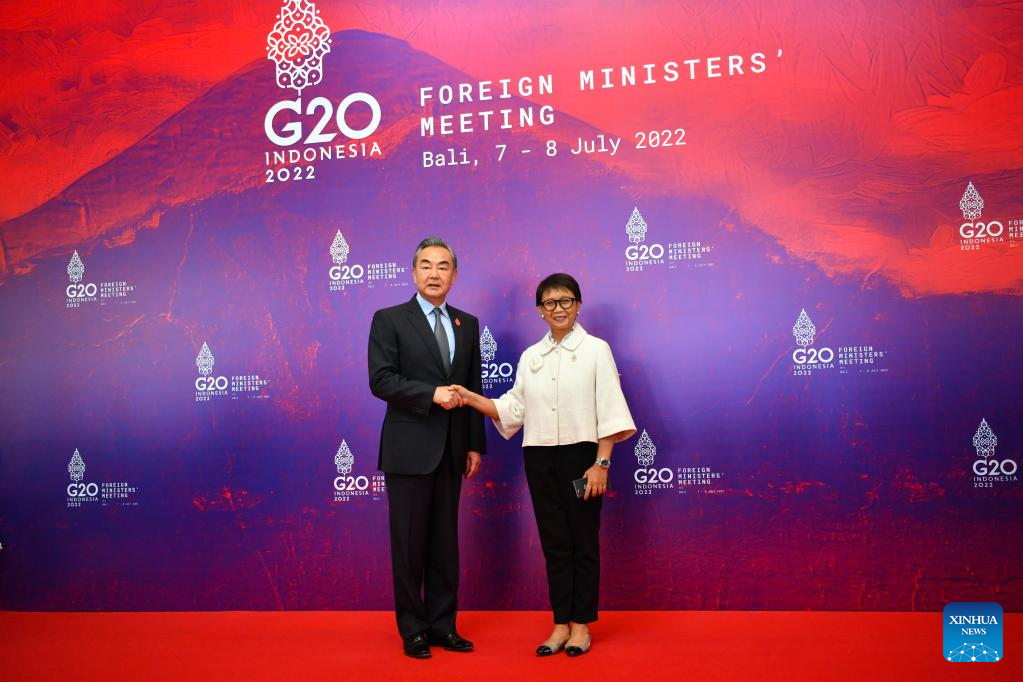
IN BRIEF
By Avishka Ashok
INTERNATIONAL
Global Food Security: China proposes eight points to achieve UN 2030 Agenda for Sustainable Development
On 7 July, China’s Foreign Minister Wang Yi addressed the G20 Foreign Ministers’ Meeting and proposed a cooperative initiative on global food security. Wang Yi stressed on the importance of food and energy in the healthy performance of the world economy and in the journey towards achieving the UN 2030 Agenda for Sustainable Development. Wang Yi made eight proposals to achieve the goal.
First, strengthening and supporting the role of the United Nations and its supporting institutions such as the Food and Agriculture Organization (FAO) the International Fund for Agricultural Development and the UN World Food Programme (WFP). Second, removing restrictions on humanitarian purchases made by the WFP. Third, including agricultural products from Russia, Ukraine and Belarus. Fourth, revealing and expanding the export potential of capable countries, reducing trade barriers and bringing efficiency into producing food. Fifth, emergency measures for food trade should adhere to the rules of the World Trade Organization while ensuring short-term plans, transparent deals, target and appropriate sale. Sixth, restrictions on high-tech exchanges must be reduced and countries must share agricultural innovation and expand cooperation on related technologies. Seventh, reduce food waste and implement the consensus reached at the International Conference on Food Loss and Waste. Eighth, extending a helping hand to developing countries in increasing their production capabilities, storage facilities and assisting in agricultural processes.
Wang Yi also promoted the South-South Cooperation Trust Fund and said: “China is a reliable cooperative partner of the United Nations and developing countries in the field of food security. China supports the WFP in setting up a global humanitarian emergency warehouse and hub in China and has established the South-South Cooperation Trust Fund with the FAO and provided financial support for it. Under the trust fund, China has carried out more than 40 South-South cooperation projects in cooperation with the FAO and the WFP.” (“China proposes cooperation initiative on global food security at G20 meeting,” Xinhua Net, 08 July 2022)
BRICS: Fifth Media Forum issues Action Plan for 2022-23
On 8 July, the Fifth BRICS Media Forum issued the Action Plan for 2022-2023. The plan noted the need for dialogue and cooperation and urged the news agencies in the five countries to create a strong synergy between the member countries. The action plan said: “The world is enduring a new period of turbulence and transformation, and the international community's pursuit of peace and development, fairness and justice, democracy and freedom, and win-win cooperation has become all the more vital.” The plan sheds light on diverse issues such as peace, economic growth, unity against COVID-19, food-security, climate change and digital governance. The plan is expected to conduct joint interviews, special operations, websites and news feeds on trending issues at different locations. (“Fifth BRICS Media Forum issues action plan,” Xinhua Net, 09 July 2022)
Canada: Foreign Ministers discuss normalizing relations at the sidelines of G20
On 8 July, China’s Foreign Minister Wang Yi met with the Canadian Foreign Minister Melanie Joly on the sidelines of the G20 Foreign Ministers’ Meeting and promised to work towards bringing the bilateral relations back on track. During the meeting, Wang Yi reiterated that China never viewed Canada as a rival or a threat but only as a partner. He said: “A sound and stable China-Canada relationship is the common aspiration of the two peoples and serves the common interests of both sides. China hopes that Canada will respect facts and be cautious in words and deeds on China-related issues, and work with China to meet each other halfway to build mutual trust so as to bring China-Canada relations back on track.” He further stressed on the countries’ support for similar ideals and common interests such as advocating for multilateralism, democratizing international relations and safeguarding globalization. (“Chinese, Canadian FMs vow to bring bilateral relations "back on track",” Xinhua Net, 09 July 2022)
France: Foreign Minister Wang Yi discusses bilateral issues and hopes for strong connections with the EU
On 8 July, China’s Foreign Minister Wang Yi held a meeting with the French Foreign Minister Matherine Colonna in Bali on the sidelines of the G20 Foreign Ministers’ Meeting. The countries agreed to enhance strategic cooperation and deepen pragmatic collaboration while appreciating the stable development of the bilateral ties under the heads of the states. At the meeting, Wang Yi said: “China cherishes the mutual trust and friendship between the two sides, and highly appreciates and firmly supports France for upholding strategic autonomy.” The Foreign Ministers promised to strengthen cooperation on climate change and biodiversity conservation and also discussed China’s relations with the European Union, the Ukraine war, the Korean Peninsula and other issues of mutual interest. Wang Yi expressed that China expects France to play a constructive role in building and maintaining the country’s relations with the EU. (“China, France agree to enhance strategic collaboration, deepen pragmatic cooperation,” Xinhua Net, 09 July 2022)
REGIONAL
Japan: President Xi expresses deep sadness over Abe’s assassination
On 9 July, Chinese President Xi Jinping sent a message of condolence to the Japanese Prime Minister Fumio Kishida over the assassination of former Prime Minister Shinzo Abe. China’s state broadcaster CCTV said: “On behalf of the Chinese government and the Chinese people, and in his own name, Xi Jinping expressed deep condolences over the untimely death of former prime minister Shinzo Abe, and condolences to his relatives.” The state reporters also said that President Xi and his wife also reached out to Abe’s wife Akie, expressing their condolences at his passing away. Xi’s messages however, did not match the sentiment in Chinese citizens who held grudges against the leader for his political leanings, statements over the Senkaku/ Diaoyu Islands dispute and the Yasukuni Shrine. Abe led Japan’s relations with China during rough times and efficiently managed the country’s relations with the US. (“China's Xi sends condolences to Japan PM Kishida over Abe's death,” The Strait Times, 09 July 2022)
Taiwan: Chief of Staff demands the US to stop colluding against China
On 8 July, the Asahi Shimbun reported on a virtual meeting between the Chinese and US military where the former demanded the latter to stop its collaborations with Taiwan. The meeting was attended by the Joint Chiefs of Staffs of the two countries. China’s Chief of Staff Gen. Li Zuocheng addressed the US Chief of Staff Gen Mark Mlley and said: “China demands the US to cease reversing history, cease US-Taiwan military collusion and avoid impacting China-U.S. ties and stability in the Taiwan Strait.” Li took a stand against the US interference in its core interests and explained that China has no room for compromise. Li further warned that the country would firmly counterattack any actions from foreign countries and resolutely safeguard its national sovereignty. (“China demands end to U.S.-Taiwan military ‘collusion’,” The Asahi Shimbun, 08 July 2022)
ECONOMY
Inflation: Consumer price index records a two-year high
On 9 July, the Strait Times reported that China’s factory-gate inflation fell to the lowest in 15 months while the consumer inflation rose to a two-year high in June 2022. The producer price index increased by 6.1 per cent year on year while the consumer price index increased 2.5 per cent year on year. The economy showed signs of slow recovery but was once again stagnant due to the heat waves, floods, heavy rains, and scattered lockdowns in the country. The country is also expected to set up a 500 billion yuan state infrastructure fund to revive the economy. (“China's June factory inflation cools, consumer prices accelerate,” The Strait Times, 09 July 2022)
08 July 2022 | Friday | China Reader Evening Brief | Vol.1, No. 230
Foreign Minister Wang Yi at the G20 Foreign Ministers' Meeting
Wang Yi met his Russian, Indian, South Korean, and Argentine counterpart on the sidelines of the G20 Foreign Ministers' Meeting and took a stand against the instigation of a cold-war mentality, while pushing for multilateralism.
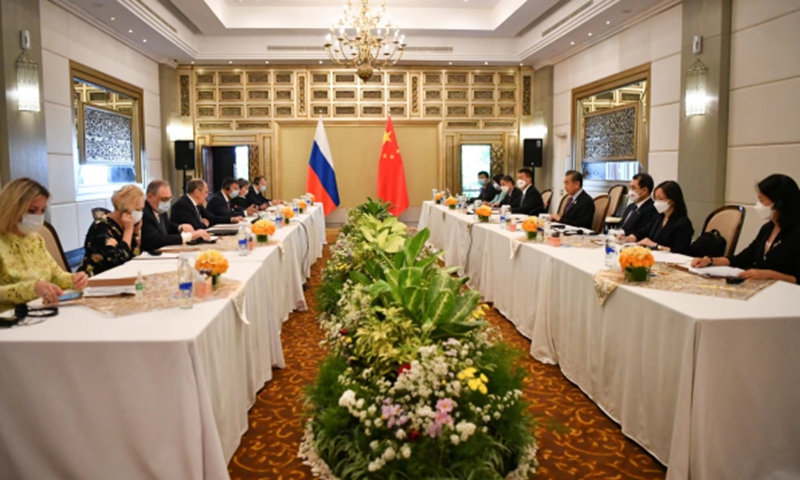
IN BRIEF
By Avishka Ashok
REGIONAL
G20: China's Foreign Minister holds bilateral meetings on the sidelines and discusses challenges in relations
On 7 July, China Foreign Minister Wang Yi attended the Group of 20 (G20) foreign ministers’ meeting in Bali, Indonesia. At the meeting, Wang Yi held numerous bilateral meetings with the member countries and discusses a range of issues.
In his meeting with Russian Foreign Minister Sergei Lavrov, Wang Yi noted that the countries had overcome obstacles and maintained normality in exchanges while pushing for cooperation along various fields. Wang said that the continuation of healthy ties portrayed the resilient relations between China and Russia. Wang referred to the challenges in the world order and said: “Facing the realities of the current international politics, will countries choose to pursue power politics and hegemony, or promote a multi-polar world? Wang asked. Will they truly uphold the international order with the UN at its core or follow rules made by a handful of countries according to their own standards?”
Wang Yi also spoke about the Ukraine crisis and highlighted China’s concerns. On behalf of the country, Wang Yi opposed instigating the cold war mentality, comparing the crisis in Ukraine with the status of Taiwan and opposed the imposition of sanctions against China and other countries. He called for increased solidarity and dialogue rather than division and confrontation. Taking a stand against double standards, Wang Yi opposed countries for raising the question of China’s sovereignty over Taiwan and urged all countries to adhere to the one-China principle. He said: “China's three points of concern clearly show that hegemony is not welcome in handling global affairs, and hegemony is also the essential reason for the prolonged conflict between Russia and Ukraine.”
Wang met with India’s External Affairs Minister Subrahmanyam Jaishankar on the sidelines of the G20 meeting and appreciated the neighbouring country for maintaining communication and exchanges, effectively managing differences and encouraged the momentum of recovery in the overall bilateral relations. Wang said that China and India would not follow the West in their ideologies as they had common interets and similar claims. According to Wang, the countries were destined to uphold strategic persistence and achieve their own goals in the international order. He said: “We need to take concrete actions to implement the important consensus reached by the leaders of the two countries, being each other's partner, not posing a threat to each other and being a mutual development opportunity, bringing bilateral relations back on the right track as early as possible.”
Wang Yi also met with the European Union High Representative for Foreign Affairs and Security Policy Josep Borrell and encouraged the European countries to uhold the multilateral practices and the basic orientation of their comprehensive strategic partnership. He further urged the EU to maintain positive momentum of dialogue while keeping away from issues that widen the differences with China. He said: “China and the EU should adhere to the mutually beneficial and win-win cooperation, uphold true multilateralism and oppose any acts that trumpet decoupling and violate the law of the economy. Both sides should reject zero-sum games, instigation of bloc confrontation and attempts to stoke a new Cold War”
The Foreign Minister also met with the Argentine Foreign Minister Santiago Cafiero and reassured support for strengthening coordination and increasing cooperation along the Belt and Road Initiative. Wang stressed on the close relationship between the leaders of the two countries and appreciated Argentina’s friendly policies towards China. He said: “This year marks the 50th anniversary of the establishment of diplomatic ties between the two countries, and China is willing to work with Argentina to advance the high-quality construction of the Belt and Road, helping accelerate their respective development and revitalization.”
Wang Yi also held a meeting with South Korean Foreign Minister Park Jin and agreed to expand bilateral cooperation and deepen exchanges between the countries. The countries are celebrating 30 years of diplomatic relations this year. Wang noted the abundance of opportunities but also the existence of practical challenges that face the countries in the coming years. He said: “As close neighbors and inseparable partners with closely-related security environment and an industrial cycle of converging interests, China and South Korea should uphold the already reached consensus and understanding, and maintain the stability and continuity of their policies towards each other.”
Lastly, the Foreign Minister of Australia Penny Wong announced that the country would be attempting to end the trade blockages and seek to defrost the icy relations with China. Wong said: “We all know we have our differences. There are challenges in the relationship. We believe engagement is necessary to stabilise the relationship. We won't be making any concessions when it comes to Australia's interests. We don't believe those blockages are in our interests. We would say to China, they are not in China's interests.”
(“China lauds resilient ties with Russia at FMs' meeting, calls for de-escalating Ukraine situation,” Global Times, 08 July 2022; “China and India share common interests, will make greater contributions to the future of mankind: Chinese FM,” Global Times, 08 July 2022 “Chinese FM lays out three points of concern on Ukraine crisis,” Global Times, 07 July 2022; “China, EU urged to uphold their comprehensive strategic partnership,” Xinhua Net, 08 July 2022; “China, Argentina agree to strengthen coordination, Belt and Road cooperation,” Xinhua Net, 08 July 2022; “Australia seeks end to trade rows in China meeting,” The Strait Times, 08 July 2022; “China, S.Korea vow to expand cooperation, strengthen exchanges,” Xinhua Net, 08 July 2022)
INTERNATIONAL
Pakistan: Foreign Ministry appreciated BRI and calls for more similar initiatives
On 7 July, Pakistan’s Foreign Ministry spokesperson Asim Iftikhar Ahmed addressed a press briefing for the Partnership for Global Infrastructure and Investment (PGII) and appreciated China’s Belt and Road Initiative. Ahmed said that the BRI is aimed at promoting development, connectivity and cooperation in numerous fields. He said: “We want to see an environment regionally and globally in which the development objectives of countries and regions can be promoted through a cooperative rather than confrontational approach.” He further encouraged similar initiatives by other countries and expressed Pakistan’s interest in improving connectivity and enhancing cooperation. (“China's BRI designed to promote development, connectivity, cooperation: Pakistani Foreign Ministry,” Xinhua Net, 08 July 2022)
Japan: China remembers 85 years of the attack on Lugou Bridge, marking the beginning of the invasion
On 7 July, China commemorated the 85th anniversary of the whole-nation resistance to the Japanese aggression in 1937. The day marks the beginning of Japan’s full-scale invasion of China with the attack on the Lugou Bridge. A special exhibition was held at the Museum of the War of Chinese People’s Resistance Against Japanese Aggression in Beijing. Over 300 people from diverse backgrounds such as veteran representatives and family members of military leaders and martyrs attended the ceremony. Memorial activities were conducted throughout the country. Over 100 people attended the activities in Zhijiang Dong Autonomous County. On the same day, a book on the Nanjing Safety Zone was published. The Nanjing Safety Zone was an initiative by a German individual John Rabe who saved the lives of 200,000 Chinese people during Japan’s imperialist era. (“China Focus: China commemorates 85th anniversary of whole-nation resistance war against Japanese aggression,” Xinhua Net, 08 July 2022)
Taiwan: China responds to US Senator’s visit and meeting with President Tsai Ing-wen
On 8 July, the Eastern Theatre Command of the People’s Liberation Army announced that the military had held joint combat readiness exercices, patrols and drills near Taiwan’s sea and airspace. China’s Ministry of Defence Spokesperson Wu Qian further reasoned that the exercises were held as a response to the provocations by the US and Taiwan. The Chinese fighter jets crossed the median line of the Taiwan Straits as a response to the US Senator Rick Scott’s visit to Taiwan and his meeting with President Tsai Ing-wen. Wu responded to a question on Scott’s visit during a press briefing and said: “The US side's move seriously violates the one-China principle and the provisions of the three Sino-US joint communiqués, seriously damages the political foundation of Sino-US relations, seriously undermines the relationship between the two countries and the two militaries, and escalates tensions in the Taiwan Strait region.” (“China military says holds combat exercises around Taiwan as US senator visits island,” The Strait Times, 08 July 2022)
INTERNAL
Hong Kong: Barristers defending Jimmy Lai threatened against defending the case
On 7 July, the Barristers Caoilfhionn Gallagher, Jonathan Price and Jennifer Robinson from the British law firm Doughty Street Chambers who are defending Hong Kong’s tycoon Jimmy Lai said that they received numerous anonymous emails threatening them against travelling to the city to defend the pro-democracy activist. One of the emails read: “A person that refuses to abide by the laws of the Hong Kong Special Administrative Region could be extradited...from other jurisdictions. Foreign nationals will be charged with the offences of subversion. You have been warned not to attempt entry or land in Chinese territory.” The Barristers responded to the threats and noted that these tactics were common in Hong Kong but are not expanding outside the city as well. (“Lawyers defending Hong Kong tycoon say they have received threats,” The Strait Times, 08 July 2022)
Hong Kong: City inaugurates third runway, hoping to increase footfall
On 8 July, the Hong Kong airport opened its third runway, a project that was part of a HKD (Hong Kong Dollar) 141.5 billion and is expected to increase footprint by 50 per cent. The local conglomerate New World Development is also building a HKD 20 billion worth entertainment, retail and commercial complex. However, the grand plans have been suffering under the Chinese government’s strict COVID-prevention policies and restrictions. Until May 2022, a total of 5,45,000 passengers used the city airport while 31.4 million people commuted using the airport in 2019. (“Hong Kong opens third runway as part of S$25 billion expansion,” The Strait Times, 08 July 2022)
Torrential rains: Ministry of Emergency Management alerts China for incoming flood-season
On 8 July, the vice minister at the Ministry of Emergency Management Zhou Xuewen addressed a press briefing and informed that the country would be facing a crucial period from mid-July and alerted the officials at all levels to grasp the potential risks from the torrential rains. Zhou urged the officials to ensure relief reached the people in a timely manner as the floods in the country are about to reach its peak season this month. He urged cities and counties to prepare themselves with funds and relief materials and take the necessary actions to minimize casualties while also following the COVID-19 restrictions and guidelines. (“China tells regional officials to ready for disasters after months of torrential rain,” The Strait Times, 08 July 2022)
07 July 2022 | Thursday | China Reader Evening Brief | Vol.1, No. 229
Foreign Minister Wang Yi's visit to the Philippines
Wang Yi discusses bilateral relations and maritime issues with the President, National Security Advisor and other top diplomats during his visit to the Philippines.

IN BRIEF
By Avishka Ashok and Arshiya Banu
REGIONAL
Philippines: Foreign Minister holds meeting with top officials; enhances bilateral relations
On 6 July, China’s Foreign Minister Wang Yi visited the Philippines and held a meeting with the top political leaders and officials. Wang Yi met the National Security Advisor Clarita Carlos and appreciated the joint efforts from the two sides to improve bilateral relations in the past six years. Wang Yi’s visit portrayed the emphasis of the Chinese government on maintaining healthy relations with the new Philippine government. He said: “The election of Ferdinand Romualdez Marcos as the new Philippine president has turned over a new leaf in the China-Philippines ties as the people of the two countries have a high expectation on the future development of bilateral relations.” Carlos also agreed to the long-existing traditional relationship with China and expressed the country’s willingness to collectively build a society with a shared future. Wang Yi further reassured the Philippines that the country would not follow the West and engage in plundering the states for its own advantage. He said: “The two sides should carry on their traditional friendship, make the China-Philippines relationship more solid and stronger, and keep its development on the right track.”
Wang Yi also met with Foreign Secretary Luis Enrique Manalo and concurred to further enhance the friendship and mutual trust between China and the Philippines. The leaders also agreed to adhere to good neighborliness and deepen bilateral cooperation. Manalo also noted that China is the first country to visit the Philippines after the election of the new government in June 2022. Manalo promised to adhere to the one-China policy and hoped to increase the mutual friendship between the states.
On the disagreements in the South China Sea, “The Philippines believes that the problem involving islands and reefs in the South China Sea should be settled through diplomatic means and peaceful consultations with a view to jointly safeguarding peace and stability there.” Wang also appreciated the proper handling of the maritime issues and said that the countries have undertaken a strategic and overarching perspective in the dispute; thereby providing a proper position on the issue. Wang said: “The two sides should also work to steadily advance the joint development in the South China Sea, accelerate consultations on the Code of Conduct in the South China Sea, and expand maritime cooperation to increase mutual benefit and win-win results.”
Apart from the bilateral ties, the delegation also discussed China’s role in ASEAN and the partnership with the Philippines benefitting the regional organization in the coming years. The two countries agreed to safeguard the regional architecture, jointly implement the consensus reached at the latest summit and push for a solid China-Asean comprehensive strategic partnership.
Wang Yi also met the Philippine President Ferdinand Romualdez Marcos and spoke about the challenges to bilateral trade and the issues in the South China Sea. President Marcos noted that China is the largest trading partner and is an important development partner for the country. He appreciated China’s help during the COVID-19 outbreak and the “Build Build Build” program which aims to improve the infrastructure in the country. Marcos said: “The Philippines hopes to continue pushing forward bilateral cooperation with China in politics, economy and trade, education, culture, and other areas, so as to enrich the connotation of their comprehensive strategic cooperation.”
(“China, Philippines agree to upgrade cooperation, resolve differences through dialogue,” Xinhua Net, 07 July 2022; “China, Philippines vow to enhance good-neighborly friendship, deepen cooperation,” Xinhua Net, 06 July 2022; “China, Philippines agree to upgrade cooperation, resolve differences through dialogue,” Xinhua Net, 07 July 2022)
Taiwan: AT-5 Brave Eagle showed off by Air Force
On 6 July, the new AT-5 Brave Eagle was unveiled by Taiwan's air force, which was created and manufactured domestically, and was showcased for its superior combat capabilities in place of the current fleet's outdated and accident-prone older models. Despite the fact that the majority of Taiwan's armed forces' equipment comes from the United States, President Tsai Ing-wen has prioritised the growth of a sophisticated domestic defense industry, particularly as China, which claims Taiwan as its own, intensifies military modernization activities and drills close to Taiwan. With a US$2.3 billion budget, the state-owned Aerospace Industrial Development Corp built the jet trainer, which had its first test flight in 2020. (“Taiwan touts new air force advanced training jet's abilities,” The Strait Times, 06 July 2022)
INTERNATIONAL
United Nations: China highlights abuse against indigenous groups at 50th session of Human Rights Council
On 7 July, the Global Times reported that the Chinese Permanent Representative to the United Nations had taken up the issue of mutilation and abuse against indigenous children at the 50th session of the Human Rights Council. China called for a thorough investigation into the crimes against indigenous groups on behalf of Belarus, Bolivia, Burundi, Cameroon, North Korea, Iran, Myanmar, Russia, Sierra Leone, Syria, and Venezuela. The representative called for justice and expressed its concerns over the human rights violations in certain countries. The joint statement read out by China said: “Some countries have conducted mass killings of indigenous people in history. They forcibly took indigenous children away from their families and communities to the so-called "residential schools," where indigenous children were deprived of their identity and cultural recognition with bans on traditional costumes, language and culture, and many died of hunger, disease, corporal punishment or sexual violence.” (“China calls for thorough investigation into some countries' history of mutilation and abuse against indigenous children,” Global Times, 07 July 2022)
Uzbekistan: China aims to heighten strategic relationship and extends support for development plans
On 7 July, the Chairman of China’s National People’s Congress Li Zhanshu held a meeting with the Chairman of the Senate of Uzbekistan Tanzila Narbayeva, and agreed on increasing the parliamentary exchanges between the two countries. Li stressed the developing comprehensive strategic partnership with Uzbekistan and urged the countries to heighten the link between the countries and their people. Li said: “Uzbekistan has consistently supported China's stand on issues related to Taiwan, Hong Kong, Xinjiang and Tibet, as well as in the fight against the East Turkestan Islamic Movement, and China appreciates that.” He also promised to support Uzbekistan in its development and securing its national sovereignty. (China's top legislator holds talks with chairperson of Uzbekistan's Senate,” Xinhua Net, 07 July 2022)
The Caribbean: China inaugurates Development Centre in Jinan
On 6 July, China inaugurated the China-Caribbean Development Centre in Jinan in the Shandong Province. The Centre is expected to heighten the cooperation between China and the Caribbean countries in the coming years. During the inauguration ceremony, three cooperation projects were signed with the Caribbean countries. China’s trade with the countries has increased manifold in recent years in diverse fields. Apart from the booming trade, China also been working on anti-pandemic cooperation and on supplying vaccines. (“Xinhua Headlines: China, Caribbean countries deepen comprehensive cooperation,” Xinhua Net, 07 July 2022)
The US and the UK: FBI and Britain’s intelligence agency claim China steals corporates’ technology
On 7 July, the Strait Times reported the director of the FBI Christopher Wray and the director-general of Britain's domestic intelligence service Ken McCallum issued warnings to corporate executives against the Chinese government, claiming that Beijing is trying to steal their technology for competitive advantage. Wray reiterated long-standing worries by criticising China's intelligence operations and cyber activities as well as its attempts to quell dissent abroad. Wray said: “We consistently see that it’s the Chinese government that poses the biggest long-term threat to our economic and national security, and by ‘our,’ I mean both of our nations, along with our allies in Europe and elsewhere.” McCallum stated that the “covert pressure” of the Chinese government across the globe needs to be talked about and acted on, adding that it is "the most game-changing challenge we face." (“U.S., U.K. leaders raise fresh alarms about Chinese espionage,” The Asahi Shimbun, 07 July 2022)
The US: Government implements ban on chip production to prevent China's domination
On 6 July, Chinese Foreign Ministry spokesman Zhao Lijian criticized the US efforts to prevent ASML Holding and Nikon from supplying the country with significant chipmaking technology and called it "technological terrorism." In an effort to block China's plans to overtake the rest of the world in chip production, Washington has proposed imposing additional limitations on ASML that would go beyond the current ban on sales of the most cutting-edge systems to China. The range and type of chipmaking equipment that is currently prohibited from entering China will be greatly expanded if the Netherlands agrees, potentially dealing a devastating blow to Chinese chipmakers like Semiconductor Manufacturing International and Hua Hong Semiconductor. (“China calls US pressure on chipmakers 'technological terrorism',” The Strait Times, 06 July 2022)
INTERNAL
Shenyang: Intense rains flood roads and restricts residents’ activities
On 7 July, China’s north-eastern rust-belt was pummelled by intense rain, which caused floods that stranded buses, submerged roads, and hindered city commuters. Even though numerous red signals, the worst in a four-tier storm warning system, were issued, the unusually intense rain caught Shenyang's 7.6 million residents off guard. Shenyang is the capital of Liaoning province. The public alerts on residents' mobile phones when they awoke warned them to postpone going to work and cancel any unavoidable activities due to "extreme weather." According to traffic police data, there were 30 closed roads and 52 flooded sections. (“Rain storms lash China's north-eastern rust-belt,” The Strait Times, 07 July 2022)
06 July 2022 | Wednesday | China Reader Evening Brief | Vol.1, No. 228
Boeing's political challenges in China
China's decision to purchase almost 300 aircrafts from Airbus comes as a big blow to Boeing.

IN FOCUS
By Avishka Ashok
Boeing's political challenges in China
On 01 July, Airbus announced that China’s four largest airlines had entered a USD 37 billion business deal with the company; buying 292 A320 passenger jets in the biggest single day deal. Air China, China Eastern Airlines and China Southern Airlines placed the order with the European aircraft producer. Air China has purchased 96 aircrafts for USD 12.2 billion and will receive the complete order between 2023 and 2027. The subsidiary Shenzhen Airlines will be receiving a third of this order. China Eastern Airlines purchased 100 Airbus A320neo family aircrafts for 12.8 billion which are scheduled for delivery between 2024 and 2027. China Southern Airlines purchased 96 aircrafts for USD 12.8 billion which are also due for delivery by 2027.
Airbus is aiming to increase its production to 70 aircrafts per month by 2025. The order by the Chinese airlines is a huge step towards that goal. Meanwhile, the American Boeing has suffered great losses in the new deal. Boeing had earlier announced that it would not be increasing its production rates this year. The decision could be influenced by the COVID-19 pandemic and its impact on the tourism, travel and airlines industry. Dues to strict regulations within China, flight services were at a standstill for more than a year. The Boeing 737 MAX has also been involved in numerous accidents; urging China to ground the aircraft and exerting political pressure using regulations. Although the aircraft has resumed services in the country, the production has slowed significantly.
Another major factor is the rising political tensions between China and the US. The trade-war between the two countries can be traced back to the tenure of former President Donald Trump who initiated a tariff hike and later went on to block the sale of Chinese products in the US. Boeing seems to be stuck in the continuing trade war and is unable to reach consensus on sale and production of aircrafts in China. Apart from the trade war, the role of the US in weaponizing Taiwan by selling military grade products and other equipment are also considered as a factor for China to move away from the country and the company.
However, China is considered to have a demand over over 6,500 aircrafts in the coming two decades. The current purchase of 300 aircrafts from Airbus could be a start of many more in the coming years. But, all is not lost for Boeing as this sale only covers five per cent of China’s total capacity and the country’s decision could be reversed in the future.
References:
“Chinese airlines, including Air China, buy almost 300 planes from Airbus,” The Strait Times, 01 July 2022
“Airbus Deals Major Blow To Boeing With Win In China,” Seeking Alpha, 05 July 2022
IN BRIEF
By Avishka Ashok and Arshiya Banu
INTERNATIONAL
Ethiopia: China-built railway line helps increase profitability and exports
On 5 July, Xinhua Net referred to the information revealed by the Ethiopian Ministry of Foreign Affairs and reported that the Chinese-built Addis Ababa-Djibouti Standard Gauge Railways was ready to boost the export and profitability of the country. According to the Ministry of Foreign Affairs, the CEO of Ethiopia-Djibouti Standard Gauge Railways S.C. Abdi Zenebe visited the Ethiopian embassy to discuss streamlining of the Ethiopian exports and reducing the logistical bottlenecks and increasing the profitability of the region. The statement by the Ministry said: “By utilizing railway wagons and setting up affordable prices to attract more clienteles, the railway company is focusing on schemes of addressing logistical issues caused by the conventional ways of transporting Ethiopian export products to Djibouti and beyond.” The company manages the 752 kilometer railway line and aims to reduce the constraints to the overall supply chain while also standardizing the export of agro-products, meat products and other live animals. The project takes credit for employing almost 4000 locals and increasing the transport revenue from USD nine million to USD 10 million in 2021. (“Chinese-built SGR set to streamline Ethiopia's export, boost profitability,” Xinhua Net, 05 July 2022)
Global Think Tank Summit: China hosts the 7th Summit and urges countries to work for a shared community
On 5 July, China Centre for International Economic Exchanges hosted the 7th Global Think Tank Summit which was attended by over 100 attendees who were former political leaders, heads of international organizations and think tank representatives. The Head of the Publicity Department of the Communist Party of China Central Committee Huang Kunming addressed the summit and appreciated the initiative for prioritizing development and ensuring the enhancement of people’s well-being in the process of development. Huang, a member of the Political Bureau of the Communist Party of China, noted that the initiative had received support from over 100 countries and urged the attendees to actively work towards establishing a global community with a shared future. (“Senior CPC official addresses Global Think Tank Summit,” Xinhua Net, 05 July 2022)
REGIONAL
Thailand: Foreign Minister Wang Yi reaches consensus on four aspects
On 5 July, China’s Foreign Minister Wang Yi visited Thailand and held a meeting with the Deputy Prime Minister and Foreign Minister Don Pramudwinai. At a joint press conference, Wang Yi noted the 10th anniversary of the establishment of the comprehensive strategic cooperative partnership and spoke about the in-depth strategic communication held with the Thai officials. The countries reached consensus in four aspects. First, the countries agreed to work towards building a joint community with a shared future. Second, both countries promised to launch the China-Laos-Thailand railway at the earliest and also work towards launching more cold-chain freight train services. Third, China and Thailand signed a Memorandum of Understanding on cyber security and pledged to fight against telecom fraud. Lastly, the countries will actively work for benefits in the Asia-Pacific Economic Cooperation Economic Leaders’ Meeting which will be hosted by Thailand later this year. (“China, Thailand reach consensus on future ties, railway, cyber security,” Xinhua Net, 06 July 2022)
Indonesia: Silk Road Fund prepares to invest USD 3 billion in the country
On 6 July, Xinhua Net reported that China’s Silk Road Fund had reached an investment framework with the Indonesia Investment Authority with an aim to pursue investment cooperation in the foreign country. The two entities will launch a long-term and win-win strategic partnership to promote socio-economic development and connectivity between the two countries. The Chinese fund has the capacity to invest close to USD 3 billion in Indonesia and other Southeast Asian countries. The statement by Silk Road Fund said: “The two sides will cooperate via various forms of investment with a focus on supporting local projects that benefit people's livelihoods and promote development in Indonesia.” (“Silk Road Fund inks investment agreement with Indonesia Investment Authority,” Xinhua Net, 06 July 2022)
INTERNAL
Cyber hack: ChinaDan threatens to sell hacked data from Shanghai Police
On 06 July, The Asahi Shimbun reported that a database of the Shanghai police is said to have been breached by hackers, who claim to have taken a great deal of information on 1 billion Chinese. If true, this would be one of the biggest data thefts in history. Last week, a user going by the handle "ChinaDan" posted a message on the online hacking site Breach Forums offering to sell roughly 24 terabytes (TB) of data, including what they claimed to be data on 1 billion people and "several billion case records," for 10 Bitcoin, or approximately USD 200,000. Names, residences, national identity numbers, mobile phone numbers, and case information are allegedly included in the data from the Shanghai National Police database. (“Alleged Chinese police database hack leaks data of 1 billion,” The Asahi Shimbun, 06 July 2022)
Real Estate: Housing businesses take food as payment for homes
On 05 July, BBC reported that in an effort to draw consumers, some Chinese real estate developers recently stated that they would take food as payment for properties. The businesses promoted offers allowing consumers to use vegetables as down payments for new homes, including peaches, watermelons, and garlic. Some of these offers, though, have allegedly now been withdrawn. In addition to this week's default by a significant developer, home sales in China have decreased for 11 straight months. A real estate firm in the eastern city of Wuxi announced last week that it would permit peaches to be used to offset up to 188,888 Chinese yuan (USD 28,218) in down payments for residences. (“Chinese property developers accept farm produce for homes,” BBC, 05 July 2022)
National Development and Reform Commission: China considers tapping into pork reserves to control high costs
On 5 July, the Strait Times reported that after prices for the nation's staple meat increased by almost a third year over year, the National Development and Reform Commission (NDRC) indicated they could tap into the country's pork reserves, even as they ordered suppliers to slaughter more pigs to lower the price. The country's pork prices rose, forcing Beijing's chief economic planner to act. Regulators blamed suppliers for "blindly holding supply" and being unwilling to sell. The commission claimed the hesitation was an attempt to increase profits and ordered large suppliers to kill pigs at a "regular pace" and avoid stockpiling. (“China mulls dipping into pork reserves to rein in costs,” The Strait Times, 05 July 2022)
Hong Kong: John Lee refuses to accept China’s ‘living with the virus’ guidelines
On 6 July, John Lee, the new leader of Hong Kong, repeated the rejection of the "living with the virus" pandemic approach by mainland China and stressed that the city must not "lie flat" in its fight against COVID-19. In his first question-and-answer session at the city's Legislative Council since taking office, Lee said: "Regarding anti-epidemic strategies, I do not agree with lying flat, allowing infection numbers to increase arbitrarily, as there will be risks of serious and fatal case number increasing proportionally, when the base number increases." He said, while also ruling out resorting to harsher travel restrictions aimed to keep the virus out, that Hong Kong must accomplish early diagnosis, isolation, and treatment of infections to stop the daily COVID-19 cases, now at roughly 2,000 a day. (“Hong Kong leader rejects 'living with the virus' Covid-19 policy,” The Strait Times, 06 July 2022)
05 July 2022 | Tuesday | China Reader Evening Brief | Vol.1, No. 227
China highlights benefits of 14th Summit to all of Africa
The Chinese Ambassador looks into the many benefits of the 14th BRICS summit for South Africa and the African continent.
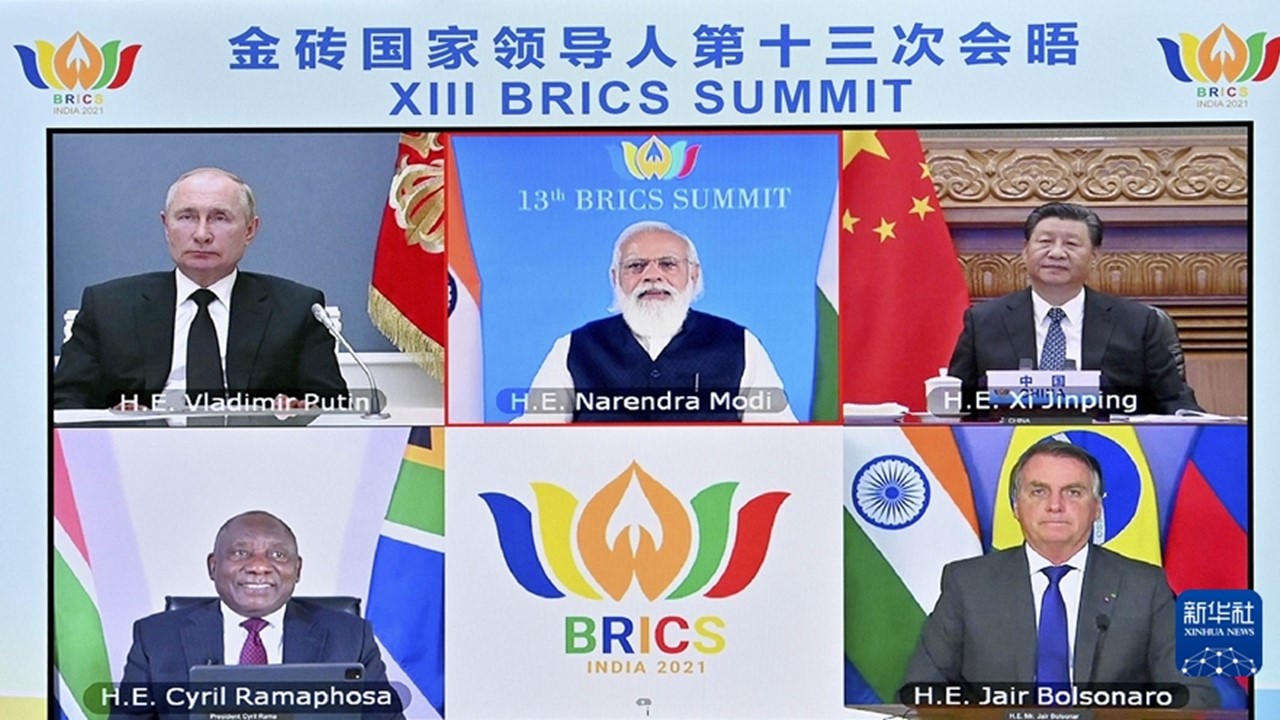
IN BRIEF
Avishka Ashok and Arshiya Banu
INTERNATIONAL
BRICS: China Ambassador to South Africa highlights benefits of 14th Summit to all of Africa
On 5 July, Xinhua Net reported on an interview by China’s Ambassador to South Africa Chen Xiaodong on the outcomes for the country from its cooperation with BRICS. Ambassador Chen said that the 14th summit would greatly benefit South Africa and the African continent. A South African mews and information website reported on the BRICS Vaccine Research and Development Centre that will result in reducing the current vaccine divide, especially in Africa. The continent is also said to benefit from the first-ever food security cooperation reached at the summit. The Ambassador also highlighted the digital economy partnership framework and the digital transformation of the manufacturing industry. Ambassador Chen said: “The BRICS countries have made various efforts for global economic recovery and growth, by upholding the multilateral trading system and improving the formulation of international trade rule -- particularly by supporting multilateral trading system and World Trade Organization (WTO) reform, and putting forward an initiative on strengthening cooperation on supply chains, said the ambassador.” The BRICS summit also aimed at creating new vocational education alliance and conduct awards such as the BRICS Solutions for SDGs (Sustainable Development Goals) Awards and the women innovation contests. (“BRICS summit to benefit South Africa with 8 practical outcomes: Chinese envoy,” Xinhua Net, 05 July 2022)
Global Development: President Xi showcases China’s efforts in reducing the widening North-South gap
On 4 July, China’s President Xi Jinping attended a forum on global development and expressed China’s desire to put development first on the international agenda in his congratulatory note. Xi highlighted the gap between the North and the South and the slow pace of the global economic recovery and said: “ As the world enters a new period of turbulence and transformation, promoting development has become a major topic facing humanity. Therefore, China proposes the Global Development Initiative.” Xi further highlighted China’s readiness to work with other countries and uphold a people-centric approach while pursuing inclusiveness and innovation-driven development. (“Xi calls for putting development front and center on international agenda,” Xinhua Net, 04 July 2022)
The US: Countries participate in China-US comprehensive economic dialogue
On 5 July, China’s Vice Premier Liu He held a meeting with US Treasury Secretary Janet Yellen and discussed economic issues between the two countries. Liu He is a member of the Polit Bureau and the Chief of the Chinese side of the China-US comprehensive economic dialogue. The two sides discussed the macroeconomic situation and the stability of the global industrial and supply chains. Liu He brought up China’s concerns regarding the sanctions by the US and the unfair treatment of Chinese businesses in the US. China and the US have promised to maintain communication on the issues. (“Chinese, U.S. senior officials hold video talks over economic issues,” Xinhua Net, 05 July 2022)
Canada: China refuses to allow diplomats from attending trial
On 05 July, the Canadian government stated that Chinese officials have refused to allow Canadian diplomats from attending the trial of a Chinese-born Canadian tycoon who disappeared from Hong Kong five years ago. The Chinese government is thought to have transported Xiao Jianhua to the mainland after he was last seen in a hotel in Hong Kong in January 2017. His whereabouts and criminal charges have never been made public by the government. The Canadian government earlier claimed that Xiao will be tried on Monday, but it made no mention of whether or where the trial really took place. (“Canada says China bars diplomats from Canadian tycoon trial,” The Asahi Shimbun, 05 July 2022)
Wimbledon: Examining done on protestors wearing Peng Shuai T-shirts
On 05 July, The Asahi Shimbun reported that four protesters who were wearing “Where is Peng Shuai?” T-shirts were stopped and had their baggage examined by security at Wimbledon. Peng, a former professional tennis player from China, accused a former high-ranking Communist Party official of sexual abuse last year. She hasn't made any public appearances since then. At this year's Australian Open in Melbourne, someone sporting a T-shirt supporting Peng experienced a similar incident. The event then changed its mind and let fans wear the apparel as long as they didn't gather in big groups or bother other spectators after asking a fan to leave the ground. (“Activists with Peng Shuai T-shirts searched at Wimbledon,” The Asahi Shimbun, 05 July 2022)
The US: Envoy criticises China for supporting “Russian propaganda”
On 05 July, US ambassador to China Nicholas Burn condemned Russia for its invasion of Ukraine and said that China should not support Russian “propaganda,” in the World Peace Forum organised by Tsinghua University. Burns stated that Russian aggression against Ukraine is “the greatest threat to the global world order," and added that he hoped China’s representatives for the foreign ministry would stop repeating “Russian propaganda” that NATO was to blame for the conflict. He said: "I hope foreign ministry spokespersons would also stop telling lies about American bioweapons labs, which do not exist in Ukraine." (“Western envoys grab rare chance in China to berate Russia over Ukraine war,” The Asahi Shimbun, 05 July 2022)
NASA: Administrator called out for lying by Chinese officials
On 05 July, the Strait Times reported that after Chinese officials attacked NASA's director and urged neighbouring countries to support Beijing's ambition to reach the moon, the rivalry between the US and China to explore space became bitter. In reaction to reported remarks in a German tabloid regarding the rivalry between the two countries in space, China's Ministry of Foreign Affairs spokesman Zhao Lijian called out NASA Administrator Bill Nelson for lying “through his teeth." According to Nelson, the world should be concerned that China would claim the moon and prevent other nations from exploring there. He asserted that Beijing was learning how to damage satellites deployed by other countries and accused China of stealing technology from other countries. (“China slams Nasa chief Nelson as race to the moon gets heated,” The Strait Times, 05 July 2022)
REGIONAL
Lancang-Mekong Cooperation: China’s Foreign Minister announces six meanures for future cooperation
On 4 July, China’s Foreign Minister Wang Yi participated in the Lancang-Mekong Cooperation (LMC) Foreign Ministers’ meeting and announced six measures to be undertaken in the next phase of the cooperation. The measures include an action plan LMC agricultural programs which plan to supply 100 agricultural technology promotion projects and train 1,000 agricultural bellwethers and develop 10,000 hectares of demonstration farmland. The second plan encouraged information sharing and accelerating the development of photovoltaic water pump irrigation and maintaining the safety checks for 20 reservoirs and dams. The third plan talks of a digital economy between the countries and the setting up of cloud computing innovation centres, promotion of digital TV research and development demonstration and develop modern information technology systems. According to the fourth plan, China welcomed the five Mekong countries to cooperate on the International Lunar Research Station and jointly develop the earth observation satellites. China also plans to provide 2,000 academic scholarships and 2,000 training opportunities for the Mekong countries. Lastly, China pledged to cooperate on public health by providing COVID-19 vaccines while continuing the joint drug research and development. (“Chinese FM announces 6 measures to benefit Mekong countries,” Xinhua Net, 04 July 2022)
04 July 2022 | Monday | China Reader Evening Brief | Vol.1, No. 226
China at the Lancang-Mekong Cooperation Foreign Ministers' Meeting
China's Foreign Minister held a special meeting with Myanmar, Cambodia and Laos on the sidelines of the LMC Foreign Ministers' Meeting and advocated closer bilateral relations and elevation of trade ties.
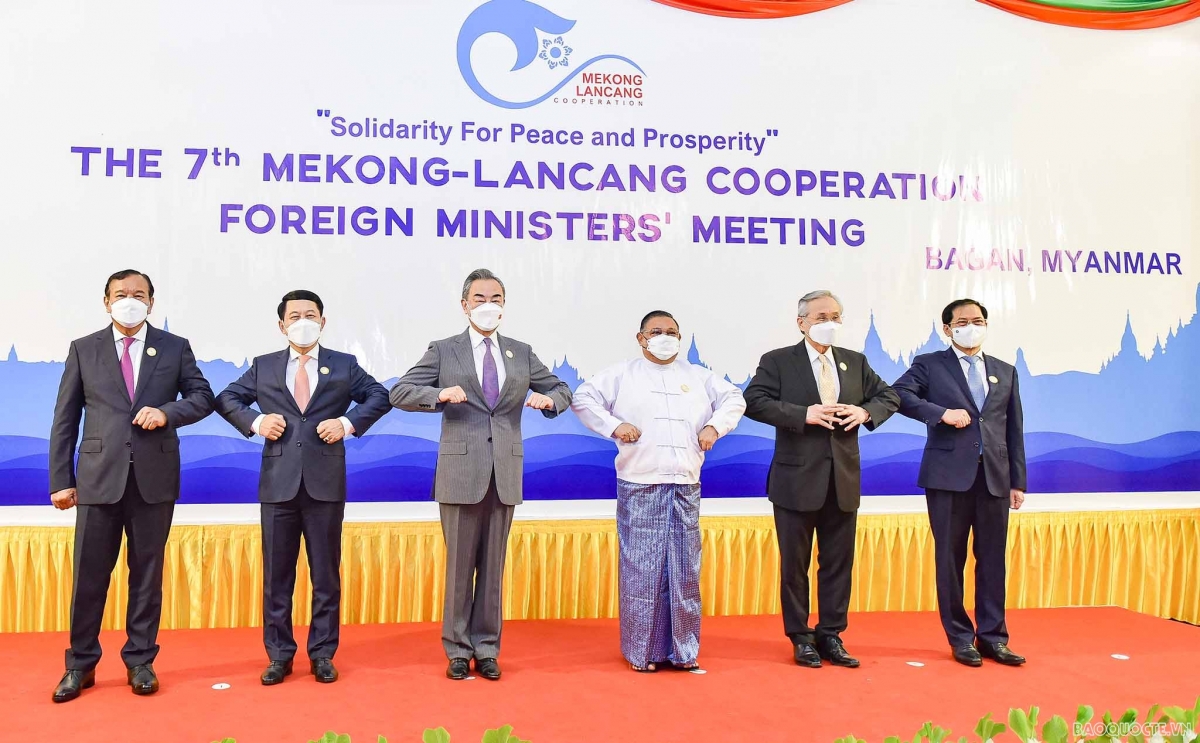
IN BRIEF
By Avishka Ashok and Arshiya Banu
REGION
Lancang-Mekong Cooperation: China meets with Cambodia, Laos and Myanmar on the sideline of Foreign Ministers’ Meeting
On 3 July, China’s Foreign Minister Wang Yi met with Myanmar’s Foreign Minister U Wunna Maung Lwin and agreed to increase cooperation along diverse fields. The meeting was held on the sidelines of the Seventh Lancang-Mekong Cooperation Foreign Ministers’ Meeting in Myanmar. The leaders agreed to speed-up the construction of the China-Myanmar Economic Corridor and the implementation of the cross-border power grid agreement. China and Myanmar will also actively work towards the operation of the China-Myanmar oil and gas pipeline. Wang Yi emphasized the existence of the country’s traditional relationship with Myanmar and noted that the ties had remained the same despite the political changes internally and externally. He said: “China will continue to adopt friendly policies towards Myanmar and its people and further consolidate the four pillars of mutual political trust, beneficial cooperation, people-to-people bonds, and cultural exchanges.”
On the same day, Foreign Minister Wang Yi and Cambodian Deputy Prime Minister and Foreign Minister Prak Sokhonn held a meeting and discussed ways to enhance relations and cooperation between China and Cambodia. Wang Yi appreciated the all-around development of cooperation between the two countries and expressed China’s willingness to continue working with Cambodia to solidify the idea of a joint community with a shared future. In the furtherance of this aim, he stressed on implementing the strategic consensus, strengthening communication and deepening cooperation between the countries. Wang said: “China, as a close strategic partner, will continue to stand firmly with Cambodia and support its political stability and economic development.” Wang Yi also promised to support Cambodia’s infrastructure development through the Belt and Road Initiative while also agreeing to cooperate on ending the pandemic in the country.
Wang Yi also met with Lao Vice Premier and Foreign Minister Saleumxay Kommasith and stressed on building a joint community with a shared future and the progress of the bilateral trade between the two countries. Wang said: “China and Laos should further strengthen strategic communication, deepen mutually beneficial cooperation, jointly face challenges, and safeguard international equity and justice, so as to promote further development of the building of the China-Laos community with a shared future.” At the meeting, the leaders pledged to expand their cooperation along the logistics chain, value chain and production chain while using the China-Laos Railway line. The countries also agreed to fighting against the cold-war mentality in the international order and rejecting the interference in internal affairs.
“China to promote practical cooperation with Myanmar, increase direct flights for students to return to China,” Global Times, 04 July 2022
“China, Cambodia to further enhance ties, cooperation in various fields,” Xinhua Net, 04 July 2022
“China, Laos pledge to strengthen strategic communication, mutually beneficial cooperation,” Xinhua Net, 04 July 2022
INTERNATIONAL
Canada: Chinese-Canadian businessman’s trial to be held today
On 04 July, a Chinese-Canadian businessman Xiao Jianhua who was apprehended in a Hong Kong hotel five years ago and lost a significant portion of his commercial empire to the Chinese government will go on trial. The Canadian embassy in Beijing said: "Canadian consular officials are monitoring this case closely, providing consular services to his family and continuing to press for consular access.” It was previously reported that Xiao will face charges from authorities in Shanghai for illegally collecting public deposits, which is commonly done by unregistered organisations or individuals. According to Chinese criminal law, anyone found guilty of the crime face prison terms ranging from three years to more than ten years. (“China to start trial of tycoon taken from Hong Kong hotel,” The Strait Times, 04 July 2022)
Japan: Chinese navy ship spotted in disputed East China Sea
On 04 July, Japan reported a complaint against China regarding a Chinese naval vessel that was sailing close to the disputed islands in the East China Sea as news of a Russian navy ship’s arrival in the vicinity spread. The islets, referred to as the Senkaku by Tokyo and the Diaoyu by Beijing, are the subject of a longstanding dispute between Japan and China. According to NHK, Japanese officials have been protesting the presence of Chinese coast guard vessels in the area of the islands on a regular basis, but this is the first time a naval ship has been sighted there since 2018. (“Japan protests Chinese navy ship sailing near disputed islands,” The Strait Times, 04 July 2022)
INTERNAL
World Peace Forum: 10th forum discusses European security and world order
On 3 July, China hosted the 10th World Peace Forum in Beijing which was conducted in a hybrid mode. Over 300 former senior officials, diplomatic envoys and scholars participated in the forum themed “Preserving International Stability: Commonality, Comprehensiveness and Cooperation.” The forum discussed issues such as preservation of world peace, European security order, and the United Nations and the world order. Fore=mer UN Secretary-General Ban Ki-moon addressed the forum and said: “In this period of uncertainty and change, we need more people to participate in social construction, cooperate with governments and other key stakeholders to meet pressing global challenges and strengthen commonality, synthesis and cooperation.” The forum was initiated by Tsinghua University and the Chinese People’s Institute of Foreign Affairs in 2012. (“10th World Peace Forum opens in Beijing,” Xinhua Net, 03 July 2022)
Shanghai: Personal information of a billion Chinese people stolen by hackers
On 04 July, Chinese industrial analysts claimed that the greatest cybersecurity breach in Chinese history occurred when unidentified hackers broke into a database of the Shanghai police and claimed to have stolen information on as many as a billion Chinese citizens. An anonymous post on a cybercrime forum last week stated that the person or group who claimed responsibility for the attack had offered to sell more than 23 terabytes of data that had been stolen, including names, addresses, birthplaces, national IDs, phone numbers, and details about criminal cases. The unknown hackers demanded 10 bitcoin, which is equivalent to almost 200,000 USD. (“Hackers claim theft of police info in China's largest data leak: Report,” The Strait Times, 04 July 2022)
Hong Kong: Chinese museum in Hong Kong to build loyalty to Beijing
On 04 July, the Palace Museum of China started exhibiting artefacts in Hong Kong as part of a campaign to increase support for Beijing in the former British colony that returned to Chinese authority 25 years ago. The exhibition, which is located in a seven-story building in a recently constructed harborside arts district, makes extensive use of calligraphy and silk paintings that date back more than 1,000 years. After 30 days, the artworks will be safely returned to Beijing for storage, but China's Communist Party leaders want the exhibition's cultural and political effects to last much longer. (“China state museum opens in Hong Kong amid patriotism drive,” The Asahi Shimbun, 04 July 2022)
02 July 2022 | Saturday | China Reader Evening Brief | Vol.1, No. 225
President Xi addresses Hong Kong on 25th handover anniversary
President Xi officially welcomes the new Chief Executive John Lee and the Executive Council while addressing the city and calling on the people to earnestly work towards integration with mainland China.
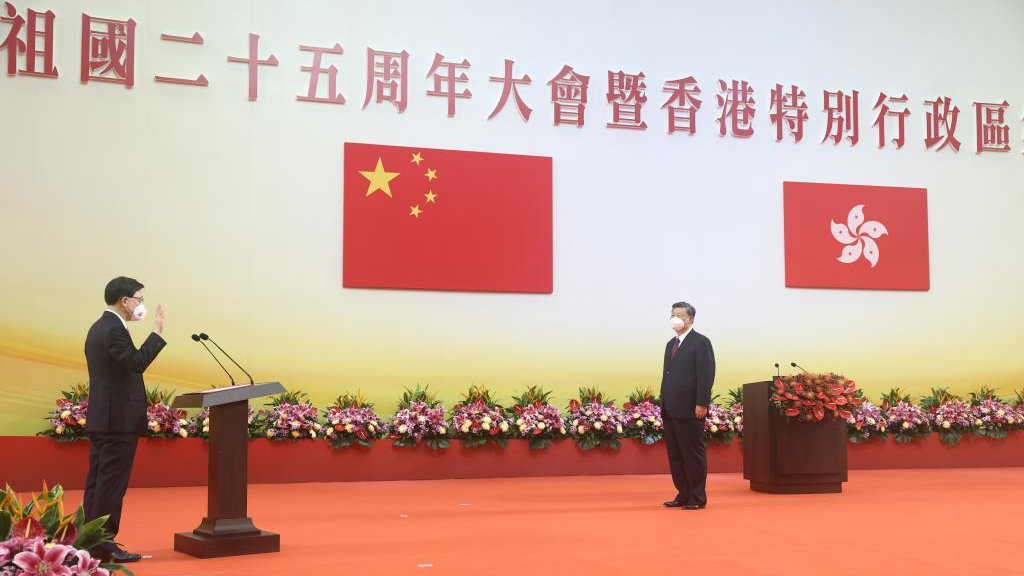
IN BRIEF
By Avishka Ashok and Arshiya Banu
INTERNAL
Hong Kong: President Xi addresses the city on 25th handover anniversary
On 1 July, President Xi Jinping addressed the 25th anniversary of Hong Kong’s handover to China and validated the country’s actions and rule in the former British colony. President Xi congratulated the city and the country on the occasion and officially welcomed the new Chief Executive of the HKSAR John Lee and the members of the Executive council while appreciating the “one country, two systems” in the city. Xi said: “Hong Kong's return to the motherland marked the beginning of a new era for the region. Over the past 25 years, with the full support of the country and the joint efforts of the HKSAR government and people from all walks of life in Hong Kong, the success of "one country, two systems" has won recognition throughout the world.”
Xi appreciated China’s monumental reform and opening-up efforts which according to the President helped in bridging the gap between China and the former British colony. Xi also valued Hong Kong’s economic capabilities and its contributions to the rapid and stable economic growth of China. Xi stressed on the efforts taken by the central government in strengthening the cooperation and exchanges between Hong Kong and the rest of China.
Xi admired the city’s resilience against local and global challenges such as the COVID-19 pandemic, the global financial crisis, social unrest, and many more and noted the continuous progress and achievements as an international financial hub and a shipping and trading centre. Xi said: “Hong Kong has remained one of the most liberal and open economies in the world, it has also maintained a world-class business environment, its previous laws including the practice of the common law have been maintained and developed, various social programs have made all-around progress, and overall social stability has been ensured.”
On human rights, Xi said that the authorities had ensured the protection of the people’s status as the “masters of the region” while administering a high level of autonomy in the city. He also addressed the implementation of the National Security Law in the city and the modification of the electoral system in Hong Kong and said that HKSAR must be administered by patriots.
The President further stressed on the “One country, two systems” principle followed by China in the region and said “All that the central government has done are for the benefits of Hong Kong and Macao, for the well-being of all residents of the two regions, and for the future of the whole country.” Xi revisited his speech celebrating 20 years of Hong Kong’s handover and stressed on two key points: the central government’s dedication towards implementing the principle and its implementation in its pure and original form.
On the occasion, Xi underscored four practices in China’s mission of integrating Hong Kong with the mainland. First, implementing the “one country, two systems” principle and protecting national security and sovereignty in the region. Second, upholding the central government’s jurisdiction while allowing the SAR’s autonomous status. Third, ensuring the city is being ruled by patriots and not anti-China individuals. Fourth, maintaining the city’s status and beneficial features while also preserving the Chinese sentiments.
Xi stressed on the next five years as the most important in the process of integrating the city with the rest of the country. He urged the people of the city to improve its governance, continue the journey towards growth, address people’s concerns and difficulties, and work towards safeguarding harmony and stability in the city. (“Full text of Xi Jinping's address at the meeting celebrating the 25th anniversary of Hong Kong's return to the motherland and the inaugural ceremony of the sixth-term government of the Hong Kong Special Administrative Region,” Xinhua Net, 02 July 2022)
Aviation industry: Four Chinese airlines to buy 292 planes from Airbus
On 01 July, four Chinese airlines announced that they will purchase 292 planes from Airbus, bringing the aviation giant a windfall of USD 37 billion as the market recovers from the COVID-19 pandemic. The orders follow a bumper year for Airbus, which in 2021, following a two-year economic decline, generated record earnings, giving the business an edge over US rival Boeing. China Southern confirmed on the same day that it would buy 96 of the same models, while China Eastern stated on Friday that it had decided to buy 100 A320neo planes. (“Chinese airlines, including Air China, buy almost 300 planes from Airbus,” The Strait Times, 02 July 2022)
INTERNATIONAL
New Zealand: President of the NZ-China Friendship Society praises the CPC and China for protecting its citizens
On 1 July, Xinhua Net reported on the interview with the President of the New Zealand China Friendship Society (NZCFS) Dave Bromwich and his take on the Communist Party of China’s relationship with the people of the country. Dave described the relationship as a service and said: “The government is the people. The people are the government. It is a mutual relationship. If using one word to describe my feeling about the CPC and the government of China, I very quickly came up with one word and I haven't been able to replace it, and the word is service. Why service? Because China has developed so fast and taken all of its population with it.” He referred to food security. Adequate housing and the right to education as the basic human rights of the people and said that the country had done an amazing job in providing the basic necessities to its people. Bromwich also highlighted education of the younger generation, sustainable business relations and promoting the Chinese perspective instead of the narrative by the West as the key points in building relations with China. (“Interview: "Service" best describes CPC, says president of New Zealand China Friendship Society,” Xinhua Net, 01 July 2022)
The UAE: Yang Jiechi meets President and discusses bilateral relations
On 1 July, the Director of the Office of the Foreign Affairs Commission of the CPC Central Committee Yang Jiechi travelled to the UAE and met with President Sheikh Mohamed bin Zayed Al Nahyan and discussed the bilateral relationship between the two countries while also discussing ways to increase cooperation. Yang expressed China’s perception of the UAE as a comprehensive strategic partner and said: “China highly appreciates the UAE's support for the China-proposed Global Development Initiative and Global Security Initiative, and is willing to deepen cooperation with the UAE under the two major initiatives, aiming to make positive contributions to lasting world peace and long-term development.” Yang also encouraged the country’s participation in the Belt and Road Initiative of China while cooperating on defeating the COVID-19 pandemic. Civil aviation, infrastructure, energy, finance investment and other traditional sectors were highlighted as the areas for heightened future cooperation. (“UAE president meets senior Chinese diplomat on bilateral ties, cooperation,” Xinhua Net, 01 July 2022)
India: GWM Automaker abandons project worth Rs 7,895 crores
On 02 July, the Times of India reported that Chinese automaker Great Wall Motor (GWM) will no longer be a player in the Indian automotive industry. Over 11 of GWM's employees had received pink slips at its India headquarters, three months of severance compensation, and one year of variable pay. Increasing political tensions between India and China, the delay in approval of GWM's plant in Pune due to government roadblocks, increased scrutiny over Chinese investments, amendment to the FDI rules, and the company's rejection of India's proposal to sell completely built-up units (CBU) are other factors that led to the company pulling out of the seven crore project in India. Thousands of jobs and the Rs 7,895 crore manufacturing project that were intended to be established at General Motors' facility in Talegaon, Pune, also dissipated with GWM's departure. (“China's Great Wall Motors abandons Rs 7,895 crore project in India," Times of India, 02 July 2022)
FINA World Championships: China bags gold for the 10th time
On 02 July, Ren Qian, and Duan Yu, both 16 years old, won the mixed 10-meter synchro final at the 2022 FINA World Championships in Budapest, continuing China's diving "Dream Team’s” dominance over opponents. The pair scored 341.16 points to win China's 10th diving gold medal at the Duna Arena. Both jumped out to an early lead with a perfectly timed back dive pike and never took their feet off the pedal. As a result, China has won every gold medal in the mixed 10m synchro since the competition's debut at the global championships in Russia in 2015. (“Chinese divers reign supreme at FINA World Championships with 10th gold,” CGTN, 02 July 2022)
Afghanistan: China urges the US to responsibly rectify its actions
On 1 July, China’s Permanent Representative to the United Nations Chen Xu addressed the emergency debate on the condition of Afghan women and girls’ human rights and urged the US to rectify its mistakes and actions in the country. Chen recalled China’s decision to donate USD 7.46 million in emergency humanitarian assistance to Afghanistan after the earthquake killed over 1500 people and injured more. The Chinese representative then accused the US of plundering the country and bringing devastating misfortunes on thousands of citizens by its war in Afghanistan. Chen said: “The US is the initiator of the Afghan issues and bears the primary responsibility. The war in Afghanistan has resulted in large numbers of innocent civilians being killed and tens of millions of people becoming refugees, including large numbers of women and girls. The US has blatantly plundered Afghan national assets, further aggravating the suffering of the Afghan people.” He further urged the US to unfreeze the Afghan assets, lift the sanctions and take concrete steps to provide assistance in the country. (“China's UN envoy urges US to lift coercion on Afghanistan, fix its humanitarian damage on civilians,” Global Times, 02 July 2022)
The US: China softens restrictions for American travellers
On 02 July, the Chinese embassy in Washington announced that entry restrictions for Americans would be loosened, enabling admission in the event of transit through a third country to ease restrictions put in place as part of Beijing's effort to stop COVID-19. China's "dynamic COVID zero" policy, which tries to reduce the danger of infected travellers entering from outside, has led to a number of obstacles to foreign travel, from tight procedures for quarantine upon arrival to limitations on the issuance and renewal of passports for Chinese nationals. A revised policy statement states that Americans who want to travel to China with legitimate negative COVID test results can now apply for and acquire a green health code for entry from either the US or another nation. In the past, the embassy would only give out the passwords to Americans on direct flights from their country. (“China to loosen entry restrictions on U.S. citizens, transit via 3rd country now permitted,” The Asahi Shimbun, 02 July 2022)
01 July 2022 | Friday | China Reader Evening Brief | Vol.1, No. 224
China responds to NATO's new ‘strategic concept’
The Foreign Ministry spokesperson condemned the new "strategic concept" of NATO and accused the organization of causing conflicts around the world.
IN BRIEF
By Avishka Ashok and Arshiya Banu
INTERNATIONAL
NATO: China’s Foreign Ministry responds to new ‘strategic concept’
On 30 June, China’s Foreign Ministry spokesperson Zhao Lijian opposed and denounced NATO and its latest document on the organization’s “strategic concept.” Paragraph 13 and 14 of the document identified China to be NATO’s strategic priorities in the coming decade. While Russia was defined as the direct threat, China is considered to be a friend of the Kremlin and was also included in the document. Zhao addressed the press conference and said: “NATO's so-called new strategic concept document disregards facts, smears China's foreign policy, makes irresponsible remarks on China's normal military development and national defence policy, incites confrontation and smacks heavily of Cold War mentality and ideological bias.”
Zhao further emphasized that China had never invaded any country, launched proxy wars or been a part of any military blocs. He further accused NATO of being the cause of violence and conflicts around the world. He said: “NATO has the blood of their people on its hands. Chinese people will never forget that 23 years ago when the US-led NATO committed the crime of bombing the Chinese Embassy in the Federal Republic of Yugoslavia, and now NATO is extending its tentacles to the Asia-Pacific region in an attempt to export the Cold War mentality and replicate the bloc confrontation in Asia."
On 30 June, the Chinese Mission to the European Union (EU) criticised the strategic concept of NATO. The Chinese Mission spokesperson stated that China firmly opposed it and said: "Who's challenging global security and undermining world peace? Are there any wars or conflicts over the years where NATO is not involved?" (“FM denounces NATO as having blood of world's people on its hands after it smears China as ‘systemic challenge’ in new ‘strategic concept’,” Global Times, 01 July 2022; “Chinese Mission to EU slams NATO's strategic concept,” Xinhua Net, 30 June 2022)
The US: Commerce Ministry asks to stop targeting Chinese companies
On 30 June, China’s commerce ministry spokesperson Shu Jueting stated that the United States should promptly rectify its mistakes and cease sanctioning and repressing Chinese businesses. He made the comments in response to recent American actions to impose sanctions on pertinent Chinese enterprises on the grounds of linkages to Russia, Iran, and the military. According to Shu, such measures, which are sometimes characterized as economic coercion, are in fact practises of unilateralism, protectionism, and bullying that are done in the name of "upholding international order." (“China urges U.S. to stop suppression of Chinese firms,” Xinhua Net, 30 June 2022)
Canada and Australia: China’s Defence Ministry justifies military’s actions
On 30 June, the Ministry of National Defence Spokesperson Tan Kefei responded to Australia and Canada’s provocative acts by the military aircrafts of the countries and said that China would respond aggressively to the uninvited passers by. Tan justified China’s actions and said that the country handled the issue in a professional way. He accused the Australian aircrafts of repeatedly approaching Xisha Island’s territorial space and disregarding the warning issued by the Chinese authorities. On the Canadian aircrafts, he said: “The Canadian military aircraft, meanwhile, increased close-in reconnaissance and made provocations to the Chinese side in the name of implementing United Nations Security Council resolutions, undermining China's national security.” (“China responds to 'provocations' of Australian, Canadian military aircraft,” The Strait Times, 01 July 2022)
INTERNAL
National Defence: Defence Ministry clarifies China’s objectives over military equipment development
On 30 June, China’s Ministry of National Defense spokesperson Tan Kefei addressed a media inquiry on the launch of the third aircraft carrier and assured that the country’s military development was not aimed at any country. Tan said: “China's development and upgrading of its military equipment are not targeting any country or specific objective and will not constitute a threat to any country or any region, as they are oriented toward safeguarding the country's national sovereignty, security and development interests.” Tan further explained that the country would work on future aircraft carrier plans on the basis of the national security demands. (“China's development of military equipment not targeting any country: defense spokesperson,” Xinhua Net, 01 July 2022)
UNHRC: Seminar on equal access to justice held in Wuhan
On 30 June, a seminar was held on equal access to justice for special groups in Wuhan; as a side event of the 50th session of the United Nations Human Rights Council. The seminar was attended by over 90 experts and scholars from China and abroad. The attendees focused on equal rights and judicial protection for women, disabled people, the elderly and other vulnerable classes. The dean of the Institute for Human Rights Studies Zhang Wanhong said: “China has adopted a series of positive measures to eliminate discrimination, empower the people, promote inclusive and sustainable development, and promote the substantive equality and all-round development of all members of society, including women, children, the elderly and people with disabilities.” (“Seminar held on equal access to justice for special groups,” Xinhua Net, 01 July 2022)
Meteorological Centre: Three ports in Hainan close as a tropical cyclone looms Chaba
On 1 July, three ports in China's Hainan province were declared closed as a result of the reclassification of Chaba as a strong tropical storm, which is likely to make landfall this weekend. Forecasters predicted that Chaba, which is presently east of Hainan, will move at a speed of 15-20 km per hour while progressively intensifying. The National Meteorological Centre advised that ships and boats should seek refuge in harbours and that the affected areas should take precautions to avoid geological disasters and torrential floods. (“Ports close in China's island province of Hainan as tropical storm Chaba looms,” The Strait Times, 01 July 2022)
Hong Kong: President Xi presides over John Lee’s swearing in as city’s new leader
On 1 July, On Friday, the city of Hong Kong celebrated the 25th anniversary of its return to Chinese rule after having been placed under considerably stricter Communist Party control in recent years. Chinese President Xi Jinping presided over the ceremony at which John Lee, the new chief executive, was sworn in. The city's mini-constitution, the Basic Law, was upheld by Lee, a former security official who oversaw the crackdown on dissent following 2019 pro-democracy protests. Lee also swore allegiance to Hong Kong and promised to be accountable to the central government in Beijing. (“China’s Xi swears in new Hong Kong leader John Lee,” The Asahi Shimbun, 01 July 2022)
30 June 2022 | Thursday | China Reader Evening Brief | Vol.1, No. 223
Foreign Ministry responds to G7 statements on China related-issues
The Foreign Ministry spokesperson condemned the G7 for creating divisions instead of resolving economic challenges around the world.
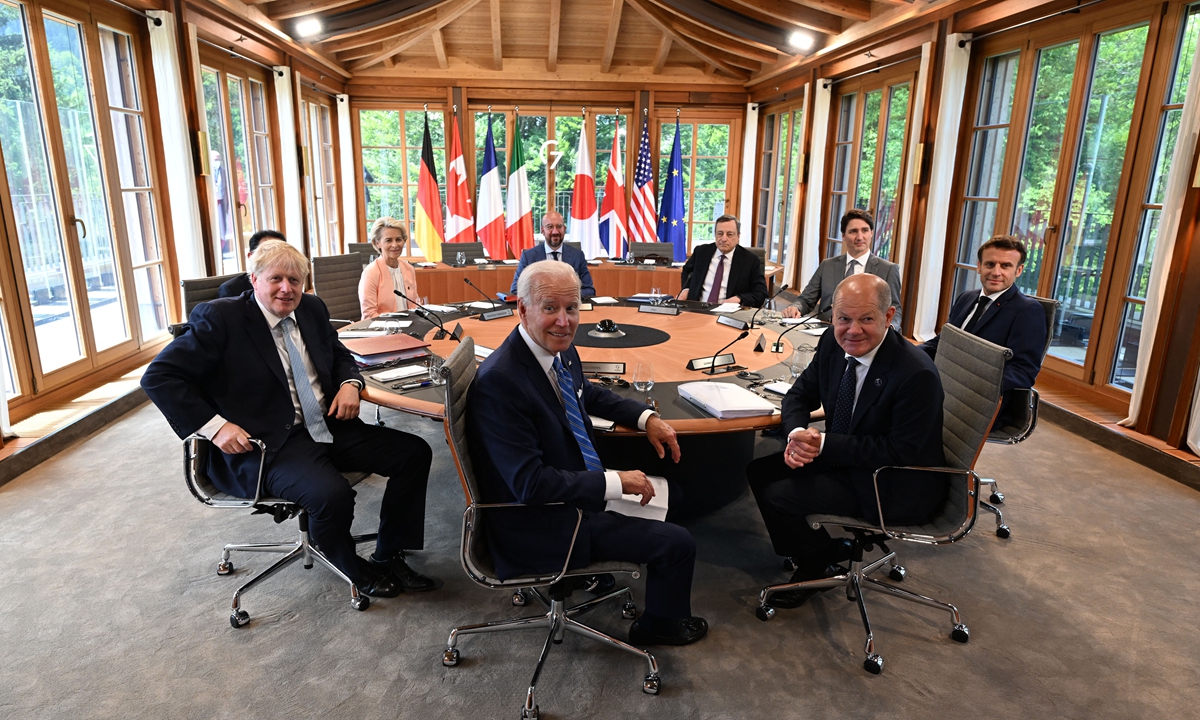
IN BRIEF
By Avishka Ashok and Arshiya Banu
INTERNATIONAL
G7: China’s Foreign Ministry responds to statements on internal issues
On 29 June, China’s Foreign Ministry spokesperson Zhao Lijian responded to the statements made by the G7 on China-related issues. Zhao urged the countries to stop attacking and smearing the country while also imploring the countries to keep aways from its internal issues. Zhao claimed that the G7 had hyped the democracy versus autocracy narrative and had no intentions of cooperating and conducting dialogues on the basis of equality and respect. Zhao stressed on Hong Kong and Taiwan issues and reaffirmed China’s stance on the issues. Zhao said: “Concerning Hong Kong affairs, since Hong Kong returned to the motherland, the democratic rights and freedoms enjoyed by Hong Kong residents according to the law have been fully guaranteed. The Chinese government has governed Hong Kong in accordance with the Constitution of the People's Republic of China and the Basic Law of the Hong Kong SAR.”
Zhao further emphasized on the One-China principle and said: “There is only one China in the world and Taiwan is an inalienable part of China's territory. The "Taiwan independence" separatist activities and certain countries' attempt to "use Taiwan to contain China" are the biggest threat to peace and stability across the Taiwan Strait.” Referring to the G7, Zhao pointed that the group of countries had benefited the most from globalization and should have taken up the task of resolving economic challenges around the world. Zhao said: “What I have to point out is that the population of G7 countries accounts for only around one 10th of the global total. They are in no position to represent the whole world, and still less are entitled to take their own values and standards as internationally universal.” (“China urges G7 to cease all attacks, smears against country,” Xinhua Net, 29 June 2022)
SCO: Foreign Minister Wang Yi attends and celebrates 20th anniversary of signing charter
On 29 June, China’s Foreign Minister Wang Yi attended the roundtable meeting of the Shanghai Cooperation Organization (SCO) to celebrate the 20th anniversary of signing the SCO charter and the 15th anniversary of signing the “Treaty on Long-Term Good Neighborliness, Friendship and Cooperation of the SCO member countries. Wang Yi reconfirmed China’s commitment to work with the SCO in carrying forward the “Shanghai Spirit” and the desire to build a closer community with a shared future. Wang said: “The Treaty stipulates mutual respect for the development path chosen by each other, reaffirms the principles of non-alignment, non-confrontation and non-direction at the third party, endows the "Shanghai Spirit" with new connotations and has played a demonstration role for countries to live in harmony and pursue win-win cooperation.” He further called on the countries to strengthen solidarity and coordination within the organization while collectively addressing the risks and challenges and promoting mutually beneficial cooperation. (“China stands ready to work with SCO members in building closer community with shared future: Chinese FM,” Xinhua Net, 30 June 2022)
NATO: Organization focuses on growing Chinese "challenges”
On 30 June, the Strait Times reported that for the first time, NATO has singled out China as one of its strategic priorities for the coming ten years, expressing concern over its expanding military ambitions, confrontational rhetoric toward Taiwan and other neighbours, and deepening relations to Russia. China joined the list of the Western alliance's most concerning security issues on Wednesday, despite the fact that Russia's conflict with Ukraine has dominated discussions at the NATO summit. NATO Secretary-General Jens Stoltenberg said: “China is not our adversary, but we must be clear-eyed about the serious challenges it represents." (“NATO pivots to highlight Chinese 'challenges' for 1st time,” The Strait Times, 30 June 2022)
REGIONAL
Philippines: China’s Vice President discusses bilateral relations with President Duterte
On 29 June, China’s Vice President Wang Qishan and the Philippine President Rodrigo Duterte confirmed the promotion of bilateral relations and the improvement of cooperation between the two countries. Wang noted the turnaround in the bilateral relations between the countries and said: “The two sides have redefined their relationship as comprehensive strategic cooperation, enhanced good-neighborly friendship and cooperation, properly managed differences, and jointly worked for common development, which have ushered in a new era for furthering cooperation in various fields.” China noted that the investment by Chinese businesses had quadrupled its investments in the Philippines in the last six years while the bilateral trade had doubled in the same time. On the maritime issues, Wang said that China and the Philippines had stuck to dialogue and consultation to manage the differences while moving forward in the right direction. (“China, Philippines vow to further promote bilateral ties,” Xinhua Net, 30 June 2022)
Taiwan: Philippines complaint regarding drills in the South China Sea rejected
On 29 June, Taiwan rejected a complaint from the Philippines on live-fire near an island under its control that is located deep in the South China Sea, claiming that it had the right to conduct the drills and that it always gave advance notice of them. In a tweet posted late on Tuesday, the Philippine Department of Foreign Affairs voiced "strong objection" to Taiwan's planned illegal live-fire drills surrounding the island, also known as Itu Aba. The island is referred to as Taiping in Taiwan and Ligaw Island in the Philippines. (“Taiwan rebuffs Philippines complaint about South China Sea live-fire drills, The Strait Times, 29 June 2022)
INTERNAL
Legislature: Publicity Department reveals enactment of 69 laws in the last decade
On 29 June, the Publicity Department of the Communist Party of China Central Committee announced that 292 laws had been enacted by the National People’s Congress and its Standing Committee. The department said that over 69 new laws had been enacted in the last decade while 237 laws had been revised by the two bodies. The Deputy Secretary-General of the NPC Standing Committee Wang Tiemin said: “The NPC and its Standing Committee have accelerated the pace of legislative work while ensuring quality legislation. A batch of laws urgently needed for the country's governance and satisfying the people's growing needs for a better life were introduced or revised.” He further revealed that a total of 1.2 million people had contributed to the process by providing over 3.8 million suggestions and providing their opinion on 217 draft laws. (“China's top legislature enacts 69 new laws in ten years,” Xinhua Net, 30 June 2022)
COVID-19: Flight searches increase as China reduces quarantine
On 29 June, the Strait Times reported that travel platforms witnessed a sharp increase in online searches for airline tickets on international routes with China after Beijing suddenly announced it would lower COVID-19 quarantine norms, indicating pent-up demand following two years of strict restrictions. The border restrictions had a negative impact on business travel and reduced the number of Chinese tourists visiting foreign countries, like Thailand's beaches or South Korea's shopping districts, which had become dependent on their business over the previous ten years. According to China's Qunar, searches on its travel platform more than doubled within an hour of the announcement that time in quarantine had been cut in half for travellers arriving from overseas. (“Searches for overseas flights surge after China shortens quarantine,” The Strait Times, 29 June 2022)
TECHNOLOGY
Space: Images of the south pole of Mars acquired by Chinese spacecraft
On 29 June, the Strait Times reported that a Chinese spacecraft that is unmanned completed more than 1,300 orbits of Mars since the beginning of last year, resulting in the collection of photographic data that includes images of Mars' south pole. China's Tianwen-1 successfully completed its first journey to the Red Planet in February 2021. Since then, a robotic rover has been placed on the planet's surface while an orbiter examined it from space. China captured the first images of the Martian south pole, where almost all of the planet's water resources are trapped. (“Chinese spacecraft acquires images of entire planet of Mars, The Strait Times, 29 June 2022)
29 June 2022 | Wednesday | China Reader Evening Brief | Vol.1, No. 222
China warns against raising tensions and creation of Asian NATO
At the United Nations Security Council Briefing on Ukraine, China accuses the NATO of causing conflicts across the world while creating false misconceptions of threat.
IN BRIEF
By Avishka Ashok and Arshiya Banu
INTERNATIONAL
United Nations: China warns against raising tensions and creation of Asian NATO
On 28 June, China’s Permanent Representative to the United Nations Zhang Jun addressed the UN Security Council Briefing on Ukraine and urged the NATO to not raise tensions in the world order by using Ukraine as an excuse. Zhang stressed on security being indivisible and said: “A blind faith in the position of strength, the expansion of military alliance, and the pursuit of one's own security at the expense of the security of other countries will inevitably lead to security dilemmas.” He further emphasised on NATO’s five eastward expansions that failed to secure the region and said that it sowed the seeds of conflict. He implored the NATO member countries to reconsider its position and its responsibilities as the Cold War ended a long time ago.
Zhang explained China’s concerns regarding NATO’s “Strategic Concept” and said that the country pays close attention to strategic adjustment of the organization. China opposed the NATO for accusing certain countries of being a threat to world security and claimed that the association was responsible for multiple troubles and conflicts around the world. On behalf of China, Zhang strongly opposed the creation of an Asian NATO and their involvement in the Indo-Pacific region. (“Chinese envoy urges NATO not to fan block confrontation using Ukraine crisis as excuse,” Xinhua Net, 29 June 2022)
The EU: Netizens mock the notion of choosing between aid offered by China and the West
On 29 June, the Global Times reported on the European Commission’s President Ursula von der Leyen’s remarks on mobilizing 300 billion euros to create an alternative to China’s Belt and Road Initiative and said that it was ridiculed by netizens from the developing countries. Von der Leyen referred to the BRI and said: “It is up to us to give a positive and powerful investment impulse to the world to show our partners in the developing world that they have a choice and that we intend to step up in solidarity to meet their development needs.” China’s Foreign Ministry responded to the statements and said that they welcome the initiative to build global infrastructure but opposed the idea that the initiatives must replace China’s schemes in the countries. A similar sentiment was shared by netizens in developing countries where China has invested previously. Users took to twitter and questioned the idea of choosing China or the West in terms of international aid. (“EC President von der Leyen roasted for anti-China agenda in new infrastructure funding initiative,” Global Times, 29 June 2022)
The US: Foreign Ministry urges academic institutions to build relations and not dwell on anti-China narratives
On 28 June, China’s Foreign Ministry spokesperson Zhao Lijian commented on the newly established China Centre within the Hudson Instritute and encouraged educational institutions to increase their cooperation and understanding with each other. Zhao noted the Hudson Institute’s anti-China ideology and its support for the secessionist movement in Taiwan. The Global Times said: “The center has been established to collude with anti-China parties, to concoct and disseminate anti-China rhetoric in order to cope with the so-called threats from the Communist Party of China.” (“Academic institutes should be bridges rather than platforms for anti-China lies: FM spokesperson,” Global Times, 28 June 2022)
INTERNAL
Ministry of Water Resources: Severe weather anticipated to hit China in July and August.
On 29 June, director of the Department of Flood and Drought Disaster Prevention of the Ministry of Water Resources Yao Wenguang predicted that the severe flooding that has ravaged China's southern and eastern regions, forcing the evacuation of hundreds of thousands, and the Pearl River basin's greatest rainfall in decades would likely continue in July and August. He said: "It is predicted that from July to August, there will be more extreme weather events in China, and regional flood conditions and drought conditions will be heavier than usual." Images on social media show the extent of the tragedy in the nation, from emergency rescues in floating rafts to cars submerged in water. (“More extreme weather events expected to pummel China in July, August,” The Strait Times, 29 June 2022)
Guangdong: China’s carbon capture plant and its partners
On 29 June, the Strait Times reported that the largest factory hub in the world is collaborating with oil companies from three continents on a massive carbon capture plant that would store the heat-trapping gas at sea in China. The three companies, Exxon Mobil, Shell, and Cnooc signed a non-binding agreement with the Guangdong government regarding a plant that may capture up to 10 million tonnes of carbon dioxide (CO2) annually. The hub would stop the Dayawan Petrochemical Industrial Park's carbon emissions before they are released into the atmosphere. (“Exxon, Shell partner with Cnooc on China carbon capture project,” The Strait Times, 29 June 2022)
COVID-19: China shortens quarantine period for travelers
One 28 June, China has significantly loosened one of the tightest COVID-19 regulations in the world, which has been discouraging transit into and out of the nation since 2020. The country cut the quarantine period for incoming tourists in half. According to the National Health Commission, quarantine at centralized facilities has been shortened from 14 to 7 days, and subsequent at-home health monitoring has been shortened from 7 to 3 days. The guidelines also relaxed quarantine rules for anyone who have been in close touch with those who have tested positive for the new coronavirus. (“China slashes COVID quarantine time for international travelers,” The Asahi Shimbun, 28 June 2022)
Hong Kong: Incoming Chief Executive looks for new sources to increase economic growth
On 28 June, the Asahi Shimbun reported that the government of Chief Executive-elect John Lee is under pressure to find new options for economic growth, looking beyond COVID outbreaks and anti-virus measures that have wreaked havoc on travel and business, as well as uncertainty about the legal environment following a crackdown on the city's pro-democracy movement. Lee pledged to "start a new chapter" for the city, best known as one of Asia's busiest ports and largest stock markets, and to "strengthen its competitiveness" in technology and innovation as well as commerce and finance, back in April when he was running for office. (“Hong Kong burnishes China ties as luster as global hub fades,” The Asahi Shimbun, 28 June 2022)
TECHNOLOGY
China Association for Science and Technology: China reveals 30 issues for 2022
On 28 June, Xinhua Net reported that the China Association for Science and Technology (CAST) had unveiled a series of major issues in 2022 in science, engineering, technology and industrial technology. The list comprises 30 issues such as the early diagnosis of asymptomatic Alzheimer’s disease, the formation and evolution of black holes in space, application of remote sensing to assess the Earth’s health and the industrialization of memory-computation integrated chips and more. Since January 2022, the CAST has received over 649 proposals on tech issues in the fields of basic science, earth science, ecological environment, manufacturing technology, information technology, advanced materials, resources and energy, agricultural science and technology, life health, and aerospace science and technology. (“China unveils major sci-tech issues of 2022,” Xinhua Net, 28 June 2022)
28 June 2022 | Tuesday | China Reader Evening Brief | Vol.1, No. 221
China responds to US accusations of debt traps caused by the BRI
China's Foreign Ministry Spokesperson defends the Belt and Road Initiative while accusing the US of causing financial traps for countries.
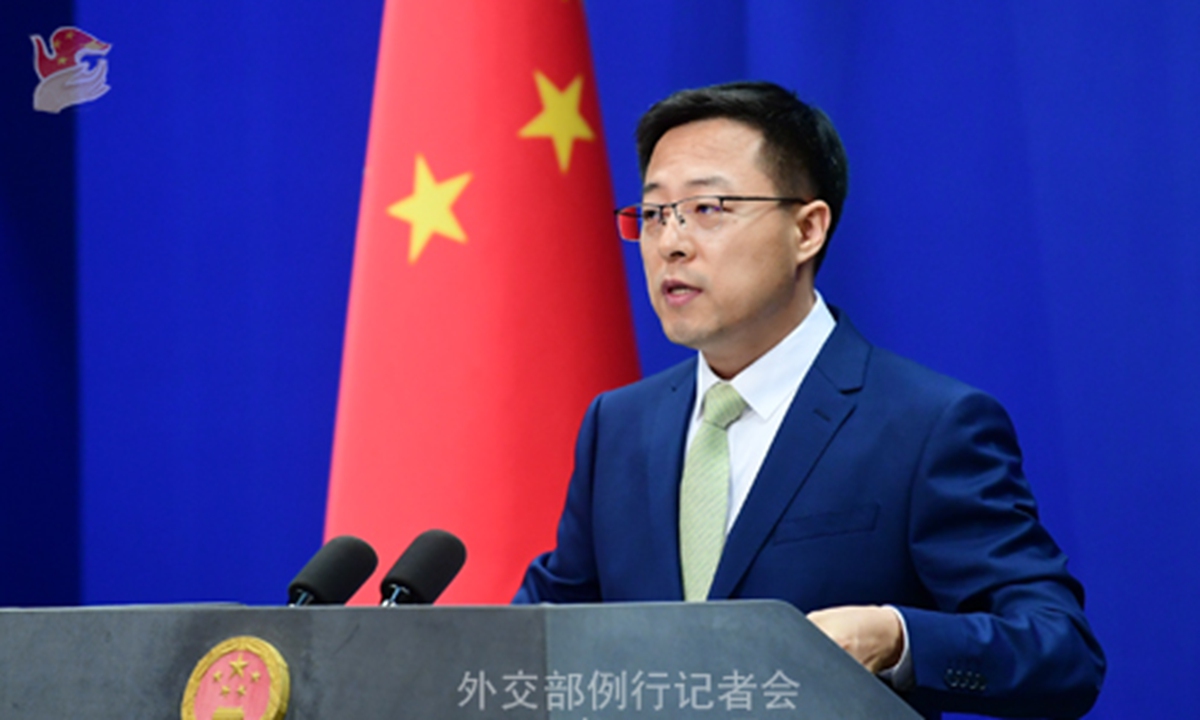
IN BRIEF
By Avishka Ashok and Arshiya Banu
INTERNATIONAL
The US: China responds to accusations of BRI causing debt traps
On 27 June, China’s Foreign Ministry spokesperson Zhao Lijian addressed a press conference and responded to the US accusations against the Chinese Belt and Road Initiative. Zhao opposed the accusation of the initiative being a debt trap and held the US responsible for the creation of debt traps in the developing world. He further elaborated on the initiative and said that the project always held extensive consultations, encouraged joint contribution and shared benefits with the partner countries. He also quoted the World Bank report according to which the BRI will produce an annual revenue of USD 1.6 trillion around the world, if all projects are completed by 2030. It would amount to 1.3 per cent of the global GDP, out of which, 90 per cent would be enjoyed by the partner countries. The BRI was also hailed to improve the stands of living of the people in the partner countries, lifting 7.6 million people from extreme poverty and 32 million from moderate poverty. He said: “The U.S.'s expansionary monetary policies, financial innovation with lax supervision and ill-intended short-selling are weighing down developing countries with debt burden and the very reason some countries have fallen into the debt trap.” (“U.S. should be held responsible for creating "debt trap": FM spokesperson,” Xinhua Net, 28 June 2022)
Afghanistan: Foreign Minister pledges to support government and send aid
On 27 June, China’s Foreign Minister Wang Yi held a phone conversation with Afghanistan’s Acting Foreign Minister of the Interim Government Amir Khan Muttaqi and expressed sympathies and condolences over the earthquake that killed 1500 people last week. Wang emphasized the efforts of the local governments, social organizations and other enterprises in China who worked efficiently to deliver emergency aid to Afghanistan on time. While stressing on China’s pure intentions in Afghanistan, Wang Yi pledged to hold the second meeting of the working-level contact mechanisms on humanitarian assistance and economic reconstruction. He hoped for the two countries to steadily improve and build on the pragmatic cooperation in economy and trade, agriculture, mining, interconnectivity and capacity building. (“Chinese FM talks with Afghan acting FM over phone,” Xinhua Net, 28 June 2022)
The US: Military responds to China’s complaints on US activity in the Taiwan Strait
On 28 June, the US military responded to China's complaints that the passage of a US Navy aircraft through the Taiwan Strait last week jeopardized peace and stability and claimed that it showed the US's commitment to a free and open Indo-Pacific. The P-8A anti-submarine plane was flying over a sensitive canal, and China alleged to have sent planes to monitor and warn the plane. The US Indo-Pacific Command said: “The United States will continue to fly, sail, and operate anywhere international law allows including within the Taiwan Strait. The aircraft's transit of the Taiwan Strait demonstrates the United States' commitment to a free and open Indo-Pacific.” (“US says Taiwan Strait flight shows commitment to open Indo-Pacific,” The Strait Times, 28 June 2022)
REGIONAL
Philippines: Davao city offers preferential policies to Chinese investors
On 28 June, Xinhua Net reported that Davao city in Philippines was offering preferential policies to Chinese investors in the agriculture, food processing and manufacturing sectors. The Director of Davao City Investment Promotion Centre April Marie Dayap explained that, in a bid to attract more investments from Chinese businessmen, the city was offering preferential policies to Chinese businessmen to invest in the country. Dayap said: “We export a lot of agricultural products to China, and many Chinese businesses are being established in Davao City. We would like to invite more Chinese people to come here to discover what we can offer and what they can do.” The city has an abundance of agricultural products and raw materials while offering low labor costs, making agribusiness, food production and processing units extremely viable in the city.
The Chinese Consul General Li Lin referred to the relations between the two countries and said: “We are also helping locals grow bananas locally, providing them with start-up capital, banana seedlings, fertilizers, pesticides, and technical guidance. Moreover, we are supporting aboriginal women to learn and improve the production skills of ethnic costumes and characteristic handicrafts to increase their income and pass on their culture.” (“Philippines' Davao City eyes more Chinese investments in agriculture, manufacturing,” Xinhua Net, 28 June 2022)
INTERNAL
World Canal Cities Forum: China urges countries to work on protecting canals
On 27 June, the Director of the Office of the Foreign Affairs Commission of the CPC Central Committee Yang Jiechi attended the World Canal Cities Forum in Yangzhou and called for greater canal protection. Yang noted that canals were great projects created by humanity and can assist in injecting impetus into the development of canal cities while building on people-to-people exchanges. The forum was held under the theme of “heritage protection and sustainable development of canal cities” and aimed to discuss the implementation of sustainable development in canal cities. The Grand Canal in China has a history of more than 2,500 years and was used as a transportation artery in ancient China. (“Senior Chinese official stresses canal protection,” Xinhua Net, 27 June 2022)
COVID-19: Hashtag deleted after online discussion on COVID-19
On 28 June, the Asahi Shimbun reported that the hashtag "the next five years" was removed by digital censors after an online debate erupted in reaction to reported remarks from Beijing's Communist Party chief Cai Qi claiming that the capital city will implement pandemic prevention regulations over the course of the next five years. Prior to the national party congress, which will take place this fall, the city-wide party congress is held once every five years. Members review the previous five years' work and set goals for the next five years. (“Censors delete discussion of Beijing’s future COVID control,” The Asahi Shimbun, 28 June 2022)
Public Security Ministry: Former colleague of Xi appointed as the head of ministry of public security
On 28 June, the Strait Times reported that before a twice-a-decade leadership assembly, China appointed Mr. Wang Xiaohong as minister of public security, transferring control of the country's hard power to a former colleague of President Xi Jinping. According to a statement on the National People's Congress website, Mr. Wang, 64, was appointed last Friday (June 24), taking Mr. Zhao Kezhi's place, who has attained retirement age (68). Mr. Wang also rose to the position of deputy director of the Central Political and Legal Affairs Commission, which is the party's main legal body. (“Chinese President Xi Jinping names ally to head public security ministry,” The Strait Times, 28 June 2022)
Shandong: Rail service halted due to heavy rains in China’s second most populous region
On 27 June, the Strait Times reported that heavy downpours have pounded more than ten cities in the Shandong region of China, flooding streets, disrupting traffic, and renewing calls for better drainage in built-up areas where concrete and asphalt trap water. The meteorological service issued thunderstorm warnings as vehicles in the north-eastern province were stalled in waist-deep water, as seen in a video posted on the social media platform Weibo. With more than 100 million residents, Shandong is the second most populous province in China. Since Sunday, rail service has also been disrupted due to the region's first significant downpours of the rainy season, which started weeks ago in southern China. (“Heavy rain, floods bring renewed calls in China for 'sponge cities',” The Strait Times, 27 June 2022)
27 June 2022 | Monday | China Reader Evening Brief | Vol.1, No. 220
G7 leaders pledge to raise $600 billion funding to compete with China’s BRI
The Group of Seven (G7) leaders promised to raise $600 billion in public and private funds over the next five years to counter China’s Belt and Road Initiative.
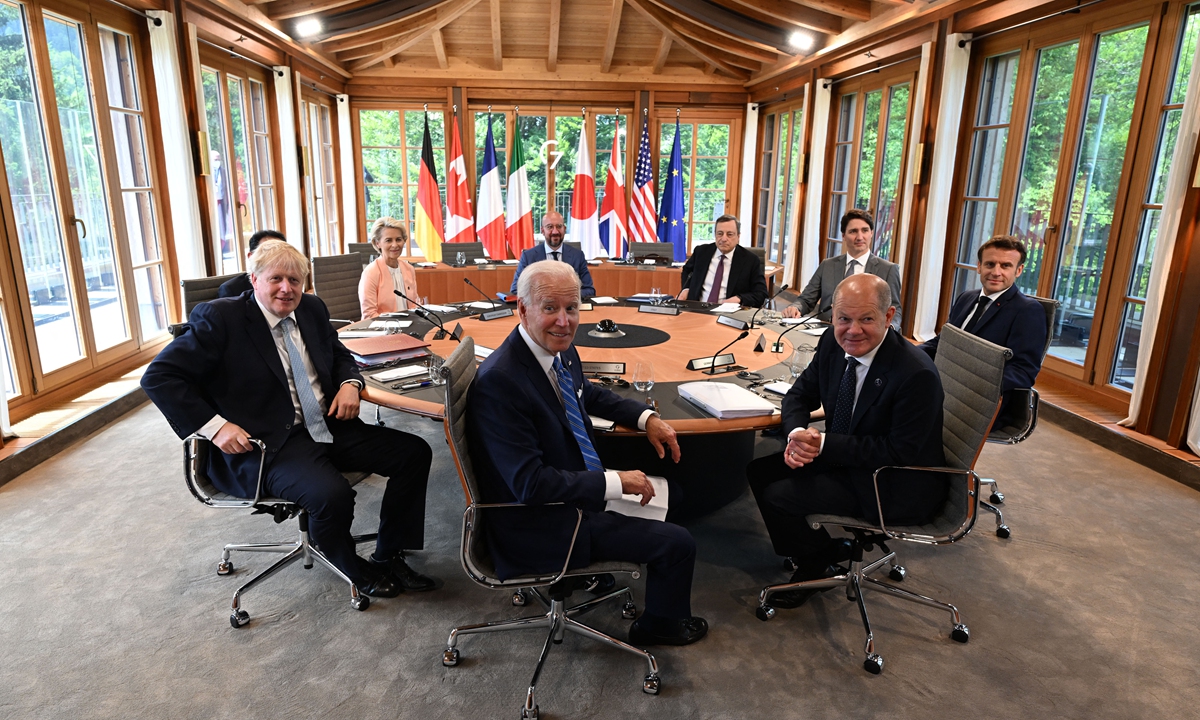
IN BRIEF
By Avishka Ashok
INTERNATIONAL
G7: Leaders pledge to raise $600 billion funding to compete with China’s BRI
On 26 June, the leaders of the Group of Seven vowed to raise $600 billion in public and private funding over the course of five years to finance the development of infrastructure in developing nations and to compete with China's more established, multi trillion-dollar Belt and Road initiative. At the G7 summit, which was held this year at Schloss Elmau in southern Germany, US President Joe Biden and other G7 leaders inaugurated the newly renamed "Partnership for Global Infrastructure and Investment." The US, according to Biden, will mobilise $200 billion in grants, federal funds, and private investment over the course of five years to support initiatives in low- and middle-income nations that work to combat climate change, advance gender equity, advance global health, and strengthen digital infrastructure. (“G7 aims to raise $600 billion to counter China's Belt and Road,” Reuters, 27 June 2022)
Afghanistan: China’s first batch of aid reaches earthquake hit Khost city
On 27 June, an officer from the office of the state minister for disaster management and humanitarian affairs Mohammad Salim Haqqani announced that the first batch of food aid donated by China’s MCC-JCL Aynak Minerals Company Ltd. (MJAM) reached Afghanistan’s earthquake-hit areas. Haqqani said: “We are thankful to all aid agencies, domestic and international organizations which provided aid to us at this difficult time when we are facing an emergency situation, we are grateful as they delivered a lot of assistance.” China has also sent USD 7.5 million in emergency humanitarian aid to Afghanistan and is working closely with the interim government to ensure the aid reaches the needy in time. (“Chinese firm donates food aid to Afghan quake victims,” Xinhua Net, 27 June 2022)
Guayana: China celebrates 50 years of diplomatic relations
On 27 June, China’s President Xi Jinping exchanged a congratulatory message with the President of Guyana Mohamed Irfaan Ali as the countries celebrated 50 years of diplomatic relations. President Xi noted that the relations with Guyana had resulted in significant development and deepening of political mutual trust. Xi said: “Ever since the onset of the COVID-19 pandemic, the people of the two countries have worked together with solidarity and mutual assistance, writing a new chapter of China-Guyana friendship.” Ali reaffirmed Guyana’s adherence to the One-China principle and pledged to deepen the bilateral relations in the coming years. Ali said: “Over the past 50 years, Guyana and China have always adhered to the principle of mutual respect, equality and mutual benefit, and the traditional friendship between the two countries has withstood the test of time.” (“Chinese, Guyanese presidents exchange congratulations on 50th anniversary of diplomatic ties,” Xinhua Net, 27 June 2022)
Abu Dhabi: Etihad Airways resumes direct flights from Beijing
On 26 June, senior vice president of Global Sales & Cargo at Etihad Aviation Group Martin Drew stated that from 29 June, direct passenger flights between Abu Dhabi and Beijing will once again be provided by Etihad Airways, the national airline of the United Arab Emirates. The airline will fly a Boeing 787 Dreamliner, one of the most fuel-efficient planes in the world, once a week. Drew said: "Etihad Airways is delighted about the resumption of passenger services between Abu Dhabi and Beijing. China has always been an important strategic market for Etihad and the resumption of direct flights between the two capital cities will further strengthen the comprehensive strategic partnership between China and the UAE." (“UAE's Etihad Airways to resume direct flights between Abu Dhabi, Beijing, Xinhua Net, 26 May 2022)
The US: NATO's strategy document to be strong against China
On 26 June, Reuters reported that a White House official stated on Sunday that the US is certain that "strong" language against China will be included in the new NATO strategy document. The official added that discussions regarding how to refer to Beijing were still ongoing. NATO is currently working on a new strategic concept, a document that outlines its goals and objectives, which will be disclosed during a summit in Madrid the following week. The official said: "They touched on China, which ... is going to be a broad theme for this trip," following a meeting between the US President Joe Biden and German Chancellor Olaf Scholz at a meeting of leaders of the Group of Seven rich democracies in Germany. (“U.S. confident Nato's strategy document will be "strong" on China, official says,” Reuters, 26 June 2022)
REGIONAL
Taiwan: Taipower considers increase the cost of electricity for the first time in four years
On 27 June, the Ministry of Economic Affairs prepared to discuss the electricity rates in Taiwan as the industrial sector deals with a power price surge for the first time in four years due to the rising cost of fuel. The Commercial Times reported that the Taiwan Power Company had proposed to increase electricity costs for industrial users by eight per cent. The company may also increase the rates for large residential consumers. The decision may also impact the already affected production and supply of semiconductor chips. Taiwan mainly relies on imported coal and natural gas for its electricity production. The costs have surged in the past few years because of the war in Eastern Europe. (“Global chip hub Taiwan to raise power prices as fuel costs soar,” The Strait Times, 27 June 2022)
INTERNAL
Shanghai: City chief validates two-month lockdown after claiming victory over COVID-19
On 27 June, the Strait Times reported that Shanghai’s leader Li Qiang declared victory of the city against the COVID-19 pandemic and validated the two-month lockdown in the economic hub. Li addressed the Communist Party Congress and said: “Shanghai broke the repeated stalemate of the epidemic, realised and consolidated the fruits of dynamic clearance in society, and won the battle to defend Shanghai.” Li also appreciated President Xi Jinping’s timely decision and efficient handling of the crisis. (“Shanghai's leader calls tough Covid-19 curbs 'completely correct',” The Strait Times, 27 June 2022)
Ministry of Ecology and Environment: Measures called to stimulate investment growth
On 26 June, China’s Ministry of Ecology and Environment called for measures to stimulate investment growth in the environmental and ecological fields in an effort to stabilise the nation’s economy. The ministry emphasised the necessity to hasten the advancement of projects linked to air, water, soil, solid waste pollution control, nuclear and radiation security supervision, which are among the 102 key projects named for the country for the 14th Five-Year Plan period (2021-2025). According to the ministry, precise construction timetables for ongoing projects should be clarified and preliminary work for significant projects in the planning stage should be carried out more quickly. (“China to increase effective ecological investments,” Xinhua Net, 26 June 2022)
25 June 2022 | Saturday | China Reader Evening Brief | Vol.1, No. 219
Xinjiang Regional spokesperson condemns the US ban on goods
The spokesperson stresses on the negative impact of the ban on the trade between the US and China.
IN BRIEF
By Avishka Ashok
INTERNATIONAL
The US: Xinjiang Regional spokesperson condemns the ban on cotton and other products
On 24 June, the Xinjiang regional spokesperson Xu Guixiang referred to the US ban on products from the region and opposed the decision for causing economic losses to Chinese and US consumers and companies. Xu said: “The so-called forced labor allegation is the lie of the century by anti-China forces in the US and the West and the US' law to ban all products from China's Xinjiang region has severely infringed the interests of both Chinese and American companies and consumers, damaged the global supply chain and also poisoned the international business environment.” He further stressed on the 28 international labor treaties approved and implemented by China and defended the country’s human rights track record. He also emphasized that the Xinjiang Autonomous Region had also implemented all rules and regulations related to labor laws and and provided a good and stable environment to all ethnicities to work and ameliorate their standard of living. (“US malicious 'forced labor' law based on lie of century poisons intl businesses: regional spokesperson,” Global Times, 25 June 2022)
Afghanistan: China announces emergency fund to handle after effects of earthquake
On 24 June 2022, China’s Foreign Ministry spokesperson Wang Wenbin announced that the country would send additional emergency humanitarian assistance to Afghanistan after an earthquake of 5.9 magnitude hit Kabul and other parts of the country on 22 June. The earthquake resulted in the death of over 1500 people. The ministry announced that it would help Afghanistan with capital assistance, tents, quilts and other supplies. Wang addressed the press briefing and said: “The food support promised by China has arrived in Afghanistan and is being distributed quickly, and China is also ready to strengthen cooperation with Afghanistan on disaster prevention and reduction, especially disaster monitoring and forecasting.” (“China to send additional humanitarian aid to quake-hit Afghanistan,” Global Times, 24 June 2022)
Latin America: China joins Academy of Social Science as an observer state
On 24 June, China’s Foreign Minister Wang Yi addressed the 24th General Assembly of Latin American Academy of Social Science and delivered a virtual speech. Wang took the opportunity to strengthen China’s cooperation and exchanges with the Latin American Academy of Social Science and announced that China was officially accepting the role of an observer country. On the occasion, he said: “Facing the changes and a pandemic both unseen in a century, China and Latin American and Caribbean countries have supported each other and worked together to overcome difficulties, bringing China-Latin America relations characterized by equality, mutual benefit, innovation, opening-up, and benefit for the people into a new era.” (“China to strengthen exchanges, mutual learning with Latin America: Chinese FM, Xinhua Net, 25 June 2022)
REGIONAL
Taiwan: China condemns US aircrafts pass through
On 25 June, the spokesperson of China’s Eastern Theatre Command’s Colonel Shi Yi announced that the fly through by the US Military aircrafts had endangered the peace and stability in the Taiwan Strait. Colonel Shi Yi informed that China was monitoring the US aircraft’s operation and opposed the deliberate actions of the US. The Chinese air and ground troops have been on high alert since the pass through which took place on 24 June. (“Chinese military says US plane in Taiwan Strait endangered peace,” The Strait Times, 25 June 2022)
Taiwan: Annual high-level security talks with the US comes to an end
On 25 June, the Strait Times reported that the US and Taiwan concluded the three-day annual high-level security talks in Washington. The talks took place in the background of China’s recent incursion into Taiwan’s Air Defence Identification Zone and China’s insistence on the Taiwan Strait not being an international waterway. (“US, Taiwan conclude high-level security talks amid growing China tensions,” The Strait Times, 25 June 2022)
Mekong River: China, Laos, Myanmar and Thailand conclude 118th joint patrol
On 24 June, China, Laos, Myanmar and Thailand concluded the 118th joint Mekong River patrol. Three Chinese law-enforcement vessels returned to the Yunnan province after the end of the patrol. The exercise included five vessels from the countries and 109 officers who sailed for four days and covered 760 kilometers to ensure the safety and stability of the Mekong River. In China, the Lancang river is considered to be an important cross-border shipping waterway. The countries have been patrolling the river since 2011 to prevent illegal border-crossing, drug trafficking, internet fraud and other border-crimes. (“118th joint patrol on Mekong River concludes,” Xinhua Net, 25 June 2022)
INTERNAL
Hong Kong: President Xi to attend 25th anniversary of handover to China
On 25 June, the Asahi Shimbun referred to an announcement by the Xinhua Net and reported that President Xi Jinping would be attending the 25th anniversary of the handover of Hong Kong city to mainland China. Xi is expected to attend the ceremony and the first meeting of John Lee, the incoming Chief Executive of the city. Xi’s visit to Hong Kong will be his first visit outside of Beijing since the pandemic began in 2019. The decision to attend the events of the historic day reflects the significance given by the Chinese government to the cause of integration of the city with the rest of China. (“China’s Xi to visit Hong Kong for handover anniversary,” The Asahi Shimbun, 25 June 2022)
Property sector: April and May 2022 observes a drop in prices by 60 per cent
On 25 June, the Strait Times reported on China’s slowing property sector and explained the concerning trends in the industry. The report noted that property salesmen were able to sell at least three properties a day during the peak period. However, there has been a slowdown in the property market since 2016. Data suggested that prices of property in 70 big cities in the country fell by almost 60 per cent in April and May 2022. The property sector is now facing huge debts from investors within and outside the country; a development that has concerned economists within the country. (“China's once-sizzling property market has started to cool,” The Strait Times, 25 June 2022)
24 June 2022 | Friday | China Reader Evening Brief | Vol.1, No. 218
President Xi calls for protecting peace, boosting development and maintaining unity at the BRICS Sum
At the BRICS Summit, President Xi stresses on the open and inclusive nature of the BRICS and advocates upholding multilateralism and heightened cooperation amongst countries.
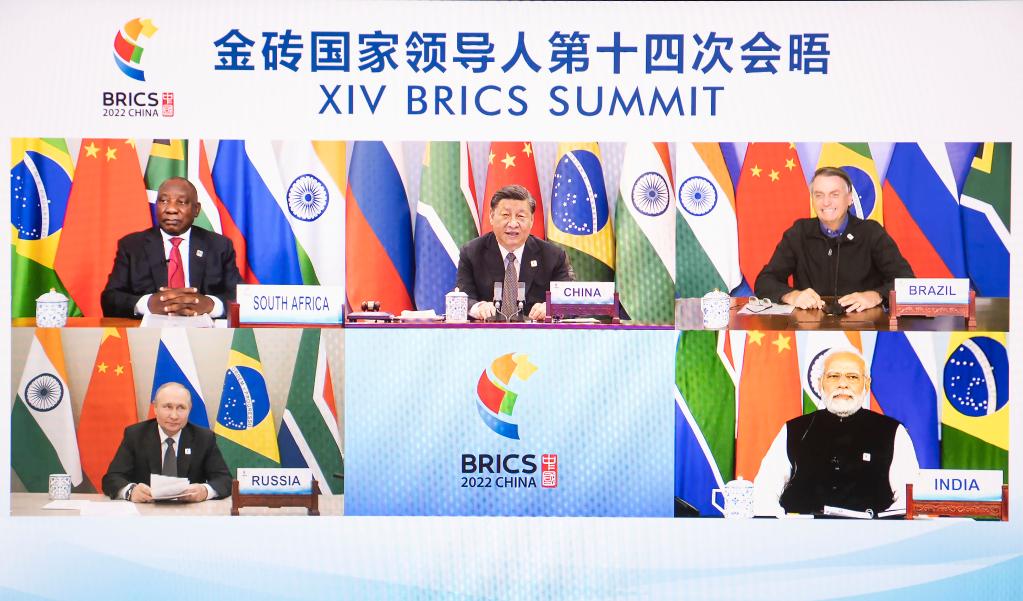
IN BRIEF
By Avishka Ashok
INTERNATIONAL
BRICS: President Xi calls for protecting peace, boosting development and maintaining unity
On 23 June, President Xi Jinping hosted the 14th BRICS Summit and called on the countries to jointly work towards safeguarding peace and tranquillity, boosting development and approaching the global order as one big family. Xi said: “Standing at the crossroads of history, we should both look back at the journey we have traveled and keep in mind why we established BRICS in the first place, and look forward to a shared future of a more comprehensive, close, practical and inclusive high-quality partnership so as to jointly embark on a new journey of BRICS cooperation.” Xi took a stand against hegemonic politics, bullying and division while encouraging multilateralism, safeguarding justice, fairness and solidarity. He also advocated the Global Security Initiative and encouraged the BRICS member countries to operationalize the initiative to bring more stability.
Xi’s keynote address further highlighted the need for upholding cooperation and openness in the world order. He pointedly stressed on the non-exclusive nature of the BRICS grouping of countries and its continuous partnership for a win-win cooperation. Making a point for South-South cooperation, Xi introduced the “BRICS Plus” cooperation approach to expand and deepen unity amongst the developing and emerging markets. He spoke of the group’s decision to invite guest countries to the BRICS Foreign Ministers’ meeting and the inclusive nature of the BRICS Vaccine R&D Centre. Lastly , Xi emphasized the need to uphold the pioneering spirit and innovation and said: “Those who seize the opportunities of the new economy, such as big data and artificial intelligence, are in sync with the pulse of the times.” (“Xinhua Headlines: President Xi calls for peace, development, openness, innovation to build high-quality BRICS partnership,” Xinhua Net, 24 June 2022)
Afghanistan: China urges countries to increase international support
On 23 June, China’s Permanent Representative Zhang Jun addressed the United Nations Security Council and urged the international community to increase their support to Afghanistan. Zhang said: “Afghanistan is at a critical stage of transition from chaos to governance. Since the Taliban takeover in August 2021, the situation in Afghanistan has remained stable on the whole while the humanitarian and economic fields are facing the most daunting challenges.” He pushed the case of Afghan people and the long journey to achieving peace in the country. He further highlighted the importance of constructive engagement to support Afghanistan’s pursuance of realising an autonomous and effective state governance. (“Chinese envoy calls for more int'l support for Afghanistan,” Xinhua Net, 24 June 2022)
Europe: Freight train from China marks its 10,000 trip
On 24 June, the China-Europe Railway Express departed from Chongqing in South China, marking the 10,000th trip made by the freight train. The train is headed for Duisburg in Germany and is loaded with electronic products, mechanical parts and other daily necessities. The railway line was launched in 2011 and has played a facilitating role in increasing trade between China and Europe. The railway line has been used to transport over 1,000 types of goods; from smart terminals to complete auto parts and medicines. The total value of goods that have been transported using the China-Europe railway line exceeds USD 60 billion. The 40 routes used by the freight train reaches 100 cities in Asia and Europe. (“China-Europe Railway Express (Chongqing) embarks on 10,000th trip,” Xinhua Net, 24 June 2022)
REGIONAL
Laos: Joint operation with Yunnan police arrests two Lao nationals for trafficking 1.44 tonnes of meth
On 23 June, the Yunnan provincial public security department announced that the Chinese and Lao police had jointly seized 1.44 tonnes of methamphetamine tablets during a cross-border drug trafficking case and arrested two individuals for their involvement in the trafficking. The Yunnan police alerted the law enforcement authorities of Laos, Myanmar and Thailand after getting tipped off with information on large quantities of drugs being shipped through the Mekong River basin. The authorities had earlier arrested two Lao nationals after they were caught with drugs during a joint operation. The Yunnan police appreciated the joint cooperation by the four countries in improving public security and cracking down on drug trafficking in the area. The countries have successfully seized 47.12 tonnes of drugs in the last three years, arresting 8,204 suspects. (“1.44 tonnes of meth seized in joint operation by Chinese, Lao police,” Xinhua Net, 24 June 2022)
INTERNAL
Demography: Record number of graduates enter China’s economy
On 23 June, the Asahi Shimbun reported that China was dealing with a record number of students graduating and applying for jobs in an already slow and recovering economic conditions. The number of young and fresh graduates entering the market is higher than the entire population of Portugal while the rate of joblessness in the country stands at a record 18.4 per cent, three times higher than usual. Premier Li Keqiang has promised to make job availability the government’s top priority. The government has initiated many provisions such as offering easy loans and subsidies to encourage graduates into starting their own business. Companies are also being given subsidies for taking in interns. The expected salaries have also dipped by 6.2 per cent in the country. (“Record numbers of Chinese graduates enter worst job market in decades,” The Asahi Shimbun, 23 June 2022)
Hong Kong: Government approaches foreign business to revive economy
On 24 June, the Strait Times reported that China had contacted the foreign business chambers in Hong Kong to enquire about methods to revive the city’s economy. The rare move comes as the new Chief Executive John Lee prepares to take office in a week’s time. The report stated that the Liaison Office sent invitations to the commerce heads across the city in early June to understand the challenges faced by businesses in establishing and maintaining offices in Hong Kong. Most chambers responded with a request to end the quarantine immediately but also appreciated the shift in the government’s modus operandi and genuine interest in recognizing the challenges for foreign businesses. The 90-minutes meeting were conducted in English and the officials did not make use of translators; another change from the previous officials. (China asks foreign business leaders how to revive Hong Kong in rare move,” The Strait Times, 24 June 2022)
Hong Kong: Police arrests five individuals as city preps for 25th handover anniversary
On 24 June, the Guardian reported that the Hong Kong Police had arrested five people for sedition before the 25th anniversary celebration of the British Handover of the city. The police arrested two men aged 28 and 30 on the suspicion of sharing posts with ill will and inciting violence. On 22 June, the police arrested three more individuals for running an armed spearatist movement. The authorities in the city are on a high alert as President Xi Jinping may be visiting the city on 1 July. (“Hong Kong: five arrested for sedition ahead of 25th anniversary of British handover,” The Guardian, 24 June 2022)
Nio showroom mishap: Two test drivers die as car falls from factory building
On 24 June, the BBC reported that a Chinese electric car Nio fell from its headquarters in Shanghai, resulting in the death of two people in the incident. The two people, a member of staff and another from a partner company were seated inside the car when it fell from the third floor of the building. The company has immediately initiated an investigation into the accident and is cooperating with the government officials. Nio also released an official statement and said: “Our company has collaborated with public security department to launch the investigation and analysis of the cause of the accident. Based on the analysis of the situation at the scene, we can initially confirm that this was an accident (not caused by the vehicle). We feel very sad about this accident and would like to express our deepest condolences to our colleague and partner employee who lost their lives. A team has been set up to help the families.” (“Two killed as Nio electric car falls from third floor office in Shanghai,” The BBC, 24 June 2022)
22 June 2022 | Wednesday | China Reader Evening Brief | Vol.1, No. 216
President Xi delivers keynote speech at opening ceremony of the Business Forum
As China chairs the BRICS Summit, President Xi addressed the opening ceremony of the Business Forum and called for solidarity and collective action against global challenges.
IN BRIEF
By Avishka Ashok
INTERNATIONAL
BRICS: President Xi delivers keynote speech at opening ceremony of the Business Forum
On 22 June, China’s President Xi Jinping attended the opening ceremony of the BRICS Business Forum and virtually delivered a keynote speech. The speech focused on embracing solidarity, expanding win-win cooperation and pursuing peace and stability. Xi encourged the member countries to work towards building a global community with a shared future for mankind. On peace and stability, Xi implored the member countries to adhere by the UN Charter and maintain peace which he considered as the common cause of humanity. Xi said: “We in the international community should reject zero-sum games and jointly oppose hegemonism and power politics. We should build a new type of international relations based on mutual respect, fairness, justice and win-win cooperation. We should be clear that we are a community in which all countries share a common stake, and we should see that the light of peace will reach all corners of the world.” The speech also touched upon cooperation for sustainable development, the Global Development Index and keeping the global economy open and promoting joint contribution and global economic governance. (“Xinhua Headlines: Xi urges BRICS solidarity, openness for peace, development,” Xinhua Net, 23 June 2022)
The US: China responds to the ban imposed through the Uyghur Force Labor Prevention Act
On 22 June, China National Textile and Apparel Council (CNTAC) responded to the implementation of the US Uyghur Forced Labor Prevention Act which facilitates the ban on products from the Xinjiang Autonomous Region and said that the ban violates the international economic and trade rules. The CNTAC expressed its strong opposition to the ban and highlighted the serious damage to the overall interests of China’s textile industry. The government organization underlined the importance of the exportation of cotton from Xinjiang and its significance in the Chinese and global textile industries. China explained that the US decision to ban products from Xinjiang jeopardizes the security and stability of the industrial and supply chains of the global textile industry. (“U.S. ban on Xinjiang products violates trade rules: Chinese association,” Xinhua Net, 23 June 2022)
South Korea: Foreign Minister discusses relations with Ambassador to China
On 22 June, China’s Foreign Minister Wang Yi held a meeting with the Ambassador of South Korea to China Jang Ha-sung who will soon be returning to his country as his tenure comes to an end. Wang Yi appreciated Jang’s efforts in deepening the relationship between China and South Korea and said: “China's friendly policy toward the ROK has not changed, and China will continue to place the ROK in an important position in its neighborhood diplomacy. China hopes the new ROK government will also continue to adhere to its friendly policy toward China.” This year, the two countries will be celebrating 30 years of diplomatic relations. Jang observed the rapid advancement of relations between the countries during his tenure and said that he believed in the strong momentum of development and the pragmatic cooperation. (“Chinese FM meets outgoing ROK ambassador,” Xinhua Net, 23 June 2022)
India: Foreign Minister meets new Ambassador and pushes for focus on common interests
On 22 June, China’s Foreign Minister met India’s new ambassador to China Pradeep Kumar Rawat and discussed the future of bilateral relations, urging its neighbour to focus on mutual interests instead of the differences. Wang encouraged China and India to build their confidence in each other rather than being suspicious. He further pushed on the two countries to meet half-way and deepen cooperation along bilateral issues, global challenges and safeguard their common interests. Wang said: “China and India should also give full play to their traditional advantages in people-to-people and cultural exchanges, continuously expand mutually beneficial cooperation, and work together to create a better future for mankind.” (“Chinese FM meets Indian new ambassador, Xinhua Net, 23 June 2022)
REGIONAL
Taiwan: China’s ban on grouper farms impact economy and livelihood
On 23 June, the Strait Times reported on China’s economic coercion on Taiwan and its impact on the economy. The report highlighted China’s previous decision to ban all imports from grouper farms, a move targeted at Taiwan’s fishing industry which was dependent on China’s markets. China claimed to find banned chemicals and other drugs in excessive levels in the products from Taiwan’s grouper farms. The industry exported over 91 per cent of its products worth USD 50 million to China in 2021. Other products like pineapples and wax apples have also come under the scanner after the products were claimed to spread pest infestations. (“From pineapples to fish, China flexes economic muscle to pressure Taiwan,” The Strait Times, 23 June 2022)
INTERNAL
Weather anomaly: Southern China deals with heavy rains and floods; economic activity shuts again
On 23 June, the water levels in the Pearl River delta hit a record high in century due to floods and heavy rains. Thousands of people from the Guangdong province in South China were evacuated after the country weather body issued orange and red alerts across the region. On 22 June, the Ministry of water resources placed its highest flood alert on the Pearl River basin and said that the Provincial capital city of Guangzhou would also be deeply impacted by the rains. China’s economic powerhouses, Guangzhou and Shenzhen have shut production in factories once again, due to the weather conditions. The provincial emergency management estimated a direct economic loss of 1.7 billion yuan in the last week. (“Record floods threaten southern China; Guangdong shuts factories, schools,” The Strait Times, 23 June 2022)
#MeToo: Alibaba rape case offended sentence to 18 months in prison
On 23 June, the Strait Times reported on the Alibaba rape case and explained that the offender had been sentenced to 18 months in prison by the People’s Court of Huaiyin. The sentence comes after the complainant was dismissed and fired by the tech giant for spreading falsehoods regarding the company. The case was considered to be the turning point of the country’s #MeToo movement but was cut short after the prosecutors dismissed the case for not constituting as a crime. The court’s recent judgment however, holds Zhang Guo, the company executive responsible and guilty of forcible indecency. The court held that Zhnag had taken advantage of the employee’s intoxicated state and molested her at the restaurant's front desk, later assaulting her again at her hotel. (“Chinese businessman linked to Alibaba rape case sentenced to prison,” The Strait Times, 23 June 2022)
TECHNOLOGY
Bank depositors’ protest: Five officials punished for misusing COVID-19 apps to quell unrest
On 22 June, the local anti-corruption authority announced that five officials had been booked and punished in Zhengzhou city for intentionally changing the health codes on the COVID-19 public applications and preventing a protest against a bank. The case was widely publicized within and outside the country, many accusing the state of misusing the digital surveillance apps for its interests. The authorities have therefore taken action against Feng Xianbin and Zhang Linlin, two officers from the epidemic and control headquarters for changing the codes without authorization; a move which prevents the protesters from accessing public spaces and transportation facilities, thereby quelling the demonstration. Feng has been stripped of his party credentials whereas the other officers have been given demerits. (“Chinese officials punished for changing health codes of bank depositors: State media,” The Strait Times, 23 June 2022)
21 June 2022 | Tuesday | China Reader Evening Brief | Vol.1, No. 215
China urges the US, Canada and Australia to address violation against indigenous women
At the 50th session of the United Nations Human Rights Council, China urged the US, Canada and Australia to take responsibility for their crimes and rectify their discriminative actions the indigenous communities.
IN BRIEF
By Avishka Ashok
INTERNATIONAL
United Nations: China urges the US, Canada and Australia to address violation against indigenous women
On 20 June, China’s representative at the United Nations attended the ongoing 50th session of the Human Rights Council where the Special Rapporteur on violence against women deliver a speech. The Chinese representative urged the member countries to pay attention to the human rights violations against indigenous women and girls in the US, Canada and Australia. The representative said: “China is deeply concerned about the issues reported at the meeting by the Special Rapporteur including the violence against politically active indigenous women in the US, obstacles for indigenous women and girls to seek justice in the US, and genocide crimes by Canada against indigenous people” China urged countries to own up to their historical crimes and eliminate the discimination and violence metted against indigenous women and girls. (“China calls on UN to address human rights violations against indigenous women and girls in US, Canada, Australia,” Global Times, 21 June 2022)
International Criminal Court: Activists and Lawyers appeal to investigate human rights situation in Xinjiang
On 20 June, activists and lawyers presented a dossier of evidence and urged the International Court of Justice to open an investigation into China’s human rights violations against the Uighur minorities in the Xinjiang Autonomous Region in the country. The group which filed the latest appeal to begin the investigation submitted the evidence which includes testimony by an individual who escaped from a camp in 2018. The statement by the group said: “The ICC has jurisdiction over these crimes that commence on ICC territory and continue into China and is urged to act immediately to open an investigation.” (“Lawyers call on intl court to investigate Uighur treatment,” The Asahi Shimbun, 21 June 2022)
WTO: Ministry of Commerce claims China’s role in waiver of patents on COVID-19 vaccine
On 20 June, an official from China’s Ministry of Commerce announced that China had played an influential role in the World Trade Organization in facilitating the waiver of intellectual property rights for the COVID-19 vaccines. The WTO’s Ministerial Conference Twelfth Session (MC12) which is taking place in Geneva, Switzerland authorized developing member countries to produce the COVID-19 vaccines without any copyright issues for a period of five years. The Chinese official said: “At a pivotal stage of MC12 negotiations, China, as a major producer and a supplier of COVID-19 vaccines, announced that it will forego the flexibility of the Trade-Related Aspects of Intellectual Property Rights (TRIPS) waiver on COVID-19 vaccines.” China made the vaccine a global public good in May 2020, making it affordable and more accessible to the developing countries. Xinhua Net reported that China as donated over 2.2 billion doses of the COVID-19 vaccines to almost 120 countries. (“China makes significant contributions to WTO waiver of COVID-19 vaccine patents: official,” Xinhua Net, 20 June 2022)
Global Development Report: Foreign Minister promotes GDI at launch of report
On 20 June, the Foreign Minister Wang Yi addressed the launch of the Global Development Report and said that the report would provide intellectual support for global development. The report focuses on the implementation of the 2030 Agenda for Sustainable Development and its current challenges. The report is launched by the Centre for International Knowledge on Development. WangYi referred to the report and said: “Drawing on the useful experience in China and other countries, it also lays out policy recommendations in eight aspects for the implementation of the 2030 Agenda.” He further promoted the Global Development Initiative and called on the countries to focus their attention on development and make it a centre of the international agenda. Wang highlighted the capacity of the initiative to coordinate development policies, deepen practical cooperation, pool resources, address difficulties and promote efficiency. (“Global development report shares Chinese wisdom with world: FM,” Xinhua Net, 20 June 2022)
Belt and Road Initiative: Pakistan and Cambodia appreciate China’s infrastructure and economic support
On 20 June, experts from different countries participated in the international webinar on “Big Power competition in the post-pandemic World Order and the Belt and Road Initiative” and rejected the idea of a Cold-War and pushed for cooperation over confrontation amongst countries in the world order. The participants of the conference encouraged the connectivity and cooperation facilitated under the Belt and Road Initiative and urged world leaders to promote the initiative further to tackle other global challenges. Pakistan’s Senate Defence Committee Mushahid Hussaid Syed appreciated the CPEC, a part of the BRI in the country, and said: “Pakistan is in a strategic location where huge transformations and transitions are taking place... the country is endeavoring to be the hub of regional connectivity through CPEC, by making a transition from geopolitics to geo-economics.” Other than Pakistan, experts from Cambodia also praised the BRI and its impact in the country. (“Experts call for greater cooperation under China-proposed BRI,” Xinhua Net, 21 June 2022)
South Africa: Illegal donkey trade to China endangers population within the country
On 21 June, the Strait Times reported on the trade of donkeys from South Africa to China, an industry which has recently become sought after by China’s middle class for the gelatin called ejiao which is derived from donkey skins. The gelatin is used as blood thinners and are also increasingly becoming an alternative to rhino horns. However, the trade has put other businesses dependent on donkey milk at risk due to heightened exportation in African countries like Burkina Faso, Kenya, and South Africa. The co-founder of Donkey Dairy Jesse Christelis said: “In South Africa we have seen a rapid decline of the donkey population due to illegal slaughter to supply the Chinese skin trade.” According to another study conducted by the University of South Africa, the donkey population fell from 210,000 in 1996 to 146,000 in 2019. South Africa exports about 10,500 donkey hides in a year to China. However, the illegal exports may be much higher. (“South Africa's latest hot export to China? Donkeys,” The Strait Times, 21 June 2022)
Horn of Africa: China’s envoy to the region offers to mediate in conflicts
On 20 June, China’s first special envoy to the Horn of Africa Xue Bing offered to mediate in the disputes in the region. The move comes as China aims to strengthen its influence in the region and protect its investments from the conflict. Bing addressed a press conference in Ethiopia and said: “I myself am ready to provide mediation efforts for the peaceful settlement of disputes based on the will of countries in this region.” China has a number of interests in the region such as its first overseas military base in Djibouti, oil investments in Sudan and South Sudan, manufacturing hubs in Ethiopia and a number of other infrastructure projects. (“China’s 1st Horn of Africa envoy offers to mediate in region,” The Asahi Shimbun, 21 June 2022)
INTERNAL
Tesla: Electric car by the company banned from summer retreats of the CPC
On 20 June, the Strait Times referred to an announcement by the local traffic police and reported that Tesla cars will be banned from entering a coastal district towards the East of Beijing city that hosts the Communist Party of China’s summer retreats. The report explained that the cars have been banned for a period of two months but failed to explain the reason behind the restrictions. Tesla cars have previously been banned from entering military complexes, houring compounds and other sensitive regions to prevent the cars from capturing sensitive data with their cameras. The company, which has its highest sales in China, has pledged to store any data collected inside the country and said that cameras were not activated outside North America. (“Teslas banned from Communist Party resort town in China,” The Strait Times, 21 June 2022)
22 June 2022 | Wednesday | China Reader Evening Brief | Vol.1, No. 216
The US bans products from China's Xinjiang region
China's Ministry of Commerce responds to the US decision to implement the Uyghur Forced Labor Prevention Act and ban products from the Xinjiang region.
IN BRIEF
By Avishka Ashok
INTERNATIONAL
The US: China’s Ministry of Commerce responds to ban on products from Xinjiang
On 21 June, the US Customs and Border Protection implemented the Uyghur Forced Labor Prevention Act and imposed a ban on products imported from China’s Xinjiang region. China’s Ministry of Commerce spokesperson accused the US of economic coercion for imposing the ban. The statement by the ministry spokesperson said: “The move will seriously damage the interests of Chinese and U.S. consumers and enterprises, and will do no good for the stabilization of global industrial and supply chains, global inflation easing, or the promotion of global economic recovery.” The Ministry of Commerce further accused the US of practicing unilateralism, protectionism and bullying China in the name of human rights. The spokesperson also highlighted that the US behaviour violated the rules of the World Trade Organization and undermined the market principles. (“U.S. ban on Xinjiang products typical example of economic coercion: Chinese official,” Xinhua Net, 22 June 2022)
United Nations: Venue for COP15 changed from China to Canada
On 21 June, the Ministry of Ecology and Environment announced the relocation of the second phase of the 15th meeting on the Conference of the Parties to the UN Convention on Biological Diversity (COP15) from Kunming, China to Montreal, Canada. The conference is scheduled to take place from 5 to 17 December. The venue for the conference has been changed due to the COVID-19 outbreak in the country and the uncertainty regarding the safety of all attendees during the conference. The Ministry informed that China would continue to act as the chair of the COP15. (“UN Biodiversity Conference to be relocated from China to Canada,” Xinhua Net, 22 June 2022)
Syria: China urges United Nations Security Council to end cross-border aid delivery
On 21 June, Xinhua Net reported that China’s Permanent Representative to the United Nations Zhang Jun had urged the Security Council to push for a clear timeline for the termination of cross-border aid delivery in Syria. Zhang implored the Security Council to establish a cross-line delivery for humanitarian assistance in the country. The Security Council Resolution 2585 on humanitarian aid to Syria is set to expire in July. Zhang noted that although the resolution helped in easing the crisis in Syria, it had not been implemented effectively. Zhang said: “The Security Council should conduct a comprehensive analysis and adopt an integrated approach to overcome the obstacles to humanitarian relief in a targeted manner, and make more reasonable and effective arrangements for the next stage of humanitarian relief.” (“Chinese envoy calls for clear timeline to end cross-border aid delivery into Syria,” Xinhua Net, 21 June 2022)
Burundi: China helps rural villages get access to state television
On 21 June, Burundi’s Communication, Information Technology and Media Minister Leocadie Ndacayisaba appreciated China for helping the rural population in the country with digital satellite television. The project was handed over to the local authorities in Burundi on 20 June. On the occasion, the Minister noted that China’s initiative will help the rural people have access to national television and will boost their access to public information and help raise awareness. China’s Ambassador to Burundi Zhao Jiangping referred to the project and informed that 200 villages would be connected to the digital television system in the second phase of the project. The first phase of the project has already connected over 300 villages in 2018. China has donated over 190,00 sets of decoders and other accessories for the project. The Chinese government has also made provisions for the maintenance of the project by training over 1000 technicians across the country. (“Chinese-aided project eases access to TV service in rural Burundi,” Xinhua Net, 21 June 2022)
REGIONAL
Taiwan: 29 Chinese aircrafts cause a frenzy in the ADIZ
On 21 June, Taiwan’s Air Force dispatched its jets after 29 Chinese aircrafts entered the country’s Air Defence Identification Zone. The troupe of Chinese aircrafts also included 17 fighters and six H-6 bombers and was the largest incursion since May 2022. The mission also included of aircrafts capable of electronic warfare, early warning, anti-submarine, intelligence gathering aircraft and an aerial refueling aircraft. The Defence Ministry explained that the aircrafts flew close to the Pratas island before entering the Bashi Channel and then turning back to mainland China in the same route. (“Taiwan scrambles jets to warn away Chinese planes in its air defence zone,” The Strait Times, 22 June 2022)
INTERNAL
Violence against women: China initiates probe into police forces for mishandling restaurant attack case
On 21 June, China Central Television reported that the local police officers of Tangshan city were being investigated after an incident of women diners being manhandled and attacked went viral inside and outside the country. The incident led to the outpouring of many other female citizens coming out with their public experiences with violence and mistreatment. The police chief of the district Ma Aijunand four other officers are currently being probed for severe disciplinary violations. Ma has also been relieved of his duty for the period of the probe. The incident is said to have revived the #MeToo movement in China. (“China probes police handling of attack on women in Tangshan restaurant,” The Strait Times, 22 June 2022)
Hong Kong: Iconic floating restaurant capsizes in South China Sea
On 22 June, the Strait Times reported on the sinking of the renowned Jumbo Floating Restaurant in Hong Kong which was a famous symbol and one of the cities cherished tourist spots. The Jumbo Floating Restaurant, a 260-foot and three storeyed eatery, was built in the style of an imperial palace and was located in the harbour in the South China Sea for almost half a century. It was opened by Macau’s casino tycoon Stanley Ho in 1976. However, on 20 June, while it was being towed by tug boats through the deep waters, it capsized and sank. There were no casualties in the incident. According to many citizens, the restaurant was also a reminder of British history in the city and symbolized a period of freedom which is now not the same as before. (“For Hong Kongers, floating restaurant Jumbo that sank was laden with memories,” The Strait Times, 22 June 2022)
Electricity production: Heat waves cause an increase in usage while tornado and heavy rain cause disruption
On 22 June, China’s state media reported that the electricity load at Shandong’s power grid hit a record of 92.94 million kilowatts. Chinese provinces of Shandong and Henan have recorded a heightened consumption in electricity in the last week due to the heat waves causing an increase in the use of the air conditioner. A red-alert was issued in several cities in China; these cities also recorded an increase in use of electricity. Premier Li Keqiang visited a thermal power company in Hebei and urged the company to increase their coal production to prevent power outages in the country. As certain parts of China suffer a heatwave, heavy rainfall and a tornado hit the southern city of Guangzhou, cutting off supply of over 5,400 individuals. The country is trying to secure its connectivity and access to electricity as China is quickly trying to make up for the loss in production and manufacturing caused by the lockdown in April and May. (“Power consumption soars in northern China as Premier Li issues warning, The Strait Times, 22 June 2022)
20 June 2022 | Monday | China Reader Evening Brief | Vol.1, No. 214
China's factsheet on US perspectives of bilateral relations
China's Foreign Ministry issues a factsheet in response to US Secretary of State Antony Blinken's speech at Asia Society.
IN BRIEF
By Avishka Ashok
INTERNATIONAL
The US: China issues factsheet on challenges in bilateral relations
On 19 June, China’s Foreign Ministry issued a factsheet titled, “Falsehoods in US Perceptions of China.” The factsheet listed 21 points with detailed facts and figures relating to issues in the US-China bilateral relations. The 21 points touched on the claims of democracy, violation of human rights, the Indo-Pacific, and China’s stance on Taiwan, Xinjiang, and Hong Kong. The document was a response to the US Secretary of State Antony Blinken’s speech at Asia Society which subtly underlined the US approach to China and the US perception of China as a threat. The ministry said: “With carefully calibrated language, he sought to promote the 'China threat' narrative, interfere in China's internal affairs, and smear China's domestic and foreign policy.” (“US' China policy 'deceptive, hypocritical and dangerous:' Chinese FM issues factsheet on US false perception of China,” Global Times, 20 June 2022)
BRICS: China and Brazil highlight the importance of agriculture cooperation
On 20 June, Xinhua Net reported on the agriculture cooperation shared between the BRICS member countries. The report highlighted the use of the China-Brazil Agriculture Science Industrial Park which has helped increase the agricultural output in Brazil. Brazilian farmers have been farming different varieties of corn provided by Longping High-Tech Brazil, a China-funded company owned by Longping Agriculture Science Co., Ltd. Since 2019, the planting area has expanded to cover almost 3,330 hectares of land. The company’s storage facility in Brazil was created with the objective of integrating the emerging markets, especially of the BRICS countries. The report noted the importance of the BRICS countries as producers and consumers of agricultural products and their role in the global food system. The Director of the China-Brazil Centre for Research and Business Ronnie Lins said: “I highlight agricultural cooperation as one of the essential measures among the various discussion topics at the BRICS meeting. The success of these measures may result in achieving food self-sufficiency and balancing trade between countries.” (“China Focus: China deepens agriculture cooperation with BRICS nations,” Xinhua Net, 20 June 2022)
REGIONAL
Cambodia: China-funded school building inaugurated by Chinese NGO
On 19 June, Xinhua Net reported on the inauguration of a Chinese-funded school building in Dey Thmey Santepheap village of Oddar Meanchey province's Tropang Prasat district. The six-classroom school building is donated by a Chinese-run NGO Cambodia International Charity Organization (CICO) and is aimed at providing better education in the remote village. The Assistant to Cambodian Prime Minister Duong Dara attended the inauguration along with hundreds of teachers, parents, and students. Dara said: “An appropriate school building for children is the aspiration of all parents. The donation has not only helped improve education for rural children but also contributed to promoting bonds of friendship between the peoples of our two countries.” The event also distributed over 500 school bags to the school’s children. (“Chinese-aided school building inaugurated in NW Cambodia's remote area,” Xinhua Net, 19 June 2022)
Japan: Uighur candidate in Parliament’s upper house elections
On 19 June, the Strait Times reported on the Japanese candidate Arfiya Eri, an ethnic Uighur from China’s Xinjiang region. Eri is a multilingual former United Nations official and is currently running for the Japanese Parliament’s upper house with the Liberal Democratic Party. Eri however identifies as a Japanese citizen and believes that her campaign is viewed by many through the prism of her ethnic origins and family history. Eri said: “Instead of my vision and policies as a Japanese politician, people ask me about the Uighur issue because of my ethnic background. I can understand why this happens, but it feels a bit strange.” She is a firm believer in the LDP’s conservation political opinions and stands strongly in favor of Japan’s national security. On her views on Xinjiang, a name which she refuses to use, she said “human rights violations at an unspeakable scale in places like the Uighur region opens the door to worse abuses.” (“Uighur-heritage candidate Eri urges Japan to 'embrace diversity',” The Strait Times, 19 June 2022)
INTERNAL
Hong Kong: Central government approves and appoints new cabinet
On 19 June, China’s central government approved and published the list of new government officials in John Lee’s cabinet who are set to take office from 1 July. The day also marks 25 years since Hong Kong was handed over to China. According to the official release, Finance Secretary Paul Chan will retain his post, while Mr Paul Lam replaces Ms Teresa Cheng as the Justice Secretary and Mr Eric Chan takes his office as the Chief Secretary. John Lee addressed a press briefing and said: “The next five years is a critical time for Hong Kong to move from stability to prosperity. The new government will be results-oriented. We will be proactive in winning the trust of the people... My team and I will rise to the challenges leading Hong Kong.” (“China announces new Hong Kong leader John Lee's Cabinet,” The Strait Times, 19 June 2022)
Hong Kong: Central government highlights housing issues in its targets for John Lee’s cabinet
On 19 June, the Hong Kong and Macau Affairs Office published a list of targets to be achieved by the incoming government in Hong Kong. The targets were officially declared in a statement titled “New Team, New Atmosphere, New Chapter,” after the new Hong Kong Chief John Lee’s cabinet was approved by the government. The targets included five big goals, out of which housing is the top goal for John Lee’s cabinet. The statement stresses on the implementation of “one country, two systems” and calls for the promotion of social development and integration of Hong Kong with mainland China’s development standards. (“China lists Hong Kong housing among big focuses for next leader John Lee,” The Strait Times, 20 June 2022)
ECONOMY
Business: Third Qingdao Multinationals Summit discusses the integration of RCEP and supply chain restoration
On 19 June, the third Qingdao Multinationals Summit hosted over 5,600 industry leaders, company delegates, ambassadors, scholars and government officials in an online and offline summit. The summit was based on the theme “multinationals in China” and focused on global industrial and supply chain reconstruction in the post-pandemic era. It also stressed on the implementation of the Regional Comprehensive Economic Partnership (RCEP) and promoted the institutional opening up. The summit further encouraged the multinationals’ role in improving economic and social development and the Yellow River Basin ecological protection and high-quality development. (“Leaders of multinationals attend summit in China's Qingdao,” Xinhua Net, 20 June 2022
TECHNOLOGY
Defence: China tests ground-based mid-range anti-ballistic missile
On 19 June, China’s Defence Ministry announced the successful test of a mid-range anti-ballistic missile late in the night. The Ministry issued a statement on the test of the ground-based midcourse anti-missile intercept technology and said: “The test reached its expected goals. This test was defensive and not aimed at any country." The statement provided no other details on the test. A similar test had been conducted in February 2021; the recent test brings the total number of tests to six. The development is seen as a part of China’s initiative to ramp up the country’s research into all kinds of missiles, especially those that can destroy satellites in space and advanced nuclear-tipped ballistic missiles. (“China conducts successful anti-ballistic missile test,” The Strait Times, 20 June 2022)
03 June 2022 | Friday | China Reader Evening Brief | Vol.1, No. 200
China's cooperation with the Federated States of Micronesia
On the seventh leg of Foreign Minister Wang Yi's visit to the Pacific Island countries, he encouraged cooperation with Micronesia and the Cook Islands.
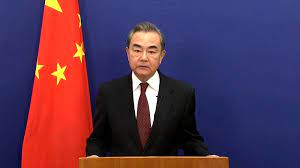
IN BRIEF
By Avishka Ashok
INTERNATIONAL
Micronesia: China’s Foreign Minister reviews relations and encourages future cooperation
On 2 June, the Micronesian Secretary of Foreign Affairs Kandhi Elieisar met with China’s Foreign Minister Wang Yi virtually through a video conference and discussed the mature nature of China’s relationship with the Federated States of Micronesia. Elieisar said: “China has been sincere and cordial in conducting pragmatic, productive cooperation with Micronesia since the establishment of diplomatic ties.” He further appreciated China’s contributions to the socio-economic developments in Micronesia and the support provided by Beijing to fight the COVID-19 pandemic. Wang Yi, on behalf of China, encouraged bilateral cooperation especially in the field of blue economy and the Belt and Road Initiative. The leaders identified agri-fishery, infrastructure, trade and investment and tourism as the other areas for the two countries to deepen cooperation. Wang Yi also highlighted China’s cooperation with other Pacific Island countries and said: “The second China-Pacific Island Countries Foreign Ministers' Meeting has just been successfully held, and all participants gave full credit for the significant outcome China and Pacific island countries have achieved through enhancing unity and coordination over the past nearly 50 years.” (“Micronesian foreign secretary hails mature, strong relationship with China,” Xinhua Net, 02 June 2022)
Cook Islands: Prime Minister discusses bilateral cooperating with Wang Yi
On 2 June, China’s Foreign Minister Wang Yi virtually met with the Prime Minister and the Foreign Minister of the Cook Islands Mark Brown from Papua New Guinea as he visits eight Pacific Island Countries. The leaders pledged to deepen bilateral practical cooperation and promote closer relations with each other. Wang Yi highlighted China’s support to the Cook Islands in assisting with livelihood projects and conducting tripartite cooperation with New Zealand. Wang Yi further encouraged cooperation on tourism, infrastructure, sub-national programs and education to facilitate the economic recovery in the country. Brown responded warmly to the suggestions and said: “The Cook Islands cherishes its relations with China and firmly believes that its future is closely linked with China. The island country stands ready to work with China to push for greater development of bilateral relations in the next 25 years.” (“China, Cook Islands pledge closer ties, deepened practical cooperation,” Xinhua Net, 02 June 2022)
Australia: Trade with China experiences stable growth in 2021
On 2 June, the Ministry of Commerce Spokesperson Gao Feng announced that the economic and trade cooperation with Australia reported stable development in 2021. China also continued to be Australia’s largest trading partner, despite the stress in diplomatic relations. Feng said: “Bilateral trade amounted to approximately 231.2 billion U.S. dollars last year, a rise of 35.1 percent year on year. China's imports from Australia reached 164.82 billion U.S. dollars in 2021, jumping 40.6 percent from a year ago.” He further observed that in the previous 50 years of diplomatic relations with Australia, economic and trade cooperation had been most successful and were the driving factors that encouraged the bilateral relations between the two countries. (“China-Australia trade sees stable growth in 2021: commerce ministry,” Xinhua Net, 02 June 2022)
Canada: Armed Forces accuses China of harassing patrol aircrafts
On 2 June, the Asahi Shimbun reported that Canada’s military had accused China of harassment as its planes were forced to change routes after Chinese warplanes restricted their movement close to the North Korean airspace. The statement released by the Canadian Armed Forces claimed that the Chinese Air Force approached a Royal Canadian Air Force CP-1140 Aurora long-range patrol aircraft multiple times between 26 April and 26 May. The statement read: “In these interactions, PLAAF aircraft did not adhere to international air safety norms. These interactions are unprofessional and/or put the safety of our RCAF personnel at risk.” The statement further claimed that the Canadian aircrafts were at risk of crashing into the Chinese aircrafts at numerous instances. (“Canada says Chinese warplanes harassed its patrol aircraft on North Korea sanctions mission,” The Asahi Shimbun, 2 June 2022)
REGIONAL
Taiwan: China opposes signing of agreements with the US
On 2 June, the Taiwan Affairs Office of the State Council Spokesperson Ma Xiaoguang opposed any kind of discussion or signing of agreements between the Taiwanese government and the US government. The statement was made in response to the Democratic Progressive Party of Taiwan’s announcement regarding the “initiative on 21st-century trade” with the US. Ma said: “The DPP authorities colluded with external forces to seek "Taiwan independence" and selfish political gains at the cost of the interests of the island's enterprises and people.” He further implored the US to adhere to the “One-China” principle and the three China-US Joint Communiques. (“China voices firm opposition to agreements with sovereignty implications between U.S., Taiwan region,” Xinhua Net, 02 June 2022)
Taiwan: The US reinstates previous statement on Taiwan on the State Department website
On 3 June, the Strait Times reported that the US State Department had updated its website and changed its stance on Taiwan’s independence, a month after it deleted some statements relating to acknowledging China’s position on Taiwan. The recent update reinstated the phrase: “we do not support Taiwan independence,” but does not reflect a change in the US policy towards Taiwan, according to the State Department. The change was first reported by the Taiwan’s Central News Agency. (“US updates fact sheet, again, to say it does not support Taiwan independence,” The Strait Times, 03 June 2022)
Japan: Private companies gradually resume production in Shanghai
On 2 June, the Asahi Shimbun reported that Japanese companies were gradually reopening their operational units in Shanghai despite risks of another lockdown in case of an outbreak. The report claimed that Japanese manufactures and other companies suffered heavy losses during the state-imposed two month lockdown in the city. Companies such as Toyota, Honda Yaskawa Electric Corp., Panasonic, and Sony had to completely suspend production in April and May, leading to a steep fall in production and revenue rates. However, all of the above mentioned companies are now aiming to regain its production and manufacturing level by early June or latest by July. (“Japanese firms resume work in Shanghai, aware of ‘China risk’,” The Asahi Shimbun, 02 June 2022)
INTERNAL
Corruption: Government sentence former Party Chief to death for bribery and insider trading
On 3 June, the Strait Times referred to the announcement by the state broadcaster CCTV and reported that former Communist Party Chief and Securities Regulator of Sanya city Tong Daochi was sentenced to death with a two-year reprieve. Tong was accused of taking bribes worth 270 million yuan during his tenure at the Securities Regulatory Commission. He is also accused of offering assistance to individuals and companies in stock listings, financing and other matters. Furthermore, Tong is accused of participating in insider trading during his tenure as the Deputy Director of China Securities Regulatory Commission. The two-year reprieve could be shifted to imprisonment depending on his conduct in the coming two years. (“China sentences ex-city party chief to death with reprieve,” The Strait Times, 03 June 2022)
02 June 2022 | Thursday | China Reader Evening Brief | Vol.1, No. 199
The US prepares to implement Uyghur Forced Labor Prevention Act (UFLPA)
The US Customs and Border Protection plans to enforce the ban on goods produced in Xinjiang from 21 June 2022.
IN BRIEF
By Avishka Ashok
INTERNATIONAL
The US: Customs and Border Protection plans to implement ban against Chinese goods from Xinjiang
On 1 June, a US Customs official said that the US authorities were planning to ban imports from the Xinjiang region through a law that will be implemented from 21 June. The US President Joe Biden signed the Uyghur Forced Labor Prevention Act (UFLPA) in December 2021 with the aim of preventing Chinese products from the Xinjiang region from infiltrating the US markets. The US seeks to prevent the purchase of goods that have been produced and manufactured in the Xinjiang region where it believe the government is committing a genocide against its Uighur Muslim minority community. The law primarily provides a “rebuttable presumption” that all goods from the region are a product of forced labour and bans them from entering the US market until proved otherwise.
The Customs and Border Protection’s acting executive director for the UFLPA implementation task force Elva Muneton said: “We’re all on a very tight timeframe. The expectation is that we will be ready to implement the Uyghur act on June 21, and that we have the resources. So the question is, are we ready to implement? Yes, we are. It’s important to know that the level of evidence that’s going to be required by the Uyghur act is very high. It’s going to require documentation, clear and convincing evidence, that the supply chain of the product that’s being imported is free from forced labor.” (“U.S. is ready to implement ban on Xinjiang goods on June 21,” The Asahi Shimbun, 02 June 2022)
Australia: Journalist Cheng Lei’s partner expresses concern about health issues
On 2 June, the Strait Times shed light on the interview of Chinese-Australian journalist Cheng Lei’s partner Nick Coyle where he expressed concern regarding Lei’s health and the prison conditions. Lei, a former CGTN journalist, was detained in August 2020 on the charges of sharing state secrets. Coyle claimed that Lei’s consular visits had been suspended due to the COVID-19 restrictions in China and was also subjected to food restrictions. (“Concern for health of Australian journalist Cheng Lei detained in China,” The Strait Times, 02 June 2022)
Vanuatu: China reaches five-point consensus on bilateral and international ties
On 1 June, the Vanuatu Prime Minister Bob Loughman and the cabinet members met with China’s Foreign Minister Wang Yi and reached a five-point consensus on enhancing bilateral relations and cooperation on international and regional issues. Wang Yi highlighted the 40 years of mutually beneficial relationship between the two countries and encouraged developing ties across various fields. After a long discussion, the two countries agreed on a five-point consensus. The first consensus builds mutual political trust and urges the countries to treat each other with mutual respect and as equals. Second, the countries agreed to uphold win-win cooperation with mutual profits. They also agreed to work collectively on blue economy, new energy and digital economy. Third, China and Vanuatu agreed to enhance their people-to-people exchanges and friendship. Fourth, both sides agreed to deepen their strategic coordination and support the Global Development Initiative. Fifth, China and Vanuatu agreed to support and boost regional cooperation and working together in the Pacific region. (“China, Vanuatu reach 5-point consensus on bilateral ties, int'l cooperation,” Xinhua Net, 01 June 2022)
Brazil: President Xi expressed condolence to President Bolsonaro over casualties caused by floods
On 1 June, President Xi Jinping sent his condolences to Brazil’s President Jair Bolsonaro for the heavy casualties caused by the floods in the country. Xi expressed his shock and concern for the people of Northeastern Brazil after news of the floods reached China. Xinhua Net reported: “The Chinese president offered his deep condolences to the victims and sincere sympathies to the bereaved families as well as to the people in the disaster-hit areas.” (“Xi sends condolences to Bolsonaro over severe floods in Brazil,” Xinhua Net, 01 June 2022)
REGIONAL
Taiwan: Economy Minister to meet EU officials on expanding trade officials
On 2 June, the Strait Times reported that Taiwanese officials will be conducting a high-level trade talk with the officials from the European Union. The meeting will aim to push the production and trade of semiconductor chips, a commodity that Taiwan exports heavily. The EU proposed the European Chips Act in February 2022 and expressed its intentions to increase its partnership with Taiwan and other like-minded partners. The Economy Minister of Taiwan Wang Mei-hua is speculated to meet with the senior EU officials. (“Taiwan to hold trade talks with EU as Europe focuses on chips,” The Strait Times, 02 June 2022)
Cambodia: China signs MoU on building vaccine filling factory
On 1 June, the Cambodian Health Minister Mam Bunheng and General Manager of Sinovac Life Sciences Co., Ltd. Gao Qiang signed a Memorandum of Understanding (MoU) on building a COVID-19 vaccine filling and packing facility in Cambodia. Bunheng explained the MoU and said: “Under the deal, the Cambodia Pharmaceutical Enterprise is given rights to build a COVID-19 vaccine filling and packaging factory and the Cambodian government has contracted to purchase the vaccines from the factory for three years from 2024 to 2026.” He also explained that the factory is being set up to meet with the demand of Cambodians and foreigners living in Cambodia. (“Cambodia, China ink deal to build COVID-19 vaccine filling factory in Cambodia,” Xinhua Net, 01 June 2022)
Vietnam: Metro line built by China records 3 million passengers
On 1 June, the Vietnam News Agency reported that more than 3.1 million passengers had used the Cat Linh-Ha Dong metro line in Hanoi, which was built by China. The metro was put in use in November 2021. Vietnam’s first metro line has so far attached an average daily footfall of 21,000 to 22,000 passengers on a weekday and 25,000 to 30,000 passengers on weekends. The news agency also reported that there are 54 bus lines that connect to the metro line, assisting in building the city’s transportation services. (“Over 3 mln passengers use China-built metro line in Vietnam,” Xinhua Net, 01 June 2022)
INTERNAL
Environment: China records a fall in carbon emissions for the third consecutive quarter
On 2 June, the Asahi Shimbun reported that China had recorded a notable dip in its carbon emissions over the past three quarters. China’s recent economic data revealed that the carbon emissions had fallen by 1.4 per cent in the January-March period; marking the third consecutive quarter to display a drop in emissions. Analysts observed that the fall in emission began in 2021, accelerated during the winter season and continued to show a mild drop over the months. The dip is considered to be caused by China’s decreased output in cement, steel and power industries and the COVID-19 lockdown in Chinese cities. (“Carbon emissions dip, at least briefly, in China, study says,” The Asahi Shimbun, 02 June 2022)
01 June 2022 | Wednesday | China Reader Evening Brief | Vol.1, No. 198
China calls on United Nations to support African countries in resolving conflicts
China's Deputy permanent representative pushes for African countries to resolve issues with African methods.
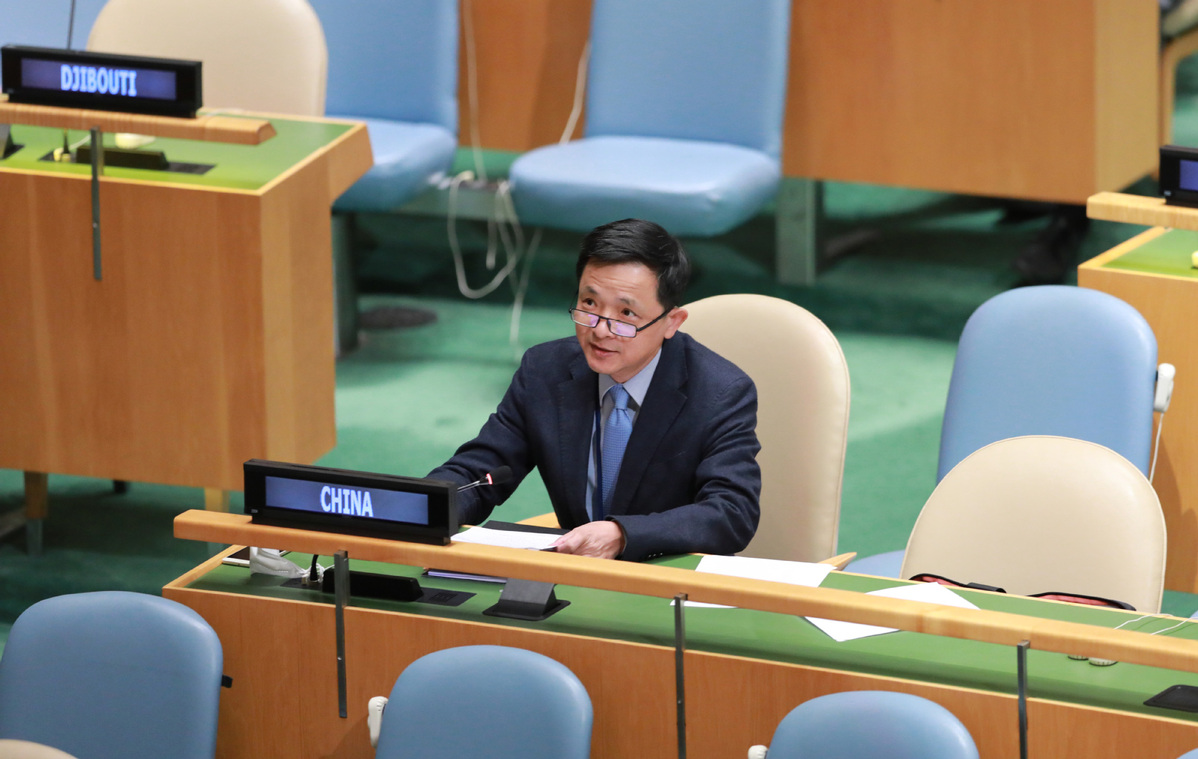
IN BRIEF
By Avishka Ashok and Arshiya Banu
INTERNATIONAL
United Nations: China urges countries to support African countries in solving problems
On 31 May, China’s Deputy permanent representative to the United Nations Dai Bing attended the Security Council meeting on the Democratic Republic of Congo and urged the international community to extend support to African countries in resolving their problems in their own indigenous ways. Dai further stressed on the deteriorating state of security in DRC and voiced China’s concerns on the attacks on civilians, massive casualties and displacement caused by the conflict. He said: “China expresses its concern over the fierce clash in North Kivu last week. We support the swift issuance of a press statement by the Security Council, condemning the attacks and urging all armed groups to lay down their weapons immediately and unconditionally and participate in the political process initiated by regional countries in Nairobi.” (“China urges supporting African countries to resolve problems in African ways,” Xinhua Net, 01 June 2022)
The US: Former US Secretary of State advises US and China to coexist and reconcile with each other
On 31 May, the former US Secretary of State Henry Kissinger took part in a webinar organised by the Chinese People's Institute of Foreign Affairs, a think-tank under the Chinese foreign ministry and stated that both Washington and Beijing must find a way to coexist and reconcile their worldviews, warning that failing to do so might result in conflict and war. Dr. Kissinger added that each side should make an attempt to start a dialogue in order to understand the other's core interests and act in a way that respects those interests. He said: "We have to begin to define for each other what we consider the obstacles to progress and what we consider the goals we can achieve." (“Washington and Beijing must find ways to coexist or risk war: Henry Kissinger,” The Strait Times, 31 May 2021
The US: Chinese Foreign Minister advises the US to renounce the Cold War mentality
On 31 May, Chinese State Councilor and Foreign Minister Wang Yi advised the US to renounce the Cold War mentality and properly manage conflicts, saying that China-US relations could no longer deteriorate. Wang made the statements at a Chinese People's Institute of Foreign Affairs online symposium commemorating former US Secretary of State Dr. Henry Kissinger's 99th birthday. Wang emphasised that both China and the United States share responsibility for creating a world that is interconnected, diverse, and inclusive. He said: "If the United States only defines its relations with China in terms of major-country competition and sets its policy goal with 'win or lose' mentality, it will only push the bilateral relations into confrontation and conflict and the world into division and turmoil." (“Wang Yi urges U.S. to take actions to avoid a deterioration in bilateral ties,” CGTN, 31 May 2022)
Russia: China’s increased trade may push the US into taking action
On 1 June, the Asahi Shimbun reported that the increased trade between China and Russia continued to raise tensions with the US. Earlier this week, the European Union announced its decision to stop purchasing oil from Russia. The US and other Western countries have been suspicious of China’s intentions with respect to bailing Russia out of the economic crisis caused by the war in Eastern Europe. China has repeatedly condemned the unilateral sanctions by the West and criticized the decision to ignore the diplomatic channels and the United Nations. Political analysts believe that China’s “no limits” friendship with Russia will continue to irk the US into taking action against Beijing. (“China’s Russia dealings irk U.S., but don’t breach sanctions,” The Asahi Shimbun, 01 June 2022)
INTERNAL
Qiushi Journal: Article written by Xi on human-nature coexistence to be published
On 31 May, Xinhua Net reported that Chinese President and general secretary of the Communist Party of China (CPC) Xi Jinping will publish an article on the struggle to build a society in which mankind and nature coexist in harmony. The article will be published in the CPC Central Committee’s flagship magazine, the Qiushi Journal, in the 11th issue this year. According to the article, since the CPC's 18th National Congress, a series of important strategic arrangements have resulted in historic, transformative, and comprehensive changes in the construction of China's ecological civilization. The article emphasizes the importance of taking the notion of harmonious coexistence between humanity and nature and incorporating it into the country’s economic and social development. (“Xi's article on modernization featuring harmonious coexistence between humanity, nature to be published,” Xinhua Net, 31 May 2022)
CSCLF: Chinese President Xi extends congratulations to CSCL foundation for its 40th anniversary
On 31 May, Chinese President Xi Jinping extended a congratulatory letter to the China Soong Ching Ling Foundation (CSCLF) during a ceremony to commemorate the foundation's 40th anniversary in Beijing. In the letter, President Xi encouraged the foundation in the letter to make new and greater contributions to foster solidarity among all Chinese sons and daughters at home and abroad. Xi conveyed heartfelt greetings to people from all walks of life, both at home and abroad, who have contributed to the Foundation's cause. The Beijing-based foundation, which was founded in May 1982 and is named after Soong Ching Ling, Doctor Sun Yat-sen’s wife, focuses on international and cross-Strait exchanges as well as the welfare of children and teenagers. (“Xi congratulates China Soong Ching Ling Foundation on 40th anniversary, CGTN, 31 May 2022)
Central Commission for Discipline Inspection: Former deputy chief expelled for fabricating data
On 31 May, the Central Commission for Discipline Inspection issued a statement announcing the expulsion of the former deputy party chief of Jiangsu Zhang Jinghua for fabricating economic data. The statement said that Jinghua was accused of having “faked economic figures for personal promotion and meddled in market activities in violation of relevant rules.” Analysts observed that the accusations aren’t very specific and that the charges were rarely slapped on a senior provincial official of the Communist Party of China. According to the National Bureau of Statistics, officials from Hebei, Henan and Guizhou have been suspended for fabricating data on fixed-asset investment, retail sales and other areas in the last week. Furthermore, the CCDI’s newspaper also explained that the government was still dealing with the issue of fabrication of data even after the heightened scrutiny in recent years. (“Communist Party of China expels ex-Nanjing chief for faking economic data,” The Strait Times, 01 June 2022)
31 May 2022 | Tuesday | China Reader Evening Brief | Vol.1, No. 197
Position paper on China's policies in the Pacific Islands
As the second China-Pacific Island Countries Foreign Ministers' Meeting comes to an end, the position paper explains China's actions and policies in the region.
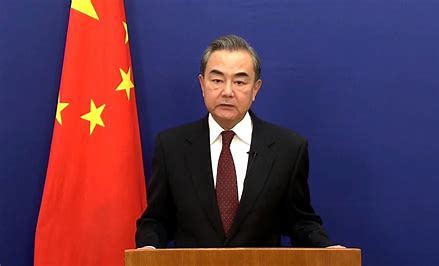
IN BRIEF
By Avishka Ashok and Arshiya Banu
INTERNATIONAL
The Pacific Islands: Position paper reveals China’s policies and future plans in the region
On 30 May, the second China-Pacific Island Countries Foreign Ministers’ Meeting issued a position paper according to which China’s Foreign Minister Wang Yi proposed a series of proposals to deepen the comprehensive strategic partnership with the Pacific Island countries. The paper said: “Since the establishment of diplomatic relations, the paper said, China has implemented nearly 500 complete plant projects, technical assistance, in-kind assistance and concessional loan projects in Pacific island countries, which have helped them build important infrastructure such as roads, bridges, wharfs, hospitals, schools and stadiums, and trained about 10,000 professionals in various fields.” The paper also highlighted China’s cooperation with the Pacific countries on the Belt and Road Initiative and other trade ties. It further explained that China is looking to appoint a special envoy for Pacific Island countries affairs. (“China hopes to expand win-win cooperation with Pacific island countries for common development,” Xinhua Net, 31 May 2022)
United Nations: China calls for an investigation into school shootings in the US
On 31 May, the Strait Times reported that Global Times asked for an investigation into the mass shooting in the US; a day after the Foreign Ministry Spokesperson Zhao Lijian called for the same from the United Nations High Commissioner for Human Rights. The Global Times editorial said: “The US system is equally incapable, or lacks interest, motivation, and courage, to address these problems thoroughly.” Chinese media agencies have been highlighting the US shootings and calling for the US to deal with its internal issues before pointing fingers at China. The People’s Daily referred to the coloured killings in Buffalo in the US and said: “Racism is a poison running through American body politic.” (“China urges UN rights chief to look into school shootings in US,” The Strait Times, 31 May 2022)
The US: China criticize IPEF for failure to lower tariffs and excluding Beijing
On 30 May, China’s Foreign Minister Wang Yi criticized the economic framework initiated by the US for its failure to lower the tariffs. Wang said: “The so-called Indo-Pacific Economic Framework recently rolled out by the US claims to build a free, open, and inclusive new order, but how can any economic frame call itself free if it doesn't lower tariffs? How can it be called inclusive if it purposefully excludes China, the largest market in the region and in the world?” The statements were made by Wang Yi while on a trip to Fiji who recently joined the IPEF. (“China derides Biden's IPEF economic pact for failing to lower tariffs,” The Strait Times, 31 May 2022)
World Economic Forum: WEF appreciates and encourages the Global Development Index
On 31 May, Xinhua Net reported that the World Economic Forum published an article on its website in support of the Global Development Initiative, a China-led project. The article said: “The China-proposed Global Development Initiative (GDI) is a timely call-for-action to address those pressing challenges that threaten the global collective ability to deliver on the Sustainable Development Goals (SDGs).” The Chief Representative Officer of the WEF China Office Rebecca Ivey further stressed on the importance of dealing with global challenges together as no country could face them alone. She further encouraged and appreciated China’s efforts in the initiative. (“China's Global Development Initiative a timely call-for-action to address global challenges: WEF officer,” Xinhua Net, 31 May 2022)
INTERNAL
The General Administration of Customs: China undertakes strict measures to prevent monkeypox virus from entering
On 30 May, the General Administration of Customs (GAC) stated that China's customs authorities have made measures to prevent the monkeypox virus from entering the country through ports while the government fights the COVID-19 epidemic. The GAC has gathered experts to undertake a risk assessment, issued monkeypox virus alerts, and implemented tight safeguards for inbound travellers, including body temperature monitoring and medical inspection. Customs authorities have reinforced quarantine of inbound goods and rodents, as well as improved biosafety management in laboratories and developed solid testing preparations. The GAC advises outbound and inbound travellers to report to customs agents if they are sick or have symptoms such as fever, headache, sore muscles, or erythra. (“China tightens measures to prevent import of monkeypox virus,” Xinhua Net, 30 May 2022)
Hong Kong: John Lee officially appointed as HKSAR chief executive by Premier Li
On 30 May, Premier Li Keqiang granted the official certificate of appointment to John Lee as the sixth-term chief executive of the Hong Kong Special Administrative Region (HKSAR) in Beijing. Li assured Lee that the central government will remain steadfast in its commitment to fully and faithfully implement the principle of "one country, two systems," under which Hong Kong's people rule the territory with a great degree of autonomy. He added that they will fully support the chief executive and the SAR government in exercising law-based governance, developing the economy, and improving people's well-being, as well as combining the country's needs and leveraging Hong Kong's strengths, in order to promote Hong Kong's better integration into the country's overall development and maintain its long-term prosperity and stability. (“Premier Li grants appointment certificate to John Lee as HKSAR chief executive,” Xinhua Net, 30 May 2022)
ECONOMY
Faltering Economy: Chinese Premier holds videoconference to warn about China’s economic difficulties
On 30 May, the Strait Times reported that Chinese Premier Li Keqiang held a videoconference with 100,000 provincial leaders to warn them about China's economic woes and to urge them to assist businesses in resuming production following the COVID-19 lockdowns. The State Council, China's Cabinet, announced a slew of measures the same week to bolster the faltering economy, which has been hit hard by lockdowns in several cities, including the commercial hub Shanghai, in response to a sweeping Omicron wave that has been plaguing the country since early this year. (“China's promising plan to break internal trade barriers,” The Strait Times, 30 May 2022)
REGIONAL
Taiwan: Jets rush to warn off the Chinese air force from entering the air defence zone
On 30 May, Taiwan’s Defence Ministry stated that in the latest flare-up of tensions, Taiwanese jets raced to warn away 30 Chinese aircraft in the largest incursion by China's air force in its air defence zone. For the past two years or more, Taiwan has protested about recurrent flights by China's air force near the democratically administered island, often in the southern area of its air defence identification zone, or ADIZ, close to the Taiwan-controlled Pratas Islands.
Taiwan refers to China's frequent military activity in the vicinity as "grey zone" warfare, which is intended to wear down Taiwan's forces by forcing them to scramble repeatedly, as well as to test Taiwan's responses. The ministry said that the current Chinese mission included 22 fighters as well as electronic warfare, early warning, and anti submarine aircraft. (“Taiwan jets scramble as China air force enters air defence zone,” The Strait Times, 30 May 2022)
30 May 2022 | Monday | China Reader Evening Brief | Vol.1, No. 196
United Nations human rights Chief implores China to review its policies in Xinjiang
Before the visit to Xinjiang, Michelle Bachelet clarified that the purpose of the visit was to hold a discussion with the Chinese authorities over their policies and not inspect the region.
IN BRIEF
By Avishka Ashok and Arshiya Banu
INTERNATIONAL
United Nations: Human rights chief urges China to rethink its anti-terrorism and deradicalization policies
On 29 May, the Asahi Shimbun reported that the United Nations High Commissioner for Human Right Michelle Bachelet had raised questions about the violation of the rights of the Uighur ethnic group in the Xinjiang region. Bachelet clarified that the aim of the trip was not to inspect but to have open discussions with the Chinese authorities on fulfilling its obligations under the international humani rights law. She said: “It provides an opportunity for me to better understand the situation in China, but also for the authorities in China to better understand our concerns and to potentially rethink policies that we believe may impact negatively on human rights.” She also discussed the broad application of the counter-terrorism and de-radicalization laws on the Muslim minorities in Xinjiang. (UN human rights chief asks China to rethink Uyghur policies,” The Asahi Shimbun, 29 May 2022)
Niue: Premier video calls Chinese Foreign Minister and dicusses bilateral ties
On 29 May, Chinese State Councilor and Foreign Minister Wang Yi spoke on a video call with Niue’s Premier and Foreign Minister Dalton Tagelagi, with both sides promising to strengthen bilateral cooperation, including on the Belt and Road initiative (BRI). During the call, Wang stated that since establishing diplomatic ties, China and Niue have seen their relations develop smoothly with mutual respect and support, noting that they have established a bilateral comprehensive strategic partnership and signed documents on jointly building the Belt and Road. Tagelagi expressed his gratitude to China for its selfless assistance and significant support for his country's independent development and people's livelihood. He stated that his country intends to enhance cooperation with China in numerous fields and work together to promote peace, development, and prosperity while maintaining continuing commitment to the one-China concept. (“Niue, China to deepen bilateral cooperation,” Xinhua Net, 29 May 2022)
Myanmar: Union Minister for Health thanks China for donating 10 million vaccine doses
On 29 May, the Chinese embassy in Myanmar released a statement saying that China has sent 10 million doses of COVID-19 vaccine syringes, and two mobile laboratory trucks to Myanmar. The vaccine doses and syringes were delivered to Myanmar's Ministry of Health at Yangon International Airport in separate batches from 18 May to 29 May. Chinese Ambassador to Myanmar Chen Hai stated that China has been consistently sending medical supplies to Myanmar in the fight against the COVID-19 pandemic, as well as assisting Myanmar in filling and packing COVID-19 vaccines to increase the country's immunisation rate. Myanmar's Union Minister for Health Thet Khaing Win expressed gratitude for China's donation. He stated that the currently donated COVID-19 vaccinations will be employed in the inoculation of youngsters aged five to twelve years old and the two mobile laboratory trucks will be utilised at the country's border checkpoints. (“China donates 10 mln COVID-19 vaccine doses to Myanmar,” Xinhua Net, 29 May 2022)
The PIF: Foreign Minister Wang Yi meets with PIF Secretary General to discuss blue economy
On 29 May, Chinese State Councilor and Foreign Minister Wang Yi met with Pacific Islands Forum (PIF) Secretary General Henry Puna to discuss bilateral cooperation on the blue economy and climate change. Wang stated that the Pacific Islands Forum (PIF) is the most representative intergovernmental organisation in the South Pacific region, and China has prioritised its engagement in regional affairs. Wang said that the Chinese side supports the island states' Blue Pacific Continent 2050 Strategy and is open to explore cooperation in areas such as marine ecological preservation and e-commerce in order to establish new growth points. Puna stated that China, as a key dialogue and development partner of the Pacific Island countries, has long made an indispensable contribution to their development, and that the Pacific Island countries are ready to strengthen their ties with China's development strategy, expand cooperation in areas such as economy and trade, education, and the blue economy, and fully seize the opportunities presented by China's development. (“Chinese FM, PIF secretary general discuss cooperation on blue economy, climate change,” Xinhua Net, 29 May 2022)
Switzerland: Government puts renewal of FTA with China on hold until human rights review
On 29 May, Reuters reported that Switzerland was reviewing its opinion on China’s human rights records. As a result of the review, the efforts to renew its free trade agreement with China have been put on hold. China signed the first FTA in 2013, which was also the first agreement signed with an European country. Switzerland’s State Secretariat for Economic Affairs explained that the country has been trying to include sustainability features and extend the tariff reductions to more Swiss products. The office said: “So far it has not been possible to agree on a common list of topics that should be explored in greater depth.” (“China-Switzerland trade talks stall over rights issues, Swiss newspapers report.” Reuters, 29 May 2022)
INTERNAL
Ministry of Education: Publisher asked to redesign textbooks due to erroneous and indecent illustrations
On 30 May, the Strait Times reported that China had demanded a change in its textbook illustration after the public raised concern over the images being ugly, pornographic and racist. The Ministry of Education issued a statement and asked the People’s Education Press to “rectify and reform the publications.” The publisher will now have to change the illustrations and have them approved by the government before the fall semester begins. The Ministry also called for a detailed inspection of all school textbooks and pledged to address the people’s concerns regarding children’s education. The statement by the government body promised to work towards ensuring teaching methods that “adhere to the right political direction and value orientation, promote outstanding Chinese culture, and conform to the aesthetic tastes of the general public." (“China tells publisher to redo school textbook pictures after outcry,” The Strait Times, 30 May 2022)
ECONOMY
State Administration of Foreign Exchange: Data shows surplus in Chinese foreign goods trade
On 28 May, CGTN reported that the State Administration of Foreign Exchange released data showing that China recorded a surplus in its international goods trade in April. Last month, goods exports totalled 1.6666 trillion yuan (about $247.3 billion), while imports totalled 1.3568 trillion yuan, resulting in a 309.9-billion-yuan surplus. In April, China's international trade in services showed a deficit of 42.9 billion yuan. Total foreign goods and services trade imports and exports totalled 3.4427 trillion yuan in April, largely unchanged from April last year. (“China reports surplus in international goods trade,” CGTN, 28 May 2022)
TECHNOLOGY
Space: Shenzhou XIV prepares for launch and second six-month mission
On 29 May, the Shenzhou XIV was shifted to Jiuquan Satellite Launch Centre in Inner Mongolia as the launch is scheduled to take place in a few weeks. The government also released details about the final phase of the work on the Chinese space station Tiangong. China Daily also announced the government’s plans to launch the station’s lab component in July and another in October. At the end of the year, Shenzhou XV is scheduled to report at the space station along with the Tianzhou 5 cargo craft. (“China prepares final missions to complete its own space station,” The Strait Times, 30 May 2022)
28 May 2022 | Saturday | China Reader Evening Brief | Vol.1, No. 195
Foreign Minister Wang Yi’s visit to the Pacific Islands
Foreign Minister Wang Yi is on a tour to the Pacific Islands countries where he expects to enhance China's relationship with the countries.
IN FOCUS
By Avishka Ashok
Foreign Minister Wang Yi’s visit to the Pacific Islands
On 16 May, China’s Foreign Minister Wang Yi and the Foreign Minister of the Solomon Islands Jeremiah Manele held a joint press conference and appreciated the enhanced relationship between the countries. Wang is visiting Solomon Islands, Kiribati, Samoa, Fiji, Tonga, Vanuatu, Papua New Guinea and East Timor as he tries to build a suitable position for China’s economic involvement with the Pacific Island countries. Kiribati, which had strictly closed its borders due to the coronavirus pandemic, made an exception for Wang Yi and his 20 colleagues in the delegation. They are expected to arrive at a consensus on sustainable fishing in the UNESCO protected Phoenix Islands in the country.
China’s “Four upholdings” for the Pacific countries
Wang referred to the growing relationship and said that China would continue to follow the “four upholdings” in developing its relations with the Pacific Island countries. The “four upholdings” refer to China’s practices in cooperating with the Pacific Island countries; which are upholding equal treatment, mutual respect, win-win cooperation and openness and inclusiveness in developing relationships. Wang Yi explained that China has always viewed all countries equally, regardless of their territorial size and political prowess. He also highlighted that China had never interfered in the political affairs of the countries nor sought its selfish interests in the region. Furthermore, he described China’s keenness in providing a win-win cooperation and building the infrastructure of the Pacific Island countries. Lastly, he stressed on creating an environment for cooperation and not destructive competition.
Eight consensuses with the Solomon Islands
During his visit to the Solomon Islands, the two countries agreed on eight consensuses after in-depth and detailed discussions. The eight were explained in detail by Wang Yi during the joint press conference.
First, the countries agreed to strongly establish the political foundation of their bilateral relations. China pledged to firmly support Solomon Island’s sovereignty an independence while protecting each other’s core interests and paths of development.
Second, both countries agreed to heighten their cooperation in the Belt and Road Initiative and help accelerate their personal development and revitalization. Wang said: “China will take earnest measures to facilitate two-way trade and investment, expand the Solomon Islands' export of competitive products to China and support Chinese enterprises in investing in the Solomon Islands.” He also promised to provide zero-tariff treatment on 98 per cent of Solomon Islands’ exports to China.
Third, China and Solomon Islands agreed to participate constructively in the Global Development Initiative which had been proposed by China. China also promised to help rebuild the capital city of Honiara and continue the support provided for Chinese projects such as the 2023 Pacific Games Stadium and other healthcare and welfare projects.
Fourth, the countries agreed to help each other maintain a stable and steady domestic politics within the country; aiming at protecting the development paths of the countries. China therefore, pledged to continue to conduct law enforcement and security cooperation in Solomon Islands.
Fifth, China and Solomon Islands confirmed their cooperation in promoting connectivity. The countries agreed to mutual visa exception, cooperate in civil aviation and provide greater opportunities for people-to-people exchanges.
Sixth, China and Solomon Islands agreed to work together on Climate Change and provide support at an international level to enhance their capacities to cope with the impacts of climate change. The delegations identified marine protection, disaster prevention and mitigation, emergency responses and blue economy as the primary areas of cooperation.
Seventh, the countries agreed to cooperate on sub-national exchanges. Post the establishment of sister-city relations between Honiara and Jiangmen, more opportunities for exchanges at a provincial level have opened to the common people of the two countries. Wang Yi encouraged the establishment of sister-city relations with more cities in the two countries to advance the pace of sub-national exchanges.
Eighth, the countries decided to defend the interests of other developing nations and work towards true multilateralism. They pledged to fight against zero-sum games, bullying, coercion, interference in internal affairs and sincerely uphold the international system by safeguarding the legitimate rights of the developing countries.
Conclusion
China under President Xi Jinping has been expanding the country’s foreign relations, especially with the Pacific Island countries; much to the dismay of Australia and other Western countries. With the Belt and Road Initiative, Xi has roped in the Pacific countries and plans to connect them with the Chinese and European markets. The Pacific countries have been accepting of the Chinese support and have been welcoming the low-cost benefits offered by the Chinese initiatives.
References:
“Chinese FM underlines "four upholdings" in ties with Pacific island countries,” Xinhua Net, 27 May 2022
“China’s FM visits Kiribati, where fishing ground is at stake,” The Asahi Shimbun, 27 May 2022
“China, Solomon Islands reach eight-point consensus,” Xinhua Net, 27 May 2022
“What’s at stake for China on South Pacific visit?,” The Asahi Shimbun, 26 May 2022
IN BRIEF
By Avishka Ashok and Arshiya Banu
INTERNAL
Hong Kong: New leader John Lee prepares to meet with Central Government officials
On 28 May, the newly elected leader of Hong Kong John Lee visited Beijing and will be holding a meeting with the central government as he prepares to take his position on 1 July 2022. The four-day trip will result in the official appointment of Lee as the Chief Executive of Hong Kong city. Lee is also prepared to present President Xi Jinping with a list of team members who will be appointed post Xi’s approval. Lee will have to quarantine until Monday to meet the officials from the central government. (“Hong Kong's next leader John Lee visits Beijing for official nod,” The Strait Times, 28 May 2022)
ECONOMY
Foreign Exchange: Data External portfolio investment assets reaches USD 979.7 billion by 2021
On 27 May, China's foreign exchange regulator, the State Administration of Foreign Exchange (SAFE), released data showing that the country's external portfolio investment assets, excluding reserve assets, totaled USD 979.7 billion US by the end of 2021. According to the data, USD 648.4 billion was invested in stock and USD 331.3 billion was invested in bonds. External portfolio investment assets owned by non-bank financial institutions reached 390.4 billion USD, accounting for 40 per cent of the total. Banks held USD 238.1 billion, or 24 percent of the total. China's Hong Kong Special Administrative Region, the United States, the Cayman Islands, the British Virgin Islands, and the United Kingdom were the top five recipients of Chinese investments. (“China's external portfolio investment assets top 979 bln USD by end of 2021,” Xinhua Net, 27 May 2022)
Medical products: The US extends tariff extension on Chinese products used for COVID-19
On 27 May, the US Trade Representative’s Office (USTR) announced its decision to extend the tariff exclusions on Chinese-made medical products for another six months. Products such as facemasks, surgical gloves, hospital gowns fall under the tariff exclusion and are extensively used to address the COVID-19 pandemic in the US. The USTR explained that the products were provided with an exclusion from tariffs of upto 25 per cent and were initiated by the former President Donald Trump in 2020. After an initial extension, they are due to expire on 31 May 2022. (“U.S. extends tariff exclusions on Chinese COVID-19 medical products,” Reuters, 28 May 2022)
TECHNOLOGY
Ministry of Industry and Information Technology: China's lithium-ion battery output reaches 95 GWh over a two-month period
On 27 May, the Ministry of industry and Information Technology released data which showed that China's lithium-ion battery output reached 95 GWh in March and April as the strong development momentum of the new energy vehicle sector continued to propel expansion. The output of the batteries used for power storage and for powering new energy vehicles was more than 10.5 GWh and 34.6 GWh, respectively. The battery exports totalled 42.3 billion yuan over the two-month period (about USD 6.28 billion). For the past five years, China has become the world's largest consumer of lithium-ion batteries. According to the ministry, the industry's entire production value hit 600 billion yuan last year. (“China's lithium-ion battery output tops 95 GWh in March-April,” Xinhua Net, 27 May 2022)
REGIONAL
Taiwan: Ministry of Culture stresses on need to preserve traditional languages
On 28 May, the Strait Times reported that the Taiwanese cabinet had approved a budget plan worth NTD (New Taiwan Dollar) 30 billion to develop the languages used by the ethnic Taiwanese groups. The plan was approved after the citizens expressed concern over the prioritization of English language over other traditional Taiwanese languages after a pledge was made to make Taiwanese fluent in English by 2030. The Culture Ministry of Taiwan, the plan would put Taiwanese Hokkien, Taiwanese sign languages, Hakka, Matsu and other indigenous languages at risk. The Ministry of Culture, the Council of Indigenous Peoples, the Hakka Affairs Council and the Ministry of Education opposed the plan and called for revitalizing, preserving, and developing the ethnic and traditional languages. (“Taiwanese support government's plan to promote languages at risk of disappearing,” The Strait Times, 28 May 2022)
INTERNATIONAL
The US: Chinese Foreign Ministry spokesperson responds to Blinken’s accusations
On 27 May, the Chinese government accused America’s top diplomat of spreading fake news by calling China “the most serious long-term challenge to the international order,” and questioned the US’ sincerity in trying to avert conflict. Foreign Ministry spokesperson Wang Wenbin also asked the US to let go of its ambition to contain China and to stop saying and doing things that have harmed the two nations’ relationship, which is at its lowest. US Secretary of State Antony Blinken had stated that China has undermined the world order that has enabled it to prosper and become the world's second-largest economy, adding that the Biden administration will “shape the strategic environment around Beijing to advance our vision for an open and inclusive international system”. (“Beijing accuses Blinken of spreading fake news about China,” The Strait Times, 27 May 2022)
North Korea: Beijing criticizes sanctions despite China and Russia’s veto
On 27 May, the permanent representative of China to the United Nations (UN) Zhang Jun stated that sanctions will not help resolve the Korean Peninsula's nuclear issue but will instead lead to an "escalation" with humanitarian repercussions. Zhang made the comments after China vetoed a UN resolution led by the United States to impose strict sanctions on the Democratic People's Republic of Korea (DPRK) in response to its missile tests. Zhang said: "Facts have proved that dialogue and negotiation is the only way to solve the problem," and added that "additional sanctions against the DPRK will only add to the misery of the DPRK people, and in this sense, neither right nor humane." Zhang has also accused the US of failing to follow through on past talks between Washington and Pyongyang. (“Chinese UN envoy: sanctions won't solve Korean Peninsula nuclear issue,” CGTN, 27 May 2022)
The UN: China appreciated for its assistance in peacekeeping operations
On 27 May, UN Under-Secretary-General for Peace Operations Jean-Pierre Lacroix commended China's assistance for UN peacekeeping operations. He said: "China is one of our main supporters, really both in terms of the financial contributions, also in terms of the contributions in the field with more than 2,000 peacekeepers," at the UN headquarters in New York. Lacroix stated that China is one of the members "that also provides us with the voluntary funding," which he described as “extremely important” as it enables the UN “to carry out the number of reforms and new work trends that are indispensable to peacekeeping reforms." (“UN peacekeeping chief praises China's support,” Xinhua Net, 27 May 2022)
27 May 2022 | Friday | China Reader Evening Brief | Vol.1, No. 194
Solomon Islands Prime Minister meets visiting Chinese Foreign Minister
Chinese State Councilor and Foreign Minister Wang Yi visited Solomon Islands Prime Minister Manasseh Sogavare and both expressed willingness to forge “iron-clad” ties.
IN BRIEF
By Avishka Ashok and Arshiya Banu
TECHNOLOGY
Space: Breakthrough in space science as scientists figure out how to harvest energy from sun
On 26 May, CGTN reported that Chinese researchers have developed a new type of material vanadium dioxide (VO2) that absorbs heat from the sun during the day and emits energy into space to capture cooling at night, in a revolutionary technique to harvesting renewable energy. Their findings were published in the Proceedings of the National Academy of Sciences online (PNAS). According to Pei Gang and Zou Chongwen, renowned experts from China's University of Science and Technology, the breakthrough is in harvesting "heat and cool" in a single structure, saving space and money. (“Chinese scientists make breakthrough harvesting energy from sun, outer space cooling,” CGTN, 26 May 2022)
REGIONAL
South China Sea: China’s Maritime Safety Administration announces military drill
On 26 May, China’s Maritime Safety Administration announced that the country would be conducting naval exercises in the South China Sea, 25 kilometers from the coast of Hainan. The military exercise is scheduled to take place right after Biden’s visit to East Asia where he warned China against flexing its military prowess in the region. The notice issued by the government body said: “Military exercises will be held and entry is prohibited.” An area of 100 square kilometers will be restricted during the military drill for over five hours. (“China plans fresh military exercises in South China Sea,” The Strait Times, 27 May 2022)
INTERNATIONAL
The Solomon Islands: Prime Minister meets visiting Chinese Foreign Minister
On 26 May, Chinese State Councilor and Foreign Minister Wang Yi visited Solomon Islands Prime Minister Manasseh Sogavare and both expressed willingness to forge “iron-clad” ties and expand bilateral cooperation. Sogavare thanked China for giving anti-pandemic supplies, rapid-test equipment, and sending medical teams to his country, saying China has become the Solomon Islands' largest cooperation partner on basic infrastructure and a trusted development partner. He also expressed gratitude to China for delivering policing supplies and police advisers to the Solomon Islands in the aftermath of the Honiara violence. Wang voiced China's appreciation for the Solomon Islands' firm commitment to protect national interests, strong desire to deepen friendly cooperation between China and the Solomon Islands, and adherence to the one-China policy. (“China, Solomon Islands ready to forge "iron-clad" ties,” Xinhua Net, 26 May 2022)
Europe: First China-Europe train starts its journey
On 26 May, a Chinese freight train carrying fibreglass left Yinchuan, the capital of Ningxia Hui Autonomous Region in northwest China, for Budapest, Hungary. According to China Railway Lanzhou Group Co., Ltd., the 1,300 tonnes of fibreglass, valued 10.5 million yuan (about 1.6 million USD), would travel 8,500 kilometres, and arrive at its destination in 21 days. This is the first China-Europe freight train to leave Ningxia this year, as well as the first link between the two cities. The new route will significantly reduce enterprise delivery times, efficiently speed up goods circulation and payment, and lower transportation expenses. (“China-Europe freight train heads to Budapest,” Xinhua Net, 26 May 2022)
The EU: Chinese Foreign Minister holds phone conversation with new French European and Foreign Affairs Minister
On 26 May, Chinese State Councilor and Foreign Minister Wang Yi talked on phone with new French European and Foreign Affairs Minister Catherine Colonna, who assumed office last week. Wang emphasized that the basic tone of China-EU ties is friendship, and cooperation is the norm, and added that the two sides are partners rather than adversaries. Wang called for measures to avoid "microphone diplomacy" and stated that China and the EU should respect one other, enhance mutual understanding, and engage in frank and in-depth conversation. He noted that China strongly supports European integration and that France, which now holds the rotating presidency of the EU, is committed to promoting Europe's strategic autonomy. (“Wang Yi: China, EU are partners, not rivals,” CGTN, 26 May 2022)
Libya: China calls for a political settlement to the impasse
On 26 May, China’s deputy permanent representative to the United Nations Dai Bing urged the member countries to committedly work towards a political settlement in Libya. Bing highlighted the uncertainty in the political process in the country and the differences amongst the parties over the legitimacy of the government as the most urgent issues that must be resolved. He addressed the Security Council and said: “We call on all parties in Libya to put the interests of the country and people first, stay committed to the general direction of political settlement, exercise maximum restraint, refrain from taking any action that may escalate tensions, and maintain the hard-won peace and stability.” He further stressed on dialogue and consultations as the only solution to resolving the impasse in Libya. (“Chinese envoy calls for commitment to political settlement for Libya crisis,” Xinhua Net, 27 May 2022)
Israel-Palestine: China implores countries to work on a well-tailored approach to the conflict
On 26 May, China’s permanent representative to the United Nations Zhang Jun stressed on a well-tailored approach to bring peace between Israel and Palestine as violence continued to spike in the last month. Zhang said: “During the past month, the security situation in the occupied Palestinian territory has remained turbulent, with multiple clashes between Israeli security forces and Palestinians, resulting in the continued increase in Palestinian civilian casualties. Attacks against Israeli civilians also occurred from time to time.” Zhang further highlighted the importance of upholding the status-quo of holy sites and implored the member countries to refrain from taking unilateral actions that would risk the peace and sanctity of the place. (“Chinese envoy calls for well-tailored approach to Israeli-Palestinian issue,” Xinhua Net, 27 May 2022)
The US: Secretary of State delivers a speech on relations with China
On 26 May, the US Secretary of State Antony Blinken delivered a 45-minute speech on the US-China bilateral issues at the George Washington University and explained that the US does not aim to restrict China’s growth but wishes it to follow the international rules. He further explained that the US does not seek to change China’s political system but will defend the international law and institutions that protect the peace and security of all countries. He said: “We are not looking for conflict or a new Cold War. To the contrary, we're determined to avoid both.” He referred to China as “the most serious long-term challenge to the international order” and claimed that the country had become more repressive and aggressive under the leadership of President Xi Jinping. (“China strategy is about rules-based order, not ‘new Cold War,’ Blinken says,” The Asahi Shimbun, 27 May 2022)
26 May 2022 | Thursday | China Reader Evening Brief | Vol.1, No. 193
China expresses condolences and concern over Texas school shooting
Foreign Ministry Spokesperson urges the US to prioritize and protect its the human rights of its citizens.
IN BRIEF
By Avishka Ashok and Arshiya Banu
INTERNATIONAL
The US: Chinese Foreign Ministry spokesperson expresses condolences to the Texas school shooting victims and their families
On 25 May, China's Foreign Ministry spokesperson Wang Wenbin stated that the country is disheartened by the high number of people killed in the US and expressed condolences to the victims and sympathy to the injured and grieving families in the Texas shooting incident. Wenbin made the statements after an 18-year-old gunman killed 19 children and two adults at a Texas elementary school and urged the US to effectively protect its own people’s human rights. Wang said: "The right to life is the biggest human right and racial discrimination is the worst injustice," highlighting that the United States has the highest levels of gun violence, racial discrimination, and a human rights deficit. (“China saddened by Texas school shooting, urges U.S. to effectively protect human rights: FM spokesperson,” Xinhua Net, 25 May 2022)
The US: China conducts military exercises around Taiwan as a warning
On 25 May, the Chinese People's Liberation Army's Eastern Theatre Command spokesperson Shi Yi stated that it recently conducted an exercise around Taiwan as a "solemn warning" against its "collusion" with the US. Earlier, US President Joe Biden enraged China by appearing to foreshadow a shift in the US policy of "strategic ambiguity" on Taiwan by declaring the US would intervene militarily if China attacked the island. However, he later stated that US policy had not changed. Yi said: "It is hypocritical and futile for the United States to say one thing and do another on the Taiwan issue." While the US maintains a "one China" policy, recognising only Beijing, it has pledged under the Taiwan Relations Act to "to help provide Taiwan the means to defend itself." (“China says it conducted military exercise around Taiwan to warn US,” The Strait Times, 25 May 2022)
The US: Asian plan backed by the US to decouple countries from the Chinese economy
On 25 May, China’s Foreign Ministry spokesperson Wang Wenbin stated that a US-backed strategy for Asia aims to decouple countries from the Chinese economy, but many countries are concerned about the "huge cost" of doing so. Wang claimed the Indo Pacific Economic Framework for Prosperity (IPEF) serves US interests and strives to exclude other countries during a news briefing. Earlier this week, US President Joe Biden launched this plan. Australia, Brunei, Indonesia, Japan, New Zealand, Singapore, South Korea, Thailand, Vietnam, and the United States were among the initial founding countries, but not China. (“Beijing says US-backed Asia plan seeks to 'decouple' countries from China,” The Strait Times, 25 May 2022)
The Pacific: Chinese Foreign Minister to hold summit in Fiji next week to seek regional agreement
On 25 May, Reuters reported that Foreign Minister Wang Yi will host a summit in Fiji next week, where China will seek a regional agreement covering policing, security, and data communication cooperation. A draft communiqué and five-year action plan issued by China to ten Pacific islands ahead of a meeting of foreign ministers on May 30 has sparked criticism from at least one of the invited countries, which claims it demonstrates China's desire to rule the region and "threatens regional stability." The president of the Federated States of Micronesia (FSM), David Panuelo, said in a letter to 21 Pacific leaders that his country would argue the "pre-determined joint communique" should be rejected because it may start a new "Cold War" between China and the West. (“EXCLUSIVE China seeks Pacific islands policing, security cooperation – document,” Reuters, 25 May 2022)
Jordan: President of the Senate meets Li Zhanshu and discusses bilateral exchanges
On 25 May, the Chairman of China’s National People’s Congress Li Zhanshu held a meeting with Jordan’s Senate President Faisal Fayez and expressed support and hope for enhancement of their bilateral relations. Li noted the traditional friendship between China and Jordan and appreciated the deepening of the relations. Li said: “China appreciates Jordan's adherence to the one-China principle and firmly supports Jordan in exploring a development path and governance model suited to its national conditions.” He further encouraged Jordan’s participation and contribution in the Belt and Road Initiative and noted that it was an important part of the project. Lastly, Li extended the invitation to join the China-led Global Security Initiative to Jordan while explaining the constructive role played by China in the Middle East. (“China's top legislator holds talks with Jordan's Senate president,” Xinhua Net, 25 May 2022)
BRICS: Member countries launch joint committee on space cooperation
On 25 May, the BRICS member countries launched the Joint Committee on Space Cooperation, marking another step in the group’s cooperation in remote sensing satellite observation and data sharing. The space agencies from the five countries reviewed the documents and adopted them based on the Joint Committee terms of reference. The head of the China National Space Administration said: “The joint committee will guide cooperation on the BRICS Remote Sensing Satellite Constellation to better serve economic and social development in member countries.” The new initiative is expected to deepen the cooperation between the member countries and help in environmental protection, disaster prevention and mitigation, and tackling climate change. (“BRICS countries launch joint committee on space cooperation,” Xinhua Net, 26 May 2022)
France: Foreign Ministers discuss relations under Macron-Xi leadership
On 26 May, China’s Foreign Minister Wang Yi held a phone conversation with France’s Foreign Minister Catherine Colonna and discussed the future of their bilateral relations. The leaders promised to enhance the diplomatic ties while also deepening the cooperation between China and the EU. Wang appreciated the progress of their relationship under the leadership of President Xi Jinping and President Emmanuel Macron and said: “The heads of state of the two countries have forged solid mutual trust and friendship, and maintained close communication, which provided strategic guidance for the both countries to jointly tackle global challenges and injected stability into a turbulent world.” Wang and Colonna also discussed the crisis in Eastern Europe and agreed to playing a constructive role in the region. (“China, France vow to improve bilateral ties, deepen China-EU cooperation,” Xinhua Net, 26 May 2022)
Global Environment Facility: World Bank approves USD 26.92 million for green city projects in China
On 25 May, China’s Finance Ministry announced that the World Bank had approved funds for an urban environment project in China. The project is aimed at encouraging biodiversity conservation and carbon neutrality. According to the ministry, funds worth USD 26.92 million will be granted to the Global Environment Facility for Chongqing, Chengdu and Ningbo Carbon-Neutral Cities Project. The project is expected to finish by 2027 and will integrate biodiversity conservation in urban development. (“World Bank approves funds to promote biodiversity, carbon neutrality in Chinese cities,” Xinhua Net, 25 May 2022)
25 May 2022 | Wednesday | China Reader Evening Brief | Vol.1, No. 192
United Nations Human Rights Chief begins six-day visit amidst criticism from the West
Michelle Bachelet begins her visit to the controversial Xinjiang region to inspect the state of human rights.
IN BRIEF
By Avishka Ashok
INTERNAL
Xinjiang: President Xi meets UN Human Rights Chief and discusses China’s progress
On 25 May, President Xi Jinping held a virtual meeting with United Nations High Commissioner for Human Rights Michelle Bachelet and defended China’s progress on human rights within the country. The six–day visit by the UN Human Rights Chief aims to investigate the Xinjiang region which has been accused of discriminating against the muslim minority community in the region. Xi said: “Human rights issues should also not be politicised, instrumentalised, or treated with double standards. China has a human rights development path that suits its national conditions." Xi also explained that there was no ideal country that could teach others about human rights.
The US State Department spokesperson Ned Price referred to the visit and called it a mistake and expressed its scepticism regarding unfiltered access to the region. He said: “We have no expectation that the PRC (People’s Republic of China) will grant the necessary access required to conduct a complete, unmanipulated assessment of the human rights environment in Xinjiang. We think it was a mistake to agree to a visit under the circumstances.” He also highlighted the most recent media reports that publicised leaked photos and documents from the public security bureaus in two counties in the region and said that it added to an ““already damning body of evidence.”
China’s Foreign Ministry Spokesperson Wang Wenbin condemned the criticism issued by the US and the UK over the visit and said: “the U.S., Britain and other Western countries have been repeatedly staging political farces around the U.N. high commissioner for human rights’ visit to China.” He accused the West of sabotaging China’s relations with foreign countries by spreading lies about the Human Rights Chief’s visit. He further denounced the US and the UK for pressurising and calling for an investigation on the basis of assumptions and biassed opinions.
(“Xi Jinping speaks with UN's Bachelet during visit, defends China's rights progress, The Strait Times, 25 May 2022; China claims sabotage as U.N. rights official visits Xinjiang,” The Asahi Shimbun, 25 May 2022; U.S. calls U.N. rights chief’s visit to China a mistake, The Asahi Shimbun, 25 May 2022)
COVID-19: Government may choose Pfizer and BioNTech mRNA vaccines to deal with the outbreak
On 25 May, the Asahi Shimbun reported that the Chinese healthcare system may deal with the latest outbreak of the coronavirus pandemic by using the mRNA vaccine, manufactured by Pfizer and BioNTech. The vaccines have still not been approved by the government for public use, although Macao and Hong Kong have authorised its use. The report predicted that the country would be subjected to far more COVID related deaths and a slower economic growth in the coming months due to the delay caused by hyper-nationalistic attitudes that prevented the protection of its population. The report stressed that studies have proved the vaccines made by Pfizer and BioNTech to be more effective than the Chinese vaccines. (“China’s bet on homegrown mRNA vaccines holds back nation,” The Asahi Shimbun, 25 May 2022)
Communist Party of China: Central Commission for Discipline Inspection expels party member for corrupt actions
On 25 May, the Central Commission for Discipline Inspection (CCDI) announced the expulsion of Former Chief Accountant of PICC Property and Casualty Co Shen Dong from the Communist Party of China for his involvement in illegal activities and bribe taking. Shen Dong was suspended from his post as the vice-President at the insurer in December after which the CCDI opened an investigation into the allegations of wrong-doings. The government body issued a statement on its website and claimed that Shen had been involved in illegal activities and had violated the Communist Party Discipline. (“China's Communist Party expels state-owned insurer's executive accused of graft,” The Strait Times, 25 May 2022)
ECONOMY
Indo-Pacific Economic Framework: China criticises the US trade deal for being exclusive
On 24 May, China’s Ministry of Commerce referred to the new Indo-Pacific Economic Framework and said that the trade deal should aim to enhance the development and cooperation in the Asia-Pacific region instead of undermining and dividing the countries. He called on the US initiative to contribute to the prosperity and development of the region by being open and inclusive to all countries. The Ministry spokesperson said: “The success of the Asia-Pacific economy lies in openness, cooperation and mutual benefit. China remains open to any regional economic initiative that conforms to the aforementioned principles. China will adhere to open regionalism and share weal and woe with its trading partners in the Asia-Pacific region.” (“China's Commerce Ministry responds to US-launched IPEF trade deal,” The Strait Times, 24 May 2022)
Society: China’s GenZ flex their powers in the global economy
On 25 May, the Strait Times reported on the purchasing power of the GenZ in China and the power they hold in the global fashion industry. According to the report, the 270 million strong generation born after the 1990s has been shaking up the economy by its power to purchase goods and services such as cosmetics, tourism services and other retail commodities. The China Renaissance predicts that the GenZ will be spending close to 16 trillion yuan by 2035, marking a fourfold increase in expenditure. The report further explored the power held by this generation of buyers as they could make or break the demand for foreign goods and brands in the country with their nationalistic beliefs. Another report highlighted the cosy environment of the Chinese GenZ’s upbringing which reflects in their spending behaviours, leading to a quarter of the generation not saving up at all. These factors may play a significant role in building the domestic market and economy. (“China's Gen Z has the power to make or break Western brands,” The Strait Times, 25 May 2022)
INTERNATIONAL
BRICS: State Councilor calls for enhanced cooperation in digital transformation
On 25 May, Xinhua Net reported that China’s State Councilor Wang Yong attended the BRICS Forum on Development of the Industrial Internet and Digital Manufacturing in Xiamen and called for greater cooperation in the fields. Wang also extended China’s willingness to work on the same and said: “China is willing to work with other BRICS partners to promote the development of the industrial internet and digital manufacturing, and jointly achieve growth that is higher in quality, more resilient and sustainable.” He further noted that the BRICS member countries complemented each other, thereby providing greater opportunities for digital transformation in the manufacturing industry. (“BRICS should cooperate on digital transformation: Chinese official,” Xinhua Net, 25 May 2022)
Germany: Foreign Ministers discuss last five decades of relations and promise to deepen cooperation
On 24 May, China’s Foreign Minister Wang Yi and German Foreign Minister Annalena Baerbock held a virtual meeting and agreed to work towards maintaining true multilateralism. Wang Yi made a note of the 50 years of bilateral relations between the countries and said: “Over the past five decades, the two countries have adhered to the concept of seeking common ground while reserving differences, mutual benefit and win-win results, and have deepened cooperation in various fields.” Wang also appreciated the government consultation mechanism, high-level dialogues on strategy, security, finance and people-to-people exchanges. (“Chinese, German FMs hold virtual meeting on bilateral ties, multilateralism,” Xinhua Net, 25 May 2022)
Greece: National People’s Congress Chairman calls for greater cooperation with Greek Parliament
On 24 May, the Chairman of China’s National People’s Congress Li Zhanshu held a virtual meeting with the President of the Greek Parliament Constantine Tassoulas and urged the countries to enhance parliamentary exchanges and support cooperation with each other. Li said: “China will work with Greece to implement the important consensus reached by the leaders of the two countries and promote the development of the bilateral comprehensive strategic partnership.” He also called for greater political trust and mutual cooperation. (“China's top legislator proposes enhancing parliamentary exchanges with Greece,” Xinhua Net, 25 May 2022)
24 May 2022 | Monday | China Reader Evening Brief | Vol.1, No. 191
The US-ASEAN Summit: Why China is anxious
The Chinese government responds to the US-ASEAN summit and cautions the Southeast Asian countries on the selfish interests of the US in the region.
IN FOCUS
By Avishka Ashok
The US-ASEAN Summit: Why China is anxious
On 12 and 13 May, the US held the US-Association of Southeast Asian Nations (ASEAN) Special Summit in Washington DC. The Summit celebrated 45 years of the US-ASEAN partnership, looked into the future of the relationship and the significance of the US in the region, which has been increasingly dominated by China. The summit focused on economic recovery, health security, climate change, green energy, pandemic recovery, supporting gender equality and women’s empowerment and strengthening the people-to-people exchanges.
ASEAN’s growing importance in the world
The ASEAN countries have been at the centre of fast economic growth and hold potential to further augment the global trade and economic development. According to a report by McKinsey in 2014, the ASEAN region was one of the fastest growing trading hubs along with having an equally significant and diverse consumer market. The ten countries’ trade value accounted for USD 2.4 trillion in 2013. The vast markets enable incessant product demand while the geographic location of the countries make it a vital trading destination along the maritime trading routes.
China’s close relations with ASEAN
The China-ASEAN Summit which took place on 22 November 2021 celebrated the 30th anniversary of their relations. Through the Summit, China expanded its influence in the region and strengthened its economic ties with the ten Southeast Asian countries. China established diplomatic relations with the countries in the region in 1991 and ever since, the trade ties have improved exponentially. The trade between China and ASEAN valued USD 684.6 billion in 2020 which the US-ASEAN trade totaled at USD 362.2 billion. Thus, China economic ties with the region has made it an important partner. China also views ASEAN as a vital economic partner as it ranked first as Beijing’s largest trading partner. Moreover, international initiatives such as the Belt and Road Initiative, Regional Comprehensive Economic Partnership, the Asian Infrastructure Investment Bank have brought China and ASEAN closer because of the deep economic and financial ties with each other.
China’s perspectives on the summit
China does not view the US-ASEAN summit in a positive light and has expressed its discontent with the political and economic interference of the US in the region. On 12 May, China’s Foreign Ministry Spokesperson Zhao Lijian referred to the summit and urged the US to play a positive and constructive role in the region instead of causing discord. Zhao said: “The United States should not use cooperation as a cover to force others to pick sides, or play with fire on issues concerning China's core interests.”
China has criticized the US-ASEAN summit for the following reasons:
First, the heightened US presence in the region is a part of the US strategy on the Indo-Pacific. China views the summit as the Biden administration’s ticket into the region and fears that the spike in interest is a part of the US strategy on the Indo-Pacific. The Chinese government expects heightened involvement of the US in the Indo-Pacific region and has cautioned the Southeast Asian countries that the US was only trying to get even with China by using ASEAN as a tool against it. Chinese media agencies have highlighted the positive response from countries like Indonesia, Vietnam and Cambodia to the summit. The heads of state of these countries clarified their stance on the cooperation and refused to take sides. Cambodia’s Prime Minister Samdech techo Hun Sen said: “We don't have to choose between the US and China.”
Second, the US has its selfish interests in the region. At the summit, the US pledged investments worth USD 150 million. However, Chinese analysts expect USD 60 million to be spent only on assisting US partners in establishing and maintaining maritime defense. Political analysts view this expenditure as an attempt to control the South China Sea through the Southeast Asian countries. The US has also been criticized for its one-track objective of focusing on security or creating a resistance against China’s influence in the region while talking about other objectives such as clean energy, climate change, education, gender equality and more. Chinese media agencies also stressed on the US tendency to take decisions unilaterally without considering other countries and their convenience. The US was accused of single-handedly deciding a date for the summit; which later had to be postponed as all leaders were not available on the previously mentioned dates. The actions of the US displayed it exclusive mindset, according to Global Times.
Why does China oppose US involvement in ASEAN?
First, the economic balance in Southeast Asia. Since the establishment of diplomatic relations with ASEAN in 1991 and then acquiring the full dialogue partner status in 1996, China and the ten ASEAN member countries have closely depended on each other’s trade, markets, manufacturing hubs and service sectors. Since 2009, China has continued to remain ASEAN’s largest trading partner. According to the data revealed by the Chinese government, ASEAN ranked first in terms of trade in the January-April 2022 period, followed by the EU and then the US. Although the US already maintains extensive relations with the countries along various diverse fields, China is reluctant to give up one of its most secure centres of economic activities. Increased US presence may pit the Chinese and American goods and services against each other, yet again.
Second, the political interference. The US President Joe Biden’s primary policy focus has been on the Indo-Pacific region and countering the growing Chinese influence in both, global politics as well as the global economy. China is aware of the US intentions and thus, wants to restrict its presence close to its territory. Moreover, the US interference in what China considers to be its internal affairs, such as the violation of human rights in the Xinjiang Autonomous Region and Tibet, the implementation of the National Security Act in Hong Kong, the issues in the Taiwan Strait and the aggression in the South China Sea has further irked the Chinese government into drawing clear boundaries while deal with the US. China, therefore, believes that the US aims to meddle in its affairs while hiding behind the ASEAN countries.
References:
“China-ASEAN relations expand into comprehensive strategic partnership,” Asian News International, 22 November 2021
“China urges U.S. to promote regional peace, stability at upcoming U.S.-ASEAN summit,” Xinhua Net, 12 May 2022
“U.S.-ASEAN Summit,” United States Department of State
“Understanding ASEAN: Seven things you need to know,” McKinsey, 01 May 2014
“ASEAN not a tool of US in its game against China: Global Times editorial,” Global Times, 15 May 2022
“ASEAN gets to know China's inclusiveness versus US' egoism,” Global Times, 15 May 2022
“ASEAN-China Economic Relation,” ASEAN
IN BRIEF
By Avishka Ashok
INTERNAL
Social Media: Tencent founder shares his opinion on the Chinese economy
On 23 May, the Economic Times reported that the founder of Tencent Holdings Pony Ma had caused a social media stir after he shared an article on the Chinese economy, a topic that has become increasingly sensitive within the country. The article shared by Pony on his WeChat moments feed highlighted that very few people spoke of the economic pressures and challenges facing China. Ma shared a part of the article and condemned the anti-capitalists and double standards of the people criticising the economy. The paragraph highlighted by Pony said: “The way some netizens care about the economy is: Firms can go bankrupt, but they cannot fire staff; firms can go bankrupt, but they cannot have overtime work. Of course if they order delivery and it's late by 10 minutes, they will curse, and will scold the delivery rider harsher than anyone else." (“china economy: Tencent chief causes stir with repost of article on China's economy,” The Economic Times, 23 May 2022)
REGIONAL
Japan: QUAD leaders prep to meet in Tokyo and discuss the Taiwan issue, South China Sea and the Indo-Pacific
On 24 May, the leaders of the Quad group of countries met in Tokyo and discussed their goal of countering China in the Indo-Pacific region. On 23 May, the US President Joe Biden warned China against beefing up its military presence in the region and around Taiwan. He also pledged to intervene militarily in case of an invasion and expressed his hope in the grouping. He said: “The Quad is showing the world that cooperation among democracies can get big things done.” Japan has also officially cautioned China against unilaterally changing the status quo in the region, especially with respect to the Senkaku or Diaoyu islands. The grouping is also expected to release a joint statement on the war in Ukraine. (“Japan hosts Quad summit seeking unity on countering China,” The Strait Times, 23 May 2022)
INTERNATIONAL
World Economic Forum: Chinese delegation accuses CNN of false report
On 24 May, Xinhua Net accused CNN of vilifying the Chinese delegation attending the World Economic Forum’s annual meeting in Davos, Switzerland. The CNN quoted a US politician and said that the Chinese delegation did not stand in respect after Ukrainian President Volodymyr Zelensky’s speech at the meeting and instead left the venue. The delegation from China opposed the reports and said that they were in conversation with the International Energy Agency Executive Direcetor Faith Birol during Zelensky’s speech. (“Chinese delegation to World Economic Forum vilified by CNN's false report,” Xinhua Net, 24 May 2022)
BRICS: Industry Ministers discuss new industrial revolution
On 23 May, the Industry Ministers of the BRICS countries held a virtual meeting and agreed to cooperate on deepening innovation on new industrial revolution and resiliently working towards achieving the Sustainable Development Goals. The meeting was hosted by China in Xiamen city in the Fujian province and provided a platform to discuss comprehensive cooperation, digital transformation of traditional industries and industrial and supply chain collaboration between the member countries. China’s Minister of Industry and Information Technology Xiao Yaqing observed the progress made by the countries since the first meeting and encouraged future cooperation on the same. He said: “China stands ready to work with all parties to deepen innovative cooperation on the new industrial revolution for achieving sustainable development goals in a stronger, healthier and more resilient manner.” (“BRICS ministers urge cooperation on new industrial revolution,” Xinhua Net, 24 May 2022)
United Nations: Wang Yi meets High Commissioner for Human Rights
On 23 May, Foreign Minister Wang Yi held a meeting with the United Nations High Commissioner for Human Rights Michelle Bachelet in Guangzhou, the latter’s first visit to China. Wang Yi welcomed Bachelet and noted that her visit marks the first visit by a UN High Commissioner for human rights in 17 years. Wang Yi also stressed on the Communist Party of China’s people centric approach and said: “China has always prioritized the rights to subsistence and development, protected citizens' legitimate rights and interests, and safeguarded the rights of ethnic minorities. While vigorously advancing its own human rights cause, China advocates the universal values of peace, development, fairness, justice, democracy and freedom.” (“Chinese FM meets UN human rights chief,” Xinhua Net, 24 May 2022)
Brazil: China co-chairs High-Level Coordination and Cooperation Committee
On 23 May, China’s Vice President Wang Qishan and Brazil’s Vice President Hamilton Mourao co-chaired the sixth China-Brazil High-Level Coordination and Cooperation Committee (COSBAN) meeting. Wang noted the bilateral cooperation and said: “China and Brazil have been accommodating each other's fundamental and long-term interests, and have worked together to counter global challenges, writing a new chapter of cooperation between emerging economies.” He also encouraged the communication between the countries on major international and regional issues and called for facilitation of common interests of the emerging markets. (“Vice presidents of China, Brazil co-chair COSBAN meeting,” Xinhua Net, 24 May 2022)
23 May 2022 | Monday | China Reader Evening Brief | Vol.1, No. 190
Pakistan and China's Foreign Minister discuss bilateral relations
Chinese State Councilor and Foreign Minister Wang Yi met with Pakistan’s new Foreign Minister Bilawal Bhutto Zardari
IN BRIEF
Avishka Ashok and Arshiya Banu
INTERNAL
Chinese Academy of Sciences: New database on national species released
On 23 May, Xinhua Net reported that according to the Chinese Academy of Sciences (CAS), China released an updated national species database called the Catalogue of Life China 2022 Annual Checklist. This year's checklist adds 10,343 species to the total number of species, bringing the total number of species to 138,293, including 68,172 animal species, 46,725 plant species, and 17,173 fungi species, among others. The checklist provides data that is useful for biodiversity study, conservation, and policymaking. Researchers from the CAS's Institute of Zoology, Institute of Botany, Institute of Microbiology, Chengdu Institute of Biology, and Institute of Oceanology, as well as other institutions, collaborated on the database. (“China releases new database on biodiversity,” Xinhua Net, 23 May 2022)
Archaeology: Incense from the ancient Silk Road has been unearthed
On 22 May, Xinhua Net reported that researchers from the University of Chinese Academy of Sciences (UCAS), the Palace Museum and the Famen Temple Museum found that incense recovered from an underground palace going back to the Tang Dynasty (618-907) offers archaeological evidence of incense trading along the ancient Silk Road. The researchers examined three incense samples found in Famen Temple's underground palace, which is known for containing the sacred finger bone sarira of Sakyamuni Buddha. Elemi, a yellow fragrant chemical found in Southeast Asian countries and southeast China, was discovered in one sample. Ren Meng of the Palace Museum stated that it is the earliest physical proof of elemi in the Tang Dynasty unearthed in China. (“Chinese researchers find archaeological evidence of brisk incense trade along Silk Road,” Xinhua Net, 22 May 2022)
Ministry of Human Resources and Social Security: China to develop a pension system to pay for its ageing population
On 23 May, the Strait Times reported that China is racing against time to develop a pension system capable of paying for the world's greatest population of old people. 18.9% of China's 1.4 billion inhabitants were over the age of 60 by the end of 2021 and data from the National Statistics Bureau indicated that the proportion has increased by 5.64 percentage points. According to the Ministry of Human Resources and Social Security (MHRSS), those over 60 will make up 20% of the population by 2025, and 30% by 2035. However, the country's pension system is struggling to keep up with the population's ageing. The entire balance of all forms of pension funds, including those funded by the government, businesses, and people, totalled 15 trillion yuan (S$3.09 trillion) at the end of March, accounting for 13% of GDP. (“China's race to provide for its ageing population,” The Strait Times, 23 May 2022)
Hong Kong: Analysts contend John Lee incapable of dealing with economic problems
On 23 May, the Strait Times reported that Hong Kong is relying on a former cop to help it deal with its mounting problems as analysts warn that the new leader will not fix the housing situation. Incoming Chief Executive John Lee is up against a problem that his predecessors, experienced civil servants and corporate executives, couldn't overcome. Lee's lack of exposure to the business community and his own priority on ensuring stability, as the former security secretary who led the assault on the 2019 protesters, means that the world's most costly housing market is unlikely to get cheaper any time soon. Dr Hung Ho-fung, a political economy professor at Johns Hopkins University said: "It is not sure whether he has the calibre and expertise to deal with those problems more effectively than his predecessors." (“New Hong Kong leader John Lee's vow to fix housing crisis draws sceptics,” The Strait Times, 23 May 2022)
Hong Kong: HKSAR commemorates 25th anniversary by releasing special stamps
On 22 May, CGTN reported that Hong Kong will issue six sets of special stamps including commemorative stamps for the 25th anniversary of the Hong Kong Special Administrative Region's foundation (HKSAR). According to an official press release, the commemorative stamps for "The 25th Anniversary of the Establishment of the Hong Kong Special Administrative Region" and "The 25th Anniversary of the Stationing of the Chinese People's Liberation Army in Hong Kong" will be released first in July. The six special stamp sets will commemorate major events in Hong Kong's history as well as local arts and culture and will be available to both philatelists and the general public. (“Hong Kong Post to issue stamps marking 25th anniversary of HKSAR's establishment,” CGTN, 22 May 2022)
INTERNATIONAL
Pakistan: Foreign Minister meets Chinese counterpart
On 22 May, Chinese State Councilor and Foreign Minister Wang Yi met with Pakistan’s new Foreign Minister Bilawal Bhutto Zardari, who undertook an official visit to China from 21 to 22 May, marking his first bilateral visit since taking office last month. Wang said: "China appreciates the new Pakistani government's firm commitment to developing the all-weather strategic cooperative partnership between the two countries." Wang stated that China would continue to emphasise Pakistan in its interactions with its neighbours and make China-Pakistan relations a factor for regional stability. Both sides reiterated their firm support for the core interests and primary concerns of the other. (“Chinese foreign minister holds talks with Pakistani counterpart,” Xinhua Net, 22 May 2022)
The US: Chinese Foreign Minister criticises the US’ “Indo-Pacific Strategy”
On 22 May, Chinese State Councilor and Foreign Minister Wang Yi stated that the United States' so-called "Indo-Pacific Strategy" is bound to fail in a press meeting after talks with visiting Pakistani Foreign Minister Bilawal Bhutto Zardari in the southern Chinese city of Guangzhou. Wang said: "The U.S. 'Indo-Pacific Strategy' is causing more and more vigilance and concern in the international community, especially in the Asia-Pacific region," when asked about the so-called "Indo-Pacific Strategy" being vigorously promoted by the United States to contain China. Wang stated that this is because the so-called strategy has revealed its true intentions by attempting to erase not only the name "Asia-Pacific" and the region's effective regional cooperation architecture, but also the achievements and momentum of peaceful development created by the region's concerted efforts over the past decades. (“U.S. "Indo-Pacific Strategy" bound to fail: Chinese FM,” Xinhua Net, 22 May 2022)
The West: Media amplifies Xinjiang’s stories
On 22 May, CGTN detailed in an article that due to the bombardment of news from the media and activist groups highlighting how miserable Uygurs' lives are in China, most people in the West have learned words like "Xinjiang" and "Uygur" in the last few years. Despite the fact that much of the "proof" of China’s horrific atrocities in Xinjiang is satellite photographs, self-made cartoons, altered images, and witnesses with evident gaps in their testimonies, Western mainstream media organisations have no trouble trusting and amplifying their words or data. People in the West were alarmed quickly, regardless of the actuality that many had no knowledge of the Uygurs' culture, history, or customs, or of the Xinjiang Uygur Autonomous Region. (“Xinjiang stories the West turns a blind eye to,” CGTN, 22 May 2022)
21 May 2022 | Saturday | China Reader Evening Brief | Vol.1, No. 189
China’s Ministry of Commerce opposes Canada's decision to ban Huawei and ZTE
The Ministry of Commerce opposes Canada’s decision to ban Huawei and ZTE from its 5G network operations
IN BRIEF
By Avishka Ashok and Arshiya Banu
INTERNAL
ECONOMY
TECHNOLOGY
REGIONAL
INTERNATIONAL
Canada: China’s Ministry of Commerce opposes government decision to ban Huawei and ZTE
On 20 May, the Ministry of Commerce opposed Canada’s decision to ban Huawei and ZTE from its 5G network operations. The Ministry spokesperson said: “The Canadian government imposed the ban on Chinese enterprises citing "national security" concerns, lacking any concrete evidence.” He also stressed that the decision went against the market economy principles and the free trade rules and would create an impact on the bilateral relations between China and Canada. He further urged Canada to review their decision and revert its wrongful act. (“China strongly opposes Canada's ban on Huawei, ZTE telecommunication equipment, Xinhua Net, 21 May 2022)
Nicaragua: China discusses the bilateral relations six months after resumption
On 20 May, China’s Foreign Minister Wang Yi held a phone conversation with Nicaragua’s Foreign Minister Denis Moncada and discussed the past six months of diplomatic relations with each other. Wang appreciated the fast pace of cooperation between the two countries and said: “China regards Nicaragua as a reliable and important partner, firmly supports its sovereignty, independence and national dignity, and respects the development path it has independently chosen.” Wang expressed China’s willingness to strengthen the development of strategies with Nicaragua under the Belt and Road Initiative. The Foreign Minister of Nicaragua also extended support to the global initiatives started by China. (“Chinese, Nicaraguan FMs hold phone conversation, vowing to boost cooperation,” Xinhua Net, 21 May 2022)
Ecuador: China promises to enhance cooperation and bilateral relations
On 20 May, China’s Foreign Minister Wang Yi held a phone conversation with Ecuador’s Foreign Minister Juan Carlos Holguin and agreed to enhance pragmatic cooperation. Wang said: “In February this year, Ecuadorian President Guillermo Lasso attended the opening ceremony of the Beijing Winter Olympics and paid a successful visit to China, during which the two heads of state reached important consensus on the development of bilateral relations.” Wang also observed that the cooperation between the two countries features mutual assistance, support and yields great outcomes. (“China, Ecuador pledge to advance pragmatic cooperation,” Xinhua Net, 20 May 2022)
Goldman Sachs: A third of High Yield China property firms to default
On 20 May, Goldman Sachs stated that it now expects approximately a third of high-yield China property firms to default by 2022, with bond stress increasing as maturity extensions are extended. The bank found that all 22 Chinese high-yield issuers that defaulted on their dollar bonds or undertook bond exchanges were tied to the country's troubled property market since the beginning of the year. Goldman Sachs’ Head of Asia Credit Strategy Research Kenneth Ho increased his default rate forecast to 31.6 percent from 19 percent earlier. He said: "Unlike in previous years, more issuers have conducted bond exchanges than have defaulted so far this year." The increase in Goldman Sachs' China property high-yield default projection raised the default rate among high-yield Asian corporate issuers to 15.5 percent, up from 9.3 percent earlier, and close to the record of 17.8 percent set in 2021. (“Goldman Sachs expects one third of HY China property firms to default in 2022,” Channel News Asia, 20 May 2022)
Japan: PM disappointed with Chinese development in the East China Sea
On 21 May, Japanese Prime Minister Fumio Kishida expressed his disappointment with China’s plans to develop areas in the East China Sea, calling them “unacceptable.” He stated that the government has filed a complaint against China after confirming Beijing’s construction in the area where the two countries' exclusive economic zones (EEZ) overlap. The Japanese Foreign Ministry said: “It’s extremely regrettable that the Chinese side is unilaterally proceeding with development in the waters,” and that “the borders of the economic exclusive zones and the continental shelf are yet to be settled in the East China Sea.” Japan has long asserted that the median line between the two countries should serve as the boundary between their respective EEZs. However, China insists that the border be moved closer to Japan, considering the continental shelf and other marine features. (“Japan's Kishida calls China's development in East China Sea 'unacceptable',” The Strait Times, 21 May 2022)
The UN: Human Rights chief under criticism for Xinjiang trip
On 22 May, the United Nations (UN) human rights chief Michelle Bachelet came under criticism after announcing a trip to China's Xinjiang, with the US accusing her of failing to protect the region's Uighur population. Bachelet will lead a six-day mission to China starting Monday, after years of requesting "meaningful and unfettered" access to far-western Xinjiang. The visit, which comes at Beijing's invitation, is the first by a UN human rights official since Louise Arbour in 2005. The US said it was "deeply concerned" that Bachelet, a former Chilean president, was proceeding without guarantees on what she can see. (“US leads criticism of UN rights chief for China trip,” The Strait Times, 21 May 2022)
The Czech Republic: Foreign Ministry reviews options regarding its participation in China’s 16+1 group
On 21 May, Foreign Ministry of the Czech Republic stated that the state was reviewing "all options" about its participation in the China-led 16+1 platform for cooperation with central and eastern European countries. A series of unsuccessful Chinese investment projects, Czech warnings against Chinese 5G telecoms technology, and a change of administration in Prague last year has chilled interest in deepening ties with China. Minister Jan Lipavsky said: "The main initiatives of 16+1, economic diplomacy and the promise of massive investments and mutually beneficial trade, are not being fulfilled even after 10 years." The statement came after a foreign committee of the Czech lower house of parliament called on the Cabinet to leave the group. (“Czechs considering 'all options' regarding China's 16+1 group,” The Strait Times, 21 May 2022)
20 May 2022 | Friday | China Reader Evening Brief | Vol.1, No. 188
BRICS: Foreign Minister calls for unitedly responding to global challenges
Foreign Minister Wang Yi calls on the BRICS member countries to collectively act against the new global challenges.
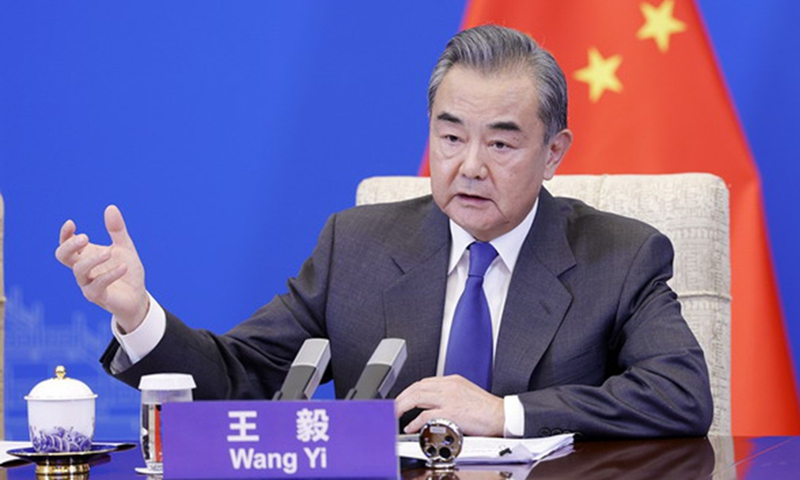
IN BRIEF
By Avishka Ashok
INTERNAL
Tibet: Foreign Ministry condemns visit by US official to Dalai Lama
On 19 May, China’s Foreign Ministry Spokesperson Zhao Lijian addressed the daily press briefing and urged the US to stop interfering in Tibet-related issues. Zhao further asked the US to honour its commitment of acknowledging Tibet as a part of the Chinese mainland. The statements made by Zhao are in response to the US Under-Secretary and Special Coordinator for Tibetan Issues Uzra Zeya’s visit to the Dala Lama in India and the Tibetan communities in Nepal. Zhao opposed the visit and said: “The so-called "Tibetan government-in-exile" is an out-and-out separatist political group and an illegal organisation violating China's Constitution and laws. He said it is not recognized by any country in the world.” He further called the 14th Dalai Lama “a political exile disguised as a religious figure” and condemned the anti-China activities of his followers and the organization.(“China urges U.S. not to support "Tibetan independence",” Xinhua Net, 19 May 2022)
International Schools: Foreign teachers and students leave due to restrictions
On 20 May, the Strait Times reported that foreign teachers in China’s international schools are leaving the country and their jobs due to the harsh COVID-19 regulations in the cities. The Association of China and Mongolia International Schools said that it was getting harder to hire replacements. Data revealed by a group of schools in China revealed that 40 per cent of the international teachers were looking to leave their jobs in 2022 while 30 per cent left last year. The report also shed light on the falling enrollment rate amongst students in international schools as foreign families also moved away during the pandemic lockdown. (“China's international schools hit by exodus of teachers due to Covid-19 curbs,” The Strait Times, 20 May 2022)
Tesla: Company plans to initiate a closed-loop system production in Shanghai
On 20 May, the Strait Times reported that the US company Tesla would continue to work in a closed-loop system until mid-June in Shanghai city. As a part of the system, the company would ferry its employees to and from work and test them regularly for infections. For the past few days, thousands of employees at the company have been working 12 hour-long shifts and sleeping in the factory as they restart the paused operations. The closed-loop system would shift the employees to a dormitory and ferry them from there. Tesla may even start a second shift after the auto-parts are supplied on a regular basis to continue the car production throughout the day. (“Tesla wants China staff to stay in 'closed loop' system until mid-June,” The Strait Times, 20 May 2022)
REGIONAL
Timor-Leste: China celebrates 20 years of diplomatic ties
On 20 May, President Xi Jinping and Timor-Leste’s President congratulated each other as they celebrated 20 years of the country’s independence and the establishment of diplomatic relations with China. Xi appreciated Timor-Leste’s development in the last 20 years and said: “Since the establishment of diplomatic ties 20 years ago, the two sides have steadily deepened political mutual trust, made solid progress in practical cooperation and witnessed ever closer people-to-people and cultural exchanges, showing a sound and steady development momentum in bilateral relations.” China’s Premier Li Keqiang and Timor-Leste’s Prime Minister Taur Matan Ruak also also exchanged congratulatory messages on the occasion. (“Chinese, Timor-Leste's presidents exchange congratulations on 20th anniversary of diplomatic ties," Xinhua Net, 20 May 2022)
INTERNATIONAL
BRICS: Foreign Minister calls for unitedly responding to global challenges
On 19 May, China’s Foreign Minister Wang Yi attended the BRICS Ministers of Foreign Affairs virtual meeting and urged the member countries to collectively act against the new global challenges. Wang Yi highlighted the importance of the grouping in the political and economic cooperation and said: “BRICS countries should seek common security together, work for common development, strive to build a firewall for human health, and advocate a global governance philosophy of extensive consultation, joint contribution and shared benefits.” He also called for further strengthening of strategic communication, coordination and building political mutual trust amongst the countries. (“China calls on BRICS countries to gather consensus in face of global challenges,” Xinhua Net, 20 May 2022)
United Nations: China calls for collective efforts to stabilise the global food market
On 19 May, China’s permanent representative to the United Nations Zhang Jun attended the UN Security Council meeting on conflict and food security and implored the international community to collectively stabilise the global food market and ensure the supply of diverse food products. Zhang said: “Firstly, we need to strengthen coordination and stabilize the global food market. To fill the supply gap, the international community needs to work together to seek diversified food supplies, and maintain the smooth operation of agricultural trade internationally.” He further urged the meeting to bring back the agricultural products supplied by Ukraine, Russia and Belarus to the international market and called for removal of restrictions on food production and exports. (“Chinese envoy urges countries to increase coordination, stabilize global food market,” Xinhua Net, 20 May 2022)
Canada: Industry Minister announces decision to ban Huawei and ZTE
On 19 May, the Canadian government announced its decision to disallow the instalment of Huawei’s equipment in the country’s high-speed 5G networks. With the decision to ban Huawei, Canada has joined the rest of the Five Eyes member countries in restricting the Chinese company from participating in the 5G networks. The Industry Minister Francois-Philippe Champagne said: “We are announcing our intention to prohibit the inclusion of Huawei and ZTE products and services in Canada’s telecommunications systems.” Network providers who have been using the Chinese technologies will be asked to cease its use and remove it from their operations. The Chinese embassy in Canada responded to the decision and said: “China will comprehensively and seriously evaluate this incident and take all necessary measures to safeguard the legitimate rights and interests of Chinese companies.” (“Canada bans China’s Huawei Technologies from 5G networks,” The Asahi Shimbun, 20 May 2022)
Russia: China plans to purchase crude oil to replenish its reserves
On 20 May, the Strait Times reported that China was planning to buy crude oil from Russia at cheap rates; thereby strengthening its energy ties with the country at a time when the West is sanctioning its economy for the invasion of Ukraine. The report claimed that the talks were held at a government level, without the direct involvement of the private companies. According to analysts, despite the increase in oil prices, the value of Russian crude oil has been falling as buyers refrain from purchasing the commodity from the sanctioned country. China, therefore, views the opportunity and wishes to refill its strategic reserves at a cheaper rate. (“China in talks with Russia to buy oil for strategic reserves,” The Strait Times, 20 May 2022)
19 May 2022 | Thursday | China Reader Evening Brief | Vol.1, No. 187
China’s contribution to the production of green hydrogen
China was called a green hydrogen powerhouse at the Green Hydrogen Organisation’s two-day event.
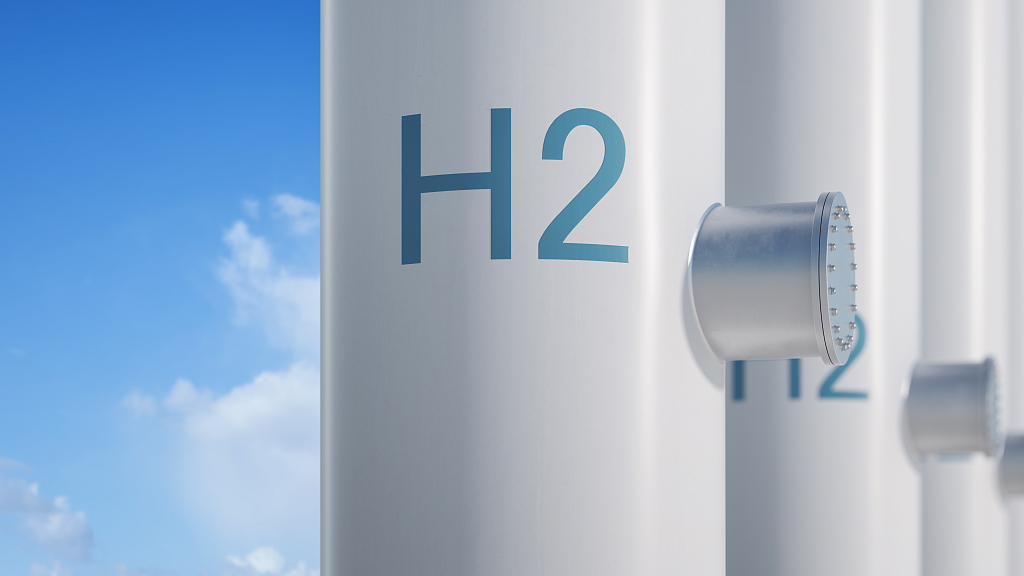
IN BRIEF
Avishka Ashok
INTERNATIONAL
Green Hydrogen: Former Australian Prime Minister appreciates China’s contribution to the industry
On 19 May, Xinhua Net reported that China was viewed as a green hydrogen powerhouse at the Green Hydrogen Organisation’s (GH2) two-day event which aimed to promote the use of the resource as a clean alternative to fossil fuels. The event was co-organized by GH2 and the Spanish government. Former Australian Prime Minister spoke with Xinhua Net and said: “China is playing a leading role: the vast majority of the world's electrolysers are made in China, and China is rolling out more renewable energy than any other country, including more hydro.” He also stressed on the increasing use of green hydrogen and said that it would be expected to represent 20-25 per cent of the global energy sources by 2050. China’s National Development and Reform Commission and the National Energy Administration also revealed that China was the largest producer of hydrogen; providing an output of over 33 million tonnes in 2021. (“Global assembly organizer says China "green hydrogen powerhouse",” Xinhua Net, 19 May 2022)
Croatia: Cakovec establishes sister city relationship with Jiangsu province
On 18 May, Xinhua Net reported that the Mayor of Yancheng city Zhou Bin held a virtual meeting with the Mayor of Cakovec city Ljerka Cividini of Croatia where they established a sister-city relationship. The meeting took place on 16 May and is aimed at enhancing the cooperation between the two cities in all sectors. The Chinese ambassador to Croatia said: “It is hoped that the two cities will take this opportunity to strengthen communication and exchanges, tap the potential of cooperation, expand cooperation fields, and add new impetus to the continuous and in-depth development of the comprehensive cooperative partnership between China and Croatia.” (“Sister city relationship set up between Chinese, Croatian cities,” Xinhua Net, 18 May 2022)
Cuba: Chinese Embassy prepares to celebrate 175 years of diplomatic relations
On 18 May, China’s Ambassador to Cuba Ma Hui referred to the bilateral relations with Cuba and said that the two countries enjoyed great ties since historic times. The remarks were made as the two countries prepare to celebrate 175 years of diplomatic relations. Ma stressed on the recent cooperation on agriculture, biotechnology and public transport and said: “We share common ideals and will continue to work on the building of our socialist systems for the betterment of our peoples and countries.” Xinhua Net further reported that China was Cuba’s primary economic partners and providers of technical assistance. (“China, Cuba enjoy excellent bilateral relations: Chinese ambassador,” Xinhua Net, 19 May 2022)
INTERNAL
COVID-19: Peking University students protests against harsh restrictions
On 18 May, the Asahi Shimbun reported that students at Peking University initiated a peaceful protest against the administration’s harsh COVID-19 restrictions which sought to implement further separation by erecting a sheet-metal wall on campus. The students were already disgruntled with the existing measures such as prohibiting the students from ordering food, having visitors and daily testing. The University administration laters backed out from the plan of erecting the sheet-metal in the campus and pacified the upset students with other concessions. (“Students protest, discontent grows over China’s COVID-19 policy,” The Asahi Shimbun, 18 May 2022)
People’s Bank of China: Former head of Monetary Policy Department under investigation
On 18 May, the Central Commission for Discipline Inspection announced that the organisation will be investigating the former head of the People’s Bank of China’s Monetary Policy Department Sun Guofeng for violating discipline and laws. Sun was suspended from his position earlier this month. Head of Financial markets at the Central Bank Zou Lan will be replacing Sun. However, Sun’s removal is not bound to change the monetary policy of the People’s Bank of China. (“China's anti-graft watchdog investigating former central bank official,” The Strait Times, 18 May 2022)
ECONOMY
Foreign businesses: President Xi promises to reopen Chinese markets
On 18 May, President Xi Jinping addressed a trade summit and pledged to open up China’s economy to the world right after further tightening the COVID-19 restrictions in Beijing city. Xi’s statement followed the warning issued by the American Chamber of Commerce on the consequences of the restrictions which may cause an exodus of foreign investments and businesses from the country. The incessant curbs on movement and other production activities has resulted in a complete suspension of businesses in China. Xi responded to the growing anxiety amongst the foreign investors and partners and said: “China's resolve to open up at a high standard will not change. The door of China will open still wider to the world.” (“Xi says China will 'open still wider' despite tight border controls,” The Strait Times, 18 May 2022)
REGIONAL
Japan: Foreign Ministers discuss history of relations and express hope for future relations
On 18 May, China’s Foreign Minister Wang Yi held a virtual meeting with Japan’s Foreign Minister Yoshimasa Hayashi and urged the country to remove obstacles in the bilateral relations. Urging Japan and China to follow the consensus reached by the countries in 2021, Wang Yi pushed for consolidation of the political relationship and promotion of more people-to-people exchanges. Wang Yi also commented on Japan’s close ties with the US and said: “Japan and the United States are allies, while China and Japan have a treaty of peace and friendship. We hope that Japan will not pull chestnuts out of the fire for others, and will avoid pitting itself against its neighbours.” (“Chinese FM urges Japan to remove factors disrupting ties,” Xinhua Net, 18 May 2022)
North Korea: Bordering Chinese city tests all its residents for COVID-19
On 18 May, the Strait Times reported that the Chinese government was testing all its residents in Dalian city which borders North Korea after the COVID-19 cases in the neighbouring country shot up in the last few weeks. The port city has a population of 7.5 million who could be at risk of contracting the virus because of the close proximity with North Korea and the recently resumed freight rail route to the country. The government has initiated a gender based testing to monitor households and the spread of the infection in the city. (“Chinese port city Dalian near North Korea beefs up Covid-19 controls,” The Strait Times, 18 May 2022)
18 May 2022 | Wednesday | China Reader Evening Brief | Vol.1, No. 186
Chinese spokesperson criticises Japan’s decision to dump nuclear-contaminated water
Chinese Foreign Ministry spokesperson Wang Wenbin urged Japan to reconsider its wrong decision to dump nuclear-contaminated water into the sea and to suspend all preparations.
IN BRIEF
Avishka Ashok and Arshiya Banu
REGIONAL
Japan: Chinese spokesperson criticises Japan’s decision to dump nuclear-contaminated water into sea
On 17 May, Chinese Foreign Ministry spokesperson Wang Wenbin urged Japan to reconsider its wrong decision to dump nuclear-contaminated water into the sea and to suspend all preparations. Wenbin made the comments in response to Tokyo Electric Power Company's recent decision to begin undersea excavation work one kilometre from the Fukushima Daiichi nuclear power plant. The excavation is being done in advance of the building of an undersea tunnel outlet to deposit the tainted water. Wang stated that the Pacific Ocean littoral countries, including China, are deeply concerned by Japan's decision and strongly oppose such actions. He said: "Such an attempt to result in a fait accompli is irresponsible. The Japanese government should immediately put a hold on it." (“China urges Japan to revoke wrong decision of dumping nuclear-contaminated water into sea,” Xinhua Net, 18 May 2022)
Philippines: President on call with Chinese president Xi
On 18 May, Chinese President Xi Jinping spoke on phone with the new President of Philippines, Ferdinand Romualdez Marcos regarding bilateral relations and regional development. Xi congratulated Marcos again on his election as president and emphasised that Marcos has observed and participated in the growth of China-Philippine relations, describing Marcos as a builder, supporter, and advocate of the friendship between the two countries. Xi cited a Philippine proverb: “"If you do not know where you have come from, you cannot go far," and urged both countries to continue their friendship and stay faithful to their primary objectives. Xi added that the two countries should recognise the general trend, write a great story about China-Philippines friendship in the new era, and carry out the blueprint for bilateral friendly cooperation in order to usher in an even brighter future for bilateral ties. (“Xi talks with Philippine president-elect over phone on ties,” Xinhua Net, 18 May 2022)
INTERNATIONAL
Tajikistan: Chairman of NPC video calls Tajik counterpart
On 17 May, chairman of the National People’s Congress (NPC) Standing Committee spoke on a video call with Rustam Emomali, chairman of the National Assembly of Tajikistan. According to Li, China and Tajikistan have witnessed the consistent consolidation of political mutual trust, the continuous deepening of cooperation in various fields, and the fruitful achievements of Belt and Road (B&R) cooperation under the strategic guidance and direct promotion of the two countries' leaders. Li expressed China's gratitude for Tajikistan's unwavering support on issues affecting China's core interests and key concerns, promising to continue to assist Tajikistan's efforts to develop in accordance with its national reality. Emomali stated that Tajikistan's National Assembly is ready to deepen exchanges with the NPC to facilitate bilateral ties and all-round cooperation and added that Tajikistan actively supports B&R cooperation and that the two countries have had successful cooperation in areas such as the economy, trade, people-to-people exchanges, and security. (“China's top legislator meets Tajik National Assembly chairman,” Xinhua Net, 17 May 2022)
The US: Chamber of Commerce warns China of imminent decline in investments
On 17 May, President of the American Chamber of Commerce Michael Hart warned that China’s draconian COVID-19 regulations will stymie foreign investment for years to come as travel restrictions obstruct project pipelines. Hart stated that there are few indications that American companies are quitting the Chinese market, but the years-long process of research and due diligence for projects has been delayed. He said: "We're very concerned about the ongoing and future investment by US and other foreign companies into China because people can't get access in terms of travel," and noted that there will be a decline in investments. While much of the globe has relaxed coronavirus restrictions, China has imposed stringent limitations on flights into the country and has pushed on a zero-COVID policy to avoid overburdening the country's health resources. (“China's Covid-19 controls will impact foreign investment for years: US lobby,” The Strait Times, 17 May 2022)
INTERNAL
Heavy rains: Chinese Climate centre predicts last year’s terrible rains to make a comeback this year
On 17 May, the Strait Times reported that as the rainy season in China begins, forecasts from the National Climate Centre show that flooding in the north and south of the country might be as terrible as it was last summer, when heavy downpours killed hundreds. Torrential rains hit 22 counties in Guangxi's southern province last week, affecting over 27,000 people and damaging over 2,300 hectares of crops, costing the government 104 million yuan (S$21.31 million). Numerous cities in Guangdong, another southern province, have closed kindergartens, primary and senior schools due to the rains. Floods are common in China during the summer, particularly in low-lying districts around the Yangtze River and its tributaries. However, as global warming delivers more extreme weather, the storms have become more intense. (“Climate change threatens China with yet another deadly flood season,” The Strait Times, 17 May 2022)
Xinjiang: UN Human Rights chief prepares for visit
On 17 May, Human Rights Office spokesperson Liz Throssel stated that the United Nations (UN) High Commissioner for Human Rights Michelle Bachelet will arrive in China "shortly" for a long-awaited visit, including to Xinjiang province, where authorities are accused of severe human rights violations. Bachelet is expected to visit China's far-western Xinjiang region by the end of the month, after years of requesting "meaningful and unfettered" access. Throssel said: "She [Bachelet] will be meeting high-level government officials," adding that "the purpose of a visit is really... a dialogue with the Chinese government, with the Chinese authorities on a range of domestic, regional, and global human rights issues". Throssel stated that Bachelet and her team would "be raising issues relating to Xinjiang with the authorities.” (“UN rights chief Michelle Bachelet to visit China 'shortly' with stop in Xinjiang, The Strait Times, 17 May 2022)
17 May 2022 | Tuesday | China Reader Evening Brief | Vol.1, No. 185
China condemns the US’ act to help Taiwan regain WHO observer status
Chinese Foreign Ministry spokesperson Zhao Lijian stated that China rejects and deplores the United States' insistence on passing the measure into law.
IN BRIEF
Avishka Ashok and Arshiya Banu
INTERNATIONAL
The US: China condemns the US’ act to help Taiwan regain WHO observer status
On 16 May, Chinese Foreign Ministry spokesperson Zhao Lijian stated that China rejects and deplores the United States' insistence on passing the measure into law, which will help Taiwan recover observer status at the World Health Organization (WHO) and urged the US to handle Taiwan-related problems carefully and appropriately. US President Joe Biden has signed a measure directing the Secretary of State to design a strategy to reclaim Taiwan's WHO observer status. Zhao said: "We urge the U.S. to adhere to the one-China principle and the three China-U.S. joint communiques, comply with international law and basic norms governing international relations, prudently and properly handle Taiwan-related issues, and not to use this bill to help Taiwan expand its so-called 'international space', otherwise it will cause further damage to China-U.S. relations and peace and stability across the Taiwan Strait." (“China rejects U.S. bill to help Taiwan regain WHO observer status,” Xinhua Net, 17 May 2022)
Pakistan: Chinese Premier speaks with Pakistani PM on phone
On 16 May, Chinese Premier Li Keqiang spoke with Pakistani Prime Minister Shahbaz Sharif on phone regarding bilateral relations and the recent attack on Chinese nationals. Li noted that President Xi Jinping’s successful visit to Pakistan in 2015 has enhanced the level of bilateral strategic cooperation between the two countries and indicated that China has always prioritised its relations with Pakistan in its diplomacy with its neighbours and will continue to strongly support Pakistan in safeguarding national sovereignty and security. Li also stated that the Chinese side is startled and appalled by the recent terrorist attack in Karachi on Chinese nationals, and vehemently condemns the attack. Sharif, in response, expressed his deep condolences over the deaths of Chinese people and his sincere sympathies for the injured. He stated that Pakistan strongly condemns terrorism, values the lives and safety of Chinese nationals in the country, and treats Chinese victims and those injured as equals, and that the country will do everything possible to uncover the truth, apprehend, and punish the perpetrators in accordance with the law. (“Chinese premier, Pakistani PM hold phone call on bilateral ties,” Xinhua Net, 16 May 2022)
INTERNAL
Xinjiang: Leaked list shows county in Xinjiang to have highest prison rate in the world
On 16 May, the Asahi Shimbun reported that one in 25 people in Konasheher county in Xijiang had been imprisoned and sent to a detention centre on terrorism-related charges. The report took data from a review of a leaked list published by the Associated Press. According to the list, more than 10,000 had been sentenced to prison in the county alone. The list is said to be the most detailed by far and reveals the government’s campaign that aimed to shut down on terrorist activities by targetting the Muslim majority province. The Xinjiang spokesperson Elijan Anayat has repeatedly denied accusations of targeted arrests and said:“We will never specifically target specific regions, ethnic groups, religions, much less the Uighurs. We will never wrong the good, nor release the bad.” (“Uighur county in China has highest prison rate in the world,” The Asahi Shimbun, 16 May 2022)
Airlines: To compete with Boeing and Airbus, China's C919 plane is predicted to double in price.
On 17 May, the Strait Times reported that a China-developed airliner, which Beijing hopes could compete with Boeing and Airbus, will cost nearly twice as much as expected. China Eastern Airlines Corp stated in a filing to the Shanghai Stock Exchange earlier that it intends to acquire cash to purchase four C919 aircraft from China's state-owned aerospace giant Commercial Aircraft Corp. of China (COMAC). The price of each plane is 653 million yuan (S$134 million). The C919 would be priced similarly to narrow-body competitors such as the Airbus A320neo, which has a list price of US$111 million (S$154 million) and the Boeing 737 Max, which has a list price of US$117 million. (“China-developed C919 jet expected price doubles, to match Boeing and Airbus,” The Strait Times, 17 May 2022)
ECONOMY
Digital Economy: Chinese Vice-Premier will meet with tech executives to foster the development of the digital economy
On 17 May, the Strait Times reported that Chinese Vice-Premier Liu He will speak at a meeting with tech executives organised by the country’s main political consultative body to foster the development of the digital economy. The conference was closely watched for comments from Liu and others to see how far Chinese authorities will go to ease a regulatory crackdown on the once-freewheeling tech sector that has been in place since late 2020. Liu has been at the forefront of the government's attempts to secure private sector support. The meeting is organised by the Chinese People's Political Consultative Conference (CPPCC), and Chinese tech founders such as Qihoo 360's Zhou Hongyi and Baidu's Robin Li are expected to attend. (“China's CPPCC starts meeting on digital economy: State media,” The Strait Times, 17 May 2022)
National Bureau of Statistics: As COVID-19 restrictions ease, China’s economy revives
On 17 May, the Asahi Shimbun reported that under anti-virus limitations, China's industrial and consumer activity fell even more than projected in April, but the National Bureau of Statistics chief Fu Linghui claimed the economy is reviving as anti-virus restrictions loosen and Shanghai, the country's commercial metropolis, reopens. After most businesses in Shanghai were shut down and its 25 million citizens were confined to their homes beginning in late March, fears that global industry and trade would be affected grew. This complicates matters for President Xi Jinping, who is anticipated to try to prolong his term in office this year. According to the National Bureau of Statistics, retail sales in Shanghai and other cities fell 11.1 percent year over year as shops, restaurants, and other consumer outlets closed. As factories shuttered, manufacturing fell by 2.9 percent. (“Official: China’s economy reviving as anti-virus curbs ease,” The Asahi Shimbun, 17 May 2022)
REGIONAL
North Korea: Air Koryo flies to Shenyang to pick up medical supplies
On 17 May, Reuters reported that North Korean aircrafts had traveled to China to pick up medical supplies as the country dealt with its first COVID-19 outbreak. The South Korean news agency Yonhap reported that three Air Koryo aircrafts landed in Shenyang city on 16 May and flew back with medical supplies. The news agency further expects more flights between the countries as the current amount of materials may not be enough. On 16 May, North Korea reported 1.48 million fever cases and 56 deaths. (“North Korean planes pick up medical supplies in China - media,” Reuters, 17 May 2022)
16 May 2022 | Monday | China Reader Evening Brief | Vol.1, No. 184
President Xi sends condolences to the UAE President
President Xi congratulated the new UAE President on his appointment whiles expressing China's condolences on the former leader's passing away.
IN BRIEF
Avishka Ashok and Arshiya Banu
INTERNAL
Shanghai: Deputy Mayor announces gradual reopening of the city
On 16 May, the Asahi Shimbun reported that Shanghai would be reopening gradually after more than six week of lockdown caused by a sudden hike in COVID-19 cases. The Deputy Mayor Zong Ming said: “In the clearest timetable yet, Shanghai’s reopening would be carried out in stages, with movement curbs largely to remain in place until May 21 to prevent a rebound in infections, before a gradual easing.” Epidemic prevention measures will still be put in place until mid or late June, depending on the risks of rebound in cases in the city. The city’s authorities are also under pressure to reopen the city as the lockdown caused steep losses in the Chinese economy. (“Shanghai targets June 1 return to normal as COVID lockdowns cool economy,” The Asahi Shimbun, 16 May 2022)
ECONOMY
National Bureau of Statistics: Spokesperson reassures economic recovery
On 16 May, the National Bureau of Statistics Spokesperson Fu Linghui announced that the Chinese economy was bound to recover gradually as the country deals with the outcomes of the anti-epidemic policies. Fu said: “The country's economy took a hit from the domestic resurgence of COVID-19 cases in April, but the impacts are "short-lived and external.” He reassured the Chinese people and said that there were many favourable conditions for stabilizing the economy and that the fundamentals of the Chinese economy continues to the economic transformation. Fu stressed on the super-large market, complete industrial and supply chains and the sufficient domestic demand and explained that the economy was resilient to all contemporary challenges. He further used the example of the growing food grains and energy production despite the pandemic and reemphasized on the economy’s ability to bounce back. (“China's economy expected to recover gradually from Omicron impacts: spokesperson,” Xinhua Net, 16 May 2022)
Property sales: Industry experiences fastest fall in 16 years
On 16 May, Reuters reported that the property sales in China fell at their fastest rate in 16 years despite the government’s policies and measures to ease the tensions in the property market. The value of sales fell by 46.6 per cent from the previous year and by 26.17 per cent from March 2022. The government has provided a cut in mortgage loan interest rates but the announcement made little difference to the current trend. Over 80 cities in the country have provided subsidies, smaller down payments, and reduction in interest rates since January 2022. The private sector in China has been experiencing a slump in sales since 2021. (“China April property sales post steepest drop since 2006,” Reuters, 16 May 2022)
Thermal coal industry: Government interference causes a fall in sales
On 16 May, Reuters reported that China’s thermal coal trade had been suspended after the authorities interfered to control the rising price of energy and raw materials. On the same day, Zhengzhou Commodity Exchange’s trade was only 27 lots, which otherwise records close to one million lots. The company’s data revealed that figures recorded a 99.9 per cent drop in the daily volume since 2015. The government introduced “reference price range” for long-term and spot thermal coal trades in February 2022. The authorities have also threatened to punish any price-pushing behaviour within the physical and future markets. (“China's thermal coal futures mute as Beijing reins in commodity inflation,” Reuters, 16 May 2022)
INTERNATIONAL
The UAE: Xi sends condolences to the UAE President
On 15 May, Xinhua Net reported that the Chinese President extended a message of condolence to the new President of the UAE Sheikh Mohamed bin Zayed Al Nahyan, following the death of UAE President Sheikh Khalifa bin Zayed Al Nahyan. Xi expressed deep sorrow for Sheikh Khalifa's death on behalf of the Chinese government and people, as well as in his own name, and offered profound condolences to his families and the UAE people. Xi stated that President Sheikh Khalifa had been committed to maintaining political stability and encouraging socio economic prosperity in the UAE and had earned the people's trust and love. He added that he was also dedicated to the UAE-China friendship and made active efforts to promote bilateral relations' growth, and that his death is not only a great loss for the UAE people, but also a great loss for the Chinese people. (“Xi extends condolences over passing of UAE President Sheikh Khalifa,” Xinhua Net, 15 May 2022)
The UAE: Chinese President commends new UAE President
On 15 May, Xinhua Net reported that Chinese President Xi Jinping congratulated Sheikh Mohamed bin Zayed Al Nahyan on becoming the president of the United Arab Emirates (UAE) and stated that bilateral relations have been developing since the two nations established diplomatic ties. Xi added that the two sides have always strongly backed each other on issues touching their respective core interests and key concerns, maintained successful practical cooperation in numerous fields, and made notable accomplishments in the joint fight against the COVID-19 epidemic. He said that the development of China-UAE relations is very important to him and that he is willing to work with the new President to enhance the China-UAE comprehensive strategic partnership for the benefit of the two countries and their people. (“Xi sends congratulatory message to new UAE president,” Xinhua Net, 15 May 2022)
Italy: Shipping expert discusses BRI benefits
On 15 May, Xinhua Net reported that the deputy manager of the China Ocean Shipping Company (COSCO) in Italy, Marco Donati, stated that the Belt and Road Initiative (BRI) launched by China has a favourable impact on the global economy in general and the logistics sector in particular, and various nations, including Italy, could take advantage of its vast potential. According to Donati, the BRI is a two-way traffic road that benefits all of its partners, in terms of logistics and commerce. He said: "This road, which was built to improve logistics, is, as all roads are, bidirectional. It surely helps Chinese-manufactured products to reach Italy, Europe, the whole world, but it also helps our products to reach a huge market in a faster and smoother way." (“Interview: BRI delivers mutual benefits, says Italian expert,” Xinhua Net, 15 May 2022)
14 May 2022 | Saturday | China Reader Evening Brief | Vol.1, No. 183
China opposes joint statement by Japan and the EU on South China Sea, Hong Kong, Xinjiang and Taiwan
The Foreign Ministry Spokesperson warned Japan and the EU from interfering in its affairs and reaffirmed China's stand on the related issues.
IN BRIEF
By Avishka Ashok and Arshiya Banu
INTERNATIONAL
Japan and the EU: China opposes joint statement on South China Sea, Hong Kong, Xinjiang and Taiwan
On 13 May, the Foreign Ministry Spokesperson Zhao Lijian addressed the daily press briefing opposed the remarks made by Japan and the EU on the South China Sea and the Taiwan Strait. Japan and the EU issued a joint statement, expressing concerns over the sovereignty of the Senkaku Islands or Diaoyu Islands, the human rights issues in Hong Kong and Xinjiang, and the Taiwan Strait and the issues in the China Sea. Zhao accused Japan and the EU of false information and hyping the tensions in the region and said: “China is firmly opposed to such practice, and has lodged stern representation with relevant parties.” On the question of the Diaoyu islands, as China calls it, Zhao said that the islands have always been a part of the Chinese territory. Zhao also reiterated China’s stand on the maritime issues and said that the country would continue to protect its territories. He said: “China will firmly safeguard its territorial sovereignty and maritime rights and interests, and at the same time is ready to settle differences with relevant countries via consultations.” He further urged the foreign entities to respect China’s sovereignty and refrain from interfering in China’s internal affairs. (“China voices opposition to smearing remarks by Japan, EU,” Xinhua Net, 13 May 2022)
The UNSC: Chinese representative calls out to countries to destroy their WMDs
On 14 May, CGTN reported that the charge d’affairs at China’s permanent mission to the United Nations (UN) Dai Bing advised countries that had stockpiles of weapons of mass destruction (WMDs) to destroy them as quickly as feasible. Bing said: "We advocate the complete prohibition and thorough destruction of all WMDs, including biological and chemical weapons," at a UN Security Council discussion about biological laboratories in Ukraine. He stated that China calls on relevant parties to take responsibility and answer pertinent questions in a timely way, providing thorough clarifications to alleviate the international community’s concerns. (“China urges destruction of WMDs during UN Security Council meeting,” CGTN, 14 May 2022)
Greece: Foreign Minister talks over phone with Chinese counterpart
On 13 May, Chinese State Councilor and Foreign Minister Wang Yi spoke with Greek Foreign Minister Nikos Dendias over the phone as bilateral relations between the two countries reach their 50th anniversary. Wang stated that the two countries have always appreciated, tolerated, and helped each other; respected each other's development paths chosen by their own people; and supported each other's core interests and major concerns over the past half-century. He added that China is ready to work with Greece in order to create a blueprint for future development, expand practical cooperation in areas like transportation, energy, tourism, infrastructure, green and digital economies, and open up new opportunities for mutually beneficial cooperation. The two sides also discussed the Ukraine conflict. (“Chinese, Greek FMs hold phone talks over ties, Ukraine issue,” Xinhua Net, 13 May 2022)
Sri Lanka: New Prime Minister pledges support to Chinese projects and cooperation
On 13 May, Sri Lanka’s newly Prime Minister Ranil Wickremesinghe pledged the country and his government’s support and willingness to cooperate with China. Wickremesinghe met with China’s Ambassador to Sri Lanka Qi Zhenhong and appreciated the country’s assistance during the rough times and also pledged to continue the cooperation on the Belt and Road Initiative. He further reaffirmed the new government’s readiness to resume and promote cooperation along diverse fields. On behalf of China, Ambassador Qi promised to step up cooperation and deliver emergency humanitarian aid to Sri Lanka at the earliest. (“Sri Lanka's new PM pledges to promote friendly cooperation with China,” Xinhua Net, 13 May 2022)
INTERNAL
State Council: General Office offers subsidies, tax-breaks and easy loans to graduates
On 13 May, the general office of the State Council announced that the country would offer subsidies, tax breaks and easy loans with the aim of boosting opportunities for college graduates. The government is preparing for a record 10.76 million graduates to enter the market amid the slow economic growth caused by the pandemic. The State Council issued a notice and said that subsidies would be offered to small firms who hire such candidates while graduates who launch their own start-ups will be offered tax-breaks, easier loan terms and rent-free premises. The notice said: “China encourages employers in Covid-19-hit regions to sign labour contracts with college graduates online.” (“China looks to spur job prospects for record number of new graduates,” The Strait Times, 13 May 2022)
Hong Kong: Three people sentenced to prison for stealing a report written by Mao Zedong
On 14 May, The Strait Times reported that three thieves Ho Yik-chiu, Ng Wing-lun, and Hui Ping-kei were sentenced to prison for a record-breaking US$637 million (S$887 million) art robbery in Hong Kong, despite being completely unaware of the worth of their historic haul. A 2m-tall scroll depicting a 1929 Politburo report written by Mao Zedong valued at hundreds of millions of dollars was stolen and sold to an amateur collector for just HK$200 (S$35). When police found the parchment a month after it had been stolen, they discovered it had been chopped in half by the collector to make it simpler to store, who had no idea it was genuine. The items were stolen from Chinese collector Fu Chunxiao's residence in the Kowloon district in September 2020. (“Trio jailed for Hong Kong's priciest art heist,” The Strait Times, 14 May 2022)
Zero-COVID: China’s policies cause a sharp increase in garbage in cities
On 13 May, the Strait Times reported that China’s Zero-COVID policy had significantly increased the garbage in the cities. According to the report, medical waste in Shanghai amounted to 1,400 tonnes a day, a sharp increase from 308 tonnes in 2021. The garbage has increased by 4.5 times in the city of 25 million residents who have been in lockdown for over five weeks now. The People’s Daily also reported that the total waste in May 2022 had reached 3,300 tonnes, while it used to be 73 tonnes a day in February. The lockdown is to be blamed for the sudden increase in waste as all residents opt for food deliveries, online shopping and grocery deliveries that use more packaging than shopping at marts. (“China's Covid-Zero policy is producing a deluge of waste,” The Strait Times, 13 May 2022)
Xinjiang: Leaked list of detainees reveals one million held in detention centres and prisons
On 13 May, the Strait Times reported that a police list of detained Uighurs had been leaked which estimates that over a million Uighurs and other Muslim minorities were being held in different detention centres and prisons across the Xinjiang region in China. The list was released to Uighur activists outside China. According to the report, the information on the government’s anti-terrorism crackdown in the region is closely protected by the authorities. It also explained that most court notices are not available to the public while the police are uncooperative with the people. (“China database reveals the thousands of Uighurs detained in Xinjiang,” The Strait Times, 13 May 2022)
13 May 2022 | Friday | China Reader Evening Brief | Vol.1, No. 182
100 years of Communist Youth League of China
China celebrates the centenary anniversary of the CYLC and hopes for continued unity and greatness amongst the Chinese youth.
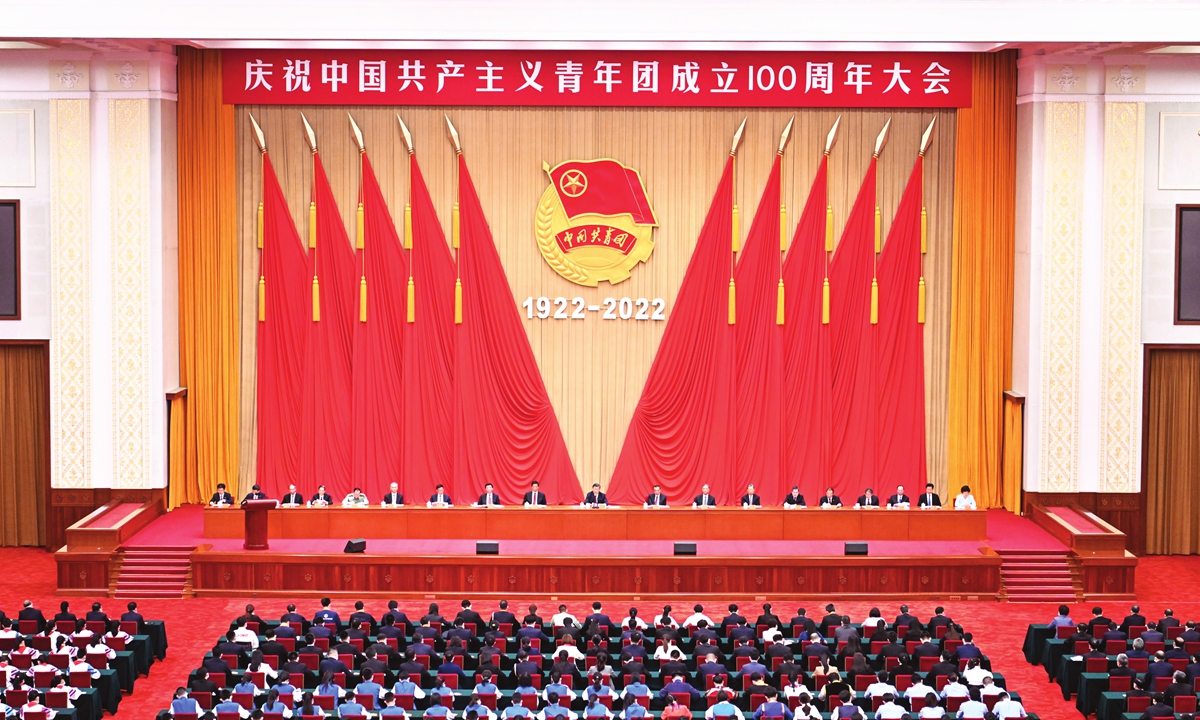
IN FOCUS
By Avishka Ashok
100 years of Communist Youth League of China
On 10 May, the Communist Youth League of China (CYLC) celebrated 100 years of its foundation at the Great Hall of the People in Beijing. The celebration was attended by President Xi Jinping, the First Secretary of the Secretariat of the Central Committee of the CYLC He Junke, the Party Secretary of the All-China Federation of Trade Unions Chen Gang, and other important officials and leaders. Xi Jinping also delivered a speech on the occasion. Xi referred to the Chinese dream of national rejuvenation and compared it to a relay race; imploring the Chinese youth to sincerely work towards the goal.
President Xi Jinping’s address to the CYLC
Xi’s speech put emphasis on the prevalence and importance of the CYLC and noted it as an organ that connected the Communist Party and the Chinese youth. He noted that the celebration was important to “encourage its members to forge ahead on the new journey to realize the Chinese Dream of national rejuvenation." Urging the young population of the country to provide their unconditional support to the Communist Party of China, Xi said: “The original aspiration and mission of the CYLC is to follow the CPC's leadership, fight for the people and the Party. The cause of the Party and the people entail endeavors and devotion by generations of young people.”
Xi also appreciated the youth’s contribution to the country and highlighted the slogan, “My pure love is only for China,” written by the 18-year-old Chen Xiangrong who lost his life in the military clash in the Galwan valley in India. The President also encouraged the organization and called for continued efforts towards the Chinese motherland and said: “The league should continue serving young people, fulfill its responsibility in consolidating and expanding young people's support for the Party's governance and offer solid help to the young people.” Xi also called on the party organizations at all levels to provide all support towards the engagement and development of young party members to secure the social nature of the People’s Republic of China.
Xi’s speech reflected positively within the country as well as amongst the Chinese nationals residing in foreign countries. The Deputy Captain of the political work of the 20th Chinese peacekeeping engineering detachment at Lebanon Lan Tianzhang conveyed the young peacekeepers’ message and said: “The young peacekeepers in Lebanon have been taking concrete actions to fulfill their mission and safeguard world peace. They will work hard to make more contributions to realizing the great rejuvenation of the Chinese nation.” Other young leaders from Cambodia, Pakistan, Nairobi, Japan and Croatia also shared the Chinese nationals’ views on the occasion.
What is the Communist Youth League of China?
The CYLC is an institution that was established a year before the Communist Party of China itself, on 5 May 1920 as the ‘Socialist Youth League of China.’ The institution changed its name several times and was later renamed as the Communist Youth League of China in 1957. The CYLC is tasked with implementing the Communist Party of China’s basic policies of socialism and uniting the young population towards the Party’s efforts in achieving its national goals. The leaders of the youth league also lead the members of the organization to achieve economic development, pursue the Four Cardinal Principles, work towards social reform and self-reliance, promote productivity and progress and actively build socialism with Chinese characteristics. The institution is often considered as the training ground for members of the CPC.
As of May 2022. The CYLC consists of 73.7 million members or six per cent of China’s total population; out of which 43.81 million students while the rest are engaged in enterprises, public institutions, urban and rural communities, social organization and other fields. The structure of the CYLC is similar to the CPC and consists of a National Congress as its central authority. The institution currently possesses 3.68 million organizations across the country including the committees at the provincial, city and county levels.
Challenges faced by the CYLC
First, maintaining a united front on all issues. The history of the institution had experienced its fair share of disagreements due to the involvement of individuals coming from varied radical schools of thought. The CYLC gradually established its mottoes, policies, functions, beliefs and school of thought that aligned with the CPC in 1925. Although, the organization has come a long way since its establishment and has since streamlined its actions according to the CPC, the struggle remains with getting its members to conform to the Party’s principles and restrict radical perspectives within the body.
Second, the dwindling population. The shrinking size of the Chinese population is a cause for worry, not just from an economic and social point of view but also from a political prism. The CPC has a long history of finding political leaders from the Youth League such as Hu Jintao and Li Keqiang. A shrinking population also means a smaller CYLC which would create obstacles for China in discovering its political prodigies. Aside from creating a pool of young politicians, the institution also brings young, educated, and experienced individuals to the table.
Third, the politics within the CYLC. Even though the CYLC has maintained a unified front, there are frictions between the generational groups and with the princeling faction. The fourth-generation alumni, aged in their late 50s, are said to be leading the CPC and China on the national and international front. However, the leaders from the following generations are also considered to be flexing their power in the administration. Although the fourth generation tries its best to gel with the newest members, there are gaps in understanding and differences amongst the two.
References:
“Xi’s speech on centennial of CYLC’s founding encourages Chinese youth, ‘explained echelon formation of the CPC that keeps the Party’s vigor forever’,” Global Times, 11 May 2022
“China celebrates 100 years of the Communist Youth League,” CGTN, 10 May 2022
“Why China entrusts youth with the country's future,” CGTN, 10 May 2022
“The Communist Youth League of China,” China.org, 20 May 2003
“Communist youth league of China has over 73.7 members,” China Daily, 02 May 2022
“Overseas Chinese Youth Inspired by Xi's Speech to Strive for Better China,” All China Women's Federation, 12 May 2022
“Rise of the Communist Youth League,” Economic and Political Weekly, 25 March 2006
“The Functions of the Chinese Communist Youth Leagues (1920-1949),” The China Quaterly, December 1962
IN BRIEF
By Avishka Ashok and Arshiya Banu
INTERNAL
National Immigration Administration: China refutes reports on suspension of issuing passport
On 13 May, China’s National Immigration Administration (NIA) responded to the accusation by foreign media companies on suspending the issuance of travel documents and said that they were rumours that aimed to distort and discredit the country’s entry and exit policies. The NIA was referring to the reports made by news outlets claiming that China had suspended the issuing of passports to its citizens to prevent them from leaving the country. The Spokesperson said: “Such disinformation is intended to undermine the country's legal, targeted and effective entry-exit management measures introduced under the backdrop of maintaining regular COVID-19 response approaches.” (“Immigration authority refutes false info slandering China's entry-exit policies,” Xinhua Net, 13 May 2022)
Wuxi City: Authorities provide monetary prize to Nobel Laureates
On 12 May, the Strait Times reported that Wuxi city would be offering a prize of 10 million yuan to the winners of the Nobel Prize. The decision is an attempt to attract talent in the country that is shifting its economy towards innovation-driven development. Wuxi’s offer is part of a recent trend in China; wherein cities are offering incentives such as tax cuts, rental or home sale subsidies and more to acquire the top talents in the country. Two districts in Wuxi are currently offering purchase subsidies of 3-10 million yuan where home prices are approximately 1.28 million yuan or USD 1,88,544 for a 90 square meter apartment. The trend started in 2017 as cities like Xian and Chengdu started providing attractive deals to citizens in a bid to attract skilled workers to its economy. (“Chinese city Wuxi offers Nobel Prize winners $2m housing subsidies in bid to draw talent,” The Strait Times, 12 May 2022)
Hong Kong: Government oppose China’s arrest of four individuals for colluding with Foreign groups
On 12 May, the Commissioner’s Office in Hong Kong, which represents mainland China, responded to the criticism voiced by the West on the arrest of four individuals in the city. One amongst the arrested citizens is the 90-year-old Catholic cardinal Joseph Zen. The officials opposed the criticism and said: “The persons concerned are suspected of conspiracy to collude with foreign countries or foreign forces to endanger national security - an act of severe nature.” (“China voices 'firm opposition' to Western criticism of Hong Kong cardinal's arrest,” The Strait Times, 12 May 2022)
ECONOMY
Property industry: Another developer about to default in its repayments
On 13 May, Reuters reported that a Shanghai based developer Zhongliang Holdings was caught in a fix with fast approaching deadlines on the repayment of notes worth over USD 729 million. The company had asked for an extension for the repayment as it had failed to sell enough houses during the prolonged property downturn in China. The company’s investors are due to receive their full redemption of bonds between May and July. Analysts explained that due to the weaker value of the yuan, the company would have to pay an extra USD 1.25 million on its bonds even if it gets an extension on its repayment. The recent development has raised concerns in the country and amongst foreign investors regarding the property industry in China. (“Chinese developers' debt woes worsen as sales, yuan weaken,” Reuters, 13 May 2022)
REGIONAL
ASEAN Plus Three: Meeting of Financial Ministers and Central Bank Governors agree on greater cooperation
On 12 May, China’s Finance Minister Liu Kun addressed the video conference of Finance Ministers and Central Bank Governors from the ASEAN Plus Three member countries and promoted financial collaboration amongst the group to deal with the global economic challenges. Liu said: “China will join hands with other member states in promoting innovation and exploring new areas of regional financial cooperation. Efforts should be made to advance the development of the Asian bond market and meet the financing needs of the region's future development.” The meeting also agreed on maintaining financial stability, long-term fiscal sustainability and protect the regional economies against risks and negative spoilers. (“China urges deeper ASEAN Plus Three ties in financial sector,” Xinhua Net, 13 May 2022)
INTERNATIONAL
The US: China asks the US to help ethnic minorities recover from their trauma
On 12 May, Chinese Foreign Ministry spokesperson Zhao Lijian stated that the US should follow through on its promise that "all men are created equal" by taking concrete steps to help ethnic minorities overcome their trauma. Zhao made the comments in response to a US Interior Department report claiming that at least 500 Native American, Alaska Native, and Native Hawaiian children died between 1819 to 1969 while being subjected to unfair treatment in more than 400 federal Indian boarding schools, including whipping, sexual abuse, forced labour, and acute malnutrition. Zhao pointed out that the United States was established on the horrible killing and persecution of indigenous people, and that mistreatment of Native Americans is the country's original sin, as convicted by Indian boarding schools. He said: "The dark history of Indian boarding schools is only a tip of the iceberg of the U.S.' systemic racial discrimination and human rights problems." (“China urges U.S. to adopt serious measures to truly help ethnic minorities get over trauma,” Xinhua Net, 12 May 2022)
Pakistan: China's Foreign Minister hold a virtual meeting with Bilawal Bhutto Zardari
On 12 May, CGTN reported that the Chinese State Councilor and Foreign Minister Wang Yi stated that the friendship between China and Pakistan will be passed down through the generations and will not be disturbed or changed by a single incident. Wang made the comments while speaking via video call with Pakistani Foreign Minister Bilawal Bhutto Zardari, urging the two countries to oppose any attempt to sabotage bilateral ties. The two sides discussed the safety of Chinese citizens and institutions in Pakistan. Wang stated that both China and Pakistan should take immediate action to deal with a series of terrorist attacks that have targeted Chinese nationals in Pakistan. (“China-Pakistan friendship will not be shaken: Wang Yi,” CGTN, 12 May 2022)
Denmark: Foreign Ministers discuss bilateral ties and future cooperation
On 12 May, China’s Foreign Minister Wang Yi held a phone call with Denmark’s Minister of Foreign Affairs Jeppe Kofod and discussed the bilateral relations and issues of mutual interests. Kofod expressed Denmark’s desire to enhance the comprehensive strategic partnership between the two countries and reach a consensus on the Green China-Denmark Joint Programme. Wang Yi also responded positively and confirmed China’s support in working alongside the country. He said: “The Chinese side is willing to work with the Danish side to promote the healthy and stable China-Denmark relations to continue to mature.” The Ministers also discussed the Russia-Ukraine conflict and clarified their position on the issue. (“Chinese FM holds phone talks with Danish counterpart,” Xinhua Net, 13 May 2022)
12 May 2022 | Thursday | China Reader Evening Brief | Vol.1, No. 181
WHO Director-General criticizes China’s Zero-COVID policy
WHO Director-General Dr Tedros Adhanom Ghebreyesus criticizes China for tightening restrictions in Shanghai and Beijing despite reducing cases in the countries.
IN BRIEF
By Avishka Ashok and Arshiya Banu
INTERNATIONAL
WHO: Director-General criticizes China’s Zero-COVID policy
On 10 May, the Director-General of the World Health Organization Dr Tedros Adhanom Ghebreyesus addressed a news briefing and criticized China’s “zero-COVID” policies. He said: “We don't think that it's sustainable considering the behaviour of the virus now, and what we anticipate in the future. We know a lot about that virus and we have better tools. So these are the additional opportunities that we have to make a shift.” Weibo also removed a United Nations post on Tedros’ comments soon after it was posted. Shanghai and Beijing are tightening the restrictions after President Xi Jinping urged the authorities to double the ‘Zero-COVID’ policy. The strategies are being criticized by the West for the harsh nature of restrictions despite the fall in cases through the country. (“As Shanghai's Covid-19 cases fall, WHO's Tedros criticises China's 'unsustainable' restrictions,” The Strait Times, 10 May 2022)
Slovenia: China celebrated establishment of 30 years of diplomatic ties
On 12 May, China’s President Xi Jinping exchanged congratulatory messages with Slovenia’s President Borut Pahor on the occasion of celebrating 30 years of diplomatic relations between the two countries. In his message, Xi noted that China and Slovenia had treated each other with respect and an an equal since the establishment of the former; resulting in mutually beneficial cooperation and heightened cultural and economic exchanges. He said: “In the face of COVID-19, the people of the two countries have supported each other, demonstrating the profound friendship between China and Slovenia.” Pahor also congratulated China for its fast-paced development and appreciated the country’s support in enhancing the economic and trade cooperation between the two countries. (“Xi, Slovenian president exchange congratulations on 30th anniversary of diplomatic ties,” Xinhua Net, 12 May 2022)
COVID-19: China hits milestone with supply of more than 2.2 billion vaccine doses
On 11 May, Xinhua Net reported that China has delivered over 2.2 billion doses of COVID-19 vaccine to more than 120 countries and international organisations, the majority of which are developing countries. Since the outbreak, China has undertaken the largest and most extensive global emergency humanitarian response in the People's Republic of China’s history. China had offered anti-COVID supplies to 153 countries and 15 international organisations by early May, including 4.6 billion protective gowns and more than 430 billion face masks. In addition, China has dispatched 37 medical expert teams to 34 countries and shared COVID-19 prevention and control awareness with over 180 countries and international organisations. (“China has provided over 2.2 billion COVID vaccine doses to world,” Xinhua Net, 11 May 2022)
Australia: Chinese envoy reassures Australia about the Solomon Islands agreement
On 12 May, Chinese ambassador to Australia Xiao Qian stated that China's involvement with South Pacific Island countries poses no danger to Australia, despite fears that Beijing may create a military base in the Solomon Islands. Xiao tried to reassure his host country as word surfaced of a planned visit by a high-level Chinese delegation to the Solomon Islands following the completion of a bilateral security agreement. He wrote: “The cooperation between China and the South Pacific Island countries is conducive to people’s wellbeing on both sides, and regional prosperity and stability, and will by no means threaten Australia’s security,” and added that China’s rise should not be seen as a threat to Australia. (“Chinese ambassador says Solomons pact no threat to Australia,” The Asahi Shimbun, 12 May 2022)
INTERNAL
Xinjiang: Foreign Ministry welcomes visit by UN High Commissioner for Human Rights
On 11 May, China’s Foreign Ministry Spokesperson Zhao Lijian addressed the daily press briefing and welcomed the visit by United Nations High Commissioner for Human Rights Michelle Bachelet to the Xinjiang region. Zhao said: “Bachelet's trip to China will take her to the country's Xinjiang Uygur Autonomous Region. The preparatory team of the Office of the High Commissioner for Human Rights has arrived in China and is currently undergoing quarantine in accordance with relevant anti-COVID-19 protocols.” He further informed that the preparatory team was already working and that the two sides were discussing the arrangements for the visit. (“China welcomes upcoming visit of UN human rights chief,” Xinhua Net, 11 May 2022)
Hong Kong: Four individuals arrested on the suspicion of endangering national security
On 12 May, the Asahi Shimbun reported the arrest of a Catholic cardinal Joseph Zen, singer-actress Denise Ho, lawyer Margaret Ng, scholar Hui Po-keung and former Legislative Council member Cyd Ho Sau-lan on the charges of colluding with foreign entities and endangering the national security. The police statement accused Zen, aged 90, and the others of providing financial relief to the participants of pro-democracy protests in 2019 through the 612 Humanitarian Relief Fund. The authorities have demanded the four individuals to submit their travel documents. The UK based human rights group Hong Kong Watch Chief Executive Benedict Rogers commented on the development and said: “Today’s arrests signal beyond a doubt that Beijing intends to intensify its crackdown on basic rights and freedoms in Hong Kong. We urge the international community to shine a light on this brutal crackdown and call for the immediate release of these activists.” (“Catholic cardinal, others arrested on Hong Kong security law,” The Asahi Shimbun, 12 May 2022)
REGIONAL
Democratic People’s Republic of Korea: China warns against imposing sanctions
On 11 May, China’s permanent representative to the United Nations Zhang Jun cautioned the world leaders from issuing more sanctions against North Korea. Zhang pushed for diplomatic talks and negotiation and said: “Dialogue and consultation is the only correct way to resolve the Korean Peninsula issue. The United States is a direct party to the issue and holds the key to breaking the deadlock. As such, it should take concrete actions to respond positively to the reasonable concerns of the DPRK and create conditions for an early resumption of dialogue.” He further explained that sanctions must be viewed as a means to an end and should serve the primary purpose of political settlement. However, it cannot be replace diplomatic negotiations. (“Chinese envoy warns against more sanctions on DPRK,” Xinhua Net, 12 May 2022)
Cambodia: China criticizes the US for its indiscriminate use of explosives during the Vietnam war
On 11 May, China’s Foreign Ministry Spokesperson Zhao Lijian addressed a regular press briefing and responded to a question relating to the Cambodian media reports claiming the US was responsible for the discovery of explosives in the country. According to the reports, a US produced explosive device containing 500 kilograms of explosives was discovered in front of the Royal Palace in the capital city. In April 2022, five other unexploded ariel bombs were discovered in the country, each weighing over 200 kilograms. Zhao said: “During the Vietnam War, the United States used cluster bombs and bio-chemical weapons and committed heinous crimes in Southeast Asian countries including Vietnam, Laos and Cambodia.” Zhao further explained that during the war, the US had released more that 15 million tonnes of explosives of which 80,000 are unexploded and are currently strewn across 20 per cent of the country’s territory. (“China slams U.S. for leaving unexploded bombs in Southeast Asia,” Xinhua Net, 12 May 2022)
11 May 2022 | Wednesday | China Reader Evening Brief | Vol.1, No. 180
China's condemns the US State Department over modified words regarding Taiwan
China's Foreign Ministry Spokesperson accuses the US of political manipulation and warns against trying to change the status quo in the Taiwan Strait.
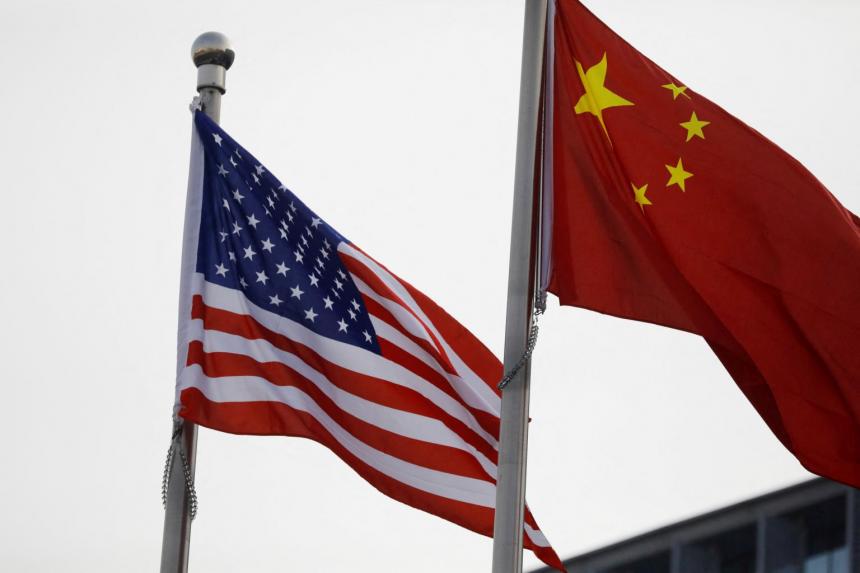
IN BRIEF
By Avishka Ashok and Arshiya Banu
INTERNATIONAL
The US: China's Foreign Minister condemns the modification of the wording on the State Department's website regarding Taiwan
On 10 May, China's Foreign Ministry Spokesperson Zhao Lijian criticized the US for modifying the wording on the State Department website about Taiwan, claiming that "political manipulation" will not change the existing status quo in the Taiwan Strait. The section on Taiwan on the State Department's website has been updated to remove statements opposing Taiwan independence as well as acknowledging Beijing's claim that Taiwan is a part of China. Zhao stated that there is only one China, that Taiwan belongs to China, and that the People's Republic of China is the country's sole lawful government. He added that the US rewriting its fact sheet on Taiwan-US relations is a "a petty act of fictionalising and hollowing out the one-China principle." (“China rebukes US for changing Taiwan wording on State Department website,” The Strait Times, 10 May 2022)
France: President Xi discusses enhancing bilateral relations with President Macron
On 10 May, Chinese President Xi Jinping spoke on the phone with French President Emmanuel Macron and observed that he and Macron have maintained close contact over the past five years. Xi stated that China-France relations have maintained a positive development momentum, while pushing for fruitful results in bilateral cooperation, and demonstrating major countries' responsibilities in addressing issues such as climate change and biodiversity conservation. Xi added that China will continue to cooperate with France in order to maintain close interactions at all levels and promote the healthy development of bilateral relations while protecting international peace and stability. (“Xi talks with Macron over phone,” Xinhua Net, 10 May 2022)
G7: China’s Foreign Ministry warns against interfering in internal affairs
On 10 May, China’s Foreign Ministry Spokesperson Zhao Lijian addressed the usual press briefing and said that the statement of concern by the Group of Seven members over the elections in Hong Kong was considered as an interference in the country’s internal affairs. Zhao said: “Certain Western countries and institutions have colluded to maliciously smear Hong Kong's election of its chief executive, a wanton interference in China's internal affairs which China is resolutely opposed to and strongly condemns.” He accused the countries of creating obstacles to the improvement of democracy in Hong Kong. Zhao further urged the G7 member countries to refrain from interfering in China’s internal affairs and respect China’s sovereignty. (“China says G-7 concern over Hong Kong leader selection is interference,” The Strait Times, 10 May 2022)
The US: China’s Foreign Ministry comments on the scheduled Summit of the Americas
On 10 May, China’s Foreign Ministry Spokesperson Zhao Lijian addressed a press briefing and commented on a query regarding the expulsion of Cuba, Nicaragua and Venezuela from the Summit of the Americas, urging the US to respect the sovereignty and dignity of the Latin American countries. Zhao said: “The summit cannot solely apply American standards or serve U.S. self-interest. It cannot be reduced to an American summit.” He referred to the Summit which is scheduled to be held in June in Los Angeles and willed the US administration to not have its self-interests at its core while holding the summit. He also noted the 200th anniversary of the Monroe Doctrine in 2023 and accused the US of bullying the Latin American countries at its will. (“China urges U.S. to respect sovereignty, dignity of Latin American countries,” Xinhua Net, 10 May 2022)
The US: National Intelligence warns that China may be preparing militarily
On 10 May, the Director of National Intelligence Avril Haines informed the Senate Armed Services Committee that despite China’s primary objective of taking over Taiwan without violence, it is preparing its military to outrun the US military in case of an intervention. Aviril stated: “It's our view that they (the Chinese) are working hard to effectively put themselves into a position in which their military is capable of taking Taiwan over our intervention.” The intelligence officers further discussed the lessons being learnt by China from the current war in Eastern Europe. She also reiterated her belief that China would not wish to resort to a military occupation of Taiwan, but would rather peacefully acquire it over time. (“China wants to take Taiwan peacefully but is preparing militarily, say US intelligence officials,” Xinhua Net, 11 May 2022)
REGIONAL
Thailand: Top officials discuss cooperation and bilateral relations
On 10 May, the Vice Chairman of the National People’s Congress Standing Committee Wang Chen held a virtual meeting with Thailand’s First Deputy Speaker of the House of Representatives Suchart Tancharoen. Wang observed that China and Thailand had successfully become more profound and flourished under the leadership of the two countries. Wang also expressed that China stands ready to work with Thailand on numerous mutual issues such as strengthening exchanges, mutual learning in rule of law, advance the implementation of the Global Development Initiative and Global Security Initiative and ameliorating the friendship between the countries. Suchart reaffirmed Thailand’s adherence to the ‘One-China’ policy and expressed the country’s desire to deepen cooperation and mutual exchanges with China. (“China, Thailand vow to strengthen cooperation between legislatures,” Xinhua Net, 10 May 2022)
South Korea: China’s Vice President attends President’s inaugural ceremony
On 10 May, China’s Vice President Wang Qishan met with South Korea’s President Yoon Suk-yeol and pledged to jointly work towards enhancing the bilateral relations and pragmatic cooperation. Wang represented President Xi Jinping and attended Yoon Suk-yeol’s inauguration ceremony and conveyed China’s greetings and best wishes to him. He expressed China’s willingness to work with South Korea and take the bilateral relations to a higher level of cooperation. He said: “China and South Korea, as close neighbours and important partners, have witnessed all-round and rapid development in bilateral relations with increasing common interests since the establishment of diplomatic ties. In the face of a changing world and a pandemic unseen in a century, it's of greater importance for both sides, the region and the whole world to strengthen China-South Korea cooperation.” Wang also introduced a five-point proposal where he suggested that the two countries enhance their strategic communication and high-level exchanges, deepen pragmatic cooperation and align development strategies, increase cultural exchanges, strengthen communication and coordination in international and regional affairs, and lastly, elevate coordination and cooperation on the issues related to the Korean Peninsula. (“China, South Korea agree to boost pragmatic cooperation,” Xinhua Net, 10 May 2022)
10 May 2022 | Tuesday | China Reader Evening Brief | Vol.1, No. 179
China's trade (Jan-Apr 2022): Four takeaways
The data released by the General Administration of Customs for the January-April 2022 period revealed that ASEAN is China's largest trading partner, followed by the EU and the US.
IN FOCUS
By Avishka Ashok
China's trade (Jan-Apr 2022): Four takeaways
On 9 May, the Global Times reported that China’s trade had sustained a growth of 7.9 per cent in the January-April period of 2022 despite the steadily increasing COVID-19 cases in the country. In this period, China’s trade was worth USD 1.93 trillion. The data revealed by the General Administration of Customs reported a 3.9 per cent growth in its exports in April on a yearly basis and amounted to USD 274 billion. However, the exports are at its lowest level since July 2020. The imports in April recorded no change and stood at USD 223 billion. Economic analysts from China primarily blamed the COVID-19 pandemic and the resulting lockdowns for the slow growth of the economy while also predicting a global impact because of the disruption of the supply chains.
China trade with Asia
First, China's trade with Asia helped sustain the economic growth.
China has retained the slow growth of its economy because of its rich trade relations with the Asian neighbours. As a part of Beijing’s ‘Friendly Neighbourhood’ policy, the country has managed to entangle the Asian economies with itself; thereby securing the inflow of essential resources and markets for its products. The countries benefitting from the Belt and Road Initiative also maintain steady economic ties with China and contributed to the Chinese economy in the first four months of 2022. While ASEAN remains to be the largest trading partner for China and accounts for 14.6 per cent of China’s total trade, economic activities with other Asian countries along the BRI route recorded a 15.4 per cent growth and was worth 3.97 trillion yuan in the January-April period. Trade with the Regional Comprehensive Economic Partnership members also recorded a 3.9 per cent increase and amounted to 3.84 trillion yuan.
Second, the EU and the US are the second and third largest trading partners, after ASEAN.
The European Union is the second largest trading partner for China while the US ranks third. Trade with the EU was valued at 1.73 trillion yuan in the January-April period and increased by 6.8 per cent on a yearly basis. The trade with the US recorded a 10.9 per cent increase and was worth USD 245.73 billion. The exports to the US grew 14.9 per cent and amounted USD 184.91 billion while the imports from the US slowed by 0.3 per cent and amounted USD 60.81 billion. The data revealed that the growth between the US and China had slowed substantially, compared to the last year.
Third, the war in Eastern Europe and the food restrictions have caused a depreciation in the value of exports.
The data also revealed that China’s grain exports had grown to 312,000 tons in April despite the bans and valued USD 150.1 million. The fertilizer export increased by 1.74 million tons on a monthly basis. In the January-April period, 916,000 tons of grains were exported by China. The data also revealed that despite the increase in grain export by 97.4 per cent since March 2022, the value of the exports was only 38.4 per cent higher and created a revenue of USD 150.1 billion yuan. China recorded an increase in the exports of canned food, meat, vegetables, edible fungi, dried fruits, nuts and fertilizer. Agricultural exports valued at 190.74 billion yuan.
Fourth, despite the reduced imports, the value of trade has remained high.
The government data revealed that China’s imports cost more in April on a yearly basis. Analysts hold the Ukraine-Russia conflict responsible for the price hike which has increased the cost of imports. Along with the war, the food restrictions and bans also caused obstacles for China. At present, 35 countries have imposed export restrictions. China’s energy imports have continued to grow in costs despite the decrease in import quantities. In the same period, there was a marked increase in price of coal, crude oil and natural gas. Crude oil imports were recorded at 171 million tons, less by 4.8 per cent while 75.4 million tons of coal was imported, also marking a decrease by 16.2 per cent. Nonetheless, the value of crude oil import increased 49.7 per cent year-on-year from 39.4 per cent in the first quarter and the import value of coal increased 78.6 per cent compared to the last year. A chief analyst of an energy industry explained the increased import values and said: “The decrease in the volume of energy imports was mainly due to surging prices because of the Russia-Ukraine conflict, which has stressed the global supply chain.”
The Chinese government foresees a continued hike in prices and have therefore taken steps to stabilize the domestic economy and reduce the shocks on the economy. The Ministry of Finance has removed import tariffs on coal from 1 May 2022 to 31 March 2023. The local and central governments also issued measures to increase the output of coal, explore domestic supplies potential, enforce medium or long-term contracts with coal providers and enhance the regulations on local prices. With the rising prices, the pressure on the government is building to transition to green and renewable energy sources.
References
“China's trade grows 7.9% in first four months amid COVID pressure,” Global Times, 09 May 2022
“China's exports grow 3.9% in April, lowest level since July 2020 amid sustained COVID pressure,” Global Times, 09 May 2022
“ASEAN remains China's No.1 trade partner from Jan to Apr, accounting for 14.6% of total trade,” Global Times, 09 May 2022
“China-US trade volume grows 10.9% in Jan-Apr,” Global Times, 09 May 2022
“China’s grain exports jump 97.4% in April amid bans by other countries,” Global Times, 09 May 2022
“Value of China’s energy imports surges amid geopolitical uncertainty,” Global Times, 09 May 2022
IN BRIEF
By Avishka Ashok and Arshiya Banu
INTERNAL
Energy: Crude oil and natural gas prices surge
On 9 May, The Strait Times reported that crude oil and natural gas prices have soared since Russia's invasion of Ukraine in late February, as sanctions against the world's largest energy supplier have forced several countries to seek alternative sources of fossil fuel. Sun Renjin, secretary-general of the China Petroleum Circulation Association's expert committee, predicted at a mid-April conference that if the war lasts longer than six months, oil prices will surpass the all-time high set during the global financial crisis in 2008. While China's overall energy security is not at risk, there may be long-term consequences. (“How the war in Ukraine is rattling China's energy transition,” The Strait Times, 09 May 2022)
WWII: Foreign Ministry spokesperson highlights lessons learnt from war victory
On 09 May, Chinese Foreign Ministry spokesperson Zhao Lijian called on the global community to work together to safeguard the outcomes of WWII triumph and to resolutely preserve the UN-led international order. In response to a question regarding Russia's Victory Day military parade, which was held at Moscow’s Red Square to mark the 77th anniversary of the Soviet Union's defeat of Nazi Germany in the Great Patriotic War, Zhao stated the World Anti-Fascist War victory was secured by the combined efforts of all peace-loving countries and people all over the world. He went on to say that one of the most important lessons learned from the win is that countries should be committed to mutual respect, peaceful coexistence, and finding common ground while retaining differences. (“China calls for global efforts to safeguard results of WWII victory,” CGTN, 09 May 2022)
Hong Kong: Spokesperson defends electoral system and the appointment of John Lee
On 9 May, the Hong Kong and Macao Affairs Office of China’s State Council spokesperson responded to the statements made by Western countries on the Hong Kong elections, the new electoral system and the central government’s policy for the city. The statement released by the spokesperson said: “The just-concluded election of the sixth-term chief executive of the HKSAR represents a new success of Hong Kong in developing democracy that is suitable to its own conditions.” The spokesperson reconfirmed that the winner of the elections had received the support of the general public in the city and that the accusations of the West would not distort the reality. (“Chinese spokesperson slams Western countries smearing Hong Kong election,” Xinhua Net, 10 May 2022)
Communist Youth League: President Xi attends 100th anniversary of CYLC
On 10 May, the Great Hall of the People in Beijing city celebrated the 100th anniversary of the founding of the Communist Youth League of China. President Xi Jinping attended the celebration and delivered a speech on the occasion. The speech focused on the Chinese dream of national rejuvenation. The First Secretary of the Secretariat of the Central Committee of the CYLC highlighted the need to uphold the CPC’s leadership and stay connected to the country and its people. The CYLC was also encouraged to strengthen political consciousness, become advanced and represent the Chinese people. (“China celebrates 100 years of the Communist Youth League,” CGTN, 10 May 2022)
INTERNATIONAL
Germany: Chinese President urges German Chancellor for efforts to prevent escalation of the Ukraine conflict
On 09 May, Chinese President Xi Jinping stated that all measures must be taken to prevent the Ukraine conflict from becoming an "unmanageable situation," in a video call with German Chancellor Olaf Scholz. He said: "All efforts must be made to avoid the intensification and expansion of the Ukraine conflict, which could lead to an unmanageable situation." Xi also asked Germany to join the Global Security Initiative, a broad and nebulous framework proposed by Xi last month that supports the principle of "indivisible security," which Russia has used to justify its invasion of Ukraine. (“China's Xi tells German Chancellor all efforts must be made to avoid Ukraine conflict from intensifying,” Reuters, 09 May 2022)
Environment: Foreign Minister calls for cooperation on drought and desertification
On 9 May, China’s Foreign Minister Wang Yi attended the leaders’ meeting on drought and sustainable land governance and urged the countries to enhance international cooperation on dealing with drought and desertification. Wang Yi observed that countries were faced with numerous challenges since the pandemic began in 2019. In such challenging situations, it is difficult to coordinate and manage development and environmental protection. Therefore, he suggested three solutions to the issue. He called for enhanced international cooperation, firm promotion of green development and improvement of the international rules. He said: “We should actively respond to the drought issues that African countries are concerned about, continuously develop and improve drought-control rules, and build a fair and reasonable desertification-control system.” (“China calls for global cooperation on fighting drought, desertification,” Xinhua Net, 10 May 2022)
Pakistan: Foreign Minister extends support to China’s Global Development Index
On 9 May, Pakistan’s Foreign Minister Bilawal Bhutto Zardari attended the virtual Group of Friends of the Global Development Initiative (GDI) meeting and expressed the country’s support and appreciation for the GDI. He called the initiative a useful platform for accelerating and coordinating efforts to implement the Sustainable Development Goals (SDGs). Zardari highlighted the possible digression in the goal to implement the SDGs due to the pandemic, climate change and geopolitical conflicts. He urged the meeting to sincerely address the challenges facing the developing world and extend help to “increase cooperation in public health and vaccine equity, ensure food security, enhance energy production, promote a global green economy, stimulate trade and industrialization, and eliminate the digital divide.” Zardari also pledged to strengthen Pakistan’s commitment to China’s BRI. (“China-proposed GDI platform to accelerate implementation of SDGs: Pakistani FM,” Xinhua Net, 10 May 2022)
09 May 2022 | Monday | China Reader Evening Brief | Vol.1, No. 178
European Union condemns the election of John Lee in Hong Kong
Foreign Policy Chief Josep Borrell expressed the EU's opposition to the the appointment of Lee as Hong Kong's Chief Executive.
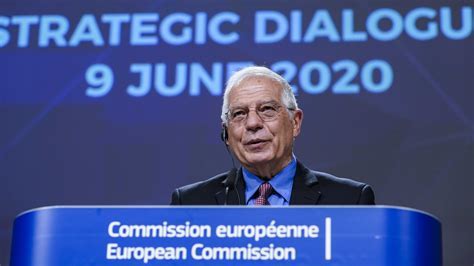
IN BRIEF
By Avishka Ashok and Arshiya Banu
INTERNATIONAL
The EU: Foreign policy chief says China and Hong Kong violated “democratic principles”
On 8 May, the European Union’s foreign policy chief Josep Borrell stated that the appointment of John Lee, a former security officer as Hong Kong's new leader, violated democratic principles. Lee, who oversaw the repression of Hong Kong's democracy movement, was named Hong Kong leader by a select committee of Beijing loyalists. Borrell said: "The European Union regrets this violation of democratic principles and political pluralism and sees this selection process as yet another step in the dismantling of the 'one country, two systems' principle." He added that the EU expects Chinese and Hong Kong authorities to follow through on their national and international obligations, including the ultimate aim of universal suffrage for the Chief Executive and Legislative Council members. (“Appointment of HK leader John Lee violates democratic norms, says EU foreign policy chief,” The Strait Times, 08 May 2022)
REGIONAL
Taiwan: PLA Navy encloses Taiwan in a training mission
On 8 May, Global Times reported that the Chinese Liberation Army (PLA) Navy’s Liaoning aircraft carrier group, which began a realistic combat training mission in the West Pacific about a week ago, has reportedly been practising intensively in the Philippine Sea to the east of the island of Taiwan and south of Japan over the past few days, a location that is critical to preventing potential external interference in the event of a reunification-by-force operation in the Taiwan Strait. With the carrier group to Taiwan's east, the PLA reportedly dispatched different types of fighter planes and naval vessels from the Chinese mainland west of the island of Taiwan, effectively surrounding and enclosing the island under the watch of US and Japanese aircraft carriers. (“PLA encircles Taiwan island with carrier drills amid US, Japanese provocations,” Global Times, 08 May 2022)
Cambodia: China’s Foriegn Minister holds a meeting with Deputy Prime Minister to discuss regional development and peace
On 8 May, China’s Foreign Minister Wang Yi and Cambodia’s Deputy Prime Minister and Foreign Minister Prak Sokhonn met online via video link and discussed global governance and the Asian outlook. Wang Yi urged the world leaders to pay attention to the Asian voices as “global governance enters the Asian moment.” He also explained China’s efforts in building a just and equitable global governance system by initiating the Global Development Initiative and the Global Security Initiative. Wang Yi further called on the Asian countries to unitedly protect the region from the growing cold-war mentality that threaten to undermine the peace and development in East Asia. He said: “While China welcomes countries outside the region to play a positive and constructive role in promoting peace and development in the region, it does not accept any action undermining regional peace and stability or solidarity and cooperation.” (“Chinese FM meets Cambodian counterpart, calling on world to listen more to Asian voices,” Xinhua Net, 09 May 2022)
INTERNAL
Hong Kong: John Lee gets elected with new electoral system
On 9 May, Xinhua Net reported that the Hong Kong and Macao Affairs Office of China’s State Council announced that Hong Kong has a new voting system and is prepared for a brighter future at a new starting point. After John Lee was elected to a six-year term as Chief Executive of the Hong Kong Special Administrative Region (HKSAR) with an overwhelming majority of votes. The office stated that the chief executive election was yet another successful test of the HKSAR's new electoral system, following the Election Committee elections in September and the election of the seventh-term Legislative Council in December. It added that the new system, which follows the "one country, two systems" approach is more suited to Hong Kong's realities. (“China central gov't office says Hong Kong takes fresh look with new electoral system,” Xinhua Net, 08 May 2022)
Environment: 600 children suffer repeated nosebleeds due to increased emissions from automaker production plant
On 8 May, the local government in Changsha reported on its official Weibo account that a team had been sent to the Chinese automaker BYD’s factory after hundreds of children suffered a nosebleed due to the increased pollution. The authorities took up the case to investigate the gas emissions caused by the company after the neighbouring residents lodged a complaint. The Strait Times reported that according to a local report, over 600 children residing near the production plant of the company have suffered repeated nosebleeds since April 2022. The company has responded to the accusations and called the complaints baseless and malicious while explaining that the plant complies with the regulations and has taken steps to reduce the odour caused by the plant. (“Chinese automaker BYD probed for pollution amid reports of nosebleeds in children,” The Strait Times, 09 May 2022)
Shanghai: Strait Times investigates Communist Party Chief Li Qiang’s successes in the city
On 9 May, the Strait Times reported that the political situation in the city did not match with the public outcry caused by the COVID-19 pandemic and it may be because of the Shanghai Communist Party chief Li Qiang’s close relationship with President Xi Jinping. The report observed that Li is being seen as a member who could also make the Politburo Standing Committee this year. It is also noticed that the COVID-19 outbreaks have caused many Chinese politicians to lose their careers but Li has managed to sustain his seat despite the harsh and long lockdowns. (“Shanghai Covid-19 crisis puts political spotlight on key Xi ally Li Qiang,” The Strait Times, 09 May 2022)
ECONOMY
Central Bank of China: Authorities conduct reverse repos of 10 billion yuan
On 9 May, the Central Bank of China conducted a reverse repos of 10 billion yuan. The bank set the repos rate at 2.1 per cent for seven days with the objective of stabilising the liquidity in the banking system. (“China central bank conducts reverse repos to boost liquidity,” Xinhua Net, 09 May 2022)
Foreign Trade: China records a 7.9 per cent increase in total trade in Jan-Apr 2022
On 9 May, the General Administration of Customs reported that the total foreign trade in the first four months of 2022 marked an increase compared to the previous year. The information revealed by the government showed an expansion of 7.9 per cent in China’s total imports and exports in the January-April 2022 period. The total trade amounted to 12.58 trillion yuan. (“China's foreign trade up 7.9 percent in first four months,” Xinhua Net, 09 May 2022)
07 May 2022 | Saturday | China Reader Evening Brief | Vol.1, No. 177
China's Foreign Ministry recollects the 1999 bombing of embassy in Belgrade
Zhao Lijian expressed China's sentiments towards NATO and the US on the attack on the embassy and urges them to contribute towards peace.
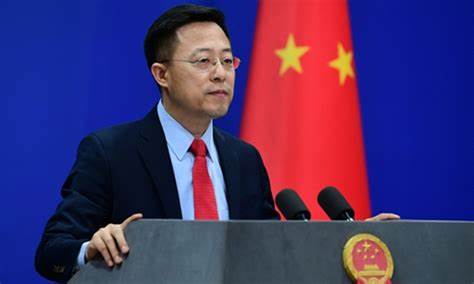
IN BRIEF
By Avishka Ashok and Arshiya Banu
INTERNATIONAL
NATO: Foreign Ministry remembers the 1999 bombing of the Chinese embassy in Belgrade
On 6 May, China’s Foreign Ministry Spokesperson Zhao Lijian addressed the daily news briefing and recalled the 1999 NATO bombing of the Chinese embassy in Belgrade that resulted in the killing of three Chinese journalists and injured 20 other Chinese diplomats. Zhao remarked that China would always remember the “barbaric atrocities” and will work towards preventing such tragedies in the future. He said: “NATO claims to be a defensive organization, but it in fact has repeatedly violated international law and wantonly waged wars against sovereign countries, undermining world and regional peace and killing and displacing a large number of innocent civilians.” He further urged the US and NATO to consciously work towards contributing to world peace, stability and development. (“China will never forget NATO's bombing of Chinese embassy: spokesperson,” Xinhua Net, 06 May 2022)
Japan: Chinese spokesperson responds to Prime Minister's remarks
On 6 May, China's Foreign Ministry spokesperson Zhao Lijian responded to Japanese Prime Minister Fumio Kishida's comments that the scenario in Ukraine could repeat itself in East Asia and stated that Japan should not exaggerate the “China threat” in order to erode regional confidence and cooperation. Zhao accused Japan of inflating regional tensions by using the so-called "China threat" as a reason to beef up its own military capabilities, which he said is detrimental to regional peace and stability. He added that the Taiwan issue is totally a Chinese internal matter that cannot be linked to the situation in Ukraine. Zhao suggested that Japan should immediately cease inciting hostility between major powers and focus on activities that promote East Asian peace and stability. (“Japan slammed for hyping up "China threat",” Xinhua Net, 06 May 2022)
REGIONAL
South Korea: Chinese Vice President to attend President's inauguration ceremony
On 6 May, Chinese Vice President Wang Qishan confirmed his attendance at the inauguration ceremony of South Korean President-elect Yoon Suk-yeol next week, as part of Beijing’s plans to expand its influence in the region. The decision was made after Yoon’s pledge to strengthen South Korea's alliance with the US in the face of growing nuclear and missile threats from North Korea. The country's last ballistic missile test occurred just days after leader Kim Jong Un vowed to develop the country's nuclear forces "at the fastest possible speed." Wang is attending the ceremony as President Xi Jinping's special representative. The US delegation will be led by Douglas Emhoff, the husband of Vice President Kamala Harris, who will also attend the ceremony in Seoul. (“China to send vice president to South Korea president's inauguration,” Reuters, 06 May 2022)
Taiwan: Air Force issues a warning to 18 Chinese aircraft
On 6 May, Taiwan’s Defence Ministry stated that Taiwan’s air force rushed to warn away 18 Chinese aircraft that had breached its air defence zone, part of a recurring pattern of incursions that has enraged the administration in Taipei. Taiwan, which China claims as its own territory, has complained about repeated Chinese aircraft missions in the last two years. Taiwan is currently on high alert due to suspicions that China could use Russia's invasion of Ukraine as a pretext to launch a military attack on the island, despite Taipei's administration reporting no signs that Beijing is planning an attack. (“Taiwan jets scramble as China air force enters air defence zone,” The Strait Times, 06 May 2022)
Indonesia: China’s Foreign Minister extends hand in jointly safeguarding East Asian peace and stability
On 6 May, China’s Foreign Minister Wang Yi held a virtual discussion with Indonesia’s Coordinator for Cooperation with China and Coordinating Minister Luhut Binsar Pandjaitan and agreed to safeguard the regional peace and stability together. Wang observed that the strategic guidance of the leaders of the two countries, Cambodia and China were able to surpass numerous challenges in their bilateral relations and establish close beneficial ties. He said: “Hailing the two countries as true friends and reliable partners, China is willing to work with Indonesia to deepen the new pattern of bilateral relations with "four-wheel drive" on political, economic, cultural and maritime cooperation, so as to better cope with various international challenges, and make greater contributions to world peace and development.” Wang Yi also stressed on maintaining an ASEAN centred regional cooperation to safeguard the peace and stability in East Asia. He further condemned the Indo-Pacific strategy of the US and called it unconducive to the common interests of the East Asian countries. (“China, Indonesia vow to safeguard peace, stability in East Asia,” Xinhua Net, 06 May 2022)
Asian Games: Olympic Council of Asia announces decision to postpone games
On 6 May, the BBC reported that the Asian Games which was scheduled for 10-25 September in Hangzhou was postponed due to the coronavirus pandemic. The Olympic Council of Asia (OCA) is yet to decide on the new dates for the games but said: “HAGOC (Hangzhou Asian Games Organising Committee) has been very well prepared to deliver the Games on time despite global challenges. However, the above decision was taken by all the stakeholders after carefully considering the pandemic situation and the size of the Games.” (“Asian Games in China postponed because of Covid-19,” BBC, 06 May 2022)
INTERNAL
Central Government: Authorities replace foreign PCs with domestic ones
On 6 May, China ordered central government agencies and state-owned businesses to replace foreign personal computers with domestic counterparts within two years, marking one of Beijing's most aggressive measures to date to remove crucial foreign technology from its most sensitive organs. After the week-long May break, employees were requested to trade in their foreign PCs for home-made alternatives that ran on domestically designed operating software. The exercise, which was authorised by central government authorities, is anticipated to gradually replace at least 50 million PCs on a central government level alone. (“China orders government, state firms to dump foreign PCs,” The Strait Times, 06 May 2022)
Global Security Initiative: Vice Foreign Minister promotes the plan at online dialogue with global think tanks
On 6 May, China’s Vice Foreign Minister Le Yucheng delivered a speech at an online dialogue with global think tanks from 20 countries and promoted the Global Security Initiative as a fundamental solution to dealing with the peace deficit. Yucheng stressed on the worsening conditions of the international order with the war in Europe and the COVID-19 pandemic. He placed emphasis on the Global Security Initiative proposed by President Xi Jinping at the Boao Forum for Asia and said: “This major Initiative carries forward the spirit of the UN Charter, offers a fundamental solution to eliminating the peace deficit and contributes Chinese perspectives to meeting international security challenges.” (“Global Security Initiative offers solution to eliminating peace deficit: Chinese vice FM,” Xinhua Net, 07 May 2022)
06 May 2022 | Friday | China Reader Evening Brief | Vol.1, No. 176
China accuses NATO of bloc confrontations and provocative actions
At the United Nations, Zhang Jun objects the rising cold-war mentality and bloc provocations of the NATO.
IN BRIEF
Avishka Ashok and Arshiya Banu
INTERNATIONAL
NATO: China objects bloc confrontations and provocative actions
On 5 May, China’s permanent representative to the United Nations Zhang Jun opposed NATO’s actions of forming blocs and confronting other countries in groups. Zhang Jun said: “Clinging to the anachronistic doctrine of security and keen to provoke bloc confrontations and create tensions in Europe and even the Asia Pacific region and the wider world, such practices as harmful to others as they are deleterious to the perpetrators themselves, and deserve nothing less than China's firm opposition.” He referred to the security crisis in Eastern Europe and claimed that it would be unreasonable to base one country’s security on the insecurity of others. He also accused the organization of wantonly launching wars against sovereign countries and creating human casualties and humanitarian issues across the world. He further discouraged the countries from creating a cold-war like situation in international affairs. (“China opposes NATO's provocation of bloc confrontations around globe,” Xinhua Net, 06 May 2022)
Opposing sanctions: Foreign Ministry Spokesperson urges countries to work towards global economy recovery
On 5 May, the Foreign Ministry Spokesperson Zhao Lijian commented on the decision by the International Monetary Fund to downgrade its 2022 global economic growth forecast to 3.6 per cent and accused the unilateral sanctions for the worsening condition of the global economy. Zhao urged the US to work towards the stability of the global supply chains and take actions that are conducive to the global economic recovery as the world’s largest economy. He also praised China’s endless efforts in contributing towards the world’s economic activities and said: “National economic data for the first quarter of 2022 showed that China's economy has continued to sustain its recovery and development momentum, and its foreign trade and foreign investment continued to improve, showing strong resilience and vitality.” (“Sanctions only make world economy worse: FM spokesperson,” Xinhua Net, 05 May 2022)
The US: China’s Ambassador calls for a stop to politicization of trade relations
On 5 May, the Forbes magazine interview of China’s Ambassador to the US Qin Gang was published where he calls on the country to cancel the additional tariffs on Chinese goods. He also urged the US to avoid politicizing the business and trade relations between the two largest economies. Qin said: “Our trade and business relations have made remarkable achievements, benefiting the two countries and benefiting the world. We are natural partners, because our economies are highly complementary.” He further explained that the higher tariffs were in turn harming the US companies and consumers while not even reducing the trade deficit. (“Chinese ambassador urges U.S. to stop politicizing business, trade ties with China,” Xinhua Net, 06 June 2022)
Russia and Ukraine: Foreign Ministers laud China for its stance
On 5 May, Chinese foreign ministry spokesperson Zhao Lijian stated that Russian foreign minister Sergey Lavrov and Ukraine foreign minister Dmytro Kuleba commended China’s fair and just stance on the current Russia-Ukraine conflicts. Zhao asserted that China would continue to play a positive role in the Ukraine crisis, encouraging all parties to resolve the conflict through dialogue and diplomacy. He made the comments at a press conference in response to queries about whether China will communicate with Russia about ending the ongoing conflict and whether China will meet with Ukrainian President Volodymyr Zelensky. (“Both Russia, Ukraine FMs praise China's fair, just stance on current crisis in recent interviews: FM,” Global Times, 05 May 2022)
INTERNAL
Beijing: Worst outbreak yet forces people to work from home
On 5 May, millions of people in Beijing returned to work, with dozens of subway stations closed after a national holiday tempered by coronavirus restrictions. As they confront the pandemic's largest breakout since its beginnings, Chinese authorities have pushed ahead with their zero-COVID policy, which includes lockdowns and mass testing. Entire neighbourhoods in the capital have been sealed over a relatively small number of infections. Beijing recorded 50 local virus cases, a day after the city's most populous district, Chaoyang, with around 3.5 million people, was ordered to work from home. Office goers from the area were advised to drive themselves and avoid gatherings. (“Millions in Beijing back to work after break, urged to work from home to fight Covid-19,” The Strait Times, 05 May 2022)
Shanghai: Varsities prepare for summer graduates’ job hunt
On 5 May, Global Times reported that Shanghai universities are stepping up efforts to match graduates with potential employers, given that both are confined to their homes, in response to the toughest employment environment in history, as the Omicron epidemic has altered the regular job-hunting process of college graduates. Since the end of March, Shanghai has been under "static management," making in-person interviews with potential employers impossible for college students. In the midst of various constraints posed by the COVID-19 epidemic and structural problems in China's labour market, over 10.76 million students will graduate this summer and look for a job. (“Shanghai universities, companies join hands to stabilize jobs in toughest employment year,” Global Times, 05 May 2022)
REGIONAL
Cambodia: Ministry of Public Works and Transport praises BRI
On 6 May, Cambodia’s undersecretary of state and spokesperson for the Ministry of Public Works and Transport Vasim Sorya corresponded with Xinhua Net and said that projects under the Belt and Road Initiative of China were greatly beneficial to the country and played an important role in boosting the economy. Some of the projects in Cambodia under the Belt and Road Initiative include the Sihanoukville Expressway, new Siem Reap International Airport, Morodok Techo National Stadium, roads and bridges, hospitals and rural water supply. Sorya said: “These projects have provided and will continue to provide a lot of tangible benefits to the economy and people of Cambodia. These projects have provided and will continue to provide a lot of tangible benefits to the economy and people of Cambodia.” (“China's BRI projects greatly benefit Cambodian economy, people: officials, experts,” Xinhua Net, 06 May 2022)
Taiwan: Defense Minister announces decision to cancel defence deal with the US
On 5 May, Taiwan announced that it will not proceed with a plan to purchase 12 MH-60R anti-submarine helicopters from the US’ Lockheed Martin Corp's Sikorsky business, citing the cost as a reason. Defence Minister Chiu Kuo-cheng said: "The price is too high, beyond the scope of our country's ability." M109A6 Medium Self-Propelled Howitzer artillery systems and mobile Stinger anti-aircraft missiles are two other weapons purchases that have been postponed. Taiwan, which China claims as its own territory, is undergoing a military modernization programme to increase its ability to defend itself against a Chinese attack, notably with precision weaponry such as missiles. (“Taiwan says it can't afford new US anti-submarine helicopters,” The Strait Times, 05 May 2022)
05 May 2022 | Thursday | China Reader Evening Brief | Vol.1, No. 175
China calls on countries to fulfill financial duties at the UN
At the United Nations General Assembly, China's Dai Bing reminds the biggest contributors of their duty towards the organization.
IN BRIEF
By Avishka Ashok and Arshiya Banu
INTERNATIONAL
United Nations: China urges countries to deliver on their financial promises
On 4 May, Xinhua Net reported that China’s deputy permanent representative to the United Nations Dai Bing attended the Fifth Committee of the 76th session of the UN General Assembly and called on the biggest contributors of the organization to fulfill their financial responsibilities. Bing said: “The largest contributor has not well-fulfilled its financial obligations to the UN over the years. This is unfair to other countries.” He also pushed the Secretariat to strengthen the budgetary performance, ameliorate the internal control and enforce financial discipline to ensure efficient spending of the funds. He also praised China’s efforts in fulfilling its financial duties despite the latest wave of the coronavirus pandemic in the country and the domestic economic challenges. (“Chinese envoy urges biggest contributor to fulfill UN financial duties,” Xinhua Net, 04 May 2022)
The US: China retaliates against the US for false accusations
On 4 May, Xinhua Net reported that the Chinese Embassy in the United States criticised the US State Department for falsely claiming that Chinese officials and the media "routinely amplify Kremlin’s propaganda, conspiracy theories, and disinformation" on the Ukraine crisis. A Chinese embassy spokesperson said: "China's position on the Ukraine issue is impartial, objective and beyond reproach." He claimed that the US should “seriously” reflect on itself when it comes to spreading disinformation, noting the fact that the U.S. has waged wars in Iraq, Afghanistan, and Syria, killing 335,000 civilians over the years. He said: "Blaming and smearing just won't solve the problem," and urged Washington to embrace joint verification by the international community under the UN and the BWC. (“Chinese embassy rebukes Washington's false claims against China over Ukraine issue,” Xinhua Net, 04 May 2022)
Germany: China’s export increases to 15.8 per cent
On 4 May, the Federal Statistical Office reported that Germany’s imports from China rose to 15.8 per cent in March 2022. The official body revealed that China continued to be Germany’s biggest foreign trade partner in March with the exported goods amounting to 9.1 billion euros. Germany’s total imports grew by 3.4 per cent and amounted to 117.4 billion euros in March while its exports dropped by 3.3 per cent and amounted to 120.6 billion euros. The report also informed that the US continued to be Germany’s largest customer and that their bilateral trade was worth 11.5 billion euros in March. (“German imports from China up 15.8 pct in March,” Xinhua Net, 4 May 2022)
REGIONAL
Laos: Railway line observes a spike in transportation of passengers and goods
On 4 May, Xinhua Net reported that the China-Laos Railway had successfully transported 2.7 million passengers and 2.9 million tonnes of cargo since December 2021. The data was revealed by China State Railway Group Co. Ltd which revealed: “The railway has seen strong growth in cargo transport, with the cargo freight volume in its fifth month of operation hitting 1.1 million tonnes, up 550 percent from its first month of operation.” The state-owned company also revealed that the railway had transported goods such as electronics, automobiles and flowers to more than 10 countries and other regions. The railway company currently has 36 passenger trains which run along the route. (“China-Laos Railway sees brisk passenger, cargo transport over inaugural 5 months,” Xinhua Net, 04 May 2022)
Cambodia: Health Ministry approves and promotes the use of Sinovac and Sinopharm
On 4 May, Xinhua Net reported that Cambodia’s Health Ministry Secretary of State and Spokeswoman Or Vandine had approved of the Sinovac and Sinopharm COVID-19 vaccines developed by China and called them safe and effective. Cambodia is now using Sinovac, Sinopharm, AstraZeneca, Johnson & Johnson, Pfizer and Moderna vaccines in the country. She said: “These vaccines are safe, effective and of good quality because they are in the World Health Organization (WHO)'s list of vaccines for emergency use.” The narrative around the Chinese vaccines are also positive in the country with many supporting the government’s decision to choose China as the strategic supplier of the COVID-19 vaccines. (“Chinese COVID-19 vaccines safe, effective: Cambodian official,” Xinhua Net, 04 May 2022)
Taiwan: Chinese anti-submarine aircraft on a mission near the island
On 4 May, Global Times reported that a Chinese People’s Liberation Army (PLA) Y-8 anti-submarine warfare aircraft carried out a maritime patrol mission near the island of Taiwan, two months after this type of aircraft was last seen in the region, amid claims that that aircraft was involved in an accident in March. While the alleged crash has not been confirmed, the Y-8 anti-submarine warfare aircraft is now fully equipped to carry out missions, at a time when foreign powers are frequently dispatching spy planes, naval vessels, and submarines to oversee the region. Fu Qianshao, a Chinese mainland military aviation expert stated that the PLA must improve its capability and readiness to monitor and patrol important locations with fixed-wing aircraft as well as anti-submarine warfare helicopters, as the latter can cover a bigger area in less time. (“PLA's Y-8 anti-submarine warfare aircraft resumes patrols around Taiwan island,” Global Times, 04 May 2022)
INTERNAL
Youth Day: China celebrates the May Youth Day
On 4 May, the May Youth Day, which is a Chinese yearly festival for young people aged 14 to 28 years old, was celebrated. The May Fourth Movement, a patriotic historic movement that occurred in 1919, was also commemorated on this day. The day marked the 100th anniversary of the founding of the Communist Youth League of China (CYLC). Although some voices on social media platforms have attempted to label Chinese youth as "the lying flat generation" - denoting a negative attitude toward challenges and difficulties, a lack of belief in working hard and striving, and an intention to give up and run away from competition, facts and research have shown that the vast majority of Chinese youth continue to believe in working hard and striving for their own future. Today, the Chinese government places a high priority on resolving their difficulties and maximizing their full potential. (“‘Striving spirit’ main theme of Chinese youth,” Global Times, 04 May 2022)
Xinjiang: China denies BBC’s report
On 4 May, the Chinese Embassy in the UK criticised a BBC broadcast about China's Xinjiang region and called it inaccurate and claimed that the BBC programme was used to propagate disinformation about Xinjiang with the goal of shaming and slander. An embassy spokesperson stated that the allegations that China's Xinjiang is home to "re-education centres," "forced labour," and "destruction of Uygur culture," are "pure lies of the century" perpetrated by some politicians, media outlets, and academicians working together to smear China. He claimed that their constant attempts to spread rumours and stir up trouble are actually acts of political manipulation and economic coercion disguised as human rights protection, with the ultimate purpose of undermining Xinjiang's prosperity and stability while limiting China’s progress. He said: "It must be pointed out that the Xinjiang-related issues have nothing to do with religions, ethnic groups or human rights, but everything to do with fighting terrorism, separatism and extremism." (“Chinese Embassy refutes groundless BBC report on Xinjiang,” CGTN, 04 May 2022)
04 May 2022 | Wednesday | China Reader Evening Brief | Vol.1, No. 174
Senior US officials report on diminishing tensions with China
Senior US officials say they have not identified conspicuous Chinese military and economic support.
IN BRIEF
Avishka Ashok and Arshiya Banu
INTERNATIONAL
The US: Senior officials report on diminishing tensions with China
On 3 May, Reuters reported that Senior US officials say they have not identified conspicuous Chinese military and economic support, two months after warning that Beijing looked ready to assist Russia in its fight against Ukraine, a good development in the strained US-China relationship. However, they claim that they are still apprehensive of China's long-standing backing for Russia in general, but the military and economic assistance that they feared has not materialised, at least for the time being. The officials also stated that they are continuing to monitor the PRC and any other country that may lend help to Russia or evade US and partner sanctions. (“U.S. relieved as China appears to heed warnings on Russia,” Reuters, 03 May 2022)
Timor-Leste: President Xi congratulates new President Jose Ramos-Horta
On 3 May, China’s President Xi Jinping sent a congratulatory note to the newly elected President of Timor-Leste Jose Ramos-Horta. On the occasion, President Xi observed that the two decades of diplomatic ties with Timor-Leste had greatly benefitted the two countries and deepened their practical cooperation. Xi said: “China attaches great importance to the development of China-Timor-Leste relations, and stands ready to work with President Ramos-Horta to bring the comprehensive cooperative partnership of good-neighborliness, friendship, mutual trust and mutual benefit between the two countries to a new level.” (“Xi congratulates Jose Ramos-Horta on election as Timor-Leste's president,” Xinhua Net, 3 May 2022)
INTERNAL
Space: Xi motivates the youth of China Aerospace Science and Technology Corporation
On 3 May, Xinhua Net reported that Chinese President Xi Jinping has urged young people in the aerospace industry to do more to help China achieve greater self-reliance in aerospace research and technology. Xi made the statements in a letter to a youth team at the China Aerospace Science and Technology Corporation working on space station building (CASC). He cited the BeiDou Navigation Satellite System satellites, Chang'e lunar probes, Tianwen-1 Mars probe, Xihe solar exploration satellite, and the Tiangong space station and its core module Tianhe as examples of China's space industry's continuous improvements. He noted that a huge number of young people in the sector had taken the lead and taken on significant responsibilities, reflecting the innovative spirit of the new generation of Chinese youth. According to Xi, making China stronger in the aerospace sector will take generations of effort. (“Xi Focus: Xi encourages youth to help boost China's aerospace sci-tech self-reliance,” Xinhua Net, 03 May 2022)
Hong Kong: World Press Freedom Index drops 68 places to 148th position
On 3 May, the Reporters Without Borders revealed the 2022 World Press Freedom Index at the Royal Overseas League in London. The report placed Hong Kong city at the 148th position, plummeting 68 spots from its 80th position in 2021. The report observed that the press freedom declined steeply since the implementation of the National Security Law in 2020. The report also alarmed the world of an upcoming era of polarization in the media industry. The report said: “The Hong Kong government takes orders directly from Beijing and openly supports its attempts to impose censorship and spread propaganda.” It also spoke of the Radio Television Hong Kong which has now been placed under a pro-central government management who has the authority to censor the anti-government programmes it previously aired. (“Hong Kong plummets in latest press freedom ranking,” Microsoft News, 3 May 2022)
REGIONAL
Japan: Chinese naval vessels pass near Japan’s territorial waters
On 3 May, Reuters reported that Japan’s defence ministry alleged that eight Chinese naval vessels sailed between islands in the southern Okinawa group, including several destroyers and an aircraft carrier. The ships passed between Miyakojima and Okinawa's main island. Despite the fact that there was no trespass into Japanese territorial seas, the Liaoning carrier's helicopters took off and landed, according to the ministry. The Taiwanese Defence Ministry called the situation "normal," and said it will keep an eye on the carrier group's activities. According to Japanese national television NHK, it was the first time a Chinese aircraft carrier had been reported to have sailed in the area since December last year. (“Chinese carrier sails through waters near Okinawa, Japan says,” Reuters, 03 May 2022)
South Korea: Envoys talk about rising tensions in the Korean peninsula
On 3 May, China’s Korean affairs envoy Liu Xiaoming met with his South Korean counterpart Noh Kyu-duk and said that Beijing remained committed to playing a constructive role in resolving the North Korean nuclear issue, a week after the North pledged to develop its nuclear arsenal "at the fastest possible speed." While denuclearization discussions with the US remain, North Korean leader Kim Jong Un vowed to speed up the development of his country's nuclear arsenal while overseeing a massive military display last week. Noh voiced concern over Pyongyang's latest missile launches and efforts to restore its Punggye-ri nuclear test site, and asked Beijing to help bring Pyongyang back to the negotiating table. (“China envoy vows to play 'constructive role' amid tensions on Korean peninsula.” The Strait Times, 03 May 2022)
02 May 2022 | Monday | China Reader Evening Brief | Vol.1, No. 171
EU Spokesperson demands a reason for detention of staff member at Beijing mission
Nabila Massrali confirmed the arrest via email and also revealed that the Chinese police had not given any explanation on the arrest or the charges.

IN BRIEF
Avishka Ashok and Arshiya Banu
INTERNATIONAL
The EU: Spokesperson demands a reason for detention of staff member at Beijing mission
On 1 May, the Strait Times reported that the European Union has called for a “proper answer” from the Chinese authorities for arresting a local employee at the mission in Beijing in September 2021. The EU spokesperson Nabila Massrali confirmed the arrest via email and also revealed that the Chinese police had not given any explanation on the arrest or the charges. Massrali said: “We will continue inquiring until we get a proper answer.” The French newspaper Le Monde reported that An Dong, an IT department employee was arrested for picking quarrels and provoking troubles. (“EU demands 'proper answer' over detained staff member in China,” The Strait Times, 1 May 2022)
The UK: Hydrogen energy cooperation Forum kick-starts in virtual mode
On 2 May, Xinhua Net reported on the Chinese Ambassador Zheng Zeguang’s statements on the cooperation on hydrogen energy between China and Britain during the opening ceremony of the China-UK Hydrogen Energy Cooperation Forum. Zeguang encouraged the development and pushed for more beneficial cooperation in the future. He said: “In recent years, China and Britain have carried out joint projects in hydrogen fuel cells and hydrogen industrial parks, and such mutually beneficial cooperation in hydrogen energy has huge potential and broad prospects for further growth.” Zheng also called on the local government bodies to increase their engagement and communication in order to contribute to a sustainable and healthy development of the energy, (“China-Britain hydrogen energy cooperation enjoys huge potential, broad prospects: ambassador,” Xinhua Net, 02 May 2022)
Portuguese-speaking countries: China views Forum Macao to increase cooperation
On 1 May, Xinhua Net reported on the potential of the cooperation between China and Portuguese-speaking countries and highlighted food security, sustainable energy and connectivity of goods, services and people as the top-most areas for conducive opportunities. The Associate Dean of the Institute of Research on the Portuguese-speaking countries in City University of Macao Francisco B. S. Jose Leandro stressed on the Forum Macao and its role in promoting the cooperation between the countries. He also placed emphasis on Macao’s role as a city that links the countries and provides areas for cooperation and called for greater visibility of the Guangdong-Hong Kong-Macao Greater Bay Area. (“China, Portuguese-speaking countries have co-op potential in multiple areas: experts,” Xinhua Net, 01 May 2022)
INTERNAL
Mount Everest: China plans to establish a meteorological station at 8,800 meters
On 1 May, Xinhua Net reported that Chinese scientists were attempting to set-up a meteorological monitoring station at a height of 8,800 meters on Mount Qomolangma, popularly known as Mount Everest. The Institute of Tibetan Plateau Research said that the new station would replace the US and British station at 8,430 meters as the highest in the world. The Institute revealed that the plan is to distribute the dismantled equipment in such a way that each mountaineer carries seven kilograms which will be then used in the establishment of the station. The plan also includes establishing eight elevation gradient meteorological stations other than the highest one. In 2021, four stations were set up at 6,500 meters, 5,800 meters and 5,400 meters while three more were established at 7,028 meters, 7,790 meters and 8,300 meters in 2022. (“China Focus: World's highest automatic weather station to be set up on Mt. Qomolangma,” Xinhua Net, o1 May 2022)
Youth League: Data reveals 43.81 million students engaged in the organization
On 2 May, the Communist Youth League of China Central Committee revealed that as of December 2021, the body now consists of 73.7 million members across the country. The data revealed that 43.81 million members are students while the rest are engaged in enterprises, public institutions, urban and rural communities, social organizations and other sectors. The Youth League has 3.68 million organizations under it, as of 2021. (“Communist youth league of China has over 73.7 mln members,” Xinhua Net, 02 May 2022)
Hunan: Sixth survivor rescued from the building collapse
On 1 May, The Strait Times reported that the rescuers pulled out the sixth survivor from the collapsed building in Changsha city in Hunan Province after 50 hours. The building that collapsed on 29 April housed a hotel, apartments and a cinema theatre. On 30 April, the authorities reported that 18 people had been trapped in the building debris while 39 were missing. In response to the collapse of the building, the police have arrested the building’s owner and three others for providing a false safety report on the building safety audit of the hotel. President Xi Jinping also commented on the incident and has called for a thorough investigation and a search “at all cost”. (“Sixth survivor pulled from China building collapse, dozens still missing,” The Strait Times, 01 May 2022)
Social Media: China bans Weibo and WeChat accounts of China strategist
On 1 May, the Strait Times reported that the WeChat account of Bocom International Holdings’ China strategist Hong Hao has been suspended since 30 April 2022. The account was suspended for unknown violations and the recent reports on the country by Hong. Hong’s Weibo account with three million followers was also suspended. However, it is still unclear which of Hong’s posts crossed the line with the Chinese government. In the past few months, Hong has blamed the government’s crackdown on tech companies for the crash in Chinese ADRs. The WeChat account posted on the account and said that Hong’s account violated the company’s public account service rules. (“China analyst Hong Hao's social media accounts frozen,” The Strait Times, 1 May 2022)
ECONOMY
Sanctions: Chinese domestic and international banks discuss strategies against the US and the West
On 1 May, the Financial Times reported that China’s regulators gathered the local and foreign banks to discuss their strategies to evade the sanctions on Chinese assets in foriegn countries. The conference was held on 22 April and was attended by officials from the Central Bank of China, the finance ministry, and executives from the local and international lenders such as HSBC. A senior official from the finance ministry expressed alarm within the Chinese administration on the capabilities of the US and the West to freeze the Russian assets during the war with Ukraine. (“China meets banks to discuss protecting assets from US sanctions,” Financial Times, 1 May 2022)
21 April 2022 | Thursday | China Reader Evening Brief | Vol.1, No. 163
Xi’s “People First, Life First” policy
President Xi Jinping has personally taken charge of planning and directing the COVID-19 response in order to lead the country in containing the virus's spread and minimising its economic impact.
IN BRIEF
Avishka Ashok
INTERNAL
COVID-19: Xi’s “People First, Life First” policy
On 21 April, Xinhua Net reported that President Xi Jinping, who is also the general secretary of the Communist Party of China (CPC) Central Committee and the chairman of the Central Military Commission, has personally taken charge of planning and directing the COVID-19 response in order to lead the country in containing the virus's spread and minimising its economic impact. China has been attempting to strike a balance between protecting public health and reducing the impact on the economy of the COVID-19 epidemic since it began over two years ago. The country is currently speeding up its attempts to restrict the fast-spreading variety Omicron and deal with the economic pressures that have resulted. To ensure the people's well-being, Xi proposed the principle "People First, Life First." Every life, according to the notion, is valuable. China has minimized COVID-19 resurgences and reduced COVID-19 infections, severe cases, and deaths to a fairly low level, thanks to this people-centered philosophy. (“Xi Focus: China's endeavor to maintain economic growth amid COVID-19 fight,” Xinhua Net, 21 April 2022)
Hong Kong: YouTube suspends John Lee’s channel
On 21 April, the Asahi Shimbun reported that YouTube has taken down the campaign channel of John Lee, Hong Kong's lone candidate for the position of next leader, on Wednesday citing the US sanctions against him. To promote his campaign, Lee had created a Facebook page and a YouTube channel, which he used to live stream his meetings with local media and public figures. In 2020, he was sanctioned by the US for undermining the city’s autonomy and restricting its liberties following Beijing’s implementation of a strict national security law. Google, YouTube's parent firm, stated that it "complies with applicable US sanctions laws and enforces related policies under its Terms of Service." It added: “After review and consistent with these policies, we terminated the Johnlee2022 YouTube channel.” However, Lee will be permitted to maintain a demonetized presence on Facebook and Instagram, and steps have been taken by Meta to prevent the use of payments services. (“YouTube takes down Hong Kong leader candidate’s channel,” The Asahi Shimbun, 21 April 2022)
REGIONAL
Boao Forum for Asia Conference 2022: President Xi delivers a keynote address; calls for joint efforts in recovering the economy
On 21 April, China’s President Xi Jinping delivered a keynote speech virtually at the opening ceremony of the Boao Forum for Asia Annual Conference 2022. In his speech, President Xi stressed on a people-centred approach and working towards economic recovery with people’s well being as a vital objective. Xi said: “When policies are implemented, measures adopted and actions taken, we should always give top priority to bettering people's lives.” He also stressed on the widening north-south divide which has been aggravated by the COVID-19 pandemic. (“Xi stresses people-centered approach in promoting economic recovery,” Xinhua Net, 21 April 2022)
Laos and Cambodia: Diplomats discuss new era relations with Yang Jiechi in Beijing
On 20 April, China’s Diplomat Yang Jiechi, Lao Ambassador to China Khamphao Ernthavanh and Cambodia’s Ambassador to China Khek Caimealy Sysoda met in Beijing to discuss the new era of relations with the countries. Yang encouraged the countries to enhance strategic communication, promote political mutual trust, upgrade economic and trade cooperation and promote partnership in the anti-pandemic work. He said: “China is willing to advance multilateral coordination and cooperation with the two countries to jointly maintain regional peace and stability, and safeguard fairness and justice globally.” (“Senior Chinese diplomat meets with Cambodian, Lao ambassadors,” Xinhua Net, 21 April 2022)
INTERNATIONAL
G20 Meeting: Finance Minister pushes for joint economic efforts in stabilizing economy
On 21 April, China’s Finance Minister Liu Kun addressed the G20 Finance Ministers and Central Bank Governors Meeting and encouraged the member countries to work towards stabilizing the world’s economy. Liu also called for the G20 members to establish a feeling of community and work towards responsible economic policies. While encouraging the members to participate in the Global Development Initiaitve, he said: “China welcomes all parties to support and participate in the Global Development Initiative, with a view to accelerating the implementation of the UN 2030 Agenda for Sustainable Development.” (“G20 members urged to help stabilize world,” Xinhua Net, 21 April 2022)
Azerbaijan: China celebrated 30 years of diplomatic relations
On 20 April, China’s Foreign Minister Wang Yi held a telephonic conversation witjhh the Foreign Minister of Azerbaijan Jeyhun Bayramov to celebrate 30 years of the countries’ bilateral relationship. Wang Yi appreciated the relations between Azerbaijan and China and said: “Standing together through thick and thin over the past 30 years, Wang said, the two countries have jointly burnished the golden banner of friendly and cooperative partnership.” He also extended China’s support to Azerbaijan’s sovereignty, independence and territorial integrity. Bayramov also congratulated China on hosting the the Winter Olympics and thanked the country for assisting in fighting the COVID-19 pandemic. (“Chinese FM holds phone talks with Azerbaijani counterpart on 30th anniversary of diplomatic ties,” Xinhua Net, 21 April 2022)
Armenia: FM calls Chinese counterpart
On 21 April, CGTN reported that Chinese State Councilor and Foreign Minister Wang Yi spoke on the phone with Armenian Foreign Minister Ararat Mirzoyan on Wednesday. During the call, Wang stated that since the commencement of their diplomatic relationship 30 years ago, the two nations' relations have withstood the test of changing international circumstances and have consistently maintained a positive trajectory, yielding positive benefits. China will always respect Armenia's sovereignty, independence, and territorial integrity, he continued. Armenia's foreign minister stated that Armenia will stick to the one-China policy and will fully support China in protecting its vital interests. According to Mirzoyan, Armenia places a high priority on developing relations with China and that the state is willing to deepen exchanges and cooperation with China in all areas, improve communication and coordination on international and regional issues, and push for stronger progress in bilateral relations. (“Chinese, Armenian FMs hold phone talks over 30th anniversary of diplomatic ties,” CGTN, 21 April 2022)
IMF: China’s economic policies amidst risks
On 21 April, Kristlalina Georgieva, managing director of International Monetary Fund (IMF) said that an extended slowdown in China would have significant ramifications worldwide but Beijing has the flexibility to alter policies to provide support. On 19 April, on the risk of widespread Covid-19 lockdowns and supply chain disruptions, the IMF downgraded China’s growth forecast for this year to 4.4 percent, significantly below Beijing’s target of approximately 5.5 percent.
Ms Georgieva said China's measures to combat its economic slowdown are critical for global recovery in a video speech to the annual Boao Forum for Asia. China's President Xi Jinping claimed the country's economy is resilient and that its long-term trajectory has not changed at the same event. Foreign brokerages have been cutting GDP projections for China in light of mounting headwinds, after weakness in March activity data elevated outlook risks as the lockdown in the megacity of Shanghai goes on. (“IMF chief warns of risks from a prolonged China showdown,” The Strait Times, 21 April 2022)
20 April 2022 | Wednesday | China Reader Evening Brief | Vol.1, No. 162
China's permanent representative calls for an end to war in Ukraine
Zhang Jun stresses on early end to war as the only solution to the crisis in Ukraine.
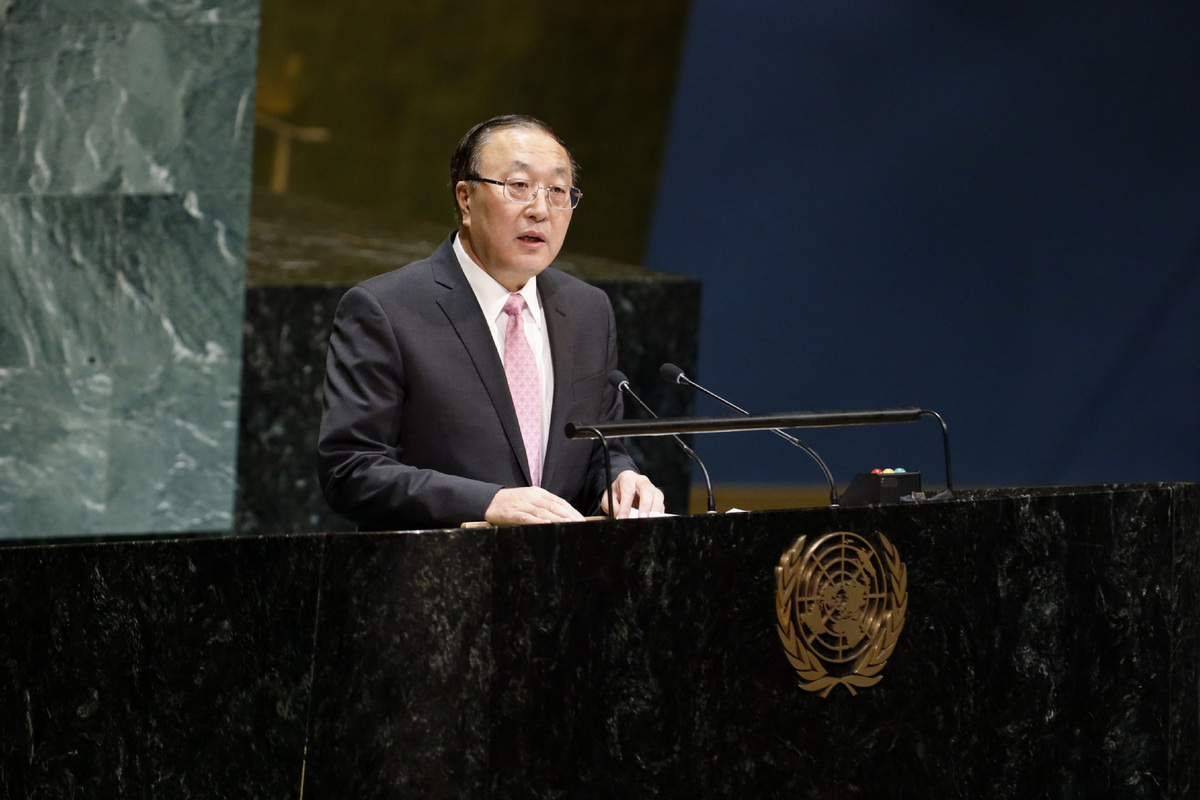
IN BRIEF
By Avishka Ashok and Arshiya Banu
INTERNATIONAL
Ukraine: China calls for an early end to the war
On 19 April, China’s permanent representative to the United Nations Zhang Jun attended the Security Council meeting on Ukraine and stressed on an early resolution to the war. He said that ending the war quickly was the only way to resolve the crisis in Eastern Europe. He said: “We call on Russia and Ukraine to adhere to the general direction of dialogue and negotiation, continuously narrow differences, and accumulate conditions for a ceasefire.” He also called on the member countries to work towards reducing the harm caused to civilians in the conflict. He said: “China once again calls on all parties to the conflict to exercise maximum restraint, strictly abide by international humanitarian law, protect civilians and civilian facilities, and facilitate evacuation and humanitarian assistance operations.” (“Chinese envoy says early conflict resolution key to ending humanitarian crisis in Ukraine,” Xinhua Net, 20 April 2022)
The US: Mayor of Denver city apologizes for 1880 anti-Chinese riots
On 20 April, Xinhua Net reported that the Mayor of Denver city Micheal Hancock attended a special event titled “Reclaiming our Past, Building our Future: City of Denver’s Chinatown Apology” and offered an official apology for the wrongs committed against Chinese citizens and other Asians in the US. The official apology marks the fifth city in the US to apologize for discriminating against Asians in the past. It is also the first city outside of California to apologize for the 1880 anti-Chinese riot in Chinatown in downtown Denver. Hancock also tweeted regarding the event and said: “We know that to heal our community we must be willing to face and address things we have avoided, apologize for wrongs we have committed and follow through with actions that are true to ongoing positive change. This is just the beginning.” (“Denver becomes 5th U.S. city to offer official apology for past wrongs against Chinese immigrants,” Xinhua Net, 20 April 2022)
Solomon Islands: China prepares to ink a “security pact”
On April 19, China announced that it had signed a security partnership with the Solomon Islands, raising fears among the US and its allies Australia and New Zealand about expanding Chinese influence in the Pacific region. Officials from the Solomon Islands, on the other hand, appeared to indicate that no agreement had yet been reached. The chairman of Parliament's public accounts committee Douglas Ete said: "Chinese officials will arrive in the Pacific Island nation in mid-May to sign cooperation agreements, which will improve trade, education and fisheries cooperation." The White House, which is sending a high-level US delegation to Honiara, the Solomon Islands' capital, this week, expressed worry over the pact's "lack of transparency and vague character." A spokesperson for the White House National Security Council (NSC) said the reported signing "follows a pattern of China offering shadowy, vague deals with little regional consultation in fishing, resource management, development assistance and now security practices." (“U.S. concerned after China says it signs security pact with Solomon Islands,” Reuters, 20 April 2022)
The US: China attempts to safeguard its bilateral relations
On 20 April, China's ambassador to the United States Qin Gang advised against using the Ukraine issue as a pretext to sabotage US-China relations. He said that doing so will benefit no one in the short or long term. As per a signed article published in the National Interest magazine on Monday, while the bilateral relationship between China and Russia has progressed significantly over the past three decades, the two nations are not allies, and their partnership does not target third countries. Qin stated that as the crisis worsens, some people are using the stick of sanctions against China to force the country to abandon its autonomous foreign policy of peace. Ending the unwanted Ukraine conflict as quickly as possible "is more important than everything else," said Qin. (“Chinese ambassador to U.S. warns against using Ukraine crisis to mess up U.S.-China relations,” Xinhua Net, 20 April 2022)
Ghana: China to strengthen coordination and communication
On 19 April, Chinese State Councilor and Foreign Minister Wang Yi said that China and Ghana should deepen their cooperation and work together to protect international justice and fairness, along with the interests of both nations and other developing countries. Wang said the two countries should also reject hegemony and power politics during a telephone discussion with Ghanaian Foreign Minister Shirley Ayorkor Botchway. He commended Ghana on its appointment as a non-permanent member of the United Nations Security Council for the 2022-2023 term, saying the Chinese side is delighted to see Ghana take a more active role in global and domestic affairs. Botchway mentioned that African countries have learned since the COVID-19 outbreak that the world is not fair, development is not balanced, and China is a true friend that Africa can rely on, and that Ghana is willing to improve communication and coordination with China to better implement the 2030 Agenda for Sustainable Development. (“Wang Yi: China, Ghana should work together for international justice,” CGTN, 20 April 2022)
INTERNAL
Hong Kong: Former radio host sentenced to 40 months in prison under colonial-era sedition law
On 20 April, a Hong Kong District Court sentenced pro-democracy activist Tam Tak-chi to 40 months in prison for using seditious words against the government such as “Liberate Hong Kong, revolution of our times” and “death to corrupt police families.” Tam Tak-chi was working as a radio host when he used the above phrases that have been banned by the government. The court accused Tam of using the banned statements a couple of hundred times between January and July 2020. Tam is the first person to be punished under the colonial-era sedition law after he was convicted in March for 11 crimes. Tam has however, been in jail for over a year without bail privileges. (“Hong Kong court jails former radio host for sedition,” The Strait Times, 20 April 2022)
Xinjiang: National People’s Congress prepare to ratify ILO conventions
On 20 April, the National People’s Congress prepared to ratify the Forced Labour Convention and Abolition of Forced Labour Convention which was adopted by the members of the International Labour Organization (ILO) in 1930 and 1957 respectively. The government chose to ratify the conventions at a time when there is increased criticism over the violation of human rights in the Xinjiang Autonomous Region. The ILO encouraged the move and said that the ratification would be held in high value by the organization. However, President Xi Jinping and the Chinese administration has constantly denied the allegations of forced labour in the region. (“China to sign forced labour treaties as Xinjiang scrutiny grows,” The Strait Times, 20 April 2022)
05 April 2022 | Tuesday | China Reader Evening Brief | Vol.1, No. 159
China continues to be Germany's biggest trading partner
The Federal Statistical Office reported that Germany’s exports to China in February rose by 6.4 per cent month-on-month and accounted for EUR 9.5 billion.
IN BRIEF
By Avishka Ashok
INTERNATIONAL
Germany: China continues to be biggest trading partner
On 4 April, the Federal Statistical Office reported that Germany’s exports to China in February rose by 6.4 per cent month-on-month and accounted for EUR 9.5 billion. According to the recently published data, China continues to be Germany’s biggest trading partner as it exported cargo worth EUR 13.8 billion in February. Germany’s exports also rose by 6.4 per cent and amounted to EUR 124.7 billion. (“German exports to China rise 6.4 pct in February: Destatis,” Xinhua Net, 4 April 2022)
Ukraine: Foreign Ministers discuss the war in Eastern Europe
On 4 April, China’s Foreign Minister Wang Yi held a telephonic conversation with Ukraine’s Foreign Minister Dmytro Kuleba and wished for Russia and Ukraine to opt for peace talks until the ceasefire was reached. Kuleba updated Wang Yi on the current situation in Ukraine and appreciated China’s inputs in promoting peace in the region by pushing for a ceasefire. He said: “China is a great country which advocates the Five Principles of Peaceful Coexistence and plays a key and active role in safeguarding peace.”
Wang Yi thanked Ukraine for safely evacuating the Chinese citizens and also hoped for future assistance in safeguarding Chinese nationals in the country. He also explained China’s position on the issue and said that the country has historically and traditionally aimed at safeguarding peace and opposing war. He said: “On the Ukraine issue, China does not seek geopolitical interests, nor will it watch the event from a safe distance while sitting idle, or add fuel to the fire.” He further pushed Russia and Ukraine to engage in talks regardless of how difficult the peace process would be. China also promised to continue playing a constructive role in bringing peace in Eastern Europe. (“China sincerely wants peace in Ukraine: FM,” Xinhua Net, 5 April 2022)
Ukraine: Chinese embassy in the UK opposes report by The Times newspaper
On 4 April, the Chinese embassy in the UK opposed a British newspaper’s report that China had hacked Ukrainian websites before the Russian invasion. The spokesperson claimed that the newspaper’s reportage was irresponsible and not credible. The spokesperson said: “It must be pointed out that for a time The Times reports on China have been untrue, deliberately distorting and even slanderous," the spokesperson said. "This seriously runs counter to the professional ethics of journalism and misleads the readers, so we strongly condemn this wrong practice.” (“Allegations of Chinese hacking in Ukraine not credible: Embassy,” CGTN, 5 April 2022)
Hungary: China’s Foreign Minister extends congratulations to the Fidesz Party
On 4 April, China Foreign Minister Wang Yi held a phone conversation with Hungary’s Minister of Foreign Affairs and Trade Peter Szijjarto and promised to continue the cooperation in bilateral issues and work towards building a stronger comprehensive strategic partnership. Wang Yi also congratulated the Fidesz Party for winning the parliamentary elections under the leadership of Prime Minister Viktor Orban. He said: “The election result shows that the independent policy pursued by the Hungarian side is in line with the country's national conditions and the common interests of its people, and is firmly and broadly supported by the people.” (“China, Hungary agree to enhance cooperation in various fields,” Xinhua Net, 4 April 2022)
INTERNAL
Society: Afternoon tea-houses record a surge in sales in the last decade
On 5 April, the Strait Times reported that the tea-houses in China were experiencing an upgrade in daily consumption as the purchasing power and standards of living improved in the country. T9 Premium Tea, one of the well known tea-houses in Shanghai recorded a revenue of over 6,00,00- yuan in four years. Even though each beverage is priced as much as two drinks from Starbucks, the tea houses in China are doing exceptionally well because of the diverse choices, refined flavours and great services. The report said: “Whether judging from the flurry of new Starbucks outlets constantly popping up, or the homegrown beverage brands springing up like mushrooms, China's afternoon tea market is transforming into a younger, more trendy and faster-moving category.” The report also highlighted two critical transformations in the tea-house business. The first major change came after 2015 when afternoon tea could be bought online and not just in offline venues. Secondly, between 2015-2020, consumers have increasingly started appreciating the traditional culture of afternoon tea drinking. (“Afternoon tea culture brewing up a comeback in China,” The Strait Times, 5 April 2022)
ECONOMY
Digital economy: Government seeks to employ 11 million in the sector
On 5 April, CGTN reported that the Ministry of Human Resources and Social Security had released 56 new job categories. Out of the newly created jobs, a third of them were professions in the digital economy, showcasing the government’s push for the sector. The jobs created by the government in the field of digital economy account for 61 per cent of the part-time employment. The government data also revealed that the country is seeking to employ over 11 million people in the newly emerging field. (“China's digital economy fuels new occupations,” CGTN, 5 April 2022)
REGIONAL
Vietnam: China records 27.3 per cent growth in freight train trips
On 4 April, Xinhua Net reported that the Guangxi Zhuang Autonomous Region coordinated 98 freight train trips between China and Vietnam in the first three months of 2022. The data was revealed by China Railway Nanning Group. The data showed a 34.1 per cent increase as 2,940 twenty-foot equivalent units of cargo were traded through the railway line between the countries. China exported mechanical equipment, electronic products and Chinese traditional medicinal materials while Vietnam exported over 11,366 tonnes of fruits. (“China-Vietnam freight train trips up 27.3 pct in first quarter,” Xinhua Net, 4 April 2022)
Laos: Newly launch railway line reports usage by 2.25 million passengers
On 4 April, Xinhua Net reported that the China-Laos Railway had successfully transported 2.25 million passengers and 1.31 million tonnes of cargo since the launch of the railway line in December 2021. The China State Railway Group Co. Ltd. said: “Trains on the railway have provided a safe, comfortable and convenient means of inter-city transport for residents along the route, while passenger trips have seen strong growth momentum.” The existence of the railway network has not only improved China’s connectivity with Laos but also with other Southeast Asian countries. The trade between the countries includes the export of over 100 kinds of products such as rubber, fertilizers, automobiles and flowers. (“China-Laos Railway sees brisk passenger, cargo transport over inaugural 4 months,” Xinhua Net, 4 April 2022)
4 April 2022 | Monday | China Reader Evening Brief | Vol.1, No. 158
Carrie Lam announces decision to retire from her political career
Chief Executive of Hong Kong Special Administrative Region Carrie Lam addressed a press conference and announced that she would not be seeking a second term in the current position.
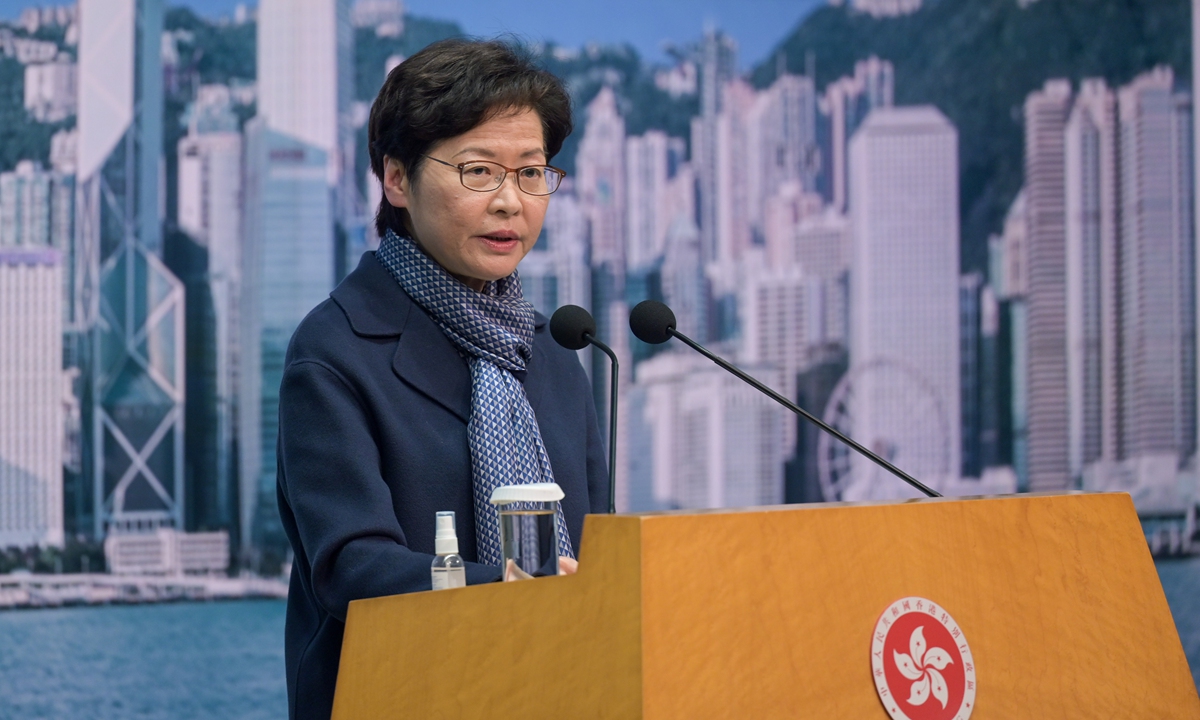
IN BRIEF
Avishka Ashok
INTERNAL
Hong Kong: Carrie Lam announces decision to retire from her political career
On 4 April, the Chief Executive of Hong Kong Special Administrative Region Carrie Lam addressed a press conference and announced that she would not be seeking a second term in the current position. Lam said: “I will complete my five-year term as chief executive on the 30th of June this year, and I will also call an end to my 42 years of public service.” Lam’s successor is speculated to be John Lee, Lam’s current political confidante and right hand. The new Chief Executive is elected by a committee of lawmakers, representatives of various industries and professions and pro-China representatives. The new leader will take charge from May 2022 since the elections were postponed from the earlier date of 27 March due to the rising COVID-19 cases in the city. (“Hong Kong leader Carrie Lam says she won't seek second term,” The Asahi Shimbun, 4 April 2022)
COVID-19: Government deploys military and healthcare professions to Shanghai
On 3 April, the People’s Liberation Army dispatched more than 2,000 medical personnel from the armed forces across the country to Shanghai as the COVID cases in the country rose exponentially. The government has employed its military to help with the nucleic acid testing of the 26 million residents of the city. The decision to test all residents of the city is China’s biggest response to the health crisis. Jiangsu, Zhejiang, and Beijing also sent over 10,000 healthcare workers to the city. As of 3 April, there were 8,581 asymptomatic COVID-19 cases in the city. (“China sends military, doctors to Shanghai to test 26 million residents for COVID,” The Asahi Shimbun, 4 April 22022)
REGIONAL
Philippines: Foreign Ministers meet in Tunxi and discuss differences and other bilateral issues
On 3 April, China’s Foreign Minister Wang Yi met with the Philippine Foreign Secretary Teodoro Locsin in Tunxi, China. Wang Yi referred to the good-neighbourly policy and explained that the Philippines would continue to remain as a priority country for China. Wang said: “The two sides should remove disturbances, calmly and properly manage differences and not let them affect the overall situation of China-Philippines relations.” Wang Yi and Locsin also spoke about the differences in the South China Sea and said that maritime issues must be addressed in an appropriate manner in their bilateral relations. Wang Yi also promised to speed up a few major infrastructural projects in the Philippines and continue providing assistance to deal with the COVID-19 pandemic. (“Chinese FM holds talks with Philippine counterpart on bilateral ties,” Xinhua Net, 4 April 2022)
Myanmar: China pledges to support the military government regardless of changing situations
On 3 April, the Asahi Shimbun reported on China’s Foreign Minister Wang Yi’s unequivocal support to Myanmar. Wang Yi explained how China had placed Myanmar in high priority in its good-neighbourly policy and pledged to support the military government in the country regardless of the change in geopolitics. He said: “No matter how the situation changes, China will support Myanmar in safeguarding its sovereignty, independence and territorial integrity, and in exploring a development path suited to its national conditions.” (“China to back military-ruled Myanmar regardless of situation,” The Asahi Shimbun, 3 April 2022)
INTERNATIONAL
Panama: Foreign Ministers discuss bilateral relations and future of cooperation
On 4 April, China’s Foreign Minister Wang Yi met with Panama’s Foreign Minister Erika Mouynes in Tunxi, Anhui Province, China and discussed the potential of their bilateral relations. Wang Yi and Mouynes remarked that the establishment of diplomatic relations between the two countries in 2017 had led to tangible benefits. Wang Yi said: “China stands ready to work together with Panama to build the bilateral ties into a fine example of mutual respect between countries of different sizes, of unity and cooperation between developing countries, and of exchanges and mutual learning between different civilizations.” He also encouraged the boosting of mutual political trust, rational cooperation, and greater people-to-people exchanges. (“China, Panama hail prospects in relations as FMs meet,” CGTN, 04 April 2022)
02 April 2022 | Saturday | China Reader Evening Brief | Vol.1, No. 157
The EU-China summit emphasizes bilateral relations and the differences on Ukraine
President Xi Jinping and Premier Li Keqiang reiterate China's stance on Ukraine and promote a non-biased view of the country in the EU.
.png)
IN BRIEF
By Keerthana Nambiar and Avishka Ashok
INTERNATIONAL
The EU: China holds virtual summit and discusses bilateral relations and the crisis in Ukraine
On 1 April, China and the European Union held a virtual summit and called for greater cooperation between the countries. China's Premier Li Keqiang urged the countries to enhance dialogue and coordination, maintain peace and tranquillity, and stabilize the global economy. Ukraine was one of the most discussed issues at the summit. The objective of the EU was to acquire China's help in resolving the crisis in Eastern Europe. European Council President Charles Michel addressee a press briefing and explained the EU's request to China to not help Russia circumvent the sanctions of the West. Premier Li responded to the statement and said that China would follow its own methods of ensuring peace in the region. President Xi Jinping also encouraged the EU member countries to view China from an independent perspective, without the biased image created by the West. ("Chinese premier calls on China, EU to enhance dialogue, coordination, deepen cooperation," Xinhua Net, 1 April 2022; “China tells EU it will pursue Ukraine peace in its own way," Reuters, 2 April 2022)
Ukraine: China accused of cyberattacks on military websites
On 1 April, The Times reported that China had launched a huge cyberattack on Ukraine’s military and nuclear facilities and accused of China being complicit to Russia’s invasion. According to The Times, the Chinese government coordinated an attack on Ukraine's defence military websites. UK government confirmed that the National Cyber Security Centre has opened an investigation. On the other hand, the Ukrainian security service has denied the supply of any information regarding the alleged attacks. The Times elaborated that there was a series of cyberattacks that peaked on 23 February 2022. (“China accused of cyber-attacks on Ukraine before Russian invasion,” The Guardian, 2 April 2022)
The UK: Foreign Ministry opposes six-monthly report on Hong Kong
On 1 April, China's Foreign Ministry Spokesperson Zhao Lijian addressed a press briefing and expressed China's opposition to the report on Hong Kong published by the UK government. The report published by the UK is the latest six-monthly report on Hong Kong. It criticized China's policy in Hong Kong and the National Security Law that was recently implemented in the city. Zhao urged the UK to stop interfering in Hong Kong and other internal matters of China. He said: "Since the implementation of the national security law, national security has been protected, rule of law and justice has been upheld, and the legitimate rights and freedoms of Hong Kong residents and foreign nationals in Hong Kong have been better protected." ("China urges Britain to abandon colonial mindset, stop interfering in Hong Kong affairs," Xinhua Net, 1 April 2022)
INTERNAL
Winter Olympics: Groups and individuals to be awarded for their contributions to the Games
On 2 April, China announced that 149 groups and 150 individuals will be awarded for their contribution to the preparation and competition of the Beijing Winter Olympics and Winter Paralympics. The 149 groups include government departments, companies, volunteer teams, universities, hospitals, national Olympic teams and the media. China has set a new record this Winter Olympics with the largest-ever presence and 15 medals. (“China to award 149 groups and 150 individuals for outstanding contributions to Beijing Winter Olympics,” Global Times, 2 April 2022)
Environment: Top political advisor calls for democratic supervision of Yangtze River
On 1 April, China's top political advisor Wang Yang addressed a symposium of non-CPC members and non-affiliated party members and pushed for enhanced supervision over the Yangtze River. The symptoms were also attended by the National Development and Reform Commission and the Ministry of Ecology and Environment. He said: "Democratic supervision of the environmental protection of the Yangtze River is an important political task that the CPC Central Committee has entrusted to the central committees of other political parties and individuals without party affiliation." ("Top political advisor stresses enhanced supervision over Yangtze River environmental protection," Xinhua Net, 1 April 2022)
ECONOMY
People’s Bank of China: China to step up efforts to stabilize the markets
On 2 April, China’s central bank announced that China will be strengthening efforts to prevent the financial market's downfall. In a recent video conference by the People’s Bank of China on stabilizing the financial market in 2022, the bank will form concrete measures and establish a market-oriented financial safety net to defuse financial risks. (“China's central bank stresses defusing financial risks in 2022,” CGTN, 2 April 2022)
TECHNOLOGY
Huawei Technologies: Meng Wanzhou to become rotating chairwoman
On 2 April, China’s tech and telecoms giant Huawei Technologies has awarded Meng Wanzhou. Finance chief the new rotating position of chairwoman. “The company is optimizing and refining its internal governance structure to make sure the company is built to last,” a Huawei spokesman said. “The supervisory board is responsible for the company’s survival, development and long-term prospects.” (“Huawei CFO Meng Wanzhou named chairwoman in rotating role,” The Straits Times, 2 April 2022)
Space: Shenzhou-13 Taikonauts prepare for return to earth
On 1 April, Xinhua Net reported on China's Manned Space Agency's announcement that the Taikonauts onboard the Shenzhou-13 were preparing for their return to the earth. The three taikonauts left for the mission on 16 October 2021 the longest space mission undertaken by the agency. The team has completed two extravehicular activities, two live science lectures and other science and technology experiments during the mission. They also used manual teleoperation equipment for the first time. ("China's Shenzhou-13 taikonauts preparing for return in April, Xinhua Net, 1 April 2022)
01 April 2022 | Friday | China Reader Evening Brief | Vol.1, No. 156
China hosts the Foreign Ministers’ meeting to boost investments in Afghanistan
Foreign Minister Wang Yi urges Afghanistan's neighbours to not let the war in Ukraine neglect the crisis in Afghanistan.
.jpg)
IN BRIEF
By Dincy Adlakha and Avishka Ashok
INTERNATIONAL
Afghanistan: China hosts the Foreign Ministers’ meeting to boost investments
On 31 March, China’s Foreign Minister Wang Yi chaired the “Afghanistan’s neighbours + Afghanistan” Foreign Ministers’ meeting in Tunxi, Anhui Province. The acting Foreign Minister of the Afghan Interim Government Amir Khan Muttaqi represented the country at the meeting. The meeting was also attended by Qatar’s Deputy Prime Minister and Foreign Minister Sheikh Mohammed bin Abdulrahman Al Thani and Indonesia’s Foreign Minister Retno Marsudi as guests. Wang Yi urged the countries in the region to cooperate with each other rather than confronting and contributing to openness in the region. He also placed emphasis on investing in Afghanistan and not neglecting the country’s issues because of the war in Eastern Europe. He said: “It is necessary to further gather consensus and synergy to help Afghanistan stabilize the situation, effectively fight terrorism, improve people's livelihood and develop the economy.” (“Chinese FM chairs "Afghanistan's neighbors + Afghanistan" foreign ministers' dialogue,” Xinhua Net, 1 April 2022)
Ukraine: Foreign Minister pushes for dialogue and negotiation
On 31 March, China’s Foreign Minister Wang Yi stressed dialogue and negotiation as the only solutions to the crisis in Ukraine. Wang Yi said: “I have had intensive and in-depth exchanges with my counterparts on the Ukraine issue in recent days. All parties expressed their understanding of China's position and made positive comments on China's role.” He then explained China’s stance in five key aspects. First, China adheres to promoting peace talks; second, China aims to uphold the basic norms in international relations; third, China aims to prevent the return of the cold war mentality; fourth, China supports the rights and interests of all countries and fifth, China is pushing for peace and stability in the Asia-Pacific region. (“Dialogue the only solution for Ukraine crisis: Chinese FM,” Xinhua Net, 1 April 2022)
India: Ministry of National Defense appreciated the achievements of the 15th Corps-Commander Level Meeting
On 31 March, China’s Ministry of National Defense Spokesperson Wu Qian addressed a press conference and remarked that the 15th round of the India-China Corps Commander Level Meeting had brought out positive and constructive results. Wu explained that the two countries focused on promoting the resolution of the issues of conflict along the Line of Actual Control. He said: “The two sides have agreed to continue keeping security and stability on the frontline in the Western Sector and maintain dialogue via military and diplomatic channels to reach a mutually acceptable solution to the remaining issues as soon as possible.” (“China-India corps commander level meeting yields positive, constructive results: spokesperson,” Xinhua Net, 31 March 2022)
Solomon Islands: Prime Minister opposes creation of Chinese military base
On 1 April, Solomon Islands Prime Minister Manasseh Sogavare said that the government will not allow China to build a military base in the Pacific Island country. He said: “Government is conscious of the security ramification of hosting a military base, and it will not be careless to allow such initiative to take place under its watch.” The statement was released in the context of regional backlash as the island nation is planning to sign a security pact with China. Officials from both countries have initiated a draft agreement to cooperate on security; however, details of the pact are yet to be released. (Kristy Needham, “Solomon Islands won't allow Chinese military base, says PM's office,” Reuters, 1 April 2022)
G20: Foreign Minister reinstates trust in G20 unity
On 1 April, Chinese Foreign Minister and State Councillor Wang Hi met with the Foreign Minister of Indonesia Retno Marsudi. Indonesia is the current president of the G20 grouping. The two leaders discussed the Russia-Ukraine issue in the presence of Russian and Afghani envoys as well. Foreign Minister Wang Yi said that the bloc "should focus on coordination of macroeconomic policies and that it should not be politicized." He made these remarks in opposition to a few countries calling for the ousting of Russia from the G20 due to its hostile war on Ukraine. Any such move would require the group's consensus which China openly opposed through this meeting. ("Top Chinese diplomat says nobody can break up the G-20 bloc," The Straits Times, 1 April 2022)
REGIONAL
Indonesia: Foreign Ministers meet in east China to promote ASEAN outlook on Indo-Pacific
On 31 March, Chinese Foreign Minister and State Councillor Wang Yi met with Indonesian Foreign Minister Retno Marsudi in Anhui province of east China. The two leaders agreed on the need of creating a plan to synergize BRI with the ASEAN outlook on the Indo-Pacific. The ASEAN outlook was different from the US Indo-Pacific strategy. Foreign Minister Retno said that the outlook focuses on economic development and mutually beneficial cooperation in the region. The leaders also vowed to complete the Jakarta-Bandung High-speed Railway and increase business cooperation in the fields of vaccines, pharmaceutical ingredients, research and development and bilateral trade. (“China, Indonesia vow to promote ASEAN Outlook on the Indo-Pacific,” CGTN, 1 April 2022)
Taiwan: Legislature approves proposed amendment to lower the voting age to 18
On 1 April, the Strait Times reported that Taiwan would be holding a referendum to lower the voting age to 18 in the country. On 25 March, students and other civic organizations gathered outside the legislature building to express their support for the proposed amendment that aimed to reduce the voting age in Taiwan. The proposal was passed unanimously and awaits the passing of a referendum before the end of this year. The data from the Ministry of the Interior revealed that lowering the age would increase the electorate by 5,00,000 people. (“Taiwan to hold referendum after legislature approves lowering voting age to 18,” The Strait Times, 1 April 2022)
31 March 2022 | Thursday | China Reader Evening Brief | Vol.1, No. 155
President Xi urges Central Asian countries to build the Afghan future
President Xi Jinping delivered a written message at the congregation of Foreign Ministers of Central Asian countries and urged them to work towards the future of Afghanistan.
.jpg)
IN BRIEF
By Keerthana Nambiar and Avishka Ashok
INTERNATIONAL
Afghanistan: President Xi urges Central Asian countries to build the Afghan future
On 31 March, China’s President Xi Jinping delivered a written message to the Foreign Ministers of Afghanistan and its neighbouring countries and urged the countries to act constructively to build the Afghan future. Xi said: “Afghanistan is a common neighbour and partner of all participating countries, and we form a community with a shared future linked by the same mountains and rivers who would rise and fall together.” He also placed emphasis on the existence of peace and stability in Afghanistan and the positive impacts on the region. He urged the Central Asian countries to build consensus and jointly support the Afghan people in creating a bright future. (“Chinese president stresses neighboring countries' role in supporting Afghanistan,” Xinhua Net, 31 March 2022)
Turkmenistan: Vice Premier places emphasis on natural gas cooperation
On 30 March, China’s Vice Premier Han Zheng and the Turkmen Deputy Prime Minister and Foreign Minister Rashid Meredov held a video conference to discuss the strengthening cooperation in natural gas, security and inter-people exchanges. Han remarked that the two countries were strategic partners who worked towards win-win results based on mutual respect and trust. He said: “China is willing to work with the Turkmen side to promote comprehensive cooperation for more new achievements.” He also stressed greater cooperation between China and Turkmenistan on natural gas and expanding the development of wind and solar power. (“Chinese vice premier calls for enhanced cooperation with Turkmenistan,” Xinhua Net, 30 March 2022)
Portugal: Premier Li Keqiang congratulates Portugal’s Prime Minister
On 30 March, China’s Premier Li Keqiang congratulated Portugal’s Prime Minister Antonio Costa on his reelection. Premier Li appreciated Portugal’s efforts in promoting cooperation with China in various fields. He said: “At present, the COVID-19 pandemic is proving a protracted and resurging one, with global challenges compounding one another. As trusted partners and responsible members of the international community, China and Portugal should consolidate mutual trust, expand cooperation, promote the development of China-Portugal relations and China-EU comprehensive strategic partnership, so as to contribute to the common well-being of the two nations and the rest of the world, said the Chinese premier.” (“Chinese premier congratulates Costa on reelection as Portuguese PM,” Xinhua Net, 31 March 2022)
Australia: Television anchor Cheng Lei faces trial in China
On 31 March, the Australian television anchor Cheng Lei faced trial in Beijing under heavy security and closed doors on the charges of trading state secrets. In August 2020, Cheng, a former employee of CGTN was detained and in 2021 she was arrested under the charges of supplying state secrets overseas. Australian Embassy officials were prohibited from entering the Court citing national security laws. Australian Ambassador Graham Fletcher expressed his concerns regarding the issue and deemed it to be “unsatisfactory and very regrettable.” He further added that Australia is concerned as it has no information about the charges against Cheng. (“China puts Australian TV anchor on trial in state secrets case,” The Straits Times, 31 March 2022)
Pakistan: Foreign Ministers discuss bilateral ties and Ukraine in China
On 30 March, China’s Foreign Minister Wang Yi met with Pakistan’s Foreign Minister Shah Mehmood Qureshi and discussed bilateral ties and the situation in Ukraine. Wang Yi appreciated the continuity of the bilateral ties between the two countries and the vitality in withstanding difficult challenges. He said: “No matter how the international situation changes, China will continue to view and promote China-Pakistan relations from a strategic and long-term perspective, support Pakistan in safeguarding its national sovereignty, territorial integrity and national dignity, and will be Pakistan's most reliable partner and strongest backer.” The two leaders also expressed concern on the situation in Ukraine and urged the involved countries to resolve the issues through diplomatic channels. (“Chinese, Pakistani FMs discuss bilateral ties, Ukraine,” Xinhua Net, 30 March 2022)
EU-China summit: President Xi scheduled to meet European Union leaders
On 31 March, Global Times reported that Chinese President Xi Jinping is scheduled to have a virtual meeting with the EU leaders for discussing the on-going crisis in Ukraine. Chinese Foreign Ministry spokesperson Wang Wenbin announced that President Xi will meet the EU leaders including European Council President Charles Michel and European Commission President Ursula von der Leyen. Chinese Premier Li Keqiang is to co-chair the meeting and confront the growing uncertainties in the current global scenario and push for peace and development of Chinese and European markets. (“Xi to meet EU leaders virtually at key summit, to inject positive energy to world amid Ukraine crisis,” Global Times, 31 March 2022)
INTERNAL
Hong Kong: Chief Executive Carrie Lam says the resignation of senior British judges was politically motivated
On 31 March, Hong Kong leader Carrie Lam made a statement on the resignations of two senior British judges in Hong Kong’s highest court. Lam said: “the resignations are politically motivated.” In 2020, the two judges resigned because of the national security law in Hong Kong. “They have been put under political pressure and that is a kind of political manipulation,” said Lam in a media briefing. The presence of British judges in the Hong Kong Court of Final Appeal (CFA) was an arrangement to maintain confidence in a legal system and is considered the “bedrock” of Hong Kong’s social and commercial freedoms. (“Hong Kong leader says British judges' resignation 'politically motivated',” Reuters, 31 March 2022)
REGIONAL
Taiwan: Taiwan’s Defense Ministry organizes a group to study the war in Ukraine
On 31 March, Taiwan’s Defense Minister Chiu Kuo-cheng said that Taiwan’s defence ministry is setting up a workgroup to study the tactics of the war in Ukraine. The group is focusing on Russia’s poor military performance and Ukraine’s resistance. “It is not only discussed in exchange meetings between the United States and Taiwan but also discussed with other countries that have regular contacts with Taiwan,” Chiu further added. He explained that the group “will not make remarks rashly, but through internal discussions which are important, to get results that are helpful for building armaments and preparing for war.” (“Taiwan studying Ukraine war tactics, discussing with U.S.,” Reuters, 31 March 2022)
30 March 2022 | Wednesday | China Reader Evening Brief | Vol.1, No. 154
Chinese Foreign Minister returns from his visit to Afghanistan, Pakistan, India and Nepal
Xinhua reported on Chinese State Councilor and Foreign Minister Wang Yi’s media interview after his visit to South Asian countries- Pakistan, Afghanistan, Nepal, and India.
IN BRIEF
By Keerthana Nambiar and Avishka Ashok
INTERNAL
Chinese stock markets: China Securities Regulatory Commission cracks down on brokers using feng shui
On 30 March, Reuters reported that China Securities Regulatory Commission announced that it holds "zero tolerance" towards illegal behaviour in the stock market and has punished some brokers who analysed, forecast, or offered investment advice by applying aspects of feng shui such as the heavenly stems and earthly branches, also known as tiangan dizhi, Yin-Yang, and Five Elements. This development has come in when the Chinese stock markets are facing higher volatilties in the stock market. ("China's regulator cracks down on using feng shui to predict stock market trend,” Reuters, 30 March 2022)
REGIONAL
Cambodia: China supplies new batch of Sinovac COVID-19 vaccines
On 29 March, the National Television of Cambodia, Prime Minister Samdech Techo Hun Sen’s official facebook page and the online news provider Fresh News live reported the arrival of a new batch of Sinovac COVID-19 vaccines which were donated by China. The donation of vaccines will be used by Cambodia as the country is currently trying to increase the booster dose vaccination. The Cambodian Ministry of Health Secretary of State Yok Sambath and the Economic and Commercial Counselor of the Chinese Embassy Wu Guoquan were present at the transfer of vaccines. Sambath addressed the press and said: “Today, we received more than 1.5 million doses of Sinovac vaccine, and tomorrow (Wednesday), another batch of nearly 3.5 million doses will arrive in Cambodia through two planes.” (“New arrival of China-donated jabs helps Cambodia's COVID-19 vaccination,” 29 March 2022)
Hong Kong: HKSAR Chief Carrie Lam expresses concerns on the anti-pandemic measures
On 30 March, Hong Kong Chief Executive Carrie Lam expressed concerns over the effects of anti-pandemic measures On individuals and companies. According to The Straits Times, "the city may be facing a brain drain, capping the government’s anxiety as expatriates continue to make their exits." Recently Lam has been pressurized to reopen the borders. During the media briefing, Lam said: "But after the pandemic is over, I believe Hong Kong will see positive opportunities." ("Hong Kong could be facing brain drain, but talent will return, says Carrie Lam," The Straits Times, 30 March 2022)
South Asia: Chinese Foreign Minister returns from his visit to Afghanistan, Pakistan, India and Nepal
On 29 March, Xinhua reported on Chinese State Councilor and Foreign Minister Wang Yi’s media interview after his visit to South Asian countries- Pakistan, Afghanistan, Nepal, and India. “Wang said his trip to South Asia came at a time when the spillover effect of the Ukraine crisis has been constantly spreading and world peace and development are facing new challenges,” reported Xinhua. During the trip, Wang Yi attended the Session of the Council of Foreign Ministers of the Organization of Islamic Cooperation discussing the urgency to promote a just settlement of regional issues. In his visit to Pakistan, Wang mentioned the deepening strategic cooperation between the two countries given the current international and regional scenario. During his visit to Afghanistan, Wang focused on renewing the traditional friendship between the two, observing the administration of the Afghan interim government, and promoting mutual cooperation between China and Afghanistan. In terms of China-India relations, Wang said, “the two countries are not threats to each other but opportunities for each other's development.” During his visit to Nepal, Wang reiterated upholding the China-Nepal friendship and speeding the construction of the Belt and Road Initiative. (“Roundup: Visit to South Asian countries boosts solidarity, cooperation under new circumstances -- Chinese FM,” Xinhua Net, 29 March 2022)
Australia: Chinese embassy hosts congratulatory reception for the Winter Olympics and Paralympic games
On 29 March, the Chinese embassy in Australia held a reception for some of the participants of the Beijing 2022 WInter Olympics and Paralympic games. The reception aimed to congratulate the success of the Beijing games and the Australian achievements in the game. The Chinese Ambassador Xiao Qian said: “Under the theme 'Together for A Shared Future,' Beijing Winter Olympic and Paralympic Games have vigorously promoted the Olympic spirit and provided a platform for exchanges and mutual learning between different cultures, bringing not only warmth and hope to people of all countries in the cold winter of COVID-19 pandemic, but also the power for peace and solidarity to today's world.” (“Chinese embassy hosts reception for Australian Winter Olympic and Paralympic participants,” Xinhua Net, 29 March 2022)
INTERNATIONAL
Russia: China and Russia reiterate their strategic partnership
On 30 March, China’s Foreign Minister Wang Yi confirmed that Moscow and Beijing are “most determined” to develop bilateral ties and boost cooperation. The statement was made following a meeting in eastern China with Russian counterpart Sergei Lavrov. Wang said: "China is willing to work with Russia to take China-Russian ties to a higher level in a new era under the guidance of the consensus reached by the heads of state." Both the countries condemned the non-productive sanctions calling them illegal. In the meeting, the two ministers agreed to continue Russia-China partnership in a "united voice." ("China, Russia 'more determined' to boost ties, Beijing says," Reuters, 30 March 2022)
Switzerland: China’s Foreign Minister discusses Ukraine with President Parmelin and Foreign Minister Cassis
On 29 March, China’s Foreign Minister Wang Yi held a telephonic conversation with the Swiss President Guy Parmelin and Foreign Minister Ignazio Cassis. The Chinese and Swiss diplomats discussed the situation in Ukraine and agreed on rebuilding the European security framework. Wang Yi expressed concern over the manner in which the situation had progressed in Eastern Europe and clarified China’s position on the matter. He said: “The Chinese side has always maintained that only by strengthening the efforts of the international community to promote peace talks can space be explored for diplomatic negotiations and settlement of the conflict.” Wang Yi also took a stand against sanctions and reiterated the futility of the action in the international system. The Swiss President and Foreign Minister also believe that diplomacy is the correct way to deal with the crisis. (“Chinese FM talks over phone with Swiss president,” Xinhua Net, 30 March 2022)
The EU: Foreign Ministers discuss bolstering bilateral relations
On 29 March, China’s Foreign Minister Wang Yi and the European Union’s High Representative for Foreign Affairs and Security Policy Josep Borrell took part in a video conference and discussed the improvement of ties between China and the EU. Wang Yi stressed on maintaining regular strategic communication, enhancing mutual understanding, expanding cooperation consensus and addressing global challenges together. Borrell also clarified the EU’s stance on improving bilateral relations with China and the One-China principle. (“Chinese FM holds video conference with top EU diplomat,” Xinhua Net, 30 March 2022)
29 March 2022 | Tuesday | China Reader Evening Brief | Vol.1, No. 153
Foreign Ministry spokesperson reinstates ‘Taiwan is not Ukraine’
Wang Wenbin responds to US military commander in the Indo-Pacific and reiterates China's views on Taiwan.
.jpg)
IN BRIEF
By Keerthana Nambiar
INTERNATIONAL
Taiwan: Chinese FM spokesperson reinstates ‘Taiwan is not Ukraine’
On 28 March, China’s Foreign Ministry spokesperson Wang Wenbin responded to the remarks made by the top US military commander in the Indo-Pacific. Wang said: “We have made it clear many times that there is a fundamental difference between the Taiwan question and the Ukraine issue and there is no analogy between the two.” He further reinstated that “Taiwan is an inalienable part of the Chinese territory and fundamentally different from Ukraine, which is a sovereign state,” reported Global times. He also pointed out that this is a “deliberate analogy” made to create a new crisis at the expense of regional stability. (“‘Taiwan is not Ukraine,’ linking the two is to create new crisis across Taiwan Straits: Chinese FM,” Global Times, 28 March 2022)
COVID-19: The new Stealth variant of COVID-19 is now prompting surges worldwide
On 29 March, Reuters reported on the sub-variant of the highly transmissible Omicron variant known as BA.2. According to the World Health Organization (WHO), the BA.2 variant is more transmissible and hi9ghly contagious than other Omicron variants BA.1 and BA.1.1. This stealth variant is spreading rapidly in China, Germany, the UK. (“Explainer: Omicron 'stealth' COVID variant BA.2 now dominant globally,” Reuters, 29 March 2022)
Pacific Islands: Solomon Islands PM makes a statement on the leaked security document with China
On 29 March, the Solomon Islands Prime Minister Manasseh Sogavare made a statement in the parliament regarding the leaked security document with China. PM Sogavare said: “We are not pressured in any way by our new friends and there is no intention whatsoever to ask China to build a military base in the Solomon Islands”. The Solomon Islands had previously contacted Australia regarding building a naval base which Canberra refused given its defense program with Papua New Guinea. PM further confirmed that the Solomon Islands has no intention “of pitching into any geopolitical power struggle.” New Zealand Prime Minister Jacinda Ardern commented on the issue expressing grave concerns about the “potential militarization of the region.” (“Solomons PM says backlash to security negotiations with China 'very insulting',” Reuters, 29 March 2022)
Afghanistan: China to host a meeting with Central Asian countries
On 28 March, Chinese State Councilor and Foreign Minister Wang Yi announced that China will host the third Meeting of Foreign Ministers of Afghanistan’s Neighbouring Countries on 30 and 31 March 2022. Chinese Foreign Ministry spokesperson wang Wenbin said that foreign ministers from Pakistan, Iran, Russia, Tajikistan, Turkmenistan, and Uzbekistan and acting foreign minister of Afghan interim government Amir Khan Mottaqi are scheduled to attend the meeting. Chinese FM spokesperson remarked that China hopes to take an active role in solving the issues in Afghanistan and urge the US to take up its main responsibility on economic rebuilding in Afghanistan. (“China to host meeting of Afghanistan’s neighbors to tackle humanitarian needs, urge US to return Afghan assets,” Global Times, 28 March 2022)
INTERNAL
COVID-19: Snap lockdowns in China to control the spread of the virus
On 29 March, South China Morning Post reported that China is expected to use the strategy of snap lockdowns to suppress the surge of largest COVID-19 outbreaks. The current records note more than 70,00 cases of Omicron variant in 31 provinces. China plans to maintain a “dynamic zero-Covid” strategy to avoid the disruption of the economy and livelihoods. (“Omicron: snap lockdowns set to be China’s key tool for stopping spread ahead of Communist Party congress,” South China Morning Post, 29 March 2022)
TECHNOLOGY
Smartphone business: Huawei faces a major decline in revenue in 2021
On 28 March, China’s top telecommunication equipment maker Huawei released its latest annual report. The company saw its revenue decline by a steep 28.6 per cent in 2021. According to The Straits Times, the large drop is mainly due to the US sanctions imposed on Chinese companies. Meng Wanzhou, the chief financial officer of Huawei said, “The multiple rounds of sanctions imposed by the US have significantly affected our business, especially smartphones and PCs.” She further added, “Despite a revenue decline in 2021, our ability to make a profit and generate cash flows is increasing.” In 2021, Huawei’s smartphone business was the world’s largest for months. The major revenue sector was setting up infrastructure for the 5G network which has now been affected by the bans. (“Huawei sees steep decline in revenue in 2021, as US sanctions continue to bite into company,” The Straits Times, 28 March 2022)
REGIONAL
Taiwan: Senior security official comments on China’s opportunity to boost the yuan amidst the Ukraine war
On 28 March, Reuters reported on a statement made by Taiwan’s National Security Bureau Director-General Chen Ming-tong. According to the official, China has gained an opportunity to raise the profile of the Chinese currency by challenging the US dollar amidst the war in Ukraine and Russia’s effective exclusion. Chen said: “Whether in renminbi trade or currency issuance system, this is an opportunity that must be taken.” Chen also said that there is a chance for China-US relations to improve if China stands with the US and imposes sanctions on Russia. But China has repeatedly voiced its opposition to the sanctions imposed on Moscow and declined to condemn Russia’s action in Ukraine or call it an invasion. (“Taiwan sees Ukraine war helping Chinese yuan's internationalisation,” Reuters, 28 March 2022)
South China Sea: Report on increased military presence of the US
On 29 March, China Daily published an article on a report published by Beijing-based thinktank, South China Sea Strategic Situation Probing Initiative. The report tracked the US military operations in the South China Sea and noted that US carried out at least 95 military operations in the Sea. The document read: “The US is continuously setting records in terms of the distance between its reconnaissance aircraft and China's territorial sea baseline, which poses increasingly high military risks.” The US has conducted its military operations with Australia, the UK, and Japan under the Indo-Pacific strategy. The report also pointed out Japan becoming the “vanguard of the US Indo-Pacific strategy.” (“US increases presence in S. China Sea,” China Daily, 29 March 2022)
28 March 2022 | Monday | China Reader Evening Brief | Vol.1, No. 151
Foreign Minister discusses bilateral relations with Chairman of Communist Party of Nepal
Wang Yi's three-day visit to Nepal ends in the two countries agreeing to enhance their bilateral relations.
.jpg)
IN BRIEF
By Avishka Ashok
INTERNATIONAL
Nepal: China’s Foreign Minister discusses bilateral relations; expresses will to enhance friendship
On 27 March, China’s Foreign Minister Wang Yi announced the country’s readiness to work with Nepal on enhancing their friendship and safeguarding regional peace. Wang Yi met with the Chairman of the Communist Party of Nepal Pushpa Kamal Dahal and appreciated the history of bilateral relations between the two countries. He said: “No matter how the international situation changes and what challenges emerge, China will stick to its friendly policy towards Nepal.” Dahal also congratulated China for successfully conducting the Beijing Winter Olympics and also expressed gratitude for China’s aid to Nepal during the pandemic.” (“China willing to cement friendship with Nepal, safeguard regional peace: Wang Yi,” Xinhua Net, 28 March 2022)
Ukraine: China’s Foreign Ministry calls for conducive actions
On 28 March, CGTN reported that the Chinese Foreign Ministry called on the involved parties to take actions that were conducive to de-escalating the situation in Ukraine. The ministry spokesperson also urged the countries to promote dialogue and negotiation instead of further complicating the conflicts. The statements were made at a press briefing after US President Joe Biden opposed Russian President Vladimir Putin’s authority in the country and demanded a change in leadership. However, CGTN reported that several US officials later explained that they do not encourage a change in the regime in Russia. (“China calls for responsible action toward Ukraine de-escalation,” CGTN, 28 March 2022)
INTERNAL
Communist Party of China: Discipline Inspection body investigates 5,800 cases of violation in February
On 27 March, the CPC Central Commission for Discipline Inspection and the National Supervisory Commission revealed in its monthly report that more than 5800 cases involving violations of the CPC code on improving party conduct were investigated in February. After the investigation, a total of 9,100 people were reprimanded, educated and penalized. The cases involved bureaucratism, the practice of formality for formality’s sake, hedonism and extravagance. (“5,800 cases of Party conduct violation investigated in Feb,” Xinhua Net, 27 March 2022)
COVID-19: Jilin province builds 19 makeshift hospitals, Shanghai enters a staggered lockdown
On 28 March, Global Times reported that the Jilian province in China had built 19 makeshift hospitals in order to deal with the rising cases in the region. On the same day, 1,086 cases were reported along with 907 asymptomatic cases. Within the province, eight makeshift hospitals were built in Changchun, 10 hospitals in Jilin and one in Huichuan. On the same day, Shanghai city also entered a staggering lockdown after 3,450 local asymptomatic cases were reported. The city has reported regional clusters and sporadic cases across the city. (“NE China’s Jilin builds 19 makeshift hospitals amid surging COVID-19 infections,” Global Times, 28 March 2022; “Shanghai carries out staggered lockdown, vows to ensure sufficient daily commodities in closed-loop management,” Global Times, 28 March 2022)
Society: 1000 year old temple catches fire in Fujian province
On 28 March, Global Times reported that a part of an ancient temple with a 1000-year history caught fire on 25 March. The local authorities also began planning the restoration work on the same day. The 1,175.2 square-meter Wuyishan temple in Fujian Province was built during the Tang Dynasty (618-907) and was rebuilt multiple times through the centuries. Although the cause of the fire is unknown, it was found that the fire broke out in the old hall. The online social media widely circulated the videos of the fire and brought attention to the need to protect cultural relics from fire hazards. The Global Times also reported that after the fire hazard in Notre Dame Cathedral in Paris, the Chinese government worked toward protecting immovable relics and inspected over 70,000 museums and cultural relics. The inspection resulted in the discovery of over 1,00,000 fire hazards and 90,00 potential fires were prevented. (“Chinese ancient temple on fire, an alert on further needed measures to protect cultural relics from fire hazards,” Global Times, 28 March 2022)
REGIONAL
Vietnam: New freight rail route from Chongqing to Hanoi boosts trade
On 27 March, Xinhua Net reported that a freight train departed from Guoyuan Port in Chongqing Municipality and is now on route to Hanoi, Vietnam. The trade consisted of 43 containers of engines, tires, printing paper and other products worth USD 3.9 million and marked the launch of a new freight train route between China and Vietnam. The route is a part of the New International Land-Sea Trade Corridor and is expected to increase the trade ties between the two countries as well as the region. With the help of the newly established freight rail route, the time taken for the products to reach Vietnam has been reduced by 4-5 days. The project was jointly built and funded by Singapore and the provincial regions of Western China. (“New freight train route links China's Chongqing, Vietnam,” Xinhua Net, 27 March 2022)
26 March 2022 | Saturday | China Reader Evening Brief | Vol.1, No. 150
Xi Jinping and Boris Johnson hold a phone conversation to discuss 50 years of bilateral ties
President Xi Jinping observes that despite the ups and downs, the trade relations between the countries have improved manifold.
.jpg)
IN BRIEF
By Avishka Ashok and Dincy Adlakha
INTERNATIONAL
The UK: Xi Jinping and Boris Johnson hold phone talks and discuss 50 years of bilateral relations
On 25 March, Chinese President XI Jinping held a telephonic conversation with British Prime Minister Boris Johnson. Xi Jinping observed that despite the few rough patches in the countries’ 50-year history, China and Britain had experienced continuous growth. He said: “The trade volume between the two countries has increased from 300 million U.S. dollars to 100 billion dollars, and the two-way investment stock has risen from almost zero to 50 billion dollars.” Xi also noted that China’s investment in the UK had tripled in the last year and the trade had reached a new high. (“Xi talks with British PM over phone,” Global Times, 26 March 2022)
Solomon Islands: Leaked report hints at greater Chinese military presence
On 25 March, the Asahi Shimbun reported that according to a leaked document, China would be increasing its military presence in the Solomon Islands. According to the report China would be increasing its ship visits to the Solomon Islands. The Islands also signed a policing cooperation agreement with China according to which the latter can send police, military personnel and other armed forces to the Solomons with a view to “to assist in maintaining social order.” A research analyst from New Zealand’s Massey University observed that the development is concerning for Australia, the US and New Zealand. (“Document indicates China could boost military in Solomons,” The Asahi Shimbun, 25 March 2022)
The US: Chinese ambassador stresses agricultural cooperation
On 25 March, the recently appointed Chinese Ambassador to the US said that agriculture is a well-grounded and complementary area of cooperation between the two countries. He attended the China-US Agricultural Cooperation and said during his opening speech: “Agriculture is an important part of the friendly cooperation between China and the United States. As our agricultural production increasingly faces restraints from the population, resources and the environment, and COVID-19 and climate change pose new challenges to global food security, deeper agricultural cooperation will not only benefit both countries' agriculture and people but also carry strong significance to global food security and agricultural development.” He called on the participants to draw on innovative ideas and explore opportunities in the field. (“Chinese ambassador calls for deeper U.S.-China cooperation in agriculture,” Xinhua Net, 25 March 2022)
Kyrgyzstan: Chairman of the NPC appreciated 30 years-long diplomatic relations
On 25 March, the chairman of the National People’s Congress Standing Committee Li Zhanshu held talks with the Kyrgyz Parliament Speaker Talant Mamytov. Li extended China’s support to Kyrgyzstan and said: “The two sides should expand practical cooperation, better synergize development strategies, expand the scale of economic and trade cooperation, jointly build a high-quality Belt and Road, and continuously deepen people-to-people and cultural exchanges.” Li also appreciated Kyrgyzstan’s support for the One-China Principle and other domestic issues such as the Taiwan issue, pro-democracy protests in Hong Kong and the Xinjiang issue. Mamedov also congratulated China on the 30th anniversary of their diplomatic relations and noted that the relationship between the two countries was based on mutual trust, mutual respect and mutually beneficial cooperation. (“China's top legislator holds talks with Kyrgyz parliament speaker,” Xinhua Net, 25 March 2022)
Egypt: Chinese Ambassador urges countries to strengthen digital cooperation
On 25 March, the Chinese Ambassador to Egypt Liao Liqiang announced China’s willingness in strengthening cooperation in information technology and digital capacity building. Liao met with the Egyptian Minister of Communications and Information Technology Amr Talaat and expressed the country’s readiness in working together on digital economy and communication technology. He said: “Over the past few years, the political trust between China and Egypt has continually strengthened, and their practical cooperation has yielded remarkable results.” (“China, Egypt hope to strengthen digital cooperation,” Xinhua Net, 26 March 2022)
South Korea: Xi Jinping and President-elect hold a phone conversation on the future of the bilateral ties
On 25 March, Chinese President Xi Jinping and South Korean President-elect Yoon Suk-yeol held a phone conversation and discussed the future of the bilateral relations of the two countries. Chinese research analysts noted that this is the first time a Chinese President has held talks with a President-elect and view the development as China’s change in foreign policy towards its east Asian countries. China is giving importance to its relations with South Korea and hopes that the country doesn’t blindly follow the US in the international order. (“Xi talks with South Korean president-elect over phone,” Xinhua Net, 25 March 2022)
India: Chinese foreign minister meets Indian National Security Advisor
On 26 March, Chinese State Councilor and Foreign Minister Wang Yi visited New Delhi and met Indian National Security Advisor Ajit Doval. The meeting focused on long-term vision and win-win cooperation between the two. The Chinese foreign minister proposed a three-point approach to safeguard peace and security in the region while sticking to their own developmental paths. The two leaders also recognised the importance of resolving border disputes between the two countries to ensure the general momentum of bilateral relations. They also discussed the Russia-Ukraine issue and the need for peace. (“Chinese FM calls for long-term vision, win-win cooperation in ties with India,” Xinhua Net, 26 March 2022)
Sri Lanka: China provides emergency aid amid food shortage in the island
On 26 March, the Chinese embassy in Sri Lanka announced that China will provide 2000 tons of rice as emergency food to the island country. The aid will cost up to USD 2.5 million with transportation. It was arranged as the Sri Lankan government requested assistance due to food shortages in the country. The government noted that the COVID-19 pandemic and damaged supply chains have led to a global food shortage and that Sri Lanka is facing a major wave at the time. The Chinese embassy said that it will continue to support Sri Lanka in its social and economic development, as much as China’s capacity allows. (“China provides 2,000 tons of rice as emergency food aid to Sri Lanka,” Xinhua Net, 26 March 2022)
25 March 2022 | Friday | China Reader Evening Brief | Vol.1, No. 149
China shows willingness to implement Comprehensive Agreement on Investment
The Ministry of Commerce announces willingness to work with the EU on the Comprehensive Agreement on Investment.
.jpg)
IN BRIEF
By Avishka Ashok and Dincy Adlakha
INTERNATIONAL
The EU: China shows a willingness to implement CAI
On 24 March, Shu Jueting, a spokesperson for the Ministry of Commerce said that China is ready to cooperate with the EU to implement the Comprehensive Agreement on Investment. The CAI is a deal that will allow for more investment-related exchanges between the two countries. She said that the agreement is “a balanced, high-level, mutually beneficial and win-win deal, the signing of which at the earliest possible time suits the common interests of both sides.” The negotiations for the deal ended in 2020 and China showed a willingness to implement the same. (“China stands ready to work with the EU to push for the implementation of the CAI: official,” Global Times, 24 March 2022)
The US: Chinese, North Korean and Russian entities face sanctions due to weapon proliferation
On 25 March, the US State Department announced that it is imposing sanctions on Chinese firm Zhengzhou Nanbei Instrument Equipment along with two Russian companies and another North Korean company. The move is attributed to supplying controlled equipment to Syria and transferring sensitive items to the North Korean missile program. The US State Department spokesperson Ned Price said: “These measures are part of our ongoing efforts to impede the DPRK’s ability to advance its missile programme and they highlight the negative role Russia plays on the world stage as a proliferator to programmes of concern.” (“US sanctions China, North Korea and Russia entities for weapons proliferation,” South China Morning Post, 25 March 2022)
Afghanistan: Foreign Ministers meet in Afghanistan
On 24 March, Chinese State Councilor and Foreign Minister Wang Yi visited Afghanistan and met the acting Foreign Minister of the Taliban government Amir Khan Muttaqi. China Central Television reported that the visit includes a separate meeting with acting Deputy Prime Minister Mullah Abdul Ghani Baradar. An official statement from the Chinese Foreign Ministry read: “China respects Afghanistan's independence, sovereignty and territorial integrity, respects the independent choice made by the Afghan people, and respects Afghanistan's religious beliefs and customs. China never interferes in Afghanistan's internal affairs, never seeks any self-interest in Afghanistan, and never seeks the so-called sphere of influence.” China stressed the need to tackle the humanitarian crisis in Afghanistan. The two sides also discussed BRI projects through their traditional friendship. Foreign Minister Wang said that China is dedicated to assisting Afghanistan in achieving true independence and development. This is the first high-level ministerial meeting between Chinese and Taliban Afghanistan officials since the Taliban takeover. (Zhang Han, “Chinese FM visits Afghanistan, shows nation's role in easing humanitarian crisis,” Global Times, 24 March 2022)
The US: China demands information regarding biological labs in Ukraine
On 24 March, the Chinese Foreign Ministry Spokesperson Wang Wenbin expressed China’s concerns regarding the US biological laboratories in Ukraine. Wang asked the US to explain the use of these laboratories in Ukraine and around the world. China suspects that the laboratories have been set-up outside the US in order to side-step the restrictions imposed within the country on dangerous biochemical research. Wang said: “The best way for the U.S. side to prove its innocence is to open its doors and allow examination by the international community.” (“China urges U.S. to give convincing account of bio-military activities,” Xinhua Net, 24 March 2022)
INTERNAL
PLA: Chinese military holds funeral for crew killed in South China Sea crash
On 25 March, South China Morning Post reported that funerals were held for at least seven pilots and crew members from the PLA who died in a warplane crash in the South China Sea. The plane is said to have crashed on 1 March in the southwest of Hainan province. The crash was reported by a Vietnamese journalist and confirmed by Taiwan’s intelligence bureau chief. The crashed plane was an anti-submarine warfare aircraft. Several reports claim that the PLA announced military drills in the region immediately after the crash while it conducted a search and rescue operation. (William Zheng, “Funerals held for PLA pilots and crew killed in South China Sea crash,” South China Morning Post, 25 March 2022)
COVID-19: Infections in China fall as government inspects Shanghai and other cities
On 25 March, China’s national health authority informed that the COVID-19 cases in the country have fallen. Previously, the daily caseload was over 150,000. However, on 24 March, 140,651 COVID-19 cases were reported. The authorities also stated that the number of asymptomatic cases have risen. The central government has dispatched ten inspection teams to motinot the nationwide outbreaks and ensure that the restrictions are followed strictly. The teams are sending collected information from Shaanxi and Shandong regions, including Shanghai. (“China COVID cases fall, govt inspecting Shanghai, other outbreaks,” Reuters, 25 March 2022)
ECONOMY
Weibo in US: Company seeks other options due to US delisting risk
On 24 March, the Weibo Corporation said that it will explore other options as soon as the company was added to the US' security regulator’s list of companies that are near delisting. The list includes all firms on the risk of delisting from the New York stock exchange. Weibo was added to the list as Beijing has continuously refused to provide the US access to books of listed companies due to security reasons. The same reason has also been cited by Yum China as it expects to be delisted by 2024 from the New York stock exchange as it failed to provide access to the required audit documents. (“China's Weibo to evaluate options after delisting risk in the U.S.,” Reuters, 24 March 2022)
REGIONAL
Cambodia: Prime Minister inaugurates Chinese funded road
On 25 March, Cambodian Prime Minister Samdech Techo Hun Sen and the Economic and Commercial Counselor of the Chinese Embassy in Cambodia Wu Guoquan inaugurated National Road No. 51. The road was funded with the help of a concessional loan by the Chinese government and was built by China Road and Bridge Corporation. The road connects Kampong Speu and Kandal provinces. Over 700 people attended the opening ceremony of the 37.9 kilometer asphalt road. Hun Sen expressed his gratitude to China’s constant support and cooperation and said: “This road will play an important role in facilitating travel and transport of goods because it hosts many factories and large-scale enterprises as well as residential projects.” (“Chinese built national road inaugurated in SW Cambodia,” Xinhua Net, 25 March 2022)
24 March 2022 | Thursday | China Reader Evening Brief | Vol.1, No. 148
US Court ends five-year probation on ZTE
Chinese tech giant ZTE removed from probation to pursue trade in the US. The firm sees opportunities while US imparts lessons for trade practices.
.jpg)
IN BRIEF
By Avishka Ashok and Dincy Adlakha
INTERNATIONAL
The US: Court ends five-year probation on ZTE
On 23 March, a US court released a verdict to end the five-year-long probation imposed on Chinese telecom giant ZTE. The firm was facing trade bans and increased tariffs due to illegal exports to Iran and North Korea. The firm had pleaded guilty to the allegations and agreed to pay a fine of USD 1.2 billion in 2017. After the verdict, ZTE released a statement that accepted the good news and noted that no penalties were added to the decision. The company’s shares also resumed trading on the Shenzhen stock market on the same day. Experts have seen this as a lesson to other tech giants like Huawei for their dealings. (Xie Jun and Zhang Hui, “ZTE’s 5-year US probation ends, offers Chinese firms a lesson to use legal means to fight against US crackdown,” Global Times, 23 March 2022)
The US: Commerce secretary warns Chinese firms of violating export controls on Russia
On 23 March, US Commerce Secretary Gina Raimondo warned Chinese forms of violating the export controls imposed on Russia. She said that the US will “absolutely hit” Chinese companies if they export semiconductors to Russia as they were constructed with US technology. She also said that the US will “essentially shut these firms down” if the firms attempted to share US technology chips with rogue Russia. She said: “I'm sure that China takes notice that America is strong and that our relationship with our partners is stronger than it's been in a long time.” (Andrea Shalal, “U.S. will 'absolutely' hit Chinese firms if they violate export controls on Russia, says Raimondo,” Reuters, 23 March 2022)
Ukraine: NATO Secretary-General calls on China to condemn Russia
On 23 March, the NATO Secretary-General Jens Stoltenberg called on China to reprimand Russia’s “Special Military Operation” in Ukraine. He addressed the press briefing and said: “For NATO, it is of particular concern that China now, for the first time, has questioned some of the key principles for security, including the right for every nation in Europe to choose his own path.” He also said that he would expect NATO to join in on the decision to make China condemn the Russian invasion. (“NATO calls on China to condemn Russia's war in Ukraine,” Reuters, 23 March 2022)
Palestine: Chinese Foreign Minister reaffirms support at OIC
On 23 March, China’s Foreign Minister Wang Yi and Palestine’s Foreign Minister Riyad al-Maliki met in Islamabad and exchanged their views with each other. The meeting took place as the leaders met in Pakistan for the 48th Session of the Council of Foreign Ministers of the Organization of Islamic Cooperation. Wang Yi promised that China would support the Palestinian people and agreed with the calls made at the meeting regarding the Palestinian issue. He said: “China will not cease its support for the just cause of the Palestinian people until the Palestinian issue is resolved. China will stick to the four-point proposal it has made on resolving the Palestinian issue and reiterated the specific approaches China has put forward to the issue.” (“Chinese FM reiterates China's consistent stance on Palestinian issue,” Xinhua Net, 24 March 2022)
Pakistan: Ambassador leans towards Chinese position on Ukraine
On 23 March, the Pakistani Ambassador to China said in an interview to Global Times that China and Pakistan share a common position on Ukraine. He said that both China and Pakistan call for de-escalation of the conflict through dialogue and diplomacy initiatives by the relevant parties. The comments were a continuation of the Chinese-Pakistani Foreign Ministry joint conference that emphasized greater cooperation and stronger coordination on international issues such as Afghanistan and Ukraine. He also said that the two countries are “very closely coordinating” on the Russia-Ukraine war and displayed his concern for the suffering people. (Wan Lin, “China, Pakistan share ‘common position’ on Ukraine crisis: ambassador,” Global Times, 23 March 2022
INTERNAL
Environment: China inspects enforcement of environment protection law
On 23 March, the legislation team from the National Peoples Congress Standing Committee met to inspect the enforcement of the environment protection law. The Chairman of the NPC Standing Committee presided over the meeting. He said that China has made progress in its position on legislation for ecological and environmental protection. The legislations have improved the quality and quantity of ecological environment in the country and are especially helpful in reducing the pollution in the country. The meeting was also essential as it decided that four teams be sent to eight provincial-level regions to inspect further progress. (“Chinese legislators inspect enforcement of environmental protection law,” Xinhua Net, 23 March 2022)
Flight Accident: Search and rescue teams find one black box from crashed flight
On 23 March, the Civil Aviation Administration of China announced that the search and rescue team had found one of the two in-flight black boxes from the China Eastern Airlines plane crash site. Along with the black box, human remains were also found, confirming the death of the passengers in the flight. The Director of the Aviation authorities said: “The black box has since been sent to be decrypted in Beijing… it will take some time, longer if there is damage inside. After it is decrypted, it will provide valuable information to the investigation.” (“One black box from China Eastern plane found, along with some human remains,” The Strait Times, 24 March 2022)
REGIONAL
Taiwan and Japan: China opposes call between Japanese-Taiwanese leaders
On 23 March, Chinese Foreign Minister Wang Wenbin opposed the recent phone call between Japanese Prime Minister and Taiwanese leader Tsai Ing-wen. He said: “Taiwan is China’s business, not Japan’s.” He also viewed the phone call as a secessionist and finger-pointing attempt. The two leaders recently announced their phone call discussing bilateral relations and “objection to any attempt to change the status quo.” He also said that China is firmly opposed to any kind of formal exchanges between Taiwan and the countries that diplomatically recognize China. (“‘Taiwan is not Japan’s business.’ Chinese FM protests Abe’s call with Tsai Ing-wen,” Global Times, 23 March 2022)
23 March 2022 | Wednesday | China Reader Evening Brief | Vol.1, No. 147
China warns the US of countermeasures for restricting Visa
China's Foreign Ministry spokesperson Wang Wenbin questions the US’ invalid reasoning for visa restrictions on its officials.
.jpg)
IN BRIEF
By Avishka Ashok and Dincy Adlakha
INTERNATIONAL
US: China warns of countermeasures if visa restrictions not removed
On 22 March, Wang Wenbin, the spokesperson of the Chinese Foreign Ministry responded to the recent announcement by the US to block visas of particular Chinese officials. He argued that the reasoning for such restrictions, their involvement in “repressive acts” against ethnic and religious minority groups, is utterly baseless. He said that such steps smear the Chinese image and violate international laws and norms while irritating China-US relations. He also said: “We urge the US to reflect and correct its crimes and wrongdoings in the human rights field, take an objective view on China's human rights record, stop maliciously attacking China and immediately withdraw the so-called sanctions on Chinese officials. Otherwise, China will take countermeasures.” He emphasized in the press conference that China has always adhered to the standards of human rights and has maintained a pattern of standards suitable for the country’s environment and era.
Wang also questioned the position of the US as a proctor of human rights when systematic racism and cultural genocide of native Americans still exists in the country. He said: “We urge the US to reflect and correct its crimes and wrongdoings in the human rights field, take an objective view on China's human rights record, stop maliciously attacking China and immediately withdraw the so-called sanctions on Chinese officials. Otherwise, China will take countermeasures.” (“China urges US to withdraw visa restrictions on officials or face countermeasures,” Global Times, 22 March 2022)
South China Sea: US expeditionary mobile base enters the region for the first time
On 22 March, a US expeditionary mobile base called the USS Miguel Kieth entered the South China Sea for the first time. Chinese analysts found the development concerning as they fear the potential free operation of the US military in the region. The base was deployed in the West Pacific in October 2021. Ever since it has not entered the South China Sea; however, it was spotted by the South China Sea Strategic Probing Initiative on 21 March. It is one of the largest warship vessels with a displacement of 90,000 tons. China is apprehensive of the US presence in the region and is viewing this new development with concern. (Liu Xuanzun, “US expeditionary mobile base enters S.China Sea for 1st time, sending a worrying signal,” Global Times, 22 March 2022)
US and Pacific Islands: Senior diplomat to lead US’ Pacific Islands talks
On 22 March, the US announced a former senior diplomat as the leader of pacific Island talks with the Marshall Islands, Palau and Micronesia. The move is interpreted by experts as an attempt to counter CHina’s influence in the region. The Marshall Islands and Palau are two of the few countries left that formally recognize Taiwan. The State Department of the US announced this confirmation as: “In light of the critical nature of these complex negotiations, President Biden is appointing Ambassador Joseph Yun as Special Presidential Envoy for Compact Negotiations.” China has economic and tourism-based cooperation with the Pacific Islands. (Michael Martina and David Brunnstrom, “To counter China influence, U.S. names envoy to lead Pacific Island talks,” Reuters, 23 March 2022)
US: National transport agency to support China in plane crash probe
On 22 March, the National Transportation Safety Board (NTSB) announced that it will support the Chinese probe into the recent plane crash. The crash incurred by a Boeing 737-800 jet of China Eastern Airlines has no survivor; however, the reason for the crash is still unclear. The NTSB announced that it is in constant touch with the Civil Aviation Administration of China and will support the probe with their technical advisors and Federal Aviation Administration in all possible and necessary ways. (“U.S. NTSB will support Chinese probe into Boeing 737-800 crash,” Reuters, 23 March 2022)
INTERNAL
COVID-19: China revises dynamic zero-COVID policy through targeted testing
On 22 March, China revised its COVID-19 guidelines to focus on targeted nucleic acid testing rather than the previously followed citywide mass testing. The change was made under the dynamic zero COVID policy that focuses on regional and targeted testing to control the worst epidemic outbreak in China in two years. The Head of the Medical Administration of the National Health Commission said that this technique will help in defining the areas for testing more scientifically. The new guidelines require the region of a city to undergo testing in a strict time limit of 24 hours. (Zhang Hui and Liu Caiyu, “China issues more targeted testing guideline under dynamic zero policy, no longer requires mass testing,” Global Times, 22 March 2022)
Climate change and environment: China sets 2025 green hydrogen target
On 23 March, China’s topmost economic planner National Development and Reform Commission released a statement announcing its green energy transition targets. China vowed to produce 200,00 tonnes of green hydrogen zero-carbon fuel from renewable energy per year by 2025. It also announced that from 2025, there will be widespread use of renewable energy in industries. The statement also promised 50,000 hydrogen-fuelled vehicles by 2025. A top official from NDRC said: “Development of hydrogen is an important move for energy transition and a great support for China's carbon peak and carbon neutrality goals.” (“China sets green hydrogen target for 2025, eyes widespread use,” Reuters, 23 March 2022)
ECONOMY
Alibaba Group: Buyback stock price increases to USD 25 billion
On 22 March, the Alibaba Group increased a buyback share’s worth from USD 15 billion to USD 25 billion to boost its decreasing stocks. The group witnessed a sharp decline in stock prices, which amounted to more than half the worth since the Chinese Communist Party launched the crackdown on the tech giants of China. The group attributed the decision as a “sign of confidence in the company’s continued growth.” The shares traded in the US through Alibaba have dropped a massive 56 per cent due to the anti-monopoly and data security measures of the Party. The loss amounted to USD 9 million. Few Chinese leaders displayed concern about the sliding stock market and urged support for the tech giants. However, the party is concerned about the size of Alibaba and Tencent and their capacity to dominate the market and suppress competition. (“Alibaba raises buyback to $25B to boost slumping stock,” The Asahi Shimbun, 22 March 2022)
22 March 2022 | Tuesday | China Reader Evening Brief | Vol.1, No. 146
China and Pakistan explore closer cooperation and mutual development
Foreign Minister Wang Yi visited China and proposed a four-point plan to further enhance the bilateral relations.
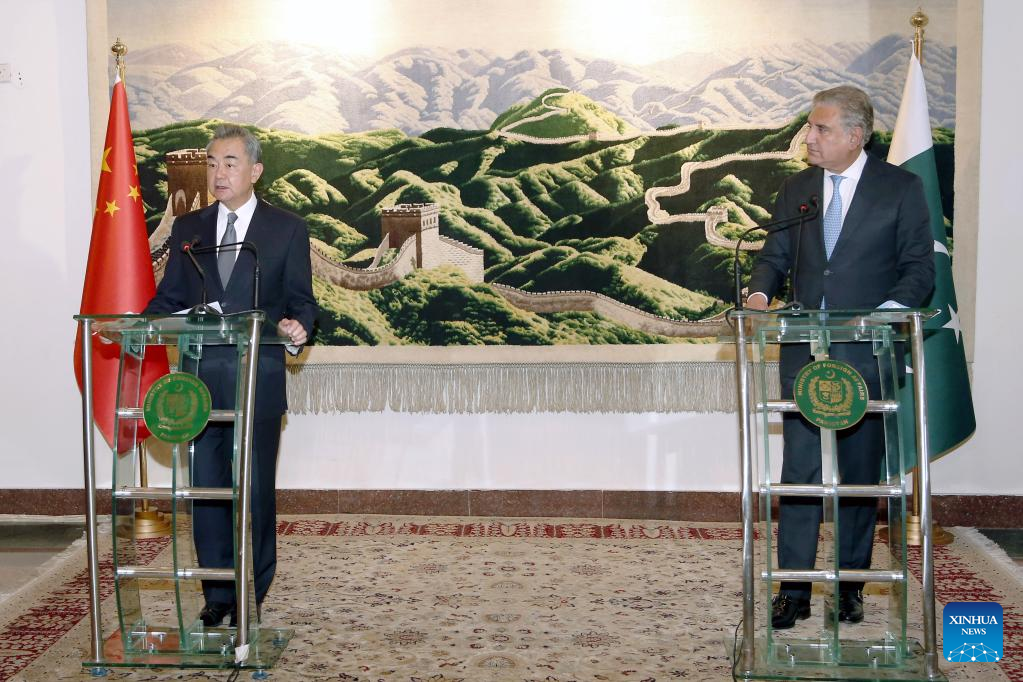
IN BRIEF
By Avishka Ashok and Dincy Adlakha
INTERNATIONAL
Pakistan: Foreign Ministers discuss enhancing bilateral relations
On 21 March, China’s Foreign Minister Wang Yi and Pakistan’s Foreign Minister Shah Mahmood Qureshi took part in a joint press conference and announced the countries’ decision to strengthen their strategic coordination and pragmatic cooperation. Wang Yi is currently in Pakistan, as a part of his first trip to the neighbouring country after the outbreak of COVID-19. Wang Yi also said that China would like to build strong partnerships with the Islamic world and desires to encourage unity, justice and development.
He proposed a four-point proposal to further enhance their cooperation. First, supporting each other in the international order and continuing their friendly policies towards each other. Wang said: “China will stick to its friendly policy toward Pakistan, firmly support the Pakistani people in taking a development path that fits their own national conditions, and support Pakistan in defending its sovereignty, independence and territorial integrity.” Second, China and Pakistan will enhance their common development and rural revitalization through the CPEC and also support Pakistan’s green development, digitalization, poverty reduction, and health. Third, the countries pledged to deepen their cooperation on counter-terrorism. Wang Yi said: “China supports Pakistan in severely punishing the perpetrators of the Dasu terrorist attack, appreciates its efforts to strengthen the security of Chinese personnel and projects in Pakistan, and will, as always, help Pakistan improve its law enforcement and security capacity.” Fourth, maintaining closer multilateral coordination and taking a stand against power politics, bullying and unilateral sanctions. (“Chinese FM makes four-point proposal on China-Pakistan relations,” Xinhua Net, 22 March 2022)
The US: State Department expands ban on Chinese officials
On 21 March, the US State Department expanded the existing travel ban against Chinese officials for their involvement in the alleged abuse of human rights in the Xinjiang Region. The department did not specify how many officials or who would be affected by the ban. The Secretary of State Antony Blinken said that the sanctions were being imposed on officials who “are believed to be responsible for, or complicit in, policies or actions aimed at repressing religious and spiritual practitioners, members of ethnic minority groups, dissidents, human rights defenders, journalists, labour organisers, civil society organisers, and peaceful protesters in China and beyond.” The expanded ban also includes a ban on officials involved in the suppression of pro-democracy activists in Hong Kong and Tibet. (“US expands travel bans on Chinese officials accused of persecuting ethnic and religious minorities,” South China Morning Post, 22 March 2022)
The US: Military Commander accuses China of arming islands in the South China Sea
On 21 March, the Guardian reported the US Military Commander’s claim that China had militarized at least three islands in the South China Sea. According to US Indo-Pacific Commander Admiral John C Aquilino, China had armed the islands with anti-ship and anti-aircraft missile systems, laser and jamming equipment and fighter jets. Admiral Aquilino observed that the actions were completely different from China’s promises of not transforming the islands in the disputed region. He said: ““Over the past 20 years we’ve witnessed the largest military buildup since world war two by the PRC. They have advanced all their capabilities and that buildup of weaponization is destabilizing to the region.” (“China has fully militarized three islands in South China Sea, US admiral says,” The Guardian, 21 March 2022)
Indo-Pacific: India and Australia discuss South China Sea and the border disputes
On 21 March, Australia’s Prime Minister Scott Morrison reiterated the country’s core interests and focus on the Indo-Pacific region during the India-Australia Summit. The Prime Ministers of India and Australia made no reference to China during the initial comments but stressed on greater cooperation in the region. Morrison said: “Our region is facing increasing change and much pressure.” Morrison also offered a detailed perspective of how Australia saw China and its actions in the South China Sea. Modi spoke about the India-China border dispute and reaffirmed that peace and tranquillity in the area was a prerequisite for normality in their relations. (“India and Australia agree Quad should focus on Indo-Pacific,” The Strait Times, 21 March 2022)
INTERNAL
Flight accident: Eastern Boeing 737 crashes with 132 onboard
On 21 March, a China Eastern Boeing 737 with 132 people and nine crew members crashed in the Guangxi Zhuang Autonomous Region. The crash also resulted in a mountain fire. The fire has now been stamped out but no survivors were found from the crash. Soon after the crash, President Xi Jinping initiated an all-out search and rescue efforts and launched an emergency operation. The State Council also pledged to assign officials and investigate the cause of the crash at the earliest. The flight crash is the first in a long time and broke the country’s record of 4227 safe flight days. The last crash in China took place in 2010 in Yichun, Heilongjiang province. (“A China Eastern Boeing 737 with 132 onboard crashes, casualties unknown,” Global Times, 21 March 2022)
Society: Divorce rates fall after introduction of ‘cooling-off’ period
On 21 March, the Ministry of Civil Affairs released new data according to which the divorce rates had dropped in China after the introduction of the “cooling-off” period. The data revealed that over 43 per cent of the 2.14 million pairs of couples who had registered for a divorce, dropped the idea after the plan was introduced. The “cooling-off” period was implemented in January 2021 and gives the couples a 30-day period during which either party can withdraw the application. The Director of the Guangdong Academy of Population Development said: “The period gives the couples time to calm down, think more rationally and avoid being hasty. Making good use of the 'cooling-off' period can effectively reduce impulsive divorces.” (“'Cooling-off' period credited for drop in divorces,” China Daily, 21 March 2022)
ECONOMY
Evergrande Group: Company announces delay in publishing audit report
On 22 March, the China Evergrande Group announced that they would be unable to publish their financial results for the last year by 31 March 2022 as their audit had not been completed. The publishing of the audit report is required by the stock listings. The company explained in a stock exchange filing that the drastic changes in its operations since the last year had led the auditor to add a number of additional procedures. The company has promised to publish the results as soon as the audit work is completed and have continued with the suspension in trading its shares until the results are approved. (“China Evergrande, units unable to publish annual results by March 31,” Reuters, 22 March 2022)
21 March 2022 | Monday | China Reader Evening Brief | Vol.1, No. 145
Chinese social media on Ukraine: Censorship and propaganda
Chinese social media platforms witness debates over the Russia-Ukraine war. Authorities find strategic reasons to garner domestic support for Russia by removing Ukraine-sympathetic posts.
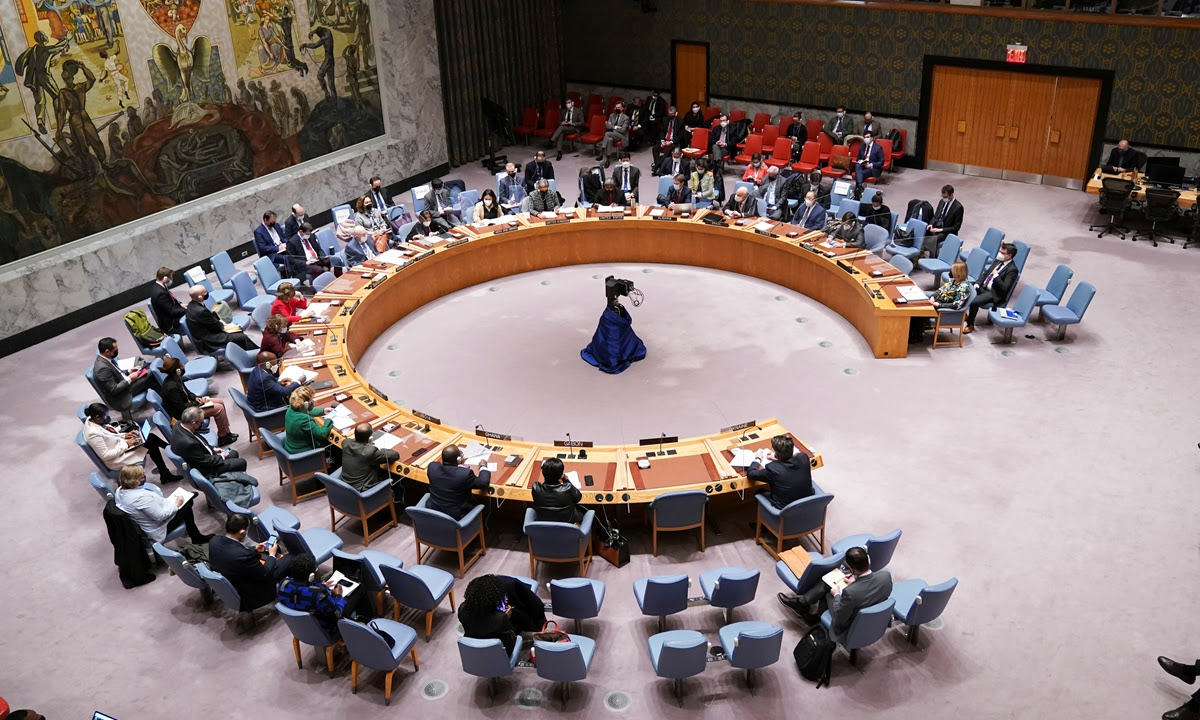
IN FOCUS
By Dincy Adlakha
Chinese social media on Ukraine: Censorship and propaganda
On 12 March, the BBC covered a report that claimed Chinese authorities have been removing posts that sympathize with Ukraine from local social media platforms like Weibo, WeChat and the like.
Previously, on 27 February, the New York Times also reported Chinese media being pro-Russian invasion.
The online debate and censorship
The BBC report cited instructions “accidentally” released to the public by the Cyberspace Administration of China that were supposed to be released internally. The instructions intended to “strictly control the content on Ukraine situation” and urged “commercial websites, local media and self-published media to not conduct live streams or use hashtags on the Ukraine situation.”
Online social media platforms have noted that over 4000 posts on Ukraine have been deleted in the past two weeks. China’s TikTok, Douyin confirmed the deletion of 500 videos and over 2500 comments while Weibo and Bilibili suspended accounts as well. WeChat urged its users to remain “objective” and “rational” while posting on Ukraine. Unsurprisingly, most of the deleted posts sympathized with Ukraine and called for peace.
On the other hand, pro-Russia sentiments have been promoted through state-run traditional media which easily catches on by social media too. Many users are calling Russian President Putin as “Putin the Great” and “best legacy of the Soviet Union” or “best strategist of the century” while they praise him for his war speeches.
The New York Times recognizes a pattern in Chinese social media posts created by a “generation of online warriors” who praise all the policies of President Xi Jinping. The report terms these nationalistic youth on online media as “little pinks” who spread the messages of “wolf warrior” diplomats.
How does China control its social media?
China has been notorious for its control of press freedom. It was ranked 177 in the 2021 World Press Freedom Index released by Reporters Without Borders. China was above only Eritrea, North Korea and Turkmenistan.
In August 2021, China issued the Draft Internet Information Service Algorithmic Recommendation Management Provisions. The provisions provided a framework to regulate the recommendations on Chinese social media through algorithms. The state argued that the move is necessary to avoid “disinformation” and “strengthen national security.” China specifically targetted big technological giants and their social media applications like Weibo through these provisions. It provided greater code control to the state authorities to curb fake users, manipulation of search rankings, management of popular keywords among other reasons.
On 1 March 2022, a new regulation came into effect in China that aimed at curbing the influence of the Big Tech companies in shaping online views and opinions. The regulation incidentally timed with the Russia-Ukraine war. The big companies were urged to “promote positive energy” and allow users to refuse customised recommendations. This new regulation boldly makes it easy for the state to monitor the content posted on social media and turn directions of the content if needed.
Through such legislation and algorithms, Chinese authorities have been active in recognizing targetted posts and removing them instantly. Additionally, it also helps the authorities to infuse desirable content into the system.
Previous instances
Previously as well, the Chinese control of online media came to the spotlight. Most recent examples include the banning of keywords related to Chinese tennis star Peng Shuai. During the controversial disappearance of Shuai, there were multiple reports citing the removal of her account, her posts and all keywords related to her. Additionally, these algorithms are utilised in China to promote the messages from President Xi Jinping, calling it “Xiplomacy.”
In the current situation as well, the removal of posts sympathizing with Ukraine adds question marks to the neutral stance China has chosen to diplomatically hold.
References:
Kai Wang, “Ukraine: How China is censoring online discussion of the war,” BBC, 12 March 2022
Samuel Wade, “Minitrue: Turn Down Temperature, Strictly Control Content on Ukraine Situation,” China Digital Times, 4 March 2022
Tracy Qu, “China’s algorithm law takes effect to curb Big Tech’s sway in public opinion,” South China Morning Post, 1 March 2022
Li Yuan, “Why the Chinese Internet Is Cheering Russia’s Invasion,” The New York Times, 27 February 2022
Sapni G K and Mihir Mahajan, “Understanding China’s Draft Algorithm Regulations,” The Diplomat, 16 September 2021
“2021 World Press Freedom Index,” Reporters Without Border, n.d.
IN BRIEF
By Avishka Ashok and Dincy Adlakha
INTERNAL
COVID-19: Hong Kong to review restrictions as cases decrease
On 20 March, Hong Kong’s leader Carrie Lam said that the authorities are considering removing the COVID-19 restrictions in the city as the cases have dropped. The city was reporting more than 50,000 daily infections in early March. However, the daily caseload has started reducing in the past week. She said: “Having gone through the peak that you have seen here ... I think a responsible government should regularly and vigorously review these measures, to see whether there is room for adjustment. I wouldn’t promise now that there’s room for adjustment. But following a review, we have a duty to account for the findings in this review and the direction we will take.” (“Hong Kong will review COVID-19 restrictions as cases decline,” The Asahi Shimbun, 20 March 2022)
COVID-19: Shenzhen cases controllable; authorities lift the lockdown
On 20 March, Shenzhen city lifted the city-wide week-long lockdown as the local authorities reported that the daily caseload is manageable. The government released a notice that said: “ Although the city’s COVID-19 situation is still grim, the spread within the community is still manageable.” Government agencies and companies have been allowed to operate at normal functioning levels. However, transport services like bus and subway will resume gradually within the week. The development follows a previous order that called for a phased reopening of the city under which partial lifting of restrictions started from 18 March in five districts of the city. The local municipalities have vowed to maintain strict measures in place to control the spread of the virus and urged the public against mass gatherings. (“Shenzhen lifts citywide lockdown as Covid-19 situation seen controllable,” The Straits Times, 21 March 2022)
REGIONAL
Migrant workers in Taiwan: Indonesian immigrants report discrimination and struggles
On 20 March, South China Morning Post published an article on the struggles and discrimination faced by Indonesian migrant workers in Taiwan. The article uncovered that people from regional countries are attracted by the prospects of a good job in Taiwan; however, have to face verbal abuse and discrimination. The article was based on an interview of the main character of a documentary on the same subject. Reporting on the experience during COVID-19, the article recounted the banning of the arrival of Indonesian migrant workers in December 2020 and the looks of suspicion and discriminatory behaviour with the ones present in Taiwan. The authorities maintain that their policies of comprehensive protection have greatly benefitted the migrants. (“Indonesian migrant workers in Taiwan face struggles, discrimination,” South China Morning Post, 20 March 2022)
INTERNATIONAL
BRI: Serbia and Hungary inaugurate Belgrade-Budapest railway project
On 20 March, Global Times reported that officials from Serbia and Hungary held an inauguration ceremony to mark the start of operations of the Belgrade-Budapest railway, a flagship project of the BRI. The development was reported on the website of the Chinese Embassy in Serbia. The railways were inaugurated through a symbolic train journey by Serbian President Aleksandar Vucic and Hungarian Prime Minister Viktor Orban, along with other officials. The railway station in Belgrade Novi Sad section was built by China Communications Construction and China Railway International. Additionally, Russian companies were also involved in the construction, German companies installed equipment and the trains were manufactured in Switzerland. (“Officials inaugurate section of Belgrade-Budapest railway, a flagship BRI project,” Global Times, 20 March 2022)
The US: Hong Kong suspends import of poultry products due to bird flu
On 21 March, the Centre for Food Safety of the Hong Kong SAR government announced its decision to suspend its import of poultry meat and other sub products from a number of flu-affected areas in the US. The Food and Environmental Hygiene Department of the HKSAR government issued the notice after the World Health Organization notified regarding a highly pathogenic H5N1 avian influenza in the US. The city will impose restrictions on poultry products originating from Queen Anne’s County, Maryland, Jefferson County, Wisconsin, Taylor County, Iowa and Lawrence County and Jasper County, Missouri. (“Hong Kong suspends import of poultry products from U.S. over bird flu,” Xinhua Net, 21 March 2022)
Africa: Revised protocols increase trade with China and East Asia
On 20 March, Xinhua Net reported that the African countries like South Africa, Kenya and Zimbabwe revised their trading protocols to help them access the Chinese markets more easily. The revised protocols will facilitate a greater availability of African agricultural products in the Chinese consumer markets. As a result of this enhanced deal, China shipped over 1,00,000 lemons to China in February 2022 and also increased the export of pears to East Asia by 22 per cent. Other exports such as soybeans from Tanzania, avocado, tea, coffee and roses from Kenya, Rwanda and Ethiopia, beef from Namibia and Botswana and fruits f rom South Africa have also increased due to the new deal. (“More African agricultural products to enter Chinese market,” Xinhua Net, 20 March 2022)
Tanzania and Algeria: Foreign Ministers discuss mutually helpful relations
On 20 March, China’s Foreign Minister Wang Yi conducted a talk with the Foreign Ministers of Tanzania and Algeria. Wang Yi appreciated Algeria’s efforts in favouring peace and justice in the country. He called on the like-minded countries to unite and promote the idea of democracy in the region. Tanzania’s Foreign Minister Mulamula said: “Tanzania is committed to building its relations with China into a new benchmark for Africa-China ties.” Wang Yi observed that the friendship between the two countries had ameliorated and that China would be willing to elevate the relations to a strategic and long-term level. (“Chinese FM holds talks with Algerian, Tanzanian counterparts,” Xinhua Net, 20 March 2022)
19 March 2022 | Saturday | China Reader Evening Brief | Vol.1, No. 144
China, Taiwan and the cross-Straits Relations: Escalating Tensions
The Military Spokesperson explained the PLA's intentions and actions towards Taiwan during the "Two Sessions" in China.
IN FOCUS
By Teshu Singh
China, Taiwan and the cross-Straits Relations: Escalating Tensions
On 10 March 2022, at the fifth session of the 13th National People's Congress, the spokesperson for the delegation of the People's Liberation Army and People’s Armed Police Force, Wu Qian, stated that “the Chinese military will never tolerate “Taiwan independence” separatist acts and the interference of external forces. He stated: “the more the US and Japan make waves in the Taiwan question, the tougher actions we will take to safeguard national sovereignty and territorial integrity.” Wu Qian alluded to the fact that the root cause of the rising tension and disturbance in the cross-strait relations is due to the activities of the ruling party Democratic Progressive Party (DPP).
First, the timing is crucial.
Tensions in Cross-Strait relations are not new but the timing of the statement is crucial. 2022 is an important year in Cross-Strait relations as it marks the 50th anniversary of Richard M. Nixon’s visit to China and the subsequent signing of the Shanghai Communiqué. The Shanghai Communiqué endorses the US’s One-China principle with regard to Taiwan and it subsequently led to the normalization of US-China relations. China is using the occasion to remind the US not to use Taiwan as bargaining chip in bilateral relations.
Second, the 20th Party Congress scheduled this year.
In 2012, at the 18th National Congress of the Communist Party of China, Hu Jintao said: “We must adhere to the principle of ‘peaceful reunification and one country, two systems and the eight-point proposal for growing cross-straits relations and advancing peaceful reunification of the motherland.’
In sharp contrast to his predecessor, in 2017, at the 19th National Congress of the Communist Party of China, Xi had reiterated that the “One-China principle is the foundation of Cross-Straits relations and is key to the peaceful development of relations between the two sides of the Taiwan Straits.” Under Xi Jinping, the term peaceful reunification seems to be absent. The 20th National Congress of the Communist Party of China is due this year. Thus, Xi Jinping is taking an aggressive stance towards Taiwan as the 20th Party Congress is approaching.
Third, Taiwan in US-China relations.
Since 2016, with the coming of the DPP, Taiwan has moved closer to the US. During Donald Trump’s period, Taiwan received generous assistance from the US. The trend continues under Joe Biden. President Joe Biden invited Taiwan for the Summit of Democracy. The Taiwanese Vice President Lai Ching-te met the Vice President for the first time, although it was brief. The Biden administration has already given two sets of arms to Taiwan. First, on 5 August 2021, the Biden administration gave arms worth USD 750 million. Second, on 8 February 2022, it was worth USD 100 million worth of equipment and services to support its air and missile defense systems.
China has always criticized the US arms sale to Taiwan. On 15 March 2022, the spokesperson of the Taiwan Affairs Office of the State Council, Zhu Fenglian said DPP has purchased arm from the US with taxpayer’s money and seek independence by force.” Such attempts will not succeed and will harm peace and stability across Taiwan Strait and the interests of Taiwan residents. China also criticized the Consolidated Appropriations Act 2022 because it contains a Taiwan related provision. The issue of Taiwan is always high on the table during any US-China talks. Taiwan was discussed during the recently held talks between Yang Jiechi and Jake Sullivan talks. During the talks, China raised the issue of the One-China Principle, the provisions of the three Sino-US joint communiqués and the commitments made by the US.
Fourth, the effect of the Ukrainian Crisis on Taiwan
Taiwan issue has its roots in the activities of separatists who, in collusion with foreign forces, seek “Taiwan independence” and are threatening the nation's sovereignty, security and core interests, and curbing its development. The mainland firmly believes that peaceful reunification of the island with the motherland is in the best interest of the Chinese nation and all the Chinese people. In comparison to the Russian military action on Ukraine, the US response from the US to any Chinese aggressive move to take over Taiwan would be different from the present on Ukraine.
According to the Russian Federal Security Services (FSB), there is a speculation that Xi Jinping is considering launching an invasion of Taiwan in the fall of this year. A report released on 4 March noted that Xi Jinping is considering taking over Taiwan in the Fall. The timing of the aggression is related to the 20th Party Congress so that he can get re-elected for a third term. Responding to the statement, the Taiwanese Foreign Minister Joseph Wu said: “I cannot ascertain (the document) veracity, but we must be prepared to defend ourselves regardless of or when China intends to attack.”
Overall, there has been an increase in the temperature across the straits. China has been sending aircraft and violating Taiwanese airspace. They have also indicated that China will not tolerate any external interference on the Taiwan issue. However, there is a caveat, in the relationship. The two sides of the strait have a robust trade. In 2021, bilateral trade was USD 328 billion. To sum up, the tensions in the Cross-Strait relations are not new but at the moment it is all-time high and much more severe as compared to the last few years.
References:
“Chinese military spokesperson vows zero tolerance for 'Taiwan independence' separatist acts,” China Daily, 10 March 2022
“China urges U.S. to stop arms sales to Taiwan,” CGTN, 16 March 2022
“China, U.S. agree to 'manage differences' in Yang-Sullivan talk,” CGTN, 14 March 2022
“Taiwan question not same as Ukraine,” China Daily, 11 March 2022
“Xi considered invading Taiwan this fall: FSB whistleblower,” Taiwan News, 16 March 2022
IN BRIEF
By Avishka Ashok and Dincy Adlakha
INTERNAL
COVID-19: China receives first batch of Pfizer drug; allows generic production
On 18 March, Global Times reported that the first batch of Pfizer drug with 21,200 boxes of the medicine reached China. The drug shall be distributed in Omicron-hit cities like Shanghai and Shenzhen in China that are currently reeling with a huge caseload. Additionally, formal approval was provided to five Chinese companies to produce a generic version of the drug nirmatrelvir as used in the effective Pfizer pills. The Shanghai customs office reported that there will be more batches of the drug arriving soon. China’s National Medical Products Administration also announced its emphasis on the approval process of COVID-19 medicines as the outbreaks reach more cities in China. (Leng Shumei and Qi Xijia, “China receives first batch of Pfizer pills, domestic oral candidate may be ‘approved in months’,” Global Times, 18 March 2022)
COVID-19: Hong Kong reports 20,000 new cases as frustrations due to restrictions rise
On 18 March, Hong Kong reported 20,082 new COVID-19 cases. The daily caseload is situated between 20,000 and 30,000 for the past two weeks. Hong Kong implemented a Zero-COVID strategy and imposed a ban on flights from nine countries, 14-day quarantine, a shutdown of schools, gyms, beaches and other venues. The residential population seems agitated by the restrictions. Hong Kong leader Carrie Lam is also monitoring the situation as she addressed the frustration of financial institutions due to the lockdowns and informed that an update on the situation will be provided soon. Hong Kong is currently witnessing its highest surge in cases and deaths. (Twinnie Siu and Marius Zaharia, “Hong Kong reports 20,082 new COVID cases as city promised fewer restrictions,” Reuters, 18 March 2022)
ECONOMY
Income tax: China to waive tax for some small firms
On 18 March, China announced that it is cutting income tax for some small firms to ease the burden of small businesses. The firms shall be exempted from 20 to 25 per cent of tax to support the slowing economy by providing small businesses with a push. This order shall be applicable from 2022 to 2024. Companies that have less than 50 million yuan worth of assets, fewer than 300 employees and have annual taxable income below 3 million yuan shall be eligible for this cut. The decision, as publicised by the Finance Ministry on their website, is a part of the Chinese plan to boost the economy. Previously, Chinese Premier Li Keqiang pledged tax cuts and rebates amounting to 2.5 trillion yuan. (“China cuts income tax for some small firms to 20%,” Reuters, 18 March 2022)
TECHNOLOGY
Space station: Second lecture from taikonauts set for 23 March
On 18 March, China Manned Space Agency announced that the second lecture of the lecture series from the Tiangong space station is scheduled for 23 March. The lecture is a part of larger interaction series between Shenzhou-13 taikonauts and students in China. It aims to inspire students towards a career in science and astronomy. This lecture will conduct experiments on the crystallization of saturated liquid, water-oil separation, and the like. The lecture will also demonstrate the difference between throwing objects in space and on Earth. The class will be held by Chai Zhigang, Wang Yaping and Ye Guangfu, the three taikonauts on a six-month stay in the space station. (“Second class from China's space station scheduled on March 23,” Xinhua Net, 18 March 2022)
REGIONAL
Cambodia: President Xi and President Hun Sen discuss the next step in the Belt and Road Initiative
On 18 March, the Chinese President Xi Jinping held a telephonic conversation with the Cambodian Prime Minister Samdech Techo Hun Sen and discussed the Belt and Road Initiative in Cambodia. President Xi encouraged the infrastructural development in the country and said: “The two sides should engage in high-quality joint Belt and Road construction, speed up the construction of major projects such as highways, airports and special economic zones, and expand cooperation in emerging fields such as finance and digital economy.” He also appreciated the strong relations between the countries that continued to grow deeper during the pandemic. Xi also promised China’s support to Cambodia in the years to come. President Hun Sen appreciated China’s role in the infrastructural development and congratulated China for the successful hosting of the Beijing Winter Olympics and the two sessions. (“China, Cambodia agree to advance Belt and Road cooperation,” Xinhua Net, 18 March 2022)
INTERNATIONAL
Greece: China signs bilateral deal to boost tourism cooperation
On 18 March, China and Greece signed a Joint Action Program to boost cooperation on tourism between the two countries. The meeting held between Greek Tourism Minister Vassilis Kikilias and China’s Ambassador to Greece Xiao Junzheng welcomes the MoU that focuses on Sino-Greek cultural, medical, wellness and wedding bonds through tourism. The Joint Action Program dates for two years from 2022 to 2024. Ambassador Xiao said: “(It is) also a very important step for our two countries to celebrate the 50th anniversary (of the establishment of diplomatic ties between China and Greece) and to enrich our cooperation in the Year of China-Greece Culture and Tourism (2021-2022).” (“China, Greece sign deal to boost tourism cooperation,” China Daily, 18 March 2022)
The US: President Biden and President Xi discuss Ukraine, Taiwan on video conference
On 18 March, the US President Joe Biden and Chinese President Xi Jinping held a video conference to discuss the crisis in Eastern Europe and other bilateral issues between the countries. Xi encouraged the US and NATO to engage with Russia directly in order to resolve the issues with Ukraine. President Xi referred to the situation and said: “Let he who tied the bell on the tiger’s neck take it off.” He used the well-known Chinese proverb to imply that the US and NATO must undo their actions to bring peace in the region. A senior official from the US referred to the call and said: “The president really laid out in a lot of detail the unified response from not only governments around the world, but also the private sector to Russia’s brutal aggression in Ukraine.” Xi Jinping also spoke of the Taiwan issue and said: “If the Taiwan issue is not handled properly, it will have a subversive impact on the relationship between the two.” (“Xi urges US, NATO to talk with Russia, opposes indiscriminate sanctions,” Global Times, 19 March 2022; Xi says improper handling of Taiwan issues will hit China-U.S. ties,” The Asahi Shimbun, 19 March 2022)
The US: China urges the country to deal with its own human rights violations
On 18 March, China’s Deputy Permanent Representative to the United Nations Dai Bing responded to the US accusations of violating human rights in the country. Bing urged the US to deal with the abuse of human rights in its own country and accused the US representative of misusing the General Assembly commemorative meeting on the occasion of International Day for the Elimination of Racial Discrimination. He said: “The U.S. accusation of the so-called "ethnic genocide" and "human rights violations" in China's Xinjiang is an outright lie of the century and a vicious political scheme orchestrated and staged by none other than the United States, which China firmly opposes and sternly rejects.” (“China urges U.S. to face up to its own human rights violations” Xinhua Net, 19 March 2022) ,
18 March 2022 | Wednesday | China Reader Evening Brief | Vol.1, No. 143
Chinese Foreign Minister warns against military aggression
Foreign Minister Wang Yi reminds Japan of its historic past and reprimands it for its decision to support the US sanctions on Russia.
.jpg)
IN BRIEF
By Avishka Ashok
REGIONAL
Japan: Chinese Foreign Minister warns against military aggression
On 17 March, the Foreign Ministry Spokesperson Zhao Lijian addressed a press briefing and responded to Japan’s remarks ruging China to be responsible in the crisis in Ukraine. Japan also imposed sanctions on Russia along with the US and other countries for its actions in Ukraine. Japanese Prime Minister Fumio Kishida also accused Russia of occupying Japan’s Kuril Islands and revealed that he would consider revising Japan’s military strategies to strengthen the country. In response to Japan’s comments, Zhao warned the country against disrespecting and opposing the consequences of the World Anti-Fascist War and avoid capitalizing on Ukraine to extend its military capabilities. He said: “Some Japanese political forces have tried to take advantage of the Ukraine issue to deliberately hype up external threats, in order to expand the country's military forces.” He also warned Japan that the country should carefully take actions considering its dark past, which makes its Asian neighbours scrutinize its actions. He said: “Japan should adhere to the path of peaceful development and take more steps that are conducive to regional peace and stability.” (“China's foreign ministry warns Japan to refrain from military expansion,” The Strait Times, 18 March 2022)
SCO: Foreign Minister discusses Ukraine with Secretary General Zhang Ming
On 17 March, the Chinese Foreign Minister Wang Yi held a meeting with the Secretary General of Shanghai Cooperation Organization Zhang Ming and discussed the different issues concerning the regional organization. Wang Yi first congratulated Ming for his assumption of the new role at the organization and recounted the achievements made by the SCO since its establishment. He also pondered on the role played by the SCO in maintaining regional stability and said: “In the face of the impact of the Ukraine crisis, the SCO should play a more active role in maintaining regional and even global security and stability.” Furthermore, Wang Yi spoke against the Cold War mentality and the use of illegal unilateral sanctions in the current world order. (“Chinese FM meets with secretary-general of SCO,” Xinhua Net, 17 March 2022)
INTERNAL
COVID-19: Shanghai imposes restrictions amid rising cases
On 17 March, the symptomatic local community infections touched 57 in Shanghai city and the domestically transmitted asymptomatic cases reached 203. A day earlier, the figures were eight and 150 respectively. The city’s authorities have launched a full scale mass testing campaign in an attempt to control the sudden surge of cases. Schools have been shut down and residential compounds have been sealed for for two days. However, some districts have eased the restrictions in order to minimize the losses and continue the supply chains and trade activity in the region. The total number of cases in China almost doubled on 17 March, accounting for 2,388 new cases of the virus. (“Shanghai pushes ahead with mass Covid-19 tests as new cases spike,” The Strait Times, 18 March 2022)
COVID-19: Standing Committee convenes a meeting to understand the situation
On 17 March, the Standing Committee of the Political Bureau of the Communist Party of China Central Committee held a meeting to discuss the new crisis posed by the COVID-19 pandemic and plan for a better and more efficient epidemic control. President Xi Jinping observed that the country had successfully limited the import of cases and domestic resurgences by imposing strict restrictions and controlling public activities. He also appreciated the efforts of the authorities and the measures that helped contain the outburst of the cases in different districts. Furthermore, he urged the people and the authorities to continue exercising restraint and putting the health of the people before all other priorities. He said: “Victory comes from perseverance. All local authorities and government departments must be fully aware of the complex, arduous and enduring nature of COVID-19 control both at home and abroad, further social mobilization, build consensus, proceed with greater confidence and perseverance, and carry out all the epidemic control work in a more solid and meticulous manner.” (“Standing Committee of Political Bureau of CPC Central Committee convenes meeting on COVID-19 situation and better and more stringent epidemic prevention and control,” Global Times, 18 March 2022)
INTERNATIONAL
Afghanistan: Chinese Red Cross sends second batch of assistance goods
On 17 March, Xinhua Net reported that the Afghan Red Crescent Society(ARCS) received the newest batch of assistance that was donated by the Red Cross Society in China. The report revealed that a handover ceremony took place on 16 March and was attended by the Chinese Ambassador to Afghanistan Wang Yu and the ARCS Secretary General Mawlawi Matiul Haq Khalis. Wang Yu said: “In order to help Afghanistan to improve needy people's livelihoods, the RCSC has taken a number of measures. After it donated a batch of assistance to Afghanistan in December last year, today another batch of flour has been donated to Afghanistan. Thousands of families will get this batch of flour.” Mawlawi Khalis also appreciated the organization’s contribution and expressed the country’s gratitude towards the much needed support. (“New batch of China-donated supplies arrive in Afghanistan,” Xinhua Net, 17 March 2022)
The EU: Trade in January-February 2022 increases by 14.8 per cent
On 17 March, the Ministry of Commerce SPokesperson Gao Feng announced that the bilateral trade between China and the European Union had experienced a rapid growth in the January-February period. According to Feng, the growth showed vitality and resilience in their trade cooperation. He said: “As significant trading partners to one another, China and the EU enjoy a high degree of economic complementarity, broad areas of cooperation, and great potential for development.” The trade increased by 14.8 per cent and accounted for USD 137.16 billion in January-February 2022. In this period, the EU is said to be China’s largest trading partner. Feng also expressed China’s readiness in working with the EU and facilitating trade and investment between China and the region. (“China-EU trade sees sound momentum in first two months,” Xinhua Net, 17 March 2022)
Racism: China takes a stand against racist evacuation of nationalities from Ukraine
On 17 March, China’s permanent representative to the United Nations Zhang Jun attended the United Nations Security Council meeting on the Ukraine refugee issues and stressed on helping all the people in the crisis, regardless of their race, region and ethnicity. Zhang expressed China’s concerns regarding the deterioration of the humanitarian situation in Ukraine and the increasing casualties in the war. He shed light on the racist segregation of refugees based on their nationality during the evacuation of Africans, Indians and Arabs from Ukraine. He said: “This is why, in a deep humanitarian crisis, racism can still show its ugliness, because those who are meant to be helping and serving to get people out safely have a racist mind-set.” (“Chinese envoy to UN calls for attention to problems faced by African, Mid-East evacuees in Ukraine crisis,” Global Times, 18 March 2022)
Uganda: President appreciates China’s style of diplomacy
On 18 March, Xinhua Net reported on Ugandan President Yoweri Museveni’s interview with Nikkei. The report revealed President Museveni’s appreciation of China’s style of diplomacy and called it “much better than the double standards held by the West.” He also rejected the accusations against China on influencing smaller economies and trapping them in a debt cycle. He said: “Africa has been having problems for the last 600 years due to the slave trade, colonialism, neocolonialism -- and none of it was from China. China supported Africans' fight against colonialism before starting economic activity on the continent. "They do not impose their offers if you do not want them.” (“China-style diplomacy "better than" West's, says Ugandan president,” Xinhua Net, 18 March 2022)
17 March 2022 | Thursday | China Reader Evening Brief | Vol.1, No. 142
The US and Australia and the threat of sanctions against China
Foreign Ministry spokesperson warns against sanctioning China and the futility of unilateral sanctions.
IN BRIEF
By Avishka Ashok and Dincy Adlakha
INTERNATIONAL
The US and Australia and the threat of sanctions against China
On 16 March, Global Times reported that Chinese Foreign Ministry Spokesperson Zhao Lijiang has warned the US against sanctioning China in a regular press briefing. He aid that the US cannot continue displaying the stick of sanctions against China while seeking Chinese support and cooperation. He also maintained that sanctions can never resolve a problem effectively as unilateral sanctions do not represent justice. He said: “It is irresponsible and immoral to erase China's efforts and distort China's intentions and fabricate disinformation to smear China.”
On 14 March, the Chinese Foreign Minister Wang Yi also held a phone conversation with the Spanish Foreign Minister where he reiterated China's stance against unilateral sanctions and said that the sanctions have no basis in international law. He added: "China is not a party directly involved in the Ukraine crisis, and it doesn't want to be affected by sanctions even more." (“China to take strong countermeasures if US enforces sanctions against China while seeking support: Chinese FM,” Global Times, 16 March 2022)
On 16 March, the Guardian reported that the Australian Prime Minister Scott Morrison would initiate a move to sanction China if the country decided to supply military equipment to Russia. Morrison confirmed the country’s decision to support its allies and partners as a reaction to China’s indifference to the Russian invasion of Ukraine. The Defense Minister Peter Dutton also raised alarm against the silence of countries on the issue and warned that the international system will be facing a darker future if Russia was allowed to continue in its plans. He said: “It is becoming clear that Putin’s Ukrainian gamble has been a miscalculation that may very well destroy the man himself.”(“‘An abomination’: Morrison signals sanctions against China if it helps arm Russia | Australia news,” The Guardian, 16 March 2022)
The US: Justice Department accuses China of intimidating dissidents
On 16 March, the officials from the US Justice Department claimed that the Chinese government agents were trying to spy and intimidate dissidents living in the US. The department revealed that three cases had been registered relating to “transnational repression” by an authoritarian government. Assistant Attorney General Matthew Olsen said: “These cases expose attempts by the government of the People's Republic of China to suppress dissenting voices within the United States and demonstrate how the PRC attempts to stalk, intimidate and silence those who oppose them.” The report also informed that the Chinese agents had attempted to prevent a Chinese-born candidate from running in the elections. The second case accused a Long-Island resident of conspiring to act as an agent of a foreign government. The third case accused the Chinese government of spying on a California-based artists by planting surveillance equipment in his workplace and his car. (“Justice Department accuses China of spying on, intimidating dissidents living in U.S.,” Reuters, 16 March 2022)
INTERNAL
CCP ceremony: Senior Party officials take oath of allegiance to the constitution
On 16 March, 32 officials from senior cadres of the Party under China’s State Council took an oath of allegiance to the constitution of China. The oath-taking ceremony was held to officially initiate the recently appointed officials to the system. The ceremony was headed by Premier Li Keqiang who urged the officials to always remain loyal to the constitution and fulfill their duties diligently. Other senior officials including Vice Premier Hang Zheng also attended the ceremony. (“Senior officials pledge allegiance to Constitution,” Xinhua Net, 16 March 2022)
COVID-19: Shenzhen to reopen workplaces in phased manner
On 17 March, a local official from Shenzhen Hung Qiang said that the city will reopen workplaces in a phased manner. The announcement was made at a press conference. The resumption of services will take place based on area and industry type. Shenzhen city had been locked down due to a high surge in COVID-19 cases throughout the city. All schools, colleges and workplaces had been shut to curb the growing cases in key technology and manufacturing hub. (“China's Shenzhen city says will allow firms to resume work in an orderly manner,” Reuters, 17 March 2022)
REGIONAL
Indonesia: President Xi holds a telephonic conversation with President Widodo
On 16 March, Chinese President Xi Jinping and the Indonesian President Joko Widodo held a telephonic conversation and discussed the upcoming and current challenges for the major developing and emerging economies of the Southeast Asian region. President Xi appreciated the bilateral cooperation between the two countries and expressed gratitude to Indonesia for assisting the development and jointly dealing with economic challenges during the COVID-19 pandemic. He said: “the two countries have moved forward hand in hand and risen to challenges, established a new pattern of bilateral cooperation on the "four-wheel drive" of political, economic, cultural and maritime affairs, and carried forward the main theme of solidarity against the pandemic and common development.” Widodo also appreciated China’s support in building the Jakarta-Bandung High Speed Railway and expressed support for the China-led Global Development Initiative. He said: “Indonesia fully supports the Global Development Initiative proposed by Xi, which is conducive to the realization of the UN 2030 Agenda for Sustainable Development. Indonesia is ready to maintain close communication with China to push forward the implementation of the initiative and contribute to the common development of the world.” (“Chinese, Indonesian presidents hold phone talks,” Xinhua Net, 16 March 2022)
16 March 2022 | Wednesday | China Reader Evening Brief | Vol.1, No. 141
China’s National People’s Congress session 2022: Major Takeaways
China conducted the two most important annual political events from 5 March to 10 March 2022. The sessions portray China's domestic policies in the coming year.
.png)
IN FOCUS
By N Jayaram
China’s National People’s Congress (NPC) session 2022: Major Takeaways
About the NPC & CPPCC: A brief note
China’s parliament –the National People’s Congress (NPC), consisting of about 3,000 members, meets once a year for a few days in March, with just two plenary sessions: the opening and closing.
Those who have covered it regularly could testify that the first day’s session tends to be more of a fancy-dress display: The current territory of the People’s Republic of China has peoples of various ethnicities with their traditional dresses in provinces such as Yunnan, Sichuan, Guangxi Zhuang and Chinese-occupied Tibet, East Turkestan (or what Beijing calls Xinjiang) and Southern Mongolia (Inner Mongolia) etc.
Vehicles drop delegates flown in from the provinces and Chinese-occupied regions on the vast Tiananmen Square, just east of the Great Hall of the People. And as the delegates walk towards the building, much photographing and videoing gets done. This get posted on state-run media and occasionally picked up by international media, although sections of the latter have over the decades gotten wise to the cynical exercise.
Along with the NPC, another body known as the Chinese People’s Political Consultative Conference (CPPCC), an equally toothless body of more than 2,000 members meeting – and dining lavishly – in the cavernous Great Hall over the same few days. The NPC-CPPCC once-a-year meetings are known as “liang-hui” or “two sessions” and are the highlight of the political calendar, although much of the actual law-making and ordinance-issuing is done by an organ known as the NPC Standing Committee, needless to say dictated to by the ruling party apparat.
Once inside and following the usual ceremonies, the most important item tends to be the so-called ‘Government Work Report’ presented by the Premier (Prime Minister).
The NCP and CPPCC sessions in 2022
First, the Premier Li Keqiang did the honours, as usual, this year too. Incidentally, the Chinese ruling party celebrated its centenary on July 1 last year with a huge military hardware display in Beijing.
Second, on economy. Li projected a 5.5 percent economic growth target, a rather conservative one, given that China’s GDP has been growing at a much faster pace since at least the 1980s. There was a nod to poverty-alleviation and building of a ‘moderately prosperous society’. Last year's urban unemployment was projected at about 5.5% and Li envisaged creating 11 million urban jobs this year.
Li unveiled plans for major R&D rises in order to close the supply gap in innovation with a stress on quantum computing, 5G communications and development of electric vehicles. Given how polluted Beijing and many other Chinese cities are, there was the expected promise on attention to promotion of ‘clean’ energy.
Third, on defense. Defense spending is to rise by 7.1 percent. Given that the so-called People’s Liberation Army is a vast economy in itself – controlling as it does large numbers of factories, and other revenue yielding entities including hotels and dance halls – the defense budget figures are a mere tip of the iceberg.
Fourth, on technology. Li unveiled a technological blueprint was laid out for the next five years, stating that “innovation remains at the heart of China’s modernization drive.” He also envisaged decarbonizing China and achieving 2030/2060 climate goals, noting that “action plans” for achieving peak carbon emissions by the late 2020s were on the cards.
Fifth on HK and Macau. Premier Li asserted that Hong Kong and Macau – whose ability to govern themselves has been decimated – would be allowed autonomy or what passes for it now but added “we will resolutely defend against and deter foreign interference”. Which assumed that the clamour for democracy that had been reverberating in Hong Kong over the past several decades was not indigenous.
Sixth, on leadership. A wholly unexpected development during a press conference at this year’s session was Premier Li’s announcement that he would retire at the end of his current term.
Now, it was a given that after two terms, Li simply had to retire, as per the succession plan the patriarch Deng Xiaoping had put in place starting from the late 1970s and 1980s: Two terms for the General Secretary of the ‘Communist Party of China’ – which has been pursuing robber-baron capitalism since the late 1970s and more officially since the early 1990s – and two terms for the state president and everyone else in the top leadership.
This two-term arrangement had been – grudgingly, perhaps – respected by everyone until recently: There had been some talk of Jiang Zemin, the post-1989 Deng appointee as Party General Secretary and state president having been reluctant to give up the post, which also goes with chairmanship of the Central Military Commission of both the Party and the state, but that was taken care of eventually.
The current President and Party General Secretary Xi Jinping – arguably the most authoritarian leader China has seen since the death of Mao Zedong in 1976 – has made it clear that he would seek a third term. In 2018, the NPC scrapped the two-term limit for China’s presidency, clearing the way for Xi to cling to power for as long as he wishes. During Xi’s term as president, Li Keqiang has played a minor number two role, unlike his predecessors such as Wen Jiabao, Zhu Rongji, Li Peng and Zhou Enlai.
Was Li Keqiang’s announcement of retirement a way of his – and perhaps some of his Party colleagues’ – airing dissent over Xi Jinping’s extended one-person rule?
Altogether, it has been an eventful NPC session, in the shadow of the continuing Covid and Ukraine crises and speculation over the Xi regime’s continuing “wolf-warrior” diplomacy and designs on Taiwan, not to mention tensions with India.
IN BRIEF
By Keerthana Nambiar and Dincy Adlakha
TECHNOLOGY
Space: Team of researchers achieve new heights in laser imaging technology
On 16 March, South China Morning Post reported that a team of military scientists in China had achieved a breakthrough in laser imaging technology. The new-found technology would help ground stations in identifying and tracking a target in space at a much more accurate scale. The research was conducted at National Defence Technology University and was headed by Professor Han Fei in the Anhui province. The team of researchers claimed that the technology could be used to remove small pieces of hazardous space debris by guiding laser beams. The technology can also be used to take images of thumb-sized objects in near-Earth orbit with a resolution of 0.1 inches. (“Chinese scientists hail space radar breakthrough,” South China Morning Post, 16 March 2022)
INTERNATIONAL
Ukraine: China urges US to act responsibly and ease the situation
On 15 March, Chinese Foreign Ministry Spokesperson Zhao Lijian urged the US to make concrete efforts to ease the situation in Ukraine. He said at a daily briefing that “the US creates and spreads disinformation from time to time, and such actions are unprofessional, unethical and irresponsible. They will only cause the US to be further discredited in the world.” He urged the US to deeply reflect on its role in the Russia-Ukraine conflict and take concrete steps to resolve the matter. He also displayed unpleasantness over the allegations made by an unnamed US official on China for supporting Russia in war. (“China urges U.S. to take concrete actions to ease situation in Ukraine,” Xinhua Net, 15 March 2022)
Ukraine: China denies being involved in Ukraine war, opposes sanctions
On 15 March, The Strait Times reported on a phone call between Chinese Foreign Minister and State Councilor Wang Yi and Spanish Counterpart Jose Manuel Albares Bueno. During the phone call, Chinese Foreign Minister Wang Yi clarified that China is not a party in the Ukraine war and does not want any sanctions to affect its interests. He also said that China is promoting peace talks between Russia and Ukraine in its way since the very beginning of the conflict. He said: “China has the right to safeguard its legitimate and lawful rights and interests.” (“China is not party to Ukraine war and does not want sanctions to hurt it: Foreign Minister Wang Yi,” The Straits Times, 15 March 2022)
EU: China encourages EU to build security systems with Russia and warns of “external interference”
On 15 March, Global Times reported recent remarks by China’s permanent representative to the UN Zhang Jun that the EU should consider rebuilding an “indivisible” security mechanism with Russia. He maintained that the Ukraine crisis has brought into light the weak security in Europe which is excessively vulnerable to external interference, especially from the US superpower. Similar remarks made by President Xi Jinping and China’s top diplomat Yang Jiechi reflect that China finds the US-led security bloc NATO as the major European security mechanism problematic. China urges Europe to look for a more secure bond within itself which includes Russia. (Yang Sheng, “China encourages Europe to build 'indivisible security' mechanism with Russia,” Global Times, 15 March 2022)
Netherlands: Wang Yi discusses Ukraine with the Foreign Minister
On 15 March, the Chinese Foreign Minister Wang Yi held a telephonic conversation with the Dutch and Iranian officials separately. The Dutch Deputy Prime Minister and Minister of Foreign Affairs Wopke Hoekstra discussed the current situation in Eastern Europe with Wang Yi. The Chinese State Councilor reiterated the “four musts” highlighted by President Xi Jinping’s on the issue. They are: “China maintains that the sovereignty and territorial integrity of all countries must be respected, the purposes and principles of the UN Charter must be fully observed, the legitimate security concerns of all countries must be taken seriously, and all efforts that are conducive to the peaceful settlement of the crisis must be supported.” (“Chinese, Dutch FMs hold phone talks,” Xinhua Net, 16 March 2022)
Iran: Wang Yi holds a telephonic call with the Foreign Minister
On 15 March, Chinese Foreign Minister Wang Yi held a telephonic conversation with the Iranian Foreign Minister Hossein Amir Abdollahian. Wang Yi expressed China’s position on the JCPOA and said: “China always supports an early agreement on resuming compliance with the nuclear deal, and is open to and supportive of efforts to this end. The Chinese side understands Iran's legitimate concerns, supports Iran in safeguarding its legitimate rights and interests, and opposes unilateral sanctions that have no basis in international law.” Abdollahian congratulated China for the successful completion of the two sessions and clarified Iran’s stance on the nuclear deal. He expressed Iran’s readiness in returning to the negotiating table at the earliest to resolve the issues. (Chinese, Iranian FMs hold phone talks,” Xinhua Net, 16 March 2022)
Yemen: Chinese representative to the UN seeks a diplomatic solution to the war
On 15 March, China’s deputy permanent representative to the United Nations Dai Bing called on the members to work towards a diplomatic solution to the war in Yemen. Bing said: “The seven-year-old war has brought irreparable harm to the people of Yemen and caused immeasurable losses to national development.” He insisted on a Yemeni-led peace process and pointed to the failures of the military approach in bringing peace to the region. He also expressed China’s appreciation for the UN Special Envoy for Yemen’s recent efforts in conducting consultations on the political, security and economic issues in Yemen. (“Chinese envoy calls for diplomatic solution to Yemen crisis,” Xinhua Net, 16 March 2022)
15 March 2022 | Tuesday | China Reader Evening Brief | Vol.1, No. 140
Chinese and US officials meet in Rome
Yang Jiechi and Jake Sullivan discuss bilateral relations and international issues at the Rome meeting.
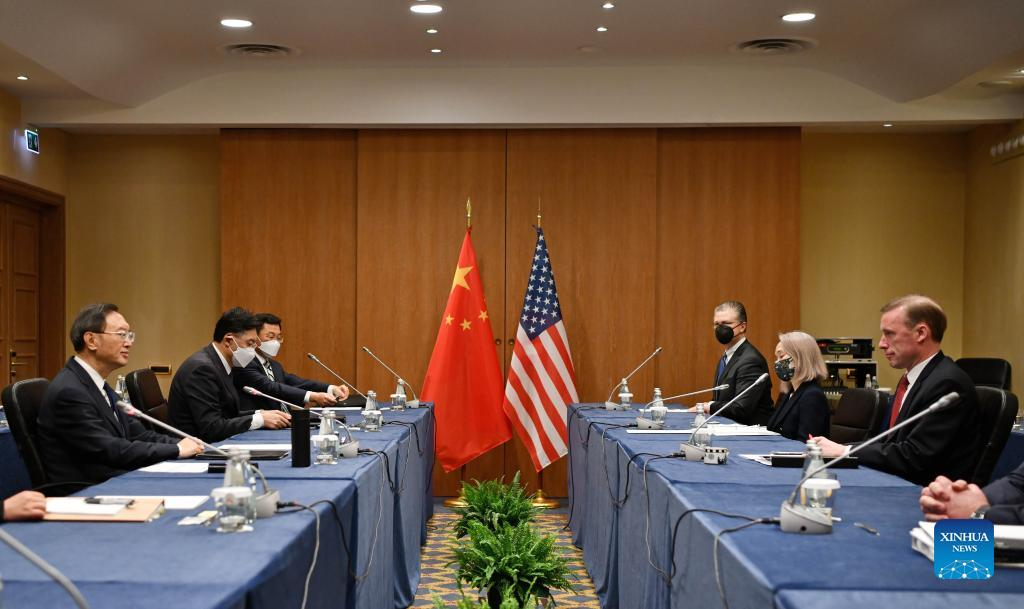
IN BRIEF
By Keerthana Nambiar and Dincy Adlakha
INTERNATIONAL
Italy: China's Senior Party official meets US National Security Advisor
On 14 March, a senior member of the Political Bureau of the Communist Party of China Central Committee, Yang Jiechi met the US National Security Advisor in Rome. The two representatives discussed China-US relations candidly and contemplated international and regional issues. They also agreed to uphold the decisions made by the two heads of state. They spoke of joint cooperation over the Taiwan issue, Korean Peninsula nuclear issue, Iran nuclear issue and the Afghanistan issue. They also showcased faith in the peaceful coexistence of the US and China. Yang said: “Under the current international situation, China and the United States should strengthen dialogue and cooperation, properly manage differences and prevent conflict and confrontation, which not only serves the interests of the two people but also meets the expectation of the international community and the interests of people across the world.” (“Senior Chinese diplomat meets U.S. national security advisor,” Xinhua Net, 15 March 2022)
The UK: British Foreign Secretary makes a statement on Hong Kong police’s threat to UK-based human rights group
On 14 March, the British Foreign Secretary accused the Chinese authorities of attempting to suppress freedom of speech after Hong Kong police threatened a UK-based human rights group. Hong Kong Watch revealed that it received a warning from the Hong Kong police threatening with a prison sentence and fines for allegedly violating China’s national security law. The letter accused the group of “seriously interfering” and warned of a fine of 100,000 Hong Kong dollars and three years of imprisonment of its chief executive, Benedict Rogers. Liz Truss, Britain Foreign Secretary made a statement regarding the issue and said: “The unjustifiable action taken against the U.K.-based NGO Hong Kong Watch is clearly an attempt to silence those who stand up for human rights in Hong Kong.” She further added, “attempting to silence voices globally that speak up for freedom and democracy is unacceptable and will never succeed.” (“ UK rights group threatened under China sweeping security law,” The Associated Press, 14 March 2022)
INTERNAL
COVID-19: Municipalities take stringent actions to restrict worst COVID outbreak
On 14 March, Global Times reported that municipalities, local officials, and epidemiologists have suggested the most stringent restriction method to control the worst outbreak of COVID-19 in China. The cities of Shanghai and Shenzhen have been locked down to contain the surge in cases and avoid social contractions. Schools and workplaces have also been shut in Shenzhen. The National Health Commission has announced that the situation is yet to peak in Jilin, Guangdong and Shanghai. (“Metropolises take strictest measures in 2 years as China reports more than 10,000 cases since March,” Global Times, 14 March 2022)
COVID-19 outbreak: Anti-epidemic restrictions in Shenzhen to affect the tech manufacturing industry in China
On 14 March, Global Times reported on the impact of the new COVID-19 outbreak in Shenzhen. Due to anti-epidemic measures to control the Omicron variant, a number of manufacturing plants in Shenzhen have halted production. Global Times says that this halt could really affect the tech industry and lead to frictions in the global supply chain management. Shenzhen is China’s burgeoning technology sector and is China’s top exporting city with a record of 1.92 trillion yuan worth of goods exported in 2021. China’s high-tech chip-making companies, smartphones, panel TVs, telecommunication hardware, and drones are manufactured in Shenzhen. (“Manufacturing in Shenzhen is impacted amid strict measures to tame Omicron surge,” Global Times, 14 March 2022)
ECONOMY
National Bureau of Statistics: China’s economy to improve in 2022
On 15 March, Global Times reported a story on the economy of China and how it was steadily marching forward in 2022. According to the data released by the National Bureau of Statistics (NBS), industrial production increased to 7.5 per cent year-on-year, compared to December 2021.it also cautioned the possible impact of the recent CIVID-19 outbreaks in several Chinese cities and indicated China’s potential in maintaining stable economic development. On 14 March, in an executive meeting of the State Council, Chinese Premier Li Keqiang “stressed the importance of efforts to tide over difficulties to ensure steady economic growth,” reported Global Times. (“China achieves better-than-expected economic growth in Jan-Feb,” Global Times, 15 March 2022)
REGIONAL
India: New ambassador assumes office
On 14 March, India’s new envoy to China Amb Pradeep Kumar Rawat assumed office. The Global Times reported that the development is welcomed by many Chinese citizens as the high0level military talks also seem to push for agreeable outcomes. Hence, the timing for a new ambassador’s joining is much appreciated in China. Many media outlets welcomed the ambassador with friendly sayings like: “Welcome to China! A close neighbour is better than a distant relative. Hope China-India relations will improve and we can work together to protect Asia.” The hopes for the improvement of relations between India-China have gushed high. (“India's new envoy to China assumes office amid welcoming voices, expectations to improve ties,” Global Times, 14 March 2022)
Philippines: Department of Foreign Affairs in Manila summons Chinese ambassador
On 14 March, the Philippine government summoned the Chinese ambassador regarding an “illegal incursion” of a Chinese navy ship in Philippine waters from 29 January 2022 to 1 February 2022. Philippine Foreign Undersecretary Maria Theresa Lazaro summoned Beijing’s envoy Huang Xilian and “demanded that China respect Philippine territory and maritime jurisdiction and to comply with its obligations under international law.” In a statement released by the Foreign Affairs Department, Lazaro asked China to “direct its vessels to desserts from entering Philippine waters uninvited and without permission.” (“Philippines summons Chinese envoy to protest naval intrusion,” The Associated Press, 14 March 2022)
14 March 2022 | Monday | China Reader Evening Brief | Vol.1, No. 139
50 years after the Shanghai Communique: Why aren't US-China relations normal?
50 years after the official normalization of relations between the US and China, the countries find each other at the highest peak of tensions. Potential conflict or cooperation will define the decade.
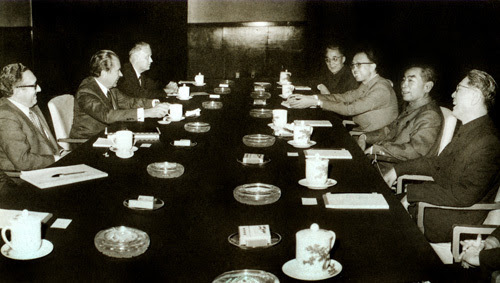
IN FOCUS
By Dincy Adlakha
50 years after the Shanghai Communique: Why aren't US-China relations normal?
On 28 February, the Shanghai Communique marked 50 years. However, 50 years after the document, the nature of US-China relations is yet to make space as “normal” bilateral ties.
What did the Communique say?
The Communique, signed by then-President Richard Nixon, was the formal recognition of the People’s Republic of China as one-China. It declared that there is only one legal government of China. The same was agreed through a string of highlights.
- The US recognizes Taiwan as a province of PRC and that there is only but one China.
- The question regarding the Republic of China’s (Taiwan) independence is the biggest obstacle in the normalization of US-PRC relations. It is an internal matter of China that is up for peaceful internal resolution.
- The US will withdraw all US forces and military installations from and near Taiwan. Both countries seek to reduce military tensions in the region.
- The efforts towards normalized relations between the US and China will benefit the whole world. Neither country will aim to seek hegemony in Asia-Pacific and will also oppose any other country or bloc doing so.
- Both countries will facilitate the progressive development of trade and exchange of technology, culture, sports and journalism despite having essential differences in their social systems.
Post Shanghai Communique: Five decades of zig-zag movement
During the last five decades, China-US relations witnessed a zig-zag movement.
First, the administration of Ronal Reagan during 1980-88 provided extraordinary support to Taiwan This support made China uneasy as the Shanghai Communique agreed on a “peaceful resolution” of the issue and recognized the Chinese mainland as the one true China. However, the situation was handled tactfully through diplomatic visits by George W Bush and Henry Kissinger. Nonetheless, the Third Taiwan Strait Crisis did happen in 1995-96; it did not last.
Second, the repression of Tiananmen Square protests shocked not only the US but the entire world. It was a clear and strict violation of the values that the US holds close. However, this incident was erased from the global importance of the era and the ties between the US and China did not waiver due to President Bush’s advances towards President Deng Xiaoping. The contributions of President Bush become extremely significant. His friendly advances as “the bicycling ambassador” or “old friend” of Beijing carried US-China through many tough times.
Third, the difficulties in China’s accession to WTO are still evident in its gradually opening economy. This was overlapping with the US declaration of the Global War on Terror. US and China have converged these sims to suit their countries as well. China’s accession to WTO helped the US in exchanging with the humongous Chinese market. While, the Global War on Terror provided China with a platform to present its fight against extremism, separatism and religious fundamentalism. Despite different priorities and methods, the ties sustained another challenging era.
Many would argue that the carrot behind all such cooperation is economic interests that the countries drive for each other. This has changed in the 50 years as currently; the economy becomes a major bone of contention for the two.
In the 2020s: Four issues that drive US-China relations
The equation between US and China has always been stressful. However, they are navigating through the highest tensed era currently.
First, China has climbed to the top and is currently the second-largest economy in the world. China’s GDP is fast-growing, expanding by 3 per cent in dollar terms in 2020 alone. However, it faces problems in sustaining this growth due to a reduced workforce. It is the largest trading partner of multiple countries and has a trade surplus with many countries, especially from Africa.
Even though the US has not used a similar strategy by diversifying its trade relations with newer countries, it has established long and strong ties with major players. The top ten trading partners of the US include China, Canada, Taiwan, South Korea, India and other economic hotspots.
China’s expanding economy is perceived as a threat by the US to its position as a superpower. The competition was increased during the Trump administration as the countries fought an economic trade war. They are currently reeling from and trying to overcome the damages during the time.
Second, the increased regional power gives rise to old aspirations for China. Its unprecedented pressure on Taiwan for unification is concerning to the US. Incidentally, China has broken records after records by sending PLA incursion flights to the Taiwanese Air Defence identification Zone in 2021. Daily incursions, the highest being 56 planes in October 2021 have become a common sight. Multiple Chinese leaders, including President and Chairman Xi Jinping, have released statements assuring reunification with Taiwan.
Chinese military and political pressure on Taiwan is countered through diplomatic and economic support by the US. The US support is extremely crucial for Taiwan as strong leaders and delegations from Australia, Japan and Europe, including former Prime Minister Tony Abbott, have shown solidarity with Tsai Ing-wen by visiting Taiwan during the tumultuous time.
The direction of the current tensions is yet to be seen, but experts foresee a military conflict. Even though the current Russia-Ukraine conflict has given lessons to China, resolve for reunification remains high.
Third, the competition for supremacy in various fields is evident. China and the US are currently stuck in a series of competitions. They compete in a race for better technologies, race in outer space, race for economy, race for narrative and the like. China launched three major space projects in 2021 including the Chinese international space station, the Mars explorer and the taikonauts’ stay in space. While the US refines its procurement strategy for rare earth and boasts superior technology. The US is also observant of China’s growing defence expenditure. Despite being a trained and strong maritime power, China’s entry into the South China Sea as a maritime bully is not well taken by the US.
The pandemic has laid bare the faults in their economic systems being too dependent upon each other. Lockdowns in China raise discussions of increasing supply chain resilience in the US. This has multiplied the inherent competitiveness to succeed the other. China is, thus, a likely competitor for the US rather than a strategic partner.
Fourth, the completion and tension are manifested through other means. Both countries have accused each other. The US finds China guilty of human rights abuses and has sanctioned sections of trade with China to oppose the same. While China protests against the hegemonic and exploitative behaviour of the US. Such accusations mark unease in their relations.
Hence, fifty years on from the Shanghai Communique, US and China are yet to find their footing as “normal” relations.
References:
Laura Portbury, “50th anniversary of normalization of US-China relations,” Foreign Brief, 28 February 2022
Chu Daye and Xie Jun, “Decoupling 'unrealistic' for China and US, 50 years after Nixon's historic visit,” Global Times, 28 February 2022
“Nixon-Mao meeting: four lessons from 50 years of US-China relations,” The Conversation, 21 February 2022
“Chronology of U.S.-China Relations, 1784-2000,” Office of the Historian, US Department of State, n.d.
IN BRIEF
By Keerthana Nambiar and Avishka Ashok
INTERNAL
COVID-19: China locks down Shenshen city due to COVID outbreak
On 14 March, Chinese state authorities shut down the city of Shenzhen due to the worst ever COVID outbreak in the city. The cases tripled within a day from 12 March to 13 March. The lockdown covers all business firms in the finance and technology sector as the city borders Hong Kong, the financial hub of the world. People are urged to work from home as much as possible and merely essential services including food, utilities and other necessities are open. The city has also closed borders, restricting entry exit of people. The authorities stated that the restrictions will stay in place till 20 March. (Helen Davidson, “China shuts down city of 17.5m people in bid to halt Covid outbreak,” The Guardian, 14 March 2022)
COVID-19: Covid testing kits flood Chinese pharmacies
On 13 March, Global Times reported that many Chinese pharmacies have stocked up on COVID testing kits or antigen detection products as the cases surge to an all-time high in China. The state’s drug authorities cleared these products for sale on 11 March which led to multiple producers and manufacturers like Wondgo Biotech Co producing them in great quantities and opening the kits for sale and distribution. The products are rated at around USD 94 for 20 kits. There is no restriction on the purchase of these kits. The National Health Commission encouraged the use of these kits by the general public to monitor the virus. (Chu Daye and Qi Xijia, “Pharmacies prepare stocks as virus antigen detection products cleared for sale,” Global Times, 13 March 2022)
INTERNATIONAL
China-Laos railway: Network completed 100 days of service
On 13 March, Global Times reported that the China-Laos Railway network completed 100 days of operation on 12 March. The link carried more than 1.2 million tons of goods which boosted the economic and trade cooperation between China and Laos, and by extension, ASEAN. More than 360 cross-border cargo trains exchanged goods with the ten ASEAN members. Additionally, more than 120,000 tons of goods have been imported by China through the railways. The train goes through Beijing, Shandong, Zhejiang and Jiangsu in China. The 1035 kilometre line connects China to the Laos capital Vientiane. (“China-Laos Railway marks 100 days of service, invigorating trade with ASEAN,” Global Times, 13 March 2022)
Pakistan: Ambassador to China appreciates BRI and CPEC
On 13 March, Xinhua Net published an article highlighting the major themes discussed by the Pakistani Ambassador to China Moin ul Haque during an interview with the news agency. The Ambassador claimed that the cooperation with China had resulted in transformation of Pakistan’s economic landscape. He complimented the Belt and Road Initiative and appreciated the transformation brought into the country through the project. Haque also credited the eco-friendly metro line in Lahore city to the China-Pakistan Economic Corridor. He said: “So far, more than 70,000 jobs have been created thanks to BRI cooperation. All these philosophies and dimensions of BRI directly contribute to the 17 SDGs (Sustainable Development Goals).” (“Interview: BRI cooperation with China "transformational" for Pakistan -- ambassador,” Xinhua Net, 13 March 2022)
North Korea: The US calls on China to condemn the latest missile tests
On 13 March, the US Department of State revealed that the special envoy to North Korea Sung Kim held a phone call with the Chinese diplomat Liu Xiaoming and put forth his agenda of jointly censuring North Korea for its recent missile launches. According to the department of state, the two officials held the phone on the same day as the publishing of the US report which announced North Korea’s latest ICBM test. The US clarified its concerns regarding the unlawful advancement of weapons of mass destruction by North Korea. He also called China an important ally in maintaining the regional stability and urged China to public condemn the tests. (“US calls on China to rap N. Korea over provocative missile tests,” The Mainichi, 14 March 2022)
Asia and Oceania: Report claims that the region imports more weapons due to Chinese aggression
On 14 March, Stockholm International Peace Research Institute published a report according to which Asian and Oceanian countries were increasing their stock of weapons in response to China’s growing regional aggression. The report arrived at these conclusions by analyzing the worldwide purchase of weapons. The weapons concluded that the top six importers of arms and ammunition were from the Asian and Oceanian region. It recorded India as the top importer at 11 per cent of the total imports. The report said: “Tensions between China and many states in Asia and Oceania are the main driver of arms imports in the region.” (“Global arms trade falls slightly, but imports to Europe, East Asia and Oceania rise,” Stockholm International Peace Research Institute, 14 March 2022)
Russia: The US plans to restrict China’s arms sale amid crisis in Ukraine
On 14 March, the Guardian reported that the US will propose China to reject the Russian purchase of Chinese weaponry while tensions remain high in Easter Europe. The US National Security Advisor Jake Sullivan is expected to meet the Chinese Director of the General Office of the Centra Foreign Affairs Commission Yang Jiechi in Rome after Russia reportedly appealed for a purchase of Chinese arms and ammunition. Sullivan also plans to notify its repeated warnings of a Russian attack which was ignored by the Chinese side prior to the increased tensions in the region. He addressed the CNN and said: “We also are watching closely to see the extent to which China actually does provide any form of support – material support or economic support – to Russia. It is a concern of ours. And we have communicated to Beijing that we will not stand by and allow any country to compensate Russia for its losses from the economic sanctions.” (“US will try to convince China not to supply arms to Russia at key Rome meeting,” The Guardian, 14 March 2022)
12 March 2022 | Saturday | China Reader Evening Brief | Vol.1, No. 138
Premier Li Keqiang affirms China-US cooperation
The Chinese Premier encourages US-China cooperation to promote global economic stability and growth.
.jpg)
IN BRIEF
By Keerthana Nambiar and Dincy Adlakha
INTERNATIONAL
The US: Premier Li Keqiang affirms China-US cooperation
On 11 March, Chinese Premier Li Keqiang said that cooperation between China and the US is beneficial nor merely for both the countries but for the entire world. He also stressed the need for further dialogue and communication between the two countries. He emphasized the importance of the relations as both countries are permanent members of UNSC. Hence, their agreement and cooperation on global challenges is extremely important. He said: “Cooperation should be the mainstream because global peace and development hinge on cooperation.” (“China-U.S. cooperation benefits both countries, world: Chinese premier,” Xinhua Net, 11 March 2022)
UNSC: China’s UN ambassador urges countries to prohibit the development of biological and chemical weapons
On 11 March, Zhang Ju, China’s permanent representative to the United Nations made a statement on biological security in Ukraine at the UN Security Council. Zhang remarked that “China firmly opposes the development, possession, and use of biological and chemical weapons by any country under any circumstances,” reported CGTN. He reiterated China’s support for the “complete prohibition and thorough destruction” of all weapons of mass destruction. He further urged the countries to destroy any chemical weapons they have in their stockpile. (“China voices opposition to development of biological, chemical weapons,” CGTN, 12 March 2022)
Iran nuclear deal: Chinese envoy emphasizes importance of mutually agreed decision
On 11 March, China’s permanent envoy to the UN in Vienna Wang Qun said that the concerns of all parties are important for the successful conclusion of Iran nuclear talks. His remarks came as the negotiations went for a pause recently. He marked this pause by observing that negotiations “are not taking place in a vacuum but are a microcosm of political reality.” He also termed China’s role in the negotiations for Joint Comprehensive Plan of Action as “vital and constructive.” He also vowed that China shall remain dedicated to an early agreement of the Vienna talks. (“Concerns of all parties to Iran nuke talks must be addressed, Chinese envoy,” Xinhua Net, 12 March 2022)
Ukraine: Chinese nationals return through evacuation as first batch of aid reaches
On 12 March, Xinhua reported that the eleventh batch of evacuated Chinese nationals arrived from Ukraine through a rescue operation flight. Previously, ten such batches have arrived. Additionally, the first batch of humanitarian aid to Ukraine from China has also reached the destination. The second batch will depart soon, too. The aid contained 5 million yuan worth of essential materials. The first batch was delivered to the staff of Red Cross Society of Ukraine. (“China's first batch of humanitarian aid arrives in Ukraine,” Global Times, 12 March 2022)
China-Pakistan cooperation: China’s AVIC delivers the first batch of J-10CEs fighter jets to Pakistan
On 11 March, China’s state-owned Aviation Industry Corporation of China (AVIC) delivered the first batch of six J-10CE fighter jets in Kamra, Pakistan. AVIC remarked that the delivery of J-10CEs has opened a new chapter in aviation defense cooperation and will further deepen the China-Pakistan All-Weather Strategic Cooperative Partnership. On 11 March, an induction ceremony was held for the first batch attended by Pakistan’s Prime Minister Imran Khan. (“China delivers first J-10CE fighter jets to Pakistan in a milestone move,” Global Times, 11 March 2022)
INTERNAL
COVID-19: Chief Executive Carries Lam ensures that HKSAR has enough food supplies
On 12 March, Hong Kong Chief Executive Carrie Lam in a press conference informed that the supply of fresh food has come back to pre-COVID pandemic levels. Lam confirmed that the city is receiving medical and other supplies from China. “I cannot comfortably say we have passed a peak," she said. "We would like to see case numbers come down to the extent that we can say the fifth wave has ended, but we cannot set a specific number.” (“Hong Kong’s Lam Says Fresh Food Supply Back to Pre-Covid Level,” Bloomberg, 12 March 2022)
COVID-19: Health regulator allows rapid antigen test kits as cases surge in China
On 12 March, CCTV, the state broadcaster, reported that the National Medical Products Administration approved five COVID-19 antigen kits made locally in the country. The NMPA published a notice allowing Beijing Huaketai Biotechnology to make changes in its COVID-19 antigen test kit device certificate. Along with the company, Nanjing Vazyme Biotech, Guaangotech, Beijing Jinwofu Bioengineering Technology and BGI Genomics subsidiary and Shenzhen Huada Yinyuan Pharmaceutical Technology have been allowed to make changes to their certificates as well. With the approval of the certificates, the country’s health regulator has for the first time allowed the public to officially buy the kits in stores and online markets. (“China approves five Covid-19 antigen kits for self-testing,” The Strait Times, 12 March 2022)
11 March 2022 | Friday | China Reader Evening Brief | Vol.1, No. 137
Premier Li Keqiang stresses on high level stability and smaller growth target
Premier Li points to the high-level stability and explains that the target growth rate was appropriate for the current global situation and economic challenges.
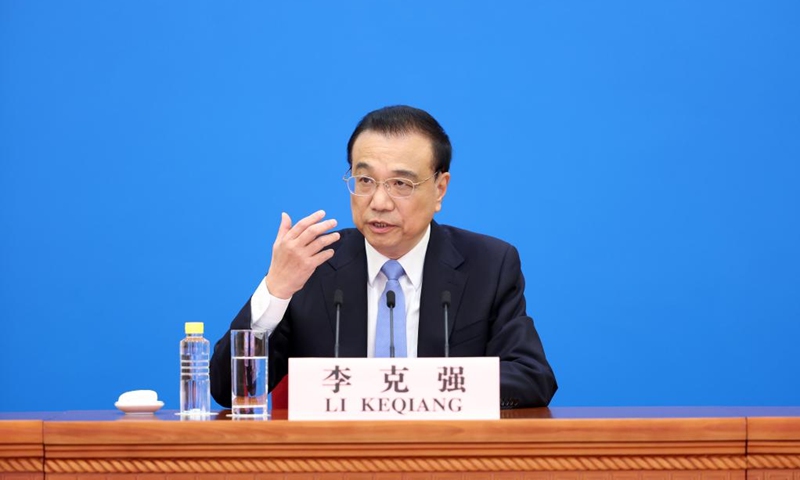
IN BRIEF
By Keerthana Nambiar and Avishka Ashok
INTERNAL
Shuffle in Party personnel: Premier Li Keqiang to step down in a year
On 11 March, Premier Li Keqiang announced that he will step down in March 2023. While answering a question about his accomplishments as premier, he said: "This year is the last year of my premiership." Premier Li is the second top official of the Party, President Xi Jinping being the first. The post is limited to two terms and shall be elected by Party members. ("Chinese premier Li Keqiang confirms he will step down next March," The Straits Times, 11 March 2022)
Two Sessions: Premier Li Keqiang stresses high-level stability and smaller growth target
On 11 March, Premier Li Keqiang addressed the press briefing after the end of the fifth session of the 13th National People’s Congress and defended the 5.5 per cent GDP growth target set at the session. Li pointed to the high-level stability and explained that the target growth rate was appropriate for the current global situation and economic challenges. He also referred to the media scepticism regarding the previous growth rate of six per cent, which the country had overshot in 2021. Li said: “Uncertain factors are increasing, and the complicated environment is changing. The 5.5 per cent growth is already equivalent to a country of medium economic size. China's macro policies are formulated on the basis of actual conditions. We have achieved major targets of social and economic development last year, which have laid a solid foundation for this year's growth." (“Chinese Premier explains 5.5% GDP growth target, says high level stability means improvement,” Global Times, 11 March 2022)
COVID-19: Recent spike in cases worries health experts
On 10 March, the daily report of new COVID cases showed a surge in domestically transmitted infections. The latest wave has affected over 16 provincial-level regions but over 50 per cent of the cases are asymptomatic. Chinese health experts have raised concerns regarding the latest spike in cases and have said that it is “the most severe onslaught” since the first wave in Wuhan. The Chinese society is also portraying a slowdown in its Zero-COVID strategy which enforced strict restrictions on the public for the past two years. However, experts have warned that it is crucial for China to continue with the strategy in order to effectively curb the spread and return to normal living conditions and economic development. (“China sees spike of local silent COVID carriers amid new wave,” Global Times, 11 March 2022)
REGIONAL
South Korea: President Xi congratulates new President-elect Yoon Suk-yeol
On 11 March, the Chinese President Xi Jinping congratulated South Korea’s new President-elect Yoon Suk-yeol after he won the elections on 10 March 2022. President Xi also expressed China’s willingness in working with South Korea and work towards promoting stability and peace in the region. The Chinese Ambassador Xing Haiming also met Yoon in person at the People Power Party’s headquarters and delivered President Xi’s message of goodwill. The Chinese embassy also reported that the ambassador and Yoon discussed the development of China-South Korea relations. (“Chinese President Xi congratulates S.Korean president-elect Yoon, stressing joint efforts in deepening ties,” Global Times, 11 March 2022)
ECONOMY
Low-carbon goals: Central Bank pledges to work on new financial framework
On 10 March, China’s political advisors and members of the 13th National People’s Congress discussed China’s next steps towards reducing its carbon footprint during the Chinese People’s Political Consultative Conference. It was decided that the People’s Bank of China will be enhancing its actions towards supporting the transition of businesses from traditional sources of energy to new and less harmful sources of energy. In an effort to move away from an economy dependent on fossil fuels, the Central Bank will work on a new transitional financial system that can support the transition from fossil fuels to low-carbon energy. He said: “The PBOC has spared no effort in facilitating moves on carbon reduction, and relative financial measures will continue. the PBOC has formulated a low-carbon oriented financial system through which substantial funding has been provided to alternative energy such as wind and solar power via green bonds and loans. This funding support has greatly shored up the growth of these new energy sectors.” (“Central bank to intensify support for carbon goals,” China Daily, 11 March 2022)
INTERNATIONAL
Help for Ukraine: Chinese premier offers aid for "grave" situation
On 11 March, Chinese Premier Li Keqiang called the current situation of Ukraine a "grave" circumstance and offered help for the same. Although China has refused to criticize Russia for invading Ukraine, Premier Li stressed the "positive role" that China intends to play. He also offered China's position as a facilitator between the two sides to resolve the conflict. Additionally, China is sending USD 791,000 worth of necessities and aid to Ukraine. ("Premier Li offers China’s help for ‘grave’ Ukraine situation," The Straits Times, 11 March 2022)
Cyberattacks by US: Chinese computers used by US addresses to target Russia, Ukraine, Belarus
On 11 March, the National Computer Network Emergency Response Technical Team/Coordination Center of China reported that web addresses are cyber-attacking China to gain control of Chinese computers to target Russia, Ukraine and Belarus. The centre has observed this trend since mid-February when many Chinese computers were hacked into from the US and were used to execute cyber-attacks on Russia, Belarus and Ukraine. Apart from the US, major attacks came from the Netherlands and Germany. ("China says U.S. addresses used its computers to launch cyberattacks on Russia, Ukraine," Reuters, 11 March 2022)
Online support for Russia: China bans peace calling posts on social media
On 10 March, Reuters reported that China is keenly monitoring social media platforms like Weibo, WeChat and others for any posts in support of Ukraine. The comments and posts on social media made in support of Ukraine or calling for peace have been removed immediately. Reuters also reported that posts defaming Russian President Vladimir Putin were also removed. ("China censors online Ukraine debate, bars calls for peace," Reuters, 10 March 2022)
10 March 2022 | Thursday | China Reader Evening Brief | Vol.1, No. 136
Chinese People's Political Consultative Conference comes to an end
As the fifth session of the 13th National People's Congress comes to an end, the national leaders approve multiple proposals on the work report and the previous sessions.
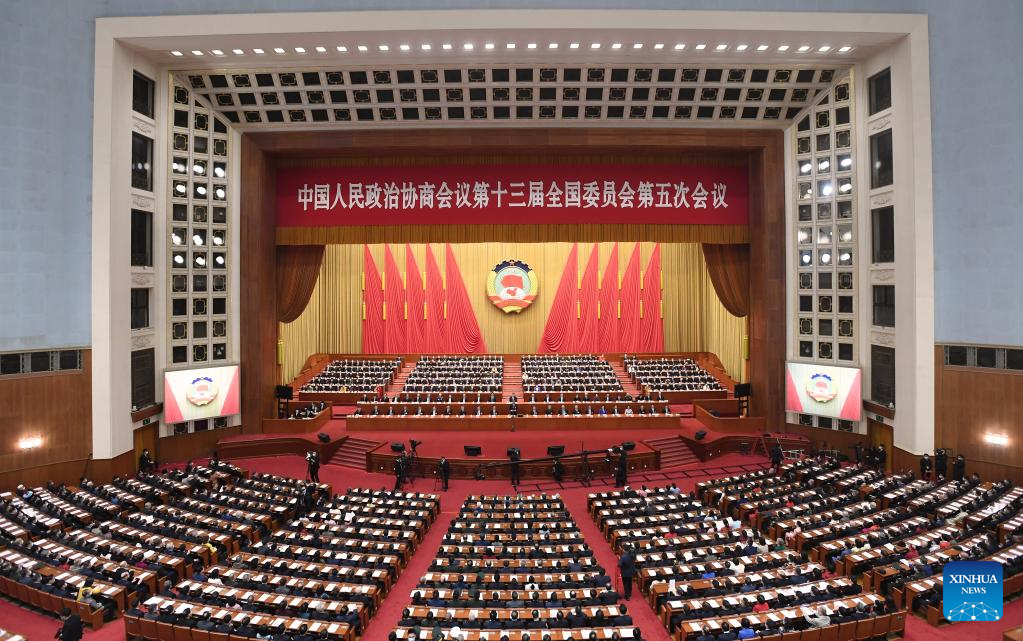
IN BRIEF
By Keerthana Nambiar and Avishka Ashok
INTERNAL
NPC meeting: China closes its fifth session of the CPPCC
On 10 March, China winded its 13th National Committee of the Chinese People's Political Consultative Conference (CPPCC) in the presence of President Xi Jinping and other Chinese leaders at the Great Hall of the People in Beijing. Wang Yang, chairman of the CPPCC National Committee delivered a speech at the closing meeting. “ A resolution on a report on how the proposals from political advisors have been handled since the previous annual session” and “examination of new proposals, and a political resolution on the fifth session” were approved at the meeting. Xinhua Net also posted pictures from the six-day session which showcased the ethnic representation and inclusivity. (“China's top political advisory body wraps up annual session,” Xinhua Net, 10 March 2022)
Defense spending: Military spokesperson says the hype on the “hidden military spending” is baseless
On 10 March, Xinhua reported that a spokesperson for China’s People’s Liberation Army and People’s Army and People’s Armed Police Force said that China’s defense spending is to tackle the complex security challenges. He stated: “History proves and will continue to prove that the Chinese armed forces will always be a staunch force in safeguarding national interests and maintaining world peace,” reported Xinhua. He further added that the hype about China’s “hidden spending” on the defense is groundless. (“China's military spending maintains reasonable, steady growth: spokesperson,” Xinhua Net, 10 March 2022)
Women and children: China takes a strong stand against trafficking of the vulnerable
On 10 March, the Asahi Shimbun reported on the government’s strong response to trafficking of women and children in the country. The issue gained attention from the public as well as the administration after the case of a mother of eight children being tied in a shed came to light. The Premier Li Keqiang also spoke of the case during the annual report in the fifth session of the 13th National People’s Congress. The local governments in the country have also pledged to take a stand against trafficking of women and children and strictly enforce all laws to protect and prevent the abduction of the vulnerable. (“Human trafficking case sparks government response in China,” The Asahi Shimbun, 10 March 2022)
China’s livestreaming industry: Beijing calls on stricter rules for supervising the livestreaming sector
On 9 March, Global Times reported on the enhanced supervision on the livestreaming industry. In September 2021, the State Taxation Administration issued a notice for further strengthening of the taxation administration which affected the livestreaming sector. Ma Jin, a member of the National Committee of the CPPCC elaborated that with the development of the internet such bans were necessary and the blacklist system for live streamers would supervise the platform and report any types of tax-related information. The new development came after China’s top livestreamer Huang Wei also known as Viya dodged 643 million yuan in taxes. (“Lawmakers, political advisors call on enhancing supervision on e-commerce livestreaming,” Global Times, 9 March 2022 )
REGIONAL
Taiwan: Defense Minister comments on the possible outcome of a conflict with China
On 10 March, Taiwan’s Defense Minister Chiu Kuo-cheng commented on the Ukraine-Russian dispute before the parliamentary session on the implications of the European war. Chiu addressed the press conference and remarked that a war between China and Taiwan would result in a miserable victory. He said: “If there's a war, to be frank, everyone will be miserable, even for the victors. One really needs to think this through. Everyone should avoid wars.” (“China-Taiwan war would end in 'miserable victory': Taiwan minister,” The Strait Times, 10 March 2022)
Taiwan: Intelligence agency suspects Chinese military aircraft crash in the South China Sea
On 10 March, the Strait Times reported that China had restricted access to the South China Sea near Vietnam to conduct a search operation for a crashed aircraft. In the previous week, the country had issued a warning to countries and warned vessels to steer clear of the area during the duration of its military drills. Although the Chinese government or military has not announced the crash, Taiwan’s intelligence agency believes that the country is looking for a lost plane. Vietnam also registered a complaint regarding the drills. The Foreign Ministry of China responded to the complaint and said: “It is reasonable, lawful and irreproachable for China to conduct military exercises on its own doorstep.” (“Taiwan says China closed off part of South China Sea to look for crashed plane,” The Strait Times, 10 March 2022)
Taiwan: China’s Defense Minister explains PLA’s actions against secessionist movements
On 9 March, the Military Spokesperson Wu Qian attended the annual session of the Nation People’s Congress and announced that China would not tolerate any actions of Taiwan’s independence secessionists. He addressed the media briefing and reiterated China’s disapproval for all actions seeking Taiwan’s separation from the mainland. He also explained that the exercises conducted by the People’s Liberation Army are aimed at the secessionists and not the Taiwanese compatriots. He also explained the country’s defense budget for the current year which consists of a seven per cent increase. (“PLA will hit every Taiwan secessionist move, external interference: military spokesperson,” Global Times, 10 March 2022)
INTERNATIONAL
Ukraine: Chinese embassy evacuated the last batch of nationals
On 9 March, Global Times reported that the last batch of 115 Chinese students stranded in Ukraine have safely reached western Ukraine’s Lviv. Chinese Ambassador to Ukraine Fan Xianrong declared that 6,000 Chinese nationals have been moved to safe regions. Fan said: “Living in today's China, we are happy, and we have more and more pride and confidence.” Chinese Foreign Minister Wang Yi also made remarks regarding the evacuation and confirmed that “Chinese embassies in countries next to Ukraine are working around the clock and leaving no stone unturned to provide shelter.” (“Chinese nationals' evacuation in Ukraine complete! All safe: embassy,” Global Times, 9 March 2022)
09 March 2022 | Wednesday | China Reader Evening Brief | Vol.1, No. 135
China’s report on human rights situation in the US
China finds human rights deteriorating in the US. The report highlights political manipulation, high COVID-19 deaths, gun violence and status of refugees and migrants.
.jpg)
IN FOCUS
By Dincy Adlakha
China’s report on human rights situation in the US
On 28 February, The State Council Information Office of the People’s Republic of China released “The Report on Human Rights Violations in the United States in 2021.” The report assesses the state of human rights in the US; it includes a foreword and six sections.
What does the report say?
The report borrows from multiple sources and utilizes statistics presented by US sources like the New York Police Department, New York Times, Washington Post, CNN, Pew Research Centre and other survey organizations from the US.
Utilizing the data coverage from 2021, the report finds that the USA is not an abode or beacon of “healthy democracy”.
First, the report points out that the US has the most number of COVID-19 cases and deaths. The report finds the administration at fault for “vaccine nationalism” and the hoarding of medical supplies, leaving developing countries without any support to fight the pandemic. The report also finds serious fallacies with the system leading to untreated and uncared for elderly and increased mental issues for the young population.
Second, the report highlights the violent nature of crimes in the US and calls out for stabilized gun control measures. The US has highest number of privately owned guns in the world. Mass shootings in the country increased by 10 per cent in 2021. Citing Associated Press, the report also highlighted human rights violations by the prison staff including sexual abuse and murder.
Third, the report finds the US order rigged as the democracy has been influenced by the wealthy and lobby groups such as pharmaceutical firms. The report finds that such systematic failure of democratic processes increases the gap in society. The report said that critics and American media question if American democracy is failing.
Fourth, racial discrimination and police brutality against Asian Americans and people of African descent has also increased as the New York Police Department data observes surged hate crimes. Other data from university surveys point to the discrimination against Native Americans, Muslims and aborigines leading to a bloated economic gap.
Fifth, the report focuses on the human rights violations at the border where children are detained and separated from their families. US Border Patrol showed more than 500 deaths of migrants on the border last year. Human trafficking and exclusion of migrants/refugees reflect that some lives are more important than others.
Sixth, the report argues that not merely domestic violation of human rights, but through means of hegemony, unilateralism, interventionism, and usage of sanctions, the US forces human rights crises in other countries. The troop withdrawal from Afghanistan, sanctions on Venezuela, the embargo on Cuba and the use of Guantanamo Bay prison are acts that have deprived numerous citizens of their human rights.
The China-US battle for narrative
This report is not the first Chinese report to defame the US. Previously, the Foreign Ministry of China had released a report on the US democracy which questioned the “success” of US democracy.
The US has also bravely led the fight in reports. Multiple think tanks and organs of the government continuously scratch Xinjiang, Hong Kong, Taiwan for reports. The recent coverage also expanded to the Chinese military report by the Pentagon.
The two countries are involved in the continuous creation of literature against the other. There is evidence in data from both sides; however, the narrative built is destructive. The politicization of human rights to defame another country is increasing rapidly. While the US has argued for an open and free society, it has made the American land home for many but secluded people of colour and ethnicities. China proposes an indigenized meaning of human rights and differences which propose homogeneity. The two perspectives contradict each other, causing friction and creating a context of accusations.
References:
“Full text: The Report on Human Rights Violations in the United States in 2021,” Xinhua Net, 28 February 2022
Ramesh Ponnuru, “Who’s ‘Politicizing’ Human Rights? Everyone,” Bloomberg, 22 July 2020
IN BRIEF
By Keerthana Nambiar and Avishka Ashok
INTERNAL
Economy and development: China to build city clusters and satellite towns
On 8 March, The Straits Times published an article focused on China's "1+3+2 plan" for development. The plan was elaborated by Mr Liu Shining, deputy director of the economic affairs committee of China. He informed that 1 refers to urbanization push by China, 3 refers to the limitations in China's economy and 2 refers to novel growth areas. According to the plan, China will get new and multiple city clusters and satellite towns. The plan also aims to double the middle class population of China in 10 to 15 years. (Aw Cheng Wei, "New city clusters and satellite towns to be major boosters for China's economy," The Straits Times, 8 March 2022)
REGIONAL
Taiwan: CIA head warns of a possible invasion
On 9 March, The Straits Times cited Mr William Burns, a top official at the CIA to suggest that President Xi Jinping has detected resolve to invade Taiwan. He said that although Russia's invasion of Ukraine is a warning for President Xi due to the difficulties Russia is facing, this will not deviate President Xi from his intentions over Taiwan. He said: "I would just say analytically, I would not underestimate President Xi and the Chinese leadership's determination with regard to Taiwan." ("China unsettled by Ukraine, but don't underestimate Xi's Taiwan resolve: CIA head," The Straits Times, 8 March 2022)
INTERNATIONAL
UN Human Rights Council: China’s representative extends invitations to visit Xinjiang
On 8 March, China’s permanent representative to the United Nations Office Chen Xu extended the country’s invitation to visit Xinjiang to the High Commissioner for Human Rights Michelle Bachelet. Chen invited Michelle during the 49th session of the Human Rights Council and said: “We will work with the High Commissioner's Office to make preparations for the visit.” Michelle Bachelet also announced that an agreement had been reached with the Chinese government on the visit. She said: “My Office and the Government of China have initiated concrete preparations for a visit that is foreseen to take place in May of this year.” (“China welcomes visit of UN rights chief this May: envoy,” Xinhua Net, 9 March 2022)
China and Europe: Xi holds a virtual summit with Macron and Scholz
On 8 March, the Chinese President Xi Jinping held an online summit with the French President Emmanuel Macron and the German Chancellor Olaf Scholz. The leaders discussed the global challenges caused by the pandemic and agreed to cooperate on addressing the obstacles to global trade. President Xi stressed on the common understanding of peace, development and cooperation between Germany, France and China and urged the countries to take up more responsibilities to help promote stability and certainty in the international order. He said: “China's development will create broader space for China-EU cooperation. the two sides must, under the principle of mutual benefit and win-win, further deepen green and digital partnerships as well as practical cooperation in various fields” (“Xi holds virtual summit with leaders of France, Germany,” Xinhua Net, 9 March 2022)
Iran: Officials discuss bilateral relations and the “two sessions”
On 8 March, the head of the International Department of the Communist Party of China Central Committee Song Tao held a telephonic conversation with the Iranian Secretary of Expediency Discernment Council Mohammad Bagher Zolghadr. The officials discussed deepening exchanges between the two countries while Song Tao explained the two sessions in the fifth session of the 13th National People’s Congress. (“Chinese, Iranian senior officials hold video talks,” Xinhua Net, 9 March 2022)
Pakistan: Foreign Minister offers condolence after terrorist attack in Peshawar
On 8 March, the Chinese Foreign Minister Wang Yi and Pakistani Foreign Minister Shah Mahmood Qureshi held a telephonic conversation. The two leaders discussed the terrorist attack in Peshawar city. Wang yi condemned the attack and expressed China’s concerns in fighting terrorism and protecting Pakistan’s national security and stability. The leaders also discussed the bilateral economic relations and strategic issues between China and Pakistan. He said: “China looks forward to working with Pakistan to push forward the implementation of the consensus reached between the leaders of the two sides, deepen strategic mutual trust and cooperation, and join hands to cope with global and regional changes of situation.” (“Chinese, Pakistani FMs hold phone talks,” Xinhua Net, 9 March 2022)
Border talks with India: 15th round set for 11 March
On 8 March, the Press Trust of India reported that India and China are set to have the 15th round of border talks on 11 March 2022. The previous such high-level military talk was held on 12 January which did not result in any breakthrough. The two sides have released positive statements before the beginning of 15th series of the talks that reassure mutual cooperation and decision. The upcoming meeting will be held at Chushul Moldo meeting point in Ladakh. ("India, China to hold 15th round of border talks on Friday," The Week, 8 March 2022)
08 March 2022 | Tuesday | China Reader Evening Brief | Vol.1, No. 134
Review of “The Long Game: How the Chinese negotiate with India” by Vijay Gokhale
The books seeks to explain China's negotiation strategies since India's independence and the gradual shift in the bilateral relations.
.jpg)
IN FOCUS
By Avishka Ashok
Review of “The Long Game: How the Chinese negotiate with India” by Vijay Gokhale
The book, The Long Game: How the Chinese negotiate with India, is written by Vijay Gokhale. He is a retired diplomat and served earlier as the Ambassador of India to China during 2016-17.
The book is a great read for researchers who specialize in Chinese studies and more specifically India’s relations with China. The language is easy to understand and the timeline makes it easy for the reader to understand the changing geopolitical environment.
The book provides an insight into the Chinese way of dealing with India related to international affairs and global politics. It also portrays a clear change in how India deals with China. The reader will observe the evident shift from the naïve “lay-all-cards-on-the-table” approach to a more witty, calculated and cautious approach when dealing with China.
The author has picked six incidents since India’s independence that presented an opportunity for Indian and Chinese diplomats to interact and predict the future of Sino-Indian relations. These six issues formed the early relations between the countries and continue to impact the future of the relationship. Through this method, Gokhale offers a few suggestions for Indian diplomats and advises on what can change in the Indian style of diplomacy, especially in its diplomatic relations with China.
The six issues picked by the author are:
1. India’s recognition of China in 1949 and the decision to break ties with the Republic of China/ Taiwan.
2. The recognition of Tibet as a part of China and the provisions for trade between India and Tibet.
3. Recognition of India as a nuclear power and withstanding the sanctions placed due to the tests.
4. Recognition of Sikkim as an Indian state in April 2005.
5. The 123 Nuclear Deal and China’s response to India’s nuclear capabilities.
6. India’s repeated efforts in listing Masood Azhar as a terrorist in the UNSC 1267 sanctions list.
According to the author, China’s policy towards India was always well thought-out and was planned shrewdly by the Chinese leaders and the supporting organizations of the Communist Party of China. In the present times, the Ministry of Foreign Affairs, the People’s Liberation Army, the Ministry of State Security, the United Front Work Department, the International Department of the Communist Party, the State Council Information Office, the Chinese think tanks and the Central Foreign Affairs Commission of the Central Committee of the Communist Party work in close cooperation and are controlled by President Xi Jinping to efficiently negotiate with India and the world. The eight bodies assist the President in carefully understanding the ground realities, the sentiment of the people, the team of negotiators, and the opposing party’s core objectives. Gokhale says, “Their preparation is meticulous and deception is common. The style of negotiation changes depending not merely on the adversary, but also on the timing, environment and objective. They are capable of displaying warmth, indifference and hostility in the space of a single session in pursuit of their objectives.”
India on the other hand, learnt from its experiences and from its costly mistakes. The author blames India’s lack of experience in diplomacy and naivety in dealing with countries for the political losses incurred by the country in the 1950s. However, the book demonstrates the gradual shift within Indian diplomats in understanding China’s strategies and negotiation tactics.
Through the six events, Gokhale explains China’s pre-negotiation procedure, the Chinese negotiator’s tactics, the varied approaches of Chinese negotiation and the post-negotiation strategies. The reader will be able to draw parallels between the book and the current Corps Commander talks that have been scheduled for another “earliest date.” The book also enables the reader to understand the current Indian diplomats’ actions when dealing with China.
References:
Vijay Gokhale, “The Long Game: How the Chinese negotiate with India,” Penguin Random House, July 2021.
IN BRIEF
By Keerthana Nambiar and Dincy Adlakha
INTERNAL
Fifth session of the 13th NPC: Officials stress on grain production
On 7 March, the officials attending the fifth session of the 13th National People’s Congress stressed on ensuring food security and energy conservation. President Xi Jinping also held a conference with the political advisors from the agricultural and welfare and social security sector and emphasized the importance of providing a stable supply of food for the people. An official from the National Development and Reform Commission also reiterated the country’s commitment to continue the uninterrupted production of grains such as rice and wheat. The government is also planning to increase the production of other products such as soybeans and oil. (“Chinese officials vow to ensure food, energy security amid external uncertainties,” Global Times, 07 March 2022)
COVID-19: China records highest daily tally in two years
On 7 March, Global Times reported that for the first time in two years, China recorded its highest number of cases per day after the figure reached 526. There have been various sporadic outbreaks in Qingdao, Shanghai and Hong Kong. Chinese health experts observed that the Omicron variant was proving to be challenging. However, the authorities now believe that China’s “ZERO-COVID” strategy requires more improvement and must be worked on to prevent future outbreaks. Shenzhen city also issued new rules for people entering the city from Hong Kong, insisting a nucleic acid test by the 33 institutes that have been approved by the provincial and HKSAR government. (“China enters new stage of COVID battle amid 2-year high daily tally,” Global Times, 7 March 2022)
Military development: President Xi asserts on strengthening military laws
On 7 March, China’s President Xi Jinping announced that China must strengthen its military laws when interacting with other countries. Xi said: “China should make more comprehensive the body of military laws and regulations that involve foreign countries, so as to better protect national interests through the use of law.” He elaborated that the government must adhere to absolute leadership over the military and develop it with Chinese characteristics. (“Xi Jinping seeks to strengthen laws that regulate military engagements with other nations,” South China Morning Post, 8 March 2022)
REGIONAL
Indo-Pacific: China’s Foreign Minister accuses the US of creating NATO-like military alliances
On 7 March, China’s Foreign Minister Wang Yi commented on military alliances forming in the Indo-Pacific. Wang accused the US playing “bloc politics” and aversion of the region creating a military version of the NATO alliance. He said: “ The real purpose of the 'Indo-Pacific Strategy' is to try to create an Indo-Pacific version of NATO. It maintains the US-led hegemonic system, impacts the ASEAN-centred regional cooperation structure, and damages overall and long-term interests.” the minister further added that these “exclusive clubs” will disrupt the regional peace and stability. (“Chinese Foreign Minister Wang Yi blasts US for playing 'bloc politics' in the region,” The Straits Times, 7 March 2022)
Japan urges China to be more transparent in the defence spending
On 8 March, Japan’s top government spokesperson Kirokazu Matsuno expressed concerns over the aggressive actions by China in the Indo-Pacific region. He said: “there should be more transparency in China’s defence spending and policy as well as military power, given that its expenditure has been increasing at a high rate and for an extended period.” This is in response to China’s increase in defence spending in 2022 by 7.1 per cent. (“Japan airs strong concern about China's military buildup,” Japan Today, 8 March 2022)
Cambodia: Prime Minister inaugurated China-funded hospital
On 7 March, Cambodian Prime Minister Samdech Techo Hun Sen and Chinese Ambassador to Cambodia Wang Wentian inaugurated the Cambodia-China Friendship Tboung Khmum Hospital in the Tboung Khmum province, Cambodia. The hospital is funded by China and is capable of treating and admitting 300 patients in the five-floored building. The hospital is also equipped with all modern technology and necessary facilities for check-ups, treatment and surgery and is aimed at improving the health care facilities in the country. (“Chinese-aided landmark hospital inaugurated in eastern Cambodia,” Xinhua Net, 7 March 2022)
Taiwan: China claims Taiwan and Ukraine are not similar issues
On 7 March, the Chinese Foreign Minister Wang Yi addressed the annual press conference during the fifth session of the 13th National People’s Congress and said that Taiwan has always been a part of China and is not similar to the Ukraine-Russia crisis. The Chinese and Taiwanese governments both agree that the situation in the Taiwan strait is different from that of Eastern Europe. Wang Yi referred to the issue as a domestic matter. He said: “We have seen that some people emphasize the principle of sovereignty on the Ukraine issue, but continue to undermine China’s sovereignty and territorial integrity on the Taiwan issue. This is a naked double standard.” Taiwan believes that since it shares no land border with China, it does not have a similar situation to Ukraine. (“China says ‘double standard’ to conflate Taiwan, Ukraine issues,” The Asahi Shimbun, 8 March 2022)
INTERNATIONAL
Russia-Ukraine: Chinese firms remain silent about their operations in Russia
On 8 March, Korea Times published a report on Chinese companies' stance on the Russian invasion of Ukraine. As many Western companies such as Apple, Nike, Netflix, H&M discontinued their businesses in Russia over the sanctions, Chinese firms remain largely silent about their operations in Russia. DiDi Chuxung faced heavy criticism from Chinese social media when they announced that it would pull out of Russia. The Chinese people show a great deal of support to Russia’s “special military operation.” (“Chinese brands stay put in Russia for now despite Western exodus,” The Korea Times, 8 March 2022)
07 March 2022 | Monday | China Reader Evening Brief | Vol.1, No. 133
Hong Kong: The sudden surge in COVID-19 cases
Despite China’s Zero-COVID policies, the city is unable to contain the spread of the virus due to the feeble vaccination efforts.
.jpg)
IN FOCUS
By Avishka Ashok
Hong Kong: The sudden surge in COVID-19 cases
On 6 March, Hong Kong city recorded over 31,008 new cases of the coronavirus and 153 deaths despite the government’s active efforts in curbing the spread by adhering to the strict norms under the dynamic zero covid strategy. In January 2022, the South China Morning Post reported on China’s zero-COVID policy and predicted that ‘a tsunami-like outbreak is highly unlikely.’ However, the situation in Hong Kong is severe and requires immediate attention.
What is the current situation?
Since the beginning of the pandemic, the city recorded 1554 deaths, out of which 1341 deaths occurred in 2022. Queen Elizabeth hospital, one of the largest facilities in the city, is brimming with patients while there is a scarcity of available rooms. Isolation rooms are being allotted only in severe cases. The strain on the medical system is rising, with most hospitals facing a similar situation. The government is now building an additional moratorium that can hold 800 units, as the mortuaries in the hospitals are also running out of space.
Immunization of the elderly is another challenge. Only 48 per cent of the elderly populace above the age of 70 have been double vaccinated, while only 25 per cent of the people over 80 years have been completely vaccinated. The elderly are highly at risk due to the relentless spread of the current wave of the coronavirus. The cases have spread across 750 elderly care facilities in the city.
The sudden surge in cases has caused an unexpected shortage in medical staff, labour, public transport, mall operators, postal services, supermarkets and pharmacies. Most restaurants and other essential stores have also been forced to shut down due to the shortage of manpower and the rising cases amongst employees.
The government strategy
In its most recent effort, the Chief Secretary for Administration John Lee announced the plan to conduct mass tests since health experts in the city claim that over 15 per cent of the population may already be infected with the virus. John Lee also asked the citizens to not cause panic during the testing period and informed the public that the government had efficiently planned the testing schedule and were working to ensure an uninterrupted flow of food and other supplies in the city. He also posted that the central government will be constructing nine projects that will add 50,000 beds in the city by March end or in April and help in isolating the patients from spreading the virus.
The government has declared the elderly population as a public health priority after the care homes turned into hotspots. The authorities also reduced the waiting period between the first and second dose of the vaccine from 28 days to 21 days.
The government has also implemented strict restrictions on gathering in public, closed public avenues and banned flights into the city from the US and the UK. Chief Executive Carrie Lam announced that the city would not go into a full-blown lockdown but will adhere to the strict restrictions for the coming weeks. Financial Secretary Paul Chan also reiterated that the financial markets will continue to stay open despite the restrictions. Stocks, derivatives, bonds, currencies and foreign exchange will be given priority over others to ensure the smooth functioning of the economy.
References:
“Hong Kong residents urged not to panic ahead of COVID mass testing,” Reuters, 6 March 2022
“Hong Kong can still achieve 'Covid zero': Chief Secretary John Lee,” The Straits Times, 2 March 2022
“Hong Kong: What went wrong with its Covid plan? ,” BBC News, 23 February 2022
“‘No light at the end’: How Hong Kong’s Covid response went so wrong,” The Guardian, 18 February 2022
IN BRIEF
By Keerthana Nambiar and Dincy Adlakha
INTERNAL
Ethnic issues: President Xi expresses faith in zero tolerance of mishandling ethnic issues
On 7 March, The Straits Times reported on an event held by the National People’s Congress headed by Chinese President Xi Jinping. He reinforced faith in zero tolerance of missteps in ethnic issues and encouraged ethnic harmony in the country. He said to a delegation in Inner Mongolia: “Only when all ethnic groups live in unity and harmony can there be a prosperous country, a stable society and a happy people. Without ethnic unity and harmony, the country would decline, society would be destabilised and the people would suffer.” (“Xi warns missteps on ethnic issues would 'destabilise' China,” The Straits Times, 7 March 2022)
Protecting Chinese abroad: Foreign Minister recounts China’s commitment to citizens in foreign countries
On 7 March. The Chinese Foreign Minister Wang Yi addressed a press conference and reiterated China’s commitment to protecting its citizens in foreign countries. Wang Yi said: “China goes all out to protect the safety and legitimate rights and interests of Chinese nationals abroad. Serving the people and addressing their concerns is a bounden duty of China's diplomacy.” He also spoke about the “Spring Sprout” vaccine program which enabled millions of Chinese citizens to access vaccines around the world. Wang Yi also revealed that the country had successfully protected its citizens in 60,000 cases of consular protection and assistance. (“China goes all out to protect Chinese nationals abroad: FM,” Xinhua Net, 7 March 2022)
REGIONAL
China and Taiwan conflict: Australian Defence Minister defends its stance on the Chinese aggression in Taiwan
On 7 March, Business Standard reported on Australian Defence Minister Peter Dutton remarks on Chinese aggression on Taiwan. Dutton drew comparisons from Russian invasion in Ukraine and China's stance on the issue. He said: " I think we do whatever we can to deter China from acts of aggression in our region." He also stepped back from his earlier stance on Australia defending Taiwan in the period of conflict. Dutton confirmed that the Australian government will decide "at that time as to what was in our country’s best interests”. ("We do whatever we can to deter China: Australian Defence Minister," Business Standard, 7 March 2022)
ECONOMY
Trade: China’s trade increases in January and February before dipping in the last week
On 7 March, the customs data revealed that China’s exports jumped by 16.3 per cent to USD 544.7 billion and the imports increased by 15.5 per cent to USD 428.7 billion, when compared to the previous year’s data. The data showed that the trade had nearly doubled in the first two months of the year. However, there is a slight depression in the trade since the beginning of the tensions on the Russia-Ukraine border. Chinese economists are expecting a further surge in oil prices and a slowdown in trade due to the war-like conditions in Eastern Europe. The report also revealed that despite the trade war with the US, exports to the US had risen by 13.8 per cent when compared to the data from the previous year. (“China’s trade rose in Jan.-Feb., before Russia invaded Ukraine,” The Asahi Shimbun, 7 March 2022)
INTERNATIONAL
China-Russia ties: Chinese Foreign Minister comments on China-Russia friendship
On 7 March, Chinese Foreign Minister Wang Yi commented on China-Russia relations in the annual news conference on the sidelines of the National People’s Congress meeting. Wang said: "China's friendship with Russia is rock solid and the prospects of cooperation are very broad," reported Reuters. ("China says friendship with Russia is 'rock solid' " Reuters, 7 March 2022)
Sino-US relations: Foreign Minister calls for the US to return to healthy bilateral relations
On 7 March, the Chinese Foreign Minister Wang Yi addressed a press conference during the fifth session of the 13th National People’s Congress and called for the US to get back on a pragmatic and reasonable policy on China and work towards re-establishing healthy and stable bilateral relations. Wang said: “China and the United States must replace the "competitive-collaborative-adversarial" trichotomy with the three principles of mutual respect, peaceful coexistence and win-win cooperation.” He condemned the unhealthy competition between the top two GDPs of the world and explained that a zero-sum game would be a wrong approach in the current era of globalization. (“Chinese FM urges bringing China-U.S. relations back on right track,” Xinhua Net, 7 March 2022)
Global Development Initiative: Foreign Minister reveals China’s readiness to work with other countries on the initiative
On 7 March, Chinese Foreign Minister Wang Yi reiterated China’s commitment to the Global Development Initiative. He said: “China stands ready to work with other countries to implement the Global Development Initiative (GDI).” Wang Yi emphasized the primary goal of the initiative, which is facilitating the execution of the United Nations 2030 Agenda for Sustainable Development. He also stressed the importance of having the people at the centre of all the activities and development. China wishes to focus on poverty reduction, food security, economic recovery, employment, health and green development through the initiative. (“China ready to work with world to implement Global Development Initiative: FM,” Xinhua Net, 7 March 2022)
Ukraine: China sends humanitarian aid to Ukraine and displays support to Russia
On 7 March, The Straits Times reported Chinese Foreign Minister Wang Yi’s statement on providing faith in “rock solid” ties with Russia. He said: “No matter how precarious and challenging the international situation may be, China and Russia will maintain a strategic focus and steadily advance our comprehensive strategic partnership and coordination.” On the same day, Xinhua News Agency also reported that China’s Red Cross Society will provide emergency humanitarian support through supplies to Ukraine. This support will be rendered as long as it is possible for China. (“China affirms Russia ties, accuses US of building Pacific Nato,” The Straits Times, 7 March 2022; “China Red Cross Society to provide emergency humanitarian aid for Ukraine,” Xinhua Net, 7 March 2022)
05 March 2022 | Saturday | China Reader Evening Brief | Vol.1, No. 132
China plans military drills near Vietnam in the South China Sea
Chinese military plans military drills and issues a warning to shipping vessels passing by the sea route.
.jpg)
IN BRIEF
By Keerthana Nambiar and Dincy Adlakha
INTERNATIONAL
South China Sea: China plans military drills near Vietnam
On 5 March, the Chinese government announced that China will hold a week-long military drill near its southern province Hainan. The location falls in the South China Sea near Vietnam. The Statement released by Hainan Maritime Safety Administration warned shipping vessels to stay away from the region till 15 March when the drills shall end. ("China announces South China Sea drills close to Vietnam coast," Reuters, 5 March 2022)
Ukraine: China urges joint efforts for nuclear safety
On 4 March, China's permanent representative to the UN Zhang Jun urged Russia and Ukraine to act cautiously and work with the International Atomic Energy Agency to avoid nuclear mishappenings. China also emphasized the safety of nuclear facilities in Ukraine. The envoy assured that China is paying close attention to the updates from Ukraine including the recent fire in the nuclear power plant. He said that most attention should be currently provided to rescuing civilians and facilitating resolution through diplomacy. ("Chinese envoy calls for joint efforts to ensure safety of nuclear facilities in Ukraine," Global Times, 5 March 2022)
INTERNAL
National People’s Congress: China kickstarts its annual session of the CPPCC
On 4 March, China’s party and state leaders Xi Jinping, Li Keqiang, Li Zhanshu, Wang Huning, Zhao Leji, Han Zheng and Wang Qishan attended the opening meeting of the fifth session of the 13th National Committee of the Chinese People’s Political Consultative Conference (CPPCC). Wang Yang, the chairman of CPPCC National Committee called on the political advisors to “channel more strength into national rejuvenation,” reported Xinhua. He urged the advisors to maintain a stable and sound economic environment, a social climate enabling prosperity for the people and the country and a healthy political atmosphere of integrity. ” (“China's top political advisory body starts annual session,” Xinhua Net, 4 march 2022)
COVID-19: Chinese Premier Li Keqiang presents government’s annual work at the National People’s Congress
On 5 March, Chinese Premier Li Keqiang presented the government’s annual work report at the opening session of China’s Parliament, the National People’s Congress. Li elaborated that China is still working on seeking an equilibrium between the COVID-19 virus and economic growth. He addressed that the consumption and investment recovery from the pandemic was sluggish. But he indicated that China is unlikely to ease the corona-virus restrictions and border controls. “Occurances of local cases must be handled in a scientific and targeted manner and the normal order of work and life must be ensured,” he added. (“China seeks balance between Covid-19 control and growth; reopening unlikely,” The Straits Times, 5 March 2022)
Military spending: China increases its defence spending by 7.1 per cent
On 5 March, The Straits Times reported on the budget released by the Chinese government. According to the figures from the budget, China’s military spending will grow up by 7.1 per cent to last year’s 6.8 per cent. Premier Li Keqiang highlighted that Beijing would “move faster to modernise the military’s logistics and asset management systems, and build a modern weaponry and equipment management system.” China has increased its defence spending since the start of pandemic and is improving its hypersonic weapons. (“China's defence spending to grow by 7.1% this year,” The Strait Times, 5 March 2022)
Paralympics: Sports open in Beijing under tensions of Europe war
On 4 March, the Paralympics began in Beijing as the opening ceremony concluded. While the Russian athletes were sent back, the Ukrainian athlete team escaped a war to participate in the games. Although the Russian and Belarusian teams were allowed to participate earlier, the decision was reversed a day before the opening ceremony. It is also reported that Chinese media did not translate condemnation of war by the President of the International Olympics Committee. ("Paralympics open in Beijing under cloud of war," Japan Today, 5 March 2022)
ECONOMY
Low GDP: China’s GDP the lowest in three decades
On 5 March, The Strait Times reported on the growth of China’s GDP of around 5.5 per cent which is the lowest in three decades. The report delivered by Chinese Premier Li Keqiang to the lawmakers on the annual meeting of China’s top legislature body, the National People’s Congress. According to the Strait Times, the low groth of GDP is due to the Russian invasion in Ukraine, COVID-19 pandemic nad travel restrictions and property crisis in the housing market. (“China sets GDP growth target of 'around 5.5%', lowest in decades,” The Strait Times, 5 March 2022)
04 March 2022 | Friday | China Reader Evening Brief | Vol.1, No. 131
Foreign Ministry responds to New York Times report accusing China and Russia of planning the war
Foreign Ministry accuses New York Times of publishing fake news and blaming China and Russia of causing tensions in the region.
.jpg)
IN BRIEF
By Keerthana Nambiar and Dincy Adlakha
INTERNATIONAL
Ukraine crisis and Beijing Olympics: Chinese FM spokesperson comments on the report by The New York Times
On 3 February, Chinese Foreign Ministry spokesperson Wang Wenbin denounced the fake report by The New York Times which indicated that the Chinese officials has “direct knowledge” about Russia’s war plans. The report also mentioned that China asked Russia to delay the Ukraine invasion until after Beijing Winter Olympics. Wang stated that the accusations were “fake news” and “very despicable.” in a press briefing Wang commented: “We hope the culprit of the crisis would reflect on their role in the Ukraine crisis, take up their responsibilities, and take practical actions to ease the situation and solve the problem instead of blaming others.” (“China denies asking Russia not to invade until post-Olympics,” Associated Press, 3 March 2022)
Chinese expatriates: Chinese public questions government’s delay in getting nationals out of Ukraine
On 3 March, Asahi Shimbun reported on slow efforts of the evacuation of Chinese expatriates in Ukraine. The issue has been widely discussed on social media by the Chinese public saying “the government should have immediately guaranteed its citizens' safety if it indeed had friendly ties with Russia and had been notified of the imminent invasion.” Around 6,000 Chinese expatriates remain in Ukraine. While Japan, the US, Australia and many other countries issued warnings for their nationals, Beijing refrained from taking steps. A few efforts were made by China before the start of the invasions, Chinese Foreign Ministry stated that, “it is not responsible to trumpet the prospects of war.” the response from the Chinese embassy in Ukraine came in too late after Ukraine closed its airspace to civilians. (“Beijing under fire for delay in getting nationals out of Ukraine,” The Asahi Shimbun, 3 March 2022)
Trade with Namibia: Namibia’s exports top with China in January
On 3 March, Xinhua reported on data borrowed from Namibia’s statistics agency that the country’s exports were sent majorly to China. The statistics displayed that Namibia’s surplus trade with Asian countries decreased from December 2021 to January 2022. Despite the decrease, China topped the major export markets for China as it accounted for 32 per cent of all goods exported from Namibia. Out of the total export to China, 12 per cent of the commodities was uranium. (“China emerges as Namibia's main export market in January,” Xinhua Net, 3 March 2022)
Infrastructure investment in Philippines: Construction underway for bridge in Manila
On 4 March, Xinhua reported that constructions are undergoing for a Chinese-funded bridge in Manila. The Binondo-Intramuros bridge is a steel bowstring arch bridge in Manila that will connect Intramuros and Binondo side to the Pasig River. The article reported that construction workers were observed carrying out the construction activities. (“China-funded Binondo-Intramuros Bridge in Manila under construction,” Xinhua Net, 4 March 2022)
INTERNAL
Political Planning: Chinese political planning bodies enter “two sessions”
On 4 March, Global Times reported that the country entered “two sessions” a day before the opening ceremony of the Paralympics games. The two sessions are the annual practices of the top political bodies of China, namely the National People’s Congress and the Chinese People’s Political Consultative Conference, discuss the agenda for the year. The sessions are followed by major countries to understand the country’s priorities for the year. This year, under the context of Russia-Ukraine war, the Chinese economy, military, trade, diplomacy and environment will be discussed for the coming year. (“China enters ‘two sessions’ time amid new journey,” Global Times, 4 March 2022)
COVID-19 in Hong Kong: Transporters cut services amid surging COVID
On 3 March, Reuters reported that Hing Kong’s subway operators have cut on bus and ferry services along with the biggest supermarket chains. The reason is attributed to increasing in COVID-19 infections. The city reported 56,827 cases and 144 deaths on 3 March. The increased cases have also led to multiple people leaving the city while the authorities move forward with faith in the dynamic “zero case” policy. Numerous restaurants and train services have also shut down leading to a disruption in everyday life. Citizens await clear orders from authorities as mixed and fake alerts cause confusion. (Farah Master, “Hong Kong transport operators, supermarket cut services as COVID surges,” Reuters, 3 March 2022)
Beijing Paralympics: President Xi to attend opening ceremony
On 3 March, Xinhua reported that Chinese President Xi Jinping will attend the opening ceremony of the Beijing Paralympic Winter Games which is scheduled for 5 March 2022 at the National Stadium. The ceremony will be broadcasted live by the China Media Group. Additionally, Xinhua Net will also provide live broadcast of the ceremony through pictures and text. (“Xi to attend opening ceremony of Beijing 2022 Paralympic Winter Games,” Xinhua Net, 3 March 2022)
TECHNOLOGY
Tungsten production for ‘artificial sun’: Scientists develop purest tungsten for fusion reactor and military applications
On 4 March, the South China Morning Post reported that a team of scientists at the Chinese Academy of Sciences in Hefei have created a large piece of pure tungsten. The material has greater tensile strength than most alloys. The material will be used for weapons utilising kinetic energy and nuclear fusion reactors. The report listed probable uses in the US military for the ‘rods of God’ and the fusion reactor in China dubbed as ‘artifical sun’. The study was funded partly by China’s fusion reactor programme. (Stephen Chen, “Chinese team develops purest, strongest tungsten material for fusion reactor, military applications,” South China Morning Post, 4 March 2022)
03 March 2022 | Thursday | China Reader Evening Brief | Vol.1, No. 130
China’s border dispute with Nepal: The Border Dispute
Beijing’s encroachment in Nepal’s territory has triggered frequent anti-China demonstrations.
.jpg)
IN FOCUS
By Keerthana Nambiar
China’s border dispute with Nepal: The Border Dispute
In February, the BBC published an article on a report leaked from the Nepalese side accusing China of encroaching into Nepal’s border. The report was originally commissioned in September 2021 claiming that China has been trespassing in the far western district of Humla in Nepal.
Following the report, Nepal’s Communications Minister Gyanendra Bahadur Karki said: “Either with India or with China, if there are any issues at our border we will resolve them through diplomatic means… Such problems should not arise and the Nepal government will always make efforts to prevent such situations.”
The Chinese embassy in Nepal has been denying any encroachment. Global Times pointed out the issue as a “smear campaign against China amid applause for the Beijing Winter Olympics.
A brief note on China-Nepal border
China and Nepal’s common border runs for nearly 1,439 km along the Himalayan mountains after the series of treaties signed in 1963. The border is extremely remote and inaccessible due to the difficult terrain and complex geography. The watershed principle of the Himalayan range was used to demarcate the boundaries between Nepal and China. The area consists of mountain peaks, various passes, and pasture lands.
According to the 1961 Border Treaty and various protocols, the border is marked by a chain of 100 main and subsidiary pillars. The protocol has been renewed three times and the basic rule for an inspection was laid out every five years.
The border disputes have always been minor until the construction of eleven Chinese buildings in the district of Humla on the Nepali side. In June 2020, Indian media started reporting on the Chinese encroachment in Nepal claiming it as “Chinese expansionism.” The Nepali media followed up on the issue drawing a document by Nepal’s Ministry of Agriculture from 2017 alleging China of encroaching Nepal’s territory in ten places. As the issue escalated, Nepal’s Ministry of Foreign Affairs and Ministry of Agriculture denied the existence of the report. The Nepali government directed the authorities of Humla district to study and submit reports on the Chinese constructions in the territory. The report reaffirmed that the construction was not within the Nepali territory and stated that an inter-ministerial team concluded that the Chinese constructions were within China’s territory.
After internal strife between the Nepali Congress and the Ministry of Foreign Affairs, a resolution was passed in parliament calling on Nepali Prime Minister K P Sharma Oli “to bring back these encroached territories by holding dialogue.” The issue carried on with Nepali Congress lawmaker alleging China of replacing the pillar on the border which gave away Nepali territory to China. These allegations turned into protests calling on to stop Chinese encroachment on the Nepali territory.
In a nutshell, Nepal has the task of crafting activities of local authorities and provincial leaders and foreign policy. Kathmandu’s stance on border disputes is getting mired in the internal politics of the country. Even though China and Nepal maintain a dormant mechanism on the border issues, the Nepali people living near the borders are socially affiliated to Nepal and economically to the Chinese markets. Nepali governments are concerned regarding the infiltration of the country from China but refrain from taking any drastic measures. Recent developments have triggered occasional protests in Kathmandu without any yielded progress.
The Nepali government has been less than successful with foreign policies with regard to China. Beijing’s continuous interference in Nepali politics and local communities have antagonized Nepal and Nepali citizens against China. Beijing’s territorial ambitions in the security realm have provoked frequent anti-China demonstrations in Kathmandu. Nepal’s economic relations with China are of utmost importance. Starting with the construction, infrastructure to agriculture and hydropower China has a large sphere of influence. The intricate trade relations between both the countries were the weakened Indian influence in Nepal. With the transit agreement for the Belt and Road Initiative, both the Nepal and China are to be committed to fulfilling their duties in the agreement.
References
“China encroaching along Nepal border - report,” BBC, 8 February 2022
“BBC's China-Nepal border dispute hype a 'smear campaign',” Global Times, 10 February 2022
IN BRIEF
By Avishka Ashok and Dincy Adlakha
INTERNAL
Beijing demography: Permanent residential pollution reduces in Beijing
On 2 March, the Beijing Municipal Bureau of Statistics announced that the number of permanent residents in Beijing has reduced by 4000 people in a year. The number reached 21.886 million by the end of 2021. Most of the population in Beijing is settled in urban cities, making up 87.5 per cent of the permanent population. There is also observed a decrease in the urban population as the number reached 19.161 million. (“Beijing sees decrease in permanent resident population,” Xinhua Net, 2 March 2022)
Response to COVID-19: Senior official in Inner Mongolia punished for ineffective management and COVID-19 surge
On 2 March, the Inner Mongolia’s Commission for Discipline Inspection announced that a senior official in Hohhot is punished due to the inability to contain the latest outbreak of the pandemic. The official from the capital city of Inner Mongolia was a member of the Standing Committee of the Hohhot Municipal Committee and has been given a severe warning. The grounds for this warning was the inefficient handling of the pandemic. Nationwide, more than 100 officials have been punished or given a warning for the weak response to COVID-19 outbreaks. (“Senior Inner Mongolia official punished for ineffective management amid COVID-19 surge,” Global Times, 3 March 2022)
National People’s Congress: NPC to hold press conference before important annual session
On 3 March, the National People’s Congress announced that the top legislature of China will hold a press conference on 4 March. The press conference will be arranged before opening the fifth session of the 13th NPC. Questions from media will be addressed via video link due to COVID-19 restrictions. The conference will be broadcasted live by China Media Group. (“China's national legislature to hold press conference ahead of annual session,” Global Times, 3 March 2022)
President Xi urges armed police force to protect CPC and people
On 2 March, Chinese President Xi Jinping encouraged the armed police force to serve as the faithful guardian of the people and the Party. He urged the police force in response to a letter from the People’s Armed Police Force Unit in Shanghai. He also praised the unit for its traditional role in the Part’s history and for carrying forward to the great spirit of the Communist Party of China. He reiterated the achievements and hard work of the unit and appreciated the efforts of the unit over the past 100 years of Party history. (“Xi tells armed police to always be faithful guardian of Party, people,” Xinhua Net, 2 March 2022)
PLA Navy introduces China’s first amphibious assault ship
On 2 March, Global Times reported that China’s first Type 075 amphibious assault ship, the Hainan is prepared for its initial operating capability. During a television program broadcast by CCTV, Captain Lu Yongjun, the captain of the ship announced that the ship will be fully operable after a year of training. The warship is ready for deployment for small missions and will be able to participate in major missions in after training. Hainan is meant to enhance the Chinese People’s Liberation Army’s Navy and amphibious combat capability. (“China's 1st amphibious assault ship reaches initial operating capability, to make world tour,” Global Times, 2 March 2022)
China releases its first white paper on parasports
On 3 March, China issued its first white paper on parasports reflecting on the country’s people with disabilities participating in competitive sports. The document elaborates on how China respects and protects human rights not only in theory and contributes to “Equality, Participation and Sharing.” The white paper also discusses the welfare system established by China that helps people with disabilities and encourage them for the Summer Paralympics and other international parasports events. (“White paper shows sports participation of people with disabilities amid China’s human rights protection,” Global Times, 3 March 2022)
REGIONAL
Taiwan power supply: Island restores power in majority areas after long outage
On 3 March, Taiwan’s major power generation plant Hsinta announced that the island is gradually restoring power supply in most of the southern areas. Approximately, five million households were affected by the long outage. The company explained that the transformer suffered a problem that caused the connection to trip. The plant is located in the southern city of Kaohsiung and suffered a high voltage. Currently, the authorities are also deploying hydro and other plants to bring electricity back to the island. (“Taiwan restoring power after outage that hit 5 million homes,” The Straits Times, 3 March 2022)
2 March 2022 | Wednesday | China Reader Evening Brief | Vol.1, No. 129
China stresses negotiations to arrive at constructive political solution for Ukraine
Chinese Foreign Minister urges Ukraine and Russia to find a constructive solution to the crisis through negotiations.
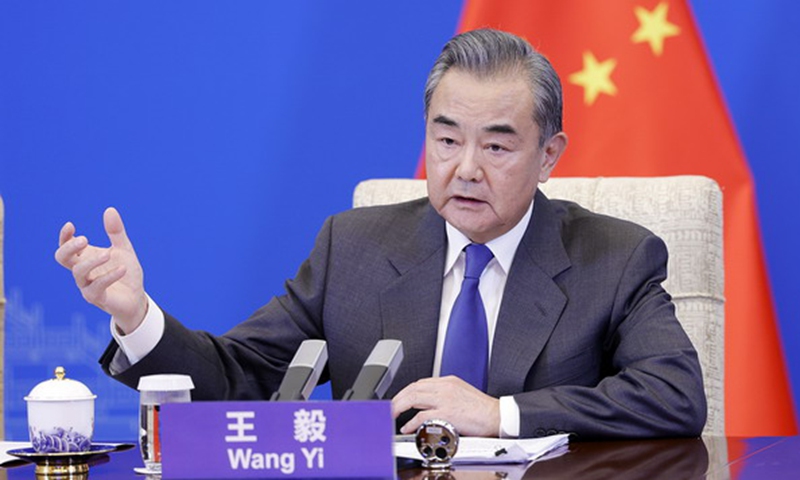
IN BRIEF
By Avishka Ashok and Dincy Adlakha
INTERNAL
Green energy transition: China manufactures world’s first LNG dual-fuel crude carrier
On 1 March, Global Times reported that China State Shipping Corporation delivered world’s first LNG dual-fuel very large crude carrier to China’s northeast province Liaoning. The carrier is named ‘Yuan Rui Yang’ and marked a milestone in China’s journey of green, environment-friendly and energy-saving technologies. China has been trying to reduce its carbon emissions and move away from coal dependence. In such context, the carrier operated by COSCO is an important achievement as LNG is its main fuel. The carrier was developed through engineering procedures like cutting, welding, assembly of corrosion-resistant steel among others. (“World's first LNG dual-fuel VLCC delivered in Northeast China’s Dalian,” Global Times, 1 March 2022)
Hong Kong connectivity: Mainland starts special freight train to Hong Kong
On 2 March, the Chinese mainland started operations of a special freight train to Hong Kong. The train will increase connectivity and stabilize the supply of goods to Hong Kong. Operations will begin from Pinghu Railway Station in Shenzhen, Guangdong Province in south China. The train is specially introduced during COVID-19 when Hong Kong is facing a surge in the number of cases and its medical facilities are overburdened. (“Special freight train to help stabilize mainland supply of goods to Hong Kong,” Xinhua Net, 2 March 2022)
ECONOMY
Market liquefaction: China injects funds in money market to maintain liquidity
On 1 March, China’s central bank announced that it injected 300 billion yuan in February into the money market to maintain liquidity. The funds were induced through a medium-term lending facility to meet the liquidity demand from banking and other financial institutions at a sufficient level. The funds will mature in a year. This latest injection of funds into the market through the MLF tool introduced in 2014 will take the total outstanding MLF loan amount to 4.85 trillion yuan. Additionally, another 2.71 billion yuan was lent to financial institutions in February through the standing lending facility tool. (“China's central bank injects liquidity into market in February,” Xinhua Net, 1 March 2022)
INTERNATIONAL
US-Taiwan: US delegation including Mike Pompeo visits Taiwan
On 1 March, a bipartisan US delegation of previously defence and security officials reached Taiwan. This visit overlaps with another US delegation visit scheduled for 2 March by former US Secretary of State Mike Pompeo. Taiwanese media states that the visit is sudden and schedules were prepared only for meeting former US Secretary of State Mike Pompeo. Both the delegations are now scheduled to meet regional leader Tsai Ing-wen. White House Coordinator for Indo-Pacific Kurt Campbell states that the delegation has reached Taiwan to assure consistent support for peace in Taiwan Straits. Chinese mainland strongly opposed the US delegation visit to Taiwan. (Wang Qi and Yang Sheng, “Biden sends former officials to Taiwan to 'offset Pompeo', pacify DPP,” Global Times, 1 March 2022)
Ukraine: China stresses negotiations to arrive at constructive political solution
On 1 March, Chinese State Councilor and Foreign Minister Wang Yi spoke with Ukrainian Foreign Ministry Dmytro Kuleba on phone. He urged Ukraine and Russia to find a constructive solution to the crisis through negotiations. He also conveyed his condolences regarding the current situation and said that China is paying special attention to the casualties. Foreign Minister Kuleba emphasised China’s crucial role in the Ukraine issue and encouraged further good communication between the two countries. He also suggested China for efforts to reach a ceasefire. China maintained that expansion of military blocs will not lead to regional security and that security of any country cannot be assured at the expense of security of others. (“China calls for solution through negotiations, supports all constructive intl efforts: FM Wang Yi,” Global Times, 1 March 2022)
Russia: China’s coal imports decelerates
On 1 March, Reuters reported that Chinese traders have reduced coal imports from Russia as they attempt to sidestep the sanctions that have been placed on Russia after the raised tensions on the Ukrainian border. Meanwhile, coal prices in exporting countries like Indonesia, Australia and South Africa have increased and hit a record of USD 274 per tonne, marking a 15 per cent increase in the prices. A Chinese trader, engaged in coal purchase with Russia said: “Most banks have stopped issuing letters of credit after the SWIFT sanctions. As almost all contracts are dollar-denominated, we have no other way to make the payment.” (“China's Russian coal purchases stall as buyers struggle to secure financing,” Reuters, 1 March 2022)
Iran: China records highest purchase of oil since 2017
On 2 March, Reuters reported that Chinese oil sales from Iran exceeded 7,00,000 barrels per day in January and even broke records from its highest purchase in 2017. According to the data revealed by the tanker tracker, the purchase of oil from Iran has been increasing for the past few months. The report observed that the increase in sales took place during the revival talks of JCPOA. The increased dependence on Iranian oil may also bring down the price of crude oil that shot up due to the tension between Russia and Ukraine. (“China buys more Iranian oil now than it did before sanctions, data shows,” Reuters, 2 March 2022)
01 March 2022 | Tuesday | China Reader Evening Brief | Vol.1, No. 128
China’s plan for space in 2022
China’s recent blue paper announces first combined flight, first six-month stay in space and first simultaneous crews in orbit. China’s plan for space in 2022 is a legacy of previous achievements and stepping stone for the future.

IN FOCUS
By Dincy Adlakha
China’s plan for space in 2022
On 9 February, the China Aerospace Science and Technology Corporation released a blue paper that laid out the Chinese plan for space in 2022. The plan involves three important missions to be carried out for the first time by China. These missions are symbolic of the legacy of 2021 as a victorious year in space. The paper also recounted major Chinese achievements in space last year.
According to the blue paper, China has plans for the following in 2022.
1. China will accomplish three major firsts in 2022; this includes the first flight that combines six aircrafts, the first sixth-month stay of taikonauts in space and the first simultaneous stay of two crews in orbit.
2. China has planned six manned missions to complete the space station with Tianhe core cabin as the control centre. These six missions will make the space station a perennially tended project. For two of these manned missions, Long March 2F carrier rockets will be utilized. The Tianzhou-5 cargo spaceship is set for its flight to the space station in order to launch the construction stage of the module.
3. China is also dedicated and invested in a rapid return program that prioritizes the comfort and efficiency of the taikonauts. These programs will be led through 140 space launches and maiden flights.
China in Space: A Review of 2021
China’s ambitious plans for space in 2022 find their roots in the achievements of the previous year. China carried out 55 space launch missions in 2021, highest in the world and defeating the US by 4 launches.
In April, China successfully stationed the first component of its permanent space station in space. It then proceeded to send three top tier astronauts from the country to the space station with a glorious farewell.
In February, China sent its independent mission of a rover to Mars’ orbit. Tianwen-1 achieved a soft landing and was successful in sending high quality pictures and videos from the surface of Mars in its first attempt.
China and the strategic significance of Space
First, the historical space dream.
Space is crucial for China as a symbol of national power and global status since the 1970s. Chinese leader Mao Zedong envisioned the ‘Chinese Space Dream’ when USSR and the USA were at their peak of space race while China had meagre resources to enter the arena. Hence, space is deeply connected to China’s historical ambitions of rising as a strong power. The dream is built on ambitions to catch up with the giants and defeat them in space.
Second, space as economic investment.
China’s budget allocation for space is not as extravagant as the US. However, there is a continuous annual increase in the amount. Hence, China expects worthy returns from space. China is trying to tap into the commercial satellite launches. The investment in space will create new and more advanced technologies and feed into the demand created for these technologies through space missions.
Third, arena for global competition.
Space is also growingly observed as an arena where political differences spillover. Hence, it is a battleground for the US and China to compete for technological supremacy. This technological competition will hold the keys to scientific and military implications on earth and the future of global order.
Fourth, militarization of space.
Militarily, space provides the informational stronghold to China. Especially the People’s Liberation Army and its activities that are carried with complete recognition for space as the “ultimate high ground” hinting at the inevitable nature of space warfare. The Strategic Support Force service by PLA asserts Chinese capabilities of cyber, electronic and psychological warfare in space.
Space is an important strategic asset for China and the country is looking to utilize the most of this asset.
References:
“China's space station to realize first combined flight with six spacecrafts in 2022: blue paper,” Global Times, 9 February 2022
Erika Na, “China space missions aim to break 2021 record, with first ever double-crew orbit also in works,” South China Morning Post, 10 February 2022
“China to make 6 human spaceflights, rocket's maiden flight in 2022: blue book,” China Aerospace Science and Technology Corporation, 10 February 2022
IN BRIEF
By Avishka Ashok and Keerthana Nambiar
INTERNAL
Hong Kong demography: Number of births in Hong Kong sink lowest in five years
On 1 March, the Census and Statistics Department released the latest data on Hong Kong’s demography which showed only 38,684 births in 2021. The number is lowest ever record of 56 years, falling below 40,000 in a long time. Experts noted that this will have great implications for the city as the population increasingly ages. Analysts also established links between lower births and shrinking enrolment in elementary education, which shall cause problems in manpower supply. Closing schools will also lead to a reduced skilled workforce. Experts warn of such ill effects and urge the authorities to take appropriate actions. (“Hong Kong births sink to lowest in 56 years, experts predict dire impact on ageing society,” The Korea Times, 01 March 2022)
Anti-corruption drive: Central Commission for Discipline Inspection releases corruption report
On 1 March, South China Morning Post reported that the Central Commission for Discipline Inspection had published a report in the last week. According to the report, the anti-corruption police in China had arrested over 5,000 people for paying bribes in 2021. As a part of the anti-corruption drive, over 2,822 prosecutors were sent for a trial. The report also made a note of last year’s campaign, the proposed tasks and targets for 2022 and preparing a black list of citizens involved in corrupt activities. (“China’s corruption watchdog moves to crackdown on bribe-givers,” South China Morning Post, 01 March 2022)
ECONOMY
Economic Challenges: Commerce Minister reviews China’s obstacles in economic growth
On 1 March, Chinese Commerce Minister Wang Wentao remarked that China’s economy was bound to face numerous obstacles in 2022 due to multiple challenges within the domestic economy and political situations in the international system. Wang said: “This year, the pressure on foreign trade will be huge and the situation will be very severe.” He explained that a shortage of labour and the rising costs of raw materials were causing major obstacles for China’s small and medium-scale companies to handle foreign orders. (“China warns of 'huge' pressure on foreign trade as economic challenges mount,” Reuters, 01 March 2022)
INTERNATIONAL
Ukraine: First batch of Chinese nationals evacuated, second batch prepares
On 28 February, the Chinese embassy in Ukraine announced that the first batch of Chinese nationals from Ukraine has been evacuated. This batch included 600 nations, 400 from Odessa and 200 from Kyiv. The citizens were safely transported from Ukraine to the neighbouring country Moldova. The second batch with 1000 nationals is currently being prepared for evacuation. This second batch may be diverted to Romania due to the greater number of people. The Chinese embassy has attained help from neighbouring countries like Moldova, Romania, Slovakia, Hungary and Poland to provide temporary visa-free access to valid passport holders. (Chen Qingqing and Fan Anqi, “Embassy evacuates first batch of 600 Chinese from Ukraine; 1,000 prepared in second batch,” Global Times, 01 March 2022)
China-Africa trade: Trade reaches record high
On 28 February, Xinhua reported that China-Africa trade reached record increase in 2021. China also remained the largest investor in Africa and created over 18000 jobs annually. The report mentioned that Chinese cooperation has led to increased urbanization, industrialization and economic development in Africa. With 2021, China remained Africa’s largest trading partner for 10 years and the largest investor for 12 years. (“Xinhua Headlines: China-Africa trade reaches all-time high in 2021, showing resilience amid pandemic,” Xinhua Net, 28 February 2022)
Xinjiang: Chinese Foreign Minister invites “unbiased foreigners” to visit Xinjiang
On 28 February, Chinese Foreign Minister and State Councilor Wang Yi addressed the gathering at United Nations Human Rights Council. In his speech, he invited all “unbiased foreigners” to visit Xinjiang. He said: “The door of Xinjiang is open, and we welcome people from all countries to visit Xinjiang and exchange opinions. The so-called genocide, forced labour and religious oppression are all fabricated lies.” He also welcomed UNHRC High Commissioner Michelle Bachelet to visit Xinjiang in the future. The statements came in context when many western scholars and journalists have alleged China of enforcing unfair restrictions on visiting Xinjiang. (“All unbiased foreigners welcome to visit Xinjiang: Foreign Minister Wang Yi,” Global Times, 28 February 2022)
China-South Korea relations: Chinese and ROK Foreign Ministers discuss bilateral ties on video conference
On 28 February, Chinese Foreign Minister and State Councilor Wang Yi met with South Korean Foreign Minister Chung Eui-yong through video conference. The countries noted that 2022 marks 30 years of their bilateral diplomatic ties. The two leaders emphasized a joint plan for the future enhancement of their ties. China also wished South Korea a smooth general election and expressed willingness to provide assistance. South Korea appreciated China’s role in the Korean Peninsula issue and hoped the same continues. (“Chinese, ROK FMs hold video meeting on bilateral ties,” Xinhua Net, 28 February 2022)
28 February 2022 | Monday | China Reader Evening Brief | Vol.1, No. 127
China and Australia: Four reasons that have caused the relationship to worsen.
A recap into the worsening bilateral relations between China and Australia as tensions rise is the seas.
.jpg)
IN FOCUS
By Avishka Ashok
China and Australia: Four reasons that have caused the relationship to worsen.
Recent Developments
On 21 February, the Chinese Ministry of Defense responded to Australia’s accusations of conducting “acts of intimidation” by pointing a laser at an Australian patrol aircraft. The ministry spokesperson Senior Colonel Tan Kefei remarked that the Chinese Navy was falsely accused; he claimed that the Australian statements were inconsistent with the facts. He also stated that the Australian aircrafts flew close to the Chinese vessel flotilla and tried to cause panic by dropping sonobuoys close to the vessel. Sonobuoy is an equipment that detects underwater sounds and transmits them by radio. It is used for anti-submarine warfare or for conducting underwater acoustic research.
China believes that Australia dropped the sonobuoys to access the PLA vessels’ performance data in the sea. China also raised alarm at the close proximity of the Australian aircraft which was claimed to be less than four kilometers and said that the laser could have been emitted from a rangefinder to measure the distance of the patrol aircrafts from the Chinese vessels.
The Australian Prime Minister Scott Morrison also stressed on the incident and said that the government would demand an explanation from the Chinese administration.
China and Australia: Five reasons that have caused the relationship to worsen.
First, the Chinese influence in the Australian society.
In 2018, the Australian government became alarmed at the conspicuous hints of Chinese influence in the country’s politics, educational institutions and other facets of the Australian society. Chinese influence in Australia has been prevalent for a long time, considering the high scale migration of Chinese nationals to Australia and the following Chinese-Australian second generation that thrives in the country. However, the community has been surveilled strictly by the Chinese for decades. In 2005, it was revealed that the Chinese administration had a system in place to track the practitioners of the Falun Gong, a practice that China banned in 1999. In 2008, another incident illuminated China’s influence in mobilizing students to protests in front of the Australian Parliament against the pro-Tibet movement. Growing interference in numerous other spheres of the Australian society urged the country to take steps to limit China’s presence in the country. In 2016, the then Prime Minister of Australia Malcolm Turnbull issued an investigation to understand the extent of foreign investigation in the country. The report was published in 2018 and revealed that the Chinese government had tried to interfere with Australia’s political partied for the last decade and had its influence in the grassroot local councils as well.
Second, the tariffs and trade war.
In 2019, the trade relations between China and Australia also hit a wall after the two countries increased tariffs on indigenous products and engaged in a trade war. China imposed tariffs on Australian export products to China such as wine, barley, sugar, lobster, coal and copper ore. The trade restrictions certainly hurt the Australian economy since China replaced Japan as the country’s largest trading partner in 2007. In 2020, China also imposed an anti-dumping and anti-subsidy duties on Australian products. Chinese ports also halted the sale of Australian shellfish products and cited “inspection and quarantine measures.”
Third, the COVID-19 origin accusations.
The Australian Prime Minister called for an independent investigation into the origins of the COVID-19 pandemic in April 2020. While China was trying to push back criticisms from the international political system for its handling and its inability to stop the spread from Wuhan, Australia’s call for investigation cornered the country and blamed it for the pandemic. The call for the investigation gained the support of over 110 countries, including the 54 African countries, 27 countries from the European Union, Brazil, South Korea, Mexico, Turkey, Russia, Indonesia, India, Japan, Canada and New Zealand. The initiation of the enquiry led to heightened tensions between China and Australia.
Fourth, Australia’s American tilt. From the Indo-Pacific to the Five Eyes Alliance, Australia’s engagement with the US led initiatives are seen as anti-China by Beijing.
The Five Eyes Alliance is the grouping of the intelligence agencies of Australia, Canada, New Zealand, the UK and the US who agreed to share their reports and data with each other during the second world war. In the 21st century, the alliance has agreed to cooperate on blocking China’s growing influence and monitor its actions in the Indo-Pacific. The alliance has repeatedly taken a stand against China in different cases such as tracking the origins of COVID, protests in Hong Kong, the human rights issue in Xinjiang and supported Taiwan’s participation in the World Health Organization. Australia also moved to prevent the member countries of the Alliance from employing Huawei in its 5G projects. In July 2021, the US also extended its support to Australia and pledged to work together against China’s unfair trade practices in the region. Australia was also successful in gathering the European’s Union’s support in the trade dispute with China at the World Trade Organization. The Chinese government has time and again refrained Australia from commenting on its internal affairs. It also urged Australia and the US to stop creating blocs in the international order. The CPC further accused the country for violently interfering in the elections in Hong Kong in December 2021.
Fifth, China’s strong response.
In November 2020, China issued a 14-point letter that highlighted China’s irritations with the country. The dossier of 14 disputes included Australian’s government’s funding for anti-China research, unfair seizure of Chinese journalists and academicians, interference in China’s internal affairs, the independent investigation into the origins of COVID-19, preventing Huawei from providing its 5G services, blocking several Chinese projects through the foreign interference legislation, and many more. China also believes that Australia’s approach towards its bilateral relations will be disadvantageous to the country and to the Five Eyes Alliance. China knows that it is the largest trading partner for more than 120 countries in the last decades. In the current economy, all countries are trying to reestablish their supply chains to get back on the economic growth and development which was damaged due to the pandemic. China believes that it is an integral part of this process due to its key position as a major trading partner for most countries, including the countries in the Five Eyes Alliance.
References:
“UPDATE: Australia’s claim about PLA vessel’s laser deployment false: Chinese authorities,” Global Times, 21 February 2022
“Why is the Five Eyes intelligence alliance in Beijing’s cross hairs?," South China Morning Post, 20 June 2022
“The 14 disputes of China to Australia,” Voltaire Network, 23 November 2022
“China bristles at Australia's call for investigation into coronavirus origin,” The Guardian, 29 April 2020
IN BRIEF
By Dincy Adlakha and Keerthana Nambiar
INTERNAL
Standing Committee Session: Plenary meeting plans to prepare for the fifth annual session
On 27 February, the Standing Committee of the 13th National People’s Congress (NPC) opened its 33rd session. The top legislature of China started this session to prepare for the fifth annual session of the NPC. The session was attended by 157 members of the NPC and presided by the Chairman of the NPC Standing Committee Li Zhanshu. The members reviewed a work report of the Standing Committee and discussed the agenda for the coming annual session. Additionally, the members discussed a draft decision on the ranks for active-duty soldiers of the PLA among other personnel-related bills. They deliberated on establishing a financial court. The upcoming annual session of the NPC is scheduled for 5 March. (“China's top legislature starts standing committee session,” Xinhua Net, 27 February 2022)
COVID-19 in Hong Kong: Record high cases in the city, China vows streamlined medical assistance
On 27 February, Hong Kong reported 26.026 new COVID-19 cases, the highest of the city at all times. The number of infections is continuously rising in the city as morgues near their capacity. Hong Kong is facing a severe shortage of medical personnel and resources as the current facilities are overburdened. Mainland promised to expand help for the city and streamline the procedures to access medical resources. A top member of China’s biggest political advisory body emphasized the need to treat elderly people and patients in critical condition and vowed support to the city through medical staff and equipment. (Chen Qingqing and Liu Caiyu, “Mainland to expand help as HK reports new record infections,” Global Times, 27 February 2022)
Standing Committee Session: China considers the establishment of a financial court in Chengdu-Chongqing
On 27 February, a draft decision on the establishment of a Chengdu-Chongqing financial court was submitted in the National People’s Congress. The court is being proposed with an aim to set up judicial protection of the financial sector and promote the development of the region. The court, if set up, will have jurisdiction over financial matters concerning civil, commercial and administrative lawsuits in Chongqing and other parts of the Sichuan province. The draft said: “The appeal cases filed against the judgment or ruling of first instance made by the Chengdu-Chongqing financial court shall be tried by the Chongqing Higher People's Court.” (“China mulls establishing Chengdu-Chongqing financial court,” Xinhua Net, 27 February 2022)
ECONOMY
Oil trade: China increases its oil reserves despite US plea for release
On 28 February, the Asahi Shimbun reported that China had increased its oil purchase despite the surge in prices. According to the data revealed by the traders and industry, the US has called for a coordinated release of stock to pacify the market. For the first time since 2014, the cost per barrel of oil has reached USD 100. According to the report, China ramped up its purchases soon after President Xi met with the Russian President Vladimir Putin in February 2022. (“China boosts oil reserves, ignoring U.S. push for global release,” The Asahi Shimbun, 28 February 2022)
Supply chain: China plans for new measures to help change its finance mechanism
On 28 February, The Straits Times published the Caixin Global report on China’s supply chain finance mechanism. The reports says that, “China is about to rein in its booming 167.23 trillion yuan market for commercial acceptance bills.” The revisions of the rules is expected to have “dramatic impact” on commercial banks, financial companies, commercial acceptance bill issuers and intermediaries. It also stresses that the commercial bills should be based on real transactions made within six months to one-year time-limit. (“China to overhaul $36 trillion supply chain finance mechanism,” The Straits Times, 28 February 2022)
INTERNATIONAL
Ukraine: China assures support and alternate plan to evacuate its nationals
On 27 February, Chinese ambassador to Ukraine Fan Xianrong said in a video that he has not left Ukraine and is managing the situation in Kyiv. Recently, reports surfaced alleging that the ambassador has fled Ukraine due to difficult times. However, he said in the video: “I want to make it clear that Chinese ambassadors will never leave the Chinese people behind on their own. This is not how the Chinese ambassadors are like, and is not how the members of the Communist Party of China are like!” The Chinese embassy in Ukraine also assured that 24/7 contact lines are open and first-hand information is being relayed to all Chinese nationals stuck in Ukraine. The embassy said it has set up online groups to reach out and evacuate these nationals as early as possible. (“Chinese ambassador to Ukraine rejects rumors, says he will never leave Chinese people behind,” Global Times, 27 February 2022; “Exclusive: Chinese embassy in Ukraine mulls alternative plans apart from charter flights to evacuate Chinese nationals amid rising tensions,” Global Times, 27 February 2022)
Ukraine: China opposes unilateral sanctions on Russia; Germany stresses on China’s role in the crisis
On 27 February, Chinese Foreign Minister and State Councilor Wang Yi shared a telephone conversation with German Foreign Minister Annalena Baerbock. While State Councilor Wang Yi stressed that unilateral sanctions on Russia will not help the issue and that NATO should avoid further tensions due to eastward expansion, Foreign Minister Baerbock said China has a “special responsibility” towards Ukraine. China abstained from a UNSC resolution to deplore the Russian invasion of Ukraine. Chinese authorities state that economic and international sanctions have no basis in international law and will affect the process of political settlement. (“China opposes unilateral sanctions, which will affect the process of political settlement,” Global Times, 27 February 2022; “Germany stresses China’s ‘special responsibility’ over Ukraine,” The Asahi Shimbun, 27 February 2022)
China-US relations: Foreign Minister invites the US to join BRI and shows willingness to work with Build Back Better G7 initiative
On 28 February, the Chinese Foreign Minister and State Councilor released a video message to mark the 50th anniversary of the Shanghai Communique that normalized the relations between China and the US in 1972. In the video message, he said that China is open to welcoming the US in the Belt and Road Initiative. He also said: “We are also willing to consider coordinating with the U.S. 'Build Back Better World' initiative to provide the world with more high-quality public goods.” He encouraged the US to stop supporting Taiwanese secessionists and ease tensions on the matter. (Yew Lun Tian, “China willing to work with U.S. on Build Back Better World initiative,” Reuters, 28 February 2022)
26 February 2022 | Saturday | China Reader Evening Brief | Vol.1, No. 125
China and the LGBTQ: The political censors
The Chinese media's censorship removes content related to LGBTQ issues for its audience.
.jpg)
IN BRIEF
By Keerthana Nambiar
China and the LGBTQ: The political censors
On 14 February, the Guardian reported that China has been censoring the LGBTQ plotlines on several entertainment platforms. The report discusses streaming platforms such as Tencent censoring sexual and LGBTQ content from the popular American sitcom FRIENDS and carrying different versions of the movie Fight Club.
On 24 February, South China Morning Post commented on the issue. It stated: “In recent years Beijing has become increasingly concerned that popular entertainment on streaming platforms is spreading views and ideas that run counter to traditional ideals of masculinity and femininity and encouraging new gender identities and forms of sexual expression.”
The censorship sparked criticism among China’s mainland audience and on social media. Initially, the audience protested against censorship of the show and attacks on gender identity. However, the backlash was censored by the government claiming “this topic is not shown according to relevant laws and regulations.” On China’s Weibo, censorship became a trending topic with related hashtags and comments.
The censorship: From political to sex education
The crackdown on pop culture ensures tight controls over the views of Chinese citizens reminiscing the pre-reform period. The Communist party sees LGBTQ rights as Western values. It aims to condition the new generation with the idea of national rejuvenation eliminating the popular culture.
In recent years, China has grown weary of the content on online entertainment platforms spreading views and ideas on gender identities and sexual expressions. It counters the CPC’s principle of traditional ideals of masculinity and femininity. In September 2021, China’s broadcasting regulator announced that entertainment shows with “effeminate” aesthetics are considered as “unhealthy content.”
The Chinese government has narrowed down its priorities and objectives. It is no longer about challenging the CPC’s rule or criticizing the government rather, the agenda now is to promote party nationalistic country with traditional and heteronormative values.
China has been censoring sex education among the younger generation. The lack of awareness among children and youth affects physical and mental health. It is widely held that children should be kept away from sex education and not taught about the physiological body structure. With heterosexuality being a normative framework, different genders and same-sex relations are considered and taught to be pathological. This approach has resulted in negative self-recognition, gender discrimination, and negative attitude towards adolescent sexual psychology among youth.
The administration has been cautious about LGBTQ matters; it considers the issues as a potential threat to the traditional structures of family and authority. Today, the cultural constructs in the concept of masculinity and femininity are shifting to discourses on gender in China. However, the apparent rise in media censorship under the present administration targets non-traditional family values and cultures.
Online streaming sites and social media platforms have drastically evolved the media landscape in China. They face intense pressure from the government, shareholders, the global market, and consumers. The administration has intervened in the popular culture with multiple censorship decisions and wiping out the LGBTQ content from the Chinese media. With stringent rules and formats, media finds it difficult to navigate the increasingly sensitive market constant surveillance of government.
References
“Chinese fans claim censorship as gay storylines removed from Friends,” The Guardian, 14 February 2022
“China’s censors increasingly play the part of morality police with the conservative values of 1950s America, experts say,” South China Morning Post, 24 February 2022
Philip Wang, “China censors lesbian plotline in 'Friends',” CNN, 16 February 2022
IN BRIEF
By Dincy Adlakha and Avishka Ashok
REGIONAL
Mongolia: Foreign Minister appreciates China’s economic development and help
On 26 february, Xinhua Net reported on Mongolian Foreign Minister Batmunkh Battsetseg’s interview with the news agency. At the interview, Battsetseg appreciated China’s development and said that it will benefit the region as well as the whole world. He said: “Today, China is developing rapidly, the livelihood of its people is improving day by day. As a neighboring country, Mongolia has always applauded the achievements of the Chinese people.” He also expressed his gratitude to China for supplying the landlocked country with the necessary drugs, vaccines and other medical facilities during the pandemic. He referred to the Zero-COVID policy and said that it was helping curb the spread of the virus within China as well as in the world. (“Interview: China's development to benefit world, says Mongolian FM,” Xinhua net, 26 February 2022)
INTERNATIONAL
Ukraine: Chinese and Russian Presidents discuss regional crisis
On 25 February, the Chinese President Xi Jinping and Russian President Vladimir Putin held a telephonic conversation, soon after the phone call between the Foreign Ministers of the two countries. President Xi expressed his gratitude to Putin for attending the Winter Olympics and winning second place in the athletic competition. Putin appreciated China’s efforts and capabilities in hosting the international event. The leaders mainly discussed the situation in Ukraine during the call and clarified their position on the issue. Putin explained the complexity of the Ukraine-Russia ties and its long history with the country. He said: “The United States and the North Atlantic Treaty Organization have long ignored Russia's legitimate security concerns, repeatedly broken their commitments and continuously pushed their military deployment eastwards, which challenged Russia's strategic bottom line.” Putin also said that the country was open to negotiate with Ukraine. (“Chinese, Russian presidents hold phone conversation,” Xinhua Net, 26 February 2022)
Ukraine: Foreign Minister explains China’s position on Russian actions in the region
On 25 February, the Chinese Foreign Minister held a series of phone calls with the British Foreign Secretary Liz Truss, the European Union’s Representative for Foreign Affairs and Security Policy Josep Borrell and the diplomatic counselor to the French President Emmanuel Bonne. During these meetings, Wang Yi expanded on China’s position on the Ukraine crisis in five points. First, China stood by the territorial integrity and sovereignty of all countries, Second, China encouraged “the concept of common, comprehensive, cooperative and sustainable security.” Third, Wang Yi explained that China was keeping a close watch on the developments in the region. Fourth, China pushed for a diplomatic solution to the dispute and fifth, he called for the UN Security Council to play its role in resolving the issue. (“Chinese FM elaborates China's basic position on Ukrainian issue,” Xinhua Net, 26 February 2022)
Vaccine cooperation: China calls for stronger vaccine support
On 26 February, Chinese Satte Councilor and Foreign Minister Wang Yi called on stronger vaccine support for developing countries. Wang made the remarks during UN General Assembly high-level thematic debate, “Galvanizing Momentum for Universal Vaccination.” He stressed that it was the responsibility of major countries to supprt COVID-19 vaccination in developing countries especially Africa. He stated that China has suplied more than 2.1 billion doses of vaccines to more than 120 countries and pledged to strengthen the vaccine cooperation. (“Chinese FM calls for stronger vaccine support for developing countries,” Xinhua Net, 26 February 2022)
Nixon's Visit: On 50th anniversary, a keynote address by the Chinese Ambassador to the US
On 25 February, Chinese Ambassador to the US Qin Gang delivered a keynote at the event to commemorate the 50th anniversary of former US President Richard Nixon’ s visit to China. Qin said: “China-US relations should not be likely the intensely confrontational American football match. There should be no offensive team or defensive team, no touchdown, no quarterback sack.” He stated that the 50th anniversary of Nixon’s visit serves as an “important reference” and should work towards seeking common ground between China and US. (“Competition, confrontation should not be keynote of China-U.S. ties: Chinese diplomat,” Xinhua Net, 26 February 2022)
Ukraine: At the UNSC, China abstains from voting
On 25 February, the Chinese permanent representative to the United Nations Zhang Jun urged the Security COuncil to take constructive steps that would diffuse the crisis in Ukraine. The statements were made after the council failed to adopt the resolution initiated by the US to resolve the crisis. China abstained from voting. Zhang said: “If not properly handled, or blindly exerting pressure and imposing sanctions, it may only lead to more casualties, more property loss, more complicated and chaotic situations, and more difficulties in bridging differences.” (“Any action by Security Council should be truly conducive to defusing Ukraine crisis: Chinese envoy,” Xinhua Net, 26 February 2022)
25 February 2022 | Friday | China Reader Evening Brief | Vol.1, No. 124
Foreign Ministers of China and Russia discuss Ukraine on phone
Chinese Foreign Minister Wang Yi held a telephonic conversation with Russian Foreign Minister Sergei Lavrov.
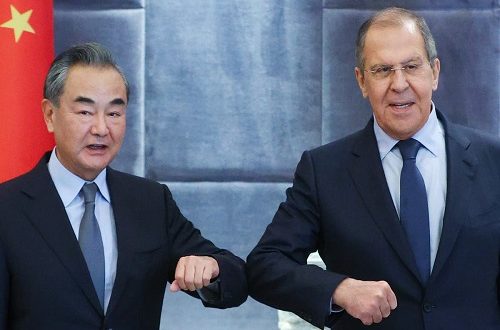
IN BRIEF
By Keerthana Nambiar and Dincy Adlakha
REGIONAL
Kim Jong Un congratulates Xi Jinping for a successful Winter Olympics
On 25 February, the General Secretary of the Workers’ Party of North Korea Kim Jong Un congratulated President Xi Jinping for the successful hosting of the Beijing Winter Olympics. In a verbal message, Kim said: “the Winter Olympics, held with the deep expectation and care of all the Chinese people and the people of the world, has become a grand international sports gathering full of innovation and characteristics.” He appreciated the Communist Party of China and the Chinese population for safely and efficiently hosting the games. He appreciated President Xi Jinping and his role in the party as well as the leader of the country. He also expressed North Korea’s interest and willingness in working alongside China in the coming years. (“Kim congratulates Xi on successful Beijing Winter Olympics,” Xinhua Net, 25 February 2022)
Cambodia signs MoU with Guangxi Zhuang Autonomous Region
On 25 February, Cambodian Commerce Ministry announced the signing of an MoU with the Guangxi Zhuang Autonomous Region in China. The Memorandum of Understanding aimed to promote trade between the region and Cambodia. The MoU was signed by the Cambodian Commerce Minister Pan Sorasak and the Chairman of Guangxi Zhuang Lan Tianli. The trade deal includes the sale of 4,00,000 tons of tapioca chips from Cambodia to Guangxi in March 2022-23. The Cambodian Minister also encouraged Chinese businesses to buy more rice, corns, mangoes, bananas, and other agricultural products. He said: “The ASEAN-China Free Trade Area, the Regional Comprehensive Economic Partnership, and the Cambodia-China Free Trade Agreement have all paved the way for the promotion of economic and trade cooperation between Cambodia and China." (“Cambodia, China's Guangxi sign deal on trade promotion,” Xinhua Net, 25 February 2022)
Pakistani Information and Broadcasting Minister appreciates China’s contribution to corporate social responsibility
On 24 February, Pakistan’s State Minister for Information and Broadcasting Farrukh Habib attended the 144th Annual Corporate Social Responsibility Summit and revealed that the Chinese-funded companies in Pakistan were greatly contributingto the corporate social responsibility. He said: “Chinese-funded corporations, including those working on projects under the China-Pakistan Economic Corridor (CPEC), are playing a very responsible role in bringing about sustainable social, environmental and economic benefits for the welfare of people of Pakistan.” The Minister appreciated the Chinese companies for helping the green development in the country and awarded several Chinese-funded companies for their contribution. (“Chinese-funded companies in Pakistan committed to corporate social responsibility: official,” Xinhua Net, 25 February 2022)
INTERNATIONAL
Foreign Ministers of China and Russia hold a telephonic conversation
On 24 February, the Chinese Foreign Minister Wang Yi held a telephonic conversation with Russian Foreign Minister Sergei Lavrov. During the phone call, Lavrov explained the situation with Ukraine from the Russian point of view and said that the country was forced to take action due to the constant eastward expansion of the US led NATO. He also reiterated Russia’s refusal to uphold the Minsk Agreement and said that it was a necessary step to safeguard its own interests. In response to Lavrov’s statements, Wang Yi reaffirmed its recognition of the complex situation in the Russian-Ukraine relations and said that it respects the sovereignty and territorial integrity of all countries. He said: “China maintains that the Cold War mentality should be completely abandoned and a balanced, effective and sustainable European security mechanism should be finally established through dialogue and negotiation.” (“Chinese, Russian FMs hold phone conversation,” Xinhua Net, 24 February 2022)
24 February 2022 | Thursday | China Reader Evening Brief | Vol.1, No. 123
China, Russia and Ukraine
China pledges to safeguard the sovereignty and territorial integrity of all countries and urged countries to find a diplomatic resolution to the crisis.
.jpg)
China, Russia and Ukraine
On 23 February, China’s permanent representative to the United Nations Zhang Jun attended the 76th session of the UN General Assembly on Ukraine and urged the countries to restrain from taking extreme actions that could catalyze tensions in the Ukraine issue. China also pledged to safeguard the sovereignty and territorial integrity of all countries and urged countries to find a diplomatic resolution to the crisis. China reiterated its standpoint that the situation in Ukraine has deteriorated as a result of multiple players interfering in the region and urged the concerned countries from reacting aggressively. He said: "China calls on all parties to recognize the importance of implementing the principle of indivisible security, to continue to engage in dialogue and consultation, and to seek reasonable solutions that address each other's concerns through peaceful means on the basis of equality and mutual respect. We welcome and encourage all efforts aimed at facilitating a diplomatic solution."
The Chinese Foreign Ministry Spokesperson Hua Chunying also condemned the sanctions on Russia during a press briefing and said: “Sanctions are never fundamentally effective means to solve problems, and China always opposes all illegal unilateral sanctions. Have U.S. sanctions solved any problems? Is the world a better place because of those sanctions?” She also accused the US of supplying arms and ammunition to Ukraine, thereby heightening the opportunities for conflict in the region. She further emphasized that the diplomatic option to resolving the crisis is still available and urged countries to deal in a rational way.
(“China urges all parties involved in Ukraine issue to exercise restraint,” Xinhua Net, 24 February 2022; China calls for diplomatic settlement of Ukraine issue,” Xinhua Net, 23 February 2022)
From our archives:
China on Ukraine: Why does Beijing speak Russian?
On 3 February, the Chinese Foreign Ministry made a statement on the Russia-Ukraine tensions after the Foreign Ministers of both countries assessed the situation during the meeting in Beijing. The Chinese representative Wang Yi agreed with Russia’s security concerns, considering the threat posed by the US and NATO. The joint statement released by the two countries said: “The sides oppose further enlargement of NATO and call on the North Atlantic Alliance to abandon its ideologized cold war approaches, to respect the sovereignty, security and interests of other countries, the diversity of their civilizational, cultural and historical backgrounds, and to exercise a fair and objective attitude towards the peaceful development of other States.”
The Chinese representative in the United Nations Security Council referred to a “megaphone diplomacy” of the US and urged countries to resolve issues by engaging in a dialogue with the involved countries, Russia and Ukraine. He said: "The parties concerned should persist in seeking to resolve their differences through dialogue and negotiations. What is urgently needed now is quiet diplomacy, not megaphone diplomacy." The Policy Director at Brookings Institute observed that China’s actions in the past few weeks denote its goal to get back at the US and other Western countries by allying with Russia and presenting resistance to their soft power.
The Sino-Russian friendship
China’s intentions in Ukraine are not simply aimed at resisting the US and other hostile countries. The China- Russia friendship has evolved now compared to the frosty relationship they shared earlier.
The Ukraine issue has constantly pushed Russia and China towards each other. In 2014, during the Crimean crisis, there was a similar handshake; China refused to blame Russia for the tensions and instead accused the West of meddling needlessly. In 2022, China and Russia are backing each other in almost every international organization and have become each other’s strategic allies.
China agreed to invest over USD 400 billion in Gazprom when the US and other Western countries sanctioned it for its actions near the Ukraine border. The investment will last for another 30 years, reassuring the cooperation and paving the way for more investments in the coming years. The joint statement issued by China and Russia before the commencement of the Winter Olympics also sought to deepen this cooperation between the countries and assure support on issues of mutual interests.
According to political analysts, other than the friendship and the desire to trigger the liberalists, China also views the Ukraine and Taiwan issues in the same light. Essentially, both countries view a part of another country as their territory. China could use Russia’s annexation of Crimea in 2014 as leverage to gain support from the Kremlin for its plans to reunify Taiwan with the mainland. The joint statement by the two countries during the Xi-Putin meeting in Beijing reiterated Russia’s stance on Taiwan. It clarified that it stands against any form of independence on the island. The statement read: "The Russian side reaffirms its support for the One-China principle, confirms that Taiwan is an inalienable part of China, and opposes any forms of independence of Taiwan."
Between pro-Russia and balancing its trade with Ukraine
China continues to maintain good trade relations with Ukraine. Between 1994 and 2019, Ukraine’s exports to China increased from USD 410 million to USD 3.94 billion. China also exported goods worth USD 7.36 billion in 2019. In the same year, China overtook Russia to become Ukraine’s largest trading partner. Although the trade volume has decreased during the pandemic, the trade continues to create opportunities in both China and Ukraine. However, in case of a full-blown war, it is uncertain if China would refrain from siding entirely with Russia because of its trade ties and a lucrative market for its products.
References:
“China, Russia 'coordinated positions' on Ukraine, says Chinese foreign ministry,” Reuters, 3 February 2022
“Explained: The China-Russia relationship,” The Indian Express, 10 February 2022
“What China thinks of possible war in Ukraine,” The Economist, 29 January 2022
“China’s Careful Dance Around the Ukraine Crisis,” Counter Punch, 10 February 2022
“What Does China Gain From The Ukraine Crisis?” The ASEAN Post, 4 February 2022
“China (CHN) and Ukraine (UKR) Trade | OEC,” The Observatory of Economic Complexity, n.d,
IN BRIEF
By Keerthana Nambiar and Avishka Ashok
INTERNAL
CPC official extends Tibetan new year greetings to the Panchen Lama
On 23 February, the Senior Communist Party of China (CPC) official You Quan met with the 11th Panchen Lama Bainqen Erdini Qoigyijabu in Beijing. You extended greetings for the Tibetan new year to the Panchen Lama and all the Tibetan Buddhism believers. He recognized the progress made by Panchen Lama and explained how the Communist Party can play an important role in adapting Tibetan Buddhism believers. Panchen Lama confirmed that he intends to support CPC Central Committee and President Xi Jinping and “uphold the principle that Tibetan Buddhism must be Chinese in orientation and make new achievements in promoting the adaptation of the religion to socialist society.” (“Senior CPC official meets Panchen Lama,” Xinhua Net, 23 February 2022)
Vice Premier stresses environment protection at inspection meeting
On 23 February, Xinhua Net reported that the Chinese Vice Premier Han Zheng attended the meeting which sought to inspect the country’s environmental protection efforts. At the meeting, he stressed the continuation of the work being conducted on the local environmental protection. He said: “Inspectors should have the courage to tackle tough problems and strictly deal with prominent issues that have seriously damaged the environment and harmed the interests of the people.” (“Chinese vice premier stresses further efforts on environmental inspection,” Xinhua Net, 23 February 2022)
National People’s Congress to use new digital platform in upcoming session
On 23 February, China inaugurated a digital working platform to help the lawmakers in the country in effectively performing their roles. Through this platform, the lawmakers can process proposals online, suggest changes and review suggestions by deputies to the National People’s Congress. The platform will be used for the first time during the fifth session of the 13th NPC which is scheduled to take place on 5 March 2022. It was tested during the last session and gave positive results. (“China launches digital working platform for lawmakers,” Xinhua Net, 24 February 2022)
China resumed building new coal-fired power generation capacity, says Reuters
On 24 February, Reuters reported that in 2021, China started building 33 gigawatts of new coal-fired power generation capacity. This report is in line with the latest research published by Helsinki-based Centre for Research on Energy and Clean Air (CREA) and US think tank Global Energy Monitor (GEM). The research shows that China resumed five projects with a total capacity of 7.3 GW for construction in 2022 after it was initially suspended in 2021. CREA and GEM said: “ There is no space for this new capacity to be utilized under the goals of the Paris Agreement.” (“China starts building 33 GW of coal power in 2021, most since 2016 -research,” Reuters, 24 February 2022)
REGIONAL
China lodges solemn representations with Japan over diplomat’s actions in the country
On 23 February, the Foreign Ministry Spokesperson Hua Chunying commented on the alleged misbehaviour of a Japanese Diplomat in China and announced the country’s decision to lodge solemn representations with its neighbour. The statements were made at a press briefing in Beijing. She said: “We found upon verification that the Japanese diplomat engaged in activities inconsistent with the individual's capacity in China.” The spokesperson implored on Japan to respect China’s laws and prevent similar incidents in the future. (“China urges Japan to strictly discipline its diplomatic personnel in China,” Xinhua Net, 23 February 2022)
Foreign Ministry spokesperson confirms China’s support for Nepal's development
On 23 February, Chinese Foreign Ministry spokesperson Hua Chunying announced that China will continue to support Nepal’s socioeconomic development. Hua said: “The U.S. Embassy in Nepal described the 500-million-dollar MCC grant as 'a gift from the American people to Nepalis.' I wonder, since when does a gift come with the package of an ultimatum? How can anyone accept such a 'gift'? Is it a 'gift' or Pandora's box?.” She confirmed that China believes in pursuing international cooperation and will continue supporting Nepalese people. (“China reaffirms support for Nepal's own development path,” Xinhua Net, 23 February 2022)
INTERNATIONAL
President Xi Jinping inaugurates leadership school in Tanzania
On 24 February, Chinese President Xi Jinping made remarks congratulating the inauguration of Mwalimu Julius Nyerere Leadership School on Tanzania. The leadership school is a joint effort of six liberation movements from Southern Africa Development Community and construction support by China. President Xi said that the school will strengthen the six parties and build their governing capacities. Xi highlighted the need for China and African countries to strengthen unity and cooperation and works towards common development. (“Xi calls for strengthening China-Africa cooperation,” China Daily, 24 February 2022)
23 February 2022 | Wednesday | China Reader Evening Brief | Vol.1, No. 122
China stresses on the Palestine question and promises to find solutions
Chinese Foreign Ministry Spokesperson reaffirms China’s commitment to the Middle East and to the Palestine question.
IN BRIEF
By Keerthana Nambiar and Dincy Adlakha
TECHNOLOGY
SMILE successfully conducts the magnetometer extension test
On 23 February, Xinhua reported on the article published by Science and Technology Daily on the Solar Wind Magnetosphere lonospere Link Explorer (SMILE). SMILE, a joint space mission by China and Europe successfully carried out the extension test of its payload magnetometer in Europe. The test showed the “performance of the magnetometer subsystem integrated with the payload module” which meets the requirements of the researchers from China and Europe. (“Sino-European joint space mission conducts magnetometer extension test,” Xinhua Net, 23 February 2022)
REGIONAL
Laos-China Railway Company adds additional passenger trains
On 23 February, the Laos-China Railway Company (LCRC) made an announcement of adding slower-speed trains to the existing high-speed EMU (electric multiple unit). The new decision is considering the growing needs of the passengers traveling between southwest China’s Yunnan Province and the Lao capital Vientiane. According to the LCRC operation department, a train with 15 carriages with 14 hard seated carriages and one soft sleeping car carry 1,664 passengers. The addition of trains is also due to a large number of passengers travelings for the upcoming Lao New Year. (“China-Laos Railway to run additional passenger trains,” Xinhua Net, 23 February 2022)
Chinese FM spokesperson says “Taiwan is not Ukraine”
On 23 February, the Chinese Foreign Ministry made a statement responding to Taiwan President Tsai Ing-wen. President Tsai had called upon increasing vigilance on military activities after British Prime Minister Boris Johnson warned Taiwan. PM Johnson said: “If Ukraine is endangered, the shock will echo around the world. And those echoes will be heard in east Asia, will be heard in Taiwan….People would draw the conclusion that aggression pays, and that might is right.” Chinese Foreign Ministry spokesperson Hua Chunying responded to the series of events saying, “Taiwan is not Ukraine… Taiwan has always been an inalienable part of China. This is an indisputable legal and historical fact.” (“China says Taiwan is 'not Ukraine' as island raises alert level,” Reuters, 23 February 2022)
Japanese Foreign Ministry lodges protest with China
On 22 February, the Japanese Foreign Ministry said that a diplomat at the Japanese Embassy in Beijing has been temporarily detained by the authorities. The Japanese government has lodged a protest and foreign minister Yoshimasa Hayashi confirmed that they will “cannot overlook” the incident is “absolutely unacceptable.” in response to this, the Chinese Embassy in Tokyo refused to accept the protest and accused the diplomat is acting “inappropriately.” the Japnese Foreign Ministry stated that the incident was a violation of the Vienna Convention on Diplomatic Relations and demanded an apology from China. (“China temporarily detains Japanese diplomat,” Japan Times, 23 February 2022)
China sends its vessels for the 114th Mekong River joint patrol
On 22 February, the Chinese vessels left from Jingha Port in Xishuangbanna Dai Autonomous Prefecture for the 144th Mekong River joint patrol. Vessels from Laos, Myanmar and Thailand joined the activity. The countries plan to patrol over 600 kilometers in four days and three nights. In the previous patrols, the group of countries have successfully dealt with over 8325 cases and arrested 8043 criminal suspects. The practice has also helped seize 34.4 tonnes of drugs in the Mekong River. (“114th Mekong River joint patrol begins,” Xinhua Net, 22 February 2022)
INTERNATIONAL
Chairman of the NPC meets Algerian Speaker and promotes bilateral relations
On 22 February, the chairman of the National People’s Congress Li Zhanshu held a discussion with the Speaker of the People’s National Assembly of Algeria Ibrahim Boughali. Li complimented the bilateral relations between China and Algeria and praised the diplomatic ties and traditional friendship of the two countries. Li encouraged the actions that have contributed towards mutual political support and urged deepening of the cooperation between the countries. He said: “China appreciates Algeria's support concerning China's core interests and major concerns.” (“China's top legislator holds talks with Algerian parliament speaker,” Xinhua Net, 22 February 2022)
China appoints new envoy to the Horn of Africa
On 22 February, the Foreign Ministry Spokesperson Wang Wenbin announced the country’s decision to appoint the former ambassador to Papua New Guinea Xue Bing as the special envoy of Africa affairs. Wang addressed a press briefing and explained that Xue had experience in working with African countries, the Americas and countries in Oceania. He also explained that the new Horn of Africa envoy will be tasked with implementing the Outlook on Peace and Development in the Horn of Africa. China will establish work relations with the concerned countries and maintain close ties with them. Wang also explained that China is preparing to play a constructive role in the region as a common friend of the countries in the Horn of Africa. (“China appoints special envoy for Horn of Africa affairs,” Xinhua Net, 22 February 2022)
China stresses on the Palestine question and promises to find solutions
On 22 February, the Chinese Foreign Ministry Spokesperson reaffirmed China’s commitment to the Middle East and to the Palestine question. The spokesperson said: “China will continue to work tirelessly with the international community for the comprehensive, just and lasting settlement of the Palestine question at an early date and for peace and stability in the Middle East.” China also collaborated with Egypt to send 5,00,000 doses of the COVID-19 vaccines to Palestine, in an effort to combat the new waves of the pandemic. In a statement released by the spokesperson, he said: “The Palestine question is at the core of the Middle East issue. China consistently and firmly supports the Palestinian people's just cause to restore legitimate national rights, supports strengthening the authority of the Palestinian National Authority, and supports various factions in Palestine in enhancing solidarity and realizing internal reconciliation.”(“China to continue striving for settlement of the Palestine question: spokesperson,” Xinhua Net, 22 February 2022)
22 February 2022 | Tuesday | China Reader Evening Brief | Vol.1, No. 121
China-Russia gas deal
China-Russia signs the new pipeline project bringing a new edge to the geopolitical tensions
.jpg)
IN FOCUS
By Keerthana Nambiar
China-Russia gas deal
On 4 February, China and Russia signed a 30-year contract for gas supply via a new pipeline. 'It was signed between Gazprom and China National Petroleum Corporation (CNPC) as a long-term sales and purchase agreement for natural gas to be supplied via the far Eastern route.
In 2014, both these organizations signed a 400-billion-dollar agreement to build the 'Power of Siberia,' a pipeline with 3,000-kilometer in Russia and 5,000 kilometers in China. The project connects Chayandinskoye field, Blagoveshchensk, and Kovyktinskoye field marking the border between 'Russia and China. By December 2019, Russia started supplying gas to China; it is expected to supply up to 38 billion cubic meters a year by 2025. In 2021, Russia exported 16.6 billion cubic meters of gas to China. Power of Siberia contributes to the socio-economic development of Russia's the Far East.
The new pipeline, ''from Siberia's Yamal Peninsula, Russia's biggest gas reserves will go through Mongolia to China. Unlike the 'Power of Siberia 1' which is fully owned by Gazprom, the 'Power of Siberia 2 Project' is owned by both China National Petroleum and Gazprom.
Russia’s gas diversification
Russia is the world's largest natural gas supplier, and the European markets are the major recipients of these deliveries. Europe accounts for annual consumption of 541 billion cubic meters. Despite the recent tensions regarding Russia's new pipeline, Nord Stream 2 and soaring gas prices, the Kremlin looks for diversifying from Europe and attach itself to China.
Both Russia and Europe are mutually dependent on each other. With the ongoing crisis in Ukraine, there has been significant upward pressure on Europe. If Russia invades Ukraine, Europe will face intense pressure from the US and its allies to impose sanctions on Moscow resulting in serious consequences. The drop in gas consumption will put Russia in an economic crisis.
Moscow is taking steps to break its dependence on Europe and look forward to bolstering an energy alliance with China. China consumes about 331 billion cubic meters of gas. With the climate change pledges coming in, Beijing is rapidly trying to reduce its dependence on coal estimating the demand for gas to double by 2030s. The new pipeline project displays the long-term partnership on the increasing energy interdependency between China and Russia.
China's ambition to build a 'Polar Silk Road' through sustainable development of the Arctic is now under the umbrella of China-Russia partnership. In the joint statement, the leaders declared that "Friendship between the two states has no limits, there are no 'forbidden' areas of cooperation." This builds an era of geopolitical order governed by natural gas.
References
"China, Russia enhance 'growing energy partnership’ with gas deal during Xi Jinping, Vladimir Putin meeting.” South China Morning Post, 4 February 2022
“Russia, China agree 30-year gas deal via new pipeline, to settle in euros,” Reuters, 4 February 2022
“Gazprom and CNPC sign agreement to supply Russian pipeline gas to China via Far Eastern route.” Gazprom, 4 February 2022
“Closer energy partnership gets spotlight in Xi-Putin summit in Beijing,” Global Times, 4 February 2022
“Russian gas boost fuels Moscow's China pivot,” DW, 12 January 2022
“Power of Siberia,” Gazprom
IN BRIEF
By Dincy Adlakha and Avishka Ashok
INTERNAL
“Olympics weren’t China’s big event of the year,” says AP News
On 22 February, Associated Press published a report titled ‘For Chinese leaders, Olympics were not 2022’s big-ticket item.’ The report says that for the Communist Party of China, the upcoming meeting in the fall that cements President Xi Jinping’s position as one of the most powerful leaders is the major event of 2022. The way China handled Winter Olympics despite the diplomatic boycott led by the US over human rights violations shows the tough stance of the government. The party congress held in every five years is expected to reaffirm Xi’s position as the core and “one of the most dominant leaders of the China’s Communist era.” (“For Chinese leaders, Olympics weren’t 2022′s big-ticket item,” Associated Press News, 22 February 2022)
China’s meteorological center issues yellow alert for heavy snow
On 22 February, National Meteorological Center issued a yellow alert for heavy snow in some regions of China. The meteorological center warned to a three to ten centimeters of snow accumulation upto 15 centimeters in some regions. The authorities further instructed the residents to stay indoors and take necessary precautions related to roads, railways, electricity and telecommunications. (“China renews yellow alert for blizzard,” Xinhua Net, 22 February 2022)
REGIONAL
Taiwan removes ban on sale of agricultural products from Fukushima
On 21 February, the food and drug administration of Taiwan approved its decision to remove the ban on import of Japanese food and agricultural products from five prefectures in Japan. The ban was put in place in 2011 after the meltdown of the powerplant in Fukushima that endangered the quality of safety of the products from the affected regions. The removal of the ban was suggested earlier this month. With the official approval to allow imports from Fukushima, Gunma, Chiba, Ibaraki and Tochigi. However, mushrooms, wild birds and other meat products from these regions are prohibited from being sold in Taiwan. (“Taiwan officially allows imports of Japanese food from nuclear disaster affected areas,” Xinhua Net, 21 February 2022)
Chinese nationals tested for coronavirus in Laos before entering the country
On 21 February, Chinese medical teams began testing Chinese nationals in Laos for the coronavirus before they boarded their flights to get to China. The nucleic acid testing team is located in three hotels in the capital city and are testing the passengers before they enter China. The move is a part of the joint assistance between China and Laos aimed at providing testing services, monitoring the public health and preventing the further spread of the virus by using China’s experience in dealing with the pandemic. (“Chinese experts conduct COVID-19 tests in Laos for returning Chinese nationals,” Xinhua Net, 21 February 2022)
China imposes sanctions on Lockheed and Raytheon over arms sales to Taiwan
On 21 February, Chinese Foreign Ministry spokesperson announced sanctioning two companies tinder sanction sover arms sales to Taiwan. The sanctions are placed on Lockheed Martin Corp and Raytheon Technologies Corp over a 100-million dollars arms sales amde on 7 February 2022. The Ministry spokesperson says, the sales “undermined China's security interests, seriously undermined China-US relations and peace and stability in the Taiwan Strait.” (“Beijing sanctions Lockheed, Raytheon again over Taiwan arms sales,” Reuters, 21 February 2022)
INTERNATIONAL
Ministry of National Defense responds to Australian accusations of intimidation at sea
On 21 February, China’s Ministry of National Defense Spokesperson Senior Colonel Tan Kefei responded to Australia’s accusation of Chinese acts of intimidation against the country. Tan Kefei revealed that China was falsely accused of conducting intimidating acts and further explained that the Australian aircraft was at fault for causing panic by dropping sonobuoys near the Chinese vessel. He said: “During the entire course, the Chinese vessels maintained safe, standard and professional actions, which conform to the relevant international law and international practice.” (“UPDATE: Australia’s claim about PLA vessel’s laser deployment false: Chinese authorities,” Global Times, 21 February 2022)
Chinese Foreign Minister urges US to not send “wrong signals” on the Taiwan issue
On 22 February, Chinese Foreign Minister Wang Yi made a telephonic conversation with US Secretary of State Anthony Blinken regarding America’s Indo-Pacific strategy. Wang said that the US regional strategy sents “wrong signals in terms of China containment.” He further said that “China once again urges the US to take concrete actions to reflect on the series of commitments made by President Biden.” (“China warns US against including Taiwan in its Indo-Pacific plan,” The Straits Times, 22 February 2022)
21 February 2022 | Monday | China Reader Evening Brief | Vol.1, No. 120
China extends an invitation to UN High Commissioner for Human Rights
China invites the UNHRC to visit China, including Xinjiang Autonomous Region.
IN BRIEF
By Dincy Adlakha and Avishka Ashok
INTERNAL
Chinese Foreign Minister extends an invitation to UN High Commissioner for Human Rights
On 20 February, Xinhua Net reported that the Foreign Minister Wang Yi extended the country’s welcome to UN High Commissioner for Human Rights Michelle Bachelet during the 58th Munich Security Conference. Wang Yi called on Bachelet for a visit to China, including the Xinjiang Autonomous Region. He said: “China has long expressed its welcome to Bachelet, and is discussing with Bachelet and her office on the schedule, and Bachelet will see a Xinjiang where peace and stability are maintained and people of all ethnic groups live in harmony during her visit. (“China welcomes UN human rights chief to visit Xinjiang: FM,” Xinhua Net, 20 February 2022)
President Xi urges countries to collectively fight against the pandemic
On 20 February, Xinhua Net reported on President Xi Jinping’s efforts to deal with the global challenge of the coronavirus pandemic. The Chinese media source accused countries of selfishly resolving issues related to the pandemic while pushing other countries down and creating obstacles in eradicating the virus. President Xi has called for a united stand against the virus and pushed for a community level response to the issue. He said: “Amidst the raging torrents of a global crisis, countries are not riding separately in some 190 small boats, but are rather all in a giant ship on which our shared destiny hinges.” (“Xi Focus: Building community with shared future to confront global challenges,” Xinhua Net, 20 February 2022)
Beijing city includes Assisted Reproductive Technologies in its medical insurance
On 21 February, Chinese media outlets announced that China’s capital city would include 16 fertility services in its medical scheme in an attempt to support the birth rate of the country. Beijing’s state backed insurance will now include services that use Assisted Reproductive Technologies (ART). The measure will be in use from 26 March 2022. The move is targeted at helping lower income groups who have limited access to private medical insurance. (“To support births, Chinese capital Beijing adds fertility services to insurance coverage,” The Strait Times, 21 February 2022)
Vice Premier urges local departments to pay attention to agriculture and water conservation
On 20 February, Xinhua Net reported that Chinese Vice Premier Hu Chunhua ended his inspection tour to the regions around Huaihe river. During the visit, he emphasized the importance of spring agricultural production and improving water conservation in the region. He examined the condition of winter wheat cultivation and observed that adverse climatic conditions, abnormal floods and other issues had caused numerous problems such as pest infestations which needed to be dealth with. (“Chinese vice premier stresses agricultural production, water conservancy,” Xinhua Net, 20 February 2022)
The CPC and State Council congratulates Chinese athletes for their achievements
On 20 February, the Communist Party of China Central Committee and the State Council extended their hearty congratulations to the Chinese Olympians for their participation in the international games that yielded nine gold medals, four silver medals and two bronze medals. The athletes helped China achieve its best performance in its history of participating in the games. The message said: “The motherland and people are proud of your accomplishments. Your excellent performance has further boosted the development of winter sports in China and spurred patriotism from all Chinese descendants around the world.” (“CPC Central Committee, State Council congratulate Chinese delegation on Winter Olympics achievements,” Xinhua Net, 20 February 2022)
INTERNATIONAL
Australian Prime Minister accuses China of “acts of intimidation”
On 20 February, the Asahi Shimbun reported that the Australian Prime Minister Scott Morrison accused China of intimidation as a Chinese vessel pointed a laser in the direction of an Australian surveillance aircraft. The Australian Defense Department said: “A P-8A Poseidon maritime patrol aircraft was illuminated on Thursday while flying over Australia's northern approaches by a laser from a People's Liberation Army–Navy (PLA-N) vessel, potentially endangering lives.” Morrison also said that his government will demand an answer from the Chinese government and seek an explanation for its actions. (“Australia accuses China of ‘act of intimidation’ after laser aimed at aircraft,” The Asahi Shimbun, 20 February 2022)
Chinese Foreign Minister implores countries to work towards peace on the Ukraine-Russia issue
On 20 February, Xinhua Net reported that the Chinese Foreign Minister Wang Yi urged countries to actively work towards maintaining peace and stability in the Ukraine-Russian conflict. Wang Yi advised against raising the tensions in the region, causing panic and encouraging conflicting sentiments on the issue. He implored on the concerned countries to return to the Minsk-2 agreement at the earliest. He also clarified China’s stance on the expansion of NATO and said: “European friends should seriously ponder whether continuous NATO eastward expansion would be conducive to maintaining and achieving lasting peace and stability in Europe.” (“Chinese FM urges all parties to work for peace on Ukraine issue,” Xinhua Net, 2022)
19 February 2022 | Saturday | China Reader Evening Brief | Vol.1, No. 119
China and Iran: Four major drivers
As China-Iran relations look up, the note explores drivers behind the unique cooperation.
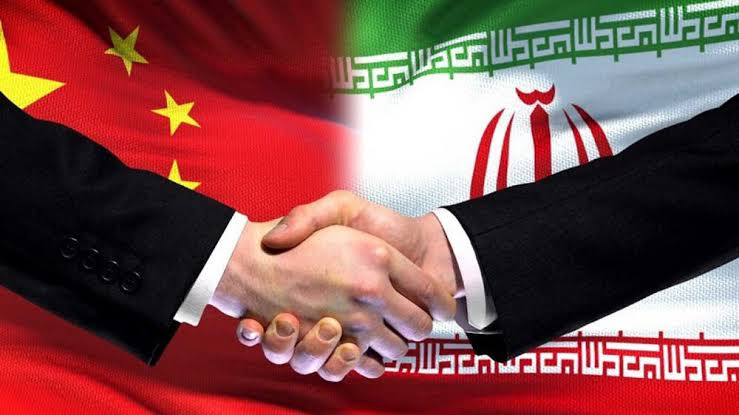
IN FOCUS
By Dincy Adlakha
China and Iran: Four major drivers
On 10 February, the Global Times published an extensive interview of Iranian Ambassador to China. In the interview, the ambassador made strong statements in support of China; he promised full support to China with a continuous supply of oil, in case a war breaks out with the US. He said: “If a war breaks out, the US would try to cut off or impede our oil supplies to China. We will not be affected by any such sanctions as we have other markets as well.” He also praised China for hosting the Winter Olympics in Beijing lavishly despite the numerous hurdles throughout the year.
Both countries have signed a Comprehensive Strategic Partnership agreement in 2021 to the protect their interests. Through the expansion of BRI, China has been able to tap the very isolated Iranian market. In this context, the interview by Ambassador Keshavarzdeh was motivated by deeper intentions and international politics rather than mere diplomatic rhetoric.
The following four points act as the drivers of bilateral relations between the two countries.
First, the opposition to western values.
China and Iran have strengthened their alliance in recent years due to their shared opposition to Western values and economic interests. Both countries have resisted attempts by the West to ‘undermine their sovereignty and political independence' as the West opposes the political system of both. China and Iran have also teamed up to resist American influence in the Middle East and oppose American efforts to promote democracy in countries such as Saudi Arabia. Iran and China have both supported Bashar al-Assad’s government in Syria, in part due to shared fears of U.S. intervention. They have also opposed the U.S. sanctions against Iran, due to their belief that the measures target the Iranian people, not the government.
Second, similar political systems and authoritarian links.
Both China and Iran have authoritarian governments, and enjoy close personal and political ties between the ruling party, military, and intelligence services. Hence, China and Iran have been very effective at working together regionally, and have displayed a willingness to put aside their differences in the face of a common adversary. This makes them both difficult enemies to work with, but a formidable strategic partnership.
Third, the US interjection and nuclear deal connections.
China-Iran alliance has become particularly important as the United States has dramatically increased sanctions against Iran since former President Trump took office. China has consistently opposed these sanctions, arguing that they violate the terms of the Joint Comprehensive Plan of Action, the economic sanctions relief deal that was signed between Iran and the P5+1 (United States, United Kingdom, France, China, Russia, and Germany) in 2015. Even though the US has continued to enforce sanctions against Iran, China and Russia have remained committed to the deal.
Fourth, bilateral interests in oil and investment.
China and Iran have signed a large number of energy and infrastructure deals, including a deal to build a railway in Iran. Iran has also become a major source of Chinese oil, with China becoming the biggest buyer of Iranian oil and the second biggest seller to China. Chinese companies have also become major players in the Iranian economy, with the Chinese taking a leading role in the development of the Iranian oil and gas industry.
Considering these factors, the new situations imply Iran’s dedicated support to Beijing and a new collaboration on the globe.
References:
Hu Yuwei and Bai Yunyi, “Joint Iranian and Chinese efforts to preserve territorial integrity, sovereignty and self-governance: Ambassador,” Global Times, 10 February 2022
William Figueroa, “China and Iran Since the 25-Year Agreement: The Limits of Cooperation,” The Diplomat, 17 January 2022
James Phillips, “Iran Looks East: Building Ties with China,” The Heritage Foundation, 21 December 2021
IN BRIEF
By Keerthana Nambiar and Avishka Ashok
INTERNAL
HKSAR office postpones the election to May amid the COVID-19 surge
On 18 February, the Hong Kong and Macao Affairs Office of the State Council postponed the election for the chief executive of China’s Hong Kong Special Administrative Region (HKSAR) stating it as “necessary, sensible and legitimate.” HKSAR Chief Executive Carrie Lam announced that the election originally scheduled for March will be postponed to May amid the surge in the COVID-19 cases. According to the statement, President Xi Jinping is deeply concerned regarding the safety and health of the Hong Kong compatriots. The office added that “the strong leadership of the central government and the full support from people all over the country, the HKSAR government and the Hong Kong society will stay united and win the battle against COVID-19 very soon.” (“HKSAR chief executive election postponement necessary, sensible, legitimate: mainland,” Xinhua Net, 18 February 2022)
INTERNATIONAL
Chinese President sends congratulatory message to Argentine President
On 19 February, Chinese President Xi Jinping exchanged congratulatory messages with Argentine counterpart Alberto Fernandez celebrating the 50th anniversary of the China-Argentina diplomatic relations. President Xi noted “writing a new chapter in the China-Argentina friendship,” reported Xinhua. Xi stressed working with President Fernandez and developing the bilateral relations to a new level. He further added that the exchanges in the field of culture, science, and technology have brought the economy of China and Argentina closer. (“Chinese, Argentine presidents exchange congratulations on 50th anniversary of diplomatic ties,” Xinhua Net, 19 February 2022)
South Korea accuses China of unfairly disqualifying its players in the Winter Olympics
On 18 February, The Strait Times published an article which explored South Korea’s current sentiments for China. The article explains that intense competition in the Beijing Olympics has extended to public life as many politicians, scholars and citizens criticize China. The anger is rooted at unfair disqualification of two South Korean speedskaters and disguising a traditional Korean costume as Chinese in the opening ceremony. Local media in the country reported continuously over the distrust and frustrations with China. (Chang May Choon, “Anti-China sentiment runs high in South Korea during Beijing Winter Olympics,” The Straits Times, 18 February 2022)
President Xi expresses sympathy to the Brazilian President regarding heavy rains in Rio de Janerio
On 18 February, Xinhua reported that President Xi Jinping sent a message of sympathy to Brazilian President Jair Bolsnaro over the casualties caused by heavy rainfall in the state of Rio de Janeiro. Xi expressed his sympathy to the family members of the victims and the missing people in the disaster-hit region. (“Xi extends condolences to Brazilian president over heavy rains disaster,” Xinhua Net, 18 February 2022)
China condones the "coercive diplomacy" of the US in Nepal
On 18 February, Chinese Foreign Ministry Spokesperson Wang Wenbin stated in a press conference that China is opposed to the “coercive diplomacy” that the US is employing by endorsing Millennium Challenge Corporation in Nepal. MCC is a 2017 deal between the US and Nepal to improve electric and road facilities for good connectivity within the country. However, political parties in Nepal are divided over the deal and many protests and rallies have opposed the same. China discourages such acts by the US which misguide and coerce countries into agreements. (“China opposes ‘coercive diplomacy’ of US in pushing MCC compact in Nepal,” Global Times, 18 February 2022)
Tunisia signs four-year implementation plan for cultural cooperation with China
On 18 February, Tunisia signed a four-year implementation plan with China to promote cultural cooperation in the fields of cinema and cultural digitization. Tunisian Culture Minister Hayet Guermazi said: “Tunisia will work in cooperation with China to organize the first Chinese-Tunisian film festival,” during the signing ceremony of the Tunisia-China Cultural Cooperation Protocol 2021-24 Executive Program. Chinese Ambassador to Tunisia Zhang Jianguo stated, “Culture is the foundation of any tie, whether it is political, social, economic or even strategic.” She quoted the protocol “will help us, together, to promote Tunisian-Chinese cooperation in the cultural field to generalize to other sectors.” (“Tunisia, China sign 4-year implementation plan for cultural cooperation,” Xinhua Net, 19 February 2022)
18 February 2022 | Friday | China Reader Evening Brief | Vol.1, No. 118
Escalating tensions in US-China trade relations
US Commerce department adds 33 Chinese companies to the “Unverified List”
.jpg)
IN FOCUS
By Keerthana Nambiar
Escalating tensions in US-China trade relations
On 7 February, the US government announced that 33 Chinese organizations will be facing new restrictions on transactions stating their inability to prove legitimacy. The Commerce Department’s Bureau of Industry and Security announced that they will be adding companies to the “Unverified List” and will be subjected to stricter export control. Matthew Axelford, the department’s assistant secretary for export enforcement said: “The ability to verify the legitimacy and reliability of foreign parties receiving US exports through the timely completion of end-use checks is a core principle of our export control system.”
The department also said that the addition of 33 organizations from China to the Unverified List “will assist US exporters in conducting due diligence and assessing transaction risk, and signal to the PRC government the importance of their cooperation in scheduling end-use checks.”
On 8 February, China’s commerce ministry made a statement saying that Washington must correct its “wrongdoings” and should return to cooperation and contribute to the global economic recovery. The list contains 175 entities, including from Russia and the UAE.
The new technology restrictions imposed on China by the US represents the escalation of the decoupling policy of the Biden administration. The initial crackdown on Chinese tech companies began under the Trump administration in line with the US Congress passing the America Competes Act of 2022. In 2019, the initial tone of the trade conflict between Washington and Beijing was based on export controls and increased tariffs on Information and Communication Technology products. By 2020, the US imposed full restrictions on tech companies like Huawei and Tencent Holdings, and other larger Chinese tech companies.
The concerns raised by the US in the technological sphere about China were threats posed to US security. Since the escalation of political and economic conflict between the US and China, Washington fears the Chinese government aid to the tech companies and the possible disclosure of sensitive information through computer networks. China believes that the true drive behind US imposing restrictions is based on a power struggle. China’s technological rise poses a threat to US dominance.
The US-China tech war is slowly disrupting the highly-integrated global market system. China sees the negative trade imbalance between Washington and Beijing as alarming. The extent of dependency between China and the US is complex and intertwined with each other.. As far as China is concerned, the US initiated the trade war, and China has not retaliated or employed any measures to disrupt trade and supply chains.
References
“US adds 33 Chinese companies to red flag list, unseals Hytera indictment,” South China Morning Post, 8 February 2022
“China urges US to correct mistake in targeting 33 Chinese firms,” Global Times, 8 February 2022
“US-China tech war: Washington’s latest unverified list hits at the most vulnerable parts of China’s technology supply chain,” South China Morning Post, 13 February 2022
“GT Voice: US’ reported trade moves against China don’t bode well for anyone,” Global Times, 15 February 2022
IN BRIEF
By Dincy Adlakha and Avishka Ashok
INTERNAL
Beijing Organizing Committee for the Olympic Games spokesperson gives strong political statements on Xinjiang and Taiwan
On 17 February, Yan Jiarong, spokesperson for the Beijing Organizing Committee for the Olympic Games (BOCOG) released strong political statements in a first. The spokesperson said that the claims of forced labour in Xinjiang are a lie and that Taiwan is an inseparable part of China. Previously, any such political statement has been avoided by the Committee. The spokesperson said that China has a “very solemn position” on the matters. She had answered a question pertaining the reports of Taiwanese delegates boycotting the closing ceremony of the games. (Liu Zhen, “Beijing Olympics official decries reports of Xinjiang forced labour, calling them a ‘lie’,” South China Morning Post, 18 February 2022)
Zhejiang province pledges to expand middle-income group for common prosperity
On 17 February, the Chejiang province of China vowed to implement measures aiming at expansion of middle-income group to support the common prosperity pursuit. The Deputy Chief of the province Xie Xiaobo said: “The goal is to form an olive-shaped social structure with the middle-income group as the mainstay.” He promised that 80 per cent of the household from Zhejiang will earn between 100,000 yuan to 500,000 yuan per year. He also promised to provide special support to college graduates and introduce measures to promote Chinese-style modernization. (“China's Zhejiang vows to expand middle-income group,” People’s Daily, 18 February 2022)
ECONOMY
Declining food prices control Chinese inflation
On 17 February, People’s Daily reported that China’s inflation further controlled in January 2022 as the food prices declines. The prices of coal and steel sectors also retreated moderated the inflation. The Consumer Price Index which is an indication of average expenditure of an average household reduced from 1.5 to 0.9 in January. The CPI is the biggest indicator of inflation. The food prices that saw a 3.8 per cent decline at year-on-year basis was majorly pushed by decline in the price of pork, a staple food in China. (“China's inflation moderates in January, tempered by food prices,” People’s Daily, 17 February 2022)
China set to increase gas and diesel prices
On 17 February, the National Development and Reform Commission of China announced that authorities will increase the prices of gasoline and diesel with effect from 18 February. The price of gasoline will increase by 210 yuan and that of diesel by 200 yuan. The top economic planner of China attributed the reason for the price increase to international crude oil price change. The three biggest suppliers of oil in China including China National Petroleum Corporation, China Petroleum & Chemical Corporation, and China National Offshore Oil Corporation have been asked to maintain production, transportation and stable supply of the fuels. (“China to raise prices of gasoline, diesel,” People’s Daily, 18 February 2022)
INTERNATIONAL
US trade report accuses China for not liberating markets
On 17 February, the Office of the US Trade Representative released its annual report that pointed China is falling back on its commitments of liberating the markets. The report says that Chinese trade practices are in contradiction to the WTO rules as they have not been opened for foreign competition. While speaking on the matter, the US Trade Representative Katherine Tai said: “China has instead retained and expanded its state-led, non-market approach to the economy and trade.” The report found Chinese leadership not dedicated to the cause and mentioned: “China’s leadership appears confident in its state-led, non-market approach to the economy and trade and feels no need to conform to global norms.” (“U.S. accuses China of backing away from free-trade commitments,” The Asahi Shimbun, 17 February 2022)
President Xi conveys celebratory message to Sri Lanka on 65th anniversary of diplomatic relations
On 17 February, President Xi Jinping sent a congratulatory letter to China-Sri Lanka political parties conference to mark the 65th anniversary of diplomatic ties between the two countries. He also commemorated the 70th anniversary of the Rubber-Rice pact in the letter. He appreciated the collaborative fight against COVID-19 by China and Sri Lanka. He also said: “China-Sri Lanka relations are a good example of friendly coexistence and mutually beneficial cooperation between countries different in size.” His letter generated hope of continued friendship and traditional bilateral relations between China-Sri Lanka. (“Xi sends congratulatory letter on 65th anniversary of China-Sri Lanka diplomatic relations,” Xinhua Net, 17 February 2022)
China displays military aircrafts and fighter jets at Singapore air show
On 17 February, a wide range of military aircrafts and fighter, trainer jets participated in the ongoing airshow in Singapore. The jets presented during the event were recently procured by the Aviation Industry Corporation of China (AVIC). The Singapore airshow was the first international exhibition that AVIC participated in this year. Through the air show, China displayed multiple-featured aviation designs to prospective buyers from the region. South East Asia does not have many advanced military planes and China offered the same at the airshow. (Liu Xuanzun, “China offers fighters, training aircrafts, choppers and drones at the Singapore Airshow,” Global Times, 17 February 2022)
17 February 2022 | Thursday | China Reader Evening Brief | Vol.1, No. 117
President Xi calls for a political settlement on the Ukraine issue
The remarks were made during President Xi’s telephonic conversation with French President Emmanuel Macron.
IN BRIEF
By Dincy Adlakha and Avishka Ashok
INTERNAL
President Xi calls for a political settlement on the Ukraine issue
On 16 February, Chinese President Xi Jinping stressed “the related parties should stick to the general direction of political settlement of the Ukraine issue,” reported Xinhua, President Xi stressed on using multilateral platforms like ‘Normandy Format’ for a comprehensive settlement of the Ukraine issue through dialogue and consultation. The remarks were made during President Xi’s telephonic conversation with French President Emmanuel Macron.(“Xi urges related parties to adhere to political settlement of Ukraine issue,” Xinhua Net, 16 February 2022)
Civil Aviation Administration comes up with plan to improve China’s air logistics
On 16 February, Xinhua reported that the Civil Aviation Administration of China issued a plan to build a preliminary “safe, smart, efficient and green” air logistics system by 2025. The plan explains that to expand the scope of cross-border services and cooperation equal attention will be given to cargo and passenger transport which will expand the air logistics companies. The administration showed data of the steady progress made by China’s air logistics companies. By the end of 2020, Beijing’s air cargo transport services were made available in 237 domestic cities and 63 countries around the world. (“China to build green air logistics network by 2025,” Xinhua Net, 16 February 2022)
ECONOMY
Intermediate People’s Court freezes Evergrande assets due to missed payments
On 16 February, the Guangzhou Intermediate People’s Court froze the assets of Evergrande Group due to missed construction payments. Shanghai Construction, a state-owned firm, had sued Evergrande in December as the group failed to pay construction fees. Releasing the judgment on the case, the Court froze 361.5 million yuan worth bank deposits and real estate of Evergrande. With this, many suppliers and contractors have also taken up legal fight against Evergrande as the group crosses USD 300 billion liabilities. (“China courts freeze $157 mln of Evergrande assets over missed construction payments,” Reuters, 17 February 2022)
National Bureau of Statistics reports on the slowdown of inflation in China
On 16 February, the National Bureau of Statistics (NBS) released a statement saying in 2021, the producer price index (PPI) increased by 9.1 per cent in China. The inflation had eased to its slowest pace and consumer growth softened during the last six months. This was mainly due to the property sector crackdown, COVID-19 restrictions and government policies in reigning the material costs. (“China's inflation slows, leaving room for policy easing,” Reuters, 16 February 2022)
TECHNOLOGY
Tencent Holdings signs new deal amid competition with short video-sharing apps
On 16 February, South China Morning Post reported that Tencent Holdings has agreed to pay USD 284 million to secure streaming rights for over 6,000 films and television series. The new deal comes in due to the competition among video streaming service providers in China to retain the attention of online audiences. Tencent will given exclusive rights to broadcast the content and attract the viewers with unique content . (“Tencent signs US$280 million deal for streaming rights to 6,000 films and shows amid rivalry with short video apps,” South China Morning Post, 16 February 2022)
REGIONAL
Chinese aircraft observed near Taiwan occupied island
On 16 February, Global Times reported that a Chinese mainland aircraft was spotted near Taiwan-occupied Dongyin island. The island is located near the coast of mainland. It is speculated by Taiwanese experts that the aircraft rounded up the territory to test Taiwan’s response measures. Additionally, Chinese experts claimed that the incident was evidence of Taiwan’s wear military air defense capabilities. They also suggested that such flights may become a routine activity and might even include other territories, in case Taiwan continues provoking China for secession. (Liu Xuanzun, “Mainland aircraft spotted near Taiwan-occupied island ‘exposes weak air defense’,” Global Times, 16 February 2022)
INTERNATIONAL
China and France promise increased bilateral cooperation
On 16 February, President Xi Jinping talked to President Emmanuel Macron on phone. During their conversation, the two leaders vowed improved Sino-France relations. A major part of the conversation was dedicated to progress of ratification of the China-European Union investment deal signed in 2020. The deal aims to lead both parties to newer levels of development. Emmanuel Macron is the current rotating president of the EU. He praised Beijing for the successful opening ceremony of Beijing Olympics and displayed hopes of a potential comprehensive strategic agreement between China and France. The two sides will also conduct subgroup meetings on aerospace and internet technology under their China-France Strategic Dialogue. (Xu Wei, “Xi, Macron vow to boost cooperation,” China Daily, 17 February 2022)
China accuses US for exaggerating Russian threat in Ukraine situation
On 16 February, the Chinese Foreign Ministry Spokesperson Wang Wenbin said that US is exaggerating the Russian threat in Ukraine to create tension. He cited the remarks made by US President Joe Biden on 150,000 Russian troops stationed near Ukraine’s border despite a pullback announcement. He also said the US and other western nations are consistently suggested arms control and diffusion of stand-off which instilled fear in the citizens and made them relocate from Ukraine. He said: “Such persistent hyping up and disinformation by some Western countries will create turbulence and uncertainty to the world full of challenges, and intensify distress and division. We hope relevant parties will stop such disinformation campaigns and do more to benefit peace, mutual trust and cooperation.” (“China says U.S. is exaggerating Russian threat to Ukraine,” Reuters, 16 February 2022)
16 February 2022 | Wednesday | China Reader Evening Brief | Vol.1, No. 116
China on Ukraine: Why does Beijing speak Russian?
The essay looks into China's actions in Ukraine and explores how its ties with Russia impacts the relationship.
.jpg)
IN FOCUS
By Avishka Ashok
Reducing China on Ukraine: Why does Beijing speak Russian?
On 3 February, the Chinese Foreign Ministry made a statement on the Russia-Ukraine tensions after the Foreign Ministers of both countries assessed the situation during the meeting in Beijing. The Chinese representative Wang Yi agreed with Russia’s security concerns, considering the threat posed by the US and NATO. The joint statement released by the two countries said: “The sides oppose further enlargement of NATO and call on the North Atlantic Alliance to abandon its ideologized cold war approaches, to respect the sovereignty, security and interests of other countries, the diversity of their civilizational, cultural and historical backgrounds, and to exercise a fair and objective attitude towards the peaceful development of other States.”
The Chinese representative in the United Nations Security Council referred to a “megaphone diplomacy” of the US and urged countries to resolve issues by engaging in a dialogue with the involved countries, Russia and Ukraine. He said: "The parties concerned should persist in seeking to resolve their differences through dialogue and negotiations. What is urgently needed now is quiet diplomacy, not megaphone diplomacy." The Policy Director at Brookings Institute observed that China’s actions in the past few weeks denote its goal to get back at the US and other Western countries by allying with Russia and presenting resistance to their soft power.
The Sino-Russian friendship
China’s intentions in Ukraine are not simply aimed at resisting the US and other hostile countries. The China- Russia friendship has evolved now compared to the frosty relationship they shared earlier.
The Ukraine issue has constantly pushed Russia and China towards each other. In 2014, during the Crimean crisis, there was a similar handshake; China refused to blame Russia for the tensions and instead accused the West of meddling needlessly. In 2022, China and Russia are backing each other in almost every international organization and have become each other’s strategic allies.
China agreed to invest over USD 400 billion in Gazprom when the US and other Western countries sanctioned it for its actions near the Ukraine border. The investment will last for another 30 years, reassuring the cooperation and paving the way for more investments in the coming years. The joint statement issued by China and Russia before the commencement of the Winter Olympics also sought to deepen this cooperation between the countries and assure support on issues of mutual interests.
According to political analysts, other than the friendship and the desire to trigger the liberalists, China also views the Ukraine and Taiwan issues in the same light. Essentially, both countries view a part of another country as their territory. China could use Russia’s annexation of Crimea in 2014 as leverage to gain support from the Kremlin for its plans to reunify Taiwan with the mainland. The joint statement by the two countries during the Xi-Putin meeting in Beijing reiterated Russia’s stance on Taiwan. It clarified that it stands against any form of independence on the island. The statement read: "The Russian side reaffirms its support for the One-China principle, confirms that Taiwan is an inalienable part of China, and opposes any forms of independence of Taiwan."
Between pro-Russia and balancing its trade with Ukraine
China continues to maintain good trade relations with Ukraine. Between 1994 and 2019, Ukraine’s exports to China increased from USD 410 million to USD 3.94 billion. China also exported goods worth USD 7.36 billion in 2019. In the same year, China overtook Russia to become Ukraine’s largest trading partner. Although the trade volume has decreased during the pandemic, the trade continues to create opportunities in both China and Ukraine. However, in case of a full-blown war, it is uncertain if China would refrain from siding entirely with Russia because of its trade ties and a lucrative market for its products.
References:
“China, Russia 'coordinated positions' on Ukraine, says Chinese foreign ministry,” Reuters, 3 February 2022
“Explained: The China-Russia relationship,” The Indian Express, 10 February 2022
“What China thinks of possible war in Ukraine,” The Economist, 29 January 2022
“China’s Careful Dance Around the Ukraine Crisis,” Counter Punch, 10 February 2022
“What Does China Gain From The Ukraine Crisis?” The ASEAN Post, 4 February 2022
“China (CHN) and Ukraine (UKR) Trade | OEC,” The Observatory of Economic Complexity, n.d,
IN BRIEF
By Dincy Adlakha and Avishka Ashok
INTERNAL
Chinese authorities call for strict crackdown on cross-border gambling
On 15 February, Xinhua reported that the Chinese State Councilor and Minister of Public Security Zhao Kezhi addressed a meeting of the department. In the meeting, he urged the authorities to increase efforts to curb cross-border gambling prevalent in China. He said that the issue affects China majorly and the existing foreign gambling groups in China must be eliminated. He also called for greater international cooperation in terms of law regulation and enforcement to solve the issue. Additionally, public awareness is an integral measure to reduce the prevalence of these gambling groups. He generated faith in the long-term results of proposed crackdown measures. (“China's police chief urges further crackdown on cross-border gambling,” Xinhua Net, 15 February 2022)
Small study finds Chinese mRNA vaccine weak against Omicron variant
On 15 February, the Straits Times reported on a small study published by the journal Cell Research that found China’s mRNA vaccine is weaker as compared to the booster vaccines against the Omicron variant. The candidates of mRNA vaccine showed sharp decline in their antibodies responsible for neutralizing Omicron effects. However, the booster doses effectively induced antibody production in animals. China has not approved the mRNA vaccine yet. However, 87 per cent of its population is vaccinated through one or the other indigenously produced vaccines. (“China's potential mRNA Covid-19 vaccine weaker against Omicron: Study,” The Straits Times, 15 February 2022)
Website of UK based human rights group inaccessible through some networks
On 16 February, the Chief Executive Benedict Rogers of Hong Kong Watch, a UK-based human rights group said that the group’s website is not accessible through some networks. This raised concerns over internet censorship in the city as imposed under the National Security Law. He argued for the freedom of speech on internet and said: “If this is not just a technical malfunction, and Hong Kongers will no longer be able to access our website because of the national security law, then this is a serious blow to internet freedom.” (“Hong Kong rights group says website not accessible through some networks,” The Straits Times, 16 February 2022)
Premier Li Keqiang pledges support to the country’s industrial and services sector
On 15 February, the Chinese Premier Li Keqiang chaired the State Council’s Executive meeting and announced that the country will boost its industrial economy and support the services sector in light of difficult situations. The meeting explored the role of the industrial sector in the country’s economic development. Li said: “We are introducing the relief policies for industrial and services sectors in special difficulty first this year, as part of the effort to frontload policies as appropriate.” (“China to step up support for industrial and services sectors in special difficulty,” Xinhua Net, 15 February 2022)
REGIONAL
Rail-sea transport freight train launched from Xi’an
On 15 February, Xinhua Net reported that the India-China rail-sea freight train had left from the Xi’an international port station. The train will unload the goods at Huangdao port after which the goods will be transported to India via ferry. Solar panels and solar modules are being transported in 50 containers and will reach its destination in 20 days. In 2022, this is the first rail-sea freight train launched from Shaanxi province to India. (“China's Shaanxi launches rail-sea transport freight train to India,” Xinhua Net, 15 February 2022)
INTERNATIONAL
Chinese Foreign Ministry urges the US to unfreeze Afghan assets
On 15 February, the Chinese Foreign Ministry Spokesperson Wang Wenbin addressed a press briefing and urged the US to free the Afghan assets in the Central Bank of Afghanistan. Wang referred to the frozen USD 7 billion assets of the bank and said: “The United States seized Afghan assets without the consent of the Afghan people, which is tantamount to robbery. This is no different from the conduct of bandits.” (“China urges U.S. to lift asset freeze, unilateral sanctions on Afghanistan,” Xinhua Net, 15 February 2022)
Philippine presidential candidate promises peace panel to negotiate with China
On 15 February, Manny Pacquiao, the boxer-turned-politician Presidential candidate of the Philippines attended a virtual forum organized by a foriegn correspondents association. In his address to the forum, he promised to shift his priorities and deepen ties towards the US. He also vowed to form a peace panel to resolve the problems with China. On the matter, he said that China “should not abuse and trample on the Philippines' rights.” Apart from other domestic promises, negotiation with China on the South China Sea dispute concerning the Philippines was a major part of the promised actions. (“South China Sea: Manny Pacquiao to form peace panel to resolve row with Beijing if elected Philippine president,” South China Morning Post, 16 February 2022)
Ugandan artists fuse Chinese and African music to encourage population and cultural exchange
On 15 February, Xinhua reported that Ugandan artists have been mixing Adrican and Chinese music to create a new genre of music. The fused melodies are played in front of a Chinese audience. The performance makes use of African traditional wear and Chinese popular songs. Despite difficulty in mastering foreign music, the themes of patriotism and love led to exchange of art. The artists said “We are trying to strengthen the friendship between Uganda and China. China has been in a relationship with Uganda for some good time, when it comes to trade but this time we want to do it socially through music.” (“Feature: Ugandan artists fuse Chinese, African music to strengthen people-to-people ties,” Xinhua Net, 15 February 2022)
15 February 2022 | Tuesday | China Reader Evening Brief | Vol.1, No. 115
Reducing unplanned pregnancies: A new initiative in China
China’s family planning agency comes with new initiatives for abortion, improving reproductive health among the adolescents and youth.
.jpg)
IN FOCUS
By Keerthana Nambiar
Reducing unplanned pregnancies: A new initiative in China
On 28 January, China Family Planning Association published a report titled “Key Points of Work of the China Family Planning Association in 2022” on its official website. It outlined a “campaign of intervention” to reduce unplanned pregnancies among adolescents and unmarried women. On 11 February, Global Times reported that “the report aimed to protect national fertility and public health by preventing unwilling and unexpected pregnancies, rather than forcibly banning abortions.”
The report covers twelve points main points of the China Family Planning Association 2022. The highlight is article nine of the report which talks about “solidly promote reproductive health services.” It explains that special measures would be taken to reduce unintended pregnancies and abortions among adolescents. It also intends to deliver “sexual and reproductive healthcare around the world.”
The importance of sex education
The new policy promises to bring in projects, training, and courses promoting and educating the youth about reproductive healthcare. According to Wang Pei’an, a former top official in China’s family planning bureaucracy explained that the reproductive health problems among adolescents damage the physical and mental health leading to “pose a major threat to national population security and future national competitiveness,” reported Wall Street Journal.
The ying-yang of the new initiative
With the new development, the association plans to promote sex education, crackdown the illegal abortion clinics, and increase the accessibility of contraception to young people. This measure can be considered as a way out of China’s distorted demographic patterns in the coming years. Beijing has the largest abortion rate in Asia and new policies will navigate China’s future demographic ratio and population.
The new policy details remain ambiguous as far as unmarried pregnant women are concerned. In China, single mothers are denied the benefits that are rightly eligible for pregnant women. The marriage certificate is a necessity in public hospitals in China for routine checkups and child delivery. This pushes unmarried women out of choices. Due to the lack of support from the government, unmarried women are forced to terminate their pregnancies.
China’s demographic challenge
The new initiative is a measure to avoid unwanted pregnancies and abortions. In 1991, 14 million abortions were performed in China after the government enforced the one-child policy. In 2020, the number dropped to just below nine million. China is well aware of the demographic challenge but the rapid speed of an aging population and decline in birth rate will paralyze China in the coming years. The association plans to tackle the problem by deeply reforming National Family Planning, building on the culture of marriage and childbirth, pre and postnatal care guidance, and educating the youth on reproductive health.
References:
“China Tries to Dial Back Its High Abortion Rate,” Wall Street Journal, 11 February 2022
“China’s family planning roadmap aimed at protecting national fertility, not banning abortion: experts,” Global Times, 11 February 2022
“China’s family planning agency says it will ‘intervene’ in abortions for unmarried women, teens,” South China Morning Post, 11 February 2022
“The key points of work issued by the China Family Planning Association: In 2022, a special action for artificial abortion intervention for unmarried people will be launched,” muyingjie.com, 10 February 2022
IN BRIEF
By Dincy Adlakha and Avishka Ashok
INTERNAL
Foreign Ministry responds to International Labor Organization’ committee report
On 14 February, the Chinese Foreign Ministry Spokesperson Wang Wenbin reiterated that there was no discrimination against ethnic minorities in Xinjiang after the International Trade Union Confederation cited a report by a committee of the International Labor Organization which expressed concern regarding the State’s policies in the region. Wang Wenbin responded to the claims and said: “The Chinese government attaches great importance to the protection of workers' rights and interests, protects the equal right to employment of workers of all ethnic groups, and ensures their equal right to participate in economic and social life and enjoy the achievements of economic and social development.” (“No employment discrimination against ethnic minorities in Xinjiang: Chinese FM,” Global Times, 15 February 2022)
Global Times declares Beijing Winter Games as the “most gender-balanced”
On 14 February, Global Times reported that Beijing Olympics 2022 is the most “gender-balanced Winter Olympics Games ever in history.” At Beijing, more than 1,300 female athletes participated marking a record pf 45 per cent at the Games. Winter Games spokesperson Yan Jiarong said that the women are better represented at the Winter Games “solidifies women’s role in holding up half the sky on the sports stage,” reported Global Times. IOC Presidential Spokesperson Mark Adams also made a statement saying that we should not take away opportunities from athletes on the basis of their age rather provide support for athletes. (“Beijing Winter Olympics most gender-balanced Winter Games ever,” Global Times, 14 February 2022)
REGIONAL
Taiwan joins the US and Australia in WTO case against China
On 15 February, the Taiwanese Foreign Ministry spokesperson Joanne Ou announced that Taiwan had joined hands with the US and Australia and supported the European Union trade case against China at the World Trade Organization. China has been accused of using discriminatory practices against Lithuania and threatening the integrity of the EU’s market. Joanne said: “China's economic coercion has violated international economic and trade norms and should not be tolerated.” (“Taiwan joins WTO case against China over Lithuania,” The Strait Times, 15 February 2022)
China firmly opposes US Indo-Pacific Strategy on Taiwan-related content
On 14 February, Chinese mainland spokesperson expressed opposition against the Taiwan-related content in US Indo-Pacific Strategy. Ma Xiaoguang, spokesperson for the Taiwan Affairs Office of the State Council, said that the content has “gravely interfered in China's internal affairs, violated the one-China principle and basic norms governing international relations, and undermined peace and stability across the Taiwan Strait,” reported Xinhua. The spokesperson urged US to abide by the one-China policy and not to collude with “Taiwan Independence” forces. (“Chinese mainland opposes Taiwan-related content in "U.S. Indo-Pacific Strategy",” Xinhua Net, 14 February 2022)
INTERNATIONAL
China urges member countries of the UN to improve on peacekeeping operations
On 14 February, the deputy permanent representative to the United Nations Dai Bing attended the Special Committee on Peacekeeping Operations and urged the member countries to improve the operations. Dai said: “While the COVID-19 pandemic continues to rage on, unilateralism, the Cold War mentality and bullying are also on the rise, leading to more challenges in the field of international peace and security there is a need to continue to improve UN peacekeeping operations and better leverage their role.” He also emphasized the importance of the African Union and its role in resolving the conflicts in the African continent. (“Chinese envoy calls for further improvement of UN peacekeeping,” Xinhua Net, 15 February 2022)
Chinese Foreign Ministry claims that the mission in Ukraine is working normally
On 14 February, the Chinese Foreign Ministry Spokesperson Wang Wenbin addressed a press briefing and announced that the diplomatic mission in Ukraine was functioning as per usual. He also called for all countries involved in the rising tensions to avoid further escalation of tensions and react rationally. He said: “The Chinese Embassy in Ukraine issued a reminder instructing local Chinese nationals and institutions to pay close attention to the situation in Ukraine and enhance security awareness.” “Chinese diplomatic mission in Ukraine working normally: Chinese FM,” Global Times, 14 February 2022)
China and France signs fourth round of demonstration projects
On 14 February, National Development and Reform Commission (NDRC) announced that China and France signed the fourth round of demonstration projects on the third-party cooperation with an investment of more than 1.7 billion dollars. The NDRC said that China-France cooperation will focus on basic infrastructure construction, energy, equipment building and the internet. According to NDRC, Beijing and Paris have managed to tackle the impact of pandemic and successfully completed the batch of projects in Africa, Southeast Asia, Central and Eastern Europe. (“China, France sign new demonstration projects on third-party markets,” Global Times, 14 February 2022)
Ethiopia inaugurates the new headquarters of the Commercial Bank constructed by China
On 14 February, Global Times reported that Ethiopia inaugurated a 209.15 meter-tall landmark at the heart of capital city. The new headquarters of the Commercial Bank of Ethiopia in Addis Ababa was constructed by7 China State Construction Engineering Corporation. Ethiopian Prime Minister Abiy Ahmed said “This very modern skyscraper will serve our generation and beyond in a view to address emerging advancements in the banking sector as well as future expectations, ” reported China.org. PM Ahmed further added that, “The learning endeavor during our stay with our Chinese colleagues has been another milestone.” (“Tallest building in East Africa built by Chinese enterprises completed,” Global Times, 14 February 2022; “Ethiopia inaugurates Chinese-built landmark building in capital,” China.org.cn, 15 February 2022)
14 February 2022 | Monday | China Reader Evening Brief | Vol.1, No. 114
Carrie Lam admits overwhelmed capacity under fifth wave of COVID-19
The Chinese government attempts to quell the surge in COVID-19 cases
IN BRIEF
By Keerthana Nambiar and Avishka Ashok
INTERNAL
Carrie Lam admits overwhelmed capacity under fifth wave of COVID-19
On 14 February, Hong Kong Leader Carrie Lam said that the fifth wave of the pandemic has left the city overwhelmed and the capacity to deal with daily caseload decreases as new records set each day. She also said that the authorities will coordinate with the mainland officials to tackle the damaging situation at hand. Assistance is expected in testing, treating and quarantining. The daily caseload in Hong Kong is doubling every few days and the city recorded eight pandemic related deaths in the last week. (“Hong Kong leader Lam says fifth Covid-19 wave has overwhelmed city’s capacity,” The Straits Times, 14 February 2022)
President Xi signs new regulations for the PLA’s equipment
On 13 February, Global Times reported that President Xi Jinping approved a new set of regulations for the People’s Liberation Army’s test and assessment of military equipment. The new regulation puts emphasis on efficiency and combat-oriented tests. The regulations comprise 56 articles and detail the basic tasks, contents and maintenance requirements of the military equipment. Military analysts in the country believe that these tests and assessments are essential for the weapons to function efficiently at the time of its use. (“China's new military equipment experiment regulations eye combat capability boost,” Global Times, 13 February 2022)
REGIONAL
The Straits Times covers Taiwan’s response to the pandemic
On 13 February, the Straits Times published an article that suggested Taiwan may have to consider living with COVID-19. The article assessed that Taiwan’s zero COVID strategy has not yielded many results and despite sealing the border for two years, the island still receives COVID cases. The policy has helped in keeping the caseload low, however, the number has not dropped to zero. The article suggested that despite the best efforts of the authorities, the island will have to treat COVID as an endemic. (Katherine Wei, “After sealing borders for two years, Taiwan may have to consider living with Covid-19,” The Straits Times, 13 February 2022)
INTERNATIONAL
Six Chinese firms file for small IPOs in New York listings after month-long freeze
On 14 February, Reuters reported that six Chinese companies have filed documents and applications to be listed in the New York Stock Exchange as the month-long freeze imposed by Chinese regulators. The Chinese authorities had imposed unprecedented crackdowns that forbade Chinese companies to enlist in the NYSE. The six companies that are lodging their documents plan for small size IPOs ranging from USD 1 million to USD 35 million. Some analysts said that the listings are so small to hold any relevance. However, the listings are from technology and electronic component industries that always remain under strict scrutiny. (Samuel Shen and Scott Murdoch, “Some Chinese firms revive New York IPO plans after regulatory crackdown,” Reuters, 14 February 2022)
The US attempts to bridge the gap in the Indo-Pacific to counter China’s influence in the region
On 13 February, Global Times reported on the strategy paper issued by the US on its Indo-Pacific strategies. The paper announced the US plans to open an embassy in the Solomon Islands and getting closer with the Pacific Island countries in the wake of heightened Chinese presence in the region. Political analysts within China observed that the US strategy in the Indo-Pacific showcases its anxiety over China’s closer relations with the countries in the Indo-Pacific. (“US steps up moves to woo Pacific island countries after releasing Indo-Pacific strategy,” Global Times, 13 February 2022)
12 February 2022 | Saturday | China Reader Evening Brief | Vol.1, No. 113
The US releases strategy paper on the Indo Pacific
The paper calls for greater cooperation to counter China’s influence and aggression in the Indo-Pacific.
IN BRIEF
By Keerthana Nambiar and Dincy Adlakha
INTERNAL
China conditionally approves Pfizer drug against COVID-19
On 12 February, the National Medical Products Administration of China announced that it has given conditional approval to Pfizer’s COVID-19 treatment drug Paxloid. The experts suggest that this drug will increase confidence and fight against COVID-19 in the country. The experts also cleared that they are still dedicated to the country’s “dynamic zero case strategy” against COVID-19. Paxloid is the first anti-COVID-19 oral drug that has been approved in China for adult patients with mild to moderate COVID-19 symptoms. Experts opine that the drug will be helpful for patients with previously existing diseases like diabetes, cardiovascular and chronic lung disease. (Liu Caiyu, “China gives green light to Pfizer’s COVID-19 treatment drug Paxlovid, doesn’t waver the country’s determination for ‘dynamic zero case‘ strategy,” Global Times, 12 February 2022)
ECONOMY
Chinese regulators plan to weed out hoarding and speculation in iron ore industry reducing stock value
On 10 February, China’s top economic planner and market regulator National Development and Reform Commission (NDRC) announced that the authorities shall inspect domestic commodity exchanges and major ports to crack down on hoarding and speculation of iron ore in the industry. The announcement sent iron ore stocks on the Dalian Commodity Exchange down to USD 126 per ton. NDRC has laid out plans with State Administration for Market Regulation (SAMR) to examine stockpiles, spot trading, futures and hoarding of iron ore. The decision erased the recorded profits from the previous day. (“Chinese regulators to inspect iron ore market, vow to crackdown on hoarding and speculation,” Global Times, 11 February 2022)
INTERNATIONAL
Chinese foreign minister urges enhanced ties with Netherlands
On 11 February, Chinese Foreign Minister and State Councilor Wang Yi spoke with the Deputy Prime Minister and Foreign Minister of Netherlands WOpke Koekstra on phone. Foreign Minister Wang Yi congratulated the Dutch counterpart on assuming new position. He also mentioned that Netherlands is an important partner from Europe and also praised the trade and investment ties of both countries. The two officials also marked that China and Netherlands mark 50 years of diplomatic ties this year. The two sides exchanged positive remarks on multiple issues like the Olympics, pandemic cooperation, trade relations, bilateral exchanges and the like. (“China, Netherlands to enhance ties, cooperation,” Xinhua Net, 12 February 2022)
Chinese passengers get misdiagnosed and stranded at Denmark airport
On 12 February, 45 passengers travelling from Britain to Shaghai were stranded at Copenhagen international airport as they were misdiagnosed for COVID-19. Their flight was making a transitory stop at the Denmark airport. However, due to faulty tests conducted by an independent operator in a rented premises at the facility, the 45 travellers were disallowed to board the flight to Shanghai. The travellers missed their flight and are currently camped out of the airport. (Erika Na, “Chinese passengers stranded in Denmark airport after Covid-19 misdiagnosis,” South China Morning Post, 12 February 2022)
The US releases strategy paper on the Indo Pacific
On 11 February, the US Secretary of State Antony Blinken released the strategy paper after he met with the senior diplomats from Japan, South Korea, Pacific Island countries and other governments. The paper calls for greater cooperation to counter China’s influence and aggression in the Indo-Pacific. The US explained that its presence in the region was anonymously desired by the states in the region and that the country would not force the other countries to pick sides. (“U.S. strategy for Indo-Pacific stresses alliances on China,” The Asahi Shimbun, 12 February 2022)
The US plans to open its embassy in Solomon Islands to counter China
On 12 February, the US Secretary of State Antony Blinken landed in Fiji after meeting with the leaders from the Quad group of countries. Blinken announced that the US was planning on opening its embassy in the Solomon Islands to limit China’s influence in the country before it would become unmanageable. The US State Department said: “Solomon Islanders cherished their history with Americans on the battlefields of World War II, but that the U.S. was in danger of losing its preferential ties as China “aggressively seeks to engage” elite politicians and business people in the Solomon Islands.” (“U.S. aims to counter China by opening Solomon Islands embassy,” The Asahi Shimbun, 12 February 2022)
Chinese Foreign Ministry accuses the US of using coercive diplomacy
On 11 February, the Chinese Foreign Ministry spokesperson Zhao Lijian responded to the US claims of coercing Australia and Lithuania through economic means and said that “no one has a better claim to the title of master of coercion than the United States.” Zhao referred to the US intervention in Hawaii in 1994 and called it a perfect example of coercive diplomacy. He also said: “In 2003, the United States explicitly characterized 30.3 billion U.S. dollars additional military expenses for coercive diplomacy as incurred expenses.” (“No one has better claim to "master of coercion" title than U.S.: FM spokesperson,” Xinhua Net, 11 February 2022)
11 February 2022 | Friday | China Reader Evening Brief | Vol.1, No. 112
India-China trade: High record, higher tensions
Trade between the countries reached a record despite tense relations, raising concerns of trade imbalance.
.jpg)
IN FOCUS
By Dincy Adlakha
India-China trade: High record, higher tensions
On 14 January, the General Administration of Customs in China released statistics that showed an increase in India-China trade in 2021. The bilateral trade between India and China crossed previous records and reached over 125 billion USD. While China’s exports to India amounted to 97 billion USD, India’s exports to China were 28 billion USD. The overall trade rose 43.3 per cent from 2020.
While India majorly exports raw materials to China, the imports are heavier and costlier. The biggest export from India is 2.5 billion USD worth of iron ore. Other petroleum, seafood, cotton and spices exports amount to 3 billion USD. China dominates the Indian markets with its electronic gadgets and components amounting to 3.5 billion USD. Together, all categories of electronic imports from China reached 8 billion USD. The pharmaceutical industry also imports approximately 3 billion USD. Other major imports include toys, cheap plastic products, and regular items. However, it is the component and chemical-based products that make up most imports and drive the booming industries of India.
Many analysts attributed the surge in trade to the nature of industrial chains in India and China. For instance, the pharmaceutical industry is a major growth sector in India. China exports all the right chemicals and materials required for this industry. Similarly, India’s automobile industry is dependent on China’s components and machinery. Hence, due to the complementary nature of their products and industries, 60-70 per cent of the material imports for India come from China.
Despite Indian push for Aatmanirbharta or self-sufficiency clubbed with the wave of protests boycotting Chinese goods in India last year, a large section of the Indian middle class still uses Chinese goods due to cheaper rates and better finish.
Another reason behind this surge in trade is owed to the pandemic. Throughout 2021, industries, factories and ports in most of Europe and North America were under lockdown. However, the Chinese manufacturing units were operating at high capacities before the second wave hit China. The statistics also show that even though imports from all other countries decreased for India, the imports from China increased and maintained resilience.
For India, the record trade brings concerns of trade deficit and dependency on China. India’s imports from China are four times its exports to China, raising concerns for the country. Furthermore, its exports to China are majorly primary goods, while the exports comprise value-added goods and technology. This is a warning for any country against international economic exploitation and hierarchy.
The Chinese economy is five times bigger than the Indian economy. This signifies greater national power, too. Hence, the position as a regional hegemon remains undisputed for China and gives a push to China’s global economic ambitions. China is now looking at Asia and Eastern Europe, Latin America, Africa and Central Asia as arenas of economic triumph.
References:
“China-India trade hits record high of $126 billion, up 43.3% y-o-y despite tension,” Global Times, 14 January 2022
Karunjit Singh, “Amid bilateral chill, India-China trade marks record surge in 2022,” The Indian Express, 26 January 2022
Bejoy Sebastian, “Decoding India’s ‘paradoxical’ trade ties with China,” Modern Diplomacy, 9 February 2022
Prasanna Mohanty, “Why India's manufacturing dependence on China continues to grow,” Fortune India, 9 February 2022
“Trade and Economic Relations,” Embassy of India, n.d.
IN BRIEF
By Keerthana Nambiar and Avishka Ashok
INTERNAL
Chinese central government proposes to fully support HKSAR in the latest COVID-19 surge
On 10 February, the Chinese central government spokesperson reiterated that the central government will fully support Hong Kong to counter the latest surge of COVID-19. The spokesperson said: “The central government firmly supports the HKSAR government in taking resolute measures to contain the spread of the epidemic.” (“Central gov't to fully support HKSAR in countering latest COVID-19 resurgence: spokesperson,” Xinhua Net, 11 February 2022)
China Family Planning Association report causes confusion in public
On 11 February, Global Times reported that there has been wide discussion on the internet over a report published recently by the China Family Planning Association. The controversy is around Article 9 of the report that mentions special efforts and campaigns to address and intervene in abortions among unmarried people and adolescents due to unwanted pregnancies. The association has cleared its stance that the same has been added to improve reproductive health, national fertility and public health. However, the public fears forced prevention of abortion of unexpected pregnancies. The association has explained that there will be no ban on abortions. (Wan Hengyi and Fan Anqi, “China’s family planning roadmap aimed at protecting national fertility, not banning abortion: experts,” Global Times, 11 February 2022)
PLA conducts simultaneous exercises in sea regions near Taiwan
On 10 February, Global Times reported that the People’s Liberation Army recently conducted three simultaneous exercises near Taiwan. The exercises were conducted in three major sea regions. These exercises have followed massive military combat preparedness exercises of the US and Jaan near Taiwan. The three exercises by the PLA were conducted in the East China Sea, South China Sea and the Yellow Sea. (Liu Xuanzun, “PLA holds simultaneous drills after US, Japan exercise near Taiwan island,” Global Times, 10 February 2022)
REGIONAL
Chinese embassy in South Korea makes a statement regarding the latest controvery
On 10 February. Chinese Embassy in South Korea congratulated skater Hwang Dae-Heon for winning South Korea's first gold medal at the Beijing Winter Olympics 2022. The spokesperson at the embassy said that the Olympics is not just about competition but the spirit of “togetherness.” The statement came in from the Chinese embassy after controversies between Chinese and South Korean netizens regarding Hwang and another South Korean skater Lee June-SEO being disqualified in the semi-finals of 1000 meters. (“China, S.Korea call for more exchanges to cool down sentiments in ice rink,” Global Times, 11 February 2022)
INTERNATIONAL
China’s Ministry of Commerce urges the US to remove the additional tariffs and sanctions
On 10 February, the Ministry of Commerce spokesperson made a statement at the press conference urging the US to remove the additional tariffs and sanctions, and other suppressive measures on Chinese firms. The spokesperson Gao Feng further called upon the US to provide a “conducive atmosphere” and “sound conditions” to expand the trade cooperation. Gao stressed that broadening market access will be beneficial to both China and the US. He stated that China has fulfilled its commitments within the World Trade Organization rules and China’s economic success relies on government interference. (“China urges U.S. to scrap additional tariffs, sanctions,” Xinhua Net, 10 February 2022)
China and Ecuador commences the FTA negotiations
On 10 February, Ecuadorian President Guillermo Lasso made a statement on the commencement of free trade agreement (FTA) negotiations between China and Ecuador. President Lasso said: “The global economy is a reality…. I believe that sooner or later we had to reach this point with China.” He emphasized that China will create many opportunities in Ecuador and may “find a positive path in China” by developing trade. China’s Ministry of Commerce declared that China is Ecuador’s second-largest trading partner in 2021 with 10.95 billion US dollars. (“Economic Watch: FTA negotiations with China to bring growth opportunities, says Ecuadorian president,” Xinhua Net, 11 February 2022)
Iranian Ambassador underlines joint efforts with China in GT interview
On 10 February, Global Times interviewed Mohammad Keshavarzzadeh, the Iranian Ambassador. Iran is celebrating its National Day on 11 February. The Ambassador commended the Beijing Olympics and also emphasised the joint efforts by Iran and China towards regional and global peace and stability. He also stressed that the US should be warned against falling prey to its own policies. Additionally, the ambassador also vowed a steady supply of oil to China while also suggesting prospects of increased military cooperation with China. (Hu Yuwei and Bai Yunyi, “Joint Iranian and Chinese efforts to preserve territorial integrity, sovereignty and self-governance: Ambassador,” Global Times, 10 February 2022)
US Secretary of State refuses Quad purpose as countering China
On 10 February, the US Secretary of State Anthony Blinken said to Australian Broadcasting Corporation that the purpose of Quad alliance is not to counter a rising China. He said: “This is not about standing against anyone in particular. It is about standing up for a rules-based order, making sure that we uphold those rules and principles if they’re being challenged.” He suggested that diplomacy is about ambiguity and that the Quad has a wider range of aims and functions that to merely counter China. (Jacob Fromer, “Top US diplomat denies the Quad’s purpose is to counter a rising China,” South China Morning Post, 11 February 2022)
10 February 2022 | Thursday | China Reader Evening Brief | Vol.1, No. 111
Beijing Winter Olympics: Politics, Controversies and Concerns
The Beijing Olympic Games have turned into an ideological contest underscoring the sports.
.jpg)
IN FOCUS
By Keerthana Nambiar
Beijing Winter Olympics: Politics, Controversies and Concerns
The Diplomatic Boycott
On 6 December, White House Press Secretary Jen Psaki announced that the Us was instituting a “diplomatic boycott” over the human rights concerns in the Xinjiang region. The White House reported: “The Biden administration will not send any diplomatic or official representation to the Beijing 2022 Winter Olympics and Paralympic Games given the PRC’s ongoing genocide and crimes against humanity in Xinjiang and other human rights abuses.” Australia, Canada, Denmark, Japan, Lithuania and the UK followed in the same footsteps of declaring a “diplomatic boycott.” Countries like the Netherlands, New Zealand refrained from sending officials, citing pandemic-related concerns. France and Germany refused to commit the boycott but were absent from the Chinese Foreign Ministry attendee list. On 28 January, the Chinese Ministry announced that 32 foreign heads of state, heads of government, members of royal families and heads of international organizations attended the opening ceremony of the Beijing Winter Olympic Games.
A diplomatic boycott is a high-profile action with relatively low consequences. Countries usually send a high-level delegation to the host as a sign of support and patriotism. Biden’s boycott does not bar the US athletes from participating in the Games; it depoliticizes the games with the absence of government officials. The official motto of the Winter Games, “Together for a Shared Future” has thrown a spotlight on the growing differences between China and the West. The boycott is a new competitive context that Us-China relations stepped into.
China’s game plan
China has responded angrily to the boycott, threatening that the US will “pay the price” and accusing Washington of politicizing sports against the principle of the Olympic charter. Ultimately China seems not worried about the boycott because they have experienced this before. Beijing was sure that once the games begin, athletes' performances will dominate the media, drowning the politics. In this context, the attending countries wish to solidify diplomatic ties with China and have an in-person interaction with President Xi Jinping.
Opening Ceremony
Most of the criticism surrounding the Olympic games appeared during the opening ceremony wherein representatives of 56 officially recognized ethnic groups, including the Uyghur Muslims stood together passing the Chinese flag. This raised concerns among the international community, including the Human Rights Watch, who repeatedly called for a complete boycott of the Beijing Winter Games. The presence of Taiwanese athletes garnered attention who were announced under “Chinese Taipei.”
The important variables
First, Beijing is hosting the Olympics amidst the COVID-19 restrictions. China seeks perfectly choreographed games with the plans of zero-COVID spillover. The authorities have created a “closed-loop”- a vast network of bubbles that separates the Games from the city. Second, most of the world leaders who attended the ceremony were from non-democratic regimes. The presence of Russian President Vladimir Putin’s at the games marks an important rapprochement between Moscow and Beijing. Third, the motives International Olympic Committee (IOC). China is using the IOC for obvious reasons and the IOC is rationalizing the situation rather than being a morally responsible organization.
Spirit of Olympics
China has heavily invested in the athletes and infrastructure to put up an impressive international event. President Xi Jinping views the games as an important aspect of rising China and pushing the human rights allegations by the West.
References:
“Press Briefing by Press Secretary Jen Psaki, 6 December 2021,” White House, 6 December 2021
“Xi hosts world leaders amid Olympics,” Global Times, 6 February 2022
“The Guardian view on Beijing’s Winter Games: a very political contest,” The Guardian, 9 February 2022
“Attempts to politicize, sabotage Beijing Winter Olympics "futile": spokesperson,” Xinhua Net, 3 February 2022
IN BRIEF
By Dincy Adlakha and Avishka Ashok
INTERNAL
China’s Ministry of Agriculture and Rural Affairs plans to build more eco-farms by 2025
On 9 February, the Ministry of Agriculture and Rural Affairs announced that by 2025, China plans to build 1,00 national ecological farms and 10,000 local ones nationwide. “China plans to build more ecological farms in the coming years to advance modernization and green development in the agricultural sector,” reported Xinhua. In a guideline published by the ministry, China hopes to improve to quality, efficiency and competitiveness of the agricultural sector. The document also noted that the new development will identify technical patterns, foster modern and efficient market entities and competitiveness of this sector. (“China to build more eco-farms by 2025,” Xinhua Net, 9 February 2022)
NDRC and NEA plans to stabilize coal prices
On 9 February, National Development and Reform Commission (NDRC) and the National Energy Administration (NEA) held a meeting to make plans to stabilize the coal prices. It also issued warnings to companies that “charged exorbitant coal prices” and coal producers must ensure to step up coal supplies. The meeting further said that it will rectify problems after issuing reminders, further investigating and accountability. (“China to further stabilize coal prices,” Xinhua Net, 9 February 2022)
China updates the rules on data security
On 10 February, China’s Ministry of Industry (MIIT) and Information Technology published revisions of draft rules on how companies and localities must manage data. The updated rules asks to categorize data on the basis of three sections: “industrial data,” “telecommunications data,” and “wireless data.” The law is to categorize data based on its relevance to national security and the economy. (“China revises draft rules on data security for business sectors,” Reuters, 10 February 2022)
REGIONAL
Chinese embassy in South Korea congratulates skater for winning in the Winter Olympics
On 10 February, the Chinese embassy in South Korea congratulated the South Korean short-track speed skater Hwang Dae-heon for winning the gold medal in the 1,500-meter category. The win came after a fierce competition between Hwang, a Chinese skater and another South Korean participant. Global Times reported that the win had resulted in a string of congratulatory messages on social media, from South Korean as well as Chinese citizens, showcasing the sincere friendship between the two countries. (“Chinese embassy congratulates South Korean skater Hwang Dae-heon for claiming first gold medal at Beijing 2022, Global Times, 10 February 2022)
INTERNATIONAL
Lithuania and Australia agree to cooperate on challenges posed by China
On 9 February, the Australian Foreign Minister and the Lithuanian Foreign Minister agreed to expand their cooperation on strategic challenges, with a special focus on China. The countries agreed to the plan of cooperation after the senior diplomats met in Australia, days before the Quad meeting on 11 February. The Lithuanian Minister of Foreign Affairs said: “For quite a while, Australia was probably one of the main examples where China is using economy and trade as a political instrument or, one might say, even as a political weapon. Now Lithuania joins this exclusive club ... but it is apparent that we’re definitely not the last ones.” (“Australia, Lithuania unite to counter China pressure,” Taipei Times, 10 February 2022)
China responds to BBC’s accusations on incursions in Nepal
On 10 February, the Global Times reported on the BBC’s claims of a Chinese incursion in Nepal and called it a smear campaign. The BBC made its accusations based on an allegedly leaked report by the government of Nepal. However, Chinese media and citizens have viewed the development as an attempt of the West to take away the attention on the Beijing Winter Olympics and cause false issues in the international system. A research fellow from the Institute of Chinese Borderland Studies said: “This report cannot represent the official position of Nepal.” (“BBC's China-Nepal border dispute hype a 'smear campaign',” Global Times, 10 February 2022)
Lithuanian beef exports suspended by China
On 9 February, China decided to suspend beef imports from Lithuania after the General Administration of Customs made the announcement. The Customs did not specify the reason for the suspension. Chinese Foreign Ministry refrained from elaborating on the beef suspension. Foreign Ministry spokesperson Zhao Lijian said: “ What Lithuania should do is face up to facts, redress its own mistakes, and come back to the right track of adhering to the one-China principle, instead of confusing right with wrong.” Taiwan’s Foreign Ministry said that China is trying to bully Lithuania and they “firmly stand together with Lithuania.” (“China suspends Lithuanian beef imports as Taiwan row grows,” Reuters, 10 February 2022)
US Chamber of Commerce considers alternatives to deal with China in the trading sector
On 9 February, the head of international affairs in the US Chambers of Commerce Myron Brilliant said that the US would consider a new China tariff probe in case the current negotiations with China fail. Myron also confirmed that the lobbying group in the US would attempt to create a unified front of the US allies if China disagrees to cooperate on its promise to purchase US goods, energy and services. The statements were made after the latest data revealed that despite China’s promise on fair trade, there was a massive shortfall of Chinese purchases from the US. (“New China tariff probe among options considered by Biden--U.S. Chamber,” The Asahi Shimbun, 10 February 2022)
09 February 2022 | Monday | China Reader Evening Brief | Vol.1, No. 110
The America Competes Act of 2022: What, Why and How
The latest US act aims to expand its economic capabilities and compete with Chinese dominance in the supply chains.
.png)
IN FOCUS
By Dincy Adlakha
The America Competes Act of 2022: What, Why and How
On 4 February, the House of Representatives passed the America Competes Act of 2022. The bill is aimed at increasing the economic competitive spirit and mechanisms of the US vis-a-vis China. The bill is an improvisation of earlier legislation passed by the Senate - the US Innovation and Competition Act of 2021. The bill will now move to Congress before being signed by the President.
What does the bill propose?
The bill provides multiple mechanisms to strengthen the economic capabilities of the US, especially in the sectors that will help the US compete with China. The bill proposes 52 billion USD to subsidize semiconductor manufacturing within the US. Approximately 250 billion USD will also be allocated for research on AI, quantum computing, biotechnology and other crucial technologies. Additionally, the legislation provides 45 billion USD over six years for supply chain smoothing mechanisms and resolving shortages. Another 600 million USD is allotted to enable the manufacturing of components of solar panels within the US.
The bill also proposes funds amounting to eight billion USD as contributions to the Green Climate Fund. This is in line with the US pledges at the Paris Agreement to help combat climate change. The bill strengthens recent announcements made by the Biden administration regarding revamping policies to grant more visas for students and professionals who qualify in STEM (Science, Technology, Engineering and Mathematics).
Why has the bill been passed?
Nancy Pelosi, the House Speaker described the essence of the bill as: “It is about making America self-sufficient when it comes to the supply chain, so that we’re not depending on other countries.”
The bill repeatedly refers to PRC policies and CPC support to industrial firms. The subsidies and clearances to semiconductor firms allow for a more profitable supply chain system. Hence, the bill intends to vitalize the economy of the US and move away from the dependence on Chinese supply chains.
The provisions for semiconductor manufacturing and AI research allow more scope for the field to grow within the US rather than importing these technologies and components from China. Additionally, the bill intends to reduce US reliance on products from Xinjiang, like solar panels, to display solidarity with the fight against human rights violations in Xinjiang. By easing the formalities for skilled students and professionals, the US intends to create an intelligent workforce for the country. This will help the US in nurturing and incentivising an intellectual ecosystem dedicated to American progress and self-dependence.
How are US-China trade relations?
China is the biggest trading partner of the US. The two-way goods trade reached upto 560 billion USD in 2020. The trade deficit bore by US amounted to 310 billion USD. Although the trade between China and US has grown over the years, there is also an increased mistrust between the two. The Chinese state attempting to block semiconductor deals between Taiwan and the US has gruntled the US. Trump administration’s decisions to sanction goods and officials from Xinjiang and banning the imports of important commodities have also hurt Chinese pride. China’s state control of information and technologies also does not bond well with the open system of US firms. Despite these hurdles and asymmetric trade practices, China and US serve as important markets for each other. Increased efforts from the trade representative offices of the two countries have helped narrow the trade war. However, blocked chains and insecurity due to dependence on China has led the US to release such a bill.
References:
“Text of H.R. 4521, The America Competes Act of 2022,” Rules Committee Print 117-31, 4 February 2022
“U.S. House passes China competition bill, backs closer ties with Taiwan,” Focus Taiwan, 5 February 2022
Raquel Leslie and Brian Liu, “House of Representatives Passes China Competition Bill,” Lawfare, 7 February 2022
Yaling Jiang, “US-China tech war: Beijing calls the America Competes Act a product of Cold War mentality,” South China Morning Post, 8 February 2022
“U.S.-China Trade Facts,” Office of the United States Trade Representative, n.d.
IN BRIEF
By Dincy Adlakha and Avishka Ashok
INTERNAL
Hong Kong tightens COVID-19 restrictions to unprecedented levels
On 8 February, the daily COVID-19 infections in Hong Kong reached a new record as the city observed more than 600 cases in a day. Additionally, the city also recorded the first pandemic related death in five months. Noting the developments, Hong Kong leader Carrie Lam has announced most invasive measures yet to curb the spread of the pandemic. The authorities have also banned gatherings in private premises for the first time. The size of public gatherings has been reduced to two people from earlier four people. Chief Executive Carrie Lam called the situation “dire” and announced no entry of unvaccinated citizens in malls, supermarkets, religious venues and other places. (Chalire Huang, “Hong Kong imposes toughest Covid-19 rules yet as cases soar,” The Straits Times, 8 February 2022)
ECONOMY
Investors around the world invest in Winter Olympics related shares
On 8 February, Reuters reported that the Winter Olympics had caused a frenzy in the Chinese stock exchange as investors hurried to buy shares connected to the event. The investors even got involved in some shares that were not entirely connected to the games. Some investors bought shares in Invengo Information Technology as its Chinese name was misinterpreted to be “look out for Eileen Gu”, one of the winners of the Olympic games. Individuals have been investing in companies that are related to the Olympic games in hopes that the international competition would lead to a rise in revenues. (“Olympic fever spreads to China’s stock market,” Reuters, 8 February 2022)
INTERNATIONAL
China firmly opposes latest US arms sale plan to Taiwan
On 8 February, Foreign Ministry Spokesperson Zhao Lijian vowed strong countermeasures against the latest arms sale plans made by the US and Taiwan. The arms sale amounts up to 100 million USD and is the second sale since Biden came to power. China views the sale as a violation of the one-China principle and a tactic by the US to extract money from Taiwan. The spokesperson also pointed out that the sale contradicts the three Joint Communiques between China and the US. (Gao Yuandan and Liu Xuanzun, “China vows to take powerful measures against US' latest arms sale to Taiwan island,” Global Times, 8 February 2022)
China shuns “coercion” allegations by Lithuania as latter ignites regional links
On 9 February, the Chinese Ministry Spokesperson Zhao Lijian urged Lithuania to drop inaccurate accusations of “coercion” and to return to the sensible path of one-China principle. He also said that China always adheres to the rules and regulations of the WTO and the Lithuanian accusations of “coercion” are hyped. Foreign Ministry Spokesperson Zhao said this in response to the tour the Lithuanian foreign minister is making in Singapore and Australia. In his meeting with Singaporean and Australian counterparts, he intends to discuss the provocations China has been pushing against Lithuania. (Li Qiaoyi and Liu Xin, “China rejects 'coercion' accusation as Lithuanian FM hypes it in Australia,” Global Times, 9 February 2022)
Indonesian capital shift delays profits of China-funded railway link
On 8 February, the South China Morning Post published an article that reported a consortium’s expectations on the profit returns of Chinese-funded railway link in Indonesia. The consortium said that it will now take 40 years, instead of initially expected 20 years, for the high-speed rail link to return profits. The investment by China has been hit by the state’s decision to relocate the capital of Indonesia from Jakarta to Nusantara. The estimated cost of the BRI project has also jumped from six billion USD to eight billion USD. Hence, the project linking Jakarta to Bandung will be profitable only after 40 years. (“China-funded Indonesian rail link may take 40 years to become profitable,” South China Morning Post, 8 February 2022)
The US, the UK, Japan and 18 countries publish a joint statement on press freedom in Hong Kong
On 8 February, the US, the UK, Japan and 18 other countries issued a joint statement and addressed the restrictions on press freedom. The group of countries objected to the government of Hong Kong city and the Communist Party of China for restricting press activities in the city. The statement referred to the recent termination of the Stand News and Citizen News and said that the government’s decisions and actions were “attacks on freedom of the press”and “suppressed independent local media.” (“US, Japan, Britain, 18 other countries condemn loss of press freedoms in Hong Kong, South China Morning Post, 9 February 2022)
The US adds 33 Chinese entities in the “unverified list”
On 8 February, Reuters reported that the US Commerce Department had included 33 Chinese entities to its ‘unverified list’. According to the regulations of the department, exporters in the US will have to engage in multiple procedures before trading with the companies in this list. The list included companies, universities and aerospace and electronics suppliers. The 33 entities have been added to the list as the department was unable to certify the legitimacy and reliability of the involved institutions. The Chinese Commerce Ministry responded to the actions and urged the US to rectify its wrongful actions and work towards a global economic recovery by participating in fair and equal trade. (“U.S. adds Chinese entities to red-flag export list, WuXi Bio shares plunge, Reuters, 8 February 2022)
The US rejects China’s complaint against SpaceX satellites close encounters with Tiankong
On 8 February, South China Morning Post reported that the US rejected China’s claims of the Starlink satellites passing by the Chinese space station Tiankong in December. The US also accused China of not communicating the concerns properly. The US claimed that China sent an unsigned, informal and verbale note to the UN and complained that the US satellites had endangered the life of its space station and the astronauts in the station. The US also responded to the accusations and warned that there had been close encounters but none were related to the Tiankong. (“SpaceX satellites’ encounters with Chinese space station were not emergencies, US says, South China Morning Post, 8 February 2022)
08 February 2022 | Tuesday | China Reader Evening Brief | Vol.1, No. 109
Joint statement by China and Russia: Three major areas of cooperation
During the recent meeting between Xi Jinping and Vladimir Putin, China and Russia agreed to work together on multipolarity, supporting the underdeveloped, regional security, and other mutual challenges.
.jpg)
IN FOCUS
By Avishka Ashok
Joint statement by China and Russia: Three major areas of cooperation
On 4 February, Russian President Vladimir Putin visited China to partake in the opening ceremony of the Beijing Winter Olympics. President Putin met with Chinese President Xi Jinping and discussed numerous issues of mutual interests such as the pandemic, regional security, increasing global challenges, multipolarity and economic globalization.
Prior to Putin’s visit, he published an article for Xinhua News Agency titled: “Russia and China: A Future-Oriented Strategic Partnership.” Putin emphasized the development of business ties between China and Russia, the drawbacks of unilateral sanctions, energy cooperation, space cooperation and environmental cooperation. The two countries also issued a joint statement on “the International Relations Entering a New Era and the Global Sustainable Development.”
The statement highlights the future partnership between China and Russia in the following three areas.
1. China and Russia will cooperate on the issue of multipolarity
The first part of the statement focuses on the US insistence on a “one-size-fits-all” kind of democracy, which China and Russia believe is unfeasible for countries with diverse demography and different political and economic challenges. The statement remarked that the Chinese and Russian form of democracy had evolved through the years and had adopted a system that was appreciated by the people of the two countries. Russia and China observed that the actions of the US and the West were dividing the international system on the basis of ideology and going back to the era of alliances and blocs, which is a dangerous development for global peace.
2. Russia and China will support the underdeveloped and developing states, with special emphasis on Eurasia.
The joint statement emphasizes the countries’ commitment towards developing and connecting the Eurasian region. Both countries share a mutual interest in developing the region as they aim to improve connectivity with the rest of the continents and especially in the neighbouring countries. The Eurasian Economic Union and the Belt and Road Initiative are aimed at achieving these goals of China and Russia. Other than Eurasia, they also agreed to work together on the sustainable development of the Arctic. They also extended their support to international development projects and urged other developed nations to support the developing and underdeveloped states by providing assistance, resources and actively work against imbalanced developments of states. The statement showcased the Kremlin’s willingness in supporting the China-led Global Development Initiative along with other initiatives of the United Nations.
In a bid to help the poorer countries rise from the clutches of the pandemic and the pandemic-induced economic and political challenges, China and Russia promised to increase the production of vaccines and effective and efficiently supply the vaccines to all needy countries. Both countries agreed to enhance their cooperation on epidemiological science and prevent future outbreaks.
3. Russia stands firmly with China on the Taiwan issue.
The joint statement asserts and agrees to the “One-China” principle and strongly rejected the idea of Taiwanese independence. The Kremlin expressed its stand against the interference by external actors in the internal affairs of China. Both countries assented to mutual non-interference in each other’s affairs under any pretext. They will continue their cooperation on eradicating terrorism and anti-state activities. Through the joint statement, China and Russia also expressed their opinion against the expansion of NATO and urged the West to withdraw their cold war era attitude and respect the territorial sovereignty, independence of states and security concerns of every state. They raised their concerns regarding new alliances and groupings such as the AUKUS and advocated states to unitedly prevent violent activities against other states. Both countries appreciated the agreement of the P5 countries to not use nuclear weapons and promoted the peaceful and constructive use of nuclear science. They also affirmed their position on the release of the contaminated water from the Fukushima power plant and implored Japan to take the appropriate safety measures to ensure minimal ecological damage to the shared sea.
China’s perspective on the Sino-Russian joint statement
Beijing believes that China and Russia are entering an era of new international order with multipolarity at its core. The Chinese media reported that the joint statement showcased the similarity of thought amongst the Communist Party of China and the Kremlin. The two countries were able to consent to all core issues, which portrayed the strong and sturdy bilateral relations between China and Russia.
The statement touched upon all issues of regional and international importance and is evidence of the fact that the Sino-Russian friendship is bound to continue like it did in the past. The leadership in China and Russia believes that the friendly relations between the administrations as well as the community-to-community relations will act as a catalyst in propagating the engines off, not just mutual economic growth, but also global economic development. Despite the US lead in almost all areas of international politics and the hegemony of the West, the CPC and the Russian administration are certain that the friendly relations between the two countries and other like-minded states will enable large scale global development.
References:
“Joint Statement of the Russian Federation and the People’s Republic of China on the International Relations Entering a New Era and the Global Sustainable Development • President of Russia,” Kremlin, 4 February 2022
“Full text of Putin's signed article for Xinhua,” Xinhua Net, 3 February 2022
“Unprecedented China-Russia ties to start a new era of intl relations not defined by US,” Global Times, 5 February 2022
By Dincy Adlakha and Keerthana Nambiar
INTERNAL
Foreign Ministry flaunts Uygur athlete in the opening ceremony
On 7 February, Global Times reported on the remarks made by the Chinese Foreign Ministry spokesperson Zhao Lijian on the decision of the authorities to choose a Uygur athlete to be a torchbearer during the opening ceremony. Zhao explained that China is a melting pot of ethnicities and the Uygur athlete at the opening ceremony proves China’s commitment towards the upliftment of all its people. He also refuted the narrative by the West on the alleged genocide in the Xinjiang Autonomous region. (“Uygur torchbearer at Winter Olympics proves China is a big family of various ethnic groups: FM,” Global Times, 7 February 2022)
REGIONAL
China’s ambassador to UN Security Council talks on sanctions on DPRK
On 7 February, the Chinese envoy to UN Security Council Zhang Jun urged to adopt “prudent and responsible approach to sanctions” with regard to to the Democratic People's Republic of Korea (DPRK). Zhang says that the sanctions “are not substitute for diplomatic efforts ” and explains that it will cause disruptions to the economy of the third world countries. The ambassador stressed that the unilateral sanctions are harmful and undermines the authority of the UN Security Council. (“Chinese envoy urges UN Security Council to take prudent, responsible approach to sanctions,” Xinhua Net, 8 February 2022)
British Office for Nuclear Regulation and Environment Agency approves China’s new nuclear reactor
On 8 February, China’s General Nuclear Power Corporation (CGN) announced that a third-generation nuclear reactor Hualong One designed by China is approved by the British Office for Nuclear Regulation (ONR) and the Environment Agency (EA). According to the joint statement made by ONR and EA, the reactor met the standards of Generic Design Corporation (GDA). (“China's nuclear reactor wins approval for use in Britain,” Xinhua Net, 8 February 2022)
INTERNATIONAL
Chinese Embassy in the UK stands in favour of Argentina in the Malvinas island issue
On 8 February, the Chinese embassy in the UK affirmed the country’s stand on the issue of sovereignty of the Malvinas island and extended support to Argentina. The remarks were made by the embassy spokesperson after the British Foreign Minister Liz Truss tweeted and urged China to recognize the authority of the UK in the Malvinas island. The Chinese President Xi Jinping met with the Argentine President Alberto Fernandez and released a joint statement on the growing cooperation between the two countries. The statement by the embassy spokesperson said: “We hope the UK will respond positively to Argentina's request, start negotiations at an early date and find a peaceful, just and lasting solution in accordance with relevant UN resolutions.” (“China firmly supports Argentina's legitimate claim of sovereignty over the Malvinas Islands: Chinese Embassy in UK,” Global Times, 8 February 2022)
Chinese representative to the EU reaffirms the Sino-Russian joint statement
On 8 February, the spokesperson of the Chinese Mission to the European Union expressed China’s objection to the constant expansion of NATO. The Chinese representative reiterated China’s opinion on the subject and said: “Regional security should not be guaranteed by strengthening or expanding a military bloc.” The statements were made after the Secretary General of NATO brought up the joint statement made by China and Russia on the same issue. The Chinese mission strongly stood by its statements and urged the US and the West to stop indulging in its cold war era mentality by expanding the military alliance from that era. “Regional security not guaranteed by strengthening or expanding military bloc: Chinese Mission to the EU responds to NATO remarks," Global Times, 8 February 2022)
Chinese Foreign Ministry spokesperson expresses opposition on the recent “America COMPETES Act of 2022”
On 7 February, China expressed its opposition towards the recent US bill which contains content related China. On 5 February, the Us House of Representatives passed on the bill titled “America COMPETES Act of 2022.” The Chinese Foreign Ministry spokesperson Zhao Lijian revealed that the content was related to the issues in Taiwan, Xinjiang, Hong Kong and Tibet. Zhao said that the bill is steeped in the US’ Cold-War mentality and exposes Washington’s “bullying practice.” he urged the US to discard the stop reviewing and pushing the Act. (“ China opposes U.S. bill with negative China content: spokesperson,” Xinhua Net, 7 February 2022)
China’s ambassador to UN responds to the remarks made by US ambassador to the UN
On 7 February, Global Times reported that China’s permanent representative to the united Nations Zhang Jun denounced the Us ambassador to the UN for making accusations against China. US Ambassador to the UN Linda Tomas-Greenfield in an interview with CNN made remarks on the Beijing Winter Olympics 2022 , Xinjiang human rights issue and Taiwan issue. Zhang pointed out that China is successfully hosting the Games, and the remarks made regarding the human rights violations in Xinjiang are “irresponsible.” He further stressed that China will follow the one-China policy and should stop supporting the “Taiwan independence” forces. "Here is my advice to the US: Do not go further down the wrong path. It will not only make your own people suffer, but also create more trouble for other countries and the whole world." Zhang noted. (“China denounces US’ groundless accusations against China’s internal affairs, saying athletes should be in the spotlight of the Games,” Global Times, 7 February 2022)
07 February 2022 | Monday | China Reader Evening Brief | Vol.1, No. 108
China’s film industry: Transformation under the CPC
The Economist talks about how the Communist Party of China (CPC) directs the genre of Chinese film industry.
.jpg)
IN FOCUS
By Keerthana Nambiar
China’s film industry: Transformation under the CPC
On 22 January, the Economist published an article on how Chinese propaganda films became watchable. The article focuses on how the Chinese film industry churns out big-budget films with close cooperation to the Communist Party’s propaganda assembling support for the Party.
The commentary looks into the following:
The lesson learnt
The CCP is known for censoring all films in China until recently wherein they allow market-driven comedies and dramas still within the limit. The article states the example of the movie “The Founding of a Republic” released in 2009 which was the first movie of the trilogy released on the 60th anniversary of the founding of Communist China. The movie turned out to be a big flop making the party change its tactics and started collaborating with serious filmmakers working out to make propaganda look like entertainment with a huge viewer base.
Building on successes
In 2021, in order to celebrate the 100th anniversary of the Communist Party, the government ordered “every cinema in the country to schedule at least two screenings each week of films that are ‘patriotic,’ noted The Economist. The policy also included schools booking cinemas for students and discounting ticket prices aiming for a full house, overlooked by the officials. Nationalistic flicks such as ‘Wolf Warrior 2’ and ‘The Battle at Lake Changjin’ have boomed patriotism among the people. Last year, the China Film administration published a new five-year plan for 2021-25 of becoming ‘strong film power’ that releases “masterpieces that manifest Chinese spirit, values, power and aesthetics” with the capacity of “ten major films” every year.
Competition with Hollywood
In the late 1980s and 90s, when Hollywood was re-admitted into the People’s Republic of China, it was seen as an opportunity by the US to promote Western ideals in an authoritarian system. Over the years, the Chinese film market surpassed the American film industry in Beijing asserting itself aggressively in the entertainment business. The Economist says: “Worsening tensions between America and China, coupled with the pandemic, which has made China more insular, may explain the reduction. The authorities often hold up foreign blockbusters for months to help a domestic rival sell more tickets”.
CCP garnering nationalistic fervor
The Communist Party is always trying to insert itself where culture is involved. This gives the Party a huge aperture “to win the loyalty of the young.” Casting China’s famous film stars and musicians serve as the poster for the Party. It is no secret that the government has shifted its approach to indirect incentivization rather than directly intervening with the economy of the film industry. This helps keep patriotic films in the mainstream.
References:
“How Chinese propaganda films became watchable,” The Economist, 22 January 2022
“Regulator rolls out 5-year plan for movie sector,” China Daily, 11 November 2021
IN BRIEF
By Dincy Adlakha and Avishka Ashok
INTERNAL
Massive celebration takes place in Macao for Spring Festival
On 6 February, a report published by Global Times covered the festivities in Macao for the Chinese New Year amid COVID-19 restrictions. The article reported that a large “dancing golden dragon” zigzagged through the lanes of Macao with an enthusiastic parade performing various traditional dances and showcasing traditional attire. Additionally, there was also the representation of a tiger as the year brings along wishes for “turning the Fortune by the Mighty Tiger” and the Olympic rings to mark the opening ceremony of Winter Olympics 2022 in Beijing as well. (“Macao celebrates Chinese New Year amid COVID-19 pandemic,” Global Times, 6 February 2022)
Global Times on President Xi Jinping hosting world leaders amid the Olympics
On 6 February, Global Times reported on Chinese President Xi Jinping hosting the world leaders amid the Olympics. According to Global Times, the high level of attendance by the foreign leaders shows the widely shared support for the Games and China’s ability to deliver it despite the “challenging time.” Along with the Games, President Xi conducted bilateral meetings with the presidents of several countries promoting cooperation. (“Xi hosts world leaders amid Olympics,” Global Times, 6 February 2022)
NDRC publishes article on China’s inflation pressure
On 6 February, the National Development and Reform Commision (NDRC) posted an article on their WeChat account regardin the inflation pressure in China. NDRC says that the inflation pressure is expected to maintain moderate expansion in 2022. NDRC noted: “Amid high inflation pressure around the world, China has made a contribution to balancing supply and demand in international markets and stabilizing global prices,” reported Global Times. It also states that China would be implementing monetary policies of coal, iron ore and steel with strengthened market supervision. (“China to see moderate CPI growth in 2022 despite global inflationary pressure: NDRC,” Global Times, 6 February 2022)
REGIONAL
Chinese President Xi Jinping meets Pakistani Prime Minister Imran Khan
On 6 February, China and Pakistan reaffirmed the commitment to Beijing’s Belt and Road Initiative meeting on the sidelines of the Beijing Winter Olympics 2022. Chinese President Xi Jinping and Pakistan Prime Minister Imran Khan met in the China-Pakistan Economic Corridor (CPEC). Chinese Foreign Ministry quoted President Xi saying: “[Beijing] is willing to work with the Pakistani side to align development strategies, promote the in-depth development of the CPEC, ensure the smooth implementation of major projects, and expand the fields of science and technology, agriculture, social and people’s livelihood.” (“China and Pakistan renew belt and road pledges in aftermath of Balochistan attacks,” South China Morning Post, 7 February 2022)
INTERNATIONAL
Argentina signs agreement to officially join BRI
On 6 February, Global Times reported that Argentina officially signed an agreement to join BRI with China near the 50th anniversary of China-Argentina diplomatic ties. Argentine President Alberto Fernandez met with Chinese President Xi Jinping for the opening ceremony of the Winter Olympics 2022. After the meeting, the two leaders released a joint statement that focused on encouraging China-Latin America cooperation through comprehensive strategic partnership. The Memorandum of Understanding between Argentina and China mentioned policy communication, connectivity, greater trade cooperation and people-to-people exchange, third party markets and other provisions. (“Argentina officially joins BRI in major boost for China-Latin America cooperation,” Global Times, 6 February 2022)
UN Secretary-General urges China to allow human rights envoy to visit Xinjiang
On 6 February, South China Morning Post reported that UN Secretary-General Antonio Guterres met with Chinese President Xi Jinping and Foreign Minister Wang Yi for the opening ceremony of Winter Olympics 2022. During the meeting, Secretary-General Guterres urged the Chinese President to allow human rights chief Michelle Bachelet to make a “credible visit” to Xinjiang. The same was reported in a UN readout as: “The secretary-general … expressed his expectation that the contacts between the office of the high commissioner for human rights and the Chinese authorities will allow for a credible visit of the high commissioner to China, including Xinjiang.” (“UN chief urges China to allow ‘credible’ Xinjiang visit by rights envoy,” South China Morning Post, 6 February 2022)
China’s Foreign Minister meets WHO chief for Olympics opening ceremony
On 6 February, Chinese State Councilor and Foreign Minister Wang Yi met with the Director-General of World Health Organization Tedros Adhanom Ghebreyesus for the opening ceremony of Winter Olympics 2022 held in Beijing. The WHO chief praised the Games for bringing solidarity, peace and hope to the world during this grave pandemic period. He also appreciated China for its role in helping the world fight COVID-19 through vaccines and medical assistance. He also raised hope for the goal to vaccinate 70 per cent of the world population against the pandemic. Chinese foreign minister showed determination to the cause of providing vaccines, especially to developing countries. (“Chinese FM meets WHO chief,” Xinhua Net, 6 February 2022)
President Xi congratulated Queen Elizabeth II on 70th anniversary of accession
On 7 February, Chinese President Xi Jinping congratulated Queen Elizabeth II on the 70th anniversary of her accession to the British throne. In the congratulatory message, President Xi commented on Queen Elizabeth II supporting the Britain-China relationship. Xi expressed his desire to deepen friendship and mutual trust between the two countries. He added that together they can make contributions to the global challenges and promote development, peace and stability. (“Xi congratulates Queen Elizabeth II on Platinum Jubilee,” Xinhua Net, 7 February 2022)
05 February 2022 | Saturday | China Reader Evening Brief | Vol.1, No. 106
On nuclear warfare: Four takeaways from China’s response to the P5 countries’ joint statement
The Chinese Defense Ministry responds to the P5 countries' joint statement on nuclear warfare.
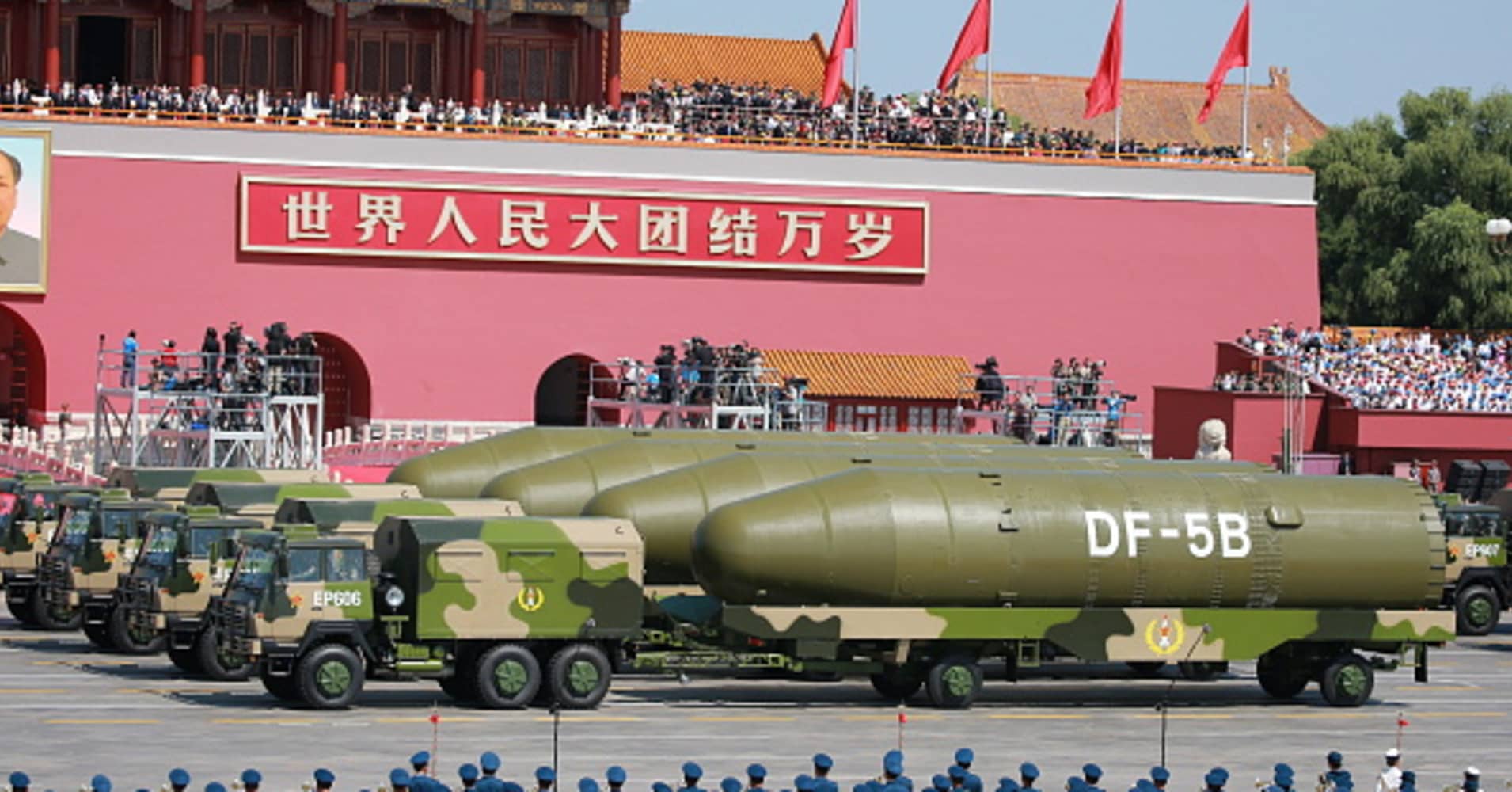
IN FOCUS
By Avishka Ashok
On nuclear warfare: Four takeaways from China’s response to the P5 countries’ joint statement
On 3 February, the P5 countries, consisting of China, France, Russia, the US and the UK issued a joint statement and pledged to reduce the risk of a nuclear conflict. On 4 February, the Chinese Foreign Ministry’s Arms Control Department issued a statement on the lack of direct dialogue between the P5 nations and pushed for the same to ensure global security. The Director General of the Department of Arms Control Fu Cong emphasized the importance of the joint statement and explained that the P5 nations had for the first time issued a statement of nuclear issues.
Post the release of the joint statement, four aspects can be ascertained regarding China’s nuclear program and its perspective on nuclear war.
1. China to develop machinery to defend its territory and sovereignty
The release of the joint statement by the P5 led to heightened international debate by media and political leaders on China’s increasing nuclear capabilities and weapon development. Director General Fu quelled the discussion and clarified that China would only maintain nuclear weapons at the approved level, solely for its personal national defense purposes. Fu clarified that the weapons were meant to warn hostile countries against considering an attack on the Chinese territories. C
2. Changing global security poses a threat to China’s interests
Fu referred to the US decision to position its ground-based intermediate-range missiles and explained that China would continue to advance its nuclear arsenal and modernize its weaponry to keep up with the changing nature of global security and peace. The Defence Ministry has prioritized improvement in the quality of its weapons by actively work towards ensuring accuracy, sharpness, powerful and unidentifiable weapons. China must continue producing and honing its nuclear skills as it believes that the global sentiments towards China grow more hostile by the day.
3. Equal right to develop hypersonic technology
Fu also commented on the much-debated issue of hypersonic weapons and claimed that China and Russia have equal rights to develop its defense capabilities since the US walked out of the Anti-Ballistic Missile Systems treaty which aimed to limit the deployment and use of ballistic missiles. According to China, if the US walks out of treaties that aim to limit the development and deployment of missiles, China must prepare itself for eventualities where the US may abuse its power and capabilities.
4. China’s positive international role to limit the development and use of nuclear warfare
China credits itself for urging the P5 to take up the decision to not engage in nuclear warfare with each other or other countries. It also proclaims that the country has played a positive role in the Iran nuclear deal by recommending proposals for negotiation and communicating the concerns of each party. China is also a part of the no-first-use policy and has accepted numerous treaties on nuclear non-proliferation. Despite building its nuclear arsenal, it has also advocated complete prohibition of nuclear weapons.
References:
“China calls on nuclear-armed nations to focus on AI, space,” The Straits Times, 4 January 2022
“China will modernize, not drastically expand, its nuclear arsenal: senior diplomat,” Global Times, 4 January 2022
“China's efforts to maintain global strategic stability and reduce the risk of nuclear conflict,” Global Times, 4 January 2022
IN BRIEF
By Dincy Adlakha and Keerthana Nambiar
INTERNAL
President Xi declares Winter Olympics open
On 4 February, Chinese President Xi Jinping declared the Beijing Winter Olympics 2022 open. This is the 24th edition of the global sports event. Thomas Bach, the president of the International Olympic Committee was also present at the Opening Ceremony and expressed his gratitude towards China. The program included massive shows of skills through dancers and athletes. The historical flame of the Olympics was lit and the delegations from Italy, hosts of the next Winter Olympics, marched in right before China. The ceremony marked traditions and passion of the Chinese people and coincided with the “Beginning of Spring” as celebrated in China. (“The Latest: Chinese President Xi declares 24th Olympic Winter Games open,” Xinhua Net, 4 February 2022)
ECONOMY
Youyi port ensures effective international trade exchange despite epidemic measures and Spring Festival
On 5 February, Xinhua reported that the Youyi port in Pingxiang city in southern Chinese province of Guangxi Zhuang Autonomous Region has ensured smooth transfer of goods and documents. The port is a crucial link to ASEAN and most cross-border trade is currently diverted to this port. The move is done to follow strict provisions set in place by the local government in the fight against COVID-19. Furthermore, the port recorded an increase in trade in 2021 and all major diplomatic missions from ASEAN pass through the port. (“Across China: S. China border port ensures smooth int'l trade during Spring Festival,” Xinhua Net, 5 February 2022)
REGIONAL
President Xi meets Turkmen President vowing for strengthening natural gas cooperation
On 5 February, Chinese President Xi Jinping met with Turkemistan’s President Gurnaguly Berdymukhamedov in Beijing who was attending the opening ceremony of Beijing Wnter Olympics 2022. President Xi said that China will “will always be a reliable friend and partner for Turkeminstan” and will enhance the strategic cooperation in the field of natural gas. President Berdymukhamedov expressed Turkeminnstan’s willingness to work with China in advancing the construction of the Central Asia- China pipeline and improve bilateral ties in various fields. (“China, Turkmenistan vow to strengthen natural gas cooperation,” CGTN, 5 February 2022: “Xi meets Turkmen president, calling for deepening bilateral cooperation,” Xinhua Net, 5 February 2022)
President Xi Jinping metets Kazakh President at the Beijing Winter Olympics opening ceremony
On 5 February, Chinese President Xi Jinping met with Kazakh President Kassym-Jomart Tokayev at the opening ceremony of Beijing Winter Olympics 2022. President Xi said: “China will always be Kazakhstan's reliable friend and firm partner, and is ready to help Kazakhstan maintain stability, develop economy and improve people's livelihood.” he also added that China looks forward to deepening security cooperation with Kazakhstan and boost interconnectivitry with the Belt and Road Initiative (BRI). President Tokayev thanked Beijing for its support and hopes to continue cooperation for mutual development. (“Xi Jinping: China-Kazakhstan relations significant for regional peace and stability,” CGTN, 5 February 2022)
INTERNATIONAL
Taiwan foriegn ministry criticizes China-Russia “no limits” partnership
On 5 February, the Taiwanese Foreign Ministry condemned the recent advancements between China and Russia. China and Russia released statements supporting each other’s stance in Ukraine and promising “no limit” support only hours before the Olympics opening ceremony. The statement also condemned the timing of the statements released by China and Russia as it hinders an equal and peaceful spirit of Olympics. The statement said that the China-Russia partnership “not only increases the Taiwanese people’s disgust at and loathing for the Chinese government’s arrogance and bullying, it also clearly shows all the world’s countries the sinister face of the Chinese Communist regime’s aggression, expansionism and damaging of peace.” (“Taiwan condemns ‘contemptible’ China-Russia partnership on eve of Olympics,” The Guardian, 5 February 2022)
China and Russia sign deal for satellite navigation system
On 5 February, Chinese President Xi Jinping met Russian President Vladimir Putin in Beijing before the Olympics opening ceremony. During their meeting, they signed an agreement that encourages cooperation between China’s BeiDou and Russian GLONASS to compete against the American Global Positioning System. The agreement is an extension of a previous deal signed in 2018 and it calls for greater complementarity of the GPS shared by two countries, in terms of timescales. Experts say that China-Russia ties have never been better and they aim to stand a united front against western powers dominated by the US. (Liu Zhen, “China’s BeiDou and Russian GLONASS sign new deal to rival America’s GPS satellite navigation,” South China Morning Post, 5 February 2022)
Bilateral relations between Russia and China start a new era of international relations: Global Times
On 5 February, Global Times reported that the relations between Russia and China were about to initiate a new era of global politics that would exclude the US and its hegemony. The Chinese President Xi Jinping and the Russian President Vladimir Putin released a joint statement that extended support to each other in the international system and rejected the hegemony of the US and the West. The joint statement is almost 6000 words long and covers all core issues on global strategic stability. (“Unprecedented China-Russia ties to start a new era of intl relations not defined by US, Global Times, 5 February, 2022)
President Xi meets Serbian President in Beijing
On 5 February, the Chinese President Xi Jinping met with the Serbian President Aleksandar Vucic in Beijing. President Xi appreciated the relations between the two countries and put emphasis on the political mutual trust and the bilateral relations. According to Xi, the relations with Serbia set a good example of healthy ties in international relations. (“Xi meets Serbian president, hails ironclad friendship between China, Serbia,” Xinhua Net, 5 February 2022)
04 February 2022 | Friday | China Reader Evening Brief | Vol.1, No. 106
China along with many Asian countries celebrate Lunar New Year
China celebrates New Year amid Covid-19 restrictions.
.png)
IN FOCUS
By Sukanya Bali
China along with many Asian countries celebrate Lunar New Year
On 1 February, China celebrated its Lunar New Year. On 31 January, Chinese President Xi Jinping extended Lunar New Year greetings to all Chinese people of different ethnic groups, compatriots in Hong Kong, Macao and Taiwan, and overseas Chinese at a reception in the Great Hall of the People, Beijing. He emphasized, "We ought to have a long-term perspective, be prepared for potential dangers even in times of calm, and maintain strong unity and work hard, to keep driving forward the great cause of national rejuvenation.”
What is the Lunar New Year and how is it celebrated?
Lunar New Year, also called the Spring Festival, is celebrated after the second new moon from winter solstice (21 December). The festival is celebrated by many Asian societies, which follow the lunar calendar. During the celebration people feast with their relatives and watch parades, fireworks and often dancing dragons. The major celebrations are held on New Year's Eve and New Year's Day. Celebrations last for two weeks, this year it will end on 15 February, on the full moon night with the lantern festival.
China records the highest travels during the celebrations. The Chinese Ministry of Transportation estimates that “1.18 billion trips will be made this year” down from 3 billion trips before the pandemic. The resurgence of Covid-19 clusters has dampened celebrations yet again. With the government’ s “zero-tolerance strategy” towards Covid outbreaks ahead of the Beijing Olympics, local authorities have advised people to limit travel. Chinese citizens are placed under a color-coded system of government surveillance, that determines the clearance for travel. Reuters reported, “that 48 million people who travelled during the Lunar New Year last year will stay put this time.”
What is the significance of the celebration?
The significance of Lunar New Year dates back to the 14th century BC, during the Shang dynasty. One of the stories says that a monster named Nian ("Year") attacked villagers at the start of every year. Nian was afraid of loud noises, bright lights, and the color red. People used these things to chase the beast away - which has now become part of the new year celebrations.
The Chinese calendar is based on a 12-year cycle, each year linked with one of a dozen animals, the rat, ox, tiger, rabbit, dragon, snake, horse, goat, monkey, rooster, dog and pig. This Lunar year marks the end of year of Ox and beginning of the year of Tiger. Another story goes that a race which was organized by the Jade Emperor - who invited all the animals in the world to take part, for which only twelve species turned up. As a reward for turning up, the emperor decided to name a year in the zodiac after each one, where the race determined the order placing of each animal. The year of Tiger, it signifies those children born in the year ahead will be brave, competitive, and strong.
Who else celebrates it?
Along with China many East and Southeast Asian countries celebrate as per the lunar calendar. In Vietnam, the day is called Tết Nguyên Đán, or Tết, for short, meaning Festival of the First Morning of the First Day. The lunar New Year celebrations in Ho Chi Minh City in Vietnam feature lion dances. In North Korea and South Korea, they celebrate Seollal, which lasts for three days. Korean families serve food to ancestors in a ritual called Charye, to gain their blessings for the coming year. In Mongolia, the festival is called Tsagaan sar. Some people in Mongolia call it The White Moon festival. People worship at ovoo - stone heaps used as altars or shrines.
References:
“Staying put but splurging: China's hotels, restaurants to see Lunar New Year boost,” Reuters, 28 January 2022
“Lunar New Year: Covid thwarts travel plans for millions,” BBC, 01 February 2022
“Xi’s Chinese Lunar New Year address sends message of confidence, bravery and determination,” Global Times, 31 January 2022
IN BRIEF
By Dincy Adlakha and Keerthana Nambiar
INTERNAL
President Xi Jinping addresses the Beijing Winter Olympics 2022
On 3 February, Chinese President Xi Jinping delivered a video address at the opening ceremony of the 139th session of the International Olympic Committee (IOC) at Beijing. President Xi promised that China intends to deliver “a streamlined, safe and splendid Games.” He extended welcome to IOc President Thomas Bach and IOC members and stressed that from themes “One World, One Dream” in 2008 to “Together for a Shared Future” in 2022 China is committed to pursue the Olympic ideal. Xi further added that China has successfully engaged 300 million Chinese in sport on snow and ice creating greater development of winter sport worldwide. (“China will do its best to deliver "streamlined, safe and splendid" Olympic Winter Games: Xi,” Xinhua Net, 3 February 2022)
PLA airborne troops conduct high-intensity flight training
On 4 February, People’s Daily reported that China’s airtransport brigade underwent high-intensity training. The training also involved ground crew members under the PLA airborne troops. The training maintained two Y-12 transport aircraft in day-and-night flight training conditions. The high intensity training took place on 18 January 2022 and involved all members at the airstrip. (“Air transport brigade conducts high-intensity flight training,” People’s Daily, 4 February 2022)
REGIONAL
North Korean Leader Kim Jong Un congratulates Chinese President on Beijing Winter Olympics
On February 4, Korean Central News Agency (KCNA) reported that North Korean Leader Kim Jong Un sent a message to the Chinese President Xi Jinping congratulating him on the Beijing Winter Olympics 2022. According to the letter: “The successful opening of the Beijing Winter Olympics despite the worldwide health crisis and unprecedented severe circumstances is another great victory won by socialist China.” Kim expressed his interest in “steadily” developing the relations between Pyongyang and Beijing “to a new high stage”. (“President of State Affairs Kim Jong Un greets Chinese President Xi Jinping,” KCNA WATCH, 4 February 2022)
Taiwanese Olympic skater sparked outrage after uploading a video in Chinese mainland team uniform
On 3 February, Global times reported that Huang Yuting, a speed skater from Taiwan participating in Beijing Winter Olympics faced media outrage after uploading a video of her wearing a uniform of the Chinese mainland team. On 23 January, Huang uploaded the video on Instagram and her account was flooded with heavy criticism. In a Facebook post, Huang said: “sports are sports and there is no difference in nationality.” (“Taiwan island skater encounters cyberbullying for wearing Chinese national team uniform; deletes Instagram post under pressure,” Global Times, 3 February 2022)
US lawmakers propose changing name of Taiwan's representative office
On 4 February, a group of bipartisan lawmakers in the US proposed that the name of Taiwan’s Cultural Representative Office should be changed from Taipei Economic and Cultural Representative Office (TECRO) to Taiwan Representative Office. The move will be reflective of the US support to Taiwan's independence, according to the proposed legislation. The potential change is aimed at encouraging other smaller countries to enforce similar steps. (“US lawmakers push to rename Taiwan’s de facto embassy – a move sure to rankle China,” South China Morning Post, 4 February 2022)
US hints sanctions on Chinese firms assisting Russia for Ukraine
On 3 February, the US State Department spokesperson Ned Price released a statement warning Chinese firms against helping Russia in the ongoing tensions with Ukraine. The US has imposed sanctions on Russia for its aggressive actions in Ukraine. Chinese firms evading these sanctions and conducting business with China will face consequences, as per the representative. He said: “We have an array of tools that we can deploy if we see foreign companies, including those in China, doing their best to backfill U.S. export control actions, to evade them, to get around them.” (Simon Lewis and David Brunnstrom, “U.S. warns Chinese firms against helping Russia against potential Ukraine sanctions,” Reuters, 3 February 2022)
Global leaders wish China a successful Winter Olympics
On 3 February, People’s Daily reported that multiple state leaders have sent their congratulatory messages and wishes to Beijing in hopes of a successful Olympics. Leaders from Vietnam, Laos, Nepal, Turkmenistan, Belarus, Azerbaijan, Uzbekistan, Hungary, Portugal, Greece, Venezuela, Tanzania, Zimbabwe, Nicaragua and many other countries sent in their best wishes to China for the upcoming global sporting event. Additionally, many international organisations also sent letters and messages of best wishes to China. (“World leaders wish Beijing Winter Olympics, Paralympics complete success,” People’s Daily, 3 February 2022)
Chinese Foreign Minister meets Russian Foreign Minister in Beijing
On 3 February, Chinese State Councilor and Foreign Minister Wang Yi met Russian Foreign Minister Srgei Lavrov in Beijing regarding the upcoming meeting between the heads of state. Wang Yi said: “China is ready to work with Russia to deepen the time-honoured friendship and comprehensive staretegic coordination between the two countries.” He called on both the sides to join efforts to fight COVID-19, enhancing mutual trust and aligning interests for a lon-term bilateral pragmatic cooperation. Sergei Lavrov said that Russian appreciates China’s efforts to deepen the bilateral cooperation and work for a “greater synergy between the Eurasian Economic Union and Belt and Road Initiative.” the two sides also expressed their distaste regarding politicization of sports and carry forward the Olympic spirit. (“Chinese FM meets visiting Russian FM,” Xinhua Net, 3 February 2022)
03 February 2022 | Thursday | China Reader Evening Brief | Vol.1, No. 105
President Putin’s upcoming visit to Beijing: Review of a Jamestown Opinion
The essay looks at Putin’s upcoming visit to Beijing and Xi’s dilemma over strategic approach to the ongoing Ukraine crisis.
.jpg)
IN FOCUS
By Sukanya Bali
President Putin’s upcoming visit to Beijing: Review of a Jamestown Opinion
On 28 January, Jamestown Foundation published an Opinion titled “Vladimir Putin’s Mission to Beijing.” The essay analyses the relations between Beijing and Moscow and the ongoing Ukraine crisis. In the last few months, Russia has amassed thousands of troops along the Ukraine border which has raised international tensions.
The author - John S. Van Oudenaren stresses the dilemma President Xi Jinping is facing amid the Ukraine crisis. On the one hand, Xi has an interest in averting an escalation of the standoff in Ukraine that could undercut the global economy, on the other, he recognizes the significance of the Sino-Russian partnership, which is seen as far more viable if Russia and the West remain at permanent loggerheads.
There are two major takeaways from the above opinion.
First, Beijing takes in the Ukraine crisis and its Strategic partnership with Moscow.
In December, a Chinese Foreign Ministry spokesperson said: “China calls for the resolution of the Ukraine crisis through peaceful means and political dialogue” and “hopes all parties can work together, earnestly follow the Minsk-2 agreement and realize peace and security in Ukraine.” Chinese Foreign Minister Wang Yi chided NATO for the crisis and called for the revision of the current European security architecture. China also reaffirmed its support for Russia.
The crisis highlights the difficulty in synchronizing the strategic interests of Beijing and Moscow, in the region. Beijing understands the importance of its relationship with Russia and has affirmed its commitment, but chances of a coordinated proactive response to current crises is limited. It has blamed the West for the current impasse and has urged Washington to address Russia's legitimate concerns over NATOs presence in its neighborhood. Beijing also criticized the US “cold war mentality” (冷战思维, lengzhan siwei) as a primary reason for the current crisis.
The second takeaway is, over the economic and diplomatic challenges facing President Xi Jinping.
Escalation of tension between Russia and the West would undermine the global economy. For China, there would be serious indirect economic and diplomatic consequences. As Xi seeks to strengthen his position in the CCP, ahead of the 20th Party Congress in 2022, a major war will further drag the pandemic-stricken country’s economic growth. The possibility of increased sanctions on Moscow would put Chinese economic interest in Russia at risk of secondary sanctions from the West.
Russia’s revanchist policies along its periphery may have knock-out effects on China’s diplomatic outreach towards Central European countries. Due to the continuous threat of Russian aggression, CEE states will value China as a valuable economic partner, but the relationship with Washington will be their priority. Putin’s demands on the removal of NATO forces and assurances that Ukraine and Georgia never be given membership in NATO, might push countries closer to Washington, undermining China’s regional ambitions like its Belt and Road Initiative.
References:
“Vladimir Putin’s Mission to Beijing,” The Jamestown Foundation, 28 January 2022
IN BRIEF
By Dincy Adlakha and Avishka Ashok
INTERNAL
China hikes rare-earth quota to meet surging energy demand
On 2 February, Global Times reported that China set a quota for the first batch of rare-earths in 2022 at 20 per cent higher than the previous year. The quota was recorded at 100,800 for mining and 97,200 tons for smelting and separating. An independent industrial analyst figured that, “The 20 percent jump was mainly due to China’s surging demand for neodymium magnets, also known as Nd-FeB magnets, amid the new energy push in the country.” As per the Ministry of Industry and Information and the Ministry of Natural Resources, the quota will be shared amongst the four major rare-earth producers of the country. More than 85 percent of the rare-earths in the word are produced by China. (“China hikes first rare-earth quota of 2022 by 20% to meet surging new energy demand,” Global Times, 2 February 2022)
REGIONAL
Japan’s advisor to Prime Minister Kishida pushes for backing the resolution on China
On 3 February, the Strait Times reported that Gen Nakatani, an advisor to the Japanese Prime Minister Fumio Kishida, believes that pushing China harder on the issue of human rights violation should be Japan’s way forward. The approach will put more pressure on the bilateral relations between China and Japan. In an interview, Nakatani said: “The resolution "makes demands of the government in very strong terms. I believe it's important that universal values are protected in China, so I want to press China on this even harder than in the past.” (“Japan should press China more on human rights: PM Kishida's adviser, The Strait Times, 3 February 2022)
INTERNATIONAL
President Putin shows faith in Sino-Russian stance against sanctions
On 3 February, South China Morning Post reported that China and Russia stand together in a united front against western sanctions. He said that the two countryes are building joint mechanisms to nullify the effects of the sanctions imposed on them by multiple western countries. He also said that China and Russia will resist the pressure from west at “every opportunity” and that Chinese-Russian ties are “not influenced” by ideology. Rather, they “concur or are really close” on most international issues. President Putin made the remarks only a day before his visit to Beijing for the Winter Olympics. (Teddy Ng, “We will resist: Putin affirms united China-Russia front against sanctions,” South China Morning Post, 3 February 2022)
US-China competition bill heads to passage in US House of Representatives
On 3 February, Reuters reported that a multibillion-dollar bill aimed at increasing US’ semiconductor manufacturing capabilities and boosting competition between US and China was advanced by the US House of Representatives. The bill includes 52 billion USD for subsidizing research and production of semiconductors in the US to manage the shortage of chips used in automobiles and gadgets. The shortage has been troubling the US for a few years due to supply chain bottleneck blockages. The House of Representatives aims to pass the bill by 4 January. Internal politics between the Representatives and the Democrats have delayed the bill uptil now. (David Shepardson and Patricia Zengerle, “U.S. House China competition bill heads to passage this week,” Reuters, 3 February 2022)
President Xi responds to letters of well wishes sent by US Mayors
On 2 February, Xinhua Net reported that President XI Jinping had separately responded to the letters sent by the Mayor of Tacoma Victoria Woodards and Mayor of Steilacoom Dick Muri. Xi responded to the letters and said that the Winter Olympics were an important and happy event for the Chinese people. He further explained that China saw the event as a great event for the international olympic cause. He said: “With the support of the Chinese people and the international community. China will certainly present a simple, safe and splendid Olympic Games, practice the Olympic motto of "Faster, Higher, Stronger - Together," and bring people across the world together for a shared future.” The President responded to the letters by the two Mayors who had extended greetings for the Lunar new year and best wishes for the Winter Olympics. (“Xi replies to letters from U.S. mayors, Xinhua Net, 2 February 2022)
President Putin and President Xi prepare to meet and attend Winter Olympics
On 2 February, Xinhua Net reported that the Russian President Vladimir Putin will be visiting China and attending the opening ceremony of the Winter Olympics. President Putin is visiting China after three years and this meeting with President Xi will mark the 38th meeting between the two leaders. President Xi also expressed his eagerness for the get-together and said that he and China is ready to work with Putin “for a shared future to jointly open a new chapter in post-COVID China-Russia relations.” (“China will certainly present a simple, safe and splendid Olympic Games, practice the Olympic motto of "Faster, Higher, Stronger - Together," and bring people across the world together for a shared future," Xinhua Net, 2 February 2022)
02 February 2022 | Wednesday | China Reader Evening Brief | Vol.1, No. 104
President Xi Jinping seeks support from the military: Three takeaways of a Jamestown Opinion
The essay looks into the political divisions in China's and Xi's approach towards the upcoming political challenges.
.jpg)
IN FOCUS
By Avishka Ashok
President Xi Jinping seeks support from the military: Three takeaways of a Jamestown Opinion
On 25 January, Jamestown Foundation published an Opinion titled “As Rival Factions Gain Traction, Xi Seeks to Secure Support from the Military.” The essay analyses the divisions within the Communist Party of China and President Xi Jinping’s course of action in an attempt to hold unobstructed power in the country’s political system.
The basic premise of the opinion is, since 2019, the Chinese President has promoted numerous officials in the People’s Liberation Party and removed many others from their influential positions under the pretense of “anti-corruption” drives. The author Willy Wo-Lap Lam suspects that the intentions behind Xi’s anti-corruption drives may be linked to the growing disagreements within the party.
One could identify three takeaways from the opinion.
First, the factional contrast within the party threatens Xi Jinping
Despite Xi Jinping’s attempts of portraying a unified communist party of China, his efforts are falling short due to other competing cliques within the party, threatening to override his authority and the distinctive supremacy that he has enjoyed in the last few decades. The essay identifies Jiang Zemin who heads the Shanghai Faction and Hu Jintao who heads the Communist Youth League Faction as Xi’s immediate competitors. Xi has also lost out on friends and confidants while he continues as the President of China. Wang Qishan, who was initially in charge of the Central Commission for Discipline Inspection and a close confidant, also had a fall out with Xi in 2017. Wang’s replacement is closer to the anti-Xi factions. All factions are faced with challenges as they try to remove the key figureheads through the anti-corruption campaigns. Xi’s friends such as Li Zhanshu and Zhou Jiangyong have been placed under investigation for their involvement in corrupt practices.
Second, Xi is hitting back in his own way, through purges
President Xi also responded to the anti-Xi factions targeting his people by the drawn-out purges of the Central Political-Legal Commission (CPLC). In January 2022, Chinese media reported on the wrongdoings of the members and officials of the multiple offices under the CPLC. Xi also appointed his close ally Wang Xiaohong as the Party Secretary and executive Vice Minister of the Ministry of Public Service (MPS). However, the appointment is a small feat since the Ministry has a stronger anti-Xi faction as its members.
Third, Xi is creating his circle of faithful followers
In order to secure his interests within the country, President Xi is now focusing on protecting the PLA from further infiltration by the anti-Xi groups. Being the chairman of the Central Military Commission and the Commander-in-Chief, Xi has consolidated power in the PLA by appointing seven senior lieutenant generals and one PAP officer as generals in January 2022. Since 2019, Xi has promoted 38 officers to the position of full general. The promotions are uncanny evidence of Xi’s urgency in securing the trust and support of his allies since Xi has overridden the quota of officers who can be promoted in year and the term that must be served by the officials at each post.
References:
“As Rival Factions Gain Traction, Xi Seeks to Secure Support from the Military,” Jamestown Foundation, 25 January 2022)
IN BRIEF
By Dincy Adlakha and Keerthana Nambiar
INTERNAL
China sentences an Uyghur man to death, three to life imprisonment over textbook content
On 1 February, The Asahi Shimbun reported that the Chinese government has sentenced an Uyghur man to death and three others to life imprisonment for including resistance movments in children’s textbooks. The content had previously been approved by the Communist Party. However, as the imperatives from the Party have changed, the content has bee reinterpreted and is declared as containing devastating consequences for individuals. The content had drawings of resistance movements from the 1940s which was also praised by the first Chairman Mao Zedong. As the crackdown on Uyghur Muslims tightens from the Chinese government, textbooks also face changes in curriculum and content. (“A Uighur gets death sentence, as China bans once OK’d books,” The Asahi Shimbun, 1 February 2022)
Video of mentally ill woman locked in chains raises anger in China
On 1 February, The Straits Times reported that a video surfaced on Chinese social media and other internet platforms that showed a middle-aged mentally ill woman tied with metal chains in a doorless brick shack. The video raised anger in China as the citizens asked of her identity and why was she locked up. Further investigations revealed that the video was shot in Jiangsu province previous week. The Chinese social media attended the issue with multiple hashtags and questions, with some prominent members of the society reporting the case to “relevant leaders.” (“Video of mentally ill woman chained in shack stirs anger in China,” The Straits Times, 1 February 2022)
China initiates the torch relay before the Winter Olympics opening ceremony
On 2 February, the torch relay for the 2022 Olympic Winter Games started at the Olympic Forest Park in Beijing. The torch was lit by the Vice Premier Han Zhang during the launch ceremony and then handed over the torch to China’s first winter sports world champion Luo Zhihuan, aged 80 years. However, due to the pandemic, the relay is being conducted on a smaller scale. A total of 1200 participants are taking part in the relay which will continue for the next three days until the opening ceremony. (“Olympic torch relay begins in Beijing, Xinhua Net, 2 February 2022)
ECONOMY
Leading brokerage firm in China reports strong performance in 2021
On 2 February, a leading brokerage firm in China, Western Securities Co. reported a strong performance in 2021. The firm filed its performance statement to the Shenzhen Stock Exchange and reported a 27 per cent year on year profit which amounted to 223.3 million USD. The revenue increased by 30.53 per cent and the firm reported an earning of 0.317 yuan per share. The assets of the firm increased by 32.76 per cent from the previous year. (“Western Securities reports strong performance in 2021,” Xinhua Net, 2 February 2022)
Trade between China and Europe records a 27.5 per cent increase
On 2 February, Xinhua Net reported that the trade between China and European countries had expanded in 2021 despite all economies suffering numerous losses due to the pandemic. The robust economic growth between China and Europe can be seen as evidence of the efficient trade cooperation between the countries. The total value of the trade amounted to USD 828.1 billion and marks a 27.5 per cent increase from the previous year. China continued to be Europe’s largest trading partner in 2021. (“Economic Watch: China-Europe trade shows resilience with strong performance in 2021, Xinhua Net, 2 February 2022)
China Association of Automobile Manufacturers records sale of 2.02 million units in 2021
On 2 February, Xinhua Net reported the latest data published by the China Association of Automobile Manufacturers. The data revealed that China’s automobile export had recorded a sale of 2.02 million units for the first time, in 2021. The data also revealed that the sale of new energy vehicle exports tripled and sold a total of 310,000 units. Passenger cars also increased by 1.1 times and sold 1.61 million units. Commercial vehicles recorded a 70.7 per cent increase, selling 402,000 units in the previous year. (“China's auto exports top 2 mln in 2021", Xinhua Net, 2 February 2022)
INTERNATIONAL
Foreign Ministry and National People’s Congress object Japan’s resolution on China’s human rights situation
On 1 February, the Chinese Foreign Ministry Spokesperson Zhao Lijian issued the Ministry’s response to the Japanese House of Representatives passing a resolution on the alleged human rights violations in Xinjiang, Tibet Autonomous Region and Hong Kong. Zhao referred to Japan’s war crimes in the second world war and claimed that the country had no right to raise questions about the human rights conditions of other countries. He said: “The related officials from China's Ministry of Foreign Affairs has lodged solemn representations with the Japanese side, and the Chinese side reserves the right to take further measures.” The spokesperson of the National People’s Congress also remarked that Japan’s resolution interfered with the internal affairs and has greatly compromised the bilateral relations and mutual trust that were on the path of improvement. He said: “We firmly oppose Japan's political manipulation under the pretext of 'human rights.” (“China's top legislature opposes so-called human rights resolution adopted by Japan's House of Representatives, Xinhua Net, 2 February 2022; Japan has no authority to wantonly comment on other countries’ human rights conditions: Chinese FM, Global Times, 1 February 2022)
1 February 2022 | Tuesday | China Reader Evening Brief | Vol.1, No. 103
China’s White Paper on Space: Three major takeaways with the goals for the next five years
China's latest white paper on the Space Programme hopes to integrate space science, technology and applications; pursue a new development philosophy; build a new development model; and meet the requirements for high-quality development.
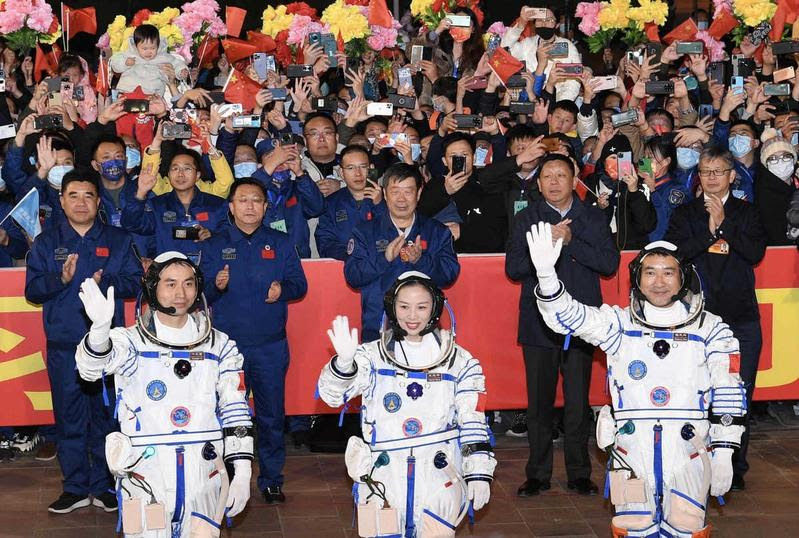
IN FOCUS
By Harini Madhusudan
China’s White Paper on Space: Three major takeaways with the goals for the next five years
According to the White Paper, China hopes to do the following in the next five years: integrate space science, technology and applications; pursuing a new development philosophy; build a new development model; and meeting the requirements for high-quality development.
On 28 January 2022, China’s State Council Information Office released its fifth five-year space exploration plan. Titled “China’s Space Program: a 2021 Perspective,” the document outlines China’s priorities and the plans for outer space exploration and spaceflight.
During 2016-20, China has made noteworthy achievements; this includes reaching the far side of the moon, collecting moon samples, successful Mars mission, beginning the assembly of the space station, completion of the Beidou navigation satellite and the CHEOS earth observation systems. Besides there has been a consistent technological and industrial growth.
Between 2016 and 2021, China launched 207 successful missions. Of this, 186 were Long Mach launches among 400+ attempts.
According to the White Paper, China hopes to do the following in the next five years: integrate space science, technology and applications; pursuing a new development philosophy; build a new development model; and meeting the requirements for high-quality development.
The White Paper is divided into six sections that look at the various focus areas. This begins with the need to establish a strong space presence and ends with a strong emphasis on international cooperation and introduces the principles and measures of their space exploration strategy.
The following are the three takeaways from the white paper.
1. Manned spaceflight, expansion of technological capacities, and strengthening space environment governance are among the report’s key areas of focus:
The paper has listed space transport system, manned spaceflight, improving space infrastructure, expansion in the space launch sites, innovations and experiments with new technologies, deep space exploration, telemetry, tracking, and command, and space environment governance, as a priority for China. For example, the country has placed a special emphasis on improving its space debris monitoring systems, strengthening space traffic management, and introducing a space-ground space Climate monitoring system. It also shows a keen interest to explore the polar regions of the moon and aims at a manned landing on the moon. China is known to be studying plans for building its near-earth object defense system. The paper also indicates an interest in sample collection and its research.
The paper refers to the development and engagement of new technologies and systems like the smart self-management of spacecraft, in-orbit tests of new space materials, mission extension vehicles, in-orbit servicing, and innovative space propulsion. The country is also revealed to be working on navigation-communication integration, low-orbit augmentation, and new technologies for the next-gen Beidou system.
2. China’s call for an international space cooperation
Through the paper, China attempts to call on all countries to cooperate and carry out in-depth exchanges on the basis of their principles of mutual benefit, equality, peaceful utilization, and inclusive development. China offers strong cooperation with its international lunar research station project and seeks help with astronaut selection and training and joint flights. The paper indicates that the Chinese attempts to participate/spearhead the formulation of international rules would continue, with an aim to work together with countries for the long-term sustainability of the activities in Outer Space.
3. Emphasis on commercial space applications
Unlike the previous four versions, this paper gives a greater emphasis to the commercial space applications and activities. In 2014, China made policy changes to allow the increased participation of the commercial space actors in their Outer Space Industry. One of the core visions of China’s Space Strategy have been the expansion of the Space application industry. A competitive private-commercial ecosystem would be the driving force of this applications industry. From commercializing communications and broadcasting services, to offering products and services like data processing, high-accuracy maps using the remote-sensing data, and application software while also utilizing the opportunities from the expanding digital industry in China, are included in the plans for the next five years. The commercial industry in China would play an important role in the Chinese Space vision.
However, a major part of the paper only focuses on the civilian and technological parts and misses on the role of diplomatic and military sectors. Projects and initiatives outside the purview of the CNSA and CASC, get a minimal mention. China is also known to be working on its “satellite internet” mega constellation project but it finds no mention on the paper. Hence, the Chinese steady presence in Outer Space would continue in the next five years.
References:
“China’s Space Program: a 2021 Perspective,” China National Space Administration, 28 January 2022
“China releases white paper on space program,” Xinhua Net, 28 January 2022
Andrew Jones, “China presents space plans and priorities in new white paper,” SpaceNews, 28 January 2022
IN BRIEF
By Dincy Adlakha and Keerthana Nambiar
INTERNAL
Olympics opening ceremony faces loss due to Omicron
On 1 February, The Straits Times published a report that the Olympics opening ceremony which was to boost China’s tourism and consumer activity will not see the same excitement due to Omicron variant of COVID-19. Chinese authorities have imposed a ban on public spectators in the stadium and tighter restrictions have been placed to check the spread of Omicron. Additionally, a halt on the industrial production to gain clear skies during the opening ceremony is also affecting the revenue outcomes. To curb Omicron and pollution, China has placed cluster identification techniques and is ready to sacrifice part of the success of the opening ceremony. (“Omicron dashes China's hopes of Winter Olympics boosting economy,” The Straits Times, 1 February 2022)
Sinovac and Sinopharm vaccines prove effective against Delta variant
On 1 February, The Straits Times published that Chinese developed Sinovac and Sinopharm vaccines are effective against the Delta variant as found in a study conducted by Chinese universities. The study found that the vaccines are 52 percent effective against Delta variant of COVID-19 and 60 percent effective for symptomatic cases. The data for this study was collected between May and June 2021 from the Guangdong province as it suffered a Delta variant outbreak. The study published in the Annals of Internal Medicine also found that the vaccines are 78 percent effective for pneumonia and 100 percent for severe or critical cases of COVID-19. (“China's most used Covid-19 shots effective against Delta variant: Study,” The Straits Times, 1 February 2022)
Foreign trade in Tibet sees an expansion of 88.3 per cent
On 1 February, Xinhua reported on the data provided from the local customs on China’s Tibet Autonomous Region. The data shows that in 2021, the foreign trade of Tibet increased by 88.3 per cent year on year. The head of customs said: “In 2021, Tibet exported specialty agricultural and animal husbandry products worth over 30 million yuan, including matsutake and black tea,” reported Xinhua. The largest regional trading partner is Nepal expanding to 69.4 per cent year on year to 1.8 billion yuan. (“China's Tibet sees foreign trade up 88.3 pct in 2021,” Xinhua Net, 1 February 2022)
Global Times exclusive interview with Mongolian envoy to China
On 31 January, Global Times published an exclusive interview with Mongolian Ambassador to China Tuvshin Badral on the upcoming Beijing winter Olympics and how it affects the China-Mongolia bilateral ties. Badral confirmed his participation at the Games and stated that the Games symbolizes “unity and friendship among mankind.” He said that Mongolia is looking forward to the Games and hopes for a “favorable” for the athletes. Badral further added that Mongolia and China have ‘broad potentials’ in the winter sports field and will mutually develop their skills by joint trainings. (“Mongolia, China share broad potential to develop cooperation, conduct joint training in winter sports: Mongolian envoy to China” Global Times, 31 January 2022)
TECHNOLOGY
Beijing sees a steady expansion of software sector in 2021
On 1 February, the Ministry of Industry and Information Technology released data on China’s ‘sustained sound growth momentum’ in 2021. According to the data, more than 40,000 companies in software and IT sector saw a revenue of more than five million yuan. the IT sector showed a rapid expansion of rising 20 per cent year on year to more than six trillion yuan. The data showed that in 2021, Beijing’s software exports were up to USD 52.1 billion up 8.8 per cent year on year. (“China's software sector revenue, profit grow in 2021,” Xinhua Net, 1 February 2021)
REGIONAL
Japanese Diet passes motion on human rights in China
On 1 February, South China Morning Post reported that the Japanese parliament Diet has passed a resolution on human rights in China. This lower chamber of the Diet adopted this motion and expressed concern over the human rights of Uyghur Muslims in Xinjiang and the residents of Tibet and Hong Kong. The motion calls for concrete steps by Japan to relieve the “serious human rights situation” in China. The move was finalised just a few days before the Beijing WInter Olympics. The resolution promotes Japan to work closely with the international community to address the issue. (“Japan parliament passes resolution on human rights in China days before Beijing Winter Olympics,” South China Morning Post, 1 February 2022)
INTERNATIONAL
FBI Chief finds China more threatening than ever
On 1 February, the FBI Director Christopher Wray situated in Washington said that the Chinese government has never been this “brazen” and threatening. He said in his speech at the Reagan Presidential Library that the western governments need to be wary of the global image of China, further augmented by Winter Olympics. Accepting that majority of the intelligence agencies and resources are invested on China, Director Wray said: “there’s just no country that presents a broader threat to our ideas, innovation, and economic security than China.” He defined the threat from China in terms of pushed back firms and illegal technologies. (“FBI chief: Threat from China ‘more brazen’ than ever before,” The Asahi Shimbun, 1 February 2022)
China’s UN ambassador votes against UN Security Council open meeting on Ukraine
On 31 January, China’s UN ambassador called for “quiet diplomacy instead of megaphone diplomacy,” noted Xinhua. In the procedural vote for a Security Council open meeting on Ukraine, China and Russia voted against the meeting. The ambassador said: “China once again calls on all parties concerned to remain calm, not to do anything to aggravate tensions or hype up the crisis.” He stated that China’s position on Ukraine is to resolve the issue and to return to implementing the new Minsk Agreement. “All parties should completely abandon the Cold War mentality” for security of Europe along with addressing Russia’s “legitimate security concerns” he added. (“Chinese envoy calls for quiet diplomacy on Ukraine,” Xinhua Net, 1 February 2022)
31 January 2022 | Monday | China Reader Evening Brief | Vol.1, No. 102
President Xi Jinping's address on Lunar New Year
President Xi addresses the citizens at the Spring Festival Xi Jinping addresses citizens for Spring Festival and Lunar New Year

IN BRIEF
By Keerthana Nambiar, Sukanya Bali and Dincy Adlakha
INTERNAL
President Xi addresses the citizens at the Spring Festival Xi Jinping addresses citizens for Spring Festival and Lunar New Year
On 31 January, Chinese President Xi Jinping addressed the citizens at the Spring Festival in Beijing. The Spring Festival or Chinese Lunar New Year falls on 1 February. President Xi congratulated the Communist Party of China (CPC) and the people of the remarkable journey in 2021 and building a "modern socialist China." Xi also said that the CPC will be getting ready to convene the 20th national congress and review the work of the last five years in the second half of 2022. He further stressed on "stable and healthy economy" and "high-quality development." ("Xi’s Chinese Lunar New Year address sends message of confidence, bravery and determination," Global Times, 31 January 2021)
Beijing reports 37 new Covid cases
On 30 January, China recorded 37 new cases of Covid-19 among people linked to the Olympic Games. Authorities have imposed stricter health measures for the Games, operating in a "closed-loop" bubble that separates athletes and media from the public. China remains persistent on its zero-tolerance policy. (“China reports 37 new Covid-19 cases among Olympic personnel,” The Strait Times, 31 January 2022)
Religious groups petition for amnesty for Jimmy Lai and others
On 31 January, Reuters reported that a religious coalition group of Christians and Catholics handed a petition to a government representative asking for amnesty for Jimmy Lai and other political activitsts arrested under National Security Law. The petition was addressed to Carrie Lam, a devout Catholic herself and was signed by more than a dozen Christian and Catholoic groups/leaders. Many of the religious leaders also appealed to her catholic values and conscience to free the arrested activitists under National Security Law. (James Pomfret, “Religious groups call for amnesty for Hong Kongers charged under national security law,” Reuters, 31 January 2022)
ECONOMY
China’s manufacturing growth slows down in January
On 30 January, China’s National Bureau of Statistics released data that showed the manufacturing activity of China grew at a slower rate than December 2021. Additionally, the purchasing manager’s index also slopped from 50.3 in December to 50.1 in Janaury. The purchasing manager’s index is an indicator of the manufacturing activity where numbers above 50 show expanding activity and numbers below 50 show contracting manufacturing activity. This slow growth can be attributed to the various COVID-19 break outs in China over the month that forced lockdowns and closure of operations. (“China manufacturing activity grows at slower pace in January,” The Asahi Simbun, 30 January 2022)
INTERNATIONAL
China and Malta celebrate 50 years of diplomatic ties
On 31 January, President Xi Jinping exchanged congratulatory messages with Maltese President George Vella to mark the occasion of 50th anniversary of diplomatic ties. President Xi emphasized on the friendly coexistence with Malta in these 50 years. He showcased Chinese-Maltese bond through COVID-19 cooperation, mutual interests on core concerns and fond helpful exchanges between the two countries. President Vella also lauded the fruitful ties with China that play a constructive role in maintaining stability and cooperation. (“Xi exchanges congratulations with Maltese president on 50th anniversary of diplomatic ties,” Xinhua Net, 31 January 2022)
Press group speaks of ‘unprecedented’ pressure on media by China
On 31 January, South China Morning Post published an article titled, ‘China puts ‘unprecedented’ pressure on foreign journalists: press group’ that elaborated on a recent report by Foreign Correspondents’ Club of China. The article highlighted that the FCCC has reported decreasing numbers, online troll campaign and threats of legal action as hurdles from China. The article also mentioned that foreign journalists are under humongous pressure from China through state-backed attacks. Many news organisations have been pushed to draw exit plans as well. (“China puts ‘unprecedented’ pressure on foreign journalists: press group,” South China Morning Post, 31 January 2022)
China and Australia iron ore trade remain strong
On 30 January, Global Times reported, iron ore trade between China and Australia remained strong, despite the rising market prices, due to multiple factors including weather disruption and labor shortage concerns. According to data produced from Mysteel, “the total inventory of iron ore imported by steel mills across China reached about 117.57 million tons this week, an increase of 470,200 tons from the previous month.” The report also highlighted a likely “drop of below 60 per cent” in the trade for 2022. (“Australian iron ore trade strong ahead of Chinese New Year, driven by seasonal hoarding,” Global Times, 30 January 2022)
China dispatches the second batch of disaster relief to Tonga
On 31 January, the Chinese military sent two naval vessels to Tonga with the second batch of disaster-relief supplies. Chinese Ministry of National Defence spokesperson told the mission was undertaken by the Type 071 dock landing ship Wuzhishan and the Type 901 comprehensive supply ship Chaganhu. The relief supplies include mobile homes, tractors, electric generators, medical equipment, food, and other essential goods. (“Chinese military sends two naval vessels bearing 2nd batch of aid to tsunami-hit Tonga, demonstrates responsibility, capacity,” Global Times, 30 January 2022)
29 January 2022 | Saturday | China Reader Evening Brief | Vol.1, No. 101
China’s White Paper on Space Program
China's State Council released a White Paper on its space programme and its achievements in 2021
IN BRIEF
By Keerthana Nambiar and Sukanya Bali
INTERNAL
China’s White Paper on Space Program
On 28 January, China released a new White Paper document titled, “China’s Space Program: A 2021 Perspective,” highlighting the progress in countries Space activities. After 2016, this was the fifth Space document released, covering chapters of projects such as deep space exploration, manned space programs, future outlook, strengthening governance on space capabilities, and international cooperation. Global Times reported, in the past five years the country has accounted for more than 200 orbital launches. The document read, “In the next five years, China will start a new journey toward building a space power. The space industry will contribute more to China's development, to global consensus and common efforts in outer space exploration and utilization, and to human progress.” (“China details future space ambition in white paper, calls for formulating UN-centered space rules,” Global Times, 28 January 2022)
Xi urged peacekeepers to play a bigger role in defending world peace
On 28 January, Global Times reported, President Xi Jinping, during an inspection of the Central Theater Command of the People's Liberation Army (PLA) via video, urged peacekeepers “to play a bigger role in defending world peace.” He also emphasized “strengthen safety precautions and step up COVID-19 prevention and control amid complicated circumstances.” (“Xi pledges China's greater contribution to world peace,” Global Times, 28 January 2022)
Increase in travel for Lunar New Year despite government pleas
On 29 January, the Asahi Shimbun reported, more than 260 million people traveled in the last 10 days to their hometown for Lunar New Year. Despite the government's “zero-tolerance strategy” to contain Covid outbreaks, the record hits 46 per cent over last year's travel. Government pleads “to stay where they are.” Last year during New Year, a total of 1.2 billion trips were recorded during the holiday season. (“Chinese travel for Lunar New Year despite plea to stay put,” The Asahi Shimbun, 29 January 2022)
Xinjiang opens its first plateau airport
On 28 January, China’s Xinjiang Uygur Autonomus Region will open its first plateau airport after an airplane landed successful. The prefecture official said that the Zhaosu Tianma Airport eill imrove the transportation facilities in the Zhaosu County and the surrounding counties. He further added that the airport will “promote the development of the local trourism insuatry and improve investment enivironment.” (“Xinjiang to open first plateau airport,” Xinhua Net, 28 January 2022)
Hong Kong’s GDP improved by 6.4 per cent in 2021
On 28 January, the Hong Kong Special Administrative Region (HKSAR) government announced that Hong KOng’s economy increased by 6.4 per cent in 2021. According to the report released by the Census and Statistics Department of the HKSAR the gross domestic product (GDP) compenenet, private consumption expenditure, government consumption expendirture, and gross dometic fixed capital formation increased by 5.7 per cent, 4.6 per cent and 10.1 per cent respectively. The HKSAR government spokesperson stated that the economy is further expected to expand in 2022 but depends on factors like uncertainties especially the COVID-19 virus. (“ Hong Kong's GDP grows by 6.4 pct in 2021: advance estimates,” Xinhua Net, 28 January 2022)
INTERNATIONAL
China’s FM spokesperson response on US suggestion on COVID-19 rules
On 29 January, Global Times reported, Chinese Foreign Ministry spokesperson Zhao Lijian said: “China is the safest country in the world. Our dynamic zero-COVID policy and epidemic-prevention protocols are based on science and experts’ opinions. They are in keeping with China’s realities and the WHO’s guiding principles.” In response to the US State Department spokesperson Ned Price recommendation on changes to rule and requirement of COVID-19. Price said: “what we think are a series of reasonable options that would be consistent with COVID-19 mitigation measures, and at the same time align with international diplomatic norms and practices.” (“FM fires back at US’ suggested changes to China’s COVID-19 rules,” Global Times, 29 January 2022)
Freight train trips between China and Europe increase substantially
On 28 January, the State Railway Group revealed that the total number of freight train trips between China and Europe had increased exceedingly. There have been more than 50,000 train trips between the two geographic territories. The trade has accounted for over USD 74.9 billion. The value of the trade between China has increased almost 9 times since 2016 when it was worth USD 8 billion. (“China-Europe freight train trips top 50,000, Xinhua Net, 29 January 2022)
Ministry of Commerce issues objection against the US decision to stop the service of China Unicom America
On 28 January, the Ministry of Commerce announced China’s objection to the US’ concept of national security, its abuse of state power and the repeated suppression of the Chinese telecom operators. The statement was made after the US Federal Communications Commission revoked China’s authority to provide its services in the US. The statement by the ministry said: “The move is a severe deviation from market-oriented principles, and it has damaged the legitimate rights and interests of Chinese enterprises and consumers, including those in the United States, and disrupted the normal order of the international economy and trade.” (“China firmly opposes malicious U.S. suppression of Chinese telecom operator,” Xinhua Net, 28 January 2022)
28 January 2022| China Reader Evening Brief | Vol.1, No. 100
China agrees to host UN top human rights official in Xinjiang
China has agreed to host UN rights chief Michelle Bachelet in Xinjiang in the first half of the year after the Beijing Winter Olympics 2022

IN BRIEF
By Keerthana Nambiar and Sukanya Bali
INTERNAL
China agrees to host UN top human rights official in Xinjiang
On 27 January, South China Morning Post reported that China has agreed to host UN rights chief Michelle Bachelet in Xinjiang in the first half of the year after the Beijing Winter Olympics 2022. Since 2018, the UN top official has been negotiating with Beijing for a visit to Xinjiang. China has been accused of human right violations of the Uyghur Muslims in the region by the US and its allies. Reuters noted a statement from Sophie Richardson, China Director at Human Rights Watch stating: “No one, especially the world's leading human rights diplomat, should be fooled by the Chinese government's efforts to distract attention away from its crimes against humanity targeting Uyghurs and other Turkic communities.” (“China says UN human rights chief can visit Xinjiang ‘after Olympics’,” South China Morning Post, 27 January 2022; “China agrees to Xinjiang visit by U.N. rights chief in early 2022-South China Morning Post,” Reuters, 28 January 2022)
Global Times accuses World Uyghur Congress fooling Global Imam Council
On 28 January, Global Times reported on the World Uyghur Congress (WUC) statement calling for boycott of the Beijing Winter Olympics. In December, the Global Imam Council, world’s first and largest transitional non-governmental body of Muslim religious leaders released a statement refraining Muslims from participating in Winter Games. Global times said that the Global Imam Council was “fooled” by the WUC which is backed by a US-backed separtisit group which “seeks fall of the Chinese government.” (“NGO of Muslims fooled by anti-China WUC to call for 'boycott' of Beijing Games,” Global Times, 28 January 2022)
Chinese Spokesperson emphasized on west attempts to sabotage Beijing Winter Olympics
On 27 January, Xu Guixiang spokesperson of the regional government of Xinjiang in a press conference said: "attempt to politicize sports events undermine the legitimate rights and interests of athletes from all over the world and also constitutes an affront to the Olympic spirit mentioned in the Olympic Charter.” He emphasized on how anti-China forces are fabricating the political lies of "forced labor" in Xinjiang region. Global Times reported, IOC recent declaration which stress on “summit stands against any politicization of the Olympic Games and sport.” (“US-led West’s sabotage of Beijing Winter Olympics ‘violates spirit of Olympic Charter’,” Global Times, 27 January 2022)
ECONOMY
China is on the right trajectory to become high-income country, says Global Times
On 27 January, Global Times published an article on Chinese economy and whether it will sail through the 2022. The economists concluded that the China is on right trajectory to become the high-income country by the “end of 2023.” Skepticism increased because of the slower GDP growth of 4 per cent in the last quarter of 2021. Global Times accused IMF and World Bank og downgrading China’s GDP growth. (“China to become high-income country no later than the end of 2023: economists,” Global Times, 27 January 2022)
REGIONAL
Chinese analysts on Japanese government updating national security strategy
On 27 January, Global Times reported on Japanese Prime Minister Fumio Kishida discussion regarding the government oplan to adopt updates in the National Security Strategy, National Defense Program Guidelines and Medium-Term Defense Program in 2022. Global Times mentioned analysis of Chinese scholars on the development. The analysts claim that “Tokyo’s constant attempt toward its wild ambition of getting rid of limits on its pacifist constitution” as a “very disturbing signal.” (“Japan's mulling of acquiring enemy base attack capability a disturbing signal of pacifist constitution revision ambition: analysts,” Global Times, 27 January 2022)
INTERNATIONAL
Chinese FM appreciated, Russia’s positive response on the growing bilateral relation
On 27 January, China’s Foreign Ministry appreciated Russia’s response over the growing Beijing-Moscow relations. Foreign Ministry spokesperson said, it reflects the high level of consensus between the two and their developing relationship. Global Times reported, as per the State Duma, Foreign Minister Sergei Lavrov said: “Russia-China strategic partnership in some respects has reached a more advanced level than even the traditional military-political alliance, which could be a good example of the development of interstate relations in the 21st century.” (“Russian Foreign Minister's positive statement on Russia-China relations reflects high-level consensus between the two countries: Chinese FM,” Global Times, 27 January 2022)
Moldova President push on intensifying bilateral relations to a new level
On 27 January, Moldova President after receiving Letters of Credence from the new Chinese Ambassador, Yan Wenbin said: “Moldova looks forward to intensifying exchanges and cooperation with China in various fields to jointly promote bilateral relations to a new level.” Sandu also thanked Beijing for its long-term assistance in the economic and social development of Moldova. (“Moldova to work with China to push bilateral relations to new level: president,” Global Times, 27 January 2022)
EU files WTO action against Beijing for targeting Lithuania
On 28 January, the EU accused Beijing of undermining the 27-nation bloc's single market. EU Trade Commissioner Valdis Dombrovskis announced, “Our relationship requires mutual respect.” He further said: “Beijing should stop coercing member states with heavy-handed trade tactics like blocking imports based on political grounds.” In response, China’s foreign affairs spokesperson Zhao Lijian stated, “We advise the EU to distinguish right from wrong, remain vigilant against Lithuania’s attempts to hijack China-EU relations, and persuade Lithuania, like other EU member states, to fulfill the political commitments it made as establishing diplomatic relations with China.” He further said we urge "Lithuania to immediately correct its mistake.” (“EU launches WTO action against China over Lithuania dispute,” The Asahi Shimbun, 28 January 2022)
27 January 2022, Thursday | China Reader Evening Brief | Vol.1, No. 99
Rise of Mandarin, and a decline in China’s dialects
With the government continuing to expand Mandarin education, regional dialects are declining.
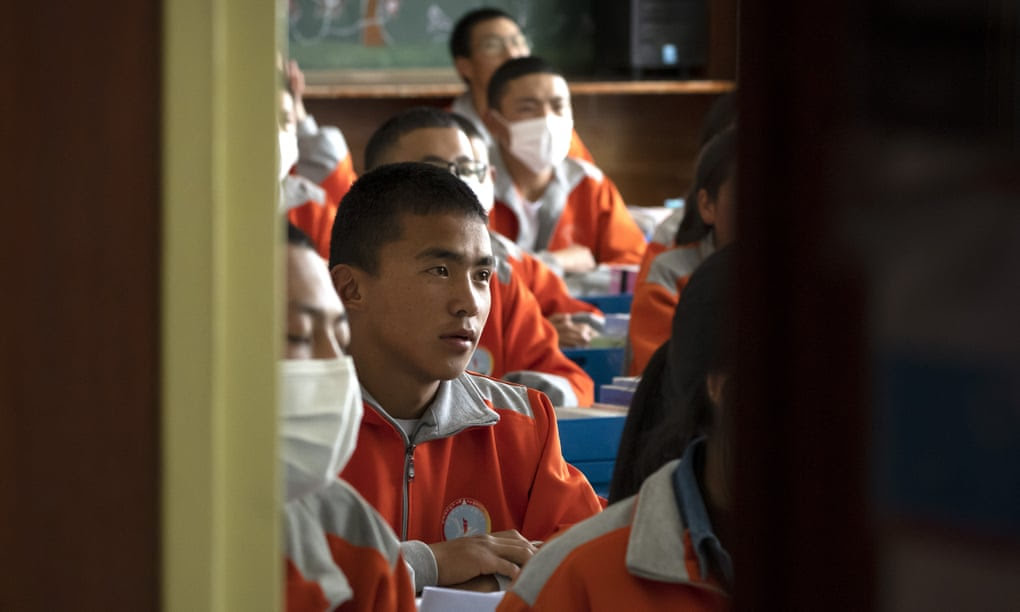
IN FOCUS
By Keerthana Nambiar
Rise of Mandarin, and a decline in China’s dialects
Recent Developments
On 16 January, The Guardian reported, on the decline of local dialects among the younger Chinese generation. The report said: “Mandarin is now being spoken by more than 80 per cent of China’s population, up from 70 per cent a decade ago.” According to The Guardian, “the decline in local dialects among younger generation has become more apparent in recent years as China’s president Xi Jinping, has sought Mandarin to strengthen a uniform Chinese identity.”
Last year, on 30 November 2021, China’s State Council issued an order to promote Mandarin as the national language. There is also an aggressive campaign to make Mandarin spoken by 85 per cent of the Chinese by 2025. The circular released by the Ministry of Education (as reported by the China Daily) calls for “wider access to standardized Chinese education in ethnic minority areas, and urged the protection of the spoken and written languages of ethnic minorities as well as the improvement of their quality of education.”
The long march towards standardizing Mandarin
For centuries, China has advocated the need for Mandarin to be a standard language over the regional dialects. Under the People’s Republic of China, the government undertook massive efforts to increase Mandarin literacy and fluency with a heavy emphasis on the younger generation.
Due to the state policies, the Chinese dialects are declining. In 2000, the Chinese government passed laws to standardize Mandarin Chinese as the spoken and written language. The promotion of Mandarin over other dialects sparked protests among the ethnic population in China. Soon the government crushed all the protests. The criticisms were regarding the changes made to the education and employment system minimizing the role of minority languages. The dialects such as Shanghainese are in precarious situations since then. Apart from this, the Chinese government also promotes Mandarin through the worldwide network of Confucius Institutes which can be considered as an attempt to promote the Communist Party’s agenda.
‘One State, One People, One Language.’
The narrative run by the Communist Party of China is that language conformity can bring national and economic unity. The standardization of Mandarin Chinese is supposed to unite the Chinese population allowing China’s economic and political stability to strengthen. The concept of ‘One State, One People, One Language’ language reform integrates mainland China. The reform starts with teachers teaching elementary, middle, and high schools training the younger generations with Mandarin as a standard language. This standardization started building connections across China among the linguistically and culturally divided population.
Decline of the dialects
China is trying to exchange important aspects of Chinese culture and history for economic and political prosperity. The Guardian reported that dialects of Han majority and ethnic languages such as Mongolian and Uyghur have seriously been affected. Due to current language policy, non-mandarin media are in decline, and the citizens are exposed to the visible benefits of speaking standard Mandarin Chinese. The state promotes language reform as a means for discouraging regionalism and linguistic divisions in China. Among the various criticisms, ‘the card of national unity via language trumps all’ works among the Chinese citizens.
References
“Chinese dialects in decline as government enforces Mandarin,” The Guardian, 16 January 2022
“85% of China's population to speak Mandarin by 2025,” China Daily, 2 December 2021
IN BRIEF
By Dincy Adlakha and Avishka Ashok
INTERNAL
Hong Kong plans to reopen in early 2024 to avoid exodus
On 26 January, The Asahi Shimbun reported on a draft report by Hong Kong’s European Chamber of Commerce. The report signaled that the city will reopen its borders only in early 2024. The tight COVID-19 restrictions are to stay in place till then. This is done to avoid a jeopardizing exodus of foreign firms and staff. Speculations also ay that the city is waiting for Chinese indegenus mRNA vaccine to roll out for the population. This will avoid the risk of a “cascade effect” where financial firms will leave the city and cause a fluctuation in the Asian financial hub. (“Hong Kong may maintain COVID isolation until 2024, risking exodus--Euro chamber,” The Asahi Shimbun, 26 January 2022)
President Xi sends a congratulatory letter for the China Media Group Forum
On 26 January, a forum themed “Together for a High-tech Winter Olympics” was hosted by the China Media Group for the first time. President Xi Jinping sent a congratulatory letter for the forum and said that he hoped “participants of the forum will pool their wisdom and exchange ideas to better demonstrate the charm of ice and snow sports, promote the Olympic spirit and push forward the development of Winter Olympic sports.” (“Xi extends congratulations on opening of CMG forum,” Xinhua Net, 26 January 2022)
ECONOMY
China’s central bank conducts reverse repos of 200 billion to maintain liquidity
On 27 January, Xinhua reported that the People’s Bank of China conducted 200 billion yuan reverse repos in order to maintain liquidity in in the Chinese banking system. The central bank informed that the interest rate for this 14-day reverse repos was fixed as 2.25 percent. This move is strategically planned before the Spring Festival. (“China's central bank conducts 200 bln yuan of reverse repos,” Xinhua Net, 27 January 2022)
REGIONAL
Green Channel between China and Mongolia records trade worth USD 17.4 million
On 26 January, Xinhua Net reported that the fruit and vegetable export from China to Mongolia accounted for 85,000 tonnes and was worth USD 17.4 million in 2021. The products reached the land-locked country through Erenhot port which is the largest port between the two countries. The trade has been successful due to the green channel for agricultural products that was launched in 2018. Through the green channel, China has been supplying 30 kinds of fruits and vegetables such as apples, oranges, lemons, onions, peppers and cucumbers. In 2021, the countries further streamlined the clearance procedure to overcome the obstacles created by the pandemic and kept the supply chain running throughout the year. (“N China land port facilitates fruit, vegetable exports to Mongolia, Xinhua Net, 26 January 2022)
INTERNATIONAL
Experts refute possibility of smoothening ties with Lithuania by name change
On 26 January, Global Times published an article that cited experts from various think tanks. The expert opined that china-Lithuania ties cannot improve if Lithuania simply changes the name of the Taiwanese representative office opened in Lithuania. According to them, the issue is deeper than name of the office. Sources reported that the Lithuanian foreign minister had urged the president to modify the name last week. However, Chinese experts do not seem convinced with the proposition. The spokesperson for State Council’s Taiwan Affairs Office said: “we oppose any action that damages the one-China principle. Hopefully, Lithuania can take real action to right previous wrongs.” (“Lithuania won’t smoothen China ties by mere name change,” Global Times, 26 January 2022)
Chinese Ambassador to Australia encourages friendly relations
On 26 January, the former Chinese Ambassador to Indonesia and a veteran diplomat Xiao Qian accepted his new role as the Ambassador to Australia. In his inaugural remarks, Ambassador Xiao encouraged China and Australia to work towards friendlier bilateral relations and assume the righteous path towards mutual development. Despite several instances of disagreements between the two countries, he urged Australia to resolve issues and build beneficial ties. He said: “A sound China-Australia relationship serves the fundamental interests of the two countries and two peoples. China and Australia differ in their history, culture, social systems and stages of development, but as long as we adopt a long-term and big-picture perspective, adhere to the principle of mutual respect, equality and mutual benefit, and stay firm in the right direction of bilateral relations, the China-Australia relationship will keep moving forward and make further progress.” (“New Chinese ambassador to Australia sends 'goodwill' to reset bilateral ties,” Global Times, 26 January 2022)
Chinese representative to the UN urges humanitarian and economic aid for Afghanistan
On 26 January, China’s permanent representative to the United Nations Zhang Jun addressed the Security Council Meeting and called for more humanitarian and economic assistance to Afghanistan. Zhang blamed the hasty withdrawal by the foreign troops for the abysmal state of the Afghan economy. He made an account of the humanitarian crisis in Afghanistan and said: “China calls for a stronger sense of urgency from the international community and more humanitarian and economic assistance to Afghanistan, so as to bring warmth and hope to the Afghan people.”(“Chinese envoy calls for more humanitarian, economic assistance to Afghanistan,” Xinhua Net, 27 January 2022)
26 January 2022, Wednesday | China Reader Evening Brief | Vol.1, No. 98
China’s GDP growth in 2021: Four contributing factors
China's GDP recorded a growth of 8.1 percent in 2021 and fared better than most countries during pandemic and other challenges. The note sheds light on the factors that helped China achieve this growth despite facing a similar set of challenges.
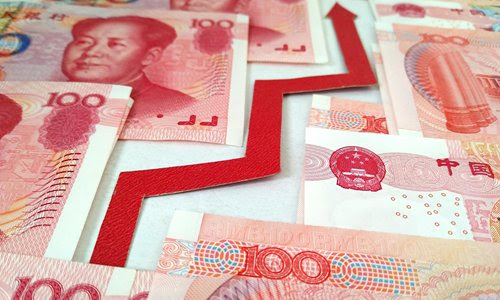
IN FOCUS
By Avishka Ashok
China’s GDP growth in 2021: Four contributing factors
On 17 January, the National Bureau of Statistics (NBS) reported that the Chinese economy had recorded an 8.1 percent growth in its GDP in 2021. The GDP accounted for 114.37 trillion yuan and fared better than the national expectations and the GDP of other developed economies. Chinese economists believe that the country managed to secure its economic growth despite drawbacks including the pandemic, energy crunch and other global challenges, and achieved more than the government’s expectation of 6 percent.
What does the NBS report say?
According to the NBS report, China’s per capita disposable income rose by 9.1 percent in 2021 and stood at 35,128 yuan in 2021. The fixed-asset investment also increased by 4.9 percent and amounted to 54.45 trillion yuan. China’s industrial capacity utilization rate also increased by 3 percent at 77.5 percent. The biggest contribution to the Chinese GDP has come from the following three industries: manufacturing, mining and energy.
The following four factors, could be identified based on the above report, that seemed to have contributed to China’s GDP growth in 2021.
1. Increased industrial output
The NBS report also showed that the industrial output had risen to 9.6 percent. The report revealed that the output produced by state-owned companies rose to eight percent while that of joint-stock companies rose to 9.8 percent. The fastest contributor to the output productivity was the energy sector at 11.4 percent. The output was ameliorated by the production and supply of electricity, heat, gas and water. The output by the manufacturing sector received an increase of 9.8 percent while the mining sector enjoyed an increased output of 5.3 percent.
2. Manufacturing and trade
In 2021, China became the top trade partner for numerous countries. It continued to retain its role as the world’s leading shipbuilder by acquiring 53.8 percent of the new orders globally. The Chinese made 5G phone also dominated the cellphone market with a surge in its sales by 63.5 percent.
3. Consumption growth
The retail sales of consumer growth also rose by 12.5 percent in 2021 and amounted for 44.08 trillion yuan. The head of the bureau revealed that the Chinese economy achieved major feats by recording a consumption retail score of 44 trillion yuan. The growth in consumption is also a result of lower unemployment rates in the urban and rural areas. According to the data released by the NBS, 12.69 million urban jobs were created in 2021, thereby lowering the urban unemployment rate by 0.5 percent. The data collected by the authorities revealed that the rate of unemployment in the largest age group (25-59) stood at 4.4 percent.
4. Energy growth
The National Energy Administration revealed that the total power used by the country in 2021 accounted for 8.31 trillion kilowatt-hours. The figure depicted a 14.7 percent growth in power usage in China. In order to keep up with the growing demands, China’s power generation also rose by 11 percent. Despite the drop in energy production in the fourth quarter, the overall production was higher than that of 2019. Thermal and hydropower witnessed a drop in its production whereas wind, solar nuclear power increased by 30.1 percent, 18.8 percent and 5.7 percent respectively.
References:
“China's GDP expands 8.1 pct in 2021,” Xinhua Net, 17 January 2022
“China's resident nominal disposable income up 9.1 pct in 2021,” Xinhua Net, 17 January 2022
“China's fixed-asset investment up 4.9 pct in 2021,” Xinhua Net, 17 January 2022
“China's industrial capacity utilization rate at 77.5 pct in 2021,” Xinhua Net, 17 January 2022
“China's industrial output up 9.6 pct in 2021,” Xinhua Net, 17 January 2022
“China's retail sales top 44 trln yuan in 2021,” Xinhua Net, 17 January 2022
“China remains world's leading shipbuilder in 2021,” Xinhua Net, 22 January 2022
“China's 5G phone shipments surge in 2021,” Xinhua Net, 22 January 2022
“China's surveyed urban unemployment rate drops in 2021,” Xinhua Net, 17 January 2022
“China's power generation up in 2021,” Xinhua Net, 17 January 2022
“China's power use surges 10.3 pct in 2021,” Xinhua Net, 18 January 2022
IN BRIEF
By Dincy Adlakha and Keerthana Nambiar
INTERNAL
Xi emphasizes urgent necessity to achieve China’s climate targets
On 25 January, President Xi Jinping addressed a Politburo study meeting in which he emphasized China’s urgent need to achieve the carbon goals. He stressed that the country must opt for low-carbon development that leads to a greener path. He said: “Achieving the ‘double carbon’ target is not something we are told to do but something that we must do.” He emphasized that China needs to switch to greener initiatives for a sustainable growth. (Echo Xie, “‘We must do it’: Xi Jinping stresses urgent need to meet China’s climate goals,” South China Morning Post, 26 January 2022)
Employment prospects drop for college graduates
On 25 January, Korea Times published a report that employment prospects for college graduates have dropped for the second consecutive quarter of 2021. The number of jobs available per applicant for fresh university graduates fell 0.79 in second quarter of 2020. This was down from 1.52 of the previous year. In the last quarter of 2021, the number fell to 0.88. The data was presented by China Institute for Employment Research at Renmin University of China. The report also mentioned that according tot he National Bureau of Statistics, the unemployment rate in urban areas od China in 2021 was 5.1 percent of which the rate for people aged 16 to 24 was 14.3 percent. (“Record number of Chinese graduates faced with grim employment prospects,” The Korea Times, 25 January 2022)
TECHNOLOGY
China Telecom opens 5G SMS for commercial market
On 25 January, China Telecom, the country’s giant mobile operator, officially announced that its 5G SMS is open for commercial use. This means that individuals can receive 5G messages for free but will be charged for sending them. Public can use this service not merely for messages but also for pictures, audio, video, purchasing tickets, checking train logistics and paying the dues. Users can do all this without installing other applications. The firm has set up 5G messaging platform with a support system to ensure security. The announcement is a good news for Chinese industries as it can strengthen technological integration. (“China Telecom officially announces 5G SMS for commercial use,” Global Times, 25 January 2022)
China develops mRNA COVID-19 vaccine, passes early stage human trials
On 25 January, a study published in Lancet Microbe journal revealed that a mRNA COVID-19 vaccine developed by China is safe and effective in its early-stage human trials. The vaccine was developed by the Academy of Military Medical Sciences, Suzhou Abogen Biosciences and Walvax Biotechnology. The vaccine has been tested on 120 individuals at a hospital in Hangzhou. The study revealed: “15 microgram doses induced the highest titers of neutralising antibodies, roughly double the antibody titers of convalescent patients with COVID-19, indicating stronger immune responses induced by the vaccine.” (“Trials show China's mRNA COVID-19 vaccine safe, effective, Xinhua Net, 26 January 2022)
REGIONAL
Electronic warfare aircraft spotted near Taiwan for the first time
On 25 January, Global Times reported that an electronic warfare aircraft of the People’s Liberation Army was spotted near Taiwan after two US aircraft carriers passed by the island recently. The J-16D aircrafts are capable of seizing the electromagnetic field and are currently being tested for its future use. This is the first time that an aircraft of such a kind has been used in the incursions near Taiwan. (“PLA's J-16D electronic warfare aircraft spotted for 1st time near Taiwan,” Global Times, 25 January 2022)
INTERNATIONAL
US House of Representatives finalises bill to counter China and strengthen Taiwan, Quad ties
On 26 January, South China Morning Post published an article that reported on a recent bill finalised by the US House of Representatives that was publicised on the previous day. The America Competes Act of 2022 is a 3000 pages long bill which will boost US competition with China. The act has provisions to strengthen US ties with Quad and Taiwan, including changing the name of Taipei de facto embassy in Washington and rectifying more semiconductor deals with Taiwan. The bill also allocates 100 million USD to counter the censorship and disinformation of the Chinese government. Further, the bill provides for creation of a new US special envoy post at the US State Department to engage a response to China’s policies in Xinjiang. (Jacob Fromer and Owen Churchill, “US House finalises bill to confront China, including provisions on semiconductors and Taiwan ties,” South China Morning Post, 26 January 2022)
President Xi extends support to Central Asian countries
On 25 January, Chinese President Xi Jinping attended the virtual summit with the Central Asian countries and celebrated the 30 year anniversary of diplomatic ties. He announced that China would work with Central Asian countries to build a closer community and work towards a future with shared opportunities. President Xi aims to achieve these goals by increasing cooperation between China and the Central Asian countries through the Belt and Road Initiative. He also extended his support to fight against the three evils and said: “We have combined efforts to fight the three forces of terrorism, separatism and extremism, transnational organized crime and drug trafficking, and to resolutely reject external interference or attempts to instigate color revolutions.” (“ China to aid 5 Central Asia countries with additional 50 million vaccines, to continue 'high-level political mutual trust',” Global Times, 26 January 2022)
Russia and China hold joint anti-piracy drill
On 25 January, the Chinese Defense Ministry announced that the Chinese and Russian Naval forces participated in joint anti-piracy drills in the Arabian Sea. The exercise was aimed at ameliorating the countries capabilities in the sea. The statement by the ministry said: “During the drills, the Chinese-Russian flotilla practiced training courses including joint maneuver, saving hijacked vessels and transporting injured personnel with helicopters in a mock joint anti-piracy operation.” (“China, Russia hold joint anti-piracy drills in Arabian Sea,” Global Times, 25 January 2022)
25 January 2022, Tuesday | China Reader Evening Brief | Vol.1, No. 97
Xi Jinping’s Address at World Economic Forum: Three Takeaways
President Xi Jinping envisions a prosperous and developed world for the future. According to him, multilateralism, economic recovery, global development and peaceful coexistence form the core of this futuristic world.
.jpg)
IN FOCUS
BY Dincy Adlakha
Xi Jinping’s Address at World Economic Forum: Three Takeaways
On 17 January, President Xi Jinping delivered a special address to the 2022 World Economic Forum in a virtual session. His address focused on the Forum agenda: “forging ahead with confidence and fortitude to jointly create a better post-COVID world.” He emphasized that multilateralism, economic globalization, global development and peaceful coexistence can create a prosperous world.
Three major takeaways can be drawn from his address.
1. Multilateral cooperation is necessary to beat COVID-19 and revitalize the global economy.
President Xi argued that only multilateral cooperation in the international community can help defeat this global crisis. He called for active collaborations in the research and development of medicines and greater binding role of international organizations. He also said that the focus should shift from blame-games or distracting debates to productive defence against the pandemic. Additionally, he entrusted global financial institutions like the World Trade Organization with the task of economic globalisation. He suggested that developed countries should formulate smart economic policies to avoid spillover. He also alluded to an ideal rule-based order for sharing of innovative technology and artificial intelligence. Such strategies are imperative to strengthen macro-policy coordination. Information sharing and increased financial exchange can prevent the world economy from plummeting yet again. Policy transparency is a systematic way to enhance policy synergy and support global consensus for economic recovery.
2. Closing global development gaps and coexisting peacefully can circumvent the pandemic crisis.
The address identified the need to bridge global development. There exists a wide North-South gap and technological divide. While many enjoy the richest amenities, millions live in hunger. President Xi called greater support for food security, health, education, housing, employment and stability especially for the developing countries that have been pushed back to poverty due to COVID-19. He advised a people-centred approach to achieve the 2030 agenda of sustainable development by the UN. Cooperation through COP26, discarding Cold War mentality and tactics, shedding protectionism are some significant ways to make amends. He criticized bullying through hegemony or indulging in a zero-sum game and promoted a win-win path of cooperation for humanity’s peaceful development. Politicized acts of ideological antagonism will only overstretch national security without creating space for prosperity.
3. China is committed to create a unified and prosperous society.
Through his address, President Xi Jinping referred to Chinese values and sayings that symbolize bravery and strength. China sees itself as a provider. Not merely of vaccines to Africa or ASEAN, but also as a provider of economic flow in the world through initiatives like BRI and RCEP. President Xi referred to the abundance of Chinese people who form the real wealth of the country and aspire for its substantive progress. President Xi assured china’s commitment to opening up and achieving its carbon targets. The two goals are essential for China and the world. President Xi highlighted that “Together for a Shared Future” is not merely the motto for Beijing Olympics 2022. It is also the required spirit to protect the globe.
References:
“Full text: Xi Jinping's address to 2022 World Economic Forum,” CGTN, 19 January 2022
IN BRIEF
By Avishka Ashok and Keerthana Nambiar
INTERNAL
CPC Central Committee conducts Political Bureau meeting
On 24 January, Chinese President Xi Jinping chaired a Political Bureau meeting of the Communist Party of China (CPC) Central Committee. The meeting reviewed the work of authorities in 2021 and approve their work plans for 2022. The main agenda of the meeting was to improve the Party and government conduct and “mercilessly fight corruption”. The meeting also stressed safeguarding CPC Central Committee’s authority and take concrete steps towards modernizing China in 2022. (“Xi chairs CPC leadership meeting to review report, regulations,” Xinhua Net, 24 January 2022)
IOC relaxes the COVID-19 requirements for the Beijing Winter Olympics 2022; Chinese authorities give a smog warning
On 24 January, International Olympic Committee announced the changes in the upcoming Beijing Winter Olympics. The organizers confirmed that the strict COVID-19 requirements for the participants would be eased. The IOC released a statement that the changes have been made “in order to further adapt to the reality of the current environment and support the Games participant.” Meanwhile, the Chinese authorities have also warned of the seasonal air pollution in Beijing. China’s Ministry of Ecology and Environment said that the winter weather was “very unfavourable” to keep the air clean from concentrations of hazardous airborne particles. The environment ministry spokesperson has promised to ensure a “good environment” during the Games. (“Beijing 2022 eases COVID curbs for Games; China warns on pollution,” Reuters, 24 January 2022)
China successfully tests new engine with hypersonic capabilities
On 24 January, Global Times published an article on China conducting a test flight for a new engine that could power hypersonic aircraft. China Central Television (CCTV) reported that the Laboratory of Spray Combustion and Propulsion under the School of Aerospace Engineering at Tsinghua University successfully conducted a flight test. CCTV further adds that the technology will enrich China’s aerospace capabilities and will achieve hypersonic flight. (“China tests new engine,‘likely to power hypersonic aircraft’,” Global Times, 24 January 2022)
TECHNOLOGY
China drafts new rules to allow gene-edited crops
On 24 January, the Ministry of Agriculture and Rural Affairs published new guidelines that aimed at overhauling the country’s seed industry. The guidelines were released amid a number of measures to strengthen food security in China. The guidelines pertain to rules for trials for approval of gene-edited plants which can help in faster improvement of crops. Once the gene-edited plants complete their trial, a production certificate can be applied. Gene-editing is a novel technology thattcan improve crop strength without gene-modifying that involves adding foreign genes to a plant. (“China food security: new draft rules ‘open the door’ for gene-edited crops,” South China Morning Post, 25 January 2022)
REGIONAL
China to hold virtual summit with five Central Asian countries
On 25 January, Chinese President Xi Jinping will chair a virtual summit to commemorate the 30th anniversary of the establishment of diplomatic ties between China and five Central Asian countries. Chinese Foreign Ministry spokesperson Zhao Lijian said that the summit is a crucial step to “draw up blueprints for future cooperation.” Zhao added that China will “intensify political mutual trust” and expand mutual cooperation with Kazakhstan, Kyrgyzstan, Tajikistan, Turkmenistan and Uzbekistan and upgrade relations to a new stage. (“China, Central Asian nations to upgrade ties,” China Daily, 25 January 2022)
INTERNATIONAL
Chinese Foreign Ministry issues complaint against the US and Japan
On 24 January, Chinese Foreign Ministry Spokesperson Zhao Lijian complained against the US and Japan for “baselessly” attacking the country during a video conference between US President Joe Biden and Japanese Prime Minister Fumio Kishida. The US officials shared that the two leaders held in-depth talks on China and shared their concerns regarding China’s nuclear build-up. Zhao said: “They yet again have baselessly smeared and attacked China, and wantonly interfered with China's domestic affairs. The U.S and Japan are holding to Cold-War mentalities and inciting ideological antagonism.” (“China accuses U.S., Japan of smearing it ‘baselessly’,” The Asahi Shimbun, 25 January 2022)
Taiwan vice-president attends swearing-in of new leader in Honduras
On 25 January, Taiwanese Vice President William Lai left for Honduras to attend the swearing-in ceremony of presidential-elect Xiomara Castro. Honduras is one of the only 14 countries that formally recognise Taipei. However, the new leader has hinted in the past to switch ties with Beijing. Vice-President William left for Honduras in hopes to reignite diplomatic ties with Honduras amidst the shaky period of their relations. Reports also suggest that he might meet US Vice-President Kamla Harris, who will also be attending the ceremony. (“Taiwanese vice-president heads for Honduras to shore up shaky alliance,” South China Morning Post, 25 January 2022)
WeChat finds no evidence of hacking in Scott Morrison’s account
On 25 January, the Guardian reported WeChat’s statements on a lack of evidence behind the hacking or a third-party intrusion in Australian Prime Minister Scott Morrison’s account. Tencent, the owner company of WeChat, said that there seems to be an account ownership issue and promised to address the problem in accordance to their rules. (“‘No evidence of hacking’: WeChat hits back at interference claims about Scott Morrison’s account,” The Guardian, 25 January 2022)
24 January 2022, Monday | China Reader Evening Brief | Vol.1, No. 96
Four internal drivers of China’s external behaviour: Review of Amb Shivshankar Menon’s essay
The essay by Amb Shivashankar Menon analyses Chinese behaviour in the world. Geography, internal stability, rising nationalism and an imagined past, and maritime interests are the four internal factors that affects China’s external behavior.
IN FOCUS
BY Dincy Adlakha
Four internal drivers of China’s external behaviour: Review of Amb Shivshankar Menon’s essay
On 12 January, Centre for Social and Economic Progress published a working paper by Amb Shivshankar Menon titled, ‘Internal Drivers of China’s External Behaviour'.
The primary hypothesis of the essay is that unlike most countries, China highly depends on regime survival, internal stability, economic growth and other internal interests while framing external interactions.
The essay begins with China’s relations having worsened with all neighbours recently except Pakistan, Cambodia and Russia. It looks at the “Wolf warrior” diplomacy, extension of “Chinese Dream” to the diaspora, and constant assertion for territorial integration and sovereignty that leave sour impressions of Chinese external behavior.
1. Geography of China
The essay suggests that major powers of the world like the US and the UK are situated in seas that separate the enemies. However, China is surrounded by foes on land as well as sea. It has contentions of territory with Japan over the Senkaku/Diaoyu islands, India over Arunachal Pradesh, and other complications like Tibet, Xinjiang and Taiwan. Such opposing geography has made sovereignty a core value for China that must be guarded through military, economy and information security.
2. Internal stability imperative
According to the essay, China realised it early (as early as the 1989 Tiananmen Square massacre) that internal stability is crucial to avoid foreign interference and strong global standing. Ever since, China has promoted “stability over all else.” Leaders like Mao and Xi have promoted ideological stability by ultranationalism and the state intervenes to ensure demographic, religious, and societal stability as well. Economic and military strength of China have been prioritised to avoid faltering and behavioral units like PLA, the CCP and national banks have been strengthened to make China stand tall.
3. Realigning the past with nationalism
The essay recalls Chinese narratives of being the centre of the world (which also gives the name Zhongguo) that were later switched to being a victim of foreign imperialism. From creating historical memory of avenging the “national humiliation” suffered due to Japan and Britain to Mao expanding the victor or hero narrative, China has utilized its past to influence public support. Once again, Xi Jinping appeals to the victims of Chinese archetypes and also showcases the victor built through the suffering. The emphasis on tragedies of Opium Wars and 1911 revolution is a pathway to the focus on China’s growing economic and regional success, especially through initiatives like Common Prosperity.
4. Maritime dominance
The essay argues that China has always remained a power that focused on land and slash the sea links. However, its export-led development model and dependence on the world for energy, raw materials and technology have forced it to enter the sea. China has harnessed its maritime capabilities late but strong. Its behavior as a maritime power can be guessed through its internal dynamics but not forecasted due to its vulnerabilities at global trade.
On the above four factors, the essay concludes with the following three major projections. First, China will become more assertive for its internal needs to be accepted in external scenarios. Second, this assertiveness will create resistance from other global powers. And finally, an internally driven foreign approach will make it difficult for other countries to relate with Chinese interests.
References:
Shivshankar Menon, “Internal Drivers of China’s External Behaviour,” Centre for Social and Economic Progress, 12 January 2022
IN BRIEF
By Avishka Ashok and Keerthana Nambiar
INTERNAL
Xinjiang’s economy hit record high with an increase of 7 per cent
On 23 January, Xinjiang local government delivered a report to the annual session of the regional legislature on Xinjiang’s economy. According to the report, in 2021 Xinjiang’s economy expanded up to seven percent year-on-year about 1.6 trillion yuan. Global Times reported that there are three drivers of Xinjiang economy- fixed-asset investment, social retail and foreign trade which increased by 15 per cent, 17 per cent and 5.8 per cent respectively. Cotton is the major agricultural product and the planting area has reached 2.5 million hectares. The regional government stated that they will take full advantages of the cotton production, petrochemical and coal chemical industries for an overall development of Xinjiang. ( Xinjiang's regional economy grows 7% in 2021, with grain output hitting record high,” Global Times, 23 January 2022)
Chinese PLA pledges its support in eradicating corruption within the party and the society
On 24 January, South China Morning Post reported that the Chinese military promised its support to the Communist Party of China and extended its support to working towards the anti-corruption drive. One of the Central Military Commission’s Vice-chairmen said that the PLA is loyal to the party and will innovatively eliminate corruption. The remarks were made soon after President Xi Jinping promoted seven generals in the PLA. (“Chinese military pledges loyalty to Communist Party and vows to keep up anti-corruption drive,” South China Morning Post, 24 January 2022)
REGIONAL
34 PLA aircrafts enter Taiwan’s ADIZ
On 23 January, Taiwan’s Defense Ministry reported that the Chinese People’s Liberation Army had caused the largest incursion since October 2021 by sending 39 aircrafts to Taiwan’s ADIZ. The recent incursion included 34 fighter jets, four electronic warfare aircraft and one single bomber aircraft. The incursion took place in the northeast section of the Pratas island. (“Taiwan reports new large-scale Chinese air force incursion,” The Strait Times, 24 January 2022)
INTERNATIONAL
China accuses UK of following Cold War playbook
On 23 January, China warned the UK not to follow the Cold War playbook after Britain’s top foreign and defence officials visit to Australia. The Chinese Embassy to the UK made a statement on its website: “Today's world is a far cry from the one 40 or 50 years ago. The Cold War is long gone!,” reported Global Times. The statement came in as a response to UK Foreign Secretary Liz Truss at the Lowy Institute of Australia. The Chinese embassy spokesperson said that the accusations made against China are “full of disinformation.” (“China slams UK for following Cold War playbook,” Global Times, 23 January 2022)
President Xi Jinping exchanges congratulatory remarks with Israeli President Issac Herzog
On 24 January, Chinese President Xi Jinping exchanged congratulatory messages with Israeli President Issac Herzog marking the 30th anniversary of the establishment of diplomatic ties between China and Israel. President Xi pointed out the deepened relations, diplomatic relations and comprehensive since the establishment of ties. Chinese Premier Li Keqiang also congratulated his Israeli counterpart Naftali Bennet and said “China and Israel have carried out fruitful and innovative cooperation and achieved mutual benefits and win-win results,” reported CCTN. (“Xi exchanges congratulations with Israeli president on 30th anniversary of diplomatic ties,” Global Times, 24 January 2022: “Xi exchanges congratulations with Israeli president on 30th anniversary of China-Israel diplomatic ties,” CGTN, 24 January 2022)
22 January 2022, Saturday | China Reader Evening Brief | Vol.1, No. 95
Foreign Ministry responds to EU Parliament's resolution on Hong Kong
The European Union passed a resolution on the violations of democracy in Hong Kong. The Foreign Ministry of China responded to the resolution, calling it a waste and a joke.
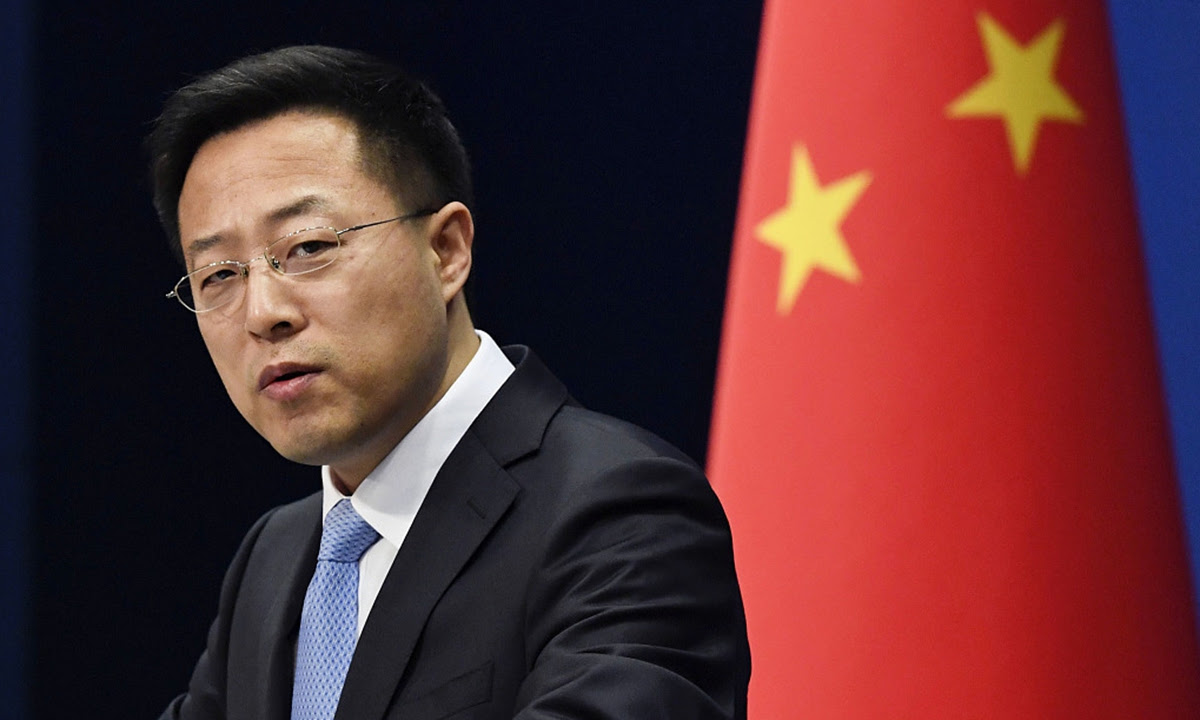
IN BRIEF
By Dincy Adlakha, Avishka Ashok and Keerthana Nambiar
INTERNATIONAL
Chinese authorities reject the European Parliament resolution on Hong Kong
On 21 January, Global Times reported that the Chinese authorities are firmly rejecting the Hong Kong resolution of the European Parliament (EP) calling its a “piece of waste paper and a joke” On 20 January, the European Parliament passed the resolution on the violations of democracy in the Hong Kong Special Administrative Region (HKSAR) and called for sanctions against the Chinese central government and Hong Kong government officials. In a routine press conference, Chinese Foreign Ministry spokesperson Zhao Lijian stated that Hong Kong-related affairs are China’s domestic affairs and Hong Kong is now safe and stable. “In terms of human rights issues, the EP should learn to reflect on themselves and get rid of their old habit of always wanting to be a teacher to others,” added the spokesperson. (“European Parliament resolution on HK ‘waste paper, joke’,” Global Times, 21 January 2022)
Chinese Foreign Ministry criticizes US for double standards on nonproliferation
On 22 January, Foreign Ministry Spokesperson Zhao Lijian criticized the US for sanctioning three Chinese military enterprises. The US had recently imposed sanctions on the Chinese military firms citing “missile proliferation” which has angered China. Zhao termed this as “bullying behaviour” in an effort to keep Chinese firms at bay. He also said that the move is politically driven and is reflective of US double standards. He said that the US is taking groundless actions which should be reversed with immediate effect. Zhai said that the actions have “disrupted the normal international economic and trade order, and threatened the security and stability of the global industrial chain and supply chain. It's not conducive to the recovery and development of the world economy.” (Leng Shumei and Yu Xi, “US lambasted for double standards on nonproliferation,” Global Times, 22 January 2022)
Experts opine differences in Japan-US relations yet to be solved
On 22 January, Global Times published an article that builds on an interview with Liu Weidong, a research fellow at the Institute of American Studies at the Chinese Academy of Social Sciences. The article reported that US President Joe Biden held a virtual summit with Japanese Prime Minister Fumio Kishida where both agreed to boost cooperation on issues like the economy, security, Chinese power, North Korea’s missile launches and Russia’s aims in Ukraine. However, the expert holds that there have been tensions brewing in the relationship as Japan-US have a historical bond but Japan’s silence against “opponent” China is concerning. He further adds that Japan PM needs to show complete loyalty to the US for improved relations. According to the researcher, Japan is also wary of improving China-US relations. Hence, the two countries need to align together yet again through the rough patch. (Wang Qi, “Biden tests Japan’s loyalty at virtual summit, but ‘disagreements remain to be solved’,” Global Times, 22 January 2022)
China-Bangladesh mega expressway aims to finish construction by 2024
On 22 January, Xinhua Net reported on the transformational highway in Dhaka and informed that the Chinese and Bangladeshi project was taking shape nicely. The highway is aimed at connecting the industrial belts, the Chattogram seaport and the northeast region of the country. China owns 60 percent of the stakes in the USD 400 million project. A Chinese project manager in Bangladesh informed that 70 percent of the work had been completed and the involved companies planned to finish construction by 2024. (“China mega-tech drives Bangladesh mega highway, Xinhua Net, 22 January 2021)
INTERNAL
Chinese political advisors conduct meeting to study President Xi’s speech for guidelines on Party governance
On 21 January, China’s senior political advisors met to “study the important speech” which was delivered by President Xi Jinping at the sixth plenary session of the 19th Central Commission for Discipline Inspection of the CPC. the meeting was held by the Chinese People’s Political Consultative Conference (CPCCC) National Committee headed by Wang Yang. The political advisors stressed the importance of studying the speech for strengthening the Party and align thinking and actions with President Xi’s speech. The meeting also said: “ The leading Party members group should also bolster its ability to resist corruption and fulfill its duties and responsibilities with good spirit,” reported Xinhua. (“Senior political advisors study Xi's speech on strict Party governance,” Xinhua Net, 21 January 2022)
ECONOMY
China continues to be the leading shipbuilder in 2021
On 22 January, Xinhua Net reported the data released by the Ministry of Industry and Information Technology and informed that China continued to remain the world’s leading shipbuilder in 2021. The demand for maritime transport increased in the last year, thereby pushing the demand in the Chinese shipbuilding industry. In 2021, the total output amounted to 39.7 million deadweight tonnes and 47.2 percent of the world’s total output. China received over 53.8 percent of the total global orders for shipbuilding. (“China remains world's leading shipbuilder in 2021,” Xinhua Net, 22 January 2022)
5G phone shipments in China surge by 63.5 percent
On 22 January, Xinhua Net relayed the information published by the China Academy of Information and Communications Technology on the shipments of 5G phones. According to the data provided by the Academy, the shipments accounted for 266 million units in 2021 and 75.9 percent of the total mobile shipments. The country is also credited for introducing 227 new models of the 5G phones in 2021. An MIIT data revealed that China has increased its pace of network development and has launched 1.43 million 5G base stations. (“China's 5G phone shipments surge in 2021, Xinhua Net, 22 January 2022)
Beijing’s foreign trade scores better than other Chinese cities
On 21 January, the local customs authority reported that Beijing city recorded a robust growth in its foreign trade in 2021. The total import and export value amounted to 3.04 trillion yuan and recorded a 30.6 percent surge in 2021. In comparison to other cities and the national average, the growth rate of Beijing was 9.2 percentage points higher than the rest. (“Beijing's foreign trade stays robust,” Xinhua Net, 22 January 2021)
21 January 2022, Friday | China Reader Evening Brief | Vol.1, No. 94
Four reasons for the US rejection of China’s claims in the South China Sea
The US released a report detailing its objections to China's claims in the South China Sea. The objections are based on the UN Convention on the Law of the Seas.
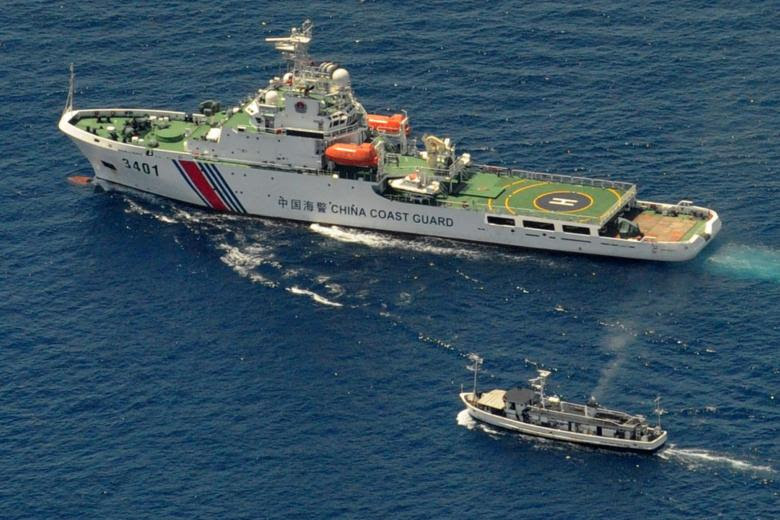
IN FOCUS
By Avishka Ashok
Four reasons for the US rejection of China’s claims in the South China Sea
On 12 January, the US State Department’s Office of Ocean and Polar Affairs released a report outlining China’s assertion in the South China Sea. The 47-page report rejected the claims as “inconsistent with the international law”.
The report identifies four factors for China’s claims in the disputed sea and then proceeds to dismiss them with its reasoning and facts.
1. Sovereignty claims over maritime features
According to the Chinese government, the features and bodies under the sea are also a part of the Chinese territory. China considers these underwater features as a part of its territorial boundaries; thereby extending the maritime zones and creating an overlap of boundaries with other countries and their territories. The report bases itself on the UNCLOS and explains that land mass above the sea level and below the sea level are treated differently. Those bodies that are above sea level contribute towards the establishment of a maritime zone. However, the features claimed by China cannot be considered for the same as most of them are underwater features and they fall outside the legally approved territorial sea.
2. Straight Baselines
China has repeatedly expressed its belief of drawing straight baselines that include the underwater features within its territory. The resulting territory would consist of vast spaces, covering four island groups. According to the report, “International law, as reflected in Part II of the Convention, sets forth rules governing the baselines from which the limits of maritime zones are measured.” The convention has taken different water bodies such as reefs, bays, ports, roadsteads into consideration. The only exception to drawing straight baselines can be applied in case of a deeply indented cut or when there is a fringe of islands in close vicinity to the coastline. The report finds that China is not eligible for the same.
3. Maritime Zones
The report explains that China has exerted its right over internal waters, territorial seas and a continental shelf as a whole which is not provided for in the international law. According to UNCLOS, maritime zones are measured from the coastlines of a country. It provides for 12 nautical miles of territorial seas, a contiguous zone of 24 nautical miles and an Exclusive Economic Zone which spreads across 200 nautical miles from the coastlines. China’s claims over internal waters are inconsistent as the baselines around Xisha Qundao islands do not fit the international laws. In order to claim internal waters, China must establish a straight baseline that is agreeable to international law.
4. Historic rights
The report further explains that China has exerted its sovereignty over the islands in the sea by alleging historic possession of the territory. The UNCLOS has provisions for “historic bays” and “historic title”. However, in case of an adjacent or opposite coasts, neighboring states may also claim a right to the water body. The report clarifies that China has failed to provide legal justifications for its claims and it is unknown if these rights belong exclusively to China.
The Chinese Foreign Ministry spokesperson Wang Wenbin responded to the report and remarked on the hypocrisy of the US for judging China’s claims based on UNCLOS when it has not ratified the convention itself. Wenbin said: “The report distorts international law, misleads the public, sows discord and disrupts the regional situation."
References:
“Beijing says new South China Sea report by US is misleading, distorts international law,” The Strait Times, 13 January 2022
“US report outlines legal arguments against China’s maritime claims; Beijing dismisses US assertions,” The Strait Times, 13 January 2022
“Limits in the Seas No. 150 People’s Republic of China: Maritime Claims in the South China Sea,” US Department of State, Office of Ocean and Polar Affairs, 12 January 2022
IN BRIEF
By Dincy Adlakha and Keerthana Nambiar
INTERNAL
COVID-19 cases surge in Hong Kong from unusual sources
On 21 January, The Strait Times reported on the increasing number of COVID-19 infections in Hong Kong which is known for the zero-COVID approach. The report says that the infections seem to be coming from “unusual sources” such as family pets and scavenger collecting items for re-cycling from buildings. The government is trying to track down the sources for the spillover. Officials ordered mass testing for a public housing estate after detecting signs of the virus in sewages and rubbish collection areas. (“Hong Kong locks down building and tests thousands as Covid-19 cases jump,” The Strait Times, 21 January 2022)
China offloads 4 million barrels of Iranian oil into state reserves, says Vortexa Analytics
On 21 January, Vortexa Analytics, a ship tracking specialist said that China offloaded nearly four million barrels of Iranian crude oil into state reserve tanks in the southern port city of Zhanjiang. According to General Administration of Chinese Customs data, China bought about 260,312 tons of Iranian crude oil in December 2020. The recent move from China comes in amidst the tough negotiations with Iran to revive the nuclear deal which includes lifting the US imposed sanctions. The refilling of China’s reserves also comes ahead of the plan to release emergency stockpile oil along with the US to cool down global oil prices. (“EXCLUSIVE China puts 4 mln barrels of Iranian oil into state reserves -source, Vortexa,” Reuters, 21 January 2022)
China’s Olympic villages ready for the athletes
On 21 January, China Daily reported that three Olympics villages are ready to welcome the Winter Olympics and the athletes in China. Beijing Winter Olympics Village consists of two in Beijing’s Chaoyang and Yanqing districts and one in Zhangjiakou in Hebei province. The village are ready in terms of epidemic prevention and healthcare and provides with 20 residential buildings for the athletes. The housing is supposed to accommodate 5,500 athletes and team officials. (“Three Olympic villages ready for move-in,” China Daily, 21 January 2022)
CPC releases communique on anti-corruption efforts of the party
On 20 January, the Communist Party of China released a communique at the sixth plenary session of the 19th Central Commission for Discipline Inspection. The communique promised to persistently work against corruption within the party and tighten the restrictions to prevent disorderly expansion of capital. President Xi Jinping also delivered a speech at the session that was held from 19 to 20 January. President Xi also made a note of the anti-corruption campaigns and its achievements in the last decade. (“CPC’s disciplinary agency renews anti-corruption drive, to fight new challenges of ‘capital-power collusion’,” Global Times, 20 January 2022)
ECONOMY
Chinese Central Bank cuts interest rates in a bid to boost capital flow
On 20 January, the Chinese authorities cut the de-facto benchmark lending rate in five-year and one-year loans; thereby easing the capital flow in the country. The decision came soon after the central bank officials announced a cut in the interest rate for central bank lending to commercial banks. The Global Times reported that that the cuts are according to the loan periods. However, the measures taken by the state seem to be aimed at boosting market confidence and inject momentum into the economy. (“China cuts benchmark lending rate to bolster economy,” Global Times, 20 January 2022)
INTERNATIONAL
China and Germany promise to deepen cooperation and avoid ‘microphone diplomacy’
On 20 January, the Chinese Foreign Minister Wang Yi and German Foreign Minister Annalena Baerbock held a video conference and promised to deepen bilateral relations and mutual understanding. The two leaders also pledged to stay away from “microphone diplomacy”. China and Germany will be celebrating 50 years of diplomatic relations in 2021. On the occasion, the countries will promoting economic development and work towards establishing an all round strategic partnership. (“China, Germany pledge to deepen cooperation and refrain from 'microphone diplomacy',” Global Times, 21 January 2022)
China warns the US Navy force in the South China Sea
On 20 January, the Southern Theatre Command of the People’s Liberation Army stated that the USS Benfold “illegally” sailed into China’s territorial waters without permission. China accused the US of violating Beijing’s sovereignty and demanded that the US must “immediately stop such provocative actions” otherwise will face “serious consequences of unforeseen events.” In response to this, the US Navy rejected the accusations and deemed the mission to be “false.” The Navy further detailed that the Benfold was “in accordance with international law” and was conducting normal operations. (“China says it warned away U.S. warship in South China Sea, U.S. denies,” Reuters, 20 January 2022)
20 January 2022, Thursday | China Reader Evening Brief | Vol.1, No. 93
China celebrates 30 years of diplomatic relations with Belarus
President Xi Jinping and President Alexander Lukashenko exchanged congratulatory messages on the occasion of 30 years of diplomatic ties.
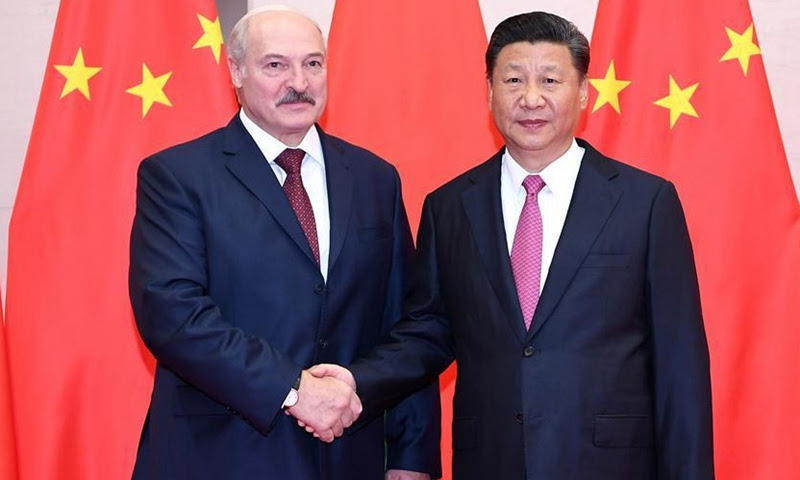
IN BRIEF
By Dincy Adlakha and Keerthana Nambiar
INTERNATIONAL
Beijing warns foreign athletes to strictly follow Olympic charter and Chinese laws and regulations
On 19 January, Washington Post reported that China’s Olympics organizing committee member warned that the foreign athletes may face punishment for speech that violates the Chinese law at the Winter Games. On 18 January, Yang Shu, the deputy director-general of international relations for the Beijing Organizing Committee said: “Any behavior or speech that is against the Olympic spirit, especially against the Chinese laws and regulations, are also subject to certain punishment.” China’s human rights records are undergoing harsh scrutiny by the international forums and media for the alleged human rights violations in the Xinjiang region. US, UK, Canada, Australia and Japan are going ahead with the political boycott of the Games following the accusations. Yang added that: “The politicization of sports is one of the things opposed by the Olympic Charter.” (“China warns foreign Olympic athletes against speaking out on politics at Winter Games,” Washington Post, 19 January 2022)
Xi, Lukashenko celebrate 30 years of diplomatic ties
On 20 January, Chinese President Xi Jinping and Belarusian President Alexander Lukashenko exchanged congratulatory messages with each other to mark the completion of 30 years of diplomatic relations. Both countries have promised to cooperate further for trade and investment ties. They have also discussed holding up the values of truth and accountability in previous talks during January 2022. (“Chinese, Belarusian presidents exchange congratulations on 30th anniversary of diplomatic relations,” Global Times, 20 January 2022)
INTERNAL
Chinese expert briefs on China’s demographic dividends
On 20 January, Reuters published an expert report on China’s demography and slowing down of the population. According to the Chinese demographic expert, the demographic dividends of China are within a “window of opportunity” which will be closed soon. Song Jian, a demographic professor at Renmin University explained that this situation would pressurize fewer births among the working population. Song says that in the future “China would have to turn to dividends from its elderly population instead,” reported Reuters. Chinese economy which is largely dependent on the population will face backlash since the record drop in birth rate in 2021. (“China's demographic dividends to end soon, expert warns,” Reuters, 20 January 2022)
China releases white paper on the international importance of improving wetlands
On 19 January, China’s National Forestry and Grassland administration issued a white paper on the ecology of China’s wetlands. The document discusses the international importance of improving the wetlands for better water quality and biodiversity. The Chinese mainland has about 63 wetlands and one in Hong Kong Special Administrative Region (HKSAR). The 63 wetlands are home to 2,258 species of wetlands and 260 species of wetland birds. Wu Zhimin, an official with the administration said: “In the future, China will continue to boost conservation of the wetlands of international importance, carry out wetland ecological restoration, strengthen the prevention and control of alien species and improve wetland management capacity,” reported Xinhua. (“China's wetlands of int'l importance improving: white paper,” Xinhua Net, 20 January 2022)
Chinese Premier emphasizes key supply circulations
On 19 January, Chinese Premier Li Keqiang chaired a State Council meeting and stressed strengthening key supply circulations like coal, electricity, oil, gas, market goods and the like. The premier emphasized that these goods are essential for people’s daily lives, even more so with the approaching Spring Festival. He lauded the stable flow of these supplies so far and said: “It's important to better coordinate production, supply and sale, and ensure smoother circulation.” (Wang Keju, “Li stresses strengthening key supplies,” China Daily, 20 January 2022)
REGIONAL
China looks forward for face-to-face ceremony to mark the 50th anniversary of bilateral ties with Japan
On 20 January, Japan Today reported on China considering holding a face-to-face ceremony with Japan to celebrate the 50th anniversary of the normalization of relations between the two countries. By September 2022, as China-Japan marks its anniversary, Beijing is eager to stabilize relations with Tokyo which worsened due to the human rights issue and security challenges posed by China. This move is following Chinese President Xi Jinping’s remarks at the telephonic conversation with Japanese Prime Minister Fumio Kishida saying Xi hopes to “embrace this significant historical juncture.” (“China mulls in-person event to mark normalization of ties with Japan,” Japan Today, 20 January 2022)
PLA aircrafts enter Taiwan Air Defense Identification Zone
On 20 January, Taiwan news reported that five Chinese LA Air force fighter jets entered the Air Defense Identification Zone the previous day. This was the 16th such incursion within this month. Responding to the incursion, Taiwan raised radio warnings and deployed its air defense missile systems with tracking abilities to locate the planes. Taiwan also sent an aircraft for the same. In January 2022, Chinese aircrafts invaded Taiwan’s ADIZ almost everyday. (Eric Chang, “5 Chinese military aircraft enter Taiwan’s ADIZ,” Taiwan News, 20 January 2022)
19 January 2022, Wednesday | China Reader Evening Brief | Vol.1, No. 92
Beijing and the Gulf Cooperation Council: Addressing four core Chinese interests
China’s role in the Middle East is fast evolving, especially with the GCC countries. Continued cooperation on core interests with the GCC is an important Chinese priority.
.jpg)
IN FOCUS
By Dincy Adlakha
Beijing and the Gulf Cooperation Council: Addressing four core Chinese interests
On 11 January, the General-Secretary of the Gulf Cooperation Council Nayef bin Falah Al-Hajraf visited China along with the foreign ministers of Saudi Arabia, Kuwait, Oman and Bahrain. The delegation met the Chinese State Councilor and Foreign Minister Wang Yi in Wuxi, Jiangsu province of east China.
In the meeting, both parties stressed the growth of relations and mutual trust in recent years. They collectively emphasized regional peace, stability and security from unforeseen challenges. GCC appreciated China’s important influence in the international community and its positive role in the region. China indicated that a Free Trade Agreement is potentially expected.
The following note looks at the main Chinese interests in the GCC
1. Energy imports
Oil and gas imports are the primary Chinese interests in the GCC countries. China overtook the US as the largest consumer of energy in 2017. Ever since, China’s economy has been driven by fossil fuels. China’s energy demands make up 25 percent of the world’s total energy requirements. In 2017, 27 percent of the oil exported by the GCC went to China; in 2018, 44 percent of China’s crude oil imports came from the GCC.
Energy has been the first pillar of China-GCC cooperation since 2013 when China signed multiple agreements on oil imports with most GCC countries.
2. Geostrategic links
China’s Belt and Road Initiative (BRI) is the second major interest for Beijing in the GCC. The BRI has allowed China to forge a diversified relationship with the GCC rather than one dependent solely on oil. China has signed over 12 cooperation agreements with Saudi Arabia, built a “silk city” or mega hub in Arabian Gulf with Kuwait, signed 13 MoUs with UAE and constructed important Duqm port under the maritime silk route framework in Oman. China recognized the strategic importance of the region and utilized it effectively, especially under the leadership of President Xi Jinping.
3. Geoeconomic jigsaw
China has been quick to recognize the geo-economic potential of the region. Arising a collective Asian spirit, it has pushed the Asian Infrastructure Investment Bank to venture into GCC countries. Multiple infrastructure and construction projects have been invested by China in the region. Construction of plants, ports and sponsoring other investment funds is characteristic of China-GCC links.
China is the GCC’s largest trading partner and President Xi Jinping is fairing smoothly on his promise of 2014 to double the trade by 2023. The potential Free Trade Agreement also works on economic connections.
4. Friendship with Islamic countries
China also has an interest in maintaining good relations with Islamic countries (including Turkey and the GCC) to avoid international condemnation over the contested Uyghur issue in Xinjiang.
China has no interest in uprooting the US from the Arabian Peninsula. It also does not want to be dragged into faith-based conflicts and proxy wars. China maintains cordial relations with the GCC for its strategic and economic interests.
References:
“Chinese FM meets with GCC secretary-general,” Xinhua Net, 12 January 2022
“Gulf ministers visit China to discuss strengthening energy ties,” Al Jazeera, 10 January 2022
Andrew K P Leung, “China's Economic Interests in the GCC: Economic Gains over Politics,” Politics Today, 17 February 2021
Noura Saleh Almujeem, “GCCcountries’ geoeconomic significance to China’s geopolitical ends,” Review of Economic and Political Science, Vol. 6 No. 4, 14 July 2022
IN BRIEF
By Avishka Ashok and Keerthana Nambiar
INTERNAL
Provincial authorities reward fishermen for capturing foreign spy devices
On 19 January, the national security authorities from East Jiangsu Province rewarded 11 fishermen and five related personnel for capturing foreign spy devices in the Chinese territorial sea. The fishermen crew had found ten suspicious devices while conducting their activities. Expert analysis found that the devices were manufactured in foreign countries and were capable of underwater investigation, identification and theft. The authorities commended the fishermen for being aware about maritime security threats. The Chinese public also took to social media platforms and praised the crew for their obligatory action. (Yu Xi, “Fishermen get huge reward for capturing foreign spy devices,” Global Times, 19 January 2022)
PLA military command in Xinjiang receives new defense mechanisms
On 18 January, the Chinese People’s Liberation Army issued a new batch of air defense missiles, artillery and rocket launch systems to the military command force in Xinjiang. The new editions will enhance the troops’ emergency response capacities and prepare them for complicated situations. The regiment held a ceremony to mark the new additions to the arsenal. Many of the missile systems were showcased in the public military parade on National Day in 2019. (Liu Xuanzun, “PLA Xinjiang Military Command gets new air defense missiles, artillery, rocket launch systems,” Global Times, 18 January 2022)
President Xi calls political resolve against party corruption
On 18 January, the Communist Party of China held the 6th plenary session of the 19th central Commission for Discipline Inspection. The meeting was attended by President Xi Jinping who called for thorough and unwavering efforts in practicing strict party governance and zero tolerance towards corruption within the party. President Xi said: “Certain unhealthy tendencies that hadn't been curbed for a long time have been reined in, many problems that had long plagued us have been remedied, and serious potential dangers in the Party, the country and the military have been rooted out.” He urged the party members to actively fight corruption and work towards the strategic goal of “not daring to, not being able to and not wanting to be corrupt.” (“Top anti-corruption group meeting stresses zero tolerance for graft,” Global Times, 19 January 2022)
State Council releases plan to improve internal transportation system.
On 18 January, Xinhua Net reported that the State Council had released its plan on improving the transportation network in the country. The plan is a part of the 14th Five-Year Plan period (2021-2025). The document revealed that the country plans to stretch the high-speed railway to 50,000 kilometers by 2025. As of 2020, the total length is 38,000 kilometers. The transportation rail routes will aim to connect 95 percent of the cities with a population higher than 5,00,000. Other than the high-speed railways, China also aims to achieve 1,65,000 kilometers of railway lines by 2025. The buses is the cities are set to move to a greener system with 72 percent of the vehicles running on new energy. (“China unveils plan to improve transportation networks by 2025,” Xinhua Net, 18 January 2022)
Office of Central Rural Work reveals 31.45 million were employed in 2021
On 18 January, the Deputy Chief of the Office of the Central Rural Work Leading Group and Head of the National Rural Revitalization Administration addressed a video conference and reported that over 31.45 million people had found a way out of poverty and were employed in 2021. The officials also pledged to continue working towards poverty eradication in the coming years. The state will improve labour service cooperation between the cities and counties and develop public welfare jobs in the rural areas. (“China pledges to further support employment of people emerging from poverty,” Xinhua Net, 18 January 2022)
TECHNOLOGY
Satellites detect methane clouds over China’s coal mines
On 19 January, The Straits Times reported that satellites from geoanalytics firm Kayross SAS have detected strong methane clouds over China’s coal producing region from the north-eastern province of Shanxi. These mines produce more than 10 percent of the world’s collective coal. The presence of these clouds is a lesser known climate change impact and is extremely harmful for the environment. Methane emissions are steady and continuous when released from coal which further complicates the situation. (“Powerful clouds of methane spotted over China's coal mines,” The Straits Times, 19 January 2022)
INTERNATIONAL
China’s ambassador to Tonga relays safety of all Chinese citizens
On 19 January, China’s ambassador to Tonga stated that all the Chinese citizens in the island state are safe. The country faced a major tsunami after the underwater volcanic eruption. Cao Xiaolin, China’s ambassador informed that the calamity has contaminated the water supply of the entire country and people are struggling for clean water. The crops have also been destroyed. Over a thousand Chinese nationals reside in Tonga and are termed safe by the embassy. The Chinese embassy has started an emergency response plan and is dedicated to rebuilding the destroyed communication lines within the country. (“Tonga’s water supply contaminated by volcanic ash and crops destroyed; all Chinese safe: ambassador,” Global Times, 19 January 2022)
Foreign Ministry Spokesperson cautions US from preventing the normal exchanges between the countries
On 18 January, the Foreign Ministry Spokesperson Zhao Lijian address a press briefing and urged the US to not compromise the normal exchanges that were taking place between the countries. The statement was made after the US Judiciary decided to drop the case against Cheng Gang, a Massachussets Institute of Technology professor who was arrested in January 2021 for his involvement with the Chinese government. He was accused of working for the Chinese government while also receiving a salary from the US government for his work on Nanotechnology. Zhao said: “The US should stop disrupting and undermining the normal exchanges and cooperation between China and the US in science, technology and culture.” (“FM urges US to stop using ‘China Initiative’ tool to suppress China,” Global Times, 18 January 2022)
18 January 2022, Tuesday | China Reader Evening Brief | Vol.1, No. 91
China, Tesla and Xinjiang: Where profits matter
Tesla is the poster child for China’s efforts of letting in foreign companies into domestic markets and for Tesla, the leadership in the Chinese market.
.jpg)
IN FOCUS
By Keerthana Nambiar
China, Tesla and Xinjiang: Where profits matter
The premise
On 31 December, Elon Musk’s company Tesla opened a new showroom in the capital of Xinjiang region, Urumqi. Tesla announced: “On the last day of 2021, we meet in Xinjiang. In 2022 let us together launch Xinjiang on its electric journey” on the Chinese social media network Weibo along with photos of opening festivities and placards reading “Tesla [heart] Xinjiang.”
The US has enacted several sanctions and regulations against China on the basis of accusations of human right violations in Xinjiang. The opening of the new Tesla showroom drew a lot of criticism from the US, but garnered some support on Chinese social media.
Tesla and reactions from the Chinese state and social media
Xinjiang is the site for controversial accusations of human right violations by the Chinese authorities on the Uyghur Muslims- ethnic minorities brought into light by the US. China unreservedly denies the allegations of human rights issues and terms it as ‘anti-China’ moves and sees it as a tactic by the Western countries to hinder China’s development. In Tesla’s case, the Chinese social media helped the company gather support for the new showroom.
On Weibo, one user posted: "Thank you for expanding in Xinjiang, happy new year!". Another said: "You see, Tesla supports the development and construction of Xinjiang, unlike some companies.
On the other hand, the announcement drew condemnation from Muslim activist groups. National communications director of the D.C.-based Council on American-Islamic Relations, Ibrahim Hooper said: “No American corporation should be doing business in a region that is the focal point of a campaign of genocide targeting a religious and ethnic minority.” He further added that “Elon Musk and Tesla must close this new showroom and cease what amounts to economic support for genocide.”
In April 2021, Tesla faced mounting pressure from Chinese state media following a woman’s protest at a major automobile show. The woman wore a t-shirt which read “brakes don’t work” claiming of a brake failure in her car which created momentum among social media wherein many Tesla drivers added their issues. Tesla responded to the accusations as ‘unreasonable demands’ which was heavily criticized by state media followed by the Chinese government’s warning statements. The negative press that Tesla had received in China a few months ago has now been minorly repaired with the recent move on the showroom.
Tesla’s stance: A profit affair
Tesla is supporting the development of Xinjiang unlike other Western companies who are reducing the business links with Xinjiang over the sanctions. The new showroom outraged the West claiming the move represents Tesla’s stance on the human rights issue, rather can be considered as supporting the violations on the minority groups. Despite the recent developments between China and Tesla, the latter’s electric cars remain popular with the reported sales of USD 3.11 billion in the third quarter of 2021. China’s overall share increased from 20 percent in 2020 to 22.6 percent in the third quarter of 2021.
Tesla is the poster child for China’s efforts of letting in foreign companies into domestic markets and for Tesla, the leadership in the Chinese market.
References
“China berates US after ‘close encounters’ with Elon Musk satellites,” The Guardian, 28 December 2021
“China urges U.S. to act responsibly in space after SpaceX satellites endanger space station,” CGTN, 28 December 2021
“Elon Musk rejects mounting criticism his satellites are clogging space,” The Guardian, 30 December 2021
“Tesla’s China sales have grown to nearly half the size of the company’s U.S. sales,” CNBC, 26 October 2021
“Tesla criticised for opening showroom in Xinjiang despite human rights abuses,” The Guardian, 4 January 2022
“Tesla faces criticism for opening showroom in China’s Xinjiang province, where Uyghurs face persecution,” Washington Post, 4 January 2022
IN BRIEF
By Avishka Ashok and Dincy Adlakha
INTERNAL
China’s NEA shows an increase in power usage in 2021
On 18 January, China’s National Energy Administration (NEA) released its data on the total power used in China in 2021. The data shows that China reached 8.31 trillion kilowatt-hours representing a growth of 14.7 percent with an average of 7.1 percent for two years. The NEA said: “power consumed by the primary, secondary and tertiary industries climbed 16.4 percent, 9.1 percent and 17.8 percent year on year, respectively.” Data also shows that in 2021 had an increase of residential power consumption of 7.3 percent year-on-year increase to 1.17 trillion kWh. China’s gross domestic product expanded to 8.1 percent year on year to 114.37 trillion yuan in 2021. (“China's power use surges 10.3 pct in 2021,” Xinhua Net, 18 January 2022)
China launches a new freight train route between east China and Moscow
On 18 January, Xinhua reported that a new cargo train departed from Quanzhou, east China’s Fujian Province loaded with 445 tonnes of goods and was headed to Moscow. Chen Hanhe, chairman of Mega Soft (China) Co., Ltd said, “The new train service will significantly lower our transport costs.” The train route has historical significance as it is the starting point for the Maritime Silk Road. According to Zhang Xiohong, director of Quanzhou’s bureau of commerce, in 2021 Quanzhou’s export volume increased up to 31.5 billion US dollars. (“New cargo train route between east China, Moscow opens,” Xinhua Net,18 January 2022)
Chinese Vice Premier made remarks on containment of COVID-19 outbreaks
On 17 January, Chinese Vice Premier Sun Chunlan made remarks on the swift containment of COVID-19 outbreaks. Sun urged the local anti-epidemic authorities to improve efficiency and stay alert for containing the cluster of cases before the Chinese New Year. His remarks were made while “researching and directing the anti-epidemic work in north China's Tianjin” and added that Tianjin made a progress in containing the Omicron variant. Sun called in for measures to be taken for screening procedures and early detection of infections. (“Chinese vice premier stresses swift containment of COVID-19 outbreaks,” Xinhua Net, 18 January 2022)
Ministry of Ecology and Environment releases its plan for marine protection
On 17 January, the Ministry of Ecology and Environment released its plan for protecting the marine environment. The plan is a part of the 14th Five-Year Plan 92021-2025) and involves action by five other departments. The Ministry said: “During the 13th Five-Year Plan period (2016-2020), China saw an overall improvement in its marine environment but more protection efforts should be made, given that problems such as pollution and ecological degradation remain prominent, and governance systems and capacities still need to be strengthened.” (“China outlines marine-protection tasks for 2021-2025,” Xinhua Net, 17 January 2022)
ECONOMY
The Chinese yuan weakens against the leading currencies
On 18 January, China Foreign Exchange Trade System (CFETS) announced that Chinese currency yuan weakened “against a basket of currencies” reported Xinhua. Chinese yuan was on the course of performing to be the best for the two consecutive years but the yuan conversion weakened last week. According to CEFTS, “The CFETS yuan exchange rate composite index, which measures the yuan's strength relative to a basket of currencies, lost 0.84 points to 102.14,” added Xinhua. The index was compared with the rest of the leading currencies like US dollar, euro and Japanese yen. (“Chinese yuan weakens last week,” Xinhua Net,18 January 2022)
REGIONAL
Freight rail services resume between China and North Korea
On 17 January, the Chinese Foreign Ministry spokesperson Zhao Lijian announced that the freight train between China and North Korea had resumed its services after being shut for months due to the coronavirus pandemic. Zhao explained that after much consideration by both countries, the authorities had decided to reopen the rail port in China’s Dandong and North Korea’s Sinuiju. He said: “The two sides will facilitate normal trade on the basis of epidemic prevention and safety.” (“China, North Korea resume rail freight, to facilitate normal trade,” Global Times, 17 January 2022)
INTERNATIONAL
Premier Li and German Chancellor pledge to improve relations
On 17 January, the Chinese Premier Li Keqiang held a telephonic conversation with the German Chancellor Olaf Scholz and promised to deepen their bilateral relations in the coming years. Premier Li urged Germany to open their mind to China and Chinese investments. Li reasoned that Germany’s relations with China will not just benefit the two countries but also ameliorate China’s relations with Europe. Premier Li said: “Governments of the two countries should strive to create a fair and non-discriminatory environment for businesses from both side.” (“Chinese premier and German chancellor vow to further boost ties during phone call,” Global Times, 18 January 2022)
President Xi delivers a speech at the World Economic Forum
On 17 January, President Xi Jinping delivered a speech at the World Economic Forum and warned the countries against containment, confrontation and suppression, hegemonic practices and bullying. He urged the member countries to peacefully resolve issues to achieve win-win results. The speech international speech was the first by the Chinese President in 2022. (“No ‘countercurrents’ can stop globalization trend: Xi,” Global Times, 18 January 2022)
17 January 2022, Monday | China Reader Evening Brief | Vol.1, No. 90
China’s stakes in Kazakhstan amid violent riots in the country
China has expressed its support to the Kazakh government amid violent riots. Since 2000s, China has important stakes in the country which may get affected by the current situation.
.jpg)
IN FOCUS
By Avishka Ashok
China’s stakes in Kazakhstan amid violent riots in the country
China’s response to the crisis in Kazakhstan
On 10 January, the Chinese Foreign Minister Wang Yi held a telephonic conversation with the Kazakh Deputy Prime Minister and Foreign Minister Mukhtar Tileuberdi and expressed China’s support to the Kazakh government amid violent riots and protests in the country. President Xi Jinping also shared a personal video message and condemned the provocation of unrest and instigation of “colour revolutions” by terrorist forces within the country. He pledged that China would provide all necessary aid to safeguard the relationship with Kazakhstan.
On the same day, Wangi Yi held a telephonic conversation with the Russian Foreign Minister Sergei Lavrov and voiced the belief that China and Russia must oppose the external factors and the “three evil factors” from causing chaos in Kazakhstan. China defined religious extremism, territorial secessionism and violent terrorism as the three evil forces that cause instability in a state, including the Xinjian region in China.
China’s relations with Kazakhstan
China’s association with Kazakhstan can be traced back to the 2 Century BC. On 3 January 2022, China and Kazakhstan celebrated 30 years of their diplomatic relations. China has played an important role in developing the Central Asian country after the fall of the USSR by investing in the Kazakh infrastructure, trade and transportation. The country became a much greater part of China’s foreign policy in 2013 with the introduction of the Belt and Road Initiative. The trade between the two countries amounted for USD 22.94 billion in 2021 and recorded a growth of 14.7 per cent.
China’s interests in Kazakhstan
1. The ethnic factor
Since the 2000s, China has witnessed numerous violent movements in its Northwest frontier of Xinjiang which has a largely Turkish demography. China prioritizes maintaining peace and stability in the neighbouring Kazakhstan to prevent secessionists from gaining access to resources and establishing its roots and influencing the fragile peace in the province.
2. The Belt and Road Initiative
In 2013, President Xi Jinping launched numerous infrastructure projects in Kazakhstan as a part of the Belt and Road Initiative. China aimed to restore the ancient access routes to Kazakhstan that existed historically and was known as the Silk Route. The country became an important part of the land route that connected China and Europe.
3. Economic interests
China has invested heavily in Kazakhstan, most of which are about to enter the output phase after almost decades of pushing investments in the country. In the coming two years, almost 56 projects worth USD 24.5 billion are expected to near completion and begin profiting the Chinese businesses. China has high stakes, not only in Kazakhstan but also in other Central Asian countries after the fall of the USSR. It has advanced itself in the trade of pharmaceuticals, medical scholarships, educational scholarships and other fields.
4. Energy interests
Although there is a considerable trade deficit between the two countries, China is in fact dependent on Kazakhstan for its energy needs. In 2013, China bought an oilfield in the country for USD 5 billion and also invested in other solar panel factories and wind farms. The countries also cooperate with each other on the China-Central Asia Gas Pipeline. Moreover, China also imported 4.02 million tonnes of natural gas in 2021. On an average, China imports over 20 percent of its natural gas from Kazakhstan, which suggest and equal and mutual dependence in their bilateral relationship.
References:
“Firm support from China to Kazakhstan to end violence and unrest: Chinese FM to counterpart,” Global Times, 10 January 2022
“China says it supports Russia deploying forces to Kazakhstan to quell unrest,” The Strait Times, 11 January 2022
“China, Kazakhstan exchange congratulations on 30th anniversary of ties,” CGTN, 3 January 2022
“Kazakhstan unrest: how will China’s economic interests be affected by the protests?,” South China Morning Post, 7 January 2022
IN BRIEF
By Keerthana Nambiar and Dincy Adlakha
INTERNAL
China’s population increases less than half million; births lower further
On 17 January, the National Bureau for Statistics announced that China’s population has increased by less than half a million in 2021. This is the fifth consecutive year where the number of births have lowered in China. The data has been collected from all 31 provinces and autonomous regions excluding Hong Kong, Macau and Taiwan. The number of babies born in China in 2021 has dropped by 11.5 percent from the 2020 count. The data set raises concerns for Chinese authorities as three-child policy does not seem to take off. (Orange Wang and Luna Sun, "China’s population up less than half a million in 2021, births plunge again as crisis deepens," South China Morning Post, 17 January 2022)
Documentary revealing corrupt activities of former senior official causes sparks
On 16 January, Global Times reported that a recently released documentary that showed a former vice security minister taking bribes has started a heated discussion. The documentary was a part of a show produced by China's anti-graft authorities. The senior official is charged with taking bribes of humongous amounts from members of an important interest group. The episode has triggered social media discussions on Weibo and other common apps as Chinese public shames the former vice security minister for his actions. ("Documentary revealing former vice security minister’s bribery sparks discussion," Global Times, 16 January 2022)
ECONOMY
Lockdowns in China raise fears of new supply chain woes
On 17 January, the Economic Times reported that suppliers and retailers throughout the world are worried about another wave of supply chain disruptions. The article recounted that 1.5 percent of China's population is currently under lockdowns to avoid widespread omicron spread. Firms fear closing down of Chinese factories and ports which will lead to new supply chain woes as the previous waves of the pandemic have brought. China's zero tolerance policy through contact teaching and mass testing may be detrimental for supply chains. (Ana Swanson and Keith Bradsher, "Supply chain woes could worsen as China imposes new Covid lockdowns," Economic Times, 17 January 2022)
Chinese economy records 8.1 percent growth in 2021
On 17 January, the Chinese government revealed that the country’s economy grew by 8.1 percent in 2021. Despite the growth, the country faces internal pressure to bolster their economic activity in the coming year after the growth slowed down in the second half of 2021. In the last quarter of the year, the economy sank by 4 percent. An economic analyst from Capital Economic said: “Economic momentum remains weak amid repeated virus outbreaks and a struggling property sector.” (“China’s economy grows 8.1% in 2021, slows in second half,” The Asahi Shimbun, 17 January 2022)
TECHNOLOGY
China's J-20 fighter jets partake in nocturnal drills
On 16 January, Global Times reported that China's J-20 fighter jets of the PLA conducted nocturnal battle drills against other warplanes. Experts said that the purpose of these night drills is to hone stealth skills of the aircrafts. Additionally, other combat exercises like attacking a target at ground and electronic warfare were also practiced. The details of this nocturnal training were shared by CCTV. (Liu Xuanzun, "J-20 fighters conduct nocturnal battle drill to hone stealth advantages," Global Times, 16 January 2022)
China launches Shiyan-13 satellite
On 17 January, the Shiyan-13 satellite was launched from the Taiyuan Satellite Launch Centre in the Shanxi province. A Long March-2D rocket was used for the launch. With the latest launch, China has marked the 406th mission for the Long March series carrier rockets. (“China launches new satellite,” Xinhua Net, 17 January 2022)
INTERNATIONAL
Foreign Minister rejects belief that China must fill the power vacuum in the Middle East
On 16 January, Global Times reported that the Chinese Foreign Minister Wang Yi met with the Foreign Ministers of Saudi Arabia, Bahrain, Kuwait, Oman, Turkey and Iran between 10 and 15 January. Wang Yi expressed his belief that there is no vacuum in the Middle East that China needs to fill. Political analysts in China believe that the Middle Eastern countries are now worried about the weakening US presence in the region and believe that they should engage with China to secure their national interests. Wang Yi said: “Facts have repeatedly proven that the international community may contribute to stability in the Middle East but should not make things worse. The Middle East can use external models for reference, but should not directly copy those models. "Neoliberalism" is not a panacea.” (“Middle East has no ‘power vacuum,’ needs no ‘foreign patriarch’: Wang Yi,” Global Times, 16 January 2021)
15 January 2022, Saturday | China Reader Evening Brief | Vol.1, No. 89
US-China trade in 2021 and Chinese Foreign Ministry on human rights violation in Xinjiang
The trade and deficit between the US and China continued to grow in 2021. Foreign Ministry spokesperson refutes the claims on human rights violations in Xinjiang.
.jpg)
IN BRIEF
By Keerthana Nambiar and Dincy Adlakha
INTERNATIONAL
China-US trade suges in 2021 but deficit widens; Chinese media renders tariffs ineffective
On 14 January, Global Times reported that trade between China and the US reached heights in 2021 by a 28.7 percent jump. It amounted to 12 percent of China’s record-breaking 6 trillion USD foreign trade. These numbers were reached despite the tariffs imposed by the US on China amid political and economic tensions between the two giants. The data was released by the Chinese Customs department and reflects strong flow of trade between the world’s two largest economies. China recorded a 396.5 billion USD trade surplus with the US in 2021. The surplus widened in December 2021 the most, from the first 11 months of the year. (Shen Weiduo and Chu Daye, “US’ trade with China surges 28.7% in 2021, but widening deficit proves tariffs ‘a failure’,” Global Times, 14 January 2022)
Chinese FM spokesperson refutes the claims made by the US on Xinjiang human rights issues
On 14 January, Chinese Ministry spokesperson Wang Wenbin made remarks on the ‘genocide’ and ‘forced labor’ accusations made by the US. Wang refuted the claims made and announced that the “anti-China forces” are attempting to suppress China with the “lie of the century.” Wang stated that, “those who fabricate lies on Xinjiang always camouflage themselves with three cloaks.” The cloaks being: first, spreading rumors in the name of academic research; second, the cloak of victims and ‘fake witnesses’; and third, the cloak of law and spreading lies under the pretext of legal framework. Wang pointed out that, “It is not difficult to see that the real fabricators and 'beneficiaries' of Xinjiang-related lies are some anti-China forces in the United States.” He also added that the anti-China forces in the US is concocting lies to undermine stability and development of China. (“China debunks Xinjiang-related lies fabricated by anti-China forces,” Xinhua Net, 2022)
China, US plan to release oil reserves near Lunar New Year
On 14 January, Reuters reported that China, US and other major consumers have confirmed a plan to release crude oil from China’s national strategic stockpiles around the Lunar New Year beginning from 1 February. Reuters also mentioned that the amount of oil is not public yet and will depend on price levels. The plan is coordinated to reduce global prices. If the prices are higher, a large quantity of oil will be dispensed while a smaller amount will be released if the prices are low. China’s National Food and Strategic Reserves Administration has not commented on the matter for now. (Nidhi Verma and Timothy Gardner, “Exclusive: China agrees with U.S. to release oil reserves near Lunar New Year,” Reuters, 14 January 2022)
Netherlands and Denmark will not be sending officials to the Beijing Winter Olympics
On 14 January, Netherlands and Denmark Foreign Ministries announced they will not be sending diplomatic representatives to the Beijing Winter Olympics. The Dutch Foreign Ministry Spokesperson Frits Kemperman said: “We think that the severe Covid measures will make it difficult to have meetings in China and a substantive programme of bilateral meetings with the host country.” Danish Foreign Minister Jeppe Kofod said: “The government has decided that we will not take part in the Winter Olympics in China … It is no secret that we, in Denmark, are very concerned by the human rights situation in China.” The Dutch government confirmed that the decision is following the ‘political boycott’ announced by US, Canada, Australia, UK and Canada. (“Netherlands and Denmark won’t send officials to Beijing Olympics,” South China Morning Post, 15 January 2022)
INTERNAL
Senior Party official emphasizes CPC history education
On 14 January, a senior official from the Party, Wang Huning, addressed a study session at the Party School of the CPC central Committee. At the close of his address, he emphasized the importance of studying and promoting Party history to create a better future. Wang also called for a mechanism to make better use of the historical experience of the Party. He asked officials to reflect on Party history as an inspiration for the peaceful development of China and pursue high-quality development. (“Senior official stresses importance of CPC history education,” Xinhua Net, 14 January 2022)
China ‘s top legislator voices out plans for improving eco-conservation legal system in the country
On 14 January, China’s top legislator Li Zhanshu called in for efforts to be made to “perfect China’s legal system for ecological and environmental protection,” reported Xinhua. Li, the chairman of the Standing Committee of the National People’s Congress (NPC) addressed the symposium on eco-environmental legislation conducted by the Environmental Protection and Resources Conservation Committee. Li stressed on implementing President Xi Jinping Thought of Ecological Civilization and coordination efforts to enact new eco-environment legislations along with amending the existing ones. He also emphasized on the importance of designing a legal framework to facilitate an all-round green transformation for economic and social development. (“ Top legislator urges improving eco-conservation legal system in China,” Xinhua Net, 14 January 2022)
Omicron cases detected in Zhuhai, second city in the Chinese mainland
On 14 January, Global Times reported that Zhuhai in South China’s Guangdong Province detected seven locally-transmitted Omicron cases. This is the second city in Chinese mainland after Tianjin to be hit by Omicron. Due to this latest development all flights to Beijing have been cancelled and the nearby cities have suspended expressways and water transportation. On 14 January, Tianjin reported 142 Omicron cases. This tense situation has left the authorities in wary of the spill over of Omicron variant in various parts of China. (“South China’s Zhuhai becomes second Chinese mainland city to report Omicron variant; cancels all flights to Beijing,” Global Times, 14 January 2022)
14 January 2022, Friday | China Reader Evening Brief | Vol.1, No. 88
Chinese Foreign Minister on a two-day visit to Sri Lanka; a push for stronger ties
Sri Lanka seeks help from Beijing in the looming debt crisis. The Brief explores the new developments during Foreign Minister Wang Yi's visit to Colombo.
.jpg)
IN FOCUS
By Sukanya Bali
Chinese Foreign Minister on a two-day visit to Sri Lanka; a push for stronger ties
On 8 January, Chinese State Councilor and Foreign Minister Wang Yi visited Colombo on a two-day visit as part of a five-country trip. During the visit, Wang met Sri Lankan President Gotabaya Rajapaksa, Prime Minister Mahinda Rajapaksa and Foreign Minister G.L. Peiris. The two countries marked the 65th anniversary of diplomatic ties and the 70th anniversary of the Rubber-Rice Pact. The Pact demonstrates their national spirit in the fight against hegemony and isolation imposed by the West. CGTN reported, Wang said: “China and Sri Lanka are good brothers supporting each other.” He also said: “The spirit of the pact characterized by independence, self-reliance, unity and mutual support is deeply rooted in the hearts of the two peoples, and such spirit should be carried forward."
On 9 January, Rajapaksa requested Beijing to aid in “restructuring Sri Lanka’s debt repayments as a solution to the economic crisis that has arisen in the face of the Covid-19 pandemic." Xinhua reported, the Chinese Foreign Minister said: “development of both countries serves the fundamental interest” of peoples. He described the relationship, “does not target any third party and should not be interfered with by any third party. The all-around cooperation and strategic mutual trust between the two countries have injected positive energy into regional peace and stability.”
Key Developments during the visit
First, taping opportunities of RCEP.
Chinese Foreign Minister urged to “tap the opportunities of Regional Comprehensive Economic Partnership (RCEP) agreement and China’s vast market.” He emphasized restarting bilateral talks on the free-trade agreements “to send more positive signals to the world and contribute to Sri Lanka’s economic recovery and development.” Wang considered the Colombo Port City and Hambantota Port projects to act as the engines to push forward bilateral cooperation.
Second, the forum of development of the Indian Ocean Island.
Beijing proposed a “forum on the development of Indian Ocean Island countries to build consensus and synergy and promote common development and strengthen.”
Third, aid to restructure the economy.
Beijing has given a loan of over USD 5 billion for the development of highways, ports, airports, and coal power plants. Presently, Sri Lanka has to repay USD 4.5 billion in debt in 2022, including USD 500 million international sovereign bonds which will mature on 18 January. Colombo’s foreign reserves are down to USD 1.6 billion, enough for a few weeks of imports. The country is also facing high inflation and an acute shortage of essential commodities. Rating agencies have downgraded the country due to the increased possibility of credit default.
Reuters reported: “Rajapaksa also requested China to provide concessional terms for its exports to Sri Lanka, which amounted to about USD 3.5 billion in 2020.” Sri Lanka’s central bank governor has said that talks with China over a new loan were at an “advanced stage”, and a new agreement would service existing debt to Beijing
Fourth, opening borders.
Colombo offered to allow Chinese tourists to return and adhere to strict Covid-19 regulations. The country has been facing challenges amid the disruption in its tourism industry due to the pandemic. In 2019, Sri Lanka recorded over 1.9 million tourists and approximately 570,000 tourists in 2020.
Beijing-Colombo relation: 2021
Sri Lanka is an important recipient of Chinese BRI projects, but the relationship went through a rough patch in 2021. In a diplomatic row in October, Sri Lanka experts rejected a shipment of organic fertilizer from China, claiming them to be contaminated. Scientists questioned the quality of fertilizer saying, “instead of helping, it could prove harmful to the crops.” Further, a court blocked payments to the Chinese fertilizer company. In response, China black-listed Sri Lanka’s state bank for not honoring payments. However, before Wang's visit, Sri Lanka Peoples Bank released USD 6.9 million to the company. In December, China suspended its project to install a hybrid energy plant in the islands of Sri Lanka citing “security concerns” from “third party,” amid opposition from India.
References:
“Chinese FM Wang Yi meets Sri Lanka PM Rajapaksa; discusses promoting investments, tourism,” The Hindu, 09 January 2022
“No ‘third party’ should interfere in China’s Sri Lanka ties: Wang Yi,” The Hindu, 10 January 2022
“China, Sri Lanka to restart FTA talks using RCEP and double engines of Colombo Port City and Hambantota Port projects: Chinese FM,” Global Times, 10 January 2022
“Sri Lanka’s president asks China to restructure debt repayments,” Reuters, 10 January 2022
“China, Sri Lanka promise to boost ties, carrying forward the spirit of Rubber-Rice Pact,” CGTN, 10 January 2022
IN BRIEF
By Keerthana Nambiar and Dincy Adlakha
INTERNATIONAL
Global Times says Iran and China enjoys a “good, stable, strong relationship”
On 13 January, Global Times reported the “good, stable, strong relationship” between Iran and China. As both the countries celebrate 51st anniversary of diplomatic relations anow are now shifting to a new page of their relationships. Global Times emphasized that China is looking forward to support Iran and cooperate in various fields and for Iran’s permanent membership in Shanghai Cooperation Organization (SCO). It also stressed on Beijing and Tehran’s stance on territorial integrity criticizing the approach of superpowers on democracy, imposition of sanctions and double standards of human rights. In the coming years, China looks at Iran as a strategic partner because of the “various cultural and political commonalities between Beijing and Tehran.” (“Iran, China enjoy good, stable, strong relationship: Iranian FM,” Global Times, 13 January 2022)
Syria signs the MOU with China joining the Beijing’s BRI Initiative
On 13 January, Global Times reported the Memorandum of Understanding (MOU) signed between Syria and China regarding Beijing’s Belt and Road Initiative (BRI). Fadi Khalil, head of Planning and International Cooperation Commission said: “the admission of Syria into the initiative revives the old role of Syria on the ancient Silk Road and will help in boosting bilateral cooperation with China and multilateral cooperation with other countries, which are desirous of cooperating with Syria.” China’s ambassador Feng Biao pointed out that Syria signing the BRI reflects the ancient history of friendship and cooperation between Beijing and Damascus. (“Syria joins China's Belt & Road Initiative” Xinhua Net, 13 January 2022: “Syria joins BRI amid extensive China-Mideast exchanges,” Global Times, 13 January 2022)
Turkish Foreign Minister visits China and held talks with Chinese Foreign Ministry Wang Yi
On 13 January, Global Times reported on the meeting between Chinese Foreign Ministry Wang Yi and his Turkish counterpart Mevlüt Cavusoglu. Both the sides exchanged their views on China-Turkey bilateral relations, cooperation in international and regional issues and agreed on strengthening China’s Belt and Road Initiative (BRI) and Turkey’s ‘Middle Corridor’ initiative.“Wang said that China hopes Turkey and the majority of the Islamic countries can understand and support China's justified stance on Xinjiang,” reported Global Times. Turkish Foreign Minister Mevlüt Cavusoglu expressed Turkey’s support to the one-China principle and promises to never use Xinjiang-related issues as a toll against China. (“Turkey allows no terrorist activities that infringe China's sovereignty to be conducted on its territory: Turkish FM,” Global Times, 13 January 2022: “Foreign Ministry Spokesperson Wang Wenbin’s Regular Press Conference on January 13, 2022,” Embassy of the People’s Republic of China in the United States of America, 13 January 2022)
Chinese FM spokesperson expresses China’s distaste on the recent US State Department report
On 13 January, Chinese Foreign Ministry spokesperson Wang Wenbin expressed China’s distaste regarding the report published by US State Department titled ‘Limits in the Seas’ and calls it as a distortion of international law. Wenbin pointed that the report “distorts international law, misleads the public, sows discord and disrupts the regional situation.” He also says that China is a contracting party of the 1982 United Nations Convention on Law of the Sea (UNCLOS) unlike the US who refused to join. Wenbin accused the US of assuming the “role of the magistrate of the convention, misinterpreting it at will for its own selfish interests, using multi-standards to politically manipulate others, and undermining the international rule of law.” (“Non-member US plays magistrate of UN convention to sow discord in South China Sea: Chinese FM,” Global Times, 13 January 2022: Danson Cheong, “Beijing says new South China Sea report by US is misleading, distorts international law,” The Strait Times, 13 January 2022)
Chinese foriegn ministry retaliates to US report on South China Sea
On 13 January, Chinese Foreign Ministry Spokesperson Wang Wenbin responded to the newly released report on South China Sea by the US saying it “distorts international law, misleads the public, sows discord and disrupts the regional situation.” He emphasized that the US has not ratified UNCLOS convention and yet declares judgments on issues relating to the same. The report released by Washington contests China’s claims in the South China Sea based on UNCLOS clauses and opposes the geographic and historic bases of China. China criticized the report and termed it misleading. (Danson Cheong, “Beijing says new South China Sea report by US is misleading, distorts international law,” The Straits Times, 13 January 2022)
INTERNAL
Hong Kong researchers claim developing 3D printing material that kills coronavirus
On 13 January, the Hong Kong Polytechnic University announced that its research team has developed an anti-virus 3D printing material which kills most common bacteria and viruses existing on the surface, including coronavirus. The major component used for developing this material is resin and other components like cationic compounds are also added to pierce the cell membrane and destroy the virus. The team announced that the material is flexible and usable in public facilities to avoid the spread of the virus and support the community. The material can eliminate all viruses and bacteria on the surface within 20 minutes. The material will be quite helpful for endemic fight in the world. (“Hong Kong researchers say they develop novel material able to kill COVID-19 virus,” Xinhua Net, 13 January 2022)
Zhuhai city undergoes massive COVID-19 testing
On 14 January, South China Morning Post reported that multiple COVID-19 cases were reported in Zhongshan. The authorities have therefore ordered the public to stay within municipal limits for effective mass testing and are currently screening for infectious cases. Approximately 2.4 million people were tested in one day as the southwest city underwent mass screening. (Phoebe Zhang, “Chinese city of Zhuhai in coronavirus mass testing mode after Zhongshan reports case,” South China Morning Post, 14 January 2022)
ECONOMY
China records highest ever trade surplus in 2021
On 14 January, Chinese authorities announced that the country recorded a global trade surplus of 676.4 billion USD which is the highest trade surplus recorded by any country in history. The exports of China jumped approximately 30 percent within a year. The country faced huge shortages of processor and semiconductor chips and yet recorded a 3.3 trillion USD export rate in 2021. Economic growth weakened for the country in the later six months of the year due to the pandemic and other domestic factors. However, trade increased with almost every country, including the United States despite the ongoing tensions. (“China’s trade surplus surges to record $676.4 billion in 2021,” The Asahi Shimbun, 14 January 2022)
13 January 2022, Thursday | China Reader Evening Brief | Vol.1, No. 87
2021 report of Climate and Health in China: Three major takeaways from a Lancet study
Lancet Public Health Policy releases a paper on the linked climate and health policies of China in 2021. The year is significant as it begins China’s journey towards healthier climate change adaptation.
.jpg)
IN FOCUS
By Dincy Adlakha
2021 report of Climate and Health in China: Three major takeaways from a Lancet study
On 7 November 2021, the Lancet Public Health journal, maintained by Lancet Countdown Regional Center led by Tsinghua University, published a study that assessed the climate and health policies of China in 2021. The study was conducted by 88 researchers from various institutions in and out of China. The researchers segregated their data into five major domains: climate change impacts, exposures, and vulnerability; adaptation, planning, and resilience for health; mitigation actions and health co-benefits; economics and finance; and public and political engagement. These five domains were further analyzed through 25 indicators for provincial and national level data. This 2021 study is the first report from a series of annual updates. The extensive data and its analysis can be understood through three major takeaways.
First, China is facing increased health risks caused by climate change.
The report confirmed the fear rising through 2020 that health-related threats are increasing in China due to climate change. The year has seen more than 92 percent increase in heatwave caused deaths since the 1986-2005 period. Heatwave exposures have also risen from 4 days to 51 days. Additionally, 20 provinces in China saw increased exposure to wildfires from 2001-05 to 2016-20. The frequency and intensity of floods in China have also risen, as 2021 saw the worst floods in recent Chinese history. Although the emergency response systems have helped reduce the number of deaths through these events, the social and economic costs of large-scale deaths and damages hit hard. The paper cites the Intergovernmental Panel on Climate Change that has announced health threats from climate change are only to increase in coming decades even if the temperature rise is limited to 1.5 degrees celsius through mitigation efforts. Considering every province in China faces specific and different health threats like heat-related mortality, flood and drought, the paper emphasizes health adaptation. It recommends tailoring practices based on expected threats to mitigate the anticipated consequences.
Second, China has made mixed progress in climate change response.
The paper finds that the pandemic and China’s announcement of carbon neutrality goals have raised awareness amongst the Chinese public regarding climate change. However, this awareness is not entirely capable of stopping climate change effects in China. The paper also assessed the progress made by each province in health emergency management, urban space growth and local adaptation and planning. 12 out of 30 provinces have completed or are about to complete such plans while 18 provinces have enhanced their urban green space, an important heat adaptation measure. However, a similar initiative is missing at the national level. Further on, the National Bureau of Disease Control and Prevention does not list mitigating health effects caused by climate change as one of its priorities. China has continuously worked to clean its energy and control air pollution, more so since its announcement of achieving its carbon emission peak by 2030. However, 98 percent of Chinese cities still have PM concentrations more than the WHO suggested standards.
Third, China has tactfully utilized the pandemic era for improvements in the system.
The paper finds that Chinese policymakers have deliberated and reflected on the current and predicted state during the pandemic era. Hence, China has taken many measures that make good use of the lockdowns and global economic slowdown. The establishment of the National Bureau of Disease Control and Prevention signifies that the priorities have shifted from merely managing and avoiding diseases to promoting health as well. Policymakers are also working on the National Climate Change Adaptation Strategy 2035 which will take off from short-term economic recovery to long-term carbon neutrality. Further, the paper also recommended four proposals to enhance the response to climate change and health issues in China. First off, the paper recommends systematic inter-departmental cooperation in mitigating health threats arising from climate change and limiting the temperature increase to 1.5 degrees. For instance, the health care sector should be represented in corporate and policy actions. Secondly, increase assessments of health impacts of climate change and construct national and provincial adaptation programs. These programs need to have goals and timelines. The assessments should recognize vulnerable points and an annual discussion on Healthy China Work Priorities is suggested. Thirdly, strengthening China’s climate change response by reaching carbon neutrality and promoting coal-phaseout are important for a healthy and low-carbon future. And lastly, the paper recommends increasing awareness of the connection between climate change and health. Local and national discussions take place only from an outsider perspective while the need is to gain a community perspective.
The paper recognizes that whatever focus has been given to the field is only post-pandemic and hence, the paper lauds China for “seizing the window of opportunity.”
The report is a detailed work that studies progress and current state in most provinces through categorized indicators. Hence, the paper identifies huge gaps in the climate and health policies of China despite recent efforts at bridging the same. The paper represents a holistic view of health through the prism of climate change, rather than viewing both as completely separate fields. A green recovery package is required in China to emerge from the pandemic without causing further damage to the climate. In its energy crisis and power shortages, China’s journey to recovery will set its path for the decade. This necessitates a greener recovery pattern. Dialogue has started. However, appropriate implementation of macroeconomic policies also need to be brought to the front in the interest of climate and public health.
References:
Wanjia Cai, Chi Zhang, Shihui Zhang, et al., “The 2021 China report of the Lancet Countdown on health and climate change: seizing the window of opportunity,” Lancet Public Health Policy, 7 November 2021
IN BRIEF
By Keerthana Nambiar and Avishka Ashok
REGIONAL
14th round of talks held between India and China at Moldo meeting point
On 12 January, the Indian and Chinese military commander discussed the withdrawal of troops from the contested area after 20-month stand-off. This is the 14th round of talks between India and China. On 11 January, Chinese Foreign Ministry spokesperson, Wang Wenbin said: “We hope the Indian side can work with China and strive to switch from emergency response to normalized management and control in the border area as soon as possible.” According to The Associated Press noted that the commander-level talks are taking place after a three-month gap wherein China accused India of “unreasonable and unrealistic demands, adding difficulties to the negotiations.” (“Indian, Chinese army commanders discuss border impasse,” The Associated Press, 12 January 2022)
INTERNATIONAL
Opposition in Lithuania raises concern against government’s anti-China stand
On 13 January, Global Times reported that the local media and politicians in Lithuania condemned the government’s decision to support Taiwan and adopt an anti-China position in its foreign affairs. According to the report, the local media in Lithuania reported that Deputy Foreign Minister Mantas Adomenas had accused the Foreign Ministry of not accurately predicting China’s response to its action of strengthening relations with Taiwan. Adomenas observed that the Ministry was prepared for a harsh response from China but did not expect it to act on Lithuania’s trading partners in Europe. There is also growing opposition within the country over the issue of renaming the “Taiwan Representative Office.” (“Lithuanian govt faces growing domestic opposition over anti-China policy,” Global Times, 13 January 2022)
Chinese Ambassador to Kazakhstan comments on the instability in the country
On 12 January, the Chinese Ambassador to Kazakhstan addressed the interviewers at Global Times and remarked that the instability in the Central Asian region was caused by certain foreign powers who provoked the insecurities and vulnerabilities. He expressed China’s willingness in promoting cooperation with the law-enforcements and security departments in Kazakhstan and deepen bilateral cooperation by countering external interference and safeguarding the political system. (“Exclusive: Some forces unwilling to see peace and stability in Central Asia, says Chinese envoy to Kazakhstan, Global Times, 12 January 2022)
Chinese Ambassador to the US address National Hockey League and extends invitation for Winter Olympics
On 13 January, Global Times reported that the Chinese Ambassador to the US addressed the National Hockey League match between Washington Capitals and Boston Bruins and hoped for a healthy and wonderful game by the American and Chinese teams at the Winter Olympics Games. Ambassador Qin quoted Mario Lemieus and said: “Every day is a wonderful day for ice hockey.” He also referred to the upcoming Olympic games and said: “I hope there will be plenty of goals for both Chinese and US teams, and I wish them good luck.” (“Chinese Ambassador to the US delivers video message in NHL game, expecting wonderful performance of Chinese and US hockey teams in Beijing, Global Times, 13 January 2022)
China and GCC issue joint statement showing increasing mutual cooperation
On 12 January, Global Times reported that China and the Gulf Cooperation Council issued a joint statement that indicates potential strategic partnership, promotion of a Free Trade Agreement and implementation of a free trade area. The statement was released due to the efforts of Chinese State Councilor and Foreign Minister Wang Yi and Secretary General of the GCC Nayef bin Falah Al-Hajraf. Further, the forign ministers of Saudi Arabia, Kuwait, Iman and Bahrain are visiting China in the current week. The meetings highlighted that the GCC appreciates China’s significant role and influence in global affairs. The two sides agreed that bilateral cooperation can be increased and the time is right for a strategic partnership. Enhancing trade through FTAs is an integral part of the current talks. (Cao Siqi and Wan Hengyi, “China, Gulf countries pledge advancing partnership, FTA talks,” Global Times, 12 January 2022)
Chinese foreign minister meets Turkish counterpart to mark 50 years of diplomatic ties
On 13 January, Global Times reported that the Chinese Foreign Minister Wang Yi met with Turkish counterpart Melvut Cavusoglu in a meeting that suggested positive mutual cooperation. The meeting was held to mark the 50 years of diplomatic ties between Turkey and China. Foreign Minister Wang Yi urged that true multilateralism and coordination can be strengthened. Foreign Minister Melvut also emphasized the support from Turkey to China being the first country to sign BRI. Additionally, he also wished China best wishes for the upcoming Winter Olympics in February. He opposed the politicization of sports. Both countries also signed local currency swap arrangements that opened pathways for bigger projects and exchanges between firms. (Fan Anqi and Yu Xi, “Turkish FM meets with Wang Yi, wishes Beijing 2022 Olympics success as in 2008,” Global Times, 13 January 2022)
US State Department publishes a research paper on Beijing’s claims over South China Sea
On 12 January, the US State Department’s Bureau of Oceans and International Environmental and Scientific Affairs published a research paper on the “unlawful” claims made by Beijing in the South China Sea. The paper reads: “The overall effect of these maritime claims is that the PRC unlawfully claims sovereignty or some form of exclusive jurisdiction over most of the South China Sea.” It points out that the claims made by China “gravely undermine the rule of law in the oceans and numerous universally recognized provisions of international law reflected in the Convention”. The paper clearly mentions that the historical claims made by China had “no legal basis.” (“US lays out detailed case against China's South China Sea claims,” The Strait Times, 13 January 2022)
12 January 2022, Wednesday | China Reader Evening Brief | Vol.1, No. 86
China's beauty industry
Beauty standards in East Asia have been infamous for the intense pressure on appearances. Chinese society also witnesses similar trends as beauty becomes an industry and the state seems displeased.
.jpg)
IN FOCUS
By Dincy Adlakha
China's beauty industry
On 7 January, South China Morning Post published an article titled, ‘In China, beauty is only skin deep in the ‘micro-procedure’ craze’ that elaborated on the rising facial cosmetic procedures in China. The article implores to look closely at the various fallouts of the Chinese beauty industry.
The notorious beauty standards
Chinese society has ingrained certain body types and facial features as superior to others and such notions are not new. For the longest time, the FSY - Fair, Skinny, Youthful - model has been preferred by Chinese society. A tall nose with a pointy chin is considered more attractive in China. Many of these notions arise from ancient times when the royal families were fairer than common people since they did not labor their days. As China industrialized in the 1970s and 80s, there was an immense obsession with self-improvement and uniformity. Such differences allowed for skirt-lengths and face-types to be ranked in a hierarchy. Over time, these standards of appearance have become more rigid and added more pressure.
The social media pressure
Social media, magazines, celebrity images and the like have added to this appearance pressure. Apps like Douyin, or TikTok, have created numerous copies of an ideal appearance that are impractical to achieve. The selfie-craze has led the Chinese youth to download an average of 30 beauty apps on their phone to edit their pictures and reach a narrow aesthetic caliber. Models in fashion magazines and celebrities adhering to the set standards of appearance has the Chinese public wishing everyone looked like them.
Psychological effects
These pressures have led Chinese youth to psychological issues, many facing “appearance anxiety” and many suffering from eating disorders. As all CVs in China require attaching a picture, many even fear not having a job because they do not look fine enough to be a nurse or a retailer. Seeing similar appearances everywhere has created an insecure generation spending more on beauty and looks than essentials.
Beauty as an industry
Although Chinese society is grappling with pressure, many clothing and cosmetic brands have capitalized on and encouraged the dilemma. Brandy Melville, an Italian clothing brand, is just one of the numerous that have endorsed skinny body types in China through specific advertisements and models. K-beauty, an umbrella skincare rising from South Korea, has also found a space in Chinese society. Tedious skincare regimes and thousands of make-up products flood the market. Additionally, the Chinese public is also increasingly opting for facelifts, thread lifts and other mini cosmetic procedures. Through such “medical aesthetics,” the cosmetic industry is projected to grow to $46 billion this year over from $6.5 billion in 2013, according to the Chinese Association of Plastics and Aesthetics.
The state response
The government has not taken strict and penalizing action on the larger mechanics of the system. However, through recent moves, one can sense displeasure as the Communist Party banned advertising practices with “before/after” templates and levied taxes on such ad-makers. Further similar moves and a crackdown from the government can be predicted in the near future as the state pushes an agenda to ‘purify’ social values.
References:
“In China, beauty is only skin deep in the ‘micro-procedure’ craze,” South China Morning Post, 7 January 2022
Niu Di and Wang Xiaonian, "Beauty and Pain: Urban Chinese women and their body image issues," CGTN, 27 February 2021
Jennifer Zhuang, “In China, Body Positivity Still Wrestles With The Skinny Aesthetic,” Jing Daily, 26 June 2020
Melissa Twigg, “The Ugly Consequences Of Rigid Beauty Standards,” GenT, 10 July 2019
IN BRIEF
By Keerthana Nambiar and Avishka Ashok
INTERNAL
Hong Kong SAR conducts the Legislative Council’s first meeting post elections
On 12 January, the seventh-term legislative council of the Hong Kong Special Administrative Region initiated its first meeting. The question and answer session will involve the legislative council members posing questions to Chief Executive Carrie Lam after her initial address at the beginning of the session. (“HKSAR's 7th-term LegCo holds first meeting,” Xinhua Net, 12 January 2022)
Xinhua believes the zero-COVID strategy will reel China back to normal setting
On 12 January, Xinhua published a commentary on China’s zer0-COVID approach and the criticism it has drawn by the foreign media. The article argues that China is a country that prioritizes a ‘people-centered’ approach the zero-COVID strategy is highly suitable. It ensures that China will not change its strategy because of the critics from the foreign media as ‘violation of human rights’ and deem it be insufficient. China believes that even though the zero-COVID strategy will incur economic setbacks it is the best solution rather than the co-existence with the virus model which will spread the virus more quickly. The commentary claims that the zero-COVID approach will bring back China to a normal setting. (“Xinhua Commentary: China's people-centered zero-COVID approach effective, pragmatic,” Xinhua Net, 12 January 2022)
TECHNOLOGY
China demands Intel to delete Xinjiang references from suppliers list
On 11 January, Intel, the US chipmaking company deleted references to the Xinjiang region in China from an annual letter to the suppliers. This development came in after Chinese social media slammed Intel to remove the sanctions-hit region. On 23 December, the letter read stated that Intel is “required to ensure that its supply chain does not use any labor or source goods or services from the Xinjiang region” after the trade restrictions imposed by “multiple governments.” “Multinational companies have come under pressure as they aim to comply with Xinjiang-related trade sanctions while continuing to operate in China, one of their biggest markets,” noted Reuters. (“Intel deletes reference to Xinjiang after backlash in China,” Reuters, 11 January 2022)
INTERNATIONAL
Chinese Embassy in the UK condemns attack on Chinese citizen at Hong Kong protests
On 12 January, the Chinese Embassy in the UK condemned the Hong Kong protesters for threatening and attacking a Chinese national during their protests on 9 January 2022. The protests took place in Manchester when the Chinese woman tried to defend China, its policies and raised an issue with the manner in which the protesters referred to China. The embassy claimed that the protesters leaked her personal information online and sent death threats to her family and her employees. The embassy spokesperson reassured their support to the woman and said: “We strongly condemn such villainous behavior.” (“Chinese Embassy in UK slams HK protesters who attacked, threatened a Chinese citizen during protest,” Global Times, 12 January 2022)
Nicaraguan President welcomes China’s support and presence at inauguration ceremony
On 12 January, Global Times reported on Nicaraguan President Daniel Ortega’s inauguration ceremony and his leaning towards China in international affairs. On 10 January, Chinese President Xi Jinping’s special envoy Cao Jianming met with President Ortega where the two leaders exchanged their views on strengthening bilateral relations and future cooperation. President Ortega also thanked China for its support and pledged to abide by the One-China principle. He also expressed Nicaragua’s willingness in joining the Belt and Road initiative and the Global Development Initiative. (“Nicaragua rides wave of China, reaffirming BRI,” Global Times, 12 January 2022)
Chinese FM spokesperson responds to US Secretary of State Blinken’s remarks
On 11 January, Chinese Foreign Ministry spokesperson Wang Wenbin responded to the US Secretary of State Antony Blinken’s remarks on the sanctions imposed on China citing human rights violations. Blinken stated that there are ‘genocides’ and ‘crime against humanity’ taking place on the Uyghur Muslims in the Xinjiang region. Wang expressed China’s distaste for the remarks by saying: “so-called "genocide" and "crimes against humanity" in Xinjiang are the biggest lies in the century, which were created by some people in the United States,” reported Xinhua. He pointed out that the accusations made by the US are ‘fabricated rumours’ and methods to ‘tarnish China’s image and contain its development’. Wang concluded that: “The Chinese side will continue to take all necessary measures to safeguard its sovereignty, dignity and legitimate interests.” (“China's counter-sanctions against U.S. "fully justified": spokesperson,” Xinhua Net, 11 January 2022)
Turkish and Iranian Foreign Ministers to visit China
On 11 January, the Chinese Foreign Ministry announced that the foreign Ministers of Turkey and Iran will be visiting China on 12 and 14 January 2022 respectively. The visit is a part of the Gulf Cooperation Council (GCC) with expectations of a breakthrough to be made between China-GCC Free Trade Agreement. Global Times noted: “major Mideast countries will enhance and accelerate cooperation with China as they are seeking regional stability and development after seeing through the US' trap, which is to make them rely on the US by creating conflicts in the region.” (“Turkey, Iran foreign ministers to visit China,” Global Times, 11 January 2022)
11 January 2022, Tuesday | China Reader Evening Brief | Vol.1, No. 85
China in 2022: Xi Jinping’s navigating through time
A review of a research article by Jamestown Foundation on Chinese President Xi Jinping’s diverse role in China in 2022 and years ahead
.jpg)
IN FOCUS
By Keerthana Nambiar
China in 2022: Xi Jinping’s navigating through time
Premise
On 17 December, Jamestown Foundation published an editorial by John S. Van Oudenaren for the China Brief. The research article titled ‘China in 2022: Xi’s Time is Only Beginning, But Where Will it Lead?’ provides a brief analysis of Xi Jinping and the internal dynamics of China in the past few years and its effect in 2022. “The Chinese Communist Party’s (CCP) official narrative holds that China is at a decisive moment,” states the author.
Reviewing the research article:
First, Xi Jinping’s wide media coverage and core leadership positions.
The author says, “Not since Mao Zedong has a leader dominated China’s political life to the extent that Xi currently does.” The article says that Xi’s pictures, ideas and excerpts from his statements have been incorporated into media platforms to get the information to a bigger audience along with setting up new research centers called ‘Xi Jinping Thought’ centers. In 2021, Xi’s promotion to the ‘core’ leader of the country for the coming decade as the Central Military Commission (CMC), General Secretary and the President without a term limit created a trajectory for Chinese politics for the next decade. Despite the power, Xi faces difficulty in navigating China through the realities of international order. According to the article, China’s isolation due to COVID-19 has challenged Beijing more than one way creating complex problems to deal with continuous pushbacks from the US, Europe, Australia, Japan and India.
Second, the promise of transforming economy and reassertion in the public lives.
The article points out that Xi Jinping has used the international and international challenges to repeatedly promote the idea of ‘common prosperity and reducing socioeconomic inequality with the promise of transforming the Chinese economy. This technique has led to the leadership reasserting itself in the lives of citizens affecting their decision-making. This induction has increased with the government monitoring, enforcing COVID-related restrictions, restriction of social media, decreasing the celeb popularity has altered the social behavior. On the other hand, Beijing faces the pressure of delivering the Olympics amidst the controversies and the unmanageable debt caused by the property sector.
Third, the lack of successors and the factional politics.
One of the major concerns for the top-leadership body- the Politburo Standing Committee (PBSC) and the Politburo is the lack of a successor after Xi Jinping. During Deng Xiaoping’s administration, Xi made effective progress as a prospective leader which is not the case this time. According to the author, the lack of a successor is likely to stir up factional friction. Even though the Party couldn’t completely get rid of factional competition the possible oppositions were sent to lifetime imprisonments citing corruption charges. Xi’s reversal to ‘Cultural Revolution’ and policies are expected to keep any kind of factional strife at bay till he retires.
Fourth, the PBSC leadership and the aging factor.
According to the article, most of the senior leaders of the Central Committee including Xi Jinping have crossed the age norm of 65. As Xi eroded the retirement age, he made exceptions for key Central Committee leaders with the “seven up, six down” rulemaking them eligible for the Politburo. Even though Xi wants his factional rivals out of the picture citing the age norm, to push his factional rivals out of the picture would “politically cost” him. The article also discusses Li Keqiang, the Chinese Premier as a threat to Xi Jinping’s authority. Initially, the Xi-Li administration worked on economic policies known as ‘Likonomics’. Over the years, Li’s influence narrowed as Xi consolidated his power and enhanced the ability to command state organs and bureaucracy.
Analysis
The research article provides a detailed background of the political dynamics of China and how it will create or omit opportunities for future leaders along with senior leaders. It rightly delivers how Xi navigated his influence and power during his administration, suppressing any opposition and keeping the factional composition in check. The author also discusses the challenges that Xi Jinping has to face in the coming future while delivering the Communist Party of China’s goals and satisfying the promises made to his citizens. He rightly concludes, “Xi may believe that he can always fall back on his strong reputation for “clean governance” among the laobaixing (common people), but whether this will persist indefinitely as economic challenges pile up, and draconian COVID-19 limitations drag on for another year remains to be seen.”. The article fails to detail the international pressure on the authoritarian regimes and difficulties that Xi will face in the international community. The author also fails to mention Xi Jinping’s role in monitoring and regulating the activities in Hong Kong administration, human rights issues in Xinjiang region and Taiwan’s political future. The recent escalations in these conflicted areas are spearheaded by Xi Jinping with the help of the Party are vital elements in deciding Xi Jinping’s political future.
References:
John S. Van Oudenaren, “China in 2022: Xi’s Time is Only Beginning, But Where Will it Lead?,” Jamestown Foundation, 17 December 2021
IN BRIEF
By Dincy Adlakha and Avishka Ashok
INTERNAL
Two meters of the Great Wall damaged by a 6.9 magnitude earthquake
On 10 January, Global Times reported that a part of the Great Wall had collapsed after a 6.9 magnitude earthquake hit the Qinghai province on 8 January 2022. According to the report, two meters of the wall collapsed in the Shandan country in the Gansu Province. The area is located 114 kilometers away from the epicentre of the earthquake in Menyuan county in the Qinghai province. The collapsed wall was discovered after the local authorities began an inspection of the cultural relics after the earthquake. (“Section of Great Wall collapses after 6.9 magnitude earthquake hits NW China,” Global Times, 10 January 2022)
Local authorities record an upsurge in coronavirus cases in Tianjin and Henan
On 10 January, Global Times reported that the cases of the coronavirus had spread from Tianjin to the Henan province. The local authorities urged the citizens to exercise precaution and restrain themselves from spending time outside during the upcoming Spring Festival. Anyang city in Henan province also started city-wide testing and imposed restrictions after the local authorities discovered 26 cases in 48 hours. Outbound trains, buses and taxi services have been restricted from functioning at their normal pace. (“Omicron infections spread from Tianjin to Henan,” Global Times, 10 January 2022)
Analysts predict a larger exodus from Hong Kong in 2022
On 11 January, the Strait Times reported that the exodus of expatriates and locals from Hong Kong is bound to increase in 2022 due to the crackdown on civil society and the restrictions imposed on independent media. The exodus initially began in 2019 and deepened in 2020 when the National Security Law was established. An executive from a firm in Hong Kong said: “With everything that's happening in Hong Kong, the strict quarantine rules and the national security law, banks and companies across the broader financial services sector are looking at their footprints in the region and where they want people based.” (“Hong Kong's brain drain worsens as expats, locals flee city,” The Strait Times, 11 January 2022)
INTERNATIONAL
Taiwan and Canada sign agreement to discuss foreign investments
On 11 January, governments from Taiwan and Canada announced that an agreement was signed to promote talks of a foreign investment deal. The agreement was framed by Canada’s international trade minister Mary Ng and Taiwan’s “minister without portfolio” John Deng. The agreement iterates that “exploratory discussions” will begin on Foreign Investment Promotion and Protection Agreement (FIPA). While the Taiwanese minister dubbed the agreement as a milestone for its economic partnerships in the Indo-Pacific, the Canadian minister said that this deal will attempt to provide “a stable, rules-based investment environment for Canadian businesses investing abroad and for foreign businesses investing in Canada.” (Ian Young, “Taiwan and Canada to begin talks on foreign investment deal, ministers announce,” South China Morning Post, 11 January 2022)
Dubai Expo 2020 sees celebration of National Day of China Pavilion
On 10 January, the National Day of China’s Pavilion was celebrated by raising the national flag of China under the iconic Al Wasl Plaza dome which is the central stage of Expo 2020 Dubai. The occasion was witnessed by various top officials from China and UAE including the Chinese Ambassador to UAE, UAE Minister of State for International Cooperation and also the Managing Director for the big event. All ministers stressed that the cooperation between UAE and China has increased over time, especially under the Belt and Road Initiative. The China Pavilion is a platform to provide central attention to China’s milestone achievements in space, IT, AI and other fields. (“National Day of China Pavilion celebrated in Expo 2020 Dubai,” Xinhua Net, 11 January 2022)
President Xi insists on strong ties with Belarus as 30th anniversary of diplomatic ties approaches
On 10 January, President Xi Jinping said that China is willing to work with Belarus to promote their bilateral relations. The statement was released to mark the upcoming 30th anniversary of the diplomatic ties between China and Belarus. He also said that this anniversary will mark a new starting point of their ties. President Xi also spoke with Belarusian counterpart Alexander Lukashenko and called for collective efforts to improve political trust mutually and enhance the China-Belarus comprehensive strategic partnership. President Lukashenko mentioned that Belarus hopes to promote cooperation between the two in pandemic, trade, investment and education sectors. (“Xi calls for sustained development of China-Belarus ties,” Xinhua Net, 11 January 2022)
Chinese Foreign Minister shows support to Kazakhstan against ‘terrorism’
On 11 January, Chinese Foreign Minister Wang Yi condemned the unrest in Kazakhstan and described the anti-government protests as terrorism. He also offered cooperation from Chinese security and law enforcement agencies in order to stabilize the situation. He said that Beijing will help to “safeguard the political system and regime safety of the two countries.” China also showed support to Kazakhstan against the three known evils also in force in Xinjiang, according to the Chinese Foreign Ministry. The three evils of terrorism, separatism and religious extremism will be conquered over, the Chinese Foreign Minister assured Kazakh counterpart Mukhtar Tleuberdi. (Jack Lau, “Chinese foreign minister condemns Kazakh unrest, vows to help fight ‘three evil forces’,” South China Morning Post, 11 January 2022)
10 January 2022, Monday | China Reader Evening Brief | Vol.1, No. 84
China’s ‘Zero COVID’ policy against effectively preventing the spread of the coronavirus
Despite facing international criticism on its pandemic prevention measures, China has continued with its 'Zero-COVID' policy. The brief explores China's unique mechanisms that have helped the country in the long run.

IN FOCUS
By Avishka Ashok
China’s ‘Zero COVID’ policy against effectively preventing the spread of the coronavirus
On 9 January, the Tianjin municipality in North China started large-scale nucleic acid test after the city detected 20 new cases of the coronavirus. Although mass testing an entire city after merely detecting 20 cases may seem extravagant, China is known for its extreme covid prevention measures right from the first wave of the pandemic. These measures have proved to be effective in preventing further outbreaks within the country and helped China avoid months-long lockdown that slowed the global economy.
China’s zero-COVID strategy has a five-pronged approach.
First, early action and mass testing.
After the first few cases of the virus were confirmed in Tianjin city, the entire population of over 13 million people were mass tested within 24 hours. As of 8 January, 75,680 people who were suspected to have contracted the virus had been quarantined in the city to prevent the further spread of the virus. Other than Tianjin, people in Beijing and other cities who visited the city since 23 December were asked to take a test. A similar strategy was undertaken in Chongqing city in November 2021 after one person tested positive. A city of 20 million was put on alert, 1,25,000 were mass tested in 24 hours while offices and public spaces were labeled “high risk zones” and were temporarily closed.
Second, implementing strict lockdowns.
As soon as a case is discovered in a city, the citizens are advised to remain home and restrict travel to emergencies. In Xi’an, public transport was restricted from running as usual when the city had less than 20 active cases of the virus. In Tianjin, the authorities canceled close to 144 flights over the weekend. China takes the lockdowns seriously and believes in stopping the further spread of the virus by not only limiting the people’s movement from one city to another but also within the city.
Third, using technology and data monitoring to ensure public safety.
All cities in the country use an application to keep a track of the citizen’s travel history and their health status. The application assigns a colour code based on the individual’s travel history, health conditions and vaccination status. Only those individuals with a green code are allowed to travel within the city and make use of public transport. The code turns yellow if the individual has been in contact with an infected person and is therefore restricted from travel and public spaces like subways, buses, libraries and hotels.
Fourth, community-centered precautions.
Other than the safety measures imposed by the authorities, individuals in Chinese cities must also adhere to certain community-based norms that have been established to control irresponsible behavior. Individuals are required to take permission from employers and the community as well before traveling outside the city. During a medical emergency, only one member of a family is allowed to go out to buy essentials once in two days. For those in quarantine, essentials are delivered at home.
Fifth, an active vaccination drive
The health experts and authorities in China are actively working towards achieving herd immunity. According to the top health advisors in China, herd immunity can be achieved when 80-85 percent of the population is vaccinated. At present, 79 percent of the population has been completely inoculated.
References:
“Tianjin fights China’s first real battle against Omicron, puts Beijing on high alert,” Global Times, 9 January 2022
“China Reports Nation’s First Community Spread of Omicron,” Bloomberg, 9 January 2022
“Health Code: What and how? ,” China Daily, 10 April 2020
“Community transmission mostly curbed with strict control in Xi'an: local authority,” Global Times, 4 January 2022
“China’s Zero COVID policy proves that the elimination of COVID-19 is possible,” World Socialist Web Site, 13 December 2021
“Zero Covid: How China is keeping to its strict 'zero Covid' strategy,” The Economic Times, 7 January 2022
IN BRIEF
By Dincy Adlakha and Keerthana Nambiar
INTERNAL
China appoints new garrison commander in Hong Kong
On 9 January, state broadcaster CCTV reported that China appointed a new commander for the People’s Liberation Army garrison in Hong Kong. The new commander chief, Mr Peng Jingtang, was previously the deputy chief of staff of China’s paramilitary police force known as the People's Armed Police. He was also the chief of staff of the Armed Police Force in Xinjiang Uyghur Autonomous Region. Mr Peng holds the rank of major general. He was appointed by a signed order from President Xi Jinping. Although Hong Kong maintains a garrison of the People’s Liberation Army, the defense and actions are majorly controlled by Beijing as laid out in the Basic Law of the constitution. (“China appoints former paramilitary chief as new Hong Kong garrison commander,” The Straits Times, 10 January 2022)
Important lake in North China sees water quality improvement
On 10 January, Xinhua reported that the water quality of lake Baiyangdian, which is the biggest freshwater lake in north China, improved significantly in 2021. The news was announced by the Ecology and Environment Department of Hebei Province. Out of the five levels of water quality, the water from Baiyangdian lake was increased from level IV to level III. The department noted that this is the first time that the quality has risen to this level since 1988 when the monitoring first started. The lake was completely dry from 1983 to 1987 and was brought back to life in 1988. Previously, the water quality of the lake had also reached level V due to chemical oxygen and phosphorus. Ecological restoration of Baiyangdian lake is on the rise due to the establishment of Xiong’an New Area in Hebei Province. (“Water quality of major lake in north China improves in 2021,” Xinhua Net, 10 January 2022)
Xi’an city records 2,004 cases of the coronavirus since December 2021
On 9 January, Xi’an city in the Shaanxi province recorded 2,004 new cases of the coronavirus in one month. The city has now become the centre of the newest outbreak with the largest number of confirmed cases since the Wuhan outbreak. An epidemiologist from the Joint Prevention and Control Mechanism of the State Council said: “Epidemic in Xi'an is the largest domestically-transmitted epidemic since Wuhan outbreak, with the largest number of cases and the largest scale for a megacity." Global Times observed that the number of cases being reported in a day are slowly decreasing in January, showcasing an efficient control of the virus by the government. (“COVID-19 cases in Xi’an surpass 2,000, largest domestically-transmitted epidemic since Wuhan outbreak,” Global Times, 10 January 2022)
INTERNATIONAL
China proposes to expand East African rail and port network
On 10 January, South China Morning Post reported that China has proposed a grand infrastructure plan for the Horn of Africa. The proposal largely circles around expanding Kenya’s Mombasa-Nairobi rail link to the Uganda border and also the Addis Ababa-Djibouti link stretching to five other countries including Rwanda, Uganda, South Sudan, Democratic Republic of Congo and Eritrea. Additionally, the proposal also involves developing ports on the Red Sea and the Indian Ocean under the framework “two axes plus two coasts.” Foreign Minister Wang Yi said: “This is part of our effort to help this part of the region to accelerate the building of industrial belts and economic belts to create more jobs.” The dates for these projects are yet to be fixed. (Jevans Nyabiage, “China hopes to expand East African rail network and develop ports,” South China Morning Post, 10 January 2022)
China urges Sri Lanka to restart dialogue on Free Trade Agreement
On 9 January, Foreign Minister Wang Yi held a meeting with Sri Lankan President Gotabaya Rajapaksa and urged both the countries to actively work towards the free trade agreement by using the Regional Comprehensive Economic Partnership. Wang Yi encouraged Sri Lanka and China to make use of the Colombo Port City and Hambantota Port projects to propel the bilateral relations. Wang Yi promised Chinese support and said: “China is ready to offer vaccines and medical supplies to Sri Lanka and work together on effective medicines. Chinese enterprises will be encouraged to invest in Sri Lanka.” President Gotabaya also expressed Sri Lanka’s willingness in working with China in the field of economy, trade, tourism and infrastructure. (“China, Sri Lanka to restart FTA talks using RCEP and double engines of Colombo Port City and Hambantota Port projects: Chinese FM,” Global Times, 10 January 2022)
Chinese analysts await visit be GGC countries, encourage FTA
On 9 January, Global Times reported that the upcoming meeting between Gulf Cooperation Countries and China could act as a catalyst in arriving at a decision on the Free Trade Agreement. The Foreign Ministers of Saudi Arabia, Kuwait, Oman and Bahrain will be visiting China between 10 and 14 January. The visit by the foreign leaders is being attached with great importance within China. The Director of the China Institute for Aran Studies at Ningxia University said: “The visit is vitally important, and it may result in positive results for a China-GCC FTA, after negotiations started in 2004, but with little success of note so far.” (Yang Sheng and Zhang Changyue, “Unprecedented GCC group visit may greatly enhance FTA negotiation progress: analysts,” Global Times, 9 January 2022)
08 January 2022, Saturday | China Reader Evening Brief | Vol.1, No. 83
Evergrande Debt Crisis continues: Four questions; Japan-US deepen defense to counter China’s rise
Challenges mount for Evergrande, as the firm fails to resolve its USD 300 billion debt crisis; Chinese Foreign Ministry and the media reacts to new defense agreement between US and Japan which targets China.
.jpg)
IN FOCUS
By Sukanya Bali and Keerthana Nambiar
Evergrande Debt Crisis continues: Four questions
On 3 January, Evergrande announced that authorities at Danzhou city ordered the demolition of 39 under-construction residential buildings of the Ocean Flower Island project, in Hainan province. Local media reported that the project had harmed the marine environment. On the same day, Evergrande shares were suspended from trading.
The company has been struggling to repay its USD 300 billion liabilities including USD 20 billion in offshore bonds. Rating agencies downgraded the company last month after it missed its payments. According to Reuters, during the meeting with bondholders from 7-10 January, Evergrande Group will seek a six-month delay in redemption and coupon payment of USD 157 million bonds.
What is China’s Evergrande?
Evergrande, the second-largest real estate developer, formerly known as the Hengda group was founded in 1996. The company grew rapidly through “loan-supported land-buying and selling apartments” at low margins rate. The Evergrande Real Estate owns more than 1300 projects nationwide. In 2020, the company had a revenue of nearly USD 110 billion and nearly USD 355 billion in assets. The company grew branches into businesses such as electric vehicles (EV), bottled water, insurance, and soccer teams.
Why is Evergrande facing a crisis?
Given the rapid growth of the real estate market underscored by massive borrowing, the company started facing challenges in September 2020.
First, Chinese regulators crackdown over the “reckless borrowing” habits of developers. This came after the Chinese regulator held a meeting with 12 major property developers. Regulator posed caps on debt ratios known as the “three red lines” which outline limits for “debt-to-cash, debt-to-assets, and debt-to-equity ratios.” Second, the pandemic lockdown halted the sales in the real estate market. The demand for new apartments plummeted among the younger generation.
What are the developments in the Evergrande crisis in 2021?
In September, the group came into the spotlight after missing the deadline of the coupon payment of nearly USD 280 million. Failing to pay its installments back to foreign investors after the 30 day grace period, in December, the company accepted it is “unlikely to continue to meet its financial obligation.” Fitch Ratings placed Evergrande in the “restricted default” category.
In 2021, the Evergrande shares fell by 89 percent. According to Barclays, there are more than “800 unfinished projects, with an investment of 1.6 million people.” To further raise funds, the firm started selling its assets and unfinished properties at a discounted rate.
Government assistance: In December, officials from several state-backed institutions joined the company's risk committee to “mitigate and eliminate” The debt crisis, as the list of unpaid creditors and suppliers continued to grow. A state-owned enterprise also struck a deal of USD 1.5 billion to buy Evergrande's stakes in a commercial bank, Shengjing Bank. China’s central bank blamed Evergrande for its “poor management and reckless expansion.” Yi Gang, the central bank governor said: “Evergrande was not likely to get a bailout.” He also added, the crisis is limited to the company only.
Public reactions: Multiple protests have been quashed by the local police. Dozens of protestors started gathering daily outside Evergrande headquarters, in Shenzhen. Protestors waved banners and chanted “Evergrande, return our money.” In October, employees also joined buyers and contractors, protesting outside for the payment of outstanding bills. On 4 January, as the yearly property sales plunged by 39 percent, protestors gathered outside demanding the developer “to give their money back.”
Foreign investors: By December foreign investors were owed USD 1.3 billion bond payment which is expected to rise to USD 17 billion by April this year. The investor is worried the money will get stuck and will face major difficulty in recovering the same.
What's next?
The further slowdown in the company's business operation might lead to; First, a downfall in the job market created by Evergrande. Second, potential money loss to buyers may lead to social instability and will impact the country's economic growth. Third, decrease in foreign investments in the domestic companies, due to the fear of financial bankruptcy.
References:
With property Sales Plunging, China Evergrande Faces More Protests, The New York Times, 4 January 2021
As pressure mounts, China Evergrande seeks delaying onshore bond payment, Reuters, 5 January 2021
China Evergrande gets building demolition order; share trading halted, Reuters, 3 January 2021
Japan-US deepen defense ties to counter China’s rising power
Global Times
On 7 January, Global Times reported on the US-Japan 2+2 virtual meeting aiming to deepen cooperation with a new five-year agreement. The new agreement is on sharing the cost of the US military presence in Japan. Global Times says, “The meeting involved foreign and defense ministers from the two countries and also - somewhat routinely - targeted China.” On 8 January, Chinese Ministry spokesperson Wang Wenbin expressed his strong dissatisfaction about the new development. Wang said: “China urges the US, UK, and Australia to stop their nuclear submarines project, stop pushing for Fukushima nuclear-contaminated water to be released into the Pacific, stop denying and beautifying historical militarist aggression, and stop stirring up region division.”
Global Times included comments from Liu Jiangyong, vice dean of the Institute of Modern International Relations at Tsinghua University on Japan amending the war-renouncing constitution. Liu explains that the amendment allows Japan “to form a US-centric bloc” along with Australia and enable a joint operation against China. Under the new law enforcement, Japan will become a “war-able country.” The report includes another comment by Lü Xiang, a research fellow and expert on US studies at the Chinese Academy of Social Sciences. Lü says that Japan is taking steps to keep the US military presence with the aim of containing China. “But Japanese politicians have realized that China's military development has made Japan-US collusion less and less meaningful,” he added. Lü concludes by saying that Japan’s alliance with the US has its own risks.
China Daily
On 5 January, China Daily reported on Japanese Prime Minister Fumio Kishida’s “alliance solidifying” spending in hosting the US military forces. The article discusses Japan’s payment of a total of 1.55 trillion yen for the bilateral joint exercises and the solidifying ties between the US and Japan. It discusses the US-Japan alliance during the Trump administration and the changes when Biden came into power. China Daily mentions comments from professors and research scholars on the US-Japan alliance and how the alliance will be the “touchstone of Kishida’s diplomacy” and Tokyo will have to face a harsh diplomatic and security environment. Sun Wenzhou, an assistant research fellow with the China Institute of International Studies, believes that the “Japan-US alliance should not be enhanced at the cost of China's strategic interests.”
Perspective
The defense agreement between the US and Japan to counter the rise of China will necessarily stabilize or destabilize the security of the region. The new formula of sharing the cost of US military forces in Japan solidifies the US-Japan alliance which was at stake during the Trump administration. China sees this as a challenge to its growing military and economic power in the region. Beijing condemns the alliance and adds fuel to the ongoing US-China rivalry.
References:
“Japan deepens defense ties with US to target China, seeking to justify amending the war-renouncing constitution,” Global Times, 7 January 2022
“US-Japan ties moving forward on all fronts,” China Daily, 5 January 2022
IN BRIEF
By Dincy Adlakha and Avishka Ashok
INTERNAL
Authorities investigate chairman of China Life Insurance
On 8 January, the bureau for China’s Central Commission for Discipline Inspection (CCDI) announced that it placed the chairman of China Life Insurance Mr Wang Bin under investigation. The statement read that Mr Wang is “suspected of serious violations of discipline and law, and is currently undergoing disciplinary review and investigation.” The institution has recently put strict measures to investigate the financial sector in China to identify and serve corrupt officials. In October, the central bank and stock exchanges of China were also put under scrutiny. (“China anti-graft watchdog investigates China Life Insurance chairman,” The Straits Times, 8 January 2022)
Carrie Lam orders investigation in high-end birthday party COVID-19 cases
On 8 January, Hong Kong leader Carrie Lam ordered a probe into a birthday party of a delegate to the Chinese legislature held on 31 December 2021. The investigation is ordered to figure out if the officials involved in the party broke any rules enforced as part of anti-epidemic efforts. While ordering the probe, she informed that the number of guests in the party exceeded 180, including Home Affairs Secretary and Secretary for Financial Services and Treasury. Additionally, 19 other lawmakers attended the party. There has been one positive case reported from the party and hence, the measures are at full speed to quarantine and investigate the nature of the party. At the time of the event, there were already some guidelines passed by state-supported authorities that prohibited collective and community level gatherings on New Years’ Eve. (“HK leader Carrie Lam orders probe into officials in Covid-19-laced birthday bash scandal,” The Straits Times, 8 January 2022)
6.9 magnitude earthquake hits Qinghai province
On 8 January, the information office of the Qinghai provincial government held a press conference and reported that no casualties had been reported after an earthquake of 6.9 magnitudes hit the region at 0145 hours on the same day. The China Earthquake Networks Centre reported that the epicenter was found at 37.77 degrees north latitude and 101.26 degrees east longitude with a depth of 10 kilometers. The Qinghai province declared a level II emergency response, soon after the earthquake. (“No casualties reported yet after 6.9-magnitude quake hits Qinghai,” Xinhua Net, 8 January 2022)
INTERNATIONAL
President Xi sends a message to President Ghazouani of Mauritania
On 8 January, Chinese President Xi Jinping sent a message to Mauritanian President Mohamed Ould Ghazouani after he was detected with the coronavirus. Xi Jinping extended his well wishes to Ghazouani and hoped for a speedy recovery. The message supported the leadership of Ghazouani and believed in his efforts to deal with the pandemic. It said: “The Chinese government and the Chinese people firmly support the Mauritanian government and people in the anti-pandemic fight.” (“Xi sends message of sympathy to Mauritanian president,” Global Times, 8 January 2022)
Chinese foreign ministry urges US and Japan to maintain regional peace and stability
On 8 January, Chinese Foreign Ministry Spokesperson Wang Wenbin stated at a daily press briefing that China has sent strong representations to relevant countries urging regional peace and stability. He also criticized the “two-plus-two” talks between Australia and Japan as it continuously attempts to interfere in China’s internal affairs and weaves the fabric of lies. The statements came after the foreign and defense ministers of the US and Japan signed an agreement to work together and respond to the “destabilizing activities” by China. He urged the three nations and also Britain to refrain from whitewashing their intentions and twisting facts over various matters concerning China. (“China urges relevant countries not to disrupt regional peace, stability,” Xinhua Net, 8 January 2022)
Foreign Minister visits the Maldives and Sri Lanka
On 7 January, Chinese Foreign Minister Wang Yi visited the Maldives on the occasion of 50 years of diplomatic relations between the two countries. The visit to the Maldives was followed by his visit to Africa where he focused upon fighting the pandemic together. In the Maldives, Wang Yi observed that China’s relation with the Maldives had helped the country deal with the pandemic by building medical infrastructure and supplying the country with vaccines and other essential facilities. He is also planning on visiting Sri Lanka over the weekend when the two countries will celebrate the 65th anniversary of China-Sri Lankan diplomatic relations. (“Chinese FM’s visit to the Maldives, Sri Lanka shows BRI progress: analyst,” Global Times, 7 January 2022)
Comorian President meets Chinese Foreign Minister
On 6 January, Comorian President Azali Assoumani met Chinese State Councilor and Foreign Minister Wang Yi who was on a visit to three states from Africa. The President sent his congratulatory wishes to Chinese counterpart Xi Jinping and also emphasized that China is very special for Comorians. He said that the country is inspired by China’s development and achievements. This success also brings in opportunities for Africa. He also noted that Comoros will always stand with China on the Taiwan issue as it is an inseparable part of China. State Councilor Wang Yi conveyed gratitude for the Comorian support. He also briefed on China’s wishes to deepen trust and partnership. He identified three major priorities in their relations; universal immunization, eliminating malaria by 2025 and supporting Comoros Emerging Plan for 2030. The two officials set the tone for mutual cooperation. On the same note, State Councilor Wang Yi also met Comorian Foreign Minister Dhoihir Dhoukamal. (“Comorian president meets with Chinese state councilor,” Xinhua Net, 7 January 2022)
07 January 2022, Friday | China Reader Evening Brief | Vol.1, No. 82
Global Times Analysis on relations with India in 2022: Three Takeaways
Global Times editorial evaluates China's relations with India in 2022 as the countries exchange sweets along the borders on New Years Eve.
.jpg)
IN FOCUS
By Avishka Ashok
Global Times Analysis on relations with India in 2022: Three Takeaways
On 5 January, Global Times published an opinion piece titled “Indian politicians should not turn ‘New Year sweets’ into bullets.” The essay sheds light on the fragile relationship between China and India, as the two countries attempt to salvage the rifts that were created 20 months ago.
Basic premise:
The editorial piece refers to the recent exchange of sweets between the Indian and Chinese soldiers at the Line of Actual Control, marking an improvement in the relations, and advises India to maintain good relations with China to ensure the country’s continued and limitless economic growth.
Takeaways:
First, political divisions within India create obstacles to the further advancement of relations between the two countries.
The editorial observed that Anti-China sentiments in India are at a rise. In 2020, the Indian government-imposed restrictions on Chinese apps and also initiated several investigations into Chinese companies. China suspects the US to have influenced the Indian politicians and people and manipulated the country to turn against its neighbor. It also accused the opposition in India of opposing “for the sake of opposition,” and thus impeding the relations between the countries with their personal interests and greed.
Second, India must engage with China to continue its economic growth and development.
The editorial highlighted Prime Minister Narendra Modi’s goal of making India a USD five trillion economy by 2025 and the third-largest economy by 2030. China believes that India will not be able to achieve its objectives without help from other major economies; like China. While emphasizing the importance of nurturing stable relations with other countries and especially its neighbors, it clarifies that China has always hoped for friendly and warm relations between the two countries. It called attention to President Xi’s remarks to Prime Minister Modi in 2019 when he said: “China hopes to develop well, and has the same hope for India. The two countries should help each other accomplish their respective goals and 'light up' each other.” It further takes cognizance of the 47.8 percent year-on-year trade surge between China and India which has also closed the USD 100 billion mark in 2021.
Third, India’s decision to join the QUAD instead of RCEP may take away opportunities for cooperation.
The editorial further explained that the US and the West had heightened interests in India in the past few years, as the Indo-Pacific region grows important geopolitically and financially. It expressed disappointment in India for joining hands with the US, Japan and Australia in the Quadrilateral Security Dialogue which allegedly aims to widen the India-China gap in understanding each other. India’s decision to back out of the Regional Comprehensive Economic Partnership was also viewed negatively in China who believes that the pact would help strengthen the global economy and cooperation.
Recommendations:
The editorial strongly advises India to control the spread of radical sentiments within the country and prevent individuals from seeking personal political gains by disseminating unfriendly rumors about China. While appreciating the exchange of sweets on New Year's Eve after almost two years of hostility, China urged Indian policymakers to widen their perspectives on its relations with the country and encouraged friendlier relations in 2022.
References:
“Indian politicians should not turn ‘New Year sweets’ into bullets: Global Times editorial,” Global Times, 5 January 2022
IN BRIEF
By Dincy Adlakha and Keerthana Nambiar
INTERNAL
Vice premier expresses grief over COVID-19 situation in Xi’an
On 6 January, Chinese Vice Premier Sun Chunlan expressed sorrow over the loopholes in anti-epidemic measures of Xi’an, Shaanxi province. She said that she is heartbroken to see the lack of timely treatment of local patients. As China nears Lunar New Year and Winter Olympics, a concerning increase in COVID-19 cases in Hennan and Zhejiang provinces is seen. Previously a senior medical office from Xi’an issued a public apology and two other senior figures were removed from their post due to inefficiency and negligence. Experts say that even though loopholes in the healthcare system have been discovered, Xi’an does not become a failure of China’s Zeo COVID policy, as is publicized by the west. (Zhao Yusha, Wan Lin and Wan Hengyi, “Vice premier Sun laments loopholes in treatment of patients in Xi'an,” Global Times, 6 January 2022)
Appearance anxiety looms in China as government cracks down on facelifting industry
On 7 January, The Korea Times published an article that highlighted a recent boom in the micro-procedures of the cosmetic industry. The article suggested that there is a rising trend in Chinese youth to look a certain way and also undergo cosmetic procedures such as facelift, fillers, laser facials, and thread lifts. There are models and public personalities that have opted for certain facial features through cosmetic surgeries and the public has set beauty standards according to similar looks. This practice of accepting only particular kinds of physical appearances is prevalent in many Asian societies. The article points out that the Chinese government has moved to crack down on the boom of the same by banning all advertising practices with the “before/after” comparison images. The government is pushing a campaign to purify social values. The government is also worried as there is a steep rise in unregulated providers of the procedures. (“Beauty is only skin deep in China's 'micro-procedure' craze,” The Korea Times, 7 January 2022)
42,000 residents of Xi’an are under quarantine
On 6 January, Global Times stated more than 42,000 residents in Xi'an are under a centralized quarantine facility; the city has been under lockdown for the last two weeks. In a press conference, local authorities said: "It is essential to quarantine those at risk of spreading the virus in designated facilities for medical observation.” The authorities also indicated the city is still in the critical period of controlling the pandemic. (“More than 42,000 residents under quarantine in Xi'an in the 2nd week of lockdown: govt,” Global Times, 6 January 2022)
TECHNOLOGY
China worries about SpaceX’s connections with US military
On 6 January, Global Times published an In-Depth article that mentioned worries over the connections between SpaceX and US military. The article cites statements made in 2018 and 2020 which point to a plausible tie between the two and suggest that the company may launch weapons into space “for the defense of the United States.” Further, the article also mentions that Starlink is causing trouble due to its inefficient autonomous collision avoidance system that could not prevent two near-miss incidents with the Chinese Space Station. The article terms Starlink and SpaceX as ‘troublemakers’ and also urges peaceful space exploration. (Huang Lanian and Lin Xiaoyi, “After Starlink satellites’ irregular operations, SpaceX’s connection with US military arouses concerns,” Global Times, 6 January 2022)
REGIONAL
China’s Consulate-General in Osaka receives overwhelming response for Xinjiang tourism trip
On 6 January, Global Times reported that the Chinese Consulate-General in Osaka received more than 1000 applications to visit Xinjiang through a trip organized by the office. The scheme was announced through a circular in December 2021 that invited people from Japan to visit Xinjiang Uyghur Autonomous Region. This was announced to enhance mutual understanding, welcome more people to travel to the region and to debunk the lies that have been circulating regarding Xinjiang. According to the Consulate-General in Osaka, there are more than 1000 applications for the trip and it will be finalized as soon as the pandemic ends. (Xing Xiaojing and Wang Panpan, “More than 1,000 Japanese tourists apply for trip to Xinjiang organized by China's Consulate-General in Osaka,” Global Times, 6 January 2022)
INTERNATIONAL
Chinese energy projects remain safe in Kazakhstan amidst unrest
On 6 January, Global Times reported that the energy projects of Chinese companies are safe amidst the riots that erupted in more than half of the country. The protests in Kazakhstan gave rise to insecurities of delivering oil and gas. However, sources from the industry have informed that the transportation is technically reliable and local Chinese companies are prepared. The firms are following caution and seeking safety from the Kazakh government that declared a two-week state of emergency. The Kazakh Representative Office of Power Construction Corporation of China relayed that all the Chinese employees are safe and security is strengthened. Other construction projects that are spread across 500 kms through different cities are also safe. (“Chinese firms' energy projects in Kazakhstan remain safe: sources,” Global Times, 6 January 2022)
Chinese nationals abducted at gunpoint in Nigeria
On 7 January, South China Morning Post reported three Chinese nationals were abducted at gunpoint in the north-central region, Nigeria. When the incident took place, workers were installing a transmission-line tower in the village, Gussase. Wasiu Abiodun, police spokesperson said: “Police tactical team attached to the facility engaged the hoodlums in a gun duel while four of the expatriates were rescued.” He further added, “one of the Chinese workers with two local workers sustained bullet injuries.” Waisu assured an “aggressive manhunt” was under way to rescue the three hostages. Chinese ambassador Cui Jianchun urged Nigerian chief of police Usman Alkali Baba to crack down on increasing cases involving Chinese citizens with a “zero tolerance” attitude. He added, “China is willing to work with Nigeria to continuously deepen cooperation in law enforcement and security between the two countries.” (“3 Chinese nationals kidnapped at gunpoint in Nigeria,” South China Morning Post, 7 January 2022)
Lithuanian President admits mistake of allowing opening of Taiwan's representative office
On 5 January, Global Times reported Lithuanian President Gitanas Nausėda said: “the country made a mistake when it allowed the island of Taiwan to open a representative office in Vilnius under the name Taiwan.” The naming of a representative office was seen as a violation of the one-China principle. Former President Valdas Adamkus and other opposition party leaders criticized Lithuania's China policy, calling it "unprofessional." The move was seen as a trigger point for a diplomatic crisis with Beijing. (“President admits mistake, but will Lithuania correct mistake?,” Global Times, 5 January 2022)
06 January 2022, Thursday | China Reader Evening Brief | Vol.1, No. 81
Foreign Minister Wang Yi's visit to Kenya and tensions with Lithuania
Foreign Minister visits Kenya to address the heightening debt crisis in the country. At the same time, tensions with Lithuania continue to soar as the US and Germany extend their hand in support to the Baltic country.
.jpg)
IN BRIEF
By Dincy Adlakha and Keerthana Nambiar
INTERNATIONAL
US and German officials back Lithuania in tensions with China
On 5 January, US Secretary of State Anthony Blinken had a meeting with his German counterpart discussing the tensions between Lithuania and China. After the meeting, Blinken said: “We have immediate concern about the government of China’s attempts to bully Lithuania, a country of fewer than 3 million people.” The statements also signaled that China is coercing nations to change their foreign policy and termed China’s behavior as “economic blackmail” against smaller countries. German Foreign Minister Annalena Baerbock said: “We as Europeans stand in solidarity at Lithuania’s side.” The meeting and its conclusion clearly sided with Lithuania’s action of closing up with Taiwan against international customs. The two officials said that such coercion is unwarranted by China. (“U.S., Germany support Lithuania in spat with China over Taiwan,” The Asahi Shimbun, 6 January 2022)
Chinese Foreign Minister Wang Yi visits Kenya
On 5 January, Chinese Foreign Minister Wang Yi visited Kenya to discuss bilateral agreements between China and Kenya. The visit also indicates China’s efforts to step up the cooperation between China and the African continent. The Kenya Foreign Ministry described the visit as a ‘historic’ event. Wang Yi announced that China will appoint a special envoy for the Horn of Africa to support in overcoming the security challenges. (“China's foreign minister visits Kenya amid unease over rising debt,” Reuters, 6 January 2022; “China to appoint special envoy for Horn of Africa,” Reuters, 6 January 2022)
INTERNAL
China’s SAMR imposes fines on domestic tech giants
On 5 January, Global Times reported that China's State Administration for Market Regulation (SAMR) imposed fines on Tencent Holdings, units of Alibaba and Bilibili among other domestic tech giants. The purpose stated by the regulatory body is to restrict the online economy and to resolve illegal activities in these companies thus ensuring market order. Tencent was fined for a total of 4,5-million-yuan, Alibaba Network Technology for 500,000 yuan and Bilbili for 500,000 yuan. The fines are the active enforcement of anti-monopoly regulations of the amended Anti-Monopoly Law. (“Chinese regulator issues first antitrust fines in 2022, signals sustained campaign,” Global Times, 5 January 2022)
SCMP analyzes reasons behind Chinese youth rejecting marriage and kids
On 6 January, South China Morning Post published an article that stated Chinese youth, especially Generation Z born between 1995 to 2010, no longer prefer to get married or have kids. The article reasons that the young generation sees expanding one’s family as a stressful event which shall not be helpful for their lives. Priorities are shifting to individual lives and successful careers. Further, the article also explains that urban life has become expensive and the young generation prefer a convenient lifestyle rather than financial struggles. The article also stated that Chinese women are more unimpressed by marriage and children than Chinese men as this no longer serves as the source of social happiness. (Hu Huifeng, “Why are China’s Gen Z women rejecting marriage, kids more than their male counterparts?,” South China Morning Post, 6 January 2022)
TECHNOLOGY
“China Sky Eye” detects interstellar magnetic field
On 6 January, the National Astronomical Observatories of China held a press conference and announced that China’s Five-hundred meter Aperture Spherical Radio Telescope (FAST) detected an accurate magnetic field strength in a molecular cloud. The field is detected in a region of interstellar medium. This result suggests that the molecular clouds achieve a supercritical state when they collapse into stars. These results are significant for the understanding of formation of stars and astrophysics. The study was published in Nature journal on the same day. (“China's FAST telescope detects coherent interstellar magnetic field,” Xinhua Net, 6 January 2022)
China completes its first in-orbit spacecraft transposition
On 6 January, China conducted a successful transposition of space station’s cargo while staying in-orbit through the indigenously developed robotic arm. The news was announced by the China Manned Space Agency. This is the first time that the robotic arm was used for a large space vehicle relocation. The authorities say that this is evidential of the feasibility and effectiveness of the procedure which took 47 minutes. (“China completes 1st in-orbit spacecraft transposition with space station's robotic arm,” Global Times, 6 January 2022)
REGIONAL
Japan and Australia sign a security agreement to counter China’s growing power
On 6 January, Japan and Australia signed a “landmark” treaty to strengthen the defense ties. The security cooperation is considered as a move to counter the ‘China threat’ in the region. Australian Prime Minister Scott Morrison and Japanese Prime Minister Fumio Kishida are looking forward to signing the Reciprocal Access Agreement (RAA) to step up the defense and security cooperation between both countries. Scott Morrison said: “This landmark treaty will... for the first time provide a clear framework for enhanced inter-operability and cooperation between our two forces.” He also said that this partnership reflects on the common interests, commitments and values that both Japan and Australia hold for “a free, open and resilient Indo-Pacific.” (“Japan, Australia sign defence treaty with eyes on China,” The Strait Times, 6 January 2022; “Japan-Australia defense, security treaty will inflame regional tensions,” Global Times, 5 January 2022)
In 2022, China marks its 30th anniversary of diplomatic ties with five Central Asian countries
On 5 January, Xinhua reported on China marking its 30th anniversary of diplomatic relations with five Central Asian countries, namely Kazakhstan, Kyrgyzstan, Tajikistan, Turkmenistan and Uzbekistan in 2022. Xinhua pointed out the highlights of some remarks made by Chinese President Xi Jinping on several occasions. Since 2013, President Xi has focused on economy, trade, regional peace and harmony, and democracy in international relations with regard to China and Central Asian countries. (“Xiplomacy: Xi's remarks set course for deeper China-Central Asia relations,” Xinhua Net, 5 January 2022)
05 January 2022, Wednesday | China Reader Evening Brief | Vol.1, No. 80
Xi Jinping’s new year address: Three Takeaways
President Xi Jinping recalls the historically significant year 2021, lists China’s priorities and declares China’s readiness as the Communist Party of China braves for 2022.
.jpg)
IN FOCUS
By Dincy Adlakha
Xi Jinping’s new year address: Three Takeaways
On 31 December 2021, Chinese President Xi Jinping addressed all the members of the Communist Party of China. The address was arranged virtually and was meant to encourage the party for its extraordinary performance in 2021 and also encourage the members for 2022.
What did Xi say?
The president had three important messages.
1. 2021 was a year of exceptional significance.
President Xi started by congratulating the party for its journey and recalled that 2021 brought with its great landmarks and progress. From the Centenary celebrations of the party’s formation to the beginning of the great rejuvenation of the Chinese nation, President Xi appreciated the developments in 2021.
He also noted that China is a country with amicable and respectable people and is making its way through development. China invested efforts in research, enterprises, communities, schools, hospitals and achieved progress in all its undertakings.
2. Great priorities ahead: Poverty alleviation, Housing, Education and Medical insurance
President Xi emphasized that China has a myriad of issues at hand. He admitted that his in-person visits to multiple provinces and autonomous regions throughout the year have helped him identify important priorities for the country.
According to him, poverty alleviation remains a top priority for China. Staging it as his personal belief as well, he mentioned that food, housing, education, medical insurance should not be the worries for any person or family. Hence, he asked his fellow party members to persevere through the tough times to achieve this goal.
Additionally, he also mentioned that respecting Mother Nature and treating the rivers right is important. Space exploration, COVID-19 response, activities of the PLA, prosperity and sincerity of Hong Kong and Macao, international cooperation were his other identified priorities.
3. China is ready.
President Xi said: “The world is turning its eyes to China, and China is ready.” He said this while encouraging the preparations for the Beijing Olympic and Paralympic Games. He also signaled to all other fields where efforts are being invested such as the three taikonauts in outer space, diplomatic and business representatives overseas and others working for China. He encouraged collective spirit for a shared future.
President Xi’s message was clear to not only the party members but also the world. It encouraged and set in a positive tone for 2022 - a year full of prosperity, peace and harmony for China and its people.
What does Xi’s message mean?
President Xi set an active tone in the party for the upcoming year. His message was concentrated around the greatness of the party and the country’s achievements. He has made sure that China leaves a mark in international politics and community in 2021. His message displays that he intends to continue a similar spirit and further the Chinese characteristics in all domains. The message rises from a sense of pride for the year that was and conveys the collective spirit to achieve the pinnacle of the Chinese characteristics. According to the speech, it can be inferred that China sees itself as a strong player in the world. However, it also hopes to advance through the collective and cultural underpinnings of national interest rather than malicious intent of overtaking global dominance.
References:
“Full text: Chinese President Xi Jinping's 2022 New Year address,” China Global Television Network, 31 December 2021
IN BRIEF
By Avishka Ashok and Keerthana Nambiar
INTERNAL
President Xi Jinping signs the fourth mobilization order for military training
On 4 January, Chinese President Xi Jinping signed a mobilization order for the training of the armed forces. President Xi stressed the need for the People’s Liberation Army (PLA) to inculcate the latest technologies in training for future wars. According to Xinhua, the order read: “The armed forces must closely follow the evolution of technology, warfare and rivals, redouble their efforts to better combine training with combat operations, and strengthen systematic training and the use of technologies to develop an elite force that is capable of fighting and winning wars.” Coming into power in 2012, Xi Jinping has brought in major reforms and this is the fourth mobilization order after the one in 2018. (“Xi signs mobilization order for military training” Xinhua Net, 4 January 2022; “Xi Jinping stresses the need for PLA to increase training in new technologies,” South China Morning Post, 5 January 2022)
China pushes P5 joint statement on global nuclear responsibility
On 4 January, the P5 members released a joint statement that said the five countries “reiterate the validity of our previous statements on de-targeting and reaffirming that none of our nuclear weapons are targeted at each other or at any other state.” The Director-General of the Department of Arms Control at China’s Foreign Affairs Ministry stated that China has pushed for this joint statement with the P5 members. USA, UK, Russia, France and China have led the nuclear-weapon states and have agreed on preventing nuclear war. Global Times reports that China has led through this statement and argued for avoiding an arms race since “a nuclear war cannot be won and must never be fought.” (Liu Xuanzun, Fan Anqi and Bai Yunyi, “China shows global responsibility on nukes,” Global Times, 4 January 2022)
ECONOMY
In 2021 China makes railway investments up to USD 117.4
On 4 January, the data released from China State Railway Group Co., Ltd revealed that in 2021, China built new rail tracks with the fixed-asset investment of USD 117.4 (748.9 billion yuan). China’s achievement in high-speed rail technology and construction improves its economic capability strengthening the domestic and regional transport networks. (“China's fixed-asset investment in railways hits 117.4 bln USD in 2021,” Xinhua Net, 4 January 2021)
TECHNOLOGY
China set to tighten cybersecurity regulations on offshore listings
On 4 January, Global Times reported that China is set to tighten the rules for Chinese companies that seek overseas IPOs if they have the data of over one million users. The move follows a tough crackdown on Chinese firms imposed by the US. This latest amendment to the Cybersecurity Review Measures will be implemented from 15 February. According to this measure, the companies will have to undergo a security review before they can list their shares in foreign countries. (“China proposes tighter rules on offshore listings,” Global Times, 4 January 2022)
Cyberspace Administration of China issues a new draft on security assessment of apps on mobile phones
On 5 January, the Cyberspace Administration of China issued a draft concerning mobile phones regarding the need for security reviewing of applications that influence public opinion. In recent months, China’s cyber body has issued a lot of regulations in the technological arena and has increased the monitoring of Chinese tech companies. The new draft does not specify the apps that will undergo security assessment and mentioned that the new regulations would be applicable to any kind of text, image, voice recording, video etc. According to Reuters, the regulator said: “mobile app providers must not conduct activities that endanger national security, or force users to share non-essential personal information.” (“China drafts rules on security reviews for apps influencing public opinion,” Reuters, 5 January 2022)
REGIONAL
Taiwan conducts Airforce drill exercise in Taiwan’s ADIZ
On 5 January, the Taiwanese Air force placed itself in Taiwan’s ADIZ where China’s People’s Liberation Army (PLA) has shown its repeated presence. Over the last few months, Taiwan has been monitoring and patrolling Chinese military aircraft interventions and has termed China’s activities as ‘grey zone’ warfare. The three-day drill exercise was conducted by Taiwan’s Airforce was to reflect on Taiwan’s readiness for a battle and showcase its strength to China. (“Taiwan air force stages drill to intercept Chinese planes amid tensions,” Reuters, 5 January 2022)
INTERNATIONAL
International rights groups criticize Tesla showroom in Xinjiang
On 5 January, the Council on American-Islamic Relations criticized Tesla for opening a showroom in Xinjiang and said that Tesla is “supporting genocide.” Similar remarks were made by US trade groups. The criticizing remarks come in after Tesla’s New Year’s Eve announcement of opening a showroom in Xinjiang. Over the past few years, many firms have received heat for conducting business in Xinjiang due to the allegations of violating the human rights of Uyghur Muslims in the province. Tesla is the latest firm to get caught in these affairs. White House spokesperson Jen Psaki said, without commenting on Tesla, that the private sector should oppose Chinese human rights abuses and genocide in Xinjiang. (“Tesla showroom in China’s Xinjiang region blasted by rights groups,” The Asahi Shimbun, 5 January 2022)
China donated 1 million COVID-19 vaccines to Syria
On 4 January, The Syrian Health Ministry announced that it has received a batch of 1 million COVID-19 vaccine doses from China. China has previously offered several batches of the vaccine to Syria and helped in launching multiple vaccination campaigns. The delivery ceremony was attended by the Syrian Health Minister and Chinese Ambassador to Syria. This was the latest shipment of a series of aid exports from China to Syria since the pandemic began. (“Syria receives 1 mln COVID-19 vaccines donated by China,” Xinhua Net, 4 January 2022)
04 January 2022, Tuesday | China Reader Evening Brief | Vol.1, No. 79
China’s White Paper on Export Controls
China’s State Council releases its first white paper on the export controls outlining its new regulations and reiterates its commitment towards international community
.jpg)
IN FOCUS
By Keerthana Nambiar
China’s White Paper on Export Controls
On 29 December, China issued its first white paper on export controls providing details of China’s current policies and system. The document titled ‘China’s export Controls’ was released by the State council information Office. The white paper focused on China’s institution and practices in export controls along with its commitments to safeguard world peace, development and security at domestic and international levels. The document consists of four sections: China's basic position on export control, continuous improvement to the legal and regulatory system for export control, modernization of the export control system, and international exchanges and cooperation.
Takeaways:
First, China claims to pursue a holistic approach to national and security and uphold the values and norms of the international system.
The white paper highlights Beijing’s commitment to stand by the international system under the UN and international order. The document states that China is pursuing to maintain a “holistic approach to national security”. The ministry tries to convince China’s interests in a “common, comprehensive and sustainable outlook on global security”. China has established regulations for the Export Control Law and is making efforts to improve them. The white paper also focuses on China’s belief in international cooperation and multilateral mechanisms to create win-win cooperation. It further explains its opposition to abuse export control measures, imposed restrictions, double standards and abuse of multilateral mechanisms.
Second, China plans to commit itself in improving the legal system for an efficient export control regime.
In this section, China describes its motive to establish and improvise a legal framework for export controls which focuses on improving China’s domestic market under the State government. The Ministry points out a guaranteed sound working mechanism in multiple departments of the State council. It describes regulatory systems used by various sectors export controls which ensures a “solid institutional guarantee” with clear assigned roles among departments.
Third, China looks forward to modernizing its export control system with technological support.
This section of the document focuses on inducing scientific environment in export control laws stressing on China’s adoption of internationally accepted practices in export controls. The white paper identifies improving license management, strengthening enforcement capability in export control, developing export control compliance systems to guide the export control system and China’s compliance with international obligations in prohibiting nuclear, biological and chemical weapons of mass destruction.
Fourth, China’s aim is to prioritize international exchanges and cooperation to ensure a multilateral export control mechanism.
The document discusses China prioritizing international exchanges and cooperation, conducting bilateral exchanges and cooperation and strengthening the multilateral dialogue and consultation. It stresses on China’s willingness to work with the international community and mentions the importance of bilateral exchanges in increasing mutual understanding and cooperation between China and other countries.
Outlook:
China’s white paper on export controls tries to fully paint its policies, positions and institutional setup on export controls. The Ministry repeatedly ensures that China’s interests align with an international organizations and is working towards peace and development through international cooperation. The claims made by China in the document can be easily challenged with the decisions made by the State Council.
This paper comes in a time where China is facing major friction with US with Washington imposing innumerous sanctions on Chinese companies stating national security reasons. In the document, China without fail mentions its opposition against the abuse of export controls and double standards in trade clearly indicating US’ recent choices. Since the last few months, China has been releasing white papers on the demography of Xinjiang region, US democracy, biodiversity, bilateral relations between China and Africa and many more. The white paper has become a method of responding to any allegations, accusations from the West providing justification from the State Council’s side to the world with a banner of peace and development.
References:
“Full Text: China's Export Controls,” The State Council The People’s Republic of China, 29 December 2021
IN BRIEF
By Avishka Ashok and Dincy Adlakha
INTERNAL
Local government passes demolition orders for Evergande group’s construction
On 3 January, South China Morning Post announced that an order had been passed to bring down the buildings that had been constructed with a fraudulent permit in the Hainan province. The order revoking the illegal permits was passed on 30 December 2021 by the Danzhou Municipal People’s government. The development has caused more worries for the Evergrande group who are currently in the midst of a financial crisis. As per the order, 39 buildings will be demolished in the next ten days in the southern tropical island of the province. (“Evergrande creditors have more cause for concern amid reports some of its Hainan developments need to be demolished,” South China Morning Post, 03 January 2022)
Citizen News decides to cease operations in Hong Kong
On 3 January, an independent online publication Citizen News explained that its decision to shut operations was triggered by the police raid on Stand News and the arrest of its staff members. On 2 January, Citizen News made its decision to stop its operations public. The independent publication further clarified that the media safety in the city was declining rapidly and a drastic step was necessary to ensure the safety of its staff members. The chief writer at Citizen News said: “The decision was made within a short period of time. The trigger point was the fate of Stand News. We could not rule out that, we might be exposed to some risks.” (“Hong Kong's Citizen News says closure triggered by Stand News collapse,” Reuters, 3 January 2022; “Hong Kong independent portal Citizen News says to shut,” Reuters, 3 January 2022)
Taiwan purchases liquor shipment bound for China
On 3 January, a liquor firm owned by the Taiwanese government announced that it would purchase a shipment of 20,400 bottles of dark rum, manufactured in Lithuania. The shipment was bound for mainland China but was informed that it would be blocked by Chinese customs due to the diplomatic tensions between China and Lithuania. The Taiwanese company made the decision to purchase the shipment in an attempt to assist the Lithuanian MV Group Production. (“Taiwanese firm buys Lithuanian rum destined for mainland China amid diplomatic row,” South China Morning Post, 4 January 2022)
REGIONAL
China may witness difficulties in acquiring coal from Indonesia in the coming months
On 3 January, Global Times reported that China may experience a minor change in its coal availability due to the month-long export ban imposed by Indonesia. Indonesia, China’s largest import source of thermal coal, is currently experiencing a possibility of energy blackout in the coming months due to a domestic shortage of coal to power their plants. Chinese experts believe that the changes would not impact the economy heavily since the country has managed to expand and stabilize its domestic production of coal. However, Indonesia’s export ban may impact other countries more severely as it is a major exporter of thermal coal. (“China’s coal supply faces limited impact from Indonesian export ban,” Global Times, 3 January 2022)
China-Laos railway project benefits regional economy and tourism
On 3 January, the China-Laos railway marked the first month of its successful operation. The China State Railway Group Co observed that the railway project had immensely benefitted the two countries and said: “The China-Laos Railway has accelerated the formation of a new logistics channel between China and members of the Association of Southeast Asian Nations (ASEAN), with the railway transporting 670,000 passengers and 170,000 tons of goods in the first month.” The operation of the China-Laos railway initiative had helped boost tourism and also improved the standards of living of the settlements along the railway line. (“China-Laos Railway forms new logistical channel from China to ASEAN,” Global Times, 3 January 2022)
INTERNATIONAL
UN Security Council permanent members issue a joint statement on nuclear warfare
On 3 January, China, France, Russia, the UK and the US passed a joint statement and advocated the prevention of nuclear war and avoiding more nuclear arms races. Local Chinese media outlets claimed that the country played a major role in leading the group of countries towards the important resolution. Chinese experts believe that the statement will be crucial in reassuring the international community on the state of international strategic security. The statement said: “We reiterate the validity of our previous statements on de-targeting, reaffirming that none of our nuclear weapons are targeted at each other or at any other State.” (“China leads in five-state joint statement on preventing nuclear war, arms race,” Global Times, 3 January 2022)
03 January 2022, Monday | China Reader Evening Brief | Vol.1, No. 78
The US needs to review its policy on Taiwan: Review of a Foreign Affairs analysis
The note compares Strategic Ambiguity and Strategic Clarity while attempting to identify the best approach for the US towards its Taiwan issue in its relationship with China.
.jpg)
IN FOCUS
By Avishka Ashok
The US needs to review its policy on Taiwan: Review of a Foreign Affairs analysis
On 13 December, the Foreign Affairs published an essay titled “The Growing Danger of U.S. Ambiguity on Taiwan,” authored by Richard Haass and David Sacks. The essay looks at the growing uncertainty surrounding the US and its support for Taiwan. The opinion piece perceives the US policy towards Taiwan to be ambiguous and urges the administration to move towards strategic clarity, given the circumstantial changes in the international order.
Basic premise
The essay explains that China may feel more confident in aggressively reunifying Taiwan with the mainland following its belief that the US is in its collapse. The US, on its part, has portrayed a confusing stance on its strategy towards Taiwan. The Biden administration sent delegations of the US congressmen to Taiwan, twice in November, but its economic spending and global political standing have failed to show its seriousness in protecting Taiwan from any aggression in the coming years.
Five major arguments:
First, the US policy towards Taiwan has remained ambiguous for decades.
The US adopted the policy of strategic ambiguity given its dilemma of cooperating with the Chinese economy while also keeping its promise of defending Taiwan against China’s imperialist ambitions of reunifying the island with the mainland. The US objective in the region, although extremely contradictory, has sustained itself in the last two decades. However, the possibility of achieving similar results in the future is unlikely, given China’s continuous economic and military growth in the region and internationally.
The essay claims that the White House has a tendency to backtrack President Biden’s promises when he pledges his support to fight Chinese aggression in the Taiwan strait. Biden, however, has also taken up steps to reassure US support for Taiwan by inviting the Taiwanese Representative to the US for his inauguration for the first time in four decades and retaining former President Trump’s policy of allowing the establishment of contacts between the two countries.
Second, the US needs strategic clarity to prevent China from forcefully taking over Taiwan.
The authors believe that the US must adopt a policy of strategic clarity to reduce the chances of a full-blown war with China. The US must assert the possibility of a violent and powerful reaction in the eventuality of China’s forceful takeover of Taiwan.
Third, the needs to transition from Strategic Ambiguity to Strategic Clarity
The current US policy has been passed down through numerous administrations as they prioritized US national security and interests. However, the US reputation in the international system is no longer as it used to be. The lack of action by the US during the Crimean invasion of 2014 and during the Chinese aggression in Hong Kong in 2019 and its withdrawal from Afghanistan in 2021 has led to multiple doubts regarding how solid and trustable the support of the US really is. A shift in policy towards strategic clarity would restore the trust in the US and its support towards Taiwan. Haass and Sacks also referred to World War I and the Korean War to demonstrate that misunderstandings and lack of clarity often lead to war intense situations. Hence, they advocated against the US policy of Strategic Ambiguity and pushed further for clarity on the US policy on Taiwan.
Fourth, a bold policy from the US will impact the domestic desire for independence
A stagnant policy may harm the US interests instead of protecting them. The US will find itself in a predicament as a bolder policy in support of Taiwan could encourage the independence movements which may, in turn, antagonize the Chinese against the US. Even though only six percent of the Taiwanese people actually wish to change their status of nationhood immediately, a change in US policy could dynamically alter this ratio.
Fifth, US ambiguity has urged other countries to take up audacious measures
The actions of the US play an important role in transforming the international narratives on issues. The allies of the US are likely to react in support of the US foreign policy in almost all instances. In pursuit of encouraging a bold and firm policy by the US, Japan reassured its support in protecting the peace in the Indo-Pacific and Taiwan’s territorial integrity in the circumstance of war. Australia also firmly affirmed its support to the US and to Taiwan in case of Chinese interference. The US must reassure its allies and portray its reliability, especially after what happened in Afghanistan.
Three major recommendations: Military presence, get ready for a war, and strengthen Taiwan’s defence
First, the US must strengthen its presence in Taiwan
Haass and Sacks advise the US to move the military assets from other regions to the Indo-Pacific. The shift of resources will have its own consequences as the US cannot leave its guard in the Middle East and in Eastern Europe. However, it is essential for the US to increase its spending and invest in Guam and Japan. Along with strategic clarity, the US must strengthen its economic and political investments in Taiwan to showcase a serious and committed partnership with Taiwan. The US may also need to push more capital in its military spending to expound its presence in the region and to deter China from taking action unilaterally.
Second, the US must prepare in advance for the eventuality of war and also reveal the consequences to China
The US must specify its counter actions in a scenario where Taiwan is attacked. It must also apprise China of the repercussions to the Chinese economy and political stability within the country in case of a war. The US must gather its allies and formulate a plan to impose sanctions that will effectively deter China from using force in the Taiwan Strait. The US must also design a framework to help countries that would be blacklisted by China for acting against it.
Third, the US must strengthen Taiwan’s primary defenses
The US may rest easy if Taiwan was capable of putting up a strong defence against China. The US and its allies must work towards creating resilience in Taiwan by offering assistance with election security, cybersecurity, economic diversification and military independence. The allies could also encourage Taiwan’s internal investments in missile capabilities, drones, sea mines and a stronger naval defence system.
References:
Richard Haass and David Sacks, “The Growing Danger of U.S. Ambiguity on Taiwan,” Foreign Affairs, 13 December 2021
IN BRIEF
By Keerthana Nambiar and Dincy Adlakha
INTERNAL
China close to overhauling protections for women’s rights
On 2 January, The New York Times reported that China will soon overhaul its law on women’s rights. The move was announced in official reports on social media. China has not changed the law governing women’s rights in decades. However, through these proposed revisions China will bring changes into the current Women’s Rights and Interests Protection Law which was last amended in 2005. The changes are said to refine the definitions of sexual harassment, ban forms of emoptional abuse and prohibit workplace discrimination. The article stated that Chinese women doubt any real change to be implemented in society. (Vivian Wang, “China Moves to Overhaul Protections for Women’s Rights, Sort Of,” The New York Times, 2 January 2021)
Independent news portal from Hong Kong to cease operations
On 2 January, Citizen News, an independent online news portal in Hong Kong announced that it will shut operations amid a “deteriorating media environment” and “ensure safety of staff.” The portal was established in 2017 and does not have an affiliation with any party. It aimed to promote the core values of Hong Kong including freedom, openness, diversity and inclusion. However, it has also joined the list of media outlets that have closed operations after the implementation of the National Security Law. (“Hong Kong independent portal Citizen News says to shut,” Reuters, 3 January 2021)
Authorities declare 2021 as China’s hottest year with more extreme weather conditions
On 2 January, the China Meteorological Administration announced that last year was the most severe year for China in terms of weather conditions. It was the hottest year as the nationwide average temperature was 10.7 degree celsius which is one degree higher than normal. The year also saw frequent climate disasters like devastating floods in Henan and droughts in other places. The rainfall was also higher than normal in the past year. (Guo Rui, “China saw record high temperatures and more extreme weather events last year,” South China Morning Post, 2 January 2021)
REGIONAL
HKSAR held the swearing ceremony of 90 new lawmakers under the Chinese Flag
On 3 January, Global Times updated on the swearing ceremony of Hong Kong’s 90 new lawmakers in the seventh-term Legislative Council of the Hong Kong Special Administrative Region (HKSAR). For the first time, the ceremony commenced with China’s national anthem with the Chinese flag and Chinese national emblem. The Hong Kong and Macao Affairs Office of the State Council congratulated the new lawmakers and said that these lawmakers would accurately implement the principle of ‘one country, two systems and safeguard the Constitution and the Basic Law. (“Update: 90 lawmakers sworn into office, unveiling new chapter for HK governance,” Global Times, 3 January 2022)
China’s closed borders troubles Vietnam’s trade industry
On 2 January, the Vietnamese Trade Ministry asked China’s Guangxi authorities to ease the restrictions at the border crossings which tightened amid fear of COVID-19 spillover. China is Vietnam’s largest trading partner. The state-run Vietnamese News agency reported citing the statement from the trade ministry: “Anti-virus prevention measures that Guangxi is applying under the 'zero COVID' policies, including closing border gates or stopping fruit imports, are over necessary…This disruption has caused negative impact on bilateral trade and great losses to businesses and people on both sides.” (“Vietnam urges China to urgently reopen border gates as trade stalls,” Reuters, 2 January 2022)
President Xi Jinping exchanged congratulatory remarks with the Kazakh leaders
On 3 January, Xinhua reported that Chinese President Xi Jinping exchanged congratulatory messages with the First President of Kazakhstan Nursultan Nazarbayev and current President Kassym-Jomart Tokayev. In President Xi’s message, he congratulated on the 30th anniversary of diplomatic relations between China and Kazakhstan. According to Xinhua, Xi said: “ he highly appreciates the fact that Nazarbayev has firmly followed a friendly policy towards China, and made outstanding contributions to advancing bilateral ties and deepening Belt and Road cooperation.” (“Xi exchanges congratulations with Kazakh leaders on 30th anniversary of diplomatic ties,” Xinhua Net, 3 January 2022)
President Xi sent congratulatory remarks to Uzbekistan President on 30th anniversary of diplomatic relations
On 2 January, Global Times reported that Chinese President Xi Jinping exchanged congratulations with Uzbekistan President Shavkat Mirziyoyev to mark the 30th anniversary of the bilateral relations between China and Uzbekistan. President Xi announced that the China-Uzbek relations set a fine example of international relations. According to Global Times, Xi said: “In particular, the two sides have learned from each other in the course of reform, opening-up, development and revitalization, and have worked together and assisted each other in the fight against the COVID-19 pandemic, making them genuine comprehensive strategic partners.” (“Chinese, Uzbek presidents exchange congratulations on 30th anniversary of diplomatic ties,” Global Times, 2 January 2022)
INTERNATIONAL
Chinese foreign minister to visit Eritrea, Kenya, Comoros to deepen ties
On 2 January, South China Morning Post reported that Chinese State Councilor and Foreign Minister Wang Yi is set to visit Eritrea, Kenya and the Comoros as part of a 3-nation tour from 4 to 7 January. This will be the minister’s second visit to Africa within a month as China tries to deepen its ties with East Africa. Experts analyze that the visits are a strategic and economic beneficiary action that will drive deeper cooperation. (Jevans Nyabiage, “Chinese foreign minister set for 3-nation tour of East Africa as Beijing seeks to deepen ties,” South China Morning Post, 2 January 2021)
1 January 2021, Saturday | China Reader Evening Brief | Vol.1, No. 77
China is ready to present the Winter Olympics, says President Xi
Chinese President instills faith in the preparations for the Olympics and Paralympics. 'China is ready' for the Olympics.
IN BRIEF
By Avishka Ashok and Keerthana Nambiar
INTERNAL
China is ready to present the Winter Olympics, says President Xi
On 31 December, Chinese president Xi Jinping announced that China is ready for the Beijing Winter Olympic and Paralympic Games. President Xi said: “We will spare no efforts to present a great Games to the world.” He pledged that China will fullfil its responsibility and live up to the expectations of the people. (“'China is ready' for Olympics,” China Daily, 1 December 2021)
Cities in China cancel the activities of New Year’s Eve
On 31 December, Global Times reported that “many Chinese cities have cancelled New Year’s Eve events as a precaution against the spread of COVID-19.” “As the New Year and Spring Festival holidays approach, authorities in China recently warned the transmitting risks of COVID-19 and rolled out prevention measures to prepare for the upcoming holidays,” reported Global Times. (“Chinese cities cancel New Year's Eve activities as precaution against pandemic,” Global Times, 31 December 2021)
President Xi Jinping addresses top political advisory body on new year
On 31 December, a gathering was organized by the National Committee of Chinese People’s Political Consultative Conference, the top political advisory body in CHina, and was addressed by President Xi Jinping. The address was focused at ringing in the year 2022. The gathering comprised of vice premiers and chairmen of various wings of the Party. President Xi termed the year 2021 as a year of milestone significance due to China’s great efforts towards stability and prosperity internally and internationally. This included recovery from the pandemic loss and the 14th five year plan, support to Hong Kong’s new system and beginning of the reunification process with Taiwan. He said that this year brought China closer to the realization of the Chinese rejuvenation dream. He ushered similar high spirits for the upcoming year as well. (“Xi Focus: Xi addresses 2022 New Year gathering of China's top political advisory body,” Xinhua Net, 31 December 2021)
Chinese cities exercise caution to prevent further spread of the coronavirus
On 31 December 2021, Global Times reported that numerous cities in China had cancelled the celebrations for New Year’s Eve in order to prevent the further spread of the new variant of the coronavirus. Happy Valley amusement park, Canton Tower and the Great World amusement park amongst others also cancelled their events for the night amidst rising cases in the country. Before the festive season, the authorities and medical workers cautioned the people against the risks of the new wave and advised them to remain indoors and exercise caution during the weekend. (“Chinese cities cancel New Year's Eve activities as precaution against pandemic,” Global Times, 31 December 2021)
China’s NDRC plans to approve four mega data centre clusters
On 31 December, Reuters reported that China’s National Development and Reform Commission has approved plans to build four mega clusters of data centres. According to Reuters, the state planner said, “the four locations can use their energy and environment advantages to set up green and low-carbon mega data centres.” The cluster location are: southwestern Guizhou province, northern Inner Mongolia region, northwestern Ningxia region. (“China outlines vision for four mega data centre clusters,” Reuters, 31 December 2021)
ECONOMY
China vows to severely punish tax evaders for ‘common prosperity’
On 31 December, the State Taxation Administration held an annual press conference and said that China is deeply committed to the ‘common prosperity’ policy. The statement read: “We will severely punish all kinds of tax evasion and show no forgiveness.” According to South China Morning Post, the statement is reflective of shifting priorities of the administration as in January 2021, the agenda was to minimize tax regulation on companies while January 2022 will bring six approaches to ‘common prosperity’ to the forefront. Reducing economic inequality by targeting the unfair wealthy will be a top priority for the administration. Authorities said that more on-spot inspections and larger tax-cuts for small firms can be expected in 2022. (Orange Wang, “China’s tax evaders to be ‘severely punished’ as Beijing pushes for ‘common prosperity’,” South China Morning Post, 31 December 2021)
Tesla raises prices for second time in mainland China
On 31 December, South China Morning Post reported that the American electric car maker Tesla has raised prices of its Model 3 and Model Y for the second time in weeks. The move is said to be done due to surging demand and low production. The vehicle models are made in Shanghai but the capacity does not match the demand. The prices were last increased on 24 November and after this second raise, the vehicles do not fall under the government subsidy plans which only cover new-energy vehicles priced below 300,000 yuan. (Daniel Ren, “Tesla raises prices of Model 3 and Model Y again in mainland China to tame demand amid production shortage,” South China Morning Post, 31 December 2021)
INTERNATIONAL
Chinese ambassador meets Afghan Taliban interim government’s deputy prime minister
On 31 December, Chinese Ambassador to Afghanistan Wang Yu met the acting deputy Prime Minister from the Taliban government Mullah Abdullah Ghani Baradar. In his meeting, he stressed that China is willing to provide humanitarian assistance further as well and also assist in the economic reconstruction of Afghanistan. He also urged for western sanctions to be lifted from Afghanistan and cited that China does not interfere in internal matters of the torn country in national interest. Additionally, deputy PM Baradar was also fairing the Chinese advance as he thanked China for the aid. He also stated that Afghanistan sincerely thanks China for upholding fairness and justice. He said that the country is committed to promoting friendly bilateral relations with China. (“Afghanistan thanks China for upholding fairness and justice, offering aid: acting deputy PM of Afghan Taliban's interim govt,” Global Times, 31 December 2021)
Chinese students suffer in the US due to irregularities in flights
On 31 December, the Korea Times reported that numerous Chinese students were stranded in the US after the airlines repeatedly cancelled flights due to a shortage of workers, a surge in coronavirus cases and bad weather conditions. There is a sense of urgency amongst the students to get back before 1 February as they would have to quarantine for a longer time if they arrive after the lunar new year. The flight cancellations began before Christmas and only got worse as the cases in the US kept rising. (“Chinese students in US scramble to get flights home amid travel chaos,” The Korea Times, 31 December 2021)
Chinese President Xi Jinping and Russian President Vladmir Putin exchanged New Year greetings
On 31 December, Chinese President Xi Jinping and Russian President Vladmir Putin exchanged New Year greetings. According to Global Times, “Xi noted that the China-Russia Year of Scientific and Technological Innovation program concluded successfully, bilateral trade reached a new high, and strategic major projects in such fields as energy, aerospace and connectivity have been advancing at a faster pace.” President Xi made remarks on the 20th anniversary of signing the China-Russia Treaty of Good-Neighborliness and Friendly Cooperation in 2021 and looks forward to an everlasting friendship and win-win cooperation. (“ Xi, Putin exchange New Year greetings,” Global Times, 31 December 2021)
31 December 2021, Friday | China Reader Evening Brief | Vol.1, No. 76
People’s Publishing House publishes a book on CCP’s history
People's Publishing House releases book on CCP's history. The book possessing more than 80 stories was presented by President Xi Jinping.
IN BRIEF
By Keerthana Nambiar and Dincy Adlakha
INTERNAL
People’s Publishing House publishes a book on CCP’s history
On 30 December, People’s Publishing House published a book on history of the Communist Party of China. Chinese President Xi Jinping shared the book as the general secretary of the CPC Central Committee and also the chairman of the Central Military Commission. According to Xinhua, “Xi stressed that stories of the CPC, the revolutionary history, the old revolutionary bases, and heroes and martyrs must be told well. He also stressed enhancing education in the revolutionary traditions and patriotism and raising the ideological and moral standards of children and the youth to carry forward the revolutionary spirit.” There are about 80 stories of the CCP in the book. (“Book on Party history stories shared by Xi published,” Xinhua Net, 30 December 2021)
TECHNOLOGY
Huawei Technologies releases a statement regarding US imposed sanctions
On 31 December, Chinese telecom giant Huawei Technologies Co Ltd made a statement on the US imposed sanctions. The letter published on the company’s website read: “an unpredictable business environment, the politicization of technology, and a growing deglobalization movement all present serious challenges.” The letter further added “Huawei will continue focusing on information and communications technology (ICT) infrastructure and smart devices,” reported Reuters. (“China's Huawei says 2021 revenues down almost 30%, sees challenges ahead,” Reuters, 31 December 2021)
REGIONAL
China’s Defense Ministry claims to have sent larger sorties near Taiwan island
On 30 December, China’s Defence Ministry spokesperson announced that the People’s Liberation Army “the number of aircraft sorties is higher, not lower, than the figure the DPP authorities hyped” by the Democratic Progressive Party (DPP). Chinese Defence Ministry spokesperson and Senior Colonel Tan Kefei claimed that it was PLA’s responsibility to safeguard China’s national sovereignty and follow the principle of ‘one-China’. (“ PLA sent more warplanes near Taiwan island than DPP authority claimed: China's Defense Ministry,” Global Times, 30 December 2021)
Chinese Military Spokesperson advocates Japan to reflect on its Imperialist history
On 30 December, Chinese Defence Spokesperson Senior Colonel Tan Kefei urged the US to reflect on its past and practise self-discipline to not repeat history. Tan observed that Japan was attempting to differ from its “exclusively defense-oriented policy” and voiced concerns that the development was dangerous for the existence of international peace. He said: “The wars of aggression waged by Japanese militarists had brought enormous suffering to China and other countries and their peoples in the region.” (“China urges Japan to reflect on history of aggression,” Xinhua Net, 31 December 2021)
INTERNATIONAL
Chinese Military Spokesperson counsels the US to stop its hostility against the country
On 30 December, the Chinese Defence Spokesperson Senior Colonel Tan Kefei responded to an inquiry posed by the media and counseled the US to stop its hostile naval activities in the South China Sea. He said: “The U.S. navy and air force conduct reconnaissance, surveying and highly targeted exercises and training for long periods of time near China, and frequently carries out infringing and provocative maneuvers. This is the root cause of military air and maritime safety issues between China and the US.” The statement was also a reaction to a recent report by China where it accused the US of conducting numerous naval exercises in the South China Sea, threatening the territorial integrity of China.” (“China urges U.S. to cease hostile naval, airforce maneuvers,” Xinhua Net, 31 December 2021)
Chinese military spokesperson expresses opposition on the US defence spending act
On 30 December, the Chinese military spokesperson Tan Kefei, expressed strong opposition to the US defence spending act. Tan said: “The U.S. National Defense Authorization Act for Fiscal Year 2022, which is full of Cold War mentality and ideological bias, smears China's national defense policy and military and launches groundless accusations against China on issues related to Taiwan and Xinjiang,” reported Xinhua. Tan further added his firm indignation on the US interference in China’s internal affairs and complained about the US undermining China-US relations. (“China opposes anti-China content in U.S. defense act,” Xinhua Net, 30 December 2021)
30 December 2021, Thursday | China Reader Evening Brief | Vol.1, No. 75
New space cooperation between China and Russia
The two countries agree to establish an open and inclusive Lunar Research Station by 2035 and launch new navigation technology.
.jpg)
IN BRIEF
By Keerthana Nambiar and Dincy Adlakha
INTERNATIONAL
China-Russia to start deeper space cooperation on international lunar station
On 29 December, Roscosmos, the Russian national space agency stated in an interview with Global Times that Russia and China are about to sign a space cooperation agreement. The agreement will cover five years from 2023 to 2027 and will also establish an open and inclusive International Lunar Research Station by 2035. Roscosmos also said that the ambitious plan will also augment the national satellite systems and the ground navigation systems as well. (Deng Xiaoci and Fan Anqi, "Exclusive: China, Russia to sign new 5-year space cooperation program, build intl lunar station by 2035: Roscosmos," Global Times, 29 December 2021)
China foreign ministry responds to US Starlink satellite operations
On 29 December, China's foreign ministry spokesperson Zhao Lijian said in a regular press briefing that the western media forces are exaggerating the threat of the Chinese space program. He said that the threat of space debris caused by China and Russia is not significant and the western forces are attempting to deflect China's international reputation. Additionally, experts from China also stated that the Starlink satellites are operating on an irregular basis that threatens the safety of China's new international space station and also harms the international outer space environment. (Yang Sheng and Liu Xuanzun, "US Starlink satellites irregular operations threaten not only safety of China’s space station ‘but also intl outer space environment’," Global Times, 29 December 2021)
China opposes foreign forces cultivating 'color revolutions' in Central Asia
On 30 December, China's Foreign Minister Wang Yi wrote in a People's Daily article that China firmly opposes all external forces that instigate color revolutions in Central Asia. He elaborately pointed out the importance of Central Asia for China in terms of silk route and regional cooperation. He also mentioned that security and peace in the region is excessively important for a solution in Afghanistan as well. Hence, the foreign minister insisted that all external forces maintain peace in the region rather than igniting revolutions. ("China firmly opposes external forces that instigate 'color revolutions' in Central Asia: FM Wang Yi," Global Times, 30 December 2021)
Chinese Foreign Minister comments on European Union’s take on China
On 30 December, Chinese Foreign Minister and State Councillor, Wang Yi made remarks on the European Union. Wang commented on the barriers between China and Europe saying it would “ultimately harm the long-term interests of the European people.” “There seems to be some kind of 'cognitive split' in Europe's China policy. It is hard to imagine that, on the one hand, it has established a comprehensive strategic partnership with China and on the other hand, it has positioned China as an institutional opponent,” added Wang. (“EU has "cognitive split" in its China policy - senior Chinese diplomat,” Reuters, 30 December 2021)
INTERNAL
China Sports Administration asks soccer players to remove tattoos
On 30 December, Japan Today reported that the China Sports Administration made a statement saying that the players in the national team “are strictly prohibited from having new tattoos.” The statement read: “those who have tattoos are advised to have them removed… in special circumstances, the tattoos must be covered during training and competition, with the consent of the rest of the team.” Japan Today says: “The sport has found itself in the crosshairs of the Communist Party’s purity drive in recent years, and players on the national team routinely cover their arms with long sleeves or bandages to hide their tattoos.” (“Remove your tattoos, Beijing tells Chinese soccer players,” Japan Today, 30 December 2021)
TECHNOLOGY
New communication technology experiment satellite successfully reaches planned orbit
On 30 December, China launched a new communication technology experiment satellite in space. The launch was conducted from Xichang Satellite launch center in southwest Sichuan province. The satellite was launched by a Long March 3-B carrier rocket and it served as the 405th mission of the Long March series. The launch was successful as the satellite reached the planned orbit. ("China launches new communication technology experiment satellite," Xinhua Net, 30 December 2021)
REGIONAL
China- Singapore signs 14 deals in the bilateral cooperation meet
On 29 December, China and Singapore made an agreement on 14 deals at their annual bilateral cooperation summit. Singapore Deputy Prime Minister Heng Swee Keat said, “I think it reflects the strong foundation of our collaboration over the years.” Heng made remarks on China=Singapore cooperation with regard to the pandemic and the post-Covid-19 world and reiterated the mutual political understanding and high-level exchanges between the two countries. The new agreement is on urban governance, Garden City in Tianjin, Nature conservation, Cultural cooperation, Customs, Green development, Competition law and Maritime digitization. (“Haul of 14 deals at Singapore-China bilateral cooperation meet,” The Strait Times, 29 December 2021: “Singapore, China ink 14 deals as both seek to go green, tap tech,” The Strait Times, 29 December 2021)
29 December 2021, Wednesday | China Reader Evening Brief | Vol.1, No. 74
China’s Giant Leap in Space: A recap of major Chinese feats in space
As China looks to expand its space exploration endeavors, a closer look at its journey shows the distance it has covered in space. A profile of the years behind the Chinese space dream.
IN FOCUS
By Dincy Adlakha
China’s Giant Leap in Space: A recap of major Chinese feats in space
The program debut
China’s space program was initiated during the Cold War years, sparked off by the fierce space race between the USSR and USA. When the then President declared China’s own space program with the aim to launch a satellite by 1959, it marked the beginning of a ‘Chinese Space Dream’ which was not overshadowed by the Soviet or American spatial programs. Hence, the Fifth Research Institute was set up in 1956 by the Ministry of National Defense. This was the first rocket missile development agency in China and paved space exploration technologies for the country. After multiple ups and downs, China saw its first official step into space in 1964 through a biological experiment by sending (and recovering safely) white mice into space. In 1970, China launched its first satellite to space, the Dong Fang Hong 1, being only the fifth country to do so. Over the years, China has launched its first unmanned spacecraft (1999), sent a taikonaut to space in its own rocket (2003, only the third country to do so), successfully completed its first lunar orbiter mission (2007), achieved the feat of ‘space walk’ in its third manned spacecraft (2008), fit its first Tiangong-1 or ‘Heavenly Palace’ in space to conduct docking and orbiting experiments (2011), and developed full range rockets from the Long March series.
The Xi Jinping Era
Although the Chinese space program was securing many firsts and was one of the top global contenders in space exploration earlier as well, the trajectory rose under the leadership of current President Xi Jinping. In December 2013, China landed an unmanned spacecraft on the moon in a soft landing. This was the first soft landing on the moon since 1976 and only the USA and USSR have previously accomplished this feat. In 2016, a second space lab was launched for experiments and a permanent manned space station was envisioned for 2022. In 2019, China’s Chang’e-4 lunar probe spacecraft landed on the far side of the moon. In 2020 alone, China launched two important unmanned probe missions. One for Mars and the other for the moon. The Chang’e-5 robotic mission to the moon returned extraterrestrial samples as lunar rock and soil for scientists to examine. In 2021, China launched the first part of its three-module space station Tianhe and also sent three taikonauts for a six-month stay in the spaceship.
The path ahead
After these major accomplishments, China looks to complete its space station and increase its permanent space presence through the module. Further, it is also aiming for novel experiments like that of Xuntian, a ‘heavenly cruiser’ telescope to examine dark matter, dark energy, and exoplanets.
The Chinese way of space exploration
China’s space program is highly dominated by two state-owned enterprises, China Aerospace Science & Industry Corporation Limited (CASIC) and China Aerospace Science and Technology Corporation (CASC). These firms ensure secured state funding, personnel, technology, missiles and rockets, and all other resources required for space exploration. In new trends, many private commercial space firms, like LandSpace and MinoSpace, have also risen in China in the past decade which make the investment scenario quite colorful. China’s push for advanced, cheap and latest technologies is quite noticed. The above achievements are crucial for Chinese space exploration, and by extension, the Chinese space dream.
References:
Qian Zhou and Zoey Zhang, “Tapping into China’s Space Program,” China Briefing, 18 June 2021
Zhao Lei, “Nation’s space achievements out of this world,” China Daily, 28 December 2020
“Major milestones in Chinese space exploration,” Reuters, 17 June 2021
IN BRIEF
By Keerthana Nambiar and Avishka Ashok
INTERNAL
China announces development plan to bolster public health
On 28 December, during the 14th Five-Year Plan, China unveiled a development plan for the medical equipment sector to ramp up public health. The Chinese medical equipment sector has seen a robust growth of 840 billion yuan in the period of five years. “The country aims to accelerate the integration of information technology into the medical equipment industry by 2025, creating medical robots and digital health platforms, according to the plan. The plan, jointly released by 10 government departments, also details measures to develop medical equipment to support community-based elderly care, actively responding to the national strategy for population aging,” reported Xinhua. (“China releases development plan for medical equipment industry,” Xinhua Net, 28 December 2021)
Uyghur scholars object US law on forced labor in Xinjiang
On 28 December, People’s Daily Online reported on a symposium of scholars in Xinjiang where the attendees raised objections to the Uyghur Forced Labour Prevention Act of the US. The scholars at the symposium observed that the law was based on lies and misinformation and attempted to undermine the efforts of the region to employ all ethnicities and ameliorate the standard of living of the people. A professor from Xinjiang University said: “Due to harsh natural conditions and a weak industrial foundation, there was a serious surplus of rural labor in southern Xinjiang in the past. Therefore, rural residents in southern Xinjiang, who had difficulties hunting for jobs, had long been trapped in poverty." (“U.S. Xinjiang-related act based on lies, misinformation: Uygur scholars,” People’s Daily Online, 28 December 2021)
President Xi stresses on the importance of Party history at the political bureau meeting
On 29 December, China Daily reported on the two-day long meeting of the Political Bureau of the Communist Party of China Central Committee which began on 27 December and concluded on 28 December. President Xi Jinping attended the meeting and stressed the party's history to be the most realistic and convincing book. He emphasized the need to focus on the party’s valuable history and work towards a unified China to fight the numerous challenges facing the country in the present times. President Xi also revealed that the party will actively work towards building a comprehensive and deeper understanding of the party history. (“Xi underlines heightened Party unity,” China Daily, 29 December 2021)
Hong Kong Police arrests six individuals from The Stand News media outlet
On 29 December, the Hong Kong national security police arrested six staff members of The Stand News, an anti-governmental media outlet. The individuals were charged with sedition. Three women and three men included the current director, the chief editors and the former directors. The police explained that they were arrested for publishing seditious content on the online portals and issued a statement on the arrest.The statement said: “Over 200 uniformed and plainclothes police officers have been deployed during the operation. The search operation is underway.” (“Hong Kong police arrest six from online media outlet,” The Strait Times, 29 December 2021)
ECONOMY
China releases its first white paper on export controls
On 29 December, China issued its first-ever white paper focusing on export control measures. According to Global Times, “The document, wrapping up a flurry of white papers having been issued this year on important topics such as human rights and democracy, articulates the country's anti-bullying stance and the fulfillment of its obligations as a major power that takes the lead in championing peaceful development.” China’s State Council Information office advocated the white paper giving a systematic account of export controls, legal and regulatory system and modernization of export control and the push for international exchanges and partnerships. The white paper says, “To build a more open economy and a more peaceful China, China strives to achieve sound interaction between high-quality development and guaranteed security, modernize its export control regime, and make new progress in export control governance.” The document also discusses US trying to decouple the economy with a discriminatory mentality and US imposed sanctions on the Chinese firms. (“China issues 1st white paper on export controls, lambasts US abuses,” Global Times, 29 December 2021)
REGIONAL
Tokyo plans to establish operating defense hotline with Beijing
On 28 December, Japan Today reported on the operating defense hotline between China and Japan. Japanese Defence Minister Nobuo Kishi said: “We confirmed that the early establishment of a hotline between Japanese and Chinese defense authorities is important.” Kishi expresses “extreme grave concern” over the Chinese activities in East China Sea. He further announced, “Since there are (unresolved) issues with China, we need to try and keep having candid communication so we can promote exchanges and foster mutual understanding and confidence.” (“Japan, China to begin operating defense hotline next year,” Japan Today, 28 December 2021)
INTERNATIONAL
Chinese Foreign Ministry makes remarks on Lithuanian diplomats
On 28 December, Chinese Foreign Ministry spokesperson Zhao Lijian made remarks on Lithuanian diplomats being “chased” by China. Zhao said: “Lithuania that has acted in bad faith and openly created the false impression of "one China, one Taiwan" in the world, which gravely undermines China's sovereignty and territorial integrity and damages the political foundation for an ambassadorial-level diplomatic relationship,” reported Xinhua. He voiced out China’s opposition to Lithuania abruptly pulling out diplomats from China without prior notice. "We believe the international community will adopt an objective and just position and refuse to buy Lithuania's one-sided story," said Zhao. ("Chasing Lithuanian diplomats from Beijing" pure defamation: FM spokesperson,” Xinhua Net, 28 December 2021)
Chinese analysts raise concern over US military spending and activities in the South China Sea
On 28 December, Chinese military experts announced that the US had conducted highly intensive operations in close proximity to Chinese territory in the South China Sea. The activities were spread across the year and included aerial close-in reconnaissance, aircraft carrier drills and submarine activities. On 27 December, the US also signed a bill that aims to further expand its military spending in the coming year. Chinese analysts believe that the developments in the US have potential to pose security risks and threaten the Chinese territorial integrity. (“US exhausts cards against China despite rising military activities near Taiwan, S.China Sea,” Global Times, 28 December 2021)
28 December 2021, Tuesday | China Reader Evening Brief | Vol.1, No. 73
The UK’s probable challenges in navigating relations between the US and China
The "Golden Era" of relations between the UK and China may seem to be ending as multiple issue strain the ties between the two countries. The UK must steer through obstacles as it deals with the US and China: according to the Jamestown article.
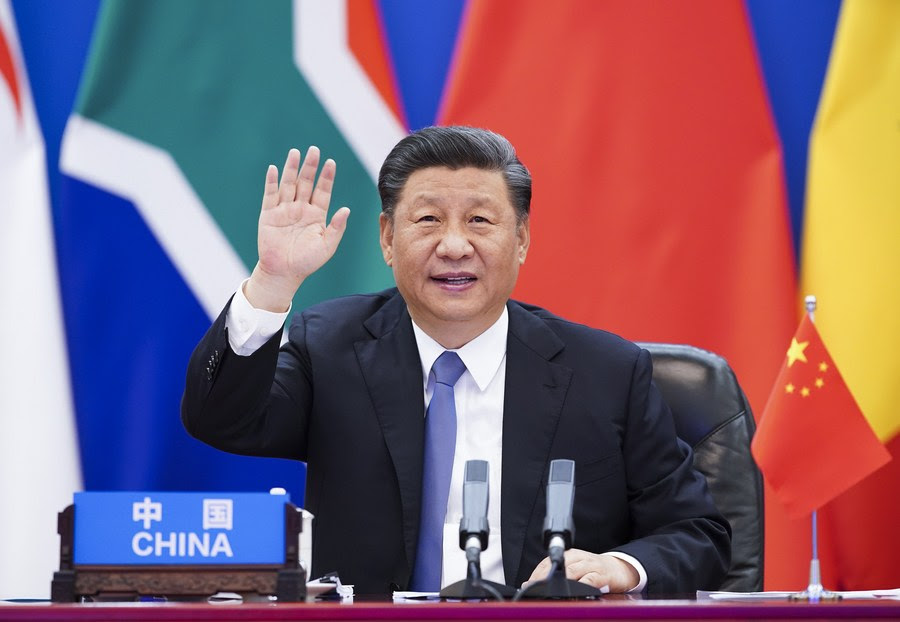
IN FOCUS
By Keerthana Nambiar
The UK’s probable challenges in navigating relations between the US and China
On 3 December, Jamestown Foundation published a brief titled ‘End of the Golden Era: Sino-British Relations Enter Difficult Period’ putting light on the declining relations between China and the UK. The brief focuses on frictional points in the Sino-British relations in cultural, social, economic, and military aspects and how despite the fallouts they navigate the relations. According to Patrick Triglavcanin, the author of the brief, “The decline in relations between Beijing and London is driven in part by Britain’s renewed Indo-Pacific naval presence – a manifestation of the UK’s desire for closer security ties with the U.S. and its increasing tendency to view China as a geopolitical threat.”
Considering the complications in the bilateral relations, London and Beijing maintain a working relationship driven by trade and sharing common interests in tackling international issues like climate change and post-pandemic recovery. The frictional points in the Sino-British are:
First, the Hong Kong and Human rights issue. According to the Jamestown Foundation, “the situation in Hong Kong has been the catalyst for the recent decline in relations.” Britain was one of the first countries to take concrete steps against China imposing the National Security Law in Hong Kong and introducing a new visa for Hong Kong nationals to work and live in the UK. Britain’s reaction to the human rights issues against the Uyghur Muslims in the Xinjiang region created more distance between the two. The UK moved on freeze assets, impose travel bans leading to bitter ties. The UK has a tough time navigating between economic interests and defending human rights.
Second, Britain’s ‘tilting’ towards the Indo-Pacific. The brief notes a foreign policy paper by the UK- Global Britain in a Competitive Age: The integrated Review of Security, Defence, Development and Foreign Policy which discusses the UK’s interests in the Indo-Pacific and labels China as a “systematic competitor.” The Integrated Review perceives China’s growing power as a threat to the international norms which Britain abides by. With the announcement of the AUKUS pact, the UK gave a clear signal of its interests in the Indo-Pacific and counter China’s rise in the region.
Third, the trade aspect of Sino-British relations. The UK has very conflicted views when it comes to China. On one side, the UK sees China as a geopolitical threat undermining international laws and on the other Chinese investments in the UK. Recently, the UK government has been apprehensive of the Chinese influence in domestic affairs and structured policies to scrutinize Chinese investment in key UK infrastructure projects, Chinese tech companies like Huawei.
Fourth, maintaining Sino-British relations. Quoting Xinhua, Jamestown Foundation said: “Despite the currently rocky relations, a working relationship between the UK and China endures. China considers the UK an important player in international affairs due to its economic strength, developed financial markets, and permanent position in the UN Security Council.” Even with the fallouts in the relations, conventional diplomacy remains intact between China and UK with cultural exchanges being the core of such interactions.
Patrick Triglavcanin, the author said: “To navigate this difficult period, the Sino-British relationship will need to be carefully managed, particularly on the UK side.” If the UK continues to seek closer ties with the US, China will eventually minimize its trade activities with it and if the UK accommodates Chinese behavior it will push away from its Western allies especially the US. “In this scenario, the UK would find it difficult to make new economic inroads around the globe; and due its relationship with China could even be perceived as a national security threat that lacks a solid commitment toward human rights,” says the brief.
According to Jamestown Foundation, “the Sino-British relationship is ultimately transactional.” Both the countries see each other as an opportunity to recover from their own complications and work together in areas of cooperation for development. “However, both sides must undertake a precarious balancing act in order to navigate escalating geopolitical competition and deepening normative differences,” concludes Triglavcanin.
References
“End of the Golden Era: Sino-British Relations Enter Difficult Period,” Jamestown Foundation, 3 December 2021
IN BRIEF
By Dincy Adlakha and Avishka Ashok
INTERNAL
Jimmy Lai and other Apple Daily staff face new sedition charges
On 28 December, the Hong Kong prosecutors filed a charge for seditious publications against Apple Daily founder and business tycoon Jimmy Lai and other staff members of the newspaper. Six members of the staff and Jimmy Lai appeared in a court to face accusations of conspiracy to print, publish and sell seditious notes. Prosecutors mentioned in the charge sheet that the writings could “bring into hatred or contempt or to excite disaffection” against the government and state. Apple Daily closed operations in June this year as the pressure from authorities increased. (“HK Apple Daily founder, staff face new sedition charge,” The Straits Times, 28 December 2021)
TECHNOLOGY
Space program suspects Starlink of testing Chinese capabilities in space
On 27 December, Global Times reported that China’s space program suspected the US company Starlink of intentionally causing harm to the Chinese Space Station to test its capabilities and reaction to sudden stimuli in space. It addressed the two near-accidents that occurred in space and was revealed during a verbal report delivered by the permanent mission of China to the United Nations. The report observed that China launched five missions in 2021 during which two satellites launched by Starlink passed by at very close proximity on 1 July and 21 October. A senior expert in the field from China said: “we can't rule out the possibility that the move is intended to test China's capacity in space to check whether China can accurately grasp the satellites' actions." (“Two close encounters of Starlink satellites possibly aimed to test China’s sensibility in space: expert,” Global Times, 27 December 2021
REGIONAL
Brunei’s Minister appreciates relations with China in 2021
On 27 December, Brunei’s Minister of Primary Resources and Tourism Haji Ali appreciated the growth of tourism cooperation between the two countries. He observed that the relations between Brunei and China had entered a “new normal” of tourism activities in the past year despite the challenges that were thrown by the coronavirus pandemic. He also appreciated China’s support that had contributed to connecting Brunei with numerous cities in China and said: “These connections have further led to increased economic activities and opportunities in the areas of tourism, agriculture, construction, maritime and others. With over 74,000 tourist arrivals in 2019, China has always been regarded as one of the top three source markets for Brunei. We hope to welcome more tourist arrivals once travel resumes in the near future.” (“Brunei, China tourism cooperation continues to strengthen despite COVID-19: minister,” Xinhua Net, 28 December 2021)
INTERNATIONAL
China to process visa applications of US officials for Winter Olympics
On 27 December, Global Times reported that China has received visa applications from important members of the US delegation to attend the Winter Olympics. Zhao Lijian, a spokesperson for the Chinese Foreign Ministry announced the same and said that China shall process these applications due to reciprocity principle and international customs. He said: “Now with regard to the US request to send a team of government officials to China and their visa applications, the Chinese side will handle them in accordance with international customary practice, relevant regulations and the principle of reciprocity.” The US had earlier announced a diplomatic boycott of the event. (Liu Caiyu, “China receives visa applications of US officials to attend Beijing 2022, will process based on reciprocity principle: FM,” Global Times, 27 December 2021)
Seattle to Shanghai flight turned back due to COVID protocols
On 27 December, a Delta Air Lines flight from Seattle to Shanghai was returned mid-air due to new requirements related to COVID-19 cleaning services. The decision to turn the flight was taken as China imposes new and stricter guidelines ahead of the Winter Olympics. The country is seeing an increased number of locally transmitted cases and is mandating more restrictions. The flight was turned back as the passengers’ COVID-19 test results expired. The move triggered a response from the Chinese Consulate in San Francisco saying that the new mandates at Shanghai Pudong International Airport “require significantly extended ground time and are not operationally viable for Delta.” (“Delta: Flight to Shanghai turned back because of COVID rules,” The Asahi Shimbun, 27 December 2021)
27 December 2021, Monday | China Reader Evening Brief | Vol.1, No. 72
China remembers Mao Zedong on 128th birth anniversary
Citizens pay homage to Mao Zedong's bronze statue in his hometown. Faith in his teachings stay strong in society as well as the party.
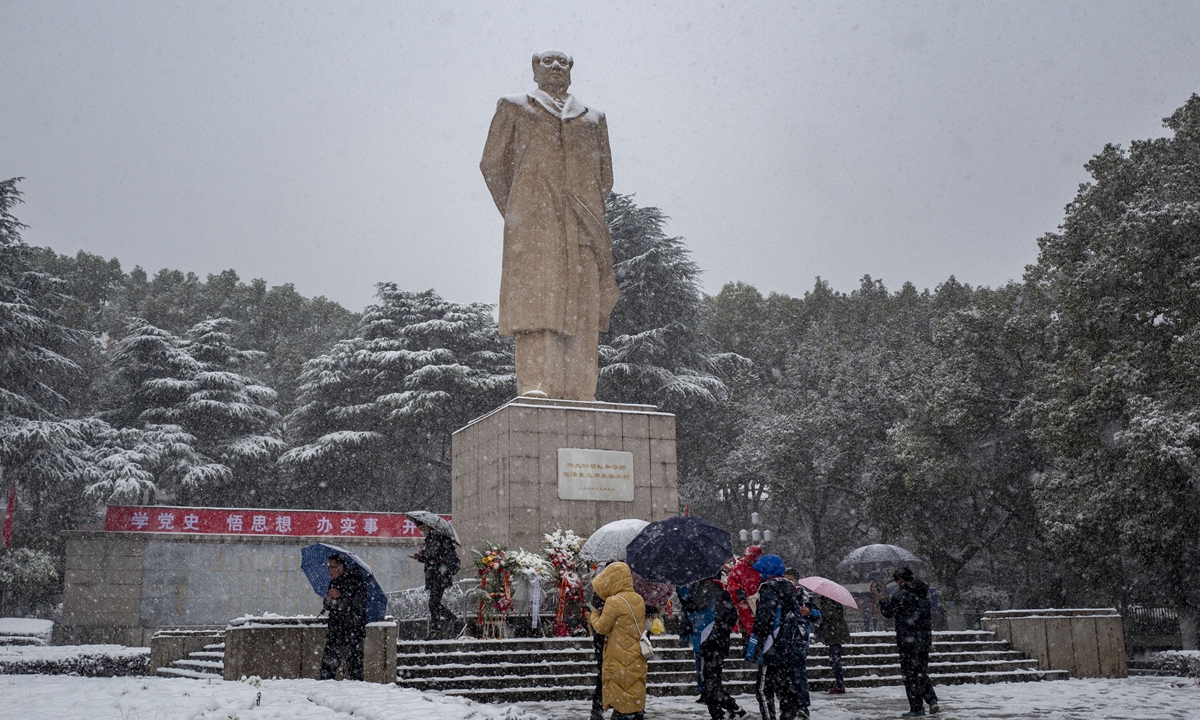
IN BRIEF
By Avishka Ashok, Keerthana Nambiar and Dincy Adlakha
INTERNAL
China remembers Mao Zedong on 128th birth anniversary
On 26 December, a public tribute to the greatest Chinese leader Mao Zedong was given to mark the 128th year of his birth. Several citizens traveled to his hometown, Shaoshan, to pay homage to his bronze statue despite heavy snowfall. The pandemic posed an obstacle as fewer people visited the statue this year; however, a significant tribute was paid by bringing the samples of lunar dust and soil through Cheng’e-5 to his hometown. Many political figures noted it as “We can bring down the moon from the Ninth Heaven” and maintained that the Communist Party of China still proceeds through the light of his teachings. (Cui Fandi and Zhao Yusha, “Chinese society memorize Mao Zedong on 128th anniversary of his birth,” Global Times, 26 December 2021)
China replaces official head in Xinjiang
On 26 December, Chinese state media announced that the Party CHief in Xinjiang has been replaced by another official who was earlier the coastal economic powerhouse, Guangdong province. Chen Quanguo, the earlier chief, was associated with strict surveillance and security crackdown targeting Uyghur and other ethnic minorities in the province. The change is in the context of a wider shuffle of roles and portfolios before the 20th CPC arrives in 2022. The change is also concurrent with the international pressure on Beijing over human rights abuses in Xinjiang. (Vincent Ni, “China replaces Xinjiang party boss associated with Uyghur crackdown,” The Guardian, 26 December 2021)
COVID-19 outbreak in Xian leads to high nationwide daily count
On 26 December, Reuters reported on the rising of COVID-19 cases in the northwestern city of Xian which is China’s current pandemic hotspot. Xian, a city of 13 million reported its highest daily rise of infections in 21 months, leading to a nationwide daily count of 158- the highest since China managed to contain the outbreaking early 2020. Although Xian did not report any Omicron variant cases, the Chinese authorities have reported few Omicron cases among international travelers. (“China's local COVID case count driven to 21-month high by Xian outbreak,” Reuters, 26 December 2021)
China sets new goals for rural development in 2022
On 27 December, Xinhua reported that China is preparing for the 20th CPC to arrive in 2022 and bring along the new priorities for significant rural development. President Xi Jinping is focused on rural vitalization after the achievement of complete poverty alleviation. The new rural priorities have concrete measures like the application of agriculture as a cornerstone, advancing rural vitalization and other reforms. The new priorities aim to improve 128,000 villages in China. (“Xinhua Headlines: China sets priorities for 2022 rural development,” Xinhua Net, 27 December 2021)
REGIONAL
University of Hong Kong performs a study on effects of pandemic on children from low-income countries
On 27 December, The Strait Times published an article on the study by the University of Hong Kong on the effects of COVID-19 on low-income families. According to the Strait Times, the study says that “the COVID-19 pandemic has been especially hard on students from low-income families.” It says that the pandemic led to an unhealthy diet, lack of sleep, confinement to small homes for long hours among children of low-income families. The findings were that more than 75 percent of children had excessive sodium intake, 12 percent lacked vitamin D and a digital divide emerged when schools were shut down and classes moved online. The study found out that the physical and mental health of the students in Hong Kong scored 6,97 points on the life satisfaction scale. (“Children from low-income Hong Kong families hit hard by Covid-19,” The Strait Times, 27 December 2021)
INTERNATIONAL
Chinese society report finds US guilty of weakening human rights governance
On 27 December, Xinhua published an article covering a report by the China Society for Human Rights Studies. The society is a non-governmental human rights research society that releases reports and analyzes data regularly. The latest report said that the US has seriously eroded the foundation of global human rights governance by politicizing the cause. It also said that US’ actions have destructive consequences as its attitude perceives human rights as a political agenda. The report also accused the US of maintaining double standards and hypocrisy on the matter. (“1st LD-Writethru: U.S. politicization of human rights erodes foundation of human rights governance: report,” Xinhua Net, 27 September 2021)
Global Times reports on the cancellation and delayed flights from US to China
On 26 December, the Chinese Consulate General in San Francisco lodged “solemn representation to airline company Delta” after its flight unexpectedly returned to the US halfway to China reported Global Times. According to a flight-tracking site FlightAware, Global Times reported that “there has been numerous flights from the US to China delayed or canceled.” The cancellation and delays have left numerous Chinese stranded with expired visas and health codes. (“Chinese Consulate General in San Francisco lodges solemn representation to Delta airlines after flight returns halfway to China,” Global Times, 26 December 2021)
Global Times reports on Soviet Union’s collapse – a valuable lesson for China, and parallels between USSR then and US today
On 26 December, Global Times reported on the collapse of the Soviet Union (USSR) and the success of China’s adaptation to socialism with Chinese characteristics. According to Global Times, “Chinese people hold mixed feelings over the collapse 30 years ago, as they hold sympathy toward Russian people who consequently suffered a series of tragedies, but they also find that the collapse of the red giant is a significantly valuable lesson for China to keep developing and improving socialism with Chinese characteristics.” The article says that the US today is following the path of the USSR in the 1970s-80s with the abuse of military expansion, overconfidence in ideology, and a Cold War mentality. (“Lesson of Soviet Union’s collapse ‘helps China develop socialism successfully’,” Global Times, 26 December 2021)
25 December 2021, Saturday | China Reader Evening Brief | Vol.1, No. 71
Hong Kong Legislative Council election: through a Chinese lens
The Chinese state and local media covers the elections in Hong Kong and appreciate the first election that has been conducted after the implementation of the National Security Law in Hong Kong.
IN FOCUS
By Avishka Ashok
Hong Kong Legislative Council election: through a Chinese lens
Xinhua Net
On 22 December, Chinese President Xi Jinping, Premier Li Keqiang and the Chief Executive of HKSAR Carrie Lam held a meeting and discussed the current situation of the city and the government’s efforts in normalizing the environment in the city. The meeting was attended by Vice Premier Han Zheng as well. Premier Li appreciated Lam’s efforts in creating a peaceful environment in Hong Kong despite the coronavirus and the civil unrest in the city. He said: “the central government will continue to fully and faithfully implement the policies of "one country, two systems," "the people of Hong Kong administering Hong Kong," and a high degree of autonomy for the region, improve the system and mechanism of the HKSAR on the implementation of the Constitution and the Basic Law, and give full support to the chief executive in leading the HKSAR government to administer in accordance with the law.”
On 23 December, Xinhua Net reported that the newly elected lawmakers of the Hong Kong Special Administrative Region had a long list of chores to finish after being elected in the Legislative Council. On 20 December, the HKSAR revealed its new list of lawmakers after it conducted the first legislative election under the new electoral system. The new legislative council will consist of 90 lawmakers from diverse fields and backgrounds. The report also mentioned a survey conducted by a Hong Kong-based institute, according to which, over 70 percent of the Hong Kongers supported the elections and believed that the newly elected council would address all the issues of the city. The newly elected members strive to prove a point and promise to bring the city back to its peaceful and economically superior times.
Global Times
On 20 December, 90 new members of the 7th term Legislative Council of the Kong Kong Special Administrative Zone were elected by the Election Committee constituency, functional constituencies and geographical constituencies. Approximately 1.35 million residents participated in the election on 19 December 2021 which wil come into effect from 12 January 2021. The Hong liaison office of the central government also congratulated the winners of the election and the citizens of the city for successfully holding and participating in the elections. The Office informed that a total of 153 candidates competed for the 90 seats in the legislative council and that the city successfully upheld the quality for democracy by overcoming the confrontations and rivalry surrounding the electoral procedure.
The Global Times also reported a 60 percent voter turnout in 21 out of the total 28 functional constituencies. The turnout rate was 98.48 percent in the election committee according to the report. The success of the election was widely celebrated as it was the first election that was conducted after the implementation of the National Security Law in Hong Kong. The report also denied the claims by western countries regarding the nature of homogeneity of the elections and explained that the candidates represented a wide spectrum of Hong Kong society.
On 21 December, the Global Times reported that the G7, the EU and the Five Eyes alliance had raised objection with the conclusion of the election in Hong Kong SAR and accused it of being a staged political farce. The US also imposed sanctions on five Chinese officials for degrading the democracy in Hong Kong and condemned the elections for their unfairness. The Chinese Foreign Ministry spokesperson Zhao Lijian reacted to the sanctions and called them “Illegal, invalid, ridiculous and disgusting.”
References:
“Newly-elected HKSAR lawmakers set for long to-do list,” Xinhua Net, 23 December 2021.
“Premier Li meets with HKSAR chief executive,” Xinhua Net, 22 December 2021
“Xi meets with HKSAR chief executive,” Xinhua Net, 22 December 2021
“All 90 members of HKSAR's 7th-term LegCo elected, ushering in effective governance with patriots-only principle,” Global Times, 20 December 2021
“New LegCo ends foreign proxies’ erosion of Hong Kong,” Global Times, 20 December 2021
“US sanctions on Chinese officials after HK LegCo election ‘illegal, invalid and ridiculous’: Chinese FM, Global Times, 21 December 2021
“West ‘cries foul’ after losing battle on HK, attempt to incite color revolution fails,” Global Times, 21 December 2021
IN BRIEF
By Dincy Adlakha and Keerthana Nambiar
INTERNAL
China prepares for Spring Festival and Winter Olympics amid rising COVID-19 risks
On 24 December, Xu Hejian, a spokesperson from the Chinese Government said in a daily briefing that China revised its COVID-19 prevention and control measures, especially for Beijing. Seeing the two major upcoming events of Spring festival and Winter Olympics, the government has urged citizens to celebrate them within Beijing. The locally transmitted cases have been on a rise in the capital and hence offices are also urged to disallow flexible hours and avoid allowing employees from leaving and entering Beijing. Residents from other districts are restricted to enter Beijing for non-essential reasons. (“Beijing faces dual COVID-19 risks, tightens prevention measures ahead of Spring Festival and Winter Olympics,” Global Times, 24 December 2021)
China published the draft bill for ensuring gender quality at workplace
On 24 December, the Chinese lawmakers published a draft bill discussing new rules to prevent discrimination and sexual harassment at the workplace. The bill includes banning of employees based on gender and marital status or pregnancy status. Gender-based exclusion has been prevalent as a common practice in China for decades and the revision draft bill strengthens gender equality and points out hidden discrimination. According to the Strait Times, the bill “prohibits ‘vulgar speech’, ‘inappropriate physical behaviour’ or "the display or dissemination of sexual images, information, text, audio or video.” (“China mulls Bill to tackle workplace discrimination against women,” The Strait Times, 25 December 2021)
Authorities remove two more Tiananmen monuments
On 24 December, Hong Kong universities tore down a few more monuments depicting the protest and massacre of Tiananmen in 1989. The Chinese University of Hong Kong removed a Goddess of Democracy sculpture and the Lingnan University tore down a relief statue. This is an action amidst the crackdown on political dissent that has been imposed on Hong Kong since the National Security Law. (“Hong Kong universities remove more monuments marking Tiananmen,” BBC, 24 December 2021)
ECONOMY
China’s Standing Committee of the 13th National People’s Congress (NPC) concluded its 32nd session
On 24 December, the Standing Committee of the 13th National People’s Congress (NPC) concluded its 32nd session. “At the closing meeting, lawmakers voted to adopt an anti-organized crime law, a wetlands protection law, a revised Law on Scientific and Technological Progress, and a law on the prevention and control of noise pollution,” reported Xinhua. The meeting largely focused on amending the Seed Law, the Civil Procedure Law, and the Trade Union Law along with strengthening the oversight economic work. (“China's top legislature concludes standing committee session,” Xinhua Net, 25 December 2021)
China lowers tariffs on many imported items
On 24 December, The Customs Tariff Commission of the State Council announced that it has lowered the tariff on many imported items. These new tariffs were adjusted during multiple trade pacts and will come into effect soon. The authorities state that the move is done aiming high-quality products and fasten the opening up process. There are specifications on the tariffs for each product like cancer drugs and each country like Peru and Switzerland. China lowered the tariffs as RCEP is close by and will start from 1 January in the coming year. (“China lowers tariffs to boost high-quality growth, high-level opening-up,” Xinhua Net, 24 December 2021)
REGIONAL
Chinese Foreign Ministry urges Japan to not politicize sports
On 24 December, Chinese Foreign Ministry spokesperson Zhao Lijian made remarks on Japan’s decision of attending the Beijing Winter Olympics 2022. Zhao said, “China welcomes representatives of Japan's Olympic Committee and other organizations as well as Japanese athletes to the Beijing Winter Olympics and Paralympics.” He urged Japan on “not politicizing sports… China has every confidence that working together with all sides under the Olympic motto of 'together', China will deliver a streamlined, safe and splendid Olympic event to the world.” (“ China hopes Japan will not politicize sports: FM spokesperson,” People’s Daily, 25 December 2021)
INTERNATIONAL
German firms face fix amid China-Lithuania tensions
On 25 December, South China Morning Post reported that many German firms will have to shut operations in Lithuania. Many others are facing pressure to boycott Lithuanian-produced parts. A big German industries group has said that this is due to pressure from China on multinational companies. They say that China is willing to decouple itself economically from politically disagreeable partners. However, China has denied that it is targeting multinational companies or discouraging them to engage with Lithuania. (Teddy Ng and Kinling Lo, “China-Lithuania tension: German firms may have to shut factories in Baltic state amid Beijing retaliation,” South China Morning Post, 25 December 2021)
Chinese FM responds to the US bill of Uyghur Forced Labor Prevention Act
On 24 December, Global Times reported on the US bill of Uyghur Forced Labor Prevention Act into law. “This Act maliciously denigrates the human rights situation in China's Xinjiang in disregard of facts and truth. It seriously violates international law and basic norms governing international relations and grossly interferes in China's internal affairs. China deplores and firmly rejects this,” noted Global Times. The report says that the issues in Xinjiang are not human rights issues and it is “preposterous” of the US of making such allegations wherein Washington has “serious problems” of forced labor and human trafficking. The Chinese Foreign Ministry spokesperson made a statement: “We admonish the US to correct the mistake immediately, and stop using Xinjiang-related issues to spread lies, interfere in China's internal affairs and contain China's development. China will make the further response in light of the development of the situation,” reported Global Times. (“China firmly opposes US’ so-called Uyghur Forced Labor Prevention Act, will make further response: FM,” Global Times, 24 December 2021)
24 December 2021, Friday | China Reader Evening Brief | Vol.1, No. 70
China’s White paper on Hong Kong democracy: Six stages recalled
Chinese central government pledges support to the improvement of Hong Kong democratic system. The white paper released immediately after the latest Legislative Council elections recalls stages of the democratic evolution in Hong Kong.
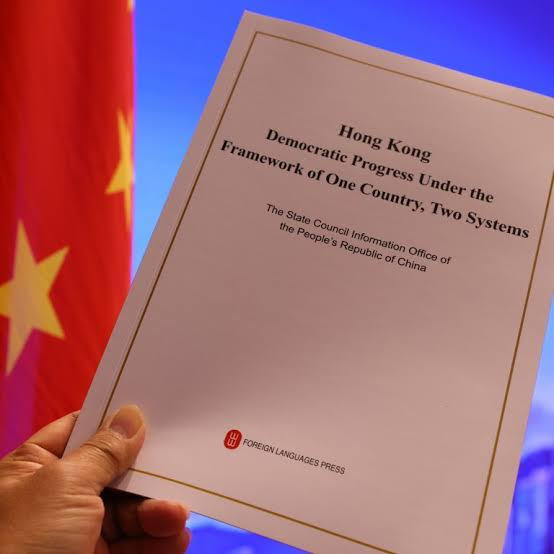
IN FOCUS
By Dincy Adlakha
China’s White paper on Hong Kong democracy: Six stages recalled
On 20 December, the State Council Information Office of People’s Republic of China released a white paper on Hong Kong democracy. The paper titled, ‘Hong Kong: Democratic Progress Under the Framework of One Country, Two Systems’ recalled the evolution of democracy in Hong Kong. The paper was released a day after the results of the latest Hong Kong elections declared an all-out victory for ‘patriots’ in the lowest witnessed turnout. Hence, the paper’s signals can be understood through the six stages of democracy in Hong Kong that it recalls.
First, the British colonial rule without democracy.
The white paper highlighted through multiple narratives that the British colonial rule in Hong Kong had no hints of democracy. It cited the Treaty of Nanking, the Beijing Convention and the Sino-British treaty of 1898 as unfair and unequal treaties imposed by the British on China which began a series of British interference in the country. The British appointed a governor in Hong Kong who was answerable only to British authority and all other official posts were also appointed rather than elected. The paper also revealed brutalities carried by the British authorities in the form of imprisonment, surveillance, racial discrimination and even flogging/hanging. The stage also recalled some newspaper articles from the era to support its arguments.
Second, ushering in democracy
In this stage, the paper recalled that British authorities refused all efforts to democratize Hong Kong until the period of colonial rule was nearing its end. The state and political systems of China were determined to establish democracy in Hong Kong and released 12 Policies in the 1980s on the same lines. Under Deng Xiaoping, a belief was established in the One Country, Two Systems policy. The Constitution and Basic Law were also put in place however, an effort to change the method adopted for electing the Chief Executive of Hong Kong was not successful.
Third, major decisions for democracy establishment
The 2000s decade witnessed major decisions which strengthened the Central Government’s process of democratizing Hong Kong. It included amending the election method for the Chief Executive of Hong Kong, amends in universal suffrage and its timetable, roadmap for the first two steps, and their implementation.
Fourth, threat to democracy from anti-China agitators
The stage referred to the events that led to and transpired during the 2019 protests in Hong Kong. The protestors, or agitators as termed in the paper, were said to have secessionist intentions which only had a mad thirst for power and were in violation of the constitutional order, endangering national security. The threat was seen to the country as a whole and the forces had anti-China intentions. The agitators stopped the fair and democratized process of election.
Fifth, re-building Hong Kong democracy
This stage highlighted the aftermath of the 2019 protests as the National Security Law brought an end to agitation and brought favorable conditions for democracy. It even notices a change in the connotation of “patriot” from one meaning merely Hong Kong pride to one progressing the thoughts for the entire country. The National Security Law also made secession, subversion of state power, terrorist activities and collusion with foreign entities to endanger national security as offenses. The official posts are to be headed by the new patriots who “love the country” and are chosen by the Eligibility Review Committee.
Sixth, a final stage of prosperous democracy
The paper ends by repeated and direct allusions to One Country, Two Systems in Hong Kong Special Administrative Region and its future in accordance with the constitution and the Basic Law. This requires efforts to balance the relationship between central authorities and executives in HKSAR along with the principle of patriots ruling Hong Kong. The paper sees a harmonious and prosperous future for Hong Kong through these methods.
References:
“Full Text: Hong Kong: Democratic Progress Under the Framework of One Country, Two Systems,” Xinhua Net, 20 December 2021
IN BRIEF
By Dincy Adlakha, Keerthana Nambiar and Avishka Ashok
INTERNAL
Chinese government removes Tiananmen Square statue
On 23 December, the Chinese authorities removed the statue depicting the Tiananmen Square massacre from Hong Kong University. The statue displayed piled-up corpses of those who protested for democracy in 1989. The removal orders had been signed months ago and are a sign of the political pressure in the city. The official reasons for the removal were regarding the fragile state of the statue and concern for its safety. The statue was removed immediately after the low turnout Legislative Council elections. (“Pillar of Shame: Hong Kong's Tiananmen Square statue removed,” BBC, 23 December 2021)
China offers loans worth 2,00,000 yuan to encourage childbirth
On 23 December, Reuters reported that Jilin province in China would offer married couples loans worth 2,00,000 yuan (USD 31,400) if they had kids. Jilin is the newest province to join China’s many others in an attempt to increase childbirth in the country after the 2021 census showcased a dangerous decline. Financial assistance is now being provided in numerous provinces to encourage child-rearing amongst new couples. Families with children who own small businesses and enterprises have been provided with exemptions and concessions in value-added taxes as well to help them with the expenses of children’s education and standard of living. (“Loans for babies: Chinese province's strategy to beat population blues,” Reuters, 23 December 2021)
ECONOMY
Ministry of Commerce instills faith in preparation for RCEP
On 23 December, the Ministry of Commerce said in a statement that China is well-prepared and ready to implement the Regional Comprehensive Economic Partnership agreement from 1 January 2022. MoC spokesperson Gao Feng said: “The core of the agreement lies in its implementation. The MOC, along with other departments, will help local governments and enterprises better understand RCEP rules and promote deeper integration of industrial and supply chains among members, and promote higher-quality and deeper regional economic integration in East Asia.” The RCEP includes China, ASEAN, Japan, SOuth Korea, Australia and New Zealand. (“China prepared for RCEP: MOC,” Xinhua Net, 24 December 2021)
TECHNOLOGY
China launches two new satellites into space
On 23 December, the Long March-7A rocket was launched from the Wenchang Spacecraft Launch Site. The latest launch marked the 50th orbital launch in 2021. Through the launch, China logged two satellites, Shiyan-1201 and Shiyan-1202 into space. The launch vehicle portrays China’s new generation of medium-sized high orbit rockets. In the year 2021, 20 launch missions have taken place at the Xichang and Wenchang launch centers for the first time in history. (“China scores 50-plus orbital launches in super 2021,” Global Times, 23 December 2021; “China sends two new Shiyan satellites into space,” Xinhua Net, 23 December 2021)
China’s Cyberspace Administration to launch an operation as a part of “clean-up” internet
On 23 December, the Cyberspace Administration of China (CAC) announced the launch of a two-month special operation scrutinizing online platforms including social media and video sharing sites as a part of “clean-up” the internet. The operation is to clamp down fake information and accounts and target deceptive online behavior. On 22 December, the CAC conducted a video conference and released a statement on its website stating: “The conference noted that at present, fabricating online traffic, malicious public relations and comments-for-cash ... harm the legitimate rights and interests of netizens.” (“China targets online platforms in quest to 'clean up' internet,” Reuters, 23 December 2021)
INTERNATIONAL
US President Joe Biden signs bills blocking imports from China
On 23 December, US President Joe Biden signed a bill into law to block imports from China’s Xinjiang region citing human rights violations of the Uyghur Muslims in the region. Biden said on Twitter, “Today, I signed the bipartisan Uyghur Forced Labor Protection Act… the United States will continue to use every tool at our disposal to ensure supply chains are free from the use of forced labor- including from Xinyang and other parts of China.” (“Darlene Superville,Biden signs bills on forced labor in China, ALS research, Associate Press, 23 December 2021”)
US Chipmaker Intel apologizes to China over Xinjiang products directive
On 23 December, US chipmaker Intel apologized to China for sending a directive to its suppliers instructing them to refuse Xinjiang products over forced labor accusations. Intel extracts more than a quarter of its annual revenues from the Chinese market and hence apologized to the Chinese public via the social media app WeChat. It said in a post: “We apologise for the trouble caused to our respected Chinese customers, partners and the public. To clarify, the paragraph about Xinjiang in the letter is only for expressing the original intention of compliance and legality, not its intention or position.” The US has recently passed a bill on boycotting products from Xinjiang due to forced labor and human rights abuses subjected to Uyghur Muslims in the region. (Mark Sweney, “Intel apologises to China over Xinjiang products and labour directive,” The Guardian, 23 December 2021)
Japan news agency report suggests US-Japan joint military plans in case of Taiwan emergency
On 24 December, The Guardian reported citing Reuters and Kyodo News Agency report, that US and Japanese armed forces drew a draft plan for joint operation in case China attacks Taiwan. The report said that in a possible Taiwan emergency, US marine corps will establish temporary bases on island chains stretching from Japan to Taiwan. Japanese armed troops will provide ammunition, fuel, and other logistical support. Top leaders from both the countries have previously vowed support to the Taiwanese independence cause. The Taiwan government has maintained that it wants peace but will defend its sovereignty. (“US and Japan draw up joint military plan in case of Taiwan emergency – report,” The Guardian, 24 December 2021)
23 December 2021, Thursday | China Reader Evening Brief | Vol.1, No. 69
China establishes major rare earth group in Jiangxi province
China established a state-owned enterprise in Jiangxi province for rare earths. The group will overlook research and exploration along with the processing of rare earths.
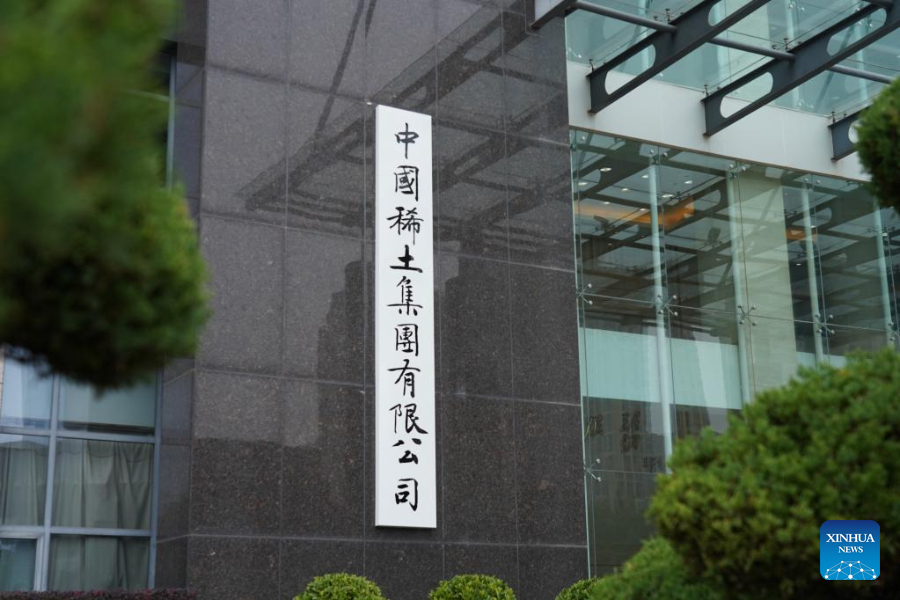
IN BRIEF
By Keerthana Nambiar and Avishka Ashok
INTERNAL
Major rare earth group established in China’s Jiangxi Province
On 23 December, China Rare Earth Group Co., Ltd, a state-owned enterprise was established in east China’s Jiangxi Province. The group consists of three companies and two research firms which would be operated under the direct supervision of the State-owned assets Supervision and Administration Commission of the State Council. The main agenda of the group is to research, exploration, smelting, and deep processing of rare earth along with downstream applications, industrial incubation, equipment manufacturing, technical consulting services, and foreign trade. (“China Rare Earth Group founded in Jiangxi,” Xinhua Net, 23 December 2021)
President Xi Jinping met HKSAR Chief Executive Carrie Lam
On 22 December, Chinese President Xi Jinping met with Hong Kong Special Administrative Region Chief Executive Carrie Lam in Beijing. In the meeting, President Xi made remarks on the achievements in Hong Kong on COVID-19 response, economic recovery, and maintaining social stability. Xi said: “Lam has also led the HKSAR government in successfully holding elections of the Election Committee and the Legislative Council (LegCo), resolutely implementing the Hong Kong national security law, and taking active measures to promote the HKSAR's integration into the overall development of the country and comprehensively deepen its exchanges and cooperation with the mainland,” reported Xinhua. (“Xi Focus: Xi meets with HKSAR chief executive,” Xinhua Net, 22 December 2021)
REGIONAL
South Korean senior diplomats to hold talks with China
On 23 December, South Korean Vice-Foreign Minister Choi Jong-kun and senior diplomats are set to hold talks with the Chinese counterpart Le Yucheng. This move is following a diplomatic spat between South Korea and Taiwan over the cancellation of attendance at a business forum by a senior Taipei official held in Seoul. Taiwan’s Foreign Ministry condemned the move and summoned South Korea’s acting representative to express displeasure. (“S.Korea holds talks with China amid spat with Taiwan,” Reuters, 23 December 2021)
North Korean leader Kim Jong Un praises the longtime Chinese envoy
On 23 December, North Korean leader Kim Jong-Un praised the outgoing Chinese ambassador Li Jinjun who is leaving the office after seven years in China. Kim appreciated Li’s efforts to improve the relations between Pyongyang and Beijing. Kim’s remarks were conveyed by Choe Ryong Hae, a top official in the ruling Workers Party of Korea, and said the North Korea-China relationship has entered a “fresh heyday.” (“N.Korea's Kim praises 'fresh heyday' in China relations as longtime envoy departs,” Reuters, 23 December 2021)
INTERNATIONAL
China extends support to Solomon Islands after November riots
On 23 December, the Ministry of Foreign Affairs spokesperson Zhao Lijian announced that China would provide anti-riot equipment and will also send an ad-hoc police advisory group to the Solomon Islands. Zhao said: “the supplies and personnel will arrive soon and play a constructive role in enhancing local police's capability, given the severe anti-government turmoil in Honiara, the capital city of the Solomon Islands in late November.” He also extended his support to the government in the Solomon Islands and encouraged domestic stability in the country. (“China to offer police anti-riot gear, send police advisory team to Solomon Islands,” Global Times, 23 December 2021)
President Xi discusses Sino-German relations with the new German Chancellor
On 23 December, China Daily reported that the Chinese President Xi Jinping and the German Chancellor Olaf Scholz held their first telephonic conversation and stressed the China-German relationship. The phone call also set the impetus for better relations between China and Europe in the coming years. The report noted that that German motor vehicles had already become an integral part of China’s transportation industry. China hopes that Germany under the leadership of Scholz would implement practical decisions and encourage the China-EU Comprehensive Agreement on Investment. (“China, Germany show the way to mutually beneficial cooperation,” China Daily, 23 December 2021)
22 December 2021, Wednesday | China Reader Evening Brief | Vol.1, No. 68
President Xi praises Hong Kong’s electoral system’s new democratic path
President Xi Jinping meets Hong Kong leader Carrie Lam after the Legislative Council elections. New democratic era is being ushered in Hong Kong.
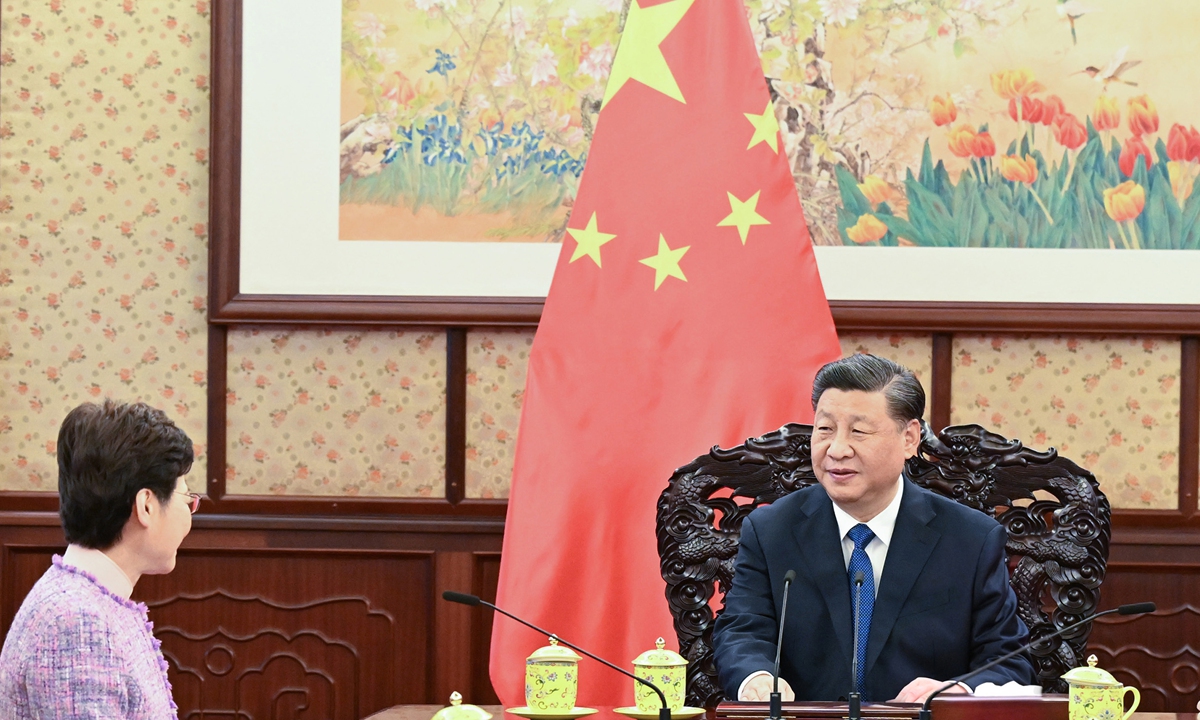
IN BRIEF
By Keerthana Nambiar, Avishka Ashok and Dincy Adlakha
INTERNAL
President Xi praises Hong Kong’s electoral system’s new democratic path
On 22 December, President Xi Jinping met Hong Kong chief executive Carrie Lam for her annual duty report. In the meeting, he praised the new era of local governance ushered in by her. He also lauded the transformation of the city from chaos to stability. He also said that the recent elections of the Legislative Council of Hong Kong were successful in creating the democratic path through the patriot-only principle and also provided an inclusive political landscape. President Xi praised the work of Carrie Lam in the city. (Chen Qingqing, “Xi praises new electoral system, highlights HK democratic path,” Global Times, 22 December 2021)
China’s Ministry of Education notified on closing down of academic tutoring institutions
On 22 December, China Daily reported that China’s Ministry of Education announced closing down or switching to other businesses of 80 percent of academic tutoring institutions in order to reduce the burden on primary and middle school students. According to the Ministry, “the number of online academic tutoring institutions has been slashed by 84.1 percent, and the number of offline ones by 83.8 percent” and “adding that any remaining tutoring institutions should be turned into nonprofit ones or closed,” noted China Daily. (“Over 80% of tutoring firms quit business,” China Daily, 22 December 2021)
Xi’an city imposes COVID-19 lockdown
On 22 December, the historic Chinese city Xi’an imposed a lockdown bearing travel restrictions and locked down localities to fight against the increasing cases of COVID-19. More than 140 cases were detected in the last two weeks. Previously, the Shaanxi province of northwest China also locked down due to growing COVID-19 cases. (Cao Siqi and Yu Xi, “Xi'an locks down to combat growing outbreak, governance ability faces test,” Global Times, 22 December 2021)
ECONOMY
World Bank releases a report on China’s Economic Update
On 22 December, China Daily published an article on a report by the World Bank indicating the World Bank’s China Economic Update. The Bank expects China’s GDP to expand up to 8 percent in 2021 and its projection to 5.1 percent in 2022. It said: “downside risks to China’s economic outlook have increased.” The report highlights the ‘rebalancing’ in the Chinese economy and the property sector downturn, which could have “significant economy-wide reverberations.” (“China's growth likely to moderate next year, World Bank says,” China Daily, 22 December 2021)
TECHNOLOGY
China develops world’s most powerful heat Stirling engine
On 22 December, Global Times reported that China developed the world's most powerful Stirling engine useful for power generation and submarine propulsion. The engine was domestically developed by No. 711 Research Institute under China State Shipbuilding Corporation Limited. This is the basic prototype of China’s first large-bore Stirling engine and it passed its recent conduction test successfully. The article reports that China’s engine industry lags behind the others by many parameters but this achievement will put China high on the map. (Liu Xuanzun, “China develops world's most powerful Stirling engine,” Global Times, 22 December 2021)
INTERNATIONAL
Chinese Foreign Ministry condemns the joint statement from ‘Five Eyes’ alliance, G7 and the EU
On 21 December, Chinese Ministry spokesperson Zhao Lijian made comments on a joint statement issued by foreign ministers of the ‘Five Eyes’ alliance, G7, and EU high representatives on Hong Kong elections. Xinhua reported: Zhao said, “China is firmly opposed to and condemns the meddling in Hong Kong’s democracy and rule of law and their gross interference in China’s internal affairs.” He stressed that democracy in Hong Kong is moving forward and the electoral system in Hong Kong Special Administrative Region implements China’s principle of ‘one country, two systems.’ Zhao condemned the move by foreign ministers and claimed it as a “vile scheme to destabilize Hong Kong and contain China’s development.” (“Attempt to undermine HK prosperity, stability will fail: FM spokesperson,” Xinhua Net, 21 December 2021)
20 December 2021, Monday | China Reader Evening Brief | Vol.1, No. 67
Pro-Beijing candidates sweep Hong Kong Legislative Council elections
'Patriot' only elections won by pro-Beijing candidates in the lowest voter turnout of voter history. Carrie lam congratulates the winners.
IN BRIEF
By Keerthana Nambiar, Avishka Ashok and Dincy Adlakha
INTERNAL
Pro-Beijing candidates sweep Hong Kong Legislative Council elections
On 19 December, polls for the Legislative Council General Election in Hong Kong were held. All 90 seats were won by Pro-Beijing candidates. The election did not ee much turnout as only 30.2 percent of the people came out to vote. The election was tactfully held as it allowed only the candidates screened by the government and perceived as ‘Patriots’ of Beijing to stand in elections. Some residents say that the low turnout is a symbolic representation of citizens disagreeing with the electoral system. Previously, the lowest turnout for an election was in 1997 when Hong Kong returned from British to Chinese rule. The year saw only 43.6 percent of people voting. Global Times reported on the election and hailed the decision. It recognized that anti-China lawmakers and secessionists have been outed. This is seen as a new, more practical and more effective phase of Hong Kong governance by mainland China. Post-elections, Hong Kong leader Carrie Lam released a statement that read: “Whether they lost or won, they all carried out beautiful election campaigns.” She also said that it will be exciting to work with the newly won representatives as they have different opinions on social issues. (“Pro-Beijing candidates sweep ‘patriots’-only Hong Kong vote amid low turnout,” The Asahi Shimbun, 20 December 2021; Chen Qingqing, Bai Yunyi and Zhao Juecheng, “LegCo election advances despite trivial noises, to bring HK into a new era,” Global Times, 19 December 2021; Hillary Leung, “Hong Kong’s Carrie Lam praises ‘beautiful campaigns,’ plays down poor election turnout,” Hong Kong Free Press, 20 December 2021)
Chinese central government issues new white paper on democracy in Hong Kong
On 20 December, China released a white paper on Hong Kong democracy immediately after the Legislative Council election in Hong Kong concluded. The latest paper, titled ‘Hong Kong Democratic Progress Under the Framework of One Country, Two Systems,’ stressed that the Communist Party of China has designed, created, protected and encouraged the Hong Kong democratic system. The paper gave a historic background of Hong Kong and said that there was no genuine democracy under British rule. The paper also suggested that Hong Kong received its constitution and basic law only after its return to the mainland. The paper also said that agitators usually undermine the Hong Kong democracy with the biggest attack in 2019. It said that the party has rebuilt the democracy after such shocks. (“China issues white paper on HKSAR democracy, stresses CPC, central govt’s role as guardian of its democracy,” Global Times, 20 December 2021)
Xinjiang residents say “forced labor” narrative a lie
On 19 December, representatives from northwest China’s Xinjiang Uyghur Autonomous Region took part in a conference. The conference was attended by common residents from Xinjiang who are working as professors, company executives, canteen workers, and the like. The residents agreed that Xinjiang labor and employment policies are in line with the Chinese laws and international human rights standards. One of the attendees said: “The so-called 'forced labor' in Xinjiang is a lie of the century.” They also put light on the modernized techniques used for the production of crops and goods in the region. (“Xinjiang residents debunk "forced labor" lies,” Xinhua Net, 19 December 2021)
Peng Shuai denies accusing Chinese vice premier of sexual assault
On 20 December, Chinese top tennis star Peng Shuai said in a video released by Singapore media that it is misunderstood that she accused Chinese Vice Premier Zhang Gaoli. She said: “First, I need to stress one point that is extremely important, I have never said or written that anyone has sexually assaulted me, I have to clearly stress this point.” Although she did not provide any clarifications or elaborate replacements, she said that her social media post has been misunderstood by people. This is the first time that the sports star addressed the matter ever since posting a long account of her relationship with the vice-premier. Her post has been seen as a suppressed #MeToo voice. (“China tennis star Peng denies she made accusation of sexual assault,” The Asahi Shimbun, 20 December 2021)
ECONOMY
Policies and measures target employment in China post-COVID
On 19 December, Xinhua reported that China is striving to keep employment stable in the country. Taking account of the COVID-19 impact and the decreasing economy, China has worked to bring out support measures and policies to give impetus to employment in the country. The employment rate of November 2021 is 0.2 percent lower than that of the same time last year. However, China has announced a cut in the reservation ratio for financial institutions and employment subsidies worth 10.6 billion US dollars have been released. According to Xinhua, these measures bring positive signals to the labor market in China. (“China strives to keep employment stable,” Xinhua Net, 19 December 2021)
China cuts benchmark loan rate amidst economic pressures
On 20 December, China cut its stable one-year loan rate from 3.85 percent to 3.8 percent for the first time in two years. The move was announced by the People’s Bank of China. Although the five-year loan rate remained the same at 4.65 percent which means the mortgage rate remains the same. Experts say that the move was done in order to provide support to the economy undergoing property slump and sporadic effects of COVID-19 outbreaks and lockdowns. (Andrew Mullen, “China cuts benchmark loan rate for first time in almost 2 years amid mounting economic pressures,” South China Morning Post, 20 December 2021)
INTERNATIONAL
Pressures from West push China and Russia closer
On 20 December, South China Morning Post published an opinion editorial highlighting that the pressure from the western countries has pushed the ways of Russia and China closer. The article cites the recent military, political and economic ties between China and Russia have grown and the countries are collaborating on high levels in space and energy research. The author suggests that recent rhetorics and targeting Russia and China by the US, NATO and EU has led to this new strong friendship. The western forces portray China and Russia as threats which push them close to each other. (Danil Bochkov, “How Western pressure is pushing China and Russia ever closer,” South China Morning Post, 20 December 2021)
18 December 2021, Saturday | China Reader Evening Brief | Vol.1, No. 66
The US passes a bill restricting exports from Xinjiang
The US passes a historic bill and imposes a ban on Chinese companies for the violating human rights and the increasing atrocities on the Uighur Muslims in the Xinjiang region.
IN FOCUS
By Sukanya Bali
The US passes a bill restricting exports from Xinjiang
Export restriction
On 16 December, the US government imposed export and investment restrictions on 30 Chinese research institutes and technology companies. The government accused entities for supporting surveillance of "religious minorities" in China and attempting to acquire technology from the US to help modernize the People’s Liberation Army.
The US Commerce Department added the Academy of Military Medical Sciences and its 11 research institutes to a trade blacklist for their work in "brain control weaponry." The research institutes are involved in biotechnology research on controlling human conscience during combat.
The US treasury department blacklisted seven of China’s drone making companies along with DJI, the world's largest maker of small drones, for supporting “the biometric surveillance and tracking” of Uyghurs Muslims. The US had already restricted exports to DJI, but the new ban will criminalize investments made by the US in the company. The department determined entities had been “implicated in human rights violations and abuses in the implementation of China’s campaign of repression, mass arbitrary detention, forced labor and high-technology surveillance against Uyghurs, Kazakhs, and other members of Muslim minority groups in the Xinjiang Uyghur Autonomous Region”.
Bans on investing in Chinese companies were first imposed under Donald Trump’s administration. These bans prohibit US companies from investing in the defense or surveillance technology sector. Companies are required to get a special license from the US Commerce Department in order to supply goods to the targeted companies.
The new Legislation
On 16 December, the US Senate unanimously passed a legislation to ban imports from China’s Xinjiang region due concerns of forced labor. This made the US the first country to ban all imports from Xinjiang. The US Trade Representative Katherine Tai said: "We have a moral and economic imperative to eliminate this practice from our global supply chains, including those that run through Xinjiang, China, and exploit Uyghurs and other ethnic and religious minorities." White House Press Secretary, Jen Psaki said: “The Administration will work closely with Congress to implement this bill to ensure global supply chains are free of forced labor, while simultaneously working to on-shore and third-shore key supply chains, including semiconductors and clean energy.”
In the House of Representatives, the bill was passed with the strong bipartisan vote of 428-1, over the concerns of forced labor in Xinjiang. Republican representative Thomas Massie was the only member who voted against the bill. The bill is titled, “Uyghur Forced Labor Prevention Act” which confirms the existence of forced labor through “testimony of former camp detainees, satellite imagery, official media reports, publicly available documents, official statements, and official leaked documents.” The bill requires companies to prove that goods to be imported are not produced with forced labor.
Beijing's response
China's commerce ministry has opposed the US action and urged the US to “rectify its mistaken ways.” In response to the investment blacklist, Foreign Ministry spokesperson Zhao Lijian said: “By overstretching the concept of national security, certain US politicians politicize and instrumentalize science and technology and economic and trade issues based on ideology.” He added “this runs counter to the principle of market economy and fair competition. It will only threaten and hurt the security of global industrial and supply chains and undermine international trade rules." The Chinese embassy in Washington called these actions “unwarranted suppression."
Reference:
U.S. curbs Chinse drone maker DJI, other firms it accuses of aiding rights abuses, Reuters, 17 December 2021
H.R.1155 - Uyghur Forced Labor Prevention Act, Congress.gov, 08 December 2021
US Congress passes import ban on Chinese Uyghur region, BBC, 17 December 2021
China commerce ministry says firmly opposes latest U.S. restrictions on Chinese firms, Reuters, 17 December 2021
Bill to clamp down on products from China’s Xinjiang passes Congress, Biden next, Reuters, 17 December 2021
IN BRIEF
By Dincy Adlakha, Keerthana Nambiar and Avishka Ashok
INTERNAL
Chinese Foreign Minister attends meeting on BRI
On 17 December, the Chinese Foreign Minister Wang Yi attended the virtual meeting for the Advisory Council of the Belt and Road Forum for International Cooperation. He referred to the Belt and Road Initiative and appreciated the achievements and concrete results that have been accomplished since the inauguration of the plan. He said: “As the world is faced with the crucial juncture of economic recovery, China is willing to work with all partners to follow a people-centered cooperation philosophy, carry out high-quality and high-standard cooperation, and strive for the vision of global common development.” (“FM stresses high-quality B&R for common development,” Xinhua Net, 18 December 2021)
Guangdong Province imposes strict restrictions after eight citizens test positive
On 17 December, the Strait Times reported that China’s Guangdong province would be increasing the restrictions in the city after eight new infections were discovered in one of the cities in the province. The factories in Dongguan city have been shut to prevent further spread of the coronavirus. The health authorities speculated that the new infections may be caused by the newest Omicron variant. The citizens have been restricted from exiting or entering the city while the bus transport has been suspended. In the provincial capital, movement restrictions have been imposed and the authorities have started mass testing after a cargo flight crew member tested positive. (“Covid-19 cluster forces China's manufacturing hub to tighten restrictions,” The Strait Times, 17 December 2021)
President Xi addresses the 23rd meeting of the central commission for deepening overall reform
On 17 December, the Chinese President Xi Jinping made remarks on the 23rd meeting of the central commission for deepening overall reform. President Xi said: “We will fully leverage the decisive role of the market in allocating resources and give better play to the role of government.” He urged efforts to build a unified national market at a faster pace enhance government oversight efficacy reported Xinhua. Xi announced, “To build a new development paradigm, it is imperative to speed up the building of a unified national market that is efficient, standardized, open and allows fair competition. It is also vital to establish unified market rules and regulations across the country and promote the smooth flow of goods, factors, and resources on a wider scale.” (“Xi stresses building unified national market, enhancing government oversight,” Xinhua Net, 18 December 2021)
REGIONAL
Hong Kong prepares for legislative elections 2021 amidst of new election reforms
On 17 December, Asahi Shimbun reported that Hong Kong is gearing up for the legislative elections to be held on 19 December 2021. In March 2021, Beijing passed a resolution for electoral reform in Hong Kong that gives China more control in Hong Kong’s legislature. The new resolution reduced democratic representation in the legislature and the vetted legislative candidates who are largely pro-Beijing which led to fewer pro-Democracy candidates. According to the Hong Kong Public Opinion Research Institute, only 52 percent planned to vote which is the lowest turnout reported Asahi Shimbun. (“Hong Kong public gears up to vote amid new election laws ,” The Asahi Shimbun, 17 December 2021)
INTERNATIONAL
China’s Taiwan office demands the US to stop interacting with Taiwanese forces
On 17 December, China’s Taiwan Affairs Office spokesperson Ma Xiaoguang released a statement and asked the US to cease its wrongful acts in the Taiwan strait that threaten the peace and stability of the region. He further urged the US government and its supporting departments and institutions to stop all interactions with the Taiwanese armed forces and also cut off all ties with the island. He said: “Some anti-China forces and Congress members of the United States turned to using Taiwan as a pawn to curb China's development and national rejuvenation.” (“Mainland urges U.S. Congress to cease backing up "Taiwan independence",” Xinhua Net, 18 December 2021)
Chinese Foreign Minister and Iranian Foreign Minister discuss the nuclear talks
On 17 December, Xinhua Net reported that the Chinese Foreign Minister Wang Yi and the Iranian Foreign Minister Hossein Amir Abdollahian conducted a telephone exchange where the two countries clarified their stance on Iran’s nuclear ambitions. Abdollahian apprised the Chinese delation on the recent developments in the Vienna talks and also appreciated China’s role in encouraging the talks. He said: “The Iranian side joined the negotiations with sincerity and goodwill, and has taken a series of positive measures. Iran will continue to take part in the subsequent negotiations in a flexible and pragmatic spirit and maintain dialogue and cooperation with all parties, but will not accept threats and bullying under any circumstances.” Wang Yi also acknowledged the significance of arriving at a decision and the urgency of the issue as the Vienna talks are at crossroads. He said: “China, he said, will firmly uphold the political and diplomatic settlement of the Iranian nuclear issue, and push forward the negotiations to bear fruit at an early date.” (“Chinese, Iranian FMs talk over phone on Iranian nuclear issue,” Xinhua Net, 17 December 2021)
Foreign Ministry refutes Lithuanian claims of violation of Vienna Convention
On 17 December, Chinese Foreign Ministry spokesperson Wang Wenbin addressed a press briefing and refuted the accusations made by Lithuania on violating the Vienna Convention on Diplomatic Relations. Wenbin accused Lithuania of spreading false information and dodging its responsibilities. Lithuania accused China of violating the convention by not responding to a plea for extending the identification validity of the country’s diplomats in China. Wang Wenbin explained that China had downgraded the diplomatic relations with Lithuania to the level of Charges d’Affaires and required the country to change the name of its diplomatic representation. As a result, the diplomats currently residing in China would need a new application for acquiring identification cards. He said: “This is in line with the Vienna Convention on Diplomatic Relations, subjects of international law and relevant international practice, as well as the principle of diplomatic reciprocity.” (“China refutes Lithuania's accusation of violating Vienna convention,” Xinhua Net, 17 December 2021)
17 December 2021, Friday | China Reader Evening Brief | Vol.1, No. 65
Two decades of China’s accession to WTO
The year 2021 marks the 20th year of China’s accession to the World Trade Organization and its transformation from a closed-off economy to the world’s largest trading partner.

IN FOCUS
By Keerthana Nambiar
Two decades of China’s accession to WTO
On 11 December, the People’s Republic of China marked its 20th anniversary of Beijing’s accession to the World Trade Organization (WTO). China’s accession to the WTO transformed the Chinese economy as well as the global economy. “Twenty years have since passed, with China now a vital stabilizer in the world trade landscape, not only having fulfilled all its promises, but also charting a course for wider opening-up amid rising de-globalization and the persistent pandemic posing a challenge to global trade,” reported Global Times. South China Morning Post commented: “the 2001 accession has transformed China internally, and provided a notable landmark in the country’s passage from a sad, secretive, impoverished shambles in the 1970s to a significant force at the heart of the global economic today.” The Korea Herald noted that China has a history of “complying and modifying its policies when a WTO dispute panel rules against it.” “Since 2001, there have been 47 complaints lodged against China, accounting for 12.2 percent of all WTO dispute cases during that time,” added The Korea Herald.
China’s accession to WTO
Until the 1970s, the Communist Party of China managed China’s economy keeping it restricted within the borders. In the early 1980s, with the political reforms, China began opening its economy and signing regional trade agreements. On 11 December 2001, China joined WTO with distinct obligations: a multilateral framework consisting of the General Agreement on Tariffs and Trade (GATT), the General Agreement on Trade in Services (GATS), Intellectual Property Rights and Dispute Settlement Understanding (DSU); a plurilateral framework of the Government Procurement Agreement (GPA) and/or the Agreement on Trade in Civil Aircraft; China’s own Protocol of Accession.
China’s economic achievements
According to the EastAsiaForum, in China, over half a billion people escaped poverty and is now the world’s largest trading nation and is trading with 120 countries all over the world. China concentrated on its manufacturing industry and became the factory of the world vacuuming up resources to fuel its production including energy, raw materials from other countries.
With the Chinese growth of markets, there were rapid structural adjustments in the global economy. Countries with flexible markets facilitated changes with China seeing a sustained lift in living standards and further deepening economic integration with Beijing through the supply chain specialization. This shift has brought in huge benefits as well as adjustments in the global system.
Chinese conditioning of WTO
The WTO faces a lot of challenges starting with the global trading system to the COVID-19 pandemic. China’s integration with the world economy which stood before the WTO membership has now increased by 12-fold with foreign reserves increasing to $2.3 trillion. China’s accession to the WTO changed the scenario for US and European countries. The WTO is now struggling to keep up with the changes along with rivalry between the US and China. The United States and its allies are forging economic and military partnerships to keep China in check and blame Beijing for not following the WTO regulations. Even though the US itself has opted out of playing by the WTO rules and undermines the system, Washington calls on Beijing to be a responsible stakeholder.
References:
“What’s needed two decades on from China’s accession to the WTO,” EastAsiaForum, 13 December 2021
“Twenty years on, China’s WTO accession puts the world in the fast lane,” Global Times, 10 December 2021
“ As China marks 20 years of accession to the WTO, what of the trade body’s vitality and relevance?,” South China Morning Post, 12 December 2021
Faisal Islam “How the West invited China to eat its lunch,” BBC, 12 December 2021
Shang-Jin Wei, “Misreading China’s WTO record hurts global trade,” The Korea Herald, 13 December 2021
IN BRIEF
By Dincy Adlakha and Avishka Ashok
INTERNAL
President Xi meets representatives for Peaceful China Initiative
On 16 December, Xinhua reported that Chinese President Xi Jinping met representatives of the Peaceful China initiative and commended them as role models for the country. 140 organizations and 130 individuals were lauded for their efforts in building the reality of a Peaceful China. Other senior officials such as Premier Li Keqiang and members of the Standing Committee of Political Bureau of CPC Central Committee were also present at the commending conference. (“Xi meets with role models for building peaceful China,” Xinhua Net, 16 December 2021)
RCCK Central Committee opens for Plenary Session
On 16 December, the Revolutionary Committee of the Chinese Kuomintang held the fifth plenary session of the 13th Central Committee. Chairman of the RCCK Central Committee Wan Exiang delivered a work report in the session. The RCCK works to offer advice and build consensus for projects like the implementation of the 14th Five-Year Plan (2021-2025). The chairman urged the committee members to improve self-development and be proactive in discharging their duties of governance. RCCK is one of the eight non-CPC political parties in China. (“RCCK Central Committee holds plenary session,” Xinhua Net, 16 December 2021)
Omicron bypasses immunity of Sinopharm vaccines
On 17 December, South China Morning Post reported that a study by researchers from the University of Washington and Humabs BioMed found that the new COVID-19 variant Omicron escapes the immunity provided by past infections and vaccination. The study also found that the virus can evade immunity provided by the Sinopharm vaccine. Although the study was not peer-reviewed, its lab results say that only a small minority of people develop antibodies for this variant. (Zhuang Pinghui, “Omicron: 2 doses of Sinopharm vaccine offers weak protection against new strain, finds study,” South China Morning Post, 17 December 2021)
ECONOMY
Chinese Vice Premier brings old-age pensions under national unified management
On 16 December, Chinese Vice Premier Han Zheng stressed on unified national management of old-age pensions in a conference. He announced that the implementation of the policy that brings pensions of old-age employees under national unified management is being strengthened. The scheme is applicable only to enterprise employees. This will protect the rights and interests of workers and retirees. He also emphasized the good management of re-allocated funds and fair sustainability of the elderly-care insurance system. (“Chinese vice premier stresses unified management of employee pensions,” Xinhua Net, 16 December)
TECHNOLOGY
China upgrades its fighter jet machinery
On 16 December, the Global Times reported that the Chinese People’s Liberation Army had upgraded its ship-borne fighter jet after concluding its test flights. The development came to light when the state-owned Shenyang Aircraft shared photos of the aircraft on its social media portals. The new upgrades include enhanced missile pylons, infrared search and track system, radar and wings. (“China reveals upgraded J-15 fighter jet; key aircraft carrier roles expected,” Global Times, 16 December 2021)
INTERNATIONAL
Chinese Foreign Ministry criticizes UK’s visa scheme for Hong Kong residents
On 16 December, Chinese Foreign Ministry spokesperson Zhao Lijian criticized the British National Overseas (BNO) scheme of the UK to attract Hong Kong citizens. The law, launched as a response to the National Security Law, allows Hong Kong residents and their dependents to live in the UK and attain naturalized citizenship. Over 90000 people have applied under the scheme to resettle in the UK. China maintains that UK’s moves have turned Hong Kong citizens into “second-class citizens” as Zhao said: “In flagrant violation of its international commitment, the UK tries to turn many Hong Kong residents into ‘second-class citizens’ in the UK and reap benefit from this.” Zhao also mentioned that London is fond of degrading China with false reports. (Rhoda Kwan, “Beijing criticises UK for creating ‘second-class citizens’ with Hong Kong visa scheme,” The Guardian, 16 December 2021)
Senior US official hopes for arms control talks with China
On 16 December, Reuters reported, citing a senior US State Department official, that the US is hopeful for an arms control talks with China soon. The official also said that the likelihood of such a talk series was indicated in the November video-call conversation between President Xi Jinping and President Joe Biden. According to US estimates, China’s nuclear arsenal could double in a few years. Due to such developments, the talks seem imminent, although a timeline for the same was not provided. (Stephanie Nebehay, “U.S. says it hopes for arms control talks "soon" with China,” Reuters, 16 December 2021)
Australian treasurer calls Australia victim of “economic coercion” by China
On 17 December, Australian Treasurer Josh Fryudenberg said that Australia has been subjected to “economic coercion” by China. He said that China needs the resource exports from Australia and is still pressurizing Australia through various trade disputes. He said that Australia and its iron ore exports to China are irreplaceable but still, Australia has seen souring relations as China imposes multiple tariffs, restrictions and barriers on Australian wine, barley and coal. (“Australia facing economic coercion from China - Treasurer,” Reuters, 17 December)
16 December 2021, Thursday | China Reader Evening Brief | Vol.1, No. 64
US blacklists Chinese firms over aid in human rights abuses
The US increases the list of banned Chinese firms, including top drone technology, over their alleged aid in the human rights abuses in Xinjiang.
IN BRIEF
By Dincy Adlakha and Avishka Ashok
ECONOMY
China invites global firms to expand investment in China
On 16 December, Chinese Premier Li Keqiang attended a virtual dialogue with business leaders of the Global CEO council. In the conference, he invited firms from all over the world to expand investments in China. Business leaders from Fortune Global 500 companies were present in the session. Li seized the opportunity to note the reforms China has brought in to become friendly to multinational companies and promote China’s modernization drive. (“China welcomes companies from worldwide to further expand investment: Premier,” Xinhua Net, 16 December 2021)
REGIONAL
US criticizes China for “aggressive actions” in the South China Sea
On 16 December, Anthony Blinken, the US Secretary of State, described China's behavior of “claiming open seas as their own” as an aggressive act. Blinken made these remarks in a speech to the University of Indonesia as part of his visit to South-east Asia. He also said that Washington will work non-stop with its allies and partners to maintain a rules-based order and to ensure that the seas are open and accessible to all. (Linda Yulisman, “Blinken hits out at China over 'aggressive actions' in South China Sea,” The Straits Times, 16 December 2021)
INTERNATIONAL
Biden administration adds more Chinese companies to blacklist over human rights abuses in Xinjiang
On 16 December, the Commerce Department of the US added dozens of more Chinese firms and entities in the export restriction list for being a part of the human rights allegations being flown around in the world relating to Xinjiang. These firms were said to have included “purported brain-control weaponry” with active usage of biotechnology to support the Chinese military. Some of the firms added to the blacklisted firms are HMN International, Huawei Marine, Jiangsu Hengtong Marine Cables, and the like. (Alexandra Alper and Daphne Psaledakis, "U.S. curbs Chinese drone maker DJI, other firms it accuses of aiding rights abuses," Reuters, 16 December 2021)
Lithuania to approach EU amidst pressure from China
On 16 December, the political advisor to the Lithuanian president said that Lithuania may approach the EU to seek help amidst diplomatic pressure from China. She said: "We think this will lead to a discussion how the EU and particularly European Commission could help Lithuania in this matter. We want that the conflict to be clear to our European partners, and that the economic actions would be as wide as possible." Lithuania is being diplomatically pressured by China due to its friendly relations with Taiwan. ("Lithuania to ask European leaders for support in face of Chinese pressure," Reuters, 16 December)
Chinese foreign minister responds to statement by Japan PM refusing to attend Winter Olympics
On 16 December, Japanese Prime Minister Kishida said in a statement that it is very unlikely that he will attend the Beijing Winter Olympics in February 2022. Chinese Foreign Ministry spokesperson Wang Wenbin responded to this statement and said: “ Beijing Winter Olympic Games is a grand gathering of athletes and fans from all over the world. Any attempt to politicize sports runs counter to the spirit of the Olympic Charter. China is confident to host a streamlined, safe and splendid Olympic Games.” It is not unusual for top diplomats like heads of states to not visit the summer and winter olympics. However, the tone Japan has adopted for the refusal is softer than the “diplomatic boycott” by other western countries. Both countries are avoiding an irreversible scenario of “broken faith.” (Xu Keyue, “FM responds with calm, confidence as Kishida says ‘no plan’ to attend Beijing 2022,” Global Times, 16 December 2021)
Xinhua writes on global benefits of China-Russia partnership
On 16 December, Xinhua Net published a commentary titled, “Why a close China-Russia partnership is good for global stability” which elaborated on the global benefits of China-Russia partnership. The commentary pointed out that the world is currently in a dynamic era due to the pandemic, hegemonism and protectionism, and so on. In such an era, the China-Russia partnership will bring stability to the world. The two powerful countries should harness their mutual political trust and long-term friendship for economic, social and political stability in the world. (“Xinhua Commentary: Why a close China-Russia partnership is good for global stability,” XInhua Net, 16 December 2021)
15 December 2021, Wednesday | China Reader Evening Brief | Vol.1, No. 63
Xi-Putin take forward strategic coordination and political cooperation
Presidential counterparts discuss the global importance of China-Russia partnership in video conference. CI-Putin pledge to further deepening ties.
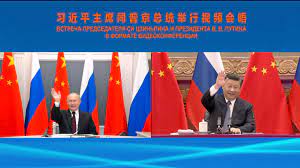
IN BRIEF
By Dincy Adlakha and Avishka Ashok
INTERNATIONAL
Xi-Putin take forward strategic coordination and political cooperation
On 14 December, Chinese President Xi Jinping met with Russian counterpart Vladimir Putin via videoconference and ushered a comprehensive strategic partnership in coordination for a new era. They expressed support for each other’s core interests and vowed coordination on international affairs. The two countries have progressed further in military, trade and strategic relations in the previous few years. (“China, Russia make new achievements in strategic coordination, practical cooperation,” Xinhua Net, 14 December 2021)
World Uyghur Congress prepares to take rights case to court
On 14 December, a British lawyer representing the World Uyghur Congress and the Uyghur Human Rights Project said that they are preparing a universal jurisdiction criminal complaint to submit to courts in Argentina before February 4, which is when the Olympics open. Similarly, a UN report from the High Commissioner for Human Rights can also be expected to be released before the Olympics open. These actions show a larger and global whisper in the global Uyghur community to stand against China for the human rights abuses in the North-Western province of Xinjiang. (“As Olympics open, Uighurs set to take rights case to court,” 14 December 2021, The Asahi Shimbun)
Envoy to Brazil appreciates democratic model of China
On 15 December, the Chinese Consul General in Rio De Janeiro Tian Min commented on the Chinese brand of democracy and said that it works efficiently. The statements were made by Tian in a Brazilian business daily Monitor Mercantil. He explained that the Chinese citizens had created a democratic system that overthrew oppressive regimes and adopted a government with Chinese characteristics under the capable leadership of the Coumminist Party of China. He said: “Practice has shown that Chinese-style democracy not only works, but works very well.” (“China's whole-process people's democracy "effective," says Chinese envoy,” Xinhua Net, 15 December 2021)
China-Panama foreign minister telephonic meet ushers cooperation
On 14 December, Chinese Foreign Minister Wang Yi talked on the phone with Panamanian Foreign Minister Erika Mouynes. The call appreciated the diplomatic ties between the two countries that were established four years ago, especially the adherence to the one-China policy. Cooperation from Panama is crucial for China as it is the first country from Latin America to take part in BRI. Panamanian FM also noted that China is Panama’s biggest trading partner in bilateral trade. Further, she also announced that Chinese Lunar New Year and Spring Festival celebrations will be included in the country’s list of holidays and tourism attractions. (“Chinese, Panamanian FMs hold phone conversation,” Xinhua Net, 15 December 2021)
China bashes US military operations in Afghanistan, Iraq and Syria
On 14 December, Chinese Foreign Ministry Spokesperson condemned the military interventions by the US in Afghanistan, Iraq and Syria due to their barbaric nature. China demanded justice for killing civilians in these operations committed in the name of “democracy” and “human rights.” Wang Wenbin further said: “The atrocity of killing civilians by U.S. forces in Afghanistan is unacceptable. It is even more intolerable that the United States exonerates the murderer with impunity for various reasons.” He said that these deeds by the US will not go unpunished. (“China demands justice for civilians killed by U.S. military: FM spokesperson,” Xinhua Net, 14 December 2021)
International political parties praise China’s Communist Party
On 14 December, the International Department of the CPC Central Committee held a briefing on the Sixth Plenary Session of the 19th CPC. A number of political parties from around the world took part in the session and praised the work of the Communist Party of China. The vice president of Nepal, chief advisor of Pakistan’s tehreek-e-Insaf Party, representatives from Standing Committee of Cambodian People’s Party, secretary-general of Egyptian Socialist Party, secretary of external affairs from Sudan’s People’s Liberation Movement, secretary-general of Palestinian Popular Struggle Front, chairman of Union of Forces of Progress of Mauritania and the chairman of Brazil-China Chamber of Commerce and Industry, all expressed views in appreciation of the CPC. (“Int'l political parties praise CPC's contribution to global democracy,” Xinhua Net, 14 December 2021)
Top diplomats from China and Moldova urge deeper ties in virtual conference
On 14 December, Chairman of the National People’s Congress Standing Committee Li Zhanshu and the parliament speaker of Moldova met through a video link. The two countries congratulated each other on the 30th anniversary of diplomatic ties. The representatives thanked each other for cooperation during the COVID-19 pandemic and also vowed further collaborations. (“Top Chinese legislator urges enhanced exchanges with Moldovan parliament,” Xinhua Net, 14 December 2021)
14 December 2021, Tuesday | China Reader Evening Brief | Vol.1, No. 62
Five aspects of Xi’s New World Order: Review of a Foreign Affairs Analysis
Elizabeth Economy, a senior expert on China, writes on the ambitious New World Order envisioned by Xi Jinping. She brings five distinct spheres where China plans to upturn current trends.
.jpeg)
IN FOCUS
By Dincy Adlakha
Five aspects of Xi’s New World Order: Review of a Foreign Affairs Analysis
On 9 December, Foreign Affairs published an essay by Elizabeth Economy titled, ‘Xi Jinping’s New World Order’ which brought out the ambitions of the Chinese president. The essay took inspiration from the speech delivered by the Chairman of the Communist Party of China, Xi Jinping, in Beijing in March 2021. This was an annual gathering of around 3000 representatives of the National People’s Congress. Although President Xi has been vocal about the Chinese dream on multiple occasions, this one was special since President Xi remarks that China has never been this closer to its rebirth. The essay analyzing the Chinese ambitions can be understood in five broad aspects.
China as the center of world affairs
According to the essay, China is already a strong regional power in Asia. It has expanded its maritime domain and established hegemonic intentions in East and South East Asia. Hence, the next logical step lands at dominating world affairs. China is already quite involved through investments and infrastructure in the world. Added with cheap and advanced technologies, and a shift in the geostrategic landscape from World War II to the Cold War and then to the post-Cold War, China seems to be eager to alter the equation again. It looks to run the world with its values and norms and with the informational connections that it runs. However, as the author sees it, China should not gloat in super self-confidence. If it does not adjust with the resistance, it will break. The world order will be shifted but not in its favor.
A reunified, complete China
The second most important aspect of the New World Order as seen by Xi Jinping is the dream to unite the entire Chinese land together. This includes Hong Kong, the South China Sea and Taiwan. Hong Kong has already seen the end of its pro-democracy initiatives. China’s assertion in Hong Kong was an example to the other regions regarding their resistance. President Xi promises to maintain territorial sovereignty in the sea. It also includes other contested territories such as the Diaoyu islands. President Xi has started on a path to redraw the map of China representing all these territories as inwards. Other efforts to hold these parts together are undermining their position in international organizations, proposed policy shifts and also involving other countries in accepting these principles.
The American decline
The author highlights that succeeding in the US is a top priority for China. It is already attempting to remove the “bully” from the “big Indo-Pacific family. President Xi has made sure to become the regional economic neighbor who is preferred due to virtual benefits. China is the largest economic partner of the majority of the countries in the world. Although only less than two percent of the entrepreneurs from East and Southeast Asia is power without an intention to surpass the US. From economy to security, China has the huge will to outshine the US when it is declining fast.
Global connectivity
President Xi is extremely ambitious and dedicated to the Belt and Road Initiative. BRI will enable China to build connections with the entire world. There are routes in Africa, Europe, Central Asia and the Middle East which are untapped as one connected line of the world. Apart from BRI, China is also highly conscious about the 5G networks and railroads, bridges, fiber-optic cables and other ports. It also connects with the world through the different commitment models or investment programs formed by China. Despite seeing a few protests in some countries against the Chinese engagement, BRI still remains a cultural, technological and economically sound project. China is also expanding its connectivity through Confucius institutes which create channels of exchanges. Cooperation in technology, space exploration and replacing banks like Asian Development Bank as the lender lead China to this position. Even though the world is aware of the ‘Wolf Warriors’, it still continues to connect with China.
Distinct approaches
Additionally, China has also been highly active in domains like e-governance and Arctic politics. China is using internet technologies to better help its citizens understand the world and participate for the nation’s benefit. President Xi has also eyed at leading in developing the norms of areas yet to be established fully. Exploration and research stations in the Arctic and enthusiastic participation in the Arctic Council are the beginning of the Chinese presence in the global commons. The author uses the same approach to understand China’s involvement in UN agencies and international organizations. This is to secure a position capable of guiding the other countries.
Inference
The analysis gives various fields to the Chinese eye. However, the author also points to the resistance faced by China for the same. In the end, President Xi will be able to achieve his Chinese dream only if the country balances these ambitions with resistance. The author finds that President Xi’s success will depend on him edging the gap between these two strong forces.
References:
Elizabeth Economy, “Xi Jinping’s New World Order,” Foreign Affairs, 9 December 2021
IN BRIEF
By Keerthana Nambiar and Avishka Ashok
INTERNAL
China discusses enhancing labor education in schools
On 13 December, China’s political advisory body, the National Committee of the Chinese People’s Political Consultative Conference held a virtual meeting to discuss education on labor and industriousness in Chinese schools. The meeting was headed by the chairman of the CPPCC Wang Yang who stressed the inclusion of labor education in children’s growth, the country’s economic development and social development. He said: “The industriousness education should be undertaken by the family, school and society, and it should be integrated into the system with moral, intelligent, physical and aesthetic education.” (“Political advisors discuss enhancing labor and industriousness education,” Xinhua Net, 13 December 2021)
Premier Li Keqiang meets President of World Bank Group
On 13 December, Chinese Premier Li Keqiang attended a virtual meeting with the President of the World Bank David Malpass and said that China could achieve high annual economic targets and is capable of working along with the World Bank. He said: “Facing downward economic pressure, China will prioritize growth, coordinating steady economic growth while archiving structural adjustment and promoting reform.” The Premier promised that China would continuously strengthen its economic policy and safeguard macroeconomic stability. (“China could achieve major annual economic targets: Premier,” Xinhua Net, 13 December 2021)
Communist Party of China organizes a ceremony for the Nanjing Massacre
On 13 December, the Communist Party of China Central Committee and the State Council held a memorial ceremony to remember the 3,00,000 victims who lost their lives during the Nanjing Massacre of 1937. The Vice Premier Sun Chunlan addressed the ceremony and urged the audience to remember the massacre and learn from the lessons of the past. He referred to the CPC achieving its centenary goals and said: “It is the greatest consolation to the victims of the Nanjing Massacre, the martyrs, and all those who died during the War of Resistance against Japanese Aggression.” (“Chinese vice premier pays tribute to Nanjing Massacre victims,” Xinhua Net, 13 December 2021)
China deals with the newest variant of the coronavirus after discovering the first case
On 14 December, the local health authorities in Tianjin referred to the discovery of the first Omicron case and informed them that the case was imported from Europe. On 13 December, the first Omicron case was discovered in Tianjin. The health infrastructure and the medical facilities are being tightened to ensure that the spread of the virus is controlled and does not impact the Chinese economy. The person detected with the variant has been transferred to a quarantine spot while the city has planned a special treatment area for dealing with the new variant. (“Update: Mainland's 1st Omicron case imported from Europe, special treatment area and team set: local authority,” Global Times, 14 December 2021)
INTERNATIONAL
Chinese ambassador criticizes US for double standards of democracy
On 14 December, Xinhua quoted the Chinese ambassador to Bangladesh Li Jiming’s article published in the Daily Sun to say that a few countries have “a hegemonic mentality of recognizing countries with the same system as correct and those with a different one as wrong which is undemocratic in nature.” The ambassador targets the US Summit for Democracy and points out that the US and other countries do not have the right position to set standards for democracy, let alone ask other countries to follow its methods. (“U.S. not in rightful position to set standards for democracy: Chinese ambassador,” Xinhua Net, 14 December 2021)
China opposes interference in internal matters by G7
On 13 December, Wang Wenbin remarked at a press briefing that China does not appreciate the G7’s attempt to interfere in China’s internal matters on issues relating to Hong Kong, Taiwan, Xinjiang and maritime activities. He said that The Us and the Uk, along with others, should stop the cold war mentality and urged them to practice multilateralism. Wang also stressed that it is important to stop practices of unilateral sanctions and implement non-discriminatory international trade. (“China firmly opposes G7's interference in its internal affairs: spokesperson,” Xinhua Net, 13 December 2021)
China and France agree to increase economic cooperation
On 13 December Chinese Vice Premier Hu Chunhua and the French Economy and France Minister co-chaired the eight China-France High-Level Economic and Financial and Financial Dialogues via video conference. The summit set important goals for the two countries as they vowed positive progress and cooperation for Covid-19 pandemic anti measures. Their trade has reached a bilateral high and both the representatives vowed to work further for deepening economic relations. They also promised to multilaterally cooperate on issues like WTO reform, climate change, and biodiversity protection. Agriculture and communication remain strong fields of their future cooperation. (“China, France vow to strengthen economic and financial cooperation,” Xinhua Net, 13 December 2021)
US top diplomat urges China to be more ambitious for climate change
On 13 December, US no.2 official urged that China needs to be more active in actions for climate change. Although China and the US have had a good year in terms of climate change cooperation in 2021, the official urged China to fasten its speed in rectifying the coal usage. He said that China has informed slow targets and is still the world’s largest energy consumer. Emphasizing on the US-CHina agreements on climate change, he said: “This is a very positive outcome and one we plan to build on in our bilateral engagement going forward and… get to a place where things are speeded up, where the numbers look better.” (“Top U.S. diplomat says China needs more ambitious climate goal,” The Asahi Shimbun, 13 December 2021)
13 December 2021, Monday | China Reader Evening Brief | Vol.1, No. 61
China-Africa innovation begins in Wuhan
China-Africa Innovation Cooperation Conference opens in Wuhan with focus on Belt and Road Initiative and the development of China-Africa community.
IN BRIEF
By Keerthana Nambiar and Avishka Ashok
INTERNAL
Alibaba dismisses female employee after she complains of sexual assault
On 13 December, the Guardian reported that Alibaba had fired a female employee after she complained of sexual assault by a colleague. The report regarding her wrongful dismissal was published in Dahe Daily, a local newspaper that is backed by the government. The letter of dismissal by Alibaba claimed that she was suspended for spreading incorrect information about being assaulted. The ex-employee said: “I have not made any mistakes and certainly will not accept this result, and in the future will use legal means to protect my rights and interests.” (“China’s Alibaba accused of firing female employee who alleged colleague sexually assaulted her,” The Guardian, 13 December 2021)
China to build two new bases to maintain undersea cables
On 12 December, the South China Morning Post reported that China is planning to build two bases to maintain the undersea cables in the East China and the South China Sea. According to the Chinese government’s five-year plan for the information and communication industry, “China is also seeking to build two more specialist ships for undersea cable maintenance in the next five years ‘to establish an internationally competitive capability in the construction and maintenance of submarine cables’,” reported South China Morning Post. (“China builds undersea cable bases amid digital infrastructure rivalry,” South China Morning Post, 12 December 2021)
REGIONAL
South Korean President Moon Jae-in said Seoul is not considering Winter Olympics boycott
On 13 December, South Korean President Moon Jae-in during a visit to Australia announced that the Korean government is not considering a diplomatic boycott of the Beijing Winter Olympics 2022. President Moon made the statement in the joint press conference with Australian Prime Minister Scott Morrison. “We have not received any recommendations to participate in (the boycott) from any country, including the US, and the Korean government is not considering it,” said Moon. (“Seoul not considering Beijing Olympics boycott: Moon,” The Korean Herald, 13 December 2021)
Taiwan’s Defense Ministry releases the latest threat assessment
On 13 December, Reuters reported on Taiwan’s Defense Ministry’s latest threat assessment as tensions between China and Taiwan have escalated quickly. The report says, “the nation's military has the advantage of the Taiwan Strait being a natural moat and can use joint intercept operations, cutting off the Communist military's supplies, severely reducing the combat effectiveness and endurance of the landing forces.” The ministry also added that “U.S. and Japanese military bases are close to Taiwan, and any Chinese Communist attack would necessarily be closely monitored, plus it would need to reserve forces to prevent foreign military intervention.” (“Taiwan says confident Chinese invasion would be very hard,” Reuters, 13 December 2021)
INTERNATIONAL
Chinese Ambassador to Afghanistan inaugurates two projects
On 12 December, the Chinese and Afghan officials inaugurated the establishment of a mosque and two wells in the Ministry of Justice in Afghanistan. The construction of the mosque and the wells have been funded by the Chinese government. The Chinese ambassador to Afghanistan said: “China and Afghanistan are very close neighbors connected by mountains and rivers, and the two peoples enjoy long-lasting friendly exchanges.” He reiterated China’s wishes for a peaceful, tranquil and prosperous Afghanistan. The Chief spokesperson of the Taliban-led Afghan government thanked China for its assistance and said: “the Islamic Emirate of Afghanistan is thankful to China over sending assistance and also assures of having trustable relations with the neighboring country.” (“Taliban-led Afghan gov't thanks China over donation,” Xinhua Net, 13 December 2021)
Chinese Ambassador to Costa Rica writes about the country’s democratic system
On 12 December, Xinhua Net reported that the Chinese Ambassador to Costa Rica Tang Heng urged the international community to respect the democratic path chosen by China in an article that was published in “Semanario Universidad,” a local newspaper. The article written by the Ambassador speaks of China’s political system, its particular nature and its functions. He criticized the Western rhetoric of China’s democracy as being flawed and said: “it is better to have a patriotic, united front that promotes harmonious relations between different political parties, ethnic groups, religions, social classes, and between Chinese citizens inside and outside the country.” (“Democratic paths chosen by people deserve respect: Chinese envoy to Costa Rica," Xinhua Net, 12 December 2021)
China-Africa innovation begins in Wuhan
On 12 December, the 2021 China-Africa Innovation Cooperation Conference took place in Wuhan, China. The conference will discuss the ways to implement the Belt and Road Initiative in China and promote the development of a China-Africa community which was decided during the Ministerial Conference of the Forum on China-Africa Cooperation. The event concludes on 13 December and includes a series of activities, a forum, an exhibition on the results of innovation cooperation and a salon for young Africans to showcase their talents in innovation and entrepreneurship. (“China-Africa innovation cooperation conference opens in central China,” Xinhua Net, 12 December 2021)
US, Australia, and Japan make a joint statement to fund undersea cable in Pacific countries
On 12 December, the United States, Australia, and Japan released a joint statement on jointly funding the construction of an undersea cable to boost Internet access in three tiny Pacific countries. The joint statement read, “this will support increased economic growth, drive development opportunities, and help to improve living standards as the region recovers from the severe impacts of Covid-19.” According to the Strait Times, the “allies seek to counter rising Chinese influence in the region.” The statement did not specify the cost of the project and detailed that new development will provide faster internet to Nauru, Kiribati, and the Federated States of Micronesia. (“US, Australia and Japan to fund undersea cable in the Pacific,” The Strait Times, 12 December 2021)
11 December 2021, Saturday | China Reader Evening Brief | Vol.1, No. 60
Chinese Media Responds to the US allies’ boycotting the Beijing Olympics
Starting from the US and followed by UK, Canada, and Australia, four countries have announced diplomatic boycott of the Beijing Winter Olympics in 2022. Global Times and Xinhua respond with strong commentaries and editorials.
IN FOCUS
By Dincy Adlakha
China’s Response to the US allies’ boycotting the Beijing Olympics
Starting from the US and followed by the UK, Canada, and Australia, four countries have announced a diplomatic boycott of the Beijing Winter Olympics in 2022. Global Times and Xinhua respond with strong commentaries and editorials. A larger narrative of the fabricated lies of the US flow from the notes.
On 6 December 2021, a spokesperson for the US White House announced that the US will diplomatically boycott the upcoming Winter Olympics which are to be held in Beijing in February 2022. Following this decision, governments from Australia, Canada, and the UK also announced that their diplomatic officials will not be accompanying their athletes to the big event. The four countries have said that they stand with the Uyghur Muslims being abused and opposed by China in Xinjiang province. Although Wellington cited the reason for the pandemic for not sending its diplomats, the countries have collectively opposed China for conducting genocide on Uyghur Muslims earlier as well.
Media Briefs
1. Global Times:
On 8 December, an article was published by Global Times which announced that China is strongly opposed to the boycott announced by the countries and will take serious countermeasures on the same. It also pointed out that the US has just made a joke out of itself since China did not invite its officials in the first place. The article took input from Chinese Foreign Ministry spokesperson Zhao Lijian who noted that the Winter Olympics is not a platform for manipulation. It is the wish of each country to come and cheer for their athletes. The US has used this clause and the absence of its diplomats from the event as a human rights issue which is cheating their own selves. Other experts, such as the president of the Turkish-Chinese Business Development and Friendship Association, called this decision by the US “a futile effort” and a ridiculous stand. The article also took inputs from other experts who predicted that three to four countries may follow suit with the US but no more.
2. Global Times:
On 8 December, Global Times published another editorial that was addressed mainly to the Chinese public. It assured the people that China will respond diplomatically to the chain of events and that they can do no harm to the Chinese reputation. The article read that US-China competition will probably last years and this act is just “small talk” in the cycle of a larger perspective. It mentioned that China’s first priority is its economic development and overall strength rather than such small acts incapable of incurring substantial damage to China in the wide picture. The article listed a few other priorities of the Chinese spirit such as Taiwanese reunification, strengthening defense and national strength.
3. Global Times:
On 9 December, Global times published an op-ed by Andrew Korybko on the matter where he argues that the US is feeding lies into the world media. He also suggested that the US itself does not possess full information on the issue and is just targeting the country by a weaponized narrative of “genocide” and also printed that US diplomats do not have a good enough reputation and even questioned their professional qualifications. The article reads: “everything negative that the US has said about China all these years was nothing but information warfare designed to discredit China's international reputation and deter its dozens of partners across the world from cooperating with it. Basically, it was nothing but lies, as evidenced by the fact that the US will not even impose a total boycott on the upcoming Winter Olympic Games despite its very serious but ultimately unsubstantiated claim that China is committing "genocide" against Uygur people.” According to the note, the boycott by other countries is imposed in order to impress the US and the entire fiasco is counterproductive to their own false claims.
4. Global Times:
On 8 December, China showed that it does not care for the Australian announcement of diplomatically boycotting the Winter Olympics by a Global Times editorial. It saw that the Australian authorities do not have their own mind or independent policy as they act as the “henchman” of the US. It also mentioned that the Australian actions are committed under pressure from the US. Other motivations such as security gaps due to geographic location and following the “sick, desperate” US were also highlighted. A professor from the Guangdong Research Institute for International Strategies was cited in the article to say that Japan should not backstab China by following the pattern as China provided full support to Japan during the Tokyo Olympics. As for other countries, the article also cited an official from Italy saying that their country will not boycott Winter Olympics. In this light, the article termed this US move as unpopular.
5. Xinhua:
On 7 December, Xinhua published a commentary titled ‘US Olympic Boycott politically driven’ which elaborated on how the US diplomatic boycott of the Beijing Winter Olympics is the latest tool of US political propaganda. The commentary said that this US action does more to divide the world than unite the world which is what the US always preaches. It also called the action by the US as an excuse for hiding face rather than a boycott since there was no invitation in the first place. The commentary read: “By spreading fallacies and turning a blind eye to the progress in the world's second-largest economy, the United States weaponizes human rights with a political motive.” It was appalled at the number of times the US has targetted Xinjiang for its political agenda. It reminded that the International Olympic Committee has added the word “together” in this year’s motto and yet a few countries run counter to the consensus of the international community.
6. Xinhua:
On 8 December, Xinhua published another commentary that called out the “lying diplomacy” of the US. The commentary quoted a former independent UN expert to call the US’ actions unoriginal, boring and hypocritical. The commentary said that the White House is sugarcoating its geopolitical intentions and does not scrutinize facts, ever. The commentary reported that the Uyghur population has doubled to more than 12 million people in four decades in Xinjiang and has seen a surge multiple times in the province. It called the US actions prejudiced and arrogant with the intention to hold back China’s peaceful development. Washington uses such white lies to call countries in its favor but is only building a strong trend of “lying diplomacy” in this manner.
References:
“Xinhua Commentary: U.S. Olympic boycott politically driven,” Xinhua Net, 7 December 2021
“Xinhua Commentary: Washington's "lying diplomacy" behind Olympic boycott,” Xinhua Net, 8 December 2021
Liu Xin, Chen Qingqing and Xu Yelu, “US hijacks Olympics, turns it into ‘small clique’ diplomatic tool ahead of democracy summit,” Global Times, 8 December 2021
“Impossible for US, West to use ‘reputation’ to harass China: Global Times editorial,” Global Times, 8 December 2021
“‘Nobody cares.’ Beijing shrugs off Canberra’s 'diplomatic boycott',” Global Times, 8 December 2021
Andrew Korybko, “'Diplomatic boycott' of Beijing Winter Olympic Games exposes the US' lies of 'Uygur genocide',” Global Times, 9 December 2021
IN BRIEF
By Keerthana Nambiar and Avishka Ashok
INTERNAL
Experts on China’s economic policy 2022
On 11 November, Bloomberg published an editorial on Chinese economic policy in 2022, and ‘stability’ is the most important variable. According to the executive vice-minister of the Communist Party of China’s central financial and economic affairs commission, Han Wenxiu China cannot return to the old growth path as there are many hidden risks in the economy and financial sector. Han stated that China needs to explore a new developmental model for the industry. He said, “All regions and agencies must take responsibility to uphold economic stability, actively introduce policies that can help stabilize the economy, and be cautious in imposing measures that will have a contractionary effect.” Ning Jizhe, who heads the statistics bureau and is a vice-chairman of the National Development and Reform Commission said, the government “must fully explore the potential of domestic demand in 2022” and must implement policies to boost demand for major goods and accelerate the development of e-commerce infrastructure and delivery systems in rural areas. (“Stability Most Important Word for China’s Economy,” Bloomberg Quint, 11 December 2021)
REGIONAL
Senior Japanese officials to skip Beijing Winter Olympics- Japanese media
On 11 December, Yomiuri Shimbun a Japanese newspaper reported that senior Japanese officials are likely to skip the Winter Olympics in Beijing joining the diplomatic boycott by the US, Britain, Australia, and Canada. “The Japanese government, along with other members of the Group of Seven nations, has expressed concern over human rights issues in the Xinjiang Uygur Autonomous Region and Hong Kong,” noted Yomiuri. (“Japan unlikely to send high-ranking official to Beijing Games,” The Yomiuri Shimbun, 11 December 2021)
China tightens its borders to prevent spillover of COVID-19 from Vietnam
On 10 December, South China Morning Post reported that China has tightened its security along its southwestern border to stop the spillover of COVID-19 cases from Vietnam. The authorities in the region have now detained smugglers helping illegal border-crossing, set up extra checkpoints and mass testing centers in the borders. (“China tightens border with Vietnam to stop coronavirus surge,” South China Morning Post, 10 December 2021)
Multiple Chinese Aircraft enter Taiwanese defense zone
On 10 December, Taiwan reported that 13 Chinese aircraft have entered the Air Defense Identification Zone of Taiwan. This was the latest incursion made by Chinese aircraft into the Taiwanese territory which China claims to be an inalienable part of its land. Pressure from military expansion and aggression over Taiwan has increased from China over the past few months. (“Taiwan reports 13 Chinese aircraft in defence zone,” Reuters, 10 December 2021)
Regional filmmaker releases memoir of North Korean women trapped in sex slavery in China
On 11 December, Korea Times published an article covering the release of a book by Korean-Canadian filmmaker Sylvia Yu Friedman on the stories of women sold in sex slavery to Chinese farmers. The book is titled ‘A Long Road to Justice: Stories from the Frontlines in Asia’ and is based on the lives of women who leave their homes from East Asia including China and Hong Kong, to look for jobs but instead end up in sex slavery. She said: “There are thousands of children of North Korean mothers and Chinese fathers. Hundreds, if not thousands, of these children are abandoned by their mothers if they escape to a third country like South Korea, or if they are sold again to another husband.” She aims to help create awareness over the matter and create an international whisper for the same. She expects professionals to help out such women and volunteer for the cause. (“Memoir delivers cries for help from N. Korean women trapped in sex slavery in China,” Korea Times, 11 December 2021)
INTERNATIONAL
Chinese Foreign Ministry criticizes US-led Summit for Democracy
On 11 December, the Chinese Foreign Ministry spokesperson made an online statement on the US-organized Summit for Democracy. The ministry stated that “democracy has long become a weapon of mass destruction used by the US to interfere in other countries” and accused the US of instigating “color revolutions” overseas. China vowed to “resolutely resist and oppose all kinds of pseudo-democracies” and claimed that this summit was organized with the motive to “draw lines of ideological prejudice, instrumentalise and weaponise democracy... (and) incite division and confrontation.” (“China brands US democracy 'weapon of mass destruction,” Strait Times, 11 December 2021)
10 December 2021, Friday | China Reader Evening Brief | Vol.1, No. 59
Nicaragua derecognizes Taiwan to resume ties with China
The Republic of Nicaragua announces that it is severing ties with Taiwan. China seems pleased at the development and calls out the weakening support in the US-Taiwan camp.
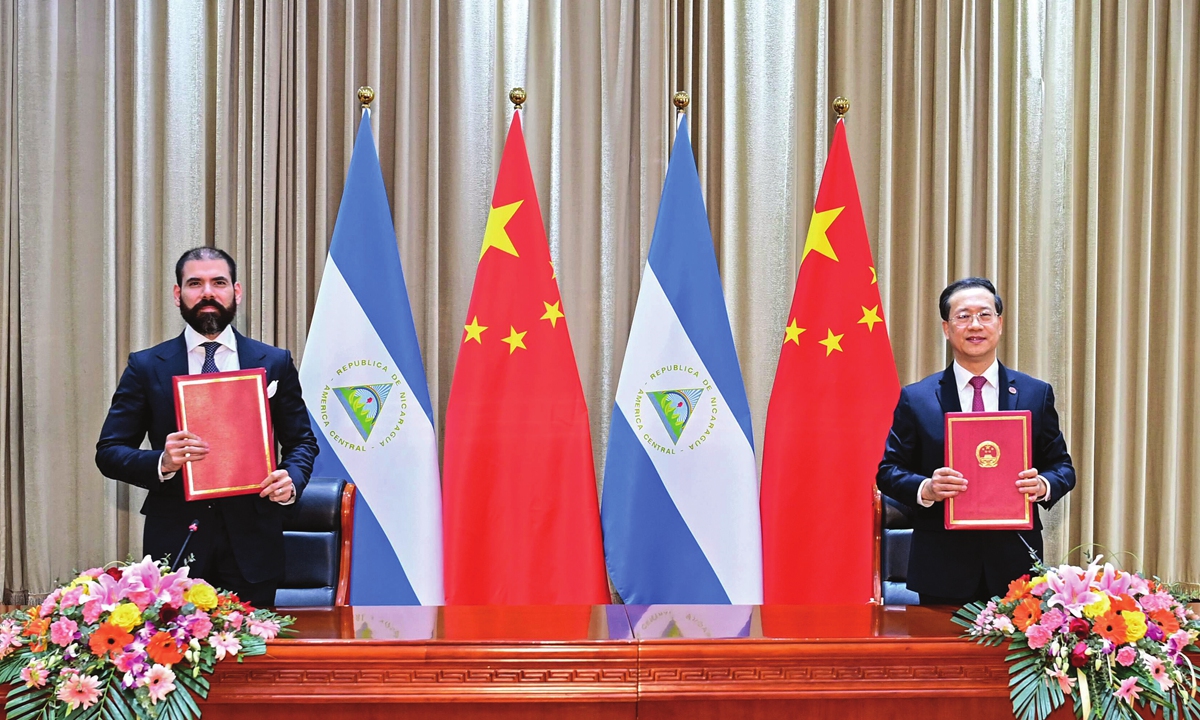
IN BRIEF
By Avishka Ashok, Keerthana Nambiar and Dincy Adlakha
INTERNAL
China approves first indigenous anti-COVID-19 drug for marketing
On 9 December, authorities in China announced that the first home-developed drug against COVID-19 has been approved for marketing. It is said to be highly effective by reducing the risk of death or hospitalization by 8p percent. It is also said to have neutralizing agents against the Omicron variant of coronavirus. Experts hold that the drug is the only antibody drug in the world to evaluate the efficacy of treatment in patients with mutant strains of the virus and gives the best results for protection. (Liu Caiyu and Zhao Juecheng, “China's first COVID-19 antibody drug cuts hospitalizations, deaths 80%,” Global Times, 9 December 2021)
Jimmy Lai, Chow Hang Tung and Gwyneth Ho found guilty for taking part in the Tiananmen Square vigil
On 9 December, Hong Kong media tycoon Jimmy Lai, Alliance’s Chow Hang Tung and former opposition politician Gwyneth Ho and more than two dozen politicians and activists have been convicted for inciting and taking part in a vigil to mark the Tiananmen massacre. District Court Judge Amanda Woodcock in a press conference said that the arguments on the vigil were “frankly nonsensical” and the participation “was an act of defiance and protest against the police.” (“3 including Jimmy Lai convicted over unauthorized assembly in HK, joining 21 others,” Global Times, 9 December 2021; “Hong Kong: Jimmy Lai convicted for taking part in Tiananmen vigil,” BBC, 10 December 2021)
ECONOMY
China marks the 20th anniversary of its accession to World Trade Organization
On 10 December, China Daily reported that 2021 marks Beijing's 20th anniversary of accession to the World Trade Organization (WTO). The Chinese Ministry of Commerce spokesperson Gao Feng said: "The magnitude of foreign direct investment (FDI) into China, in actual use, surged by 17.8 percent year on year to 943.15 billion yuan ($147.87 billion) in the first 10 months of this year, and it is expected to exceed 1 trillion yuan."According to the data provided by the Ministry, in the first half of 2021, over 23,000 new foreign enterprises were set up in China. The ministry promised that China will continue to share the market opportunities with the world and promote high-level opening as well as provide better services to foreign companies. ("Nation marks 20th anniversary of joining WTO," China Daily, 10 December 2021)
Evergrande and Kaisa Group labeled as defaulters by the Fitch Ratings
On 10 December, the Strait Times reported that the Fitch Ratings has labeled China’s Evergrande Group and Kaisa Group Holdings as payment defaulters. Evergrande Group has been labeled a defaulter of more than US$1.2 billion for the first time after failing to make two coupon payments worth US$82.5 million. Kaisa has failed to repay a US$400 million dollar bond that matured on 7 December 2021. (“China's Evergrande, Kaisa have defaulted as huge restructuring looms," The Strait Times, 10 December 2021)
TECHNOLOGY
Shenzhou-13 taikonauts open extraterrestrial lecture series
On 9 December, three taikonauts delivered their first lecture to a total of 1420 students from the Shenzhou spaceflight mission. This lecture was the first in a series of lectures, called the Tiangong class series, which will be held from space. Primary students from all around the world were welcome to attend the lecture. This first lecture began with a live broadcast from the orbiting China Space Station. Classrooms were set up in various provinces of China and even in Hong Kong and Macao as the class began through a video link. According to the China Manned Space Agency, it will now become a regular practice for manned space missions to hold such lectures from space to encourage students from a young age. (Deng Xiaoci and Leng Shumei, “Shenzhou-13 taikonauts deliver first Tiangong class,” 9 December 2021)
INTERNATIONAL
Nicaragua derecognizes Taiwan to resume ties with China
On 9 December, the government of the Republic of Nicaragua declared that it is severing “diplomatic relations with Taiwan”. Within three hours, the authorities also announced that they are resuming relations with China. Their statement read that the People’s Republic of China is the only legitimate government that represents all of China and that Taiwan is an inalienable part of Chinese territory. With this announcement, only 14 countries in the world recognize Taiwan as a state now. Immediately after this escalation, the Taiwanese ministry of foreign affairs stated that relations with Nicaragua are being severed with immediate effect. Experts in China hail the development as a “heavy blow” to the Taiwanese secessionists seeking support from the US. (“China, Nicaragua resume ties within 3 hours after Taiwan loses 'ally,' a 'heavy blow' to secessionists seeking US support,” Global Times, 10 December 2021)
Chinese Foreign Ministry spokesperson calls Uyghur Tribunal judgment a farce
On 9 December, a Chinese Foreign Ministry spokesperson released a statement that called the final ruling of the “Uyghur Tribunal” a political farce. He said that liars and false evidence were gathered by contemptible individuals to claim that China is committing genocide. He saw this final ruling terming Chinese activities in Xinjian a genocide as an anti-China action that does not hold much facts or ground. He said: “Lies remain lies, no matter how many times they are repeated. Lies cannot cover up facts and truth, cheat the international community, still less stop the historical trend of stability, development and prosperity in China's Xinjiang.” On the same day, similar statements were released by the Chinese Embassy in the UK to oppose the “World Uyghur Congress” and its terrorist, secessionist intentions. (“Judgment made by fake tribunal is doomed to be swept into trash can by history, spurned by people: FM spokesperson,” Global Times, 9 December 2021)
Chinese Foreign Ministry claims US, Britain and Australia using Winter Olympics for political manipulation
On 9 December, Chinese Foreign Ministry spokesperson Wang Wenbin made a statement on the ongoing diplomatic boycott of Beijing Winter Olympics 2022: “the United States, Britain and Australia have used the Olympics platform for political manipulation.” “They will have to pay the price for their mistaken acts,” quoted Wenbin. The Ministry came in the responses after Australia joined Britain and the US on the decision of not sending officials to the Winter Olympics. (“China says Australia, Britain, U.S. to pay price for wrong acts,” The Asahi Shimbun, 9 December 2021)
9 December 2021, Thursday | China Reader Evening Brief | Vol.1, No. 58
Chinese Foreign Ministry releases a report criticizing US democracy and political system
The Chinese Foreign Ministry releases a report on how the US is not the ‘beacon of democracy' but a ‘game of money politics’ and is seeking to impose its own brand of democracy on other countries.
IN FOCUS
By Keerthana Nambiar
Chinese Foreign Ministry releases a report criticizing US democracy and political system
On 5 December, the Chinese Foreign Ministry released a report on the US democracy ahead of the US-led ‘Summit for Democracy’. The report focuses on “American-style democracy” its dysfunctionality and how America is not the “beacon of democracy.” The report starts by defining democracy and no country that fits the one-size-fits-all model and using a yardstick to measure diverse political systems would be “undemocratic”. The report particularly aims at pointing out the US system of democracy and its historical development and articulation of the principle ‘government of the people, by the people and for the people’ by Abraham Lincoln.
The deep-seated problems
First, the American-style democracy turned into “a game of money politics.” According to the report, “the American-style democracy is a rich men’s game based on capital, and is fundamentally different from the democracy of the people.” It discusses that American democracy is based on money politics and has penetrated the election, legislation, and administration process. The report claims: the inequality in economic status has morphed into inequality in political status and money politics has become an “irremovable tumor” in American society. Second, the idea of political pluralism: a façade. The report says that the reality of American democracy is “rule of the minority elite” rather than the “one person one vote.” It discusses how a small number of minority elites control all aspects such as political, military, and economic affairs. The Democrats and Republicans have taken turns to get the majority in the White House and the idea of a multiparty system is “dead.” For the ordinary people, voting for the third party or an independent candidate became a waste of their ballot. Third, the US “vetocracy.” The report quotes American political scientist Francis Fukuyama from his book Political Order and Political Decay and talks about a system of “vetocracy”. American culture functions on “checks and balances” which was initially designed to prevent abuse of power have now led to political polarization. Fourth, the flawed and unfair American electoral process. The report explains the flaws in the electoral processes wherein the President and Vice-President are not elected by popular vote but by a time-honored Electoral College system. Flaws such as deciding the winner based on the president-elect who may not be a winner of the national popular vote, each state making its own electoral rules, winner-takes-all system, and ‘gerrymandering’ unfair division of electoral districts in favor of a particular party. Fifth, dysfunctional American democracy. The report says the American democracy is more like a Hollywood movie with political in-fighting, money politics which makes it undesirable to deliver it to the audience.
Messy and chaotic practices of democracy
First, the Capitol riot. The report says that the riots on Capitol Hill “shows what is underneath the gorgeous appearance of the American-style democracy.” According to the document, the major imperatives of the assault are: the US is not as democratic as it claims to be; the US is not as free as it claims; the ‘rule of law’ in the US is not bound by the law as it claims. The second, the factor of racism. In the US, racial segregation is a “blot on democracy.” The report describes the case of George Floyd and the Black Lives Matter as an important factor indicating the US’ failure to practice democracy they advocate of in the Constitution of 1789. Third, mishandling of COVID-19 pandemic. The report criticizes the US for mishandling the pandemic and how “the US has been a total mess when it comes to COVID response” and this has taken a huge toll on the US economy. Fourth, the polarization of wealth in the US. According to the report, “the wealth polarization in the US is inherent to its own political system and the interests of the capital that its government represents.” Fifth, the name’s sake is “freedom of speech.” The report says that the US media has no freedom and is no longer the “gatekeeper of democracy.”
US’ brand of democracy
First, the report explains that the US seeks to impose its own political system on countries around the world and interferes in other countries’ internal matters. It says the US idea of “color revolutions” undermines regional and national security without any regard to the differences on economical and cultural fronts. Second, imposition o the US’ brand of democracy “causes humanitarian tragedies.” The report takes the example of the Afghanistan crisis and how the US is responsible for the ongoing humanitarian crisis and fatalities. It also includes US launched airstrikes in Syria and how the conflict could have been avoided. Third, the US abusing the sanctions. According to the report, “unilateral sanction is a “big stick” the US wields in dealing with other countries. Over many years, the US has exercised its financial hegemony and abused its technological clout to carry out frequent, unilateral bullying against other countries.” Fourth, the US as the ‘beacon of democracy.’ The report criticizes the US “hypocrisy in exporting US “democratic values”, and US acts of bullying and hegemony around the world in the name of democracy.” The report concludes with the note that the international community has pressing issues to look at like the COVID-19 pandemic, climate change, and economic slowdown. All the countries around the world must work together and should “rise above differences in systems, reject the mentality of a zero-sum game, and pursue genuine multilateralism.”
Perspective
The report released by the Chinese Foreign Ministry has attacked the US political system and criticized American democracy calling it “a game of money politics.” The entire document manages to bring in several instances, examples, opinions, and research from experts on the flaws of American democracy and how it cannot impose its brand of democracy on other countries, mainly China. The report is in response to the Biden-led ‘Summit for democracy’ and the US is the center model for democratic countries. According to China, the US democratic system has its own flaws and should not disregard other forms of government that do not follow the US rule book for democracy.
The ongoing rivalry between China and the US has taken a new phase with China questioning the US' democracy and political system. In conclusion, the report indulges in imperatives for the US: one, ensuring the democratic rights of its own citizens, and two, undertaking more international responsibilities.
References:
“Full Text: The State of Democracy in the United States,” China.org, 6 December 2021
IN BRIEF
By Avishka Ashok and Dincy Adlakha
INTERNAL
State Council issues circular on administrative penalty law
On 8 December, Xinhua Net reported that the state council of China’s cabinet had published a circular that pushed for effective and concrete measures to execute the revised administrative penalty law. The circular issued by the government has made it essential to complete the training for the current administrative law enforcement personnel by June 2022. It also called for a wider publicity of the law. It said: “The stipulations and enforcement of administrative punishment must be in accordance with laws and regulations.” (“China to further implement administrative penalty law,” Xinhua Net, 8 December 2021)
Government releases plan to improve rural modernization in next five-year plan
On 8 December, the vice minister of agriculture and rural affairs addressed a press conference and announced that the state government had released a plan to improve agricultural and rural modernization in the 14th five-year plan period. The plan said: “After five years of efforts, the foundation of agriculture is expected to be further consolidated, comprehensive signs of progress are expected to be made in rural vitalization, and significant advancement is expected to be made in modernizing agricultural and rural areas.” The plan aims to make substantial progress in the rural area and achieve all its goals provided in the plan by 2035. (“China unveils 5-year plan to advance agricultural, rural modernization,” Xinhua Net, 8 December 2021)
Supreme People’s Court releases document on sentence reduction and parole
On 8 December, the Supreme People’s Court released a document that provided the guidelines for court hearings in sentence reduction and parole cases. The guidelines are aimed at ensuring that the criminals are punished adequately and only the truly repentant individuals are granted leniency. The document stressed the need to understand who the truly repentant are and the process in deciding if the convicts are indeed willing to change for good. The Court said: “Apart from convicts' acts of repentance during their prison sentence, the court should take into consideration whether the convicts truly feel sorry for their criminal activities and realize the damage they caused to society.” (“China releases guidelines to improve sentence reduction, parole hearings,” Xinhua Net, 8 December 2021)
REGIONAL
Taiwan Affairs Office of the State Council comments on DPP’s actions
On 8 November, the Taiwan Affairs Office of the State Council spokesperson Ma Xiaoguang opposed Taiwan’s Democratic Progressive Party’s actions that slander the mainland’s integration efforts and created and encouraged sentiments of secession in the Island. The report said that Taiwan’s mainland affairs office distorted facts by claiming that the mainland spoiled the functioning of Taiwanese companies by punishing the independence elements. While asserting that the intentions to create problems in the retrieval of Taiwan are bound to fail and referring to
the 2021 Zijinshan Summit, Ma said: “Attendees have proved through actions that strengthening economic cooperation is an inevitable choice to achieve mutual benefits for both sides of the Strait.” (“Mainland spokesperson slams DPP for sowing discord across Taiwan Strait,” Xinhua Net, 8 December 2021)
INTERNATIONAL
Chinese Foreign Ministry calls US democracy summit as democratic manipulation
On 8 December, Chinese Foreign Ministry spokesperson Wang Wenbin stated in a daily press meeting that the “Summit for Democracy” publicized by the US in an attempt to seek democratic hegemony, is in actuality a democratic manipulation. He lauded Hungary’s rejection of a common EU stands on the summit. He also said that Hungary’s disagreement with the event shows the widespread opposition to the summit. He also said that the US has promoted this summit without consulting the international community. Wang said: “No matter how the United States glosses over itself, its true face of seeking hegemony under the guise of democracy has long been exposed to the world. The so-called 'summit for democracy' will only go down in history as a manipulator and saboteur of democracy." (“"Summit for democracy" will go down in history as democratic manipulation: FM spokesperson,” Xinhua Net, 8 December 2021)
China attends International Conference on Nepal’s Reconstruction 2021
On 8 December, Chinese State Councilor and Foreign Minister Wang Yi attended and addressed the International Conference on Nepal’s Reconstruction 2021. He emphasized the fight against the COVID-19 pandemic and also pledged continuous support from the Chinese side towards post-earthquake reconstruction. The Conference was held as an effort to generate support for Nepalese reconstruction from the deadly earthquake that hit the country six years ago. China stressed that it will always be Nepal’s friendly neighbor and development partner, through the varying efforts and plans, including the cooperation under BRI. (“China to continue supporting Nepal's post-earthquake reconstruction: FM,” Xinhua Net, 8 December 2021)
US House of Representatives passes legislation to ban imports from Xinjiang
On 8 December, the House of Representatives in the IS passed legislation that banned imports from Xinjiang. The attributed reason for this measure is concerns of forced labor and human rights abuses against Uyghur Muslims in the region. The law is named the “Uyghur Forced Labor Prevention Act” and was passed by an astonishing majority of 428-1. However, to become a law, the legislation must also be passed by the Senate and signed by President Joe Biden. China has declined all such claims and has criticized such allegations. Xinjiang supplies solar panels in bulk to the world including to the US. (Patricia Zengerle, “U.S. House passes measure clamping down on products from China's Xinjiang region,” Reuters, 8 December 2021)
Canada joins US, UK, Australia in a diplomatic boycott of Beijing Winter Olympics
On 9 December, Canadian Prime Minister Justin Trudeau announced that Canada will also diplomatically boycott the Beijing Winter Olympics in 2022. The announcement followed the first step made by the White House, followed by governments in the UK, and Australia. This diplomatic ban is said to be enforced due to the human rights abuses in Xinjiang. China has strongly opposed all these allegations and held that this is an infringement on international norms and a violation of its sovereignty. PM Trudeau said: “We are extremely concerned by the repeated human rights violations by the Chinese government. They should not be surprised we will not be sending any diplomatic representation.” (“Canada joins U.S. and allies in Beijing Olympics boycott,” The Asahi Shimbun, 9 December 2021)
8 December 2021, Wednesday | China Reader Evening Brief | Vol.1, No. 57
White Paper on China’s Democratic System: five takeaways
The Chinese White Paper explains its brand of democracy and how it benefits China perfectly.
IN FOCUS
By Avishka Ashok
White Paper on China’s Democratic System: five takeaways
On 4 December, the State Council Information Office released a white paper on the Chinese model of Democracy. The paper titled “China: Democracy That Works” focused on China’s version of democracy that according to the paper provides complete institutional procedures. The paper comprises five sub-sections through which its highlights the CPC’s efforts to support democracy in the country, the foolproof institutional framework, the party’s concrete practices, and a new model of the system.
The paper says: “Democracy is a common value of humanity and an ideal that has always been cherished by the Communist Party of China (CPC) and the Chinese people.”
The CPC has strived to provide democratic values to its people
The paper explains in detail, China's journey from a monarchy to democracy and all the changes it has gone through along with the CPC’s accomplishments in bringing the country to its current economic and political stature. It credited the Communist Party of China and its establishment in 1921 for bringing about democratic changes in the country. The paper referred to the socialist revolution of 1949-78 and appreciated the era’s contribution to building and consolidating state power, completing the transition to socialism, creating the first constitution of China and establishing a system for democratic China. Moving forward to the 18th National Congress in 2012, the paper stressed the existence of socialism with Chinese characteristics in the new era. The paper put the spotlight on the achievements of President Xi Jinping. These achievements include: “strengthening the CPC’s overall leadership, modernizing China’s governance system and capacity, establishing and upholding the fundamental, basic, and important systems of Chinese socialism, consolidating the people’s principal position in the country’s political and social life, and promoting political stability, unity and vitality. The paper put emphasis on “whole-process democracy” and its use to realize and understand the true potential of democracy for the Chines people.
China defends its existing constitutional framework
While signifying the importance and need for complete institutional procedures, the paper brought to notice the many ways in which the CPC ensures the availability and accessibility of the democratic provisions. First, the paper provides that the people have a dictatorial hold over the nature of the state and calls them the masters of the country. Secondly, the people’s congresses guarantee the people the status of being the master of the country’s political system. The paper continues to explain the main functions and powers of the people’s congresses and their standing committees. The paper then cites the constitution and explains the significance of multiparty cooperation and political consultation for the CPC. It clarifies that the Chinese political system does not give space to other parties but also makes the existence of eight other political parties within the CPC that helps in the administrative affairs of the communist party. This section also explains the need to possess a broad patriotic front and have a united outlook in all issues and international platforms. The paper then proceeds to call China a “unified multi-ethnic state” and justifies the CPC’s policies that are aimed at building a unified national identity. Lastly, the paper explains China’s system of community-level self-governance, a system that was established to administer China’s vast territorial geography and populous demography. The paper says: “The system of community-level self-governance has strengthened the public’s ability to understand and practice democracy, demonstrating that China’s democracy is extensive and genuine.”
China exemplifies its party’s efficient style of functioning
The paper also sheds light on the instruments that assist the Chinese democracy in succeeding in its mission to provide for all its people. It explains that a combination of electoral and consultative democracy helps to cover the economic, political, cultural, social, eco-environmental, and other fields while also focusing on national development and social governance. Democratic election, Democratic Consultation, Democratic Decision-making, Democratic Management, Democratic Oversight. According to the White Paper, the elections in China are extensive and cover all concerns and issues. They are based on equality and are not manipulated by any financial or political interests. Consultations have been put in place after serious considerations to the cultural, theoretical, practical and institutional foundations.
The paper explains how the Chinese brand of democracy helps the Chinese state
The Chinese constitution provides extensive rights to the people and the political power is enjoyed by the people rather than the political and financial elites. The country effectively manages a socialist market economy that also incorporates public ownership. The country also believes in continuous political participation of the people that does not stop with just the elections and the voting responsibilities. The people are adequately involved in the management of state affairs, social affairs and economic and cultural affairs. They also take part in helping the CPC with suggesting changes, reforms and providing their opinions on matters of national importance. The paper also boasts of efficient national governance that promotes the development and increases the economic and financial capabilities of the state. Despite its complex national conditions, the country proudly acknowledges its capabilities of balancing and providing for its diverse populace. Finally, it sheds light on its constraining policies but also mentions that it will continue with those policies in order to protect the people. It refers to power as a double-edge sword that must restrict its use to only benefit the people and their requirements. Checks and supervision to fight corruption and corrupt citizens is also considered to be a part of the Chinese constitution.
The country aims to work towards new paths of democracy
The White Paper reveals that the government is now looking into new paths to modernize their version of democracy while also ensuring political stability and social progress. China clarifies that it has always steered away from the western ideologies and definitions of democracy and believes that the Chinese brand works best for the country and its people. The paper states: “China draws on each and every political achievement of other countries, but does not imitate any of their models of democracy. China welcomes all constructive suggestions and well-intentioned criticism, but rejects any form of an overbearing lecture.” The country also seeks to promote democracy in international relations and develop global partnerships. The paper refers to the Belt and Road Initiative as an effort to create beneficial and mutually rewarding friendships with other countries. Lastly, China urges the West to stop forcing its version of democracy on other developing and underdeveloped countries. It says: “There is no single road to democracy. The true barrier to democracy lies not in different models of democracy, but in arrogance, prejudice and hostility towards other countries’ attempts to explore their own paths to democracy, and in assumed superiority and the determination to impose one’s own model of democracy on others.”
References:
“White paper details complete system of whole-process people's democracy,” China.Org, 4 December 2021
“China issues white paper on its democracy,” The State Council, People’s Republic of China, 4 December 2021
IN BRIEF
By Keerthana Nambiar and Dincy Adlakha
INTERNAL
President Xi Jinping claims China is at the stage towards achieving “national rejuvenation”
On 7 December, Chinese media reported on the remarks made by the Chinese President Xi Jinping at a group study of the Political Bureau of the CPC Central Committee. President Xi claimed that “China is now at a critical stage toward achieving national rejuvenation,” reported Xinhua. Xi who is also the general secretary of the Communist Party of China (CPC) Central Committee stressed “resolute adherence to the path of socialist rule of law with Chinese characteristics, and advancing the development of such a system,” noted Global Times. In his speech Xi calls in for efforts to strengthen legislation in key areas such as national security, scientific and technological innovation, public health, biosafety and biosecurity, ecological conservation and risk prevention. (“Xi Focus: Xi stresses adherence to socialist rule of law with Chinese characteristics,” Xinhua Net, 7 December 2021: “Xi stresses adherence to socialist rule of law with Chinese characteristics,” Global Times, 7 December 2021)
REGIONAL
Annual summit for mainland and Taiwanese entrepreneurs opens
On 7 December, the 2021 Zijinshan Summit for entrepreneurs from the Chinese mainland and Taiwanese Strait opened. The Summit is being conducted virtually and was held in Nanjing and Taipei through video links. China’s top political advisor Wang Yang sent a congratulatory letter to the summit on behalf of the party and the president. Xinhua reported that more than 500 business people from Taiwan attended the conference. The Summit emphasized the importance of mainland-Taiwanese trade despite the COVID-19 barriers. The letter from Wang Yang emphasized peaceful and integrated development, away from the secessionist forces of Taiwan, of the two sides. (“Mainland, Taiwan entrepreneurs hold annual summit,” Xinhua Net, 8 December 2021)
Australia diplomatically boycotts Beijing Winter Olympics joining the US
On 8 December, Australia announced that it will join the United States in the diplomatic boycott of the Beijing Winter Olympics in February 2022. Australian Prime Minister Scott Morrison said, “Australian government officials (will), therefore, not be going to China for those Games. Australian athletes will, though.” Australia’s decision was made due to several factors starting with Canberra banning Huawei 5G Technologies, import bans, opening an independent investigation on COVID-19 origins in China, human rights issues in Xinjiang thus leading to the sour ties with China. Morrison said it was “no surprise” that Canberra joined the boycott with Washington and further added that “I'm doing it because it's in Australia's national interest” and “It's the right thing to do.” (“Australia will not send officials to Beijing Olympics, joining US diplomatic boycott,” South China Morning Post, 8 December 2021: “Australia joins diplomatic boycott of Beijing Winter Games,” Reuters, 8 December 2021)
INTERNATIONAL
Foreign Ministry lashes out at US for “diplomatic boycott” of Beijing Winter Olympics
On 7 December, Chinese Foreign Ministry Spokesperson Zhao Lijian responded to the “diplomatic boycott” made by the US to the Beijing Winter Olympics. He said: “China deplores and firmly opposes to the remarks of the U.S. side. China has lodged stern representations with the United States and will respond with firm countermeasures. The U.S. political agenda wins no supports and is doomed to fail.” He urged the US to stop politicizing sports and disrupting the Beijing Olympics as it may cause tensions in bilateral dialogue and cooperation. Reporting this response, Xinhua wrote that the US side was not even invited and is unnecessarily linking the presence of its officials with human rights abuses by distorting narratives. (“U.S. would "pay a price" for erroneous actions on Beijing Winter Olympics: FM spokesperson,” Xinhua Net, 7 December 2021)
Imports from Australia remain fast but growth rate declines
On 7 December, the General Administration of Customs in China released data that showed the imports from Australia and other countries. The data revealed that Australia has maintained a relatively fast pace in November however, its growth rate has slowed for the second consecutive month. The growth rate of Australian imports slowed for the first time in 2021 in October when it was down approximately two percent. The same trend has continued this time. The data also indicated that Australia is losing business from China to other countries, including its allies like the US. (“China’s imports from Australia slows for 2nd straight month in Nov,” Global Times, 7 December 2021)
Bilateral trade between China and the US remains stays strong
On 7 December, the General Administration of Customs in China released data and accounts of trade with different countries including the US. The data showed that bilateral trade between the two countries has remained robust in the 11 months of 2021. There have been continuous tensions in the relations between the two countries. However, according to the released data, their trade ties have reached a record high. Both countries have seen increased imports; the US purchased more Chinese manufactured products and CHina has imported energy products and airplanes from the US. (Xiong Xinyi, “China-US trade set to hit new record in 2021 after solid Jan-Nov data despite tension,” Global Times, 7 December 2021)
IOC fails to give any assurances on Peng Shuai’s safety
On 7 December, the International Olympic Committee (IOC) announced that “we can’t provide you with absolute certainty on anything,” on the safety of tennis player Peng Shuai. IOC spokesperson Mark Adams said, “all we can do is do the best we can in the process that we believe is in the best interests of the well-being of the athlete.” The IOC had held two video calls with Peng Shuai after she accused a former top Communist Party official of sexual assault. According to Associated Press (AP), the IOC with China is trying to cover up the story ahead of the Beijing Winter Olympics in February 2022. (“IOC unable to give certainties amid concern for Peng Shuai,” AP News, 8 December 2021)
China’s ambassador to Canada warns Ottawa against banning Huawei 5G technologies
On 7 December, Cong Peiwu Chinese ambassador warned Canada on banning the Huawei Technologies from its 5G internet infrastructure. The ambassador was addressing the Centre for International Governance Innovation thinktank saying “he hoped Canada had learned a lesson from the outcome of the ‘Meng Wanzhou incident’.” Cong emphasized that Huawei’s presence in Canada is purely business and some are trying to overstretch and abuse the concept of national security and trying to politicize the issue. After winning the elections, Canadian Prime Minister Justin Trudeau flagged a decision on Huawei. Cong urged Canada to provide a “just, fair, open and non-discriminatory business environment for Chinese investors and companies.” (“China’s ambassador warns Canada against Huawei 5G ban, saying ‘Meng Wanzhou incident’ should be a lesson,” South China Morning Post, 8 December 2021)
7 December 2021, Tuesday | China Reader Evening Brief | Vol.1, No. 56
Former Japanese PM Shinzo Abe on China-Taiwan tensions
Former Japanese PM Shinzo Abe on China-Taiwan tensions
IN FOCUS
By Keerthana Nambiar
Former Japanese PM Shinzo Abe on China-Taiwan tensions
Recent Developments
On 1 December, former Japanese Prime Minister Shinzo Abe commented on the China-Taiwan tensions during a virtual speech at a forum organized by Institute for National Policy Research, a Taiwanese think tank. Abe said, “a Taiwan emergency is a Japanese emergency, and therefore an emergency for the Japan-US alliance,” and “people in Beijing, especially president Xi Jinping, should never have a misunderstanding in recognizing this.” Abe reflected that “A stronger Taiwan, a thriving Taiwan, and a Taiwan that guarantees freedom and human rights are also in Japan’s interests. Of course, this is also in the interests of the whole world.” He warned China that “a military adventure would be the path to economic suicide.”
Chinese Foreign Ministry spokesperson Wang Wenbin responded to Abe’s comments saying, “no one should underestimate the resolve determination, firm will and strong ability of the Chinese people to defend national sovereignty and territorial integrity.” Wenbin further added that “Anyone who dares to repeat militarism and challenge the bottom line of the Chinese people will surely be shattered in the face.”
On 1 December, the Chinese Assistant Minister of Foreign Affairs Hua Chunying summoned the Japanese Ambassador to China Hideo Tarumi calling in for an emergency meeting regarding the remarks made by Abe. Hua declared that Abe had “grossly interfered with China’s internal matters” and “urged Tarumi not to underestimate China’s power to defend its sovereignty.”
Abe’s comments flame diplomatic row.
Shinzo Abe’s comments have placed Japan in a very tough position between the two superpowers and key trade partners US and China. Though Abe stepped down as Prime Minister in 2020, he remains to be highly influential in the largest faction of the ruling Liberal Democratic Party. Abe’s statements come in as an unnecessary advancement. This can be perceived as a move by Abe to place himself again in Japan’s security framework where he was absent for quite a while.
Japanese stance
Beijing’s growing assertiveness in the region with the recent escalations in the Taiwan Strait has locked Tokyo and shifted its consensus to pro-Taiwan. Earlier Japan always trod carefully on Taiwan and preferred to keep its policies on Beijing and Taipei ambiguous. This changed when in July 2021, Japan released its defense white paper and discussed Taiwan for the first time as a key element for Japanese security. Tokyo has now shifted to a hawkish consensus on Beijing under the leadership of new Japanese Prime Minister Fumio Kishida taking a hard stance on China. The pro-Taiwan shift is also accompanied by Japan’s active criticisms of the Chinese human rights issues and pledging of expanding defense budgets.
On the other hand, Japan is trying to navigate its internal problems with its new Omicron threat, economic instability, pandemic recovery, vaccines gaps, and LDP factional differences. This wide spectrum of issues will eventually force Japan to prioritize internal issues or cross-Strait security policies.
References
“China summons Japan envoy and rips Abe for warning about Taiwan invasion,” The Japan Times, 2 December 2021
Amber Wang, “China summons Japanese envoy over ex-PM Abe’s Taiwan remarks,” South China Morning Post, 2 December 2021
“China Lashes Out at Japan’s Former PM Abe Over Taiwan Warning,” The Diplomat, 2 December 2021
“Former PM Abe says Japan, U.S. could not stand by if China attacked Taiwan,” The Asahi Shimbun, 1 December 2021
IN BRIEF
By Avishka Ashok and Dincy Adlakha
INTERNAL
Supreme People’s Procuratorate arrests former political advisor
On 7 December, the Supreme People’s Procuratorate (SPP) announced the arrest of former senior political advisor Xiao Yi for his involvement in suspected bribe-taking and abuse of power. After the investigation by the National Supervisory Commission, the case was transferred to procuratorial authorities for further prosecution. Xiao Yi previously held the position of vice-chairman of the Jiangxi Provincial Committee of the Chinese People’s Political Consultative Conference. (“China's top procuratorate orders arrest of ex-senior provincial political advisor,” Xinhua Net, 7 December 2021)
President Xi attends and delivers special address at Symposium on economic work
On 6 December, Xinhua Net reported that the Central Committee of the Communist Party of China conducted a symposium with non-party workers to understand their views and opinion on economic work. President Xi Jinping also attended the symposium and delivered a speech on 2 December 2021. In his address, President Xi encouraged the CPC to implement the spirit of the sixth plenary session of the 19th CPC Central Committee by reliving the history and the features of multi-party cooperation and carrying forward the traditions while staying true to the original cooperation aspirations. He said: “This year is a year of milestone significance in the history of the CPC and the country. Faced with a complex and grave situation at home and abroad, China made marked economic development achievements. During the period, the non-Communist parties, the All-China Federation of Industry and Commerce and personages without party affiliations contributed their wisdom and strength to the economic growth.” Other members of the Standing Committee of the Political Bureau of the CPC Central Committee such as Li Keqiang, Wang Yang, Wang Huning and Han Zheng also attended the symposium. (“CPC Central Committee holds symposium with non-CPC personages on economic work,” Xinhua Net, 6 December 2021)
Communist Party of China holds meeting to discuss the economic activities in 2022
On 6 December, the Political Bureau of the Communist Party of China (CPC) Central Committee conducted a meeting to analyze and plan the economic work of the coming financial year. The meeting aimed to prepare the party conduct and the anti-corruption work and also review the regulations related to the party discipline. President Xi Jinping chaired the session. The meeting appreciated the Party’s actions in keeping calm and effectively dealing with the fast-paced changes to the world that were caused by the coronavirus pandemic. It also encouraged the party and the people to carry out the economic activities in a solid manner while also adhering to the Thought on Socialism with Chinese Characters under the guidance of President XI Jinping. (“CPC leadership holds meeting on 2022 economic work, anti-corruption, party discipline inspection,” Xinhua Net, 6 December 2021)
China reports 60 locally transmitted COVID-19 cases
On 7 December, Xinhua reported that the Chinese mainland reported 60 novel cases, transmitted locally, the previous day. The data was announced by the National Health Commission in its daily report. It also said that 55 of these 60 cases were reported in Inner Mongolia. Although there has been no reported death in the mainland, this new report takes the current active figure of COVID-19 cases close to one lakh. Some of the new cases are asymptomatic while others have mild to medium symptoms. Some are in severe conditions. (“Chinese mainland reports 60 locally transmitted COVID-19 cases,” Xinhua Net, 7 December 2021)
ECONOMY
Evergrande Group approaches next deadline in doubt
On 6 December, Asahi Shimbun reported that the Evergrande Group is approaching a new deadline. Previously, it has managed to stay afloat despite defaulting multiple deadlines and providing last-minute payments at others. However, as the group nears the next deadline, there are pessimistic rumours and doubts on the Group’s capabilities to fulfill the instalment. There are also whispers of probable state involvement for a managed debt restructuring. Previously, the state has not taken much responsibility or intervened to help the Group. (“China Evergrande braces for debt deadline after doubting ability to pay,” The Asahi Shimbun, 6 December 2021)
REGIONAL
Taiwan Affairs Office spokesperson comments on remarks made by the US
On 6 December, the State Council Taiwan Affairs Office Ma Xiaoguang referred to the statements made by certain US officials on Taiwan and expressed China’s displeasure over the remarks. He called the statements erroneous and explained that the remarks showcase the US intentions of using the Taiwan card. He said: “Solving the Taiwan question is purely China's own affairs and brooks no interference from external forces.” He pushed the US to strictly follow the One-China principle and refrain from sending false hopes to the Taiwanese independence forces. (“U.S. officials' remarks expose erroneous stance on Taiwan question: spokesperson,” Xinhua Net, 6 December 2021)
INTERNATIONAL
Malaysian Foreign Minister announces collaboration with China on COVID-19 vaccines
On 7 December, Xinhua reported that Malaysia and China will collaborate in research for COVID-19 vaccine development and production. The same was announced by Malaysian Foreign Minister Saifuddin Abdullah in The Star. He also said that this collaboration will be crucial for Malaysia’s ambition to develop its own vaccine. It is an important step in the National Vaccine Development Roadmap of Malaysia, as announced by the Prime Minister Ismail Sabri Yakoob. (“China, Malaysia to collaborate in COVID-19 vaccine research, says Malaysian FM,” Xinhua Net, 7 December 2021)
White House announces diplomatic boycott of Beijing Winter Olympics
On 6 December, the White House announced that the US will not send any officials to the Beijing Winter Olympics in 2022. This decision of diplomatic boycott was announced by White House press secretary Jen Psaki, who said: “The Biden administration will not send any diplomatic or official representation to the Beijing 2022 Winter Olympics and Paralympics Games, given the PRC's ongoing genocide and crimes against humanity in Xinjiang and other human rights abuses.” Although the sportspersons representing America will reach for the event starting 4 February, there will not be any diplomatic engagements with the country. (“US announces diplomatic boycott of Winter Olympic Games in Beijing,” The Straits Times, 6 December 2021)
6 December 2021, Monday | China Reader Evening Brief | Vol.1, No. 55
China in Solomon Islands: a perplexed presence
Recent riots in the Solomon Islands jerk the complicated equation with China into the forefront. A multiplicity of actors and effects complicate the situation.

IN FOCUS
By Dincy Adlakha
China in the Solomon Islands: a perplexed presence
Recent developments
On 24 November, violent riots erupted in the Solomon Islands, especially in the island housing the capital. Chinatown was immensely damaged by the violent unrest. The protests even torched shops and executive buildings. A direct reason for these riots is said to be the China-friendly policies and approach of the central government, including cutting off decades-long ties with Taiwan to establish relations with China in 2019.
Australia provided troops and security staff to stabilize and monitor the situation. However, due to the political nature of the riots, it did not provide security to governmental buildings, avoiding any attribution of a political stance. Despite the security forces, the situation remained grim throughout the week.
On 6 December, the Prime Minister of Solomon Islands Manasseh Sogavare survived a no-confidence motion in the Parliament and continued his term as a symbol of vindication.
The Chinese factor
A major reason for these riots is said to be the government’s allowance to Chinese intentions to infiltrate the country. There has been a long growing resentment in the unemployed youth and a large ethnic group against the Chinese projects, investments, and settlements. Noting this, many of the shops and businesses burned down were also owned by Chinese nationals. When PM Sogavare switched diplomatic ties from Taiwan to China (which is a condition from the mainland before finalizing any economic deal), many in the country were unhappy. People have also noted an increased Chinese presence in the country ever since, despite the closing up of borders due to the pandemic. Lately, the presence has been increasing and the locals feel bereft of jobs and facilities. A large mass believes that Chinese projects and businesses provide employment to their nationals rather than an upliftment of the local residents. People are also unhappy about the undelivered promises from the Chinese side regarding the improvement of educational and healthcare centers. Despite such losses incurred by the country, the leadership of PM Sogavare remains favorable towards China, driving the protests.
The internal factors
Apart from the economic deprivation felt due to Chinese involvement, there also exist deep-rooted conflicts within the ethnic and hence political structure of the country. The riots were mostly led by residents or youth from Malaita, the most populous province of the island country. The province is led by regional leader Daniel Suidani who is openly against the Chinese favourability shown by the government. He has also challenged and predicted the fall of the government multiple times. All Chinese investments and firms are banned from the province and away is carved for US aid to center in. He has also threatened to conduct an independence referendum for his province over the Taiwan-China recognition issue. It is also noteworthy that the province shares a long history of ethnic violence and conflict with Honiara, the capital region. Most of the people who participated in the riot were unemployed youth from Malaita. They live on the outskirts of the capital city in poor settlements without electricity and running water. It is only imperative to look at these deeper ethnic, economic, and leadership-based causes rather than merely the triggers.
China’s outlook
Since many Chinese nationals became homeless and lost their livelihoods in the riots, it is a cause for concern. However, the Chinese side has not released any major response or statement over the matter. Spokespersons from the Foreign Ministry and the Chinese Embassy in the Solomon Islands have shown faith in the government and police of the country in managing the situation and urged Chinese nationals to take strong security measures. However, a larger dialogue or outlook remains missing as of now from the Chinese side. The incidents suggest the probability of such incidents in other countries where the government is delighted with Chinese engagement however, the provincial and public opinions differ. China needs to re-evaluate its approach from an autocratic to a more decentralized foreign engagement.
References:
Katherine Hille, “Economic woes, not China, are at the heart of Solomon Islands riots,” Financial Times, 1 December 2021
“Solomon Islands PM survives no-confidence vote after unrest,” BBC, 6 December 2021
Kirsty Needham, “Solomon Islands prime minister survives no-confidence vote after riots,” Reuters, 6 December 2021
“Chinese Embassy in Solomon Islands condemns violence, warns nationals of security risks,” Global Times, 5 December 2021
Shan Jie, “Chinese nationals in the Solomon Islands suffer loss on local riots,” Global Times, 26 November 2021
IN BRIEF
By Avishka Ashok and Keerthana Nambiar
INTERNAL
President Xi encourages religious groups to adhere to CPC’s theory on religion
On 5 December, Global Times reported that President Xi Jinping attended the national conference on work related to religious affairs. The conference was held in Beijing on 3 and 4 December 2021. President Xi addressed the conference and put emphasis on upholding the value of developing religions according to Chinese principles. He also propagated the need to provide guidance to religious groups to include them within the Chinese society. Other political leaders also agreed to the ideology and deemed it necessary to integrate the religious minorities into the society. Xi said: “Efforts are needed to better rally and guide religious believers to work together with the general public to develop China into a great modern socialist country in all respects and realize the Chinese Dream of national rejuvenation.” (“Xi stresses developing religions in Chinese context,” Global Times, 5 December 2021)
Chinese government stresses improving rural standard of living
On 6 December, Xinhua Net reported that the General Office of the Communist Party of China Central Committee and the General Office of the State Council released a five-year action plan to improve the rural living environment. The plan aims to improve the rural living conditions and promote the rural vitalization of the rural Chinese citizens. The plan created a sense of urgency to fasten the pace of rural development and said: “By 2025, the rural living environment should be significantly upgraded, with the penetration rate of clean toilets in rural areas steadily increased, and toilet waste effectively treated.” (“China to accelerate the improvement of the rural living environment,” Xinhua Net, 6 December 2021)
China’s Tansuo-1 research ship brings in data for genetic research concluding the deep-sea ocean expedition
On 5 December, Tansuo-1, China’s scientific research ship returned after winding its deep-ocean expedition to the Marina Trench to a port in Sanya, south China’s Hainan Province. According to the Institute of Deep-sea Science and Engineering of the Chinese Academy of Sciences, the vessel conducted its 53- day expedition and collected large organisms, in-situ micro-organisms sediments, and rock samples. The institute claims that the data collected is in use for genetic research on the area for understanding the geological structure. Chinese research teams launched the “Mariana Consensus” which calls in for “the establishment of a standardized system for deep-sea expeditions to realize the long-term preservation and sharing of deep-ocean scientific samples and data, so as to achieve international cooperation on deep-sea expeditions,” reported Xinhua. Along with the Mariana Consensus, the team also launched the Mariana Trench Environment and Ecology Research Project aiming to invite more researchers from China and abroad to study the origins of biodiversity, climate change, and environmental adaptation. (“China's research ship Tansuo-1 returns from deep-ocean expedition,” Xinhua Net, 5 December 2021)
REGIONAL
China-Indonesia deepening the comprehensive strategic partnership
On 5 December, the Chinese State Councilor and Foreign Minister Wang Yi held talks with Indonesia’s Coordinator for Cooperation with China and Coordinating Minister Luhut Binsar Pandjaitan in east China’s Zhejang Province. Wang called on the two countries “to strengthen pragmatic cooperation in various fields and work jointly towards the direction of building a community with a shared future,” reported Xinhua. He informed that China supports Indonesia in hosting the G20 summit in 2022 with the hope that G20 will play an important role in “promoting world economic recovery and improving global economic governance.” Wang promised that China will continue its cooperation with Indonesia on vaccines, drug research, and various fields and expand its arena to new energy and electric vehicles. Responding to this, Luhut expressed his gratitude to China for vaccines, medicines, and other anti-pandemic materials. He further emphasized that under the Belt and Road Initiative. Indonesia will advance major projects among trade and investment, green development, health care system, and maritime cooperation. (“Chinese FM holds talks with Indonesia's coordinating minister,” Xinhua Net, 6 December 2021)
INTERNATIONAL
Foreign Ministry releases report on US democracy
On 5 December, the Chinese Ministry of Foreign Affairs released a report on the state of democracy in the US, a day after it released a White Paper on the Chinese version of democracy. The report detailed the US’ actions in Iraq, Afghanistan, forceful democratization in Africa and Latin America, the US role in Arab Springs, the Capitol riots, and its incapability to control the domestic spread of the coronavirus and the resulting deaths. The report criticized the US for its deep-seated problems in the system, messy and chaotic democratic practices, and lastly the disastrous consequences of the US-led brand of Democracy. (“Abuses, malaises of US democracy exposed in China’s report,” Global Times, 5 December 2021)
President Xi Jinping addresses the Imperial Springs International Forum
On 5 December, Chinese President Xi Jinping delivered a speech via video link at the opening ceremony of the Imperial Springs International Forum. President Xi said, “multilateralism is essentially about having international affairs managed by all parties through consultation and the future of the world decided by all countries working together.” Xi stressed the need for the global governance system and the importance of adapting to the “changing international landscape.” In his speech, Xi urged all parties in the forum to take an active part in the Global Development Initiative and stay committed to “development as a priority.” Xi further promised that China is devoted to supporting multilateralism and will “firmly stand by the core values and basic principles of multilateralism, pursue mutual benefit, seek common ground while reserving differences, uphold fairness and justice, promote development through cooperation, and contribute its wisdom and strength to the progress of human civilization”. (“Xi Jinping Delivers a Video Speech at the Opening Ceremony of the 2021 Imperial Springs International Forum,” Ministry of Foreign Affairs of the People’s Republic of China, 6 December 2021”: “Xi Focus: Xi pledges unswerving determination to support multilateralism,” Xinhua Net, 5 December 2021)
Belarus introduces new directive advancing China-Belarus bilateral relations
On 5 December, Xinhua reported that Belarusian President Alexander Lukashenko signed a directive on advancing bilateral relations between Belarus and China on 3 December 2021. According to the presidential press service, this directive further deepens bilateral cooperation between China and Belarus in various arenas continuing the Directive Belarus-China in 2015-2021. “Belarus aims to further deepen the comprehensive strategic partnership relations with China in 2021-2025 in such fields as political cooperation, maintaining and promoting the values of friendship and mutual support, cooperation in economy, trade, finance, and investment, and implementing the Belt and Road initiative,” reported Xinhua. Chinese Ambassador to Belarus Xie Xiaoyong informed that the Directive shows Lukashenko and the Belarusian government “great importance” to China-Belarus relations. (“Belarusian experts hail presidential directive for better Belarus-China ties,” Xinhua Net, 5 December 2021)
4 December 2021, Saturday | China Reader Evening Brief | Vol.1, No. 54
China’s Response to the Summit for Democracy
Chinese media responds to the Biden administration’s “Summit for Democracy.”
IN FOCUS
By Keerthana Nambiar
China’s Response to the Summit for Democracy
On 9-10 December 2021, US President Joe Biden will host the first of two Summits for Democracy. The idea behind the summit is to bring leaders from government, civil society, and private sectors together for a “democratic renewal” and “tackle greatest threats” that democracy faces today through “collective action.” The key themes of the summit are defending against authoritarianism, addressing and fighting corruption, and promoting respect for human rights.
Media Briefs
1. Global Times:
On 3 December, Global times published an editorial on Summit for Democracy taking opinions from “experts”. The article raised questions such as “Is the US entitled to define democracy? Who should judge whether a country is democratic or not? What is a genuine democracy or good democracy?” Global Times has mentioned the opinions of three experts in the editorial. The highlight was of a Chinese political scholar, Li Shimo. According to Li, “the world needs a better and more inclusive way of measuring democracy: not by procedures but by outcomes.” He explains that drawing an equation between liberalism and democracy is a “mistake” and “liberal regimes are failing democracy.” He points out that Chinese people are satisfied by their governance and “China is clearly generating more democratic outcomes for its people and thereby more democratic than America at the moment”. Global Times concludes the article by saying drawing ideological lines and dividing the world is an “old trick.”
2. Global Times:
on 3 December, Global Times reported on the summit including opinions from Chinese scholars. The article says that the democracy in the Us has been “decaying” and has become “a game of very few elites.” Zha0 Lijian, Chinese Foreign Ministry spokesperson remarked that “US democracy is money democracy, a trick to fool the people domestically and a tool to impose hegemony abroad.”
3. Global Times:
On 4 December, Hu Xijin, the editor-in-chief of Global Times published an opinion titled “As US alienates definition of democracy, China should walk a bright road of whole-process people's democracy.” Hu explains that the US is trying to alienate the definition of democracy and trying to “monopolize the right to define it.” He claims that the Communist Party of China will lead China to success and, “the Chinese nation is also the great process of whole-process people's democracy from the establishment to perfection.”
4. China Daily:
On 2 December, China Daily published an editorial on the Summit for Democracy emphasizing that “the Joe Biden administration is trying to stake out the moral high ground for the United States. By doing so, it hopes to have a vantage point from which to command its willing followers.” According to China Daily, by convening the summit, the US is “hindering effective responses” to the ongoing crisis of COVID-19, climate change, and unstable economy. “Democracy takes many forms. And countries seek different ways to pursue the values of democracy. There is no one-size-fits-all model,” states China Daily. They claim that the US is in no position to wield the banner of democracy as Washington has gone astray from the pursuit of democratic values.
5. China Daily:
On 3 December, China Daily reports that there are multiple criticisms coming up while responding to the Summit for Democracy. Russian Foreign Ministry made a statement saying that “the US and its allies cannot and should not claim the status of a ‘beacon of democracy’.” Thailand accused the summit as “purely political.” Chinese Vice-Foreign Minister Xie Feng called the summit a “blatant hegemonic coercion and bluffing” and urged the international community to reject the “fake democracy summit.”
6. Xinhua:
On 4 December, Xi Lin, deputy head of the Publicity Department of the Communist Party of China Central Committee and director of the State Council Information Office made a statement on Summit for Democracy rebuking the US for abusing democracy for undemocratic purposes.
7. Xinhua:
On 4 December, Xinhua published a commentary on Summit for Democracy questioning whether America has a “functioning democracy?” According to Xinhua, the US who considers itself as the “beacon of democracy” is flawed and is a “pure game of money.” They highlight that US democracy does not protect its citizens and is highly dysfunctional. The article quotes from Pew Research Center, Washington Post, etc. to establish the argument of “Why US democracy can no longer fool the world.”
References:
“World renowned experts: What is genuine and good democracy,” Global Times, 3 December 2021
“US money democracy game for few, merely in name: scholars,” Global Times, 3 December 2021
“As US alienates definition of democracy, China should walk a bright road of whole-process people's democracy,” Global Times, 4 December 2021
“Washington goes astray with 'democracy' summit: China Daily editorial,” China Daily, 2 December 2021
"'Summit for Democracy' criticized globally,” China Daily, 3 December 2021
“Chinese official rebukes U.S. for abusing democracy for undemocratic purposes,” Xinhua Net, 4 December 2021
“Xinhua Commentary: Why U.S. democracy can no longer fool the world,” Xinhua Net, 4 December 2021
IN BRIEF
By Avishka Ashok and Dincy Adlakha
INTERNAL
State Council Information Office releases white paper on China’s democracy
On 4 December, the State Council Information Office released a white paper titled “Democracy that works.” The paper focused on China’s democratic model and how it functioned flawlessly while incorporating people’s participation at all times. The paper was released less than a week before the Democracy Summit initiated by the US. The summit has been criticised by China for unilaterally defining what a good democracy is and what is not. The paper said: “Democracy is a concrete phenomenon that is constantly evolving. Rooted in history, culture and tradition, it takes diverse forms and develops along the paths by different peoples based on their experiments and innovation.” (“White paper details China's whole-process people's democracy,” Global Times, 4 December 2021)
Macao SAR to receive national security advisers and technical advisers
On 3 December, Global Times reported that the Chinese government would introduce a national security affairs adviser and three national security technical advisers in the Committee for Safeguarding National Security of the Macao Special Administrative Region. The decision was taken in response to the proposal made by the chief executive of Macao SAR Ho Lat Seng. The Macao government also extended its support to the decision and called it justified and reasonable. (“Macao to appoint advisers on national security, prevents external interference risks in financial area," Global Times, 3 December 2021)
People’s Bank of China reassures that Evergrande will not impact the economy
On 3 December, China’s regulatory authorities commented on the Evergrande crisis and reassured the public that the impact on the economy would be managed by the government. An official from the People’s Bank of China also said: “Evergrande's problem was mainly caused by its own mismanagement and break-neck expansion.” The Central Bank also informed that the housing sales, land purchases and financing have resumed to normalcy in the country while businessmen begin to start buying overseas bonds as the economy returns to its pre-crisis status. The statement by the bank said: “China is committed to creating a level-playing field and advancing the two-way opening-up of its financial markets. Relevant Chinese authorities will continue to communicate with their overseas regulatory counterparts.” (“Macao to appoint advisers on national security, prevents external interference risks in financial area," Xinhua Net, 4 December 2021)
Chinese citizens continue to discuss Peng Shuai online despite censors
On 3 December, The Straits Times reported the Chinese citizens have found ways to miss the censors placed by authorities to continue discussing Peng Shuai online. After the top tennis player posted about the sexual history with Vice Premier, the authorities had wasted no time in blocking all posts with the keywords Peng Shuai to stop the news from spiraling online. However, citizens have shifted to using a mix of English and Chinese characters and writing in code words to discuss the issue and wish for her safety on social media platforms. (“Chinese dodge censors to discuss Peng Shuai case online,” The Straits Times, 3 December 2021)
ECONOMY
Didi Chuxing delists from the US Wall Street
On 3 December, Chinese company Didi Chuxing announced that it will delist its shares from the New York Stock Exchange. Experts see this as a signal that the economic giant China is lifting off from its dependency on the US. CHinese companies do not need the US Wall Street anymore as they invite multiple wealthy investors and have a favourable political and financial landscape in China itself. China is maintaining a greater control on its firms, especially the ones with huge amounts of consumer data, and on its economy. The move by Didi will also bring other big Chinese firms listed in Wall Street under the spotlight. (“With its exit, Didi sends a signal: China no longer needs Wall Street,” The Straits Times, 4 December 2021)
REGIONAL
China-Laos Railway begins operation
On 3 December, China and Laos inaugurated the China-Laos Railway line. The project is one of the key features of China’s Belt and Road initiative. The railway line enabled landlocked Laos to access China’s ports and roads. Chinese President Xi Jinping and Lao President Thongloun Sisoulith attended the inauguration ceremony online. President Xi said: “The opening of the China-Laos Railway will make Laos' dream of becoming a land-linked hub come true. China will ensure the maintenance and security of the railway and build high-quality, sustainable and people-friendly economic belts along the route.” ("China-Laos Railway roars in full swing, brings Laos into modern transport era amid BRI endeavor", Global Times, 3 December 2021)
Hong Kong newspaper Apple Daily to shut operations in Taiwan
On 4 December, Hong Kong newspaper Apple Daily owned by business tycoon Jimmy Lai is said to shut its operations in Taiwan next month. Although the update is said to be received from people from the industry, the Taiwan unit of Apple Daily has not confirmed the news yet. It posted on its website that: “Our company has no knowledge of where the origin of such an assumption comes from.” The Hong Kong unit of the newspaper had shut its operation in early July this year as the administration straightened its crackdown over the media outlet. Jimmy Lai is currently in prison for his involvement in the pro-democracy protests in 2019. (“Jimmy Lai's flagship Apple Daily to shut Taiwan operations: Sources,” The Straits Times, 4 December 2021)
INTERNATIONAL
Hong Kong terms Singapore and Iceland as high-risk nations amid rising Omicron cases
On 3 December, Hong Kong announced that it is adding Singapore and Iceland to the list of high-risk nations since cases of Omicron variant have been found in these countries. The shift will take place from 6 December and their status will be changed from Category B to Category A. Residents who have stayed in Singapore and Iceland in the past 21 days will not be permitted to enter Hong Kong and can board a flight to Hong Kong only if they have a record of being fully vaccinated. If permitted, they will undergo six tests and 21-day quarantine. Hong Kong has witnessed four cases of Omicron variant till now. (“Hong Kong adds Singapore and Iceland to list of high-risk nations following Omicron cases,” The Straits Times, 3 December 2021)
3 December 2021, Friday | China Reader Evening Brief | Vol.1, No. 53
US-China’s threatening arms race in Asia: Foreign Affairs commentary analysis
Experts continue to analyze the military and strategic engagements of the US and China in Asia. The debate on who is fueling the arms race deepens. Nonetheless, Asia is the playground for the next bipolarity of the world order.
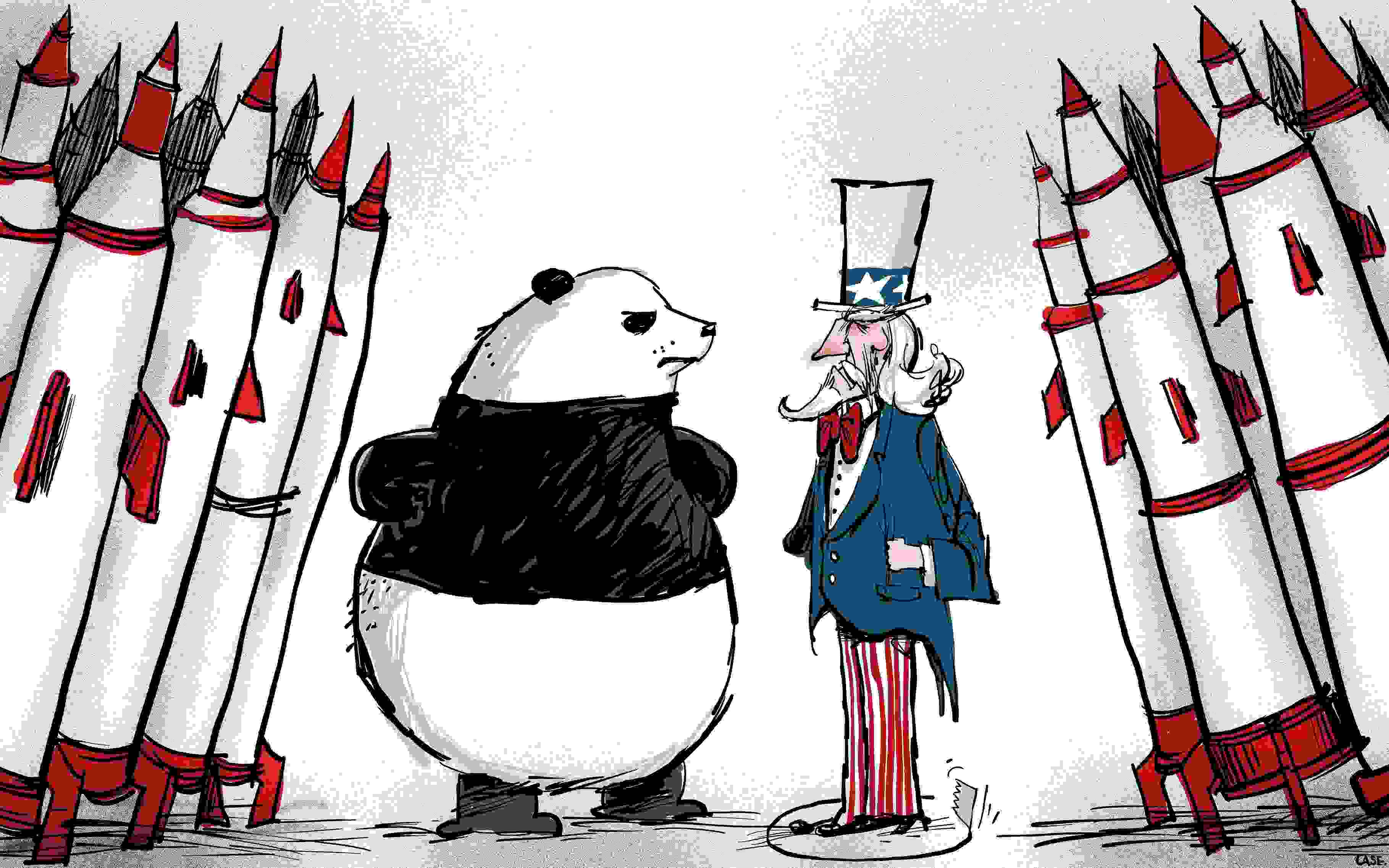
IN FOCUS
By Dincy Adlakha
US and China’s threatening arms race in Asia: analysis of a Foreign Affairs commentary
On 22 October, Van Jackson, a subject matter expert of Indo-Pacific, wrote an article in the Foreign Affairs. His commentary argued that US military and nuclear actions are turning Asia into a hotspot of militarization. His view was contested by Thomas Shugart who is a security and defense expert in America. Shugart argued that it is Beijing’s manipulation and belligerence that is leading to militarized Asia.
Military-first character of the US
Van Jackson argues in his commentary that the US is a military hegemon in Asia. He suggests that the “precarious situation in Asia” owes a lot to the US. He states that 89000 US troops are stationed in the Indi-Pacific, excluding the forces that enter the region annually for multiple large-scale exercises that the US undertakes in the region. Apart from the personnel, a large number of hardware and bases are also functional in Asia under the US monitor. In the past several years, as early as the leadership of former President Barack Obama, the US has been drawing up extensive nuclear program plans and many modern weapons have come into the picture. The budget for nuclear plans expanded during the tenure of former President Donald Trump. The US has also been expanding the lethality of its new long-range nuclear-capable missile launchers while reducing the costs. Many decisions from the past few years signal an increased focus on security by the US. He considers the US approach to Asia as over militarized and finds not just the US but also China to blame. In an attempt to counter the assertiveness of China, the US is also observed growing its defense capabilities.
China’s surging military pursuits
In response to Jackson’s commentary, Shugart details how the US approach is merely a reaction to the trends set by China in the region. He argues against some facts and terms utilized by Jackson and points that the US approach is not an indicator of provocation or threat. Rather, he poses the danger of an aggressive and techno-authoritarian Chinese regime and its military intentions in the region. He states that China has built hundreds of long-range, precise ballistic missile systems and boasts the world’s largest navy in terms of ships. It has adopted an aggressive approach with its neighbors in South East Asia and even threatens Taiwan. The nuclear arsenal of China has expanded over time, and even more in recent years. He attributes China’s military actions to its malicious motives of overwhelming US missile defenses, escaping US nuclear coercion and maintaining leverage in an event of conventional conflict. He argues that China is an economic giant and will someday want the military balance of power to bend in its favor as well.
The Asian plight
In this debate of US and China tensions, the only losing side is that of the Asian playground. Although many countries in Asia have adopted various strategies to encounter such highly intense situations, like Japan, India and ASEAN, it still does not look good for the region. Asia is troubled with identity politics, environmental issues, democratization and economic issues. In addition to the pandemic blues, the region could appreciate space to restore and develop itself. However, the US-China bipolarity only means more politics and more expenditure for the countries. In this sense, even though the US-China tensions impact the entire globalized world, no other region is as affected as the direct playground of Asia.
References:
Thomas Shugart and Van Jackson, “Who’s to Blame for Asia’s Arms Race?,” Foreign Affairs, 1 December 2021
IN BRIEF
By Avishka Ashok and Keerthana Nambiar
INTERNAL
President Xi emphasizes understanding CPC to understand China
On 2 December, the Chinese President Xi Jinping addressed the 2021 Understanding China Conference in Guangzhou and explained the importance of understanding the Communist Party of China to understand China. He highlighted the importance of exchanging views and interacting clearly to share the wisdom and strengths of the Party. He said: “The world is experiencing changes unseen in a century which, compounded by the COVID-19 pandemic, have brought the world into a period of fluidity and transformation. As I have pointed out, 'To understand China today, one must learn to understand the CPC.” (“Xi Focus: Understanding China requires understanding of CPC, says Xi,” Xinhua Net, 2 December 2021)
Belt and Road initiative council holds meeting to discuss performance
On 2 December, the Belt and Road Studies Network held a council meeting both online and offline. The meeting was to discuss reviewing the work since the last meeting and discuss the work for the next stage. He Ping, the newly-elected chairperson of the council said, “Chinese President Xi Jinping's speech at a recently-concluded symposium on the Belt and Road Initiative (BRI) showed China's determination and confidence in carrying forward high-standard opening-up,” reported Xinhua. The meeting was attended by thirteen representatives of Chinese and foreign thinktanks sharing their study on BRI. (“Belt and Road Studies Network holds Initiators Council meeting,” Xinhua Net, 3 December 2021)
REGIONAL
Foreign Minister promotes bilateral relations with Vietnam
On 2 December, the Chinese Foreign Minister Wang Yi met with the Vietnamese Foreign Minister Bui Thanh Son and called on the two countries to promote bilateral cooperation. He encouraged the countries to work on sustainable, healthy and stable development of the comprehensive strategic partnership of cooperation. The two ministers exchanged views on bilateral relations and cooperation in fields of mutual interest. He said: “this year is very important for the development of bilateral relations, and the two sides should follow the consensus reached by the top leaders of the two parties and the two countries and work together to promote the sustained, healthy and stable development of the China-Vietnam comprehensive strategic partnership of cooperation.” (“Chinese FM pledges to promote ties with Vietnam,” Xinhua Net, 3 December 2021)
China and South Korea held talks to enhance bilateral relations
On 2 December, the People’s Republic of China and the Republic of Korea pledged to enhance their bilateral relations. Both the countries agreed to strengthen their high-level exchanges and deepen cooperation in economy and trade, culture, and anti-epidemic efforts. Yang Jiechi, a member of the Political Bureau of the Communist of China Central Committee held talks with South Korean National Security Advisor Suh Hoon looking forward to the 30th anniversary of the establishment of diplomatic ties between the two countries. Yang said, “China and ROK should work together to ensure the stability of the global supply chains and industrial chains, strengthen communication and coordination on regional cooperation, multilateral frameworks and global issues, and jointly promote the construction of a more just and reasonable global governance system.” (“China, ROK pledge to enhance bilateral ties,” Xinhua Net, 3 December 2021)
INTERNATIONAL
China and the UK hold video conference dialogue on political parties
On 2 December, China and Britain held an online video conference to discuss the dialogue between their political parties. The Chinese delegation was headed by the Head of the International Department of the Communist Party of China Song Tao. He emphasized the importance of maintaining exchanges and dialogues between the political parties of China and the UK. He also explained the proceedings of the sixth plenary session of the 19th CPC Central Committee and suggested stepping up strategic communication with the UK. He said: “the CPC will enhance exchanges with political parties around the world including the Conservative Party and the Labor Party of Britain to better safeguard the common interests of all countries.” (“Chinese, British political parties hold dialogue to push forward ties,” Xinhua Net, 3 December 2021)
Chinese embassy expressed discontent against motion passed by the Irish Senate
On 2 December, the Chinese embassy in Ireland issues a statement in response to the motion passed by the Irish Senate on supporting Taiwan in international organizations. The statement issued by the embassy expressed strong dissatisfaction and firmly opposed the motion passed by the Senate. The statement called out the motion for blatantly violating the one-China principle and interfering with China’s internal affairs. The statement said: “We urge those Irish politicians to respect China's national sovereignty and territorial integrity, respect the Chinese people's aspiration to realize national reunification as much as they respect the Irish people's aspiration to realize national reunification, and abide by the one-China principle, so as to preserve the healthy development of China-Ireland relations.” (“Chinese embassy in Ireland expresses opposition to China-related motion passed by Irish Senate,” Xinhua Net, 3 December 2021)
Chinese Vice Foreign Minister slams the US’ democracy summit and claims China “a well-deserved democratic country”
On 2 December, the Chinese Foreign Minister Le Yucheng made remarks of the democracy summit by the US calling it an act of “anti-democracy in the name of democracy.” Le said, “From China's experience, we can see that democracy is not something that comes from the outside and is not for others to teach. In other words, democracy must be deeply rooted from its own country's soils and make its own people happy and satisfied.” Le stressed that despite the notions of the Western countries “China is a well-deserved democratic country.” The minister claims that China has managed to have “conquered a series of miracles in maintaining long-term stability and eradicated poverty, and you have won the support of the majority of Chinese people.” (“Is China a democratic country? Chinese Vice FM tells the Chinese story,” Global Times, 3 December 2021)
Chinese Foreign Ministry urges US and EU to abandon Cold War mentality
On 2 December, the Chinese Foreign Ministry made a statement urging the US and EU to abandon the Cold War mentality reported Global Times. The statement comes in after US Deputy Secretary of State Wendy Sherman and Secretary-General of European External Action Service Stefani Sannino announced to host a second US-EU dialogue focusing on China. (“China urges EU, US to abandon Cold War mentality ahead of upcoming dialogue,” Global Times, 3 December 2021)
2 December 2021, Thursday | China Reader Evening Brief | Vol.1, No. 52
Former Japanese PM Sinzo Abe angers China
Chinese Foreign Ministry summons Japanese envoy for emergency meeting over remarks made by former Japanese PM Shinzo Abe
IN BRIEF
By Avishka Ashok, Dincy Adlakha and Keerthana Nambiar
INTERNAL
Chinese State Council launches campaign to promote Mandarin
On 1 December China’s Cabinet State Council issued an order launching a campaign to promote Mandarin claiming that 85 percent of its citizens will use it by 2025. According to Asahi Shimbun, the order said, “use of Mandarin, known in Chinese as “putonghua” or the “common tongue,” remains “unbalanced and inadequate” and needs to be improved to meet the demands of the modern economy.” The document issued demands to “ensure that the national common spoken and written language is used as the official language of government agencies and used as the basic language of schools, news and publications, radio, film and television, public services and other fields.” This new move has triggered criticisms and protests within Chinese ethnic groups. (“China says 85% of citizens will use Mandarin by 2025,” Asahi Shimbun, 1 December 2021)
ECONOMY
Chinese government comes up with measures to clear arrears owed to SMEs
On 1 December, Chinese Premier Li Keqiang chaired the State Council Executive Meeting to take measures for small and medium-sized enterprises. Li said, “Small and medium-sized enterprises have been under enormous pressure this year. In keeping with the requirement of supporting market entities, efforts will be intensified to rectify arrears to SMEs as the laws and regulations require.” China will be undertaking measures to pay wages on time and full owed to small and medium-sized enterprises and migrant workers. This regulation ensures that the government bodies and public institutions do not force smaller firms into accepting non-cash payment methods. (“Govt vows to clear arrears owed to SMEs,” China Daily, 2 December 2021)
REGIONAL
Chinese Foreign Ministry summons Japanese envoy over remarks made by former Japanese PM Shinzo Abe
On 1 December, China’s foreign ministry summoned Japan’s ambassador Tarumi Hideo in Beijing for an “emergency meeting” regarding the remarks made by former Japanese Prime Minister Shinzo Abe. On 1 December, at an online speech, Abe made a statement on Taiwan saying “A Taiwan crisis would be a Japan crisis and therefore a crisis for the Japan-US alliance.” The Chinese Assistant Foreign Minister Hua Chunying called Abe’s statement “erroneous” and claimed that the remarks challenged China’s sovereignty. Hua commented that “Japan is a country that launched a war of aggression against China in history and committed heinous crimes against the Chinese people, and Japan is not eligible and has no right to point fingers on the Taiwan question,” reported Global Times. (“Chinese Foreign Ministry summons Japanese ambassador over wrong remarks of former PM Abe on Taiwan question,” Global Times, 2 December 2021: “China summons Japan envoy over former PM Abe's comments on Taiwan,” Reuters, 2 December 2021)
INTERNATIONAL
US Indo-Pacific expert says China wants to “break” Australia
On 1 December, Kurt Campbell, the Indo-Pacific coordinator for the White House said in a speech to a Sydney think tank. He said that China is launching “dramatic economic warfare” on Australia in an attempt to “break Australia. To drive Australia to its knees.” He attributed the reason for such intensive behaviors of China to the position of Australia as a US ally. He further stated that the US is not looking to leave the Indo-Pacific. He emphasized that the US commits to the alliances in the Indo-Pacific over matters of new security and economy, defense technology, education, climate, and so on. He called the nuclear and hypersonic missile capabilities of China as “practices that, if they continue, run risks of triggering an unforeseen crisis, or a misunderstanding.” (“Beijing wanted to ‘break’ Australia--U.S. Indo-Pacific adviser,” The Asahi Shimbun, 1 December 2021)
US Air Force Secretary says US in quality “arms race” with China
On 1 December, Asahi Shimbun reported that US Air Force Secretary Frank Kendall said that the US and China are in an arms race over the quality of weapons. He said that the two countries are competing to develop the most fatal hypersonic weapons with high-speed next-generation features. He sees the two countries engaged in an arms race which is not determined by the number of weapons but by the quality of weapons. Both countries have held multiple hypersonic weapons tests and are trying to do so at reduced costs. (“U.S. in hypersonic weapon ‘arms race’ with China--Air Force secretary,” The Asahi Shimbun, 1 December 2021)
Chinese foreign ministry spokesperson responds to the WTA boycott over Peng Shuai case
On 2 December, Chinese foreign ministry spokesperson Wang Wenbin remarked on the sexual harassment case of Peng Shuai by former senior Chinese official Zhang Gaoli. Wang has responded to the Women’s Tennis Association (WTA)’s boycott saying that the Chinese government was “always firmly opposed to acts that politicize sports.” The WTA declared suspending all tournaments in China in response to Peng’s situation. Tennis stars like Naomi Osaka, Serena Williams, Novak Djokovic have expressed their solidarity towards defending Peng and supporting WTA’s stance. (“China hits back at WTA boycott as IOC talks again to Peng Shuai,” The Guardian, 2 December 2021)
Chinese embassy in DRC asks citizens to evacuate from three provinces
On 1 December, the Global Times reported that the Chinese embassy in the Democratic Republic of Congo had issued an urgent notice to all Chinese citizens in the African country to evacuate from three provinces. The notice was issued after two Chinese citizens were killed in a mine and five others were kidnapped in an armed attack. The embassy asked its citizens to evacuate from Ituri, North Kivu and South Kivu provinces and urged them to report their personal information to the embassy. The statement by the embassy said: “Those who refuse to report information and insist on going to or staying in the three provinces will be personally responsible for all consequences arising therefrom.” (“Chinese embassy urges nationals in 3 provinces of DR Congo to evacuate immediately,” Global Times, 1 December 2021
Nature Journal points to better public health caused by lockdowns
On 1 December, the Korea Times referred to a report made by the South China Morning Post and revealed that the early lockdown due to COVID-19 had led to positive health results for the Chinese people. The report was based on an article published in the journal Nature. The report explained that approximately 3,47,000 lives were saved due to the lockdown in 2020. The report pointed that clean air, lesser traffic, lesser industrial activities and better hygienic habits such as washing hands, wearing masks and social distancing have resulted in a better public health scenario in the first year of the pandemic. (“China reaps unintended health benefits from COVID-19 lockdowns: analysis,” The Korea Times, 1 December 2021)
1 December 2021, Wednesday | China Reader Evening Brief | Vol.1, No. 51
The Communist Party of China’s population control policies and its impact on the demography
A report by the Straits Times pointed to a sudden surge in the number of births in the decade between 2000 and 2010. A note offers an overview of China’s demographic policies and their impact on population growth over the years.
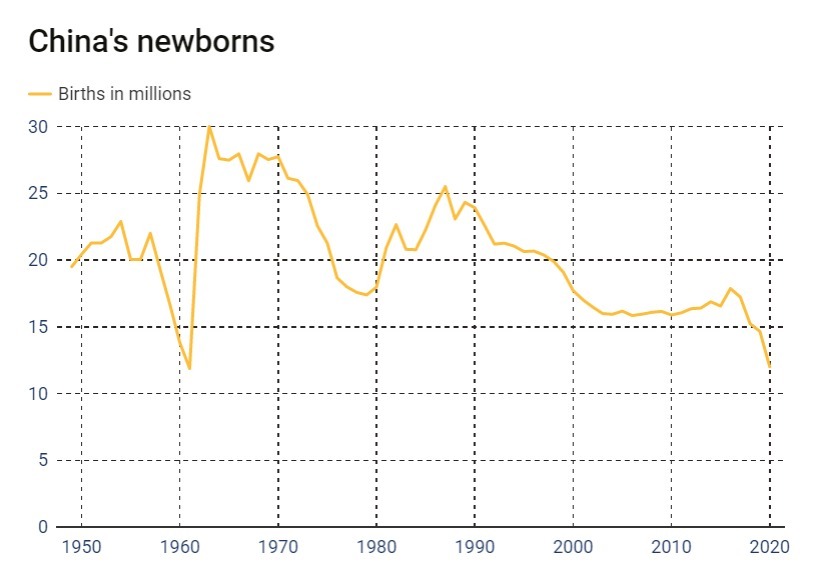
IN FOCUS
By Avishka Ashok
The Communist Party of China’s population control policies and its impact on the demography
On 24 November, the Straits Times reported that the Chinese census failed to account for at least 11.6 million children born between 2000 and 2010. The gap in the number of births came to the forefront after the government released its latest statistical yearbook which accounted for 172.5 million births in that decade. However, the 2010 census accounted for only 160.9 million births. The sudden surge in the number of births in the 2000s is credited to the one-child policy of China which criminalized couples for having more than one child. Fearing persecution and hefty fines, couples refrained from documenting the second child in the national registry until they reached the age for schooling.
China’s one-child policy
Towards the end of the 1970s, China realised that the population explosion held a high probability of pulling down the country’s economic growth and put a strain on its limited resources. The government found itself facing a challenge of providing for the world’s most populated country while it aimed to completely eradicate poverty by 2030. In February 2021, China announced that the country had successfully achieved this goal, ten years before its deadline. The goal was achieved through some hardcore political, economic and social reforms. In 1979, the Communist Party of China introduced the One-child policy and took strict actions to implement the policy. The implementation went as far as forcibly aborting babies to fining couples for having a second child. The second child was not provided with any social benefits while parents faced the risk of losing jobs in case of violating the law. The policy led to a gender imbalance in the country due to the patriarchal nature of the Chinese Society that preferred to abort female fetuses in favour of a male child.
The end of the one-child policy
The one-child policy continued until 2016 when the government realised that the policy had led to one blaring side-effect: a widening gap between the ageing population and the younger generation. China had already transformed itself into an economically advanced country which needed its cheap labour force to continue production and industrial output at affordable and economic rates. However, the sudden drop in births caused by the one-child policy showcased an impending shortage in the labour force. Despite raising the limit to two children per couple, only 13.2 percent of the couples in China wanted to plan for a second child in 2015. Most couples in the 21st century were not attracted to the idea of a second child due to the high costs of living in cities, where a majority of the population resided. A study conducted by the government observed that the two-child policy introduced by the CPC affected the fertility level and was highly influenced by women’s desire to achieve successful careers over parenting two children. China had gradually shifted to a low-fertility society over the years and was facing obstacles in raising its demographic count. However, major impacts of the one-child and two-child policies are yet to be experienced. The highest strain on the economy will be felt after 2040s when the percentage of people aged above 65 years would be higher than 25 percent.
The three-child policy
In May 2021, the government lifted all restrictions and allowed couples to have three or more children after only 12 million babies were born in 2020. The 2020 census brought a sense of urgency to the CPC after a substantial percentage of the population decreased from the working age group and got added to the ageing percentile of the populace. The Chinese government realised that a similar trend would follow for the coming few years until the administration stabilized the population growth.
References:
“China finds 12 million children that it didn't know existed, East Asia News & Top Stories,” The Straits Times, 24 November 2021
Andrew Mullen, “China’s one-child policy: what was it and what impact did it have?,” South China Morning Post, 1 June 2020
“Xi Jinping announces China's eradication of extreme poverty,” China Global Television, 25 February 2021
Yi Zeng and Therese Hesketh, “The effects of China’s universal two-child policy,” National Centre for Biotechnology Information, 15 October 2016
IN BRIEF
By Dincy Adlakha and Keerthana Nambiar
INTERNAL
CPC elects Tibet’s new Party Chief
On 30 November, the 10th Communist Party of China held an election for the Party Chief of Tibet Autonomous Regional Committee in its first plenary session. As a result of the election, Wang Junzheng was elected as the secretary of the Communist Party of China, Tibet Autonomous Regional Committee. (“Wang Junzheng elected Tibet's Party chief,” Xinhua, 30 November 2021)
Chinese and Russian representatives discuss enhancing bilateral cooperation
On 30 November, the 26th regular meeting between Chinese and Russian heads of government was held. Chinese Premier Li Keqiang co-chaired the meeting with his Russian counterpart Mikhail Mishustin via video link urging to enhance bilateral cooperation between the two countries. Li said, “the two nations are global partners that provide each other with development opportunities, and China attaches great importance to relations with Russia. In spite of the impact of the COVID-19 pandemic, the two countries have witnessed new vitality in bilateral cooperation in all fields,” reported Xinhua. Mishustin remarked that Russia was ready to work with and deepen the cooperation with China in many areas like COVID-19 response, trade, investment, and finance. (“Chinese premier urges enhanced pragmatic cooperation with Russia,” Xinhua Net, 1 December 2021)
Hong Kong University scientists isolate Omicron variant of coronavirus
On 1 December, The Straits Times reported that scientists from the University of Hong Kong have succeeded in isolating the Omicron variant from clinical specimens. This is seen as a huge achievement since it will be pivotal in developing vaccines against this new strain of coronavirus. The researchers from the Microbiology Department of the University are the first team in Asia to isolate Omicron or “variant of concern” as termed by WHO. The team is now assessing the transmissibility, immune evasion capacity and pathogenicity of the strain in animal models. (“Hong Kong scientists succeed in isolating Omicron variant,” The Straits Times, 1 December 2021)
China’s national political advisory body hears reports, suggests recommendations
On 30 November, the Chairpersons’ Council of the Chinese People’s Political Consultative Conference (CPPCC) National Committee met to hear reports from the various special committees under it. The meeting was headed by Wang Yang, a senior member of the Standing Committee of the Political Bureau of the Communist Party of China Central Committee. The meeting heard reports of all the work undertaken and done by these special committees in 2021. This included work on ageing population, education, opening-up measures, cultural service system, and so on. The committees were urged to review their work and identify areas with scope of improvement. (“China’s national political advisory body hears special committee work reports,” Xinhua, 1 December 2021)
TECHNOLOGY
China’s Ministry of Industry and Information Technology comes up with a development plan for big data
On 30 November, the Ministry of Industry and Information Technology (MIIT) unveiled a development plan at the 14th Five-year Plan period (2021-2025) for the big data industry. The Ministry says, “The scale of the country's big data industry will likely exceed 3 trillion yuan (about 470 billion U.S. dollars) by the end of 2025, with a compound annual growth rate of around 25 percent,” reported Xinhua. According to the plan, a key factor of production will be established for the market-oriented pricing mechanism and raise social awareness of big data. The MIIT data shows rapid development of China’s big data sector in the last five years which exceeded one trillion yuan in 2020. (“China releases development plan for big data industry,” Xinhua, 30 November 2021)
INTERNATIONAL
China and Guinea seek friendly cooperation
On 30 November, Chinese State Councillor and Foreign Minister Wang Yi met with the Guinean Foreign Minister Morissanda Kouyate in Dakar, Senegal as part of the Eighth Ministerial Conference of the FOrum on China-Africa Cooperation (FOCAC). The two vowed to deepen friendly relations and cooperation between the two countries. FM Wang pointed out that Guinea was the first sub-Saharan country to form official diplomatic relations with the People’s Republic of China. He also recalled the previous cooperations between the two countries on matters of integrity, independence, national development, Ebola and COVID-19. FM Kouyate also put his favouring views forward and said that China is an important partner for infrastructure, resources and telecommunications. Both delegates valued the China-Africa cooperation forum and ignited hope for further bilateral friendly ventures as well. (“China, Guinea vow to deepen friendly cooperation,” Xinhua, 1 December 2021)
Chinese Embassy in France opposes the new French legislation supporting “Taiwan Independence”
On 1 December, People’s Daily reported on the Chinese Embassy in France’s strong opposition to a new resolution adopted by the French Assembly that advocates “Taiwan Independence.” The new bill introduced by the French legislators encourages the participation of Taiwan in international organizations including WHO and the International Criminal Police Organization. The Chinese Embassy in France accused the French government of violating the one-China principle and supporting the “Taiwan Independence” secessionists. “We urge France to respect China's national sovereignty and territorial integrity, abide by the one-China principle with concrete actions, and safeguard the healthy and stable development of China-France relations,” stated the Embassy. (“French parliament’s Taiwan resolution ‘conforms to US pressure, won’t have real impact on policy’,” People’s Daily, 1 December 2021)
30 November 2021, Tuesday | China Reader Evening Brief | Vol.1, No. 50
Highlights of President Xi’s speech at the FOCAC
Chinese President Xi Jinping highlighted the China-Africa cooperation on financial, agricultural, trade, cultural and peacekeeping fronts.
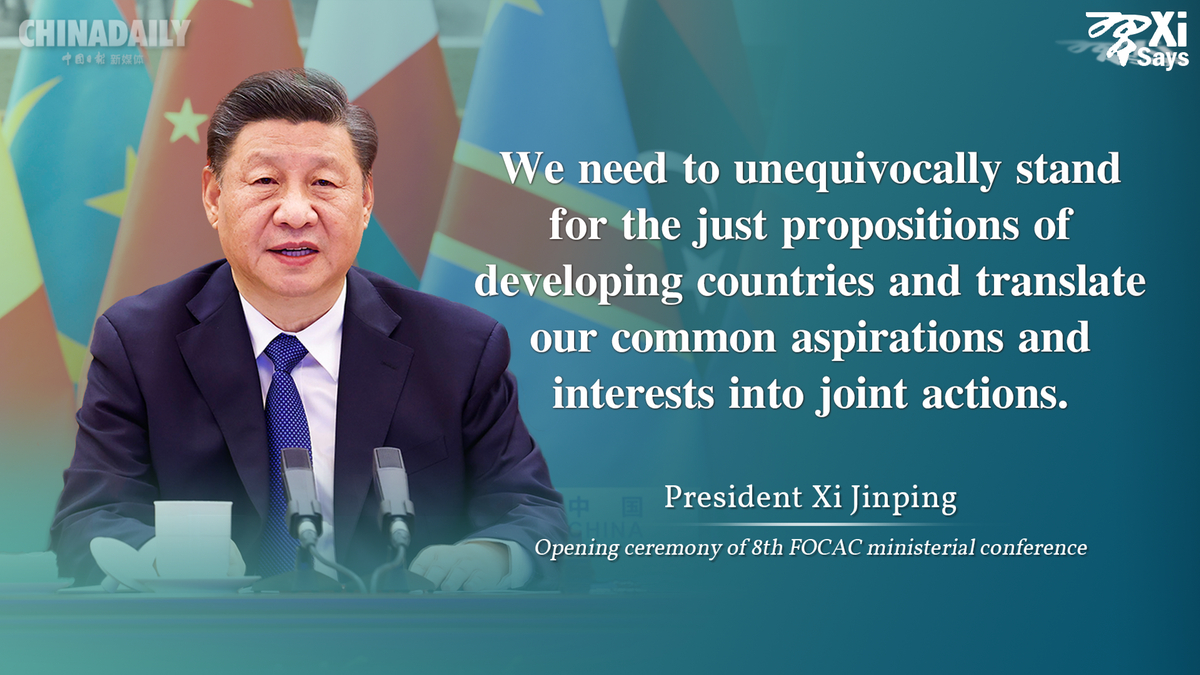
IN FOCUS
By Keerthana Nambiar
Highlights of President Xi’s speech at the FOCAC
On 29 November, Chinese President Xi Jinping addressed the eighth Ministerial Conference of The Forum on China-Africa Cooperation (FOCAC) via a video link that commenced in Dakar, Senegal. Agricultural cooperation, investment, trade were the central focus of Xi Jinping’s speech. The eighth edition of the forum is assembled on the theme of “Deepen China-Africa Partnership and Promote Sustainable Development to Build a China-Africa Community with a Shared Future in the New Era.”
President Xi commended on the 65th anniversary of the diplomatic relations between China and African countries. He said, “China and Africa have forged unbreakable fraternity in our struggle against imperialism and colonialism, and embarked on a distinct path of cooperation in our journey toward development and revitalization. Together, we have written a splendid chapter of mutual assistance amidst complex changes, and set a shining example for building a new type of international relations.”
The significance of FOCAC
FOCAC looks at building close economic relations between China and Africa. China is the biggest source of investment in Africa evolving from $75m in 2003 to $2.7bn in 2019. The financial support provided by the Chinese has proved to be crucial to the African countries in the last two decades. In the 2015 meeting, China committed a $60bn package aid, state-owned investment, and subsidized lending which was revoked again in 2018.
Highlights of President Xi’s speech
Chinese President Xi Jinping in his speech remarked that the Chinese and African sides have jointly prepared the China-Africa Cooperation Vision 2035. In the three-year plan, Beijing will work with the African countries and will “carry forward the spirit of China-Africa friendship and cooperation from generation to generation.”
First, one billion Covid vaccine delivery. Since the pandemic began, Beijing has supplied 200 million doses to Africa, as there is a growing concern about the new Omicron variant of the COVID-19. In his speech, President Xi announced that 600 million doses would be donated and the rest 400 million doses are provided under the joint Chinese and African companies. China also plans to send 1,500 public health experts and medical personnel and undertake 10 medical and health projects in African countries.
Second, the measures to reduce poverty and agricultural development. President Xi emphasized that China will be initiating 10 poverty reduction and agricultural projects for Africa including sending 500 agricultural experts to Africa. Under the initiative of “100 Companies in 1,000 Villages,” Chinese companies will be launching Corporate Social Responsibility in Africa for poverty reduction and development in the agricultural sector. Xi announced that China will be opening “green lanes” and will bid $300 billion in total imports from Africa in the next coming three years. Along with the Belt and Road Initiative, China will continue supporting African Continental Free Trade Area (AfCFTA).
Third, the Chinese investment program. President Xi says China will encourage businesses up to $10 billion in Africa and plans to establish an arena for promoting China-Africa private investment. The plan includes China undertaking 10 projects based on industrialization and employment, providing credit facilities, establishing cross-border RMB centers, and mainly supporting the African SMEs. China is looking forward to allocating the funds from the IMF’s new allocation of Special Drawing Rights to the African countries.
Fourth, digital innovation and green development. In his speech, Xi Jinping elaborated on the digital economy projects for Africa. This includes 10 projects for Africa, set-up centers for China-Africa cooperation on satellite remote sensing application, joint laboratories, partner institutes, and many more. China will also launch a campaign on the e-commerce platforms to market 100 African stores and 1,000 African products. For the green development program, Xi Jinping claimed that Beijing will be undertaking 10 projects and support the development of the “Great Green Wall.”
Fifth, capacity building, cultural and people-to-people exchanges. China has stepped up to build 10 schools in Africa and 10,000 African professionals and implement “Future Africa- a project for China-Africa cooperation on vocational education.” For boosting job opportunities, China will aid African countries to set up “Luban Workshops” to create around 800,000 local jobs. In the cultural context, President Xi Jinping assured to hold film festivals screening African films in China and vice versa.
Sixth, the peace and security programmes. China has undertaken 10 peace and security projects to support the African countries. Xi Jinping promised to continue delivering military assistance to the African Union and maintaining regional security in the continent. Xi further declared that Chinese-African peacekeeping troops will conduct joint military exercises and on-site training.
Road Ahead
Looking back into the last two sessions, the FOCAC has been one of the most successful strategic partnerships and has developed exponentially. With the new COVID-19 variant countermeasures and post-pandemic recovery in the picture, the FOCAC serves as a promising opportunity. With the existing security issues in the continent, China-Africa cooperation comes up as a positive developmental approach.
On the other hand, this also brings criticism that the Chinese investments in Africa will drown the African countries with unsustainable debt and human rights situations. Given the current scenario of geopolitical competition of power and influence among the US, EU, and China in Africa threatens the sovereignty of the African continent.
References:
“Full Text: Keynote speech by Chinese President Xi Jinping at opening ceremony of 8th FOCAC ministerial conference,” XinhuaNet, 29 November 2021
IN BRIEF
By Dincy Adlakha and Avishka Ashok
INTERNAL
Henan Province approves system to track journalists and international students
On 29 November 2021, the Guardian reported that the government in China’s Henan province were considering bringing a surveillance system to track journalists and international students along with other suspicious people. The government procurement website published a document with details of assembling a system that can collect individual files of such individuals by accessing various national and local databases. The Chinese tech company Neusoft was given the task of assembling the system in two months for USD 7,82,000. (“Chinese province targets journalists and students in planned surveillance system,” The Guardian, 29 November 20210)
Experts say China capable of dealing with Omicron; New variant causes three cases in Hong Kong
On 29 November, Zhang Wenhong, the leader of an expert team from Shanghai for the clinical treatment of COVID-19, said that the new COVID-19 variant Omicron will not give China much trouble. He said: "China's current strategies of rapid response and dynamically zeroing cases will be able to cope with various types of variants of the novel coronavirus.” He also explained that countries are tightly building up immune barriers by vaccination which will help in breaking the chain. Currently, there are three Omicron variant infections in Hong Kong. Authorities say they have the situation in control and no local in-bound cases are traced. The three infections do not affect the plan of re-opening of borders between Hong Kong and the mainland. (“Expert: China capable of dealing with new variant,” People’s Daily, 29 November 2021; “Omicron causes 3 infections in HK, but may not affect border resumption as city prevents local community spread,” Global Times, 29 November 2021)
Chinese factory output improves marginally in November
On 30 November, the National Bureau of Statistics reported that the Purchasing Manager’s Index had risen to 50.1 in the month of November from 49.2 in October. The statistics show that the factory activity in China has improved for the first time in three months. The reduction in prices of raw materials and lower restrictions on power usage has enabled the manufacturing sector to improve its output. Although, the Chinese economy is one of the few economies that have rebounded faster than others after the pandemic, it is expected to suffer a slowdown in the fourth quarter as well. (“China November factory activity unexpectedly grows as supply snags ease,” The Asahi Shimbun, 30 November 2021)
Draft amendment to China’s Teachers Law undergoes public consultation
On 29 November, China’s Ministry of Education issued a notice that declared the draft amendment in China’s Teachers Law under public consultation. The amendment will establish an award mechanism for teachers who make significant contributions to education. The amendment also edits the rights and duties of teachers and also makes changes to the qualification required for various levels of teaching. This public consultation is open till 20 December. (“Draft amendment to China's Teachers Law to regulate rights, obligations and competency undergoes public consultation,” Global Times, 30 November 2021)
INTERNATIONAL
Foreign Ministry disregards US Summit for Democracy
On 29 November, the Chinese Foreign Ministry spokesperson Wang Wenbin addressed a press briefing and responded to a question regarding the criticism surrounding the “Summit for Democracy.” Wang warned against another era of cold war and said: “The United States' hosting of the "Summit for Democracy" is a dangerous move to rekindle the Cold-War mentality, to which the international community should be on high alert.” He said that the US was creating groups in the international system by choosing which country was democratic and which is not based on its on likes and dislikes. (“U.S. "Summit for Democracy" dangerous move to rekindle Cold-War mentality: FM spokesperson,” Global Times, 30 November 2021)
Foreign Minister urges DRC to work towards relieving Chinese nations held in captivity
On 29 November, the Chinese Foreign Minister Wang Yi addressed the sideline meeting of the Forum on China-Africa Cooperation and admonished the Democratic Republic of Congo to release Chinese nationals at the earliest and actively pursue the safety and security of the Chinese people in the country to ensure stability in the bilateral relations. The Minister of Foreign Affairs of the DRC responded to the statement by Wang Yi and said that the country sincerely understands China’s concerns regarding the safety of its nationals and would provocatively work towards investigating the involved personnel and quickly release the Chinese people as well. (“Congo to severely punish culprits and secure the release of Chinese in captivity ASAP: deputy PM,” Global Times, 30 November 2021)
Xi-Putin congratulate 3rd China-Russia Energy Business Forum
On 29 November, Chinese President Xi Jinping and Russian counterpart Vladimir Putin sent congratulatory letters to the third China-Russia Energy Business Forum. The two presidents highlighted the energy cooperation between China and Russia which has grown even further in the past few years. They noted the importance of the steady and stable operation of pipelines between the two countries. President Xi Jinping also wrote that China is looking forward to cooperating with Russia on energy security and climate change. President Putin also hoped to explore new cooperation in the fields of energy informatization and green energy. (“Xi, Putin send congratulatory letters to 3rd China-Russia Energy Business Forum,” Xinhua Net, 29 November 2021)
29 November 2021, Monday | China Reader Evening Brief | Vol.1, No. 49
White Paper on China-Africa cooperation plans for future development and heightened cooperation
The Chinese government released a white paper on China-Africa relations days before the Forum on China-Africa Cooperation and appreciated the decades of mutually beneficial relations and highlighted the road ahead for the two sides.
IN FOCUS
By Avishka Ashok
White Paper on China-Africa cooperation plans for future development and heightened cooperation
On 26 November, the State Council Information Office published a white paper on China’s cooperation with Africa in the “new era”. The release of the paper comes days before the two-day Forum on China-Africa Cooperation which is scheduled to begin on 29 November. The paper is titled “China and Africa in the New Era: A Partnership of Equals” and speaks positively of the continuously evolving relationship with African countries. The paper focused on building a stronger China-Africa community, all-around cooperation, strengthening mutual support and establishing new areas of cooperation to enhance the relationship between China and Africa.
China is focusing on building a sturdy shared community
The paper briefly highlighted the history of the China-Africa relationship and shed light on China’s plan for building a stronger community-to-community relationship in the coming years. The paper declared that the Chinese administration treats African countries and their people with sincerity and aims to achieve real results in its cooperation with the continent. It propagated the idea of resolving issues in good faith and promoting friendly relations. The paper further promised to follow four principles in order to ensure respect and mutual development in the relationship between China and the African countries. The paper presents provisions for China and the African countries to support each other on international platforms and encourages the security and harmony of their individual national interests. The paper portrays the China-Africa relationship as a model for exemplary south-south cooperation.
China will focus on all-round cooperation and development
The paper appreciated the decades of cooperation between China and numerous other African countries and said: “The fruitful results of China-Africa cooperation can be seen across the continent. It has improved the conditions for economic and social development in Africa and brought tangible benefits to people in both China and Africa.”
The paper indicated that high mutual political trust between China and Africa has resulted in prosperous developments for both parties. Chinese President Xi Jinping met with more than 50 African leaders during the last Forum on China-Africa Cooperation and has visited Africa on four different occasions to enhance China’s outreach into Africa. The paper explained China’s political relations with Africa in detail and also expanded on the rapidly growing economic cooperation. It shed light on China’s efforts to support African economies by becoming the largest trading partner since 2009 and encouraging cooperation and investing in finance. The paper stated: “By the end of 2020, direct investment of Chinese companies in Africa had surpassed $43 billion.” Other efforts taken by China include promoting agro-economies, assisting industrialization and mechanization, building infrastructure, supporting financial cooperation and assisting the digital economy. The paper also shed light on the cooperation between China and the continent on social development issues such as poverty eradication, enhancing medical and health cooperation, promoting education facilities and human resource development and establishing scientific and technological collaboration. The paper shared: “In cooperation with China, 16 African countries have incorporated the Chinese language into their national education systems. The two sides have established 61 Confucius Institutes and 48 Confucius Classrooms in Africa. Since 2004, China has sent a total of 5,500 Chinese language teachers and volunteers to 48 African nations.”
China is also working on creating people-to-people exchanges and cultural cooperation by working closely on local media, films and the television industry and also facilitating student exchanges and academic cooperation. Lastly, China also emphasized peace and security and promoted engagement with African countries on global issues such as terrorism and collectively working towards political stability.
China will focus on strengthening mutual support
In recognizing China’s goal of strengthening mutual support, the paper highlighted upholding international equity and justice by practicing multilateralism and collectively protecting political and individual rights. It also called attention to collectively fighting the coronavirus pandemic by actively working towards vaccinating the population and preventing further spread of the virus. Other than fighting the novel coronavirus, the paper also sheds light on fighting the Ebola virus and building resistance to natural disasters.
China will look for innovative methods to enhance the cooperation with Africa
The paper accentuated the role of the FOCAC in boosting cooperation between the two sides and also encouraged greater participation and cooperation in economic and financial activities through the Belt and Road Initiative. The paper said: “The Belt and Road Initiative is not a “solo”, but an “orchestra” in which the participation of both China and African countries is essential.” In the new era, the focus will be on elevating China-Africa relations to a higher level by solidifying friendships and removing obstacles to political mistrust and boosting mutual development and exploring new areas of cooperation.
The paper promised to create more avenues for cooperation with Africa and promoted participation and collaboration through the Belt and Road Initiative and the FOCAC. It stated: “In the face of new opportunities and challenges, China and Africa will further strengthen solidarity and cooperation.”
References:
“China issues white paper on China-Africa cooperation in new era,” Xinhua Net, 26 November 2021
“Full Text: China and Africa in the New Era: A Partnership of Equals,” Xinhua Net, 26 November 2021
IN BRIEF
By Dincy Adlakha and Keerthana Nambiar
INTERNAL
People’s Liberation Army “optimizing” its military personnel structure
On 29 November, South China Morning Post reported on the expansion of combat forces in the People’s Liberation Army. According to the People’s Publishing House, a book of commentaries was published focusing on Chinese President Xi Jinping’s reform policies over the last decade. A military commentator Zhong Xin the PLA has been “optimizing” its personnel structure by deploying more troops reported South China Morning Post. According to Zhong, the PLA needs more work “the military’s command system is not systematic, the army’s structure is not sound enough, and the policy system lags, seriously limiting the PLA’s defensive operations.” He further emphasizes that “If these problems are not resolved, plans to build a world-class modern military are just empty talk”. (“Which Chinese military units are expanding while others are shedding troops?,” South China Morning Post, 29 November 2021)
REGIONAL
Taiwanese Defence Minister responds to Chinese military actions
On 29 November, Taiwan’s defence minister said that China’s military activities near the island continue in attempts to wear out the armed forces of Taiwan however, Taiwan holds the capabilities to respond. Defence Minister Chiu Kuo-cheng said: "Their intention is to slowly exhaust us. Our national forces have shown that, while you may have this power, we have countermeasures.” This response comes as China produces a renewed spike in the military incursions of Taiwan’s Air Defence Identification Zone. (“Taiwan says China military trying to wear it out, but it can respond,” The Straits Times, 29 November 2021)
Australian media reports China’s backfired plans to hit Australia economically
On 29 November, News Australia reported that last month China imported 2.78 million tonnes of coal from Australia. The data was released by the General Administration of Customs which released its monthly report and publicized that huge quantities of coking coal for steelmaking and thermal coal for electricity were imported from Australia in October. This is interpreted as a backfired move by Australian media since China had imposed strict bans on iron ore, coal, beef, barley, wine and a few other imports from Australia since last year. The article attributes this change of policy to the power shortages that troubled Chinese citizens out of electricity for days in the past few months. This led China to process the shipments from Australia that have been sitting at Chinese ports for almost a year now. (Alex Turner-Cohen, “Chinese plan to cause Australia ‘economic pain’ from trade bans backfires,” news.com.au, 29 November 2021)
INTERNATIONAL
Protesters block roads over new law favoring foreign mines in Serbia
On 28 November, DW reported that many protesters in Serbia came to the roads and rallied against new laws that the government is bringing in. Activists argue that these laws provide free rein to foreign mining companies, allowing them to rampage over the environment. Many of the firms in the country are from China such as Zijin copper miner. China has also invested in Bor copper mine. There are many projects in the country that take help from China under China’s New Silk Road to Europe strategic investment schemes. Hence, the president of the country has called China a “savior” which is a sentiment not shared by the common public. (“Serbia: Protesters block roads over new mining laws,” DW, 28 November 2021)
Japan-US 2-plus 2 security talks eye navigating China
On 29 November, Japan Today reported that Japan and the US are considering security talks in January consisting of their defence and foreign ministers. Experts assert that the 2-plus 2 security talks will revolve around navigating China’s aggressive behavior in the region as a major agenda. Recently, Japan has been reported to increase its defence and military budget due to China’s assertiveness and the US is also not particularly on good terms with China over the Taiwan crisis. China’s nuclear development and rise can also be an issue of discussion in the probable defence talks. (“Japan, U.S. eye 2-plus-2 security talks in January,” Japan Today, 29 November 2021)
Chinese and Russian ambassadors published a co-authored article
On 28 November, the Chinese Ambassador to the United States Qin Gang and Russian Ambassador to the United States Anatoly Antonov co-authored the article Respecting People’s Democratic Rights published on The National Interest website. The ambassadors urged the US to stop using “value-based diplomacy” calling the US-led “Summit for Democracy” “an evident product of its Cold-War mentality.” They said, the summit will “stoke up ideological confrontation and a rift in the world, creating new ‘dividing lines.’” In the article, the ambassadors declared that “China and Russia firmly reject this move” and this move is against the development of the modern world. On democracy, the ambassadors commented that’ “it can be realized in multiple ways, and no model can fit all countries.” (“China, Russia ambassadors urge to stop using "value-based diplomacy" to provoke division, confrontation,” Xinhua Net, 28 November 2021)
27 November 2021, Saturday | China Reader Evening Brief | Vol.1, No. 48
China’s growing influence in Africa scrutinized with concern
Countries around the world raise concerns regarding China’s recent purchase of Cobalt mines in Congo and ponder over the country’s control over African resources and political institutions.
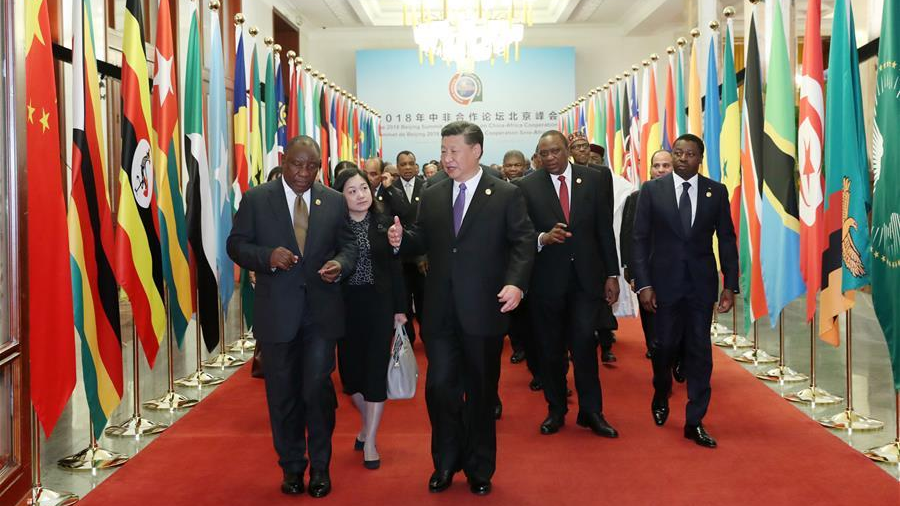
IN FOCUS
By Avishka Ashok
China’s growing influence in Africa scrutinized with concern
The Forum on China-Africa Cooperation (FOCAC)
On 29 and 30 November, the People’s Republic of China will celebrate 20 years of friendly and economically beneficial relations with the African countries. The Forum on China-Africa Cooperation (FOCAC) will be held in Dakar, Senegal and will celebrate two decades of the China-Africa cooperation. China has played an important role in building the infrastructural landscape in Africa. The country has invested greatly in African countries’ railways, roadways, airways, government buildings, schools, medical facilities and many other essential institutions. Other than infrastructural development, China has also invested and assisted in the development of the energy sector, tourism industry, economy and commerce, and technological advancements in the continent. The Chinese Foreign Ministry spokesperson Wang Wenbin announced that the upcoming Forum is focused upon “deepening the China-Africa Partnership and promoting Sustainable Development to Build a China-Africa Community with a Shared Future in the New Era.” Health, investment cooperation, trade and commerce, food security, climate change, human resources and digital innovation are some of the key areas that will be discussed during the days of the Forum.
China’s trade affairs with Africa
With the heightened interaction between China and the African countries for over two decades, there is much suspicion regarding China’s intentions in the African continent. Sino-imperialism or the risk of falling for Chinese debt traps are foreseen as the major challenges that may be faced by young African countries who have allegedly blindly trusted the help coming from Chinese investors. China’s interest in the continent is connected to the vast availability of resources that have remained undiscovered until now. The country has spent close to USD 125 billion on Africa between 2000 and 2006 and also promised to support the continent with USD 60 billion at the 2018 FOCAC. Trade between China and the continent has risen drastically from USD 20 billion in 2000 to USD 208 billion in 2019 (pre-pandemic). China is the highest trading partner for most African countries and makes for half of the continent’s international trade and infrastructure development contracts.
China’s interest in Africa
For the past 20 years, China has been acquiring raw materials such as oil, iron, copper and zinc from the African continent. China is presently one of the fastest-growing economies which are constantly in the need of minerals to keep its machines of production and services running at all times. The country is also advancing at a fast pace in the field of scientific technologies and inventions. There is a high demand for minerals like cobalt which is used for the creation of electric vehicle batteries. The Chinese company called ‘China Molybdenum’ currently owns 80 percent of all cobalt mines in Congo. The development has raised concerns for many countries including the US as the mines in Congo are a crucial source of cobalt across the world. The White House also stated: “China's dominance of the mineral presents a critical vulnerability to the future of the U.S. domestic auto industry."
References:
“Africa and China gearing up for the 2021 FOCAC,” TrendsnAfrica, 24 November 2021
“China’s trade with Africa grows 2.2 per cent in 2019 to US$208 billion,” South China Morning Post, 18 January 2020
“China’s engagement with Africa: From natural resources to human resources,” Brookings, 13 July 2016
“Hunter Biden’s firm helped China get control over vast Cobalt mine in Africa: Report,” Republic World, 21 November 2021
“Why China Is Taking over Africa's Resources One Country at a Time,” The National Interest, 31 July 2019
IN BRIEF
By Dincy Adlakha and Keerthana Nambiar
INTERNAL
China’s top political advisory body discusses promotion of Traditional Chinese Medicine
On 26 November, China’s National Committee of the Chinese People’s Political Consultative Conference (CPPCC) discussed measures to advance and protect TCM. The meeting held by the top political advisory body called for better coordination in protection of TCM resources and promotion of the industry. Efforts to collect, sort, and protect ancient books, safeguard TCM recipes and techniques, and strengthen the database of this information were discussed. The meeting also mentioned that modern science should be used to interpret why and how TCM works which can give boost to cultivation of specialized talent and resources for TCM. (“Political advisors discuss TCM development, protection,” Xinhua, 27 November 2021)
Hong Kong election candidates receive suspicious packages from Taiwan
On 26 November, the Hong Kong Police Force announced that a number of candidates who are taking part in the Hong Kong Legislative Council elections have received a suspicious package. The police believe that the packages can be traced back to their source in Taiwan and are currently handling the case as an issue of criminal intimidation. The New People’s Party Chairwoman received a package containing rotten meat while another candidate received a threatening letter. In the previous week, the West Kowloon Magistrate’s court and the Shatin Magistrates’ court received packages consisting of unknown powder. (“HK candidates for LegCo election receive threatening parcels; Taiwan political forces suspected” Global Times, 26 November 2021)
TECHNOLOGY
China’s shipment of mobile phones surges high
On 27 November, Xinhua reported that the shipments of Chinese mobile phones surged by 12 percent year on year. The data was released by the China Academy of Information and Communications Technology, which is a research institute under the Ministry of Industry and Information Technology. The shipments of mobile phones from domestic Chinese brands stood highest, making 67.9 percent of the total shipments. The release of 26 new models and shipments of domestic units by the bulk has helped reach the level. (“China's mobile phone shipments reach 282 mln units in Jan.-Oct.,” Xinhua, 27 November 2021)
REGIONAL
Australia accuses China of hypocrisy in region
On 26 November, The Asahi Shimbun reported that Australian Prime Minister Scott Morrison called out China’s “alarming” action in the East Asian region which does not match the rhetoric of peaceful prosperity China promotes. PM Morrison said this during a press conference at Parliament House in Canberra. Furthermore, the defence minister of Australia, Peter Dutton also listed China’s militarization of the South China Sea, the National Security Law in Hong Kong and the threats to Taiwan as actions against its peaceful rhetoric. Australia and China share strained relations at the time due to ideological and trade barriers. (“Australia says China’s ‘alarming’ actions at odds with peaceful rhetoric,” Asahi Shimbun, 26 November 2021)
US Congressmen meet with Taiwanese President Tsai Ing-wen
On 26 November, the Global Times reported that the US had sent a Congressional delegation to Taiwan for the second time in the month of November. The meeting between the US lawmakers and the Taiwanese President Tsai Ing-wen comes soon after US President Joe Biden met with the Chinese President Xi Jinping and stated that the US does not support the secessionist movement in Taiwan. The delegation also met with the island's military authorities. The Chinese Foreign Ministry spokesperson Zhao Lijian responded to the visit and said: “The clumsy show put up by certain US politicians and the Taiwan authorities is only to be overwhelmed by China's reunification process and can never change the unbreakable landscape where 180 countries in the world are committed to the one-China principle. All erroneous acts that run counter to the trend of China's reunification are like an ant trying to topple a giant tree and will end up in failure.” (“US lawmakers’ Taiwan visit a ‘clumsy show’ to be overwhelmed by China’s reunification process,” Global Times, 26 November 2021)
INTERNATIONAL
Riots in Solomon Islands impact Chinatown and Chinese businesses
On 26 November, the Chinese Foreign Ministry spokesperson Zhao Lijian referred to the riots in Solomon islands and expressed confidence in the Island’s government to handle the situation. He said: “China is closely following the developments in the Solomon Islands and condemns the violence.” The People’s Republic of China plays an important role in the issue because the riots have majorly affected Chinatown and the businesses belonging to Chinese nationals. Zhao refused to send troops to control the situation since the government had not made any such request. He also urged other countries to not intervene and let the state authorities take action. He further accused the US of encouraging the Malaita Islanders and interfering in the country’s internal politics. (“‘External forces’ behind Solomon Islands unrest, as PM firmly defends developing ties with China,” Global Times, 27 November 2021)
Chinese Foreign Minister urges China, Russia, India to get rid of “democracy trap”
On 26 November, the Chinese State Councillor and Foreign Minister Wang Yi said that China, Russia and India should not let other countries interfere in their matters or preach to them about democracy. They should get rid of the “democracy trap” which forces one template or one standard of functioning over them. Wang made these remarks during the 18th Meeting of the Foreign Ministers of China, Russia and India. He spoke of the respect for national traditions and customisation to democracy that every country warrants. He opposed the negative energy that the supposed world leader US is set to emit through the “democracy summit.” The three foreign ministers also discussed COVID-19 cooperation and respect for UN based world order. (“China, Russia, India called on to get out of ‘democracy trap’,” Global Times, 27 November 2021)
China and Russia look forward to heightened investment cooperation
On 26 November, the Chinese Premier Han Zheng and Russian First Deputy Prime Minister Andrei Belousov took part in a video conference and agreed to expand the cooperation on investment in their industrial sectors. Premier Zheng observed that the two countries must expand their areas of cooperation and fasten the pace of revising the investment cooperation plans. He said: “The two sides should also strengthen cooperation at local levels and collaborate on key industries representing the new development direction and work together to create a more stable, fair, transparent and predictable business environment.” (“China and Russia agree to enhance investment cooperation,” Global Times, 26 November 2021)
26 November 2021, Friday | China Reader Evening Brief | Vol.1, No. 47
China Commercial Aerospace Forum opens with ambitious plans for commercial space sector
The seventh China Commercial Aerospace Forum launched in Wuhan announced great plans for the commercial space sector. Three schemes proposed by CASIC took off with high ambitions.
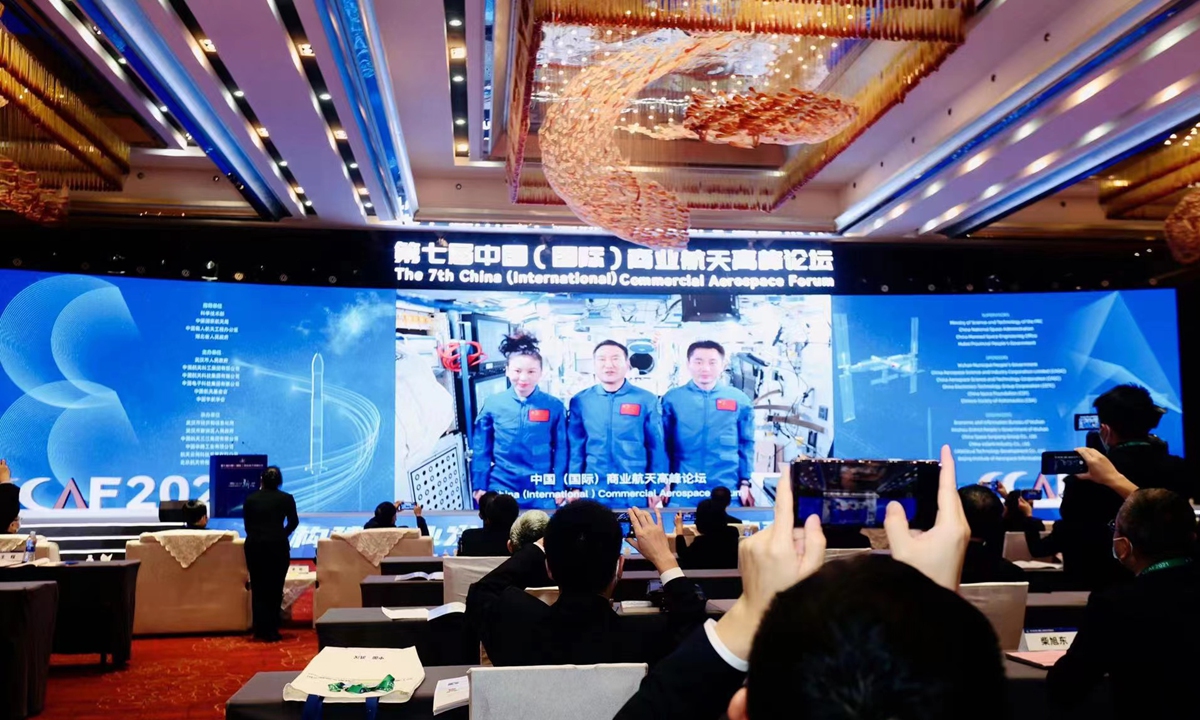
IN BRIEF
By Dincy Adlakha and Keerthana Nambiar
TECHNOLOGY
China Commercial Aerospace Forum opens with ambitious plans for commercial space sector
On 25 November, the seventh China Commercial Aerospace Forum opened in Wuhan where China announced multiple ambitious plans for the commercial sector of space. The plans include schemes of a new remote sensing constellation, new layouts for next stage of China’s space-borne Internet-of-Things, and a launch vehicle for commercial space flights. Most of the projects were announced by China’s state-owned space giant China Aerospace Science & Industry Corp (CASIC). The forum also highlighted the achievements that China has made in space over the past few years. (Fan Anqi and Deng Xioci, “China announces ambitious plans for commercial space sector,” Global Times, 25 November 2021)
Chinese regulators force DiDi to delist from New York Stock Exchange
On 26 November, Reuters reported that the Cyberspace Administration of China has asked the management of DiDi Global Inc to delist itself from New York Stock Exchange. The new development is due to concerns about data security. “The prerequisite for the relaunch of Didi's ride-hailing and other apps in China is that the company has to agree to delist from New York” reported Reuters. According to Reuter’s source, the Chinese regulators have made DiDi, the ride-hailing giant promise to solve the delisting case within a time frame. (“Beijing presses Didi to delist from U.S. over data security fears - sources,” Reuters, 26 November 2021)
REGIONAL
Chinese Foreign Ministry spokesperson urges Japan to support the Beijing Winter Olympics 2022
On 25 November, China urged Japan to support the upcoming Beijing Winter Olympics 2022. Chinese Foreign Ministry spokesperson Zhao Lijian said, “China fully supported Japan in hosting the Tokyo Olympics” therefore “Japan should have basic faith.” The statement comes in after the United States, United Kingdom are “diplomatically boycotting” the Winter Games and Australia has considered implementing the same. The boycotting is a response to the alleged human rights abuse in Xinjiang against the Uighur Muslims. The “Diplomatic boycott” does not affect the participation of athletes from respective countries indicating that the government officials will refrain from attending the event. (“China urges Japan to support Beijing Olympics,” Japan Today, 26 November 2021)
INTERNATIONAL
Ministry of Commerce protests against US sanctions on Chinese companies
On 25 November, China’s Ministry of Commerce said that China strongly protests the sanctions that the US has imposed on 12 Chinese companies. A spokesperson from the ministry, Shu Jueting, said in a briefing while responding to questions on the matter: “This action seriously lacks a factual basis, and its procedures are very opaque.” She further said that this new list is not agreed upon by the heads of the two states, and is not in the interest of the economies of the two countries or global supply chains. The arbitrary sanctions are part of the US’ overstretched concept of national security, according to the spokesperson. (“China strongly protests U.S. sanctions against 12 Chinese companies: MOC,” Xinhua, 25 November 2021)
President Xi’s letter to media summit highlights responsibility of and exchanges among media
On 25 October, Xinhua reported on the fourth World Media Summit launched in Beijing where President Xi Jinping sent a congratulatory letter. The letter highlighted that the media has important social responsibilities and that a closer exchange and cooperation among media outlets across the globe is significant. He also emphasized the friendship and people-to-people and cultural exchanges that emerge due to media while upholding shared values of humanity and development. Many foreign media leaders attended the summit and highlighted the need for cooperation in media houses. The summit is a unique platform to exchange views on important global affairs with different media houses. (“Xi's letter gives guidance for closer exchanges among media,” Xinhua, 25 November 2021)
China opposes to US-initiated ‘Summit for Democracy’ with Taiwan as a participant
On 25 November, Global Times reported that China firmly opposes the US move to invite Taiwan to a ‘Summit of Democracy’ as published by the US State Department. Experts from China see this as an opportunity for the secessionist DPP authorities to get close to the Biden administration. A Chinese Foreign Ministry Spokesperson warned those giving shelter to Taiwan's independence forces and also said: “Democracy is a common value of all humanity, not the patent of a few countries. What the US has done shows exactly that it is only using democracy as a cover and tool to advance its geostrategic goals, suppress other countries, divide the world, and serve its selfish agenda of maintaining hegemony.” Media outlets from Taiwan show favorable responses to the summit. (Yang Sheng and Wang Qi, “Biden admin, DPP authority want to make use of each other via 'Summit for Democracy,' but with no concrete gains for Taiwan,” Global Times, 25 November 2021)
China says Lithuania will eventually pay the price allowing Taiwan’s representative office in Vilnius
On 25 November, the Chinese embassy made a statement saying, “due to technical reasons, consular services will be suspended from Nov 25” stooping the issue of visas in Lithuania. The move is in line with the downward spiral of diplomatic ties between Lithuania and China after Vilnius welcomed Taiwan to open a representative office in Lithuania. Chinese Foreign Ministry spokesperson Zhao Lijian said that Lithuania “has betrayed” Beijing “it will eventually pay the price.” (“China stops issuing visas in Lithuania amid Taiwan row,” The Strait Times, 26 November 2021)
Beijing warns Berlin’s new coalition government not to interfere in China’s internal matters
On 25 November, South China Morning Post reported on China warning the new German government not to interfere in Taiwan, Hong Kong, and Xinjiang. The new coalition government declared that Germany plans to develop relations with China in “dimensions of partnership, shaping competition and systematic rivalry.” The negotiated statement urged China “to play a responsible role for peace and stability in its neighborhood” and mentioned disputes in the South and the East China Sea and emphasized restoring ‘one country, two systems’ on Hong Kong. On 24 November, Chinese Foreign Ministry spokesperson, Zhao Lijian said, “I hope that the new German government will continue its pragmatic China policy and meet China halfway.” Zhao further added that “All previous German governments have upheld the one-China policy, and I hope that the new German government will continue to abide by this policy.” (“China warns off new German government over Taiwan, Hong Kong and Xinjiang,” South China Morning Post, 25 November 2021)
25 November 2021, Thursday | China Reader Evening Brief | Vol.1, No. 46
Lithuania and Taiwan: A tie that makes China uneasy
Taiwan and Lithuania continue to grow official diplomatic ties. China’s angered eyes warn of consequences. Taiwan, Lithuania, and China have intense motives in the vital situation.
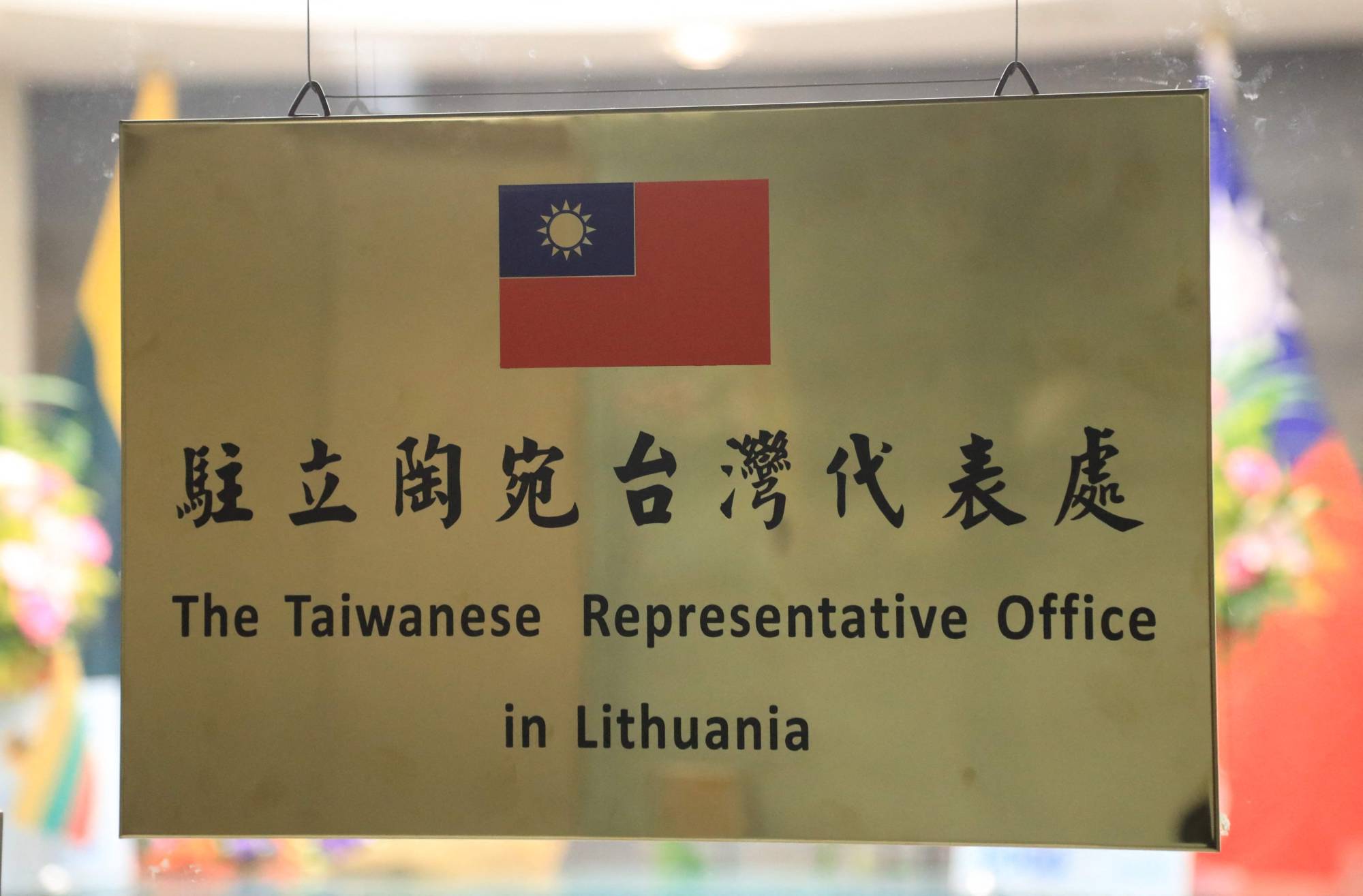
IN FOCUS
By Dincy Adlakha
Lithuania and Taiwan: A tie that makes China uneasy
Recent developments
Lithuania and Taiwan have been hinting at their growing relations from the past few months. China has responded by calling these attempts of closeness as violation of norms of international relations and even warned both parties of consequences.
On 18 November, Lithuania finally opened an official ‘Taiwan Representative Office’. On 28 November, China degraded diplomatic relations with Lithuania by reducing them from ambassadorial level to the level of charge d’affaires.
On 24 November, the Foreign Ministry of Taiwan announced that a delegation from the ‘friendship group’ of Lithuanian Parliament will visit Taipei on 2-3 December. The same decision was hailed by representatives from Lithuania. The group will be accompanied by some colleagues from Estonia and Latvia.
Taiwan’s strategy
Although Taiwan has representative offices in many countries, it has formal diplomatic ties with only 15 countries. Other offices in Europe, United States, and even India utilise the city name ‘Taipei’ and are majorly along the lines of ‘economic and cultural representative office’. Being a stable economy, the island enjoys strong economic ties with many western countries, even having lobbying groups and representatives in their parliaments.
However, as the pressure from Chinese military and foreign domains increases for reunification, Taiwan has increasingly seeked further connections. It has hosted delegations from Australia, New Zealand and sent representatives on Europe tours.
A major push for such moves comes from the Taiwanese leadership, President Tsai Ing-wen. She has forged alliances and connections with powerful international players as an attempt to bandwagon against China.
Lithuania’s intentions
Even though the Prime Minister of Lithuania emphasised compliance to ‘One-China’ policy by saying: “Lithuania wants a more intense economic, cultural and scientific relationship with Taiwan. "[But] I want to emphasise that this step does not mean any conflict or disagreement with the 'One China' policy,” Lithuania has continued to anger China. Despite receiving multiple warnings, it went ahead with opening the diplomatic office and even after the degradation of relations from China, it is exchanging diplomats under ‘friendship’ intentions with Taiwan.
This reveals, in the words of their ‘Taiwan friendship group’ leader, that Lithuania wants to “send a signal to Taiwan that it has friends in this part of the world.” Lithuania also asked its citizens to throw away Chinese phones and stop purchasing these products from the market. Built-in flaws in the Xiomi phone and security flaws in Huawei phones were the official reason stated for the advice. However, experts say that the reason was rooted also in political distrust.
Lithuania has great benefits in befriending the largest producer of semiconductor chips. Additionally, many central European countries are getting closer to Taiwan including Czech Republic as they are a bit wary of the Chinese projects and plans invading their markets. Furthermore, Lithuania has received support from the US as well in closing up with Taiwan.
China’s response
Beijing has been feeling uneasy about the growing connections of Taiwan for a while now. It has expressed its discontent and anger multiple times. China emphasises on One China policy and One China Principle. The policy asks for diplomatic acknowledgment of only one Chinese government and the principle suggests that Taiwan is an inalienable part of China, waiting to be reunified. China has used strong words to oppose any deviations from these. It maintains that these moves are clear violations of China’s sovereignty and territorial integrity. China will not make it easy for Taiwan or its connections and is aggressively hinting at reunification.
References
“Lithuanian lawmakers to visit Taiwan, deepening China spat,” Reuters, 24 November 2021
“China downgrades diplomatic ties with Lithuania over Taiwan row,” BBC, 23 November 2021
“Lithuania urges people to throw away Chinese phones,” BBC, 22 September 2021
IN BRIEF
By Avishka Ashok and Keerthana Nambiar
INTERNAL
President Xi Jinping emphasizes on the development of science, technology, electricity system and system of schools
On 24 November, Chinese President Xi Jinping chaired the 22nd meeting of the central committee for deepening overall reform. President Xi Jinping emphasized the importance of speeding up the management system in the science and technology sectors. Xi urged the requirement of a system wherein principals will assume overall responsibilities in middle and primary schools under the leadership of Communist of China Party organizations. President Xi also called in for following “the rules of electricity market operation and market economy, improving the overall planning of the electricity market, and allowing electricity resources to be shared and better allocated in broader areas across the country,” reported Xinhua. (“Xi urges sci-tech management system reform, development of unified electricity market system,” Xinhua Net, 24 November 2021)
China announces vaccinating 1.08 billion citizens
On 25 November, China’s top respiratory expert Zhong Nanshan addressed the China Internet Media Forum and announced that the country had vaccinated 76.8 per cent of the total population with the aim of achieving herd immunity by the year end. While insinuating at the failure to prevent large scale deaths caused by the pandemic due to the larger importance given to personal freedoms, he said: “What we need is collective freedom, social freedom and national freedom. Only with these freedoms can we have individual freedom." (“China fully vaccinates 1.08 billion people, accounting for 76.8% of population: Top respiratory expert Zhong Nanshan,” Global Times, 25 November 2021)
Ministry of Industry and Information restricts Tencent Holdings
On 24 November, the Ministry of Industry and Information Technology ordered the app stores and other platforms to suspend Tencent Holdings’ apps from their portals and prevent any new updates or launches. It issues a strong order and prevented Tencent from making any changes to its existing apps. (“China suspends Tencent from updating existing apps or launching new apps: report,” South China Morning Post, 24 November 2021)
China works towards plans for reducing methane emissions
On 25 November, Lu Xinming, a vice-director at the Department of Climate Change of the Ministry of Ecology and Environment announced that China is taking key steps to reduce the methane emission led by a 14th Five-Year Plan (2021-2025). Lu said, “ China will investigate the situation of methane emission control and study and formulate effective emission reduction measures in the fields of coal mining, agriculture, urban solid waste, sewage treatment, and oil and natural gas,” stated Global Times. (“China specifies plans to reduce methane emission,” Global Times, 25 November 2021)
REGIONAL
Japan-Vietnam reaffirm ties eying China’s rise in the Indo-Pacific
On 24 November, Vietnamese Prime Minister Pham Minh Chinh visited Japan and met with his Japanese counterpart Fumio Kishida, Prime Minister. The leaders of both countries expressed serious concerns about the tense situation in the South China Sea and Beijing’s growing assertiveness in the Indo-Pacific. Kishida opened his remarks quoting, “Vietnam is an important partner who holds a key to achieving “a free and open Indo-Pacific,” and further added that the vision was aimed that countering China’s rise. According to a statement released by Japan’s Foreign Ministry, “They reaffirmed the importance of sustaining peace, security, safety, freedom of navigation and overflights above the South China Sea, and the peaceful resolution of disputes in accordance with international law.” (“Japan, Vietnam express serious concern about South China Sea,” Japan Today, 25 November 2021)
INTERNATIONAL
Chinese and Iranian Foreign Ministers held talks in a video conference
On 24 November, Chinese Foreign Minister and State Councilor Wang Yi held a video conference with Iranian Foreign Minister Hossein Amor Abdollahian. As 2021 marks the 50th anniversary of the establishment of diplomatic relations between China and Iran both the representatives reiterated their relationship. Abdollahian pointed out that Iran is completely opposed to the interference in China’s internal matters and condemns the politicization of the Beijing Winter Olympics 2022. Wang said, “the so-called summit for democracy proposed by the US is to instigate division under the banner of democracy, which goes against the trend of the times and is doomed to fail.” Both sides also exchanged views on the Iran nuclear issue and Wang assured Abdollahian that China supports Iran’s “reasonable demands.” (“Iran condemns politicization of sports events and opposes interference in China’s internal affairs: Chinese-Iranian FM video meeting,” Global Times, 25 November 2021)
China and the US celebrates 50 years of Ping-pong Diplomacy
On 24 November, Xinhua Net reported that the US and Chinese celebrated the 50th anniversary of the “Ping Pong Diplomacy” in Houston. The event was called “Celebrating the past for a better future” was organized by the US National Committee on US-China Relations, the Table Tennis Association of China and the US, the Chinese Ambassador to the US and former US Secretary of State Henry Kissinger. The meeting emphasized the importance of encouraging mutual understanding and friendly relations between the two countries. The President of the US Olympic and Paralympic Committee said: "The new era in the relations between our two countries send a message of peace that resonated around the globe." (“Chinese, U.S. table tennis communities celebrate 50th anniversary of "Ping-Pong Diplomacy",” Xinhua Net, 24 November 2021)
Financial Times report claims block of public access to maritime shipping data
On 24 November, the Strait Times referred to a report by the Financial Times and announced that China was blocking public access to shipping locations because the government sought to control the economic data of the country due to national security concerns. According to the report, the Automatic Identification System figures dropped by 14 million per day when compared to the October figures. The media outlets investigating the decline connect the shift to the warning issued of 1 November against the danger and harm to the security sector caused by the data. (“China blocks access to maritime shipping data: Media report, East Asia News & Top Stories,” The Strait Times, 24 November 2021)
24 November 2021, Wednesday | China Reader Evening Brief | Vol.1, No. 45
Peng Shuai’s Weibo post: a storm with high waves
After Peng Shuai spoke of her relations with Zhang Gaoli, a storm of perspectives has flooded online. While many have interpreted her story as an addition to the #MeToo movement, others are not very fond of the “malicious hype.”

IN FOCUS
By Dincy Adlakha
Peng Shuai’s Weibo post: a storm with high waves
Recent developments
On 2 November, Peng Shuai, a top tennis player in China, posted on the twitter-like Chinese social media site Weibo her account of her interactions with Chinese Vice Premier Zhang Gaoli. Her post revealed that she had intercourse with the known politician seven years ago, after which he did not maintain contact with her. However, a major part of the post was dedicated to incidents that began three years ago.
The post read: “I had buried it all inside me, and since you were not planning on taking responsibility at all, why did you come and look for me again, take me to your house, and force me into sex? I have no proof, and it would be impossible for me to keep any evidence. You denied everything afterward (..) That afternoon I originally did not consent and cried the whole time. ” It further narrates how their relationship transformed through playing chess, tennis, and billiards. She felt that Zhang’s wife was an empress and she was a corpse. She mentioned that she had a dispute with Zhang on 30 October and was to meet him on 2 November to talk. However, he did not show up and “disappeared as he did seven years ago” after which she posted her letter online.
Within half-an-hour of her uploading the post, it was taken down from the platform and all searches related to the star player were blocked. Although screenshots from the post were already going viral, the keywords remained blocked from searches on other social media sites as well. Many comments mentioning Zhang and Peng also vanished.
The post and its censorship led to an outcry in English language media and pressure from the Women's Tennis Association to investigate the situation. Peng’s disappearance from the public eye also led to many diplomatic and sport personalities enquiring about her well-being. Spokespeople from White House, UN Human Rights Office and other prominent organizations joined the list.
On 17 November, CGTN shared a screenshot of an email sent by Peng Shuai to the WTA chairman Steve Simon ensuring her safety and wellness. The email also mentioned that the news being shared is not true and is being published without her consent. On 19 November, WTA Chairman Steve Simon threatened to pull out from China, endangering the upcoming ten and any further events from the country. On 21 November, Chinese state media shared pictures of Peng attending a public tennis event as evidence of her well being. On the same day, she met International Olympic Committee President Thomas Bach via a video call with the similar message of her safety and request to respect her privacy. However, all these appearances were not considered enough by the critics to prove her well-being. On 23 November, China’s Foreign Ministry spokesperson Zhao Lijian called the entire series of events a “maliciously hyped up” controversy that shouldn't be fed.
Silenced stories in China
China has been notorious, especially recently, for shutting down #MeToo voices. The legal berries such as not having an accurate ‘sexual harassment discrimination’ law. The closest legislation is ‘violation of personal rights’ which made the case of Zhao Xiaoxuan ‘Xianxi’ weaker. She sued Zhu Jun, famous TV anchor for sexually harassing her, however, the court rejected her pleas to provide evidence or attain testimony from Zhu. The court proceedings were led by one side merely and she stood defeated in the fight, her social media accounts blocked and her aides separated from her.
Although Xianxi has become the face of the movement in China, many other women have also voiced their stories. The legal barriers force them to narrate their stories on social media which weakens their case. Other famous men like Kris Wu and Liu Qiangdong also stand accused even though the stories have barely reached the Chinese public, let alone the world.
Overlay of sports and politics
Chinese sports face high political interference. The state has taken a major role in Peng Shuai’s career as well. From governing her opponents to her coaches, and even her earnings, Peng has faced dominance from the state and political figures for a long time. Her tournaments and tours, training and responses to international opponents were all determined by the state. However, her (and two other sportspersons) decision to ‘fly solo’ has freed them from the state’s control.
Implications
In many regards, the story of Peng Shuai holds great importance. First, it is the biggest addition from China to the larger umbrella of #MeToo which encompasses abuse of power and position to form exploitative relations. Second, the story is not important just for its content but also it’s characters. It reflects the misconduct running in high-ranking political figures’ culture. Third, it also speaks volumes about the political dominance in the life of sportspersons. The story is larger than one person and goes beyond the current concerns.
References
Manya Koetse, “The Silent Storm: Peng Shuai’s Weibo Post,” What’s On Weibo, 5 November 2021
Alexandra Stevenson and Steven lee Meyers, “How Peng Shuai Went From ‘Chinese Princess’ to Silenced #MeToo Accuser,” New York Times, 22 November 2021
Zhaoyin Feng and Tessa Wong, “Xianzi: The #MeToo icon China is trying to silence,” BBC, 27 September 2021
Erin Burnett, Rhea Mogul, Helen Regan and Nectar Gan, “Peng Shuai: UN calls for proof of Chinese tennis star's whereabouts; WTA chairman willing to pull out of China,” CNN, 20 November 2021
IN BRIEF
By Avishka Ashok and Keerthana Nambiar
INTERNAL
Cyberspace Administration of China (CAC) to tighten celebrity information disseminated online
On 23 November, the Cyberspace Administration of China (CAC) stated that it plans to create a positive and healthy environment and tighten regulations on the celebrity information disseminated online. The Cyberspace regulator says that it would create a “negative list” of the platforms that promote “bad values such as ostentatious wealth as well as any attempts to encourage fans to spend money to support celebrities” reported Reuters. (“China targets celebrity online information in ramp up of fan culture crackdown,” Reuters, 23 November 2021)
The latest statistical report 2000-2010 suggests China undercounted around 11.6 million childbirths
On 24 November, Bloomberg reported on China’s latest statistical yearbook released by the government on the number of children born from 2000 to 2010. The number of children born during the period of ten years was undercounted by at least 11.6 million. The possible explanation of the gap is that some parents must have failed to register the births to avoid punishment if they breach the one-child policy. The revised demography shows the difficulties of accurately counting the number of people in China. However, China is now effectively abandoning limits on family size and no penalties for exceedingly more than three children to decrease the discrepancy in the future. (“China finds 12 million children that it didn't know existed,” Bloomberg, 24 November 2021)
Chinese Premier visits the Shanghai Pilot Free Trade Zone
On 23 November, the Chinese Premier Li Keqiang was on an inspection tour in Shanghai when he encouraged reform and opening up the economy to enhance the business environment in China. Premier Li examined the Shanghai Pilot Free Trade Zone and appreciated the institutional investments in trade and finance while encouraging the continuation of the experiment that started in 2013. He said: "China will open its door wider to the world and strictly protect intellectual property rights so that more foreign companies can invest and do business in China with confidence." (Chinese premier stresses better business environment,” Xinhua Net, 23 November 2021)
President Xi urges faster military logistics development
On 23 November, the Chinese President Xi Jinping attended the last day of the meeting on military logistics and urged the armed forces to enhance the development of modern equipment and other facilities. President Xi observed that since 2012, there had been numerous qualitative changes to the military logistics but urged the army to fasten their pace of advancement and development to keep up with the goal of celebrating the People’s Liberation Army’s centenary anniversary in 2027. (“Xi urges high-quality development of modern logistics for China's armed forces,” Xinhua Net, 23 November 2021)
INTERNATIONAL
Tanzanian Foreign Minister calls Africa-China relationship “all-weather friends”
On 24 November, Xinhua reported on the Liberata Mulamula Tanzanian Minister of Foreign Affairs and East African Cooperation interview ahead of the Eighth Ministerial Conference of the Forum on China-Africa Cooperation (FOCAC) to be held in Dakar, Senegal. Mulamula said, “Tanzania and China are all-weather friends whose friendship has grown stronger and deeper.” Congratulating on China’s 50th anniversary of its restoration lawful seat at the United Nations and pointed out that this has “opened a new page” for China to play an important role in the international community. She further highly spoke of China’s Global Development Initiative and with the broad prospects of Africa-China cooperation, Africa has the potential to become “the next manufacturing center in the world.” (“Interview: Tanzania-China all-weather friendship grows stronger, deeper, says Tanzanian FM,” Xinhua Net, 24 November 2021)
Chairman of the NPC standing committee addressed the China-Russia meeting
On 23 November, the Chairman of the National People’s Congress Standing Committee Li Zhanshu addressed the opening ceremony of the seventh China-Russia committee for parliamentary cooperation. The meeting was conducted virtually and is special since its the 20th anniversary of the China-Russia Treaty of Good Neighbourliness and Friendly Cooperation. Chairman Li appreciated the relations between the two countries that had led to many fruitful outcomes in different fields. He said: “The two countries' legislative bodies have played unique roles in enhancing political mutual trust, promoting pragmatic cooperation and carrying forward the friendship between the two peoples.” (“Top Chinese legislator addresses meeting on China-Russia parliamentary cooperation,” Xinhua Net, 24 November 2021)
Chinese envoy encourages political parties in Libya to resolve differences
On 23 November, China’s Deputy Permanent Representative to the United Nations Dai Bing issued a call to all the political parties in Libya to collectively work towards making the electoral progress successful by removing the differences between them. He said: “China encourages all parties to resolve their disputes over the elections through dialogue and other peaceful means. We call on all foreign forces and mercenaries in Libya to complete their withdrawal as soon as possible in accordance with the relevant action plan so as to create favorable conditions for the political process in Libya.” (“Chinese envoy calls for advancement of electoral process in Libya,” Xinhua Net, 24 November 2021)
Brazil-China to strengthen their cooperation in the field of agricultural biotechnology
On 23 November, Brazil-China Business Council organized an online forum to deepen cooperation in agricultural biotechnology and seek joint solutions for green and sustainable agricultural development. Chinese Ambassador to Brazil Yang Wanming said, “Agriculture is an industry most related to green and low-carbon development, and also one of the most solid and dynamic areas of China-Brazil cooperation.” The forum attracted around 200 scholars such as officials, researchers, and businesses. Yang pledged that China is willing to strengthen its cooperation in the fields of germplasm research and development, low-carbon agriculture, green finance, and smart agriculture. “We count on our Chinese partners and they can very much count on us for increasingly global, sustainable and innovative agribusiness,” quoted Fernando Camargo, secretary of Innovation, Sustainable Development and Irrigation at Brazil’s Ministry of Agriculture. (“China, Brazil seeking deeper cooperation in agricultural biotech,” Xinhua Net, 23 November 2021)
19 November 2021, Friday | China Reader Evening Brief | Vol.1, No. 42
China vows to protect sovereignty as Lithuania launches 'Taiwan Representative Office'
China warns Lithuania, Taiwan of consequences for violating the 'One-China' principle. The new office is seen as a move undermining China's sovereignty and territorial integrity.
IN BRIEF
By Dincy Adlakha and Keerthana Nambiar
INTERNAL
China’s research team develop a new drug for COVID-19 variants
On 18 November, Global Times reported that a research team in China has discovered a new neutralizing antibody medicine to treat COVID-19 called DXP-604. Singlomics Biopharmaceuticals and a team from Peking University jointly developed the drug. The results showed that the medication alleviated the common symptoms of COVID-19 such as loss of taste or smell and stuffiness. Xie Xiaoliang, the professor who led the research by Peking university said that DXP-604 has been able to evade all the current variants of COVID-19 and has screened over 8,000 antibody candidates. (“Domestic antibody drug likely prevents most COVID-19 variants: researchers,” Global Times, 18 November 2021; "New drug shows promise in treating COVID,” China Daily, 18 November 2021)
INTERNATIONAL
Chinese coast guards hit Philippines boats with water cannons
On 18 November, two Philippines supply boats, heading to a disputed shoal currently occupied by Filipino marines in the South China Sea, were blocked and hit by water cannons by Chinese coast guards. As covered by the Korea Times, Manila’s top diplomat opposed the action and said that China has earned angry protests and a warning from the Philippine government due to this action. The Philippines holds that its vessels are protected under a mutual defence treaty with the US. The vessels were carrying food to Filipino forces but had to abort the mission due to Chinese intervention. It is reported that no one was hurt in the incident. (“China coast guard uses water cannons against Philippine boats,” The Korea Times, 18 November 2021)
President Biden hints at diplomatic boycott of Beijing Winter Olympics
On 18 November, President Joe Biden said that a diplomatic boycott of the Beijing Winter Olympics is “something we are considering.” during a meeting with Canadian Prime Minister Justin Trudeau. The global event hosted by China is set to start on 4 February. As the dates move closer, the pressure from the US Congress has increased on the President to act on the alleged human rights abuse being committed by China in Xinjiang. The White House spokesperson Jen Psaki said that the decision has no links with the recent Biden-Xi meeting but is instead connected to the human rights conditions in Xinjiang. This is the clearest indication till now of the US administration not sending any government official at an Olympic Games. (Jacob Fromer, “Joe Biden says US considering diplomatic boycott of Beijing Olympics,” South China Morning Post, 19 November 2021)
China opposes launch of ‘Taiwan representative office’ in Lithuania with strong words
On 19 November, Global Times reported that the Chinese government firmly opposed and protested against the ‘Taiwan representative office’ opened in Lithuania. The government holds that the office is in violation of the one-China principle and that the authorities shall take all necessary measures to safeguard sovereignty. A spokesperson from the Chinese Foreign Ministry also warned against the consequences that Lithuania shall face. China saw the move as an intrusion of its territorial integrity, and internal affairs. China strongly opposes the secessionist intentions of Taiwan and vows a reunification. (“China vows to take all necessary measures to protect sovereignty after launch of ‘Taiwan representative office’ in Lithuania,” Global Times, 19 November 2021)
French brand Dior faces troubles in China over controversial picture
On 18 November, Global Times reported that French brand Dior is facing a continued controversy in China, which is one of the largest revenue sources and markets for the luxury brand. The brand is facing staunch criticism on Chinese social media sites due to a picture that they posted with a smeared image of Chinese women. The image was shot by a well-known Chinese photographer. However, the Chinese public demands an explanation from the brand as well as the photographer over the picture. The brand has removed the image from its social media accounts but did not offer any explanation. Previously, Italian luxury brands Dolce & Gabbana and Swedish H&M had also witnessed such criticism from the Chinese public due to various reasons. (“French fashion brand Dior mired in controversy in China, one of its biggest markets,” Global Times, 18 November 2021)
Center for Global Development releases a new report on China’s influential position at the international institutions
On 18 November, the Center for Global Development released a new report on China’s subsidized loan contribution to poor countries. China has surpassed Japan becoming the second largest contributor to the system of development banks with a total capital of $66 billion dollars providing $200 billion in subsidized loans to poor countries each year. According to the report, China receives loans and aid from the World Bank, U.N. agencies, and other multilateral institutions Beijing has emerged as one of the most powerful powers. It further adds that Chinas role as a major donor, shareholder, aid recipient, and commercial partner of international institutions gives it a “uniquely influential position.” (“Report shows China's growing clout at World Bank, global institutions,” Reuters, 18 November 2021)
China’s top envoy to Australia calls Canberra a “sabre wielder” with the AUKUS pact
On 19 November, The Guardian newspaper published an interview with a top China envoy with The Guardian. Wang Xining, China’s acting ambassador branded Australia as “sabre wielder” with the plan of acquiring eight nuclear-powered submarines with the capacity of the nuclear non-proliferation system. Wang says that the deal jeopardizes Australia’s image of “peace defender” and the people of Australia “should be worried more.” He shared his views on AUKUS as an ‘Anglo-Saxon clique’, Australia banning Chinese companies, and Tony Abbot, former Australian prime minister visiting Taiwan calling it ‘very unfortunate.’ He refrained from making any comment on a freeze on calls between Australian and Chinese ministers declaring it as a “not a conducive environment.” (“Naughty guy’: top Chinese diplomat accuses Australia of ‘sabre wielding’ with the nuclear submarine deal,” The Guardian, 19 November 2021)
Reuters apologizes over a tweet to Global Times for posting wrong picture
On 19 November, Reuters apologized for mistakenly attaching a picture of Chinese soldiers to an irrelevant Twitter post published on 18 November 2021. The Chinese netizens criticized the picture as racist. A Reuters spokesperson said in a statement sent to the Global Times, “A tweet on our account regrettably included a photo of Chinese soldiers in an oxygen chamber that was not correctly described. As soon as we became aware of our mistake, the tweet was deleted and corrected, and we apologize for the offense it caused.” (“Update: Reuters apologizes for posting irrelevant tweet with photo of Chinese soldiers,” Global Times, 19 November 2021)
18 November 2021, Thursday | China Reader Evening Brief | Vol.1, No. 41
China at COP26: Criticisms and response
China remained a controversy through the recent climate summit. Questions rise on China’s intentions for contributing to the global cause. Its reponses find logic and ground from undergoing actions.
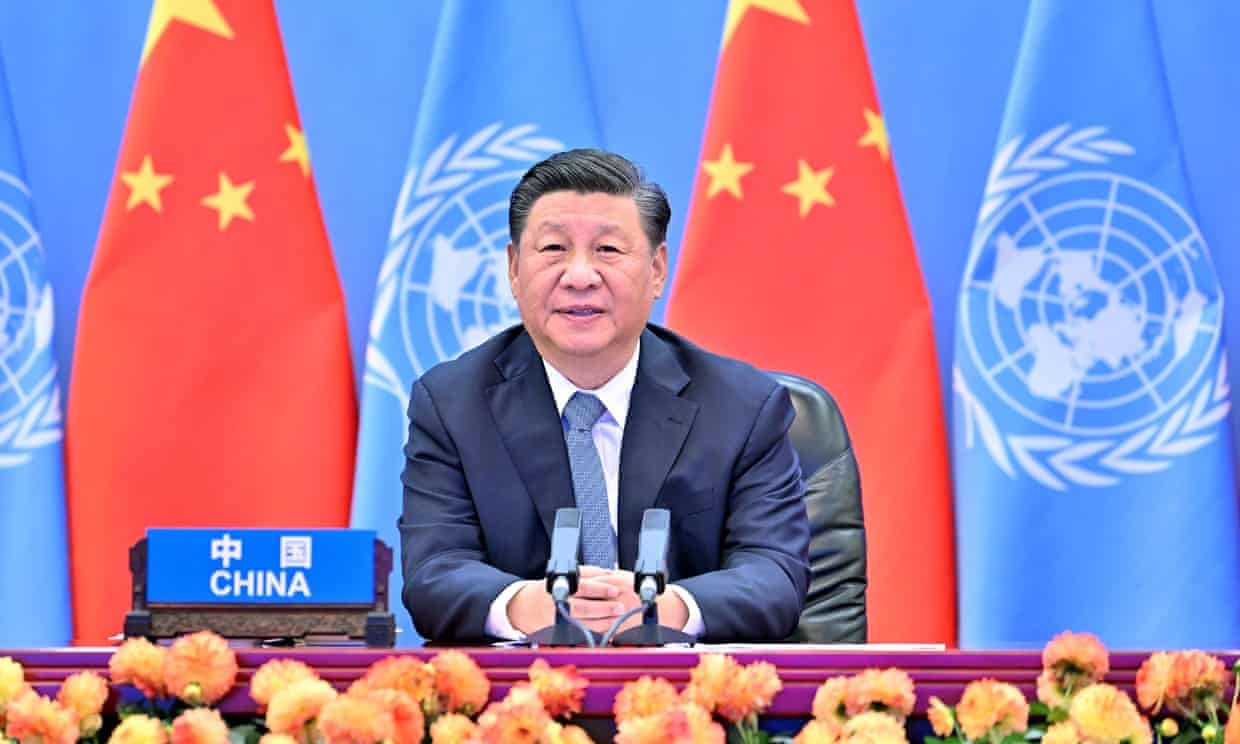
|
|
|
17 November 2021, Wednesday | China Reader Evening Brief | Vol.1, No. 40
Xi-Biden virtual meet: Convergent, divergent and missing points
President Xi Jinping meets with President Joseph Biden in the first ever virtual meeting between the two leaders. The meeting displays promise and hope for US-China relations without offering a substantive direction.
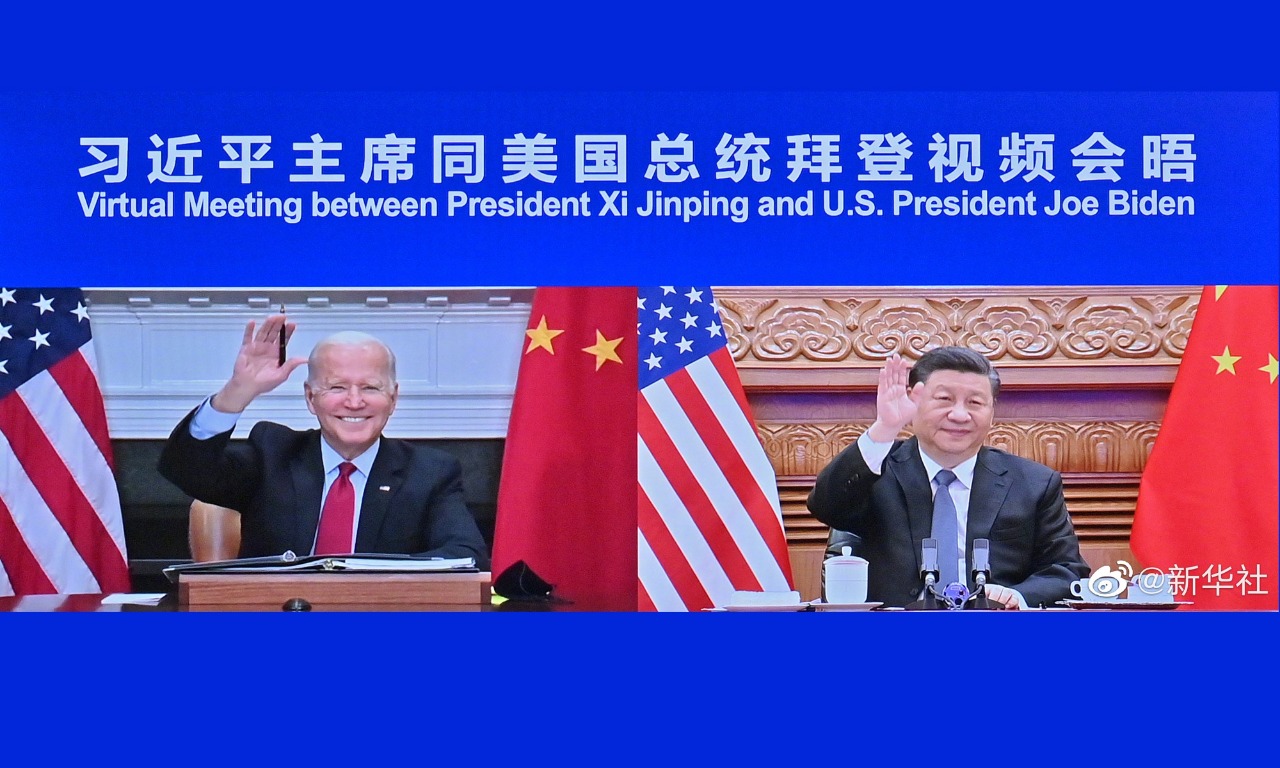
IN FOCUS
By Dincy Adlakha
Xi-Biden virtual meet: Convergent, divergent and missing points
On 16 November, Chinese President Xi Jinping met US President Joe Biden in a virtual meeting arranged via video link. The meeting saw both presidents seated in their capitals and recalling the days when they worked together as Vice-Presidents of their respective countries. Although the meeting was a short one, it opened doors for further summits between the two leaders to ease tensions. A few noteworthy inferences from the meeting can be seen as points of convergence, divergence, while few missed attention.
Points of convergence
In very respectful yet straightforward words, both the leaders conveyed the stance of their countries. President Xi realised that as powerful economies and as permanent members of the UN, a major segment of the responsibility for global development rests on the shoulders of China and the US. President Biden also stated that global issues like climate change and their accountability to other world leaders are core to the bilateral relationship between the US and China. Both the leaders were in agreement that communication channels and direct talks are essential for them to overcome the challenges that they are facing together. They acknowledged the critical stages that both these countries are at and signalled collaborative efforts for the global village. A tone for peaceful development of the world was set through the meeting.
Points of divergence
Even though there was no major discussion in the meeting which did not allow room for disagreement, some details did not entirely correspond. President Xi Jinping emphasized that both countries should run their domestic affairs well and that they should coexist in peace. President Biden mentioned making human rights, economy, and free and open Indo-pacific as a priority. These minute mentions are reflective of the interests that the US and China hold as core. These issues may not entirely correlate bilaterally as the countries have faced problems on the same for a long time now.
Missed points
The short virtual meeting, first of its kind, did not bring any concrete breakthroughs. This was possibly due to a tactful avoidance of subjects like trade disparities, Taiwanese sovereignty, human rights and ideological differences. The two countries have been engaged in severe tensions for a few years. The COVID-19 origin investigations and Chinese aggression with Taiwan, are some of the immediate triggers. However, even long standing issues like technological blockages and human rights differences were not brought up in the meeting.
Hence, even though the meeting failed to capture any substantial conclusion, it was a huge step in easing tensions and opening roads for further bilateral discussions, going forward.
References:
“Xi calls for sound, steady China-U.S. relationship,” Xinhua Net, 16 November 2021
“Remarks by President Biden and President Xi of the People’s Republic of China Before Virtual Meeting,” White House Gov Briefing Room, 16 November 2021
IN BRIEF
By Keerthana Nambiar and Avishka Ashok
INTERNAL
Chinese youngsters vouch in for the “new farmers” movement
On 17 November, The Strait Times published an editorial on young Chinese professionals quitting corporate jobs and choosing agrarian lifestyle. The Strait Times says that millions of young Chinese are quitting their jobs in urban cities. The youngsters feel uninspired in the modern society lifestyle with long work hours, Meagre pay, urban congestion and high living costs. According to the government, around 20 million people have joined the “new farmer” movement. The movement is to bring tech- and business-savvy millennials bringing in new ideas into the agricultural sector with the government providing financial and policy supports. (“ China's millennial 'new farmers' opt to live off the land,” The Strait Times, 17 November 2021)
Government secures energy for continuous production and addresses shortage concerns
On 16 November, the National Development and Reform Commission spokesperson Meng Wei addressed a press conference and assured that the country had sufficient energy to support the economy due to the government’s efforts in ramping up energy production and secured enough energy for the industries to carry out their activities without any obstacles. Wei said, “China has worked to boost coal production and bring coal prices back to a reasonable range.” The most recent data shows that the government body responsible for securing energy supply has successfully increased its output and reduced prices in the last month. (“China increases energy supply, calming stagflation concerns,” Xinhua Net, 16 November 2021)
TECHNOLOGY
PLA uses drone technology to capture terrorists in the Xinjiang border
On 16 November, Global Times covered a report by China Central Television (CCTV) and disclosed that the use of drones in the Tacheng Prefecture in the Xinjiang region was helping the border security forces to carry out difficult tasks with great ease and in a shorter time period. The report also explained one of the missions carried out by the drones where it located and tracked the movement of escaped terrorists who were hiding in trees and snow. The drones are advanced and use thermal imaging to track the suspects in one third the usual time. (“Drones cut task time by a third for Xinjiang border missions,” Global Times, 16 November 2021)
REGIONAL
Global Times says the new Indian ambassador to China is unlikely to bring “immediate changes”
On 16 November, Global Times reported on the Indian diplomat Pradeep Kumar Rawat who is posted as Indian’s new ambassador to China. Global Times claims the diplomat who is a “China expert” according to the Indian media is not likely to bring ‘immediate changes’ to India-China bilateral relations. Qian Feng, director of the research department at the National Strategy Institute at Tsinghua University said, “As a diplomat knowing China, he understands cooperation benefits both sides while confrontation hurts both countries,” reported Global Times. (“India reportedly to appoint ‘China expert’ as new ambassador, ‘unlikely to bring immediate changes to bilateral ties’,” Global Times, 16 November 2021)
INTERNATIONAL
4th China-Africa Local Government Cooperation conference
On 16 November, the Chinese Premier Li Keqiang addressed the 4th Forum on China-Africa Local Government Cooperation via video link. 300 political leaders from African countries and officials of local governments and relevant institutions from China attended the conference both online and offline. Li said that China and Africa should expand “pragmatic cooperation” to create a better future for Chinese and African people. He declared that the China-Africa friendship is unbreakable and China will aid Africa with vaccines and work towards the development. China is willing to further align each other's development strategies, strengthen the exchange of experiences in urban governance, poverty eradication, social construction and agricultural modernization, and promote cooperation between friendship cities, said Li. (“Chinese Premier stresses closer China-Africa local government cooperation,” Xinhua Net, 16 November 2021)
US economist appreciated China’s role in the US
On 17 November, People’s Daily reported that renowned US Economist Jeffrey Sachs stated in an interview with Xinhua that China’s entry into the World Trade Organization was a significant push to globalization. According to Sachs, the decision by China to become a part of the WTO benefited the country immensely and also profited the global economy in the last two decades. He noted that the country had become a major trading partner for almost all countries in the world and said: "Without China's membership in WTO, a lot of economic growth and integration would not have taken place." (“China's WTO entry facilitates globalization, benefits global growth -- U.S. economist,” People’s Daily, 17 November 2021)
China replaces the US as the world’s wealthiest in latest McKinsey report
On 16 November, the Times of India referred to a report published by McKinsey & co. on 15 November on the surge of global wealth and reported that China had overtaken the US to become the wealthiest country in the world. The report also observed that the global wealth has tripled in the last two decades. The Global net worth had risen from USD 156 trillion to USD 514 trillion in 2020 and China was responsible for almost one0third of the increase. (“Global wealth surges as China overtakes US to grab top spot” Times of India, 16 November 2021)
16 November 2021, Tuesday| China Reader Evening Brief | Vol.1, No. 39
Xi Jinping rewriting the history of the party: The Economist
The Economist's perspective on Chinese President Xi Jinping's elevation as the core of the Communist Party of China
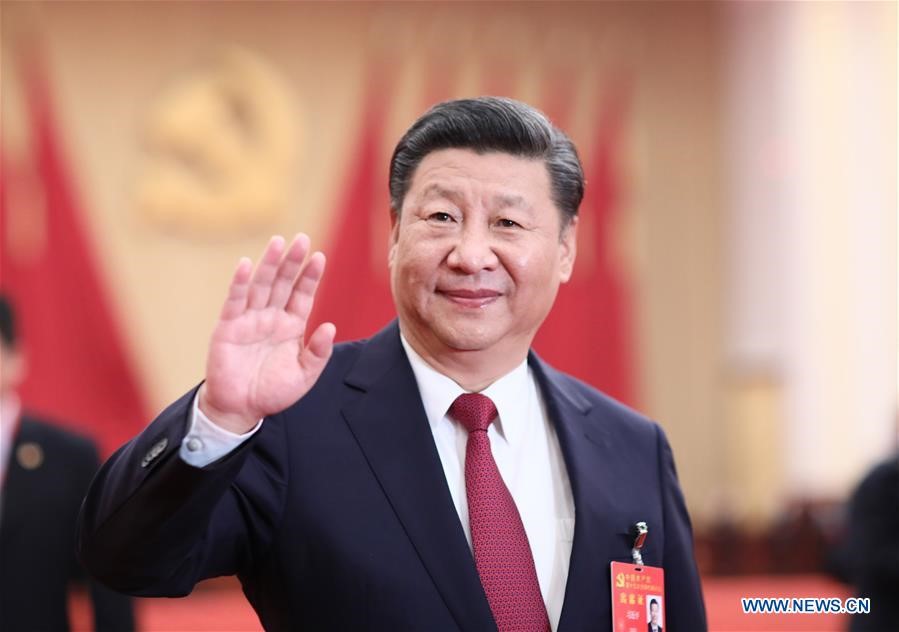
IN FOCUS
By Keerthana Nambiar
Xi Jinping rewriting the history of the party: The Economist
On 6 November, the Economist published an editorial on the Communist Party's leader, Xi Jinping elevated status. Xi has been altering the rules of politics, business and society for a while and is currently "rewriting the history of the party itself."
The annual plenary meeting which began on 8 November advertised their top agenda that is a resolution on the party's history. The former triumphs: Mao in 1945 and Deng in 1981 were the crucial junctures in consolidating power in China. The Economist says, Xi Jinping wants to showcase himself as ‘indispensable’ and a political giant when put par with Mao Zedong and Deng Xiaoping turning China into a global power.
The power demonstration
Jude Blanchette of the Centre of Strategic and international Studies, a think-tank in Washington says, “The resolution will be an extraordinary demonstration of power.” Xi’s hold on the Communist Party is evident showing his ability to crush any kind of opposition that arises within the party. The plenum is for celebrating the achievements of China under Xi’s leadership fulling his vision of “new era.” This year’s plenum marks a crucial one for setting the tone before the five-yearly congress. Since the past few months, Xi has been silencing his critics and crushing potential rivals and personalities alongwith slamming regulators on big private firms.
Uniting the two ideologies of Mao and Deng
The Economist says the history presents a different challenge to Xi Jinping. In the Communist Party of China on one side is the party’s left wing consisting of the neo-Maoists. The neo-Maoists have criticized Deng and are waiting for restoration of Mao’s ideologies and the party’s right wing are the supporters on Deng’s reforms who are wary that Mao-style dictatorship might slide back in China. Xi Jinping is careful not to negate either Mao or Deng as he wants a clean history where there are no mistakes and contractions. His campaign against “historical nihilism” is to erase anything that casts the party in an unfavourable light.
The road ahead
The plenum is the propaganda apparatus for Xi Jinping’s “wisdom” and fostering the enthusiasm of his life-long rule. The key words such as “modern socialist nation”, “prosperous”, “strong” and “common prosperity” were the highlights of the plenum. Joseph Fewsmith of Boston University told the Economist that “from Mr. Xi’s perspective the resolution not only has to look back over the past, but it has to look to the future.” He further added that Mr. Xi thinks, “The future, c’est moi.”
References
“Xi Jinping is rewriting history to justify his rule for years to come,” The Economist, 6 November 2021
IN BRIEF
By Dincy Adlakha and Avishka Ashok
INTERNAL
Xinjiang regional government spokesperson hits back at World Uyghur Congress
On 15 November, Xu Guixiang the spokesperson of the regional government in Xinjiang commented on the World Uyghur COngress Assembly that took place from 12 to 14 November in Prague. In an interview to the Global Times reporters, he called the organization a US-based terrorist camp with violent and separatist intentions, manipulated by the East Turkistan Islamic Movement. He strongly condemned all countries and person’s indulging with the WUC and called for these anti-China forces to stop interfering in China’s internal matters. (Liu Xin and Fan Lingzhi, “‘Assembly’ of WUC in Prague an ugly collusion and aggregation of anti-China forces: Xinjiang regional govt spokesperson,” Global Times, 15 November 2021)
China to approve country’s 1st COVID-19 drug soon
On 15 November, Global Times reported that researchers in China are continuously developing new remedies against the coronavirus, among which a neutralizing monoclonal antibody combination therapy will soon become the first drug of the country to get approval for market use. The drug will also receive emergency use authorization in western and developed countries such as the US. The drug is co-developed by a university, a hospital and a company from China. It is said that the drug, which will be approved by December-end, can be used for mild to moderate COVID-19 cases, and also for post-exposure prevention. (Fan Anqi and Leng Shumei, “China expected to approve country's 1st COVID-19 drug by year-end,” Global Times, 15 November 2021)
US officials hint at lifting sanctions before virtual meeting
On 15 November, the Global Times reported that some senior officials in the US had hinted on relaxing the tariffs before the virtual meeting between the Chinese President Xi Jinping and the US President Joe Biden. Chinese political analysts believe that the US is attempting to enhance its relationship with China because of inflation pressures in the US economy and the falling approval ratings for President Biden in the domestic political scenario. The Chinese Foreign Ministry spokesperson said: “As China-US relations are now at a critical crossroads, the virtual meeting between Chinese President Xi Jinping and Biden scheduled for Tuesday morning (Beijing time) is a major event for China-US relations and for international relations. Chinese and American people, in addition to the international community, expect the meeting to yield positive results for the two countries and the world.” (Washington eases stance on trade ahead of Xi-Biden talks,” Global Times, 15 November)
TECHNOLOGY
Chinese researchers find find binary and triple candidates in the galaxy
On 16 November, Xinhua Net reported that a team of Chinese scientists had obtained 3,133 spectroscopic binary and 132 spectroscopic triple candidates in the Milky Way galaxy. The researchers published the report in the Astrophysical Journal Supplement Series. The new findings are crucial to the study of formation and evolution of stars. The report observes that approximately half the stars in the Milky Way galaxy are binary systems. (“Chinese researchers discover new spectroscopic binary, triple candidates,” Xinhua Net, 16 November 2021)
REGIONAL
Experts render Taiwan’s new military warplanes ineffective against China
On 15 November, Global Times published an article citing experts from China who opine that Taiwan’s forceful resistance against reunification will meet a dead end. Taiwan has recently added its first indigenous submarine and an advanced supersonic jet trainer into its military capabilities. The move is seen by Chinese experts as a weak one against the vast military capabilities of the mainland including anti-submarine warfare and strong warplanes. The article expanded on the features of the new additions in Taiwa’s defence system and further explained that they are not sensible investments against China. The disparity in capabilities of Taiwan and the mainland will not reduce, according to the article. (Xu Keyue, “Taiwan’s new submarine, warplanes cannot change widening military gap with mainland: experts,” Global Times, 15 November 2021)
Cambodian Prime Minister holds virtual meeting with Chinese Premier
On 15 November, the Chinese Premier Li Keqiang held a virtual meeting with the Cambodian Prime Minister Samdech Techo Hun Sen where the two leaders discussed bilateral relations and promised to continue their support and assistance towards each other. Li observed that the two countries had achieved great progress during their friendship. He said: “China attaches great importance to developing China-Cambodia ties, and will continue to support Cambodia in pursuing a development path suited to its national conditions.” They two countries agreed to work with each other on regional economic integration, trade and investment to facilitate the economy in the region. (“Chinese premier meets Cambodian PM via video link,” Xinhua Net, 15 November 2021)
INTERNATIONAL
Xi congratulates the opening of 6th China-Africa People’s Forum
On 15 November, President Xi Jinping sent a congratulatory letter to the 6th China-Africa People’s Forum that opened in Beijing. The letter noted that the world is going through great development and change creating new opportunities and challenges. In such an era, China and Africa need to uphold and carry forward common values of humanity such as peace, development, equity, justice, democracy and freedom. He also emphasized on the shared future of China-Africa community which should be led by solidarity and cooperation. (“Xi sends congratulatory letter to 6th China-Africa People's Forum,” Xinhua Net, 15 November 2021)
15 November 2021, Monday | China Reader Evening Brief | Vol.1, No. 38
Curtain Raiser: Joe Biden-Xi Jinping's virtual meeting
The Chinese President Xi Jinping and the US President Jo Biden gear up to address major issues between the two biggest economies of the world.
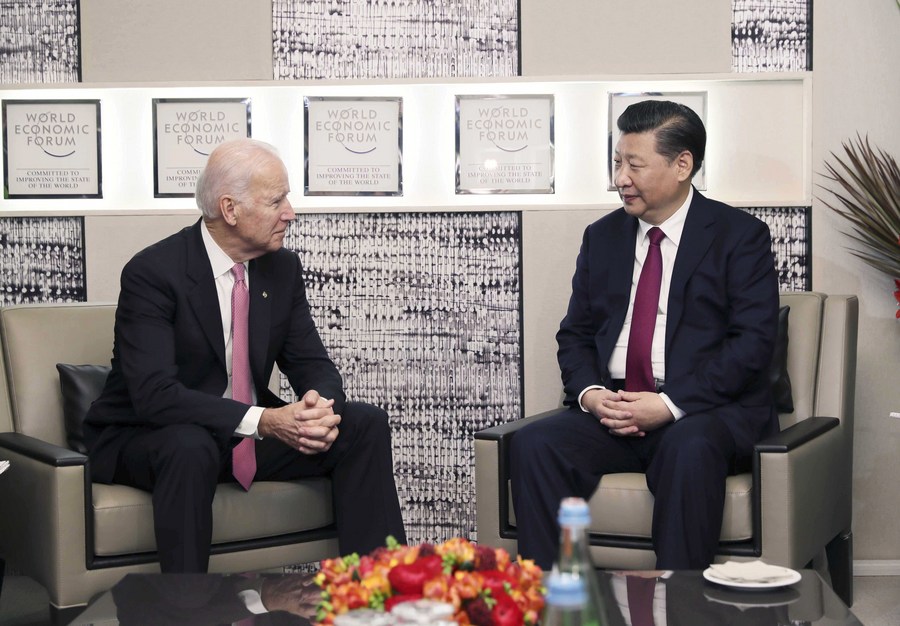
IN FOCUS
By Avishka Ashok
Bilateral Issues between China and the US: Political, Economic and Ideological challenges
On 12 November, China and the US agreed to hold a virtual meeting on 15 November to discuss the obstacles in the bilateral relations and work towards creating stability between the two giant economies of the world. The details of the meeting are yet to be released but the following are the major issues between the two countries.
Political Issues
There a number of issues that complicate the relation between the US and China. The issue at the forefront at the moment is the interference of the US in areas that China considers its internal issues. The US is deeply invested and cannot afford to turn a blind eye against the Taiwanese and Tibetan Independence Movements, the Hong Kong’s protests against the authoritarian nature of governance in the city, the human rights abuses in Xinjiang because of the stands it has taken previously in support of upholding human rights. Other political issues such as extending its support for Japan, South Korea and other Southeast Asian countries in the South China Sea further worsen the relations between the two countries.
Economic Issues
The trade relations between the two countries took a turn for the worse during the presidency of Donald Trump. Until now, the US has imposed tariffs worth USD 550 billion on China while China has pushed for tariffs worth USD 185 billion on the US. The past two years have witnessed numerous highs and lows in the relationship with many negotiations between the US and Chinese officials, imposition of frequent tariffs, created restrictions on the share of technology and fought each other on numerous cases at the WTO. The reason for the back and forth tariff war and the constant tensions between the two countries is essentially based on a complex of the other replacing and becoming the most important GDP in the world. As China inches closer to the current the US in terms of its GDP, its economic growth of 6.90 per cent threatens the US economy which currently has a growth of 2.27 per cent.
Ideological Issues
The differences between the US and China can be traced decades back to 1949 when Mao Zedong established himself as the leader of the Communist China. Soon after the establishment of the People’s Republic of China, the country chose to support the USSR while the US picked the side of capitalism. Eventually, the differences between communism and capitalism has found its roots in the present times as well. Although, communism in China has undergone immense changes over the years, it is essentially against the Western lifestyle and standard of living. The Taiwan Strait Crisis, the Korean War, the Tibetan Uprising, Tiananmen square massacre were issues that acted as a catalyst in separating the two countries further more.
References:
Dorcas Wong and Alexander Chipman Koty, “The US-China Trade War: A Timeline,” China Briefing, 25 August 2020
“GDP by Country,” Worldometer
“U.S. Relations With China,” Council on Foreign Affairs
Kawashima Shin, “The Challenges of US China Policy,” The Diplomat, 6 April 2021
Michael Martina and David Brunnstrom, Trevor Hunnicutt, "Biden and China's Xi will hold virtual meeting on Monday," Reuters, 13 November 2021
IN BRIEF
By Dincy Adlakha and Keerthana Nambiar
INTERNAL
National Health Commission expert displays faith in Chinas dynamic zero-case policy for COVID-19
On 14 November, Liang Wannian, the head of an expert panel of COVID-19 response of China’s National Health Commission said in a statement that CHina is adopting a dynamic zero-case policy rather than bringing infections to zero. This policy aims to prevent viral transmission in communities, thorough search and top treatment for patients. The expert also said that this policy has led to the effective controlling of recent scares by capsizing mortality and minimizing serious illness. (“China’s dynamic zero-case policy proves effective in preventing viral transmission in communities: NHC expert,” Global Times, 14 November 2021)
Women’s Tennis Association calls on China to investigate case made by Peng Shuai
On 15 November, the WOmen’s Tennis Association called on CHina to investigate allegations of sexual assault against former Chinese Vice Premier. The remarks were made by Peng Shuai, former top-ranked doubles player in China through a social media post. The WTA said in a statement that it seeks a “full, fair and transparent investigation into sexual assault allegations” against the former Chinese leader. The chairman and CEO of WTA also expressed concern over the matter and called for “utmost seriousness” on the issue. Any response is yet to be made from the Chinese side, however, many have reported that internet searches for Peng’s name have been disabled by the authorities. (“WTA calls on China to investigate Peng sexual assault allegations,” Reuters, 15 November 2021)
China’s sees growth in industrial output and retail sales
On 15 November, Reuters reported that the industrial output and retail sales have grown in China when compared to one in October. The fresh spill over of COVID-19 and supply shortages has not affected the output but the slowing property sector made a significant impact on the economic outlook. According to Reuters poll of analysts, “The industrial output growth beat expectations of a 3.0% year-on-year increase” but it “remained the second lowest print this year.” (“China industrial output, retail sales accelerate but property clouds outlook,” Reuters, 15 November 2021)
TECHNOLOGY
China displays advanced military capabilities in Dubai Airshow
On 14 November, as a reflection of CHinese attention to the Middle Eastern arms market, China showcased its advanced L-15 jet trainer at the Dubai Airshow. Many other products were also displayed in the first foreign airshow that CHina has taken part in since the COVID-19 pandemic. The L-15 aircraft is manufactured by the Aviation Industry Corporation of China and can perform both, air defence and ground attack missions. Senior experts say that this is the best model of advanced trainers in China with diverse combat missions that could be of use to the Middle Eastern countries. According to Global Times, China hopes to attract more consumers from the region through such exhibitions since the countries there are ready to procure high-level equipment. (Cui Fandi, “China’s L-15 advanced jet trainer showcased at Dubai Airshow, reflecting nation’s attention to Middle East arms market,” Global Times, 14 November 2021)
China’s Cyberspace Administration issues regulation on data security
On 14 November, the Cyberspace Administration of China issued a notice on data security by China’s cyberspace regulators. According to the draft regulation, “China is mulling establishing a hierarchical data classification management and protection system” reported Global Times. The highlight of the regulation is that “China will establish a hierarchical data classification management and protection system.” The regulation consists of nine chapters classified into three categories- general, important, and core. They are based on “degrees of impact on and significance to national security, public interests or the legitimate rights and interests of individuals or organizations.” (“China mulls hierarchical data classification management and protection system,” Global Times, 14 November 2021)
ECONOMY
Beijing Stock Exchange launches with 81 firms setting a milestone
On 15 November, the Beijing Stock Exchange was officially launched with 81 firms. Its launch comes 75 days after the announcement in September. The initiative is hailed as a platform to serve innovation-centric smaller businesses. It was opened with a short opening ceremony in the financial street in Beijing. The new exchange was unveiled by Yi Huiman, chairman of the CHina Securities Regulatory Commission. The shares of initial 81 firms opened higher and recorded 282.28 per cent benefits. The opening up of this new exchange marks the undergoing reform and development of China’s capital market. (“Beijing Stock Exchange launches with 81 firms, a milestone in China's capital market,” Global Times, 15 November 2021)
REGIONAL
Chinese observers slam India’s plan to deploy BrahMos missile
On 14 November, Global Times reported that the Chinese observers have slammed Indian government’s plan of deploying the BrahMos missile. On 12 November, India TV news reported that the Indian government is backing the Char Dham project for "wider roads are needed to transport missiles like the BrahMos and other military equipment." BrahMos is the most advanced supersonic cruise missile and represents India’s nuclear capability. Qian Feng, director of the research department at the National Strategy Institute at Tsinghua University, told the Global Times that, “The deployment of the BrahMos can be interpreted as India's pretense of taking a tough stand over the matter, contrary to the fact that the two sides both emphasize the need to address the border issues through peaceful talks.” (“India's plan to deploy BrahMos missile escalates border tension, but of no actual threat: observers,” Global Times, 14 November 2021)
Afghan Ambassador calls upon Beijing to expand trade hoping to ease the humanitarian crisis
On 14 November, Bloomberg published a report on the interview of Ambassador Javid Qaem, Afghanistan’s top diplomat at the embassy in Beijing. The ambassador told Bloomberg News, “This is what we really expect from China and the humanitarian assistance is on one side, but because China is a very good market - and it's a very big market - what we really expect is trade.” Qaem called upon Beijing to help Afghanistan to let in more of its agricultural products and expand trade to ease the humanitarian crisis in Kabul. China has pledged 200 million yuan in assistance to Kabul which includes food supplies and COVID-19 vaccines. Qaem declared that “We need assistance - the people need assistance and they need it soon and It shouldn't be only pledges.” (“Afghan Envoy Urges China to Open Trade to Ease Crisis,” Bloomberg, 14 November 2021)
China Reader Evening Brief | 13 November 2021, Friday | Vol.1, No. 37
President Xi Jinping’s speech at the APEC forum CEO summit
At the APEC forum CEO summit, Chinese President Xi Jinping highlighted the need for openness, cooperation, green transition, and promoting innovations.
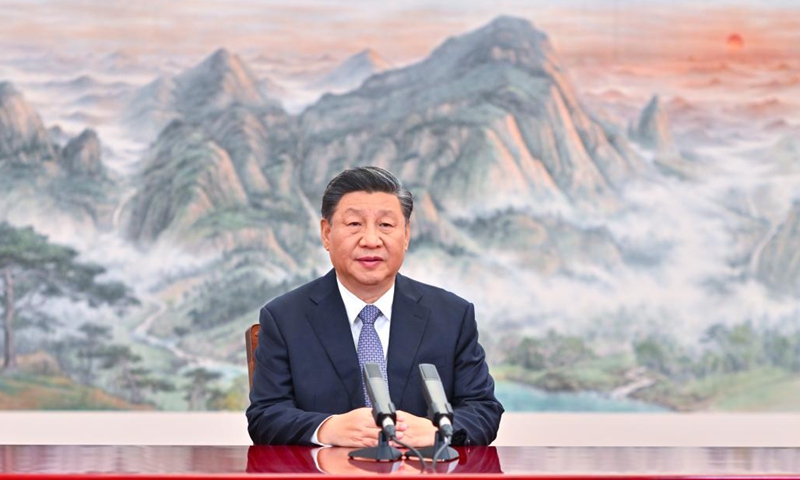
IN FOCUS
By Keerthana Nambiar
President Xi Jinping’s speech at the APEC forum CEO summit
On 11 November, Chinese President Xi Jinping delivered a speech via a pre-recorded video at the Asia-Pacific Economic Cooperation forum’s CEO summit. This year, APEC forum was hosted by New Zealand virtually due to the pandemic. Leaders including Xi and US President Joe Biden attended the summit.
President Xi addressed the leaders of the business community, quoting Asia-Pacific as the “important engine driving the global economy.” Xi talked about pandemic recovery, upholding openness and cooperation, green transition, and promoting innovation. “At this historical juncture, it is important that we in the Asia-Pacific face up to the responsibility of the times, be in the driver’s seat, and strive hard to meet the goal of building an Asia-Pacific community with a shared future,” stated Xi.
In the video, President Xi said, “China has attained the goal of fully building a moderately prosperous society within the set time frame, secured a historic success in eradicating absolute poverty, and embarked on a new journey toward fully building itself into a modern socialist country.” Xi Jinping further detailed China’s efforts in developing Asia-Pacific, boosting ecological conservation, and win-win cooperation for the economic development of the Asia-Pacific.
Highlights:
President Xi made remarks warning against relapsing into the Cold War era. “The Asia-Pacific region cannot and should not relapse into the confrontation and division of the Cold War era," said Xi Jinping. He explains that global developments must not hinder Asia-Pacific’s resilience and must not make “attempts to draw ideological lines or form small circles on geopolitical grounds.” Xi’s remarks were in reference to efforts made by the US with its allies and partners forming groupings such as the QUAD and AUKUS pact. He pointed out that ‘openness’ is necessary for prosperity and progress and combined efforts at “Bogor Goals and the Putrajaya Vision” have created an Asia-Pacific partnership based on mutual trust.
Chinese efforts and contribution in the Asia-Pacific region leading towards the development
Xi declared that “China is committed to building a high-standard market system” which will induce major reforms in the important and key areas and links. Beijing’s participation in the Regional Comprehensive Economic Partnership (RCEP) and Comprehensive and Progressive Agreement for Trans-Pacific Partnership (CPTPP) is expected to transform the agricultural, manufacturing and service sectors. Xi stressed that China treats all businesses equally and works towards developing “a unified, open, competitive and orderly market system.” With China’s Belt and Road Initiative, Beijing plans to accelerate connectivity in the Asia-Pacific and ensure smooth functioning of supply chains in the region.
Working towards fighting the COVID-19 pandemic and promoting green transition
President Xi in his speech said that the Asia-Pacific countries should support each other to fight the pandemic and ramp up the treatment, medicines, and vaccination roll-outs. He pointed out that “fair and equitable distribution, as well as their accessibility and affordability in developing countries” will help close the immunization gap. Xi further discussed the need to make post-pandemic recovery a green transition and deliver the targets made at the Paris Agreements and at the Conference of the Parties to the Convention on Biological Diversity (COP26). Xi confirmed that China is committed to undergoing carbon reduction action for a future of green development.
Xi Jinping stresses the need to actively support innovation and win-win cooperation
President Xi states that the member nations of the Asia-Pacific should cooperate on “scientific and technological innovation, and foster an open, fair, equitable and non-discriminatory environment for the development of science and technology.” Xi promises that China will unwaveringly uphold true multilateralism, follow WTO trading rules and take active participation in an open world economy. He also mentioned the ‘Global Development Initiative’ and indicated that China will assume the central role to promote global development with win-win cooperation.
Xi Jinping concluded his speech with a note that, “Working together, let us all be promoters of and contributors to unity and prosperity of the Asia-Pacific family.”
References:
“Full Text: Keynote speech by Chinese President Xi Jinping at APEC CEO Summit,” Xinhua Net, 13 November 2021
IN BRIEF
By Dincy Adlakha and Avishka Ashok
INTERNAL
Huge demands and low supply leads to record high rare earth prices
On 12 November, Global Times reported that the prices of rare earths in China broke a 10-year high. The market opened at the 85th High-Tech auction by the China Northern Rare Earth Group and within three minutes, the four targets of the market had been achieved at record price. Traditionally, China has quite low prices in the rare earth market. However, experts attribute this rise to the emerging market of industries, tight supplies and the national consolidation of the industries. Due to the dynamics of demand and supply of rare earth companies, the profitability of these firms have gone up. (Yin Yeping, “China's rare earth price exceeds a historic high amid booming demand and tight supplies,” Global Times, 12 November 2021)
CCP officials call President Xi the helmsman of the country
On 12 November, the officials of China’s Communist Party gave President Xi Jinping the name of “helmsman” and “people’s leader” to show their support for his leadership. After the passing of the “historical resolution”, President Xi has consolidated more support and is certain to win the next term as the President of China. The head of the CCP’s research office said: “As long as we uphold Comrade Xi Jinping as the core… the giant vessel of Chinese rejuvenation will have a helmsman and will be able to brave any storms. Xi fully deserves to be called a people’s leader.” (“China’s Communist Party hails President Xi as ‘helmsman’,” The Asahi Shimbun, 12 November)
REGIONAL
Honduran President’s visit to Taiwan as a sign of “Tsai’s diplomatic desperation”
On 12 November, Global Times published an article that called the recent visit of outgoing Honduran president to Taiwan as a sign of Tsai’s diplomatic desperation. The article realised that growing tension across Taiwan Straits has led to the island’s regional leader Tsai Ing-wen to seek more relationships through dollar diplomacy. The article also said that experts see this latest visit by Honduran president as reflective of the sense of crisis in her political party. Honduras is one of the only 15 countries that have maintained diplomatic relations with Taiwan. However, a lead candidate in the upcoming Presidential elections in Honduras promises to cut ties” with the island and head towards mainland China. (Wang Qi, “Visit to Taiwan by outgoing Honduran president a sign of Tsai’s diplomatic desperation: experts,” Global Times, 12 November 2021)
INTERNATIONAL
Australia presents possibility of now joining the US allies in case of action in Taiwan
On 13 November, the Australian Defence Minister Peter Dutton announced that the country will not join hands with the US in the eventuality of a war against Taiwan. On 10 November, the US Secretary of State Antony Blinken revealed that the country and its allies “would take unspecified” action in the eventuality of China using force to take over Taiwan. The statement by Dutton said: “I think we should be very frank and honest about that, look at all of the facts and circumstances without pre-committing, and maybe there are circumstances where we wouldn't take up that option, (but) I can't conceive of those circumstances." (“'Inconceivable' Australia would not join U.S. to defend Taiwan - Australian defence minister,” Reuters, 13 November 2021)
Chinese and Rwandan President celebrate 50th anniversary of diplomatic ties
On 12 November, Chinese President Xi Jinping and Rwandan counterpart Paul Kagame exchanged congratulatory messages to mark the 50th anniversary of diplomatic ties between the two countries. President Xi recalled the sound and steady development of their relations and their strong friendship that has been nurtured in the past 50 years. He also stressed that the two countries have been extremely helpful in guaranteeing the well-being of each other’s citizens, especially during the COVID-19 pandemic. President Kagame said that the common principles upheld by both sides such as mutual respect, solidarity, and mutual help and benefit has strengthened their friendship over the years. China and Rwanda are connected through important projects like FOCAC and BRI. (“Chinese, Rwandan presidents exchange congratulations on 50th anniversary of diplomatic ties,” Xinhua Net, 12 November 2021)
International study finds ancestral link between Chinese and Japanese-Korean-Turkish languages
On 12 November, Global Times reported on a recent scientific study that found origins of Japanese, orean, Turkish, and Mongolian languages in Northeast China’s Liaohe River valley around 9000 years ago. The study was conducted by linguists, archeologists, and geneticists from China, Belgium, Japan, Russia, and South Korea. The ‘transeurasian’ language family shares historical links and is said to emerge from current day Liaoning province in North China. The regions are also said to have a common farming legacy. Scientists say that study proves culture transcends national boundaries. (Wang Qi, “Study says Japanese-Korean-Turkish language group may trace to ancient China, showing culture 'transcends natl boundaries',” Global Times, 12 November 2021)
China Reader Evening Brief | 12 November 2021, Friday | Vol.1, No. 36
Revisiting history at the Sixth plenary session of the 19th CPC Central Committee
President Xi Jinping fortifies his position in China's political history by passing a resolution that places him at par with other Chinese leaders such as Mao Zedong and Deng Xiaoping
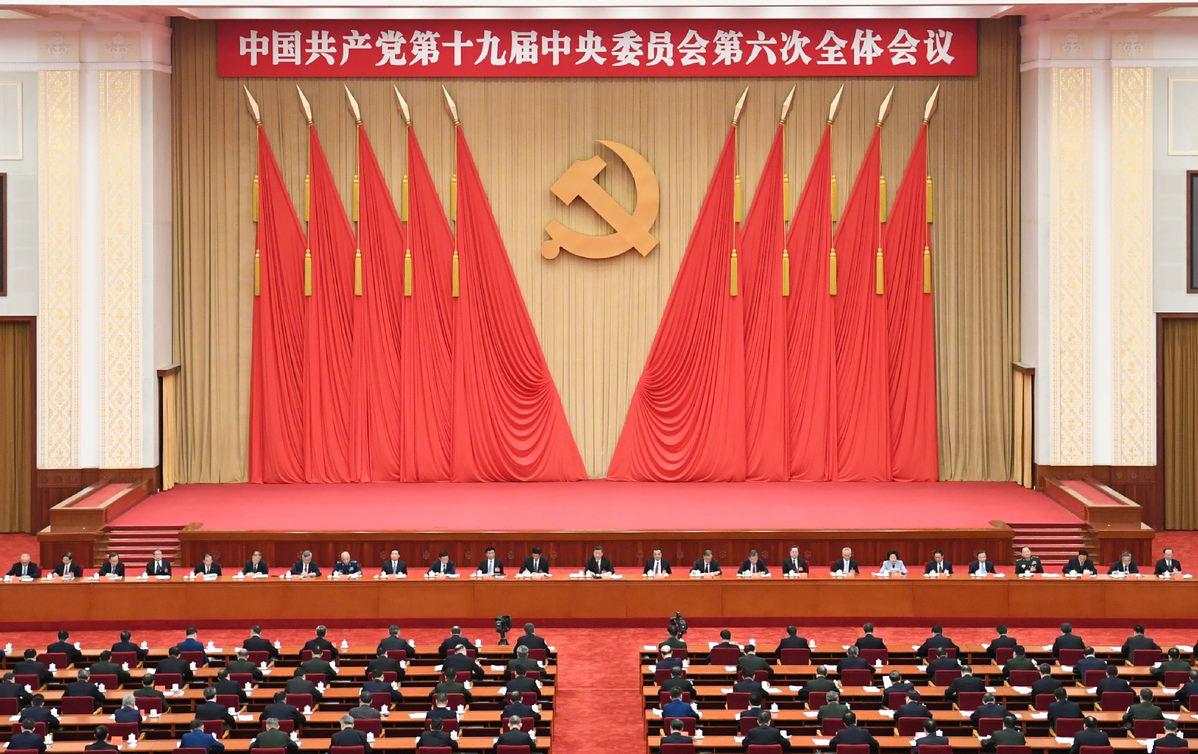
IN FOCUS
By Sukanya Bali
Sixth plenary session of the 19th CPC Central Committee: Looking back at history
On 11 November, the sixth plenary session of the 19th Central Committee of the Communist Party of China concluded in Beijing. During the session Xi Jinping, the General Secretary of the CPC Central Committee presented the work report on behalf of the Political Bureau, which consists of “the major achievement made and the historical experience of the Party over the past century and the resolution on the convocation of the 20th National Congress of the Communist Party of China.”
The Communist party's senior leadership, at the meeting, passed a "historic resolution", affirming Xi's stature in the political history of the country. Xi became the third leader to have issued such a resolution. The resolution elevated Xi's significance to an "era-defining leader", alongside Mao Zedong and Deng Xiaoping, the chief architect of opening up the Chinese economy.
The communique released at the end of the meeting praised Xi's policies since he took control. The New York Times reported: the communique said, “Under Mao, Deng and now Mr. Xi China had achieved the tremendous transformation from standing up and growing prosperous to becoming strong.” The meeting hailed Xi leadership across the spectrum including, economy, foreign policy, cracking down on corruption, and handling of the coronavirus pandemic.
Xi holds three positions- General Secretary of the CPC, Chairman of powerful Central Military Commission (CMC), and Presidency. The announcement at the plenum is an official endorsement of Xi's policies, ahead of the party Congress next year, where he is likely to get another five years as the leader of the Communist party.
The party leaders had praised Xi’s political ideology and "acclaimed him as a transformational leader who has led China into a new epoch." The plenary session also reviewed and passed a resolution on convening the 20th National Congress of the CPC in the second half of 2022 in Beijing. The final communique statement read: “To seek happiness for the Chinese people, to seek rejuvenation of the Chinese nation.”
Role of a Plenum
The plenum brings together the members of the Central Committee of the Chinese Communist party for a four-day meeting. This year's plenum meeting was the sixth time China’s 348 full and alternate members of the 19th Central Committee had gathered. The Central Committee is the largest of the party’s top decision-making bodies.
In the central committee meeting in 1978, China took a path toward market reforms. In 2013, CPC approved the blueprint of Xi Jinping’s economic and social reforms in nearly three decades, relaxing its one-child policy and freeing up the market to put the world's second-largest economy. In 2018, Xi abolished the two-term limit on the state presidency and the only position, which he has held that had a term limit. This gave Xi the autonomy to stay on indefinitely as party leader, president, and a top military leader. The officials highlighted, “the change did not mean Xi would remain in power his entire life, as Mao did.” In 2019 the meeting set in motion Hong Kong’s drastic national security law.
Review of party’s historical experience over the past century
During the session, the party's achievements and historical experiences were reviewed in order to start a new journey “to realize the Chinese Dream of national rejuvenation and build a modern socialist country with Chinese characteristics.” The communique highlighted five key areas; upholding and developing socialism with Chinese characteristics in the new era; strengthening our consciousness of the need to maintain political integrity and keep in alignment with the central Party leadership; enhancing socialism with Chinese characteristics; resolutely upholding Xi leadership to ensure that all Party members act in unison; advancing the Party’s and strengthen its capacity to respond to risks and challenges; uniting and leading the citizen Chinese Dream of national rejuvenation.
Challenges ahead of Xi
As Xi Jinping consolidates his positions at the helm of the CCP, several challenges lay ahead of China. First, Trade disputes with Washington over technological rivalry and military engagements with allies in the Indo-Pacific, have raised strategic concerns in Beijing. Second, Western condemnation of the treatment of the Muslim minority in Xinjiang and the crackdown down on political opponents in Hong Kong. Third, Intermittent border issues with India and the independence of Taiwan cause uncertainties along its borders. Fourth, the slow economic growth rate due to global supply chain disruptions amid zero-tolerance covid policy. The political leadership of Xi Jinping may have to carefully tread over these challenges to realize his Chinese Dream.
References:
“China’s Xi Jinping Remakes the Communist Party’s History in His Image,” The New York Times, 11 November 2021
“19th CPC Central Committee concludes 6th plenary session, releases communique,” CGTN, 11 November 2021
IN BRIEF
By Keerthana Nambiar and Avishka Ashok
INTERNAL
Senior party official stresses studying the plenary session
On 11 November, Huang Kunming, a senior official of the Political Bureau and the head of the Publicity Department pushed the country to take up the study of the sixth plenary session of the 19th CPC Central Committee and encouraged the spirit of the session. He said: “the resolution, a Marxist guiding document, will have a profound impact on promoting the whole Party to unify their thinking, will, and action, as well as achieving the great rejuvenation of the Chinese nation.” (“Senior CPC official stresses publicizing key Party session,” Xinhua Net, 11 November 2021)
Bloomberg reports on shrinking Chinese population due to low number of births
On 11 November, Bloomberg reported that China’s population might be shrinking further with a continued drop in births. He Yafu, an independent Chinese demographer predicted that, “If the number of newborns is near the lower limit of the prediction, that means the population will register negative growth.” On his personal social media account, Mr. He mentioned that there might be around 9.5 million to 10.5 million newborn babies born in 2021. The Chinese government has recently taken effective steps to remove the restrictions on the number of children a couple can have and make it cheaper to raise a child. Bloomberg reported various other reports from the National Health Commission and newspapers indicating the lowest level of birth of newborns in 2021. (“ China’s Population May Already Be Falling as Births Slow Further,” Bloomberg, 11 November 2021)
Hong Kong pro-democracy protester sentenced to jail by the authorities
On 11 November, a Hong Kong man popularly known as “Captain America 2.0” was sentenced to jail for five years and nine months. Ma Chun-man, a 31-year-old food delivery driver who was actively participating in Hong Kong protests promoting Hong Kong’s independence from China was convicted in October 2021. Since the Chinese took over Hong Kong, Beijing imposed national security law in response to the massive pro-democracy protests in Hong Kong. This is the third national security case to trial wherein Hong Kong authorities began wielding the new law silencing any kind of opposition. (“Hong Kong's 'Captain America' protester jailed over slogans,” The Strait Times, 11 November 2021)
INTERNATIONAL
China and Mongolia strengthen bilateral relations and cooperation
On 10 November, the Director-General of the Department of Asian Affairs of China’s Foreign Ministry Liu Jinsong held a meeting with the Mongolian Ambassador to China Tuvshin Badral. At the meeting, the two officials discussed bilateral relations, cooperation on fighting the coronavirus pandemic and issues of mutual interest and international significance. Liu said: "It is expected that China and Mongolia will strengthen cooperation, meet each other halfway, earnestly implement prevention and control measures and resolutely block cross-border spread of the virus." Mongolia also stressed a healthy and positive relationship with China and promised to adhere to conditions to work with China. (“China and Mongolia expect to strengthen cooperation in epidemic prevention and block the cross-border spread of COVID-19,” Global Times, 12 November 2021)
China signs another document on vaccine sharing with Belarus
On 11 November, a new batch of vaccines from China reached Belarus. The two countries signed another document on vaccine cooperation. The Chinese Ambassador to Belarus said: “Since the beginning of the COVID-19 pandemic, China and Belarus have sincerely supported each other, provided each other with medical supplies, and exchanged experience on combating the pandemic.” The two countries have shared a strong bond and have cooperated immensely with each other since the beginning of the pandemic. Belarusian Health Minister claimed to be the first country to extend support at the beginning of the pandemic in China and also received help from China while it went through the waves of the pandemic. (“Belarus receives new batch of Chinese COVID-19 vaccines,” Xinhua Net, 12 November 2021)
China’s Consulate General in Chicago issues notice alerting Chinese students and citizens of safety and security concerns
On 11 November, the Chinese Consulate General in Chicago published a notice on its website urging the US to take “concrete measures” to protect Chinese citizens. This is in line with the recent violent attack and shooting in Chicago wherein a 24-year-old Chinese student was killed. The consulate expressed their condemnation of the killing of innocent people and prompted the US to further investigate and make the details available to the public. The notice comes in with a warning from the Consulate General reminding Chinese students and citizens to remain alert of the security situation and ensuring self-safety. (“Consulate General in Chicago urges US to protect Chinese citizens, slamming violence that killed a Chinese student,” Global Times, 11 November 2021)
Chinese Foreign Ministry spokesperson on the US-China joint statement
On 11 November, Chinese Foreign Ministry spokesperson Wang Wenbin commented on the joint statement issued by the Us and China. According to Global Times, Wang said, “The declaration is the product of candid exchanges, mutual understanding and efforts to expand consensus, which once again showed China and the US can work together on major international issues and accomplish great things that benefit the people of both countries and the world.” He further stressed China’s willingness to work with the US and cooperating on climate change for “win-win cooperation on the global climate system.” (“China-US climate declaration injects confidence in bilateral cooperation under APEC, possibly more interactions in trade, military,” Global Times, 11 November 2021)
China Reader Evening Brief | 11 November 2021, Thursday| Vol.1, No. 35
China’s journey towards carbon neutrality: Six takeaways from recent white paper
Recently, the Central Committee of the Communist Party of China released a white paper that provided an action plan to reach its carbon emissions goals.
.jpeg)
IN FOCUS
By Dincy Adlakha
China’s journey towards carbon neutrality: Six takeaways from recent white paper
The white paper titled, ‘Action Plan for Carbon Dioxide Peaking Before 2030’ begins with an inspiration from Xi Jinping’s Thought on Socialism and on ecological civilization. The paper promotes a systematic thinking and a balance between development and emissions reduction by utilizing nationwide planning, prioritising conservation, and coordinating domestic and international efforts among. Vigorous, effective and orderly work in the six observed areas form the core of the paper.
First, China pledges to shift to green and low-carbon energy.
The paper emphasizes on substituting coal and upgrading the energy sources to switch to low-carbon alternatives. Severe restrictions can be seen as part of the 14th and 15th Five-Year Plan in an attempt to phase-out outdated coal power and replace it with greener energy resources. The paper also stresses that these green energy resources should be utilised tactfully. Hydro power to be accommodated according to local conditions and even developing nuclear energy in a safe and systematic manner. Such a transition will help China in establishing a new electric power system that gives more responsibility to hydropower at provincial-level electrical grids.
Second, The country reiterated support for energy saving and carbon emission mitigation.
The paper emphasizes implementation of energy conservation and carbon reduction projects in urban areas including heating infrastructure projects and green construction technologies. The section also calls for carbon reduction in industrial parks. The paper targets retiring outdated and less efficient equipment.
Third, China stressed the importance of green and low-carbon transportation.
It aims to upgrade old ships and develop new ones that use liquefied natural gas or electric power. Similar strategies will be applied to public service vehicles and railway systems. The paper declared that by 2030, 70 per cent of the transport will be environment friendly.
Fourth, China emphasized technology innovation for green purposes.
The paper gives significant attention to research and development, especially for key technologies to improve innovation mechanisms and systems. Testing, evaluation, and certification systems for technology as well as personnel in national laboratories will be boosted. Application based research to achieve new heights in low-carbon, zero-carbon, and carbon-negative equipment is intensive.
Fifth, China is pushing for increased international cooperation.
The paper reiterates China’s will and capability to contribute its wisdom, approach and strength for a greener world. China vows to uphold multilateralism, a UN-led international system and fulfill its commitments under the UN Framework Convention on Climate Change and the Paris Agreement. China aims to do this by conducting green cooperation on business, technology, and finance. It even hopes to make BRI a green initiative and cooperate in major international scientific projects like the International Thermonuclear Experimental Reactor Project.
Sixth, China is readjusting policy frameworks.
The paper also vows to develop and revise Chinese policies to support ecological goals. This includes developing a unified and standardized accounting of carbon emissions and providing energy consumption caps, energy efficient products, and announcing project construction standards. China will also revisit its economic policies and use green policy for electricity consumption in households as well.
The paper is reflective of the responsibility that CPC carries for climate change and carbon-neutrality. It vows to hold accountable the regions, organisations, and individuals for failing to accomplish the set targets.
References:
“Full Text: Action Plan for Carbon Dioxide Peaking Before 2030,” Xinhua Net, 27 October 2021
IN BRIEF
By Keerthana Nambiar and Avishka Ashok
INTERNAL
Chinese Foreign Minister made remarks on Dalai Lama and Tibet issue
On 10 November, Chinese Foreign Minister Wang Wenbin stated that the “door for talks between the Chinese central government and 14th Dalai Lama is always open.” The Ministry stressed that, “the talk could only be things related to the personal future of the Dalai Lama, rather than the so-called Tibet issue.” Wang further explained the ‘Dalai clique’ should abandon their idea of “splitting the motherland and stop related activities, and take concrete actions to win the trust of the central government and the Chinese people.” (“Talk between central govt and Dalai Lama only limited to his personal future: Chinese FM,” Global Times, 10 November 2021)
REGIONAL
Taiwan’s defense ministry released a report indicating China’s increasing cyber warfare targeting Taipei
On 10 November, Taiwan’s cyber security department director Chien Hung-wei declared that Taiwan’s government network faces “five million attacks and scans a day” from China. He said, “We are strengthening the government's defensive measures and collecting relevant data for analysis in a bid to stop the attacks when they are initiated.” On 9 November, Taiwan’s defence ministry released a report warning that China has been continuously increasing cyber-warfare to bring Taipei under the People’s Republic of China. (“Taiwan government faces 5 million cyber attacks daily: Official,” The Strait Times, 10 November 2021)
Taiwan Affairs Office pushes for peaceful reunification
On 10 November, Global Times reported that China’s Taiwan Affairs Office responded to the US officials' visit to Taiwan. The spokesperson of the Office Zhu Fenglian refuted possibilities of a potential war in the Taiwan Strait and expressed the Chinese government’s willingness to work towards a peaceful and nonviolent reunification of Taiwan with mainland China. She said: “We firmly oppose any form of official and military contacts between the US and China's Taiwan region. We urge some US congressmen to abide by the one-China principle and relevant provisions of the three China-US joint communiqués, and refrain from sending wrong signals to Taiwan secessionists, which will only further damage peace and stability across the Taiwan Straits.” However, the government will not allow the secessionist activists to carry forward their efforts. (“Mainland to strive for peaceful reunification with sincerity, but leaves no room for secessionist activities: Taiwan Affairs Office,” Global Times, 10 November 2021)
Chinese Foreign Ministry warns the US from encouraging Taiwan independence movements
On 10 November, the Chinese Foreign Ministry spokesperson Wang Wenbin attended a press conference and urged the US government to stop encouraging the Taiwanese independence activists by visiting the island and meeting with the officials there. The sudden visit by the US lawmakers was condemned by the Taiwan Affairs Office for spreading false hope amongst the Taiwanese sessionist activists. Political analysts and experts believe that such actions by the US may lead to a faster reunification of Taiwan with the mainland. (“Mainland reacts strongly to US lawmakers’ Taiwan visit; Provocative moves may speed up reunification process: expert,” Global Times, 11 November 2021)
Japan’s new Foreign Minister advocates Japan- China ties as important
On 11 November, the new Japanese Foreign Minister Yoshimasa Hayashi said, “Ties between Japan and China are increasingly important not just for our two countries, but for the peace and prosperity of the region and the international community.” In his first news conference as Foreign Minister Hayashi stressed the importance of a stable relationship with China. He further added, “We need to assert and ask for responsible behavior while at the same time, maintain dialogue and firmly cooperate on shared challenges.” (“Japan seeks good China ties, "responsible behaviour" - new minister,” Reuters, 11 November 2021)
President Xi addresses the CEO forum on the APEC summit via video message
On 11 November, President Xi Jinping addressed the CEO Forum on the sidelines of the Asia-pacific Economic Cooperation (APEC) summit hosted by New Zealand via recorded video message. During the message, President Xi expressed his opinion that the “Asia-Pacific region must not return to the tensions of the Cold War era.” According to Reuters, Xi’s remarks were a reference to the US with its allies and partners increasing activities in the region to counter China’s growing assertiveness in the Asia-Pacific region. Xi Jinping pledged to rejuvenate economic reforms to join the Pacific Rim trade pact. Xi further said Beijing “will promote all-round opening-up of its agricultural and manufacturing sectors” and will further continue to expand the opening of China and treat domestic and foreign businesses equally. (“China's Xi warns against return to Cold War tensions at APEC meeting,” Reuters, 11 November 2021: “Xi Jinping, speaking at APEC, pledges market reforms in bid to join Asia-Pacific trade bloc,” South China Morning Post, 11 November 2021)
Foreign Ministry urges Japan to comply with China’s security concerns
On 11 November, the Director General of the Chinese Ministry of Foreign Affairs’ Department of Borders and Ocean Affairs held a virtual meeting with the Japanese Foreign Ministry’s Head of the Office of Asian and Oceania Affairs Takehiro Funakoshi. The Chinese side urged the Funakoshi to strictly consider the sovereignty and security concerns of China and avoid taking unilateral actions in the South China Sea. The remarks were related to the issue of possession of the Diaoyu or Senkaku islands. The officials agreed to follow the four-point principled consensus, fortify communication and consultation on maritime issues and effectively handle differences between the two countries. (“China urged Japan to avoid actions that could complicate Diaoyu Islands and East China Sea issues, Global Times, 11 November 2021)
INTERNATIONAL
China attends meeting on Afghanistan hosted by Pakistan
On 10 November, Global Times reported that a Chinese representative would participate in the meeting on Afghanistan hosted by Pakistan. Representatives from the US and Russia will also attend the meeting. From the People’s Republic of China, the Special Envoy for Afghan Affairs Yue Xiaoyong will be representing the country and its perspectives on the Afghan plight. The meeting aims to discuss the need for creating an inclusive government in Afghanistan to ensure stability in the political arena and prevent terrorist outfits from settling in the country. China and Pakistan could not attend the meeting hosted by India on the same issue due scheduling issues. (“China to join Pakistan-hosted meeting on Afghanistan, skips India’s parallel conference,” Global Times, 10 November 2021)
China Reader Evening Brief | 10 November 2021, Wednesday | Vol.1, No. 34
Cryptocurrency in China: a transitory story
Multiple Chinese firms dealing in cryptocurrency shift base outside the country. A strong ban on cryptocurrency usage has brought down China’s Bitcoin energy usage drastically. Meanwhile, digital yuan prepares to take off.
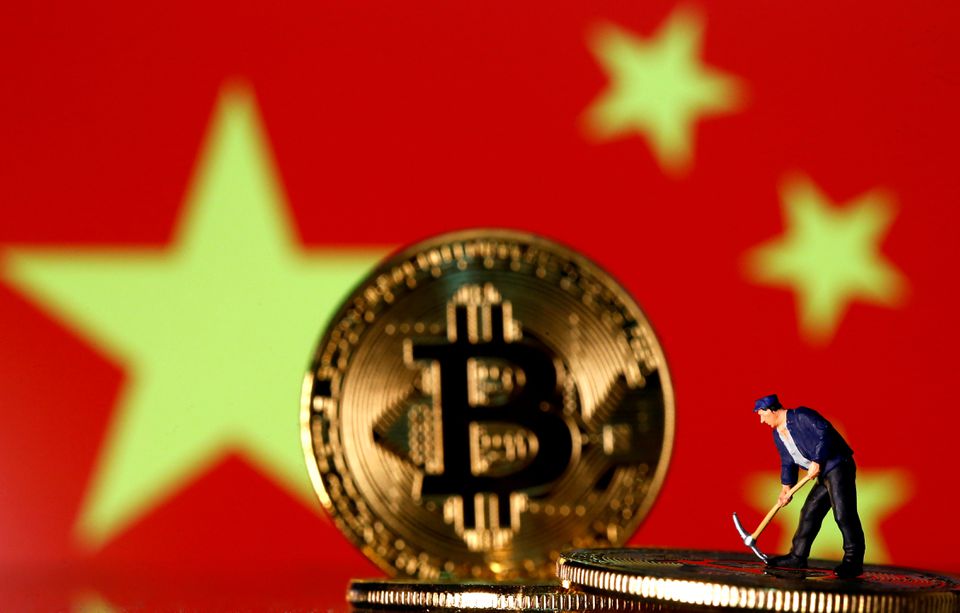
IN FOCUS
By Dincy Adlakha
Cryptocurrency in China: a transitory story
Recent developments
On 8 November, Huobi Group which is a leading cryptocurrency trending company in China moved its operations to Gibraltar. Huobi is not the first cryptocurrency trading firm in China that has shifted its centres to a foreign destination. The co-founder of the group said in a statement: “the cryptocurrency industry is constantly growing, and the company needs to align its business in accordance with the challenges that appear in its way.” He also emphasized that ever since the group lost Chinese consumers due to the cryptocurrency ban in China, it needed to “go global” to make up for the gap.
On 3 November, Reuters reported that approximately 140 million people had opened “wallets” for the new digital yuan system which is expected to be launched soon. These e-wallets have already seen USD 9.7 billion worth transactions.
Status of cryptocurrency in China
Traditionally, China has been one of the biggest markets for cryptocurrency in the world. Due to its comparatively lower energy prices, a major sector of cryptocurrency mining and trading took place in China earlier. However, in 2019 China officially banned cryptocurrency trading in the country. It continued only through foreign trading channels. As a result, China’s account for world energy consumption for bitcoin fell from 75 per cent in September 2019 to 46 per cent in April 2021.
Furthermore, three state owned financial and payment association bodies in China laid down guidelines in May 2021 to reiterate the ban on cryptocurrency and urged people to not invest in crypto industry due to the speculative nature of the activity. They also said that they will not bear any protections for individuals who continue to trade currencies online. In June, the central bank in China called on other banks and payment institutions to stop providing the services of cryptocurrency like opening accounts, transactions, settlements, and the like. In September, the Chinese authorities issued two notices aiming to eliminate cryptocurrency mining from the country.
The state concern against cryptocurrency
Governments across the globe are seeking to develop their national digital currencies to modernise the financial system and also protect the economy from competitive and volatile cryptocurrencies like Bitcoin. China’s efforts are the most advanced in this regard. Beijing has manifold concerns with cryptocurrency.
The first is to protect its economy from volatility and speculative trading leading to risks. Citizens converting their savings to crypto assets only to be hit with ransomware and digital attacks worries the government.
Secondly, China is also sceptical of a foreign currency with no stable owner affecting and controlling its domestic payment system. China cracked down on Ant Financial and other tech giants that attempted to dominate the domestic retail payments. Central bank money cannot be replaced as the primary tender for Beijing.
Third, the risk of avoiding cross-border financial flow regulations. Cryptocurrency can be used to evade restrictions and standard procedures for cross-border financial transactions. This will make it difficult for the government to manage the exchange rate.
Fourth, China’s emission reduction targets. Cryptocurrency is an energy-intensive industry as the mining of these digital coins takes place through powerful computers and networks. As the country aims to reduce its emissions and faces an energy crunch, it realizes that the industry is a major eater of its valuable energy.
Future of the industry in China
In the near future, many cryptocurrency firms can be seen shifting their operations to foreign havens that provide legislative oversight to such companies. El Salvador, Gibraltar, Estonia, Singapore, Frankfurt are some of the places that have received most of these shifting firms.
Additionally, China is set to launch its digital currency or eCNY. A push for this by the state and a larger usage of digital yuan is projected by Beijing through its current experiments.
References
“China crypto ban slashes revenues and spurs Huobi to ‘go global’ ,” Financial Times, 8 November 2021
“China Crypto Giant Moves Spot Trading Operations to Gibraltar,” Bloomberg, 8 November 2021
“$9.5 billion spent using Chinese central bank's digital currency – official,” Reuters, 3 November 2021
Eshwar Prasad, “China Has Good Reason to Fear Bitcoin,” Barron’s, 15 October 2021
“China declares all crypto-currency transactions illegal,” BBC, 24 September
IN BRIEF
By Keerthana Nambiar and Avishka Ashok
INTERNAL
The People’s Liberation Army prepares its forces at the India-China border for the cold winter
On 9 November 2021, Global Times reported that the Chinese military had upgraded its facilities at the India-China border in antici[ation of the harsh winter. The facilities were upgraded and several new measures were added to improve the living and working condition of the soldiers at the border. The report noted that China had an advantage over India in terms of providing high quality logistics to its Army. However, the report followed that the measure were undertaken only as a precaution and did not mean that there would be any large-scale skirmishes on the fragile border. (“PLA at China-India border has upgraded logistics to brave winter,” Global Times, 9 November 2021)
Premier signs decree on conservation and preservation of groundwater
On 9 November, Xinhua Net reported that the Chinese Premier Li Keqiang had signed a decree on the the management of groundwater. The new regulation which creates strict norms in the field of survey and planning, conservation and protection, over-exploitation treatment, pollution and control, and supervision and management will be implemented from 1 December. The new regulation mandates the authorities to regularly survey and monitor the quality and condition of the groundwater in all its locations. (“China unveils regulation on groundwater management,” Xinhua Net, 9 Novemeber 2021)
Northeast China faces record snowfall since 1905 due to blizzard
On 9 November, Xinhua Net reported that Northeast China saw the biggest snowfall since 1905 due to a lingering blizzard that has been affecting the weather conditions in the region since 7 November. The average snowfall in Shenyang city reached 51 mm. The weather department of the country also issued an alert in the Liaoning province after the snowstorms affected the roads and traffic. (“Blizzard brings record snowfall in NE China,” Xinhua Net, 9 November 2021)
Communist Party and State Council release circular to fight pollution and ecological degradation
On 9 November, Xinhua Net published a report on the circular issued by the Communist Part and the State Council on0 protecting and conserving the environment. The curcular showed China’s efforts in combating pollution and highlighted its major targets that aim to reduce the carbon emissions. The circular said: “"By 2025, carbon dioxide emissions per unit of the country's GDP will be reduced by 18 percent from the level in 2020." The circular further demanded cities having intensity of PM 2.5 pollutants to reduce its levels by 10 percent. (“China Focus: China doubles down on pollution fight with in-depth efforts,” Xinhua Net, 9 Novemnber 2021)
REGIONAL
China commits to make the South China Sea “a sea of peace, friendship, and cooperation”
On 9 November, Chinese State Councilor and Foreign Minister Wang Yi addressed the Symposium on Global Maritime Cooperation and Ocean Governance 2021 via a video link. Wang said, “We should jointly promote maritime connectivity and free trade to maintain the stability of maritime transport and industrial chains, and we should develop and utilize marine resources in an orderly manner and work together to address global challenges such as global warming and sea-level rises.” He further stated the importance of multilateralism, maritime connectivity, and free trade. China claims to be committed to expanding maritime cooperation, protecting the global maritime supply chains and tackling climate change to make the South China Sea into “a sea of peace, friendship, and cooperation.” (“China committed to maritime cooperation, tackling climate change in South China Sea amid US’ coercion of ASEAN,” Global Times, 9 November 2021)
Hong Kong pro-democracy activist denies participation in the Tiananmen Massacre
On 9 November, a Hong Kong pro-democracy activist Gwyneth Ho, who was accused of participation in the banned Tiananmen Massacre vigil denied the claims. Ho was acknowledged being in the park of the candlelight vigil claims that she was present in the park to show resistance to the police prohibition of the event rather than mourning the victims. Ho who is the vice-chairperson of the now-defunct Hong Kong Alliance was one of the many who were trialed for participating in the banned vigil in 2020. (“Hong Kong activist denies partaking in Tiananmen Massacre vigil, says she attended park to protest police ban,” Hong Kong Free Press, 10 November 2021)
INTERNATIONAL
China calls on US to promote global infrastructure cooperation
On 9 November, China’s Foreign Ministry Spokesperson Wang Wenbin made comments on the US administration’s plan to launch a global infrastructure program. US President Biden’s infrastructure plan is widely seen as a program intended to counter China’s Belt and Road Initiative. Wenbin remarked that “China believes there is wide room for global infrastructure cooperation and various initiatives don't have to counter or replace each other.” He further stated that countries should work with each other for win-win results rather than functioning in isolation urging the US to take “concrete actions” for global development.(“China urges U.S. to promote common world development with concrete actions,” Xinhua Net, 9 November 2021)
US delegation visits Taiwan to provide ‘administrative assistance’
On 9 November, a delegation of the US Congress members arrived in Taipei announced via US Navy aircraft. Taiwan’s Ministry of Foreign Affairs (MOFA) issued a statement responding to the questions raised by the media, whether the plane carried US lawmakers. The ministry reverted cryptically stating that the US delegation was in Taiwan for providing ‘administrative assistance’ on the epidemic prevention measures. Presidential Office Spokesperson Xavier Chang quoted that the visit was based, on the “mutual trust and coordination between Taiwan and the U.S.” (“Jet carrying US senators, congressmen makes surprise visit to Taiwan,” Taiwan News, 9 November 2021)
China Reader Evening Brief | 09 November 2021, Tuesday | Vol.1, No. 33
China's dooming ‘characteristic town’ project
China’s initiative of “characteristic town” are fated to be eliminated if not meeting certain criteria as it poses serious threat to China’s economy
IN FOCUS
By Keerthana Nambiar
China’s dooming ‘characteristic town’ project
Recent Developments
On 6 November, South China Morning Post published an editorial on China’s ‘characteristics towns’ and its crackdown. In October, the National Development and Reform Commission made an announcement that the “characteristic towns” will be assessed. And they will be closed down if they do not meet certain criteria like proper usage of the land, preservation of the ecological environment, associated debt, necessity, and safety. The announcement stated, “excluding the existing traditional housing, residential land cannot take up more than 30 percent of a characteristic town, and is encouraged to be less than 25 percent.”
The idea of “characteristic town”
China’s characteristic towns are innovative and entrepreneurial platforms a combination of different lifestyles and eco spaces. They offer space for production, developing industries, culture, tourism, and community. The initiative was developed in 2017 as a part of China’s urbanization push. The idea of these towns was that they would become the engine for emerging industries leading to integrated urban-rural development. Along with this, the “characteristic town” with historical features was meant to preserve the traditional culture thus presenting a newly popular tourist destination.
The crackdown
The characteristic town was meant to be a vital part of the Chinese development program which turned into a total failure. The poor planning of these towns is one of the main issues for the initiative to become unsuccessful. Currently, the towns have been halfway abandoned through construction either due to lack of funding, or bankruptcy due to lack of visitors. Initially, the real estate companies jumped into the idea of investment to develop the towns, eventually, these companies pulled out of the project estimating the failure.
According to Zhou Mingqi, the founder of tourism consultancy Jingjian Consulting, “these tourism-related real estate projects are normally based in rural areas and developed on a large scale, but sales are hard to come by due to a limited number of potential buyers.” The mismanagement and deficiency of forming a complete industrial chain have now led to Beijing eliminating the towns after assessment.
China’s debt reduction plan
The characteristic towns without attracting any businesses created a significant debt hole. Beijing has now stepped up its scrutiny in the local government’s money expenditure warning them to avoid investing in unviable projects. According to the public data, since 2015, land sales and real estate taxes have been increasing and reached a peak of 37.6 percent in 2020. With the recent real estate and energy crisis in the fourth fiscal quarter in 2021, China needs to expand the supply of public services without increasing debts.
References
“China cracks down on ‘characteristic towns’ that misused land, real estate while racking up massive debt,” South China Morning Post, 6 November 2021
“China endeavors to build characteristic towns,” People’s Daily, 28 July 2020
IN BRIEF
By Dincy Adlakha and Avishka Ashok
INTERNAL
Economic planner announces uptake in coal production and availability
On 8 November, the National Development and Reform Commission (NDRC) which is also the economic planner for China announced that the coal output of the country had substantially improved since mid-October. The output had even reached a record of 11.93 million tonnes which is the highest in the past few years. Chinese power producers also reported the rebound in the coal stockpiles. At the moment, there are 117 million tonnes of coal in the Chinese inventories which can easily sustain power generators and heating mechanisms for the upcoming winter. The NDRC also revealed that the increase in output and availability of coal will help in bringing the costs down. (China's energy crunch eases amid all-out efforts to boost supply, Xinhua Net, 8 November 2021)
Scholars and experts refute claims of forced labour in Xinjiang
On 8 November, Xinhua Net reported that 12 experts and scholars from the Xinjiang region participated in a symposium held in Urumqi and rejected international accusations of forced labour in the region. A professor from Xinjiang University said: “company employees, regardless of their ethnic groups, race, gender or religious belief, have labor contracts with employers and receive remuneration on the basis of equality, free will and consensus through consultation in accordance with China's laws and regulations.” The symposium accused the western countries of publishing lies about the region’s progress and prosperity. The participants raised fingers at the US for not signing important documents to safeguard the rights of the labourers in the country. (“Xinjiang experts, scholars reject "forced labor" lies, Xinhua Net, 8 November 2021)
China announces Wuhan as venue to host upcoming COP14
On 8 November, the National Forestry and Grasslands Administration announced that China will be hosting the 14th Conference of the Contracting Parties to the Ramsar Convention on Wetlands (COP14) in Wuhan from 21 November to 29 November 2021. The convention is an international treaty that proposes a platform for countries to work towards the conservation of wetlands at a global and national level. As of now, there are 172 members in the conventions who meet once in every three years to decide, invent and implement new tactics to protect the wetlands. (“Wuhan to host 14th COP meeting on wetland conservation, use,” China Internet Information Centre, 9 November 2021)
TECHNOLOGY
Satellite images show US warship mock-ups in Xinjiang desert
On 8 November, satellite images from Maxar Technologies based in Colorado showed outlines of US aircraft carriers and a destroyer in a desert county in Xinjiang. Many reports speculated this to signify practice for a future clash. The images of warships laid out were identified by Maxar Technologies as being situated in Ruoqiang which is a Taklamakan desert county in China. The independent US Naval Institute (USNI) said that these outlined warships were part of a new target range developed by the People’s Liberation Army. However, in a daily briefing, when Wang Wenbin, spokesperson for the Foreign Ministry of China was asked of the same, he conveyed he had no information of the images and said: “I’m not aware of the situation you mentioned.” (“Satellite images show China has built mock-ups of US warships,” The Guardian, 8 November 2021)
INTERNATIONAL
Pakistan Navy receives large and advanced warship from China
On 8 November, the China State SHipbuilding Corporation Limited (CSSC) announced in a statement that China has delivered the largest and most advanced warship (that China has ever exported) to Pakistan in a commissioning ceremony in Shanghai. According to a Global Times report, the move suggests friendship and strategic cooperative partnership between the two countries. The ship is named PNS Tughril and is the first of the four Type 054 frigates that China is constructing for the Pakistan Navy. The ship is capable of combat management, electronic warfare and modern self-defense capabilities for multi-threat environments. The Pakistani Ambassador to China and the Chief of Pakistan Navy saw the development as a new chapter in China-Pakistan friendship. (Liu Xuanzun, “China delivers largest, most advanced warship to Pakistan,” Global Times, 8 November 2021)
Jailed Wuhan journalist gets nominated for RSF award as US urges freedom
On 8 November, the Chinese journalist Zhang Zhan was nominated for a press freedom award for courage given out by Reporters Without Borders (RSF). The prize is one of the three awards by RSF and claims to uphold her fearless work. She was convicted in December for “picking quarrels and causing trouble” as her early reporting of COVID-19 in Wuhan became publicised. She has been sentenced to four years jail and is in detention since May 2020. Us, in the meanwhile, has urged Beijing to free the journalist as reports of her losing tremendous amounts of weight and being force-fed through a feeding tube surface. ‘The United States is deeply concerned about the deteriorating health of PRC citizen journalist Ms Zhang Zhan,’ said US State Department spokesperson Ned Price. (Helen Davidson, “Jailed Wuhan journalist Zhang Zhan nominated for RSF press freedom award,” The Guardian, 8 November 2021; Own Churchill, “US urges Beijing to release jailed citizen journalist Zhang Zhan,” South China Morning Post, 9 November 2021)
Barack Obama criticizes China, Russia for slow-paced actions for climate
On 8 November, Barack Obama expressed his views at the UN climate talks and held confidence in the Biden administration to achieve its USD 555 billion climate package. He further criticized Russia and China for their “dangerous lack of urgency” in working for climate. While stressing the hopelessness cannot be afforded, he commented that a trust gap has emerged between rich and poor nations on climate change. He said: "It was particularly discouraging to see the leaders of two of the world's largest emitters, China and Russia, decline to even attend the proceedings, and their national plans reflect what appears to be a dangerous lack of urgency.” (“Obama hits out at Russia, China for 'lack of urgency' on climate,” New Zealand Herald, 9 November 2021)
Chinese media cautions country against possible softening on US policy towards China
On 8 November, Global Times commented on the remarks made by the US National Security Adviser Jake Sullivan to CNN. According to Sullivan, the US was not inclined to bringing about fundamental changes to the Chinese system of politics and governance. The Chinese media perceived this statement as an evidence to the softening of the US stance towards China but cautioned the country to remain vigilant to the often changing perspective of the US. ("Sullivan's remarks suggest softer tone on US-China ties, but 'words alone are not enough'," Global Times, 8 November 2021)
China Reader Evening Brief | 08 November 2021, Monday | Vol.1, No. 32
China’s struggle against cyber-attacks originating in South Asia
The Global Times accused the Indian government of aiding India-based hacker groups in attacking Chinese state-run institutions and organizations.

IN FOCUS
By Avishka Ashok
China’s struggle against cyber-attacks originating in South Asia
Recent developments
On 5 November, Global Times reported that multiple cyber-attacks in the country had been traced back to India. On 2 November, another report published by Global Times reported that in the previous two years, the number of cyber-attacks from India rose exponentially. In an interview with 360 Security Technology, the tech giant revealed that multiple hackers from India were targeting multiple sectors in China and also individual businesses through their cyber-attacks. The report also accused the Indian government and its intelligence of supporting Advanced Persistent Threat (APT) groups consisting of hackers. According to the Chinese media and tech giants, these groups target important governmental infrastructure projects and other institutional departments. Anity Labs from China said: “Since March, we have detected several phishing activities targeting government, defense and military units, as well as state-owned enterprises in China, Pakistan, and Nepal.”
Statistics provided by Global Times
According to the data collected by 360 Security Technology, approximately 100 payloads were captured by the company for involvement in fraudulent activities in the last year. A majority of these cases originated from India. In 2021, the APTs have been enthusiastically attacking educational institutions, government departments, aerospace industries, and the Chinese national defense and military sectors as all sections have switched to the virtual mode of functioning after the advent of the coronavirus pandemic. The report also accused India of targeting institutions and organizations associated with the government in Pakistan and Nepal. Although the government was able to catch a number of the attacks before it took place, many APTs regrouped during the space launches this year to attack the aerospace sector. Although these accusations have been made by the Chinese tech giants and are being propagated by the Chinese media, the reports fail to prove the involvement of the Indian government in the fraudulent cyber-attacks.
State response to the cyber threats
In order to protect the data and the integrity of the Chinese companies and individual users, the state is taking concrete steps by bringing changes to its laws dealing with cyberspace. During the 31st session of the 13th National People’s Congress Standing Committee the state earnestly attempted to reform the laws related to cyber security in order to get a better hold of the numerous cyber frauds. China. According to the new amendment, Chinese internet regulators must be able to track anonymous users to their real identities and also have a restriction on the sharing of user data with foreign entities.
The People’s Republic of China understands the possibilities of weaponizing cyberspace and the consequences of losing out on data to foreign countries. Acknowledging the likelihood of the next war being held in a virtual space, the country is taking all steps to solidify its cyber security and protecting its people from unlawful theft of data that may harm their identities and cause complications to China’s economic and political development.
References:
“GT investigates: Hacking China's medical institutes at COVID-19 outbreak, targeting aerospace firms during China's space missions – Cyberattacks from India disclosed,” Global Times, 5 November 2021
“Exclusive: Hacking from India rose in past 2 years, targeted China's medical industry using forged physical examination forms at the beginning of epidemic,” Global Politics, 2 November 2021
“China’s Big Tech platforms face more responsibility in ‘cyberspace civilisation’ push that seeks more online control,” South China Morning Post, 17 September 2021
IN BRIEF
By Dincy Adlakha and Avishka Ashok
INTERNAL
Cold wave alarms ring through China as winter seeps in
On 7 November, China’s National Meteorological Centre issued the first snowstorm orange alert of the season. This is the second highest level warning for snowstorms. The weather agency forecasted blizzards in northeastern China. Nationwide, cold snaps have been felt and the capital Beijing received its first snowfall 23 days earlier than usual. The weather agency warned against traffic disruptions and flu outbreaks due to snowing in the country. Piling up of snow due to COVID-19 lockdowns and the increased chances of flu outbreaks amid rising COVID-19 cases has concerned local bodies. (“China issues winter's first snowstorm orange alert, cold snap sweeps country,” Reuters, 7 November 2021)
Xinhua profiles President Xi Jinping as great leader ahead of CPC meeting
On 6 November, Xinhua Net, China’s state news agency, praised President Xi Jinping to be tireless, selfless and scholarly servant of the people before an important Communist Party of China meeting. Xi is "a man of determination and action, a man of profound thoughts and feelings, a man who inherited a legacy and dares to innovate, and a man who has forward-looking vision and is committed to working tirelessly," Xinhua said. The meeting is to take place on Monday with more than 300 members and many experts suspect this to be a key meeting for securing Xi into an unprecedented third term as president. The meeting is also expected to pass a “historical resolution” on the important achievements of the Party’s 100 years of struggle. (“Profile: Xi Jinping, the man who leads CPC on new journey,” Xinhua Net, 6 November 20021; “China's Xinhua lauds Xi ahead of key Communist Party meeting,” Reuters, 6 November 2021)
China reports new 50 COVID-19 cases in nine provinces
On 7 November, China reported 50 new COVID-19 cases across nine provinces indicating one of the country’s biggest outbreaks in 2021. The Chinese authorities are “ring-facing” Beijing to prevent the spillover before the Beijing Winter Olympics 2022. The outbreak is fuelled by the highly infectious Delta variant and its mutants reaching 20 mainland provinces across China. (“China’s latest Covid-19 outbreak continues with 50 new cases,” South China Morning Post, 7 November 2021: “China reports 74 new Covid-19 cases as outbreak continues to grow,” The Strait Times, 7 November 2021)
China kicks off the sixth plenary session under CPC Central Committee
On 8 November, the sixth plenary session of the 19th Central Committee of the Communist Party of China began wherein President Xi Jinping delivered a report on behalf of the Political Bureau of the CPC Central Committee. The document looks at the major events in 2021 as the Party celebrates the 100-year history and further reinforcing unity among the party members with Xi Jinping at its core leadership. In the speech, Xi said “Looking back on the Party’s 100-year history, we can see why we were successful in the past and how we can continue to succeed in the future. This will ensure that we act with greater resolve and purpose in staying true to our founding mission and pursuing a better future on the new journey that lies before us.” (“19th CPC Central Committee kicks off sixth plenary session, to table landmark resolution,” Global Times, 8 November 2021)
TECHNOLOGY
Shenzhou-13 module taikonauts successfully complete first spacewalk
On 7 November, China Manned Space Agency announced that taikonauts from the Tianhe module successfully completed their first spacewalk which lasted about six-and-a-half hours. The two Shenzhou-13 members conducted the first spacewalk of the mission and third of the country. According to CMSA, the spacewalk further verified the performance of the spacesuit with robotic arm and supporting equipment built indigenously in China. This spacewalk also makes Wang Yaping the first woman in the country to walk in space, registering a historic moment. (Deng Xiaoci, Fan Wei and Huang Lanian, “Update: Shenzhou-13 crew delivers first spacewalk; Wang Yaping becomes first Chinese woman to walk in space,” Global Times, 7 November 2021)
ECONOMY
October exports and trade surplus remain strong for China
On 7 November, China’s customs agency said that the exports of the country were up 27.1 per cent from a year ago, totalling to USD 300.2 billion. The agency also said that imports also rose by 20.6 per cent from the previous year. Although the numbers are a bit lower than for the previous month, September, they are still healthy. China’s economic growth has slowed since the pandemic however, the numbers have suggested some positive escalation. An increased trade surplus is also good news for the recovering economy which is currently facing COVID-19 lockdown again and lost production capacities due to power shortage. (“China's exports stay strong, trade surplus tops $80 billion,” The Asahi Shimbun, 7 November 2021)
REGIONAL
PLA sends 16 fighter jets to Taiwan’s ADIZ
On 7 November, Taiwan’s Ministry of National Defence reported that the People’s Liberation Army sent 16 aircraft into Taiwan’s air defence zone on 6 November. The Ministry confirmed 16 PLA aircraft – 10 J – 16 fighter jets and six j-10 fighters – entered Taiwan’s ADIZ. Taipei’s air force issued radio warnings and activated its air defence missile systems to monitor the interventions. According to the ministry, the PLA has intervened with warplane sorties into Taiwan’s ADIZ since October. (“Beijing sends 16 fighter jets towards Taiwan,” South China Morning Post, 7 November 2021)
INTERNATIONAL
Russian deputy envoy makes a statement on the AUKUS pact
On 7 November, Global Times reported that Russia has supported Beijing’s concerns on the AUKUS pact. In the recent UN General Assembly First Committee, the Russian Deputy Permanent to the UN Office Andrei Belousov who represented Moscow said, “that they are legitimate concerns as this kind of cooperation is related to the nuclear field and clearly has a military dimension.” According to TASS Belousov stated, “One needs to get full information on the matter to draw conclusions and raise questions about the initiative's possible impact on security and nuclear non-proliferation and figure out if the partnership is in line with the obligations that its members have under various international agreements.”(“Russian deputy UN envoy supports China’s concern on AUKUS’ nuclear threat,” Global Times, 7 November 2021)
China Reader Evening Brief | 06 November 2021, Saturday | Vol.1, No. 31
China’s Lunar Pursuit
A brief look into China's previous an upcoming Lunar missions reveals the country's rapid development and scientific advancements in the sector.
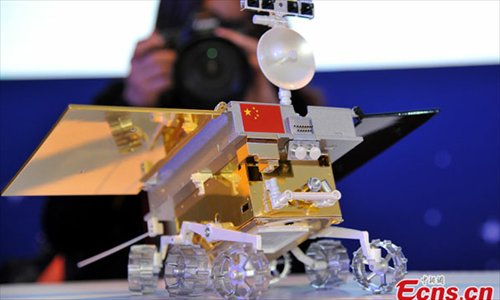
IN FOCUS
By Harini Madhusudan
China’s Lunar Pursuit
Named after the Chinese moon goddess, Chang’e or the Chinese Lunar Exploration Programme is the ongoing robotic missions to the Moon headed by the China National Space Administration (CNSA). This programme has progressed through four main operational phases. The style of China’s missions ensures that each mission becomes a technology demonstration preparing for future projects.
Phase I
In phase one, they launched two lunar orbiters Chang’e 1 and Chang’e 2 which are now effectively complete. In 2007, Chang’e 1 flew to the moon in 12 days, with an aim to scan the entire moon in detail and generate a 3D map for reference of future soft landings. In 2010, Chang’e 2 reached the moon in five days and mapped the moon in greater detail. Chang’e 2 also went beyond the lunar orbit towards the Lagrangian point and completed a flyby of asteroid 4179 Toutatis. Orbital missions were the focus of phase one.
Phase II and III
Phase two focused on soft landers and rovers, Chang’e 3 and Chang’e 4 were built with an aim to incorporate spacecraft capable of soft-landing on the moon and deploying lunar rovers. In 2013, Chang’e 3 carried a lunar rover named Yutu for a 3-month mission to conduct ultra-violet observations. In 2018, Chang’e 4 was launched and it landed on the South Pole-Aitken Basin or the far side of the moon. It deployed a rover called Yutu-2. The next phase was to bring back samples from the moon. With this aim, the third phase launched two missions. In 2014, Chang’e 5-T1 was launched to test a lunar spacecraft capable of a return flight. In 2020, Chang’e 5 was launched and landed near Mons Rumker on the moon. The mission collected two kilograms of lunar soil and returned to earth.
Phase IV
Phase four includes the missions that the Chinese Lunar Exploration Programme is currently working on. Chang’e 6 is planned for 2024 and is expected to bring some more samples to earth while investigating the topography, subsurface structure of the South Pole Aitken Basin, and its composition. Chang’e 7, also expected to launch in 2024, would explore the south pole of the moon for resources. Chang’e 8, is planned for 2027 aims higher, and wants to explore the possibility of 3D printing and In-situ resource utilization to test-build a structure. It is expected to include a lander, rover, and flying detector and plans to text technology necessary for the future construction of lunar science base. Part of their long-term goals includes the possibility of building an outpost on the lunar south pole.
The Chinese lunar missions have been promising so far. The Chang’e 4 launched as a part of their phase two missions, completed 1000 days on the moon after its previous achievement of landing on the far side of the moon. The interest in the moon has re-emerged among the major space powers in the last decade. The moon holds potential for a lot of mineral resources as well as the possibility of hosting the visions of the commercial space sector. While the US is leading the game with private industry investments, in 2021, China and Russia announced their intention to build a lunar moon base together by 2035 and called it the International Lunar Research Station, with an open invitation for other countries to join them. The success of this research station would add a lot of value to lunar space investments. By 2017, China and Russia had signed an agreement to cooperate on their lunar and deep space explorations. The two countries cooperate on space electronics, joint spacecraft development, and possibly on human spaceflight. The Chinese and the Russians may succeed in setting the ball rolling for further research in space as the Russians did with the International Space Station.
References
(Andrew Jones, “China is working on a lander for human moon missions,” 9 August 2021, SpaceNews; “Future Chinese Lunar Missions,” NASA; “China and Russia have to build a lunar space station,” 10 March 2021, BBC; Andrew Jones, “1000 days on the Moon! China’s Chang’e 4 hits a new milestone,” 5 October 2021, Space.com)
IN BRIEF
By Dincy Adlakha and Avishka Ashok
INTERNAL
China nominates five Galwan valley soldiers for country’s ethical role models
On 5 November, five Chinese soldiers and officers, including the four martyrs from the Galwan valley clash were declared as the epitome of Chinese patriotism. The Chinese authorities commended them with highest Party honors - July 1 Medal and outstanding Party member of the country and also of the military. The decision was publicised on the first anniversary of the Galwan valley clash with India. Many Chinese citizens also expressed their gratitude and respect to the martyrs. Separate awards for all five officials were also declared by the Communist Party of China. Other than the five officials, there are some 300 other people from various fields, farming, research, professional, etc. as the ethical role models of China’s people. (“Galwan Valley heroes nominated China’s ethical role models, become epitome of Chinese people’s growing patriotic sentiments,” Global Times, 5 November 2021)
China opposes press freedom survey result from Hong Kong
On 5 November, The Korea Times published a report that cited a statement by the Commissioner's Office of China’s Foreign ministry in Hong Kong that criticised a recent survey published by FCC. The Hong Kong Foreign Correspondents’ Club covered a survey that showed 84 per cent journalists feel that the work environment has worsened and press freedom has deteriorated since June 2020 when the National Security Law was imposed in Hong Kong. ''There is no absolute press freedom in the world that is above the law,'' the statement read. ''It is a common international practice for countries to supervise the news media working in their own countries in accordance with the law.'' (“China lashes out at press freedom survey results,” The Korea Times, 5 November 2021)
Carrie Lam announces possibility of reopening borders
On 5 November, Chief Executive of Hong Kong SAR Carrie Lam announced possibilities of large-scale reopening of the city borders with mainland China. While attending the second Guangdong-Hong Kong-Macau Greater Bay Area development forum, she revealed that the city was hoping to host large-scale events from February 2022. She said: ““Next year is also the 25th anniversary of the handover from British to Chinese rule, so I hope everyone here works together to create the environment for us to reopen borders with the mainland smoothly.” (“Hong Kong could see 'large-scale' reopening with mainland in February: Carrie Lam,” The Strait Times, 5 November 2021)
TECHNOLOGY
China launches world’s first Earth-science satellite as part of UN 2030 Agenda
On 5 November, China successfully launched the world's first Earth-science satellite, Guangmu, dedicated to the UN 2030 Agenda of Sustainable Development. The satellite was launched by a Long March-6 rocket on the 5oth anniversary of restoration of lawful rights of China in the UN. The satellite is developed by the Chinese Academy of Sciences. It will be used to carry out precise analysis of energy consumption, habitat patterns, and other indicators of sustainable development. The satellite is said to be a milestone in technological advances for the sustainable development of the world. (Fan Anqi, “China launches world's first Earth-science satellite dedicated to UN 2030 Agenda,” Global Times, 5 november 2021)
REGIONAL
Taiwan seen as gaining engagements with Europe amid pressure from Beijing
On 5 November, The Straits Times published an article on the two unprecedented trips that a delegation from Taiwan made in Europe last week. These trips were not officially disclosed earlier and were part of impromptu programs. Further, an official delegation from the European Parliament visited Taiwan for the first time. The moves are seen as an attempt by Taiwan to engage more with Europe and gain its support in the most crucial and highly tense situations with China. President Tsai Ing-wen also indicated in a statement that these meetings are signs to show how important Taiwanese democracy is for the European citizens. (Katherine Wei, “Taiwan seeks to engage Europe amid tensions with Beijing,” The Straits Times, 5 November 2021)
INTERNATIONAL
Ministry of Defence opposes report by US Department of Defence
On 5 November, Ministry of National Defense spokesman Wu Qian expressed strong opposition to a report released by the US Department of Defence. The report targeted military development in China. Wu referred to the report and explained that the report was biased and was not fact based. He said: “The report fabricated the so-called "Chinese military threat", made groundless accusations against China's nuclear capacity building, and interfered in China's internal affairs involving Taiwan and other issues.” He further explained that the Chinese military was aimed at protecting its people and Chinese sovereignty. (“China firmly opposes U.S. report on its military development: defense spokesman,” Xinhua Net, 6 November 2021)
New Zealand Prime Minister’s statement on trade with China and human rights issues
On 6 November, South China Morning Post highlighted New Zealand’s Prime Minister Jacinda Ardern’s comment on balancing trade with China while dealing with issues of human rights violation. In an interview, Prime Minister Ardern said: “New Zealand will not shy away from criticising China’s human rights record to protect its lucrative trade relationship with Beijing.” She rejected claims that the heightened trade relations with China were impacting New Zealand’s capability of speaking up against violations. He further stated: “It is very important to us that we maintain integrity in the way that we conduct our diplomatic relationships.” (“New Zealand’s PM Ardern says trade with China won’t trump rights concerns,” Xinhua Net, 6 November 2021)
China Reader Evening Brief | 05 November 2021, Friday | Vol.1, No. 30
Demographic issues in China
The Chinese government attempts to attract citizens to rethink their family planning decisions by providing more benefits and concessions.
IN FOCUS
By Avishka Ashok
Demographic issues in China
On 3 November, the Strait Times reported that certain provinces in China were considering year-long paid maternity leave provisions to encourage the younger generations to take up procreation. Such provisions are only available in European countries like Germany and Norway. At present, the laws in the country allow the mothers to take upto 168 days of paid maternity leave. However, the law enforcement in the Shaanxi province wishes to extend this period to a year. The province is also looking to provide a paternity leave of 30 days for the third child. Following Shaanxi, 13 other provinces have also opted to offer benefits and subsidies or are in the process of amending their previous laws.
Need for such provisions
The reforms in family laws were initiated in May 2021 when the census data showed a sharp decline in the population growth. In order to restore the growth rate, the government in China is trying to encourage its citizens to rethink their family planning decisions. However, so far, the changes are being met with resistance as people find it difficult to raise more than one child in Chinese cities where the cost of living is elevated and exorbitant. The government has so far offered subsidies, capital benefits, child-raising leaves and other conveniences; the latest of which is the extension of maternity and paternity paid leaves.
Current Maternity law
The current laws in China allow women to take six types of leaves during her pregnancy. She is entitled to prenatal examination leaves, pre-delivery leave, lactation leave, feeding period leave and additional maternity leave. Depending on the difficulty of the pregnancy and the success, women can avail 15 to 45 days of maternity leave. China has made substantial development in protecting maternal and children’s health since the 1990s. The current maternal mortality ratio stands at 18.3 per 1,00,000 lives. In 1991, the rate used to be 80 per 1,00,000 live births. Despite these positive changes and commendable advancements in the medical industry, the Chinese people are hesitant to opt for a bigger family due to financial limitations and previously due to state-enforced restrictions.
Other parental benefits
China also provides parents additional benefits for raising children in a now increasingly ageing population. Fathers are currently provided with a two-week-long unpaid leave who have been working with an employer for less than a year. Although paternal leaves are not standard in all Chinese cities and provinces, the government is currently reviewing its policies to make it more people friendly.
References:
“Babies wanted: Chinese province may offer a year of maternity leave,” The Strait Times, 3 November 2021
“Maternal health in China,” World Health Organization.
“China Maternity Leave Policies,” HROne.
“Compare Parental-Leave Rules in China, India and New Zealand,” Society for Human Resource Management, 2 May 2019
“Paternity Leave in China: Regional Policies and Differences,” China Briefing, 27 October 2015
IN BRIEF
By Dincy Adlakha and Keerthana Nambiar
INTERNAL
Beijing issues its first heavy pollution alert
On 4 November, Beijing issued its first heavy pollution alert for the fall and winter suspending outdoor school activities, factory, and construction operations. On 5 November, Reuters reported that in Beijing the visibility parts were less than 200 meters. According to the US Embassy in Beijing, the small airborne particles known as PM2.5 have reached 234 micrograms per cubic meter indicating very unhealthy air in urban areas. (“Visibility deteriorates as pollution cloaks China's capital,” Reuters, 5 November 2021)
China’s former vice minister arrested for suspected crime of accepting bribes
On 5 November, China’s Supreme People’s Procuratorate ordered the arrest of former vice minister of public security, Sun Lijun for the suspected crime of accepting bribes. Sun was initially arrested in April 2020, after appearing on Chinese TV reporting. As the vice minister for public security Sun played a key role in coordinating China’s early pandemic response. (“China's former vice public security minister arrested,” Xinhua Net, 5 November 2021)
China’s NIA to tighten the borders for Winter Olympics amid the surge in COVID-19
On 4 November, China’s National Immigration Administration (NIA) declared that it will strengthen the COVID-19 measures. These are for passengers entering and exiting the country on the account of the 2022 Beijing Winter Olympics. The NIA immigration authorities are instructed to set up “special areas for checks on personnel relevant to the Winter Olympics at entry and exit points and implement strict anti-epidemic measures.” The NIA has encouraged citizens not to travel unless urgent and unnecessary travel abroad to avoid the spillover of the virus. (“China to enhance border management for COVID-19 prevention in Winter Olympics,” Xinhua Net, 5 November 2021)
Famed Chinese tennis player claims sexual assault by former Vice Premier
On 4 November, Chinese tennis star Peng Shuai uploaded a lengthy post on Chinese social media site Weibo writing that she was forced to have sexual relations with former Vice Premier Zhang Gaoli. Peng is a former one ranked tennis double player. The post was quickly removed from the internet and any searches related to the player have been restricted. Previously, a popular TV anchor had come forward with her experiences of sexual assault by another TV star in 2018. The former Vice Premier has not responded to the claims made by Peng. (“Peng Shuai: Chinese tennis star makes sexual assault claims,” BBC, 4 November 2021)
ECONOMY
Fresh concerns rise in property sector as Kaisa group misses payment
On 5 November, Reuters reported that Kaisa Group missed a payment installment to investors. The group said that there is unprecedented monetary pressure due to the challenging property market. The shares of Kaisa Group were halted for trading in Hong Kong. The shares reached a record low falling by 15 per cent before the suspension. The rival developer Evergrande is still pressurized under USD 300 billion debt and has sold a UK-based asset as yet another installment deadline approaches on Saturday. (Andrew Galbraith, Claire Jim and Donny Kwok, “Kaisa, units trading suspended as China property debt crisis routs developers' shares,” Reuters, 5 November 2021)
REGIONAL
China threatens to hold Taiwan supporters criminally responsible for life; seen as aggressor in region
On 5 November, a spokesperson from China’s Taiwan Affairs Office said that China will hold pro-Taiwanese independence people criminally responsible for life. Furthermore, China has drawn up a list of such people which will help them enforce punishment. These punishments may include not being able to enter Chinese mainland, Hong Kong, and Macau. These people may also be cut off monetarily from the mainland. Additionally, there are also reports that state China internally debated attacking Taiwan. According to a top Taiwan security official, China will not be able to do so before 2024 when President Tsai Ing-wen’s term will end. A report printed by Asahi Shimbun also mentioned that the recent recommendation of stocking necessities is an indication that war with Taiwan is close. Mainland residents see war as unlikely but an increased panic-buying has led to such speculations. (“China says it will hold supporters of Taiwan's independence criminally responsible for life,” Reuters, 5 November 2021; “China has debated attacking Taiwan-controlled islands, Taiwan official says,” The Korea Times, 4 November 2021; “China’s advice to stockpile sparks speculation of Taiwan war,” The Asahi Shimbun, 4 November 2021)
INTERNATIONAL
Xi Jinping delivers a speech at the 4th CIIE and emphasizes on opening up and cooperation
On 4 November, Chinese President Xi Jinping delivered a speech at the opening ceremony of the fourth China International Import Expo (CIIE). President Xi quoted, “Opening up is the hallmark of contemporary China.” This year marks the 20th anniversary of China’s accession to the World Trade Organization wherein China has always fulfilled its accession commitments. Along with the opening measures, Xi Jinping announced that China will “safeguard true multilateralism” and share market opportunities with the whole world. He further added that China will engage in international cooperation on green and low-carbon development. Throughout the speech, President Xi sends a coherent message of China opening up to the outside world and promises to take active participation in cooperation with United Nations, the WTO, the G20, Shanghai Cooperation Organization, APEC, and other international organizations. (“Full text: Xi's keynote speech at 4th CIIE opening ceremony,”, China International Import Expo, 4 November 2021)
China, America may reopen consulates
On 5 November, The Straits Times published an article on a report by Politico which said that President Xi Jinping and President Joe Biden are likely to agree and announce the reopening of consulates that were shut last year. This will be the biggest move to mend the US-China ties. The two leaders are said to virtually meet within this year. The report also stated that the two leaders may agree on a framework to reduce trade tensions and cooperate on climate change. (“Xi, Biden likely to agree on reopening consulates: Media,” The Straits Times, 5 November 2021)
China Reader Evening Brief | 04 November 2021, Thursday | Vol.1, No. 29
Zhinag Yiming, the founder of ByteDance steps down as Chairman
ByteDance founder Zhang Yiming has steeped down as chairman of the TikTok owner and in May 2022 he would also step down as CEO
IN BRIEF
By Keerthana Nambiar and Avishka Ashok
INTERNAL
Zhinag Yiming, the founder of ByteDance steps down as Chairman
On 3 November, Reuters reported that the ByteDance founder Zhang Yiming has steeped down as chairman of the TikTok owner and in May 2022 he would also step down as CEO. The new development comes in as ByteDance announced a major reshuffle to create six business units. This has recently become a pattern in China wherein a number of China’s well-known tech firm’s founders have stepped down from their positions. The trend is amid the wide-ranging clampdown by the Chinese regulators on overseeing the daily operations of the Chinese tech firms. (“ByteDance founder Zhang Yiming steps down as chairman - source,” Reuters, 3 November, 2021)
Hong Kong court finds leader of pro-democracy group guilty
On 03 November, a Hong Kong court found Tony Chung, the founder of a pro-independence group 'Studentlocalism' guilty of secession and money laundering. The activist was charged for his actions during the 2019 pro-democracy protests in Hong Kong where he distributed pro-independence t-shirts, flags and books. He was taken into custody in 2020 from a coffee shop near US consulate. At the time, he was seeking political asylum at the center. He was declared guilty as per the new National Security Law passed in Hong Kong in June 2020. ("Hong Kong activist who tried to seek asylum at US consulate found guilty of secession," The Guardian, 03 November 2021)
Government honours scientists for their technological contributions
On 3 November, aircraft designer Gu Songfen and nuclear expert Wang Dazhong won the top science award for their contribution to scientific and technological innovations. The ceremony was conducted in Beijing where 264 projects were highlighted and honoured. Over 61 individuals won the State Technological Invention Award and 157 individuals won the State Scientific and Technological Progress Award. Gu led the development of China’s J-8 and J-11 fighter jets and also played a major role in China’s weaponry and aviation industry. Dazhong was appreciated for his dedication to the research and development of advanced nuclear energy technologies. (China honors distinguished scientists, sci-tech innovations,” Xinhua Net, 3 November 2021)
ECONOMY
China’s Evergrande Group completed the delivery of homes to 57,462 owners
On 3 November, the Evergrande Group declared that the company completed the delivery of 184 property projects in the period of July to October. In the statement released by the firm, the Evergrande Group who was once China’s top-selling developer delivered homes to 57,462 owners. (“China Evergrande completes delivery of 184 projects in July-Oct,” Reuters, 3 November 2021)
TECHNOLOGY
China launches remote sensing satellites
On 3 November, the second group of Yaogan-32 satellites, the remote sensing satellites, were launched from the Jiuquan Satellite Launch Center in China. The country used the Long March-2C rocket with an attached upper stage to launch the satellites. The satellites successfully entered the planned orbit. (“China launches remote-sensing satellite group,” Xinhua Net, 3 November 2021)
INTERNATIONAL
Foreign Ministry spokesperson urges countries to fulfill their promises to climate change
On 3 November, a Chinese Foreign Ministry spokesperson Wang Wenbin urged the developed countries to intensify their actions towards resolving the climate crisis and also ensure the fulfilment of their promises to developing countries. Wenbin accused the developed countries of being the biggest contributors to the rapid global warming and large-scale environmental degradation and urged them to extend their help to initiate the environmental conservation in developing countries. He said: “Finance is the key to solving the climate change problem, and developed countries fulfilling financial commitments represents a major concern for developing countries.” He noted that an increasing number of countries were unable to keep up with their promises and pushed them to earnestly work towards their goals. (“China urges developed countries to intensify efforts on climate change,” Xinhua Net, 3 November 2021)
China opposes the US Federal Communications Commission’s decision to revoke the license of China Telecom
On 3 November, the Ministry of Industry and Information Technologies (MIIT) declared that “it strongly opposed the US government's decision to revoke a license of China Telecom Americas and it will take necessary measures to safeguard the legitimate rights and interests of Chinese enterprises.” The response came in after the US Federal Communications Commission (FCC) on 2 November released an order asking China Telecom Americas to discontinue services within the period of 60 days. MIIT stated that China Telecom Americas has been abiding by US law and regulations for the past 20 years it has been operating in the US. MIIT further accused the US of breaching the international economic trade rules and suppressing the Chinese enterprises under the pretext of national security. The Ministry further urged FCC to withdraw its decision and treat Chinese firms in a just a nondiscriminatory manner. (“China strongly opposes US move to revoke telecom license,” China Daily, 3 November 2021: “China opposes U.S. revocation of licence for China Telecom,” Reuters, 3 November 2021)
Scientists encourage global cooperate at World Laureates Forum
On 3 November, Xinhua Net reported that world scientists called for global cooperation on issues related to climate change at the 4th World Laureates Forum in Shanghai. At the forum, the delegates discussed dual carbon governance and collectively debated ways to resolve issues related to storage of renewable energy, carbon sink and ensuring economic growth along with reducing carbon emissions. Stephen Chu, a 1997 laureate said: “rising temperature is the main environmental risk facing humanity. The best solution is cutting greenhouse gas emissions through the development of renewable energy.” The laureates from China and around the world encouraged countries to share their ideas and technology to jointly combat the climate risks. (“China Focus: Top scientists discuss carbon governance at World Laureates Forum,” Xinhua Net, 03 November 2021)
China Reader Evening Brief | 3 November 2021, Wednesday | Vol.1, No. 29
China sets up new measures to “shore up existing weak links”
Chinese authorities publishes a document setting new measures to shore up the weak links in China’s life services sector
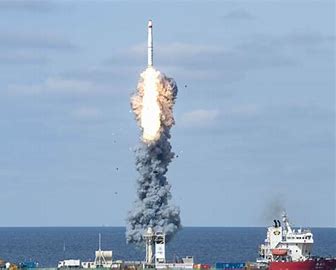
IN BRIEF
By Avishka Ashok and Dincy Adlakha
INTERNAL
China sets up new measures to “shore up existing weak links”
On 2 November, the Chinese authorities published a document setting new measures to shore up the weak links in China’s life services sector and improve the quality of life for Chinese people. The new measures cover nine areas, including the promotion of services that can aid the elderly population with meals and other basic necessities in major cities. These services are expected to cover 80 per cent of the communities in the period of five years. The document also includes the importance to support the private sector participation in the development of urban childcare services. The basic motive of these measures to “shore up existing weak links include improving community-level services facilities, providing large-scale vocational training programs, and creating a market-oriented, law-based and internationalized business environment.” (“China unveils new measures to facilitate life services,” Xinhua Net, 3 November 2021)
COVID-19 Delta variant outbreak in 18 Chinese provinces and municipalities
On 2 November, Global Times reported that the COVID-19 cases in China are flaring up and have spread to more than half of its provinces and municipalities. Currently, 18 Chinese provinces and municipalities are experiencing major outbreaks creating a major risk of mutated Delta variant. In response to the virus spillover, the local governments have adopted strict measures imposing zer0-tolerance to restrict the increase of infections. (“Latest COVID-19 flare-up spills over to more than half of Chinese provincial-level regions,” Global Times, 2 November 2021)
Zhinag Yiming, the founder of ByteDance steps down as Chairman
On 3 November, Reuters reported that the ByteDance founder Zhang Yiming has steeped down as chairman of the TikTok owner and in May 2022 he would also step down as CEO. The new development comes in as ByteDance announced a major reshuffle to create six business units. This has recently become a pattern in China wherein a number of China’s well-known tech firm’s founders have stepped down from their positions. The trend is amid the wide-ranging clampdown by the Chinese regulators on overseeing the daily operations of the Chinese tech firms. (“ByteDance founder Zhang Yiming steps down as chairman - source,” Reuters, 3 November, 2021)
Hong Kong court finds leader of pro-democracy group guilty
On 03 November, a Hong Kong court found Tony Chung, the founder of a pro-independence group 'Studentlocalism' guilty of secession and money laundering. The activist was charged for his actions during the 2019 pro-democracy protests in Hong Kong where he distributed pro-independence t-shirts, flags and books. He was taken into custody in 2020 from a coffee shop near US consulate. At the time, he was seeking political asylum at the center. He was declared guilty as per the new National Security Law passed in Hong Kong in June 2020. ("Hong Kong activist who tried to seek asylum at US consulate found guilty of secession," The Guardian, 03 November 2021)
ECONOMY
China’s Evergrande Group completed the delivery of homes to 57,462 owners
On 3 November, the Evergrande Group declared that the company completed the delivery of 184 property projects in the period of July to October. In the statement released by the firm, the Evergrande Group who was once China’s top-selling developer delivered homes to 57,462 owners. (“China Evergrande completes delivery of 184 projects in July-Oct,” Reuters, 3 November 2021)
REGIONAL
China’s take on the situation in the Korean Peninsula
On 2 November, Chinese Foreign Ministry spokesperson Wang Wenbin said, “the current situation on the Peninsula is complicated and sensitive, with political settlement still at a standstill.” Chinese Foreign Minister Wang Yi discussed the situation of the Korean Peninsula with the South Korean Foreign Minister Chung Eui-yong on the sidelines of the G-20 summit in Rome. The Ministry spokesperson stated that the crux of solving the issue is the denuclearization of Pyongyang. Wenbin stated that the US should take serious steps to engage in a dialogue with Pyongyang and “take real action.” He further added that calling in resolution would be a “constructive move” and must also focus on improving the relations between North and South Korea. (“China presses on in bid for Korean Peninsula peace,” China Daily, 3 November 2021)
INTERNATIONAL
President Biden calls out Chinese President Xi Jinping failing to show up at the COP26 summit
On 2 November, US President Joe Biden accused China and Russia at the UN Summit of failing to be present at the World leaders Summit for the COP26 summit in Glasgow. President Biden told the journalists, “The fact that China is trying to assert, understandably, a new role in the world as a world leader – not showing up,
come on!”The relationship between both China and US are the lowest since Trump left office. The angry exchanges between Biden and Xi over trade strikes, territorial claims, human rights abuse, and foreign interference has now affected the climate consignments. China is the world’s largest emitter and Russia is the fourth-largest emitter. (“Biden says China, Russia failed to lead at COP26 climate summit,” The Strait Times, 3 November 2021)
China opposes the US Federal Communications Commission’s decision to revoke the license of China Telecom
On 3 November, the Ministry of Industry and Information Technologies (MIIT) declared that “it strongly opposed the US government's decision to revoke a license of China Telecom Americas and it will take necessary measures to safeguard the legitimate rights and interests of Chinese enterprises.” The response came in after the US Federal Communications Commission (FCC) on 2 November released an order asking China Telecom Americas to discontinue services within the period of 60 days. MIIT stated that China Telecom Americas has been abiding by US law and regulations for the past 20 years it has been operating in the US. MIIT further accused the US of breaching the international economic trade rules and suppressing the Chinese enterprises under the pretext of national security. The Ministry further urged FCC to withdraw its decision and treat Chinese firms in a just a nondiscriminatory manner. (“China strongly opposes US move to revoke telecom license,” China Daily, 3 November 2021: “China opposes U.S. revocation of licence for China Telecom,” Reuters, 3 November 2021)
China Reader Evening Brief | 02 November 2021, Tuesday | Vol.1, No. 28
Xi Jinping’s written statement at the World Leaders Summit: Three Takeaways
Chinese President Xi Jinping calls for international cooperation and focus on greener transition to fight climate change and makes no new commitment.
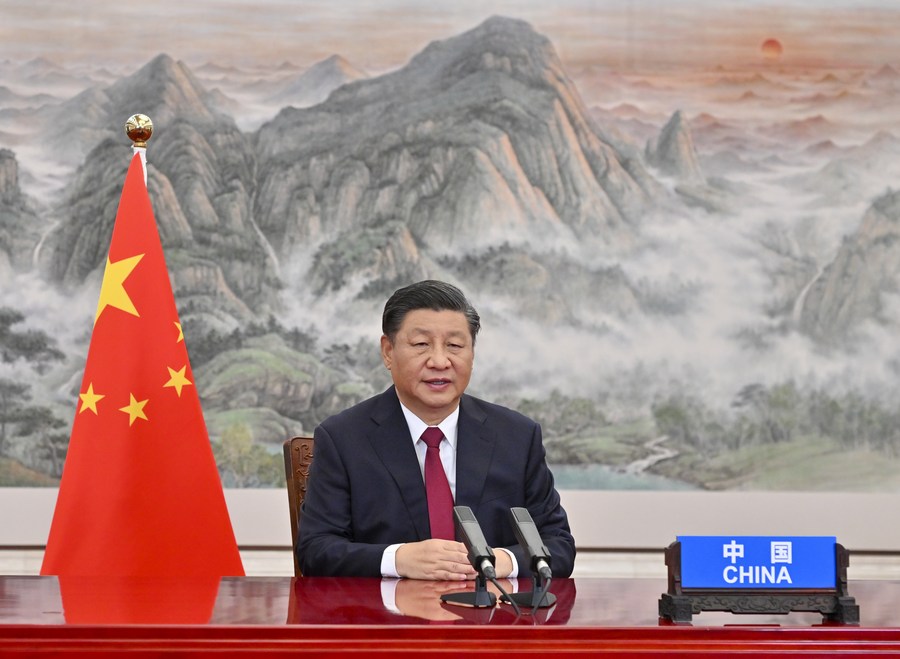
IN FOCUS
By Keerthana Nambiar
Xi Jinping’s written statement at the World Leaders Summit: Three takeaways
On 1 November, Chinese President Xi Jinping delivered a written statement to the World Leaders Summit at the 26th session of the Conference of the Parties (COP26) to the United Nations Framework Convention on Climate Change. “The adverse impacts of climate change have become increasingly evident, presenting a growing urgency for global action,” said President Xi.
The three takeaways from his speech are:
Xi highlights multilateralism as a faucet for addressing global challenges.
At the summit, the Chinese President quoted multilateralism as a “prescription” to fight climate change. President Xi called on the international community to take concrete steps towards solving the climate and energy crisis. He stressed on the parties to build international cooperation and work on the existing consensus and increase mutual trust for successful COP26 in Glasgow. Xi pointed out that the developed countries should honor their commitments and contribute more to address the climate change challenges. He further added that the developed countries must aid developing countries to do better.
The focus on accelerating the green transition.
Xi Jinping informed the importance of promoting science and technology innovations to upgrade the energy sectors. The transition from fossil fuel-based systems to renewable energy-based systems can only be successfully accomplished through technological development. Xi indicates that such steps will create a “new pathway” towards a greener economy with conservation.
Showcasing China’s measures for net-zero emissions.
President Xi advocated China’s plans and measures to attain carbon neutrality and foster a low carbon economic system and refrained from making any new commitments. China’s recent directives – Working Guidance for Carbon Dioxide Peaking and Carbon Neutrality in Full and Faithful Implementation of the New Development Philosophy, and the Action Plan for Carbon Dioxide Peaking Before are measures for keeping the carbon in check. Xi states that these plans intend to form a “1+N” policy framework for delivering carbon neutrality.
References
“Full text: Written Statement by Xi Jinping at the World Leaders Summit,” Xinhua Net, 1 November 2021
IN BRIEF
By Dincy Adlakha and Avishka Ashok
INTERNAL
China steps up fight against COVID-19
On 01 November, The Red Cross Society of China provided COVID-19 relief to five provinces that have been reeling with new infections. Tents, cotton-padded clothing, and other relief materials were delivered to Inner Mongolia, Guizhou, Xinjiang, and Guangxi. The regions have also received grants for the purchase of negative pressure ambulances. The Chinese Red Cross Foundation donated 11 such ambulances and 200,00 medical masks to the Red Cross branches of the region. Other than internal fight against the pandemic, the Chinese authorities also delivered the second batch of 500,00 Sinopharm vaccines to the east African country Tanzania. The vaccine doses were received by the Tanzanian Minister for Health. (“China's Red Cross provides COVID-19 relief to five regions,” Xinhua Net, 01 November 2021; “Tanzania receives 500,000 Sinopharm vaccine doses from China,” Xinhua Net, 02 November 2021)
Eight Hong Kong citizens charged for their association in the protests
On 1 November, eight individuals were charged for their association with an unauthorized vigil for the Tiananmen square movement. The convicted persons include the founder of Apple Daily newspaper Jimmy Lai, activist Gweneth Ho, the Vice-chair of the Hong Kong Alliance Chow Hang-tun and the former Chairman of the Hong Kong Alliance Lee Cheuk-yan. The charges include planning the protests, participating and encouraging others to take part in the illegal protests. While Lee and four others pleaded guilty, Lai, Gweneth Ho and CHow Hang-tun pleaded not guilty. Chow said that she understood “every word being uttered in the reading of the charges against her, but I do not understand why it constitutes an offense. That is why I plead not guilty.” (“Hong Kong: Jimmy Lai goes on trial over Tiananmen vigil,” The Guardian, 1 November 2021)
Chinese Commerce Ministry urges people to stock up before the incoming winter
On 1 November, the Commerce Ministry issued a directive and asked its citizens to keep a stock of their daily needs as winter approaches. The prices in the country have suddenly risen after fresh outbreaks of the COVID-19 pandemic and heavy rains that affected the availability of fresh food in the markets. The local news outlets also released a list of items to stock and urged the people to stock up in case of emergencies. The reportage resulted in panic buying in many cities and villages. (“China urges families to keep stocks of daily necessities ahead of winter,” Reuters, 2 Novermber 2021)
ECONOMY
Government estimates show 5.4 per cent growth in third quarter GDP, Hong Kong
On 01 November, the Hong Kong Special Administrative Region (HKSAR) government announced that Hong Kong's economy grew by 5.4 per cent based on advanced estimates. This growth is projected for the third quarter of 2021 as followed by a 7.6 per cent expansion in the second quarter. The report released by Census and Statistics Department showed that the GDP increased by 0.1 per cent in real terms as adjusted on the seasonal quarter-to-quarter comparison. The government attributes this growth to external and internal demand. ("Hong Kong's GDP grows by 5.4 pct in Q3: advance estimates," Xinhua Net, 01 November 2021)
INTERNATIONAL
Russian Export Center lauds Chinese import expo
On 01 November, the CEO of Russian Export Center Veronika Nikishina released a statement ahead of the 4th China International Import Expo scheduled from 05 November to 10 November in Shanghai. The statement praised the Chinese Import Expo and its purposeful opening up of the Chinese market as a responsible and serious initiative. "China has always been and remains a very promising and desired market, and Russian exporters want a share of it on a stable basis," Nikishina said. According to her statement, 34 Russian companies will participate in hybrid mode of online and offline involvement in the expo this year. ("Import expo conducive to business ties with China: Russian institute," Xinhua Net, 02 November 2021)
Global Times calls out India’s petty behaviour in blaming China
On 01 November, Global Times published an article that pointed out India’s petty trick. The article found India’s absence from the Nuclear Suppliers Group (NSG) an excuse to avoid concrete emissions reduction promises. The article builds on the speech by Indian Prime Minister Narendra Modi in Glasgow for the COP26 climate summit. Following the speech, Indian media reported on India's renewed push for membership in NSG to gain access to essential materials required for developing emission reduction technology. The Global Times article called Indian media out for unnecessarily blaming China for posing obstacles in India’s membership in NSG. The article borrows from experts working at the National Institute of International Strategy of the Chinese Academy of Social Sciences to elaborate that India is mixing two issues together and blaming China for its own irresponsible behaviour. (Leng Shumei and Chen Qingqing, “India scapegoats China over NSG membership for own reluctance to make emissions reduction promise,” Global Times, 01 November 2021)
China and Russia urge UN to lift sanctions on North Korea
On 1 November, Reuters reported that China and Russia were urging the United Nations to ease the sanctions on North Korea by removing a ban on the country’s exports of statues, seafood and textiles. They also pushed for an expansion on the removal of a ban to include the import of refined petroleum. They pushed for the removal of the sanction with the 15-member council of the United Nations to enhance the livelihood of the civilian population in North Korea. The removal of these bans were introduced by China and Russia in 2019 and was reintroduced in 2021. However, it is unlikely that the draft resolution will find enough support this year. (“China, Russia revive push to lift U.N. sanctions on North Korea,” Reuters, 2 November 2021)
China Reader Evening Brief | 01 November 2021, Monday | Vol.1, No. 27
The Chinese Satellite Internet Technology
China advances its investment in satellite internet technology to match up with the international technology.
IN FOCUS
By Avishka Ashok
The Chinese Satellite Internet Technology
In July 2021, China Central Television reported that China had successfully completed its first test of a Chinese version of the “Starlink” that was originally developed by Elon Musk. China aims to develop low-orbit broadband satellites capable of 5G network. The tests were conducted in Beijing and Jinan. The idea of a Starlink enables a global communication network that can be accessed from the remotest areas of the world.
The Chinese Satellite Internet Technology
The space agency in China first sent the Hongyun engineering technology verification satellite and seven other satellites in December 2018. The constellation will be functional from 2022 and will assist global mobile applications, IoT and navigation augmentation. The second phase of the constellation will be operational from 2025 and will establish hundreds of broadband communication satellites in the orbit. China has also contacted the International Telecommunication Union to receive access to the orbital and radio frequency bands. The two giant satellite constellations consist of 6,080 networked satellites at 508km-600km and 6,912 networked satellites at 1,145km.
The Central government in China is also prioritizing the development of satellite internet since April 2020 when the National Development and Reforms Commission brought the project under “new infrastructure”. The reform was initiated to facilitate the quick development of the satellite internet infrastructure. As a ripple effect, local governments are also highlighting satellite technology and are trying to make it the main development target. The satellite internet market is expected to grow exponentially in the coming decades in China. It is expected to reach USD 15.5 billion by 2030. Meanwhile, the global satellite internet market is also growing at a fast pace and expects to to reach USD 45 billion in the same period. The Chinese space equipment and facilities will be used by at least one third of the world by 2020.
The need for satellite internet
Another reason for China’s investment in the satellite internet industry is the Belt and Road Initiative. The sparsely populated areas in remote parts of the country and along the new silk route will also need high speed internet for the smooth and seamless functioning of the complex and interconnected trade and transport route.
The country is fast investing and developing the industry to quickly match up with the international markets and remain relevant in the sector.
References
Tom Kang, “China's version of 'Starlink' completes trial,” CnTechPost, 26 July 2021
Brian Waidelich, “A Chinese Starlink? PRC Views on Building a Satellite Internet Megaconstellation,” Indian Strategic Studies, 29 October 2021
IN BRIEF
By Dincy Adlakha and Keerthana Nambiar
INTERNAL
China reveals first real-time glacier monitoring system
On 31 October, Chinese scientists launched the country’s first real-time glacier monitoring system in the Southwest province of Yunnan. The system collects real time information on glacial melting and accumulation, glacial velocity, ice quakes, temperature, humidity, pressure to better understand the effects of global warming on glaciers. The team of scientists mentioned that the system will be used along with drones to effectively acquire accurate information. The system is currently launched near Lijiang in Yunnan's Yulong Snow Mountain and will later be expanded to Xizang (Tibet). (Huang Lanian, “China launches 1st real-time glacier monitoring system in SW.China’s Yunnan, ‘expected to expand to Xizang (Tibet)’,” Global Times, 31 October 2021)
China implements new personal information law passed in August
On 01 November, China’s new Personal Information Protection legislation came into effect. It was adopted in the 30th session of the 13th National People’s Congress Standing Committee in August. The law protects the personal information of Chinese citizens, especially on multiple online platforms. The law requires online platforms with a large number of users to fix elaborate rules for the regulation of user behaviour so as to secure data collection and processing activities on the platform. Discriminatory practices and differentiated pricings based on users’ profiles is prohibited under the law. The activities shall be strictly monitored and violations will be punished. (“China's personal information law comes into effect,” People’s Daily, 01 November 2021)
REGIONAL
Taiwan warned off the eight Chinese aircraft in Taiwan’s ADIZ
On 31 October, Taiwan’s Defense Ministry said that Taiwan’s air force scrambled to warn off eight Chinese aircraft entering its air defense zone. The Chinese aircraft included six J-16 fighters, one anti-submarine aircraft, and one surveillance aircraft according to the Defense Ministry. For more than a year, Taiwan has complained of the repeated missions conducted by China’s air force near the island. (“Taiwan scrambles jets as Chinese air force enters air defence zone,” Reuters, 31 October 2021)
INTERNATIONAL
Beijing responds to the 90-day US Intelligence review on Covid-19 origin
On 31 October, the Chinese Foreign Ministry lashed out against the US intelligence review on the origins of the Covid-19 pandemic claiming it “political and false” and warning Washington to stop attacking China. The Chinese Foreign Ministry spokesperson Wang Wenbin said, “No matter how many times this report is published and how many versions are concocted, it cannot change the nature of this being entirely political and false.” The response came in after the US office of the Director of National Intelligence released a full version of the findings ordered by President Joe Biden from a 90-day review. (“China rejects US intelligence report on Covid origins as ‘political and false’,” The Guardian, 31 October 2021)
Chinese Foreign Minister meets with US Secretary of State; urges change in “wrong China policy”
On 31 October, Chinese State Councilor and Foreign Minister Wang Yi met with the US Secretary of State Antony Blinken in Rome, Italy. During the meeting, both representatives emphasized on the consensus reached by the two Presidents and also on the preparations for next exchanges. On the current situation in Taiwan Straits, Wang stressed that the US should realise the ‘one China’ policy and accept that Taiwan is part of China. Blinken, on the other hand, emphasized the US willingness to manage differences responsibly and avoid crisis or confrontation. The two sides discussed issues like climate change, energy supply, Korean and Iranian nuclear issues, Myanmar and Afghanistan in great detail. (“Chinese FM urges U.S. to change its wrong China policy,” Xinhua Net, 01 November 2021)
President Xi calls on countries for digital regulation and applies for the Digital Economy Partnership Agreement
On 31 October, President Xi Jinping declared that China will apply to join the Digital Economy Partnership Agreement which will strengthen international cooperation on digital regulation. The Partnership currently covers New Zealand, Singapore and China. During the virtual speech at the G-20 Summit, Xi Jinping said, “China attaches great importance to international cooperation on the digital economy.” President Xi added that “China stands ready to work with all parties for the healthy and orderly development of the digital economy.” He called on the countries to work towards digital governance which weathers an open, just, and mom-discriminatory environment for digital development. (“China to Apply to Join Digital Economy Partnership Agreement,” Bloomberg, 31 October 2021)
US and EU form a new metal alliance to counter China’s steel sector
On 31 October, The European Union and United States announced a new metals alliance which would block the steel from China. The US President Joe Biden said, the alliance would, “restrict access to our markets for dirty steel, from countries like China.” He added that, “countries that dump steel on our markets, hammering our workers and harming them badly, both the industry and the environment.” According to South China Morning Post, the agreement seems to be another cooperation which targets China. (“US and EU strike metals pact to take on China’s ‘steel dumping’,” South China Morning Post, 31 October 2021)
President Xi Jinping calls on G20 members to take concrete action for climate change
On 31 October, as the COP26 convened, President Xi Jinping addressed a G20 session and called on the members to take concrete actions for global challenges of climate change and energy issues. He asked the G20 members to take the lead of the international community to honour the green pledges of developed countries and to support the developing countries with their financial needs for the same. Citing the United Nations Framework Convention on Climate Change and the Paris Agreement, he reiterated China’s contributions for the cause and its responsibilities towards carbon neutrality. He also stressed on developing new and advanced technologies and lowering the cost of reducing emissions as an important sustainable step for climate protection. (Chen Qingqing, Zhao Yusha and Yan Yuzhu, “Xi calls for concrete actions on climate change,” Global Times, 31 October 2021)
China Reader Evening Brief | 30 October 2021, Saturday | Vol.1, No. 26
China-Russia joint naval exercise: Four takeaways
The takeaways that can be derived from the Sino-Russian joint naval exercise indicate a strategic partnership irking the US and its allies.

IN FOCUS
By Keerthana Nambiar
China-Russia joint naval exercise: Four takeaways
Recent Developments
On 17 October, China and Russia concluded the joint naval drill in the Sea of Japan which started on 14 October. The Naval Interaction-2021 maritime military exercise kicked off near Russia’s Peter the Great Gulf which included ten warships and six carrier-based helicopters. During the exercise, they organized joint sailing and joint maneuvers and practiced real-world drills and live-fire drills, and sending clear signals.
The Chinese Defense Ministry said that the joint naval exercises were aimed to “further develop the China-Russia comprehensive strategic partnership in the new era, enhance the joint action capabilities of both parties and jointly maintain international and regional strategic stability.”
The Russian Defense Ministry announced that the staged naval cooperation drills were towards “maintaining of peace and stability in the Asia-Pacific region and guardianship of the subjects of maritime economic activities of the two countries.”
On 19 October, Global Times published a report stating that the China-Russia joint naval drill “can counter AUKUS” the trilateral security pact. “China and Russia can cooperate more and display their strength and determination to maintain stability in the Asia-Pacific,” added Global Times.
Takeaways:
The China-Russia military exercises highlight the growing partnership.
The year 2021 has turned out to be a vintage year for Beijing and Moscow holding large-scale joint military, airforce, and maritime drills. Between 2012- 2017, the Sino-Russian relationship strengthened with the interactions between their armed forces through joint training and exchanging military equipment. The participation of the People’s Liberation Army’s type 055 stealth guided-missile destroyer makes the exercise a powerful one. This reflects a new height of the China-Russia strategic partnership. Even if the Chinese and Russian militaries are at the development stage, the increasing frequency of combined drills and operations suggests massive modernization efforts and deepening strategic alignment.
Despite the exercises, there are tensions.
It is a marriage of convenience between Beijing and Moscow. Under the surface, China and Russia have diverging interests and conflicting stances, and on the other hand hold similar objectives in many regions like the Arctic. Moscow heavily relies on asserting its dominance through militarization whereas Beijing is interested in the economic benefits and securing energy sources at the lowest prices. The major cooperative project of Beijing and Moscow is nullifying the US influence and sovereignty.
The China-Russia joint exercise alarms Japan.
Japan has been tense about the strategic partnership between China and Russia thus threatening regional stability. The recent naval exercise can also be considered as a response to Japan’s training with the UK and the US to improve its defenses. The increasing tension in the Indo-Pacific is expected to cause rapid militarization in the East Asia region accompanied by US’ commitment to ensuring regional stability.
The slow erosion of the US’ advantage.
While the possibility of a formal alliance between Beijing and Moscow remains unlikely. The longstanding anti-American disdain for the American-led rules-based international order keeps these two countries together. China and Russia work as military partners and with advance coordination, Beijing and Moscow could pursue their assertion in Taiwan Strait and Eastern Europe without US interventions.
Implications
First, the potential scenario is of the US and its allies putting forward showcasing its military capabilities and capacities based on questionable assumptions leading to more geopolitical instabilities. While China and Russia will continue with a convenient partnership to counter the Quad and AUKUS alliances.
Second, the China- Russia partnership will face obstacles in the foreseeable future. China, which has been ambitiously working towards expanding its economic and military ties in Central Asia and Eastern European countries will rattle Russia. Despite Russia benefiting from the partnership, it will cut off China if Beijing interferes in Russia’s area of influence.
References:
“China, Russia hold joint naval drill in Sea of Japan, display ‘higher level of trust, capability’,” Global Times, 14 October 2021
“Russia, China kick off joint naval maneuvers in Sea of Japan,” TASS Russian News Agency, 14 October 2021
IN BRIEF
By Dincy Adlakha and Avishka Ashok
INTERNAL
Cyber Administration of China tightens control on data sharing
On 29 October, Global times reported that the Cyber Administration of China was reworking its policies to restrict the outflow of user data to foreign countries. According to the amended regulation, companies processing data must report to the regulator before sharing data related to the users. The regulations are being reformed to prevent data security risks and data thefts. The restrictions will also be applied on sharing of personal information, data gathered and generated by operators and other important information used by applications. The Vice President of the China Information Security Research Institute said: “The proposal is a concrete implementation on data going abroad among three pillar-like acts in China. It is not only for data security, or cybersecurity, but also an indispensable step to ensure the safe development of cross-border business.” (“China's top internet regulator mulls more specific security review on overseas-bound data,” Global Times, 29 October 2021)
COVID-19 resurgence spreads to 14 provinces in China
On 30 October, Xinhua reported that the latest COVID-19 resurgence has spread to 14 provinces. All the 14 provinces recorded new locally transmitted cases or asymptomatic carriers in the past two weeks. The infections in China are rising again and the National Health Commission has called the situation “grim and complicated.” However, epidemiologists in the country strengthen hope by reiterating that CHina will contain the virus effective yet again, within a month. (“China's latest COVID-19 resurgence spreads to 14 provinces: health official,” Xinhua Net, 30 October 2021)
REGIONAL
US official supports Taiwan against China; China warns of ‘no future other than reunification’
On 29 October, The Mainichi reported on the public news conference held by Sandra Oudkirk, the new director of the American Institute in Taiwan. In her address, she stressed that the US wants to deepen its relationship with Taiwan, calling it a self-ruled island. She also recognized that Taiwan has become the bone of contention in US-China relations. The US shall work to counter ‘malign” influence from China. As a response to the press conference and the US calls for “meaningful participation of Taiwan in the UN,” Chinese State Councilor and Foreign Minister Wang Yi said that Taiwan has no other future if not reunification with the mainland. He said that if the US and other forces continue to resist the one-China policy, they shall pay the price. (“US to deepen relation with Taiwan in face of China tensions,” The Mainichi, 29 October 2021; “Taiwan has no future other than reunification with mainland, no intl status other than being part of China: FM Wang Yi,” Global Times, 30 October 2021)
INTERNATIONAL
President Xi Jinping prepares for the speech at G20 summit
On 29 October, the Chinese Foreign Ministry announced President Xi Jinping’s participation via video link in the G20 leaders’ summit in Rome on 30 and 31 October. He is also scheduled to make a speech at the summit. President Xi will also be virtually present at the COP26 climate summit. He has not been visiting any countries and international organizations since 2020 because of the coronavirus pandemic. The G20 summit is considered to be an important stepping stone to the COP26 summit where the leaders will discuss the climate crisis. China’s role at both these summits are considered to be essential since the country recently issued its policy reforms to adjust to the new emission reduction targets and the climate goals. (“China’s Xi to participate in G20 leader’s summit via video link,” Reuters, 29 October 2021)
US Senate unanimously votes to tighten restrictions on Huawei, ZTE
On 29 October, The Asahi Shimbun reported news from Washington that the US Senate voted unanimously to approve a legislation that binds companies like Huawei and ZTE from receiving new equipment licenses from US regulators. The Secure Equipment Act cites these companies as ‘security threats’. It was approved by the US House last week and is now due for Presidential signature by Joe Biden. The law will prevent Chinese tech giant firms from obtaining US licenses and may even be liable to lose their previously obtained licenses. This is the latest rule restricting Chinese tech giants, two similar legislations were previously passed by the US in March and again in June. (“U.S. lawmakers vote to tighten restrictions on Huawei, ZTE,” The Asahi Shimbun, 29 October 2021)
President Xi Jinping holds telephonic conversation with British Prime Minister Boris Johnson
On 29 October, Chinese President Xi Jinping spoke with British Prime Minister Boris Johnson on the phone. President Xi stressed that China-Britain relations need mutual trust and management of differences for achieving sound development. He also said that CHina-Britain ties are important for China due to historic and strategic perspectives. He urged the British Prime Minister to respect facts and perceive China’s development path in an objective manner. He welcomed Britain’s high-quality products. PM Johnson said that Britain is ready to deepen cooperation for economy, trade, education and clean energy and even welcomed Chinese investments and cooperations. He also stressed that working together on areas like communication, climate change, biodiversity protection and the like are extremely crucial. (“Xi talks with British PM over phone,” China Daily, 30 October 2021)
Albanian President encourages relations with China at bilateral meeting
On 29 October, the Albanian President Ilir Meta met with Chinese Foreign Minister Wang Yi and said that the Albanian-Chinese bilateral relations had great potential. He also expressed hope for the expansion of pragmatic relations between the two countries and heightened cooperation and communication on multilateral issues. He said: “Albania is proud of its support for China's restoration of its lawful seat in the United Nations (UN) and will never forget China's assistance to Albania's economic development and modernization drive.” (“Albania-China cooperation has great potential: Albanian president,” Xinhua Net, 30 October 2021)
China urges Lithuania to rethink its relations with Taiwan
On 30 October, a Foreign Ministry spokesperson urged the Lithuanian government to retract its hostile actions before it worsened the bilateral relations between the two countries. He said, “China firmly opposes the plots of Taiwan authorities to create "two Chinas" and "one China, one Taiwan" in the world. China firmly opposes official exchanges between countries having diplomatic ties with China and Taiwan authorities.” (“China urges Lithuania to avoid unsalvageable wrong decisions on Taiwan question,” Global Politics, 30 October 2021)
China Reader Evening Brief | 29 October 2021, Friday | Vol.1, No. 25
Chinese white paper on Responding to climate change: Four takeaways
The white paper released by the Communist Party of China highlights the country’s new policies, the national strategy and the shift in the state’s response to the global climate crisis.
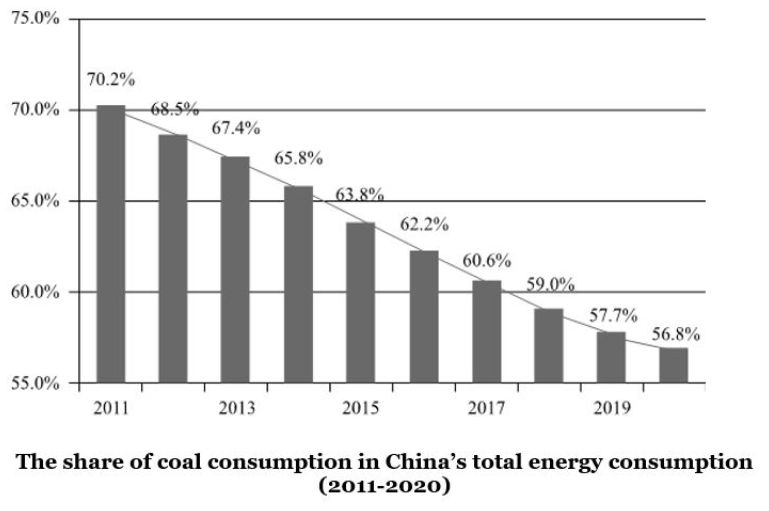
IN FOCUS
By Avishka Ashok
Chinese white paper on Responding to climate change: Four takeaway
On 27 October, China’s State Council Information Office published a white paper emphasizing the country’s shift in policies and actions in an effort to reduce emissions and achieve its climate goals. The paper is titled “Responding to Climate Change: China's Policies and Actions." The 35-page report responds to the impending climate crisis in four parts.
Involving and prepping the Chinese people for drastic changes
Acknowledging the need to achieve eco-friendly goals set by the government in international conferences, China introduced five principles in its new plan. First, the government will promote the idea of a common community to ensure every individual works towards protecting and conserving the earth. Second, the state will implement a new philosophy that encourages innovative, green, coordinated, open and shared development that actively works towards sustainability. Third, the paper promised that the state would undertake a people-centred approach towards implementing and executing its new policies and ensure the development of its people along with achieving its climate goals. Fourth, the state has prioritized carbon peaking and ultimately carbon neutrality and will emphasize green and low-carbon development of the energy sector. Lastly, pollution prevention and reducing emissions will be crucial to achieving its goals. According to the paper, the state aims to jointly reduce emissions and control pollution through “structural adjustments, optimized configuration, policy synergy and innovative mechanisms.”
The government seeks to change the mentality of the Chinese people and transform them into sincere advocates for climate change. Through the shift in policy and principles, the government seeks to bring out the necessary change in people’s opinions that will enable the country to achieve its goals quickly.
China gears up for changes in climate policy
China is aware of the challenges it faces in order to ensure a stable supply chain that helps its GDP but also substantially reduces its industrial pollution and environmental degradation. The report explained the efforts undertaken by the government to improve the planning and coordination amongst smaller government bodies to execute its new policies. China has also included carbon peaking and carbon neutrality goals in its five-year plans and the national economic and social development plans. The government will also implement a mechanism to break down its major goals to more achievable, smaller and closer targets. It reiterated the country’s targets to achieve carbon neutrality by 2060, lower carbon intensity by 65 per cent by 2030, increase the share of non-fossil fuels by 2030, increase forest cover and increase dependency on renewable sources of energy.
Other efforts include committing to a green and low-carbon path to development by coordinating the population’s carbon footprints and emissions, organizing strategies for green development of agricultural, ecological, urban and other sectors, developing industries that are less dependent on high energy consumption, curbing the development of uneven energy-intensive projects and more.
The state will also actively control its greenhouse emissions, promote low-carbon development in infrastructure and transportation and enhance its carbon sink capacity. The state will allow full play in carbon emissions trading, build a carbon market system and encourage communities to participate in emission-reducing activities. The government will actively improve climate resilience and teach the people to adapt to the unavoidable changes caused due to global warming. On a national and local level, Chinese governmental institutions and associated organizations will expand their support for addressing climate change.
Despite adopting extremely uncomfortable changes in its industrial and economic policies, the country is gearing up to earnestly modify its old plans and rectify the harm caused to the ecological system in the previous decades of rapid industrialization in China. The new plan puts emphasis on transforming the energy sector and reducing the dependency on fossil fuels.
China admits inadequacy of previous policies
The People’s Republic of China reduced its carbon intensity by 18.8 per cent between 2015-20, leading to a reduction of 5.8 billion tonnes of carbon-di-oxide from 2005-2020. The country has managed to, simultaneously, sustain its development. The changes in the country’s policies are aimed at revolutionizing energy production and consumption by rapidly developing non-fossil energy and accelerating the transition to a clean energy-dependent economy. The country is currently developing non-fossil fuel energy and is encouraging the use of alternative energy. The report boasts of great achievements in the renewable energy sector which has been a priority for the government since the last decade.
The report appreciates the past efforts of the Chinese people and the country to reduce its emissions but also admitted that the previous targets were not enough to overturn the damage. Hence, the report complimented the achievements but also pushed the companies, firms, organizations and people for heightened activity in the area of conservation and ecological preservation.
China urges international communities to fight climate change unitedly
The report also sheds light on the challenges faced by the international community in achieving carbon neutrality and acting immediately for the benefit of conserving the planet. The report showcased China’s contributions towards preventing the fast degradation of the global ecology and emphasized Chinese President Xi Jinping’s efforts to achieve global consensus to act unitedly on the issue of climate change. The report stressed the significance of the green silk road to achieving global climate governance. Finally, the paper pledged to commit to sustainable development, promote multilateralism, commit to common but differentiated responsibilities and take concrete actions towards the achievement of global governance on climate change.
The report seeks to explain that China or any other country cannot unilaterally revoke and rectify the climate crisis. There is an urgent need for the international communities to come together to resolve the issue effectively and China seems to be taking the lead in guiding others by bringing changes to its internal policies. The white paper and the ensuing change in strategy is China’s way of assuming leadership in the field of climate governance.
References
“Responding to Climate Change: China's Policies and Actions,” State Council Information Office, 27 October 2021
IN BRIEF
By Dincy Adlakha and Keerthana Nambiar
INTERNAL
President Xi Jinping to attend the G-20 summit via video link
On 29 October, according to the notice published by the Chinese Foreign Ministry, President Xi Jinping will attend the G-20 summit in Rome via video link. President Xi is going to address the 16th G-20 Summit at the invitation of Italian President Mario Draghi. The summit is to be held on 30-31 October with Russian President Vladimir Putin and Japanese Prime Minister Fumio Kishida attending it online. (“Xi to address 16th G20 Leaders' Summit,” Xinhua Net, 29 October 2021: “China's Xi to participate in G20 leaders' summit via video link,” Reuters, 29 October 2021)
REGIONAL
People’s Liberation Army on high alert to resolve China’s complete reunification
On 28 October, Tan Kefei, spokesperson for China’s Ministry of National Defense announced that “the Chinese military is fully committed to its missions and responsibilities and remains on high alert to safeguard national sovereignty and territorial integrity.” The remarks came in as a response to the leader of Taiwan’s Democratic Progressive Party’s concerns over Chinese intervention in Taiwan’s ADIZ. The spokesperson stressed that contemptible moves by DPP’s authorities advocating “Taiwan independence” is “the biggest obstacle to the national” “it is a sacred mission of the People's Liberation Army to thwart any external interference and separatist acts seeking ‘Taiwan independence’.”(“Chinese PLA on high alert to safeguard national sovereignty: military spokesperson,” People’s Daily, 29 October 2021)
INTERNATIONAL
Top Pentagon official confirms Chinese hypersonic weapon test
On 28 October, General Mark Milley, the Chairman of the Joint Chiefs of Staff confirmed the Financial Times report that the Chinese military conducted a nuclear-capable hypersonic missile in August. In an interview on The David Rubenstein Show, he said: “What we saw was a very significant event of a test of a hypersonic weapon system, and it is very concerning.” He also called the significant technological event ‘close to a Sputnik moment’. China has refuted the reports of the test and has stressed that it was a routine test checking re-usability of a spacecraft. The new confirmation from the Pentagon official has been taken very seriously by many countries, especially in the Pacific rim. (Robert Burns, “‘It has all of our attention’: Pentagon confirms Chinese hypersonic weapon test,” The Sydney Morning Herald, 28 October 2021)
China responds to the criticism by WTO trading partners
On 28 October, China’s Vice Minister of Commerce Wang Shouwen declared, “China has already fulfilled its obligations under the WTO, and also delivered its commitments, which has been broadly affirmed and recognized by several WTO directors-general and most WTO members.” The statements were a response to some of the concerns raised by some of WTO’ trading partners. Members including the US, the EU, Australia, Japan, and India addressed their concerns deeming China’s “unfair trade practices.” Wang further added that China will take seriously questions, complaints, and even criticism raised by other WTO members, but will not accept criticism based on expectations or requirements beyond the WTO provisions, as such criticism is unreasonable and unfair.” (“China 'has fulfilled' WTO obligations,” Global Times, 28 October 2021: “Official: Nation fulfilled WTO commitments,” China Daily,29 October 2021)
China-Serbia’s “iron-clad friendship”
On 28 October, Serbian President Aleksander Vucic and the Chinese foreign minister Wang Yi held a meeting in Belgrade, Serbia. Vucic hailed China’s “steely friendship with China, describing China as a most reliant, most valuable and greatest friend.” He thanked China for supporting Serbia’s independence, territorial integrity and sovereignty. Wang expressed China’s “iron-clad friendship” with Serbia and willingness to “actively promote the alignment of the two countries' development strategies, and to speed up cooperation in industrial capacity building and infrastructural projects such as the Belgrade-Budapest Railway within the Belt and Road framework”. (“Serbian president hails steely friendship with China, pledges deeper cooperation,” Xinhua Net, 29 October 2021)
US expels unit of Chinese phone carrier from US market
On 27 October, The Asahi Shimbun reported that US regulators are expelling a unit of China Telecom Ltd from the American market citing national security threat. China Telecom is one of the three major state-owned phone carriers. According to reports, the telecom provider is required to cease domestic interstate and international services in the US within a period of two months. The order for this step was approved by the Federal Communications Commission. Earlier, in 2019 as well, FCC had expelled two Chinese telecom providers from the US. Amid rising tensions, China Telecom Ltd. becomes the third phone carrier to be outed from the US market. (“Washington orders Chinese phone carrier out of U.S. market,” The Asahi Shimbun, 27 October 2021)
China’s Ambassador to Australia set to return amid tense bilateral ties
On 28 October, the Chinese Ambassador to Australia Cheng Jingye, delivered his farewell address as he is set to leave the post. According to Global Times, the Ambassador had tried to salvage the deteriorating ties by adopting numerous means like people-to-people exchange and links with Australian media. However, the Australian government has not responded well and is the only one to be blamed for this situation. As reported in The Australian, the return of the Ambassador is seen as a “whimper” despite the pompous show as ‘wolf warrior’. (Chen Qingqing, “Chinese Ambassador to Australia to leave position at most difficult time in bilateral ties,” Global Times, 28 October 2021; “Beijing’s ‘wolf warrior’ slinks away,” The Australian, 28 October 2021)
World links India’s nuclear capable missile test with tensions at Chinese front
On 28 October, The Mainichi newspaper in Japan published a report that linked Indian nuclear-capable missile tests with the India-China tensions. On 27 October, India had tested an intercontinental ballistic missile as continuation of its policy of credible minimum deterrence and commitment to no first use. This test was seen as a response to the reports of Chinese hypersonic missile test in August. Many experts have observed it as a push to increase missile arsenal in New Delhi due to the aggressive show of power by Beijing. India and China are engaged in multiple border disputes and have held numerous high-level military talks on the same. (“India tests nuclear-capable missile amid tensions with China,” The Mainichi, 28 October 2021)
China Reader Evening Brief | 28 October 2021, Thursday | Vol.1, No. 24
China, ASEAN, and the 6-point cooperation path at the ASEAN Summit
China’s Premier holds strong feet at ongoing ASEAN Summits and related summits. Premier Li Keqiang paves the way with a six-point cooperation path for China and ASEAN. China seeks amplified bilateral and regional development with ASEAN.
IN FOCUS
By Dincy Adlakha
China, ASEAN, and the 6-point cooperation path at ASEAN Summit
On 26 October, ASEAN inaugurated a series of important and related summits with Brunei as chair. The Chinese Premier Li Keqiang virtually addressed the 24th China-ASEAN summit as part of the important summits. As 2021 marks the 30th anniversary of establishment of China-ASEAN dialogue, he called for greater unity and cooperation in the South China Sea to avoid conflicts and promote regional development. His speech highlighted six areas of potential China-ASEAN cooperation.
A line of defense for health
Premier Li noted the resurgence of COVID-19 worldwide and stressed on the need for regional vaccine production and distribution. He hoped that China-ASEAN Program on Public Health Management implements the specific needs of an post-COVID era. He also proposed to establish a China-ASEAN Public Health Research and Development Collaborating Center to bridge the gap between technology and public health.
Deeper economic integration
In his speech, Premier Li urged ASEAN countries to greatly collaborate with China through Free Trade Agreements and digital economy partnerships. He also underlined the benefits of Regional Comprehensive Economic Partnership (RCEP) and its role in boosting the clogged global supply chains. He listed the export-import fairs of China and ASEAN as a crucial source of economic integration and seemed hopeful for further cooperation through Comprehensive and progressive Agreement for Trans-Pacific Partnership (CPTPP).
Promotion of inclusive development
Premier Li pinned that only an inclusive approach to development can uplift the region from COVID loss. The ASEAN Comprehensive Recovery Framework and the joint statements released by China and ASEAN in the matter indicate a push for inclusive growth. He maintained that Blue Economy, BRI, Disaster Risk Reduction, Emergency Management are areas that inclusive cooperation could achieve heights.
Innovation-driven approach to development
According to Premier Li, innovation is essential for accelerating development, commercialization, and quality. Apart from Big Data and Remote Sensing applications, he emphasized the need to finalize a Plan of Action on a Closer Partnership of Science, Technology and Innovation for the Future from both sides.
Expansion of green cooperation
He found that China-ASEAN partnership is not only important for regional ecology but also the global fight against climate change. Thus he earmarked the need to implement the Framework of China-ASEAN Environmental Cooperation Strategy and Action Plan 2021-2025. He also focused on China-ASEAN cooperation on Clean Energy Capacity Building Programme and facilitation of faster technology transfer.
Popular support as foundation
The Premier maintained that for China-ASEAN partnership to flourish, popular support from the public for the same is essential. Hence, people-to-people contact should be enhanced. One crucial method of the same is ASEAN students studying in China. China-ASEAN Young Leaders Scholarship and China-ASEAN Education Week Cooperation will help practically boost this connection.
In essence, the speech encouraged greater China-ASEAN cooperation and also opened ways for furthering the relations as good neighbours. The emphasis on regional peace and stability was heightened and potential agenda for upcoming talks between China and ASEAN were hinted at through the address.
References
“Full text: Speech by Chinese Premier Li Keqiang at the 24th China-ASEAN Summit,” Xinhua Net, 27 October 2021
Zhao Yusha and Yan Yuzhu, “Premier Li calls for closer cooperation on SCS, economy with ASEAN,” Global Times, 26 October 2021
IN BRIEF
By Avishka Ashok and Keerthana Nambiar
INTERNAL
Chinese government releases white paper on the country’s efforts to deal with climate change
On 27 October, the Chinese government released a white paper titled “Responding to Climate Change: China's Policies and Actions." It showcases China’s shift in policies, new actions and progress in dealing with climate change. The white paper said: “China is committed to building a global climate governance system that is fair, rational, cooperative and beneficial to all, and makes its due contribution to tackling climate change using its greatest strengths and most effective solutions.” The paper shed light on the recent changes in the government’s outlook towards environment conservation and reducing carbon emissions such as redrawing lines to identify protected areas, identifying ecological values of different land resources, reducing the dependency on coal-fired power plants, discouraging uneven development of projects that consume high energy and more. (“White paper elaborates on China's policies, initiatives in tackling climate change,” Xinhua Net, 27 October 2021)
REGIONAL
Taiwan confirms US military presence in island
On 28 October, Taiwanese President Tsai Ing-wen stated in an interview with CNN that US military troops are present in Taiwan. According to a Global Times report, she is the first leader from Taiwan to confirm US military presence. A Taiwan-based pro-reunification former lawmaker said that Tsai has stepped on the red line by violating the Anti-Secession Law and defying one-China principle. She will bear consequences from the mainland. Other trusted experts of Global Times said that US military “assistance” does not alter the asymmetry of military capabilities between Chinese mainland and Taiwan. Tensions over Taiwan have broiled greatly over the past few months. PLA aircraft incursions and strong statements from both sides are noted often. (“Tsai confirms US military presence in Taiwan, ‘to face consequences for breaking red line’,” Global Times, 28 October 2021)
INTERNATIONAL
China and Russia oppose Japan’s anti-nuke resolution to be adopted by the UN panel
On 27 October, the UN committee adopted a Japan-sponsored draft resolution calling in for the total elimination of nuclear arms, prompting a divided response from five permanent members of the UN Security Council. Four members including China and Russia opposed the resolution, 30 members abstained, while the other 152 countries voted in favor. Japanese Foreign Minister Toshimitsu Motegi said, “This resolution, as one of the concrete measures to realize a world without nuclear weapons, provides common ground with which all states can work together and thereby bridges the gap between nuclear-weapon states and non-nuclear-weapon states.” The draft resolution is expected to be formally adopted at the UN General Assembly. (“U.N. panel adopts Japan's anti-nuke resolution, China, Russia oppose,” Kyodo News, 28 October 2021)
Chinese Foreign minister calls for more support to help Afghanistan
On 28 October, Chinese Foreign Minister Wang Yi urged the Work Bank and International Monetary Fund to help Afghanistan with financial support for reconstruction. Wang Yi said, “Afghanistan is in need of revival on all fronts, and development is the top priority.” China has declared it will send $30 million worth of emergency humanitarian assistance to Afghanistan. He also called on the US and other Western countries to lift the unilateral sanctions which would further worsen the economy. He added that the World Health Organization must provide more vaccines and medical supplies to fight COVID-19 in Afghanistan. (“China urges World Bank, IMF to help Afghanistan,” Reuters, 28 October 2021)
China’s distrust on Moon Jae-in and South Korean inconsistencies
On 28 October, The Korea Times published an editorial on the Chinese perspective on Moon Jae-in detailing THAAD and the inconsistencies between Beijing and Seoul. The editorial discusses Seoul’s relation with Beijing when South Korean President Moon Jae-in’s term comes to an end. Moon is the most popular South Korean leader to be “pro-China” even though Chinese President Xi Jinping has never visited South Korea despite repeated invitations. The writer extensively explains THAAD (Terminal High Altitude Area Defense) as the friction point between the bilateral relations of China and South Korea. The mixed signals from Seoul’s side frustrate the Chinese side creating trust issues. China’s distrust towards South Korea deepened after the summit between Moon and Biden. (“Chinese perspective on Moon Jae-in: THAAD and inconsistent messaging,” The Korea Times, 28 October 2021)
Foreign Ministry warns the Czech Republic against expanding cooperation with Taiwan
On 27 October, the Chinese Foreign Ministry spokesperson Zhao Lijian cautioned the Czech Republic against inviting the Taiwanese external affairs minister for a visit and threatened the country with dire consequences if the necessary changes were not carried out. Lijian said: “The despicable act of some people from the Czech Republic is doomed to fail. We advise them to change course as soon as possible, otherwise they will suffer the consequences." He also warned Taiwan against encouraging the “Taiwan Independence” movement and separatist movements in the country. (“Some people from Czech Republic will suffer consequences if they don’t change: Chinese FM said on Taiwan DPP official’s visit,” Global Times, 27 October 2021)
Chinese Foreign Ministry warns the US against worsening China-US relations
On 27 October, the Chinese Foreign Ministry spokesperson Zhao Lijian and the Chinese Ambassador to the US expressed their discontent and registered their representations to the US and urged the country to follow the One-China principle when dealing with issues of international importance. The Chinese delegation reiterated that the principle does not allow the US to unilaterally challenge or change the “widely recognized consensus.” While addressing a press conference, Lijian observed that if the US continued to create obstacles for China, it would seriously risk the China-US relations and make matters difficult in the Taiwan strait. (“US risks jeopardizing improving ties with China with Blinken’s Taiwan remarks," Global Times, 27 October 2021)
China Reader Evening Brief | 27 October 2021, Wednesday | Vol.1, No. 23
China's new property tax eyes great reforms
The new property tax to be imposed by State Council is the newest effort taken by President Xi Jinping towards the ‘common prosperity’ goal. It holds implications for more than just the property sector.

IN FOCUS
By Dincy Adlakha
China's new property tax eyes great reforms
On 23 October, the Standing Committee of the National People’s Congress (NPC) authorized the State Council to impose property tax in particular areas. Xinhua reports that the first of its kind tax is aimed to rationalize the housing consumption, utilize the land resources intensively and economically, and also to guide the country’s property market to steady development. According to the new tax, all residential, non-residential, and commercial properties will be taxed, however, the lawfully-owned rural houses in the areas will be exempted.
What led to the new tax reforms?
First, the nature of China’s property sector. When the People’s Republic of China was established under Mao Zedong, private ownership of land was not allowed. The land was consolidated under strict governmental ownership. However, a few land reforms brought in by Deng Xiaoping opened land for ownership by firms and individuals as well. The local governments sold out land to new buyers and gained revenues for their decreasing treasuries through these sales. No property tax has been imposed on personal property since, despite many experiments launched in various cities. The lack of regulation and increased state support and loans for emerging strong firms led to the disparity in terms of land ownership. Firms like Evergrande have enlarged their bubbles through such support. Yet, many common citizens are unable to buy property due to surged prices.
Second, the prolonged emphasis on the need for property tax. According to a Wall Street Journal report, President Xi Jinping has been emphasizing on expanding the property tax experiments to deflate the bubble that the property industry has blown over time. The report further states that Xi aims to impose a nationwide property tax which is being resisted by the political elite of China. “We should actively and steadily promote the legislation and reform of real estate tax, and do a good job in the pilot work,” Xi wrote in Qiushi, Chinese top policy journal. Currently, there is no tax on property owned by individuals but annual tax is levied on commercial properties. Reportedly, seminars and policy discussions on the tax started as early as May last year. The current context of China’s property sector increased the urgency and necessity of the tax in recent months.
Third, the larger alignment to the ‘common prosperity’ project. The tax is introduced not merely to re-correct the property sector but is part of the larger picture of ‘common prosperity’ as proposed by President Xi Jinping. The government has previously imposed huge crackdowns on the tech industry in China, including Alibaba and Didi firms. The private education sector of China has also received bans and regulations. These steps in different industries are forwarded with the vision of reducing social inequality and elevating the entire population of China towards prosperity, collectively.
What will the new tax lead to?
First, the property tax will give local bodies a new source of income. The fiscal revenue earned could then be utilized for public services and infrastructure development. According to Lu Wengxi, a chief analyst at property agency Centaline, the collected tax and its judicious utilization will lead China closer to its common prosperity goal. This also reflects confidence in Beijing and its capabilities to manage the great risks and potential hits visible in the property sector.
Second, real estate developers may face a slow turn as their costs for holding properties would increase. But, if the tax limit is low, it will also open up the housing sector to the market. However, an increased price might be foreseen.
Third, the reallocation of public and private funds from the real estate sector to other capital sectors will rise. Investments will increase in other long-term markets rather than the bloated property sector.
However, some analysts write for Fortune that the tax will render ineffective like its predecessor experiments. Even if the tax collection succeeds, it shall shock the economy more without giving much time to investors for re-investing.
References
“China to pilot property tax reforms,” Xinhua Net, 23 October 2021
Grady McGregor, “Evergrande and property speculation force Beijing to consider an idea that’s radical in China: Taxing real estate,” Fortune, 26 October 2021
Ryan Woo, Liangping Gao and Samuel Shen, “Explainer: Is China finally ready to roll out a property tax?,” Reuters, 19 October 2021
“Warning of Income Gap, Xi Tells China’s Tycoons to Share Wealth,” The New York Times, 07 September 2021
Stephen Bartholomeusz, “China’s radical shift could burst its property bubble,” The Sydney Morning Herald, 26 October 2021
“China to pilot levying property tax in selected cities,” Global Times, 23 October 2021
“China expands property tax trials in next step of ‘common prosperity’ drive,” The Financial Times, 25 October 2021
IN BRIEF
By Avishka Ashok and Keerthana Nambiar
INTERNAL
China starts inoculation for children aged between three to 11
On 26 October, Global Times reported that China had extended its inoculation programme to include minors aged three to 11. In the previous week, Hubei, Hunan, Hainan and Zhejiang provinces started vaccinating the minors as the COVID-19 cases in the country continued to increase incessantly. The schools will also begin sending their students to the vaccination venues in batches since all hospitals do not take up adolescents for the vaccination. The Chinese government has approved two doses of Sinopharm and Sinovac vaccines for the age group. (“Vaccination for children aged 3-11 launched across China amid rebound of COVID-19 cases,” Global Times, 26 October 2021)
China releases new draft regulation on registration of online user account
On 26 October, the Cyberspace Administration of China began gathering public opinion o a draft regulation on the management of internet account user names. According to the newly drafted regulation, “While users can decide on their screen names, they must provide authentic identity information when registering accounts with online platforms.” The new regulation also seeks to restrict users from taking up names that resemble the Communist Party of China and other related governmental organizations and institutions. It also makes it compulsory for minors to have the consent of their guardians to create an online user account with real-name registration. (“China mulls real-identity registration of internet user accounts,” Xinhua Net, 27 October 2021)
TECHNOLOGY
Chinese physicists launch the world’s fastest programmable quantum computers
On 26 October, South China Morning Post published a report claiming that China launched the world’s fastest programmable quantum computers. According to the report the Chinese physicists have built two quantum computers that supersede their competitors from the West. The research team says that the light-based Jiuzhang 2 holds the capacity to calculate in one millisecond and has detailed the team’s findings in two papers published in academic journals Physical Review Letters and Science Bulletin. Zuchongzhi 2 is a 66- qubit programmable superconducting quantum computer that is claimed to be 10 million times faster than the world’s fastest supercomputer. Quantum computers are limited to the Chinese military and their application in civilian sectors are limited. (“China launches world’s fastest programmable quantum computers,” South China Morning Post, 26 October 2021)
INTERNATIONAL
China-Afghan Taliban wrapped up their first high-level engagement in Doha
On 26 October, the Chinese State Councilor and Foreign Minister Wang Yi concluded the first high-level dialogue with Amir Khan Muttaqi, acting foreign minister of the interim Afghan Taliban government at Doha. According to the Chinese foreign ministry, both China and Afghanistan have agreed to set up a “liaison mechanism to discuss future exchanges” reported Global Times. “China respects Afghanistan's exploration of a pattern that suits its own conditions, and China also respects the interim government's national implementation of policies,” announced Wang Yi. Muttaqi said, “the new government has realized actual governance of Afghanistan, and the country highly cherishes peace after 45 years of war. Good relations with China are important to Afghanistan, and the country is working to realize its own security and promote regional peace.” The meeting served as a platform for mutual respect and recognition between the countries. (“Wang Yi meets Afghan Taliban in Doha,” Global Times, 26 October 2021)
Japan’s Defence Minister expresses concern over the China-Russia naval exercise
On 26 October, Japan’s Defense Minister Nobuo Kishi spoke on the China-Russia naval flotilla around Japan accelerating the list of security challenges in the region. According to the Kyodo news agency, five Chinese ships and five Russian ships sailed together passing through the Tsugaru Strait and Japan’s main island of Honshu going to the Pacific Ocean. Kishi said, “This is the first time we have confirmed activity on such a large scale and over such a long period,” and further declared that "We believe this was a show of force toward Japan.” (“China-Russia flotilla displays "show of force": Japan defense chief,” Kyodo News, 26 October 2021)
Xi Jinping and Emmanuel Macron held first talks after the AUKUS pact
On 26 October, Chinese President Xi Jinping held the first telephonic conversation with French President Emmanuel Macron after the formation of defence alliance between US, Britain and Australia. China Central Television (CCTV) quoted Xi Jinping during the press conference, “recent international events have once again shown that France is correct to advocate the strategic autonomy of the EU.” He announced that Sino-French relations will induce stability in the “world situation.” President Xi further suggested on improving the understanding and mutual trust between China and Europe which has been tense over the human rights issue in Xinjiang and Hong Kong. President Macron assured that, “France…. Hopes to strengthen coordination with China in the G20 Leaders’ Summit in Italy and the UN Climate Change Conference in Glasgow.” According to CCTV, Macron hoped on approving the China-EU delayed investment deal. (“Xi Jinping and Emmanuel Macron speak for first time since Aukus alliance was announced,” South China Morning Post, 27 October 2021)
Chinese Ambassador in India holds conference to refute accusations of genocide
On 26 October, the Chinese Embassy in India and the regional government in Xinjiang jointly held an online conference titled “Xinjiang is a wonderful land." The Chinese Ambassador said: “Facts are not to be distorted. Achievements of Xinjiang's economic and social development as well as human rights are there for all to see.” The online meeting was attended by over 100 Indians belonging to the academic, media and political communities. The Chinese ambassador recalled the increasing population in Xinjiang, the education index, the improving quality of life and the standard of living and the growing GDP in Xinjiang. He used these parameters as evidence to prove that there was no genocide committed against the Uyghurs in the region. (“Online conference held by Chinese Embassy in India, Xinjiang regional government to discuss truth in the region,” Global Times, 27 October 2021)
Chinese Premier addresses ASEAN Summit and calls for negotiations on South China Sea issues
On 26 October, the Association of Southeast Asian Nations commenced the online summits under the Chairmanship of Brunei. The summits will include ASEAN’s dialogue partners such as China, Japan, South Korea, India, the US, Australia and Russia. On the same day, Chinese Premier Li Keqiang attended the online meeting and made statements on behalf of the People’s Republic of China. He urged the ASEAN member countries to accelerate the negotiations for the Code of Conduct in the South China Sea. He also pledged China’s support in establishing a study to identify the areas for cooperation and enhancing the ASEAN-China Free Trade Area. (“Premier Li calls for closer cooperation on SCS, economy with ASEAN,” Global Times, 26 October 2021)
China Reader Evening Brief | 26 October 2021, Tuesday | Vol.1, No. 22
Xi Jinping addresses the UN at the 50th anniversary of the restoration of China
Chinese President Xi Jinping addressed the United Nations, commemorating the 50th anniversary of the Lawful Seat of the People’s Republic of China

IN FOCUS
By Keerthana Nambiar
Xi Jinping addresses the UN at the 50th anniversary of the restoration of China
On 25 October, President Xi Jinping delivered a speech at the conference marking the 50th Anniversary of the restoration of the Lawful Seat of the People’s Republic of China in the United Nations. President Xi said that “the restoration of New China's lawful seat in the United Nations was a momentous event for the world.” He addressed the conference via video link calling in for global cooperation on issues like terrorism and cyber security.
According to Global Times, UN Secretary-General Antonio Guterres congratulated the Chinese President on the anniversary. “China has always worked with people of the world in defending world peace and justice, and the Chinese people have always defended the UN's authority and status and practiced multilateralism to deepen cooperation with the UN,” said Global Times. Reuters reported that “Apart from tension with Taiwan, China has been more assertive in staking its claims to disputed territory on its Himalayan border with India, and to tracts of the South China Sea disputed with some Southeast Asian nations, and over some islands in the East China Sea disputed with Japan.”
The Three Takeaways from the speech
First, Xi’s idea of true multilateralism with China at the center. Throughout the speech, Xi Jinping focused on how China fulfills its responsibility at the UN Security Council and upholds the role of the UN in international affairs. He urged on building a community for developing and reforming the global governance system. Xi stressed that the international rules can be only assembled by the 193 UN Member States together rather than any individual member or blocs. He confirmed that China looks forward to working with the member countries to explore new ideas and models of cooperation to practice multilateralism.
Second, a win-win economic development for New China and its people. Xi tries to convince that China looks forward to promoting the common goal of economic and social development with reformed socialism with Chinese characteristics. Countries should put their people front and center, and strive to realize development with a higher level of quality, efficiency, equity, sustainability and security. It is important to resolve the problem of unbalanced and inadequate development, and make development more balanced, coordinated and inclusive.
Third, focusing on cooperation and common prosperity. Xi Jinping vowed that Chinese people are committed to achieving common development. He talked about terrorism, climate change, cyber security and biosecurity and the importance of the international community to tackle these global issues. And more effective international cooperation, active regional cooperation is required for enriching the practice of cooperation under new circumstances.
Moving ahead:
China’s growing assertive attitude
Xi Jinping in his statements strictly conveyed that the countries should refrain from making unilateral decisions. This is in line with the unilateral sanctions and new military bloc posing several challenges to multilateralism and instability in the Indo-Pacific. The friction between the US and China spiraled with US’ statements and recent activities in Taiwan undermining Beijing. Thus, creating an ideological and geopolitical divide leading to Taiwan, Hong Kong, Xinjiang, and the South China Sea as the battleground.
China changing perspective in the UN
China’s influence in the UN has significantly grown since 1971, by 2018 becoming one of the largest financial contributors at the organization. In recent years, China has been asserting itself and playing major roles within the UN. Beijing through UN is reiterating its one-China principle and stepping up its political and military pressure showcasing it to the world.
References
“Speech by H.E. Xi Jinping President of the People's Republic of China at the Conference Marking the 50th Anniversary of the Restoration of the Lawful Seat of the People's Republic of China in the United Nations,” Ministry of Foreign Affairs of People’s Republic of China, 25 October 2021
“Xi reiterates China’s role in defending UN mandate,” Global Times, 25 October 2021
“China will uphold world peace, Xi says, despite others' concerns,” Reuters, 25 October 2021
“China Focus: Xi pledges enhanced coordination with UN for balanced, inclusive global development,” Xinhua Net, 25 October 2021

IN BRIEF
By Avishka Ashok and Dincy Adlkha
INTERNAL
Xinhua Net confirms China’s capacity to reduce emissions and retain stable development
On 25 October, Xinhua Net published a commentary which said: “China capable of balancing climate ambitions, economic development.” The commentary focused on the measures taken by China to achieve carbon neutrality by 2060. The state-owned media outlet based its arguments on the recent document released by the Central Committee and the State Council of the Communist Party of China. The editorial piece said: “China has a stronger economic incentive to reduce carbon emissions, particularly through developing and investing in new energy and transportation sectors, as the world is coping with climate threats together.” It also said that China was investing heavily in Solar, wind and hydropower to move away from conventional sources of energy and to immediately reduce its carbon emissions. (Xinhua Commentary: China capable of balancing climate ambitions, economic development,” Xinhua Net, 25 October 2021)
China releases plan to cut fossil fuel usage below 20% by 2060
On 25 October, The Guardian reported on a document released by the Chinese cabinet that comprises a plan to cut Chinese carbon emissions. The plan was released after President Xi Jinping pledged that China’s carbon emissions will peak by 2030 and reach neutrality by 2060. Currently, coal fuels approximately 60 per cent of China’s energy demands. The plan reiterated that China aims to reduce carbon emissions to 18 per cent, per unit of GDP by 2025. The guidelines are also important in context with the upcoming climate summit in Glasgow set to start on 31 October. (“China to cut fossil fuel use to below 20% by 2060,” The Guardian, 25 October)
INTERNATIONAL
China pledges to provide vaccine assistance to fight the COVID-19 pandemic
On 26 October, China’s International Development Cooperation Agency (CIDCA) announced that the country will provide two billion doses of the COVID-19 vaccine to the world this year. China has also pledged to donate 100 million vaccines to developing countries and fund COVAX with USD 100 million to encourage global vaccine cooperation. The Chairman of CIDCA recalled that the country had already provided over 106 countries with more than 1.5 billion vaccines since the pandemic began and provided other essential medical supplies such as protective suits, masks, ventilators and more. (“China to provide 2 billion COVID-19 vaccine doses to the world and $100 million to COVAX,” Global Times, 26 October 2021)
Chinese and US officials discuss trade and the possibility of lifting tariffs
On 26 October, officials from China and the US participated in an online video conference for the third time in October to discuss the economic and trade issues. The Global Times reported that the outcomes of the numerous meetings have been productive and may lead to substantiative results for world trade. The Chinese officials engaging in the dialogue mentioned China’s discomfort over the additional tariffs by the US and its behavior towards Chinese firms in the US. According to an expert from the Chinese Academy of Social Science, “Following this latest round of talks, it is expected that the US Trade Representative (USTR) and the US Department of Commerce might roll out measures to lift additional tariffs on Chinese goods, at least in an indirect way.” (“China, US officials talk third time in a month, sending positive signal on trade and implying possibility of 'lifting tariffs',” Global Times, 26 October 2021)
Telstra buys Digicel Pacific “in a move to block Chinese influence in the region”, according to Australian analysts
On 25 October, the BBC reported that the Australian government and Telstra are jointly buying Digicel Pacific, a telecoms company in the Pacific. Telstra referred to the USD 1.6 billion deal said, “the deal is a unique and very attractive commercial opportunity to boost our presence in the region." The Pacific company works with over 1,700 people from Papua New Guinea, Fiji, Samoa, Vanuatu and Tahiti. The Australian government will be financing a majority of the deal. However, Australian analysts following the trade war between China and Australia believe that the deal is an attempt to block China’s growing influence in the region. A Lowy Institute analyst said: “Digicel is the primary player in the Pacific and Australia sees it as a strategic asset that they can't allow to fall into the hands of China. They are keen to get Australian business back into the Pacific and they've come to the realization that they are going to have to underwrite." (“Digicel Pacific: Australia's Telstra buys Pacific firm 'to block China',” BBC News, 25 October 2021)
China-US agree to increase coordination on economic policies in senior officials’ meet
On 26 October, the Vice-Premier of China Liu He and the US Treasury Secretary Janet Yellen met in a virtual conference. The two sides pragmatically agreed to boost communication and coordination on economic policies. According to the statements released by Washington and Chinese state media, they discussed macroeconomic and financial developments in the US and China and considered the impact on the world economy. China also expressed concerns about the traffic imposed by the US leading to unfair investment. However, they emphasized greater economic communication for global economic recovery. This was the second meeting of high-ranking economic officials between the two countries, the previous one held between Vice Premier Liu and US Trade Representative Katherine Tai. (Wendy Wu and Orange Wang, “China, US ‘to intensify communication and coordination’ on economic policies,” South China Morning Post, 26 October 2021)
Taiwan seeks to increase ties with the Czech Republic
On 25 October, a delegation of 66 officials from Taiwan, led by the Minister of National Development Kung Ming-hsin, visited Prague. It is reported that the Foreign Minister of Taiwan Joseph Wu shall also visit later in the week. The delegation consisted of business and research groups and attempted to boost trade and investment with the Czech Republic. Currently, the Czech Republic does not have any formal ties with Taiwan. However, informally, there are numerous connections between the two including the investment from Taiwan’s high-tech companies into Czech and the visit of the Czech speaker to Taiwan last year. All these moves have earned criticism from China. The delegation is also set to visit Slovakia and Lithuania. (“Taiwanese delegation in Prague to boost ties; China protests,” The Korea Times, 25 October 2021)
Amnesty International to close local and regional offices in Hong Kong
On 26 October, Amnesty International, the non-governmental human rights group, declared that it will close its local office in Hong Kong this month. It also said that the regional office in the city will also be shut within the year. The operations of these offices will be moved to other offices from the Asia-Pacific region. The statement made by the chair of the organization, Anjhula Mya Singh Bais pointed that the decision is made due to the national security law passed by China in June 2020. She said: “It is increasingly difficult for us to keep operating in such an unstable environment,” referring to the surveillance and targeting faced. (“Amnesty International to close Hong Kong offices this year,” The Mainichi, 26 October 2021)
China Reader Evening Brief | 25 October 2021, Monday | Vol.1, No. 21
China celebrates 50 years of return to UN seat
Chinese President Xi Jinping addresses the United Nations, celebrating 50 years of its position as the UNSC permanent member
IN BRIEF
By Dincy Adlakha, Keerthana Nambiar and Avishka Ashok
INTERNATIONAL
China celebrates 50 years of return to UN seat
On 25 October, the Chinese President Xi Jinping held an online meeting with the UN Secretary-General Antonio Guterres to celebrate 50 years of China’s position in the United Nations. President Xi stressed the One-China principle and said: “There’s only one system, one order, one set of rules, and any country should act within that framework, not do its own things with its own rules. Major powers should mutually respect and co-exist in peace, which is in line with the common interests of the international society.” Guterres also appreciated China’s help in poverty reduction, covid-19 pandemic, climate change and conservation of biodiversity. (“Xi, Guterres meet virtually, express desire to deepen cooperation on 50th anniversary of PRC’s restoration of UN lawful seat,” Global Times, 25 October 2021)
China-Russia wraps up the first “Joint-Sea-2021” in the Pacific Ocean
On 24 October, People’s Daily reported that the Chinese and Russian navies wrapped up the first joint maritime cruise in the western Pacific Ocean. The “Joint Sea-2021” exercise started on 14 October and kicked off on 17 October. A combined ship formation conducted drills of joint navigation, joint maneuver and practical use of weapons were part of the seven-day cruise. The Chinese defense ministry said, that the exercise were aimed to “further develop the China-Russia comprehensive strategic partnership in the new era, enhance the joint action capabilities of both parties and jointly maintain international and regional strategic stability.” (“Chinese, Russian navies wrap up first joint cruise,” People’s Daily, 24 October 2021: “Russian, Chinese warships hold first joint patrols in the Pacific,” Reuters, 24 October 2021)
China responds to British Foreign Secretary’s statements; terms as “irresponsible remarks”
On 24 October, China’s spokesperson in the Chinese Embassy in Britain opposed the remarks made by the British Foreign Secretary Liz Truss on Hong Kong electoral system. The spokesperson said: “China urges the UK side to stop political manipulation on Hong Kong-related issues and stop interfering in China's internal affairs in any way.” The spokesperson put faith in the “One Country, Two Systems” approach and emphasized on improving the electoral system of Hong Kong by letting “patriots” govern the management. The UK Foreign Secretary had previously issued a statement voicing concerns over the disqualification or resignation of District Councillors in Hong Kong. China sees this remark as external interference in internal matters. (“China strongly opposes British official's irresponsible remarks on HK affairs: embassy,” People’s Daily Online, 24 October 2021)
INTERNAL
China lays down a new law for land border protection
On 24 October, The People’s Republic of China passed a law to strengthen border protection taking effect on 1 January. The Land Borders Law is amid the protracted standoff with India and the spillover effects from Taliban - controlled Afghanistan and the spread of COVID-19 from Southeast Asia. The law says it will “take effective measures to resolutely protect territorial sovereignty and land border security.” The law specifies that China will close its border if a war or other armed conflict nearby threatens border security. (“China strengthens land border protection with new law,” Reuters, 24 October 2021)
Standing Committee adopts pilot property tax reforms in select areas
On 24 October, the Standing Committee of National People’s Congress (NPC), which is China’s top legislature, adopted the decision to authorise the State Council to launch a property tax reform in some regions. This tax will be levied on all types of real estate which even includes non-residential properties (unlike the previous property tax). The new tax also applies to land owned by the state for construction purposes. Experts have said that the tax curbs speculation and systemic risks. It will be the first time that such varied properties are included for taxation. The program is set to run for five years and it aims to enhance rational consumption of houses and land resources. (Zhang Dan and Qi Xijia, “China to overhaul housing market,” Global Times, 24 October 2021)
Global Times suspects Chinese data being leaked to US through chip makers
On 24 October, Global Times published an article that detailed the suspicious behaviour of major chip makers after an official from the US Commerce Department hinted at compulsory measures to obtain sensitive information. The US government has made a request asking for voluntary sharing of data from chip-making firms in China and Taiwan. The Taiwan Semiconductor Manufacturing Company (TSMC) has responded that it shall share the requested data with the US by 8 November. The article suspected that these demands for data are beyond the regular demands for the purpose of market regulation. They are demands for Chinese sensitive information for many major chipmakers and such a demand violates the business confidentiality as imposed by Chinese laws. (“GT Voice: Chipmakers risk violating Chinese laws over US’ hegemonic data request,” Global Times, 24 October 2021)
China takes strict measures to contain the new wave of COVID-19
On 23 October, China.org reported that a new wave of COVID-19 infections has hit various regions in China. The local authorities are taking strict measures to contain the virus and upholding the country’s principle of putting people’s lives and health first. The transmitted confirmed COVID-19 cases are in 10 provincial-level regions, including Shaanxi, inner Mongolia, Gansu, Ningxia, Qinghai, and Beijing. The Ministry of Culture and Tourism released a circular saying, “the circuit breaker mechanism for trans-provincial tourism should be enforced vigorously.” The Ministry further added that the “tour group size needs to be put under strict control and operation of tourist trains is suspended.” (“China takes swift measures to contain new COVID-19 infections,” China.or.cn., 23 October 2021: “China tightens epidemic measures in culture, tourism industry,” China.org.cn., 24 October 2021)
Communist Party of China releases plan to achieve carbon neutrality
On 24 October, the Communist Party of China Central Committee and the State Council released a document mapping their efforts to achieve carbon peaking and carbon neutrality goals as per the new development philosophy of China. The document highlighted specific targets to be achieved by the party and the local bodies in the coming decades. According to the document titled “Working Guidance for Carbon Dioxide Peaking and Carbon Neutrality in Full and Faithful Implementation of the New Development Philosophy," China is “committed to a green, low-carbon and high-quality development path that gives primacy to ecological civilization.” According to the document released before the latest issue, China is set to peak its carbon emissions by 2030 and should be able to manage, stabilize and then decline by 2060. (“China Focus: China maps path to carbon peak, neutrality under new development philosophy,” Xinhua Net, 25 October 2021)
People Bank of China injects 200 billion yuan into the banking system
On 25 October, the People’s Bank of China used a seven-day reverse repo and injected 200 billion yuan or USD 31.3 billion into the financial system. The interest for the period is set at 2.2 percent. The move aims to retain liquidity and maintain stability in the system. According to the China Foreign Exchange Trade Systems (CFETS), the Chinese currency also strengthened its position against numerous other currencies such as the USD, the euro and the yen. When put against the Special Drawing Rights basket, the yuan climbed 0.39 points to achieve 98.73 points. (China's central bank conducts 200 bln yuan of reverse repos,” Xinhua Net, 25 October 2021; Chinese yuan strengthens last week,” Xinhua Net, 25 October 2021)
TECHNOLOGY
New Shijian-21 satellite launches successfully
On 24 October, China launched a new satellite called Shijian-21 from a Long March-3B carrier rocket. The satellite was launched from the Xichang Satellite Launch Center. The center is located in southwest China’s Sichuan Province. The satellite is specifically designed to test and verify technologies to mitigate the space debris. This was the 393rd mission to be conducted through Long March carrier rockets. The satellite was launched from the rocket and entered the rocket without any difficulties. (“China launches Shijian-21 satellite,” Xinhua Net, 24 October 2021)
Chinese tech companies rebrand their NFT offerings to ‘digital collectibles’
On 25 October, South China Morning Post reported that the Chinese technology giants- Alibaba Group Holding and Tencent Holdings will rename their non-fungible token (NFT) offerings as “digital collectibles”. NFTs are referred to the units of data stored on a blockchain that guarantees each digital asset is unique, immutable, and secure. With Beijing’s ongoing campaign which prevents ‘irrational expansion of capital’ in the Chinese tech sector, the rebranding actions by Alibaba and Tencent are to avoid any kind of conflicts with the State. (“Alibaba, Tencent rebrand NFT offerings as ‘digital collectibles’ amid Beijing’s scrutiny of new virtual asset market,” South China Morning Post, 25 October 2021)
China Reader Evening Brief | 23 October 2021, Saturday | Vol.1, No. 20
Coal prices dip worst in five months due to govt intervention
China continues to face energy issues as coal supplies dwindle

IN BRIEF
By Dincy Adlakha and Avishka Ashok
INTERNAL
Coal prices dip worst in five months due to govt intervention
On 22 October, Reuters reported that China’s thermal coal futures dropped nearly 15 per cent during the week, making it their worst week in five months. Coal prices in China had been on a steep rise since May 2021 due to shortage of resources. Beijing intervened to cool the supply and demand balances and ease the power crunch. The government allowed miners to work at full capacity and even bypass the safety inspections in select cases. This was probably the biggest state intervention in the industry for a long time in China. President Xi Jinping and the state planner National Development and Reform Commission released statements and assured the public that efforts to maintain “reasonable range” and “excessive profits” will continue to tackle the approaching winter. (Shivani Singh and Muyu Xu, “China coal prices notch worst week since May on govt intervention,” Reuters, 22 October 2021)
President Xi Jinping supports ecological protection of Yellow River basin
On 22 October, the Chinese President Xi Jinping addressed a convention in Jinan and pushed for substantial progress in the ecological protection and high-quality development of the Yellow River basin during the 14th five-year plan. He encouraged the people to work towards obatining heightened productivity from the Yellow River. However, the country continues to face multiple challenges in the process of ecological conservation. He said: “provincial-level regions along the Yellow River should stick to putting the environment first and being committed to green development.” (“Xi urges notable progress in ecological protection, high-quality development of Yellow River basin,” Xinhua Net, 23 October 2021)
Ministry of China predicts one trillion yuan worth of foreign investment in 2021
On 22 October, the Ministry of Commerce (MOC) addressed a press conference and revealed that China could expect over one trillion yuan or USD 160 billion as foreign investment in 2021. According to the MOC official, the investments exceeded the ministry’s expectations. He said: “Among the surveyed key foreign enterprises in China, 99 percent said they had no plan to reduce investment or leave the market.” However, the spokesperson also said that the country is not completely out of economic dangers as the coronavirus pandemic continues to change and evolve. The breaks and obstacles in the global supply chains and the decoupling and barrier-setting are other worrying factors for the Chinese government. (“Foreign investment into China expected to surpass 1 trln yuan: MOC,” Xinhua Net, 22 October 2021)
TECHNOLOGY
Lunar and Mars missions bring positive updates
On 22 October, China received positive news from its Lunar mission as well as Mars mission. The samples brought back from the moon by the Chang’e-5 probe were analysed and a new finding has been reported. These new findings provide clear and reliable intel on lunar volcanism; extending the dates by 800 million years from previous findings. Additionally, it was also reported that China’s first deep-space probe, Zhurong Mars rover, has resumed its scientific exploration after a month of solar outage. During the period, the rover had lost contact with Earth and was relying on its own automatic and smart programmed systems. The rover started having black-outs in communication with Earth during September due to solar outage (disturbances caused by sun’s radiation). However, it has safely survived the period and regained communication. (Wu Yuehui, “Lunar samples brought back by China’s Chang’e-5 probe help decode secrets of moon,” People’s Daily, 22 October 2021; Fan Anqi, “China's Mars rover continues exploring after safe passage through month-long solar outage,” Global Times, 22 October 2021)
INTERNATIONAL
Beijing seeks closer ties with Pacific Islands
On 22 October, China’s People’s Daily reported on the first ever China-Pacific Island Countries’ Foreign Ministers’ Meeting via video call. The meeting was chaired by the Chinese Foreign Minister Wang Yi, and attended by Foreign Ministers of approximately ten countries from the Pacific Islands. Wang specified the various sectors of mutual cooperation that should be linked between China and the Pacific Islands. He mentioned deepening policy communication and establishing a mechanism for regular meetings. He also specified that China will continue to provide vaccines, economic and technical assistance to island countries without any political conditions. Stakes and possibilities of joint cooperation for fishing, climate action, and non-proliferation were also discussed. (“China vows closer ties with Pacific Island countries: FM,” People’s Daily, 22 October 2021)
China boasts support of 100 countries on human rights at UN session
On 22 October, Global Times reported that approximately a hundred countries voiced their support to China and held up its fight for developing its own pattern of human rights at the 76th session of UN General Assembly. China is firmly opposed to politicizing human rights issues. Cuba, on behalf of 62 countries, made a joint statement highlighting the interference in China’s internal matters on the pretext of human rights. Kuwait, on the behalf of three gulf countries, also made similar remarks. The Chinese ambassador even addressed the pointed fingers over Xinjiang region and held a joint video call with the Xinjiang regional government. Representatives from local residents and foreign tourists who visited Xinjiang were present at the virtual conference call and shared their experiences. The ambassador observed that China welcomes kind advice but does not care for lectures based on lies. (“100 countries support China on human rights amid US-led smears at UN session,” Global Times, 22 October 2021)
China extends hand to deepen cooperation with South Africa prior to FOCAC
On 22 October, the chairman of the National People’s Congress Standing Committee Li ZHanshu announced that China would utilize the upcoming Forum on China-Africa Cooperation meeting and create closer relations with African countries; to build a shared future together. He said: “South Africa is welcomed to participate in the China-proposed Global Development Initiative, in order to achieve strong, green and healthy global development.” Li also hinted that the National People’s Congress was willing to work with the National Assembly of South Africa to utilize the platform for further cooperation between the two countries. (“China-South Africa parliamentary exchange mechanism holds virtual meeting,” Xinhua Net, 22 October 2021)
China Reader Evening Brief | 22 October 2021, Friday | Vol.1, No. 19
China-Africa Think Tanks Meeting: Beijing's soft-power strategy
The tenth China-Africa Think Tanks Forum is held in China before the eighth FOCAC meeting in Senegal.
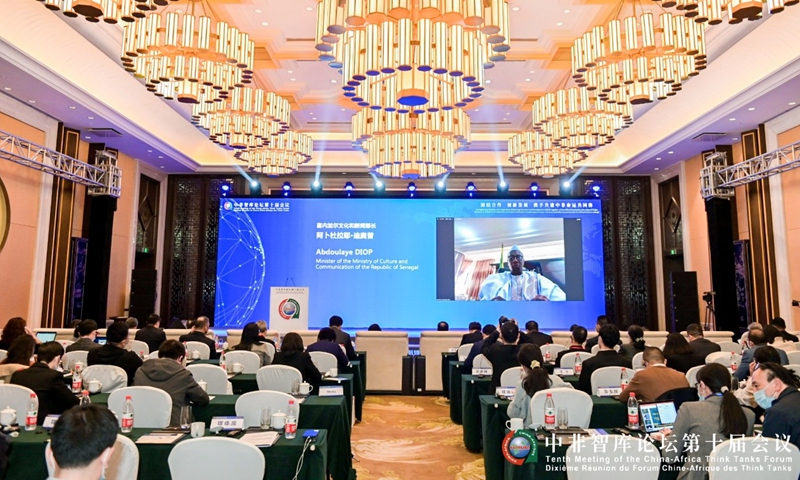
IN FOCUS
By Avishka Ashok
China-Africa Think Tanks Meeting: Beijing's soft-power strategy
On 20 October, China organized the 10th China-Africa Think Tanks Forum in Hangzhou. The two-day forum gathered over 200 Chinese and African representatives from the political, academic, media, and business arenas. African representatives from South Africa, Senegal, Nigeria, Tanzania, Kenya, Morocco, Madagascar and Liberia participated at the forum and engaged in elaborate discussions on improving cooperation between China and the African countries. The forum aimed to boost the relations and work towards a shared Chinese-African future.
During the opening ceremony of the forum, the Assistant Minister of Foreign Affairs Deng Li said: "During the tough times when China fought the virus, African governments and people offered valuable help. When Africa needed help, China offered the largest-scale humanitarian support by sending vaccines, pandemic control supplies and medical teams. Now, China and Africa need solidarity and cooperation more than ever." The Cameroon Delegate from the Ministry of External Affairs also represented his country at the opening ceremony and encouraged the mutual cooperation between countries within the Forum on China-Africa Cooperation (FOCAC) and said: "Africa and China can stimulate the necessary infrastructure and economic development required to boost African economic integration while facilitating the border goals of shaping a closer Africa-China community."
On 21 October, the forum held three parallel sessions within the forum. The three sessions focused on "The new plan for FOCAC and the establishment of a China-Africa Community with a Shared Future," "Promoting Urban Development in African Cities and Towns, Deepening China-Africa Digital Cooperation and Jointly Building the BRI" and "Promoting Unity between China and Africa in the Fight against COVID-19 by Improving the Health Governance Capacity and the Quality of Medical and Health Services."
The forum is a part of China's soft power strategies where it tries to establish its influence in African countries and also strengthens its roots in the academic and intellectual arena along with the political and economic sectors. The Think Tank Forum was first initiated in 2011 when China realized its "intellectual disadvantage" in the continent. In the past decade, China has grown to be more influential and has led African countries to depend more openly on the Chinese economy. On 20 October, the Foreign Policy think tank of the London School of Economics published a report that looked at China's growing influence in Africa. The report revealed that China was becoming increasingly influential in the African Space Industry as it launched six out 45 African satellites and also supported African countries with Tracking, Telemetry and Control (TT&C). China is also a significant part of Africa's digital infrastructure, security and military engagement and public diplomacy.
According to Peter Kagwanja from the African Policy Institute, China-Africa Think Tanks Forum is being carried forward by China through four measures: replacing hard-power tactics with soft-power strategies, promoting development cooperation, involving itself in trade and investment and encouraging people-to-people diplomacy by increasing the dialogue between the non-state actors in China and Africa.
References
Wang Wenwen, "10th China-Africa Think Tanks Forum kicks off as runup for the FOCAC," Global Times, 20 October 2021
"FOCAC at 21: Future Trajectories of China-Africa Relations," China Foresight, LSE IDEAS, 20 October 2021
"China-Africa Think Tanks Forum: China broadens soft power campaigns in Africa," Brookings, 01 October 2015
Daniel Boyco, "The china-africa think tank forum and the negotiation of soft power," On Think Tanks, 12 December 2015
IN BRIEF
By Dincy Adlakha and Keerthana Nambiar
INTERNAL
Evergrande readies fund for bond payment avoiding default
On 22 October, an anonymous source told Reuters that the Evergrande Group has arranged USD 83.5 million worth bond payment. The amount was remitted to a Citibank account of a trustee. This is to pay an installment of a US bond whose grace extension deadline is on 23 October. This will avoid Evergrande from defaulting. However, experts have voiced their distrust mentioning that this payment does not wiggle much room if the other demands are not met. The next grace deadline is on 29 October. The news is a relief to investors and markets throughout the world, allowing space for recorrection. (Clare Jim and Andrew Galbraith, "China Evergrande lines up funds to pay interest, avert default - source," Reuters, 22 October 2021)
Xi Jinping to deliver address on 50th anniversary of China's UN seat
On 22 October, Chinese Foreign Ministry spokesperson Hua Chunying said that President Xi Jinping will deliver an important address to commemorate the 50th anniversary of China's lawful seat restoration in the UN. The speech will be delivered on Monday. China signed the UN charter in 1945. However, Taiwan was the sole representative of China for a long time. In 1971, all legal rights of the People's Republic of China had been restored legally by the UN. ("Xi to deliver speech on 50th anniversary of PRC's UN seat restoration," Global Times, 22 October 2021)
Beijing issues new guidelines for green development
On 21 October, the Communist Party of China's Central Committee and the State Council issued a new guidelines to increase green development in urban and rural areas. The guidelines set a target of instilling institutional mechanisms and policy systems to support green development by 2025. The country also aimed to cut carbon emissions by 2035 and spread green development in a comprehensive manner to all urban and rural areas. The guideline pledged to improve ecological capacities by adding fiscal and financial inputs. ("China issues guideline on green development in urban, rural areas," Xinhua Net, 21 October 2021)
Beijing announces for five more National Parks
On 21 October, Tang Xiaoping, chief of the Institute of National Park announced that China will be building more ecological national parks in the Qinghai-Xizang Plateau, the Yangtze River basin, and the sea, and the Yellow River basin. He declared that the steps were taken after considering China's ecological security needs and public concerns. The plan to establish the first five national parks was announced at the 15th meeting of the Conference of the Parties to the Convention on Biological Diversity (COP15). The parks will cover 230,000 square kilometers at Sanjiangyuan National Park in Qinghai-Xizang Plateau, Wuyi Mountain National Park in the provinces of Fujian and Jiangxi, Giant Panda National Park in Sichuan, Shaanxi and Gansu provinces, Northeast China Tiger and Leopard National Park in Jilin and Heilongjiang provinces, and Hainan Rainforest National Park in Hainan Province. ("China plans to build more national parks in key ecological areas like Xizang, Yellow River basin," Global Times, 21 October 2021)
INTERNATIONAL
US-China cooperation will be regained for LNG
On 21 October, Global Times Voice published an editorial on the US-China energy cooperation. It focuses on China's energy transition progress as the demand for natural gas is expected to grow in the coming times forcing both countries to return to normal bilateral relations. According to the US Department of Energy website, US exporter Venture Global LNG and Chinese state oil giant Sinopec have signed two twenty-year deals on supplying a combined four million tons of liquefied natural gas. The article says that this new deal is a positive development when it comes to energy since 2018 and increases the chances of both countries coordinating. It further says, "The US should take more responsibility for the imbalance in bilateral trade, which requires greater efforts from the US side by removing all trade barriers, including export of high-tech products to China." The note ends with a warning that if the US does not make positive efforts to improve the relations between the US and China it might lose China's LNG provider agent. ("GT Voice: LNG deals opens door for US-China energy cooperation," Global Times, 21 October 2021)
The new US ambassador's makes strong remarks on China
On 21 October, the newly appointed US ambassador to China Nicholas Burns said, "the biggest geopolitical test of the 21st century" in a US Senate hearing. He made strong remarks on China's domestic and foreign policies. The ambassador talked about Xinjiang's "genocide", China's Hong Kong policy and declared that the US "cannot trust China." He further added that China has been "stonewalling" on the accusations related to the origins of the COVID-19. Global Times says, "Beijing may just welcome this new US ambassador with a calm mind. He does not have the positive desire and energy to improve China-US relations, but he also has very few tools to attack us." "We have noticed that in his statement, Burns did not suggest new additional moves for the US to deal with China. Therefore, his statement of toughness seemed to be a bit hollow," claims Global Times. ("With such arrogance, Burns will suffer setbacks in China: Global Times editorial," Global Times, 21 October 2021)
China warns US and EU of wrong signals over Taiwan
On 21 October, Global Times published an article criticising the recent comments from the US ambassador to China, and the EU resolution on Taiwan. The EU resolution that is being pushed is promoting deeper economic and political remains with Taiwan. While the US ambassador to China said that US will make sure Taiwan is "a tough but to crack." As per a statement made by Biden to media houses, the US has "commitment" to defend Taiwan under the Taiwan Relations Act and the White House is not changing its policy on Taiwan. China has expressed displeasure at all these events, calling the west an anti-China alliance and a "dangerous chorus." (Chen Qingqing and Yan Yuzhu, "EU, US send wrong signals on Taiwan, risking miscalculation," Global Times, 21 October 2021; Trevor Hunnicutt, "Biden says United States would come to Taiwan's defense," Reuters, 22 October 2021)
China receives support from 80 countries at the UN General Assembly
On 22 October, at the 76th session UN General Assembly, more than 80 countries voiced their support to China and to develop its own pattern for human rights development and opposing the politicized human rights issues. On behalf of 62 countries, Cuba made a joint statement at the UN General Assembly, "to support China for developing its own pattern on human rights that fits its conditions and oppose other countries' interference in China's internal affairs under the banner of human rights." "The joint statement was made at the 76th session of the UN General Assembly as the Third Committee reviewed human rights issues but a few countries, including the US and France, made groundless accusations targeting China's human rights record," reported Global Times. ("More than 80 countries voice support to China amid US and a few Western countries smearing at UN session," Global Times, 22 October 2021)
China Reader Evening Brief | 21 October 2021, Thursday | Vol.1, No. 18
China's hypersonic missile test: The US concerns and Beijing's responses
The reported nuclear-capable hypersonic missile test by China is bothering the US intelligence agencies. Concerns are raised over military capabilities, intentions, and timing of the test. However, China denies it.
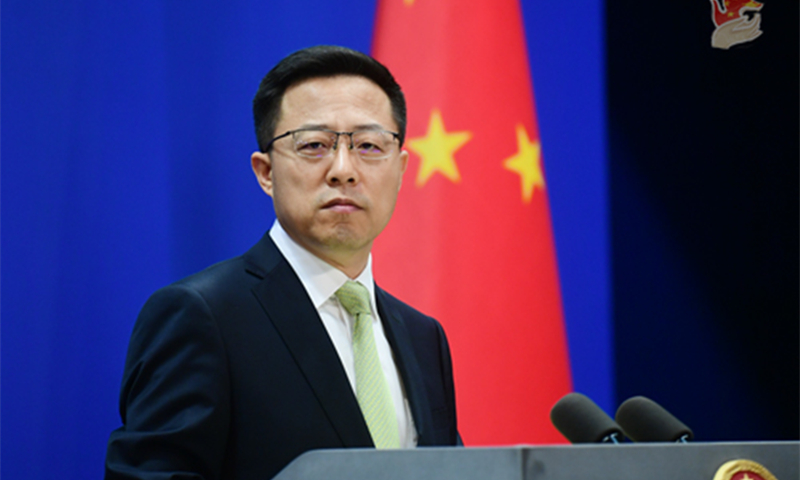
IN FOCUS
By Dincy Adlakha
China's hypersonic missile test; The US concerns and Beijing's responses
On 17 October, the Financial Times published a report that stated, "China tested a nuclear-capable hypersonic missile in August that circled the globe before speeding towards its target, demonstrating an advanced space capability that caught US intelligence by surprise." The report cited five unnamed sources who are familiar with the test. It is reported that the missile missed its target by 24 miles. One of the five correspondents that the US was taken by surprise since they did not have any intel regarding this. The report also mentioned that China used the Long March rocket to launch the missile.
The US concerns
The Pentagon has not issued a formal statement on the report yet. However, the Pentagon spokesperson John Kirby said: "We have made clear our concerns about the military capabilities China continues to pursue, capabilities that only increase tensions in the region and beyond. That is one reason why we hold China as our number-one pacing challenge." Michael Gallagher, a Republican legislator, pointed that the test should be taken as a call to action and that the increased nuclear missile capabilities of the PLA are a threat to America. He suggested that American technology has helped China develop its hypersonic missile programme.
The US concern over China's nuclear missile capabilities is not new. The absence of China from all arms-control treaties is a major issue raised by the US repeatedly. Throughout 2021, intelligence agencies have been warned by the satellite images released showing 200+ intercontinental missile silos being built in China. In August, the head of the North American Aerospace Defense Command, General Glen VanHerck said in a press conference that China "recently demonstrated very advanced hypersonic glide vehicle capabilities" which is a threat warning for the US. The concern is higher due to the timing of the test and the report as well, as seen in context with the Chinese aggression near Taiwan.
The Chinese responses
In response to the report, Zhao Lijian, spokesperson for the Chinese Foreign Ministry answered a few questions at a regular media briefing. He declined the report and said that a routine test to check the reusability of the spacecraft was done in July. He validated his stance by saying: "it's not missile, but a spacecraft…It is of great significance to reducing the cost of using spacecraft and providing a convenient and cheap way for mankind's two-way transportation in the peaceful use of space. Several companies around the world have conducted similar tests." Many experts in China have backed the claim and conceded that it is common for China to test such technologies through spacecraft. It is also common for such spacecraft to shed debris in their path and before the fall.
Global Times has continued the fight for the Chinese stance by publishing articles that mention the space and arms race mentality of the US leading China to increase its nuclear deterrence. These articles stressed on the Chinese peaceful expansion in space.
The hypersonic missile and its potential
The technology used for such hypersonic glide vehicles is currently being developed by the US, Russia and China. These are extremely powerful missiles that orbit the Earth in their own momentum. Although they are slower than ballistic missiles, they can be maneuvered while in track which makes them harder to be traced and even more difficult to defend.
According to the public list of China's arsenal, it does not possess such a missile. But with all the three countries alarmed by the FT report, there are chances of a new announcement by either of the three countries which might give a new push to the debate.
References
Demetri Sevastopulo, "China tests new space capability with hypersonic missile," Financial Times, 17 October 2021
"Foreign Ministry Spokesperson Zhao Lijian's Regular Press Conference on 18 October, 2021," Ministry of Foreign Affairs of the People's Republic of China, 18 October 2021
Yang Sheng and Deng Xiaoci, "China's routine space vehicle test 'a transparent act for peaceful use, not militarization'," Global Times, 18 October 2021
Paul D. Shinkman, "China Sets Sights on Taiwan With New Hypersonic Missile Test," US News, 18 October 2021
IN BRIEF
By Avishka Ashok and Keerthana Nambiar
INTERNAL
Beijing commemorates Joan Hinton's 100th birth anniversary
On 19 October, China commemorated the 100th birth anniversary of US-born nuclear physicist Joan Hinton in Beijing. The occasion was held in the presence of 80 representatives gathered to remember her contribution to improving China's dairy automation technologies, praise her for her humanitarian assistance. Hinton who is also known as Han Chun is a prominent nuclear physicist and one of the few female scientists to take part in the US Manhattan Project to develop the first atomic bomb. Hinton later settled in China with her husband and dedicated decades to dairy farming designing and operating China's first mechanical farm making a huge contribution to Chinese stockbreeding and mechanization. ("China commemorates US physicist who contributed to China's revolution in the 1940s," Global Times, 21 October 2021)
China's Ministry of Science and Technology approves four wildlife observation stations in Tibet
On 21 October, China Daily reported that the Ministry of Science and Technology has approved four new national-level wildlife observation stations in the Tibet autonomous region. The region's department of science and technology claims that the region will have a total of nine new wildlife observation stations with the new additional four. According to the regional department of science and technology, "the main functions of the observation stations are to serve the sciences of ecology, earth science, agronomy, environment, material, and other fields, and to carry out high-level scientific research by obtaining long-term field positioning observation data". The new stations are focused on alpine grassland ecosystem observation and research, alpine lake, and environment observation and research, high altitude electromagnetic environment and electromagnetic safety, and atmospheric process and environmental changes in the region. ("Tibet to get four new national level wildlife observation stations," China Daily, 21 October 2021)
REGIONAL
"ASEAN can ward off AUKUS' Cold War tactics": China Daily editorial
On 20 October, the China Daily published an editorial titled, 'ASEAN can ward off AUKUS' Cold War tactics. It focuses on the new tripartite defence alliance which will "create instability" in the Asia-Pacific. The editorial says that along with China, Malaysia and Indonesia are also concerned about the dangers that the AUKUS framework would bring in with the plan to develop nuclear-powered submarines. It stresses that the US' plan to isolate China will create greater problems because the Southeast Asian countries would stick with China due to the mutually beneficial trade partnerships. The article further discusses how ASEAN members must be wary of the AUKUS alliance and should set up a firewall to safeguard regional peace and stability. With reference to the recent incident of the US nuclear submarine striking an underwater object and ASEAN's passive response was criticized in the note. It concludes with a message that the ASEAN members must focus on regional cooperation for peace and development and "not least, because it is in their best interests." ("ASEAN can ward off AUKUS' Cold War tactics: China Daily editorial," China Daily, 20 October 2021)
Taiwan's foreign minister's visit to Eastern Europe spikes Beijing
On 21 October, China expressed its displeasure after Taiwan's Foreign Minister's announcement to visit Eastern European countries- Slovakia, Czech Republic. The Chinese Foreign Ministry spokesperson Wang Wenbin expressed his "strong dissatisfaction" with the two countries allowing the visit and warned not to "undermine the political foundation of bilateral relations." Joseph Wu, Taiwan's foreign minister said, "We will more actively seek the support of the international community and look forward to strengthening relations between Taiwan and the democratic countries of Central and Eastern Europe." ("China angered by Taiwan foreign minister's Eastern Europe trip," Reuters, 21 October 2021)
INTERNATIONAL
Rwandan Ambassador expresses gratitude to China on 50th anniversary of diplomatic ties
On 21 October, Global Times published an interview with the Rwandan Ambassador to China, James Kimonyo. The interview was conducted on the occasion of the 50th anniversary of diplomatic ties between Rwanda and China. On bilateral relations, Kimonyo acknowledged China's assistance in Rwanda's infrastructure building, health sector, education, trade, agriculture and economic development. He also appreciated China's help in fighting the COVID-19 pandemic in Rwanda by supplying medical essentials and vaccines for the people. He further denied the accusation of a debt trap and said: "The accusations against China have no basis whatsoever. I just gave you an example of Rwanda, we borrow money from different financial institutions, and China's debt share for Rwanda is not more than 9%. 91% is from these other institutions." ("African countries content with cooperation with China; accusations against China-Africa relations ridiculous: Rwanda Ambassador," Global Times, 21 October 2021)
China-Africa Thinktanks Forum commences in Hangzhou
On 20 October, the 10th China-Africa Thinktanks Forum was conducted in Hangzhou. The forum is being conducted just before the China-Africa Cooperation (FOCAC) which is scheduled to be held in Senegal. The Thinktanks Forum aims to promote the understanding between African countries and China and endorse the growth of the China-Africa comprehensive strategic cooperative partnership. The objective of the forum is to bring the African people and the Chinese closer so that they can collaborate towards a collective future. On 21 October, three parallel forums were held within the forum, focusing on the shared future, infrastructure development and building the health sectors. ("10th China-Africa Think Tanks Forum kicks off as runup for the FOCAC," Global Times, 20 October 2021)
New US bill seeks to sanction Chinese individuals for aggression in the South China Sea
On 20 October, Chinese political analysts following the US-China tensions reported that some of the US lawmakers were attempting to sanction Chinese entities and individuals through the South China Sea and East China Sea Sanctions Act. The act enables the US to sanction individuals who propagate China's aggressiveness and claims in the South and East China Sea. The Bill says: "The President must also impose prohibitions and restrictions on correspondent and payable-through accounts related to sanctioned entities. The Department of State must periodically report to Congress identifying countries that recognize China's claims to the contested territories. Certain types of foreign aid may not be provided to such countries." As of now, the bill has been approved by the Senate Committee on Foreign Relations. ("US politicians push new bill to sanction China on maritime issue, 'will receive retaliation if it passes'," Global Times, 20 October 2021)
Moscow Format talks emphasize China's need and role in resolving the Afghan crisis
On 20 October, the Moscow Format talks were held in Moscow where 10 countries participated and debated the role of China and Russia in the Afghan Crisis and its challenging future. The political and military situation in Afghanistan, the establishment of an inclusive government and rebuilding the country are the core aims of the meeting. China and Russia are part of numerous multilateral organizations that concern themselves with the Afghan security crisis. China and Russia criticized the US for not being a part of the forum. Chinese Foreign Minister Wang Yi said: "the US' absence reflects its escapist psychology of being irresponsible on Afghan issues." ("'Moscow format' talks highlight China-Russia coordination on Afghan issue, conspicuous US absence," Global Times, 20 October 2021)
China Reader Evening Brief I 19 October 2021, Tuesday I Vol.1, No.16
China's third-quarter GDP slows down
China refutes claims of nuclear capable hypersonic missile test; Standing Committee of NPC commences the 31st session
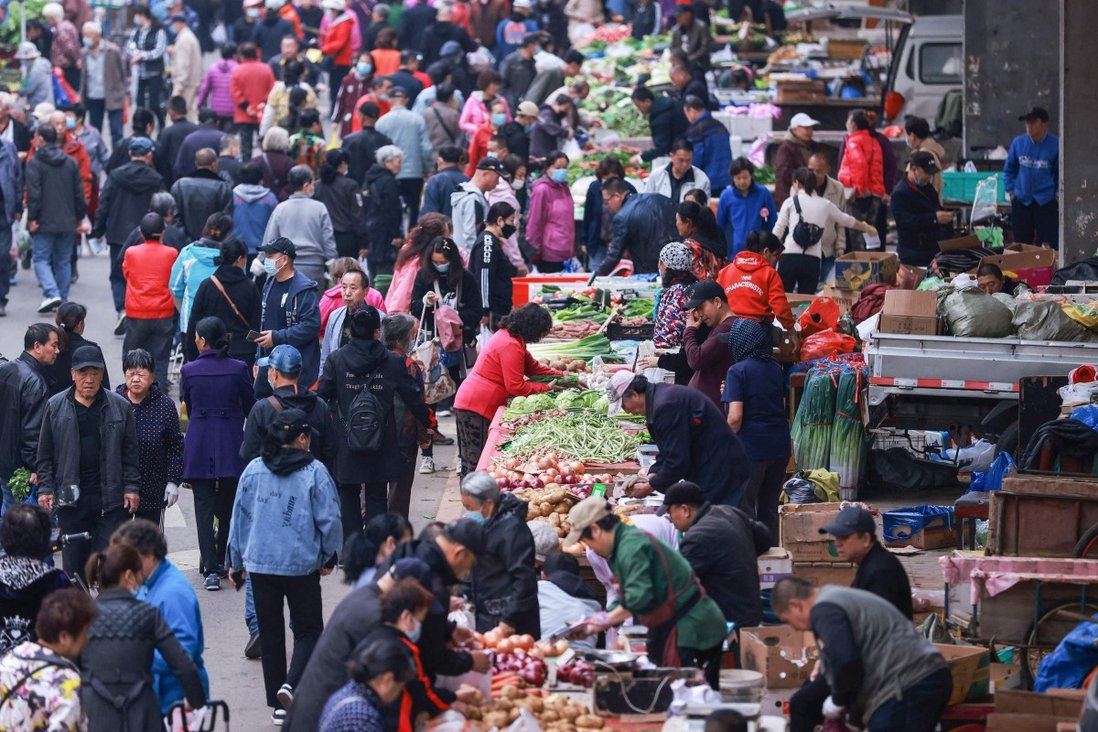
IN FOCUS
By Keerthana Nambiar
China's third-quarter GDP slows down
Recent developments
On 18 October, the National Bureau of Statistics published the gross domestic product figure of China. The Bureau described the domestic economic recovery as "unstable and uneven," with a GDP of 4.9 percent. According to South China Morning Post, "a worse-than-expected third quarter economic performance for China has indicated there could be more pain ahead in the final three months of the year, while stoking fears of stagflation."
Chinese economy showed excellent post-pandemic recovery in 2021, in the first quarter with 18.3 percent and second quarter with 7.9 percent. Fu Linghui, a spokesperson for the Bureau of Statistics, said, "Since entering the third quarter, domestic and overseas risks and challenges have increased." He further added that "Since the beginning of this year, international energy prices have risen significantly, the price of natural gas and crude oil has repeatedly reached record highs, and the domestic supply of electricity and coal is tight."
Xi's new policy of 'common prosperity is a campaign for social progress that has led to a new turn in the Chinese economy. The widening inequalities in the social structure have recently created risks to the political stabilities and the Community Party's legitimacy. Xi Jinping's continuous assertion of authority and recent structural changes in the property and technology giants have put pressure to reshape China's economy.
The severity of China's energy crisis and turmoil of the real estate sector
China, being the world's second-largest depends on a constant energy supply for uninterrupted industrial progress. In the recent power crunch, many factories and millions of households have lost power. Therefore, the energy companies are rationing electricity to industrial and domestic users which raises concerns about inflation and in turn causes unrest in the economic arena. With the disruptions in the engine of China's economy, Beijing will be facing greater difficulties in managing the global supply chain. The Evergrande crisis has crippled the entire Chinese society creating contagious financial metrics. Moreover, the property sales in China's 30 largest cities fell to one-third in September 2021. These factors added up together which resulted in a weak third-quarter GDP.
The Chinese adoption of decarbonization seems to have brought in a colossal task of balancing the transition and achieving the goals. As a country heavily dependent on coal, China is moving towards phasing down the coal-fired projects and looking forward to investing in renewables in more than 60 locations across the country. The stall in the GDP could be considered as a result of the recent adjustments.
The third-quarter figures published reflect the downgrade in the Chinese economic planning. Xi Jinping's grip over the policies to decouple from the West creating a negative trend in the overall economic output will cost China. Beijing will have to tread the rope cautiously in the coming months to avoid derailing the private sector and further moderating the crackdowns in the economic system.
References
"China GDP: slowdown in third quarter growth ramps up fears of more economic trouble ahead," South China Morning Post, 19 October 2021
"China's economy stumbles on power crunch, property woes," Reuters, 18 October 2021
"China GDP: economic recovery stalls, growth slows to 4.9 per cent in third quarter," South China Morning Post, 18 October 2021
IN BRIEF
By Avishka Ashok and Dincy Adlakha
INTERNAL
China refutes claims of a nuclear-capable hypersonic missile test
On 18 October, Zhao Lijian, spokesperson of the Chinese Foreign Ministry stated in a media briefing that the reports of the Chinese military conducting a hypersonic missile test are inaccurate. He insisted that it was a routine spacecraft check and not a missile. On the previous day, Financial Times had published a report citing five unnamed sources that China has conducted super powerful and rare nuclear-capable hypersonic missiles in August. These missiles are difficult to intercept and such militarized use of the technology is not availed by the US or Russia as well. The report left the disarmament representative in the US astounded. However, the Chinese secrecy around the test and the denial of missile capabilities have not helped in calming the situation. ("China denies testing nuclear-capable hypersonic missile," BBC, 18 October 2021)
Trial of Hong Kong activist resumes with great debate on the meaning of the controversial slogan
On 18 October, the trial against a prominent Hong Kong activist Tam Tak-chi resumed after almost two months. He was arrested in September 2020 and has been in prison for over a year now. Tam was one of the first persons to wave the flag with the slogan "Liberate Hong Kong, Revolution of our time" during the protests in 2019. Major debate in the courtroom took place over the meaning of the slogan. The prosecution argued that words like "liberate" and "revolution" carry the same meaning in modern times that they carried in ancient China. They represent sentiments of overturning the government, not recognizing the government, and taking back the land from enemies. However, the defense argued on the popularity of the two terms in relation with an improvement of the situation and the general electoral process rather than the revolting meanings as proposed by the prosecution. The slogan has now been banned by Hong Kong authorities and much of the resistance of 2019 has been subdued through the National Security Law. (Candice Chau, "Experts dispute meaning of protest slogan as trial of Hong Kong activist Tam Tak-chi resumes after 2-month wait," Hong Kong Free Press, 18 October 2021)
Standing Committee of NPC commences the 31st session
On 19 October, the Standing Committee of the 13th National People's Congress held its 31st session. The session will continue until 23 October. The top legislating body is set to discuss and review numerous draft laws and law amendments during the session. Some of the draft laws that will be discussed include family education promotion, land borders, wetlands protection and anti-telecom fraud. The session will also review the audit law, anti-monopoly law, and civil procedure law. ("China's top legislature starts standing committee session," Xinhua Net, 19 October 2021)
Confirmation of five positive cases sends border region in frenzy to control the resurgence of COVID-19
On 19 October, the Chinese authorities blocked the China-Mongolia border after five individuals from the cross-provincial tour group tested positive for COVID-19. The local authorities also rolled out mass nucleic acid tests for all residents hours after the confirmation, in an effort to contain the spread of the virus. Public spaces, venues, schools and transportation were also halted and drivers from Mongolia were restricted from traveling and crossing the border. The Ejina Banner region, which is close to the Omnogovi province in Mongolia is currently undertaking anti-epidemic measures and screening close tests, restricting travel and issuing tests and disinfection measures to tackle the resurgence of the epidemic. ("China-Mongolia border port in lockdown as Shanghai tour group transmission expands," Global Times, 19 October 2021)
Hong Kong lawmakers explore ways to involve Hong Kongers in legislative elections
On 18 October, the Secretary for Constitutional and Mainland Affairs Erick Tsang explained that his team had been investigating the possibility of having polling facilities at border control stations. The initiative will enable citizens from Hong Kong to cast their vote for the upcoming legislative elections. The government spokesperson said that the move is being explored to establish a way to enable Hong Kongers to "exercise their right to vote and perform their civic duty." However, the state will have to deal with the challenge of selecting an appropriate and feasible polling station near the borders and also check the in-flow and out-flow of the people during the pandemic. ("Hong Kong lawmakers urge gov't to work out plans for mainland-based voters in Dec election," Hong Kong Free Press, 19 October 2021)
REGIONAL
Taiwan within top 5 in 'Internet Freedom' list; China comes in last
On 18 October, Taiwan News reported on a new infographic list released by Freedom House ranking countries by the degree of freedom that citizens enjoy on the internet. Taiwan was included in the list for the first time ever. It was one of the six "new countries" added in the list. Taiwan received the 5th rank in the index, scoring 80 points out of 100 and topping the Asian territory. Freedom House lauded Taiwan's innovative technologies to circumvent the interference on the internet by China. However, China received 10 points making it the last country to feature on the list. The report used parameters like obstacles to access, limits on content, and violations of user rights. (Keoni Everington, "Internet freedom in Taiwan like 'different planet' from China," Taiwan News, 18 October 2021)
INTERNATIONAL
Chinese and Russian navy vessels pass through the Japanese straits
On 19 October, The Mainichi reported, citing the Japanese Defence Ministry, that Chinese and Russian warships jointly passed through the Tsagaru Strait near Japan's main island. This is reportedly the first time that Chinese and RUssian vessels have passed through the narrow strait. Although the passing of foreign vessels through the strait is not unlawful, the Defence Ministry of Japan is investigating the intent of the two countries. It is reported that a total of 10 vessels crossed the narrow strip and some might have been a part of the joint naval exercise between China and Russia held in the Sea of Japan last month. ("Chinese, Russian warships pass through Tsugaru Strait for 1st time," The Mainichi, 19 October 2021)
Foreign Minister expresses hopes for great success in relations with Zambia
On 18 October, the Chinese Foreign Minister Wang Yi held a telephonic discussion with the new Foreign Minister of Zambia. During the conversation, Wang Yi said that the cooperation between the two countries had great potential and a bright future. He said: "China and Zambia are both developing countries that share broad common interests and goals." China also expressed willingness to provide Zambia with another package of one million doses to fight the coronavirus pandemic. Through the partnership with Zambia, China hopes to encourage other African countries to be a part of China's Global Development Initiative and the Initiative on Partnership for Africa's Development. ("China-Zambia cooperation has great potential: Chinese FM," Xinhua Net, 19 October 2021)
China Reader Evening Brief I 18 October 2021, Monday I Vol.1, No.15
China's growth slows by 4.9 per cent in the third quarter, says SCMP
According to a SCMP report, "China’s economy had staged an impressive recovery from the impact of the coronavirus, but is now faced with numerous headwinds, including a property slump, energy crisis..."
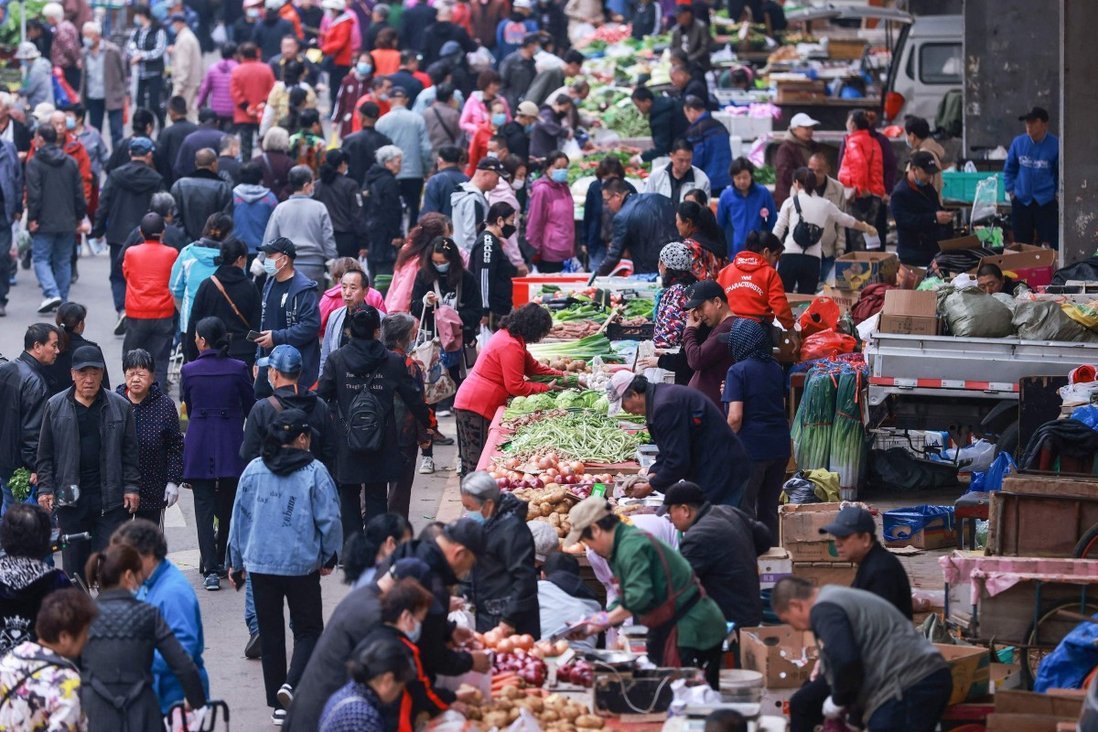
IN BRIEF
By Avishka Ashok, Keerthana Nambiar and Dincy Adlakha
INTERNAL
President Xi calls the development of archaeology with Chinese features
On 17 October, China celebrated the 100th anniversary of the Yangshao Culture and the establishment of modern archaeology in Sanmenxia in the Henan province. President Xi Jinping shared a congratulatory note on occasion and encouraged the development of archaeology that showcases Chinese features, style and ethics. He encouraged the Chinese archaeologists to focus on these aspects to display the significance of the Chinese civilization and its contributions to history. He said: "Over the past 100 years, generations of archaeologists have made a series of major discoveries through tireless efforts, playing an important role in making the extensive and profound Chinese civilization better understood." ("Xi calls for developing archaeology with Chinese features," Xinhua Net, 17 October 2021)
People's Liberation Army conducts troop transport exercise
On 17 October, Global Times reported that the Chinese People's Liberation Army conducted an integrated military-civilian cross-sea troop manoeuvring exercise to prepare for future battles. The exercise used a large civilian ferry and transported more than 1000 personnel and vehicles and crossed 1000 kilometres. The exercise also included the transportation of several vehicles such as the type 96 main battle tanks, type 04 infantry fighting vehicle, tactical assault vehicles and other support vehicles. ("PLA practices cross-sea troop transport with large civilian ferry," Global Times, 17 October 2021)
China's coal mining back on track in Shanxi province
On 17 October, Global Times reported that North China's Shanxi province, Beijing's coal hub is back on track after the heavy rains. "With the province's coal exploration and deliveries emerging from the heavy rains, optimism about a recovery in the country's coal supplies during the fourth quarter is on the rise, according to industry insiders, citing a government-led tenacious push to ensure energy adequacy and market shifts expected already under way," says Global Times. The report discusses the trucks full of coal from local mines in Shanxi and transported through expressway because of mudslides in the region. The improvement in terms of coal supply is helping to bridge the gap between demand-supply expecting a boost in the fourth quarter of the financial year. ("China's coal hub Shanxi emerges from floods, easing coal supply concerns," Global Times, 17 October 2021)
ECONOMY
China's third-quarter economic growth stalls by 4.9 per cent
On 18 October, the National Bureau of Statistics (NBS) said, "the domestic economic recovery is still unstable and uneven." China's economy showed an impressive improvement from the last year's pandemic affected economy, but the equity markets fell in the third quarter with a GDP of 4.9 per cent in Jul- September. The electricity shortages and the production cuts in September sandwiched with the climate targets affected the growth. China's growth in Q1 was 18.3 per cent and Q2 was 7.9 per cent. It is estimated that China's GDP growth will face further pressure in the Q4 due to disturbances in the global supply chains, dragging the 2021 GDP growth. ("China GDP: economic recovery stalls, growth slows to 4.9 per cent in third quarter," South China Morning Post, 18 October 2021)
TECHNOLOGY
Chinese virologist suggests a probable difference in progenitor for SARS-CoV-2
On 18 October, Global Times reported that a renowned virologist from Duke-NUS Medical School in Singapore presented his study on the origin of the SARS-CoV-2 virus. Wang Linfa, the virologist, reiterated that the virus was not manmade and that the lab-leak theory was unfound due to the same reason. While agreeing that the virus is traced back to the bats, he specified that the place of origin may be different from the first outbreak of the disease. He also explained that the progenitor virus for the SARS-CoV-2 could lead to different results. He said: "Although it was Wuhan which experienced the first outbreak of SARS-CoV-2, the virus is highly likely not from there. He hinted that Southeast Asia might be the place of origin for the virus. ("Renowned virologist calls for shifting attention to finding SARS-CoV-2 origins in Southeast Asia," Global Times, 18 October 2021)
REGIONAL
The Straits Times reports on lost businesses in Hong Kong
On 17 October, The Straits Times, a popular daily in Singapore, reported that many retail dealers dependent on Chinese tourists had closed shop since the third quarter of 2018. The report emphasized that businesses, especially from medicine, jewellery, cosmetics, clothing and leather goods industries, have closed down as the number of Chinese visitors have dwindled down due to the pandemic. The report also pointed that even before COVIS-19 hit, Chinese tourists to the financial hub had reduced due to the atmosphere of protest and resistance which was reported as violent towards mainlanders in state controlled media. ("Chinese tourists' disappearance is remaking Hong Kong retail," The Straits Times, 18 October 2021)
The Korea Times reports ripple effects in the Chinese economy
On 18 October, The Korea Times reported on the economic slowdown in China and cited a series of ripples caused by power shortages, construction slumber, and shocks suffered by investors and financial markets. China's economy grew only 4.9 per cent in the latest quarter, down from 7.9 per cent of the previous quarter. This figure was weaker than expected. The report provided an overview of the challenges that China is facing since the past few months, including Evergrande crisis and the coal import problems. The latest figures add pressure on Beijing. ("China's economic growth weakens amid construction slowdown," The Korea Times, 18 October 2021)
INTERNATIONAL
China's month old supersonic missile test surprises the US
On 17 October, Reuters reported, citing the Financial Times, that US intelligence agencies were caught off guard by China's supersonic missile test in August. The Chinese military had launched a rocket carrying a hypersonic glide vehicle with nuclear capabilities in August. The missile test has been said to be an outstanding advanced feat, leaving behind Russia and the US since it completed an orbit of the planet before firing for target. According to the report, the US intelligence agencies were unaware of these capabilities of China. Such hypersonic missiles are extremely sly weapons that are difficult to defend against. ("China surprises US with hypersonic missile test, FT reports," Reuters, 17 October 2021)
Australia suffers huge loss as China imports LNG from the US, says the Global Times
On 17 October, Global Times reported that Australia is at a great loss in energy trade with China as China eyes long-term liquefied natural gas (LNG) imports from the US. Multiple firms, including the oil giant Sinopec, are currently under discussions with US firms for LNG imports as huge four million tons, annually. As per the authorities from the oil industry, diplomatic tensions always impact international trade. China is working its way out from an energy and power crisis and is locking alternative sources of coal to break the crisis. It is also reported that many firms are importing US beef to replace Australian beef due to the tensions between Australia and China. ("Australia loses as China reportedly buys more US LNG," Global Times, 17 October 2021)
Xi Jinping's three-year-old promises to China-Africa trade
On 18 October, South China Morning Post reported on Chinese President Xi Jinping's promises to Africa. Xi had announced Chinese companies would be encouraged in investing in Africa, upgrading the economic zones and increasing the imports of African non-resource products. He pledged US$60 billion to the African countries as an aid as well as loans as an investment for the period of three years. In 2019, China-Africa trade was up to US$208.7 billion. Beijing majorly imports raw materials like crude oil, base metals, precious stones in exchange of electronics, equipment, machinery, and textiles. ("China, Africa and the 3 years since Xi Jinping promised to rebalance trade," South China Morning Post, 18 October 2021)
China Reader Evening Brief I 16 October 2021, Saturday I Vol.1, No.14
Internal power struggle in China: Four takeaways from two analyses
Two latest analyses by the Jamestown Foundation and The Economist reflect on the inner political friction within China and the Communist Party
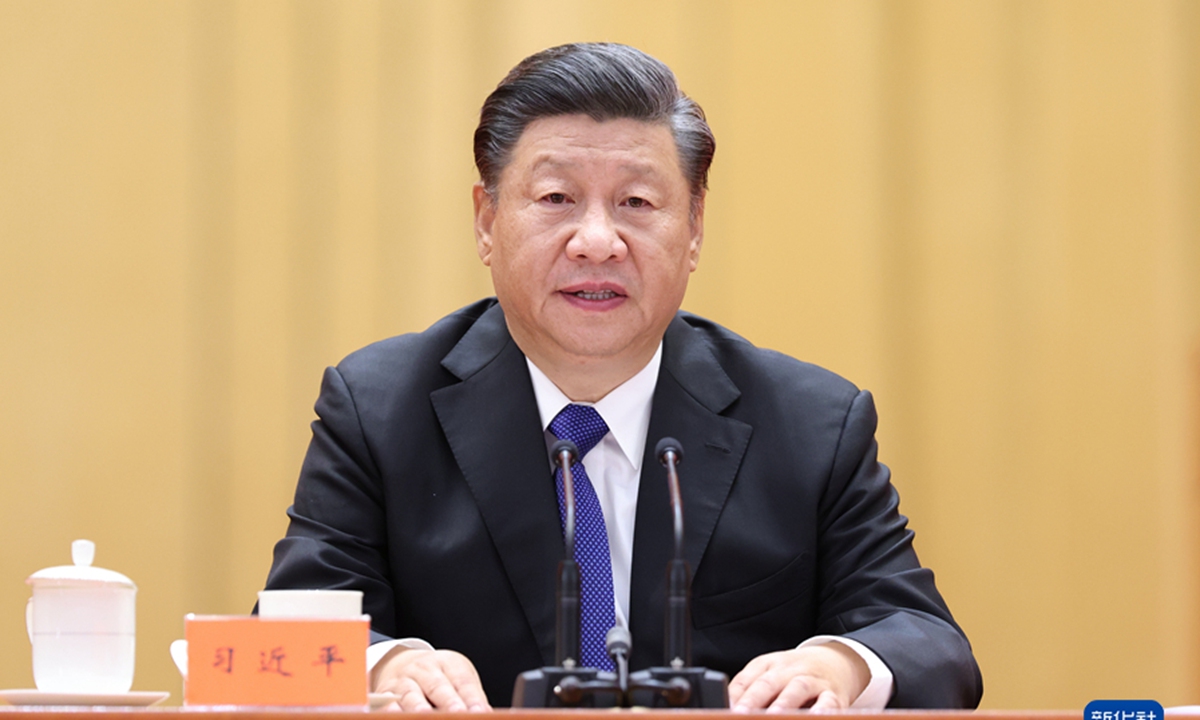
IN FOCUS
By Keerthana Nambiar
Internal power struggle in China: Four takeaways from two analyses by the Jamestown Foundation and The Economist
The essays reflect on the inner political friction within China and the Communist Party. It outlines the intensity of Chinese domestic politics and attempts to comprehend the factional dynamics which often comes out as a monolith. The rise of Xi Jinping in recent years is seen as an authoritarian one with the obvious possibility of rivals.
One could identify four takeaways from these analyses.
First, the internal divide within the factions of the Communist Party of China. In recent years factional backstabbing has increased especially with the economic crackdown in China. Evergrande Group, one of the largest real estate conglomerates in China with its near-bankruptcy of $240 billion liabilities has escalated the wider systematic crisis in Beijing sparking protests by angry investors and contractors. Since Xi Jinping came into power his primary focus has been to convey the impression that he follows Marxism and Maoism “do not forget the original intent”. However, such reforms have been upsetting the property-owning middle class creating a huge internal resistance. The critics within the system have been slightly eliminated marching towards their idea of national greatness.
Second, Xi’s rival party members. Xi Jinping is gradually tightening the political control of China. Starting with attacking the rich and famous from best-known actors to private firms Xi is remoulding the society with a more visible involvement of the party within people’s lives. Wang Qishan, the Vice President of the People’s Republic of China is one of the closest allies of Xi has gradually fallen out of favour. He is seen to provide homage to the journalist who exposes controversial stories on the wrongdoings of powerful officials. Ren Zhiqiang, a princeling, and real-estate mogul were sentenced to jail for eighteen years for alleged corruption and embezzlement last year for posting on the internet about the supreme as “the emperor who wears no clothes”. Wang is a close friend of Ren who is often thought of as a cause for ren’s post on Xi.
Third, the friction between political and legal apparatus. The supreme has a long-standing distrust with the regard to the political-gal apparatus. Xi’s arch-enemy, former PBSC member and internal security czar Zhou Yongkang still has a large number of followers in the police department despite him being imprisoned in 2015. The arrest of three former Vice Ministers of public security on the basis of economic and disciplinary infractions is part of Xi’s driving force in implementing the political and legal policies. With Wang Qishan and Zeng Qinghong, a veteran banker who was the former head of state-owned China Huarong Asset Management Company (CHAMC) arrested for association with a scandal with Lai Xiamin executed this January are the alleged political foes of Xi Jinping still under the covers.
Four, the question of the return of the ‘Cultural Revolution. The world witnesses a transformation going on in Beijing which is often questioned as Mao Zedong’s Cultural Revolution. The Economist says “nothing like Cultural Revolution appears to be offing”. The event which pushed China to a civil war years ago is not likely to happen because of Xi Jinping’s tighter surveillance and his dedication to preserve stability. Xi reforming the society under the backdrop of neo-Maoism especially since the pandemic began is his control over the country.
References
“Xi Jinping’s clampdowns herald a tense political year in China,” The Economist, 2 October 2021
“Early Warning Brief: Factional Strife Intensifies as Xi Strives to Consolidate Power,” The Jamestown Foundation, 14 October 2021
IN BRIEF
By Avishka Ashok and Dincy Adlakha
INTERNAL
Human Rights in China: Forum celebrates 30 years of first Chinese white paper
On 15 October, the Chinese government held a forum to celebrate three decades of the white paper titled ‘Human Rights in China.’ The forum involved over 70 government officials and local government representatives and experts. The paper that was published 30 years ago was the first white paper published by the Chinese government. The forum appreciated the efforts of the government towards the upliftment of the Chinese people and observed that the country had improved the state of human rights in the country. The vice minister of the Publicity Department of the Central Committee of the Communist Party of China said: “Facing the irreversible process of the great rejuvenation of the Chinese nation, the West has enhanced its attacks and suppression against China using the disguise of human rights." (“Forum held in Beijing to celebrate 30th anniversary of 1991’s White Paper – Human Rights in China,” Global Times, 16 October 2021)
Xi demands progress on property tax as part of "common prosperity initiative"
On October 15, the Communist Party of China's journal Qiuchi, published by Xinhua News Agency, printed an essay that quoted President Xi Jinping as calling for a vigorous and steady advance in the legislation for property tax. Xi demanded an update and progress on the legislation for property tax which will be a key step for China's "common prosperity initiative" to overcome the wealth gap in the country. President Xi also warned against over-promising the push for social welfare by the government. ("China's Xi calls for progress on property tax in drive for prosperity," Reuters, 15 October 2021)
Seven activists from Hong Kong imprisoned
On 16 October, seven activists from Hong Kong were jailed for up to 12 months. The activists included former lawmakers as well. They were imprisoned due to their role in the 2019 protests that rattled the entire city, and the world. The activists were undergoing prosecution for a while now and faced charges for organising aggravating rallies during the protests. The protests have been silenced through the National Security Law passed by the authorities last year. ("Seven Hong Kong activists jailed over unauthorised protest in 2020," Reuters, 16 October 2021)
SCMP reports on waves of disruption after the crackdown on the private educational industry
On 16 October, South China Morning Post covered the continuing impact of the crackdown on private tutors in China by the authorities over the summer. Due to private educational tuition after school, the costs in the educational industry had risen exponentially in China. This made couples wary of having kids. The Chinese government had imposed a ban on such tuition firms over the summer. Many firms closed doors and numerous investors lost huge sums of money. Now, there exist multiple lawsuits against high-end firms that suddenly closed without refunding the huge sums of pre-paid fees. Furthermore, many firms are still operating in secrecy and earning more now. Tutoring firms teaching English as a second language are the most common type in both cases. (He Huifeng, "China's education crackdown sparks lawsuit against defunct institutions, while some tutors keep teaching in secret," South China Morning Post, 16 October 2021)
TECHNOLOGY
Shenzhou-13 successfully docks with Tianhe
On 16 October, the China Manned Space Agency announced that the three Chinese astronauts had successfully entered the Chinese space station Tiankong. Zhai Zhigang, Wang Yaping and Ye Guangfu, the three astronauts aboard the Shenzhou-13 docked with the Tianhe module to become the second Chinese crew to enter the space station that was established in April 2021. The crew consists of the first female astronaut to enter the Chinese space station. They are tasked with doubling the previous record duration in space by a Chinese crew. (“Shenzhou-13 crew enter China's Tianhe space station core cabin,” Global Times, 16 October 2021)
REGIONAL
China cautions the Czech Republic against deepening cooperation with Taiwan
On 15 October, a spokesperson from the Chinese embassy in the Czech Republic reiterated China’s opposition to an increase in Taiwanese officials’ visits to the country. On 13 October, the Senate Committee on Foreign Affairs, Defence and Security of the Czech Republic agreed to increase cooperation with Taiwan. In response, China urged the country to follow the one-China principle in matters related to Taiwan. (“China strongly opposes Czech Senate's resolution on strengthening ties with Taiwan island: embassy,” Global Times, 15 October 2021)
INTERNATIONAL
Apple shuts down popular Quran apps in China
On 15 October, BBC reported that Apple has shut down multiple popular Quran apps from Apple stores in China. Based on the report, one of these apps has close to 150000 reviews and millions of users. The reason speculated for this shutdown, as per the app maker company PDMS, is that Apple was asked to do so by the Chinese authorities. The app Quran Majeed includes content that requires additional documentation and permission from the Chinese authorities. However, many believe the shutdown is a part of the Islamic crackdown in China, in the Xinjiang region. Apple makes a majority of its revenues from China and the firm has bent according to Chinese demands previously, too. ("Apple takes down Quran app in China," BBC, 15 October 2021)
China Reader Evening Brief I 15 October 2021, Wednesday I Vol.1, No.13
The Energy Sector: Looking beyond shortage
The economy and energy sector adjusts to the massive changes undertaken by the government to keep up with the global trends of reducing emissions
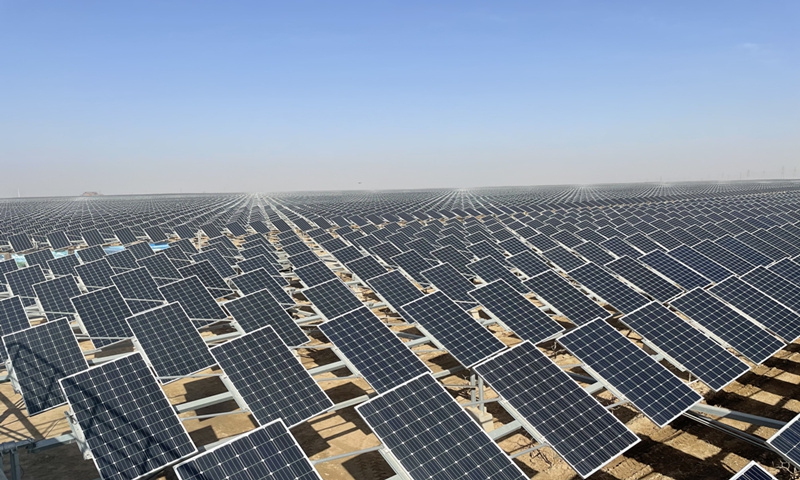
IN FOCUS
By Avishka Ashok
China's energy sector: Looking beyond the shortage
Recent Developments
On 8 October, Chinese Premier Li Keqiang held a state council meeting to discuss the energy scarcity in the country, which has decelerated the Chinese economy and continues to alarm the government with the fast-approaching winter. The sudden shortage of electricity is caused due to the deficit in coal availability and China's transition from a coal-based energy sector to a renewable energy-dependent sector. The shift is essential for China to keep up with the international promises of reducing emissions from the energy industry between 2021-2025. Even though China has extended the time duration to achieve its climate goals, the energy crunch was expected by the Chinese government when they promised the net-zero transition out of the coal-powered economic structure.
The energy sector: an overview
Being the world's fastest economy has its perks as well as challenges. The rapid urbanization that took place in China has made the country dependent on constant energy supply to ensure continuity in its industrial and economic processes. To provide the factories and the residential areas with an uninterrupted energy supply, the Chinese economy depended heavily on coal until 2019. In 2019, 57.7 per cent of China's energy was derived from coal-powered plants. Given the pace of development in China, the demand for coal quadrupled in the last two decades; thereby accounting for 79.7 per cent of emissions. To avoid stagnation of the economic growth, the country began importing energy-producing commodities like coal, crude oil, petroleum and more. In less than a decade, China became the largest importer of coal and second-largest crude oil importing country.
The transition from coal to green energy
Knowing the limits of a coal-dependent economy, the Chinese administration realized the need to transition to renewable sources of energy. A white paper published by the government in 2012, urged the country to take serious steps towards reducing the dependency on coal plants. Gradually, China began investing in renewables and became the largest investor in clean energy by 2018. In 2019, China contributed 23 per cent to the global investment in renewable energy. As the country seeks to shift out of coal-powered plants, it started investing heavily on hydro-electric, solar and wind energy. At present, the country is home to the largest hydro-electric power station and 21 other hydroelectric plants. By 2015, China was already producing 20 per cent of its electricity needs from hydroelectricity. China's solar power capacity is also the highest in the world at 253 GW. Other than these means of energy, the country is also depending on natural gas and nuclear energy. By 2019, it derived 8.1 per cent of its energy from natural gas and is now home to 16 nuclear power plants which generate 51,000 megawatts of electricity.
The future of China's energy sector
Although there is a sharp shift from conventional sources of energy, China will continue to depend heavily on crude oil, coal and petroleum. China also possesses the largest shale gas reserves in the world. However, these resources are difficult to obtain as they are located 3,500 meters below sea level. China also faces a bigger challenge with transporting green energy to remote and distant regions. There is a need for upgrading the power system which will be an expensive task in itself. An expert from the London School of Economics said: "When we talk about the challenges, most people focus on the (electricity) grid. It's the first step in this long journey."
References
Lin Wang, Olivia Li, "China's Climate Goals, The 14th Five-Year Plan, and the Impact on Sustainable Business," Business for Social Responsibility
"China_International_Analysis," US Energy Information Administration, 4 November 2016
"China Price Index: China's Persistent Energy Crisis to Disrupt Agrochemical Production Into 2022," AgriBusiness Global, 14 October 2021
"How Is China's Energy Footprint Changing?," China Power Project,
"The Largest Hydroelectric Power Stations in China," WorldAtlas, 12 July 2012
"China to add 55-65 GW of solar power capacity in 2021 -industry body," Reuters, 23 July 2021
IN BRIEF
By Dincy Adlakha and Keerthana Nambiar
INTERNAL
Xi Jinping on democracy as a "key tenet" of the Chinese political system
On 14 October, Chinese President Xi Jinping addressed the Central Conference on Work related to the people's congresses. "The people's congress system, made by Chinese people under the CPC leadership, is a great creation in the history of political systems as well as a brand-new system of great significance in the political history of both China and the world," Xi said. Xi emphasized that "democracy, a shared value of humanity, is a key tenet unswervingly upheld by the CPC and the Chinese people." The meeting took place as China is being mounted with pressure from the West and is stepping up efforts to defend its system. Xi's speech is an apparent response to the multiple sanctions imposed on Beijing by Washington on the growing concerns over human rights issues. ("Xi stresses enhancing whole-process people's democracy," The State Council The People's Republic of China, 14 October 2021; "Xi Jinping says China's 'democratic' political system is a 'great creation' that holds key to international success," South China Morning Post, 14 October 2021)
The Chinese astronauts' trio set for the Shenzhou-13
On 14 October, the China Manned Space Agency (CMSA) announced that three Chinese astronauts Zhai Zhigang, Wang Yaping, and Ye Guangfu will carry out the Shenzhou-13 spaceflight mission. Zhai will be the commander and Ye will be the first Chinese female astronaut to visit China's space station and carry out extravehicular activities. The team will stay in orbit for six months which will be a regular duration for Chinese astronauts to work and live in the space station. Shenzhou-13 trio underwent targeted training courses on rendezvous, spacewalks, research projects, docking tests, and transposition docking of the cargo craft captured and guided by the mechanical arm. The Shenzhou-13 manned spaceship is supposed to launch on 16 October 2021 from the Jiuquan Satellite Launch Center in northwest China. ("China unveils Shenzhou-13 crew for six-month space station mission," Xinhua Net, 14 October 2021)
ECONOMY
China pledges to further open Chinese market at Canton Fair opening
On 14 October, China opened its landmark trade fair, the Canton Fair, in Guangzhou. The fair is being conducted both, virtually and in-person. This is the 130th session of China's biggest import and export trade fair. President Xi Jinping sent a congratulatory letter and emphasized the importance of global cooperation at the joyous occasion. The inaugural address at the fair was delivered by Chinese Premier Li Keqiang. He vowed to make the Chinese market a fertile one for foreign investments. He emphasized reducing the number of sectors that are restricted from foreign investment. He also mentioned China's determination for investment liberalization and international support through RCEP and FTAs for the same. (Chi Jingyi, Xie Jun and Tao Mingyang, "Li pledges' fertile' Chinese market for foreign investment at Canton Fair opening," Global Times, 14 October 2021)
INTERNATIONAL
China-Bhutan signed a Three-Step Roadmap MoU
On 15 October, China and Bhutan signed a Memorandum of Understanding (MoU) on the Three-Step Roadmap to speed up the boundary talks. Wu Jianghao, the Assistant Minister of Foreign Affairs of China, and Lyonpo Tandi Dorji, the Foreign Minister of Bhutan announced that China and Bhutan will work to implement the MoU and commit to strengthening bilateral relations. According to the press release by Bhutan's Ministry of Foreign Affairs the roadmap is implemented "in a spirit of goodwill, understanding and accommodation." ("China, Bhutan sign MoU on a Three-Step Roadmap for expediting boundary talks," Global Times, 15 October 2021)
China-Russia joint naval drill in the Sea of Japan
On 14 October, China and Russia kicked off a joint naval drill for the first time in the Sea of Japan. Their joint statement says that "in light of rapid advances in the field of science and technology with dual-use capabilities, the risk of biological agents being used as weapons has increased." According to the report by Global Times, "the goal of the joint drill is to enhance the navies friendly, pragmatic cooperation, hone the capabilities to fight and enhance their capabilities to jointly deal with maritime security threats and safeguard regional peace and stability" by Zhang Junshe, a senior research fellow at PLA Naval Military Studies Research Institute. This is the first time China is participating with a 10,000 ton-class large destroyer in a drill abroad. ("China, Russia hold joint naval drill in Sea of Japan, display 'higher level of trust, capability'," Global Times, 14 October 2021)
The Mainichi reports "China warns against 'manipulation' of WHO virus probe"
On 14 October, Japanese newspaper The Mainichi reported on the warnings issued by China's Foreign Ministry against the "political manipulation" of the new WHO probe on coronavirus origins. The report cited the statement made by Chinese Foreign Ministry spokesperson Zhao Lijian who said that China would "continue to support and participate in global scientific tracing and firmly oppose any forms of political manipulation." Beijing has maintained the stance that it is being politically targeted and the scientific enquiries should be transparent. It has further shown doubts at US laboratories and demanded an investigation on the same. The Mainichi also mentioned the Chinese draconian measures to cut down COVID-19 cases. ("China warns against 'manipulation' of WHO virus probe," The Mainichi, 14 October 2021)
Microsoft shuts down LinkedIn operations in China citing increasing challenges
On 15 October, LinkedIn vice-president Mohak Shroff stated: "We're facing a significantly more challenging operating environment and greater compliance requirements in China." With this, Microsoft shut its social media network LinkedIn in China. Earlier this year, the site had blocked the profiles of certain journalists due to pressure from Chinese authorities. The journalists were working on projects related to the Chinese crackdown in Xinjiang among other fields. LinkedIn faced questioning over the matter. The firm has also announced that it shall release a non-social version of the app this year. InJobs shall only help in job search without any social posts feature. ("Microsoft shutting down LinkedIn in China," BBC, 15 October 2021)
China pushes initiative for green and digital BRi at UN meeting
On 14 October, Chinese President Xi Jinping addressed the opening ceremony of the UN Global Sustainable Transport Conference. In his speech, he announced China's plan to launch a Global Innovation and Knowledge Center for Sustainable Transport. China has increased the domestic transport network exponentially lately. It has also spread connectivity in important routes and regions through BRI. As the conference aimed to advance sustainable transport globally, China promoted its image as a contributor to the eco-friendly developer by substantiating the claims it made in the recent COP15 meeting. (Zhang Hongpei, "China to set up an innovation centre for global sustainable transport: Xi," Global Times, 14 October 2021)
China Reader Evening Brief I 13 October 2021, Wednesday I Vol.1, No.11
Global Times warns Taiwan against secessionism
Says “DPP authorities are attempting to overwhelm the powerful determination of China to realize national reunification with the will of a small group and achieve peace with an opportunistic mindset. They are dreaming"
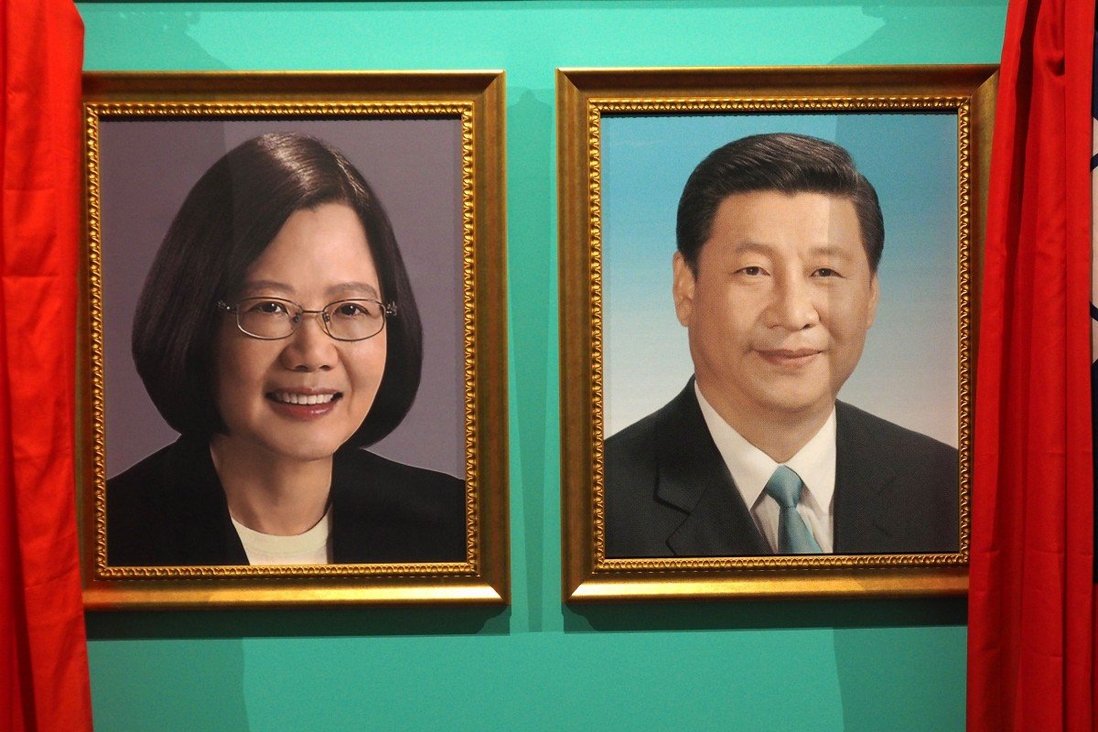
IN BRIEF
By Avishka Ashok and Dincy Adlakha
Global Times warns Taiwan against secessionism
On 12 October, Global Times published an editorial that targeted the news stories from Taiwanese outlet United Daily News. The article criticised the latest exchanges between US-Taiwan military officials and termed it as “provocation.” The strongly-worded article stressed that China will not back down without reunification. On 13 October, Global Times published another piece that criticised the “two-state theory” implied by Taiwanese President Tsai Ing-wen and her efforts to gain external support. This note listed that China out-strengths Taiwan and hence, there is no reason for a “hopeless resistance” from Taiwan. (“Crush the will of Tsai authorities and break cross-Straits stalemate: Global Times editorial,” Global Times, 12 October 2021; Yang Sheng, Liu Xuanzun and Deng Xiaoci, “Taiwan secessionists stage ‘doomsday madness’ in seeking foreign support,” Global Times, 13 October 2021)
INTERNAL
Regional government rejects claims of human rights violation in Xinjiang
On 12 October, the government in Xinjiang responded to the claims of human rights violation. At the 48th session of the United Nations Human Rights Council, the Xinjiang regional government spokesperson Xu Guixiang gave his statement against the beliefs of international governments and organizations which claimed that an ethnic cleaning or a “genocide” was taking place in China’s eastern most region. Xu said: “At the recent 48th session of the United Nations Human Rights Council, some Western countries made groundless accusations against China over Xinjiang-related issues based on disinformation, rumours, and lies.” According to Xu, the international community was using “human rights” as an excuse to unnecessarily interfere in China’s domestic politics. At the international gathering, the regional religious leader also displayed a holy plaque which was considered to be destroyed. (“China Focus: Xinjiang government refutes Western lies about human rights,” Xinhua Net, 12 October 2021)
China liberalizes power pricing while extending durations of carbon emission goals
On 12 October, the National development and Reform Commission (NDRC) of China revealed its plans to expand the fluctuating power prices to ameliorate the pricing mechanism and to ease the instability on power demand and supply. A statement released by the NDRC said: “the floating range of market-based electricity transaction prices in principle will be adjusted to a two-way range of 20 percent, compared with the current ceiling of 10 percent and a 15 percent floor. Rates for coal-fired electricity for energy-intensive enterprises are not restricted by the 20-percent fluctuation limit.” The government will also liberalize the pricing for thermal power and encourage industrial and commercial users to buy electricity from the markets. The energy crisis in the country has also led the Chinese government to rethink its global emission goals. The government recently issued a statement according to which the phasing out of coal powered plants are said to be expanded for a longer period. (“China liberalizes power pricing in bid to help address shortages,” Global Times, 13 October 2021; “China’s plan to build more coal-fired plants deals blow to UK’s Cop26 ambitions,” The Guardian, 12 October 2021)
ECONOMY
Chinese economy suffers a slowdown in the third quarter
On 13 October, Global Times reported that the Chinese economy had suffered a slowdown in the third quarter due to the fall in China’s exports and imports. The Chinese economists connected the development to the growing economic challenges, the electricity shortages and the increase in global bulk commodity prices. A gradual downward shift has been observed in the economic growth and the imports and exports in this quarter. The chief economist at Chasing Securities said: “China's exports are entering a downward channel as a result of easing overseas demands and a slowdown in substitution effect, but the sector still has resilience at large and the exports slowdown could be managed in a stable manner." (“China's foreign trade growth slows in Q3, facing more economic challenges,” Global Times, 13 October 2021)
TECHNOLOGY
Chinese State media broadcasts new drone technology
On 13 October, the Asia News Day published a report on the new armed spy drone of the People Liberation Army. The Chinese state media also broadcasted the functions and capabilities of the new drone. The televised report claimed that the drone is capable of carrying out unmanned missions and strike operations. The brand new WJ-700 is part of the “unmanned combat system” initiative of the PLA and has been developed by China Aerospace Science and Industry Corporation. (“New Chinese spy drone 'will make combat scenes in the movies a reality', state media claims,” Asia News Day, 13 October 2021)
INTERNATIONAL
China calls for measures to help Afghanistan and remove sanctions
On 12 October, Chinese Foreign Minister Wang Yi virtually attended a special G20 meeting on Afghanistan. In his statement at the summit, special representative Wang called for unified action to help Afghanistan and urged the world to remove unilateral sanctions. Wang presented proposals to help the country by overcoming the humanitarian crisis, push for a terrorism-free Afghanistan and other inclusive development plans. China promised to provide Afghanistan with huge amounts of vaccines, food and water. (Fan Anqi and Liu Xin, “China calls for swift efforts to help Afghanistan, removal of unilateral sanctions,” Global Times, 13 October)
Harvard University shifts Chinese language programme to Taipei from Beijing
On 12 October, South China Morning Post cited a student newspaper The Harvard Crimson and confirmed that Harvard University will move its centre for the Chinese language programme from Beijing to Taipei. The director of the Harvard Beijing Academy summer study abroad programme, Jennifer Liu, mentioned that this shift was finalised due to a “perceived lack of friendliness from the host institution, Beijing Language and Culture University.” Although the course was suspended for a while due to COVID-19 restrictions, it shall begin afresh at National Taiwan University. (Laura Zhou, “Harvard moves Chinese language programme from Beijing to Taipei,” South China Morning Post, 12 October 2021)
Japan Times reports on the gap between the US and China on trade talks
On 12 October, Japan Times reported on the recent trade talks that took place between senior officials from the US and China. The report mentioned the remarks exchanged between US trade representative Katherine Tai and Chinese Vice Premier Liu He. Based on the response by the Chinese ambassador to the US, the report analysed Chinese demands from the US in terms of cancellation of sanctions and restrictions. However, the US is still limiting itself and is wary of dealing with state-supported Chinese firms. The report concluded that these divergent stances will not converge for suitable trade deals anytime soon. (“China’s response to U.S. trade talks shows gap between two rivals,” Japan Times, 12 October 2021)
The Korea Times covers growing apprehension in Africa over unprofitable Chinese deals
On 11 October, the Korea Times published a story on the growing number of projects sponsored by China that are losing popularity in Africa. The report maintains that many projects in Ghana and the Democratic Republic of Congo are not reaping much benefits to the local population. Furthermore, the DRC President even ordered a renegotiation of a USD 6 billion deal between state-owned firm Gecamines and a consortium of Chinese companies. According to the report, deals across Africa are concerning the local population due to a lack of materialization of benefits. China has struck numerous deals in Africa vowing infrastructure in exchange. (“China's African infrastructure deals face growing concern that locals don't feel the benefits,” The Korea Times, 11 October 2021)
China Reader Evening Brief I 11 October 2021, Monday I Vol.1, No.9
Taiwan's President Tsai Ing-wen's address: Five Takeaways
On the occasion of the National Day of Taiwan, the President delivered a speech from the Presidential Office building, highlighting Taiwan's past challenges and future obstacles.
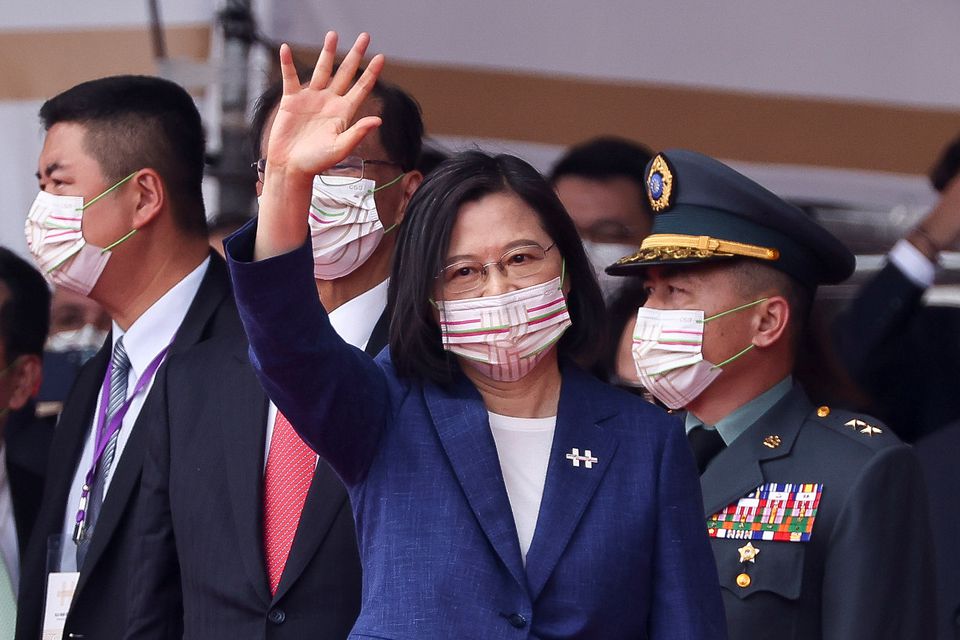
IN FOCUS
By Avishka Ashok
Taiwan's President Tsai Ing-wen's address: Five Takeaways
BLURB: On the occasion of the National Day of Taiwan, the President delivered a speech from the Presidential Office building, highlighting Taiwan's past challenges and future obstacles.
On 10 October, Taiwanese President Tsai Ing-wen delivered an address titled "Forging a Stronger Consensus: Standing United to Protect Taiwan" on the occasion of Taiwan's National Day. The speech shed light on five different contemporary issues facing Taiwan in the coming years.
COVID-19 recovery
President Tsai first highlighted the international pandemic cooperation and appreciated the Taiwanese spirit for fighting challenges unitedly. She also expressed her gratitude to the country's medical system and frontline workers for taking on the unknown dangers of the COVID-19 pandemic. She also thanked Japan, the US, Lithuania, Slovakia, the Czech Republic and Poland for supplying Taiwan with vaccines.
China's influence on the international system
While outlining the unprecedented challenges faced by Taiwan due to the complex regional landscape President Tsai emphasized the changing political structure of the international system. She also cautioned her fellow citizens against the incoming pressures from China. She urged the Taiwanese people to not let their guard down against China and work towards the country's development and growth. She also reiterated Taiwan's position on the Taiwan strait issues and urged China to resolve them through peaceful means. President Tsai strongly explained that Taiwan would not bow down to China, regardless of their military superiority and show of power in the ADIZ.
Renewing commitments to ensure continuity of democracy
On the special occasion, President Tsai guided the country to renew the commitment to upholding a free and democratic constitutional system, to resisting subordination and annexation to the People's Republic of China and to take into consideration the will of the Taiwanese people while making decisions for the future of Taiwan.
Taiwan's roadmap to economic development
The speech also elucidated Taiwan's path ahead and encouraged the people to establish a strong foundation for the country's economic growth along with bringing about bold reforms in the society. She motivated the people to continuously have an open mind towards legislative amendments, bureaucratic changes, land use, regional developments, and help in making the government more efficient and transparent.
Taiwan's international footprint
Lastly, she accentuated Taiwan's participation in international platforms and engagements with the rest of the world. She appreciated the Taiwanese athletes who participated in the Tokyo Olympics and the Taiwanese Air Force who had been busy preparing for the National Day.
The Chinese State Council Taiwan Affairs Office reacted to President Tsai's speech and said: "Tsai's remarks incite confrontation, distort facts, mislead the public in the name of so-called unity and consensus, while colluding with external forces to seek independence." The spokesperson of the Taiwan Affairs Office commented on Tsai's call to resolve issues and said: "We are willing to settle disputes under the one-China principle and work jointly to push forward the process of peaceful reunification and contribute to a peaceful development of cross-Strait relations."
References:
"President Tsai delivers 2021 National Day Address," Office of the President Republic of China, 10 October 2021
"China slams Tsai Ing-wen's speech, says China must be reunified," CGTN, 10 October 2021
IN BRIEF
By Dincy Adlakha and Keerthana Nambiar
INTERNAL
China issues new outline on national-level standardized development
On 10 October, the Communist Party of the China Central Committee along with the State Council issued a new outline to promote national standard development. The outline emphasized high-quality modernization. It laid guidelines on detailed measures to attain the long-term development goals of China by 2035. The document sets standards for the government, market, industries and all economic sectors. It also stressed on deepening international cooperation based on standardization work. ("China issues outline to promote standardized national development," Xinhua Net, 10 October 2021)
China's giant energy roadblock ahead
On 11 October, Caixin Global, a Chinese media group covered a story on China's giant energy shortage. China is facing the worst power crunch in the past two decades amid the post-pandemic recovery along with the governments' mission for the carbon emission reduction program. The crisis surged in late September; many parts of China experienced severe electricity shortages. This pushed local regulatory bodies to ration electricity by imposing power cuts on industries and residents. This led to a dive in the production of textile, steel, and other factories disrupting the global supply chains. China's 70 per cent of electricity is driven from coal-fired power generations. The situation is further complicated as winter falls, which will interfere with China's carbon neutrality goals. According to the China Electricity Council, nonfossil fuel options like hydropower and nuclear are expected to account for 47.3 per cent by the end of 2021. With the ongoing pressure to meet the energy targets, China has to restructure its system to tackle the giant energy shortage. ("Cover Story: How China Stumbled Into a Giant Energy Shortage", Caixin Global, 11 October 2021)
PLA Air force aims for quicker and efficient fighter jets
On 10 October, Global Times reported on the Chinese People's Liberation Army's (PLA) objective to train new pilots for fighter jets which will enable the jets to move more quickly and efficiently. The flight academy will now use J-10 fighter jets to train the pilot cadets. The new advanced technologies include aerial combat, combat relocation, and live fire attack. ("PLA Air Force academy gets J-10 fighters, trains elite pilots faster," Global Times, 10 October 2021)
INTERNATIONAL
China vows to include biodiversity in economic plans as COP15 meet opens
On 11 October, the first part of the 15th meeting of the Conference of the Parties on UN Convention on Biodiversity (COP15) opened. The meeting will proceed till 15 October in Kunming, Yunnan in China. Chinese Vice Premier Han Zheng said at the meeting that China would create a national conservation strategy. He also mentioned that China would include biodiversity protection in the developmental planning of all regions and sectors. The second half of the meeting is scheduled for next year. ("First part of COP15 meeting to open Monday in southwest China," Xinhua Net, 11 October 2021; "China vows to include biodiversity in economic plans as UN talks begin," Reuters, 11 October 2021)
Chinese delegation objects to draft resolution on the death penalty at UNHRC
On 11 October, Global Times reported on the stance presented by the Chinese delegation on the death penalty at United Nations Human Rights Council. The delegation objected to the draft resolution and further promised to vote against it. The delegation said that the death penalty is a legal and judicial issue falling under the sovereignty of the country. China also opposed "turning a judicial issue into a human rights issue" and also stressed the consideration of cultural, economic, and social development of a country while discussing the matter. China's Criminal Law retains the death penalty with strict controls and applies it prudently. ("China objects UNHRC draft resolution on death penalty," Global Times, 11 October 2021)
China and Australia's Taiwan friction
On 11 October, Chinese Foreign Ministry spokesperson Zhao Lijian made strong statements on the comments made by Tony Abbot, former Australian Prime Minister on Taiwan. "The relevant words and actions by the Australian politician go against the One China Principle and send a seriously wrong signal." He further added, "China is firmly opposed to this. We have made stern representations to Australia." Abbot during his visit to Taiwan expressed his opinions on China's incursions into Taiwan's ADIZ and said, "It is in large measure to try to help to end this isolation from which Taiwan has been suffering for so many decades that I am here in this country and I do hope that this will be the first of many visits." ("China lodges stern representations with Australia on Taiwan comments," Reuters, 11 October 2021: "Tony Abbott tells Taiwan president democracies must 'stand shoulder to shoulder' against China," The Guardian, 7 October 2021)
ON INDIA
Global Times writes China-India fail to reach a consensus in the military talks due to "unreasonable demands"
On 11 October, a Global Times report hinted at emerging risks of new conflict as China-India wind up 13th military-level talks. The Western Theater Command of the Chinese People Liberation's Army called India's demands unrealistic and unreasonable. Troop disengagement was discussed yet again during the talks; however, China maintains that it has taken much effort to cool the situation. This was the 13th round of corps commander level talks at the Moldo-Chusbil border. ("UPDATE: India's unreasonable demands in 13th military talks' risk new conflict'," Global Times, 11 October 2021)
06 October 2021, Wednesday | Vol.1, No. 5
Chinese government contemplates mitigating the impact of Evergrande’s debt crisis
Evergrande Group’s debt crisis deepens, investors worry about the impending drawbacks while the state tries to contain the crisis from impacting other businesses
IN FOCUS
By Avishka Ashok
Chinese government contemplates mitigating the impact of Evergrande’s debt crisis
On 3 October, the Wall Street Journal reported that the Evergrande Group’s debt crisis has created uncertain circumstances for investors as the Chinese government contemplates the way forward to prevent the company from negatively impacting the Chinese national interests. The Evergrande Group, a Chinese property developing company, is unable to pay off a debt worth USD 300 billion as it accumulated assets and expanded its business over the years. However, the sales have been declining for the past few months and it seems unlikely that the sales will shoot in the coming months. Other than the USD 300 billion debt to bondholders, the company also owes USD 103 billion to construction companies and other businesses affiliated with the company. Since financial institutions have restricted the funds, the company has been struggling to pay its suppliers.
The private companies in China and abroad are keenly looking at the Chinese government’s response and how they deal with the financial crisis at home which threatens to impact the national economy as well. Observers of the situation note that the government has not taken any serious measures yet as it plans on making an example of Evergrande company and shows other companies that the government will not swoop in and save it from financial miscalculations. However, since the Chinese government is involved in the Chinese economy, it will prevent the condition from becoming worse. According to the deputy dean of Shanghai Advanced Institute of Finance, “the government is still going to provide a guarantee for much of Evergrande’s activities but the investors are going to have to sweat.”
Meanwhile, the local governing bodies are also keeping a close watch over aggrieved buyers, unpaid vendors and laid-off employees to understand the state of public discontent and to quell any protests in the future. They have also implored communist party leaders to keep a watch on people’s movements related to property developers. The housing department of Lingshan County said: “Follow the demand to spot them early, defuse early, control early and deal with early. The heads of property development firms must personally take in hand the work of dealing with petitions and maintaining stability.” The government has also urged banks to ease the credit for homebuyers and support the property sector in China. Other measures taken by the state include buying part of Evergrande’s stakes and also injecting USD 123 billion into the financial system in a period of 10 days. The measures taken by the state however, may be seen as an effort to only limit the impact of the financial crisis. It will be much more challenging for China to completely save the economy from any backlash coming out of the debt crisis.
References
“China’s Evergrande Debt Crisis: Sizing Up a Big Mess,” The Wall Street Journal, 3 October 2021
“How China Plans to Avert an Evergrande Financial Crisis,” The New York Times, 26 September 2021
“China increases efforts to contain Evergrande crisis and not save it,” The National News, 4 October 2021
“Explainer | The Evergrande Crisis And How It Can Spiral Into A Global Financial Crunch, Moneycontrol.com”
IN BRIEF
By Dincy Adlakha and Keerthana Nambiar
INTERNAL
China’s top banking and insurance regulator to provide financial assistance for power crisis
On 5 October, China Banking and Insurance Regulatory Commission released a circular urging financial support for coal and electricity production. The circular also mentioned financial strengthening to ensure regular supplies and stabilized prices. The circular provides detailed guidelines on the prohibition of using these funds for speculating on coal and power sectors and also disallowed withdrawal of loans from projects in the relevant area. This circular was released in the context of extensive power outages in northwestern China and speculations of a larger power crisis in the upcoming spring and winter. (“China strengthens financial support for coal, electricity production,” Xinhua Net, 5 October 2021)
China’ Tianwen-1 suspended activities due to “solar outage”
On 6 October, the China National Space Administration announced that China’s Mars orbiter and rover’ exploration, Tianwen-1 have been suspended since mid-September. The administration stated that this was due to a “solar outage”. This is a situation when Mars and Earth move perfectly aligned to either side of the Sun the solar electromagnetic radiation increases leading to disrupted communications between both the planets. And the outage may possibly last till mid-October. (“China's Mars probes suspend explorations due to sun outage,” XinhuaNet, 5 October 2021; “China's Mars probes suspend activities due to 'solar outage',” Anadolu Agency, 6 October 2021)
REGIONAL
Taiwan’s toughest time in 40 years, says Taiwanese Defense Minister
On 6 October, South China Morning Post published a story on China’s ability to conduct a full-scale invasion in Taiwan by 2025 according to Taiwanese Defense ministers Chiu-Kuo. The Minister was addressing the legislative session to review a special budget for domestically produced weapons where he said that neither Taiwan is meant to nor has the financial capacity to face Beijing in an arms race. Chiu quoted, “It’s the toughest situation I have seen in more than 40 years of my military life.” He warned of the risks of the conflict as tensions have ratcheted up in the Taiwan Strait with Beijing sending 150 warplanes on the island. Chiu further added that Taiwan must rely on itself for defending against China. (“Beijing ‘fully able’ to invade Taiwan by 2025, island’s defence minister says,” South China Morning Post, 6 October 2021)
Taiwanese Defence Minister points at the worst military tensions between China and Taiwan in 40 years
On 6 October, Taiwan’s Defence Minister Chui Kuo-cheng said that the military tensions between China and Taiwan are at the worst in 40 years. He also warned of an accidental “misfire” between the two. The remarks came as he spoke in the parliament on being asked regarding the military situation. He referred to the four-day series of “serious” incursions. Along with these remarks, the defence minister also promoted a new arms package with an increased budget to the lawmakers. (“China-Taiwan military tensions 'worst in 40 years',” BBC, 6 October 2021; “Taiwan defence minister pushes new arms spending, says China tensions worst in four decades,” Reuters, 6 October 2021)
INTERNATIONAL
Chinese diplomats confirm President Xi Jinping’s absence from G20 Rome Summit
On 6 October, South China Morning Post reported that Chinese envoys have informed that President Xi Jinping will not attend the October summit of Group of 20 nations in Italy due to COVID-19 protocols. Previously, China had not confirmed the presence of President Xi in the summit. The confirmed absence from G20 summit raises speculations over his attendance in the COP26 climate conference in Glasgow as well. (“G20 summit: China’s President Xi Jinping ‘will not be in Rome’,” South China Morning Post, 6 October 2021)
Chinese diplomat rejects accusations of human rights abuse by US envoy at UN debate
On 5 October, a Chinese envoy exercised his right of reply in the general Debate held during the Third Committee of the United Nations General Assembly. The diplomat responded to the accusations posed by the US envoy over human rights abuse in the Xinjiang Uyghur Autonomous Region of China. Zhang Jun, China’s permanent representative to the UN, categorically rejected the allegations and termed them as part of the US promoted ‘lie diplomacy’ to destabilize China’s development. The envoy called for greater dialogue and cooperation instead of confrontation. (“Chinese envoy rejects U.S. accusations at UN debate,” Xinhua Net, 5 October 2021)
The Biden-Xi agreement on Taiwan
On 5 October, US President Joe Biden declared that he and the Chinese President Xi Jinping came to an agreement on Taiwan as the tensions have escalated between Beijing and Taipei."I've spoken with Xi about Taiwan. We agree ... we'll abide by the Taiwan agreement," Biden said. "We made it clear that I don't think he should be doing anything other than abiding by the agreement." Biden seemed to be referring to Washington’s longstanding policy which officially recognizes Beijing rather than Taipei and the Taiwan Relations Act, wherein Washington’s decision to establish ties with Beijing instead to Taipei is clear and the future of Taiwan would be determined peacefully. (“Biden says he and China's Xi agree to abide by Taiwan agreement,” Reuters,6 October 2021; “Biden Says He and China’s Xi Will Stick to ‘Taiwan Agreement’,” Bloomberg, 5 October 2021)
The US national security advisor and Chinese diplomat to “exchange views”
On 6 October, the Chinese Foreign Ministry announced a meeting between senior Chinese diplomat Yang Jiechi and U.S. National Security Advisor Jake Sullivan in Zurich, Switzerland. The meeting will be “according to the consensus reached by Chinese and US heads-of-state on September 10 in their phone call as agreed upon by China and the United States, “said the spokesperson Hua Chunying. She said, “they will exchange views on China-US relations and relevant issues”. (“Senior Chinese diplomat to meet with U.S. national security advisor,” Xinhua Net, 6 October 2021)
05 October 2021, Tuesday | Vol.1, No. 4
US' new approach to the trade relationship with China
"China made commitments that benefit certain American industries, including agriculture, that we must enforce," says US Trade Representative Katherine Tai
IN FOCUS
By Keerthana Nambiar
"New approach to the US-China Trade Relationship"
On 4 October, US Trade Representative Katherine Tai delivered a speech to a US think Tank, the Center for Strategic and International Studies (CSIS) in Washington. Tai made remarks that focused on the new Biden-Harris administration to US-China bilateral trade relationship and how "President Biden will continue to promote our economic interests – and build confidence for American industry." She detailed the evolution of the US-China trade partnership over the decades till date.
Tai explained the "dual-track" approaches the United States will be pursuing with respect to Beijing, wherein one track focused on the annual high-level dialogues between US and Chinese officials. The other track focuses on the WTO dispute settlement cases where the US "secured victories". Tai stated that "as our economic relationship with China evolves, so must our tactics to defend our interests." The representative outright critiqued China for shaping its own economy at the cost of the US and the rest of the world.
The stormy US-China relations now dominate global debates in all aspects, starting with politics, military, technological development, and trade. When Donald Trump launched the US-China trade war, he imposed $360 billion on goods imported from China, and it was a sudden departure from open markets, which was American trade philosophy. As the new Biden administration stepped in the slow reviewing of tariffs dragged on, and frustrations grew among the business ventures. The hopes to get rid of the tariffs die down with Biden following Trump's footsteps.
Geopolitics have changed since Biden took power, resulting in a complex intertwining of the economic and security interests. Biden's confrontational attitude towards China and being robust in the competition with China is now a bipartisan stance. Under the leadership of Xi Jinping China has increased its assertiveness testing the tolerance and perceptions of the US and its allies.
Ambassador Tai's address to the world is the US stance on the cold war between both US and China. The US' current stance with broad outlines and no clear roadmap has put the industries in a more compromising position hence brewing more tensions.
References
"Remarks As Prepared for Delivery of Ambassador Katherine Tai Outlining the Biden-Harris Administration's "New Approach to the U.S.-China Trade Relationship"," Office of the United States Trade Representative, 4 October 2021
"New US China trade plan leaves industry hungry for specifics," Reuters, 5 October 2021
"US-China trade: expect more carrots and sticks from Biden White House, analysts say", South China Morning Post, 5 October 2021
"US will 'take all steps necessary' to defend itself on China trade," BBC, 5 October 2021
"US Trade Rep Katherine Tai to condemn China's 'unfair trade practices'," CNN, 4 October 2021
IN BRIEF
By Dincy Adlakha and Avishka Ashok
INTERNAL
Chinese government works towards restoring power supply caused by coal shortage
On 4 October, Xinhua Net reported that the country's energy sector was putting in all efforts to ensure the continuous supply of electricity to the northeast of the country, where at least 20 provinces are suffering from power cuts and electricity blackouts. Numerous residential regions and industrial factories are forced to implement electricity rationing in order to follow the government-sanctioned limit of power usage. The National Development and Reform Commission (NDRC) has now encouraged mid and long-term coal supply contracts in an attempt to deal with the coal shortage that is affecting the economic capacity of the country. ("Xinhua Headlines: China goes all out to cope with power outages," Xinhua Net, 4 October 2021)
Record number of Chinese aircraft approach Taiwan yet again
On 4 October, the Chinese People's Liberation Army sent 56 aircraft near the Taiwanese island for military drills. This is the third time in four days that China has sent aircraft near Taiwan. Monday's incursion followed the statement released by the US State Department suggesting "concern" over the situation. A spokesperson of the Chinese Foreign Ministry, Hua Chunying, said: "China will take all measures necessary to crush any "Taiwan independence." 'Taiwan independence' is doomed to fail." (Liu Xuanzun, "UPDATE: PLA sends 'record-breaking 56 aircraft near Taiwan island in a single day' in consecutive drills," Global Times, 4 October 2021)
President of Taiwan defends Taiwanese democracy with strong words
On 5 October, in an essay published in Foreign Affairs, Taiwanese President Tsai Ing-wen emphasized that Taipei is committed to its democracy and shall do whatever it takes to protect it from falling. The president warned an aggressive China of the "catastrophic consequences" that shall follow for the whole region if the democracy in Taiwan falls. Analysts have been debating on the threats to Taiwan's sovereignty for long, now. An increased focus has zoomed on the region as China becomes aggressive in displaying its control while the western allies of Taiwan, including the US, continue to stand in opposition to the Chinese actions. (Tsai Ing-wen, "Taiwan and the Fight for Democracy," Foreign Affairs, 5 October 2021)
Hong Kong Chief Executive Carrie Lam denies schedule of anti-foreign sanctions law for the city
On 5 October, Carrie Lam, the leader of Hong Kong, said in a weekly news briefing that Beijing does not have a timetable to extend the anti-foreign sanctions law in Hong Kong. She also said that the status of Hong Kong as an international financial hub would be accounted for by China before implementing the law. The law was introduced in June 2021 in mainland China and was expected to be formally approved in Hong Kong in August. However, the vote was postponed, considering the impact it could have on various international financial institutions and their operations. ("Hong Kong leader says Beijing has no timetable for anti-sanctions law," Reuters, 5 October 2021)
ECONOMY
Chinese property developers' crisis deepens as the ability to replay loans hits new decade low
On 4 October, a report published by Reuters found that the property firms in China were struggling to pay interest on their debts even before the Evergrande crisis worsened the situation. According to the accounts maintained by Reuters based on the data by Refinitiv, the aggregate interest coverage ratio of 21 big, Hong Kong-based real estate developers had fallen to 0.94, the worst in a decade. Additionally, on 5 October, Sinic Holdings joined the list of Chinese developers that have been downgraded by a global rating agency. (Patturaja Murugaboopathy and Gaurav Dogra, "Chinese property developers' ability to repay debt hits decade low," Reuters, 4 October 2021; "Evergrande: Investors kept waiting over 'major' deal," BBC, 5 October 2021)
Atlantic Council and Rhodium Group Report finds China not on track with stated reform goals
On 5 October, South China Morning Post covered a report titled 'China Pathfinder' by Atlantic Council and Rhodium Group. The report mentioned that China is not moving towards its stated reform goal of becoming a market economy. The report found that there had been some progress in becoming an open economy from China's end however, recent years (especially since 2016) have backtracked most of this progress by cracking down on technology and education-related private firms. Hence, the report advises market economies such as the US to establish commercial rules before dealing with China. ("China is not heading toward a market economy, often due to its own policies, report concludes," South China Morning Post, 5 October 2021; "China Pathfinder: Annual Scorecard," Atlantic Council GeoEconomic Center and Rhodium Group, 5 October 2021)
INTERNATIONAL
Chinese President Xi Jinping congratulates Japan's new Prime Minister
On 4 October, the Chinese President Xi Jinping sent a congratulatory note to the new Japanese Prime Minister Fumio Kishida. On the same day, Global Times also reported that the cabinet lineup of Kishida had drawn the attention of many since the new cabinet tries to balance its relations with China and the US. A research fellow at the China Institute of International Studies said: "China will keep an eye on whether Kishida administration will try to play 'human rights card' against China in the future, by attentively increasing pressure on China on issues related to Hong Kong and Xinjiang." ("Chinese President Xi Jinping on Monday congratulated Fumio Kishida for being elected Japan's new prime minister," Global Times, 4 October 2021; "Kishida to be tested on balancing Japan's relations with the US, China: observers," Global Times, 4 October 2021)
Chinese Foreign Ministry urges the US to abide by One-China principles
On 4 October, a Foreign Ministry Spokesperson warned the US to not support the Taiwanese call for independence and cautioned the country from creating obstacles in the Taiwan Strait. She said: "Taiwan belongs to China and the United States is in no position to make irresponsible remarks. The relevant remarks by the US side seriously violate the one-China principle and the stipulations of the three China-U.S. joint communiques and send an extremely wrong and irresponsible signal." She also implored the US to strongly abide by the One-China principles on which the US-China relations are based upon. ("China urges US to stop supporting "Taiwan independence" separatist forces," Xinhua Net, 4 October 2021)
04 October 2021, Monday I Vol.1, No.3
Chinese fighter planes repeatedly breach Taiwan's ADIZ
The Chinese incursion creates a record, after 39 aircrafts made a show of military might on the Chinese National Day.
IN FOCUS
By Avishka Ashok
Chinese fighter planes repeatedly breach Taiwan's ADIZ
On 4 October, Taipei Times reported that a new Chinese record had been made when 39 Chinese aircrafts belonging to the People Liberation Army of China crossed over into the Taiwan air defence identification zone (ADIZ). A total of 38 fights first flew into Taiwan’s ADIZ on the occasion of the Chinese National Day on 1 October 2021. Soon after that, on 2 October, 39 aircraft again breached the ADIZ.
Air Defence Identification Zone is the airspace over land or water that is just outside the sovereign territory of a state. It is an identification zone that provides countries with a chance to issue warnings to unknown and unannounced incursions by a foreign country. When an unidentified flight enters the ADIZ, it gives the country enough time to prepare for a counter-attack or send warning signals to the attacking state. However, flying over the ADIZ is not the same as breaching a country’s sovereign territory which covers 12 nautical miles from the coast of the state. In the recent Chinese incursion, the PLA airplanes flew close to Pratas Islands in Taiwan which is considered as a part of the country’s ADIZ to protect itself from the numerous Chinese incursions.
On Chinese National Day, Taiwan’s Ministry of National Defence released two reports of the Chinese incursion. The first report revealed that 18 Shenyang J-16 fighter jets, four SU-30 jets, two Xian H-6 bombers and one Shaanxi Y-8 anti-submarine warfare (Y-8 ASW) plane has entered the southwest part of the ADIZ. The second report revealed the breach of the ADIZ by 10 Shenyang J-16 fighter jets, two Xian H-6 bombers and one KJ-500 airborne early warning and control aircraft. On 3 October, yet another incursion by the PLA consisting of 16 military aircrafts took place. The 16 flights included eight Shenyang J-16 fighter jets, four Sukhoi Su-30 fighter jets, two Shaanxi Y-8 anti-submarine warfare planes and two KJ-500 airborne early warning and control aircrafts.
On 3 October, the US State Department spokesperson Ned Price condemned the incursions by the PLA and said: “The U.S. is very concerned by the People’s Republic of China’s provocative military activity near Taiwan, which is destabilizing, risks miscalculations, and undermines regional peace and stability." In response to the Chinese military aggression, Taiwan’s administration also reached out to Australia along with issuing radio warnings and deploying air defence missile systems. The Taiwanese Foreign Minister Joseph Wu urged Australia to expand the intelligence sharing and security cooperation between the two countries. He said: “The defence of Taiwan is in our own hands, and we are absolutely committed to that."
Although the Chinese government has not responded to the statement by the US and Taiwan, the country has repeatedly explained that its actions are aimed at protecting its sovereignty against the joint cooperation of Taiwan with the US. A researcher at the Association of Strategic Foresight also claimed that, “The day and night incursions are meant to show that the PLA is capable of military deployment around the clock. The aircraft came from different squadrons to demonstrate to Taiwan and the US the PLA’s joint combat capabilities and its ability to quickly assemble assets from different units.”
Reference
“China sets new record of 39 ADIZ crossings,” Taipei Times, 4 October 2020
“Air Defence Identification Zone (ADIZ),” Journals Of India, 1 July 2020
“Record 38 Chinese military planes penetrate Taiwan's ADIZ on China's National Day,” Taiwan News, 2 October 2021
“16 Chinese military aircraft enter Taiwan’s ADIZ,” Taiwan News, 4 October 2021.
“US condemns intrusion of 93 Chinese warplanes into Taiwan ADIZ,” Taiwan News, 4 October 2021.
“Taiwan seeks help from Australia to counter Chinese aggression,” Taiwan News, 4 October 2021
“China air force sends 77 warplanes into Taiwan defense zone over two days, Taipei says,” CNN, 3 October 2021
IN BRIEF
By Keerthana Nambiar and Dincy Adlakha
INTERNAL
“China's service trade further expands in first eight months” reports Xinhua Net
On 3 October, Xinhua Net cited the Ministry of Commerce (MOC) saying that China’s service trade increased by 9.4 per cent in the first eight months of the year. The total figure topped 504.21 billion US Dollars. It was also reported that the service imports of the country were 1.8 per cent points less year on year while the exports increased 25.3 per cent points year on year. More than 45 per cent of the total service trade was accounted for by knowledge-intensive services. Evidently, the trade for such services rose by 16 per cent while the trade in travel-related services continued to drop. According to the news agency, China has ensured measures to increase service trade and is expected to further continue these steps. (“China’s service trade further expands in first eight months,” Xinhua Net, 3 October 2021)
Meteorological Observation Stations cover entire Tibet
On 3 October, Xinhua Net published an article on the status of meteorological observation in the Tibet Autonomous Region of China. According to the article, various kinds of weather stations have been set up in Tibet covering all 695 towns of the region. The establishment of these stations first started in 1951. Tsering Thodri, the director of disaster reduction division of the regional meteorological administration said: “Remote sensing satellite data from the observatories are now shared with 14 regional departments including transport, emergency management and civil aviation.” According to the regional meteorological administration, this service will support activities like transport, tourism, animal husbandry, agriculture, and so on. It will also help in taking precautionary measures to protect people’s lives in bad weather conditions. (“Across China: All Tibet's towns under meteorological observation”, Xinhua Net, 3 October 2021)
Hong Kong Confederation of Trade Unions disbands citing “political uncertainty”
On 3 October, members of the Hong Kong Confederation of Trade Unions (HKCTU) voted to disband the organisation due to growing “political uncertainty” under the National Security Law. HKCTU was the largest trade union of Hing Kong. The members are scared for their personal safety as the National Security Law tightens its grip on civil society. According to the accounts maintained by Reuters, approximately 29 trade unions have dissolved within 2021. Previously, the largest teachers’ union had also disbanded due to “drastic” situations in Hong Kong. (“Hong Kong trade union disbands as impact of security law deepens”, Reuters, 3 October 2021; “Hong Kong opposition trade union group to disband”, Reuters, 19 September 2021; “Hong Kong teachers' union to disband due to 'drastic' political situation”, Reuters, 10 August 2021)
Investigation continues for former Vice President of PetroChina
On 4 October, Reuters reported the Central Commission for Discipline Inspection (CCDI) is investigating Ling Xiao for “serious disciplinary violations.” Ling resigned last month from his post as the Vice President of PetroChina, the state’s top energy giant, and turned himself in. Ling has contributed significantly to the company’s natural gas pipeline and marketing business but, is currently facing a probe by the anti-corruption watchdog of China. (“Former PetroChina executive under probe for suspected graft”, Reuters, 4 October 2021)
Water-filled barriers removed from Hong Kong official buildings amidst National Day celebrations
On 3 October, Global Times reported that the water-filled barriers established in front of Hong Kong official buildings in 2019 to block violent protests were removed after more than two years. The buildings included the Legislative Council and the Liaison Office of the Central People's Government in Hong Kong. These buildings were raided by protesters during the anti-state protests in 2019. According to the report, the removal of barriers marks a return to complete safety in the city and an increased focus on economic development can be guaranteed now. (“Barriers used during black terror removed from HK official buildings, marking return to safety amid National Day celebrations”, Global Times, 3 October 2021)
Shanghai Cooperation military drills mark first drone attack defence tests
On 3 October, South China Morning Post reported that the two-week military drills of the Shanghai Cooperation Organisation tested defences against drone attacks for the first time. These drone warfare defences were inspired by new and emerging security threats from the US withdrawal from Afghanistan. A spokesperson from the Chinese defence ministry said: “The new content aimed to address the trend of terrorist attacks carried out by drones.” Citing a researcher, Zhou Chenming, from a top military science and technology institute in Beijing, SCMP also reported that China is a frontrunner in unmanned aerial vehicle technology. (“Drone warfare marks a first for SCO drill, as region faces up to terror attack risks in Afghan fallout”, South China Morning Post, 3 October 2021)
National Health Commission sends a working group to Xinjiang after two asymptomatic COVID-19 cases
On 4 October, Global Times reported that the National Health Commission has sent a working group to Yili prefecture in the Xinjiang Autonomous Region of China. Two silent asymptomatic COVID-19 cases were detected in the port city of Horgos on 3 October. 192 contacts in the city have been quarantined and no new cases have been detected ever since. However, large scale nucleic acid testing will continue in the city while many flights to and from the city have been cancelled in order to prevent the transport of virus carriers in other provinces of China. (“National Health Commission sends working group to Yili, Xinjiang, after detecting 2 silent cases”, Global Times, 4 October 2021)
INTERNATIONAL
US concerns over escalated military activity in Taiwan by Beijing
On 3 October, US State Department Spokesperson Ned Price released a statement voicing US concerns by China’s “provocative military activity” near Taiwan. He stated that such activities from the People’s Republic of China “undermines regional peace and stability.” Price stressed that the US will be maintaining commitments outlined in the Taiwan Relations Act, The Six Assurances and Three Communiques. The response from the US State Department came in after the intense aircraft interference which included warplanes, fighter jets and anti-submarine warfare aircraft was visible during daylight in Taiwan’s air defence identification zone (ADIZ). This was the largest show of force by Beijing setting up a new record in the self-ruled island. (“Increasing People’s Republic of China Military Pressure Against Taiwan Undermines Regional Peace and Stability,” U.S. Department of State, 3 October 2021; “US urges China to stop ‘provocative’ Taiwan activities after PLA’s latest record flyover,” South China Morning Post, 3 October 2021)
02 October 2021, Monday I Vol.1, No.2
China's power shortage may disrupt global supply chains, says a report in the Wall Street Journal
High coal and electricity prices coupled with greater demand for power lead to a shortage of power in China. The affected companies and their restricted manufacturing capacities will lead to blocked global supply chains.

IN FOCUS
By Dincy Adlakha
China's power shortage may disrupt global supply chains, says a Wall Street Journal report
On 1 October, the Wall Street Journal published an article highlighting the upsetting effects of the Chinese power shortage on global supply chains. The article cited numerous power outages in many Chinese cities over the past week and linked them to the larger disruption of global supply chains.
The report stresses the problems surrounding the coal-based production of electricity which is responsible for 60 per cent of China's power. Citing Ting Lu, chief China economist at Nomura Holdings, the article also hinted at the resultant inflation in developed economies such as the United States. The global supply chains are still quite largely dependent upon China, and the shortage of semiconductors is just one case of global loss. More similar cases are about to follow, as per the WSJ report.
The power shortage in China
China is facing a crisis to fulfil its power demands. Despite dramatic efforts from the authorities to curb heavy industrial power usage, there have been multiple power outages for long hours throughout cities. China has not seen such severe blackouts in 15 years. Last, such long hours of power outages were recorded when China was newly industrializing.
Provincial authorities of Inner Mongolia, Zhejiang, Jiangsu and Guangdong have ordered industries to reduce electricity usage, including energy-intensive industries like aluminium smelting, steel making, cement manufacturing, and fertilizer production. Post-pandemic recovery has been hard on these industries. Around ten provinces have failed to attain the energy efficiency targets. Furthermore, these industries have been asked to halt production during peak hours of power usage, which can last up to 16 hours, or shut down entirely for two to three days. Some plants have been shut since 22 September until further notice. Within the previous week, approximately 100 companies have notified the stock markets regarding a production halt. Chinese factory activity was at its lowest in September 2021 ever since the pandemic hit the economies in February 2020.
Reasons behind China's power shortage
The power crisis has been triggered due to a pool of factors like tough emissions targets, high coal prices, record electricity prices, an upsurge in demand for power, and increased overseas recovery from COVID-19 slump. China has pledged to become carbon neutral by 2060. However, it is still far from the targets, and the latest regulations have not helped in improving energy efficiency. There is also an increased demand for energy in the factories. This is caused by the global reopening of economies and a rebound of demand for Chinese goods. Greater demand for goods requires higher production, dependent upon constant energy supply. However, as China has unofficially banned coal imports from its largest supplier Australia, production from coal-fired plants remains low. The state has maintained a strong control on electricity prices leading to many coal plants reducing their outputs instead of operating at a loss. The prices of thermal power continue to rise, with a record-breaking price of 212.92 USD per tonne on 29 September. Additionally, the domestic output of renewable energy has also remained low during the year due to droughts and bad weather disrupting hydropower and wind power supplies, respectively. This further entangles the domestic fuel supply in China.
Effect on global Supply Chains
Many suppliers located in China are largely affected due to the power shortages and have not been able to continue the productions. Many manufacturing companies that supply electronics and other components to auto companies such as Ford Motor co. and Volkswagen AG have been affected, and the vehicle production has suffered, in turn. Chipmakers and semiconductors are the forerunners in struggling industries interrupted in their final stages of production. Many suppliers to Apple Inc. and Tesla have also been caught up.
Besides, investment banks Nomura and Goldman Sachs have acted to this power shortage by downgrading their forecasts for growth in China since they expect further disruptions in the production and supply chains.
In perspective
Based on the current power crisis in China and the analysis of the Wall Street Journal Report, the blocking effects on global supply chains can be counted on. Also, the response from Chinese authorities on assuring basic power supply are bleak. The goal of maintaining an energy-efficient economy seems farfetched for China.
References
China's Power Shortfalls Begin to Ripple Around the World, Wall Street Journal, 01 October 2021
https://www.wsj.com/articles/chinas-power-shortfalls-begin-to-ripple-around-the-world-11633101100
IN BRIEF
By Keerthana Nambiar and Avishka Ashok
INTERNAL
China's biggest lenders pledges for more green projects
On 1 October, the Bank of China, China's biggest lender have pledged to boost credits supporting green projects from the period of 202lender The bank promises to provide 1 trillion yuan (154.2 billion dollars) for the green industry parallel to the BOC action plan to reach China's carbon neutrality goals. According to the plan, the overall domestic corporate loans exceed 1 trillion yuan, 15 percent over the beginning of this year which is faster than the bank's average loan growth. (Bank of China plans more green loans, XinhuaNet, 1 October 2021)
China celebrate 72nd National Day
On 1 October, China celebrated the 72nd anniversary of the establishment of the People's Republic of China. A few days before the National Day, the Chinese government also released a series of white papers on China's economic prosperity and the demography in Xinjiang. The people participated in flag hoisting ceremonies, spent time with their families and engaged in community activities as they began a long weekend while also following the pandemic prevention measures. A grand flag hoisting ceremony also took place in Tiananmen Square, which was attended by over 1,30,000 people. The National Day was celebrated with great enthusiasm by the Chinese citizens as the country marks 100 years of the Communist Party of China's existence. (National Day celebrated across China amid jubilation, hopes for better future, Xinhua Net, 02 October 2021)
Chinese economy observes a minute slowdown as economic challenges create obstacles to growth
On 1 October, Xinhua Net reported that numerous obstacles were challenging the Chinese economy. Some of these challenges include climbing prices of commodities, the spread of COVID-19 in parts of China, a slump in consumer consumption and the slowing down of industrial output. The larger picture however, depicts a slow but definite growth of the economy. The purchasing managers' index also slipped down marginally in the last month to 49.6 from 50.1 in August. (Economic Watch: Pressure and perseverance: China's economy maintains resilience, Xinhua Net, 1 October 2021)
Chinese media reports international media bias and discrimination
On 2 October, Xinhua Net published an article regarding the international media bias against China. The Chinese media outlet lashed out at the western media for continuously painting it in a negative light. According to the report, Western media and journalists consistently portrayed China as the enemy and silenced those who called out the lies. Subsequently, the report spoke about the resignation of Javier Garcia, the head of the EFE News Agency of Spain in China, who explained that "flagrant information manipulation by Western media "has taken a good dose of my enthusiasm for this profession" according to Xinhua. (Xinhua Commentary: Western media bias against China deplorable, dangerous, Xinhua Net, 2 October 2021)
INTERNATIONAL
Australia's first fleet of nuclear-powered submarines, a threat to Chinese submarines
On 2 October, South China Morning Post published an editorial on the new security partnership between Australia, the United States, and the UK as Australia acquired its first fleet of nuclear-powered submarines. The editorial focuses on the risks of military conflicts in the disputed South China sea. An associate professor of international studies at Renmin University says that the Australian submarines poses threat to Chinese ones with accidental collisions in the Indo-Pacific regions. He also points out the "with more nuclear submarines and alliance system, the US and Australia may advance an offensive naval strategy in the future." (Australia getting nuclear subs via Aukus' ups risk of conflict near China', South China Morning Post, 2 October 2021)
Xi Jinping addresses China Pavilion of Expo 2020 Dubai
On 1 October, Chinese President Xi Jinping addressed the China Pavillion of Expo 2020, Dubai via a video message under the theme, "Connecting Minds, Creating the Future". Xi Jinping said, "Where should the future of humanity be headed? China's answer is to call on the people of all countries to work together, respond to the call of the times, strengthen global governance, pursue innovation-driven development, and advance the building of a community with a shared future for mankind." He concluded his note wishing "full success" on the expo and added that China is open for exchanges and cooperation with other countries. (Xi sends video message for China Pavilion of Expo 2020 Dubai, Global Times, 1 October 2021)
China's Great Wall Motor planning to acquire Spain's Nissan plants
On 1 October, Reuters reported on the talks that will happen between Spanish authorities and Nissan with China' Great Wall Motor over a possible takeover of the Japanese carmaking plant in Barcelona. The Spanish regional and national authorities along with Nissan and Spanish electric motorcycle manufacturer Silence and local engineering firm QEV Technologies come together to negotiate the future of the two smaller Nissan plants. According to the Reuters sources Great Wall has shown interested in larger plants (Spain to negotiate with China's Great Wall Motor to take over Nissan plant, Reuters, 1 October 2021)
Chinese representative to the UN calls for global solidarity in vaccine equity
On 1 October, China and 74 other countries called for global solidarity for vaccine equity at the General Debate of the Third Committee of the United Nations General Assembly. The Chinese representative to the UN Zhang Jun said: "We call on all states and stakeholders to strengthen solidarity and international cooperation to contain, mitigate and overcome the pandemic and its consequences, ensure protection for those most affected, including women, children, youth, the older persons and persons with disabilities, and take measures to counter misinformation, disinformation, stigmatization, racism and xenophobia." (75 countries including China call for global solidarity for vaccine equity, Xinhua Net, 2 October 2021)
01 October 2021, Friday, Vol.1, No.1
White Paper on prosperity
"Achieving moderate prosperity fulfils a long-cherished dream of the Chinese nation"
IN FOCUS
By Avishka Ashok
On 26 September, the State Council Information Office of China released a white paper on the country's economic journey to moderate prosperity. The paper is titled "China's Epic Journey from Poverty to Prosperity." The paper observes that the declaration of moderate prosperity in China in July 2021 brings the country closer to the Chinese goal of national rejuvenation. The paper says: "Achieving moderate prosperity fulfils a long-cherished dream of the Chinese nation."
The paper praised the efforts of the Chinese Communist Party, which marked 100 years of its existence this year. The paper also applauded the Chinese people for their undying perseverance that helped the country rise from the state of impoverishment. It looked back upon the measures taken by China to provide overall development for all the people in China. The paper remarks that the country has achieved moderate prosperity in the field of sustainable and sound economic development, providing people's democracy, a thriving cultural sector, enhancing the people's standard of living and bringing positive changes to the eco-environment. According to the report, the Chinese administration successfully secured prosperity for each individual within the country and also ensured integrated and coordinated development across the urban cities and rural villages.
The report claims of a steady growth in people's incomes. The average per capita disposable income in China increased from 171 yuan in 1978 to 32,189 yuan in 2020. The Engel coefficient in China also dropped from 57.5 per cent in 1978 to 29.2 per cent in 2020 in urban cities. A similar shift was noticed in rural areas where the coefficient dropped from 67.7 per cent in 1978 to 32.7 per cent in 2020. According to the Engel Coefficient, used by the United Nations to measure the standards of living, a figure above 59 per cent depicts poverty, within 50-59 per cent depicts a state where daily needs are met with, 40-50 per cent depicts a moderately well-off state, 30-40 per cent signifies a good standard of living and below 30 portrays a wealthy state. The report boasts of successfully and efficiently helping 99 million Chinese people rise out of a lower-income status, thereby making China an upper-middle-income country in 2020.
An official from the National Development and Reform Commission (NDRC) emphasized the equal growth in development in Chinese cities and villages and said: "Building a moderately prosperous society in all respects means that all sectors, all people and all regions should benefit from it." China's subsistence-based way of life has led to the growth of consumption services such as catering, healthcare, education, tourism, culture and entertainment. These services now make up almost half of China's per capita consumer spending consumer spending.
China now aims to achieve basic social modernization by 2035 and becoming a modern socialist state by 2050. The paper said: "The country will propel its unique modernization forward and make substantial progress in well-rounded human development and common prosperity."
References
"Full Text: China's Epic Journey from Poverty to Prosperity," China Global Television Network, 28 September 2021
"China's Epic Journey from Poverty to Prosperity," State Council Information Office of the People's Republic of China, September 2021
"People's lives notably improved: white paper," Xinhua Net, 28 September 2021
"China Focus: White paper documents China's journey towards moderate prosperity," Xinhua Net, 28 September 2021
"China: From Poverty to Prosperity," China Economic Net, 30 September 2021
IN BRIEF
By Juan Mary Joseph and Keerthana Nambiar
INTERNAL
China's manufacturing shrunk unexpectedly after power curbs
On 30 September, Reuters reported that China's factory activity shrank unexpectedly in September after high curbs on electricity use and input prices. Though services expanded after the COVID-19, the National Bureau of Statistics (NBS) reported that Purchasing Manager's Index (PMI) was at 49.6 compared to 50.1 in previous month, the first contraction after February 2020. (China manufacturing unexpectedly shrinks, services offer support, Reuters, 30 September 2021)
China defines new data measures
On 30 September, Reuters reported that China has published new draft measures as part of the new data security law, with definitions of ordinary data, important data, and core data. The authorities have defined a.) ordinary data as that with a minimal impact on society; b.) important data as that which poses a threat to China's national and economic interests; and c.) core data as that which poses a "serious threat" to China's national and economic interests. Disruption of important data could cause "major damage," leading to "large-scale shutdowns," or "large-scale network and service paralysis." (China drafts new data measures, defines "core data", Reuters, 30 September 2021)
China's amended mining law possibly surging the power crisis
On 30 September, South China Morning Post published an editorial on the power crisis in China. The current energy crisis is in line with the legal amendment which targets miners. In China's criminal law Article 134, in case of mining-related accidents and violations penalties have been elevated from fines to possible jail time. The law has created uncertainties among miners thus leading to a supply deficit amid a surge in energy demand. The deficit has affected China's power generation challenging the global supply chains steering towards economic growth. ("Was China's power crisis caused partly by an obscure mining law?", South China Morning Post, 30 September 2021; An Obscure Chinese Mining Law Is Hobbling Global Energy Security, Bloomberg, 30 September 2021)
People's Republic of China celebrates its 72nd anniversary
On 30 September, China's State Council celebrated the 72nd anniversary of the founding of the People's Republic of China at the Great Hall of the People in Beijing. President Xi Jinping and other important Chinese officials attended the reception where they focused on achievement and developments under the Communist Party of China (CPC). Premier Li Keqiang addressed the reception stating China's, "new quest to fully build a modern socialist country". He focused on China's economic performance, development, lifestyle, scientific and technological innovations. The premier stressed upon the reforms of "opening-up" as China's fundamental policy, reforms towards socialist market policy along with measures to create more jobs and opportunities, encourage innovation and entrepreneurship across China. He concluded his note by calling out to build "China into a great modern socialist country and realize the Chinese Dream of national rejuvenation." ("China Focus: China's State Council holds National Day reception", XinhuaNet, 1 October 2021)
"Chinese need to pay close attention" with regard to population decline, warns new study- South China Morning Post
On 30 September, South China Morning Post published an article on the population decline in China according to a new study by Professor Jiang Quanbao and colleagues with the institute for population and development studies at Xian Jiaotong University. The new study warns of China's population decline which is expected to be faster within the span of 45 years and the Chinese authorities "need to pay close attention to the potential negative inertia of population growth and make a plan with countermeasures in advance". The predictions are based on the birth rate of 1.3 children per woman in 2020 and a dramatic decline is forecasted than previous estimates. The study also mentions how pandemic may have affected the childbirth last year and chances for a rebound are relatively low. The researchers mentioned it was the first time China has more senior citizens than young people they further added that "if the fertility rate drops to 1, in 29 years the population in our country will fall by half." ("China's population could halve within the next 45 years, new study warns", South China Morning Post, 30 September 2021)
REGIONAL
Access to online museum censored in Hong Kong
On 30 September, Reuters reported that an online website dedicated to the victims of China's 1989 Tiananmen Square crackdown appears censored in Hong Kong. The website, opened last month by the Hong Kong Alliance in Support of Patriotic Democratic Movements of China, operates independently from the Alliance. (Access to website dedicated to Tiananmen victims appears restricted in Hong Kong, Reuters, 30 September 2021)
INTERNATIONAL RELATIONS
China opposes Philippines' move to review the Mutual Defense Treaty
On 30 September, Reuters reported that Philippines' Defence Secretary Delfin Lorenzana was urged by China against the former's push to review its 70-year-old Mutual Defense Treaty (MDT) with the US. Philippines wants to amend the 1951 treaty to clarify the extent to which the US would protect and defend it, should it be under attack. (Philippines defence chief says was urged by China to drop review of US pact, Reuters, 30 September 2021)
US-China defence officials discussed "serious issues"
On 30 September, the Defence officials from China and US concluded the two-day high-level video conference discussing "serious issues" on improving defence ties between both countries. This is the second round of talks after Joe Biden took over the office. The Chinese defence ministry spokesperson said, "The military relationship has faced many challenges, but our militaries have maintained communication throughout." The US Department of Defence stated that the new alterations were part of Biden's efforts to "responsibly manage the competition" between both the countries by "maintaining open lines of communication" with China. ("Chinese military urges US to 'correct mistakes' to improve defence ties", South China Morning Post, 30 September 2021; "US, Chinese military officials hold 'frank, in-depth' talks -Pentagon", Reuters, 30 September 2021)
29 September 2021, Wednesday
China-US unlikely to have military conflict in the South China Sea, says a Cinese think tank report
IN FOCUS
By Keerthana Nambiar
China-US unlikely to have military conflict in the South China Sea
On 26 September, South China Morning Post reported an article on how it is unlikely to have a military conflict between China and the US as per Knowfar Institute for Strategic and Defence Studies, a Chinese think tank founded by retired Chinese military officers. The think tank claims that despite the disagreements over the South China Sea and ongoing rivalry the chances of US attack in the disputed sea was “relatively low”.
The report stresses the fact that US Navy has had guided-missile destroyer, Arleigh Burke, for almost a decade to operate in the South China Sea but refrained to do so. It declared that US Navy fleets have never been part of freedom of navigation operations (FONOPs) in the disputed waters and have toned down their military presence during the Covid-19 pandemic.
Collin Koh, a maritime security analyst with Singapore’s S Rajaratnam School of International Studies, said an Arleigh Burke guided-missile destroyer was the best option for the US. “Doing FONOPs ought to be accomplished with minimal yet credible effort – without unnecessarily detracting from other equally if not more important missions,” he said. Koh informed that both the countries have been safe and professional as per the Code for Unplanned Encounters at Sea, agreed in 2014. He further added, “The [US and Chinese] crews exchange radio calls and even engage in informal conversations to kill the boredom and monotony of operations out there.” Tian Shichen, director of the Centre for International Law of Military Operation in Beijing, stated that neither China nor the US aims to start an armed conflict. He said, “In the South China Sea, the US military tends to adopt strategic deterrence and tactical provocation to put pressure [on Chinese counterparts]”. He also mentioned that “The [US and Chinese] crews exchange radio calls and even engage in informal conversations to kill the boredom and monotony of operations out there”.Lu Li-shih, a former instructor at Taiwan’s naval academy expressed his thoughts that the American FONOPs were aimed not at initiating a war opposition but rather to China turning reefs in the disputed South China Sea into artificial islands for military purposes. “We can see both the People’s Liberation Army [PLA] and their American counterparts have restrained themselves very well, even when tension between Beijing and Washington was soaring late last year during the US presidential election.”
References
“China, US unlikely to have military conflict, Chinese think tank says, South China Morning Post, 26 September 2021”
https://www.scmp.com/news/china/military/article/3150094/china-us-unlikely-have-military-conflict-chinese-think-tank?utm_medium=email&utm_source=cm&utm_campaign=enlz-today_international&utm_content=20210926&tpcc=enlz-today_international&UUID=ff9c951d-cf7a-4350-8e82-b73dc9eb5263&next_article_id=3150164&tc=7&CMCampaignID=74de335c0352eee6478f439e2397cdc0
IN BRIEF
By Juan Mary Joseph and Avishka Ashok
INTERNAL
China seeks to quell fears of power crunch fears as coal prices soar
On 29 September, Reuters reported that China’s powerful state planner has demanded railway companies and local authorities to raise their transportation of vital coal supplies to utilities, as the country grapples with power cuts that have crippled industrial output. The move comes after tight coal supplies, tougher standards of emissions and strong manufacturing demand has raised the price of coal, which is the biggest source of electricity in China. Curbs have been imposed on power use in the country, particularly in three north eastern provinces that is home to around 100 million people. (China seeks to quell power crunch fears, as coal prices soar, winter nears ,Reuters, 29 September 2021)
https://www.reuters.com/world/china/china-says-will-reduce-number-abortions-non-medical-purposes-2021-09-27/
REGIONAL
Taiwan's participation in regional economic cooperation must be based on the one-China principle: Taiwan Affairs Office
On 29 September, Global Times reported that the Taiwan Affairs Office of State Council re-stressed that Taiwan's participation in regional economic cooperation must be based on the one-China principle. This statement came in response to Taiwan’s application to join the Comprehensive and Progressive Agreement for Trans-Pacific Partnership (CPTPP). The office also said that it opposes Taiwan's participation in any free trade arrangement or signing any free trade agreement with an official nature. (Taiwan's participation in regional economic cooperation must be based on one-China principle: Taiwan Affairs Office, Reuters, 29 September 2021)
https://www.globaltimes.cn/page/202109/1235455.shtml
Hong Kong journalists at RTHK told uphold ‘constitutional order’
On 29 September, SCMP reported that Hong Kong’s public broadcaster, RTHK, has issued a 105-page detailed set of guidelines that lays down an editorial direction for staff, that sets strict boundaries and obligations to safeguard national security and cultivate national identity. The guidelines also urged staff to uphold “the constitutional order” of the city and China’s sovereignty, after allegations of “biased” news coverage stemming from the anti-government protests. (Hong Kong journalists at public broadcaster RTHK told they must uphold ‘constitutional order’ in new set of editorial guidelines, Reuters, 29 September 2021)
https://www.scmp.com/news/hong-kong/society/article/3150553/hong-kong-journalists-public-broadcaster-rthk-told-they-must
INTERNATIONAL RELATIONS
China's Belt and Road plans losing momentum-study
On 29 September, Reuters reported that according to a study by Aiddata, a research lab at the College of William and Mary in the US, Chinese President Xinping’s "project of the century", Belt and Road Initiative (BRI) is facing major challenges and significant backlashes abroad. The project is in danger of losing momentum as rising oppositions in targeted countries and mounting debts are paving way for rival schemes against China due to concerns of overpricing, corruption and debt sustainability. The AidData study looked at 13,427 China-backed projects in 165 countries over 18 years, worth $843 billion in total, of which projects in Malaysia, Kazakhstan and Bolivia have been cancelled. (China's Belt and Road plans losing momentum as opposition, debt mount -study, Reuters, 29 September 2021)
https://www.reuters.com/world/china/chinas-belt-road-plans-losing-momentum-opposition-debt-mount-study-2021-09-29/
Kishida may not keep extreme rhetoric on China policy
On 29 September, Global Times reported that Fumio Kishida, who won the leadership election of the Japanese ruling Liberal Democratic Party (LDP), is assured of being the next Prime Minister of Japan. Although Kishida vowed about dealing with China and countering its growing influence would be a top priority, the tabloid added that he may not go towards the extreme right-wing path and that the new Japanese cabinet will not fundamentally change Japan's foreign policy with respect to China. (Kishida to be next Japanese PM, may not keep extreme rhetoric on China policy 'for the good of both' Reuters, 29 September 2021)
https://www.globaltimes.cn/page/202109/1235465.shtml
Chinese ambassador urges Canada to reflect on mistakes and bring bilateral ties back on right track
On 29 September, Global Times reported that the Chinese Ambassador to Canada Cong Peiwu urged Canada to seriously reflect on its mistakes, learn from its lessons, and work with China to bring back for China-Canada relations on the right as soon as possible. The ambassador's speech at an online reception held by the Chinese Embassy in Canada to celebrate the 72nd anniversary of the founding of the People's Republic of China was made following the release of Huawei Chief Financial Officer Meng Wanzhou in what the tabloid termed a ‘landmark deal’. (Chinese ambassador urges Canada to reflect on mistakes and bring bilateral ties back on right track ' Reuters, 29 September 2021)
https://www.globaltimes.cn/page/202109/1235468.shtml
China unveils 'loyal wingman' armed drone concept
On 29 September, Reuters reported China revealed a drone concept, similar in mission and appearance, to the US-made Kratos XQ-58A Valkyrie as countries race to invest in "loyal wingman" drones to help protect pricier crewed fighter jets. A representative of the China Aerospace Science Technology Corp's (CASTC) Feihong product line said that the long-range FH-97 drone concept can carry different types of weapons, and has swarm and electronic warfare capabilities. (China unveils 'loyal wingman' armed drone concept' Reuters, 29 September 2021)
https://www.reuters.com/business/aerospace-defense/china-unveils-loyal-wingman-armed-drone-concept-2021-09-29/
Hong Kong legislature passes controversial anti-doxxing privacy bill
On 29 September, Reuters reported Hong Kong's legislature passed a privacy law that tackles "doxxing" or the public release of information that identifies an individual or organisation, which critics say could be used to protect those in power and target civil society.(Hong Kong legislature passes controversial anti-doxxing privacy bill' Reuters, 29 September 2021)
https://www.reuters.com/world/asia-pacific/hong-kong-legislature-passes-controversial-anti-doxxing-privacy-bill-2021-09-29/
28 September 2021, Tuesday
China's brazen act of “hostage diplomacy”: Washington Post
China and the EU deepens ties over green cooperation; Xi Jinping talks about building a global innovation network; China launches high-resolution Earth observation satellite
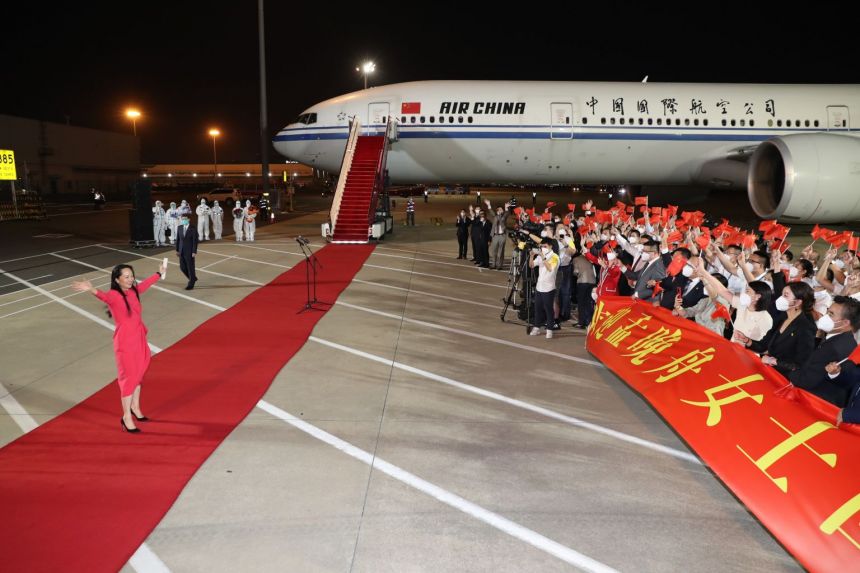
28 September 2021, Tuesday
In Focus
By Juan Mary Joseph
On 25 September, a report by the Washington Post termed the release of two Canadians, detained in China for close to three years as a “brazen act of hostage diplomacy.” Michael Kovrig and Michael Spavor were released and sent back to Canada hours after Meng Wanzhou, the chief financial officer of Huawei Technologies, was allowed to travel back to China after being detained in Canada at the request of the US that her extradition for bank fraud charges since December 2018. Kovrig, a former diplomat, and Spavor, a business executive were both detained in China by authorities on espionage charges, was immediately after the arrest of Meng. After a legal and diplomatic hustle, Meng was allowed to travel back to China after she reached a deferred prosecution agreement with the US Justice Department which involved an acceptance of her role in Huawei’s dealings with Skycom Tech.
The US, China & Canada diplomatic reset
Meng’s arrival in China was accompanied by much fanfare with the Global Times reporting on 28 September that China's Ministry of Foreign Affairs was engulfed with flowers and "thank you" cards sent by people to appreciate for the release and safe return of Huawei's CFO Meng Wanzhou to China. The state backed tabloid also reported that US move to dismiss Meng’s extradition was an opportunity for both countries to reset their sour bilateral relations. However, the White House has denied that the near-simultaneous release of the Huawei executive, the two Canadians and two American siblings, prevented from leaving China since 2018, was not a prisoner swap as assumed. The White House stated that the issue had just been a topic of conversation in a call between the Chinese and American presidents weeks ago. Meng’s release has opened a string of criticisms against the Biden administration. Republican senators in the US have been quick to condemn the release and have urged the White House to address the US Congress on the issue of not confronting the dual threat posed by Huawei and the Chinese Communist Party.
About Canada, the Global Times said that China’s release of the Canadians “unlocks the bottleneck in China-Canada ties.” Canada’s Foreign Minister Marc Garneau has however stated that its "eyes are wide open" when it comes to normalizing relations with China and in the process follow a fourfold approach - "coexist," "compete," "cooperate" and "challenge" to China.
In retrospect, it is clear that the real victory belongs to the Chinese and gives them a reassurance that their stint of “hostage diplomacy” has been successful against two very powerful opponents. The latter have now been reduced to “weak and naïve” with a Chinese reassurance that foreign citizens can now be used as bargaining chips to get what they want.
References
“Chinese FM's office engulfed with flowers and 'thank you' cards for Meng Wenzhou’s return in a victory for China's diplomacy, Global Times, 28 September 2021”
https://www.globaltimes.cn/page/202109/1235284.shtml
“Canada foreign minister says eyes wide open when it comes to normalizing China ties, Reuters, 27 September 2021”
https://www.reuters.com/world/china/canada-foreign-minister-says-eyes-wide-open-when-it-comes-normalizing-china-ties-2021-09-26/
“China’s ‘hostage diplomacy’ standoff with Canada is over. But how much damage was done?, Reuters, 25 September 2021”
https://www.washingtonpost.com/world/2021/09/25/canada-china-meng-michaels/
“China welcomes Huawei executive home, Trudeau hugs Canadians freed by Beijing, Reuters, 26 September 2021”
https://www.reuters.com/world/china/china-welcomes-huawei-executive-home-silent-freed-canadians-2021-09-25/
“Chinese FM's office engulfed with flowers and 'thank you' cards for Meng Wenzhou’s return in a victory for China's diplomacy, Reuters, 28 September 2021”
https://www.globaltimes.cn/page/202109/1235284.shtml
“Meng's return ignites national pride amid US hegemony, Reuters, 27 September 2021”
https://www.globaltimes.cn/page/202109/1235254.shtml
IN BRIEF
By Avishka Ashok and Keerthana Nambiar
INTERNAL
People’s Bank of China injects 100 billion yuan liquidity in the market
On 28 September, the Central Bank of China injected 100 billion yuan or USD 15.48 billion into the market to maintain liquidity in the banking system. The People’s Bank of China announced that a 14-day reverse repo was set and the interest rate was fixed at 2.35 percent. Through the reverse repo process the Central Bank of China will purchase security from the commercial banks through bidding and will sell them again in the future. (China's central bank injects liquidity into market, Xinhua Net, 28 September 2021)
http://www.news.cn/english/2021-09/28/c_1310214478.htm
China’s development outline for women and children for the next decade
On 27 September 2021, the State Council of the People’s Republic of China published the outlines of development plans for women and children over the next decade. It plays a vital role in implementing gender equality and prioritizing children’s development, taking it to a higher level. According to the outline, by 2030 women will have equal rights to education, equal political rights, equal economic rights and interests, and equal access to full life cycle health services. And for children, the major focus would be health, safety, and education. (China outlines development of women, children, The State Council’s People Republic of China, 27 September 2021)
http://english.www.gov.cn/policies/latestreleases/202109/27/content_WS61516ea9c6d0df57f98e0f0f.html
China launches high-resolution Earth observation satellite
On 27 September, the China Aerospace Science and Industry Corporation launched a Kuaizhou 1A carrier rocket to place a high-resolution Earth-observation satellite in space. Kuaizhou is the largest solid-propellant rocket family in China that mainly relies on liquid fuel in contrast to the Long March series which mostly ran on liquid fuel. This mission marked the 11th flight of the Kuaizhou 1A. The weight of 20-meter Kuaizhou 1A is almost 30 metric tons and has the capacity to deliver 200 kilograms of cargo into a sun-synchronous orbit or 300 kilos into a low-Earth orbit. (China launches high-resolution Earth-observation satellite, China Daily, 27 September 2021, China's Kuaizhou 1A Launches Earth-Observation Satellite Atop Long March 3B Rocket, The Science Times, 27 September 2021)
https://www.chinadaily.com.cn/a/202109/27/WS61516e9ea310cdd39bc6bd63.html
https://www.sciencetimes.com/articles/33668/20210928/chinas-kuaizhou-1a-launches-earth-observation-satellite-atop-long-march-3b-rocket.htm
REGIONAL
China and Philippines join hands to combat cross-border crimes
On 28 September, the Chinese embassy in Manila announced that China and Philippines had agreed to strengthen cooperation to combat transnational crimes such as cross-border gambling, kidnapping and telecommunications fraud. During the latest video conference with the Philippine National Police, the Chinese Ministry of Public Security clarified that the two governments had come to a consensus on issue. The embassy spokesperson said: "The two sides agreed to further deepen mutual trust and cooperation in jointly cracking down on cross-border gambling, telecom and internet fraud, kidnapping, robbery, homicide, and other illegal and criminal activities." (China, Philippines to deepen cooperation on fighting transnational crime, Xinhua Net, 28 September 2021)
http://www.news.cn/english/2021-09/28/c_1310214761.htm
INTERNATIONAL
Chinese Foreign Minister expresses will to continue dialogue with NATO
On 28 September, Xinhua Net reported that the Chinese State Councilor and Foreign Minister Wang Yi met Jens Stoltenberg, the Secretary General of the North Atlantic Treaty Organization (NATO) on 27 September. At the video conference, China expressed its desire to continue communication with the NATO on the basis of equality and mutual respect to promote the stable development of their relationship. Wang said: “The key to promoting ties lies in adopting correct perceptions towards each other. There is no need for the Asia-Pacific region to establish any new military bloc, neither should there be confrontation instigated among major countries or any "small circle" be formed aimed at inciting a new Cold War.” (China ready to continue dialogue with NATO on equality, mutual respect basis: FM, Xinhua Net, 28 September 2021)
http://www.news.cn/english/2021-09/28/c_1310214760.htm
China and the EU deepens ties over green cooperation
On 27 September, China and the European Union held the second High-level Environmental and Climate Dialogue. The Chinese Vice-Premier Han Zheng and the Executive Vice President Frans Timmermans agreed to deepen ties between China and the EU and extend their green cooperation. Han also reaffirmed that China will extend its support to developing countries and help them achieve their green and low0carbon energy development goals. He also reiterated that China will stop building all coal-fired power projects in foreign countries. He said: “China has adopted a series of major moves to ensure that the goal of peaking carbon dioxide emissions and achieving carbon neutrality can be reached on schedule.” (China, EU hold environment, climate dialogue, Xinhua Net, 27 September 2021)
http://www.news.cn/english/2021-09/27/c_1310213089.htm
Xi Jinping talks about building a global innovation network
On 24 September 2021, President Xi Jinping delivered a speech via video link at the opening ceremony of the 2021 Zhongguancun Forum. The speech sparked and attracted attention and heated discussions on opportunities and challenges in science and technological development. Xi focused on strengthening the international exchanges in the field of science and technology and form a “global innovation network”. (President says nation will enhance basic research and global cooperation, China Daily, 28 September 2021)
https://www.chinadaily.com.cn/a/202109/28/WS61527007a310cdd39bc6bff9.html
China calls out WTO ruling in a row with the US
China condemned a World Trade organization ruling in a row with the US over the limit on the import of solar panels. In a private meeting, a Chinese delegate called it "erroneous and dangerous". He expressed "deep concern with the systematically harmful findings made by the panel report." (China calls WTO ruling 'dangerous' in solar cell row with U.S., Reuters, 27 September 2021)
https://www.reuters.com/business/energy/china-calls-wto-ruling-dangerous-solar-cell-row-with-us-2021-09-27/
27 September 2021, Monday
China releases white paper on the population dynamics of Xinjiang
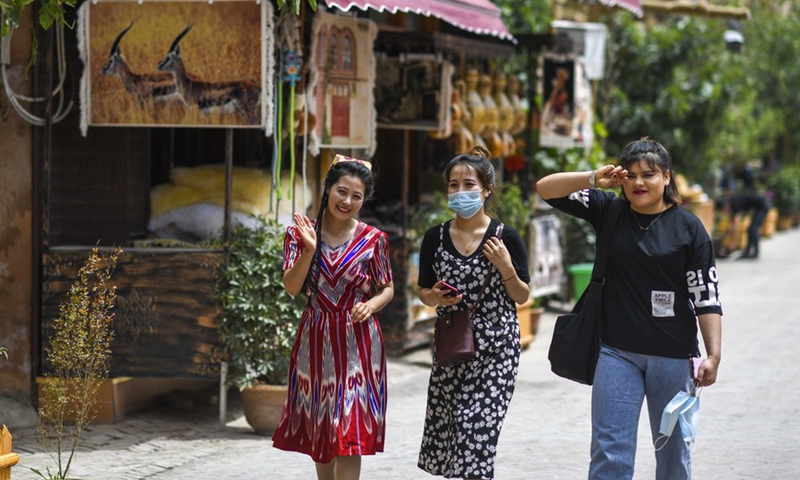
In Focus
By Keerthana Nambiar
China releases white paper on the population dynamics of Xinjiang
On 26 September 2021, China’s State Council Information Office released its white paper that specifically focuses on demographic development in the Xinjiang region. It’s the first paper since 2015 and has published nine issues so far covering education centers, employment, vocational training, anti-terrorism measures, and human rights achievements. The tenth white paper titled “Xinjiang Population Dynamics and Data” consists of six parts- population growth, demographic changes and development, prospects of the regional population, and “falsehoods fabricated by anti-China forces”.
The data particularly focuses on ethnic minorities. The substantial growth in size, quality, and life expectancy of the Xinjiang population. According to preliminary data collected in the seventh national census in 2020, the total population of Xinjiang was 25.85 million. Among them, the Han ethnic group is 10.92 million, and ethnic minorities are 14.93 million. In 2020, the population of ethnic groups in Xinjiang increased from 4.45 million.
The State Council details the commendable achievements in various fields in the Xinjiang region. The steady progress in the education sector, a total of nearly 2.12 million college graduates, of whom 767,000 (36.3 percent) are ethnic minorities. The improvement in public health, where more basic health facilities and medical institutions have been installed. The white paper explains the population dynamics of the region with the fall in infant mortality and rises in life expectancy.
In line with the region’s social and economic development, Xinjiang has amended policies and will further modify and improve the policies and regulations. The paper describes Xinjiang’s commitment to protecting the health of women and children, changed views on family planning, and religious extremism. It calls out the fabricated “falsehoods” by the anti-China forces on the forced labor, mandatory sterilization, parent-child separation, cultural genocide, and religious persecution.
The report concludes with the note that the Chinese government will continue to uphold the sovereignty, integrity, and security of the Xinjiang region. It marks the demographic development as social progress and success of a multi-ethnic population.
References
Full Text: Xinjiang Population Dynamics and Data, The State Council The People’s Republic of China, 26 September 2021
In Brief
By Avishka Ashok and Juan Mary Joseph
INTERNAL
China to reduce abortions for 'non-medical purposes'
On 27 September, a Reuters report said that China's cabinet issued new guidelines which will reduce the number of abortions performed for "non-medical purposes”. The State Council also said that action would be taken to avoid unwanted pregnancies and to encourage men to "share responsibility" in preventing them. The authorities aim to improve sex education and strengthen family planning. The move comes after China has already enacted strict measures to prevent sex-selective abortions which has contributed to gender inequality. (China to reduce abortions for 'non-medical purposes', Reuters, 27 September 2021)
https://www.reuters.com/world/china/china-says-will-reduce-number-abortions-non-medical-purposes-2021-09-27/
Chinese tech giants offer support to SMEs at annual internet forum
On 26 September, the Global Times reported that the big tech firms in China pledged to extend help to the SMEs at the annual internet forum where the best tech innovations and ideas are put forth to the national tech giants as well as the foreign players. President Xi Jinping also sent a congratulatory note to the conference which was conducted in Wuzhen. He said: “It is imperative for the international community to join hands to seize opportunities and meet challenges by following the trend of informatization and digitalization, as well as networking and smart development.” (Chinese Big Tech vows to support SMEs at premier internet summit, Global Times, 26 September 2021)
https://www.globaltimes.cn/page/202109/1235160.shtml
State Council repeals one-child era policies
On 26 September, the State Council announced its decision to repeal three administrative regulations related to family planning. The cabinet’s decision to repeal the regulations will impact technical services for family planning, social support fees and family planning work for the mobile population. The cabinet decided to repeal the regulations to accommodate the newly passed family planning law passed in August 2021. The cancelled laws were passed during China’s one-child policy era. (State Council repeals 3 administrative regulations related to family planning, including the collection of social support fees, Global Times, 26 September 2021)
https://www.globaltimes.cn/page/202109/1235118.shtml
First solar probe to be showcased at Airshow China
On 27 September, the Global Times reported that China’s first solar probe will be showcased at Airshow China before its debut. Airshow China showcases the country’s latest aerospace innovations and advanced space technologies. The event will take place in Zhuhai from 28 September to 3 October. This year, the event will display the country’s first solar probe, an innovation developed by the Shanghai Academy of Spaceflight Technology under China Aerospace Science and Technology Corporation. The probe is a step forward in China’s aim to study the sun in the near future. (China's first solar probe to make surprising debut at Airshow China before launch, Global Times, 27 September 2021)
https://www.globaltimes.cn/page/202109/1235171.shtml
REGIONAL
Taiwan’s new opposition party leader pledges renewed talks with China
On 25 September, Taiwan's main opposition party, Kuomintang (KMT), elected former leader Eric Chu as its chairman, who pledged to renew stalled talks with China. The KMT, which ruled China until fleeing to Taiwan in 1949 after losing a civil war, traditionally favours close ties with Beijing. (Taiwan opposition party's new leader pledges renewed talks with China, Reuters, 25 September 2021)
https://www.reuters.com/world/asia-pacific/taiwan-opposition-partys-new-leader-pledges-renewed-talks-with-china-2021-09-25/
Hong Kong Group behind annual Tiananmen vigil disbands
On 25 September, the Hong Kong Alliance in Support of Patriotic Democratic Movements in China, the group that organises annual vigils on June 4 to remember protesters killed in China's 1989 Tiananmen Square crackdown will disband. The decision to disband comes after it came under probe for national security charges, including inciting subversion. (Group behind Hong Kong's annual Tiananmen vigil disbands amid probe, Reuters, 25 September 2021)
https://www.reuters.com/world/china/group-behind-hong-kongs-annual-tiananmen-vigil-disbands-amid-probe-2021-09-25/
INTERNATIONAL
China condemns Britain for sailing warship through Taiwan Strait
On 27 September, Reuters reported that China's military, the PLA followed and warned a British warship that sailed through the Taiwan Strait, adding that Britain was engaging in behaviour that "harboured evil intentions". (China condemns Britain for sailing warship through Taiwan Strait, Reuters, 22 September 2021)
https://www.reuters.com/world/asia-pacific/china-condemns-britain-sailing-warship-through-taiwan-strait-2021-09-27/
25 September 2021, Saturday
Return of Meng Wanzhou
The crypto exchange halts after Beijing widens the ban; China regulating cartoon producers on unhealthy content
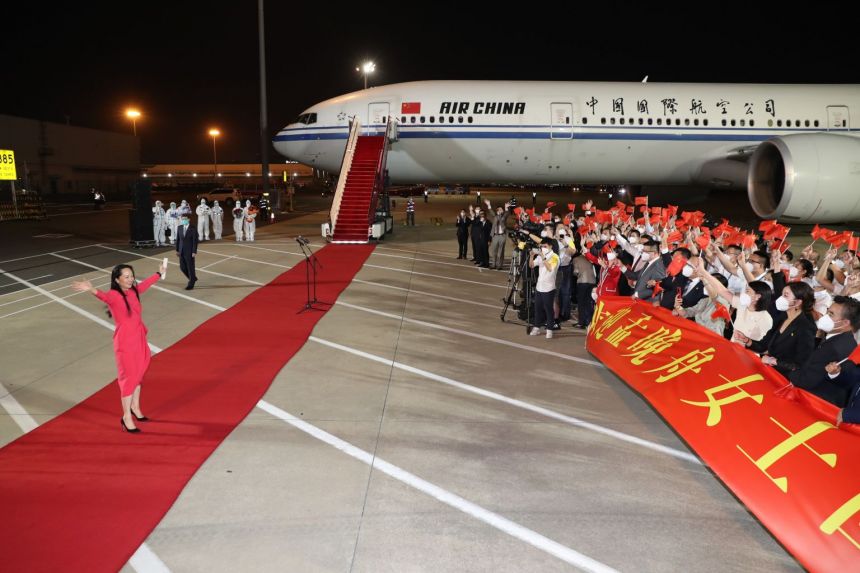
IN FOCUS
By Avishka Ashok
Return of Meng Wanzhou
On 25 September, Xinhua Net reported that Meng Wanzhou had left Canada on 24 September and was on her way back home after China arranged for a charter flight. Hua Chunying, a Chinese foreign ministry spokesperson commented on the return of Meng Wanzhou and reiterated the Chinese position on the case filed against Meng. She said that the charges issued against Meng were unfair and that the case had always remained consistent and clear. Hua blamed the foreign governments for intentionally and unfairly targeting a Chinese national and attempting to sabotage the high0tech companies based in China. She said: “What the United States and Canada have done is a typical case of arbitrary detention.”
Meng Wanzhou, the chief financial officer at Huawei Technologies, had been detained in Canada at the request of the US for bank fraud charges in December 2018. She has now reached a deferred prosecution agreement with the US Justice Department which permits her to return back to China for the time being. As a part of the deal which allows her to return home, Meng had to accept her involvement in an attempt to escape the US sanctions against Iran. She accepted that Huawei had significant relationship with Skycom Tech Co. Ltd. and protected details about the finances to the bank. Skycom Tech conducts its business from Iran but is controlled by the Chinese Tech giant, Huawei. She has also accepted that Huawei made Skycom carry out business deals worth over USD 100 million through HSBC bank that cleared all transactions.
The implications of Meng’s acceptance of her involvement in the financial fraud will mean that Huawei will be held responsible for working through Skycom Tech in Iran. Since Meng effectively concealed the relationship between Skycom Tech and Huawei, HSBC was tricked into granting the huge amounts of money to the two companies. The fact that Skytech is based in Iran further complicated the case due to the US sanctions on Iran which restricts financial activities connected to Iran’s economy.
Meng’s return was celebrated in China as she landed at the Shenzhen Baoan Airport. She said: “"I'm finally back home! After more than a thousand days of suffering, I finally returned to the embrace of my motherland. The waiting in a foreign country was full of suffering. I was speechless the moment my feet touched Chinese soil."
References
“China's foreign ministry speaks on Meng Wanzhou's return - Xinhua (news.cn), Xinhua Net, 25 September 2021”
IN BRIEF
by Juan Mary Joseph and Keerthana Nambiar
INTERNAL
The crypto exchange halts after Beijing widens the ban
On 25 September, Bloomberg reported on the halt in new registrations after China widened the ban on the crypto-exchanges. This is the after People’s Bank Of China declared that all crypto-related transactions will be considered illicit activities. Huobi, China's largest Bitcoin exchange ceased new registrations for domestic users. (Crypto exchange stops taking China users as Beijing widens ban, Bloomberg, 25 September 2021)
China regulating cartoon producers on unhealthy content
On 24 September, National Radio and Television Administration posted a notice that said children and young people were the main audiences for cartoons, therefore agencies need to broadcast content that "upholds truth, goodness, and beauty". Beijing has stepped up its efforts to regulate its entertainment industry claiming to clamp down on unhealthy, vulgar, and pornographic content. (China urges cartoon producers to resist 'unhealthy' content, Reuters, 24 September 2021)
Indonesia’s railway project with China raises concerns
On 25 September, South China Morning Post reported on the new Indonesia railway plan which involves China and Japan. In 2019, Japan was granted the project to build a semi-high speed rail line connecting capital Jakarta to Surabaya in East Java. Last year, Beijing was granted another railway project connecting capital Jakarta to Surabaya in East Java. The inclusion of China in another multibillion-dollar infrastructure project has raised concerns and extreme caution regarding the feasibility of the issue. ( Indonesia’s plan to build mega railway with China and Japan raises debt trap fears, South China Morning Post, 25 September 2021)
Bank of China will stop financing new coal mining and power projects
On 24 September, the Bank of China declared that they would not be financing for new coal mines and power projects outside China including Taiwan, Hong Kong, and Macau. The announcement was made after President Xi Jinping’s pledge China would not build any new coal-fired power projects abroad. (Bank of China to stop financing new coal mining, power projects overseas from Q4, Reuters, 24 September 2021)
REGIONAL
China warns Taiwan over the CPTPP application
On 23 September, Chinese Foreign Ministry Spokesperson Zhao Lijian said that China opposes official exchanges between any country and Taiwan. "There's only one China in the world and the Taiwan region is an inseparable part of China", stressed Zhao. This is in consequence of Taiwan's application to join the Comprehensive and Progressive Agreement for Trans-Pacific Partnership (CPTPP). (Taiwan DPP blasted over using CPTPP bid to seek secession , Global Times, 24 September 2021)
INTERNATIONAL
65 Countries oppose the interference of other countries in Chinese matters
On 24 September, Pakistan delivered a joint statement at the United Nations Human Rights Council on behalf of 65 countries opposing interference of external forces in China's internal matters. The 48th session of UNHRC stressed the importance of "respecting the sovereignty, independence and territorial integrity of states and non-interference in the internal affairs. The statement specifies that issues related to Hong Kong, Xinjiang, and Tibet are China's internal affairs that "brook no interference by any external forces". (65 countries oppose interference in China's internal affairs under pretext of human rights , Xinhuanet, 25 September 2021)
23 September 2021, Thursday
China, Taiwan and the Pacific Trade Pact
China’s new bitcoin revelation; China - EU to hold the 11th strategic dialogue
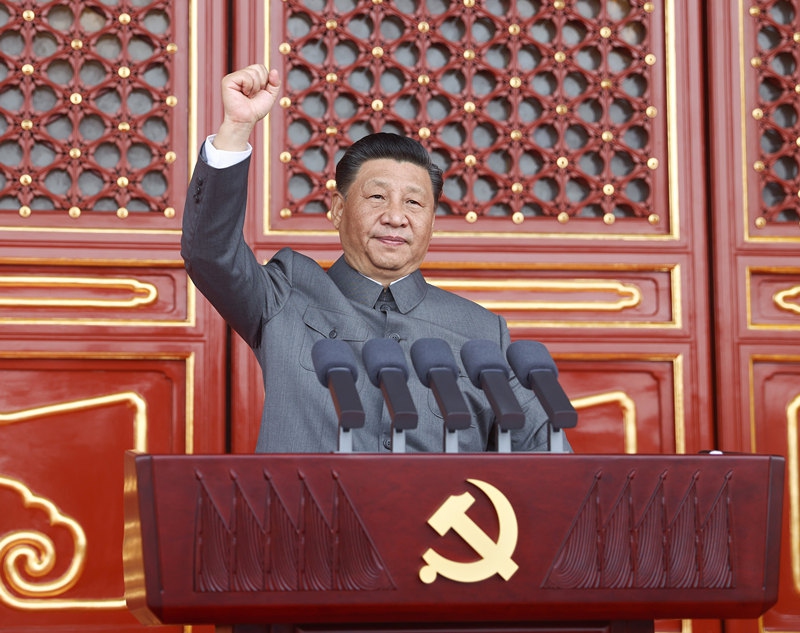
IN FOCUS
By Juan Mary Joseph
China, Taiwan and the Pacific Trade Pact
On 24 September, Reuters reported Taiwan's Foreign Ministry said that China, an "arch criminal" intent on bullying Taiwan has "no right to speak" about Taiwan's bid to join the trans-Pacific trade pact. The statement from the Taiwanese government comes after an escalating war of words between the former and China over the recent decisions.
Divisions over the CPTPP
The Comprehensive and Progressive Agreement for Trans-Pacific Partnership (CPTPP) is a free trade agreement (FTA) initially signed in 2018 between Australia, Canada, Japan, Mexico and Singapore in Santiago, Chile. Brunei, Chile, Malaysia, New Zealand, Peru and Vietnam later joined the bloc. The CPTPP is originally a reconfigured grouping of the Trans-Pacific Partnership (TPP), a proposed trade agreement between Australia, Brunei, Canada, Chile, Japan, Malaysia, Mexico, New Zealand, Peru, Singapore, Vietnam, and the United States signed in 2016. Though the pact was created by the US to counter China's influence, the then newly elected US president Donald Trump withdrew from the TPP in 2017. As a result, the agreement could not be ratified and hence did not enter into force. The CPTPP, later on incorporated most provisions of the TPP, with promises of trade and investment liberalization and pledged to eliminate or reduce 95% of tariffs.
On 16 September, China formally submitted a request to join the CPTPP after President Xi Jinping announced at the Asia-Pacific Economic Cooperation Summit in 2020 that China will “favourably consider joining” the pact. While the application has been submitted, it is not yet clear if China’s request will raise the intended outcome. However, less than a week later on 22 September, Taiwan formally applied to join the bloc after a set of informal discussions with the bloc's existing members. Taiwanese cabinet spokesman Lo Ping-Cheng said in a statement that "applying to join the CPTPP is an important economic and trade policy that the government has worked hard to promote for a long time".
The moves from China and Taiwan have however led the existing members of the bloc divided on their options. An enraged China said in a statement from the Foreign Ministry that it opposed Taiwan from "entering into any official treaty or organisation." The Chinese statement comes after continued escalations between both countries, including the recent entry of Chinese aircrafts into the Taiwanese airspace and China’s diplomatic spat with Lithuania. Taiwan is excluded from many international bodies due to China's insistence of the “One China” policy.
On 23 September, Vietnam’s Foreign Ministry Spokeswoman Le Thi Thu Hang at a regular briefing that it is willing to share its experience and information with China on the CPTPP, and referred to it as "an open free trade agreement." Japan has however welcomed Taiwan's application, citing shared values on democratic values and freedom. On the other hand, it has expressed a cautioned reaction to China’s bid, owing to the strict rules that the CPTPP has with respect to state-owned enterprises. Japan’s views are valid as the CPTPP, is described as the “gold standard in trade agreements” and China’s proposed entry is expected to wreck the existing ambitious targets of the bloc.
References
“Vietnam willing to share information with China for its bid to join CPTPP, Reuters, 23 September 2021”
“Japan welcomes Taiwan bid to join trade pact, citing shared values, Reuters, 24 September 2021”
“Taiwan applies to join Pacific trade pact week after China, Reuters, 22 September 2021”
“Taiwan blasts 'arch criminal' China for Pacific trade pact threats, Reuters, 24 September 2021”
IN BRIEF
by Avishka Ashok and Keerthana Nambiar
INTERNAL
Vice Premier Sun Chunlan urges cities to take up epidemic-prevention measures
On 23 September, the Chinese Vice Premier Sun Chunlan urged the people and the authorities to follow multiple epidemic-prevention measures after the latest rise in cluster cases in the Fujian Province. The instructions were given to the authorities while she was on an inspection trip to Xiamen, Putian, Quanzhou and Zhangzhou cities in Fujian province. Amongst the various measures suggested were nucleic acid testing, epidemiological investigations, quarantine, community lockdowns and disinfection in major outbreaks. She emphasized that it is crucial for the authorities to control the outbreak at this time. (Chinese vice premier urges efforts to curb COVID-19 clusters - Xinhua (news.cn), Xinhua Net, 24 September 2021)
REGIONAL
China’s 20th airstrike interference in Taiwan
On 23 September, China sent two air force incursions into Taiwan, expressing its disapproval towards Taipei’s bid to join the CPTPP trade pact. In the past, Beijing has used airstrikes as a form of expressing its anger and challenging the government. People’s Liberation Army sends 24 warplanes into Taiwan’s air identification space. Taiwan’s defense ministry declared that this is the 20th time China is has interfered in their airspace and has been the largest sortie since June. (China Sends Fighter Jets to Show Anger at Taiwan Over Trade Deal, Bloomberg, 24 September 2021)
ECONOMY
China’s new bitcoin revelation
On 24 September, China’s top regulators intensified a blanket ban on crypto transactions and mining due to which bitcoin and other major coins and blockchain-related stocks have been affected. The People’s Bank of China (PBOC) has barred payment companies, financial institutions, and internet firms from trading via cryptocurrency nationally. The PBOC stated that the Chinese government has made the decision to clamp down on “virtual currency speculations and related financial activities and misbehavior in order to safeguard people's properties and maintain economic, financial and social order". (China's top regulators ban crypto trading and mining, bitcoin stumbles, Reuters, 24 September 2021)
INTERNATIONAL
China - EU to hold the 11th strategic dialogue
On 24 September, South China Morning Post reported on the official talks between the two diplomats from the European Union and China expected to take place on 28 September. The “11th” strategic dialogue between Brussels and Beijing is after the geopolitical tensions have swirled in and escalated at a quick pace. The annual dialogue is after the complications that have reeled in regarding the nascent AUKUS pact and Lithuania dispute. Josep Borrel, EU’s top diplomat is expected to lead the talk along with his Chinese counterpart, Chinese Foreign Minister Wang Yi by video link. Chinese Vice-Premier Han Zheng will meet European Commission, Vice-President Frans Timmermans. (China and EU to hold talks on Tuesday as sanctions, Aukus and Lithuania throw up complications, South China Morning Post, 24 September 2021)
China lists 100 instances on US interferences in Hong Kong
On 24 September, China announced a list of more than 100 instances of what it claims to be US interference in Hong Kong affairs. The foreign ministry posted the list on the website detailing all the 100 instances of U.S. interferences since 2019 and also including the Hong Kong Autonomy Act in 2020 under the Trump administration. (China draws up list of 100 instances of U.S. "interference" in Hong Kong, Reuters, 24 September 2021)
Speaker of House of Representatives of Bosnia and Herzegovina extends support to one-China policy
On 24 September, Xinhua Net reported that the speaker of the House of Representatives of the Parliamentary Assembly of Bosnia and Herzegovina Denis Zvizdic said that the country completely respects China’s sovereignty and territorial integrity and accepts the one-China Principle. The statement was made while Zvizdic met Chinese Ambassador Ji Ping on 22 September. He also appreciated China’s support during the pandemic and said: “China was one of the first countries to provide assistance to BiH after the outbreak of COVID-19, for which Bosnia is deeply grateful.” (BiH firmly upholds one-China principle: speaker of House of Representatives - Xinhua (news.cn), Xinhua Net, 24 September 2021)
President Xi Jinping extends support and appreciation to Vietnam on the occasion of China’s National Day
On 24 September, the Chinese President Xi Jinping said that it is essential for China and Vietnam to safeguard the security of their respective communist parties and of the socialist systems. The comments were made while President Xi was in a telephonic meeting with the General Secreatry of the Communist Party of Vietnam on the occasion of China’s National Day. President Xi also observed that the two countries had maintained good relations and had strengthened their bilateral relations in the past year. He said: “Facing the complicated and combined impacts of global changes and a pandemic both unseen in a century, China and Vietnam share many common interests and concerns.” (Xi says safeguarding Communist governance vital common interest of China, Vietnam - Xinhua (news.cn), Xinhua Net, 24 September 2021)
23 September 2021, Thursday
The new Chinese Ambassador addresses the US-China relations
Chinese villages promote the three-child policy to couples by providing subsidies; Ant Group's Huabei begins to share consumer data with China's central bank
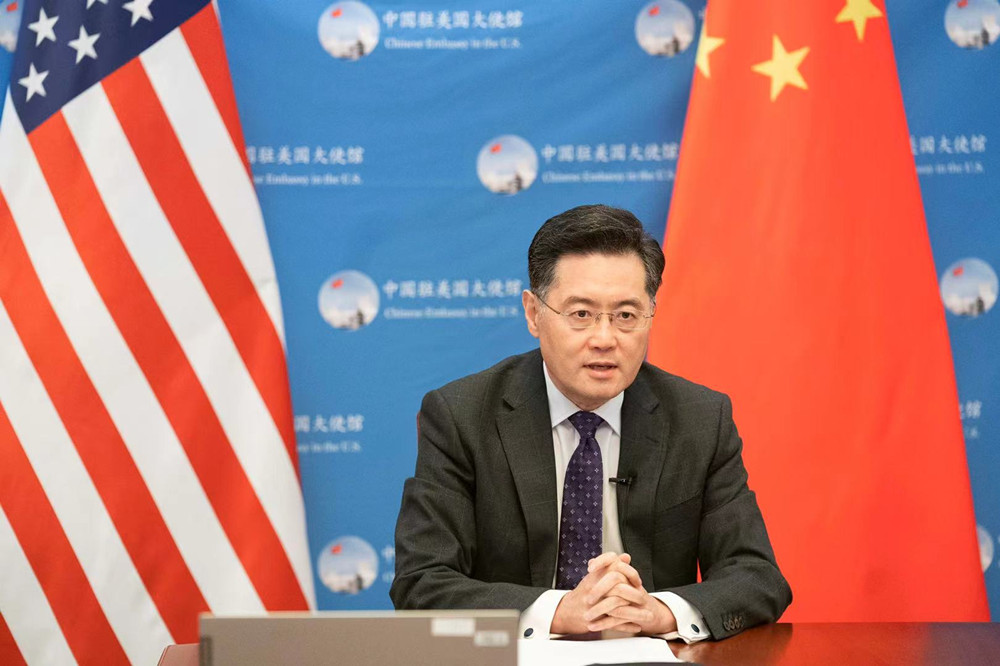
IN FOCUS
By Keerthana Nambiar
US-China relations
On 22 September 2021, China’s new ambassador to the United States, Qin Gang made a speech at the Conversation jointly held by the Carter Center and the George H.W. Bush Foundation for US-China Relations. He said, “today, some Americans' misunderstanding and misjudgment about China is building up. A fundamental one is to define America's relations with China as democracy versus authoritarianism, and to stoke up ideological confrontation, which has led to serious difficulties in China-US relations.” Qin claims that the People’s Republic of China maintains a “unique political consultation system and corresponding institutions”, which are important methods to exercise democracy for the people.
Qin argued that China is a democratic nation and China's Constitution prescribes that all power belongs to the people. He further talked about the US-China differences and mentioned that Beijing would make no concerted effort to reduce bilateral tensions unless Washington prevents the competition between the two powers from escalating into a confrontation. The ambassador warned that such confrontations could hinder China’s “core interests” and if the US does not step down, China’s efforts for trust and mutual cooperation would be subdued.
Among various issues, the environmental crisis was addressed. The need for a certain US-China collaboration was focused on and both the countries honoring the climate commitments with “real action”. The comments came a day after Chinese President Xi Jinping promised at the United Nations General Assembly that China would stop building overseas coal projects and work towards China's green energy. Qin elaborated that China welcomes and accepts suggestions or criticisms that are honest and constructive. And they do not accept baseless and slandering information that compromises China’s sovereignty and integrity. He stated, “We never say that our system is the best” and China should not be judged by the decisions it makes regardless they are good or not.
He concluded his speech by highlighting the need for US-China cooperation to move forward and stable development for the welfare of both the countries as well as the world.
IN BRIEF
by Avishka Ashok and Juan Mary Joseph
INTERNAL
Tsinghua University announces plan to launch research institute for carbon neutrality
On 22 September, Tsinghua University announced the launch of a research institute for the studies on carbon neutrality. The initiative will be focused upon solving obstacles to China’s aim of green development. China has taken up mighty challenges and has promised great goals on the climate change front. However, achieving all of them might become a testing task given China’s current pace of development and the population’s needs. In order to fulfill these goals, the institute will contribute by fastening the pace of technological discoveries and innovation by providing its skillsets in basic research and interdisciplinary integration. The institute plans to work along with other private industries and cooperate on a regional platform to collectively promote green initiatives, technology and enterprises. (Tsinghua University sets up research institute for carbon neutrality studies - Global Times, Global Times, 23 September 2021)
Chinese villages promote the three-child policy to couples by providing subsidies
On 22 September, Global times reported that a village in Guangdong would be offering cash subsidies to parents of newborns born after 1 September 2021. The couples will be provided with 3,300 yuan or USD 510 per month for their newborn babies. The policy has been initiated after the Chinese government legalized its three-child policy in August 2021. Other than the village in Guangdong, Huangzhugen village in Zhanjiang also promised to provide subsidies to new parents until the child turns two and a half years old. The state would be spending over 99,000 yuan on each child born after 1 September 2021. A village in Gansu province has agreed to provide subsidies for buying property to couples with newborns while Panzhihua promised to grant cash handouts worth 500 yuan until the child turns three. However, there are limitations to the provisions: Only the parents living in these villages are eligible to avail the benefits of the policy. (Village in Guangdong offers cash subsidies to parents of newborns - Global Times, Global Times, 22 September 2021)
Ant Group's Huabei begins to share consumer data with China's central bank
On 22 September, Reuters reported that China's Ant Group, an affiliate of e-commerce giant Alibaba Group, has begun sending its consumer credit data to the database run by China's central bank. Ant's virtual credit card service Huabei said in a social media post on its official Weibo account that it was being integrated into China's central bank credit reporting system. The move is critical as the Chinese regulatory grip on the company and the larger financial technology sector tightens. (Ant Group's micro loan service Huabei begins to share data with China's central bank, Reuters, 22 September 2021)
Evergrande's second-biggest shareholder to sell entire stake
On 23 September, Reuters reported that Chinese Estates Holdings said in a filing to the Hong Kong stock exchange that it has sold $32 million of its stake in Evergrande and is planning to exit the holding. Chinese Estates is the second-largest shareholder of the debt-ridden real estate giant Evergrande. (Evergrande's second-biggest shareholder plans to sell entire stake, Reuters, 23 September 2021)
The court case of 47 Hong Kong democracy activists to resume on 29 November
On 23 September, Reuters reported that a judge ruled for a national security case involving 47 Hong Kong democracy activists will resume on 29 November. The activists who have already been in custody for more than six months have been charged with conspiracy to commit subversion. National security crimes are punishable by up to life in prison, however, only higher courts have the authority to do so. (Court case of 47 Hong Kong democracy activists to resume on Nov. 29, Reuters, 23 September 2021)
INTERNATIONAL
The Chinese representative at UN pushes for more transparency in military and security services
On 22 September, Global Times reported that Jiang Duan, minister of the Chinese mission to the UN urged the US and Australia to efficiently regulate their private military and security companies and prevent them from being involved in practices that violate human rights. The statement was made during the dialogue of the Working Group of the United Nations Human Rights Council. Duan called on countries, especially, the US and China to respect, promote and safeguard human rights and prevent their violation by private companies. He pushed for more transparency and highlighted the lack of the same in the private military and security services of the US and Australia. (China urges US, Australia to effectively regulate mercenary companies at UN Human Rights Council - Global Times, Global Times, 22 September 2021)
Chinese Foreign Minister urges countries to remove sanctions on Afghanistan
On 23 September, the Chinese Foreign Minister Wang Yi pushed for immediate humanitarian aid to Afghanistan at the G20 foreign ministers’ meeting. The meeting was held online and aimed to discuss the situation in Afghanistan and the way forward. Wang Yi also urges countries to remove the economic sanctions from Afghanistan to prevent further deterioration of the Afghan economy and the condition of the Afghan populace. He said: Humanitarian aid is of great urgency and the countries responsible for Afghanistan's situation should do something to ease the difficulties of Afghans.” China also pledged to provide 200 million yuan or USD 31 million worth of supplies and three million doses of vaccines to Afghanistan. (Economic sanctions on Afghanistan must end, humanitarian aid is of great urgency: Chinese FM Wang Yi - Global Times, Global Times, 23 September 2021)
Lithuania’s warning against Chinese phones
On 22 September, Reuters reported that Lithuania's Defense Ministry recommended consumers avoid buying Chinese mobile phones and advised them to throw away their current Chinese phones after a government report found built-in censorship capabilities in the devices. Lithuania's state-run cybersecurity body said that phones sold in Europe by China's smartphone giant Xiaomi Corp have a built-in ability to detect and censor terms like "Free Tibet", "Long live Taiwan independence" or "democracy movement". Relations between Lithuania and China have soured after the former’s decision to allow a Taiwanese Representative Office in the country. (Lithuania says throw away Chinese phones due to censorship concerns, Reuters, 22 September 2021)
22 September 2021, Wednesday
President Xi Jinping addresses UN General Assembly Session
Chinese President Xi Jinping highlights the importance of fighting the pandemic, building a global economy, conducting fairly in international relations and practicing multilateralism.
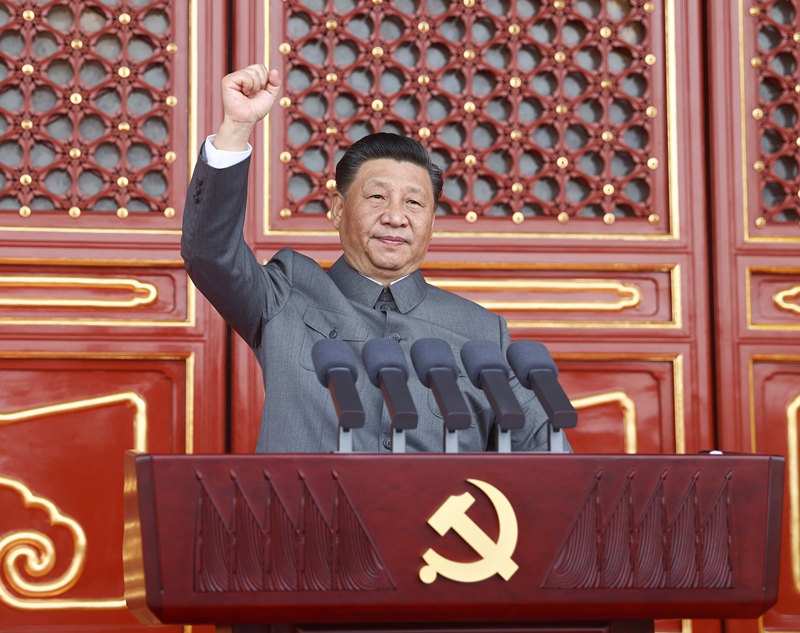
IN BRIEF
21 September 2021
China's real estate crisis
The looming fall of China’s Evergrande
In Focus
By Juan Mary Joseph
China's real estate crisis: The looming fall of China’s Evergrande
China’s real estate giant is at risk of fallout, with larger threats of spill over into other markets and countries On 21 September, China’s, Evergrande Group Chairman Hui Ka Yuan’s efforts to lift market confidence in his debt-ridden real estate company showed no signs of respite with persistent fears of collapse.
China’s Lehman moment?
The Evergrande Group, formerly known as the Evergrande Real Estate Group Limited was founded by businessman Hui Ka Yan as Hengda Group in 1996 in the port city of Guangzhou. With more than 1,300 projects in over 280 cities, spanning over the insurance, football teams, mineral water and food production sectors across China, it was once recognized as the top-selling property developers in the country.
However, Evergrande is currently neck deep in a total debt of over $305 billion, which incidentally is close to 2% of China’s total GDP. The fallout of the real estate giant to the world's most indebted real estate developer could as a result generate large ripples across the world economy.
At the center of the company’s current crisis stands the Chinese government’s clampdown on big real-estate developers last year when it introduced a cap on the amount of debt that such firms could owe. Evergrande responded to the Chinese government by selling properties at high discounts. However, like every other disadvantage of a ‘fire sale’ at the sign of a company’s financial distress, the sale failed to make interest payments, further leading to defaults.
On 20 September, the company missed the deadline to meet interest payments of their bank loans. However, the crisis was not unforeseen, as it has been in the making since the beginning of the year when Evergrande’s shares plunged 85%.
One of the larger issues that sees the light has been the inflated property markets across China, a clear indication of a looming crisis in the making. The little or a clear absence of property taxes, made real estate an attractive asset. Less than 3 years ago, the nationwide home prices across China, averaged 9.3 times higher than the annual incomes. With sprawling ghost cities indicating a larger housing bubble, the city of Kunming in Yunan recently saw 15 unused skyscrapers being demolished after remaining vacant for nearly a decade.
Implications
Reuters quoted Alan Ruskin, a macro strategist at Deutsche Bank, that "Evergrande has the potential to be the largest corporate debt default ever, with spillovers to other financial institutions, Evergrande's suppliers, homeowners, wealth product holders and other property companies."
While the company has started repaying investors in their wealth management business since last week, this won’t suffice for the scores of middle- class Chinese citizens who have bought property from Evergrande even before the construction of some buildings began. There could also be spillovers into other complementary companies involved in the construction, design and material supply fields. A larger financial crunch would however would be on China’s financial system as Evergrande’s debt runs to around 171 domestic banks and 121 financial firms in the country.
As a result, all eyes are on Beijing to see if they will step in to initiate a set of debt restructuring or rescue measures. However, the prospects for such a rescue seems bleak after Hu Xijin, the editor-in-chief of the government backed Global Times newspaper posted on social media that Evergrande should save itself and not rely on a government bailout. He added on that the potential bankruptcy of Evergrande is unlikely to trigger a financial crisis like in the US after the collapse of the Lehman Brothers in 2008.
Evergrande is due to pay another $83.5 million as interest payments on 23 September and $47.5 million 29 September. The world’s second largest economy stands at the risk of a potential downward spiral if major lenders decide not to extend the payment deadlines.
References
“EMERGING MARKETS-China Evergrande contagion fears take toll across markets, Reuters, 21 September 2021”
“Fearing a Property Bubble, China Overhauls How It Sells Land, Wall Street Journal, 16 March, 2021”
“China: What is Evergrande and is it too big to fail?, BBC, 21 September 2021”
“China Evergrande is not 'too big to fail', says Global Times editor, Reuters, 21 September 2021”
IN BRIEF
by Keerthana Nambiar
INTERNATIONAL
China
On 20 September, a Chinese Foreign Ministry spokesperson Zhao Lijian extended China’s support to the Russian population for selecting their path to development and also to the Russian President Vladimir Putin in his journey as a leader of Russia. The statements were made after the preliminary results of the Russian Duma elections showcased a win for the United Russia Party. Zhao referred to the party’s win as the people’s choice and reflecting of their will. He stressed upon deepening cooperation between the two countries and promoting inter-party exchanges. (China supports Russian people in choosing development path: FM spokesperson, Xinhua Net, 20 September 2021)
China will be narrowed with AUKUS in the picture
According to CNBC, China could accelerate its military presence in response to the US- Australia submarine deal. China has denounced a nuclear submarine deal among the U.S., the U.K., and Australia calling it a cold war mentality. Thus, the tensions in the Indo-Pacific region will likely continue substantially. According to a Reuters report, Chinese Foreign Ministry spokesman Zhao Lijian slammed the three countries for “severely damaging regional peace and stability, intensifying an arms race, and damaging international nuclear non-proliferation efforts”. A senior analyst at the Eurasia group Ali Wyn quoted “With this deal, I do think that the military balance is going to shift a little bit more away from Beijing”. (China could accelerate military efforts in response to U.S.-Australia submarine deal, analyst says , CNBC, 21 September 2021)
Nikkei 225 falls 2 per cent with China’s Evergrande Group
On 20 September, Japanese stocks declined as they returned to trade following a Monday holiday. The Nikkei 225 closed 2.17% lower at 29,839.71 as shares of conglomerate Softbank Group plunged 4.98%. The Topix index shed 1.7% on the day to 2,064.55. Shares of China Evergrande Group fell 0.44%, while the Hang Seng Properties index climbed 2.97%, bouncing back partially from Monday’s losses. Evergrande’s chairman tried to reassure market, saying the firm will fulfil its responsibility to partners, property buyers, investor, partners and financial institutions. The Chinese economy is likely to face a backlash with The Evergrande. It risks an economic slowdown for countries at a global level to expand their businesses. (Japan’s Nikkei 225 falls 2% as investors monitor Evergrande developments , CNBC, 20 Sptember 2021)
INTERNAL
China’s Western Interiors inch their way to development and economic growth
On 21 September, Xinhua reported that the European parcel delivery group DPD had signed a deal to set up its regional office in Chengdu, Southwest China. The new development brought to light China’s Wes Development Strategy that was put into action in 1999. Two decades after the policy was launched, the western regions in China have achieved great progress and development. The strategy was initiated to reduce the gap in development and economic growth between China’s Eastern and Western regions. Tibet, one of the regions that have not fared very well in the progress charts, set up a brand to encourage the sales of the local products. The modes of transport and routes are also developing as more companies set up their offices in interior China. (Huaxia, China Focus: Western regions on fast track of high-quality development, Xinhua Net, 21 Spetember 2021)
Hong Kong Elections Committee finalizes the vote-counting marathon
On 20 September, Hong Kong election results were announced following a delayed vote count that took nearly 14 hours. This is the first election after the electoral reform was implemented in March since Beijing’s intrusion into the city’s political system. A public apology came in with the announcement of results from the electoral officials for the “unreasonable” time. The liaison office said “The election helped to set Hong Kong on a path away from the ‘vortex of pan-politicization’ and to promote the rational development of electoral culture. It also marked a solid and genuine step in advancing democracy and good governance”. The State Council’s Hong Kong and Macau Affairs Office described the poll as symbolic in that it represented a full implementation of the “patriots governing Hong Kong” principle. (Hong Kong’s Election Committee finalised after marathon vote-counting process, with outlier candidates left in the cold, South China Morning Post, 20 September 2021)
Xi Jinping to address general debate of UN General Assembly
On 21 September, President Xi Jinping will address the United Nations General Assembly via video link. Chinese Foreign Ministry Spokesperson Hua Chunying announced, "Chinese President Xi Jinping will take part in the general debate of the 76th session of the UN General Assembly via video link on September 21 and will deliver an important speech." The foreign ministry did not specify any particular topics that Xi Jinping will be bringing up in his speech. The 76th UN General Assembly (UNGA) opened on September 14 and the high-level week started on September 21 and will last until the 27th. As the United Nations General Assembly opened its 76th session, and UNGA President Abdulla Shahid urged member states to embrace hope and initiate a new narrative after a challenging year with climate change, conflict, and COVID-19. (Chinese President Xi Jinping set to deliver virtual speech before UN General Assembly, Free Press Journal, 20 September 2021)
Chinese Vice Premier addressed business community and encouraged engagement with Hong Kong
On 20 September, the Chinese Vice Premier Han Zheng urged the business community to build a market-oriented, rule-based and internationalized business environment in order to fasten the pace of development of the Qianhai Shenzhen-Hong Kong Modern Service Industry Cooperation Zone. The statements were made by Han while he was on inspection trip to Shenzhen city. He also encouraged Shenzhen and Hong Kong to improve cooperation and plan out industrial layout for China’s high-level opening-up. (Chinese vice premier stresses building market-oriented, law-based, internationalized business environment, Xinhua Net, 20 September 2021)
SCIENCE & TECHNOLOGY
Chinese spacecraft docks with the Chinese space station in preparation for the next space walk
On 20 September, the Tianzhou-3 cargo spacecraft successfully docked into the Tianhe core cabin 6.5 hours after the launch. The mission is part of the preparation for Shenzhou-13 which will attempt to live in space for six months, breaking the record for the longest duration spent by Chinese astronauts. The spacecraft carried the daily supplies, fuel, propellants and space suits for the upcoming mission. (Tianzhou-3 completes rendezvous, docking with China’s space station, Global Times, 20 September 2021)
20 September 2021
Xi Jinping’s Pivot to the state
"Something is happening in China that the West doesn’t understand," says Kevin Rudd

IN FOCUS
by Keerthana Nambiar
Xi Jinping’s State pivot
According to an analysis in the Wall Street Journal by Kevin Rudd, former Australian Prime Minister, something significant is happening in China, that the West cannot comprehend. Recently, the world has been witnessing Xi Jinping’s new economic policy structure and the whirlwind of activities surrounding China’s private sector. Starting with the hefty fines on Alibaba, Tencent along with the private tutoring sector which Beijing has managed to quash $120 million dollars. In July this the Chinese cyber-regulator removed China’s ride-hailing giant, Didi’s app from stores; the Chinese Government took in a one percent equity stake in Byte Dance’s, and a similar decision was made to secure equity in China’s micro-blogging platform, Weibo.
However, the Chinese Government has also been putting forward a series of regulations in the telecoms, energy, transport, finance, defense, and internet sectors under close cybersecurity scrutiny to protect what is described as “critical information infrastructure”. In August by the National People’s Congress Standing Committee passing China’s first national data privacy law, the so-called Personal Information Protection Law, requiring any corporation or individual handling Chinese citizens’ personal data to obtain prior consent from consumers first, and preventing data from being passed to other corporations in “unsecure” countries.
The driving forces
First, the fundamentals of ideology. Marxism-Leninism has been the fundamental prism of the Communist Party’s life and work which is often downplayed by the West. Even though the concept has developed with the changing political seasons it acts as a guide for political actions. It authorizes the approach ranging from solving economic, inequalities to the environmental crisis.
Second, the power of demography. ‘China may grow old before it grows rich’ this horrifying prospect of reality is one of the driving forces for Xi Jinping. The Census in May 2021 revealed the fertility rates stand by 1.3 which is lower than in Japan and the US who are relatively ageing faster.
Third, the economic de-coupling. ‘China now strategically decouples its economy from West and present itself as a strategic rival’. The currency market is a long-running, undeclared race for domination between the U.S. dollar and the Chinese yuan. And the widespread mutual economic interaction between China and the US has opened up multiple alternative channels of communication between the two countries. The ongoing rivalry in the US-China economic corridor has eroded the traditional partnership between both countries.
Implications
Xi Jinping’s ‘New Development Concept’ is the assimilation of the ideology, demographic, and decoupling forces. His economic mantra ‘combining an emphasis on greater equality through common prosperity reduced vulnerability to the outside world and greater intervention in the economy’ Much of the party’s recent crackdown can be understood under the lens of ‘new development concept’. A ‘dual circulation economy’ is to reduce make China the major driving force ‘leveraging the gravitational pull’ of domestic market and maintaining the Chinese supremacy on the global market.
Xi Jinping is keen that, on the overall balance between the roles of the state and the market in China and pivot toward the state is in the interests of the Party. In doing so, it reflects Xi Jinping’s wider role of the Party, the state, and the transformation of modern China into a global great power, where the Chinese Communist Party remains in complete control.
References
https://asiasociety.org/policy-institute/xi-jinpings-pivot-state
https://www.wsj.com/articles/xi-jinping-term-tencent-alibaba-crackdown-communist-party-ideology-authoritarian-11632079586?mod=hp_opin_pos_4#cxrecs_s
IN BRIEF
by Juan Mary Joseph
INTERNATIONAL RELATIONS
UN Chief cautions against US-China cold war
On 20 September, the South China Morning Post reported that the UN Chief Antonio Guterres warned of a potential new cold-war that could divide the world into two groups. The comment was made at the annual gathering of world leaders. He urged the two greatest economies of the world to cooperate with each other to concur issues like climate change, trade deficits, technology sharing and political disagreements on human rights issues. He said: “Unfortunately, today we only have confrontation. We need to re-establish a functional relationship between the two powers.” He also expanded on the dangers of walking into another cold war and the possible misfortunes that may fall upon all countries in such eventuality. (US-China cold war could split world in two, UN chief Antonio Guterres says, South China Morning Post, 20 September 2021)
Taiwan Foreign Minister says China "weaponizing trade" over fruit
On 19 September, Taiwan threatened to take China to the World Trade Organization if China doesn’t resolve an issue over the latter suspending Taiwanese sugar apple and wax apple imports before 30 September. China's customs administration said it had repeatedly detected pests called "Planococcus minor" in Taiwanese sugar apples. Taiwan’s Foreign Minister Joseph Wu tweeted that China was "weaponizing trade" over fruit. Taiwan's Council of Agriculture Minister Chen Chi-chung criticised the Chinese announcement during the traditional Mid-Autumn Festival, celebrated by both countries. (Min Zhang, Tony Munroe and Ben Blanchard, Taiwan threatens to take China to WTO in new spat over fruit, Reuters, 19 September 2021)
INTERNAL
On 19 September, the Global Times published a report regarding the Chinese President Xi Jinping’s participation at the Community of Latin American and Caribbean States (CELAC). President Xi Jinping delivered a video address at the 6th Summit of the CELAC in Mexico City. He propagated the importance given to the developing in the CELAC in the Chinese Foreign Policy and extended support to cooperate with other regional economies. He said: "In July 2014, the leaders of regional countries and I jointly announced the establishment of the Forum of China and CELAC, which has developed a new way for the comprehensive cooperation between China and Latin America." (Xi delivers video speech to CELAC 6th Summit, calls for building community of shared future between China, LatAm, Global Times, 19 September 2021)
Hong Kong's first 'patriots-only' election kicks off
On 19 September, Reuters reported that less than 5000 Hong Kong people from mostly pro Chinese establishment circles began voting for candidates to an election committee. The committee in turn will choose 40 seats in the revamped Legislative Council in December, and choose a China backed chief executive in March. The electoral system, which has been taken over by the Chinese, will now see that “only patriots” rule the city. Security in the city has been beefed up with around 6000 police officers expected to be deployed in the city. (Sara Cheng and Alun John, Hong Kong's first 'patriots-only' election kicks off, Reuters, 19 September 2021)
Hong Kong Confederation of Trade Unions to disband
On 19 September, Hong Kong’s opposition trade union coalition, the HKCTU’s (Hong Kong Confederation of Trade Unions) Co-President Joe Wong told a news conference that it would disband after passing a motion the previous week. The HKCTU which represents more than 93 affiliated organisations had run crash courses to establish unions for new organisations during the anti-government protests in 2019.While HKCTU’s co-founder Lee Cheuk-yan is in jail over his role in the protests, its chief executive, Mung Siu Tat, announced on Facebook that he had left Hong Kong. (Pak Yiu, Hong Kong opposition trade union group to disband, Reuters, 19 September 2021)
China defends its clampdown on tech firms
On 19 September, Reuters reported that the security regulators in China defended their decision to impose restrictions on numerous industries while they privately met executives from the Wall Street Journal. Vice Chairman Fang Xinghai of the China Securities Regulatory Commission (CSRC) explained that the decision was taken to strengthen regulations for consumer-facing business platforms and to improve national security and data privacy. Fang also said that the crackdown on the education and gaming sectors was to prevent and control anxiety in the society. The crackdown by the government has led to sharp shifts in the Chinese share markets. (Aishwarya Nair, China defends clampdown on tech firms in a meeting with Wall St execs - Bloomberg News, Reuters, 19 September 2021)
SCIENCE & TECHNOLOGY
Chinese version of TikTok limits app usage for those under 14
On 18 September, the Chinese version of TikTok, short video app Douyin, said that all of its authenticated users below the age of 14 can now only access the app in a "youth mode", which will limit the usage for only up to 40 minutes a day, between 6 am and 10 pm. The most stringent measure in the history of the platform comes as the latest in China’s measures to shield children from inappropriate content.
(Ryan Woo, Chinese version of TikTok limits use of app by those under 14, Reuters, 18 September 2021)
China launches Tianzhou-3, in prep for Shenzhou-13
On 20 September, the Long March-7 Y4 rocket was launched accompanied with the Tianzhou-3 cargo spacecraft from the Wenchang Space Launch Centre in the Hainan Province. The Tianzhou-3 mission was launched soon after the success of the Shenzhou-12 mission. After about 597 seconds, the spacecraft separated with the rocket and entered the preset orbit. The mission aims to transport supplies, equipment and fuel to the Tianhe for the upcoming Shenzhou-13 mission, scheduled to launch in October for a six-month stay. (Deng Xiaoci, China successfully launches Tianzhou-3 for second space station supply mission; to support upcoming six-month Shenzhou-13 manned mission, Global Times, 20 September 2021)
19 September 2021
Shenzhou-12
The successful return of China’s second spacewalk mission
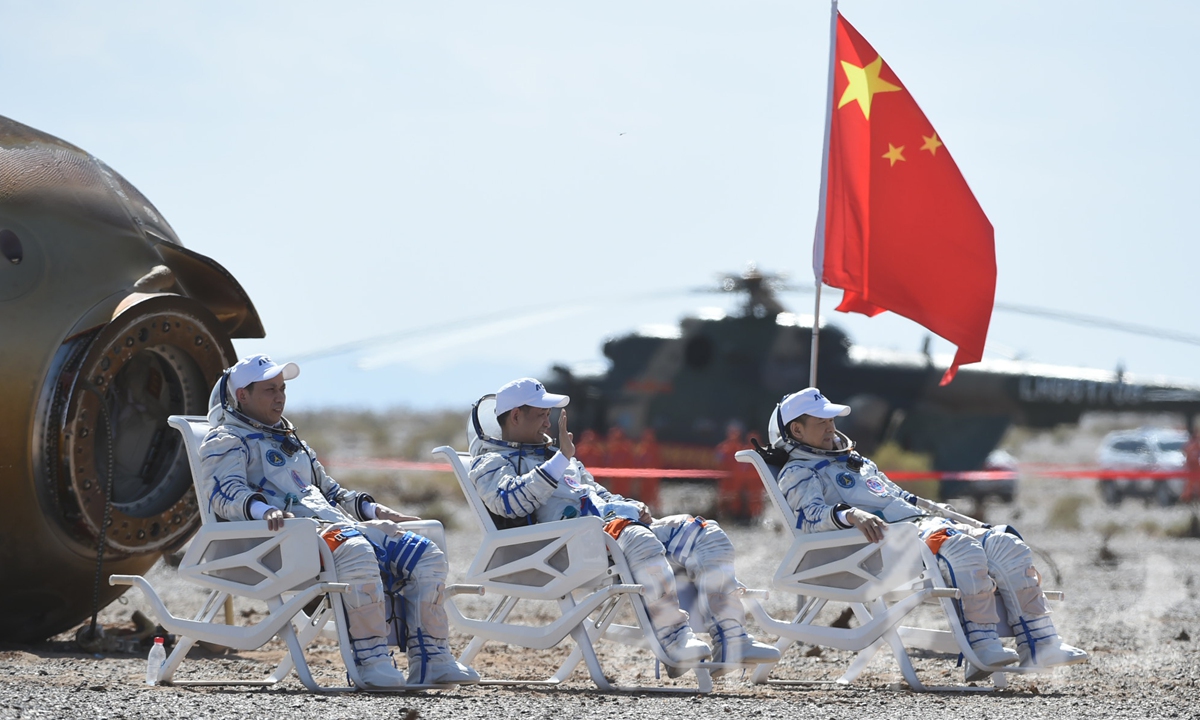
IN FOCUS
by Avishka Ashok
With Shenzhou 12, China marks a new success
On 17 September, the Shenzhou-12, the seventh crewed and longest spaceflight returned back to earth after successfully completing the mission. The three-member crew of the Shenzhou-12 safely landed in the Gobi desert after separating from its orbiting module at 1243 hours on the same day.
The Mission
The Shenzhou-12 was launched on 17 June 2021 from the Jiuquan Satellite Launch Centre in the Gobi Desert. The spaceflight also broke the Chinese record for staying in space for the longest durations by spending over three months in space. Post launch, it travelled to the Tiangong space station in 6.5 hours and docked with the Tianhe core module. The mission is also credited for bringing the first set of visitors to China’s first long-term space station, Tiangong, since its launch in April 2021. The three-membered crew carried out various tasks in the 90-day mission such as the mechanical arm operation, extravehicular operations, verifying the possibility of long-term habitation in space, recycling resources in space and more. The mechanical arm installed in the space station is tasked with the function of assembling the remaining parts of the Chinese Space Station.
As a part of the mission, the astronauts also tested the next-generation spacesuits during the spacewalks. In China’s second successful spacewalk, the crew tested the efficiency, capability and future feasibility of the newly installed equipment and successfully completed a number of technical operations in the space station. The spacewalk conducted by the crew of Shenzhou-12 also breaks the record of China’s longest spacewalk by spending almost seven hours on the mission. The success of the missions were celebrated with great pride in China who is not a part of the International Space Station.
The Landing
Dongfeng, the site of landing chosen for the Shenzhou-12 was different from the usual landing site of Siziwang Banner Site. The Dongfeng site was chosen due to the climatic conditions, topography, returning options, rescue and search equipment availability. The landing for the spaceflight was more challenging than the usual landings due to the lack of fixed returning coordinates as a result of the continually changing orbital altitude. It was also a difficult landing mission as the topography, consisting of mountainous terrain, posed a challenge to the search and rescue teams of the Shenzhou-12. However, they were rescued soon after the landing.
The Crew
The crew consisted of three military astronauts from the People’s Liberation Army Strategic Support Group: Mission Commander Nie Haisheng, Major General Liu Boming and Senior Colonel Tang Hongbo.
References
“Shenzhou-12 crewed spaceship launch a complete success, China Manned Space, 17 June 2021”
Rhea Mogul, “Chinese astronauts complete first space walk outside new Tiangong space station, CNBC, 4 July 2021”
Deng Xiaoci aand Fan Anqi, “Mission accomplished: China’s Shenzhou-12 crew safely back on earth, Global Times, 17 September 2021”
IN BRIEF
By Keerthana Nambiar
China tightens grip on Hong Kong property tycoons
On 17 September, Reuters reported that China has released new mandates for Hong Kong’s powerful property tycoons in a series of closed meetings this year. The move, calls for the latter to pour out their resources and influence, to address a potentially destabilising housing shortage. According to sources quoted in the report, the mandate to make Hong Kong more "patriotic", comes under the view that the tycoons failed to prevent the anti-government protests in 2019. Hong Kong's biggest property firms, such as CK Asset, Henderson Land Development, Sun Hung Kai Properties (SHKP) and New World Development are termed as “a major component of the political and economic ecosystem” in the city. They have long enjoyed outsized power and have been directly reaping benefits from the city’s hybrid political system. (Clare Jim and Farah Master, With tighter grip, Beijing sends message to Hong Kong tycoons: fall in line, Reuters, 17 September 2021)
China warns India to not ‘poison’ SCO cooperation under the Afghan issue
On 17 September, Chinese state media quoted “China experts” warning India to not "poison" cooperation under the Shanghai Cooperation Organization (SCO), as Indian Prime Minister Narendra Modi discussed the Afghan issue and connectivity with Central Asia at the SCO summit in Tajikistan. Chinese President Xi Jinping was also quoted by state media at the summit saying that external forces should never be allowed to interfere in the internal affairs of countries under any pretext. (Zhang Hui and Liu Xin, India warned not to be ‘poison’ for SCO cooperation, as it seeks influence on Afghan issue, Global Times, 17 September, 2021)
Xi Jinping urges Afghanistan to eradicate terrorism, promises aid
On 17 September, Xinhua quoted Chinese President Xi Jinping urging all "relevant parties" in Afghanistan to eradicate terrorism and promised more aid to tackle the looming economic and humanitarian crisis in the country. Xi added on at the Shanghai Cooperation Organization Summit that Afghanistan should be guided to be more open and to pursue moderate domestic and foreign policies. Western nations have been reluctant to provide aid to Afghanistan unless the Taliban assures that it will uphold human rights especially of women. China’s interest in Afghanistan comes from the fear of some ETIM militants, who have have long been allies of the Taliban. (Gabriel Crossley, China's Xi urges Afghanistan to stamp out terrorism, vows more aid, 17 September 2021)
China enters Taiwan’s air defence zone after military budget boost
On 17 September, Taiwan's defence ministry said that its military forces were engaged in warning away 10 Chinese military encroachments that had entered areas close to Pratas and the Bashi Channel. The offensive, that involved 6 J-16, 2 J-11 fighters, one anti-submarine and a reconnaissance aircraft, comes a day after Taiwan announced a $9 billion boost to military spending to counter China’s threat. (Ben Blanchard, China enters Taiwan air defence zone a day after military budget boost, Reuters, 17 September 2021)
China sharply reacts on AUKUS accusing Coldwar mentality.
On 17 September, the Chinese embassy in Canberra said it rejects "unfounded accusations" stated in the annual talks by the defence and foreign ministers of Australia and their United States counterparts. The joint statement released by the Australia-US Ministerial Consultations expressed concern over China's "expansive maritime claims in the South China Sea that are without legal basis". The statement further criticized China's actions which led to weakened electoral system and supressed media in Hong Kong with the imposition of National Security Law. It also expressed its "grave concerns" on the human rights violations of Uighur Muslims. In a statement from a spokesman for the Chinese embassy, "This petty move to put pressure on China will be of no avail but a staged farce." (Chinese embassy says it opposes US, Australia interference, Strait Times, 17 September 21)
China lobbies Russia, Iran and Pakistan for an united stance on Afghanistan
On 17 September, the Shanghai Cooperation Organization (SCO) and Moscow-led Collective Security Treaty Organisation (CSTO) held a virtual meeting called in for an united front to keep Afghan Taliban inclusive and respect Afghanistan’s sovereignty. Xi Jinping stated “We should start interaction with different parties in Afghanistan, and guide the new regime of the nation to be more open and inclusive.” The Chinese Foreign Minister Wang Yi remarked it was essential for the four countries to “strengthen communication and coordination, form unanimous voices, exert positive influence and play a constructive role in stabilising the situation in Afghanistan”. Without naming the US, Xi Jinping hinted holding United States accountable and had caused the chaos should learn a lesson “share responsibility for the future of Afghanistan”. (China lobbies Russia, Iran and Pakistan to show unity on Afghanistan, South China Morning Post, 17 September 2021)
Big Tech firms pushed towards more online control ‘cyberspace civilization’
On 17 September, the South China Morning Post reported that the Communist Party and State Council of China introduced new guidelines for building a “cyberspace civilisation”. Internet platforms such as WeChat owner Tencent Holdings and Tiktok owner ByteDance are expected to face the brunt of new restrictions seeking to reshape China’s online world. The guidelines call for government agencies to enhance efforts to regulate how content is produced, published and spread online. Among the targets are internet slang and “uncivilised problems” with live-streaming e-commerce and public accounts, which are social media accounts run by content producers. (China’s Big Tech platforms face more responsibility in ‘cyberspace civilisation’ push that seeks more online control, South China Morning Post, 17 September 2021)
 |
NIAS Course on Global Politics National Institute of Advanced Studies (NIAS) Indian Institute of Science Campus, Bangalore |