


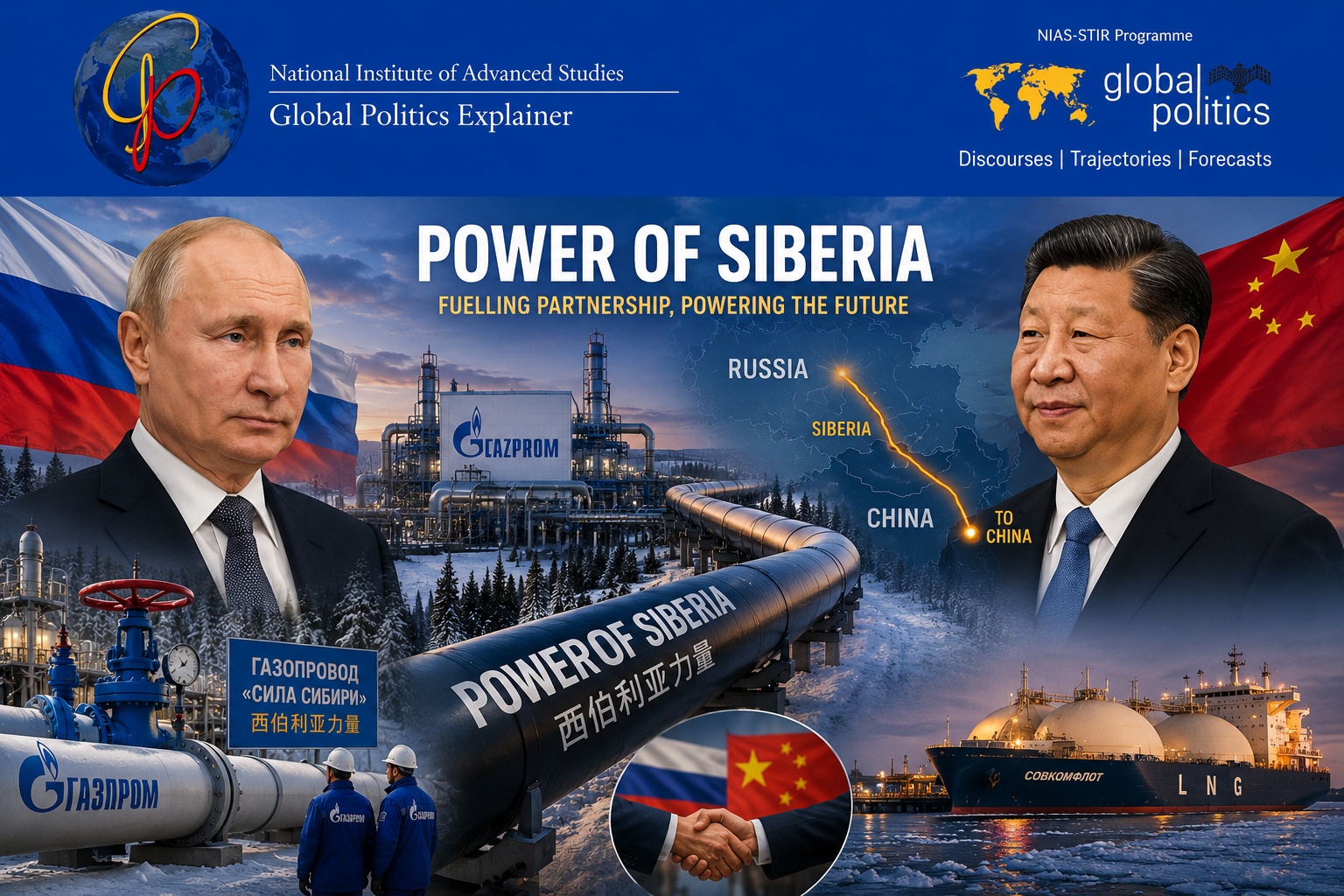
Photo Source: AI generated

National Institute of Advanced Studies (NIAS)
Indian Institute of Science Campus, Bangalore
For any further information or to subscribe to GP alerts send an email to subachandran@nias.res.in
GP Explainer
The "Power of Siberia 2" pipeline:
 |
Avaneesh S
Avaneesh S is an intern at NIAS. Currently, he is pursuing his master’s in history at Pondicherry University.
|
In May 2026, Russia and China had reached a “general understanding” on the proposed ‘Power of Siberia 2’ gas pipeline, spanning over 2,600 kilometres. It connects the Arctic Yamal gas fields with Shanghai, through Mongolia. Amid Western sanctions and EU’s efforts to move away from Russian energy products, the pipeline represents an effort to regain lost revenue, and Moscow’s resilience against a hostile West.
What is the background?
First, a brief background on Power of Siberia 1. On 02 December 2019, President Putin and President Xi announced the operation of the Power of Siberia 1 (POS-1), the east line. It supplies 38 billion cubic meters (bcm) of natural gas annually, from Eastern Siberia to China’s Jing-Jin-Ji region and Yangtze River Delta. POS-1 was completed after a 30-year long negotiation process, with construction beginning in 2014.
Second, the context to Power of Siberia 2. Russia also proposed the ‘Altai pipeline’ to connect Southern Siberia gas fields to Xinjiang, formalized by CNPC and Gazprom in May 2015 to supply 30 bcm annually, initially designated as “Power of Siberia 2 (POS-2).” In June 2018, Russia, Mongolia and China deliberated a “middle-line” route, increasing the proposed supply to 50 bcm annually. By 2022, Russia and China entered advanced negotiations over the middle line, and with Gazprom shifting the POS-2 designation to this route. On 20 May 2026, Moscow announced that China and Russia, reached a general understanding over the POS-2 pipeline, confirming it to connect Russia’s Arctic Gas fields with Shanghai through Mongolia, which was one of the key developments of the Putin-Xi summit.
What is the Russian endgame?
First, the redirection of surplus European gas exports to China. Since 2015, Russia was aiming to supply the surplus European gas exports to China, making it the primary reason for Gazprom lobbying for the Altai pipeline. But since Russia’s invasion of Ukraine, Europe has committed to cutting dependency on Russian gas through initiatives such as REPowerEU, and the December 2025 EU resolution to phase out Russian gas by 2027. As such, Russia has the impetus to push further for the construction of POS-2, which would supply gas to China, albeit at a reduced price.
Second, a geopolitical win against the West. POS-2 represents a big geopolitical win for Russia against Western sanctions, allowing Moscow to demonstrate that its gas exports can be sustained and redirected eastward despite efforts to isolate it economically.
Third, Gazprom's bid for infrastructural monopoly. Besides geopolitical and economic benefits, POS-2 would be the first major infrastructural project of Gazprom, enjoying a near monopoly over gas exports. But it is currently under threat from other Russian companies, including Rosneft and Novatek, which currently lead gas exploration and industry development. Russia is also in need of Chinese technology and investment in gas exports, such as LNG shipping transportation and regasification terminals, amidst the Western sanctions. Other Russian industries under sanction by the West, including its steel plants, can provide a speedy construction timeline for the POS-2 and potentially be operational in their full capacity by the early 2030s.
What is the Chinese perspective?
First, Beijing’s domestic consumption growth and its green transition are key factors. According to Chinese government estimates and the International Energy Agency, China’s gas consumption is set to increase to an estimated 450-650 bcm in 2030s. As such, expanding its gas utilization is a national imperative. Since 2006, China aims to diversify from coal due to severe air pollution and its detrimental effect on China’s green energy strategy.
Second, POS-2 offers a more economical route for Beijing. The Altai pipeline would have driven higher domestic transportation costs, as gas consumption is mainly centred around the Jing-Jin-Ji region, the most economically productive regions of China. Thereby, China would rather prefer the erstwhile ‘middle-line’ pipeline (POS-2), which would directly connect with the Shaanxi-Beijing system, and then head south to Shanghai. Additionally, upgrading the existing Eastern pipeline network to connect to the POS-2 is more economical than building new pipes. China’s piped gas imports are diverse, with pipelines from Turkmenistan, Uzbekistan, Myanmar, and Russia. Russia’s gas prices are the lowest amongst the four but enjoy around 35-40 per cent of total imports by China. If POS-2 becomes operational, Russian imports to China will rise to 42-45 per cent of total imports by China.
Third, China’s leverage as a single buyer means it is in no hurry to commit. Negotiations have stalled despite 12 years of talks, due to Beijing's monopsony effect as a single buyer, China refuses to match European prices. Before Ukraine's invasion, POS-2 would have faced two competing buyers. Combined with China's push to reduce non-renewables dependency, POS-2 may not be required and could be rendered useless by 2060s. Thus, Beijing must weigh greater Russian dependence against increased reliance on LNG imports.
What are the implications for China and Russia?
First, for China, POS-2 becomes a hedge against US-linked energy dependence. The Hormuz crisis has created an unprecedented fuel shortage across the world. Pre-Hormuz, China imported around 86 bcm of LNG in 2025, roughly 50 per cent from Australia and Qatar. In light of this, China will now consider the POS-2 proposal, which aims to accelerate diversification away from US-linked energy supplies. The project brings 50 bcm of piped gas, with lower market prices than previously offered to Europe. This means LNG imports from Qatar and Australia will possibly be filled by POS-2, and China could still be in its timeline to phase out non-renewables.
Second, for Russia, the pipeline represents resilience. Moscow will not be able to considerably upgrade its fields and productions without Chinese investments, with CNPC and its subsidiaries owning significant stake in Russia’s Arctic gas plants. If the pipeline becomes operational, alongside Chinese investments into Russian gas exploration, will induce an oversupply of gas, most of which, China is set to absorb. Therefore, the pipeline represents Russian resilience, where it is preparing for an isolationist period with the West and for China, it changed from a potentially useless investment to a viable decoupling link from US-allied LNG sources and does not shift its timeline for reducing non-renewables.
Bibliography
News Reports and Websites:
1. “Despite Sanctions, Russia’s Arctic LNG 2 Plant is Up and Running,” The Maritime Executive, 02 October 2025.
2. “China's Polar Silk Road: Long Game or Failed Strategy?” The Arctic Institute, 14 November 2023.
3. “Sanction-Proof? Russia's Arctic Ambitions and the China Factor,” The Arctic Institute, 21 November 2024.
4. “U.S. Reactors Still Run on Russian Uranium,” Foreignpolicy, 04 April 2024.
5. “ANALYSIS: China’s LNG imports fell 12% in 2025 despite remaining world’s top buyer,” Independent Commodity Intelligence Services, 30 December 2025.
6. “GIF Inside Story: Power of Siberia 2’s new route makes Russian gas supplies to China more feasible,” Independent Commodity Intelligence Services, 30 April 2026.
7. “What is the Power of Siberia 2 pipeline that Russia, China are planning?” Al Jazeera, 20 May 2026.
8. “What is Russia's Power of Siberia 2 natural gas pipeline to China?” Reuters, 02 September 2025.
9. “Nuclear energy, Taiwan and Trump's 'Golden Dome': key points from the Xi-Putin talks,” Reuters, 20 May 2026.
10. “Kremlin says understanding reached on Power of Siberia 2 gas link to China, but no details yet,” Reuters, 20 May 2026.
11. “Power of Siberia 2: Russia’s Pivot, China’s Leverage, and Global Gas Implications,” Center on Global Energy Policy; Columbia University, 03 September 2025.
12. “Can China Compensate Russia’s Losses on the European Gas Market?” Carnegie Politika, 01 June 2023.
13. “What Russia’s First Gas Pipeline to China Reveals About a Planned Second One,” Carnegie Politika, 18 April 2023.
Articles, Journals and Books
1. Zhao et al., “Energy transition in China: It is necessary to increase natural gas utilization,” Energy Reports, Volume 10 (2023), 2439-2447.
2. Vatansever, Adnan and Goldthau, Andreas C., “The political economy of breaking European dependence on Russian gas,” Resources Policy, Volume 109 (2025).
3. Martin Laryš, “Russia’s potential for weaponization of gas supplies after the Re-invasion of Ukraine,” Energy Policy, Volume 191(2024).
4. Liu, Dawei and Xu, Hang., “A rational policy decision or political deal? A multiple streams’ examination of the Russia-China natural gas pipeline,” Energy Policy, Volume 148 (2021)
5. Pye et al., “The global implications of a Russian gas pivot to Asia,” Nat Commun, 2025.
6. Yermakov, Vitaly and Meidan, Michal., “Russia and China Expand Their Gas Deal: Key Implications,” The Oxford Institute for Energy Studies, 2022.
 Click here for PDF Version Click here for PDF Version |  |
 |
Bookmark |
Aparna A Nair | Aparna A Nair is a postgraduate student at the Department of Political Science, Madras Christian College, Chennai. She is a Research Assistant at NIAS.
The EU-China Trade Talks:
Aishal Hab Yousuf | Aishal Hab Yousuf is a postgraduate student at the Department of International Studies, Stella Maris College, Chennai. She is currently an intern at the National Institute of Advanced Studies (NIAS), Bengaluru.
The Trump-Xi Summit:
Aparna A Nair | Aparna A Nair is a postgraduate student at the Department of Political Science, Madras Christian College, Chennai. She is currently a Research Assistant at NIAS.
China and the Open-Weight AI:
Namrata L Ghanghatkar | Namrata L Ghanghatkar is a postgraduate student at the Department of Public Policy, Ramaiah University of Applied Sciences, Bengaluru. She is currently a research intern at the National Institute of Advanced Studies (NIAS).
Japan's Yasukuni Shrine Controversy:
Lakshmi Karlekar | Dr Lakshmi Karlekar is an Assistant Professor at the School of Law, Christ University, Central Campus, Bangalore.
China's External Landscape (Apr-Jun 2026):
Teshu Singh | Dr Teshu Singh is a Research Fellow at the Indian Council of World Affairs (ICWA), New Delhi. The views expressed are personal.
East Asia (Apr-Jun 2026):
Dhivya KM | Dhivya KM is an intern at NIAS and is also a postgraduate student from the Department of Financial Economics, Madras School of Economics, Chennai.
China's economy at mid-2026:
Acsah H | Acsah H is a postgraduate student at the Department of Geopolitics and International Relations, Manipal Institute of Social Sciences, Humanities and Arts, MAHE, Manipal, Udupi. She is currently a research intern at the National Institute of Advanced
China's World Artificial Intelligence Conference:
Acsah H | Acsah H is a postgraduate student at the Department of Geopolitics and International Relations, Manipal Institute of Social Sciences, Humanities and Arts, MAHE, Manipal, Udupi. She is currently a research intern at the National Institute of Advanced
China's C909:
Aparna A Nair | Aparna A Nair is a postgraduate student at the Department of Political Science, Madras Christian College, Chennai.
China, the Philippines, and the return of South China Sea tensions:
Aparna A Nair | Aparna A Nair is a postgraduate student at the Department of Political Science, Madras Christian College, Chennai.
UNCLOS and the South China Sea Arbitral Award:
Adwaith Sankar | Adwaith Sankar is an intern at NIAS. He is also an undergraduate student pursuing Political Science and International Liberal Studies through the NUS-Waseda Double Degree Programme.
65 years of the China-DPRK friendship treaty:
Avaneesh S | Avaneesh S is a postgraduate student from the Department of History, School of Social Sciences, Pondicherry University. He is currently an intern at NIAS.
China's SLBM test in the Pacific:
Acsah H | Acsah H is a postgraduate student at the Department of Geopolitics and International Relations, Manipal Institute of Social Sciences, Humanities and Arts, MAHE, Manipal, Udupi. She is currently a research intern at the National Institute of Advanced
President Xi Jinping's address on CPC's 105th anniversary:
Anand V | Dr Anand V is an Assistant Professor (Senior Scale) in the Department of Geopolitics and International Relations, Manipal Academy of Higher Education, Manipal, India. The views expressed are personal.
China's Domestic Landscape (April-June 2026):
Avaneesh S | Avaneesh S is a postgraduate student from the department of History, School of Social Sciences, Pondicherry University. He is currently an intern at NIAS.
President Xi Jinping's North Korea visit:
Aparna A Nair | Aparna A Nair is a graduate from the Department of Political Science, Madras Christian College, Chennai.
The Shenzhou-23 Mission:
Aparna A Nair | Aparna A Nair is a research intern at the National Institute of Advanced Studies, Bengaluru.
The Putin-Xi Summit
Aishal Hab Yousuf | Aishal Hab Yousuf is a postgraduate student at the Department of International Studies, Stella Maris College, Chennai. She is currently an intern at the National Institute of Advanced Studies (NIAS), Bengaluru.
The Trump-Xi Summit:
Femy Francis
China-Japan Tensions
Amrita Jash
China’s External Landscape (Jan-Mar 2026):
Anand V
China’s Domestic Landscape (Jan-Mar 2026):
Aparna A Nair
China-Vietnam 3+3 Strategic Dialogue
Femy Francis
China's Interests and Strategies in the US-Iran War
Femy Francis
Trump-Xi Meeting
Femy Francis
China’s Two Sessions 2026
Femy Francis | Femy Francis is a Project Associate at NIAS
“Let Beijing believe peaceful reunification is still possible”
Femy Francis
Ten Takeaways on White Paper "China’s Arms Control, Disarmament, and Non-proliferation in the New Era
Femy Francis
Japan-China Tensions over PM Takaichi's statement on Taiwan
Femy Francis
China, Yarlung Tsangpo and the Medog Hydropower Station
Femy Francis
China-Australia Free Trade Agreement after ten years:
J Yamini
China’s EV Surge
Gauri Gupta
China’s debut Global Green Sovereign Bond
Aparna A Nair
Humanoid Robots: Why is China investing on them?
Emma Rose Boby
Bangladesh and China: What agreements did the Chief Executive Yunus sign during his recent Visit? What do they mean?
Femy Francis
China's Military drills near Taiwan Strait: Actions, Responses and Criticisms
Nova Karun K
China Development Forum 2025: The Focus on AI, High Tech Investments, and Domestic Consumption
C Shraddha
US-China Trade War: Tariffs, Retaliation and Fallouts
Ashna Pathak & Surangana Rajya Laxmi Rana
Health diplomacy: Nepal's growing dependence on China
Advik S Mohan
Bougainville’s struggle for independence: What is the problem, and what are the implications?
Femy Francis | Research Assistant at NIAS
06 May 1882: The US President signs the Chinese Exclusion Act, restricting immigration from China
Torunika Roy
China-Japan-South Korea Trilateral Summit: Key Outcomes and Implications
Femy Francis
China-Arab States Summit, and Xi’s “Five Cooperation Framework”
Akhil Ajith
Taiwan President’s Inaugural Address: Four Takeaways
Akhil Ajith
Chang’e 6 and China’s Lunar Exploration program
Femy Francis
Antony Blinken’s China Visit
Femy Francis
China in Mexico: What, How and Why
Akhil Ajith
Beijing Auto Show 2024: China’s global domination in EV sector
Akhil Ajith
Chinese cities are sinking below the sea level: Four Takeaways of a Science journal report
Femy Francis
Germany and China: It’s the economy, stupid
Femy Francis
Canada investigates Chinese interference in 2019 and 2020 elections
Devi Chandana M
Rise in China’s Marriages
Femy Francis
Ten years of BRI: Xi and the Beijing Summit
Femy Francis
The return of the South China Sea
Femy Francis
BRICS Summit poised as the Champion of Global South
Femy Francis
Japan-Australia's Reciprocal Access Agreement
Prerana P
The SCO Summit and the Delhi Declaration: The Focus on Digital Security and Iran’s Entry
CR Team | Avishka Ashok
China: Palestine Authority President Mahmoud Abbas’ visit emphasizes hope for statehood
Avishka Ashok | Research Associate | National Institute of Advanced Studies
20th Party Congress of the Communist Party of China: Major takaways
Devjyoti Saha
Solomon Islands’ China card: Three reasons why
Avishka Ashok
The Biden-Xi phone call and the underlying tensions in bilateral relations
Avishka Ashok
China’s two major interests in Kazakhstan: Energy and economy
N Jayaram
China in 2021: A year of grandiose political changes and foreign affairs
Amit Gupta
China’s Economic Strategy: Global Strike vs. Globalization
Sukanya Bali
Alibaba then, Didi now: Three reasons why Beijing is going after its tech giants
Dincy Adlakha
The new three-child policy is two decades too late
Dincy Adlakha
Loud Echoes of the National Security Law in China
Keerthana Rajesh Nambiar