NEPRA announces uniform national tariff increase worth 20 per cent; External meddling in judicial affairs will end soon, hopes LHC CJ
In Brief
PROVINCES
Sindh: CM presents the provincial budget for FY25, calls it “record balanced”
On 14 June, the Sindh government presented a budget of PKR 3.056 trillion for FY25. It was presented by Chief Minister Murad Ali Shah, who termed the budget as a “record balanced budget.” The opposition attended the budget without causing any hindrance. Government employees will receive a 30 per cent salary hike. The budget centred on the rehabilitation of flood-affected people and social protection for the poor. PKR 662 billion in provincial collections will include PKR 350 billion in sales tax on services, PKR 269 billion in tax (excluding GST), and PKR 2.9 billion in non-tax revenue from the province. 63 per cent will be given to current revenue, six per cent to current capital, and 31 per cent to development expenses. Education will receive the largest allocation, followed by healthcare and local government. Agriculture will receive PKR 58 billion, energy will receive PKR 77 billion, irrigation will receive PKR 94 billion, and Planning and Development will receive PKR 30 billion.
The minimum wage will be increased to PKR 37,000, salaries will be upped by 30 per cent and pensions by 15 per cent, while employees will also be given a personal allowance. Revenue receipts were divided into five categories, including current revenue receipts of PKR 2.56 trillion, current capital receipts of PKR 21.62 billion, other receipts of PKR 416.92 billion, and carryover cash balance of PKR 55 billion. On the other hand, total expenditure will comprise a current revenue expenditure of PKR 1.91 trillion, current capital expenditure of PKR 184.8 billion and development expenditure of PKR 959 billion. Compared to last year’s budget, the education sector’s budgetary provision will be PKR 454 billion compared to PKR 334 billion, and provisions for the Sindh Higher Education Commission will be PKR 34.5 billion compared to PKR 23 billion. There will be a 34 per cent increase in the health sector budget to PKR 300 billion, as Shah explained that the provincial government “takes pride in having the best tertiary healthcare system in the country.”
New provisions have also been introduced. PKR eight billion will be allotted to the Hari Card for financially supporting 12 million farmers, PKR five billion to the Inclusive Enclave to build a complex with training and accommodation at Korani, and PKR five billion to the Solarization Initiative to distribute solar homes and promote clean energy. Other new initiatives include the Hub Canal Project (PKR five billion), the Mazdoor Card (PKR five billion), and Pro-Poor Initiatives.
Additionally, the government announced the rise of the provincial sales tax rate on services by two per cent to 15 per cent. This move was taken in an effort to “exacerbate inflation,” and is anticipated to raise an extra PKR 120 billion. Additionally, the government has increased the professional tax by 300 per cent to PKR 2,000 per year on personal income and some services. Taxes on cars made both domestically and abroad have also increased. The professional tax on CNG stations and petrol pumps has increased to PKR 20,000, while taxes on imported vehicles also witnessed a raise. Further, the tax on airline tickets has increased to PKR 1,000 for foreign travel and PKR 2,500 for domestic travel. Simultaneously, the provincial Finance Bill 2024 has announced tax rate reductions on digital services, especially at restaurants and telecom services. CM Shah stated: “However, we have ensured to restrict its impact to a bare minimum on poor segments of society.”
(Imran Ayub, “Sindh budget 2024-25: Sindh presents ‘balanced’ Rs3.06tr budget,” Dawn, 15 June 2024; “Education gets lion's share of Sindh's Rs3 trillion budget 2024-25,” The News International, 14 June 2024; Salman Siddiqui, “Sindh hikes sales tax to 15%,” The Express Tribune, 15 June 2024)
POLITICS
Imran Khan maintains that negotiations with “powerless” government are “futile”
On 14 June, Imran Khan reiterated that there is no use in holding talks with a government that “lacks authority,” opining that negotiations are futile when decisions are made by “higher authorities.” He further criticized the pressure put on judges who rule in favour of PTI, pointing out: “Journalists speaking in favour of PTI are being targeted; Raoof Hassan was attacked, and Ali Zaman was tortured.” He alleged that a judge from Sargodha told the Lahore High Court about pressure from intelligence agencies, saying that the judge’s household gas supply was cut off. Following this, he urged the Chief Justice of Pakistan Qazi Faez Isa to “uphold the rule of law.” Khan also commented on the budget for FY25, underscoring the need to borrow PKR 7.5 trillion to make up for the budget deficit. He argued: “Investment, which hinges on the rule of law, is the only salvation, yet this year saw the lowest investment in 50 years.” Further, he criticized the additional tax on salaried persons. (“No point negotiating with ‘powerless’ govt: Imran Khan,” The Express Tribune, 14 June 2024)
PTI blames ruling government for inflicting “irreversible damage” on Pakistan
On 14 June, PTI contended that the ruling government has caused “irreversible damage” to the country, citing the FY25 budget. The leader of the Opposition in the National Assembly, Omar Ayub, claimed that the complete budget was not presented in the National Assembly, and added that the seven per cent deficit in the budget was the highest in the country’s history. He accused the federal government of being partial in providing facilities to PML-N leaders in jail, saying that while some individuals were being arrested on nominal charges, others facing allegations of embezzlement were being released. While PML-N leader Nawaz Sharif and Prime Minister Shehbaz Sharif received 60-70 visits daily while imprisoned, Imran Khan was only allowed a short meeting with his lawyers and a monthly call with his children. Ayub detailed that Sargodha’s anti-terrorism court had told the Lahore High Court’s chief justice of the alleged pressure and harassment tactics directed at preventing him from holding hearings, citing this as the reason behind Pakistan’s courts not being free and resulting in a subsequent lack of investment. He went on to question the effectiveness of the Special Investment Facilitation Council (SIFC) in attracting foreign investment. (Ikram Junaidi, “Budget shows ‘irreversible damage’ being caused to Pakistan: PTI,” Dawn, 15 June 2024)
ECONOMY
NEPRA announces uniform national tariff increase worth 20 per cent
On 14 June, the National Electric Power Regulatory Authority (Nepra) announced a 20 per cent increase in the uniform national tariff to ensure about PKR 3.8 trillion in funding for the ten ex-Wapda electricity distribution companies (Discos) in FY25. The development will come into force from 1 July and it is anticipated to increase the revenue of about PKR 485 billion. The average national base tariff including K-electric for the next financial year is PKR 35.50 per unit against PKR 27.78 this year. This would earn an additional revenue of about PKR 3.763 to ten Discos in 2024-2025. According to Nepra, the Power Purchase Price (PPP) of almost 90 per cent power tariff for Discos in 2024-25, “works out as Rs3,277.506 billion, which includes PKR 1,161.257billion for fuel and variable O&M (operation and maintenance) costs and PKR 2,116.25 billion as capacity charges.” (Khaleeq Kiani, “Nepra hikes national power tariff by 20pc,” Dawn, 15 June 2024)
Finance Division’s data shows 38 government departments exceeded allocated funds
On 15 June, Dawn reported that the Finance Division released details of current expenditure for FY24, which showed that at least 38 government departments surpassed the amounts allocated during FY 2023-2024. They received the additional funds through supplementary grants. The main contributor for this excessive expense is the power sector, which utilized PKR 769 billion against the allocated PKR 450 billion. The defence sector surpassed PKR 1.81 trillion to reach PKR 1.835trillion, an increase of PKR 31.5 billion. Other than these sectors, election spending was given PKR 7.7 billion but the expenditure accounted around PKR 39 billion. In addition, the Planning, Development, and Special Initiatives demanded PKR 13.9 billion more than its yearly allocation of PKR eight billion for the outgoing financial year. Collectively, the total expenditure surpassed totalled around PKR 454.1 billion. The details showed that these departments failed to utilize the funds allocated properly. Further, only two dozen departments of the federal government remained within their limited funds. The finance ministry saved PKR 441 billion. (Zaki Abbas, “BUDGET 2024-25: Power, defence and election expenses overshoot allocations,” Dawn, 15 June 2024)
JUDICIARY
External meddling in judicial affairs will end soon, hopes LHC chief justice
On 14 June, Lahore High Court (LHC) Chief Justice Malik Shehzad Ahmed Khan expressed hope that external interference in the judiciary will soon end. He addressed the inauguration ceremony of the E-Court and Alternative Dispute Resolution Centre where he advised: “Interference in the judiciary will have to be fought with faith that it will come to an end.” He further urged sessions court judges to face “temporary worries” with bravery and not become “a target of any of their blackmailing.” Recalling that in 2007, the then-chief justice of Pakistan, Iftikhar Mohammad Chaudhry stood up to a military dictator, he asserted: “To get rid of the establishment’s interference, we have to face it with bravery, courage and without any fear.” Khan also brought up claims made by a sessions judge of a Sargodha Anti-Terrorism Court (ATC) about judicial interference by an intelligence agency. He highlighted that the country is currently “going through one of the longest periods of a civil government.” (Malik Asad, “‘Meddling’ by establishment to end soon, LHC CJ hopes,” Dawn, 15 June 2024)
EXTERNAL
US envoy goes on two-day visit to Karachi, calls for enhancing cultural ties and maritime security
On 14 June, the Chargé d’affaires (CDA) of the US Mission in Pakistan, Andrew Schofer, visited Mazar-e-Quaid to conclude his two-day visit to Karachi, during which he shed light on the strong partnership between both countries. He expressed the US’ commitment to enhancing maritime security and supporting religious freedom and cultural preservation. The consulate said that the “visit symbolized the US’s long and steadfast relations with Pakistan, reminding them of Jinnah’s vision for a unified, democratic Pakistan.” It added that both countries “hold the ideals” of “equality, social justice, and economic opportunity” close to then. Schofer also attended the USD one million Global Maritime Crime Program (GMCP) Phase-2 inauguration, which was made possible by the US government’s Bureau of International Narcotics and Law Enforcement Affairs (INL). The program’s main goals were to fight transnational maritime crime in Pakistan and improve maritime security. Schofer also visited the shrine of Sufi saint Manghopir in Karachi, and noted: “Freedom of religion is a fundamental human right essential for global stability and security.” He also visited Aisha Islamic Academy, marking the first US official delegation’s visit to girl’s madrassah. (“US envoy Andrew Schofer visits Karachi to strengthen cultural ties, maritime security,” The News International, 14 June 2024)
CDA of the US visits places in Karachi to strengthen bilateral ties
On 13 June, Andrew Schofer, the Chargé d’affaires (CDA) of the United States Mission in Pakistan, visited Mazar-e-Quaid "The visit symbolized the US’s long and steadfast relations with Pakistan, reminding them of Jinnah’s vision for a unified, democratic Pakistan," the consulate said in a statement. Schofer also attended the USD1 million Global Maritime Crime Program (GMCP) Phase-2 inauguration, which was made possible by the US government’s Bureau of International Narcotics and Law Enforcement Affairs (INL). The program’s main goals were to fight transnational maritime crime in Pakistan and improve maritime security. To provide better maritime activity monitoring and management, the program develops technologies to improve Maritime Domain Awareness (MDA). Schofer also visited the shrine of Sufi saint Manghopir in Karachi, honouring Pakistan’s rich cultural and religious diversity. He stated: “Freedom of religion is a fundamental human right essential for global stability and security.” He also visited Aisha Islamic Academy, a madrassah which marks the first US official delegation’s visit to girl’s madrassah. In addition, the US government has supported over 32 projects in Pakistan since 2001, through the Ambassadors Fund for Cultural Preservation (AFCP) investing USD 7.6 million to restore sites like Varun Dev Temple, Frere Hall, and Mehrgarh Museum. CDA Schofer’s visit to Karachi reflects the US government’s strong aim to advance its partnership with Pakistan by promoting climate resilience, human rights, maritime security, women’s empowerment, religious tolerance, and cultural heritage preservation. (“US envoy Andrew Schofer visits Karachi to strengthen cultural ties, maritime security,” The News International, 14 June 2024)
Pakistan envoy calls for “result-oriented dialogue” between India and Pakistan
On 13 June, Pakistan’s Ambassador to the US, Masood Khan, highlighted the need to hold a result-oriented structured dialogue between Pakistan and India, while addressing a gathering at the World Affairs Council of Philadelphia. He urged for a friendly atmosphere with neighbouring countries, noting that there has been no structured dialogue since 2014. Calling on the US government to have a balanced approach, he stated: “US heavy tilt towards India is accentuating strategic imbalance which is fraught with serious risks.” Khan further emphasized the need for the full restoration of Foreign Military Financing (FMF) and Foreign Military Sales (FMS) and assistance to challenge the sustained threats from terrorists. Focus was placed on Pakistan and the US relationship, the war on terror, the re-calibration of the Pak-US relationship post-withdrawal period, Pakistan-India relations, and the issues of regional stability. Khan asked US companies to invest in tech startups, renewable energy, and agriculture. He commented: “Pakistan is a big market for American manufacturers. If you manufacture state-of-the-art products, you have 240 million consumers in Pakistan.” (“Pakistan envoy seeks result-oriented dialogue between Pakistan, India,” The News International, 14 June 2024)
 |
|
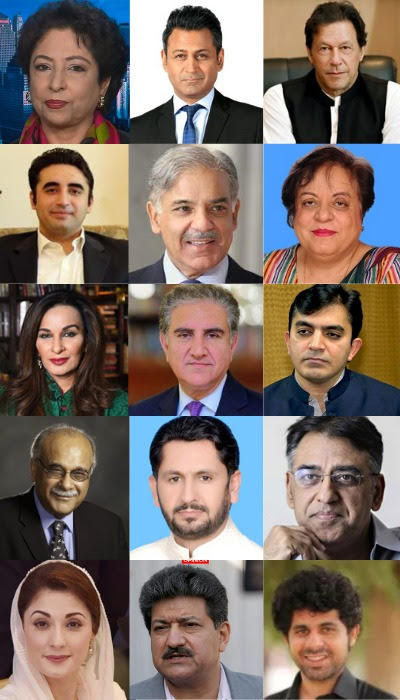
It is unfortunate how policemen and our soldiers are being targeted by terrorists as we witness casualties on a daily basis. But the military intelligence agencies, instead of doing their job of timely intelligence gathering about terrorists presence & movement, are being illegally used to pressurise and harass Judges adjudicating PTI related cases (IHC judges, ATC judges); while journalists alongside political workers & social media activists & their relatives are being abducted or "arrested” on fake charges.
- Imran Khan
When a camel entered the agricultural land of the influential Vadere, Vadere got angry and together with his employees caught the camel and tortured him. Still his anger did not cool down and he cut off the camel's leg with a sharp tool. Vadere's name is not mentioned in the news. His party is mentioned, someone tell him his name.
-Hamid Mir
Unless there are reforms in Pakistan, oppression and brutality will continue. The land reform petition has been pending in the Supreme Court for years with jawadahmadone petitioners. Why not raise a voice on it? Vadira Shahi's crimes are generational and more serious than missing person. Until it is eradicated, Pakistan cannot develop, people cannot be free.
- Dr. Shahnaz Khan
|
|
|
|
Samia Liaquat Ali Khan, ‘Our digital liberty’
Dawn, 15 June 2024
“A total of 12 low- and middle-income countries were surveyed for this report — six from Sub-Saharan Africa, four from South Asia and two from Latin America. Pakistan ranks the lowest with regard to the gender divide in mobile phone ownership; 88pc of women own a mobile phone in Nigeria, 75pc in India, and 87pc in Mexico. Ethiopia comes closest to, but still beats Pakistan, with 57pc of women there owning mobiles. Gender gaps in smartphone ownership also vary across survey countries and once again Pakistan’s gender gap is the widest at 49pc. But possibly, the most worrying part of the survey is the response to a question based on perception. Respondents were asked whether mobile internet is more important for men or women. In 11 out of 12 countries, a majority (70pc or more) believed it to be of equal importance. In Pakistan, however, 42pc of men and 28pc of women believed it is more important for men.”
Imtiaz Gul, ‘Heading for another 9/11?’
The Express Tribune, 15 June 2024
“And before al-Qaeda’s attacks on the World Trade Center and the Pentagon, “Tenet testified publicly no fewer than ten times about the threat the group posed to U.S. interests at home and abroad.” Then in February 1999, “six months after the group bombed the U.S. embassies in Kenya and Tanzania, he claimed, “There is not the slightest doubt that Osama bin Laden … [is] planning further attacks against us.” In early 2000, he warned Congress again that bin Laden was “foremost among these terrorists, because of the immediacy and seriousness of the threat he poses” and because of his ability to strike “without additional warning”.
And then the 9/11 bang happened in 2001. Two and a half decades later, Christopher Wray, the FBI director, is sounding similar alarms. His testimony to Congress and other public statements could not be more explicit. Testifying in December to members of the Senate Intelligence Committee, Wray said that “after Hamas attacked Israel on October 7, we’ve seen the threat from foreign terrorists rise to a whole another level,” according to Foreign Affairs.”
Kamila Hyat, ‘Why Pakistan suffers’
The News International, 15 June 2024
“But it is these realities that need to be confronted by our political leadership and indeed the leadership of the parties when they form whatever manifestos they put out before people. Often, they go virtually unmentioned, appearing only in the final print of these documents. In every street, virtually across the country, but notably in Sindh, Balochistan, southern Punjab and some districts of Khyber Pakhtunkhwa, we can see children playing a few kilometres away from where these politicians address large gatherings. These children are quite obviously stunted with bowed limbs and discoloured hair. For Pakistan, the rate of stunting among children under five is at least 42 per cent compared to 31 per cent for the rest of Asia. The child mortality rate for under five is 67 out of every 1,000 live births compared to 36 for the rest of Asia. In many ways, these figures should terrify us. They suggest a future that is bleak, especially as we confront a youth bulge.”
Editorial, ‘Slow start’
Dawn, 15 June 2024
“The proceedings were also marked by points of order consuming 30pc of the time MNAs met, rather than substantive legislative business. Additionally, it wasted valuable time on protests, with lawmakers from the Sunni Ittehad Council and allied independents staging 11 protests on the floor, further detracting from legislative productivity. Prime Minister Shehbaz Sharif’s attendance at only two sittings is also a point of concern. This low attendance rate, especially when compared to former premiers Imran Khan and Nawaz Sharif, who attended 29pc and 26pc of the sittings respectively, sends a troubling signal about the executive’s commitment to parliamentary engagement.”
Editorial, ‘The talks tango’
The News International, 15 June 2024
“Given that Pakistan is facing both political and economic crises, a political dialogue across the board will benefit the country as a whole. Not only will it bring political stability to an extent but the way Pakistan is moving on the economic front, with tough decisions on the cards, the country will need politicians to band together to get us out of the economic mess we are in right now. The government and its allies have always kept the door open for a dialogue with the PTI, whether when in power or in opposition. It was only Imran Khan who had been flip-flopping on the issue of a dialogue with the government. One day we would hear that the PTI was ready for a political dialogue but the next day we would be told that they would only talk to the establishment. And this is all despite the fact that the only people willing to talk to the PTI have been its rival political parties. According to some observers, this may actually be the reason why the PTI founder has now agreed to a dialogue with the government in order to break the political thaw so that things can move in the right direction.”
|
|