Oceans and the Climate Change: Science, Society, and Governance
20 October 2026


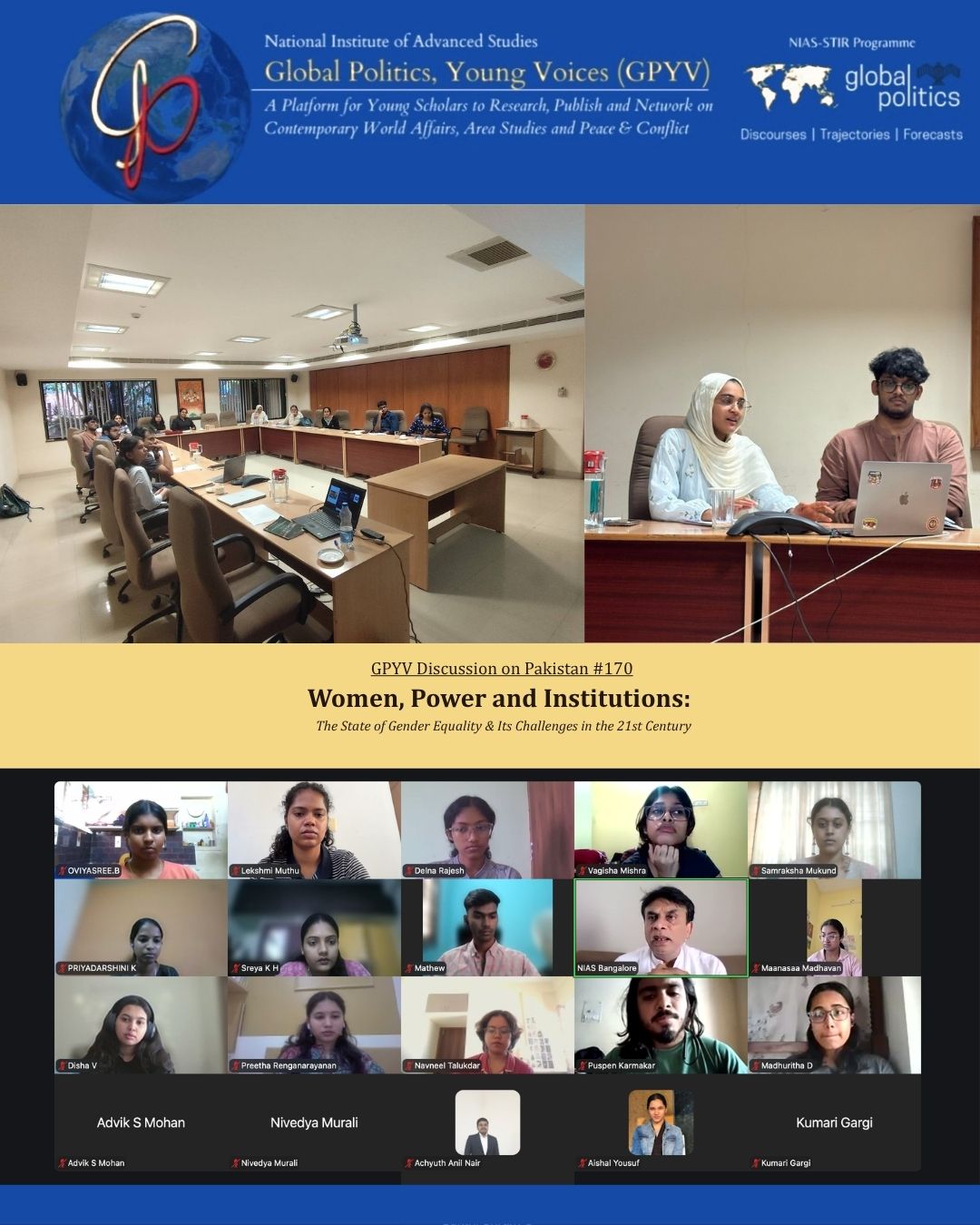
Global Politics Young Voices Discussion #170
GPYV Discussion #170
Women, Power and Institutions:
The State of Gender Equality & Its Challenges
in the 21st Century
A critique of
“Progress on the Sustainable Development Goals: The Gender Snapshot 2026”
report published by the UN Women and the United Nations Department of Economic and Social Affairs (UN DESA)
Organised by
Science, Technology and International Relations (STIR) Programme
Date & Venue
19-20 October 2026
National Institute of Advanced Studies
Programme
19 October 2026, Monday
1350-1400 hrs: Welcome and Introduction
Prof D Suba Chandran
Dean, School of Conflict and Security Studies, NIAS
1400-1530 hrs: Session-I
1400-1440 hrs: Presentations
From Representation to Power:
How the "Stacked Glass Ceiling" keeps women out of corporate decision-making?
Why do women not have a significant say in corporate decision making in spite of having seats in the boardroom?
Masoomi Santosh Nevgi
Department of International Relations and Peace Studies and Public Policy, St Joseph's University, Bengaluru
The Undoing of Equality:
Dissolution of National Gender Justice Mechanisms
What happens when the institutions built for gender justice no longer exist?
Sakthi Sriram G
Department of Political Science, Madras Christian College, Chennai
When Economic Statecraft has a gendered cost:
How sanctions affect women?
Why do economic sanctions, despite targeting states and political actors, often produce disproportionate consequences for women?
Nivedya Murali
Department Of Political Science, Madras Christian College, Chennai
Equality isn't free. So who is paying?
What are the issues and challenges in financing gender equity?
Samriddhi Sharma
Department of Political Science, Economics and Sociology, Mount Carmel University, Bengaluru
1440-1500 hrs: Inputs from Discussants
Preetha Renganarayanan
Research Assistant, NIAS, Bengaluru
&
Namrata L Ghanghatkar
Department of Public Policy, Ramaiah University of Applied Sciences
1500-1530 hrs: Q&A
1530-1600 hrs: Break
1600-1730 hrs: Session-II
1600-1640 hrs: Presentations
Declining presence:
Examining women's space in political leadership
What does it mean when women begin to lose ground in the corridors of power?
Madhuritha D
Department of Political Science, Madras Christian College, Chennai
Women at the Table:
Representation and the Women, Peace and Security Agenda
From Resolution 1325 to UNGA 81: Are women really being given a voice in peace and security?
A Varshini
Kumaraguru College of Liberal Arts and Science, Coimbatore
Gendered Geopolitics of Peacebuilding:
Women’s exclusion from Global Peace and Security Governance
Why is there a persistent disconnect between women’s exposure to conflict and their representation in peace and security decision-making?
Irin Reji Thomas
Department of Political science, Madras Christian College, Chennai
The Missing Voices of Peace:
Women are involved in peacebuilding, so why are they still missing from formal peace negotiations?
Disha V
Department of International Relations, South Asian University, Delhi
1640-1700 hrs: Inputs from Discussants
Madhura Meenakshi Tanikella
Department of Political Science, School of Liberal Arts, Alliance University, Bengaluru
1700-1730 hrs: Q&A
20 October 2026, Tuesday
1400-1600 hrs: Session-III
1400-1440 hrs: Presentations
Five Years since the Taliban takeover:
The challenge of gender apartheid and accountability in Afghanistan
How has the international community able to response to the restrictions imposed on Afghan women and girls even five years after the Taliban came to power?
Mathew Alex
Department of Political Science, Madras Christian College, Chennai
The Double Bind:
Women bearing the burden of poverty, yet missing from the power to end it
How can global poverty be effectively eradicated if women lack the institutional power to drive solutions, and how must anti-poverty strategies adapt to the reality that women do not experience poverty as a homogeneous group?
Vagisha Mishra
Department of Political Science, Economics and Sociology, Mount Carmel University, Bengaluru
Existential Breaking Point:
Funding cuts are pushing women’s organisations to the brink
Case studies from Afghanistan, Bangladesh, Sudan and Lebanon on what happens when the organisations protecting women and girls in crisis can no longer survive?
Sreya K H
Department of Political Science, Madras Christian College, Chennai
Climate Change poses a Disproportionate Threat to Women
Why does climate change create a disproportionate range of challenges for women, even though women and men are equally exposed to climate-related hazards?
Puspen Karmakar
Centre for South Asian Studies, Pondicherry University, Puducherry
1440 -1500 hrs: Inputs from Discussants
Akshath Kaimal
Research Assistant, NIAS, Bengaluru
&
Aishal Yousuf
Department of International Studies, Stella Maris College, Chennai
1500-1530 hrs: Q&A
1530-1600 hrs: Concluding remarks
About the Programme
On 17 September 2026, the UN Women and the United Nations Department of Economic and Social Affairs (UN DESA) released the “Progress on the Sustainable Development Goals: The Gender Snapshot 2026” report examining gender equality across all 17 SDGs. The central argument of the report is that while progress has been made, gains remain fragile across areas including women’s political leadership, inclusion in peace process, entry into the corporate ladder, and legal reforms. It also warns that the institutions built over decades to advance gender equality face systemic erosion or reversal at a time when it is most needed. With no SDG 5 target currently on track for 2030, the report places women’s leadership and decision-making at the centre of the gender equality agenda.
Against this backdrop, Global Politics Young Voices #170 on “Women, Power and Institutions: The State of Gender Equality in the 21st Century,” brings together young scholars to examine the structural barriers, institutional challenges, and power dynamics shaping the state of gender equality today.
20 October 2026
10 October 2026
By Stanly Johny, International Affairs Editor, The Hindu
24 September 2026
21 September 2026
25 August 2026
By Prof D Suba Chandran
8 August 2026
6 August 2026
By Amb Ranjan Mathai
4 August 2026
By Amb Ranjan Mathai
9 July 2026
8 July 2026
3 June 2026
21 May 2026
By Dr Paul Richardson
20 May 2026
8 April 2026
By Dr D Suba Chandran
25 March 2026
By Dr D Suba Chandran
13 March 2026
By Dr D Suba Chandran
23 February 2026
By Amb (Retd) DB Venkatesh Varma
11 February 2026
By Eric Stallmer
10 February 2026
By Dr Uttam Kumar Sinha
19 December 2025
30 September 2025
30 September 2025
By Nishchal Nath Pandey
29 September 2025
25 August 2025
25 August 2025
19 May 2025
By D Suba Chandran
30 April 2025
29 April 2025
14 April 2025
11 April 2025
By GP Scholars
19 March 2025
By Baiba Braže
15 March 2025
By GP Scholars
8 March 2025
By Visaka Dharmadasa
6 March 2025
By GP Scholars
3 March 2025
By Dr Thomas Lograsso
28 February 2025
By Dr Tim Stuchtey
24 February 2025
22 February 2025
By Tim Stuchtey
12 February 2025
By Mumin Chen
10 February 2025
8 February 2025
29 January 2025
22 January 2025
By Lt General SL Narasimhan
20 January 2025
By Amb Venkatesh Verma
20 January 2025
By Amb L Prashant Pise
19 January 2025
By Nishchal Nath Pandey
7 January 2025
By GP Scholars
4 January 2025
By GP Scholars
31 December 2024
14 December 2024
By Dr Shalini Chawla
13 December 2024
By Rana Banerji
13 December 2024
12 December 2024
12 December 2024
By Prof SD Muni
12 December 2024
By Amb TCA Raghavan
12 December 2024
By Prof Ajay Darshan Behera
7 December 2024
By GP Scholars
6 December 2024
By Tsai
29 November 2024
By HE Marc Abensour
22 November 2024
By Prof Sanjay K Bhardwaj
6 November 2024
By Prof Dr Heribert Dieter
3 November 2024
By Prof Heribert Dieter
3 November 2024
By Lt Gen (Retd) Dr S L Narasimhan
30 October 2024
By GP Scholars
17 October 2024
17 October 2024
7 October 2024
7 October 2024
4 October 2024
3 October 2024
30 September 2024
24 September 2024
By Dr Tim Stuchtey
19 September 2024
By GP Scholars
18 September 2024
By Prof Chintamani Mahapatra
30 August 2024
22 August 2024
By GP Scholars
16 August 2024
By GP Scholars
14 August 2024
By PR Team
5 August 2024
31 July 2024
24 July 2024
23 July 2024
8 July 2024
5 July 2024
By GP Scholars
4 July 2024
By GP Scholars
28 June 2024
By Amb Dr TCA Raghavan, Mr Rana Banerji & Prof Ajay Darshan Behera
25 June 2024
By GP Scholars
24 June 2024
By Amb Gurjit Singh, Dr S Shaji & Dr Nivedita Ray
22 June 2024
By Dr Mridula Ghosh
19 June 2024
13 June 2024
By GP Scholars
31 May 2024
By GP Scholars
23 May 2024
By Dr Paul Richardson
23 May 2024
By GP Scholars
29 April 2024
By GP Scholars
22 April 2024
By GP scholars
11 April 2024
By GP scholars
27 March 2024
By GP scholars
26 March 2024
By Prof V S Ramamurthy Emeritus Professor, and Prof DK Srivastava
15 March 2024
By Amb Dr TCA Raghavan
14 March 2024
By GP scholars
26 February 2024
By Prof SD Muni
24 February 2024
By GP scholars
20 February 2024
By Dr Martin Kocher
12 February 2024
By GP scholars
22 January 2024
By GP scholars
19 January 2024
By Prof Iqbal S Hasnain
17 January 2024
By GP scholars
13 January 2024
12 January 2024
By Amb D B Venkatesh Varma
12 January 2024
By Lt General SL Narasimhan
11 January 2024
By Amb D B Venkatesh Varma
11 January 2024
By Amb D B Venkatesh Varma
9 January 2024
By Prof V K Dhadwal, Prof PM Soundarrajan, Prof Shailesh Nayak
9 January 2024
By GP scholars
21 December 2023
By Dr Nishchal N Pandey
21 December 2023
By Dr Nishchal N Pandey
15 December 2023
By GP scholars
5 December 2023
1 December 2023
21 November 2023
By GP scholars
7 November 2023
6 November 2023
By Prof AV Krishnan | Prof Vinay Kumar Dadhwal | Prof PM Soundar Rajan | Prof Sindhu Radhakrishna | Mr Fynn Schymek | Ms Kim Thy Tong | Mr Moritz Fink | Mr Tom Zeising
6 November 2023
4 November 2023
By Dr. Mumin Chen
3 November 2023
By Dr. Mumin Chen
17 October 2023
By GP scholars
16 October 2023
By NIAS Africa Scholars
13 October 2023
By Juris Bone and Marks Deitons
3 October 2023
By GP Scholars
5 September 2023
By GP scholars
23 August 2023
By Sourina Bej and Femy Francis
14 August 2023
By Amb TCA Raghavan
11 August 2023
By GP scholars
5 August 2023
4 August 2023
By IPRI Scholars
11 July 2023
By GP course scholars
21 June 2023
By Davlatov Kamronbek Sanjarbek o'g'li
17 June 2023
By GP Team
8 June 2023
By NIAS Young Scholars
23 May 2023
By GP Scholars
18 May 2023
By Faridun Rahimov
15 May 2023
12 May 2023
By Dr Bibhu Prasad Routray
20 April 2023
By Shri Ambarish Verumi
17 April 2023
By GP scholars
10 April 2023
By Dr Dmitry P. Novikov
31 March 2023
By Anshuman Behera, Sanjay Kumar Bhardwaj, Shalini Chawla, Abigail Miriam Fernandez
28 March 2023
20 March 2023
17 March 2023
8 March 2023
24 February 2023
23 February 2023
22 February 2023
20 February 2023
By Karagulov Batyr-Mukhammad Azamatovich
17 February 2023
By Mr Thorsten Frei
15 February 2023
By Prof Anne Cheng
8 February 2023
30 January 2023
30 January 2023
By Ambassador Gurjit Singh
23 January 2023
By Zou Zhengxin
19 January 2023
By Lt Gen Dr SL Narasimhan, PVSM, AVSM, VSM
18 January 2023
By Amb DB Venkatesh Varma
17 January 2023
By Amb DB Venkatesh Varma
10 January 2023
By Amb DP Srivastava
6 January 2023
By Dr Srinivasan Ramani
3 January 2023
By Chaitanya Giri
3 January 2023
By Mihir Das
30 December 2022
By GP Team
9 December 2022
By Sir Robin Grimes
5 December 2022
By Tilak Devasher
5 December 2022
24 November 2022
By HE Ms Ritva Koukku-Ronde
23 November 2022
By Prof D. Suba Chandran, Dr Uma Purushothaman, and Prof MJ Vinod
21 November 2022
By Prof Dr Heribert Dieter
18 November 2022
17 November 2022
By Ambassador Sharat Sabharwal
4 November 2022
3 November 2022
14 October 2022
11 October 2022
By GP course scholars
10 October 2022
By Mr Sathiyamoorthy N
28 September 2022
By Prof Rahul Tripathi
27 September 2022
By Prof Rahul Tripathi
8 September 2022
By GP course scholars
5 September 2022
By Prof Shailesh Nayak
2 September 2022
By GP course scholars
24 August 2022
22 August 2022
By Dr Beena
25 July 2022
By Dr Jean-Baptiste Jeangène Vilmer
24 May 2022
By Dr Tawhid Chtioui
23 May 2022
By By young scholars researching on Europe
9 May 2022
By GP course scholars
2 May 2022
By GP course scholars
26 April 2022
By Dr Arvind Gupta
26 April 2022
By Dr Arvind Gupta
26 April 2022
By Lt Gen (Dr) Prakash Menon
25 April 2022
By GP course scholars
18 April 2022
By GP course scholars
12 April 2022
By Gert Heijkoop
4 April 2022
By GP course scholars
28 March 2022
By Siddharth Rajoli
22 March 2022
By GP Course Scholars
7 March 2022
By Nireekshan Bollimpalli
25 February 2022
22 February 2022
By Amb PS Raghavan
21 February 2022
By GP Course Scholars
14 February 2022
By GP course scholars
9 February 2022
By Natesan Ramamoorthy
7 February 2022
By GP course scholars
31 January 2022
By GP course scholars
24 January 2022
By GP course scholars
19 January 2022
By Dr Indrani Talukdar
12 January 2022
By Dr Athar Zafar
10 January 2022
By GP course scholars
10 January 2022
By GP course scholars
10 January 2022
By GP course scholars
5 January 2022
By Dr Shaji S
9 December 2021
7 December 2021
By Lt Gen Prakash Menon
7 December 2021
By Achim Burkart
30 November 2021
30 November 2021
By Dr Gudrun Wacker
29 November 2021
By GP Course Scholars
23 November 2021
By Dr Tejal Kanitkar
20 November 2021
19 November 2021
By Faculty from NIAS and Kristu Jayanti College
8 November 2021
By GP Course Scholars
2 November 2021
By David Merkle
26 October 2021
By Dr Manoharan N, Dr Madhumati Deshpande, Dr Shreya Upadhyay
25 October 2021
By GP Young Scholars
18 October 2021
By GP Young Scholars
13 October 2021
By N Jayaram
12 October 2021
By Prof TV Paul
4 October 2021
By GP Course Scholars
2 October 2021
By Dr Rajat Kumar Kujur
28 September 2021
By Prof Sumit Ganguly
27 September 2021
By GP Course Scholars
24 September 2021
By Dr Purnima Roy
20 September 2021
By GP Course Scholars
9 September 2021
By Dr Chaitanya Giri
6 September 2021
By GP Course Scholars
1 September 2021
1 September 2021
By N Jayaram
30 August 2021
By GP Course Scholars
19 August 2021
By GP Course Scholars
17 August 2021
By Young Scholars' Workshop
10 August 2021
By Amb PS Raghavan
7 August 2021
By Amb PS Raghavan
2 August 2021
By GP Course Scholars
26 July 2021
By GP Course Scholars
19 July 2021
By GP Course Scholars
12 July 2021
By GP Course Scholars
5 July 2021
By Abigail Miriam Fernandez
1 July 2021
By Amb Sanjay Singh
28 June 2021
By GP Course Scholars
14 June 2021
By GP Course Scholars
31 May 2021
By GP Course Scholars
24 May 2021
By GP Course Scholars
21 May 2021
By PR Scholars
17 May 2021
By GP Course Scholars
13 May 2021
By Dr Stanly Johny
3 May 2021
By GP Course Scholars
30 April 2021
By GP Course Scholars
3 April 2021
By Dr N Manoharan
31 March 2021
By Stanly Johny
27 March 2021
22 March 2021
15 March 2021
By GP Scholars
11 March 2021
By Dr Nishchalnath Pandey
2 March 2021
By Amb Rakesh Sood
1 March 2021
By PR Course Scholars
25 February 2021
By Prof P M Soundar Rajan
23 February 2021
By Amb Sanjay Singh
15 February 2021
By GP Course Scholars
8 February 2021
By Abigail Fernandez, Avishka Ashok, Harini Madhusudan, Sukanya Bali, Aparupa Bhattacherjee, and Rishab Yadav
8 February 2021
By GP Course Scholars
8 February 2021
By GP Course Scholars
2 February 2021
By Lt Gen (Dr) Prakash Menon PVSM, AVSM, VSM (Retd)
10 January 2021
By N Ramamoorthy
2 January 2021
By Prof C Raja Mohan
23 December 2020
By Global Politics Team
14 December 2020
By Vivek Mishra, Kamna Tiwary, Harini Madhusudan, Apoorva Sudhakar, and Abigail Fernandez
6 October 2020
By Mr Vijay Gokhale
5 October 2020
By GP Young Scholars
29 September 2020
By Dr Matt Rosenstein
28 September 2020
By GP Young Scholars
22 September 2020
By Prof AK Pasha
21 September 2020
By GP Young Scholars
8 September 2020
By Dr Salma Malik
30 August 2020
By Prof Amita Batra
25 August 2020
By Amb Sanjay Singh
18 August 2020
By Dr Manpreet Sethi
4 August 2020
By Prof Amitabh Mattoo
30 July 2020
By Multiple Speakers
21 July 2020
By Dr Nishchalnath Pandey
7 July 2020
By Lt General (Dr) Prakash Menon
30 June 2020
By Amb PS Raghavan
27 June 2020
By Abigail, Rashmi, Harini & Sourina, Moderator: Padmashree
23 June 2020
By Dr RK Sharma
16 June 2020
By Prof SD Muni
9 June 2020
By Amb Rakesh Sood
6 June 2020
By Padmashree A, Aarathi Srinivasan, Harini Sha. Moderator: Sukanya Bali
2 June 2020
By N Jayaram
30 May 2020
By Padmashree A, Harini Sha, Aarathi Srinivasan, Abigail Fernandez, Sukanya Bali. Moderator: Sourina Bej
9 May 2020
By Multiple Speakers
8 May 2020
By Sourina Bej
8 May 2020
By Rashmi Ramesh
8 May 2020
By Harini Sha P
18 February 2020
By Dr Sreeram Chaulia
7 February 2020
By Aparupa Bhattacherjee
7 February 2020
By Rashmi Ramesh
7 February 2020
By Sukanya Bali
6 February 2020
By Harini Madhusudan
4 February 2020
4 February 2020
By Prof D Suba Chandran
4 February 2020
By Dr Shailesh Nayak
4 February 2020
By Amb PS Raghavan
4 February 2020
By Sulagna Chattopadhyay
4 February 2020
By Rashmi Ramesh
4 February 2020
By Parikshith Pradeep
4 February 2020
By Harini Madhusudan
29 January 2020
By Shubham Mishra
28 January 2020
By Dr Arvind Gupta
14 January 2020
By Prof TV Paul
10 January 2020
By Initial Remarks by Prof Shailesh Nayak
10 January 2020
By Prof SD Muni
9 January 2020
By Aparupa Bhattacherjee
9 January 2020
By Sukanya Bali
7 January 2020
By Amb Rakesh Sood
5 December 2019
By Dr George Perkovich
5 December 2019
By Prof Rajaram Nagappa, Lt Gen Dr Prakash Menon, AVSM, PVSM, VSM, Prof VS Ramamurthy, Mr Manoj Kewalramani & Dr George Perkovich
16 November 2019
By NIAS Global Politics Course
11 October 2019
By Dr François Héran
3 October 2019
By Devin T. Stewart
11 September 2019
By Pramit Pal Chaudhuri
6 August 2019
By Dr Alan J Kuperman
30 November 1999
By Amb Dr TCA Raghavan
30 November 1999