CWA # 2331
Conflict Weekly
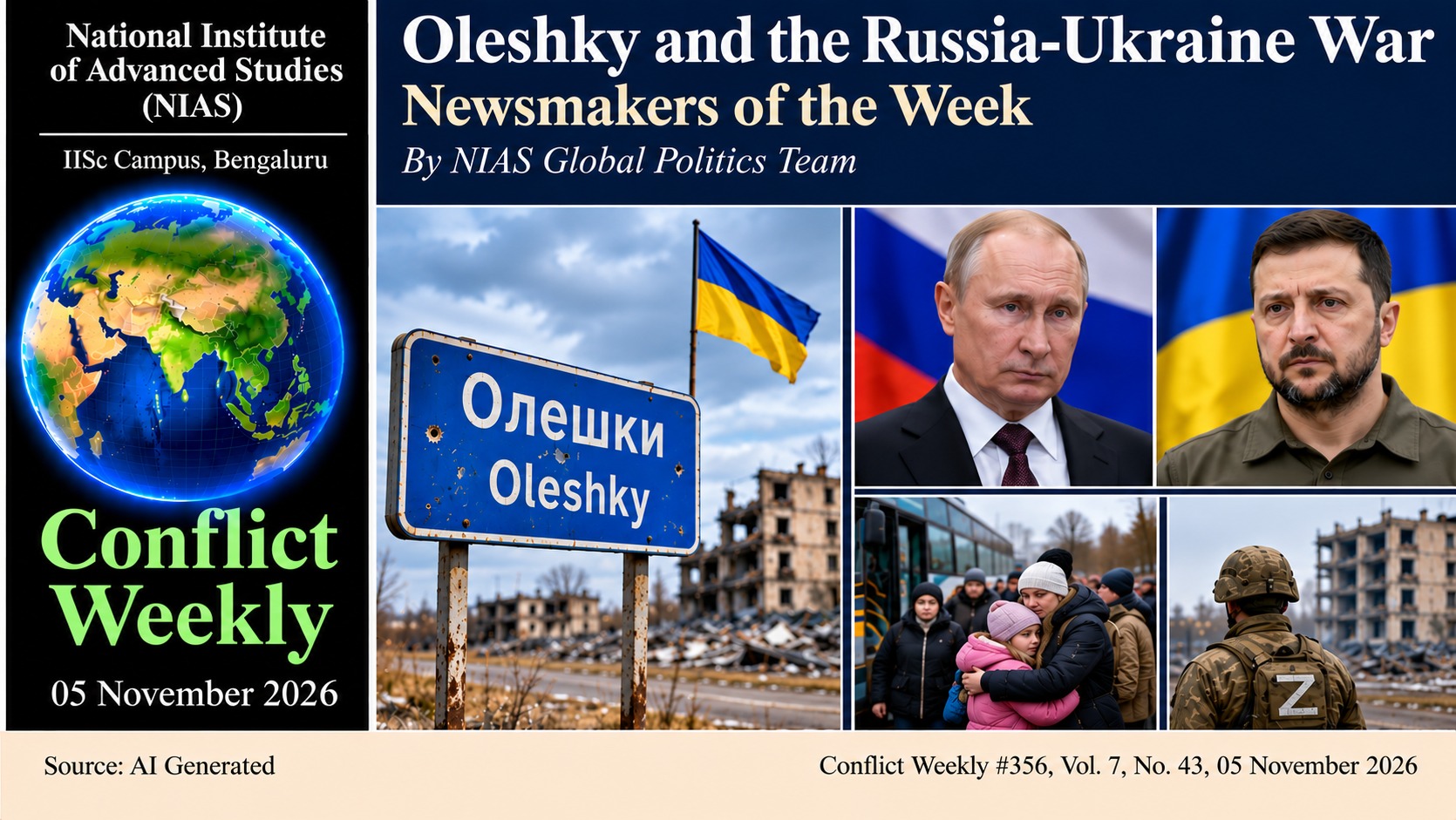
Oleshky and the Russia-Ukraine War
Newsmakers of the week
Conflict Weekly #356, Vol 7, No 43, 05 November 2026

|
NIAS Global Politics Team
5 November 2026
|
Oleshky and the Russia-Ukraine War:
A limited ceasefire amidst continuing conflict
Advik Sunanda Mohan
In the news
On 23 October, the White House issued a statement that Russia and Ukraine had agreed to stop all military operations in the Russian-controlled Oleshky – a Ukrainian city, from 27 October. A humanitarian ceasefire for six days was agreed upon to facilitate the delivery of aid and preparations for evacuation of civilians. According to reports, the US first lady, Melania Trump, and her team had helped broker the ceasefire, in coordination with Russian and Ukrainian leadership.
On 27 October, Russia and Ukraine began observing the ceasefire in Oleshky. On 29 October, Russia’s President Vladimir Putin accused Ukraine of being responsible for a humanitarian catastrophe.
On 01 November, residents from Oleshky entered the rest of Ukraine in an evacuation operation. The residents were flown from Russian-occupied territory into Belarus, before taking a bus to Ukraine. Zelenskyy informed that the evacuated residents would receive all the aid.
On 02 November, the ceasefire officially came to an end. Ukraine accused Russia of having used the ceasefire period to fortify its military positions and get new ammunition supplies.
On 03 November, Germany’s Chancellor Friedrich Merz proposed that the humanitarian ceasefire in Oleshky be replicated for brokering other ceasefires to protect energy and shipping infrastructure. He also stated that any lasting peace agreement required European support.
Issues at large
1. The humanitarian situation in Oleshky
The Ukrainian town has been under Russian occupation, since the beginning of the invasion. It has been facing a shortage of food supplies, and running out of medical supplies. Aid agencies stated that most of the 2,000 residents left in the town were facing the risk of starvation. Residents had stated ambulances operating was difficult, due to the risk of Russian drone attacks. Following are major reasons for the continuing situation in Oleshky. The mining of nearby roads by Russian and Ukrainian FPV drones has facilitated the creation of a “kill zone” wherein civilians and vehicles get targeted by attacks. Additionally, the destruction of the neighbouring Kakhovka Dam in 2023 caused massive flooding of infrastructure in Oleshky, and destroyed the power grid, cutting off energy supplies. Finally, the blockade by Russian forces in May 2026, cut off all food and medical shipments into Oleshky.
2. The continued failures and violations of ceasefires in Ukraine
There have been several attempts to bring about a ceasefire in Ukraine before, which soon collapsed. But there has been a failure of any ceasefire to hold for a lengthy period of time. For instance, in 2022, the UN and the International Committee of the Red Cross organized "green corridors," or humanitarian windows, wherein civilians could be evacuated safely from cities like Mariupol at the risk of attacks. However, these “green corridors” did not entirely work since Ukraine accused Russia of violating them with attacks on evacuation routes and civilian infrastructure. Another similar ceasefire was organized in April this year to stop all military operations and strikes to mark the occasion of Orthodox Easter. This ceasefire was also beset with multiple accusations of violations.
In perspective
The Oleshky ceasefire succeeded in meeting its stated objective of evacuating the civilians from the town and alleviating the humanitarian situation. However, it remains to be seen if the ceasefire can help facilitate broader talks between the two sides. There exist certain red lines, such as Russia’s territorial demands in Crimea and eastern Ukraine, and Kyiv’s wish for security guarantees. Additionally, there were several attacks on civilians and infrastructure reported after the conclusion of the Oleshky ceasefire. However, humanitarian truces similar to Oleshky for safeguarding civilians could be brokered on a localized scale.
The larger question is whether narrow ceasefires will result in peace. The forthcoming trilateral talks between the US, Russia, and Ukraine scheduled for later this month become important in this context. Zelenskyy has already outlined a few pre-conditions for Kyiv before the talks. The most important one for the president is that any deal that negotiates an end to the war must ensure robust security guarantees for Ukraine. Zelenskyy has stated there must be no enforced limits on the size of the Ukrainian security forces, or to forcefully compel them to remain neutral. The president has also indicated a willingness to be involved with NATO, suggesting that member states could agree to cover Ukraine under Article 5 if Kyiv could not join the alliance. Other preconditions include an end to attacks on energy infrastructure, and maritime safety guarantees. This indicates a firm stance to safeguard its security from the Ukrainian perspective.
Advik Sunanda Mohan is a postgraduate student from SciencesPo, Paris. He is currently interning at the National Institute of Advanced Studies (NIAS), Bengaluru.
CW Newsmaker
Priyanka Makhijani, Urja R Kudalkar, Namrata L Ghanghatkar
Democratic Republic of the Congo Ebola outbreak:
Fatality rate crosses 50 per cent as revised death toll exceeds 5,300
On 03 November Daily Sabah and other major sources reported that the Ebola outbreak in the Democratic Republic of the Congo (DRC) had recorded 5,372 deaths and 10,414 confirmed infections, taking the case fatality rate to 51.6 per cent. The revised figures were released by the country’s National Institute of Public Health on 31 October. The increase followed a review of health records across 97 per cent of affected health zones in Ituri province, which identified 314 previously unallocated deaths. This revision raised the reported fatality rate from 48.6 per cent recorded two days earlier. The outbreak has spread across eight provinces and 67 health zones, making it the largest Ebola outbreak in the country’s history. It is caused by the Bundibugyo strain of the virus, for which no approved vaccine or specific treatment is currently available. Cases have also been reported beyond the DRC, including in Kenya, Uganda and Nigeria. Meanwhile, health authorities continue to face challenges in tracing infections and containing transmission. The revised figures highlight the severity of the outbreak and the difficulties in maintaining accurate disease surveillance and controlling its spread.
Somalia Uganda troop withdrawal:
End of two-decade military presence raises concerns over security gaps and Al-Shabaab threats
On 02 November, Reuters and other major sources reported that Uganda had begun withdrawing its troops from Somalia, marking the gradual end of its nearly two-decade military deployment in the country. The first contingent of Ugandan soldiers deployed under a bilateral agreement with the Somali government has returned home. Uganda had approximately 4,500 troops serving under the African Union Support and Stabilization Mission in Somalia (AUSSOM), alongside additional forces deployed through bilateral arrangements. The Ugandan military announced that all its forces, including those under AUSSOM, would be withdrawn by the end of 2027. Uganda first deployed troops to Somalia in 2007 and played a significant role in supporting the government against Al-Shabaab, an armed group affiliated with Al-Qaeda. However, the withdrawal has raised concerns about potential security gaps, particularly in the Lower Shabelle region, where Al-Shabaab continues to carry out attacks. AUSSOM plans to take over four military positions near Mogadishu to prevent militant advances. The withdrawal also comes amid financial difficulties affecting the African Union mission and the closure of the United Nations’ political mission in Somalia. Analysts have warned that Somalia’s security forces may face challenges in independently managing the country's security.
Silencing the press:
RSF’s 2026 Press Freedom Predators List profiles major threats to independent media
On 02 November, RSF and other major sources reported that Reporters Without Borders marked the International Day to End Impunity for Crimes against Journalists by publishing its 2026 Press Freedom Predators List, profiling 33 individuals and organisations accused of targeting journalists and independent media. US President Donald Trump joined the list for the first time, over verbal attacks, legal intimidation, administrative reprisals and restrictions on journalists’ access to government institutions, with the United States now ranked 64th of 180 countries. Egyptian President Abdel Fattah al-Sisi and Kazakhstan's President Kassym-Jomart Tokayev were also added. The list is divided into political, security, legal, economic, and social categories, with Russian President Vladimir Putin, Nicaragua's Daniel Ortega, the Israeli armed forces, the Chinese Communist Party, and Mexican cartels featured, RSF describing China as the world's largest prison for journalists. India's Adani Group was named in the legal category over 11 ongoing proceedings against journalists, while OpIndia was listed in the social category for fuelling online harassment of journalists. Alphabet, Meta, Elon Musk, and Argentina's Javier Milei also appeared. RSF Director-General Thibaut Bruttin said the list is subjective but aims to identify those responsible, so their attacks are not normalised.
Namrata L Ghanghatkar, Priyanka Makhijani, and Urja R Kudalkar are postgraduate students at the Department of Public Policy, Ramaiah University of Applied Sciences. They are currently Research interns at the National Institute of Advanced Studies (NIAS), Bengaluru.