CWA # 2332
TWTW Takeaways
Israel Elections 2026:
Five takeaways on the missing majority and Persistent internal fragmentation
The World This Week #376-378, Vol 8, Nos. 38-40, 08 November 2026

|
Brighty Ann Sarah
8 November 2026
|
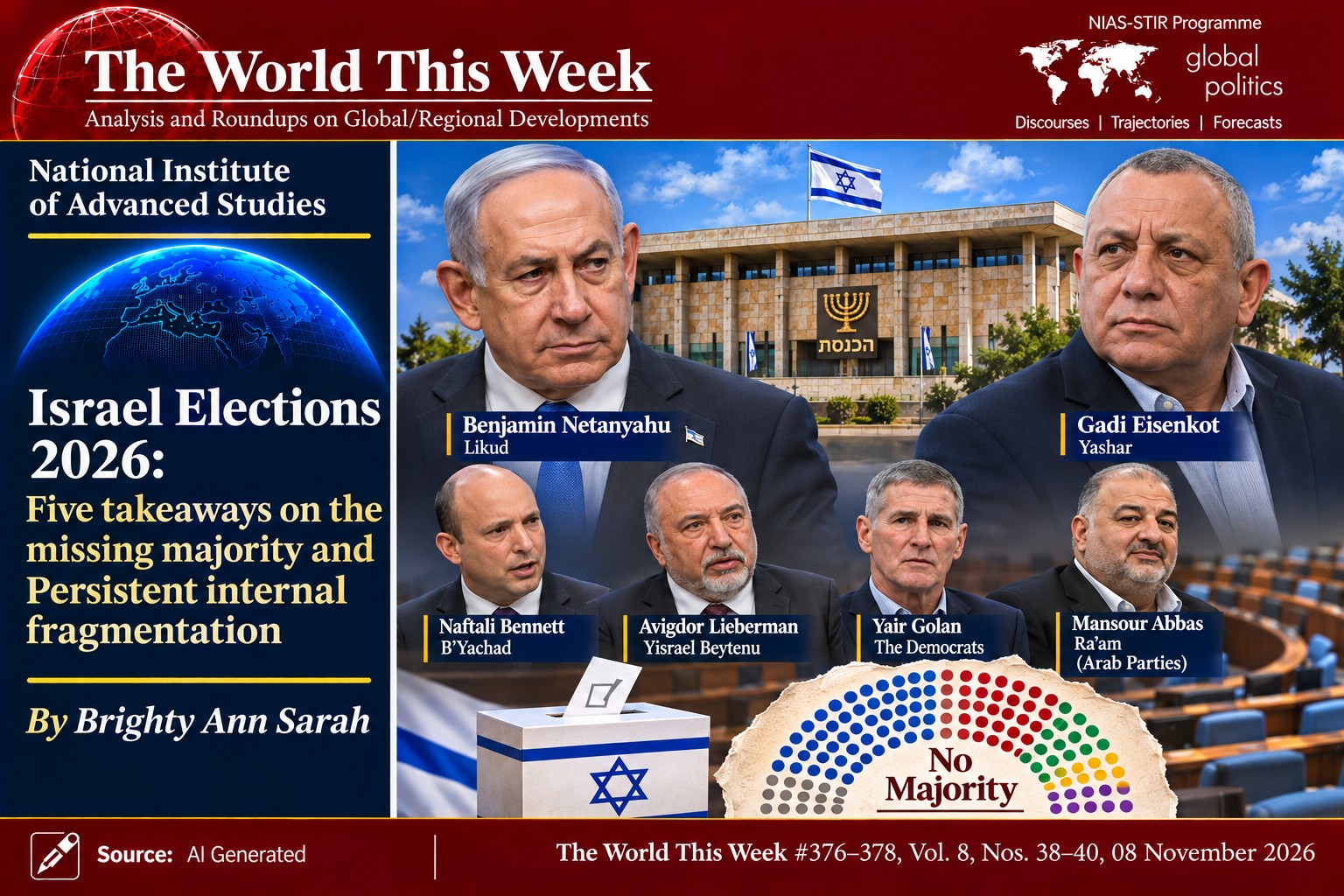
On 27 October, Israel went to polls for the 26th Knesset, the first since the 07 October 2023 Hamas attacks and the subsequent wars in Gaza, Lebanon, Iran and related conflicts. Despite the 77.8 per cent voter turnout, the highest the country has seen in two decades, no major contender acquired the required 61-seat majority to form an independent government in the 120-seat Knesset. Benjamin Netanyahu’s right-wing/religious bloc secured 53 seats and the major opposition led by former IDF Chief of Staff Gadi Eisenkot’s Yasher party won 48. The Arab-led lists also reached a record of 19 seats.
Israel uses a proportional representation system in which the entire country is treated as one electoral district and voters choose a political party rather than an individual candidate. Seats are allocated proportionally among lists that clear the 3.25 per cent electoral threshold.
Of the roughly 10.2 million Israeli population, 78 per cent are the Jewish and non-Arab communities, and the Arab-Israelis make up about 22 per cent with smaller Christian and Druze communities. Among the diverse Jewish population, Netanyahu’s far-right Likud party draws its support from the conservative and Haredi (ultra-Orthodox) voters in the country’s periphery. The secular and Ashkenazi Israelis, the wealthier Jewish communities historically rooted in Central and Eastern Europe, favour centre and centre-left parties such as the Yasher.
The following are the major takeaways from the 2026 Israeli elections:
1. The persistent Knesset trend of ‘no single-party majority’ holds firm
In none of the Israeli elections since the state's founding has a single party ever claimed a majority of 61 seats, which holds true for the latest contest as well. Tel Aviv has only had governments formed through multi-party coalitions, sometimes fragile ones that collapse before completing a full term. The enduring fragmentation is a result of Israel’s proportionate representation system, which awards seats strictly according to each party’s share of the national vote. The design deliberately amplifies the country’s deep social, religious, ethnic and ideological polarisation, encouraging voters to back niche parties representing specific groups and interests rather than large parties with broader visions.
2. International backlash failed to blemish Netanyahu’s domestic standing
Since the 2022 election and the outbreak of the Gaza war, Benjamin Netanyahu’s standing has undergone a categorical shift, but in sharply opposing directions at home and abroad. Internationally, the escalating and persistent violence across Gaza has severely degraded his global position, turning many formerly cordial relationships sour. This erosion has been compounded by multiple ICC criminal cases, widespread genocide accusations, and broad international condemnation including through sanctions.
Domestically, however, the war has largely shifted the public psyche favourably for Netanyahu's government. Security concerns, intensified by four years of continuous hostilities and regional upheaval, became the dominant electoral pivot and largely overrode earlier controversies, including the major corruption cases against Netanyahu, which barely featured in the 2026 campaign. Despite enduring questions of accountability and criticism over his refusal towards an independent probe into the 07 October attacks, Netanyahu’s wartime efforts and hardline posture have helped secure his political position among a substantial share of Israeli voters.
3. The right-wing bloc gained a lead, but revealed internal fragmentation
Despite securing the larger share of seats, the Netanyahu-led Likud coalition witnessed a dip from their previous win of 64 seats in 2022. The fragmentation remains within the party itself, with a fracture in mobilising the ultra-Orthodox voters. The Shas party represents Israel’s ultra-Orthodox sect and the major support to Likud; however, the party has been at odds with the Netanyahu administration over the conscription of Haredi Jews. The Haredis have been historically exempt from military conscription in lieu of full-time religious study, however a 2024 Supreme Court rule challenged the blanket exemption and the Netanyahu administration's failure to pass a new exemption law has drawn severe criticism from the sect.
Further, public support for ending broad exemptions were high, with the majority favouring an egalitarian conscription law or sanctions on draft-dodgers. Opposition parties campaigned hard on universal service, capitalising on many secular and traditional voters who felt the burden of war had fallen unfairly on them.
4. 07 October and broader security threats ranked among the high in voting
The security concerns triggered by the 07 October Hamas attacks and the subsequent regional upheaval remained among the dominant considerations for the Israeli electorate. Beyond militarisation and securitisation measures, the failures surrounding 07 October and the question of accountability also featured prominently in the electoral discourse. Opposition voters prioritised the establishment of a state commission of inquiry into the intelligence and political failures that enabled the Hamas attack. The perception of persistent external threats, reinforced by a continuing sense of existential insecurity, remained central to the electoral considerations.
5. Escalating hostility at home and in the region mobilised Arab voters
The turnout among Arab-Israelis witnessed a marked increase, reaching unprecedented levels as Arab parties collectively secured 19 seats. The concerns shaping the community’s electoral participation were largely influenced by the war in Gaza, against the backdrop of continued violence in the occupied Palestinian territories. For Arab citizens, organised crime, gun violence and a growing perception that governance under National Security Minister Itamar Ben-Gvir had neglected or exacerbated insecurity within the community contributed to the historic turnout.
However, the inclusion of the faction in a potential coalition with the Eisenkot-led bloc remains unlikely, as it could be perceived as a departure from the coalition’s pro-Israel positioning and the established reluctance to form alliances with Arab political factions.
About the author
Brighty Ann Sarah is a Research Assistant at the National Institute of Advanced Studies, Bengaluru.