CWA # 2325
PR Explainer
Politics of New Provinces in Pakistan:
Contemporary demands, Constitutional constraints, and the Crisis of representation

|
Abhimanyu Solanki
30 October 2026
|
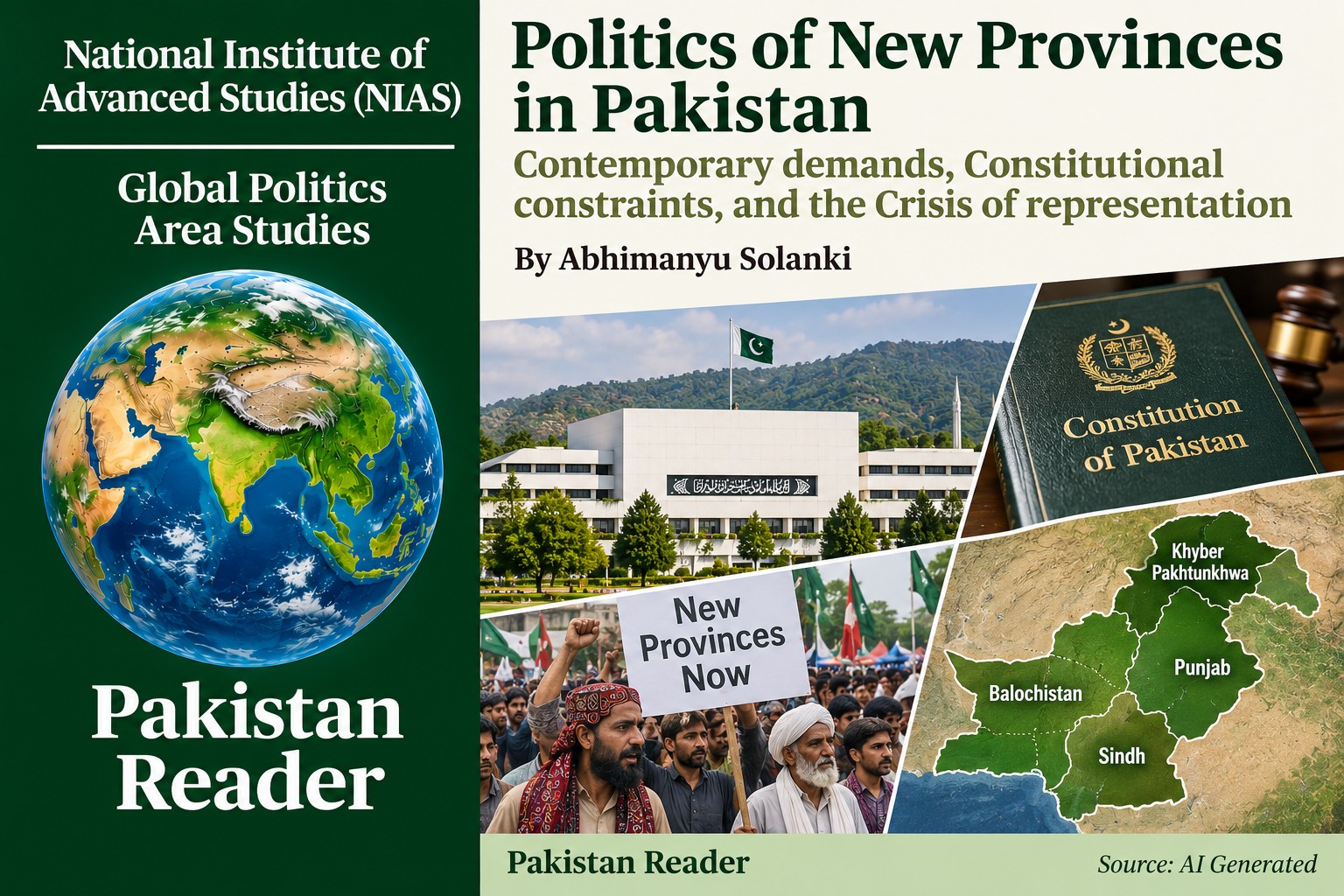
On 5 September, Dawn reported that the Interior Minister, in his address to the National Policy Dialogue in Lahore, called for a reset of Pakistan’s governance systems to address decades-old failures in public service delivery. He called for the creation of new provinces and administrative units in Pakistan and stressed that the creation of new provinces would have to be carried out within the framework of the Constitution. He asserted that the decision should not be imposed by any government or political party but should be based on the will of the people. As a result, renewed public debate emerged over the creation of new provinces and administrative units in Pakistan.
On 4 September, Dawn reported that the Sindh Assembly adopted a resolution rejecting all attempts to divide the province or create new administrative units, amid strong protests and a boycott by the opposition. The opposition party MQM-P demanded the empowerment of existing administrative units, as it believed that financial, administrative and political powers should be devolved to divisions, including Karachi, Hyderabad, Shaheed Benazirabad and Larkana. During the resolution debate, CM Syed Murad Ali Shah declared that there would be no compromise on Sindh’s geographical integrity.
What does the Constitution say about new provinces?
Article 239(4) of Pakistan’s Constitution is the central provision with regard to the debate on new provinces. It states that any constitutional amendment altering the territorial boundaries of a province requires the approval of at least two-thirds of the total membership of the affected provincial assembly, in addition to the constitutionally required two-thirds majorities in the National Assembly and the Senate. A referendum is not prescribed as a mandatory part of this constitutional procedure.
Furthermore, the 18th Constitutional Amendment of 2010 plays an indirect role in the debate on new provinces. It reoriented federal-provincial relations and strengthened provincial autonomy by transferring legislative authority over several subjects to the provinces. Separately, the Seventh National Finance Commission (NFC) Award increased the provincial share in the divisible pool. However, these developments did not resolve the question of autonomy within provinces.
What are the demands for new provinces in Pakistan?
In Khyber Pakhtunkhwa, there is a demand for a new province in the Hazara region. The demand for a Hazara province has been largely raised by Hindko-speaking communities. It is closely connected to questions of regional identity, political representation, provincial autonomy and the consequences of Pakistan’s 18th Constitutional Amendment of 2010. The immediate trigger was the renaming of the North-West Frontier Province (NWFP) as Khyber Pakhtunkhwa under the 18th Constitutional Amendment. Hazara groups argued that the new name did not adequately reflect their regional identity. The demand has been raised by groups such as Tehreek Sooba Hazara (TSH) and Sooba Hazara Tehreek (SHT).
In the case of Sindh, there is a demand for a new province among sections of the Mohajir community. Mohajirs are Urdu-speaking Muslim migrants who moved from different parts of British India to Pakistan during Partition in 1947 and whose descendants predominantly reside in urban Sindh, particularly Karachi and Hyderabad. The demand is advanced by the Muttahida Qaumi Movement–Pakistan (MQM-P). It proposes a new provincial unit for the major urban centres of Sindh.
In the case of Punjab, there is a demand for a new Saraiki province, which would largely comprise the southern parts of Punjab. The major factors behind the demand for new provinces include the alleged neglect of infrastructure, education and healthcare in the southern districts of Punjab.
Politics around the creation of new provinces: The case of Punjab
The role of political parties in the demand for new provinces can be analysed through a study of the manifestos of major parties in the 2013, 2018 and 2024 elections. In the case of the PPP, its 2013 manifesto embraced the demand for new provinces as a pathway towards national harmony and inclusive democracy. It argued that, for all practical purposes, power should be distributed and that the creation of new provinces was a step in the right direction. It also included a section on the Bahawalpur–Junoobi Punjab province.
Similarly, in the 2018 elections, the PPP’s manifesto focused exclusively on a new province in South Punjab and made no reference to the creation of other provinces. In 2024, it reiterated the same demand. The PML-N supported the creation of a new province for South Punjab. However, its manifesto did not explain the criteria for the proposed province, whether ethnic or administrative. In the 2024 elections, it remained silent on the question of a new province. In 2018, the PTI also called for the creation of South Punjab, but on administrative lines. Hence, the PPP is the only party among these three that consistently reiterated its support for a new province in South Punjab across the three election cycles.
Secondly, the major political parties have generally framed their support for new provinces in administrative rather than explicitly ethnic terms. The political debate also raises questions about why the PPP supports the demand for a new province in Punjab but opposes the division of Sindh, and why the PML-N has not consistently pursued the creation of a new province in Punjab. One possible explanation lies in electoral gains and the parties’ strongholds in different regions. The PPP’s opposition to dividing Sindh may be linked to its stronghold in Sindh politics. Similarly, the PML-N’s approach to the division of Punjab may be influenced by its established political position in the province.
To Conclude
The issue of new provinces has been politicised by certain political parties for narrow electoral and constituency-based gains. Political elites are often motivated by electoral considerations. The creation of new provinces also presents fiscal and administrative challenges for a federation already experiencing numerous problems on internal and external fronts.
The constitutional provisions make the creation of new provinces politically difficult in today’s political landscape. Over time, regional groups have increasingly pursued their demands through constitutional means. However, securing the required legislative majorities for the creation of new provinces remains a significant challenge.
The debate over new provinces may be less prominent in the manifestos of some major political parties, but this does not necessarily mean that regional demands are declining. The PPP’s continued support for a South Punjab province in its 2024 manifesto highlights the persistence of the issue. Furthermore, even if new provinces are created on administrative lines, the process is likely to remain controversial, as political parties may attempt to influence territorial boundaries in ways that favour their electoral interests in upcoming elections.
References
1. “Naqvi says new administrative units to be formed only with people's consent,” Dawn, 05 September 2026
2. “Sindh Assembly adopts resolution against division of province amid opposition boycott,” Dawn, 04 September 2026
3. “Resolution opposing the division of Sindh,” Provincial Assembly of Sindh, 2026
4. “Constitution of the Islamic Republic of Pakistan,” National Assembly of Pakistan. See Article 239(4).
5. “Constitution (Eighteenth Amendment) Act, 2010,” Government of Pakistan, 2010
6. “Manifesto 2013,” Pakistan Peoples Party Parliamentarians, 2013
7. “Election Manifesto 2018,” Pakistan Peoples Party, 2018
8. “Election Manifesto 2024,” Pakistan Peoples Party Parliamentarians, 2024
9. “The Road to Naya Pakistan: PTI Manifesto 2018,” Pakistan Tehreek-e-Insaf, 2018
10. “Election Manifesto 2024,” Pakistan Tehreek-e-Insaf, 2024
11. “Election Manifesto 2024,” Pakistan Muslim League–Nawaz, 2024
12. “Develop national consensus on the creation of South Punjab province,” Dawn, 29 October 2018
13. “Commission recommends new ‘Bahawalpur Janoobi Punjab’ province,” Dawn, 1 February 2013
14. “Assembly backs South Punjab, Bahawalpur provinces,” Dawn, 10 May 2012