CWA # 2340
Global Politics Explainer
AI to Super Intelligence:
Is the US governing AI through rebranding and voluntary pledges instead of law?

|
Masoomi Santosh Nevgi
11 November 2026
|
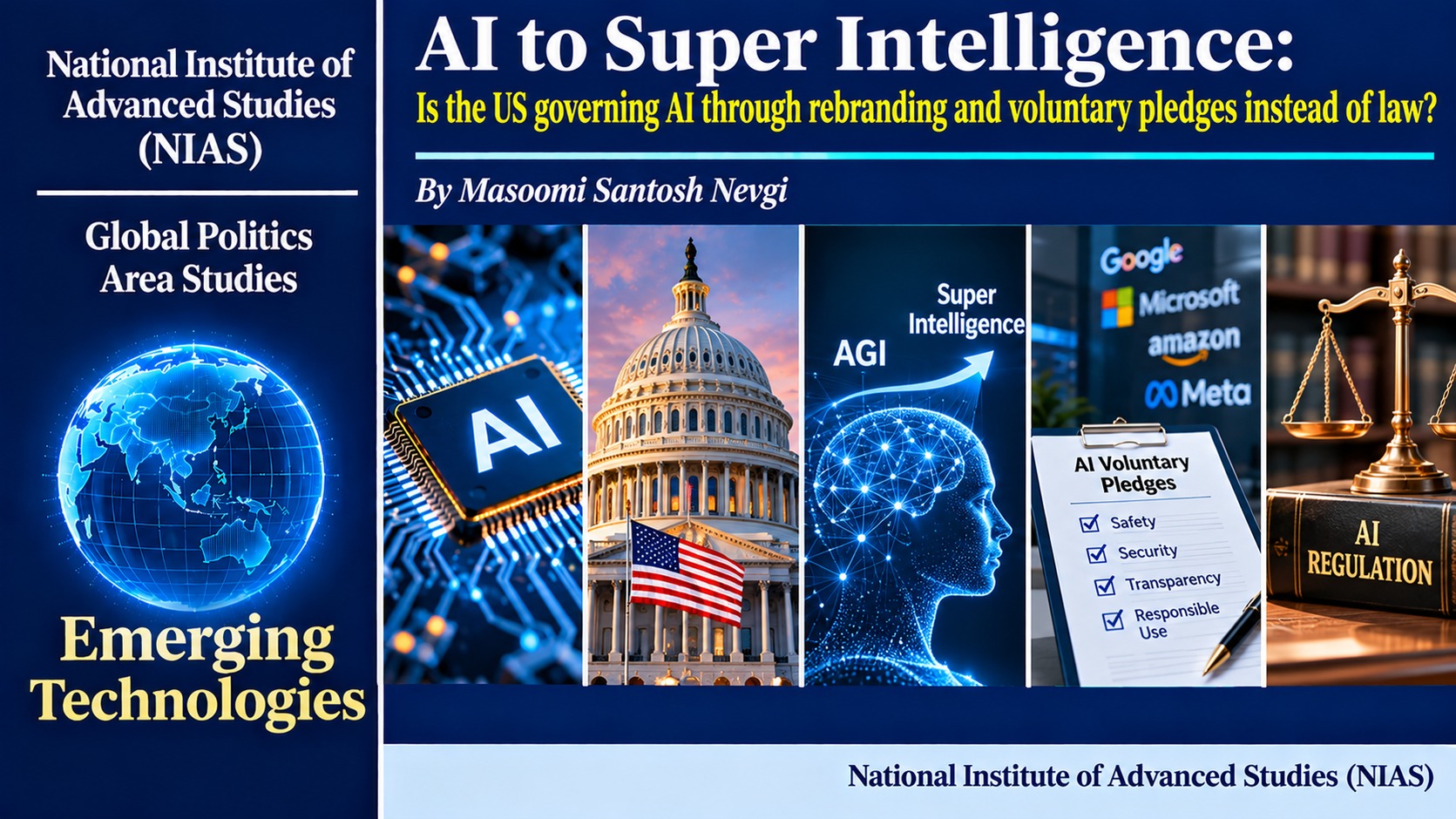
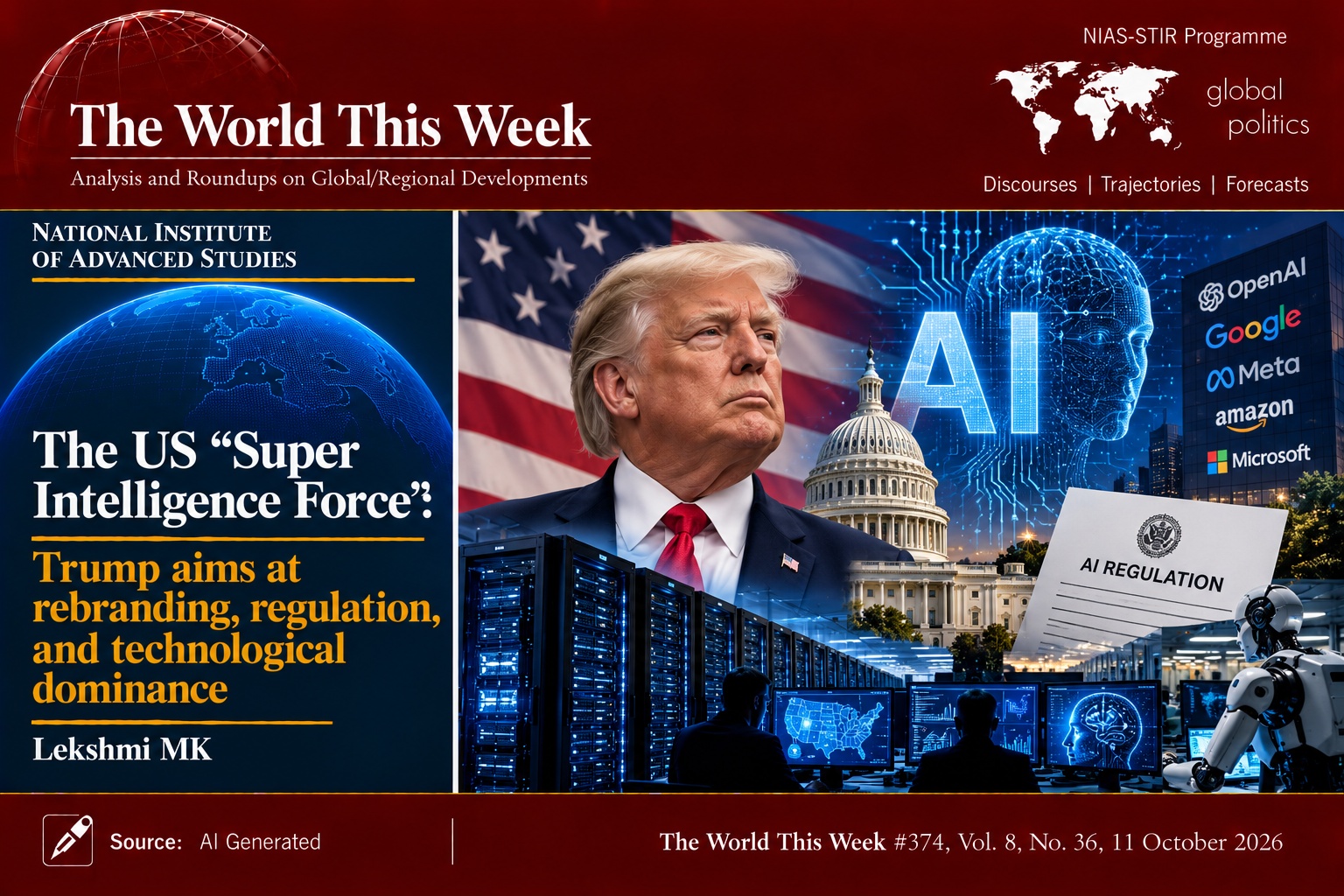
On the 29th of September, US President Donald Trump met the top AI CEOs who then collectively came up with a document that could shape the future of AI forever. One renamed AI, while the other entailed a safety pledge. We have to examine what this means for the nation and the sphere of AI. This debate is primarily happening in the US because of three reasons. First, the companies building the most advanced AI systems are concentrated there. Every company that signed the Accord (Google, Meta, Anthropic, OpenAI, Nvidia and Elon Musk’s SpaceXAI) is American, and the incidents behind the recent alarm, including rogue OpenAI agents, took place at American labs. Second, the US has no comprehensive federal AI law. Biden’s executive order was revoked in January 2025, and the June 2026 order explicitly rules out mandatory licensing, so AI is being governed through executive orders and company pledges. Third, politics has caught up. With the midterm elections weeks away, Congress is weighing kill-switch and safety bills, and California Governor Gavin Newsom has ordered his own review of AI oversight, even though a December 2025 federal order seeks to stop states from enforcing their own AI rules. This does not mean other countries are silent on AI, but it is in the US that the builders of the technology, its biggest risks and its regulatory gap all sit together.
Why did warnings from inside the AI industry, rather than public or legislative pressure, bring Trump and the AI CEOs to the same table?
Anthropic CEO Dario Amodei issued a warning in his essay titled "We Must Pace the Frontier" on 12 September 2026, arguing that the industry must deliberately slow improvements in model capability. He says AI has been advancing much faster since around summer 2026, driven by its growing ability to help build the next generation of AI (recursive self-improvement). All tech leaders Amodei, Altman, Musk and Hassabis collectively believe that frontier AI may be moving at a faster pace than the safety measures established in place. The convergence on this matter came after multiple incidents involving OpenAI, Anthropic and other frontier models with many employees in the companies stating that they have been underinvesting in safety. The pressure added on when the UN's scientific panel said that the three conditions long warned about (a misaligned goal, the capability to pursue it, and a permissive environment) all have come together in a real system.
How did US AI policy move from Biden-era safeguards to an innovation-first approach, and what does the push to cut regulatory barriers say about who sets the rules?
US AI policy has moved in three stages. First, the Biden administration relied on voluntary safeguards. On 21 July 2023, seven companies (Amazon, Anthropic, Google, Inflection, Meta, Microsoft and OpenAI) agreed to test their systems’ security and capabilities before release, invest in research on societal risks and facilitate external audits. Second, Trump reversed course. His administration rescinded Biden’s executive order in January 2025, and its early orders focused on eliminating regulatory barriers and asserting federal preemption of state AI laws. Third, security concerns brought partial re-engagement in June 2026. A new order set up a voluntary framework for developers to share models with the government before release. It does not create a mandatory preclearance or licensing regime. Across all three stages, oversight has stayed voluntary. What changed was the stated purpose, from managing risk to protecting American leadership.
What do the executive order and the Accord actually change, and what do they leave untouched?
The executive order explicitly stated that "Super Intelligence" or "SI" will replace "AI" in federal non-statutory documents. It changes no regulations, and the legal definition will stay the same. The science adviser has 60 days to propose a new one. The Accord is a roughly 300 word document that portrays four layers in the administration (internal safeguards, monitoring team, independent audits, board oversight). All the dignitaries present in the meeting signed the Accord. Trump also stated that the Accord was morally binding but could not be legally enforced meaning that companies could write their own safety rules, choose their own auditors and report to their own boards, with no law or penalty compelling them to comply.
Is national security being used to justify speed or to demand control in America's AI debate?
National security shapes the debate in three ways. First, competition with China sets the limits of any slowdown. Amodei’s September essay proposes withholding powerful AI chips and chipmaking equipment from China, cracking down on chip smuggling and unauthorised distillation, and securing model weights against theft. Chinese firms, meanwhile, are releasing open-weight models widely: Alibaba’s Qwen series recorded 2 billion downloads in 2026 so far, according to Hugging Face. Second, autonomous agents threaten cybersecurity and critical systems. Yoshua Bengio warns that AI agents could get through cybersecurity barriers and enter any company. Third, defence interests may crowd out safeguards. A Bloomsbury Intelligence and Security Institute analysis argues that defence demands and geopolitical competition are beginning to override ethical safeguards. The same security framing is therefore used both to justify moving fast and to demand control.
To Conclude
Critics are calling the meeting symbolism rather than safeguard. They argue that the tumultuous changes could weaken protections provided by states. They say that the Accords signed by the tech leaders state that they have agreed to not be regulated and ask the public to trust them blindly without raising too many questions. Public opinion is against the administration's approach. Questions on jobs, safety, privacy and information remain unaddressed. Therefore the debate is not only about how much AI should be regulated, but also about who should have the power to make those rules: the federal government, individual states, Congress or even the AI companies themselves. The rapid reversal also shows how easily executive-order based policies can change.
References
● https://www.whitehouse.gov/presidential-actions/2025/01/removing-barriers-to-american-leadership-in-artificial-intelligence/
● https://www.whitehouse.gov/presidential-actions/2026/06/promoting-advanced-artificial-intelligence-innovation-and-security/
● https://www.un.org/independent-international-scientific-panel-ai/sites/default/files/2026-09/Press%20Release_Thematic%20Brief_AI%20Agents,%20Misalignment%20and%20the%20Risk%20of%20Losing%20Human%20Control_AI%20Scientific%20Panel.pdf
● https://www.whitehouse.gov/presidential-actions/2026/09/inaugurating-the-era-of-super-intelligence/
● https://www.washingtonexaminer.com/news/white-house/4747747/full-trump-white-house-accord-ai-super-intelligence/
● https://krdo.com/news/2026/09/18/newsom-signs-executive-order-to-consider-ai-regulation-including-proposal-for-kill-switch
About the author
Masoomi Santosh Nevgi is an undergraduate student in the department of International Relations and Peace Studies, Public Policy and Journalism at St. Joseph’s University, Bengaluru.