CWA # 2344
CW Review
UNHCR Report on Displaced Voices from the frontlines of climate crisis:
Seven takeaways on Climate exposure, Repeated displacement, and Inadequate international response
Conflict Weekly #357, Vol 7, No 44, 12 November 2026
|
Riza Fathima AV
12 November 2026
|
Photo Source:
As of mid-2026, three-quarters of refugees and other displaced people live in countries exposed to high-to-extreme climate-related hazards...A historic Super El Nino is expected to produce extreme weather in late 2026 into 2027, exacerbating existing risks in refugee-hosting countries.
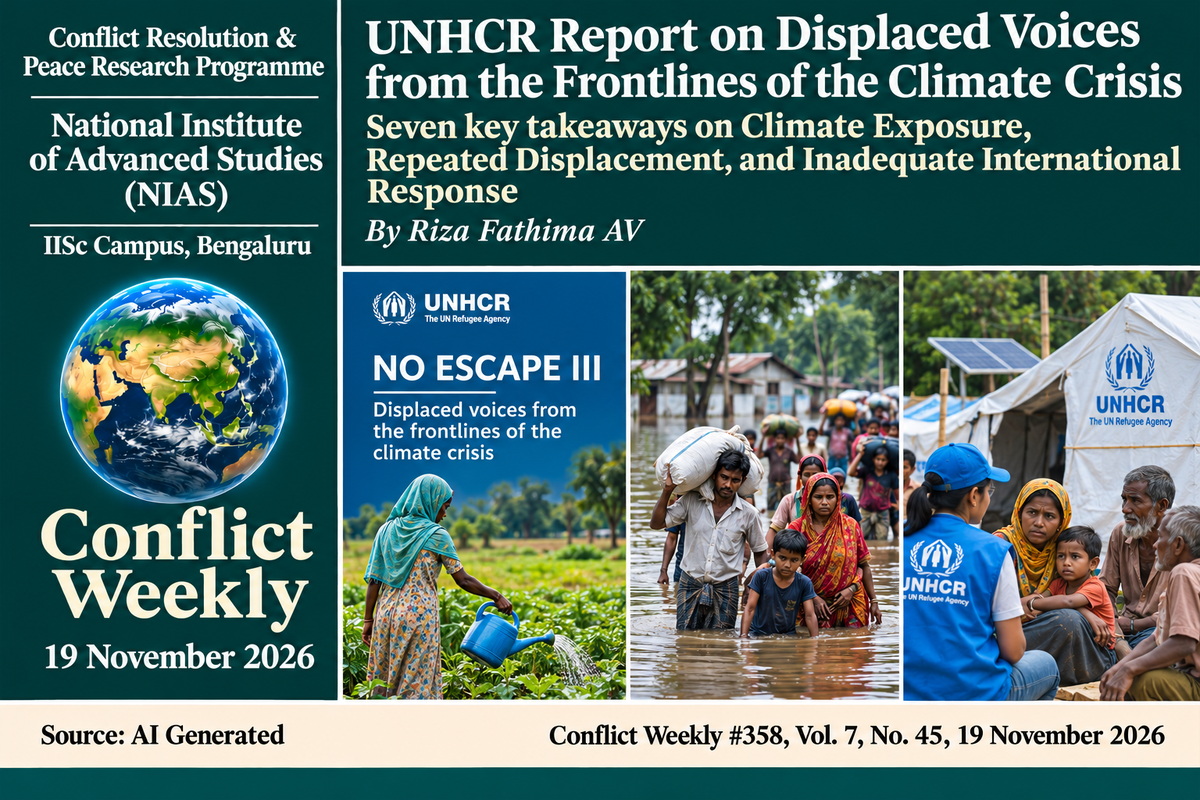
In November 2026, the United Nations High Commissioner for Refugees (UNHCR) released the report - “NO ESCAPE III: Displaced Voices from the Frontlines of Climate Crisis.” According to the report, climate change is already emerging as a major crisis, especially for the refugees in displaced settings. The report examines the vulnerable conditions of refugees, returnees, and stateless people across the world. It argues that these communities are not passively experiencing the climate crisis but are adapting and innovating, and calls for sustained partnership and investment. The report is placed within the UNHCR’s “50 by 35: Dignity and Solutions,” whose objective is to halve the number of refugees and others in need for international protection living in protracted displacement, who are unable to meet their basic needs without humanitarian assistance, by 2035.
The following are key takeaways from the report
1. Three-quarters of refugees and other displaced people live in countries highly exposed to climate-related hazards
As of mid-2026, three-quarters of refugees and other displaced people live in countries exposed to high-to-extreme climate-related hazards. Many of these are fragile and conflict-affected, with poor infrastructure and public services, and limited institutional capacity. Refugee settlements are often in remote, environmentally fragile, and hazard-prone areas. Displacements also erode assets and support systems that help survive shocks. Moreover, the consequences are unequal depending on age, gender, disability, health, legal status, and documentation of people. For instance, in 2025, education of around 171 million students, or one in ten globally, was disrupted due to climate hazards.
2. Super El Nino emerges as a “crisis on top of a crisis”
A historic Super El Nino is expected to produce extreme weather in late 2026 into 2027, exacerbating existing risks in refugee-hosting countries. In sub-Saharan Africa, 62 percent of the rural population already depend on stressed ecosystems. In the Sahel, drought and flooding, with conflicts, could increase competition over resources, diseases, and displacement. In East Africa, flooding could displace between 770,000 and three million people in Somalia, Kenya, South Sudan, and Uganda by end of 2026. Displaced communities face threats from droughts in southern Africa, water scarcity in Latin America, and drought, flood, and cyclone risks in Asia.
3. Extreme heat becomes a persistent threat, with settlements in Sub-Saharan Africa the worst hit
Extreme heat is becoming longer and more intense with persistent health threats. By 2050, most refugee settlements are projected to face around twice as many dangerous heat days each year. In sub-Saharan Africa, one in three refugee settlements could have over 100 days of dangerous heat per year by 2050 and more than half could have over 50 additional days. Some Ethiopian settlements, including Hilaweyn, could face over 200 days. Heat exposures increase risks of dehydration, heatstroke, and premature death and worsen cardiovascular, respiratory, and kidney conditions. Extreme heat also makes it difficult to work. Moreover, increasing temperatures at nighttime reduce recovery capacity.
4. Climate shocks contribute to new, repeated, and onward displacement
Over the past decade, more than 255 million, nearly 70,000 a day, weather-related internal displacements were recorded worldwide, reflecting a five percent increase from the ten-year average through 2024. While most of these are temporary, some displacements become long-term when there are recurring hazards, high vulnerability, and limited rebuilding capacity. Climate impacts also create conflicts over natural resources, particularly in communities with existing socio-economic and environmental issues. Though climate change is not the sole conflict driver, it exacerbates existing conflicts and insecurities, while also prolonging tensions.
5. Climate impacts undermine durable solutions, including safe return
In the first half of 2026, over two in three refugee returnees were to highly climate-vulnerable countries. Climate hazards make it difficult for returnees to rebuild lives, especially in countries like Afghanistan- a highly climate-vulnerable country. Droughts, floods, and heat damage homes and water supplies, making rebuilding harder and creating a risk of renewed displacement. By the end of 2025, 70 percent of people under UNHCR’s mandate would have lived in protracted conditions. In Syria, around 1.8 million refugees and over 2 million internally displaced people returned since 2024, but in cities like Aleppo, water treatment plants are damaged, groundwater tables are declining, and average seasonal temperatures are projected to rise by 1.1-2.0°C in the 2030s and 2040s.
6. Climate finance fails to reach fragile and conflict-affected regions
Fragile and conflict-affected countries receive only 10 per cent of global climate finance, despite having the most vulnerable people. These countries also host large number of displaced. Only 6 per cent of climate finance flows are grants, which is a concern for debt-constrained countries. Moreover, humanitarian funding does not meet the needs for assistance. The official development assistance (ODA) has declined by 23 per cent from 2024 to 2025. Though funding saves lives, it cannot replace sustained adaptation. The report, therefore, calls for government-led investments, with displacements included in national data and climate planning, and direct access for refugee-led organizations to funding.
7. Locally led action and right-based international protection as the way forward
While affected people are already implementing solutions, these efforts must be supported. For instance, Paulinho Muzaliwa, a Congolese refugee who founded UNIDOS in Uganda to help refugees and host communities restore degraded land, continued his work even after funding ended. The report advocates to support such locally-led organizations and include them in adaptation efforts. It urges to provide direct and flexible funding, and meaningful decision-making roles. It suggests a nuanced response, where people affected by climate risks have access to territory and fair asylum procedures. Finally, the report stresses the need to reach people regardless of nationality. Nearly 90 per cent of the 4.7 million stateless people live in highly climate-vulnerable countries. Climate action must consider them in policy and planning, while climate-related displacement and disasters should not create new risks of statelessness.
About the author
Riza Fathima AV is a PhD Scholar at National Institute of Advanced Studies. Her research focuses on conflicts in Africa, particularly in the Sahel and Horn of Africa. She is also a part of the NIAS Africa Monitor team.