CWA # 2352
CRPR Explainers
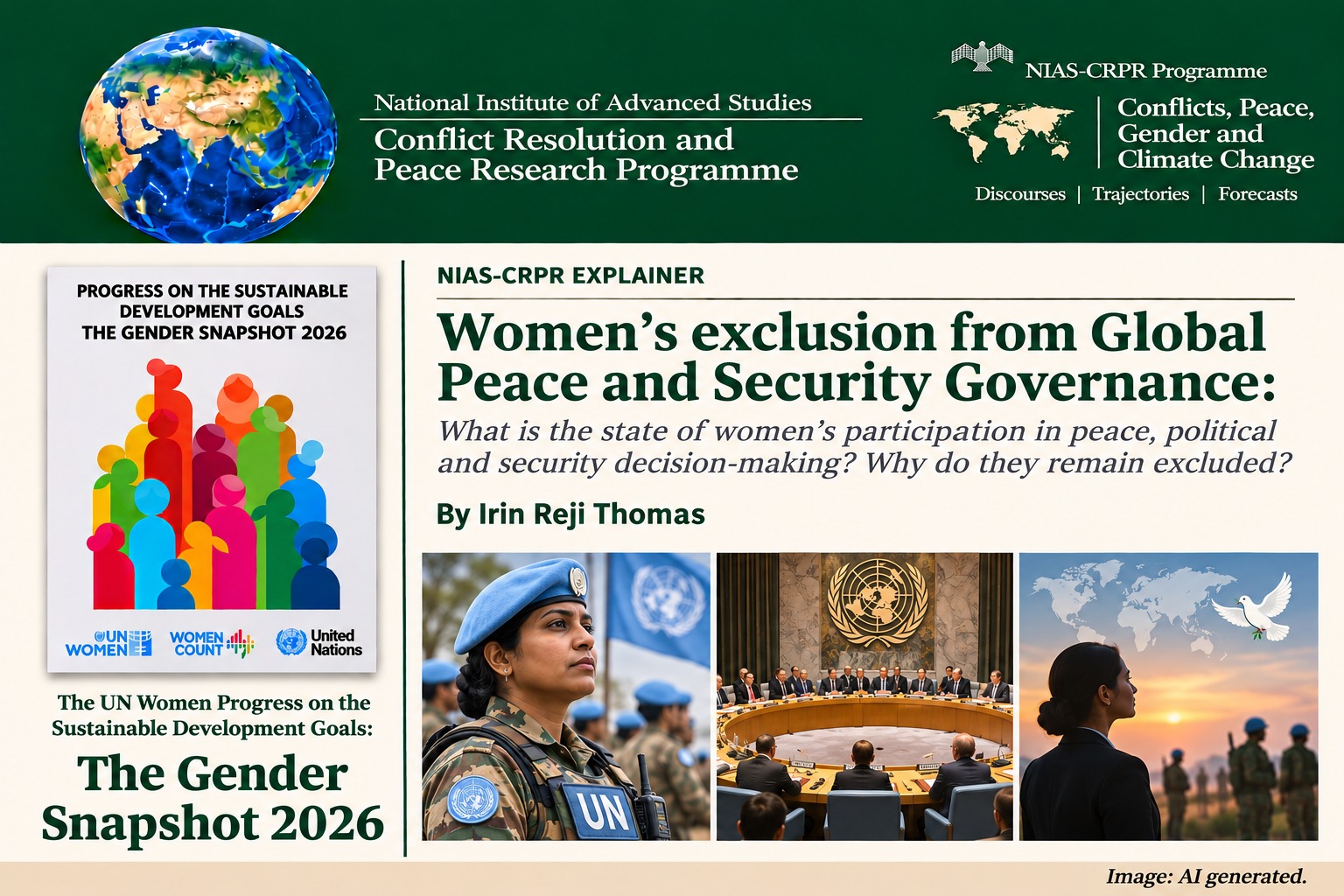
Women's exclusion from Global Peace and Security Governance:
What is the state of women's participation in peace, political and security decision-making? Why do they remain excluded? And what needs to change?
|
Irin Reji Thomas
25 November 2026
|
“Achieving meaningful participation by 2030, in alignment with Sustainable Development Goal 5, requires advancing from symbolic inclusion to comprehensive structural reform. Mediators and international actors should require women’s direct representation in ceasefire delegations, peace negotiations, and post-conflict governance bodies.”
Peace negotiations and security governance are essential for ending armed conflict and rebuilding stable societies. Formal peace processes aim to halt violence, establish political settlements, and design post-conflict institutions. Exclusion of women from peace and security decision-making increases the risk that post-conflict arrangements will overlook lived experiences, gender-specific security threats, and community-level priorities, thereby perpetuating long-term inequalities within society.
Data from UN Women’s Gender Snapshot and Women in Politics reports reveal a significant disparity between women’s exposure to conflict and their representation in positions of power. In 2024, 676 million women resided within 50 kilometres of deadly conflict, yet women comprised only 7 percent of negotiators, 14 percent of mediators, and 20 percent of signatories in major peace processes. Additionally, as of 1 January 2026, women occupied only 27.4 percent of seats in national parliaments worldwide. These statistics underscore the importance of analyzing peacebuilding not solely as high-level diplomacy, but also through the perspective of gendered geopolitics.
What is the current state of women’s participation in peace, political and security decision-making?
Peace and security governance is frequently conceptualised as an elite sphere dominated by state leaders, military personnel, and armed groups. Although frameworks such as United Nations Security Council Resolution 1325 formally acknowledge women's essential contributions to conflict prevention and resolution, their participation remains markedly unequal.
Women continue to be underrepresented in formal peace delegations, national legislatures, and senior security institutions. When included in peace processes, women are often assigned observer roles or consultative bodies rather than positions with decision-making authority. The UN Secretary-General’s 2025 report on Women and Peace and Security (S/2025/556) notes that increased global conflict exposure has not led to corresponding advances in women’s leadership.
Why do women remain excluded from positions where decisions on peace, security and governance are made?
Women's exclusion from peacebuilding stems from deep-rooted structural and institutional barriers. Discriminatory political institutions, patriarchal norms, and unequal access to political networks limit women’s opportunities for leadership well before peace negotiations commence. Furthermore, women pursuing public and security roles are exposed to increased risks of political violence, intimidation, and harassment. Traditional peace processes often use closed, elite-driven negotiating formats that give armed actors representation while limiting civic participation. According to Siobhan Byrne and Allison McCulloch, conventional power-sharing models typically prioritise ethno-national or military divisions over gender equality, thereby providing limited formal entry points for women’s groups and civil society organisations.
What are the consequences when women’s voices are missing from decisions that shape peace, security and public policy?
The absence of women from peace negotiations often results in agreements that are less inclusive and less durable. Peace accords negotiated without female participation frequently overlook critical issues, including conflict-related sexual violence, reproductive healthcare, the safety of displaced women, and equitable access to land and economic recovery.
Exclusion of women also undermines the broader legitimacy of peace processes. Communities are less likely to trust political settlements that exclude half the population, which creates significant gaps between elite agreements and local realities. Furthermore, even when gender provisions are included in peace accords, the absence of women in oversight mechanisms often results in weak implementation, insufficient funding, and a lack of institutional accountability.
What needs to change to ensure women have meaningful influence in decision-making by 2030?
Achieving meaningful participation by 2030, in alignment with Sustainable Development Goal 5, requires advancing from symbolic inclusion to comprehensive structural reform. Mediators and international actors should require women’s direct representation in ceasefire delegations, peace negotiations, and post-conflict governance bodies.
Simultaneously, peacebuilding frameworks should safeguard civic space and allocate sustained, flexible funding to local women-led organizations that support community resilience. Enhancing accountability mechanisms to monitor the implementation of National Action Plans on Women, Peace and Security is essential to ensure that commitments result in measurable change.
What do frameworks and empirical realities reveal?
Adopted in 2000, United Nations Security Council Resolution 1325 represented a pivotal development by recognizing the impact of armed conflict on women and advocating for their full participation in peace processes. The 2015 UN Women Global Study, Preventing Conflict, Transforming Justice, Securing the Peace, found that women’s substantive participation increases the likelihood of a peace agreement lasting at least two years by 20 percent and lasting fifteen years by 35 percent. Resolution 1325 and its subsequent reviews show that women’s inclusion is a proven determinant of sustainable peace and post-conflict stability, not merely a matter of representation.
Recent data from the 2025 UN Secretary-General’s report on Women and Peace and Security and the Women in Politics 2026 map indicate ongoing resistance to power-sharing. Despite decades of advocacy, women accounted for fewer than one in ten negotiators in 2024 peace processes, while grassroots women peacebuilders experienced declining funding and increased insecurity. Contemporary peacebuilding trends underscore the need to support normative commitments with enforceable quotas, dedicated financing, and institutional reforms.
To conclude, peacebuilding is a fundamental component of global security governance; however, its effectiveness and legitimacy cannot be evaluated exclusively through elite political settlements. Global data and two decades of Women, Peace and Security policy illustrate the significant consequences of excluding women from decision-making processes related to war and peace. Policymakers should address structural barriers, safeguard women peacebuilders, and establish binding accountability mechanisms for gender-related commitments. Sustainable peace cannot be achieved while those most affected by conflict are denied equitable participation in shaping its resolution.
About the author
Irin Reji Thomas is a postgraduate student of Political Science at Madras Christian College, Chennai.