CWA # 2336
TWTW Takeaways
Demographic Changes in South Asia:
Six takeaways on Shifting workforce dynamics, Persistent gender gaps and Ageing population

|
Arshaq Amaan
8 November 2026
|
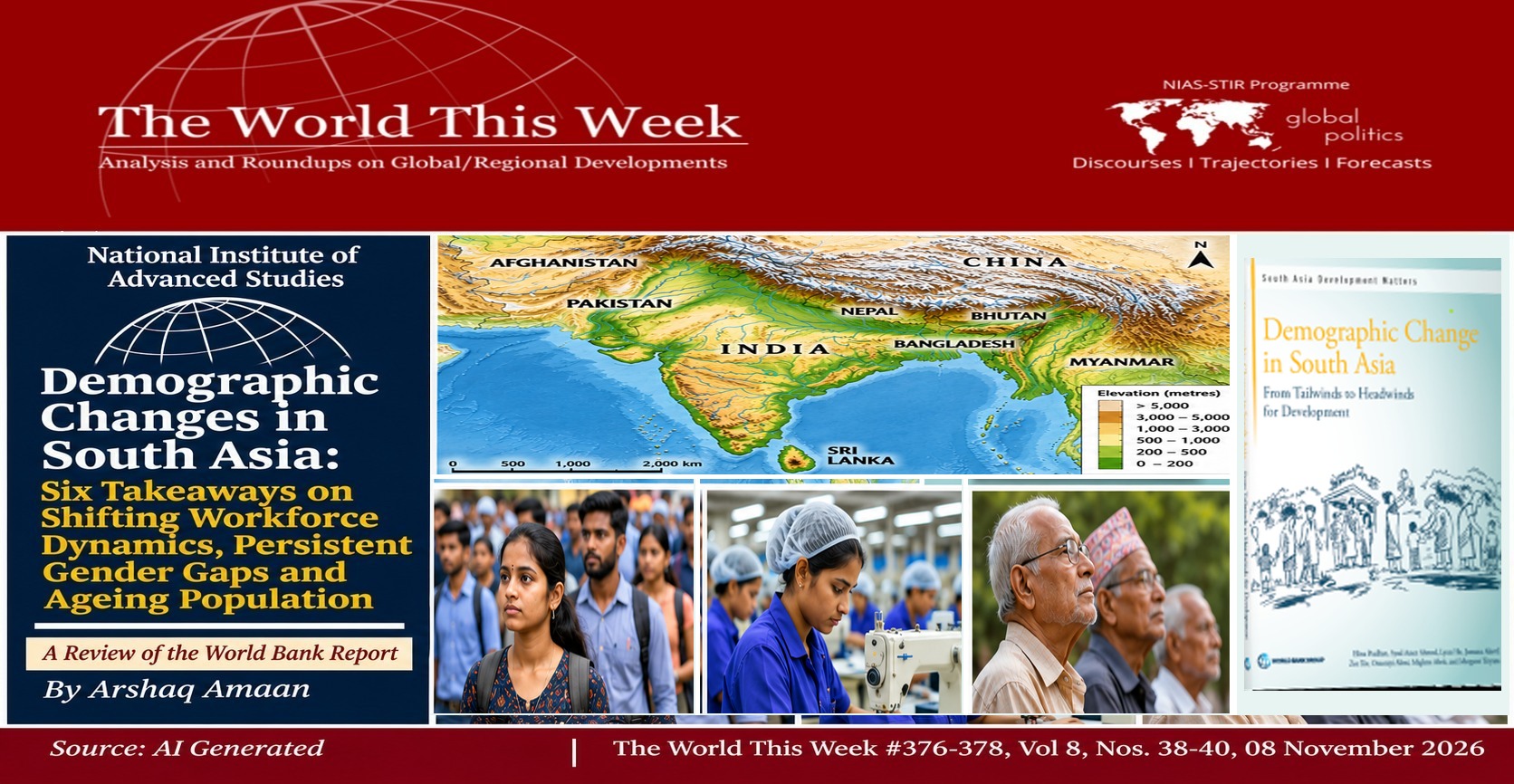
On 03 November, the World Bank released the report titled "Demographic Changes in South Asia: From Tailwinds to Headwinds for Development" examining the region’s changing population structure, including declining fertility rates, population ageing, employment patterns, women’s participation in the workforce, healthcare and pension systems.
The following are six major takeaways from the report:
1. Weaker demographic advantage in South Asia
South Asia is experiencing a major shift in its population structure. The region has benefited from a large working-age population, which has supported economic growth and provided opportunities for development. However, this advantage is gradually declining as the population ages and the proportion of older people increases. Unlike advanced economies, which had a longer period to prepare for this transition, South Asian countries are facing a much faster shift. This creates pressure on governments to strengthen employment opportunities, improve productivity and prepare healthcare and pension systems for an ageing population. The report emphasises that South Asia must make better use of its remaining demographic opportunity by investing in its people and creating productive jobs before population ageing becomes a greater economic challenge.
2. Quality of Employment is more crucial than population size
South Asia’s employment challenge is not simply about creating more jobs, but also about improving the quality of existing employment. A large share of the working-age population remains outside employment, while many of those who are employed work in the informal sector, often facing limited job security and social protection. The region also has fewer employment opportunities in non-agricultural sectors compared with other emerging economies. Another concern is that formal businesses in South Asia create jobs at a much slower pace due to constraints such as inadequate infrastructure, complex regulations and limited investment in innovation and training. The report emphasises that improving employment requires a stronger business environment, alongside investment in workers’ skills, health and productivity.
3. Women’s untapped potential in employment opportunity
Women’s participation in the workforce remains a major challenge in South Asia. Despite representing a significant share of the region’s potential workforce, many women remain outside the labour market due to barriers such as unpaid household and care responsibilities, limited access to childcare, safety concerns, mobility restrictions and social expectations. In addition, gaps in skills and other labour-market barriers often limit women’s access to stable, productive and better-paying jobs. The report highlights that improving women’s participation in employment and investing in their education and skills could strengthen the region’s human capital and support economic growth. Its projections suggest that even modest improvements in these areas could bring significant economic benefits by 2050.
4. Ageing population is placing healthcare systems under pressure
Population ageing is creating new challenges for South Asia’s healthcare systems, public services and government spending. Although people are living longer, they are not necessarily spending those additional years in good health, increasing the need for better healthcare and long-term support. Noncommunicable diseases, such as diabetes, heart disease and cancer, account for a major share of the region’s disease burden, making prevention and long-term treatment increasingly important. Older workers also face greater employment insecurity, as many remain in informal jobs without adequate financial or social protection. At the same time, demand for long-term care services is expected to grow significantly, requiring more trained care workers and stronger support systems. The report highlights the need for South Asian countries to prepare their healthcare and care systems for an ageing population.
5. Pension systems are failing to protect an ageing population
South Asia’s pension and social protection systems face significant gaps, leaving a large proportion of the population without adequate financial security in old age. Most working-age people are not covered by contributory pension schemes, and only a small share of older adults receive pension benefits. This is closely linked to the region’s high levels of informal employment, self-employment and interrupted work histories, which make it difficult for people to build up pension contributions throughout their careers. As the population ages, these gaps could leave more older people financially vulnerable and increase pressure on governments. The report therefore emphasises the need to expand old-age income protection, improve pension coverage and strengthen the institutions responsible for delivering benefits, while ensuring that these reforms remain financially sustainable.
About the author
Arshaq Amaan is currently a Research Intern with the Global Politics Team at the National Institute of Advanced Studies (NIAS), Bengaluru. He holds a BSc in Forensic Science from JAIN (Deemed-to-be University), Bengaluru.