CWA # 2323
PR Explainer
Pakistan reaches another IMF Deal:
Why does Islamabad find it difficult to break free from the IMF?

|
Namrata L Ghanghatkar
30 October 2026
|
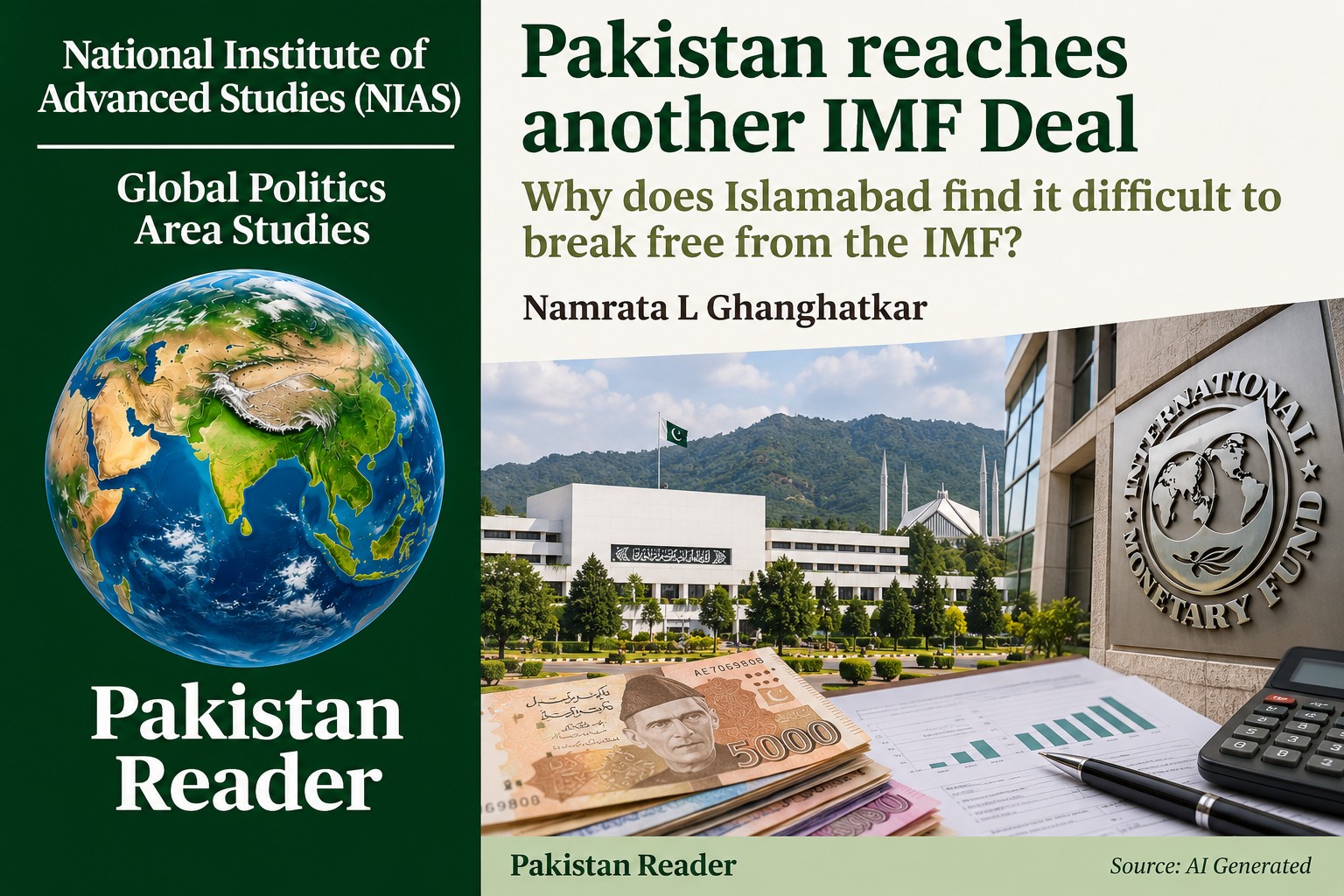
On 07 October, the International Monetary Fund reached a staff level agreement with Pakistan on the fourth review of its Extended Fund Facility and the third review of its Resilience and Sustainability Facility, a deal that could unlock about USD 1.21 billion once approved by the Fund's Executive Board, taking total disbursements under the two programmes to around USD 5.7 billion. The agreement came even as the IMF, in its October regional outlook, forecast that Pakistan's external position would weaken over the medium term and that the wider Middle East, North Africa and Pakistan region would contract by 1.3 per cent this year because of the Middle East conflict.
What is the recent discussion on Pakistan and the IMF after signing the agreement, and what is the major relationship between them?
The October agreement has mostly been read as relief rather than a fix. Commentators note that the funding eases Pakistan's critically low reserves in the near term but does nothing to address deeper fiscal imbalances. Much of the discussion has centred on how exposed Pakistan remains to events outside its control, chiefly the Middle East conflict and the volatility in energy and shipping costs it has brought, which the IMF itself has warned could derail the country's stabilisation gains if policy is relaxed too soon. The relationship runs deeper than one review cycle. Pakistan joined the IMF in 1950 and has since entered 25 separate arrangements with the Fund, turning what was meant to be a lender of last resort into a permanent backstop. An IMF programme also works as a seal of approval that unlocks further financing from the World Bank and from bilateral lenders such as China, Saudi Arabia and the United Arab Emirates, one reason successive governments keep returning to the table.
What did the IMF ask Pakistan to do, how did Pakistan respond, and what is the Fund's stance?
On taxation, the IMF wants Pakistan to broaden its narrow tax base by bringing retailers, agriculture and real estate into the net. Pakistan has agreed to a 14 trillion rupee revenue target and passed amendments to track retail supply chains, though provincial concessions still get offered whenever traders push back. On energy, the Fund wants automatic tariff adjustments to stop the power sector's circular debt from growing, and Islamabad has committed to bi annual gas price rises from July 2026 and annual electricity reviews from January 2027. On state owned enterprises, the IMF wants preferential treatment removed and privatisation sped up, and Pakistan has pledged to rewrite its procurement rules, though the sale of Pakistan International Airlines remains stalled. On subsidies, the Fund wants relief targeted through programmes such as the Benazir Income Support Programme rather than spread broadly, and Pakistan has scaled back fuel and electricity relief accordingly. Throughout, the Fund has stayed firm, arguing that Pakistan's salaried class is already taxed close to its limit and further room must come from wealthier, protected sectors.
Why does Pakistan find it difficult to break free from the IMF?
Pakistan's economy is import heavy and consumption driven, while its export base, still dominated by textiles, has not grown fast enough to keep pace. Whenever growth picks up, demand for imported fuel and machinery outpaces export earnings, draining reserves and triggering the crises that send Islamabad back to the Fund. External debt compounds the problem. It now exceeds USD 134 billion, and servicing it consumes more than half of federal revenue, with this year's budget setting aside roughly 7.8 trillion rupees just to service past borrowing, leaving little room for development spending that might reduce reliance on external financing. The third constraint is political. Landowners, real estate developers and retail interests have consistently avoided the tax net, leaving the burden on salaried workers, and governments have found it easier to borrow than confront these constituencies. That calculation has not been helped by a rising military budget. Defence spending rose by about 18 per cent to three trillion rupees this year under Field Marshal Asim Munir's growing influence over economic policy, even as development spending was held to just one trillion rupees, leaving still less room to invest in the growth that could end the cycle.
What problems does Pakistan pose for the IMF?
Dealing with Pakistan presents unique institutional challenges for the Fund, which must balance strict fiscal conditionality against the risk of widespread unrest or regional instability. Commentators call this a too big to fail dilemma, since the Fund knows that pushing an economy of over 240 million people into an unmanaged collapse could cause serious geopolitical spillover. This often forces the institution to carefully time tariff increases to avoid mass backlash against rising utility pricing. State owned enterprise reforms also face chronic delays, illustrated by the stalled privatisation of Pakistan International Airlines. Finally, Pakistan's exposure to external shocks means that sudden spikes in global energy prices from the Middle East conflict can instantly invalidate the Fund's forecasts, forcing continuous recalibration.
References
International Monetary Fund, "IMF Staff Complete the 2026 Article IV Consultation and Reaches Staff Level Agreement on the Fourth Review for the Extended Fund Facility and the Third Review for the Resilience and Sustainability Facility for Pakistan," IMF Press Release, 07 October 2026.
"Ex IMF Director Fact Checks Pakistan's 'Historic Milestone' Leadership Claim," NDTV, 19 October 2026.
Henna Ahsan, "Why IMF Programs Never Work for Pakistan," Pakistan Institute of Development Economics, Discourse Vol 1 Issue 3, 2022.
Talha Zaib, "Can Pakistan Ever Exit the IMF Cycle? Why the Economic Model Needs Reinvention," The Diplomatic Insight, 01 December 2025.
Ariba Shahid, "Pakistan Budget, Hit by Iran War and IMF, to Squeeze Middle Class," Reuters, 11 June 2026.
Bidisha Bhattacharya, "Pakistan Just Set a Reserve Record. Much of It Is Borrowed Money," The Print, 22 September 2026.
"Pakistan at 80: 25 IMF Lifelines, Billions in Bailouts and a Bigger Military Bill Under Asim Munir. Why Can't the Debt Trap End?," Moneycontrol, 14 August 2026.
"IMF Warns Pakistan's External Position May Weaken as Middle East War Fuels Inflation," Pakistan Today, 23 October 2026.
About the author
Namrata L Ghanghatkar is a postgraduate student at the Department of Public Policy, Ramaiah University of Applied Sciences, Bengaluru. She is currently a research intern at the National Institute of Advanced Studies (NIAS).