CWA # 2324
PR Takeaways
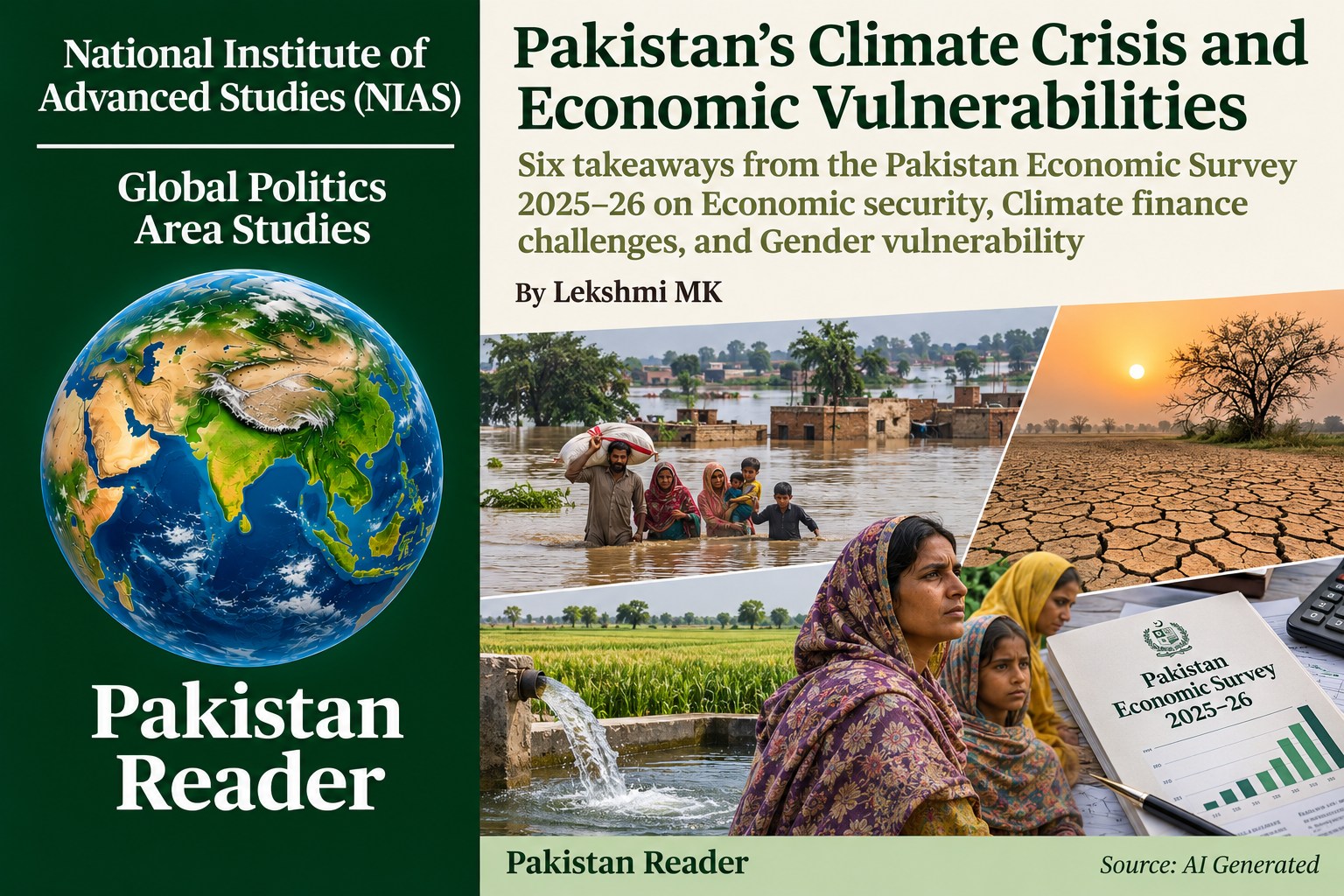
Pakistan's Climate Crisis and Economic Vulnerabilities:
Six takeaways from the Pakistan Economic Survey 2025-26 on Economic security, Climate finance challenges, and Gender vulnerability

|
Lekshmi MK
30 October 2026
|
On 11 June, Pakistan’s Ministry of Finance released the Pakistan Economic Survey 2025-26. Chapter 17 on "Climate Change" examines the country’s climate risks, economic losses, government initiatives, and climate-finance frameworks. The report situated Pakistan’s climate vulnerability within the broader challenges of economic stability, international climate cooperation, and institutional preparedness.
The following are six takeaways from the chapter.
1. Climate change is becoming an economic-security concern
The 2025 floods exposed the economic consequences of Pakistan’s recurring climate disasters. The chapter estimates total damages at PKR 822 billion, with agriculture and infrastructure accounting for much of the loss. Beyond immediate destruction, the floods affected food production, transport networks, housing, and livelihoods, adding pressure to economic recovery. It also identifies the disaster as a downside risk to economic growth. Thus, the economic-security concern lies in the cumulative effects of repeated disasters. Reconstruction competes with other development priorities. Meanwhile, disruptions to agriculture and infrastructure affect employment, food security, and economic activity. Climate resilience is therefore increasingly connected to Pakistan’s ability to sustain development and manage fiscal pressures.
2. Pakistan’s low emissions contribution contrasts with its high climate vulnerability
The chapter highlights the disparity between Pakistan’s contribution to global emissions and its exposure to climate impacts. It attributes less than one per cent of global emissions and approximately 0.4 per cent of historical emissions to Pakistan, while identifying rising temperatures, changing monsoon patterns, glacial melt and coastal risks as major concerns. This disparity reinforces Pakistan’s emphasis on equity, adaptation finance, and international support in climate negotiations. The challenge is not simply to recognise that Pakistan contributes relatively little to global emissions while facing significant climate risks. It is also to ensure that international climate commitments translate into timely and accessible climate finance, technology transfer and practical support for countries such as Pakistan, which have limited resources to manage recurring climate disasters.
3. Pakistan’s climate investment needs, raise questions about financing and implementation
Pakistan’s Climate Prosperity Plan, launched in April 2026, estimates investment requirements of approximately USD 1.6 trillion by 2050. The framework seeks to mobilise domestic, private, and international finance for renewable energy, climate-resilient agriculture, infrastructure, and ecosystem restoration. The chapter also discusses the Pakistan Green Taxonomy, carbon-market mechanisms, and reforms under the IMF’s Resilience and Sustainability Facility. These initiatives indicate an effort to integrate climate action with economic planning and investment. Yet, the scale of the proposed investment highlights the challenge of converting financial targets into funded projects. The development of a national climate-finance dashboard, which remains underway, also points to the importance of tracking funding flows and strengthening transparency. The central issue is whether the proposed financing can be mobilised at the scale and pace required.
4. Preparedness measures face the challenge of effective implementation before disaster occurs
The chapter outlines several measures intended to strengthen climate resilience, including the Monsoon 2026 Strategic Plan, early-warning systems, glacier-risk management and district-level adaptation planning. It also identifies factors that intensified the 2025 floods, including inadequate drainage capacity, unsustainable land-use practices, enhanced glacier melt and elevated river discharges. The coexistence of these risks and new policy initiatives highlights the difference between preparing plans and reducing vulnerability on the ground. Effective disaster governance requires coordination between federal and provincial institutions, functioning early-warning systems, resilient infrastructure and community-level preparedness. The question revolves around whether Pakistan’s climate policy can reduce exposure before the next disaster, rather than relying primarily on relief and reconstruction afterwards.
5. District-level adaptation initiatives seek to address local climate vulnerabilities
The survey identifies initiatives such as District Adaptation Plans, the Glaciers to Farms programme and ecosystem-restoration measures to address Pakistan’s climate vulnerabilities. These initiatives reflect efforts to connect climate adaptation with regional environmental conditions, agricultural resilience and local livelihood needs. District-level planning is particularly relevant in a country where climate risks vary considerably between mountainous regions, agricultural areas and coastal communities. However, the introduction of geographically targeted initiatives does not necessarily guarantee effective local adaptation. Their impact will depend on institutional capacity, coordination between federal and provincial authorities, and the availability of financial and technical resources. These initiatives represent a constructive step towards more targeted climate action, but their effectiveness will ultimately depend on implementation and measurable improvements in resilience.
6. Gendered dimensions of climate vulnerability need greater attention
The chapter discusses economic losses, disaster preparedness and adaptation measures, yet greater attention to the gender-differentiated impacts of climate change would provide a more comprehensive understanding of vulnerability. Women and men may face different risks in accessing livelihoods, relief and recovery assistance. Meanwhile, existing social and economic inequalities can shape their capacity to prepare for and recover from disasters. Recognising these differences is important for designing inclusive climate policies. Gender-disaggregated data can help identify variations in disaster exposure, livelihood losses, access to financial assistance and participation in decision-making. Incorporating these findings into adaptation planning would help ensure that climate policies account for the different needs and capacities of affected populations, rather than treating communities as uniformly vulnerable.
Pakistan Economic Survey 2025–26 presents climate change as a growing challenge to the country’s economic security, fiscal stability and governance capacity. While the climate-finance frameworks and locally oriented adaptation initiatives indicate efforts to integrate resilience into national development planning. However, the scale of the proposed investments, dependence on international climate finance and persistent disaster-preparedness challenges raise questions about the implementation of these commitments. Pakistan’s climate response will ultimately depend on its ability to mobilise adequate resources, strengthen institutional coordination and translate national policies into effective adaptation measures. The central challenge is to move from recognising climate vulnerability to building the financial and institutional capacity required to address it.
Reference
“Chapter 17: Climate Change,” Pakistan Economic Survey 2025–26, Ministry of Finance, Government of Pakistan, 11 June 2026
https://www.finance.gov.pk/survey/chapter_26/17_Climate_Change.pdf
About the author
Lekshmi MK is a Research Assistant at the National Institute of Advanced Studies, Bengaluru