CWA # 2338
Global Politics Explainer
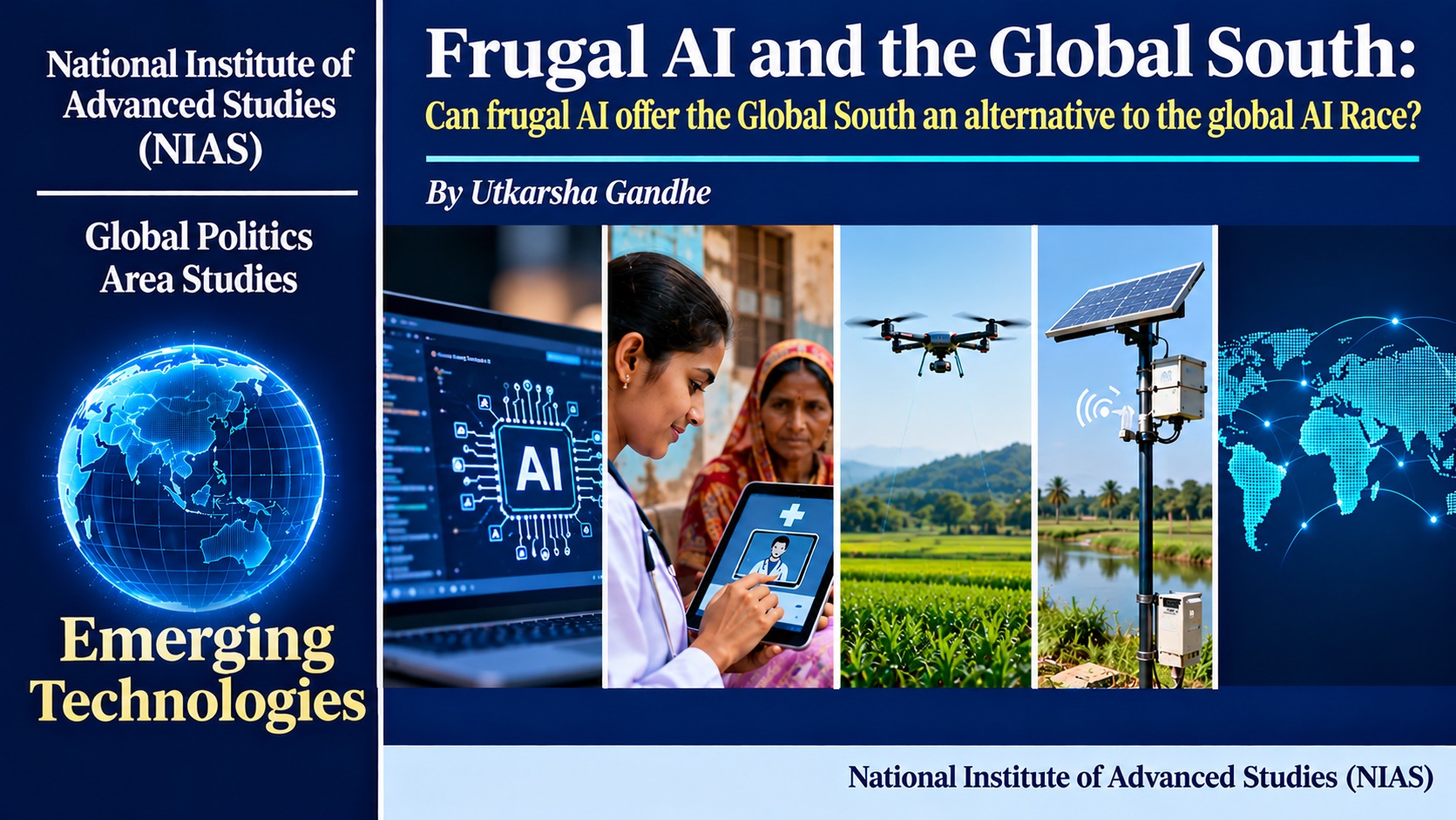
Frugal AI and the Global South:
Can frugal AI offer the Global South an alternative to the global AI Race?

|
Utkarsha Gandhe
11 November 2026
|
India was a host to the AI Impact Summit in New Delhi in February 2026, the first summit in the global series held in the Global South. The declaration that followed was endorsed by 92 countries, along with the European Union, and signed by both the United States and China. Weeks earlier, the Economic Survey 2025-26 had told Parliament that India should not copy the capital-heavy path of American technology firms, and should build smaller, task-specific models that run on phones and ordinary computers instead. That approach is now called frugal AI. The question is whether it is a workable answer to scarcity or a polite name for staying behind.
Why is the current AI race so hard for the Global South to join?
Three things set the pace: money, chips and infrastructure. On money, Amazon, Microsoft, Alphabet and Meta plan to spend about 725 billion dollars on capital expenditure in 2026, up 77 per cent from roughly 410 billion dollars a year earlier, according to the Financial Times tally. India's entire IndiaAI Mission, approved in March 2024 with an outlay of 10,372 crore rupees, comes to roughly 1.2 billion dollars over five years. By simple division, Microsoft's planned 190 billion dollars for 2026 covers that amount in under three days.
On chips, Nvidia holds between 70 and 95 per cent of the AI chip market, the World Bank estimates. On infrastructure, only 32 countries host data centres built for AI, and Africa and Latin America together account for about 3 per cent of global AI compute. The World Bank's Africa Economic Update, released on 6 October 2026, puts Africa's share of global data centre capacity at 0.6 per cent, against 18 per cent of the world's population. Only about 2 per cent of the data used to train AI models comes from the continent. Even India, which generates about a fifth of the world's data, holds around 3 per cent of data centre capacity.
Most Global South countries therefore join the race as buyers. They rent compute abroad, use models trained elsewhere, and often send their data offshore for processing.
How does Frugal AI challenge the dominant model of AI development?
The dominant model assumes that capability rises with scale: more data, more parameters, more chips. Frugal AI starts from the other end. The Observer Research Foundation describes it as computational sufficiency, the smallest resource footprint that delivers the required performance on a defined task. A model that answers welfare-scheme queries in Tamil does not need to write code or pass professional exams.
The efficiency gains are measurable. A UNESCO and University College London study from July 2025 found that smaller task-specific models, lower numerical precision and shorter prompts and responses, used together, can cut energy use by up to 90 per cent against a large general-purpose model, with comparable accuracy on tasks such as translation and summarisation. Scale is also not the only route to capability. Kai-Fu Lee, founder of 01.AI, has argued that Chinese firms spend less than a tenth of what leading American companies spend on training and still produce models that are 90 to 95 per cent as capable, six to nine months behind.
Open-weight releases add to this. Because the weights can be downloaded, developers avoid per-query fees and can host models on their own servers. The Economic Survey also notes that some firms are projected to burn through half a trillion dollars by 2030 chasing compute, and that a latecomer such as India can watch those bets play out before making its own.
Could Frugal AI reduce the Global South's dependence on the Global North?
It can reduce some dependencies and leave others untouched. A model that runs on local servers cannot be withdrawn by its maker, and it spares a country per-query charges and offshore data flows. Access to hosted models offers no such guarantee. In June 2026, the US Department of Commerce directed Anthropic to suspend access to two of its models for foreign nationals worldwide, and access stayed off for about three weeks before it returned on 1 July. For any country whose services ran on a single foreign model, the episode showed how fast a decision in Washington can reach it.
Frugal AI is better read as a change in what the Global South competes for than as a way out of the race. It lowers the cost of using AI well, in local languages and on local devices, and it reduces exposure to price and access shocks at the application layer. It does not remove dependence on the chips, cloud services and base models that others still supply. Whether it becomes a real alternative will depend on how countries spend what they save: on building capacity at one or two of those chokepoints, or on buying cheaper tools made elsewhere.
References
1. Nidhi Singh et al., "For People, Planet, and Progress: Perspectives from India's AI Impact Summit," Carnegie India, 30 April 2026
2. "Frugal Intelligence: What The Economic Survey 2026 Says About India And AI," Swarajya, 29 January 2026
3. "Amazon, Microsoft, Alphabet, Meta Plan $725B AI Capex in 2026," AI Weekly, citing the Financial Times, 2026
4. World Bank, chapter on compute infrastructure, Open Knowledge Repository, 2025
5. Landry Signé, "How to bridge the global AI divide," Brookings Institution, 2026
6. "World Bank: Africa Holds 0.6% of Global Data Center Capacity," FourWeekMBA, reporting the World Bank Africa Economic Update, 6 October 2026
7. "From Scale to Efficiency: India's Frugal AI Opportunity," Observer Research Foundation, 2026
8. "Practical changes could reduce AI energy demand by up to 90%," University College London, July 2025
9. "Why Is China Giving Away Its AI Models?" Takshashila Institution, 7 August 2026
10. "Nations priced out of Big AI are building with frugal models," Rest of World, 2026
11. "India Sovereign AI Status 2026: IndiaAI Mission, Sarvam Models, Gaps and Geopolitics," explainx.ai, 2026
12. "India's AI Rise: Talent, Compute and Global Influence," Analytics Insight, 2026
13. "India joins US-led Pax Silica alliance," The Quint, February 2026
14. "Why India joining this U.S.-led tech alliance could help supply chains," Hellenic Shipping News, February 2026
15. "US government allows Anthropic to redeploy its Mythos and Fable AI models," Engadget, 30 June 2026
16. "Anthropic Restores Fable 5, Mythos 5 After US Eases Ban," YourStory, 1 July 2026
17. "China's open-source bet," MIT Technology Review, 21 April 2026
18. "The Real Reason Chinese AI Is Winning the Global South," Foreign Policy, 21 September 2026
About the author
Utkarsha Gandhe is an undergraduate student at the Department of International Relations, Peace & Public Policy, St Joseph’s University, Bengaluru