CWA # 2341
CW Note
Continuing protests in France:
Widening Social Unrest and the Governance challenges
Conflict Weekly #357, Vol 7, No 44, 12 November 2026

|
Advik Sunanda Mohan
12 November 2026
|
In the news
On 04 November, the proposed annual budget of the government was unanimously rejected by France’s Senate.
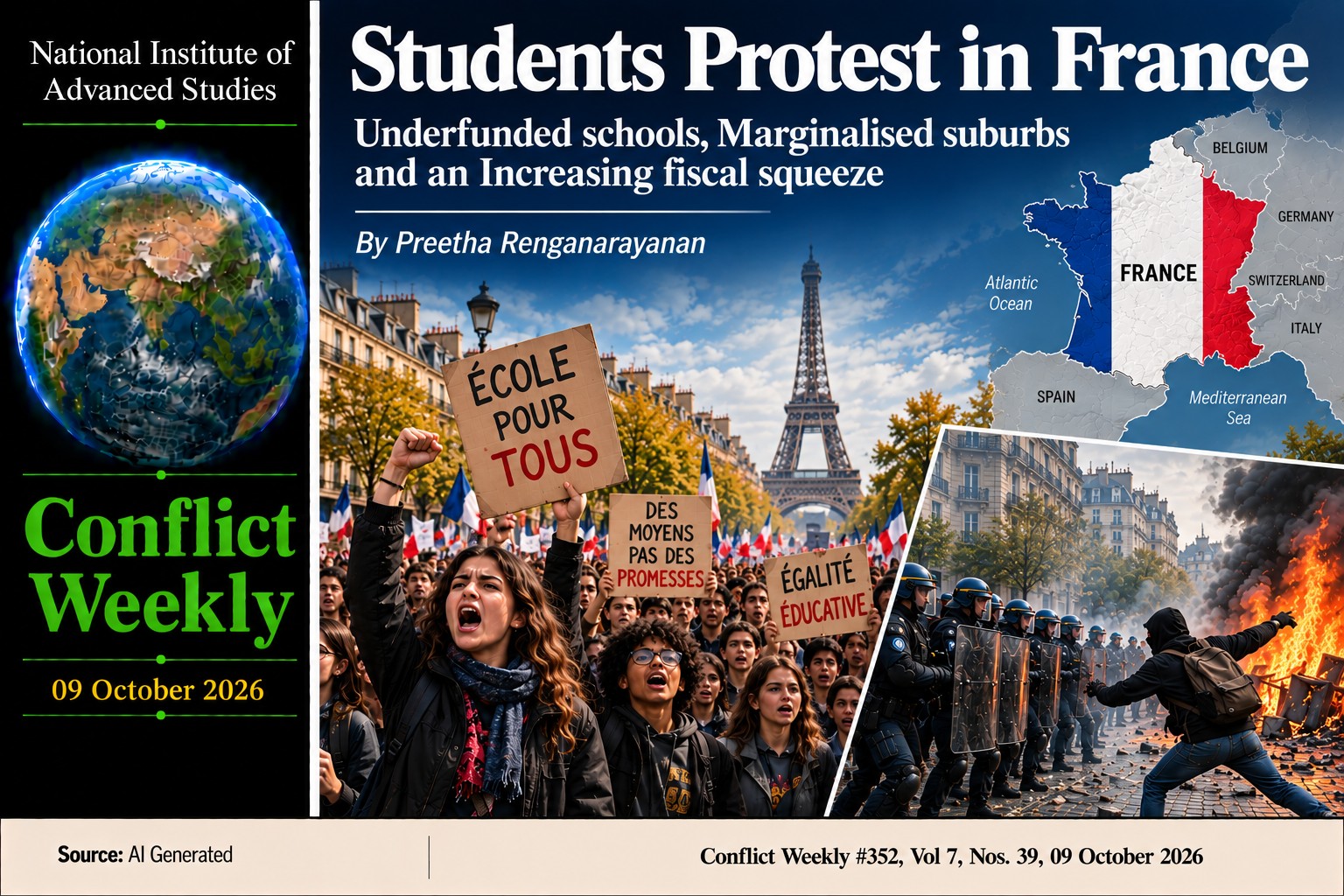
On 05 November, France 24 reported that massive demonstrations had taken place across France, amidst a general strike called by unions representing different groups, including teachers, hospital staff, and postal employees. Government sources stated that about 575,000 people took part, while the CGT trade union estimated the figure to be nearly 1.6 million.
Public sector workers seeking an increase in the minimum wage also joined the protests. Blockades were reported at several high schools, with few incidents of violence reported
On 09 November, Le Monde reported that France’s PM, Sebastian Lecornu, held talks with public sector, trade union, and student representatives. Lecornu announced a 1.6 percent increase in the minimum wage by 01 December. This would increase the minimum wage from the current rate of EUR 1,470 to EUR 1,500. Unions rejected the increase as insufficient, below their demands of a 10 percent increase.
Issues at large
1. The widening protest movement, despite a narrowing geography
The protests have broadened to include different groups, all united with shared grievances against the government. Initially, the protests were led by students over the poor condition of schools. However, groups like the public sector workers and unions are now at the forefront of protests. While the protests over inadequate school facilities are continuing, they are no more the sole cause behind the protests now. However, the protests have taken place mainly in cities and suburban areas. Cities such as Paris and Marseille have witnessed massive protests, which have been more limited in the rural areas.
2. Inflation, food prices, cost of living, and growing inequality
Since the beginning of the Iran war this year, France has seen a significant rise in inflation. Energy prices rose by 24.1 percent in 2026, as compared to the previous year. Inflation has seen a 23.4 percent increase since 2017; its current surge is driven by similar increase in oil and gas prices since the Iran war. Additionally, food prices have been impacted by heatwaves and droughts in France. The statistics office INSEE estimated that prices of other food products could rise in the coming months, with the costs of farmer inputs like fertilizers expected to increase. The growing cost of living has sparked calls for increasing the minimum wage for workers.
INSEE models indicate a decline in living standards since 2024, which is expected to continue; the wealthiest 20 percent of French households accounted for 38.8 percent of the total share of living standards. Additionally, older citizens aged between 50 and 64 had a median monthly standard of living of EUR 2466, 14 percent higher than those aged between 18 and 29. The standard of living for unemployed citizens, or economically inactive ones such as students, is between 27 and 31 percent lower than the general population, indicating significant disparities based on economic status.
Since 2017, the average salary of civil servants has increased by only 5.7 percent, in contrast to a nearly 23 percent rise in inflation. The index used by the government to calculate the salaries of public sector workers has been frozen since June 2023. This means there has been no increase in salaries of public sector employees such as teachers and hospital staff for over three years.
3. The perilous state of public finances and the political divide
Since the legislative elections of 2024 resulted in a hung parliament, France has faced increased political fragmentation. Political factions have disagreed over passing the budget. France also faces a huge public debt amounting to 119 percent GDP and a public deficit of 5.4 percent. The economic problems are mounting, with years of higher spending than revenues generated playing a role. The left-wing parties have called for more focused spending on essential services like health, while conservative parties have favored austerity. The budget has become a key political flashpoint, with Lecornu’s two predecessors losing no-confidence motions over the issue.
An Elable poll showed French President Emmanuel Macron had an approval rating of only 14 percent. Another poll by Le Figaro indicated the far-right RN was the most popular party, with 34 percent support. The far-left LFI has also gained in support, with opinion polls indicating its leader Jean-Luc Mélenchon could make it to the runoff of the presidential election. This indicates a growing support for the far-right and far-left, amidst dissatisfaction with the traditional political centre.
In perspective
France is likely to remain in a political deadlock until the presidential elections, with growing polarization.
Further protests have been planned by unions for the coming weeks, meaning the movement is unlikely to abate for now. Additionally, the far-right and the far-left are likely to capitalize on the protests to gain political success. For instance, the anti-immigration agenda of the far-right could gain further credence.
About the author
Advik Sunanda Mohan is a postgraduate student at the Paris School of International Affairs, Sciences Po. He is currently a Research Intern at the National Institute of Advanced Studies.