CWA # 2342
CW Note
Garment workers' strike in Bangladesh:
From wage delays to industrial shutdown
Conflict Weekly #357, Vol 7, No 44, 12 November 2026

|
Priyanka Makhijani
12 November 2026
|
In the news
On 26 October, the Business & Human Rights Resource Centre reported that the Department of Labour had begun steps to form a Minimum Wage Board. Thirty-five federations demanded USD 300, while the IndustriALL Bangladesh Council sought USD 260.
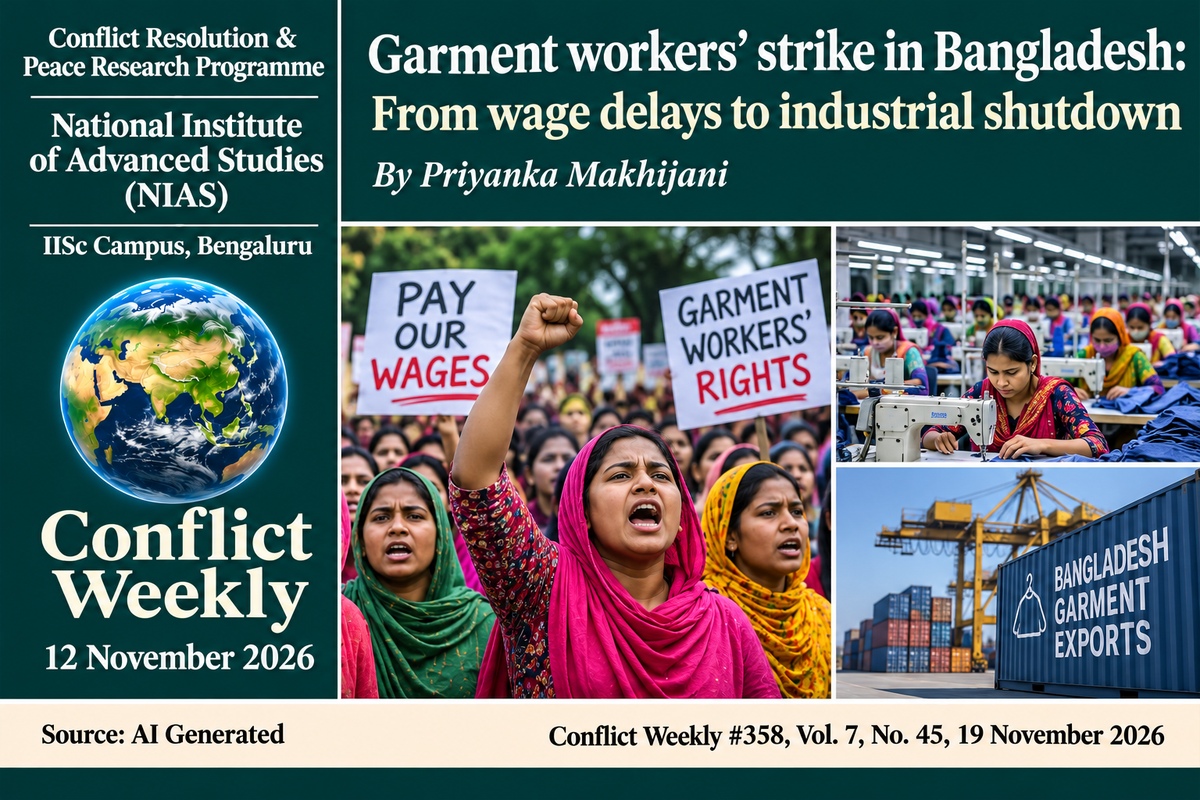
On 31 October, protests broke out in Ashulia and spread to Dhaka and Gazipur.
On 01 November, the government announced a six-member wage board; however, the demonstrations continued, and 529 factories were shut, affecting nearly 987,200 workers. Border Guard Bangladesh personnel were deployed, and at least 30 people were detained.
On 03 November, Reuters reported that police fired tear gas on the fourth day of protests, and dozens of people, including police officers, were injured. Nearly 700 factories had shut the day before.
On 04 November, the board agreed to implement a revised wage structure from December 2026, with the first pay under the new scale in January 2027, but the size of the increase remained undecided.
On 11 November, The Business Standard reported that industrial hubs in Ashulia and Gazipur witnessed renewed labour unrest, despite ongoing deliberations. The unrest prompted 146 garment factories to suspend operations and declare holidays.
On 12 November, The Daily Star reported that workers from six garment factories blocked the Dhaka-Tangail highway in Kaliakair, Gazipur, demanding a wage increase.
Issues at large
1. Bangaldesh's garment industry
The sector employs about 4 million workers and is a major source of paid work for women. A 2026 mapping of export-oriented factories puts women at 57 percent of workers, while other estimates place the figure at roughly 60 to 70 percent. For most of these workers, the factory wage is the main source of household income, which leaves little room to absorb lost earnings. The protests appear to be led largely by male workers, while women, who often combine long factory hours and low pay with household responsibilities, are among those most exposed when factories close and wages stop. The issue is therefore a gap between those who mobilise and those who carry the cost.
The garment sector is the backbone of the economy and accounts for most export earnings. According to the Export Promotion Bureau (EPB), the manufacturing sector contributes approximately 10 percent of Bangladesh’s GDP. The ready-made garment (RMG) sector accounts for 81 percent of total exports, giving Bangladesh an estimated 7 percent share of the global market and making it the world’s second-largest garment exporter. The timing is sensitive because November to February is the peak season for export orders, and prolonged closures could push buyers towards rivals such as Vietnam and India. Owners cite rising operating costs, energy-market uncertainty linked to the Middle East conflict and softer demand, which limits how much of a wage rise they can absorb. The core question is who bears the cost of higher pay- owners, global brands, or workers.
2. Stagnant wages, rising cost of living, and the delayed revision
The core issue is over the statutory minimum wage and whether it matches the cost of living. The current minimum was set in December 2023; according to the workers, food, housing, transport, and healthcare have grown costlier since, with inflation around 8 percent. Labour law requires wages to be reviewed every three years; a review was already due in December 2026. The demand for roughly USD 245, more than double the current wage, reflects both accumulated loss in real income and a push for a "living wage."
The immediate trigger was the wage level than the delay in forming the board. Bangladesh fixes garment wages through a tripartite board of government, employer, and worker representatives; workers saw the missed deadline as stalling by the government.
3. Weak bargaining power and labour rights
Beyond pay, the strike points to how little leverage workers have within factories. Issues such as unpaid dues, arbitrary dismissals, and a reported blacklisting of workers who join labour movements reflect a wider imbalance between employers and employees. Trade unions are thin at the factory level, so workers have few formal channels to raise concerns without risking their jobs. Employers can also use a “no work, no pay” rule when factories close, which adds to workers’ vulnerability.
In perspective
The protest can be seen as a partial success. Workers secured a wage board and an in-principle commitment to a revised pay structure from December. However, the increase is still undecided, so the gains so far are procedural rather than material. If the outcome falls short of expectations, as it did in 2023, the sense of failure may deepen.
Second, workers are likely to return to the streets. Because of rising prices, energy costs linked to the Middle East conflict, softer export demand, and owners’ limited capacity to pay more, the protests might return. With the garment industry central to Bangladesh’s economy and its export earnings, these pressures will have national consequences. As the underlying problems are likely to persist, this episode is unlikely to be the last.
About the author
Priyanka Makhijani is a postgraduate student at the Department of Public Policy, Ramaiah University of Applied Science. She is currently a Research Intern at NIAS.