CWA # 2343
CW Review
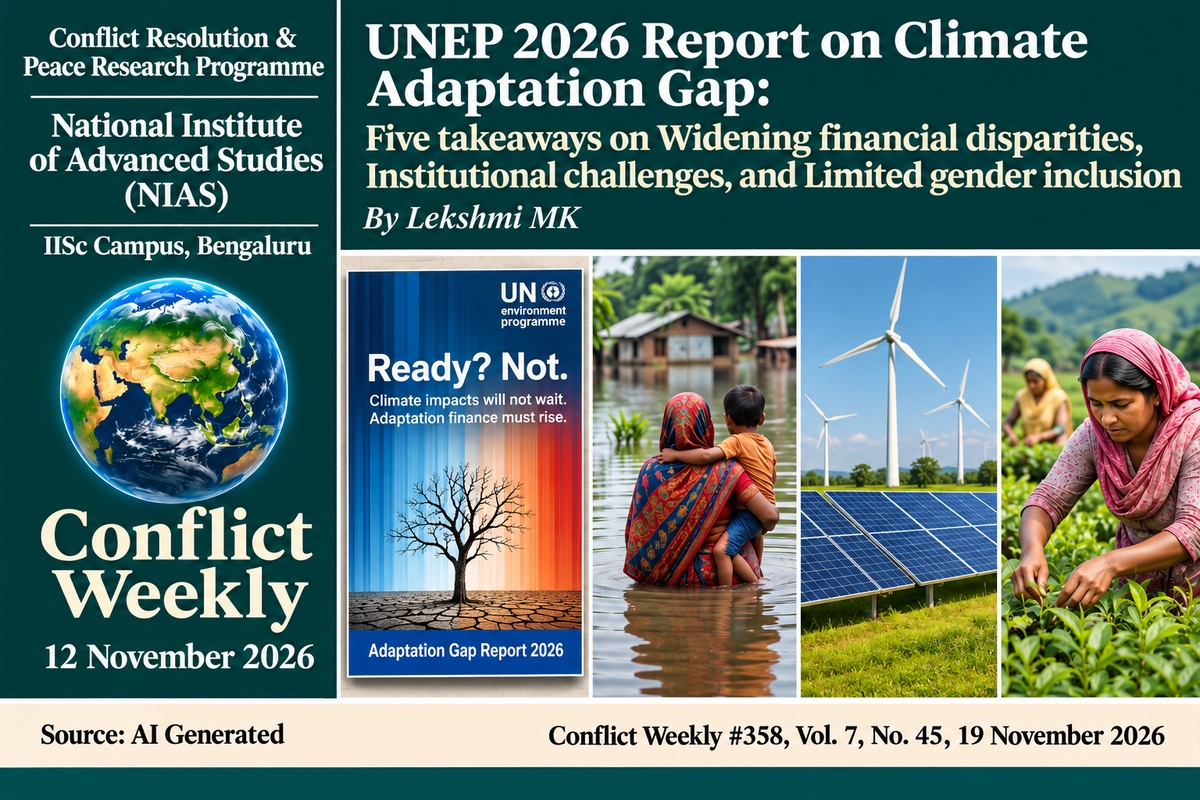
UNEP 2026 Report on Climate Adaptation Gap:
Five takeaways on Widening financial disparities, Institutional challenges, and Limited gender inclusion
Conflict Weekly #357, Vol 7, No 44, 12 November 2026

|
Lekshmi MK
12 November 2026
|
Photo Source:
Developing countries require approximately USD 305 billion annually by 2035 to meet their climate adaptation needs, excluding private sector needs. Even tripling adaptation finance by 2035 would meet only 20-29 percent of the projected requirements.
On 04 November, the United Nations Environment Programme (UNEP) released its “Adaptation Gap Report 2026: Ready? Not.” The report examines the growing gap between developing countries' climate adaptation needs and the financial resources available to address them. It assesses adaptation planning, implementation, institutional capacity, and the financing required to respond to climate risks, with particular attention to vulnerable countries and communities. The report offers an important perspective on the relationship between climate change, state capacity, and human security.
The following are the five key takeaways from the report:
1. The adaptation finance gap is widening
Developing countries require approximately USD 305 billion annually by 2035 to meet their climate adaptation needs, excluding private sector needs. International public adaptation finance from developed to developing countries reached only USD 28.2-31.7 billion in 2024. Even tripling adaptation finance by 2035 would meet only 20-29 percent of the projected requirements. This widening gap reflects the mismatch between rising climate adaptation costs and the limited growth of international financial support. Increasing climate risks, including more frequent and intense heatwaves, floods, and droughts, are raising the costs of protecting infrastructure, agriculture, water resources, and livelihoods. However, adaptation finance remains heavily dependent on official development assistance, which declined by 4.5 percent in net flows in 2024. Further, private investment remains limited and is largely directed towards commercially viable projects, rather than public adaptation needs. The growing reliance on non-concessional loans also increases borrowing costs and debt pressures for developing countries. Consequently, the pace of financial support is failing to match the scale of climate vulnerability, leaving developing countries increasingly exposed to climate impacts.
2. Climate vulnerability is deepening existing inequalities
The annual adaptation finance needs of Least Developed Countries (LDCs) and Small Island Developing States (SIDS) are estimated at USD 50 billion over the coming decade. These needs represent 3-4 percent of their GDP, nearly twice the relative adaptation finance requirements of upper-middle-income developing countries. The disproportionate burden reflects the limited financial and institutional capacity of vulnerable countries to prepare for and respond to climate impacts. LDCs and SIDS often face greater exposure to climate-related hazards while having fewer resources to invest in resilient infrastructure, disaster preparedness, and livelihood protection. Thus, the vulnerability is not distributed equally within countries. Differences in income, gender, age, and access to resources influence communities' exposure to climate risks and their ability to adapt. Consequently, the climate impacts interact with existing socio-economic inequalities. Meanwhile, limited adaptive capacity constrains vulnerable communities' ability to prepare, respond, and recover.
3. Weak institutions constrain climate adaptation
Institutional capacity and technological constraints frequently impede the translation of national adaptation plans into concrete action. The report identifies seven institutional factors influencing adaptation implementation, including legal and policy frameworks, intergovernmental coordination, stakeholder participation, accountability, and financial management. Despite the growing adoption of national adaptation plans, gaps remain in their implementation. The report highlights that unclear institutional responsibilities can result in inaction, while poor coordination between national and local governments can lead to policies that do not reflect local priorities and capacities. Further, although most countries have established national coordination mechanisms, fewer support coordination across different levels of government. Monitoring and evaluation systems in developing countries also remain incomplete or limited to tracking progress, weakening accountability.
4. Climate-related losses and damages are exceeding available responses
Between 2020 and 2025, low- and middle-income countries accounted for 99 percent of the 765 million people affected by floods and landslides. During the first funding round of the Fund for Responding to Loss and Damage, 119 developing countries submitted funding requests amounting to USD 2.8 billion, against an initial allocation of only USD 342 million. The growing disparity between climate-related losses and available financial support highlights the limitations of existing response mechanisms. The report explains that even effective adaptation cannot prevent all climate-related damage, as some losses occur despite adaptation measures or when communities and ecosystems reach their limits to cope. These losses extend beyond physical and economic damage to include biodiversity, cultural heritage, health, mental well-being, and community identity. However, assessing and documenting such losses remains challenging, particularly in countries with limited institutional and technical capacity. Accessing available financial assistance is also constrained by complex application procedures, inadequate assessment capacity, and limited resources.
5. Gender and Indigenous inclusion remain gaps in climate adaptation
Only 21 percent of the Nationally Determined Contributions (NDCs) and National Adaptation Plans (NAPs) included dedicated financial allocations for gender equality and social inclusion (GESI) interventions. Only 0.17 percent of international public climate finance explicitly referred to locally led or community-led action, despite growing commitments to locally led adaptation. The report identifies gender, age, indigeneity, and disability as factors shaping people's exposure to climate risks and their capacity to adapt. However, gender equality and broader social inclusion remain inadequately supported through dedicated financial allocations. Indigenous Peoples and local communities also face limited opportunities to influence adaptation priorities, despite their knowledge of local ecosystems and climate-related risks. The limited financial support for locally led initiatives further constrains community participation in designing and implementing adaptation measures. The report therefore underscores the importance of gender-responsive planning, Indigenous participation, and locally led adaptation to ensure that climate policies address differentiated vulnerabilities rather than reproduce existing inequalities.
About the author
Lekshmi MK is a Research Assistant at the National Institute of Advanced Studies (NIAS), Bengaluru, and is part of the Global Politics Polar and Ocean Studies.