CWA # 2345
Conflict Weekly
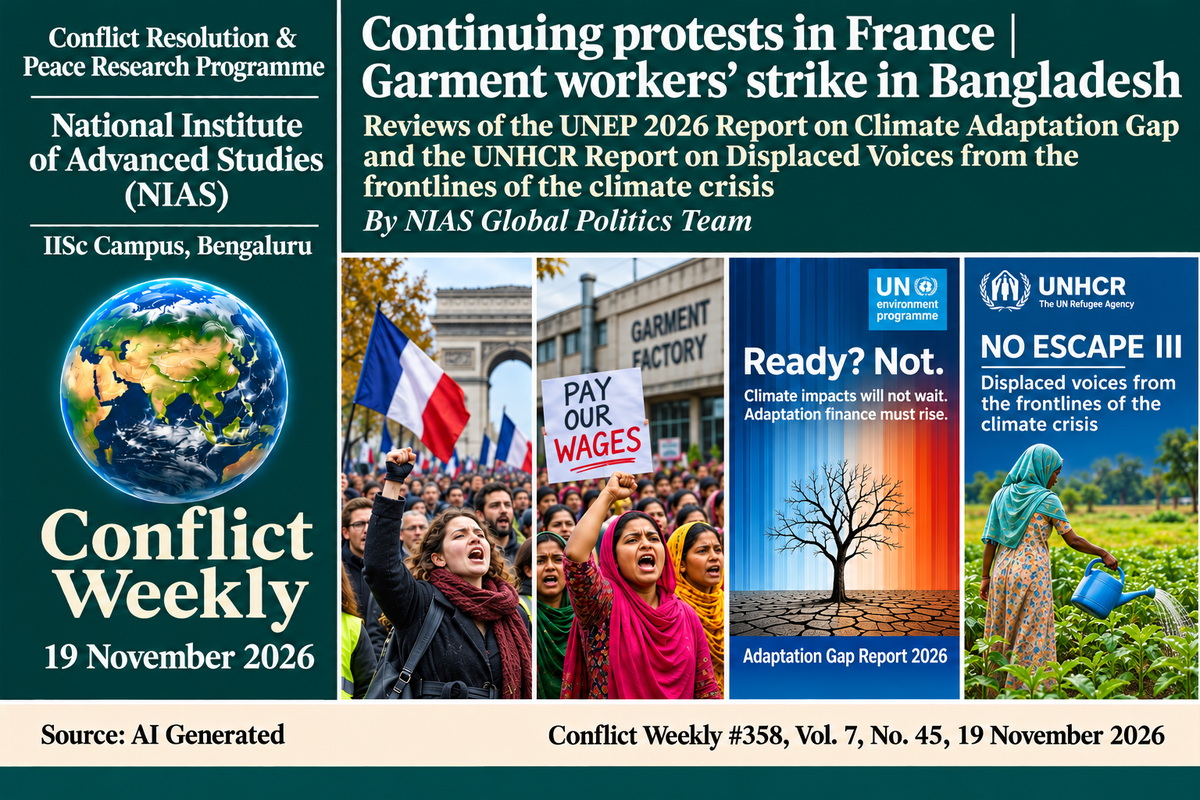
Continuing protests in France I Garment workers' strike in Bangladesh
Reviews of the UNEP 2026 Report on Climate Adaptation Gap and the UNHCR Report on Displaced Voices from the frontlines of the climate crisis
Conflict Weekly #357, Vol 7, No 44, 12 November 2026

|
NIAS Global Politics team
12 November 2026
|
Continuing protests in France:
Widening Social Unrest and the Governance challenges
Advik Sunanda Mohan
In the news
On 04 November, the proposed annual budget of the government was unanimously rejected by France’s Senate.
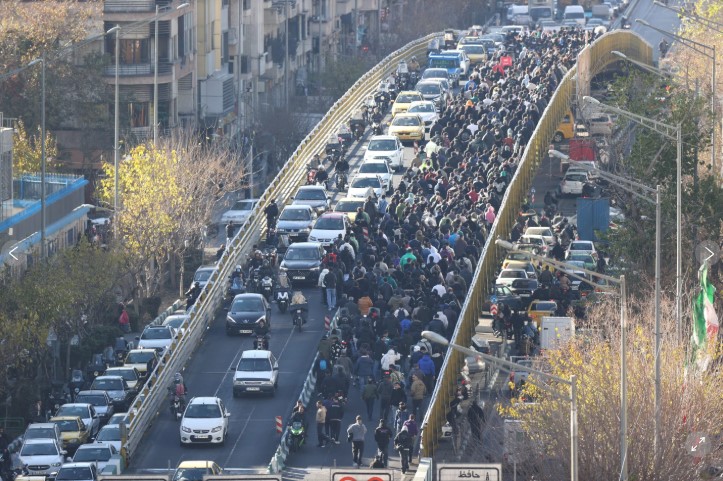
On 05 November, France 24 reported that massive demonstrations had taken place across France, amidst a general strike called by unions representing different groups, including teachers, hospital staff, and postal employees. Government sources stated that about 575,000 people took part, while the CGT trade union estimated the figure to be nearly 1.6 million.
Public sector workers seeking an increase in the minimum wage also joined the protests. Blockades were reported at several high schools, with few incidents of violence reported
On 09 November, Le Monde reported that France’s PM, Sebastian Lecornu, held talks with public sector, trade union, and student representatives. Lecornu announced a 1.6 percent increase in the minimum wage by 01 December. This would increase the minimum wage from the current rate of EUR 1,470 to EUR 1,500. Unions rejected the increase as insufficient, below their demands of a 10 percent increase.
Issues at large
1. The widening protest movement, despite a narrowing geography
The protests have broadened to include different groups, all united with shared grievances against the government. Initially, the protests were led by students over the poor condition of schools. However, groups like the public sector workers and unions are now at the forefront of protests. While the protests over inadequate school facilities are continuing, they are no more the sole cause behind the protests now. However, the protests have taken place mainly in cities and suburban areas. Cities such as Paris and Marseille have witnessed massive protests, which have been more limited in the rural areas.
2. Inflation, food prices, cost of living, and growing inequality
Since the beginning of the Iran war this year, France has seen a significant rise in inflation. Energy prices rose by 24.1 percent in 2026, as compared to the previous year. Inflation has seen a 23.4 percent increase since 2017; its current surge is driven by similar increase in oil and gas prices since the Iran war. Additionally, food prices have been impacted by heatwaves and droughts in France. The statistics office INSEE estimated that prices of other food products could rise in the coming months, with the costs of farmer inputs like fertilizers expected to increase. The growing cost of living has sparked calls for increasing the minimum wage for workers.
INSEE models indicate a decline in living standards since 2024, which is expected to continue; the wealthiest 20 percent of French households accounted for 38.8 percent of the total share of living standards. Additionally, older citizens aged between 50 and 64 had a median monthly standard of living of EUR 2466, 14 percent higher than those aged between 18 and 29. The standard of living for unemployed citizens, or economically inactive ones such as students, is between 27 and 31 percent lower than the general population, indicating significant disparities based on economic status.
Since 2017, the average salary of civil servants has increased by only 5.7 percent, in contrast to a nearly 23 percent rise in inflation. The index used by the government to calculate the salaries of public sector workers has been frozen since June 2023. This means there has been no increase in salaries of public sector employees such as teachers and hospital staff for over three years.
3. The perilous state of public finances and the political divide
Since the legislative elections of 2024 resulted in a hung parliament, France has faced increased political fragmentation. Political factions have disagreed over passing the budget. France also faces a huge public debt amounting to 119 percent GDP and a public deficit of 5.4 percent. The economic problems are mounting, with years of higher spending than revenues generated playing a role. The left-wing parties have called for more focused spending on essential services like health, while conservative parties have favored austerity. The budget has become a key political flashpoint, with Lecornu’s two predecessors losing no-confidence motions over the issue.
An Elable poll showed French President Emmanuel Macron had an approval rating of only 14 percent. Another poll by Le Figaro indicated the far-right RN was the most popular party, with 34 percent support. The far-left LFI has also gained in support, with opinion polls indicating its leader Jean-Luc Mélenchon could make it to the runoff of the presidential election. This indicates a growing support for the far-right and far-left, amidst dissatisfaction with the traditional political centre.
In perspective
France is likely to remain in a political deadlock until the presidential elections, with growing polarization.
Further protests have been planned by unions for the coming weeks, meaning the movement is unlikely to abate for now. Additionally, the far-right and the far-left are likely to capitalize on the protests to gain political success. For instance, the anti-immigration agenda of the far-right could gain further credence.
Advik Sunanda Mohan is a postgraduate student at the Paris School of International Affairs, Sciences Po. He is currently a Research Intern at the National Institute of Advanced Studies.
Garment workers' strike in Bangladesh:
From wage delays to industrial shutdown
Priyanka Makhijani
In the news
On 26 October, the Business & Human Rights Resource Centre reported that the Department of Labour had begun steps to form a Minimum Wage Board. Thirty-five federations demanded USD 300, while the IndustriALL Bangladesh Council sought USD 260.
On 31 October, protests broke out in Ashulia and spread to Dhaka and Gazipur.
On 01 November, the government announced a six-member wage board; however, the demonstrations continued, and 529 factories were shut, affecting nearly 987,200 workers. Border Guard Bangladesh personnel were deployed, and at least 30 people were detained.
On 03 November, Reuters reported that police fired tear gas on the fourth day of protests, and dozens of people, including police officers, were injured. Nearly 700 factories had shut the day before.
On 04 November, the board agreed to implement a revised wage structure from December 2026, with the first pay under the new scale in January 2027, but the size of the increase remained undecided.
On 11 November, The Business Standard reported that industrial hubs in Ashulia and Gazipur witnessed renewed labour unrest, despite ongoing deliberations. The unrest prompted 146 garment factories to suspend operations and declare holidays.
On 12 November, The Daily Star reported that workers from six garment factories blocked the Dhaka-Tangail highway in Kaliakair, Gazipur, demanding a wage increase.
Issues at large
1. Bangaldesh's garment industry
The sector employs about 4 million workers and is a major source of paid work for women. A 2026 mapping of export-oriented factories puts women at 57 percent of workers, while other estimates place the figure at roughly 60 to 70 percent. For most of these workers, the factory wage is the main source of household income, which leaves little room to absorb lost earnings. The protests appear to be led largely by male workers, while women, who often combine long factory hours and low pay with household responsibilities, are among those most exposed when factories close and wages stop. The issue is therefore a gap between those who mobilise and those who carry the cost.
The garment sector is the backbone of the economy and accounts for most export earnings. According to the Export Promotion Bureau (EPB), the manufacturing sector contributes approximately 10 percent of Bangladesh’s GDP. The ready-made garment (RMG) sector accounts for 81 percent of total exports, giving Bangladesh an estimated 7 percent share of the global market and making it the world’s second-largest garment exporter. The timing is sensitive because November to February is the peak season for export orders, and prolonged closures could push buyers towards rivals such as Vietnam and India. Owners cite rising operating costs, energy-market uncertainty linked to the Middle East conflict and softer demand, which limits how much of a wage rise they can absorb. The core question is who bears the cost of higher pay- owners, global brands, or workers.
2. Stagnant wages, rising cost of living, and the delayed revision
The core issue is over the statutory minimum wage and whether it matches the cost of living. The current minimum was set in December 2023; according to the workers, food, housing, transport, and healthcare have grown costlier since, with inflation around 8 percent. Labour law requires wages to be reviewed every three years; a review was already due in December 2026. The demand for roughly USD 245, more than double the current wage, reflects both accumulated loss in real income and a push for a "living wage."
The immediate trigger was the wage level than the delay in forming the board. Bangladesh fixes garment wages through a tripartite board of government, employer, and worker representatives; workers saw the missed deadline as stalling by the government.
3. Weak bargaining power and labour rights
Beyond pay, the strike points to how little leverage workers have within factories. Issues such as unpaid dues, arbitrary dismissals, and a reported blacklisting of workers who join labour movements reflect a wider imbalance between employers and employees. Trade unions are thin at the factory level, so workers have few formal channels to raise concerns without risking their jobs. Employers can also use a “no work, no pay” rule when factories close, which adds to workers’ vulnerability.
In perspective
The protest can be seen as a partial success. Workers secured a wage board and an in-principle commitment to a revised pay structure from December. However, the increase is still undecided, so the gains so far are procedural rather than material. If the outcome falls short of expectations, as it did in 2023, the sense of failure may deepen.
Second, workers are likely to return to the streets. Because of rising prices, energy costs linked to the Middle East conflict, softer export demand, and owners’ limited capacity to pay more, the protests might return. With the garment industry central to Bangladesh’s economy and its export earnings, these pressures will have national consequences. As the underlying problems are likely to persist, this episode is unlikely to be the last.
Priyanka Makhijani is a postgraduate student at the Department of Public Policy, Ramaiah University of Applied Science. She is currently a Research Intern at NIAS.
UNEP 2026 Report on Climate Adaptation Gap:
Five takeaways on Widening financial disparities, Institutional challenges, and Limited gender inclusion
Lekshmi MK
On 04 November, the United Nations Environment Programme (UNEP) released its “Adaptation Gap Report 2026: Ready? Not.” The report examines the growing gap between developing countries' climate adaptation needs and the financial resources available to address them. It assesses adaptation planning, implementation, institutional capacity, and the financing required to respond to climate risks, with particular attention to vulnerable countries and communities. The report offers an important perspective on the relationship between climate change, state capacity, and human security.
The following are the five key takeaways from the report:
1. The adaptation finance gap is widening
Developing countries require approximately USD 305 billion annually by 2035 to meet their climate adaptation needs, excluding private sector needs. International public adaptation finance from developed to developing countries reached only USD 28.2-31.7 billion in 2024. Even tripling adaptation finance by 2035 would meet only 20-29 percent of the projected requirements. This widening gap reflects the mismatch between rising climate adaptation costs and the limited growth of international financial support. Increasing climate risks, including more frequent and intense heatwaves, floods, and droughts, are raising the costs of protecting infrastructure, agriculture, water resources, and livelihoods. However, adaptation finance remains heavily dependent on official development assistance, which declined by 4.5 percent in net flows in 2024. Further, private investment remains limited and is largely directed towards commercially viable projects, rather than public adaptation needs. The growing reliance on non-concessional loans also increases borrowing costs and debt pressures for developing countries. Consequently, the pace of financial support is failing to match the scale of climate vulnerability, leaving developing countries increasingly exposed to climate impacts.
2. Climate vulnerability is deepening existing inequalities
The annual adaptation finance needs of Least Developed Countries (LDCs) and Small Island Developing States (SIDS) are estimated at USD 50 billion over the coming decade. These needs represent 3-4 percent of their GDP, nearly twice the relative adaptation finance requirements of upper-middle-income developing countries. The disproportionate burden reflects the limited financial and institutional capacity of vulnerable countries to prepare for and respond to climate impacts. LDCs and SIDS often face greater exposure to climate-related hazards while having fewer resources to invest in resilient infrastructure, disaster preparedness, and livelihood protection. Thus, the vulnerability is not distributed equally within countries. Differences in income, gender, age, and access to resources influence communities' exposure to climate risks and their ability to adapt. Consequently, the climate impacts interact with existing socio-economic inequalities. Meanwhile, limited adaptive capacity constrains vulnerable communities' ability to prepare, respond, and recover.
3. Weak institutions constrain climate adaptation
Institutional capacity and technological constraints frequently impede the translation of national adaptation plans into concrete action. The report identifies seven institutional factors influencing adaptation implementation, including legal and policy frameworks, intergovernmental coordination, stakeholder participation, accountability, and financial management. Despite the growing adoption of national adaptation plans, gaps remain in their implementation. The report highlights that unclear institutional responsibilities can result in inaction, while poor coordination between national and local governments can lead to policies that do not reflect local priorities and capacities. Further, although most countries have established national coordination mechanisms, fewer support coordination across different levels of government. Monitoring and evaluation systems in developing countries also remain incomplete or limited to tracking progress, weakening accountability.
4. Climate-related losses and damages are exceeding available responses
Between 2020 and 2025, low- and middle-income countries accounted for 99 percent of the 765 million people affected by floods and landslides. During the first funding round of the Fund for Responding to Loss and Damage, 119 developing countries submitted funding requests amounting to USD 2.8 billion, against an initial allocation of only USD 342 million. The growing disparity between climate-related losses and available financial support highlights the limitations of existing response mechanisms. The report explains that even effective adaptation cannot prevent all climate-related damage, as some losses occur despite adaptation measures or when communities and ecosystems reach their limits to cope. These losses extend beyond physical and economic damage to include biodiversity, cultural heritage, health, mental well-being, and community identity. However, assessing and documenting such losses remains challenging, particularly in countries with limited institutional and technical capacity. Accessing available financial assistance is also constrained by complex application procedures, inadequate assessment capacity, and limited resources.
5. Gender and Indigenous inclusion remain gaps in climate adaptation
Only 21 percent of the Nationally Determined Contributions (NDCs) and National Adaptation Plans (NAPs) included dedicated financial allocations for gender equality and social inclusion (GESI) interventions. Only 0.17 percent of international public climate finance explicitly referred to locally led or community-led action, despite growing commitments to locally led adaptation. The report identifies gender, age, indigeneity, and disability as factors shaping people's exposure to climate risks and their capacity to adapt. However, gender equality and broader social inclusion remain inadequately supported through dedicated financial allocations. Indigenous Peoples and local communities also face limited opportunities to influence adaptation priorities, despite their knowledge of local ecosystems and climate-related risks. The limited financial support for locally led initiatives further constrains community participation in designing and implementing adaptation measures. The report therefore underscores the importance of gender-responsive planning, Indigenous participation, and locally led adaptation to ensure that climate policies address differentiated vulnerabilities rather than reproduce existing inequalities.
Lekshmi MK is a Research Assistant at the National Institute of Advanced Studies (NIAS), Bengaluru, and is part of the Global Politics Polar and Ocean Studies.
UNHCR Report on Displaced Voices from the frontlines of climate crisis:
Seven takeaways on Climate exposure, Repeated displacement, and Inadequate international response
Riza Fathima AV
In November 2026, the United Nations High Commissioner for Refugees (UNHCR) released the report - “NO ESCAPE III: Displaced Voices from the Frontlines of Climate Crisis.” According to the report, climate change is already emerging as a major crisis, especially for the refugees in displaced settings. The report examines the vulnerable conditions of refugees, returnees, and stateless people across the world. It argues that these communities are not passively experiencing the climate crisis but are adapting and innovating, and calls for sustained partnership and investment. The report is placed within the UNHCR’s “50 by 35: Dignity and Solutions,” whose objective is to halve the number of refugees and others in need for international protection living in protracted displacement, who are unable to meet their basic needs without humanitarian assistance, by 2035.
The following are key takeaways from the report
1. Three-quarters of refugees and other displaced people live in countries highly exposed to climate-related hazards
As of mid-2026, three-quarters of refugees and other displaced people live in countries exposed to high-to-extreme climate-related hazards. Many of these are fragile and conflict-affected, with poor infrastructure and public services, and limited institutional capacity. Refugee settlements are often in remote, environmentally fragile, and hazard-prone areas. Displacements also erode assets and support systems that help survive shocks. Moreover, the consequences are unequal depending on age, gender, disability, health, legal status, and documentation of people. For instance, in 2025, education of around 171 million students, or one in ten globally, was disrupted due to climate hazards.
2. Super El Nino emerges as a “crisis on top of a crisis”
A historic Super El Nino is expected to produce extreme weather in late 2026 into 2027, exacerbating existing risks in refugee-hosting countries. In sub-Saharan Africa, 62 percent of the rural population already depend on stressed ecosystems. In the Sahel, drought and flooding, with conflicts, could increase competition over resources, diseases, and displacement. In East Africa, flooding could displace between 770,000 and three million people in Somalia, Kenya, South Sudan, and Uganda by end of 2026. Displaced communities face threats from droughts in southern Africa, water scarcity in Latin America, and drought, flood, and cyclone risks in Asia.
3. Extreme heat becomes a persistent threat, with settlements in Sub-Saharan Africa the worst hit
Extreme heat is becoming longer and more intense with persistent health threats. By 2050, most refugee settlements are projected to face around twice as many dangerous heat days each year. In sub-Saharan Africa, one in three refugee settlements could have over 100 days of dangerous heat per year by 2050 and more than half could have over 50 additional days. Some Ethiopian settlements, including Hilaweyn, could face over 200 days. Heat exposures increase risks of dehydration, heatstroke, and premature death and worsen cardiovascular, respiratory, and kidney conditions. Extreme heat also makes it difficult to work. Moreover, increasing temperatures at nighttime reduce recovery capacity.
4. Climate shocks contribute to new, repeated, and onward displacement
Over the past decade, more than 255 million, nearly 70,000 a day, weather-related internal displacements were recorded worldwide, reflecting a five percent increase from the ten-year average through 2024. While most of these are temporary, some displacements become long-term when there are recurring hazards, high vulnerability, and limited rebuilding capacity. Climate impacts also create conflicts over natural resources, particularly in communities with existing socio-economic and environmental issues. Though climate change is not the sole conflict driver, it exacerbates existing conflicts and insecurities, while also prolonging tensions.
5. Climate impacts undermine durable solutions, including safe return
In the first half of 2026, over two in three refugee returnees were to highly climate-vulnerable countries. Climate hazards make it difficult for returnees to rebuild lives, especially in countries like Afghanistan- a highly climate-vulnerable country. Droughts, floods, and heat damage homes and water supplies, making rebuilding harder and creating a risk of renewed displacement. By the end of 2025, 70 percent of people under UNHCR’s mandate would have lived in protracted conditions. In Syria, around 1.8 million refugees and over 2 million internally displaced people returned since 2024, but in cities like Aleppo, water treatment plants are damaged, groundwater tables are declining, and average seasonal temperatures are projected to rise by 1.1-2.0°C in the 2030s and 2040s.
6. Climate finance fails to reach fragile and conflict-affected regions
Fragile and conflict-affected countries receive only 10 percent of global climate finance, despite having the most vulnerable people. These countries also host large number of displaced. Only 6 percent of climate finance flows are grants, which is a concern for debt-constrained countries. Moreover, humanitarian funding does not meet the needs for assistance. The official development assistance (ODA) has declined by 23 percent from 2024 to 2025. Though funding saves lives, it cannot replace sustained adaptation. The report, therefore, calls for government-led investments, with displacements included in national data and climate planning, and direct access for refugee-led organizations to funding.
7. Locally led action and right-based international protection as the way forward
While affected people are already implementing solutions, these efforts must be supported. For instance, Paulinho Muzaliwa, a Congolese refugee who founded UNIDOS in Uganda to help refugees and host communities restore degraded land, continued his work even after funding ended. The report advocates supporting such locally-led organizations and including them in adaptation efforts. It urges providing direct and flexible funding, and meaningful decision-making roles. It suggests a nuanced response, where people affected by climate risks have access to territory and fair asylum procedures. Finally, the report stresses the need to reach people regardless of nationality. Nearly 90 percent of the 4.7 million stateless people live in highly climate-vulnerable countries. Climate action must consider them in policy and planning, while climate-related displacement and disasters should not create new risks of statelessness.
Riza Fathima AV is a PhD scholar at the National Institute of Advanced Studies. Her research focuses on conflicts in Africa, particularly in the Sahel and Horn of Africa. She is also a part of the NIAS Africa Monitor team.