CWA # 2346
CRPR Explainers
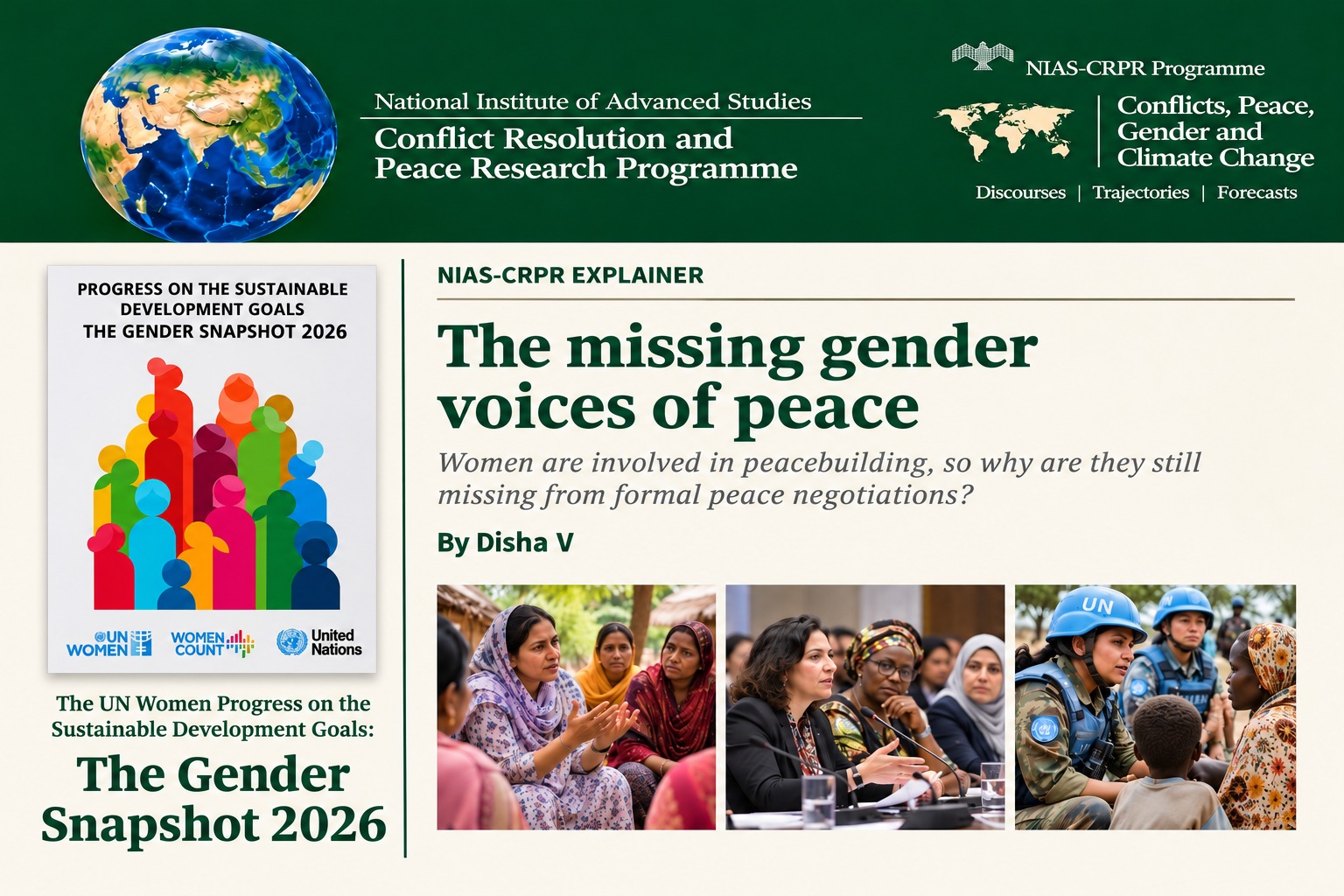
The missing gender voices of peace:
Women are involved in peacebuilding, so why are they still missing from formal peace negotiations?
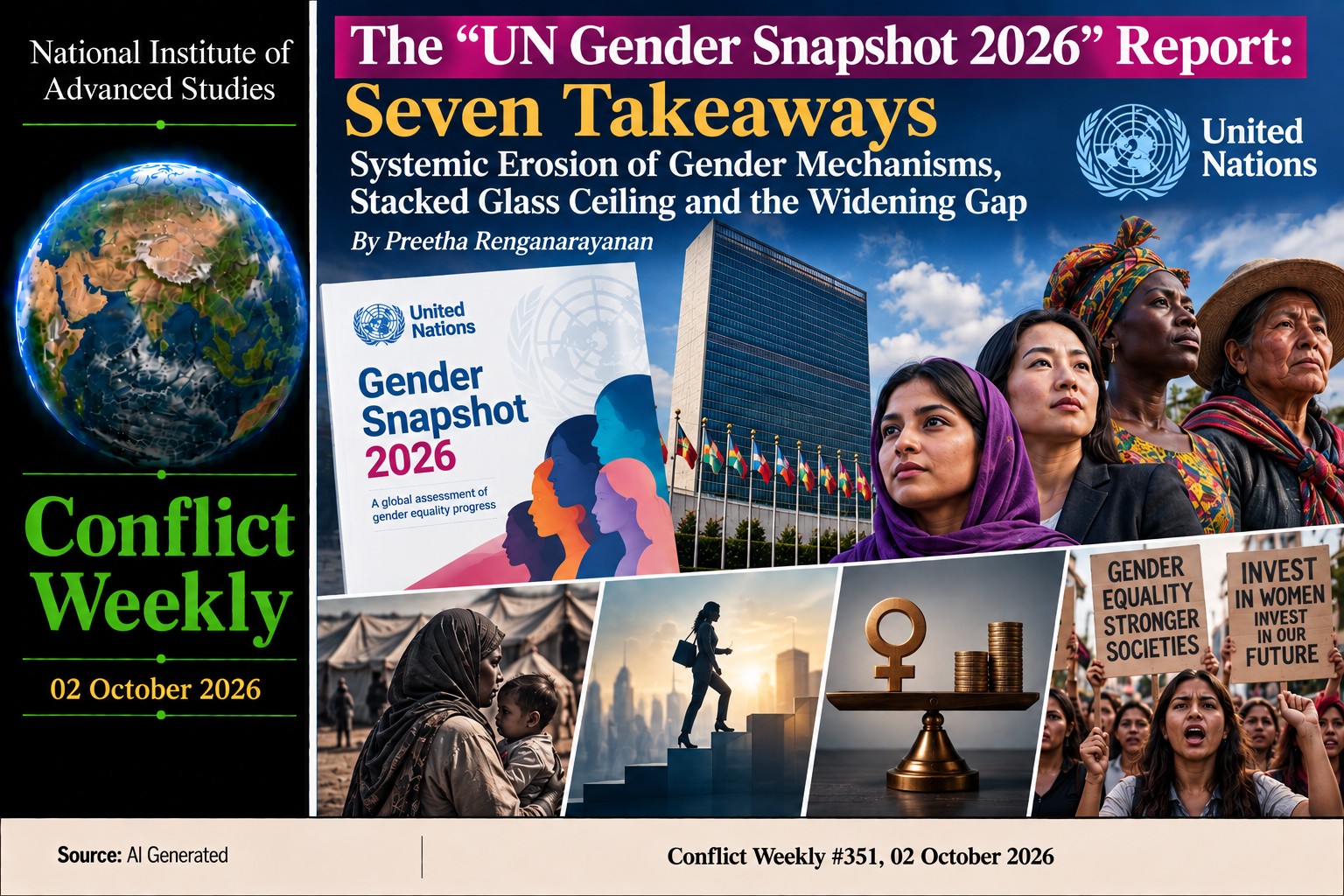
Review of the report titled "The UN Women Progress on the Sustainable Development Goals: The Gender Snapshot 2026."
|
Disha V
23 November 2026
|
“Women experience and respond to conflict differently. When they are excluded, women and civil society are unable to introduce their needs and concerns during those pre-negotiations, when an agenda for formal talks is made.”
26 years have passed by since the adoption of the landmark UN Security Council Resolution 1325, which recognises the vital role of women in peace and security. However, the data still show that women remain significantly underrepresented in peace and transitional processes. The report, “The UN Women Progress on the Sustainable Development Goals: The Gender Snapshot 2026,” is part of an annual series jointly published by UN Women and the United Nations Department of Economic and Social Affairs.
The following review looks at what the Gender Snapshot 2026 report talks about the role of women in peace processes.
What does the report highlight regarding women’s role in peace processes?
Women and girls are increasingly exposed to the consequences of armed conflict, yet they are underrepresented in formal peace negotiations to end it. The report states that 18.8 percent of women and girls globally, around 756.1 million people, lived within 50 kilometres of at least one armed conflict event in 2025. There has been more than a 50 percent increase in reported cases of conflict-related sexual violence verified by the UN in 2025. According to the report, 8 in 10 peace processes worldwide had no women negotiators or mediators. Women were also signatories to only two peace agreements, one in Colombia and one in the Democratic Republic of the Congo. Clearly, there is a gap between women's involvement in peacebuilding and their presence in formal negotiations.
Why are women underrepresented in formal peace negotiations?
Last year, the European Parliament deliberated on this and identified the growing role of warring parties and economic and legal inequalities as the main reasons for this gender gap in peace negotiations. They state that economic and legal inequalities in some societies further prevent women from participating meaningfully in peace deals. Bell (2017) found that research indicates low numbers of women in delegations of the parties to the conflict and a very low proportion of female negotiators since negotiating teams are mostly drawn from politico-military elites, who are primarily men. Armed groups and political elites are therefore treated as indispensable negotiators, while civil-society actors like women’s organisations are treated as secondary stakeholders.
What happens when peace negotiations exclude women's perspectives?
Women experience and respond to conflict differently. When they are excluded, women and civil society are unable to introduce their needs and concerns during those pre-negotiations, when an agenda for formal talks is made. Most peace processes focus on ending violence, mostly political violence, but fail to acknowledge the different forms of violence experienced by women and minorities, leaving these forms of violence in place and failing to address the security concerns of around half of the population. As such, pre-negotiation talks and agreements pose a major challenge for women and civil society, as they set the stage and structure the formal talks. This absence, in turn, leads to peace agreement provisions that largely do not address women’s perspectives or concerns.
Is the exclusion reversible?
There have been instances where women have organised outside the process to try to influence and penetrate it. One such case is when women in Colombia and Liberia organised outside of formal negotiation processes to try to set their own agenda and influence the talks, and in the most recent peace talks in Colombia, this led to the establishment of a Gender Subcommission, tasked with reviewing all documents issued as part of the peace process and ensuring that they contained gender-sensitive language and provisions. Some processes have appointed a gender advisor. For example, the United Nations Development Fund for Women (UNIFEM) appointed a gender advisor to “support the gender sensitivity of the North Ugandan Peace Talks,” and gender advisors have also been supported in other processes, including the Syria peace talks.
The UN is also taking measures to bridge this gender gap. According to UN Women, in 2024, the UN engaged in four active peace processes: the Geneva International Discussions, two processes relating to Libya, and one process in the Sudan. Two women served as lead mediators in three of these processes. However, in 2024, in peace- and constitution-making processes led or supported by the United Nations, women represented, on average, 18 percent of negotiators or delegates across negotiations, down from 19 per cent in 2023 and 23 percent in 2020.
Including women in peace negotiations is still a matter in progress, but the exclusion is reversible through such initiatives.
About the author
Disha V is pursuing postgraduate studies at the Department of International Relations at South Asian University, New Delhi.